
Halal Travel Guide: Hainan — Muslim History, Mosques and Local Communities (Part 1)
Reposted from the web
Summary: Hainan — Muslim History, Mosques and Local Communities is presented here as a firsthand travel account in clear English, beginning with this scene: The Huihui people are a Muslim ethnic group living in Huicun and Huixin villages in Sanya City, Hainan, numbering nearly 10,000. The account keeps its focus on Hainan Muslims, Muslim History, China Mosques while preserving the names, places, food, and historical details from the Chinese source.
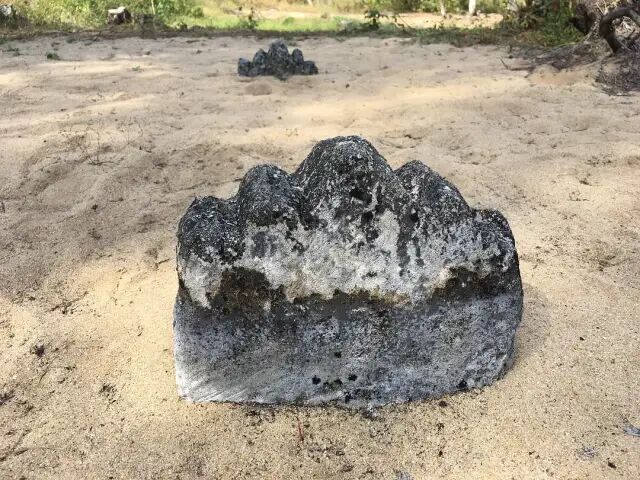
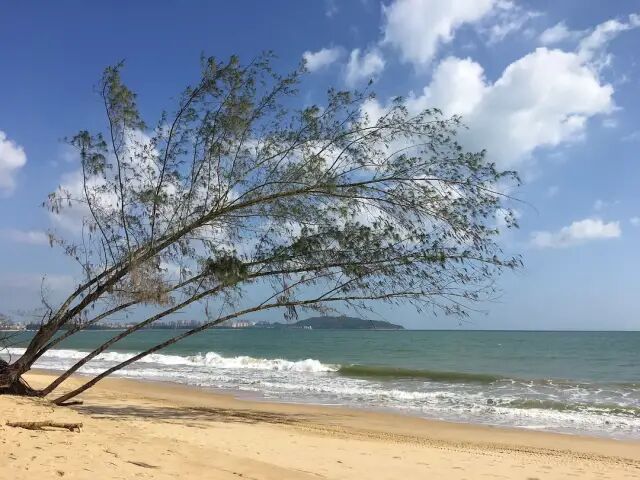
The Huihui people are a Muslim ethnic group living in Huicun and Huixin villages in Sanya City, Hainan, numbering nearly 10,000. Although classified as Hui, their Huihui language belongs to the Austronesian family, sharing origins with the Cham languages of southern Vietnam. The Huihui people's lifestyle is strongly influenced by the local ethnic groups of Hainan, yet they maintain devout Islamic faith, making them a very unique ethnic group on China's southeastern coast.
Among the Huihui people in Sanya, many legends circulate about their origins, pointing to regions like Arabia, Malaysia, the Western Regions, Annan, and Champa.
A legend recorded in the 1990 article "Hainan Muslims: Then and Now" in "Sanya Culture and History," Volume 2, states that the Huihui people believe they migrated from Arabia to Vietnam and then to Hainan:
"Our ancestors were originally a fishing tribe during the Abbasid Caliphate in Arabia. Due to internal conflict in the country, life became very difficult, so they moved to a place called Annan (present-day Vietnam). Later, a plague broke out, killing many people. They left that place and set sail to find a better land, but unfortunately encountered a typhoon and were scattered to Hainan Island.
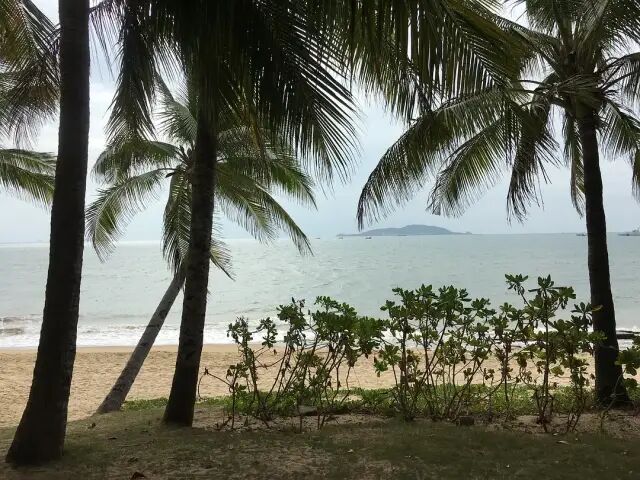
In a legend recorded in the 1990 paper "Investigation into the Origin and Ethnic Customs of the Hui Muslims of Sanya, Hainan Island," presented at the Sixth National Symposium on the History of Hui Muslims, the Hui Hui Muslims believe their ancestors moved from the Arab world (Da Shi) to Champa during the Tang Dynasty, and then from Champa to Hainan Island during the Song and Yuan dynasties.
"Our ancestors were originally 'people from the Western Regions.' During the Tang Dynasty, they moved to Champa due to internal strife in the Arab world. Between the Song and Yuan dynasties, they made a living by fishing at sea in Champa. Driven by typhoons, their ships drifted to various coastal areas of Hainan Island, mainly Yazhou, Wanzhou, and Danzhou."
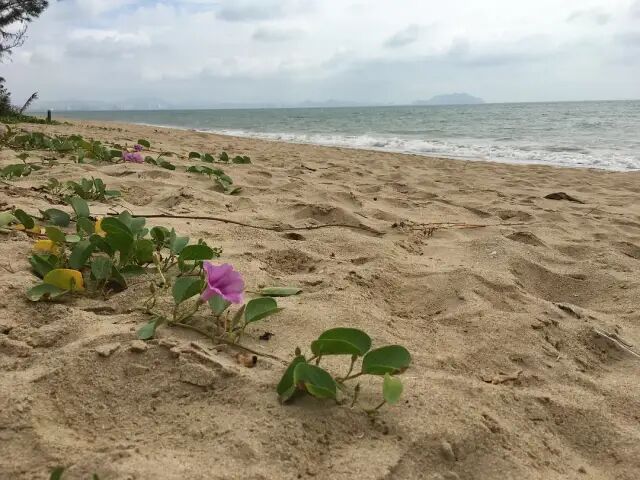
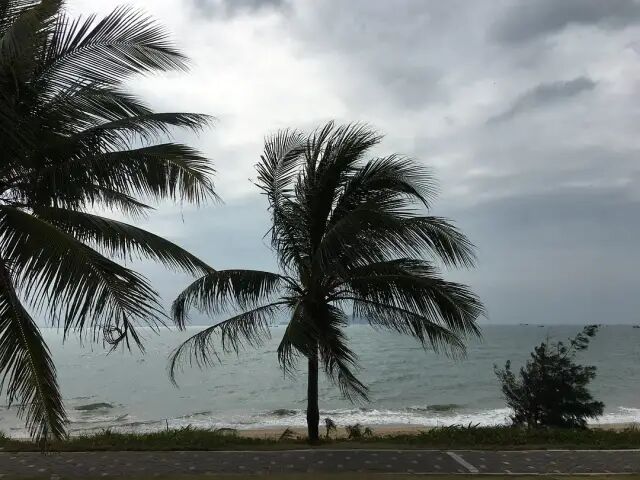
Sanya Bay beach
In 1981, Zheng Yiqing, a scholar from the Institute of Ethnology at the Chinese Academy of Social Sciences, visited Sanya to study the Hui Hui language. She interviewed elderly Hui Hui people there, who told her that the Hui Hui people came from Malaysia to southern Vietnam to engage in fishing, and were blown to Hainan by a typhoon.
"According to the older generation here, their ancestors first settled in Malaysia, then drifted to southern Vietnam to live and work as fishermen." "Once, they encountered a typhoon, and several boats were blown to the coast of Yaxian County, Hainan Island. One boat capsized, one drifted to the sea off Tiandu (Liupan Commune), one drifted to the sea off Sanya, and one drifted to the sea off Yacheng."
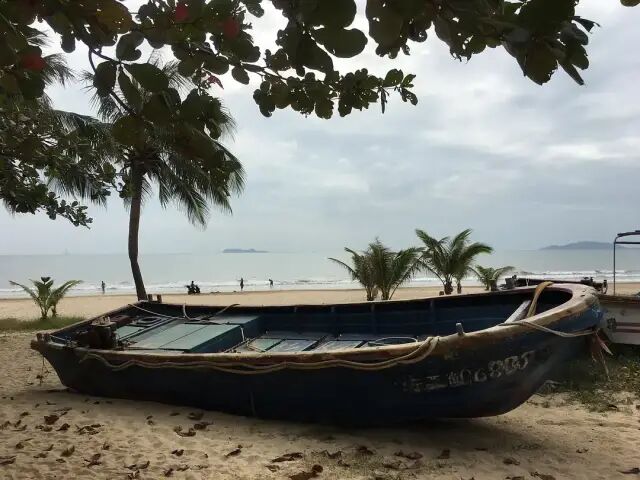
Sanya Bay beach
An article from 1986, "The Origin and Characteristics of the Hui Muslims of Yanglan, Hainan Island" by Jiang Yongxing and Mei Weilan, mentions local accounts stating they came from Champa in Vietnam. They say a typhoon brought them to Hainan during the Song Dynasty.
"Our original home is Champa in Vietnam. Our ancestors made a living by fishing at sea. Forced by a typhoon, our boats drifted to various coastal areas of Hainan Island, mainly Yacheng and Wanning, with some reaching Dan County (all coastal counties on Hainan Island, with Sanya and Dan County facing Champa across the sea). This was about seven or eight hundred years ago, during the Song Dynasty."
So, where did the Huihui people really come from? Are they descendants of the Champa people? Let's first sort through historical records to see what we can find.
I. The Origin of Muslims in Hainan
1. Arab and Persian Merchant Ships in the Tang Dynasty
The earliest Muslims to arrive in Hainan were Arab and Persian merchants during the Tang Dynasty.
In the later Tang Dynasty, the overland Silk Road gradually became blocked. Meanwhile, the maritime Silk Road continued to thrive, boosted by advances in navigation and shipbuilding. Many Arab and Persian merchant ships sailed the Indian Ocean to trade in cities like Guangzhou, Quanzhou, and Yangzhou. Carried by the north-bound monsoon winds in the South China Sea, these Persian and Arab ships often sailed close to the coast of Hainan Island. Both the "Vast Records of the Taiping Era" and the "Tang Monk Jianzhen's Eastern Voyage" (also known as "The Biography of Monk Jianzhen") mention local pirates robbing these ships.
The "Vast Records of the Taiping Era," Volume 286, tells of the great pirate Chen Zhenwu in Zhenzhou (present-day Sanya, Hainan) during the Tang Dynasty, who became a millionaire by plundering Persian merchant ships. The text states: "This began with merchant ships from the Western Regions that were wrecked and drifted ashore."
The "Tang Monk Jianzhen's Eastern Voyage" records that the great pirate Feng Ruofang in Wan'an Prefecture (present-day Wanning City in southeastern Hainan) captured Persian merchant ships. He seized a large number of Persians: "Each year, he would capture two or three Persian ships, stealing their cargo and taking people as slaves. The area where these slaves lived stretched three days' journey north to south and five days' journey east to west, with villages close to one another."
But currently, there's no direct evidence showing that Muslims in Hainan are descendants of Arab and Persian sea merchants from the Tang Dynasty.
2. Arab merchants from Champa who settled in Danzhou during the Northern Song Dynasty.
The earliest clear record in historical texts about the origin of Muslims in Hainan comes from the History of Song, Volume 489, under the section on Champa. It states: 'In the third year of the Yongxi reign (986 AD), officials in Danzhou reported that a Champa man named Pu Luo'e, pressured by Jiaozhou, led his clan of over a hundred people to seek refuge.'
Danzhou is located in the northwestern part of Hainan Island. Jiaozhou, also known as Jiaozhi, was the Song Dynasty's name for northern Vietnam. The surname Pu was a common Han Chinese surname used by Muslims along the southeastern coast during the Song and Yuan dynasties. It's thought to come from 'Abu,' a prefix in Arabic names.
The most famous Muslim with the surname Pu was Pu Shougeng, a major sea merchant in Quanzhou during the late Song and early Yuan periods. Also, Yue Fei's grandson, the Southern Song writer Yue Ke, came to Guangzhou with his father when he was 10 years old (in 1192). He met a group of Arab merchants surnamed Pu who had moved from Champa to Guangzhou. He recorded this in detail in his book "Tang Shi," Volume 11, "Foreigners of Panyu by the Sea." The "Bai Fan" (White Foreigners) mentioned here refers to Arabs and Persians.
"Panyu is home to various foreign peoples living together by the sea. The most prominent among them are surnamed Pu, known as 'Bai Fan' people. They were originally nobles from Champa." "After sailing at sea and encountering storms, they feared returning. So, they petitioned their ruler, wishing to stay in China to help trade."
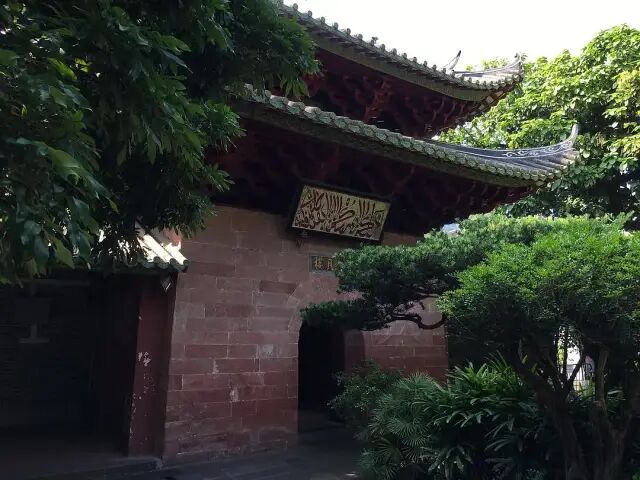
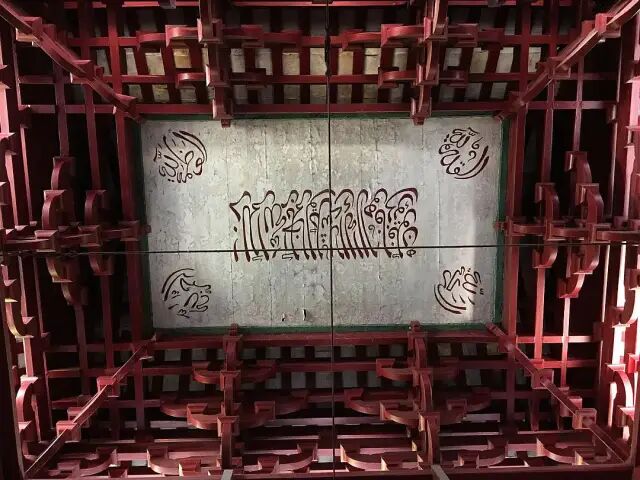
The Huaisheng Mosque was the center of Guangzhou's "foreign quarter" at that time.
The reason Pu Luo'e led his clan from Champa to Danzhou in Hainan in 986 was due to a significant war in Vietnamese history. Starting in the 10th century, the Yue state in northern Vietnam began attacking Champa in the south. In 982, the Early Lê dynasty of Vietnam destroyed Champa's capital, Indrapura (near present-day Da Nang), scattering many Chams.
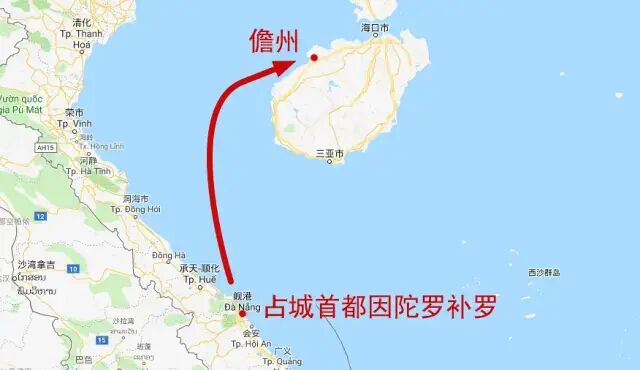
Champa, also translated as Zhanpo, was a state founded by the Cham people in southern Vietnam in 192 CE. Early Champa was strongly influenced by India, believing in Brahmanism and practicing the caste system.
Because its land was long and narrow and fragmented, Champa mainly developed maritime trade, becoming an important transit point on the Maritime Silk Road during the Song and Yuan dynasties. Both Chinese merchant ships departing from Guangzhou and Quanzhou, and Arab and Persian merchant ships from the Indian Ocean and Persian Gulf coasts, chose to stop in Champa. Therefore, many Arab and Persian merchants lived as expatriates in Champa during the Song and Yuan dynasties.
Two Kufic tombstones written in Arabic were excavated in Phan Thiet and Phan Rang cities in southeastern Vietnam. The first is the tombstone of a road worker named Abu Kamil, who passed away on November 20, 1039. The other is a notice about how local Muslims got along with the indigenous people, written in a mix of Kufic and Naskh scripts. It is thought to have been carved between 1025 and 1035. The inscription suggests that Arab and Turkish merchants lived here in a community.
From the 10th to the 13th centuries, Champa was still mainly Brahmanist, with Muslims being mostly Arab expatriates. The kingdom of Champa sent envoys to China multiple times between the 10th and 12th centuries. Many of these envoys had names that can be traced to Arabic transliterations.
The book Taiping Huanyu Ji, written during the Song Dynasty's Taiping Xingguo era (976-983), has an entry on Champa that records the first Champa envoy during the Five Dynasties period:
"In the fifth year of Xiande (958), its king, Sri Indravarman, sent his minister, Puo Hesan, to present local products. Among them were fifteen glass bottles of rosewater, said to come from the Western Regions... He also presented eighty-four glass bottles of naphtha, an oil that burns more intensely when it meets water, which their country uses in naval battles."
The envoy Puo Hesan's name can be translated as Abu Hasan. This rosewater was recorded in the Song Dynasty book Zhufanzhi as floral water from the land of Dashi (Arabia), and naphtha refers to petroleum.
During the Song Dynasty, Champa sent envoys even more frequently. According to the Song Shi, Volume 489, the Champa entry, in 961, Puo Hesan again brought rhinoceros horn, ivory, camphor, spices, peacocks, and Dashi bottles, all goods from the Maritime Silk Road.
In 1053, "its envoy, Pu Sima Ying, came to present local products." The name Pu Si Ma can be translated as Abu Ismail.
In 1056, envoys were sent to offer local products. The name Pu Xi Tuo Pa can be translated as Abu Hittabah.
In 1068, envoys were sent to pay tribute. The name Pu Ma Wu can be translated as Abu Mahmud.
In 1155, Pu Weng Du Gang, Pu Weng Tuan, and others also came to pay tribute. They were likely Arab merchants too.
Today, the surname Pu is still a major surname among the Hui Muslims.
Besides official delegations, more Arab merchants from Champa came to the Song Dynasty to do business. Wang Yucheng, a literary scholar from the Northern Song Dynasty, wrote in the
It wasn't until the 14th-15th centuries, after the Malays converted to Islam, that the Champa people gradually began to adopt Islam under Malay influence. Therefore, the early Champa immigrants with the surname Pu who came to Hainan might have been Arab expatriates.
3. Arab merchants from the Northern Song Dynasty who immigrated to Yazhou
In 1022, Ding Wei, the prime minister of the Northern Song Dynasty, was dismissed and demoted to Yazhou as an official in charge of household registration. He lived in Yazhou, the southernmost part of Hainan, for three years between 1022 and 1025. During his time in Yazhou, Ding Wei wrote "Tian Xiang Zhuan" about agarwood, which is included in the "Chen Shi Xiang Pu" in the "Siku Quanshu" (Complete Library in Four Sections). The book records that most of the agarwood from Champa at that time was exported to Guangzhou and Arabia. One Arab merchant ship was blown to Yazhou by a hurricane, and the Arab merchants settled there.
Champa produced a great deal of agarwood, which was traded and shipped either to Panyu (Guangzhou) or to Arabia. Precious agarwood is as valuable as gold. The village elders say that in recent years, large foreign ships from the Great Food (Dashi) country have been caught in hurricanes and forced to dock in this neighboring prefecture. The leader, being very wealthy, threw a lavish banquet, boasting extravagantly. The people of the prefecture looked at each other and said, "In terms of wealth, we truly can't compete. But look at their cooking: the smoke from their stoves is thick and unmoving, the food is dry and light, skinny and burnt. It's not delicious." So, they took some wood from the north shore and burned it right there. The smoke rose faintly, as if drawing from the eastern sea. The rich, oily smoke congealed like lacquer, and its fragrance lasted, becoming even better over time. The people on the large ships were defeated by this.
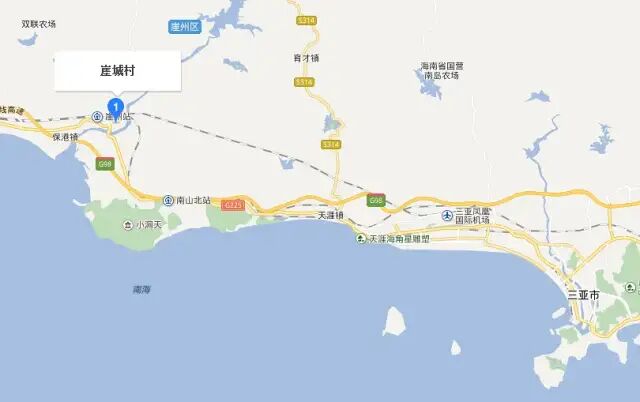
The ancient city of Yazhou is located northwest of Sanya. Map data from Baidu Maps.
4. Champa soldiers who fled to Hainan Island during the Southern Song Dynasty.
In the 13th century, Champa and Zhenla (Cambodia) were locked in years of war. In 1145, Zhenla (Cambodia) captured Champa's capital, Vijaya. But in 1177, Champa's army counterattacked and took Angkor. Zhenla occupied Champa again in 1190 until 1220. During the wars between Champa and Zhenla, some Champa deserters fled to Hainan and were recruited into the Southern Song army.
The famous Southern Song Neo-Confucian scholar Zhen Dexiu (1178-1235) recorded in Volume 47 of his collected works, 'Zhen Wenzhong Gong Wenji,' in the 'Biography of Zhan Gong, Minister of Agriculture and Grand Commander of Huguang,' the deeds of another Southern Song Neo-Confucian scholar, Zhan Tiren (1143-1206). It mentions Champa soldiers fleeing to Hainan during the Champa-Zhenla wars and Zhan Tiren recruiting them. The record states: 'Champa and Zhenla attacked each other, and some soldiers escaped to Qiong and Guan. ' The official mobilized troops and pacified the coastal areas by recruitment.
However, these Champa soldiers were not necessarily all Muslims; they could have been followers of Brahmanism or Buddhism.
5. Champa people settled in Qiongzhou (now Haikou) during the Yuan Dynasty.
In 1279, Champa submitted to the Yuan Dynasty, which sent the Right Chancellor Suo Du to govern Champa. However, Champa rebelled against the Yuan Dynasty again in 1282. So, Suo Du led a large army to conquer the Champa capital and pursued the Champa army deep into the mountains. In 1283, the Yuan army shifted its attack from Champa to Annam (the Trần Dynasty of Vietnam). The King of Champa then pledged allegiance to the Yuan Dynasty, and the war finally ended.
The Ming Dynasty's Zhengde era gazetteer, Qiongtu Zhi, Volume 7, under
Customs, records that during the Yuan Dynasty's war with Champa, some Champa people surrendered and were settled in Haikou Port (now Haikou City) in Qiongzhou County, registered as Southern Fan soldiers, and lived in the Fanmin Suo (foreigners' settlement): "Champa customs. No elders or children were left behind; everyone was given a three-year supply of grain rations. A settlement for the foreign people was established, with the foreign chieftain Malin appointed as the administrator. This position was hereditary, and he was granted a fourth-rank seal and authority.
It's unclear if all these resettled Champa people were Muslims.
6. Champa Muslims who moved to Yazhou (present-day Sanya) between the Song and Yuan dynasties.
Starting in the 10th century, Champa engaged in wars with Dai Viet, Chenla (Cambodia), and the Yuan Dynasty. Many Champa refugees fled by boat to Yazhou in Hainan, which was across the sea. The Ming Dynasty's Zhengde-era "Qiongzhi" (Gazetteer of Qiongzhou), Volume 21, Section on Coastal Defense, records that the journey from Yazhou to Champa took two days by boat, making it very convenient: "Two days south of Yazhou connects to foreign lands of Champa."
According to the Qing Dynasty's Guangxu-era "Yazhouzhi" (Gazetteer of Yazhou), Volume 1, Section on Geography and Territory, Subsection on Customs, Champa Muslims once lived scattered along the coasts of Dadan Port and Suanmei Pu in Yazhou: "The foreign people were originally Hui Muslims from Champa." Between the Song and Yuan dynasties, they came by boat due to unrest and settled along the coasts of Dadan Port and Suanmei Pu.
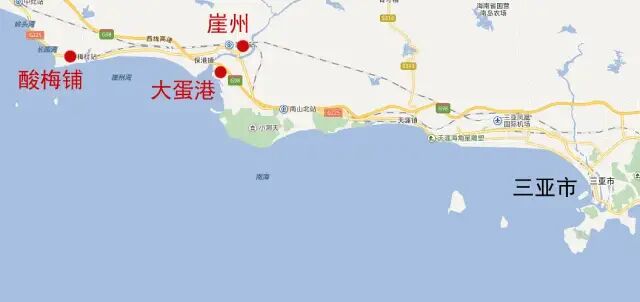
1. Early Yuan Dynasty Cham Muslims who moved to Wanzhou (present-day Wanning).
Besides Yazhou at the southernmost tip of Hainan Island, Wanzhou in southeastern Hainan was also a place where Cham Muslims relocated to escape war. According to the "Fan Village" section in Volume 9 of the Daoguang Edition of the Wanzhou Gazetteer, Cham people once lived in Fan Village west of Wanzhou city: "The Fan were originally people from ancient Cham. In the early Yuan Dynasty, they encountered chaos and sailed to the coast of the prefecture. They later moved west of the city and called it Fan Village."
Wanzhou is located in Wanning Town, Wanning City, northeast of Sanya City.
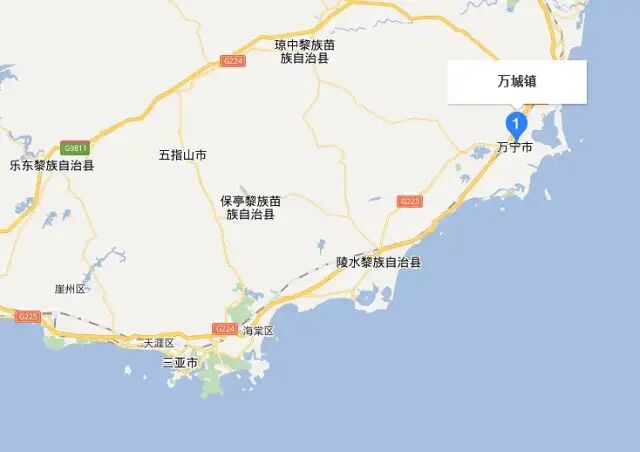
The place name Fan Village still exists today, located southwest of Wanning Town.
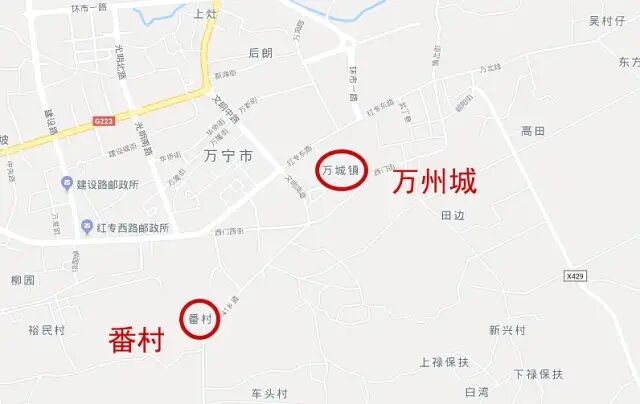
After Kublai Khan died in the 14th century, Vietnam broke free from the Yuan Dynasty's control and resumed its attacks on Champa. In 1471, Vietnam's Later Lê Dynasty captured Champa's capital, Vijaya. Many Cham people scattered and fled to Cambodia, while the remaining Cham established three small kingdoms: Champa, Nam Phan, and Hoa Anh.
The last records of Cham people arriving in Hainan come from texts like the History of Ming and the Veritable Records of Emperor Chenghua of Ming. When the king of Champa died in 1484, the Later Lê Dynasty unilaterally appointed a Cham minister, Deva Dat, as king. The true heir to the throne, Prince Gu Lai, fled with his followers to Yazhou, Hainan, in 1486. The Chenghua Emperor of the Ming Dynasty sent envoys to Yazhou to recognize Gu Lai as the King of Champa. In 1487, he dispatched a strong military escort to help Gu Lai return to Champa and reclaim his throne with Ming intervention.
8. Muslims Arriving by Land
Besides Muslims from Champa, another group of Muslims in Hainan migrated from the Western Regions by land. According to the Genealogy of the Pu Family of Nanhai Ganjiao, first compiled in 1619 (the 47th year of the Wanli reign of the Ming Dynasty), the ancestor of this Pu family was named Ma Qu'a, also known as Runi. He was originally a Uyghur from the Western Regions. After the Rooney family moved inland, they first settled in Shandong. Later, because their son Haida was appointed an official in Guangzhou, the whole family moved to Guangzhou's While living in Guangzhou, the Pu family helped rebuild the Lighthouse Tower of the Huaisheng Mosque.
The Lighthouse Tower of the Huaisheng Mosque was a landmark in Guangzhou's foreign quarter back then.

By the eighth generation of the Pu family in Guangzhou, Pu Qiutao moved to Nanhai County (now Nanhai District, Foshan City) and founded the Ganjiao branch. During the Ming Dynasty, the third-generation granduncle of the Ganjiao branch, Pu Jun, went to Hainan to do business. His son, Pu Yuye, came to Dengzhou in the northwest of Hainan and ran a salt business in Panbu Village, Xinying Town. Pu Yuye had two sons, Pu Xuanfu and Pu Xuanlu. After Pu Yuye passed away, his two sons moved to E'man Township in Dengzhou and founded the Pu family's E'man branch.
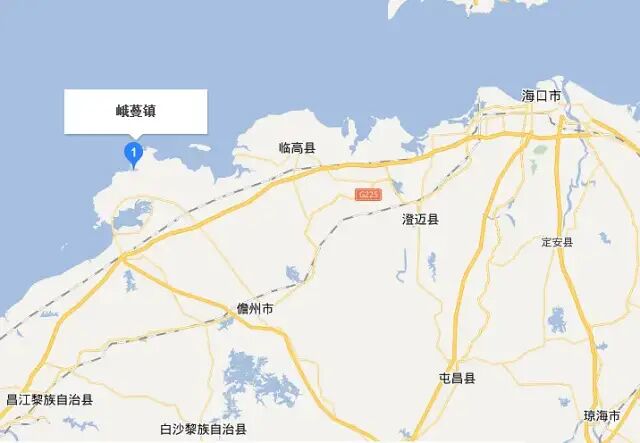
The place is now called Eman Town.
Customs of Hui Muslims in Hainan during the Ming and Qing Dynasties
The earliest detailed account of the customs of Cham Muslims in Hainan comes from the "Customs" chapter of the Zhengde Gazetteer of Qiongtái (Zhengde Qiongtái Zhi), compiled in 1521 during the Ming Dynasty. The descriptions are very rich and detailed. This passage states that during the Song and Yuan dynasties, due to warfare, entire families sailed to Hainan Island and settled in coastal areas called 'Fanfang' and 'Fanpu,' not mixing with local residents. Most were surnamed Pu and Fang. The Pu surname remains a major surname among the Hui Muslims of Sanya today, while the Fang surname no longer exists.
Customs, ... Those from other prefectures came with their families by boat during the Song and Yuan periods due to unrest, settling along the coast, referred to as Fanfang and Fanpu. They did not live intermingled with the local people. Most of these people were of the Pu and Fang surnames.
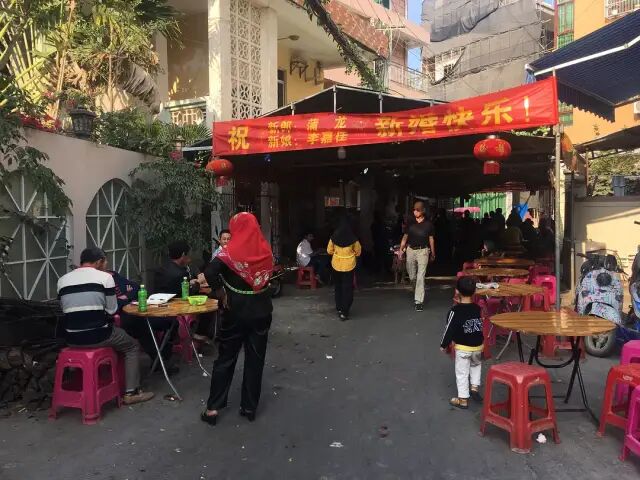
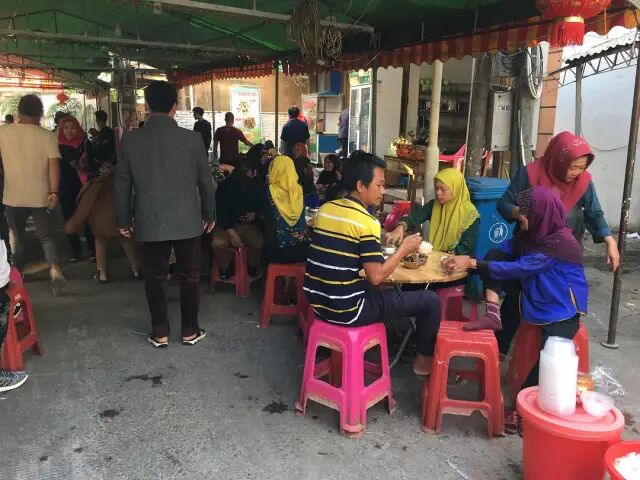
This is a wedding banquet for the Pu family that I encountered in Huixin Village (Fan Village) in Sanya.
This section introduces Islamic beliefs, including not eating pork and fasting during Ramadan. The term 'Buddha hall' (fotang) here refers to a mosque. This custom of calling mosques in Hainan 'Buddha halls' continued even after the Qing Dynasty.
They do not eat pork, and other livestock must be slaughtered while bleeding. They enjoy eating betel nuts. Families do not worship ancestors. Those who can read foreign scripts and are called 'teachers' are given a small stool to place an incense burner on. Each village has one Buddha hall (fotang), where they recite scriptures and pray morning and evening. Every year, they fast for one month. During the fast, they do not swallow saliva. They eat only after seeing the stars and moon. The third day of the month marks the beginning and end of the fast. On the day of breaking the fast, they gather at the Buddha hall (fotang). After reciting scriptures and praying, they visit each other's homes, which is like exchanging New Year's greetings.
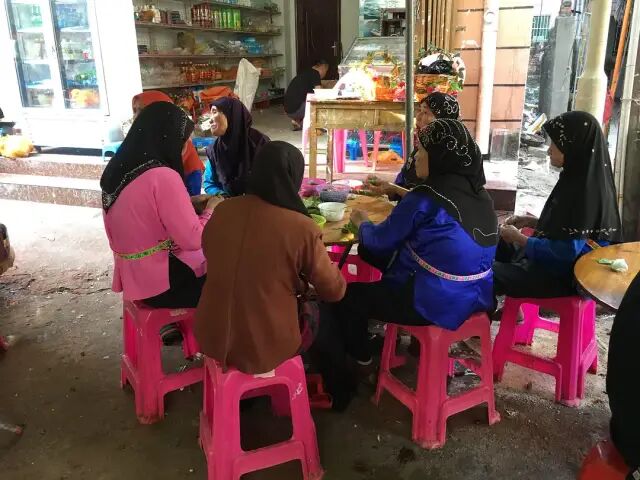
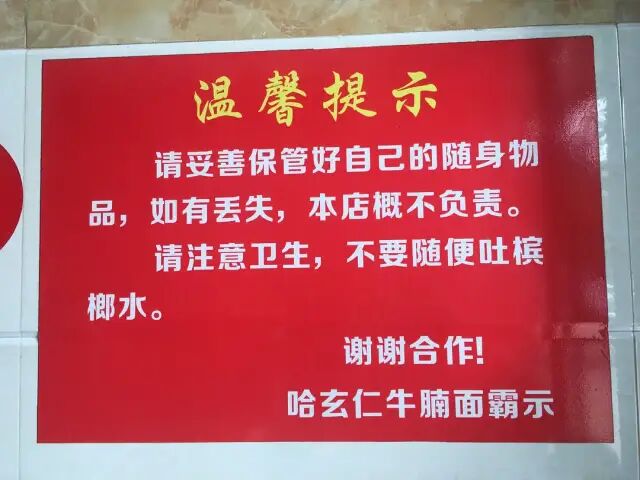
The text mentions that 'they love to eat betel nut,' a habit that continues today. Now, Huihui Village is full of betel nut stalls. The first time I saw Huihui people with their mouths full of blood-red betel juice, I was startled.
The white cloth wrapped around the head mentioned below should be the 'dastar.' After death, wrapping the body in cloth and burying it facing west (towards Mecca) is also a typical Islamic burial custom. Finally, it says that the speech and appearance of these people are similar to the 'Huihui.' This is the first time these southern 'foreigners' are compared to the 'Huihui' on the mainland.
'If you often see a respected person, you kneel and let them touch your feet.' If you meet as equals, you each touch each other's hands, then withdraw your hands and touch your own faces. For large gatherings, they sit on the ground in rows. Rice is served on large blue plates, and they eat with their hands. Men do not drink alcohol. When a man turns twenty, he asks a teacher to cut his hair to eyebrow level, wrap his head with a white cloth, and tie a cloth around his waist. Women wear short buns, short tops, and long skirts. They enjoy drinking alcohol and tea.
Outsiders who interact and form relationships with them are called 'zuo qi'. Some even marry them. Depending on wealth, they use gold, silver, copper, or tin rings, piercing their earlobes so the rings hang down to their shoulders. They like to use incense with flowers. They keep their bodies clean, sometimes black and sometimes red. When they die, they do not use coffins. Their bodies are wrapped in cloth and buried facing west. Their language and appearance are similar to the Hui Muslims. Now, they are all incorporated into the territory and collect taxes from fishing.
The 'Gujin Tushu Jicheng: Zhifang Dian' (Collected Works of Past and Present, Treatise on Geography), compiled in 1728, largely continues the records from the 'Qiongtai Zhi' of the Ming Dynasty's Zhengde period. However, by this time, only the Pu surname remained, and the Fang surname had disappeared:
“Most people here have the surname Pu. They do not eat pork. Their homes do not have ancestral shrines. They set up a Buddhist hall together, recite scriptures, and perform prayers.” Their language and appearance are similar to the Hui Muslims. Today, based on local customs, we include maps and information about fishing, education, and property. Marriage is not forbidden between people of the same surname, but it is forbidden between people of the same clan. Fishing customs are part of marriage, and no one else has their own marriage customs.
This volume also describes that houses at that time were mainly thatched huts:
"Dwellings were located near the sea, and we sometimes feared typhoons. Public and private rooms were not very tall or beautiful. Most folk houses used thatched roofs, and official buildings followed this simple style. Those near the sea were often submerged by wind and waves. Those who lived near the Li people also imitated the nests and tree houses of the mountain tribes. Even the homes of gentry were not ornate, prioritizing only completeness and sturdiness."
III. The settlement and assimilation of Hainan's Muslims
During the Ming and Qing dynasties, Hainan's Muslims lived scattered along the coast in Danzhou, Qiongshan, Yazhou, Lingshui, and Wanzhou, with the largest population in Yazhou. These areas experienced Sinicization, Li assimilation, and Tanka assimilation during the Ming and Qing dynasties, respectively, until only one Muslim community remained in Fan Village in Sanya.
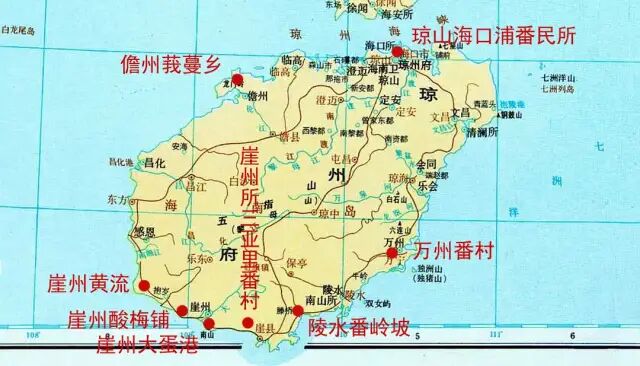
Base map from "Historical Atlas of China," Qiongzhou Prefecture in 1511.
1. Tanka assimilation of Muslims in Qiongshan County
The Champa people, who were settled in Haikoupu by the Yuan Dynasty and recorded in Volume 7, "Customs," of the Zhengde-era "Qiongtu Zhi" from the Ming Dynasty, were few in number by the end of the Yuan Dynasty due to warfare.
Customs, records that during the Yuan Dynasty's war with Champa, some Champa people surrendered and were settled in Haikou Port (now Haikou City) in Qiongzhou County, registered as Southern Fan soldiers, and lived in the Fanmin Suo (foreigners' settlement): "Champa customs. No elders or children were left behind; everyone was given a three-year supply of grain rations. A settlement for the foreign people was established, with the foreign chieftain Malin appointed as the administrator. This position was hereditary, and he was granted a fourth-rank seal and authority. During the chaos of war at the end of the Yuan Dynasty, few remain today.
The Ming Dynasty's "Qiongtai Annals" from the Zhengtong era, Volume 27, also records that these people had all become Dan people, a group living on the water in Hainan who make their living from fishing:
"In Haikou Port, where the foreign people lived, their leaders were established by soldiers from Southern Fan during the Yuan Dynasty. Their chief, Ma Lin, held a hereditary fourth-rank official seal and managed their foreign soldiers. Today, any descendants who still exist have all become Dan people."
The Sinicization of Wanzhou Muslims
The Kangxi-era Wanzhou Gazetteer, compiled in 1679, records in Volume 3, under 'Local Customs,' that the Champa Muslims of Wanzhou lived in Fan Village, west of the city. The gazetteer's description of Islamic customs largely comes from the Zhengde-era Qiongtu Gazetteer of the Ming Dynasty:
‘The Fan people were originally from Champa. During the chaos of the early Yuan Dynasty, they sailed their boats to the coast of the prefecture and later moved to the west of the city, establishing Fan Village. In the early Ming Dynasty, they were under the jurisdiction of the garrison and worked alongside other residents. Many had the surname Pu and spoke the Fan language. They did not eat pork. When slaughtering animals, they only ate the meat after it had bled. They did not worship ancestors. Those who can read the foreign script are called foreign chiefs. They set up temples to worship foreign gods, chanting scriptures on the first and fifteenth of the month, and bowing with clasped hands. Each month they take turns fasting. Those who are fasting do not let saliva go down their throats, and only eat when they see the stars and moon. Men wrap their heads with plain silk and do not drink alcohol. Women wear their hair in a bun at the back, with short tops and long skirts, and make a living by dyeing indigo with ash. When a daughter is about to marry, relatives and neighbors visit to offer gifts and congratulations, and comfort her by touching her face. There are no coffins in burials. The body is simply wrapped in cloth and buried on its side.
However, the Daoguang edition of the "Wan County Gazetteer" from 1828, in Volume 9, "Ancient Sites," adds a sentence to the "Foreign Village" section, which already quotes the full text from the Kangxi edition:
By this time, their customs had long since become Chinese, matching those of the Central Plains in dress and ceremony.
This shows that as late as the early 19th century, the Champa Muslims in Wanzhou had already assimilated into Han Chinese culture.
A 1951 survey of the Li, Miao, and Hui Muslims of Hainan, compiled by the Guangdong Provincial People's Government Committee for Ethnic Affairs, recorded that Wanzhou's Taiyangpo had a mosque in the 10th year of the Republic of China (1921). It also noted Arabic tombstones still existed there in the 1950s:
The Hui Muslims of Taiyangpo and E'man had completely assimilated into Han Chinese culture by the Guangxu reign (1875-1908). It's said that in the 10th year of the Republic of China (1921), Taiyangpo still had a mosque, and the graves in Taiyangpo and E'man still bear tombstones inscribed with Arabic script.
By the 1980s, when cultural relics workers Pan Xian'e and Li Juli from Sanya Lingshui County investigated Fan Village west of Wancheng, the area was entirely Han Chinese who had migrated from Fujian. Only the Pu Guangmao brothers' family remained of the 'Fan people.' They had been eating pork since their great-grandfather's time and had intermarried with local Han Chinese. The mosque built in earlier years had long since collapsed, and their religious beliefs were the same as the local Han Chinese.
3. The Sinicization of Muslims in Danzhou
The Ming Dynasty's Gazetteer of Danzhou, written in 1618, describes Islamic customs. Its account largely comes from the Zhengde Gazetteer of Qiongtan from the same dynasty, but it also notes that by that time, people were eating pork, except during Ramadan.
The text states: 'These foreigners do not live mixed with the local people, and do not eat pork. For other livestock, they do not need to slaughter it themselves to see the blood.' 'Families do not worship ancestors. Each village shares one prayer hall, where they recite scriptures morning and evening. Each year, they observe a month of fasting in rotation.' 'During the fast, they do not swallow saliva. They only eat after seeing the stars and moon. The fast begins and ends on the third day of the lunar month.' 'On the day of breaking the fast, they gather at the prayer hall for worship and recitation.' 'When someone dies, they do not use a coffin. The body is wrapped in cloth and buried facing west. This is generally similar to the beliefs of the Hui Muslims, referred to as 'Fan' people.' 'Nowadays, they are all registered with the local administration, eat fish and pork, and no longer hold fasting gatherings.'
It is unknown whether the Pu clan of Ouman village in Danzhou still practiced Islam during the Ming Dynasty. A 1951 survey by the Guangdong Provincial People's Government Committee for Ethnic Affairs, titled 'Investigation of the Li, Miao, and Hui Peoples of Hainan, Guangdong,' recorded that by the Guangxu era, Ouman village in Danzhou had been completely sinicized, but still preserved Arabic tombstones.
By the Guangxu Emperor's reign in the Qing Dynasty, the Hui Muslims of Taiyangpo and E'man had been completely sinicized. Tombstones in Taiyangpo and E'man still bear inscriptions in the Hui script.
A small number of the Pu family from E'man also moved into the Huihui village of Suosanya during the Qing Dynasty, becoming part of the present-day Huihui people.
In 1989, Ma Jianzhao from the Guangdong Provincial Institute of Ethnic Minorities and Darrell Du Riel, a visiting scholar from the Chinese University of Hong Kong, went to Dan County to investigate the Pu family of E'man. They published an article titled 'A Survey of the Customs and Culture of the Pu Clan in Dan County, Hainan Island'. The article stated that in 1989, there were 1,461 people in the Pu clan in Dan County. Except for wrapping the deceased in white cloth before burial, they had basically no remaining Islamic beliefs or customs. At that time, there were three ancestral halls in Pucun village in E'man Town. One was the 'Pu Clan Ancestral Hall,' dedicated to the spirit tablet of the first ancestor, Pu Yuanye. The other two were branch ancestral halls: 'Chongqing Tang,' for the descendants of Pu Xuanfu, and 'Longfu Fang,' for the descendants of Pu Xuanlu. Inside, besides ancestral tablets, there were also statues of deities such as 'Tiangang Marshal,' 'Bawang Marshal,' 'Yizhuang Marshal,' and 'Zhuizhu Marshal,' serving as guardians of the ancestors.
The current Shangpu Village was formerly known as Shangpu Village.
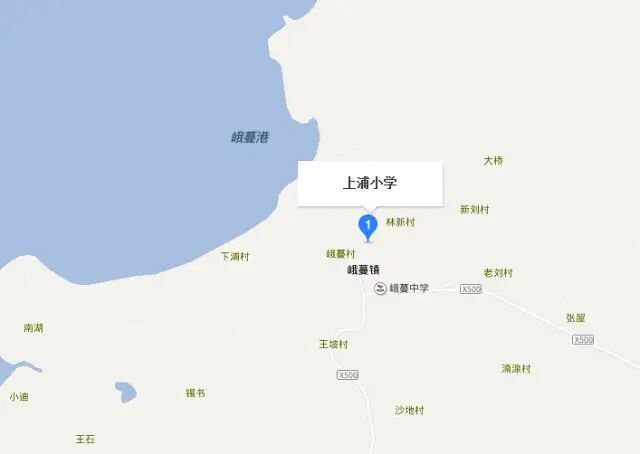
In early 1983, a doctor from the Pu family of E'man, who worked in Jiangmen City, Guangdong, obtained a copy of the 'Pu Family Genealogy of Nanhai Ganjiao.' This allowed the Pu clan in Danzhou to rediscover their ancestral origins. In late 1983, the Ouman Pu clan applied to the Guangdong Provincial Ethnic Affairs Commission to change their ethnic status to Hui Muslim. However, because the Ouman Pu clan had completely assimilated into Han Chinese culture, the authorities did not approve the request.
Starting in 1984, over 30 households and more than 100 villagers surnamed Pu from Ouman voluntarily moved to Huihui Village in Sanya. The local Huihui people helped them build homes and provided land for them to farm. However, after arriving in Huihui Village, the Ouman Pu clan could not adapt to the Huihui custom of not drinking alcohol or eating pork. After more than a month, some of them went to nearby Han Chinese villages to drink alcohol and eat pork. A year later, all of them left Huihui Village and returned to Danzhou.
4. Muslim Ancient Tombs in Tufu Bay, Lingshui
In 1976, Li Juli, a cultural relics worker from Lingshui County, discovered 53 ancient tombs on a sandy beach stretching 2.5 kilometers long and 40-60 meters wide, from Fanling Slope in Tengqiao Township, Sanya, to Tufu Bay Village in Lingshui. This discovery marked the beginning of the large-scale uncovering of ancient Muslim tombs in Sanya.
In 1978, archaeologists from the Guangdong Provincial Museum and the Hainan Island Cultural Management Committee excavated three Muslim tombstones carved with Arabic script on a beach called "Songlu" at the eastern foot of Fanling. Two of these are now in the Lingshui County Museum, and the other is in the Guangdong Provincial Museum.
In 1982, a joint archaeological team from the Guangdong Provincial Museum and the Hainan Island Cultural Management Office unearthed three more Arabic tombstones on Songlu Beach. At the same time, another ancient cemetery at Gan Jiaopo, 1 kilometer west of Tufuwan Village, was discovered. Seven tombs were excavated, each with an Arabic tombstone. The archaeological team left the tombstones in place and took rubbings of the inscriptions.
In December 1983, a joint investigation team from the Guangdong Provincial Political Consultative Conference's Ethnic and Religious Group and the Guangdong Provincial Ethnic Research Society rediscovered six Arabic tombstones and two tombstones with floral patterns on Songlu Beach.
By this time, three ancient Muslim cemeteries had been found in the Tufuwan area, bordering Sanya and Lingshui: Fanlingpo, Gan Jiaopo, and Tufuwan.
Approximate location of the ancient cemetery at Fanlingpo, Tengqiao Township:
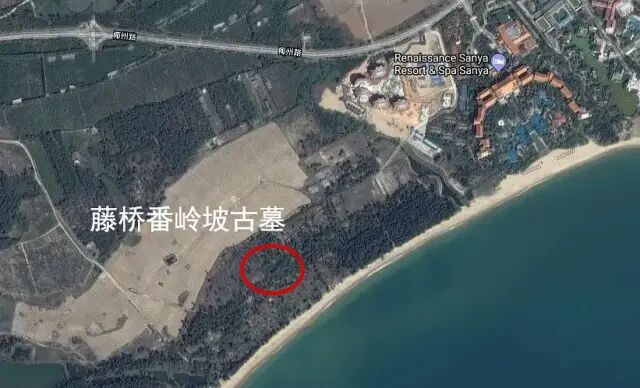
On December 30, 2017, I traveled by car from Sanya to Fanlingpo in Tufuwan. First, I took a car to the Sanya International Duty-Free Shopping Complex, then took a taxi to the Renaissance Sanya Resort. I walked through the hotel to the beach and then walked southwest along the beach.
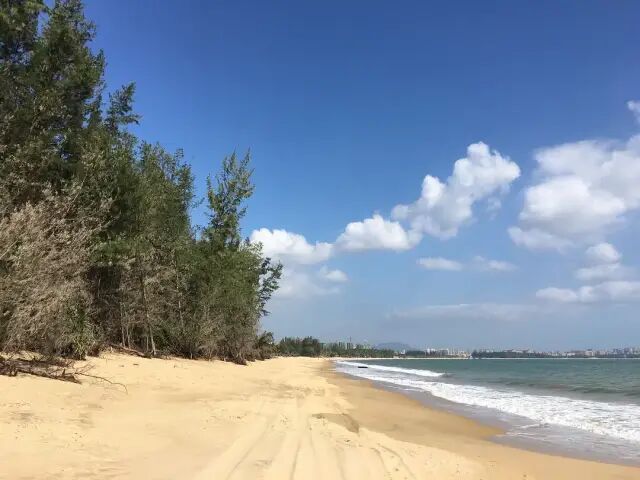
In March 1986, cultural relics workers Pan Xian'e and Li Juri from Lingshui County, Sanya, along with Yin Caike, an official from the Yingzhou Town Cultural Station, discovered two sites on a sandy dune cliff on the south side of Fanling Slope. These sites, located about 30 meters from the sea and 20 meters above it, were identified by Wang Hengjie, an associate professor in the History Department at the Central Institute for Nationalities. Local fishermen had long spoken of them, and Wang Hengjie confirmed they were the remains of "Fan people's" fortresses and living areas. Excavations yielded green bricks, roof tiles, and numerous ceramic shards from the Han, Tang, and Song dynasties. Sanya cultural relics workers also found Song dynasty copper coins and pottery fragments on the barren slopes near Fanling.
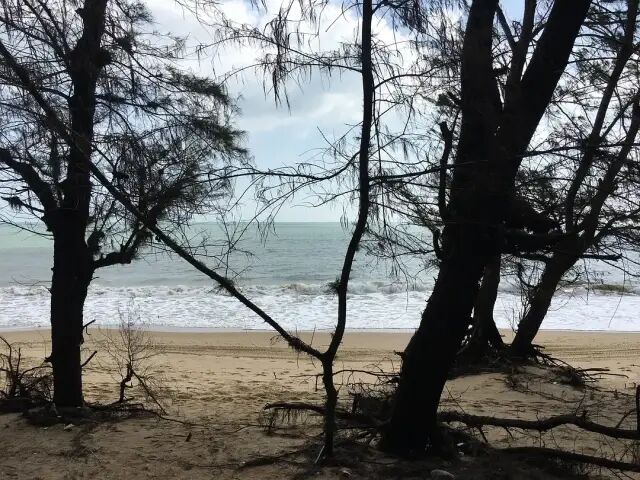
Sandy dune cliff:
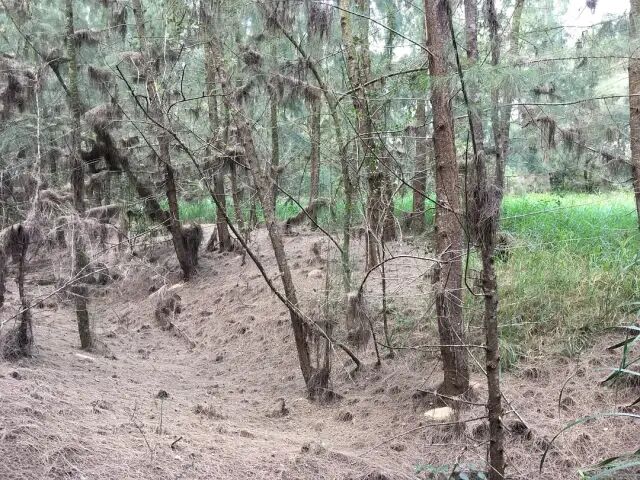
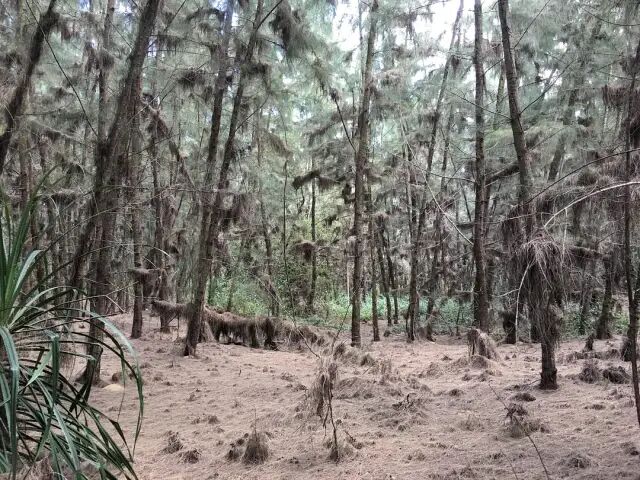

Walk a short distance west along the beach, and you'll find a hidden entrance leading to a forest path.
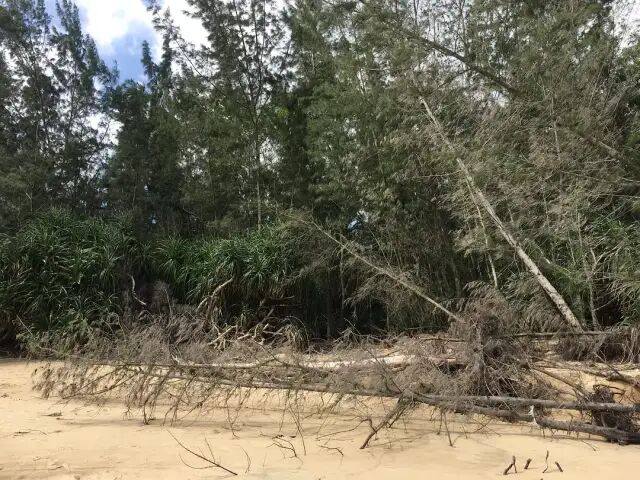
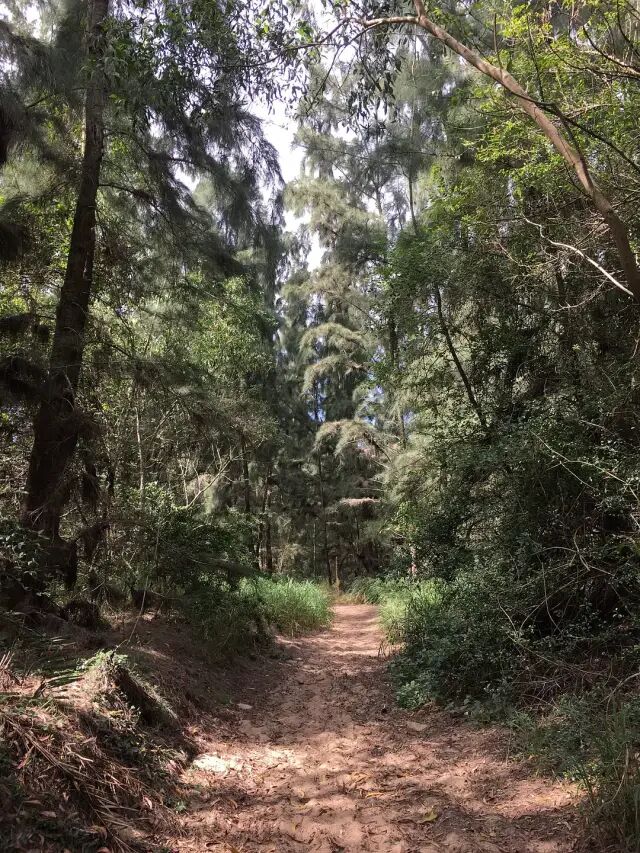
Follow the path north to its end, and you'll see a sign marking the cultural relics.
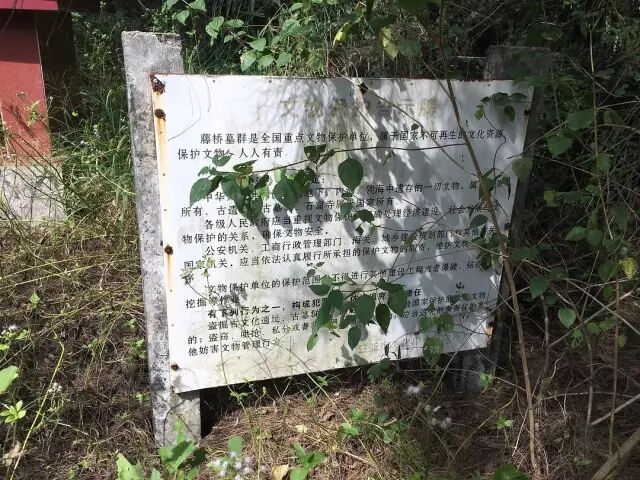
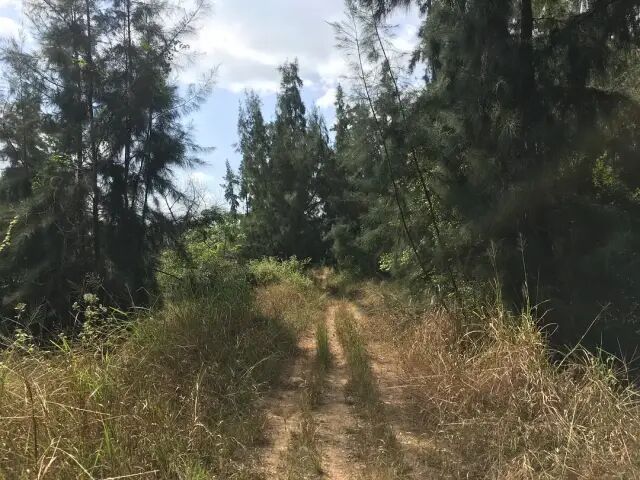
Continue west, and you'll spot the 2016 marker for the Tengqiao Cemetery, a nationally protected key cultural heritage site.
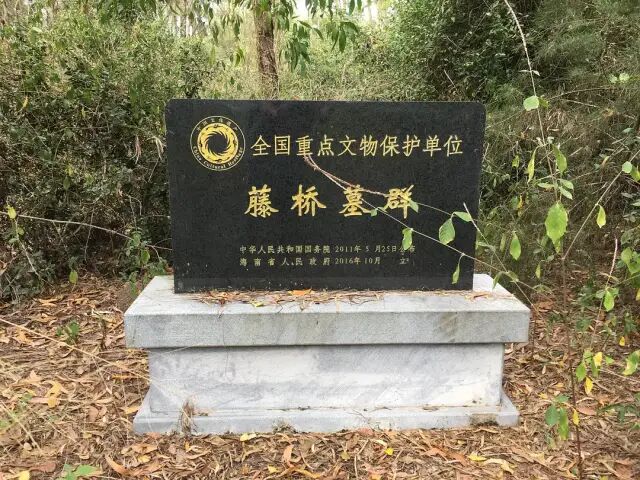
Go further west, and you'll reach the only well-preserved ancient Muslim cemetery in the Tengqiao Fanling Slope area of Tufu Bay.
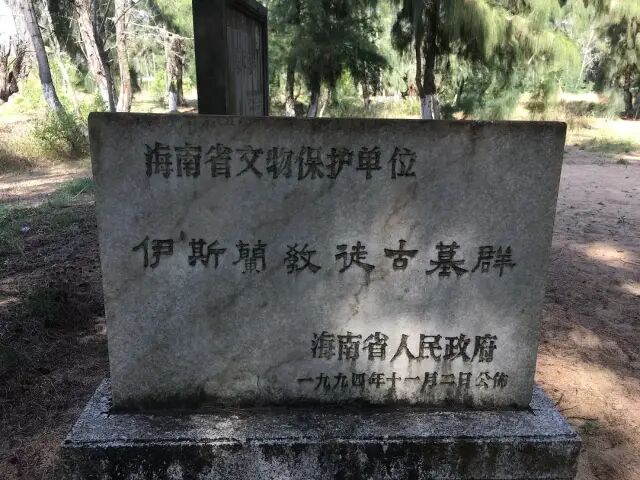
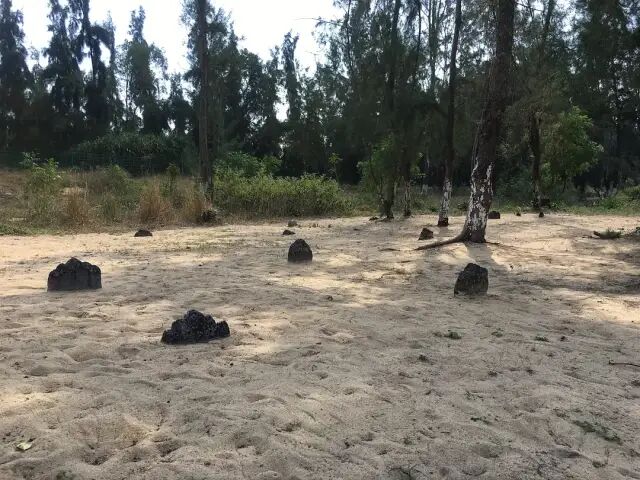
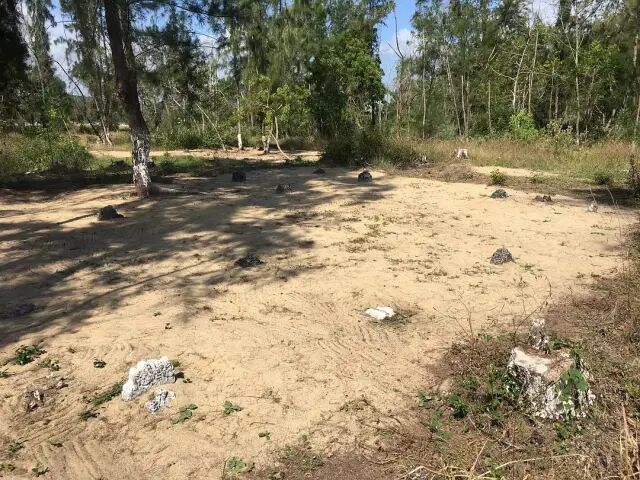
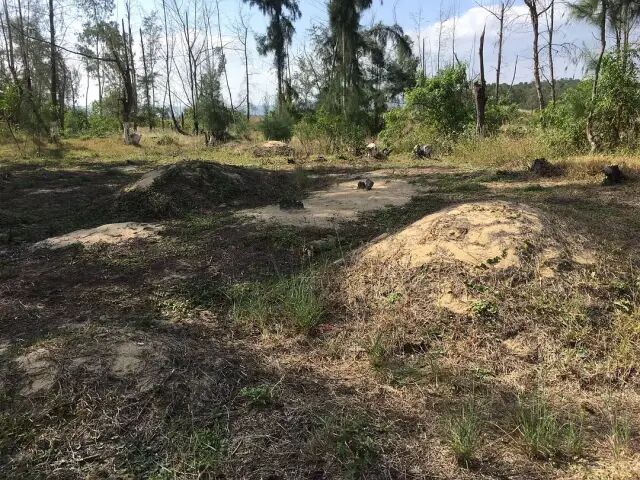
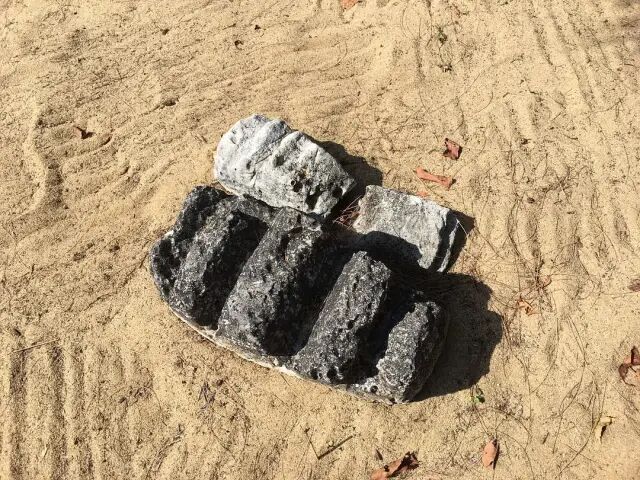
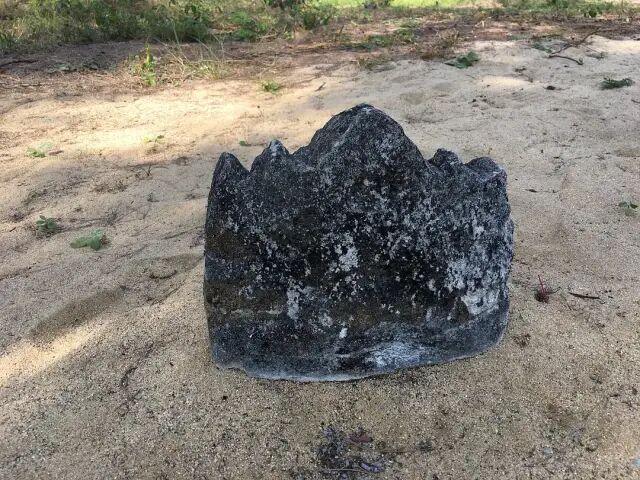
These graves are all vertical pit graves, with no side panels, cover boards, or any burial objects. The graves face north to south, with the deceased lying on their side in a flexed position, facing the holy city of Mecca to the west. In front of and behind each tomb, a coral stone tombstone was erected. The inscriptions were written in Arabic or Persian. However, most of the inscriptions on the tombstones currently at the original sites have weathered away and are no longer visible. Tombstones with clear inscriptions have been moved to museums at various levels in Hainan Province.
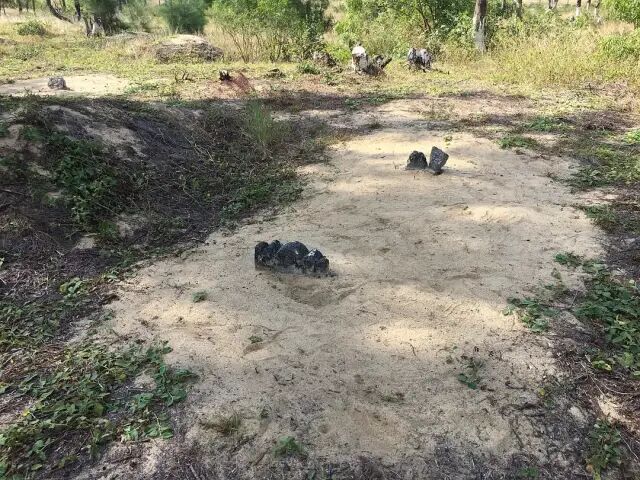
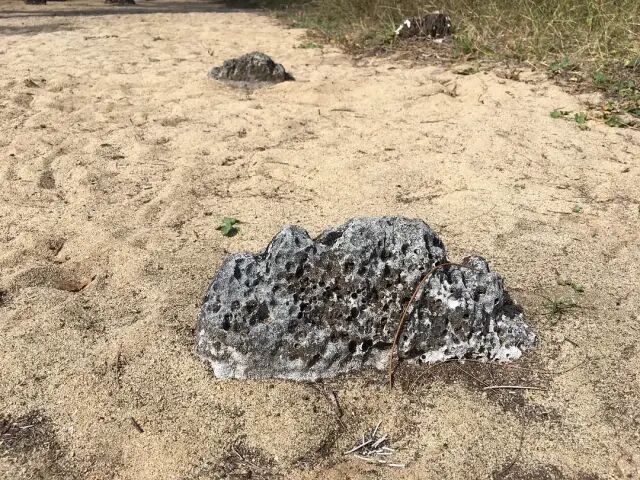
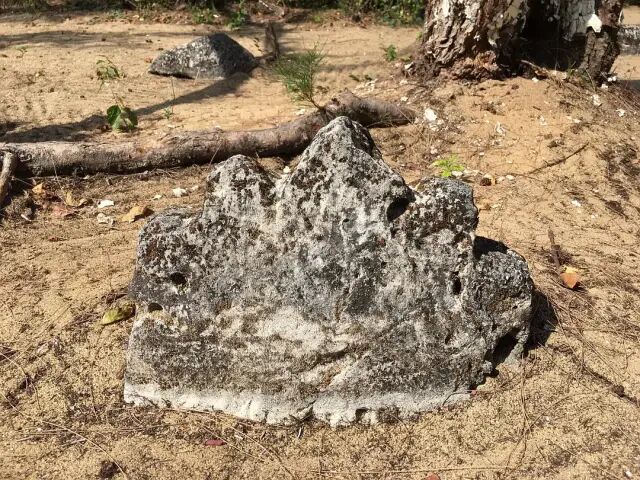
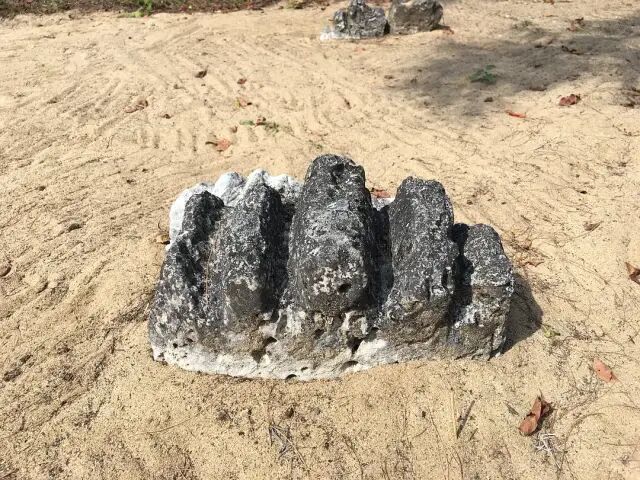
These tombs differ quite a bit from the Song and Yuan Dynasty Muslim tombs found in places like Guangzhou, Quanzhou, Hangzhou, and Yangzhou. The tombs in the aforementioned areas all have side panels and cover boards. Most of these cover boards have multiple layers of tomb lids, and they all have single tombstones, with no double tombstones. The Muslim ancient tombstones in Quanzhou are mostly made of diabase and granite. Those in Yangzhou often use shale, and those in Guangzhou use granite and shale. Only Hainan uses locally produced coral stone. This is because the Sanya and Lingshui areas are rich in coral stone. About 5 to 6 kilometers east of Fanling, at Juntunpo, there are over 100 Tang Dynasty coral stone sarcophagus tomb clusters. In the area of Houchangpo Daogangmen in Lingshui County, there are also many ancient Li ethnic group tombstones made of coral stone.
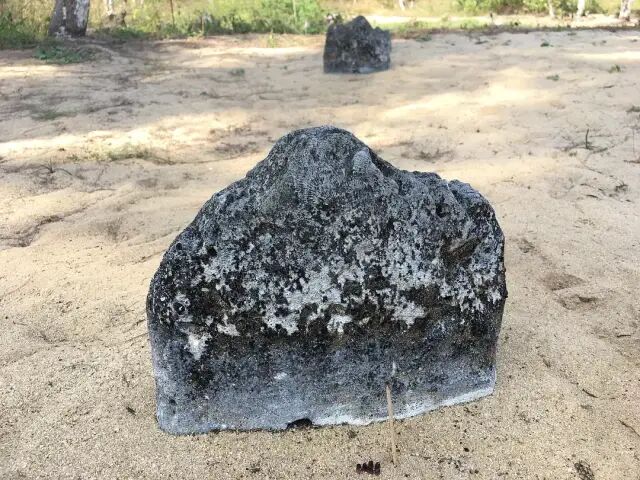
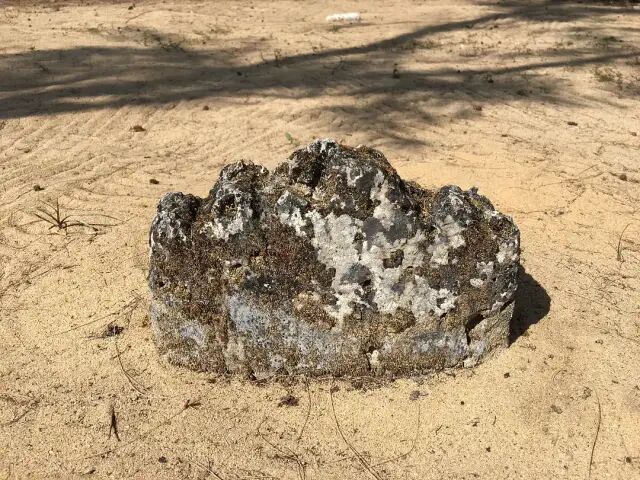
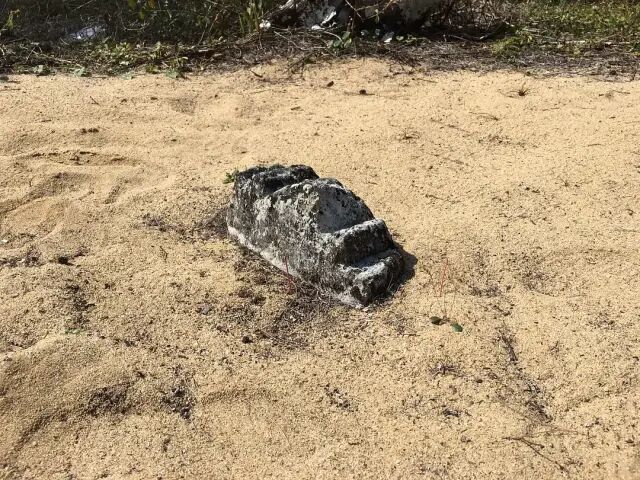
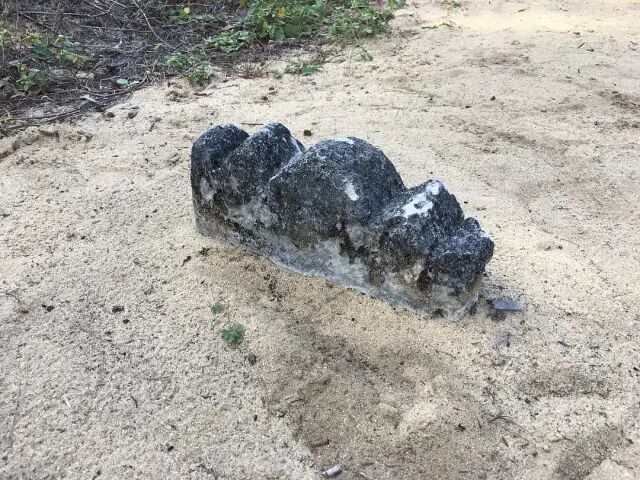
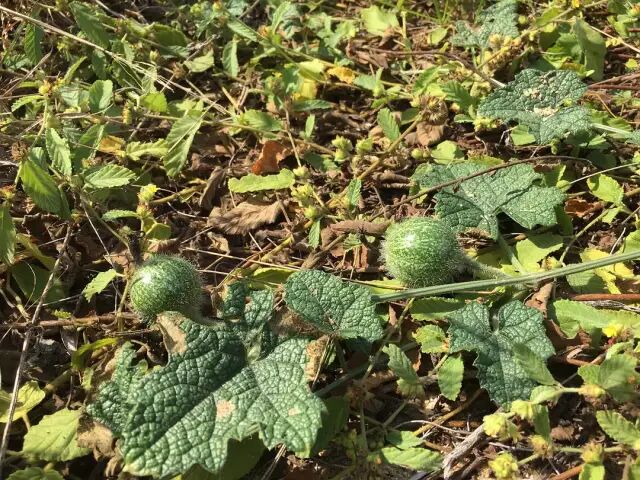
Wild watermelon vines on the ground.
In 1987, Li Juli and Wang Kerong published an article titled "Muslim Tombs Discovered in Lingshui and Sanya: Reflections on the Activities of Ancient Muslims on Hainan Island" in the inaugural issue of the "Journal of the Ethnography Museum of Hainan Autonomous Prefecture." The article documented the styles of some of the tombstones. The years these tombstones were unearthed come from the article "A Study of Muslim Cemeteries on Hainan Island" by Chen Dasheng and Claudine S. Sulmon, published in "Hui Studies" in 1993.
The tombstones facing northwest in the double tomb settings mostly have a raised top with five or more peaks. The center of the tombstone's header features a full moon, with Arabic script inside, mostly the Quranic verse 55:26: 'Everything on earth will perish.'
Below the full moon is an indented frame, with a flower carved at each end. Inside the frame are inscriptions in Arabic and Persian. Most of these inscriptions are weathered and hard to make out. The dates only show the month and day, with no tombstone recording the year. Tomb owners' names identified from the inscriptions include Atw, Haatuun, Naamu Hasan, and Samaa ibn Isma'ill. Among these, Atw (meaning 'majestic'), Haatuun (meaning 'lady'), and Naamu (meaning 'famous') all come from Persian. Additionally, some tombstones have Quranic verses 55:26 and 55:27 carved inside the indented frame: 'Everything on earth will perish.' But the face of your Lord, full of majesty and bounty, will endure.' Below the frame, a serrated band or cloud patterns are carved.
In their article 'A Study of Muslim Cemeteries on Hainan Island,' Chen Dasheng and Claudine Salmon interpret the floral patterns as star shapes.
The stele in the photo below was found in 1983 at the Fanlingpo ancient cemetery. A full moon is carved in the center of the stele head. Inside it is Qur’an 55:26: Everything on earth will perish. Below the moon is a relief carving of curling cloud patterns. Under that is a recessed frame with a flower carved at each end, and inside the frame is an Arabic and Persian inscription: This is the grave of the elder Atwa, written in Persian, who died on an auspicious day in Ramadan.
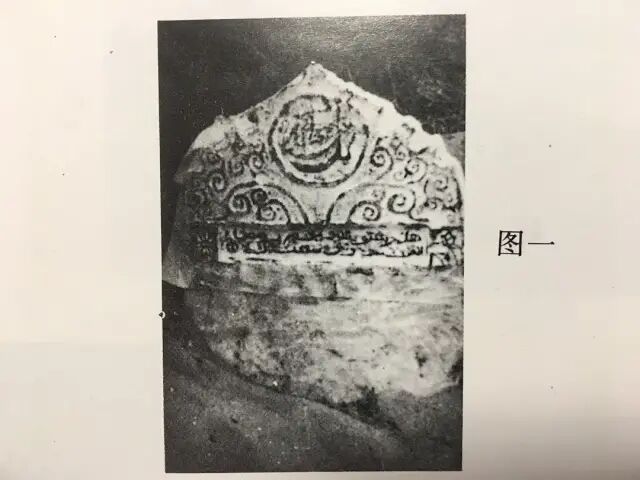
From Hainan Islamic Culture.
This stele is now kept at the Hainan Provincial Ethnic Museum in Wuzhishan City. The photo comes from Ma Mingjun’s blog Hui Muslims as One of Hainan Province’s Three Long-Established Ethnic Groups: Tang-Dynasty Islamic Scripture Coral Gravestones Unearthed in Fenghuang Town, Sanya!
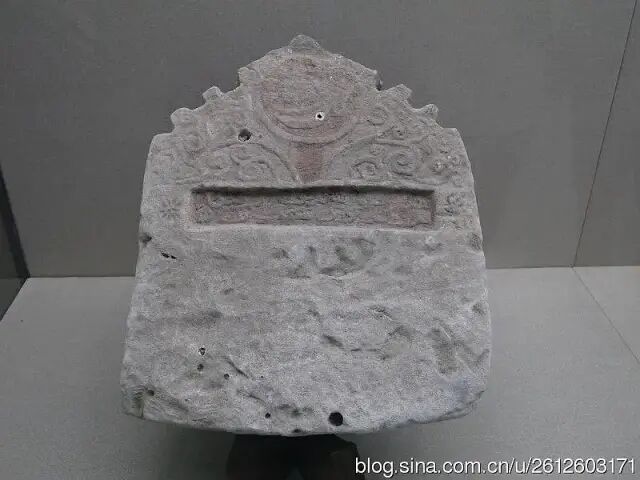
The stele in the photo below was found in 1983 at the Fanlingpo ancient cemetery. A full moon is carved in the center of the stele head. Inside it is Qur’an 55:26: Everything on earth will perish. Below the moon is a recessed frame with one flower carved at each end. Inside the frame is an Arabic inscription: This is the grave of... son, Saman Heni... during Ramadan. A band of zigzag patterns is carved below the frame.
In Chen Dasheng and Claudine Salmon’s Study of Muslim Cemeteries on Hainan Island, the name of the deceased is translated as the famous Hasan.
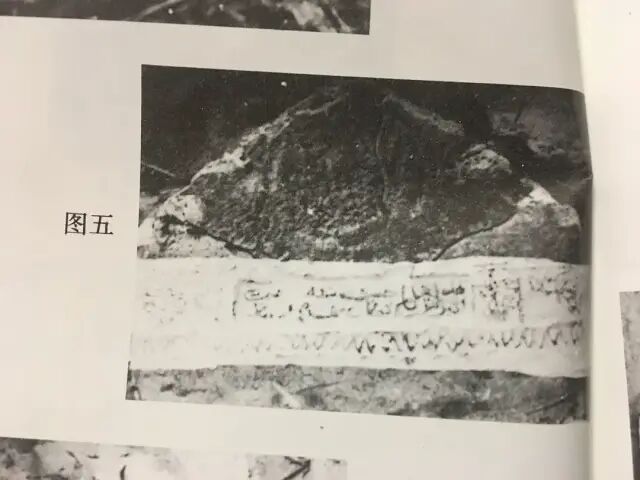
From Hainan Islamic Culture.
The stele in the photo below was found in 1982 at the Fanlingpo ancient cemetery. A full moon is carved in the center of the stele head, but the inscription inside it has weathered away. Below the moon is a recessed frame with one flower carved at each end. Inside the frame are fragments from Qur’an 55:26 and 55:27: Everything on earth will perish. Only the Face of your Lord, full of majesty and honor, will remain.
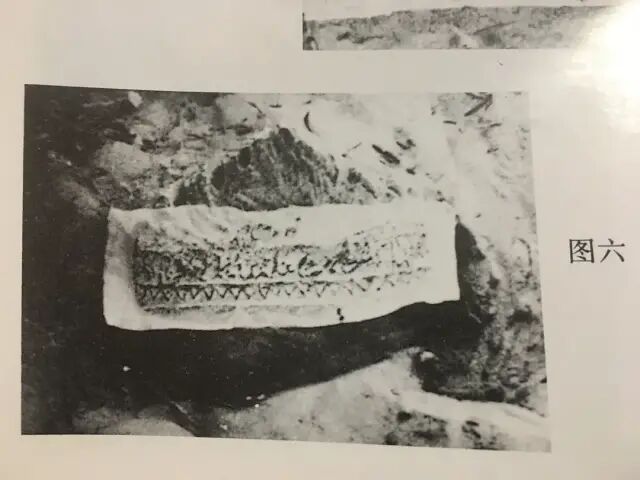
From Hainan Islamic Culture.
The stele in the photo below was found in 1983 at the Fanlingpo ancient cemetery. A full moon is carved in the center of the stele head. Inside it is Qur’an 55:26: Everything on earth will perish. Below the moon is a recessed frame with one flower carved at each end. Inside the frame is an Arabic inscription:... Aismar... died on an auspicious day in Ramadan. A band of zigzag patterns is carved below the frame.
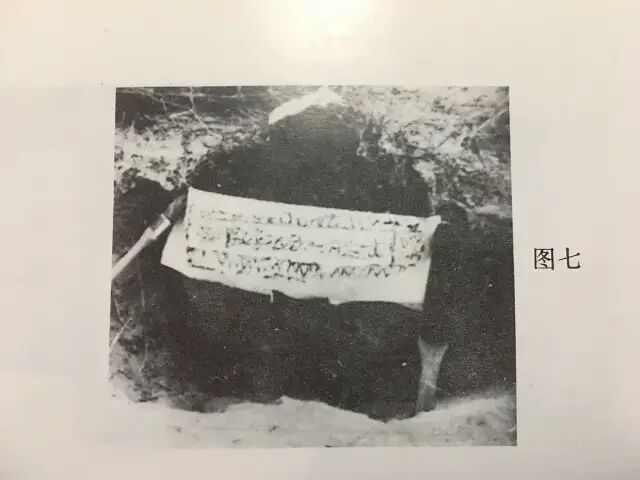
From Hainan Islamic Culture.
The stele in the photo below was found in 1978 at the Fanlingpo ancient cemetery. A full moon is carved in the center of the stele head. Inside it is Qur’an 55:26: Everything on earth will perish. Below the moon is a recessed frame with one flower carved at each end. Arabic is carved inside the frame, but it has already weathered away. Cloud patterns are carved below the frame.
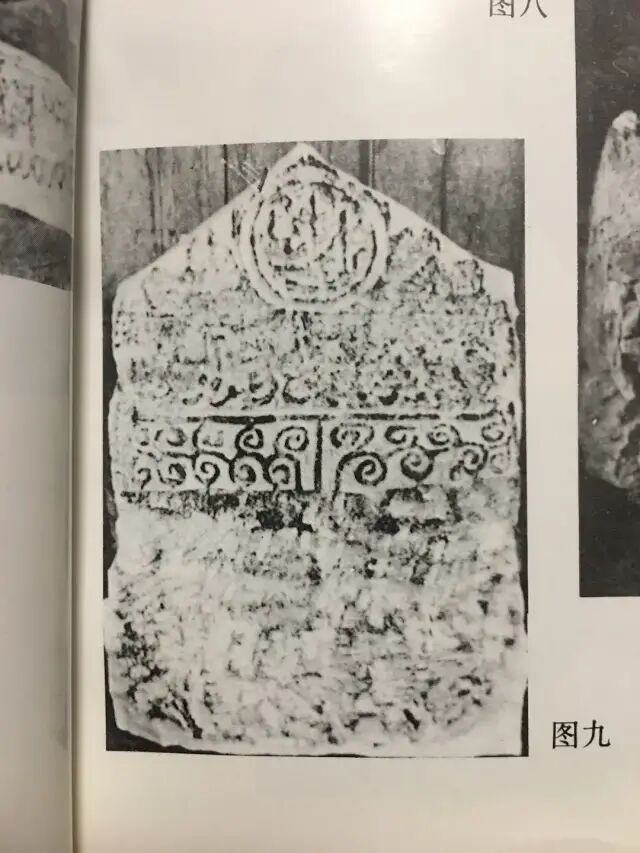
From Hainan Islamic Culture.
The stele in the photo below was found in 1983 at the Fanlingpo ancient cemetery. There is a full moon in the center of the stele head, but the inscription inside it has weathered away. Below the moon is a recessed frame with one flower carved at each end. Arabic is carved inside the frame, but it is now hard to read.
In Chen Dasheng and Claudine Salmon’s Study of Muslim Cemeteries on Hainan Island, the lower inscription is translated as Qur’an 55:26: Everything on earth will perish.
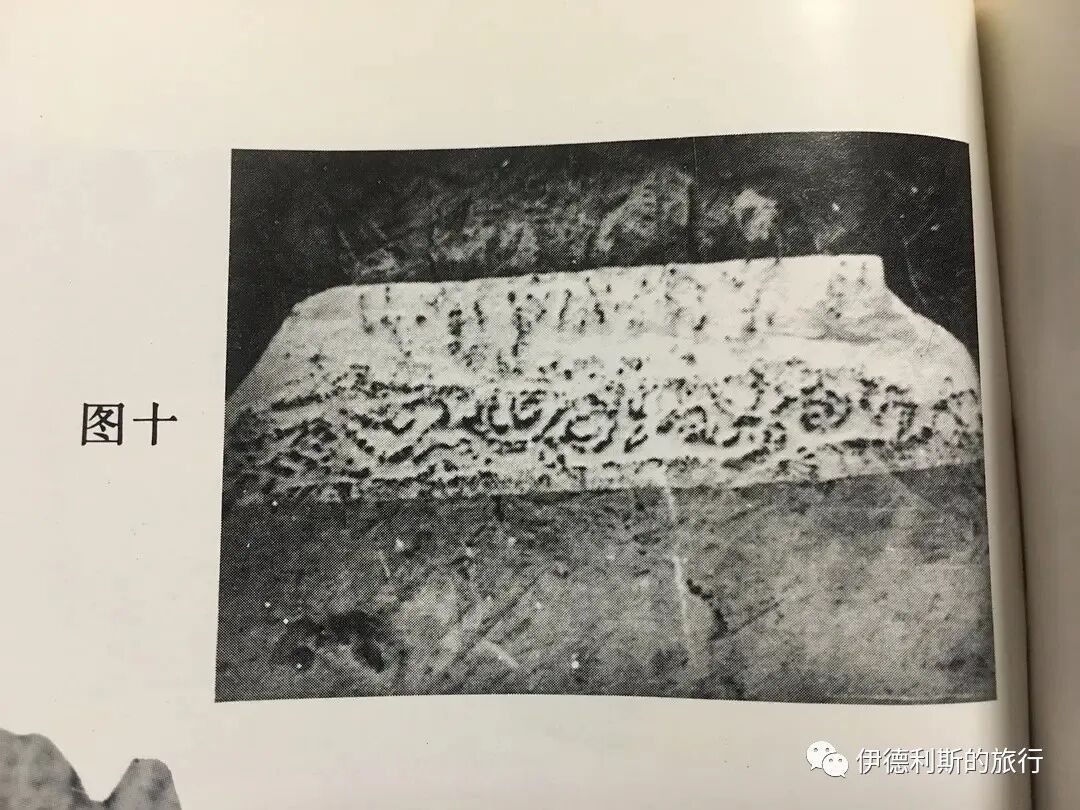
From Hainan Islamic Culture.
The stele in the photo below was found in 1982 at the Fanlingpo ancient cemetery. A full moon is carved in the center of the stele head. Inside it is Qur’an 55:26: Everything on earth will perish.
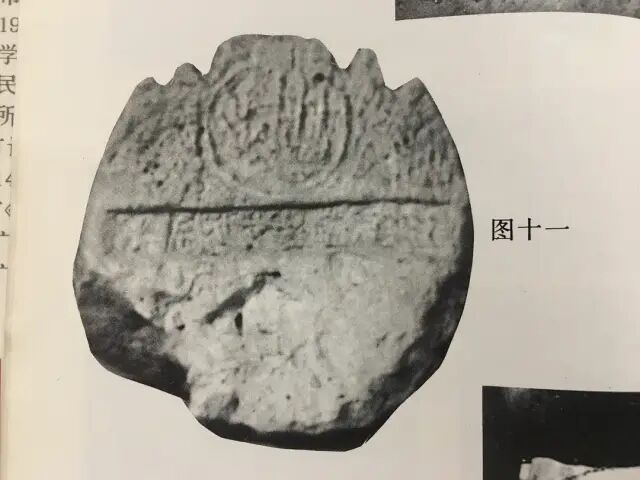
From Hainan Islamic Culture.
The stele in the photo below was found in 1978 at the Fanlingpo ancient cemetery. A full moon is carved in the center of the stele head. Inside it is the shahada: There is no deity but Allah, and Muhammad is the Messenger of Allah. Below it, a three-branched tree of life is carved on each side, with flowers blooming on the branches. Below that is a recessed frame. Inside it are Qur’an 55:26 and 55:27: Everything on earth will perish. Only the Face of your Lord, full of majesty and honor, will remain.
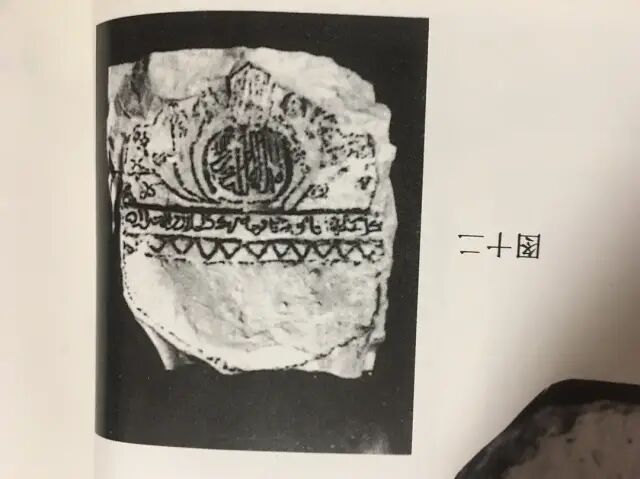
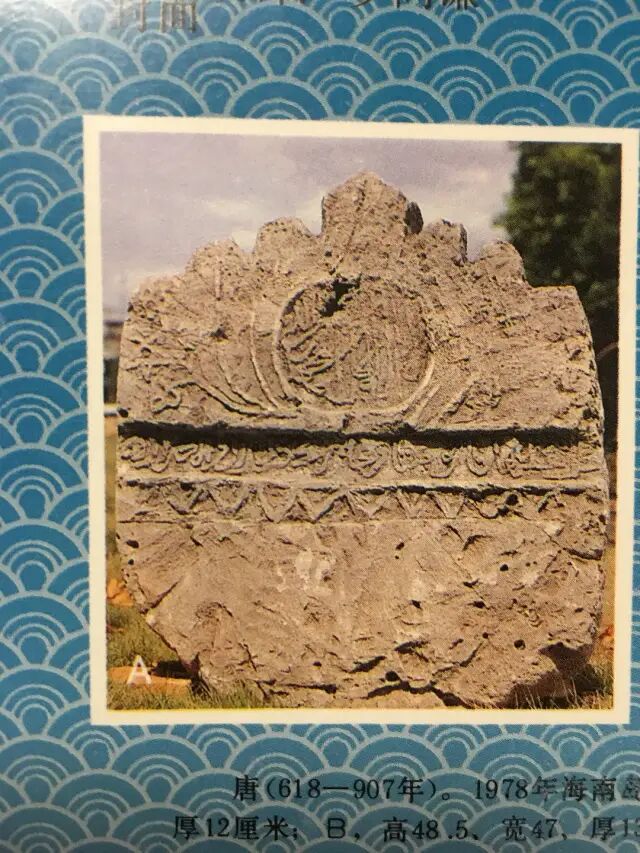
From Hainan Islamic Culture.
The stele in the photo below was unearthed in 1978 at the Fanlingpo ancient cemetery. A full moon is carved in the center of the stele head. Arabic is carved inside it, but it is hard to read. Trees of life are carved on both sides of the moon. Below it is a recessed frame, with one flower on the right side. Arabic is carved inside the frame, but the inscription is hard to read.
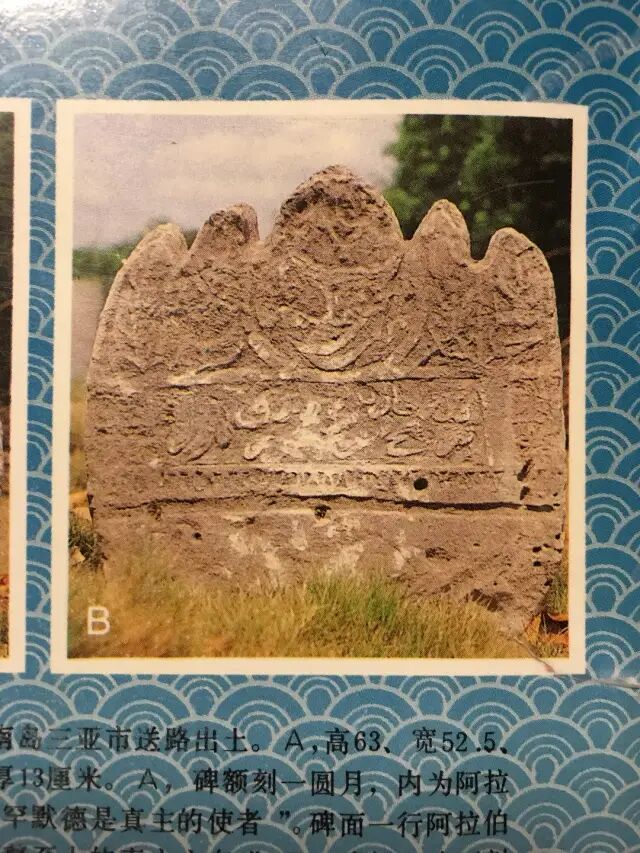
From Hainan Islamic Culture.
The stele in the photo below was found in 1983 at the Fanlingpo ancient cemetery. A mountain-shaped panel is carved in the center of the stele head, with Arabic inside it. Below it is a recessed frame with one flower carved at each end, and Arabic inside the frame has already weathered away.
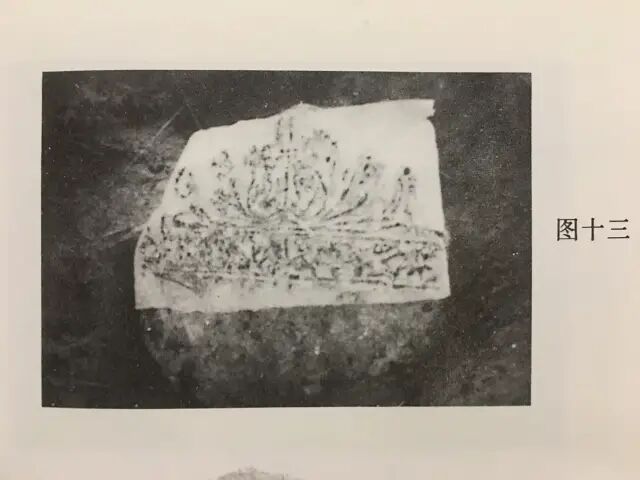
From Hainan Islamic Culture.
The stele in the photo below was found in 1978 at the Fanlingpo ancient cemetery. The upper part of the stele head shows a full moon set off by curved radiating lines. Inside it is Qur’an 55:26: Everything on earth will perish. Below the moon is a recessed frame, with a flower carved on the left end. Inside the frame is an Arabic inscription: This is the grave of... during a fasting day.
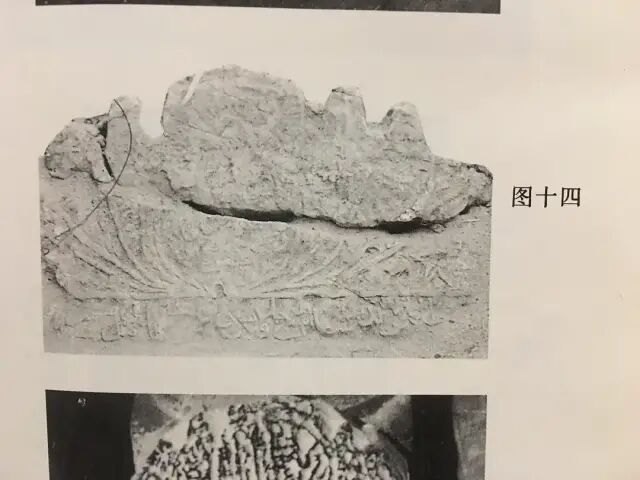
From Hainan Islamic Culture.
The stele in the photo below was found in 1982 at the Fanlingpo ancient cemetery. A full moon is carved in the center of the stele head. Arabic is carved inside it, but it is hard to read. A recessed frame is carved below it, with Arabic inside: This is the grave of a martyr. His name was Ibn Sayyid Wanersheng. He died in December. May Allah have mercy on this lonely man.
In Chen Dasheng and Claudine Salmon’s Study of Muslim Cemeteries on Hainan Island, the deceased is translated as Ding Sama ibn Ismail.
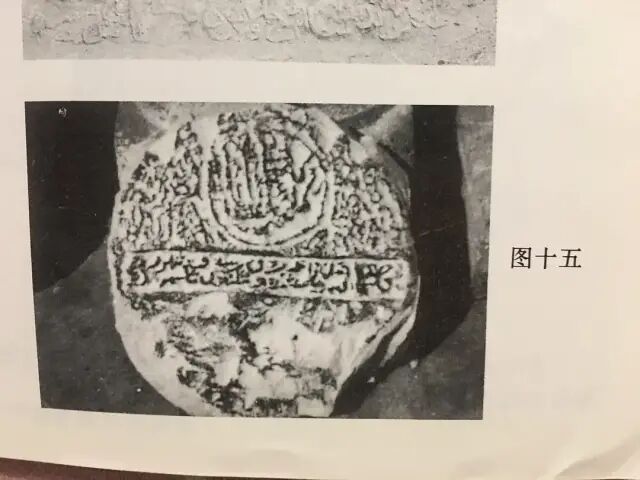
From Hainan Islamic Culture.
The stele in the photo below was found in 1983 at the Fanlingpo ancient cemetery. The stele is badly weathered and unclear. Only a recessed frame remains, with Arabic carved inside: This grave is only his final resting place.
In Chen Dasheng and Claudine Salmon’s Study of Muslim Cemeteries on Hainan Island, the inscription is translated as: This is the grave of... Khatun...
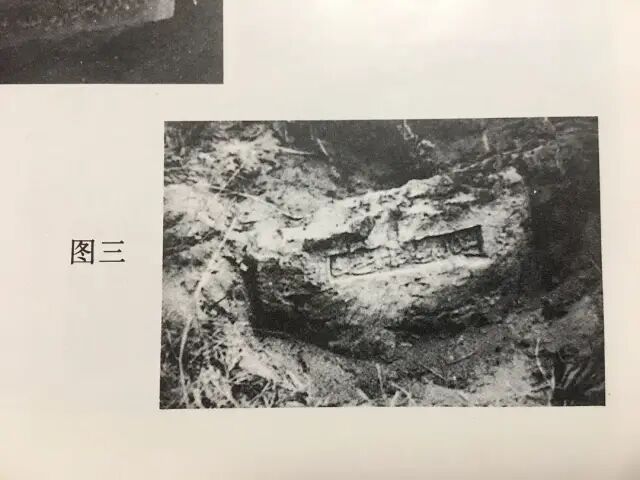
From Hainan Islamic Culture.
The stele in the photo below was found in 1983 at the Fanlingpo ancient cemetery. Only a recessed frame and the flower on the right remain. Arabic is carved inside the frame:... died on a certain day of a certain month.
In Chen Dasheng and Claudine Salmon’s Study of Muslim Cemeteries on Hainan Island, the flower is interpreted as a seven-pointed star.
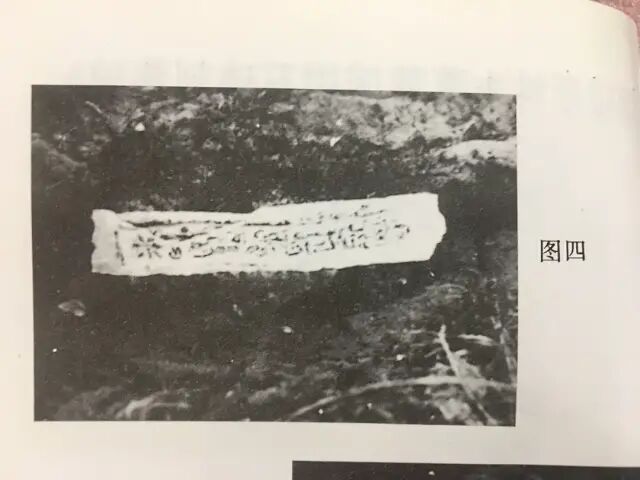
From Hainan Islamic Culture.
Among the paired steles, the one facing southeast has a tree of life carved on its head.
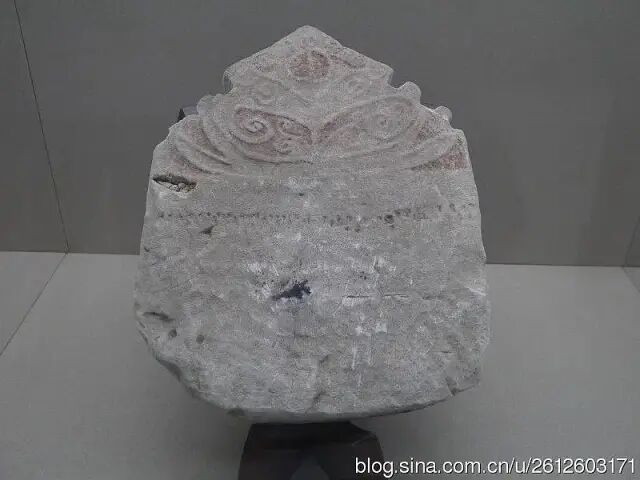
The stele in the photo below was found in 1983 at the Fanlingpo ancient cemetery and belongs to the same grave as the first stele mentioned above. Its head is carved with a tree of life full of branches, with curling cloud shapes at the branch tips and a zigzag band below.
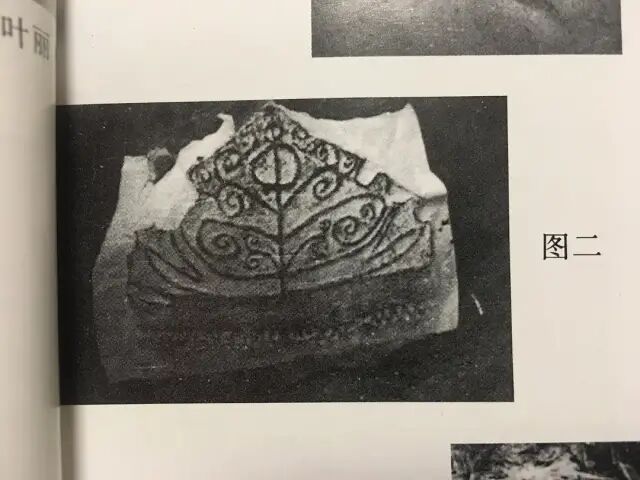
From Hainan Islamic Culture.
This stele is now kept at the Hainan Provincial Ethnic Museum in Wuzhishan City. The photo comes from Ma Mingjun’s blog Hui Muslims as One of Hainan Province’s Three Long-Established Ethnic Groups: Tang-Dynasty Islamic Scripture Coral Gravestones Unearthed in Fenghuang Town, Sanya!
The stele in the photo below was found in 1983 at the Fanlingpo ancient cemetery. It faces southeast, and its surface has a relief carving of a tree of life with full branches and five flowers.
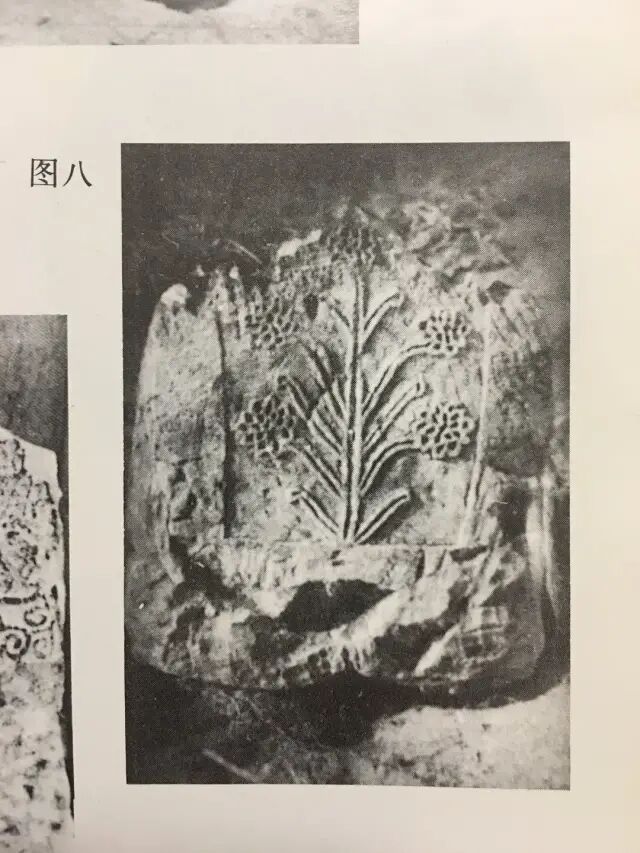
From Hainan Islamic Culture.
Besides the steles found at the Fanlingpo ancient cemetery, another stele was found in 1982 at the Ganjiaopo ancient cemetery. This northwest-facing stele is quite different in form from the earlier ones and is less weathered, so it should be later than the steles above. The stele head has a mountain-shaped top, with straight sides and a flat bottom. The face of the stele has a rectangular frame bordered by zigzag patterns. Inside the frame are five lines of Arabic, of which only parts can be read:... Islam... Muhammad is the Messenger of Allah... prophet... Paradise. Three Arabic letters are carved separately below, and their meaning is unclear.
In Chen Dasheng and Claudine Salmon’s Study of Muslim Cemeteries on Hainan Island, the inscription is translated as:... Islam is our religion... Muhammad is the Messenger of Allah... Paradise... Madajia.
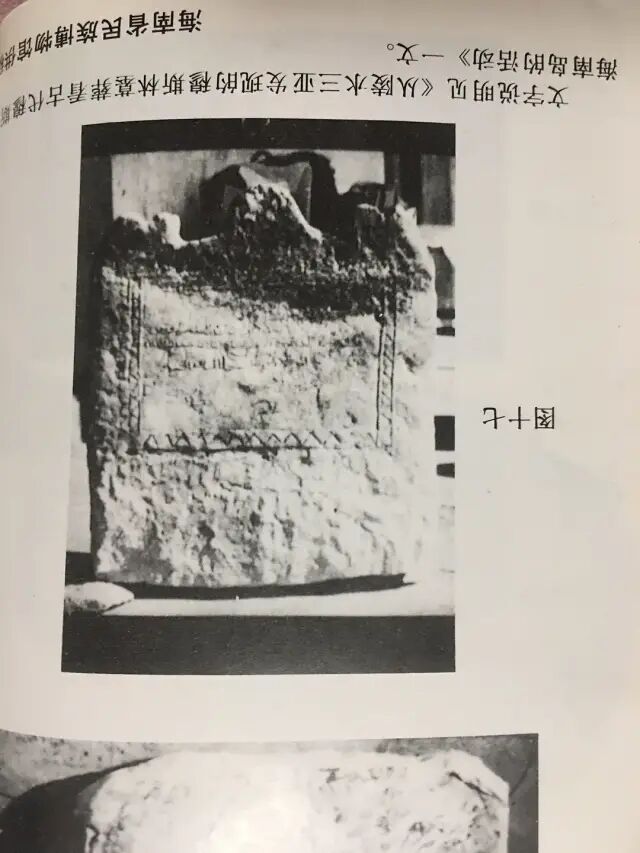
From Hainan Islamic Culture.
According to Li Juli and Wang Kerong in their 1987 article Ancient Muslim Activity on Hainan Island Seen Through Muslim Tombs Found in Lingshui and Sanya, Muslim tombs of this form had only been found at the ruins of the ancient city of Dhofar on the southern coast of Oman.
the sultan royal cemetery beside the Old Friday Mosque, or Hukuru Miskiiy Mosque, built in 1656 in Male, the capital of the Maldives, also has coral-stone graves with paired steles.
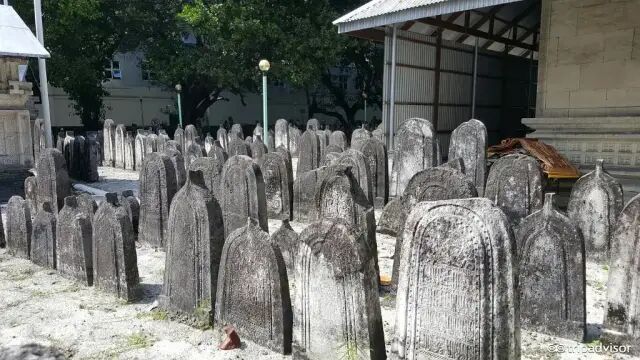
From the Tripadvisor user MarcoJust_Do_It.
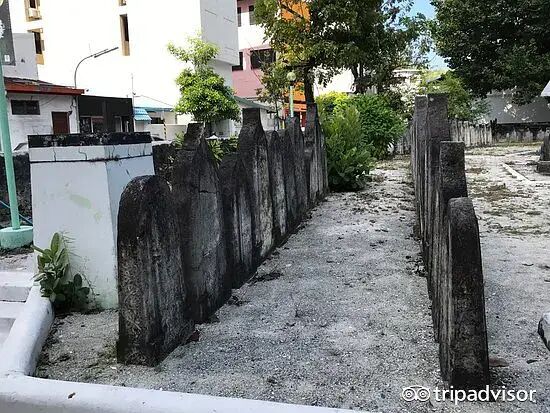
From the Tripadvisor user KurniawanAdhi.
Five-peaked stele heads are often seen on Song and Yuan Muslim gravestones in Quanzhou. Below are Song and Yuan Muslim gravestones I photographed at the Quanzhou Maritime Museum.
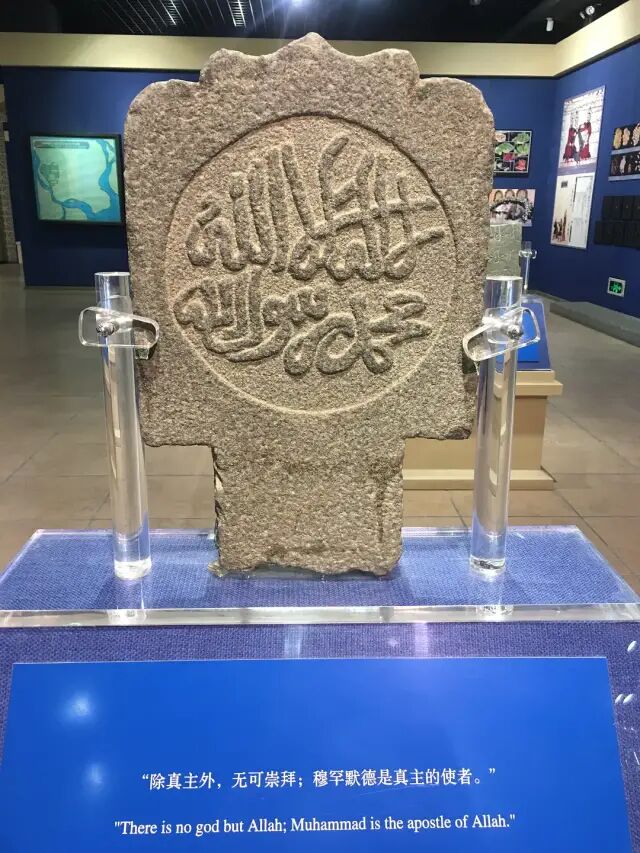
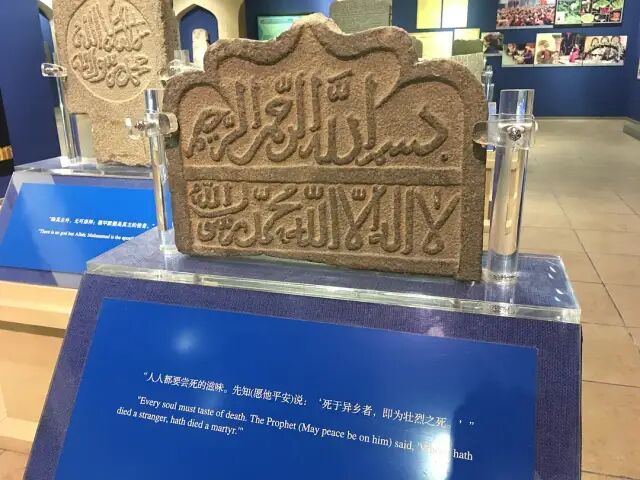
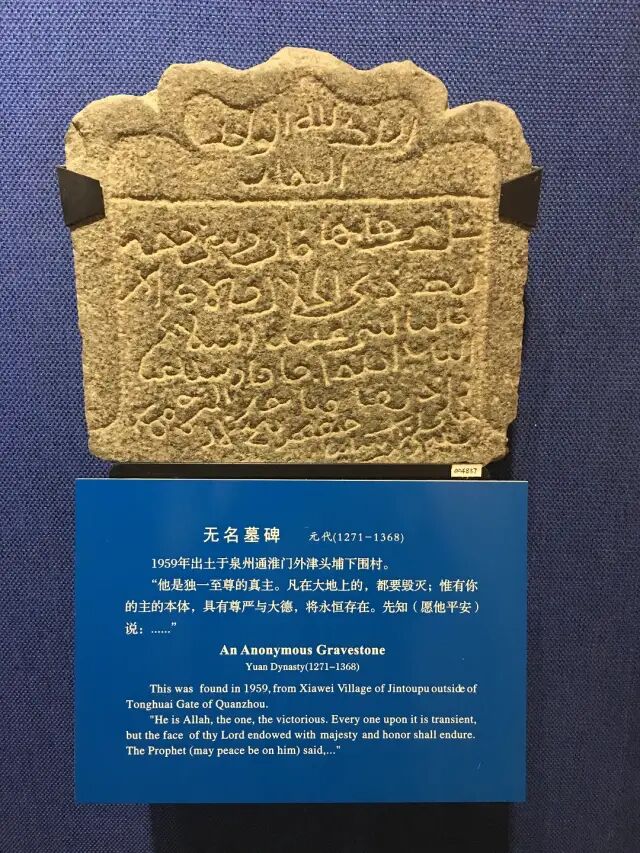
Qur’an 55:26, the verse most often found on Sanya Muslim gravestones, says: Everything on earth will perish. Qur’an 55:27 says: Only the Face of your Lord, full of majesty and honor, will remain. These verses can also be seen in Song and Yuan Muslim tombs in Quanzhou.
The photo below shows a Yuan Dynasty Muslim gravestone I photographed at the Quanzhou Maritime Museum. It was unearthed in 1959 at Xiawei Village, Jintoupu, outside Tonghuai Gate in Quanzhou, and its inscription includes these two verses.
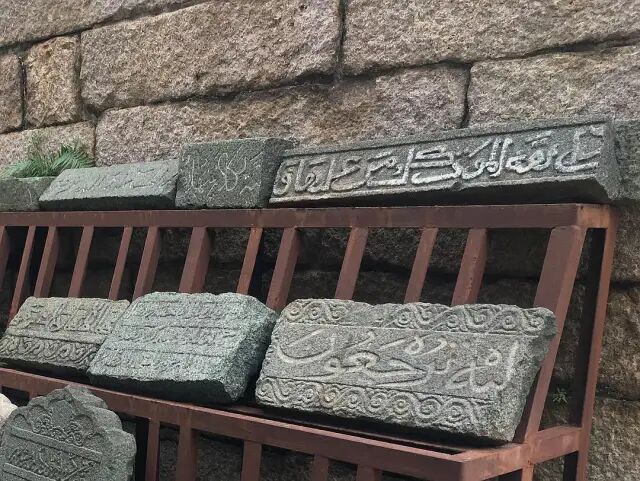
The diabase Sumeru-base-style tombstone at the upper right of the photo below was dug up in the late Qing period from the garden of a Pu family in Quanzhou. After it was moved into Qingjing Mosque, it was built into the north wall of the Mingshan Hall, and it was removed during the halls 1983 renovation. The inscription contains an excerpt from Qur’an 29:57 and the full text of Qur’an 55:26:
Every soul shall taste death.
Everything on earth will perish.
5. The Li Assimilation of Lingshui Muslims
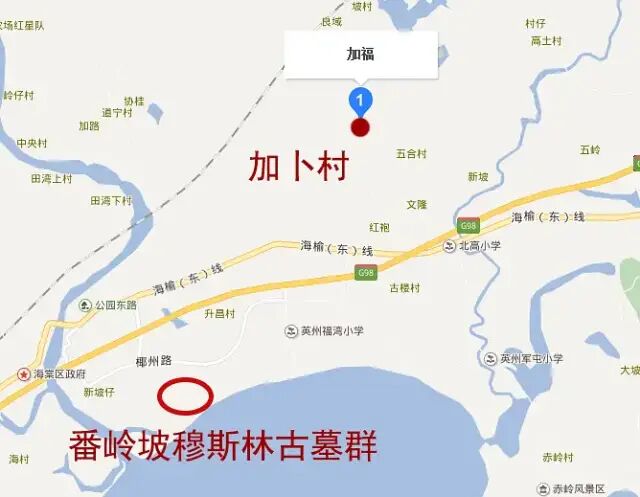
In the 1980s, cultural heritage workers Pan Xiane and Li Juli from Lingshui County, Sanya, went to Jiabu Village in Yingzhou Town, Lingshui County, to investigate. Jiabu Village originally had 31 Pu-surname households. Later, because of an internal dispute, 17 of them changed their surname to Fu, a major Li surname.
The Pu families in Jiabu Village are divided into two branches. The first branch says its ancestors were seven brothers who crossed the sea from Champa to Hainan for trade and met a typhoon. One brother settled in present-day Wenchang City, one settled at Luobidong in Sanya City, and the other five settled in Yazhou. Later, among the seven brothers, some became rich and some became poor. One brother in Yazhou ran to Jiabu Village because of debt and worked as a long-term laborer for a landlord. The landlord arranged for him to marry a Li woman, and they had descendants. The second branch first lived at Luobidong in Sanya, later moved to Qingtian Village in Linwang Town, and finally settled in Jiabu Village.
Today, both the Pu and Fu families in Jiabu Village call themselves Lao Li, the same self-name used by Li-assimilated Han people nearby.
Jiabu Village is the settlement of Champa descendants closest to the Fanlingpo Muslim ancient cemetery.
6. The Distribution of Muslim Communities in Yazhou
In December 1983, a joint investigation team formed by the ethnic and religious group of the Guangdong Provincial CPPCC and the Guangdong Society for Ethnic Studies, guided by Lingshui County official Sun Bolin, found a Muslim ancient cemetery on a beach near Suanmei Village in Yacheng. Local people called the place Fanfangyuan, also known as Barenjiaopo. The Guangxu-period Yazhou Gazetteer records that Cham Muslims who migrated during the Song and Yuan periods once lived here.
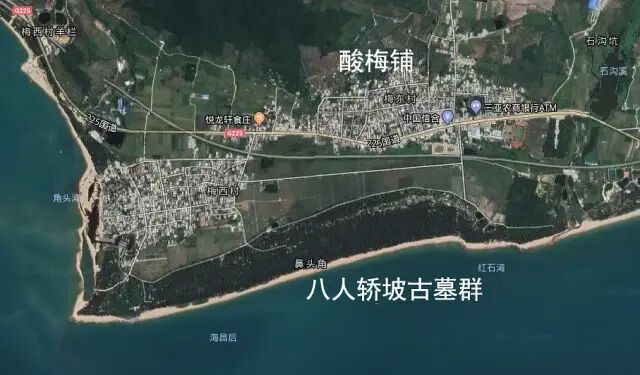
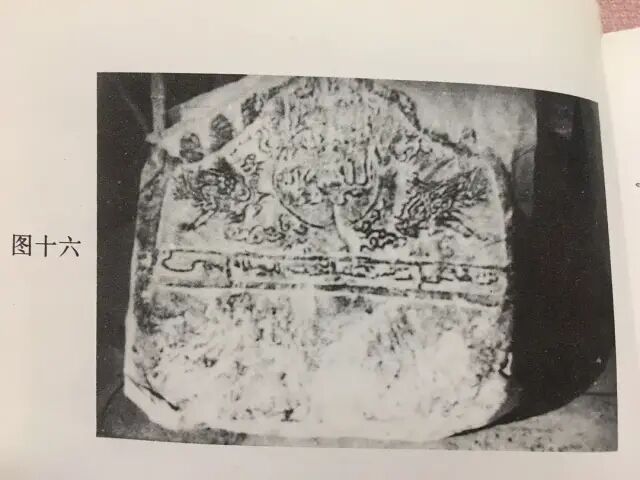
The Barenjiaopo ancient cemetery was still called foreigner graves in the 1950s. It once had hundreds of coral-stone Muslim gravestones, but after the 1950s most were burned into lime or used by villagers as building material. The investigation team found only one Arabic-inscribed gravestone in the retaining wall of a new grave.
The top of this stele rises into five peaks. The upper half has a carved border, and inside it curling cloud patterns set off a full moon. An inscription is carved inside the frame, but only Allah... Allah... can be read. On both sides of the moon are symmetrical long-life bird patterns made from Arabic script. The pattern on the right contains the shahada: There is no deity but Allah, and Muhammad is the Messenger of Allah. The script in the pattern on the left is hard to read. Below the curling cloud pattern is a recessed frame divided into three sections. Arabic is carved inside, but only the word Allah can be read.
This stele is now kept at the Hainan Museum. The museum website includes a photo.
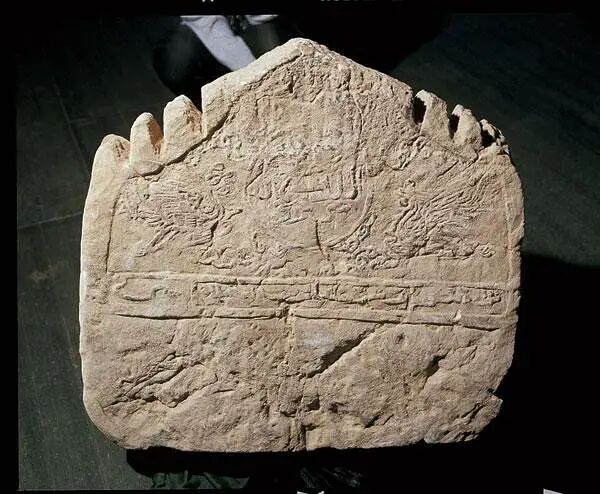
Compared with the Muslim gravestones at Tufuwan in Lingshui, this stele is less weathered, so it should be later. Its patterns are also quite different from the Lingshui Muslim gravestones. The absence of flower motifs in the inscription is similar to Song and Yuan Muslim gravestones in Quanzhou.
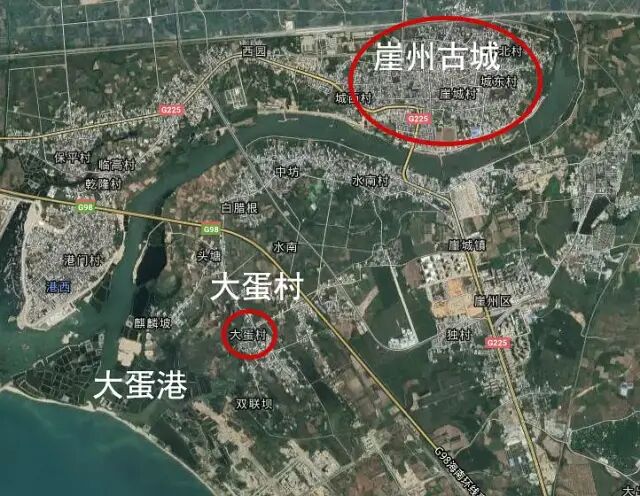
Between 1983 and 1987, another ancient cemetery site was found on the beach one kilometer east of Dadan Port. Local residents called it Fanduifen. Volume 27 of the Ming Zhengde-period Qiongtai Gazetteer, completed in 1521, records a mosque in Fan Village three li south of Yacheng. This Fan Village was near Dadan Port: Fotang Mosque is in Fan Village, three li south of Yazhou. Its hall system, ritual recitation, and prayers are the same as those of a mosque.
According to volume 6 of the Ming Zhengde-period Qiongtai Gazetteer, Dadan Port had long been an important trade pier: It is three li southwest of the prefecture seat and leads into Dadan Liyong Ward. Merchants moored their boats here.
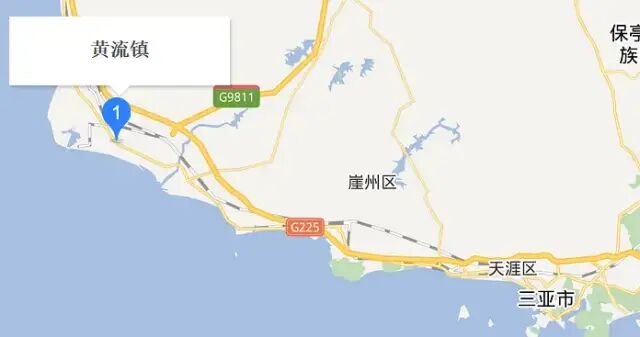
Huangliu Village, 120 li west of Yazhou, had a place called Fanrentang. The Ming Wanli-period Qiongzhou Prefecture Gazetteer records: Fanrentang is in Huangliu Village, 120 li west of Yazhou.
The 1951 Survey of the Li, Miao, and Hui Peoples of Hainan, Guangdong, compiled by the Ethnic Affairs Committee of the Guangdong Provincial Peoples Government, records that the Muslims of Huangliu later moved to Taizao in Yazhou: One branch at Huangliu was neither near the sea nor had farmland, so it moved again to Taizao in Ya County.
Volume 1 of the Guangxu-period Yazhou Gazetteer gives a very detailed record of Yazhou Muslims in its customs section. It mentions building mosques, wearing white clothes and white caps, reciting scripture and praying, going to Mecca for Hajj, fasting in Ramadan, and celebrating the end of the fast, all typical Islamic customs.
They were originally surnamed Pu, but many have since changed their surnames. They do not eat pork, do not make offerings to ancestors, and do not worship spirits. They only build mosques. They wear white clothes and white caps, recite scripture and pray, and keep their faith until death without changing. For weddings, funerals, illness, and other major events, they gather people to recite scripture. Those who can travel west to Tianfang and visit the mosque and tomb of the founder of the religion are admired by everyone when they return. At the beginning of the year, every three years they move back by one month. When they see the new moon at the start of this month, they begin fasting. On the day after seeing the new moon at the start of the next month, they end the fast and treat it as New Year. They fish and farm widely for their livelihood. In marriage, they do not avoid the same surname, but they do avoid the same clan. They do not marry Han people, and others do not marry them either.
Four: Hainan Muslims Registered Under Suo Sanyali — The Formation of the Huihui People
Summary: Hainan — Muslim History, Mosques and Local Communities is presented here as a firsthand travel account in clear English, beginning with this scene: The Huihui people are a Muslim ethnic group living in Huicun and Huixin villages in Sanya City, Hainan, numbering nearly 10,000. The account keeps its focus on Hainan Muslims, Muslim History, China Mosques while preserving the names, places, food, and historical details from the Chinese source.
The Huihui people are a Muslim ethnic group living in Huicun and Huixin villages in Sanya City, Hainan, numbering nearly 10,000. Although classified as Hui, their Huihui language belongs to the Austronesian family, sharing origins with the Cham languages of southern Vietnam. The Huihui people's lifestyle is strongly influenced by the local ethnic groups of Hainan, yet they maintain devout Islamic faith, making them a very unique ethnic group on China's southeastern coast.
Among the Huihui people in Sanya, many legends circulate about their origins, pointing to regions like Arabia, Malaysia, the Western Regions, Annan, and Champa.
A legend recorded in the 1990 article "Hainan Muslims: Then and Now" in "Sanya Culture and History," Volume 2, states that the Huihui people believe they migrated from Arabia to Vietnam and then to Hainan:
"Our ancestors were originally a fishing tribe during the Abbasid Caliphate in Arabia. Due to internal conflict in the country, life became very difficult, so they moved to a place called Annan (present-day Vietnam). Later, a plague broke out, killing many people. They left that place and set sail to find a better land, but unfortunately encountered a typhoon and were scattered to Hainan Island.
In a legend recorded in the 1990 paper "Investigation into the Origin and Ethnic Customs of the Hui Muslims of Sanya, Hainan Island," presented at the Sixth National Symposium on the History of Hui Muslims, the Hui Hui Muslims believe their ancestors moved from the Arab world (Da Shi) to Champa during the Tang Dynasty, and then from Champa to Hainan Island during the Song and Yuan dynasties.
"Our ancestors were originally 'people from the Western Regions.' During the Tang Dynasty, they moved to Champa due to internal strife in the Arab world. Between the Song and Yuan dynasties, they made a living by fishing at sea in Champa. Driven by typhoons, their ships drifted to various coastal areas of Hainan Island, mainly Yazhou, Wanzhou, and Danzhou."
Sanya Bay beach
In 1981, Zheng Yiqing, a scholar from the Institute of Ethnology at the Chinese Academy of Social Sciences, visited Sanya to study the Hui Hui language. She interviewed elderly Hui Hui people there, who told her that the Hui Hui people came from Malaysia to southern Vietnam to engage in fishing, and were blown to Hainan by a typhoon.
"According to the older generation here, their ancestors first settled in Malaysia, then drifted to southern Vietnam to live and work as fishermen." "Once, they encountered a typhoon, and several boats were blown to the coast of Yaxian County, Hainan Island. One boat capsized, one drifted to the sea off Tiandu (Liupan Commune), one drifted to the sea off Sanya, and one drifted to the sea off Yacheng."
Sanya Bay beach
An article from 1986, "The Origin and Characteristics of the Hui Muslims of Yanglan, Hainan Island" by Jiang Yongxing and Mei Weilan, mentions local accounts stating they came from Champa in Vietnam. They say a typhoon brought them to Hainan during the Song Dynasty.
"Our original home is Champa in Vietnam. Our ancestors made a living by fishing at sea. Forced by a typhoon, our boats drifted to various coastal areas of Hainan Island, mainly Yacheng and Wanning, with some reaching Dan County (all coastal counties on Hainan Island, with Sanya and Dan County facing Champa across the sea). This was about seven or eight hundred years ago, during the Song Dynasty."
So, where did the Huihui people really come from? Are they descendants of the Champa people? Let's first sort through historical records to see what we can find.
I. The Origin of Muslims in Hainan
1. Arab and Persian Merchant Ships in the Tang Dynasty
The earliest Muslims to arrive in Hainan were Arab and Persian merchants during the Tang Dynasty.
In the later Tang Dynasty, the overland Silk Road gradually became blocked. Meanwhile, the maritime Silk Road continued to thrive, boosted by advances in navigation and shipbuilding. Many Arab and Persian merchant ships sailed the Indian Ocean to trade in cities like Guangzhou, Quanzhou, and Yangzhou. Carried by the north-bound monsoon winds in the South China Sea, these Persian and Arab ships often sailed close to the coast of Hainan Island. Both the "Vast Records of the Taiping Era" and the "Tang Monk Jianzhen's Eastern Voyage" (also known as "The Biography of Monk Jianzhen") mention local pirates robbing these ships.
The "Vast Records of the Taiping Era," Volume 286, tells of the great pirate Chen Zhenwu in Zhenzhou (present-day Sanya, Hainan) during the Tang Dynasty, who became a millionaire by plundering Persian merchant ships. The text states: "This began with merchant ships from the Western Regions that were wrecked and drifted ashore."
The "Tang Monk Jianzhen's Eastern Voyage" records that the great pirate Feng Ruofang in Wan'an Prefecture (present-day Wanning City in southeastern Hainan) captured Persian merchant ships. He seized a large number of Persians: "Each year, he would capture two or three Persian ships, stealing their cargo and taking people as slaves. The area where these slaves lived stretched three days' journey north to south and five days' journey east to west, with villages close to one another."
But currently, there's no direct evidence showing that Muslims in Hainan are descendants of Arab and Persian sea merchants from the Tang Dynasty.
2. Arab merchants from Champa who settled in Danzhou during the Northern Song Dynasty.
The earliest clear record in historical texts about the origin of Muslims in Hainan comes from the History of Song, Volume 489, under the section on Champa. It states: 'In the third year of the Yongxi reign (986 AD), officials in Danzhou reported that a Champa man named Pu Luo'e, pressured by Jiaozhou, led his clan of over a hundred people to seek refuge.'
Danzhou is located in the northwestern part of Hainan Island. Jiaozhou, also known as Jiaozhi, was the Song Dynasty's name for northern Vietnam. The surname Pu was a common Han Chinese surname used by Muslims along the southeastern coast during the Song and Yuan dynasties. It's thought to come from 'Abu,' a prefix in Arabic names.
The most famous Muslim with the surname Pu was Pu Shougeng, a major sea merchant in Quanzhou during the late Song and early Yuan periods. Also, Yue Fei's grandson, the Southern Song writer Yue Ke, came to Guangzhou with his father when he was 10 years old (in 1192). He met a group of Arab merchants surnamed Pu who had moved from Champa to Guangzhou. He recorded this in detail in his book "Tang Shi," Volume 11, "Foreigners of Panyu by the Sea." The "Bai Fan" (White Foreigners) mentioned here refers to Arabs and Persians.
"Panyu is home to various foreign peoples living together by the sea. The most prominent among them are surnamed Pu, known as 'Bai Fan' people. They were originally nobles from Champa." "After sailing at sea and encountering storms, they feared returning. So, they petitioned their ruler, wishing to stay in China to help trade."
The Huaisheng Mosque was the center of Guangzhou's "foreign quarter" at that time.
The reason Pu Luo'e led his clan from Champa to Danzhou in Hainan in 986 was due to a significant war in Vietnamese history. Starting in the 10th century, the Yue state in northern Vietnam began attacking Champa in the south. In 982, the Early Lê dynasty of Vietnam destroyed Champa's capital, Indrapura (near present-day Da Nang), scattering many Chams.
Champa, also translated as Zhanpo, was a state founded by the Cham people in southern Vietnam in 192 CE. Early Champa was strongly influenced by India, believing in Brahmanism and practicing the caste system.
Because its land was long and narrow and fragmented, Champa mainly developed maritime trade, becoming an important transit point on the Maritime Silk Road during the Song and Yuan dynasties. Both Chinese merchant ships departing from Guangzhou and Quanzhou, and Arab and Persian merchant ships from the Indian Ocean and Persian Gulf coasts, chose to stop in Champa. Therefore, many Arab and Persian merchants lived as expatriates in Champa during the Song and Yuan dynasties.
Two Kufic tombstones written in Arabic were excavated in Phan Thiet and Phan Rang cities in southeastern Vietnam. The first is the tombstone of a road worker named Abu Kamil, who passed away on November 20, 1039. The other is a notice about how local Muslims got along with the indigenous people, written in a mix of Kufic and Naskh scripts. It is thought to have been carved between 1025 and 1035. The inscription suggests that Arab and Turkish merchants lived here in a community.
From the 10th to the 13th centuries, Champa was still mainly Brahmanist, with Muslims being mostly Arab expatriates. The kingdom of Champa sent envoys to China multiple times between the 10th and 12th centuries. Many of these envoys had names that can be traced to Arabic transliterations.
The book Taiping Huanyu Ji, written during the Song Dynasty's Taiping Xingguo era (976-983), has an entry on Champa that records the first Champa envoy during the Five Dynasties period:
"In the fifth year of Xiande (958), its king, Sri Indravarman, sent his minister, Puo Hesan, to present local products. Among them were fifteen glass bottles of rosewater, said to come from the Western Regions... He also presented eighty-four glass bottles of naphtha, an oil that burns more intensely when it meets water, which their country uses in naval battles."
The envoy Puo Hesan's name can be translated as Abu Hasan. This rosewater was recorded in the Song Dynasty book Zhufanzhi as floral water from the land of Dashi (Arabia), and naphtha refers to petroleum.
During the Song Dynasty, Champa sent envoys even more frequently. According to the Song Shi, Volume 489, the Champa entry, in 961, Puo Hesan again brought rhinoceros horn, ivory, camphor, spices, peacocks, and Dashi bottles, all goods from the Maritime Silk Road.
In 1053, "its envoy, Pu Sima Ying, came to present local products." The name Pu Si Ma can be translated as Abu Ismail.
In 1056, envoys were sent to offer local products. The name Pu Xi Tuo Pa can be translated as Abu Hittabah.
In 1068, envoys were sent to pay tribute. The name Pu Ma Wu can be translated as Abu Mahmud.
In 1155, Pu Weng Du Gang, Pu Weng Tuan, and others also came to pay tribute. They were likely Arab merchants too.
Today, the surname Pu is still a major surname among the Hui Muslims.
Besides official delegations, more Arab merchants from Champa came to the Song Dynasty to do business. Wang Yucheng, a literary scholar from the Northern Song Dynasty, wrote in the
It wasn't until the 14th-15th centuries, after the Malays converted to Islam, that the Champa people gradually began to adopt Islam under Malay influence. Therefore, the early Champa immigrants with the surname Pu who came to Hainan might have been Arab expatriates.
3. Arab merchants from the Northern Song Dynasty who immigrated to Yazhou
In 1022, Ding Wei, the prime minister of the Northern Song Dynasty, was dismissed and demoted to Yazhou as an official in charge of household registration. He lived in Yazhou, the southernmost part of Hainan, for three years between 1022 and 1025. During his time in Yazhou, Ding Wei wrote "Tian Xiang Zhuan" about agarwood, which is included in the "Chen Shi Xiang Pu" in the "Siku Quanshu" (Complete Library in Four Sections). The book records that most of the agarwood from Champa at that time was exported to Guangzhou and Arabia. One Arab merchant ship was blown to Yazhou by a hurricane, and the Arab merchants settled there.
Champa produced a great deal of agarwood, which was traded and shipped either to Panyu (Guangzhou) or to Arabia. Precious agarwood is as valuable as gold. The village elders say that in recent years, large foreign ships from the Great Food (Dashi) country have been caught in hurricanes and forced to dock in this neighboring prefecture. The leader, being very wealthy, threw a lavish banquet, boasting extravagantly. The people of the prefecture looked at each other and said, "In terms of wealth, we truly can't compete. But look at their cooking: the smoke from their stoves is thick and unmoving, the food is dry and light, skinny and burnt. It's not delicious." So, they took some wood from the north shore and burned it right there. The smoke rose faintly, as if drawing from the eastern sea. The rich, oily smoke congealed like lacquer, and its fragrance lasted, becoming even better over time. The people on the large ships were defeated by this.
The ancient city of Yazhou is located northwest of Sanya. Map data from Baidu Maps.
4. Champa soldiers who fled to Hainan Island during the Southern Song Dynasty.
In the 13th century, Champa and Zhenla (Cambodia) were locked in years of war. In 1145, Zhenla (Cambodia) captured Champa's capital, Vijaya. But in 1177, Champa's army counterattacked and took Angkor. Zhenla occupied Champa again in 1190 until 1220. During the wars between Champa and Zhenla, some Champa deserters fled to Hainan and were recruited into the Southern Song army.
The famous Southern Song Neo-Confucian scholar Zhen Dexiu (1178-1235) recorded in Volume 47 of his collected works, 'Zhen Wenzhong Gong Wenji,' in the 'Biography of Zhan Gong, Minister of Agriculture and Grand Commander of Huguang,' the deeds of another Southern Song Neo-Confucian scholar, Zhan Tiren (1143-1206). It mentions Champa soldiers fleeing to Hainan during the Champa-Zhenla wars and Zhan Tiren recruiting them. The record states: 'Champa and Zhenla attacked each other, and some soldiers escaped to Qiong and Guan. ' The official mobilized troops and pacified the coastal areas by recruitment.
However, these Champa soldiers were not necessarily all Muslims; they could have been followers of Brahmanism or Buddhism.
5. Champa people settled in Qiongzhou (now Haikou) during the Yuan Dynasty.
In 1279, Champa submitted to the Yuan Dynasty, which sent the Right Chancellor Suo Du to govern Champa. However, Champa rebelled against the Yuan Dynasty again in 1282. So, Suo Du led a large army to conquer the Champa capital and pursued the Champa army deep into the mountains. In 1283, the Yuan army shifted its attack from Champa to Annam (the Trần Dynasty of Vietnam). The King of Champa then pledged allegiance to the Yuan Dynasty, and the war finally ended.
The Ming Dynasty's Zhengde era gazetteer, Qiongtu Zhi, Volume 7, under
Customs, records that during the Yuan Dynasty's war with Champa, some Champa people surrendered and were settled in Haikou Port (now Haikou City) in Qiongzhou County, registered as Southern Fan soldiers, and lived in the Fanmin Suo (foreigners' settlement): "Champa customs. No elders or children were left behind; everyone was given a three-year supply of grain rations. A settlement for the foreign people was established, with the foreign chieftain Malin appointed as the administrator. This position was hereditary, and he was granted a fourth-rank seal and authority.
It's unclear if all these resettled Champa people were Muslims.
6. Champa Muslims who moved to Yazhou (present-day Sanya) between the Song and Yuan dynasties.
Starting in the 10th century, Champa engaged in wars with Dai Viet, Chenla (Cambodia), and the Yuan Dynasty. Many Champa refugees fled by boat to Yazhou in Hainan, which was across the sea. The Ming Dynasty's Zhengde-era "Qiongzhi" (Gazetteer of Qiongzhou), Volume 21, Section on Coastal Defense, records that the journey from Yazhou to Champa took two days by boat, making it very convenient: "Two days south of Yazhou connects to foreign lands of Champa."
According to the Qing Dynasty's Guangxu-era "Yazhouzhi" (Gazetteer of Yazhou), Volume 1, Section on Geography and Territory, Subsection on Customs, Champa Muslims once lived scattered along the coasts of Dadan Port and Suanmei Pu in Yazhou: "The foreign people were originally Hui Muslims from Champa." Between the Song and Yuan dynasties, they came by boat due to unrest and settled along the coasts of Dadan Port and Suanmei Pu.
1. Early Yuan Dynasty Cham Muslims who moved to Wanzhou (present-day Wanning).
Besides Yazhou at the southernmost tip of Hainan Island, Wanzhou in southeastern Hainan was also a place where Cham Muslims relocated to escape war. According to the "Fan Village" section in Volume 9 of the Daoguang Edition of the Wanzhou Gazetteer, Cham people once lived in Fan Village west of Wanzhou city: "The Fan were originally people from ancient Cham. In the early Yuan Dynasty, they encountered chaos and sailed to the coast of the prefecture. They later moved west of the city and called it Fan Village."
Wanzhou is located in Wanning Town, Wanning City, northeast of Sanya City.
The place name Fan Village still exists today, located southwest of Wanning Town.
After Kublai Khan died in the 14th century, Vietnam broke free from the Yuan Dynasty's control and resumed its attacks on Champa. In 1471, Vietnam's Later Lê Dynasty captured Champa's capital, Vijaya. Many Cham people scattered and fled to Cambodia, while the remaining Cham established three small kingdoms: Champa, Nam Phan, and Hoa Anh.
The last records of Cham people arriving in Hainan come from texts like the History of Ming and the Veritable Records of Emperor Chenghua of Ming. When the king of Champa died in 1484, the Later Lê Dynasty unilaterally appointed a Cham minister, Deva Dat, as king. The true heir to the throne, Prince Gu Lai, fled with his followers to Yazhou, Hainan, in 1486. The Chenghua Emperor of the Ming Dynasty sent envoys to Yazhou to recognize Gu Lai as the King of Champa. In 1487, he dispatched a strong military escort to help Gu Lai return to Champa and reclaim his throne with Ming intervention.
8. Muslims Arriving by Land
Besides Muslims from Champa, another group of Muslims in Hainan migrated from the Western Regions by land. According to the Genealogy of the Pu Family of Nanhai Ganjiao, first compiled in 1619 (the 47th year of the Wanli reign of the Ming Dynasty), the ancestor of this Pu family was named Ma Qu'a, also known as Runi. He was originally a Uyghur from the Western Regions. After the Rooney family moved inland, they first settled in Shandong. Later, because their son Haida was appointed an official in Guangzhou, the whole family moved to Guangzhou's While living in Guangzhou, the Pu family helped rebuild the Lighthouse Tower of the Huaisheng Mosque.
The Lighthouse Tower of the Huaisheng Mosque was a landmark in Guangzhou's foreign quarter back then.
By the eighth generation of the Pu family in Guangzhou, Pu Qiutao moved to Nanhai County (now Nanhai District, Foshan City) and founded the Ganjiao branch. During the Ming Dynasty, the third-generation granduncle of the Ganjiao branch, Pu Jun, went to Hainan to do business. His son, Pu Yuye, came to Dengzhou in the northwest of Hainan and ran a salt business in Panbu Village, Xinying Town. Pu Yuye had two sons, Pu Xuanfu and Pu Xuanlu. After Pu Yuye passed away, his two sons moved to E'man Township in Dengzhou and founded the Pu family's E'man branch.
The place is now called Eman Town.
Customs of Hui Muslims in Hainan during the Ming and Qing Dynasties
The earliest detailed account of the customs of Cham Muslims in Hainan comes from the "Customs" chapter of the Zhengde Gazetteer of Qiongtái (Zhengde Qiongtái Zhi), compiled in 1521 during the Ming Dynasty. The descriptions are very rich and detailed. This passage states that during the Song and Yuan dynasties, due to warfare, entire families sailed to Hainan Island and settled in coastal areas called 'Fanfang' and 'Fanpu,' not mixing with local residents. Most were surnamed Pu and Fang. The Pu surname remains a major surname among the Hui Muslims of Sanya today, while the Fang surname no longer exists.
Customs, ... Those from other prefectures came with their families by boat during the Song and Yuan periods due to unrest, settling along the coast, referred to as Fanfang and Fanpu. They did not live intermingled with the local people. Most of these people were of the Pu and Fang surnames.
This is a wedding banquet for the Pu family that I encountered in Huixin Village (Fan Village) in Sanya.
This section introduces Islamic beliefs, including not eating pork and fasting during Ramadan. The term 'Buddha hall' (fotang) here refers to a mosque. This custom of calling mosques in Hainan 'Buddha halls' continued even after the Qing Dynasty.
They do not eat pork, and other livestock must be slaughtered while bleeding. They enjoy eating betel nuts. Families do not worship ancestors. Those who can read foreign scripts and are called 'teachers' are given a small stool to place an incense burner on. Each village has one Buddha hall (fotang), where they recite scriptures and pray morning and evening. Every year, they fast for one month. During the fast, they do not swallow saliva. They eat only after seeing the stars and moon. The third day of the month marks the beginning and end of the fast. On the day of breaking the fast, they gather at the Buddha hall (fotang). After reciting scriptures and praying, they visit each other's homes, which is like exchanging New Year's greetings.
The text mentions that 'they love to eat betel nut,' a habit that continues today. Now, Huihui Village is full of betel nut stalls. The first time I saw Huihui people with their mouths full of blood-red betel juice, I was startled.
The white cloth wrapped around the head mentioned below should be the 'dastar.' After death, wrapping the body in cloth and burying it facing west (towards Mecca) is also a typical Islamic burial custom. Finally, it says that the speech and appearance of these people are similar to the 'Huihui.' This is the first time these southern 'foreigners' are compared to the 'Huihui' on the mainland.
'If you often see a respected person, you kneel and let them touch your feet.' If you meet as equals, you each touch each other's hands, then withdraw your hands and touch your own faces. For large gatherings, they sit on the ground in rows. Rice is served on large blue plates, and they eat with their hands. Men do not drink alcohol. When a man turns twenty, he asks a teacher to cut his hair to eyebrow level, wrap his head with a white cloth, and tie a cloth around his waist. Women wear short buns, short tops, and long skirts. They enjoy drinking alcohol and tea.
Outsiders who interact and form relationships with them are called 'zuo qi'. Some even marry them. Depending on wealth, they use gold, silver, copper, or tin rings, piercing their earlobes so the rings hang down to their shoulders. They like to use incense with flowers. They keep their bodies clean, sometimes black and sometimes red. When they die, they do not use coffins. Their bodies are wrapped in cloth and buried facing west. Their language and appearance are similar to the Hui Muslims. Now, they are all incorporated into the territory and collect taxes from fishing.
The 'Gujin Tushu Jicheng: Zhifang Dian' (Collected Works of Past and Present, Treatise on Geography), compiled in 1728, largely continues the records from the 'Qiongtai Zhi' of the Ming Dynasty's Zhengde period. However, by this time, only the Pu surname remained, and the Fang surname had disappeared:
“Most people here have the surname Pu. They do not eat pork. Their homes do not have ancestral shrines. They set up a Buddhist hall together, recite scriptures, and perform prayers.” Their language and appearance are similar to the Hui Muslims. Today, based on local customs, we include maps and information about fishing, education, and property. Marriage is not forbidden between people of the same surname, but it is forbidden between people of the same clan. Fishing customs are part of marriage, and no one else has their own marriage customs.
This volume also describes that houses at that time were mainly thatched huts:
"Dwellings were located near the sea, and we sometimes feared typhoons. Public and private rooms were not very tall or beautiful. Most folk houses used thatched roofs, and official buildings followed this simple style. Those near the sea were often submerged by wind and waves. Those who lived near the Li people also imitated the nests and tree houses of the mountain tribes. Even the homes of gentry were not ornate, prioritizing only completeness and sturdiness."
III. The settlement and assimilation of Hainan's Muslims
During the Ming and Qing dynasties, Hainan's Muslims lived scattered along the coast in Danzhou, Qiongshan, Yazhou, Lingshui, and Wanzhou, with the largest population in Yazhou. These areas experienced Sinicization, Li assimilation, and Tanka assimilation during the Ming and Qing dynasties, respectively, until only one Muslim community remained in Fan Village in Sanya.
Base map from "Historical Atlas of China," Qiongzhou Prefecture in 1511.
1. Tanka assimilation of Muslims in Qiongshan County
The Champa people, who were settled in Haikoupu by the Yuan Dynasty and recorded in Volume 7, "Customs," of the Zhengde-era "Qiongtu Zhi" from the Ming Dynasty, were few in number by the end of the Yuan Dynasty due to warfare.
Customs, records that during the Yuan Dynasty's war with Champa, some Champa people surrendered and were settled in Haikou Port (now Haikou City) in Qiongzhou County, registered as Southern Fan soldiers, and lived in the Fanmin Suo (foreigners' settlement): "Champa customs. No elders or children were left behind; everyone was given a three-year supply of grain rations. A settlement for the foreign people was established, with the foreign chieftain Malin appointed as the administrator. This position was hereditary, and he was granted a fourth-rank seal and authority. During the chaos of war at the end of the Yuan Dynasty, few remain today.
The Ming Dynasty's "Qiongtai Annals" from the Zhengtong era, Volume 27, also records that these people had all become Dan people, a group living on the water in Hainan who make their living from fishing:
"In Haikou Port, where the foreign people lived, their leaders were established by soldiers from Southern Fan during the Yuan Dynasty. Their chief, Ma Lin, held a hereditary fourth-rank official seal and managed their foreign soldiers. Today, any descendants who still exist have all become Dan people."
The Sinicization of Wanzhou Muslims
The Kangxi-era Wanzhou Gazetteer, compiled in 1679, records in Volume 3, under 'Local Customs,' that the Champa Muslims of Wanzhou lived in Fan Village, west of the city. The gazetteer's description of Islamic customs largely comes from the Zhengde-era Qiongtu Gazetteer of the Ming Dynasty:
‘The Fan people were originally from Champa. During the chaos of the early Yuan Dynasty, they sailed their boats to the coast of the prefecture and later moved to the west of the city, establishing Fan Village. In the early Ming Dynasty, they were under the jurisdiction of the garrison and worked alongside other residents. Many had the surname Pu and spoke the Fan language. They did not eat pork. When slaughtering animals, they only ate the meat after it had bled. They did not worship ancestors. Those who can read the foreign script are called foreign chiefs. They set up temples to worship foreign gods, chanting scriptures on the first and fifteenth of the month, and bowing with clasped hands. Each month they take turns fasting. Those who are fasting do not let saliva go down their throats, and only eat when they see the stars and moon. Men wrap their heads with plain silk and do not drink alcohol. Women wear their hair in a bun at the back, with short tops and long skirts, and make a living by dyeing indigo with ash. When a daughter is about to marry, relatives and neighbors visit to offer gifts and congratulations, and comfort her by touching her face. There are no coffins in burials. The body is simply wrapped in cloth and buried on its side.
However, the Daoguang edition of the "Wan County Gazetteer" from 1828, in Volume 9, "Ancient Sites," adds a sentence to the "Foreign Village" section, which already quotes the full text from the Kangxi edition:
By this time, their customs had long since become Chinese, matching those of the Central Plains in dress and ceremony.
This shows that as late as the early 19th century, the Champa Muslims in Wanzhou had already assimilated into Han Chinese culture.
A 1951 survey of the Li, Miao, and Hui Muslims of Hainan, compiled by the Guangdong Provincial People's Government Committee for Ethnic Affairs, recorded that Wanzhou's Taiyangpo had a mosque in the 10th year of the Republic of China (1921). It also noted Arabic tombstones still existed there in the 1950s:
The Hui Muslims of Taiyangpo and E'man had completely assimilated into Han Chinese culture by the Guangxu reign (1875-1908). It's said that in the 10th year of the Republic of China (1921), Taiyangpo still had a mosque, and the graves in Taiyangpo and E'man still bear tombstones inscribed with Arabic script.
By the 1980s, when cultural relics workers Pan Xian'e and Li Juli from Sanya Lingshui County investigated Fan Village west of Wancheng, the area was entirely Han Chinese who had migrated from Fujian. Only the Pu Guangmao brothers' family remained of the 'Fan people.' They had been eating pork since their great-grandfather's time and had intermarried with local Han Chinese. The mosque built in earlier years had long since collapsed, and their religious beliefs were the same as the local Han Chinese.
3. The Sinicization of Muslims in Danzhou
The Ming Dynasty's Gazetteer of Danzhou, written in 1618, describes Islamic customs. Its account largely comes from the Zhengde Gazetteer of Qiongtan from the same dynasty, but it also notes that by that time, people were eating pork, except during Ramadan.
The text states: 'These foreigners do not live mixed with the local people, and do not eat pork. For other livestock, they do not need to slaughter it themselves to see the blood.' 'Families do not worship ancestors. Each village shares one prayer hall, where they recite scriptures morning and evening. Each year, they observe a month of fasting in rotation.' 'During the fast, they do not swallow saliva. They only eat after seeing the stars and moon. The fast begins and ends on the third day of the lunar month.' 'On the day of breaking the fast, they gather at the prayer hall for worship and recitation.' 'When someone dies, they do not use a coffin. The body is wrapped in cloth and buried facing west. This is generally similar to the beliefs of the Hui Muslims, referred to as 'Fan' people.' 'Nowadays, they are all registered with the local administration, eat fish and pork, and no longer hold fasting gatherings.'
It is unknown whether the Pu clan of Ouman village in Danzhou still practiced Islam during the Ming Dynasty. A 1951 survey by the Guangdong Provincial People's Government Committee for Ethnic Affairs, titled 'Investigation of the Li, Miao, and Hui Peoples of Hainan, Guangdong,' recorded that by the Guangxu era, Ouman village in Danzhou had been completely sinicized, but still preserved Arabic tombstones.
By the Guangxu Emperor's reign in the Qing Dynasty, the Hui Muslims of Taiyangpo and E'man had been completely sinicized. Tombstones in Taiyangpo and E'man still bear inscriptions in the Hui script.
A small number of the Pu family from E'man also moved into the Huihui village of Suosanya during the Qing Dynasty, becoming part of the present-day Huihui people.
In 1989, Ma Jianzhao from the Guangdong Provincial Institute of Ethnic Minorities and Darrell Du Riel, a visiting scholar from the Chinese University of Hong Kong, went to Dan County to investigate the Pu family of E'man. They published an article titled 'A Survey of the Customs and Culture of the Pu Clan in Dan County, Hainan Island'. The article stated that in 1989, there were 1,461 people in the Pu clan in Dan County. Except for wrapping the deceased in white cloth before burial, they had basically no remaining Islamic beliefs or customs. At that time, there were three ancestral halls in Pucun village in E'man Town. One was the 'Pu Clan Ancestral Hall,' dedicated to the spirit tablet of the first ancestor, Pu Yuanye. The other two were branch ancestral halls: 'Chongqing Tang,' for the descendants of Pu Xuanfu, and 'Longfu Fang,' for the descendants of Pu Xuanlu. Inside, besides ancestral tablets, there were also statues of deities such as 'Tiangang Marshal,' 'Bawang Marshal,' 'Yizhuang Marshal,' and 'Zhuizhu Marshal,' serving as guardians of the ancestors.
The current Shangpu Village was formerly known as Shangpu Village.
In early 1983, a doctor from the Pu family of E'man, who worked in Jiangmen City, Guangdong, obtained a copy of the 'Pu Family Genealogy of Nanhai Ganjiao.' This allowed the Pu clan in Danzhou to rediscover their ancestral origins. In late 1983, the Ouman Pu clan applied to the Guangdong Provincial Ethnic Affairs Commission to change their ethnic status to Hui Muslim. However, because the Ouman Pu clan had completely assimilated into Han Chinese culture, the authorities did not approve the request.
Starting in 1984, over 30 households and more than 100 villagers surnamed Pu from Ouman voluntarily moved to Huihui Village in Sanya. The local Huihui people helped them build homes and provided land for them to farm. However, after arriving in Huihui Village, the Ouman Pu clan could not adapt to the Huihui custom of not drinking alcohol or eating pork. After more than a month, some of them went to nearby Han Chinese villages to drink alcohol and eat pork. A year later, all of them left Huihui Village and returned to Danzhou.
4. Muslim Ancient Tombs in Tufu Bay, Lingshui
In 1976, Li Juli, a cultural relics worker from Lingshui County, discovered 53 ancient tombs on a sandy beach stretching 2.5 kilometers long and 40-60 meters wide, from Fanling Slope in Tengqiao Township, Sanya, to Tufu Bay Village in Lingshui. This discovery marked the beginning of the large-scale uncovering of ancient Muslim tombs in Sanya.
In 1978, archaeologists from the Guangdong Provincial Museum and the Hainan Island Cultural Management Committee excavated three Muslim tombstones carved with Arabic script on a beach called "Songlu" at the eastern foot of Fanling. Two of these are now in the Lingshui County Museum, and the other is in the Guangdong Provincial Museum.
In 1982, a joint archaeological team from the Guangdong Provincial Museum and the Hainan Island Cultural Management Office unearthed three more Arabic tombstones on Songlu Beach. At the same time, another ancient cemetery at Gan Jiaopo, 1 kilometer west of Tufuwan Village, was discovered. Seven tombs were excavated, each with an Arabic tombstone. The archaeological team left the tombstones in place and took rubbings of the inscriptions.
In December 1983, a joint investigation team from the Guangdong Provincial Political Consultative Conference's Ethnic and Religious Group and the Guangdong Provincial Ethnic Research Society rediscovered six Arabic tombstones and two tombstones with floral patterns on Songlu Beach.
By this time, three ancient Muslim cemeteries had been found in the Tufuwan area, bordering Sanya and Lingshui: Fanlingpo, Gan Jiaopo, and Tufuwan.
Approximate location of the ancient cemetery at Fanlingpo, Tengqiao Township:
On December 30, 2017, I traveled by car from Sanya to Fanlingpo in Tufuwan. First, I took a car to the Sanya International Duty-Free Shopping Complex, then took a taxi to the Renaissance Sanya Resort. I walked through the hotel to the beach and then walked southwest along the beach.
In March 1986, cultural relics workers Pan Xian'e and Li Juri from Lingshui County, Sanya, along with Yin Caike, an official from the Yingzhou Town Cultural Station, discovered two sites on a sandy dune cliff on the south side of Fanling Slope. These sites, located about 30 meters from the sea and 20 meters above it, were identified by Wang Hengjie, an associate professor in the History Department at the Central Institute for Nationalities. Local fishermen had long spoken of them, and Wang Hengjie confirmed they were the remains of "Fan people's" fortresses and living areas. Excavations yielded green bricks, roof tiles, and numerous ceramic shards from the Han, Tang, and Song dynasties. Sanya cultural relics workers also found Song dynasty copper coins and pottery fragments on the barren slopes near Fanling.
Sandy dune cliff:
Walk a short distance west along the beach, and you'll find a hidden entrance leading to a forest path.
Follow the path north to its end, and you'll see a sign marking the cultural relics.
Continue west, and you'll spot the 2016 marker for the Tengqiao Cemetery, a nationally protected key cultural heritage site.
Go further west, and you'll reach the only well-preserved ancient Muslim cemetery in the Tengqiao Fanling Slope area of Tufu Bay.
These graves are all vertical pit graves, with no side panels, cover boards, or any burial objects. The graves face north to south, with the deceased lying on their side in a flexed position, facing the holy city of Mecca to the west. In front of and behind each tomb, a coral stone tombstone was erected. The inscriptions were written in Arabic or Persian. However, most of the inscriptions on the tombstones currently at the original sites have weathered away and are no longer visible. Tombstones with clear inscriptions have been moved to museums at various levels in Hainan Province.
These tombs differ quite a bit from the Song and Yuan Dynasty Muslim tombs found in places like Guangzhou, Quanzhou, Hangzhou, and Yangzhou. The tombs in the aforementioned areas all have side panels and cover boards. Most of these cover boards have multiple layers of tomb lids, and they all have single tombstones, with no double tombstones. The Muslim ancient tombstones in Quanzhou are mostly made of diabase and granite. Those in Yangzhou often use shale, and those in Guangzhou use granite and shale. Only Hainan uses locally produced coral stone. This is because the Sanya and Lingshui areas are rich in coral stone. About 5 to 6 kilometers east of Fanling, at Juntunpo, there are over 100 Tang Dynasty coral stone sarcophagus tomb clusters. In the area of Houchangpo Daogangmen in Lingshui County, there are also many ancient Li ethnic group tombstones made of coral stone.
Wild watermelon vines on the ground.
In 1987, Li Juli and Wang Kerong published an article titled "Muslim Tombs Discovered in Lingshui and Sanya: Reflections on the Activities of Ancient Muslims on Hainan Island" in the inaugural issue of the "Journal of the Ethnography Museum of Hainan Autonomous Prefecture." The article documented the styles of some of the tombstones. The years these tombstones were unearthed come from the article "A Study of Muslim Cemeteries on Hainan Island" by Chen Dasheng and Claudine S. Sulmon, published in "Hui Studies" in 1993.
The tombstones facing northwest in the double tomb settings mostly have a raised top with five or more peaks. The center of the tombstone's header features a full moon, with Arabic script inside, mostly the Quranic verse 55:26: 'Everything on earth will perish.'
Below the full moon is an indented frame, with a flower carved at each end. Inside the frame are inscriptions in Arabic and Persian. Most of these inscriptions are weathered and hard to make out. The dates only show the month and day, with no tombstone recording the year. Tomb owners' names identified from the inscriptions include Atw, Haatuun, Naamu Hasan, and Samaa ibn Isma'ill. Among these, Atw (meaning 'majestic'), Haatuun (meaning 'lady'), and Naamu (meaning 'famous') all come from Persian. Additionally, some tombstones have Quranic verses 55:26 and 55:27 carved inside the indented frame: 'Everything on earth will perish.' But the face of your Lord, full of majesty and bounty, will endure.' Below the frame, a serrated band or cloud patterns are carved.
In their article 'A Study of Muslim Cemeteries on Hainan Island,' Chen Dasheng and Claudine Salmon interpret the floral patterns as star shapes.
The stele in the photo below was found in 1983 at the Fanlingpo ancient cemetery. A full moon is carved in the center of the stele head. Inside it is Qur’an 55:26: Everything on earth will perish. Below the moon is a relief carving of curling cloud patterns. Under that is a recessed frame with a flower carved at each end, and inside the frame is an Arabic and Persian inscription: This is the grave of the elder Atwa, written in Persian, who died on an auspicious day in Ramadan.
From Hainan Islamic Culture.
This stele is now kept at the Hainan Provincial Ethnic Museum in Wuzhishan City. The photo comes from Ma Mingjun’s blog Hui Muslims as One of Hainan Province’s Three Long-Established Ethnic Groups: Tang-Dynasty Islamic Scripture Coral Gravestones Unearthed in Fenghuang Town, Sanya!
The stele in the photo below was found in 1983 at the Fanlingpo ancient cemetery. A full moon is carved in the center of the stele head. Inside it is Qur’an 55:26: Everything on earth will perish. Below the moon is a recessed frame with one flower carved at each end. Inside the frame is an Arabic inscription: This is the grave of... son, Saman Heni... during Ramadan. A band of zigzag patterns is carved below the frame.
In Chen Dasheng and Claudine Salmon’s Study of Muslim Cemeteries on Hainan Island, the name of the deceased is translated as the famous Hasan.
From Hainan Islamic Culture.
The stele in the photo below was found in 1982 at the Fanlingpo ancient cemetery. A full moon is carved in the center of the stele head, but the inscription inside it has weathered away. Below the moon is a recessed frame with one flower carved at each end. Inside the frame are fragments from Qur’an 55:26 and 55:27: Everything on earth will perish. Only the Face of your Lord, full of majesty and honor, will remain.
From Hainan Islamic Culture.
The stele in the photo below was found in 1983 at the Fanlingpo ancient cemetery. A full moon is carved in the center of the stele head. Inside it is Qur’an 55:26: Everything on earth will perish. Below the moon is a recessed frame with one flower carved at each end. Inside the frame is an Arabic inscription:... Aismar... died on an auspicious day in Ramadan. A band of zigzag patterns is carved below the frame.
From Hainan Islamic Culture.
The stele in the photo below was found in 1978 at the Fanlingpo ancient cemetery. A full moon is carved in the center of the stele head. Inside it is Qur’an 55:26: Everything on earth will perish. Below the moon is a recessed frame with one flower carved at each end. Arabic is carved inside the frame, but it has already weathered away. Cloud patterns are carved below the frame.
From Hainan Islamic Culture.
The stele in the photo below was found in 1983 at the Fanlingpo ancient cemetery. There is a full moon in the center of the stele head, but the inscription inside it has weathered away. Below the moon is a recessed frame with one flower carved at each end. Arabic is carved inside the frame, but it is now hard to read.
In Chen Dasheng and Claudine Salmon’s Study of Muslim Cemeteries on Hainan Island, the lower inscription is translated as Qur’an 55:26: Everything on earth will perish.
From Hainan Islamic Culture.
The stele in the photo below was found in 1982 at the Fanlingpo ancient cemetery. A full moon is carved in the center of the stele head. Inside it is Qur’an 55:26: Everything on earth will perish.
From Hainan Islamic Culture.
The stele in the photo below was found in 1978 at the Fanlingpo ancient cemetery. A full moon is carved in the center of the stele head. Inside it is the shahada: There is no deity but Allah, and Muhammad is the Messenger of Allah. Below it, a three-branched tree of life is carved on each side, with flowers blooming on the branches. Below that is a recessed frame. Inside it are Qur’an 55:26 and 55:27: Everything on earth will perish. Only the Face of your Lord, full of majesty and honor, will remain.
From Hainan Islamic Culture.
The stele in the photo below was unearthed in 1978 at the Fanlingpo ancient cemetery. A full moon is carved in the center of the stele head. Arabic is carved inside it, but it is hard to read. Trees of life are carved on both sides of the moon. Below it is a recessed frame, with one flower on the right side. Arabic is carved inside the frame, but the inscription is hard to read.
From Hainan Islamic Culture.
The stele in the photo below was found in 1983 at the Fanlingpo ancient cemetery. A mountain-shaped panel is carved in the center of the stele head, with Arabic inside it. Below it is a recessed frame with one flower carved at each end, and Arabic inside the frame has already weathered away.
From Hainan Islamic Culture.
The stele in the photo below was found in 1978 at the Fanlingpo ancient cemetery. The upper part of the stele head shows a full moon set off by curved radiating lines. Inside it is Qur’an 55:26: Everything on earth will perish. Below the moon is a recessed frame, with a flower carved on the left end. Inside the frame is an Arabic inscription: This is the grave of... during a fasting day.
From Hainan Islamic Culture.
The stele in the photo below was found in 1982 at the Fanlingpo ancient cemetery. A full moon is carved in the center of the stele head. Arabic is carved inside it, but it is hard to read. A recessed frame is carved below it, with Arabic inside: This is the grave of a martyr. His name was Ibn Sayyid Wanersheng. He died in December. May Allah have mercy on this lonely man.
In Chen Dasheng and Claudine Salmon’s Study of Muslim Cemeteries on Hainan Island, the deceased is translated as Ding Sama ibn Ismail.
From Hainan Islamic Culture.
The stele in the photo below was found in 1983 at the Fanlingpo ancient cemetery. The stele is badly weathered and unclear. Only a recessed frame remains, with Arabic carved inside: This grave is only his final resting place.
In Chen Dasheng and Claudine Salmon’s Study of Muslim Cemeteries on Hainan Island, the inscription is translated as: This is the grave of... Khatun...
From Hainan Islamic Culture.
The stele in the photo below was found in 1983 at the Fanlingpo ancient cemetery. Only a recessed frame and the flower on the right remain. Arabic is carved inside the frame:... died on a certain day of a certain month.
In Chen Dasheng and Claudine Salmon’s Study of Muslim Cemeteries on Hainan Island, the flower is interpreted as a seven-pointed star.
From Hainan Islamic Culture.
Among the paired steles, the one facing southeast has a tree of life carved on its head.
The stele in the photo below was found in 1983 at the Fanlingpo ancient cemetery and belongs to the same grave as the first stele mentioned above. Its head is carved with a tree of life full of branches, with curling cloud shapes at the branch tips and a zigzag band below.
From Hainan Islamic Culture.
This stele is now kept at the Hainan Provincial Ethnic Museum in Wuzhishan City. The photo comes from Ma Mingjun’s blog Hui Muslims as One of Hainan Province’s Three Long-Established Ethnic Groups: Tang-Dynasty Islamic Scripture Coral Gravestones Unearthed in Fenghuang Town, Sanya!
The stele in the photo below was found in 1983 at the Fanlingpo ancient cemetery. It faces southeast, and its surface has a relief carving of a tree of life with full branches and five flowers.
From Hainan Islamic Culture.
Besides the steles found at the Fanlingpo ancient cemetery, another stele was found in 1982 at the Ganjiaopo ancient cemetery. This northwest-facing stele is quite different in form from the earlier ones and is less weathered, so it should be later than the steles above. The stele head has a mountain-shaped top, with straight sides and a flat bottom. The face of the stele has a rectangular frame bordered by zigzag patterns. Inside the frame are five lines of Arabic, of which only parts can be read:... Islam... Muhammad is the Messenger of Allah... prophet... Paradise. Three Arabic letters are carved separately below, and their meaning is unclear.
In Chen Dasheng and Claudine Salmon’s Study of Muslim Cemeteries on Hainan Island, the inscription is translated as:... Islam is our religion... Muhammad is the Messenger of Allah... Paradise... Madajia.
From Hainan Islamic Culture.
According to Li Juli and Wang Kerong in their 1987 article Ancient Muslim Activity on Hainan Island Seen Through Muslim Tombs Found in Lingshui and Sanya, Muslim tombs of this form had only been found at the ruins of the ancient city of Dhofar on the southern coast of Oman.
the sultan royal cemetery beside the Old Friday Mosque, or Hukuru Miskiiy Mosque, built in 1656 in Male, the capital of the Maldives, also has coral-stone graves with paired steles.
From the Tripadvisor user MarcoJust_Do_It.
From the Tripadvisor user KurniawanAdhi.
Five-peaked stele heads are often seen on Song and Yuan Muslim gravestones in Quanzhou. Below are Song and Yuan Muslim gravestones I photographed at the Quanzhou Maritime Museum.
Qur’an 55:26, the verse most often found on Sanya Muslim gravestones, says: Everything on earth will perish. Qur’an 55:27 says: Only the Face of your Lord, full of majesty and honor, will remain. These verses can also be seen in Song and Yuan Muslim tombs in Quanzhou.
The photo below shows a Yuan Dynasty Muslim gravestone I photographed at the Quanzhou Maritime Museum. It was unearthed in 1959 at Xiawei Village, Jintoupu, outside Tonghuai Gate in Quanzhou, and its inscription includes these two verses.
The diabase Sumeru-base-style tombstone at the upper right of the photo below was dug up in the late Qing period from the garden of a Pu family in Quanzhou. After it was moved into Qingjing Mosque, it was built into the north wall of the Mingshan Hall, and it was removed during the halls 1983 renovation. The inscription contains an excerpt from Qur’an 29:57 and the full text of Qur’an 55:26:
Every soul shall taste death.
Everything on earth will perish.
5. The Li Assimilation of Lingshui Muslims
In the 1980s, cultural heritage workers Pan Xiane and Li Juli from Lingshui County, Sanya, went to Jiabu Village in Yingzhou Town, Lingshui County, to investigate. Jiabu Village originally had 31 Pu-surname households. Later, because of an internal dispute, 17 of them changed their surname to Fu, a major Li surname.
The Pu families in Jiabu Village are divided into two branches. The first branch says its ancestors were seven brothers who crossed the sea from Champa to Hainan for trade and met a typhoon. One brother settled in present-day Wenchang City, one settled at Luobidong in Sanya City, and the other five settled in Yazhou. Later, among the seven brothers, some became rich and some became poor. One brother in Yazhou ran to Jiabu Village because of debt and worked as a long-term laborer for a landlord. The landlord arranged for him to marry a Li woman, and they had descendants. The second branch first lived at Luobidong in Sanya, later moved to Qingtian Village in Linwang Town, and finally settled in Jiabu Village.
Today, both the Pu and Fu families in Jiabu Village call themselves Lao Li, the same self-name used by Li-assimilated Han people nearby.
Jiabu Village is the settlement of Champa descendants closest to the Fanlingpo Muslim ancient cemetery.
6. The Distribution of Muslim Communities in Yazhou
In December 1983, a joint investigation team formed by the ethnic and religious group of the Guangdong Provincial CPPCC and the Guangdong Society for Ethnic Studies, guided by Lingshui County official Sun Bolin, found a Muslim ancient cemetery on a beach near Suanmei Village in Yacheng. Local people called the place Fanfangyuan, also known as Barenjiaopo. The Guangxu-period Yazhou Gazetteer records that Cham Muslims who migrated during the Song and Yuan periods once lived here.
The Barenjiaopo ancient cemetery was still called foreigner graves in the 1950s. It once had hundreds of coral-stone Muslim gravestones, but after the 1950s most were burned into lime or used by villagers as building material. The investigation team found only one Arabic-inscribed gravestone in the retaining wall of a new grave.
The top of this stele rises into five peaks. The upper half has a carved border, and inside it curling cloud patterns set off a full moon. An inscription is carved inside the frame, but only Allah... Allah... can be read. On both sides of the moon are symmetrical long-life bird patterns made from Arabic script. The pattern on the right contains the shahada: There is no deity but Allah, and Muhammad is the Messenger of Allah. The script in the pattern on the left is hard to read. Below the curling cloud pattern is a recessed frame divided into three sections. Arabic is carved inside, but only the word Allah can be read.
This stele is now kept at the Hainan Museum. The museum website includes a photo.
Compared with the Muslim gravestones at Tufuwan in Lingshui, this stele is less weathered, so it should be later. Its patterns are also quite different from the Lingshui Muslim gravestones. The absence of flower motifs in the inscription is similar to Song and Yuan Muslim gravestones in Quanzhou.
Between 1983 and 1987, another ancient cemetery site was found on the beach one kilometer east of Dadan Port. Local residents called it Fanduifen. Volume 27 of the Ming Zhengde-period Qiongtai Gazetteer, completed in 1521, records a mosque in Fan Village three li south of Yacheng. This Fan Village was near Dadan Port: Fotang Mosque is in Fan Village, three li south of Yazhou. Its hall system, ritual recitation, and prayers are the same as those of a mosque.
According to volume 6 of the Ming Zhengde-period Qiongtai Gazetteer, Dadan Port had long been an important trade pier: It is three li southwest of the prefecture seat and leads into Dadan Liyong Ward. Merchants moored their boats here.
Huangliu Village, 120 li west of Yazhou, had a place called Fanrentang. The Ming Wanli-period Qiongzhou Prefecture Gazetteer records: Fanrentang is in Huangliu Village, 120 li west of Yazhou.
The 1951 Survey of the Li, Miao, and Hui Peoples of Hainan, Guangdong, compiled by the Ethnic Affairs Committee of the Guangdong Provincial Peoples Government, records that the Muslims of Huangliu later moved to Taizao in Yazhou: One branch at Huangliu was neither near the sea nor had farmland, so it moved again to Taizao in Ya County.
Volume 1 of the Guangxu-period Yazhou Gazetteer gives a very detailed record of Yazhou Muslims in its customs section. It mentions building mosques, wearing white clothes and white caps, reciting scripture and praying, going to Mecca for Hajj, fasting in Ramadan, and celebrating the end of the fast, all typical Islamic customs.
They were originally surnamed Pu, but many have since changed their surnames. They do not eat pork, do not make offerings to ancestors, and do not worship spirits. They only build mosques. They wear white clothes and white caps, recite scripture and pray, and keep their faith until death without changing. For weddings, funerals, illness, and other major events, they gather people to recite scripture. Those who can travel west to Tianfang and visit the mosque and tomb of the founder of the religion are admired by everyone when they return. At the beginning of the year, every three years they move back by one month. When they see the new moon at the start of this month, they begin fasting. On the day after seeing the new moon at the start of the next month, they end the fast and treat it as New Year. They fish and farm widely for their livelihood. In marriage, they do not avoid the same surname, but they do avoid the same clan. They do not marry Han people, and others do not marry them either.
Four: Hainan Muslims Registered Under Suo Sanyali — The Formation of the Huihui People
