
Muslim Travel Guide Singapore 2026: Mosques, Hidden Prayer Rooms and Muslim Visitor Route (Part 1)
Reposted from the web
Summary: This Singapore Muslim travel guide is a full route through the city's mosques and hidden prayer rooms. It keeps the original table of contents, site-by-site order, mosque names, prayer-room details, and Muslim visitor notes.
Table of Contents:
1. Sultan Mosque
2. Malabar Mosque
3. Al-Abrar Mosque
4. Angullia Mosque
5. Burhani Mosque, the only Shia mosque in Singapore (Masjid Al Burhani)
6. Prayer room at Singapore General Hospital
7. Prayer room at Marina One shopping mall
(Content below to be updated)
8. Jamae Mosque, which features minarets in a South Indian style.
9. The South Indian gongbei of Singapore, Nagore Dargah.
10. Al-Abrar Mosque.
11. Underground Mosque.
12. Omar Kampong Melaka Mosque, the oldest mosque in Singapore.
13. Al-Amin Mosque.
14. Temenggong Mosque.
15. Sentosa prayer room.
16. Singapore Islamic Centre Mosque.
17. Islamic Religious Council of Singapore.
18. Tomb of Habib Nuh (Habib Nuh Lingmu)
19. Haji Muhammad Salleh Mosque
20. Hajjah Fatimah Mosque
21. Changi Airport Prayer Room
1. Sultan Mosque
I took a taxi from Changi Airport, and the driver was an elderly Chinese gentleman. We mostly spoke in English. He could speak Mandarin, but he kept switching back to English out of habit. After getting off at Bugis, I realized it was very close to Arab Street, less than a five-minute walk away. It was December, and the street wasn't as hot as I had imagined. The buildings along the street looked very clean, and they often had one or two floors in the middle left open for planting trees.
There is a large mosque on Arab Street, which is likely the most famous mosque in Singapore. Many people visiting Singapore make sure to stop by this mosque. This mosque is called Sultan Mosque. The main prayer hall has two golden domes that look very bold and eye-catching.
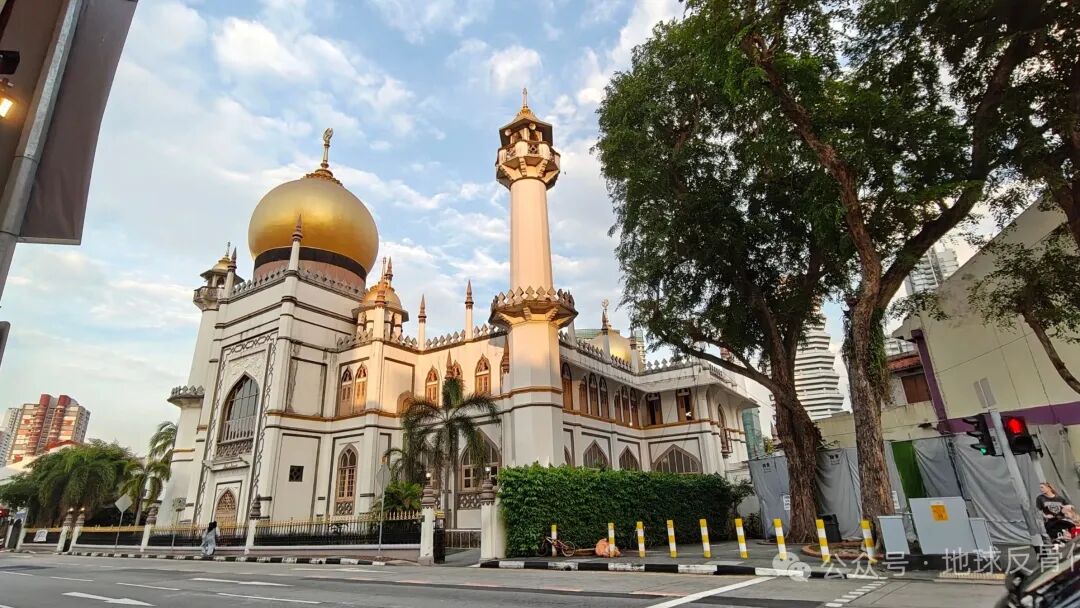
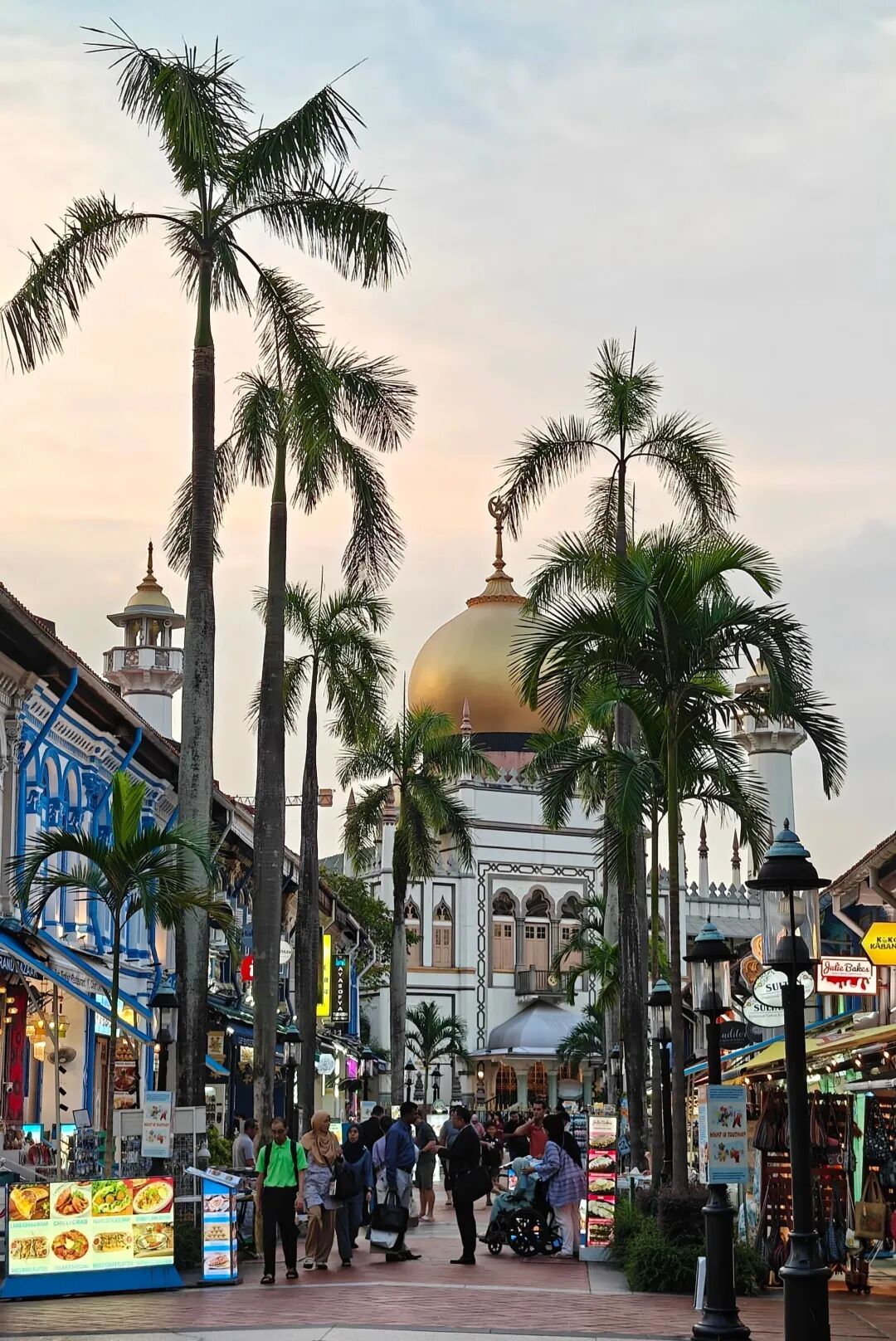
What you see from this side of the road is actually the mihrab area of the mosque; you have to enter through the small alley on the side to reach the main entrance. There are many halal restaurants and souvenir shops in that alley, showing that there are a lot of tourists here. Following this path leads you to the front gate of the mosque. There is a special tourist route starting from the front gate that lets you enter the main prayer hall for a visit.
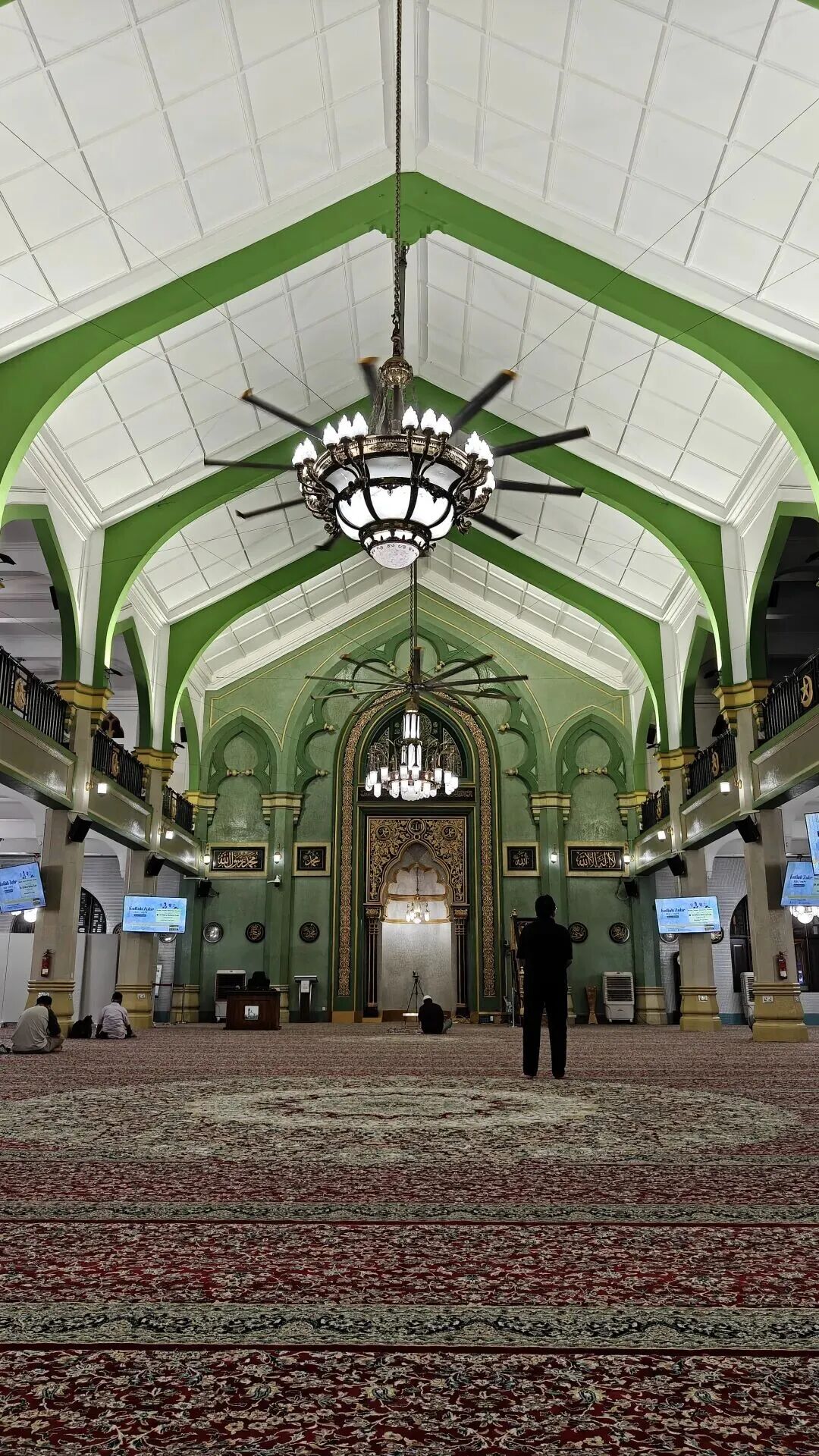
The space inside the mosque is very large. The ceiling of the main prayer hall is very high. It was likely built this way to help with heat dissipation since keeping the room warm is not a concern.
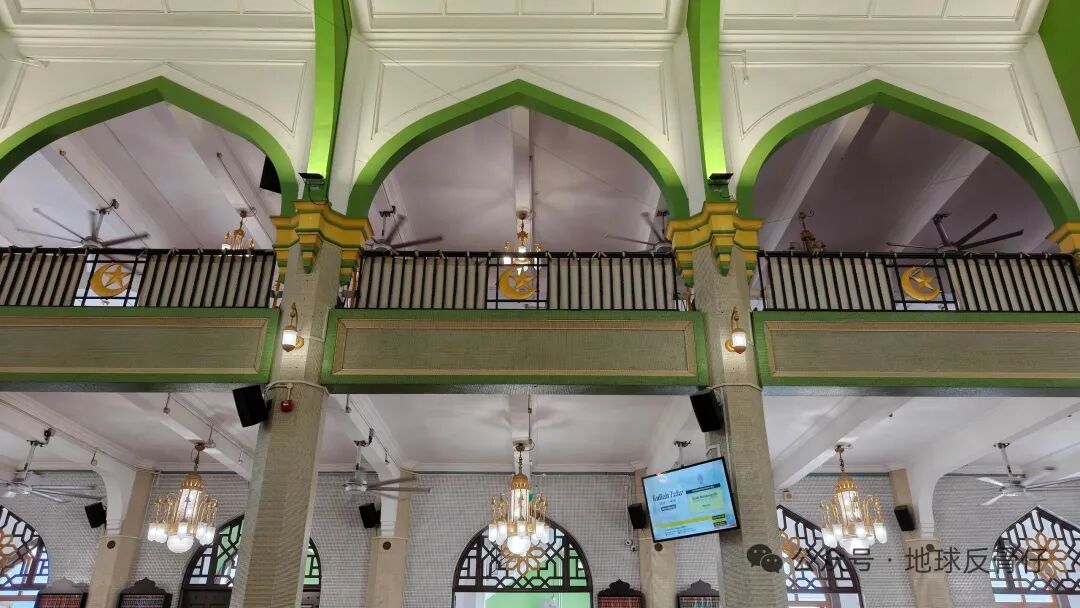
The second floor seems to be the women's prayer area, so I did not go up there.
Let me show you the mosque's mihrab niche and minbar pulpit. They are crafted beautifully with both calligraphy and floral patterns, giving them a strong Southeast Asian feel. If you want to see more details, you can check out the post I shared previously about the Sultan Mosque. This mosque is one of the older ones in Singapore. It started as a simple place of worship built by the Sultan of Johor in 1824 for local Muslims, and it was later expanded to its current size. The current building uses Indo-Saracenic style, which you can also see in India and Kuala Lumpur, Malaysia. I will share more related content with you in the future.
2. Malabar Mosque
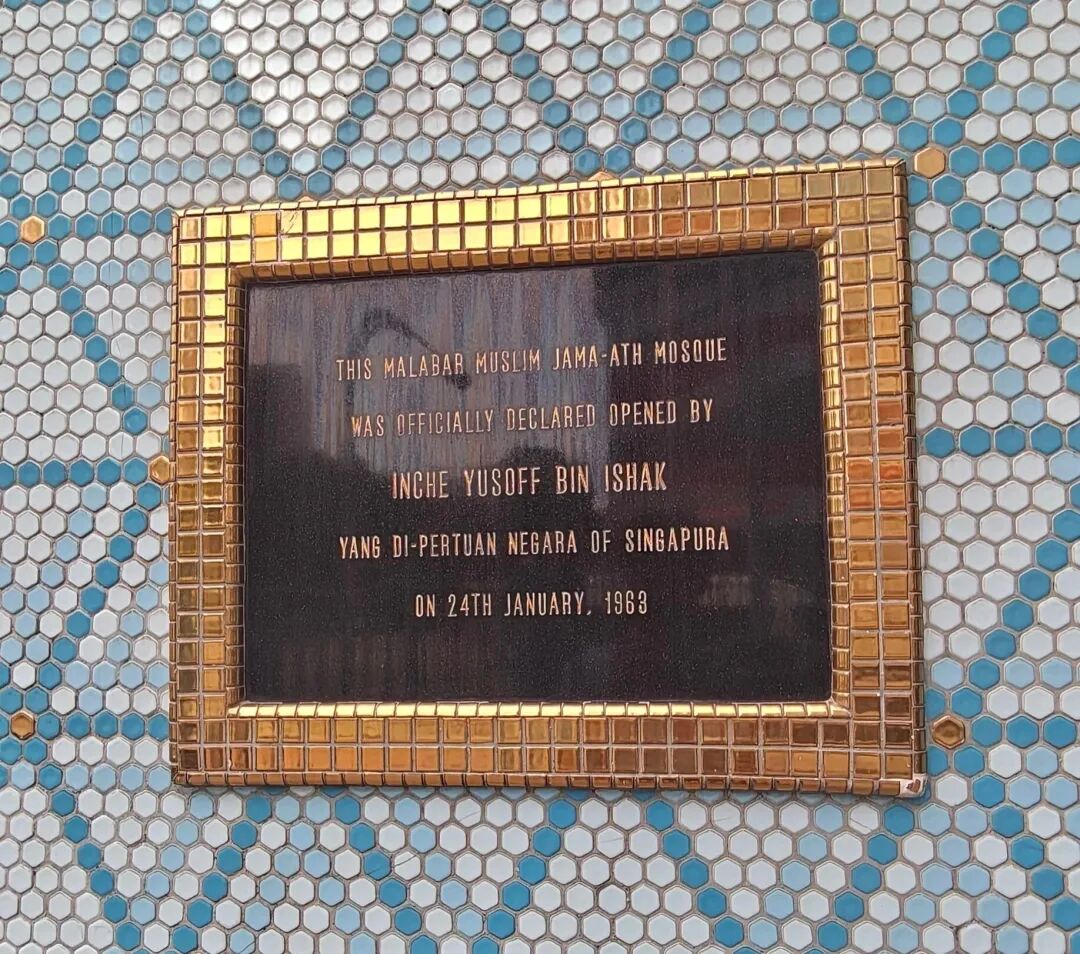
This mosque is very close to the Sultan Mosque, just a few steps away. It is right by the side of the road and very easy to spot, so you will definitely see it when you pass by. Founded in 1963, Malabar Mosque is a mosque for the Malabar Muslim community, though Muslims from other backgrounds are of course welcome to pray there too. There is an information board near the entrance that explains the history of the mosque and shows old photos taken in 1960. Looking at the old photos, the Malabar Mosque did not have its blue tiles back then. The word Malabar comes from a Muslim community in the Kerala state of southern India. Many people know there are many Muslims in northern India, but there are actually many in southern India as well. Muslims in Kerala existed even before the establishment of northern Indian Muslim regimes like the Delhi Sultanate, which later became the Mughal Empire. On the outer wall of the mosque, you can see a commemorative plaque with gold-rimmed tiles stating that this is a mosque for the Malabar Muslim community, officially opened by Yusof bin Ishak. This Yusof was the first president of Singapore, and his portrait is the one printed on Singaporean banknotes today. Let us take a look inside the mosque. This mosque is much smaller than the Sultan Mosque we just visited, and the interior is much simpler. However, the basic layout of the prayer hall is similar, and there is also a women's prayer area upstairs. Judging by their features and skin tone, most people coming here to pray look like they are of South Asian descent.
3. Al-Abrar Mosque
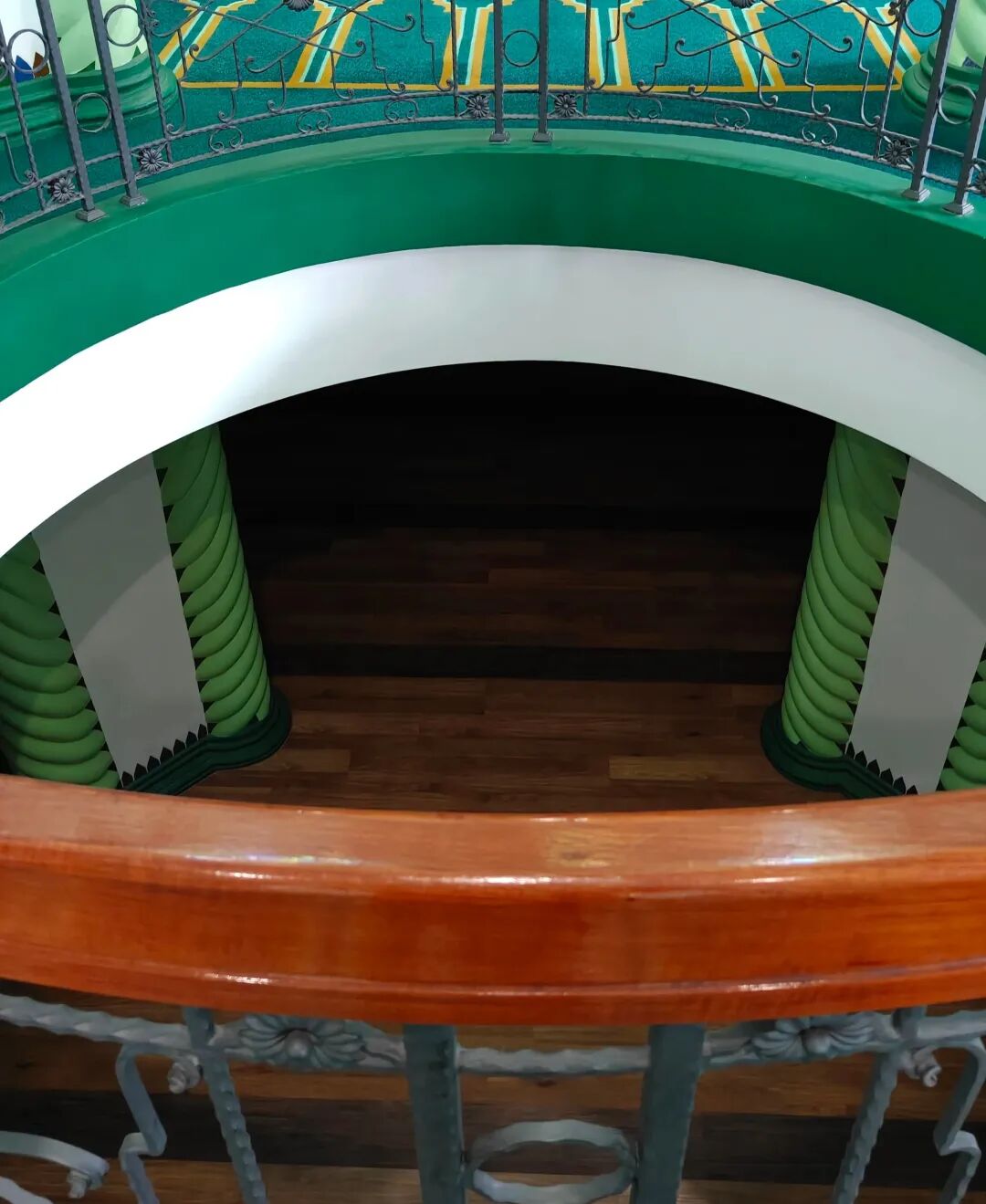
Abdul Gafoor Mosque is located in the Little India neighborhood of Singapore. Many Indian people live in this area, which has a South Indian-style Hindu mosque as well as other religious buildings, such as this mosque. Of course, the local term for it is mosque (huijiaotang). This mosque is colored white and green, and you can see a sun design wrapping around a star and crescent in the center of the main gate lintel. The sun has 25 rays, and if you look closely, each ray is actually the name of a prophet. There are 25 prophets mentioned in the Quran, including Adam (Adan), Noah (Nuh), Abraham (Ibrahim), Moses (Musa), Jesus (Isa), and Muhammad. The prayer hall is not large, but it is very delicate, and the pillars are shaped like matcha-flavored twisted dough sticks (mahua). Also, the central courtyard allows light to reach the basement. There is a prayer area underground as well. Take a look, the pillars in the basement also have this twisted dough stick shape.
Let me show you the mosque's mihrab niche and minbar pulpit. It is beautifully made, featuring not just calligraphy but also floral patterns, giving it a real Southeast Asian feel. If you want to see more details, check out my previous post about the Sultan Mosque. This mosque is one of the older ones in Singapore. The Sultan of Johor first built a simple place of worship here in 1824 for local Muslims to use, and it was later expanded to its current size. The current building uses Indo-Saracenic style. You can see similar mosques in India and in Kuala Lumpur, Malaysia. I will share more updates with you later.
2. Malabar Mosque
This mosque is very close to the Sultan Mosque. It is just a few steps away and sits right by the road, so it is very easy to spot. I am sure you will see it if you pass by. The Malabar Mosque was established in 1963. It is a mosque for the Malabar Muslim community, but Muslims from other ethnic groups are of course welcome to pray there too. There is an information board near the entrance where you can learn about the history of the mosque. You can also see a photo taken in 1960, which shows that the Malabar Mosque did not have its blue tiles back then. The word Malabar comes from a Muslim ethnic group in the state of Kerala in southern India. Many people know that there are many Muslims in North India, but there are actually many in South India as well. The Muslims of Kerala existed even before North Indian Muslim regimes like the Delhi Sultanate (and later the Mughal Empire) were established. On the outer wall of the mosque, you can still see a commemorative plaque edged with gold tiles. It states that this is a mosque for the Malabar Muslim community, officially opened by Yusof bin Ishak. This Yusof was Singapore's first president, and he is the person featured on current Singaporean banknotes. Let's look inside the mosque. It is much smaller than the Sultan Mosque we just visited, and the interior is quite a bit simpler. However, the basic layout of the prayer hall is similar, with the upstairs area also reserved for women. Judging by their features and skin tone, most of the people coming to this mosque for namaz appear to be from South Asia.
3. Al-Abrar Mosque
Abdul Gafoor Mosque is in Singapore's Little India neighborhood. Many Indian people live in this area, which is home to a South Indian-style Hindu mosque as well as buildings for other religions, such as this mosque. Of course, the local term used here is mosque (huijiaotang). The mosque is painted in white and green, and in the center of the main gate's lintel, you can see a sun design surrounding a star and crescent. The sun has 25 rays. If you look closely, each ray represents the name of a prophet. There are 25 prophets mentioned in the Quran, including Adam (Adan), Noah (Nuha), Abraham (Ibrahim), Moses (Musa), Jesus (Isa), and Muhammad. The prayer hall is small but very delicate, and the pillars look just like matcha-flavored twisted dough sticks (mahua). The central courtyard also lets light shine down into the basement. There is a prayer area underground as well. Notice that the basement pillars also have this twisted rope design.
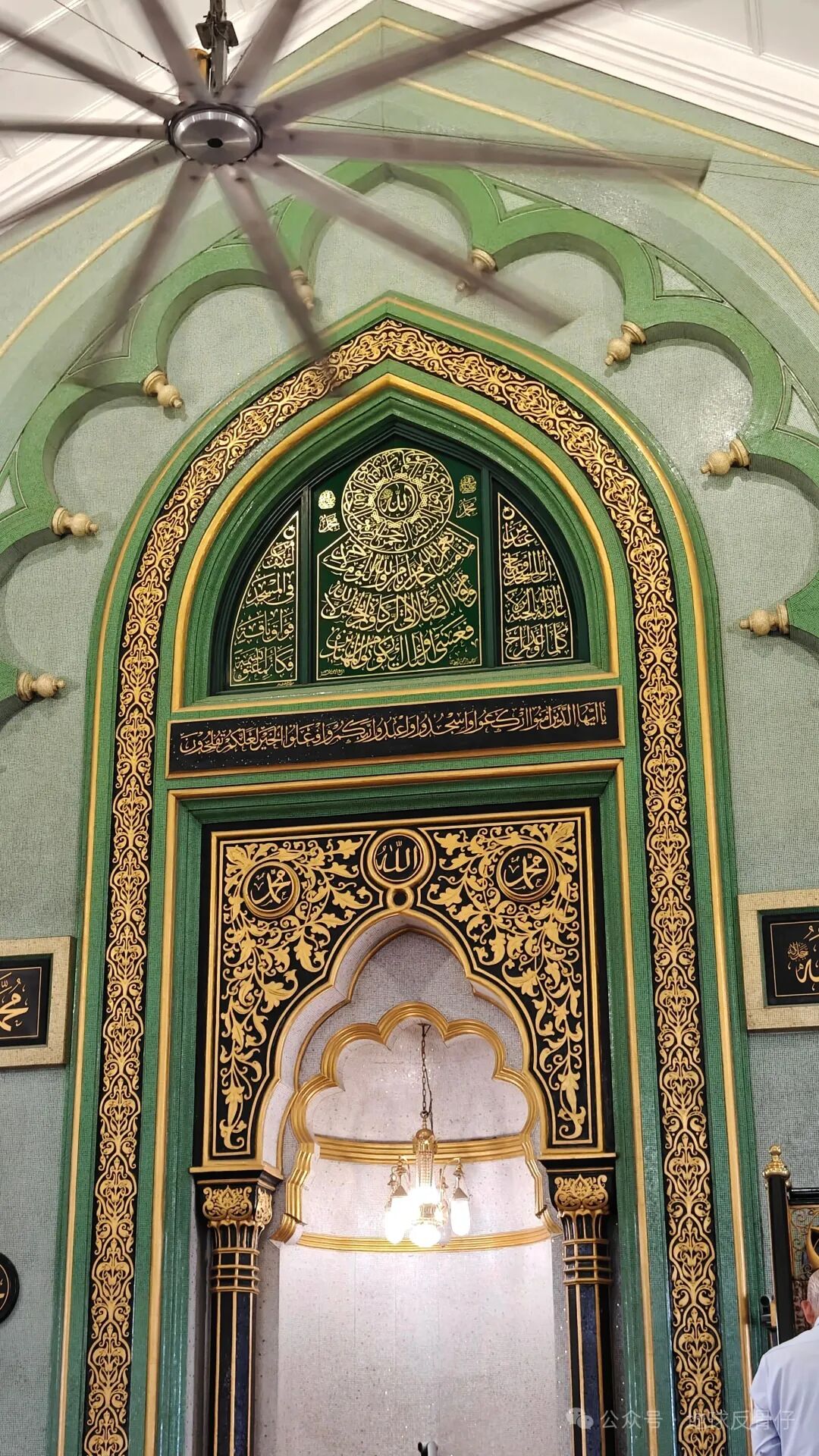
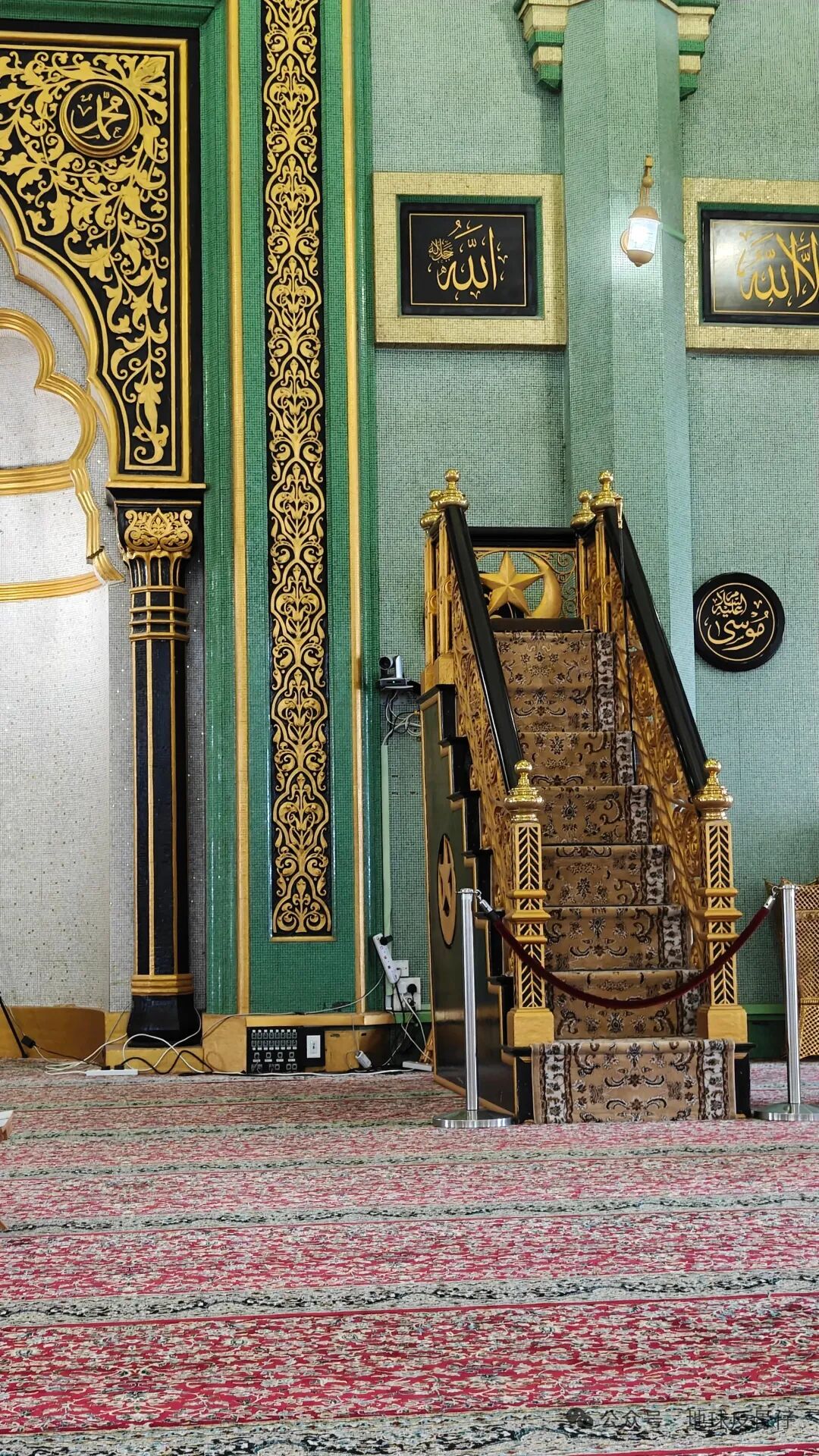
If you want to see more details, check out my previous post about the Sultan Mosque. This mosque is one of the older ones in Singapore. The Sultan of Johor first built a simple place of worship here in 1824 for local Muslims to use, and it was later expanded to its current size. The current building uses Indo-Saracenic style. You can see similar mosques in India and in Kuala Lumpur, Malaysia. I will share more updates with you later.
2. Malabar Mosque
This mosque is very close to the Sultan Mosque. It is just a few steps away and sits right by the road, so it is very easy to spot. I am sure you will see it if you pass by. The Malabar Mosque was established in 1963. It is a mosque for the Malabar Muslim community, but Muslims from other ethnic groups are of course welcome to pray there too. There is an information board near the entrance where you can learn about the history of the mosque. You can also see a photo taken in 1960, which shows that the Malabar Mosque did not have its blue tiles back then. The word Malabar comes from a Muslim ethnic group in the state of Kerala in southern India. Many people know that there are many Muslims in North India, but there are actually many in South India as well. The Muslims of Kerala existed even before North Indian Muslim regimes like the Delhi Sultanate (and later the Mughal Empire) were established. On the outer wall of the mosque, you can still see a commemorative plaque edged with gold tiles. It states that this is a mosque for the Malabar Muslim community, officially opened by Yusof bin Ishak. This Yusof was Singapore's first president, and he is the person featured on current Singaporean banknotes. Let's look inside the mosque. It is much smaller than the Sultan Mosque we just visited, and the interior is quite a bit simpler. However, the basic layout of the prayer hall is similar, with the upstairs area also reserved for women. Judging by their features and skin tone, most of the people coming to this mosque for namaz appear to be from South Asia.
3. Al-Abrar Mosque
Abdul Gafoor Mosque is in Singapore's Little India neighborhood. Many Indian people live in this area, which is home to a South Indian-style Hindu mosque as well as buildings for other religions, such as this mosque. Of course, the local term used here is mosque (huijiaotang). The mosque is painted in white and green, and in the center of the main gate's lintel, you can see a sun design surrounding a star and crescent. The sun has 25 rays. If you look closely, each ray represents the name of a prophet. There are 25 prophets mentioned in the Quran, including Adam (Adan), Noah (Nuha), Abraham (Ibrahim), Moses (Musa), Jesus (Isa), and Muhammad. The prayer hall is small but very delicate, and the pillars look just like matcha-flavored twisted dough sticks (mahua). The central courtyard also lets light shine down into the basement. There is a prayer area underground as well. Notice that the basement pillars also have this twisted rope design.
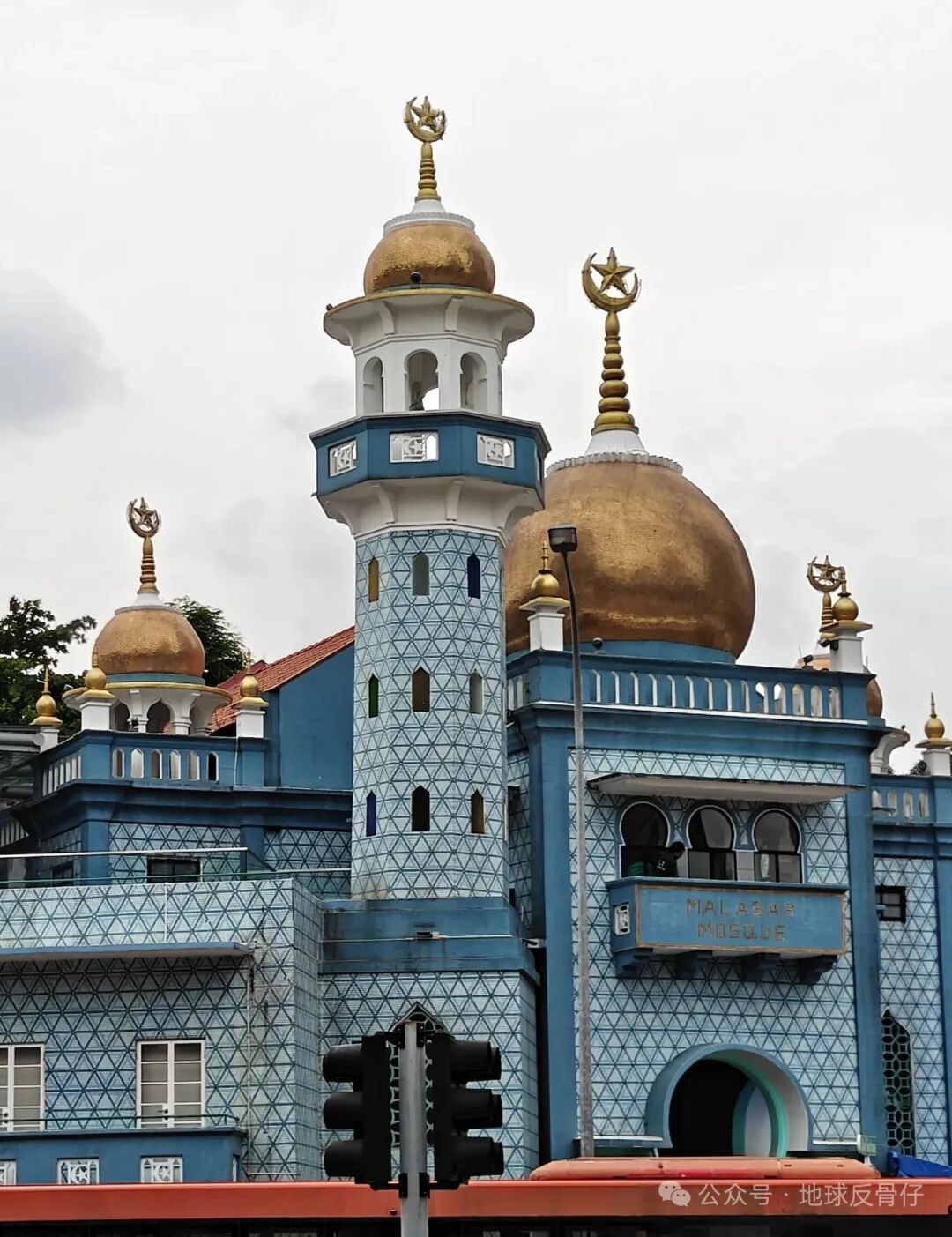
There is an information board near the entrance where you can learn about the history of the mosque. You can also see a photo taken in 1960, which shows that the Malabar Mosque did not have its blue tiles back then. The word Malabar comes from a Muslim ethnic group in the state of Kerala in southern India. Many people know that there are many Muslims in North India, but there are actually many in South India as well. The Muslims of Kerala existed even before North Indian Muslim regimes like the Delhi Sultanate (and later the Mughal Empire) were established. On the outer wall of the mosque, you can still see a commemorative plaque edged with gold tiles. It states that this is a mosque for the Malabar Muslim community, officially opened by Yusof bin Ishak. This Yusof was Singapore's first president, and he is the person featured on current Singaporean banknotes. Let's look inside the mosque. It is much smaller than the Sultan Mosque we just visited, and the interior is quite a bit simpler. However, the basic layout of the prayer hall is similar, with the upstairs area also reserved for women. Judging by their features and skin tone, most of the people coming to this mosque for namaz appear to be from South Asia.
3. Al-Abrar Mosque
Abdul Gafoor Mosque is in Singapore's Little India neighborhood. Many Indian people live in this area, which is home to a South Indian-style Hindu mosque as well as buildings for other religions, such as this mosque. Of course, the local term used here is mosque (huijiaotang). The mosque is painted in white and green, and in the center of the main gate's lintel, you can see a sun design surrounding a star and crescent. The sun has 25 rays. If you look closely, each ray represents the name of a prophet. There are 25 prophets mentioned in the Quran, including Adam (Adan), Noah (Nuha), Abraham (Ibrahim), Moses (Musa), Jesus (Isa), and Muhammad. The prayer hall is small but very delicate, and the pillars look just like matcha-flavored twisted dough sticks (mahua). The central courtyard also lets light shine down into the basement. There is a prayer area underground as well. Notice that the basement pillars also have this twisted rope design.
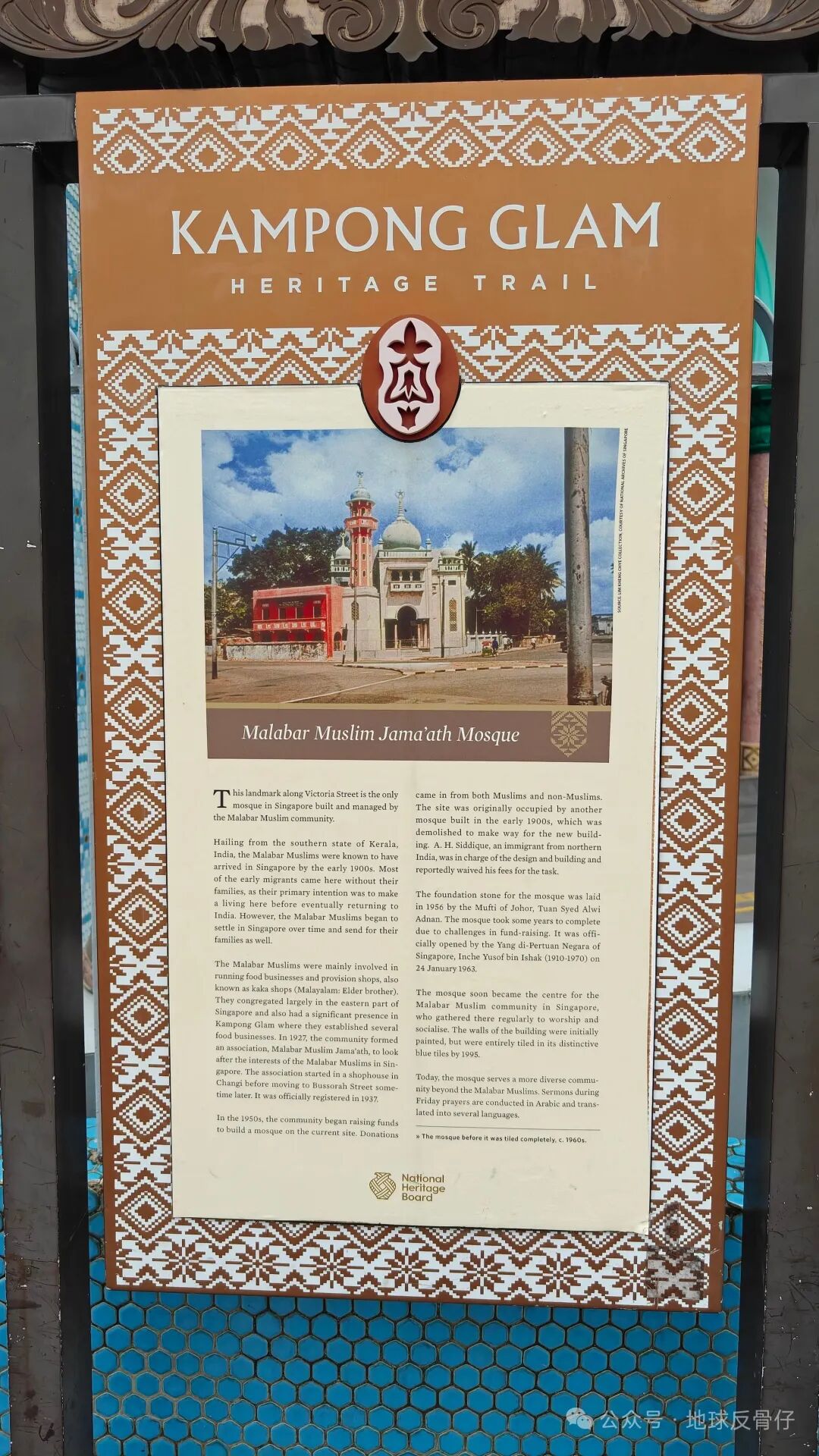
On the outer wall of the mosque, you can still see a commemorative plaque edged with gold tiles. It states that this is a mosque for the Malabar Muslim community, officially opened by Yusof bin Ishak. This Yusof was Singapore's first president, and he is the person featured on current Singaporean banknotes.
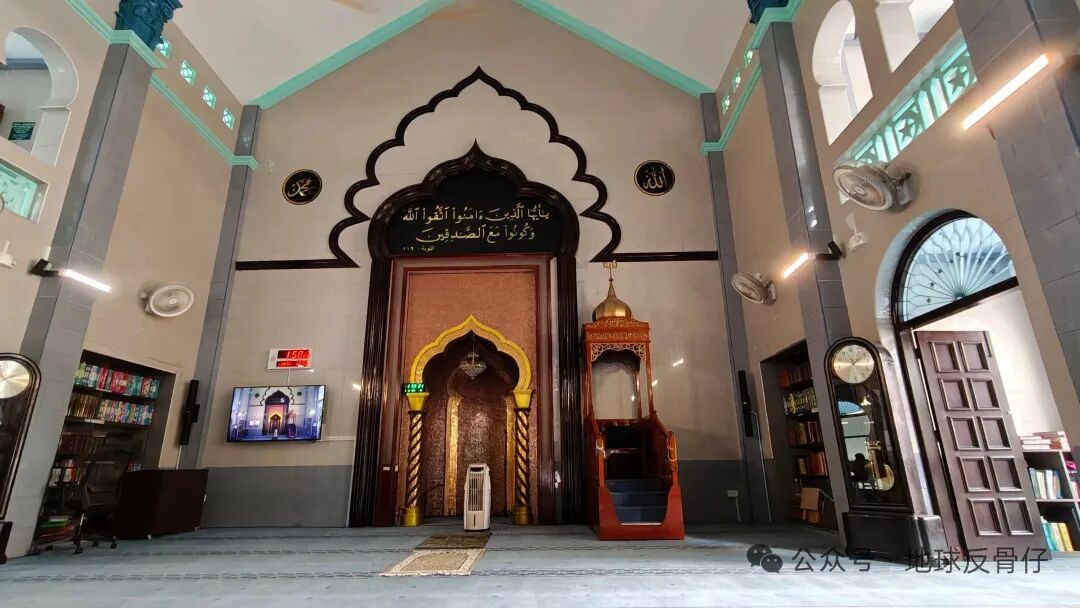
Let's look inside the mosque. It is much smaller than the Sultan Mosque we just visited, and the interior is quite a bit simpler. However, the basic layout of the prayer hall is similar, with the upstairs area also reserved for women. Judging by their features and skin tone, most of the people coming to this mosque for namaz appear to be from South Asia.
3. Al-Abrar Mosque
Abdul Gafoor Mosque is in Singapore's Little India neighborhood. Many Indian people live in this area, which is home to a South Indian-style Hindu mosque as well as buildings for other religions, such as this mosque. Of course, the local term used here is mosque (huijiaotang). The mosque is painted in white and green, and in the center of the main gate's lintel, you can see a sun design surrounding a star and crescent. The sun has 25 rays. If you look closely, each ray represents the name of a prophet. There are 25 prophets mentioned in the Quran, including Adam (Adan), Noah (Nuha), Abraham (Ibrahim), Moses (Musa), Jesus (Isa), and Muhammad. The prayer hall is small but very delicate, and the pillars look just like matcha-flavored twisted dough sticks (mahua). The central courtyard also lets light shine down into the basement. There is a prayer area underground as well. Notice that the basement pillars also have this twisted rope design.
Let's look inside the mosque. It is much smaller than the Sultan Mosque we just visited, and the interior is quite a bit simpler. However, the basic layout of the prayer hall is similar, with the upstairs area also reserved for women. Judging by their features and skin tone, most of the people coming to this mosque for namaz appear to be from South Asia.
3. Al-Abrar Mosque
Abdul Gafoor Mosque is in Singapore's Little India neighborhood. Many Indian people live in this area, which is home to a South Indian-style Hindu mosque as well as buildings for other religions, such as this mosque. Of course, the local term used here is mosque (huijiaotang). The mosque is painted in white and green, and in the center of the main gate's lintel, you can see a sun design surrounding a star and crescent. The sun has 25 rays. If you look closely, each ray represents the name of a prophet. There are 25 prophets mentioned in the Quran, including Adam (Adan), Noah (Nuha), Abraham (Ibrahim), Moses (Musa), Jesus (Isa), and Muhammad. The prayer hall is small but very delicate, and the pillars look just like matcha-flavored twisted dough sticks (mahua). The central courtyard also lets light shine down into the basement. There is a prayer area underground as well. Notice that the basement pillars also have this twisted rope design.
3. Al-Abrar Mosque
Abdul Gafoor Mosque is in Singapore's Little India neighborhood. Many Indian people live in this area, which is home to a South Indian-style Hindu mosque as well as buildings for other religions, such as this mosque. Of course, the local term used here is mosque (huijiaotang).
The mosque is painted in white and green, and in the center of the main gate's lintel, you can see a sun design surrounding a star and crescent. The sun has 25 rays. If you look closely, each ray represents the name of a prophet. There are 25 prophets mentioned in the Quran, including Adam (Adan), Noah (Nuha), Abraham (Ibrahim), Moses (Musa), Jesus (Isa), and Muhammad. The prayer hall is small but very delicate, and the pillars look just like matcha-flavored twisted dough sticks (mahua). The central courtyard also lets light shine down into the basement. There is a prayer area underground as well. Notice that the basement pillars also have this twisted rope design.
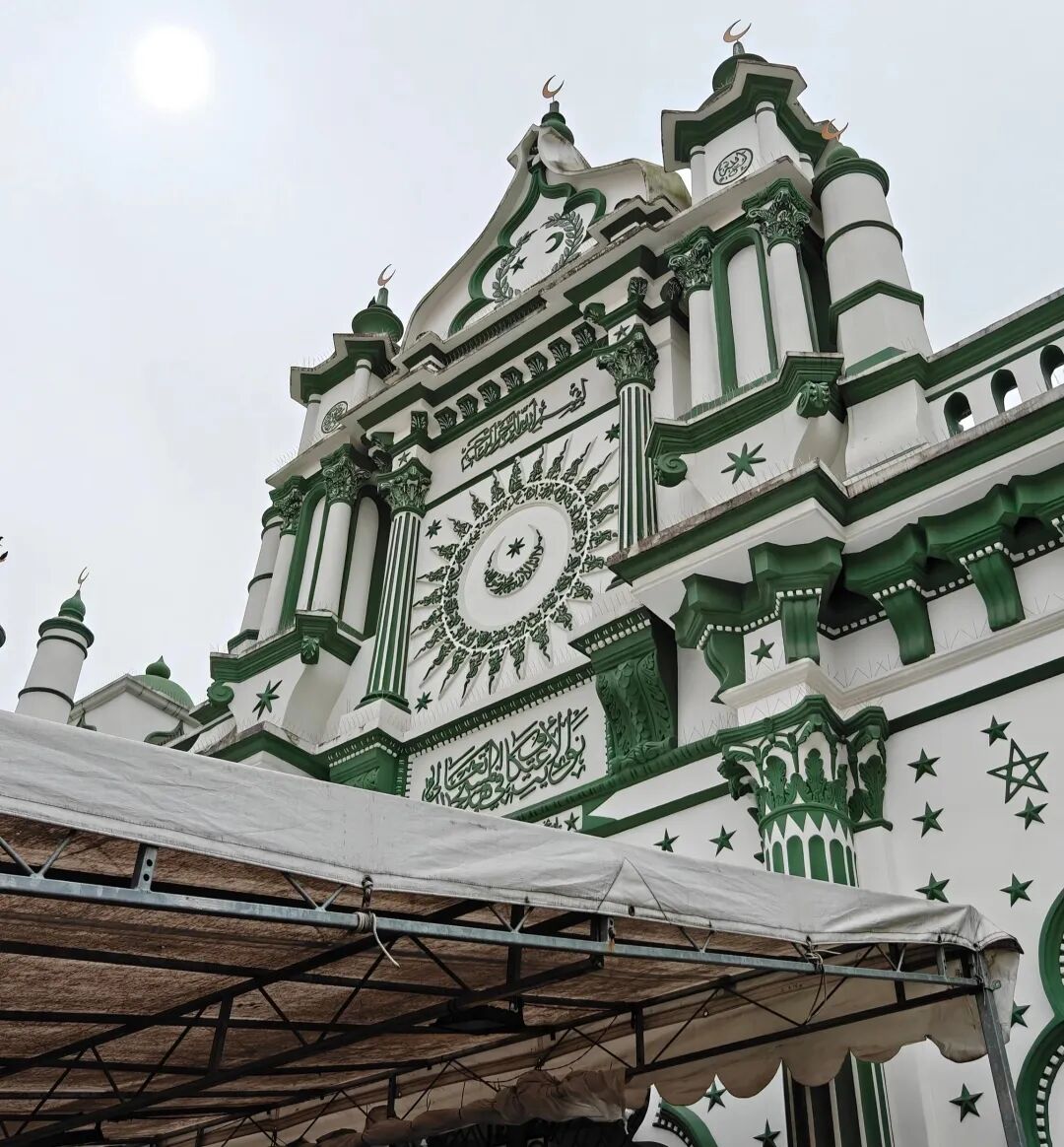
The mosque is painted in white and green, and in the center of the main gate's lintel, you can see a sun design surrounding a star and crescent. The sun has 25 rays. If you look closely, each ray represents the name of a prophet. There are 25 prophets mentioned in the Quran, including Adam (Adan), Noah (Nuha), Abraham (Ibrahim), Moses (Musa), Jesus (Isa), and Muhammad.
The prayer hall is small but very delicate, and the pillars look just like matcha-flavored twisted dough sticks (mahua). The central courtyard also lets light shine down into the basement. There is a prayer area underground as well. Notice that the basement pillars also have this twisted rope design.
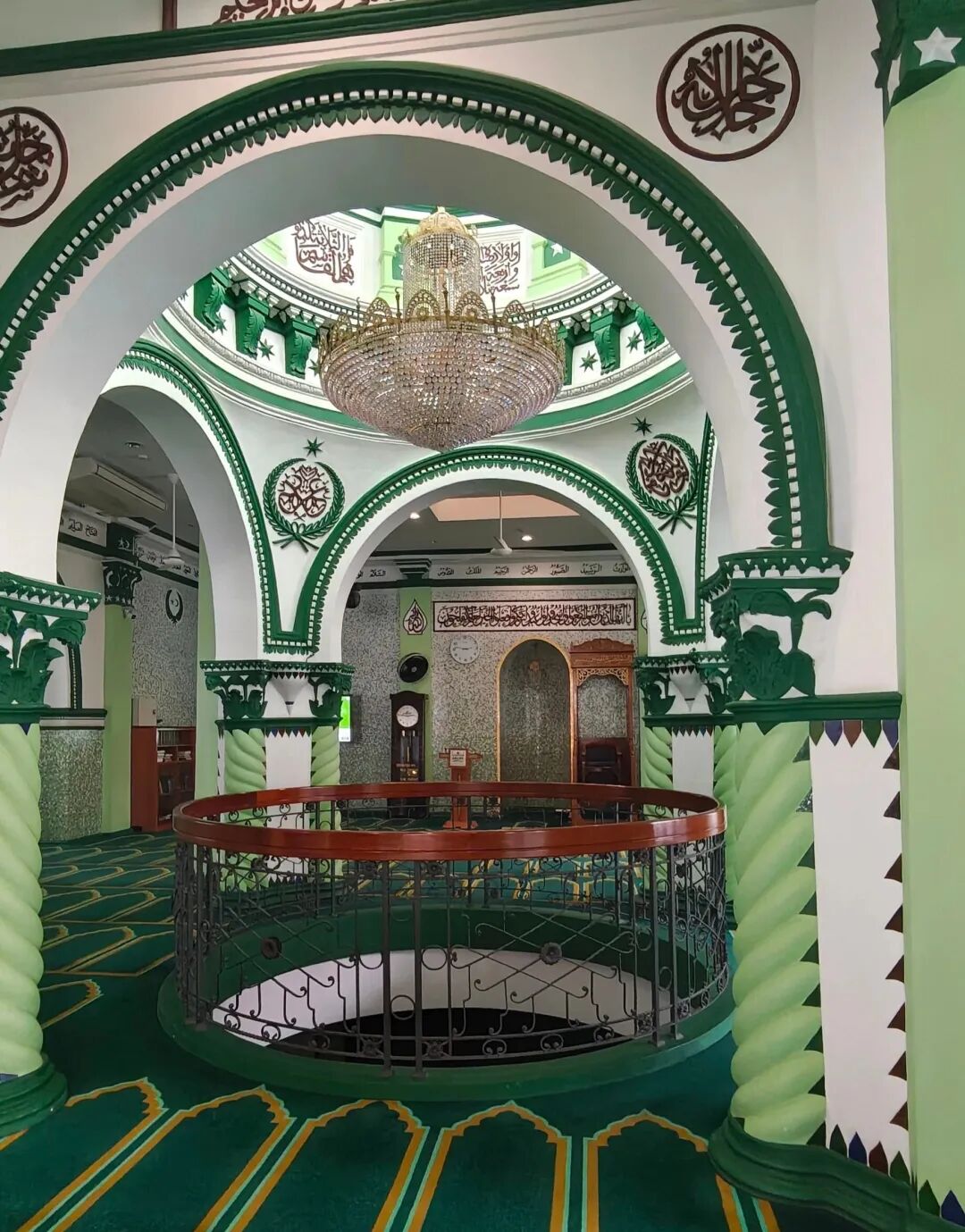
The prayer hall is small but very delicate, and the pillars look just like matcha-flavored twisted dough sticks (mahua). The central courtyard also lets light shine down into the basement. There is a prayer area underground as well. Notice that the basement pillars also have this twisted rope design.
Beyond its unique architecture, a highlight of this mosque is that it was founded by an Indian. Inside the mosque, you will find Arabic, the universal language of Islam, English for tourists, and also Tamil. This is a South Indian language, primarily spoken in the state of Tamil Nadu in southern India. The Singapore MRT also uses this language for announcements, usually as the final language played. The picture below shows the prayer times in Tamil displayed on a screen inside the prayer hall. The surprises at this small mosque do not end there; it even has a small museum. The guide is an older Tamil Indian man who works at the mosque. He speaks Tamil, a language with a very fast speaking pace. Because of this, he also speaks English at a very high speed. The mosque houses fragments of handwritten Quran manuscripts and a Chinese translation of the Quran by Mr. Ma Jian. On the wall, there is an interactive display of the 99 Names of Allah. The front features Arabic calligraphy of the names, and the back shows the English translation. Interested friends can search my homepage for the post about Abdul Gafoor Mosque.
4. Angullia Mosque
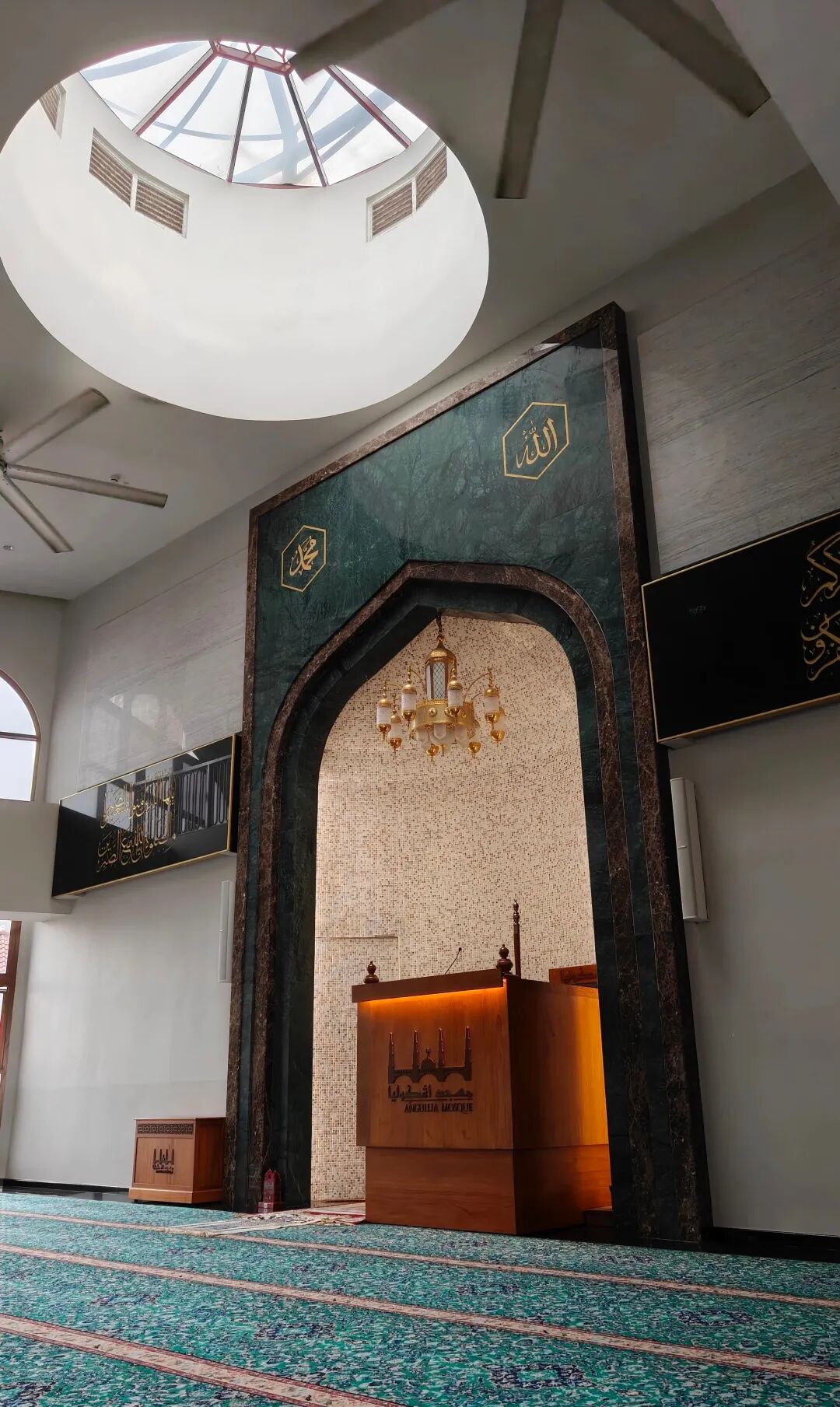
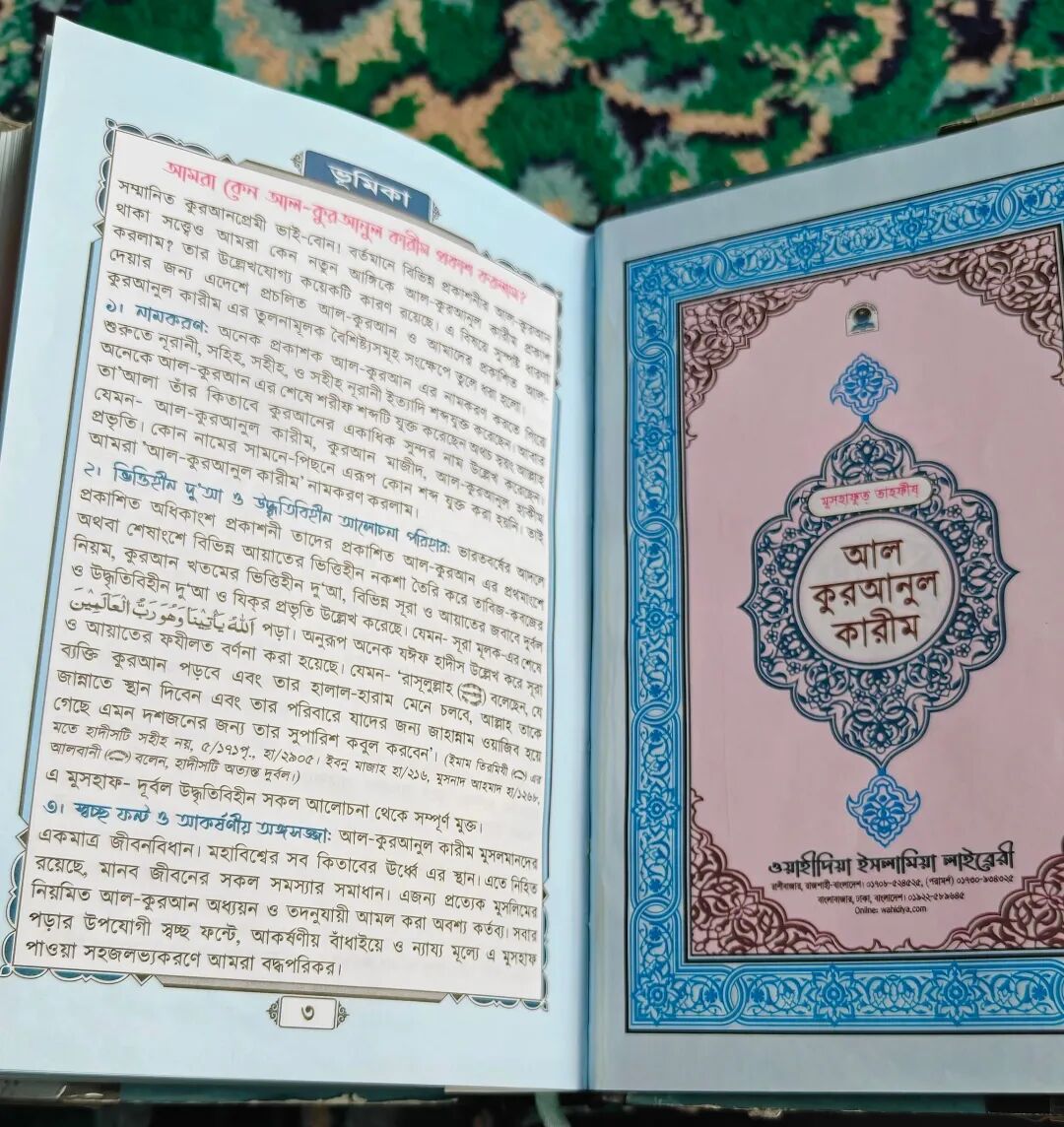
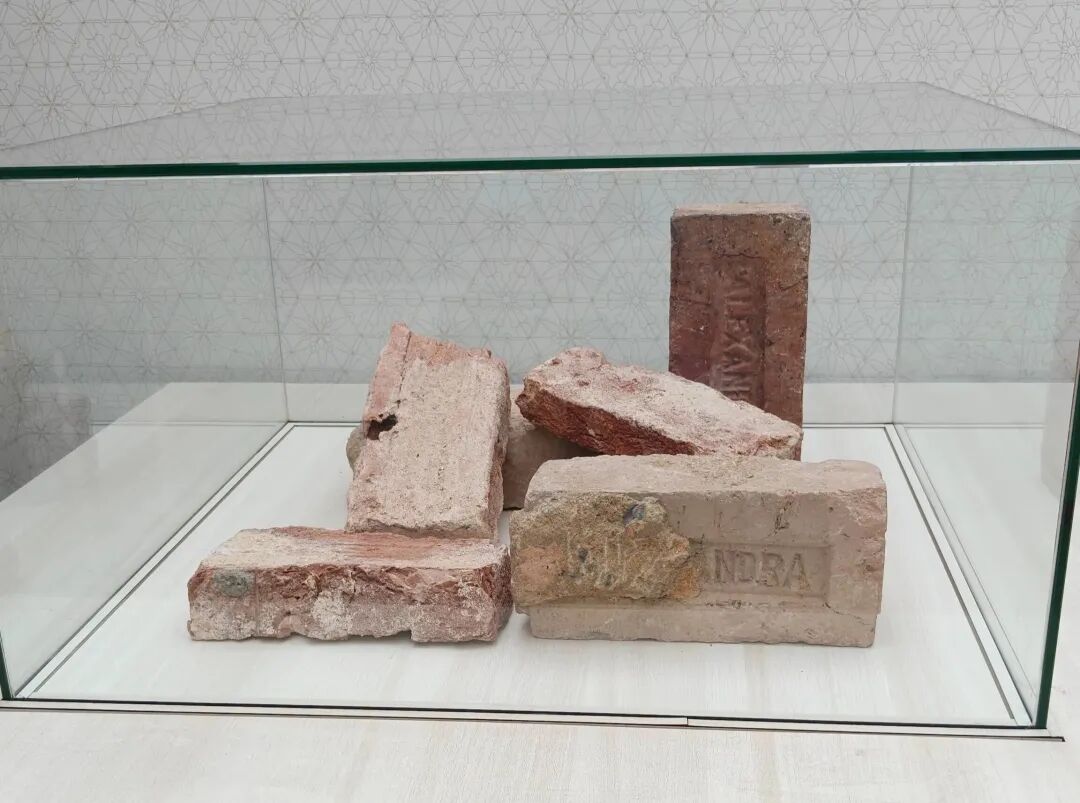
Angullia Mosque was built by the Angullia family, a family that has also built mosques in Malaysia, Indonesia, the Philippines, and India. They come from Gujarat, India, which is Modi's hometown. Their family is good at business, so they travel everywhere to trade. This Nagore Dargah Mosque (Anguliya Mosque) is the one they built in Singapore. The color scheme reminds people of the red sandstone often used in Indian architecture. The prayer area inside the mosque has two floors, and the second floor is about half the length of the first. There is a small transparent dome above the mihrab that lets light in. I found a Quran translated into Bengali in the mosque. Bangladesh is also a Muslim country, where over 90 percent of the population is Muslim. Bengali uses the Bengali script. Seeing this Brahmic script used for the Quran really reminded me of the scriptures of another religion. The presence of a Bengali Quran in the mosque shows that many Bengali people come here to pray. The mosque's courtyard is very small, but they still managed to set up an exhibition area. It displays meaningful items used by the mosque in the past, such as bricks from when the old mosque was built and pots used for cooking porridge. They did not waste the mosque's outer walls either. They posted a brief introduction to the Anguliya family on the walls, along with photos of mosques their family built in South Asia, Southeast Asia, and other places. (I didn't expect to see that they even have them in the Philippines.)
5. Burhani Mosque (the only Shia mosque in Singapore)
At the Abdul Gafoor Mosque mentioned earlier, a Tamil guide told me that Singapore has a Shia mosque. I was immediately interested because I had never been to a Shia mosque in my life. I used to think you could only see Shia mosques in Iran or Iraq, so I was surprised to find one in Singapore. On second thought, it makes sense. Thailand has Shia Muslims, and since Singapore is a global crossroads, it is not strange to find them here too. There is an information board behind the mosque. It says this mosque was built by merchants from Gujarat, India. That is right, Gujarati merchants again. This side of the road shows the back of the mosque. The mosque has a very restrained design, using solid, low-saturation colors for the main structure. The large building behind the prayer hall is likely office space. Inside the mosque, there are two prayer rooms, one in the front and one in the back, separated by several doors. Push open the door and you are in the inner prayer hall. There were two elderly men inside at the time, and one of them really looked a bit like Modi. After all, they are both Gujarati, and appearance is related to geography, so it is not strange that they look a bit alike. There is a long flag on each side of the mihrab, one red and one green. Other mosques do not have these kinds of flags, so let us zoom in to see what is written on them. The content on both flags is basically the same. From top to bottom, it is written: Allah, Muhammad (the Prophet himself), Ali (the fourth Caliph), Fatimah (the Prophet's daughter and Ali's wife), Hasan (the eldest son of Ali and Fatimah), and Husayn (the second son of Ali and Fatimah). The red banner adds an exclamation word, 'Ya', before each name. There is similar content on the wall as well. Since I did not see any specific differences between how Shia and Sunni Muslims perform namaz during this visit to a Shia mosque, I decided to go to Iran to see for myself. That is how the later trip to Iran came about. Friends who are interested can check out my travel notes on Iranian mosques in my official WeChat account.
6. The prayer room (surau) at Singapore General Hospital (SGH).
After seeing so many mosques, let us now take a look at a prayer room. What is the difference between a prayer room and a mosque? The size of the space is secondary; indeed, generally speaking, a prayer room is smaller than a mosque. But some mosques are actually very small. From what I have seen, prayer rooms usually do not have permanent staff. People come here to pray in a group they organized themselves, or they pray alone and then leave. It is not like a mosque where there are permanent staff to call the adhan and lead the five daily prayers. Another difference is that prayer rooms are usually much simpler than mosques and lack necessary facilities. Mosques have toilets, a room for minor ablution (wudu), and a room for major ablution (ghusl). As for prayer rooms, some have toilets and an area for minor ablution. Some only have a few water taps. The prayer room I am going to talk about next is actually quite large, so you will see the difference between it and a mosque. First of all, it looks very plain, with no minaret and no sign on the door. To passersby, this place just looks like a small shed. When you enter the prayer room, there is actually a small courtyard inside. The courtyard has long tables and benches, as well as free tea. People who come to pray can sit on the benches to rest for a while and drink some water. You have to drink water in this Singapore weather. I usually do not drink much water, but I drink two bottles of mineral water a day since coming to Singapore. Inside the prayer room, I saw medical staff from the hospital coming to pray, and I even met a Singapore police officer here once. This prayer room is quite large, even bigger than some small mosques. There are many straw mats (liangxi) in the prayer room porch. When it gets crowded, people spread them out to use as prayer rugs. This shows that many people come here for Friday congregational prayers. The prayer schedule inside the room is electronic, but it might be broken because it is not showing the times. So now they are using this manual prayer schedule, where the times can be adjusted by hand.
7. The prayer room at Marina One
Marina One is a shopping mall in the CBD area near the Singapore waterfront. According to the map, there is a prayer room in this underground mall. I spent a long time looking for it on my first visit and even asked an Indian security guard at the nearby parking lot where the prayer room was. The security guard was very kind and pointed me in the right direction. The prayer room is on the B2 level, which is the first floor down. You can see the Singapore landmark, Marina Bay Sands, from the mall entrance. After going down, follow the path and you will see a round window. It looks like a laundry shop decorated to look like a washing machine. The prayer room is right next to this laundry shop. The prayer room is easy to find because it is marked with a dome and a star and crescent symbol. Open this door and you will see a small door on both the left and the right. Men go to the left and women to the right to pray separately. The prayer room is right through the door. The facilities for wudu (ablution) are very basic and only cover the essential parts, so you should still use a nearby restroom stall for a full wash. A prayer room is just what it sounds like: a small room where you can perform namaz. The facilities inside are simple, so there is no mihrab and no podium. There is no minbar chair. However, this prayer room has an unexpectedly large number of books. The back is filled with all kinds of books, and there are even missionary materials. It is normal to see these in a mosque since tourists visit, but since only Muslims come to the prayer room, why are there missionary materials here? Once you leave the prayer room, this mall is no different from any other mall in Singapore. It mainly has restaurants, therapy centers, supermarkets, and similar shops. That is all for this episode, as we only covered these few places. We will continue with the rest next time.
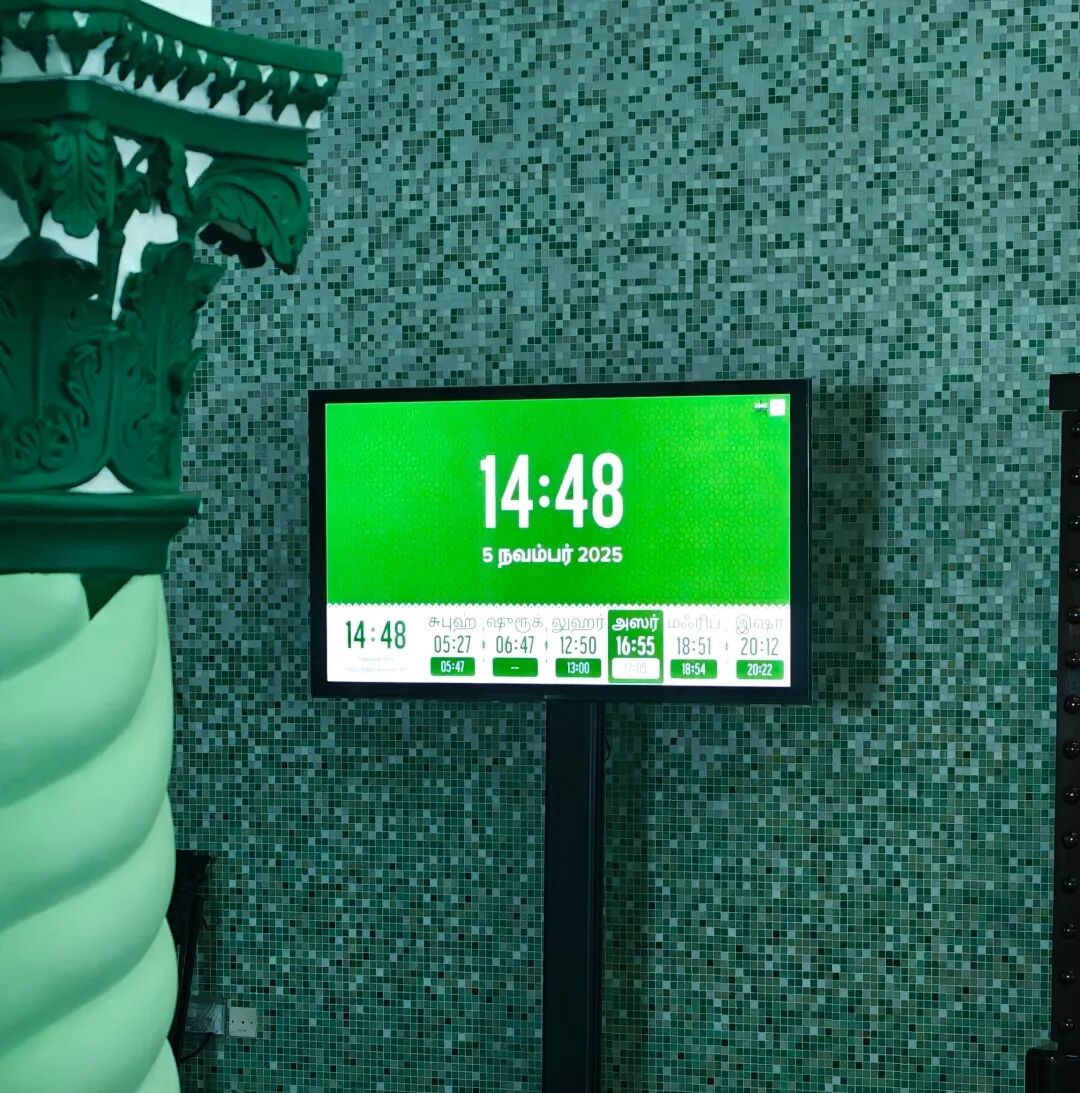
The surprises at this small mosque do not end there; it even has a small museum. The guide is an older Tamil Indian man who works at the mosque. He speaks Tamil, a language with a very fast speaking pace. Because of this, he also speaks English at a very high speed.
The mosque houses fragments of handwritten Quran manuscripts and a Chinese translation of the Quran by Mr. Ma Jian. On the wall, there is an interactive display of the 99 Names of Allah. The front features Arabic calligraphy of the names, and the back shows the English translation. Interested friends can search my homepage for the post about Abdul Gafoor Mosque.
4. Angullia Mosque
Angullia Mosque was built by the Angullia family, a family that has also built mosques in Malaysia, Indonesia, the Philippines, and India. They come from Gujarat, India, which is Modi's hometown. Their family is good at business, so they travel everywhere to trade. This Nagore Dargah Mosque (Anguliya Mosque) is the one they built in Singapore. The color scheme reminds people of the red sandstone often used in Indian architecture.
The prayer area inside the mosque has two floors, and the second floor is about half the length of the first. There is a small transparent dome above the mihrab that lets light in. I found a Quran translated into Bengali in the mosque. Bangladesh is also a Muslim country, where over 90 percent of the population is Muslim. Bengali uses the Bengali script. Seeing this Brahmic script used for the Quran really reminded me of the scriptures of another religion. The presence of a Bengali Quran in the mosque shows that many Bengali people come here to pray. The mosque's courtyard is very small, but they still managed to set up an exhibition area. It displays meaningful items used by the mosque in the past, such as bricks from when the old mosque was built and pots used for cooking porridge. They did not waste the mosque's outer walls either. They posted a brief introduction to the Anguliya family on the walls, along with photos of mosques their family built in South Asia, Southeast Asia, and other places. (I didn't expect to see that they even have them in the Philippines.)
5. Burhani Mosque (the only Shia mosque in Singapore)
At the Abdul Gafoor Mosque mentioned earlier, a Tamil guide told me that Singapore has a Shia mosque. I was immediately interested because I had never been to a Shia mosque in my life. I used to think you could only see Shia mosques in Iran or Iraq, so I was surprised to find one in Singapore. On second thought, it makes sense. Thailand has Shia Muslims, and since Singapore is a global crossroads, it is not strange to find them here too. There is an information board behind the mosque. It says this mosque was built by merchants from Gujarat, India. That is right, Gujarati merchants again. This side of the road shows the back of the mosque. The mosque has a very restrained design, using solid, low-saturation colors for the main structure. The large building behind the prayer hall is likely office space. Inside the mosque, there are two prayer rooms, one in the front and one in the back, separated by several doors. Push open the door and you are in the inner prayer hall. There were two elderly men inside at the time, and one of them really looked a bit like Modi. After all, they are both Gujarati, and appearance is related to geography, so it is not strange that they look a bit alike. There is a long flag on each side of the mihrab, one red and one green. Other mosques do not have these kinds of flags, so let us zoom in to see what is written on them. The content on both flags is basically the same. From top to bottom, it is written: Allah, Muhammad (the Prophet himself), Ali (the fourth Caliph), Fatimah (the Prophet's daughter and Ali's wife), Hasan (the eldest son of Ali and Fatimah), and Husayn (the second son of Ali and Fatimah). The red banner adds an exclamation word, 'Ya', before each name. There is similar content on the wall as well. Since I did not see any specific differences between how Shia and Sunni Muslims perform namaz during this visit to a Shia mosque, I decided to go to Iran to see for myself. That is how the later trip to Iran came about. Friends who are interested can check out my travel notes on Iranian mosques in my official WeChat account.
6. The prayer room (surau) at Singapore General Hospital (SGH).
After seeing so many mosques, let us now take a look at a prayer room. What is the difference between a prayer room and a mosque? The size of the space is secondary; indeed, generally speaking, a prayer room is smaller than a mosque. But some mosques are actually very small. From what I have seen, prayer rooms usually do not have permanent staff. People come here to pray in a group they organized themselves, or they pray alone and then leave. It is not like a mosque where there are permanent staff to call the adhan and lead the five daily prayers. Another difference is that prayer rooms are usually much simpler than mosques and lack necessary facilities. Mosques have toilets, a room for minor ablution (wudu), and a room for major ablution (ghusl). As for prayer rooms, some have toilets and an area for minor ablution. Some only have a few water taps. The prayer room I am going to talk about next is actually quite large, so you will see the difference between it and a mosque. First of all, it looks very plain, with no minaret and no sign on the door. To passersby, this place just looks like a small shed. When you enter the prayer room, there is actually a small courtyard inside. The courtyard has long tables and benches, as well as free tea. People who come to pray can sit on the benches to rest for a while and drink some water. You have to drink water in this Singapore weather. I usually do not drink much water, but I drink two bottles of mineral water a day since coming to Singapore. Inside the prayer room, I saw medical staff from the hospital coming to pray, and I even met a Singapore police officer here once. This prayer room is quite large, even bigger than some small mosques. There are many straw mats (liangxi) in the prayer room porch. When it gets crowded, people spread them out to use as prayer rugs. This shows that many people come here for Friday congregational prayers. The prayer schedule inside the room is electronic, but it might be broken because it is not showing the times. So now they are using this manual prayer schedule, where the times can be adjusted by hand.
7. The prayer room at Marina One
Marina One is a shopping mall in the CBD area near the Singapore waterfront. According to the map, there is a prayer room in this underground mall. I spent a long time looking for it on my first visit and even asked an Indian security guard at the nearby parking lot where the prayer room was. The security guard was very kind and pointed me in the right direction. The prayer room is on the B2 level, which is the first floor down. You can see the Singapore landmark, Marina Bay Sands, from the mall entrance. After going down, follow the path and you will see a round window. It looks like a laundry shop decorated to look like a washing machine. The prayer room is right next to this laundry shop. The prayer room is easy to find because it is marked with a dome and a star and crescent symbol. Open this door and you will see a small door on both the left and the right. Men go to the left and women to the right to pray separately. The prayer room is right through the door. The facilities for wudu (ablution) are very basic and only cover the essential parts, so you should still use a nearby restroom stall for a full wash. A prayer room is just what it sounds like: a small room where you can perform namaz. The facilities inside are simple, so there is no mihrab and no podium. There is no pulpit (minbar). However, this prayer room has an unexpectedly large number of books. The back is filled with all kinds of books, and there are even missionary materials. It is normal to see these in a mosque since tourists visit, but since only Muslims come to the prayer room, why are there missionary materials here? Once you leave the prayer room, this mall is no different from any other mall in Singapore. It mainly has restaurants, therapy centers, supermarkets, and similar shops. That is all for this episode, as we only covered these few places. We will continue with the rest next time.
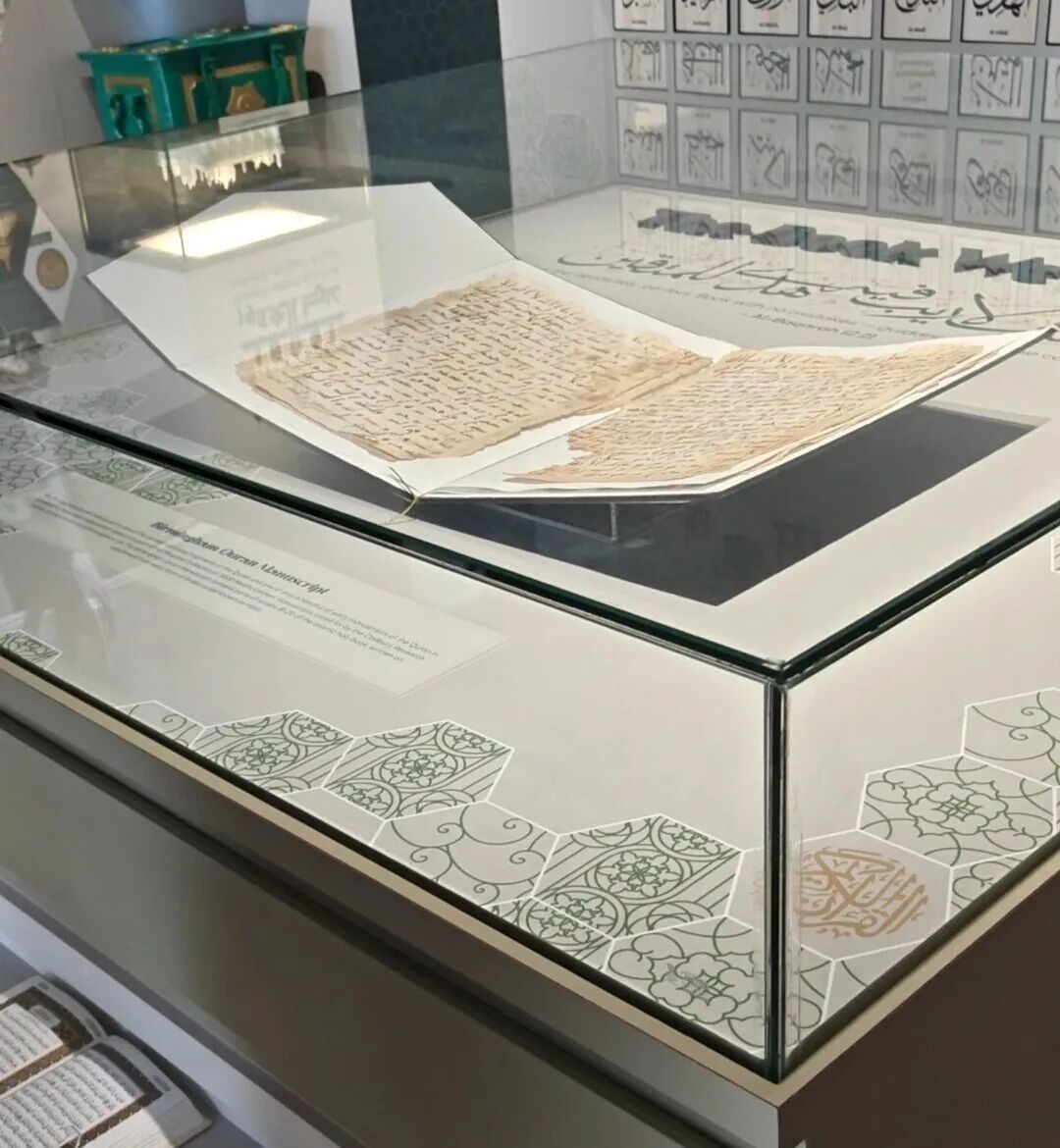
The mosque houses fragments of handwritten Quran manuscripts and a Chinese translation of the Quran by Mr. Ma Jian. On the wall, there is an interactive display of the 99 Names of Allah. The front features Arabic calligraphy of the names, and the back shows the English translation. Interested friends can search my homepage for the post about Abdul Gafoor Mosque.
4. Angullia Mosque
Angullia Mosque was built by the Angullia family, a family that has also built mosques in Malaysia, Indonesia, the Philippines, and India. They come from Gujarat, India, which is Modi's hometown. Their family is good at business, so they travel everywhere to trade. This Nagore Dargah Mosque (Anguliya Mosque) is the one they built in Singapore. The color scheme reminds people of the red sandstone often used in Indian architecture.
The prayer area inside the mosque has two floors, and the second floor is about half the length of the first. There is a small transparent dome above the mihrab that lets light in. I found a Quran translated into Bengali in the mosque. Bangladesh is also a Muslim country, where over 90 percent of the population is Muslim. Bengali uses the Bengali script. Seeing this Brahmic script used for the Quran really reminded me of the scriptures of another religion. The presence of a Bengali Quran in the mosque shows that many Bengali people come here to pray. The mosque's courtyard is very small, but they still managed to set up an exhibition area. It displays meaningful items used by the mosque in the past, such as bricks from when the old mosque was built and pots used for cooking porridge. They did not waste the mosque's outer walls either. They posted a brief introduction to the Anguliya family on the walls, along with photos of mosques their family built in South Asia, Southeast Asia, and other places. (I didn't expect to see that they even have them in the Philippines.)
5. Burhani Mosque (the only Shia mosque in Singapore)
At the Abdul Gafoor Mosque mentioned earlier, a Tamil guide told me that Singapore has a Shia mosque. I was immediately interested because I had never been to a Shia mosque in my life. I used to think you could only see Shia mosques in Iran or Iraq, so I was surprised to find one in Singapore. On second thought, it makes sense. Thailand has Shia Muslims, and since Singapore is a global crossroads, it is not strange to find them here too. There is an information board behind the mosque. It says this mosque was built by merchants from Gujarat, India. That is right, Gujarati merchants again. This side of the road shows the back of the mosque. The mosque has a very restrained design, using solid, low-saturation colors for the main structure. The large building behind the prayer hall is likely office space. Inside the mosque, there are two prayer rooms, one in the front and one in the back, separated by several doors. Push open the door and you are in the inner prayer hall. There were two elderly men inside at the time, and one of them really looked a bit like Modi. After all, they are both Gujarati, and appearance is related to geography, so it is not strange that they look a bit alike. There is a long flag on each side of the mihrab, one red and one green. Other mosques do not have these kinds of flags, so let us zoom in to see what is written on them. The content on both flags is basically the same. From top to bottom, it is written: Allah, Muhammad (the Prophet himself), Ali (the fourth Caliph), Fatimah (the Prophet's daughter and Ali's wife), Hasan (the eldest son of Ali and Fatimah), and Husayn (the second son of Ali and Fatimah). The red banner adds an exclamation word, 'Ya', before each name. There is similar content on the wall as well. Since I did not see any specific differences between how Shia and Sunni Muslims perform namaz during this visit to a Shia mosque, I decided to go to Iran to see for myself. That is how the later trip to Iran came about. Friends who are interested can check out my travel notes on Iranian mosques in my official WeChat account.
6. The prayer room (surau) at Singapore General Hospital (SGH).
After seeing so many mosques, let us now take a look at a prayer room. What is the difference between a prayer room and a mosque? The size of the space is secondary; indeed, generally speaking, a prayer room is smaller than a mosque. But some mosques are actually very small. From what I have seen, prayer rooms usually do not have permanent staff. People come here to pray in a group they organized themselves, or they pray alone and then leave. It is not like a mosque where there are permanent staff to call the adhan and lead the five daily prayers. Another difference is that prayer rooms are usually much simpler than mosques and lack necessary facilities. Mosques have toilets, a room for minor ablution (wudu), and a room for major ablution (ghusl). As for prayer rooms, some have toilets and an area for minor ablution. Some only have a few water taps. The prayer room I am going to talk about next is actually quite large, so you will see the difference between it and a mosque. First of all, it looks very plain, with no minaret and no sign on the door. To passersby, this place just looks like a small shed. When you enter the prayer room, there is actually a small courtyard inside. The courtyard has long tables and benches, as well as free tea. People who come to pray can sit on the benches to rest for a while and drink some water. You have to drink water in this Singapore weather. I usually do not drink much water, but I drink two bottles of mineral water a day since coming to Singapore. Inside the prayer room, I saw medical staff from the hospital coming to pray, and I even met a Singapore police officer here once. This prayer room is quite large, even bigger than some small mosques. There are many straw mats (liangxi) in the prayer room porch. When it gets crowded, people spread them out to use as prayer rugs. This shows that many people come here for Friday congregational prayers. The prayer schedule inside the room is electronic, but it might be broken because it is not showing the times. So now they are using this manual prayer schedule, where the times can be adjusted by hand.
7. The prayer room at Marina One
Marina One is a shopping mall in the CBD area near the Singapore waterfront. According to the map, there is a prayer room in this underground mall. I spent a long time looking for it on my first visit and even asked an Indian security guard at the nearby parking lot where the prayer room was. The security guard was very kind and pointed me in the right direction. The prayer room is on the B2 level, which is the first floor down. You can see the Singapore landmark, Marina Bay Sands, from the mall entrance. After going down, follow the path and you will see a round window. It looks like a laundry shop decorated to look like a washing machine. The prayer room is right next to this laundry shop. The prayer room is easy to find because it is marked with a dome and a star and crescent symbol. Open this door and you will see a small door on both the left and the right. Men go to the left and women to the right to pray separately. The prayer room is right through the door. The facilities for wudu (ablution) are very basic and only cover the essential parts, so you should still use a nearby restroom stall for a full wash. A prayer room is just what it sounds like: a small room where you can perform namaz. The facilities inside are simple, so there is no mihrab and no podium. There is no pulpit (minbar). However, this prayer room has an unexpectedly large number of books. The back is filled with all kinds of books, and there are even missionary materials. It is normal to see these in a mosque since tourists visit, but since only Muslims come to the prayer room, why are there missionary materials here? Once you leave the prayer room, this mall looks just like any other mall in Singapore. It mostly has restaurants, therapy centers, and supermarkets. That is all for this episode, as we only covered these few places. We will continue with the rest next time.
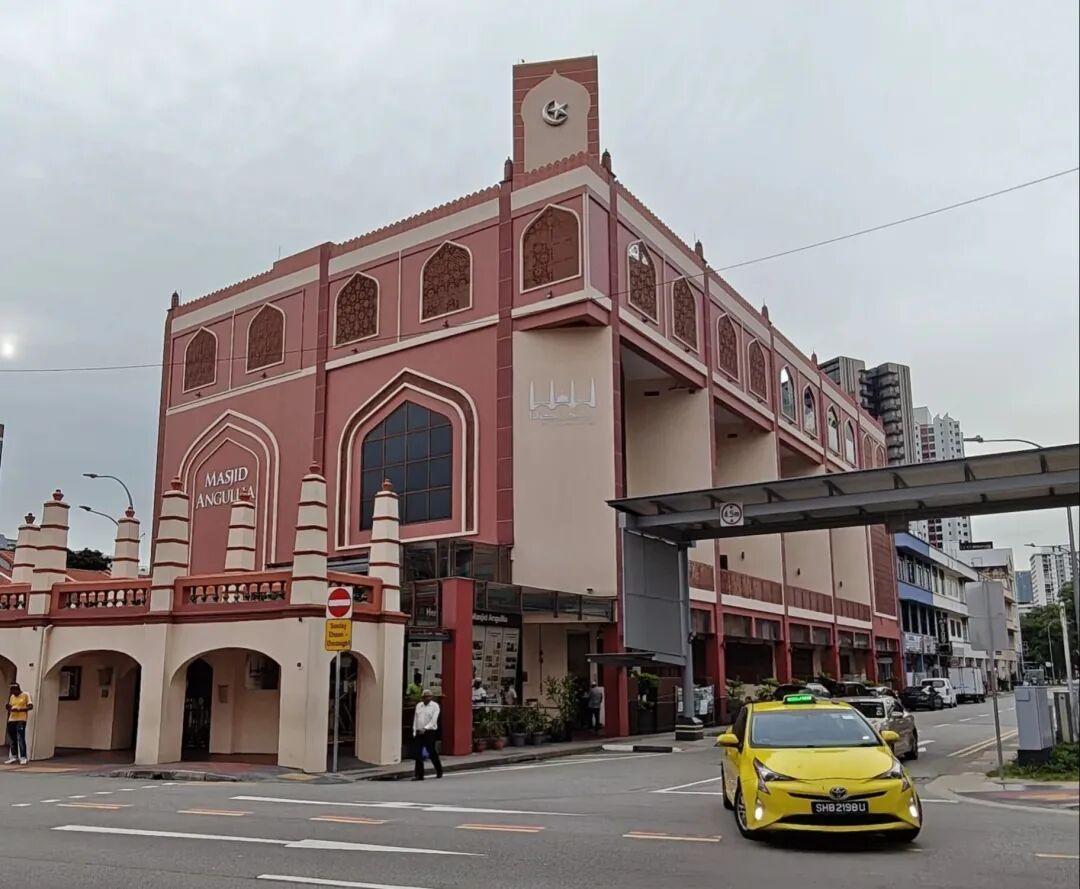
The prayer area inside the mosque has two floors, and the second floor is about half the length of the first. There is a small transparent dome above the mihrab that lets light in.
I found a Quran translated into Bengali in the mosque. Bangladesh is also a Muslim country, where over 90 percent of the population is Muslim. Bengali uses the Bengali script. Seeing this Brahmic script used for the Quran really reminded me of the scriptures of another religion. The presence of a Bengali Quran in the mosque shows that many Bengali people come here to pray. The mosque's courtyard is very small, but they still managed to set up an exhibition area. It displays meaningful items used by the mosque in the past, such as bricks from when the old mosque was built and pots used for cooking porridge. They did not waste the mosque's outer walls either. They posted a brief introduction to the Anguliya family on the walls, along with photos of mosques their family built in South Asia, Southeast Asia, and other places. (I didn't expect to see that they even have them in the Philippines.)
5. Burhani Mosque (the only Shia mosque in Singapore)
At the Abdul Gafoor Mosque mentioned earlier, a Tamil guide told me that Singapore has a Shia mosque. I was immediately interested because I had never been to a Shia mosque in my life. I used to think you could only see Shia mosques in Iran or Iraq, so I was surprised to find one in Singapore. On second thought, it makes sense. Thailand has Shia Muslims, and since Singapore is a global crossroads, it is not strange to find them here too. There is an information board behind the mosque. It says this mosque was built by merchants from Gujarat, India. That is right, Gujarati merchants again. This side of the road shows the back of the mosque. The mosque has a very restrained design, using solid, low-saturation colors for the main structure. The large building behind the prayer hall is likely office space. Inside the mosque, there are two prayer rooms, one in the front and one in the back, separated by several doors. Push open the door and you are in the inner prayer hall. There were two elderly men inside at the time, and one of them really looked a bit like Modi. After all, they are both Gujarati, and appearance is related to geography, so it is not strange that they look a bit alike. There is a long flag on each side of the mihrab, one red and one green. Other mosques do not have these kinds of flags, so let us zoom in to see what is written on them. The content on both flags is basically the same. From top to bottom, it is written: Allah, Muhammad (the Prophet himself), Ali (the fourth Caliph), Fatimah (the Prophet's daughter and Ali's wife), Hasan (the eldest son of Ali and Fatimah), and Husayn (the second son of Ali and Fatimah). The red banner adds an exclamation word, 'Ya', before each name. There is similar content on the wall as well. Since I did not see any specific differences between how Shia and Sunni Muslims perform namaz during this visit to a Shia mosque, I decided to go to Iran to see for myself. That is how the later trip to Iran came about. Friends who are interested can check out my travel notes on Iranian mosques in my official WeChat account.
6. The prayer room (surau) at Singapore General Hospital (SGH).
After seeing so many mosques, let us now take a look at a prayer room. What is the difference between a prayer room and a mosque? The size of the space is secondary; indeed, generally speaking, a prayer room is smaller than a mosque. But some mosques are actually very small. From what I have seen, prayer rooms usually do not have permanent staff. People come here to pray in a group they organized themselves, or they pray alone and then leave. It is not like a mosque where there are permanent staff to call the adhan and lead the five daily prayers. Another difference is that prayer rooms are usually much simpler than mosques and lack necessary facilities. Mosques have toilets, a room for minor ablution (wudu), and a room for major ablution (ghusl). As for prayer rooms, some have toilets and an area for minor ablution. Some only have a few water taps. The prayer room I am going to talk about next is actually quite large, so you will see the difference between it and a mosque. First of all, it looks very plain, with no minaret and no sign on the door. To passersby, this place just looks like a small shed. When you enter the prayer room, there is actually a small courtyard inside. The courtyard has long tables and benches, as well as free tea. People who come to pray can sit on the benches to rest for a while and drink some water. You have to drink water in this Singapore weather. I usually do not drink much water, but I drink two bottles of mineral water a day since coming to Singapore. Inside the prayer room, I saw medical staff from the hospital coming to pray, and I even met a Singapore police officer here once. This prayer room is quite large, even bigger than some small mosques. There are many straw mats (liangxi) in the prayer room porch. When it gets crowded, people spread them out to use as prayer rugs. This shows that many people come here for Friday congregational prayers. The prayer schedule inside the room is electronic, but it might be broken because it is not showing the times. So now they are using this manual prayer schedule, where the times can be adjusted by hand.
7. The prayer room at Marina One
Marina One is a shopping mall in the CBD area near the Singapore waterfront. According to the map, there is a prayer room in this underground mall. I spent a long time looking for it on my first visit and even asked an Indian security guard at the nearby parking lot where the prayer room was. The security guard was very kind and pointed me in the right direction. The prayer room is on the B2 level, which is the first floor down. You can see the Singapore landmark, Marina Bay Sands, from the mall entrance. After going down, follow the path and you will see a round window. It looks like a laundry shop decorated to look like a washing machine. The prayer room is right next to this laundry shop. The prayer room is easy to find because it is marked with a dome and a star and crescent symbol. Open this door and you will see a small door on both the left and the right. Men go to the left and women to the right to pray separately. The prayer room is right through the door. The facilities for wudu (ablution) are very basic and only cover the essential parts, so you should still use a nearby restroom stall for a full wash. A prayer room is just what it sounds like: a small room where you can perform namaz. The facilities inside are simple, so there is no mihrab and no podium. There is no pulpit (minbar). However, this prayer room has an unexpectedly large number of books. The back is filled with all kinds of books, and there are even missionary materials. It is normal to see these in a mosque since tourists visit, but since only Muslims come to the prayer room, why are there missionary materials here? Once you leave the prayer room, this mall is no different from any other mall in Singapore. It mainly has restaurants, therapy centers, supermarkets, and similar shops. That is all for this episode, as we only covered these few places. We will continue with the rest next time.
The mosque's courtyard is very small, but they still managed to set up an exhibition area. It displays meaningful items used by the mosque in the past, such as bricks from when the old mosque was built and pots used for cooking porridge. They did not waste the mosque's outer walls either. They posted a brief introduction to the Anguliya family on the walls, along with photos of mosques their family built in South Asia, Southeast Asia, and other places. (I didn't expect to see that they even have them in the Philippines.)
5. Burhani Mosque (the only Shia mosque in Singapore)
At the Abdul Gafoor Mosque mentioned earlier, a Tamil guide told me that Singapore has a Shia mosque. I was immediately interested because I had never been to a Shia mosque in my life. I used to think you could only see Shia mosques in Iran or Iraq, so I was surprised to find one in Singapore. On second thought, it makes sense. Thailand has Shia Muslims, and since Singapore is a global crossroads, it is not strange to find them here too. There is an information board behind the mosque. It says this mosque was built by merchants from Gujarat, India. That is right, Gujarati merchants again. This side of the road shows the back of the mosque. The mosque has a very restrained design, using solid, low-saturation colors for the main structure. The large building behind the prayer hall is likely office space. Inside the mosque, there are two prayer rooms, one in the front and one in the back, separated by several doors. Push open the door and you are in the inner prayer hall. There were two elderly men inside at the time, and one of them really looked a bit like Modi. After all, they are both Gujarati, and appearance is related to geography, so it is not strange that they look a bit alike. There is a long flag on each side of the mihrab, one red and one green. Other mosques do not have these kinds of flags, so let us zoom in to see what is written on them. The content on both flags is basically the same. From top to bottom, it is written: Allah, Muhammad (the Prophet himself), Ali (the fourth Caliph), Fatimah (the Prophet's daughter and Ali's wife), Hasan (the eldest son of Ali and Fatimah), and Husayn (the second son of Ali and Fatimah). The red banner adds an exclamation word, 'Ya', before each name. There is similar content on the wall as well. Since I did not see any specific differences between how Shia and Sunni Muslims perform namaz during this visit to a Shia mosque, I decided to go to Iran to see for myself. That is how the later trip to Iran came about. Friends who are interested can check out my travel notes on Iranian mosques in my official WeChat account.
6. The prayer room (surau) at Singapore General Hospital (SGH).
After seeing so many mosques, let us now take a look at a prayer room. What is the difference between a prayer room and a mosque? The size of the space is secondary; indeed, generally speaking, a prayer room is smaller than a mosque. But some mosques are actually very small. From what I have seen, prayer rooms usually do not have permanent staff. People come here to pray in a group they organized themselves, or they pray alone and then leave. It is not like a mosque where there are permanent staff to call the adhan and lead the five daily prayers. Another difference is that prayer rooms are usually much simpler than mosques and lack necessary facilities. Mosques have toilets, a room for minor ablution (wudu), and a room for major ablution (ghusl). As for prayer rooms, some have toilets and an area for minor ablution. Some only have a few water taps. The prayer room I am going to talk about next is actually quite large, so you will see the difference between it and a mosque. First of all, it looks very plain, with no minaret and no sign on the door. To passersby, this place just looks like a small shed. When you enter the prayer room, there is actually a small courtyard inside. The courtyard has long tables and benches, as well as free tea. People who come to pray can sit on the benches to rest for a while and drink some water. You have to drink water in this Singapore weather. I usually do not drink much water, but I drink two bottles of mineral water a day since coming to Singapore. Inside the prayer room, I saw medical staff from the hospital coming to pray, and I even met a Singapore police officer here once. This prayer room is quite large, even bigger than some small mosques. There are many straw mats (liangxi) in the prayer room porch. When it gets crowded, people spread them out to use as prayer rugs. This shows that many people come here for Friday congregational prayers. The prayer schedule inside the room is electronic, but it might be broken because it is not showing the times. So now they are using this manual prayer schedule, where the times can be adjusted by hand.
7. The prayer room at Marina One
Marina One is a shopping mall in the CBD area near the Singapore waterfront. According to the map, there is a prayer room in this underground mall. I spent a long time looking for it on my first visit and even asked an Indian security guard at the nearby parking lot where the prayer room was. The security guard was very kind and pointed me in the right direction. The prayer room is on the B2 level, which is the first floor down. You can see the Singapore landmark, Marina Bay Sands, from the mall entrance. After going down, follow the path and you will see a round window. It looks like a laundry shop decorated to look like a washing machine. The prayer room is right next to this laundry shop. The prayer room is easy to find because it is marked with a dome and a star and crescent symbol. Open this door and you will see a small door on both the left and the right. Men go to the left and women to the right to pray separately. The prayer room is right through the door. The facilities for wudu (ablution) are very basic and only cover the essential parts, so you should still use a nearby restroom stall for a full wash. A prayer room is just what it sounds like: a small room where you can perform namaz. The facilities inside are simple, so there is no mihrab and no podium. There is no pulpit (minbar). However, this prayer room has an unexpectedly large number of books. The back is filled with all kinds of books, and there are even missionary materials. It is normal to see these in a mosque since tourists visit, but since only Muslims come to the prayer room, why are there missionary materials here? Once you leave the prayer room, this mall is no different from any other mall in Singapore. It mainly has restaurants, therapy centers, supermarkets, and similar shops. That is all for this episode, as we only covered these few places. We will continue with the rest next time.
(I didn't expect to see that they even have them in the Philippines.)
5. Burhani Mosque (the only Shia mosque in Singapore)
At the Abdul Gafoor Mosque mentioned earlier, a Tamil guide told me that Singapore has a Shia mosque. I was immediately interested because I had never been to a Shia mosque in my life. I used to think you could only see Shia mosques in Iran or Iraq, so I was surprised to find one in Singapore. On second thought, it makes sense. Thailand has Shia Muslims, and since Singapore is a global crossroads, it is not strange to find them here too.
There is an information board behind the mosque. It says this mosque was built by merchants from Gujarat, India. That is right, Gujarati merchants again.
This side of the road shows the back of the mosque. The mosque has a very restrained design, using solid, low-saturation colors for the main structure. The large building behind the prayer hall is likely office space. Inside the mosque, there are two prayer rooms, one in the front and one in the back, separated by several doors. Push open the door and you are in the inner prayer hall. There were two elderly men inside at the time, and one of them really looked a bit like Modi. After all, they are both Gujarati, and appearance is related to geography, so it is not strange that they look a bit alike. There is a long flag on each side of the mihrab, one red and one green. Other mosques do not have these kinds of flags, so let us zoom in to see what is written on them. The content on both flags is basically the same. From top to bottom, it is written: Allah, Muhammad (the Prophet himself), Ali (the fourth Caliph), Fatimah (the Prophet's daughter and Ali's wife), Hasan (the eldest son of Ali and Fatimah), and Husayn (the second son of Ali and Fatimah). The red banner adds an exclamation word, 'Ya', before each name. There is similar content on the wall as well. Since I did not see any specific differences between how Shia and Sunni Muslims perform namaz during this visit to a Shia mosque, I decided to go to Iran to see for myself. That is how the later trip to Iran came about. Friends who are interested can check out my travel notes on Iranian mosques in my official WeChat account.
6. The prayer room (surau) at Singapore General Hospital (SGH).
After seeing so many mosques, let us now take a look at a prayer room. What is the difference between a prayer room and a mosque? The size of the space is secondary; indeed, generally speaking, a prayer room is smaller than a mosque. But some mosques are actually very small. From what I have seen, prayer rooms usually do not have permanent staff. People come here to pray in a group they organized themselves, or they pray alone and then leave. It is not like a mosque where there are permanent staff to call the adhan and lead the five daily prayers. Another difference is that prayer rooms are usually much simpler than mosques and lack necessary facilities. Mosques have toilets, a room for minor ablution (wudu), and a room for major ablution (ghusl). As for prayer rooms, some have toilets and an area for minor ablution. Some only have a few water taps. The prayer room I am going to talk about next is actually quite large, so you will see the difference between it and a mosque. First of all, it looks very plain, with no minaret and no sign on the door. To passersby, this place just looks like a small shed. When you enter the prayer room, there is actually a small courtyard inside. The courtyard has long tables and benches, as well as free tea. People who come to pray can sit on the benches to rest for a while and drink some water. You have to drink water in this Singapore weather. I usually do not drink much water, but I drink two bottles of mineral water a day since coming to Singapore. Inside the prayer room, I saw medical staff from the hospital coming to pray, and I even met a Singapore police officer here once. This prayer room is quite large, even bigger than some small mosques. There are many straw mats (liangxi) in the prayer room porch. When it gets crowded, people spread them out to use as prayer rugs. This shows that many people come here for Friday congregational prayers. The prayer schedule inside the room is electronic, but it might be broken because it is not showing the times. So now they are using this manual prayer schedule, where the times can be adjusted by hand.
7. The prayer room at Marina One
Marina One is a shopping mall in the CBD area near the Singapore waterfront. According to the map, there is a prayer room in this underground mall. I spent a long time looking for it on my first visit and even asked an Indian security guard at the nearby parking lot where the prayer room was. The security guard was very kind and pointed me in the right direction. The prayer room is on the B2 level, which is the first floor down. You can see the Singapore landmark, Marina Bay Sands, from the mall entrance. After going down, follow the path and you will see a round window. It looks like a laundry shop decorated to look like a washing machine. The prayer room is right next to this laundry shop. The prayer room is easy to find because it is marked with a dome and a star and crescent symbol. Open this door and you will see a small door on both the left and the right. Men go to the left and women to the right to pray separately. The prayer room is right th
Summary: This Singapore Muslim travel guide is a full route through the city's mosques and hidden prayer rooms. It keeps the original table of contents, site-by-site order, mosque names, prayer-room details, and Muslim visitor notes.
Table of Contents:
1. Sultan Mosque
2. Malabar Mosque
3. Al-Abrar Mosque
4. Angullia Mosque
5. Burhani Mosque, the only Shia mosque in Singapore (Masjid Al Burhani)
6. Prayer room at Singapore General Hospital
7. Prayer room at Marina One shopping mall
(Content below to be updated)
8. Jamae Mosque, which features minarets in a South Indian style.
9. The South Indian gongbei of Singapore, Nagore Dargah.
10. Al-Abrar Mosque.
11. Underground Mosque.
12. Omar Kampong Melaka Mosque, the oldest mosque in Singapore.
13. Al-Amin Mosque.
14. Temenggong Mosque.
15. Sentosa prayer room.
16. Singapore Islamic Centre Mosque.
17. Islamic Religious Council of Singapore.
18. Tomb of Habib Nuh (Habib Nuh Lingmu)
19. Haji Muhammad Salleh Mosque
20. Hajjah Fatimah Mosque
21. Changi Airport Prayer Room
1. Sultan Mosque
I took a taxi from Changi Airport, and the driver was an elderly Chinese gentleman. We mostly spoke in English. He could speak Mandarin, but he kept switching back to English out of habit. After getting off at Bugis, I realized it was very close to Arab Street, less than a five-minute walk away. It was December, and the street wasn't as hot as I had imagined. The buildings along the street looked very clean, and they often had one or two floors in the middle left open for planting trees.
There is a large mosque on Arab Street, which is likely the most famous mosque in Singapore. Many people visiting Singapore make sure to stop by this mosque. This mosque is called Sultan Mosque. The main prayer hall has two golden domes that look very bold and eye-catching.
What you see from this side of the road is actually the mihrab area of the mosque; you have to enter through the small alley on the side to reach the main entrance. There are many halal restaurants and souvenir shops in that alley, showing that there are a lot of tourists here. Following this path leads you to the front gate of the mosque. There is a special tourist route starting from the front gate that lets you enter the main prayer hall for a visit.
The space inside the mosque is very large. The ceiling of the main prayer hall is very high. It was likely built this way to help with heat dissipation since keeping the room warm is not a concern.
The second floor seems to be the women's prayer area, so I did not go up there.
Let me show you the mosque's mihrab niche and minbar pulpit. They are crafted beautifully with both calligraphy and floral patterns, giving them a strong Southeast Asian feel. If you want to see more details, you can check out the post I shared previously about the Sultan Mosque. This mosque is one of the older ones in Singapore. It started as a simple place of worship built by the Sultan of Johor in 1824 for local Muslims, and it was later expanded to its current size. The current building uses Indo-Saracenic style, which you can also see in India and Kuala Lumpur, Malaysia. I will share more related content with you in the future.
2. Malabar Mosque
This mosque is very close to the Sultan Mosque, just a few steps away. It is right by the side of the road and very easy to spot, so you will definitely see it when you pass by. Founded in 1963, Malabar Mosque is a mosque for the Malabar Muslim community, though Muslims from other backgrounds are of course welcome to pray there too. There is an information board near the entrance that explains the history of the mosque and shows old photos taken in 1960. Looking at the old photos, the Malabar Mosque did not have its blue tiles back then. The word Malabar comes from a Muslim community in the Kerala state of southern India. Many people know there are many Muslims in northern India, but there are actually many in southern India as well. Muslims in Kerala existed even before the establishment of northern Indian Muslim regimes like the Delhi Sultanate, which later became the Mughal Empire. On the outer wall of the mosque, you can see a commemorative plaque with gold-rimmed tiles stating that this is a mosque for the Malabar Muslim community, officially opened by Yusof bin Ishak. This Yusof was the first president of Singapore, and his portrait is the one printed on Singaporean banknotes today. Let us take a look inside the mosque. This mosque is much smaller than the Sultan Mosque we just visited, and the interior is much simpler. However, the basic layout of the prayer hall is similar, and there is also a women's prayer area upstairs. Judging by their features and skin tone, most people coming here to pray look like they are of South Asian descent.
3. Al-Abrar Mosque
Abdul Gafoor Mosque is located in the Little India neighborhood of Singapore. Many Indian people live in this area, which has a South Indian-style Hindu mosque as well as other religious buildings, such as this mosque. Of course, the local term for it is mosque (huijiaotang). This mosque is colored white and green, and you can see a sun design wrapping around a star and crescent in the center of the main gate lintel. The sun has 25 rays, and if you look closely, each ray is actually the name of a prophet. There are 25 prophets mentioned in the Quran, including Adam (Adan), Noah (Nuh), Abraham (Ibrahim), Moses (Musa), Jesus (Isa), and Muhammad. The prayer hall is not large, but it is very delicate, and the pillars are shaped like matcha-flavored twisted dough sticks (mahua). Also, the central courtyard allows light to reach the basement. There is a prayer area underground as well. Take a look, the pillars in the basement also have this twisted dough stick shape.
Let me show you the mosque's mihrab niche and minbar pulpit. It is beautifully made, featuring not just calligraphy but also floral patterns, giving it a real Southeast Asian feel. If you want to see more details, check out my previous post about the Sultan Mosque. This mosque is one of the older ones in Singapore. The Sultan of Johor first built a simple place of worship here in 1824 for local Muslims to use, and it was later expanded to its current size. The current building uses Indo-Saracenic style. You can see similar mosques in India and in Kuala Lumpur, Malaysia. I will share more updates with you later.
2. Malabar Mosque
This mosque is very close to the Sultan Mosque. It is just a few steps away and sits right by the road, so it is very easy to spot. I am sure you will see it if you pass by. The Malabar Mosque was established in 1963. It is a mosque for the Malabar Muslim community, but Muslims from other ethnic groups are of course welcome to pray there too. There is an information board near the entrance where you can learn about the history of the mosque. You can also see a photo taken in 1960, which shows that the Malabar Mosque did not have its blue tiles back then. The word Malabar comes from a Muslim ethnic group in the state of Kerala in southern India. Many people know that there are many Muslims in North India, but there are actually many in South India as well. The Muslims of Kerala existed even before North Indian Muslim regimes like the Delhi Sultanate (and later the Mughal Empire) were established. On the outer wall of the mosque, you can still see a commemorative plaque edged with gold tiles. It states that this is a mosque for the Malabar Muslim community, officially opened by Yusof bin Ishak. This Yusof was Singapore's first president, and he is the person featured on current Singaporean banknotes. Let's look inside the mosque. It is much smaller than the Sultan Mosque we just visited, and the interior is quite a bit simpler. However, the basic layout of the prayer hall is similar, with the upstairs area also reserved for women. Judging by their features and skin tone, most of the people coming to this mosque for namaz appear to be from South Asia.
3. Al-Abrar Mosque
Abdul Gafoor Mosque is in Singapore's Little India neighborhood. Many Indian people live in this area, which is home to a South Indian-style Hindu mosque as well as buildings for other religions, such as this mosque. Of course, the local term used here is mosque (huijiaotang). The mosque is painted in white and green, and in the center of the main gate's lintel, you can see a sun design surrounding a star and crescent. The sun has 25 rays. If you look closely, each ray represents the name of a prophet. There are 25 prophets mentioned in the Quran, including Adam (Adan), Noah (Nuha), Abraham (Ibrahim), Moses (Musa), Jesus (Isa), and Muhammad. The prayer hall is small but very delicate, and the pillars look just like matcha-flavored twisted dough sticks (mahua). The central courtyard also lets light shine down into the basement. There is a prayer area underground as well. Notice that the basement pillars also have this twisted rope design.
If you want to see more details, check out my previous post about the Sultan Mosque. This mosque is one of the older ones in Singapore. The Sultan of Johor first built a simple place of worship here in 1824 for local Muslims to use, and it was later expanded to its current size. The current building uses Indo-Saracenic style. You can see similar mosques in India and in Kuala Lumpur, Malaysia. I will share more updates with you later.
2. Malabar Mosque
This mosque is very close to the Sultan Mosque. It is just a few steps away and sits right by the road, so it is very easy to spot. I am sure you will see it if you pass by. The Malabar Mosque was established in 1963. It is a mosque for the Malabar Muslim community, but Muslims from other ethnic groups are of course welcome to pray there too. There is an information board near the entrance where you can learn about the history of the mosque. You can also see a photo taken in 1960, which shows that the Malabar Mosque did not have its blue tiles back then. The word Malabar comes from a Muslim ethnic group in the state of Kerala in southern India. Many people know that there are many Muslims in North India, but there are actually many in South India as well. The Muslims of Kerala existed even before North Indian Muslim regimes like the Delhi Sultanate (and later the Mughal Empire) were established. On the outer wall of the mosque, you can still see a commemorative plaque edged with gold tiles. It states that this is a mosque for the Malabar Muslim community, officially opened by Yusof bin Ishak. This Yusof was Singapore's first president, and he is the person featured on current Singaporean banknotes. Let's look inside the mosque. It is much smaller than the Sultan Mosque we just visited, and the interior is quite a bit simpler. However, the basic layout of the prayer hall is similar, with the upstairs area also reserved for women. Judging by their features and skin tone, most of the people coming to this mosque for namaz appear to be from South Asia.
3. Al-Abrar Mosque
Abdul Gafoor Mosque is in Singapore's Little India neighborhood. Many Indian people live in this area, which is home to a South Indian-style Hindu mosque as well as buildings for other religions, such as this mosque. Of course, the local term used here is mosque (huijiaotang). The mosque is painted in white and green, and in the center of the main gate's lintel, you can see a sun design surrounding a star and crescent. The sun has 25 rays. If you look closely, each ray represents the name of a prophet. There are 25 prophets mentioned in the Quran, including Adam (Adan), Noah (Nuha), Abraham (Ibrahim), Moses (Musa), Jesus (Isa), and Muhammad. The prayer hall is small but very delicate, and the pillars look just like matcha-flavored twisted dough sticks (mahua). The central courtyard also lets light shine down into the basement. There is a prayer area underground as well. Notice that the basement pillars also have this twisted rope design.
There is an information board near the entrance where you can learn about the history of the mosque. You can also see a photo taken in 1960, which shows that the Malabar Mosque did not have its blue tiles back then. The word Malabar comes from a Muslim ethnic group in the state of Kerala in southern India. Many people know that there are many Muslims in North India, but there are actually many in South India as well. The Muslims of Kerala existed even before North Indian Muslim regimes like the Delhi Sultanate (and later the Mughal Empire) were established. On the outer wall of the mosque, you can still see a commemorative plaque edged with gold tiles. It states that this is a mosque for the Malabar Muslim community, officially opened by Yusof bin Ishak. This Yusof was Singapore's first president, and he is the person featured on current Singaporean banknotes. Let's look inside the mosque. It is much smaller than the Sultan Mosque we just visited, and the interior is quite a bit simpler. However, the basic layout of the prayer hall is similar, with the upstairs area also reserved for women. Judging by their features and skin tone, most of the people coming to this mosque for namaz appear to be from South Asia.
3. Al-Abrar Mosque
Abdul Gafoor Mosque is in Singapore's Little India neighborhood. Many Indian people live in this area, which is home to a South Indian-style Hindu mosque as well as buildings for other religions, such as this mosque. Of course, the local term used here is mosque (huijiaotang). The mosque is painted in white and green, and in the center of the main gate's lintel, you can see a sun design surrounding a star and crescent. The sun has 25 rays. If you look closely, each ray represents the name of a prophet. There are 25 prophets mentioned in the Quran, including Adam (Adan), Noah (Nuha), Abraham (Ibrahim), Moses (Musa), Jesus (Isa), and Muhammad. The prayer hall is small but very delicate, and the pillars look just like matcha-flavored twisted dough sticks (mahua). The central courtyard also lets light shine down into the basement. There is a prayer area underground as well. Notice that the basement pillars also have this twisted rope design.
On the outer wall of the mosque, you can still see a commemorative plaque edged with gold tiles. It states that this is a mosque for the Malabar Muslim community, officially opened by Yusof bin Ishak. This Yusof was Singapore's first president, and he is the person featured on current Singaporean banknotes.
Let's look inside the mosque. It is much smaller than the Sultan Mosque we just visited, and the interior is quite a bit simpler. However, the basic layout of the prayer hall is similar, with the upstairs area also reserved for women. Judging by their features and skin tone, most of the people coming to this mosque for namaz appear to be from South Asia.
3. Al-Abrar Mosque
Abdul Gafoor Mosque is in Singapore's Little India neighborhood. Many Indian people live in this area, which is home to a South Indian-style Hindu mosque as well as buildings for other religions, such as this mosque. Of course, the local term used here is mosque (huijiaotang). The mosque is painted in white and green, and in the center of the main gate's lintel, you can see a sun design surrounding a star and crescent. The sun has 25 rays. If you look closely, each ray represents the name of a prophet. There are 25 prophets mentioned in the Quran, including Adam (Adan), Noah (Nuha), Abraham (Ibrahim), Moses (Musa), Jesus (Isa), and Muhammad. The prayer hall is small but very delicate, and the pillars look just like matcha-flavored twisted dough sticks (mahua). The central courtyard also lets light shine down into the basement. There is a prayer area underground as well. Notice that the basement pillars also have this twisted rope design.
Let's look inside the mosque. It is much smaller than the Sultan Mosque we just visited, and the interior is quite a bit simpler. However, the basic layout of the prayer hall is similar, with the upstairs area also reserved for women. Judging by their features and skin tone, most of the people coming to this mosque for namaz appear to be from South Asia.
3. Al-Abrar Mosque
Abdul Gafoor Mosque is in Singapore's Little India neighborhood. Many Indian people live in this area, which is home to a South Indian-style Hindu mosque as well as buildings for other religions, such as this mosque. Of course, the local term used here is mosque (huijiaotang). The mosque is painted in white and green, and in the center of the main gate's lintel, you can see a sun design surrounding a star and crescent. The sun has 25 rays. If you look closely, each ray represents the name of a prophet. There are 25 prophets mentioned in the Quran, including Adam (Adan), Noah (Nuha), Abraham (Ibrahim), Moses (Musa), Jesus (Isa), and Muhammad. The prayer hall is small but very delicate, and the pillars look just like matcha-flavored twisted dough sticks (mahua). The central courtyard also lets light shine down into the basement. There is a prayer area underground as well. Notice that the basement pillars also have this twisted rope design.
3. Al-Abrar Mosque
Abdul Gafoor Mosque is in Singapore's Little India neighborhood. Many Indian people live in this area, which is home to a South Indian-style Hindu mosque as well as buildings for other religions, such as this mosque. Of course, the local term used here is mosque (huijiaotang).
The mosque is painted in white and green, and in the center of the main gate's lintel, you can see a sun design surrounding a star and crescent. The sun has 25 rays. If you look closely, each ray represents the name of a prophet. There are 25 prophets mentioned in the Quran, including Adam (Adan), Noah (Nuha), Abraham (Ibrahim), Moses (Musa), Jesus (Isa), and Muhammad. The prayer hall is small but very delicate, and the pillars look just like matcha-flavored twisted dough sticks (mahua). The central courtyard also lets light shine down into the basement. There is a prayer area underground as well. Notice that the basement pillars also have this twisted rope design.
The mosque is painted in white and green, and in the center of the main gate's lintel, you can see a sun design surrounding a star and crescent. The sun has 25 rays. If you look closely, each ray represents the name of a prophet. There are 25 prophets mentioned in the Quran, including Adam (Adan), Noah (Nuha), Abraham (Ibrahim), Moses (Musa), Jesus (Isa), and Muhammad.
The prayer hall is small but very delicate, and the pillars look just like matcha-flavored twisted dough sticks (mahua). The central courtyard also lets light shine down into the basement. There is a prayer area underground as well. Notice that the basement pillars also have this twisted rope design.
The prayer hall is small but very delicate, and the pillars look just like matcha-flavored twisted dough sticks (mahua). The central courtyard also lets light shine down into the basement. There is a prayer area underground as well. Notice that the basement pillars also have this twisted rope design.
Beyond its unique architecture, a highlight of this mosque is that it was founded by an Indian. Inside the mosque, you will find Arabic, the universal language of Islam, English for tourists, and also Tamil. This is a South Indian language, primarily spoken in the state of Tamil Nadu in southern India. The Singapore MRT also uses this language for announcements, usually as the final language played. The picture below shows the prayer times in Tamil displayed on a screen inside the prayer hall. The surprises at this small mosque do not end there; it even has a small museum. The guide is an older Tamil Indian man who works at the mosque. He speaks Tamil, a language with a very fast speaking pace. Because of this, he also speaks English at a very high speed. The mosque houses fragments of handwritten Quran manuscripts and a Chinese translation of the Quran by Mr. Ma Jian. On the wall, there is an interactive display of the 99 Names of Allah. The front features Arabic calligraphy of the names, and the back shows the English translation. Interested friends can search my homepage for the post about Abdul Gafoor Mosque.
4. Angullia Mosque
Angullia Mosque was built by the Angullia family, a family that has also built mosques in Malaysia, Indonesia, the Philippines, and India. They come from Gujarat, India, which is Modi's hometown. Their family is good at business, so they travel everywhere to trade. This Nagore Dargah Mosque (Anguliya Mosque) is the one they built in Singapore. The color scheme reminds people of the red sandstone often used in Indian architecture. The prayer area inside the mosque has two floors, and the second floor is about half the length of the first. There is a small transparent dome above the mihrab that lets light in. I found a Quran translated into Bengali in the mosque. Bangladesh is also a Muslim country, where over 90 percent of the population is Muslim. Bengali uses the Bengali script. Seeing this Brahmic script used for the Quran really reminded me of the scriptures of another religion. The presence of a Bengali Quran in the mosque shows that many Bengali people come here to pray. The mosque's courtyard is very small, but they still managed to set up an exhibition area. It displays meaningful items used by the mosque in the past, such as bricks from when the old mosque was built and pots used for cooking porridge. They did not waste the mosque's outer walls either. They posted a brief introduction to the Anguliya family on the walls, along with photos of mosques their family built in South Asia, Southeast Asia, and other places. (I didn't expect to see that they even have them in the Philippines.)
5. Burhani Mosque (the only Shia mosque in Singapore)
At the Abdul Gafoor Mosque mentioned earlier, a Tamil guide told me that Singapore has a Shia mosque. I was immediately interested because I had never been to a Shia mosque in my life. I used to think you could only see Shia mosques in Iran or Iraq, so I was surprised to find one in Singapore. On second thought, it makes sense. Thailand has Shia Muslims, and since Singapore is a global crossroads, it is not strange to find them here too. There is an information board behind the mosque. It says this mosque was built by merchants from Gujarat, India. That is right, Gujarati merchants again. This side of the road shows the back of the mosque. The mosque has a very restrained design, using solid, low-saturation colors for the main structure. The large building behind the prayer hall is likely office space. Inside the mosque, there are two prayer rooms, one in the front and one in the back, separated by several doors. Push open the door and you are in the inner prayer hall. There were two elderly men inside at the time, and one of them really looked a bit like Modi. After all, they are both Gujarati, and appearance is related to geography, so it is not strange that they look a bit alike. There is a long flag on each side of the mihrab, one red and one green. Other mosques do not have these kinds of flags, so let us zoom in to see what is written on them. The content on both flags is basically the same. From top to bottom, it is written: Allah, Muhammad (the Prophet himself), Ali (the fourth Caliph), Fatimah (the Prophet's daughter and Ali's wife), Hasan (the eldest son of Ali and Fatimah), and Husayn (the second son of Ali and Fatimah). The red banner adds an exclamation word, 'Ya', before each name. There is similar content on the wall as well. Since I did not see any specific differences between how Shia and Sunni Muslims perform namaz during this visit to a Shia mosque, I decided to go to Iran to see for myself. That is how the later trip to Iran came about. Friends who are interested can check out my travel notes on Iranian mosques in my official WeChat account.
6. The prayer room (surau) at Singapore General Hospital (SGH).
After seeing so many mosques, let us now take a look at a prayer room. What is the difference between a prayer room and a mosque? The size of the space is secondary; indeed, generally speaking, a prayer room is smaller than a mosque. But some mosques are actually very small. From what I have seen, prayer rooms usually do not have permanent staff. People come here to pray in a group they organized themselves, or they pray alone and then leave. It is not like a mosque where there are permanent staff to call the adhan and lead the five daily prayers. Another difference is that prayer rooms are usually much simpler than mosques and lack necessary facilities. Mosques have toilets, a room for minor ablution (wudu), and a room for major ablution (ghusl). As for prayer rooms, some have toilets and an area for minor ablution. Some only have a few water taps. The prayer room I am going to talk about next is actually quite large, so you will see the difference between it and a mosque. First of all, it looks very plain, with no minaret and no sign on the door. To passersby, this place just looks like a small shed. When you enter the prayer room, there is actually a small courtyard inside. The courtyard has long tables and benches, as well as free tea. People who come to pray can sit on the benches to rest for a while and drink some water. You have to drink water in this Singapore weather. I usually do not drink much water, but I drink two bottles of mineral water a day since coming to Singapore. Inside the prayer room, I saw medical staff from the hospital coming to pray, and I even met a Singapore police officer here once. This prayer room is quite large, even bigger than some small mosques. There are many straw mats (liangxi) in the prayer room porch. When it gets crowded, people spread them out to use as prayer rugs. This shows that many people come here for Friday congregational prayers. The prayer schedule inside the room is electronic, but it might be broken because it is not showing the times. So now they are using this manual prayer schedule, where the times can be adjusted by hand.
7. The prayer room at Marina One
Marina One is a shopping mall in the CBD area near the Singapore waterfront. According to the map, there is a prayer room in this underground mall. I spent a long time looking for it on my first visit and even asked an Indian security guard at the nearby parking lot where the prayer room was. The security guard was very kind and pointed me in the right direction. The prayer room is on the B2 level, which is the first floor down. You can see the Singapore landmark, Marina Bay Sands, from the mall entrance. After going down, follow the path and you will see a round window. It looks like a laundry shop decorated to look like a washing machine. The prayer room is right next to this laundry shop. The prayer room is easy to find because it is marked with a dome and a star and crescent symbol. Open this door and you will see a small door on both the left and the right. Men go to the left and women to the right to pray separately. The prayer room is right through the door. The facilities for wudu (ablution) are very basic and only cover the essential parts, so you should still use a nearby restroom stall for a full wash. A prayer room is just what it sounds like: a small room where you can perform namaz. The facilities inside are simple, so there is no mihrab and no podium. There is no minbar chair. However, this prayer room has an unexpectedly large number of books. The back is filled with all kinds of books, and there are even missionary materials. It is normal to see these in a mosque since tourists visit, but since only Muslims come to the prayer room, why are there missionary materials here? Once you leave the prayer room, this mall is no different from any other mall in Singapore. It mainly has restaurants, therapy centers, supermarkets, and similar shops. That is all for this episode, as we only covered these few places. We will continue with the rest next time.
The surprises at this small mosque do not end there; it even has a small museum. The guide is an older Tamil Indian man who works at the mosque. He speaks Tamil, a language with a very fast speaking pace. Because of this, he also speaks English at a very high speed.
The mosque houses fragments of handwritten Quran manuscripts and a Chinese translation of the Quran by Mr. Ma Jian. On the wall, there is an interactive display of the 99 Names of Allah. The front features Arabic calligraphy of the names, and the back shows the English translation. Interested friends can search my homepage for the post about Abdul Gafoor Mosque.
4. Angullia Mosque
Angullia Mosque was built by the Angullia family, a family that has also built mosques in Malaysia, Indonesia, the Philippines, and India. They come from Gujarat, India, which is Modi's hometown. Their family is good at business, so they travel everywhere to trade. This Nagore Dargah Mosque (Anguliya Mosque) is the one they built in Singapore. The color scheme reminds people of the red sandstone often used in Indian architecture.
The prayer area inside the mosque has two floors, and the second floor is about half the length of the first. There is a small transparent dome above the mihrab that lets light in. I found a Quran translated into Bengali in the mosque. Bangladesh is also a Muslim country, where over 90 percent of the population is Muslim. Bengali uses the Bengali script. Seeing this Brahmic script used for the Quran really reminded me of the scriptures of another religion. The presence of a Bengali Quran in the mosque shows that many Bengali people come here to pray. The mosque's courtyard is very small, but they still managed to set up an exhibition area. It displays meaningful items used by the mosque in the past, such as bricks from when the old mosque was built and pots used for cooking porridge. They did not waste the mosque's outer walls either. They posted a brief introduction to the Anguliya family on the walls, along with photos of mosques their family built in South Asia, Southeast Asia, and other places. (I didn't expect to see that they even have them in the Philippines.)
5. Burhani Mosque (the only Shia mosque in Singapore)
At the Abdul Gafoor Mosque mentioned earlier, a Tamil guide told me that Singapore has a Shia mosque. I was immediately interested because I had never been to a Shia mosque in my life. I used to think you could only see Shia mosques in Iran or Iraq, so I was surprised to find one in Singapore. On second thought, it makes sense. Thailand has Shia Muslims, and since Singapore is a global crossroads, it is not strange to find them here too. There is an information board behind the mosque. It says this mosque was built by merchants from Gujarat, India. That is right, Gujarati merchants again. This side of the road shows the back of the mosque. The mosque has a very restrained design, using solid, low-saturation colors for the main structure. The large building behind the prayer hall is likely office space. Inside the mosque, there are two prayer rooms, one in the front and one in the back, separated by several doors. Push open the door and you are in the inner prayer hall. There were two elderly men inside at the time, and one of them really looked a bit like Modi. After all, they are both Gujarati, and appearance is related to geography, so it is not strange that they look a bit alike. There is a long flag on each side of the mihrab, one red and one green. Other mosques do not have these kinds of flags, so let us zoom in to see what is written on them. The content on both flags is basically the same. From top to bottom, it is written: Allah, Muhammad (the Prophet himself), Ali (the fourth Caliph), Fatimah (the Prophet's daughter and Ali's wife), Hasan (the eldest son of Ali and Fatimah), and Husayn (the second son of Ali and Fatimah). The red banner adds an exclamation word, 'Ya', before each name. There is similar content on the wall as well. Since I did not see any specific differences between how Shia and Sunni Muslims perform namaz during this visit to a Shia mosque, I decided to go to Iran to see for myself. That is how the later trip to Iran came about. Friends who are interested can check out my travel notes on Iranian mosques in my official WeChat account.
6. The prayer room (surau) at Singapore General Hospital (SGH).
After seeing so many mosques, let us now take a look at a prayer room. What is the difference between a prayer room and a mosque? The size of the space is secondary; indeed, generally speaking, a prayer room is smaller than a mosque. But some mosques are actually very small. From what I have seen, prayer rooms usually do not have permanent staff. People come here to pray in a group they organized themselves, or they pray alone and then leave. It is not like a mosque where there are permanent staff to call the adhan and lead the five daily prayers. Another difference is that prayer rooms are usually much simpler than mosques and lack necessary facilities. Mosques have toilets, a room for minor ablution (wudu), and a room for major ablution (ghusl). As for prayer rooms, some have toilets and an area for minor ablution. Some only have a few water taps. The prayer room I am going to talk about next is actually quite large, so you will see the difference between it and a mosque. First of all, it looks very plain, with no minaret and no sign on the door. To passersby, this place just looks like a small shed. When you enter the prayer room, there is actually a small courtyard inside. The courtyard has long tables and benches, as well as free tea. People who come to pray can sit on the benches to rest for a while and drink some water. You have to drink water in this Singapore weather. I usually do not drink much water, but I drink two bottles of mineral water a day since coming to Singapore. Inside the prayer room, I saw medical staff from the hospital coming to pray, and I even met a Singapore police officer here once. This prayer room is quite large, even bigger than some small mosques. There are many straw mats (liangxi) in the prayer room porch. When it gets crowded, people spread them out to use as prayer rugs. This shows that many people come here for Friday congregational prayers. The prayer schedule inside the room is electronic, but it might be broken because it is not showing the times. So now they are using this manual prayer schedule, where the times can be adjusted by hand.
7. The prayer room at Marina One
Marina One is a shopping mall in the CBD area near the Singapore waterfront. According to the map, there is a prayer room in this underground mall. I spent a long time looking for it on my first visit and even asked an Indian security guard at the nearby parking lot where the prayer room was. The security guard was very kind and pointed me in the right direction. The prayer room is on the B2 level, which is the first floor down. You can see the Singapore landmark, Marina Bay Sands, from the mall entrance. After going down, follow the path and you will see a round window. It looks like a laundry shop decorated to look like a washing machine. The prayer room is right next to this laundry shop. The prayer room is easy to find because it is marked with a dome and a star and crescent symbol. Open this door and you will see a small door on both the left and the right. Men go to the left and women to the right to pray separately. The prayer room is right through the door. The facilities for wudu (ablution) are very basic and only cover the essential parts, so you should still use a nearby restroom stall for a full wash. A prayer room is just what it sounds like: a small room where you can perform namaz. The facilities inside are simple, so there is no mihrab and no podium. There is no pulpit (minbar). However, this prayer room has an unexpectedly large number of books. The back is filled with all kinds of books, and there are even missionary materials. It is normal to see these in a mosque since tourists visit, but since only Muslims come to the prayer room, why are there missionary materials here? Once you leave the prayer room, this mall is no different from any other mall in Singapore. It mainly has restaurants, therapy centers, supermarkets, and similar shops. That is all for this episode, as we only covered these few places. We will continue with the rest next time.
The mosque houses fragments of handwritten Quran manuscripts and a Chinese translation of the Quran by Mr. Ma Jian. On the wall, there is an interactive display of the 99 Names of Allah. The front features Arabic calligraphy of the names, and the back shows the English translation. Interested friends can search my homepage for the post about Abdul Gafoor Mosque.
4. Angullia Mosque
Angullia Mosque was built by the Angullia family, a family that has also built mosques in Malaysia, Indonesia, the Philippines, and India. They come from Gujarat, India, which is Modi's hometown. Their family is good at business, so they travel everywhere to trade. This Nagore Dargah Mosque (Anguliya Mosque) is the one they built in Singapore. The color scheme reminds people of the red sandstone often used in Indian architecture.
The prayer area inside the mosque has two floors, and the second floor is about half the length of the first. There is a small transparent dome above the mihrab that lets light in. I found a Quran translated into Bengali in the mosque. Bangladesh is also a Muslim country, where over 90 percent of the population is Muslim. Bengali uses the Bengali script. Seeing this Brahmic script used for the Quran really reminded me of the scriptures of another religion. The presence of a Bengali Quran in the mosque shows that many Bengali people come here to pray. The mosque's courtyard is very small, but they still managed to set up an exhibition area. It displays meaningful items used by the mosque in the past, such as bricks from when the old mosque was built and pots used for cooking porridge. They did not waste the mosque's outer walls either. They posted a brief introduction to the Anguliya family on the walls, along with photos of mosques their family built in South Asia, Southeast Asia, and other places. (I didn't expect to see that they even have them in the Philippines.)
5. Burhani Mosque (the only Shia mosque in Singapore)
At the Abdul Gafoor Mosque mentioned earlier, a Tamil guide told me that Singapore has a Shia mosque. I was immediately interested because I had never been to a Shia mosque in my life. I used to think you could only see Shia mosques in Iran or Iraq, so I was surprised to find one in Singapore. On second thought, it makes sense. Thailand has Shia Muslims, and since Singapore is a global crossroads, it is not strange to find them here too. There is an information board behind the mosque. It says this mosque was built by merchants from Gujarat, India. That is right, Gujarati merchants again. This side of the road shows the back of the mosque. The mosque has a very restrained design, using solid, low-saturation colors for the main structure. The large building behind the prayer hall is likely office space. Inside the mosque, there are two prayer rooms, one in the front and one in the back, separated by several doors. Push open the door and you are in the inner prayer hall. There were two elderly men inside at the time, and one of them really looked a bit like Modi. After all, they are both Gujarati, and appearance is related to geography, so it is not strange that they look a bit alike. There is a long flag on each side of the mihrab, one red and one green. Other mosques do not have these kinds of flags, so let us zoom in to see what is written on them. The content on both flags is basically the same. From top to bottom, it is written: Allah, Muhammad (the Prophet himself), Ali (the fourth Caliph), Fatimah (the Prophet's daughter and Ali's wife), Hasan (the eldest son of Ali and Fatimah), and Husayn (the second son of Ali and Fatimah). The red banner adds an exclamation word, 'Ya', before each name. There is similar content on the wall as well. Since I did not see any specific differences between how Shia and Sunni Muslims perform namaz during this visit to a Shia mosque, I decided to go to Iran to see for myself. That is how the later trip to Iran came about. Friends who are interested can check out my travel notes on Iranian mosques in my official WeChat account.
6. The prayer room (surau) at Singapore General Hospital (SGH).
After seeing so many mosques, let us now take a look at a prayer room. What is the difference between a prayer room and a mosque? The size of the space is secondary; indeed, generally speaking, a prayer room is smaller than a mosque. But some mosques are actually very small. From what I have seen, prayer rooms usually do not have permanent staff. People come here to pray in a group they organized themselves, or they pray alone and then leave. It is not like a mosque where there are permanent staff to call the adhan and lead the five daily prayers. Another difference is that prayer rooms are usually much simpler than mosques and lack necessary facilities. Mosques have toilets, a room for minor ablution (wudu), and a room for major ablution (ghusl). As for prayer rooms, some have toilets and an area for minor ablution. Some only have a few water taps. The prayer room I am going to talk about next is actually quite large, so you will see the difference between it and a mosque. First of all, it looks very plain, with no minaret and no sign on the door. To passersby, this place just looks like a small shed. When you enter the prayer room, there is actually a small courtyard inside. The courtyard has long tables and benches, as well as free tea. People who come to pray can sit on the benches to rest for a while and drink some water. You have to drink water in this Singapore weather. I usually do not drink much water, but I drink two bottles of mineral water a day since coming to Singapore. Inside the prayer room, I saw medical staff from the hospital coming to pray, and I even met a Singapore police officer here once. This prayer room is quite large, even bigger than some small mosques. There are many straw mats (liangxi) in the prayer room porch. When it gets crowded, people spread them out to use as prayer rugs. This shows that many people come here for Friday congregational prayers. The prayer schedule inside the room is electronic, but it might be broken because it is not showing the times. So now they are using this manual prayer schedule, where the times can be adjusted by hand.
7. The prayer room at Marina One
Marina One is a shopping mall in the CBD area near the Singapore waterfront. According to the map, there is a prayer room in this underground mall. I spent a long time looking for it on my first visit and even asked an Indian security guard at the nearby parking lot where the prayer room was. The security guard was very kind and pointed me in the right direction. The prayer room is on the B2 level, which is the first floor down. You can see the Singapore landmark, Marina Bay Sands, from the mall entrance. After going down, follow the path and you will see a round window. It looks like a laundry shop decorated to look like a washing machine. The prayer room is right next to this laundry shop. The prayer room is easy to find because it is marked with a dome and a star and crescent symbol. Open this door and you will see a small door on both the left and the right. Men go to the left and women to the right to pray separately. The prayer room is right through the door. The facilities for wudu (ablution) are very basic and only cover the essential parts, so you should still use a nearby restroom stall for a full wash. A prayer room is just what it sounds like: a small room where you can perform namaz. The facilities inside are simple, so there is no mihrab and no podium. There is no pulpit (minbar). However, this prayer room has an unexpectedly large number of books. The back is filled with all kinds of books, and there are even missionary materials. It is normal to see these in a mosque since tourists visit, but since only Muslims come to the prayer room, why are there missionary materials here? Once you leave the prayer room, this mall looks just like any other mall in Singapore. It mostly has restaurants, therapy centers, and supermarkets. That is all for this episode, as we only covered these few places. We will continue with the rest next time.
The prayer area inside the mosque has two floors, and the second floor is about half the length of the first. There is a small transparent dome above the mihrab that lets light in.
I found a Quran translated into Bengali in the mosque. Bangladesh is also a Muslim country, where over 90 percent of the population is Muslim. Bengali uses the Bengali script. Seeing this Brahmic script used for the Quran really reminded me of the scriptures of another religion. The presence of a Bengali Quran in the mosque shows that many Bengali people come here to pray. The mosque's courtyard is very small, but they still managed to set up an exhibition area. It displays meaningful items used by the mosque in the past, such as bricks from when the old mosque was built and pots used for cooking porridge. They did not waste the mosque's outer walls either. They posted a brief introduction to the Anguliya family on the walls, along with photos of mosques their family built in South Asia, Southeast Asia, and other places. (I didn't expect to see that they even have them in the Philippines.)
5. Burhani Mosque (the only Shia mosque in Singapore)
At the Abdul Gafoor Mosque mentioned earlier, a Tamil guide told me that Singapore has a Shia mosque. I was immediately interested because I had never been to a Shia mosque in my life. I used to think you could only see Shia mosques in Iran or Iraq, so I was surprised to find one in Singapore. On second thought, it makes sense. Thailand has Shia Muslims, and since Singapore is a global crossroads, it is not strange to find them here too. There is an information board behind the mosque. It says this mosque was built by merchants from Gujarat, India. That is right, Gujarati merchants again. This side of the road shows the back of the mosque. The mosque has a very restrained design, using solid, low-saturation colors for the main structure. The large building behind the prayer hall is likely office space. Inside the mosque, there are two prayer rooms, one in the front and one in the back, separated by several doors. Push open the door and you are in the inner prayer hall. There were two elderly men inside at the time, and one of them really looked a bit like Modi. After all, they are both Gujarati, and appearance is related to geography, so it is not strange that they look a bit alike. There is a long flag on each side of the mihrab, one red and one green. Other mosques do not have these kinds of flags, so let us zoom in to see what is written on them. The content on both flags is basically the same. From top to bottom, it is written: Allah, Muhammad (the Prophet himself), Ali (the fourth Caliph), Fatimah (the Prophet's daughter and Ali's wife), Hasan (the eldest son of Ali and Fatimah), and Husayn (the second son of Ali and Fatimah). The red banner adds an exclamation word, 'Ya', before each name. There is similar content on the wall as well. Since I did not see any specific differences between how Shia and Sunni Muslims perform namaz during this visit to a Shia mosque, I decided to go to Iran to see for myself. That is how the later trip to Iran came about. Friends who are interested can check out my travel notes on Iranian mosques in my official WeChat account.
6. The prayer room (surau) at Singapore General Hospital (SGH).
After seeing so many mosques, let us now take a look at a prayer room. What is the difference between a prayer room and a mosque? The size of the space is secondary; indeed, generally speaking, a prayer room is smaller than a mosque. But some mosques are actually very small. From what I have seen, prayer rooms usually do not have permanent staff. People come here to pray in a group they organized themselves, or they pray alone and then leave. It is not like a mosque where there are permanent staff to call the adhan and lead the five daily prayers. Another difference is that prayer rooms are usually much simpler than mosques and lack necessary facilities. Mosques have toilets, a room for minor ablution (wudu), and a room for major ablution (ghusl). As for prayer rooms, some have toilets and an area for minor ablution. Some only have a few water taps. The prayer room I am going to talk about next is actually quite large, so you will see the difference between it and a mosque. First of all, it looks very plain, with no minaret and no sign on the door. To passersby, this place just looks like a small shed. When you enter the prayer room, there is actually a small courtyard inside. The courtyard has long tables and benches, as well as free tea. People who come to pray can sit on the benches to rest for a while and drink some water. You have to drink water in this Singapore weather. I usually do not drink much water, but I drink two bottles of mineral water a day since coming to Singapore. Inside the prayer room, I saw medical staff from the hospital coming to pray, and I even met a Singapore police officer here once. This prayer room is quite large, even bigger than some small mosques. There are many straw mats (liangxi) in the prayer room porch. When it gets crowded, people spread them out to use as prayer rugs. This shows that many people come here for Friday congregational prayers. The prayer schedule inside the room is electronic, but it might be broken because it is not showing the times. So now they are using this manual prayer schedule, where the times can be adjusted by hand.
7. The prayer room at Marina One
Marina One is a shopping mall in the CBD area near the Singapore waterfront. According to the map, there is a prayer room in this underground mall. I spent a long time looking for it on my first visit and even asked an Indian security guard at the nearby parking lot where the prayer room was. The security guard was very kind and pointed me in the right direction. The prayer room is on the B2 level, which is the first floor down. You can see the Singapore landmark, Marina Bay Sands, from the mall entrance. After going down, follow the path and you will see a round window. It looks like a laundry shop decorated to look like a washing machine. The prayer room is right next to this laundry shop. The prayer room is easy to find because it is marked with a dome and a star and crescent symbol. Open this door and you will see a small door on both the left and the right. Men go to the left and women to the right to pray separately. The prayer room is right through the door. The facilities for wudu (ablution) are very basic and only cover the essential parts, so you should still use a nearby restroom stall for a full wash. A prayer room is just what it sounds like: a small room where you can perform namaz. The facilities inside are simple, so there is no mihrab and no podium. There is no pulpit (minbar). However, this prayer room has an unexpectedly large number of books. The back is filled with all kinds of books, and there are even missionary materials. It is normal to see these in a mosque since tourists visit, but since only Muslims come to the prayer room, why are there missionary materials here? Once you leave the prayer room, this mall is no different from any other mall in Singapore. It mainly has restaurants, therapy centers, supermarkets, and similar shops. That is all for this episode, as we only covered these few places. We will continue with the rest next time.
The mosque's courtyard is very small, but they still managed to set up an exhibition area. It displays meaningful items used by the mosque in the past, such as bricks from when the old mosque was built and pots used for cooking porridge. They did not waste the mosque's outer walls either. They posted a brief introduction to the Anguliya family on the walls, along with photos of mosques their family built in South Asia, Southeast Asia, and other places. (I didn't expect to see that they even have them in the Philippines.)
5. Burhani Mosque (the only Shia mosque in Singapore)
At the Abdul Gafoor Mosque mentioned earlier, a Tamil guide told me that Singapore has a Shia mosque. I was immediately interested because I had never been to a Shia mosque in my life. I used to think you could only see Shia mosques in Iran or Iraq, so I was surprised to find one in Singapore. On second thought, it makes sense. Thailand has Shia Muslims, and since Singapore is a global crossroads, it is not strange to find them here too. There is an information board behind the mosque. It says this mosque was built by merchants from Gujarat, India. That is right, Gujarati merchants again. This side of the road shows the back of the mosque. The mosque has a very restrained design, using solid, low-saturation colors for the main structure. The large building behind the prayer hall is likely office space. Inside the mosque, there are two prayer rooms, one in the front and one in the back, separated by several doors. Push open the door and you are in the inner prayer hall. There were two elderly men inside at the time, and one of them really looked a bit like Modi. After all, they are both Gujarati, and appearance is related to geography, so it is not strange that they look a bit alike. There is a long flag on each side of the mihrab, one red and one green. Other mosques do not have these kinds of flags, so let us zoom in to see what is written on them. The content on both flags is basically the same. From top to bottom, it is written: Allah, Muhammad (the Prophet himself), Ali (the fourth Caliph), Fatimah (the Prophet's daughter and Ali's wife), Hasan (the eldest son of Ali and Fatimah), and Husayn (the second son of Ali and Fatimah). The red banner adds an exclamation word, 'Ya', before each name. There is similar content on the wall as well. Since I did not see any specific differences between how Shia and Sunni Muslims perform namaz during this visit to a Shia mosque, I decided to go to Iran to see for myself. That is how the later trip to Iran came about. Friends who are interested can check out my travel notes on Iranian mosques in my official WeChat account.
6. The prayer room (surau) at Singapore General Hospital (SGH).
After seeing so many mosques, let us now take a look at a prayer room. What is the difference between a prayer room and a mosque? The size of the space is secondary; indeed, generally speaking, a prayer room is smaller than a mosque. But some mosques are actually very small. From what I have seen, prayer rooms usually do not have permanent staff. People come here to pray in a group they organized themselves, or they pray alone and then leave. It is not like a mosque where there are permanent staff to call the adhan and lead the five daily prayers. Another difference is that prayer rooms are usually much simpler than mosques and lack necessary facilities. Mosques have toilets, a room for minor ablution (wudu), and a room for major ablution (ghusl). As for prayer rooms, some have toilets and an area for minor ablution. Some only have a few water taps. The prayer room I am going to talk about next is actually quite large, so you will see the difference between it and a mosque. First of all, it looks very plain, with no minaret and no sign on the door. To passersby, this place just looks like a small shed. When you enter the prayer room, there is actually a small courtyard inside. The courtyard has long tables and benches, as well as free tea. People who come to pray can sit on the benches to rest for a while and drink some water. You have to drink water in this Singapore weather. I usually do not drink much water, but I drink two bottles of mineral water a day since coming to Singapore. Inside the prayer room, I saw medical staff from the hospital coming to pray, and I even met a Singapore police officer here once. This prayer room is quite large, even bigger than some small mosques. There are many straw mats (liangxi) in the prayer room porch. When it gets crowded, people spread them out to use as prayer rugs. This shows that many people come here for Friday congregational prayers. The prayer schedule inside the room is electronic, but it might be broken because it is not showing the times. So now they are using this manual prayer schedule, where the times can be adjusted by hand.
7. The prayer room at Marina One
Marina One is a shopping mall in the CBD area near the Singapore waterfront. According to the map, there is a prayer room in this underground mall. I spent a long time looking for it on my first visit and even asked an Indian security guard at the nearby parking lot where the prayer room was. The security guard was very kind and pointed me in the right direction. The prayer room is on the B2 level, which is the first floor down. You can see the Singapore landmark, Marina Bay Sands, from the mall entrance. After going down, follow the path and you will see a round window. It looks like a laundry shop decorated to look like a washing machine. The prayer room is right next to this laundry shop. The prayer room is easy to find because it is marked with a dome and a star and crescent symbol. Open this door and you will see a small door on both the left and the right. Men go to the left and women to the right to pray separately. The prayer room is right through the door. The facilities for wudu (ablution) are very basic and only cover the essential parts, so you should still use a nearby restroom stall for a full wash. A prayer room is just what it sounds like: a small room where you can perform namaz. The facilities inside are simple, so there is no mihrab and no podium. There is no pulpit (minbar). However, this prayer room has an unexpectedly large number of books. The back is filled with all kinds of books, and there are even missionary materials. It is normal to see these in a mosque since tourists visit, but since only Muslims come to the prayer room, why are there missionary materials here? Once you leave the prayer room, this mall is no different from any other mall in Singapore. It mainly has restaurants, therapy centers, supermarkets, and similar shops. That is all for this episode, as we only covered these few places. We will continue with the rest next time.
(I didn't expect to see that they even have them in the Philippines.)
5. Burhani Mosque (the only Shia mosque in Singapore)
At the Abdul Gafoor Mosque mentioned earlier, a Tamil guide told me that Singapore has a Shia mosque. I was immediately interested because I had never been to a Shia mosque in my life. I used to think you could only see Shia mosques in Iran or Iraq, so I was surprised to find one in Singapore. On second thought, it makes sense. Thailand has Shia Muslims, and since Singapore is a global crossroads, it is not strange to find them here too.
There is an information board behind the mosque. It says this mosque was built by merchants from Gujarat, India. That is right, Gujarati merchants again.
This side of the road shows the back of the mosque. The mosque has a very restrained design, using solid, low-saturation colors for the main structure. The large building behind the prayer hall is likely office space. Inside the mosque, there are two prayer rooms, one in the front and one in the back, separated by several doors. Push open the door and you are in the inner prayer hall. There were two elderly men inside at the time, and one of them really looked a bit like Modi. After all, they are both Gujarati, and appearance is related to geography, so it is not strange that they look a bit alike. There is a long flag on each side of the mihrab, one red and one green. Other mosques do not have these kinds of flags, so let us zoom in to see what is written on them. The content on both flags is basically the same. From top to bottom, it is written: Allah, Muhammad (the Prophet himself), Ali (the fourth Caliph), Fatimah (the Prophet's daughter and Ali's wife), Hasan (the eldest son of Ali and Fatimah), and Husayn (the second son of Ali and Fatimah). The red banner adds an exclamation word, 'Ya', before each name. There is similar content on the wall as well. Since I did not see any specific differences between how Shia and Sunni Muslims perform namaz during this visit to a Shia mosque, I decided to go to Iran to see for myself. That is how the later trip to Iran came about. Friends who are interested can check out my travel notes on Iranian mosques in my official WeChat account.
6. The prayer room (surau) at Singapore General Hospital (SGH).
After seeing so many mosques, let us now take a look at a prayer room. What is the difference between a prayer room and a mosque? The size of the space is secondary; indeed, generally speaking, a prayer room is smaller than a mosque. But some mosques are actually very small. From what I have seen, prayer rooms usually do not have permanent staff. People come here to pray in a group they organized themselves, or they pray alone and then leave. It is not like a mosque where there are permanent staff to call the adhan and lead the five daily prayers. Another difference is that prayer rooms are usually much simpler than mosques and lack necessary facilities. Mosques have toilets, a room for minor ablution (wudu), and a room for major ablution (ghusl). As for prayer rooms, some have toilets and an area for minor ablution. Some only have a few water taps. The prayer room I am going to talk about next is actually quite large, so you will see the difference between it and a mosque. First of all, it looks very plain, with no minaret and no sign on the door. To passersby, this place just looks like a small shed. When you enter the prayer room, there is actually a small courtyard inside. The courtyard has long tables and benches, as well as free tea. People who come to pray can sit on the benches to rest for a while and drink some water. You have to drink water in this Singapore weather. I usually do not drink much water, but I drink two bottles of mineral water a day since coming to Singapore. Inside the prayer room, I saw medical staff from the hospital coming to pray, and I even met a Singapore police officer here once. This prayer room is quite large, even bigger than some small mosques. There are many straw mats (liangxi) in the prayer room porch. When it gets crowded, people spread them out to use as prayer rugs. This shows that many people come here for Friday congregational prayers. The prayer schedule inside the room is electronic, but it might be broken because it is not showing the times. So now they are using this manual prayer schedule, where the times can be adjusted by hand.
7. The prayer room at Marina One
Marina One is a shopping mall in the CBD area near the Singapore waterfront. According to the map, there is a prayer room in this underground mall. I spent a long time looking for it on my first visit and even asked an Indian security guard at the nearby parking lot where the prayer room was. The security guard was very kind and pointed me in the right direction. The prayer room is on the B2 level, which is the first floor down. You can see the Singapore landmark, Marina Bay Sands, from the mall entrance. After going down, follow the path and you will see a round window. It looks like a laundry shop decorated to look like a washing machine. The prayer room is right next to this laundry shop. The prayer room is easy to find because it is marked with a dome and a star and crescent symbol. Open this door and you will see a small door on both the left and the right. Men go to the left and women to the right to pray separately. The prayer room is right th
