
The Hidden History of Halal Roast Duck in Guangzhou: From Song Dynasty Roots to the Legend of Wanheji
[Internet Repost]
The Legend of Lingnan's Halal Shaola: Historical Research on Wanheji, the Historic Song-to-Qing Dynasty Guangzhou Hui Muslim Roast Duck Spot
Abstract:
An investigation into 'Wanheji,' the once-famous halal shaola (Cantonese roasted meats / roast duck) legend in Guangzhou's culinary history. Tracing the Southern Song Dynasty roots of roast duck techniques migrating to Lingnan, this article uncovers the unique techniques and industry status of Cantonese halal roast goose and roast duck during the Qing Dynasty and Republican era.
Images generated by Doubao AI
Guangzhou's shaola has a long and deeply rooted history. As early as the end of the Southern Song Dynasty, roast duck techniques from the Central Plains had already made their way to Lingnan, and by the Qing Dynasty, Cantonese shaola had grown into a well-established culinary tradition with its own distinct style.
In the late Qing and early Republican era, a halal legacy named 'Wanheji' stood out in Guangzhou. It originally started out selling live chickens and ducks, but as business boomed, they added 'gualu kaya (hanging-oven roast duck)' to the menu. Thanks to its incredible flavor, 'Wanhe Gualu Ya' quickly became a household name across the neighborhoods.
Today, drawing from Mr. Yang Shaoquan's short essay 'Wanhe Gualu Ya and Why the Master Chef Matters,' let's take a quick look at the story behind this former halal landmark.
Special thanks to Mr. Zhang Zhongyi for providing the research materials.
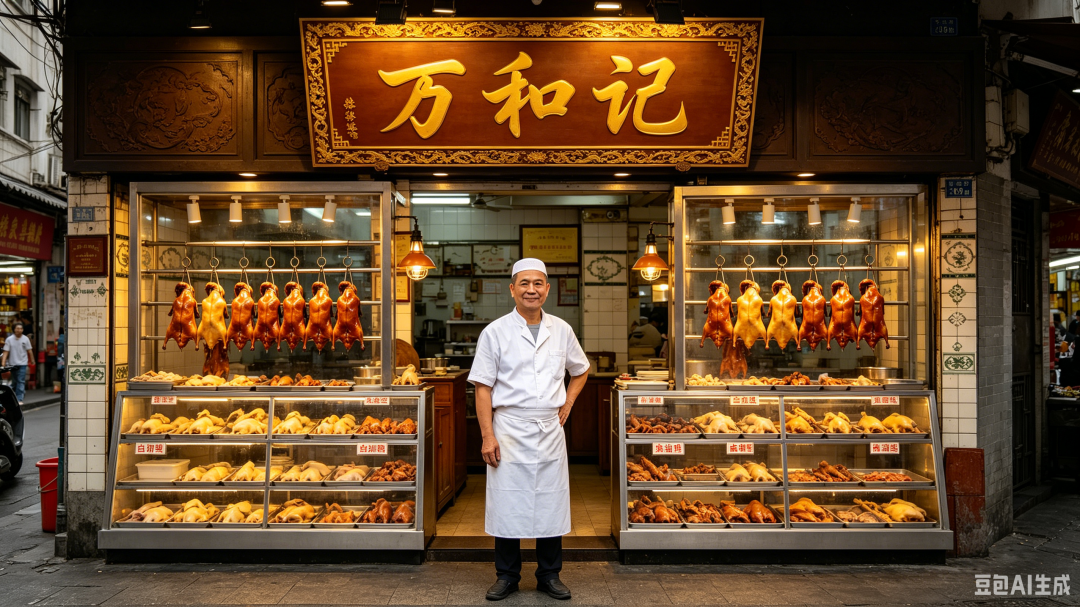
Wanhe Chicken and Duck Shop: We Never Sell Dead Meat
This is a legendary story rooted in the Islamic principle that halal food never uses dead or unslaughtered animals.
Back in old Guangzhou, there was a job dedicated to cleaning public restrooms, commonly known by locals as 'shikeng gong (nightsoil collectors).' They earned meager wages and lived in constant hunger.
However, the nightsoil collector working near the Wanhe Chicken and Duck Shop had a totally different experience. Because he was regularly gifted the unsold or discarded livestock that didn't meet their strict religious standards, he constantly feasted like royalty.
Unexpectedly, this simple act driven by religious faith became the best organic marketing for Wanhe. Customers soon realized that Wanhe never sold dead or tainted meat—only the freshest chickens and ducks.
As business grew, capitalists, wealthy business owners, and local elites flocked to support the Wanhe Chicken and Duck Shop precisely for this integrity, driving their success even higher.
Guangxingchang: Wanhe's Fierce Rival
In the early years of the Guangxu Emperor's reign, two Guangzhou Hui Muslims named Chen Lüjiang and Yang Xiaochu saw Wanhe's massive success and pooled their money to open Guangxingchang on Weibian Street in Huaning Lane. They brought in an out-of-town chef known as 'Master Shi' and advertised 'Beijing Crispy Hanging-Oven Roast Duck,' quickly pulling in even bigger crowds than Wanhe.

This 'Master Shi' was originally a chef brought from Beijing by General Cairu Jinzhang, who oversaw the southern land forces. To secure the maritime defense, Jinzhang supervised the construction of artillery batteries in Humen, but tragically fell ill and died from the damp mountain mists. Left stranded, Master Shi—a former elite imperial mansion chef—entered civilian life and made his craft public.
This Master Shi was an absolute master of crispy-skin duck, nailing the sugar glaze technique to perfection. Through trial and error, he swapped honey out for maltose, which massively boosted kitchen efficiency. He also personally trained a whole crew of apprentices, every single one of whom mastered the craft.
Chen Lüjiang’s nephew, Chen Qingquan, was one of his standout disciples.
Changes at Guangxingchang and Wanheji's Big Break
After operating for over a decade, one of Guangxingchang's co-founders—Chen Lüjiang’s nephew (not Chen Qingquan, but another nephew)—passed away. Heartbroken and losing interest, Chen Lüjiang dissolved the partnership with Yang Xiaochu, split the assets, and set off on the Hajj to Mecca.
Meanwhile, Yang Xiaochu teamed up with a chef known as 'Doupi Chao (Beancurd Skin Chao)' near the Haopan Heng Shaanxi Guild Hall to open a new spot called Yipin. They focused primarily on crispy hanging-oven roast duck while also selling barrel-style soy-sauce chicken. A few years later, Yipin relocated to Hong Kong and expanded into Zhenchang Restaurant, with Doupi Chao continuing to run the roast duck station.
Seizing the moment while Guangxingchang underwent changes, Wanheji stepped into the crispy roast duck game. They hired Chen Qingquan as their master chef. As mentioned earlier, since Chen Qingquan was a direct student of Master Shi, his culinary skills were top-notch.
With Chen Qingquan fueling the kitchen, Wanheji's business exploded. 'Wanhe Gualu Ya' gradually turned into a legendary household term, passed down fondly among food lovers.
Historical records on Wanheji are quite scarce. If any reader friends out there have more insider knowledge, please drop a comment below and share!
The Legend of Lingnan's Halal Shaola: Historical Research on Wanheji, the Historic Song-to-Qing Dynasty Guangzhou Hui Muslim Roast Duck Spot
Abstract:
An investigation into 'Wanheji,' the once-famous halal shaola (Cantonese roasted meats / roast duck) legend in Guangzhou's culinary history. Tracing the Southern Song Dynasty roots of roast duck techniques migrating to Lingnan, this article uncovers the unique techniques and industry status of Cantonese halal roast goose and roast duck during the Qing Dynasty and Republican era.
Images generated by Doubao AI
Guangzhou's shaola has a long and deeply rooted history. As early as the end of the Southern Song Dynasty, roast duck techniques from the Central Plains had already made their way to Lingnan, and by the Qing Dynasty, Cantonese shaola had grown into a well-established culinary tradition with its own distinct style.
In the late Qing and early Republican era, a halal legacy named 'Wanheji' stood out in Guangzhou. It originally started out selling live chickens and ducks, but as business boomed, they added 'gualu kaya (hanging-oven roast duck)' to the menu. Thanks to its incredible flavor, 'Wanhe Gualu Ya' quickly became a household name across the neighborhoods.
Today, drawing from Mr. Yang Shaoquan's short essay 'Wanhe Gualu Ya and Why the Master Chef Matters,' let's take a quick look at the story behind this former halal landmark.
Special thanks to Mr. Zhang Zhongyi for providing the research materials.
Wanhe Chicken and Duck Shop: We Never Sell Dead Meat
This is a legendary story rooted in the Islamic principle that halal food never uses dead or unslaughtered animals.
Back in old Guangzhou, there was a job dedicated to cleaning public restrooms, commonly known by locals as 'shikeng gong (nightsoil collectors).' They earned meager wages and lived in constant hunger.
However, the nightsoil collector working near the Wanhe Chicken and Duck Shop had a totally different experience. Because he was regularly gifted the unsold or discarded livestock that didn't meet their strict religious standards, he constantly feasted like royalty.
Unexpectedly, this simple act driven by religious faith became the best organic marketing for Wanhe. Customers soon realized that Wanhe never sold dead or tainted meat—only the freshest chickens and ducks.
As business grew, capitalists, wealthy business owners, and local elites flocked to support the Wanhe Chicken and Duck Shop precisely for this integrity, driving their success even higher.
Guangxingchang: Wanhe's Fierce Rival
In the early years of the Guangxu Emperor's reign, two Guangzhou Hui Muslims named Chen Lüjiang and Yang Xiaochu saw Wanhe's massive success and pooled their money to open Guangxingchang on Weibian Street in Huaning Lane. They brought in an out-of-town chef known as 'Master Shi' and advertised 'Beijing Crispy Hanging-Oven Roast Duck,' quickly pulling in even bigger crowds than Wanhe.
This 'Master Shi' was originally a chef brought from Beijing by General Cairu Jinzhang, who oversaw the southern land forces. To secure the maritime defense, Jinzhang supervised the construction of artillery batteries in Humen, but tragically fell ill and died from the damp mountain mists. Left stranded, Master Shi—a former elite imperial mansion chef—entered civilian life and made his craft public.
This Master Shi was an absolute master of crispy-skin duck, nailing the sugar glaze technique to perfection. Through trial and error, he swapped honey out for maltose, which massively boosted kitchen efficiency. He also personally trained a whole crew of apprentices, every single one of whom mastered the craft.
Chen Lüjiang’s nephew, Chen Qingquan, was one of his standout disciples.
Changes at Guangxingchang and Wanheji's Big Break
After operating for over a decade, one of Guangxingchang's co-founders—Chen Lüjiang’s nephew (not Chen Qingquan, but another nephew)—passed away. Heartbroken and losing interest, Chen Lüjiang dissolved the partnership with Yang Xiaochu, split the assets, and set off on the Hajj to Mecca.
Meanwhile, Yang Xiaochu teamed up with a chef known as 'Doupi Chao (Beancurd Skin Chao)' near the Haopan Heng Shaanxi Guild Hall to open a new spot called Yipin. They focused primarily on crispy hanging-oven roast duck while also selling barrel-style soy-sauce chicken. A few years later, Yipin relocated to Hong Kong and expanded into Zhenchang Restaurant, with Doupi Chao continuing to run the roast duck station.
Seizing the moment while Guangxingchang underwent changes, Wanheji stepped into the crispy roast duck game. They hired Chen Qingquan as their master chef. As mentioned earlier, since Chen Qingquan was a direct student of Master Shi, his culinary skills were top-notch.
With Chen Qingquan fueling the kitchen, Wanheji's business exploded. 'Wanhe Gualu Ya' gradually turned into a legendary household term, passed down fondly among food lovers.
Historical records on Wanheji are quite scarce. If any reader friends out there have more insider knowledge, please drop a comment below and share!
