
Nasr Hamid Abu Zayd Biography and Academic Legacy: Modern Islamic Hermeneutics, Contextualism, and Religious Discourse
[Internet Repost]
Breaking down the academic life and core theories of Nasr Hamid Abu Zayd, a major contemporary Egyptian thinker. We'll look at how his deep-rooted childhood tradition of memorizing classical texts shaped his work, and how he used modern linguistics and historical context to study religious texts, sparking massive academic debates.
Nasr Hamid Abu Zayd (July 10, 1943 – July 5, 2010) was a super influential yet deeply troubled liberal theologian in late 20th-century Egypt. He actually had a rock-solid foundation in traditional religious studies and was a hafiz who had memorized the entire Qur'an by heart.
Born in Egypt, Abu Zayd was influenced by the Muslim Brotherhood as a teenager and totally looked up to Sayyid Qutb's writings. When he was just twelve, he was even arrested on suspicion of sympathizing with the Brotherhood. But as he grew and matured, he slowly distanced himself from the Brotherhood and Qutb's revolutionary path. While getting technical training and working for the Cairo National Information Agency, Abu Zayd pursued higher education at Cairo University. He earned his bachelor's degree in Arabic studies in 1972, followed by a master's in 1977 and a PhD in 1981, both focusing on scriptural hermeneutics. In 1982, he joined Cairo University's Arabic Language and Literature Department as an assistant professor, getting promoted to associate professor in 1987. From 1985 to 1989, he also worked as a visiting lecturer at Osaka University of Foreign Studies in Japan.
When it came to his academic thought, Abu Zayd pioneered a humanistic approach to interpreting scriptures. He didn't deny divine revelation at all, but dropped a major core argument: scriptures are cultural discourses formed within the specific linguistic, social, and cultural soil of 7th-century Arabia. Once a revelation is passed down through human language and enters human understanding, it transforms from a sacred revealed text into a human text open to interpretation—meaning there is no single, fixed, one-size-fits-all standard answer for every era. He pushed for returning to a tradition of interpretation that prioritizes reason, carrying on the intellectual legacy of the Mu'tazilites who valued rationality and metaphorical exegesis, while drawing a clear line between traditional exegesis and deep interpretation.
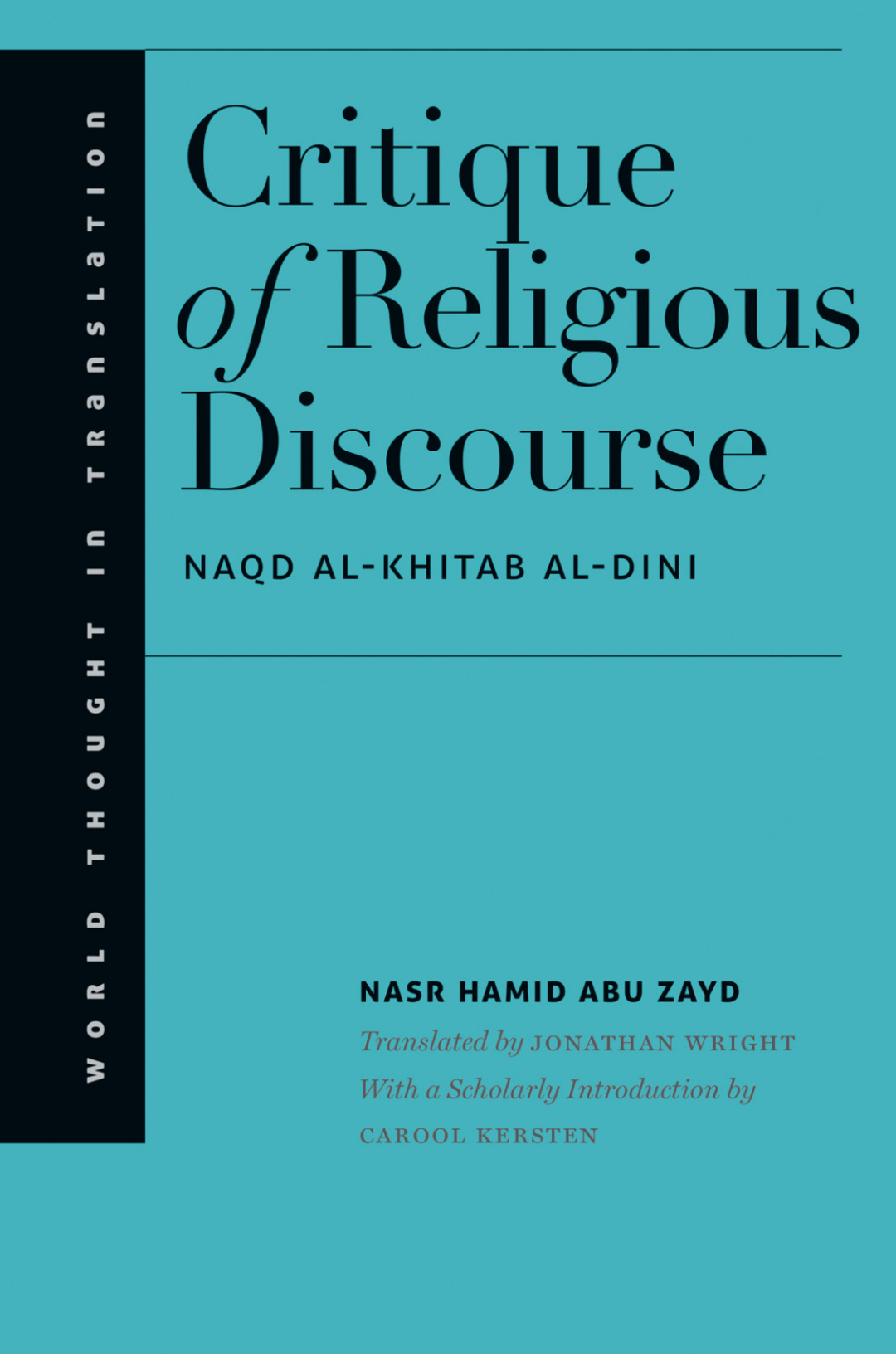
In his book Critique of Religious Discourse, Abu Zayd lays out five typical strategies used by contemporary religious discourse:
Conflating personal ideas with religion itself: equating the interpretations of individual people or schools directly with religion, wiping out the cognitive distance between the interpreting subject and the sacred text, claiming direct access to Allah's will, and packaging personal thoughts as divine decrees.
Monistic attribution, using a single origin to explain everything: tracing all natural and social problems back to 'God' as the sole starting point, erasing human agency, and rejecting secular laws of cause and effect—which is also their go-to ideological tool for attacking secularism.
Worship of tradition and the authority of early predecessors: elevating later secondary texts to a status close to sacred primary sources, blindly following early scholars without any critical reflection, and cherry-picking traditional materials to serve their own ideologies.
Dogmatic authoritarianism: rejecting intellectual pluralism at its core, only allowing differences over minor details, and too easily slapping the label of 'disbeliever' on anyone who disagrees. Moderates might just hold back from officially declaring society at large as apostates on a massive scale, but their underlying logic is identical to that of extremists.
Erasing the historical dimension: romanticizing an ideal golden age, taking ancient social blueprints and trying to slap them directly onto the present day, completely ignoring the concrete historical and social environment in which texts were born, and quoting verses completely out of context.
In the book, Abu Zayd blasts the theological ideas of Sayyid Qutb and others who claimed that only the Creator has the right to legislate, and that any human governance is an overstep. Abu Zayd points out that this narrative isn't classical orthodoxy at all; it actually traces back to political power struggles during the Umayyad dynasty, and later Ash'arite theology doubled down on it. This discourse relies on circular reasoning: using the text to prove Allah's sovereignty, and then using Allah's sovereignty to prove the text's authority. Contemporary religious discourse uses the concept of 'Jahiliyyah' (pre-Islamic ignorance) to redefine reality, slapping the label of ignorance on any modern society that doesn't practice this particular theocratic theory. It blames all of society's struggles on people turning away from Allah's laws, dodging real social conflicts, turning political clashes into faith-based battles, and smearing opponents as enemies of the Creator. At the same time, secular regimes will also hijack this exact same rhetoric to prop up their own rule.
Abu Zayd breaks down the concept of the literal meaning of texts in classical scholarship: true literal texts are those with clear meanings and almost zero room for interpretation, and they are super rare within scriptures. But contemporary religious discourse hijacks this concept, treating almost all verses as unambiguous, absolute clear texts that don't need any interpretation, throwing around the rule that 'where there is a clear text, independent legal reasoning (ijtihad) is not allowed.' In reality, even scholars who preach this slogan are constantly interpreting texts anyway—they just deliberately cover up their own readings, dressing up their personal takes as the literal meaning of the scripture.
After sacred revelation was sent down, it had to be transmitted through human language and human understanding. Once sacred revelation enters the human world, it inevitably takes on historical context; texts don't speak for themselves, humans are the ones interpreting them. Hadiths also come with complex issues of transmission, fabrication, and interpretation, meaning they can't just be treated as ready-made, absolute conclusions. You can't strip away the historical context of 7th-century Arab tribal and slave-owning societies from the texts; a lot of concepts in the scriptures carry the imprint of those times and can't just be blindly and unconditionally copy-pasted into modern society. You have to separate the original historical meaning of a text from the practical meaning it generates in later eras—the two can never be mixed up.
Abu Zayd argued that moderate religious folks and extremists actually share a ton of foundational stances, and many of their disagreements are just about timing and methods rather than core principles. For instance, when it comes to forcing morality on people, moderates just think the time isn't right yet, without rejecting the actual principle itself. Some official religious scholars might condemn extremists out loud, but they share the exact same ideological framework. This religious discourse worms its way into education and media, shaping the mindset of the general public.
As far as Abu Zayd was concerned, interpretation is an absolute must when trying to understand scriptures, and the history of religious thought naturally always had room for diverse interpretations—it's just that this diversity kept getting squeezed out and covered up over time. He criticized tons of researchers for ripping verses out of their historical context and rigidly slapping ancient social rules onto modern life. Even though scriptures were born in a patriarchal Arab society and what the text says has limits tied to its era, the texts themselves still hold the potential to chase social justice and equality. When it came to topics that always spark huge debates like the jizya tax, slavery, and accounts of jinns (spirits), he totally rejected literalist readings: mentioning jinns in the scriptures was just a way to fit in with the existing worldview of the Arab community at the time so the revelation could actually be accepted by the people back then, not a demand for future generations to treat ancient cultural myths as unshakeable articles of faith. At the same time, he also hit hard at religious figures who used religious discourse to package Islamic financial products for personal gain—the Al-Rayyan investment company scam was a prime example he frequently brought up in his books, and this exact critique ended up bringing a heavy blow down on him later on.
This whole controversy was sparked by his application for a full professorship at Cairo University. In May 1992, Abu Zayd submitted thirteen works—including major hits like Critique of Religious Discourse—to apply for a tenured promotion. Out of three review reports, two backed his promotion, but Cairo University professor Abdel-Sabour Shahin wrote a dissenting review accusing him of blasphemy. The committee ended up voting down his promotion seven to six. Even though the Arabic department and the faculty council publicly questioned that conclusion, the Cairo University council went ahead and confirmed the result in 1993. Shahin didn't just try to block him academically; he also took to the pulpit at the Amr ibn al-As Mosque to publicly accuse Abu Zayd of apostasy, and tons of Egyptian media outlets jumped on the bandwagon, launching a massive wave of criticism. Shahin wore multiple hats as a preacher, television religious show host, and head of the ruling party's religious committee, and he had previously served as an advisor to the Al-Rayyan investment company. Abu Zayd's public takedown of that company was widely seen as a major personal motive behind Shahin turning on him.
Pretty soon, religious groups dug up leftover legal rules from Egyptian law and slapped him with a famous hisbah (religious inspection) lawsuit, demanding that the court annul the marriage between Abu Zayd and his wife, Ibtihal Yunis. Ibtihal was a professor of French literature at Cairo University, and the plaintiffs argued that under religious law, a Muslim woman isn't allowed to stay married to an apostate. The wild thing about the hisbah legal mechanism was that the plaintiffs didn't even need to be personally harmed; they could sue over someone else's faith just by claiming they were protecting religious rights and public order. This long-dormant rule was suddenly brought back from the dead. In 1994, a Giza lower court threw out the case because the plaintiffs had no direct personal stake in it. But in 1995, the Cairo Court of Appeal flipped the script, and Judge Abdel-Alim Musa ruled that Abu Zayd was guilty of apostasy and declared their marriage void. The ruling insisted that verses on the jizya tax and slave-owning under specific conditions were unquestionable, absolute rules, and it even painted Abu Zayd as a threat to national security. Once the verdict dropped, public opinion in Egypt instantly polarized. Some scholars from Al-Azhar, extremist armed groups like Islamic Jihad, and even some official media outlets openly called for Abu Zayd to be executed. Death threats poured in, and even the police officers assigned to protect him privately called him an infidel. Abu Zayd kept repeating that he was a believer, and his research wasn't meant to attack religion, but rather to reflect on faith through academic methods—meaning he couldn't just be lumped in with religious critics like Salman Rushdie.
The endless threats and round-the-clock security destroyed his normal life. In July 1995, Abu Zayd and his wife were forced to flee Egypt into exile, heading first to Spain and then the Netherlands. Even in exile, he kept right on working academically, serving as the Ibn Rushd Chair of Humanism and Islam at the University for Humanistics in Utrecht, mentoring grad students at Leiden University, joining research projects on religion and modernity at the Berlin Institute for Advanced Study, and winning the Ibn Rushd Prize for Freedom of Thought in 2005. He did briefly head back to Egypt a few times later on to visit family, and his wife frequently traveled back for academic gigs. But even though his books weren't officially banned outright by the Egyptian government, they were quietly pulled from the shelves of his alma mater's library. In 1999, he tried filing a lawsuit to overturn the marriage annulment ruling, but in the end, it couldn't change the outcome.
In 2010, while visiting Indonesia, Abu Zayd caught an unknown virus. He flew back to Cairo for hospital treatment and passed away on July 5th at a local hospital at the age of 66, with his body laid to rest in his hometown of El-Qahafa.
The Abu Zayd case is a stark reflection of the complex power struggles playing out in 1990s Egypt between the secular government, conservative religious elites, and extremist forces. Following the incident, Egypt amended its laws in 1998 so that ordinary citizens could no longer just casually file hisbah lawsuits accusing others of apostasy, shifting those powers and responsibilities over to the prosecution office instead. This whole case follows directly in the footsteps of earlier scriptural interpretation controversies involving Taha Hussein and Muhammad Ahmad Khalafallah, turning into a landmark case for studying contemporary scriptural hermeneutics, religious freedom, human rights, and conflicts over religious law. His whole life's work was an attempt to build a bridge between traditional and modern values, pushing society to rethink how scriptures, reason, equality, and freedom all fit together. To this day, his ideas still spark ongoing debates in the academic world.
Breaking down the academic life and core theories of Nasr Hamid Abu Zayd, a major contemporary Egyptian thinker. We'll look at how his deep-rooted childhood tradition of memorizing classical texts shaped his work, and how he used modern linguistics and historical context to study religious texts, sparking massive academic debates.
Nasr Hamid Abu Zayd (July 10, 1943 – July 5, 2010) was a super influential yet deeply troubled liberal theologian in late 20th-century Egypt. He actually had a rock-solid foundation in traditional religious studies and was a hafiz who had memorized the entire Qur'an by heart.
Born in Egypt, Abu Zayd was influenced by the Muslim Brotherhood as a teenager and totally looked up to Sayyid Qutb's writings. When he was just twelve, he was even arrested on suspicion of sympathizing with the Brotherhood. But as he grew and matured, he slowly distanced himself from the Brotherhood and Qutb's revolutionary path. While getting technical training and working for the Cairo National Information Agency, Abu Zayd pursued higher education at Cairo University. He earned his bachelor's degree in Arabic studies in 1972, followed by a master's in 1977 and a PhD in 1981, both focusing on scriptural hermeneutics. In 1982, he joined Cairo University's Arabic Language and Literature Department as an assistant professor, getting promoted to associate professor in 1987. From 1985 to 1989, he also worked as a visiting lecturer at Osaka University of Foreign Studies in Japan.
When it came to his academic thought, Abu Zayd pioneered a humanistic approach to interpreting scriptures. He didn't deny divine revelation at all, but dropped a major core argument: scriptures are cultural discourses formed within the specific linguistic, social, and cultural soil of 7th-century Arabia. Once a revelation is passed down through human language and enters human understanding, it transforms from a sacred revealed text into a human text open to interpretation—meaning there is no single, fixed, one-size-fits-all standard answer for every era. He pushed for returning to a tradition of interpretation that prioritizes reason, carrying on the intellectual legacy of the Mu'tazilites who valued rationality and metaphorical exegesis, while drawing a clear line between traditional exegesis and deep interpretation.
In his book Critique of Religious Discourse, Abu Zayd lays out five typical strategies used by contemporary religious discourse:
Conflating personal ideas with religion itself: equating the interpretations of individual people or schools directly with religion, wiping out the cognitive distance between the interpreting subject and the sacred text, claiming direct access to Allah's will, and packaging personal thoughts as divine decrees.
Monistic attribution, using a single origin to explain everything: tracing all natural and social problems back to 'God' as the sole starting point, erasing human agency, and rejecting secular laws of cause and effect—which is also their go-to ideological tool for attacking secularism.
Worship of tradition and the authority of early predecessors: elevating later secondary texts to a status close to sacred primary sources, blindly following early scholars without any critical reflection, and cherry-picking traditional materials to serve their own ideologies.
Dogmatic authoritarianism: rejecting intellectual pluralism at its core, only allowing differences over minor details, and too easily slapping the label of 'disbeliever' on anyone who disagrees. Moderates might just hold back from officially declaring society at large as apostates on a massive scale, but their underlying logic is identical to that of extremists.
Erasing the historical dimension: romanticizing an ideal golden age, taking ancient social blueprints and trying to slap them directly onto the present day, completely ignoring the concrete historical and social environment in which texts were born, and quoting verses completely out of context.
In the book, Abu Zayd blasts the theological ideas of Sayyid Qutb and others who claimed that only the Creator has the right to legislate, and that any human governance is an overstep. Abu Zayd points out that this narrative isn't classical orthodoxy at all; it actually traces back to political power struggles during the Umayyad dynasty, and later Ash'arite theology doubled down on it. This discourse relies on circular reasoning: using the text to prove Allah's sovereignty, and then using Allah's sovereignty to prove the text's authority. Contemporary religious discourse uses the concept of 'Jahiliyyah' (pre-Islamic ignorance) to redefine reality, slapping the label of ignorance on any modern society that doesn't practice this particular theocratic theory. It blames all of society's struggles on people turning away from Allah's laws, dodging real social conflicts, turning political clashes into faith-based battles, and smearing opponents as enemies of the Creator. At the same time, secular regimes will also hijack this exact same rhetoric to prop up their own rule.
Abu Zayd breaks down the concept of the literal meaning of texts in classical scholarship: true literal texts are those with clear meanings and almost zero room for interpretation, and they are super rare within scriptures. But contemporary religious discourse hijacks this concept, treating almost all verses as unambiguous, absolute clear texts that don't need any interpretation, throwing around the rule that 'where there is a clear text, independent legal reasoning (ijtihad) is not allowed.' In reality, even scholars who preach this slogan are constantly interpreting texts anyway—they just deliberately cover up their own readings, dressing up their personal takes as the literal meaning of the scripture.
After sacred revelation was sent down, it had to be transmitted through human language and human understanding. Once sacred revelation enters the human world, it inevitably takes on historical context; texts don't speak for themselves, humans are the ones interpreting them. Hadiths also come with complex issues of transmission, fabrication, and interpretation, meaning they can't just be treated as ready-made, absolute conclusions. You can't strip away the historical context of 7th-century Arab tribal and slave-owning societies from the texts; a lot of concepts in the scriptures carry the imprint of those times and can't just be blindly and unconditionally copy-pasted into modern society. You have to separate the original historical meaning of a text from the practical meaning it generates in later eras—the two can never be mixed up.
Abu Zayd argued that moderate religious folks and extremists actually share a ton of foundational stances, and many of their disagreements are just about timing and methods rather than core principles. For instance, when it comes to forcing morality on people, moderates just think the time isn't right yet, without rejecting the actual principle itself. Some official religious scholars might condemn extremists out loud, but they share the exact same ideological framework. This religious discourse worms its way into education and media, shaping the mindset of the general public.
As far as Abu Zayd was concerned, interpretation is an absolute must when trying to understand scriptures, and the history of religious thought naturally always had room for diverse interpretations—it's just that this diversity kept getting squeezed out and covered up over time. He criticized tons of researchers for ripping verses out of their historical context and rigidly slapping ancient social rules onto modern life. Even though scriptures were born in a patriarchal Arab society and what the text says has limits tied to its era, the texts themselves still hold the potential to chase social justice and equality. When it came to topics that always spark huge debates like the jizya tax, slavery, and accounts of jinns (spirits), he totally rejected literalist readings: mentioning jinns in the scriptures was just a way to fit in with the existing worldview of the Arab community at the time so the revelation could actually be accepted by the people back then, not a demand for future generations to treat ancient cultural myths as unshakeable articles of faith. At the same time, he also hit hard at religious figures who used religious discourse to package Islamic financial products for personal gain—the Al-Rayyan investment company scam was a prime example he frequently brought up in his books, and this exact critique ended up bringing a heavy blow down on him later on.
This whole controversy was sparked by his application for a full professorship at Cairo University. In May 1992, Abu Zayd submitted thirteen works—including major hits like Critique of Religious Discourse—to apply for a tenured promotion. Out of three review reports, two backed his promotion, but Cairo University professor Abdel-Sabour Shahin wrote a dissenting review accusing him of blasphemy. The committee ended up voting down his promotion seven to six. Even though the Arabic department and the faculty council publicly questioned that conclusion, the Cairo University council went ahead and confirmed the result in 1993. Shahin didn't just try to block him academically; he also took to the pulpit at the Amr ibn al-As Mosque to publicly accuse Abu Zayd of apostasy, and tons of Egyptian media outlets jumped on the bandwagon, launching a massive wave of criticism. Shahin wore multiple hats as a preacher, television religious show host, and head of the ruling party's religious committee, and he had previously served as an advisor to the Al-Rayyan investment company. Abu Zayd's public takedown of that company was widely seen as a major personal motive behind Shahin turning on him.
Pretty soon, religious groups dug up leftover legal rules from Egyptian law and slapped him with a famous hisbah (religious inspection) lawsuit, demanding that the court annul the marriage between Abu Zayd and his wife, Ibtihal Yunis. Ibtihal was a professor of French literature at Cairo University, and the plaintiffs argued that under religious law, a Muslim woman isn't allowed to stay married to an apostate. The wild thing about the hisbah legal mechanism was that the plaintiffs didn't even need to be personally harmed; they could sue over someone else's faith just by claiming they were protecting religious rights and public order. This long-dormant rule was suddenly brought back from the dead. In 1994, a Giza lower court threw out the case because the plaintiffs had no direct personal stake in it. But in 1995, the Cairo Court of Appeal flipped the script, and Judge Abdel-Alim Musa ruled that Abu Zayd was guilty of apostasy and declared their marriage void. The ruling insisted that verses on the jizya tax and slave-owning under specific conditions were unquestionable, absolute rules, and it even painted Abu Zayd as a threat to national security. Once the verdict dropped, public opinion in Egypt instantly polarized. Some scholars from Al-Azhar, extremist armed groups like Islamic Jihad, and even some official media outlets openly called for Abu Zayd to be executed. Death threats poured in, and even the police officers assigned to protect him privately called him an infidel. Abu Zayd kept repeating that he was a believer, and his research wasn't meant to attack religion, but rather to reflect on faith through academic methods—meaning he couldn't just be lumped in with religious critics like Salman Rushdie.
The endless threats and round-the-clock security destroyed his normal life. In July 1995, Abu Zayd and his wife were forced to flee Egypt into exile, heading first to Spain and then the Netherlands. Even in exile, he kept right on working academically, serving as the Ibn Rushd Chair of Humanism and Islam at the University for Humanistics in Utrecht, mentoring grad students at Leiden University, joining research projects on religion and modernity at the Berlin Institute for Advanced Study, and winning the Ibn Rushd Prize for Freedom of Thought in 2005. He did briefly head back to Egypt a few times later on to visit family, and his wife frequently traveled back for academic gigs. But even though his books weren't officially banned outright by the Egyptian government, they were quietly pulled from the shelves of his alma mater's library. In 1999, he tried filing a lawsuit to overturn the marriage annulment ruling, but in the end, it couldn't change the outcome.
In 2010, while visiting Indonesia, Abu Zayd caught an unknown virus. He flew back to Cairo for hospital treatment and passed away on July 5th at a local hospital at the age of 66, with his body laid to rest in his hometown of El-Qahafa.
The Abu Zayd case is a stark reflection of the complex power struggles playing out in 1990s Egypt between the secular government, conservative religious elites, and extremist forces. Following the incident, Egypt amended its laws in 1998 so that ordinary citizens could no longer just casually file hisbah lawsuits accusing others of apostasy, shifting those powers and responsibilities over to the prosecution office instead. This whole case follows directly in the footsteps of earlier scriptural interpretation controversies involving Taha Hussein and Muhammad Ahmad Khalafallah, turning into a landmark case for studying contemporary scriptural hermeneutics, religious freedom, human rights, and conflicts over religious law. His whole life's work was an attempt to build a bridge between traditional and modern values, pushing society to rethink how scriptures, reason, equality, and freedom all fit together. To this day, his ideas still spark ongoing debates in the academic world.
