

Bakhchysarai
Halal Travel Guide: Bakhchysarai, Crimea - Khan Palace and Mosques
Articles • ali2007fr posted the article • 0 comments • 280 views • 2026-05-20 08:47
Reposted from the web
Summary: Bakhchysarai in Crimea is shown through the Khan Palace, mosques, tombs, old neighborhoods, and Crimean Tatar heritage. This account keeps the original route, names, dates, architectural details, food notes, and photographs.
Bakhchisaray sits in a valley on the Crimean Peninsula and became the capital of the Crimean Khanate in 1532. Although it became an ordinary town after Russia occupied the Crimean Khanate in 1783, it remains the cultural center of the Crimean Tatars and preserves their unique culture and customs.
Crimean Tatars are a Turkic-speaking ethnic group that formed during the Golden Horde period. In May 1944, the Soviet Union deported all 240,000 Crimean Tatars from the Crimean Peninsula to Uzbekistan and other remote regions. Many Crimean Tatars died during the exile from cold, hunger, disease, and exhaustion. Even after reaching their destinations, many were forced to work hard in Gulag collective farms. For nearly half a century after that, there were almost no Crimean Tatars on the Crimean Peninsula.
After a long struggle by the Crimean Tatar civil rights movement, the Soviet Union finally declared the deportation of the Crimean Tatars illegal in 1989, and they finally gained the right to return to their homeland. Today, 250,000 Crimean Tatars have returned home, working to rebuild their lives, overcome social and economic obstacles, and pass on their culture.
The Palace
The North Gate is the entrance to the Khan Palace area. In the Crimean Tatar language, Darbehane Qapı means Mint Gate, named because mint once grew across from the gate. The Khan Palace once had four large gates, but only the North Gate and South Gate remain today. The North Gate features a carving of two snakes intertwined. Legend says the palace builder, Sahib I Giray, saw two snakes fighting by the river in front of the gate and watched one get healed by the water, so he decided to build the palace there.
The North Gate was built in 1611. Before this, the palace had no walls because the capital's defense system was at the Jewish Fortress on the cliff. As Cossack military activity increased in the 17th century, the palace was considered under threat, leading to the construction of the current walls and gates.
The Great Khan Mosque (Büyük Han Cami) was one of the first palace buildings constructed after the capital moved in 1532. The original mosque had several domes, much like the Seljuk-style mosques popular in 15th-century Ottoman Turkey. A fire destroyed the mosque in 1736, but Khan Selamet II Giray (reigned 1740-1743) later restored it and changed the roof to tiles.
During the Soviet era, the mosque closed and became an exhibition hall for an archaeological museum. After Russia occupied Crimea in 2014, they restored the mosque, though some of this work caused damage.
Maqsurah is Arabic for "enclosed space," and it served as a private area inside the mosque for rulers or nobles to perform namaz. A maqsurah is usually a wooden box or screen near the mihrab, but the Khan Mosque features a two-story loft instead. The main entrance of the Khan Mosque connects to the north wall of the Khan Palace for direct access, while you can only reach the maqsurah via stairs inside the palace.
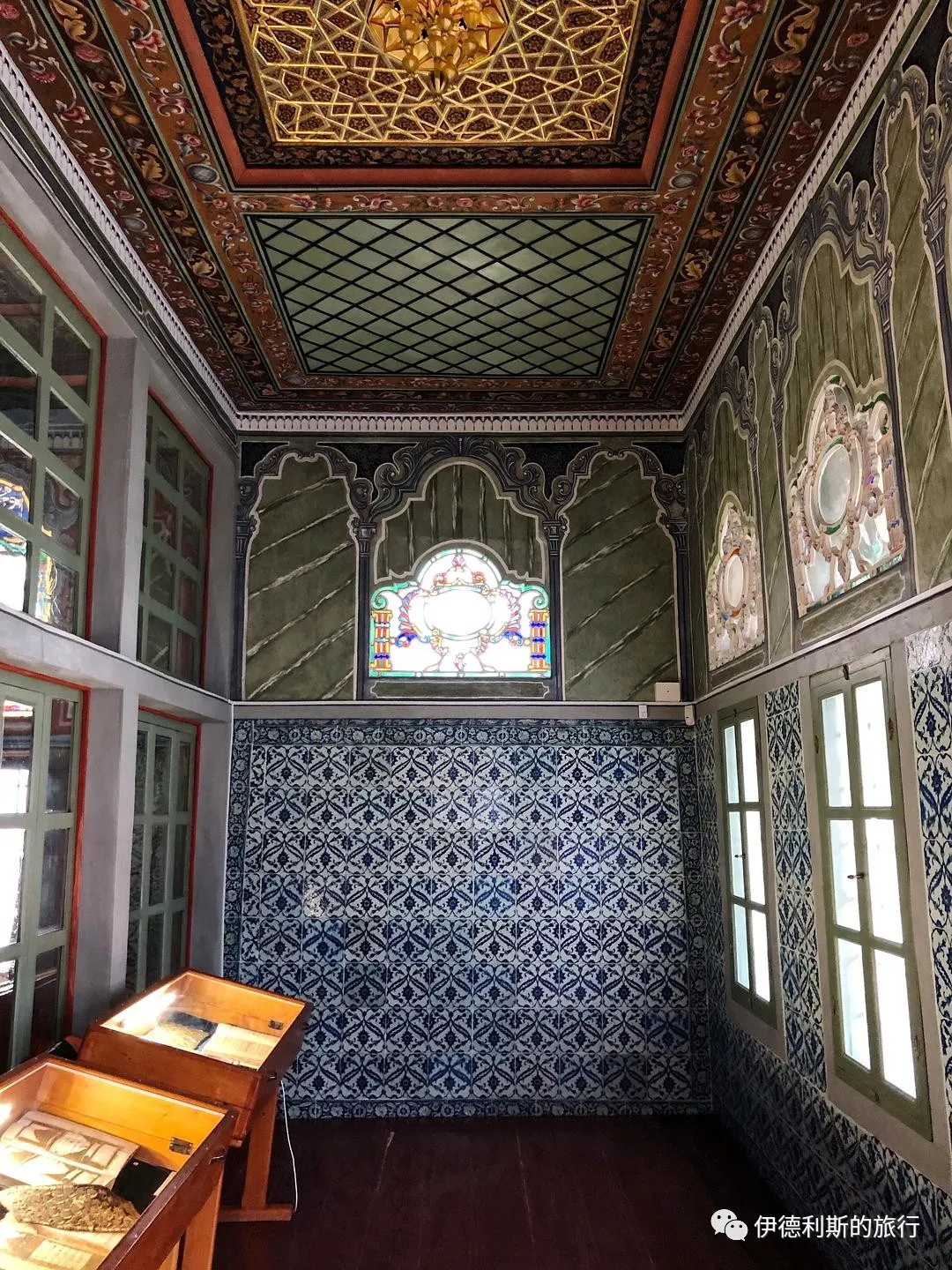
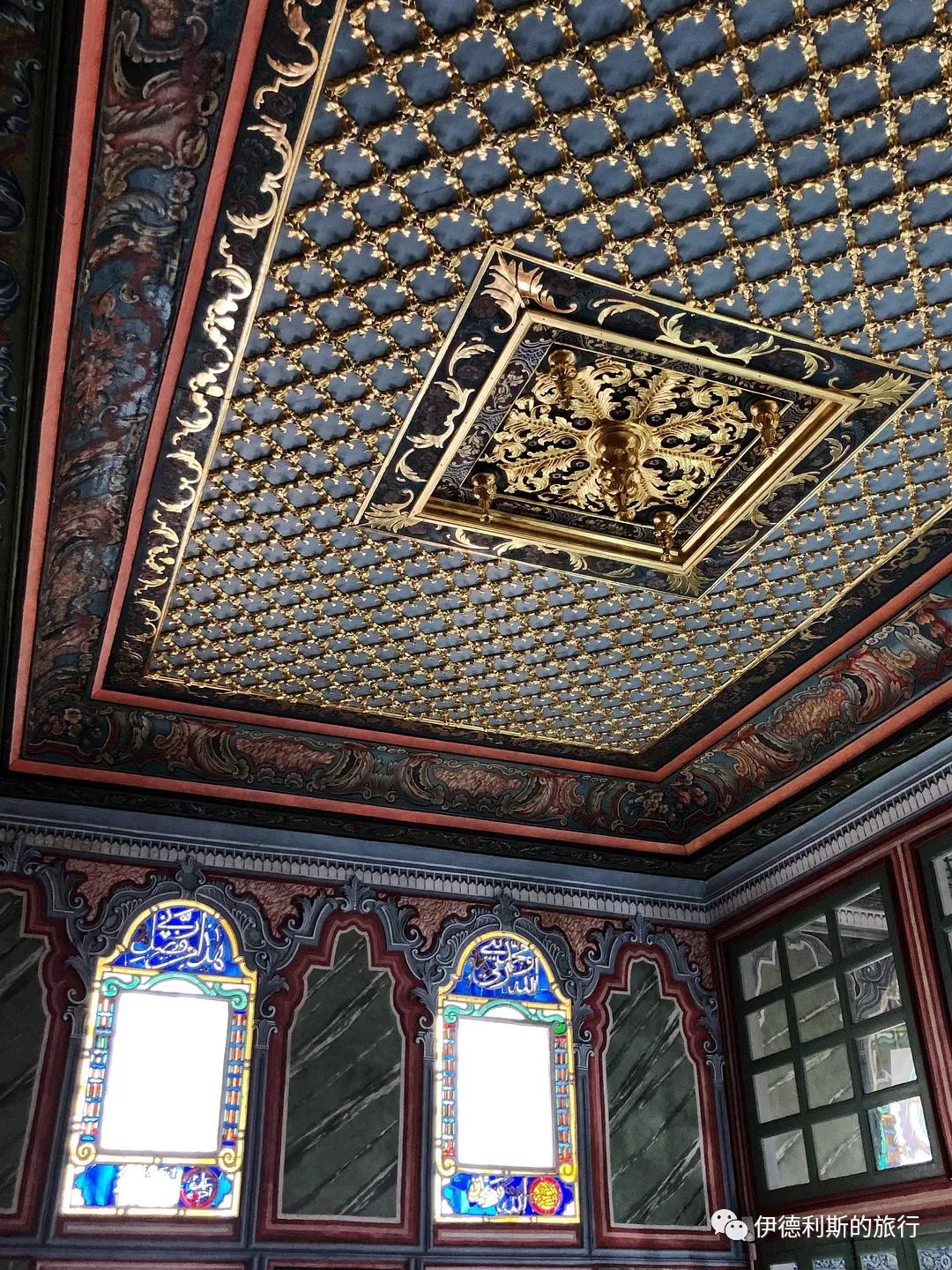
The maqsurah in the Khan Mosque was rebuilt after the 1736 fire and features famous Turkish Iznik tiles, stained glass, and various precious 18th-century murals.
The Khan Cemetery sits south of the Khan Mosque and holds the graves of nine Crimean Khans from the 16th to 18th centuries, 45 members of the Khan family, and over 320 court nobles. The two most important tombs belong to Crimean Khans Devlet I Giray (reigned 1551-1577) and İslâm III Giray (reigned 1644-1654). These octagonal tombs are made of limestone and originally had lead domes, which were replaced with iron after 1863. There is also the open-air tomb of Crimean Khan Meñli II Giray (reigned 1724-1730, 1737-1740) and the double tombstone of Crimean Khan Qırım Giray (reigned 1758-1764, 1768-1769).
Devlet I Giray reigned for 26 years. His most important battle was burning Moscow in 1571, which forced Tsar Ivan the Terrible to flee, earning him the title "the one who took the crown." In 1640, İslâm III Giray led his army to deal a devastating blow to Ukraine.
During his reign, Meñli II Giray ended the long-standing instability of the Crimean Khanate and abolished certain taxes, which earned him much support. He skillfully organized defenses against the invading Russian army and caused them heavy losses.
Qırım Giray was a talented ruler. Under his rule, the Crimean Khanate saw an artistic revival and developed a unique style known as "Crimean Rococo."
The SaryGuzel bathhouse was ordered to be built in 1532 by Crimean Khan Sahib I Giray. Like the Khan Mosque, it is one of the oldest buildings in the Bakhchisaray Khan Palace. In the Crimean Tatar language, 'Sarı' means 'yellow or fair-skinned,' and 'Güzel' means 'beautiful.'
The SaryGuzel bathhouse is a typical Turkish bath. A furnace in the basement sends hot air up to heat the floor, and lead pipes supply hot and cold water to the bath. The bath is divided into men's and women's sections. Each section has a dome with star-shaped cutouts for light and ventilation, and there is an indoor courtyard with a fountain at the exit.
The SaryGuzel bathhouse operated until 1924, when it was closed because it was considered unsafe. It has since been restored and is now open for exhibitions.
The Falcon Tower (Toğan qullesi) is located in a corner of the Persian Garden at the Khan Palace. Legend says it was once used to train falcons for the Khan's court. The Falcon Tower was built in the 16th century. It was originally a five-story brick, mud, and wood structure. In 1760, it was rebuilt into two stories: a lower cube made of rubble and cement mortar, and an upper octagonal tower made of wooden planks.
The Falcon Tower connects to the Harem building of the Khan Palace. A spiral staircase inside leads to an observation deck at the top, where people living in the Harem could look out over the entire palace.
The Harem (Arem) of the Crimean Khan Palace once had 4 buildings and 73 rooms. In 1818, Tsar Alexander I ordered the demolition of 3 buildings and 70 rooms, leaving only an annex with 3 rooms and a pavilion. Today, the annex displays the interior decorations of Crimean Tatar homes from the 17th to the 19th centuries.
The living room retains its original fireplace and cupboards. During a 1980s restoration, a mirror with an inscription by the artist was discovered. Paintings on the vanity and Arabic poetry on the ceiling have also been cleaned and revealed.
The Persian Garden in the southern part of the Harem is surrounded by high walls. It once featured various trees, fountains, and baths, but now only ruins remain.
The Dilâra Bikeç Mausoleum is an octagonal tomb at the southernmost point of the Bakhchisaray Khan Palace. It was ordered to be built in 1764 by Crimean Khan Qırım Giray (reigned 1758-1764, 1768-1769) for his beloved wife.
The Small Khan Mosque (Kiçik Han Cami) is inside the main building of the Khan Palace and was used by members of the Khan's family and noble officials. The Small Khan Mosque was built in the 16th century. It was destroyed by fire by the Russian army in 1736 and restored in 1741 by Khan Selamet II Giray (reigned 1740-1743).
The existing interior murals were created between the 17th and 18th centuries, with some painted by the Iranian architect Omer in the late 18th century. Earlier murals from the 16th century were discovered during a 1991 restoration.
On the south wall of the Khan Mosque (Khan Jami) is a prayer niche (mihrab) carved with seven decorative bands, which symbolize the seven heavens mentioned in the Quran.
Above the prayer niche (mihrab) is a piece of stained glass featuring the Seal of Solomon (Khatam Sulayman) ✡.
The Iron Gate (Demir Qapi) is the oldest structure in the Khan Palace, built between 1503 and 1504 by the architect Aleviz Novy for the Crimean Khan. This architect had previously been invited by Ivan the Great to Moscow to build a series of churches. The Iron Gate (Demir Qapi) was likely originally built at the Crimean Khan's previous residence, Devlet-Saray, and was moved to the main building of the Khan Palace only after the Bakhchisaray Khan Palace was completed in 1532.
Demir Qapi means iron gate in the Crimean Tatar language. The gate's portal is made of limestone and uses decorative styles from the Lombard-Venetian Renaissance.
The Council Hall (Divan hanesi) is the meeting room inside the main building of the Khan Palace. In the center of the south wall is the throne where the Khan sat, with sofas on the sides for his ministers. Above the north wall at the entrance to the hall is a narrow latticed balcony, which is said to have been used by the Khan to have people eavesdrop on meetings when he was absent.
The floor of the hall was paved with marble and had a square pool with a fountain in the center. The walls were covered in tiles, but these were destroyed in a fire set by the Russian army in 1736. Restoration took place in 1742, and many of the current decorations, such as the murals and chandeliers, were added in 1822 when the architect I. F. Kolodin renovated the Khan Palace.
In 1917, the Crimean Tatars announced the establishment of an independent Crimean Tatar government here.
The Summer Pavilion is a place for cooling off inside the main building of the Khan Palace, built between the late 17th and early 18th centuries. It was burned down by the Russian army in 1736 and later restored by the architect Omer ibn al Hadj Mustafa. In the center of the pavilion is a square pool with a square marble fountain, surrounded by sofas.
The pavilion was originally open. Between 1821 and 1831, Tsar Alexander I ordered the architects Mikhail Klado and Vasiliy Dorofeyev to enclose the Summer Pavilion, adding columns, stained glass, and a carved ceiling.
Early murals were discovered during the restoration of the summer pavilion in 1962.
The Golden Pavilion is on the second floor of the main building and was built in the late 18th century by the Iranian architect Omer. The interior of the pavilion originally featured murals of fruit vases and Arabic poetry praising Khan Qırım Giray, but these were destroyed during the German occupation of Crimea from 1941 to 1944.
The Golden Fountain is located in the Fountain Courtyard of the Khan's Palace main building, near the Small Khan Mosque, and was where the Crimean Khan and members of the Khan's court performed wudu.
The Golden Fountain is made of gilded marble and features carvings of various flowers, fruits, and plants to depict the 'Garden of Eden' (jandātʿadni) from the Quran, the place where Adam and his wife lived. A circular outlet is carved in the center of the fountain, symbolizing eternal life.
The Fountain of Tears was commissioned in 1763 by the Crimean Khan Qırım Giray (reigned 1758-1764, 1768-1769), and the architect was Omer ibn al Hadj Mustafa from Iran. The fountain was originally installed in the mausoleum of the Khan's beloved wife, Dilâra Bikeç, but after Empress Catherine II visited the palace in 1787, the dried-up fountain was moved to the Fountain Courtyard in front of the main building.
A love story about the Fountain of Tears has circulated in Bakhchysarai since the 18th century. According to the legend, the Khan's beloved wife, Dilâra Bikeç, was a Greek woman from Georgia who was killed in palace intrigue. The Khan fell into deep grief and built this fountain in her mausoleum to honor her. This love story later became widely known because of Pushkin's famous poem, The Fountain of Bakhchisaray.
The suites on both sides of the North Gate were where the Khan's palace guards (Qapı Halqı) lived. After Crimea was occupied by Tsarist Russia, this area also served as guest lodging. Today, the west building of the suites is an exhibition hall, and the east building houses museum offices.
The exhibition hall in the west building displays artifacts from the Crimean Khanate era and the traditional life of the Crimean Tatars. The original fireplaces are still preserved inside the suites.
The stables are divided into two floors, with the first floor used for keeping horses and the second floor for the grooms to live in; the current building was rebuilt in the 1850s.
Mosque
Orta Mosque was once the main Friday mosque in Bakhchysarai. It dates back to 1674. The Khans Mengli Giray II and Selamet II Giray renovated it between 1737 and 1743, and it was rebuilt again in 1861 to reach its current form.
After 1929, the mosque served as a cultural center and then a cinema. It was not returned to the Muslim community until 2001. The mosque's minaret and surrounding buildings were destroyed at that time. They were not rebuilt until 2012. The mosque reopened in 2013 after the construction work finished.
Ismi Khan Mosque was built between the 17th and 18th centuries. Its architectural decorations show a strong influence from the European Baroque style. The upper circular openings are decorated with wooden Seals of Solomon (Khātam Sulaymān) ✡.
The mosque was used as a warehouse for a long time. There were plans to restore it in the early 21st century, but the work has not been carried out yet.
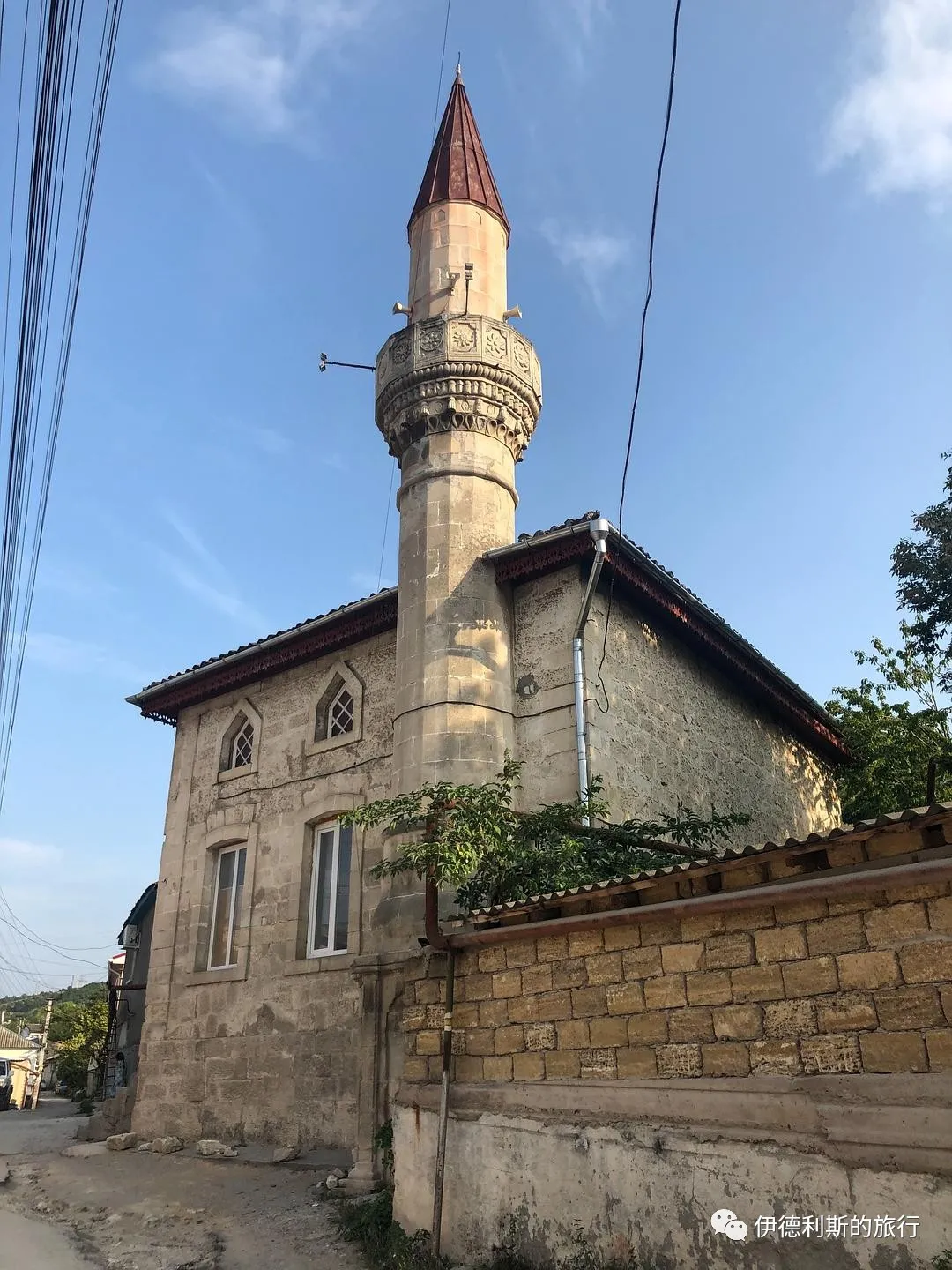
Molla Mustafa Friday Mosque dates back to the 17th century. An 1890 document mentions this mosque, stating that the local residents added a roof to the building in 1888.
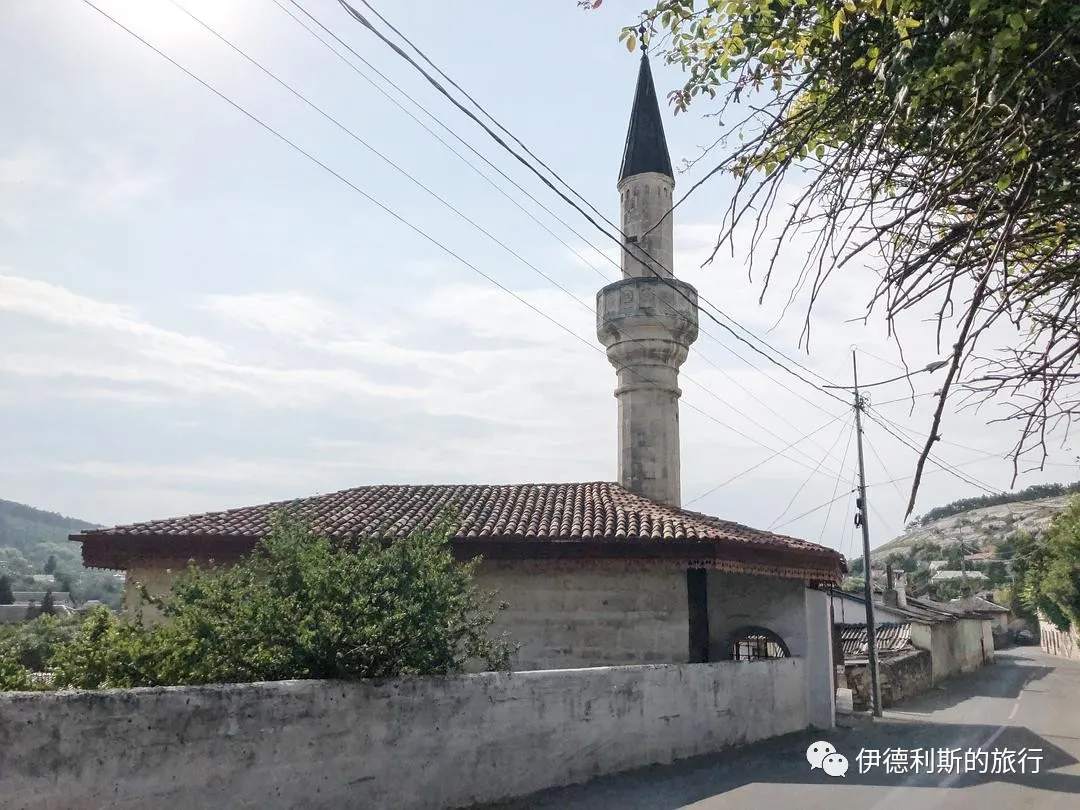
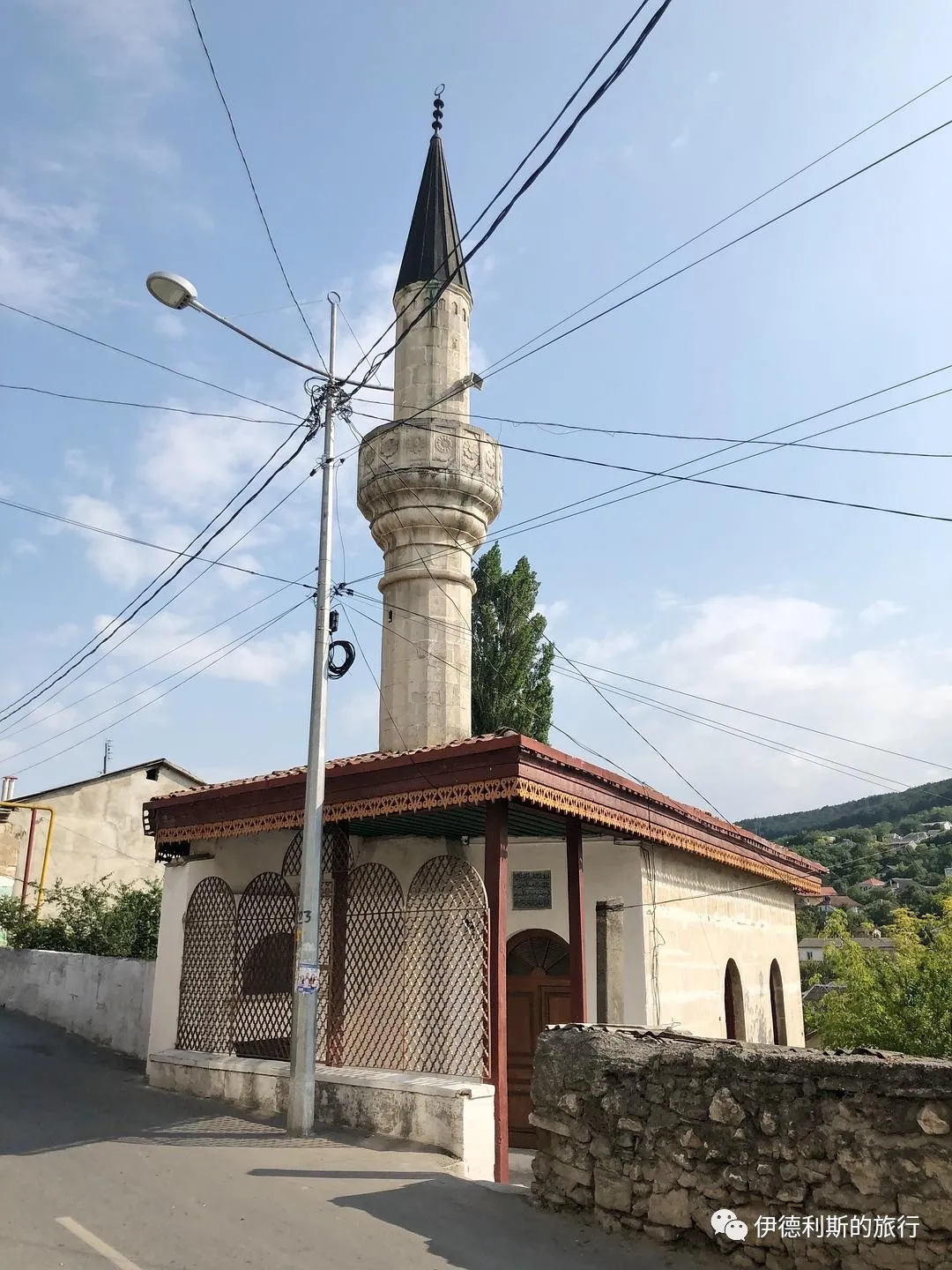
Tahtali Mosque was built in 1707 by Khan Sultan Beck, the son-in-law of the Crimean Khan Selim I Giray. In the Crimean Tatar language, "Tahtalı" means "wooden." The mosque was originally built with wooden planks. Later, it was enclosed with brick and stone, and the roof was covered with clay tiles.
Accommodation
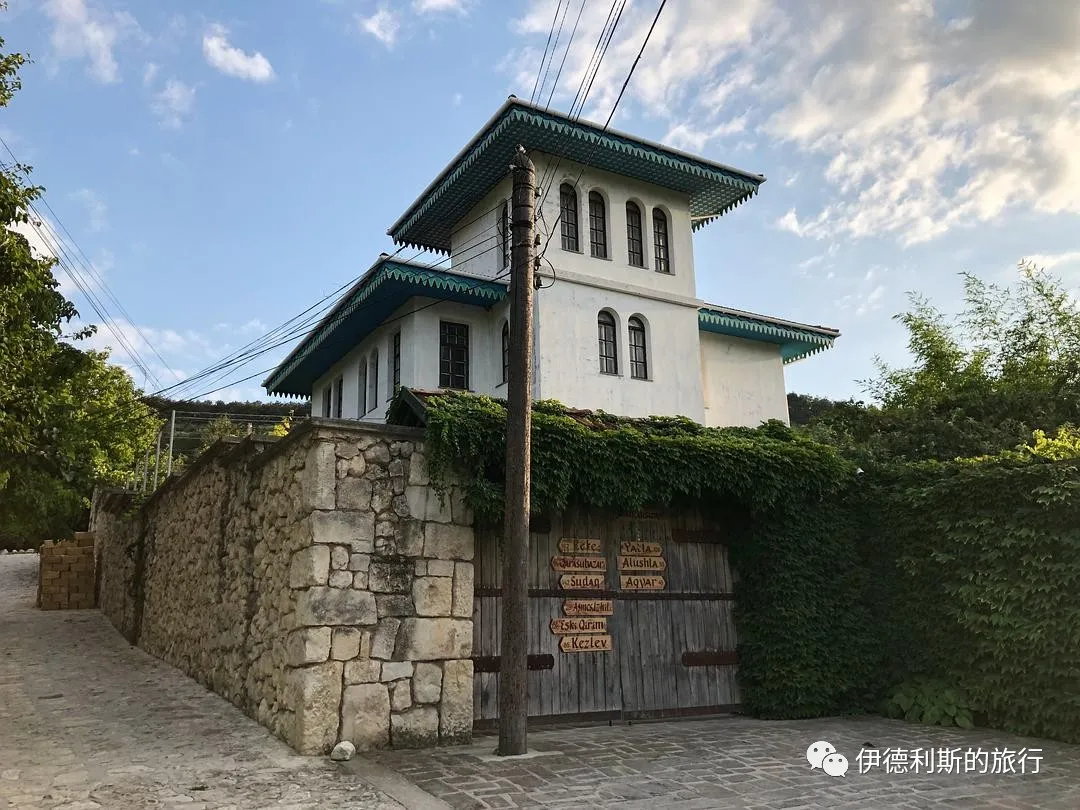
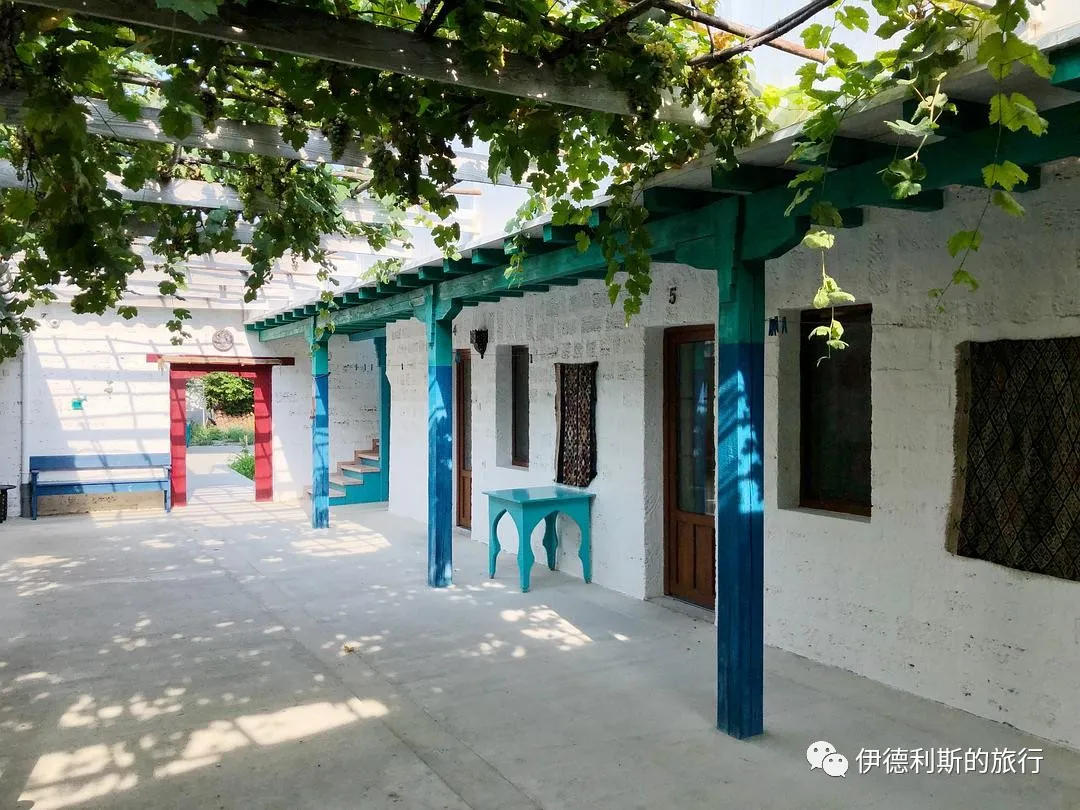
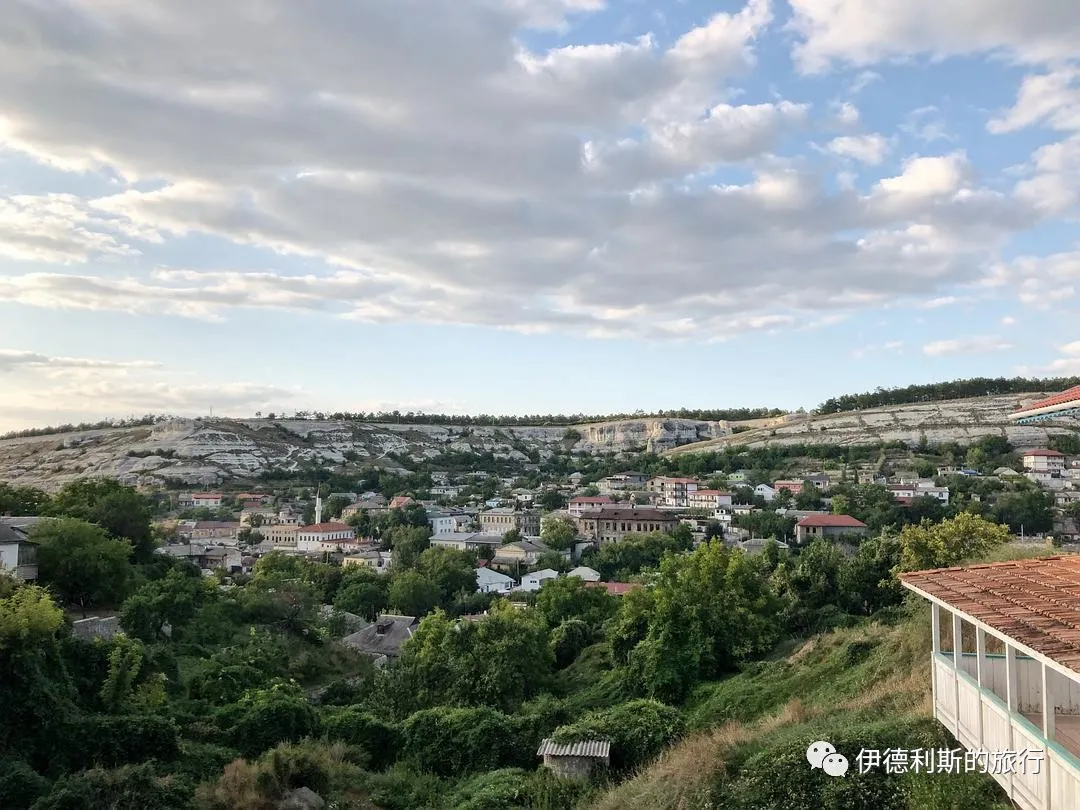
I stayed at a beautiful traditional Crimean Tatar house called Bahitgul Boutique-Hotel. They serve traditional Crimean Tatar food, so I usually ate breakfast right where I was staying. The view while eating there is excellent, as you can look out over the entire ancient capital.
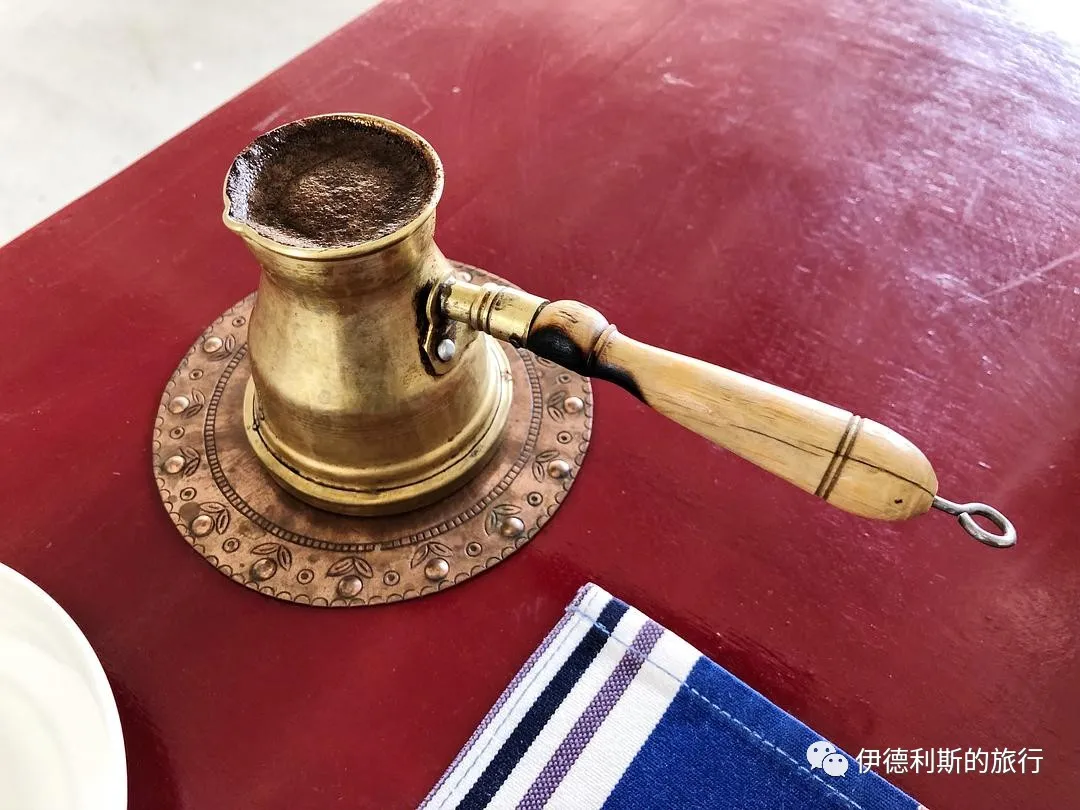
The food culture of the Crimean Tatars is closely tied to their history. Because the Crimean Khanate was a long-term vassal of the Ottoman Empire, it has many Ottoman-related foods, such as Turkish coffee, baklava (a sweet pastry), and stuffed grape leaves (dolma). After being exiled to Uzbekistan in 1944, the Crimean Tatar diet added many Uzbek dishes, including rice pilaf (plov), hand-pulled noodles (lagman), baked meat buns (samsa), steamed dumplings (manti), and flatbread (nan). Crimean Tatars have some unique delicacies, such as the deep-fried meat pastry (chebureki), which is known as a signature national dish.
You can eat baked meat buns (samsa) at the bazaar.
I ate rice pilaf (plov), stuffed grape leaves (dolma), and lamb skewers (shashlik) at a Crimean Tatar restaurant; the lamb skewers were incredibly tender and fragrant.
I bought desserts at a Crimean Tatar sweet shop in the old city, which are basically the same as the baklava popular in former Ottoman regions like Turkey, the Caucasus, the Balkans, and the Levant. In the third picture, the first row on the iron tray says 'hazelnut,' and the second row says 'caramel'.
At a manor-style Crimean Tatar restaurant at the foot of the mountain, I ate sheep cheese with olives (brynza s maslinami), grilled salmon (deniz kebab), steamed dumplings (manti), and the signature Crimean Tatar deep-fried meat pastry (chebureki).
The deep-fried meat pastry (chebureki) is a unique national food of the Crimean Tatars. It can be made with lamb or beef, mixed with onions and black pepper, and the dough is very thin. Steamed dumplings (manti) were brought back by the Crimean Tatars after they were forced into exile in Uzbekistan in 1944.
Clothing
Skullcap (tubeteika)
I bought a wool hat called a kalpak at a shop, which is the most classic winter hat for Crimean Tatars. This word is the same as the name for the felt hat worn by the Kyrgyz people, but the shape is different. view all
Summary: Bakhchysarai in Crimea is shown through the Khan Palace, mosques, tombs, old neighborhoods, and Crimean Tatar heritage. This account keeps the original route, names, dates, architectural details, food notes, and photographs.
Bakhchisaray sits in a valley on the Crimean Peninsula and became the capital of the Crimean Khanate in 1532. Although it became an ordinary town after Russia occupied the Crimean Khanate in 1783, it remains the cultural center of the Crimean Tatars and preserves their unique culture and customs.
Crimean Tatars are a Turkic-speaking ethnic group that formed during the Golden Horde period. In May 1944, the Soviet Union deported all 240,000 Crimean Tatars from the Crimean Peninsula to Uzbekistan and other remote regions. Many Crimean Tatars died during the exile from cold, hunger, disease, and exhaustion. Even after reaching their destinations, many were forced to work hard in Gulag collective farms. For nearly half a century after that, there were almost no Crimean Tatars on the Crimean Peninsula.
After a long struggle by the Crimean Tatar civil rights movement, the Soviet Union finally declared the deportation of the Crimean Tatars illegal in 1989, and they finally gained the right to return to their homeland. Today, 250,000 Crimean Tatars have returned home, working to rebuild their lives, overcome social and economic obstacles, and pass on their culture.
The Palace
The North Gate is the entrance to the Khan Palace area. In the Crimean Tatar language, Darbehane Qapı means Mint Gate, named because mint once grew across from the gate. The Khan Palace once had four large gates, but only the North Gate and South Gate remain today. The North Gate features a carving of two snakes intertwined. Legend says the palace builder, Sahib I Giray, saw two snakes fighting by the river in front of the gate and watched one get healed by the water, so he decided to build the palace there.
The North Gate was built in 1611. Before this, the palace had no walls because the capital's defense system was at the Jewish Fortress on the cliff. As Cossack military activity increased in the 17th century, the palace was considered under threat, leading to the construction of the current walls and gates.
The Great Khan Mosque (Büyük Han Cami) was one of the first palace buildings constructed after the capital moved in 1532. The original mosque had several domes, much like the Seljuk-style mosques popular in 15th-century Ottoman Turkey. A fire destroyed the mosque in 1736, but Khan Selamet II Giray (reigned 1740-1743) later restored it and changed the roof to tiles.
During the Soviet era, the mosque closed and became an exhibition hall for an archaeological museum. After Russia occupied Crimea in 2014, they restored the mosque, though some of this work caused damage.
Maqsurah is Arabic for "enclosed space," and it served as a private area inside the mosque for rulers or nobles to perform namaz. A maqsurah is usually a wooden box or screen near the mihrab, but the Khan Mosque features a two-story loft instead. The main entrance of the Khan Mosque connects to the north wall of the Khan Palace for direct access, while you can only reach the maqsurah via stairs inside the palace.
The maqsurah in the Khan Mosque was rebuilt after the 1736 fire and features famous Turkish Iznik tiles, stained glass, and various precious 18th-century murals.
The Khan Cemetery sits south of the Khan Mosque and holds the graves of nine Crimean Khans from the 16th to 18th centuries, 45 members of the Khan family, and over 320 court nobles. The two most important tombs belong to Crimean Khans Devlet I Giray (reigned 1551-1577) and İslâm III Giray (reigned 1644-1654). These octagonal tombs are made of limestone and originally had lead domes, which were replaced with iron after 1863. There is also the open-air tomb of Crimean Khan Meñli II Giray (reigned 1724-1730, 1737-1740) and the double tombstone of Crimean Khan Qırım Giray (reigned 1758-1764, 1768-1769).
Devlet I Giray reigned for 26 years. His most important battle was burning Moscow in 1571, which forced Tsar Ivan the Terrible to flee, earning him the title "the one who took the crown." In 1640, İslâm III Giray led his army to deal a devastating blow to Ukraine.
During his reign, Meñli II Giray ended the long-standing instability of the Crimean Khanate and abolished certain taxes, which earned him much support. He skillfully organized defenses against the invading Russian army and caused them heavy losses.
Qırım Giray was a talented ruler. Under his rule, the Crimean Khanate saw an artistic revival and developed a unique style known as "Crimean Rococo."
The SaryGuzel bathhouse was ordered to be built in 1532 by Crimean Khan Sahib I Giray. Like the Khan Mosque, it is one of the oldest buildings in the Bakhchisaray Khan Palace. In the Crimean Tatar language, 'Sarı' means 'yellow or fair-skinned,' and 'Güzel' means 'beautiful.'
The SaryGuzel bathhouse is a typical Turkish bath. A furnace in the basement sends hot air up to heat the floor, and lead pipes supply hot and cold water to the bath. The bath is divided into men's and women's sections. Each section has a dome with star-shaped cutouts for light and ventilation, and there is an indoor courtyard with a fountain at the exit.
The SaryGuzel bathhouse operated until 1924, when it was closed because it was considered unsafe. It has since been restored and is now open for exhibitions.
The Falcon Tower (Toğan qullesi) is located in a corner of the Persian Garden at the Khan Palace. Legend says it was once used to train falcons for the Khan's court. The Falcon Tower was built in the 16th century. It was originally a five-story brick, mud, and wood structure. In 1760, it was rebuilt into two stories: a lower cube made of rubble and cement mortar, and an upper octagonal tower made of wooden planks.
The Falcon Tower connects to the Harem building of the Khan Palace. A spiral staircase inside leads to an observation deck at the top, where people living in the Harem could look out over the entire palace.
The Harem (Arem) of the Crimean Khan Palace once had 4 buildings and 73 rooms. In 1818, Tsar Alexander I ordered the demolition of 3 buildings and 70 rooms, leaving only an annex with 3 rooms and a pavilion. Today, the annex displays the interior decorations of Crimean Tatar homes from the 17th to the 19th centuries.
The living room retains its original fireplace and cupboards. During a 1980s restoration, a mirror with an inscription by the artist was discovered. Paintings on the vanity and Arabic poetry on the ceiling have also been cleaned and revealed.
The Persian Garden in the southern part of the Harem is surrounded by high walls. It once featured various trees, fountains, and baths, but now only ruins remain.
The Dilâra Bikeç Mausoleum is an octagonal tomb at the southernmost point of the Bakhchisaray Khan Palace. It was ordered to be built in 1764 by Crimean Khan Qırım Giray (reigned 1758-1764, 1768-1769) for his beloved wife.
The Small Khan Mosque (Kiçik Han Cami) is inside the main building of the Khan Palace and was used by members of the Khan's family and noble officials. The Small Khan Mosque was built in the 16th century. It was destroyed by fire by the Russian army in 1736 and restored in 1741 by Khan Selamet II Giray (reigned 1740-1743).
The existing interior murals were created between the 17th and 18th centuries, with some painted by the Iranian architect Omer in the late 18th century. Earlier murals from the 16th century were discovered during a 1991 restoration.
On the south wall of the Khan Mosque (Khan Jami) is a prayer niche (mihrab) carved with seven decorative bands, which symbolize the seven heavens mentioned in the Quran.
Above the prayer niche (mihrab) is a piece of stained glass featuring the Seal of Solomon (Khatam Sulayman) ✡.
The Iron Gate (Demir Qapi) is the oldest structure in the Khan Palace, built between 1503 and 1504 by the architect Aleviz Novy for the Crimean Khan. This architect had previously been invited by Ivan the Great to Moscow to build a series of churches. The Iron Gate (Demir Qapi) was likely originally built at the Crimean Khan's previous residence, Devlet-Saray, and was moved to the main building of the Khan Palace only after the Bakhchisaray Khan Palace was completed in 1532.
Demir Qapi means iron gate in the Crimean Tatar language. The gate's portal is made of limestone and uses decorative styles from the Lombard-Venetian Renaissance.
The Council Hall (Divan hanesi) is the meeting room inside the main building of the Khan Palace. In the center of the south wall is the throne where the Khan sat, with sofas on the sides for his ministers. Above the north wall at the entrance to the hall is a narrow latticed balcony, which is said to have been used by the Khan to have people eavesdrop on meetings when he was absent.
The floor of the hall was paved with marble and had a square pool with a fountain in the center. The walls were covered in tiles, but these were destroyed in a fire set by the Russian army in 1736. Restoration took place in 1742, and many of the current decorations, such as the murals and chandeliers, were added in 1822 when the architect I. F. Kolodin renovated the Khan Palace.
In 1917, the Crimean Tatars announced the establishment of an independent Crimean Tatar government here.
The Summer Pavilion is a place for cooling off inside the main building of the Khan Palace, built between the late 17th and early 18th centuries. It was burned down by the Russian army in 1736 and later restored by the architect Omer ibn al Hadj Mustafa. In the center of the pavilion is a square pool with a square marble fountain, surrounded by sofas.
The pavilion was originally open. Between 1821 and 1831, Tsar Alexander I ordered the architects Mikhail Klado and Vasiliy Dorofeyev to enclose the Summer Pavilion, adding columns, stained glass, and a carved ceiling.
Early murals were discovered during the restoration of the summer pavilion in 1962.
The Golden Pavilion is on the second floor of the main building and was built in the late 18th century by the Iranian architect Omer. The interior of the pavilion originally featured murals of fruit vases and Arabic poetry praising Khan Qırım Giray, but these were destroyed during the German occupation of Crimea from 1941 to 1944.
The Golden Fountain is located in the Fountain Courtyard of the Khan's Palace main building, near the Small Khan Mosque, and was where the Crimean Khan and members of the Khan's court performed wudu.
The Golden Fountain is made of gilded marble and features carvings of various flowers, fruits, and plants to depict the 'Garden of Eden' (jandātʿadni) from the Quran, the place where Adam and his wife lived. A circular outlet is carved in the center of the fountain, symbolizing eternal life.
The Fountain of Tears was commissioned in 1763 by the Crimean Khan Qırım Giray (reigned 1758-1764, 1768-1769), and the architect was Omer ibn al Hadj Mustafa from Iran. The fountain was originally installed in the mausoleum of the Khan's beloved wife, Dilâra Bikeç, but after Empress Catherine II visited the palace in 1787, the dried-up fountain was moved to the Fountain Courtyard in front of the main building.
A love story about the Fountain of Tears has circulated in Bakhchysarai since the 18th century. According to the legend, the Khan's beloved wife, Dilâra Bikeç, was a Greek woman from Georgia who was killed in palace intrigue. The Khan fell into deep grief and built this fountain in her mausoleum to honor her. This love story later became widely known because of Pushkin's famous poem, The Fountain of Bakhchisaray.
The suites on both sides of the North Gate were where the Khan's palace guards (Qapı Halqı) lived. After Crimea was occupied by Tsarist Russia, this area also served as guest lodging. Today, the west building of the suites is an exhibition hall, and the east building houses museum offices.
The exhibition hall in the west building displays artifacts from the Crimean Khanate era and the traditional life of the Crimean Tatars. The original fireplaces are still preserved inside the suites.
The stables are divided into two floors, with the first floor used for keeping horses and the second floor for the grooms to live in; the current building was rebuilt in the 1850s.
Mosque
Orta Mosque was once the main Friday mosque in Bakhchysarai. It dates back to 1674. The Khans Mengli Giray II and Selamet II Giray renovated it between 1737 and 1743, and it was rebuilt again in 1861 to reach its current form.
After 1929, the mosque served as a cultural center and then a cinema. It was not returned to the Muslim community until 2001. The mosque's minaret and surrounding buildings were destroyed at that time. They were not rebuilt until 2012. The mosque reopened in 2013 after the construction work finished.
Ismi Khan Mosque was built between the 17th and 18th centuries. Its architectural decorations show a strong influence from the European Baroque style. The upper circular openings are decorated with wooden Seals of Solomon (Khātam Sulaymān) ✡.
The mosque was used as a warehouse for a long time. There were plans to restore it in the early 21st century, but the work has not been carried out yet.
Molla Mustafa Friday Mosque dates back to the 17th century. An 1890 document mentions this mosque, stating that the local residents added a roof to the building in 1888.
Tahtali Mosque was built in 1707 by Khan Sultan Beck, the son-in-law of the Crimean Khan Selim I Giray. In the Crimean Tatar language, "Tahtalı" means "wooden." The mosque was originally built with wooden planks. Later, it was enclosed with brick and stone, and the roof was covered with clay tiles.
Accommodation
I stayed at a beautiful traditional Crimean Tatar house called Bahitgul Boutique-Hotel. They serve traditional Crimean Tatar food, so I usually ate breakfast right where I was staying. The view while eating there is excellent, as you can look out over the entire ancient capital.
The food culture of the Crimean Tatars is closely tied to their history. Because the Crimean Khanate was a long-term vassal of the Ottoman Empire, it has many Ottoman-related foods, such as Turkish coffee, baklava (a sweet pastry), and stuffed grape leaves (dolma). After being exiled to Uzbekistan in 1944, the Crimean Tatar diet added many Uzbek dishes, including rice pilaf (plov), hand-pulled noodles (lagman), baked meat buns (samsa), steamed dumplings (manti), and flatbread (nan). Crimean Tatars have some unique delicacies, such as the deep-fried meat pastry (chebureki), which is known as a signature national dish.
You can eat baked meat buns (samsa) at the bazaar.
I ate rice pilaf (plov), stuffed grape leaves (dolma), and lamb skewers (shashlik) at a Crimean Tatar restaurant; the lamb skewers were incredibly tender and fragrant.
I bought desserts at a Crimean Tatar sweet shop in the old city, which are basically the same as the baklava popular in former Ottoman regions like Turkey, the Caucasus, the Balkans, and the Levant. In the third picture, the first row on the iron tray says 'hazelnut,' and the second row says 'caramel'.
At a manor-style Crimean Tatar restaurant at the foot of the mountain, I ate sheep cheese with olives (brynza s maslinami), grilled salmon (deniz kebab), steamed dumplings (manti), and the signature Crimean Tatar deep-fried meat pastry (chebureki).
The deep-fried meat pastry (chebureki) is a unique national food of the Crimean Tatars. It can be made with lamb or beef, mixed with onions and black pepper, and the dough is very thin. Steamed dumplings (manti) were brought back by the Crimean Tatars after they were forced into exile in Uzbekistan in 1944.
Clothing
Skullcap (tubeteika)
I bought a wool hat called a kalpak at a shop, which is the most classic winter hat for Crimean Tatars. This word is the same as the name for the felt hat worn by the Kyrgyz people, but the shape is different. view all
Reposted from the web
Summary: Bakhchysarai in Crimea is shown through the Khan Palace, mosques, tombs, old neighborhoods, and Crimean Tatar heritage. This account keeps the original route, names, dates, architectural details, food notes, and photographs.
Bakhchisaray sits in a valley on the Crimean Peninsula and became the capital of the Crimean Khanate in 1532. Although it became an ordinary town after Russia occupied the Crimean Khanate in 1783, it remains the cultural center of the Crimean Tatars and preserves their unique culture and customs.
Crimean Tatars are a Turkic-speaking ethnic group that formed during the Golden Horde period. In May 1944, the Soviet Union deported all 240,000 Crimean Tatars from the Crimean Peninsula to Uzbekistan and other remote regions. Many Crimean Tatars died during the exile from cold, hunger, disease, and exhaustion. Even after reaching their destinations, many were forced to work hard in Gulag collective farms. For nearly half a century after that, there were almost no Crimean Tatars on the Crimean Peninsula.
After a long struggle by the Crimean Tatar civil rights movement, the Soviet Union finally declared the deportation of the Crimean Tatars illegal in 1989, and they finally gained the right to return to their homeland. Today, 250,000 Crimean Tatars have returned home, working to rebuild their lives, overcome social and economic obstacles, and pass on their culture.
The Palace
The North Gate is the entrance to the Khan Palace area. In the Crimean Tatar language, Darbehane Qapı means Mint Gate, named because mint once grew across from the gate. The Khan Palace once had four large gates, but only the North Gate and South Gate remain today. The North Gate features a carving of two snakes intertwined. Legend says the palace builder, Sahib I Giray, saw two snakes fighting by the river in front of the gate and watched one get healed by the water, so he decided to build the palace there.
The North Gate was built in 1611. Before this, the palace had no walls because the capital's defense system was at the Jewish Fortress on the cliff. As Cossack military activity increased in the 17th century, the palace was considered under threat, leading to the construction of the current walls and gates.
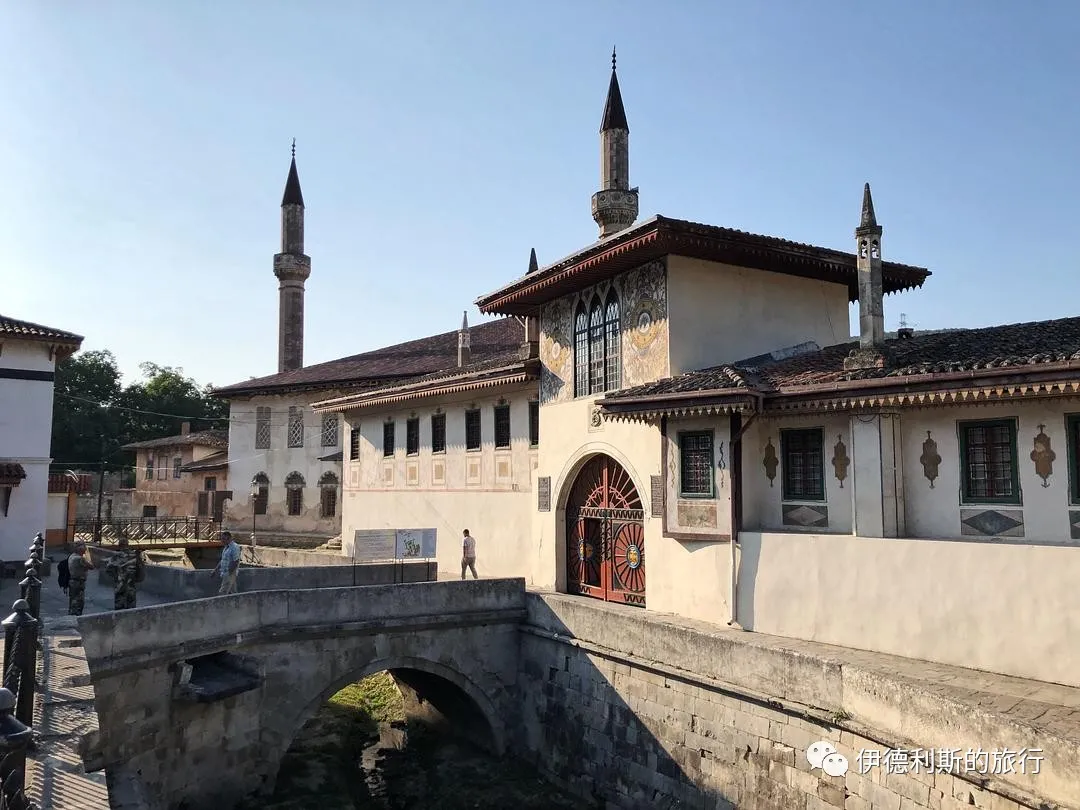
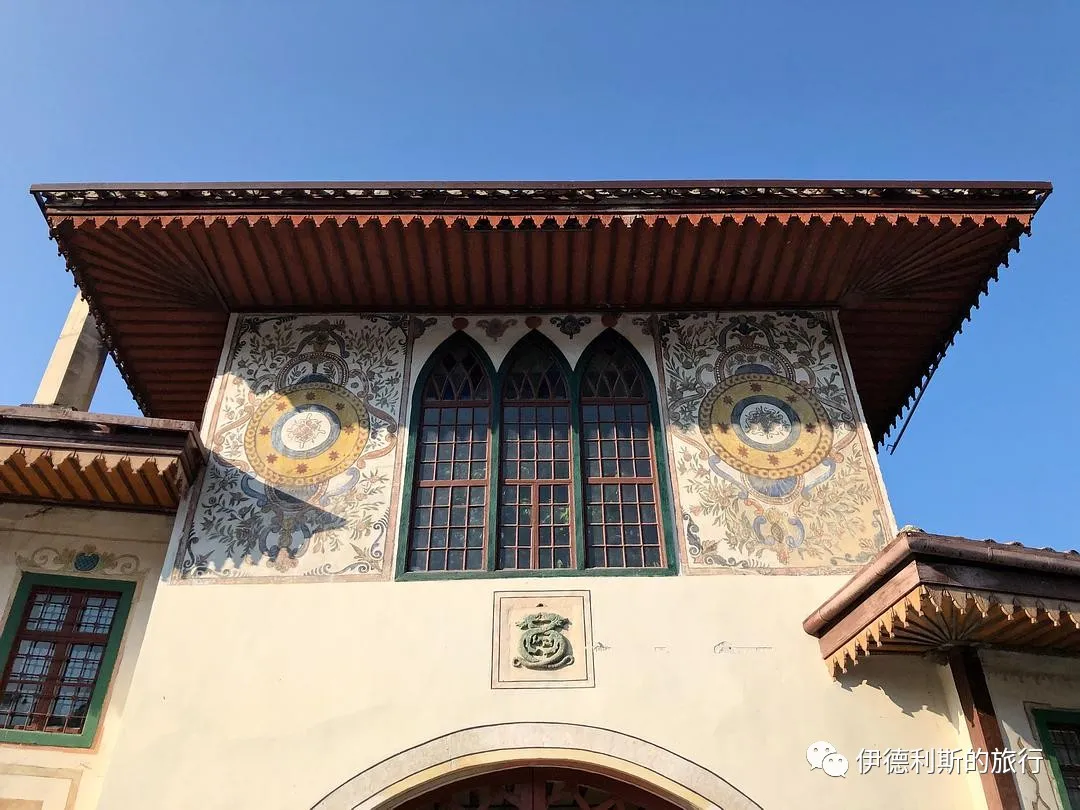
The Great Khan Mosque (Büyük Han Cami) was one of the first palace buildings constructed after the capital moved in 1532. The original mosque had several domes, much like the Seljuk-style mosques popular in 15th-century Ottoman Turkey. A fire destroyed the mosque in 1736, but Khan Selamet II Giray (reigned 1740-1743) later restored it and changed the roof to tiles.
During the Soviet era, the mosque closed and became an exhibition hall for an archaeological museum. After Russia occupied Crimea in 2014, they restored the mosque, though some of this work caused damage.
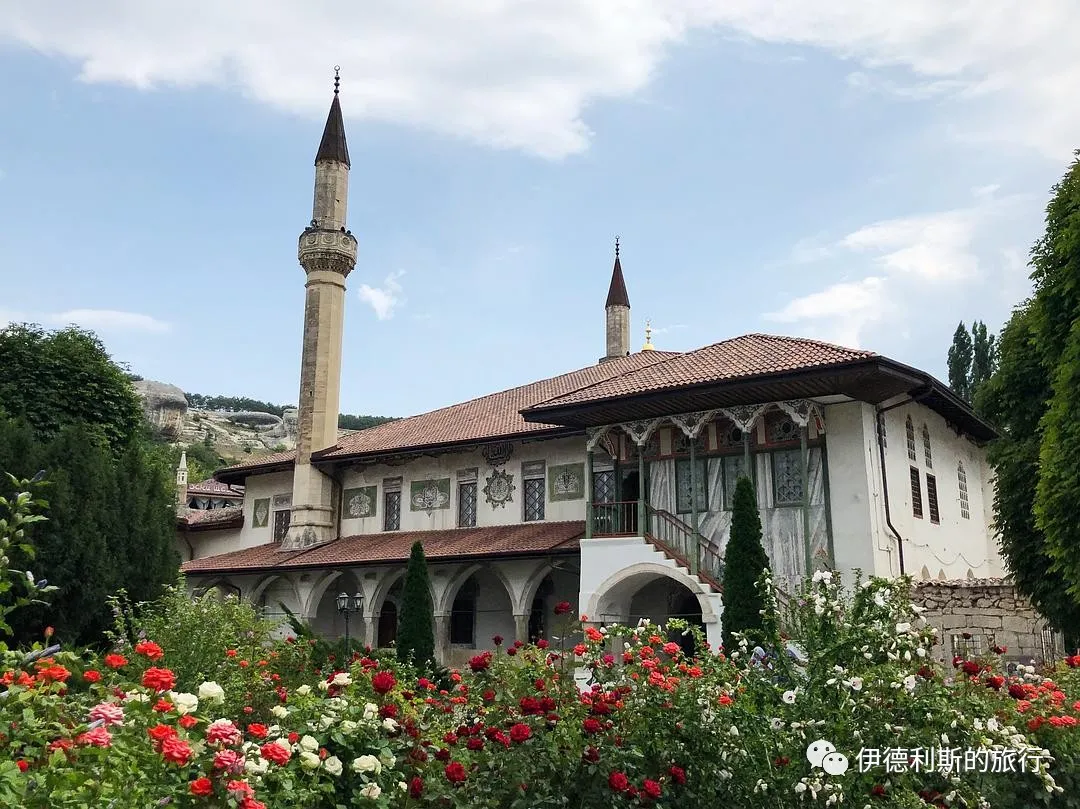
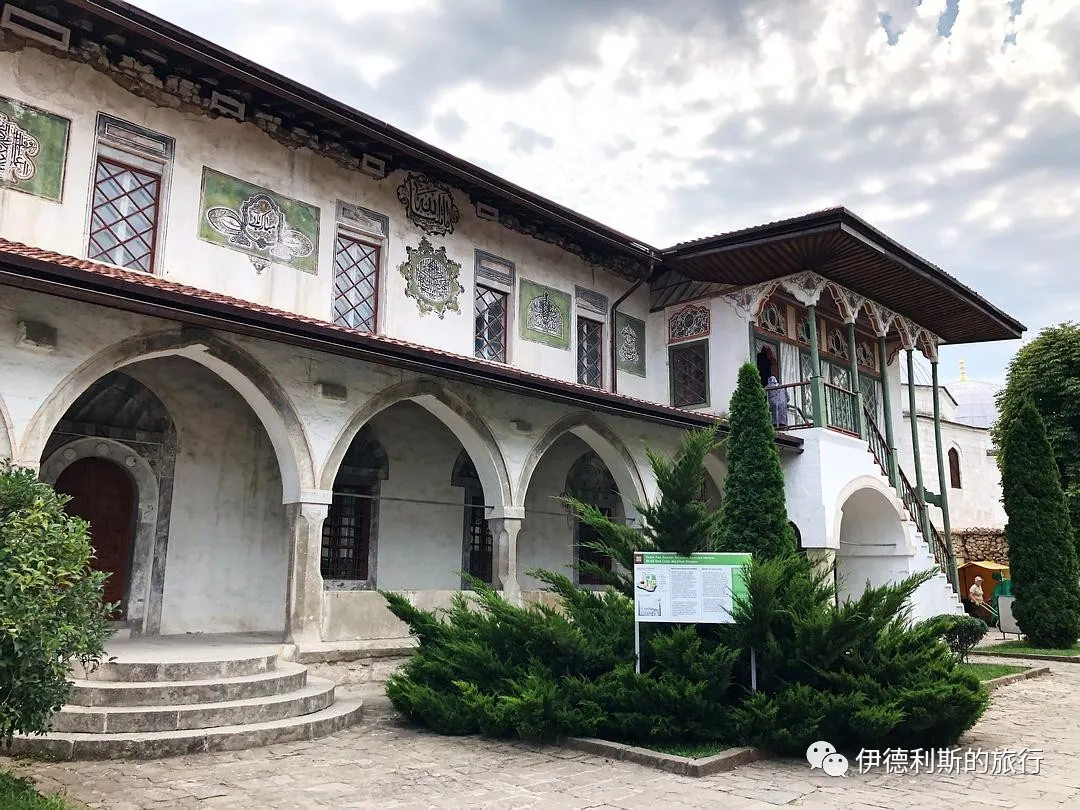
Maqsurah is Arabic for "enclosed space," and it served as a private area inside the mosque for rulers or nobles to perform namaz. A maqsurah is usually a wooden box or screen near the mihrab, but the Khan Mosque features a two-story loft instead. The main entrance of the Khan Mosque connects to the north wall of the Khan Palace for direct access, while you can only reach the maqsurah via stairs inside the palace.
The maqsurah in the Khan Mosque was rebuilt after the 1736 fire and features famous Turkish Iznik tiles, stained glass, and various precious 18th-century murals.
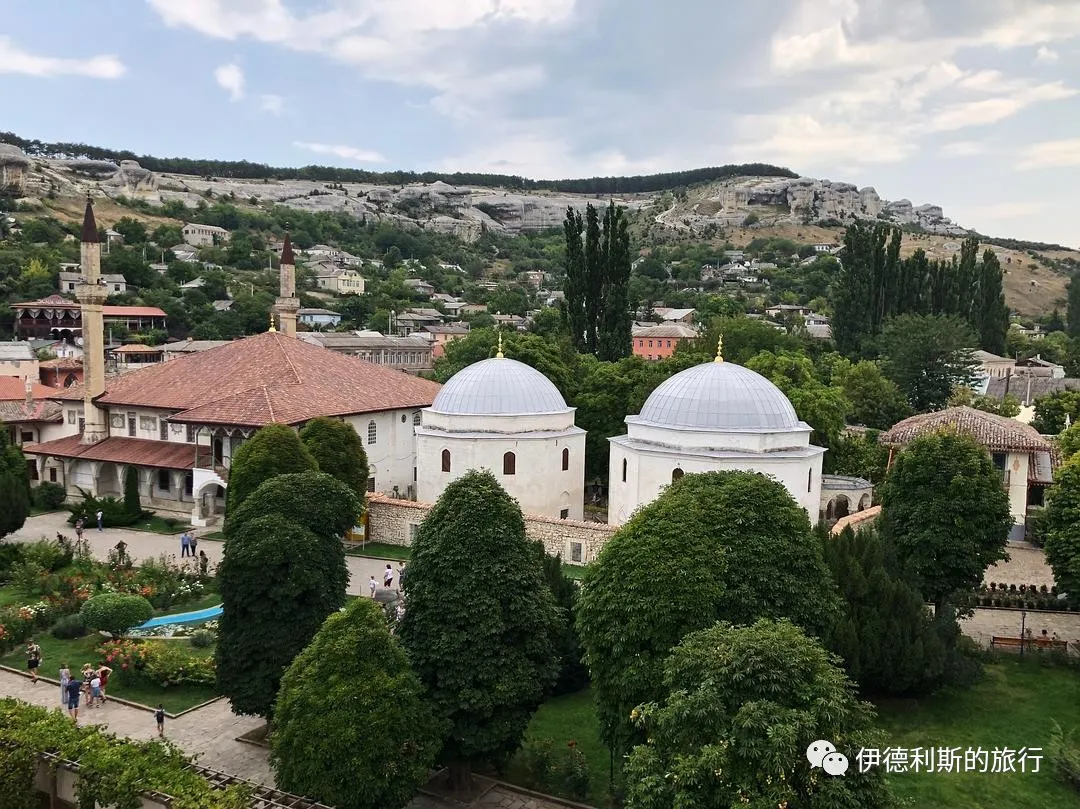
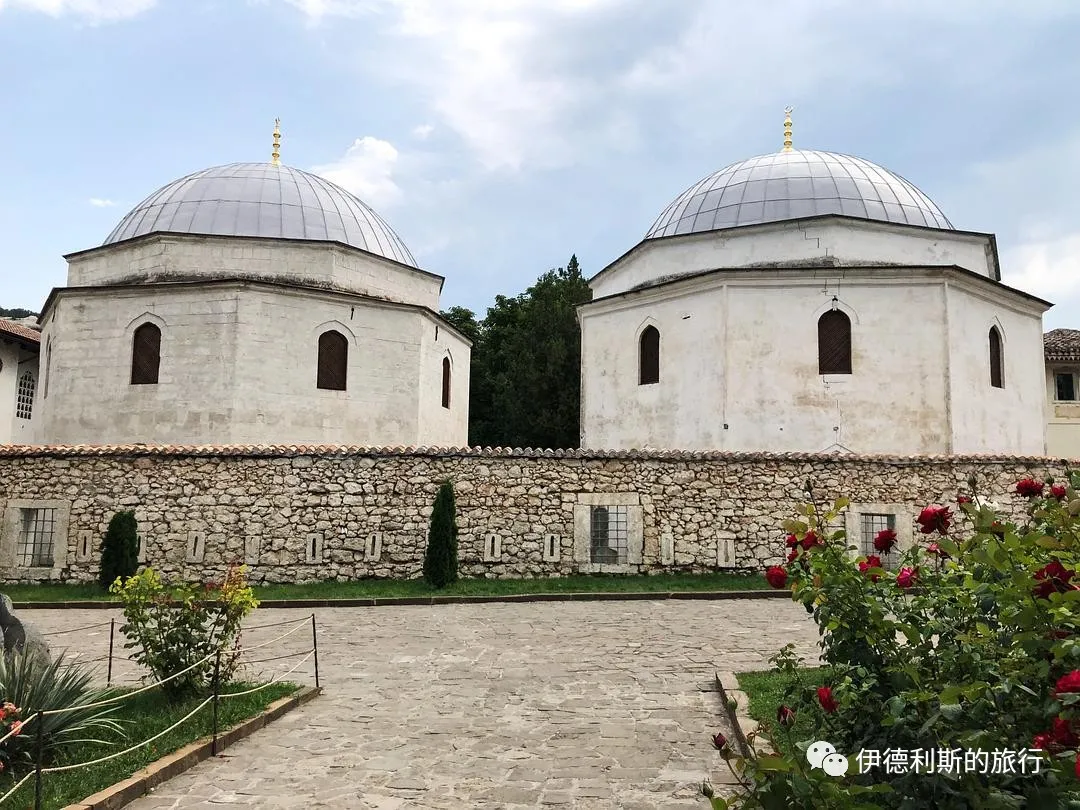
The Khan Cemetery sits south of the Khan Mosque and holds the graves of nine Crimean Khans from the 16th to 18th centuries, 45 members of the Khan family, and over 320 court nobles. The two most important tombs belong to Crimean Khans Devlet I Giray (reigned 1551-1577) and İslâm III Giray (reigned 1644-1654). These octagonal tombs are made of limestone and originally had lead domes, which were replaced with iron after 1863. There is also the open-air tomb of Crimean Khan Meñli II Giray (reigned 1724-1730, 1737-1740) and the double tombstone of Crimean Khan Qırım Giray (reigned 1758-1764, 1768-1769).
Devlet I Giray reigned for 26 years. His most important battle was burning Moscow in 1571, which forced Tsar Ivan the Terrible to flee, earning him the title "the one who took the crown." In 1640, İslâm III Giray led his army to deal a devastating blow to Ukraine.
During his reign, Meñli II Giray ended the long-standing instability of the Crimean Khanate and abolished certain taxes, which earned him much support. He skillfully organized defenses against the invading Russian army and caused them heavy losses.
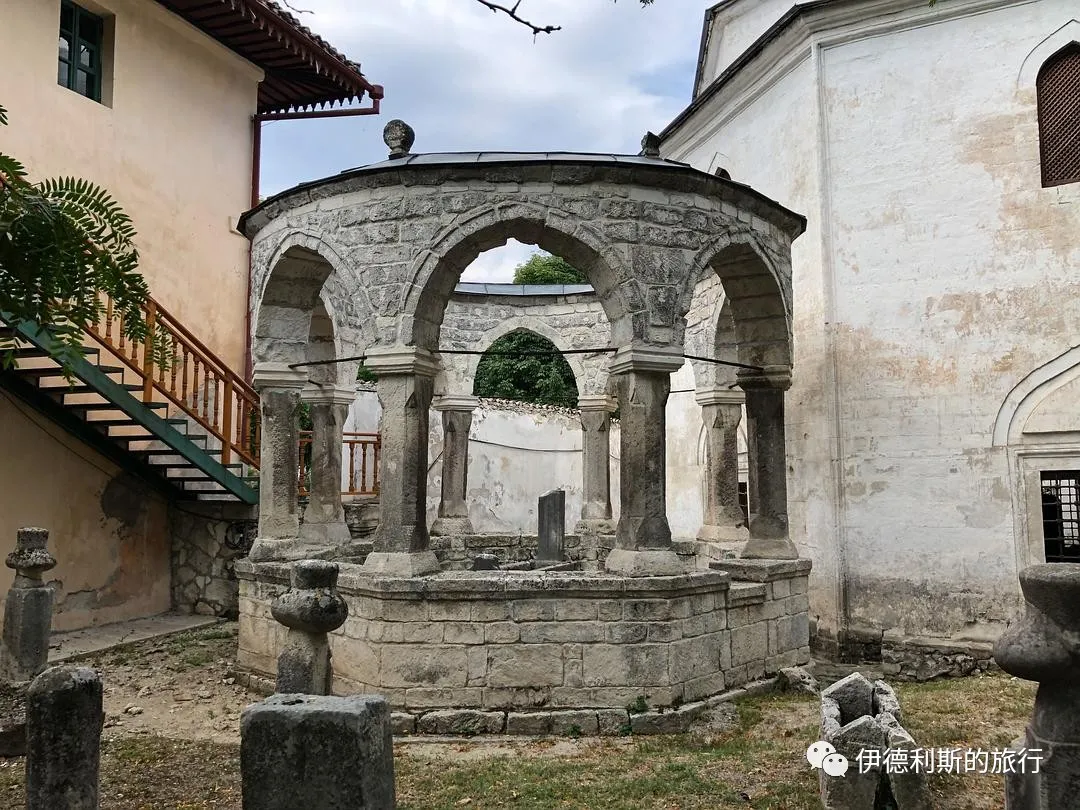
Qırım Giray was a talented ruler. Under his rule, the Crimean Khanate saw an artistic revival and developed a unique style known as "Crimean Rococo."
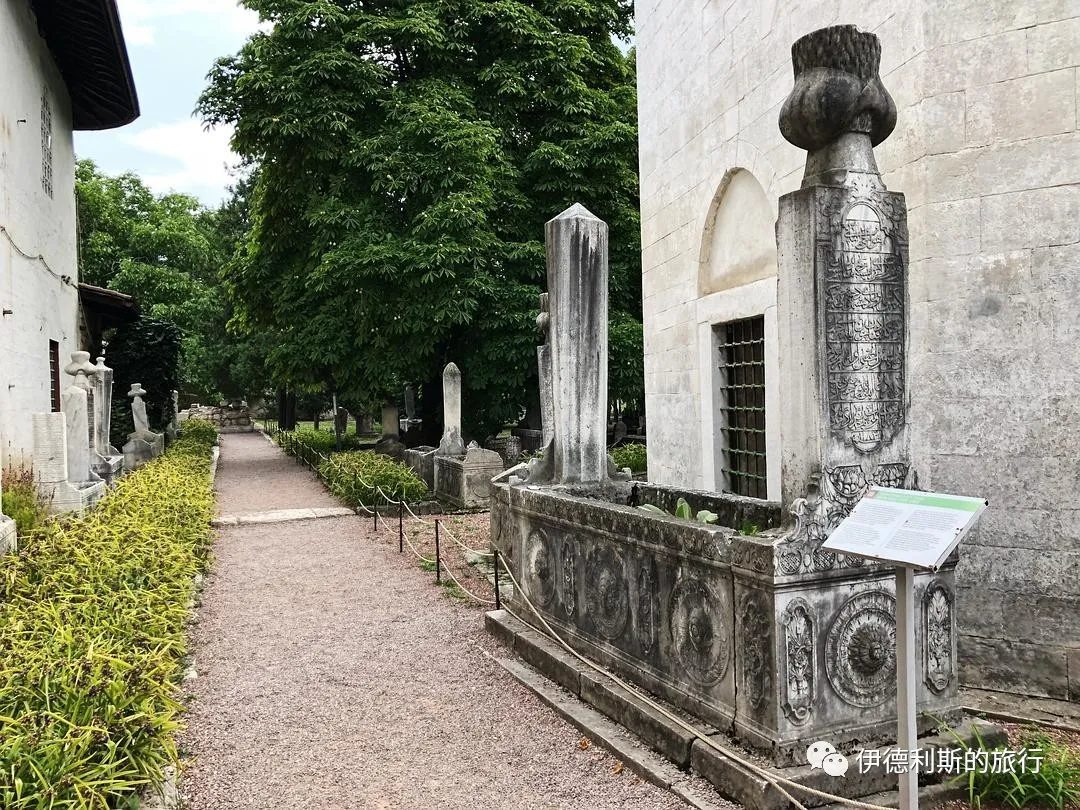
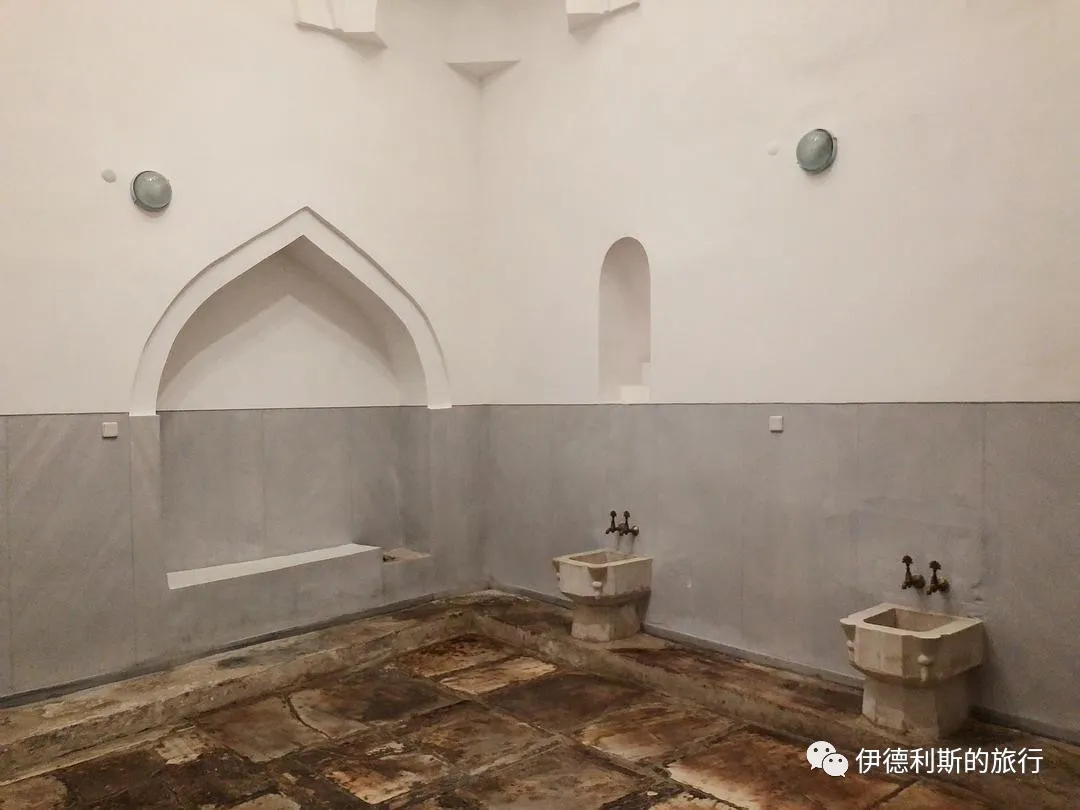
The SaryGuzel bathhouse was ordered to be built in 1532 by Crimean Khan Sahib I Giray. Like the Khan Mosque, it is one of the oldest buildings in the Bakhchisaray Khan Palace. In the Crimean Tatar language, 'Sarı' means 'yellow or fair-skinned,' and 'Güzel' means 'beautiful.'
The SaryGuzel bathhouse is a typical Turkish bath. A furnace in the basement sends hot air up to heat the floor, and lead pipes supply hot and cold water to the bath. The bath is divided into men's and women's sections. Each section has a dome with star-shaped cutouts for light and ventilation, and there is an indoor courtyard with a fountain at the exit.
The SaryGuzel bathhouse operated until 1924, when it was closed because it was considered unsafe. It has since been restored and is now open for exhibitions.
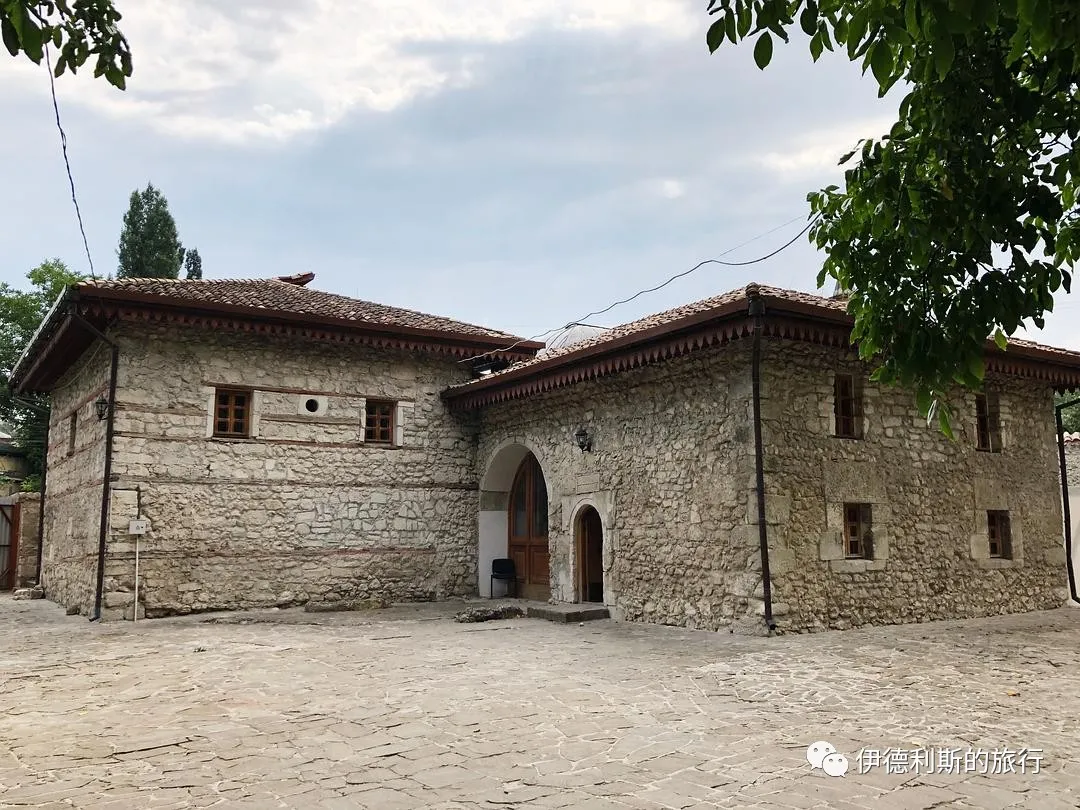
The Falcon Tower (Toğan qullesi) is located in a corner of the Persian Garden at the Khan Palace. Legend says it was once used to train falcons for the Khan's court. The Falcon Tower was built in the 16th century. It was originally a five-story brick, mud, and wood structure. In 1760, it was rebuilt into two stories: a lower cube made of rubble and cement mortar, and an upper octagonal tower made of wooden planks.
The Falcon Tower connects to the Harem building of the Khan Palace. A spiral staircase inside leads to an observation deck at the top, where people living in the Harem could look out over the entire palace.
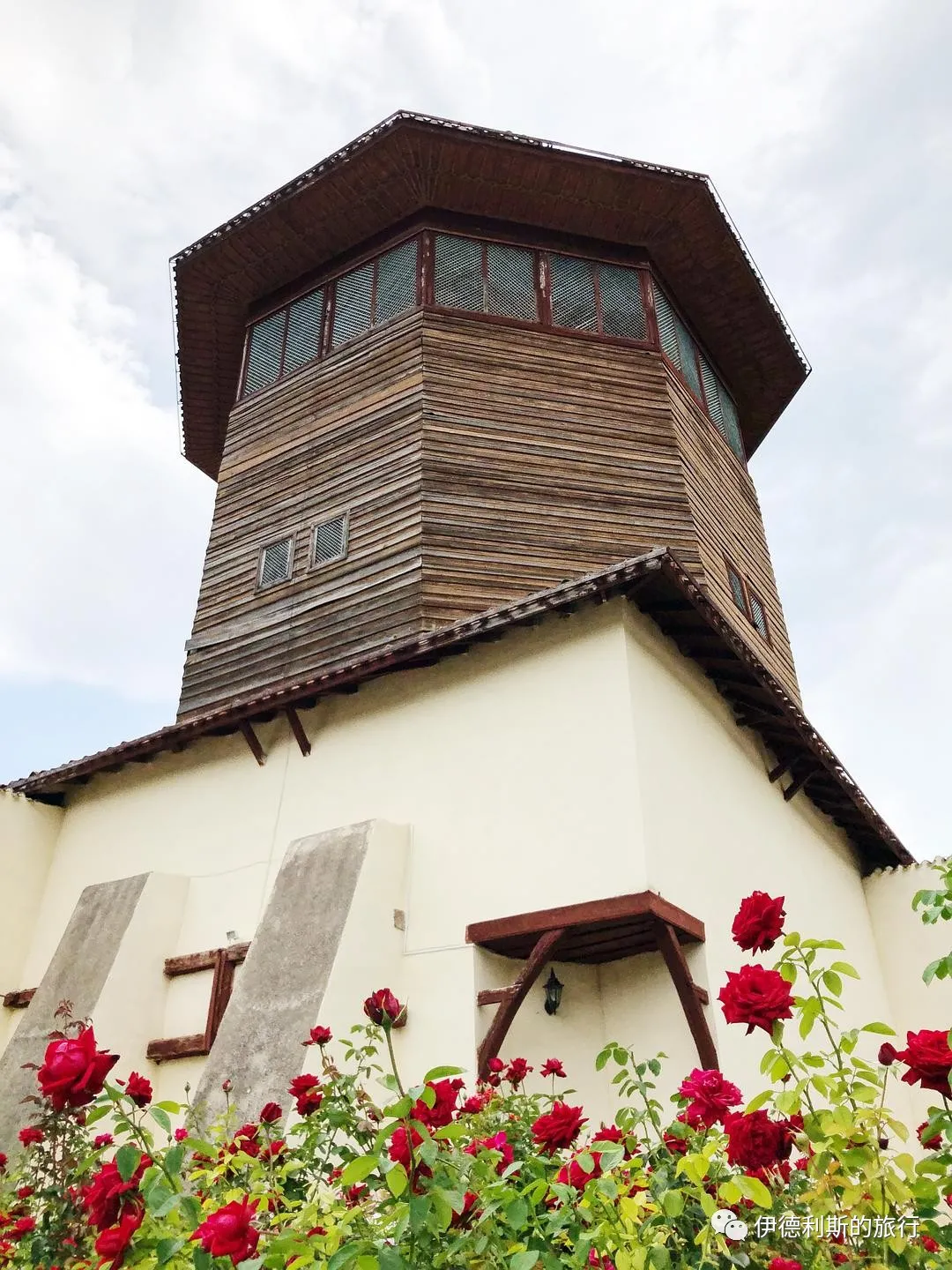
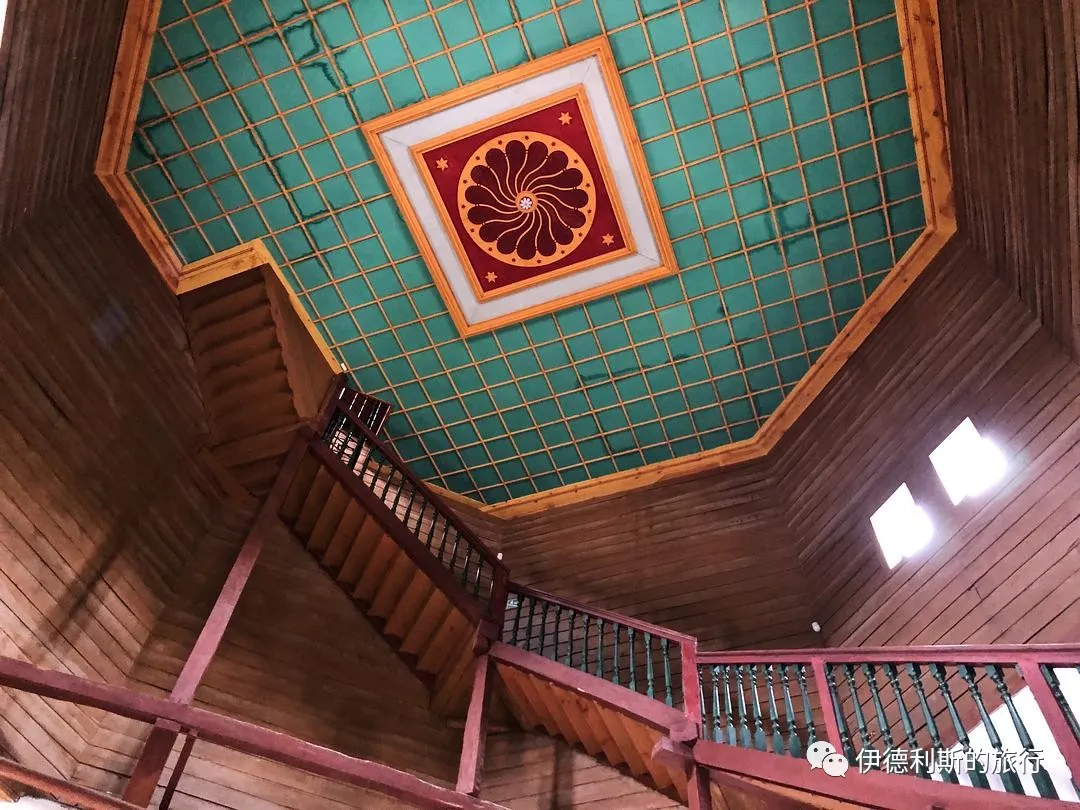
The Harem (Arem) of the Crimean Khan Palace once had 4 buildings and 73 rooms. In 1818, Tsar Alexander I ordered the demolition of 3 buildings and 70 rooms, leaving only an annex with 3 rooms and a pavilion. Today, the annex displays the interior decorations of Crimean Tatar homes from the 17th to the 19th centuries.
The living room retains its original fireplace and cupboards. During a 1980s restoration, a mirror with an inscription by the artist was discovered. Paintings on the vanity and Arabic poetry on the ceiling have also been cleaned and revealed.
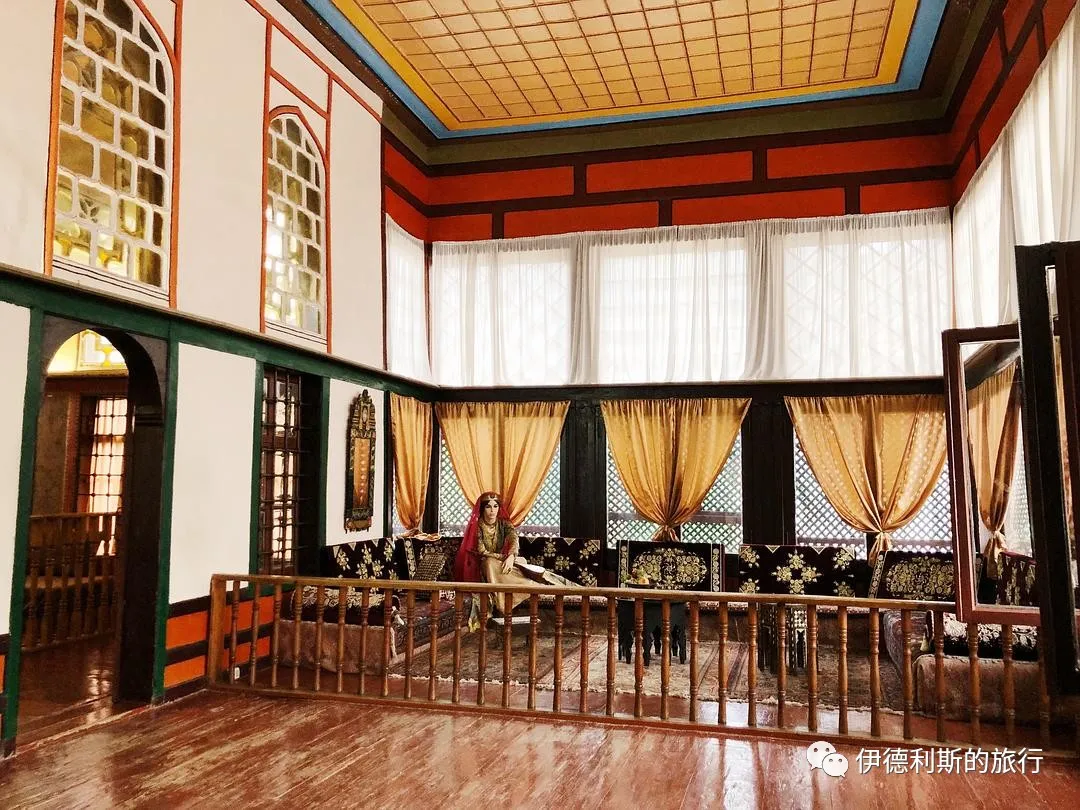
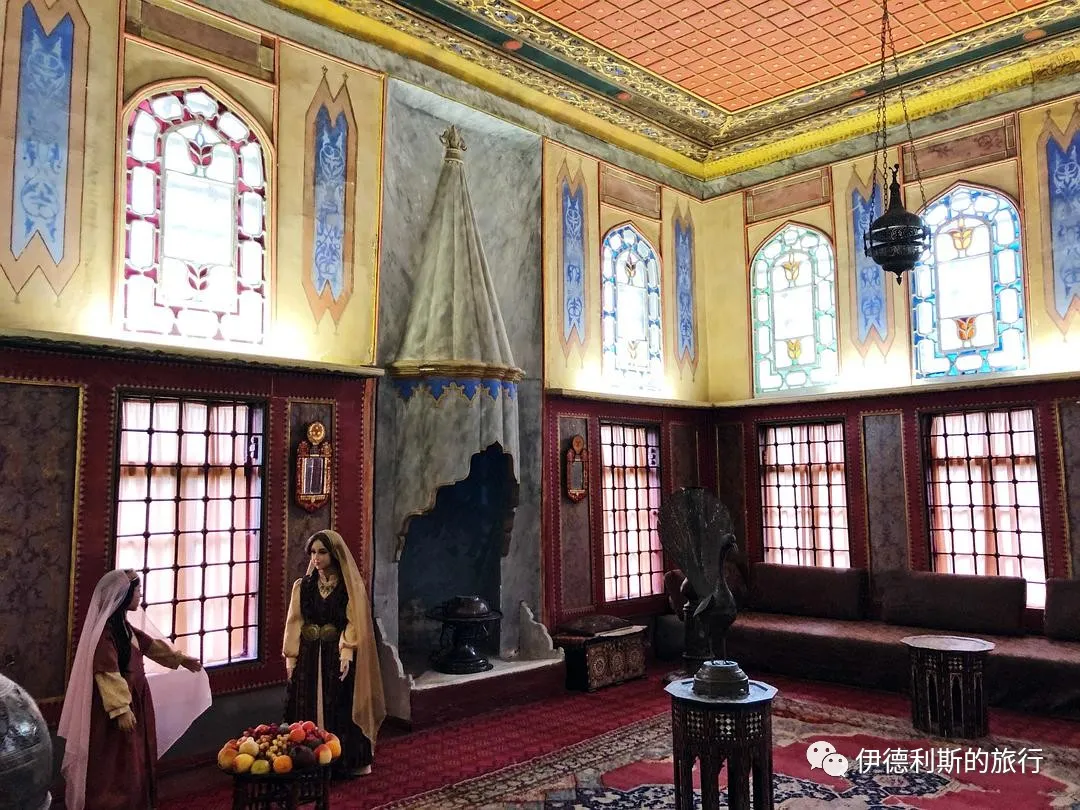
The Persian Garden in the southern part of the Harem is surrounded by high walls. It once featured various trees, fountains, and baths, but now only ruins remain.
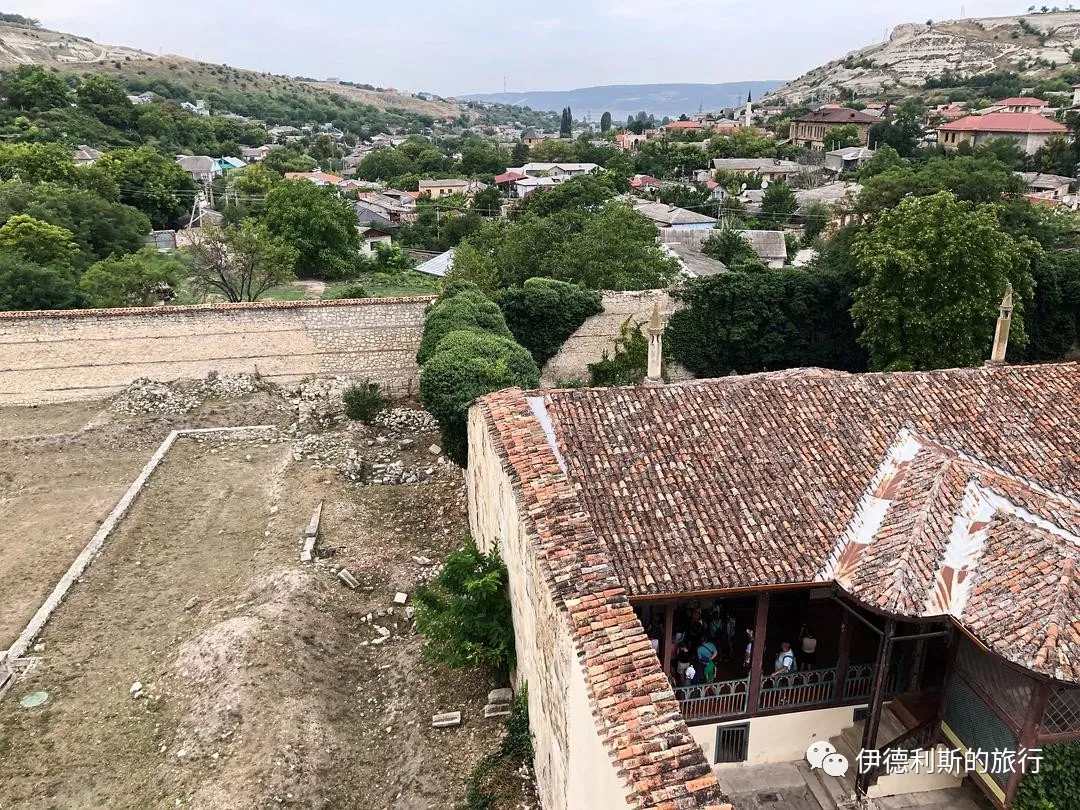
The Dilâra Bikeç Mausoleum is an octagonal tomb at the southernmost point of the Bakhchisaray Khan Palace. It was ordered to be built in 1764 by Crimean Khan Qırım Giray (reigned 1758-1764, 1768-1769) for his beloved wife.
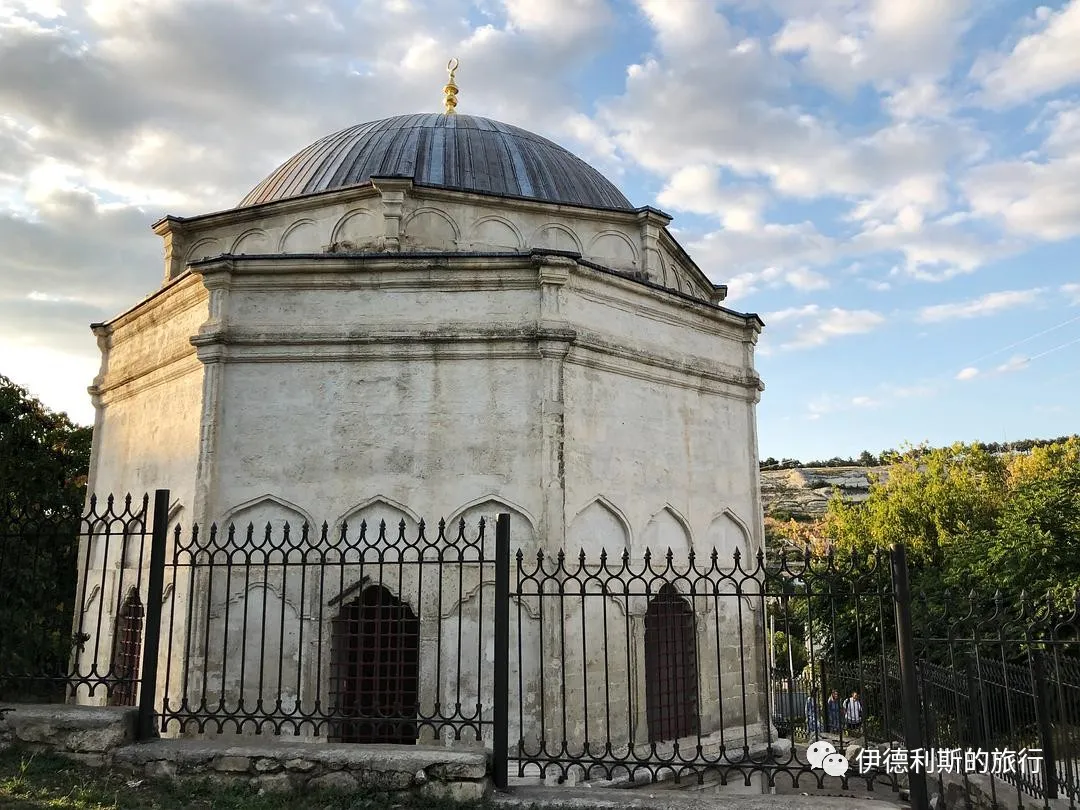
The Small Khan Mosque (Kiçik Han Cami) is inside the main building of the Khan Palace and was used by members of the Khan's family and noble officials. The Small Khan Mosque was built in the 16th century. It was destroyed by fire by the Russian army in 1736 and restored in 1741 by Khan Selamet II Giray (reigned 1740-1743).
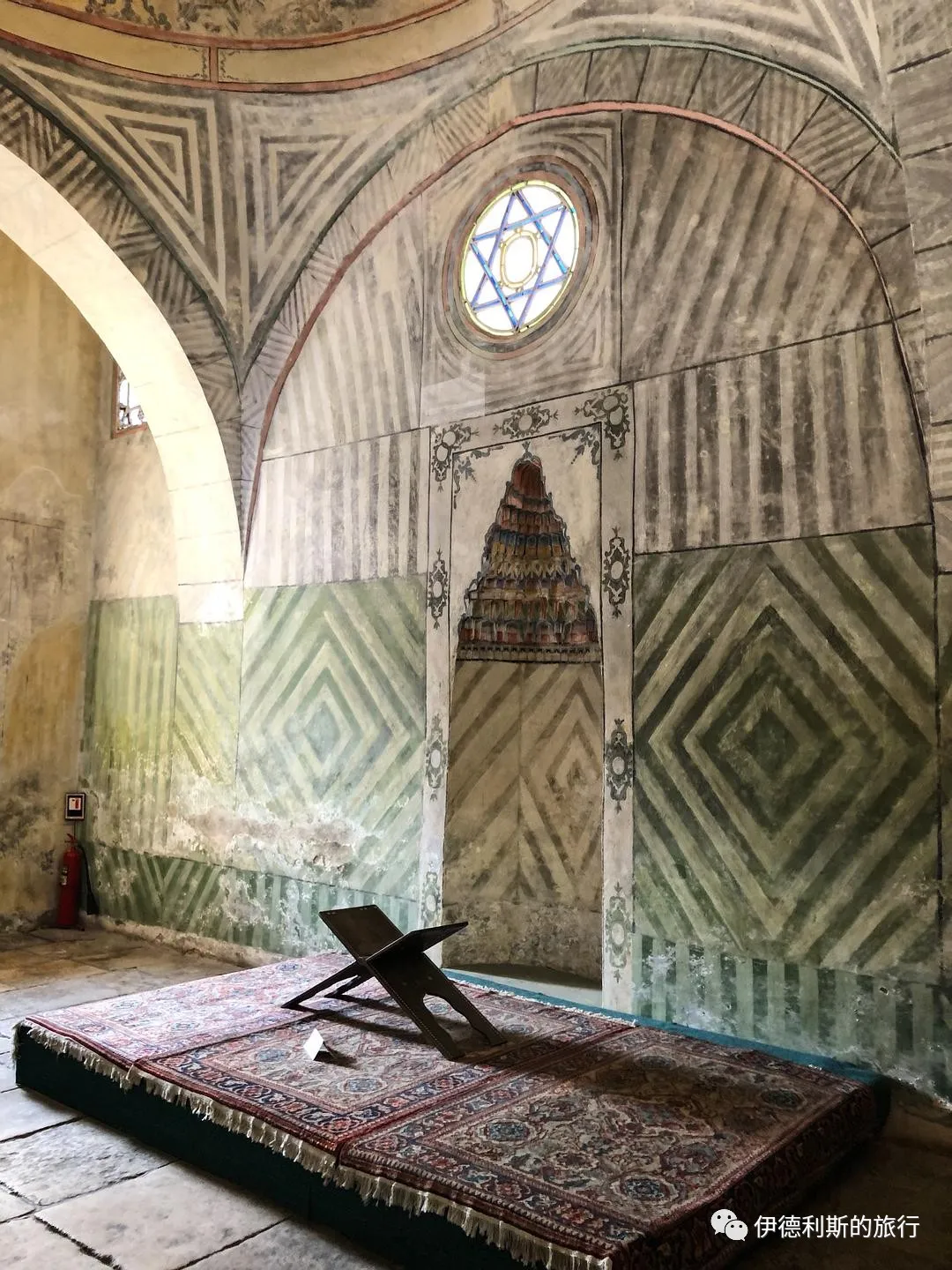
The existing interior murals were created between the 17th and 18th centuries, with some painted by the Iranian architect Omer in the late 18th century. Earlier murals from the 16th century were discovered during a 1991 restoration.
On the south wall of the Khan Mosque (Khan Jami) is a prayer niche (mihrab) carved with seven decorative bands, which symbolize the seven heavens mentioned in the Quran.
Above the prayer niche (mihrab) is a piece of stained glass featuring the Seal of Solomon (Khatam Sulayman) ✡.
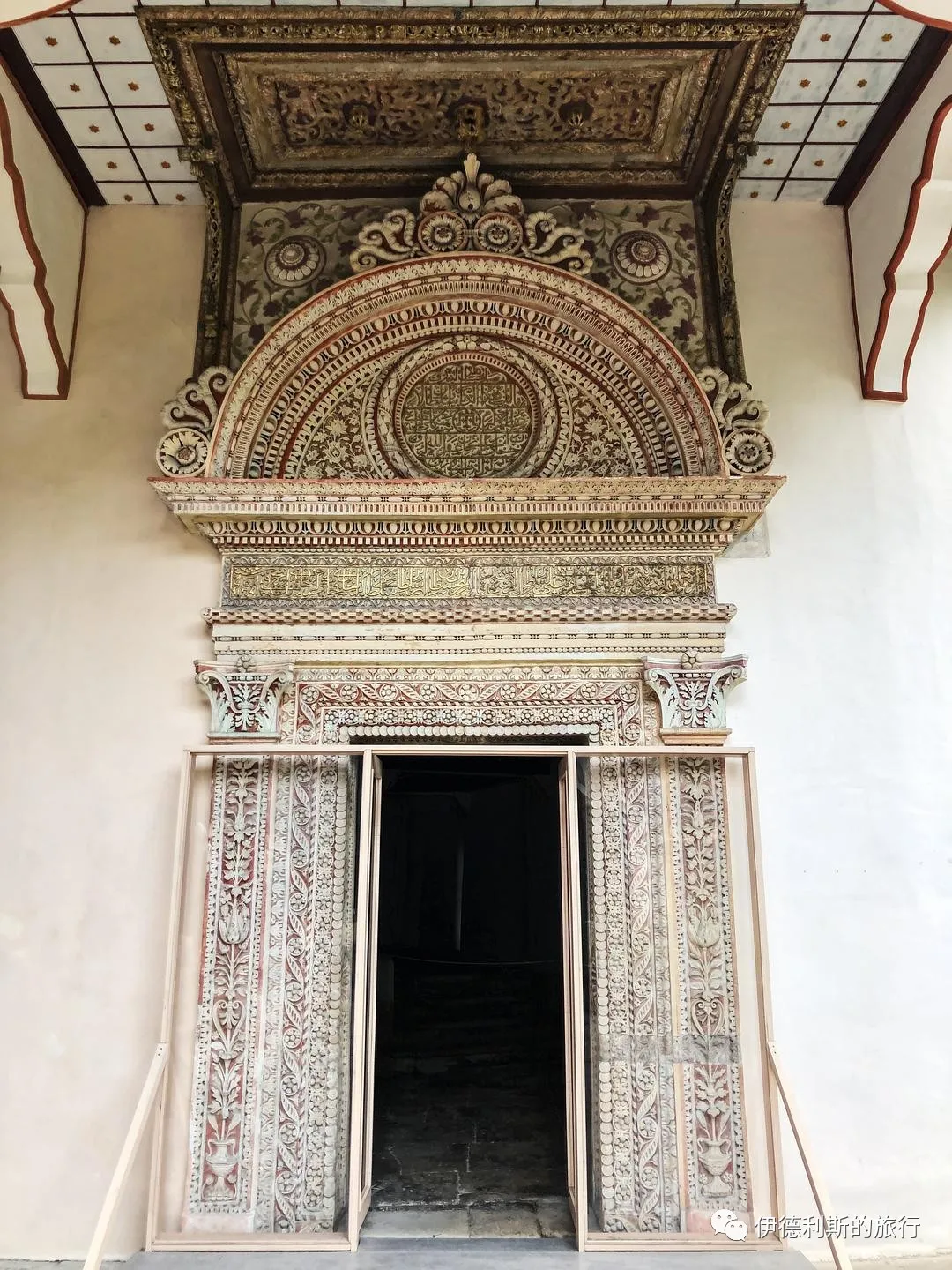
The Iron Gate (Demir Qapi) is the oldest structure in the Khan Palace, built between 1503 and 1504 by the architect Aleviz Novy for the Crimean Khan. This architect had previously been invited by Ivan the Great to Moscow to build a series of churches. The Iron Gate (Demir Qapi) was likely originally built at the Crimean Khan's previous residence, Devlet-Saray, and was moved to the main building of the Khan Palace only after the Bakhchisaray Khan Palace was completed in 1532.
Demir Qapi means iron gate in the Crimean Tatar language. The gate's portal is made of limestone and uses decorative styles from the Lombard-Venetian Renaissance.
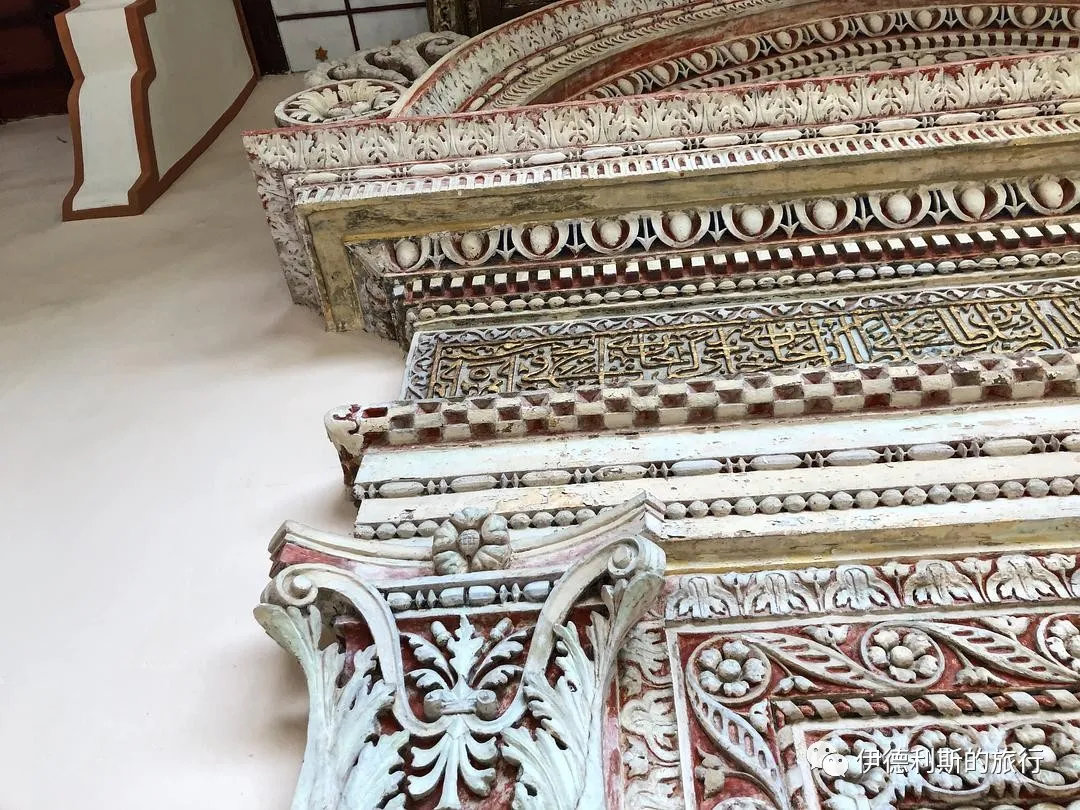
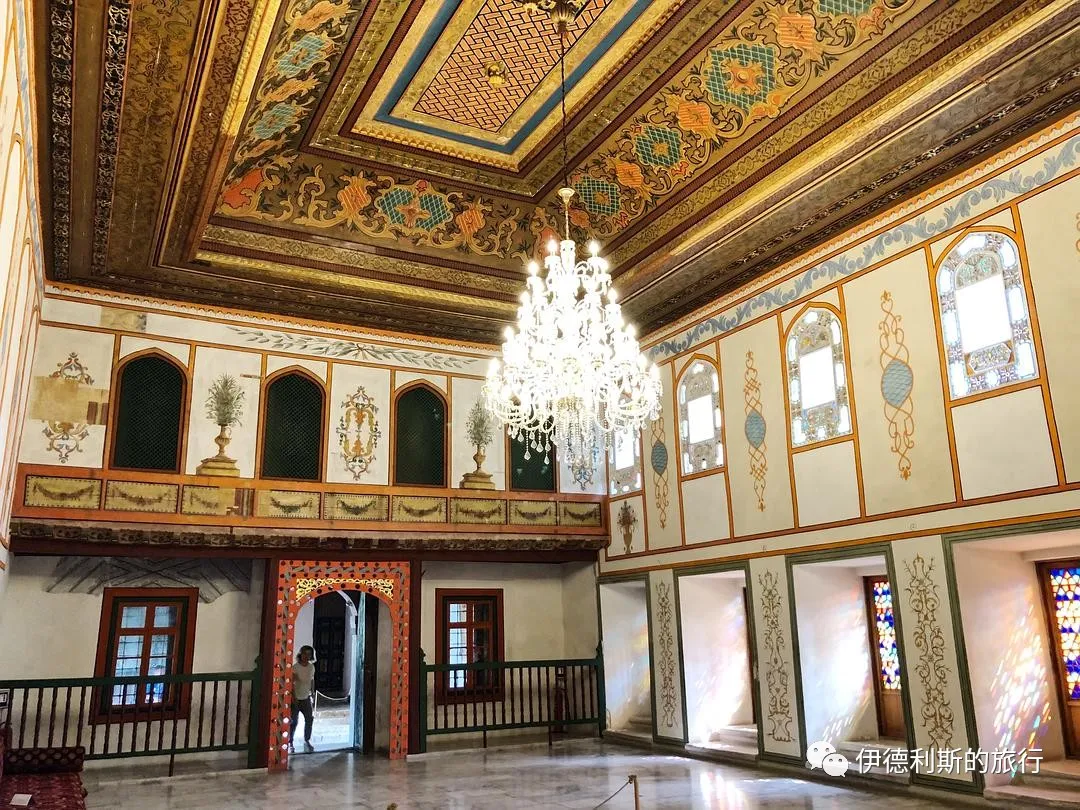
The Council Hall (Divan hanesi) is the meeting room inside the main building of the Khan Palace. In the center of the south wall is the throne where the Khan sat, with sofas on the sides for his ministers. Above the north wall at the entrance to the hall is a narrow latticed balcony, which is said to have been used by the Khan to have people eavesdrop on meetings when he was absent.
The floor of the hall was paved with marble and had a square pool with a fountain in the center. The walls were covered in tiles, but these were destroyed in a fire set by the Russian army in 1736. Restoration took place in 1742, and many of the current decorations, such as the murals and chandeliers, were added in 1822 when the architect I. F. Kolodin renovated the Khan Palace.
In 1917, the Crimean Tatars announced the establishment of an independent Crimean Tatar government here.
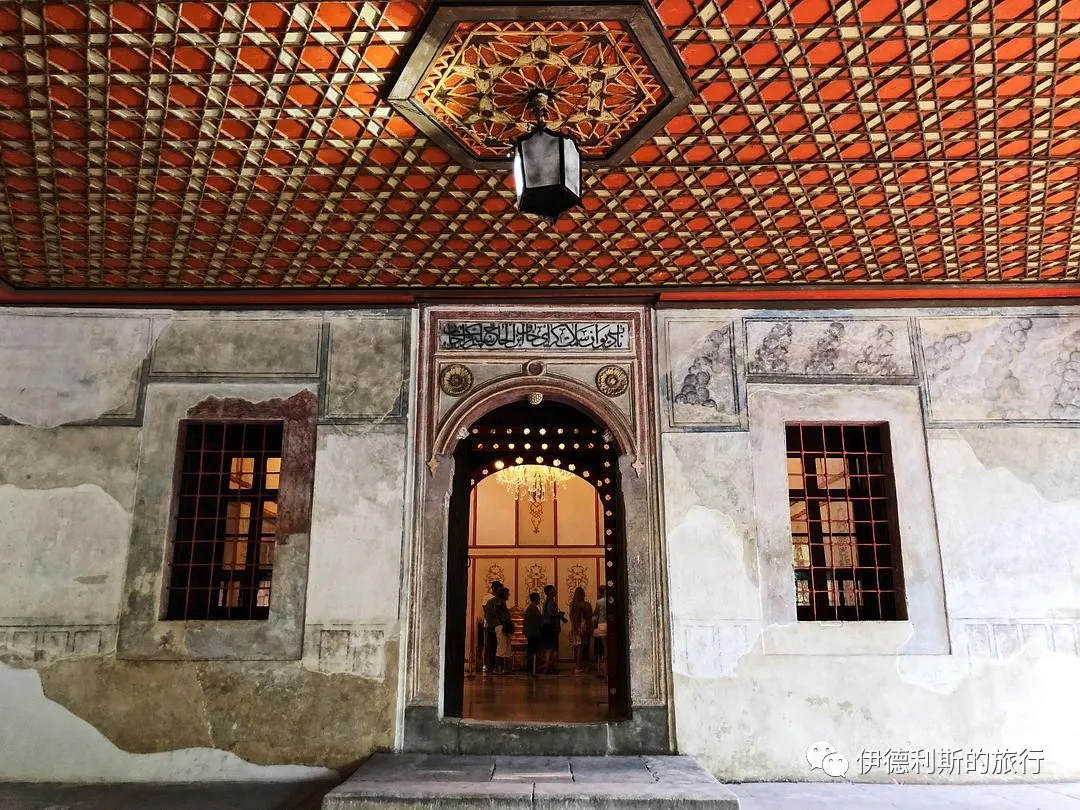
The Summer Pavilion is a place for cooling off inside the main building of the Khan Palace, built between the late 17th and early 18th centuries. It was burned down by the Russian army in 1736 and later restored by the architect Omer ibn al Hadj Mustafa. In the center of the pavilion is a square pool with a square marble fountain, surrounded by sofas.
The pavilion was originally open. Between 1821 and 1831, Tsar Alexander I ordered the architects Mikhail Klado and Vasiliy Dorofeyev to enclose the Summer Pavilion, adding columns, stained glass, and a carved ceiling.
Early murals were discovered during the restoration of the summer pavilion in 1962.
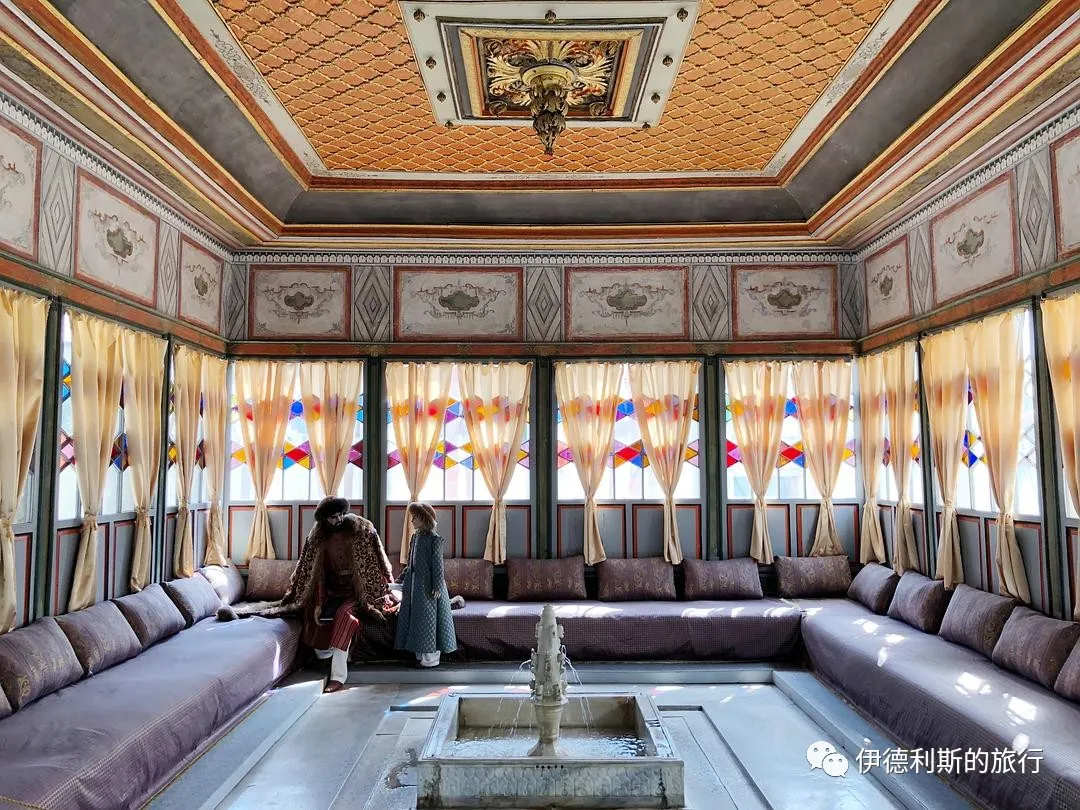
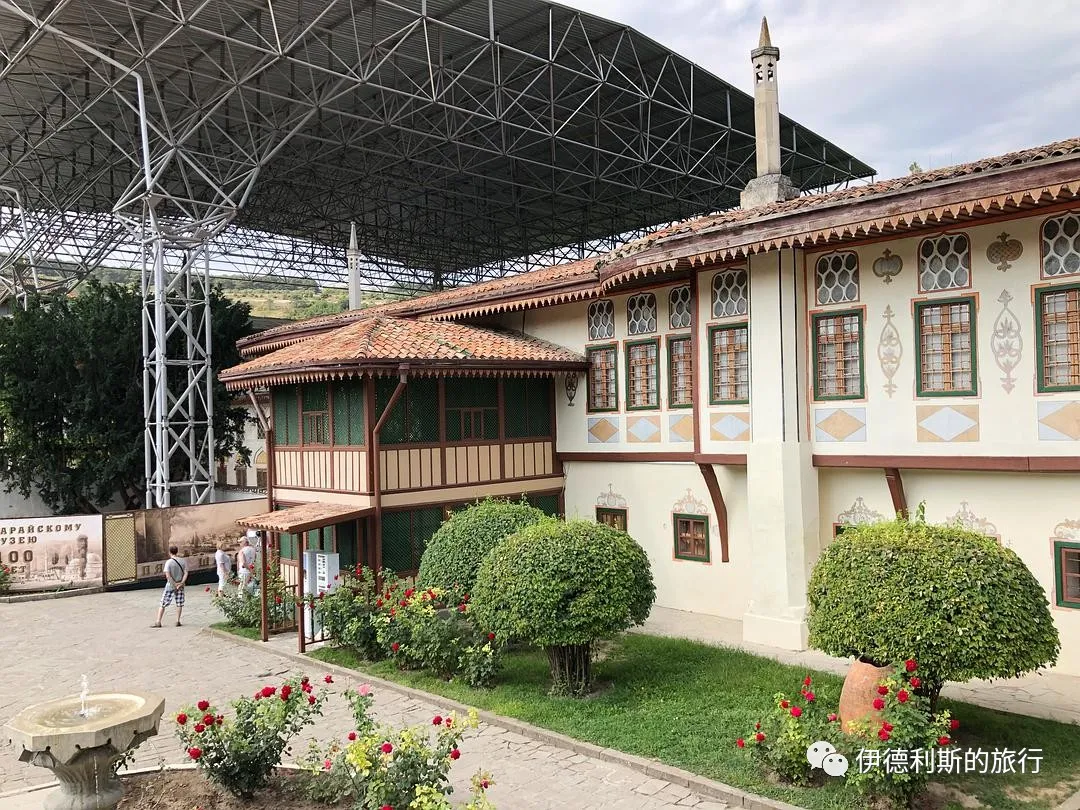
The Golden Pavilion is on the second floor of the main building and was built in the late 18th century by the Iranian architect Omer. The interior of the pavilion originally featured murals of fruit vases and Arabic poetry praising Khan Qırım Giray, but these were destroyed during the German occupation of Crimea from 1941 to 1944.
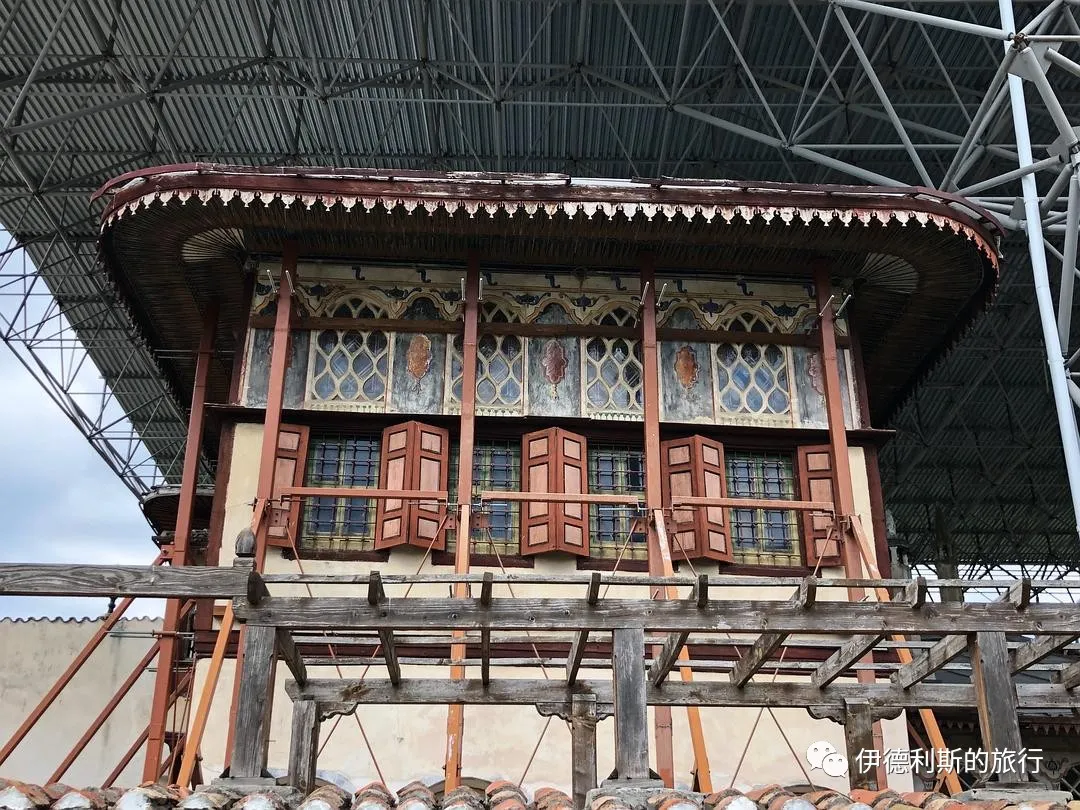
The Golden Fountain is located in the Fountain Courtyard of the Khan's Palace main building, near the Small Khan Mosque, and was where the Crimean Khan and members of the Khan's court performed wudu.
The Golden Fountain is made of gilded marble and features carvings of various flowers, fruits, and plants to depict the 'Garden of Eden' (jandātʿadni) from the Quran, the place where Adam and his wife lived. A circular outlet is carved in the center of the fountain, symbolizing eternal life.
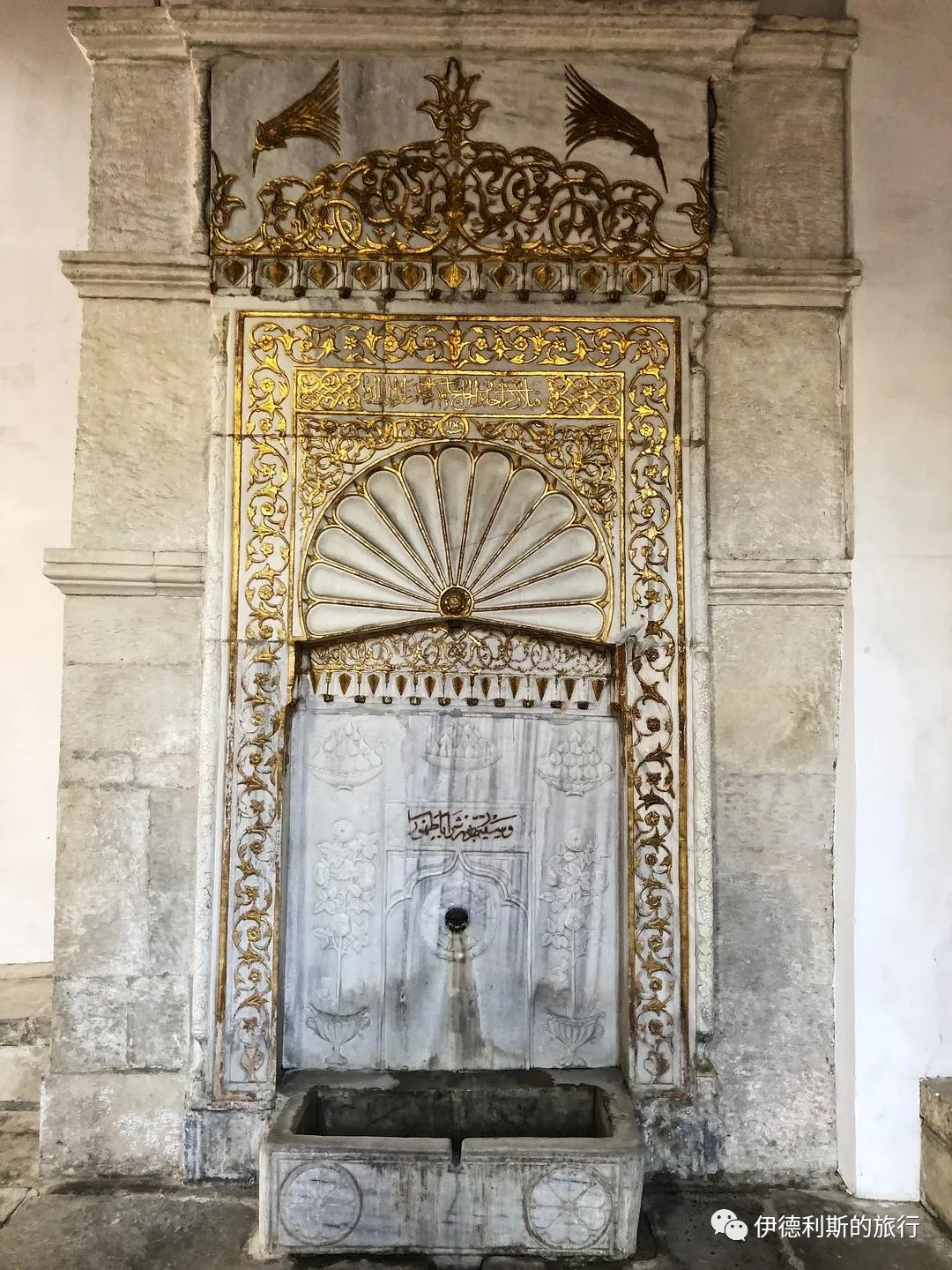
The Fountain of Tears was commissioned in 1763 by the Crimean Khan Qırım Giray (reigned 1758-1764, 1768-1769), and the architect was Omer ibn al Hadj Mustafa from Iran. The fountain was originally installed in the mausoleum of the Khan's beloved wife, Dilâra Bikeç, but after Empress Catherine II visited the palace in 1787, the dried-up fountain was moved to the Fountain Courtyard in front of the main building.
A love story about the Fountain of Tears has circulated in Bakhchysarai since the 18th century. According to the legend, the Khan's beloved wife, Dilâra Bikeç, was a Greek woman from Georgia who was killed in palace intrigue. The Khan fell into deep grief and built this fountain in her mausoleum to honor her. This love story later became widely known because of Pushkin's famous poem, The Fountain of Bakhchisaray.
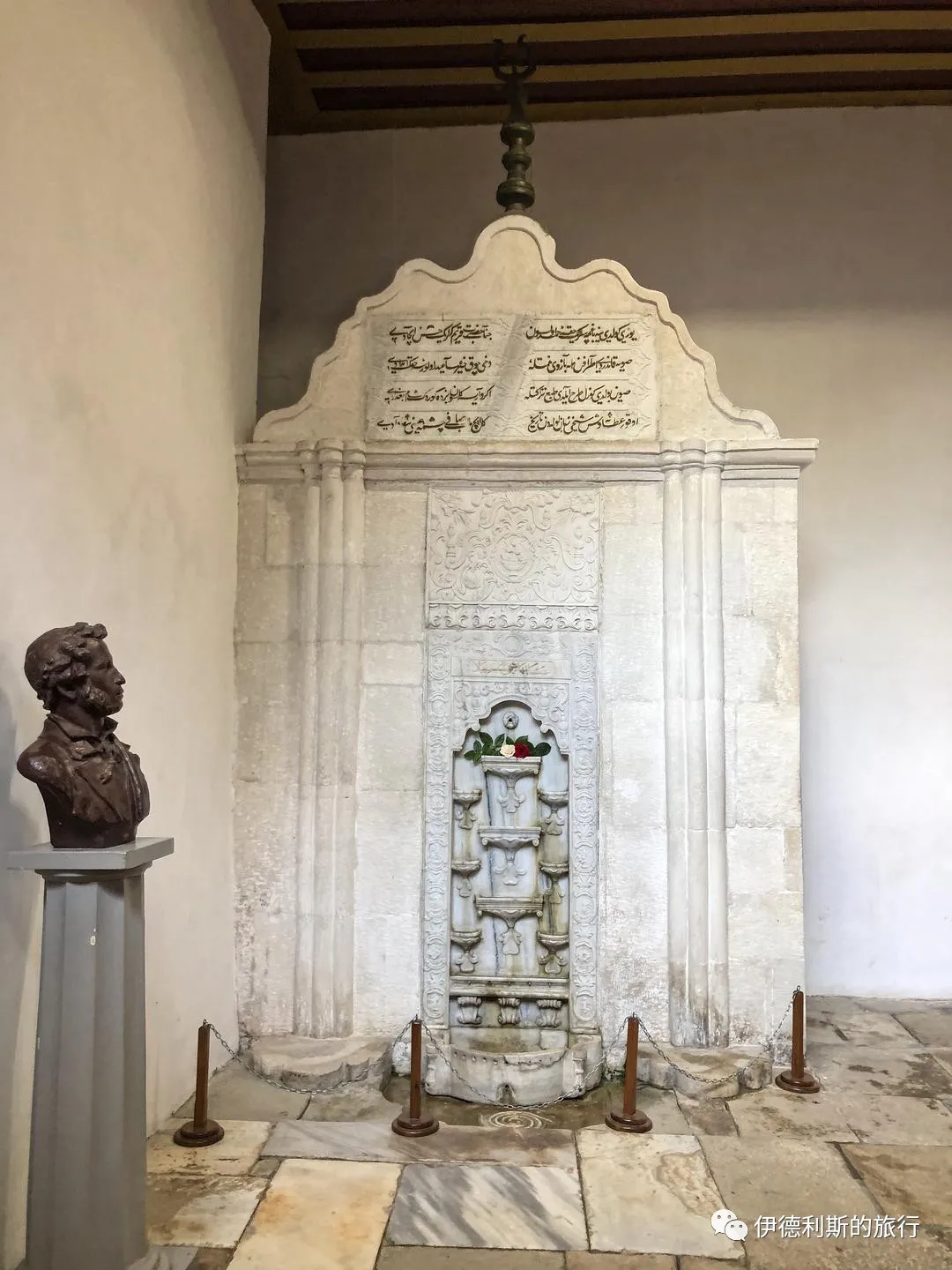
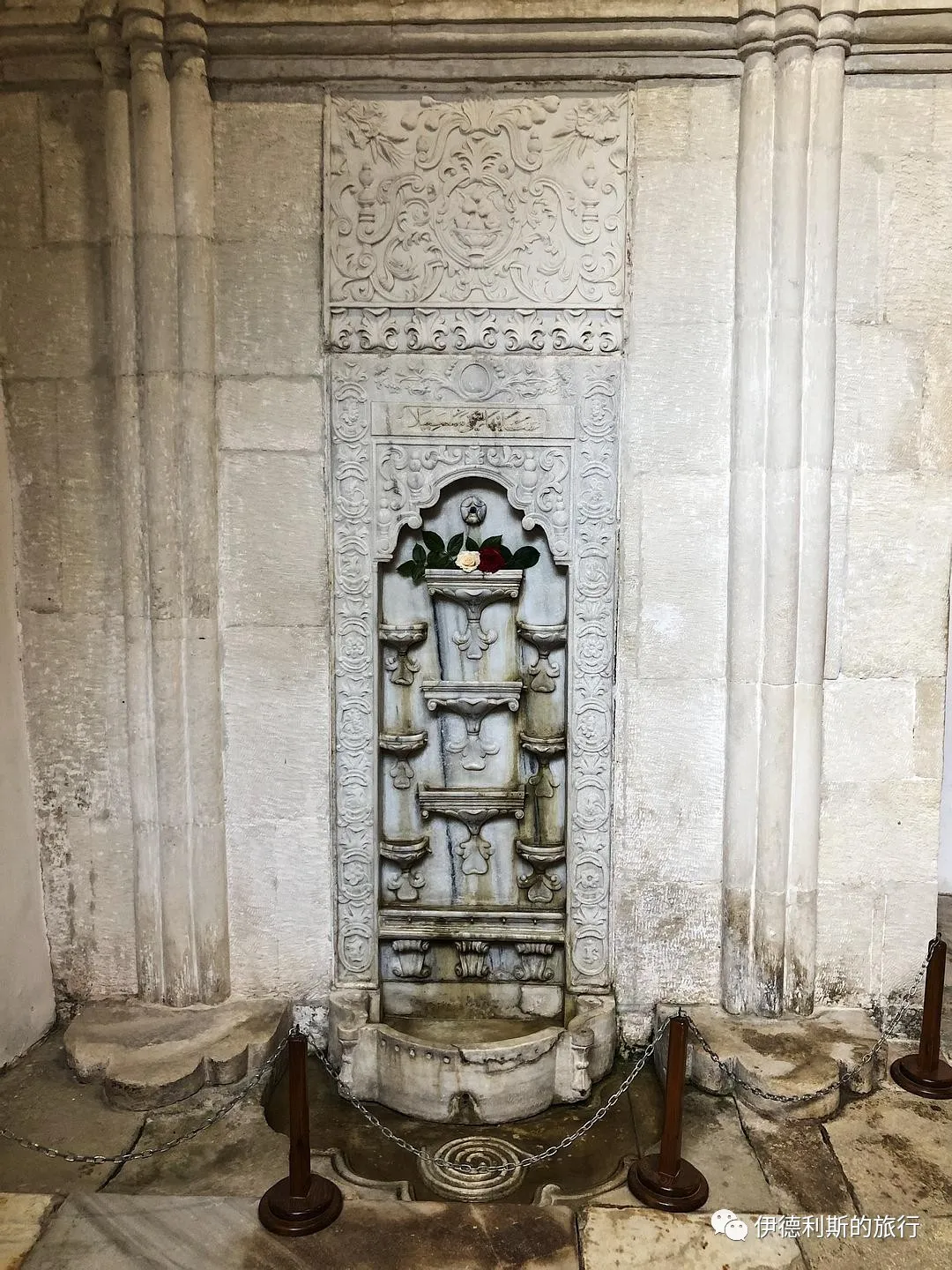
The suites on both sides of the North Gate were where the Khan's palace guards (Qapı Halqı) lived. After Crimea was occupied by Tsarist Russia, this area also served as guest lodging. Today, the west building of the suites is an exhibition hall, and the east building houses museum offices.
The exhibition hall in the west building displays artifacts from the Crimean Khanate era and the traditional life of the Crimean Tatars. The original fireplaces are still preserved inside the suites.
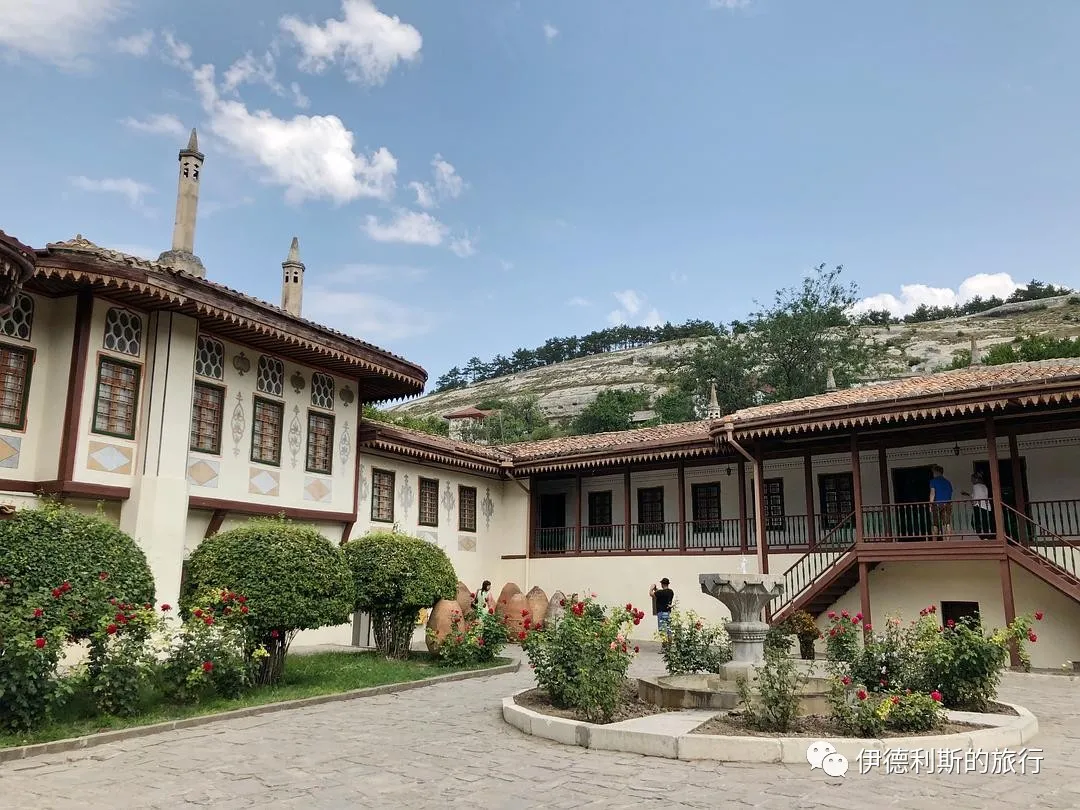
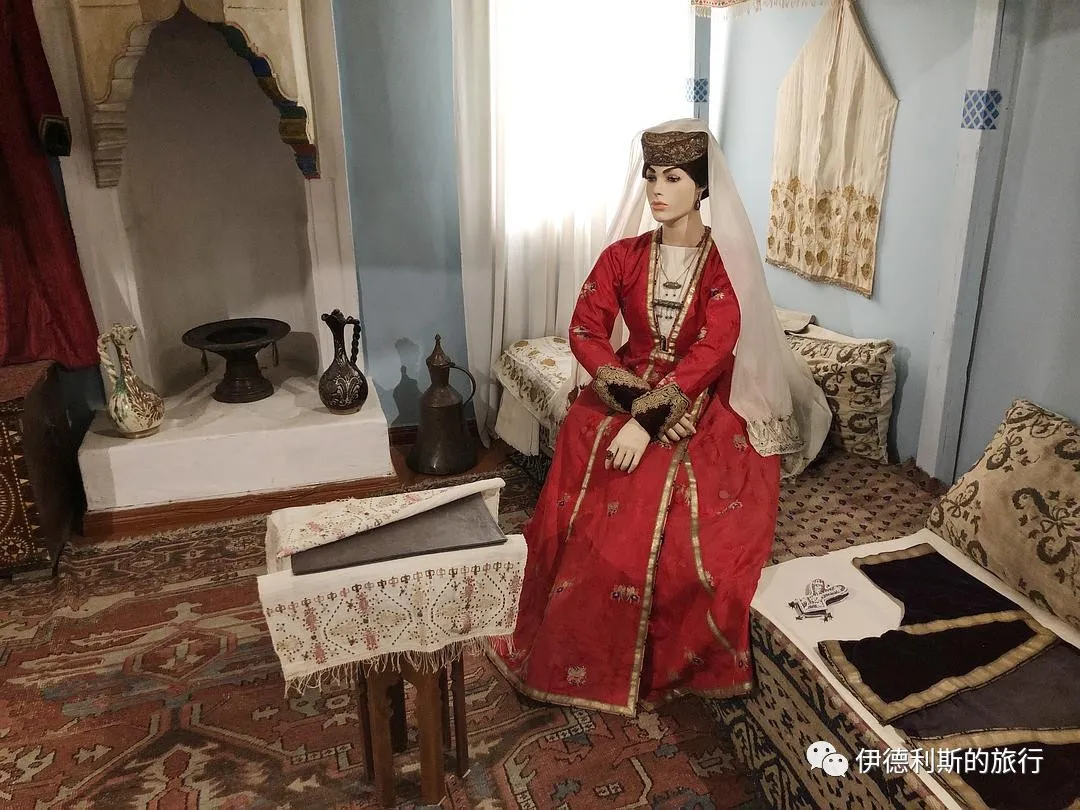
The stables are divided into two floors, with the first floor used for keeping horses and the second floor for the grooms to live in; the current building was rebuilt in the 1850s.
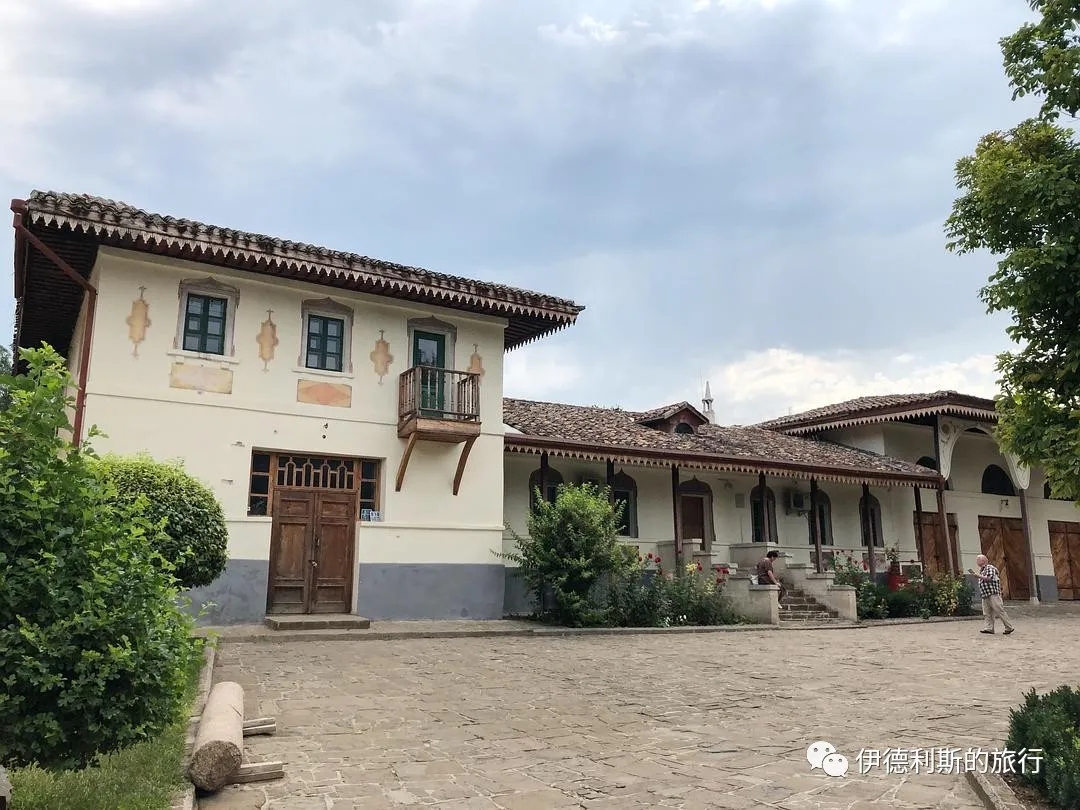
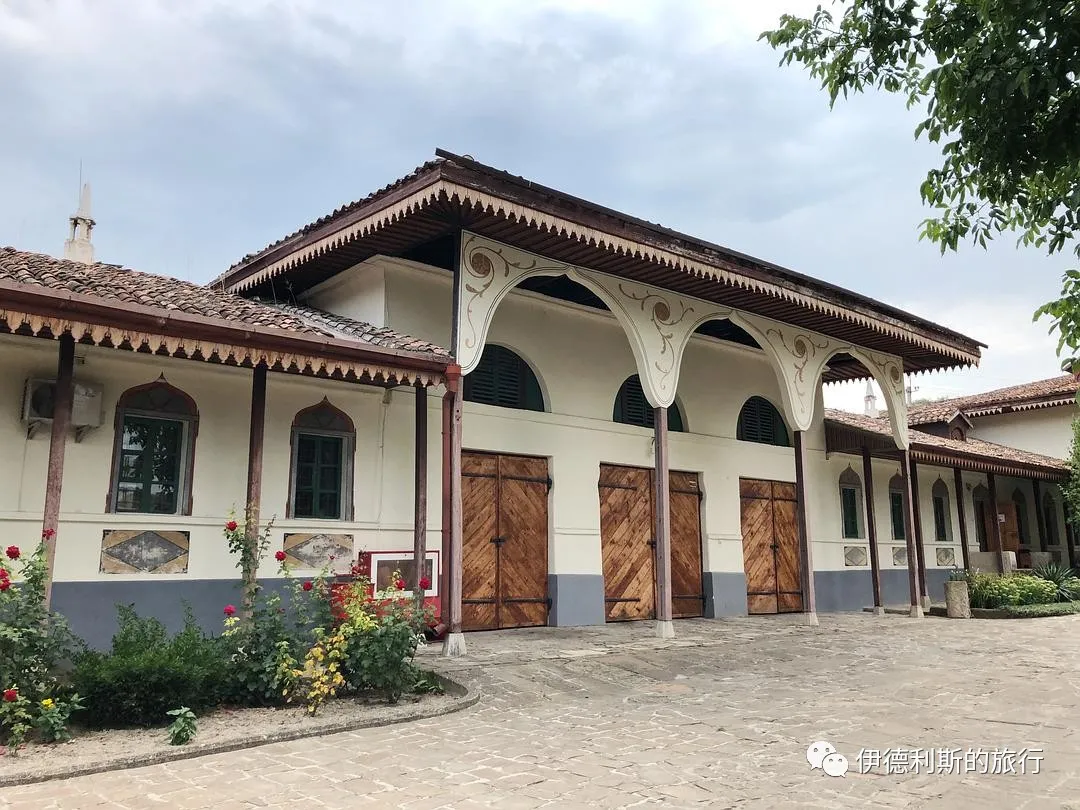
Mosque
Orta Mosque was once the main Friday mosque in Bakhchysarai. It dates back to 1674. The Khans Mengli Giray II and Selamet II Giray renovated it between 1737 and 1743, and it was rebuilt again in 1861 to reach its current form.
After 1929, the mosque served as a cultural center and then a cinema. It was not returned to the Muslim community until 2001. The mosque's minaret and surrounding buildings were destroyed at that time. They were not rebuilt until 2012. The mosque reopened in 2013 after the construction work finished.
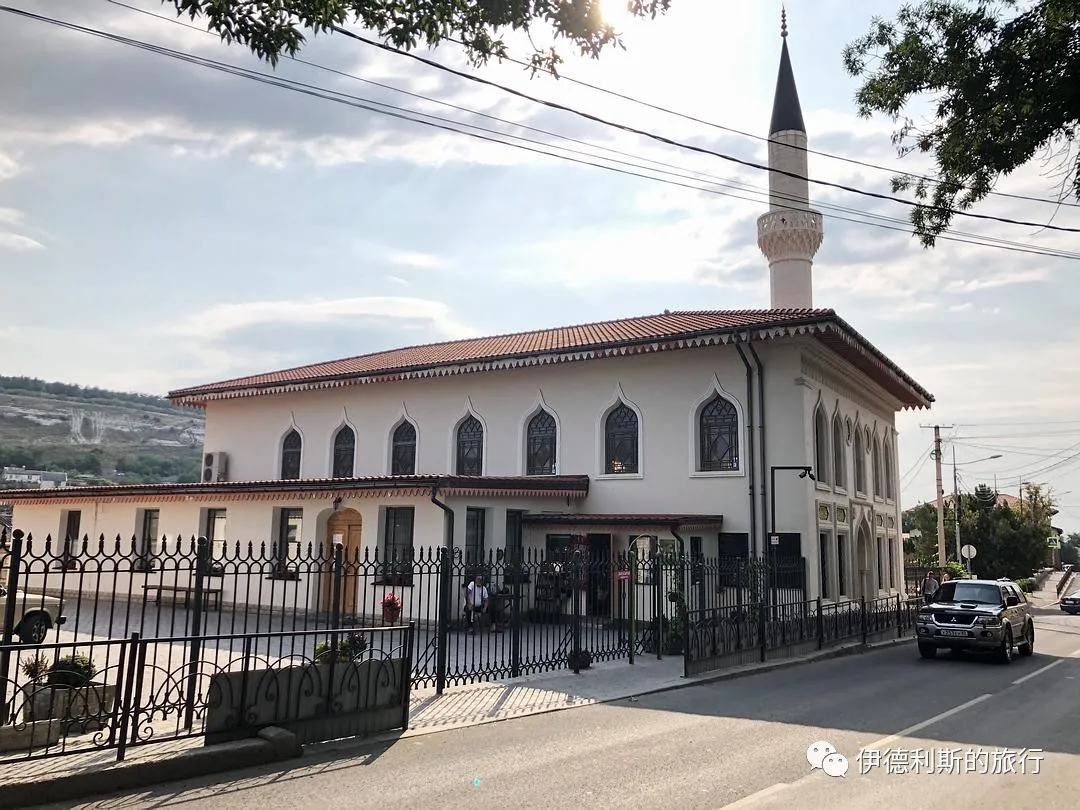
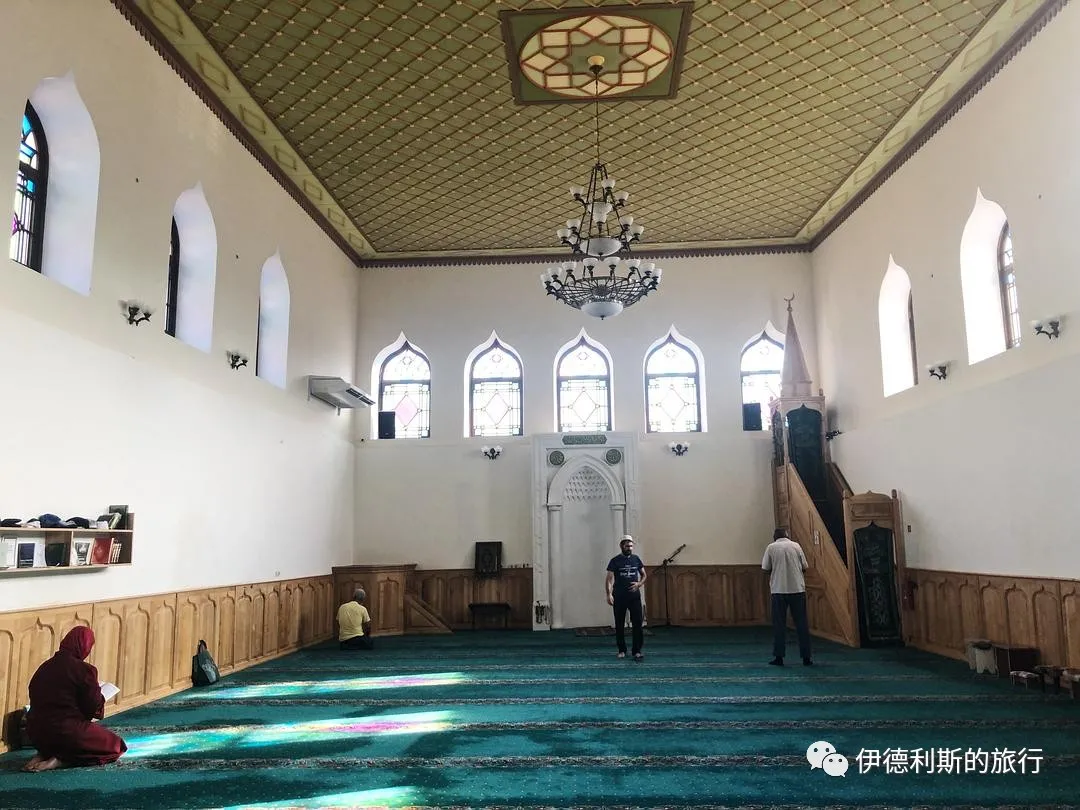
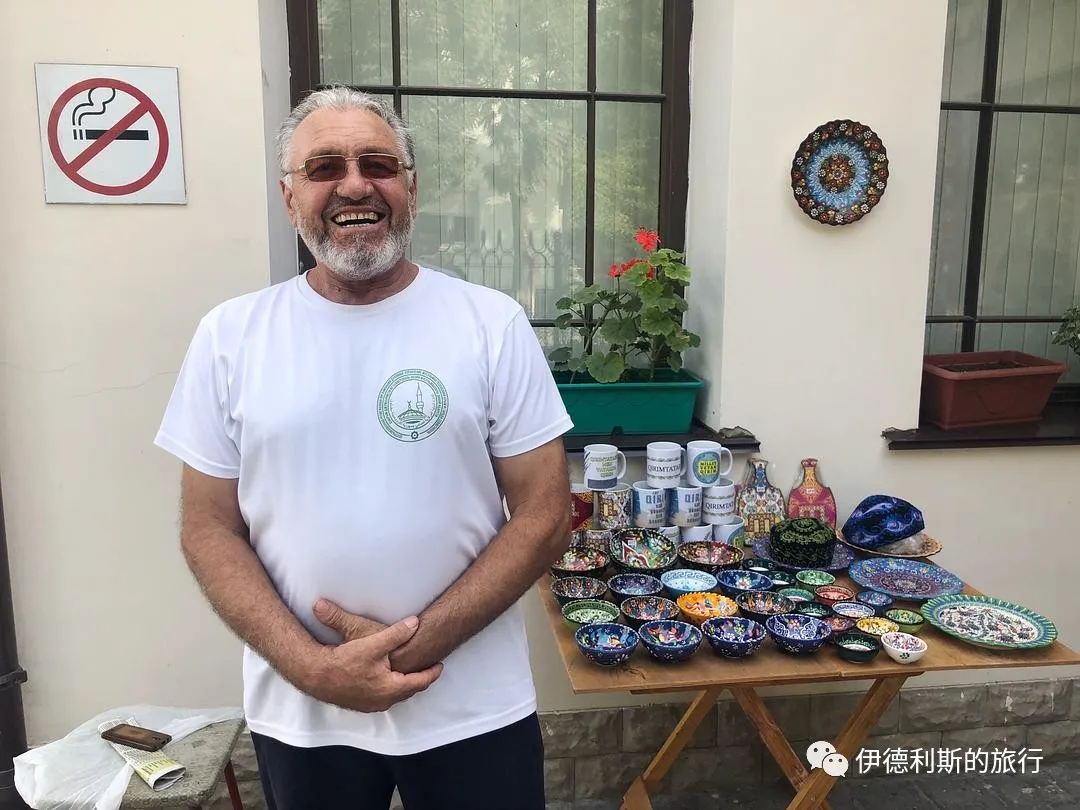
Ismi Khan Mosque was built between the 17th and 18th centuries. Its architectural decorations show a strong influence from the European Baroque style. The upper circular openings are decorated with wooden Seals of Solomon (Khātam Sulaymān) ✡.
The mosque was used as a warehouse for a long time. There were plans to restore it in the early 21st century, but the work has not been carried out yet.
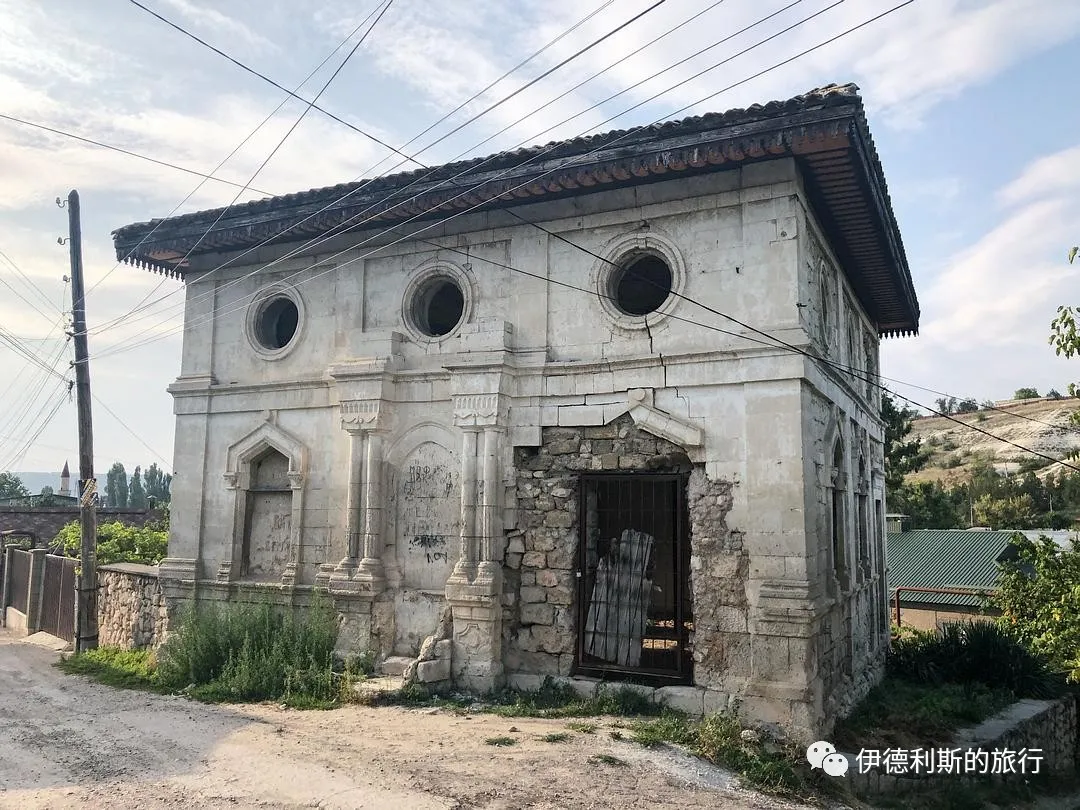
Molla Mustafa Friday Mosque dates back to the 17th century. An 1890 document mentions this mosque, stating that the local residents added a roof to the building in 1888.
Tahtali Mosque was built in 1707 by Khan Sultan Beck, the son-in-law of the Crimean Khan Selim I Giray. In the Crimean Tatar language, "Tahtalı" means "wooden." The mosque was originally built with wooden planks. Later, it was enclosed with brick and stone, and the roof was covered with clay tiles.
Accommodation
I stayed at a beautiful traditional Crimean Tatar house called Bahitgul Boutique-Hotel. They serve traditional Crimean Tatar food, so I usually ate breakfast right where I was staying. The view while eating there is excellent, as you can look out over the entire ancient capital.
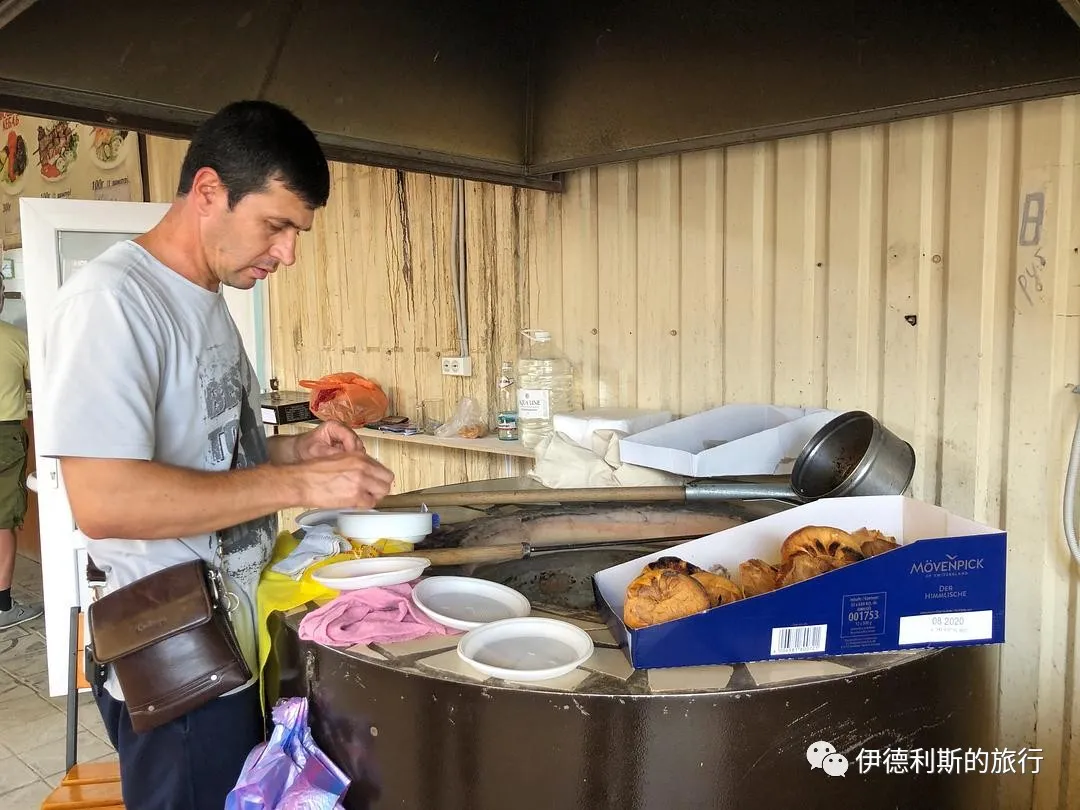
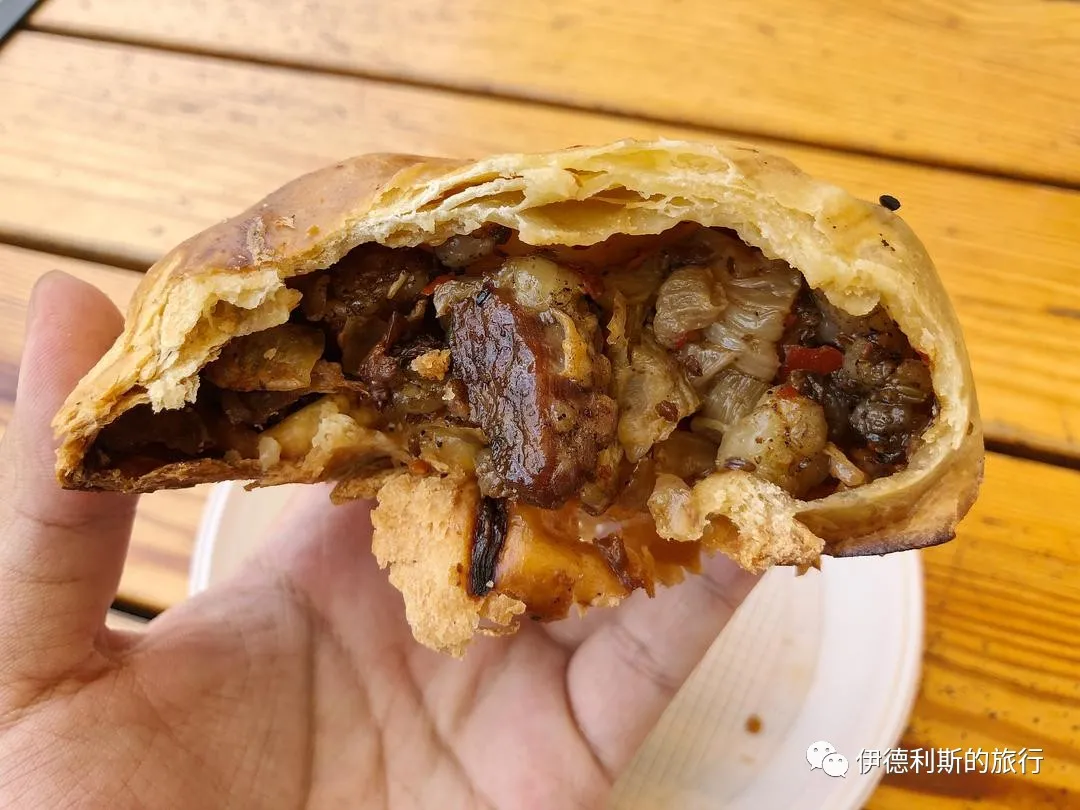
The food culture of the Crimean Tatars is closely tied to their history. Because the Crimean Khanate was a long-term vassal of the Ottoman Empire, it has many Ottoman-related foods, such as Turkish coffee, baklava (a sweet pastry), and stuffed grape leaves (dolma). After being exiled to Uzbekistan in 1944, the Crimean Tatar diet added many Uzbek dishes, including rice pilaf (plov), hand-pulled noodles (lagman), baked meat buns (samsa), steamed dumplings (manti), and flatbread (nan). Crimean Tatars have some unique delicacies, such as the deep-fried meat pastry (chebureki), which is known as a signature national dish.
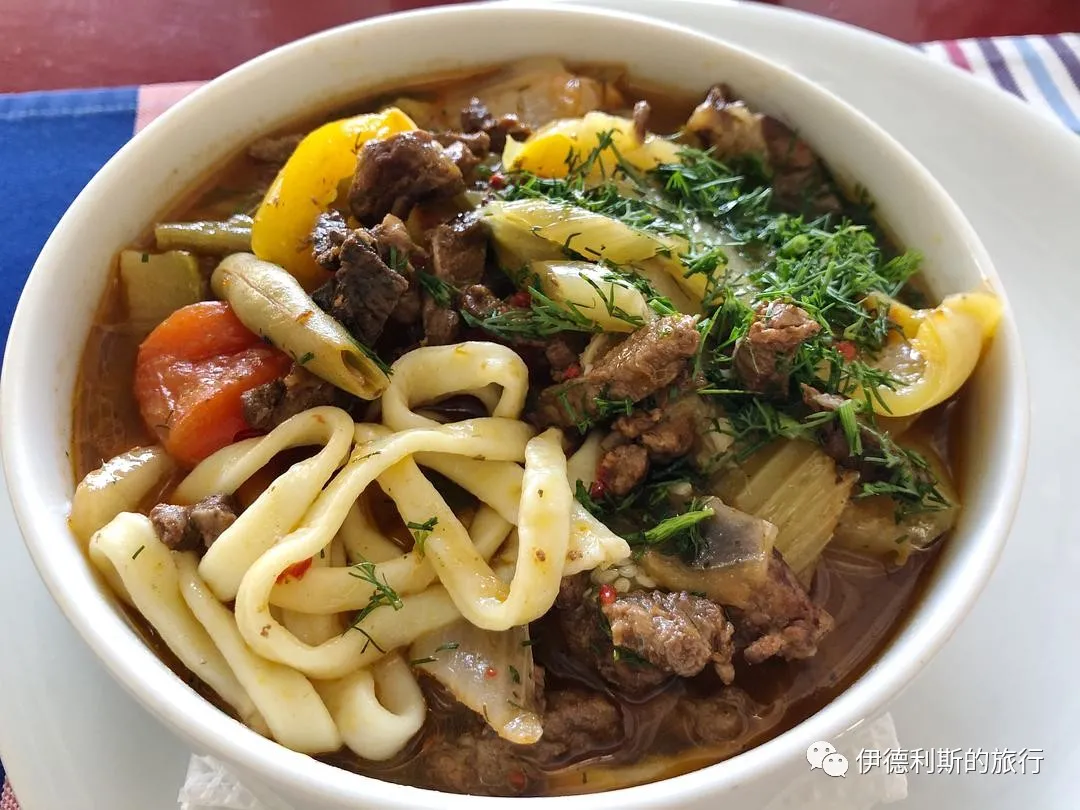
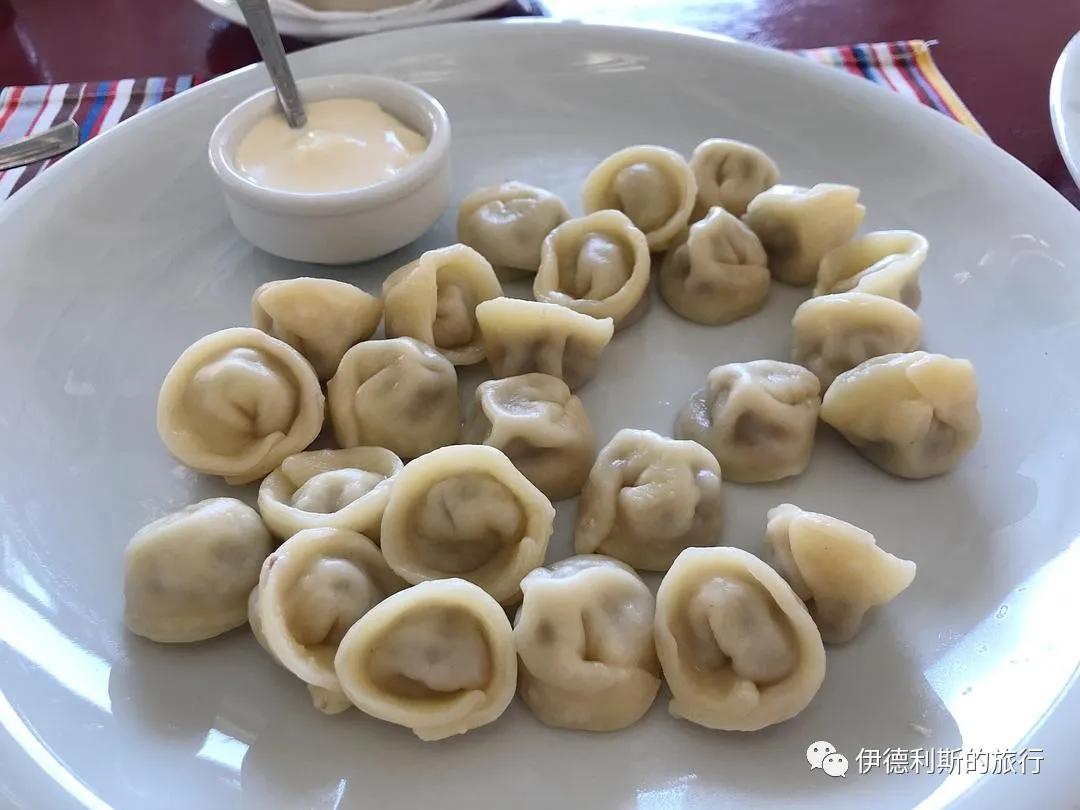
You can eat baked meat buns (samsa) at the bazaar.
I ate rice pilaf (plov), stuffed grape leaves (dolma), and lamb skewers (shashlik) at a Crimean Tatar restaurant; the lamb skewers were incredibly tender and fragrant.
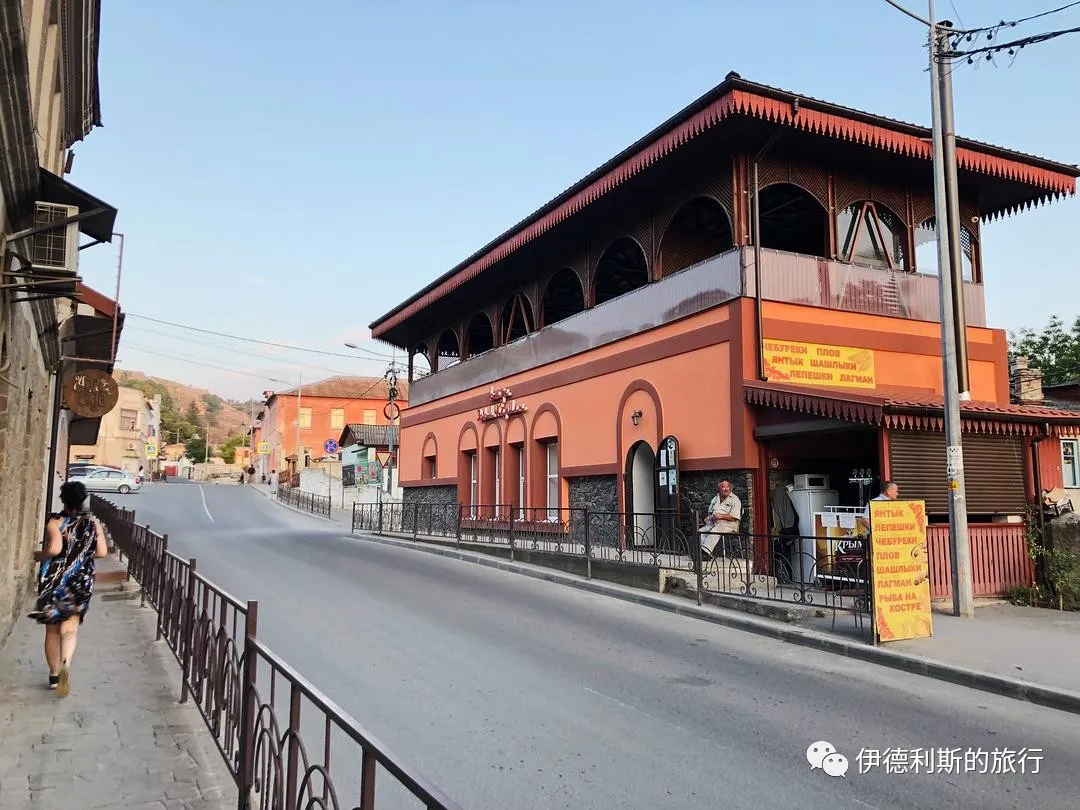
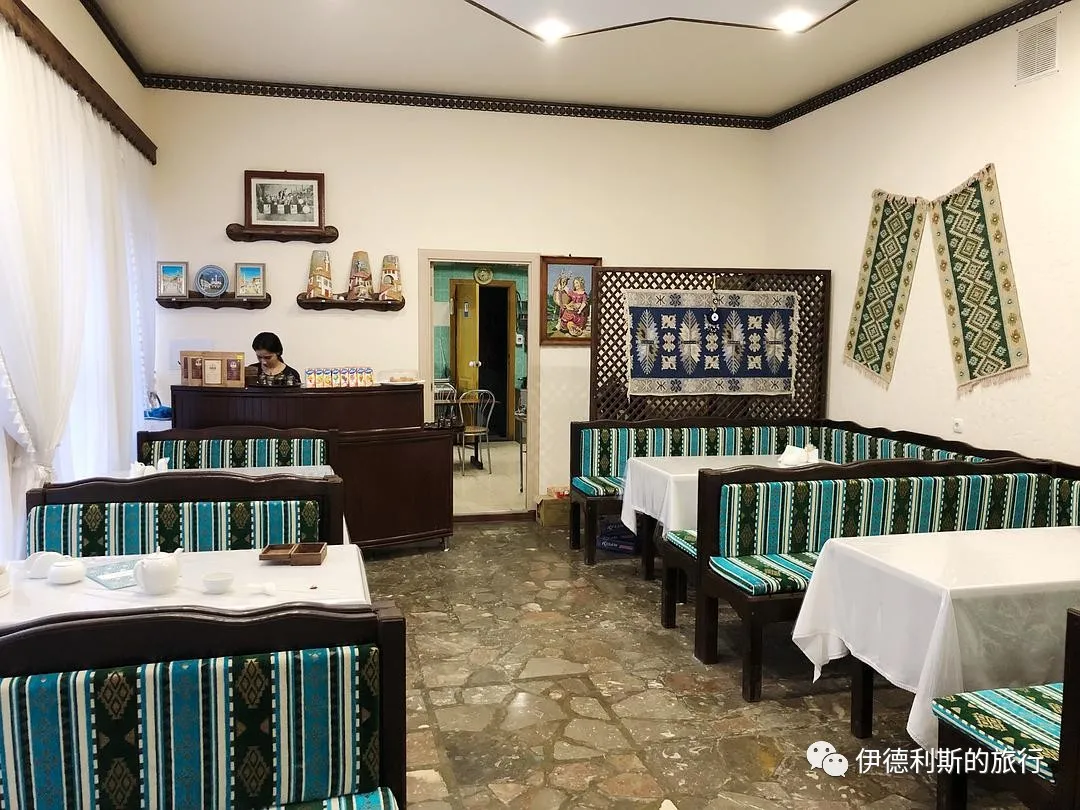
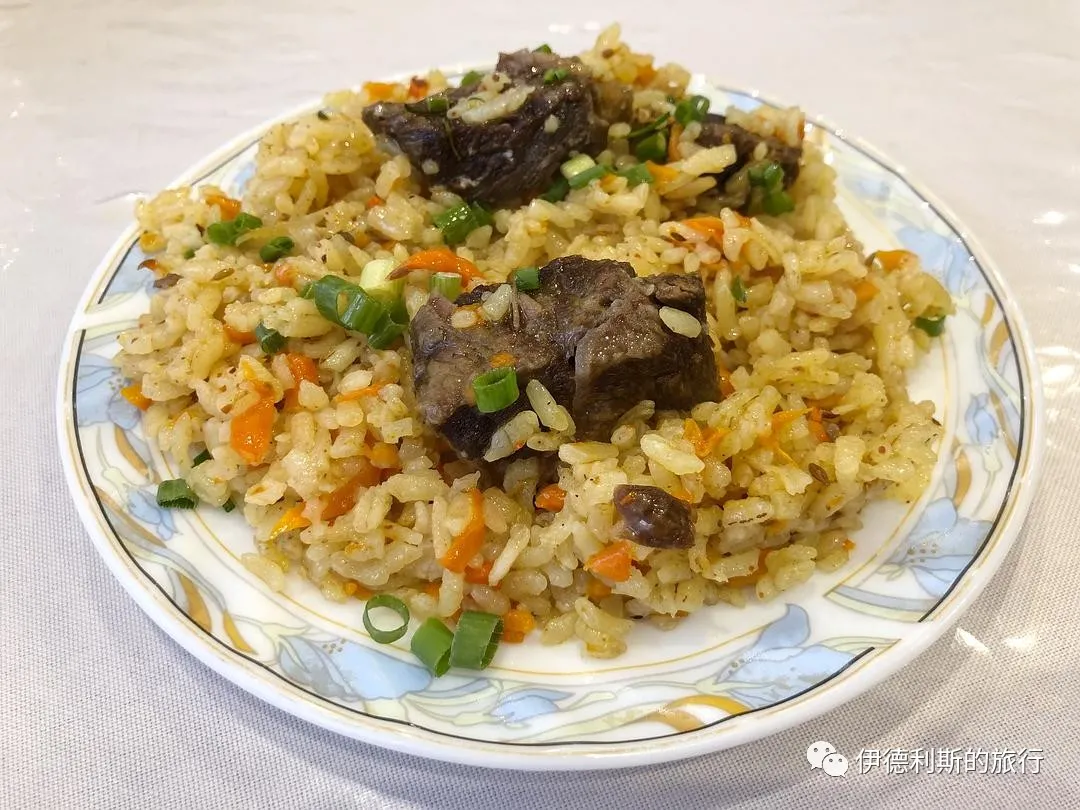
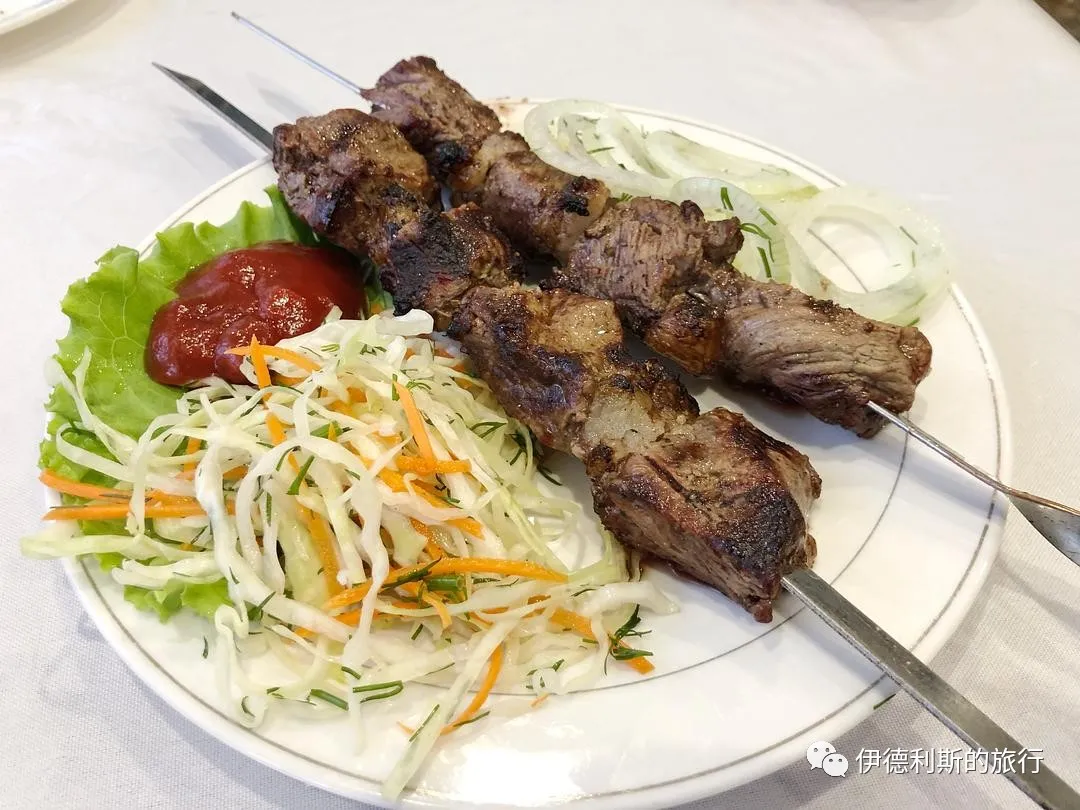
I bought desserts at a Crimean Tatar sweet shop in the old city, which are basically the same as the baklava popular in former Ottoman regions like Turkey, the Caucasus, the Balkans, and the Levant. In the third picture, the first row on the iron tray says 'hazelnut,' and the second row says 'caramel'.
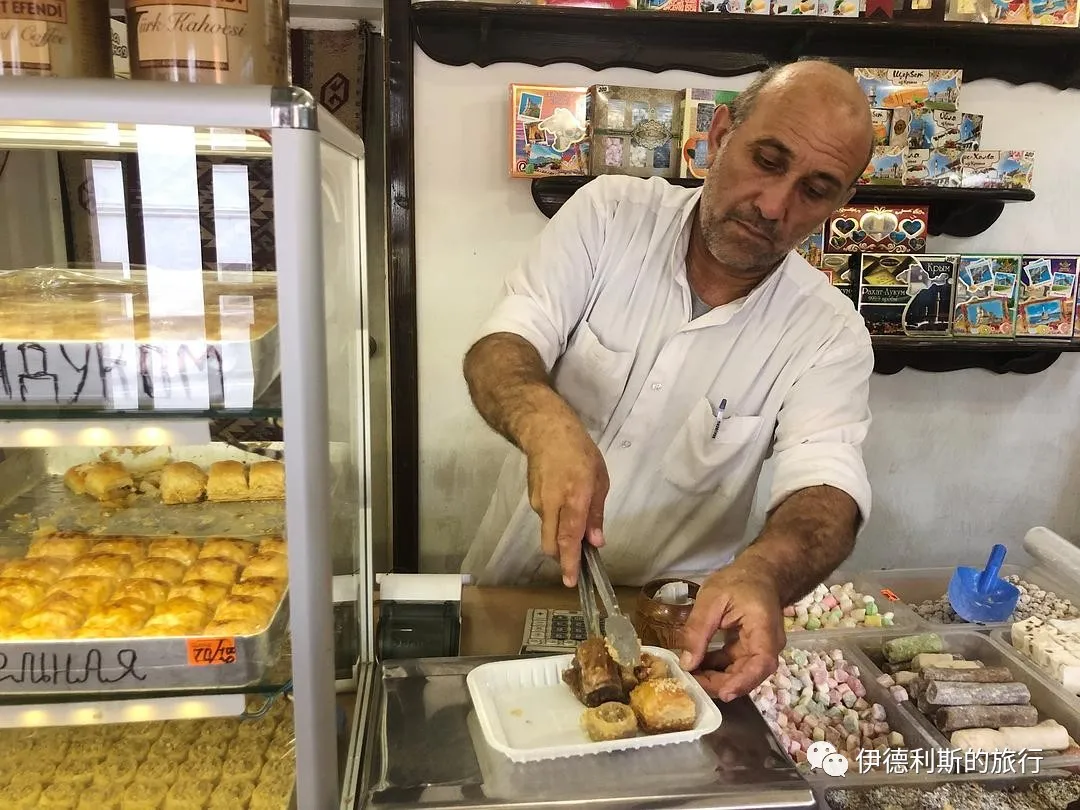
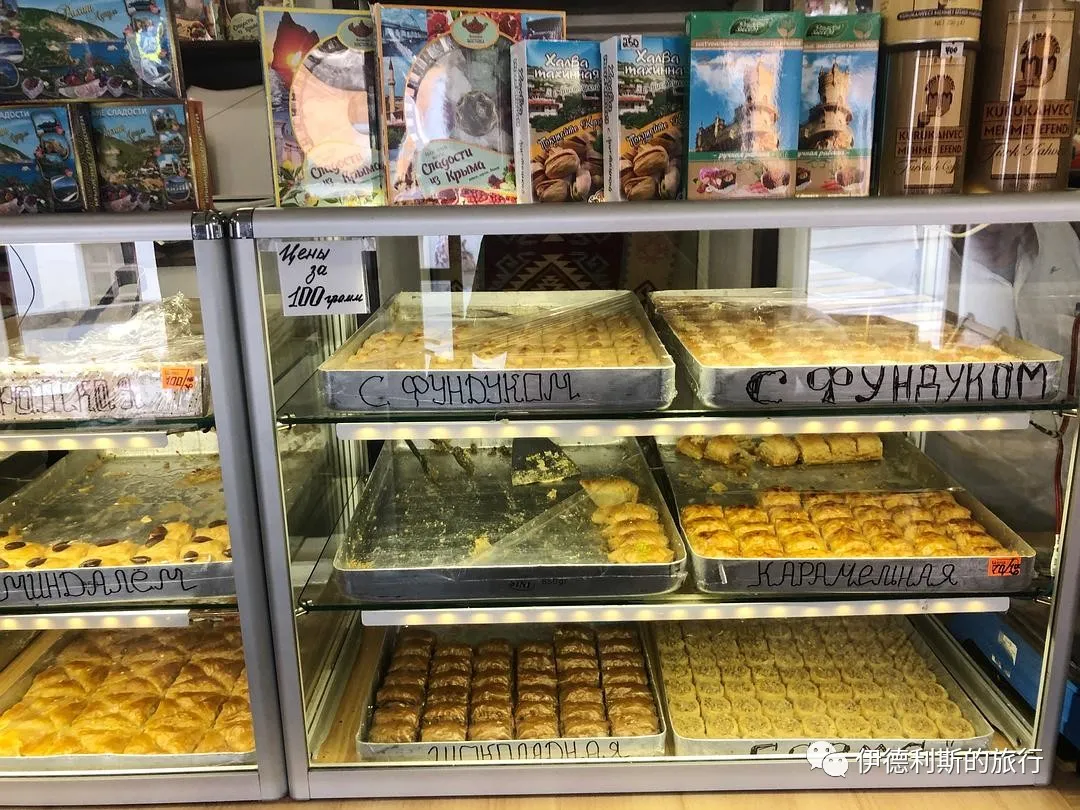
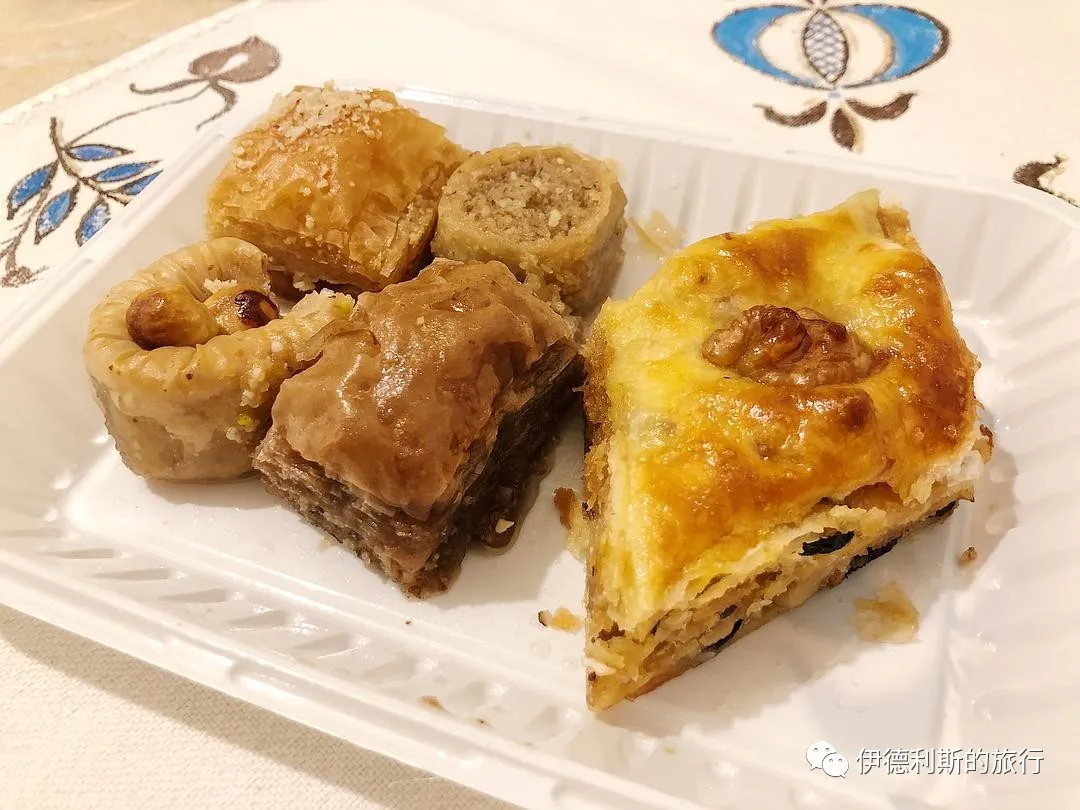
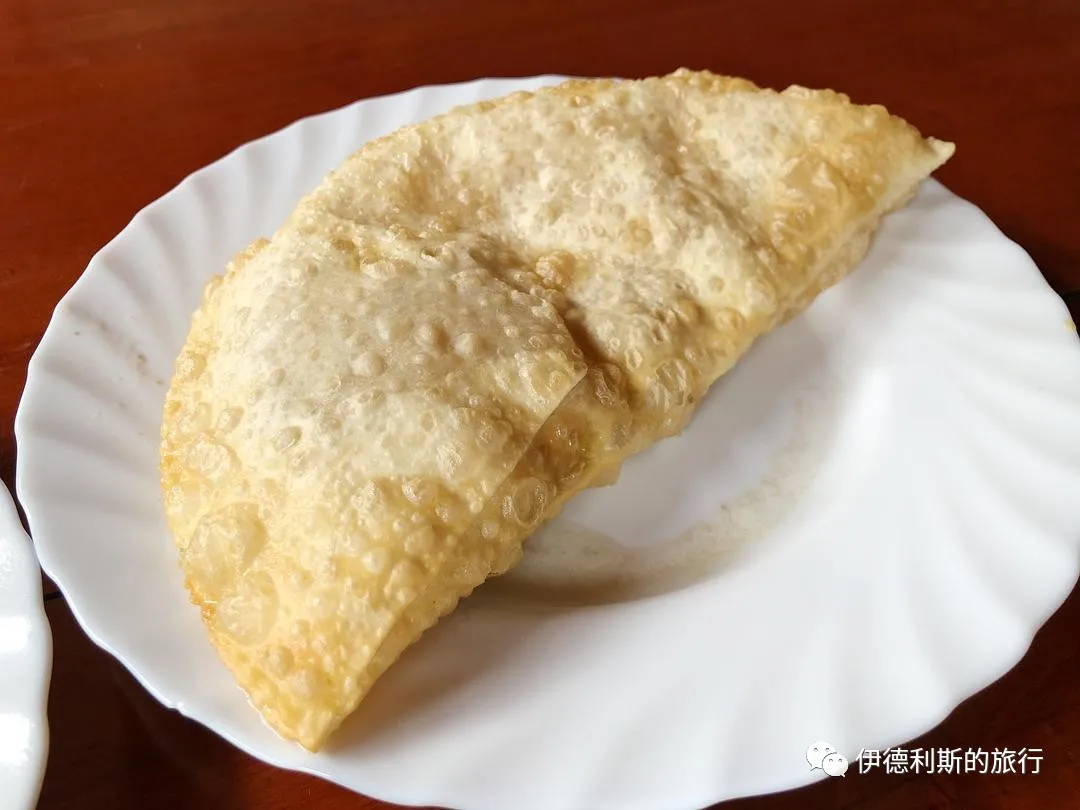
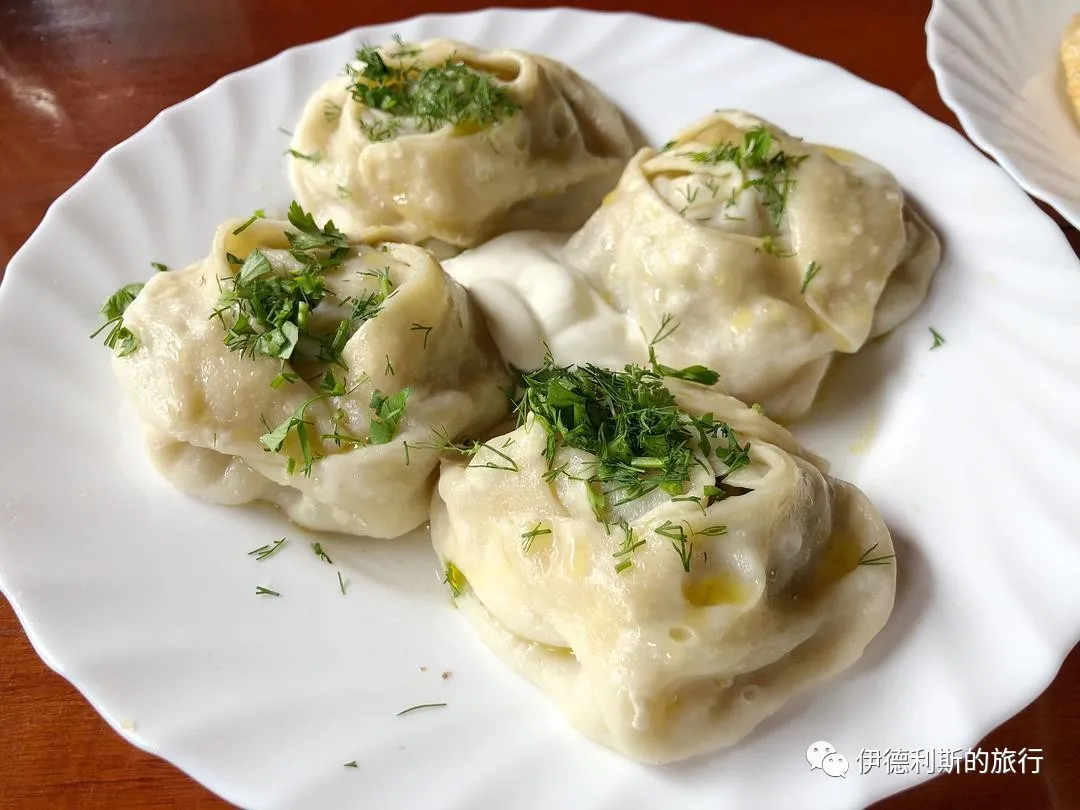
At a manor-style Crimean Tatar restaurant at the foot of the mountain, I ate sheep cheese with olives (brynza s maslinami), grilled salmon (deniz kebab), steamed dumplings (manti), and the signature Crimean Tatar deep-fried meat pastry (chebureki).
The deep-fried meat pastry (chebureki) is a unique national food of the Crimean Tatars. It can be made with lamb or beef, mixed with onions and black pepper, and the dough is very thin. Steamed dumplings (manti) were brought back by the Crimean Tatars after they were forced into exile in Uzbekistan in 1944.
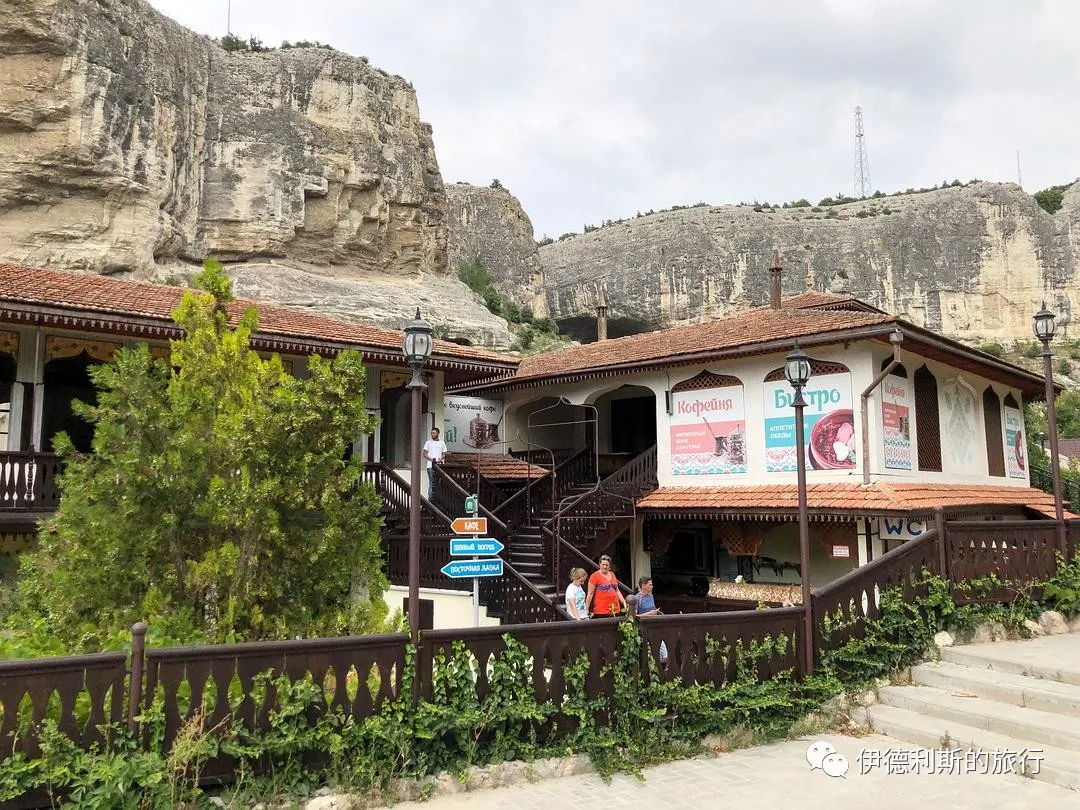
Clothing
Skullcap (tubeteika)
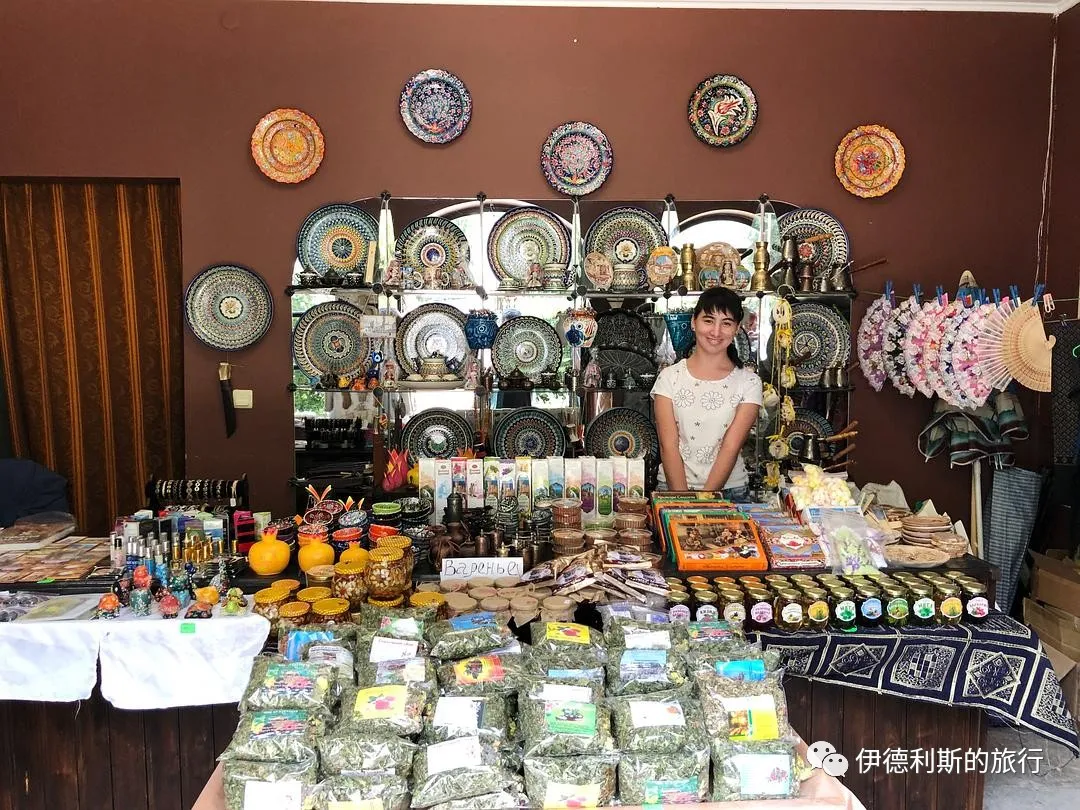
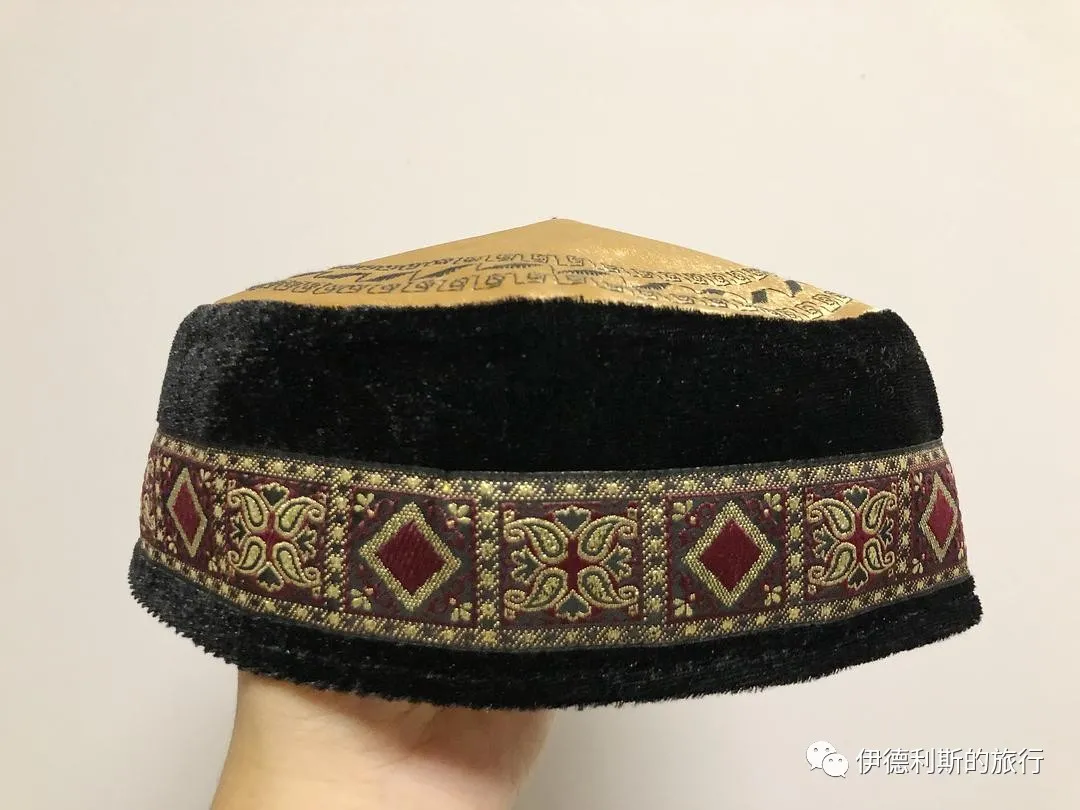
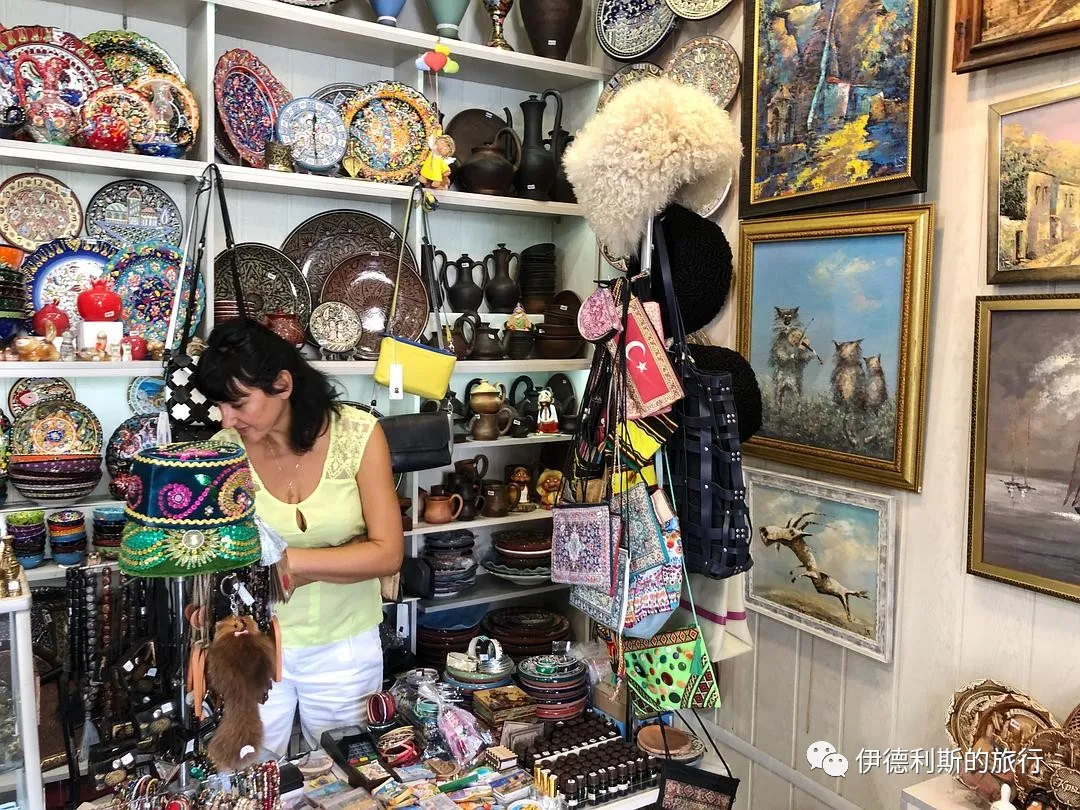
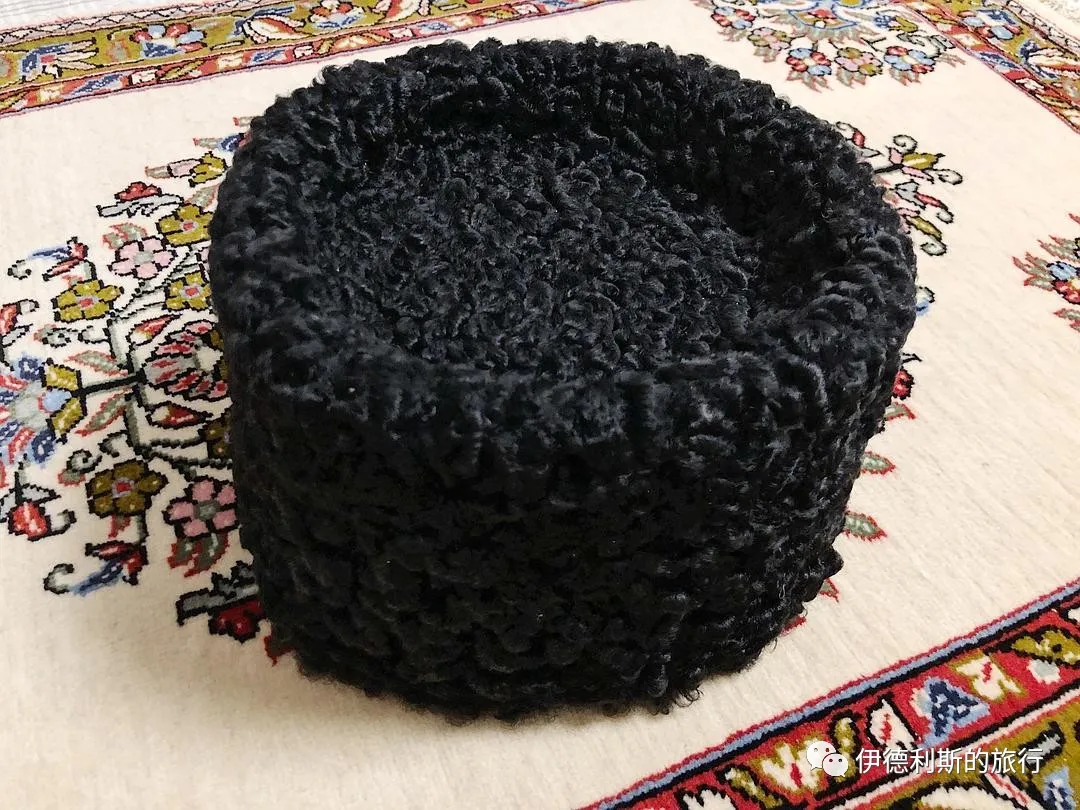
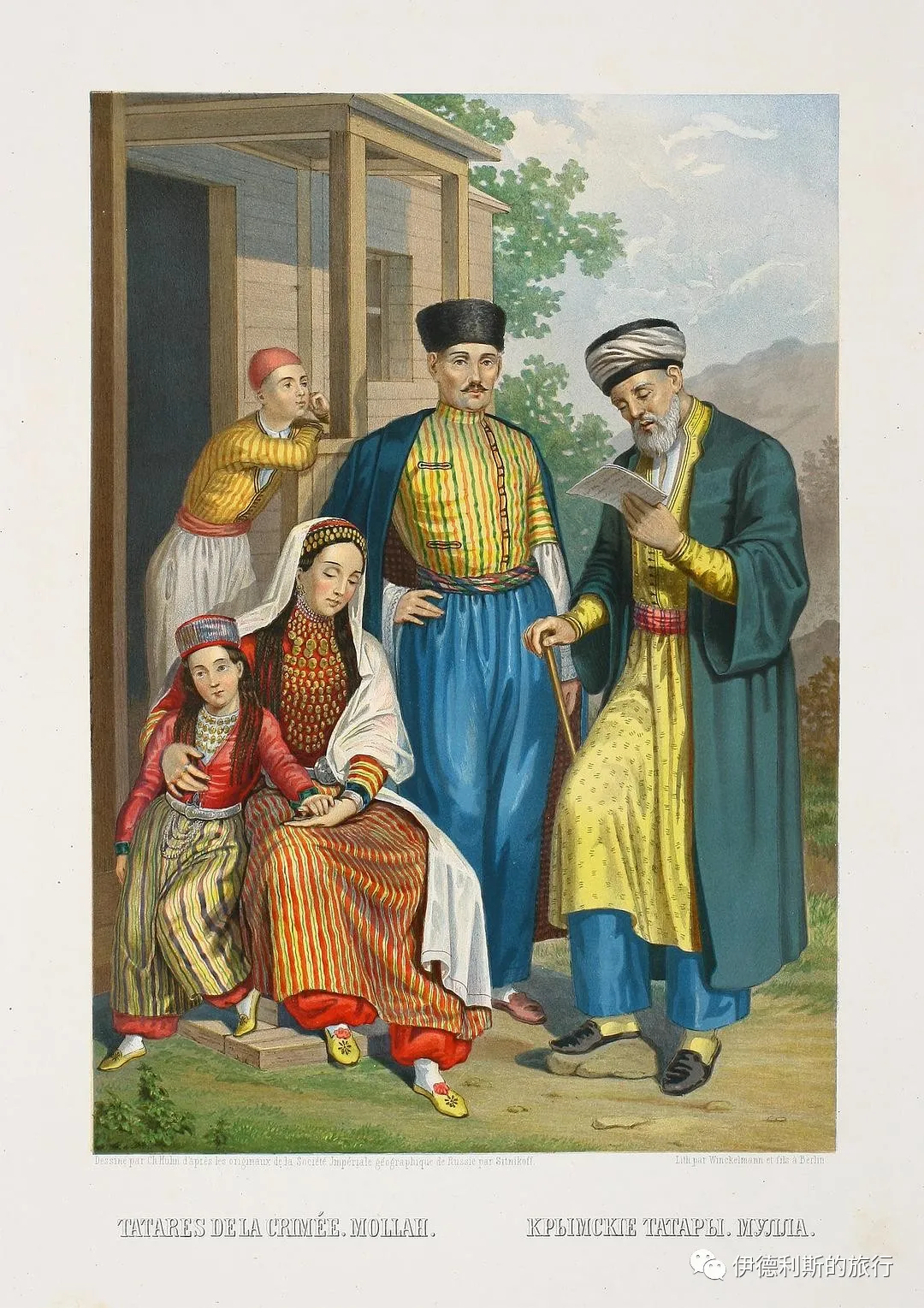
I bought a wool hat called a kalpak at a shop, which is the most classic winter hat for Crimean Tatars. This word is the same as the name for the felt hat worn by the Kyrgyz people, but the shape is different.
Summary: Bakhchysarai in Crimea is shown through the Khan Palace, mosques, tombs, old neighborhoods, and Crimean Tatar heritage. This account keeps the original route, names, dates, architectural details, food notes, and photographs.
Bakhchisaray sits in a valley on the Crimean Peninsula and became the capital of the Crimean Khanate in 1532. Although it became an ordinary town after Russia occupied the Crimean Khanate in 1783, it remains the cultural center of the Crimean Tatars and preserves their unique culture and customs.
Crimean Tatars are a Turkic-speaking ethnic group that formed during the Golden Horde period. In May 1944, the Soviet Union deported all 240,000 Crimean Tatars from the Crimean Peninsula to Uzbekistan and other remote regions. Many Crimean Tatars died during the exile from cold, hunger, disease, and exhaustion. Even after reaching their destinations, many were forced to work hard in Gulag collective farms. For nearly half a century after that, there were almost no Crimean Tatars on the Crimean Peninsula.
After a long struggle by the Crimean Tatar civil rights movement, the Soviet Union finally declared the deportation of the Crimean Tatars illegal in 1989, and they finally gained the right to return to their homeland. Today, 250,000 Crimean Tatars have returned home, working to rebuild their lives, overcome social and economic obstacles, and pass on their culture.
The Palace
The North Gate is the entrance to the Khan Palace area. In the Crimean Tatar language, Darbehane Qapı means Mint Gate, named because mint once grew across from the gate. The Khan Palace once had four large gates, but only the North Gate and South Gate remain today. The North Gate features a carving of two snakes intertwined. Legend says the palace builder, Sahib I Giray, saw two snakes fighting by the river in front of the gate and watched one get healed by the water, so he decided to build the palace there.
The North Gate was built in 1611. Before this, the palace had no walls because the capital's defense system was at the Jewish Fortress on the cliff. As Cossack military activity increased in the 17th century, the palace was considered under threat, leading to the construction of the current walls and gates.
The Great Khan Mosque (Büyük Han Cami) was one of the first palace buildings constructed after the capital moved in 1532. The original mosque had several domes, much like the Seljuk-style mosques popular in 15th-century Ottoman Turkey. A fire destroyed the mosque in 1736, but Khan Selamet II Giray (reigned 1740-1743) later restored it and changed the roof to tiles.
During the Soviet era, the mosque closed and became an exhibition hall for an archaeological museum. After Russia occupied Crimea in 2014, they restored the mosque, though some of this work caused damage.
Maqsurah is Arabic for "enclosed space," and it served as a private area inside the mosque for rulers or nobles to perform namaz. A maqsurah is usually a wooden box or screen near the mihrab, but the Khan Mosque features a two-story loft instead. The main entrance of the Khan Mosque connects to the north wall of the Khan Palace for direct access, while you can only reach the maqsurah via stairs inside the palace.
The maqsurah in the Khan Mosque was rebuilt after the 1736 fire and features famous Turkish Iznik tiles, stained glass, and various precious 18th-century murals.
The Khan Cemetery sits south of the Khan Mosque and holds the graves of nine Crimean Khans from the 16th to 18th centuries, 45 members of the Khan family, and over 320 court nobles. The two most important tombs belong to Crimean Khans Devlet I Giray (reigned 1551-1577) and İslâm III Giray (reigned 1644-1654). These octagonal tombs are made of limestone and originally had lead domes, which were replaced with iron after 1863. There is also the open-air tomb of Crimean Khan Meñli II Giray (reigned 1724-1730, 1737-1740) and the double tombstone of Crimean Khan Qırım Giray (reigned 1758-1764, 1768-1769).
Devlet I Giray reigned for 26 years. His most important battle was burning Moscow in 1571, which forced Tsar Ivan the Terrible to flee, earning him the title "the one who took the crown." In 1640, İslâm III Giray led his army to deal a devastating blow to Ukraine.
During his reign, Meñli II Giray ended the long-standing instability of the Crimean Khanate and abolished certain taxes, which earned him much support. He skillfully organized defenses against the invading Russian army and caused them heavy losses.
Qırım Giray was a talented ruler. Under his rule, the Crimean Khanate saw an artistic revival and developed a unique style known as "Crimean Rococo."
The SaryGuzel bathhouse was ordered to be built in 1532 by Crimean Khan Sahib I Giray. Like the Khan Mosque, it is one of the oldest buildings in the Bakhchisaray Khan Palace. In the Crimean Tatar language, 'Sarı' means 'yellow or fair-skinned,' and 'Güzel' means 'beautiful.'
The SaryGuzel bathhouse is a typical Turkish bath. A furnace in the basement sends hot air up to heat the floor, and lead pipes supply hot and cold water to the bath. The bath is divided into men's and women's sections. Each section has a dome with star-shaped cutouts for light and ventilation, and there is an indoor courtyard with a fountain at the exit.
The SaryGuzel bathhouse operated until 1924, when it was closed because it was considered unsafe. It has since been restored and is now open for exhibitions.
The Falcon Tower (Toğan qullesi) is located in a corner of the Persian Garden at the Khan Palace. Legend says it was once used to train falcons for the Khan's court. The Falcon Tower was built in the 16th century. It was originally a five-story brick, mud, and wood structure. In 1760, it was rebuilt into two stories: a lower cube made of rubble and cement mortar, and an upper octagonal tower made of wooden planks.
The Falcon Tower connects to the Harem building of the Khan Palace. A spiral staircase inside leads to an observation deck at the top, where people living in the Harem could look out over the entire palace.
The Harem (Arem) of the Crimean Khan Palace once had 4 buildings and 73 rooms. In 1818, Tsar Alexander I ordered the demolition of 3 buildings and 70 rooms, leaving only an annex with 3 rooms and a pavilion. Today, the annex displays the interior decorations of Crimean Tatar homes from the 17th to the 19th centuries.
The living room retains its original fireplace and cupboards. During a 1980s restoration, a mirror with an inscription by the artist was discovered. Paintings on the vanity and Arabic poetry on the ceiling have also been cleaned and revealed.
The Persian Garden in the southern part of the Harem is surrounded by high walls. It once featured various trees, fountains, and baths, but now only ruins remain.
The Dilâra Bikeç Mausoleum is an octagonal tomb at the southernmost point of the Bakhchisaray Khan Palace. It was ordered to be built in 1764 by Crimean Khan Qırım Giray (reigned 1758-1764, 1768-1769) for his beloved wife.
The Small Khan Mosque (Kiçik Han Cami) is inside the main building of the Khan Palace and was used by members of the Khan's family and noble officials. The Small Khan Mosque was built in the 16th century. It was destroyed by fire by the Russian army in 1736 and restored in 1741 by Khan Selamet II Giray (reigned 1740-1743).
The existing interior murals were created between the 17th and 18th centuries, with some painted by the Iranian architect Omer in the late 18th century. Earlier murals from the 16th century were discovered during a 1991 restoration.
On the south wall of the Khan Mosque (Khan Jami) is a prayer niche (mihrab) carved with seven decorative bands, which symbolize the seven heavens mentioned in the Quran.
Above the prayer niche (mihrab) is a piece of stained glass featuring the Seal of Solomon (Khatam Sulayman) ✡.
The Iron Gate (Demir Qapi) is the oldest structure in the Khan Palace, built between 1503 and 1504 by the architect Aleviz Novy for the Crimean Khan. This architect had previously been invited by Ivan the Great to Moscow to build a series of churches. The Iron Gate (Demir Qapi) was likely originally built at the Crimean Khan's previous residence, Devlet-Saray, and was moved to the main building of the Khan Palace only after the Bakhchisaray Khan Palace was completed in 1532.
Demir Qapi means iron gate in the Crimean Tatar language. The gate's portal is made of limestone and uses decorative styles from the Lombard-Venetian Renaissance.
The Council Hall (Divan hanesi) is the meeting room inside the main building of the Khan Palace. In the center of the south wall is the throne where the Khan sat, with sofas on the sides for his ministers. Above the north wall at the entrance to the hall is a narrow latticed balcony, which is said to have been used by the Khan to have people eavesdrop on meetings when he was absent.
The floor of the hall was paved with marble and had a square pool with a fountain in the center. The walls were covered in tiles, but these were destroyed in a fire set by the Russian army in 1736. Restoration took place in 1742, and many of the current decorations, such as the murals and chandeliers, were added in 1822 when the architect I. F. Kolodin renovated the Khan Palace.
In 1917, the Crimean Tatars announced the establishment of an independent Crimean Tatar government here.
The Summer Pavilion is a place for cooling off inside the main building of the Khan Palace, built between the late 17th and early 18th centuries. It was burned down by the Russian army in 1736 and later restored by the architect Omer ibn al Hadj Mustafa. In the center of the pavilion is a square pool with a square marble fountain, surrounded by sofas.
The pavilion was originally open. Between 1821 and 1831, Tsar Alexander I ordered the architects Mikhail Klado and Vasiliy Dorofeyev to enclose the Summer Pavilion, adding columns, stained glass, and a carved ceiling.
Early murals were discovered during the restoration of the summer pavilion in 1962.
The Golden Pavilion is on the second floor of the main building and was built in the late 18th century by the Iranian architect Omer. The interior of the pavilion originally featured murals of fruit vases and Arabic poetry praising Khan Qırım Giray, but these were destroyed during the German occupation of Crimea from 1941 to 1944.
The Golden Fountain is located in the Fountain Courtyard of the Khan's Palace main building, near the Small Khan Mosque, and was where the Crimean Khan and members of the Khan's court performed wudu.
The Golden Fountain is made of gilded marble and features carvings of various flowers, fruits, and plants to depict the 'Garden of Eden' (jandātʿadni) from the Quran, the place where Adam and his wife lived. A circular outlet is carved in the center of the fountain, symbolizing eternal life.
The Fountain of Tears was commissioned in 1763 by the Crimean Khan Qırım Giray (reigned 1758-1764, 1768-1769), and the architect was Omer ibn al Hadj Mustafa from Iran. The fountain was originally installed in the mausoleum of the Khan's beloved wife, Dilâra Bikeç, but after Empress Catherine II visited the palace in 1787, the dried-up fountain was moved to the Fountain Courtyard in front of the main building.
A love story about the Fountain of Tears has circulated in Bakhchysarai since the 18th century. According to the legend, the Khan's beloved wife, Dilâra Bikeç, was a Greek woman from Georgia who was killed in palace intrigue. The Khan fell into deep grief and built this fountain in her mausoleum to honor her. This love story later became widely known because of Pushkin's famous poem, The Fountain of Bakhchisaray.
The suites on both sides of the North Gate were where the Khan's palace guards (Qapı Halqı) lived. After Crimea was occupied by Tsarist Russia, this area also served as guest lodging. Today, the west building of the suites is an exhibition hall, and the east building houses museum offices.
The exhibition hall in the west building displays artifacts from the Crimean Khanate era and the traditional life of the Crimean Tatars. The original fireplaces are still preserved inside the suites.
The stables are divided into two floors, with the first floor used for keeping horses and the second floor for the grooms to live in; the current building was rebuilt in the 1850s.
Mosque
Orta Mosque was once the main Friday mosque in Bakhchysarai. It dates back to 1674. The Khans Mengli Giray II and Selamet II Giray renovated it between 1737 and 1743, and it was rebuilt again in 1861 to reach its current form.
After 1929, the mosque served as a cultural center and then a cinema. It was not returned to the Muslim community until 2001. The mosque's minaret and surrounding buildings were destroyed at that time. They were not rebuilt until 2012. The mosque reopened in 2013 after the construction work finished.
Ismi Khan Mosque was built between the 17th and 18th centuries. Its architectural decorations show a strong influence from the European Baroque style. The upper circular openings are decorated with wooden Seals of Solomon (Khātam Sulaymān) ✡.
The mosque was used as a warehouse for a long time. There were plans to restore it in the early 21st century, but the work has not been carried out yet.
Molla Mustafa Friday Mosque dates back to the 17th century. An 1890 document mentions this mosque, stating that the local residents added a roof to the building in 1888.
Tahtali Mosque was built in 1707 by Khan Sultan Beck, the son-in-law of the Crimean Khan Selim I Giray. In the Crimean Tatar language, "Tahtalı" means "wooden." The mosque was originally built with wooden planks. Later, it was enclosed with brick and stone, and the roof was covered with clay tiles.
Accommodation
I stayed at a beautiful traditional Crimean Tatar house called Bahitgul Boutique-Hotel. They serve traditional Crimean Tatar food, so I usually ate breakfast right where I was staying. The view while eating there is excellent, as you can look out over the entire ancient capital.
The food culture of the Crimean Tatars is closely tied to their history. Because the Crimean Khanate was a long-term vassal of the Ottoman Empire, it has many Ottoman-related foods, such as Turkish coffee, baklava (a sweet pastry), and stuffed grape leaves (dolma). After being exiled to Uzbekistan in 1944, the Crimean Tatar diet added many Uzbek dishes, including rice pilaf (plov), hand-pulled noodles (lagman), baked meat buns (samsa), steamed dumplings (manti), and flatbread (nan). Crimean Tatars have some unique delicacies, such as the deep-fried meat pastry (chebureki), which is known as a signature national dish.
You can eat baked meat buns (samsa) at the bazaar.
I ate rice pilaf (plov), stuffed grape leaves (dolma), and lamb skewers (shashlik) at a Crimean Tatar restaurant; the lamb skewers were incredibly tender and fragrant.
I bought desserts at a Crimean Tatar sweet shop in the old city, which are basically the same as the baklava popular in former Ottoman regions like Turkey, the Caucasus, the Balkans, and the Levant. In the third picture, the first row on the iron tray says 'hazelnut,' and the second row says 'caramel'.
At a manor-style Crimean Tatar restaurant at the foot of the mountain, I ate sheep cheese with olives (brynza s maslinami), grilled salmon (deniz kebab), steamed dumplings (manti), and the signature Crimean Tatar deep-fried meat pastry (chebureki).
The deep-fried meat pastry (chebureki) is a unique national food of the Crimean Tatars. It can be made with lamb or beef, mixed with onions and black pepper, and the dough is very thin. Steamed dumplings (manti) were brought back by the Crimean Tatars after they were forced into exile in Uzbekistan in 1944.
Clothing
Skullcap (tubeteika)
I bought a wool hat called a kalpak at a shop, which is the most classic winter hat for Crimean Tatars. This word is the same as the name for the felt hat worn by the Kyrgyz people, but the shape is different.
Halal Travel Guide: Bakhchysarai, Crimea - Khan Palace and Mosques
Articles • ali2007fr posted the article • 0 comments • 280 views • 2026-05-20 08:47
Reposted from the web
Summary: Bakhchysarai in Crimea is shown through the Khan Palace, mosques, tombs, old neighborhoods, and Crimean Tatar heritage. This account keeps the original route, names, dates, architectural details, food notes, and photographs.
Bakhchisaray sits in a valley on the Crimean Peninsula and became the capital of the Crimean Khanate in 1532. Although it became an ordinary town after Russia occupied the Crimean Khanate in 1783, it remains the cultural center of the Crimean Tatars and preserves their unique culture and customs.
Crimean Tatars are a Turkic-speaking ethnic group that formed during the Golden Horde period. In May 1944, the Soviet Union deported all 240,000 Crimean Tatars from the Crimean Peninsula to Uzbekistan and other remote regions. Many Crimean Tatars died during the exile from cold, hunger, disease, and exhaustion. Even after reaching their destinations, many were forced to work hard in Gulag collective farms. For nearly half a century after that, there were almost no Crimean Tatars on the Crimean Peninsula.
After a long struggle by the Crimean Tatar civil rights movement, the Soviet Union finally declared the deportation of the Crimean Tatars illegal in 1989, and they finally gained the right to return to their homeland. Today, 250,000 Crimean Tatars have returned home, working to rebuild their lives, overcome social and economic obstacles, and pass on their culture.
The Palace
The North Gate is the entrance to the Khan Palace area. In the Crimean Tatar language, Darbehane Qapı means Mint Gate, named because mint once grew across from the gate. The Khan Palace once had four large gates, but only the North Gate and South Gate remain today. The North Gate features a carving of two snakes intertwined. Legend says the palace builder, Sahib I Giray, saw two snakes fighting by the river in front of the gate and watched one get healed by the water, so he decided to build the palace there.
The North Gate was built in 1611. Before this, the palace had no walls because the capital's defense system was at the Jewish Fortress on the cliff. As Cossack military activity increased in the 17th century, the palace was considered under threat, leading to the construction of the current walls and gates.
The Great Khan Mosque (Büyük Han Cami) was one of the first palace buildings constructed after the capital moved in 1532. The original mosque had several domes, much like the Seljuk-style mosques popular in 15th-century Ottoman Turkey. A fire destroyed the mosque in 1736, but Khan Selamet II Giray (reigned 1740-1743) later restored it and changed the roof to tiles.
During the Soviet era, the mosque closed and became an exhibition hall for an archaeological museum. After Russia occupied Crimea in 2014, they restored the mosque, though some of this work caused damage.
Maqsurah is Arabic for "enclosed space," and it served as a private area inside the mosque for rulers or nobles to perform namaz. A maqsurah is usually a wooden box or screen near the mihrab, but the Khan Mosque features a two-story loft instead. The main entrance of the Khan Mosque connects to the north wall of the Khan Palace for direct access, while you can only reach the maqsurah via stairs inside the palace.
The maqsurah in the Khan Mosque was rebuilt after the 1736 fire and features famous Turkish Iznik tiles, stained glass, and various precious 18th-century murals.
The Khan Cemetery sits south of the Khan Mosque and holds the graves of nine Crimean Khans from the 16th to 18th centuries, 45 members of the Khan family, and over 320 court nobles. The two most important tombs belong to Crimean Khans Devlet I Giray (reigned 1551-1577) and İslâm III Giray (reigned 1644-1654). These octagonal tombs are made of limestone and originally had lead domes, which were replaced with iron after 1863. There is also the open-air tomb of Crimean Khan Meñli II Giray (reigned 1724-1730, 1737-1740) and the double tombstone of Crimean Khan Qırım Giray (reigned 1758-1764, 1768-1769).
Devlet I Giray reigned for 26 years. His most important battle was burning Moscow in 1571, which forced Tsar Ivan the Terrible to flee, earning him the title "the one who took the crown." In 1640, İslâm III Giray led his army to deal a devastating blow to Ukraine.
During his reign, Meñli II Giray ended the long-standing instability of the Crimean Khanate and abolished certain taxes, which earned him much support. He skillfully organized defenses against the invading Russian army and caused them heavy losses.
Qırım Giray was a talented ruler. Under his rule, the Crimean Khanate saw an artistic revival and developed a unique style known as "Crimean Rococo."
The SaryGuzel bathhouse was ordered to be built in 1532 by Crimean Khan Sahib I Giray. Like the Khan Mosque, it is one of the oldest buildings in the Bakhchisaray Khan Palace. In the Crimean Tatar language, 'Sarı' means 'yellow or fair-skinned,' and 'Güzel' means 'beautiful.'
The SaryGuzel bathhouse is a typical Turkish bath. A furnace in the basement sends hot air up to heat the floor, and lead pipes supply hot and cold water to the bath. The bath is divided into men's and women's sections. Each section has a dome with star-shaped cutouts for light and ventilation, and there is an indoor courtyard with a fountain at the exit.
The SaryGuzel bathhouse operated until 1924, when it was closed because it was considered unsafe. It has since been restored and is now open for exhibitions.
The Falcon Tower (Toğan qullesi) is located in a corner of the Persian Garden at the Khan Palace. Legend says it was once used to train falcons for the Khan's court. The Falcon Tower was built in the 16th century. It was originally a five-story brick, mud, and wood structure. In 1760, it was rebuilt into two stories: a lower cube made of rubble and cement mortar, and an upper octagonal tower made of wooden planks.
The Falcon Tower connects to the Harem building of the Khan Palace. A spiral staircase inside leads to an observation deck at the top, where people living in the Harem could look out over the entire palace.
The Harem (Arem) of the Crimean Khan Palace once had 4 buildings and 73 rooms. In 1818, Tsar Alexander I ordered the demolition of 3 buildings and 70 rooms, leaving only an annex with 3 rooms and a pavilion. Today, the annex displays the interior decorations of Crimean Tatar homes from the 17th to the 19th centuries.
The living room retains its original fireplace and cupboards. During a 1980s restoration, a mirror with an inscription by the artist was discovered. Paintings on the vanity and Arabic poetry on the ceiling have also been cleaned and revealed.
The Persian Garden in the southern part of the Harem is surrounded by high walls. It once featured various trees, fountains, and baths, but now only ruins remain.
The Dilâra Bikeç Mausoleum is an octagonal tomb at the southernmost point of the Bakhchisaray Khan Palace. It was ordered to be built in 1764 by Crimean Khan Qırım Giray (reigned 1758-1764, 1768-1769) for his beloved wife.
The Small Khan Mosque (Kiçik Han Cami) is inside the main building of the Khan Palace and was used by members of the Khan's family and noble officials. The Small Khan Mosque was built in the 16th century. It was destroyed by fire by the Russian army in 1736 and restored in 1741 by Khan Selamet II Giray (reigned 1740-1743).
The existing interior murals were created between the 17th and 18th centuries, with some painted by the Iranian architect Omer in the late 18th century. Earlier murals from the 16th century were discovered during a 1991 restoration.
On the south wall of the Khan Mosque (Khan Jami) is a prayer niche (mihrab) carved with seven decorative bands, which symbolize the seven heavens mentioned in the Quran.
Above the prayer niche (mihrab) is a piece of stained glass featuring the Seal of Solomon (Khatam Sulayman) ✡.
The Iron Gate (Demir Qapi) is the oldest structure in the Khan Palace, built between 1503 and 1504 by the architect Aleviz Novy for the Crimean Khan. This architect had previously been invited by Ivan the Great to Moscow to build a series of churches. The Iron Gate (Demir Qapi) was likely originally built at the Crimean Khan's previous residence, Devlet-Saray, and was moved to the main building of the Khan Palace only after the Bakhchisaray Khan Palace was completed in 1532.
Demir Qapi means iron gate in the Crimean Tatar language. The gate's portal is made of limestone and uses decorative styles from the Lombard-Venetian Renaissance.
The Council Hall (Divan hanesi) is the meeting room inside the main building of the Khan Palace. In the center of the south wall is the throne where the Khan sat, with sofas on the sides for his ministers. Above the north wall at the entrance to the hall is a narrow latticed balcony, which is said to have been used by the Khan to have people eavesdrop on meetings when he was absent.
The floor of the hall was paved with marble and had a square pool with a fountain in the center. The walls were covered in tiles, but these were destroyed in a fire set by the Russian army in 1736. Restoration took place in 1742, and many of the current decorations, such as the murals and chandeliers, were added in 1822 when the architect I. F. Kolodin renovated the Khan Palace.
In 1917, the Crimean Tatars announced the establishment of an independent Crimean Tatar government here.
The Summer Pavilion is a place for cooling off inside the main building of the Khan Palace, built between the late 17th and early 18th centuries. It was burned down by the Russian army in 1736 and later restored by the architect Omer ibn al Hadj Mustafa. In the center of the pavilion is a square pool with a square marble fountain, surrounded by sofas.
The pavilion was originally open. Between 1821 and 1831, Tsar Alexander I ordered the architects Mikhail Klado and Vasiliy Dorofeyev to enclose the Summer Pavilion, adding columns, stained glass, and a carved ceiling.
Early murals were discovered during the restoration of the summer pavilion in 1962.
The Golden Pavilion is on the second floor of the main building and was built in the late 18th century by the Iranian architect Omer. The interior of the pavilion originally featured murals of fruit vases and Arabic poetry praising Khan Qırım Giray, but these were destroyed during the German occupation of Crimea from 1941 to 1944.
The Golden Fountain is located in the Fountain Courtyard of the Khan's Palace main building, near the Small Khan Mosque, and was where the Crimean Khan and members of the Khan's court performed wudu.
The Golden Fountain is made of gilded marble and features carvings of various flowers, fruits, and plants to depict the 'Garden of Eden' (jandātʿadni) from the Quran, the place where Adam and his wife lived. A circular outlet is carved in the center of the fountain, symbolizing eternal life.
The Fountain of Tears was commissioned in 1763 by the Crimean Khan Qırım Giray (reigned 1758-1764, 1768-1769), and the architect was Omer ibn al Hadj Mustafa from Iran. The fountain was originally installed in the mausoleum of the Khan's beloved wife, Dilâra Bikeç, but after Empress Catherine II visited the palace in 1787, the dried-up fountain was moved to the Fountain Courtyard in front of the main building.
A love story about the Fountain of Tears has circulated in Bakhchysarai since the 18th century. According to the legend, the Khan's beloved wife, Dilâra Bikeç, was a Greek woman from Georgia who was killed in palace intrigue. The Khan fell into deep grief and built this fountain in her mausoleum to honor her. This love story later became widely known because of Pushkin's famous poem, The Fountain of Bakhchisaray.
The suites on both sides of the North Gate were where the Khan's palace guards (Qapı Halqı) lived. After Crimea was occupied by Tsarist Russia, this area also served as guest lodging. Today, the west building of the suites is an exhibition hall, and the east building houses museum offices.
The exhibition hall in the west building displays artifacts from the Crimean Khanate era and the traditional life of the Crimean Tatars. The original fireplaces are still preserved inside the suites.
The stables are divided into two floors, with the first floor used for keeping horses and the second floor for the grooms to live in; the current building was rebuilt in the 1850s.
Mosque
Orta Mosque was once the main Friday mosque in Bakhchysarai. It dates back to 1674. The Khans Mengli Giray II and Selamet II Giray renovated it between 1737 and 1743, and it was rebuilt again in 1861 to reach its current form.
After 1929, the mosque served as a cultural center and then a cinema. It was not returned to the Muslim community until 2001. The mosque's minaret and surrounding buildings were destroyed at that time. They were not rebuilt until 2012. The mosque reopened in 2013 after the construction work finished.
Ismi Khan Mosque was built between the 17th and 18th centuries. Its architectural decorations show a strong influence from the European Baroque style. The upper circular openings are decorated with wooden Seals of Solomon (Khātam Sulaymān) ✡.
The mosque was used as a warehouse for a long time. There were plans to restore it in the early 21st century, but the work has not been carried out yet.
Molla Mustafa Friday Mosque dates back to the 17th century. An 1890 document mentions this mosque, stating that the local residents added a roof to the building in 1888.
Tahtali Mosque was built in 1707 by Khan Sultan Beck, the son-in-law of the Crimean Khan Selim I Giray. In the Crimean Tatar language, "Tahtalı" means "wooden." The mosque was originally built with wooden planks. Later, it was enclosed with brick and stone, and the roof was covered with clay tiles.
Accommodation
I stayed at a beautiful traditional Crimean Tatar house called Bahitgul Boutique-Hotel. They serve traditional Crimean Tatar food, so I usually ate breakfast right where I was staying. The view while eating there is excellent, as you can look out over the entire ancient capital.
The food culture of the Crimean Tatars is closely tied to their history. Because the Crimean Khanate was a long-term vassal of the Ottoman Empire, it has many Ottoman-related foods, such as Turkish coffee, baklava (a sweet pastry), and stuffed grape leaves (dolma). After being exiled to Uzbekistan in 1944, the Crimean Tatar diet added many Uzbek dishes, including rice pilaf (plov), hand-pulled noodles (lagman), baked meat buns (samsa), steamed dumplings (manti), and flatbread (nan). Crimean Tatars have some unique delicacies, such as the deep-fried meat pastry (chebureki), which is known as a signature national dish.
You can eat baked meat buns (samsa) at the bazaar.
I ate rice pilaf (plov), stuffed grape leaves (dolma), and lamb skewers (shashlik) at a Crimean Tatar restaurant; the lamb skewers were incredibly tender and fragrant.
I bought desserts at a Crimean Tatar sweet shop in the old city, which are basically the same as the baklava popular in former Ottoman regions like Turkey, the Caucasus, the Balkans, and the Levant. In the third picture, the first row on the iron tray says 'hazelnut,' and the second row says 'caramel'.
At a manor-style Crimean Tatar restaurant at the foot of the mountain, I ate sheep cheese with olives (brynza s maslinami), grilled salmon (deniz kebab), steamed dumplings (manti), and the signature Crimean Tatar deep-fried meat pastry (chebureki).
The deep-fried meat pastry (chebureki) is a unique national food of the Crimean Tatars. It can be made with lamb or beef, mixed with onions and black pepper, and the dough is very thin. Steamed dumplings (manti) were brought back by the Crimean Tatars after they were forced into exile in Uzbekistan in 1944.
Clothing
Skullcap (tubeteika)
I bought a wool hat called a kalpak at a shop, which is the most classic winter hat for Crimean Tatars. This word is the same as the name for the felt hat worn by the Kyrgyz people, but the shape is different. view all
Summary: Bakhchysarai in Crimea is shown through the Khan Palace, mosques, tombs, old neighborhoods, and Crimean Tatar heritage. This account keeps the original route, names, dates, architectural details, food notes, and photographs.
Bakhchisaray sits in a valley on the Crimean Peninsula and became the capital of the Crimean Khanate in 1532. Although it became an ordinary town after Russia occupied the Crimean Khanate in 1783, it remains the cultural center of the Crimean Tatars and preserves their unique culture and customs.
Crimean Tatars are a Turkic-speaking ethnic group that formed during the Golden Horde period. In May 1944, the Soviet Union deported all 240,000 Crimean Tatars from the Crimean Peninsula to Uzbekistan and other remote regions. Many Crimean Tatars died during the exile from cold, hunger, disease, and exhaustion. Even after reaching their destinations, many were forced to work hard in Gulag collective farms. For nearly half a century after that, there were almost no Crimean Tatars on the Crimean Peninsula.
After a long struggle by the Crimean Tatar civil rights movement, the Soviet Union finally declared the deportation of the Crimean Tatars illegal in 1989, and they finally gained the right to return to their homeland. Today, 250,000 Crimean Tatars have returned home, working to rebuild their lives, overcome social and economic obstacles, and pass on their culture.
The Palace
The North Gate is the entrance to the Khan Palace area. In the Crimean Tatar language, Darbehane Qapı means Mint Gate, named because mint once grew across from the gate. The Khan Palace once had four large gates, but only the North Gate and South Gate remain today. The North Gate features a carving of two snakes intertwined. Legend says the palace builder, Sahib I Giray, saw two snakes fighting by the river in front of the gate and watched one get healed by the water, so he decided to build the palace there.
The North Gate was built in 1611. Before this, the palace had no walls because the capital's defense system was at the Jewish Fortress on the cliff. As Cossack military activity increased in the 17th century, the palace was considered under threat, leading to the construction of the current walls and gates.
The Great Khan Mosque (Büyük Han Cami) was one of the first palace buildings constructed after the capital moved in 1532. The original mosque had several domes, much like the Seljuk-style mosques popular in 15th-century Ottoman Turkey. A fire destroyed the mosque in 1736, but Khan Selamet II Giray (reigned 1740-1743) later restored it and changed the roof to tiles.
During the Soviet era, the mosque closed and became an exhibition hall for an archaeological museum. After Russia occupied Crimea in 2014, they restored the mosque, though some of this work caused damage.
Maqsurah is Arabic for "enclosed space," and it served as a private area inside the mosque for rulers or nobles to perform namaz. A maqsurah is usually a wooden box or screen near the mihrab, but the Khan Mosque features a two-story loft instead. The main entrance of the Khan Mosque connects to the north wall of the Khan Palace for direct access, while you can only reach the maqsurah via stairs inside the palace.
The maqsurah in the Khan Mosque was rebuilt after the 1736 fire and features famous Turkish Iznik tiles, stained glass, and various precious 18th-century murals.
The Khan Cemetery sits south of the Khan Mosque and holds the graves of nine Crimean Khans from the 16th to 18th centuries, 45 members of the Khan family, and over 320 court nobles. The two most important tombs belong to Crimean Khans Devlet I Giray (reigned 1551-1577) and İslâm III Giray (reigned 1644-1654). These octagonal tombs are made of limestone and originally had lead domes, which were replaced with iron after 1863. There is also the open-air tomb of Crimean Khan Meñli II Giray (reigned 1724-1730, 1737-1740) and the double tombstone of Crimean Khan Qırım Giray (reigned 1758-1764, 1768-1769).
Devlet I Giray reigned for 26 years. His most important battle was burning Moscow in 1571, which forced Tsar Ivan the Terrible to flee, earning him the title "the one who took the crown." In 1640, İslâm III Giray led his army to deal a devastating blow to Ukraine.
During his reign, Meñli II Giray ended the long-standing instability of the Crimean Khanate and abolished certain taxes, which earned him much support. He skillfully organized defenses against the invading Russian army and caused them heavy losses.
Qırım Giray was a talented ruler. Under his rule, the Crimean Khanate saw an artistic revival and developed a unique style known as "Crimean Rococo."
The SaryGuzel bathhouse was ordered to be built in 1532 by Crimean Khan Sahib I Giray. Like the Khan Mosque, it is one of the oldest buildings in the Bakhchisaray Khan Palace. In the Crimean Tatar language, 'Sarı' means 'yellow or fair-skinned,' and 'Güzel' means 'beautiful.'
The SaryGuzel bathhouse is a typical Turkish bath. A furnace in the basement sends hot air up to heat the floor, and lead pipes supply hot and cold water to the bath. The bath is divided into men's and women's sections. Each section has a dome with star-shaped cutouts for light and ventilation, and there is an indoor courtyard with a fountain at the exit.
The SaryGuzel bathhouse operated until 1924, when it was closed because it was considered unsafe. It has since been restored and is now open for exhibitions.
The Falcon Tower (Toğan qullesi) is located in a corner of the Persian Garden at the Khan Palace. Legend says it was once used to train falcons for the Khan's court. The Falcon Tower was built in the 16th century. It was originally a five-story brick, mud, and wood structure. In 1760, it was rebuilt into two stories: a lower cube made of rubble and cement mortar, and an upper octagonal tower made of wooden planks.
The Falcon Tower connects to the Harem building of the Khan Palace. A spiral staircase inside leads to an observation deck at the top, where people living in the Harem could look out over the entire palace.
The Harem (Arem) of the Crimean Khan Palace once had 4 buildings and 73 rooms. In 1818, Tsar Alexander I ordered the demolition of 3 buildings and 70 rooms, leaving only an annex with 3 rooms and a pavilion. Today, the annex displays the interior decorations of Crimean Tatar homes from the 17th to the 19th centuries.
The living room retains its original fireplace and cupboards. During a 1980s restoration, a mirror with an inscription by the artist was discovered. Paintings on the vanity and Arabic poetry on the ceiling have also been cleaned and revealed.
The Persian Garden in the southern part of the Harem is surrounded by high walls. It once featured various trees, fountains, and baths, but now only ruins remain.
The Dilâra Bikeç Mausoleum is an octagonal tomb at the southernmost point of the Bakhchisaray Khan Palace. It was ordered to be built in 1764 by Crimean Khan Qırım Giray (reigned 1758-1764, 1768-1769) for his beloved wife.
The Small Khan Mosque (Kiçik Han Cami) is inside the main building of the Khan Palace and was used by members of the Khan's family and noble officials. The Small Khan Mosque was built in the 16th century. It was destroyed by fire by the Russian army in 1736 and restored in 1741 by Khan Selamet II Giray (reigned 1740-1743).
The existing interior murals were created between the 17th and 18th centuries, with some painted by the Iranian architect Omer in the late 18th century. Earlier murals from the 16th century were discovered during a 1991 restoration.
On the south wall of the Khan Mosque (Khan Jami) is a prayer niche (mihrab) carved with seven decorative bands, which symbolize the seven heavens mentioned in the Quran.
Above the prayer niche (mihrab) is a piece of stained glass featuring the Seal of Solomon (Khatam Sulayman) ✡.
The Iron Gate (Demir Qapi) is the oldest structure in the Khan Palace, built between 1503 and 1504 by the architect Aleviz Novy for the Crimean Khan. This architect had previously been invited by Ivan the Great to Moscow to build a series of churches. The Iron Gate (Demir Qapi) was likely originally built at the Crimean Khan's previous residence, Devlet-Saray, and was moved to the main building of the Khan Palace only after the Bakhchisaray Khan Palace was completed in 1532.
Demir Qapi means iron gate in the Crimean Tatar language. The gate's portal is made of limestone and uses decorative styles from the Lombard-Venetian Renaissance.
The Council Hall (Divan hanesi) is the meeting room inside the main building of the Khan Palace. In the center of the south wall is the throne where the Khan sat, with sofas on the sides for his ministers. Above the north wall at the entrance to the hall is a narrow latticed balcony, which is said to have been used by the Khan to have people eavesdrop on meetings when he was absent.
The floor of the hall was paved with marble and had a square pool with a fountain in the center. The walls were covered in tiles, but these were destroyed in a fire set by the Russian army in 1736. Restoration took place in 1742, and many of the current decorations, such as the murals and chandeliers, were added in 1822 when the architect I. F. Kolodin renovated the Khan Palace.
In 1917, the Crimean Tatars announced the establishment of an independent Crimean Tatar government here.
The Summer Pavilion is a place for cooling off inside the main building of the Khan Palace, built between the late 17th and early 18th centuries. It was burned down by the Russian army in 1736 and later restored by the architect Omer ibn al Hadj Mustafa. In the center of the pavilion is a square pool with a square marble fountain, surrounded by sofas.
The pavilion was originally open. Between 1821 and 1831, Tsar Alexander I ordered the architects Mikhail Klado and Vasiliy Dorofeyev to enclose the Summer Pavilion, adding columns, stained glass, and a carved ceiling.
Early murals were discovered during the restoration of the summer pavilion in 1962.
The Golden Pavilion is on the second floor of the main building and was built in the late 18th century by the Iranian architect Omer. The interior of the pavilion originally featured murals of fruit vases and Arabic poetry praising Khan Qırım Giray, but these were destroyed during the German occupation of Crimea from 1941 to 1944.
The Golden Fountain is located in the Fountain Courtyard of the Khan's Palace main building, near the Small Khan Mosque, and was where the Crimean Khan and members of the Khan's court performed wudu.
The Golden Fountain is made of gilded marble and features carvings of various flowers, fruits, and plants to depict the 'Garden of Eden' (jandātʿadni) from the Quran, the place where Adam and his wife lived. A circular outlet is carved in the center of the fountain, symbolizing eternal life.
The Fountain of Tears was commissioned in 1763 by the Crimean Khan Qırım Giray (reigned 1758-1764, 1768-1769), and the architect was Omer ibn al Hadj Mustafa from Iran. The fountain was originally installed in the mausoleum of the Khan's beloved wife, Dilâra Bikeç, but after Empress Catherine II visited the palace in 1787, the dried-up fountain was moved to the Fountain Courtyard in front of the main building.
A love story about the Fountain of Tears has circulated in Bakhchysarai since the 18th century. According to the legend, the Khan's beloved wife, Dilâra Bikeç, was a Greek woman from Georgia who was killed in palace intrigue. The Khan fell into deep grief and built this fountain in her mausoleum to honor her. This love story later became widely known because of Pushkin's famous poem, The Fountain of Bakhchisaray.
The suites on both sides of the North Gate were where the Khan's palace guards (Qapı Halqı) lived. After Crimea was occupied by Tsarist Russia, this area also served as guest lodging. Today, the west building of the suites is an exhibition hall, and the east building houses museum offices.
The exhibition hall in the west building displays artifacts from the Crimean Khanate era and the traditional life of the Crimean Tatars. The original fireplaces are still preserved inside the suites.
The stables are divided into two floors, with the first floor used for keeping horses and the second floor for the grooms to live in; the current building was rebuilt in the 1850s.
Mosque
Orta Mosque was once the main Friday mosque in Bakhchysarai. It dates back to 1674. The Khans Mengli Giray II and Selamet II Giray renovated it between 1737 and 1743, and it was rebuilt again in 1861 to reach its current form.
After 1929, the mosque served as a cultural center and then a cinema. It was not returned to the Muslim community until 2001. The mosque's minaret and surrounding buildings were destroyed at that time. They were not rebuilt until 2012. The mosque reopened in 2013 after the construction work finished.
Ismi Khan Mosque was built between the 17th and 18th centuries. Its architectural decorations show a strong influence from the European Baroque style. The upper circular openings are decorated with wooden Seals of Solomon (Khātam Sulaymān) ✡.
The mosque was used as a warehouse for a long time. There were plans to restore it in the early 21st century, but the work has not been carried out yet.
Molla Mustafa Friday Mosque dates back to the 17th century. An 1890 document mentions this mosque, stating that the local residents added a roof to the building in 1888.
Tahtali Mosque was built in 1707 by Khan Sultan Beck, the son-in-law of the Crimean Khan Selim I Giray. In the Crimean Tatar language, "Tahtalı" means "wooden." The mosque was originally built with wooden planks. Later, it was enclosed with brick and stone, and the roof was covered with clay tiles.
Accommodation
I stayed at a beautiful traditional Crimean Tatar house called Bahitgul Boutique-Hotel. They serve traditional Crimean Tatar food, so I usually ate breakfast right where I was staying. The view while eating there is excellent, as you can look out over the entire ancient capital.
The food culture of the Crimean Tatars is closely tied to their history. Because the Crimean Khanate was a long-term vassal of the Ottoman Empire, it has many Ottoman-related foods, such as Turkish coffee, baklava (a sweet pastry), and stuffed grape leaves (dolma). After being exiled to Uzbekistan in 1944, the Crimean Tatar diet added many Uzbek dishes, including rice pilaf (plov), hand-pulled noodles (lagman), baked meat buns (samsa), steamed dumplings (manti), and flatbread (nan). Crimean Tatars have some unique delicacies, such as the deep-fried meat pastry (chebureki), which is known as a signature national dish.
You can eat baked meat buns (samsa) at the bazaar.
I ate rice pilaf (plov), stuffed grape leaves (dolma), and lamb skewers (shashlik) at a Crimean Tatar restaurant; the lamb skewers were incredibly tender and fragrant.
I bought desserts at a Crimean Tatar sweet shop in the old city, which are basically the same as the baklava popular in former Ottoman regions like Turkey, the Caucasus, the Balkans, and the Levant. In the third picture, the first row on the iron tray says 'hazelnut,' and the second row says 'caramel'.
At a manor-style Crimean Tatar restaurant at the foot of the mountain, I ate sheep cheese with olives (brynza s maslinami), grilled salmon (deniz kebab), steamed dumplings (manti), and the signature Crimean Tatar deep-fried meat pastry (chebureki).
The deep-fried meat pastry (chebureki) is a unique national food of the Crimean Tatars. It can be made with lamb or beef, mixed with onions and black pepper, and the dough is very thin. Steamed dumplings (manti) were brought back by the Crimean Tatars after they were forced into exile in Uzbekistan in 1944.
Clothing
Skullcap (tubeteika)
I bought a wool hat called a kalpak at a shop, which is the most classic winter hat for Crimean Tatars. This word is the same as the name for the felt hat worn by the Kyrgyz people, but the shape is different. view all
Reposted from the web
Summary: Bakhchysarai in Crimea is shown through the Khan Palace, mosques, tombs, old neighborhoods, and Crimean Tatar heritage. This account keeps the original route, names, dates, architectural details, food notes, and photographs.
Bakhchisaray sits in a valley on the Crimean Peninsula and became the capital of the Crimean Khanate in 1532. Although it became an ordinary town after Russia occupied the Crimean Khanate in 1783, it remains the cultural center of the Crimean Tatars and preserves their unique culture and customs.
Crimean Tatars are a Turkic-speaking ethnic group that formed during the Golden Horde period. In May 1944, the Soviet Union deported all 240,000 Crimean Tatars from the Crimean Peninsula to Uzbekistan and other remote regions. Many Crimean Tatars died during the exile from cold, hunger, disease, and exhaustion. Even after reaching their destinations, many were forced to work hard in Gulag collective farms. For nearly half a century after that, there were almost no Crimean Tatars on the Crimean Peninsula.
After a long struggle by the Crimean Tatar civil rights movement, the Soviet Union finally declared the deportation of the Crimean Tatars illegal in 1989, and they finally gained the right to return to their homeland. Today, 250,000 Crimean Tatars have returned home, working to rebuild their lives, overcome social and economic obstacles, and pass on their culture.
The Palace
The North Gate is the entrance to the Khan Palace area. In the Crimean Tatar language, Darbehane Qapı means Mint Gate, named because mint once grew across from the gate. The Khan Palace once had four large gates, but only the North Gate and South Gate remain today. The North Gate features a carving of two snakes intertwined. Legend says the palace builder, Sahib I Giray, saw two snakes fighting by the river in front of the gate and watched one get healed by the water, so he decided to build the palace there.
The North Gate was built in 1611. Before this, the palace had no walls because the capital's defense system was at the Jewish Fortress on the cliff. As Cossack military activity increased in the 17th century, the palace was considered under threat, leading to the construction of the current walls and gates.
The Great Khan Mosque (Büyük Han Cami) was one of the first palace buildings constructed after the capital moved in 1532. The original mosque had several domes, much like the Seljuk-style mosques popular in 15th-century Ottoman Turkey. A fire destroyed the mosque in 1736, but Khan Selamet II Giray (reigned 1740-1743) later restored it and changed the roof to tiles.
During the Soviet era, the mosque closed and became an exhibition hall for an archaeological museum. After Russia occupied Crimea in 2014, they restored the mosque, though some of this work caused damage.
Maqsurah is Arabic for "enclosed space," and it served as a private area inside the mosque for rulers or nobles to perform namaz. A maqsurah is usually a wooden box or screen near the mihrab, but the Khan Mosque features a two-story loft instead. The main entrance of the Khan Mosque connects to the north wall of the Khan Palace for direct access, while you can only reach the maqsurah via stairs inside the palace.
The maqsurah in the Khan Mosque was rebuilt after the 1736 fire and features famous Turkish Iznik tiles, stained glass, and various precious 18th-century murals.
The Khan Cemetery sits south of the Khan Mosque and holds the graves of nine Crimean Khans from the 16th to 18th centuries, 45 members of the Khan family, and over 320 court nobles. The two most important tombs belong to Crimean Khans Devlet I Giray (reigned 1551-1577) and İslâm III Giray (reigned 1644-1654). These octagonal tombs are made of limestone and originally had lead domes, which were replaced with iron after 1863. There is also the open-air tomb of Crimean Khan Meñli II Giray (reigned 1724-1730, 1737-1740) and the double tombstone of Crimean Khan Qırım Giray (reigned 1758-1764, 1768-1769).
Devlet I Giray reigned for 26 years. His most important battle was burning Moscow in 1571, which forced Tsar Ivan the Terrible to flee, earning him the title "the one who took the crown." In 1640, İslâm III Giray led his army to deal a devastating blow to Ukraine.
During his reign, Meñli II Giray ended the long-standing instability of the Crimean Khanate and abolished certain taxes, which earned him much support. He skillfully organized defenses against the invading Russian army and caused them heavy losses.
Qırım Giray was a talented ruler. Under his rule, the Crimean Khanate saw an artistic revival and developed a unique style known as "Crimean Rococo."
The SaryGuzel bathhouse was ordered to be built in 1532 by Crimean Khan Sahib I Giray. Like the Khan Mosque, it is one of the oldest buildings in the Bakhchisaray Khan Palace. In the Crimean Tatar language, 'Sarı' means 'yellow or fair-skinned,' and 'Güzel' means 'beautiful.'
The SaryGuzel bathhouse is a typical Turkish bath. A furnace in the basement sends hot air up to heat the floor, and lead pipes supply hot and cold water to the bath. The bath is divided into men's and women's sections. Each section has a dome with star-shaped cutouts for light and ventilation, and there is an indoor courtyard with a fountain at the exit.
The SaryGuzel bathhouse operated until 1924, when it was closed because it was considered unsafe. It has since been restored and is now open for exhibitions.
The Falcon Tower (Toğan qullesi) is located in a corner of the Persian Garden at the Khan Palace. Legend says it was once used to train falcons for the Khan's court. The Falcon Tower was built in the 16th century. It was originally a five-story brick, mud, and wood structure. In 1760, it was rebuilt into two stories: a lower cube made of rubble and cement mortar, and an upper octagonal tower made of wooden planks.
The Falcon Tower connects to the Harem building of the Khan Palace. A spiral staircase inside leads to an observation deck at the top, where people living in the Harem could look out over the entire palace.
The Harem (Arem) of the Crimean Khan Palace once had 4 buildings and 73 rooms. In 1818, Tsar Alexander I ordered the demolition of 3 buildings and 70 rooms, leaving only an annex with 3 rooms and a pavilion. Today, the annex displays the interior decorations of Crimean Tatar homes from the 17th to the 19th centuries.
The living room retains its original fireplace and cupboards. During a 1980s restoration, a mirror with an inscription by the artist was discovered. Paintings on the vanity and Arabic poetry on the ceiling have also been cleaned and revealed.
The Persian Garden in the southern part of the Harem is surrounded by high walls. It once featured various trees, fountains, and baths, but now only ruins remain.
The Dilâra Bikeç Mausoleum is an octagonal tomb at the southernmost point of the Bakhchisaray Khan Palace. It was ordered to be built in 1764 by Crimean Khan Qırım Giray (reigned 1758-1764, 1768-1769) for his beloved wife.
The Small Khan Mosque (Kiçik Han Cami) is inside the main building of the Khan Palace and was used by members of the Khan's family and noble officials. The Small Khan Mosque was built in the 16th century. It was destroyed by fire by the Russian army in 1736 and restored in 1741 by Khan Selamet II Giray (reigned 1740-1743).
The existing interior murals were created between the 17th and 18th centuries, with some painted by the Iranian architect Omer in the late 18th century. Earlier murals from the 16th century were discovered during a 1991 restoration.
On the south wall of the Khan Mosque (Khan Jami) is a prayer niche (mihrab) carved with seven decorative bands, which symbolize the seven heavens mentioned in the Quran.
Above the prayer niche (mihrab) is a piece of stained glass featuring the Seal of Solomon (Khatam Sulayman) ✡.
The Iron Gate (Demir Qapi) is the oldest structure in the Khan Palace, built between 1503 and 1504 by the architect Aleviz Novy for the Crimean Khan. This architect had previously been invited by Ivan the Great to Moscow to build a series of churches. The Iron Gate (Demir Qapi) was likely originally built at the Crimean Khan's previous residence, Devlet-Saray, and was moved to the main building of the Khan Palace only after the Bakhchisaray Khan Palace was completed in 1532.
Demir Qapi means iron gate in the Crimean Tatar language. The gate's portal is made of limestone and uses decorative styles from the Lombard-Venetian Renaissance.
The Council Hall (Divan hanesi) is the meeting room inside the main building of the Khan Palace. In the center of the south wall is the throne where the Khan sat, with sofas on the sides for his ministers. Above the north wall at the entrance to the hall is a narrow latticed balcony, which is said to have been used by the Khan to have people eavesdrop on meetings when he was absent.
The floor of the hall was paved with marble and had a square pool with a fountain in the center. The walls were covered in tiles, but these were destroyed in a fire set by the Russian army in 1736. Restoration took place in 1742, and many of the current decorations, such as the murals and chandeliers, were added in 1822 when the architect I. F. Kolodin renovated the Khan Palace.
In 1917, the Crimean Tatars announced the establishment of an independent Crimean Tatar government here.
The Summer Pavilion is a place for cooling off inside the main building of the Khan Palace, built between the late 17th and early 18th centuries. It was burned down by the Russian army in 1736 and later restored by the architect Omer ibn al Hadj Mustafa. In the center of the pavilion is a square pool with a square marble fountain, surrounded by sofas.
The pavilion was originally open. Between 1821 and 1831, Tsar Alexander I ordered the architects Mikhail Klado and Vasiliy Dorofeyev to enclose the Summer Pavilion, adding columns, stained glass, and a carved ceiling.
Early murals were discovered during the restoration of the summer pavilion in 1962.
The Golden Pavilion is on the second floor of the main building and was built in the late 18th century by the Iranian architect Omer. The interior of the pavilion originally featured murals of fruit vases and Arabic poetry praising Khan Qırım Giray, but these were destroyed during the German occupation of Crimea from 1941 to 1944.
The Golden Fountain is located in the Fountain Courtyard of the Khan's Palace main building, near the Small Khan Mosque, and was where the Crimean Khan and members of the Khan's court performed wudu.
The Golden Fountain is made of gilded marble and features carvings of various flowers, fruits, and plants to depict the 'Garden of Eden' (jandātʿadni) from the Quran, the place where Adam and his wife lived. A circular outlet is carved in the center of the fountain, symbolizing eternal life.
The Fountain of Tears was commissioned in 1763 by the Crimean Khan Qırım Giray (reigned 1758-1764, 1768-1769), and the architect was Omer ibn al Hadj Mustafa from Iran. The fountain was originally installed in the mausoleum of the Khan's beloved wife, Dilâra Bikeç, but after Empress Catherine II visited the palace in 1787, the dried-up fountain was moved to the Fountain Courtyard in front of the main building.
A love story about the Fountain of Tears has circulated in Bakhchysarai since the 18th century. According to the legend, the Khan's beloved wife, Dilâra Bikeç, was a Greek woman from Georgia who was killed in palace intrigue. The Khan fell into deep grief and built this fountain in her mausoleum to honor her. This love story later became widely known because of Pushkin's famous poem, The Fountain of Bakhchisaray.
The suites on both sides of the North Gate were where the Khan's palace guards (Qapı Halqı) lived. After Crimea was occupied by Tsarist Russia, this area also served as guest lodging. Today, the west building of the suites is an exhibition hall, and the east building houses museum offices.
The exhibition hall in the west building displays artifacts from the Crimean Khanate era and the traditional life of the Crimean Tatars. The original fireplaces are still preserved inside the suites.
The stables are divided into two floors, with the first floor used for keeping horses and the second floor for the grooms to live in; the current building was rebuilt in the 1850s.
Mosque
Orta Mosque was once the main Friday mosque in Bakhchysarai. It dates back to 1674. The Khans Mengli Giray II and Selamet II Giray renovated it between 1737 and 1743, and it was rebuilt again in 1861 to reach its current form.
After 1929, the mosque served as a cultural center and then a cinema. It was not returned to the Muslim community until 2001. The mosque's minaret and surrounding buildings were destroyed at that time. They were not rebuilt until 2012. The mosque reopened in 2013 after the construction work finished.
Ismi Khan Mosque was built between the 17th and 18th centuries. Its architectural decorations show a strong influence from the European Baroque style. The upper circular openings are decorated with wooden Seals of Solomon (Khātam Sulaymān) ✡.
The mosque was used as a warehouse for a long time. There were plans to restore it in the early 21st century, but the work has not been carried out yet.
Molla Mustafa Friday Mosque dates back to the 17th century. An 1890 document mentions this mosque, stating that the local residents added a roof to the building in 1888.
Tahtali Mosque was built in 1707 by Khan Sultan Beck, the son-in-law of the Crimean Khan Selim I Giray. In the Crimean Tatar language, "Tahtalı" means "wooden." The mosque was originally built with wooden planks. Later, it was enclosed with brick and stone, and the roof was covered with clay tiles.
Accommodation
I stayed at a beautiful traditional Crimean Tatar house called Bahitgul Boutique-Hotel. They serve traditional Crimean Tatar food, so I usually ate breakfast right where I was staying. The view while eating there is excellent, as you can look out over the entire ancient capital.
The food culture of the Crimean Tatars is closely tied to their history. Because the Crimean Khanate was a long-term vassal of the Ottoman Empire, it has many Ottoman-related foods, such as Turkish coffee, baklava (a sweet pastry), and stuffed grape leaves (dolma). After being exiled to Uzbekistan in 1944, the Crimean Tatar diet added many Uzbek dishes, including rice pilaf (plov), hand-pulled noodles (lagman), baked meat buns (samsa), steamed dumplings (manti), and flatbread (nan). Crimean Tatars have some unique delicacies, such as the deep-fried meat pastry (chebureki), which is known as a signature national dish.
You can eat baked meat buns (samsa) at the bazaar.
I ate rice pilaf (plov), stuffed grape leaves (dolma), and lamb skewers (shashlik) at a Crimean Tatar restaurant; the lamb skewers were incredibly tender and fragrant.
I bought desserts at a Crimean Tatar sweet shop in the old city, which are basically the same as the baklava popular in former Ottoman regions like Turkey, the Caucasus, the Balkans, and the Levant. In the third picture, the first row on the iron tray says 'hazelnut,' and the second row says 'caramel'.
At a manor-style Crimean Tatar restaurant at the foot of the mountain, I ate sheep cheese with olives (brynza s maslinami), grilled salmon (deniz kebab), steamed dumplings (manti), and the signature Crimean Tatar deep-fried meat pastry (chebureki).
The deep-fried meat pastry (chebureki) is a unique national food of the Crimean Tatars. It can be made with lamb or beef, mixed with onions and black pepper, and the dough is very thin. Steamed dumplings (manti) were brought back by the Crimean Tatars after they were forced into exile in Uzbekistan in 1944.
Clothing
Skullcap (tubeteika)
I bought a wool hat called a kalpak at a shop, which is the most classic winter hat for Crimean Tatars. This word is the same as the name for the felt hat worn by the Kyrgyz people, but the shape is different.
Summary: Bakhchysarai in Crimea is shown through the Khan Palace, mosques, tombs, old neighborhoods, and Crimean Tatar heritage. This account keeps the original route, names, dates, architectural details, food notes, and photographs.
Bakhchisaray sits in a valley on the Crimean Peninsula and became the capital of the Crimean Khanate in 1532. Although it became an ordinary town after Russia occupied the Crimean Khanate in 1783, it remains the cultural center of the Crimean Tatars and preserves their unique culture and customs.
Crimean Tatars are a Turkic-speaking ethnic group that formed during the Golden Horde period. In May 1944, the Soviet Union deported all 240,000 Crimean Tatars from the Crimean Peninsula to Uzbekistan and other remote regions. Many Crimean Tatars died during the exile from cold, hunger, disease, and exhaustion. Even after reaching their destinations, many were forced to work hard in Gulag collective farms. For nearly half a century after that, there were almost no Crimean Tatars on the Crimean Peninsula.
After a long struggle by the Crimean Tatar civil rights movement, the Soviet Union finally declared the deportation of the Crimean Tatars illegal in 1989, and they finally gained the right to return to their homeland. Today, 250,000 Crimean Tatars have returned home, working to rebuild their lives, overcome social and economic obstacles, and pass on their culture.
The Palace
The North Gate is the entrance to the Khan Palace area. In the Crimean Tatar language, Darbehane Qapı means Mint Gate, named because mint once grew across from the gate. The Khan Palace once had four large gates, but only the North Gate and South Gate remain today. The North Gate features a carving of two snakes intertwined. Legend says the palace builder, Sahib I Giray, saw two snakes fighting by the river in front of the gate and watched one get healed by the water, so he decided to build the palace there.
The North Gate was built in 1611. Before this, the palace had no walls because the capital's defense system was at the Jewish Fortress on the cliff. As Cossack military activity increased in the 17th century, the palace was considered under threat, leading to the construction of the current walls and gates.
The Great Khan Mosque (Büyük Han Cami) was one of the first palace buildings constructed after the capital moved in 1532. The original mosque had several domes, much like the Seljuk-style mosques popular in 15th-century Ottoman Turkey. A fire destroyed the mosque in 1736, but Khan Selamet II Giray (reigned 1740-1743) later restored it and changed the roof to tiles.
During the Soviet era, the mosque closed and became an exhibition hall for an archaeological museum. After Russia occupied Crimea in 2014, they restored the mosque, though some of this work caused damage.
Maqsurah is Arabic for "enclosed space," and it served as a private area inside the mosque for rulers or nobles to perform namaz. A maqsurah is usually a wooden box or screen near the mihrab, but the Khan Mosque features a two-story loft instead. The main entrance of the Khan Mosque connects to the north wall of the Khan Palace for direct access, while you can only reach the maqsurah via stairs inside the palace.
The maqsurah in the Khan Mosque was rebuilt after the 1736 fire and features famous Turkish Iznik tiles, stained glass, and various precious 18th-century murals.
The Khan Cemetery sits south of the Khan Mosque and holds the graves of nine Crimean Khans from the 16th to 18th centuries, 45 members of the Khan family, and over 320 court nobles. The two most important tombs belong to Crimean Khans Devlet I Giray (reigned 1551-1577) and İslâm III Giray (reigned 1644-1654). These octagonal tombs are made of limestone and originally had lead domes, which were replaced with iron after 1863. There is also the open-air tomb of Crimean Khan Meñli II Giray (reigned 1724-1730, 1737-1740) and the double tombstone of Crimean Khan Qırım Giray (reigned 1758-1764, 1768-1769).
Devlet I Giray reigned for 26 years. His most important battle was burning Moscow in 1571, which forced Tsar Ivan the Terrible to flee, earning him the title "the one who took the crown." In 1640, İslâm III Giray led his army to deal a devastating blow to Ukraine.
During his reign, Meñli II Giray ended the long-standing instability of the Crimean Khanate and abolished certain taxes, which earned him much support. He skillfully organized defenses against the invading Russian army and caused them heavy losses.
Qırım Giray was a talented ruler. Under his rule, the Crimean Khanate saw an artistic revival and developed a unique style known as "Crimean Rococo."
The SaryGuzel bathhouse was ordered to be built in 1532 by Crimean Khan Sahib I Giray. Like the Khan Mosque, it is one of the oldest buildings in the Bakhchisaray Khan Palace. In the Crimean Tatar language, 'Sarı' means 'yellow or fair-skinned,' and 'Güzel' means 'beautiful.'
The SaryGuzel bathhouse is a typical Turkish bath. A furnace in the basement sends hot air up to heat the floor, and lead pipes supply hot and cold water to the bath. The bath is divided into men's and women's sections. Each section has a dome with star-shaped cutouts for light and ventilation, and there is an indoor courtyard with a fountain at the exit.
The SaryGuzel bathhouse operated until 1924, when it was closed because it was considered unsafe. It has since been restored and is now open for exhibitions.
The Falcon Tower (Toğan qullesi) is located in a corner of the Persian Garden at the Khan Palace. Legend says it was once used to train falcons for the Khan's court. The Falcon Tower was built in the 16th century. It was originally a five-story brick, mud, and wood structure. In 1760, it was rebuilt into two stories: a lower cube made of rubble and cement mortar, and an upper octagonal tower made of wooden planks.
The Falcon Tower connects to the Harem building of the Khan Palace. A spiral staircase inside leads to an observation deck at the top, where people living in the Harem could look out over the entire palace.
The Harem (Arem) of the Crimean Khan Palace once had 4 buildings and 73 rooms. In 1818, Tsar Alexander I ordered the demolition of 3 buildings and 70 rooms, leaving only an annex with 3 rooms and a pavilion. Today, the annex displays the interior decorations of Crimean Tatar homes from the 17th to the 19th centuries.
The living room retains its original fireplace and cupboards. During a 1980s restoration, a mirror with an inscription by the artist was discovered. Paintings on the vanity and Arabic poetry on the ceiling have also been cleaned and revealed.
The Persian Garden in the southern part of the Harem is surrounded by high walls. It once featured various trees, fountains, and baths, but now only ruins remain.
The Dilâra Bikeç Mausoleum is an octagonal tomb at the southernmost point of the Bakhchisaray Khan Palace. It was ordered to be built in 1764 by Crimean Khan Qırım Giray (reigned 1758-1764, 1768-1769) for his beloved wife.
The Small Khan Mosque (Kiçik Han Cami) is inside the main building of the Khan Palace and was used by members of the Khan's family and noble officials. The Small Khan Mosque was built in the 16th century. It was destroyed by fire by the Russian army in 1736 and restored in 1741 by Khan Selamet II Giray (reigned 1740-1743).
The existing interior murals were created between the 17th and 18th centuries, with some painted by the Iranian architect Omer in the late 18th century. Earlier murals from the 16th century were discovered during a 1991 restoration.
On the south wall of the Khan Mosque (Khan Jami) is a prayer niche (mihrab) carved with seven decorative bands, which symbolize the seven heavens mentioned in the Quran.
Above the prayer niche (mihrab) is a piece of stained glass featuring the Seal of Solomon (Khatam Sulayman) ✡.
The Iron Gate (Demir Qapi) is the oldest structure in the Khan Palace, built between 1503 and 1504 by the architect Aleviz Novy for the Crimean Khan. This architect had previously been invited by Ivan the Great to Moscow to build a series of churches. The Iron Gate (Demir Qapi) was likely originally built at the Crimean Khan's previous residence, Devlet-Saray, and was moved to the main building of the Khan Palace only after the Bakhchisaray Khan Palace was completed in 1532.
Demir Qapi means iron gate in the Crimean Tatar language. The gate's portal is made of limestone and uses decorative styles from the Lombard-Venetian Renaissance.
The Council Hall (Divan hanesi) is the meeting room inside the main building of the Khan Palace. In the center of the south wall is the throne where the Khan sat, with sofas on the sides for his ministers. Above the north wall at the entrance to the hall is a narrow latticed balcony, which is said to have been used by the Khan to have people eavesdrop on meetings when he was absent.
The floor of the hall was paved with marble and had a square pool with a fountain in the center. The walls were covered in tiles, but these were destroyed in a fire set by the Russian army in 1736. Restoration took place in 1742, and many of the current decorations, such as the murals and chandeliers, were added in 1822 when the architect I. F. Kolodin renovated the Khan Palace.
In 1917, the Crimean Tatars announced the establishment of an independent Crimean Tatar government here.
The Summer Pavilion is a place for cooling off inside the main building of the Khan Palace, built between the late 17th and early 18th centuries. It was burned down by the Russian army in 1736 and later restored by the architect Omer ibn al Hadj Mustafa. In the center of the pavilion is a square pool with a square marble fountain, surrounded by sofas.
The pavilion was originally open. Between 1821 and 1831, Tsar Alexander I ordered the architects Mikhail Klado and Vasiliy Dorofeyev to enclose the Summer Pavilion, adding columns, stained glass, and a carved ceiling.
Early murals were discovered during the restoration of the summer pavilion in 1962.
The Golden Pavilion is on the second floor of the main building and was built in the late 18th century by the Iranian architect Omer. The interior of the pavilion originally featured murals of fruit vases and Arabic poetry praising Khan Qırım Giray, but these were destroyed during the German occupation of Crimea from 1941 to 1944.
The Golden Fountain is located in the Fountain Courtyard of the Khan's Palace main building, near the Small Khan Mosque, and was where the Crimean Khan and members of the Khan's court performed wudu.
The Golden Fountain is made of gilded marble and features carvings of various flowers, fruits, and plants to depict the 'Garden of Eden' (jandātʿadni) from the Quran, the place where Adam and his wife lived. A circular outlet is carved in the center of the fountain, symbolizing eternal life.
The Fountain of Tears was commissioned in 1763 by the Crimean Khan Qırım Giray (reigned 1758-1764, 1768-1769), and the architect was Omer ibn al Hadj Mustafa from Iran. The fountain was originally installed in the mausoleum of the Khan's beloved wife, Dilâra Bikeç, but after Empress Catherine II visited the palace in 1787, the dried-up fountain was moved to the Fountain Courtyard in front of the main building.
A love story about the Fountain of Tears has circulated in Bakhchysarai since the 18th century. According to the legend, the Khan's beloved wife, Dilâra Bikeç, was a Greek woman from Georgia who was killed in palace intrigue. The Khan fell into deep grief and built this fountain in her mausoleum to honor her. This love story later became widely known because of Pushkin's famous poem, The Fountain of Bakhchisaray.
The suites on both sides of the North Gate were where the Khan's palace guards (Qapı Halqı) lived. After Crimea was occupied by Tsarist Russia, this area also served as guest lodging. Today, the west building of the suites is an exhibition hall, and the east building houses museum offices.
The exhibition hall in the west building displays artifacts from the Crimean Khanate era and the traditional life of the Crimean Tatars. The original fireplaces are still preserved inside the suites.
The stables are divided into two floors, with the first floor used for keeping horses and the second floor for the grooms to live in; the current building was rebuilt in the 1850s.
Mosque
Orta Mosque was once the main Friday mosque in Bakhchysarai. It dates back to 1674. The Khans Mengli Giray II and Selamet II Giray renovated it between 1737 and 1743, and it was rebuilt again in 1861 to reach its current form.
After 1929, the mosque served as a cultural center and then a cinema. It was not returned to the Muslim community until 2001. The mosque's minaret and surrounding buildings were destroyed at that time. They were not rebuilt until 2012. The mosque reopened in 2013 after the construction work finished.
Ismi Khan Mosque was built between the 17th and 18th centuries. Its architectural decorations show a strong influence from the European Baroque style. The upper circular openings are decorated with wooden Seals of Solomon (Khātam Sulaymān) ✡.
The mosque was used as a warehouse for a long time. There were plans to restore it in the early 21st century, but the work has not been carried out yet.
Molla Mustafa Friday Mosque dates back to the 17th century. An 1890 document mentions this mosque, stating that the local residents added a roof to the building in 1888.
Tahtali Mosque was built in 1707 by Khan Sultan Beck, the son-in-law of the Crimean Khan Selim I Giray. In the Crimean Tatar language, "Tahtalı" means "wooden." The mosque was originally built with wooden planks. Later, it was enclosed with brick and stone, and the roof was covered with clay tiles.
Accommodation
I stayed at a beautiful traditional Crimean Tatar house called Bahitgul Boutique-Hotel. They serve traditional Crimean Tatar food, so I usually ate breakfast right where I was staying. The view while eating there is excellent, as you can look out over the entire ancient capital.
The food culture of the Crimean Tatars is closely tied to their history. Because the Crimean Khanate was a long-term vassal of the Ottoman Empire, it has many Ottoman-related foods, such as Turkish coffee, baklava (a sweet pastry), and stuffed grape leaves (dolma). After being exiled to Uzbekistan in 1944, the Crimean Tatar diet added many Uzbek dishes, including rice pilaf (plov), hand-pulled noodles (lagman), baked meat buns (samsa), steamed dumplings (manti), and flatbread (nan). Crimean Tatars have some unique delicacies, such as the deep-fried meat pastry (chebureki), which is known as a signature national dish.
You can eat baked meat buns (samsa) at the bazaar.
I ate rice pilaf (plov), stuffed grape leaves (dolma), and lamb skewers (shashlik) at a Crimean Tatar restaurant; the lamb skewers were incredibly tender and fragrant.
I bought desserts at a Crimean Tatar sweet shop in the old city, which are basically the same as the baklava popular in former Ottoman regions like Turkey, the Caucasus, the Balkans, and the Levant. In the third picture, the first row on the iron tray says 'hazelnut,' and the second row says 'caramel'.
At a manor-style Crimean Tatar restaurant at the foot of the mountain, I ate sheep cheese with olives (brynza s maslinami), grilled salmon (deniz kebab), steamed dumplings (manti), and the signature Crimean Tatar deep-fried meat pastry (chebureki).
The deep-fried meat pastry (chebureki) is a unique national food of the Crimean Tatars. It can be made with lamb or beef, mixed with onions and black pepper, and the dough is very thin. Steamed dumplings (manti) were brought back by the Crimean Tatars after they were forced into exile in Uzbekistan in 1944.
Clothing
Skullcap (tubeteika)
I bought a wool hat called a kalpak at a shop, which is the most classic winter hat for Crimean Tatars. This word is the same as the name for the felt hat worn by the Kyrgyz people, but the shape is different.