

Canal Mosques
Halal Travel Guide: Beijing-Tianjin Canal — Mosques and Hui Muslim History
Articles • ali2007fr posted the article • 0 comments • 235 views • 2026-05-18 20:26
Reposted from the web
Summary: Beijing-Tianjin Canal — Mosques and Hui Muslim History is presented here as a firsthand travel account in clear English, beginning with this scene: Visiting Muslim communities, exploring old mosques, and tasting local food have been my dreams since I was a child. The account keeps its focus on Canal Mosques, Beijing Tianjin, Hui Muslims while preserving the names, places, food, and historical details from the Chinese source.
Visiting Muslim communities, exploring old mosques, and tasting local food have been my dreams since I was a child. I could not make it happen during college because I had a limited budget. I graduated from college and returned to Beijing for work in 2014. With a steady income, I officially started my halal food and travel journey in 2015. From January 2016 to May 2017, over a period of more than a year, I used my weekends and holidays to visit Hui Muslim communities in 19 towns and cities along the Grand Canal. I finished the first stage of my travel plan, the Canal Hui Muslim Community Food Tour.
These 19 locations are: Chaoyangmenwai, Changying, Tongzhou Nanguan, and Zhangjiawan in Beijing; Tianmu Village, Jiayuanli, and Northwest Corner in Tianjin; Cangzhou and Botou in Hebei; Dezhou, Linqing, Liaocheng, and Jining in Shandong; Xuzhou, Huai'an, Yangzhou, and Zhenjiang in Jiangsu; and Jiaxing and Hangzhou in Zhejiang.
This halal food tour gave me some experience and laid the foundation for my halal travels to over 100 cities in more than ten countries over the following years. Looking back now, although my early records were incomplete and quite simple, they are still precious memories of that time. Only five or six years have passed, but many situations have changed, and many scenes have already become history.
I have been sharing my canal halal travel records on my public account for a while now. This post serves as a summary and a directory. Due to time constraints, I could not visit some important Hui Muslim communities along the canal. I will have to visit them if I get the chance later. I visited Gaoyou and Lingtang in Jiangsu in 2021, and I am sharing those here as well.
Although they are all along the Grand Canal, the Hui Muslim communities in each place were established at different times. For example, Yangzhou had large numbers of Persian and Central Asian merchants as early as the Tang Dynasty. Hui Muslims (Huihui Semu) were already living in Hangzhou and Zhenjiang during the Yuan Dynasty, but most canal Hui Muslim communities developed during the Ming Dynasty. After the capital moved to Beijing during the Yongle reign, the Grand Canal was dredged again. At the same time, people were relocated to fill areas in the north that were damaged by the Jingnan Campaign. The Hui Muslim population along the Tianjin, Hebei, and Shandong sections of the canal increased significantly, and many famous mosques were built during the Ming Dynasty. During the Xianfeng reign of the Qing Dynasty, the Hui Muslim communities in Huai'an, Zhenjiang, and Jiaxing were hit hard by the Nian Rebellion and the Taiping Rebellion. The Hui Muslim community in Jiaxing was even destroyed and did not recover until the Republic of China era.
In 1855, the Yellow River burst its banks at Tongwaxiang, and the northern sections of the canal became completely silted up. The China Merchants Steam Navigation Company was founded in 1872, and grain tribute began to be transported by sea. Canal grain transport was completely abolished in 1901, and the Tianjin-Pukou Railway opened in 1913. These events caused a major shock to the Hui Muslim communities along the canal. Places like Linqing and Liaocheng began to decline, while cities like Tianjin and Zhenjiang became more prosperous because of the railway. During the Republic of China era, economic development led many Hui Muslims to move from the countryside to cities. Many chose to work in the halal food industry. Large halal restaurants gradually appeared, especially in the south, marking a period of prosperity for southern Hui Muslim communities.
In 1949, soaring prices and broken trade routes forced many Hui Muslim merchants in cities to return to their hometowns. The 1956 joint state-private ownership policy caused many halal restaurants to close. The impact was most severe in southern cities like Suzhou, Changzhou, and Hangzhou, where Hui Muslim communities eventually disappeared. After the market economy began in the 1990s, many Hui Muslim communities were demolished, and the people scattered. In the 21st century, the rapid pace of urban renewal has made the study of remaining Hui Muslim communities urgent. This is how I began my journey to visit the Hui Muslim communities along the canal.
The area outside Chaoyang Gate in Beijing.
After Emperor Yongle of the Ming Dynasty moved the capital to Beijing, he dredged the Tonghui River between Beijing and Tongzhou. He built a series of granaries inside the eastern Chaoyang Gate, and large amounts of grain were shipped from the south along the canal to the gate. Because the Tonghui River lacked enough water and had too many locks, boats often got stuck. During the Qing Dynasty, most grain boats stopped at Tongzhou to unload and transport goods by cart along the official road to Chaoyang Gate. A stone road between Chaoyang Gate and Tongzhou was built during the Yongzheng period, creating a mature commercial route.
Since they were not restricted by the closing of the city gates at night, most people transporting grain stayed outside Chaoyang Gate. Tea houses, inns, and restaurants gradually appeared in the area, and business thrived. Many Hui Muslims who came to do business settled here, forming the Hui Muslim community outside Chaoyang Gate.
There were once seven mosques outside Chaoyang Gate, with four clearly recorded: Nanzhongjie Mosque, Nanxiapo Mosque, Shuimenguan Women's Mosque, and Shegutang Mosque. Only the Nanxiapo Mosque remains today. Legend has it that in the late Ming and early Qing dynasties, a shed builder in Nanxiapo used poles and reed mats to build a large shelter as a place for namaz. In the early Kangxi period, a Hui Muslim businessman named Ma heard about this and donated money to build the formal Nanxiapo Mosque.
Chaowai Street once had many halal food shops. Famous ones included the Yongsheng Lamb Shop and the Dayou Halal Oil and Salt Shop, along with many small stalls. After the renovation of Chaowai Street in the 1990s, only Ziguangyuan, known for its stir-fried dough bits (chaogeda), has continued to thrive. I still go there often to eat roast duck.
The Muslim community outside Chaoyang Gate was completely demolished after 1992. Residents were relocated to the Sanfengli residential area nearby. There are many halal snacks there, and the stewed meat with braised green beans at the small halal restaurant is especially delicious.
Changying, Beijing.
Changying sits on the north side of the Chaoyangmen official road between Beijing and Tongzhou. Legend says that Chang Yuchun, a famous founding general of the Ming Dynasty, once stationed a troop of Hui Muslims near Tongzhou. This camp was named Changjiayingzi, though no historical records have been found to prove this story.
Because it was not far from the Tongzhou canal shipping docks and the Chaoyangmen stone road, many Hui Muslims in Changying made a living by pushing carts and pulling rickshaws. Pushing carts meant using a wheelbarrow to transport grain from the Tongzhou earthen dam to the Thirteen Granaries (Shisancang) inside and outside Chaoyangmen. Pulling rickshaws meant carrying passengers along the Chaoyangmen stone road. Both jobs were directly related to the canal shipping industry.
Changying Mosque was built during the Zhengde period of the Ming Dynasty and renovated in the first year of the Jiaqing period. It is a famous mosque in the eastern Beijing area. In 2001, Changying was demolished. The original eight Hui Muslim villages, including Changying villages 1-7 and the first residential area, were relocated to the Changying Ethnic Homeland residential complex. This formed a new Hui Muslim community, featuring a food street behind the Changying Mosque, a halal food market, a halal supermarket, and many halal restaurants. Behind Changying Mosque is a halal food street. The most famous spot there is Li Xiaolao's meat sesame flatbread (shaobing), which might be the best shaobing in Beijing. Next to Li Xiaolao's are Anji Deli, Jialun Deli, and Yinfangzhai Pastry Shop. The deli meats and pastries inside are all quite good.
Nanguan in Tongzhou, Beijing.
After Guo Shoujing built the Tonghui Canal during the Yuan Dynasty, Tongzhou became a hub for canal shipping. Many Hui Muslims moved here to live, forming a Hui Muslim community in Nanguan. In the first year of the Hongwu period of the Ming Dynasty, Tongzhou city was expanded, and the Nanguan Hui Muslim community was included within its walls. This officially formed South Street inside the South Gate and the Hui Muslim Eighteen-and-a-Half Alley (Shibajieban Hutong) on the east side. South Street was a busy main road for transporting canal grain from the Grand Canal docks outside the North Gate to the two major granaries in the center and east of Tongzhou city. Because of this, it was very prosperous during the Ming and Qing dynasties and was filled with all kinds of shops.
The most authentic halal pastry shop on South Street in Tongzhou is Guishunzhai Halal Food Store. It was opened by Master Li Chen, the former deputy factory manager of the old Dashunzhai food store, after he retired. He kept the traditional skills of the old Dashunzhai, and his thick cakes (dunbobo) and sugar-fired cakes (tanghuoshao) are excellent. The state-run Dashunzhai food store still exists today. Its main branch is on Xinhua East Street in Tongzhou, and its products are also sold on Niujie and in major Beijing supermarkets.
On the east side of the road, north of South Street in Tongzhou, stands the Tongzhou Mosque, built in the Yuan Dynasty. It was originally named Chaozhen Mosque and was renamed Mosque after being expanded during the Wanli period. At the north end of South Street is Xiaolou Restaurant, the most famous halal restaurant in Tongzhou. It is best known for its braised catfish (shao nianyu) caught in the canal. Xiaolou was originally named Yihexuan and was founded by the Li brothers in 1900. It was rebuilt into a two-story building in 1921 and took the name Xiaolou. The current storefront was built after the old Xiaolou was demolished in 1985.
Zhangjiawan in Tongzhou, Beijing.
After Guo Shoujing built the Tonghui River during the Yuan Dynasty, the place where the river flowed east into the Lu River in Tongzhou became what is now Zhangjiawan. Legend says Zhangjiawan was named after Zhang Xuan, who managed sea transport at the time, and it became a canal shipping terminal. After water levels in the Tonghui River dropped in the early Ming Dynasty, more cargo boats chose to unload at Zhangjiawan to transfer goods to carts, making Zhangjiawan a major hub for canal transport. It was not until the Jiajing era of the Ming Dynasty, a century later, that the new Tonghui River was diverted from Zhangjiawan to flow into the North Canal at Tongzhou city. However, cargo ships still docked at Zhangjiawan, and both Zhangjiawan and Tongzhou city served as important canal terminals east of the capital.
After the Yuan Dynasty, merchants kept coming to settle in Zhangjiawan, including many Hui Muslims. A Hui Muslim community formed in Zhangjiawan during the early Ming Dynasty, and they built the Zhangjiawan mosque. The Zhangjiawan mosque was built in the early Ming Dynasty and renovated during the Daoguang era of the Qing Dynasty. It suffered damage through various hardships after the 20th century, but it has been renovated and is now a simple, clean little mosque.
The area outside the south gate of the Zhangjiawan city wall became a lively Hui Muslim market because it was near the canal terminal. The three-arch stone bridge over the Empress Xiao River outside the south gate was built by imperial order during the Wanli era of the Ming Dynasty. It still stands today and is the most important historical site in Zhangjiawan.
Tianmu Village in Tianjin.
During the Hongwu era of the Ming Dynasty, a boatman named Mu Chonghe from Qiantang County, Hangzhou Prefecture, Zhejiang, followed the Prince of Yan, Zhu Di, along the canal to transport grain to Tongzhou. After unloading, he traveled south with the current and settled by the North Canal. He continued working in canal transport, and the Mu family village began to form.
In the second year of the Yongle era of the Ming Dynasty, Tianjin Wei was officially established as a city. The first mosque in Tianjin was built in the Mu family village in the northern suburbs of Tianjin, which later became the Tianmu North Mosque. After the Ming Dynasty, Hui Muslims from places like Zhejiang, Jiangsu, Shandong, and Hebei kept arriving along the canal to settle down, and the Mu family village gradually grew.
During the Ming and early Qing dynasties, most people in the Mu family village made a living from canal transport and were known as boat keepers. By the mid-to-late Qing Dynasty, as canal transport declined, boat owners in the Mu family village began switching to carting and trading. In the late Qing Dynasty, the cattle and sheep industry in Mujiazhuang began to grow. After the Republic of China was established, Hui Muslims from Mujiazhuang opened over one hundred beef and mutton shops across Tianjin.
In 1951, Mujiazhuang and Tianqi Temple merged to form Tianmu Village. In 2009, demolition began in Tianmu Village, and it is now in ruins. Today, the halal snack street is concentrated on Tianmu Shunyi Road.
Jiayuanli, Tianjin
After the 1990s, demolition began in Northwest Corner (Xibeijiao), the largest Hui Muslim community in Tianjin. Many Hui Muslims from there moved to Jiayuanli by the North Canal. Starting in 1999, a halal night market opened in Jiayuanli, and the variety of Hui Muslim snacks grew.
Not far into the Jiayuanli community commercial street, I saw a stall selling seaweed rice rolls (gimbap). I bought a box of egg yolk and tuna seaweed rice rolls and a box of beef floss. When I was very young, I used to put a layer of meat floss on my porridge in the morning. I miss that feeling so much. I kept walking inside and bought some fried dough twists (liaohuo) and jujube cake. The jujube cake was incredibly delicious and had such a classic, old-fashioned taste that I felt like all the jujube cake I had eaten over the years was a waste. Then I bought half a jin of vegetable meatballs, half carrot and half dried radish. I ate steamed dumplings at Shiji Jinling Steamed Bun Shop, served with corn grits and rice porridge. The steamed dumplings were absolutely amazing. I ate eight in one go and didn't want to stop. Every time I burped, I could taste the beef filling, which was very satisfying.
Northwest Corner (Xibeijiao), Tianjin
January and February 2016 were my first two visits to the Northwest Corner of Tianjin. It was these two trips that made me fall in love with this place. The Northwest Corner was once the largest Hui Muslim community in Tianjin. After the city of Tianjin was built, Hui Muslims continuously moved to Tianjin via the canal from places like Anhui, Jiangsu, and Hebei. Some chose to settle in the Northwest Corner of the old city, near the commercially prosperous Beidaguan canal transport hub. During the Shunzhi reign, the Northwest Corner Mosque was built here.
The Northwest Corner was centered around the mosque. Before 1995, halal shops were everywhere, but the Muslim community began to break up after the mid-90s demolitions. After 2007, the Muslim community around the mosque completely disappeared. The current Northwest Corner Hui Muslim community refers to the area around Xiguan North Street, centered on the South Mosque. As soon as you exit the Northwest Corner subway station, you can see the long line at Xiaoli Roasted Chicken. Walking south along Xima Road, you will find one halal food shop after another.
In 2017, the last historic neighborhood remained in the Northwest Corner, the Lingdangge (Bell Pavilion) area built on ruins. At the southern edge of the Lingdangge area is Xiguan Street, which hosts a wild market on weekends, much like the Daliushu market in Beijing, where they sell everything. After walking through the market, you return to the Northwest Corner Hui Muslim community.
Cangzhou, Hebei
Like many canal cities, Cangzhou has had Hui Muslim merchants settling with their families since the Yuan Dynasty. However, the Cangzhou city of that time was located at the ruins of the Old Prefecture City 20 kilometers to the southeast. During the Jingnan Campaign, the Prince of Yan, Zhu Di, destroyed the entire Old Prefecture City. It was not until the Yongle reign of the Ming Dynasty that Zhu Di ordered the relocation of Cangzhou city to Changlu by the Grand Canal, moving residents from Shanxi, Shandong, Anhui, and other places to settle there, forming the new Cangzhou city.
The Nanguanxiang area south of the city was an important passage to the canal, and most Hui Muslims, who were mainly artisans and small vendors, chose to live there. During the Yongle reign, Wu Zuoyong from Shexian, Huizhou, Anhui, was appointed as the Assistant Magistrate of the Cangzhou Salt Transport Office and came to Cangzhou, where he donated land south of the city and led the construction of the Cangzhou North Great Mosque, officially forming the Hui Muslim community in Cangzhou. South of the North Great Mosque is the Hui Muslim district in the south of the city, with Minzu Street as its center, lined with all kinds of Hui Muslim snacks. I bought a Liu's pine-flower chicken leg at the east entrance of Minzu Street; it is perfect for rolling in a flatbread (laobing) or eating with a steamed bun (mantou) because the chicken sausage is stuffed with pine-flower eggs. Then I had some tea soup (chatang); the tea soup in Cangzhou came from Tianjin along the canal, but this shop adds more ingredients and has a stronger flavor. I also bought beef buns (niurou baozi), which were very fragrant right out of the steamer. I walked a few steps and bought two bags of five-spice peanuts; the black ones are very addictive when eaten with tea.
Not far to the west of the southern Hui Muslim district is the canal wharf, where many Hui Muslims once made a living directly from water transport. The wealthiest boat owners rented out their vessels or hired people for grain transport, ordinary small boat owners made a living by ferrying, and the poorest Hui Muslims survived by pulling boats along the riverbank or carrying cargo at the docks.
Botou, Hebei
Botou sits along the canal south of Cangzhou. During the Hongwu reign of the Ming Dynasty, a regional administrative office was established here to manage grain transport between Tianjin and Dezhou, and Botou gradually became an important canal town. Like Cangzhou, Botou suffered heavy damage during the Jingnan Campaign, and its population dropped sharply. During the Yongle reign, many Hui Muslims came to settle in Botou. Because the number of Hui Muslims increased, a mosque was built in Botou that year. Afterward, more Hui Muslims moved in from Shandong, Shanxi, and Anhui, and the Hui Muslim community in Botou was officially formed.
During the Qing Dynasty and the Republican era, the most famous halal restaurants in Botou were Taiheguan on Shunhe Street, which opened during the Tongzhi reign, Shunfuguan and Xingshenghe on Gulou Street, which opened during the Guangxu reign, and Xiyuguan on East Street. The small and medium-sized restaurants around Shunhe Street were all halal, offering a wide variety of halal snacks.
Before 1957, local shipping in Botou was mainly operated by Hui Muslims, divided into two trades: those who worked the boats and those who owned them. Those who worked the boats were the crew and trackers, while those who owned them were the boat owners. Some ferried passengers across the river, some transported fertilizer for villages along the river, and others operated long-distance transport routes from Tianjin in the north to Xinxiang, Henan in the south. Before 1965, the canal section in Botou had plenty of water. In the early summer of 1965, the canal dried up for the first time. After that, the water level decreased year by year, and by the first half of the 1970s, it was nearly dry, ending shipping in Botou.
Dezhou, Shandong
The first thing I wanted to see on this trip to Dezhou was the Tomb of the Sultan of Sulu from the Philippines. The Sulu Archipelago is located in the far southwest of the Philippines, right next to the easternmost part of Malaysia. Between the 14th and 16th centuries, as maritime trade in the Indian Ocean flourished, Islam spread along the Maritime Silk Road to the Sulu Archipelago, where the Sulu Sultanate was established. During the Yongle reign, three chieftains from the Sulu Kingdom led a delegation to visit the Ming Dynasty. While traveling back and passing near Dezhou, the Eastern King suddenly fell ill and passed away. Emperor Yongle of the Ming Dynasty buried the Eastern King of Sulu with royal honors and built the Tomb of the Eastern King of Sulu north of Dezhou city.
After the Eastern King of Sulu died, his eldest son returned home to take the throne, while his second son Andulu, third son Wenhala, and Queen Gemuning stayed behind to guard the tomb. Their descendants took the surnames An and Wen, gradually forming Beiying Village in Dezhou. During the Wanli era, the descendants of the Sulu King built a mosque southwest of the Sulu King's tomb. In 1917, the canal burst its banks, washing away the mosque and the entire Beiying Village. It was rebuilt in 1940, becoming the Republic of China-era building seen today.
During the Yongzheng era, the descendants of the Sulu King changed their status from immigrants to Dezhou citizens and began opening halal snack shops in the bustling canal markets of Dezhou. Today, southwest of Beiying Village, there is still a braised chicken shop (paji dian) run by descendants of the An family. A new Beiying Ethnic Customs Street has been built next to the Sulu King's tomb, featuring a beef and mutton shop run by descendants of the Wen family, as well as a Li family whole lamb soup (quanyang tang) shop.
Strolling from Beiying Village to Qiaokou Street, you reach what was the busiest canal market in Dezhou during the Ming and Qing dynasties, located next to the Hui Muslim village of Xiaoguoshi. Xiaoguoshi was the place where pots were unloaded at the canal docks in the past, and there is also a renovated mosque here. There is also a Nanying Hui Muslim Street in the south of Dezhou city, and we visited the Dezhou Nanying Mosque before dark.
As the intersection of the Jinpu Railway and the Grand Canal, Dezhou is one of the few cities along the canal that has preserved a large number of modern industrial relics, which is very rare. Along the canal, you can see a 1940s water supply station and power plant machine room, 1950s loading docks, warehouses, and textile company watchtowers, as well as a 1960s dock dispatch building. The most spectacular site is the industrial heritage park, Jiulongwan Park, built on the foundation of the Dezhou First Water Plant, where everyone can see firsthand how tap water was produced in the 1950s.
Linqing, Shandong
To transport grain from the south to the north, Yuan Emperor Kublai Khan ordered the original Sui and Tang Grand Canal to be straightened. He had the Huitong River dug in Shandong to connect the northern and southern sections of the Grand Canal. Linqing, located at the intersection of the Huitong River and the Yongji Canal of the Sui and Tang dynasties, suddenly became a canal hub, and Hui Muslims began moving to Linqing from then on. After the brick city wall was built in Linqing during the Ming Dynasty, the 'Zhongzhou' area, surrounded by two tributaries of the Wei and Wen rivers southwest of the city, became the most prosperous commercial district in Linqing. Zhongzhou is traversed from north to south by a long street, which is also where the Hui Muslims of Linqing are most concentrated.
The North Mosque (Qingzhen Beisi) in Linqing is arguably as grand as the East Mosque (Qingzhen Dongsi) in Jining, making them the two most magnificent mosques in Shandong. It was first built during the Hongzhi reign of the Ming Dynasty and is currently undergoing major renovations. Across from it stands the Linqing East Mosque, also built in the Ming Dynasty. It is slightly smaller than the North Mosque and has been closed for major repairs since 2013, so I only saw the exterior this time. To the south, there is also a women's mosque (qingzhen nusi) founded during the Republic of China era. It became a wholesale market warehouse after the 1980s and was rebuilt in 2010.
There are three sections of the Grand Canal within Linqing, which were built during the Sui, Yuan, and Ming dynasties respectively. A large number of canal locks and bridges from the Yuan and Ming periods are still preserved today. The old Yuan Dynasty river has the Linqing Lock and Huitong Lock, while the new Ming Dynasty river has the Ban Lock and Zhuan Lock. During the Ming and Qing dynasties, the Tianqiao Bridge and Yuejing Bridge were built over the old Yuan river. Together with the canal tax office (chaoguan), these form the Linqing canal transport heritage site group.
Liaocheng, Shandong
After Kublai Khan, the Emperor Shizu of the Yuan Dynasty, ordered the construction of the Huitong River from Xucheng to Linqing to connect the northern and southern parts of the Grand Canal, Liaocheng became a major canal town, even if it was not as important as Linqing. The Dongguan area between Liaocheng and the canal became a busy and bustling district. Hui Muslims kept moving here to settle, forming the Liaocheng Dongguan Hui Muslim district.
After the Ming Emperor Chengzu, Zhu Di, moved the capital to Beijing, he relied heavily on the Grand Canal to transport grain from the south to the north. Liaocheng entered its golden age, and the large and small mosques in Dongguan were first built during the Hongwu and Yongle reigns.
Walking south along the canal from Liaocheng Dongguan, there are two docks, one large and one small. The large dock was a government transport dock, also called the Chongwu Post Dock. Back then, the ships waiting to unload stretched for miles, a scene known as the 'Chongwu continuous masts'. The small dock was originally a private dock for merchants. These two sites are precious relics of the Grand Canal in the urban area of Liaocheng.
South of Dongguan Street is the Mishi Street historical district. Paved with blue stone, it is one of the few remaining historical districts in the old city of Liaocheng. Grain shops used to gather here. At its peak, there were dozens of them, with busy daily trade and a constant stream of carts and people on the street. The historical district of the large and small mosque streets north of Dongguan Road in Liaocheng has been demolished more severely than Mishi Street, but it has not been completely wiped out like the areas inside the city.
Jining, Shandong.
After the Beijing-Hangzhou Grand Canal opened in the Yuan Dynasty, the government sent canal-support troops to Jining to guard and farm the land. Many of these soldiers were Hui Muslims from the Semu class. They built two mosques in Jining at the time, the Old East Mosque and the Old West Mosque. After the Yuan Dynasty fell, the canal-support troops in Jining surrendered to Xu Da and Chang Yuchun. Most of them were settled locally and began living together along the banks of the Yuehe River, south of Jining city.
During the Yongle period of the Ming Dynasty, the Huitong River reopened and business in Jining began to thrive. The Hui Muslims living in the southern gate area built a new East Great Mosque, which is the current Shunhe East Great Mosque. The current Shunhe East Great Mosque keeps the look it had after its renovation during the Qianlong period and is one of the most impressive mosques along the canal.
At the end of the Ming Dynasty, an outer city was built in Jining, and the Hui Muslim communities were all near this outer wall. Before the old city was renovated, it was known as the 53 Hui Muslim streets and alleys. The Hui Muslim population was most concentrated outside the Small South Gate in Liuhang, where they made up over 80 percent of the residents.
Besides the East Great Mosque, Jining also has the Liuhang East Mosque, which was built during the Wanli period of the Ming Dynasty. When we visited, the place was empty. A cat led us around to see every spot, which felt like a special encounter.
Jining has both an old and a new canal. The old canal is the Jizhou River, which was dug during the Yuan Dynasty. The new Liangji Canal was built between the late 1950s and early 1960s. After the 1970s, sections of the canal in Tianjin, Hebei, and northern Shandong stopped shipping due to low water levels. Jining became the northernmost point for shipping on the Beijing-Hangzhou Grand Canal.
Xuzhou, Jiangsu.
After the Grand Canal was completed in the Yuan Dynasty, Xuzhou became a hub for the canal because it was both a place for civilian boats to deliver grain and a transfer point for government troops. However, because the canal used the Yellow River as its path, the Xuzhou section was often hit by silt and damage from Yellow River floods. During the Wanli period of the Ming Dynasty, a new canal route was opened that bypassed Xuzhou and connected through Pizhou. Pizhou then replaced Xuzhou as the canal hub.
Today, Xuzhou is not really a canal-based Hui Muslim community, but rather a railway-based Hui Muslim community. After the Republic of China was founded, Xuzhou became a hub for the Jinpu and Longhai railways, attracting many Hui Muslims. In 1916, merchants, railway staff, and postal workers pooled their money to build the Travelers' Mosque (Lvxu Qingzhensi) for visiting Hui Muslims to perform namaz. In 1949, it was renamed Jianguo Road Mosque, which is what it is called today.
Next to the Jianguo Road Mosque, there is a deli and a pastry shop. At the pastry shop, I bought chestnut pastries (lizisu), walnut cookies (taosu), sesame crisps (mapianer), and honey-filled horn pastries (yangjiaomi). Taikang Hui Muslim Food Store is a century-old halal shop in Xuzhou, and the owner is a Hui Muslim from Jining. I bought many things at Taikang, including rose mung bean cakes (meigui lvdougao), honey-soaked sponge cakes (mizhi fenggao), egg rolls (danjuan), salted osmanthus sauce (xian guihua jiang), and rose sauce (meigui jiang). Another old halal brand is Feng Tianxing. It was founded in Nanjing during the Qianlong reign and later moved to Xuzhou, where it became a local halal institution. I bought duck tongues, duck livers, and dried tofu (dougan) here. They were all delicious, especially the duck tongues, which were incredibly fragrant.
Huai'an, Jiangsu
The Hui Muslim community in Huai'an is divided into three areas: Qingjiangpu, Hexia, and Wangjiaying. Qingjiangpu was renovated during the Yongle reign of the Ming Dynasty. It featured the Qingjiang Grand Sluice, the miles-long Changying Granary, and the massive Qingjiang Shipyard, where grain transport ships from all provinces were built and repaired. Because navigating the Yellow River section of the canal was very dangerous, many merchants chose to leave their boats at Qingjiangpu. This turned Qingjiangpu into a transport hub where people switched from boats in the south to horses in the north. Since the Ming Dynasty, Hui Muslims have done business on Yuehe Street in front of the Qingjiang Sluice. This gradually formed the Yuehe Street Hui Muslim community, with the Qingjiang Mosque at its center.
Traveling south along the canal from Qingjiangpu, you reach the ancient town of Hexia, located not far northwest of the Huai'an prefectural city. In the late Ming Dynasty, many salt merchants from the northwest and Anhui came to northern Huai to work in the salt industry. The regional salt transport office was located in Hexia at the time. The wealth brought by these merchants made Hexia a booming commercial center, and many Hui Muslims settled there, forming the Hexia Hui Muslim community.
Wangjiaying, now called Wangying, sits between the old Yellow River bed and the Salt River. It survived multiple Yellow River floods and moved its town center three times to the east to reach its current location. Because travel along the Yellow River section of the canal was slow, many merchants chose to cross the Yellow River at Wangjiaying and switch to horse-drawn carriages to continue north. Wangjiaying became more and more prosperous in the early Qing Dynasty. Hui Muslims kept moving here to settle, and they built the Wangjiaying mosque during the Yongzheng reign.
During the Daoguang reign, the salt trade system changed. Wangjiaying's Xiba replaced Hexia Town as the new hub for Huai salt, and salt boats arrived one after another every day. In the late Daoguang years, the Wangjiaying mosque moved to the south bank of the Salt River. It was burned down by the Nian Army during the Xianfeng reign, rebuilt during the Tongzhi reign, and became one of the nine branch halls of the Jahriyya Banqiao Daotang.
Gaoyou and Lingtang, Jiangsu.
Gaoyou Mosque is a very beautiful traditional mosque. It is small and delicate, with the charm of a water town. The exact founding date of the mosque is unknown, but there is an ancient cypress tree in the courtyard that is over two hundred years old. In 1864 (the third year of the Tongzhi reign), local elders Ma Guixing, Liu Xingtian, and Ma Hongxing rebuilt the mosque. The gate now has a stone carving that says it was rebuilt in the middle of winter in the second year of the Tongzhi reign. It was a pity that the mosque gate was locked when we arrived. We asked at a nearby noodle shop, and they said it only opens for Jumu'ah prayers. It seems we will have to wait for another chance to visit inside.
At noon, we took a taxi from Gaoyou to Lingtang Hui Muslim Township. Lingtang is the only Hui Muslim township in Jiangsu, home to the four major surnames: Yang, Xue, Li, and Sha. One branch of the Yang family moved here from Suzhou at the end of the Yuan Dynasty, and another branch moved from Suzhou during the Qing Dynasty. The Xue family moved here from Xuebeizhuang in Gaoyou during the Qing Dynasty, later converted to Islam, and for generations have mostly only married into the Yang family. The Sha surname is said to come from the Persian word "Shah" and are descendants of Persian ancestors from Huihuiwan in the Yuan Dynasty.
We ate at Huixianglou Restaurant, having salted goose, stir-fried bitter buckwheat chips with egg yolk, amaranth with fava beans, and beef wing soup, all of which are local specialties. The founder of Huixianglou, Yang Yangui, opened a halal restaurant on the old street of Lingtang Bridge in 1969. It moved to its current location in 2010 and specializes in Lingtang salted goose from Gaoyou Lake.
A mosque was built at "Huihuiwan" by the side of Gaoyou Lake during the late Yuan Dynasty, but it was later destroyed by a flood. The mosque moved to Yangdazhuang in the mid-Ming Dynasty, then to its current site in the early Qing Dynasty. It was rebuilt in 1844 (the 24th year of the Daoguang reign of the Qing Dynasty), expanded again in 1921, and completed in 1924.
Yangzhou, Jiangsu
Since the Tang Dynasty, Yangzhou has been a major commercial hub in the southeast, attracting many merchants from Arabia and Persia. The Extensive Records of the Taiping Era (Taiping Guangji) contains many stories about foreign merchants in Yangzhou. While most are quite exotic, they provide a vivid picture of Persian merchants in Yangzhou at that time. Yangzhou city suffered heavy damage during the wars at the end of the Tang Dynasty and the Five Dynasties period, and most of the original foreign merchants scattered. After the Song Dynasty, these foreign merchants gradually changed from expatriates to locally born residents, beginning a process of localization.
Yangzhou's most famous Crane Mosque (Xianhe Si) and the Hui Muslim Hall (Puhading Tomb) were both built during the transition between the Song and Yuan dynasties. During the Xianchun years of the Southern Song Dynasty, People say Puha Ding, a 16th-generation descendant of the Prophet, came to Yangzhou and built the Crane Mosque (Xianhe Si). After he passed away, he was buried on a high ridge east of the Dongguan River in the new city, which is now the Puha Ding Cemetery.
The Song Dynasty set up a guesthouse at the south gate of Yangzhou. The area outside the south gate developed into a new settlement for Muslim merchants, and a mosque was built there. The main hall was not demolished until 1984. After Zhu Yuanzhang captured Yangzhou, the tombstones from the Muslim cemetery outside the south gate were built into the city's south gate defense tower. When the south gate defense tower was demolished during the Republic of China era, four Yuan Dynasty Muslim tombstones were found in the city foundation. They are now kept in the Puha Ding Cemetery and are precious relics of the Muslims in Yuan Dynasty Yangzhou.
After the Qianlong reign, Yangzhou had six mosques. The three inside the city were the Crane Mosque on Nanmen Street, the Majian Lane Mosque, and the Xiejia Bridge Mosque. The three outside the city were the Hui Muslim Hall (inside the Puha Ding Cemetery) east of the Dongguan River, the South Gate Mosque, and the Chaoguan Mosque. Today, only the Crane Mosque and the Dongguan Hui Muslim Hall remain open, while the Majian Lane Mosque has been turned into a private residence.
During the Republic of China era, there were nearly 20,000 Hui Muslims living in the six mosque districts of Yangzhou, with Sha, Ma, Ha, Sa, and Da as the five major surnames. At that time, there were more than ten famous halal restaurants in Yangzhou. The most famous was the Tianxing Restaurant, which was frequently visited by everyone from scholars and writers to salt merchants and officials. The Tianxing Restaurant eventually closed in the 1950s.
Zhenjiang, Jiangsu
The original meeting point of the Grand Canal, built by Emperor Yang of Sui, was called Dajingkou. In 1029 (the seventh year of the Tiansheng era of the Song Dynasty), a new canal was dug east of the old one, and the point where this new canal met the Yangtze River was named Xiaojingkou. After the New Canal was dug, it gradually became an important hub for grain transport, and Xinhe Street formed along the riverbank. After Zhenjiang opened as a treaty port in 1861, Xinhe Street became even more prosperous, with all kinds of shops opening up. In the 1920s, the Yihewani sect of Islam reached Shanghai. Some Hui Muslims from Zhenjiang who moved to Shanghai adopted these teachings, and in 1930, they built an Yihewani mosque on Xinhe Street. At that time, the new and old sects lived in peace and operated side by side. After the 1950s, the Xinhe Street mosque was taken over by a factory, but the Jiangnan-style courtyard architecture remains today.
Walking southwest from Xinhe Street leads to the Shanxiang Mosque. Shanxiang Mosque is also known as the Chengxi Mosque. It was expanded during the Kangxi reign, destroyed during the Xianfeng reign, and rebuilt during the Tongzhi reign. After Zhenjiang opened as a treaty port, the area outside the West Gate became a busy commercial district. The establishment of the British concession and the opening of the Shanghai-Nanjing railway brought a steady stream of Hui Muslims who came to trade and settled around the Shanxiang Mosque.
Besides the Shanxiang Mosque, Zhenjiang once had another mosque on Jianzi Lane. The Jianzi Lane Mosque was originally called the Gurun Mosque. It was first built on Ren'an Lane in Fumin Street, destroyed at the end of the Yuan Dynasty and the beginning of the Ming Dynasty, rebuilt in the Hongwu reign of the Ming Dynasty, moved to Jianzi Lane inside the city during the Wanli reign, and finally destroyed in the 1970s or 1980s. A new Gurun Mosque was built on Xuefu Road in 2005. The stone tablet from the Wanli reconstruction, the ancient well railing, and three Qing Dynasty reconstruction tablets from the original Jianzi Lane Mosque are preserved in the courtyard.
to the relics from the Jianzi Lane Mosque, the Gurun Mosque also houses an Arabic orientation tablet from the kiln hall of the mosque outside the South Gate of Zhenjiang. The South Gate Mosque was at the east end of Miaojia Lane. It is believed to have been built in the early Qing Dynasty and was destroyed by war in 1937.
Although Jianzi Lane Mosque has disappeared, the Hui Muslims who once lived around the mosque have not. The area around Jianzi Lane still has the highest concentration of halal restaurants in Zhenjiang. Yong'an Road is not far south of Jianzi Lane. The street is lively and full of snacks, and there are five halal restaurants.
Finally, we went to the Jiangbin vegetable market and found the last halal tea snack shop in Zhenjiang, Jianxiang Halal Food Factory. The owner, Ma Jian, used to work at the Zhenjiang Pastry Factory. After he was laid off in 1995, he opened Jianxiang Halal Food Factory himself. The owner's wife recommended their famous cloud-slice cake (yunpiangao), the Zhenjiang-style navel-shaped pastry (jingjiangqi), and egg crisps (jindanshu). The cloud-slice cake was especially delicious.
Jiaxing, Zhejiang
After the Jingkang Incident and the Song Dynasty moved south, Jiaxing, located near the capital Lin'an, began to prosper. During the Song Dynasty, the government set up a maritime trade office at Ganpu Port in Jiaxing. Many Hui Muslim merchants settled on Luli Street in the southeast of the city. Goods were transferred here before being shipped to the capital, Lin'an, and Luli Street gradually became known as the Hui Muslim Street. After the Yuan Dynasty conquered the Song, they stationed a large number of Hui troops near the Southern Song capital of Lin'an. After the Ming Dynasty, Hui Muslim soldiers and foreign guests gradually assimilated and became the Hui Muslims. Jiaxing became home to several large families with the surnames Xu, Guo, Jin, Sha, Ma, and Yang, and they built the Jiaxing Mosque during the Wanli era.
However, during the Xianfeng era, the Taiping Heavenly Kingdom army occupied Jiaxing and burned the Hui Muslim district to the ground. The surviving Hui Muslims fled in all directions, and the Hui Muslim community in Jiaxing disappeared. It was not until the early 20th century that Hui Muslims from Henan and Shandong moved south to Jiaxing to escape poverty, and a residential area gradually formed again around the mosque. Among these Hui Muslims, half were from the Han family who came from Tuocheng, Henan, and they were known as the wealthy Han family.
The Henan Muslims who moved to Jiaxing also brought the tradition of the Henan halal girls' school with them. The Jiaxing Halal Girls' School began in 1942, and its first principal was Yang Huizhen. In 1946, Yang Huizhen founded the Jiaxing Islamic Orphanage and Nursing Home to provide care for the elderly, weak, women, and children.
At noon, we ate at the Siruchun Halal Restaurant on Yuehe Street in Jiaxing. We ordered fruit rice ball soup (shuiguoyuanzigeng), crab roe tofu, Indian aster (malantou), and Bai family smoked fish (baojiabaoyu). It was authentic and delicious Jiaxing food, making this trip well worth it! The founder of Siruchun was Bai Tisheng, a Hui Muslim from Henan. He started selling braised meat (jiangrou), steamed buns (baozi), and pan-fried pancakes (jianbing) in Jiaxing during the Republic of China era. At the end of 1938, Bai Tisheng opened the Siruchun halal stir-fry restaurant. It was the most famous halal stir-fry restaurant in Jiaxing during the 1930s and 1940s.
Hangzhou, Zhejiang
Starting in the Yuan Dynasty, many Muslims came to settle in Hangzhou. They were mostly Persians, along with Persianized Central Asian Turks. They held high social status and lived wealthy lives, forming a bustling Muslim community in the center of Hangzhou.
During the Yuan Dynasty, Hangzhou had three mosques: True Religion Mosque (Zhenjiaosi), Hui Muslim Prayer Hall (Huihui Baifotang), and Hui mosque (Huihuishi Libaisi). Zhenjiao Mosque is the same as Phoenix Mosque (Fenghuang Si). It was rebuilt in the Yuan Dynasty and has remained until today. The rear main hall is the only remaining Yuan Dynasty structure of the Phoenix Mosque. It is narrow from east to west and wide from north to south, maintaining the traditions of early West Asian mosques.
Jujing Garden, located by West Lake outside the Qingbo Gate in Hangzhou, was purchased by Muslims after the Yuan Dynasty to use as a cemetery. During the Ming and Qing dynasties, this place was called the 'Foreigner's Grave' (fanhui jiamu) or 'Hui Muslim Grave' (huihui fen). During the Republic of China era, it was known as the 'South Garden Islamic Cemetery' (nanyuan huijiao gongmu) or 'Islamic Public Cemetery' (huijiao yizhong), and it remained there until it was moved in 1953. During the relocation of the Hui Muslim tombs, dozens of Yuan Dynasty tombstones with Arabic and Persian inscriptions were discovered. Some are now kept in the stele gallery of Phoenix Mosque.
There are two remaining sites at the former location of the Hui Muslim cemetery. One is the tomb of Bahtiyar, a Central Asian military officer from the Yuan Dynasty, which was unearthed in the 1920s when Hangzhou's city walls were demolished. It has now been built into the Bahtiyar Tomb Garden for Hui Muslim ancestors. The other is the tomb pavilion and tomb cover stone of Ding Henian, a famous Hui Muslim poet from the late Yuan and early Ming dynasties. view all
Summary: Beijing-Tianjin Canal — Mosques and Hui Muslim History is presented here as a firsthand travel account in clear English, beginning with this scene: Visiting Muslim communities, exploring old mosques, and tasting local food have been my dreams since I was a child. The account keeps its focus on Canal Mosques, Beijing Tianjin, Hui Muslims while preserving the names, places, food, and historical details from the Chinese source.
Visiting Muslim communities, exploring old mosques, and tasting local food have been my dreams since I was a child. I could not make it happen during college because I had a limited budget. I graduated from college and returned to Beijing for work in 2014. With a steady income, I officially started my halal food and travel journey in 2015. From January 2016 to May 2017, over a period of more than a year, I used my weekends and holidays to visit Hui Muslim communities in 19 towns and cities along the Grand Canal. I finished the first stage of my travel plan, the Canal Hui Muslim Community Food Tour.
These 19 locations are: Chaoyangmenwai, Changying, Tongzhou Nanguan, and Zhangjiawan in Beijing; Tianmu Village, Jiayuanli, and Northwest Corner in Tianjin; Cangzhou and Botou in Hebei; Dezhou, Linqing, Liaocheng, and Jining in Shandong; Xuzhou, Huai'an, Yangzhou, and Zhenjiang in Jiangsu; and Jiaxing and Hangzhou in Zhejiang.
This halal food tour gave me some experience and laid the foundation for my halal travels to over 100 cities in more than ten countries over the following years. Looking back now, although my early records were incomplete and quite simple, they are still precious memories of that time. Only five or six years have passed, but many situations have changed, and many scenes have already become history.
I have been sharing my canal halal travel records on my public account for a while now. This post serves as a summary and a directory. Due to time constraints, I could not visit some important Hui Muslim communities along the canal. I will have to visit them if I get the chance later. I visited Gaoyou and Lingtang in Jiangsu in 2021, and I am sharing those here as well.
Although they are all along the Grand Canal, the Hui Muslim communities in each place were established at different times. For example, Yangzhou had large numbers of Persian and Central Asian merchants as early as the Tang Dynasty. Hui Muslims (Huihui Semu) were already living in Hangzhou and Zhenjiang during the Yuan Dynasty, but most canal Hui Muslim communities developed during the Ming Dynasty. After the capital moved to Beijing during the Yongle reign, the Grand Canal was dredged again. At the same time, people were relocated to fill areas in the north that were damaged by the Jingnan Campaign. The Hui Muslim population along the Tianjin, Hebei, and Shandong sections of the canal increased significantly, and many famous mosques were built during the Ming Dynasty. During the Xianfeng reign of the Qing Dynasty, the Hui Muslim communities in Huai'an, Zhenjiang, and Jiaxing were hit hard by the Nian Rebellion and the Taiping Rebellion. The Hui Muslim community in Jiaxing was even destroyed and did not recover until the Republic of China era.
In 1855, the Yellow River burst its banks at Tongwaxiang, and the northern sections of the canal became completely silted up. The China Merchants Steam Navigation Company was founded in 1872, and grain tribute began to be transported by sea. Canal grain transport was completely abolished in 1901, and the Tianjin-Pukou Railway opened in 1913. These events caused a major shock to the Hui Muslim communities along the canal. Places like Linqing and Liaocheng began to decline, while cities like Tianjin and Zhenjiang became more prosperous because of the railway. During the Republic of China era, economic development led many Hui Muslims to move from the countryside to cities. Many chose to work in the halal food industry. Large halal restaurants gradually appeared, especially in the south, marking a period of prosperity for southern Hui Muslim communities.
In 1949, soaring prices and broken trade routes forced many Hui Muslim merchants in cities to return to their hometowns. The 1956 joint state-private ownership policy caused many halal restaurants to close. The impact was most severe in southern cities like Suzhou, Changzhou, and Hangzhou, where Hui Muslim communities eventually disappeared. After the market economy began in the 1990s, many Hui Muslim communities were demolished, and the people scattered. In the 21st century, the rapid pace of urban renewal has made the study of remaining Hui Muslim communities urgent. This is how I began my journey to visit the Hui Muslim communities along the canal.
The area outside Chaoyang Gate in Beijing.
After Emperor Yongle of the Ming Dynasty moved the capital to Beijing, he dredged the Tonghui River between Beijing and Tongzhou. He built a series of granaries inside the eastern Chaoyang Gate, and large amounts of grain were shipped from the south along the canal to the gate. Because the Tonghui River lacked enough water and had too many locks, boats often got stuck. During the Qing Dynasty, most grain boats stopped at Tongzhou to unload and transport goods by cart along the official road to Chaoyang Gate. A stone road between Chaoyang Gate and Tongzhou was built during the Yongzheng period, creating a mature commercial route.
Since they were not restricted by the closing of the city gates at night, most people transporting grain stayed outside Chaoyang Gate. Tea houses, inns, and restaurants gradually appeared in the area, and business thrived. Many Hui Muslims who came to do business settled here, forming the Hui Muslim community outside Chaoyang Gate.
There were once seven mosques outside Chaoyang Gate, with four clearly recorded: Nanzhongjie Mosque, Nanxiapo Mosque, Shuimenguan Women's Mosque, and Shegutang Mosque. Only the Nanxiapo Mosque remains today. Legend has it that in the late Ming and early Qing dynasties, a shed builder in Nanxiapo used poles and reed mats to build a large shelter as a place for namaz. In the early Kangxi period, a Hui Muslim businessman named Ma heard about this and donated money to build the formal Nanxiapo Mosque.
Chaowai Street once had many halal food shops. Famous ones included the Yongsheng Lamb Shop and the Dayou Halal Oil and Salt Shop, along with many small stalls. After the renovation of Chaowai Street in the 1990s, only Ziguangyuan, known for its stir-fried dough bits (chaogeda), has continued to thrive. I still go there often to eat roast duck.
The Muslim community outside Chaoyang Gate was completely demolished after 1992. Residents were relocated to the Sanfengli residential area nearby. There are many halal snacks there, and the stewed meat with braised green beans at the small halal restaurant is especially delicious.
Changying, Beijing.
Changying sits on the north side of the Chaoyangmen official road between Beijing and Tongzhou. Legend says that Chang Yuchun, a famous founding general of the Ming Dynasty, once stationed a troop of Hui Muslims near Tongzhou. This camp was named Changjiayingzi, though no historical records have been found to prove this story.
Because it was not far from the Tongzhou canal shipping docks and the Chaoyangmen stone road, many Hui Muslims in Changying made a living by pushing carts and pulling rickshaws. Pushing carts meant using a wheelbarrow to transport grain from the Tongzhou earthen dam to the Thirteen Granaries (Shisancang) inside and outside Chaoyangmen. Pulling rickshaws meant carrying passengers along the Chaoyangmen stone road. Both jobs were directly related to the canal shipping industry.
Changying Mosque was built during the Zhengde period of the Ming Dynasty and renovated in the first year of the Jiaqing period. It is a famous mosque in the eastern Beijing area. In 2001, Changying was demolished. The original eight Hui Muslim villages, including Changying villages 1-7 and the first residential area, were relocated to the Changying Ethnic Homeland residential complex. This formed a new Hui Muslim community, featuring a food street behind the Changying Mosque, a halal food market, a halal supermarket, and many halal restaurants. Behind Changying Mosque is a halal food street. The most famous spot there is Li Xiaolao's meat sesame flatbread (shaobing), which might be the best shaobing in Beijing. Next to Li Xiaolao's are Anji Deli, Jialun Deli, and Yinfangzhai Pastry Shop. The deli meats and pastries inside are all quite good.
Nanguan in Tongzhou, Beijing.
After Guo Shoujing built the Tonghui Canal during the Yuan Dynasty, Tongzhou became a hub for canal shipping. Many Hui Muslims moved here to live, forming a Hui Muslim community in Nanguan. In the first year of the Hongwu period of the Ming Dynasty, Tongzhou city was expanded, and the Nanguan Hui Muslim community was included within its walls. This officially formed South Street inside the South Gate and the Hui Muslim Eighteen-and-a-Half Alley (Shibajieban Hutong) on the east side. South Street was a busy main road for transporting canal grain from the Grand Canal docks outside the North Gate to the two major granaries in the center and east of Tongzhou city. Because of this, it was very prosperous during the Ming and Qing dynasties and was filled with all kinds of shops.
The most authentic halal pastry shop on South Street in Tongzhou is Guishunzhai Halal Food Store. It was opened by Master Li Chen, the former deputy factory manager of the old Dashunzhai food store, after he retired. He kept the traditional skills of the old Dashunzhai, and his thick cakes (dunbobo) and sugar-fired cakes (tanghuoshao) are excellent. The state-run Dashunzhai food store still exists today. Its main branch is on Xinhua East Street in Tongzhou, and its products are also sold on Niujie and in major Beijing supermarkets.
On the east side of the road, north of South Street in Tongzhou, stands the Tongzhou Mosque, built in the Yuan Dynasty. It was originally named Chaozhen Mosque and was renamed Mosque after being expanded during the Wanli period. At the north end of South Street is Xiaolou Restaurant, the most famous halal restaurant in Tongzhou. It is best known for its braised catfish (shao nianyu) caught in the canal. Xiaolou was originally named Yihexuan and was founded by the Li brothers in 1900. It was rebuilt into a two-story building in 1921 and took the name Xiaolou. The current storefront was built after the old Xiaolou was demolished in 1985.
Zhangjiawan in Tongzhou, Beijing.
After Guo Shoujing built the Tonghui River during the Yuan Dynasty, the place where the river flowed east into the Lu River in Tongzhou became what is now Zhangjiawan. Legend says Zhangjiawan was named after Zhang Xuan, who managed sea transport at the time, and it became a canal shipping terminal. After water levels in the Tonghui River dropped in the early Ming Dynasty, more cargo boats chose to unload at Zhangjiawan to transfer goods to carts, making Zhangjiawan a major hub for canal transport. It was not until the Jiajing era of the Ming Dynasty, a century later, that the new Tonghui River was diverted from Zhangjiawan to flow into the North Canal at Tongzhou city. However, cargo ships still docked at Zhangjiawan, and both Zhangjiawan and Tongzhou city served as important canal terminals east of the capital.
After the Yuan Dynasty, merchants kept coming to settle in Zhangjiawan, including many Hui Muslims. A Hui Muslim community formed in Zhangjiawan during the early Ming Dynasty, and they built the Zhangjiawan mosque. The Zhangjiawan mosque was built in the early Ming Dynasty and renovated during the Daoguang era of the Qing Dynasty. It suffered damage through various hardships after the 20th century, but it has been renovated and is now a simple, clean little mosque.
The area outside the south gate of the Zhangjiawan city wall became a lively Hui Muslim market because it was near the canal terminal. The three-arch stone bridge over the Empress Xiao River outside the south gate was built by imperial order during the Wanli era of the Ming Dynasty. It still stands today and is the most important historical site in Zhangjiawan.
Tianmu Village in Tianjin.
During the Hongwu era of the Ming Dynasty, a boatman named Mu Chonghe from Qiantang County, Hangzhou Prefecture, Zhejiang, followed the Prince of Yan, Zhu Di, along the canal to transport grain to Tongzhou. After unloading, he traveled south with the current and settled by the North Canal. He continued working in canal transport, and the Mu family village began to form.
In the second year of the Yongle era of the Ming Dynasty, Tianjin Wei was officially established as a city. The first mosque in Tianjin was built in the Mu family village in the northern suburbs of Tianjin, which later became the Tianmu North Mosque. After the Ming Dynasty, Hui Muslims from places like Zhejiang, Jiangsu, Shandong, and Hebei kept arriving along the canal to settle down, and the Mu family village gradually grew.
During the Ming and early Qing dynasties, most people in the Mu family village made a living from canal transport and were known as boat keepers. By the mid-to-late Qing Dynasty, as canal transport declined, boat owners in the Mu family village began switching to carting and trading. In the late Qing Dynasty, the cattle and sheep industry in Mujiazhuang began to grow. After the Republic of China was established, Hui Muslims from Mujiazhuang opened over one hundred beef and mutton shops across Tianjin.
In 1951, Mujiazhuang and Tianqi Temple merged to form Tianmu Village. In 2009, demolition began in Tianmu Village, and it is now in ruins. Today, the halal snack street is concentrated on Tianmu Shunyi Road.
Jiayuanli, Tianjin
After the 1990s, demolition began in Northwest Corner (Xibeijiao), the largest Hui Muslim community in Tianjin. Many Hui Muslims from there moved to Jiayuanli by the North Canal. Starting in 1999, a halal night market opened in Jiayuanli, and the variety of Hui Muslim snacks grew.
Not far into the Jiayuanli community commercial street, I saw a stall selling seaweed rice rolls (gimbap). I bought a box of egg yolk and tuna seaweed rice rolls and a box of beef floss. When I was very young, I used to put a layer of meat floss on my porridge in the morning. I miss that feeling so much. I kept walking inside and bought some fried dough twists (liaohuo) and jujube cake. The jujube cake was incredibly delicious and had such a classic, old-fashioned taste that I felt like all the jujube cake I had eaten over the years was a waste. Then I bought half a jin of vegetable meatballs, half carrot and half dried radish. I ate steamed dumplings at Shiji Jinling Steamed Bun Shop, served with corn grits and rice porridge. The steamed dumplings were absolutely amazing. I ate eight in one go and didn't want to stop. Every time I burped, I could taste the beef filling, which was very satisfying.
Northwest Corner (Xibeijiao), Tianjin
January and February 2016 were my first two visits to the Northwest Corner of Tianjin. It was these two trips that made me fall in love with this place. The Northwest Corner was once the largest Hui Muslim community in Tianjin. After the city of Tianjin was built, Hui Muslims continuously moved to Tianjin via the canal from places like Anhui, Jiangsu, and Hebei. Some chose to settle in the Northwest Corner of the old city, near the commercially prosperous Beidaguan canal transport hub. During the Shunzhi reign, the Northwest Corner Mosque was built here.
The Northwest Corner was centered around the mosque. Before 1995, halal shops were everywhere, but the Muslim community began to break up after the mid-90s demolitions. After 2007, the Muslim community around the mosque completely disappeared. The current Northwest Corner Hui Muslim community refers to the area around Xiguan North Street, centered on the South Mosque. As soon as you exit the Northwest Corner subway station, you can see the long line at Xiaoli Roasted Chicken. Walking south along Xima Road, you will find one halal food shop after another.
In 2017, the last historic neighborhood remained in the Northwest Corner, the Lingdangge (Bell Pavilion) area built on ruins. At the southern edge of the Lingdangge area is Xiguan Street, which hosts a wild market on weekends, much like the Daliushu market in Beijing, where they sell everything. After walking through the market, you return to the Northwest Corner Hui Muslim community.
Cangzhou, Hebei
Like many canal cities, Cangzhou has had Hui Muslim merchants settling with their families since the Yuan Dynasty. However, the Cangzhou city of that time was located at the ruins of the Old Prefecture City 20 kilometers to the southeast. During the Jingnan Campaign, the Prince of Yan, Zhu Di, destroyed the entire Old Prefecture City. It was not until the Yongle reign of the Ming Dynasty that Zhu Di ordered the relocation of Cangzhou city to Changlu by the Grand Canal, moving residents from Shanxi, Shandong, Anhui, and other places to settle there, forming the new Cangzhou city.
The Nanguanxiang area south of the city was an important passage to the canal, and most Hui Muslims, who were mainly artisans and small vendors, chose to live there. During the Yongle reign, Wu Zuoyong from Shexian, Huizhou, Anhui, was appointed as the Assistant Magistrate of the Cangzhou Salt Transport Office and came to Cangzhou, where he donated land south of the city and led the construction of the Cangzhou North Great Mosque, officially forming the Hui Muslim community in Cangzhou. South of the North Great Mosque is the Hui Muslim district in the south of the city, with Minzu Street as its center, lined with all kinds of Hui Muslim snacks. I bought a Liu's pine-flower chicken leg at the east entrance of Minzu Street; it is perfect for rolling in a flatbread (laobing) or eating with a steamed bun (mantou) because the chicken sausage is stuffed with pine-flower eggs. Then I had some tea soup (chatang); the tea soup in Cangzhou came from Tianjin along the canal, but this shop adds more ingredients and has a stronger flavor. I also bought beef buns (niurou baozi), which were very fragrant right out of the steamer. I walked a few steps and bought two bags of five-spice peanuts; the black ones are very addictive when eaten with tea.
Not far to the west of the southern Hui Muslim district is the canal wharf, where many Hui Muslims once made a living directly from water transport. The wealthiest boat owners rented out their vessels or hired people for grain transport, ordinary small boat owners made a living by ferrying, and the poorest Hui Muslims survived by pulling boats along the riverbank or carrying cargo at the docks.
Botou, Hebei
Botou sits along the canal south of Cangzhou. During the Hongwu reign of the Ming Dynasty, a regional administrative office was established here to manage grain transport between Tianjin and Dezhou, and Botou gradually became an important canal town. Like Cangzhou, Botou suffered heavy damage during the Jingnan Campaign, and its population dropped sharply. During the Yongle reign, many Hui Muslims came to settle in Botou. Because the number of Hui Muslims increased, a mosque was built in Botou that year. Afterward, more Hui Muslims moved in from Shandong, Shanxi, and Anhui, and the Hui Muslim community in Botou was officially formed.
During the Qing Dynasty and the Republican era, the most famous halal restaurants in Botou were Taiheguan on Shunhe Street, which opened during the Tongzhi reign, Shunfuguan and Xingshenghe on Gulou Street, which opened during the Guangxu reign, and Xiyuguan on East Street. The small and medium-sized restaurants around Shunhe Street were all halal, offering a wide variety of halal snacks.
Before 1957, local shipping in Botou was mainly operated by Hui Muslims, divided into two trades: those who worked the boats and those who owned them. Those who worked the boats were the crew and trackers, while those who owned them were the boat owners. Some ferried passengers across the river, some transported fertilizer for villages along the river, and others operated long-distance transport routes from Tianjin in the north to Xinxiang, Henan in the south. Before 1965, the canal section in Botou had plenty of water. In the early summer of 1965, the canal dried up for the first time. After that, the water level decreased year by year, and by the first half of the 1970s, it was nearly dry, ending shipping in Botou.
Dezhou, Shandong
The first thing I wanted to see on this trip to Dezhou was the Tomb of the Sultan of Sulu from the Philippines. The Sulu Archipelago is located in the far southwest of the Philippines, right next to the easternmost part of Malaysia. Between the 14th and 16th centuries, as maritime trade in the Indian Ocean flourished, Islam spread along the Maritime Silk Road to the Sulu Archipelago, where the Sulu Sultanate was established. During the Yongle reign, three chieftains from the Sulu Kingdom led a delegation to visit the Ming Dynasty. While traveling back and passing near Dezhou, the Eastern King suddenly fell ill and passed away. Emperor Yongle of the Ming Dynasty buried the Eastern King of Sulu with royal honors and built the Tomb of the Eastern King of Sulu north of Dezhou city.
After the Eastern King of Sulu died, his eldest son returned home to take the throne, while his second son Andulu, third son Wenhala, and Queen Gemuning stayed behind to guard the tomb. Their descendants took the surnames An and Wen, gradually forming Beiying Village in Dezhou. During the Wanli era, the descendants of the Sulu King built a mosque southwest of the Sulu King's tomb. In 1917, the canal burst its banks, washing away the mosque and the entire Beiying Village. It was rebuilt in 1940, becoming the Republic of China-era building seen today.
During the Yongzheng era, the descendants of the Sulu King changed their status from immigrants to Dezhou citizens and began opening halal snack shops in the bustling canal markets of Dezhou. Today, southwest of Beiying Village, there is still a braised chicken shop (paji dian) run by descendants of the An family. A new Beiying Ethnic Customs Street has been built next to the Sulu King's tomb, featuring a beef and mutton shop run by descendants of the Wen family, as well as a Li family whole lamb soup (quanyang tang) shop.
Strolling from Beiying Village to Qiaokou Street, you reach what was the busiest canal market in Dezhou during the Ming and Qing dynasties, located next to the Hui Muslim village of Xiaoguoshi. Xiaoguoshi was the place where pots were unloaded at the canal docks in the past, and there is also a renovated mosque here. There is also a Nanying Hui Muslim Street in the south of Dezhou city, and we visited the Dezhou Nanying Mosque before dark.
As the intersection of the Jinpu Railway and the Grand Canal, Dezhou is one of the few cities along the canal that has preserved a large number of modern industrial relics, which is very rare. Along the canal, you can see a 1940s water supply station and power plant machine room, 1950s loading docks, warehouses, and textile company watchtowers, as well as a 1960s dock dispatch building. The most spectacular site is the industrial heritage park, Jiulongwan Park, built on the foundation of the Dezhou First Water Plant, where everyone can see firsthand how tap water was produced in the 1950s.
Linqing, Shandong
To transport grain from the south to the north, Yuan Emperor Kublai Khan ordered the original Sui and Tang Grand Canal to be straightened. He had the Huitong River dug in Shandong to connect the northern and southern sections of the Grand Canal. Linqing, located at the intersection of the Huitong River and the Yongji Canal of the Sui and Tang dynasties, suddenly became a canal hub, and Hui Muslims began moving to Linqing from then on. After the brick city wall was built in Linqing during the Ming Dynasty, the 'Zhongzhou' area, surrounded by two tributaries of the Wei and Wen rivers southwest of the city, became the most prosperous commercial district in Linqing. Zhongzhou is traversed from north to south by a long street, which is also where the Hui Muslims of Linqing are most concentrated.
The North Mosque (Qingzhen Beisi) in Linqing is arguably as grand as the East Mosque (Qingzhen Dongsi) in Jining, making them the two most magnificent mosques in Shandong. It was first built during the Hongzhi reign of the Ming Dynasty and is currently undergoing major renovations. Across from it stands the Linqing East Mosque, also built in the Ming Dynasty. It is slightly smaller than the North Mosque and has been closed for major repairs since 2013, so I only saw the exterior this time. To the south, there is also a women's mosque (qingzhen nusi) founded during the Republic of China era. It became a wholesale market warehouse after the 1980s and was rebuilt in 2010.
There are three sections of the Grand Canal within Linqing, which were built during the Sui, Yuan, and Ming dynasties respectively. A large number of canal locks and bridges from the Yuan and Ming periods are still preserved today. The old Yuan Dynasty river has the Linqing Lock and Huitong Lock, while the new Ming Dynasty river has the Ban Lock and Zhuan Lock. During the Ming and Qing dynasties, the Tianqiao Bridge and Yuejing Bridge were built over the old Yuan river. Together with the canal tax office (chaoguan), these form the Linqing canal transport heritage site group.
Liaocheng, Shandong
After Kublai Khan, the Emperor Shizu of the Yuan Dynasty, ordered the construction of the Huitong River from Xucheng to Linqing to connect the northern and southern parts of the Grand Canal, Liaocheng became a major canal town, even if it was not as important as Linqing. The Dongguan area between Liaocheng and the canal became a busy and bustling district. Hui Muslims kept moving here to settle, forming the Liaocheng Dongguan Hui Muslim district.
After the Ming Emperor Chengzu, Zhu Di, moved the capital to Beijing, he relied heavily on the Grand Canal to transport grain from the south to the north. Liaocheng entered its golden age, and the large and small mosques in Dongguan were first built during the Hongwu and Yongle reigns.
Walking south along the canal from Liaocheng Dongguan, there are two docks, one large and one small. The large dock was a government transport dock, also called the Chongwu Post Dock. Back then, the ships waiting to unload stretched for miles, a scene known as the 'Chongwu continuous masts'. The small dock was originally a private dock for merchants. These two sites are precious relics of the Grand Canal in the urban area of Liaocheng.
South of Dongguan Street is the Mishi Street historical district. Paved with blue stone, it is one of the few remaining historical districts in the old city of Liaocheng. Grain shops used to gather here. At its peak, there were dozens of them, with busy daily trade and a constant stream of carts and people on the street. The historical district of the large and small mosque streets north of Dongguan Road in Liaocheng has been demolished more severely than Mishi Street, but it has not been completely wiped out like the areas inside the city.
Jining, Shandong.
After the Beijing-Hangzhou Grand Canal opened in the Yuan Dynasty, the government sent canal-support troops to Jining to guard and farm the land. Many of these soldiers were Hui Muslims from the Semu class. They built two mosques in Jining at the time, the Old East Mosque and the Old West Mosque. After the Yuan Dynasty fell, the canal-support troops in Jining surrendered to Xu Da and Chang Yuchun. Most of them were settled locally and began living together along the banks of the Yuehe River, south of Jining city.
During the Yongle period of the Ming Dynasty, the Huitong River reopened and business in Jining began to thrive. The Hui Muslims living in the southern gate area built a new East Great Mosque, which is the current Shunhe East Great Mosque. The current Shunhe East Great Mosque keeps the look it had after its renovation during the Qianlong period and is one of the most impressive mosques along the canal.
At the end of the Ming Dynasty, an outer city was built in Jining, and the Hui Muslim communities were all near this outer wall. Before the old city was renovated, it was known as the 53 Hui Muslim streets and alleys. The Hui Muslim population was most concentrated outside the Small South Gate in Liuhang, where they made up over 80 percent of the residents.
Besides the East Great Mosque, Jining also has the Liuhang East Mosque, which was built during the Wanli period of the Ming Dynasty. When we visited, the place was empty. A cat led us around to see every spot, which felt like a special encounter.
Jining has both an old and a new canal. The old canal is the Jizhou River, which was dug during the Yuan Dynasty. The new Liangji Canal was built between the late 1950s and early 1960s. After the 1970s, sections of the canal in Tianjin, Hebei, and northern Shandong stopped shipping due to low water levels. Jining became the northernmost point for shipping on the Beijing-Hangzhou Grand Canal.
Xuzhou, Jiangsu.
After the Grand Canal was completed in the Yuan Dynasty, Xuzhou became a hub for the canal because it was both a place for civilian boats to deliver grain and a transfer point for government troops. However, because the canal used the Yellow River as its path, the Xuzhou section was often hit by silt and damage from Yellow River floods. During the Wanli period of the Ming Dynasty, a new canal route was opened that bypassed Xuzhou and connected through Pizhou. Pizhou then replaced Xuzhou as the canal hub.
Today, Xuzhou is not really a canal-based Hui Muslim community, but rather a railway-based Hui Muslim community. After the Republic of China was founded, Xuzhou became a hub for the Jinpu and Longhai railways, attracting many Hui Muslims. In 1916, merchants, railway staff, and postal workers pooled their money to build the Travelers' Mosque (Lvxu Qingzhensi) for visiting Hui Muslims to perform namaz. In 1949, it was renamed Jianguo Road Mosque, which is what it is called today.
Next to the Jianguo Road Mosque, there is a deli and a pastry shop. At the pastry shop, I bought chestnut pastries (lizisu), walnut cookies (taosu), sesame crisps (mapianer), and honey-filled horn pastries (yangjiaomi). Taikang Hui Muslim Food Store is a century-old halal shop in Xuzhou, and the owner is a Hui Muslim from Jining. I bought many things at Taikang, including rose mung bean cakes (meigui lvdougao), honey-soaked sponge cakes (mizhi fenggao), egg rolls (danjuan), salted osmanthus sauce (xian guihua jiang), and rose sauce (meigui jiang). Another old halal brand is Feng Tianxing. It was founded in Nanjing during the Qianlong reign and later moved to Xuzhou, where it became a local halal institution. I bought duck tongues, duck livers, and dried tofu (dougan) here. They were all delicious, especially the duck tongues, which were incredibly fragrant.
Huai'an, Jiangsu
The Hui Muslim community in Huai'an is divided into three areas: Qingjiangpu, Hexia, and Wangjiaying. Qingjiangpu was renovated during the Yongle reign of the Ming Dynasty. It featured the Qingjiang Grand Sluice, the miles-long Changying Granary, and the massive Qingjiang Shipyard, where grain transport ships from all provinces were built and repaired. Because navigating the Yellow River section of the canal was very dangerous, many merchants chose to leave their boats at Qingjiangpu. This turned Qingjiangpu into a transport hub where people switched from boats in the south to horses in the north. Since the Ming Dynasty, Hui Muslims have done business on Yuehe Street in front of the Qingjiang Sluice. This gradually formed the Yuehe Street Hui Muslim community, with the Qingjiang Mosque at its center.
Traveling south along the canal from Qingjiangpu, you reach the ancient town of Hexia, located not far northwest of the Huai'an prefectural city. In the late Ming Dynasty, many salt merchants from the northwest and Anhui came to northern Huai to work in the salt industry. The regional salt transport office was located in Hexia at the time. The wealth brought by these merchants made Hexia a booming commercial center, and many Hui Muslims settled there, forming the Hexia Hui Muslim community.
Wangjiaying, now called Wangying, sits between the old Yellow River bed and the Salt River. It survived multiple Yellow River floods and moved its town center three times to the east to reach its current location. Because travel along the Yellow River section of the canal was slow, many merchants chose to cross the Yellow River at Wangjiaying and switch to horse-drawn carriages to continue north. Wangjiaying became more and more prosperous in the early Qing Dynasty. Hui Muslims kept moving here to settle, and they built the Wangjiaying mosque during the Yongzheng reign.
During the Daoguang reign, the salt trade system changed. Wangjiaying's Xiba replaced Hexia Town as the new hub for Huai salt, and salt boats arrived one after another every day. In the late Daoguang years, the Wangjiaying mosque moved to the south bank of the Salt River. It was burned down by the Nian Army during the Xianfeng reign, rebuilt during the Tongzhi reign, and became one of the nine branch halls of the Jahriyya Banqiao Daotang.
Gaoyou and Lingtang, Jiangsu.
Gaoyou Mosque is a very beautiful traditional mosque. It is small and delicate, with the charm of a water town. The exact founding date of the mosque is unknown, but there is an ancient cypress tree in the courtyard that is over two hundred years old. In 1864 (the third year of the Tongzhi reign), local elders Ma Guixing, Liu Xingtian, and Ma Hongxing rebuilt the mosque. The gate now has a stone carving that says it was rebuilt in the middle of winter in the second year of the Tongzhi reign. It was a pity that the mosque gate was locked when we arrived. We asked at a nearby noodle shop, and they said it only opens for Jumu'ah prayers. It seems we will have to wait for another chance to visit inside.
At noon, we took a taxi from Gaoyou to Lingtang Hui Muslim Township. Lingtang is the only Hui Muslim township in Jiangsu, home to the four major surnames: Yang, Xue, Li, and Sha. One branch of the Yang family moved here from Suzhou at the end of the Yuan Dynasty, and another branch moved from Suzhou during the Qing Dynasty. The Xue family moved here from Xuebeizhuang in Gaoyou during the Qing Dynasty, later converted to Islam, and for generations have mostly only married into the Yang family. The Sha surname is said to come from the Persian word "Shah" and are descendants of Persian ancestors from Huihuiwan in the Yuan Dynasty.
We ate at Huixianglou Restaurant, having salted goose, stir-fried bitter buckwheat chips with egg yolk, amaranth with fava beans, and beef wing soup, all of which are local specialties. The founder of Huixianglou, Yang Yangui, opened a halal restaurant on the old street of Lingtang Bridge in 1969. It moved to its current location in 2010 and specializes in Lingtang salted goose from Gaoyou Lake.
A mosque was built at "Huihuiwan" by the side of Gaoyou Lake during the late Yuan Dynasty, but it was later destroyed by a flood. The mosque moved to Yangdazhuang in the mid-Ming Dynasty, then to its current site in the early Qing Dynasty. It was rebuilt in 1844 (the 24th year of the Daoguang reign of the Qing Dynasty), expanded again in 1921, and completed in 1924.
Yangzhou, Jiangsu
Since the Tang Dynasty, Yangzhou has been a major commercial hub in the southeast, attracting many merchants from Arabia and Persia. The Extensive Records of the Taiping Era (Taiping Guangji) contains many stories about foreign merchants in Yangzhou. While most are quite exotic, they provide a vivid picture of Persian merchants in Yangzhou at that time. Yangzhou city suffered heavy damage during the wars at the end of the Tang Dynasty and the Five Dynasties period, and most of the original foreign merchants scattered. After the Song Dynasty, these foreign merchants gradually changed from expatriates to locally born residents, beginning a process of localization.
Yangzhou's most famous Crane Mosque (Xianhe Si) and the Hui Muslim Hall (Puhading Tomb) were both built during the transition between the Song and Yuan dynasties. During the Xianchun years of the Southern Song Dynasty, People say Puha Ding, a 16th-generation descendant of the Prophet, came to Yangzhou and built the Crane Mosque (Xianhe Si). After he passed away, he was buried on a high ridge east of the Dongguan River in the new city, which is now the Puha Ding Cemetery.
The Song Dynasty set up a guesthouse at the south gate of Yangzhou. The area outside the south gate developed into a new settlement for Muslim merchants, and a mosque was built there. The main hall was not demolished until 1984. After Zhu Yuanzhang captured Yangzhou, the tombstones from the Muslim cemetery outside the south gate were built into the city's south gate defense tower. When the south gate defense tower was demolished during the Republic of China era, four Yuan Dynasty Muslim tombstones were found in the city foundation. They are now kept in the Puha Ding Cemetery and are precious relics of the Muslims in Yuan Dynasty Yangzhou.
After the Qianlong reign, Yangzhou had six mosques. The three inside the city were the Crane Mosque on Nanmen Street, the Majian Lane Mosque, and the Xiejia Bridge Mosque. The three outside the city were the Hui Muslim Hall (inside the Puha Ding Cemetery) east of the Dongguan River, the South Gate Mosque, and the Chaoguan Mosque. Today, only the Crane Mosque and the Dongguan Hui Muslim Hall remain open, while the Majian Lane Mosque has been turned into a private residence.
During the Republic of China era, there were nearly 20,000 Hui Muslims living in the six mosque districts of Yangzhou, with Sha, Ma, Ha, Sa, and Da as the five major surnames. At that time, there were more than ten famous halal restaurants in Yangzhou. The most famous was the Tianxing Restaurant, which was frequently visited by everyone from scholars and writers to salt merchants and officials. The Tianxing Restaurant eventually closed in the 1950s.
Zhenjiang, Jiangsu
The original meeting point of the Grand Canal, built by Emperor Yang of Sui, was called Dajingkou. In 1029 (the seventh year of the Tiansheng era of the Song Dynasty), a new canal was dug east of the old one, and the point where this new canal met the Yangtze River was named Xiaojingkou. After the New Canal was dug, it gradually became an important hub for grain transport, and Xinhe Street formed along the riverbank. After Zhenjiang opened as a treaty port in 1861, Xinhe Street became even more prosperous, with all kinds of shops opening up. In the 1920s, the Yihewani sect of Islam reached Shanghai. Some Hui Muslims from Zhenjiang who moved to Shanghai adopted these teachings, and in 1930, they built an Yihewani mosque on Xinhe Street. At that time, the new and old sects lived in peace and operated side by side. After the 1950s, the Xinhe Street mosque was taken over by a factory, but the Jiangnan-style courtyard architecture remains today.
Walking southwest from Xinhe Street leads to the Shanxiang Mosque. Shanxiang Mosque is also known as the Chengxi Mosque. It was expanded during the Kangxi reign, destroyed during the Xianfeng reign, and rebuilt during the Tongzhi reign. After Zhenjiang opened as a treaty port, the area outside the West Gate became a busy commercial district. The establishment of the British concession and the opening of the Shanghai-Nanjing railway brought a steady stream of Hui Muslims who came to trade and settled around the Shanxiang Mosque.
Besides the Shanxiang Mosque, Zhenjiang once had another mosque on Jianzi Lane. The Jianzi Lane Mosque was originally called the Gurun Mosque. It was first built on Ren'an Lane in Fumin Street, destroyed at the end of the Yuan Dynasty and the beginning of the Ming Dynasty, rebuilt in the Hongwu reign of the Ming Dynasty, moved to Jianzi Lane inside the city during the Wanli reign, and finally destroyed in the 1970s or 1980s. A new Gurun Mosque was built on Xuefu Road in 2005. The stone tablet from the Wanli reconstruction, the ancient well railing, and three Qing Dynasty reconstruction tablets from the original Jianzi Lane Mosque are preserved in the courtyard.
to the relics from the Jianzi Lane Mosque, the Gurun Mosque also houses an Arabic orientation tablet from the kiln hall of the mosque outside the South Gate of Zhenjiang. The South Gate Mosque was at the east end of Miaojia Lane. It is believed to have been built in the early Qing Dynasty and was destroyed by war in 1937.
Although Jianzi Lane Mosque has disappeared, the Hui Muslims who once lived around the mosque have not. The area around Jianzi Lane still has the highest concentration of halal restaurants in Zhenjiang. Yong'an Road is not far south of Jianzi Lane. The street is lively and full of snacks, and there are five halal restaurants.
Finally, we went to the Jiangbin vegetable market and found the last halal tea snack shop in Zhenjiang, Jianxiang Halal Food Factory. The owner, Ma Jian, used to work at the Zhenjiang Pastry Factory. After he was laid off in 1995, he opened Jianxiang Halal Food Factory himself. The owner's wife recommended their famous cloud-slice cake (yunpiangao), the Zhenjiang-style navel-shaped pastry (jingjiangqi), and egg crisps (jindanshu). The cloud-slice cake was especially delicious.
Jiaxing, Zhejiang
After the Jingkang Incident and the Song Dynasty moved south, Jiaxing, located near the capital Lin'an, began to prosper. During the Song Dynasty, the government set up a maritime trade office at Ganpu Port in Jiaxing. Many Hui Muslim merchants settled on Luli Street in the southeast of the city. Goods were transferred here before being shipped to the capital, Lin'an, and Luli Street gradually became known as the Hui Muslim Street. After the Yuan Dynasty conquered the Song, they stationed a large number of Hui troops near the Southern Song capital of Lin'an. After the Ming Dynasty, Hui Muslim soldiers and foreign guests gradually assimilated and became the Hui Muslims. Jiaxing became home to several large families with the surnames Xu, Guo, Jin, Sha, Ma, and Yang, and they built the Jiaxing Mosque during the Wanli era.
However, during the Xianfeng era, the Taiping Heavenly Kingdom army occupied Jiaxing and burned the Hui Muslim district to the ground. The surviving Hui Muslims fled in all directions, and the Hui Muslim community in Jiaxing disappeared. It was not until the early 20th century that Hui Muslims from Henan and Shandong moved south to Jiaxing to escape poverty, and a residential area gradually formed again around the mosque. Among these Hui Muslims, half were from the Han family who came from Tuocheng, Henan, and they were known as the wealthy Han family.
The Henan Muslims who moved to Jiaxing also brought the tradition of the Henan halal girls' school with them. The Jiaxing Halal Girls' School began in 1942, and its first principal was Yang Huizhen. In 1946, Yang Huizhen founded the Jiaxing Islamic Orphanage and Nursing Home to provide care for the elderly, weak, women, and children.
At noon, we ate at the Siruchun Halal Restaurant on Yuehe Street in Jiaxing. We ordered fruit rice ball soup (shuiguoyuanzigeng), crab roe tofu, Indian aster (malantou), and Bai family smoked fish (baojiabaoyu). It was authentic and delicious Jiaxing food, making this trip well worth it! The founder of Siruchun was Bai Tisheng, a Hui Muslim from Henan. He started selling braised meat (jiangrou), steamed buns (baozi), and pan-fried pancakes (jianbing) in Jiaxing during the Republic of China era. At the end of 1938, Bai Tisheng opened the Siruchun halal stir-fry restaurant. It was the most famous halal stir-fry restaurant in Jiaxing during the 1930s and 1940s.
Hangzhou, Zhejiang
Starting in the Yuan Dynasty, many Muslims came to settle in Hangzhou. They were mostly Persians, along with Persianized Central Asian Turks. They held high social status and lived wealthy lives, forming a bustling Muslim community in the center of Hangzhou.
During the Yuan Dynasty, Hangzhou had three mosques: True Religion Mosque (Zhenjiaosi), Hui Muslim Prayer Hall (Huihui Baifotang), and Hui mosque (Huihuishi Libaisi). Zhenjiao Mosque is the same as Phoenix Mosque (Fenghuang Si). It was rebuilt in the Yuan Dynasty and has remained until today. The rear main hall is the only remaining Yuan Dynasty structure of the Phoenix Mosque. It is narrow from east to west and wide from north to south, maintaining the traditions of early West Asian mosques.
Jujing Garden, located by West Lake outside the Qingbo Gate in Hangzhou, was purchased by Muslims after the Yuan Dynasty to use as a cemetery. During the Ming and Qing dynasties, this place was called the 'Foreigner's Grave' (fanhui jiamu) or 'Hui Muslim Grave' (huihui fen). During the Republic of China era, it was known as the 'South Garden Islamic Cemetery' (nanyuan huijiao gongmu) or 'Islamic Public Cemetery' (huijiao yizhong), and it remained there until it was moved in 1953. During the relocation of the Hui Muslim tombs, dozens of Yuan Dynasty tombstones with Arabic and Persian inscriptions were discovered. Some are now kept in the stele gallery of Phoenix Mosque.
There are two remaining sites at the former location of the Hui Muslim cemetery. One is the tomb of Bahtiyar, a Central Asian military officer from the Yuan Dynasty, which was unearthed in the 1920s when Hangzhou's city walls were demolished. It has now been built into the Bahtiyar Tomb Garden for Hui Muslim ancestors. The other is the tomb pavilion and tomb cover stone of Ding Henian, a famous Hui Muslim poet from the late Yuan and early Ming dynasties. view all
Reposted from the web
Summary: Beijing-Tianjin Canal — Mosques and Hui Muslim History is presented here as a firsthand travel account in clear English, beginning with this scene: Visiting Muslim communities, exploring old mosques, and tasting local food have been my dreams since I was a child. The account keeps its focus on Canal Mosques, Beijing Tianjin, Hui Muslims while preserving the names, places, food, and historical details from the Chinese source.
Visiting Muslim communities, exploring old mosques, and tasting local food have been my dreams since I was a child. I could not make it happen during college because I had a limited budget. I graduated from college and returned to Beijing for work in 2014. With a steady income, I officially started my halal food and travel journey in 2015. From January 2016 to May 2017, over a period of more than a year, I used my weekends and holidays to visit Hui Muslim communities in 19 towns and cities along the Grand Canal. I finished the first stage of my travel plan, the Canal Hui Muslim Community Food Tour.
These 19 locations are: Chaoyangmenwai, Changying, Tongzhou Nanguan, and Zhangjiawan in Beijing; Tianmu Village, Jiayuanli, and Northwest Corner in Tianjin; Cangzhou and Botou in Hebei; Dezhou, Linqing, Liaocheng, and Jining in Shandong; Xuzhou, Huai'an, Yangzhou, and Zhenjiang in Jiangsu; and Jiaxing and Hangzhou in Zhejiang.
This halal food tour gave me some experience and laid the foundation for my halal travels to over 100 cities in more than ten countries over the following years. Looking back now, although my early records were incomplete and quite simple, they are still precious memories of that time. Only five or six years have passed, but many situations have changed, and many scenes have already become history.
I have been sharing my canal halal travel records on my public account for a while now. This post serves as a summary and a directory. Due to time constraints, I could not visit some important Hui Muslim communities along the canal. I will have to visit them if I get the chance later. I visited Gaoyou and Lingtang in Jiangsu in 2021, and I am sharing those here as well.
Although they are all along the Grand Canal, the Hui Muslim communities in each place were established at different times. For example, Yangzhou had large numbers of Persian and Central Asian merchants as early as the Tang Dynasty. Hui Muslims (Huihui Semu) were already living in Hangzhou and Zhenjiang during the Yuan Dynasty, but most canal Hui Muslim communities developed during the Ming Dynasty. After the capital moved to Beijing during the Yongle reign, the Grand Canal was dredged again. At the same time, people were relocated to fill areas in the north that were damaged by the Jingnan Campaign. The Hui Muslim population along the Tianjin, Hebei, and Shandong sections of the canal increased significantly, and many famous mosques were built during the Ming Dynasty. During the Xianfeng reign of the Qing Dynasty, the Hui Muslim communities in Huai'an, Zhenjiang, and Jiaxing were hit hard by the Nian Rebellion and the Taiping Rebellion. The Hui Muslim community in Jiaxing was even destroyed and did not recover until the Republic of China era.
In 1855, the Yellow River burst its banks at Tongwaxiang, and the northern sections of the canal became completely silted up. The China Merchants Steam Navigation Company was founded in 1872, and grain tribute began to be transported by sea. Canal grain transport was completely abolished in 1901, and the Tianjin-Pukou Railway opened in 1913. These events caused a major shock to the Hui Muslim communities along the canal. Places like Linqing and Liaocheng began to decline, while cities like Tianjin and Zhenjiang became more prosperous because of the railway. During the Republic of China era, economic development led many Hui Muslims to move from the countryside to cities. Many chose to work in the halal food industry. Large halal restaurants gradually appeared, especially in the south, marking a period of prosperity for southern Hui Muslim communities.
In 1949, soaring prices and broken trade routes forced many Hui Muslim merchants in cities to return to their hometowns. The 1956 joint state-private ownership policy caused many halal restaurants to close. The impact was most severe in southern cities like Suzhou, Changzhou, and Hangzhou, where Hui Muslim communities eventually disappeared. After the market economy began in the 1990s, many Hui Muslim communities were demolished, and the people scattered. In the 21st century, the rapid pace of urban renewal has made the study of remaining Hui Muslim communities urgent. This is how I began my journey to visit the Hui Muslim communities along the canal.
The area outside Chaoyang Gate in Beijing.
After Emperor Yongle of the Ming Dynasty moved the capital to Beijing, he dredged the Tonghui River between Beijing and Tongzhou. He built a series of granaries inside the eastern Chaoyang Gate, and large amounts of grain were shipped from the south along the canal to the gate. Because the Tonghui River lacked enough water and had too many locks, boats often got stuck. During the Qing Dynasty, most grain boats stopped at Tongzhou to unload and transport goods by cart along the official road to Chaoyang Gate. A stone road between Chaoyang Gate and Tongzhou was built during the Yongzheng period, creating a mature commercial route.
Since they were not restricted by the closing of the city gates at night, most people transporting grain stayed outside Chaoyang Gate. Tea houses, inns, and restaurants gradually appeared in the area, and business thrived. Many Hui Muslims who came to do business settled here, forming the Hui Muslim community outside Chaoyang Gate.
There were once seven mosques outside Chaoyang Gate, with four clearly recorded: Nanzhongjie Mosque, Nanxiapo Mosque, Shuimenguan Women's Mosque, and Shegutang Mosque. Only the Nanxiapo Mosque remains today. Legend has it that in the late Ming and early Qing dynasties, a shed builder in Nanxiapo used poles and reed mats to build a large shelter as a place for namaz. In the early Kangxi period, a Hui Muslim businessman named Ma heard about this and donated money to build the formal Nanxiapo Mosque.
Chaowai Street once had many halal food shops. Famous ones included the Yongsheng Lamb Shop and the Dayou Halal Oil and Salt Shop, along with many small stalls. After the renovation of Chaowai Street in the 1990s, only Ziguangyuan, known for its stir-fried dough bits (chaogeda), has continued to thrive. I still go there often to eat roast duck.
The Muslim community outside Chaoyang Gate was completely demolished after 1992. Residents were relocated to the Sanfengli residential area nearby. There are many halal snacks there, and the stewed meat with braised green beans at the small halal restaurant is especially delicious.
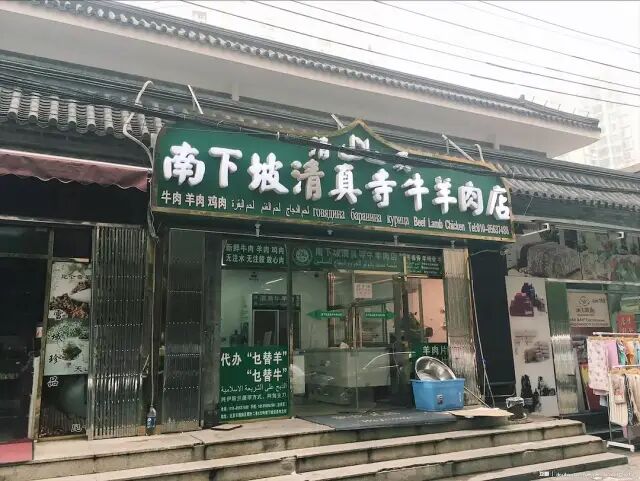
Changying, Beijing.
Changying sits on the north side of the Chaoyangmen official road between Beijing and Tongzhou. Legend says that Chang Yuchun, a famous founding general of the Ming Dynasty, once stationed a troop of Hui Muslims near Tongzhou. This camp was named Changjiayingzi, though no historical records have been found to prove this story.
Because it was not far from the Tongzhou canal shipping docks and the Chaoyangmen stone road, many Hui Muslims in Changying made a living by pushing carts and pulling rickshaws. Pushing carts meant using a wheelbarrow to transport grain from the Tongzhou earthen dam to the Thirteen Granaries (Shisancang) inside and outside Chaoyangmen. Pulling rickshaws meant carrying passengers along the Chaoyangmen stone road. Both jobs were directly related to the canal shipping industry.
Changying Mosque was built during the Zhengde period of the Ming Dynasty and renovated in the first year of the Jiaqing period. It is a famous mosque in the eastern Beijing area. In 2001, Changying was demolished. The original eight Hui Muslim villages, including Changying villages 1-7 and the first residential area, were relocated to the Changying Ethnic Homeland residential complex. This formed a new Hui Muslim community, featuring a food street behind the Changying Mosque, a halal food market, a halal supermarket, and many halal restaurants. Behind Changying Mosque is a halal food street. The most famous spot there is Li Xiaolao's meat sesame flatbread (shaobing), which might be the best shaobing in Beijing. Next to Li Xiaolao's are Anji Deli, Jialun Deli, and Yinfangzhai Pastry Shop. The deli meats and pastries inside are all quite good.
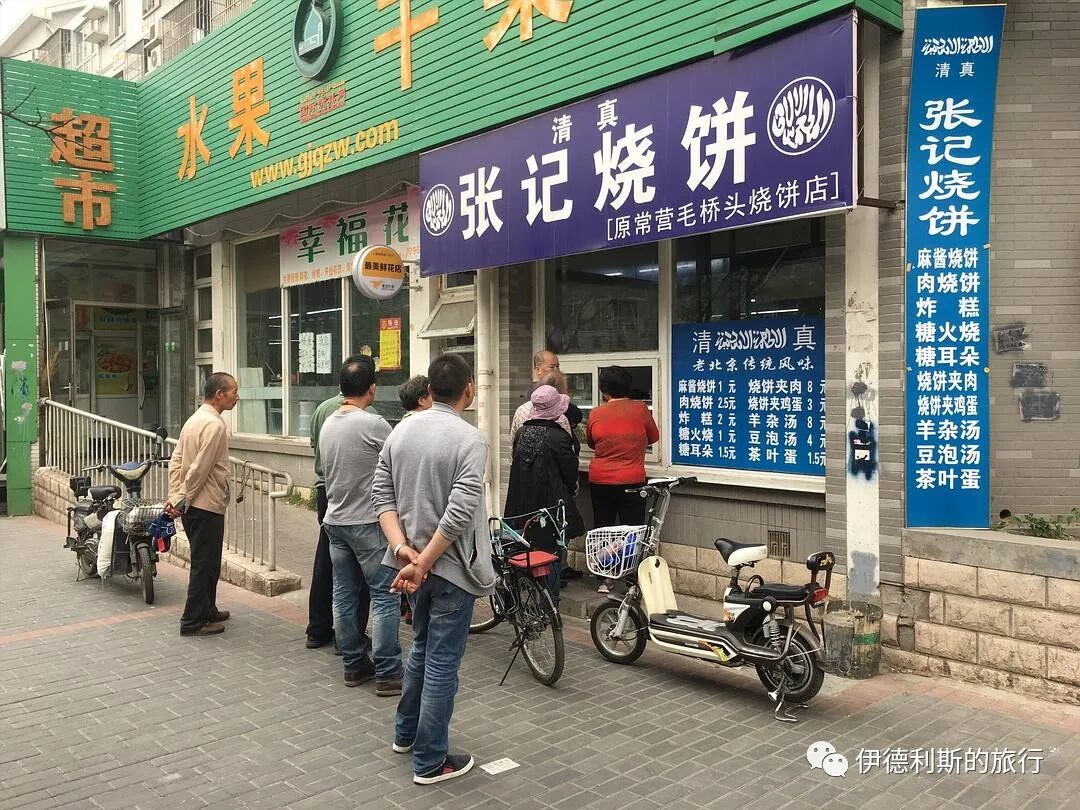
Nanguan in Tongzhou, Beijing.
After Guo Shoujing built the Tonghui Canal during the Yuan Dynasty, Tongzhou became a hub for canal shipping. Many Hui Muslims moved here to live, forming a Hui Muslim community in Nanguan. In the first year of the Hongwu period of the Ming Dynasty, Tongzhou city was expanded, and the Nanguan Hui Muslim community was included within its walls. This officially formed South Street inside the South Gate and the Hui Muslim Eighteen-and-a-Half Alley (Shibajieban Hutong) on the east side. South Street was a busy main road for transporting canal grain from the Grand Canal docks outside the North Gate to the two major granaries in the center and east of Tongzhou city. Because of this, it was very prosperous during the Ming and Qing dynasties and was filled with all kinds of shops.
The most authentic halal pastry shop on South Street in Tongzhou is Guishunzhai Halal Food Store. It was opened by Master Li Chen, the former deputy factory manager of the old Dashunzhai food store, after he retired. He kept the traditional skills of the old Dashunzhai, and his thick cakes (dunbobo) and sugar-fired cakes (tanghuoshao) are excellent. The state-run Dashunzhai food store still exists today. Its main branch is on Xinhua East Street in Tongzhou, and its products are also sold on Niujie and in major Beijing supermarkets.
On the east side of the road, north of South Street in Tongzhou, stands the Tongzhou Mosque, built in the Yuan Dynasty. It was originally named Chaozhen Mosque and was renamed Mosque after being expanded during the Wanli period. At the north end of South Street is Xiaolou Restaurant, the most famous halal restaurant in Tongzhou. It is best known for its braised catfish (shao nianyu) caught in the canal. Xiaolou was originally named Yihexuan and was founded by the Li brothers in 1900. It was rebuilt into a two-story building in 1921 and took the name Xiaolou. The current storefront was built after the old Xiaolou was demolished in 1985.
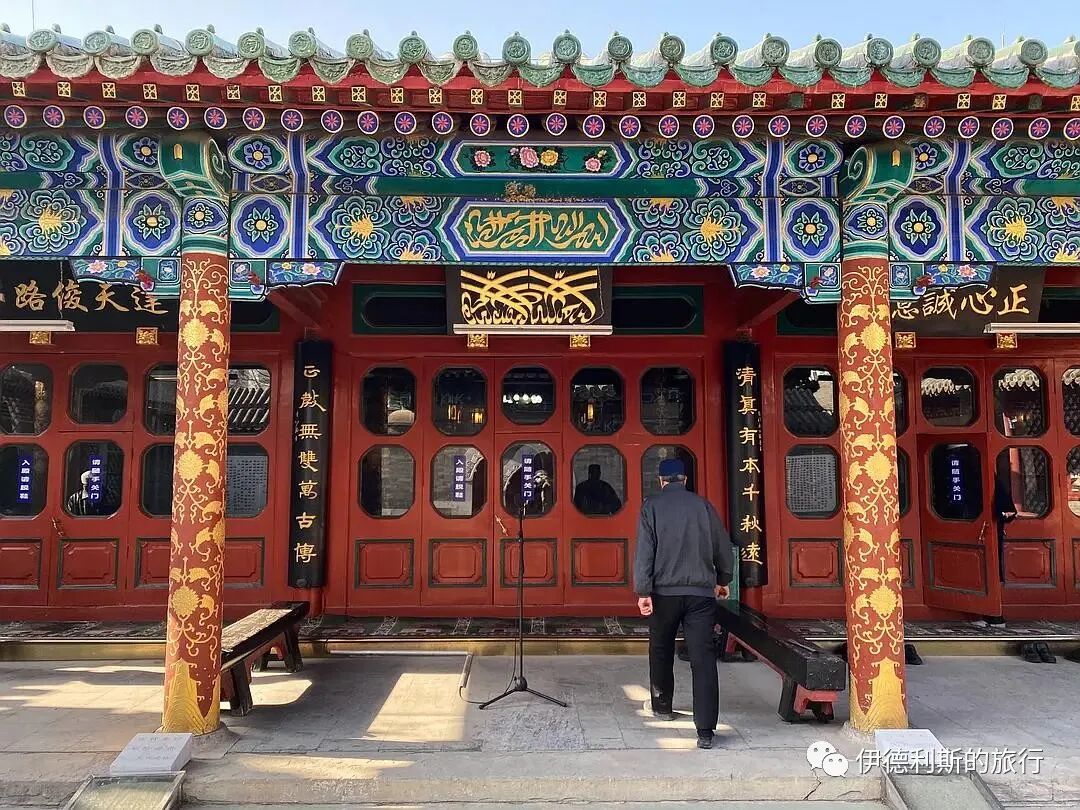
Zhangjiawan in Tongzhou, Beijing.
After Guo Shoujing built the Tonghui River during the Yuan Dynasty, the place where the river flowed east into the Lu River in Tongzhou became what is now Zhangjiawan. Legend says Zhangjiawan was named after Zhang Xuan, who managed sea transport at the time, and it became a canal shipping terminal. After water levels in the Tonghui River dropped in the early Ming Dynasty, more cargo boats chose to unload at Zhangjiawan to transfer goods to carts, making Zhangjiawan a major hub for canal transport. It was not until the Jiajing era of the Ming Dynasty, a century later, that the new Tonghui River was diverted from Zhangjiawan to flow into the North Canal at Tongzhou city. However, cargo ships still docked at Zhangjiawan, and both Zhangjiawan and Tongzhou city served as important canal terminals east of the capital.
After the Yuan Dynasty, merchants kept coming to settle in Zhangjiawan, including many Hui Muslims. A Hui Muslim community formed in Zhangjiawan during the early Ming Dynasty, and they built the Zhangjiawan mosque. The Zhangjiawan mosque was built in the early Ming Dynasty and renovated during the Daoguang era of the Qing Dynasty. It suffered damage through various hardships after the 20th century, but it has been renovated and is now a simple, clean little mosque.
The area outside the south gate of the Zhangjiawan city wall became a lively Hui Muslim market because it was near the canal terminal. The three-arch stone bridge over the Empress Xiao River outside the south gate was built by imperial order during the Wanli era of the Ming Dynasty. It still stands today and is the most important historical site in Zhangjiawan.
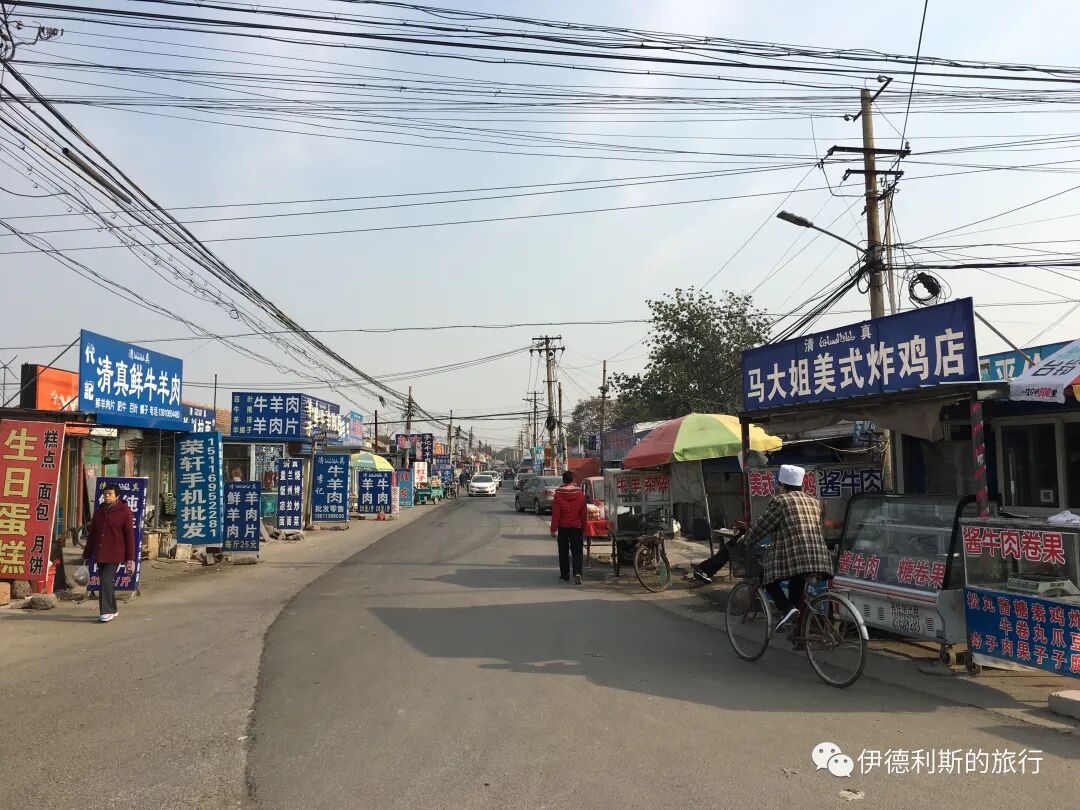
Tianmu Village in Tianjin.
During the Hongwu era of the Ming Dynasty, a boatman named Mu Chonghe from Qiantang County, Hangzhou Prefecture, Zhejiang, followed the Prince of Yan, Zhu Di, along the canal to transport grain to Tongzhou. After unloading, he traveled south with the current and settled by the North Canal. He continued working in canal transport, and the Mu family village began to form.
In the second year of the Yongle era of the Ming Dynasty, Tianjin Wei was officially established as a city. The first mosque in Tianjin was built in the Mu family village in the northern suburbs of Tianjin, which later became the Tianmu North Mosque. After the Ming Dynasty, Hui Muslims from places like Zhejiang, Jiangsu, Shandong, and Hebei kept arriving along the canal to settle down, and the Mu family village gradually grew.
During the Ming and early Qing dynasties, most people in the Mu family village made a living from canal transport and were known as boat keepers. By the mid-to-late Qing Dynasty, as canal transport declined, boat owners in the Mu family village began switching to carting and trading. In the late Qing Dynasty, the cattle and sheep industry in Mujiazhuang began to grow. After the Republic of China was established, Hui Muslims from Mujiazhuang opened over one hundred beef and mutton shops across Tianjin.
In 1951, Mujiazhuang and Tianqi Temple merged to form Tianmu Village. In 2009, demolition began in Tianmu Village, and it is now in ruins. Today, the halal snack street is concentrated on Tianmu Shunyi Road.
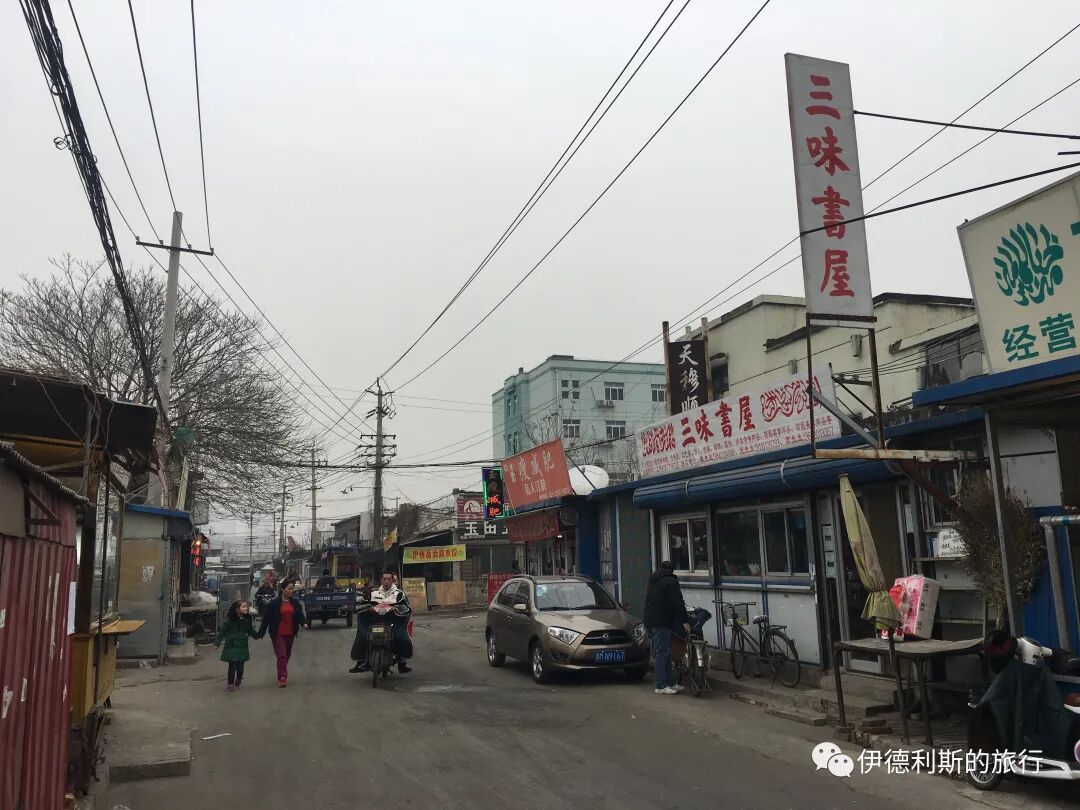
Jiayuanli, Tianjin
After the 1990s, demolition began in Northwest Corner (Xibeijiao), the largest Hui Muslim community in Tianjin. Many Hui Muslims from there moved to Jiayuanli by the North Canal. Starting in 1999, a halal night market opened in Jiayuanli, and the variety of Hui Muslim snacks grew.
Not far into the Jiayuanli community commercial street, I saw a stall selling seaweed rice rolls (gimbap). I bought a box of egg yolk and tuna seaweed rice rolls and a box of beef floss. When I was very young, I used to put a layer of meat floss on my porridge in the morning. I miss that feeling so much. I kept walking inside and bought some fried dough twists (liaohuo) and jujube cake. The jujube cake was incredibly delicious and had such a classic, old-fashioned taste that I felt like all the jujube cake I had eaten over the years was a waste. Then I bought half a jin of vegetable meatballs, half carrot and half dried radish. I ate steamed dumplings at Shiji Jinling Steamed Bun Shop, served with corn grits and rice porridge. The steamed dumplings were absolutely amazing. I ate eight in one go and didn't want to stop. Every time I burped, I could taste the beef filling, which was very satisfying.
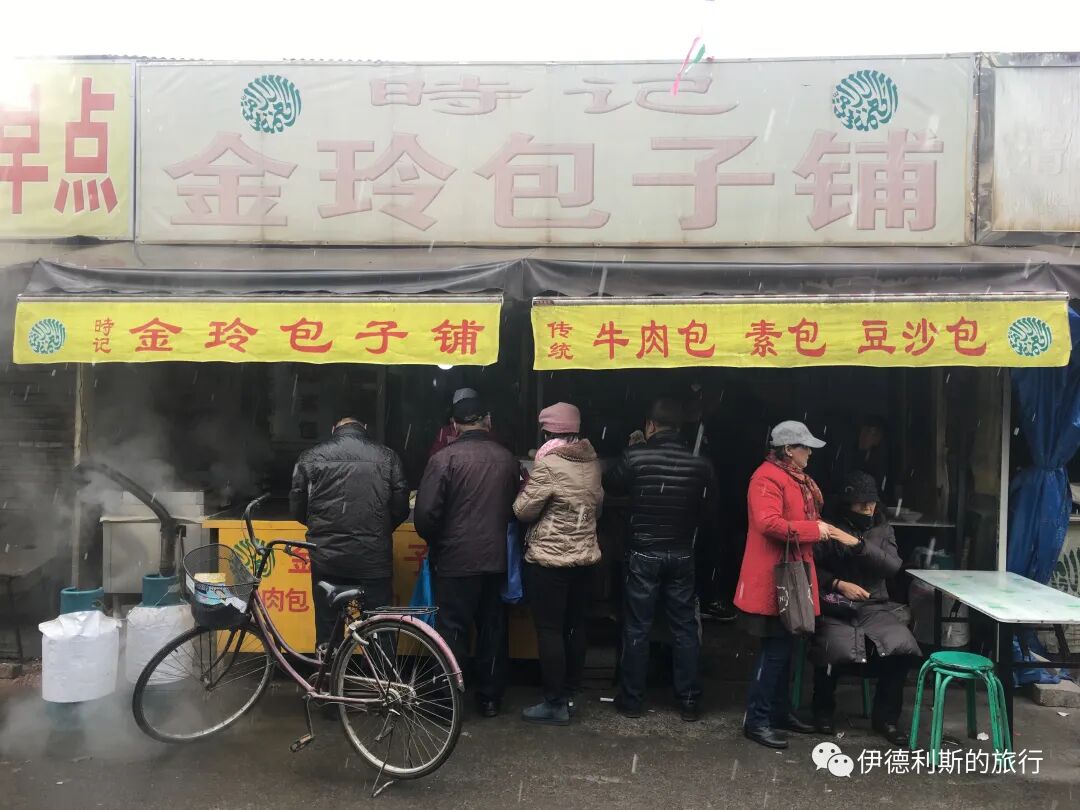
Northwest Corner (Xibeijiao), Tianjin
January and February 2016 were my first two visits to the Northwest Corner of Tianjin. It was these two trips that made me fall in love with this place. The Northwest Corner was once the largest Hui Muslim community in Tianjin. After the city of Tianjin was built, Hui Muslims continuously moved to Tianjin via the canal from places like Anhui, Jiangsu, and Hebei. Some chose to settle in the Northwest Corner of the old city, near the commercially prosperous Beidaguan canal transport hub. During the Shunzhi reign, the Northwest Corner Mosque was built here.
The Northwest Corner was centered around the mosque. Before 1995, halal shops were everywhere, but the Muslim community began to break up after the mid-90s demolitions. After 2007, the Muslim community around the mosque completely disappeared. The current Northwest Corner Hui Muslim community refers to the area around Xiguan North Street, centered on the South Mosque. As soon as you exit the Northwest Corner subway station, you can see the long line at Xiaoli Roasted Chicken. Walking south along Xima Road, you will find one halal food shop after another.
In 2017, the last historic neighborhood remained in the Northwest Corner, the Lingdangge (Bell Pavilion) area built on ruins. At the southern edge of the Lingdangge area is Xiguan Street, which hosts a wild market on weekends, much like the Daliushu market in Beijing, where they sell everything. After walking through the market, you return to the Northwest Corner Hui Muslim community.
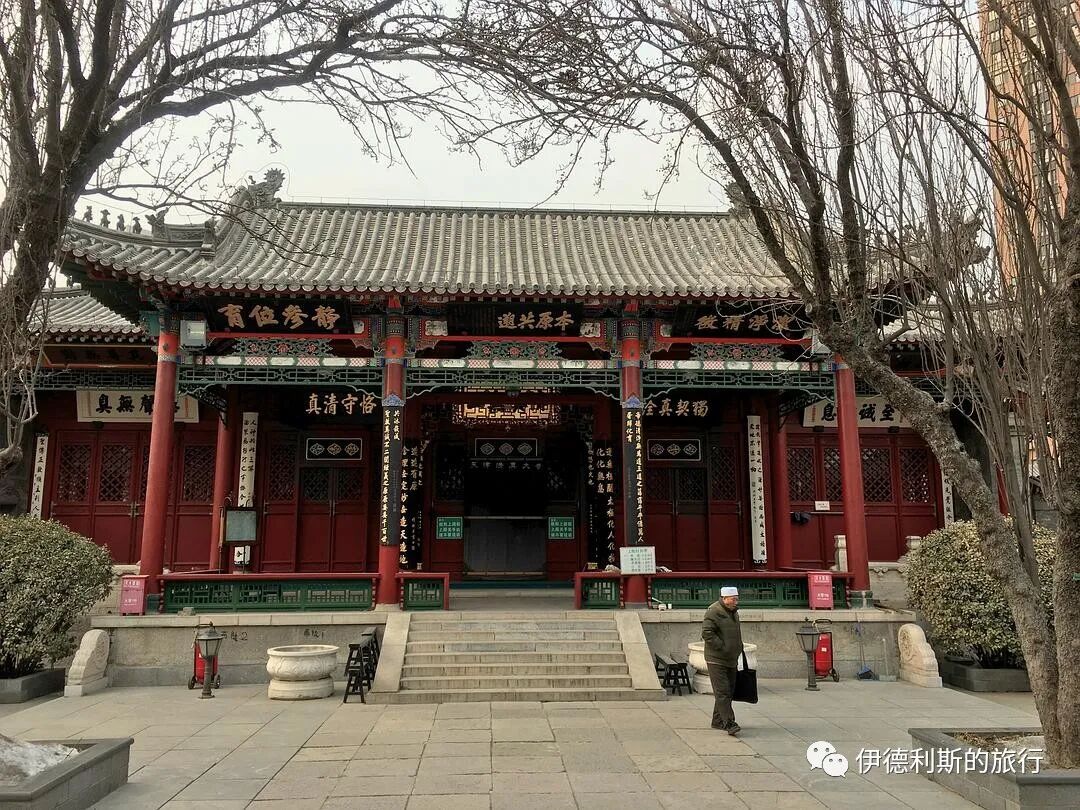
Cangzhou, Hebei
Like many canal cities, Cangzhou has had Hui Muslim merchants settling with their families since the Yuan Dynasty. However, the Cangzhou city of that time was located at the ruins of the Old Prefecture City 20 kilometers to the southeast. During the Jingnan Campaign, the Prince of Yan, Zhu Di, destroyed the entire Old Prefecture City. It was not until the Yongle reign of the Ming Dynasty that Zhu Di ordered the relocation of Cangzhou city to Changlu by the Grand Canal, moving residents from Shanxi, Shandong, Anhui, and other places to settle there, forming the new Cangzhou city.
The Nanguanxiang area south of the city was an important passage to the canal, and most Hui Muslims, who were mainly artisans and small vendors, chose to live there. During the Yongle reign, Wu Zuoyong from Shexian, Huizhou, Anhui, was appointed as the Assistant Magistrate of the Cangzhou Salt Transport Office and came to Cangzhou, where he donated land south of the city and led the construction of the Cangzhou North Great Mosque, officially forming the Hui Muslim community in Cangzhou. South of the North Great Mosque is the Hui Muslim district in the south of the city, with Minzu Street as its center, lined with all kinds of Hui Muslim snacks. I bought a Liu's pine-flower chicken leg at the east entrance of Minzu Street; it is perfect for rolling in a flatbread (laobing) or eating with a steamed bun (mantou) because the chicken sausage is stuffed with pine-flower eggs. Then I had some tea soup (chatang); the tea soup in Cangzhou came from Tianjin along the canal, but this shop adds more ingredients and has a stronger flavor. I also bought beef buns (niurou baozi), which were very fragrant right out of the steamer. I walked a few steps and bought two bags of five-spice peanuts; the black ones are very addictive when eaten with tea.
Not far to the west of the southern Hui Muslim district is the canal wharf, where many Hui Muslims once made a living directly from water transport. The wealthiest boat owners rented out their vessels or hired people for grain transport, ordinary small boat owners made a living by ferrying, and the poorest Hui Muslims survived by pulling boats along the riverbank or carrying cargo at the docks.
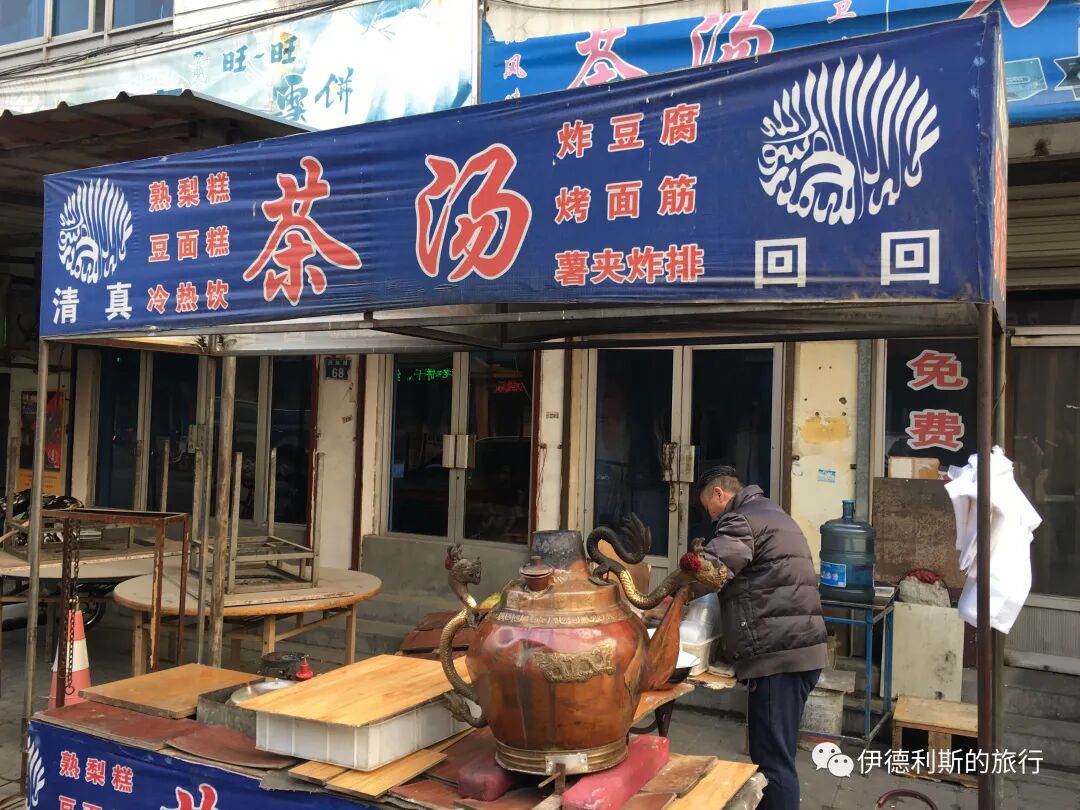
Botou, Hebei
Botou sits along the canal south of Cangzhou. During the Hongwu reign of the Ming Dynasty, a regional administrative office was established here to manage grain transport between Tianjin and Dezhou, and Botou gradually became an important canal town. Like Cangzhou, Botou suffered heavy damage during the Jingnan Campaign, and its population dropped sharply. During the Yongle reign, many Hui Muslims came to settle in Botou. Because the number of Hui Muslims increased, a mosque was built in Botou that year. Afterward, more Hui Muslims moved in from Shandong, Shanxi, and Anhui, and the Hui Muslim community in Botou was officially formed.
During the Qing Dynasty and the Republican era, the most famous halal restaurants in Botou were Taiheguan on Shunhe Street, which opened during the Tongzhi reign, Shunfuguan and Xingshenghe on Gulou Street, which opened during the Guangxu reign, and Xiyuguan on East Street. The small and medium-sized restaurants around Shunhe Street were all halal, offering a wide variety of halal snacks.
Before 1957, local shipping in Botou was mainly operated by Hui Muslims, divided into two trades: those who worked the boats and those who owned them. Those who worked the boats were the crew and trackers, while those who owned them were the boat owners. Some ferried passengers across the river, some transported fertilizer for villages along the river, and others operated long-distance transport routes from Tianjin in the north to Xinxiang, Henan in the south. Before 1965, the canal section in Botou had plenty of water. In the early summer of 1965, the canal dried up for the first time. After that, the water level decreased year by year, and by the first half of the 1970s, it was nearly dry, ending shipping in Botou.
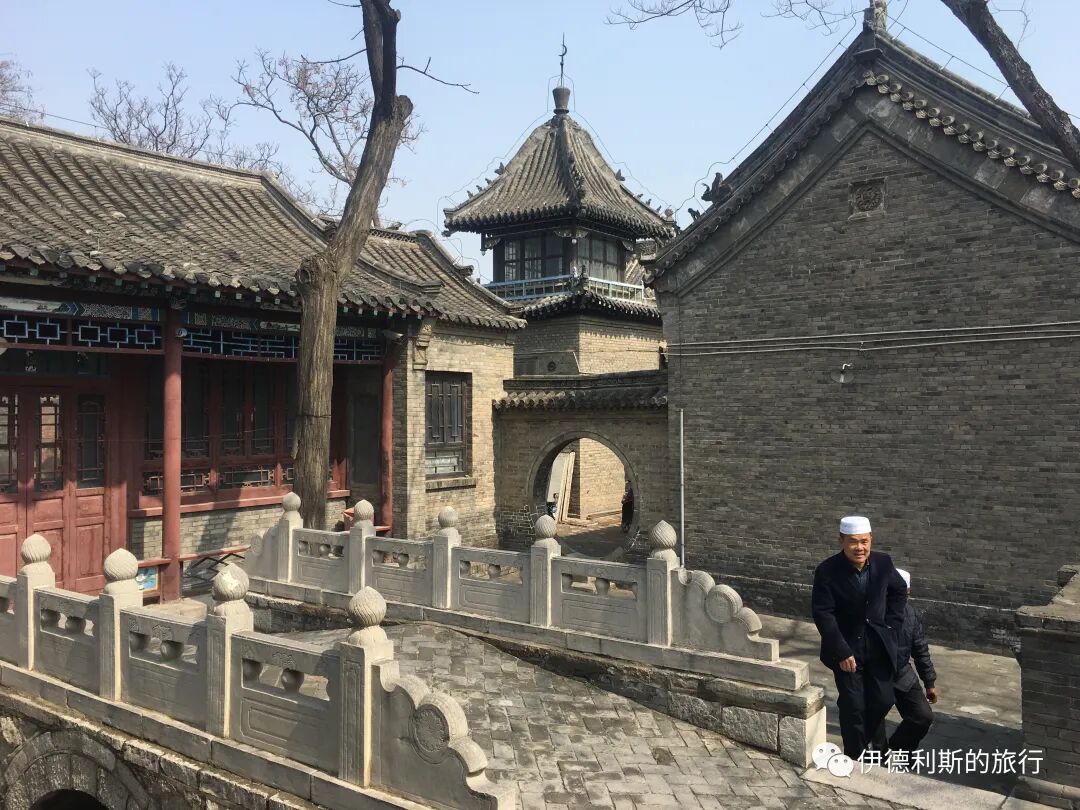
Dezhou, Shandong
The first thing I wanted to see on this trip to Dezhou was the Tomb of the Sultan of Sulu from the Philippines. The Sulu Archipelago is located in the far southwest of the Philippines, right next to the easternmost part of Malaysia. Between the 14th and 16th centuries, as maritime trade in the Indian Ocean flourished, Islam spread along the Maritime Silk Road to the Sulu Archipelago, where the Sulu Sultanate was established. During the Yongle reign, three chieftains from the Sulu Kingdom led a delegation to visit the Ming Dynasty. While traveling back and passing near Dezhou, the Eastern King suddenly fell ill and passed away. Emperor Yongle of the Ming Dynasty buried the Eastern King of Sulu with royal honors and built the Tomb of the Eastern King of Sulu north of Dezhou city.
After the Eastern King of Sulu died, his eldest son returned home to take the throne, while his second son Andulu, third son Wenhala, and Queen Gemuning stayed behind to guard the tomb. Their descendants took the surnames An and Wen, gradually forming Beiying Village in Dezhou. During the Wanli era, the descendants of the Sulu King built a mosque southwest of the Sulu King's tomb. In 1917, the canal burst its banks, washing away the mosque and the entire Beiying Village. It was rebuilt in 1940, becoming the Republic of China-era building seen today.
During the Yongzheng era, the descendants of the Sulu King changed their status from immigrants to Dezhou citizens and began opening halal snack shops in the bustling canal markets of Dezhou. Today, southwest of Beiying Village, there is still a braised chicken shop (paji dian) run by descendants of the An family. A new Beiying Ethnic Customs Street has been built next to the Sulu King's tomb, featuring a beef and mutton shop run by descendants of the Wen family, as well as a Li family whole lamb soup (quanyang tang) shop.
Strolling from Beiying Village to Qiaokou Street, you reach what was the busiest canal market in Dezhou during the Ming and Qing dynasties, located next to the Hui Muslim village of Xiaoguoshi. Xiaoguoshi was the place where pots were unloaded at the canal docks in the past, and there is also a renovated mosque here. There is also a Nanying Hui Muslim Street in the south of Dezhou city, and we visited the Dezhou Nanying Mosque before dark.
As the intersection of the Jinpu Railway and the Grand Canal, Dezhou is one of the few cities along the canal that has preserved a large number of modern industrial relics, which is very rare. Along the canal, you can see a 1940s water supply station and power plant machine room, 1950s loading docks, warehouses, and textile company watchtowers, as well as a 1960s dock dispatch building. The most spectacular site is the industrial heritage park, Jiulongwan Park, built on the foundation of the Dezhou First Water Plant, where everyone can see firsthand how tap water was produced in the 1950s.
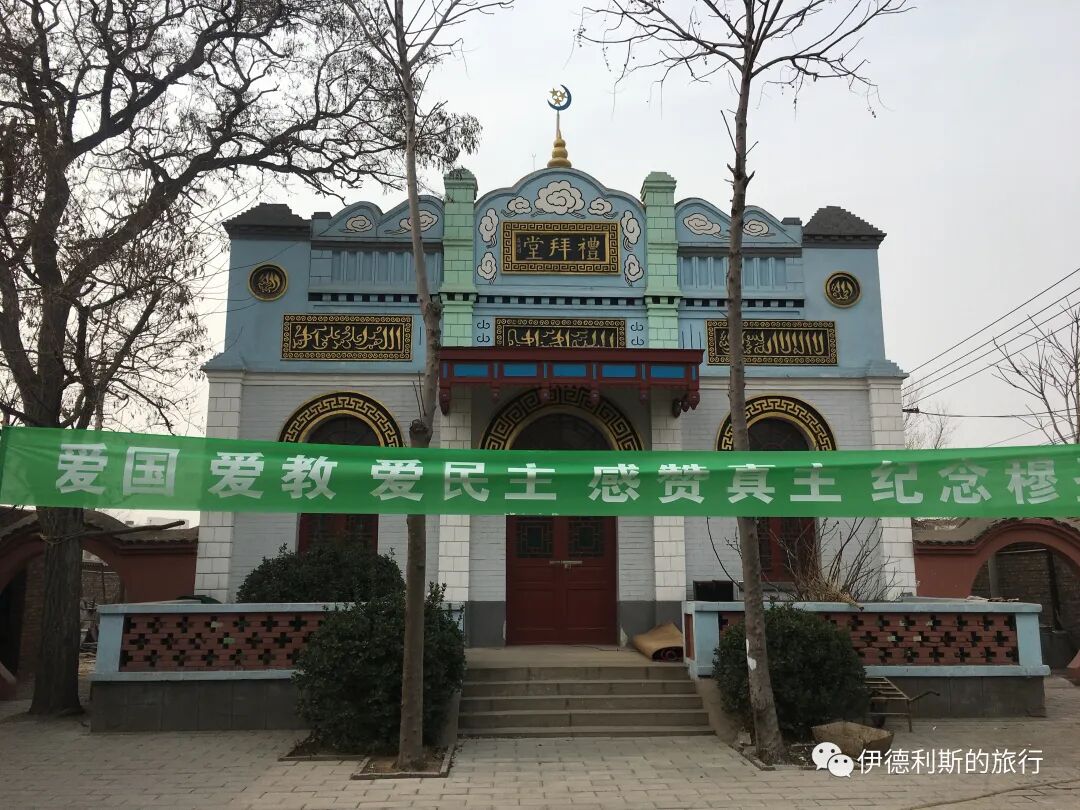
Linqing, Shandong
To transport grain from the south to the north, Yuan Emperor Kublai Khan ordered the original Sui and Tang Grand Canal to be straightened. He had the Huitong River dug in Shandong to connect the northern and southern sections of the Grand Canal. Linqing, located at the intersection of the Huitong River and the Yongji Canal of the Sui and Tang dynasties, suddenly became a canal hub, and Hui Muslims began moving to Linqing from then on. After the brick city wall was built in Linqing during the Ming Dynasty, the 'Zhongzhou' area, surrounded by two tributaries of the Wei and Wen rivers southwest of the city, became the most prosperous commercial district in Linqing. Zhongzhou is traversed from north to south by a long street, which is also where the Hui Muslims of Linqing are most concentrated.
The North Mosque (Qingzhen Beisi) in Linqing is arguably as grand as the East Mosque (Qingzhen Dongsi) in Jining, making them the two most magnificent mosques in Shandong. It was first built during the Hongzhi reign of the Ming Dynasty and is currently undergoing major renovations. Across from it stands the Linqing East Mosque, also built in the Ming Dynasty. It is slightly smaller than the North Mosque and has been closed for major repairs since 2013, so I only saw the exterior this time. To the south, there is also a women's mosque (qingzhen nusi) founded during the Republic of China era. It became a wholesale market warehouse after the 1980s and was rebuilt in 2010.
There are three sections of the Grand Canal within Linqing, which were built during the Sui, Yuan, and Ming dynasties respectively. A large number of canal locks and bridges from the Yuan and Ming periods are still preserved today. The old Yuan Dynasty river has the Linqing Lock and Huitong Lock, while the new Ming Dynasty river has the Ban Lock and Zhuan Lock. During the Ming and Qing dynasties, the Tianqiao Bridge and Yuejing Bridge were built over the old Yuan river. Together with the canal tax office (chaoguan), these form the Linqing canal transport heritage site group.
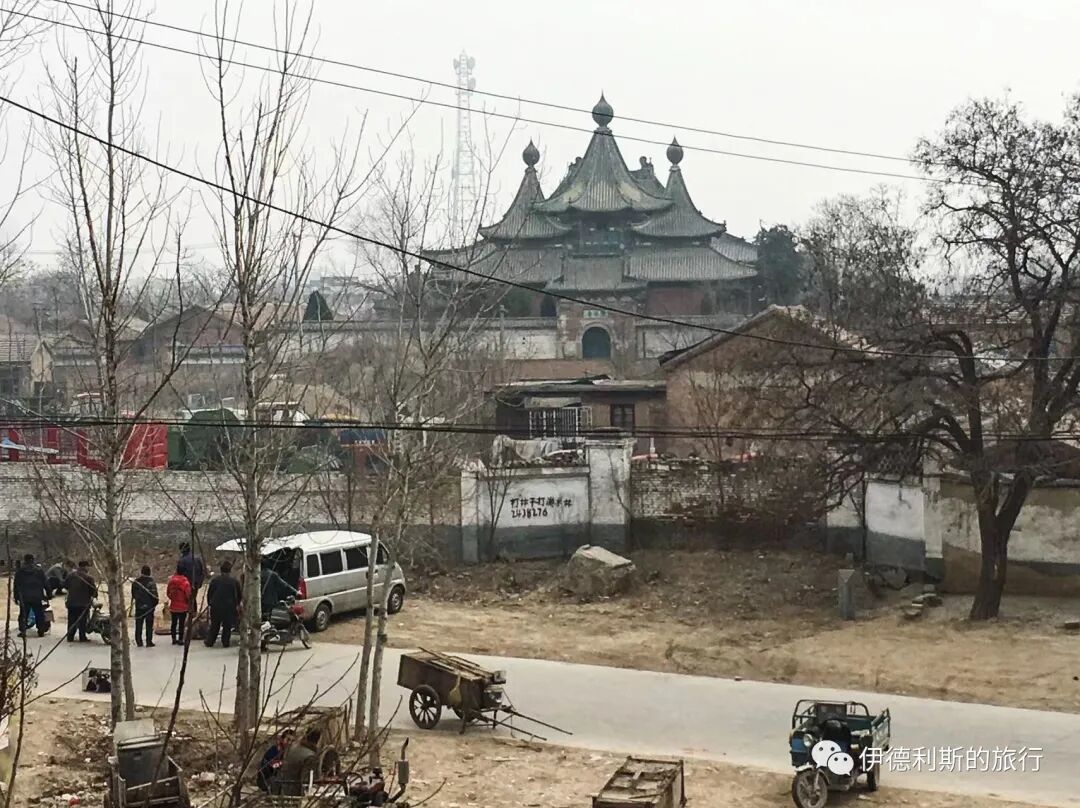
Liaocheng, Shandong
After Kublai Khan, the Emperor Shizu of the Yuan Dynasty, ordered the construction of the Huitong River from Xucheng to Linqing to connect the northern and southern parts of the Grand Canal, Liaocheng became a major canal town, even if it was not as important as Linqing. The Dongguan area between Liaocheng and the canal became a busy and bustling district. Hui Muslims kept moving here to settle, forming the Liaocheng Dongguan Hui Muslim district.
After the Ming Emperor Chengzu, Zhu Di, moved the capital to Beijing, he relied heavily on the Grand Canal to transport grain from the south to the north. Liaocheng entered its golden age, and the large and small mosques in Dongguan were first built during the Hongwu and Yongle reigns.
Walking south along the canal from Liaocheng Dongguan, there are two docks, one large and one small. The large dock was a government transport dock, also called the Chongwu Post Dock. Back then, the ships waiting to unload stretched for miles, a scene known as the 'Chongwu continuous masts'. The small dock was originally a private dock for merchants. These two sites are precious relics of the Grand Canal in the urban area of Liaocheng.
South of Dongguan Street is the Mishi Street historical district. Paved with blue stone, it is one of the few remaining historical districts in the old city of Liaocheng. Grain shops used to gather here. At its peak, there were dozens of them, with busy daily trade and a constant stream of carts and people on the street. The historical district of the large and small mosque streets north of Dongguan Road in Liaocheng has been demolished more severely than Mishi Street, but it has not been completely wiped out like the areas inside the city.
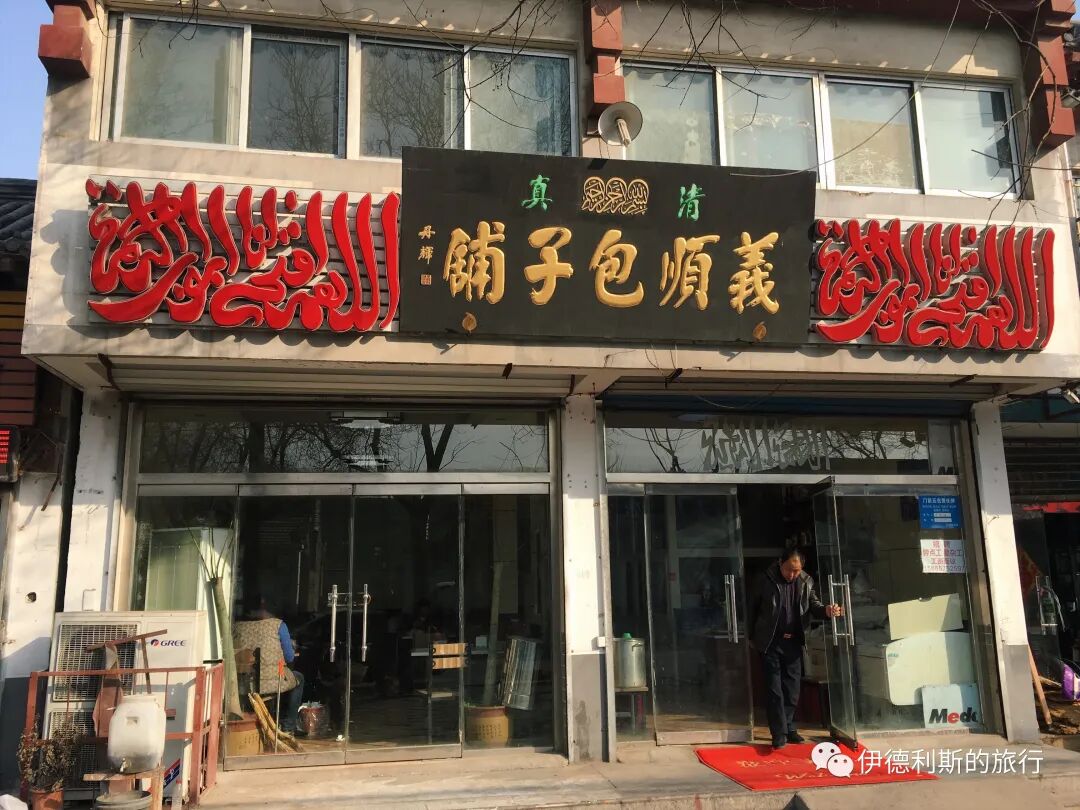
Jining, Shandong.
After the Beijing-Hangzhou Grand Canal opened in the Yuan Dynasty, the government sent canal-support troops to Jining to guard and farm the land. Many of these soldiers were Hui Muslims from the Semu class. They built two mosques in Jining at the time, the Old East Mosque and the Old West Mosque. After the Yuan Dynasty fell, the canal-support troops in Jining surrendered to Xu Da and Chang Yuchun. Most of them were settled locally and began living together along the banks of the Yuehe River, south of Jining city.
During the Yongle period of the Ming Dynasty, the Huitong River reopened and business in Jining began to thrive. The Hui Muslims living in the southern gate area built a new East Great Mosque, which is the current Shunhe East Great Mosque. The current Shunhe East Great Mosque keeps the look it had after its renovation during the Qianlong period and is one of the most impressive mosques along the canal.
At the end of the Ming Dynasty, an outer city was built in Jining, and the Hui Muslim communities were all near this outer wall. Before the old city was renovated, it was known as the 53 Hui Muslim streets and alleys. The Hui Muslim population was most concentrated outside the Small South Gate in Liuhang, where they made up over 80 percent of the residents.
Besides the East Great Mosque, Jining also has the Liuhang East Mosque, which was built during the Wanli period of the Ming Dynasty. When we visited, the place was empty. A cat led us around to see every spot, which felt like a special encounter.
Jining has both an old and a new canal. The old canal is the Jizhou River, which was dug during the Yuan Dynasty. The new Liangji Canal was built between the late 1950s and early 1960s. After the 1970s, sections of the canal in Tianjin, Hebei, and northern Shandong stopped shipping due to low water levels. Jining became the northernmost point for shipping on the Beijing-Hangzhou Grand Canal.
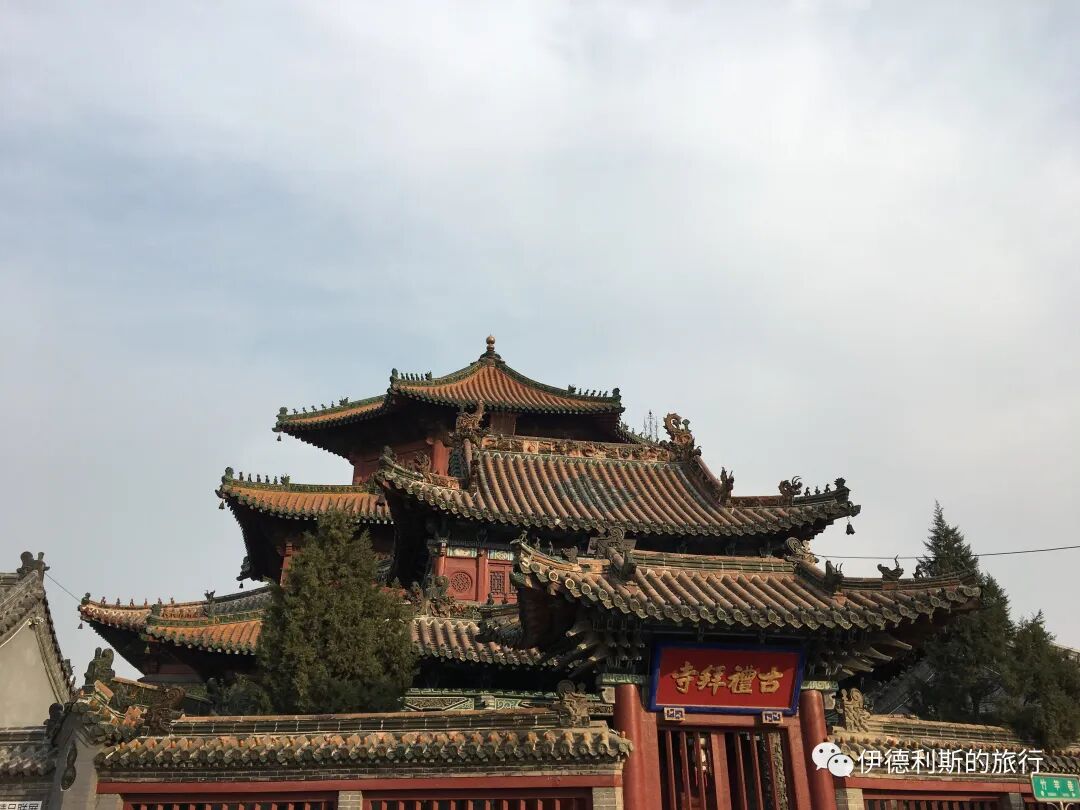
Xuzhou, Jiangsu.
After the Grand Canal was completed in the Yuan Dynasty, Xuzhou became a hub for the canal because it was both a place for civilian boats to deliver grain and a transfer point for government troops. However, because the canal used the Yellow River as its path, the Xuzhou section was often hit by silt and damage from Yellow River floods. During the Wanli period of the Ming Dynasty, a new canal route was opened that bypassed Xuzhou and connected through Pizhou. Pizhou then replaced Xuzhou as the canal hub.
Today, Xuzhou is not really a canal-based Hui Muslim community, but rather a railway-based Hui Muslim community. After the Republic of China was founded, Xuzhou became a hub for the Jinpu and Longhai railways, attracting many Hui Muslims. In 1916, merchants, railway staff, and postal workers pooled their money to build the Travelers' Mosque (Lvxu Qingzhensi) for visiting Hui Muslims to perform namaz. In 1949, it was renamed Jianguo Road Mosque, which is what it is called today.
Next to the Jianguo Road Mosque, there is a deli and a pastry shop. At the pastry shop, I bought chestnut pastries (lizisu), walnut cookies (taosu), sesame crisps (mapianer), and honey-filled horn pastries (yangjiaomi). Taikang Hui Muslim Food Store is a century-old halal shop in Xuzhou, and the owner is a Hui Muslim from Jining. I bought many things at Taikang, including rose mung bean cakes (meigui lvdougao), honey-soaked sponge cakes (mizhi fenggao), egg rolls (danjuan), salted osmanthus sauce (xian guihua jiang), and rose sauce (meigui jiang). Another old halal brand is Feng Tianxing. It was founded in Nanjing during the Qianlong reign and later moved to Xuzhou, where it became a local halal institution. I bought duck tongues, duck livers, and dried tofu (dougan) here. They were all delicious, especially the duck tongues, which were incredibly fragrant.
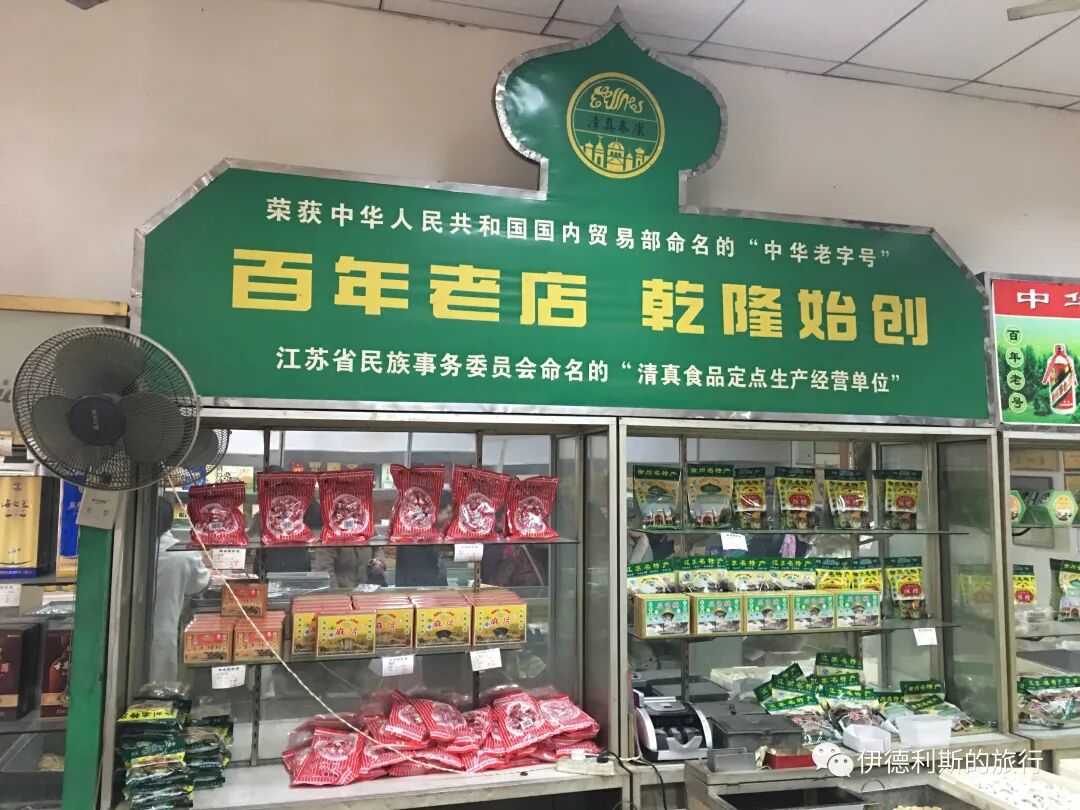
Huai'an, Jiangsu
The Hui Muslim community in Huai'an is divided into three areas: Qingjiangpu, Hexia, and Wangjiaying. Qingjiangpu was renovated during the Yongle reign of the Ming Dynasty. It featured the Qingjiang Grand Sluice, the miles-long Changying Granary, and the massive Qingjiang Shipyard, where grain transport ships from all provinces were built and repaired. Because navigating the Yellow River section of the canal was very dangerous, many merchants chose to leave their boats at Qingjiangpu. This turned Qingjiangpu into a transport hub where people switched from boats in the south to horses in the north. Since the Ming Dynasty, Hui Muslims have done business on Yuehe Street in front of the Qingjiang Sluice. This gradually formed the Yuehe Street Hui Muslim community, with the Qingjiang Mosque at its center.
Traveling south along the canal from Qingjiangpu, you reach the ancient town of Hexia, located not far northwest of the Huai'an prefectural city. In the late Ming Dynasty, many salt merchants from the northwest and Anhui came to northern Huai to work in the salt industry. The regional salt transport office was located in Hexia at the time. The wealth brought by these merchants made Hexia a booming commercial center, and many Hui Muslims settled there, forming the Hexia Hui Muslim community.
Wangjiaying, now called Wangying, sits between the old Yellow River bed and the Salt River. It survived multiple Yellow River floods and moved its town center three times to the east to reach its current location. Because travel along the Yellow River section of the canal was slow, many merchants chose to cross the Yellow River at Wangjiaying and switch to horse-drawn carriages to continue north. Wangjiaying became more and more prosperous in the early Qing Dynasty. Hui Muslims kept moving here to settle, and they built the Wangjiaying mosque during the Yongzheng reign.
During the Daoguang reign, the salt trade system changed. Wangjiaying's Xiba replaced Hexia Town as the new hub for Huai salt, and salt boats arrived one after another every day. In the late Daoguang years, the Wangjiaying mosque moved to the south bank of the Salt River. It was burned down by the Nian Army during the Xianfeng reign, rebuilt during the Tongzhi reign, and became one of the nine branch halls of the Jahriyya Banqiao Daotang.
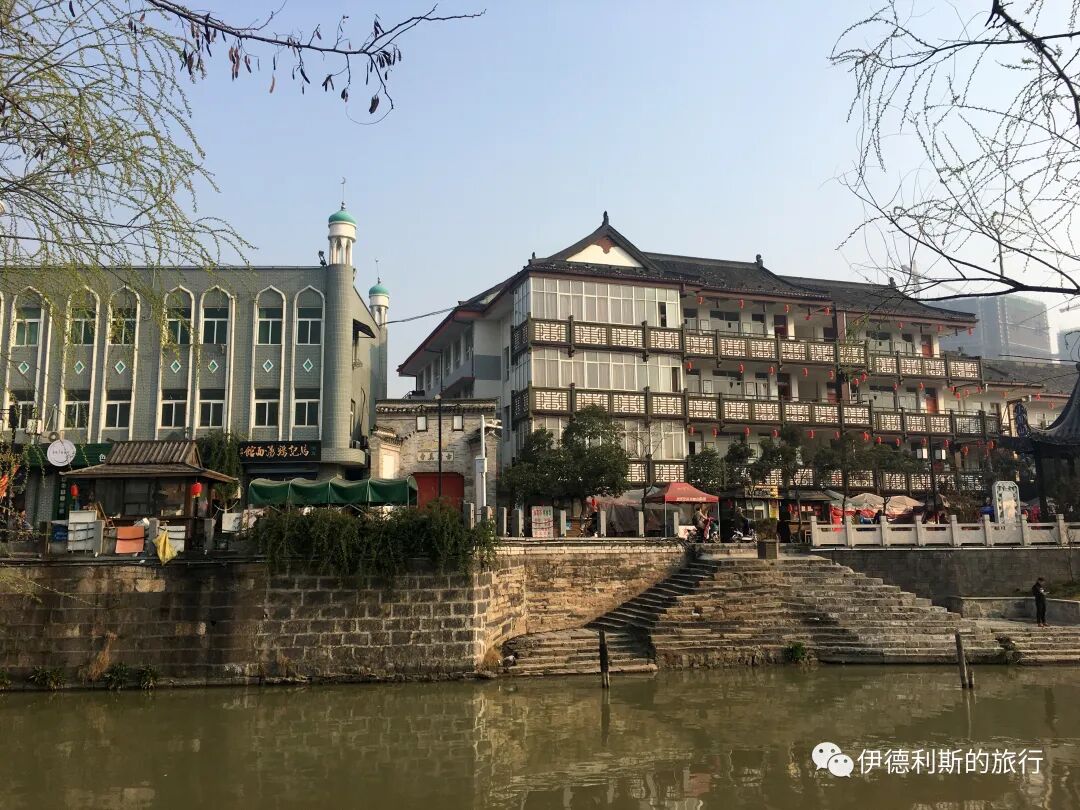
Gaoyou and Lingtang, Jiangsu.
Gaoyou Mosque is a very beautiful traditional mosque. It is small and delicate, with the charm of a water town. The exact founding date of the mosque is unknown, but there is an ancient cypress tree in the courtyard that is over two hundred years old. In 1864 (the third year of the Tongzhi reign), local elders Ma Guixing, Liu Xingtian, and Ma Hongxing rebuilt the mosque. The gate now has a stone carving that says it was rebuilt in the middle of winter in the second year of the Tongzhi reign. It was a pity that the mosque gate was locked when we arrived. We asked at a nearby noodle shop, and they said it only opens for Jumu'ah prayers. It seems we will have to wait for another chance to visit inside.
At noon, we took a taxi from Gaoyou to Lingtang Hui Muslim Township. Lingtang is the only Hui Muslim township in Jiangsu, home to the four major surnames: Yang, Xue, Li, and Sha. One branch of the Yang family moved here from Suzhou at the end of the Yuan Dynasty, and another branch moved from Suzhou during the Qing Dynasty. The Xue family moved here from Xuebeizhuang in Gaoyou during the Qing Dynasty, later converted to Islam, and for generations have mostly only married into the Yang family. The Sha surname is said to come from the Persian word "Shah" and are descendants of Persian ancestors from Huihuiwan in the Yuan Dynasty.
We ate at Huixianglou Restaurant, having salted goose, stir-fried bitter buckwheat chips with egg yolk, amaranth with fava beans, and beef wing soup, all of which are local specialties. The founder of Huixianglou, Yang Yangui, opened a halal restaurant on the old street of Lingtang Bridge in 1969. It moved to its current location in 2010 and specializes in Lingtang salted goose from Gaoyou Lake.
A mosque was built at "Huihuiwan" by the side of Gaoyou Lake during the late Yuan Dynasty, but it was later destroyed by a flood. The mosque moved to Yangdazhuang in the mid-Ming Dynasty, then to its current site in the early Qing Dynasty. It was rebuilt in 1844 (the 24th year of the Daoguang reign of the Qing Dynasty), expanded again in 1921, and completed in 1924.
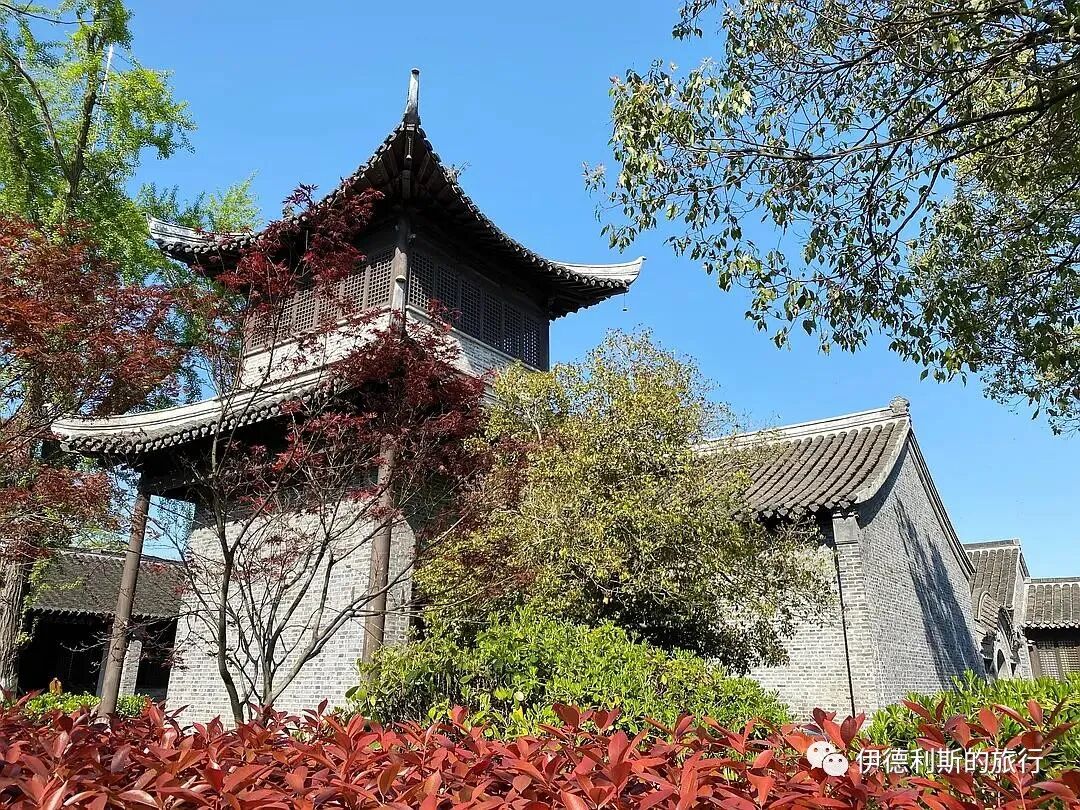
Yangzhou, Jiangsu
Since the Tang Dynasty, Yangzhou has been a major commercial hub in the southeast, attracting many merchants from Arabia and Persia. The Extensive Records of the Taiping Era (Taiping Guangji) contains many stories about foreign merchants in Yangzhou. While most are quite exotic, they provide a vivid picture of Persian merchants in Yangzhou at that time. Yangzhou city suffered heavy damage during the wars at the end of the Tang Dynasty and the Five Dynasties period, and most of the original foreign merchants scattered. After the Song Dynasty, these foreign merchants gradually changed from expatriates to locally born residents, beginning a process of localization.
Yangzhou's most famous Crane Mosque (Xianhe Si) and the Hui Muslim Hall (Puhading Tomb) were both built during the transition between the Song and Yuan dynasties. During the Xianchun years of the Southern Song Dynasty, People say Puha Ding, a 16th-generation descendant of the Prophet, came to Yangzhou and built the Crane Mosque (Xianhe Si). After he passed away, he was buried on a high ridge east of the Dongguan River in the new city, which is now the Puha Ding Cemetery.
The Song Dynasty set up a guesthouse at the south gate of Yangzhou. The area outside the south gate developed into a new settlement for Muslim merchants, and a mosque was built there. The main hall was not demolished until 1984. After Zhu Yuanzhang captured Yangzhou, the tombstones from the Muslim cemetery outside the south gate were built into the city's south gate defense tower. When the south gate defense tower was demolished during the Republic of China era, four Yuan Dynasty Muslim tombstones were found in the city foundation. They are now kept in the Puha Ding Cemetery and are precious relics of the Muslims in Yuan Dynasty Yangzhou.
After the Qianlong reign, Yangzhou had six mosques. The three inside the city were the Crane Mosque on Nanmen Street, the Majian Lane Mosque, and the Xiejia Bridge Mosque. The three outside the city were the Hui Muslim Hall (inside the Puha Ding Cemetery) east of the Dongguan River, the South Gate Mosque, and the Chaoguan Mosque. Today, only the Crane Mosque and the Dongguan Hui Muslim Hall remain open, while the Majian Lane Mosque has been turned into a private residence.
During the Republic of China era, there were nearly 20,000 Hui Muslims living in the six mosque districts of Yangzhou, with Sha, Ma, Ha, Sa, and Da as the five major surnames. At that time, there were more than ten famous halal restaurants in Yangzhou. The most famous was the Tianxing Restaurant, which was frequently visited by everyone from scholars and writers to salt merchants and officials. The Tianxing Restaurant eventually closed in the 1950s.
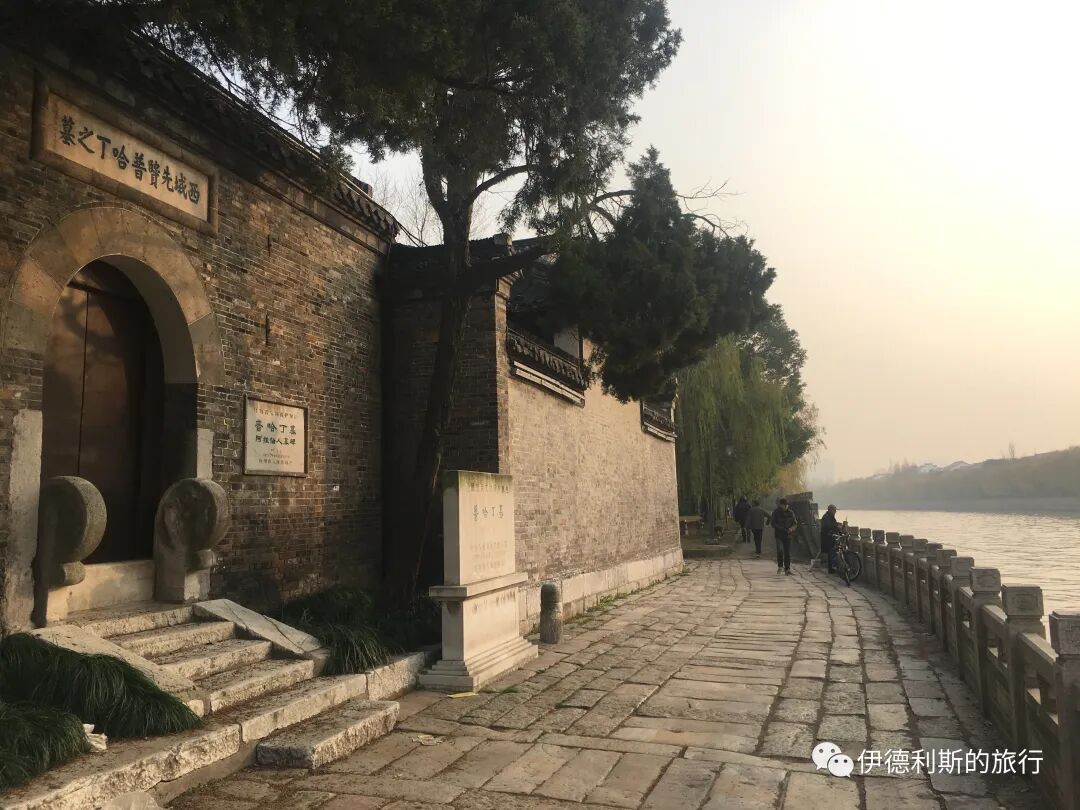
Zhenjiang, Jiangsu
The original meeting point of the Grand Canal, built by Emperor Yang of Sui, was called Dajingkou. In 1029 (the seventh year of the Tiansheng era of the Song Dynasty), a new canal was dug east of the old one, and the point where this new canal met the Yangtze River was named Xiaojingkou. After the New Canal was dug, it gradually became an important hub for grain transport, and Xinhe Street formed along the riverbank. After Zhenjiang opened as a treaty port in 1861, Xinhe Street became even more prosperous, with all kinds of shops opening up. In the 1920s, the Yihewani sect of Islam reached Shanghai. Some Hui Muslims from Zhenjiang who moved to Shanghai adopted these teachings, and in 1930, they built an Yihewani mosque on Xinhe Street. At that time, the new and old sects lived in peace and operated side by side. After the 1950s, the Xinhe Street mosque was taken over by a factory, but the Jiangnan-style courtyard architecture remains today.
Walking southwest from Xinhe Street leads to the Shanxiang Mosque. Shanxiang Mosque is also known as the Chengxi Mosque. It was expanded during the Kangxi reign, destroyed during the Xianfeng reign, and rebuilt during the Tongzhi reign. After Zhenjiang opened as a treaty port, the area outside the West Gate became a busy commercial district. The establishment of the British concession and the opening of the Shanghai-Nanjing railway brought a steady stream of Hui Muslims who came to trade and settled around the Shanxiang Mosque.
Besides the Shanxiang Mosque, Zhenjiang once had another mosque on Jianzi Lane. The Jianzi Lane Mosque was originally called the Gurun Mosque. It was first built on Ren'an Lane in Fumin Street, destroyed at the end of the Yuan Dynasty and the beginning of the Ming Dynasty, rebuilt in the Hongwu reign of the Ming Dynasty, moved to Jianzi Lane inside the city during the Wanli reign, and finally destroyed in the 1970s or 1980s. A new Gurun Mosque was built on Xuefu Road in 2005. The stone tablet from the Wanli reconstruction, the ancient well railing, and three Qing Dynasty reconstruction tablets from the original Jianzi Lane Mosque are preserved in the courtyard.
to the relics from the Jianzi Lane Mosque, the Gurun Mosque also houses an Arabic orientation tablet from the kiln hall of the mosque outside the South Gate of Zhenjiang. The South Gate Mosque was at the east end of Miaojia Lane. It is believed to have been built in the early Qing Dynasty and was destroyed by war in 1937.
Although Jianzi Lane Mosque has disappeared, the Hui Muslims who once lived around the mosque have not. The area around Jianzi Lane still has the highest concentration of halal restaurants in Zhenjiang. Yong'an Road is not far south of Jianzi Lane. The street is lively and full of snacks, and there are five halal restaurants.
Finally, we went to the Jiangbin vegetable market and found the last halal tea snack shop in Zhenjiang, Jianxiang Halal Food Factory. The owner, Ma Jian, used to work at the Zhenjiang Pastry Factory. After he was laid off in 1995, he opened Jianxiang Halal Food Factory himself. The owner's wife recommended their famous cloud-slice cake (yunpiangao), the Zhenjiang-style navel-shaped pastry (jingjiangqi), and egg crisps (jindanshu). The cloud-slice cake was especially delicious.
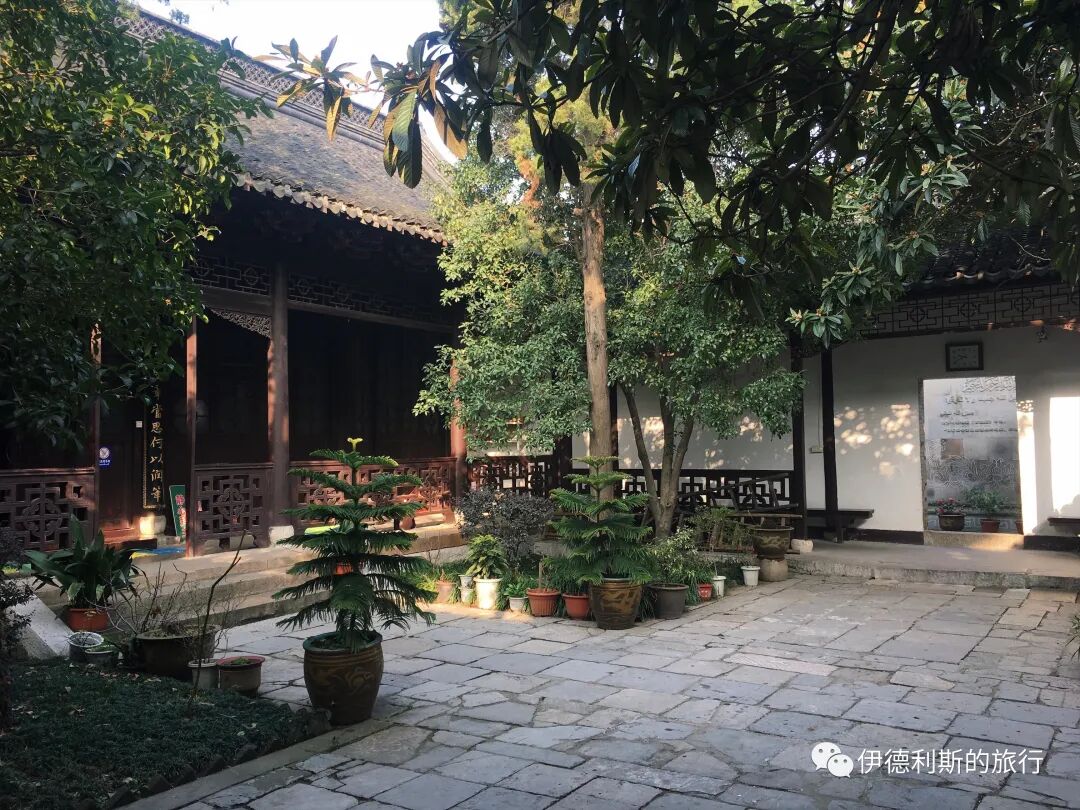
Jiaxing, Zhejiang
After the Jingkang Incident and the Song Dynasty moved south, Jiaxing, located near the capital Lin'an, began to prosper. During the Song Dynasty, the government set up a maritime trade office at Ganpu Port in Jiaxing. Many Hui Muslim merchants settled on Luli Street in the southeast of the city. Goods were transferred here before being shipped to the capital, Lin'an, and Luli Street gradually became known as the Hui Muslim Street. After the Yuan Dynasty conquered the Song, they stationed a large number of Hui troops near the Southern Song capital of Lin'an. After the Ming Dynasty, Hui Muslim soldiers and foreign guests gradually assimilated and became the Hui Muslims. Jiaxing became home to several large families with the surnames Xu, Guo, Jin, Sha, Ma, and Yang, and they built the Jiaxing Mosque during the Wanli era.
However, during the Xianfeng era, the Taiping Heavenly Kingdom army occupied Jiaxing and burned the Hui Muslim district to the ground. The surviving Hui Muslims fled in all directions, and the Hui Muslim community in Jiaxing disappeared. It was not until the early 20th century that Hui Muslims from Henan and Shandong moved south to Jiaxing to escape poverty, and a residential area gradually formed again around the mosque. Among these Hui Muslims, half were from the Han family who came from Tuocheng, Henan, and they were known as the wealthy Han family.
The Henan Muslims who moved to Jiaxing also brought the tradition of the Henan halal girls' school with them. The Jiaxing Halal Girls' School began in 1942, and its first principal was Yang Huizhen. In 1946, Yang Huizhen founded the Jiaxing Islamic Orphanage and Nursing Home to provide care for the elderly, weak, women, and children.
At noon, we ate at the Siruchun Halal Restaurant on Yuehe Street in Jiaxing. We ordered fruit rice ball soup (shuiguoyuanzigeng), crab roe tofu, Indian aster (malantou), and Bai family smoked fish (baojiabaoyu). It was authentic and delicious Jiaxing food, making this trip well worth it! The founder of Siruchun was Bai Tisheng, a Hui Muslim from Henan. He started selling braised meat (jiangrou), steamed buns (baozi), and pan-fried pancakes (jianbing) in Jiaxing during the Republic of China era. At the end of 1938, Bai Tisheng opened the Siruchun halal stir-fry restaurant. It was the most famous halal stir-fry restaurant in Jiaxing during the 1930s and 1940s.
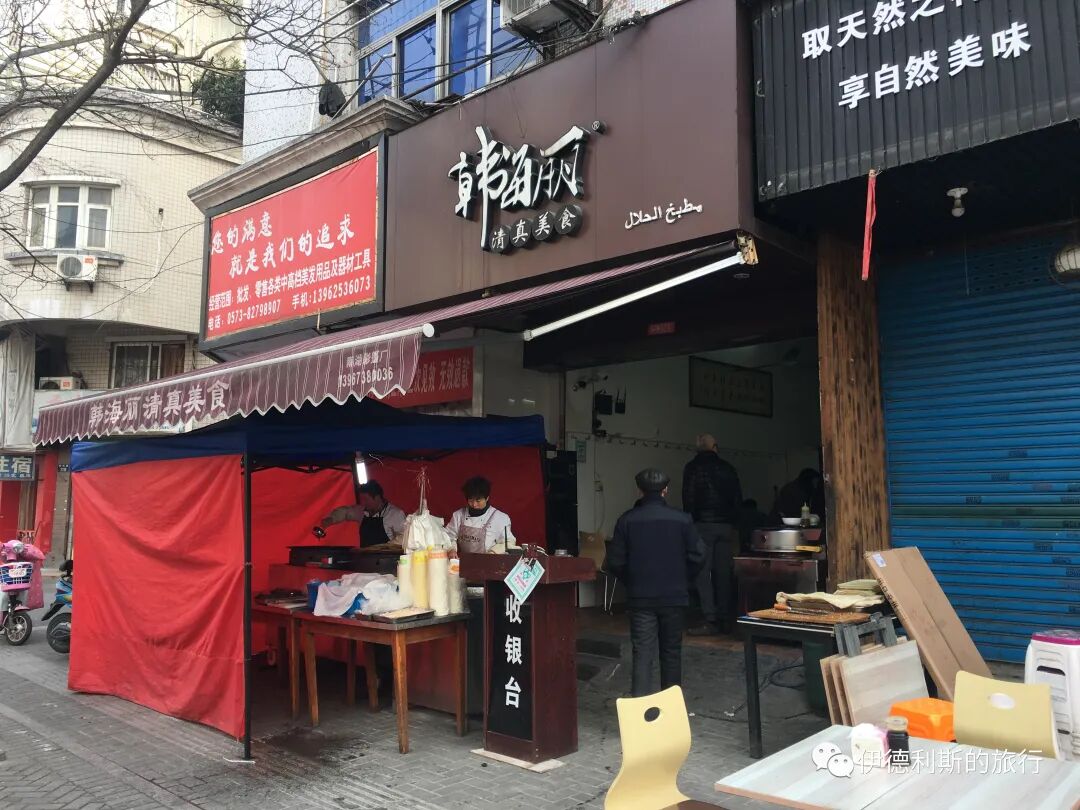
Hangzhou, Zhejiang
Starting in the Yuan Dynasty, many Muslims came to settle in Hangzhou. They were mostly Persians, along with Persianized Central Asian Turks. They held high social status and lived wealthy lives, forming a bustling Muslim community in the center of Hangzhou.
During the Yuan Dynasty, Hangzhou had three mosques: True Religion Mosque (Zhenjiaosi), Hui Muslim Prayer Hall (Huihui Baifotang), and Hui mosque (Huihuishi Libaisi). Zhenjiao Mosque is the same as Phoenix Mosque (Fenghuang Si). It was rebuilt in the Yuan Dynasty and has remained until today. The rear main hall is the only remaining Yuan Dynasty structure of the Phoenix Mosque. It is narrow from east to west and wide from north to south, maintaining the traditions of early West Asian mosques.
Jujing Garden, located by West Lake outside the Qingbo Gate in Hangzhou, was purchased by Muslims after the Yuan Dynasty to use as a cemetery. During the Ming and Qing dynasties, this place was called the 'Foreigner's Grave' (fanhui jiamu) or 'Hui Muslim Grave' (huihui fen). During the Republic of China era, it was known as the 'South Garden Islamic Cemetery' (nanyuan huijiao gongmu) or 'Islamic Public Cemetery' (huijiao yizhong), and it remained there until it was moved in 1953. During the relocation of the Hui Muslim tombs, dozens of Yuan Dynasty tombstones with Arabic and Persian inscriptions were discovered. Some are now kept in the stele gallery of Phoenix Mosque.
There are two remaining sites at the former location of the Hui Muslim cemetery. One is the tomb of Bahtiyar, a Central Asian military officer from the Yuan Dynasty, which was unearthed in the 1920s when Hangzhou's city walls were demolished. It has now been built into the Bahtiyar Tomb Garden for Hui Muslim ancestors. The other is the tomb pavilion and tomb cover stone of Ding Henian, a famous Hui Muslim poet from the late Yuan and early Ming dynasties.
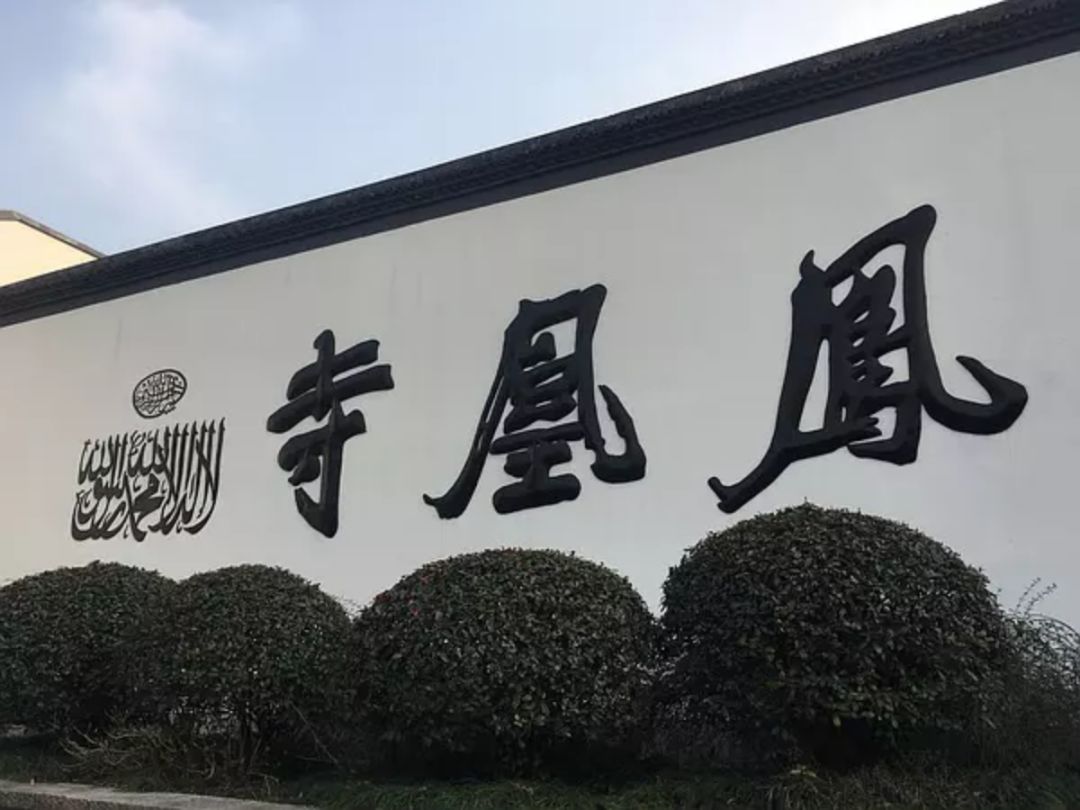
Summary: Beijing-Tianjin Canal — Mosques and Hui Muslim History is presented here as a firsthand travel account in clear English, beginning with this scene: Visiting Muslim communities, exploring old mosques, and tasting local food have been my dreams since I was a child. The account keeps its focus on Canal Mosques, Beijing Tianjin, Hui Muslims while preserving the names, places, food, and historical details from the Chinese source.
Visiting Muslim communities, exploring old mosques, and tasting local food have been my dreams since I was a child. I could not make it happen during college because I had a limited budget. I graduated from college and returned to Beijing for work in 2014. With a steady income, I officially started my halal food and travel journey in 2015. From January 2016 to May 2017, over a period of more than a year, I used my weekends and holidays to visit Hui Muslim communities in 19 towns and cities along the Grand Canal. I finished the first stage of my travel plan, the Canal Hui Muslim Community Food Tour.
These 19 locations are: Chaoyangmenwai, Changying, Tongzhou Nanguan, and Zhangjiawan in Beijing; Tianmu Village, Jiayuanli, and Northwest Corner in Tianjin; Cangzhou and Botou in Hebei; Dezhou, Linqing, Liaocheng, and Jining in Shandong; Xuzhou, Huai'an, Yangzhou, and Zhenjiang in Jiangsu; and Jiaxing and Hangzhou in Zhejiang.
This halal food tour gave me some experience and laid the foundation for my halal travels to over 100 cities in more than ten countries over the following years. Looking back now, although my early records were incomplete and quite simple, they are still precious memories of that time. Only five or six years have passed, but many situations have changed, and many scenes have already become history.
I have been sharing my canal halal travel records on my public account for a while now. This post serves as a summary and a directory. Due to time constraints, I could not visit some important Hui Muslim communities along the canal. I will have to visit them if I get the chance later. I visited Gaoyou and Lingtang in Jiangsu in 2021, and I am sharing those here as well.
Although they are all along the Grand Canal, the Hui Muslim communities in each place were established at different times. For example, Yangzhou had large numbers of Persian and Central Asian merchants as early as the Tang Dynasty. Hui Muslims (Huihui Semu) were already living in Hangzhou and Zhenjiang during the Yuan Dynasty, but most canal Hui Muslim communities developed during the Ming Dynasty. After the capital moved to Beijing during the Yongle reign, the Grand Canal was dredged again. At the same time, people were relocated to fill areas in the north that were damaged by the Jingnan Campaign. The Hui Muslim population along the Tianjin, Hebei, and Shandong sections of the canal increased significantly, and many famous mosques were built during the Ming Dynasty. During the Xianfeng reign of the Qing Dynasty, the Hui Muslim communities in Huai'an, Zhenjiang, and Jiaxing were hit hard by the Nian Rebellion and the Taiping Rebellion. The Hui Muslim community in Jiaxing was even destroyed and did not recover until the Republic of China era.
In 1855, the Yellow River burst its banks at Tongwaxiang, and the northern sections of the canal became completely silted up. The China Merchants Steam Navigation Company was founded in 1872, and grain tribute began to be transported by sea. Canal grain transport was completely abolished in 1901, and the Tianjin-Pukou Railway opened in 1913. These events caused a major shock to the Hui Muslim communities along the canal. Places like Linqing and Liaocheng began to decline, while cities like Tianjin and Zhenjiang became more prosperous because of the railway. During the Republic of China era, economic development led many Hui Muslims to move from the countryside to cities. Many chose to work in the halal food industry. Large halal restaurants gradually appeared, especially in the south, marking a period of prosperity for southern Hui Muslim communities.
In 1949, soaring prices and broken trade routes forced many Hui Muslim merchants in cities to return to their hometowns. The 1956 joint state-private ownership policy caused many halal restaurants to close. The impact was most severe in southern cities like Suzhou, Changzhou, and Hangzhou, where Hui Muslim communities eventually disappeared. After the market economy began in the 1990s, many Hui Muslim communities were demolished, and the people scattered. In the 21st century, the rapid pace of urban renewal has made the study of remaining Hui Muslim communities urgent. This is how I began my journey to visit the Hui Muslim communities along the canal.
The area outside Chaoyang Gate in Beijing.
After Emperor Yongle of the Ming Dynasty moved the capital to Beijing, he dredged the Tonghui River between Beijing and Tongzhou. He built a series of granaries inside the eastern Chaoyang Gate, and large amounts of grain were shipped from the south along the canal to the gate. Because the Tonghui River lacked enough water and had too many locks, boats often got stuck. During the Qing Dynasty, most grain boats stopped at Tongzhou to unload and transport goods by cart along the official road to Chaoyang Gate. A stone road between Chaoyang Gate and Tongzhou was built during the Yongzheng period, creating a mature commercial route.
Since they were not restricted by the closing of the city gates at night, most people transporting grain stayed outside Chaoyang Gate. Tea houses, inns, and restaurants gradually appeared in the area, and business thrived. Many Hui Muslims who came to do business settled here, forming the Hui Muslim community outside Chaoyang Gate.
There were once seven mosques outside Chaoyang Gate, with four clearly recorded: Nanzhongjie Mosque, Nanxiapo Mosque, Shuimenguan Women's Mosque, and Shegutang Mosque. Only the Nanxiapo Mosque remains today. Legend has it that in the late Ming and early Qing dynasties, a shed builder in Nanxiapo used poles and reed mats to build a large shelter as a place for namaz. In the early Kangxi period, a Hui Muslim businessman named Ma heard about this and donated money to build the formal Nanxiapo Mosque.
Chaowai Street once had many halal food shops. Famous ones included the Yongsheng Lamb Shop and the Dayou Halal Oil and Salt Shop, along with many small stalls. After the renovation of Chaowai Street in the 1990s, only Ziguangyuan, known for its stir-fried dough bits (chaogeda), has continued to thrive. I still go there often to eat roast duck.
The Muslim community outside Chaoyang Gate was completely demolished after 1992. Residents were relocated to the Sanfengli residential area nearby. There are many halal snacks there, and the stewed meat with braised green beans at the small halal restaurant is especially delicious.
Changying, Beijing.
Changying sits on the north side of the Chaoyangmen official road between Beijing and Tongzhou. Legend says that Chang Yuchun, a famous founding general of the Ming Dynasty, once stationed a troop of Hui Muslims near Tongzhou. This camp was named Changjiayingzi, though no historical records have been found to prove this story.
Because it was not far from the Tongzhou canal shipping docks and the Chaoyangmen stone road, many Hui Muslims in Changying made a living by pushing carts and pulling rickshaws. Pushing carts meant using a wheelbarrow to transport grain from the Tongzhou earthen dam to the Thirteen Granaries (Shisancang) inside and outside Chaoyangmen. Pulling rickshaws meant carrying passengers along the Chaoyangmen stone road. Both jobs were directly related to the canal shipping industry.
Changying Mosque was built during the Zhengde period of the Ming Dynasty and renovated in the first year of the Jiaqing period. It is a famous mosque in the eastern Beijing area. In 2001, Changying was demolished. The original eight Hui Muslim villages, including Changying villages 1-7 and the first residential area, were relocated to the Changying Ethnic Homeland residential complex. This formed a new Hui Muslim community, featuring a food street behind the Changying Mosque, a halal food market, a halal supermarket, and many halal restaurants. Behind Changying Mosque is a halal food street. The most famous spot there is Li Xiaolao's meat sesame flatbread (shaobing), which might be the best shaobing in Beijing. Next to Li Xiaolao's are Anji Deli, Jialun Deli, and Yinfangzhai Pastry Shop. The deli meats and pastries inside are all quite good.
Nanguan in Tongzhou, Beijing.
After Guo Shoujing built the Tonghui Canal during the Yuan Dynasty, Tongzhou became a hub for canal shipping. Many Hui Muslims moved here to live, forming a Hui Muslim community in Nanguan. In the first year of the Hongwu period of the Ming Dynasty, Tongzhou city was expanded, and the Nanguan Hui Muslim community was included within its walls. This officially formed South Street inside the South Gate and the Hui Muslim Eighteen-and-a-Half Alley (Shibajieban Hutong) on the east side. South Street was a busy main road for transporting canal grain from the Grand Canal docks outside the North Gate to the two major granaries in the center and east of Tongzhou city. Because of this, it was very prosperous during the Ming and Qing dynasties and was filled with all kinds of shops.
The most authentic halal pastry shop on South Street in Tongzhou is Guishunzhai Halal Food Store. It was opened by Master Li Chen, the former deputy factory manager of the old Dashunzhai food store, after he retired. He kept the traditional skills of the old Dashunzhai, and his thick cakes (dunbobo) and sugar-fired cakes (tanghuoshao) are excellent. The state-run Dashunzhai food store still exists today. Its main branch is on Xinhua East Street in Tongzhou, and its products are also sold on Niujie and in major Beijing supermarkets.
On the east side of the road, north of South Street in Tongzhou, stands the Tongzhou Mosque, built in the Yuan Dynasty. It was originally named Chaozhen Mosque and was renamed Mosque after being expanded during the Wanli period. At the north end of South Street is Xiaolou Restaurant, the most famous halal restaurant in Tongzhou. It is best known for its braised catfish (shao nianyu) caught in the canal. Xiaolou was originally named Yihexuan and was founded by the Li brothers in 1900. It was rebuilt into a two-story building in 1921 and took the name Xiaolou. The current storefront was built after the old Xiaolou was demolished in 1985.
Zhangjiawan in Tongzhou, Beijing.
After Guo Shoujing built the Tonghui River during the Yuan Dynasty, the place where the river flowed east into the Lu River in Tongzhou became what is now Zhangjiawan. Legend says Zhangjiawan was named after Zhang Xuan, who managed sea transport at the time, and it became a canal shipping terminal. After water levels in the Tonghui River dropped in the early Ming Dynasty, more cargo boats chose to unload at Zhangjiawan to transfer goods to carts, making Zhangjiawan a major hub for canal transport. It was not until the Jiajing era of the Ming Dynasty, a century later, that the new Tonghui River was diverted from Zhangjiawan to flow into the North Canal at Tongzhou city. However, cargo ships still docked at Zhangjiawan, and both Zhangjiawan and Tongzhou city served as important canal terminals east of the capital.
After the Yuan Dynasty, merchants kept coming to settle in Zhangjiawan, including many Hui Muslims. A Hui Muslim community formed in Zhangjiawan during the early Ming Dynasty, and they built the Zhangjiawan mosque. The Zhangjiawan mosque was built in the early Ming Dynasty and renovated during the Daoguang era of the Qing Dynasty. It suffered damage through various hardships after the 20th century, but it has been renovated and is now a simple, clean little mosque.
The area outside the south gate of the Zhangjiawan city wall became a lively Hui Muslim market because it was near the canal terminal. The three-arch stone bridge over the Empress Xiao River outside the south gate was built by imperial order during the Wanli era of the Ming Dynasty. It still stands today and is the most important historical site in Zhangjiawan.
Tianmu Village in Tianjin.
During the Hongwu era of the Ming Dynasty, a boatman named Mu Chonghe from Qiantang County, Hangzhou Prefecture, Zhejiang, followed the Prince of Yan, Zhu Di, along the canal to transport grain to Tongzhou. After unloading, he traveled south with the current and settled by the North Canal. He continued working in canal transport, and the Mu family village began to form.
In the second year of the Yongle era of the Ming Dynasty, Tianjin Wei was officially established as a city. The first mosque in Tianjin was built in the Mu family village in the northern suburbs of Tianjin, which later became the Tianmu North Mosque. After the Ming Dynasty, Hui Muslims from places like Zhejiang, Jiangsu, Shandong, and Hebei kept arriving along the canal to settle down, and the Mu family village gradually grew.
During the Ming and early Qing dynasties, most people in the Mu family village made a living from canal transport and were known as boat keepers. By the mid-to-late Qing Dynasty, as canal transport declined, boat owners in the Mu family village began switching to carting and trading. In the late Qing Dynasty, the cattle and sheep industry in Mujiazhuang began to grow. After the Republic of China was established, Hui Muslims from Mujiazhuang opened over one hundred beef and mutton shops across Tianjin.
In 1951, Mujiazhuang and Tianqi Temple merged to form Tianmu Village. In 2009, demolition began in Tianmu Village, and it is now in ruins. Today, the halal snack street is concentrated on Tianmu Shunyi Road.
Jiayuanli, Tianjin
After the 1990s, demolition began in Northwest Corner (Xibeijiao), the largest Hui Muslim community in Tianjin. Many Hui Muslims from there moved to Jiayuanli by the North Canal. Starting in 1999, a halal night market opened in Jiayuanli, and the variety of Hui Muslim snacks grew.
Not far into the Jiayuanli community commercial street, I saw a stall selling seaweed rice rolls (gimbap). I bought a box of egg yolk and tuna seaweed rice rolls and a box of beef floss. When I was very young, I used to put a layer of meat floss on my porridge in the morning. I miss that feeling so much. I kept walking inside and bought some fried dough twists (liaohuo) and jujube cake. The jujube cake was incredibly delicious and had such a classic, old-fashioned taste that I felt like all the jujube cake I had eaten over the years was a waste. Then I bought half a jin of vegetable meatballs, half carrot and half dried radish. I ate steamed dumplings at Shiji Jinling Steamed Bun Shop, served with corn grits and rice porridge. The steamed dumplings were absolutely amazing. I ate eight in one go and didn't want to stop. Every time I burped, I could taste the beef filling, which was very satisfying.
Northwest Corner (Xibeijiao), Tianjin
January and February 2016 were my first two visits to the Northwest Corner of Tianjin. It was these two trips that made me fall in love with this place. The Northwest Corner was once the largest Hui Muslim community in Tianjin. After the city of Tianjin was built, Hui Muslims continuously moved to Tianjin via the canal from places like Anhui, Jiangsu, and Hebei. Some chose to settle in the Northwest Corner of the old city, near the commercially prosperous Beidaguan canal transport hub. During the Shunzhi reign, the Northwest Corner Mosque was built here.
The Northwest Corner was centered around the mosque. Before 1995, halal shops were everywhere, but the Muslim community began to break up after the mid-90s demolitions. After 2007, the Muslim community around the mosque completely disappeared. The current Northwest Corner Hui Muslim community refers to the area around Xiguan North Street, centered on the South Mosque. As soon as you exit the Northwest Corner subway station, you can see the long line at Xiaoli Roasted Chicken. Walking south along Xima Road, you will find one halal food shop after another.
In 2017, the last historic neighborhood remained in the Northwest Corner, the Lingdangge (Bell Pavilion) area built on ruins. At the southern edge of the Lingdangge area is Xiguan Street, which hosts a wild market on weekends, much like the Daliushu market in Beijing, where they sell everything. After walking through the market, you return to the Northwest Corner Hui Muslim community.
Cangzhou, Hebei
Like many canal cities, Cangzhou has had Hui Muslim merchants settling with their families since the Yuan Dynasty. However, the Cangzhou city of that time was located at the ruins of the Old Prefecture City 20 kilometers to the southeast. During the Jingnan Campaign, the Prince of Yan, Zhu Di, destroyed the entire Old Prefecture City. It was not until the Yongle reign of the Ming Dynasty that Zhu Di ordered the relocation of Cangzhou city to Changlu by the Grand Canal, moving residents from Shanxi, Shandong, Anhui, and other places to settle there, forming the new Cangzhou city.
The Nanguanxiang area south of the city was an important passage to the canal, and most Hui Muslims, who were mainly artisans and small vendors, chose to live there. During the Yongle reign, Wu Zuoyong from Shexian, Huizhou, Anhui, was appointed as the Assistant Magistrate of the Cangzhou Salt Transport Office and came to Cangzhou, where he donated land south of the city and led the construction of the Cangzhou North Great Mosque, officially forming the Hui Muslim community in Cangzhou. South of the North Great Mosque is the Hui Muslim district in the south of the city, with Minzu Street as its center, lined with all kinds of Hui Muslim snacks. I bought a Liu's pine-flower chicken leg at the east entrance of Minzu Street; it is perfect for rolling in a flatbread (laobing) or eating with a steamed bun (mantou) because the chicken sausage is stuffed with pine-flower eggs. Then I had some tea soup (chatang); the tea soup in Cangzhou came from Tianjin along the canal, but this shop adds more ingredients and has a stronger flavor. I also bought beef buns (niurou baozi), which were very fragrant right out of the steamer. I walked a few steps and bought two bags of five-spice peanuts; the black ones are very addictive when eaten with tea.
Not far to the west of the southern Hui Muslim district is the canal wharf, where many Hui Muslims once made a living directly from water transport. The wealthiest boat owners rented out their vessels or hired people for grain transport, ordinary small boat owners made a living by ferrying, and the poorest Hui Muslims survived by pulling boats along the riverbank or carrying cargo at the docks.
Botou, Hebei
Botou sits along the canal south of Cangzhou. During the Hongwu reign of the Ming Dynasty, a regional administrative office was established here to manage grain transport between Tianjin and Dezhou, and Botou gradually became an important canal town. Like Cangzhou, Botou suffered heavy damage during the Jingnan Campaign, and its population dropped sharply. During the Yongle reign, many Hui Muslims came to settle in Botou. Because the number of Hui Muslims increased, a mosque was built in Botou that year. Afterward, more Hui Muslims moved in from Shandong, Shanxi, and Anhui, and the Hui Muslim community in Botou was officially formed.
During the Qing Dynasty and the Republican era, the most famous halal restaurants in Botou were Taiheguan on Shunhe Street, which opened during the Tongzhi reign, Shunfuguan and Xingshenghe on Gulou Street, which opened during the Guangxu reign, and Xiyuguan on East Street. The small and medium-sized restaurants around Shunhe Street were all halal, offering a wide variety of halal snacks.
Before 1957, local shipping in Botou was mainly operated by Hui Muslims, divided into two trades: those who worked the boats and those who owned them. Those who worked the boats were the crew and trackers, while those who owned them were the boat owners. Some ferried passengers across the river, some transported fertilizer for villages along the river, and others operated long-distance transport routes from Tianjin in the north to Xinxiang, Henan in the south. Before 1965, the canal section in Botou had plenty of water. In the early summer of 1965, the canal dried up for the first time. After that, the water level decreased year by year, and by the first half of the 1970s, it was nearly dry, ending shipping in Botou.
Dezhou, Shandong
The first thing I wanted to see on this trip to Dezhou was the Tomb of the Sultan of Sulu from the Philippines. The Sulu Archipelago is located in the far southwest of the Philippines, right next to the easternmost part of Malaysia. Between the 14th and 16th centuries, as maritime trade in the Indian Ocean flourished, Islam spread along the Maritime Silk Road to the Sulu Archipelago, where the Sulu Sultanate was established. During the Yongle reign, three chieftains from the Sulu Kingdom led a delegation to visit the Ming Dynasty. While traveling back and passing near Dezhou, the Eastern King suddenly fell ill and passed away. Emperor Yongle of the Ming Dynasty buried the Eastern King of Sulu with royal honors and built the Tomb of the Eastern King of Sulu north of Dezhou city.
After the Eastern King of Sulu died, his eldest son returned home to take the throne, while his second son Andulu, third son Wenhala, and Queen Gemuning stayed behind to guard the tomb. Their descendants took the surnames An and Wen, gradually forming Beiying Village in Dezhou. During the Wanli era, the descendants of the Sulu King built a mosque southwest of the Sulu King's tomb. In 1917, the canal burst its banks, washing away the mosque and the entire Beiying Village. It was rebuilt in 1940, becoming the Republic of China-era building seen today.
During the Yongzheng era, the descendants of the Sulu King changed their status from immigrants to Dezhou citizens and began opening halal snack shops in the bustling canal markets of Dezhou. Today, southwest of Beiying Village, there is still a braised chicken shop (paji dian) run by descendants of the An family. A new Beiying Ethnic Customs Street has been built next to the Sulu King's tomb, featuring a beef and mutton shop run by descendants of the Wen family, as well as a Li family whole lamb soup (quanyang tang) shop.
Strolling from Beiying Village to Qiaokou Street, you reach what was the busiest canal market in Dezhou during the Ming and Qing dynasties, located next to the Hui Muslim village of Xiaoguoshi. Xiaoguoshi was the place where pots were unloaded at the canal docks in the past, and there is also a renovated mosque here. There is also a Nanying Hui Muslim Street in the south of Dezhou city, and we visited the Dezhou Nanying Mosque before dark.
As the intersection of the Jinpu Railway and the Grand Canal, Dezhou is one of the few cities along the canal that has preserved a large number of modern industrial relics, which is very rare. Along the canal, you can see a 1940s water supply station and power plant machine room, 1950s loading docks, warehouses, and textile company watchtowers, as well as a 1960s dock dispatch building. The most spectacular site is the industrial heritage park, Jiulongwan Park, built on the foundation of the Dezhou First Water Plant, where everyone can see firsthand how tap water was produced in the 1950s.
Linqing, Shandong
To transport grain from the south to the north, Yuan Emperor Kublai Khan ordered the original Sui and Tang Grand Canal to be straightened. He had the Huitong River dug in Shandong to connect the northern and southern sections of the Grand Canal. Linqing, located at the intersection of the Huitong River and the Yongji Canal of the Sui and Tang dynasties, suddenly became a canal hub, and Hui Muslims began moving to Linqing from then on. After the brick city wall was built in Linqing during the Ming Dynasty, the 'Zhongzhou' area, surrounded by two tributaries of the Wei and Wen rivers southwest of the city, became the most prosperous commercial district in Linqing. Zhongzhou is traversed from north to south by a long street, which is also where the Hui Muslims of Linqing are most concentrated.
The North Mosque (Qingzhen Beisi) in Linqing is arguably as grand as the East Mosque (Qingzhen Dongsi) in Jining, making them the two most magnificent mosques in Shandong. It was first built during the Hongzhi reign of the Ming Dynasty and is currently undergoing major renovations. Across from it stands the Linqing East Mosque, also built in the Ming Dynasty. It is slightly smaller than the North Mosque and has been closed for major repairs since 2013, so I only saw the exterior this time. To the south, there is also a women's mosque (qingzhen nusi) founded during the Republic of China era. It became a wholesale market warehouse after the 1980s and was rebuilt in 2010.
There are three sections of the Grand Canal within Linqing, which were built during the Sui, Yuan, and Ming dynasties respectively. A large number of canal locks and bridges from the Yuan and Ming periods are still preserved today. The old Yuan Dynasty river has the Linqing Lock and Huitong Lock, while the new Ming Dynasty river has the Ban Lock and Zhuan Lock. During the Ming and Qing dynasties, the Tianqiao Bridge and Yuejing Bridge were built over the old Yuan river. Together with the canal tax office (chaoguan), these form the Linqing canal transport heritage site group.
Liaocheng, Shandong
After Kublai Khan, the Emperor Shizu of the Yuan Dynasty, ordered the construction of the Huitong River from Xucheng to Linqing to connect the northern and southern parts of the Grand Canal, Liaocheng became a major canal town, even if it was not as important as Linqing. The Dongguan area between Liaocheng and the canal became a busy and bustling district. Hui Muslims kept moving here to settle, forming the Liaocheng Dongguan Hui Muslim district.
After the Ming Emperor Chengzu, Zhu Di, moved the capital to Beijing, he relied heavily on the Grand Canal to transport grain from the south to the north. Liaocheng entered its golden age, and the large and small mosques in Dongguan were first built during the Hongwu and Yongle reigns.
Walking south along the canal from Liaocheng Dongguan, there are two docks, one large and one small. The large dock was a government transport dock, also called the Chongwu Post Dock. Back then, the ships waiting to unload stretched for miles, a scene known as the 'Chongwu continuous masts'. The small dock was originally a private dock for merchants. These two sites are precious relics of the Grand Canal in the urban area of Liaocheng.
South of Dongguan Street is the Mishi Street historical district. Paved with blue stone, it is one of the few remaining historical districts in the old city of Liaocheng. Grain shops used to gather here. At its peak, there were dozens of them, with busy daily trade and a constant stream of carts and people on the street. The historical district of the large and small mosque streets north of Dongguan Road in Liaocheng has been demolished more severely than Mishi Street, but it has not been completely wiped out like the areas inside the city.
Jining, Shandong.
After the Beijing-Hangzhou Grand Canal opened in the Yuan Dynasty, the government sent canal-support troops to Jining to guard and farm the land. Many of these soldiers were Hui Muslims from the Semu class. They built two mosques in Jining at the time, the Old East Mosque and the Old West Mosque. After the Yuan Dynasty fell, the canal-support troops in Jining surrendered to Xu Da and Chang Yuchun. Most of them were settled locally and began living together along the banks of the Yuehe River, south of Jining city.
During the Yongle period of the Ming Dynasty, the Huitong River reopened and business in Jining began to thrive. The Hui Muslims living in the southern gate area built a new East Great Mosque, which is the current Shunhe East Great Mosque. The current Shunhe East Great Mosque keeps the look it had after its renovation during the Qianlong period and is one of the most impressive mosques along the canal.
At the end of the Ming Dynasty, an outer city was built in Jining, and the Hui Muslim communities were all near this outer wall. Before the old city was renovated, it was known as the 53 Hui Muslim streets and alleys. The Hui Muslim population was most concentrated outside the Small South Gate in Liuhang, where they made up over 80 percent of the residents.
Besides the East Great Mosque, Jining also has the Liuhang East Mosque, which was built during the Wanli period of the Ming Dynasty. When we visited, the place was empty. A cat led us around to see every spot, which felt like a special encounter.
Jining has both an old and a new canal. The old canal is the Jizhou River, which was dug during the Yuan Dynasty. The new Liangji Canal was built between the late 1950s and early 1960s. After the 1970s, sections of the canal in Tianjin, Hebei, and northern Shandong stopped shipping due to low water levels. Jining became the northernmost point for shipping on the Beijing-Hangzhou Grand Canal.
Xuzhou, Jiangsu.
After the Grand Canal was completed in the Yuan Dynasty, Xuzhou became a hub for the canal because it was both a place for civilian boats to deliver grain and a transfer point for government troops. However, because the canal used the Yellow River as its path, the Xuzhou section was often hit by silt and damage from Yellow River floods. During the Wanli period of the Ming Dynasty, a new canal route was opened that bypassed Xuzhou and connected through Pizhou. Pizhou then replaced Xuzhou as the canal hub.
Today, Xuzhou is not really a canal-based Hui Muslim community, but rather a railway-based Hui Muslim community. After the Republic of China was founded, Xuzhou became a hub for the Jinpu and Longhai railways, attracting many Hui Muslims. In 1916, merchants, railway staff, and postal workers pooled their money to build the Travelers' Mosque (Lvxu Qingzhensi) for visiting Hui Muslims to perform namaz. In 1949, it was renamed Jianguo Road Mosque, which is what it is called today.
Next to the Jianguo Road Mosque, there is a deli and a pastry shop. At the pastry shop, I bought chestnut pastries (lizisu), walnut cookies (taosu), sesame crisps (mapianer), and honey-filled horn pastries (yangjiaomi). Taikang Hui Muslim Food Store is a century-old halal shop in Xuzhou, and the owner is a Hui Muslim from Jining. I bought many things at Taikang, including rose mung bean cakes (meigui lvdougao), honey-soaked sponge cakes (mizhi fenggao), egg rolls (danjuan), salted osmanthus sauce (xian guihua jiang), and rose sauce (meigui jiang). Another old halal brand is Feng Tianxing. It was founded in Nanjing during the Qianlong reign and later moved to Xuzhou, where it became a local halal institution. I bought duck tongues, duck livers, and dried tofu (dougan) here. They were all delicious, especially the duck tongues, which were incredibly fragrant.
Huai'an, Jiangsu
The Hui Muslim community in Huai'an is divided into three areas: Qingjiangpu, Hexia, and Wangjiaying. Qingjiangpu was renovated during the Yongle reign of the Ming Dynasty. It featured the Qingjiang Grand Sluice, the miles-long Changying Granary, and the massive Qingjiang Shipyard, where grain transport ships from all provinces were built and repaired. Because navigating the Yellow River section of the canal was very dangerous, many merchants chose to leave their boats at Qingjiangpu. This turned Qingjiangpu into a transport hub where people switched from boats in the south to horses in the north. Since the Ming Dynasty, Hui Muslims have done business on Yuehe Street in front of the Qingjiang Sluice. This gradually formed the Yuehe Street Hui Muslim community, with the Qingjiang Mosque at its center.
Traveling south along the canal from Qingjiangpu, you reach the ancient town of Hexia, located not far northwest of the Huai'an prefectural city. In the late Ming Dynasty, many salt merchants from the northwest and Anhui came to northern Huai to work in the salt industry. The regional salt transport office was located in Hexia at the time. The wealth brought by these merchants made Hexia a booming commercial center, and many Hui Muslims settled there, forming the Hexia Hui Muslim community.
Wangjiaying, now called Wangying, sits between the old Yellow River bed and the Salt River. It survived multiple Yellow River floods and moved its town center three times to the east to reach its current location. Because travel along the Yellow River section of the canal was slow, many merchants chose to cross the Yellow River at Wangjiaying and switch to horse-drawn carriages to continue north. Wangjiaying became more and more prosperous in the early Qing Dynasty. Hui Muslims kept moving here to settle, and they built the Wangjiaying mosque during the Yongzheng reign.
During the Daoguang reign, the salt trade system changed. Wangjiaying's Xiba replaced Hexia Town as the new hub for Huai salt, and salt boats arrived one after another every day. In the late Daoguang years, the Wangjiaying mosque moved to the south bank of the Salt River. It was burned down by the Nian Army during the Xianfeng reign, rebuilt during the Tongzhi reign, and became one of the nine branch halls of the Jahriyya Banqiao Daotang.
Gaoyou and Lingtang, Jiangsu.
Gaoyou Mosque is a very beautiful traditional mosque. It is small and delicate, with the charm of a water town. The exact founding date of the mosque is unknown, but there is an ancient cypress tree in the courtyard that is over two hundred years old. In 1864 (the third year of the Tongzhi reign), local elders Ma Guixing, Liu Xingtian, and Ma Hongxing rebuilt the mosque. The gate now has a stone carving that says it was rebuilt in the middle of winter in the second year of the Tongzhi reign. It was a pity that the mosque gate was locked when we arrived. We asked at a nearby noodle shop, and they said it only opens for Jumu'ah prayers. It seems we will have to wait for another chance to visit inside.
At noon, we took a taxi from Gaoyou to Lingtang Hui Muslim Township. Lingtang is the only Hui Muslim township in Jiangsu, home to the four major surnames: Yang, Xue, Li, and Sha. One branch of the Yang family moved here from Suzhou at the end of the Yuan Dynasty, and another branch moved from Suzhou during the Qing Dynasty. The Xue family moved here from Xuebeizhuang in Gaoyou during the Qing Dynasty, later converted to Islam, and for generations have mostly only married into the Yang family. The Sha surname is said to come from the Persian word "Shah" and are descendants of Persian ancestors from Huihuiwan in the Yuan Dynasty.
We ate at Huixianglou Restaurant, having salted goose, stir-fried bitter buckwheat chips with egg yolk, amaranth with fava beans, and beef wing soup, all of which are local specialties. The founder of Huixianglou, Yang Yangui, opened a halal restaurant on the old street of Lingtang Bridge in 1969. It moved to its current location in 2010 and specializes in Lingtang salted goose from Gaoyou Lake.
A mosque was built at "Huihuiwan" by the side of Gaoyou Lake during the late Yuan Dynasty, but it was later destroyed by a flood. The mosque moved to Yangdazhuang in the mid-Ming Dynasty, then to its current site in the early Qing Dynasty. It was rebuilt in 1844 (the 24th year of the Daoguang reign of the Qing Dynasty), expanded again in 1921, and completed in 1924.
Yangzhou, Jiangsu
Since the Tang Dynasty, Yangzhou has been a major commercial hub in the southeast, attracting many merchants from Arabia and Persia. The Extensive Records of the Taiping Era (Taiping Guangji) contains many stories about foreign merchants in Yangzhou. While most are quite exotic, they provide a vivid picture of Persian merchants in Yangzhou at that time. Yangzhou city suffered heavy damage during the wars at the end of the Tang Dynasty and the Five Dynasties period, and most of the original foreign merchants scattered. After the Song Dynasty, these foreign merchants gradually changed from expatriates to locally born residents, beginning a process of localization.
Yangzhou's most famous Crane Mosque (Xianhe Si) and the Hui Muslim Hall (Puhading Tomb) were both built during the transition between the Song and Yuan dynasties. During the Xianchun years of the Southern Song Dynasty, People say Puha Ding, a 16th-generation descendant of the Prophet, came to Yangzhou and built the Crane Mosque (Xianhe Si). After he passed away, he was buried on a high ridge east of the Dongguan River in the new city, which is now the Puha Ding Cemetery.
The Song Dynasty set up a guesthouse at the south gate of Yangzhou. The area outside the south gate developed into a new settlement for Muslim merchants, and a mosque was built there. The main hall was not demolished until 1984. After Zhu Yuanzhang captured Yangzhou, the tombstones from the Muslim cemetery outside the south gate were built into the city's south gate defense tower. When the south gate defense tower was demolished during the Republic of China era, four Yuan Dynasty Muslim tombstones were found in the city foundation. They are now kept in the Puha Ding Cemetery and are precious relics of the Muslims in Yuan Dynasty Yangzhou.
After the Qianlong reign, Yangzhou had six mosques. The three inside the city were the Crane Mosque on Nanmen Street, the Majian Lane Mosque, and the Xiejia Bridge Mosque. The three outside the city were the Hui Muslim Hall (inside the Puha Ding Cemetery) east of the Dongguan River, the South Gate Mosque, and the Chaoguan Mosque. Today, only the Crane Mosque and the Dongguan Hui Muslim Hall remain open, while the Majian Lane Mosque has been turned into a private residence.
During the Republic of China era, there were nearly 20,000 Hui Muslims living in the six mosque districts of Yangzhou, with Sha, Ma, Ha, Sa, and Da as the five major surnames. At that time, there were more than ten famous halal restaurants in Yangzhou. The most famous was the Tianxing Restaurant, which was frequently visited by everyone from scholars and writers to salt merchants and officials. The Tianxing Restaurant eventually closed in the 1950s.
Zhenjiang, Jiangsu
The original meeting point of the Grand Canal, built by Emperor Yang of Sui, was called Dajingkou. In 1029 (the seventh year of the Tiansheng era of the Song Dynasty), a new canal was dug east of the old one, and the point where this new canal met the Yangtze River was named Xiaojingkou. After the New Canal was dug, it gradually became an important hub for grain transport, and Xinhe Street formed along the riverbank. After Zhenjiang opened as a treaty port in 1861, Xinhe Street became even more prosperous, with all kinds of shops opening up. In the 1920s, the Yihewani sect of Islam reached Shanghai. Some Hui Muslims from Zhenjiang who moved to Shanghai adopted these teachings, and in 1930, they built an Yihewani mosque on Xinhe Street. At that time, the new and old sects lived in peace and operated side by side. After the 1950s, the Xinhe Street mosque was taken over by a factory, but the Jiangnan-style courtyard architecture remains today.
Walking southwest from Xinhe Street leads to the Shanxiang Mosque. Shanxiang Mosque is also known as the Chengxi Mosque. It was expanded during the Kangxi reign, destroyed during the Xianfeng reign, and rebuilt during the Tongzhi reign. After Zhenjiang opened as a treaty port, the area outside the West Gate became a busy commercial district. The establishment of the British concession and the opening of the Shanghai-Nanjing railway brought a steady stream of Hui Muslims who came to trade and settled around the Shanxiang Mosque.
Besides the Shanxiang Mosque, Zhenjiang once had another mosque on Jianzi Lane. The Jianzi Lane Mosque was originally called the Gurun Mosque. It was first built on Ren'an Lane in Fumin Street, destroyed at the end of the Yuan Dynasty and the beginning of the Ming Dynasty, rebuilt in the Hongwu reign of the Ming Dynasty, moved to Jianzi Lane inside the city during the Wanli reign, and finally destroyed in the 1970s or 1980s. A new Gurun Mosque was built on Xuefu Road in 2005. The stone tablet from the Wanli reconstruction, the ancient well railing, and three Qing Dynasty reconstruction tablets from the original Jianzi Lane Mosque are preserved in the courtyard.
to the relics from the Jianzi Lane Mosque, the Gurun Mosque also houses an Arabic orientation tablet from the kiln hall of the mosque outside the South Gate of Zhenjiang. The South Gate Mosque was at the east end of Miaojia Lane. It is believed to have been built in the early Qing Dynasty and was destroyed by war in 1937.
Although Jianzi Lane Mosque has disappeared, the Hui Muslims who once lived around the mosque have not. The area around Jianzi Lane still has the highest concentration of halal restaurants in Zhenjiang. Yong'an Road is not far south of Jianzi Lane. The street is lively and full of snacks, and there are five halal restaurants.
Finally, we went to the Jiangbin vegetable market and found the last halal tea snack shop in Zhenjiang, Jianxiang Halal Food Factory. The owner, Ma Jian, used to work at the Zhenjiang Pastry Factory. After he was laid off in 1995, he opened Jianxiang Halal Food Factory himself. The owner's wife recommended their famous cloud-slice cake (yunpiangao), the Zhenjiang-style navel-shaped pastry (jingjiangqi), and egg crisps (jindanshu). The cloud-slice cake was especially delicious.
Jiaxing, Zhejiang
After the Jingkang Incident and the Song Dynasty moved south, Jiaxing, located near the capital Lin'an, began to prosper. During the Song Dynasty, the government set up a maritime trade office at Ganpu Port in Jiaxing. Many Hui Muslim merchants settled on Luli Street in the southeast of the city. Goods were transferred here before being shipped to the capital, Lin'an, and Luli Street gradually became known as the Hui Muslim Street. After the Yuan Dynasty conquered the Song, they stationed a large number of Hui troops near the Southern Song capital of Lin'an. After the Ming Dynasty, Hui Muslim soldiers and foreign guests gradually assimilated and became the Hui Muslims. Jiaxing became home to several large families with the surnames Xu, Guo, Jin, Sha, Ma, and Yang, and they built the Jiaxing Mosque during the Wanli era.
However, during the Xianfeng era, the Taiping Heavenly Kingdom army occupied Jiaxing and burned the Hui Muslim district to the ground. The surviving Hui Muslims fled in all directions, and the Hui Muslim community in Jiaxing disappeared. It was not until the early 20th century that Hui Muslims from Henan and Shandong moved south to Jiaxing to escape poverty, and a residential area gradually formed again around the mosque. Among these Hui Muslims, half were from the Han family who came from Tuocheng, Henan, and they were known as the wealthy Han family.
The Henan Muslims who moved to Jiaxing also brought the tradition of the Henan halal girls' school with them. The Jiaxing Halal Girls' School began in 1942, and its first principal was Yang Huizhen. In 1946, Yang Huizhen founded the Jiaxing Islamic Orphanage and Nursing Home to provide care for the elderly, weak, women, and children.
At noon, we ate at the Siruchun Halal Restaurant on Yuehe Street in Jiaxing. We ordered fruit rice ball soup (shuiguoyuanzigeng), crab roe tofu, Indian aster (malantou), and Bai family smoked fish (baojiabaoyu). It was authentic and delicious Jiaxing food, making this trip well worth it! The founder of Siruchun was Bai Tisheng, a Hui Muslim from Henan. He started selling braised meat (jiangrou), steamed buns (baozi), and pan-fried pancakes (jianbing) in Jiaxing during the Republic of China era. At the end of 1938, Bai Tisheng opened the Siruchun halal stir-fry restaurant. It was the most famous halal stir-fry restaurant in Jiaxing during the 1930s and 1940s.
Hangzhou, Zhejiang
Starting in the Yuan Dynasty, many Muslims came to settle in Hangzhou. They were mostly Persians, along with Persianized Central Asian Turks. They held high social status and lived wealthy lives, forming a bustling Muslim community in the center of Hangzhou.
During the Yuan Dynasty, Hangzhou had three mosques: True Religion Mosque (Zhenjiaosi), Hui Muslim Prayer Hall (Huihui Baifotang), and Hui mosque (Huihuishi Libaisi). Zhenjiao Mosque is the same as Phoenix Mosque (Fenghuang Si). It was rebuilt in the Yuan Dynasty and has remained until today. The rear main hall is the only remaining Yuan Dynasty structure of the Phoenix Mosque. It is narrow from east to west and wide from north to south, maintaining the traditions of early West Asian mosques.
Jujing Garden, located by West Lake outside the Qingbo Gate in Hangzhou, was purchased by Muslims after the Yuan Dynasty to use as a cemetery. During the Ming and Qing dynasties, this place was called the 'Foreigner's Grave' (fanhui jiamu) or 'Hui Muslim Grave' (huihui fen). During the Republic of China era, it was known as the 'South Garden Islamic Cemetery' (nanyuan huijiao gongmu) or 'Islamic Public Cemetery' (huijiao yizhong), and it remained there until it was moved in 1953. During the relocation of the Hui Muslim tombs, dozens of Yuan Dynasty tombstones with Arabic and Persian inscriptions were discovered. Some are now kept in the stele gallery of Phoenix Mosque.
There are two remaining sites at the former location of the Hui Muslim cemetery. One is the tomb of Bahtiyar, a Central Asian military officer from the Yuan Dynasty, which was unearthed in the 1920s when Hangzhou's city walls were demolished. It has now been built into the Bahtiyar Tomb Garden for Hui Muslim ancestors. The other is the tomb pavilion and tomb cover stone of Ding Henian, a famous Hui Muslim poet from the late Yuan and early Ming dynasties.
Halal Travel Guide: Beijing-Tianjin Canal — Mosques and Hui Muslim History
Articles • ali2007fr posted the article • 0 comments • 235 views • 2026-05-18 20:26
Reposted from the web
Summary: Beijing-Tianjin Canal — Mosques and Hui Muslim History is presented here as a firsthand travel account in clear English, beginning with this scene: Visiting Muslim communities, exploring old mosques, and tasting local food have been my dreams since I was a child. The account keeps its focus on Canal Mosques, Beijing Tianjin, Hui Muslims while preserving the names, places, food, and historical details from the Chinese source.
Visiting Muslim communities, exploring old mosques, and tasting local food have been my dreams since I was a child. I could not make it happen during college because I had a limited budget. I graduated from college and returned to Beijing for work in 2014. With a steady income, I officially started my halal food and travel journey in 2015. From January 2016 to May 2017, over a period of more than a year, I used my weekends and holidays to visit Hui Muslim communities in 19 towns and cities along the Grand Canal. I finished the first stage of my travel plan, the Canal Hui Muslim Community Food Tour.
These 19 locations are: Chaoyangmenwai, Changying, Tongzhou Nanguan, and Zhangjiawan in Beijing; Tianmu Village, Jiayuanli, and Northwest Corner in Tianjin; Cangzhou and Botou in Hebei; Dezhou, Linqing, Liaocheng, and Jining in Shandong; Xuzhou, Huai'an, Yangzhou, and Zhenjiang in Jiangsu; and Jiaxing and Hangzhou in Zhejiang.
This halal food tour gave me some experience and laid the foundation for my halal travels to over 100 cities in more than ten countries over the following years. Looking back now, although my early records were incomplete and quite simple, they are still precious memories of that time. Only five or six years have passed, but many situations have changed, and many scenes have already become history.
I have been sharing my canal halal travel records on my public account for a while now. This post serves as a summary and a directory. Due to time constraints, I could not visit some important Hui Muslim communities along the canal. I will have to visit them if I get the chance later. I visited Gaoyou and Lingtang in Jiangsu in 2021, and I am sharing those here as well.
Although they are all along the Grand Canal, the Hui Muslim communities in each place were established at different times. For example, Yangzhou had large numbers of Persian and Central Asian merchants as early as the Tang Dynasty. Hui Muslims (Huihui Semu) were already living in Hangzhou and Zhenjiang during the Yuan Dynasty, but most canal Hui Muslim communities developed during the Ming Dynasty. After the capital moved to Beijing during the Yongle reign, the Grand Canal was dredged again. At the same time, people were relocated to fill areas in the north that were damaged by the Jingnan Campaign. The Hui Muslim population along the Tianjin, Hebei, and Shandong sections of the canal increased significantly, and many famous mosques were built during the Ming Dynasty. During the Xianfeng reign of the Qing Dynasty, the Hui Muslim communities in Huai'an, Zhenjiang, and Jiaxing were hit hard by the Nian Rebellion and the Taiping Rebellion. The Hui Muslim community in Jiaxing was even destroyed and did not recover until the Republic of China era.
In 1855, the Yellow River burst its banks at Tongwaxiang, and the northern sections of the canal became completely silted up. The China Merchants Steam Navigation Company was founded in 1872, and grain tribute began to be transported by sea. Canal grain transport was completely abolished in 1901, and the Tianjin-Pukou Railway opened in 1913. These events caused a major shock to the Hui Muslim communities along the canal. Places like Linqing and Liaocheng began to decline, while cities like Tianjin and Zhenjiang became more prosperous because of the railway. During the Republic of China era, economic development led many Hui Muslims to move from the countryside to cities. Many chose to work in the halal food industry. Large halal restaurants gradually appeared, especially in the south, marking a period of prosperity for southern Hui Muslim communities.
In 1949, soaring prices and broken trade routes forced many Hui Muslim merchants in cities to return to their hometowns. The 1956 joint state-private ownership policy caused many halal restaurants to close. The impact was most severe in southern cities like Suzhou, Changzhou, and Hangzhou, where Hui Muslim communities eventually disappeared. After the market economy began in the 1990s, many Hui Muslim communities were demolished, and the people scattered. In the 21st century, the rapid pace of urban renewal has made the study of remaining Hui Muslim communities urgent. This is how I began my journey to visit the Hui Muslim communities along the canal.
The area outside Chaoyang Gate in Beijing.
After Emperor Yongle of the Ming Dynasty moved the capital to Beijing, he dredged the Tonghui River between Beijing and Tongzhou. He built a series of granaries inside the eastern Chaoyang Gate, and large amounts of grain were shipped from the south along the canal to the gate. Because the Tonghui River lacked enough water and had too many locks, boats often got stuck. During the Qing Dynasty, most grain boats stopped at Tongzhou to unload and transport goods by cart along the official road to Chaoyang Gate. A stone road between Chaoyang Gate and Tongzhou was built during the Yongzheng period, creating a mature commercial route.
Since they were not restricted by the closing of the city gates at night, most people transporting grain stayed outside Chaoyang Gate. Tea houses, inns, and restaurants gradually appeared in the area, and business thrived. Many Hui Muslims who came to do business settled here, forming the Hui Muslim community outside Chaoyang Gate.
There were once seven mosques outside Chaoyang Gate, with four clearly recorded: Nanzhongjie Mosque, Nanxiapo Mosque, Shuimenguan Women's Mosque, and Shegutang Mosque. Only the Nanxiapo Mosque remains today. Legend has it that in the late Ming and early Qing dynasties, a shed builder in Nanxiapo used poles and reed mats to build a large shelter as a place for namaz. In the early Kangxi period, a Hui Muslim businessman named Ma heard about this and donated money to build the formal Nanxiapo Mosque.
Chaowai Street once had many halal food shops. Famous ones included the Yongsheng Lamb Shop and the Dayou Halal Oil and Salt Shop, along with many small stalls. After the renovation of Chaowai Street in the 1990s, only Ziguangyuan, known for its stir-fried dough bits (chaogeda), has continued to thrive. I still go there often to eat roast duck.
The Muslim community outside Chaoyang Gate was completely demolished after 1992. Residents were relocated to the Sanfengli residential area nearby. There are many halal snacks there, and the stewed meat with braised green beans at the small halal restaurant is especially delicious.
Changying, Beijing.
Changying sits on the north side of the Chaoyangmen official road between Beijing and Tongzhou. Legend says that Chang Yuchun, a famous founding general of the Ming Dynasty, once stationed a troop of Hui Muslims near Tongzhou. This camp was named Changjiayingzi, though no historical records have been found to prove this story.
Because it was not far from the Tongzhou canal shipping docks and the Chaoyangmen stone road, many Hui Muslims in Changying made a living by pushing carts and pulling rickshaws. Pushing carts meant using a wheelbarrow to transport grain from the Tongzhou earthen dam to the Thirteen Granaries (Shisancang) inside and outside Chaoyangmen. Pulling rickshaws meant carrying passengers along the Chaoyangmen stone road. Both jobs were directly related to the canal shipping industry.
Changying Mosque was built during the Zhengde period of the Ming Dynasty and renovated in the first year of the Jiaqing period. It is a famous mosque in the eastern Beijing area. In 2001, Changying was demolished. The original eight Hui Muslim villages, including Changying villages 1-7 and the first residential area, were relocated to the Changying Ethnic Homeland residential complex. This formed a new Hui Muslim community, featuring a food street behind the Changying Mosque, a halal food market, a halal supermarket, and many halal restaurants. Behind Changying Mosque is a halal food street. The most famous spot there is Li Xiaolao's meat sesame flatbread (shaobing), which might be the best shaobing in Beijing. Next to Li Xiaolao's are Anji Deli, Jialun Deli, and Yinfangzhai Pastry Shop. The deli meats and pastries inside are all quite good.
Nanguan in Tongzhou, Beijing.
After Guo Shoujing built the Tonghui Canal during the Yuan Dynasty, Tongzhou became a hub for canal shipping. Many Hui Muslims moved here to live, forming a Hui Muslim community in Nanguan. In the first year of the Hongwu period of the Ming Dynasty, Tongzhou city was expanded, and the Nanguan Hui Muslim community was included within its walls. This officially formed South Street inside the South Gate and the Hui Muslim Eighteen-and-a-Half Alley (Shibajieban Hutong) on the east side. South Street was a busy main road for transporting canal grain from the Grand Canal docks outside the North Gate to the two major granaries in the center and east of Tongzhou city. Because of this, it was very prosperous during the Ming and Qing dynasties and was filled with all kinds of shops.
The most authentic halal pastry shop on South Street in Tongzhou is Guishunzhai Halal Food Store. It was opened by Master Li Chen, the former deputy factory manager of the old Dashunzhai food store, after he retired. He kept the traditional skills of the old Dashunzhai, and his thick cakes (dunbobo) and sugar-fired cakes (tanghuoshao) are excellent. The state-run Dashunzhai food store still exists today. Its main branch is on Xinhua East Street in Tongzhou, and its products are also sold on Niujie and in major Beijing supermarkets.
On the east side of the road, north of South Street in Tongzhou, stands the Tongzhou Mosque, built in the Yuan Dynasty. It was originally named Chaozhen Mosque and was renamed Mosque after being expanded during the Wanli period. At the north end of South Street is Xiaolou Restaurant, the most famous halal restaurant in Tongzhou. It is best known for its braised catfish (shao nianyu) caught in the canal. Xiaolou was originally named Yihexuan and was founded by the Li brothers in 1900. It was rebuilt into a two-story building in 1921 and took the name Xiaolou. The current storefront was built after the old Xiaolou was demolished in 1985.
Zhangjiawan in Tongzhou, Beijing.
After Guo Shoujing built the Tonghui River during the Yuan Dynasty, the place where the river flowed east into the Lu River in Tongzhou became what is now Zhangjiawan. Legend says Zhangjiawan was named after Zhang Xuan, who managed sea transport at the time, and it became a canal shipping terminal. After water levels in the Tonghui River dropped in the early Ming Dynasty, more cargo boats chose to unload at Zhangjiawan to transfer goods to carts, making Zhangjiawan a major hub for canal transport. It was not until the Jiajing era of the Ming Dynasty, a century later, that the new Tonghui River was diverted from Zhangjiawan to flow into the North Canal at Tongzhou city. However, cargo ships still docked at Zhangjiawan, and both Zhangjiawan and Tongzhou city served as important canal terminals east of the capital.
After the Yuan Dynasty, merchants kept coming to settle in Zhangjiawan, including many Hui Muslims. A Hui Muslim community formed in Zhangjiawan during the early Ming Dynasty, and they built the Zhangjiawan mosque. The Zhangjiawan mosque was built in the early Ming Dynasty and renovated during the Daoguang era of the Qing Dynasty. It suffered damage through various hardships after the 20th century, but it has been renovated and is now a simple, clean little mosque.
The area outside the south gate of the Zhangjiawan city wall became a lively Hui Muslim market because it was near the canal terminal. The three-arch stone bridge over the Empress Xiao River outside the south gate was built by imperial order during the Wanli era of the Ming Dynasty. It still stands today and is the most important historical site in Zhangjiawan.
Tianmu Village in Tianjin.
During the Hongwu era of the Ming Dynasty, a boatman named Mu Chonghe from Qiantang County, Hangzhou Prefecture, Zhejiang, followed the Prince of Yan, Zhu Di, along the canal to transport grain to Tongzhou. After unloading, he traveled south with the current and settled by the North Canal. He continued working in canal transport, and the Mu family village began to form.
In the second year of the Yongle era of the Ming Dynasty, Tianjin Wei was officially established as a city. The first mosque in Tianjin was built in the Mu family village in the northern suburbs of Tianjin, which later became the Tianmu North Mosque. After the Ming Dynasty, Hui Muslims from places like Zhejiang, Jiangsu, Shandong, and Hebei kept arriving along the canal to settle down, and the Mu family village gradually grew.
During the Ming and early Qing dynasties, most people in the Mu family village made a living from canal transport and were known as boat keepers. By the mid-to-late Qing Dynasty, as canal transport declined, boat owners in the Mu family village began switching to carting and trading. In the late Qing Dynasty, the cattle and sheep industry in Mujiazhuang began to grow. After the Republic of China was established, Hui Muslims from Mujiazhuang opened over one hundred beef and mutton shops across Tianjin.
In 1951, Mujiazhuang and Tianqi Temple merged to form Tianmu Village. In 2009, demolition began in Tianmu Village, and it is now in ruins. Today, the halal snack street is concentrated on Tianmu Shunyi Road.
Jiayuanli, Tianjin
After the 1990s, demolition began in Northwest Corner (Xibeijiao), the largest Hui Muslim community in Tianjin. Many Hui Muslims from there moved to Jiayuanli by the North Canal. Starting in 1999, a halal night market opened in Jiayuanli, and the variety of Hui Muslim snacks grew.
Not far into the Jiayuanli community commercial street, I saw a stall selling seaweed rice rolls (gimbap). I bought a box of egg yolk and tuna seaweed rice rolls and a box of beef floss. When I was very young, I used to put a layer of meat floss on my porridge in the morning. I miss that feeling so much. I kept walking inside and bought some fried dough twists (liaohuo) and jujube cake. The jujube cake was incredibly delicious and had such a classic, old-fashioned taste that I felt like all the jujube cake I had eaten over the years was a waste. Then I bought half a jin of vegetable meatballs, half carrot and half dried radish. I ate steamed dumplings at Shiji Jinling Steamed Bun Shop, served with corn grits and rice porridge. The steamed dumplings were absolutely amazing. I ate eight in one go and didn't want to stop. Every time I burped, I could taste the beef filling, which was very satisfying.
Northwest Corner (Xibeijiao), Tianjin
January and February 2016 were my first two visits to the Northwest Corner of Tianjin. It was these two trips that made me fall in love with this place. The Northwest Corner was once the largest Hui Muslim community in Tianjin. After the city of Tianjin was built, Hui Muslims continuously moved to Tianjin via the canal from places like Anhui, Jiangsu, and Hebei. Some chose to settle in the Northwest Corner of the old city, near the commercially prosperous Beidaguan canal transport hub. During the Shunzhi reign, the Northwest Corner Mosque was built here.
The Northwest Corner was centered around the mosque. Before 1995, halal shops were everywhere, but the Muslim community began to break up after the mid-90s demolitions. After 2007, the Muslim community around the mosque completely disappeared. The current Northwest Corner Hui Muslim community refers to the area around Xiguan North Street, centered on the South Mosque. As soon as you exit the Northwest Corner subway station, you can see the long line at Xiaoli Roasted Chicken. Walking south along Xima Road, you will find one halal food shop after another.
In 2017, the last historic neighborhood remained in the Northwest Corner, the Lingdangge (Bell Pavilion) area built on ruins. At the southern edge of the Lingdangge area is Xiguan Street, which hosts a wild market on weekends, much like the Daliushu market in Beijing, where they sell everything. After walking through the market, you return to the Northwest Corner Hui Muslim community.
Cangzhou, Hebei
Like many canal cities, Cangzhou has had Hui Muslim merchants settling with their families since the Yuan Dynasty. However, the Cangzhou city of that time was located at the ruins of the Old Prefecture City 20 kilometers to the southeast. During the Jingnan Campaign, the Prince of Yan, Zhu Di, destroyed the entire Old Prefecture City. It was not until the Yongle reign of the Ming Dynasty that Zhu Di ordered the relocation of Cangzhou city to Changlu by the Grand Canal, moving residents from Shanxi, Shandong, Anhui, and other places to settle there, forming the new Cangzhou city.
The Nanguanxiang area south of the city was an important passage to the canal, and most Hui Muslims, who were mainly artisans and small vendors, chose to live there. During the Yongle reign, Wu Zuoyong from Shexian, Huizhou, Anhui, was appointed as the Assistant Magistrate of the Cangzhou Salt Transport Office and came to Cangzhou, where he donated land south of the city and led the construction of the Cangzhou North Great Mosque, officially forming the Hui Muslim community in Cangzhou. South of the North Great Mosque is the Hui Muslim district in the south of the city, with Minzu Street as its center, lined with all kinds of Hui Muslim snacks. I bought a Liu's pine-flower chicken leg at the east entrance of Minzu Street; it is perfect for rolling in a flatbread (laobing) or eating with a steamed bun (mantou) because the chicken sausage is stuffed with pine-flower eggs. Then I had some tea soup (chatang); the tea soup in Cangzhou came from Tianjin along the canal, but this shop adds more ingredients and has a stronger flavor. I also bought beef buns (niurou baozi), which were very fragrant right out of the steamer. I walked a few steps and bought two bags of five-spice peanuts; the black ones are very addictive when eaten with tea.
Not far to the west of the southern Hui Muslim district is the canal wharf, where many Hui Muslims once made a living directly from water transport. The wealthiest boat owners rented out their vessels or hired people for grain transport, ordinary small boat owners made a living by ferrying, and the poorest Hui Muslims survived by pulling boats along the riverbank or carrying cargo at the docks.
Botou, Hebei
Botou sits along the canal south of Cangzhou. During the Hongwu reign of the Ming Dynasty, a regional administrative office was established here to manage grain transport between Tianjin and Dezhou, and Botou gradually became an important canal town. Like Cangzhou, Botou suffered heavy damage during the Jingnan Campaign, and its population dropped sharply. During the Yongle reign, many Hui Muslims came to settle in Botou. Because the number of Hui Muslims increased, a mosque was built in Botou that year. Afterward, more Hui Muslims moved in from Shandong, Shanxi, and Anhui, and the Hui Muslim community in Botou was officially formed.
During the Qing Dynasty and the Republican era, the most famous halal restaurants in Botou were Taiheguan on Shunhe Street, which opened during the Tongzhi reign, Shunfuguan and Xingshenghe on Gulou Street, which opened during the Guangxu reign, and Xiyuguan on East Street. The small and medium-sized restaurants around Shunhe Street were all halal, offering a wide variety of halal snacks.
Before 1957, local shipping in Botou was mainly operated by Hui Muslims, divided into two trades: those who worked the boats and those who owned them. Those who worked the boats were the crew and trackers, while those who owned them were the boat owners. Some ferried passengers across the river, some transported fertilizer for villages along the river, and others operated long-distance transport routes from Tianjin in the north to Xinxiang, Henan in the south. Before 1965, the canal section in Botou had plenty of water. In the early summer of 1965, the canal dried up for the first time. After that, the water level decreased year by year, and by the first half of the 1970s, it was nearly dry, ending shipping in Botou.
Dezhou, Shandong
The first thing I wanted to see on this trip to Dezhou was the Tomb of the Sultan of Sulu from the Philippines. The Sulu Archipelago is located in the far southwest of the Philippines, right next to the easternmost part of Malaysia. Between the 14th and 16th centuries, as maritime trade in the Indian Ocean flourished, Islam spread along the Maritime Silk Road to the Sulu Archipelago, where the Sulu Sultanate was established. During the Yongle reign, three chieftains from the Sulu Kingdom led a delegation to visit the Ming Dynasty. While traveling back and passing near Dezhou, the Eastern King suddenly fell ill and passed away. Emperor Yongle of the Ming Dynasty buried the Eastern King of Sulu with royal honors and built the Tomb of the Eastern King of Sulu north of Dezhou city.
After the Eastern King of Sulu died, his eldest son returned home to take the throne, while his second son Andulu, third son Wenhala, and Queen Gemuning stayed behind to guard the tomb. Their descendants took the surnames An and Wen, gradually forming Beiying Village in Dezhou. During the Wanli era, the descendants of the Sulu King built a mosque southwest of the Sulu King's tomb. In 1917, the canal burst its banks, washing away the mosque and the entire Beiying Village. It was rebuilt in 1940, becoming the Republic of China-era building seen today.
During the Yongzheng era, the descendants of the Sulu King changed their status from immigrants to Dezhou citizens and began opening halal snack shops in the bustling canal markets of Dezhou. Today, southwest of Beiying Village, there is still a braised chicken shop (paji dian) run by descendants of the An family. A new Beiying Ethnic Customs Street has been built next to the Sulu King's tomb, featuring a beef and mutton shop run by descendants of the Wen family, as well as a Li family whole lamb soup (quanyang tang) shop.
Strolling from Beiying Village to Qiaokou Street, you reach what was the busiest canal market in Dezhou during the Ming and Qing dynasties, located next to the Hui Muslim village of Xiaoguoshi. Xiaoguoshi was the place where pots were unloaded at the canal docks in the past, and there is also a renovated mosque here. There is also a Nanying Hui Muslim Street in the south of Dezhou city, and we visited the Dezhou Nanying Mosque before dark.
As the intersection of the Jinpu Railway and the Grand Canal, Dezhou is one of the few cities along the canal that has preserved a large number of modern industrial relics, which is very rare. Along the canal, you can see a 1940s water supply station and power plant machine room, 1950s loading docks, warehouses, and textile company watchtowers, as well as a 1960s dock dispatch building. The most spectacular site is the industrial heritage park, Jiulongwan Park, built on the foundation of the Dezhou First Water Plant, where everyone can see firsthand how tap water was produced in the 1950s.
Linqing, Shandong
To transport grain from the south to the north, Yuan Emperor Kublai Khan ordered the original Sui and Tang Grand Canal to be straightened. He had the Huitong River dug in Shandong to connect the northern and southern sections of the Grand Canal. Linqing, located at the intersection of the Huitong River and the Yongji Canal of the Sui and Tang dynasties, suddenly became a canal hub, and Hui Muslims began moving to Linqing from then on. After the brick city wall was built in Linqing during the Ming Dynasty, the 'Zhongzhou' area, surrounded by two tributaries of the Wei and Wen rivers southwest of the city, became the most prosperous commercial district in Linqing. Zhongzhou is traversed from north to south by a long street, which is also where the Hui Muslims of Linqing are most concentrated.
The North Mosque (Qingzhen Beisi) in Linqing is arguably as grand as the East Mosque (Qingzhen Dongsi) in Jining, making them the two most magnificent mosques in Shandong. It was first built during the Hongzhi reign of the Ming Dynasty and is currently undergoing major renovations. Across from it stands the Linqing East Mosque, also built in the Ming Dynasty. It is slightly smaller than the North Mosque and has been closed for major repairs since 2013, so I only saw the exterior this time. To the south, there is also a women's mosque (qingzhen nusi) founded during the Republic of China era. It became a wholesale market warehouse after the 1980s and was rebuilt in 2010.
There are three sections of the Grand Canal within Linqing, which were built during the Sui, Yuan, and Ming dynasties respectively. A large number of canal locks and bridges from the Yuan and Ming periods are still preserved today. The old Yuan Dynasty river has the Linqing Lock and Huitong Lock, while the new Ming Dynasty river has the Ban Lock and Zhuan Lock. During the Ming and Qing dynasties, the Tianqiao Bridge and Yuejing Bridge were built over the old Yuan river. Together with the canal tax office (chaoguan), these form the Linqing canal transport heritage site group.
Liaocheng, Shandong
After Kublai Khan, the Emperor Shizu of the Yuan Dynasty, ordered the construction of the Huitong River from Xucheng to Linqing to connect the northern and southern parts of the Grand Canal, Liaocheng became a major canal town, even if it was not as important as Linqing. The Dongguan area between Liaocheng and the canal became a busy and bustling district. Hui Muslims kept moving here to settle, forming the Liaocheng Dongguan Hui Muslim district.
After the Ming Emperor Chengzu, Zhu Di, moved the capital to Beijing, he relied heavily on the Grand Canal to transport grain from the south to the north. Liaocheng entered its golden age, and the large and small mosques in Dongguan were first built during the Hongwu and Yongle reigns.
Walking south along the canal from Liaocheng Dongguan, there are two docks, one large and one small. The large dock was a government transport dock, also called the Chongwu Post Dock. Back then, the ships waiting to unload stretched for miles, a scene known as the 'Chongwu continuous masts'. The small dock was originally a private dock for merchants. These two sites are precious relics of the Grand Canal in the urban area of Liaocheng.
South of Dongguan Street is the Mishi Street historical district. Paved with blue stone, it is one of the few remaining historical districts in the old city of Liaocheng. Grain shops used to gather here. At its peak, there were dozens of them, with busy daily trade and a constant stream of carts and people on the street. The historical district of the large and small mosque streets north of Dongguan Road in Liaocheng has been demolished more severely than Mishi Street, but it has not been completely wiped out like the areas inside the city.
Jining, Shandong.
After the Beijing-Hangzhou Grand Canal opened in the Yuan Dynasty, the government sent canal-support troops to Jining to guard and farm the land. Many of these soldiers were Hui Muslims from the Semu class. They built two mosques in Jining at the time, the Old East Mosque and the Old West Mosque. After the Yuan Dynasty fell, the canal-support troops in Jining surrendered to Xu Da and Chang Yuchun. Most of them were settled locally and began living together along the banks of the Yuehe River, south of Jining city.
During the Yongle period of the Ming Dynasty, the Huitong River reopened and business in Jining began to thrive. The Hui Muslims living in the southern gate area built a new East Great Mosque, which is the current Shunhe East Great Mosque. The current Shunhe East Great Mosque keeps the look it had after its renovation during the Qianlong period and is one of the most impressive mosques along the canal.
At the end of the Ming Dynasty, an outer city was built in Jining, and the Hui Muslim communities were all near this outer wall. Before the old city was renovated, it was known as the 53 Hui Muslim streets and alleys. The Hui Muslim population was most concentrated outside the Small South Gate in Liuhang, where they made up over 80 percent of the residents.
Besides the East Great Mosque, Jining also has the Liuhang East Mosque, which was built during the Wanli period of the Ming Dynasty. When we visited, the place was empty. A cat led us around to see every spot, which felt like a special encounter.
Jining has both an old and a new canal. The old canal is the Jizhou River, which was dug during the Yuan Dynasty. The new Liangji Canal was built between the late 1950s and early 1960s. After the 1970s, sections of the canal in Tianjin, Hebei, and northern Shandong stopped shipping due to low water levels. Jining became the northernmost point for shipping on the Beijing-Hangzhou Grand Canal.
Xuzhou, Jiangsu.
After the Grand Canal was completed in the Yuan Dynasty, Xuzhou became a hub for the canal because it was both a place for civilian boats to deliver grain and a transfer point for government troops. However, because the canal used the Yellow River as its path, the Xuzhou section was often hit by silt and damage from Yellow River floods. During the Wanli period of the Ming Dynasty, a new canal route was opened that bypassed Xuzhou and connected through Pizhou. Pizhou then replaced Xuzhou as the canal hub.
Today, Xuzhou is not really a canal-based Hui Muslim community, but rather a railway-based Hui Muslim community. After the Republic of China was founded, Xuzhou became a hub for the Jinpu and Longhai railways, attracting many Hui Muslims. In 1916, merchants, railway staff, and postal workers pooled their money to build the Travelers' Mosque (Lvxu Qingzhensi) for visiting Hui Muslims to perform namaz. In 1949, it was renamed Jianguo Road Mosque, which is what it is called today.
Next to the Jianguo Road Mosque, there is a deli and a pastry shop. At the pastry shop, I bought chestnut pastries (lizisu), walnut cookies (taosu), sesame crisps (mapianer), and honey-filled horn pastries (yangjiaomi). Taikang Hui Muslim Food Store is a century-old halal shop in Xuzhou, and the owner is a Hui Muslim from Jining. I bought many things at Taikang, including rose mung bean cakes (meigui lvdougao), honey-soaked sponge cakes (mizhi fenggao), egg rolls (danjuan), salted osmanthus sauce (xian guihua jiang), and rose sauce (meigui jiang). Another old halal brand is Feng Tianxing. It was founded in Nanjing during the Qianlong reign and later moved to Xuzhou, where it became a local halal institution. I bought duck tongues, duck livers, and dried tofu (dougan) here. They were all delicious, especially the duck tongues, which were incredibly fragrant.
Huai'an, Jiangsu
The Hui Muslim community in Huai'an is divided into three areas: Qingjiangpu, Hexia, and Wangjiaying. Qingjiangpu was renovated during the Yongle reign of the Ming Dynasty. It featured the Qingjiang Grand Sluice, the miles-long Changying Granary, and the massive Qingjiang Shipyard, where grain transport ships from all provinces were built and repaired. Because navigating the Yellow River section of the canal was very dangerous, many merchants chose to leave their boats at Qingjiangpu. This turned Qingjiangpu into a transport hub where people switched from boats in the south to horses in the north. Since the Ming Dynasty, Hui Muslims have done business on Yuehe Street in front of the Qingjiang Sluice. This gradually formed the Yuehe Street Hui Muslim community, with the Qingjiang Mosque at its center.
Traveling south along the canal from Qingjiangpu, you reach the ancient town of Hexia, located not far northwest of the Huai'an prefectural city. In the late Ming Dynasty, many salt merchants from the northwest and Anhui came to northern Huai to work in the salt industry. The regional salt transport office was located in Hexia at the time. The wealth brought by these merchants made Hexia a booming commercial center, and many Hui Muslims settled there, forming the Hexia Hui Muslim community.
Wangjiaying, now called Wangying, sits between the old Yellow River bed and the Salt River. It survived multiple Yellow River floods and moved its town center three times to the east to reach its current location. Because travel along the Yellow River section of the canal was slow, many merchants chose to cross the Yellow River at Wangjiaying and switch to horse-drawn carriages to continue north. Wangjiaying became more and more prosperous in the early Qing Dynasty. Hui Muslims kept moving here to settle, and they built the Wangjiaying mosque during the Yongzheng reign.
During the Daoguang reign, the salt trade system changed. Wangjiaying's Xiba replaced Hexia Town as the new hub for Huai salt, and salt boats arrived one after another every day. In the late Daoguang years, the Wangjiaying mosque moved to the south bank of the Salt River. It was burned down by the Nian Army during the Xianfeng reign, rebuilt during the Tongzhi reign, and became one of the nine branch halls of the Jahriyya Banqiao Daotang.
Gaoyou and Lingtang, Jiangsu.
Gaoyou Mosque is a very beautiful traditional mosque. It is small and delicate, with the charm of a water town. The exact founding date of the mosque is unknown, but there is an ancient cypress tree in the courtyard that is over two hundred years old. In 1864 (the third year of the Tongzhi reign), local elders Ma Guixing, Liu Xingtian, and Ma Hongxing rebuilt the mosque. The gate now has a stone carving that says it was rebuilt in the middle of winter in the second year of the Tongzhi reign. It was a pity that the mosque gate was locked when we arrived. We asked at a nearby noodle shop, and they said it only opens for Jumu'ah prayers. It seems we will have to wait for another chance to visit inside.
At noon, we took a taxi from Gaoyou to Lingtang Hui Muslim Township. Lingtang is the only Hui Muslim township in Jiangsu, home to the four major surnames: Yang, Xue, Li, and Sha. One branch of the Yang family moved here from Suzhou at the end of the Yuan Dynasty, and another branch moved from Suzhou during the Qing Dynasty. The Xue family moved here from Xuebeizhuang in Gaoyou during the Qing Dynasty, later converted to Islam, and for generations have mostly only married into the Yang family. The Sha surname is said to come from the Persian word "Shah" and are descendants of Persian ancestors from Huihuiwan in the Yuan Dynasty.
We ate at Huixianglou Restaurant, having salted goose, stir-fried bitter buckwheat chips with egg yolk, amaranth with fava beans, and beef wing soup, all of which are local specialties. The founder of Huixianglou, Yang Yangui, opened a halal restaurant on the old street of Lingtang Bridge in 1969. It moved to its current location in 2010 and specializes in Lingtang salted goose from Gaoyou Lake.
A mosque was built at "Huihuiwan" by the side of Gaoyou Lake during the late Yuan Dynasty, but it was later destroyed by a flood. The mosque moved to Yangdazhuang in the mid-Ming Dynasty, then to its current site in the early Qing Dynasty. It was rebuilt in 1844 (the 24th year of the Daoguang reign of the Qing Dynasty), expanded again in 1921, and completed in 1924.
Yangzhou, Jiangsu
Since the Tang Dynasty, Yangzhou has been a major commercial hub in the southeast, attracting many merchants from Arabia and Persia. The Extensive Records of the Taiping Era (Taiping Guangji) contains many stories about foreign merchants in Yangzhou. While most are quite exotic, they provide a vivid picture of Persian merchants in Yangzhou at that time. Yangzhou city suffered heavy damage during the wars at the end of the Tang Dynasty and the Five Dynasties period, and most of the original foreign merchants scattered. After the Song Dynasty, these foreign merchants gradually changed from expatriates to locally born residents, beginning a process of localization.
Yangzhou's most famous Crane Mosque (Xianhe Si) and the Hui Muslim Hall (Puhading Tomb) were both built during the transition between the Song and Yuan dynasties. During the Xianchun years of the Southern Song Dynasty, People say Puha Ding, a 16th-generation descendant of the Prophet, came to Yangzhou and built the Crane Mosque (Xianhe Si). After he passed away, he was buried on a high ridge east of the Dongguan River in the new city, which is now the Puha Ding Cemetery.
The Song Dynasty set up a guesthouse at the south gate of Yangzhou. The area outside the south gate developed into a new settlement for Muslim merchants, and a mosque was built there. The main hall was not demolished until 1984. After Zhu Yuanzhang captured Yangzhou, the tombstones from the Muslim cemetery outside the south gate were built into the city's south gate defense tower. When the south gate defense tower was demolished during the Republic of China era, four Yuan Dynasty Muslim tombstones were found in the city foundation. They are now kept in the Puha Ding Cemetery and are precious relics of the Muslims in Yuan Dynasty Yangzhou.
After the Qianlong reign, Yangzhou had six mosques. The three inside the city were the Crane Mosque on Nanmen Street, the Majian Lane Mosque, and the Xiejia Bridge Mosque. The three outside the city were the Hui Muslim Hall (inside the Puha Ding Cemetery) east of the Dongguan River, the South Gate Mosque, and the Chaoguan Mosque. Today, only the Crane Mosque and the Dongguan Hui Muslim Hall remain open, while the Majian Lane Mosque has been turned into a private residence.
During the Republic of China era, there were nearly 20,000 Hui Muslims living in the six mosque districts of Yangzhou, with Sha, Ma, Ha, Sa, and Da as the five major surnames. At that time, there were more than ten famous halal restaurants in Yangzhou. The most famous was the Tianxing Restaurant, which was frequently visited by everyone from scholars and writers to salt merchants and officials. The Tianxing Restaurant eventually closed in the 1950s.
Zhenjiang, Jiangsu
The original meeting point of the Grand Canal, built by Emperor Yang of Sui, was called Dajingkou. In 1029 (the seventh year of the Tiansheng era of the Song Dynasty), a new canal was dug east of the old one, and the point where this new canal met the Yangtze River was named Xiaojingkou. After the New Canal was dug, it gradually became an important hub for grain transport, and Xinhe Street formed along the riverbank. After Zhenjiang opened as a treaty port in 1861, Xinhe Street became even more prosperous, with all kinds of shops opening up. In the 1920s, the Yihewani sect of Islam reached Shanghai. Some Hui Muslims from Zhenjiang who moved to Shanghai adopted these teachings, and in 1930, they built an Yihewani mosque on Xinhe Street. At that time, the new and old sects lived in peace and operated side by side. After the 1950s, the Xinhe Street mosque was taken over by a factory, but the Jiangnan-style courtyard architecture remains today.
Walking southwest from Xinhe Street leads to the Shanxiang Mosque. Shanxiang Mosque is also known as the Chengxi Mosque. It was expanded during the Kangxi reign, destroyed during the Xianfeng reign, and rebuilt during the Tongzhi reign. After Zhenjiang opened as a treaty port, the area outside the West Gate became a busy commercial district. The establishment of the British concession and the opening of the Shanghai-Nanjing railway brought a steady stream of Hui Muslims who came to trade and settled around the Shanxiang Mosque.
Besides the Shanxiang Mosque, Zhenjiang once had another mosque on Jianzi Lane. The Jianzi Lane Mosque was originally called the Gurun Mosque. It was first built on Ren'an Lane in Fumin Street, destroyed at the end of the Yuan Dynasty and the beginning of the Ming Dynasty, rebuilt in the Hongwu reign of the Ming Dynasty, moved to Jianzi Lane inside the city during the Wanli reign, and finally destroyed in the 1970s or 1980s. A new Gurun Mosque was built on Xuefu Road in 2005. The stone tablet from the Wanli reconstruction, the ancient well railing, and three Qing Dynasty reconstruction tablets from the original Jianzi Lane Mosque are preserved in the courtyard.
to the relics from the Jianzi Lane Mosque, the Gurun Mosque also houses an Arabic orientation tablet from the kiln hall of the mosque outside the South Gate of Zhenjiang. The South Gate Mosque was at the east end of Miaojia Lane. It is believed to have been built in the early Qing Dynasty and was destroyed by war in 1937.
Although Jianzi Lane Mosque has disappeared, the Hui Muslims who once lived around the mosque have not. The area around Jianzi Lane still has the highest concentration of halal restaurants in Zhenjiang. Yong'an Road is not far south of Jianzi Lane. The street is lively and full of snacks, and there are five halal restaurants.
Finally, we went to the Jiangbin vegetable market and found the last halal tea snack shop in Zhenjiang, Jianxiang Halal Food Factory. The owner, Ma Jian, used to work at the Zhenjiang Pastry Factory. After he was laid off in 1995, he opened Jianxiang Halal Food Factory himself. The owner's wife recommended their famous cloud-slice cake (yunpiangao), the Zhenjiang-style navel-shaped pastry (jingjiangqi), and egg crisps (jindanshu). The cloud-slice cake was especially delicious.
Jiaxing, Zhejiang
After the Jingkang Incident and the Song Dynasty moved south, Jiaxing, located near the capital Lin'an, began to prosper. During the Song Dynasty, the government set up a maritime trade office at Ganpu Port in Jiaxing. Many Hui Muslim merchants settled on Luli Street in the southeast of the city. Goods were transferred here before being shipped to the capital, Lin'an, and Luli Street gradually became known as the Hui Muslim Street. After the Yuan Dynasty conquered the Song, they stationed a large number of Hui troops near the Southern Song capital of Lin'an. After the Ming Dynasty, Hui Muslim soldiers and foreign guests gradually assimilated and became the Hui Muslims. Jiaxing became home to several large families with the surnames Xu, Guo, Jin, Sha, Ma, and Yang, and they built the Jiaxing Mosque during the Wanli era.
However, during the Xianfeng era, the Taiping Heavenly Kingdom army occupied Jiaxing and burned the Hui Muslim district to the ground. The surviving Hui Muslims fled in all directions, and the Hui Muslim community in Jiaxing disappeared. It was not until the early 20th century that Hui Muslims from Henan and Shandong moved south to Jiaxing to escape poverty, and a residential area gradually formed again around the mosque. Among these Hui Muslims, half were from the Han family who came from Tuocheng, Henan, and they were known as the wealthy Han family.
The Henan Muslims who moved to Jiaxing also brought the tradition of the Henan halal girls' school with them. The Jiaxing Halal Girls' School began in 1942, and its first principal was Yang Huizhen. In 1946, Yang Huizhen founded the Jiaxing Islamic Orphanage and Nursing Home to provide care for the elderly, weak, women, and children.
At noon, we ate at the Siruchun Halal Restaurant on Yuehe Street in Jiaxing. We ordered fruit rice ball soup (shuiguoyuanzigeng), crab roe tofu, Indian aster (malantou), and Bai family smoked fish (baojiabaoyu). It was authentic and delicious Jiaxing food, making this trip well worth it! The founder of Siruchun was Bai Tisheng, a Hui Muslim from Henan. He started selling braised meat (jiangrou), steamed buns (baozi), and pan-fried pancakes (jianbing) in Jiaxing during the Republic of China era. At the end of 1938, Bai Tisheng opened the Siruchun halal stir-fry restaurant. It was the most famous halal stir-fry restaurant in Jiaxing during the 1930s and 1940s.
Hangzhou, Zhejiang
Starting in the Yuan Dynasty, many Muslims came to settle in Hangzhou. They were mostly Persians, along with Persianized Central Asian Turks. They held high social status and lived wealthy lives, forming a bustling Muslim community in the center of Hangzhou.
During the Yuan Dynasty, Hangzhou had three mosques: True Religion Mosque (Zhenjiaosi), Hui Muslim Prayer Hall (Huihui Baifotang), and Hui mosque (Huihuishi Libaisi). Zhenjiao Mosque is the same as Phoenix Mosque (Fenghuang Si). It was rebuilt in the Yuan Dynasty and has remained until today. The rear main hall is the only remaining Yuan Dynasty structure of the Phoenix Mosque. It is narrow from east to west and wide from north to south, maintaining the traditions of early West Asian mosques.
Jujing Garden, located by West Lake outside the Qingbo Gate in Hangzhou, was purchased by Muslims after the Yuan Dynasty to use as a cemetery. During the Ming and Qing dynasties, this place was called the 'Foreigner's Grave' (fanhui jiamu) or 'Hui Muslim Grave' (huihui fen). During the Republic of China era, it was known as the 'South Garden Islamic Cemetery' (nanyuan huijiao gongmu) or 'Islamic Public Cemetery' (huijiao yizhong), and it remained there until it was moved in 1953. During the relocation of the Hui Muslim tombs, dozens of Yuan Dynasty tombstones with Arabic and Persian inscriptions were discovered. Some are now kept in the stele gallery of Phoenix Mosque.
There are two remaining sites at the former location of the Hui Muslim cemetery. One is the tomb of Bahtiyar, a Central Asian military officer from the Yuan Dynasty, which was unearthed in the 1920s when Hangzhou's city walls were demolished. It has now been built into the Bahtiyar Tomb Garden for Hui Muslim ancestors. The other is the tomb pavilion and tomb cover stone of Ding Henian, a famous Hui Muslim poet from the late Yuan and early Ming dynasties. view all
Summary: Beijing-Tianjin Canal — Mosques and Hui Muslim History is presented here as a firsthand travel account in clear English, beginning with this scene: Visiting Muslim communities, exploring old mosques, and tasting local food have been my dreams since I was a child. The account keeps its focus on Canal Mosques, Beijing Tianjin, Hui Muslims while preserving the names, places, food, and historical details from the Chinese source.
Visiting Muslim communities, exploring old mosques, and tasting local food have been my dreams since I was a child. I could not make it happen during college because I had a limited budget. I graduated from college and returned to Beijing for work in 2014. With a steady income, I officially started my halal food and travel journey in 2015. From January 2016 to May 2017, over a period of more than a year, I used my weekends and holidays to visit Hui Muslim communities in 19 towns and cities along the Grand Canal. I finished the first stage of my travel plan, the Canal Hui Muslim Community Food Tour.
These 19 locations are: Chaoyangmenwai, Changying, Tongzhou Nanguan, and Zhangjiawan in Beijing; Tianmu Village, Jiayuanli, and Northwest Corner in Tianjin; Cangzhou and Botou in Hebei; Dezhou, Linqing, Liaocheng, and Jining in Shandong; Xuzhou, Huai'an, Yangzhou, and Zhenjiang in Jiangsu; and Jiaxing and Hangzhou in Zhejiang.
This halal food tour gave me some experience and laid the foundation for my halal travels to over 100 cities in more than ten countries over the following years. Looking back now, although my early records were incomplete and quite simple, they are still precious memories of that time. Only five or six years have passed, but many situations have changed, and many scenes have already become history.
I have been sharing my canal halal travel records on my public account for a while now. This post serves as a summary and a directory. Due to time constraints, I could not visit some important Hui Muslim communities along the canal. I will have to visit them if I get the chance later. I visited Gaoyou and Lingtang in Jiangsu in 2021, and I am sharing those here as well.
Although they are all along the Grand Canal, the Hui Muslim communities in each place were established at different times. For example, Yangzhou had large numbers of Persian and Central Asian merchants as early as the Tang Dynasty. Hui Muslims (Huihui Semu) were already living in Hangzhou and Zhenjiang during the Yuan Dynasty, but most canal Hui Muslim communities developed during the Ming Dynasty. After the capital moved to Beijing during the Yongle reign, the Grand Canal was dredged again. At the same time, people were relocated to fill areas in the north that were damaged by the Jingnan Campaign. The Hui Muslim population along the Tianjin, Hebei, and Shandong sections of the canal increased significantly, and many famous mosques were built during the Ming Dynasty. During the Xianfeng reign of the Qing Dynasty, the Hui Muslim communities in Huai'an, Zhenjiang, and Jiaxing were hit hard by the Nian Rebellion and the Taiping Rebellion. The Hui Muslim community in Jiaxing was even destroyed and did not recover until the Republic of China era.
In 1855, the Yellow River burst its banks at Tongwaxiang, and the northern sections of the canal became completely silted up. The China Merchants Steam Navigation Company was founded in 1872, and grain tribute began to be transported by sea. Canal grain transport was completely abolished in 1901, and the Tianjin-Pukou Railway opened in 1913. These events caused a major shock to the Hui Muslim communities along the canal. Places like Linqing and Liaocheng began to decline, while cities like Tianjin and Zhenjiang became more prosperous because of the railway. During the Republic of China era, economic development led many Hui Muslims to move from the countryside to cities. Many chose to work in the halal food industry. Large halal restaurants gradually appeared, especially in the south, marking a period of prosperity for southern Hui Muslim communities.
In 1949, soaring prices and broken trade routes forced many Hui Muslim merchants in cities to return to their hometowns. The 1956 joint state-private ownership policy caused many halal restaurants to close. The impact was most severe in southern cities like Suzhou, Changzhou, and Hangzhou, where Hui Muslim communities eventually disappeared. After the market economy began in the 1990s, many Hui Muslim communities were demolished, and the people scattered. In the 21st century, the rapid pace of urban renewal has made the study of remaining Hui Muslim communities urgent. This is how I began my journey to visit the Hui Muslim communities along the canal.
The area outside Chaoyang Gate in Beijing.
After Emperor Yongle of the Ming Dynasty moved the capital to Beijing, he dredged the Tonghui River between Beijing and Tongzhou. He built a series of granaries inside the eastern Chaoyang Gate, and large amounts of grain were shipped from the south along the canal to the gate. Because the Tonghui River lacked enough water and had too many locks, boats often got stuck. During the Qing Dynasty, most grain boats stopped at Tongzhou to unload and transport goods by cart along the official road to Chaoyang Gate. A stone road between Chaoyang Gate and Tongzhou was built during the Yongzheng period, creating a mature commercial route.
Since they were not restricted by the closing of the city gates at night, most people transporting grain stayed outside Chaoyang Gate. Tea houses, inns, and restaurants gradually appeared in the area, and business thrived. Many Hui Muslims who came to do business settled here, forming the Hui Muslim community outside Chaoyang Gate.
There were once seven mosques outside Chaoyang Gate, with four clearly recorded: Nanzhongjie Mosque, Nanxiapo Mosque, Shuimenguan Women's Mosque, and Shegutang Mosque. Only the Nanxiapo Mosque remains today. Legend has it that in the late Ming and early Qing dynasties, a shed builder in Nanxiapo used poles and reed mats to build a large shelter as a place for namaz. In the early Kangxi period, a Hui Muslim businessman named Ma heard about this and donated money to build the formal Nanxiapo Mosque.
Chaowai Street once had many halal food shops. Famous ones included the Yongsheng Lamb Shop and the Dayou Halal Oil and Salt Shop, along with many small stalls. After the renovation of Chaowai Street in the 1990s, only Ziguangyuan, known for its stir-fried dough bits (chaogeda), has continued to thrive. I still go there often to eat roast duck.
The Muslim community outside Chaoyang Gate was completely demolished after 1992. Residents were relocated to the Sanfengli residential area nearby. There are many halal snacks there, and the stewed meat with braised green beans at the small halal restaurant is especially delicious.
Changying, Beijing.
Changying sits on the north side of the Chaoyangmen official road between Beijing and Tongzhou. Legend says that Chang Yuchun, a famous founding general of the Ming Dynasty, once stationed a troop of Hui Muslims near Tongzhou. This camp was named Changjiayingzi, though no historical records have been found to prove this story.
Because it was not far from the Tongzhou canal shipping docks and the Chaoyangmen stone road, many Hui Muslims in Changying made a living by pushing carts and pulling rickshaws. Pushing carts meant using a wheelbarrow to transport grain from the Tongzhou earthen dam to the Thirteen Granaries (Shisancang) inside and outside Chaoyangmen. Pulling rickshaws meant carrying passengers along the Chaoyangmen stone road. Both jobs were directly related to the canal shipping industry.
Changying Mosque was built during the Zhengde period of the Ming Dynasty and renovated in the first year of the Jiaqing period. It is a famous mosque in the eastern Beijing area. In 2001, Changying was demolished. The original eight Hui Muslim villages, including Changying villages 1-7 and the first residential area, were relocated to the Changying Ethnic Homeland residential complex. This formed a new Hui Muslim community, featuring a food street behind the Changying Mosque, a halal food market, a halal supermarket, and many halal restaurants. Behind Changying Mosque is a halal food street. The most famous spot there is Li Xiaolao's meat sesame flatbread (shaobing), which might be the best shaobing in Beijing. Next to Li Xiaolao's are Anji Deli, Jialun Deli, and Yinfangzhai Pastry Shop. The deli meats and pastries inside are all quite good.
Nanguan in Tongzhou, Beijing.
After Guo Shoujing built the Tonghui Canal during the Yuan Dynasty, Tongzhou became a hub for canal shipping. Many Hui Muslims moved here to live, forming a Hui Muslim community in Nanguan. In the first year of the Hongwu period of the Ming Dynasty, Tongzhou city was expanded, and the Nanguan Hui Muslim community was included within its walls. This officially formed South Street inside the South Gate and the Hui Muslim Eighteen-and-a-Half Alley (Shibajieban Hutong) on the east side. South Street was a busy main road for transporting canal grain from the Grand Canal docks outside the North Gate to the two major granaries in the center and east of Tongzhou city. Because of this, it was very prosperous during the Ming and Qing dynasties and was filled with all kinds of shops.
The most authentic halal pastry shop on South Street in Tongzhou is Guishunzhai Halal Food Store. It was opened by Master Li Chen, the former deputy factory manager of the old Dashunzhai food store, after he retired. He kept the traditional skills of the old Dashunzhai, and his thick cakes (dunbobo) and sugar-fired cakes (tanghuoshao) are excellent. The state-run Dashunzhai food store still exists today. Its main branch is on Xinhua East Street in Tongzhou, and its products are also sold on Niujie and in major Beijing supermarkets.
On the east side of the road, north of South Street in Tongzhou, stands the Tongzhou Mosque, built in the Yuan Dynasty. It was originally named Chaozhen Mosque and was renamed Mosque after being expanded during the Wanli period. At the north end of South Street is Xiaolou Restaurant, the most famous halal restaurant in Tongzhou. It is best known for its braised catfish (shao nianyu) caught in the canal. Xiaolou was originally named Yihexuan and was founded by the Li brothers in 1900. It was rebuilt into a two-story building in 1921 and took the name Xiaolou. The current storefront was built after the old Xiaolou was demolished in 1985.
Zhangjiawan in Tongzhou, Beijing.
After Guo Shoujing built the Tonghui River during the Yuan Dynasty, the place where the river flowed east into the Lu River in Tongzhou became what is now Zhangjiawan. Legend says Zhangjiawan was named after Zhang Xuan, who managed sea transport at the time, and it became a canal shipping terminal. After water levels in the Tonghui River dropped in the early Ming Dynasty, more cargo boats chose to unload at Zhangjiawan to transfer goods to carts, making Zhangjiawan a major hub for canal transport. It was not until the Jiajing era of the Ming Dynasty, a century later, that the new Tonghui River was diverted from Zhangjiawan to flow into the North Canal at Tongzhou city. However, cargo ships still docked at Zhangjiawan, and both Zhangjiawan and Tongzhou city served as important canal terminals east of the capital.
After the Yuan Dynasty, merchants kept coming to settle in Zhangjiawan, including many Hui Muslims. A Hui Muslim community formed in Zhangjiawan during the early Ming Dynasty, and they built the Zhangjiawan mosque. The Zhangjiawan mosque was built in the early Ming Dynasty and renovated during the Daoguang era of the Qing Dynasty. It suffered damage through various hardships after the 20th century, but it has been renovated and is now a simple, clean little mosque.
The area outside the south gate of the Zhangjiawan city wall became a lively Hui Muslim market because it was near the canal terminal. The three-arch stone bridge over the Empress Xiao River outside the south gate was built by imperial order during the Wanli era of the Ming Dynasty. It still stands today and is the most important historical site in Zhangjiawan.
Tianmu Village in Tianjin.
During the Hongwu era of the Ming Dynasty, a boatman named Mu Chonghe from Qiantang County, Hangzhou Prefecture, Zhejiang, followed the Prince of Yan, Zhu Di, along the canal to transport grain to Tongzhou. After unloading, he traveled south with the current and settled by the North Canal. He continued working in canal transport, and the Mu family village began to form.
In the second year of the Yongle era of the Ming Dynasty, Tianjin Wei was officially established as a city. The first mosque in Tianjin was built in the Mu family village in the northern suburbs of Tianjin, which later became the Tianmu North Mosque. After the Ming Dynasty, Hui Muslims from places like Zhejiang, Jiangsu, Shandong, and Hebei kept arriving along the canal to settle down, and the Mu family village gradually grew.
During the Ming and early Qing dynasties, most people in the Mu family village made a living from canal transport and were known as boat keepers. By the mid-to-late Qing Dynasty, as canal transport declined, boat owners in the Mu family village began switching to carting and trading. In the late Qing Dynasty, the cattle and sheep industry in Mujiazhuang began to grow. After the Republic of China was established, Hui Muslims from Mujiazhuang opened over one hundred beef and mutton shops across Tianjin.
In 1951, Mujiazhuang and Tianqi Temple merged to form Tianmu Village. In 2009, demolition began in Tianmu Village, and it is now in ruins. Today, the halal snack street is concentrated on Tianmu Shunyi Road.
Jiayuanli, Tianjin
After the 1990s, demolition began in Northwest Corner (Xibeijiao), the largest Hui Muslim community in Tianjin. Many Hui Muslims from there moved to Jiayuanli by the North Canal. Starting in 1999, a halal night market opened in Jiayuanli, and the variety of Hui Muslim snacks grew.
Not far into the Jiayuanli community commercial street, I saw a stall selling seaweed rice rolls (gimbap). I bought a box of egg yolk and tuna seaweed rice rolls and a box of beef floss. When I was very young, I used to put a layer of meat floss on my porridge in the morning. I miss that feeling so much. I kept walking inside and bought some fried dough twists (liaohuo) and jujube cake. The jujube cake was incredibly delicious and had such a classic, old-fashioned taste that I felt like all the jujube cake I had eaten over the years was a waste. Then I bought half a jin of vegetable meatballs, half carrot and half dried radish. I ate steamed dumplings at Shiji Jinling Steamed Bun Shop, served with corn grits and rice porridge. The steamed dumplings were absolutely amazing. I ate eight in one go and didn't want to stop. Every time I burped, I could taste the beef filling, which was very satisfying.
Northwest Corner (Xibeijiao), Tianjin
January and February 2016 were my first two visits to the Northwest Corner of Tianjin. It was these two trips that made me fall in love with this place. The Northwest Corner was once the largest Hui Muslim community in Tianjin. After the city of Tianjin was built, Hui Muslims continuously moved to Tianjin via the canal from places like Anhui, Jiangsu, and Hebei. Some chose to settle in the Northwest Corner of the old city, near the commercially prosperous Beidaguan canal transport hub. During the Shunzhi reign, the Northwest Corner Mosque was built here.
The Northwest Corner was centered around the mosque. Before 1995, halal shops were everywhere, but the Muslim community began to break up after the mid-90s demolitions. After 2007, the Muslim community around the mosque completely disappeared. The current Northwest Corner Hui Muslim community refers to the area around Xiguan North Street, centered on the South Mosque. As soon as you exit the Northwest Corner subway station, you can see the long line at Xiaoli Roasted Chicken. Walking south along Xima Road, you will find one halal food shop after another.
In 2017, the last historic neighborhood remained in the Northwest Corner, the Lingdangge (Bell Pavilion) area built on ruins. At the southern edge of the Lingdangge area is Xiguan Street, which hosts a wild market on weekends, much like the Daliushu market in Beijing, where they sell everything. After walking through the market, you return to the Northwest Corner Hui Muslim community.
Cangzhou, Hebei
Like many canal cities, Cangzhou has had Hui Muslim merchants settling with their families since the Yuan Dynasty. However, the Cangzhou city of that time was located at the ruins of the Old Prefecture City 20 kilometers to the southeast. During the Jingnan Campaign, the Prince of Yan, Zhu Di, destroyed the entire Old Prefecture City. It was not until the Yongle reign of the Ming Dynasty that Zhu Di ordered the relocation of Cangzhou city to Changlu by the Grand Canal, moving residents from Shanxi, Shandong, Anhui, and other places to settle there, forming the new Cangzhou city.
The Nanguanxiang area south of the city was an important passage to the canal, and most Hui Muslims, who were mainly artisans and small vendors, chose to live there. During the Yongle reign, Wu Zuoyong from Shexian, Huizhou, Anhui, was appointed as the Assistant Magistrate of the Cangzhou Salt Transport Office and came to Cangzhou, where he donated land south of the city and led the construction of the Cangzhou North Great Mosque, officially forming the Hui Muslim community in Cangzhou. South of the North Great Mosque is the Hui Muslim district in the south of the city, with Minzu Street as its center, lined with all kinds of Hui Muslim snacks. I bought a Liu's pine-flower chicken leg at the east entrance of Minzu Street; it is perfect for rolling in a flatbread (laobing) or eating with a steamed bun (mantou) because the chicken sausage is stuffed with pine-flower eggs. Then I had some tea soup (chatang); the tea soup in Cangzhou came from Tianjin along the canal, but this shop adds more ingredients and has a stronger flavor. I also bought beef buns (niurou baozi), which were very fragrant right out of the steamer. I walked a few steps and bought two bags of five-spice peanuts; the black ones are very addictive when eaten with tea.
Not far to the west of the southern Hui Muslim district is the canal wharf, where many Hui Muslims once made a living directly from water transport. The wealthiest boat owners rented out their vessels or hired people for grain transport, ordinary small boat owners made a living by ferrying, and the poorest Hui Muslims survived by pulling boats along the riverbank or carrying cargo at the docks.
Botou, Hebei
Botou sits along the canal south of Cangzhou. During the Hongwu reign of the Ming Dynasty, a regional administrative office was established here to manage grain transport between Tianjin and Dezhou, and Botou gradually became an important canal town. Like Cangzhou, Botou suffered heavy damage during the Jingnan Campaign, and its population dropped sharply. During the Yongle reign, many Hui Muslims came to settle in Botou. Because the number of Hui Muslims increased, a mosque was built in Botou that year. Afterward, more Hui Muslims moved in from Shandong, Shanxi, and Anhui, and the Hui Muslim community in Botou was officially formed.
During the Qing Dynasty and the Republican era, the most famous halal restaurants in Botou were Taiheguan on Shunhe Street, which opened during the Tongzhi reign, Shunfuguan and Xingshenghe on Gulou Street, which opened during the Guangxu reign, and Xiyuguan on East Street. The small and medium-sized restaurants around Shunhe Street were all halal, offering a wide variety of halal snacks.
Before 1957, local shipping in Botou was mainly operated by Hui Muslims, divided into two trades: those who worked the boats and those who owned them. Those who worked the boats were the crew and trackers, while those who owned them were the boat owners. Some ferried passengers across the river, some transported fertilizer for villages along the river, and others operated long-distance transport routes from Tianjin in the north to Xinxiang, Henan in the south. Before 1965, the canal section in Botou had plenty of water. In the early summer of 1965, the canal dried up for the first time. After that, the water level decreased year by year, and by the first half of the 1970s, it was nearly dry, ending shipping in Botou.
Dezhou, Shandong
The first thing I wanted to see on this trip to Dezhou was the Tomb of the Sultan of Sulu from the Philippines. The Sulu Archipelago is located in the far southwest of the Philippines, right next to the easternmost part of Malaysia. Between the 14th and 16th centuries, as maritime trade in the Indian Ocean flourished, Islam spread along the Maritime Silk Road to the Sulu Archipelago, where the Sulu Sultanate was established. During the Yongle reign, three chieftains from the Sulu Kingdom led a delegation to visit the Ming Dynasty. While traveling back and passing near Dezhou, the Eastern King suddenly fell ill and passed away. Emperor Yongle of the Ming Dynasty buried the Eastern King of Sulu with royal honors and built the Tomb of the Eastern King of Sulu north of Dezhou city.
After the Eastern King of Sulu died, his eldest son returned home to take the throne, while his second son Andulu, third son Wenhala, and Queen Gemuning stayed behind to guard the tomb. Their descendants took the surnames An and Wen, gradually forming Beiying Village in Dezhou. During the Wanli era, the descendants of the Sulu King built a mosque southwest of the Sulu King's tomb. In 1917, the canal burst its banks, washing away the mosque and the entire Beiying Village. It was rebuilt in 1940, becoming the Republic of China-era building seen today.
During the Yongzheng era, the descendants of the Sulu King changed their status from immigrants to Dezhou citizens and began opening halal snack shops in the bustling canal markets of Dezhou. Today, southwest of Beiying Village, there is still a braised chicken shop (paji dian) run by descendants of the An family. A new Beiying Ethnic Customs Street has been built next to the Sulu King's tomb, featuring a beef and mutton shop run by descendants of the Wen family, as well as a Li family whole lamb soup (quanyang tang) shop.
Strolling from Beiying Village to Qiaokou Street, you reach what was the busiest canal market in Dezhou during the Ming and Qing dynasties, located next to the Hui Muslim village of Xiaoguoshi. Xiaoguoshi was the place where pots were unloaded at the canal docks in the past, and there is also a renovated mosque here. There is also a Nanying Hui Muslim Street in the south of Dezhou city, and we visited the Dezhou Nanying Mosque before dark.
As the intersection of the Jinpu Railway and the Grand Canal, Dezhou is one of the few cities along the canal that has preserved a large number of modern industrial relics, which is very rare. Along the canal, you can see a 1940s water supply station and power plant machine room, 1950s loading docks, warehouses, and textile company watchtowers, as well as a 1960s dock dispatch building. The most spectacular site is the industrial heritage park, Jiulongwan Park, built on the foundation of the Dezhou First Water Plant, where everyone can see firsthand how tap water was produced in the 1950s.
Linqing, Shandong
To transport grain from the south to the north, Yuan Emperor Kublai Khan ordered the original Sui and Tang Grand Canal to be straightened. He had the Huitong River dug in Shandong to connect the northern and southern sections of the Grand Canal. Linqing, located at the intersection of the Huitong River and the Yongji Canal of the Sui and Tang dynasties, suddenly became a canal hub, and Hui Muslims began moving to Linqing from then on. After the brick city wall was built in Linqing during the Ming Dynasty, the 'Zhongzhou' area, surrounded by two tributaries of the Wei and Wen rivers southwest of the city, became the most prosperous commercial district in Linqing. Zhongzhou is traversed from north to south by a long street, which is also where the Hui Muslims of Linqing are most concentrated.
The North Mosque (Qingzhen Beisi) in Linqing is arguably as grand as the East Mosque (Qingzhen Dongsi) in Jining, making them the two most magnificent mosques in Shandong. It was first built during the Hongzhi reign of the Ming Dynasty and is currently undergoing major renovations. Across from it stands the Linqing East Mosque, also built in the Ming Dynasty. It is slightly smaller than the North Mosque and has been closed for major repairs since 2013, so I only saw the exterior this time. To the south, there is also a women's mosque (qingzhen nusi) founded during the Republic of China era. It became a wholesale market warehouse after the 1980s and was rebuilt in 2010.
There are three sections of the Grand Canal within Linqing, which were built during the Sui, Yuan, and Ming dynasties respectively. A large number of canal locks and bridges from the Yuan and Ming periods are still preserved today. The old Yuan Dynasty river has the Linqing Lock and Huitong Lock, while the new Ming Dynasty river has the Ban Lock and Zhuan Lock. During the Ming and Qing dynasties, the Tianqiao Bridge and Yuejing Bridge were built over the old Yuan river. Together with the canal tax office (chaoguan), these form the Linqing canal transport heritage site group.
Liaocheng, Shandong
After Kublai Khan, the Emperor Shizu of the Yuan Dynasty, ordered the construction of the Huitong River from Xucheng to Linqing to connect the northern and southern parts of the Grand Canal, Liaocheng became a major canal town, even if it was not as important as Linqing. The Dongguan area between Liaocheng and the canal became a busy and bustling district. Hui Muslims kept moving here to settle, forming the Liaocheng Dongguan Hui Muslim district.
After the Ming Emperor Chengzu, Zhu Di, moved the capital to Beijing, he relied heavily on the Grand Canal to transport grain from the south to the north. Liaocheng entered its golden age, and the large and small mosques in Dongguan were first built during the Hongwu and Yongle reigns.
Walking south along the canal from Liaocheng Dongguan, there are two docks, one large and one small. The large dock was a government transport dock, also called the Chongwu Post Dock. Back then, the ships waiting to unload stretched for miles, a scene known as the 'Chongwu continuous masts'. The small dock was originally a private dock for merchants. These two sites are precious relics of the Grand Canal in the urban area of Liaocheng.
South of Dongguan Street is the Mishi Street historical district. Paved with blue stone, it is one of the few remaining historical districts in the old city of Liaocheng. Grain shops used to gather here. At its peak, there were dozens of them, with busy daily trade and a constant stream of carts and people on the street. The historical district of the large and small mosque streets north of Dongguan Road in Liaocheng has been demolished more severely than Mishi Street, but it has not been completely wiped out like the areas inside the city.
Jining, Shandong.
After the Beijing-Hangzhou Grand Canal opened in the Yuan Dynasty, the government sent canal-support troops to Jining to guard and farm the land. Many of these soldiers were Hui Muslims from the Semu class. They built two mosques in Jining at the time, the Old East Mosque and the Old West Mosque. After the Yuan Dynasty fell, the canal-support troops in Jining surrendered to Xu Da and Chang Yuchun. Most of them were settled locally and began living together along the banks of the Yuehe River, south of Jining city.
During the Yongle period of the Ming Dynasty, the Huitong River reopened and business in Jining began to thrive. The Hui Muslims living in the southern gate area built a new East Great Mosque, which is the current Shunhe East Great Mosque. The current Shunhe East Great Mosque keeps the look it had after its renovation during the Qianlong period and is one of the most impressive mosques along the canal.
At the end of the Ming Dynasty, an outer city was built in Jining, and the Hui Muslim communities were all near this outer wall. Before the old city was renovated, it was known as the 53 Hui Muslim streets and alleys. The Hui Muslim population was most concentrated outside the Small South Gate in Liuhang, where they made up over 80 percent of the residents.
Besides the East Great Mosque, Jining also has the Liuhang East Mosque, which was built during the Wanli period of the Ming Dynasty. When we visited, the place was empty. A cat led us around to see every spot, which felt like a special encounter.
Jining has both an old and a new canal. The old canal is the Jizhou River, which was dug during the Yuan Dynasty. The new Liangji Canal was built between the late 1950s and early 1960s. After the 1970s, sections of the canal in Tianjin, Hebei, and northern Shandong stopped shipping due to low water levels. Jining became the northernmost point for shipping on the Beijing-Hangzhou Grand Canal.
Xuzhou, Jiangsu.
After the Grand Canal was completed in the Yuan Dynasty, Xuzhou became a hub for the canal because it was both a place for civilian boats to deliver grain and a transfer point for government troops. However, because the canal used the Yellow River as its path, the Xuzhou section was often hit by silt and damage from Yellow River floods. During the Wanli period of the Ming Dynasty, a new canal route was opened that bypassed Xuzhou and connected through Pizhou. Pizhou then replaced Xuzhou as the canal hub.
Today, Xuzhou is not really a canal-based Hui Muslim community, but rather a railway-based Hui Muslim community. After the Republic of China was founded, Xuzhou became a hub for the Jinpu and Longhai railways, attracting many Hui Muslims. In 1916, merchants, railway staff, and postal workers pooled their money to build the Travelers' Mosque (Lvxu Qingzhensi) for visiting Hui Muslims to perform namaz. In 1949, it was renamed Jianguo Road Mosque, which is what it is called today.
Next to the Jianguo Road Mosque, there is a deli and a pastry shop. At the pastry shop, I bought chestnut pastries (lizisu), walnut cookies (taosu), sesame crisps (mapianer), and honey-filled horn pastries (yangjiaomi). Taikang Hui Muslim Food Store is a century-old halal shop in Xuzhou, and the owner is a Hui Muslim from Jining. I bought many things at Taikang, including rose mung bean cakes (meigui lvdougao), honey-soaked sponge cakes (mizhi fenggao), egg rolls (danjuan), salted osmanthus sauce (xian guihua jiang), and rose sauce (meigui jiang). Another old halal brand is Feng Tianxing. It was founded in Nanjing during the Qianlong reign and later moved to Xuzhou, where it became a local halal institution. I bought duck tongues, duck livers, and dried tofu (dougan) here. They were all delicious, especially the duck tongues, which were incredibly fragrant.
Huai'an, Jiangsu
The Hui Muslim community in Huai'an is divided into three areas: Qingjiangpu, Hexia, and Wangjiaying. Qingjiangpu was renovated during the Yongle reign of the Ming Dynasty. It featured the Qingjiang Grand Sluice, the miles-long Changying Granary, and the massive Qingjiang Shipyard, where grain transport ships from all provinces were built and repaired. Because navigating the Yellow River section of the canal was very dangerous, many merchants chose to leave their boats at Qingjiangpu. This turned Qingjiangpu into a transport hub where people switched from boats in the south to horses in the north. Since the Ming Dynasty, Hui Muslims have done business on Yuehe Street in front of the Qingjiang Sluice. This gradually formed the Yuehe Street Hui Muslim community, with the Qingjiang Mosque at its center.
Traveling south along the canal from Qingjiangpu, you reach the ancient town of Hexia, located not far northwest of the Huai'an prefectural city. In the late Ming Dynasty, many salt merchants from the northwest and Anhui came to northern Huai to work in the salt industry. The regional salt transport office was located in Hexia at the time. The wealth brought by these merchants made Hexia a booming commercial center, and many Hui Muslims settled there, forming the Hexia Hui Muslim community.
Wangjiaying, now called Wangying, sits between the old Yellow River bed and the Salt River. It survived multiple Yellow River floods and moved its town center three times to the east to reach its current location. Because travel along the Yellow River section of the canal was slow, many merchants chose to cross the Yellow River at Wangjiaying and switch to horse-drawn carriages to continue north. Wangjiaying became more and more prosperous in the early Qing Dynasty. Hui Muslims kept moving here to settle, and they built the Wangjiaying mosque during the Yongzheng reign.
During the Daoguang reign, the salt trade system changed. Wangjiaying's Xiba replaced Hexia Town as the new hub for Huai salt, and salt boats arrived one after another every day. In the late Daoguang years, the Wangjiaying mosque moved to the south bank of the Salt River. It was burned down by the Nian Army during the Xianfeng reign, rebuilt during the Tongzhi reign, and became one of the nine branch halls of the Jahriyya Banqiao Daotang.
Gaoyou and Lingtang, Jiangsu.
Gaoyou Mosque is a very beautiful traditional mosque. It is small and delicate, with the charm of a water town. The exact founding date of the mosque is unknown, but there is an ancient cypress tree in the courtyard that is over two hundred years old. In 1864 (the third year of the Tongzhi reign), local elders Ma Guixing, Liu Xingtian, and Ma Hongxing rebuilt the mosque. The gate now has a stone carving that says it was rebuilt in the middle of winter in the second year of the Tongzhi reign. It was a pity that the mosque gate was locked when we arrived. We asked at a nearby noodle shop, and they said it only opens for Jumu'ah prayers. It seems we will have to wait for another chance to visit inside.
At noon, we took a taxi from Gaoyou to Lingtang Hui Muslim Township. Lingtang is the only Hui Muslim township in Jiangsu, home to the four major surnames: Yang, Xue, Li, and Sha. One branch of the Yang family moved here from Suzhou at the end of the Yuan Dynasty, and another branch moved from Suzhou during the Qing Dynasty. The Xue family moved here from Xuebeizhuang in Gaoyou during the Qing Dynasty, later converted to Islam, and for generations have mostly only married into the Yang family. The Sha surname is said to come from the Persian word "Shah" and are descendants of Persian ancestors from Huihuiwan in the Yuan Dynasty.
We ate at Huixianglou Restaurant, having salted goose, stir-fried bitter buckwheat chips with egg yolk, amaranth with fava beans, and beef wing soup, all of which are local specialties. The founder of Huixianglou, Yang Yangui, opened a halal restaurant on the old street of Lingtang Bridge in 1969. It moved to its current location in 2010 and specializes in Lingtang salted goose from Gaoyou Lake.
A mosque was built at "Huihuiwan" by the side of Gaoyou Lake during the late Yuan Dynasty, but it was later destroyed by a flood. The mosque moved to Yangdazhuang in the mid-Ming Dynasty, then to its current site in the early Qing Dynasty. It was rebuilt in 1844 (the 24th year of the Daoguang reign of the Qing Dynasty), expanded again in 1921, and completed in 1924.
Yangzhou, Jiangsu
Since the Tang Dynasty, Yangzhou has been a major commercial hub in the southeast, attracting many merchants from Arabia and Persia. The Extensive Records of the Taiping Era (Taiping Guangji) contains many stories about foreign merchants in Yangzhou. While most are quite exotic, they provide a vivid picture of Persian merchants in Yangzhou at that time. Yangzhou city suffered heavy damage during the wars at the end of the Tang Dynasty and the Five Dynasties period, and most of the original foreign merchants scattered. After the Song Dynasty, these foreign merchants gradually changed from expatriates to locally born residents, beginning a process of localization.
Yangzhou's most famous Crane Mosque (Xianhe Si) and the Hui Muslim Hall (Puhading Tomb) were both built during the transition between the Song and Yuan dynasties. During the Xianchun years of the Southern Song Dynasty, People say Puha Ding, a 16th-generation descendant of the Prophet, came to Yangzhou and built the Crane Mosque (Xianhe Si). After he passed away, he was buried on a high ridge east of the Dongguan River in the new city, which is now the Puha Ding Cemetery.
The Song Dynasty set up a guesthouse at the south gate of Yangzhou. The area outside the south gate developed into a new settlement for Muslim merchants, and a mosque was built there. The main hall was not demolished until 1984. After Zhu Yuanzhang captured Yangzhou, the tombstones from the Muslim cemetery outside the south gate were built into the city's south gate defense tower. When the south gate defense tower was demolished during the Republic of China era, four Yuan Dynasty Muslim tombstones were found in the city foundation. They are now kept in the Puha Ding Cemetery and are precious relics of the Muslims in Yuan Dynasty Yangzhou.
After the Qianlong reign, Yangzhou had six mosques. The three inside the city were the Crane Mosque on Nanmen Street, the Majian Lane Mosque, and the Xiejia Bridge Mosque. The three outside the city were the Hui Muslim Hall (inside the Puha Ding Cemetery) east of the Dongguan River, the South Gate Mosque, and the Chaoguan Mosque. Today, only the Crane Mosque and the Dongguan Hui Muslim Hall remain open, while the Majian Lane Mosque has been turned into a private residence.
During the Republic of China era, there were nearly 20,000 Hui Muslims living in the six mosque districts of Yangzhou, with Sha, Ma, Ha, Sa, and Da as the five major surnames. At that time, there were more than ten famous halal restaurants in Yangzhou. The most famous was the Tianxing Restaurant, which was frequently visited by everyone from scholars and writers to salt merchants and officials. The Tianxing Restaurant eventually closed in the 1950s.
Zhenjiang, Jiangsu
The original meeting point of the Grand Canal, built by Emperor Yang of Sui, was called Dajingkou. In 1029 (the seventh year of the Tiansheng era of the Song Dynasty), a new canal was dug east of the old one, and the point where this new canal met the Yangtze River was named Xiaojingkou. After the New Canal was dug, it gradually became an important hub for grain transport, and Xinhe Street formed along the riverbank. After Zhenjiang opened as a treaty port in 1861, Xinhe Street became even more prosperous, with all kinds of shops opening up. In the 1920s, the Yihewani sect of Islam reached Shanghai. Some Hui Muslims from Zhenjiang who moved to Shanghai adopted these teachings, and in 1930, they built an Yihewani mosque on Xinhe Street. At that time, the new and old sects lived in peace and operated side by side. After the 1950s, the Xinhe Street mosque was taken over by a factory, but the Jiangnan-style courtyard architecture remains today.
Walking southwest from Xinhe Street leads to the Shanxiang Mosque. Shanxiang Mosque is also known as the Chengxi Mosque. It was expanded during the Kangxi reign, destroyed during the Xianfeng reign, and rebuilt during the Tongzhi reign. After Zhenjiang opened as a treaty port, the area outside the West Gate became a busy commercial district. The establishment of the British concession and the opening of the Shanghai-Nanjing railway brought a steady stream of Hui Muslims who came to trade and settled around the Shanxiang Mosque.
Besides the Shanxiang Mosque, Zhenjiang once had another mosque on Jianzi Lane. The Jianzi Lane Mosque was originally called the Gurun Mosque. It was first built on Ren'an Lane in Fumin Street, destroyed at the end of the Yuan Dynasty and the beginning of the Ming Dynasty, rebuilt in the Hongwu reign of the Ming Dynasty, moved to Jianzi Lane inside the city during the Wanli reign, and finally destroyed in the 1970s or 1980s. A new Gurun Mosque was built on Xuefu Road in 2005. The stone tablet from the Wanli reconstruction, the ancient well railing, and three Qing Dynasty reconstruction tablets from the original Jianzi Lane Mosque are preserved in the courtyard.
to the relics from the Jianzi Lane Mosque, the Gurun Mosque also houses an Arabic orientation tablet from the kiln hall of the mosque outside the South Gate of Zhenjiang. The South Gate Mosque was at the east end of Miaojia Lane. It is believed to have been built in the early Qing Dynasty and was destroyed by war in 1937.
Although Jianzi Lane Mosque has disappeared, the Hui Muslims who once lived around the mosque have not. The area around Jianzi Lane still has the highest concentration of halal restaurants in Zhenjiang. Yong'an Road is not far south of Jianzi Lane. The street is lively and full of snacks, and there are five halal restaurants.
Finally, we went to the Jiangbin vegetable market and found the last halal tea snack shop in Zhenjiang, Jianxiang Halal Food Factory. The owner, Ma Jian, used to work at the Zhenjiang Pastry Factory. After he was laid off in 1995, he opened Jianxiang Halal Food Factory himself. The owner's wife recommended their famous cloud-slice cake (yunpiangao), the Zhenjiang-style navel-shaped pastry (jingjiangqi), and egg crisps (jindanshu). The cloud-slice cake was especially delicious.
Jiaxing, Zhejiang
After the Jingkang Incident and the Song Dynasty moved south, Jiaxing, located near the capital Lin'an, began to prosper. During the Song Dynasty, the government set up a maritime trade office at Ganpu Port in Jiaxing. Many Hui Muslim merchants settled on Luli Street in the southeast of the city. Goods were transferred here before being shipped to the capital, Lin'an, and Luli Street gradually became known as the Hui Muslim Street. After the Yuan Dynasty conquered the Song, they stationed a large number of Hui troops near the Southern Song capital of Lin'an. After the Ming Dynasty, Hui Muslim soldiers and foreign guests gradually assimilated and became the Hui Muslims. Jiaxing became home to several large families with the surnames Xu, Guo, Jin, Sha, Ma, and Yang, and they built the Jiaxing Mosque during the Wanli era.
However, during the Xianfeng era, the Taiping Heavenly Kingdom army occupied Jiaxing and burned the Hui Muslim district to the ground. The surviving Hui Muslims fled in all directions, and the Hui Muslim community in Jiaxing disappeared. It was not until the early 20th century that Hui Muslims from Henan and Shandong moved south to Jiaxing to escape poverty, and a residential area gradually formed again around the mosque. Among these Hui Muslims, half were from the Han family who came from Tuocheng, Henan, and they were known as the wealthy Han family.
The Henan Muslims who moved to Jiaxing also brought the tradition of the Henan halal girls' school with them. The Jiaxing Halal Girls' School began in 1942, and its first principal was Yang Huizhen. In 1946, Yang Huizhen founded the Jiaxing Islamic Orphanage and Nursing Home to provide care for the elderly, weak, women, and children.
At noon, we ate at the Siruchun Halal Restaurant on Yuehe Street in Jiaxing. We ordered fruit rice ball soup (shuiguoyuanzigeng), crab roe tofu, Indian aster (malantou), and Bai family smoked fish (baojiabaoyu). It was authentic and delicious Jiaxing food, making this trip well worth it! The founder of Siruchun was Bai Tisheng, a Hui Muslim from Henan. He started selling braised meat (jiangrou), steamed buns (baozi), and pan-fried pancakes (jianbing) in Jiaxing during the Republic of China era. At the end of 1938, Bai Tisheng opened the Siruchun halal stir-fry restaurant. It was the most famous halal stir-fry restaurant in Jiaxing during the 1930s and 1940s.
Hangzhou, Zhejiang
Starting in the Yuan Dynasty, many Muslims came to settle in Hangzhou. They were mostly Persians, along with Persianized Central Asian Turks. They held high social status and lived wealthy lives, forming a bustling Muslim community in the center of Hangzhou.
During the Yuan Dynasty, Hangzhou had three mosques: True Religion Mosque (Zhenjiaosi), Hui Muslim Prayer Hall (Huihui Baifotang), and Hui mosque (Huihuishi Libaisi). Zhenjiao Mosque is the same as Phoenix Mosque (Fenghuang Si). It was rebuilt in the Yuan Dynasty and has remained until today. The rear main hall is the only remaining Yuan Dynasty structure of the Phoenix Mosque. It is narrow from east to west and wide from north to south, maintaining the traditions of early West Asian mosques.
Jujing Garden, located by West Lake outside the Qingbo Gate in Hangzhou, was purchased by Muslims after the Yuan Dynasty to use as a cemetery. During the Ming and Qing dynasties, this place was called the 'Foreigner's Grave' (fanhui jiamu) or 'Hui Muslim Grave' (huihui fen). During the Republic of China era, it was known as the 'South Garden Islamic Cemetery' (nanyuan huijiao gongmu) or 'Islamic Public Cemetery' (huijiao yizhong), and it remained there until it was moved in 1953. During the relocation of the Hui Muslim tombs, dozens of Yuan Dynasty tombstones with Arabic and Persian inscriptions were discovered. Some are now kept in the stele gallery of Phoenix Mosque.
There are two remaining sites at the former location of the Hui Muslim cemetery. One is the tomb of Bahtiyar, a Central Asian military officer from the Yuan Dynasty, which was unearthed in the 1920s when Hangzhou's city walls were demolished. It has now been built into the Bahtiyar Tomb Garden for Hui Muslim ancestors. The other is the tomb pavilion and tomb cover stone of Ding Henian, a famous Hui Muslim poet from the late Yuan and early Ming dynasties. view all
Reposted from the web
Summary: Beijing-Tianjin Canal — Mosques and Hui Muslim History is presented here as a firsthand travel account in clear English, beginning with this scene: Visiting Muslim communities, exploring old mosques, and tasting local food have been my dreams since I was a child. The account keeps its focus on Canal Mosques, Beijing Tianjin, Hui Muslims while preserving the names, places, food, and historical details from the Chinese source.
Visiting Muslim communities, exploring old mosques, and tasting local food have been my dreams since I was a child. I could not make it happen during college because I had a limited budget. I graduated from college and returned to Beijing for work in 2014. With a steady income, I officially started my halal food and travel journey in 2015. From January 2016 to May 2017, over a period of more than a year, I used my weekends and holidays to visit Hui Muslim communities in 19 towns and cities along the Grand Canal. I finished the first stage of my travel plan, the Canal Hui Muslim Community Food Tour.
These 19 locations are: Chaoyangmenwai, Changying, Tongzhou Nanguan, and Zhangjiawan in Beijing; Tianmu Village, Jiayuanli, and Northwest Corner in Tianjin; Cangzhou and Botou in Hebei; Dezhou, Linqing, Liaocheng, and Jining in Shandong; Xuzhou, Huai'an, Yangzhou, and Zhenjiang in Jiangsu; and Jiaxing and Hangzhou in Zhejiang.
This halal food tour gave me some experience and laid the foundation for my halal travels to over 100 cities in more than ten countries over the following years. Looking back now, although my early records were incomplete and quite simple, they are still precious memories of that time. Only five or six years have passed, but many situations have changed, and many scenes have already become history.
I have been sharing my canal halal travel records on my public account for a while now. This post serves as a summary and a directory. Due to time constraints, I could not visit some important Hui Muslim communities along the canal. I will have to visit them if I get the chance later. I visited Gaoyou and Lingtang in Jiangsu in 2021, and I am sharing those here as well.
Although they are all along the Grand Canal, the Hui Muslim communities in each place were established at different times. For example, Yangzhou had large numbers of Persian and Central Asian merchants as early as the Tang Dynasty. Hui Muslims (Huihui Semu) were already living in Hangzhou and Zhenjiang during the Yuan Dynasty, but most canal Hui Muslim communities developed during the Ming Dynasty. After the capital moved to Beijing during the Yongle reign, the Grand Canal was dredged again. At the same time, people were relocated to fill areas in the north that were damaged by the Jingnan Campaign. The Hui Muslim population along the Tianjin, Hebei, and Shandong sections of the canal increased significantly, and many famous mosques were built during the Ming Dynasty. During the Xianfeng reign of the Qing Dynasty, the Hui Muslim communities in Huai'an, Zhenjiang, and Jiaxing were hit hard by the Nian Rebellion and the Taiping Rebellion. The Hui Muslim community in Jiaxing was even destroyed and did not recover until the Republic of China era.
In 1855, the Yellow River burst its banks at Tongwaxiang, and the northern sections of the canal became completely silted up. The China Merchants Steam Navigation Company was founded in 1872, and grain tribute began to be transported by sea. Canal grain transport was completely abolished in 1901, and the Tianjin-Pukou Railway opened in 1913. These events caused a major shock to the Hui Muslim communities along the canal. Places like Linqing and Liaocheng began to decline, while cities like Tianjin and Zhenjiang became more prosperous because of the railway. During the Republic of China era, economic development led many Hui Muslims to move from the countryside to cities. Many chose to work in the halal food industry. Large halal restaurants gradually appeared, especially in the south, marking a period of prosperity for southern Hui Muslim communities.
In 1949, soaring prices and broken trade routes forced many Hui Muslim merchants in cities to return to their hometowns. The 1956 joint state-private ownership policy caused many halal restaurants to close. The impact was most severe in southern cities like Suzhou, Changzhou, and Hangzhou, where Hui Muslim communities eventually disappeared. After the market economy began in the 1990s, many Hui Muslim communities were demolished, and the people scattered. In the 21st century, the rapid pace of urban renewal has made the study of remaining Hui Muslim communities urgent. This is how I began my journey to visit the Hui Muslim communities along the canal.
The area outside Chaoyang Gate in Beijing.
After Emperor Yongle of the Ming Dynasty moved the capital to Beijing, he dredged the Tonghui River between Beijing and Tongzhou. He built a series of granaries inside the eastern Chaoyang Gate, and large amounts of grain were shipped from the south along the canal to the gate. Because the Tonghui River lacked enough water and had too many locks, boats often got stuck. During the Qing Dynasty, most grain boats stopped at Tongzhou to unload and transport goods by cart along the official road to Chaoyang Gate. A stone road between Chaoyang Gate and Tongzhou was built during the Yongzheng period, creating a mature commercial route.
Since they were not restricted by the closing of the city gates at night, most people transporting grain stayed outside Chaoyang Gate. Tea houses, inns, and restaurants gradually appeared in the area, and business thrived. Many Hui Muslims who came to do business settled here, forming the Hui Muslim community outside Chaoyang Gate.
There were once seven mosques outside Chaoyang Gate, with four clearly recorded: Nanzhongjie Mosque, Nanxiapo Mosque, Shuimenguan Women's Mosque, and Shegutang Mosque. Only the Nanxiapo Mosque remains today. Legend has it that in the late Ming and early Qing dynasties, a shed builder in Nanxiapo used poles and reed mats to build a large shelter as a place for namaz. In the early Kangxi period, a Hui Muslim businessman named Ma heard about this and donated money to build the formal Nanxiapo Mosque.
Chaowai Street once had many halal food shops. Famous ones included the Yongsheng Lamb Shop and the Dayou Halal Oil and Salt Shop, along with many small stalls. After the renovation of Chaowai Street in the 1990s, only Ziguangyuan, known for its stir-fried dough bits (chaogeda), has continued to thrive. I still go there often to eat roast duck.
The Muslim community outside Chaoyang Gate was completely demolished after 1992. Residents were relocated to the Sanfengli residential area nearby. There are many halal snacks there, and the stewed meat with braised green beans at the small halal restaurant is especially delicious.
Changying, Beijing.
Changying sits on the north side of the Chaoyangmen official road between Beijing and Tongzhou. Legend says that Chang Yuchun, a famous founding general of the Ming Dynasty, once stationed a troop of Hui Muslims near Tongzhou. This camp was named Changjiayingzi, though no historical records have been found to prove this story.
Because it was not far from the Tongzhou canal shipping docks and the Chaoyangmen stone road, many Hui Muslims in Changying made a living by pushing carts and pulling rickshaws. Pushing carts meant using a wheelbarrow to transport grain from the Tongzhou earthen dam to the Thirteen Granaries (Shisancang) inside and outside Chaoyangmen. Pulling rickshaws meant carrying passengers along the Chaoyangmen stone road. Both jobs were directly related to the canal shipping industry.
Changying Mosque was built during the Zhengde period of the Ming Dynasty and renovated in the first year of the Jiaqing period. It is a famous mosque in the eastern Beijing area. In 2001, Changying was demolished. The original eight Hui Muslim villages, including Changying villages 1-7 and the first residential area, were relocated to the Changying Ethnic Homeland residential complex. This formed a new Hui Muslim community, featuring a food street behind the Changying Mosque, a halal food market, a halal supermarket, and many halal restaurants. Behind Changying Mosque is a halal food street. The most famous spot there is Li Xiaolao's meat sesame flatbread (shaobing), which might be the best shaobing in Beijing. Next to Li Xiaolao's are Anji Deli, Jialun Deli, and Yinfangzhai Pastry Shop. The deli meats and pastries inside are all quite good.
Nanguan in Tongzhou, Beijing.
After Guo Shoujing built the Tonghui Canal during the Yuan Dynasty, Tongzhou became a hub for canal shipping. Many Hui Muslims moved here to live, forming a Hui Muslim community in Nanguan. In the first year of the Hongwu period of the Ming Dynasty, Tongzhou city was expanded, and the Nanguan Hui Muslim community was included within its walls. This officially formed South Street inside the South Gate and the Hui Muslim Eighteen-and-a-Half Alley (Shibajieban Hutong) on the east side. South Street was a busy main road for transporting canal grain from the Grand Canal docks outside the North Gate to the two major granaries in the center and east of Tongzhou city. Because of this, it was very prosperous during the Ming and Qing dynasties and was filled with all kinds of shops.
The most authentic halal pastry shop on South Street in Tongzhou is Guishunzhai Halal Food Store. It was opened by Master Li Chen, the former deputy factory manager of the old Dashunzhai food store, after he retired. He kept the traditional skills of the old Dashunzhai, and his thick cakes (dunbobo) and sugar-fired cakes (tanghuoshao) are excellent. The state-run Dashunzhai food store still exists today. Its main branch is on Xinhua East Street in Tongzhou, and its products are also sold on Niujie and in major Beijing supermarkets.
On the east side of the road, north of South Street in Tongzhou, stands the Tongzhou Mosque, built in the Yuan Dynasty. It was originally named Chaozhen Mosque and was renamed Mosque after being expanded during the Wanli period. At the north end of South Street is Xiaolou Restaurant, the most famous halal restaurant in Tongzhou. It is best known for its braised catfish (shao nianyu) caught in the canal. Xiaolou was originally named Yihexuan and was founded by the Li brothers in 1900. It was rebuilt into a two-story building in 1921 and took the name Xiaolou. The current storefront was built after the old Xiaolou was demolished in 1985.
Zhangjiawan in Tongzhou, Beijing.
After Guo Shoujing built the Tonghui River during the Yuan Dynasty, the place where the river flowed east into the Lu River in Tongzhou became what is now Zhangjiawan. Legend says Zhangjiawan was named after Zhang Xuan, who managed sea transport at the time, and it became a canal shipping terminal. After water levels in the Tonghui River dropped in the early Ming Dynasty, more cargo boats chose to unload at Zhangjiawan to transfer goods to carts, making Zhangjiawan a major hub for canal transport. It was not until the Jiajing era of the Ming Dynasty, a century later, that the new Tonghui River was diverted from Zhangjiawan to flow into the North Canal at Tongzhou city. However, cargo ships still docked at Zhangjiawan, and both Zhangjiawan and Tongzhou city served as important canal terminals east of the capital.
After the Yuan Dynasty, merchants kept coming to settle in Zhangjiawan, including many Hui Muslims. A Hui Muslim community formed in Zhangjiawan during the early Ming Dynasty, and they built the Zhangjiawan mosque. The Zhangjiawan mosque was built in the early Ming Dynasty and renovated during the Daoguang era of the Qing Dynasty. It suffered damage through various hardships after the 20th century, but it has been renovated and is now a simple, clean little mosque.
The area outside the south gate of the Zhangjiawan city wall became a lively Hui Muslim market because it was near the canal terminal. The three-arch stone bridge over the Empress Xiao River outside the south gate was built by imperial order during the Wanli era of the Ming Dynasty. It still stands today and is the most important historical site in Zhangjiawan.
Tianmu Village in Tianjin.
During the Hongwu era of the Ming Dynasty, a boatman named Mu Chonghe from Qiantang County, Hangzhou Prefecture, Zhejiang, followed the Prince of Yan, Zhu Di, along the canal to transport grain to Tongzhou. After unloading, he traveled south with the current and settled by the North Canal. He continued working in canal transport, and the Mu family village began to form.
In the second year of the Yongle era of the Ming Dynasty, Tianjin Wei was officially established as a city. The first mosque in Tianjin was built in the Mu family village in the northern suburbs of Tianjin, which later became the Tianmu North Mosque. After the Ming Dynasty, Hui Muslims from places like Zhejiang, Jiangsu, Shandong, and Hebei kept arriving along the canal to settle down, and the Mu family village gradually grew.
During the Ming and early Qing dynasties, most people in the Mu family village made a living from canal transport and were known as boat keepers. By the mid-to-late Qing Dynasty, as canal transport declined, boat owners in the Mu family village began switching to carting and trading. In the late Qing Dynasty, the cattle and sheep industry in Mujiazhuang began to grow. After the Republic of China was established, Hui Muslims from Mujiazhuang opened over one hundred beef and mutton shops across Tianjin.
In 1951, Mujiazhuang and Tianqi Temple merged to form Tianmu Village. In 2009, demolition began in Tianmu Village, and it is now in ruins. Today, the halal snack street is concentrated on Tianmu Shunyi Road.
Jiayuanli, Tianjin
After the 1990s, demolition began in Northwest Corner (Xibeijiao), the largest Hui Muslim community in Tianjin. Many Hui Muslims from there moved to Jiayuanli by the North Canal. Starting in 1999, a halal night market opened in Jiayuanli, and the variety of Hui Muslim snacks grew.
Not far into the Jiayuanli community commercial street, I saw a stall selling seaweed rice rolls (gimbap). I bought a box of egg yolk and tuna seaweed rice rolls and a box of beef floss. When I was very young, I used to put a layer of meat floss on my porridge in the morning. I miss that feeling so much. I kept walking inside and bought some fried dough twists (liaohuo) and jujube cake. The jujube cake was incredibly delicious and had such a classic, old-fashioned taste that I felt like all the jujube cake I had eaten over the years was a waste. Then I bought half a jin of vegetable meatballs, half carrot and half dried radish. I ate steamed dumplings at Shiji Jinling Steamed Bun Shop, served with corn grits and rice porridge. The steamed dumplings were absolutely amazing. I ate eight in one go and didn't want to stop. Every time I burped, I could taste the beef filling, which was very satisfying.
Northwest Corner (Xibeijiao), Tianjin
January and February 2016 were my first two visits to the Northwest Corner of Tianjin. It was these two trips that made me fall in love with this place. The Northwest Corner was once the largest Hui Muslim community in Tianjin. After the city of Tianjin was built, Hui Muslims continuously moved to Tianjin via the canal from places like Anhui, Jiangsu, and Hebei. Some chose to settle in the Northwest Corner of the old city, near the commercially prosperous Beidaguan canal transport hub. During the Shunzhi reign, the Northwest Corner Mosque was built here.
The Northwest Corner was centered around the mosque. Before 1995, halal shops were everywhere, but the Muslim community began to break up after the mid-90s demolitions. After 2007, the Muslim community around the mosque completely disappeared. The current Northwest Corner Hui Muslim community refers to the area around Xiguan North Street, centered on the South Mosque. As soon as you exit the Northwest Corner subway station, you can see the long line at Xiaoli Roasted Chicken. Walking south along Xima Road, you will find one halal food shop after another.
In 2017, the last historic neighborhood remained in the Northwest Corner, the Lingdangge (Bell Pavilion) area built on ruins. At the southern edge of the Lingdangge area is Xiguan Street, which hosts a wild market on weekends, much like the Daliushu market in Beijing, where they sell everything. After walking through the market, you return to the Northwest Corner Hui Muslim community.
Cangzhou, Hebei
Like many canal cities, Cangzhou has had Hui Muslim merchants settling with their families since the Yuan Dynasty. However, the Cangzhou city of that time was located at the ruins of the Old Prefecture City 20 kilometers to the southeast. During the Jingnan Campaign, the Prince of Yan, Zhu Di, destroyed the entire Old Prefecture City. It was not until the Yongle reign of the Ming Dynasty that Zhu Di ordered the relocation of Cangzhou city to Changlu by the Grand Canal, moving residents from Shanxi, Shandong, Anhui, and other places to settle there, forming the new Cangzhou city.
The Nanguanxiang area south of the city was an important passage to the canal, and most Hui Muslims, who were mainly artisans and small vendors, chose to live there. During the Yongle reign, Wu Zuoyong from Shexian, Huizhou, Anhui, was appointed as the Assistant Magistrate of the Cangzhou Salt Transport Office and came to Cangzhou, where he donated land south of the city and led the construction of the Cangzhou North Great Mosque, officially forming the Hui Muslim community in Cangzhou. South of the North Great Mosque is the Hui Muslim district in the south of the city, with Minzu Street as its center, lined with all kinds of Hui Muslim snacks. I bought a Liu's pine-flower chicken leg at the east entrance of Minzu Street; it is perfect for rolling in a flatbread (laobing) or eating with a steamed bun (mantou) because the chicken sausage is stuffed with pine-flower eggs. Then I had some tea soup (chatang); the tea soup in Cangzhou came from Tianjin along the canal, but this shop adds more ingredients and has a stronger flavor. I also bought beef buns (niurou baozi), which were very fragrant right out of the steamer. I walked a few steps and bought two bags of five-spice peanuts; the black ones are very addictive when eaten with tea.
Not far to the west of the southern Hui Muslim district is the canal wharf, where many Hui Muslims once made a living directly from water transport. The wealthiest boat owners rented out their vessels or hired people for grain transport, ordinary small boat owners made a living by ferrying, and the poorest Hui Muslims survived by pulling boats along the riverbank or carrying cargo at the docks.
Botou, Hebei
Botou sits along the canal south of Cangzhou. During the Hongwu reign of the Ming Dynasty, a regional administrative office was established here to manage grain transport between Tianjin and Dezhou, and Botou gradually became an important canal town. Like Cangzhou, Botou suffered heavy damage during the Jingnan Campaign, and its population dropped sharply. During the Yongle reign, many Hui Muslims came to settle in Botou. Because the number of Hui Muslims increased, a mosque was built in Botou that year. Afterward, more Hui Muslims moved in from Shandong, Shanxi, and Anhui, and the Hui Muslim community in Botou was officially formed.
During the Qing Dynasty and the Republican era, the most famous halal restaurants in Botou were Taiheguan on Shunhe Street, which opened during the Tongzhi reign, Shunfuguan and Xingshenghe on Gulou Street, which opened during the Guangxu reign, and Xiyuguan on East Street. The small and medium-sized restaurants around Shunhe Street were all halal, offering a wide variety of halal snacks.
Before 1957, local shipping in Botou was mainly operated by Hui Muslims, divided into two trades: those who worked the boats and those who owned them. Those who worked the boats were the crew and trackers, while those who owned them were the boat owners. Some ferried passengers across the river, some transported fertilizer for villages along the river, and others operated long-distance transport routes from Tianjin in the north to Xinxiang, Henan in the south. Before 1965, the canal section in Botou had plenty of water. In the early summer of 1965, the canal dried up for the first time. After that, the water level decreased year by year, and by the first half of the 1970s, it was nearly dry, ending shipping in Botou.
Dezhou, Shandong
The first thing I wanted to see on this trip to Dezhou was the Tomb of the Sultan of Sulu from the Philippines. The Sulu Archipelago is located in the far southwest of the Philippines, right next to the easternmost part of Malaysia. Between the 14th and 16th centuries, as maritime trade in the Indian Ocean flourished, Islam spread along the Maritime Silk Road to the Sulu Archipelago, where the Sulu Sultanate was established. During the Yongle reign, three chieftains from the Sulu Kingdom led a delegation to visit the Ming Dynasty. While traveling back and passing near Dezhou, the Eastern King suddenly fell ill and passed away. Emperor Yongle of the Ming Dynasty buried the Eastern King of Sulu with royal honors and built the Tomb of the Eastern King of Sulu north of Dezhou city.
After the Eastern King of Sulu died, his eldest son returned home to take the throne, while his second son Andulu, third son Wenhala, and Queen Gemuning stayed behind to guard the tomb. Their descendants took the surnames An and Wen, gradually forming Beiying Village in Dezhou. During the Wanli era, the descendants of the Sulu King built a mosque southwest of the Sulu King's tomb. In 1917, the canal burst its banks, washing away the mosque and the entire Beiying Village. It was rebuilt in 1940, becoming the Republic of China-era building seen today.
During the Yongzheng era, the descendants of the Sulu King changed their status from immigrants to Dezhou citizens and began opening halal snack shops in the bustling canal markets of Dezhou. Today, southwest of Beiying Village, there is still a braised chicken shop (paji dian) run by descendants of the An family. A new Beiying Ethnic Customs Street has been built next to the Sulu King's tomb, featuring a beef and mutton shop run by descendants of the Wen family, as well as a Li family whole lamb soup (quanyang tang) shop.
Strolling from Beiying Village to Qiaokou Street, you reach what was the busiest canal market in Dezhou during the Ming and Qing dynasties, located next to the Hui Muslim village of Xiaoguoshi. Xiaoguoshi was the place where pots were unloaded at the canal docks in the past, and there is also a renovated mosque here. There is also a Nanying Hui Muslim Street in the south of Dezhou city, and we visited the Dezhou Nanying Mosque before dark.
As the intersection of the Jinpu Railway and the Grand Canal, Dezhou is one of the few cities along the canal that has preserved a large number of modern industrial relics, which is very rare. Along the canal, you can see a 1940s water supply station and power plant machine room, 1950s loading docks, warehouses, and textile company watchtowers, as well as a 1960s dock dispatch building. The most spectacular site is the industrial heritage park, Jiulongwan Park, built on the foundation of the Dezhou First Water Plant, where everyone can see firsthand how tap water was produced in the 1950s.
Linqing, Shandong
To transport grain from the south to the north, Yuan Emperor Kublai Khan ordered the original Sui and Tang Grand Canal to be straightened. He had the Huitong River dug in Shandong to connect the northern and southern sections of the Grand Canal. Linqing, located at the intersection of the Huitong River and the Yongji Canal of the Sui and Tang dynasties, suddenly became a canal hub, and Hui Muslims began moving to Linqing from then on. After the brick city wall was built in Linqing during the Ming Dynasty, the 'Zhongzhou' area, surrounded by two tributaries of the Wei and Wen rivers southwest of the city, became the most prosperous commercial district in Linqing. Zhongzhou is traversed from north to south by a long street, which is also where the Hui Muslims of Linqing are most concentrated.
The North Mosque (Qingzhen Beisi) in Linqing is arguably as grand as the East Mosque (Qingzhen Dongsi) in Jining, making them the two most magnificent mosques in Shandong. It was first built during the Hongzhi reign of the Ming Dynasty and is currently undergoing major renovations. Across from it stands the Linqing East Mosque, also built in the Ming Dynasty. It is slightly smaller than the North Mosque and has been closed for major repairs since 2013, so I only saw the exterior this time. To the south, there is also a women's mosque (qingzhen nusi) founded during the Republic of China era. It became a wholesale market warehouse after the 1980s and was rebuilt in 2010.
There are three sections of the Grand Canal within Linqing, which were built during the Sui, Yuan, and Ming dynasties respectively. A large number of canal locks and bridges from the Yuan and Ming periods are still preserved today. The old Yuan Dynasty river has the Linqing Lock and Huitong Lock, while the new Ming Dynasty river has the Ban Lock and Zhuan Lock. During the Ming and Qing dynasties, the Tianqiao Bridge and Yuejing Bridge were built over the old Yuan river. Together with the canal tax office (chaoguan), these form the Linqing canal transport heritage site group.
Liaocheng, Shandong
After Kublai Khan, the Emperor Shizu of the Yuan Dynasty, ordered the construction of the Huitong River from Xucheng to Linqing to connect the northern and southern parts of the Grand Canal, Liaocheng became a major canal town, even if it was not as important as Linqing. The Dongguan area between Liaocheng and the canal became a busy and bustling district. Hui Muslims kept moving here to settle, forming the Liaocheng Dongguan Hui Muslim district.
After the Ming Emperor Chengzu, Zhu Di, moved the capital to Beijing, he relied heavily on the Grand Canal to transport grain from the south to the north. Liaocheng entered its golden age, and the large and small mosques in Dongguan were first built during the Hongwu and Yongle reigns.
Walking south along the canal from Liaocheng Dongguan, there are two docks, one large and one small. The large dock was a government transport dock, also called the Chongwu Post Dock. Back then, the ships waiting to unload stretched for miles, a scene known as the 'Chongwu continuous masts'. The small dock was originally a private dock for merchants. These two sites are precious relics of the Grand Canal in the urban area of Liaocheng.
South of Dongguan Street is the Mishi Street historical district. Paved with blue stone, it is one of the few remaining historical districts in the old city of Liaocheng. Grain shops used to gather here. At its peak, there were dozens of them, with busy daily trade and a constant stream of carts and people on the street. The historical district of the large and small mosque streets north of Dongguan Road in Liaocheng has been demolished more severely than Mishi Street, but it has not been completely wiped out like the areas inside the city.
Jining, Shandong.
After the Beijing-Hangzhou Grand Canal opened in the Yuan Dynasty, the government sent canal-support troops to Jining to guard and farm the land. Many of these soldiers were Hui Muslims from the Semu class. They built two mosques in Jining at the time, the Old East Mosque and the Old West Mosque. After the Yuan Dynasty fell, the canal-support troops in Jining surrendered to Xu Da and Chang Yuchun. Most of them were settled locally and began living together along the banks of the Yuehe River, south of Jining city.
During the Yongle period of the Ming Dynasty, the Huitong River reopened and business in Jining began to thrive. The Hui Muslims living in the southern gate area built a new East Great Mosque, which is the current Shunhe East Great Mosque. The current Shunhe East Great Mosque keeps the look it had after its renovation during the Qianlong period and is one of the most impressive mosques along the canal.
At the end of the Ming Dynasty, an outer city was built in Jining, and the Hui Muslim communities were all near this outer wall. Before the old city was renovated, it was known as the 53 Hui Muslim streets and alleys. The Hui Muslim population was most concentrated outside the Small South Gate in Liuhang, where they made up over 80 percent of the residents.
Besides the East Great Mosque, Jining also has the Liuhang East Mosque, which was built during the Wanli period of the Ming Dynasty. When we visited, the place was empty. A cat led us around to see every spot, which felt like a special encounter.
Jining has both an old and a new canal. The old canal is the Jizhou River, which was dug during the Yuan Dynasty. The new Liangji Canal was built between the late 1950s and early 1960s. After the 1970s, sections of the canal in Tianjin, Hebei, and northern Shandong stopped shipping due to low water levels. Jining became the northernmost point for shipping on the Beijing-Hangzhou Grand Canal.
Xuzhou, Jiangsu.
After the Grand Canal was completed in the Yuan Dynasty, Xuzhou became a hub for the canal because it was both a place for civilian boats to deliver grain and a transfer point for government troops. However, because the canal used the Yellow River as its path, the Xuzhou section was often hit by silt and damage from Yellow River floods. During the Wanli period of the Ming Dynasty, a new canal route was opened that bypassed Xuzhou and connected through Pizhou. Pizhou then replaced Xuzhou as the canal hub.
Today, Xuzhou is not really a canal-based Hui Muslim community, but rather a railway-based Hui Muslim community. After the Republic of China was founded, Xuzhou became a hub for the Jinpu and Longhai railways, attracting many Hui Muslims. In 1916, merchants, railway staff, and postal workers pooled their money to build the Travelers' Mosque (Lvxu Qingzhensi) for visiting Hui Muslims to perform namaz. In 1949, it was renamed Jianguo Road Mosque, which is what it is called today.
Next to the Jianguo Road Mosque, there is a deli and a pastry shop. At the pastry shop, I bought chestnut pastries (lizisu), walnut cookies (taosu), sesame crisps (mapianer), and honey-filled horn pastries (yangjiaomi). Taikang Hui Muslim Food Store is a century-old halal shop in Xuzhou, and the owner is a Hui Muslim from Jining. I bought many things at Taikang, including rose mung bean cakes (meigui lvdougao), honey-soaked sponge cakes (mizhi fenggao), egg rolls (danjuan), salted osmanthus sauce (xian guihua jiang), and rose sauce (meigui jiang). Another old halal brand is Feng Tianxing. It was founded in Nanjing during the Qianlong reign and later moved to Xuzhou, where it became a local halal institution. I bought duck tongues, duck livers, and dried tofu (dougan) here. They were all delicious, especially the duck tongues, which were incredibly fragrant.
Huai'an, Jiangsu
The Hui Muslim community in Huai'an is divided into three areas: Qingjiangpu, Hexia, and Wangjiaying. Qingjiangpu was renovated during the Yongle reign of the Ming Dynasty. It featured the Qingjiang Grand Sluice, the miles-long Changying Granary, and the massive Qingjiang Shipyard, where grain transport ships from all provinces were built and repaired. Because navigating the Yellow River section of the canal was very dangerous, many merchants chose to leave their boats at Qingjiangpu. This turned Qingjiangpu into a transport hub where people switched from boats in the south to horses in the north. Since the Ming Dynasty, Hui Muslims have done business on Yuehe Street in front of the Qingjiang Sluice. This gradually formed the Yuehe Street Hui Muslim community, with the Qingjiang Mosque at its center.
Traveling south along the canal from Qingjiangpu, you reach the ancient town of Hexia, located not far northwest of the Huai'an prefectural city. In the late Ming Dynasty, many salt merchants from the northwest and Anhui came to northern Huai to work in the salt industry. The regional salt transport office was located in Hexia at the time. The wealth brought by these merchants made Hexia a booming commercial center, and many Hui Muslims settled there, forming the Hexia Hui Muslim community.
Wangjiaying, now called Wangying, sits between the old Yellow River bed and the Salt River. It survived multiple Yellow River floods and moved its town center three times to the east to reach its current location. Because travel along the Yellow River section of the canal was slow, many merchants chose to cross the Yellow River at Wangjiaying and switch to horse-drawn carriages to continue north. Wangjiaying became more and more prosperous in the early Qing Dynasty. Hui Muslims kept moving here to settle, and they built the Wangjiaying mosque during the Yongzheng reign.
During the Daoguang reign, the salt trade system changed. Wangjiaying's Xiba replaced Hexia Town as the new hub for Huai salt, and salt boats arrived one after another every day. In the late Daoguang years, the Wangjiaying mosque moved to the south bank of the Salt River. It was burned down by the Nian Army during the Xianfeng reign, rebuilt during the Tongzhi reign, and became one of the nine branch halls of the Jahriyya Banqiao Daotang.
Gaoyou and Lingtang, Jiangsu.
Gaoyou Mosque is a very beautiful traditional mosque. It is small and delicate, with the charm of a water town. The exact founding date of the mosque is unknown, but there is an ancient cypress tree in the courtyard that is over two hundred years old. In 1864 (the third year of the Tongzhi reign), local elders Ma Guixing, Liu Xingtian, and Ma Hongxing rebuilt the mosque. The gate now has a stone carving that says it was rebuilt in the middle of winter in the second year of the Tongzhi reign. It was a pity that the mosque gate was locked when we arrived. We asked at a nearby noodle shop, and they said it only opens for Jumu'ah prayers. It seems we will have to wait for another chance to visit inside.
At noon, we took a taxi from Gaoyou to Lingtang Hui Muslim Township. Lingtang is the only Hui Muslim township in Jiangsu, home to the four major surnames: Yang, Xue, Li, and Sha. One branch of the Yang family moved here from Suzhou at the end of the Yuan Dynasty, and another branch moved from Suzhou during the Qing Dynasty. The Xue family moved here from Xuebeizhuang in Gaoyou during the Qing Dynasty, later converted to Islam, and for generations have mostly only married into the Yang family. The Sha surname is said to come from the Persian word "Shah" and are descendants of Persian ancestors from Huihuiwan in the Yuan Dynasty.
We ate at Huixianglou Restaurant, having salted goose, stir-fried bitter buckwheat chips with egg yolk, amaranth with fava beans, and beef wing soup, all of which are local specialties. The founder of Huixianglou, Yang Yangui, opened a halal restaurant on the old street of Lingtang Bridge in 1969. It moved to its current location in 2010 and specializes in Lingtang salted goose from Gaoyou Lake.
A mosque was built at "Huihuiwan" by the side of Gaoyou Lake during the late Yuan Dynasty, but it was later destroyed by a flood. The mosque moved to Yangdazhuang in the mid-Ming Dynasty, then to its current site in the early Qing Dynasty. It was rebuilt in 1844 (the 24th year of the Daoguang reign of the Qing Dynasty), expanded again in 1921, and completed in 1924.
Yangzhou, Jiangsu
Since the Tang Dynasty, Yangzhou has been a major commercial hub in the southeast, attracting many merchants from Arabia and Persia. The Extensive Records of the Taiping Era (Taiping Guangji) contains many stories about foreign merchants in Yangzhou. While most are quite exotic, they provide a vivid picture of Persian merchants in Yangzhou at that time. Yangzhou city suffered heavy damage during the wars at the end of the Tang Dynasty and the Five Dynasties period, and most of the original foreign merchants scattered. After the Song Dynasty, these foreign merchants gradually changed from expatriates to locally born residents, beginning a process of localization.
Yangzhou's most famous Crane Mosque (Xianhe Si) and the Hui Muslim Hall (Puhading Tomb) were both built during the transition between the Song and Yuan dynasties. During the Xianchun years of the Southern Song Dynasty, People say Puha Ding, a 16th-generation descendant of the Prophet, came to Yangzhou and built the Crane Mosque (Xianhe Si). After he passed away, he was buried on a high ridge east of the Dongguan River in the new city, which is now the Puha Ding Cemetery.
The Song Dynasty set up a guesthouse at the south gate of Yangzhou. The area outside the south gate developed into a new settlement for Muslim merchants, and a mosque was built there. The main hall was not demolished until 1984. After Zhu Yuanzhang captured Yangzhou, the tombstones from the Muslim cemetery outside the south gate were built into the city's south gate defense tower. When the south gate defense tower was demolished during the Republic of China era, four Yuan Dynasty Muslim tombstones were found in the city foundation. They are now kept in the Puha Ding Cemetery and are precious relics of the Muslims in Yuan Dynasty Yangzhou.
After the Qianlong reign, Yangzhou had six mosques. The three inside the city were the Crane Mosque on Nanmen Street, the Majian Lane Mosque, and the Xiejia Bridge Mosque. The three outside the city were the Hui Muslim Hall (inside the Puha Ding Cemetery) east of the Dongguan River, the South Gate Mosque, and the Chaoguan Mosque. Today, only the Crane Mosque and the Dongguan Hui Muslim Hall remain open, while the Majian Lane Mosque has been turned into a private residence.
During the Republic of China era, there were nearly 20,000 Hui Muslims living in the six mosque districts of Yangzhou, with Sha, Ma, Ha, Sa, and Da as the five major surnames. At that time, there were more than ten famous halal restaurants in Yangzhou. The most famous was the Tianxing Restaurant, which was frequently visited by everyone from scholars and writers to salt merchants and officials. The Tianxing Restaurant eventually closed in the 1950s.
Zhenjiang, Jiangsu
The original meeting point of the Grand Canal, built by Emperor Yang of Sui, was called Dajingkou. In 1029 (the seventh year of the Tiansheng era of the Song Dynasty), a new canal was dug east of the old one, and the point where this new canal met the Yangtze River was named Xiaojingkou. After the New Canal was dug, it gradually became an important hub for grain transport, and Xinhe Street formed along the riverbank. After Zhenjiang opened as a treaty port in 1861, Xinhe Street became even more prosperous, with all kinds of shops opening up. In the 1920s, the Yihewani sect of Islam reached Shanghai. Some Hui Muslims from Zhenjiang who moved to Shanghai adopted these teachings, and in 1930, they built an Yihewani mosque on Xinhe Street. At that time, the new and old sects lived in peace and operated side by side. After the 1950s, the Xinhe Street mosque was taken over by a factory, but the Jiangnan-style courtyard architecture remains today.
Walking southwest from Xinhe Street leads to the Shanxiang Mosque. Shanxiang Mosque is also known as the Chengxi Mosque. It was expanded during the Kangxi reign, destroyed during the Xianfeng reign, and rebuilt during the Tongzhi reign. After Zhenjiang opened as a treaty port, the area outside the West Gate became a busy commercial district. The establishment of the British concession and the opening of the Shanghai-Nanjing railway brought a steady stream of Hui Muslims who came to trade and settled around the Shanxiang Mosque.
Besides the Shanxiang Mosque, Zhenjiang once had another mosque on Jianzi Lane. The Jianzi Lane Mosque was originally called the Gurun Mosque. It was first built on Ren'an Lane in Fumin Street, destroyed at the end of the Yuan Dynasty and the beginning of the Ming Dynasty, rebuilt in the Hongwu reign of the Ming Dynasty, moved to Jianzi Lane inside the city during the Wanli reign, and finally destroyed in the 1970s or 1980s. A new Gurun Mosque was built on Xuefu Road in 2005. The stone tablet from the Wanli reconstruction, the ancient well railing, and three Qing Dynasty reconstruction tablets from the original Jianzi Lane Mosque are preserved in the courtyard.
to the relics from the Jianzi Lane Mosque, the Gurun Mosque also houses an Arabic orientation tablet from the kiln hall of the mosque outside the South Gate of Zhenjiang. The South Gate Mosque was at the east end of Miaojia Lane. It is believed to have been built in the early Qing Dynasty and was destroyed by war in 1937.
Although Jianzi Lane Mosque has disappeared, the Hui Muslims who once lived around the mosque have not. The area around Jianzi Lane still has the highest concentration of halal restaurants in Zhenjiang. Yong'an Road is not far south of Jianzi Lane. The street is lively and full of snacks, and there are five halal restaurants.
Finally, we went to the Jiangbin vegetable market and found the last halal tea snack shop in Zhenjiang, Jianxiang Halal Food Factory. The owner, Ma Jian, used to work at the Zhenjiang Pastry Factory. After he was laid off in 1995, he opened Jianxiang Halal Food Factory himself. The owner's wife recommended their famous cloud-slice cake (yunpiangao), the Zhenjiang-style navel-shaped pastry (jingjiangqi), and egg crisps (jindanshu). The cloud-slice cake was especially delicious.
Jiaxing, Zhejiang
After the Jingkang Incident and the Song Dynasty moved south, Jiaxing, located near the capital Lin'an, began to prosper. During the Song Dynasty, the government set up a maritime trade office at Ganpu Port in Jiaxing. Many Hui Muslim merchants settled on Luli Street in the southeast of the city. Goods were transferred here before being shipped to the capital, Lin'an, and Luli Street gradually became known as the Hui Muslim Street. After the Yuan Dynasty conquered the Song, they stationed a large number of Hui troops near the Southern Song capital of Lin'an. After the Ming Dynasty, Hui Muslim soldiers and foreign guests gradually assimilated and became the Hui Muslims. Jiaxing became home to several large families with the surnames Xu, Guo, Jin, Sha, Ma, and Yang, and they built the Jiaxing Mosque during the Wanli era.
However, during the Xianfeng era, the Taiping Heavenly Kingdom army occupied Jiaxing and burned the Hui Muslim district to the ground. The surviving Hui Muslims fled in all directions, and the Hui Muslim community in Jiaxing disappeared. It was not until the early 20th century that Hui Muslims from Henan and Shandong moved south to Jiaxing to escape poverty, and a residential area gradually formed again around the mosque. Among these Hui Muslims, half were from the Han family who came from Tuocheng, Henan, and they were known as the wealthy Han family.
The Henan Muslims who moved to Jiaxing also brought the tradition of the Henan halal girls' school with them. The Jiaxing Halal Girls' School began in 1942, and its first principal was Yang Huizhen. In 1946, Yang Huizhen founded the Jiaxing Islamic Orphanage and Nursing Home to provide care for the elderly, weak, women, and children.
At noon, we ate at the Siruchun Halal Restaurant on Yuehe Street in Jiaxing. We ordered fruit rice ball soup (shuiguoyuanzigeng), crab roe tofu, Indian aster (malantou), and Bai family smoked fish (baojiabaoyu). It was authentic and delicious Jiaxing food, making this trip well worth it! The founder of Siruchun was Bai Tisheng, a Hui Muslim from Henan. He started selling braised meat (jiangrou), steamed buns (baozi), and pan-fried pancakes (jianbing) in Jiaxing during the Republic of China era. At the end of 1938, Bai Tisheng opened the Siruchun halal stir-fry restaurant. It was the most famous halal stir-fry restaurant in Jiaxing during the 1930s and 1940s.
Hangzhou, Zhejiang
Starting in the Yuan Dynasty, many Muslims came to settle in Hangzhou. They were mostly Persians, along with Persianized Central Asian Turks. They held high social status and lived wealthy lives, forming a bustling Muslim community in the center of Hangzhou.
During the Yuan Dynasty, Hangzhou had three mosques: True Religion Mosque (Zhenjiaosi), Hui Muslim Prayer Hall (Huihui Baifotang), and Hui mosque (Huihuishi Libaisi). Zhenjiao Mosque is the same as Phoenix Mosque (Fenghuang Si). It was rebuilt in the Yuan Dynasty and has remained until today. The rear main hall is the only remaining Yuan Dynasty structure of the Phoenix Mosque. It is narrow from east to west and wide from north to south, maintaining the traditions of early West Asian mosques.
Jujing Garden, located by West Lake outside the Qingbo Gate in Hangzhou, was purchased by Muslims after the Yuan Dynasty to use as a cemetery. During the Ming and Qing dynasties, this place was called the 'Foreigner's Grave' (fanhui jiamu) or 'Hui Muslim Grave' (huihui fen). During the Republic of China era, it was known as the 'South Garden Islamic Cemetery' (nanyuan huijiao gongmu) or 'Islamic Public Cemetery' (huijiao yizhong), and it remained there until it was moved in 1953. During the relocation of the Hui Muslim tombs, dozens of Yuan Dynasty tombstones with Arabic and Persian inscriptions were discovered. Some are now kept in the stele gallery of Phoenix Mosque.
There are two remaining sites at the former location of the Hui Muslim cemetery. One is the tomb of Bahtiyar, a Central Asian military officer from the Yuan Dynasty, which was unearthed in the 1920s when Hangzhou's city walls were demolished. It has now been built into the Bahtiyar Tomb Garden for Hui Muslim ancestors. The other is the tomb pavilion and tomb cover stone of Ding Henian, a famous Hui Muslim poet from the late Yuan and early Ming dynasties.
Summary: Beijing-Tianjin Canal — Mosques and Hui Muslim History is presented here as a firsthand travel account in clear English, beginning with this scene: Visiting Muslim communities, exploring old mosques, and tasting local food have been my dreams since I was a child. The account keeps its focus on Canal Mosques, Beijing Tianjin, Hui Muslims while preserving the names, places, food, and historical details from the Chinese source.
Visiting Muslim communities, exploring old mosques, and tasting local food have been my dreams since I was a child. I could not make it happen during college because I had a limited budget. I graduated from college and returned to Beijing for work in 2014. With a steady income, I officially started my halal food and travel journey in 2015. From January 2016 to May 2017, over a period of more than a year, I used my weekends and holidays to visit Hui Muslim communities in 19 towns and cities along the Grand Canal. I finished the first stage of my travel plan, the Canal Hui Muslim Community Food Tour.
These 19 locations are: Chaoyangmenwai, Changying, Tongzhou Nanguan, and Zhangjiawan in Beijing; Tianmu Village, Jiayuanli, and Northwest Corner in Tianjin; Cangzhou and Botou in Hebei; Dezhou, Linqing, Liaocheng, and Jining in Shandong; Xuzhou, Huai'an, Yangzhou, and Zhenjiang in Jiangsu; and Jiaxing and Hangzhou in Zhejiang.
This halal food tour gave me some experience and laid the foundation for my halal travels to over 100 cities in more than ten countries over the following years. Looking back now, although my early records were incomplete and quite simple, they are still precious memories of that time. Only five or six years have passed, but many situations have changed, and many scenes have already become history.
I have been sharing my canal halal travel records on my public account for a while now. This post serves as a summary and a directory. Due to time constraints, I could not visit some important Hui Muslim communities along the canal. I will have to visit them if I get the chance later. I visited Gaoyou and Lingtang in Jiangsu in 2021, and I am sharing those here as well.
Although they are all along the Grand Canal, the Hui Muslim communities in each place were established at different times. For example, Yangzhou had large numbers of Persian and Central Asian merchants as early as the Tang Dynasty. Hui Muslims (Huihui Semu) were already living in Hangzhou and Zhenjiang during the Yuan Dynasty, but most canal Hui Muslim communities developed during the Ming Dynasty. After the capital moved to Beijing during the Yongle reign, the Grand Canal was dredged again. At the same time, people were relocated to fill areas in the north that were damaged by the Jingnan Campaign. The Hui Muslim population along the Tianjin, Hebei, and Shandong sections of the canal increased significantly, and many famous mosques were built during the Ming Dynasty. During the Xianfeng reign of the Qing Dynasty, the Hui Muslim communities in Huai'an, Zhenjiang, and Jiaxing were hit hard by the Nian Rebellion and the Taiping Rebellion. The Hui Muslim community in Jiaxing was even destroyed and did not recover until the Republic of China era.
In 1855, the Yellow River burst its banks at Tongwaxiang, and the northern sections of the canal became completely silted up. The China Merchants Steam Navigation Company was founded in 1872, and grain tribute began to be transported by sea. Canal grain transport was completely abolished in 1901, and the Tianjin-Pukou Railway opened in 1913. These events caused a major shock to the Hui Muslim communities along the canal. Places like Linqing and Liaocheng began to decline, while cities like Tianjin and Zhenjiang became more prosperous because of the railway. During the Republic of China era, economic development led many Hui Muslims to move from the countryside to cities. Many chose to work in the halal food industry. Large halal restaurants gradually appeared, especially in the south, marking a period of prosperity for southern Hui Muslim communities.
In 1949, soaring prices and broken trade routes forced many Hui Muslim merchants in cities to return to their hometowns. The 1956 joint state-private ownership policy caused many halal restaurants to close. The impact was most severe in southern cities like Suzhou, Changzhou, and Hangzhou, where Hui Muslim communities eventually disappeared. After the market economy began in the 1990s, many Hui Muslim communities were demolished, and the people scattered. In the 21st century, the rapid pace of urban renewal has made the study of remaining Hui Muslim communities urgent. This is how I began my journey to visit the Hui Muslim communities along the canal.
The area outside Chaoyang Gate in Beijing.
After Emperor Yongle of the Ming Dynasty moved the capital to Beijing, he dredged the Tonghui River between Beijing and Tongzhou. He built a series of granaries inside the eastern Chaoyang Gate, and large amounts of grain were shipped from the south along the canal to the gate. Because the Tonghui River lacked enough water and had too many locks, boats often got stuck. During the Qing Dynasty, most grain boats stopped at Tongzhou to unload and transport goods by cart along the official road to Chaoyang Gate. A stone road between Chaoyang Gate and Tongzhou was built during the Yongzheng period, creating a mature commercial route.
Since they were not restricted by the closing of the city gates at night, most people transporting grain stayed outside Chaoyang Gate. Tea houses, inns, and restaurants gradually appeared in the area, and business thrived. Many Hui Muslims who came to do business settled here, forming the Hui Muslim community outside Chaoyang Gate.
There were once seven mosques outside Chaoyang Gate, with four clearly recorded: Nanzhongjie Mosque, Nanxiapo Mosque, Shuimenguan Women's Mosque, and Shegutang Mosque. Only the Nanxiapo Mosque remains today. Legend has it that in the late Ming and early Qing dynasties, a shed builder in Nanxiapo used poles and reed mats to build a large shelter as a place for namaz. In the early Kangxi period, a Hui Muslim businessman named Ma heard about this and donated money to build the formal Nanxiapo Mosque.
Chaowai Street once had many halal food shops. Famous ones included the Yongsheng Lamb Shop and the Dayou Halal Oil and Salt Shop, along with many small stalls. After the renovation of Chaowai Street in the 1990s, only Ziguangyuan, known for its stir-fried dough bits (chaogeda), has continued to thrive. I still go there often to eat roast duck.
The Muslim community outside Chaoyang Gate was completely demolished after 1992. Residents were relocated to the Sanfengli residential area nearby. There are many halal snacks there, and the stewed meat with braised green beans at the small halal restaurant is especially delicious.
Changying, Beijing.
Changying sits on the north side of the Chaoyangmen official road between Beijing and Tongzhou. Legend says that Chang Yuchun, a famous founding general of the Ming Dynasty, once stationed a troop of Hui Muslims near Tongzhou. This camp was named Changjiayingzi, though no historical records have been found to prove this story.
Because it was not far from the Tongzhou canal shipping docks and the Chaoyangmen stone road, many Hui Muslims in Changying made a living by pushing carts and pulling rickshaws. Pushing carts meant using a wheelbarrow to transport grain from the Tongzhou earthen dam to the Thirteen Granaries (Shisancang) inside and outside Chaoyangmen. Pulling rickshaws meant carrying passengers along the Chaoyangmen stone road. Both jobs were directly related to the canal shipping industry.
Changying Mosque was built during the Zhengde period of the Ming Dynasty and renovated in the first year of the Jiaqing period. It is a famous mosque in the eastern Beijing area. In 2001, Changying was demolished. The original eight Hui Muslim villages, including Changying villages 1-7 and the first residential area, were relocated to the Changying Ethnic Homeland residential complex. This formed a new Hui Muslim community, featuring a food street behind the Changying Mosque, a halal food market, a halal supermarket, and many halal restaurants. Behind Changying Mosque is a halal food street. The most famous spot there is Li Xiaolao's meat sesame flatbread (shaobing), which might be the best shaobing in Beijing. Next to Li Xiaolao's are Anji Deli, Jialun Deli, and Yinfangzhai Pastry Shop. The deli meats and pastries inside are all quite good.
Nanguan in Tongzhou, Beijing.
After Guo Shoujing built the Tonghui Canal during the Yuan Dynasty, Tongzhou became a hub for canal shipping. Many Hui Muslims moved here to live, forming a Hui Muslim community in Nanguan. In the first year of the Hongwu period of the Ming Dynasty, Tongzhou city was expanded, and the Nanguan Hui Muslim community was included within its walls. This officially formed South Street inside the South Gate and the Hui Muslim Eighteen-and-a-Half Alley (Shibajieban Hutong) on the east side. South Street was a busy main road for transporting canal grain from the Grand Canal docks outside the North Gate to the two major granaries in the center and east of Tongzhou city. Because of this, it was very prosperous during the Ming and Qing dynasties and was filled with all kinds of shops.
The most authentic halal pastry shop on South Street in Tongzhou is Guishunzhai Halal Food Store. It was opened by Master Li Chen, the former deputy factory manager of the old Dashunzhai food store, after he retired. He kept the traditional skills of the old Dashunzhai, and his thick cakes (dunbobo) and sugar-fired cakes (tanghuoshao) are excellent. The state-run Dashunzhai food store still exists today. Its main branch is on Xinhua East Street in Tongzhou, and its products are also sold on Niujie and in major Beijing supermarkets.
On the east side of the road, north of South Street in Tongzhou, stands the Tongzhou Mosque, built in the Yuan Dynasty. It was originally named Chaozhen Mosque and was renamed Mosque after being expanded during the Wanli period. At the north end of South Street is Xiaolou Restaurant, the most famous halal restaurant in Tongzhou. It is best known for its braised catfish (shao nianyu) caught in the canal. Xiaolou was originally named Yihexuan and was founded by the Li brothers in 1900. It was rebuilt into a two-story building in 1921 and took the name Xiaolou. The current storefront was built after the old Xiaolou was demolished in 1985.
Zhangjiawan in Tongzhou, Beijing.
After Guo Shoujing built the Tonghui River during the Yuan Dynasty, the place where the river flowed east into the Lu River in Tongzhou became what is now Zhangjiawan. Legend says Zhangjiawan was named after Zhang Xuan, who managed sea transport at the time, and it became a canal shipping terminal. After water levels in the Tonghui River dropped in the early Ming Dynasty, more cargo boats chose to unload at Zhangjiawan to transfer goods to carts, making Zhangjiawan a major hub for canal transport. It was not until the Jiajing era of the Ming Dynasty, a century later, that the new Tonghui River was diverted from Zhangjiawan to flow into the North Canal at Tongzhou city. However, cargo ships still docked at Zhangjiawan, and both Zhangjiawan and Tongzhou city served as important canal terminals east of the capital.
After the Yuan Dynasty, merchants kept coming to settle in Zhangjiawan, including many Hui Muslims. A Hui Muslim community formed in Zhangjiawan during the early Ming Dynasty, and they built the Zhangjiawan mosque. The Zhangjiawan mosque was built in the early Ming Dynasty and renovated during the Daoguang era of the Qing Dynasty. It suffered damage through various hardships after the 20th century, but it has been renovated and is now a simple, clean little mosque.
The area outside the south gate of the Zhangjiawan city wall became a lively Hui Muslim market because it was near the canal terminal. The three-arch stone bridge over the Empress Xiao River outside the south gate was built by imperial order during the Wanli era of the Ming Dynasty. It still stands today and is the most important historical site in Zhangjiawan.
Tianmu Village in Tianjin.
During the Hongwu era of the Ming Dynasty, a boatman named Mu Chonghe from Qiantang County, Hangzhou Prefecture, Zhejiang, followed the Prince of Yan, Zhu Di, along the canal to transport grain to Tongzhou. After unloading, he traveled south with the current and settled by the North Canal. He continued working in canal transport, and the Mu family village began to form.
In the second year of the Yongle era of the Ming Dynasty, Tianjin Wei was officially established as a city. The first mosque in Tianjin was built in the Mu family village in the northern suburbs of Tianjin, which later became the Tianmu North Mosque. After the Ming Dynasty, Hui Muslims from places like Zhejiang, Jiangsu, Shandong, and Hebei kept arriving along the canal to settle down, and the Mu family village gradually grew.
During the Ming and early Qing dynasties, most people in the Mu family village made a living from canal transport and were known as boat keepers. By the mid-to-late Qing Dynasty, as canal transport declined, boat owners in the Mu family village began switching to carting and trading. In the late Qing Dynasty, the cattle and sheep industry in Mujiazhuang began to grow. After the Republic of China was established, Hui Muslims from Mujiazhuang opened over one hundred beef and mutton shops across Tianjin.
In 1951, Mujiazhuang and Tianqi Temple merged to form Tianmu Village. In 2009, demolition began in Tianmu Village, and it is now in ruins. Today, the halal snack street is concentrated on Tianmu Shunyi Road.
Jiayuanli, Tianjin
After the 1990s, demolition began in Northwest Corner (Xibeijiao), the largest Hui Muslim community in Tianjin. Many Hui Muslims from there moved to Jiayuanli by the North Canal. Starting in 1999, a halal night market opened in Jiayuanli, and the variety of Hui Muslim snacks grew.
Not far into the Jiayuanli community commercial street, I saw a stall selling seaweed rice rolls (gimbap). I bought a box of egg yolk and tuna seaweed rice rolls and a box of beef floss. When I was very young, I used to put a layer of meat floss on my porridge in the morning. I miss that feeling so much. I kept walking inside and bought some fried dough twists (liaohuo) and jujube cake. The jujube cake was incredibly delicious and had such a classic, old-fashioned taste that I felt like all the jujube cake I had eaten over the years was a waste. Then I bought half a jin of vegetable meatballs, half carrot and half dried radish. I ate steamed dumplings at Shiji Jinling Steamed Bun Shop, served with corn grits and rice porridge. The steamed dumplings were absolutely amazing. I ate eight in one go and didn't want to stop. Every time I burped, I could taste the beef filling, which was very satisfying.
Northwest Corner (Xibeijiao), Tianjin
January and February 2016 were my first two visits to the Northwest Corner of Tianjin. It was these two trips that made me fall in love with this place. The Northwest Corner was once the largest Hui Muslim community in Tianjin. After the city of Tianjin was built, Hui Muslims continuously moved to Tianjin via the canal from places like Anhui, Jiangsu, and Hebei. Some chose to settle in the Northwest Corner of the old city, near the commercially prosperous Beidaguan canal transport hub. During the Shunzhi reign, the Northwest Corner Mosque was built here.
The Northwest Corner was centered around the mosque. Before 1995, halal shops were everywhere, but the Muslim community began to break up after the mid-90s demolitions. After 2007, the Muslim community around the mosque completely disappeared. The current Northwest Corner Hui Muslim community refers to the area around Xiguan North Street, centered on the South Mosque. As soon as you exit the Northwest Corner subway station, you can see the long line at Xiaoli Roasted Chicken. Walking south along Xima Road, you will find one halal food shop after another.
In 2017, the last historic neighborhood remained in the Northwest Corner, the Lingdangge (Bell Pavilion) area built on ruins. At the southern edge of the Lingdangge area is Xiguan Street, which hosts a wild market on weekends, much like the Daliushu market in Beijing, where they sell everything. After walking through the market, you return to the Northwest Corner Hui Muslim community.
Cangzhou, Hebei
Like many canal cities, Cangzhou has had Hui Muslim merchants settling with their families since the Yuan Dynasty. However, the Cangzhou city of that time was located at the ruins of the Old Prefecture City 20 kilometers to the southeast. During the Jingnan Campaign, the Prince of Yan, Zhu Di, destroyed the entire Old Prefecture City. It was not until the Yongle reign of the Ming Dynasty that Zhu Di ordered the relocation of Cangzhou city to Changlu by the Grand Canal, moving residents from Shanxi, Shandong, Anhui, and other places to settle there, forming the new Cangzhou city.
The Nanguanxiang area south of the city was an important passage to the canal, and most Hui Muslims, who were mainly artisans and small vendors, chose to live there. During the Yongle reign, Wu Zuoyong from Shexian, Huizhou, Anhui, was appointed as the Assistant Magistrate of the Cangzhou Salt Transport Office and came to Cangzhou, where he donated land south of the city and led the construction of the Cangzhou North Great Mosque, officially forming the Hui Muslim community in Cangzhou. South of the North Great Mosque is the Hui Muslim district in the south of the city, with Minzu Street as its center, lined with all kinds of Hui Muslim snacks. I bought a Liu's pine-flower chicken leg at the east entrance of Minzu Street; it is perfect for rolling in a flatbread (laobing) or eating with a steamed bun (mantou) because the chicken sausage is stuffed with pine-flower eggs. Then I had some tea soup (chatang); the tea soup in Cangzhou came from Tianjin along the canal, but this shop adds more ingredients and has a stronger flavor. I also bought beef buns (niurou baozi), which were very fragrant right out of the steamer. I walked a few steps and bought two bags of five-spice peanuts; the black ones are very addictive when eaten with tea.
Not far to the west of the southern Hui Muslim district is the canal wharf, where many Hui Muslims once made a living directly from water transport. The wealthiest boat owners rented out their vessels or hired people for grain transport, ordinary small boat owners made a living by ferrying, and the poorest Hui Muslims survived by pulling boats along the riverbank or carrying cargo at the docks.
Botou, Hebei
Botou sits along the canal south of Cangzhou. During the Hongwu reign of the Ming Dynasty, a regional administrative office was established here to manage grain transport between Tianjin and Dezhou, and Botou gradually became an important canal town. Like Cangzhou, Botou suffered heavy damage during the Jingnan Campaign, and its population dropped sharply. During the Yongle reign, many Hui Muslims came to settle in Botou. Because the number of Hui Muslims increased, a mosque was built in Botou that year. Afterward, more Hui Muslims moved in from Shandong, Shanxi, and Anhui, and the Hui Muslim community in Botou was officially formed.
During the Qing Dynasty and the Republican era, the most famous halal restaurants in Botou were Taiheguan on Shunhe Street, which opened during the Tongzhi reign, Shunfuguan and Xingshenghe on Gulou Street, which opened during the Guangxu reign, and Xiyuguan on East Street. The small and medium-sized restaurants around Shunhe Street were all halal, offering a wide variety of halal snacks.
Before 1957, local shipping in Botou was mainly operated by Hui Muslims, divided into two trades: those who worked the boats and those who owned them. Those who worked the boats were the crew and trackers, while those who owned them were the boat owners. Some ferried passengers across the river, some transported fertilizer for villages along the river, and others operated long-distance transport routes from Tianjin in the north to Xinxiang, Henan in the south. Before 1965, the canal section in Botou had plenty of water. In the early summer of 1965, the canal dried up for the first time. After that, the water level decreased year by year, and by the first half of the 1970s, it was nearly dry, ending shipping in Botou.
Dezhou, Shandong
The first thing I wanted to see on this trip to Dezhou was the Tomb of the Sultan of Sulu from the Philippines. The Sulu Archipelago is located in the far southwest of the Philippines, right next to the easternmost part of Malaysia. Between the 14th and 16th centuries, as maritime trade in the Indian Ocean flourished, Islam spread along the Maritime Silk Road to the Sulu Archipelago, where the Sulu Sultanate was established. During the Yongle reign, three chieftains from the Sulu Kingdom led a delegation to visit the Ming Dynasty. While traveling back and passing near Dezhou, the Eastern King suddenly fell ill and passed away. Emperor Yongle of the Ming Dynasty buried the Eastern King of Sulu with royal honors and built the Tomb of the Eastern King of Sulu north of Dezhou city.
After the Eastern King of Sulu died, his eldest son returned home to take the throne, while his second son Andulu, third son Wenhala, and Queen Gemuning stayed behind to guard the tomb. Their descendants took the surnames An and Wen, gradually forming Beiying Village in Dezhou. During the Wanli era, the descendants of the Sulu King built a mosque southwest of the Sulu King's tomb. In 1917, the canal burst its banks, washing away the mosque and the entire Beiying Village. It was rebuilt in 1940, becoming the Republic of China-era building seen today.
During the Yongzheng era, the descendants of the Sulu King changed their status from immigrants to Dezhou citizens and began opening halal snack shops in the bustling canal markets of Dezhou. Today, southwest of Beiying Village, there is still a braised chicken shop (paji dian) run by descendants of the An family. A new Beiying Ethnic Customs Street has been built next to the Sulu King's tomb, featuring a beef and mutton shop run by descendants of the Wen family, as well as a Li family whole lamb soup (quanyang tang) shop.
Strolling from Beiying Village to Qiaokou Street, you reach what was the busiest canal market in Dezhou during the Ming and Qing dynasties, located next to the Hui Muslim village of Xiaoguoshi. Xiaoguoshi was the place where pots were unloaded at the canal docks in the past, and there is also a renovated mosque here. There is also a Nanying Hui Muslim Street in the south of Dezhou city, and we visited the Dezhou Nanying Mosque before dark.
As the intersection of the Jinpu Railway and the Grand Canal, Dezhou is one of the few cities along the canal that has preserved a large number of modern industrial relics, which is very rare. Along the canal, you can see a 1940s water supply station and power plant machine room, 1950s loading docks, warehouses, and textile company watchtowers, as well as a 1960s dock dispatch building. The most spectacular site is the industrial heritage park, Jiulongwan Park, built on the foundation of the Dezhou First Water Plant, where everyone can see firsthand how tap water was produced in the 1950s.
Linqing, Shandong
To transport grain from the south to the north, Yuan Emperor Kublai Khan ordered the original Sui and Tang Grand Canal to be straightened. He had the Huitong River dug in Shandong to connect the northern and southern sections of the Grand Canal. Linqing, located at the intersection of the Huitong River and the Yongji Canal of the Sui and Tang dynasties, suddenly became a canal hub, and Hui Muslims began moving to Linqing from then on. After the brick city wall was built in Linqing during the Ming Dynasty, the 'Zhongzhou' area, surrounded by two tributaries of the Wei and Wen rivers southwest of the city, became the most prosperous commercial district in Linqing. Zhongzhou is traversed from north to south by a long street, which is also where the Hui Muslims of Linqing are most concentrated.
The North Mosque (Qingzhen Beisi) in Linqing is arguably as grand as the East Mosque (Qingzhen Dongsi) in Jining, making them the two most magnificent mosques in Shandong. It was first built during the Hongzhi reign of the Ming Dynasty and is currently undergoing major renovations. Across from it stands the Linqing East Mosque, also built in the Ming Dynasty. It is slightly smaller than the North Mosque and has been closed for major repairs since 2013, so I only saw the exterior this time. To the south, there is also a women's mosque (qingzhen nusi) founded during the Republic of China era. It became a wholesale market warehouse after the 1980s and was rebuilt in 2010.
There are three sections of the Grand Canal within Linqing, which were built during the Sui, Yuan, and Ming dynasties respectively. A large number of canal locks and bridges from the Yuan and Ming periods are still preserved today. The old Yuan Dynasty river has the Linqing Lock and Huitong Lock, while the new Ming Dynasty river has the Ban Lock and Zhuan Lock. During the Ming and Qing dynasties, the Tianqiao Bridge and Yuejing Bridge were built over the old Yuan river. Together with the canal tax office (chaoguan), these form the Linqing canal transport heritage site group.
Liaocheng, Shandong
After Kublai Khan, the Emperor Shizu of the Yuan Dynasty, ordered the construction of the Huitong River from Xucheng to Linqing to connect the northern and southern parts of the Grand Canal, Liaocheng became a major canal town, even if it was not as important as Linqing. The Dongguan area between Liaocheng and the canal became a busy and bustling district. Hui Muslims kept moving here to settle, forming the Liaocheng Dongguan Hui Muslim district.
After the Ming Emperor Chengzu, Zhu Di, moved the capital to Beijing, he relied heavily on the Grand Canal to transport grain from the south to the north. Liaocheng entered its golden age, and the large and small mosques in Dongguan were first built during the Hongwu and Yongle reigns.
Walking south along the canal from Liaocheng Dongguan, there are two docks, one large and one small. The large dock was a government transport dock, also called the Chongwu Post Dock. Back then, the ships waiting to unload stretched for miles, a scene known as the 'Chongwu continuous masts'. The small dock was originally a private dock for merchants. These two sites are precious relics of the Grand Canal in the urban area of Liaocheng.
South of Dongguan Street is the Mishi Street historical district. Paved with blue stone, it is one of the few remaining historical districts in the old city of Liaocheng. Grain shops used to gather here. At its peak, there were dozens of them, with busy daily trade and a constant stream of carts and people on the street. The historical district of the large and small mosque streets north of Dongguan Road in Liaocheng has been demolished more severely than Mishi Street, but it has not been completely wiped out like the areas inside the city.
Jining, Shandong.
After the Beijing-Hangzhou Grand Canal opened in the Yuan Dynasty, the government sent canal-support troops to Jining to guard and farm the land. Many of these soldiers were Hui Muslims from the Semu class. They built two mosques in Jining at the time, the Old East Mosque and the Old West Mosque. After the Yuan Dynasty fell, the canal-support troops in Jining surrendered to Xu Da and Chang Yuchun. Most of them were settled locally and began living together along the banks of the Yuehe River, south of Jining city.
During the Yongle period of the Ming Dynasty, the Huitong River reopened and business in Jining began to thrive. The Hui Muslims living in the southern gate area built a new East Great Mosque, which is the current Shunhe East Great Mosque. The current Shunhe East Great Mosque keeps the look it had after its renovation during the Qianlong period and is one of the most impressive mosques along the canal.
At the end of the Ming Dynasty, an outer city was built in Jining, and the Hui Muslim communities were all near this outer wall. Before the old city was renovated, it was known as the 53 Hui Muslim streets and alleys. The Hui Muslim population was most concentrated outside the Small South Gate in Liuhang, where they made up over 80 percent of the residents.
Besides the East Great Mosque, Jining also has the Liuhang East Mosque, which was built during the Wanli period of the Ming Dynasty. When we visited, the place was empty. A cat led us around to see every spot, which felt like a special encounter.
Jining has both an old and a new canal. The old canal is the Jizhou River, which was dug during the Yuan Dynasty. The new Liangji Canal was built between the late 1950s and early 1960s. After the 1970s, sections of the canal in Tianjin, Hebei, and northern Shandong stopped shipping due to low water levels. Jining became the northernmost point for shipping on the Beijing-Hangzhou Grand Canal.
Xuzhou, Jiangsu.
After the Grand Canal was completed in the Yuan Dynasty, Xuzhou became a hub for the canal because it was both a place for civilian boats to deliver grain and a transfer point for government troops. However, because the canal used the Yellow River as its path, the Xuzhou section was often hit by silt and damage from Yellow River floods. During the Wanli period of the Ming Dynasty, a new canal route was opened that bypassed Xuzhou and connected through Pizhou. Pizhou then replaced Xuzhou as the canal hub.
Today, Xuzhou is not really a canal-based Hui Muslim community, but rather a railway-based Hui Muslim community. After the Republic of China was founded, Xuzhou became a hub for the Jinpu and Longhai railways, attracting many Hui Muslims. In 1916, merchants, railway staff, and postal workers pooled their money to build the Travelers' Mosque (Lvxu Qingzhensi) for visiting Hui Muslims to perform namaz. In 1949, it was renamed Jianguo Road Mosque, which is what it is called today.
Next to the Jianguo Road Mosque, there is a deli and a pastry shop. At the pastry shop, I bought chestnut pastries (lizisu), walnut cookies (taosu), sesame crisps (mapianer), and honey-filled horn pastries (yangjiaomi). Taikang Hui Muslim Food Store is a century-old halal shop in Xuzhou, and the owner is a Hui Muslim from Jining. I bought many things at Taikang, including rose mung bean cakes (meigui lvdougao), honey-soaked sponge cakes (mizhi fenggao), egg rolls (danjuan), salted osmanthus sauce (xian guihua jiang), and rose sauce (meigui jiang). Another old halal brand is Feng Tianxing. It was founded in Nanjing during the Qianlong reign and later moved to Xuzhou, where it became a local halal institution. I bought duck tongues, duck livers, and dried tofu (dougan) here. They were all delicious, especially the duck tongues, which were incredibly fragrant.
Huai'an, Jiangsu
The Hui Muslim community in Huai'an is divided into three areas: Qingjiangpu, Hexia, and Wangjiaying. Qingjiangpu was renovated during the Yongle reign of the Ming Dynasty. It featured the Qingjiang Grand Sluice, the miles-long Changying Granary, and the massive Qingjiang Shipyard, where grain transport ships from all provinces were built and repaired. Because navigating the Yellow River section of the canal was very dangerous, many merchants chose to leave their boats at Qingjiangpu. This turned Qingjiangpu into a transport hub where people switched from boats in the south to horses in the north. Since the Ming Dynasty, Hui Muslims have done business on Yuehe Street in front of the Qingjiang Sluice. This gradually formed the Yuehe Street Hui Muslim community, with the Qingjiang Mosque at its center.
Traveling south along the canal from Qingjiangpu, you reach the ancient town of Hexia, located not far northwest of the Huai'an prefectural city. In the late Ming Dynasty, many salt merchants from the northwest and Anhui came to northern Huai to work in the salt industry. The regional salt transport office was located in Hexia at the time. The wealth brought by these merchants made Hexia a booming commercial center, and many Hui Muslims settled there, forming the Hexia Hui Muslim community.
Wangjiaying, now called Wangying, sits between the old Yellow River bed and the Salt River. It survived multiple Yellow River floods and moved its town center three times to the east to reach its current location. Because travel along the Yellow River section of the canal was slow, many merchants chose to cross the Yellow River at Wangjiaying and switch to horse-drawn carriages to continue north. Wangjiaying became more and more prosperous in the early Qing Dynasty. Hui Muslims kept moving here to settle, and they built the Wangjiaying mosque during the Yongzheng reign.
During the Daoguang reign, the salt trade system changed. Wangjiaying's Xiba replaced Hexia Town as the new hub for Huai salt, and salt boats arrived one after another every day. In the late Daoguang years, the Wangjiaying mosque moved to the south bank of the Salt River. It was burned down by the Nian Army during the Xianfeng reign, rebuilt during the Tongzhi reign, and became one of the nine branch halls of the Jahriyya Banqiao Daotang.
Gaoyou and Lingtang, Jiangsu.
Gaoyou Mosque is a very beautiful traditional mosque. It is small and delicate, with the charm of a water town. The exact founding date of the mosque is unknown, but there is an ancient cypress tree in the courtyard that is over two hundred years old. In 1864 (the third year of the Tongzhi reign), local elders Ma Guixing, Liu Xingtian, and Ma Hongxing rebuilt the mosque. The gate now has a stone carving that says it was rebuilt in the middle of winter in the second year of the Tongzhi reign. It was a pity that the mosque gate was locked when we arrived. We asked at a nearby noodle shop, and they said it only opens for Jumu'ah prayers. It seems we will have to wait for another chance to visit inside.
At noon, we took a taxi from Gaoyou to Lingtang Hui Muslim Township. Lingtang is the only Hui Muslim township in Jiangsu, home to the four major surnames: Yang, Xue, Li, and Sha. One branch of the Yang family moved here from Suzhou at the end of the Yuan Dynasty, and another branch moved from Suzhou during the Qing Dynasty. The Xue family moved here from Xuebeizhuang in Gaoyou during the Qing Dynasty, later converted to Islam, and for generations have mostly only married into the Yang family. The Sha surname is said to come from the Persian word "Shah" and are descendants of Persian ancestors from Huihuiwan in the Yuan Dynasty.
We ate at Huixianglou Restaurant, having salted goose, stir-fried bitter buckwheat chips with egg yolk, amaranth with fava beans, and beef wing soup, all of which are local specialties. The founder of Huixianglou, Yang Yangui, opened a halal restaurant on the old street of Lingtang Bridge in 1969. It moved to its current location in 2010 and specializes in Lingtang salted goose from Gaoyou Lake.
A mosque was built at "Huihuiwan" by the side of Gaoyou Lake during the late Yuan Dynasty, but it was later destroyed by a flood. The mosque moved to Yangdazhuang in the mid-Ming Dynasty, then to its current site in the early Qing Dynasty. It was rebuilt in 1844 (the 24th year of the Daoguang reign of the Qing Dynasty), expanded again in 1921, and completed in 1924.
Yangzhou, Jiangsu
Since the Tang Dynasty, Yangzhou has been a major commercial hub in the southeast, attracting many merchants from Arabia and Persia. The Extensive Records of the Taiping Era (Taiping Guangji) contains many stories about foreign merchants in Yangzhou. While most are quite exotic, they provide a vivid picture of Persian merchants in Yangzhou at that time. Yangzhou city suffered heavy damage during the wars at the end of the Tang Dynasty and the Five Dynasties period, and most of the original foreign merchants scattered. After the Song Dynasty, these foreign merchants gradually changed from expatriates to locally born residents, beginning a process of localization.
Yangzhou's most famous Crane Mosque (Xianhe Si) and the Hui Muslim Hall (Puhading Tomb) were both built during the transition between the Song and Yuan dynasties. During the Xianchun years of the Southern Song Dynasty, People say Puha Ding, a 16th-generation descendant of the Prophet, came to Yangzhou and built the Crane Mosque (Xianhe Si). After he passed away, he was buried on a high ridge east of the Dongguan River in the new city, which is now the Puha Ding Cemetery.
The Song Dynasty set up a guesthouse at the south gate of Yangzhou. The area outside the south gate developed into a new settlement for Muslim merchants, and a mosque was built there. The main hall was not demolished until 1984. After Zhu Yuanzhang captured Yangzhou, the tombstones from the Muslim cemetery outside the south gate were built into the city's south gate defense tower. When the south gate defense tower was demolished during the Republic of China era, four Yuan Dynasty Muslim tombstones were found in the city foundation. They are now kept in the Puha Ding Cemetery and are precious relics of the Muslims in Yuan Dynasty Yangzhou.
After the Qianlong reign, Yangzhou had six mosques. The three inside the city were the Crane Mosque on Nanmen Street, the Majian Lane Mosque, and the Xiejia Bridge Mosque. The three outside the city were the Hui Muslim Hall (inside the Puha Ding Cemetery) east of the Dongguan River, the South Gate Mosque, and the Chaoguan Mosque. Today, only the Crane Mosque and the Dongguan Hui Muslim Hall remain open, while the Majian Lane Mosque has been turned into a private residence.
During the Republic of China era, there were nearly 20,000 Hui Muslims living in the six mosque districts of Yangzhou, with Sha, Ma, Ha, Sa, and Da as the five major surnames. At that time, there were more than ten famous halal restaurants in Yangzhou. The most famous was the Tianxing Restaurant, which was frequently visited by everyone from scholars and writers to salt merchants and officials. The Tianxing Restaurant eventually closed in the 1950s.
Zhenjiang, Jiangsu
The original meeting point of the Grand Canal, built by Emperor Yang of Sui, was called Dajingkou. In 1029 (the seventh year of the Tiansheng era of the Song Dynasty), a new canal was dug east of the old one, and the point where this new canal met the Yangtze River was named Xiaojingkou. After the New Canal was dug, it gradually became an important hub for grain transport, and Xinhe Street formed along the riverbank. After Zhenjiang opened as a treaty port in 1861, Xinhe Street became even more prosperous, with all kinds of shops opening up. In the 1920s, the Yihewani sect of Islam reached Shanghai. Some Hui Muslims from Zhenjiang who moved to Shanghai adopted these teachings, and in 1930, they built an Yihewani mosque on Xinhe Street. At that time, the new and old sects lived in peace and operated side by side. After the 1950s, the Xinhe Street mosque was taken over by a factory, but the Jiangnan-style courtyard architecture remains today.
Walking southwest from Xinhe Street leads to the Shanxiang Mosque. Shanxiang Mosque is also known as the Chengxi Mosque. It was expanded during the Kangxi reign, destroyed during the Xianfeng reign, and rebuilt during the Tongzhi reign. After Zhenjiang opened as a treaty port, the area outside the West Gate became a busy commercial district. The establishment of the British concession and the opening of the Shanghai-Nanjing railway brought a steady stream of Hui Muslims who came to trade and settled around the Shanxiang Mosque.
Besides the Shanxiang Mosque, Zhenjiang once had another mosque on Jianzi Lane. The Jianzi Lane Mosque was originally called the Gurun Mosque. It was first built on Ren'an Lane in Fumin Street, destroyed at the end of the Yuan Dynasty and the beginning of the Ming Dynasty, rebuilt in the Hongwu reign of the Ming Dynasty, moved to Jianzi Lane inside the city during the Wanli reign, and finally destroyed in the 1970s or 1980s. A new Gurun Mosque was built on Xuefu Road in 2005. The stone tablet from the Wanli reconstruction, the ancient well railing, and three Qing Dynasty reconstruction tablets from the original Jianzi Lane Mosque are preserved in the courtyard.
to the relics from the Jianzi Lane Mosque, the Gurun Mosque also houses an Arabic orientation tablet from the kiln hall of the mosque outside the South Gate of Zhenjiang. The South Gate Mosque was at the east end of Miaojia Lane. It is believed to have been built in the early Qing Dynasty and was destroyed by war in 1937.
Although Jianzi Lane Mosque has disappeared, the Hui Muslims who once lived around the mosque have not. The area around Jianzi Lane still has the highest concentration of halal restaurants in Zhenjiang. Yong'an Road is not far south of Jianzi Lane. The street is lively and full of snacks, and there are five halal restaurants.
Finally, we went to the Jiangbin vegetable market and found the last halal tea snack shop in Zhenjiang, Jianxiang Halal Food Factory. The owner, Ma Jian, used to work at the Zhenjiang Pastry Factory. After he was laid off in 1995, he opened Jianxiang Halal Food Factory himself. The owner's wife recommended their famous cloud-slice cake (yunpiangao), the Zhenjiang-style navel-shaped pastry (jingjiangqi), and egg crisps (jindanshu). The cloud-slice cake was especially delicious.
Jiaxing, Zhejiang
After the Jingkang Incident and the Song Dynasty moved south, Jiaxing, located near the capital Lin'an, began to prosper. During the Song Dynasty, the government set up a maritime trade office at Ganpu Port in Jiaxing. Many Hui Muslim merchants settled on Luli Street in the southeast of the city. Goods were transferred here before being shipped to the capital, Lin'an, and Luli Street gradually became known as the Hui Muslim Street. After the Yuan Dynasty conquered the Song, they stationed a large number of Hui troops near the Southern Song capital of Lin'an. After the Ming Dynasty, Hui Muslim soldiers and foreign guests gradually assimilated and became the Hui Muslims. Jiaxing became home to several large families with the surnames Xu, Guo, Jin, Sha, Ma, and Yang, and they built the Jiaxing Mosque during the Wanli era.
However, during the Xianfeng era, the Taiping Heavenly Kingdom army occupied Jiaxing and burned the Hui Muslim district to the ground. The surviving Hui Muslims fled in all directions, and the Hui Muslim community in Jiaxing disappeared. It was not until the early 20th century that Hui Muslims from Henan and Shandong moved south to Jiaxing to escape poverty, and a residential area gradually formed again around the mosque. Among these Hui Muslims, half were from the Han family who came from Tuocheng, Henan, and they were known as the wealthy Han family.
The Henan Muslims who moved to Jiaxing also brought the tradition of the Henan halal girls' school with them. The Jiaxing Halal Girls' School began in 1942, and its first principal was Yang Huizhen. In 1946, Yang Huizhen founded the Jiaxing Islamic Orphanage and Nursing Home to provide care for the elderly, weak, women, and children.
At noon, we ate at the Siruchun Halal Restaurant on Yuehe Street in Jiaxing. We ordered fruit rice ball soup (shuiguoyuanzigeng), crab roe tofu, Indian aster (malantou), and Bai family smoked fish (baojiabaoyu). It was authentic and delicious Jiaxing food, making this trip well worth it! The founder of Siruchun was Bai Tisheng, a Hui Muslim from Henan. He started selling braised meat (jiangrou), steamed buns (baozi), and pan-fried pancakes (jianbing) in Jiaxing during the Republic of China era. At the end of 1938, Bai Tisheng opened the Siruchun halal stir-fry restaurant. It was the most famous halal stir-fry restaurant in Jiaxing during the 1930s and 1940s.
Hangzhou, Zhejiang
Starting in the Yuan Dynasty, many Muslims came to settle in Hangzhou. They were mostly Persians, along with Persianized Central Asian Turks. They held high social status and lived wealthy lives, forming a bustling Muslim community in the center of Hangzhou.
During the Yuan Dynasty, Hangzhou had three mosques: True Religion Mosque (Zhenjiaosi), Hui Muslim Prayer Hall (Huihui Baifotang), and Hui mosque (Huihuishi Libaisi). Zhenjiao Mosque is the same as Phoenix Mosque (Fenghuang Si). It was rebuilt in the Yuan Dynasty and has remained until today. The rear main hall is the only remaining Yuan Dynasty structure of the Phoenix Mosque. It is narrow from east to west and wide from north to south, maintaining the traditions of early West Asian mosques.
Jujing Garden, located by West Lake outside the Qingbo Gate in Hangzhou, was purchased by Muslims after the Yuan Dynasty to use as a cemetery. During the Ming and Qing dynasties, this place was called the 'Foreigner's Grave' (fanhui jiamu) or 'Hui Muslim Grave' (huihui fen). During the Republic of China era, it was known as the 'South Garden Islamic Cemetery' (nanyuan huijiao gongmu) or 'Islamic Public Cemetery' (huijiao yizhong), and it remained there until it was moved in 1953. During the relocation of the Hui Muslim tombs, dozens of Yuan Dynasty tombstones with Arabic and Persian inscriptions were discovered. Some are now kept in the stele gallery of Phoenix Mosque.
There are two remaining sites at the former location of the Hui Muslim cemetery. One is the tomb of Bahtiyar, a Central Asian military officer from the Yuan Dynasty, which was unearthed in the 1920s when Hangzhou's city walls were demolished. It has now been built into the Bahtiyar Tomb Garden for Hui Muslim ancestors. The other is the tomb pavilion and tomb cover stone of Ding Henian, a famous Hui Muslim poet from the late Yuan and early Ming dynasties.