

Chinese Artifacts
Malaysia Islamic Arts Museum: Chinese Muslim Artifacts and Islamic Heritage
Articles • ali2007fr posted the article • 0 comments • 144 views • 2026-05-18 07:38
Reposted from the web
Summary: Malaysia Islamic Arts Museum: Chinese Muslim Artifacts and Islamic Heritage is presented here as a firsthand travel account in clear English, beginning with this scene: The Islamic Arts Museum Malaysia (Muzium Kesenian Islam Malaysia) is in Kuala Lumpur. It is the largest Islamic museum in Southeast Asia and holds over 7,000 Islamic art pieces from all over the world. The account keeps its focus on Malaysia Islamic Art, Chinese Artifacts, Museum Visit while preserving the names, places, food, and historical details from the Chinese source.
The Islamic Arts Museum Malaysia (Muzium Kesenian Islam Malaysia) is in Kuala Lumpur. It is the largest Islamic museum in Southeast Asia and holds over 7,000 Islamic art pieces from all over the world.
First, let's look at the museum's collection of artifacts related to China.
The history of Chinese-made porcelain with Arabic and Persian script.
Starting in the Yuan Dynasty, China exported large amounts of blue and white porcelain to the Middle East. Pieces have been dug up in Egypt, Iran, and Syria. During the Ming Dynasty, starting in the Yongle period (1403-1424), blue and white porcelain with Arabic and Persian script appeared. Most were modeled after metal and glass items from Arab and Persian regions and were made mainly for export. During the Zhengde period (1506-1521), blue and white porcelain with Arabic and Persian script mostly consisted of bowls, cups, brush rests, and boxes that matched the shapes of official imperial kiln pieces. Many were traditional stationery items. Because they often featured Quranic verses and praises to Allah, it is believed they were mostly ordered by Hui Muslims living in China.
Starting in the 16th century, folk kilns in Chaoshan and southern Fujian began producing Arabic-script export porcelain. These were mainly for the Southeast Asian market. The quality was lower than that of Jingdezhen, but the output was much higher.
After the Thirteen Factories were set up in Guangzhou during the Kangxi period, the amount of export porcelain grew rapidly. Porcelain began to be exported with long passages of scripture and the names of Caliphs. The higher-quality pieces were usually from Jingdezhen, while the lower-quality ones came from folk kilns in Chaoshan and southern Fujian. Because the folk kiln artisans were not familiar with the script, the Quranic text was often written incorrectly.
By the 18th and 19th centuries, the British East India Company imported large amounts of Chinese export porcelain. Wealthy Muslim families began ordering a lot of porcelain with Arabic and Persian script. The most famous examples were for the Asaf Jahi dynasty court in Hyderabad, India, and the Qajar dynasty court in Persia. However, most of these Muslim families ordered through the British East India Company in London rather than directly from Guangzhou.
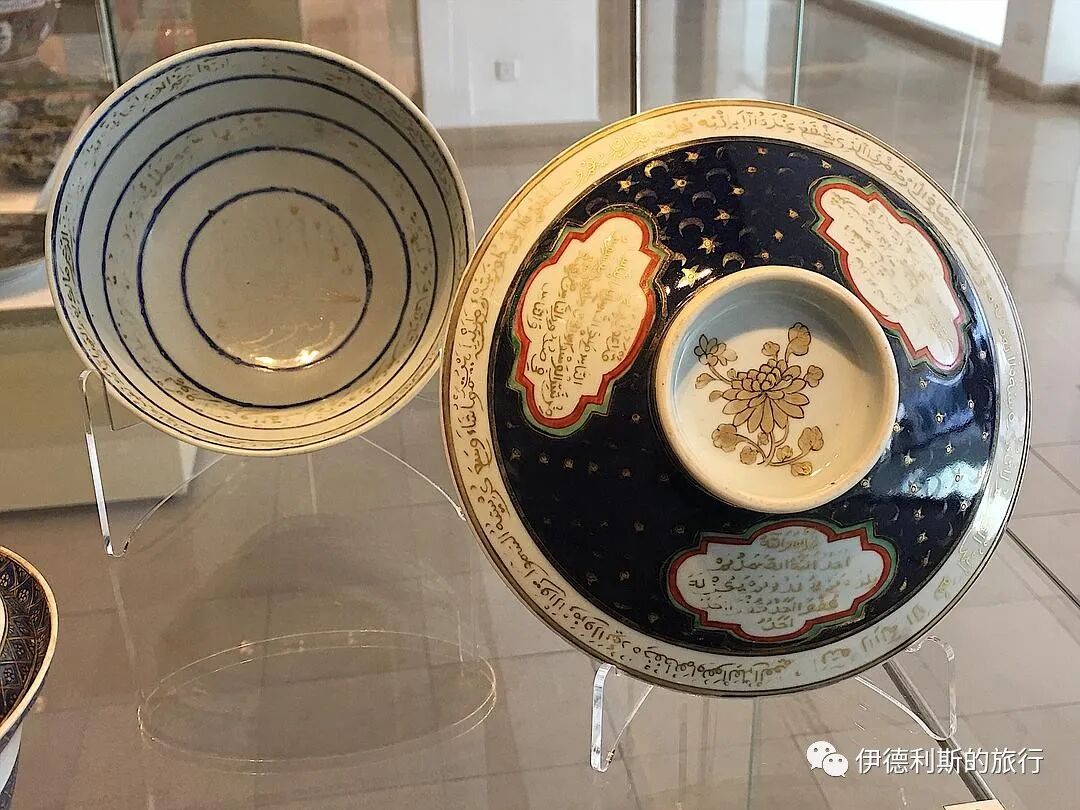
1. Ming Zhengde porcelain.
The Arabic and Persian script on Ming Zhengde porcelain is mostly written inside diamond or square-shaped panels. The outer walls are decorated with scrolling flowers or cloud patterns. The bottom has a mark reading 'Made in the Zhengde period of the Great Ming'. Most are blue and white, with only a few featuring overglaze red enamel.
The text inside the four diamond and square panels on the overglaze red enamel Zhengde piece in the picture translates to: 'O Allah, protect Hui Ma Yun from the anger of the wicked.'
2. Swatow ware (Shantou qi) ordered by the Aceh Sultanate royal family.
Swatow ware, also called Zhangzhou ware (Zhangzhou qi), is a type of export porcelain that appeared in the late Ming Dynasty. It was mainly for the Southeast Asian and Japanese markets and was popular from the mid-16th to mid-17th centuries. Most Swatow ware was produced by folk kilns in the Chaoshan and southern Fujian regions, with the most coming from near Zhangzhou, Fujian.
Compared to Jingdezhen porcelain, Swatow ware is rougher. Its biggest feature is the 'sandy base' (shadi zu). To save space in the kiln, artisans skipped using pads and saggers and instead dipped the foot ring of the porcelain in fine sand. After firing, sand grains remained on the base and foot ring. At first, Swatow ware only had underglaze blue and white, but later, overglaze enamel styles became very diverse.
15th-century Arabic-script Swatow ware exported to Muslim regions in Southeast Asia.
The most famous Arabic-script Swatow ware was ordered by the royal family of the Aceh Sultanate. The Aceh Sultanate was a powerful maritime trading state established in 1496 on the northwest coast of Sumatra. After the fall of the Malacca Sultanate, it became the center of Islam in Southeast Asia. The 16th and 17th centuries were the peak of the Aceh Sultanate. Most Aceh Shantou ware came from the court of Sultan Iskandar Muda (reigned 1607-1636) and several other sultans.
Most Aceh Shantou ware features nine circles. The center circle holds the name of the current sultan, while the eight surrounding circles hold the names of famous past sultans.
Shantou ware commissioned by the Aceh Sultanate royal family in the 16th and 17th centuries.
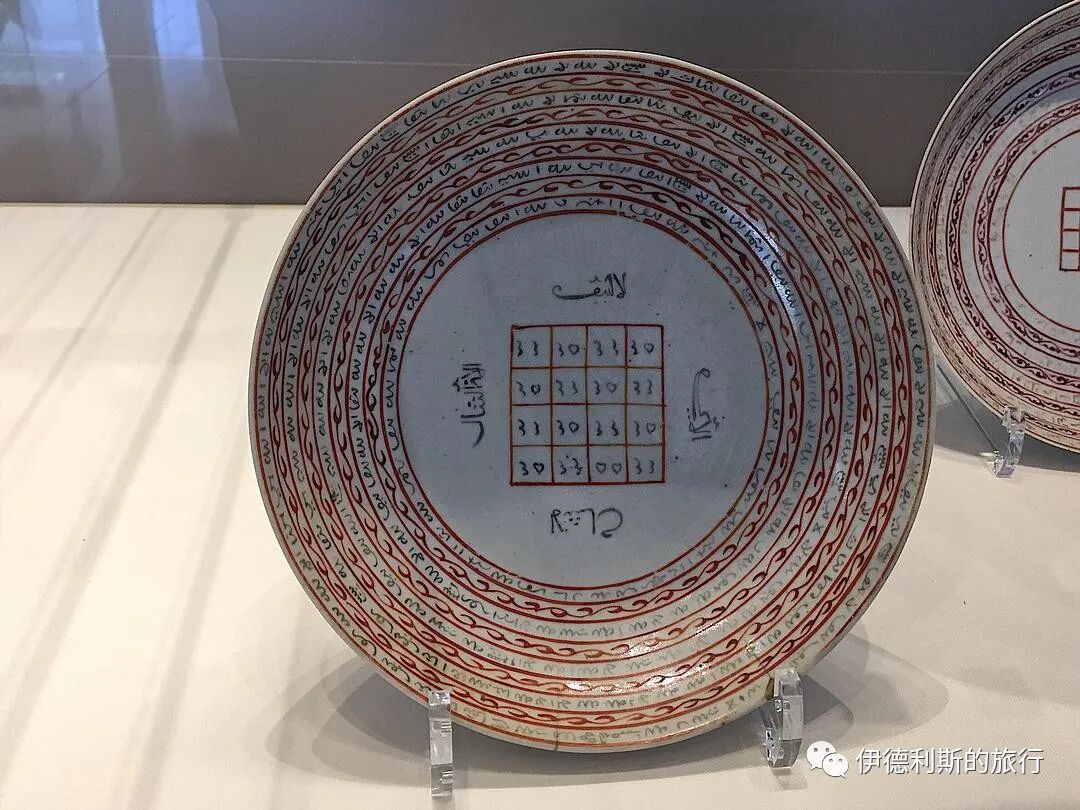
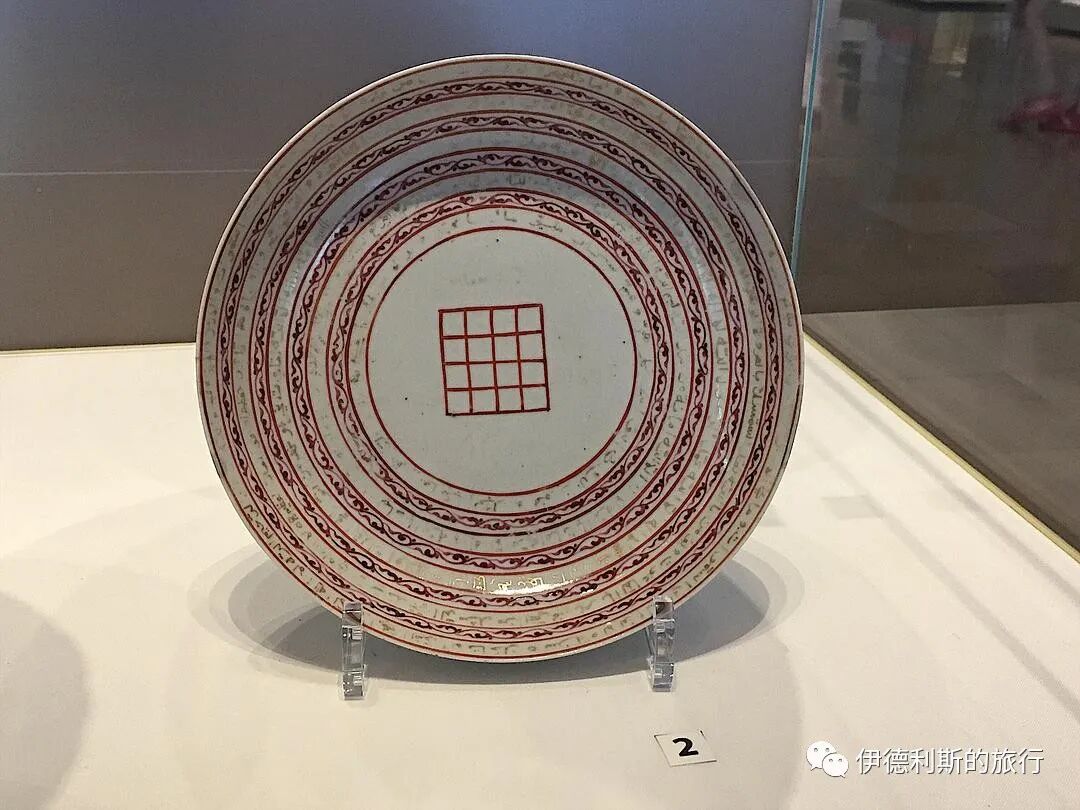
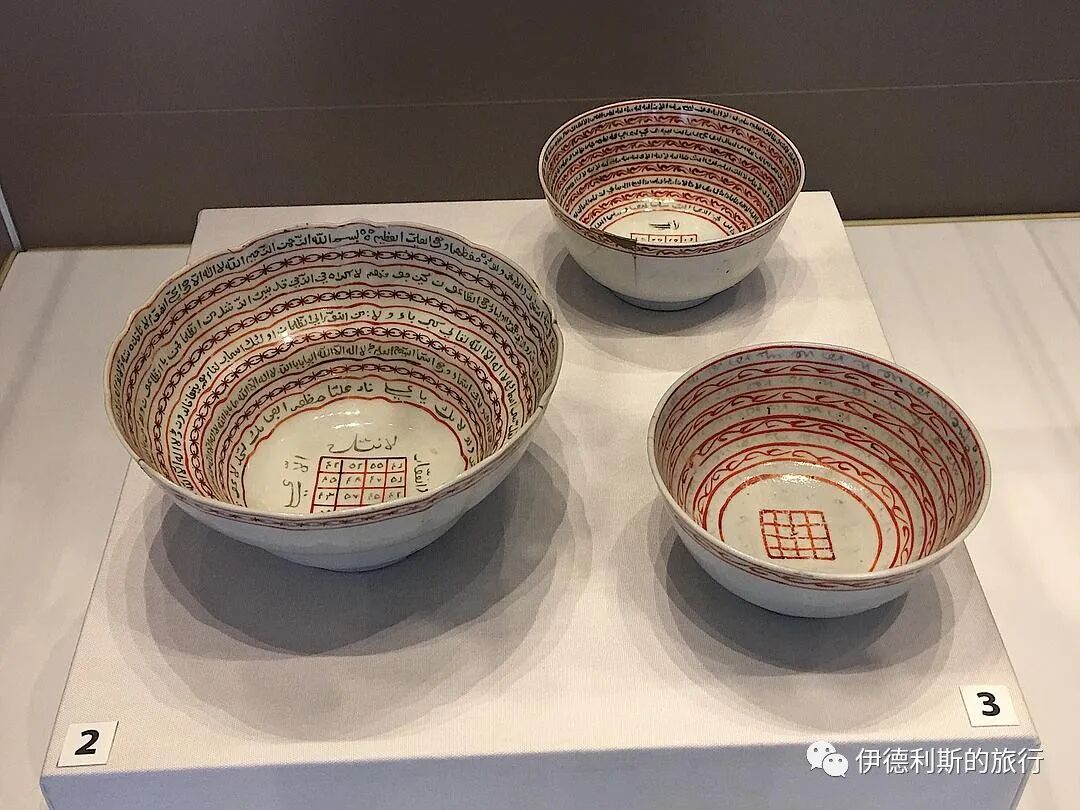
3. Magic square (huanfang) porcelain produced in China.
Magic squares, also called grid charts (zonghengtu), were believed to have predictive and healing powers.
A magic square is divided into 16 squares, each containing a number. The sum of the numbers in any row, column, or diagonal should be the same. Among these numbers, 1 is a symbol of Allah, and 7 represents the seven heavens, the seven hells, and the seven days of the week. In astrology, the 3 in a magic square represents Saturn, 4 represents Jupiter, 5 represents Mars, 6 represents the Sun, 7 represents Venus, 8 represents Mercury, and 9 represents the Moon.
Most 18th-century magic square export porcelain was produced in Jingdezhen. The squares are surrounded by excerpts from scriptures and classic texts. After the 19th century, folk kilns began mass-producing imitations. The surrounding text degraded into decorative patterns, and the numbers in the magic squares were simplified into symbols or disappeared entirely. By this time, the predictive function of magic square porcelain had changed, and it was used only for decoration.
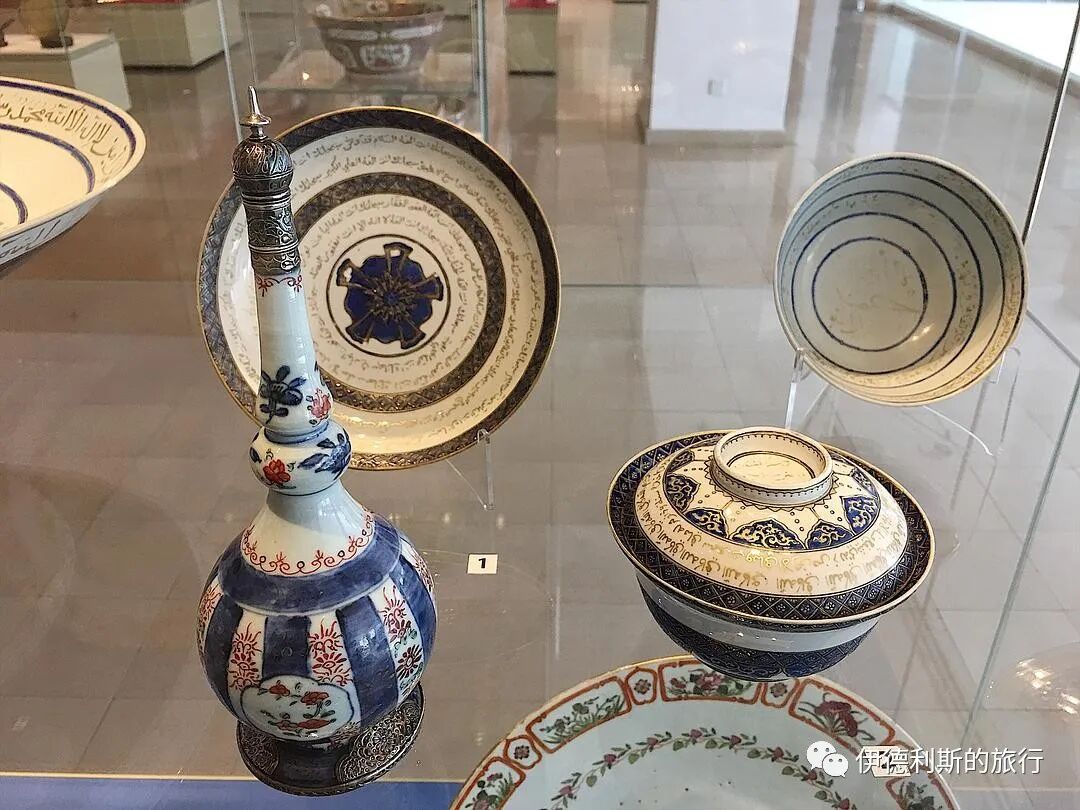
4. Chinese Imari porcelain.
Imari porcelain comes from the Arita kilns on Kyushu Island, Japan. In the mid-17th century, during the transition between the Ming and Qing dynasties, Chinese people who moved to Kyushu Island brought overglaze painting techniques, which helped the colorful Arita kilns take shape. The Ming-Qing transition also interrupted the export of Jingdezhen porcelain. In the late 17th century, Arita porcelain began to be exported in large quantities from the port of Imari in northwestern Kyushu, becoming the main source of export porcelain.
At the end of the 17th century, as China resumed porcelain exports from Guangzhou, Guangzhou export porcelain began to imitate Imari porcelain on a large scale, eventually surpassing Japan's export volume.
Chinese Imari porcelain mostly uses underglaze cobalt blue or iron-red enamel, with heavy gold painting applied over the glaze. Imari teapots with swan-neck spouts were also classic styles exported to Europe.
Chinese Imari porcelain from the Kangxi period.
Chinese Imari porcelain from the Qianlong era.
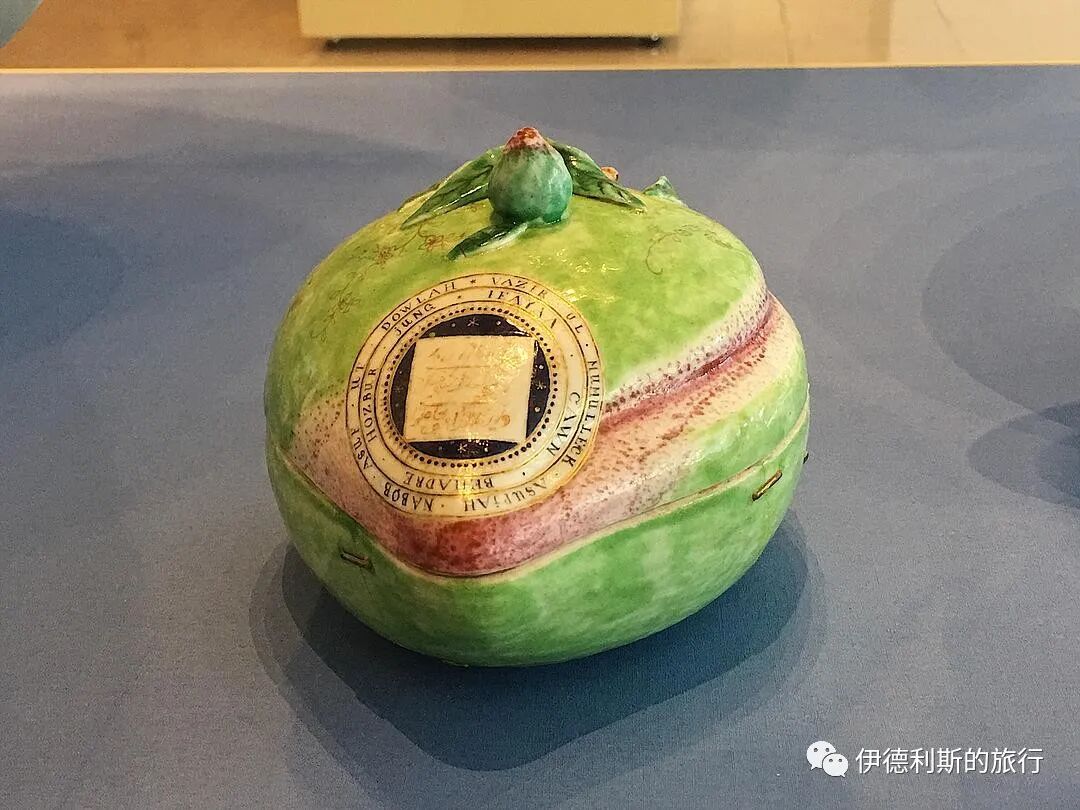
5. A Qianlong peach-shaped porcelain box ordered by the court of the Asaf Jahi dynasty in India.
The inscription on the porcelain box has Latin text on the outer ring reading 'NABOB ASUF UT DOWLAH VAZIR UL MUMULLECK ASUPJAH' and Latin text on the inner ring reading 'BEHADRE HOZBUR JUNG IEAYAA CAWN'. The Persian text in the center says the same thing, meaning it was dedicated to Muhyi ad-Din Muzaffar Jang Hidayat of the Asaf Jahi dynasty. Muzaffar Jang ruled the Asaf Jahi dynasty from 1750 to 1751.
The Asaf Jahi dynasty was a Muslim kingdom on the Deccan Plateau in southern India from 1724 to 1948, centered in the city of Hyderabad.
The Asaf Jahi family was originally a Turkic family from Samarkand. They arrived in the Mughal Empire in the late 17th century to serve as court officials. In 1724, the Mughal Empire fell into chaos. Mir Qamar-ud-Din Siddiqi, who had served as the Governor of the Deccan, declared independence using the Asaf Jah title granted by the Mughal Emperor. He established the Asaf Jahi dynasty in Hyderabad and called himself the Nizam-ul-Mulk of Hyderabad (the ruler of Hyderabad).
Asaf Jah I died in 1748. His son Nasir Jung and his grandson Muzaffar Jung fought for the throne with support from the British and French. Nasir Jung died in battle in 1750. Muzaffar Jung ruled for one year before dying in battle in 1751. Finally, Asaf Jah I's third son, Salabat Jung, became Asaf Jah II.
6. Chinese export porcelain ordered by the Persian Qajar dynasty.
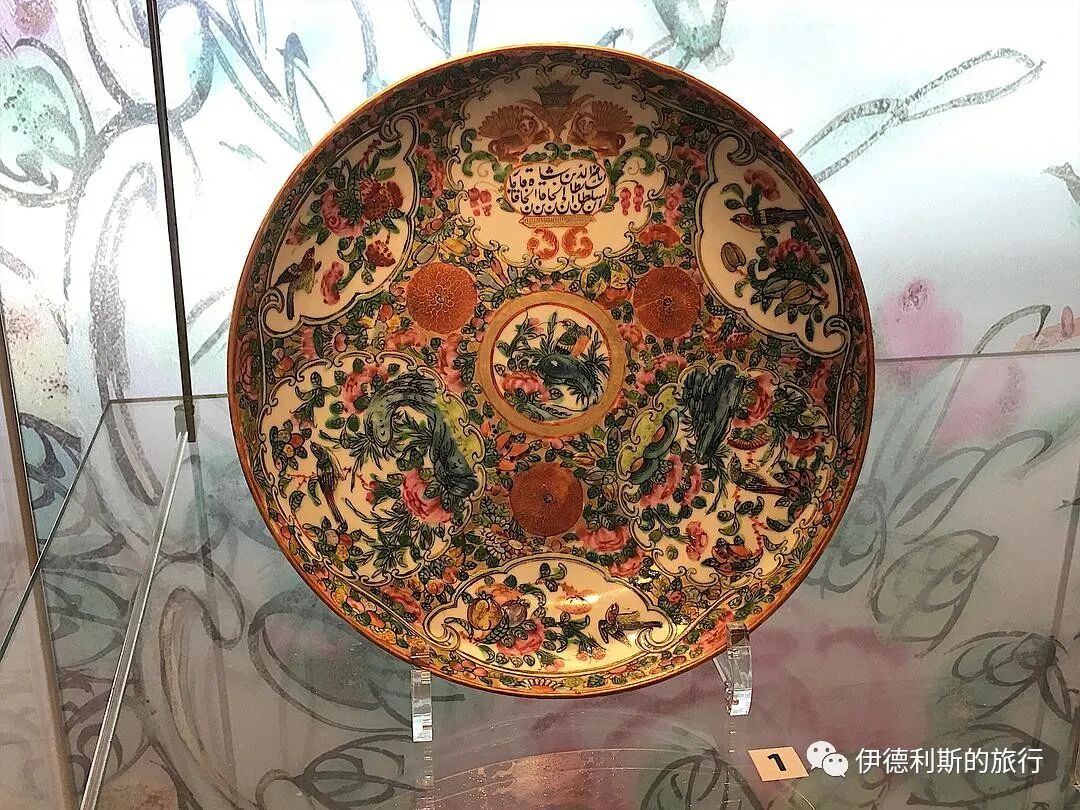
The fourth monarch of the Persian Qajar dynasty, Naser al-Din Shah Qajar (reigned 1848-1896), and his eldest son, Mass'oud Mirza Zell-e Soltan (1850-1918), ordered a large amount of Chinese export porcelain. These porcelains were mainly Canton enamel (guangcai), but also included blue and white porcelain and Fitzhugh porcelain.
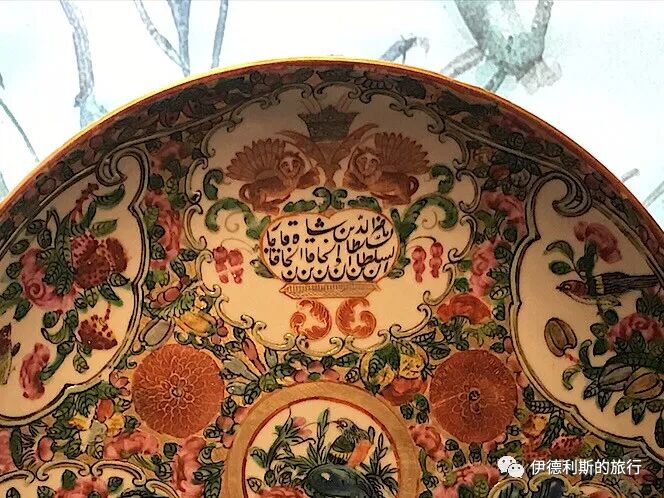
The porcelain plate below features the emblem of the Qajar dynasty at the top.
Canton enamel (guangcai).
The full name of Canton enamel is Guangzhou gold-woven colored porcelain (Guangzhou zhijin caici). It was a famous export porcelain from Guangzhou during the middle and late Qing dynasty.
In 1685 (the 24th year of the Kangxi reign), the Yuehai Customs was established, followed by the Thirteen Factories of Guangzhou for foreign trade. Porcelain was an important export commodity. Initial export porcelain was ordered directly from Jingdezhen. By the Yongzheng era, porcelain merchants in Guangzhou began shipping white porcelain blanks from Jingdezhen to Guangzhou. They hired Jingdezhen masters to perform low-temperature overglaze painting in Guangzhou, which is how Canton enamel began.
After the Qianlong era, Canton enamel entered a mature stage and formed its own colorful and gorgeous style. The colors were mainly Western red, crane-spring color, eggplant color, deep ochre, and powder green, all produced locally in Guangzhou. After the Daoguang era, the number of colors increased to more than a dozen.
Canton enamel from the late Qing dynasty was mass-produced with neat patterns. Bowls, plates, and dishes mostly had a gold-trimmed circle in the center. The surrounding area was filled with 'full-ground' patterns of various flowers, fruits, birds, insects, people, and landscapes, along with logos specified by foreign merchants.
Below is Canton enamel ordered by the court of the Persian Qajar dynasty (1779-1921) between the late 19th century and 1915.
Guangzhou blue porcelain from 1882.
Fitzhugh porcelain from 1878.
Fitzhugh porcelain is named after Thomas Fitzhugh, a director of the British East India Company in Guangzhou during the 1760s. He ordered many pieces in this style between 1787 and 1800. This made the porcelain very popular for export during the Jiaqing period (1796-1820), and it remained popular through the Daoguang period (1821-1850). The main feature of Fitzhugh porcelain is a medallion pattern in the center, surrounded by various traditional Chinese elements.
7. Other export porcelain with Arabic and Persian script.
18th-century multicolored porcelain plate.
19th-century brush pot.
18th-century jar.
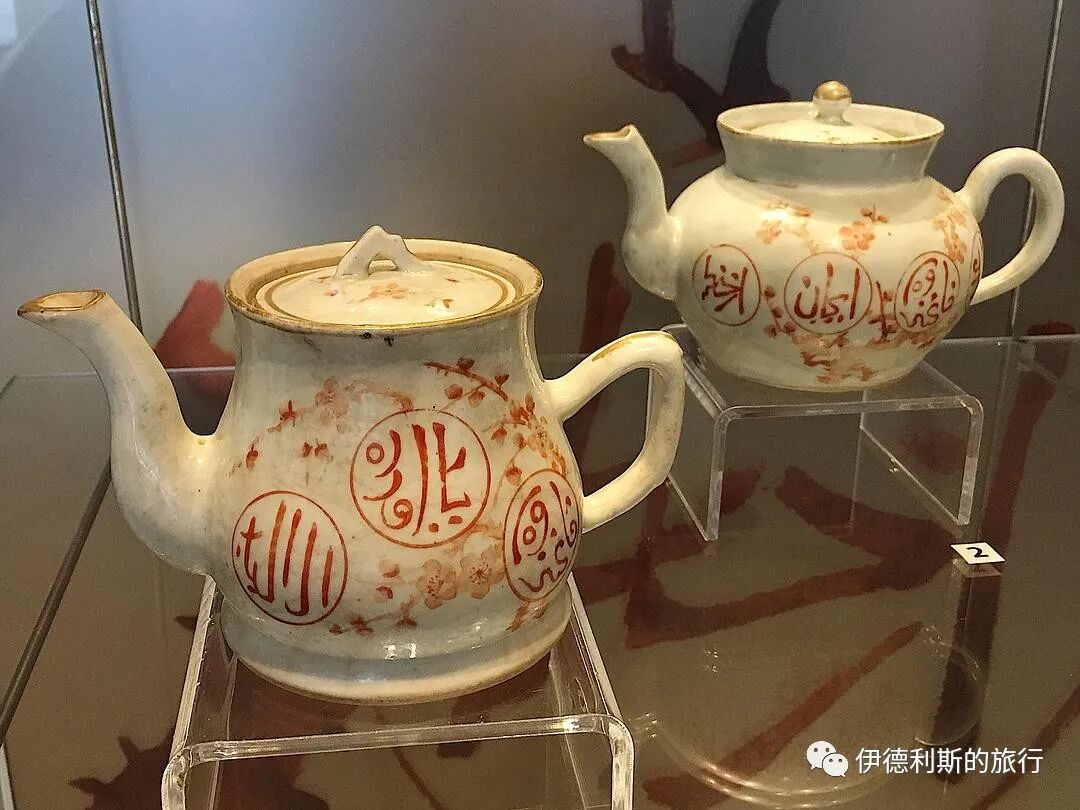
19th-century teapot.
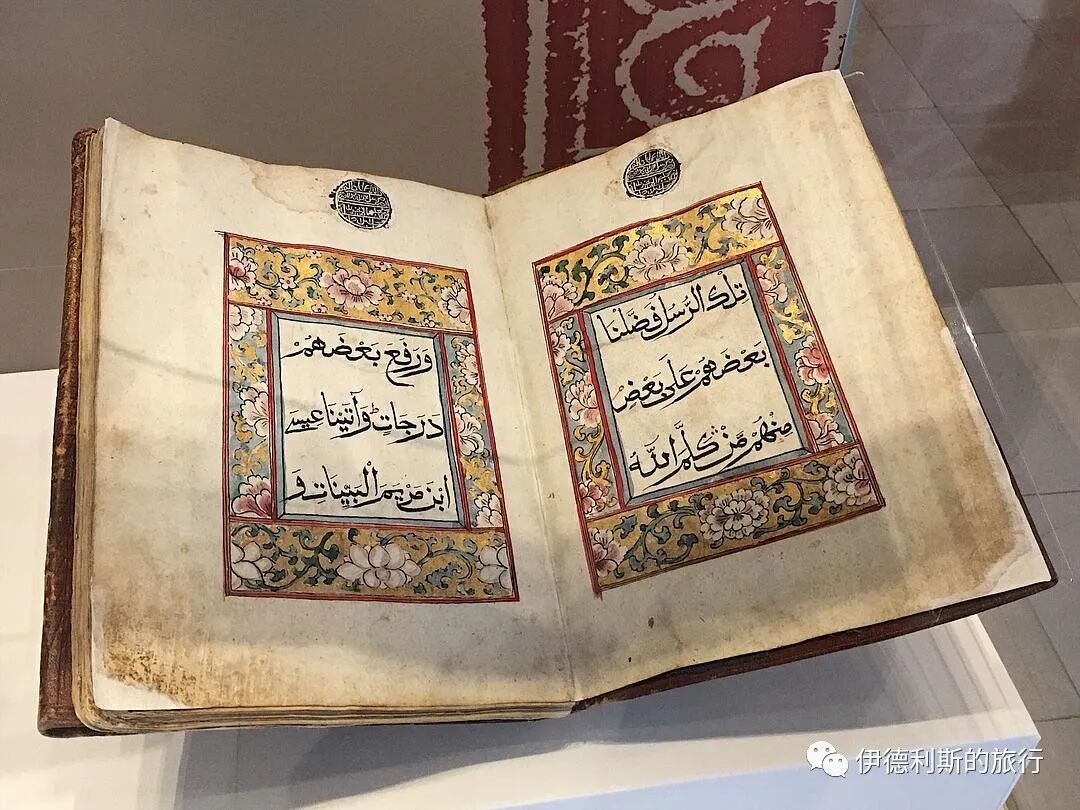
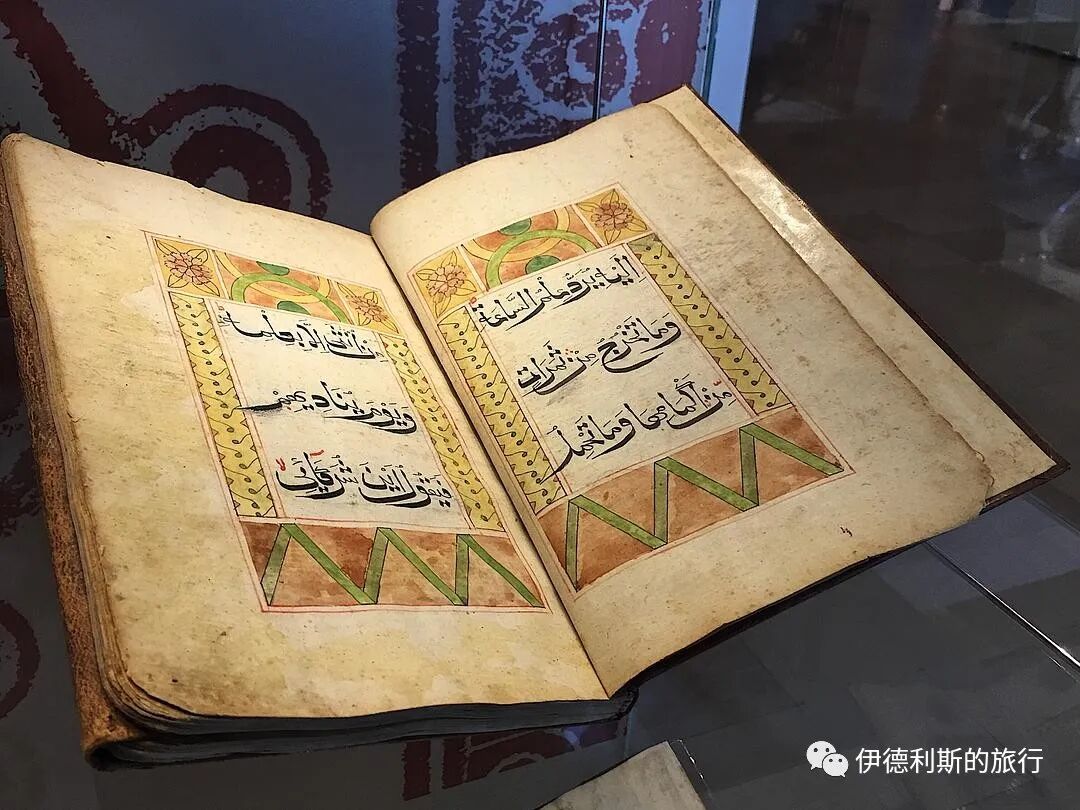
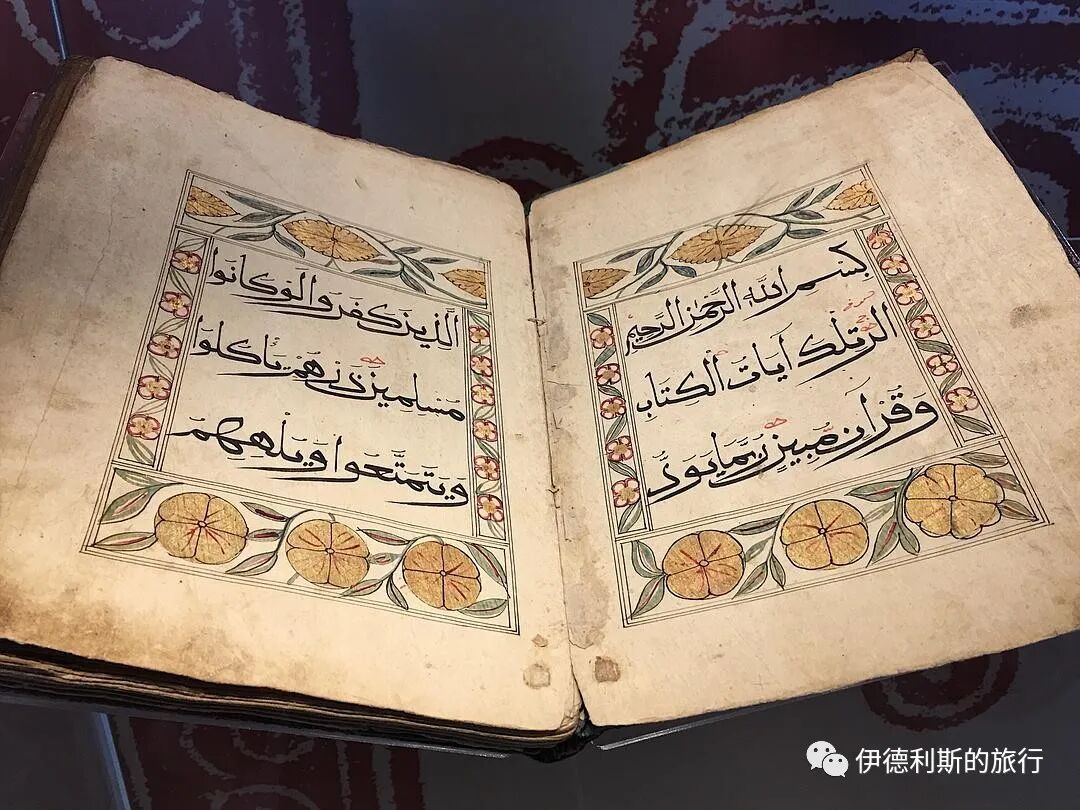
8. Ming and Qing dynasty scripture manuscripts.
A 30-volume scripture manuscript from Gansu Province, dated March to April 1546. It is signed by Khaili Ibrahim Yunus Al-sini and features peony and cloud patterns.
A 30-volume scripture manuscript from the 17th-century Qing dynasty.
A 30-volume scripture manuscript from 1730 during the Qing dynasty, with a brown embossed leather cover.
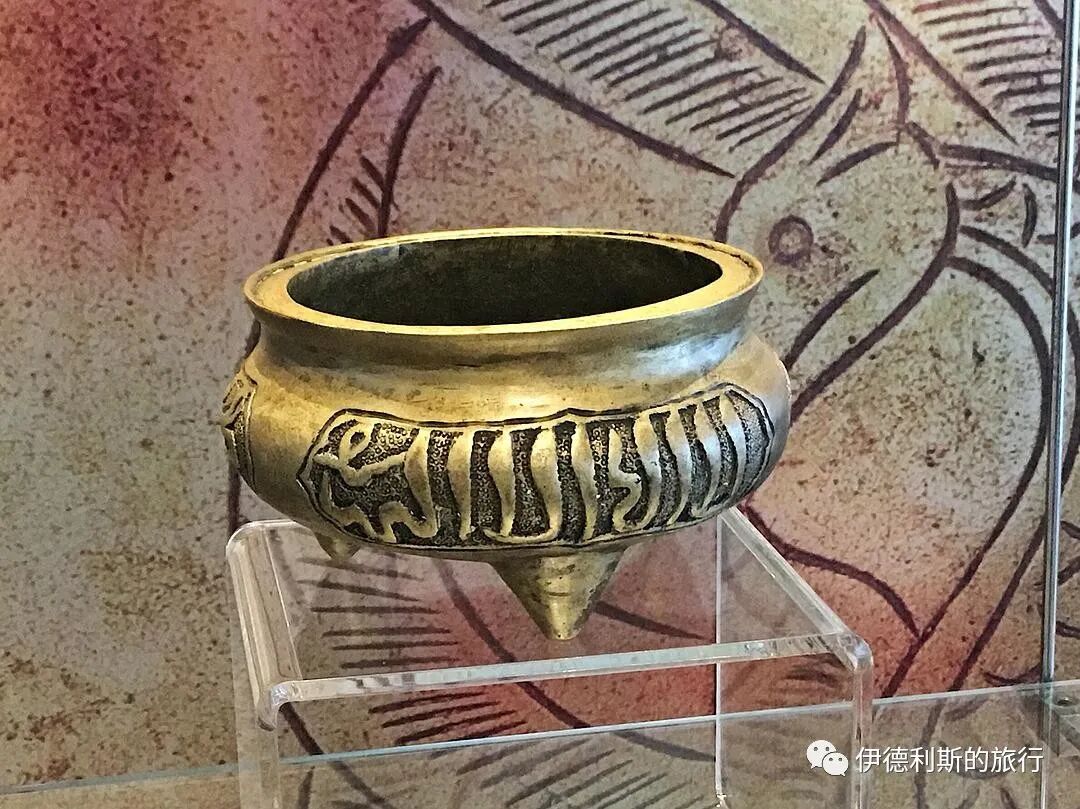
9. Xuande incense burners (Xuande lu).
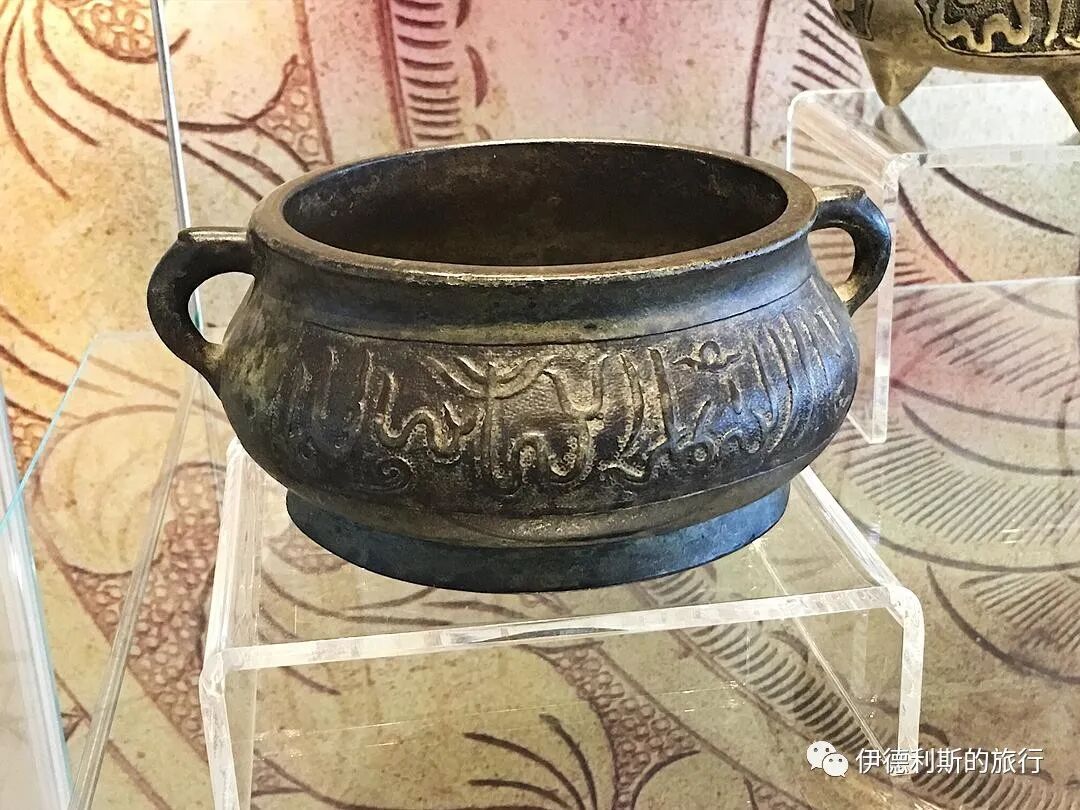
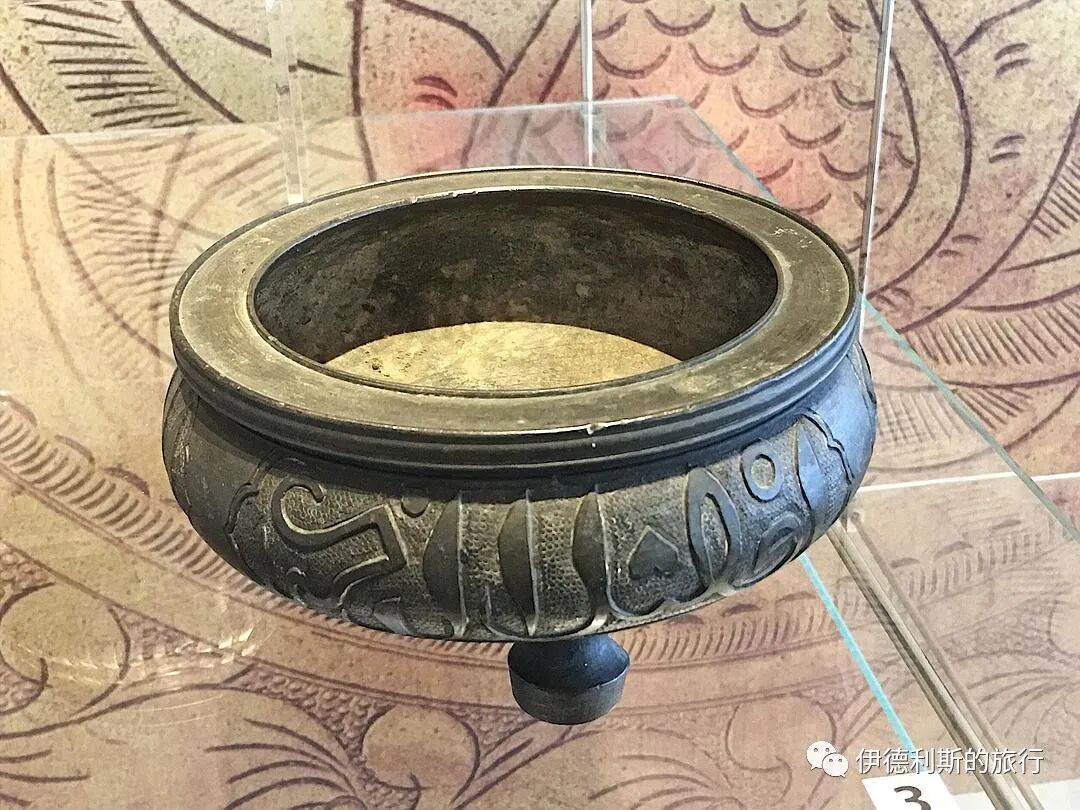
Bronze incense burners appeared at the end of the Yuan dynasty. They reached their peak during the Ming dynasty Xuande period (1425-1435), when they were cast in brass for the first time. Xuande burners are made using the lost-wax casting method, so you cannot see any mold marks after polishing. Most have an open mouth, a short neck, and a flat belly. Some have three blunt cone-shaped solid feet, while others have bridge-shaped handles on the rim. They are dark purple or blackish-brown, and many are gilded or inlaid with gold flakes on the outside.
The production of imitation Xuande burners continued from the Xuande period through the Republic of China era. Xuande burners from different eras have different features. Those from the late Ming dynasty are heavier, those from the Yongzheng period are softer, and those from the Qianlong period show higher craftsmanship. After the 19th century, Xuande burners became increasingly rough, and their quality dropped significantly.
Starting in the Ming dynasty Zhengde period (1506-1521), Xuande burners featuring the Basmala or the Shahada appeared and continued to be made.
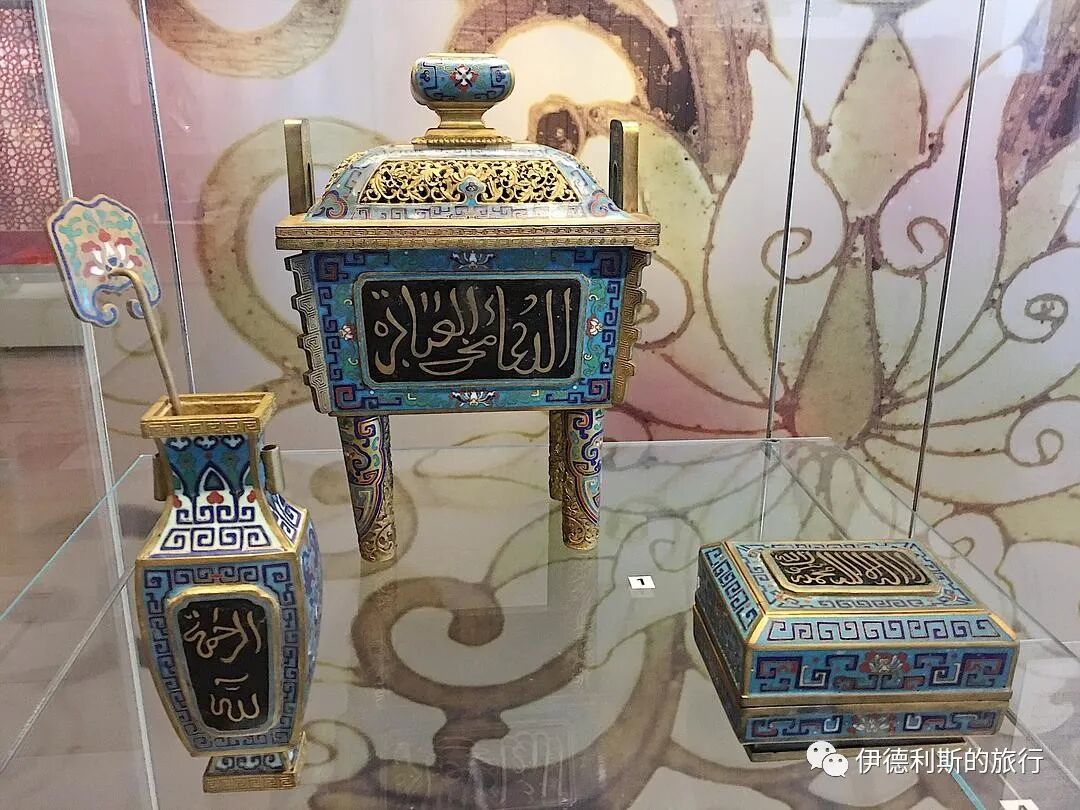
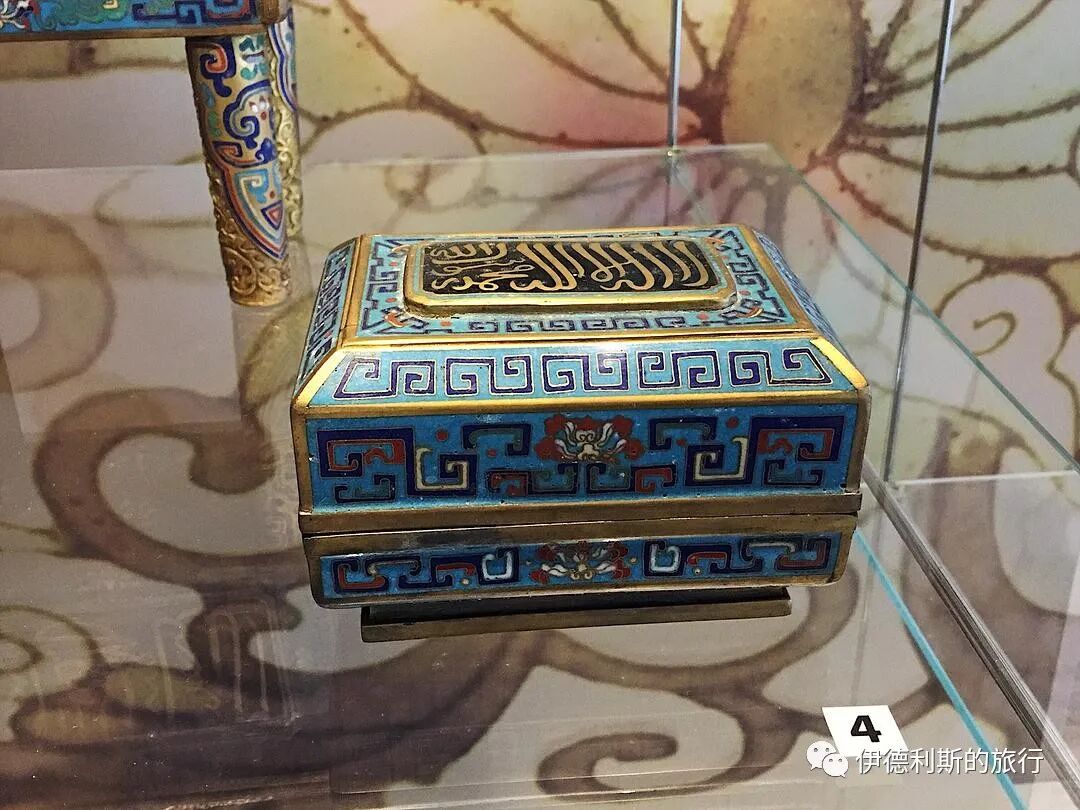
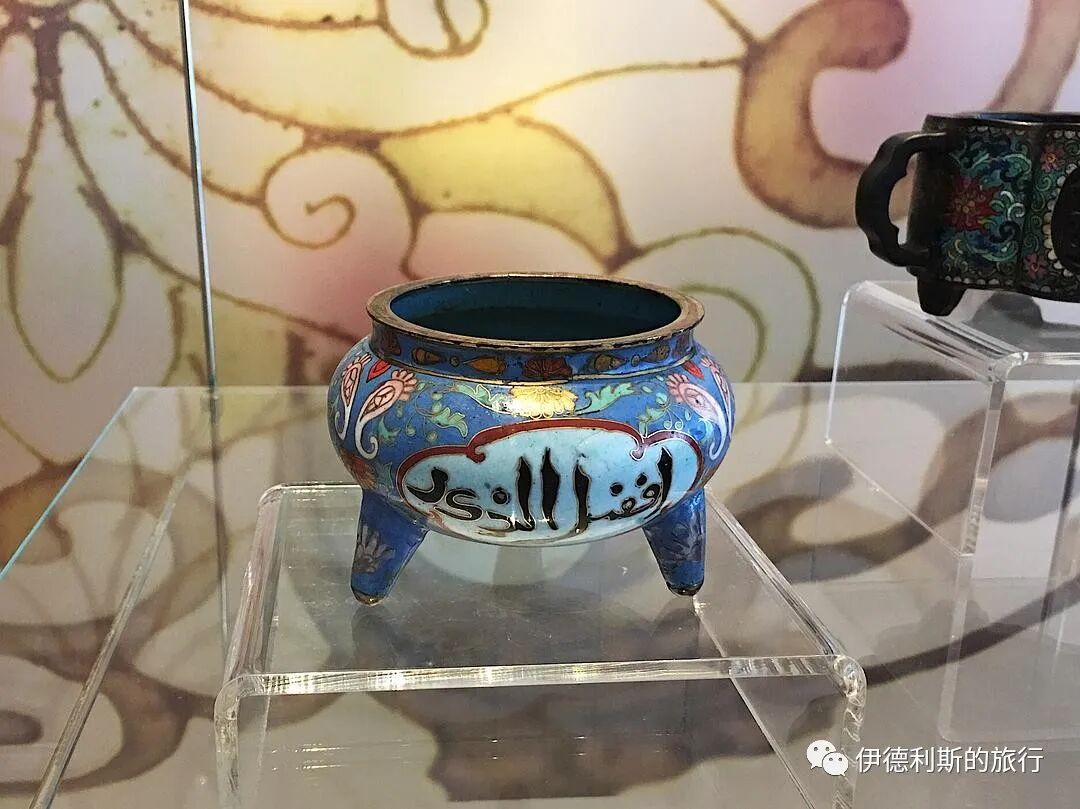
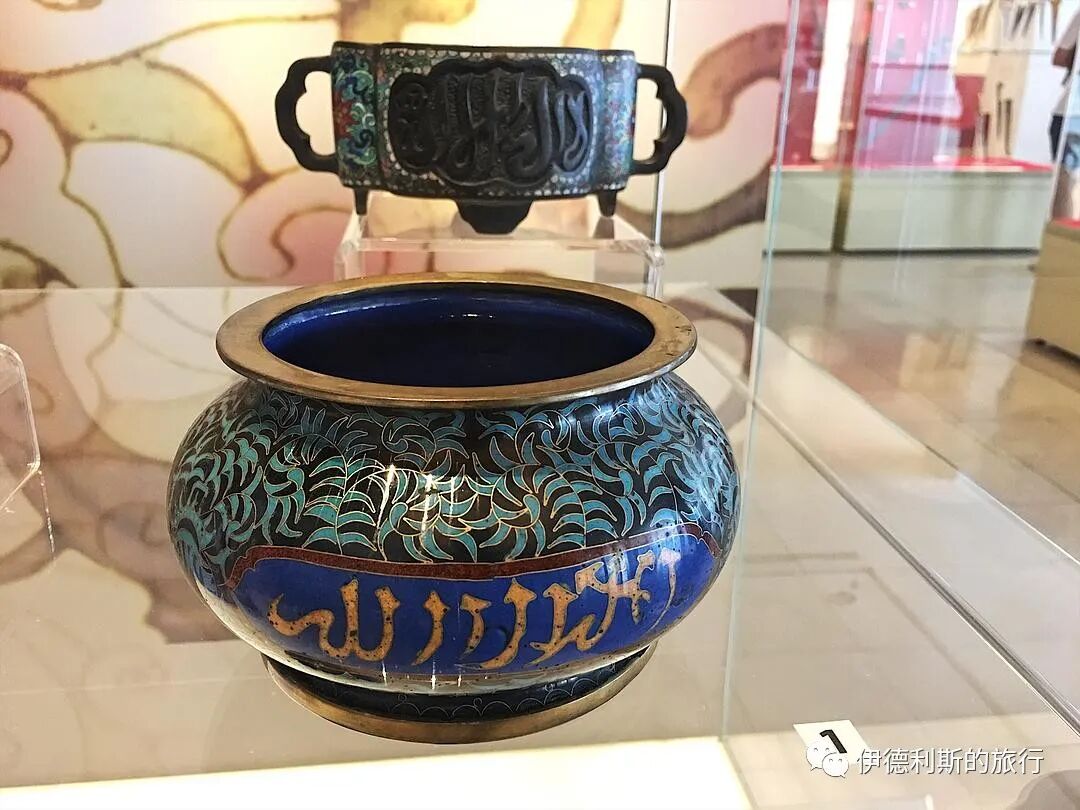
10. Qing Dynasty copperware and cloisonné enamel (jingtailan)
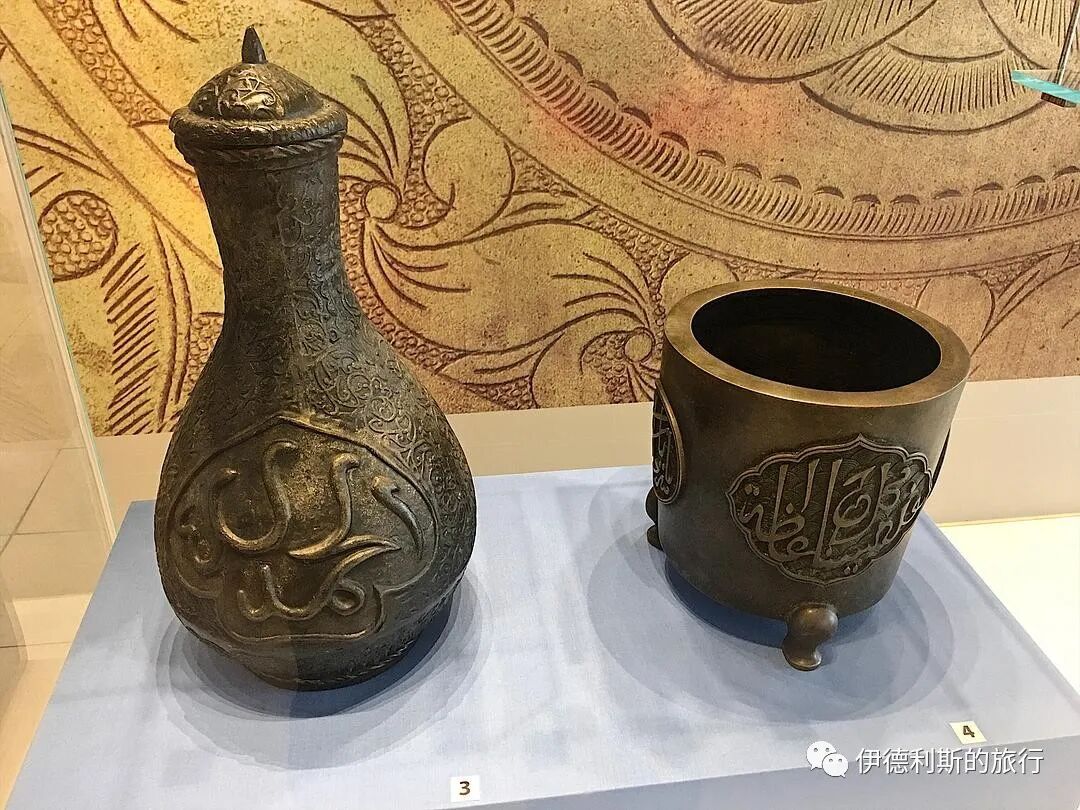
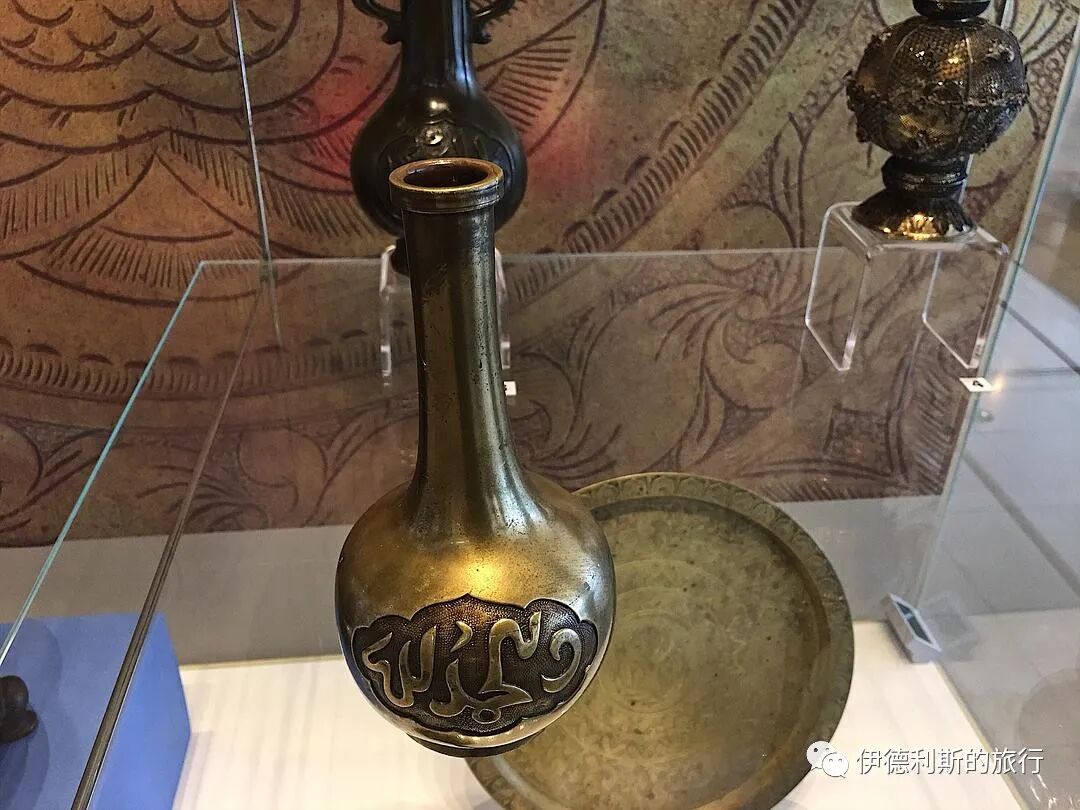
After the Canton Customs was set up in 1685 (the 24th year of the Kangxi reign) and the Thirteen Factories were established in Guangdong, copperware and cloisonné enamel (jingtailan) featuring Arabic and Persian script began to be exported during the 18th and 19th centuries.
The one on the left is from 1815, and the one on the right is from the 18th century.
18th-century copperware
Cloisonné enamel (jingtailan) view all
Summary: Malaysia Islamic Arts Museum: Chinese Muslim Artifacts and Islamic Heritage is presented here as a firsthand travel account in clear English, beginning with this scene: The Islamic Arts Museum Malaysia (Muzium Kesenian Islam Malaysia) is in Kuala Lumpur. It is the largest Islamic museum in Southeast Asia and holds over 7,000 Islamic art pieces from all over the world. The account keeps its focus on Malaysia Islamic Art, Chinese Artifacts, Museum Visit while preserving the names, places, food, and historical details from the Chinese source.
The Islamic Arts Museum Malaysia (Muzium Kesenian Islam Malaysia) is in Kuala Lumpur. It is the largest Islamic museum in Southeast Asia and holds over 7,000 Islamic art pieces from all over the world.
First, let's look at the museum's collection of artifacts related to China.
The history of Chinese-made porcelain with Arabic and Persian script.
Starting in the Yuan Dynasty, China exported large amounts of blue and white porcelain to the Middle East. Pieces have been dug up in Egypt, Iran, and Syria. During the Ming Dynasty, starting in the Yongle period (1403-1424), blue and white porcelain with Arabic and Persian script appeared. Most were modeled after metal and glass items from Arab and Persian regions and were made mainly for export. During the Zhengde period (1506-1521), blue and white porcelain with Arabic and Persian script mostly consisted of bowls, cups, brush rests, and boxes that matched the shapes of official imperial kiln pieces. Many were traditional stationery items. Because they often featured Quranic verses and praises to Allah, it is believed they were mostly ordered by Hui Muslims living in China.
Starting in the 16th century, folk kilns in Chaoshan and southern Fujian began producing Arabic-script export porcelain. These were mainly for the Southeast Asian market. The quality was lower than that of Jingdezhen, but the output was much higher.
After the Thirteen Factories were set up in Guangzhou during the Kangxi period, the amount of export porcelain grew rapidly. Porcelain began to be exported with long passages of scripture and the names of Caliphs. The higher-quality pieces were usually from Jingdezhen, while the lower-quality ones came from folk kilns in Chaoshan and southern Fujian. Because the folk kiln artisans were not familiar with the script, the Quranic text was often written incorrectly.
By the 18th and 19th centuries, the British East India Company imported large amounts of Chinese export porcelain. Wealthy Muslim families began ordering a lot of porcelain with Arabic and Persian script. The most famous examples were for the Asaf Jahi dynasty court in Hyderabad, India, and the Qajar dynasty court in Persia. However, most of these Muslim families ordered through the British East India Company in London rather than directly from Guangzhou.
1. Ming Zhengde porcelain.
The Arabic and Persian script on Ming Zhengde porcelain is mostly written inside diamond or square-shaped panels. The outer walls are decorated with scrolling flowers or cloud patterns. The bottom has a mark reading 'Made in the Zhengde period of the Great Ming'. Most are blue and white, with only a few featuring overglaze red enamel.
The text inside the four diamond and square panels on the overglaze red enamel Zhengde piece in the picture translates to: 'O Allah, protect Hui Ma Yun from the anger of the wicked.'
2. Swatow ware (Shantou qi) ordered by the Aceh Sultanate royal family.
Swatow ware, also called Zhangzhou ware (Zhangzhou qi), is a type of export porcelain that appeared in the late Ming Dynasty. It was mainly for the Southeast Asian and Japanese markets and was popular from the mid-16th to mid-17th centuries. Most Swatow ware was produced by folk kilns in the Chaoshan and southern Fujian regions, with the most coming from near Zhangzhou, Fujian.
Compared to Jingdezhen porcelain, Swatow ware is rougher. Its biggest feature is the 'sandy base' (shadi zu). To save space in the kiln, artisans skipped using pads and saggers and instead dipped the foot ring of the porcelain in fine sand. After firing, sand grains remained on the base and foot ring. At first, Swatow ware only had underglaze blue and white, but later, overglaze enamel styles became very diverse.
15th-century Arabic-script Swatow ware exported to Muslim regions in Southeast Asia.
The most famous Arabic-script Swatow ware was ordered by the royal family of the Aceh Sultanate. The Aceh Sultanate was a powerful maritime trading state established in 1496 on the northwest coast of Sumatra. After the fall of the Malacca Sultanate, it became the center of Islam in Southeast Asia. The 16th and 17th centuries were the peak of the Aceh Sultanate. Most Aceh Shantou ware came from the court of Sultan Iskandar Muda (reigned 1607-1636) and several other sultans.
Most Aceh Shantou ware features nine circles. The center circle holds the name of the current sultan, while the eight surrounding circles hold the names of famous past sultans.
Shantou ware commissioned by the Aceh Sultanate royal family in the 16th and 17th centuries.
3. Magic square (huanfang) porcelain produced in China.
Magic squares, also called grid charts (zonghengtu), were believed to have predictive and healing powers.
A magic square is divided into 16 squares, each containing a number. The sum of the numbers in any row, column, or diagonal should be the same. Among these numbers, 1 is a symbol of Allah, and 7 represents the seven heavens, the seven hells, and the seven days of the week. In astrology, the 3 in a magic square represents Saturn, 4 represents Jupiter, 5 represents Mars, 6 represents the Sun, 7 represents Venus, 8 represents Mercury, and 9 represents the Moon.
Most 18th-century magic square export porcelain was produced in Jingdezhen. The squares are surrounded by excerpts from scriptures and classic texts. After the 19th century, folk kilns began mass-producing imitations. The surrounding text degraded into decorative patterns, and the numbers in the magic squares were simplified into symbols or disappeared entirely. By this time, the predictive function of magic square porcelain had changed, and it was used only for decoration.
4. Chinese Imari porcelain.
Imari porcelain comes from the Arita kilns on Kyushu Island, Japan. In the mid-17th century, during the transition between the Ming and Qing dynasties, Chinese people who moved to Kyushu Island brought overglaze painting techniques, which helped the colorful Arita kilns take shape. The Ming-Qing transition also interrupted the export of Jingdezhen porcelain. In the late 17th century, Arita porcelain began to be exported in large quantities from the port of Imari in northwestern Kyushu, becoming the main source of export porcelain.
At the end of the 17th century, as China resumed porcelain exports from Guangzhou, Guangzhou export porcelain began to imitate Imari porcelain on a large scale, eventually surpassing Japan's export volume.
Chinese Imari porcelain mostly uses underglaze cobalt blue or iron-red enamel, with heavy gold painting applied over the glaze. Imari teapots with swan-neck spouts were also classic styles exported to Europe.
Chinese Imari porcelain from the Kangxi period.
Chinese Imari porcelain from the Qianlong era.
5. A Qianlong peach-shaped porcelain box ordered by the court of the Asaf Jahi dynasty in India.
The inscription on the porcelain box has Latin text on the outer ring reading 'NABOB ASUF UT DOWLAH VAZIR UL MUMULLECK ASUPJAH' and Latin text on the inner ring reading 'BEHADRE HOZBUR JUNG IEAYAA CAWN'. The Persian text in the center says the same thing, meaning it was dedicated to Muhyi ad-Din Muzaffar Jang Hidayat of the Asaf Jahi dynasty. Muzaffar Jang ruled the Asaf Jahi dynasty from 1750 to 1751.
The Asaf Jahi dynasty was a Muslim kingdom on the Deccan Plateau in southern India from 1724 to 1948, centered in the city of Hyderabad.
The Asaf Jahi family was originally a Turkic family from Samarkand. They arrived in the Mughal Empire in the late 17th century to serve as court officials. In 1724, the Mughal Empire fell into chaos. Mir Qamar-ud-Din Siddiqi, who had served as the Governor of the Deccan, declared independence using the Asaf Jah title granted by the Mughal Emperor. He established the Asaf Jahi dynasty in Hyderabad and called himself the Nizam-ul-Mulk of Hyderabad (the ruler of Hyderabad).
Asaf Jah I died in 1748. His son Nasir Jung and his grandson Muzaffar Jung fought for the throne with support from the British and French. Nasir Jung died in battle in 1750. Muzaffar Jung ruled for one year before dying in battle in 1751. Finally, Asaf Jah I's third son, Salabat Jung, became Asaf Jah II.
6. Chinese export porcelain ordered by the Persian Qajar dynasty.
The fourth monarch of the Persian Qajar dynasty, Naser al-Din Shah Qajar (reigned 1848-1896), and his eldest son, Mass'oud Mirza Zell-e Soltan (1850-1918), ordered a large amount of Chinese export porcelain. These porcelains were mainly Canton enamel (guangcai), but also included blue and white porcelain and Fitzhugh porcelain.
The porcelain plate below features the emblem of the Qajar dynasty at the top.
Canton enamel (guangcai).
The full name of Canton enamel is Guangzhou gold-woven colored porcelain (Guangzhou zhijin caici). It was a famous export porcelain from Guangzhou during the middle and late Qing dynasty.
In 1685 (the 24th year of the Kangxi reign), the Yuehai Customs was established, followed by the Thirteen Factories of Guangzhou for foreign trade. Porcelain was an important export commodity. Initial export porcelain was ordered directly from Jingdezhen. By the Yongzheng era, porcelain merchants in Guangzhou began shipping white porcelain blanks from Jingdezhen to Guangzhou. They hired Jingdezhen masters to perform low-temperature overglaze painting in Guangzhou, which is how Canton enamel began.
After the Qianlong era, Canton enamel entered a mature stage and formed its own colorful and gorgeous style. The colors were mainly Western red, crane-spring color, eggplant color, deep ochre, and powder green, all produced locally in Guangzhou. After the Daoguang era, the number of colors increased to more than a dozen.
Canton enamel from the late Qing dynasty was mass-produced with neat patterns. Bowls, plates, and dishes mostly had a gold-trimmed circle in the center. The surrounding area was filled with 'full-ground' patterns of various flowers, fruits, birds, insects, people, and landscapes, along with logos specified by foreign merchants.
Below is Canton enamel ordered by the court of the Persian Qajar dynasty (1779-1921) between the late 19th century and 1915.
Guangzhou blue porcelain from 1882.
Fitzhugh porcelain from 1878.
Fitzhugh porcelain is named after Thomas Fitzhugh, a director of the British East India Company in Guangzhou during the 1760s. He ordered many pieces in this style between 1787 and 1800. This made the porcelain very popular for export during the Jiaqing period (1796-1820), and it remained popular through the Daoguang period (1821-1850). The main feature of Fitzhugh porcelain is a medallion pattern in the center, surrounded by various traditional Chinese elements.
7. Other export porcelain with Arabic and Persian script.
18th-century multicolored porcelain plate.
19th-century brush pot.
18th-century jar.
19th-century teapot.
8. Ming and Qing dynasty scripture manuscripts.
A 30-volume scripture manuscript from Gansu Province, dated March to April 1546. It is signed by Khaili Ibrahim Yunus Al-sini and features peony and cloud patterns.
A 30-volume scripture manuscript from the 17th-century Qing dynasty.
A 30-volume scripture manuscript from 1730 during the Qing dynasty, with a brown embossed leather cover.
9. Xuande incense burners (Xuande lu).
Bronze incense burners appeared at the end of the Yuan dynasty. They reached their peak during the Ming dynasty Xuande period (1425-1435), when they were cast in brass for the first time. Xuande burners are made using the lost-wax casting method, so you cannot see any mold marks after polishing. Most have an open mouth, a short neck, and a flat belly. Some have three blunt cone-shaped solid feet, while others have bridge-shaped handles on the rim. They are dark purple or blackish-brown, and many are gilded or inlaid with gold flakes on the outside.
The production of imitation Xuande burners continued from the Xuande period through the Republic of China era. Xuande burners from different eras have different features. Those from the late Ming dynasty are heavier, those from the Yongzheng period are softer, and those from the Qianlong period show higher craftsmanship. After the 19th century, Xuande burners became increasingly rough, and their quality dropped significantly.
Starting in the Ming dynasty Zhengde period (1506-1521), Xuande burners featuring the Basmala or the Shahada appeared and continued to be made.
10. Qing Dynasty copperware and cloisonné enamel (jingtailan)
After the Canton Customs was set up in 1685 (the 24th year of the Kangxi reign) and the Thirteen Factories were established in Guangdong, copperware and cloisonné enamel (jingtailan) featuring Arabic and Persian script began to be exported during the 18th and 19th centuries.
The one on the left is from 1815, and the one on the right is from the 18th century.
18th-century copperware
Cloisonné enamel (jingtailan) view all
Reposted from the web
Summary: Malaysia Islamic Arts Museum: Chinese Muslim Artifacts and Islamic Heritage is presented here as a firsthand travel account in clear English, beginning with this scene: The Islamic Arts Museum Malaysia (Muzium Kesenian Islam Malaysia) is in Kuala Lumpur. It is the largest Islamic museum in Southeast Asia and holds over 7,000 Islamic art pieces from all over the world. The account keeps its focus on Malaysia Islamic Art, Chinese Artifacts, Museum Visit while preserving the names, places, food, and historical details from the Chinese source.
The Islamic Arts Museum Malaysia (Muzium Kesenian Islam Malaysia) is in Kuala Lumpur. It is the largest Islamic museum in Southeast Asia and holds over 7,000 Islamic art pieces from all over the world.
First, let's look at the museum's collection of artifacts related to China.
The history of Chinese-made porcelain with Arabic and Persian script.
Starting in the Yuan Dynasty, China exported large amounts of blue and white porcelain to the Middle East. Pieces have been dug up in Egypt, Iran, and Syria. During the Ming Dynasty, starting in the Yongle period (1403-1424), blue and white porcelain with Arabic and Persian script appeared. Most were modeled after metal and glass items from Arab and Persian regions and were made mainly for export. During the Zhengde period (1506-1521), blue and white porcelain with Arabic and Persian script mostly consisted of bowls, cups, brush rests, and boxes that matched the shapes of official imperial kiln pieces. Many were traditional stationery items. Because they often featured Quranic verses and praises to Allah, it is believed they were mostly ordered by Hui Muslims living in China.
Starting in the 16th century, folk kilns in Chaoshan and southern Fujian began producing Arabic-script export porcelain. These were mainly for the Southeast Asian market. The quality was lower than that of Jingdezhen, but the output was much higher.
After the Thirteen Factories were set up in Guangzhou during the Kangxi period, the amount of export porcelain grew rapidly. Porcelain began to be exported with long passages of scripture and the names of Caliphs. The higher-quality pieces were usually from Jingdezhen, while the lower-quality ones came from folk kilns in Chaoshan and southern Fujian. Because the folk kiln artisans were not familiar with the script, the Quranic text was often written incorrectly.
By the 18th and 19th centuries, the British East India Company imported large amounts of Chinese export porcelain. Wealthy Muslim families began ordering a lot of porcelain with Arabic and Persian script. The most famous examples were for the Asaf Jahi dynasty court in Hyderabad, India, and the Qajar dynasty court in Persia. However, most of these Muslim families ordered through the British East India Company in London rather than directly from Guangzhou.
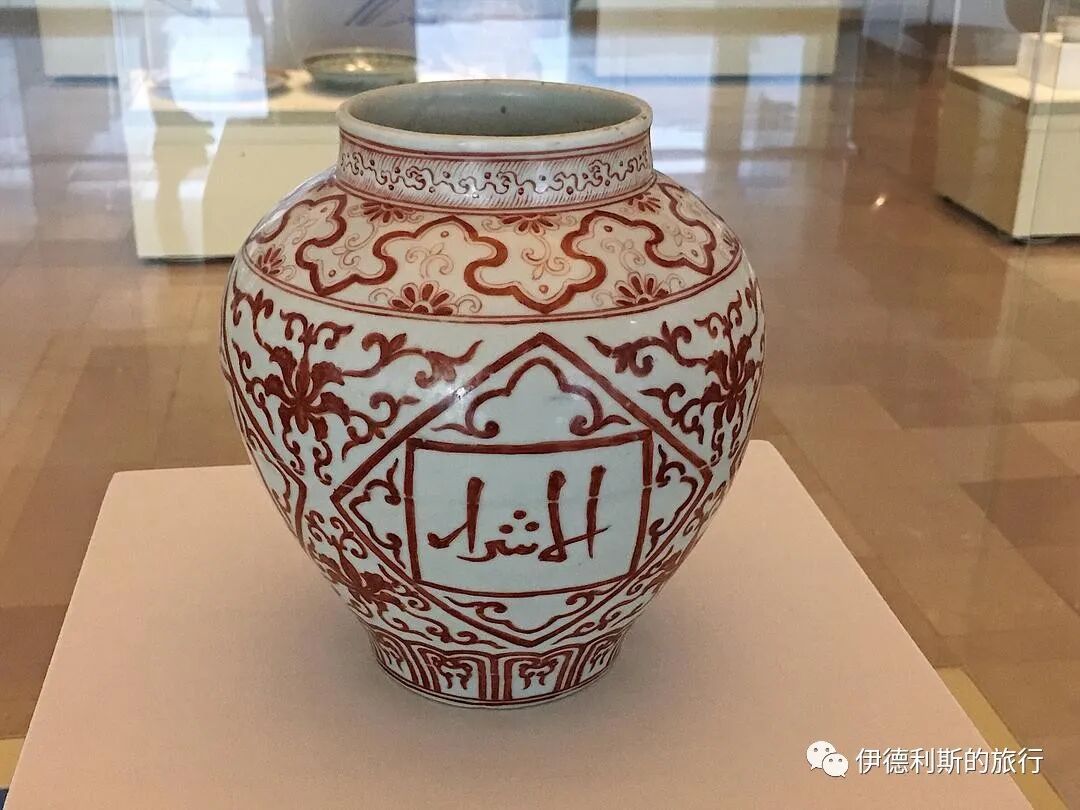
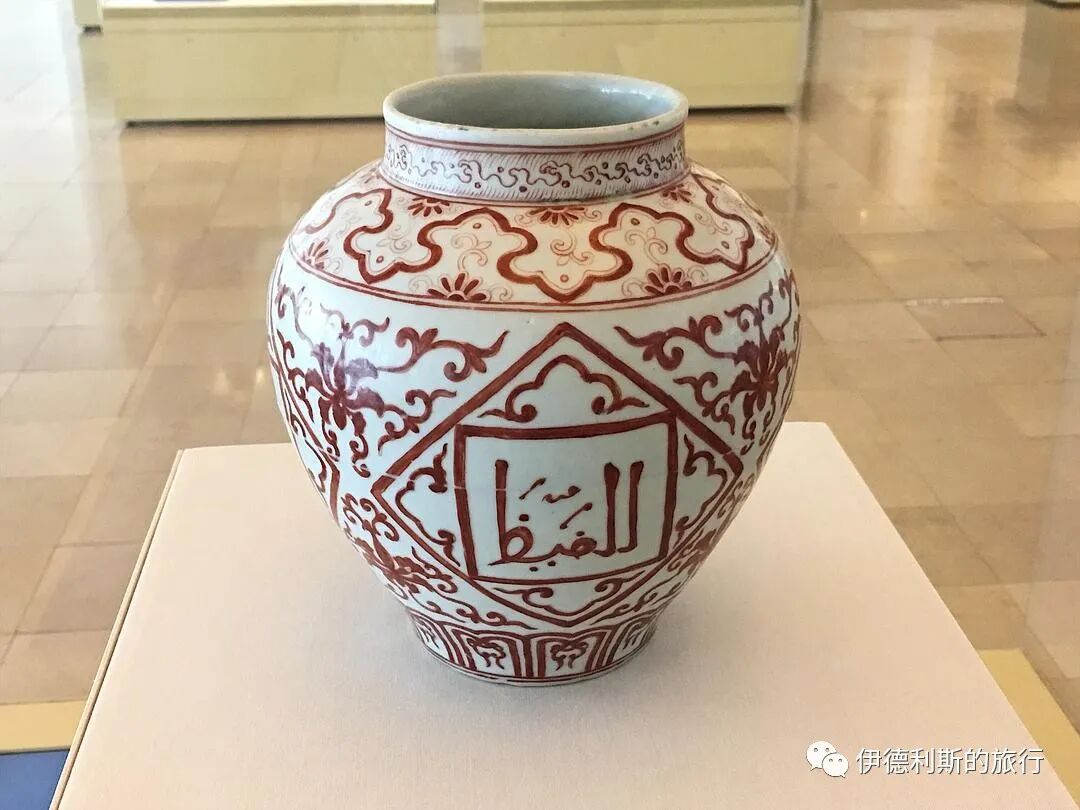
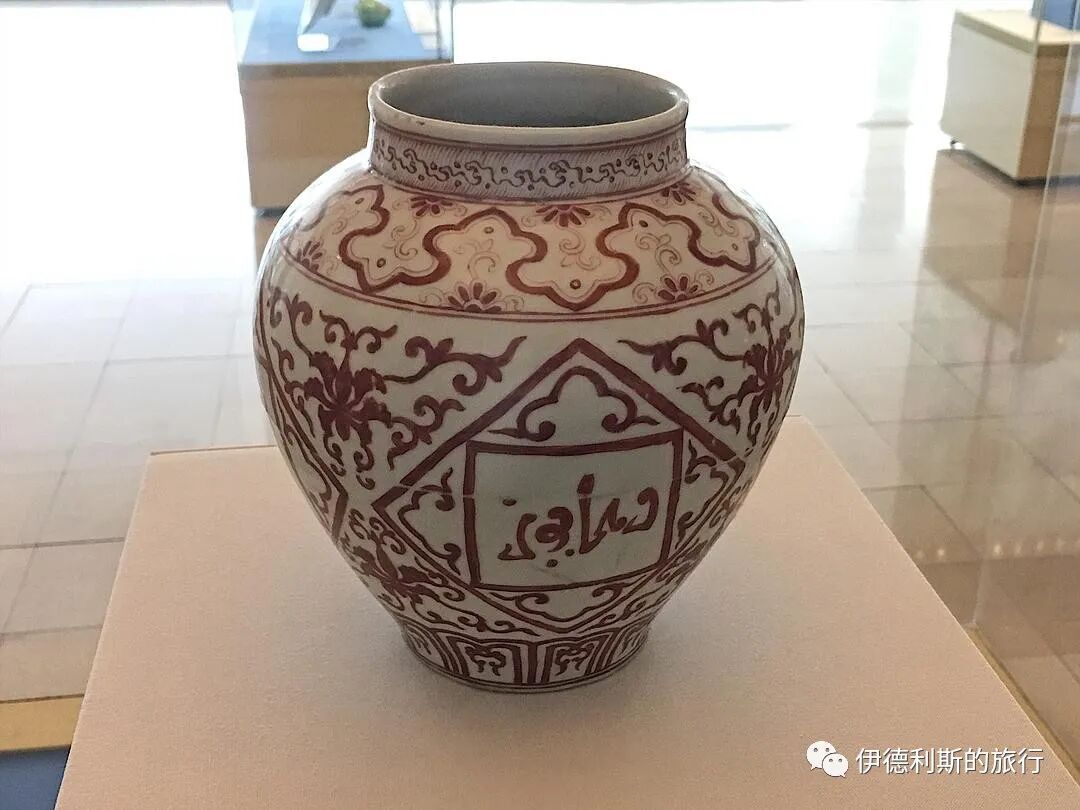
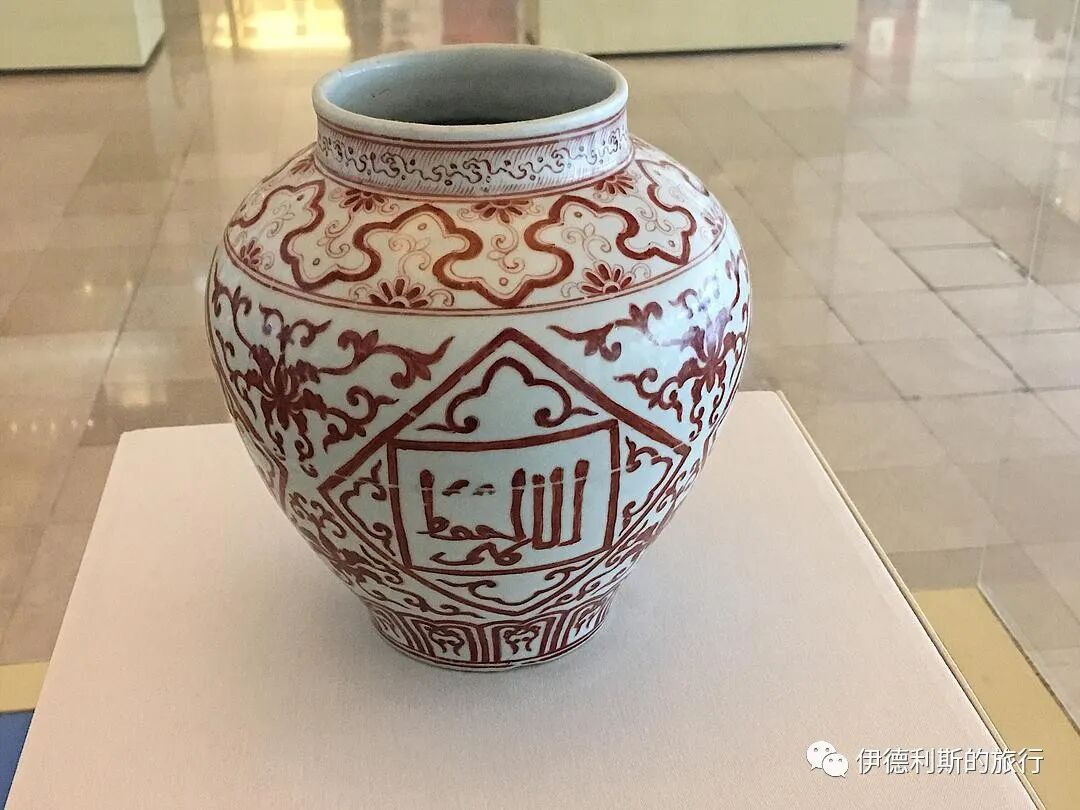
1. Ming Zhengde porcelain.
The Arabic and Persian script on Ming Zhengde porcelain is mostly written inside diamond or square-shaped panels. The outer walls are decorated with scrolling flowers or cloud patterns. The bottom has a mark reading 'Made in the Zhengde period of the Great Ming'. Most are blue and white, with only a few featuring overglaze red enamel.
The text inside the four diamond and square panels on the overglaze red enamel Zhengde piece in the picture translates to: 'O Allah, protect Hui Ma Yun from the anger of the wicked.'
2. Swatow ware (Shantou qi) ordered by the Aceh Sultanate royal family.
Swatow ware, also called Zhangzhou ware (Zhangzhou qi), is a type of export porcelain that appeared in the late Ming Dynasty. It was mainly for the Southeast Asian and Japanese markets and was popular from the mid-16th to mid-17th centuries. Most Swatow ware was produced by folk kilns in the Chaoshan and southern Fujian regions, with the most coming from near Zhangzhou, Fujian.
Compared to Jingdezhen porcelain, Swatow ware is rougher. Its biggest feature is the 'sandy base' (shadi zu). To save space in the kiln, artisans skipped using pads and saggers and instead dipped the foot ring of the porcelain in fine sand. After firing, sand grains remained on the base and foot ring. At first, Swatow ware only had underglaze blue and white, but later, overglaze enamel styles became very diverse.
15th-century Arabic-script Swatow ware exported to Muslim regions in Southeast Asia.
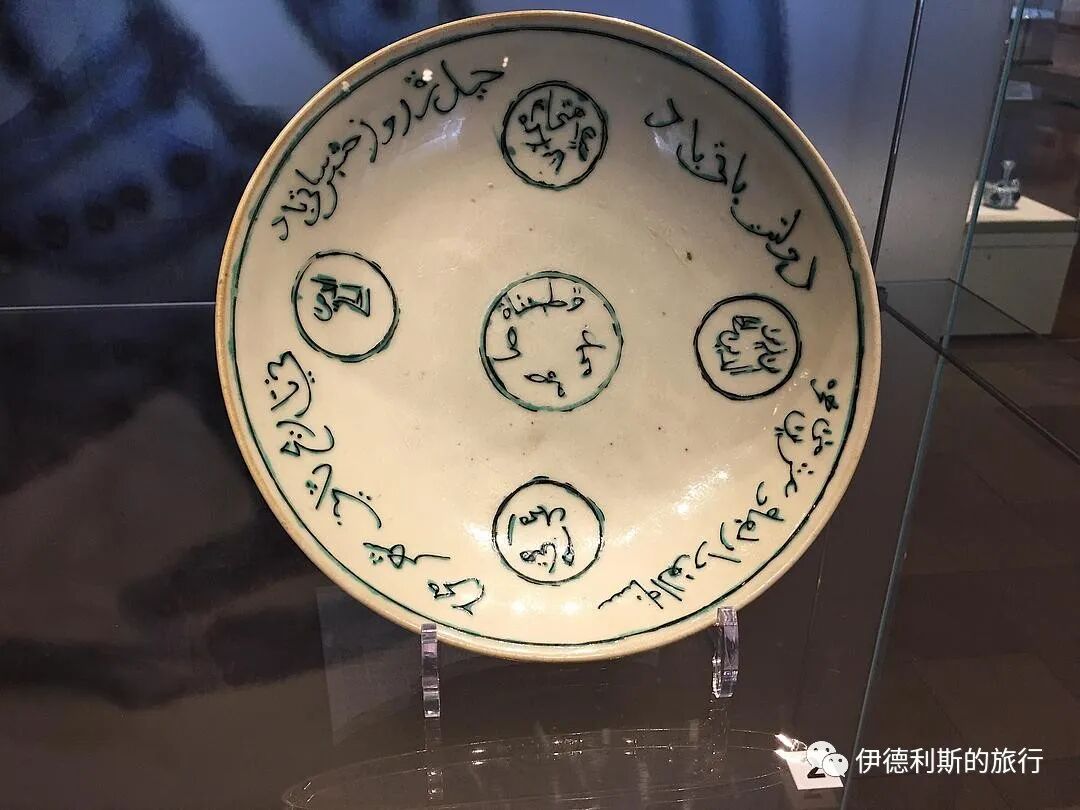
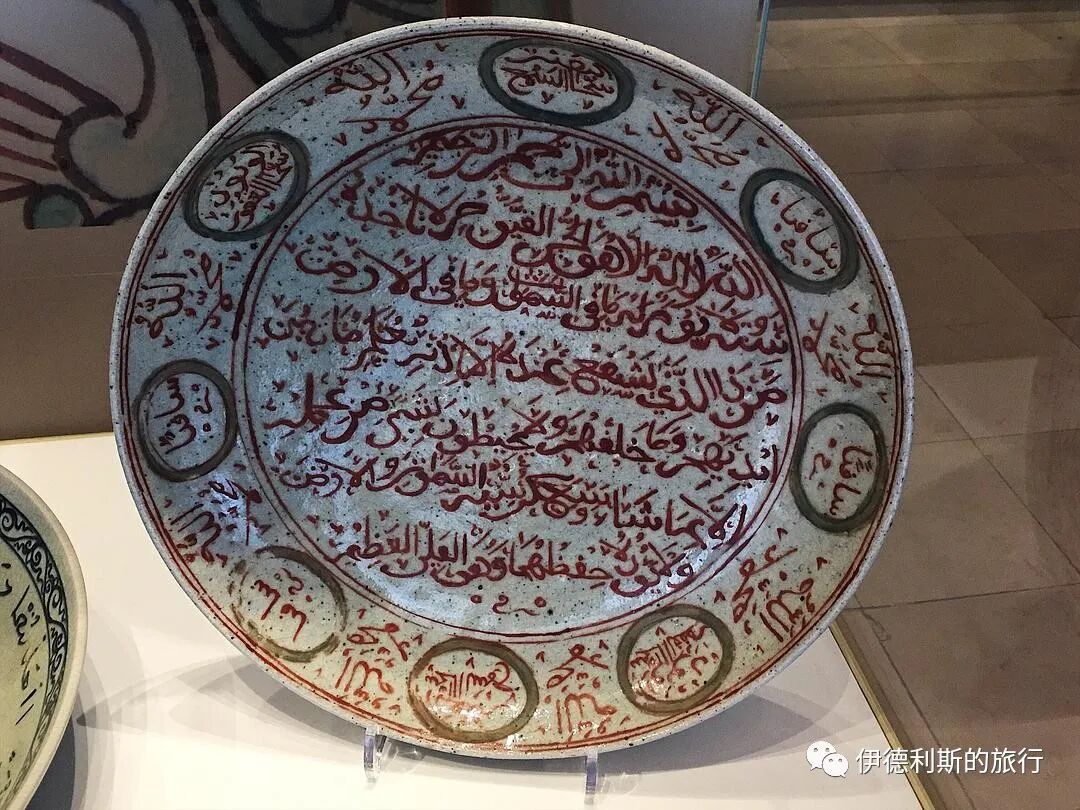
The most famous Arabic-script Swatow ware was ordered by the royal family of the Aceh Sultanate. The Aceh Sultanate was a powerful maritime trading state established in 1496 on the northwest coast of Sumatra. After the fall of the Malacca Sultanate, it became the center of Islam in Southeast Asia. The 16th and 17th centuries were the peak of the Aceh Sultanate. Most Aceh Shantou ware came from the court of Sultan Iskandar Muda (reigned 1607-1636) and several other sultans.
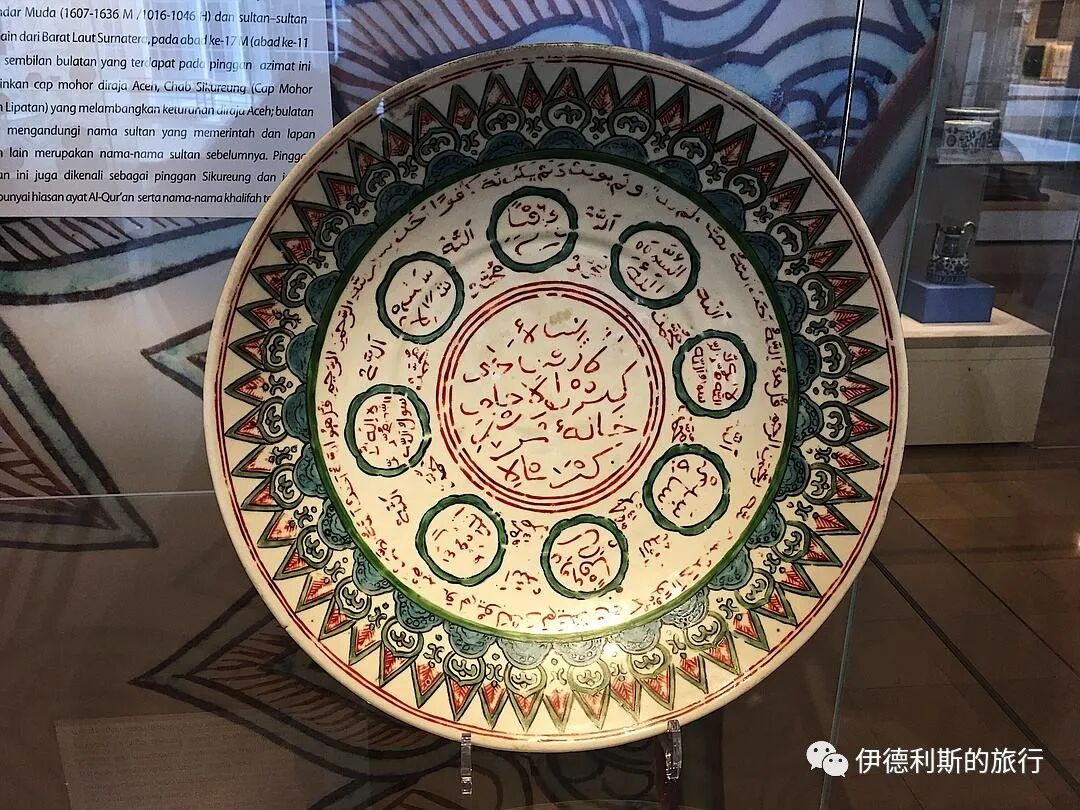
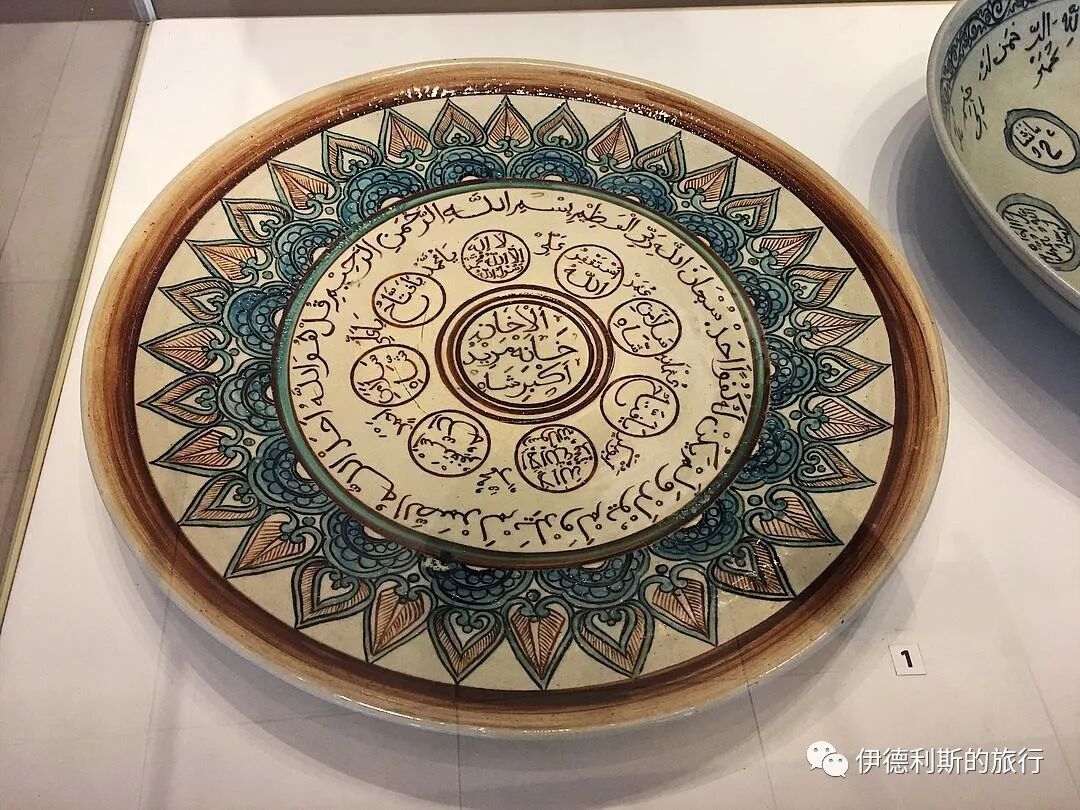
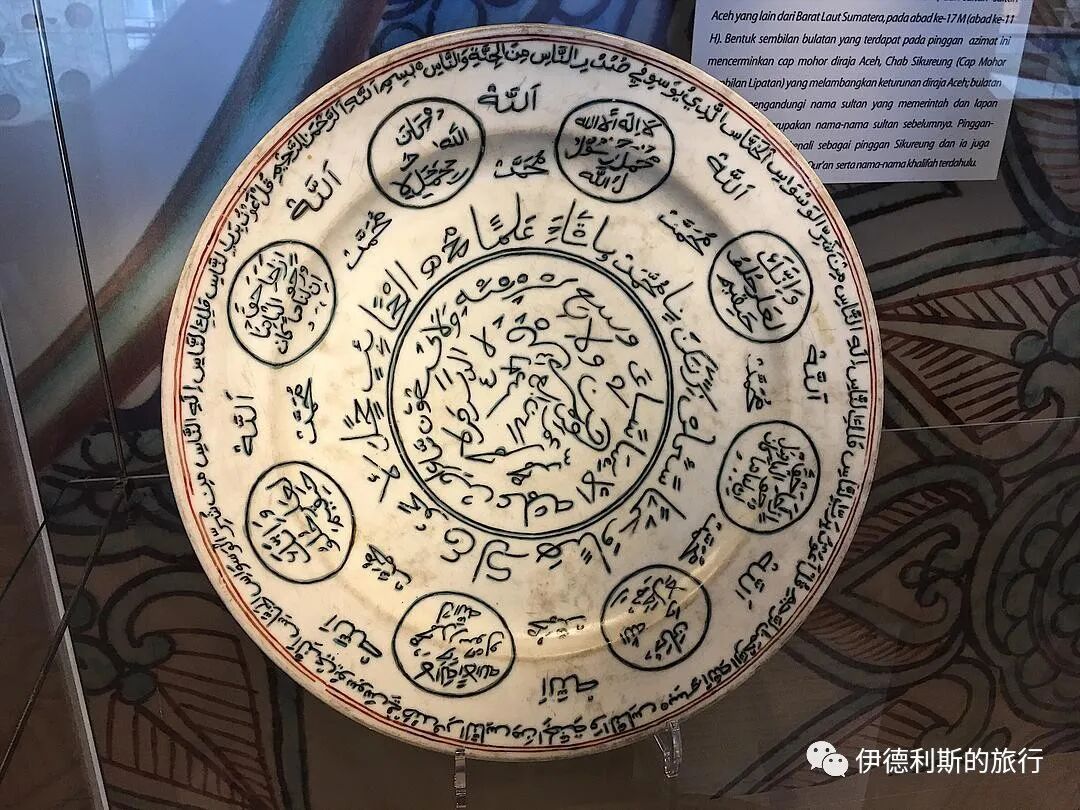
Most Aceh Shantou ware features nine circles. The center circle holds the name of the current sultan, while the eight surrounding circles hold the names of famous past sultans.
Shantou ware commissioned by the Aceh Sultanate royal family in the 16th and 17th centuries.
3. Magic square (huanfang) porcelain produced in China.
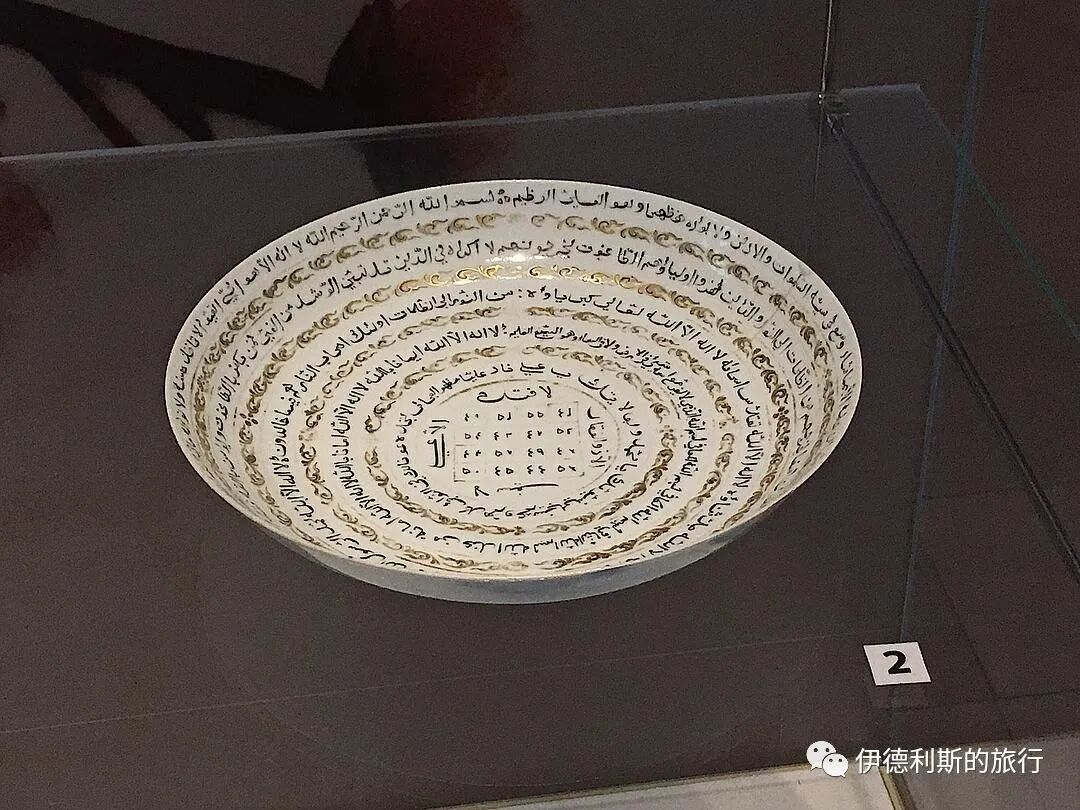
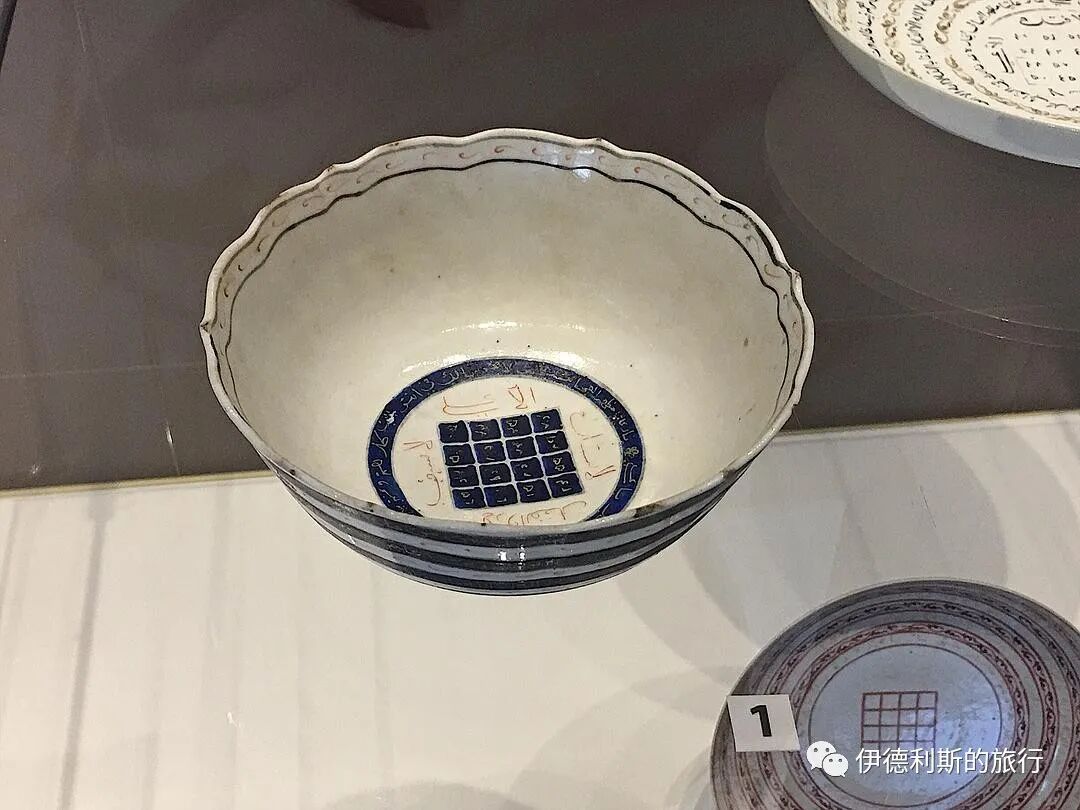
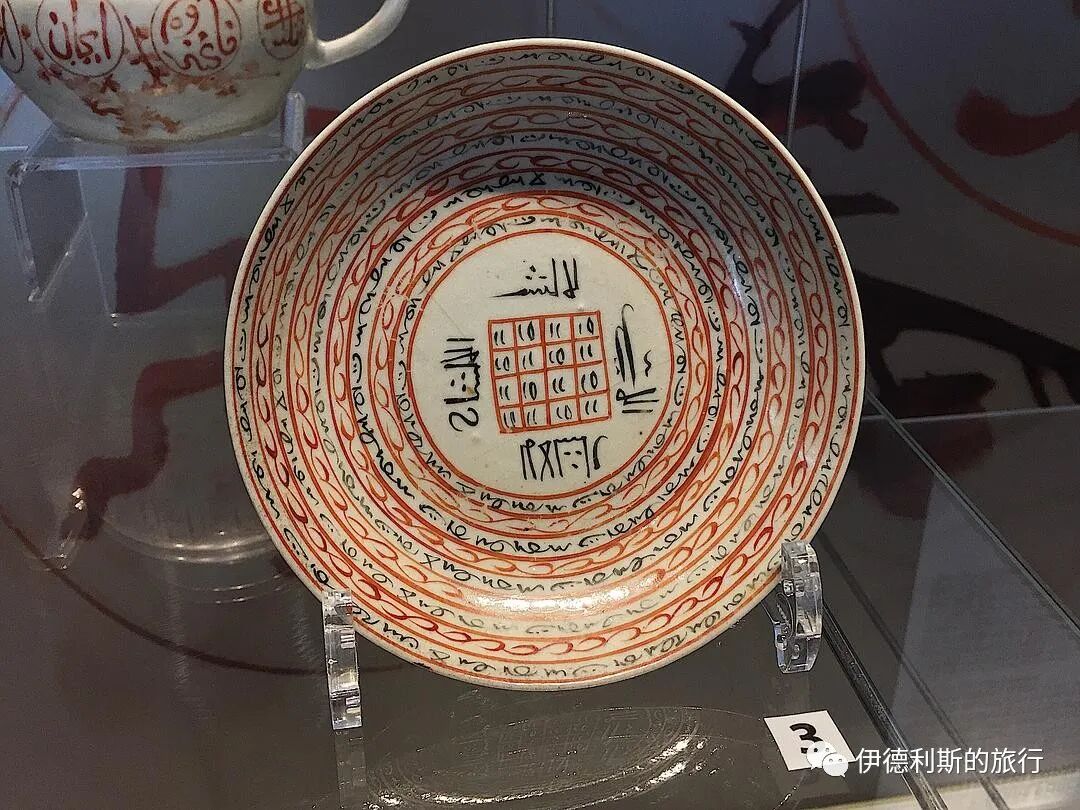
Magic squares, also called grid charts (zonghengtu), were believed to have predictive and healing powers.
A magic square is divided into 16 squares, each containing a number. The sum of the numbers in any row, column, or diagonal should be the same. Among these numbers, 1 is a symbol of Allah, and 7 represents the seven heavens, the seven hells, and the seven days of the week. In astrology, the 3 in a magic square represents Saturn, 4 represents Jupiter, 5 represents Mars, 6 represents the Sun, 7 represents Venus, 8 represents Mercury, and 9 represents the Moon.
Most 18th-century magic square export porcelain was produced in Jingdezhen. The squares are surrounded by excerpts from scriptures and classic texts. After the 19th century, folk kilns began mass-producing imitations. The surrounding text degraded into decorative patterns, and the numbers in the magic squares were simplified into symbols or disappeared entirely. By this time, the predictive function of magic square porcelain had changed, and it was used only for decoration.
4. Chinese Imari porcelain.
Imari porcelain comes from the Arita kilns on Kyushu Island, Japan. In the mid-17th century, during the transition between the Ming and Qing dynasties, Chinese people who moved to Kyushu Island brought overglaze painting techniques, which helped the colorful Arita kilns take shape. The Ming-Qing transition also interrupted the export of Jingdezhen porcelain. In the late 17th century, Arita porcelain began to be exported in large quantities from the port of Imari in northwestern Kyushu, becoming the main source of export porcelain.
At the end of the 17th century, as China resumed porcelain exports from Guangzhou, Guangzhou export porcelain began to imitate Imari porcelain on a large scale, eventually surpassing Japan's export volume.
Chinese Imari porcelain mostly uses underglaze cobalt blue or iron-red enamel, with heavy gold painting applied over the glaze. Imari teapots with swan-neck spouts were also classic styles exported to Europe.
Chinese Imari porcelain from the Kangxi period.
Chinese Imari porcelain from the Qianlong era.
5. A Qianlong peach-shaped porcelain box ordered by the court of the Asaf Jahi dynasty in India.
The inscription on the porcelain box has Latin text on the outer ring reading 'NABOB ASUF UT DOWLAH VAZIR UL MUMULLECK ASUPJAH' and Latin text on the inner ring reading 'BEHADRE HOZBUR JUNG IEAYAA CAWN'. The Persian text in the center says the same thing, meaning it was dedicated to Muhyi ad-Din Muzaffar Jang Hidayat of the Asaf Jahi dynasty. Muzaffar Jang ruled the Asaf Jahi dynasty from 1750 to 1751.
The Asaf Jahi dynasty was a Muslim kingdom on the Deccan Plateau in southern India from 1724 to 1948, centered in the city of Hyderabad.
The Asaf Jahi family was originally a Turkic family from Samarkand. They arrived in the Mughal Empire in the late 17th century to serve as court officials. In 1724, the Mughal Empire fell into chaos. Mir Qamar-ud-Din Siddiqi, who had served as the Governor of the Deccan, declared independence using the Asaf Jah title granted by the Mughal Emperor. He established the Asaf Jahi dynasty in Hyderabad and called himself the Nizam-ul-Mulk of Hyderabad (the ruler of Hyderabad).
Asaf Jah I died in 1748. His son Nasir Jung and his grandson Muzaffar Jung fought for the throne with support from the British and French. Nasir Jung died in battle in 1750. Muzaffar Jung ruled for one year before dying in battle in 1751. Finally, Asaf Jah I's third son, Salabat Jung, became Asaf Jah II.
6. Chinese export porcelain ordered by the Persian Qajar dynasty.
The fourth monarch of the Persian Qajar dynasty, Naser al-Din Shah Qajar (reigned 1848-1896), and his eldest son, Mass'oud Mirza Zell-e Soltan (1850-1918), ordered a large amount of Chinese export porcelain. These porcelains were mainly Canton enamel (guangcai), but also included blue and white porcelain and Fitzhugh porcelain.
The porcelain plate below features the emblem of the Qajar dynasty at the top.
Canton enamel (guangcai).
The full name of Canton enamel is Guangzhou gold-woven colored porcelain (Guangzhou zhijin caici). It was a famous export porcelain from Guangzhou during the middle and late Qing dynasty.
In 1685 (the 24th year of the Kangxi reign), the Yuehai Customs was established, followed by the Thirteen Factories of Guangzhou for foreign trade. Porcelain was an important export commodity. Initial export porcelain was ordered directly from Jingdezhen. By the Yongzheng era, porcelain merchants in Guangzhou began shipping white porcelain blanks from Jingdezhen to Guangzhou. They hired Jingdezhen masters to perform low-temperature overglaze painting in Guangzhou, which is how Canton enamel began.
After the Qianlong era, Canton enamel entered a mature stage and formed its own colorful and gorgeous style. The colors were mainly Western red, crane-spring color, eggplant color, deep ochre, and powder green, all produced locally in Guangzhou. After the Daoguang era, the number of colors increased to more than a dozen.
Canton enamel from the late Qing dynasty was mass-produced with neat patterns. Bowls, plates, and dishes mostly had a gold-trimmed circle in the center. The surrounding area was filled with 'full-ground' patterns of various flowers, fruits, birds, insects, people, and landscapes, along with logos specified by foreign merchants.
Below is Canton enamel ordered by the court of the Persian Qajar dynasty (1779-1921) between the late 19th century and 1915.
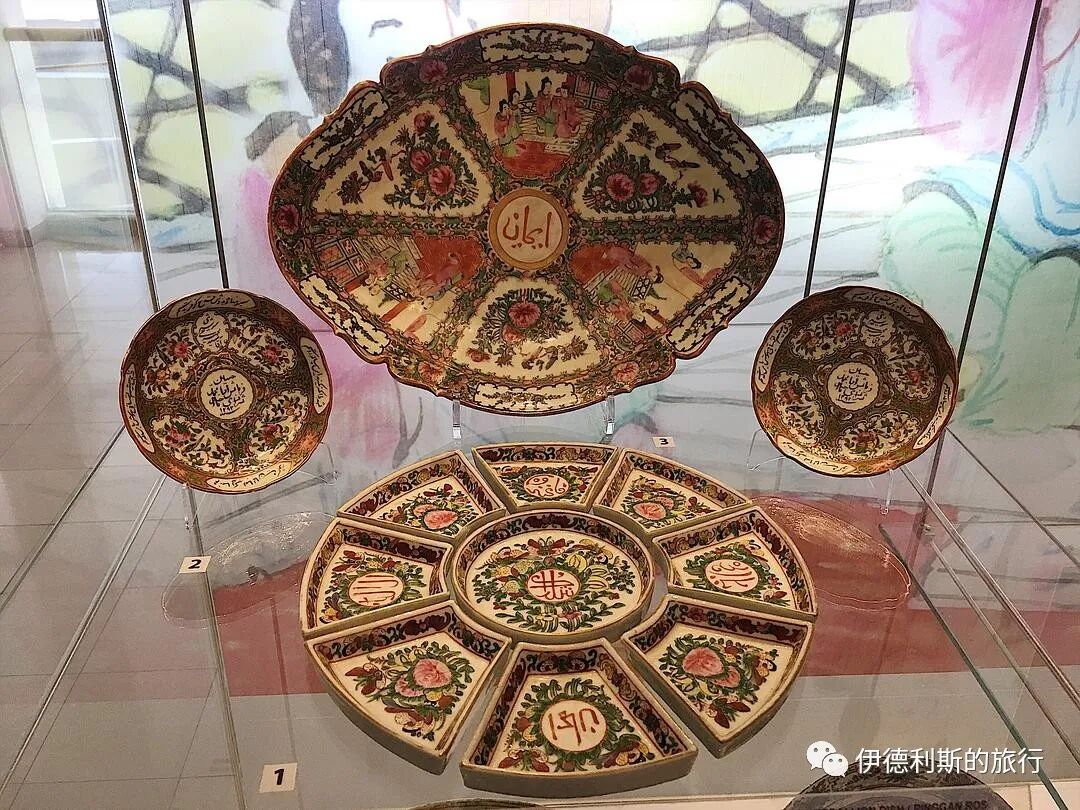
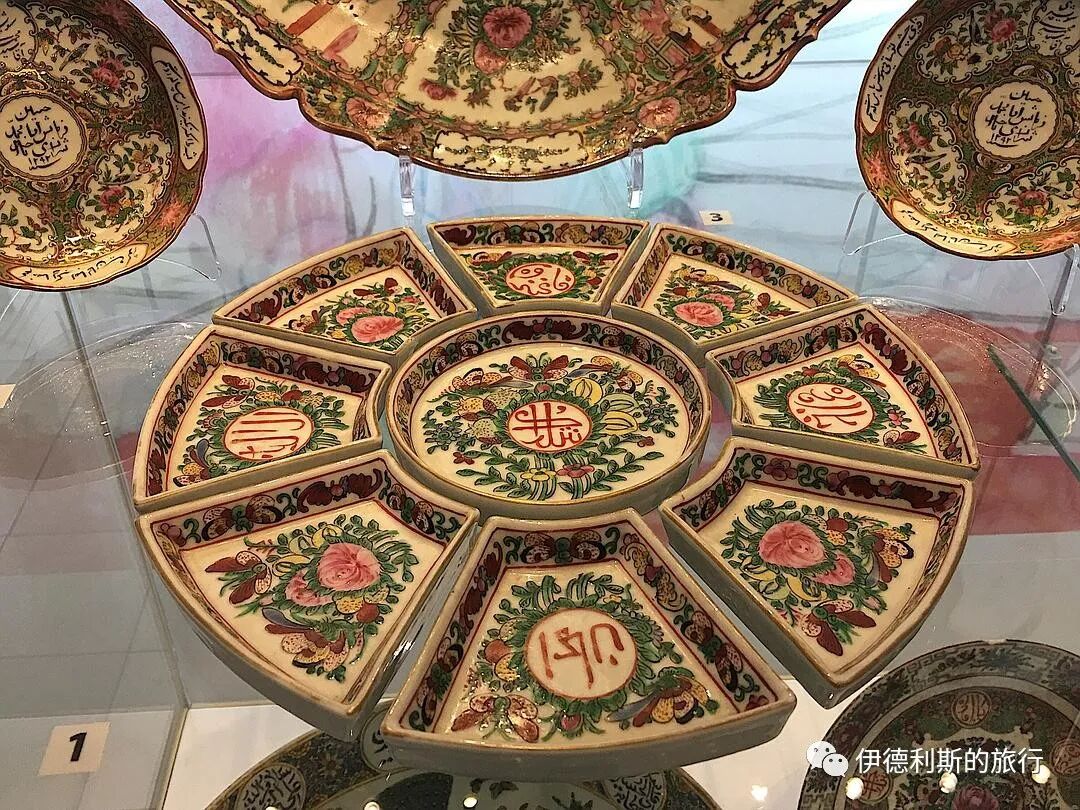
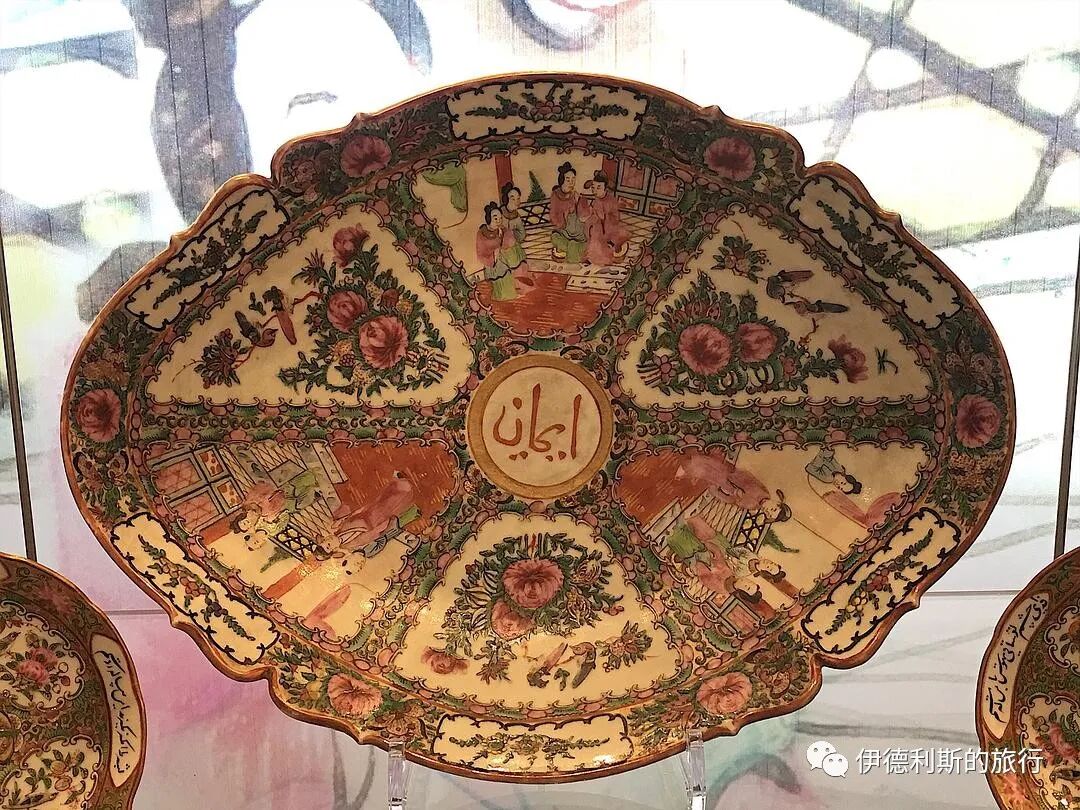
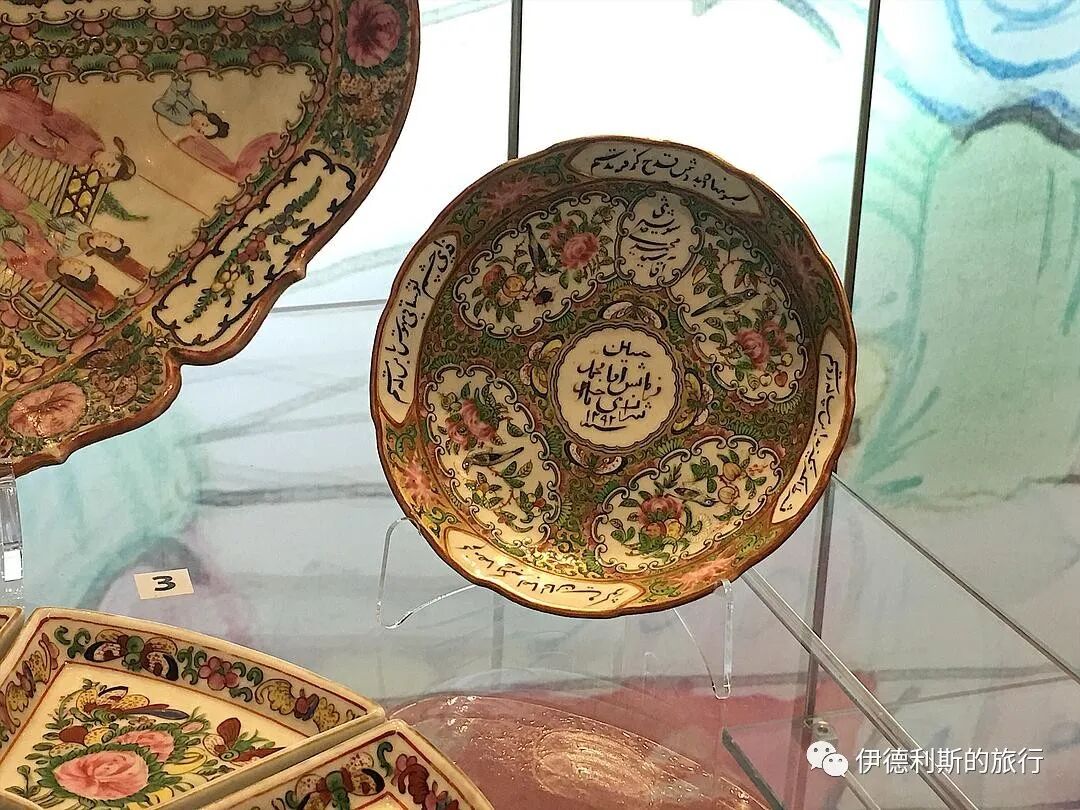
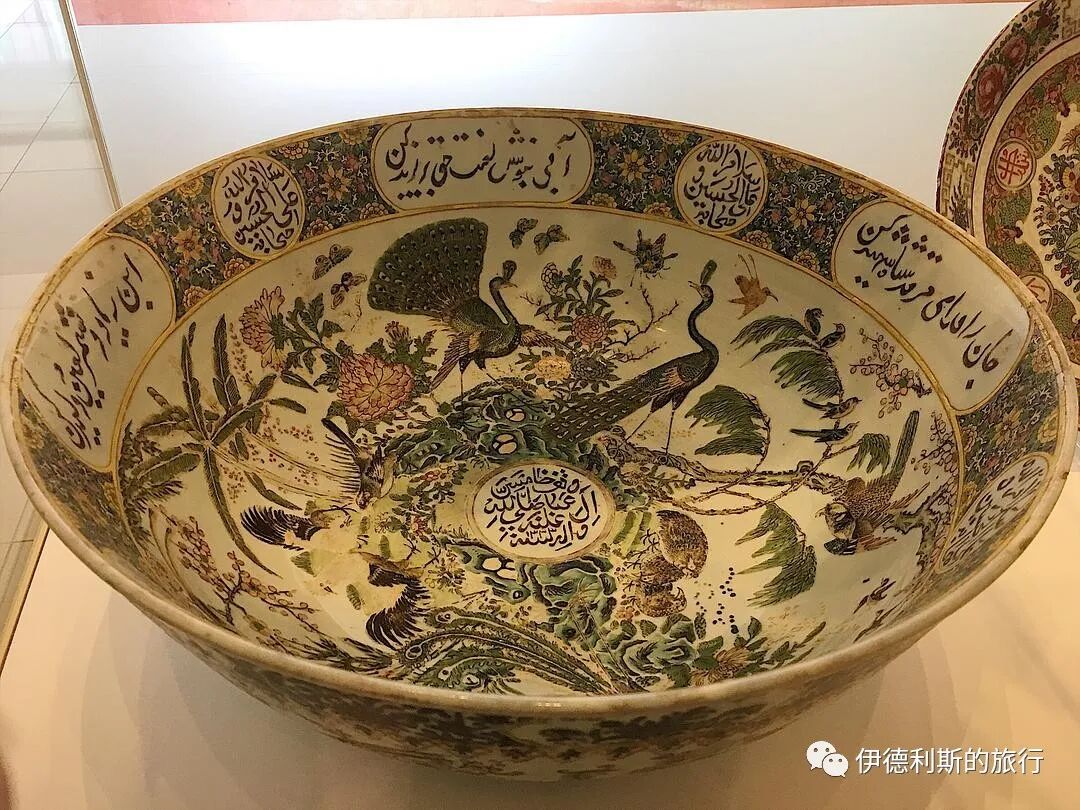
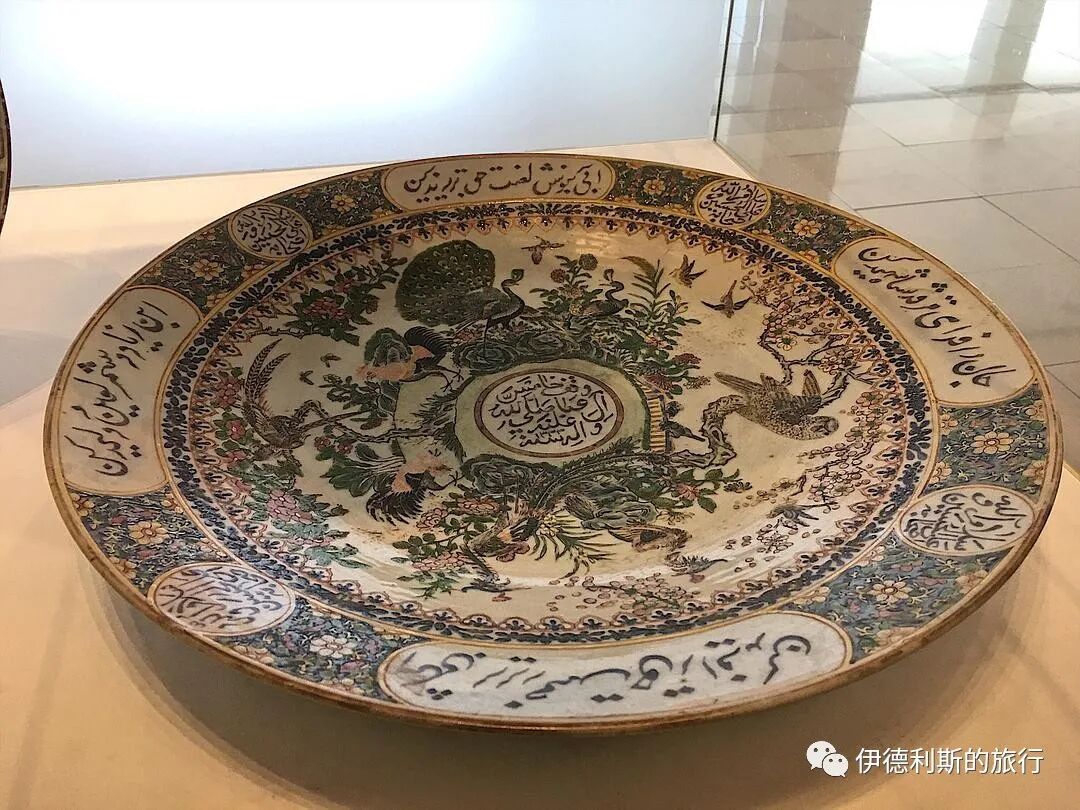
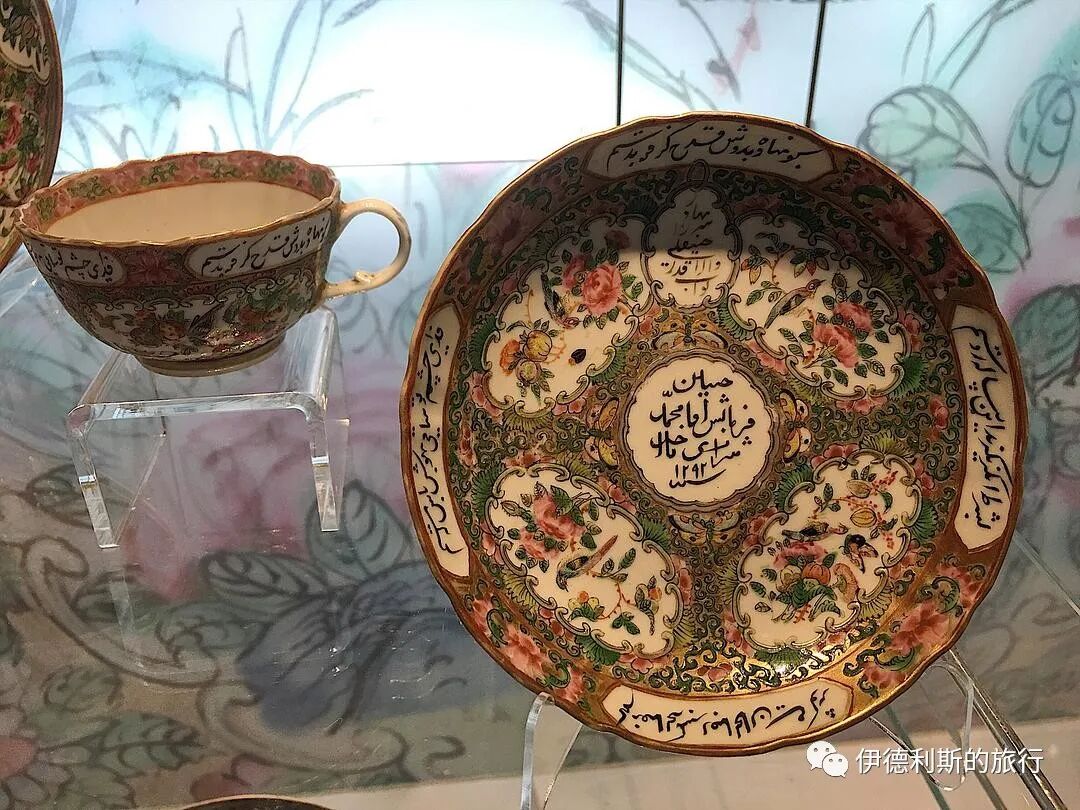
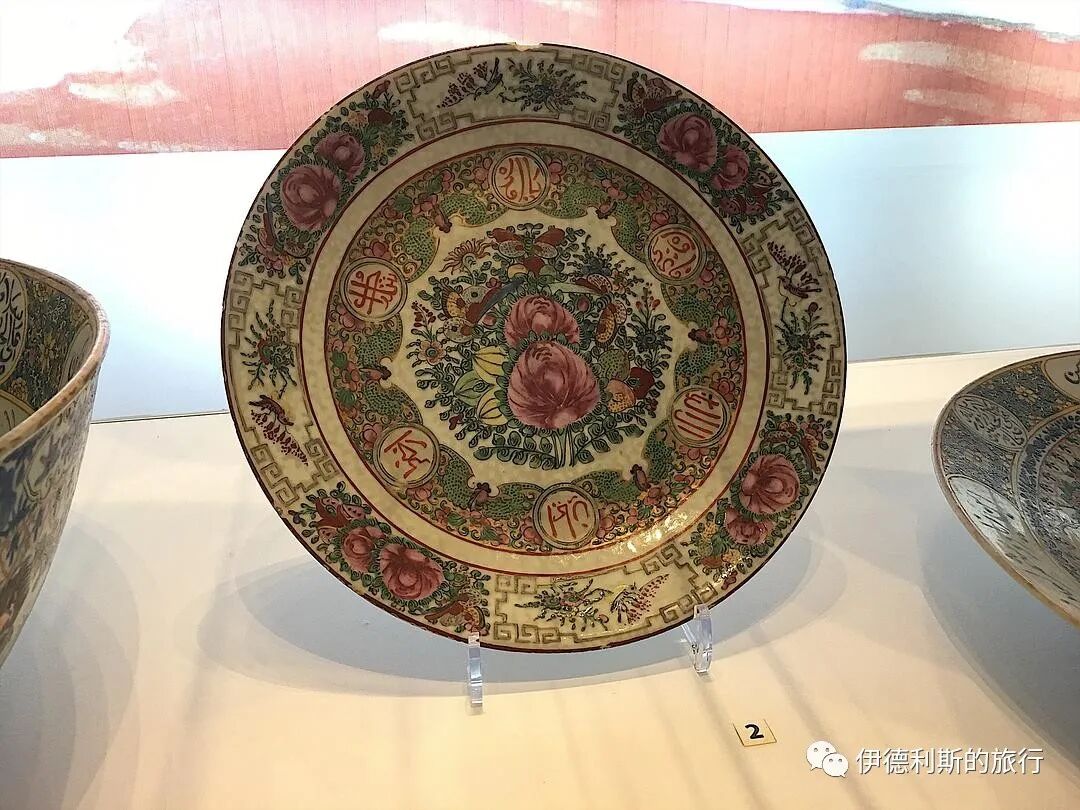
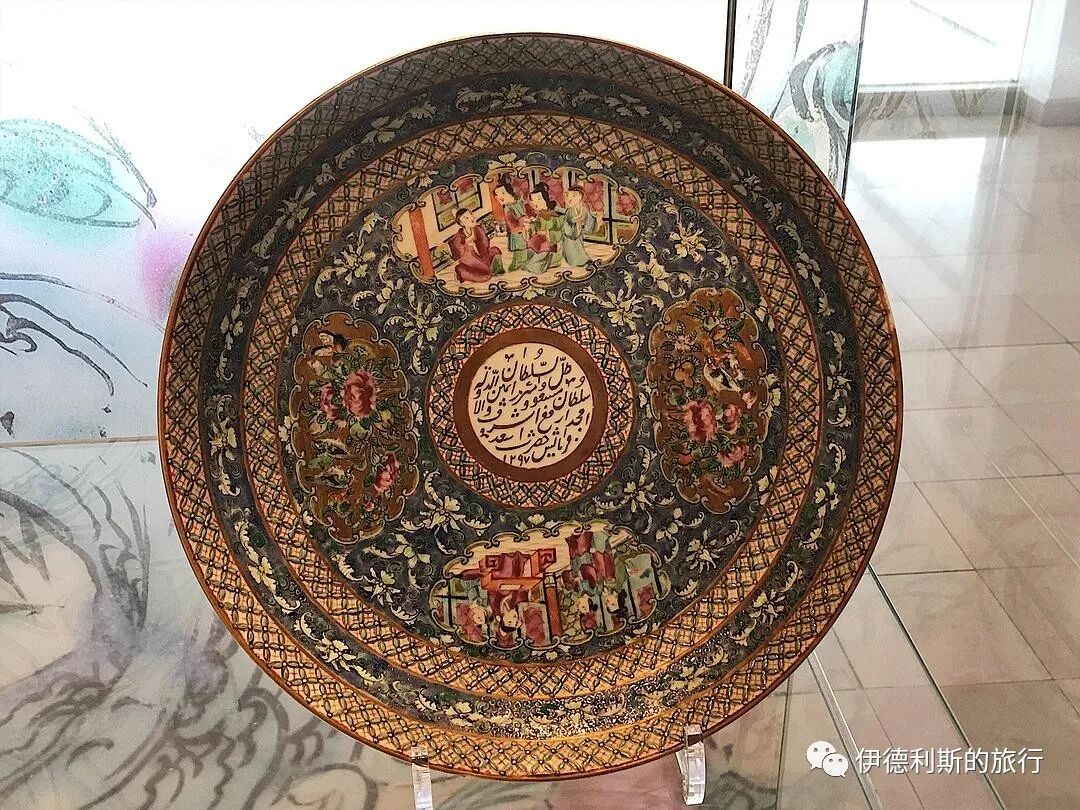
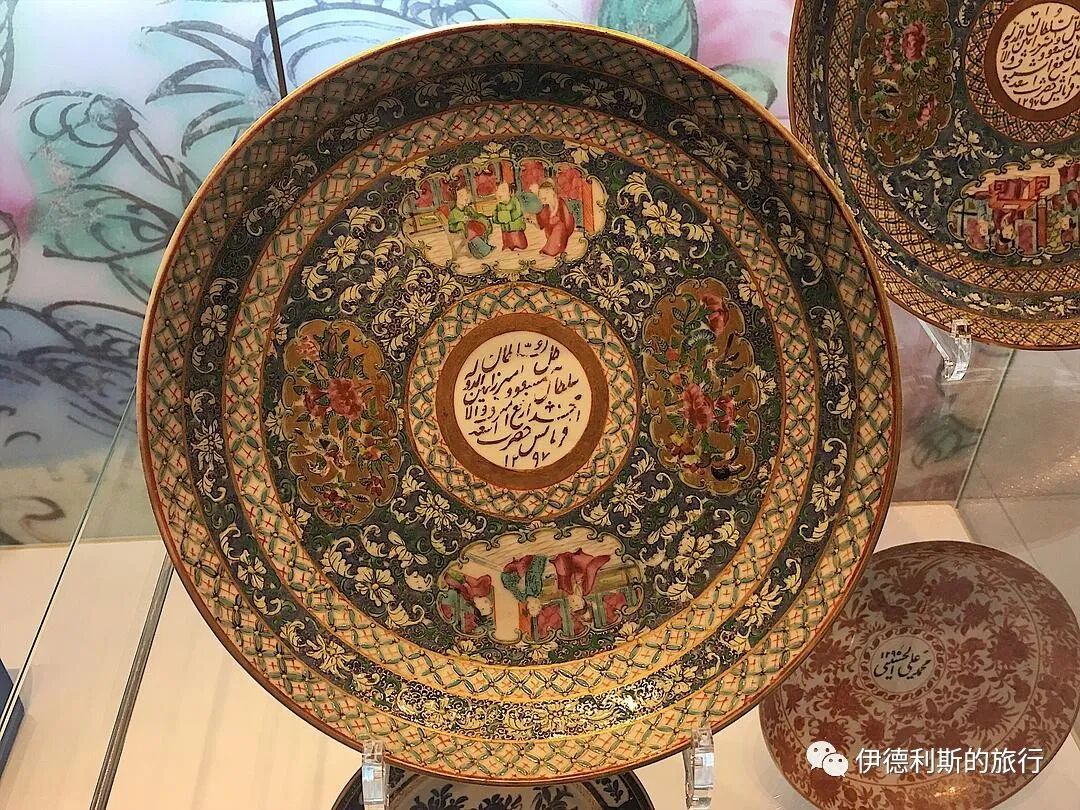
Guangzhou blue porcelain from 1882.
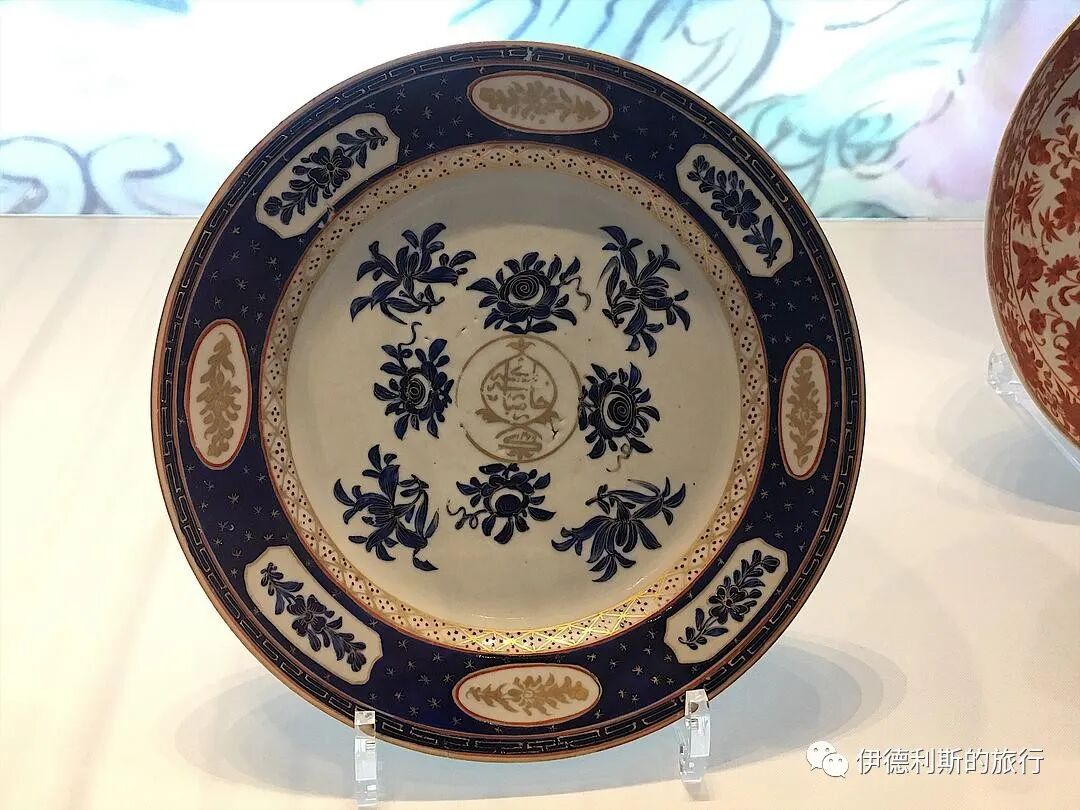
Fitzhugh porcelain from 1878.
Fitzhugh porcelain is named after Thomas Fitzhugh, a director of the British East India Company in Guangzhou during the 1760s. He ordered many pieces in this style between 1787 and 1800. This made the porcelain very popular for export during the Jiaqing period (1796-1820), and it remained popular through the Daoguang period (1821-1850). The main feature of Fitzhugh porcelain is a medallion pattern in the center, surrounded by various traditional Chinese elements.
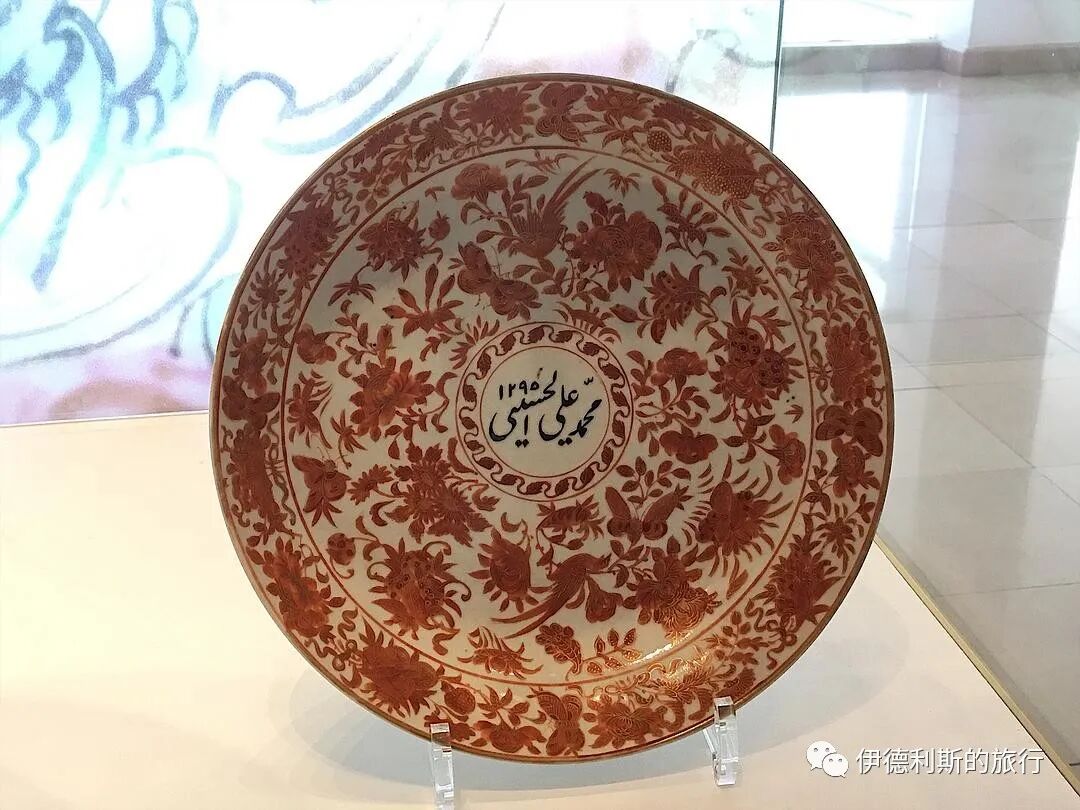
7. Other export porcelain with Arabic and Persian script.
18th-century multicolored porcelain plate.
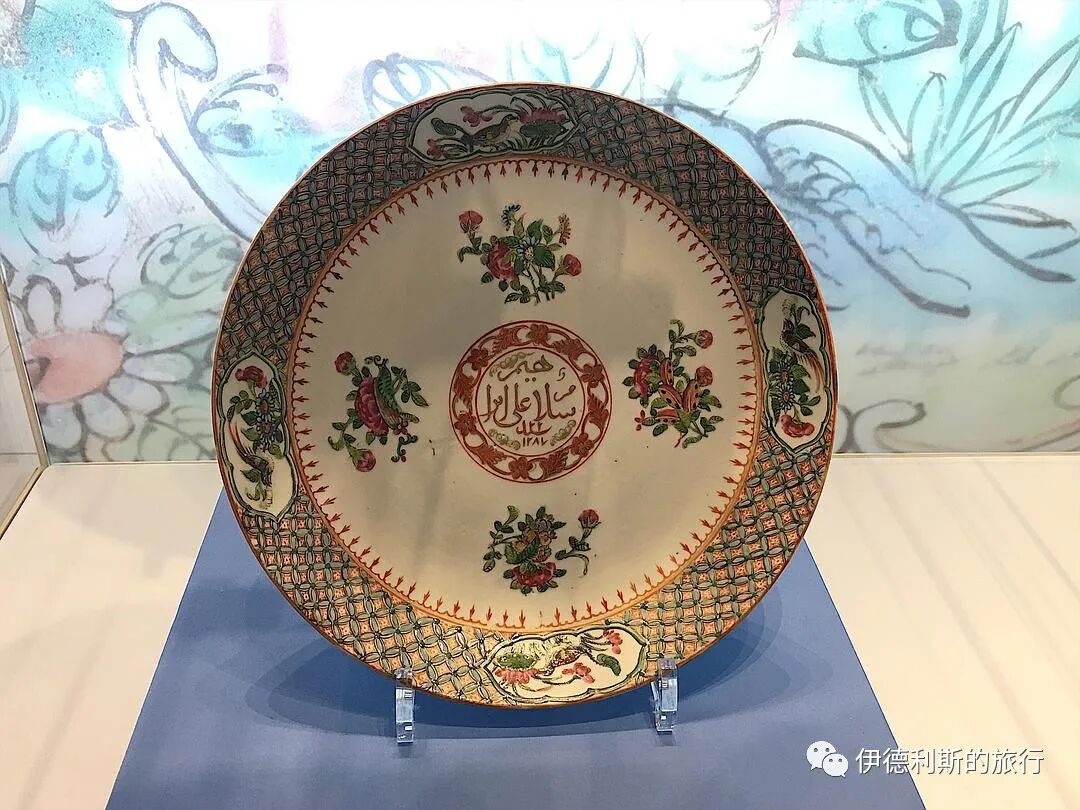
19th-century brush pot.
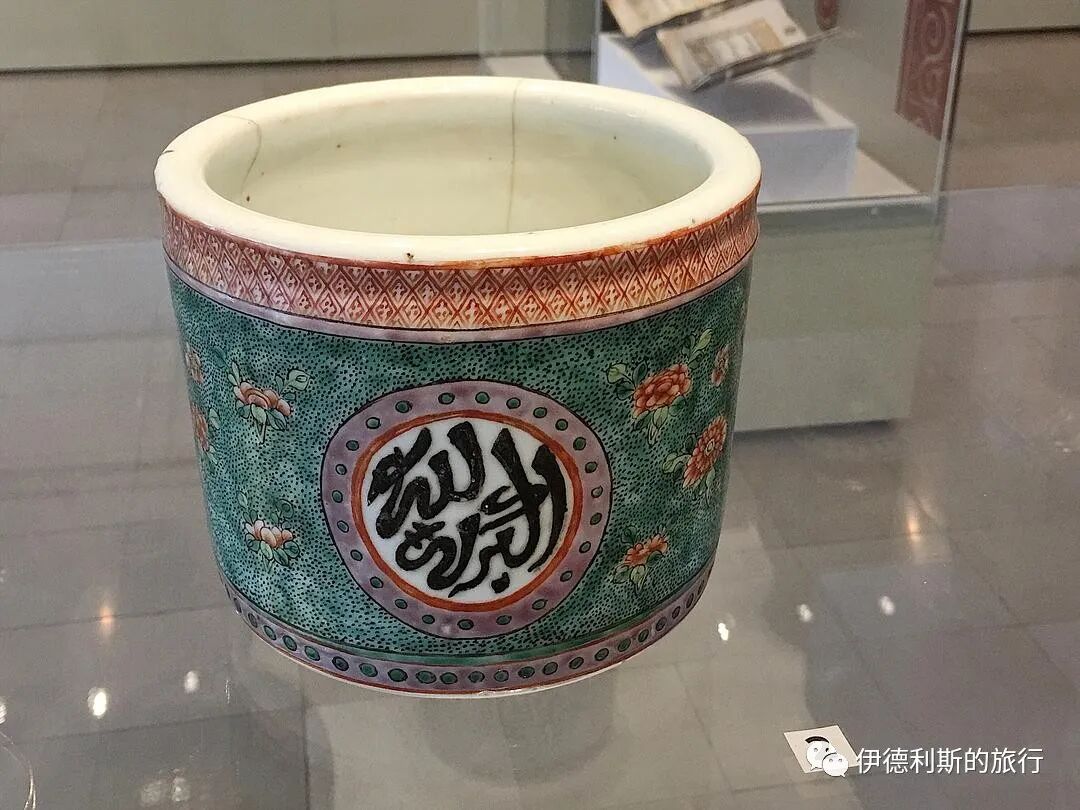
18th-century jar.
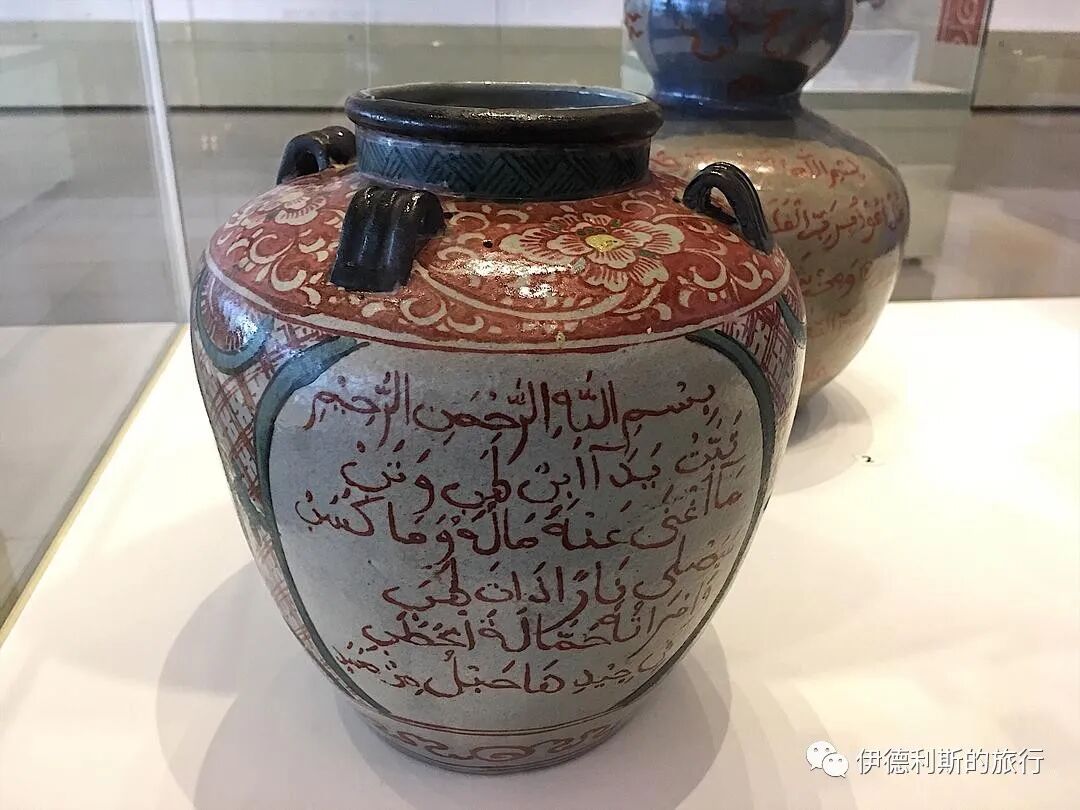
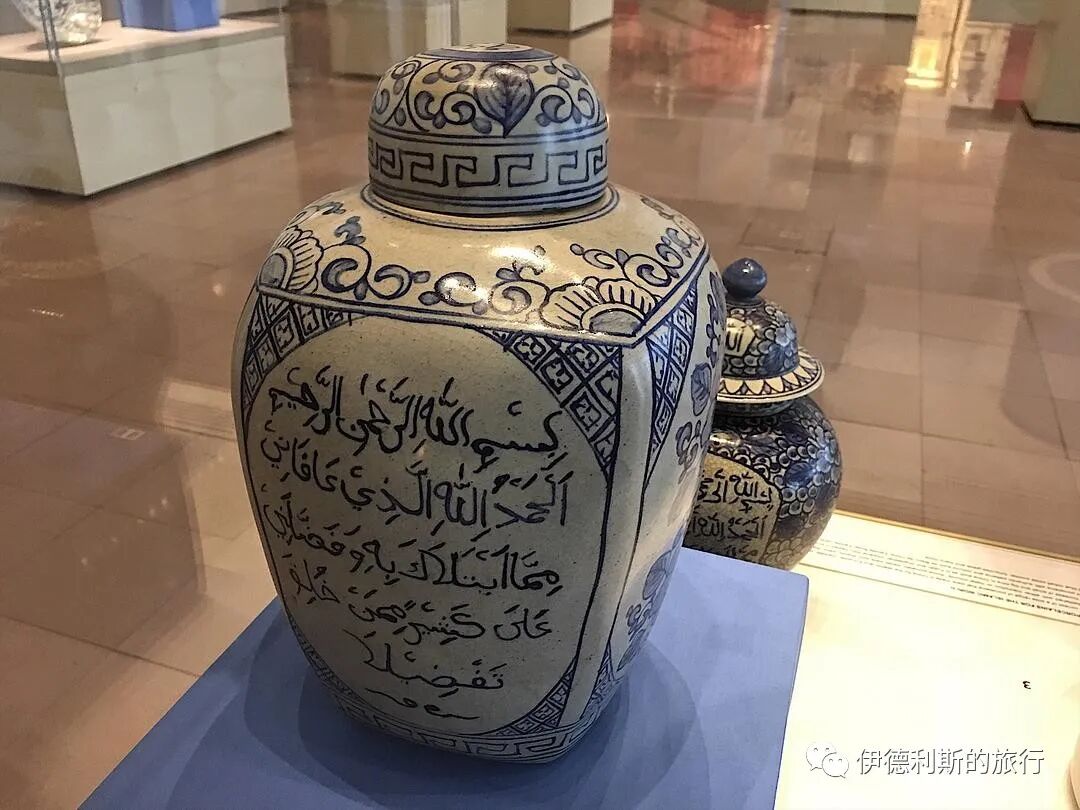
19th-century teapot.
8. Ming and Qing dynasty scripture manuscripts.
A 30-volume scripture manuscript from Gansu Province, dated March to April 1546. It is signed by Khaili Ibrahim Yunus Al-sini and features peony and cloud patterns.
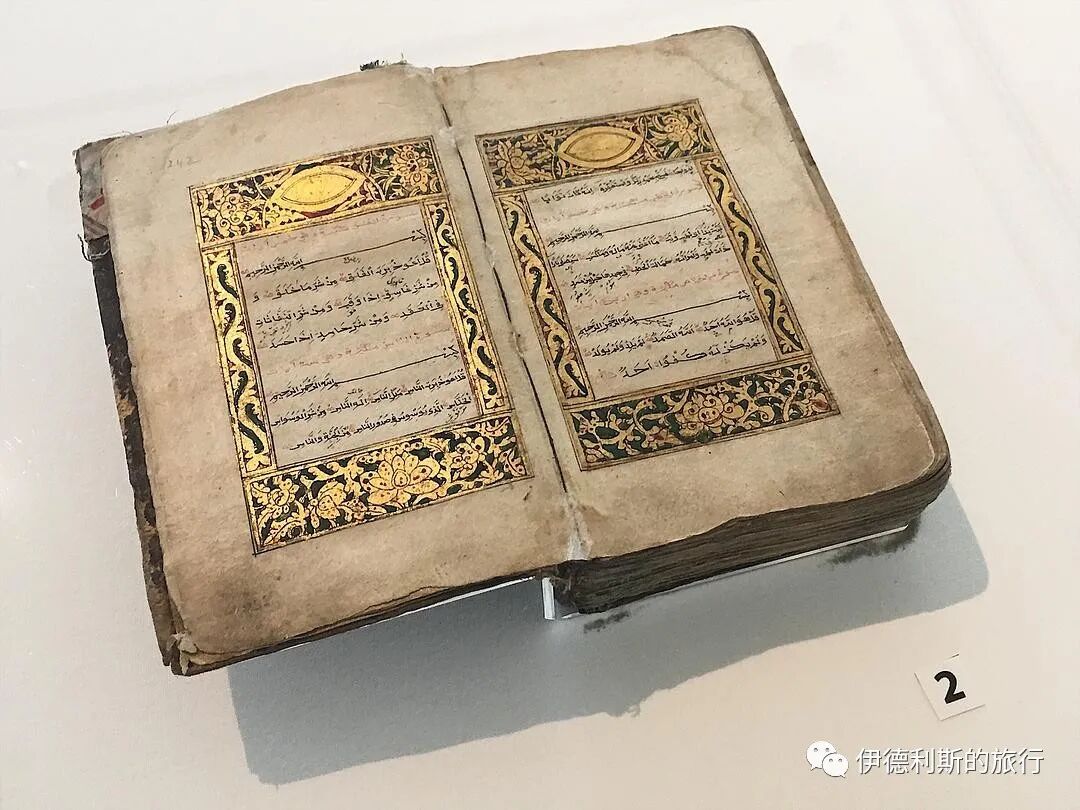
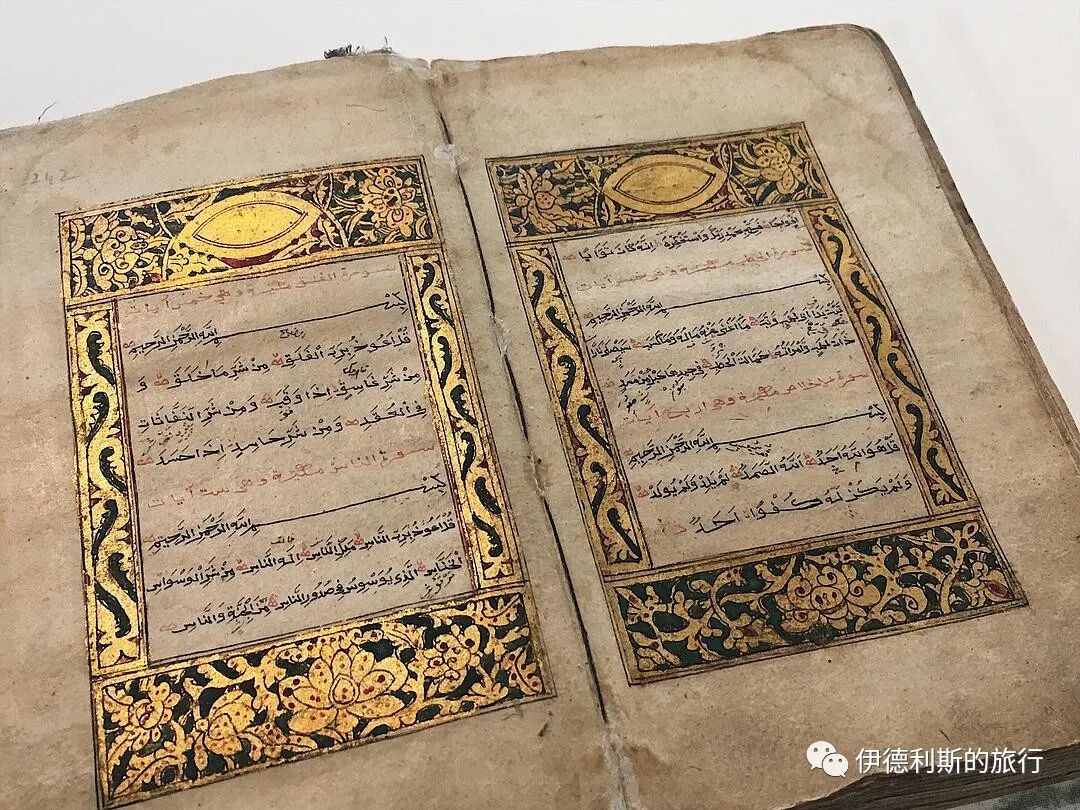
A 30-volume scripture manuscript from the 17th-century Qing dynasty.
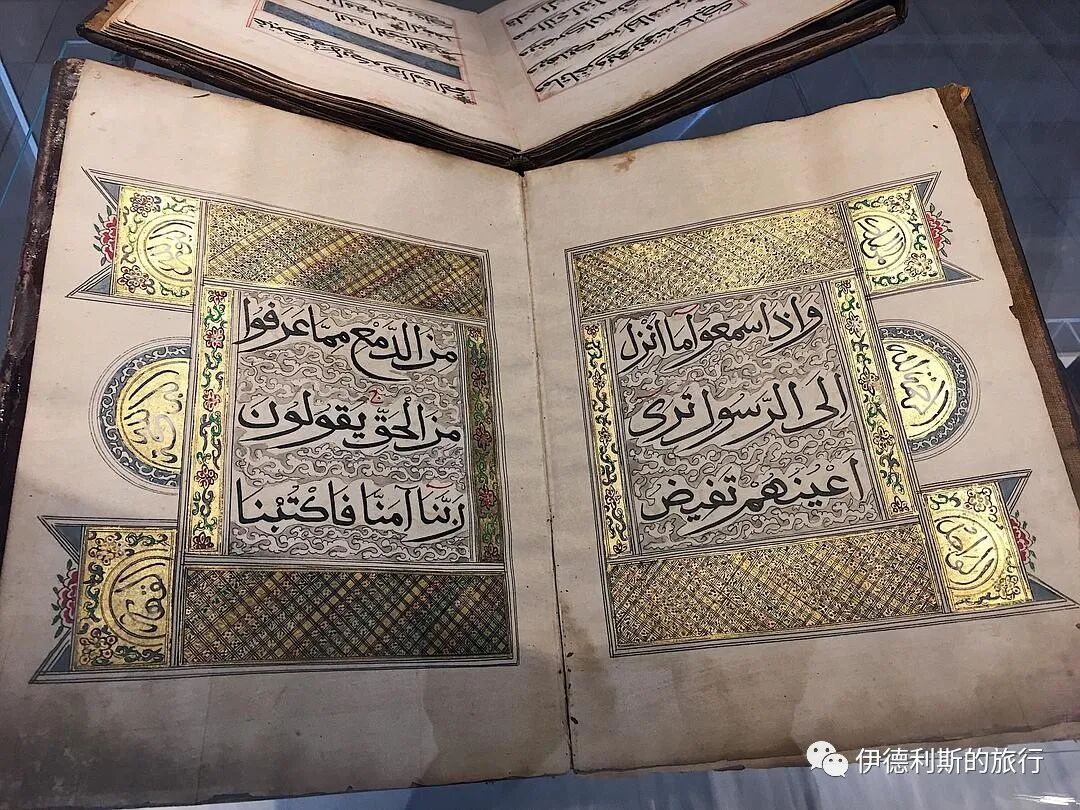
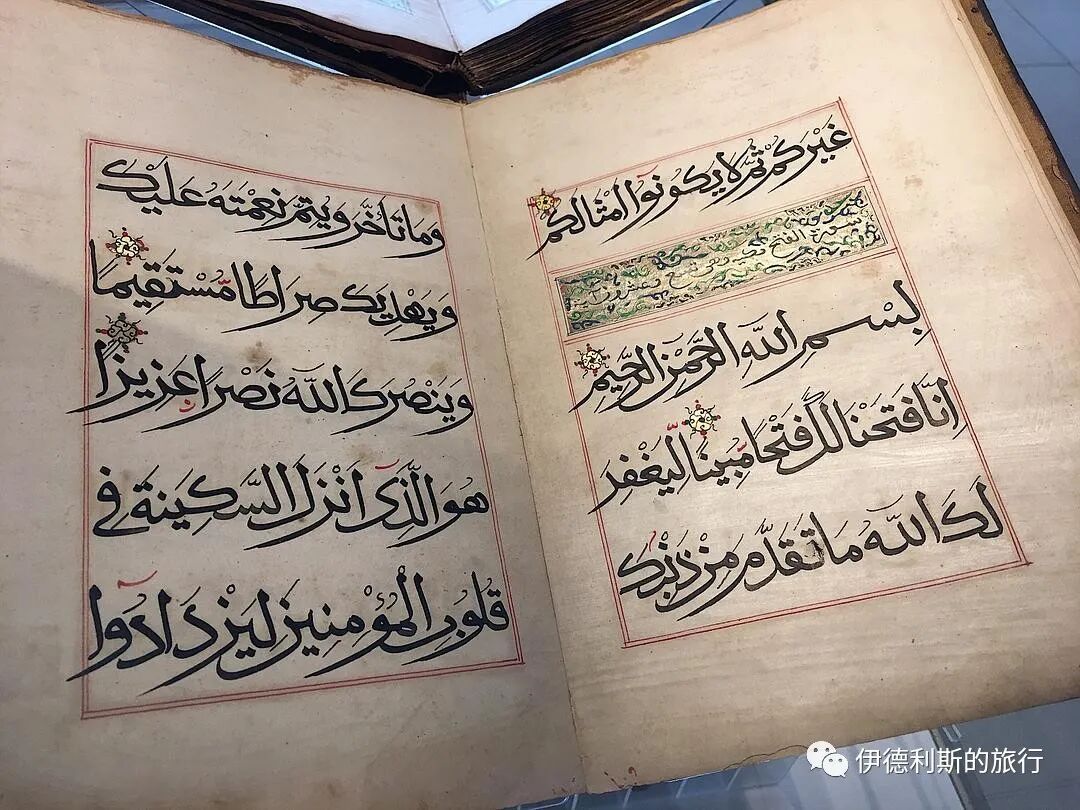
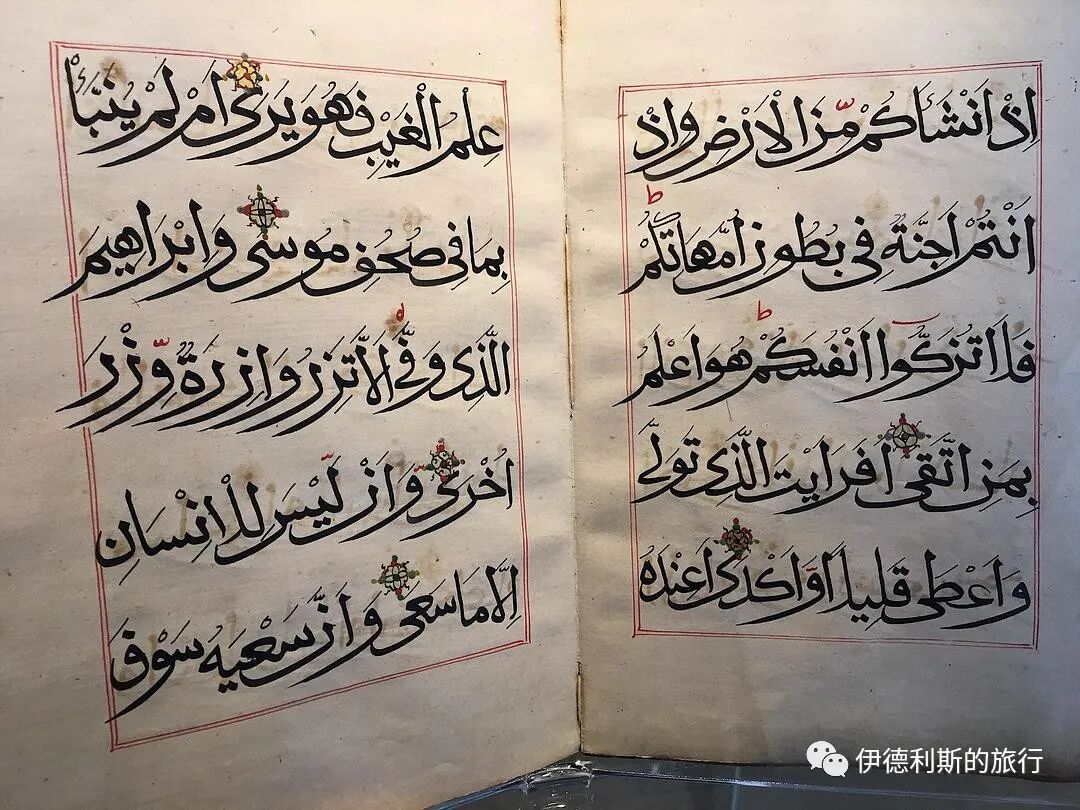
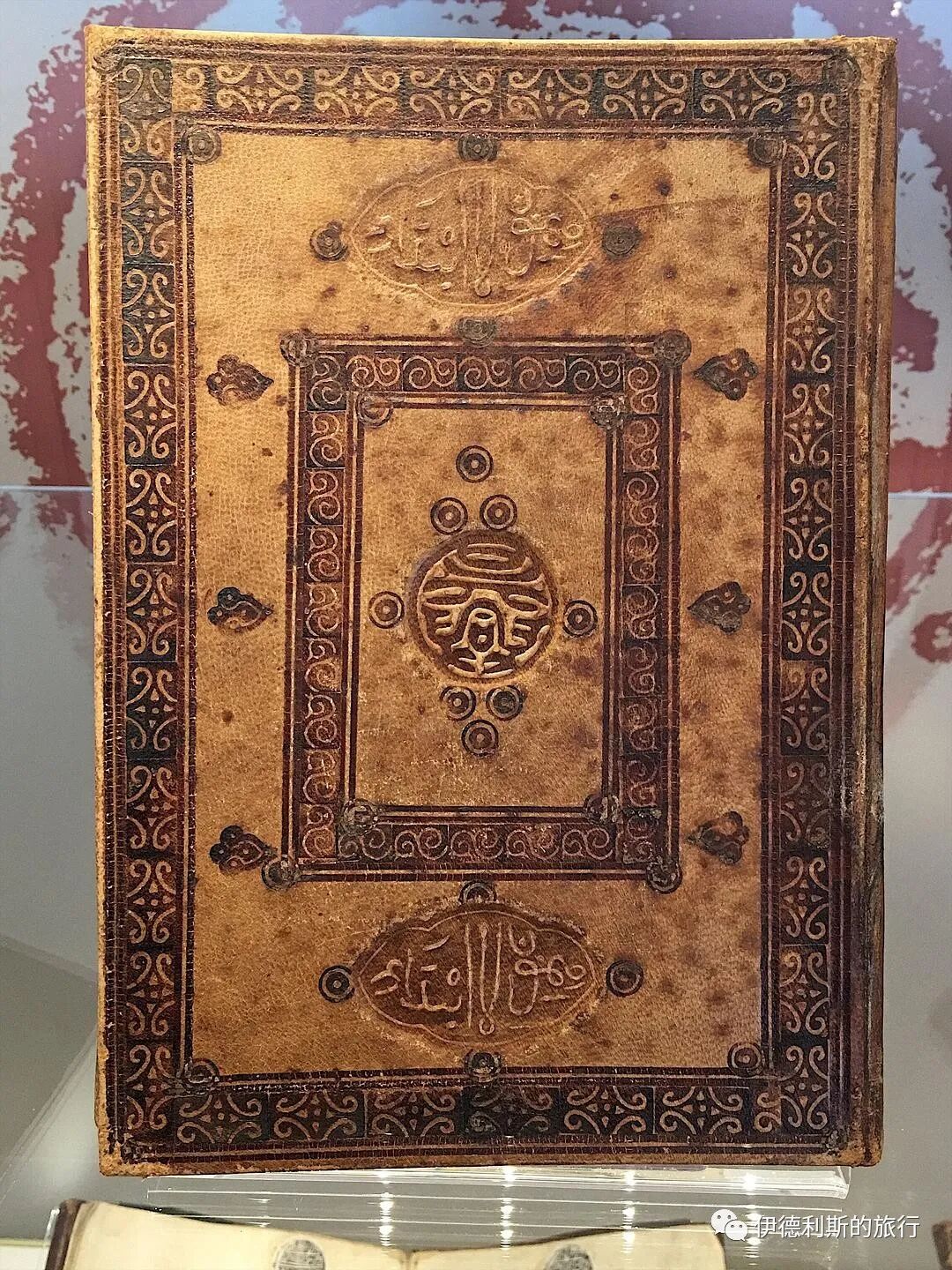
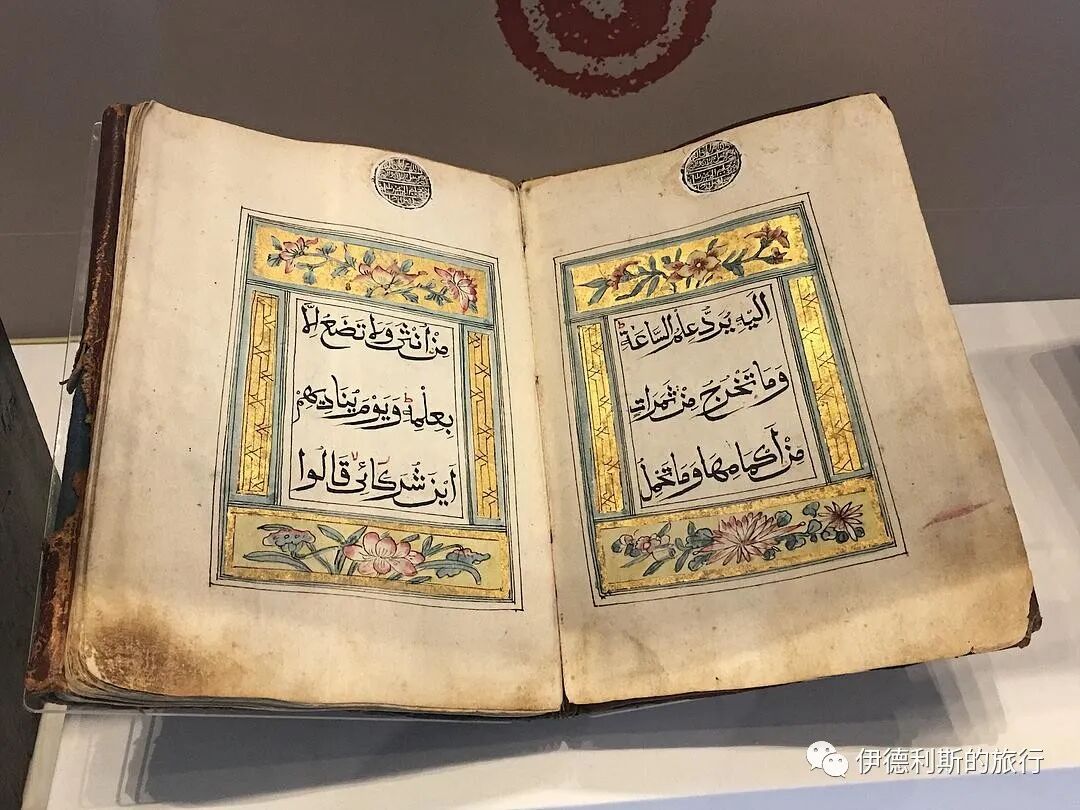
A 30-volume scripture manuscript from 1730 during the Qing dynasty, with a brown embossed leather cover.
9. Xuande incense burners (Xuande lu).
Bronze incense burners appeared at the end of the Yuan dynasty. They reached their peak during the Ming dynasty Xuande period (1425-1435), when they were cast in brass for the first time. Xuande burners are made using the lost-wax casting method, so you cannot see any mold marks after polishing. Most have an open mouth, a short neck, and a flat belly. Some have three blunt cone-shaped solid feet, while others have bridge-shaped handles on the rim. They are dark purple or blackish-brown, and many are gilded or inlaid with gold flakes on the outside.
The production of imitation Xuande burners continued from the Xuande period through the Republic of China era. Xuande burners from different eras have different features. Those from the late Ming dynasty are heavier, those from the Yongzheng period are softer, and those from the Qianlong period show higher craftsmanship. After the 19th century, Xuande burners became increasingly rough, and their quality dropped significantly.
Starting in the Ming dynasty Zhengde period (1506-1521), Xuande burners featuring the Basmala or the Shahada appeared and continued to be made.
10. Qing Dynasty copperware and cloisonné enamel (jingtailan)
After the Canton Customs was set up in 1685 (the 24th year of the Kangxi reign) and the Thirteen Factories were established in Guangdong, copperware and cloisonné enamel (jingtailan) featuring Arabic and Persian script began to be exported during the 18th and 19th centuries.
The one on the left is from 1815, and the one on the right is from the 18th century.
18th-century copperware
Cloisonné enamel (jingtailan)
Summary: Malaysia Islamic Arts Museum: Chinese Muslim Artifacts and Islamic Heritage is presented here as a firsthand travel account in clear English, beginning with this scene: The Islamic Arts Museum Malaysia (Muzium Kesenian Islam Malaysia) is in Kuala Lumpur. It is the largest Islamic museum in Southeast Asia and holds over 7,000 Islamic art pieces from all over the world. The account keeps its focus on Malaysia Islamic Art, Chinese Artifacts, Museum Visit while preserving the names, places, food, and historical details from the Chinese source.
The Islamic Arts Museum Malaysia (Muzium Kesenian Islam Malaysia) is in Kuala Lumpur. It is the largest Islamic museum in Southeast Asia and holds over 7,000 Islamic art pieces from all over the world.
First, let's look at the museum's collection of artifacts related to China.
The history of Chinese-made porcelain with Arabic and Persian script.
Starting in the Yuan Dynasty, China exported large amounts of blue and white porcelain to the Middle East. Pieces have been dug up in Egypt, Iran, and Syria. During the Ming Dynasty, starting in the Yongle period (1403-1424), blue and white porcelain with Arabic and Persian script appeared. Most were modeled after metal and glass items from Arab and Persian regions and were made mainly for export. During the Zhengde period (1506-1521), blue and white porcelain with Arabic and Persian script mostly consisted of bowls, cups, brush rests, and boxes that matched the shapes of official imperial kiln pieces. Many were traditional stationery items. Because they often featured Quranic verses and praises to Allah, it is believed they were mostly ordered by Hui Muslims living in China.
Starting in the 16th century, folk kilns in Chaoshan and southern Fujian began producing Arabic-script export porcelain. These were mainly for the Southeast Asian market. The quality was lower than that of Jingdezhen, but the output was much higher.
After the Thirteen Factories were set up in Guangzhou during the Kangxi period, the amount of export porcelain grew rapidly. Porcelain began to be exported with long passages of scripture and the names of Caliphs. The higher-quality pieces were usually from Jingdezhen, while the lower-quality ones came from folk kilns in Chaoshan and southern Fujian. Because the folk kiln artisans were not familiar with the script, the Quranic text was often written incorrectly.
By the 18th and 19th centuries, the British East India Company imported large amounts of Chinese export porcelain. Wealthy Muslim families began ordering a lot of porcelain with Arabic and Persian script. The most famous examples were for the Asaf Jahi dynasty court in Hyderabad, India, and the Qajar dynasty court in Persia. However, most of these Muslim families ordered through the British East India Company in London rather than directly from Guangzhou.
1. Ming Zhengde porcelain.
The Arabic and Persian script on Ming Zhengde porcelain is mostly written inside diamond or square-shaped panels. The outer walls are decorated with scrolling flowers or cloud patterns. The bottom has a mark reading 'Made in the Zhengde period of the Great Ming'. Most are blue and white, with only a few featuring overglaze red enamel.
The text inside the four diamond and square panels on the overglaze red enamel Zhengde piece in the picture translates to: 'O Allah, protect Hui Ma Yun from the anger of the wicked.'
2. Swatow ware (Shantou qi) ordered by the Aceh Sultanate royal family.
Swatow ware, also called Zhangzhou ware (Zhangzhou qi), is a type of export porcelain that appeared in the late Ming Dynasty. It was mainly for the Southeast Asian and Japanese markets and was popular from the mid-16th to mid-17th centuries. Most Swatow ware was produced by folk kilns in the Chaoshan and southern Fujian regions, with the most coming from near Zhangzhou, Fujian.
Compared to Jingdezhen porcelain, Swatow ware is rougher. Its biggest feature is the 'sandy base' (shadi zu). To save space in the kiln, artisans skipped using pads and saggers and instead dipped the foot ring of the porcelain in fine sand. After firing, sand grains remained on the base and foot ring. At first, Swatow ware only had underglaze blue and white, but later, overglaze enamel styles became very diverse.
15th-century Arabic-script Swatow ware exported to Muslim regions in Southeast Asia.
The most famous Arabic-script Swatow ware was ordered by the royal family of the Aceh Sultanate. The Aceh Sultanate was a powerful maritime trading state established in 1496 on the northwest coast of Sumatra. After the fall of the Malacca Sultanate, it became the center of Islam in Southeast Asia. The 16th and 17th centuries were the peak of the Aceh Sultanate. Most Aceh Shantou ware came from the court of Sultan Iskandar Muda (reigned 1607-1636) and several other sultans.
Most Aceh Shantou ware features nine circles. The center circle holds the name of the current sultan, while the eight surrounding circles hold the names of famous past sultans.
Shantou ware commissioned by the Aceh Sultanate royal family in the 16th and 17th centuries.
3. Magic square (huanfang) porcelain produced in China.
Magic squares, also called grid charts (zonghengtu), were believed to have predictive and healing powers.
A magic square is divided into 16 squares, each containing a number. The sum of the numbers in any row, column, or diagonal should be the same. Among these numbers, 1 is a symbol of Allah, and 7 represents the seven heavens, the seven hells, and the seven days of the week. In astrology, the 3 in a magic square represents Saturn, 4 represents Jupiter, 5 represents Mars, 6 represents the Sun, 7 represents Venus, 8 represents Mercury, and 9 represents the Moon.
Most 18th-century magic square export porcelain was produced in Jingdezhen. The squares are surrounded by excerpts from scriptures and classic texts. After the 19th century, folk kilns began mass-producing imitations. The surrounding text degraded into decorative patterns, and the numbers in the magic squares were simplified into symbols or disappeared entirely. By this time, the predictive function of magic square porcelain had changed, and it was used only for decoration.
4. Chinese Imari porcelain.
Imari porcelain comes from the Arita kilns on Kyushu Island, Japan. In the mid-17th century, during the transition between the Ming and Qing dynasties, Chinese people who moved to Kyushu Island brought overglaze painting techniques, which helped the colorful Arita kilns take shape. The Ming-Qing transition also interrupted the export of Jingdezhen porcelain. In the late 17th century, Arita porcelain began to be exported in large quantities from the port of Imari in northwestern Kyushu, becoming the main source of export porcelain.
At the end of the 17th century, as China resumed porcelain exports from Guangzhou, Guangzhou export porcelain began to imitate Imari porcelain on a large scale, eventually surpassing Japan's export volume.
Chinese Imari porcelain mostly uses underglaze cobalt blue or iron-red enamel, with heavy gold painting applied over the glaze. Imari teapots with swan-neck spouts were also classic styles exported to Europe.
Chinese Imari porcelain from the Kangxi period.
Chinese Imari porcelain from the Qianlong era.
5. A Qianlong peach-shaped porcelain box ordered by the court of the Asaf Jahi dynasty in India.
The inscription on the porcelain box has Latin text on the outer ring reading 'NABOB ASUF UT DOWLAH VAZIR UL MUMULLECK ASUPJAH' and Latin text on the inner ring reading 'BEHADRE HOZBUR JUNG IEAYAA CAWN'. The Persian text in the center says the same thing, meaning it was dedicated to Muhyi ad-Din Muzaffar Jang Hidayat of the Asaf Jahi dynasty. Muzaffar Jang ruled the Asaf Jahi dynasty from 1750 to 1751.
The Asaf Jahi dynasty was a Muslim kingdom on the Deccan Plateau in southern India from 1724 to 1948, centered in the city of Hyderabad.
The Asaf Jahi family was originally a Turkic family from Samarkand. They arrived in the Mughal Empire in the late 17th century to serve as court officials. In 1724, the Mughal Empire fell into chaos. Mir Qamar-ud-Din Siddiqi, who had served as the Governor of the Deccan, declared independence using the Asaf Jah title granted by the Mughal Emperor. He established the Asaf Jahi dynasty in Hyderabad and called himself the Nizam-ul-Mulk of Hyderabad (the ruler of Hyderabad).
Asaf Jah I died in 1748. His son Nasir Jung and his grandson Muzaffar Jung fought for the throne with support from the British and French. Nasir Jung died in battle in 1750. Muzaffar Jung ruled for one year before dying in battle in 1751. Finally, Asaf Jah I's third son, Salabat Jung, became Asaf Jah II.
6. Chinese export porcelain ordered by the Persian Qajar dynasty.
The fourth monarch of the Persian Qajar dynasty, Naser al-Din Shah Qajar (reigned 1848-1896), and his eldest son, Mass'oud Mirza Zell-e Soltan (1850-1918), ordered a large amount of Chinese export porcelain. These porcelains were mainly Canton enamel (guangcai), but also included blue and white porcelain and Fitzhugh porcelain.
The porcelain plate below features the emblem of the Qajar dynasty at the top.
Canton enamel (guangcai).
The full name of Canton enamel is Guangzhou gold-woven colored porcelain (Guangzhou zhijin caici). It was a famous export porcelain from Guangzhou during the middle and late Qing dynasty.
In 1685 (the 24th year of the Kangxi reign), the Yuehai Customs was established, followed by the Thirteen Factories of Guangzhou for foreign trade. Porcelain was an important export commodity. Initial export porcelain was ordered directly from Jingdezhen. By the Yongzheng era, porcelain merchants in Guangzhou began shipping white porcelain blanks from Jingdezhen to Guangzhou. They hired Jingdezhen masters to perform low-temperature overglaze painting in Guangzhou, which is how Canton enamel began.
After the Qianlong era, Canton enamel entered a mature stage and formed its own colorful and gorgeous style. The colors were mainly Western red, crane-spring color, eggplant color, deep ochre, and powder green, all produced locally in Guangzhou. After the Daoguang era, the number of colors increased to more than a dozen.
Canton enamel from the late Qing dynasty was mass-produced with neat patterns. Bowls, plates, and dishes mostly had a gold-trimmed circle in the center. The surrounding area was filled with 'full-ground' patterns of various flowers, fruits, birds, insects, people, and landscapes, along with logos specified by foreign merchants.
Below is Canton enamel ordered by the court of the Persian Qajar dynasty (1779-1921) between the late 19th century and 1915.
Guangzhou blue porcelain from 1882.
Fitzhugh porcelain from 1878.
Fitzhugh porcelain is named after Thomas Fitzhugh, a director of the British East India Company in Guangzhou during the 1760s. He ordered many pieces in this style between 1787 and 1800. This made the porcelain very popular for export during the Jiaqing period (1796-1820), and it remained popular through the Daoguang period (1821-1850). The main feature of Fitzhugh porcelain is a medallion pattern in the center, surrounded by various traditional Chinese elements.
7. Other export porcelain with Arabic and Persian script.
18th-century multicolored porcelain plate.
19th-century brush pot.
18th-century jar.
19th-century teapot.
8. Ming and Qing dynasty scripture manuscripts.
A 30-volume scripture manuscript from Gansu Province, dated March to April 1546. It is signed by Khaili Ibrahim Yunus Al-sini and features peony and cloud patterns.
A 30-volume scripture manuscript from the 17th-century Qing dynasty.
A 30-volume scripture manuscript from 1730 during the Qing dynasty, with a brown embossed leather cover.
9. Xuande incense burners (Xuande lu).
Bronze incense burners appeared at the end of the Yuan dynasty. They reached their peak during the Ming dynasty Xuande period (1425-1435), when they were cast in brass for the first time. Xuande burners are made using the lost-wax casting method, so you cannot see any mold marks after polishing. Most have an open mouth, a short neck, and a flat belly. Some have three blunt cone-shaped solid feet, while others have bridge-shaped handles on the rim. They are dark purple or blackish-brown, and many are gilded or inlaid with gold flakes on the outside.
The production of imitation Xuande burners continued from the Xuande period through the Republic of China era. Xuande burners from different eras have different features. Those from the late Ming dynasty are heavier, those from the Yongzheng period are softer, and those from the Qianlong period show higher craftsmanship. After the 19th century, Xuande burners became increasingly rough, and their quality dropped significantly.
Starting in the Ming dynasty Zhengde period (1506-1521), Xuande burners featuring the Basmala or the Shahada appeared and continued to be made.
10. Qing Dynasty copperware and cloisonné enamel (jingtailan)
After the Canton Customs was set up in 1685 (the 24th year of the Kangxi reign) and the Thirteen Factories were established in Guangdong, copperware and cloisonné enamel (jingtailan) featuring Arabic and Persian script began to be exported during the 18th and 19th centuries.
The one on the left is from 1815, and the one on the right is from the 18th century.
18th-century copperware
Cloisonné enamel (jingtailan)
Malaysia Islamic Arts Museum: Chinese Muslim Artifacts and Islamic Heritage
Articles • ali2007fr posted the article • 0 comments • 144 views • 2026-05-18 07:38
Reposted from the web
Summary: Malaysia Islamic Arts Museum: Chinese Muslim Artifacts and Islamic Heritage is presented here as a firsthand travel account in clear English, beginning with this scene: The Islamic Arts Museum Malaysia (Muzium Kesenian Islam Malaysia) is in Kuala Lumpur. It is the largest Islamic museum in Southeast Asia and holds over 7,000 Islamic art pieces from all over the world. The account keeps its focus on Malaysia Islamic Art, Chinese Artifacts, Museum Visit while preserving the names, places, food, and historical details from the Chinese source.
The Islamic Arts Museum Malaysia (Muzium Kesenian Islam Malaysia) is in Kuala Lumpur. It is the largest Islamic museum in Southeast Asia and holds over 7,000 Islamic art pieces from all over the world.
First, let's look at the museum's collection of artifacts related to China.
The history of Chinese-made porcelain with Arabic and Persian script.
Starting in the Yuan Dynasty, China exported large amounts of blue and white porcelain to the Middle East. Pieces have been dug up in Egypt, Iran, and Syria. During the Ming Dynasty, starting in the Yongle period (1403-1424), blue and white porcelain with Arabic and Persian script appeared. Most were modeled after metal and glass items from Arab and Persian regions and were made mainly for export. During the Zhengde period (1506-1521), blue and white porcelain with Arabic and Persian script mostly consisted of bowls, cups, brush rests, and boxes that matched the shapes of official imperial kiln pieces. Many were traditional stationery items. Because they often featured Quranic verses and praises to Allah, it is believed they were mostly ordered by Hui Muslims living in China.
Starting in the 16th century, folk kilns in Chaoshan and southern Fujian began producing Arabic-script export porcelain. These were mainly for the Southeast Asian market. The quality was lower than that of Jingdezhen, but the output was much higher.
After the Thirteen Factories were set up in Guangzhou during the Kangxi period, the amount of export porcelain grew rapidly. Porcelain began to be exported with long passages of scripture and the names of Caliphs. The higher-quality pieces were usually from Jingdezhen, while the lower-quality ones came from folk kilns in Chaoshan and southern Fujian. Because the folk kiln artisans were not familiar with the script, the Quranic text was often written incorrectly.
By the 18th and 19th centuries, the British East India Company imported large amounts of Chinese export porcelain. Wealthy Muslim families began ordering a lot of porcelain with Arabic and Persian script. The most famous examples were for the Asaf Jahi dynasty court in Hyderabad, India, and the Qajar dynasty court in Persia. However, most of these Muslim families ordered through the British East India Company in London rather than directly from Guangzhou.
1. Ming Zhengde porcelain.
The Arabic and Persian script on Ming Zhengde porcelain is mostly written inside diamond or square-shaped panels. The outer walls are decorated with scrolling flowers or cloud patterns. The bottom has a mark reading 'Made in the Zhengde period of the Great Ming'. Most are blue and white, with only a few featuring overglaze red enamel.
The text inside the four diamond and square panels on the overglaze red enamel Zhengde piece in the picture translates to: 'O Allah, protect Hui Ma Yun from the anger of the wicked.'
2. Swatow ware (Shantou qi) ordered by the Aceh Sultanate royal family.
Swatow ware, also called Zhangzhou ware (Zhangzhou qi), is a type of export porcelain that appeared in the late Ming Dynasty. It was mainly for the Southeast Asian and Japanese markets and was popular from the mid-16th to mid-17th centuries. Most Swatow ware was produced by folk kilns in the Chaoshan and southern Fujian regions, with the most coming from near Zhangzhou, Fujian.
Compared to Jingdezhen porcelain, Swatow ware is rougher. Its biggest feature is the 'sandy base' (shadi zu). To save space in the kiln, artisans skipped using pads and saggers and instead dipped the foot ring of the porcelain in fine sand. After firing, sand grains remained on the base and foot ring. At first, Swatow ware only had underglaze blue and white, but later, overglaze enamel styles became very diverse.
15th-century Arabic-script Swatow ware exported to Muslim regions in Southeast Asia.
The most famous Arabic-script Swatow ware was ordered by the royal family of the Aceh Sultanate. The Aceh Sultanate was a powerful maritime trading state established in 1496 on the northwest coast of Sumatra. After the fall of the Malacca Sultanate, it became the center of Islam in Southeast Asia. The 16th and 17th centuries were the peak of the Aceh Sultanate. Most Aceh Shantou ware came from the court of Sultan Iskandar Muda (reigned 1607-1636) and several other sultans.
Most Aceh Shantou ware features nine circles. The center circle holds the name of the current sultan, while the eight surrounding circles hold the names of famous past sultans.
Shantou ware commissioned by the Aceh Sultanate royal family in the 16th and 17th centuries.
3. Magic square (huanfang) porcelain produced in China.
Magic squares, also called grid charts (zonghengtu), were believed to have predictive and healing powers.
A magic square is divided into 16 squares, each containing a number. The sum of the numbers in any row, column, or diagonal should be the same. Among these numbers, 1 is a symbol of Allah, and 7 represents the seven heavens, the seven hells, and the seven days of the week. In astrology, the 3 in a magic square represents Saturn, 4 represents Jupiter, 5 represents Mars, 6 represents the Sun, 7 represents Venus, 8 represents Mercury, and 9 represents the Moon.
Most 18th-century magic square export porcelain was produced in Jingdezhen. The squares are surrounded by excerpts from scriptures and classic texts. After the 19th century, folk kilns began mass-producing imitations. The surrounding text degraded into decorative patterns, and the numbers in the magic squares were simplified into symbols or disappeared entirely. By this time, the predictive function of magic square porcelain had changed, and it was used only for decoration.
4. Chinese Imari porcelain.
Imari porcelain comes from the Arita kilns on Kyushu Island, Japan. In the mid-17th century, during the transition between the Ming and Qing dynasties, Chinese people who moved to Kyushu Island brought overglaze painting techniques, which helped the colorful Arita kilns take shape. The Ming-Qing transition also interrupted the export of Jingdezhen porcelain. In the late 17th century, Arita porcelain began to be exported in large quantities from the port of Imari in northwestern Kyushu, becoming the main source of export porcelain.
At the end of the 17th century, as China resumed porcelain exports from Guangzhou, Guangzhou export porcelain began to imitate Imari porcelain on a large scale, eventually surpassing Japan's export volume.
Chinese Imari porcelain mostly uses underglaze cobalt blue or iron-red enamel, with heavy gold painting applied over the glaze. Imari teapots with swan-neck spouts were also classic styles exported to Europe.
Chinese Imari porcelain from the Kangxi period.
Chinese Imari porcelain from the Qianlong era.
5. A Qianlong peach-shaped porcelain box ordered by the court of the Asaf Jahi dynasty in India.
The inscription on the porcelain box has Latin text on the outer ring reading 'NABOB ASUF UT DOWLAH VAZIR UL MUMULLECK ASUPJAH' and Latin text on the inner ring reading 'BEHADRE HOZBUR JUNG IEAYAA CAWN'. The Persian text in the center says the same thing, meaning it was dedicated to Muhyi ad-Din Muzaffar Jang Hidayat of the Asaf Jahi dynasty. Muzaffar Jang ruled the Asaf Jahi dynasty from 1750 to 1751.
The Asaf Jahi dynasty was a Muslim kingdom on the Deccan Plateau in southern India from 1724 to 1948, centered in the city of Hyderabad.
The Asaf Jahi family was originally a Turkic family from Samarkand. They arrived in the Mughal Empire in the late 17th century to serve as court officials. In 1724, the Mughal Empire fell into chaos. Mir Qamar-ud-Din Siddiqi, who had served as the Governor of the Deccan, declared independence using the Asaf Jah title granted by the Mughal Emperor. He established the Asaf Jahi dynasty in Hyderabad and called himself the Nizam-ul-Mulk of Hyderabad (the ruler of Hyderabad).
Asaf Jah I died in 1748. His son Nasir Jung and his grandson Muzaffar Jung fought for the throne with support from the British and French. Nasir Jung died in battle in 1750. Muzaffar Jung ruled for one year before dying in battle in 1751. Finally, Asaf Jah I's third son, Salabat Jung, became Asaf Jah II.
6. Chinese export porcelain ordered by the Persian Qajar dynasty.
The fourth monarch of the Persian Qajar dynasty, Naser al-Din Shah Qajar (reigned 1848-1896), and his eldest son, Mass'oud Mirza Zell-e Soltan (1850-1918), ordered a large amount of Chinese export porcelain. These porcelains were mainly Canton enamel (guangcai), but also included blue and white porcelain and Fitzhugh porcelain.
The porcelain plate below features the emblem of the Qajar dynasty at the top.
Canton enamel (guangcai).
The full name of Canton enamel is Guangzhou gold-woven colored porcelain (Guangzhou zhijin caici). It was a famous export porcelain from Guangzhou during the middle and late Qing dynasty.
In 1685 (the 24th year of the Kangxi reign), the Yuehai Customs was established, followed by the Thirteen Factories of Guangzhou for foreign trade. Porcelain was an important export commodity. Initial export porcelain was ordered directly from Jingdezhen. By the Yongzheng era, porcelain merchants in Guangzhou began shipping white porcelain blanks from Jingdezhen to Guangzhou. They hired Jingdezhen masters to perform low-temperature overglaze painting in Guangzhou, which is how Canton enamel began.
After the Qianlong era, Canton enamel entered a mature stage and formed its own colorful and gorgeous style. The colors were mainly Western red, crane-spring color, eggplant color, deep ochre, and powder green, all produced locally in Guangzhou. After the Daoguang era, the number of colors increased to more than a dozen.
Canton enamel from the late Qing dynasty was mass-produced with neat patterns. Bowls, plates, and dishes mostly had a gold-trimmed circle in the center. The surrounding area was filled with 'full-ground' patterns of various flowers, fruits, birds, insects, people, and landscapes, along with logos specified by foreign merchants.
Below is Canton enamel ordered by the court of the Persian Qajar dynasty (1779-1921) between the late 19th century and 1915.
Guangzhou blue porcelain from 1882.
Fitzhugh porcelain from 1878.
Fitzhugh porcelain is named after Thomas Fitzhugh, a director of the British East India Company in Guangzhou during the 1760s. He ordered many pieces in this style between 1787 and 1800. This made the porcelain very popular for export during the Jiaqing period (1796-1820), and it remained popular through the Daoguang period (1821-1850). The main feature of Fitzhugh porcelain is a medallion pattern in the center, surrounded by various traditional Chinese elements.
7. Other export porcelain with Arabic and Persian script.
18th-century multicolored porcelain plate.
19th-century brush pot.
18th-century jar.
19th-century teapot.
8. Ming and Qing dynasty scripture manuscripts.
A 30-volume scripture manuscript from Gansu Province, dated March to April 1546. It is signed by Khaili Ibrahim Yunus Al-sini and features peony and cloud patterns.
A 30-volume scripture manuscript from the 17th-century Qing dynasty.
A 30-volume scripture manuscript from 1730 during the Qing dynasty, with a brown embossed leather cover.
9. Xuande incense burners (Xuande lu).
Bronze incense burners appeared at the end of the Yuan dynasty. They reached their peak during the Ming dynasty Xuande period (1425-1435), when they were cast in brass for the first time. Xuande burners are made using the lost-wax casting method, so you cannot see any mold marks after polishing. Most have an open mouth, a short neck, and a flat belly. Some have three blunt cone-shaped solid feet, while others have bridge-shaped handles on the rim. They are dark purple or blackish-brown, and many are gilded or inlaid with gold flakes on the outside.
The production of imitation Xuande burners continued from the Xuande period through the Republic of China era. Xuande burners from different eras have different features. Those from the late Ming dynasty are heavier, those from the Yongzheng period are softer, and those from the Qianlong period show higher craftsmanship. After the 19th century, Xuande burners became increasingly rough, and their quality dropped significantly.
Starting in the Ming dynasty Zhengde period (1506-1521), Xuande burners featuring the Basmala or the Shahada appeared and continued to be made.
10. Qing Dynasty copperware and cloisonné enamel (jingtailan)
After the Canton Customs was set up in 1685 (the 24th year of the Kangxi reign) and the Thirteen Factories were established in Guangdong, copperware and cloisonné enamel (jingtailan) featuring Arabic and Persian script began to be exported during the 18th and 19th centuries.
The one on the left is from 1815, and the one on the right is from the 18th century.
18th-century copperware
Cloisonné enamel (jingtailan) view all
Summary: Malaysia Islamic Arts Museum: Chinese Muslim Artifacts and Islamic Heritage is presented here as a firsthand travel account in clear English, beginning with this scene: The Islamic Arts Museum Malaysia (Muzium Kesenian Islam Malaysia) is in Kuala Lumpur. It is the largest Islamic museum in Southeast Asia and holds over 7,000 Islamic art pieces from all over the world. The account keeps its focus on Malaysia Islamic Art, Chinese Artifacts, Museum Visit while preserving the names, places, food, and historical details from the Chinese source.
The Islamic Arts Museum Malaysia (Muzium Kesenian Islam Malaysia) is in Kuala Lumpur. It is the largest Islamic museum in Southeast Asia and holds over 7,000 Islamic art pieces from all over the world.
First, let's look at the museum's collection of artifacts related to China.
The history of Chinese-made porcelain with Arabic and Persian script.
Starting in the Yuan Dynasty, China exported large amounts of blue and white porcelain to the Middle East. Pieces have been dug up in Egypt, Iran, and Syria. During the Ming Dynasty, starting in the Yongle period (1403-1424), blue and white porcelain with Arabic and Persian script appeared. Most were modeled after metal and glass items from Arab and Persian regions and were made mainly for export. During the Zhengde period (1506-1521), blue and white porcelain with Arabic and Persian script mostly consisted of bowls, cups, brush rests, and boxes that matched the shapes of official imperial kiln pieces. Many were traditional stationery items. Because they often featured Quranic verses and praises to Allah, it is believed they were mostly ordered by Hui Muslims living in China.
Starting in the 16th century, folk kilns in Chaoshan and southern Fujian began producing Arabic-script export porcelain. These were mainly for the Southeast Asian market. The quality was lower than that of Jingdezhen, but the output was much higher.
After the Thirteen Factories were set up in Guangzhou during the Kangxi period, the amount of export porcelain grew rapidly. Porcelain began to be exported with long passages of scripture and the names of Caliphs. The higher-quality pieces were usually from Jingdezhen, while the lower-quality ones came from folk kilns in Chaoshan and southern Fujian. Because the folk kiln artisans were not familiar with the script, the Quranic text was often written incorrectly.
By the 18th and 19th centuries, the British East India Company imported large amounts of Chinese export porcelain. Wealthy Muslim families began ordering a lot of porcelain with Arabic and Persian script. The most famous examples were for the Asaf Jahi dynasty court in Hyderabad, India, and the Qajar dynasty court in Persia. However, most of these Muslim families ordered through the British East India Company in London rather than directly from Guangzhou.
1. Ming Zhengde porcelain.
The Arabic and Persian script on Ming Zhengde porcelain is mostly written inside diamond or square-shaped panels. The outer walls are decorated with scrolling flowers or cloud patterns. The bottom has a mark reading 'Made in the Zhengde period of the Great Ming'. Most are blue and white, with only a few featuring overglaze red enamel.
The text inside the four diamond and square panels on the overglaze red enamel Zhengde piece in the picture translates to: 'O Allah, protect Hui Ma Yun from the anger of the wicked.'
2. Swatow ware (Shantou qi) ordered by the Aceh Sultanate royal family.
Swatow ware, also called Zhangzhou ware (Zhangzhou qi), is a type of export porcelain that appeared in the late Ming Dynasty. It was mainly for the Southeast Asian and Japanese markets and was popular from the mid-16th to mid-17th centuries. Most Swatow ware was produced by folk kilns in the Chaoshan and southern Fujian regions, with the most coming from near Zhangzhou, Fujian.
Compared to Jingdezhen porcelain, Swatow ware is rougher. Its biggest feature is the 'sandy base' (shadi zu). To save space in the kiln, artisans skipped using pads and saggers and instead dipped the foot ring of the porcelain in fine sand. After firing, sand grains remained on the base and foot ring. At first, Swatow ware only had underglaze blue and white, but later, overglaze enamel styles became very diverse.
15th-century Arabic-script Swatow ware exported to Muslim regions in Southeast Asia.
The most famous Arabic-script Swatow ware was ordered by the royal family of the Aceh Sultanate. The Aceh Sultanate was a powerful maritime trading state established in 1496 on the northwest coast of Sumatra. After the fall of the Malacca Sultanate, it became the center of Islam in Southeast Asia. The 16th and 17th centuries were the peak of the Aceh Sultanate. Most Aceh Shantou ware came from the court of Sultan Iskandar Muda (reigned 1607-1636) and several other sultans.
Most Aceh Shantou ware features nine circles. The center circle holds the name of the current sultan, while the eight surrounding circles hold the names of famous past sultans.
Shantou ware commissioned by the Aceh Sultanate royal family in the 16th and 17th centuries.
3. Magic square (huanfang) porcelain produced in China.
Magic squares, also called grid charts (zonghengtu), were believed to have predictive and healing powers.
A magic square is divided into 16 squares, each containing a number. The sum of the numbers in any row, column, or diagonal should be the same. Among these numbers, 1 is a symbol of Allah, and 7 represents the seven heavens, the seven hells, and the seven days of the week. In astrology, the 3 in a magic square represents Saturn, 4 represents Jupiter, 5 represents Mars, 6 represents the Sun, 7 represents Venus, 8 represents Mercury, and 9 represents the Moon.
Most 18th-century magic square export porcelain was produced in Jingdezhen. The squares are surrounded by excerpts from scriptures and classic texts. After the 19th century, folk kilns began mass-producing imitations. The surrounding text degraded into decorative patterns, and the numbers in the magic squares were simplified into symbols or disappeared entirely. By this time, the predictive function of magic square porcelain had changed, and it was used only for decoration.
4. Chinese Imari porcelain.
Imari porcelain comes from the Arita kilns on Kyushu Island, Japan. In the mid-17th century, during the transition between the Ming and Qing dynasties, Chinese people who moved to Kyushu Island brought overglaze painting techniques, which helped the colorful Arita kilns take shape. The Ming-Qing transition also interrupted the export of Jingdezhen porcelain. In the late 17th century, Arita porcelain began to be exported in large quantities from the port of Imari in northwestern Kyushu, becoming the main source of export porcelain.
At the end of the 17th century, as China resumed porcelain exports from Guangzhou, Guangzhou export porcelain began to imitate Imari porcelain on a large scale, eventually surpassing Japan's export volume.
Chinese Imari porcelain mostly uses underglaze cobalt blue or iron-red enamel, with heavy gold painting applied over the glaze. Imari teapots with swan-neck spouts were also classic styles exported to Europe.
Chinese Imari porcelain from the Kangxi period.
Chinese Imari porcelain from the Qianlong era.
5. A Qianlong peach-shaped porcelain box ordered by the court of the Asaf Jahi dynasty in India.
The inscription on the porcelain box has Latin text on the outer ring reading 'NABOB ASUF UT DOWLAH VAZIR UL MUMULLECK ASUPJAH' and Latin text on the inner ring reading 'BEHADRE HOZBUR JUNG IEAYAA CAWN'. The Persian text in the center says the same thing, meaning it was dedicated to Muhyi ad-Din Muzaffar Jang Hidayat of the Asaf Jahi dynasty. Muzaffar Jang ruled the Asaf Jahi dynasty from 1750 to 1751.
The Asaf Jahi dynasty was a Muslim kingdom on the Deccan Plateau in southern India from 1724 to 1948, centered in the city of Hyderabad.
The Asaf Jahi family was originally a Turkic family from Samarkand. They arrived in the Mughal Empire in the late 17th century to serve as court officials. In 1724, the Mughal Empire fell into chaos. Mir Qamar-ud-Din Siddiqi, who had served as the Governor of the Deccan, declared independence using the Asaf Jah title granted by the Mughal Emperor. He established the Asaf Jahi dynasty in Hyderabad and called himself the Nizam-ul-Mulk of Hyderabad (the ruler of Hyderabad).
Asaf Jah I died in 1748. His son Nasir Jung and his grandson Muzaffar Jung fought for the throne with support from the British and French. Nasir Jung died in battle in 1750. Muzaffar Jung ruled for one year before dying in battle in 1751. Finally, Asaf Jah I's third son, Salabat Jung, became Asaf Jah II.
6. Chinese export porcelain ordered by the Persian Qajar dynasty.
The fourth monarch of the Persian Qajar dynasty, Naser al-Din Shah Qajar (reigned 1848-1896), and his eldest son, Mass'oud Mirza Zell-e Soltan (1850-1918), ordered a large amount of Chinese export porcelain. These porcelains were mainly Canton enamel (guangcai), but also included blue and white porcelain and Fitzhugh porcelain.
The porcelain plate below features the emblem of the Qajar dynasty at the top.
Canton enamel (guangcai).
The full name of Canton enamel is Guangzhou gold-woven colored porcelain (Guangzhou zhijin caici). It was a famous export porcelain from Guangzhou during the middle and late Qing dynasty.
In 1685 (the 24th year of the Kangxi reign), the Yuehai Customs was established, followed by the Thirteen Factories of Guangzhou for foreign trade. Porcelain was an important export commodity. Initial export porcelain was ordered directly from Jingdezhen. By the Yongzheng era, porcelain merchants in Guangzhou began shipping white porcelain blanks from Jingdezhen to Guangzhou. They hired Jingdezhen masters to perform low-temperature overglaze painting in Guangzhou, which is how Canton enamel began.
After the Qianlong era, Canton enamel entered a mature stage and formed its own colorful and gorgeous style. The colors were mainly Western red, crane-spring color, eggplant color, deep ochre, and powder green, all produced locally in Guangzhou. After the Daoguang era, the number of colors increased to more than a dozen.
Canton enamel from the late Qing dynasty was mass-produced with neat patterns. Bowls, plates, and dishes mostly had a gold-trimmed circle in the center. The surrounding area was filled with 'full-ground' patterns of various flowers, fruits, birds, insects, people, and landscapes, along with logos specified by foreign merchants.
Below is Canton enamel ordered by the court of the Persian Qajar dynasty (1779-1921) between the late 19th century and 1915.
Guangzhou blue porcelain from 1882.
Fitzhugh porcelain from 1878.
Fitzhugh porcelain is named after Thomas Fitzhugh, a director of the British East India Company in Guangzhou during the 1760s. He ordered many pieces in this style between 1787 and 1800. This made the porcelain very popular for export during the Jiaqing period (1796-1820), and it remained popular through the Daoguang period (1821-1850). The main feature of Fitzhugh porcelain is a medallion pattern in the center, surrounded by various traditional Chinese elements.
7. Other export porcelain with Arabic and Persian script.
18th-century multicolored porcelain plate.
19th-century brush pot.
18th-century jar.
19th-century teapot.
8. Ming and Qing dynasty scripture manuscripts.
A 30-volume scripture manuscript from Gansu Province, dated March to April 1546. It is signed by Khaili Ibrahim Yunus Al-sini and features peony and cloud patterns.
A 30-volume scripture manuscript from the 17th-century Qing dynasty.
A 30-volume scripture manuscript from 1730 during the Qing dynasty, with a brown embossed leather cover.
9. Xuande incense burners (Xuande lu).
Bronze incense burners appeared at the end of the Yuan dynasty. They reached their peak during the Ming dynasty Xuande period (1425-1435), when they were cast in brass for the first time. Xuande burners are made using the lost-wax casting method, so you cannot see any mold marks after polishing. Most have an open mouth, a short neck, and a flat belly. Some have three blunt cone-shaped solid feet, while others have bridge-shaped handles on the rim. They are dark purple or blackish-brown, and many are gilded or inlaid with gold flakes on the outside.
The production of imitation Xuande burners continued from the Xuande period through the Republic of China era. Xuande burners from different eras have different features. Those from the late Ming dynasty are heavier, those from the Yongzheng period are softer, and those from the Qianlong period show higher craftsmanship. After the 19th century, Xuande burners became increasingly rough, and their quality dropped significantly.
Starting in the Ming dynasty Zhengde period (1506-1521), Xuande burners featuring the Basmala or the Shahada appeared and continued to be made.
10. Qing Dynasty copperware and cloisonné enamel (jingtailan)
After the Canton Customs was set up in 1685 (the 24th year of the Kangxi reign) and the Thirteen Factories were established in Guangdong, copperware and cloisonné enamel (jingtailan) featuring Arabic and Persian script began to be exported during the 18th and 19th centuries.
The one on the left is from 1815, and the one on the right is from the 18th century.
18th-century copperware
Cloisonné enamel (jingtailan) view all
Reposted from the web
Summary: Malaysia Islamic Arts Museum: Chinese Muslim Artifacts and Islamic Heritage is presented here as a firsthand travel account in clear English, beginning with this scene: The Islamic Arts Museum Malaysia (Muzium Kesenian Islam Malaysia) is in Kuala Lumpur. It is the largest Islamic museum in Southeast Asia and holds over 7,000 Islamic art pieces from all over the world. The account keeps its focus on Malaysia Islamic Art, Chinese Artifacts, Museum Visit while preserving the names, places, food, and historical details from the Chinese source.
The Islamic Arts Museum Malaysia (Muzium Kesenian Islam Malaysia) is in Kuala Lumpur. It is the largest Islamic museum in Southeast Asia and holds over 7,000 Islamic art pieces from all over the world.
First, let's look at the museum's collection of artifacts related to China.
The history of Chinese-made porcelain with Arabic and Persian script.
Starting in the Yuan Dynasty, China exported large amounts of blue and white porcelain to the Middle East. Pieces have been dug up in Egypt, Iran, and Syria. During the Ming Dynasty, starting in the Yongle period (1403-1424), blue and white porcelain with Arabic and Persian script appeared. Most were modeled after metal and glass items from Arab and Persian regions and were made mainly for export. During the Zhengde period (1506-1521), blue and white porcelain with Arabic and Persian script mostly consisted of bowls, cups, brush rests, and boxes that matched the shapes of official imperial kiln pieces. Many were traditional stationery items. Because they often featured Quranic verses and praises to Allah, it is believed they were mostly ordered by Hui Muslims living in China.
Starting in the 16th century, folk kilns in Chaoshan and southern Fujian began producing Arabic-script export porcelain. These were mainly for the Southeast Asian market. The quality was lower than that of Jingdezhen, but the output was much higher.
After the Thirteen Factories were set up in Guangzhou during the Kangxi period, the amount of export porcelain grew rapidly. Porcelain began to be exported with long passages of scripture and the names of Caliphs. The higher-quality pieces were usually from Jingdezhen, while the lower-quality ones came from folk kilns in Chaoshan and southern Fujian. Because the folk kiln artisans were not familiar with the script, the Quranic text was often written incorrectly.
By the 18th and 19th centuries, the British East India Company imported large amounts of Chinese export porcelain. Wealthy Muslim families began ordering a lot of porcelain with Arabic and Persian script. The most famous examples were for the Asaf Jahi dynasty court in Hyderabad, India, and the Qajar dynasty court in Persia. However, most of these Muslim families ordered through the British East India Company in London rather than directly from Guangzhou.
1. Ming Zhengde porcelain.
The Arabic and Persian script on Ming Zhengde porcelain is mostly written inside diamond or square-shaped panels. The outer walls are decorated with scrolling flowers or cloud patterns. The bottom has a mark reading 'Made in the Zhengde period of the Great Ming'. Most are blue and white, with only a few featuring overglaze red enamel.
The text inside the four diamond and square panels on the overglaze red enamel Zhengde piece in the picture translates to: 'O Allah, protect Hui Ma Yun from the anger of the wicked.'
2. Swatow ware (Shantou qi) ordered by the Aceh Sultanate royal family.
Swatow ware, also called Zhangzhou ware (Zhangzhou qi), is a type of export porcelain that appeared in the late Ming Dynasty. It was mainly for the Southeast Asian and Japanese markets and was popular from the mid-16th to mid-17th centuries. Most Swatow ware was produced by folk kilns in the Chaoshan and southern Fujian regions, with the most coming from near Zhangzhou, Fujian.
Compared to Jingdezhen porcelain, Swatow ware is rougher. Its biggest feature is the 'sandy base' (shadi zu). To save space in the kiln, artisans skipped using pads and saggers and instead dipped the foot ring of the porcelain in fine sand. After firing, sand grains remained on the base and foot ring. At first, Swatow ware only had underglaze blue and white, but later, overglaze enamel styles became very diverse.
15th-century Arabic-script Swatow ware exported to Muslim regions in Southeast Asia.
The most famous Arabic-script Swatow ware was ordered by the royal family of the Aceh Sultanate. The Aceh Sultanate was a powerful maritime trading state established in 1496 on the northwest coast of Sumatra. After the fall of the Malacca Sultanate, it became the center of Islam in Southeast Asia. The 16th and 17th centuries were the peak of the Aceh Sultanate. Most Aceh Shantou ware came from the court of Sultan Iskandar Muda (reigned 1607-1636) and several other sultans.
Most Aceh Shantou ware features nine circles. The center circle holds the name of the current sultan, while the eight surrounding circles hold the names of famous past sultans.
Shantou ware commissioned by the Aceh Sultanate royal family in the 16th and 17th centuries.
3. Magic square (huanfang) porcelain produced in China.
Magic squares, also called grid charts (zonghengtu), were believed to have predictive and healing powers.
A magic square is divided into 16 squares, each containing a number. The sum of the numbers in any row, column, or diagonal should be the same. Among these numbers, 1 is a symbol of Allah, and 7 represents the seven heavens, the seven hells, and the seven days of the week. In astrology, the 3 in a magic square represents Saturn, 4 represents Jupiter, 5 represents Mars, 6 represents the Sun, 7 represents Venus, 8 represents Mercury, and 9 represents the Moon.
Most 18th-century magic square export porcelain was produced in Jingdezhen. The squares are surrounded by excerpts from scriptures and classic texts. After the 19th century, folk kilns began mass-producing imitations. The surrounding text degraded into decorative patterns, and the numbers in the magic squares were simplified into symbols or disappeared entirely. By this time, the predictive function of magic square porcelain had changed, and it was used only for decoration.
4. Chinese Imari porcelain.
Imari porcelain comes from the Arita kilns on Kyushu Island, Japan. In the mid-17th century, during the transition between the Ming and Qing dynasties, Chinese people who moved to Kyushu Island brought overglaze painting techniques, which helped the colorful Arita kilns take shape. The Ming-Qing transition also interrupted the export of Jingdezhen porcelain. In the late 17th century, Arita porcelain began to be exported in large quantities from the port of Imari in northwestern Kyushu, becoming the main source of export porcelain.
At the end of the 17th century, as China resumed porcelain exports from Guangzhou, Guangzhou export porcelain began to imitate Imari porcelain on a large scale, eventually surpassing Japan's export volume.
Chinese Imari porcelain mostly uses underglaze cobalt blue or iron-red enamel, with heavy gold painting applied over the glaze. Imari teapots with swan-neck spouts were also classic styles exported to Europe.
Chinese Imari porcelain from the Kangxi period.
Chinese Imari porcelain from the Qianlong era.
5. A Qianlong peach-shaped porcelain box ordered by the court of the Asaf Jahi dynasty in India.
The inscription on the porcelain box has Latin text on the outer ring reading 'NABOB ASUF UT DOWLAH VAZIR UL MUMULLECK ASUPJAH' and Latin text on the inner ring reading 'BEHADRE HOZBUR JUNG IEAYAA CAWN'. The Persian text in the center says the same thing, meaning it was dedicated to Muhyi ad-Din Muzaffar Jang Hidayat of the Asaf Jahi dynasty. Muzaffar Jang ruled the Asaf Jahi dynasty from 1750 to 1751.
The Asaf Jahi dynasty was a Muslim kingdom on the Deccan Plateau in southern India from 1724 to 1948, centered in the city of Hyderabad.
The Asaf Jahi family was originally a Turkic family from Samarkand. They arrived in the Mughal Empire in the late 17th century to serve as court officials. In 1724, the Mughal Empire fell into chaos. Mir Qamar-ud-Din Siddiqi, who had served as the Governor of the Deccan, declared independence using the Asaf Jah title granted by the Mughal Emperor. He established the Asaf Jahi dynasty in Hyderabad and called himself the Nizam-ul-Mulk of Hyderabad (the ruler of Hyderabad).
Asaf Jah I died in 1748. His son Nasir Jung and his grandson Muzaffar Jung fought for the throne with support from the British and French. Nasir Jung died in battle in 1750. Muzaffar Jung ruled for one year before dying in battle in 1751. Finally, Asaf Jah I's third son, Salabat Jung, became Asaf Jah II.
6. Chinese export porcelain ordered by the Persian Qajar dynasty.
The fourth monarch of the Persian Qajar dynasty, Naser al-Din Shah Qajar (reigned 1848-1896), and his eldest son, Mass'oud Mirza Zell-e Soltan (1850-1918), ordered a large amount of Chinese export porcelain. These porcelains were mainly Canton enamel (guangcai), but also included blue and white porcelain and Fitzhugh porcelain.
The porcelain plate below features the emblem of the Qajar dynasty at the top.
Canton enamel (guangcai).
The full name of Canton enamel is Guangzhou gold-woven colored porcelain (Guangzhou zhijin caici). It was a famous export porcelain from Guangzhou during the middle and late Qing dynasty.
In 1685 (the 24th year of the Kangxi reign), the Yuehai Customs was established, followed by the Thirteen Factories of Guangzhou for foreign trade. Porcelain was an important export commodity. Initial export porcelain was ordered directly from Jingdezhen. By the Yongzheng era, porcelain merchants in Guangzhou began shipping white porcelain blanks from Jingdezhen to Guangzhou. They hired Jingdezhen masters to perform low-temperature overglaze painting in Guangzhou, which is how Canton enamel began.
After the Qianlong era, Canton enamel entered a mature stage and formed its own colorful and gorgeous style. The colors were mainly Western red, crane-spring color, eggplant color, deep ochre, and powder green, all produced locally in Guangzhou. After the Daoguang era, the number of colors increased to more than a dozen.
Canton enamel from the late Qing dynasty was mass-produced with neat patterns. Bowls, plates, and dishes mostly had a gold-trimmed circle in the center. The surrounding area was filled with 'full-ground' patterns of various flowers, fruits, birds, insects, people, and landscapes, along with logos specified by foreign merchants.
Below is Canton enamel ordered by the court of the Persian Qajar dynasty (1779-1921) between the late 19th century and 1915.
Guangzhou blue porcelain from 1882.
Fitzhugh porcelain from 1878.
Fitzhugh porcelain is named after Thomas Fitzhugh, a director of the British East India Company in Guangzhou during the 1760s. He ordered many pieces in this style between 1787 and 1800. This made the porcelain very popular for export during the Jiaqing period (1796-1820), and it remained popular through the Daoguang period (1821-1850). The main feature of Fitzhugh porcelain is a medallion pattern in the center, surrounded by various traditional Chinese elements.
7. Other export porcelain with Arabic and Persian script.
18th-century multicolored porcelain plate.
19th-century brush pot.
18th-century jar.
19th-century teapot.
8. Ming and Qing dynasty scripture manuscripts.
A 30-volume scripture manuscript from Gansu Province, dated March to April 1546. It is signed by Khaili Ibrahim Yunus Al-sini and features peony and cloud patterns.
A 30-volume scripture manuscript from the 17th-century Qing dynasty.
A 30-volume scripture manuscript from 1730 during the Qing dynasty, with a brown embossed leather cover.
9. Xuande incense burners (Xuande lu).
Bronze incense burners appeared at the end of the Yuan dynasty. They reached their peak during the Ming dynasty Xuande period (1425-1435), when they were cast in brass for the first time. Xuande burners are made using the lost-wax casting method, so you cannot see any mold marks after polishing. Most have an open mouth, a short neck, and a flat belly. Some have three blunt cone-shaped solid feet, while others have bridge-shaped handles on the rim. They are dark purple or blackish-brown, and many are gilded or inlaid with gold flakes on the outside.
The production of imitation Xuande burners continued from the Xuande period through the Republic of China era. Xuande burners from different eras have different features. Those from the late Ming dynasty are heavier, those from the Yongzheng period are softer, and those from the Qianlong period show higher craftsmanship. After the 19th century, Xuande burners became increasingly rough, and their quality dropped significantly.
Starting in the Ming dynasty Zhengde period (1506-1521), Xuande burners featuring the Basmala or the Shahada appeared and continued to be made.
10. Qing Dynasty copperware and cloisonné enamel (jingtailan)
After the Canton Customs was set up in 1685 (the 24th year of the Kangxi reign) and the Thirteen Factories were established in Guangdong, copperware and cloisonné enamel (jingtailan) featuring Arabic and Persian script began to be exported during the 18th and 19th centuries.
The one on the left is from 1815, and the one on the right is from the 18th century.
18th-century copperware
Cloisonné enamel (jingtailan)
Summary: Malaysia Islamic Arts Museum: Chinese Muslim Artifacts and Islamic Heritage is presented here as a firsthand travel account in clear English, beginning with this scene: The Islamic Arts Museum Malaysia (Muzium Kesenian Islam Malaysia) is in Kuala Lumpur. It is the largest Islamic museum in Southeast Asia and holds over 7,000 Islamic art pieces from all over the world. The account keeps its focus on Malaysia Islamic Art, Chinese Artifacts, Museum Visit while preserving the names, places, food, and historical details from the Chinese source.
The Islamic Arts Museum Malaysia (Muzium Kesenian Islam Malaysia) is in Kuala Lumpur. It is the largest Islamic museum in Southeast Asia and holds over 7,000 Islamic art pieces from all over the world.
First, let's look at the museum's collection of artifacts related to China.
The history of Chinese-made porcelain with Arabic and Persian script.
Starting in the Yuan Dynasty, China exported large amounts of blue and white porcelain to the Middle East. Pieces have been dug up in Egypt, Iran, and Syria. During the Ming Dynasty, starting in the Yongle period (1403-1424), blue and white porcelain with Arabic and Persian script appeared. Most were modeled after metal and glass items from Arab and Persian regions and were made mainly for export. During the Zhengde period (1506-1521), blue and white porcelain with Arabic and Persian script mostly consisted of bowls, cups, brush rests, and boxes that matched the shapes of official imperial kiln pieces. Many were traditional stationery items. Because they often featured Quranic verses and praises to Allah, it is believed they were mostly ordered by Hui Muslims living in China.
Starting in the 16th century, folk kilns in Chaoshan and southern Fujian began producing Arabic-script export porcelain. These were mainly for the Southeast Asian market. The quality was lower than that of Jingdezhen, but the output was much higher.
After the Thirteen Factories were set up in Guangzhou during the Kangxi period, the amount of export porcelain grew rapidly. Porcelain began to be exported with long passages of scripture and the names of Caliphs. The higher-quality pieces were usually from Jingdezhen, while the lower-quality ones came from folk kilns in Chaoshan and southern Fujian. Because the folk kiln artisans were not familiar with the script, the Quranic text was often written incorrectly.
By the 18th and 19th centuries, the British East India Company imported large amounts of Chinese export porcelain. Wealthy Muslim families began ordering a lot of porcelain with Arabic and Persian script. The most famous examples were for the Asaf Jahi dynasty court in Hyderabad, India, and the Qajar dynasty court in Persia. However, most of these Muslim families ordered through the British East India Company in London rather than directly from Guangzhou.
1. Ming Zhengde porcelain.
The Arabic and Persian script on Ming Zhengde porcelain is mostly written inside diamond or square-shaped panels. The outer walls are decorated with scrolling flowers or cloud patterns. The bottom has a mark reading 'Made in the Zhengde period of the Great Ming'. Most are blue and white, with only a few featuring overglaze red enamel.
The text inside the four diamond and square panels on the overglaze red enamel Zhengde piece in the picture translates to: 'O Allah, protect Hui Ma Yun from the anger of the wicked.'
2. Swatow ware (Shantou qi) ordered by the Aceh Sultanate royal family.
Swatow ware, also called Zhangzhou ware (Zhangzhou qi), is a type of export porcelain that appeared in the late Ming Dynasty. It was mainly for the Southeast Asian and Japanese markets and was popular from the mid-16th to mid-17th centuries. Most Swatow ware was produced by folk kilns in the Chaoshan and southern Fujian regions, with the most coming from near Zhangzhou, Fujian.
Compared to Jingdezhen porcelain, Swatow ware is rougher. Its biggest feature is the 'sandy base' (shadi zu). To save space in the kiln, artisans skipped using pads and saggers and instead dipped the foot ring of the porcelain in fine sand. After firing, sand grains remained on the base and foot ring. At first, Swatow ware only had underglaze blue and white, but later, overglaze enamel styles became very diverse.
15th-century Arabic-script Swatow ware exported to Muslim regions in Southeast Asia.
The most famous Arabic-script Swatow ware was ordered by the royal family of the Aceh Sultanate. The Aceh Sultanate was a powerful maritime trading state established in 1496 on the northwest coast of Sumatra. After the fall of the Malacca Sultanate, it became the center of Islam in Southeast Asia. The 16th and 17th centuries were the peak of the Aceh Sultanate. Most Aceh Shantou ware came from the court of Sultan Iskandar Muda (reigned 1607-1636) and several other sultans.
Most Aceh Shantou ware features nine circles. The center circle holds the name of the current sultan, while the eight surrounding circles hold the names of famous past sultans.
Shantou ware commissioned by the Aceh Sultanate royal family in the 16th and 17th centuries.
3. Magic square (huanfang) porcelain produced in China.
Magic squares, also called grid charts (zonghengtu), were believed to have predictive and healing powers.
A magic square is divided into 16 squares, each containing a number. The sum of the numbers in any row, column, or diagonal should be the same. Among these numbers, 1 is a symbol of Allah, and 7 represents the seven heavens, the seven hells, and the seven days of the week. In astrology, the 3 in a magic square represents Saturn, 4 represents Jupiter, 5 represents Mars, 6 represents the Sun, 7 represents Venus, 8 represents Mercury, and 9 represents the Moon.
Most 18th-century magic square export porcelain was produced in Jingdezhen. The squares are surrounded by excerpts from scriptures and classic texts. After the 19th century, folk kilns began mass-producing imitations. The surrounding text degraded into decorative patterns, and the numbers in the magic squares were simplified into symbols or disappeared entirely. By this time, the predictive function of magic square porcelain had changed, and it was used only for decoration.
4. Chinese Imari porcelain.
Imari porcelain comes from the Arita kilns on Kyushu Island, Japan. In the mid-17th century, during the transition between the Ming and Qing dynasties, Chinese people who moved to Kyushu Island brought overglaze painting techniques, which helped the colorful Arita kilns take shape. The Ming-Qing transition also interrupted the export of Jingdezhen porcelain. In the late 17th century, Arita porcelain began to be exported in large quantities from the port of Imari in northwestern Kyushu, becoming the main source of export porcelain.
At the end of the 17th century, as China resumed porcelain exports from Guangzhou, Guangzhou export porcelain began to imitate Imari porcelain on a large scale, eventually surpassing Japan's export volume.
Chinese Imari porcelain mostly uses underglaze cobalt blue or iron-red enamel, with heavy gold painting applied over the glaze. Imari teapots with swan-neck spouts were also classic styles exported to Europe.
Chinese Imari porcelain from the Kangxi period.
Chinese Imari porcelain from the Qianlong era.
5. A Qianlong peach-shaped porcelain box ordered by the court of the Asaf Jahi dynasty in India.
The inscription on the porcelain box has Latin text on the outer ring reading 'NABOB ASUF UT DOWLAH VAZIR UL MUMULLECK ASUPJAH' and Latin text on the inner ring reading 'BEHADRE HOZBUR JUNG IEAYAA CAWN'. The Persian text in the center says the same thing, meaning it was dedicated to Muhyi ad-Din Muzaffar Jang Hidayat of the Asaf Jahi dynasty. Muzaffar Jang ruled the Asaf Jahi dynasty from 1750 to 1751.
The Asaf Jahi dynasty was a Muslim kingdom on the Deccan Plateau in southern India from 1724 to 1948, centered in the city of Hyderabad.
The Asaf Jahi family was originally a Turkic family from Samarkand. They arrived in the Mughal Empire in the late 17th century to serve as court officials. In 1724, the Mughal Empire fell into chaos. Mir Qamar-ud-Din Siddiqi, who had served as the Governor of the Deccan, declared independence using the Asaf Jah title granted by the Mughal Emperor. He established the Asaf Jahi dynasty in Hyderabad and called himself the Nizam-ul-Mulk of Hyderabad (the ruler of Hyderabad).
Asaf Jah I died in 1748. His son Nasir Jung and his grandson Muzaffar Jung fought for the throne with support from the British and French. Nasir Jung died in battle in 1750. Muzaffar Jung ruled for one year before dying in battle in 1751. Finally, Asaf Jah I's third son, Salabat Jung, became Asaf Jah II.
6. Chinese export porcelain ordered by the Persian Qajar dynasty.
The fourth monarch of the Persian Qajar dynasty, Naser al-Din Shah Qajar (reigned 1848-1896), and his eldest son, Mass'oud Mirza Zell-e Soltan (1850-1918), ordered a large amount of Chinese export porcelain. These porcelains were mainly Canton enamel (guangcai), but also included blue and white porcelain and Fitzhugh porcelain.
The porcelain plate below features the emblem of the Qajar dynasty at the top.
Canton enamel (guangcai).
The full name of Canton enamel is Guangzhou gold-woven colored porcelain (Guangzhou zhijin caici). It was a famous export porcelain from Guangzhou during the middle and late Qing dynasty.
In 1685 (the 24th year of the Kangxi reign), the Yuehai Customs was established, followed by the Thirteen Factories of Guangzhou for foreign trade. Porcelain was an important export commodity. Initial export porcelain was ordered directly from Jingdezhen. By the Yongzheng era, porcelain merchants in Guangzhou began shipping white porcelain blanks from Jingdezhen to Guangzhou. They hired Jingdezhen masters to perform low-temperature overglaze painting in Guangzhou, which is how Canton enamel began.
After the Qianlong era, Canton enamel entered a mature stage and formed its own colorful and gorgeous style. The colors were mainly Western red, crane-spring color, eggplant color, deep ochre, and powder green, all produced locally in Guangzhou. After the Daoguang era, the number of colors increased to more than a dozen.
Canton enamel from the late Qing dynasty was mass-produced with neat patterns. Bowls, plates, and dishes mostly had a gold-trimmed circle in the center. The surrounding area was filled with 'full-ground' patterns of various flowers, fruits, birds, insects, people, and landscapes, along with logos specified by foreign merchants.
Below is Canton enamel ordered by the court of the Persian Qajar dynasty (1779-1921) between the late 19th century and 1915.
Guangzhou blue porcelain from 1882.
Fitzhugh porcelain from 1878.
Fitzhugh porcelain is named after Thomas Fitzhugh, a director of the British East India Company in Guangzhou during the 1760s. He ordered many pieces in this style between 1787 and 1800. This made the porcelain very popular for export during the Jiaqing period (1796-1820), and it remained popular through the Daoguang period (1821-1850). The main feature of Fitzhugh porcelain is a medallion pattern in the center, surrounded by various traditional Chinese elements.
7. Other export porcelain with Arabic and Persian script.
18th-century multicolored porcelain plate.
19th-century brush pot.
18th-century jar.
19th-century teapot.
8. Ming and Qing dynasty scripture manuscripts.
A 30-volume scripture manuscript from Gansu Province, dated March to April 1546. It is signed by Khaili Ibrahim Yunus Al-sini and features peony and cloud patterns.
A 30-volume scripture manuscript from the 17th-century Qing dynasty.
A 30-volume scripture manuscript from 1730 during the Qing dynasty, with a brown embossed leather cover.
9. Xuande incense burners (Xuande lu).
Bronze incense burners appeared at the end of the Yuan dynasty. They reached their peak during the Ming dynasty Xuande period (1425-1435), when they were cast in brass for the first time. Xuande burners are made using the lost-wax casting method, so you cannot see any mold marks after polishing. Most have an open mouth, a short neck, and a flat belly. Some have three blunt cone-shaped solid feet, while others have bridge-shaped handles on the rim. They are dark purple or blackish-brown, and many are gilded or inlaid with gold flakes on the outside.
The production of imitation Xuande burners continued from the Xuande period through the Republic of China era. Xuande burners from different eras have different features. Those from the late Ming dynasty are heavier, those from the Yongzheng period are softer, and those from the Qianlong period show higher craftsmanship. After the 19th century, Xuande burners became increasingly rough, and their quality dropped significantly.
Starting in the Ming dynasty Zhengde period (1506-1521), Xuande burners featuring the Basmala or the Shahada appeared and continued to be made.
10. Qing Dynasty copperware and cloisonné enamel (jingtailan)
After the Canton Customs was set up in 1685 (the 24th year of the Kangxi reign) and the Thirteen Factories were established in Guangdong, copperware and cloisonné enamel (jingtailan) featuring Arabic and Persian script began to be exported during the 18th and 19th centuries.
The one on the left is from 1815, and the one on the right is from the 18th century.
18th-century copperware
Cloisonné enamel (jingtailan)