

Chinese Islam
Halal Travel Guide: Hangzhou — Ancient Mosques and the Arrival of Muslims
Articles • ali2007fr posted the article • 0 comments • 214 views • 2026-05-18 20:26
Reposted from the web
Summary: Hangzhou — Ancient Mosques and the Arrival of Muslims is presented here as a firsthand travel account in clear English, beginning with this scene: Hello everyone, I am the Canteen Master. Last week I put together a list of halal food in Hangzhou, and it just so happens that my Douban friend Wang Dongsi. The account keeps its focus on Hangzhou Mosques, Chinese Islam, Muslim History while preserving the names, places, food, and historical details from the Chinese source.
Hello everyone, I am the Canteen Master. Last week I put together a list of halal food in Hangzhou, and it just so happens that my Douban friend Wang Dongsi
wrote an article introducing the history and culture of Islam in Hangzhou, so I am sharing it with you all.
Historical articles like this might not be as catchy as food guides, but the history of Islam in China and how it constantly blended into and localized within Chinese culture is really interesting.
Why the sudden update today? Because I still have to organize and share a food article with you on Thursday.
Hangzhou's former Muslim community
The information in this article about the history of Islam in Hangzhou is mostly compiled from the book A History of Islam in Hangzhou by Ma Jianchun.
Let's start with a brief look at the history of the halal community in Hangzhou.
The prosperity of Muslims in Hangzhou during the Yuan Dynasty
Although Muslim merchants were granted official titles and settled in Hangzhou as tribute envoys starting in the Southern Song Dynasty, there are still no credible documents or unearthed artifacts recording the lives of Muslims in Hangzhou during the Song Dynasty.
Starting in the Yuan Dynasty, a large number of Muslims began to come to Hangzhou to settle. They were mainly Persians, along with Persianized Central Asian Turks. Among them were Semu military and political officials serving in the Jiangzhe Province, Muslim merchants who arrived in Hangzhou via the Maritime Silk Road and the Beijing-Hangzhou Grand Canal, and purely religious figures. They held high social status and lived wealthy lives.
In the 1320s, the Italian Franciscan friar Odoric came to China. The Travels of Friar Odoric wrote: Hangzhou is the largest city in the world. At that time, Hangzhou had 850,000 registered households, and the Saracens (a term used by Europeans in the Middle Ages to refer to Muslims) accounted for 40,000 of them.
Unlike the Muslims of the Tang and Song periods, the Muslims in Hangzhou during the Yuan Dynasty formed a bustling Muslim community in the city center due to their large numbers. The Yuan Dynasty Muslim community in Hangzhou was located west of Jianqiao and south of Wenjin Lane, inside the current Qingtai Gate. The late Yuan Dynasty writer Tao Zongyi wrote in his book Records of Stopping the Plow at Nancun: Beside Jianqiao in Hangzhou, there are eight tall buildings, commonly known as the Eight-Room Buildings, all inhabited by wealthy Hui Muslims.
The 1867 map of the city of Hangzhou shows the streets with west at the top and east at the bottom. Jianqiao Bridge is in the bottom right corner, and the Hui Muslim hall (Huihuitang) at the top is Phoenix Mosque (Fenghuangsi).
In 1346 (the sixth year of the Zhizheng era), the famous Moroccan traveler Ibn Battuta arrived in Hangzhou. His book, The Travels of Ibn Battuta, mentions the Hangzhou Muslim community: 'The Muslims live in the city, which is beautiful, and the streets are laid out just like those in Islamic regions.' There is a mosque and a muezzin inside. We arrived in the city just at the time for the noon prayer (namaz), and the call could be heard far and wide. In this city, we stayed at the home of the descendants of Othman ibn Affan, an Egyptian. He was a great local merchant who liked this place very much and settled here. They have a lodge (daotang) also named after Othman, which is beautifully built and has many charitable endowments, with a group of Sufi practitioners inside. Othman also built a large mosque in the city and donated a large amount of charitable funds to the mosque and the lodge. There are many Muslims in the city. We lived in this city for fifteen days, and we were invited out every day and every night.
During the Yuan Dynasty, Hangzhou had three mosques: True Religion Mosque (Zhenjiaosi), Hui Muslim Prayer Hall (Huihui Baifotang), and Hui mosque (Huihuishi Libaisi). True Religion Mosque (Zhenjiaosi)
This is Phoenix Mosque (Fenghuangsi). Its original construction date is uncertain, but it was rebuilt in 1281 (the 18th year of the Yuan Zhiyuan era) and has continued to the present day. Hui Muslim Prayer Hall (Huihui Baifotang)
It was northeast of True Religion Mosque, next to Hui Muslim New Bridge (Huihui Xinqiao). The place name Hui Muslim New Bridge still exists today. Hui mosque (Huihuishi Libaisi)
It was west of True Religion Mosque, on what is now Laodong Road. It was destroyed during the wars at the end of the Yuan Dynasty, and the original site was turned into a prefectural school.
The 1914 map of Hangzhou city and West Lake shows Phoenix Mosque at Yangbatou in the bottom left corner, Hui Muslim New Bridge in the top right, and Jewelry Lane (Zhubaoxiang) in the bottom right.
Jujing Garden, located by West Lake outside Qingbo Gate in Hangzhou, was once a place for the Song Dynasty royal family to tour. After the Yuan Dynasty, it was purchased by Muslims to be used as a cemetery. In 1291 (the 28th year of the Zhiyuan era of the Yuan Dynasty), the Song and Yuan poet Zhou Mi saw a Muslim cemetery at Jujing Garden. In his book Guixin Zashi, he wrote: 'According to the customs of the Hui Muslims, when someone dies... they are buried in Jujing Garden, which is also managed by the Hui Muslims.' This was only 15 years after the Yuan army entered Hangzhou. During the Ming and Qing dynasties, this place was called the 'Foreigner's Grave' (fanhui jiamu) or 'Hui Muslim Grave' (huihui fen). During the Republic of China era, it was known as the 'South Garden Islamic Cemetery' (nanyuan huijiao gongmu) or 'Islamic Public Cemetery' (huijiao yizhong), and it remained there until it was moved in 1953.
The 1929 survey map of West Lake in Hangzhou shows the Islamic Public Cemetery at the bottom.
The settling of Muslims in Hangzhou during the Ming Dynasty.
During the Yuan Dynasty, Muslims in Hangzhou did not yet consider this place their home. Many Muslim tombstones from the Yuan period feature a Hadith saying, 'To die in a foreign land is to be a martyr.' After entering the Ming Dynasty, maritime trade stopped, and Muslims who had lived in Hangzhou for generations gradually began to settle down and integrate into local life.
The number of Muslims in Hangzhou continued to grow during the Ming Dynasty. Between the Zhengtong and Hongzhi years (1436-1505), Hami in the Western Regions was attacked by the Oirat Mongols many times. Many Hui Muslims moved to Hangzhou as entire families, and many were settled there. Two Hui Muslims from the Western Regions who arrived in the early Ming Dynasty, Shabasi and Mardin, worked for a long time in the salt and grain transport business along the Grand Canal and became wealthy merchants. Their descendants took the surnames Sha and Ma, becoming major Hui Muslim family names in Hangzhou during the Ming and Qing dynasties.
During the Ming Dynasty, the True Religion Mosque (Zhenjiao Si), also known as Phoenix Mosque (Fenghuang Si), remained the largest mosque in Hangzhou and underwent major renovations in 1453 (the fourth year of the Jingtai era).
As the population grew, three new mosques were built in Hangzhou at the end of the Ming Dynasty: Vinegar Workshop Lane Mosque (Cufang Xiang Si, or North Mosque), Board Lane Mosque (Ban'er Xiang Si, or East Mosque), and Bingxiang Lane Mosque. All were founded by a local wealthy Hui Muslim merchant named Ding Dashou. Vinegar Workshop Lane Mosque was later called the Hangzhou North Mosque. It was located on what is now Chufei Lane in the Xiacheng District. It was destroyed during the Taiping Rebellion, and in 1870 (the ninth year of the Tongzhi era), the Phoenix Mosque built houses on the original site to rent out. Board Lane Mosque, also known as the Small Mosque (xiao libai si) or Hangzhou East Mosque, was located on what is now South Jianguo Road. It was the second most important mosque in Hangzhou after the Phoenix Mosque. Many believers came there for Friday prayers (Jumu'ah), and it was also the place where animal sacrifices and funeral rites were usually held. In 1965, part of the building was taken over by the neighborhood committee for a senior citizens' club, and after 1966, it was converted into a neighborhood office building. Bingxiang Lane Mosque was in the northern suburbs of Hangzhou. There are very few historical records about it, and most local Hui Muslims do not know about it, so it likely fell into ruin many years ago.
Besides the three mosques founded by Ding Dashou, there were several other mosques in Hangzhou during the Ming Dynasty. There was a mosque built during the Chenghua period of the Ming Dynasty at Huihui New Bridge, which featured a moon-sighting tower (wangyuelou) and a scripture school (jingwen xuetang), though it is unclear if it had any connection to the Huihui Buddha-worship hall from the Yuan Dynasty. There was also the West Lake Guo Family Bridge Mosque, known as the West Mosque. The West Lake Mosque, also called the West Lake Small Mosque and the Hangzhou West Mosque, was located north of the previously mentioned Hui Muslim cemetery. It was used for handling funeral arrangements for Hui Muslims. In 1954, it was moved along with the Hui Muslim cemetery to Jingshan Ridge in Liuxia Town, and it stopped being used after 1966.
The stable development of Hangzhou Muslims during the Qing Dynasty.
After the Qing Dynasty began, the Muslim community in Hangzhou was relatively stable. The True Religion Mosque (Zhenjiao Si) underwent repairs during the reigns of the Shunzhi, Kangxi, Qianlong, and Guangxu emperors. the Hangzhou South Mosque was built on Wukui Lane. After the 1950s, the South Mosque on Wukui Lane was converted into housing for Muslims. It was closed in 1958 and handed over to the housing management department for leasing. By this time, Qing Dynasty Hangzhou had five mosques: East, West, South, North, and Central (the Central one being Phoenix Mosque). Phoenix Mosque was the main mosque, while the others were smaller mosques subordinate to it. The leaders and imams of the smaller mosques were appointed by the main mosque. The smaller mosques were for the convenience of the community to perform their five daily namaz prayers, while Friday congregational prayers, festival prayers, and other major religious ceremonies had to be held at the main mosque.
The biggest change for Hui Muslims in Hangzhou during the Qing Dynasty was their shift from wealthy merchants involved in overseas and canal trade during the Yuan and Ming dynasties to ordinary people running small businesses. Their business scope changed from jewelry, spices, silk, and porcelain to halal food. Many people worked full-time in beef and mutton slaughtering, pastry making, running restaurants, and selling snacks. The Qing Dynasty collection of poems, Wulin Zashi Shi, praised Hangzhou Hui Muslim snacks: 'The flour is so fine it rivals pearls and jade, kneaded by hand to look whiter than frost and snow.' If you ask whose snacks are the most delicate, they are the ones made by Ye Shouhe in front of the mosque.
Additionally, the 1863 (second year of the Tongzhi reign) book Hangsu Yifeng, in the food section, wrote: 'Mutton soup restaurants are Muslim eateries.' They specialize in selling mutton products. The sheep are skinned and deboned, then stewed until tender and cut into pieces. Each piece costs four wen, and they are divided into pepper-salt style and plain style. There are also intestines, lungs, and hearts, which are chopped up and served in a bowl with broth, known as 'mixed offal soup' (zashui). A single bowl costs six wen, and a double bowl costs fourteen wen. Snacks like kidneys and liver, spinal cord and brains, intestines and tripe, trotters, tongue, and taiji-shaped cakes (taijitu) cost twenty-eight wen per plate; for meat pieces, eating two pieces only costs six wen. You can order any amount of dried meat slices (ganpianer) per plate, or put them in broth to make sliced meat soup (pianzi tang). The main dishes like braised meat and mixed offal soup always come from the sheep. The liquor is sorghum wine, and snacks include shredded meat, spring pancakes (chunbing), boiled dumplings (shuijiao), and steamed dumplings (shaomai).
Besides mutton, there are small stalls selling spiced beef, beef heart, beef liver, beef trotters, and beef vermicelli (niurou fenxian), carried on shoulder poles with a sign hanging that reads 'Halal Faith' (Qingzhen Jiaomen).
The final prosperity of Muslims in Hangzhou during the Republic of China era.
During the Republic of China era, there were four or five hundred Hui Muslim households in Hangzhou, scattered throughout the city. Besides the common people who mostly ran halal food businesses and sold daily necessities, there were also some wealthy merchants, such as the Jin family who dealt in jewelry, the Zhang family in sericulture and silk, the Feng family who ran a match factory, and the Xuan family who ran a soy sauce shop.
Except for the North Mosque (Qingzhen Beisi) which was destroyed during the Taiping Rebellion, there were four mosques in Hangzhou during the Republic of China era: the Phoenix Mosque (Fenghuang Si) and three smaller mosques in the east, west, and south. In 1928, the main hall and the Moon-Watching Tower (Wangyue Lou) of the Phoenix Mosque were destroyed due to road construction. In the same year, when the city wall was demolished to build the lakeside road, some ancient graves in the Nanyuan Hui Muslim cemetery were forced to relocate, and the Yong'an Hui Muslim cemetery was newly built at Lingfeng, Yuquan, West Lake in 1934.
In 1914, the modern 'Hangzhou Muxing Primary School' was founded inside the Phoenix Mosque. It taught cultural subjects according to the regulations of the Ministry of Education of the Republic of China, and held an Arabic religious class every afternoon, taught by the imam and the head of the Phoenix Mosque. Muxing Primary School accepted students regardless of whether they were Hui or Han, or their gender, as long as they were of school age, but it stipulated that Hui Muslims were exempt from tuition and miscellaneous fees.
In 1928, the Muxing Junior High School was founded inside the Phoenix Mosque, and it later moved to the Chouye Guild Hall at Yintong Bridge. The school had three junior high classes divided into spring and autumn groups, and Hui Muslims were also exempt from tuition and miscellaneous fees. Muxing Middle School has eight full-time teachers. They teach Chinese, math, science, history, geography, art, physical education, and general knowledge. They also regularly offer Hui Muslim students classes on basic Islamic teachings and introductory Arabic.
Since the end of the Qing Dynasty and the beginning of the Republic of China, more and more Hui Muslims moved to Hangzhou from northern provinces like Shandong, Henan, and Hebei. Most left their hometowns and brought their wives and children to Hangzhou to make a living because they had no other choice. Because they lacked capital, most worked as small vendors selling halal food and daily necessities. At that time, you could often see stalls on the streets of Hangzhou with wooden signs saying "Halal" selling flatbread (dabing), fried dough sticks (youtiao), tea eggs, smoked chicken, braised duck, steamed buns (mantou), and dumplings (shuijiao). Some people grew their small stalls into snack shops and later into restaurants, which helped the halal food industry in Hangzhou thrive during the Republic of China era.
Famous halal restaurants in Hangzhou during the Republic of China period included Chunhuayuan, Xileyuan, Zheyi Guan, Xiyue Guan, and Xiyi Guan. Most focused on lamb, braised duck, and vegetarian dishes. Zhong Yulong, a Hangzhou native, was raised in a Hui Muslim family and knew a lot about the Muslims in Hangzhou during the Republic of China. In his book "Speaking of Hangzhou," he wrote: "Xileyuan and Chunhuayuan near Yangbatou are old-fashioned lamb soup restaurants. When customers sit down, they are first served lamb offal soup (yangzasui tang), which is made by chopping up lamb intestines, lungs, and hearts and serving them in a bowl with broth." Depending on the portion size, there are single bowls and double bowls. If you want the full set, you get a small plate each of lamb liver, kidney, eye, tongue, tripe, testicle, brain, and marrow. Otherwise, you can order whatever you like. Regulars use code names for these dishes. For example, lamb testicle is called 'fengtiaoyu,' lamb eye is 'liangdong'r,' lamb brain is 'taijitu,' lamb tongue is 'koutiao,' and fatty lamb meat is 'tuobai,' and so on. After the victory in the War of Resistance Against Japan, each plate cost 2,000 yuan in legal tender, with lamb testicle costing double that. Staple foods included steamed buns (mantou) served with lamb soup, as well as small lamb noodles and lamb steamed dumplings (shaomai). "Speaking of Hangzhou" also records the fried dough (youxiang) of Hangzhou Muslims: "There are two types of fried dough. One is made by grinding sugar and flour into a thin, plate-sized pancake and deep-frying it in oil." The other is made by shaping flour into small cakes with filling inside, pressing them with a mold, and then deep-frying them. Both taste excellent.
Phoenix Mosque (Fenghuang Si)
Phoenix Mosque is located on Zhongshan Middle Road, at the north end of what is now the Southern Song Imperial Street. Historically, it was called the Mosque (libaisi), True Religion Mosque (zhenjiaosi), Huihui Hall (huihuitang), and Orthodox Mosque (zhengjiaosi). The name Phoenix Mosque first appeared on the 1892 (18th year of the Guangxu reign) "Stele Record of the Renovation of the True Religion Mosque."
There is currently a lot of debate about when Phoenix Mosque was built. The direct evidence comes from three Ming and Qing dynasty renovation steles and two Ming dynasty books. A stele from 1493 (the 6th year of the Hongzhi reign of the Ming Dynasty) records: The mosque was founded in 1281 (the Xinsi year of the Zhiyuan reign of the Yuan Dynasty). The Hui Muslims have guarded it for generations.
A stone tablet from 1648 (the fifth year of the Shunzhi reign) records that the True Teaching Mosque (Zhenjiao Si) in Wulin was founded in the Tang Dynasty and has lasted for several hundred years through the Song, Yuan, and Ming dynasties.
A stone tablet from 1670 (the ninth year of the Kangxi reign) records that it was founded in the Tang Dynasty and destroyed at the end of the Song Dynasty. In 1281 (the Xinsi year of the Yuan Dynasty), a master named Alaoding came from the Western Regions, stopped in Hangzhou, saw the ruins, felt moved, and donated gold to rebuild it.
The Records of West Lake Travels (Xihu Youlan Zhi), printed in 1547 (the 26th year of the Jiajing reign), records that the True Teaching Mosque (Zhenjiao Si) is south of Wenjin Lane and was built by the Hui Muslim master Alaoding during the Yanyou period (1314-1320) of the Yuan Dynasty.
The Ming Dynasty book Wulin Buddhist Records (Wulin Fanzhi) records that the True Teaching Mosque (Zhenjiao Si) is south of Wenjin Lane and was built by the Hui Muslim master Alabudan during the Yanyou period (1314-1320) of the Yuan Dynasty.
Looking at these five documents, the Phoenix Mosque (Fenghuang Si) was likely built between the Southern Song Dynasty and 1281. Very few Muslims who came to Hangzhou during the Tang and Five Dynasties periods settled there, and no reliable historical records have been found to date. Therefore, the claim that it dates back to the Tang Dynasty is too early and likely a later fabrication. During the Yanyou period, the number of Muslims living in Hangzhou was already high. They had formed a sizable Muslim community and had their own cemetery, so saying the mosque was built at this time is a bit too late.
According to Ji Si in The Islamic Architecture of Hangzhou: Phoenix Mosque, the main gate of the Phoenix Mosque was originally over 10 meters high. The lintel was inlaid with Arabic brick carvings, the sides of the pointed arch gate were covered with decorative tiles, and there were two lotus-shaped columns.
In 1929, Hangzhou demolished the main gate, the Moon-Watching Tower (Wangyue Lou), the stone-carved corridor leading to the front hall, and the pair of stone birds in front of the gate to renovate Zhongshan Middle Road.
The old photo of the original Phoenix Mosque main gate shared on the Zhejiang Islamic Association website has been carefully preserved for generations by elders like Zhang Wenlie in Hangzhou.
Moon-Watching Tower (Wangyue Lou)
The old photo of the original Phoenix Mosque Moon-Watching Tower (Wangyue Lou) shared on the Zhejiang Islamic Association website has also been carefully preserved for generations by elders like Zhang Wenlie in Hangzhou.
During the 1953 renovation of the main hall, the front hall was demolished and rebuilt with a concrete structure and red brick walls.
The rear main hall is the only remaining Yuan Dynasty structure of the Phoenix Mosque. It is narrow from east to west and wide from north to south, maintaining the traditions of early West Asian mosques. The entire hall is a brick structure without wooden beams, so it is also called the Beamless Hall (Wuliang Dian).
Professor Liu Zhiping took this photo of Phoenix Mosque (Fenghuang Si) in 1960, as featured in the book Islamic Architecture in China.
The Foreigner's Return Cemetery (Fanhuijia Mu).
As mentioned at the start of this article, the Jujing Garden by West Lake outside Hangzhou was once a place for the Song Dynasty royal family to tour. During the Yuan Dynasty, Muslims bought it to use as a cemetery. In the Ming and Qing Dynasties, it was called the Foreigner's Return Cemetery (Fanhuijia Mu) or the Hui Muslim Cemetery (Huihui Fen). During the Republic of China era, it was known as the South Garden Muslim Cemetery (Nanyuan Huijiao Gongmu) or the Muslim Public Graveyard (Huijiao Yizhong).
According to the preface titled A Witness to the Times in the book Interpretation and Translation of Arabic and Persian Inscriptions in Hangzhou Phoenix Mosque by Liu Yingsheng, the Hangzhou municipal government moved the cemetery in May 1953 to develop the West Lake scenic area. Since many of these were ancient graves from before the Qing Dynasty with no one to claim them, Phoenix Mosque took charge of collecting and handling the remains and tombstones. The remains were wrapped in white cloth and placed in wooden boxes one meter long and half a meter wide. For those with names, a wooden sign was written and attached to the box, and they were all buried together in the Hui Muslim cemetery at Jingshan Ridge in Liuxia Town. The unearthed stone tablets were categorized and numbered based on their stone type and content. After moving the graves from the higher ground, workers found layer upon layer of ancient graves while digging soil to raise the embankments for Mid-Lake Pavilion (Huxin Ting), Ruandun, and Autumn Moon over the Calm Lake (Pinghu Qiuyue). Later, more graves were discovered in other places beneath the soil layers where the relocation had already been completed. Before the relocation, it was estimated that the Hui Muslim Cemetery (Huihui Fen) held over 2,000 graves, but in reality, there were often more graves buried underneath them. Due to budget limits, these deeper ancient graves were not moved and remain buried deep within the West Lake scenic area.
During the relocation of the Hui Muslim Cemetery (Huihui Fen) from May to October 1953, fifty or sixty Arabic and Persian tombstones were found and transported to Phoenix Mosque for safekeeping, though many were lost later. A stone tablet gallery was built inside Phoenix Mosque in 1977, and it currently houses 20 Arabic and Persian tombstones and one mosque tablet.
The book Interpretation and Translation of Arabic and Persian Inscriptions in Hangzhou Phoenix Mosque provides detailed readings of these 20 tombstones. The author of this book, Alexander Morton, is a lecturer in the Department of Iranian Studies at the School of Oriental and African Studies, University of London. He grew up in Iran, loves Persian culture and history, has long studied Islamic inscriptions in the Middle and Near East, and is an expert on Islamic inscriptions.
The basic information for the owners of 11 of these tombstones is summarized below.
The owner of stone tablet No. 1 is named Khawaja Husam al-Din, who passed away on October 28, 1307 (the 11th year of the Dade era of the Yuan Dynasty). He traveled to many countries and was in the prime of his life when he died. Khawaja is a title often used by high-ranking merchants, ministers, and dignitaries in Islamic society. Husam al-Din means 'Sword of the Faith,' where al-Din means 'religion' or 'faith'.
The owner of stone tablet No. 2 is named Shams al-Din Muhammad bin Ahmad bin Abi Nasr al-Isfahani, who passed away on September 24, 1316 (the 3rd year of the Yanyou era of the Yuan Dynasty). The name Isfahani in the History of Yuan refers to the famous ancient Iranian city of Isfahan. Shams al-Din was a great merchant from Isfahan who engaged in maritime trade between Persia and China, and his name was known to the khans of the Ilkhanate who ruled Iran at that time.
The owner of stone tablet No. 3 is named Khawaja Muhammad, who passed away on March 20, 1317 (the 4th year of the Yanyou era of the Yuan Dynasty). Muhammad is the modern spelling of the name. His father was named Arsalan Khanbaliqi. Arsalan translates to 'lion' in Turkic, so his family likely originated from a Turkic background. Khanbaliqi was the name used by Turkic people for the Yuan capital, Dadu. Construction of Dadu began in 1267 and was completed in 1284, which indicates his family settled there after that time.
The owner of tombstone No. 4 is named Khawaja Ala al-Din bin Khawaja Shams al-Din al-Isfahani, who passed away on May 16, 1327 (the 4th year of the Taiding era of the Yuan Dynasty). Ala al-Din is the modern spelling of the name.
The owner of stone tablet No. 5 is named Amir Bakhtiyar bin Abu Bakr bin Umar al-Bukhari, who passed away on August 7, 1330 (the 1st year of the Zhishun era of the Yuan Dynasty). Amir is a title for a military officer. Bukhara in the History of Yuan refers to the ancient city of Bukhara in modern-day Uzbekistan.
The owner of stone tablet No. 6 is named Mahmud bin Muhammad bin Jamal al-Din al-Khorasani, who passed away in 1351 (the 11th year of the Zhizheng era of the Yuan Dynasty). Jamal al-Din means 'Beauty of the Faith.' He was an Islamic scholar (alim) from Khorasan in northeastern Iran, was well-versed in Islamic law, and both his parents were descendants of the Prophet Muhammad.
The owner of stone tablet No. 7 is named Mahmud bin Mahma bin Ahma Simnani. He was a Sufi merchant who traveled widely. He visited Syria (Scham) and Iraq (which covered a much larger area then and could also refer to coastal regions), and he reached the area near Mecca. Simnan is located east of Tehran, the capital of Iran, and is the hometown of the famous Persian Sufi Sheikh Ala al-Dawla Simnani.
The owner of stone tablet No. 8 is named Emir Badr al-Din. Badr al-Din means 'full moon of the religion'. His father was named al-Sadr, which is usually an honorific title given to civil officials or other secular dignitaries.
The owner of stone tablet No. 9 is named Khwaja Jalili. Jalili is later translated as Jalal, which originally means 'glory' or 'prominence'.
The owner of stone tablet No. 10 is named Shihab al-Din Ahma bin Abdullah Halabi. Shihab al-Din appears frequently in Yuan Dynasty historical records and means 'star of the religion'. Halabi refers to the ancient city of Aleppo (Halab) in modern-day Syria, a city that has suffered severe damage in the recent Syrian civil war.
The owner of stone tablet No. 11 is named Taj al-Din Yahya, who died at the age of 41. His father was named Mullah Burhan al-Milla wa al-Din, an outstanding imam. Taj al-Din means 'crown of the faith', and Yahya is the Arabic form of John the Baptist from the New Testament as it appears in the Quran. Burhan means 'witness', and al-Milla wa al-Din means 'the community and the faith'.
The tomb of the Hui Muslim sage Bakhtiyar.
On the site of the Fan Hui Jia tomb, there is another Muslim relic, the tomb of the Hui Muslim sage Buhetiyaer. On March 12, 1924, the Shanghai newspaper Shen Bao reported a story titled Police Chief Preserves Ancient Tombs.
The original text says: When the Hangzhou Public Works Department tore down the city wall to build a road around the lake, they dug up three ancient tombs and seven stone tablets under the Qingbo Gate wall, all engraved with Arabic script. The carvings are very old and hard to read. According to a Muslim imam who translated the text, these are the tombs of sages from the Tang and Song dynasties, including Oumoliri and his sons Emili and Ebubokeliri (transliterated names). It was no accident that these tombs, which have stood for a thousand years, were discovered during the demolition of the city wall. I heard that Police Chief Xia wanted to protect these tombs, but because of the road construction, he had to move them slightly. He notified the leaders of the Muslim community to find a suitable piece of land, build a shrine, and move the ancient tombs there so they can be preserved and visited by future generations. Beyond preserving the historical site, this also adds to the local scenery, making the tombs a grand sight that adds to the charm of the lake and mountains for travelers.
Before this, in 1921, the famous Muslim scholar Yang Zhongming (courtesy name Jingxiu) translated the Epitaph of the Traveler Buhetiyaer, which was included in the August 1921 volume of the Shanghai Muslim Board of Directors records.
Buhetiyaer is now translated as Bahtiyar. His full name was Amir Buhetiyaer Seluoniya Naluonike, and he died in 1329 (the second year of the Tianli era of the Yuan Dynasty). He was from Bukhara in Central Asia. Bukhara (Bokhara) is in modern-day Uzbekistan. At that time, it was ruled by the Chagatai Khanate and was a center of Islamic culture in Central Asia. Amir is also translated as Emir, which is a title for a military officer. The epitaph shows that Buhetiyaer came from a family of officials.
Interestingly, the owner of the number 5 stone tablet among the Yuan Dynasty tombstones kept at the Phoenix Mosque (Fenghuang Si) in Hangzhou, which we mentioned earlier, is also named Amir Buhetiyaer and also came from Bukhara. However, his full name was Emir bin Abubieker bin Umaer Buhala, and he died on August 7, 1330 (the first year of the Zhishun era of the Yuan Dynasty), which was one year after Buhetiyaer died. The two of them likely had a close relationship.
Volume 23 of Hangzhou Cultural and Historical Materials contains an article titled The Full Story of the Changes to the Ancient Cemetery of the Hui Muslim Sage Buhatia. The following details about the cemetery's history are all taken from this article.
In 1927, the Buhatia Cemetery was completed outside Qingbo Gate. General Ma Fuxiang, the father of Ningxia warlord Ma Hongkui, attended the opening ceremony and erected a memorial tablet in front of the grave. According to the memories of Zhu Jingfen, the daughter of the cemetery caretaker Zhu Awei (who died in 1967): My father started managing the Hui Muslim cemetery at age 13. Times were hard then, and Zhang Shoubo, the former chairman of Phoenix Mosque (Fenghuang Si), or the Feng and Ding families would provide three or four dou of rice each month to help us get by.
In May 1953, the Hangzhou municipal government moved the Muslim cemetery to Jingshan Ridge in Liuxia Town to develop the West Lake scenic area. At that time, the stone slabs for the Buhatia grave were carried up the mountain in layers. Two teams of 16 people carried them, as each slab weighed about 1,200 jin. Because of this, only the top four layers were moved up, reaching a total height of about 0.6 meters.
After 1966, the Buhatia grave cover stones were smashed. Because they were so heavy and the cemetery guards opposed it, only part of them were broken, and the rest were scattered at the foot of the mountain. One grave slab was stolen, and the head and foot slabs of another grave were also taken. The central Buhatia grave was pried open, and the words Red Guard Seal were painted in red on the inside of the cover slab. Ma Fuxiang's memorial tablet was buried in an air-raid shelter, and the Arabic inscription tablet is still missing.
In December 1986, the smashed Buhatia grave cover stones were unearthed again at the Liuxia Hui Muslim Cemetery. Historical Materials compiled by the Fujian Academy of Social Sciences records that the structure was built with multiple layers of stone steps, with the stone surfaces fully carved with delicate and beautiful patterns like scrolling grass.
In 1989, the Buhatia Cemetery was rebuilt on its original site. The restored stone tablets were copied from rubbings of the originals. Each grave cover is four layers high, about 0.6 meters, which is actually just the top crown portion of the original Buhatia grave cover.
In 2006, the Hangzhou Municipal People's Government built a new stone pavilion at the Buhatia Cemetery, which is its current form.
Grave of Ding Henian
Ding Henian (1335-1424) was a famous Hui Muslim poet during the late Yuan and early Ming dynasties. His great-grandfather was named Alaoding, his grandfather was named Shansiding, and his father was named Zhimaluding, so he took Ding as his surname. Ding (al-Din) means religion or faith in Arabic and is often placed at the end of a person's name.
The History of Ming: Biographies of Literati contains a short biography of Ding Henian. It writes that Ding's great-grandfather Alaoding and his younger brother Umar were both big merchants. When Yuan Emperor Shizu Kublai Khan conquered the Western Regions and lacked supplies, Alaoding donated his own goods in time. Because of this, Kublai Khan rewarded him with land in the Yuan capital, Dadu, and gave him very generous treatment. Umar also served as an official, eventually reaching the position of Left Chancellor of the Gansu Province.
Ding Henian's grandfather Shansiding served as a daruqachi of Linjiang Circuit, and his father Zhimaluding also served as a daruqachi of Wuchang County due to his family's status. Daruqachi (daruqai) originally meant seal holder. They held the actual administrative and military power in local governments at the circuit, prefecture, department, and county levels during the Yuan Dynasty and were the highest-ranking local officials. Daruqachi were generally Mongolians, and only Semu people with noble family backgrounds could hold the position. Ding Henian's family belonged to these noble Semu people.
As the son of the highest official in Wuchang, Ding Henian read many books from a young age and studied at the famous Nanhu Academy in Wuchang. He also had a talented older sister named Yue'e who taught him classics and history.
In 1352 (the 12th year of the Zhizheng era of the Yuan Dynasty), the Red Turban Army captured Wuchang. Ding Henian was 18 that year. After settling his biological mother in the suburbs of Wuchang, he escorted his father's primary wife to Zhenjiang to take refuge. After his father's primary wife passed away, Ding Henian had to continue his flight. He went to Zhoushan Island in Zhejiang to seek refuge with his cousin Jiyamuding, who was the magistrate of Dinghai County, but his cousin passed away shortly after. At that time, the eastern part of Zhejiang was occupied by the peasant uprising leader Fang Guozhen, who was most suspicious of Semu people. Ding Henian had to wander around Siming Mountain in Ningbo and the islands of eastern Zhejiang, working as a tutor for children, staying in monks' quarters, and making a living by selling tea and drinks.
Ding Henian described his mood while living in seclusion in the second of his four poems titled 'Sent to Master Jiuling':
Flowers and willows in every village meet the seaside, I take my family wherever I go to avoid the chaos of war.
The clothing and grain still preserve the style of the Jin Dynasty, the chickens and dogs in this peach blossom spring have long been cut off from the Qin.
Sitting facing the green mountains, I never tire of them, forgetting my worldly schemes, the white birds are naturally close to me.
I also know that coming out or staying in depends on the times, I do not just escape my name to imitate a hermit.
In 1366 (the 26th year of the Zhizheng era), Zhu Yuanzhang attacked the Jiangnan region. Hangzhou and Huzhou surrendered to Zhu Yuanzhang one after another, and the flames of war approached Zhejiang. While fleeing and suffering from illness, Ding Henian could not sleep at night and wrote the poem Night Dream of Returning Home on the 24th Day of the 11th Month of the Bingwu Year.
I have been sick for a long time and do not go out, thinking of my brothers one by one, wondering who is alive and who is dead.
War has cut off all news everywhere, and the wind and rain haunt my dreams all night long.
I write poems under the bamboo as clouds rise over my inkstone, and I sing songs before the flowers with the moon shining on my wine cup.
Old memories always bring new feelings, and I sit alone by the cold lamp wiping away my tears.
In 1368 (the first year of the Hongwu reign), Zhu Yuanzhang defeated Fang Guozhen, who occupied eastern Zhejiang, and declared himself emperor in Nanjing. The situation in Zhejiang gradually stabilized, and Ding Henian ended his life of fleeing. He built a house by the sea on Zhoushan Island to settle down and named it Sea Nest (Haichao).
In 1379 (the 12th year of the Hongwu reign), 44-year-old Ding Henian returned to his hometown of Wuchang to rebury his mother's remains and wrote Two Poems on Returning to Wuchang After the War. The second poem says:
The chaos has settled and I return home with graying temples, saddened by the changes in people and things.
In the west wind, foxes and rabbits roam the ancient graves, and in the setting sun, wolves lie in the desolate countryside.
The five willow trees are no longer the home of Tao Yuanming, and the hundred flowers are not what they were at Duling Manor.
My old haunts have all become dreams, and I sit alone counting the hours through the long night.
In his later years, Ding Henian moved to Hangzhou to live in seclusion and returned to Islam. According to the Qing dynasty record Notes on Qingbo (Qingbo Xiaozhi), he spent his late years practicing the laws of Allah and lived in a hut by his ancestors' graves. Ding Henian likely lived near the grave of his great-grandfather, Aladdin, at the Foreigner's Grave (Fanhuijia Mu) outside Qingbo Gate.
In 1424 (the 22nd year of the Yongle reign), 89-year-old Ding Henian passed away and was buried next to Aladdin's grave. This place was later called the Ding Family Mound (Ding Shi Long). When the cemetery was moved in 1953 to build West Lake Park, only Ding Henian's Ming dynasty tomb pavilion and tomb cover stone remained, serving as a relic of the Hui Muslims' cemetery.
During the transition between the Yuan and Ming dynasties, wealthy Semu merchants and officials along the southeast coast fell from the upper class to the bottom of society, leading to all sorts of stories. In Quanzhou, the once-prosperous Pu family was banned from studying or holding government office. Many Semu people died, left, or fled, and the Guo and Ding families moved from Quanzhou city to the countryside. Ding Henian was part of this great upheaval. In his poem "To My Cousin Sai Jingchu," written to the famous Hui Muslim calligrapher Sai Jingchu who was also living in seclusion in Hangzhou, he wrote:
The noble descendant lives in a desolate alley, writing calligraphy to trade for wine.
Wealth comes and goes on its own, leaving only a pure spirit in the world.
Muslim tombstone covers in the southeast during the early Ming dynasty still kept their Yuan dynasty style, which is very precious. Below, I will share some photos I took of Muslim tombstone covers in Quanzhou and Yangzhou for comparison.
Tomb of a Persian person from the Yuan dynasty at the Quanzhou Maritime Museum.
Tomb of Guo Zhongyuan in Baiqi Township, Quanzhou, dated 1422 (the 20th year of the Yongle reign).
A Muslim tomb from the early Ming dynasty next to the Lingshan Holy Tomb in Quanzhou.
Tomb of Ding Fubao, the fourth-generation ancestor of the Ding family of Chendai, at the Lingshan Holy Tomb in Quanzhou, dated 1436 (the first year of the Zhengtong reign of the Ming dynasty).
Ming and Qing dynasty tombstone covers at the Puhading Cemetery in Yangzhou.
A Ming dynasty tomb in the Puhading Cemetery in Yangzhou; the one on the left is from 1501 (the 14th year of the Hongzhi reign of the Ming dynasty).
Author of this article: Douban user @Amateur Enthusiast Wang Dongsi.
This article has been authorized by the author. Please contact the original author if you wish to repost it!
To learn more about halal food in Hangzhou, click the image below to read directly.
Recommended reading
(Click the image to read the full article)
If you have halal food to share, please contact the canteen manager.
[email protected]
❖ Feel free to share this with your friends view all
Summary: Hangzhou — Ancient Mosques and the Arrival of Muslims is presented here as a firsthand travel account in clear English, beginning with this scene: Hello everyone, I am the Canteen Master. Last week I put together a list of halal food in Hangzhou, and it just so happens that my Douban friend Wang Dongsi. The account keeps its focus on Hangzhou Mosques, Chinese Islam, Muslim History while preserving the names, places, food, and historical details from the Chinese source.
Hello everyone, I am the Canteen Master. Last week I put together a list of halal food in Hangzhou, and it just so happens that my Douban friend Wang Dongsi
wrote an article introducing the history and culture of Islam in Hangzhou, so I am sharing it with you all.
Historical articles like this might not be as catchy as food guides, but the history of Islam in China and how it constantly blended into and localized within Chinese culture is really interesting.
Why the sudden update today? Because I still have to organize and share a food article with you on Thursday.
Hangzhou's former Muslim community
The information in this article about the history of Islam in Hangzhou is mostly compiled from the book A History of Islam in Hangzhou by Ma Jianchun.
Let's start with a brief look at the history of the halal community in Hangzhou.
The prosperity of Muslims in Hangzhou during the Yuan Dynasty
Although Muslim merchants were granted official titles and settled in Hangzhou as tribute envoys starting in the Southern Song Dynasty, there are still no credible documents or unearthed artifacts recording the lives of Muslims in Hangzhou during the Song Dynasty.
Starting in the Yuan Dynasty, a large number of Muslims began to come to Hangzhou to settle. They were mainly Persians, along with Persianized Central Asian Turks. Among them were Semu military and political officials serving in the Jiangzhe Province, Muslim merchants who arrived in Hangzhou via the Maritime Silk Road and the Beijing-Hangzhou Grand Canal, and purely religious figures. They held high social status and lived wealthy lives.
In the 1320s, the Italian Franciscan friar Odoric came to China. The Travels of Friar Odoric wrote: Hangzhou is the largest city in the world. At that time, Hangzhou had 850,000 registered households, and the Saracens (a term used by Europeans in the Middle Ages to refer to Muslims) accounted for 40,000 of them.
Unlike the Muslims of the Tang and Song periods, the Muslims in Hangzhou during the Yuan Dynasty formed a bustling Muslim community in the city center due to their large numbers. The Yuan Dynasty Muslim community in Hangzhou was located west of Jianqiao and south of Wenjin Lane, inside the current Qingtai Gate. The late Yuan Dynasty writer Tao Zongyi wrote in his book Records of Stopping the Plow at Nancun: Beside Jianqiao in Hangzhou, there are eight tall buildings, commonly known as the Eight-Room Buildings, all inhabited by wealthy Hui Muslims.
The 1867 map of the city of Hangzhou shows the streets with west at the top and east at the bottom. Jianqiao Bridge is in the bottom right corner, and the Hui Muslim hall (Huihuitang) at the top is Phoenix Mosque (Fenghuangsi).
In 1346 (the sixth year of the Zhizheng era), the famous Moroccan traveler Ibn Battuta arrived in Hangzhou. His book, The Travels of Ibn Battuta, mentions the Hangzhou Muslim community: 'The Muslims live in the city, which is beautiful, and the streets are laid out just like those in Islamic regions.' There is a mosque and a muezzin inside. We arrived in the city just at the time for the noon prayer (namaz), and the call could be heard far and wide. In this city, we stayed at the home of the descendants of Othman ibn Affan, an Egyptian. He was a great local merchant who liked this place very much and settled here. They have a lodge (daotang) also named after Othman, which is beautifully built and has many charitable endowments, with a group of Sufi practitioners inside. Othman also built a large mosque in the city and donated a large amount of charitable funds to the mosque and the lodge. There are many Muslims in the city. We lived in this city for fifteen days, and we were invited out every day and every night.
During the Yuan Dynasty, Hangzhou had three mosques: True Religion Mosque (Zhenjiaosi), Hui Muslim Prayer Hall (Huihui Baifotang), and Hui mosque (Huihuishi Libaisi). True Religion Mosque (Zhenjiaosi)
This is Phoenix Mosque (Fenghuangsi). Its original construction date is uncertain, but it was rebuilt in 1281 (the 18th year of the Yuan Zhiyuan era) and has continued to the present day. Hui Muslim Prayer Hall (Huihui Baifotang)
It was northeast of True Religion Mosque, next to Hui Muslim New Bridge (Huihui Xinqiao). The place name Hui Muslim New Bridge still exists today. Hui mosque (Huihuishi Libaisi)
It was west of True Religion Mosque, on what is now Laodong Road. It was destroyed during the wars at the end of the Yuan Dynasty, and the original site was turned into a prefectural school.
The 1914 map of Hangzhou city and West Lake shows Phoenix Mosque at Yangbatou in the bottom left corner, Hui Muslim New Bridge in the top right, and Jewelry Lane (Zhubaoxiang) in the bottom right.
Jujing Garden, located by West Lake outside Qingbo Gate in Hangzhou, was once a place for the Song Dynasty royal family to tour. After the Yuan Dynasty, it was purchased by Muslims to be used as a cemetery. In 1291 (the 28th year of the Zhiyuan era of the Yuan Dynasty), the Song and Yuan poet Zhou Mi saw a Muslim cemetery at Jujing Garden. In his book Guixin Zashi, he wrote: 'According to the customs of the Hui Muslims, when someone dies... they are buried in Jujing Garden, which is also managed by the Hui Muslims.' This was only 15 years after the Yuan army entered Hangzhou. During the Ming and Qing dynasties, this place was called the 'Foreigner's Grave' (fanhui jiamu) or 'Hui Muslim Grave' (huihui fen). During the Republic of China era, it was known as the 'South Garden Islamic Cemetery' (nanyuan huijiao gongmu) or 'Islamic Public Cemetery' (huijiao yizhong), and it remained there until it was moved in 1953.
The 1929 survey map of West Lake in Hangzhou shows the Islamic Public Cemetery at the bottom.
The settling of Muslims in Hangzhou during the Ming Dynasty.
During the Yuan Dynasty, Muslims in Hangzhou did not yet consider this place their home. Many Muslim tombstones from the Yuan period feature a Hadith saying, 'To die in a foreign land is to be a martyr.' After entering the Ming Dynasty, maritime trade stopped, and Muslims who had lived in Hangzhou for generations gradually began to settle down and integrate into local life.
The number of Muslims in Hangzhou continued to grow during the Ming Dynasty. Between the Zhengtong and Hongzhi years (1436-1505), Hami in the Western Regions was attacked by the Oirat Mongols many times. Many Hui Muslims moved to Hangzhou as entire families, and many were settled there. Two Hui Muslims from the Western Regions who arrived in the early Ming Dynasty, Shabasi and Mardin, worked for a long time in the salt and grain transport business along the Grand Canal and became wealthy merchants. Their descendants took the surnames Sha and Ma, becoming major Hui Muslim family names in Hangzhou during the Ming and Qing dynasties.
During the Ming Dynasty, the True Religion Mosque (Zhenjiao Si), also known as Phoenix Mosque (Fenghuang Si), remained the largest mosque in Hangzhou and underwent major renovations in 1453 (the fourth year of the Jingtai era).
As the population grew, three new mosques were built in Hangzhou at the end of the Ming Dynasty: Vinegar Workshop Lane Mosque (Cufang Xiang Si, or North Mosque), Board Lane Mosque (Ban'er Xiang Si, or East Mosque), and Bingxiang Lane Mosque. All were founded by a local wealthy Hui Muslim merchant named Ding Dashou. Vinegar Workshop Lane Mosque was later called the Hangzhou North Mosque. It was located on what is now Chufei Lane in the Xiacheng District. It was destroyed during the Taiping Rebellion, and in 1870 (the ninth year of the Tongzhi era), the Phoenix Mosque built houses on the original site to rent out. Board Lane Mosque, also known as the Small Mosque (xiao libai si) or Hangzhou East Mosque, was located on what is now South Jianguo Road. It was the second most important mosque in Hangzhou after the Phoenix Mosque. Many believers came there for Friday prayers (Jumu'ah), and it was also the place where animal sacrifices and funeral rites were usually held. In 1965, part of the building was taken over by the neighborhood committee for a senior citizens' club, and after 1966, it was converted into a neighborhood office building. Bingxiang Lane Mosque was in the northern suburbs of Hangzhou. There are very few historical records about it, and most local Hui Muslims do not know about it, so it likely fell into ruin many years ago.
Besides the three mosques founded by Ding Dashou, there were several other mosques in Hangzhou during the Ming Dynasty. There was a mosque built during the Chenghua period of the Ming Dynasty at Huihui New Bridge, which featured a moon-sighting tower (wangyuelou) and a scripture school (jingwen xuetang), though it is unclear if it had any connection to the Huihui Buddha-worship hall from the Yuan Dynasty. There was also the West Lake Guo Family Bridge Mosque, known as the West Mosque. The West Lake Mosque, also called the West Lake Small Mosque and the Hangzhou West Mosque, was located north of the previously mentioned Hui Muslim cemetery. It was used for handling funeral arrangements for Hui Muslims. In 1954, it was moved along with the Hui Muslim cemetery to Jingshan Ridge in Liuxia Town, and it stopped being used after 1966.
The stable development of Hangzhou Muslims during the Qing Dynasty.
After the Qing Dynasty began, the Muslim community in Hangzhou was relatively stable. The True Religion Mosque (Zhenjiao Si) underwent repairs during the reigns of the Shunzhi, Kangxi, Qianlong, and Guangxu emperors. the Hangzhou South Mosque was built on Wukui Lane. After the 1950s, the South Mosque on Wukui Lane was converted into housing for Muslims. It was closed in 1958 and handed over to the housing management department for leasing. By this time, Qing Dynasty Hangzhou had five mosques: East, West, South, North, and Central (the Central one being Phoenix Mosque). Phoenix Mosque was the main mosque, while the others were smaller mosques subordinate to it. The leaders and imams of the smaller mosques were appointed by the main mosque. The smaller mosques were for the convenience of the community to perform their five daily namaz prayers, while Friday congregational prayers, festival prayers, and other major religious ceremonies had to be held at the main mosque.
The biggest change for Hui Muslims in Hangzhou during the Qing Dynasty was their shift from wealthy merchants involved in overseas and canal trade during the Yuan and Ming dynasties to ordinary people running small businesses. Their business scope changed from jewelry, spices, silk, and porcelain to halal food. Many people worked full-time in beef and mutton slaughtering, pastry making, running restaurants, and selling snacks. The Qing Dynasty collection of poems, Wulin Zashi Shi, praised Hangzhou Hui Muslim snacks: 'The flour is so fine it rivals pearls and jade, kneaded by hand to look whiter than frost and snow.' If you ask whose snacks are the most delicate, they are the ones made by Ye Shouhe in front of the mosque.
Additionally, the 1863 (second year of the Tongzhi reign) book Hangsu Yifeng, in the food section, wrote: 'Mutton soup restaurants are Muslim eateries.' They specialize in selling mutton products. The sheep are skinned and deboned, then stewed until tender and cut into pieces. Each piece costs four wen, and they are divided into pepper-salt style and plain style. There are also intestines, lungs, and hearts, which are chopped up and served in a bowl with broth, known as 'mixed offal soup' (zashui). A single bowl costs six wen, and a double bowl costs fourteen wen. Snacks like kidneys and liver, spinal cord and brains, intestines and tripe, trotters, tongue, and taiji-shaped cakes (taijitu) cost twenty-eight wen per plate; for meat pieces, eating two pieces only costs six wen. You can order any amount of dried meat slices (ganpianer) per plate, or put them in broth to make sliced meat soup (pianzi tang). The main dishes like braised meat and mixed offal soup always come from the sheep. The liquor is sorghum wine, and snacks include shredded meat, spring pancakes (chunbing), boiled dumplings (shuijiao), and steamed dumplings (shaomai).
Besides mutton, there are small stalls selling spiced beef, beef heart, beef liver, beef trotters, and beef vermicelli (niurou fenxian), carried on shoulder poles with a sign hanging that reads 'Halal Faith' (Qingzhen Jiaomen).
The final prosperity of Muslims in Hangzhou during the Republic of China era.
During the Republic of China era, there were four or five hundred Hui Muslim households in Hangzhou, scattered throughout the city. Besides the common people who mostly ran halal food businesses and sold daily necessities, there were also some wealthy merchants, such as the Jin family who dealt in jewelry, the Zhang family in sericulture and silk, the Feng family who ran a match factory, and the Xuan family who ran a soy sauce shop.
Except for the North Mosque (Qingzhen Beisi) which was destroyed during the Taiping Rebellion, there were four mosques in Hangzhou during the Republic of China era: the Phoenix Mosque (Fenghuang Si) and three smaller mosques in the east, west, and south. In 1928, the main hall and the Moon-Watching Tower (Wangyue Lou) of the Phoenix Mosque were destroyed due to road construction. In the same year, when the city wall was demolished to build the lakeside road, some ancient graves in the Nanyuan Hui Muslim cemetery were forced to relocate, and the Yong'an Hui Muslim cemetery was newly built at Lingfeng, Yuquan, West Lake in 1934.
In 1914, the modern 'Hangzhou Muxing Primary School' was founded inside the Phoenix Mosque. It taught cultural subjects according to the regulations of the Ministry of Education of the Republic of China, and held an Arabic religious class every afternoon, taught by the imam and the head of the Phoenix Mosque. Muxing Primary School accepted students regardless of whether they were Hui or Han, or their gender, as long as they were of school age, but it stipulated that Hui Muslims were exempt from tuition and miscellaneous fees.
In 1928, the Muxing Junior High School was founded inside the Phoenix Mosque, and it later moved to the Chouye Guild Hall at Yintong Bridge. The school had three junior high classes divided into spring and autumn groups, and Hui Muslims were also exempt from tuition and miscellaneous fees. Muxing Middle School has eight full-time teachers. They teach Chinese, math, science, history, geography, art, physical education, and general knowledge. They also regularly offer Hui Muslim students classes on basic Islamic teachings and introductory Arabic.
Since the end of the Qing Dynasty and the beginning of the Republic of China, more and more Hui Muslims moved to Hangzhou from northern provinces like Shandong, Henan, and Hebei. Most left their hometowns and brought their wives and children to Hangzhou to make a living because they had no other choice. Because they lacked capital, most worked as small vendors selling halal food and daily necessities. At that time, you could often see stalls on the streets of Hangzhou with wooden signs saying "Halal" selling flatbread (dabing), fried dough sticks (youtiao), tea eggs, smoked chicken, braised duck, steamed buns (mantou), and dumplings (shuijiao). Some people grew their small stalls into snack shops and later into restaurants, which helped the halal food industry in Hangzhou thrive during the Republic of China era.
Famous halal restaurants in Hangzhou during the Republic of China period included Chunhuayuan, Xileyuan, Zheyi Guan, Xiyue Guan, and Xiyi Guan. Most focused on lamb, braised duck, and vegetarian dishes. Zhong Yulong, a Hangzhou native, was raised in a Hui Muslim family and knew a lot about the Muslims in Hangzhou during the Republic of China. In his book "Speaking of Hangzhou," he wrote: "Xileyuan and Chunhuayuan near Yangbatou are old-fashioned lamb soup restaurants. When customers sit down, they are first served lamb offal soup (yangzasui tang), which is made by chopping up lamb intestines, lungs, and hearts and serving them in a bowl with broth." Depending on the portion size, there are single bowls and double bowls. If you want the full set, you get a small plate each of lamb liver, kidney, eye, tongue, tripe, testicle, brain, and marrow. Otherwise, you can order whatever you like. Regulars use code names for these dishes. For example, lamb testicle is called 'fengtiaoyu,' lamb eye is 'liangdong'r,' lamb brain is 'taijitu,' lamb tongue is 'koutiao,' and fatty lamb meat is 'tuobai,' and so on. After the victory in the War of Resistance Against Japan, each plate cost 2,000 yuan in legal tender, with lamb testicle costing double that. Staple foods included steamed buns (mantou) served with lamb soup, as well as small lamb noodles and lamb steamed dumplings (shaomai). "Speaking of Hangzhou" also records the fried dough (youxiang) of Hangzhou Muslims: "There are two types of fried dough. One is made by grinding sugar and flour into a thin, plate-sized pancake and deep-frying it in oil." The other is made by shaping flour into small cakes with filling inside, pressing them with a mold, and then deep-frying them. Both taste excellent.
Phoenix Mosque (Fenghuang Si)
Phoenix Mosque is located on Zhongshan Middle Road, at the north end of what is now the Southern Song Imperial Street. Historically, it was called the Mosque (libaisi), True Religion Mosque (zhenjiaosi), Huihui Hall (huihuitang), and Orthodox Mosque (zhengjiaosi). The name Phoenix Mosque first appeared on the 1892 (18th year of the Guangxu reign) "Stele Record of the Renovation of the True Religion Mosque."
There is currently a lot of debate about when Phoenix Mosque was built. The direct evidence comes from three Ming and Qing dynasty renovation steles and two Ming dynasty books. A stele from 1493 (the 6th year of the Hongzhi reign of the Ming Dynasty) records: The mosque was founded in 1281 (the Xinsi year of the Zhiyuan reign of the Yuan Dynasty). The Hui Muslims have guarded it for generations.
A stone tablet from 1648 (the fifth year of the Shunzhi reign) records that the True Teaching Mosque (Zhenjiao Si) in Wulin was founded in the Tang Dynasty and has lasted for several hundred years through the Song, Yuan, and Ming dynasties.
A stone tablet from 1670 (the ninth year of the Kangxi reign) records that it was founded in the Tang Dynasty and destroyed at the end of the Song Dynasty. In 1281 (the Xinsi year of the Yuan Dynasty), a master named Alaoding came from the Western Regions, stopped in Hangzhou, saw the ruins, felt moved, and donated gold to rebuild it.
The Records of West Lake Travels (Xihu Youlan Zhi), printed in 1547 (the 26th year of the Jiajing reign), records that the True Teaching Mosque (Zhenjiao Si) is south of Wenjin Lane and was built by the Hui Muslim master Alaoding during the Yanyou period (1314-1320) of the Yuan Dynasty.
The Ming Dynasty book Wulin Buddhist Records (Wulin Fanzhi) records that the True Teaching Mosque (Zhenjiao Si) is south of Wenjin Lane and was built by the Hui Muslim master Alabudan during the Yanyou period (1314-1320) of the Yuan Dynasty.
Looking at these five documents, the Phoenix Mosque (Fenghuang Si) was likely built between the Southern Song Dynasty and 1281. Very few Muslims who came to Hangzhou during the Tang and Five Dynasties periods settled there, and no reliable historical records have been found to date. Therefore, the claim that it dates back to the Tang Dynasty is too early and likely a later fabrication. During the Yanyou period, the number of Muslims living in Hangzhou was already high. They had formed a sizable Muslim community and had their own cemetery, so saying the mosque was built at this time is a bit too late.
According to Ji Si in The Islamic Architecture of Hangzhou: Phoenix Mosque, the main gate of the Phoenix Mosque was originally over 10 meters high. The lintel was inlaid with Arabic brick carvings, the sides of the pointed arch gate were covered with decorative tiles, and there were two lotus-shaped columns.
In 1929, Hangzhou demolished the main gate, the Moon-Watching Tower (Wangyue Lou), the stone-carved corridor leading to the front hall, and the pair of stone birds in front of the gate to renovate Zhongshan Middle Road.
The old photo of the original Phoenix Mosque main gate shared on the Zhejiang Islamic Association website has been carefully preserved for generations by elders like Zhang Wenlie in Hangzhou.
Moon-Watching Tower (Wangyue Lou)
The old photo of the original Phoenix Mosque Moon-Watching Tower (Wangyue Lou) shared on the Zhejiang Islamic Association website has also been carefully preserved for generations by elders like Zhang Wenlie in Hangzhou.
During the 1953 renovation of the main hall, the front hall was demolished and rebuilt with a concrete structure and red brick walls.
The rear main hall is the only remaining Yuan Dynasty structure of the Phoenix Mosque. It is narrow from east to west and wide from north to south, maintaining the traditions of early West Asian mosques. The entire hall is a brick structure without wooden beams, so it is also called the Beamless Hall (Wuliang Dian).
Professor Liu Zhiping took this photo of Phoenix Mosque (Fenghuang Si) in 1960, as featured in the book Islamic Architecture in China.
The Foreigner's Return Cemetery (Fanhuijia Mu).
As mentioned at the start of this article, the Jujing Garden by West Lake outside Hangzhou was once a place for the Song Dynasty royal family to tour. During the Yuan Dynasty, Muslims bought it to use as a cemetery. In the Ming and Qing Dynasties, it was called the Foreigner's Return Cemetery (Fanhuijia Mu) or the Hui Muslim Cemetery (Huihui Fen). During the Republic of China era, it was known as the South Garden Muslim Cemetery (Nanyuan Huijiao Gongmu) or the Muslim Public Graveyard (Huijiao Yizhong).
According to the preface titled A Witness to the Times in the book Interpretation and Translation of Arabic and Persian Inscriptions in Hangzhou Phoenix Mosque by Liu Yingsheng, the Hangzhou municipal government moved the cemetery in May 1953 to develop the West Lake scenic area. Since many of these were ancient graves from before the Qing Dynasty with no one to claim them, Phoenix Mosque took charge of collecting and handling the remains and tombstones. The remains were wrapped in white cloth and placed in wooden boxes one meter long and half a meter wide. For those with names, a wooden sign was written and attached to the box, and they were all buried together in the Hui Muslim cemetery at Jingshan Ridge in Liuxia Town. The unearthed stone tablets were categorized and numbered based on their stone type and content. After moving the graves from the higher ground, workers found layer upon layer of ancient graves while digging soil to raise the embankments for Mid-Lake Pavilion (Huxin Ting), Ruandun, and Autumn Moon over the Calm Lake (Pinghu Qiuyue). Later, more graves were discovered in other places beneath the soil layers where the relocation had already been completed. Before the relocation, it was estimated that the Hui Muslim Cemetery (Huihui Fen) held over 2,000 graves, but in reality, there were often more graves buried underneath them. Due to budget limits, these deeper ancient graves were not moved and remain buried deep within the West Lake scenic area.
During the relocation of the Hui Muslim Cemetery (Huihui Fen) from May to October 1953, fifty or sixty Arabic and Persian tombstones were found and transported to Phoenix Mosque for safekeeping, though many were lost later. A stone tablet gallery was built inside Phoenix Mosque in 1977, and it currently houses 20 Arabic and Persian tombstones and one mosque tablet.
The book Interpretation and Translation of Arabic and Persian Inscriptions in Hangzhou Phoenix Mosque provides detailed readings of these 20 tombstones. The author of this book, Alexander Morton, is a lecturer in the Department of Iranian Studies at the School of Oriental and African Studies, University of London. He grew up in Iran, loves Persian culture and history, has long studied Islamic inscriptions in the Middle and Near East, and is an expert on Islamic inscriptions.
The basic information for the owners of 11 of these tombstones is summarized below.
The owner of stone tablet No. 1 is named Khawaja Husam al-Din, who passed away on October 28, 1307 (the 11th year of the Dade era of the Yuan Dynasty). He traveled to many countries and was in the prime of his life when he died. Khawaja is a title often used by high-ranking merchants, ministers, and dignitaries in Islamic society. Husam al-Din means 'Sword of the Faith,' where al-Din means 'religion' or 'faith'.
The owner of stone tablet No. 2 is named Shams al-Din Muhammad bin Ahmad bin Abi Nasr al-Isfahani, who passed away on September 24, 1316 (the 3rd year of the Yanyou era of the Yuan Dynasty). The name Isfahani in the History of Yuan refers to the famous ancient Iranian city of Isfahan. Shams al-Din was a great merchant from Isfahan who engaged in maritime trade between Persia and China, and his name was known to the khans of the Ilkhanate who ruled Iran at that time.
The owner of stone tablet No. 3 is named Khawaja Muhammad, who passed away on March 20, 1317 (the 4th year of the Yanyou era of the Yuan Dynasty). Muhammad is the modern spelling of the name. His father was named Arsalan Khanbaliqi. Arsalan translates to 'lion' in Turkic, so his family likely originated from a Turkic background. Khanbaliqi was the name used by Turkic people for the Yuan capital, Dadu. Construction of Dadu began in 1267 and was completed in 1284, which indicates his family settled there after that time.
The owner of tombstone No. 4 is named Khawaja Ala al-Din bin Khawaja Shams al-Din al-Isfahani, who passed away on May 16, 1327 (the 4th year of the Taiding era of the Yuan Dynasty). Ala al-Din is the modern spelling of the name.
The owner of stone tablet No. 5 is named Amir Bakhtiyar bin Abu Bakr bin Umar al-Bukhari, who passed away on August 7, 1330 (the 1st year of the Zhishun era of the Yuan Dynasty). Amir is a title for a military officer. Bukhara in the History of Yuan refers to the ancient city of Bukhara in modern-day Uzbekistan.
The owner of stone tablet No. 6 is named Mahmud bin Muhammad bin Jamal al-Din al-Khorasani, who passed away in 1351 (the 11th year of the Zhizheng era of the Yuan Dynasty). Jamal al-Din means 'Beauty of the Faith.' He was an Islamic scholar (alim) from Khorasan in northeastern Iran, was well-versed in Islamic law, and both his parents were descendants of the Prophet Muhammad.
The owner of stone tablet No. 7 is named Mahmud bin Mahma bin Ahma Simnani. He was a Sufi merchant who traveled widely. He visited Syria (Scham) and Iraq (which covered a much larger area then and could also refer to coastal regions), and he reached the area near Mecca. Simnan is located east of Tehran, the capital of Iran, and is the hometown of the famous Persian Sufi Sheikh Ala al-Dawla Simnani.
The owner of stone tablet No. 8 is named Emir Badr al-Din. Badr al-Din means 'full moon of the religion'. His father was named al-Sadr, which is usually an honorific title given to civil officials or other secular dignitaries.
The owner of stone tablet No. 9 is named Khwaja Jalili. Jalili is later translated as Jalal, which originally means 'glory' or 'prominence'.
The owner of stone tablet No. 10 is named Shihab al-Din Ahma bin Abdullah Halabi. Shihab al-Din appears frequently in Yuan Dynasty historical records and means 'star of the religion'. Halabi refers to the ancient city of Aleppo (Halab) in modern-day Syria, a city that has suffered severe damage in the recent Syrian civil war.
The owner of stone tablet No. 11 is named Taj al-Din Yahya, who died at the age of 41. His father was named Mullah Burhan al-Milla wa al-Din, an outstanding imam. Taj al-Din means 'crown of the faith', and Yahya is the Arabic form of John the Baptist from the New Testament as it appears in the Quran. Burhan means 'witness', and al-Milla wa al-Din means 'the community and the faith'.
The tomb of the Hui Muslim sage Bakhtiyar.
On the site of the Fan Hui Jia tomb, there is another Muslim relic, the tomb of the Hui Muslim sage Buhetiyaer. On March 12, 1924, the Shanghai newspaper Shen Bao reported a story titled Police Chief Preserves Ancient Tombs.
The original text says: When the Hangzhou Public Works Department tore down the city wall to build a road around the lake, they dug up three ancient tombs and seven stone tablets under the Qingbo Gate wall, all engraved with Arabic script. The carvings are very old and hard to read. According to a Muslim imam who translated the text, these are the tombs of sages from the Tang and Song dynasties, including Oumoliri and his sons Emili and Ebubokeliri (transliterated names). It was no accident that these tombs, which have stood for a thousand years, were discovered during the demolition of the city wall. I heard that Police Chief Xia wanted to protect these tombs, but because of the road construction, he had to move them slightly. He notified the leaders of the Muslim community to find a suitable piece of land, build a shrine, and move the ancient tombs there so they can be preserved and visited by future generations. Beyond preserving the historical site, this also adds to the local scenery, making the tombs a grand sight that adds to the charm of the lake and mountains for travelers.
Before this, in 1921, the famous Muslim scholar Yang Zhongming (courtesy name Jingxiu) translated the Epitaph of the Traveler Buhetiyaer, which was included in the August 1921 volume of the Shanghai Muslim Board of Directors records.
Buhetiyaer is now translated as Bahtiyar. His full name was Amir Buhetiyaer Seluoniya Naluonike, and he died in 1329 (the second year of the Tianli era of the Yuan Dynasty). He was from Bukhara in Central Asia. Bukhara (Bokhara) is in modern-day Uzbekistan. At that time, it was ruled by the Chagatai Khanate and was a center of Islamic culture in Central Asia. Amir is also translated as Emir, which is a title for a military officer. The epitaph shows that Buhetiyaer came from a family of officials.
Interestingly, the owner of the number 5 stone tablet among the Yuan Dynasty tombstones kept at the Phoenix Mosque (Fenghuang Si) in Hangzhou, which we mentioned earlier, is also named Amir Buhetiyaer and also came from Bukhara. However, his full name was Emir bin Abubieker bin Umaer Buhala, and he died on August 7, 1330 (the first year of the Zhishun era of the Yuan Dynasty), which was one year after Buhetiyaer died. The two of them likely had a close relationship.
Volume 23 of Hangzhou Cultural and Historical Materials contains an article titled The Full Story of the Changes to the Ancient Cemetery of the Hui Muslim Sage Buhatia. The following details about the cemetery's history are all taken from this article.
In 1927, the Buhatia Cemetery was completed outside Qingbo Gate. General Ma Fuxiang, the father of Ningxia warlord Ma Hongkui, attended the opening ceremony and erected a memorial tablet in front of the grave. According to the memories of Zhu Jingfen, the daughter of the cemetery caretaker Zhu Awei (who died in 1967): My father started managing the Hui Muslim cemetery at age 13. Times were hard then, and Zhang Shoubo, the former chairman of Phoenix Mosque (Fenghuang Si), or the Feng and Ding families would provide three or four dou of rice each month to help us get by.
In May 1953, the Hangzhou municipal government moved the Muslim cemetery to Jingshan Ridge in Liuxia Town to develop the West Lake scenic area. At that time, the stone slabs for the Buhatia grave were carried up the mountain in layers. Two teams of 16 people carried them, as each slab weighed about 1,200 jin. Because of this, only the top four layers were moved up, reaching a total height of about 0.6 meters.
After 1966, the Buhatia grave cover stones were smashed. Because they were so heavy and the cemetery guards opposed it, only part of them were broken, and the rest were scattered at the foot of the mountain. One grave slab was stolen, and the head and foot slabs of another grave were also taken. The central Buhatia grave was pried open, and the words Red Guard Seal were painted in red on the inside of the cover slab. Ma Fuxiang's memorial tablet was buried in an air-raid shelter, and the Arabic inscription tablet is still missing.
In December 1986, the smashed Buhatia grave cover stones were unearthed again at the Liuxia Hui Muslim Cemetery. Historical Materials compiled by the Fujian Academy of Social Sciences records that the structure was built with multiple layers of stone steps, with the stone surfaces fully carved with delicate and beautiful patterns like scrolling grass.
In 1989, the Buhatia Cemetery was rebuilt on its original site. The restored stone tablets were copied from rubbings of the originals. Each grave cover is four layers high, about 0.6 meters, which is actually just the top crown portion of the original Buhatia grave cover.
In 2006, the Hangzhou Municipal People's Government built a new stone pavilion at the Buhatia Cemetery, which is its current form.
Grave of Ding Henian
Ding Henian (1335-1424) was a famous Hui Muslim poet during the late Yuan and early Ming dynasties. His great-grandfather was named Alaoding, his grandfather was named Shansiding, and his father was named Zhimaluding, so he took Ding as his surname. Ding (al-Din) means religion or faith in Arabic and is often placed at the end of a person's name.
The History of Ming: Biographies of Literati contains a short biography of Ding Henian. It writes that Ding's great-grandfather Alaoding and his younger brother Umar were both big merchants. When Yuan Emperor Shizu Kublai Khan conquered the Western Regions and lacked supplies, Alaoding donated his own goods in time. Because of this, Kublai Khan rewarded him with land in the Yuan capital, Dadu, and gave him very generous treatment. Umar also served as an official, eventually reaching the position of Left Chancellor of the Gansu Province.
Ding Henian's grandfather Shansiding served as a daruqachi of Linjiang Circuit, and his father Zhimaluding also served as a daruqachi of Wuchang County due to his family's status. Daruqachi (daruqai) originally meant seal holder. They held the actual administrative and military power in local governments at the circuit, prefecture, department, and county levels during the Yuan Dynasty and were the highest-ranking local officials. Daruqachi were generally Mongolians, and only Semu people with noble family backgrounds could hold the position. Ding Henian's family belonged to these noble Semu people.
As the son of the highest official in Wuchang, Ding Henian read many books from a young age and studied at the famous Nanhu Academy in Wuchang. He also had a talented older sister named Yue'e who taught him classics and history.
In 1352 (the 12th year of the Zhizheng era of the Yuan Dynasty), the Red Turban Army captured Wuchang. Ding Henian was 18 that year. After settling his biological mother in the suburbs of Wuchang, he escorted his father's primary wife to Zhenjiang to take refuge. After his father's primary wife passed away, Ding Henian had to continue his flight. He went to Zhoushan Island in Zhejiang to seek refuge with his cousin Jiyamuding, who was the magistrate of Dinghai County, but his cousin passed away shortly after. At that time, the eastern part of Zhejiang was occupied by the peasant uprising leader Fang Guozhen, who was most suspicious of Semu people. Ding Henian had to wander around Siming Mountain in Ningbo and the islands of eastern Zhejiang, working as a tutor for children, staying in monks' quarters, and making a living by selling tea and drinks.
Ding Henian described his mood while living in seclusion in the second of his four poems titled 'Sent to Master Jiuling':
Flowers and willows in every village meet the seaside, I take my family wherever I go to avoid the chaos of war.
The clothing and grain still preserve the style of the Jin Dynasty, the chickens and dogs in this peach blossom spring have long been cut off from the Qin.
Sitting facing the green mountains, I never tire of them, forgetting my worldly schemes, the white birds are naturally close to me.
I also know that coming out or staying in depends on the times, I do not just escape my name to imitate a hermit.
In 1366 (the 26th year of the Zhizheng era), Zhu Yuanzhang attacked the Jiangnan region. Hangzhou and Huzhou surrendered to Zhu Yuanzhang one after another, and the flames of war approached Zhejiang. While fleeing and suffering from illness, Ding Henian could not sleep at night and wrote the poem Night Dream of Returning Home on the 24th Day of the 11th Month of the Bingwu Year.
I have been sick for a long time and do not go out, thinking of my brothers one by one, wondering who is alive and who is dead.
War has cut off all news everywhere, and the wind and rain haunt my dreams all night long.
I write poems under the bamboo as clouds rise over my inkstone, and I sing songs before the flowers with the moon shining on my wine cup.
Old memories always bring new feelings, and I sit alone by the cold lamp wiping away my tears.
In 1368 (the first year of the Hongwu reign), Zhu Yuanzhang defeated Fang Guozhen, who occupied eastern Zhejiang, and declared himself emperor in Nanjing. The situation in Zhejiang gradually stabilized, and Ding Henian ended his life of fleeing. He built a house by the sea on Zhoushan Island to settle down and named it Sea Nest (Haichao).
In 1379 (the 12th year of the Hongwu reign), 44-year-old Ding Henian returned to his hometown of Wuchang to rebury his mother's remains and wrote Two Poems on Returning to Wuchang After the War. The second poem says:
The chaos has settled and I return home with graying temples, saddened by the changes in people and things.
In the west wind, foxes and rabbits roam the ancient graves, and in the setting sun, wolves lie in the desolate countryside.
The five willow trees are no longer the home of Tao Yuanming, and the hundred flowers are not what they were at Duling Manor.
My old haunts have all become dreams, and I sit alone counting the hours through the long night.
In his later years, Ding Henian moved to Hangzhou to live in seclusion and returned to Islam. According to the Qing dynasty record Notes on Qingbo (Qingbo Xiaozhi), he spent his late years practicing the laws of Allah and lived in a hut by his ancestors' graves. Ding Henian likely lived near the grave of his great-grandfather, Aladdin, at the Foreigner's Grave (Fanhuijia Mu) outside Qingbo Gate.
In 1424 (the 22nd year of the Yongle reign), 89-year-old Ding Henian passed away and was buried next to Aladdin's grave. This place was later called the Ding Family Mound (Ding Shi Long). When the cemetery was moved in 1953 to build West Lake Park, only Ding Henian's Ming dynasty tomb pavilion and tomb cover stone remained, serving as a relic of the Hui Muslims' cemetery.
During the transition between the Yuan and Ming dynasties, wealthy Semu merchants and officials along the southeast coast fell from the upper class to the bottom of society, leading to all sorts of stories. In Quanzhou, the once-prosperous Pu family was banned from studying or holding government office. Many Semu people died, left, or fled, and the Guo and Ding families moved from Quanzhou city to the countryside. Ding Henian was part of this great upheaval. In his poem "To My Cousin Sai Jingchu," written to the famous Hui Muslim calligrapher Sai Jingchu who was also living in seclusion in Hangzhou, he wrote:
The noble descendant lives in a desolate alley, writing calligraphy to trade for wine.
Wealth comes and goes on its own, leaving only a pure spirit in the world.
Muslim tombstone covers in the southeast during the early Ming dynasty still kept their Yuan dynasty style, which is very precious. Below, I will share some photos I took of Muslim tombstone covers in Quanzhou and Yangzhou for comparison.
Tomb of a Persian person from the Yuan dynasty at the Quanzhou Maritime Museum.
Tomb of Guo Zhongyuan in Baiqi Township, Quanzhou, dated 1422 (the 20th year of the Yongle reign).
A Muslim tomb from the early Ming dynasty next to the Lingshan Holy Tomb in Quanzhou.
Tomb of Ding Fubao, the fourth-generation ancestor of the Ding family of Chendai, at the Lingshan Holy Tomb in Quanzhou, dated 1436 (the first year of the Zhengtong reign of the Ming dynasty).
Ming and Qing dynasty tombstone covers at the Puhading Cemetery in Yangzhou.
A Ming dynasty tomb in the Puhading Cemetery in Yangzhou; the one on the left is from 1501 (the 14th year of the Hongzhi reign of the Ming dynasty).
Author of this article: Douban user @Amateur Enthusiast Wang Dongsi.
This article has been authorized by the author. Please contact the original author if you wish to repost it!
To learn more about halal food in Hangzhou, click the image below to read directly.
Recommended reading
(Click the image to read the full article)
If you have halal food to share, please contact the canteen manager.
[email protected]
❖ Feel free to share this with your friends view all
Reposted from the web
Summary: Hangzhou — Ancient Mosques and the Arrival of Muslims is presented here as a firsthand travel account in clear English, beginning with this scene: Hello everyone, I am the Canteen Master. Last week I put together a list of halal food in Hangzhou, and it just so happens that my Douban friend Wang Dongsi. The account keeps its focus on Hangzhou Mosques, Chinese Islam, Muslim History while preserving the names, places, food, and historical details from the Chinese source.

Hello everyone, I am the Canteen Master. Last week I put together a list of halal food in Hangzhou, and it just so happens that my Douban friend Wang Dongsi
wrote an article introducing the history and culture of Islam in Hangzhou, so I am sharing it with you all.

Historical articles like this might not be as catchy as food guides, but the history of Islam in China and how it constantly blended into and localized within Chinese culture is really interesting.
Why the sudden update today? Because I still have to organize and share a food article with you on Thursday.
Hangzhou's former Muslim community
The information in this article about the history of Islam in Hangzhou is mostly compiled from the book A History of Islam in Hangzhou by Ma Jianchun.
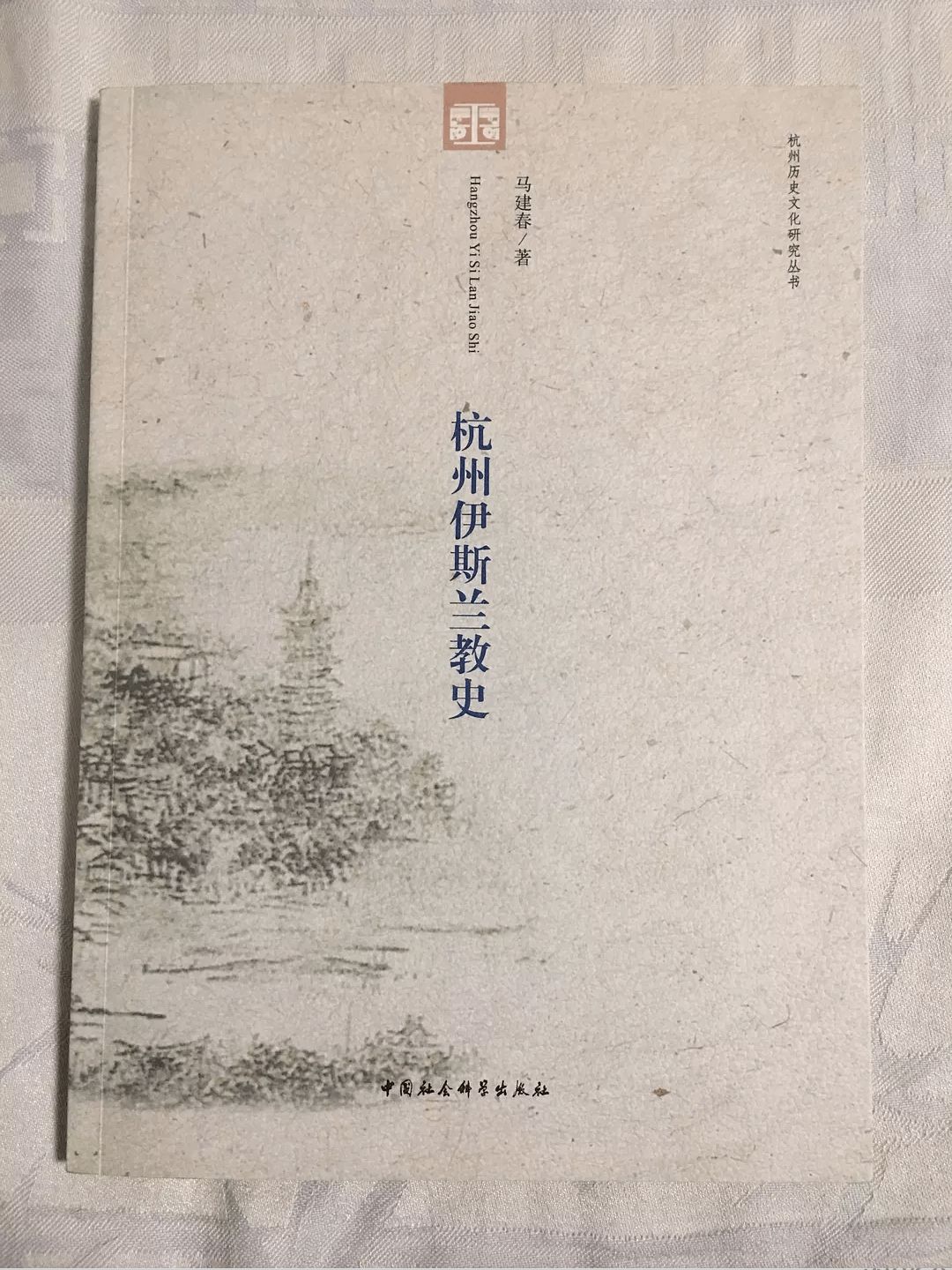
Let's start with a brief look at the history of the halal community in Hangzhou.
The prosperity of Muslims in Hangzhou during the Yuan Dynasty
Although Muslim merchants were granted official titles and settled in Hangzhou as tribute envoys starting in the Southern Song Dynasty, there are still no credible documents or unearthed artifacts recording the lives of Muslims in Hangzhou during the Song Dynasty.
Starting in the Yuan Dynasty, a large number of Muslims began to come to Hangzhou to settle. They were mainly Persians, along with Persianized Central Asian Turks. Among them were Semu military and political officials serving in the Jiangzhe Province, Muslim merchants who arrived in Hangzhou via the Maritime Silk Road and the Beijing-Hangzhou Grand Canal, and purely religious figures. They held high social status and lived wealthy lives.
In the 1320s, the Italian Franciscan friar Odoric came to China. The Travels of Friar Odoric wrote: Hangzhou is the largest city in the world. At that time, Hangzhou had 850,000 registered households, and the Saracens (a term used by Europeans in the Middle Ages to refer to Muslims) accounted for 40,000 of them.
Unlike the Muslims of the Tang and Song periods, the Muslims in Hangzhou during the Yuan Dynasty formed a bustling Muslim community in the city center due to their large numbers. The Yuan Dynasty Muslim community in Hangzhou was located west of Jianqiao and south of Wenjin Lane, inside the current Qingtai Gate. The late Yuan Dynasty writer Tao Zongyi wrote in his book Records of Stopping the Plow at Nancun: Beside Jianqiao in Hangzhou, there are eight tall buildings, commonly known as the Eight-Room Buildings, all inhabited by wealthy Hui Muslims.
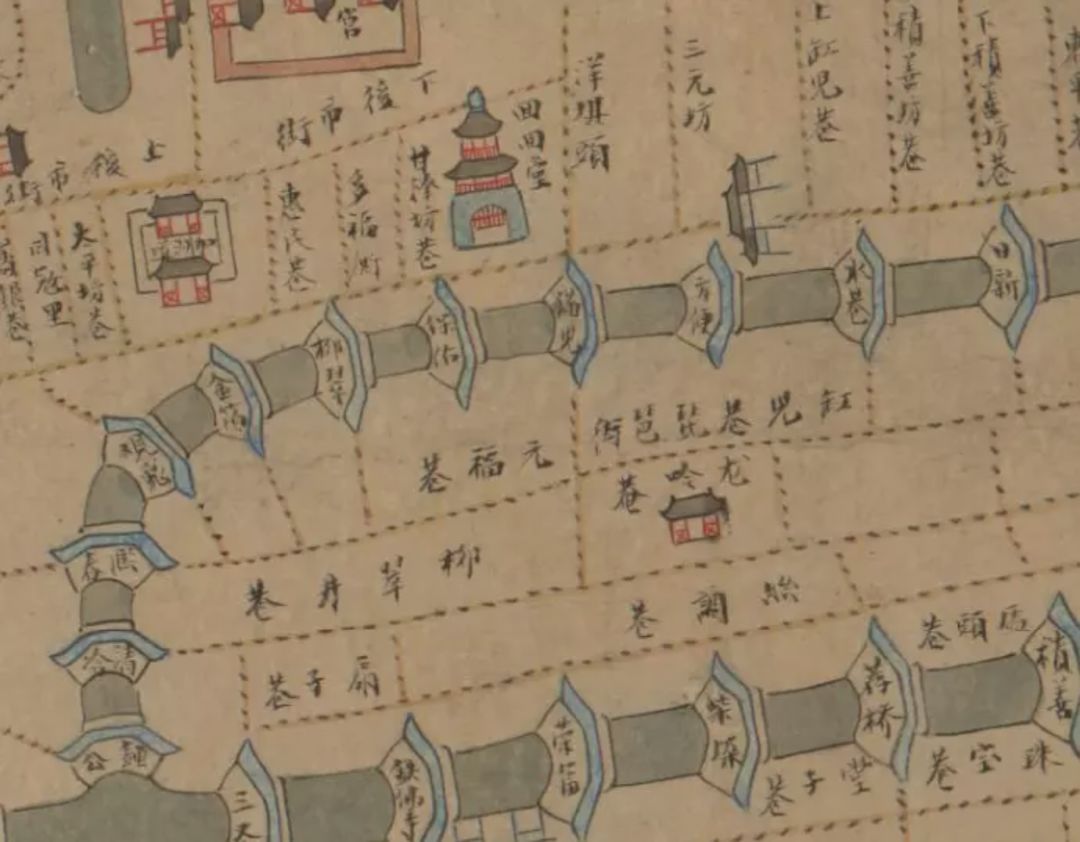
The 1867 map of the city of Hangzhou shows the streets with west at the top and east at the bottom. Jianqiao Bridge is in the bottom right corner, and the Hui Muslim hall (Huihuitang) at the top is Phoenix Mosque (Fenghuangsi).
In 1346 (the sixth year of the Zhizheng era), the famous Moroccan traveler Ibn Battuta arrived in Hangzhou. His book, The Travels of Ibn Battuta, mentions the Hangzhou Muslim community: 'The Muslims live in the city, which is beautiful, and the streets are laid out just like those in Islamic regions.' There is a mosque and a muezzin inside. We arrived in the city just at the time for the noon prayer (namaz), and the call could be heard far and wide. In this city, we stayed at the home of the descendants of Othman ibn Affan, an Egyptian. He was a great local merchant who liked this place very much and settled here. They have a lodge (daotang) also named after Othman, which is beautifully built and has many charitable endowments, with a group of Sufi practitioners inside. Othman also built a large mosque in the city and donated a large amount of charitable funds to the mosque and the lodge. There are many Muslims in the city. We lived in this city for fifteen days, and we were invited out every day and every night.
During the Yuan Dynasty, Hangzhou had three mosques: True Religion Mosque (Zhenjiaosi), Hui Muslim Prayer Hall (Huihui Baifotang), and Hui mosque (Huihuishi Libaisi). True Religion Mosque (Zhenjiaosi)
This is Phoenix Mosque (Fenghuangsi). Its original construction date is uncertain, but it was rebuilt in 1281 (the 18th year of the Yuan Zhiyuan era) and has continued to the present day. Hui Muslim Prayer Hall (Huihui Baifotang)
It was northeast of True Religion Mosque, next to Hui Muslim New Bridge (Huihui Xinqiao). The place name Hui Muslim New Bridge still exists today. Hui mosque (Huihuishi Libaisi)
It was west of True Religion Mosque, on what is now Laodong Road. It was destroyed during the wars at the end of the Yuan Dynasty, and the original site was turned into a prefectural school.
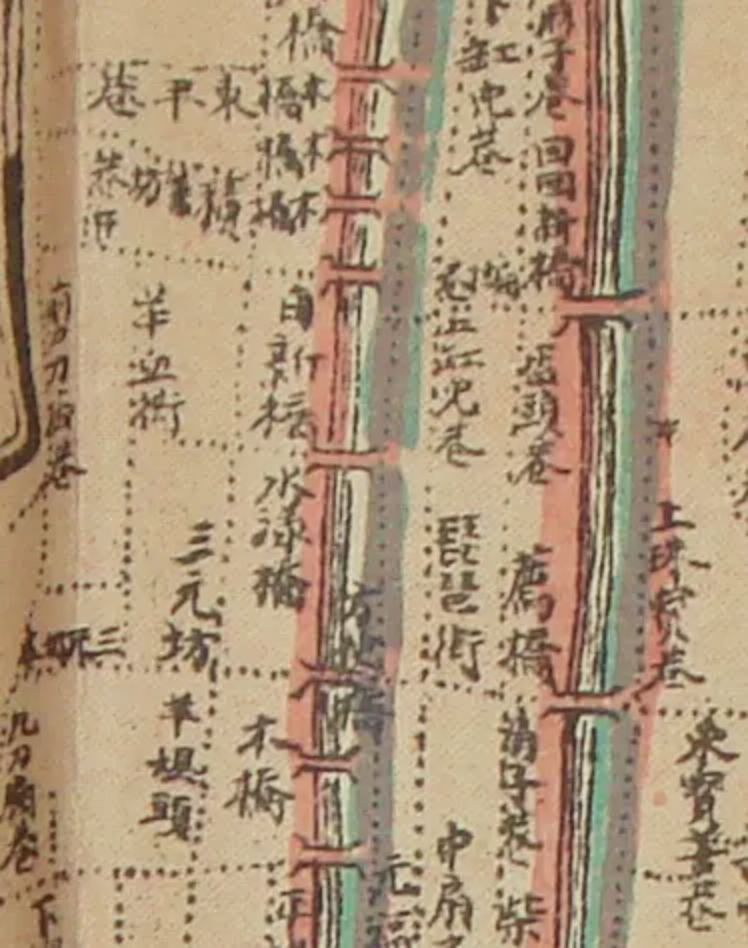
The 1914 map of Hangzhou city and West Lake shows Phoenix Mosque at Yangbatou in the bottom left corner, Hui Muslim New Bridge in the top right, and Jewelry Lane (Zhubaoxiang) in the bottom right.
Jujing Garden, located by West Lake outside Qingbo Gate in Hangzhou, was once a place for the Song Dynasty royal family to tour. After the Yuan Dynasty, it was purchased by Muslims to be used as a cemetery. In 1291 (the 28th year of the Zhiyuan era of the Yuan Dynasty), the Song and Yuan poet Zhou Mi saw a Muslim cemetery at Jujing Garden. In his book Guixin Zashi, he wrote: 'According to the customs of the Hui Muslims, when someone dies... they are buried in Jujing Garden, which is also managed by the Hui Muslims.' This was only 15 years after the Yuan army entered Hangzhou. During the Ming and Qing dynasties, this place was called the 'Foreigner's Grave' (fanhui jiamu) or 'Hui Muslim Grave' (huihui fen). During the Republic of China era, it was known as the 'South Garden Islamic Cemetery' (nanyuan huijiao gongmu) or 'Islamic Public Cemetery' (huijiao yizhong), and it remained there until it was moved in 1953.
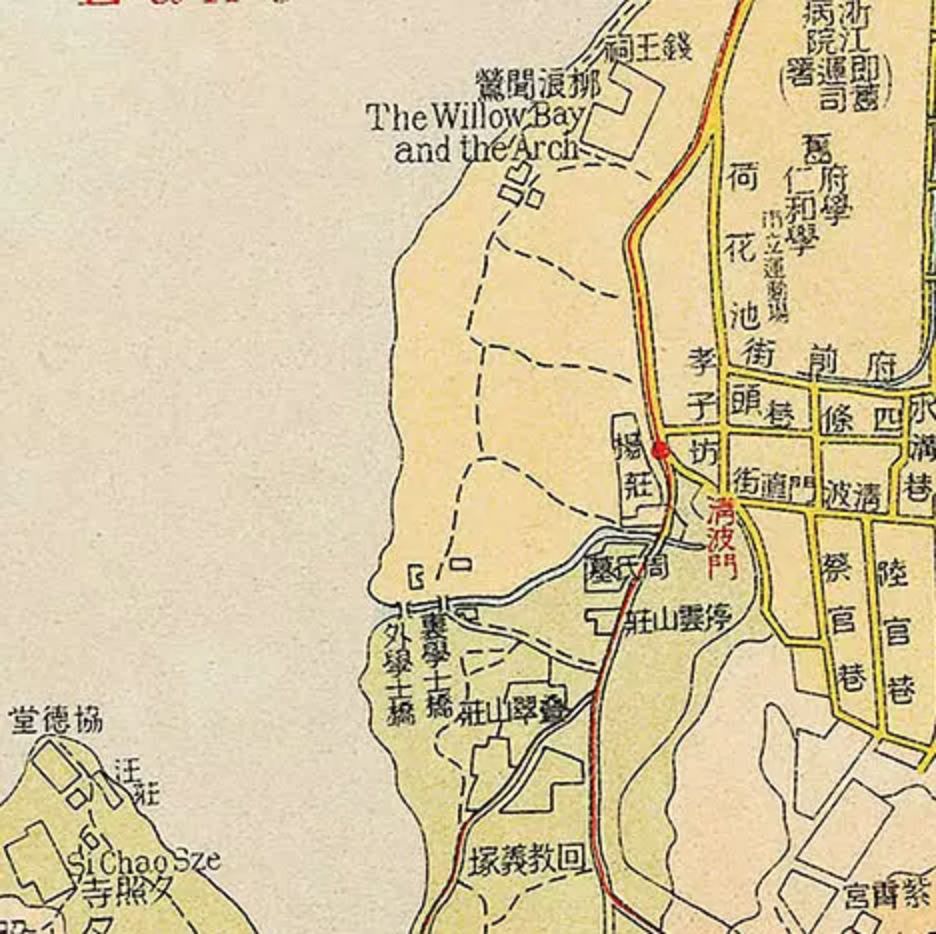
The 1929 survey map of West Lake in Hangzhou shows the Islamic Public Cemetery at the bottom.
The settling of Muslims in Hangzhou during the Ming Dynasty.
During the Yuan Dynasty, Muslims in Hangzhou did not yet consider this place their home. Many Muslim tombstones from the Yuan period feature a Hadith saying, 'To die in a foreign land is to be a martyr.' After entering the Ming Dynasty, maritime trade stopped, and Muslims who had lived in Hangzhou for generations gradually began to settle down and integrate into local life.
The number of Muslims in Hangzhou continued to grow during the Ming Dynasty. Between the Zhengtong and Hongzhi years (1436-1505), Hami in the Western Regions was attacked by the Oirat Mongols many times. Many Hui Muslims moved to Hangzhou as entire families, and many were settled there. Two Hui Muslims from the Western Regions who arrived in the early Ming Dynasty, Shabasi and Mardin, worked for a long time in the salt and grain transport business along the Grand Canal and became wealthy merchants. Their descendants took the surnames Sha and Ma, becoming major Hui Muslim family names in Hangzhou during the Ming and Qing dynasties.
During the Ming Dynasty, the True Religion Mosque (Zhenjiao Si), also known as Phoenix Mosque (Fenghuang Si), remained the largest mosque in Hangzhou and underwent major renovations in 1453 (the fourth year of the Jingtai era).
As the population grew, three new mosques were built in Hangzhou at the end of the Ming Dynasty: Vinegar Workshop Lane Mosque (Cufang Xiang Si, or North Mosque), Board Lane Mosque (Ban'er Xiang Si, or East Mosque), and Bingxiang Lane Mosque. All were founded by a local wealthy Hui Muslim merchant named Ding Dashou. Vinegar Workshop Lane Mosque was later called the Hangzhou North Mosque. It was located on what is now Chufei Lane in the Xiacheng District. It was destroyed during the Taiping Rebellion, and in 1870 (the ninth year of the Tongzhi era), the Phoenix Mosque built houses on the original site to rent out. Board Lane Mosque, also known as the Small Mosque (xiao libai si) or Hangzhou East Mosque, was located on what is now South Jianguo Road. It was the second most important mosque in Hangzhou after the Phoenix Mosque. Many believers came there for Friday prayers (Jumu'ah), and it was also the place where animal sacrifices and funeral rites were usually held. In 1965, part of the building was taken over by the neighborhood committee for a senior citizens' club, and after 1966, it was converted into a neighborhood office building. Bingxiang Lane Mosque was in the northern suburbs of Hangzhou. There are very few historical records about it, and most local Hui Muslims do not know about it, so it likely fell into ruin many years ago.
Besides the three mosques founded by Ding Dashou, there were several other mosques in Hangzhou during the Ming Dynasty. There was a mosque built during the Chenghua period of the Ming Dynasty at Huihui New Bridge, which featured a moon-sighting tower (wangyuelou) and a scripture school (jingwen xuetang), though it is unclear if it had any connection to the Huihui Buddha-worship hall from the Yuan Dynasty. There was also the West Lake Guo Family Bridge Mosque, known as the West Mosque. The West Lake Mosque, also called the West Lake Small Mosque and the Hangzhou West Mosque, was located north of the previously mentioned Hui Muslim cemetery. It was used for handling funeral arrangements for Hui Muslims. In 1954, it was moved along with the Hui Muslim cemetery to Jingshan Ridge in Liuxia Town, and it stopped being used after 1966.
The stable development of Hangzhou Muslims during the Qing Dynasty.
After the Qing Dynasty began, the Muslim community in Hangzhou was relatively stable. The True Religion Mosque (Zhenjiao Si) underwent repairs during the reigns of the Shunzhi, Kangxi, Qianlong, and Guangxu emperors. the Hangzhou South Mosque was built on Wukui Lane. After the 1950s, the South Mosque on Wukui Lane was converted into housing for Muslims. It was closed in 1958 and handed over to the housing management department for leasing. By this time, Qing Dynasty Hangzhou had five mosques: East, West, South, North, and Central (the Central one being Phoenix Mosque). Phoenix Mosque was the main mosque, while the others were smaller mosques subordinate to it. The leaders and imams of the smaller mosques were appointed by the main mosque. The smaller mosques were for the convenience of the community to perform their five daily namaz prayers, while Friday congregational prayers, festival prayers, and other major religious ceremonies had to be held at the main mosque.
The biggest change for Hui Muslims in Hangzhou during the Qing Dynasty was their shift from wealthy merchants involved in overseas and canal trade during the Yuan and Ming dynasties to ordinary people running small businesses. Their business scope changed from jewelry, spices, silk, and porcelain to halal food. Many people worked full-time in beef and mutton slaughtering, pastry making, running restaurants, and selling snacks. The Qing Dynasty collection of poems, Wulin Zashi Shi, praised Hangzhou Hui Muslim snacks: 'The flour is so fine it rivals pearls and jade, kneaded by hand to look whiter than frost and snow.' If you ask whose snacks are the most delicate, they are the ones made by Ye Shouhe in front of the mosque.
Additionally, the 1863 (second year of the Tongzhi reign) book Hangsu Yifeng, in the food section, wrote: 'Mutton soup restaurants are Muslim eateries.' They specialize in selling mutton products. The sheep are skinned and deboned, then stewed until tender and cut into pieces. Each piece costs four wen, and they are divided into pepper-salt style and plain style. There are also intestines, lungs, and hearts, which are chopped up and served in a bowl with broth, known as 'mixed offal soup' (zashui). A single bowl costs six wen, and a double bowl costs fourteen wen. Snacks like kidneys and liver, spinal cord and brains, intestines and tripe, trotters, tongue, and taiji-shaped cakes (taijitu) cost twenty-eight wen per plate; for meat pieces, eating two pieces only costs six wen. You can order any amount of dried meat slices (ganpianer) per plate, or put them in broth to make sliced meat soup (pianzi tang). The main dishes like braised meat and mixed offal soup always come from the sheep. The liquor is sorghum wine, and snacks include shredded meat, spring pancakes (chunbing), boiled dumplings (shuijiao), and steamed dumplings (shaomai).
Besides mutton, there are small stalls selling spiced beef, beef heart, beef liver, beef trotters, and beef vermicelli (niurou fenxian), carried on shoulder poles with a sign hanging that reads 'Halal Faith' (Qingzhen Jiaomen).
The final prosperity of Muslims in Hangzhou during the Republic of China era.
During the Republic of China era, there were four or five hundred Hui Muslim households in Hangzhou, scattered throughout the city. Besides the common people who mostly ran halal food businesses and sold daily necessities, there were also some wealthy merchants, such as the Jin family who dealt in jewelry, the Zhang family in sericulture and silk, the Feng family who ran a match factory, and the Xuan family who ran a soy sauce shop.
Except for the North Mosque (Qingzhen Beisi) which was destroyed during the Taiping Rebellion, there were four mosques in Hangzhou during the Republic of China era: the Phoenix Mosque (Fenghuang Si) and three smaller mosques in the east, west, and south. In 1928, the main hall and the Moon-Watching Tower (Wangyue Lou) of the Phoenix Mosque were destroyed due to road construction. In the same year, when the city wall was demolished to build the lakeside road, some ancient graves in the Nanyuan Hui Muslim cemetery were forced to relocate, and the Yong'an Hui Muslim cemetery was newly built at Lingfeng, Yuquan, West Lake in 1934.
In 1914, the modern 'Hangzhou Muxing Primary School' was founded inside the Phoenix Mosque. It taught cultural subjects according to the regulations of the Ministry of Education of the Republic of China, and held an Arabic religious class every afternoon, taught by the imam and the head of the Phoenix Mosque. Muxing Primary School accepted students regardless of whether they were Hui or Han, or their gender, as long as they were of school age, but it stipulated that Hui Muslims were exempt from tuition and miscellaneous fees.
In 1928, the Muxing Junior High School was founded inside the Phoenix Mosque, and it later moved to the Chouye Guild Hall at Yintong Bridge. The school had three junior high classes divided into spring and autumn groups, and Hui Muslims were also exempt from tuition and miscellaneous fees. Muxing Middle School has eight full-time teachers. They teach Chinese, math, science, history, geography, art, physical education, and general knowledge. They also regularly offer Hui Muslim students classes on basic Islamic teachings and introductory Arabic.
Since the end of the Qing Dynasty and the beginning of the Republic of China, more and more Hui Muslims moved to Hangzhou from northern provinces like Shandong, Henan, and Hebei. Most left their hometowns and brought their wives and children to Hangzhou to make a living because they had no other choice. Because they lacked capital, most worked as small vendors selling halal food and daily necessities. At that time, you could often see stalls on the streets of Hangzhou with wooden signs saying "Halal" selling flatbread (dabing), fried dough sticks (youtiao), tea eggs, smoked chicken, braised duck, steamed buns (mantou), and dumplings (shuijiao). Some people grew their small stalls into snack shops and later into restaurants, which helped the halal food industry in Hangzhou thrive during the Republic of China era.
Famous halal restaurants in Hangzhou during the Republic of China period included Chunhuayuan, Xileyuan, Zheyi Guan, Xiyue Guan, and Xiyi Guan. Most focused on lamb, braised duck, and vegetarian dishes. Zhong Yulong, a Hangzhou native, was raised in a Hui Muslim family and knew a lot about the Muslims in Hangzhou during the Republic of China. In his book "Speaking of Hangzhou," he wrote: "Xileyuan and Chunhuayuan near Yangbatou are old-fashioned lamb soup restaurants. When customers sit down, they are first served lamb offal soup (yangzasui tang), which is made by chopping up lamb intestines, lungs, and hearts and serving them in a bowl with broth." Depending on the portion size, there are single bowls and double bowls. If you want the full set, you get a small plate each of lamb liver, kidney, eye, tongue, tripe, testicle, brain, and marrow. Otherwise, you can order whatever you like. Regulars use code names for these dishes. For example, lamb testicle is called 'fengtiaoyu,' lamb eye is 'liangdong'r,' lamb brain is 'taijitu,' lamb tongue is 'koutiao,' and fatty lamb meat is 'tuobai,' and so on. After the victory in the War of Resistance Against Japan, each plate cost 2,000 yuan in legal tender, with lamb testicle costing double that. Staple foods included steamed buns (mantou) served with lamb soup, as well as small lamb noodles and lamb steamed dumplings (shaomai). "Speaking of Hangzhou" also records the fried dough (youxiang) of Hangzhou Muslims: "There are two types of fried dough. One is made by grinding sugar and flour into a thin, plate-sized pancake and deep-frying it in oil." The other is made by shaping flour into small cakes with filling inside, pressing them with a mold, and then deep-frying them. Both taste excellent.
Phoenix Mosque (Fenghuang Si)
Phoenix Mosque is located on Zhongshan Middle Road, at the north end of what is now the Southern Song Imperial Street. Historically, it was called the Mosque (libaisi), True Religion Mosque (zhenjiaosi), Huihui Hall (huihuitang), and Orthodox Mosque (zhengjiaosi). The name Phoenix Mosque first appeared on the 1892 (18th year of the Guangxu reign) "Stele Record of the Renovation of the True Religion Mosque."
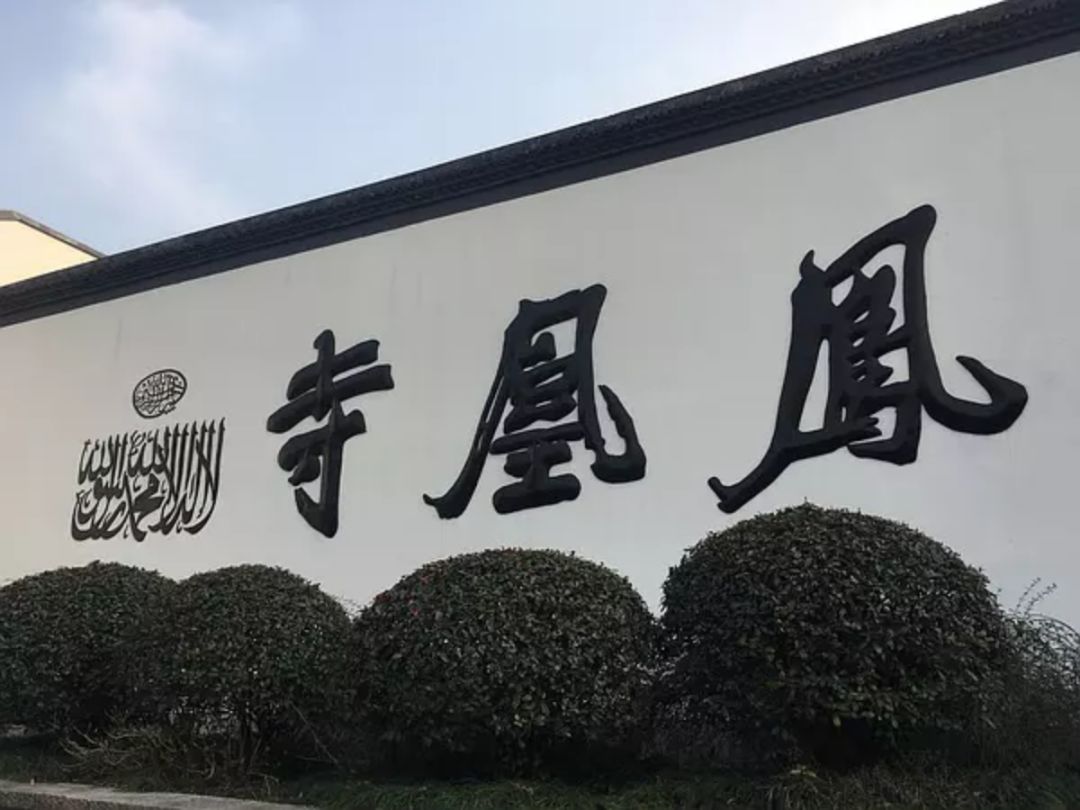
There is currently a lot of debate about when Phoenix Mosque was built. The direct evidence comes from three Ming and Qing dynasty renovation steles and two Ming dynasty books. A stele from 1493 (the 6th year of the Hongzhi reign of the Ming Dynasty) records: The mosque was founded in 1281 (the Xinsi year of the Zhiyuan reign of the Yuan Dynasty). The Hui Muslims have guarded it for generations.
A stone tablet from 1648 (the fifth year of the Shunzhi reign) records that the True Teaching Mosque (Zhenjiao Si) in Wulin was founded in the Tang Dynasty and has lasted for several hundred years through the Song, Yuan, and Ming dynasties.
A stone tablet from 1670 (the ninth year of the Kangxi reign) records that it was founded in the Tang Dynasty and destroyed at the end of the Song Dynasty. In 1281 (the Xinsi year of the Yuan Dynasty), a master named Alaoding came from the Western Regions, stopped in Hangzhou, saw the ruins, felt moved, and donated gold to rebuild it.
The Records of West Lake Travels (Xihu Youlan Zhi), printed in 1547 (the 26th year of the Jiajing reign), records that the True Teaching Mosque (Zhenjiao Si) is south of Wenjin Lane and was built by the Hui Muslim master Alaoding during the Yanyou period (1314-1320) of the Yuan Dynasty.
The Ming Dynasty book Wulin Buddhist Records (Wulin Fanzhi) records that the True Teaching Mosque (Zhenjiao Si) is south of Wenjin Lane and was built by the Hui Muslim master Alabudan during the Yanyou period (1314-1320) of the Yuan Dynasty.
Looking at these five documents, the Phoenix Mosque (Fenghuang Si) was likely built between the Southern Song Dynasty and 1281. Very few Muslims who came to Hangzhou during the Tang and Five Dynasties periods settled there, and no reliable historical records have been found to date. Therefore, the claim that it dates back to the Tang Dynasty is too early and likely a later fabrication. During the Yanyou period, the number of Muslims living in Hangzhou was already high. They had formed a sizable Muslim community and had their own cemetery, so saying the mosque was built at this time is a bit too late.
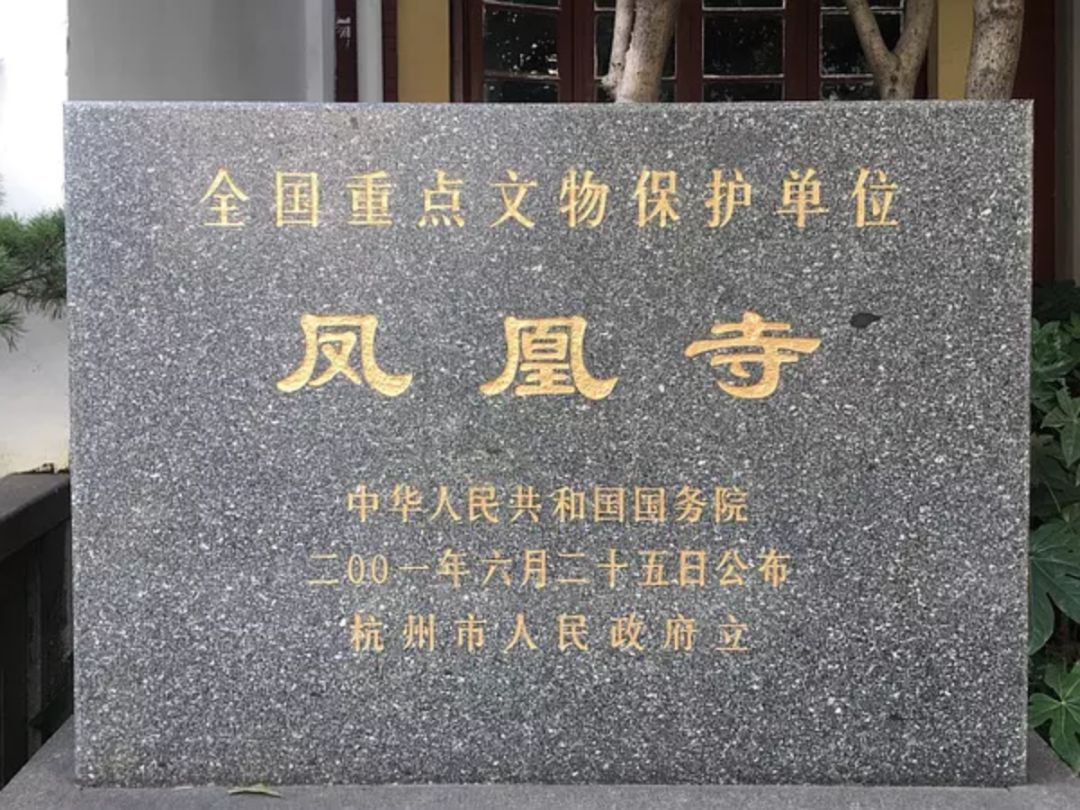
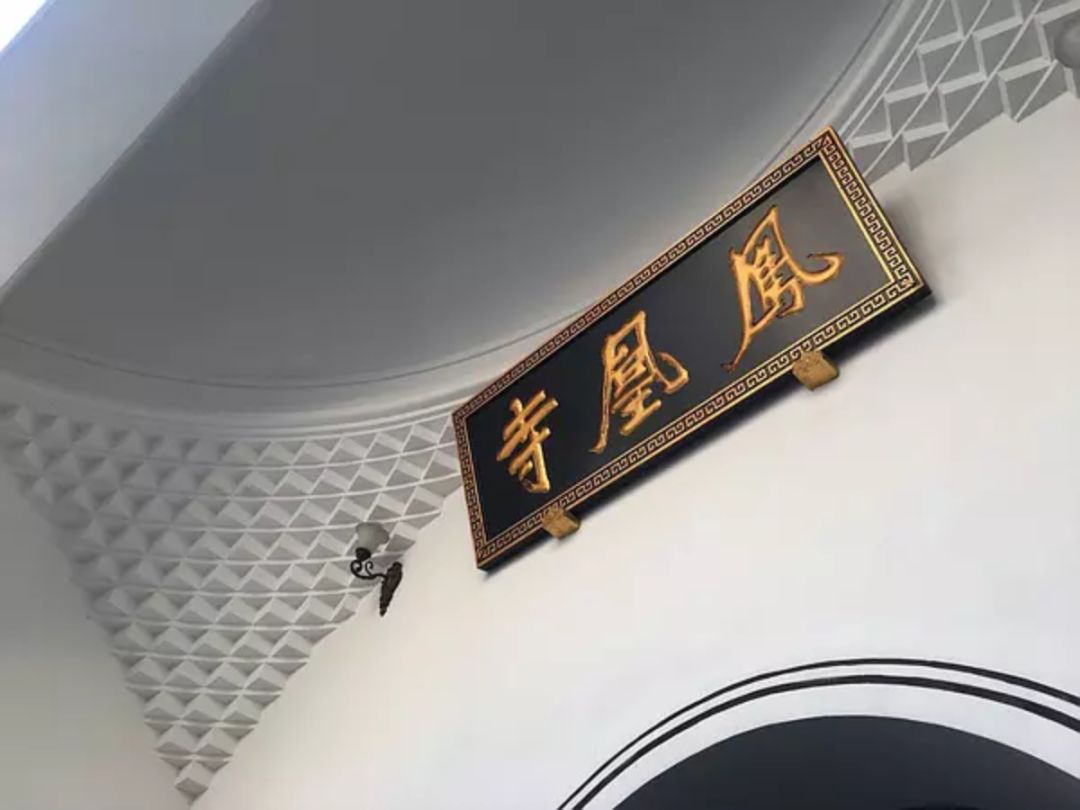
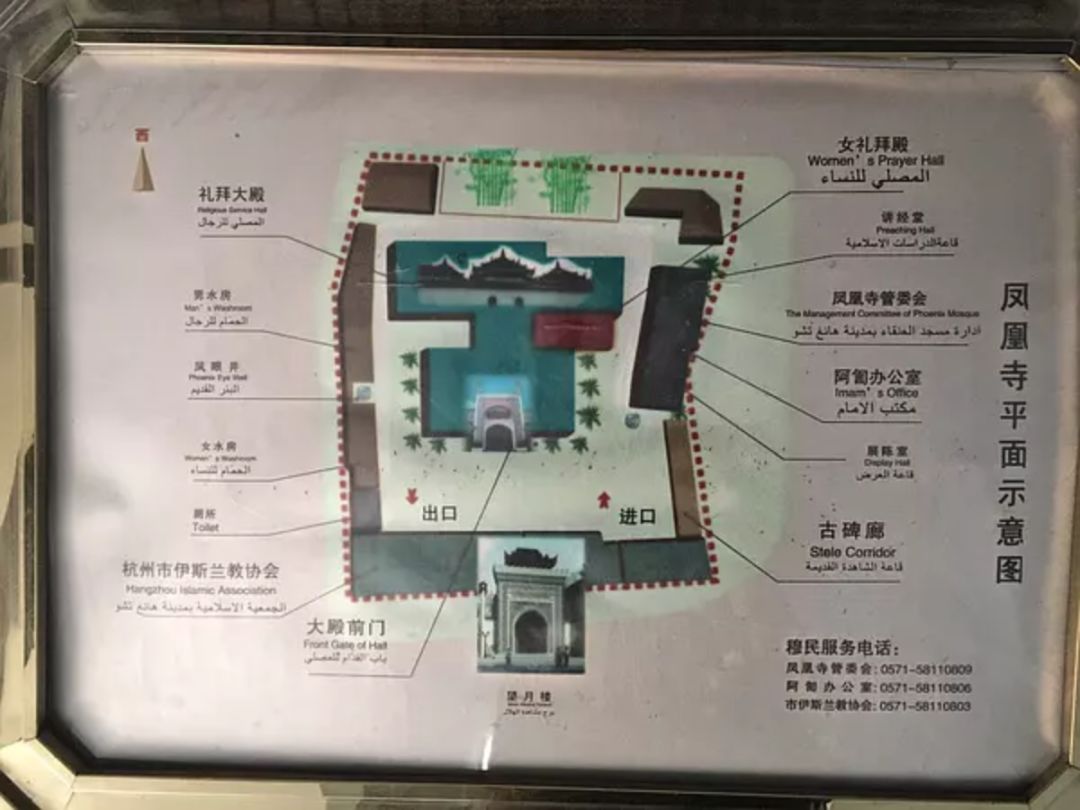
According to Ji Si in The Islamic Architecture of Hangzhou: Phoenix Mosque, the main gate of the Phoenix Mosque was originally over 10 meters high. The lintel was inlaid with Arabic brick carvings, the sides of the pointed arch gate were covered with decorative tiles, and there were two lotus-shaped columns.
In 1929, Hangzhou demolished the main gate, the Moon-Watching Tower (Wangyue Lou), the stone-carved corridor leading to the front hall, and the pair of stone birds in front of the gate to renovate Zhongshan Middle Road.
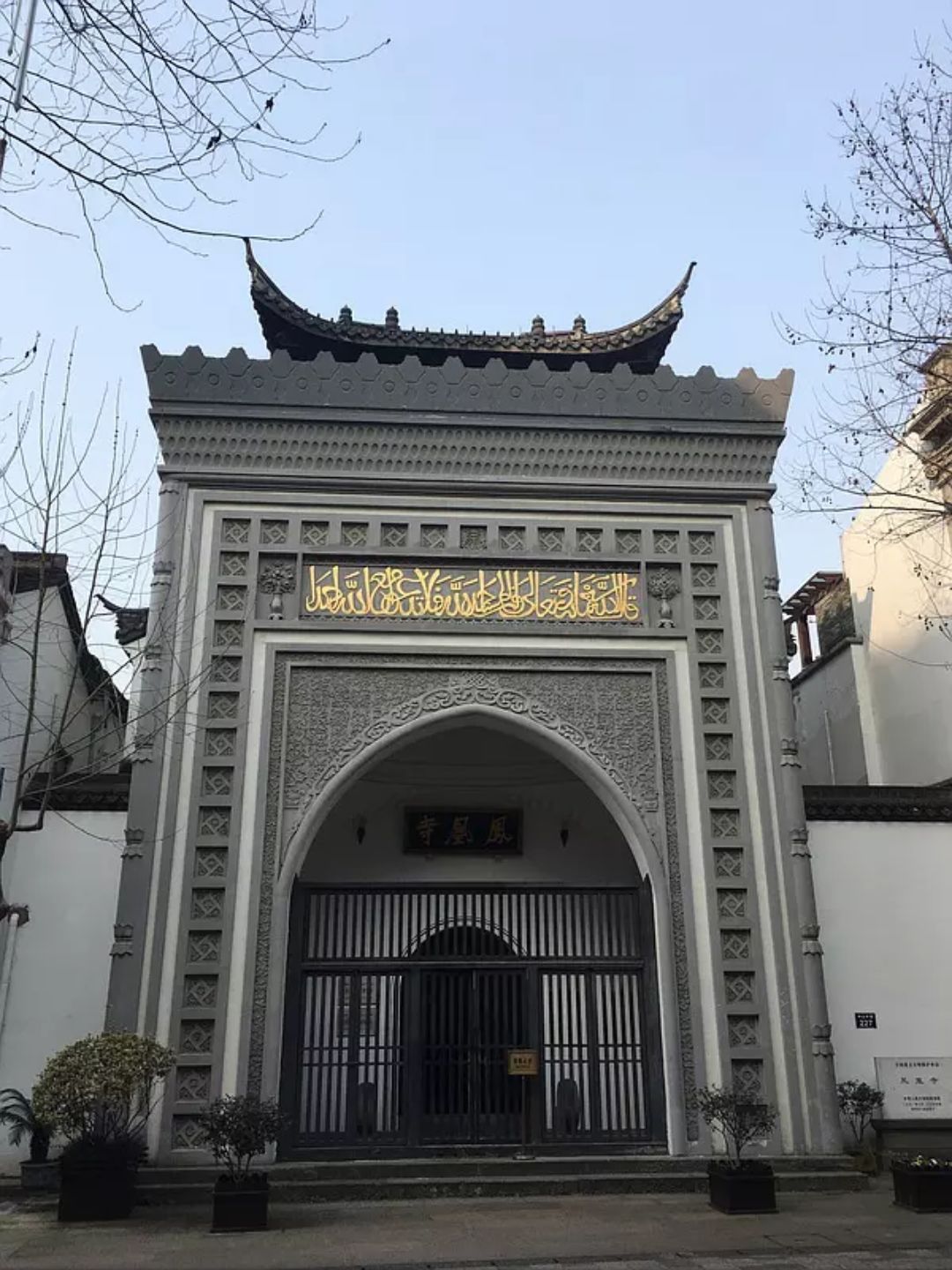
The old photo of the original Phoenix Mosque main gate shared on the Zhejiang Islamic Association website has been carefully preserved for generations by elders like Zhang Wenlie in Hangzhou.
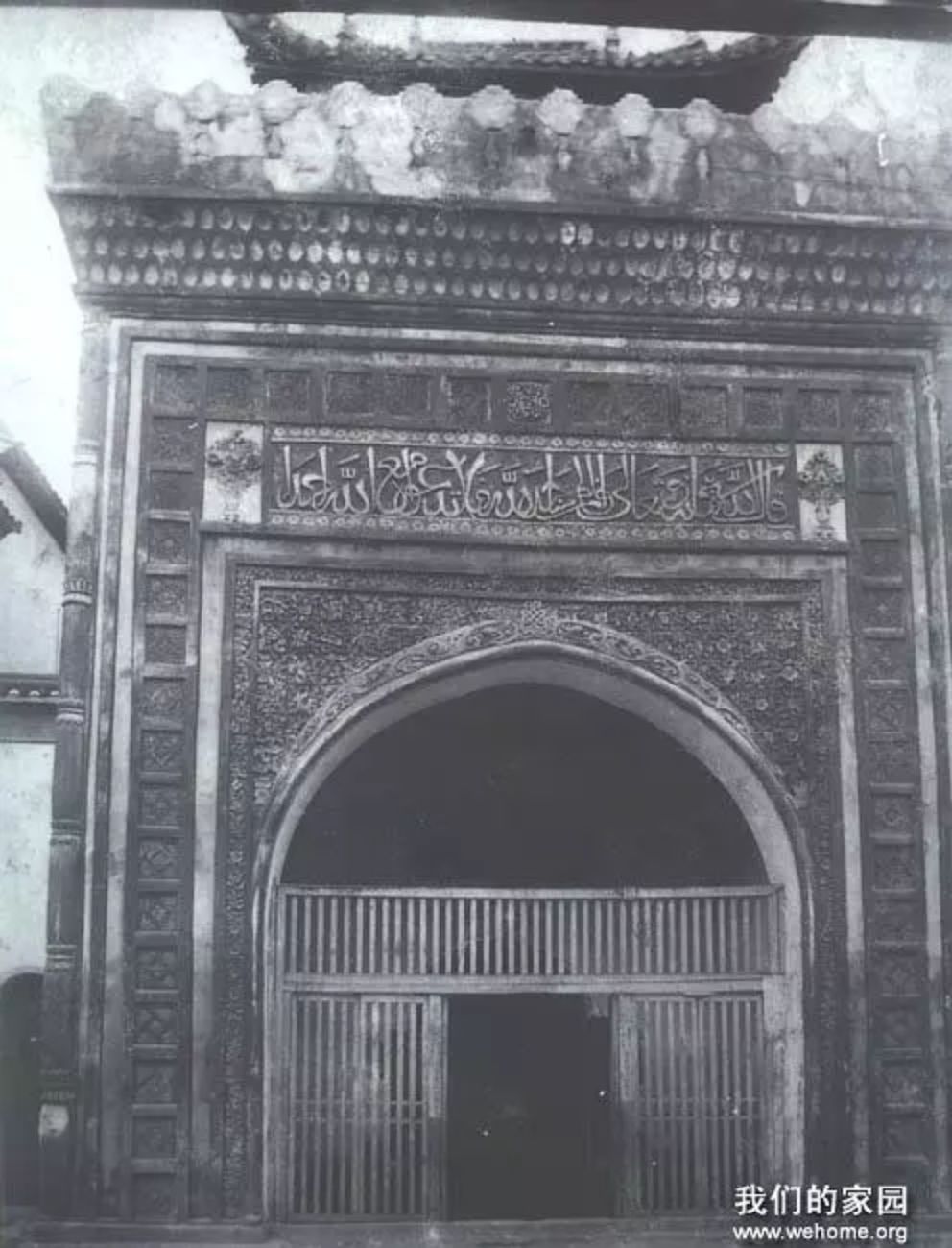
Moon-Watching Tower (Wangyue Lou)
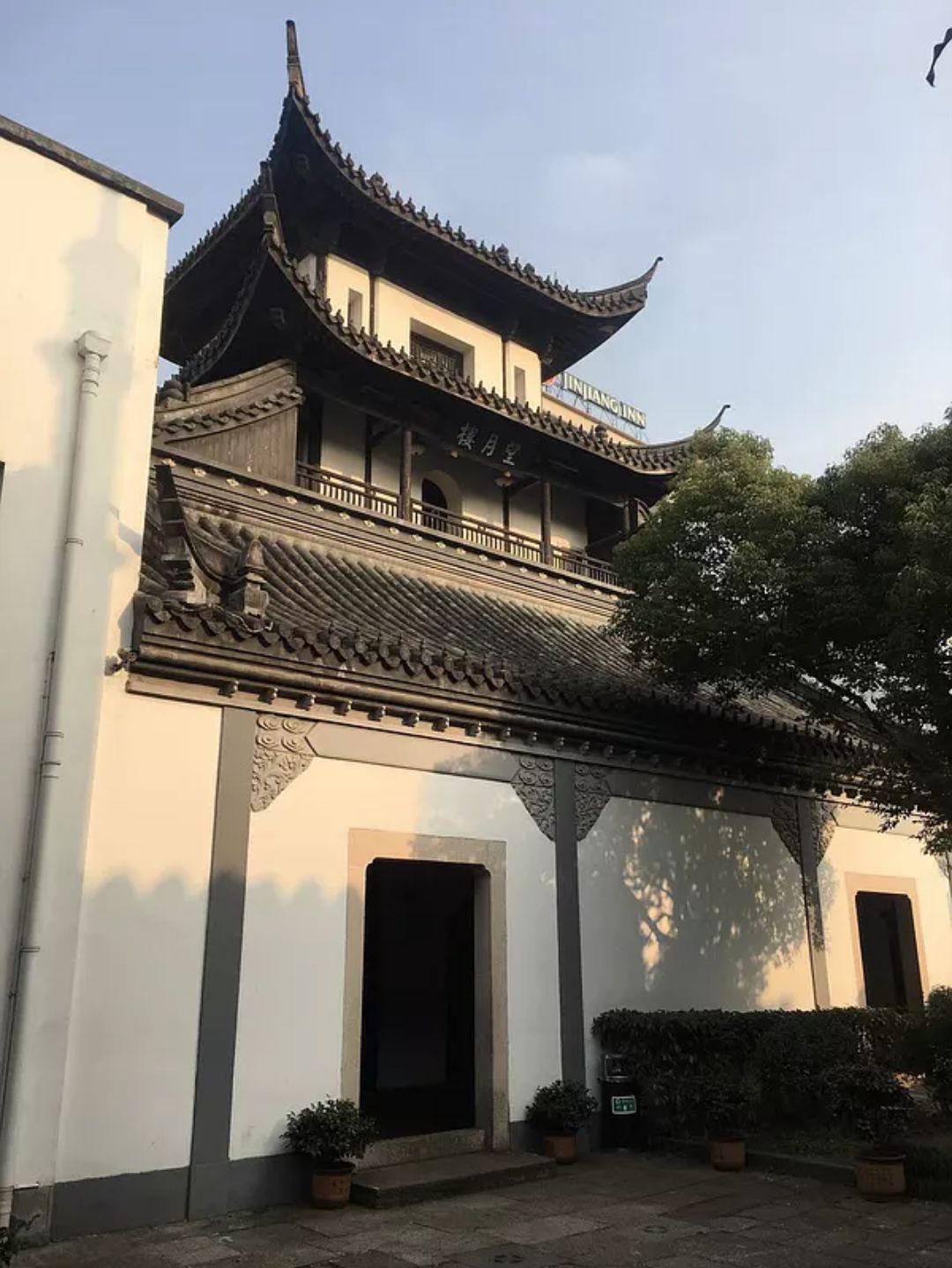
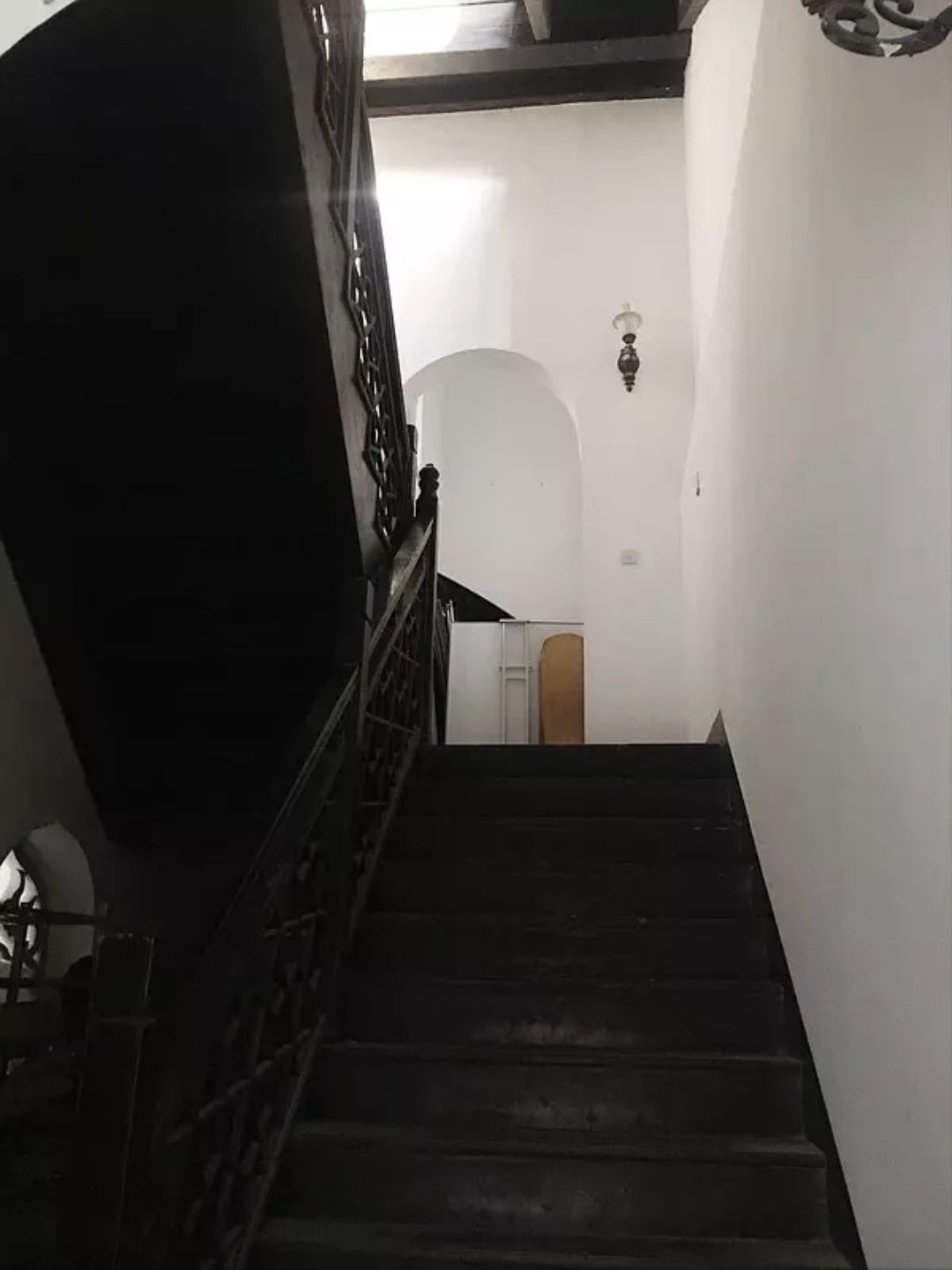
The old photo of the original Phoenix Mosque Moon-Watching Tower (Wangyue Lou) shared on the Zhejiang Islamic Association website has also been carefully preserved for generations by elders like Zhang Wenlie in Hangzhou.
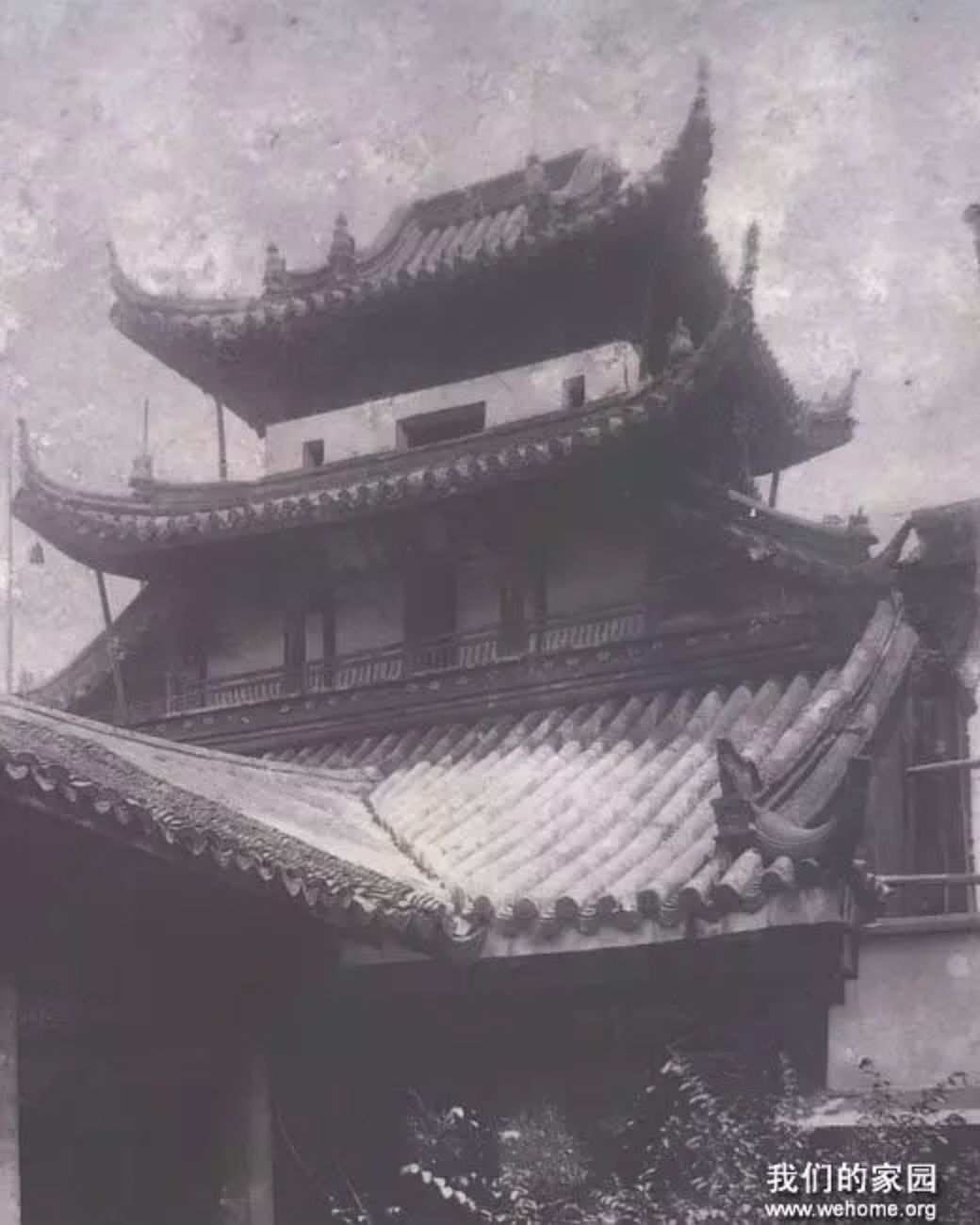
During the 1953 renovation of the main hall, the front hall was demolished and rebuilt with a concrete structure and red brick walls.
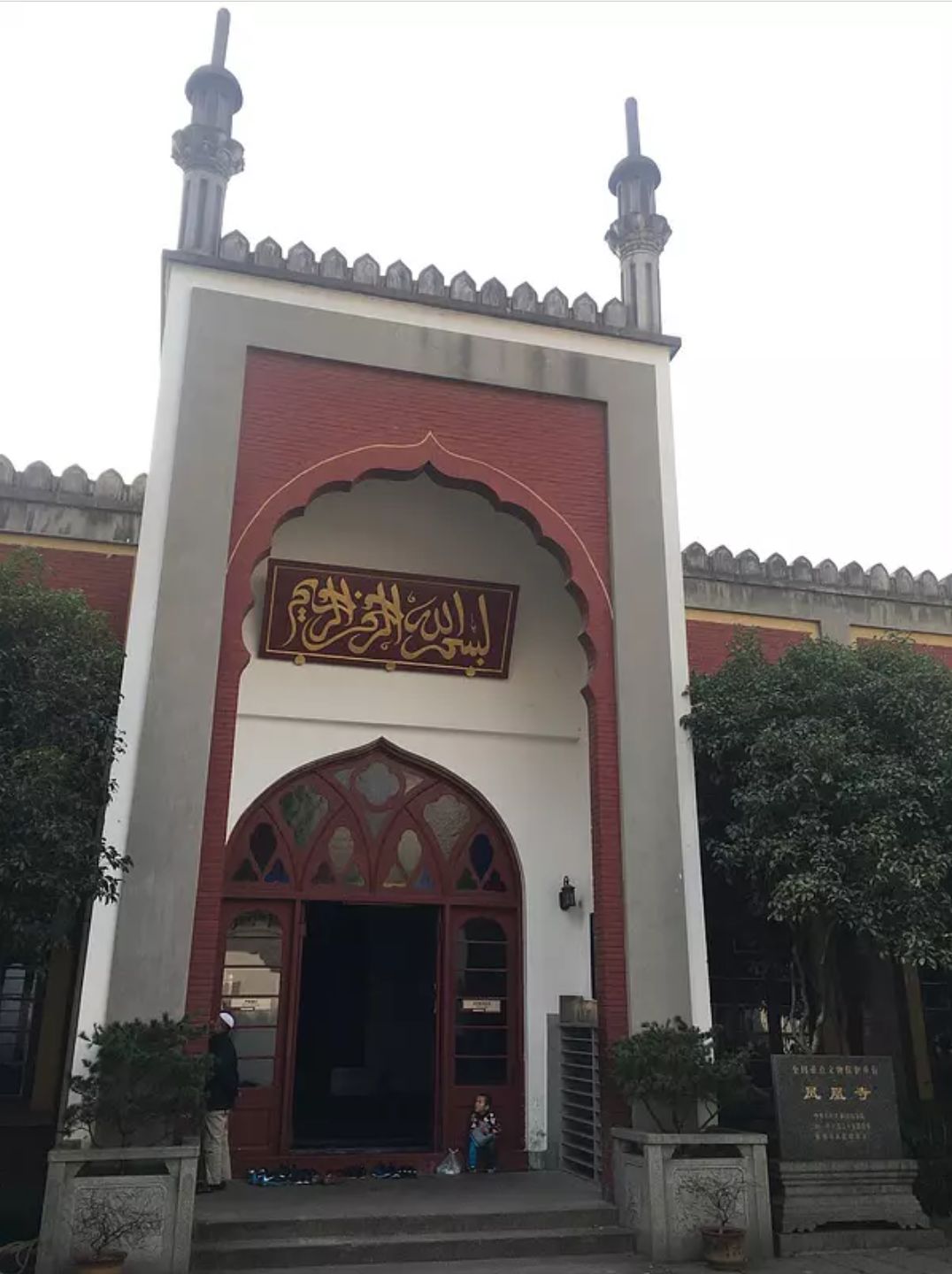
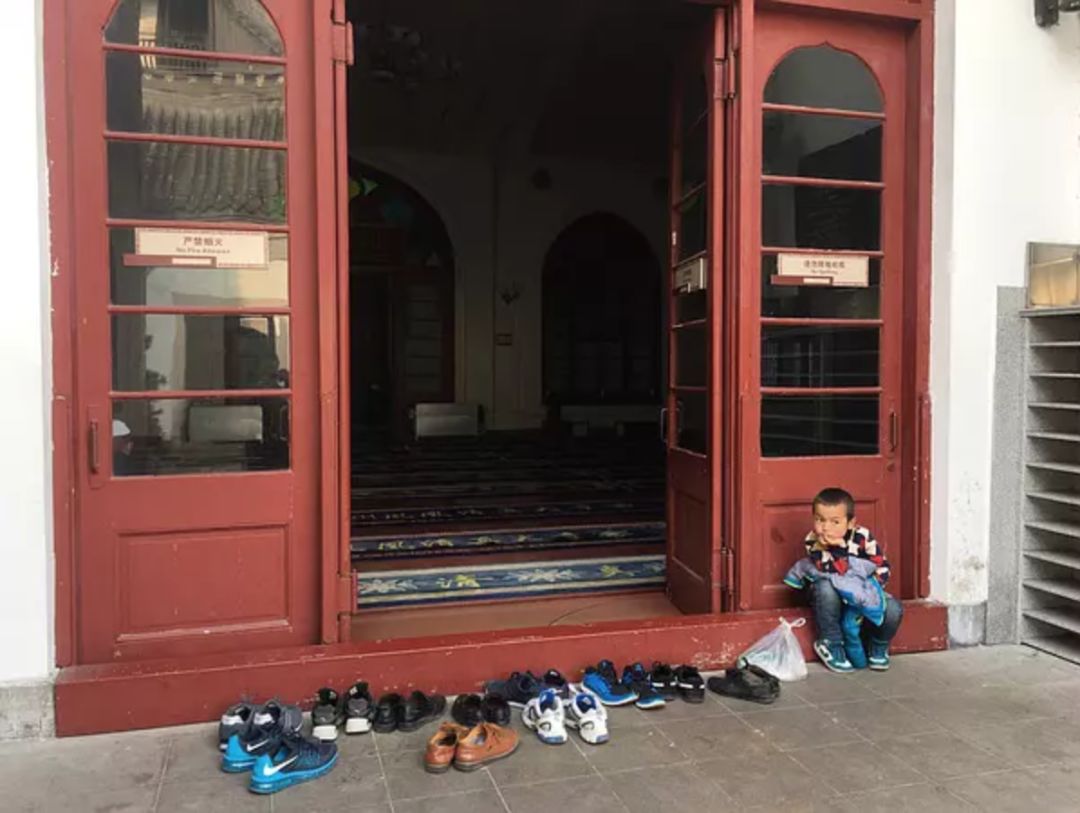
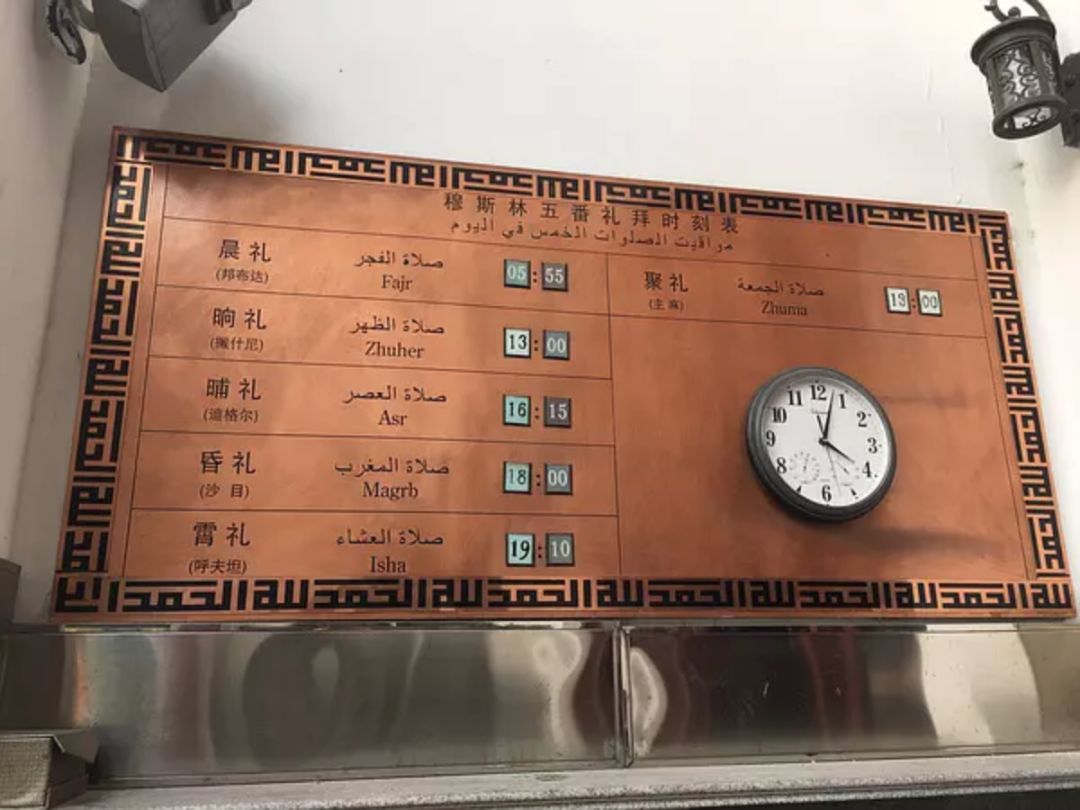
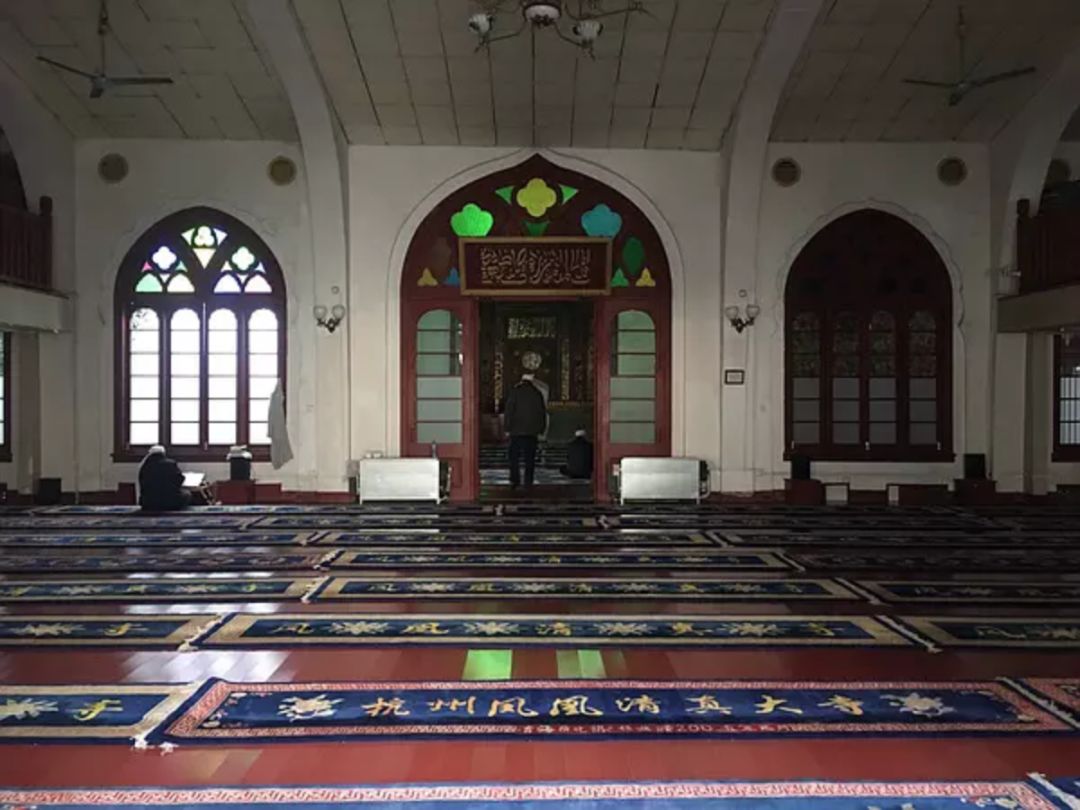
The rear main hall is the only remaining Yuan Dynasty structure of the Phoenix Mosque. It is narrow from east to west and wide from north to south, maintaining the traditions of early West Asian mosques. The entire hall is a brick structure without wooden beams, so it is also called the Beamless Hall (Wuliang Dian).
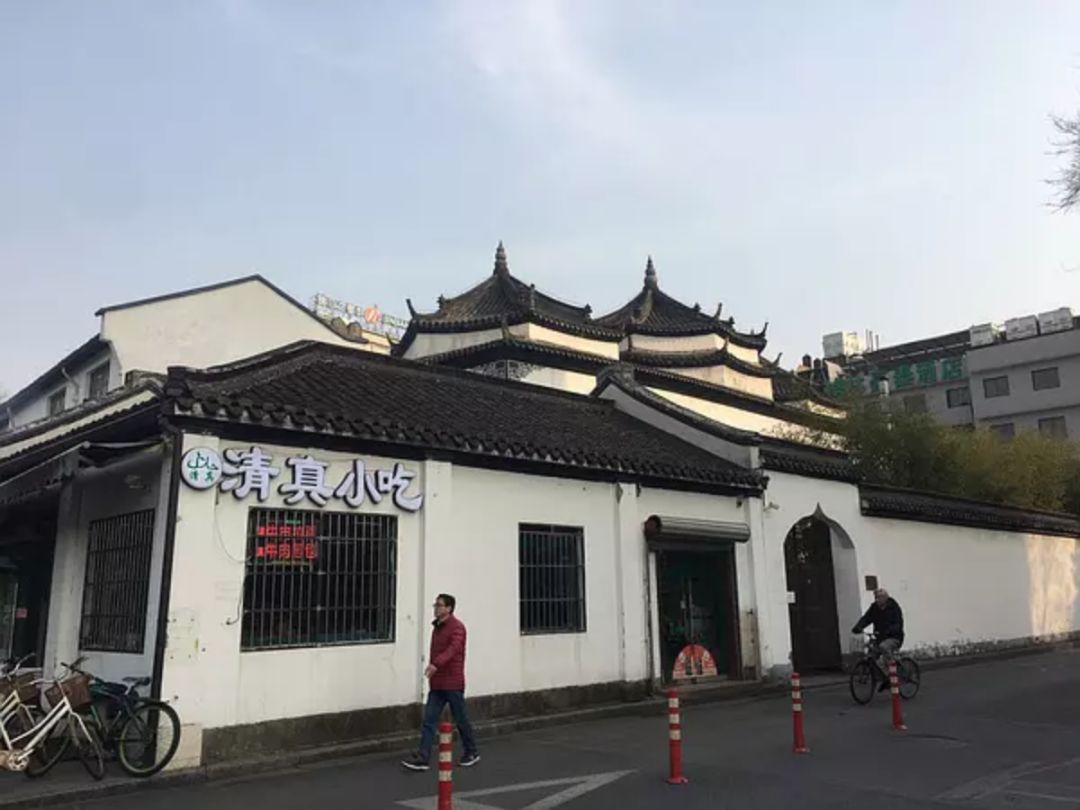
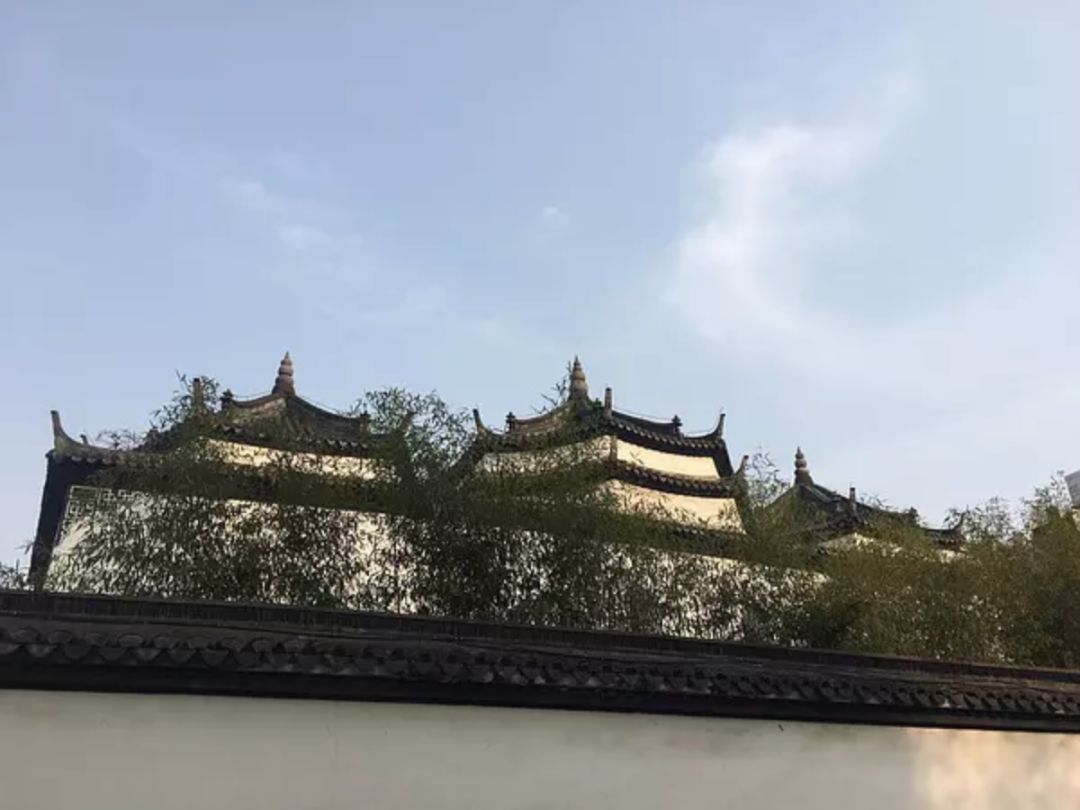
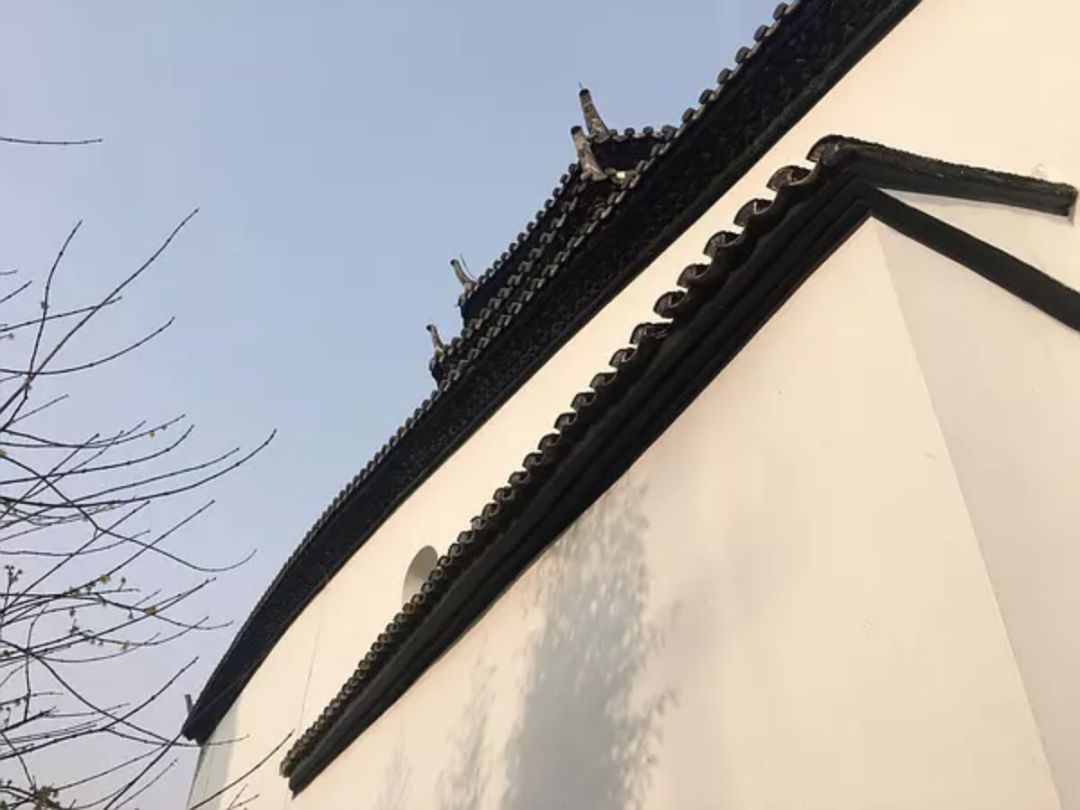
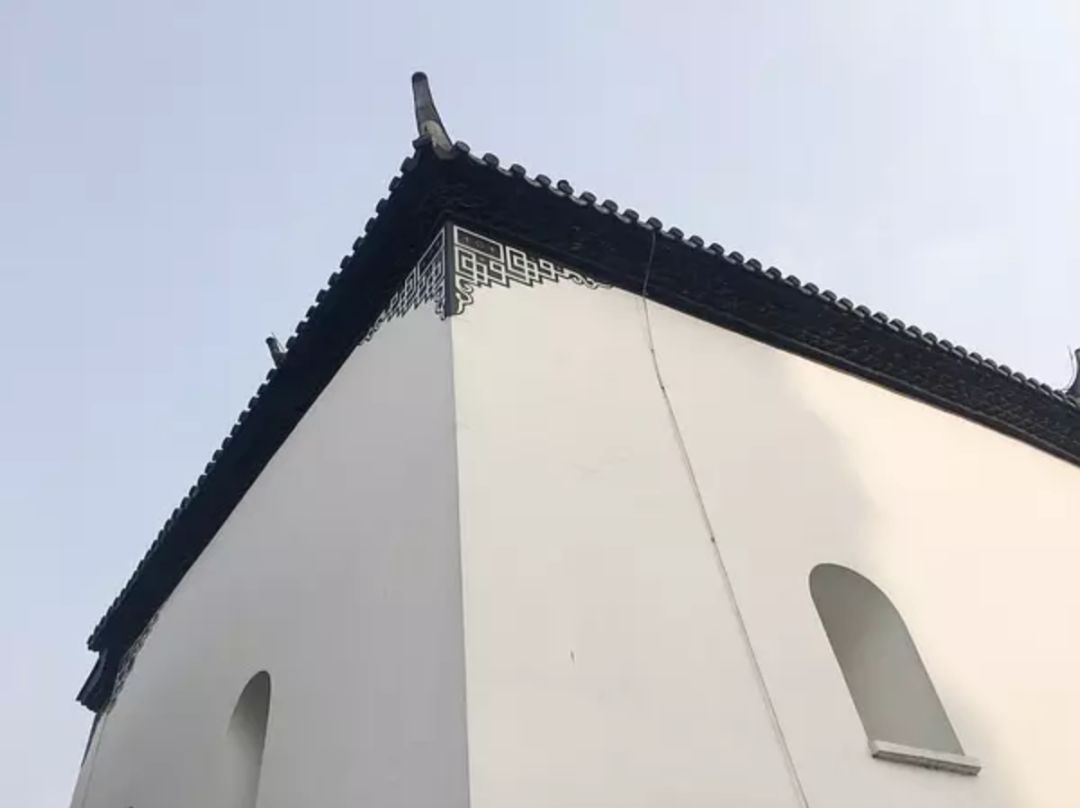
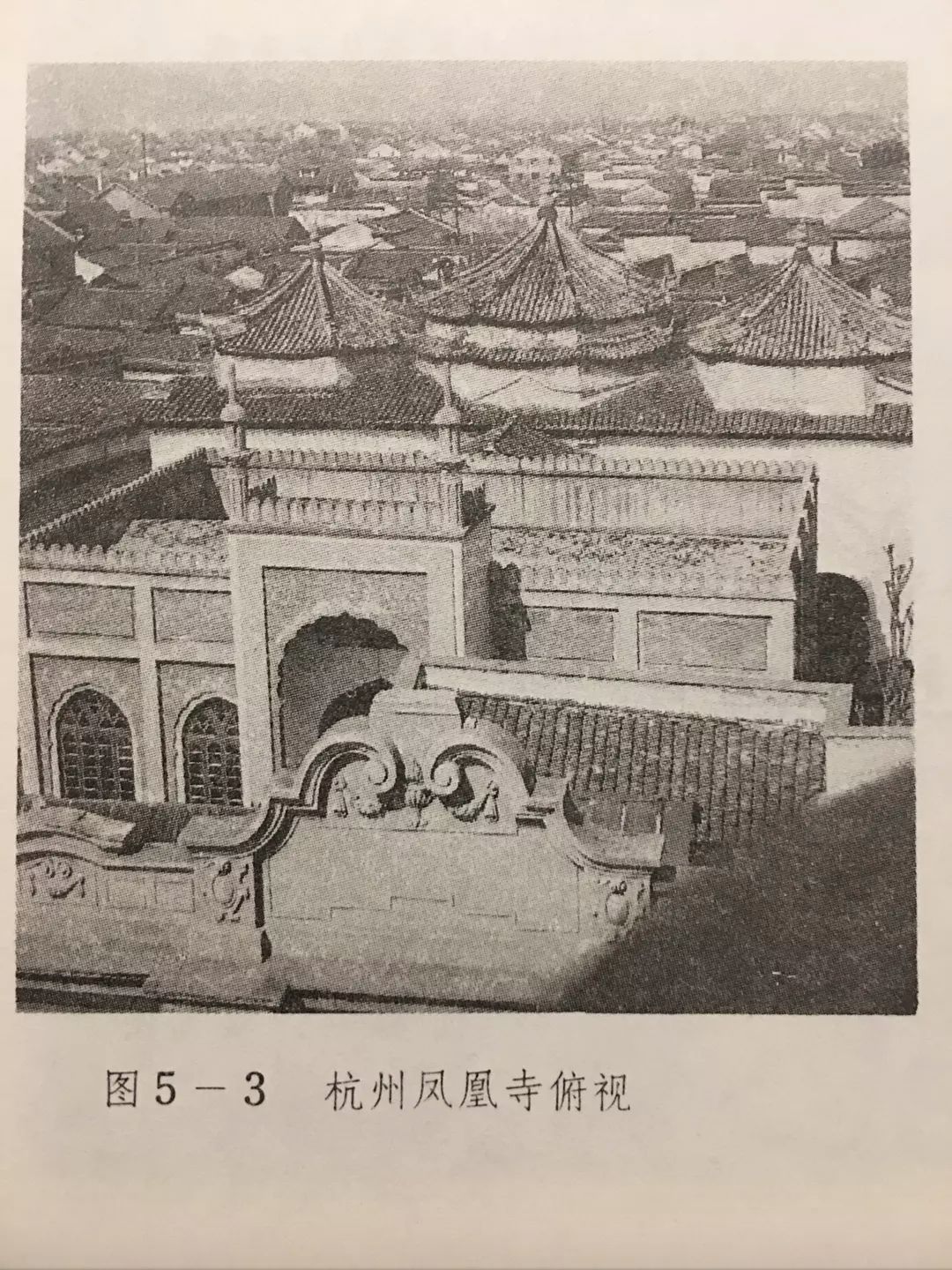
Professor Liu Zhiping took this photo of Phoenix Mosque (Fenghuang Si) in 1960, as featured in the book Islamic Architecture in China.
The Foreigner's Return Cemetery (Fanhuijia Mu).
As mentioned at the start of this article, the Jujing Garden by West Lake outside Hangzhou was once a place for the Song Dynasty royal family to tour. During the Yuan Dynasty, Muslims bought it to use as a cemetery. In the Ming and Qing Dynasties, it was called the Foreigner's Return Cemetery (Fanhuijia Mu) or the Hui Muslim Cemetery (Huihui Fen). During the Republic of China era, it was known as the South Garden Muslim Cemetery (Nanyuan Huijiao Gongmu) or the Muslim Public Graveyard (Huijiao Yizhong).
According to the preface titled A Witness to the Times in the book Interpretation and Translation of Arabic and Persian Inscriptions in Hangzhou Phoenix Mosque by Liu Yingsheng, the Hangzhou municipal government moved the cemetery in May 1953 to develop the West Lake scenic area. Since many of these were ancient graves from before the Qing Dynasty with no one to claim them, Phoenix Mosque took charge of collecting and handling the remains and tombstones. The remains were wrapped in white cloth and placed in wooden boxes one meter long and half a meter wide. For those with names, a wooden sign was written and attached to the box, and they were all buried together in the Hui Muslim cemetery at Jingshan Ridge in Liuxia Town. The unearthed stone tablets were categorized and numbered based on their stone type and content. After moving the graves from the higher ground, workers found layer upon layer of ancient graves while digging soil to raise the embankments for Mid-Lake Pavilion (Huxin Ting), Ruandun, and Autumn Moon over the Calm Lake (Pinghu Qiuyue). Later, more graves were discovered in other places beneath the soil layers where the relocation had already been completed. Before the relocation, it was estimated that the Hui Muslim Cemetery (Huihui Fen) held over 2,000 graves, but in reality, there were often more graves buried underneath them. Due to budget limits, these deeper ancient graves were not moved and remain buried deep within the West Lake scenic area.
During the relocation of the Hui Muslim Cemetery (Huihui Fen) from May to October 1953, fifty or sixty Arabic and Persian tombstones were found and transported to Phoenix Mosque for safekeeping, though many were lost later. A stone tablet gallery was built inside Phoenix Mosque in 1977, and it currently houses 20 Arabic and Persian tombstones and one mosque tablet.
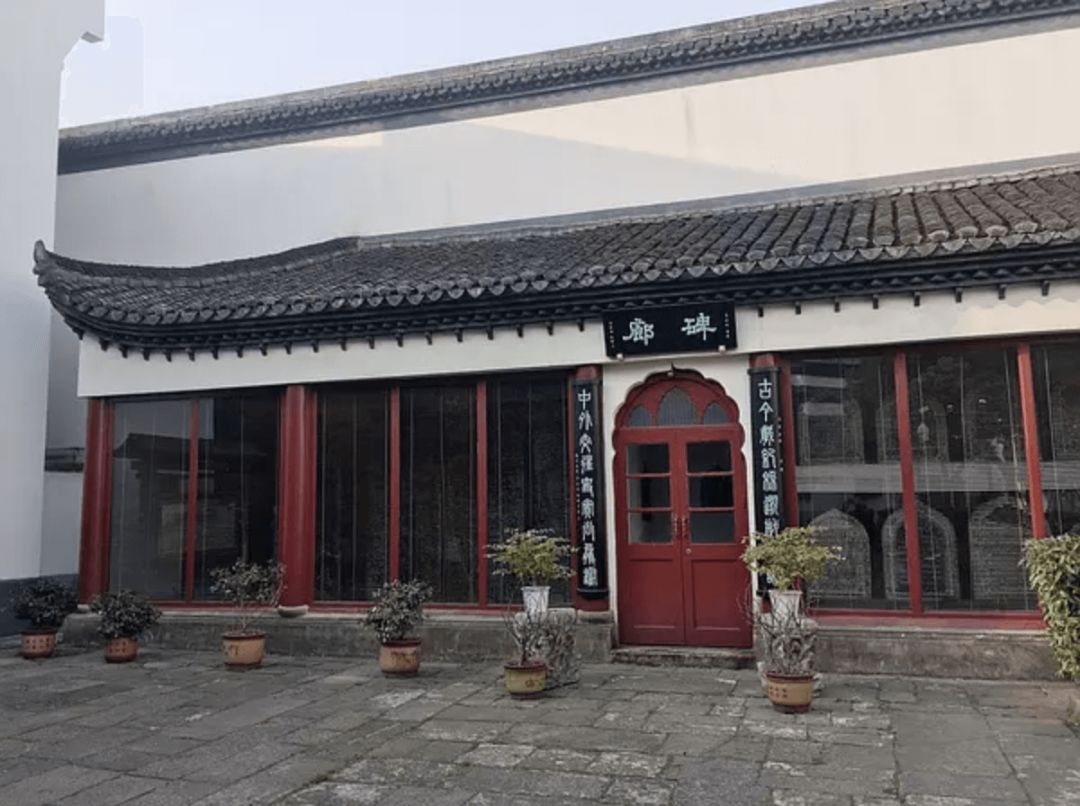
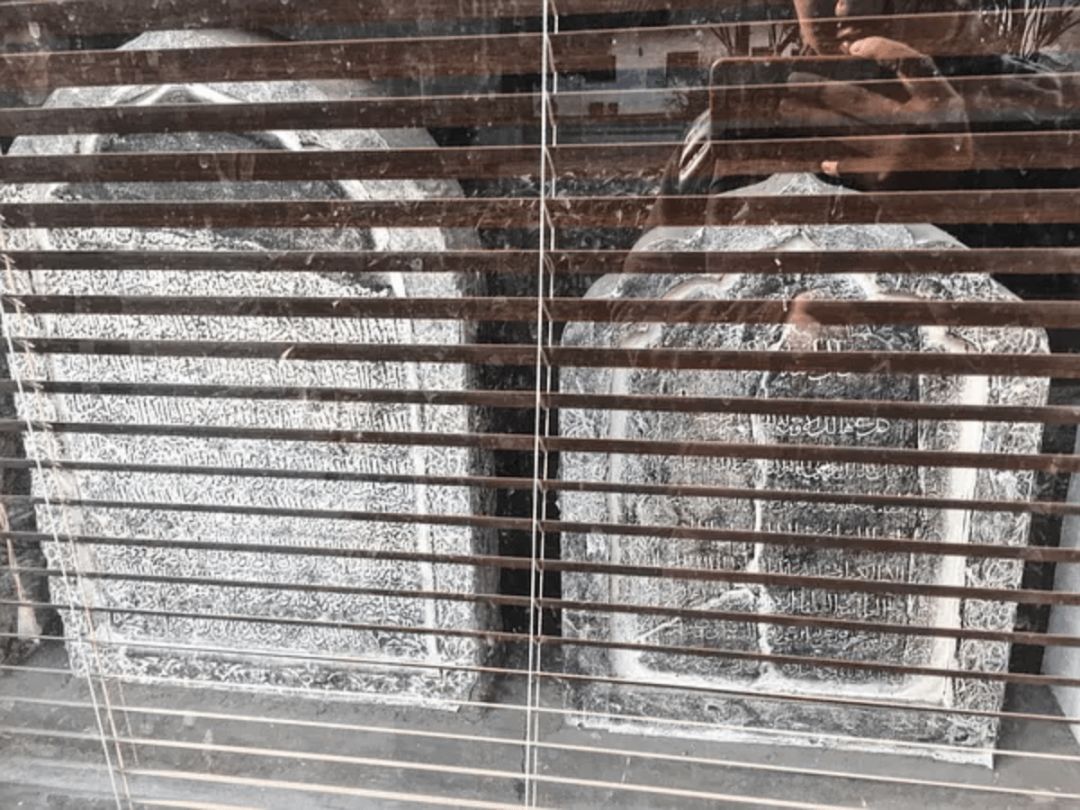
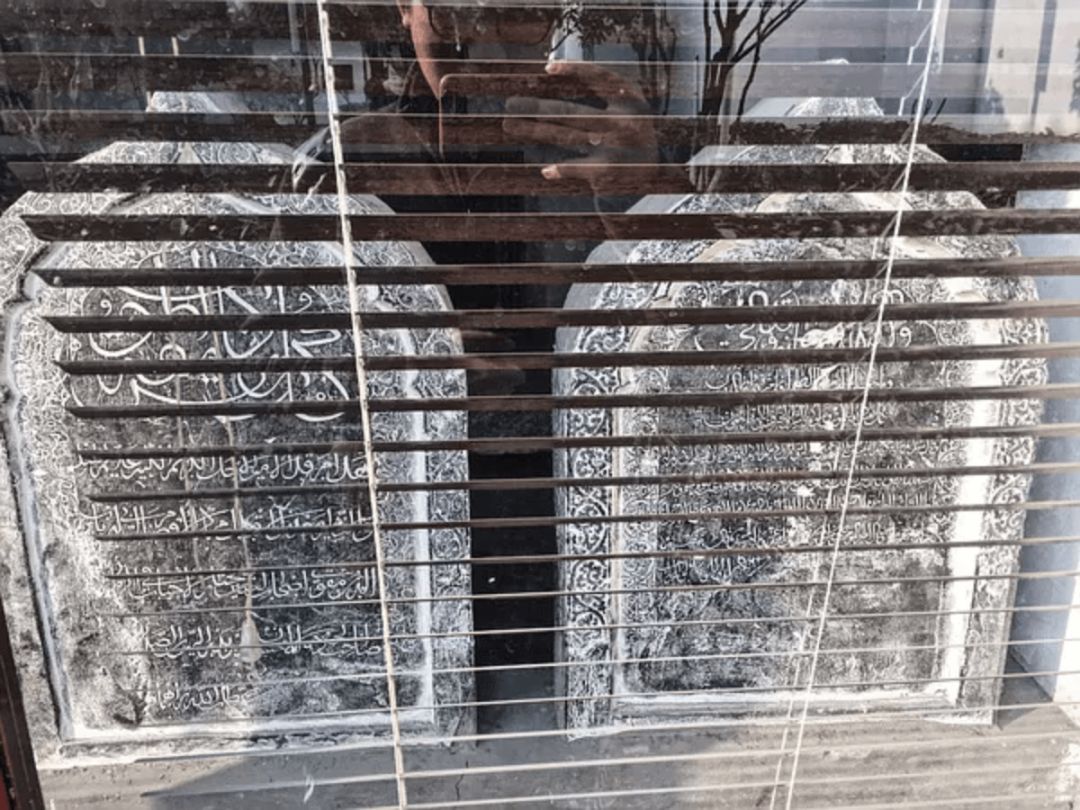
The book Interpretation and Translation of Arabic and Persian Inscriptions in Hangzhou Phoenix Mosque provides detailed readings of these 20 tombstones. The author of this book, Alexander Morton, is a lecturer in the Department of Iranian Studies at the School of Oriental and African Studies, University of London. He grew up in Iran, loves Persian culture and history, has long studied Islamic inscriptions in the Middle and Near East, and is an expert on Islamic inscriptions.
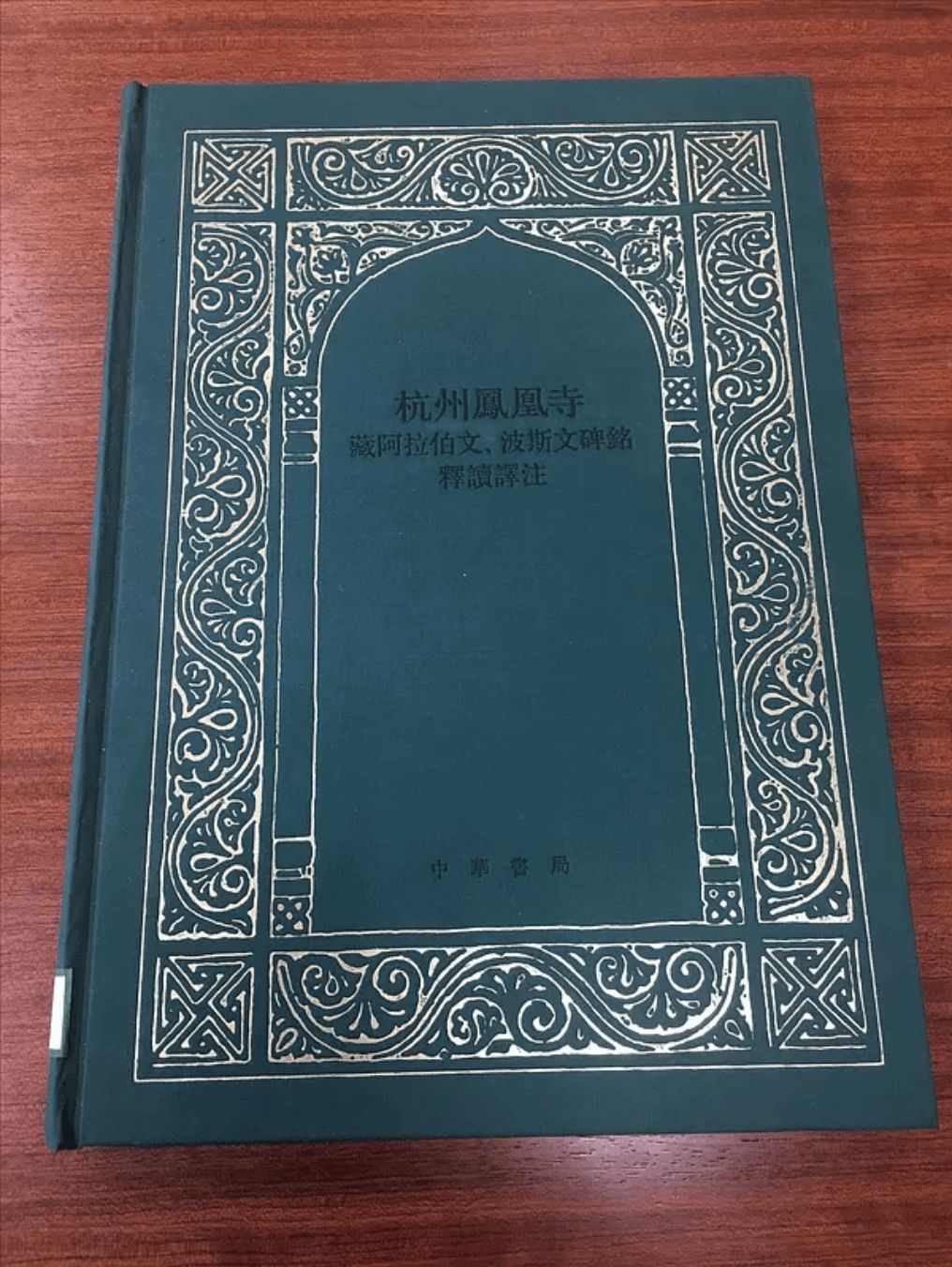
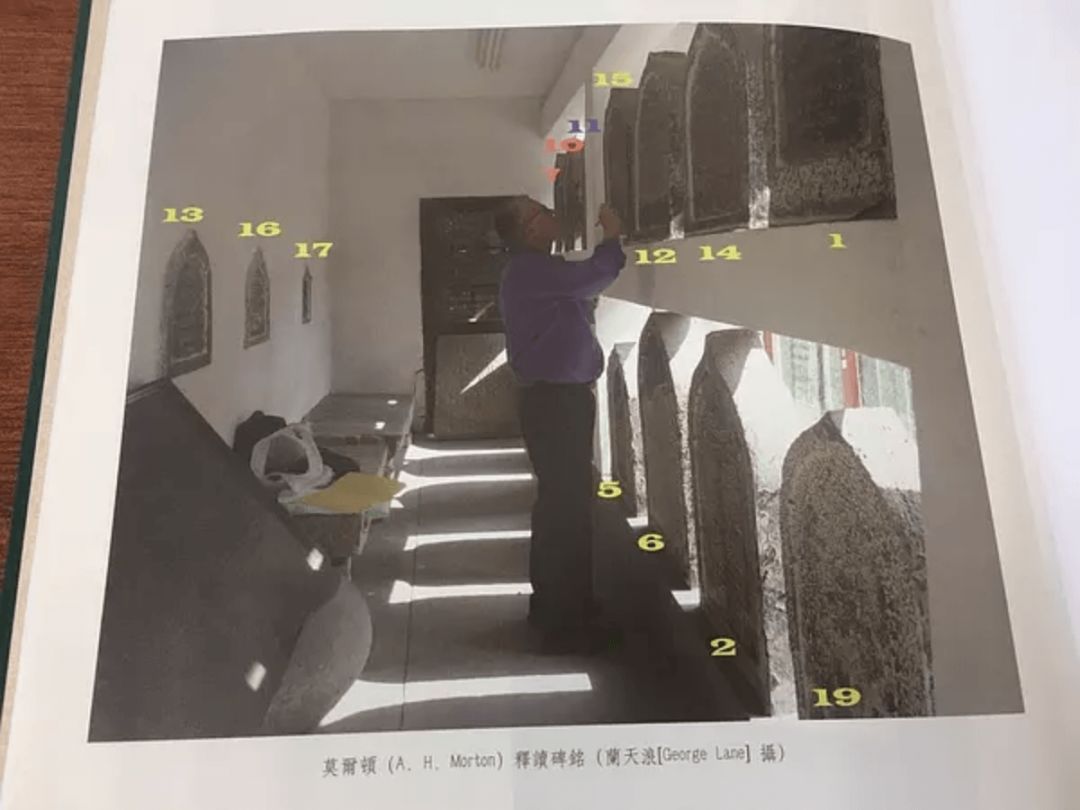
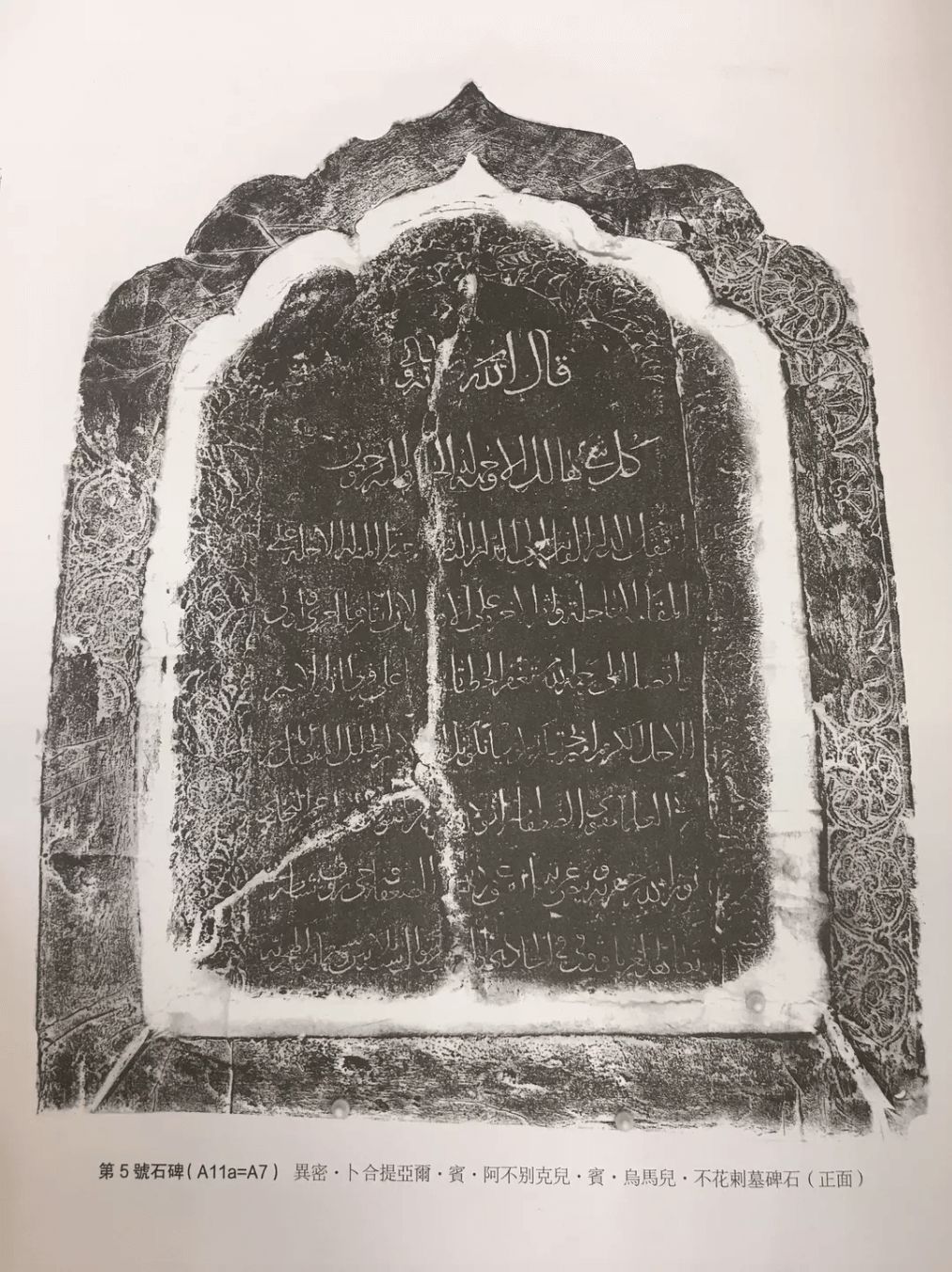
The basic information for the owners of 11 of these tombstones is summarized below.
The owner of stone tablet No. 1 is named Khawaja Husam al-Din, who passed away on October 28, 1307 (the 11th year of the Dade era of the Yuan Dynasty). He traveled to many countries and was in the prime of his life when he died. Khawaja is a title often used by high-ranking merchants, ministers, and dignitaries in Islamic society. Husam al-Din means 'Sword of the Faith,' where al-Din means 'religion' or 'faith'.
The owner of stone tablet No. 2 is named Shams al-Din Muhammad bin Ahmad bin Abi Nasr al-Isfahani, who passed away on September 24, 1316 (the 3rd year of the Yanyou era of the Yuan Dynasty). The name Isfahani in the History of Yuan refers to the famous ancient Iranian city of Isfahan. Shams al-Din was a great merchant from Isfahan who engaged in maritime trade between Persia and China, and his name was known to the khans of the Ilkhanate who ruled Iran at that time.
The owner of stone tablet No. 3 is named Khawaja Muhammad, who passed away on March 20, 1317 (the 4th year of the Yanyou era of the Yuan Dynasty). Muhammad is the modern spelling of the name. His father was named Arsalan Khanbaliqi. Arsalan translates to 'lion' in Turkic, so his family likely originated from a Turkic background. Khanbaliqi was the name used by Turkic people for the Yuan capital, Dadu. Construction of Dadu began in 1267 and was completed in 1284, which indicates his family settled there after that time.
The owner of tombstone No. 4 is named Khawaja Ala al-Din bin Khawaja Shams al-Din al-Isfahani, who passed away on May 16, 1327 (the 4th year of the Taiding era of the Yuan Dynasty). Ala al-Din is the modern spelling of the name.
The owner of stone tablet No. 5 is named Amir Bakhtiyar bin Abu Bakr bin Umar al-Bukhari, who passed away on August 7, 1330 (the 1st year of the Zhishun era of the Yuan Dynasty). Amir is a title for a military officer. Bukhara in the History of Yuan refers to the ancient city of Bukhara in modern-day Uzbekistan.
The owner of stone tablet No. 6 is named Mahmud bin Muhammad bin Jamal al-Din al-Khorasani, who passed away in 1351 (the 11th year of the Zhizheng era of the Yuan Dynasty). Jamal al-Din means 'Beauty of the Faith.' He was an Islamic scholar (alim) from Khorasan in northeastern Iran, was well-versed in Islamic law, and both his parents were descendants of the Prophet Muhammad.
The owner of stone tablet No. 7 is named Mahmud bin Mahma bin Ahma Simnani. He was a Sufi merchant who traveled widely. He visited Syria (Scham) and Iraq (which covered a much larger area then and could also refer to coastal regions), and he reached the area near Mecca. Simnan is located east of Tehran, the capital of Iran, and is the hometown of the famous Persian Sufi Sheikh Ala al-Dawla Simnani.
The owner of stone tablet No. 8 is named Emir Badr al-Din. Badr al-Din means 'full moon of the religion'. His father was named al-Sadr, which is usually an honorific title given to civil officials or other secular dignitaries.
The owner of stone tablet No. 9 is named Khwaja Jalili. Jalili is later translated as Jalal, which originally means 'glory' or 'prominence'.
The owner of stone tablet No. 10 is named Shihab al-Din Ahma bin Abdullah Halabi. Shihab al-Din appears frequently in Yuan Dynasty historical records and means 'star of the religion'. Halabi refers to the ancient city of Aleppo (Halab) in modern-day Syria, a city that has suffered severe damage in the recent Syrian civil war.
The owner of stone tablet No. 11 is named Taj al-Din Yahya, who died at the age of 41. His father was named Mullah Burhan al-Milla wa al-Din, an outstanding imam. Taj al-Din means 'crown of the faith', and Yahya is the Arabic form of John the Baptist from the New Testament as it appears in the Quran. Burhan means 'witness', and al-Milla wa al-Din means 'the community and the faith'.
The tomb of the Hui Muslim sage Bakhtiyar.
On the site of the Fan Hui Jia tomb, there is another Muslim relic, the tomb of the Hui Muslim sage Buhetiyaer. On March 12, 1924, the Shanghai newspaper Shen Bao reported a story titled Police Chief Preserves Ancient Tombs.
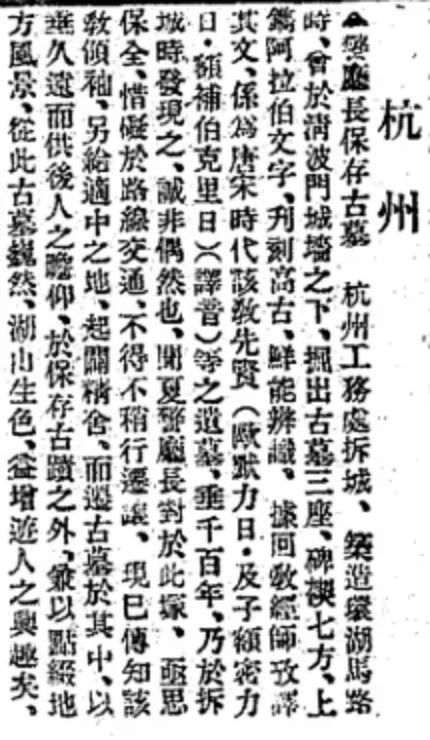
The original text says: When the Hangzhou Public Works Department tore down the city wall to build a road around the lake, they dug up three ancient tombs and seven stone tablets under the Qingbo Gate wall, all engraved with Arabic script. The carvings are very old and hard to read. According to a Muslim imam who translated the text, these are the tombs of sages from the Tang and Song dynasties, including Oumoliri and his sons Emili and Ebubokeliri (transliterated names). It was no accident that these tombs, which have stood for a thousand years, were discovered during the demolition of the city wall. I heard that Police Chief Xia wanted to protect these tombs, but because of the road construction, he had to move them slightly. He notified the leaders of the Muslim community to find a suitable piece of land, build a shrine, and move the ancient tombs there so they can be preserved and visited by future generations. Beyond preserving the historical site, this also adds to the local scenery, making the tombs a grand sight that adds to the charm of the lake and mountains for travelers.
Before this, in 1921, the famous Muslim scholar Yang Zhongming (courtesy name Jingxiu) translated the Epitaph of the Traveler Buhetiyaer, which was included in the August 1921 volume of the Shanghai Muslim Board of Directors records.
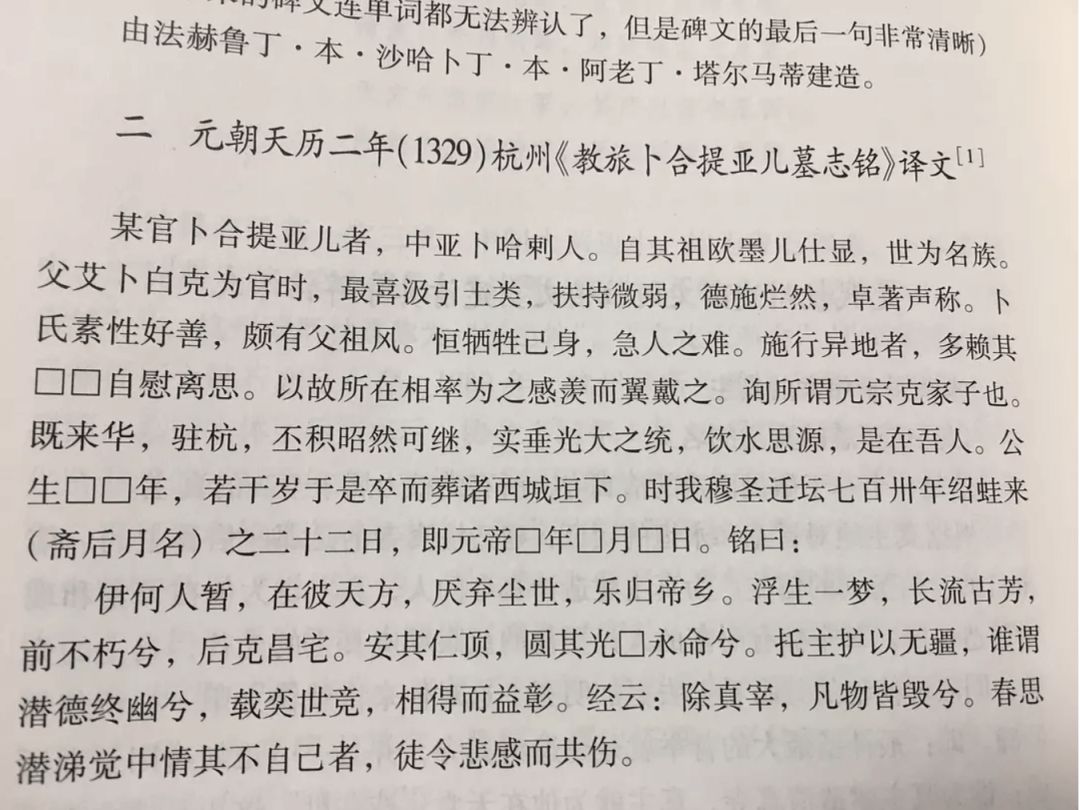
Buhetiyaer is now translated as Bahtiyar. His full name was Amir Buhetiyaer Seluoniya Naluonike, and he died in 1329 (the second year of the Tianli era of the Yuan Dynasty). He was from Bukhara in Central Asia. Bukhara (Bokhara) is in modern-day Uzbekistan. At that time, it was ruled by the Chagatai Khanate and was a center of Islamic culture in Central Asia. Amir is also translated as Emir, which is a title for a military officer. The epitaph shows that Buhetiyaer came from a family of officials.
Interestingly, the owner of the number 5 stone tablet among the Yuan Dynasty tombstones kept at the Phoenix Mosque (Fenghuang Si) in Hangzhou, which we mentioned earlier, is also named Amir Buhetiyaer and also came from Bukhara. However, his full name was Emir bin Abubieker bin Umaer Buhala, and he died on August 7, 1330 (the first year of the Zhishun era of the Yuan Dynasty), which was one year after Buhetiyaer died. The two of them likely had a close relationship.
Volume 23 of Hangzhou Cultural and Historical Materials contains an article titled The Full Story of the Changes to the Ancient Cemetery of the Hui Muslim Sage Buhatia. The following details about the cemetery's history are all taken from this article.
In 1927, the Buhatia Cemetery was completed outside Qingbo Gate. General Ma Fuxiang, the father of Ningxia warlord Ma Hongkui, attended the opening ceremony and erected a memorial tablet in front of the grave. According to the memories of Zhu Jingfen, the daughter of the cemetery caretaker Zhu Awei (who died in 1967): My father started managing the Hui Muslim cemetery at age 13. Times were hard then, and Zhang Shoubo, the former chairman of Phoenix Mosque (Fenghuang Si), or the Feng and Ding families would provide three or four dou of rice each month to help us get by.
In May 1953, the Hangzhou municipal government moved the Muslim cemetery to Jingshan Ridge in Liuxia Town to develop the West Lake scenic area. At that time, the stone slabs for the Buhatia grave were carried up the mountain in layers. Two teams of 16 people carried them, as each slab weighed about 1,200 jin. Because of this, only the top four layers were moved up, reaching a total height of about 0.6 meters.
After 1966, the Buhatia grave cover stones were smashed. Because they were so heavy and the cemetery guards opposed it, only part of them were broken, and the rest were scattered at the foot of the mountain. One grave slab was stolen, and the head and foot slabs of another grave were also taken. The central Buhatia grave was pried open, and the words Red Guard Seal were painted in red on the inside of the cover slab. Ma Fuxiang's memorial tablet was buried in an air-raid shelter, and the Arabic inscription tablet is still missing.
In December 1986, the smashed Buhatia grave cover stones were unearthed again at the Liuxia Hui Muslim Cemetery. Historical Materials compiled by the Fujian Academy of Social Sciences records that the structure was built with multiple layers of stone steps, with the stone surfaces fully carved with delicate and beautiful patterns like scrolling grass.
In 1989, the Buhatia Cemetery was rebuilt on its original site. The restored stone tablets were copied from rubbings of the originals. Each grave cover is four layers high, about 0.6 meters, which is actually just the top crown portion of the original Buhatia grave cover.
In 2006, the Hangzhou Municipal People's Government built a new stone pavilion at the Buhatia Cemetery, which is its current form.
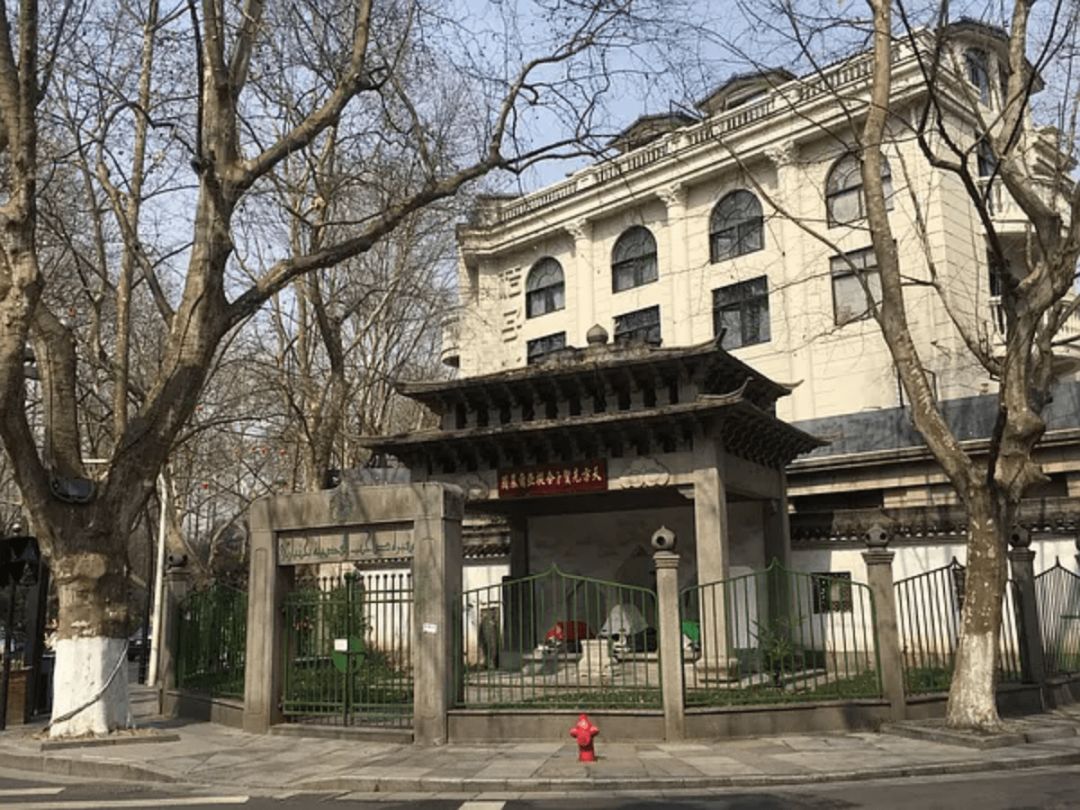
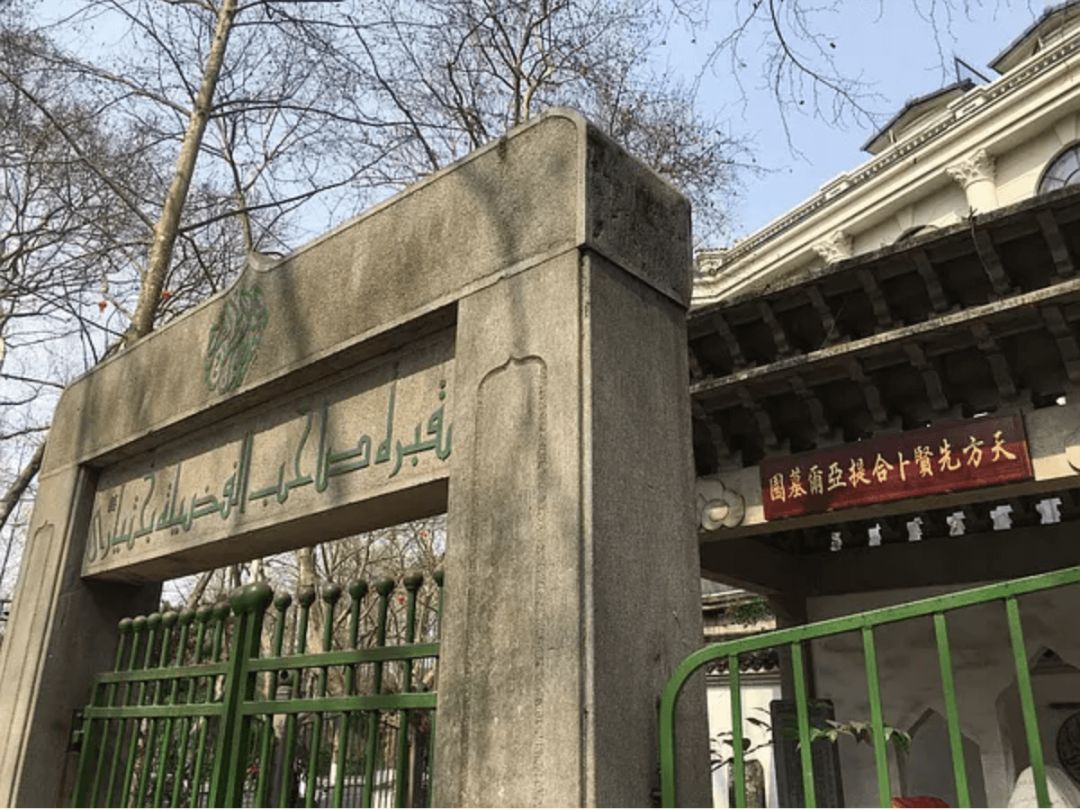
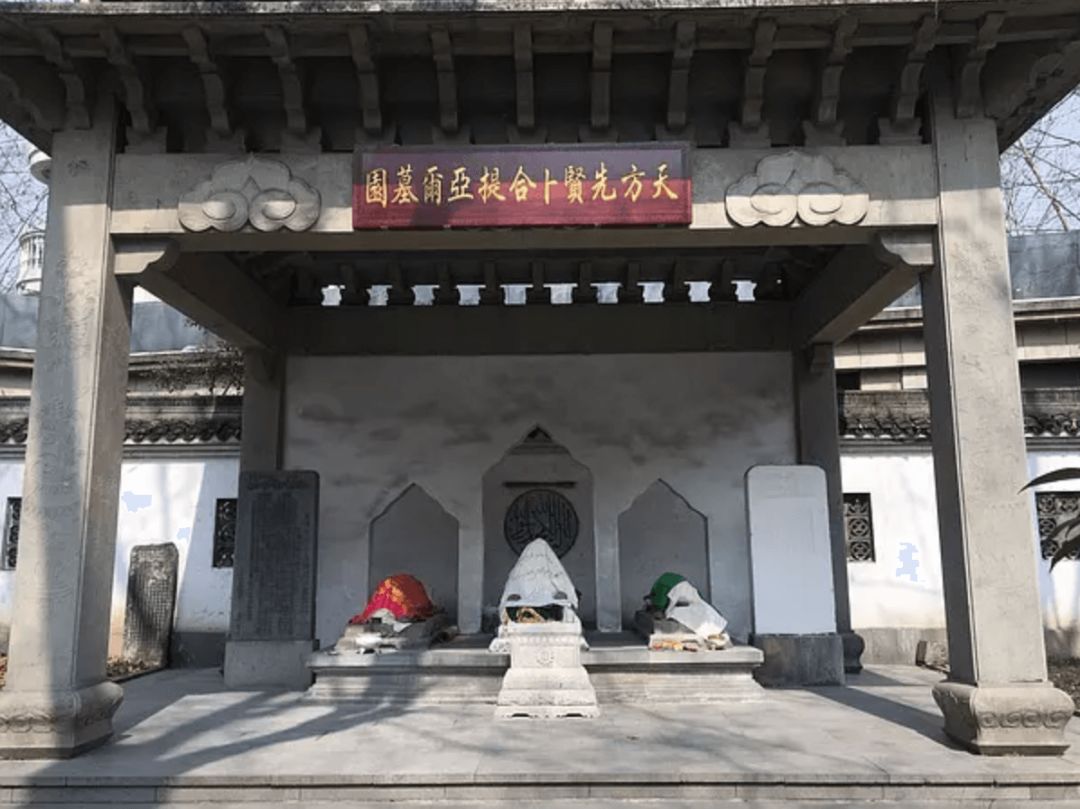
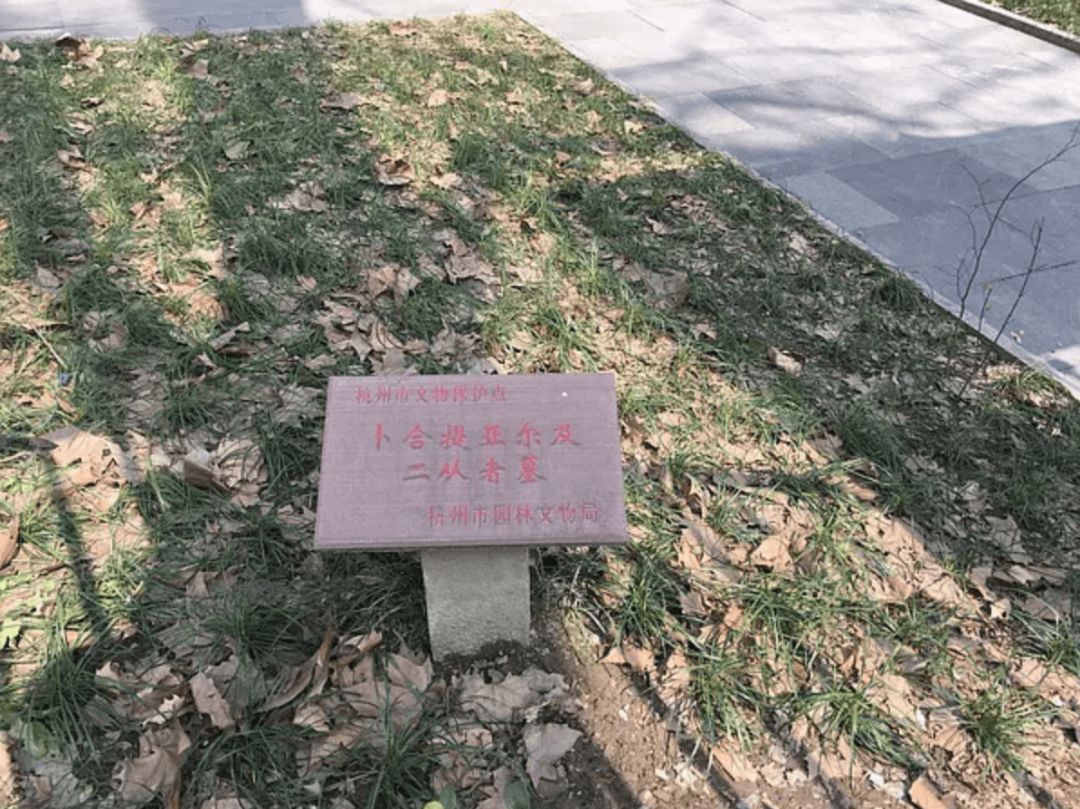
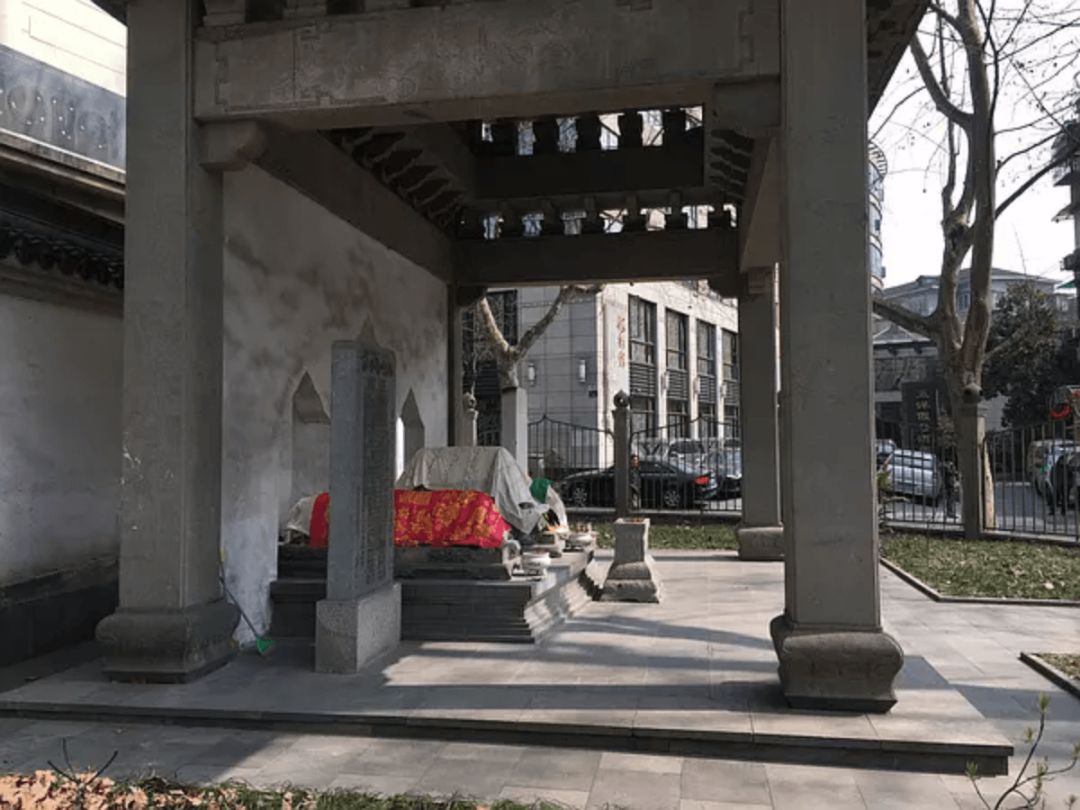
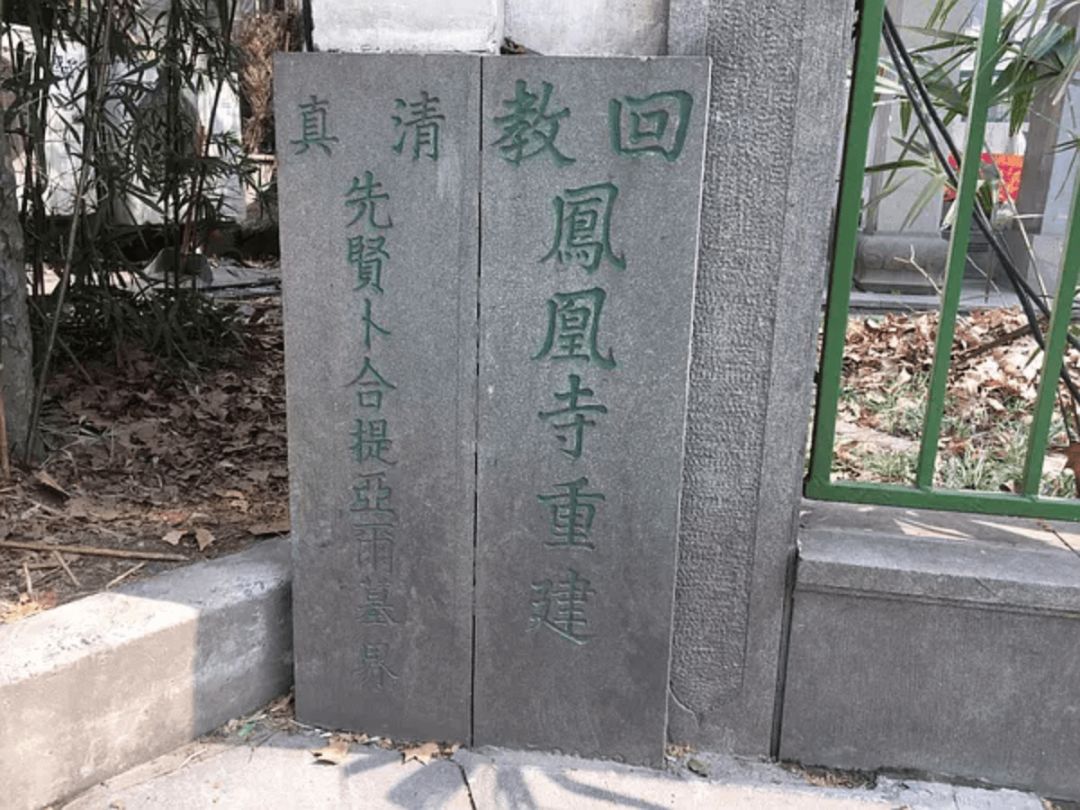
Grave of Ding Henian
Ding Henian (1335-1424) was a famous Hui Muslim poet during the late Yuan and early Ming dynasties. His great-grandfather was named Alaoding, his grandfather was named Shansiding, and his father was named Zhimaluding, so he took Ding as his surname. Ding (al-Din) means religion or faith in Arabic and is often placed at the end of a person's name.
The History of Ming: Biographies of Literati contains a short biography of Ding Henian. It writes that Ding's great-grandfather Alaoding and his younger brother Umar were both big merchants. When Yuan Emperor Shizu Kublai Khan conquered the Western Regions and lacked supplies, Alaoding donated his own goods in time. Because of this, Kublai Khan rewarded him with land in the Yuan capital, Dadu, and gave him very generous treatment. Umar also served as an official, eventually reaching the position of Left Chancellor of the Gansu Province.
Ding Henian's grandfather Shansiding served as a daruqachi of Linjiang Circuit, and his father Zhimaluding also served as a daruqachi of Wuchang County due to his family's status. Daruqachi (daruqai) originally meant seal holder. They held the actual administrative and military power in local governments at the circuit, prefecture, department, and county levels during the Yuan Dynasty and were the highest-ranking local officials. Daruqachi were generally Mongolians, and only Semu people with noble family backgrounds could hold the position. Ding Henian's family belonged to these noble Semu people.
As the son of the highest official in Wuchang, Ding Henian read many books from a young age and studied at the famous Nanhu Academy in Wuchang. He also had a talented older sister named Yue'e who taught him classics and history.
In 1352 (the 12th year of the Zhizheng era of the Yuan Dynasty), the Red Turban Army captured Wuchang. Ding Henian was 18 that year. After settling his biological mother in the suburbs of Wuchang, he escorted his father's primary wife to Zhenjiang to take refuge. After his father's primary wife passed away, Ding Henian had to continue his flight. He went to Zhoushan Island in Zhejiang to seek refuge with his cousin Jiyamuding, who was the magistrate of Dinghai County, but his cousin passed away shortly after. At that time, the eastern part of Zhejiang was occupied by the peasant uprising leader Fang Guozhen, who was most suspicious of Semu people. Ding Henian had to wander around Siming Mountain in Ningbo and the islands of eastern Zhejiang, working as a tutor for children, staying in monks' quarters, and making a living by selling tea and drinks.
Ding Henian described his mood while living in seclusion in the second of his four poems titled 'Sent to Master Jiuling':
Flowers and willows in every village meet the seaside, I take my family wherever I go to avoid the chaos of war.
The clothing and grain still preserve the style of the Jin Dynasty, the chickens and dogs in this peach blossom spring have long been cut off from the Qin.
Sitting facing the green mountains, I never tire of them, forgetting my worldly schemes, the white birds are naturally close to me.
I also know that coming out or staying in depends on the times, I do not just escape my name to imitate a hermit.
In 1366 (the 26th year of the Zhizheng era), Zhu Yuanzhang attacked the Jiangnan region. Hangzhou and Huzhou surrendered to Zhu Yuanzhang one after another, and the flames of war approached Zhejiang. While fleeing and suffering from illness, Ding Henian could not sleep at night and wrote the poem Night Dream of Returning Home on the 24th Day of the 11th Month of the Bingwu Year.
I have been sick for a long time and do not go out, thinking of my brothers one by one, wondering who is alive and who is dead.
War has cut off all news everywhere, and the wind and rain haunt my dreams all night long.
I write poems under the bamboo as clouds rise over my inkstone, and I sing songs before the flowers with the moon shining on my wine cup.
Old memories always bring new feelings, and I sit alone by the cold lamp wiping away my tears.
In 1368 (the first year of the Hongwu reign), Zhu Yuanzhang defeated Fang Guozhen, who occupied eastern Zhejiang, and declared himself emperor in Nanjing. The situation in Zhejiang gradually stabilized, and Ding Henian ended his life of fleeing. He built a house by the sea on Zhoushan Island to settle down and named it Sea Nest (Haichao).
In 1379 (the 12th year of the Hongwu reign), 44-year-old Ding Henian returned to his hometown of Wuchang to rebury his mother's remains and wrote Two Poems on Returning to Wuchang After the War. The second poem says:
The chaos has settled and I return home with graying temples, saddened by the changes in people and things.
In the west wind, foxes and rabbits roam the ancient graves, and in the setting sun, wolves lie in the desolate countryside.
The five willow trees are no longer the home of Tao Yuanming, and the hundred flowers are not what they were at Duling Manor.
My old haunts have all become dreams, and I sit alone counting the hours through the long night.
In his later years, Ding Henian moved to Hangzhou to live in seclusion and returned to Islam. According to the Qing dynasty record Notes on Qingbo (Qingbo Xiaozhi), he spent his late years practicing the laws of Allah and lived in a hut by his ancestors' graves. Ding Henian likely lived near the grave of his great-grandfather, Aladdin, at the Foreigner's Grave (Fanhuijia Mu) outside Qingbo Gate.
In 1424 (the 22nd year of the Yongle reign), 89-year-old Ding Henian passed away and was buried next to Aladdin's grave. This place was later called the Ding Family Mound (Ding Shi Long). When the cemetery was moved in 1953 to build West Lake Park, only Ding Henian's Ming dynasty tomb pavilion and tomb cover stone remained, serving as a relic of the Hui Muslims' cemetery.
During the transition between the Yuan and Ming dynasties, wealthy Semu merchants and officials along the southeast coast fell from the upper class to the bottom of society, leading to all sorts of stories. In Quanzhou, the once-prosperous Pu family was banned from studying or holding government office. Many Semu people died, left, or fled, and the Guo and Ding families moved from Quanzhou city to the countryside. Ding Henian was part of this great upheaval. In his poem "To My Cousin Sai Jingchu," written to the famous Hui Muslim calligrapher Sai Jingchu who was also living in seclusion in Hangzhou, he wrote:
The noble descendant lives in a desolate alley, writing calligraphy to trade for wine.
Wealth comes and goes on its own, leaving only a pure spirit in the world.
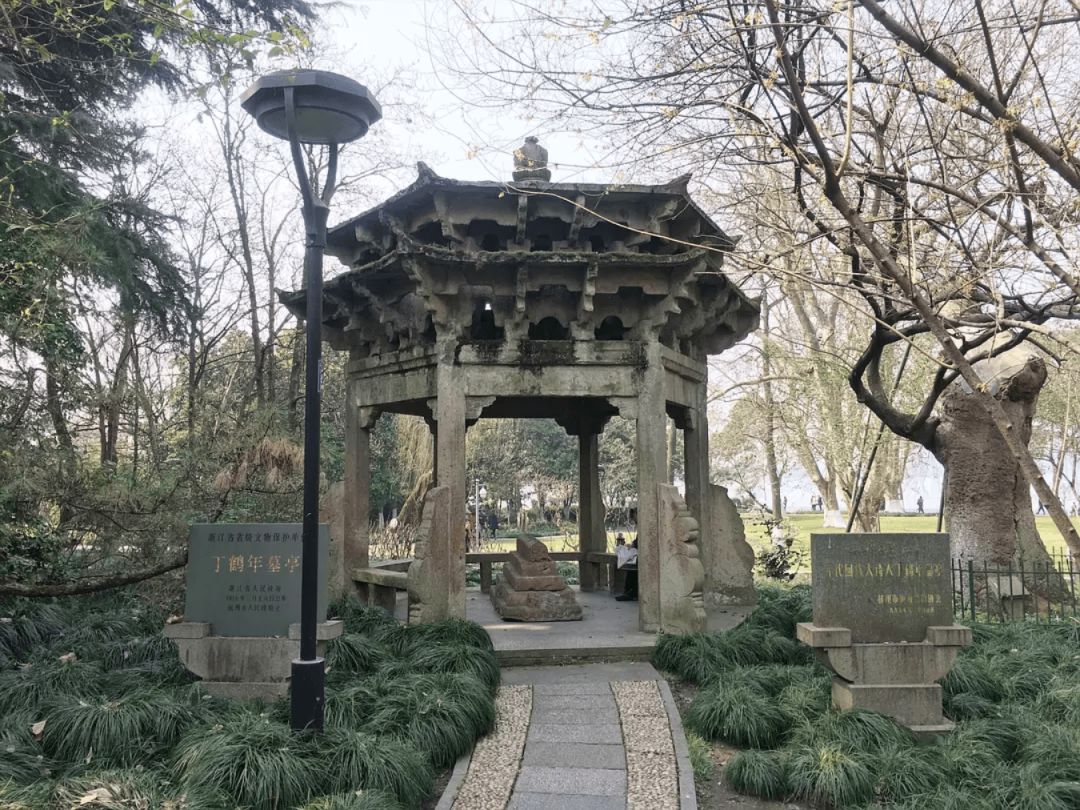
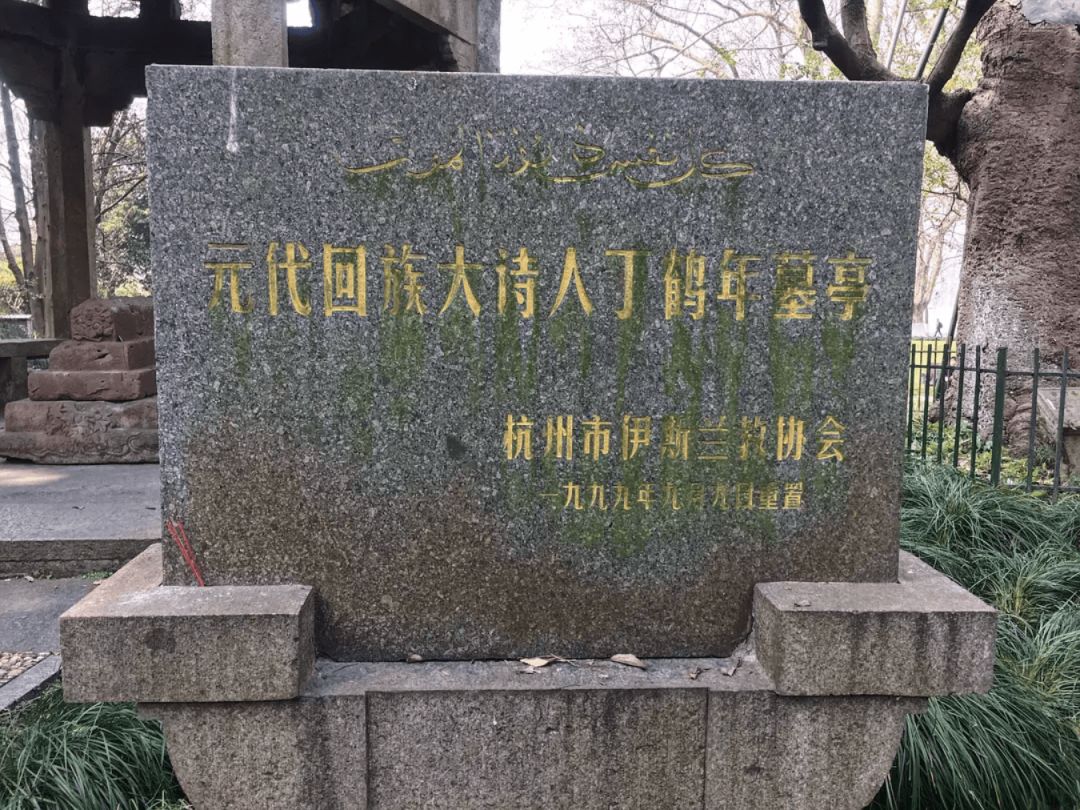
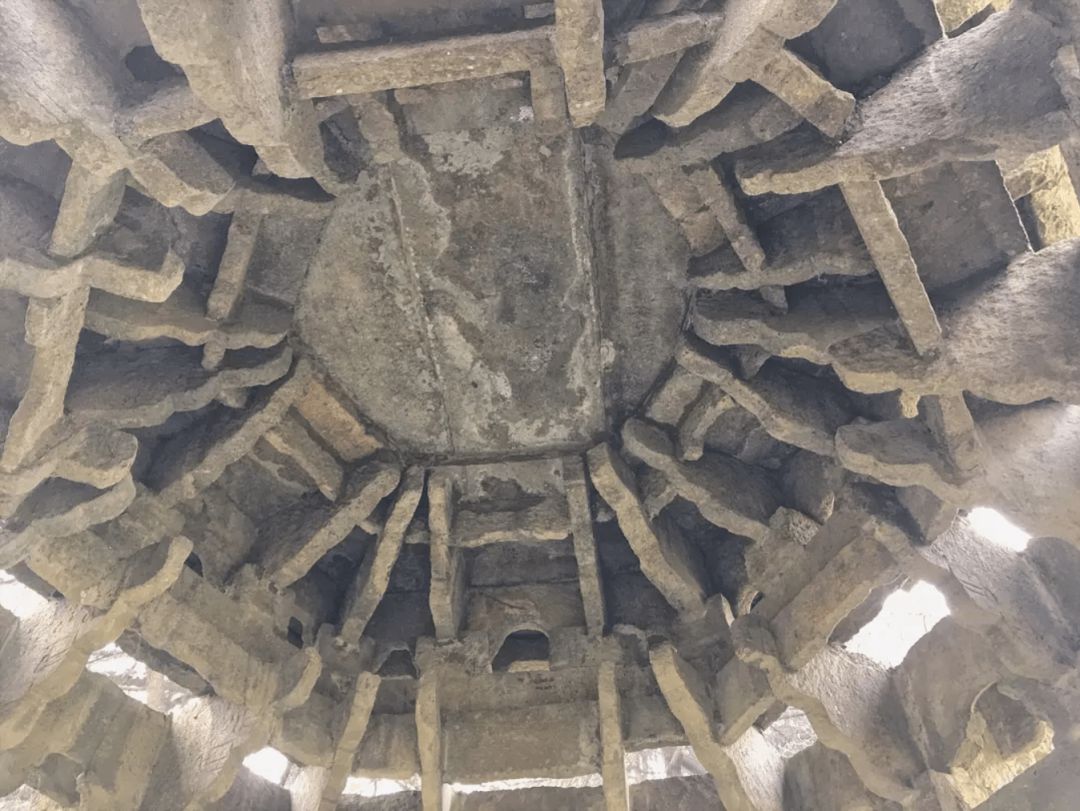
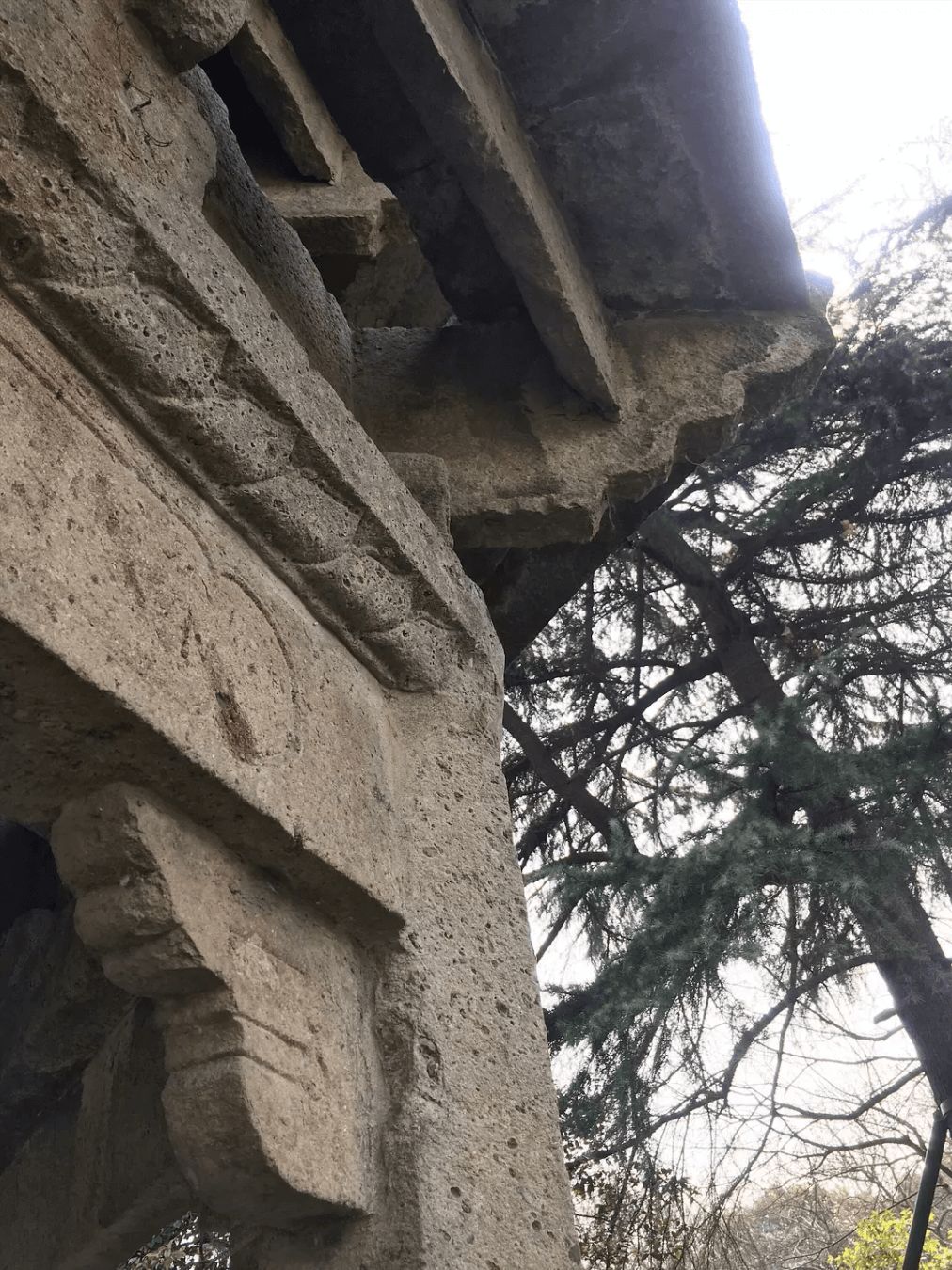
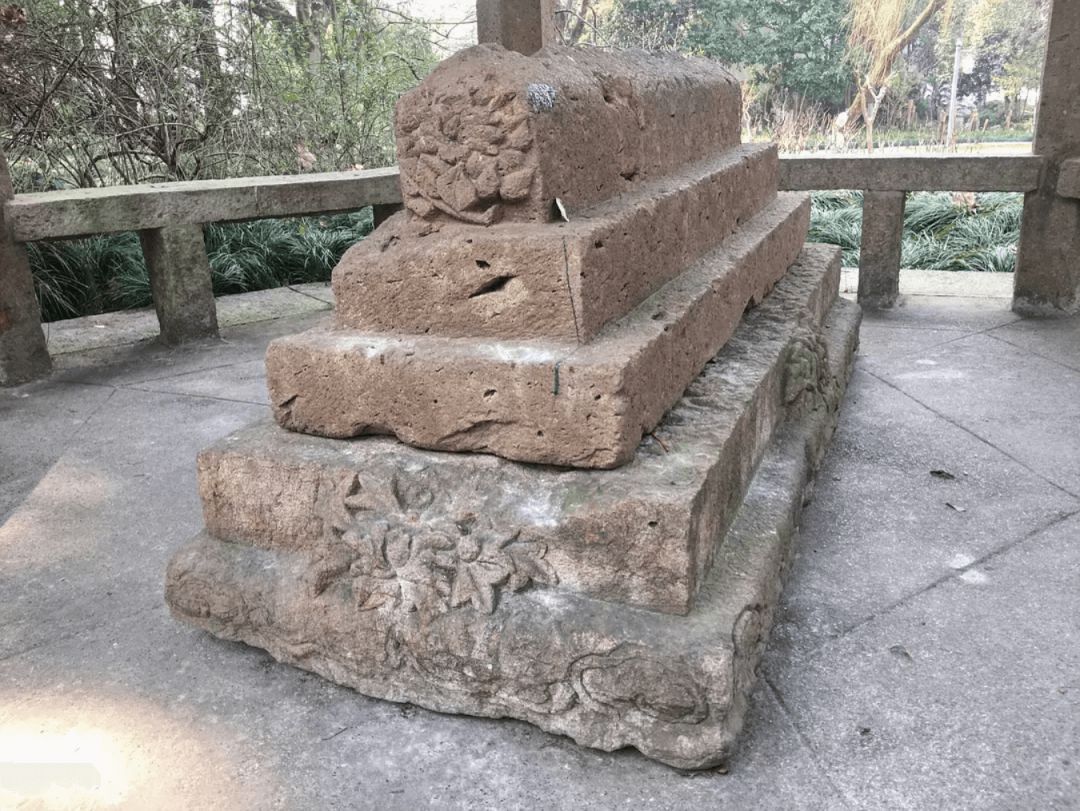
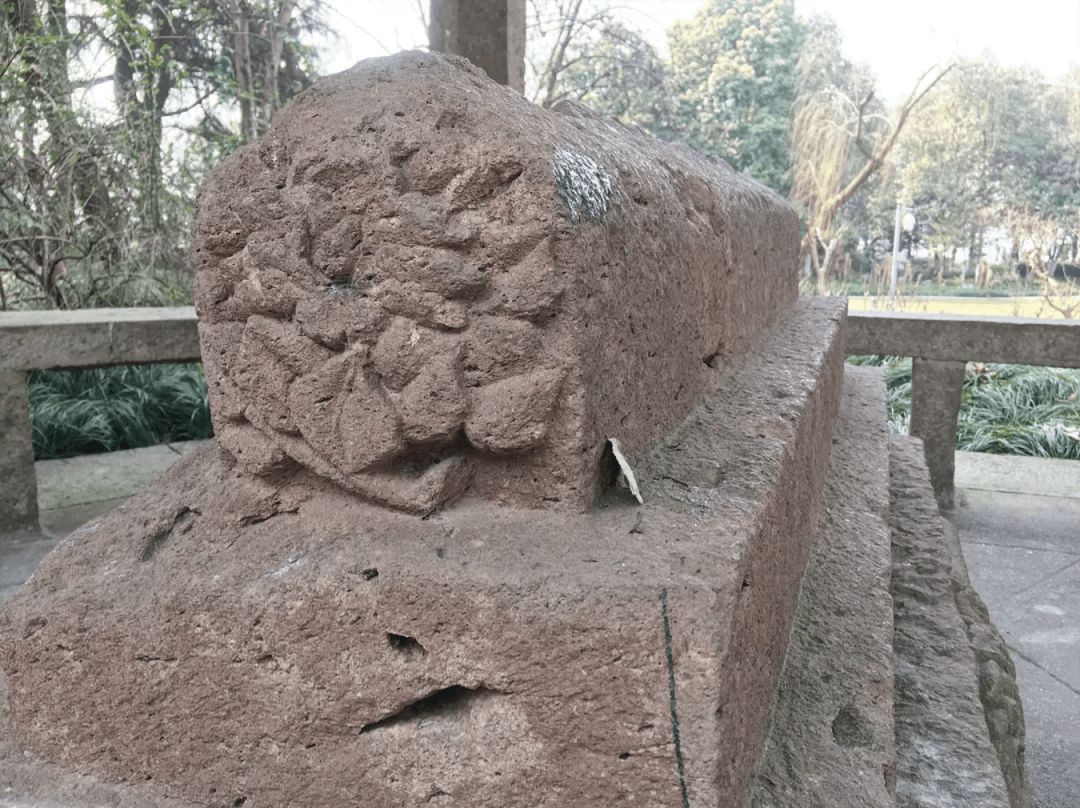
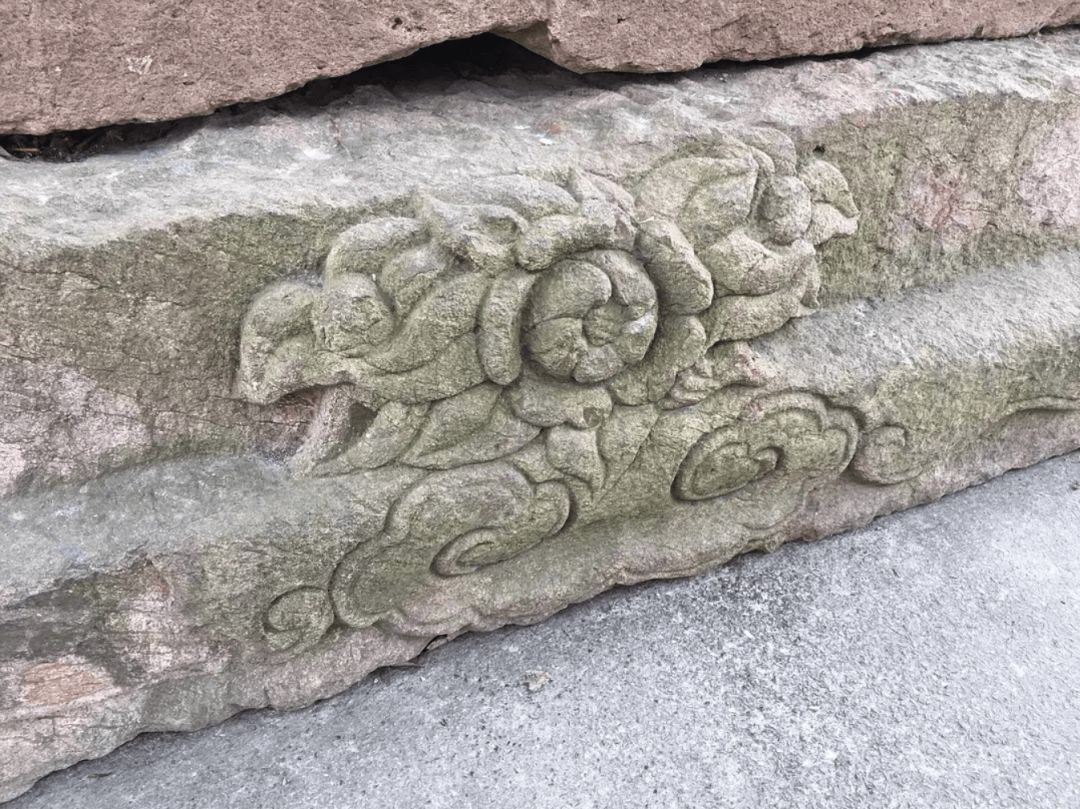
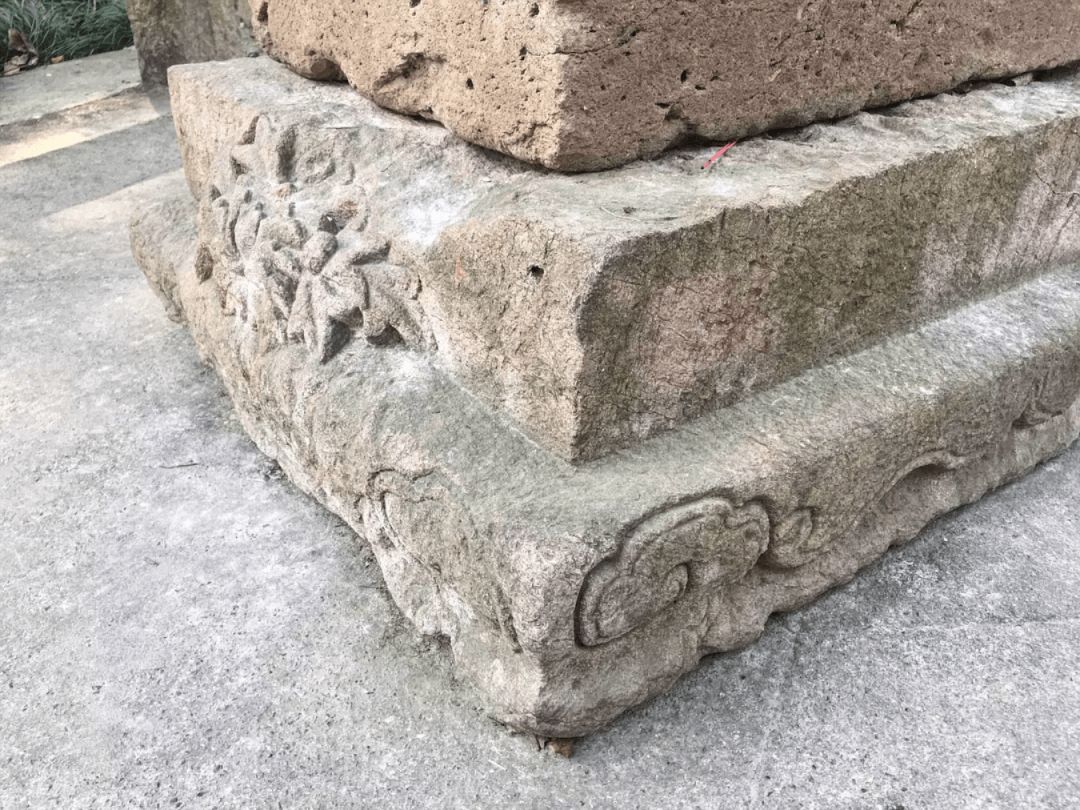
Muslim tombstone covers in the southeast during the early Ming dynasty still kept their Yuan dynasty style, which is very precious. Below, I will share some photos I took of Muslim tombstone covers in Quanzhou and Yangzhou for comparison.
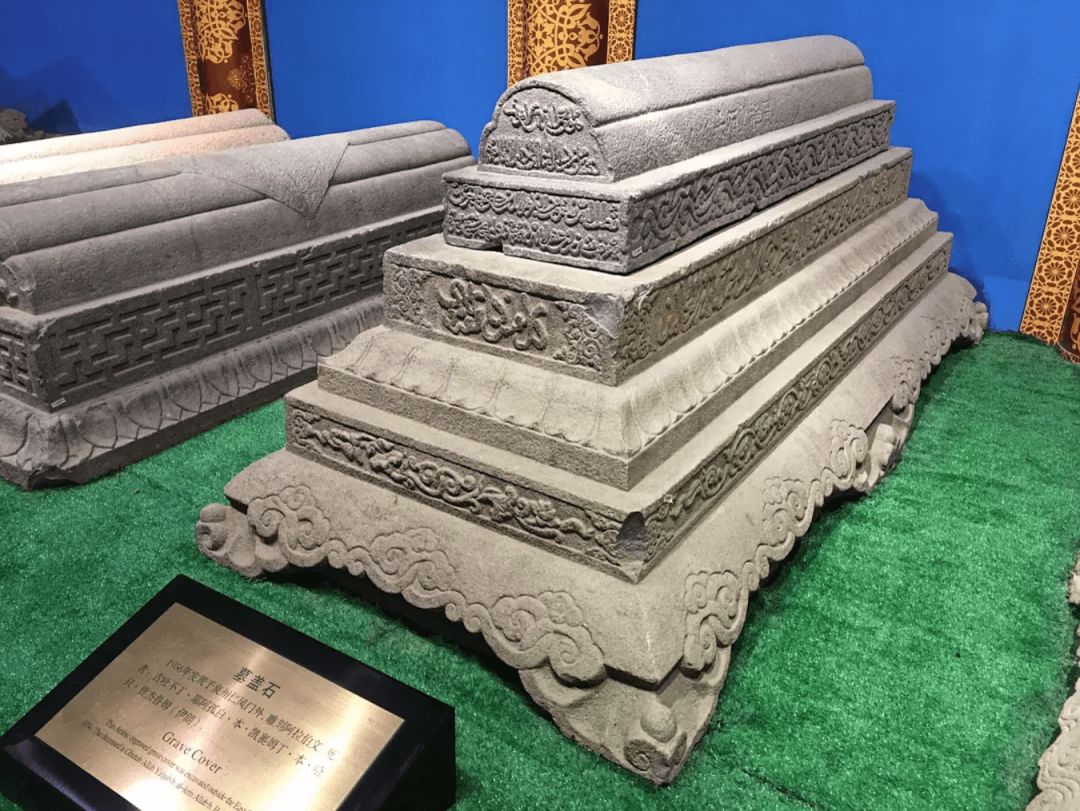
Tomb of a Persian person from the Yuan dynasty at the Quanzhou Maritime Museum.
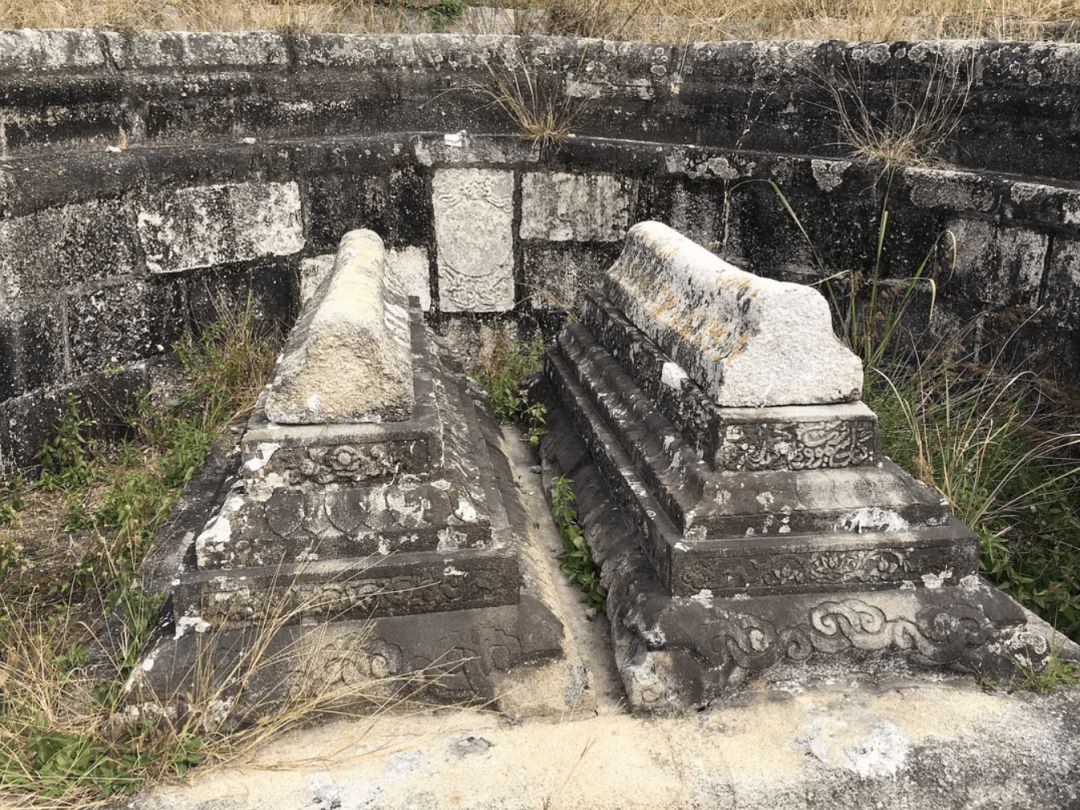
Tomb of Guo Zhongyuan in Baiqi Township, Quanzhou, dated 1422 (the 20th year of the Yongle reign).
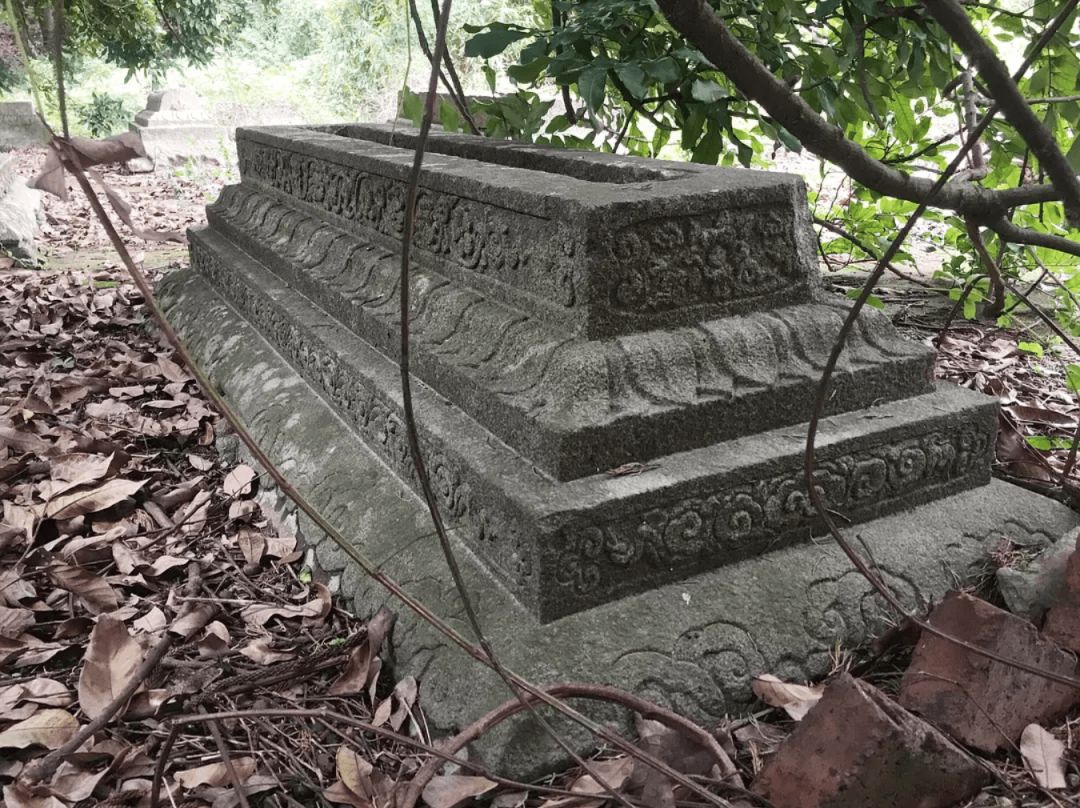
A Muslim tomb from the early Ming dynasty next to the Lingshan Holy Tomb in Quanzhou.
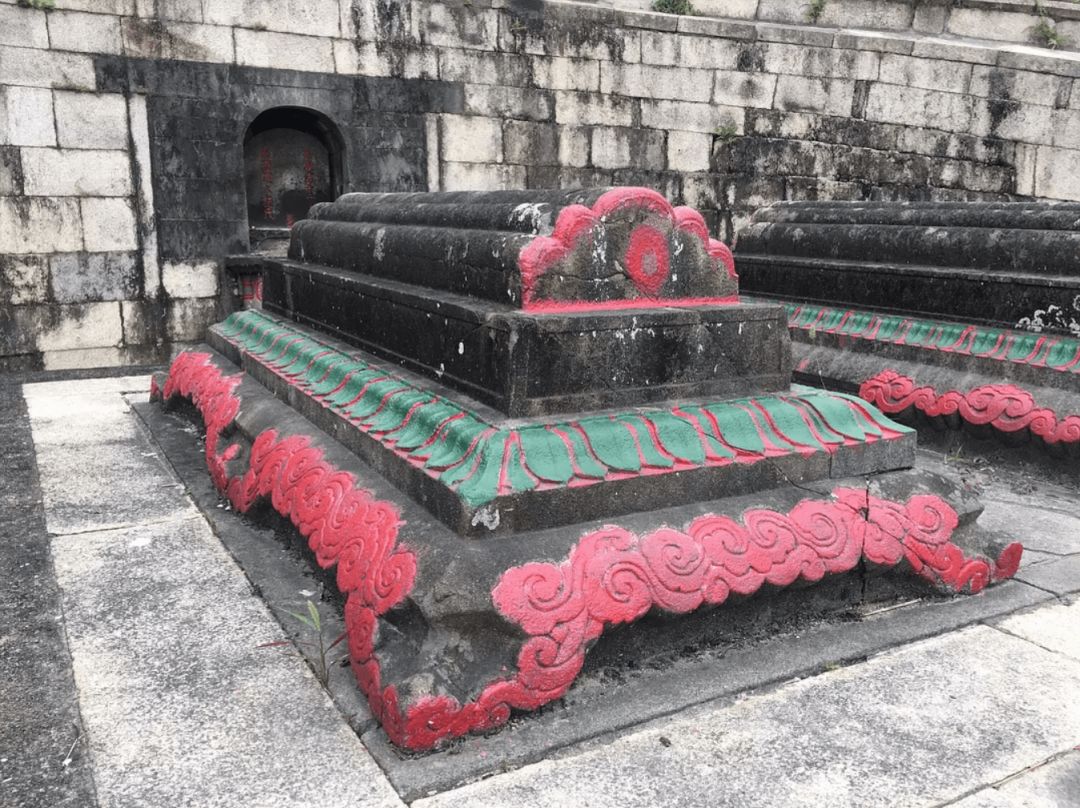
Tomb of Ding Fubao, the fourth-generation ancestor of the Ding family of Chendai, at the Lingshan Holy Tomb in Quanzhou, dated 1436 (the first year of the Zhengtong reign of the Ming dynasty).
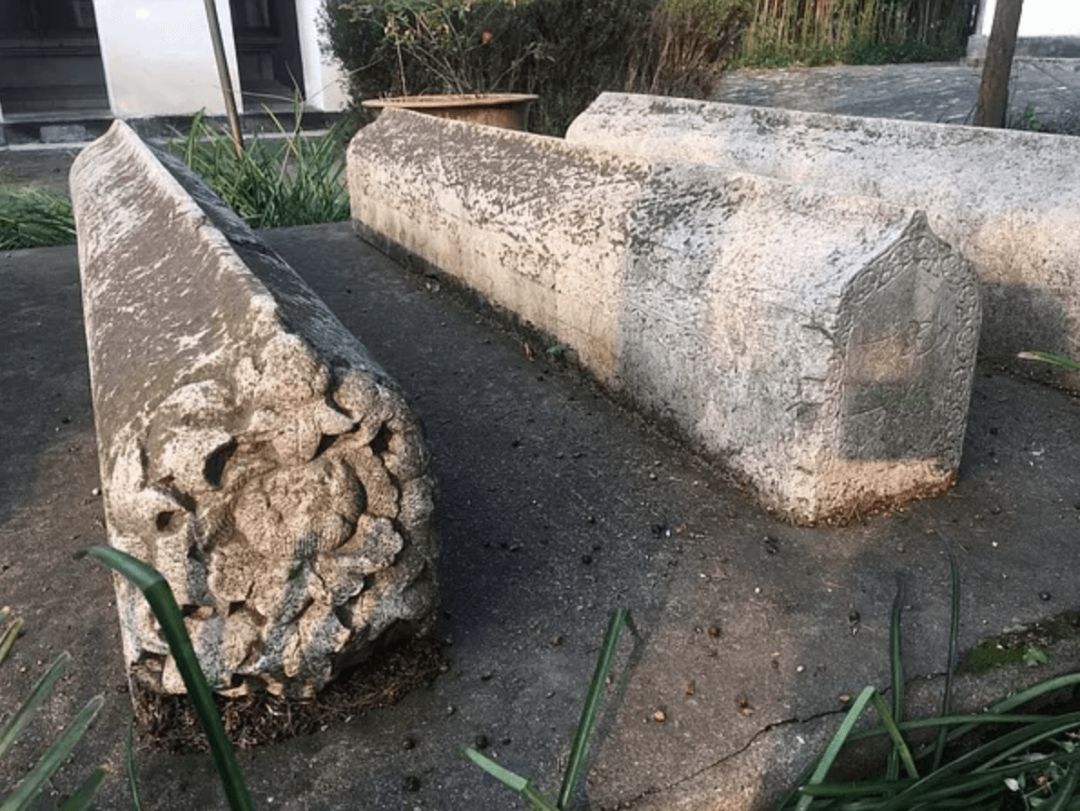
Ming and Qing dynasty tombstone covers at the Puhading Cemetery in Yangzhou.
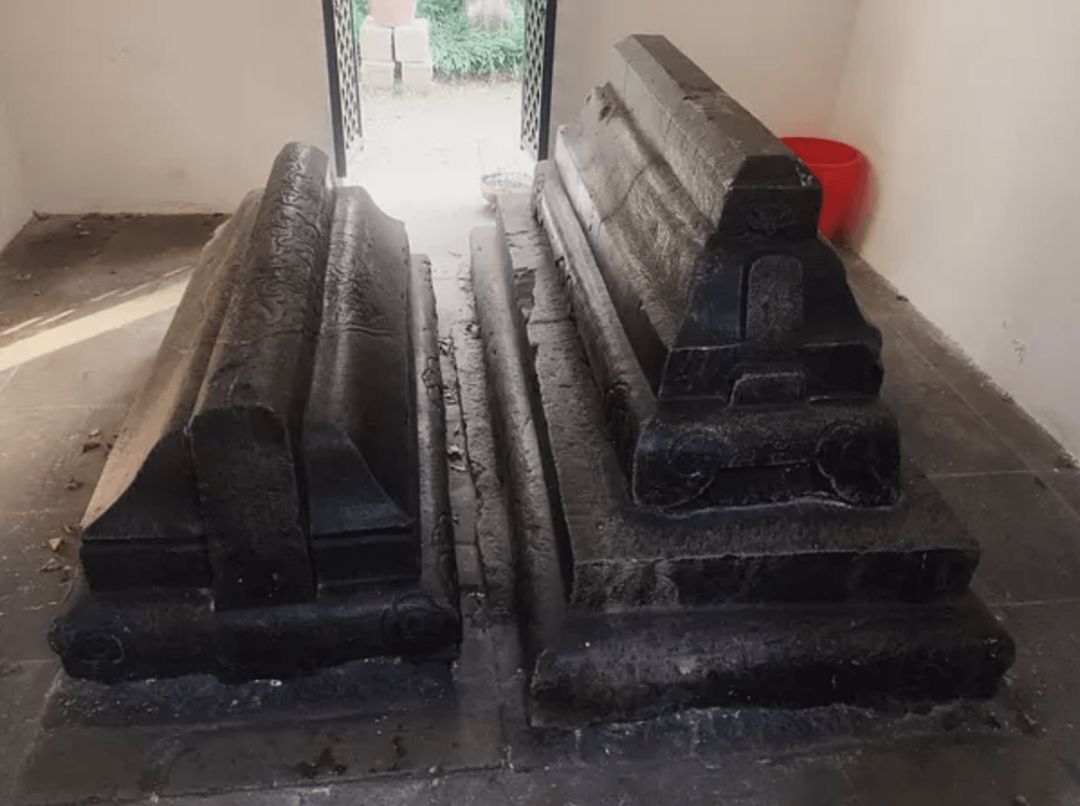
A Ming dynasty tomb in the Puhading Cemetery in Yangzhou; the one on the left is from 1501 (the 14th year of the Hongzhi reign of the Ming dynasty).
Author of this article: Douban user @Amateur Enthusiast Wang Dongsi.
This article has been authorized by the author. Please contact the original author if you wish to repost it!
To learn more about halal food in Hangzhou, click the image below to read directly.
Recommended reading
(Click the image to read the full article)
If you have halal food to share, please contact the canteen manager.
[email protected]
❖ Feel free to share this with your friends
Summary: Hangzhou — Ancient Mosques and the Arrival of Muslims is presented here as a firsthand travel account in clear English, beginning with this scene: Hello everyone, I am the Canteen Master. Last week I put together a list of halal food in Hangzhou, and it just so happens that my Douban friend Wang Dongsi. The account keeps its focus on Hangzhou Mosques, Chinese Islam, Muslim History while preserving the names, places, food, and historical details from the Chinese source.
Hello everyone, I am the Canteen Master. Last week I put together a list of halal food in Hangzhou, and it just so happens that my Douban friend Wang Dongsi
wrote an article introducing the history and culture of Islam in Hangzhou, so I am sharing it with you all.
Historical articles like this might not be as catchy as food guides, but the history of Islam in China and how it constantly blended into and localized within Chinese culture is really interesting.
Why the sudden update today? Because I still have to organize and share a food article with you on Thursday.
Hangzhou's former Muslim community
The information in this article about the history of Islam in Hangzhou is mostly compiled from the book A History of Islam in Hangzhou by Ma Jianchun.
Let's start with a brief look at the history of the halal community in Hangzhou.
The prosperity of Muslims in Hangzhou during the Yuan Dynasty
Although Muslim merchants were granted official titles and settled in Hangzhou as tribute envoys starting in the Southern Song Dynasty, there are still no credible documents or unearthed artifacts recording the lives of Muslims in Hangzhou during the Song Dynasty.
Starting in the Yuan Dynasty, a large number of Muslims began to come to Hangzhou to settle. They were mainly Persians, along with Persianized Central Asian Turks. Among them were Semu military and political officials serving in the Jiangzhe Province, Muslim merchants who arrived in Hangzhou via the Maritime Silk Road and the Beijing-Hangzhou Grand Canal, and purely religious figures. They held high social status and lived wealthy lives.
In the 1320s, the Italian Franciscan friar Odoric came to China. The Travels of Friar Odoric wrote: Hangzhou is the largest city in the world. At that time, Hangzhou had 850,000 registered households, and the Saracens (a term used by Europeans in the Middle Ages to refer to Muslims) accounted for 40,000 of them.
Unlike the Muslims of the Tang and Song periods, the Muslims in Hangzhou during the Yuan Dynasty formed a bustling Muslim community in the city center due to their large numbers. The Yuan Dynasty Muslim community in Hangzhou was located west of Jianqiao and south of Wenjin Lane, inside the current Qingtai Gate. The late Yuan Dynasty writer Tao Zongyi wrote in his book Records of Stopping the Plow at Nancun: Beside Jianqiao in Hangzhou, there are eight tall buildings, commonly known as the Eight-Room Buildings, all inhabited by wealthy Hui Muslims.
The 1867 map of the city of Hangzhou shows the streets with west at the top and east at the bottom. Jianqiao Bridge is in the bottom right corner, and the Hui Muslim hall (Huihuitang) at the top is Phoenix Mosque (Fenghuangsi).
In 1346 (the sixth year of the Zhizheng era), the famous Moroccan traveler Ibn Battuta arrived in Hangzhou. His book, The Travels of Ibn Battuta, mentions the Hangzhou Muslim community: 'The Muslims live in the city, which is beautiful, and the streets are laid out just like those in Islamic regions.' There is a mosque and a muezzin inside. We arrived in the city just at the time for the noon prayer (namaz), and the call could be heard far and wide. In this city, we stayed at the home of the descendants of Othman ibn Affan, an Egyptian. He was a great local merchant who liked this place very much and settled here. They have a lodge (daotang) also named after Othman, which is beautifully built and has many charitable endowments, with a group of Sufi practitioners inside. Othman also built a large mosque in the city and donated a large amount of charitable funds to the mosque and the lodge. There are many Muslims in the city. We lived in this city for fifteen days, and we were invited out every day and every night.
During the Yuan Dynasty, Hangzhou had three mosques: True Religion Mosque (Zhenjiaosi), Hui Muslim Prayer Hall (Huihui Baifotang), and Hui mosque (Huihuishi Libaisi). True Religion Mosque (Zhenjiaosi)
This is Phoenix Mosque (Fenghuangsi). Its original construction date is uncertain, but it was rebuilt in 1281 (the 18th year of the Yuan Zhiyuan era) and has continued to the present day. Hui Muslim Prayer Hall (Huihui Baifotang)
It was northeast of True Religion Mosque, next to Hui Muslim New Bridge (Huihui Xinqiao). The place name Hui Muslim New Bridge still exists today. Hui mosque (Huihuishi Libaisi)
It was west of True Religion Mosque, on what is now Laodong Road. It was destroyed during the wars at the end of the Yuan Dynasty, and the original site was turned into a prefectural school.
The 1914 map of Hangzhou city and West Lake shows Phoenix Mosque at Yangbatou in the bottom left corner, Hui Muslim New Bridge in the top right, and Jewelry Lane (Zhubaoxiang) in the bottom right.
Jujing Garden, located by West Lake outside Qingbo Gate in Hangzhou, was once a place for the Song Dynasty royal family to tour. After the Yuan Dynasty, it was purchased by Muslims to be used as a cemetery. In 1291 (the 28th year of the Zhiyuan era of the Yuan Dynasty), the Song and Yuan poet Zhou Mi saw a Muslim cemetery at Jujing Garden. In his book Guixin Zashi, he wrote: 'According to the customs of the Hui Muslims, when someone dies... they are buried in Jujing Garden, which is also managed by the Hui Muslims.' This was only 15 years after the Yuan army entered Hangzhou. During the Ming and Qing dynasties, this place was called the 'Foreigner's Grave' (fanhui jiamu) or 'Hui Muslim Grave' (huihui fen). During the Republic of China era, it was known as the 'South Garden Islamic Cemetery' (nanyuan huijiao gongmu) or 'Islamic Public Cemetery' (huijiao yizhong), and it remained there until it was moved in 1953.
The 1929 survey map of West Lake in Hangzhou shows the Islamic Public Cemetery at the bottom.
The settling of Muslims in Hangzhou during the Ming Dynasty.
During the Yuan Dynasty, Muslims in Hangzhou did not yet consider this place their home. Many Muslim tombstones from the Yuan period feature a Hadith saying, 'To die in a foreign land is to be a martyr.' After entering the Ming Dynasty, maritime trade stopped, and Muslims who had lived in Hangzhou for generations gradually began to settle down and integrate into local life.
The number of Muslims in Hangzhou continued to grow during the Ming Dynasty. Between the Zhengtong and Hongzhi years (1436-1505), Hami in the Western Regions was attacked by the Oirat Mongols many times. Many Hui Muslims moved to Hangzhou as entire families, and many were settled there. Two Hui Muslims from the Western Regions who arrived in the early Ming Dynasty, Shabasi and Mardin, worked for a long time in the salt and grain transport business along the Grand Canal and became wealthy merchants. Their descendants took the surnames Sha and Ma, becoming major Hui Muslim family names in Hangzhou during the Ming and Qing dynasties.
During the Ming Dynasty, the True Religion Mosque (Zhenjiao Si), also known as Phoenix Mosque (Fenghuang Si), remained the largest mosque in Hangzhou and underwent major renovations in 1453 (the fourth year of the Jingtai era).
As the population grew, three new mosques were built in Hangzhou at the end of the Ming Dynasty: Vinegar Workshop Lane Mosque (Cufang Xiang Si, or North Mosque), Board Lane Mosque (Ban'er Xiang Si, or East Mosque), and Bingxiang Lane Mosque. All were founded by a local wealthy Hui Muslim merchant named Ding Dashou. Vinegar Workshop Lane Mosque was later called the Hangzhou North Mosque. It was located on what is now Chufei Lane in the Xiacheng District. It was destroyed during the Taiping Rebellion, and in 1870 (the ninth year of the Tongzhi era), the Phoenix Mosque built houses on the original site to rent out. Board Lane Mosque, also known as the Small Mosque (xiao libai si) or Hangzhou East Mosque, was located on what is now South Jianguo Road. It was the second most important mosque in Hangzhou after the Phoenix Mosque. Many believers came there for Friday prayers (Jumu'ah), and it was also the place where animal sacrifices and funeral rites were usually held. In 1965, part of the building was taken over by the neighborhood committee for a senior citizens' club, and after 1966, it was converted into a neighborhood office building. Bingxiang Lane Mosque was in the northern suburbs of Hangzhou. There are very few historical records about it, and most local Hui Muslims do not know about it, so it likely fell into ruin many years ago.
Besides the three mosques founded by Ding Dashou, there were several other mosques in Hangzhou during the Ming Dynasty. There was a mosque built during the Chenghua period of the Ming Dynasty at Huihui New Bridge, which featured a moon-sighting tower (wangyuelou) and a scripture school (jingwen xuetang), though it is unclear if it had any connection to the Huihui Buddha-worship hall from the Yuan Dynasty. There was also the West Lake Guo Family Bridge Mosque, known as the West Mosque. The West Lake Mosque, also called the West Lake Small Mosque and the Hangzhou West Mosque, was located north of the previously mentioned Hui Muslim cemetery. It was used for handling funeral arrangements for Hui Muslims. In 1954, it was moved along with the Hui Muslim cemetery to Jingshan Ridge in Liuxia Town, and it stopped being used after 1966.
The stable development of Hangzhou Muslims during the Qing Dynasty.
After the Qing Dynasty began, the Muslim community in Hangzhou was relatively stable. The True Religion Mosque (Zhenjiao Si) underwent repairs during the reigns of the Shunzhi, Kangxi, Qianlong, and Guangxu emperors. the Hangzhou South Mosque was built on Wukui Lane. After the 1950s, the South Mosque on Wukui Lane was converted into housing for Muslims. It was closed in 1958 and handed over to the housing management department for leasing. By this time, Qing Dynasty Hangzhou had five mosques: East, West, South, North, and Central (the Central one being Phoenix Mosque). Phoenix Mosque was the main mosque, while the others were smaller mosques subordinate to it. The leaders and imams of the smaller mosques were appointed by the main mosque. The smaller mosques were for the convenience of the community to perform their five daily namaz prayers, while Friday congregational prayers, festival prayers, and other major religious ceremonies had to be held at the main mosque.
The biggest change for Hui Muslims in Hangzhou during the Qing Dynasty was their shift from wealthy merchants involved in overseas and canal trade during the Yuan and Ming dynasties to ordinary people running small businesses. Their business scope changed from jewelry, spices, silk, and porcelain to halal food. Many people worked full-time in beef and mutton slaughtering, pastry making, running restaurants, and selling snacks. The Qing Dynasty collection of poems, Wulin Zashi Shi, praised Hangzhou Hui Muslim snacks: 'The flour is so fine it rivals pearls and jade, kneaded by hand to look whiter than frost and snow.' If you ask whose snacks are the most delicate, they are the ones made by Ye Shouhe in front of the mosque.
Additionally, the 1863 (second year of the Tongzhi reign) book Hangsu Yifeng, in the food section, wrote: 'Mutton soup restaurants are Muslim eateries.' They specialize in selling mutton products. The sheep are skinned and deboned, then stewed until tender and cut into pieces. Each piece costs four wen, and they are divided into pepper-salt style and plain style. There are also intestines, lungs, and hearts, which are chopped up and served in a bowl with broth, known as 'mixed offal soup' (zashui). A single bowl costs six wen, and a double bowl costs fourteen wen. Snacks like kidneys and liver, spinal cord and brains, intestines and tripe, trotters, tongue, and taiji-shaped cakes (taijitu) cost twenty-eight wen per plate; for meat pieces, eating two pieces only costs six wen. You can order any amount of dried meat slices (ganpianer) per plate, or put them in broth to make sliced meat soup (pianzi tang). The main dishes like braised meat and mixed offal soup always come from the sheep. The liquor is sorghum wine, and snacks include shredded meat, spring pancakes (chunbing), boiled dumplings (shuijiao), and steamed dumplings (shaomai).
Besides mutton, there are small stalls selling spiced beef, beef heart, beef liver, beef trotters, and beef vermicelli (niurou fenxian), carried on shoulder poles with a sign hanging that reads 'Halal Faith' (Qingzhen Jiaomen).
The final prosperity of Muslims in Hangzhou during the Republic of China era.
During the Republic of China era, there were four or five hundred Hui Muslim households in Hangzhou, scattered throughout the city. Besides the common people who mostly ran halal food businesses and sold daily necessities, there were also some wealthy merchants, such as the Jin family who dealt in jewelry, the Zhang family in sericulture and silk, the Feng family who ran a match factory, and the Xuan family who ran a soy sauce shop.
Except for the North Mosque (Qingzhen Beisi) which was destroyed during the Taiping Rebellion, there were four mosques in Hangzhou during the Republic of China era: the Phoenix Mosque (Fenghuang Si) and three smaller mosques in the east, west, and south. In 1928, the main hall and the Moon-Watching Tower (Wangyue Lou) of the Phoenix Mosque were destroyed due to road construction. In the same year, when the city wall was demolished to build the lakeside road, some ancient graves in the Nanyuan Hui Muslim cemetery were forced to relocate, and the Yong'an Hui Muslim cemetery was newly built at Lingfeng, Yuquan, West Lake in 1934.
In 1914, the modern 'Hangzhou Muxing Primary School' was founded inside the Phoenix Mosque. It taught cultural subjects according to the regulations of the Ministry of Education of the Republic of China, and held an Arabic religious class every afternoon, taught by the imam and the head of the Phoenix Mosque. Muxing Primary School accepted students regardless of whether they were Hui or Han, or their gender, as long as they were of school age, but it stipulated that Hui Muslims were exempt from tuition and miscellaneous fees.
In 1928, the Muxing Junior High School was founded inside the Phoenix Mosque, and it later moved to the Chouye Guild Hall at Yintong Bridge. The school had three junior high classes divided into spring and autumn groups, and Hui Muslims were also exempt from tuition and miscellaneous fees. Muxing Middle School has eight full-time teachers. They teach Chinese, math, science, history, geography, art, physical education, and general knowledge. They also regularly offer Hui Muslim students classes on basic Islamic teachings and introductory Arabic.
Since the end of the Qing Dynasty and the beginning of the Republic of China, more and more Hui Muslims moved to Hangzhou from northern provinces like Shandong, Henan, and Hebei. Most left their hometowns and brought their wives and children to Hangzhou to make a living because they had no other choice. Because they lacked capital, most worked as small vendors selling halal food and daily necessities. At that time, you could often see stalls on the streets of Hangzhou with wooden signs saying "Halal" selling flatbread (dabing), fried dough sticks (youtiao), tea eggs, smoked chicken, braised duck, steamed buns (mantou), and dumplings (shuijiao). Some people grew their small stalls into snack shops and later into restaurants, which helped the halal food industry in Hangzhou thrive during the Republic of China era.
Famous halal restaurants in Hangzhou during the Republic of China period included Chunhuayuan, Xileyuan, Zheyi Guan, Xiyue Guan, and Xiyi Guan. Most focused on lamb, braised duck, and vegetarian dishes. Zhong Yulong, a Hangzhou native, was raised in a Hui Muslim family and knew a lot about the Muslims in Hangzhou during the Republic of China. In his book "Speaking of Hangzhou," he wrote: "Xileyuan and Chunhuayuan near Yangbatou are old-fashioned lamb soup restaurants. When customers sit down, they are first served lamb offal soup (yangzasui tang), which is made by chopping up lamb intestines, lungs, and hearts and serving them in a bowl with broth." Depending on the portion size, there are single bowls and double bowls. If you want the full set, you get a small plate each of lamb liver, kidney, eye, tongue, tripe, testicle, brain, and marrow. Otherwise, you can order whatever you like. Regulars use code names for these dishes. For example, lamb testicle is called 'fengtiaoyu,' lamb eye is 'liangdong'r,' lamb brain is 'taijitu,' lamb tongue is 'koutiao,' and fatty lamb meat is 'tuobai,' and so on. After the victory in the War of Resistance Against Japan, each plate cost 2,000 yuan in legal tender, with lamb testicle costing double that. Staple foods included steamed buns (mantou) served with lamb soup, as well as small lamb noodles and lamb steamed dumplings (shaomai). "Speaking of Hangzhou" also records the fried dough (youxiang) of Hangzhou Muslims: "There are two types of fried dough. One is made by grinding sugar and flour into a thin, plate-sized pancake and deep-frying it in oil." The other is made by shaping flour into small cakes with filling inside, pressing them with a mold, and then deep-frying them. Both taste excellent.
Phoenix Mosque (Fenghuang Si)
Phoenix Mosque is located on Zhongshan Middle Road, at the north end of what is now the Southern Song Imperial Street. Historically, it was called the Mosque (libaisi), True Religion Mosque (zhenjiaosi), Huihui Hall (huihuitang), and Orthodox Mosque (zhengjiaosi). The name Phoenix Mosque first appeared on the 1892 (18th year of the Guangxu reign) "Stele Record of the Renovation of the True Religion Mosque."
There is currently a lot of debate about when Phoenix Mosque was built. The direct evidence comes from three Ming and Qing dynasty renovation steles and two Ming dynasty books. A stele from 1493 (the 6th year of the Hongzhi reign of the Ming Dynasty) records: The mosque was founded in 1281 (the Xinsi year of the Zhiyuan reign of the Yuan Dynasty). The Hui Muslims have guarded it for generations.
A stone tablet from 1648 (the fifth year of the Shunzhi reign) records that the True Teaching Mosque (Zhenjiao Si) in Wulin was founded in the Tang Dynasty and has lasted for several hundred years through the Song, Yuan, and Ming dynasties.
A stone tablet from 1670 (the ninth year of the Kangxi reign) records that it was founded in the Tang Dynasty and destroyed at the end of the Song Dynasty. In 1281 (the Xinsi year of the Yuan Dynasty), a master named Alaoding came from the Western Regions, stopped in Hangzhou, saw the ruins, felt moved, and donated gold to rebuild it.
The Records of West Lake Travels (Xihu Youlan Zhi), printed in 1547 (the 26th year of the Jiajing reign), records that the True Teaching Mosque (Zhenjiao Si) is south of Wenjin Lane and was built by the Hui Muslim master Alaoding during the Yanyou period (1314-1320) of the Yuan Dynasty.
The Ming Dynasty book Wulin Buddhist Records (Wulin Fanzhi) records that the True Teaching Mosque (Zhenjiao Si) is south of Wenjin Lane and was built by the Hui Muslim master Alabudan during the Yanyou period (1314-1320) of the Yuan Dynasty.
Looking at these five documents, the Phoenix Mosque (Fenghuang Si) was likely built between the Southern Song Dynasty and 1281. Very few Muslims who came to Hangzhou during the Tang and Five Dynasties periods settled there, and no reliable historical records have been found to date. Therefore, the claim that it dates back to the Tang Dynasty is too early and likely a later fabrication. During the Yanyou period, the number of Muslims living in Hangzhou was already high. They had formed a sizable Muslim community and had their own cemetery, so saying the mosque was built at this time is a bit too late.
According to Ji Si in The Islamic Architecture of Hangzhou: Phoenix Mosque, the main gate of the Phoenix Mosque was originally over 10 meters high. The lintel was inlaid with Arabic brick carvings, the sides of the pointed arch gate were covered with decorative tiles, and there were two lotus-shaped columns.
In 1929, Hangzhou demolished the main gate, the Moon-Watching Tower (Wangyue Lou), the stone-carved corridor leading to the front hall, and the pair of stone birds in front of the gate to renovate Zhongshan Middle Road.
The old photo of the original Phoenix Mosque main gate shared on the Zhejiang Islamic Association website has been carefully preserved for generations by elders like Zhang Wenlie in Hangzhou.
Moon-Watching Tower (Wangyue Lou)
The old photo of the original Phoenix Mosque Moon-Watching Tower (Wangyue Lou) shared on the Zhejiang Islamic Association website has also been carefully preserved for generations by elders like Zhang Wenlie in Hangzhou.
During the 1953 renovation of the main hall, the front hall was demolished and rebuilt with a concrete structure and red brick walls.
The rear main hall is the only remaining Yuan Dynasty structure of the Phoenix Mosque. It is narrow from east to west and wide from north to south, maintaining the traditions of early West Asian mosques. The entire hall is a brick structure without wooden beams, so it is also called the Beamless Hall (Wuliang Dian).
Professor Liu Zhiping took this photo of Phoenix Mosque (Fenghuang Si) in 1960, as featured in the book Islamic Architecture in China.
The Foreigner's Return Cemetery (Fanhuijia Mu).
As mentioned at the start of this article, the Jujing Garden by West Lake outside Hangzhou was once a place for the Song Dynasty royal family to tour. During the Yuan Dynasty, Muslims bought it to use as a cemetery. In the Ming and Qing Dynasties, it was called the Foreigner's Return Cemetery (Fanhuijia Mu) or the Hui Muslim Cemetery (Huihui Fen). During the Republic of China era, it was known as the South Garden Muslim Cemetery (Nanyuan Huijiao Gongmu) or the Muslim Public Graveyard (Huijiao Yizhong).
According to the preface titled A Witness to the Times in the book Interpretation and Translation of Arabic and Persian Inscriptions in Hangzhou Phoenix Mosque by Liu Yingsheng, the Hangzhou municipal government moved the cemetery in May 1953 to develop the West Lake scenic area. Since many of these were ancient graves from before the Qing Dynasty with no one to claim them, Phoenix Mosque took charge of collecting and handling the remains and tombstones. The remains were wrapped in white cloth and placed in wooden boxes one meter long and half a meter wide. For those with names, a wooden sign was written and attached to the box, and they were all buried together in the Hui Muslim cemetery at Jingshan Ridge in Liuxia Town. The unearthed stone tablets were categorized and numbered based on their stone type and content. After moving the graves from the higher ground, workers found layer upon layer of ancient graves while digging soil to raise the embankments for Mid-Lake Pavilion (Huxin Ting), Ruandun, and Autumn Moon over the Calm Lake (Pinghu Qiuyue). Later, more graves were discovered in other places beneath the soil layers where the relocation had already been completed. Before the relocation, it was estimated that the Hui Muslim Cemetery (Huihui Fen) held over 2,000 graves, but in reality, there were often more graves buried underneath them. Due to budget limits, these deeper ancient graves were not moved and remain buried deep within the West Lake scenic area.
During the relocation of the Hui Muslim Cemetery (Huihui Fen) from May to October 1953, fifty or sixty Arabic and Persian tombstones were found and transported to Phoenix Mosque for safekeeping, though many were lost later. A stone tablet gallery was built inside Phoenix Mosque in 1977, and it currently houses 20 Arabic and Persian tombstones and one mosque tablet.
The book Interpretation and Translation of Arabic and Persian Inscriptions in Hangzhou Phoenix Mosque provides detailed readings of these 20 tombstones. The author of this book, Alexander Morton, is a lecturer in the Department of Iranian Studies at the School of Oriental and African Studies, University of London. He grew up in Iran, loves Persian culture and history, has long studied Islamic inscriptions in the Middle and Near East, and is an expert on Islamic inscriptions.
The basic information for the owners of 11 of these tombstones is summarized below.
The owner of stone tablet No. 1 is named Khawaja Husam al-Din, who passed away on October 28, 1307 (the 11th year of the Dade era of the Yuan Dynasty). He traveled to many countries and was in the prime of his life when he died. Khawaja is a title often used by high-ranking merchants, ministers, and dignitaries in Islamic society. Husam al-Din means 'Sword of the Faith,' where al-Din means 'religion' or 'faith'.
The owner of stone tablet No. 2 is named Shams al-Din Muhammad bin Ahmad bin Abi Nasr al-Isfahani, who passed away on September 24, 1316 (the 3rd year of the Yanyou era of the Yuan Dynasty). The name Isfahani in the History of Yuan refers to the famous ancient Iranian city of Isfahan. Shams al-Din was a great merchant from Isfahan who engaged in maritime trade between Persia and China, and his name was known to the khans of the Ilkhanate who ruled Iran at that time.
The owner of stone tablet No. 3 is named Khawaja Muhammad, who passed away on March 20, 1317 (the 4th year of the Yanyou era of the Yuan Dynasty). Muhammad is the modern spelling of the name. His father was named Arsalan Khanbaliqi. Arsalan translates to 'lion' in Turkic, so his family likely originated from a Turkic background. Khanbaliqi was the name used by Turkic people for the Yuan capital, Dadu. Construction of Dadu began in 1267 and was completed in 1284, which indicates his family settled there after that time.
The owner of tombstone No. 4 is named Khawaja Ala al-Din bin Khawaja Shams al-Din al-Isfahani, who passed away on May 16, 1327 (the 4th year of the Taiding era of the Yuan Dynasty). Ala al-Din is the modern spelling of the name.
The owner of stone tablet No. 5 is named Amir Bakhtiyar bin Abu Bakr bin Umar al-Bukhari, who passed away on August 7, 1330 (the 1st year of the Zhishun era of the Yuan Dynasty). Amir is a title for a military officer. Bukhara in the History of Yuan refers to the ancient city of Bukhara in modern-day Uzbekistan.
The owner of stone tablet No. 6 is named Mahmud bin Muhammad bin Jamal al-Din al-Khorasani, who passed away in 1351 (the 11th year of the Zhizheng era of the Yuan Dynasty). Jamal al-Din means 'Beauty of the Faith.' He was an Islamic scholar (alim) from Khorasan in northeastern Iran, was well-versed in Islamic law, and both his parents were descendants of the Prophet Muhammad.
The owner of stone tablet No. 7 is named Mahmud bin Mahma bin Ahma Simnani. He was a Sufi merchant who traveled widely. He visited Syria (Scham) and Iraq (which covered a much larger area then and could also refer to coastal regions), and he reached the area near Mecca. Simnan is located east of Tehran, the capital of Iran, and is the hometown of the famous Persian Sufi Sheikh Ala al-Dawla Simnani.
The owner of stone tablet No. 8 is named Emir Badr al-Din. Badr al-Din means 'full moon of the religion'. His father was named al-Sadr, which is usually an honorific title given to civil officials or other secular dignitaries.
The owner of stone tablet No. 9 is named Khwaja Jalili. Jalili is later translated as Jalal, which originally means 'glory' or 'prominence'.
The owner of stone tablet No. 10 is named Shihab al-Din Ahma bin Abdullah Halabi. Shihab al-Din appears frequently in Yuan Dynasty historical records and means 'star of the religion'. Halabi refers to the ancient city of Aleppo (Halab) in modern-day Syria, a city that has suffered severe damage in the recent Syrian civil war.
The owner of stone tablet No. 11 is named Taj al-Din Yahya, who died at the age of 41. His father was named Mullah Burhan al-Milla wa al-Din, an outstanding imam. Taj al-Din means 'crown of the faith', and Yahya is the Arabic form of John the Baptist from the New Testament as it appears in the Quran. Burhan means 'witness', and al-Milla wa al-Din means 'the community and the faith'.
The tomb of the Hui Muslim sage Bakhtiyar.
On the site of the Fan Hui Jia tomb, there is another Muslim relic, the tomb of the Hui Muslim sage Buhetiyaer. On March 12, 1924, the Shanghai newspaper Shen Bao reported a story titled Police Chief Preserves Ancient Tombs.
The original text says: When the Hangzhou Public Works Department tore down the city wall to build a road around the lake, they dug up three ancient tombs and seven stone tablets under the Qingbo Gate wall, all engraved with Arabic script. The carvings are very old and hard to read. According to a Muslim imam who translated the text, these are the tombs of sages from the Tang and Song dynasties, including Oumoliri and his sons Emili and Ebubokeliri (transliterated names). It was no accident that these tombs, which have stood for a thousand years, were discovered during the demolition of the city wall. I heard that Police Chief Xia wanted to protect these tombs, but because of the road construction, he had to move them slightly. He notified the leaders of the Muslim community to find a suitable piece of land, build a shrine, and move the ancient tombs there so they can be preserved and visited by future generations. Beyond preserving the historical site, this also adds to the local scenery, making the tombs a grand sight that adds to the charm of the lake and mountains for travelers.
Before this, in 1921, the famous Muslim scholar Yang Zhongming (courtesy name Jingxiu) translated the Epitaph of the Traveler Buhetiyaer, which was included in the August 1921 volume of the Shanghai Muslim Board of Directors records.
Buhetiyaer is now translated as Bahtiyar. His full name was Amir Buhetiyaer Seluoniya Naluonike, and he died in 1329 (the second year of the Tianli era of the Yuan Dynasty). He was from Bukhara in Central Asia. Bukhara (Bokhara) is in modern-day Uzbekistan. At that time, it was ruled by the Chagatai Khanate and was a center of Islamic culture in Central Asia. Amir is also translated as Emir, which is a title for a military officer. The epitaph shows that Buhetiyaer came from a family of officials.
Interestingly, the owner of the number 5 stone tablet among the Yuan Dynasty tombstones kept at the Phoenix Mosque (Fenghuang Si) in Hangzhou, which we mentioned earlier, is also named Amir Buhetiyaer and also came from Bukhara. However, his full name was Emir bin Abubieker bin Umaer Buhala, and he died on August 7, 1330 (the first year of the Zhishun era of the Yuan Dynasty), which was one year after Buhetiyaer died. The two of them likely had a close relationship.
Volume 23 of Hangzhou Cultural and Historical Materials contains an article titled The Full Story of the Changes to the Ancient Cemetery of the Hui Muslim Sage Buhatia. The following details about the cemetery's history are all taken from this article.
In 1927, the Buhatia Cemetery was completed outside Qingbo Gate. General Ma Fuxiang, the father of Ningxia warlord Ma Hongkui, attended the opening ceremony and erected a memorial tablet in front of the grave. According to the memories of Zhu Jingfen, the daughter of the cemetery caretaker Zhu Awei (who died in 1967): My father started managing the Hui Muslim cemetery at age 13. Times were hard then, and Zhang Shoubo, the former chairman of Phoenix Mosque (Fenghuang Si), or the Feng and Ding families would provide three or four dou of rice each month to help us get by.
In May 1953, the Hangzhou municipal government moved the Muslim cemetery to Jingshan Ridge in Liuxia Town to develop the West Lake scenic area. At that time, the stone slabs for the Buhatia grave were carried up the mountain in layers. Two teams of 16 people carried them, as each slab weighed about 1,200 jin. Because of this, only the top four layers were moved up, reaching a total height of about 0.6 meters.
After 1966, the Buhatia grave cover stones were smashed. Because they were so heavy and the cemetery guards opposed it, only part of them were broken, and the rest were scattered at the foot of the mountain. One grave slab was stolen, and the head and foot slabs of another grave were also taken. The central Buhatia grave was pried open, and the words Red Guard Seal were painted in red on the inside of the cover slab. Ma Fuxiang's memorial tablet was buried in an air-raid shelter, and the Arabic inscription tablet is still missing.
In December 1986, the smashed Buhatia grave cover stones were unearthed again at the Liuxia Hui Muslim Cemetery. Historical Materials compiled by the Fujian Academy of Social Sciences records that the structure was built with multiple layers of stone steps, with the stone surfaces fully carved with delicate and beautiful patterns like scrolling grass.
In 1989, the Buhatia Cemetery was rebuilt on its original site. The restored stone tablets were copied from rubbings of the originals. Each grave cover is four layers high, about 0.6 meters, which is actually just the top crown portion of the original Buhatia grave cover.
In 2006, the Hangzhou Municipal People's Government built a new stone pavilion at the Buhatia Cemetery, which is its current form.
Grave of Ding Henian
Ding Henian (1335-1424) was a famous Hui Muslim poet during the late Yuan and early Ming dynasties. His great-grandfather was named Alaoding, his grandfather was named Shansiding, and his father was named Zhimaluding, so he took Ding as his surname. Ding (al-Din) means religion or faith in Arabic and is often placed at the end of a person's name.
The History of Ming: Biographies of Literati contains a short biography of Ding Henian. It writes that Ding's great-grandfather Alaoding and his younger brother Umar were both big merchants. When Yuan Emperor Shizu Kublai Khan conquered the Western Regions and lacked supplies, Alaoding donated his own goods in time. Because of this, Kublai Khan rewarded him with land in the Yuan capital, Dadu, and gave him very generous treatment. Umar also served as an official, eventually reaching the position of Left Chancellor of the Gansu Province.
Ding Henian's grandfather Shansiding served as a daruqachi of Linjiang Circuit, and his father Zhimaluding also served as a daruqachi of Wuchang County due to his family's status. Daruqachi (daruqai) originally meant seal holder. They held the actual administrative and military power in local governments at the circuit, prefecture, department, and county levels during the Yuan Dynasty and were the highest-ranking local officials. Daruqachi were generally Mongolians, and only Semu people with noble family backgrounds could hold the position. Ding Henian's family belonged to these noble Semu people.
As the son of the highest official in Wuchang, Ding Henian read many books from a young age and studied at the famous Nanhu Academy in Wuchang. He also had a talented older sister named Yue'e who taught him classics and history.
In 1352 (the 12th year of the Zhizheng era of the Yuan Dynasty), the Red Turban Army captured Wuchang. Ding Henian was 18 that year. After settling his biological mother in the suburbs of Wuchang, he escorted his father's primary wife to Zhenjiang to take refuge. After his father's primary wife passed away, Ding Henian had to continue his flight. He went to Zhoushan Island in Zhejiang to seek refuge with his cousin Jiyamuding, who was the magistrate of Dinghai County, but his cousin passed away shortly after. At that time, the eastern part of Zhejiang was occupied by the peasant uprising leader Fang Guozhen, who was most suspicious of Semu people. Ding Henian had to wander around Siming Mountain in Ningbo and the islands of eastern Zhejiang, working as a tutor for children, staying in monks' quarters, and making a living by selling tea and drinks.
Ding Henian described his mood while living in seclusion in the second of his four poems titled 'Sent to Master Jiuling':
Flowers and willows in every village meet the seaside, I take my family wherever I go to avoid the chaos of war.
The clothing and grain still preserve the style of the Jin Dynasty, the chickens and dogs in this peach blossom spring have long been cut off from the Qin.
Sitting facing the green mountains, I never tire of them, forgetting my worldly schemes, the white birds are naturally close to me.
I also know that coming out or staying in depends on the times, I do not just escape my name to imitate a hermit.
In 1366 (the 26th year of the Zhizheng era), Zhu Yuanzhang attacked the Jiangnan region. Hangzhou and Huzhou surrendered to Zhu Yuanzhang one after another, and the flames of war approached Zhejiang. While fleeing and suffering from illness, Ding Henian could not sleep at night and wrote the poem Night Dream of Returning Home on the 24th Day of the 11th Month of the Bingwu Year.
I have been sick for a long time and do not go out, thinking of my brothers one by one, wondering who is alive and who is dead.
War has cut off all news everywhere, and the wind and rain haunt my dreams all night long.
I write poems under the bamboo as clouds rise over my inkstone, and I sing songs before the flowers with the moon shining on my wine cup.
Old memories always bring new feelings, and I sit alone by the cold lamp wiping away my tears.
In 1368 (the first year of the Hongwu reign), Zhu Yuanzhang defeated Fang Guozhen, who occupied eastern Zhejiang, and declared himself emperor in Nanjing. The situation in Zhejiang gradually stabilized, and Ding Henian ended his life of fleeing. He built a house by the sea on Zhoushan Island to settle down and named it Sea Nest (Haichao).
In 1379 (the 12th year of the Hongwu reign), 44-year-old Ding Henian returned to his hometown of Wuchang to rebury his mother's remains and wrote Two Poems on Returning to Wuchang After the War. The second poem says:
The chaos has settled and I return home with graying temples, saddened by the changes in people and things.
In the west wind, foxes and rabbits roam the ancient graves, and in the setting sun, wolves lie in the desolate countryside.
The five willow trees are no longer the home of Tao Yuanming, and the hundred flowers are not what they were at Duling Manor.
My old haunts have all become dreams, and I sit alone counting the hours through the long night.
In his later years, Ding Henian moved to Hangzhou to live in seclusion and returned to Islam. According to the Qing dynasty record Notes on Qingbo (Qingbo Xiaozhi), he spent his late years practicing the laws of Allah and lived in a hut by his ancestors' graves. Ding Henian likely lived near the grave of his great-grandfather, Aladdin, at the Foreigner's Grave (Fanhuijia Mu) outside Qingbo Gate.
In 1424 (the 22nd year of the Yongle reign), 89-year-old Ding Henian passed away and was buried next to Aladdin's grave. This place was later called the Ding Family Mound (Ding Shi Long). When the cemetery was moved in 1953 to build West Lake Park, only Ding Henian's Ming dynasty tomb pavilion and tomb cover stone remained, serving as a relic of the Hui Muslims' cemetery.
During the transition between the Yuan and Ming dynasties, wealthy Semu merchants and officials along the southeast coast fell from the upper class to the bottom of society, leading to all sorts of stories. In Quanzhou, the once-prosperous Pu family was banned from studying or holding government office. Many Semu people died, left, or fled, and the Guo and Ding families moved from Quanzhou city to the countryside. Ding Henian was part of this great upheaval. In his poem "To My Cousin Sai Jingchu," written to the famous Hui Muslim calligrapher Sai Jingchu who was also living in seclusion in Hangzhou, he wrote:
The noble descendant lives in a desolate alley, writing calligraphy to trade for wine.
Wealth comes and goes on its own, leaving only a pure spirit in the world.
Muslim tombstone covers in the southeast during the early Ming dynasty still kept their Yuan dynasty style, which is very precious. Below, I will share some photos I took of Muslim tombstone covers in Quanzhou and Yangzhou for comparison.
Tomb of a Persian person from the Yuan dynasty at the Quanzhou Maritime Museum.
Tomb of Guo Zhongyuan in Baiqi Township, Quanzhou, dated 1422 (the 20th year of the Yongle reign).
A Muslim tomb from the early Ming dynasty next to the Lingshan Holy Tomb in Quanzhou.
Tomb of Ding Fubao, the fourth-generation ancestor of the Ding family of Chendai, at the Lingshan Holy Tomb in Quanzhou, dated 1436 (the first year of the Zhengtong reign of the Ming dynasty).
Ming and Qing dynasty tombstone covers at the Puhading Cemetery in Yangzhou.
A Ming dynasty tomb in the Puhading Cemetery in Yangzhou; the one on the left is from 1501 (the 14th year of the Hongzhi reign of the Ming dynasty).
Author of this article: Douban user @Amateur Enthusiast Wang Dongsi.
This article has been authorized by the author. Please contact the original author if you wish to repost it!
To learn more about halal food in Hangzhou, click the image below to read directly.
Recommended reading
(Click the image to read the full article)
If you have halal food to share, please contact the canteen manager.
[email protected]
❖ Feel free to share this with your friends
Halal Travel Guide: Hangzhou — Ancient Mosques and the Arrival of Muslims
Articles • ali2007fr posted the article • 0 comments • 214 views • 2026-05-18 20:26
Reposted from the web
Summary: Hangzhou — Ancient Mosques and the Arrival of Muslims is presented here as a firsthand travel account in clear English, beginning with this scene: Hello everyone, I am the Canteen Master. Last week I put together a list of halal food in Hangzhou, and it just so happens that my Douban friend Wang Dongsi. The account keeps its focus on Hangzhou Mosques, Chinese Islam, Muslim History while preserving the names, places, food, and historical details from the Chinese source.
Hello everyone, I am the Canteen Master. Last week I put together a list of halal food in Hangzhou, and it just so happens that my Douban friend Wang Dongsi
wrote an article introducing the history and culture of Islam in Hangzhou, so I am sharing it with you all.
Historical articles like this might not be as catchy as food guides, but the history of Islam in China and how it constantly blended into and localized within Chinese culture is really interesting.
Why the sudden update today? Because I still have to organize and share a food article with you on Thursday.
Hangzhou's former Muslim community
The information in this article about the history of Islam in Hangzhou is mostly compiled from the book A History of Islam in Hangzhou by Ma Jianchun.
Let's start with a brief look at the history of the halal community in Hangzhou.
The prosperity of Muslims in Hangzhou during the Yuan Dynasty
Although Muslim merchants were granted official titles and settled in Hangzhou as tribute envoys starting in the Southern Song Dynasty, there are still no credible documents or unearthed artifacts recording the lives of Muslims in Hangzhou during the Song Dynasty.
Starting in the Yuan Dynasty, a large number of Muslims began to come to Hangzhou to settle. They were mainly Persians, along with Persianized Central Asian Turks. Among them were Semu military and political officials serving in the Jiangzhe Province, Muslim merchants who arrived in Hangzhou via the Maritime Silk Road and the Beijing-Hangzhou Grand Canal, and purely religious figures. They held high social status and lived wealthy lives.
In the 1320s, the Italian Franciscan friar Odoric came to China. The Travels of Friar Odoric wrote: Hangzhou is the largest city in the world. At that time, Hangzhou had 850,000 registered households, and the Saracens (a term used by Europeans in the Middle Ages to refer to Muslims) accounted for 40,000 of them.
Unlike the Muslims of the Tang and Song periods, the Muslims in Hangzhou during the Yuan Dynasty formed a bustling Muslim community in the city center due to their large numbers. The Yuan Dynasty Muslim community in Hangzhou was located west of Jianqiao and south of Wenjin Lane, inside the current Qingtai Gate. The late Yuan Dynasty writer Tao Zongyi wrote in his book Records of Stopping the Plow at Nancun: Beside Jianqiao in Hangzhou, there are eight tall buildings, commonly known as the Eight-Room Buildings, all inhabited by wealthy Hui Muslims.
The 1867 map of the city of Hangzhou shows the streets with west at the top and east at the bottom. Jianqiao Bridge is in the bottom right corner, and the Hui Muslim hall (Huihuitang) at the top is Phoenix Mosque (Fenghuangsi).
In 1346 (the sixth year of the Zhizheng era), the famous Moroccan traveler Ibn Battuta arrived in Hangzhou. His book, The Travels of Ibn Battuta, mentions the Hangzhou Muslim community: 'The Muslims live in the city, which is beautiful, and the streets are laid out just like those in Islamic regions.' There is a mosque and a muezzin inside. We arrived in the city just at the time for the noon prayer (namaz), and the call could be heard far and wide. In this city, we stayed at the home of the descendants of Othman ibn Affan, an Egyptian. He was a great local merchant who liked this place very much and settled here. They have a lodge (daotang) also named after Othman, which is beautifully built and has many charitable endowments, with a group of Sufi practitioners inside. Othman also built a large mosque in the city and donated a large amount of charitable funds to the mosque and the lodge. There are many Muslims in the city. We lived in this city for fifteen days, and we were invited out every day and every night.
During the Yuan Dynasty, Hangzhou had three mosques: True Religion Mosque (Zhenjiaosi), Hui Muslim Prayer Hall (Huihui Baifotang), and Hui mosque (Huihuishi Libaisi). True Religion Mosque (Zhenjiaosi)
This is Phoenix Mosque (Fenghuangsi). Its original construction date is uncertain, but it was rebuilt in 1281 (the 18th year of the Yuan Zhiyuan era) and has continued to the present day. Hui Muslim Prayer Hall (Huihui Baifotang)
It was northeast of True Religion Mosque, next to Hui Muslim New Bridge (Huihui Xinqiao). The place name Hui Muslim New Bridge still exists today. Hui mosque (Huihuishi Libaisi)
It was west of True Religion Mosque, on what is now Laodong Road. It was destroyed during the wars at the end of the Yuan Dynasty, and the original site was turned into a prefectural school.
The 1914 map of Hangzhou city and West Lake shows Phoenix Mosque at Yangbatou in the bottom left corner, Hui Muslim New Bridge in the top right, and Jewelry Lane (Zhubaoxiang) in the bottom right.
Jujing Garden, located by West Lake outside Qingbo Gate in Hangzhou, was once a place for the Song Dynasty royal family to tour. After the Yuan Dynasty, it was purchased by Muslims to be used as a cemetery. In 1291 (the 28th year of the Zhiyuan era of the Yuan Dynasty), the Song and Yuan poet Zhou Mi saw a Muslim cemetery at Jujing Garden. In his book Guixin Zashi, he wrote: 'According to the customs of the Hui Muslims, when someone dies... they are buried in Jujing Garden, which is also managed by the Hui Muslims.' This was only 15 years after the Yuan army entered Hangzhou. During the Ming and Qing dynasties, this place was called the 'Foreigner's Grave' (fanhui jiamu) or 'Hui Muslim Grave' (huihui fen). During the Republic of China era, it was known as the 'South Garden Islamic Cemetery' (nanyuan huijiao gongmu) or 'Islamic Public Cemetery' (huijiao yizhong), and it remained there until it was moved in 1953.
The 1929 survey map of West Lake in Hangzhou shows the Islamic Public Cemetery at the bottom.
The settling of Muslims in Hangzhou during the Ming Dynasty.
During the Yuan Dynasty, Muslims in Hangzhou did not yet consider this place their home. Many Muslim tombstones from the Yuan period feature a Hadith saying, 'To die in a foreign land is to be a martyr.' After entering the Ming Dynasty, maritime trade stopped, and Muslims who had lived in Hangzhou for generations gradually began to settle down and integrate into local life.
The number of Muslims in Hangzhou continued to grow during the Ming Dynasty. Between the Zhengtong and Hongzhi years (1436-1505), Hami in the Western Regions was attacked by the Oirat Mongols many times. Many Hui Muslims moved to Hangzhou as entire families, and many were settled there. Two Hui Muslims from the Western Regions who arrived in the early Ming Dynasty, Shabasi and Mardin, worked for a long time in the salt and grain transport business along the Grand Canal and became wealthy merchants. Their descendants took the surnames Sha and Ma, becoming major Hui Muslim family names in Hangzhou during the Ming and Qing dynasties.
During the Ming Dynasty, the True Religion Mosque (Zhenjiao Si), also known as Phoenix Mosque (Fenghuang Si), remained the largest mosque in Hangzhou and underwent major renovations in 1453 (the fourth year of the Jingtai era).
As the population grew, three new mosques were built in Hangzhou at the end of the Ming Dynasty: Vinegar Workshop Lane Mosque (Cufang Xiang Si, or North Mosque), Board Lane Mosque (Ban'er Xiang Si, or East Mosque), and Bingxiang Lane Mosque. All were founded by a local wealthy Hui Muslim merchant named Ding Dashou. Vinegar Workshop Lane Mosque was later called the Hangzhou North Mosque. It was located on what is now Chufei Lane in the Xiacheng District. It was destroyed during the Taiping Rebellion, and in 1870 (the ninth year of the Tongzhi era), the Phoenix Mosque built houses on the original site to rent out. Board Lane Mosque, also known as the Small Mosque (xiao libai si) or Hangzhou East Mosque, was located on what is now South Jianguo Road. It was the second most important mosque in Hangzhou after the Phoenix Mosque. Many believers came there for Friday prayers (Jumu'ah), and it was also the place where animal sacrifices and funeral rites were usually held. In 1965, part of the building was taken over by the neighborhood committee for a senior citizens' club, and after 1966, it was converted into a neighborhood office building. Bingxiang Lane Mosque was in the northern suburbs of Hangzhou. There are very few historical records about it, and most local Hui Muslims do not know about it, so it likely fell into ruin many years ago.
Besides the three mosques founded by Ding Dashou, there were several other mosques in Hangzhou during the Ming Dynasty. There was a mosque built during the Chenghua period of the Ming Dynasty at Huihui New Bridge, which featured a moon-sighting tower (wangyuelou) and a scripture school (jingwen xuetang), though it is unclear if it had any connection to the Huihui Buddha-worship hall from the Yuan Dynasty. There was also the West Lake Guo Family Bridge Mosque, known as the West Mosque. The West Lake Mosque, also called the West Lake Small Mosque and the Hangzhou West Mosque, was located north of the previously mentioned Hui Muslim cemetery. It was used for handling funeral arrangements for Hui Muslims. In 1954, it was moved along with the Hui Muslim cemetery to Jingshan Ridge in Liuxia Town, and it stopped being used after 1966.
The stable development of Hangzhou Muslims during the Qing Dynasty.
After the Qing Dynasty began, the Muslim community in Hangzhou was relatively stable. The True Religion Mosque (Zhenjiao Si) underwent repairs during the reigns of the Shunzhi, Kangxi, Qianlong, and Guangxu emperors. the Hangzhou South Mosque was built on Wukui Lane. After the 1950s, the South Mosque on Wukui Lane was converted into housing for Muslims. It was closed in 1958 and handed over to the housing management department for leasing. By this time, Qing Dynasty Hangzhou had five mosques: East, West, South, North, and Central (the Central one being Phoenix Mosque). Phoenix Mosque was the main mosque, while the others were smaller mosques subordinate to it. The leaders and imams of the smaller mosques were appointed by the main mosque. The smaller mosques were for the convenience of the community to perform their five daily namaz prayers, while Friday congregational prayers, festival prayers, and other major religious ceremonies had to be held at the main mosque.
The biggest change for Hui Muslims in Hangzhou during the Qing Dynasty was their shift from wealthy merchants involved in overseas and canal trade during the Yuan and Ming dynasties to ordinary people running small businesses. Their business scope changed from jewelry, spices, silk, and porcelain to halal food. Many people worked full-time in beef and mutton slaughtering, pastry making, running restaurants, and selling snacks. The Qing Dynasty collection of poems, Wulin Zashi Shi, praised Hangzhou Hui Muslim snacks: 'The flour is so fine it rivals pearls and jade, kneaded by hand to look whiter than frost and snow.' If you ask whose snacks are the most delicate, they are the ones made by Ye Shouhe in front of the mosque.
Additionally, the 1863 (second year of the Tongzhi reign) book Hangsu Yifeng, in the food section, wrote: 'Mutton soup restaurants are Muslim eateries.' They specialize in selling mutton products. The sheep are skinned and deboned, then stewed until tender and cut into pieces. Each piece costs four wen, and they are divided into pepper-salt style and plain style. There are also intestines, lungs, and hearts, which are chopped up and served in a bowl with broth, known as 'mixed offal soup' (zashui). A single bowl costs six wen, and a double bowl costs fourteen wen. Snacks like kidneys and liver, spinal cord and brains, intestines and tripe, trotters, tongue, and taiji-shaped cakes (taijitu) cost twenty-eight wen per plate; for meat pieces, eating two pieces only costs six wen. You can order any amount of dried meat slices (ganpianer) per plate, or put them in broth to make sliced meat soup (pianzi tang). The main dishes like braised meat and mixed offal soup always come from the sheep. The liquor is sorghum wine, and snacks include shredded meat, spring pancakes (chunbing), boiled dumplings (shuijiao), and steamed dumplings (shaomai).
Besides mutton, there are small stalls selling spiced beef, beef heart, beef liver, beef trotters, and beef vermicelli (niurou fenxian), carried on shoulder poles with a sign hanging that reads 'Halal Faith' (Qingzhen Jiaomen).
The final prosperity of Muslims in Hangzhou during the Republic of China era.
During the Republic of China era, there were four or five hundred Hui Muslim households in Hangzhou, scattered throughout the city. Besides the common people who mostly ran halal food businesses and sold daily necessities, there were also some wealthy merchants, such as the Jin family who dealt in jewelry, the Zhang family in sericulture and silk, the Feng family who ran a match factory, and the Xuan family who ran a soy sauce shop.
Except for the North Mosque (Qingzhen Beisi) which was destroyed during the Taiping Rebellion, there were four mosques in Hangzhou during the Republic of China era: the Phoenix Mosque (Fenghuang Si) and three smaller mosques in the east, west, and south. In 1928, the main hall and the Moon-Watching Tower (Wangyue Lou) of the Phoenix Mosque were destroyed due to road construction. In the same year, when the city wall was demolished to build the lakeside road, some ancient graves in the Nanyuan Hui Muslim cemetery were forced to relocate, and the Yong'an Hui Muslim cemetery was newly built at Lingfeng, Yuquan, West Lake in 1934.
In 1914, the modern 'Hangzhou Muxing Primary School' was founded inside the Phoenix Mosque. It taught cultural subjects according to the regulations of the Ministry of Education of the Republic of China, and held an Arabic religious class every afternoon, taught by the imam and the head of the Phoenix Mosque. Muxing Primary School accepted students regardless of whether they were Hui or Han, or their gender, as long as they were of school age, but it stipulated that Hui Muslims were exempt from tuition and miscellaneous fees.
In 1928, the Muxing Junior High School was founded inside the Phoenix Mosque, and it later moved to the Chouye Guild Hall at Yintong Bridge. The school had three junior high classes divided into spring and autumn groups, and Hui Muslims were also exempt from tuition and miscellaneous fees. Muxing Middle School has eight full-time teachers. They teach Chinese, math, science, history, geography, art, physical education, and general knowledge. They also regularly offer Hui Muslim students classes on basic Islamic teachings and introductory Arabic.
Since the end of the Qing Dynasty and the beginning of the Republic of China, more and more Hui Muslims moved to Hangzhou from northern provinces like Shandong, Henan, and Hebei. Most left their hometowns and brought their wives and children to Hangzhou to make a living because they had no other choice. Because they lacked capital, most worked as small vendors selling halal food and daily necessities. At that time, you could often see stalls on the streets of Hangzhou with wooden signs saying "Halal" selling flatbread (dabing), fried dough sticks (youtiao), tea eggs, smoked chicken, braised duck, steamed buns (mantou), and dumplings (shuijiao). Some people grew their small stalls into snack shops and later into restaurants, which helped the halal food industry in Hangzhou thrive during the Republic of China era.
Famous halal restaurants in Hangzhou during the Republic of China period included Chunhuayuan, Xileyuan, Zheyi Guan, Xiyue Guan, and Xiyi Guan. Most focused on lamb, braised duck, and vegetarian dishes. Zhong Yulong, a Hangzhou native, was raised in a Hui Muslim family and knew a lot about the Muslims in Hangzhou during the Republic of China. In his book "Speaking of Hangzhou," he wrote: "Xileyuan and Chunhuayuan near Yangbatou are old-fashioned lamb soup restaurants. When customers sit down, they are first served lamb offal soup (yangzasui tang), which is made by chopping up lamb intestines, lungs, and hearts and serving them in a bowl with broth." Depending on the portion size, there are single bowls and double bowls. If you want the full set, you get a small plate each of lamb liver, kidney, eye, tongue, tripe, testicle, brain, and marrow. Otherwise, you can order whatever you like. Regulars use code names for these dishes. For example, lamb testicle is called 'fengtiaoyu,' lamb eye is 'liangdong'r,' lamb brain is 'taijitu,' lamb tongue is 'koutiao,' and fatty lamb meat is 'tuobai,' and so on. After the victory in the War of Resistance Against Japan, each plate cost 2,000 yuan in legal tender, with lamb testicle costing double that. Staple foods included steamed buns (mantou) served with lamb soup, as well as small lamb noodles and lamb steamed dumplings (shaomai). "Speaking of Hangzhou" also records the fried dough (youxiang) of Hangzhou Muslims: "There are two types of fried dough. One is made by grinding sugar and flour into a thin, plate-sized pancake and deep-frying it in oil." The other is made by shaping flour into small cakes with filling inside, pressing them with a mold, and then deep-frying them. Both taste excellent.
Phoenix Mosque (Fenghuang Si)
Phoenix Mosque is located on Zhongshan Middle Road, at the north end of what is now the Southern Song Imperial Street. Historically, it was called the Mosque (libaisi), True Religion Mosque (zhenjiaosi), Huihui Hall (huihuitang), and Orthodox Mosque (zhengjiaosi). The name Phoenix Mosque first appeared on the 1892 (18th year of the Guangxu reign) "Stele Record of the Renovation of the True Religion Mosque."
There is currently a lot of debate about when Phoenix Mosque was built. The direct evidence comes from three Ming and Qing dynasty renovation steles and two Ming dynasty books. A stele from 1493 (the 6th year of the Hongzhi reign of the Ming Dynasty) records: The mosque was founded in 1281 (the Xinsi year of the Zhiyuan reign of the Yuan Dynasty). The Hui Muslims have guarded it for generations.
A stone tablet from 1648 (the fifth year of the Shunzhi reign) records that the True Teaching Mosque (Zhenjiao Si) in Wulin was founded in the Tang Dynasty and has lasted for several hundred years through the Song, Yuan, and Ming dynasties.
A stone tablet from 1670 (the ninth year of the Kangxi reign) records that it was founded in the Tang Dynasty and destroyed at the end of the Song Dynasty. In 1281 (the Xinsi year of the Yuan Dynasty), a master named Alaoding came from the Western Regions, stopped in Hangzhou, saw the ruins, felt moved, and donated gold to rebuild it.
The Records of West Lake Travels (Xihu Youlan Zhi), printed in 1547 (the 26th year of the Jiajing reign), records that the True Teaching Mosque (Zhenjiao Si) is south of Wenjin Lane and was built by the Hui Muslim master Alaoding during the Yanyou period (1314-1320) of the Yuan Dynasty.
The Ming Dynasty book Wulin Buddhist Records (Wulin Fanzhi) records that the True Teaching Mosque (Zhenjiao Si) is south of Wenjin Lane and was built by the Hui Muslim master Alabudan during the Yanyou period (1314-1320) of the Yuan Dynasty.
Looking at these five documents, the Phoenix Mosque (Fenghuang Si) was likely built between the Southern Song Dynasty and 1281. Very few Muslims who came to Hangzhou during the Tang and Five Dynasties periods settled there, and no reliable historical records have been found to date. Therefore, the claim that it dates back to the Tang Dynasty is too early and likely a later fabrication. During the Yanyou period, the number of Muslims living in Hangzhou was already high. They had formed a sizable Muslim community and had their own cemetery, so saying the mosque was built at this time is a bit too late.
According to Ji Si in The Islamic Architecture of Hangzhou: Phoenix Mosque, the main gate of the Phoenix Mosque was originally over 10 meters high. The lintel was inlaid with Arabic brick carvings, the sides of the pointed arch gate were covered with decorative tiles, and there were two lotus-shaped columns.
In 1929, Hangzhou demolished the main gate, the Moon-Watching Tower (Wangyue Lou), the stone-carved corridor leading to the front hall, and the pair of stone birds in front of the gate to renovate Zhongshan Middle Road.
The old photo of the original Phoenix Mosque main gate shared on the Zhejiang Islamic Association website has been carefully preserved for generations by elders like Zhang Wenlie in Hangzhou.
Moon-Watching Tower (Wangyue Lou)
The old photo of the original Phoenix Mosque Moon-Watching Tower (Wangyue Lou) shared on the Zhejiang Islamic Association website has also been carefully preserved for generations by elders like Zhang Wenlie in Hangzhou.
During the 1953 renovation of the main hall, the front hall was demolished and rebuilt with a concrete structure and red brick walls.
The rear main hall is the only remaining Yuan Dynasty structure of the Phoenix Mosque. It is narrow from east to west and wide from north to south, maintaining the traditions of early West Asian mosques. The entire hall is a brick structure without wooden beams, so it is also called the Beamless Hall (Wuliang Dian).
Professor Liu Zhiping took this photo of Phoenix Mosque (Fenghuang Si) in 1960, as featured in the book Islamic Architecture in China.
The Foreigner's Return Cemetery (Fanhuijia Mu).
As mentioned at the start of this article, the Jujing Garden by West Lake outside Hangzhou was once a place for the Song Dynasty royal family to tour. During the Yuan Dynasty, Muslims bought it to use as a cemetery. In the Ming and Qing Dynasties, it was called the Foreigner's Return Cemetery (Fanhuijia Mu) or the Hui Muslim Cemetery (Huihui Fen). During the Republic of China era, it was known as the South Garden Muslim Cemetery (Nanyuan Huijiao Gongmu) or the Muslim Public Graveyard (Huijiao Yizhong).
According to the preface titled A Witness to the Times in the book Interpretation and Translation of Arabic and Persian Inscriptions in Hangzhou Phoenix Mosque by Liu Yingsheng, the Hangzhou municipal government moved the cemetery in May 1953 to develop the West Lake scenic area. Since many of these were ancient graves from before the Qing Dynasty with no one to claim them, Phoenix Mosque took charge of collecting and handling the remains and tombstones. The remains were wrapped in white cloth and placed in wooden boxes one meter long and half a meter wide. For those with names, a wooden sign was written and attached to the box, and they were all buried together in the Hui Muslim cemetery at Jingshan Ridge in Liuxia Town. The unearthed stone tablets were categorized and numbered based on their stone type and content. After moving the graves from the higher ground, workers found layer upon layer of ancient graves while digging soil to raise the embankments for Mid-Lake Pavilion (Huxin Ting), Ruandun, and Autumn Moon over the Calm Lake (Pinghu Qiuyue). Later, more graves were discovered in other places beneath the soil layers where the relocation had already been completed. Before the relocation, it was estimated that the Hui Muslim Cemetery (Huihui Fen) held over 2,000 graves, but in reality, there were often more graves buried underneath them. Due to budget limits, these deeper ancient graves were not moved and remain buried deep within the West Lake scenic area.
During the relocation of the Hui Muslim Cemetery (Huihui Fen) from May to October 1953, fifty or sixty Arabic and Persian tombstones were found and transported to Phoenix Mosque for safekeeping, though many were lost later. A stone tablet gallery was built inside Phoenix Mosque in 1977, and it currently houses 20 Arabic and Persian tombstones and one mosque tablet.
The book Interpretation and Translation of Arabic and Persian Inscriptions in Hangzhou Phoenix Mosque provides detailed readings of these 20 tombstones. The author of this book, Alexander Morton, is a lecturer in the Department of Iranian Studies at the School of Oriental and African Studies, University of London. He grew up in Iran, loves Persian culture and history, has long studied Islamic inscriptions in the Middle and Near East, and is an expert on Islamic inscriptions.
The basic information for the owners of 11 of these tombstones is summarized below.
The owner of stone tablet No. 1 is named Khawaja Husam al-Din, who passed away on October 28, 1307 (the 11th year of the Dade era of the Yuan Dynasty). He traveled to many countries and was in the prime of his life when he died. Khawaja is a title often used by high-ranking merchants, ministers, and dignitaries in Islamic society. Husam al-Din means 'Sword of the Faith,' where al-Din means 'religion' or 'faith'.
The owner of stone tablet No. 2 is named Shams al-Din Muhammad bin Ahmad bin Abi Nasr al-Isfahani, who passed away on September 24, 1316 (the 3rd year of the Yanyou era of the Yuan Dynasty). The name Isfahani in the History of Yuan refers to the famous ancient Iranian city of Isfahan. Shams al-Din was a great merchant from Isfahan who engaged in maritime trade between Persia and China, and his name was known to the khans of the Ilkhanate who ruled Iran at that time.
The owner of stone tablet No. 3 is named Khawaja Muhammad, who passed away on March 20, 1317 (the 4th year of the Yanyou era of the Yuan Dynasty). Muhammad is the modern spelling of the name. His father was named Arsalan Khanbaliqi. Arsalan translates to 'lion' in Turkic, so his family likely originated from a Turkic background. Khanbaliqi was the name used by Turkic people for the Yuan capital, Dadu. Construction of Dadu began in 1267 and was completed in 1284, which indicates his family settled there after that time.
The owner of tombstone No. 4 is named Khawaja Ala al-Din bin Khawaja Shams al-Din al-Isfahani, who passed away on May 16, 1327 (the 4th year of the Taiding era of the Yuan Dynasty). Ala al-Din is the modern spelling of the name.
The owner of stone tablet No. 5 is named Amir Bakhtiyar bin Abu Bakr bin Umar al-Bukhari, who passed away on August 7, 1330 (the 1st year of the Zhishun era of the Yuan Dynasty). Amir is a title for a military officer. Bukhara in the History of Yuan refers to the ancient city of Bukhara in modern-day Uzbekistan.
The owner of stone tablet No. 6 is named Mahmud bin Muhammad bin Jamal al-Din al-Khorasani, who passed away in 1351 (the 11th year of the Zhizheng era of the Yuan Dynasty). Jamal al-Din means 'Beauty of the Faith.' He was an Islamic scholar (alim) from Khorasan in northeastern Iran, was well-versed in Islamic law, and both his parents were descendants of the Prophet Muhammad.
The owner of stone tablet No. 7 is named Mahmud bin Mahma bin Ahma Simnani. He was a Sufi merchant who traveled widely. He visited Syria (Scham) and Iraq (which covered a much larger area then and could also refer to coastal regions), and he reached the area near Mecca. Simnan is located east of Tehran, the capital of Iran, and is the hometown of the famous Persian Sufi Sheikh Ala al-Dawla Simnani.
The owner of stone tablet No. 8 is named Emir Badr al-Din. Badr al-Din means 'full moon of the religion'. His father was named al-Sadr, which is usually an honorific title given to civil officials or other secular dignitaries.
The owner of stone tablet No. 9 is named Khwaja Jalili. Jalili is later translated as Jalal, which originally means 'glory' or 'prominence'.
The owner of stone tablet No. 10 is named Shihab al-Din Ahma bin Abdullah Halabi. Shihab al-Din appears frequently in Yuan Dynasty historical records and means 'star of the religion'. Halabi refers to the ancient city of Aleppo (Halab) in modern-day Syria, a city that has suffered severe damage in the recent Syrian civil war.
The owner of stone tablet No. 11 is named Taj al-Din Yahya, who died at the age of 41. His father was named Mullah Burhan al-Milla wa al-Din, an outstanding imam. Taj al-Din means 'crown of the faith', and Yahya is the Arabic form of John the Baptist from the New Testament as it appears in the Quran. Burhan means 'witness', and al-Milla wa al-Din means 'the community and the faith'.
The tomb of the Hui Muslim sage Bakhtiyar.
On the site of the Fan Hui Jia tomb, there is another Muslim relic, the tomb of the Hui Muslim sage Buhetiyaer. On March 12, 1924, the Shanghai newspaper Shen Bao reported a story titled Police Chief Preserves Ancient Tombs.
The original text says: When the Hangzhou Public Works Department tore down the city wall to build a road around the lake, they dug up three ancient tombs and seven stone tablets under the Qingbo Gate wall, all engraved with Arabic script. The carvings are very old and hard to read. According to a Muslim imam who translated the text, these are the tombs of sages from the Tang and Song dynasties, including Oumoliri and his sons Emili and Ebubokeliri (transliterated names). It was no accident that these tombs, which have stood for a thousand years, were discovered during the demolition of the city wall. I heard that Police Chief Xia wanted to protect these tombs, but because of the road construction, he had to move them slightly. He notified the leaders of the Muslim community to find a suitable piece of land, build a shrine, and move the ancient tombs there so they can be preserved and visited by future generations. Beyond preserving the historical site, this also adds to the local scenery, making the tombs a grand sight that adds to the charm of the lake and mountains for travelers.
Before this, in 1921, the famous Muslim scholar Yang Zhongming (courtesy name Jingxiu) translated the Epitaph of the Traveler Buhetiyaer, which was included in the August 1921 volume of the Shanghai Muslim Board of Directors records.
Buhetiyaer is now translated as Bahtiyar. His full name was Amir Buhetiyaer Seluoniya Naluonike, and he died in 1329 (the second year of the Tianli era of the Yuan Dynasty). He was from Bukhara in Central Asia. Bukhara (Bokhara) is in modern-day Uzbekistan. At that time, it was ruled by the Chagatai Khanate and was a center of Islamic culture in Central Asia. Amir is also translated as Emir, which is a title for a military officer. The epitaph shows that Buhetiyaer came from a family of officials.
Interestingly, the owner of the number 5 stone tablet among the Yuan Dynasty tombstones kept at the Phoenix Mosque (Fenghuang Si) in Hangzhou, which we mentioned earlier, is also named Amir Buhetiyaer and also came from Bukhara. However, his full name was Emir bin Abubieker bin Umaer Buhala, and he died on August 7, 1330 (the first year of the Zhishun era of the Yuan Dynasty), which was one year after Buhetiyaer died. The two of them likely had a close relationship.
Volume 23 of Hangzhou Cultural and Historical Materials contains an article titled The Full Story of the Changes to the Ancient Cemetery of the Hui Muslim Sage Buhatia. The following details about the cemetery's history are all taken from this article.
In 1927, the Buhatia Cemetery was completed outside Qingbo Gate. General Ma Fuxiang, the father of Ningxia warlord Ma Hongkui, attended the opening ceremony and erected a memorial tablet in front of the grave. According to the memories of Zhu Jingfen, the daughter of the cemetery caretaker Zhu Awei (who died in 1967): My father started managing the Hui Muslim cemetery at age 13. Times were hard then, and Zhang Shoubo, the former chairman of Phoenix Mosque (Fenghuang Si), or the Feng and Ding families would provide three or four dou of rice each month to help us get by.
In May 1953, the Hangzhou municipal government moved the Muslim cemetery to Jingshan Ridge in Liuxia Town to develop the West Lake scenic area. At that time, the stone slabs for the Buhatia grave were carried up the mountain in layers. Two teams of 16 people carried them, as each slab weighed about 1,200 jin. Because of this, only the top four layers were moved up, reaching a total height of about 0.6 meters.
After 1966, the Buhatia grave cover stones were smashed. Because they were so heavy and the cemetery guards opposed it, only part of them were broken, and the rest were scattered at the foot of the mountain. One grave slab was stolen, and the head and foot slabs of another grave were also taken. The central Buhatia grave was pried open, and the words Red Guard Seal were painted in red on the inside of the cover slab. Ma Fuxiang's memorial tablet was buried in an air-raid shelter, and the Arabic inscription tablet is still missing.
In December 1986, the smashed Buhatia grave cover stones were unearthed again at the Liuxia Hui Muslim Cemetery. Historical Materials compiled by the Fujian Academy of Social Sciences records that the structure was built with multiple layers of stone steps, with the stone surfaces fully carved with delicate and beautiful patterns like scrolling grass.
In 1989, the Buhatia Cemetery was rebuilt on its original site. The restored stone tablets were copied from rubbings of the originals. Each grave cover is four layers high, about 0.6 meters, which is actually just the top crown portion of the original Buhatia grave cover.
In 2006, the Hangzhou Municipal People's Government built a new stone pavilion at the Buhatia Cemetery, which is its current form.
Grave of Ding Henian
Ding Henian (1335-1424) was a famous Hui Muslim poet during the late Yuan and early Ming dynasties. His great-grandfather was named Alaoding, his grandfather was named Shansiding, and his father was named Zhimaluding, so he took Ding as his surname. Ding (al-Din) means religion or faith in Arabic and is often placed at the end of a person's name.
The History of Ming: Biographies of Literati contains a short biography of Ding Henian. It writes that Ding's great-grandfather Alaoding and his younger brother Umar were both big merchants. When Yuan Emperor Shizu Kublai Khan conquered the Western Regions and lacked supplies, Alaoding donated his own goods in time. Because of this, Kublai Khan rewarded him with land in the Yuan capital, Dadu, and gave him very generous treatment. Umar also served as an official, eventually reaching the position of Left Chancellor of the Gansu Province.
Ding Henian's grandfather Shansiding served as a daruqachi of Linjiang Circuit, and his father Zhimaluding also served as a daruqachi of Wuchang County due to his family's status. Daruqachi (daruqai) originally meant seal holder. They held the actual administrative and military power in local governments at the circuit, prefecture, department, and county levels during the Yuan Dynasty and were the highest-ranking local officials. Daruqachi were generally Mongolians, and only Semu people with noble family backgrounds could hold the position. Ding Henian's family belonged to these noble Semu people.
As the son of the highest official in Wuchang, Ding Henian read many books from a young age and studied at the famous Nanhu Academy in Wuchang. He also had a talented older sister named Yue'e who taught him classics and history.
In 1352 (the 12th year of the Zhizheng era of the Yuan Dynasty), the Red Turban Army captured Wuchang. Ding Henian was 18 that year. After settling his biological mother in the suburbs of Wuchang, he escorted his father's primary wife to Zhenjiang to take refuge. After his father's primary wife passed away, Ding Henian had to continue his flight. He went to Zhoushan Island in Zhejiang to seek refuge with his cousin Jiyamuding, who was the magistrate of Dinghai County, but his cousin passed away shortly after. At that time, the eastern part of Zhejiang was occupied by the peasant uprising leader Fang Guozhen, who was most suspicious of Semu people. Ding Henian had to wander around Siming Mountain in Ningbo and the islands of eastern Zhejiang, working as a tutor for children, staying in monks' quarters, and making a living by selling tea and drinks.
Ding Henian described his mood while living in seclusion in the second of his four poems titled 'Sent to Master Jiuling':
Flowers and willows in every village meet the seaside, I take my family wherever I go to avoid the chaos of war.
The clothing and grain still preserve the style of the Jin Dynasty, the chickens and dogs in this peach blossom spring have long been cut off from the Qin.
Sitting facing the green mountains, I never tire of them, forgetting my worldly schemes, the white birds are naturally close to me.
I also know that coming out or staying in depends on the times, I do not just escape my name to imitate a hermit.
In 1366 (the 26th year of the Zhizheng era), Zhu Yuanzhang attacked the Jiangnan region. Hangzhou and Huzhou surrendered to Zhu Yuanzhang one after another, and the flames of war approached Zhejiang. While fleeing and suffering from illness, Ding Henian could not sleep at night and wrote the poem Night Dream of Returning Home on the 24th Day of the 11th Month of the Bingwu Year.
I have been sick for a long time and do not go out, thinking of my brothers one by one, wondering who is alive and who is dead.
War has cut off all news everywhere, and the wind and rain haunt my dreams all night long.
I write poems under the bamboo as clouds rise over my inkstone, and I sing songs before the flowers with the moon shining on my wine cup.
Old memories always bring new feelings, and I sit alone by the cold lamp wiping away my tears.
In 1368 (the first year of the Hongwu reign), Zhu Yuanzhang defeated Fang Guozhen, who occupied eastern Zhejiang, and declared himself emperor in Nanjing. The situation in Zhejiang gradually stabilized, and Ding Henian ended his life of fleeing. He built a house by the sea on Zhoushan Island to settle down and named it Sea Nest (Haichao).
In 1379 (the 12th year of the Hongwu reign), 44-year-old Ding Henian returned to his hometown of Wuchang to rebury his mother's remains and wrote Two Poems on Returning to Wuchang After the War. The second poem says:
The chaos has settled and I return home with graying temples, saddened by the changes in people and things.
In the west wind, foxes and rabbits roam the ancient graves, and in the setting sun, wolves lie in the desolate countryside.
The five willow trees are no longer the home of Tao Yuanming, and the hundred flowers are not what they were at Duling Manor.
My old haunts have all become dreams, and I sit alone counting the hours through the long night.
In his later years, Ding Henian moved to Hangzhou to live in seclusion and returned to Islam. According to the Qing dynasty record Notes on Qingbo (Qingbo Xiaozhi), he spent his late years practicing the laws of Allah and lived in a hut by his ancestors' graves. Ding Henian likely lived near the grave of his great-grandfather, Aladdin, at the Foreigner's Grave (Fanhuijia Mu) outside Qingbo Gate.
In 1424 (the 22nd year of the Yongle reign), 89-year-old Ding Henian passed away and was buried next to Aladdin's grave. This place was later called the Ding Family Mound (Ding Shi Long). When the cemetery was moved in 1953 to build West Lake Park, only Ding Henian's Ming dynasty tomb pavilion and tomb cover stone remained, serving as a relic of the Hui Muslims' cemetery.
During the transition between the Yuan and Ming dynasties, wealthy Semu merchants and officials along the southeast coast fell from the upper class to the bottom of society, leading to all sorts of stories. In Quanzhou, the once-prosperous Pu family was banned from studying or holding government office. Many Semu people died, left, or fled, and the Guo and Ding families moved from Quanzhou city to the countryside. Ding Henian was part of this great upheaval. In his poem "To My Cousin Sai Jingchu," written to the famous Hui Muslim calligrapher Sai Jingchu who was also living in seclusion in Hangzhou, he wrote:
The noble descendant lives in a desolate alley, writing calligraphy to trade for wine.
Wealth comes and goes on its own, leaving only a pure spirit in the world.
Muslim tombstone covers in the southeast during the early Ming dynasty still kept their Yuan dynasty style, which is very precious. Below, I will share some photos I took of Muslim tombstone covers in Quanzhou and Yangzhou for comparison.
Tomb of a Persian person from the Yuan dynasty at the Quanzhou Maritime Museum.
Tomb of Guo Zhongyuan in Baiqi Township, Quanzhou, dated 1422 (the 20th year of the Yongle reign).
A Muslim tomb from the early Ming dynasty next to the Lingshan Holy Tomb in Quanzhou.
Tomb of Ding Fubao, the fourth-generation ancestor of the Ding family of Chendai, at the Lingshan Holy Tomb in Quanzhou, dated 1436 (the first year of the Zhengtong reign of the Ming dynasty).
Ming and Qing dynasty tombstone covers at the Puhading Cemetery in Yangzhou.
A Ming dynasty tomb in the Puhading Cemetery in Yangzhou; the one on the left is from 1501 (the 14th year of the Hongzhi reign of the Ming dynasty).
Author of this article: Douban user @Amateur Enthusiast Wang Dongsi.
This article has been authorized by the author. Please contact the original author if you wish to repost it!
To learn more about halal food in Hangzhou, click the image below to read directly.
Recommended reading
(Click the image to read the full article)
If you have halal food to share, please contact the canteen manager.
[email protected]
❖ Feel free to share this with your friends view all
Summary: Hangzhou — Ancient Mosques and the Arrival of Muslims is presented here as a firsthand travel account in clear English, beginning with this scene: Hello everyone, I am the Canteen Master. Last week I put together a list of halal food in Hangzhou, and it just so happens that my Douban friend Wang Dongsi. The account keeps its focus on Hangzhou Mosques, Chinese Islam, Muslim History while preserving the names, places, food, and historical details from the Chinese source.
Hello everyone, I am the Canteen Master. Last week I put together a list of halal food in Hangzhou, and it just so happens that my Douban friend Wang Dongsi
wrote an article introducing the history and culture of Islam in Hangzhou, so I am sharing it with you all.
Historical articles like this might not be as catchy as food guides, but the history of Islam in China and how it constantly blended into and localized within Chinese culture is really interesting.
Why the sudden update today? Because I still have to organize and share a food article with you on Thursday.
Hangzhou's former Muslim community
The information in this article about the history of Islam in Hangzhou is mostly compiled from the book A History of Islam in Hangzhou by Ma Jianchun.
Let's start with a brief look at the history of the halal community in Hangzhou.
The prosperity of Muslims in Hangzhou during the Yuan Dynasty
Although Muslim merchants were granted official titles and settled in Hangzhou as tribute envoys starting in the Southern Song Dynasty, there are still no credible documents or unearthed artifacts recording the lives of Muslims in Hangzhou during the Song Dynasty.
Starting in the Yuan Dynasty, a large number of Muslims began to come to Hangzhou to settle. They were mainly Persians, along with Persianized Central Asian Turks. Among them were Semu military and political officials serving in the Jiangzhe Province, Muslim merchants who arrived in Hangzhou via the Maritime Silk Road and the Beijing-Hangzhou Grand Canal, and purely religious figures. They held high social status and lived wealthy lives.
In the 1320s, the Italian Franciscan friar Odoric came to China. The Travels of Friar Odoric wrote: Hangzhou is the largest city in the world. At that time, Hangzhou had 850,000 registered households, and the Saracens (a term used by Europeans in the Middle Ages to refer to Muslims) accounted for 40,000 of them.
Unlike the Muslims of the Tang and Song periods, the Muslims in Hangzhou during the Yuan Dynasty formed a bustling Muslim community in the city center due to their large numbers. The Yuan Dynasty Muslim community in Hangzhou was located west of Jianqiao and south of Wenjin Lane, inside the current Qingtai Gate. The late Yuan Dynasty writer Tao Zongyi wrote in his book Records of Stopping the Plow at Nancun: Beside Jianqiao in Hangzhou, there are eight tall buildings, commonly known as the Eight-Room Buildings, all inhabited by wealthy Hui Muslims.
The 1867 map of the city of Hangzhou shows the streets with west at the top and east at the bottom. Jianqiao Bridge is in the bottom right corner, and the Hui Muslim hall (Huihuitang) at the top is Phoenix Mosque (Fenghuangsi).
In 1346 (the sixth year of the Zhizheng era), the famous Moroccan traveler Ibn Battuta arrived in Hangzhou. His book, The Travels of Ibn Battuta, mentions the Hangzhou Muslim community: 'The Muslims live in the city, which is beautiful, and the streets are laid out just like those in Islamic regions.' There is a mosque and a muezzin inside. We arrived in the city just at the time for the noon prayer (namaz), and the call could be heard far and wide. In this city, we stayed at the home of the descendants of Othman ibn Affan, an Egyptian. He was a great local merchant who liked this place very much and settled here. They have a lodge (daotang) also named after Othman, which is beautifully built and has many charitable endowments, with a group of Sufi practitioners inside. Othman also built a large mosque in the city and donated a large amount of charitable funds to the mosque and the lodge. There are many Muslims in the city. We lived in this city for fifteen days, and we were invited out every day and every night.
During the Yuan Dynasty, Hangzhou had three mosques: True Religion Mosque (Zhenjiaosi), Hui Muslim Prayer Hall (Huihui Baifotang), and Hui mosque (Huihuishi Libaisi). True Religion Mosque (Zhenjiaosi)
This is Phoenix Mosque (Fenghuangsi). Its original construction date is uncertain, but it was rebuilt in 1281 (the 18th year of the Yuan Zhiyuan era) and has continued to the present day. Hui Muslim Prayer Hall (Huihui Baifotang)
It was northeast of True Religion Mosque, next to Hui Muslim New Bridge (Huihui Xinqiao). The place name Hui Muslim New Bridge still exists today. Hui mosque (Huihuishi Libaisi)
It was west of True Religion Mosque, on what is now Laodong Road. It was destroyed during the wars at the end of the Yuan Dynasty, and the original site was turned into a prefectural school.
The 1914 map of Hangzhou city and West Lake shows Phoenix Mosque at Yangbatou in the bottom left corner, Hui Muslim New Bridge in the top right, and Jewelry Lane (Zhubaoxiang) in the bottom right.
Jujing Garden, located by West Lake outside Qingbo Gate in Hangzhou, was once a place for the Song Dynasty royal family to tour. After the Yuan Dynasty, it was purchased by Muslims to be used as a cemetery. In 1291 (the 28th year of the Zhiyuan era of the Yuan Dynasty), the Song and Yuan poet Zhou Mi saw a Muslim cemetery at Jujing Garden. In his book Guixin Zashi, he wrote: 'According to the customs of the Hui Muslims, when someone dies... they are buried in Jujing Garden, which is also managed by the Hui Muslims.' This was only 15 years after the Yuan army entered Hangzhou. During the Ming and Qing dynasties, this place was called the 'Foreigner's Grave' (fanhui jiamu) or 'Hui Muslim Grave' (huihui fen). During the Republic of China era, it was known as the 'South Garden Islamic Cemetery' (nanyuan huijiao gongmu) or 'Islamic Public Cemetery' (huijiao yizhong), and it remained there until it was moved in 1953.
The 1929 survey map of West Lake in Hangzhou shows the Islamic Public Cemetery at the bottom.
The settling of Muslims in Hangzhou during the Ming Dynasty.
During the Yuan Dynasty, Muslims in Hangzhou did not yet consider this place their home. Many Muslim tombstones from the Yuan period feature a Hadith saying, 'To die in a foreign land is to be a martyr.' After entering the Ming Dynasty, maritime trade stopped, and Muslims who had lived in Hangzhou for generations gradually began to settle down and integrate into local life.
The number of Muslims in Hangzhou continued to grow during the Ming Dynasty. Between the Zhengtong and Hongzhi years (1436-1505), Hami in the Western Regions was attacked by the Oirat Mongols many times. Many Hui Muslims moved to Hangzhou as entire families, and many were settled there. Two Hui Muslims from the Western Regions who arrived in the early Ming Dynasty, Shabasi and Mardin, worked for a long time in the salt and grain transport business along the Grand Canal and became wealthy merchants. Their descendants took the surnames Sha and Ma, becoming major Hui Muslim family names in Hangzhou during the Ming and Qing dynasties.
During the Ming Dynasty, the True Religion Mosque (Zhenjiao Si), also known as Phoenix Mosque (Fenghuang Si), remained the largest mosque in Hangzhou and underwent major renovations in 1453 (the fourth year of the Jingtai era).
As the population grew, three new mosques were built in Hangzhou at the end of the Ming Dynasty: Vinegar Workshop Lane Mosque (Cufang Xiang Si, or North Mosque), Board Lane Mosque (Ban'er Xiang Si, or East Mosque), and Bingxiang Lane Mosque. All were founded by a local wealthy Hui Muslim merchant named Ding Dashou. Vinegar Workshop Lane Mosque was later called the Hangzhou North Mosque. It was located on what is now Chufei Lane in the Xiacheng District. It was destroyed during the Taiping Rebellion, and in 1870 (the ninth year of the Tongzhi era), the Phoenix Mosque built houses on the original site to rent out. Board Lane Mosque, also known as the Small Mosque (xiao libai si) or Hangzhou East Mosque, was located on what is now South Jianguo Road. It was the second most important mosque in Hangzhou after the Phoenix Mosque. Many believers came there for Friday prayers (Jumu'ah), and it was also the place where animal sacrifices and funeral rites were usually held. In 1965, part of the building was taken over by the neighborhood committee for a senior citizens' club, and after 1966, it was converted into a neighborhood office building. Bingxiang Lane Mosque was in the northern suburbs of Hangzhou. There are very few historical records about it, and most local Hui Muslims do not know about it, so it likely fell into ruin many years ago.
Besides the three mosques founded by Ding Dashou, there were several other mosques in Hangzhou during the Ming Dynasty. There was a mosque built during the Chenghua period of the Ming Dynasty at Huihui New Bridge, which featured a moon-sighting tower (wangyuelou) and a scripture school (jingwen xuetang), though it is unclear if it had any connection to the Huihui Buddha-worship hall from the Yuan Dynasty. There was also the West Lake Guo Family Bridge Mosque, known as the West Mosque. The West Lake Mosque, also called the West Lake Small Mosque and the Hangzhou West Mosque, was located north of the previously mentioned Hui Muslim cemetery. It was used for handling funeral arrangements for Hui Muslims. In 1954, it was moved along with the Hui Muslim cemetery to Jingshan Ridge in Liuxia Town, and it stopped being used after 1966.
The stable development of Hangzhou Muslims during the Qing Dynasty.
After the Qing Dynasty began, the Muslim community in Hangzhou was relatively stable. The True Religion Mosque (Zhenjiao Si) underwent repairs during the reigns of the Shunzhi, Kangxi, Qianlong, and Guangxu emperors. the Hangzhou South Mosque was built on Wukui Lane. After the 1950s, the South Mosque on Wukui Lane was converted into housing for Muslims. It was closed in 1958 and handed over to the housing management department for leasing. By this time, Qing Dynasty Hangzhou had five mosques: East, West, South, North, and Central (the Central one being Phoenix Mosque). Phoenix Mosque was the main mosque, while the others were smaller mosques subordinate to it. The leaders and imams of the smaller mosques were appointed by the main mosque. The smaller mosques were for the convenience of the community to perform their five daily namaz prayers, while Friday congregational prayers, festival prayers, and other major religious ceremonies had to be held at the main mosque.
The biggest change for Hui Muslims in Hangzhou during the Qing Dynasty was their shift from wealthy merchants involved in overseas and canal trade during the Yuan and Ming dynasties to ordinary people running small businesses. Their business scope changed from jewelry, spices, silk, and porcelain to halal food. Many people worked full-time in beef and mutton slaughtering, pastry making, running restaurants, and selling snacks. The Qing Dynasty collection of poems, Wulin Zashi Shi, praised Hangzhou Hui Muslim snacks: 'The flour is so fine it rivals pearls and jade, kneaded by hand to look whiter than frost and snow.' If you ask whose snacks are the most delicate, they are the ones made by Ye Shouhe in front of the mosque.
Additionally, the 1863 (second year of the Tongzhi reign) book Hangsu Yifeng, in the food section, wrote: 'Mutton soup restaurants are Muslim eateries.' They specialize in selling mutton products. The sheep are skinned and deboned, then stewed until tender and cut into pieces. Each piece costs four wen, and they are divided into pepper-salt style and plain style. There are also intestines, lungs, and hearts, which are chopped up and served in a bowl with broth, known as 'mixed offal soup' (zashui). A single bowl costs six wen, and a double bowl costs fourteen wen. Snacks like kidneys and liver, spinal cord and brains, intestines and tripe, trotters, tongue, and taiji-shaped cakes (taijitu) cost twenty-eight wen per plate; for meat pieces, eating two pieces only costs six wen. You can order any amount of dried meat slices (ganpianer) per plate, or put them in broth to make sliced meat soup (pianzi tang). The main dishes like braised meat and mixed offal soup always come from the sheep. The liquor is sorghum wine, and snacks include shredded meat, spring pancakes (chunbing), boiled dumplings (shuijiao), and steamed dumplings (shaomai).
Besides mutton, there are small stalls selling spiced beef, beef heart, beef liver, beef trotters, and beef vermicelli (niurou fenxian), carried on shoulder poles with a sign hanging that reads 'Halal Faith' (Qingzhen Jiaomen).
The final prosperity of Muslims in Hangzhou during the Republic of China era.
During the Republic of China era, there were four or five hundred Hui Muslim households in Hangzhou, scattered throughout the city. Besides the common people who mostly ran halal food businesses and sold daily necessities, there were also some wealthy merchants, such as the Jin family who dealt in jewelry, the Zhang family in sericulture and silk, the Feng family who ran a match factory, and the Xuan family who ran a soy sauce shop.
Except for the North Mosque (Qingzhen Beisi) which was destroyed during the Taiping Rebellion, there were four mosques in Hangzhou during the Republic of China era: the Phoenix Mosque (Fenghuang Si) and three smaller mosques in the east, west, and south. In 1928, the main hall and the Moon-Watching Tower (Wangyue Lou) of the Phoenix Mosque were destroyed due to road construction. In the same year, when the city wall was demolished to build the lakeside road, some ancient graves in the Nanyuan Hui Muslim cemetery were forced to relocate, and the Yong'an Hui Muslim cemetery was newly built at Lingfeng, Yuquan, West Lake in 1934.
In 1914, the modern 'Hangzhou Muxing Primary School' was founded inside the Phoenix Mosque. It taught cultural subjects according to the regulations of the Ministry of Education of the Republic of China, and held an Arabic religious class every afternoon, taught by the imam and the head of the Phoenix Mosque. Muxing Primary School accepted students regardless of whether they were Hui or Han, or their gender, as long as they were of school age, but it stipulated that Hui Muslims were exempt from tuition and miscellaneous fees.
In 1928, the Muxing Junior High School was founded inside the Phoenix Mosque, and it later moved to the Chouye Guild Hall at Yintong Bridge. The school had three junior high classes divided into spring and autumn groups, and Hui Muslims were also exempt from tuition and miscellaneous fees. Muxing Middle School has eight full-time teachers. They teach Chinese, math, science, history, geography, art, physical education, and general knowledge. They also regularly offer Hui Muslim students classes on basic Islamic teachings and introductory Arabic.
Since the end of the Qing Dynasty and the beginning of the Republic of China, more and more Hui Muslims moved to Hangzhou from northern provinces like Shandong, Henan, and Hebei. Most left their hometowns and brought their wives and children to Hangzhou to make a living because they had no other choice. Because they lacked capital, most worked as small vendors selling halal food and daily necessities. At that time, you could often see stalls on the streets of Hangzhou with wooden signs saying "Halal" selling flatbread (dabing), fried dough sticks (youtiao), tea eggs, smoked chicken, braised duck, steamed buns (mantou), and dumplings (shuijiao). Some people grew their small stalls into snack shops and later into restaurants, which helped the halal food industry in Hangzhou thrive during the Republic of China era.
Famous halal restaurants in Hangzhou during the Republic of China period included Chunhuayuan, Xileyuan, Zheyi Guan, Xiyue Guan, and Xiyi Guan. Most focused on lamb, braised duck, and vegetarian dishes. Zhong Yulong, a Hangzhou native, was raised in a Hui Muslim family and knew a lot about the Muslims in Hangzhou during the Republic of China. In his book "Speaking of Hangzhou," he wrote: "Xileyuan and Chunhuayuan near Yangbatou are old-fashioned lamb soup restaurants. When customers sit down, they are first served lamb offal soup (yangzasui tang), which is made by chopping up lamb intestines, lungs, and hearts and serving them in a bowl with broth." Depending on the portion size, there are single bowls and double bowls. If you want the full set, you get a small plate each of lamb liver, kidney, eye, tongue, tripe, testicle, brain, and marrow. Otherwise, you can order whatever you like. Regulars use code names for these dishes. For example, lamb testicle is called 'fengtiaoyu,' lamb eye is 'liangdong'r,' lamb brain is 'taijitu,' lamb tongue is 'koutiao,' and fatty lamb meat is 'tuobai,' and so on. After the victory in the War of Resistance Against Japan, each plate cost 2,000 yuan in legal tender, with lamb testicle costing double that. Staple foods included steamed buns (mantou) served with lamb soup, as well as small lamb noodles and lamb steamed dumplings (shaomai). "Speaking of Hangzhou" also records the fried dough (youxiang) of Hangzhou Muslims: "There are two types of fried dough. One is made by grinding sugar and flour into a thin, plate-sized pancake and deep-frying it in oil." The other is made by shaping flour into small cakes with filling inside, pressing them with a mold, and then deep-frying them. Both taste excellent.
Phoenix Mosque (Fenghuang Si)
Phoenix Mosque is located on Zhongshan Middle Road, at the north end of what is now the Southern Song Imperial Street. Historically, it was called the Mosque (libaisi), True Religion Mosque (zhenjiaosi), Huihui Hall (huihuitang), and Orthodox Mosque (zhengjiaosi). The name Phoenix Mosque first appeared on the 1892 (18th year of the Guangxu reign) "Stele Record of the Renovation of the True Religion Mosque."
There is currently a lot of debate about when Phoenix Mosque was built. The direct evidence comes from three Ming and Qing dynasty renovation steles and two Ming dynasty books. A stele from 1493 (the 6th year of the Hongzhi reign of the Ming Dynasty) records: The mosque was founded in 1281 (the Xinsi year of the Zhiyuan reign of the Yuan Dynasty). The Hui Muslims have guarded it for generations.
A stone tablet from 1648 (the fifth year of the Shunzhi reign) records that the True Teaching Mosque (Zhenjiao Si) in Wulin was founded in the Tang Dynasty and has lasted for several hundred years through the Song, Yuan, and Ming dynasties.
A stone tablet from 1670 (the ninth year of the Kangxi reign) records that it was founded in the Tang Dynasty and destroyed at the end of the Song Dynasty. In 1281 (the Xinsi year of the Yuan Dynasty), a master named Alaoding came from the Western Regions, stopped in Hangzhou, saw the ruins, felt moved, and donated gold to rebuild it.
The Records of West Lake Travels (Xihu Youlan Zhi), printed in 1547 (the 26th year of the Jiajing reign), records that the True Teaching Mosque (Zhenjiao Si) is south of Wenjin Lane and was built by the Hui Muslim master Alaoding during the Yanyou period (1314-1320) of the Yuan Dynasty.
The Ming Dynasty book Wulin Buddhist Records (Wulin Fanzhi) records that the True Teaching Mosque (Zhenjiao Si) is south of Wenjin Lane and was built by the Hui Muslim master Alabudan during the Yanyou period (1314-1320) of the Yuan Dynasty.
Looking at these five documents, the Phoenix Mosque (Fenghuang Si) was likely built between the Southern Song Dynasty and 1281. Very few Muslims who came to Hangzhou during the Tang and Five Dynasties periods settled there, and no reliable historical records have been found to date. Therefore, the claim that it dates back to the Tang Dynasty is too early and likely a later fabrication. During the Yanyou period, the number of Muslims living in Hangzhou was already high. They had formed a sizable Muslim community and had their own cemetery, so saying the mosque was built at this time is a bit too late.
According to Ji Si in The Islamic Architecture of Hangzhou: Phoenix Mosque, the main gate of the Phoenix Mosque was originally over 10 meters high. The lintel was inlaid with Arabic brick carvings, the sides of the pointed arch gate were covered with decorative tiles, and there were two lotus-shaped columns.
In 1929, Hangzhou demolished the main gate, the Moon-Watching Tower (Wangyue Lou), the stone-carved corridor leading to the front hall, and the pair of stone birds in front of the gate to renovate Zhongshan Middle Road.
The old photo of the original Phoenix Mosque main gate shared on the Zhejiang Islamic Association website has been carefully preserved for generations by elders like Zhang Wenlie in Hangzhou.
Moon-Watching Tower (Wangyue Lou)
The old photo of the original Phoenix Mosque Moon-Watching Tower (Wangyue Lou) shared on the Zhejiang Islamic Association website has also been carefully preserved for generations by elders like Zhang Wenlie in Hangzhou.
During the 1953 renovation of the main hall, the front hall was demolished and rebuilt with a concrete structure and red brick walls.
The rear main hall is the only remaining Yuan Dynasty structure of the Phoenix Mosque. It is narrow from east to west and wide from north to south, maintaining the traditions of early West Asian mosques. The entire hall is a brick structure without wooden beams, so it is also called the Beamless Hall (Wuliang Dian).
Professor Liu Zhiping took this photo of Phoenix Mosque (Fenghuang Si) in 1960, as featured in the book Islamic Architecture in China.
The Foreigner's Return Cemetery (Fanhuijia Mu).
As mentioned at the start of this article, the Jujing Garden by West Lake outside Hangzhou was once a place for the Song Dynasty royal family to tour. During the Yuan Dynasty, Muslims bought it to use as a cemetery. In the Ming and Qing Dynasties, it was called the Foreigner's Return Cemetery (Fanhuijia Mu) or the Hui Muslim Cemetery (Huihui Fen). During the Republic of China era, it was known as the South Garden Muslim Cemetery (Nanyuan Huijiao Gongmu) or the Muslim Public Graveyard (Huijiao Yizhong).
According to the preface titled A Witness to the Times in the book Interpretation and Translation of Arabic and Persian Inscriptions in Hangzhou Phoenix Mosque by Liu Yingsheng, the Hangzhou municipal government moved the cemetery in May 1953 to develop the West Lake scenic area. Since many of these were ancient graves from before the Qing Dynasty with no one to claim them, Phoenix Mosque took charge of collecting and handling the remains and tombstones. The remains were wrapped in white cloth and placed in wooden boxes one meter long and half a meter wide. For those with names, a wooden sign was written and attached to the box, and they were all buried together in the Hui Muslim cemetery at Jingshan Ridge in Liuxia Town. The unearthed stone tablets were categorized and numbered based on their stone type and content. After moving the graves from the higher ground, workers found layer upon layer of ancient graves while digging soil to raise the embankments for Mid-Lake Pavilion (Huxin Ting), Ruandun, and Autumn Moon over the Calm Lake (Pinghu Qiuyue). Later, more graves were discovered in other places beneath the soil layers where the relocation had already been completed. Before the relocation, it was estimated that the Hui Muslim Cemetery (Huihui Fen) held over 2,000 graves, but in reality, there were often more graves buried underneath them. Due to budget limits, these deeper ancient graves were not moved and remain buried deep within the West Lake scenic area.
During the relocation of the Hui Muslim Cemetery (Huihui Fen) from May to October 1953, fifty or sixty Arabic and Persian tombstones were found and transported to Phoenix Mosque for safekeeping, though many were lost later. A stone tablet gallery was built inside Phoenix Mosque in 1977, and it currently houses 20 Arabic and Persian tombstones and one mosque tablet.
The book Interpretation and Translation of Arabic and Persian Inscriptions in Hangzhou Phoenix Mosque provides detailed readings of these 20 tombstones. The author of this book, Alexander Morton, is a lecturer in the Department of Iranian Studies at the School of Oriental and African Studies, University of London. He grew up in Iran, loves Persian culture and history, has long studied Islamic inscriptions in the Middle and Near East, and is an expert on Islamic inscriptions.
The basic information for the owners of 11 of these tombstones is summarized below.
The owner of stone tablet No. 1 is named Khawaja Husam al-Din, who passed away on October 28, 1307 (the 11th year of the Dade era of the Yuan Dynasty). He traveled to many countries and was in the prime of his life when he died. Khawaja is a title often used by high-ranking merchants, ministers, and dignitaries in Islamic society. Husam al-Din means 'Sword of the Faith,' where al-Din means 'religion' or 'faith'.
The owner of stone tablet No. 2 is named Shams al-Din Muhammad bin Ahmad bin Abi Nasr al-Isfahani, who passed away on September 24, 1316 (the 3rd year of the Yanyou era of the Yuan Dynasty). The name Isfahani in the History of Yuan refers to the famous ancient Iranian city of Isfahan. Shams al-Din was a great merchant from Isfahan who engaged in maritime trade between Persia and China, and his name was known to the khans of the Ilkhanate who ruled Iran at that time.
The owner of stone tablet No. 3 is named Khawaja Muhammad, who passed away on March 20, 1317 (the 4th year of the Yanyou era of the Yuan Dynasty). Muhammad is the modern spelling of the name. His father was named Arsalan Khanbaliqi. Arsalan translates to 'lion' in Turkic, so his family likely originated from a Turkic background. Khanbaliqi was the name used by Turkic people for the Yuan capital, Dadu. Construction of Dadu began in 1267 and was completed in 1284, which indicates his family settled there after that time.
The owner of tombstone No. 4 is named Khawaja Ala al-Din bin Khawaja Shams al-Din al-Isfahani, who passed away on May 16, 1327 (the 4th year of the Taiding era of the Yuan Dynasty). Ala al-Din is the modern spelling of the name.
The owner of stone tablet No. 5 is named Amir Bakhtiyar bin Abu Bakr bin Umar al-Bukhari, who passed away on August 7, 1330 (the 1st year of the Zhishun era of the Yuan Dynasty). Amir is a title for a military officer. Bukhara in the History of Yuan refers to the ancient city of Bukhara in modern-day Uzbekistan.
The owner of stone tablet No. 6 is named Mahmud bin Muhammad bin Jamal al-Din al-Khorasani, who passed away in 1351 (the 11th year of the Zhizheng era of the Yuan Dynasty). Jamal al-Din means 'Beauty of the Faith.' He was an Islamic scholar (alim) from Khorasan in northeastern Iran, was well-versed in Islamic law, and both his parents were descendants of the Prophet Muhammad.
The owner of stone tablet No. 7 is named Mahmud bin Mahma bin Ahma Simnani. He was a Sufi merchant who traveled widely. He visited Syria (Scham) and Iraq (which covered a much larger area then and could also refer to coastal regions), and he reached the area near Mecca. Simnan is located east of Tehran, the capital of Iran, and is the hometown of the famous Persian Sufi Sheikh Ala al-Dawla Simnani.
The owner of stone tablet No. 8 is named Emir Badr al-Din. Badr al-Din means 'full moon of the religion'. His father was named al-Sadr, which is usually an honorific title given to civil officials or other secular dignitaries.
The owner of stone tablet No. 9 is named Khwaja Jalili. Jalili is later translated as Jalal, which originally means 'glory' or 'prominence'.
The owner of stone tablet No. 10 is named Shihab al-Din Ahma bin Abdullah Halabi. Shihab al-Din appears frequently in Yuan Dynasty historical records and means 'star of the religion'. Halabi refers to the ancient city of Aleppo (Halab) in modern-day Syria, a city that has suffered severe damage in the recent Syrian civil war.
The owner of stone tablet No. 11 is named Taj al-Din Yahya, who died at the age of 41. His father was named Mullah Burhan al-Milla wa al-Din, an outstanding imam. Taj al-Din means 'crown of the faith', and Yahya is the Arabic form of John the Baptist from the New Testament as it appears in the Quran. Burhan means 'witness', and al-Milla wa al-Din means 'the community and the faith'.
The tomb of the Hui Muslim sage Bakhtiyar.
On the site of the Fan Hui Jia tomb, there is another Muslim relic, the tomb of the Hui Muslim sage Buhetiyaer. On March 12, 1924, the Shanghai newspaper Shen Bao reported a story titled Police Chief Preserves Ancient Tombs.
The original text says: When the Hangzhou Public Works Department tore down the city wall to build a road around the lake, they dug up three ancient tombs and seven stone tablets under the Qingbo Gate wall, all engraved with Arabic script. The carvings are very old and hard to read. According to a Muslim imam who translated the text, these are the tombs of sages from the Tang and Song dynasties, including Oumoliri and his sons Emili and Ebubokeliri (transliterated names). It was no accident that these tombs, which have stood for a thousand years, were discovered during the demolition of the city wall. I heard that Police Chief Xia wanted to protect these tombs, but because of the road construction, he had to move them slightly. He notified the leaders of the Muslim community to find a suitable piece of land, build a shrine, and move the ancient tombs there so they can be preserved and visited by future generations. Beyond preserving the historical site, this also adds to the local scenery, making the tombs a grand sight that adds to the charm of the lake and mountains for travelers.
Before this, in 1921, the famous Muslim scholar Yang Zhongming (courtesy name Jingxiu) translated the Epitaph of the Traveler Buhetiyaer, which was included in the August 1921 volume of the Shanghai Muslim Board of Directors records.
Buhetiyaer is now translated as Bahtiyar. His full name was Amir Buhetiyaer Seluoniya Naluonike, and he died in 1329 (the second year of the Tianli era of the Yuan Dynasty). He was from Bukhara in Central Asia. Bukhara (Bokhara) is in modern-day Uzbekistan. At that time, it was ruled by the Chagatai Khanate and was a center of Islamic culture in Central Asia. Amir is also translated as Emir, which is a title for a military officer. The epitaph shows that Buhetiyaer came from a family of officials.
Interestingly, the owner of the number 5 stone tablet among the Yuan Dynasty tombstones kept at the Phoenix Mosque (Fenghuang Si) in Hangzhou, which we mentioned earlier, is also named Amir Buhetiyaer and also came from Bukhara. However, his full name was Emir bin Abubieker bin Umaer Buhala, and he died on August 7, 1330 (the first year of the Zhishun era of the Yuan Dynasty), which was one year after Buhetiyaer died. The two of them likely had a close relationship.
Volume 23 of Hangzhou Cultural and Historical Materials contains an article titled The Full Story of the Changes to the Ancient Cemetery of the Hui Muslim Sage Buhatia. The following details about the cemetery's history are all taken from this article.
In 1927, the Buhatia Cemetery was completed outside Qingbo Gate. General Ma Fuxiang, the father of Ningxia warlord Ma Hongkui, attended the opening ceremony and erected a memorial tablet in front of the grave. According to the memories of Zhu Jingfen, the daughter of the cemetery caretaker Zhu Awei (who died in 1967): My father started managing the Hui Muslim cemetery at age 13. Times were hard then, and Zhang Shoubo, the former chairman of Phoenix Mosque (Fenghuang Si), or the Feng and Ding families would provide three or four dou of rice each month to help us get by.
In May 1953, the Hangzhou municipal government moved the Muslim cemetery to Jingshan Ridge in Liuxia Town to develop the West Lake scenic area. At that time, the stone slabs for the Buhatia grave were carried up the mountain in layers. Two teams of 16 people carried them, as each slab weighed about 1,200 jin. Because of this, only the top four layers were moved up, reaching a total height of about 0.6 meters.
After 1966, the Buhatia grave cover stones were smashed. Because they were so heavy and the cemetery guards opposed it, only part of them were broken, and the rest were scattered at the foot of the mountain. One grave slab was stolen, and the head and foot slabs of another grave were also taken. The central Buhatia grave was pried open, and the words Red Guard Seal were painted in red on the inside of the cover slab. Ma Fuxiang's memorial tablet was buried in an air-raid shelter, and the Arabic inscription tablet is still missing.
In December 1986, the smashed Buhatia grave cover stones were unearthed again at the Liuxia Hui Muslim Cemetery. Historical Materials compiled by the Fujian Academy of Social Sciences records that the structure was built with multiple layers of stone steps, with the stone surfaces fully carved with delicate and beautiful patterns like scrolling grass.
In 1989, the Buhatia Cemetery was rebuilt on its original site. The restored stone tablets were copied from rubbings of the originals. Each grave cover is four layers high, about 0.6 meters, which is actually just the top crown portion of the original Buhatia grave cover.
In 2006, the Hangzhou Municipal People's Government built a new stone pavilion at the Buhatia Cemetery, which is its current form.
Grave of Ding Henian
Ding Henian (1335-1424) was a famous Hui Muslim poet during the late Yuan and early Ming dynasties. His great-grandfather was named Alaoding, his grandfather was named Shansiding, and his father was named Zhimaluding, so he took Ding as his surname. Ding (al-Din) means religion or faith in Arabic and is often placed at the end of a person's name.
The History of Ming: Biographies of Literati contains a short biography of Ding Henian. It writes that Ding's great-grandfather Alaoding and his younger brother Umar were both big merchants. When Yuan Emperor Shizu Kublai Khan conquered the Western Regions and lacked supplies, Alaoding donated his own goods in time. Because of this, Kublai Khan rewarded him with land in the Yuan capital, Dadu, and gave him very generous treatment. Umar also served as an official, eventually reaching the position of Left Chancellor of the Gansu Province.
Ding Henian's grandfather Shansiding served as a daruqachi of Linjiang Circuit, and his father Zhimaluding also served as a daruqachi of Wuchang County due to his family's status. Daruqachi (daruqai) originally meant seal holder. They held the actual administrative and military power in local governments at the circuit, prefecture, department, and county levels during the Yuan Dynasty and were the highest-ranking local officials. Daruqachi were generally Mongolians, and only Semu people with noble family backgrounds could hold the position. Ding Henian's family belonged to these noble Semu people.
As the son of the highest official in Wuchang, Ding Henian read many books from a young age and studied at the famous Nanhu Academy in Wuchang. He also had a talented older sister named Yue'e who taught him classics and history.
In 1352 (the 12th year of the Zhizheng era of the Yuan Dynasty), the Red Turban Army captured Wuchang. Ding Henian was 18 that year. After settling his biological mother in the suburbs of Wuchang, he escorted his father's primary wife to Zhenjiang to take refuge. After his father's primary wife passed away, Ding Henian had to continue his flight. He went to Zhoushan Island in Zhejiang to seek refuge with his cousin Jiyamuding, who was the magistrate of Dinghai County, but his cousin passed away shortly after. At that time, the eastern part of Zhejiang was occupied by the peasant uprising leader Fang Guozhen, who was most suspicious of Semu people. Ding Henian had to wander around Siming Mountain in Ningbo and the islands of eastern Zhejiang, working as a tutor for children, staying in monks' quarters, and making a living by selling tea and drinks.
Ding Henian described his mood while living in seclusion in the second of his four poems titled 'Sent to Master Jiuling':
Flowers and willows in every village meet the seaside, I take my family wherever I go to avoid the chaos of war.
The clothing and grain still preserve the style of the Jin Dynasty, the chickens and dogs in this peach blossom spring have long been cut off from the Qin.
Sitting facing the green mountains, I never tire of them, forgetting my worldly schemes, the white birds are naturally close to me.
I also know that coming out or staying in depends on the times, I do not just escape my name to imitate a hermit.
In 1366 (the 26th year of the Zhizheng era), Zhu Yuanzhang attacked the Jiangnan region. Hangzhou and Huzhou surrendered to Zhu Yuanzhang one after another, and the flames of war approached Zhejiang. While fleeing and suffering from illness, Ding Henian could not sleep at night and wrote the poem Night Dream of Returning Home on the 24th Day of the 11th Month of the Bingwu Year.
I have been sick for a long time and do not go out, thinking of my brothers one by one, wondering who is alive and who is dead.
War has cut off all news everywhere, and the wind and rain haunt my dreams all night long.
I write poems under the bamboo as clouds rise over my inkstone, and I sing songs before the flowers with the moon shining on my wine cup.
Old memories always bring new feelings, and I sit alone by the cold lamp wiping away my tears.
In 1368 (the first year of the Hongwu reign), Zhu Yuanzhang defeated Fang Guozhen, who occupied eastern Zhejiang, and declared himself emperor in Nanjing. The situation in Zhejiang gradually stabilized, and Ding Henian ended his life of fleeing. He built a house by the sea on Zhoushan Island to settle down and named it Sea Nest (Haichao).
In 1379 (the 12th year of the Hongwu reign), 44-year-old Ding Henian returned to his hometown of Wuchang to rebury his mother's remains and wrote Two Poems on Returning to Wuchang After the War. The second poem says:
The chaos has settled and I return home with graying temples, saddened by the changes in people and things.
In the west wind, foxes and rabbits roam the ancient graves, and in the setting sun, wolves lie in the desolate countryside.
The five willow trees are no longer the home of Tao Yuanming, and the hundred flowers are not what they were at Duling Manor.
My old haunts have all become dreams, and I sit alone counting the hours through the long night.
In his later years, Ding Henian moved to Hangzhou to live in seclusion and returned to Islam. According to the Qing dynasty record Notes on Qingbo (Qingbo Xiaozhi), he spent his late years practicing the laws of Allah and lived in a hut by his ancestors' graves. Ding Henian likely lived near the grave of his great-grandfather, Aladdin, at the Foreigner's Grave (Fanhuijia Mu) outside Qingbo Gate.
In 1424 (the 22nd year of the Yongle reign), 89-year-old Ding Henian passed away and was buried next to Aladdin's grave. This place was later called the Ding Family Mound (Ding Shi Long). When the cemetery was moved in 1953 to build West Lake Park, only Ding Henian's Ming dynasty tomb pavilion and tomb cover stone remained, serving as a relic of the Hui Muslims' cemetery.
During the transition between the Yuan and Ming dynasties, wealthy Semu merchants and officials along the southeast coast fell from the upper class to the bottom of society, leading to all sorts of stories. In Quanzhou, the once-prosperous Pu family was banned from studying or holding government office. Many Semu people died, left, or fled, and the Guo and Ding families moved from Quanzhou city to the countryside. Ding Henian was part of this great upheaval. In his poem "To My Cousin Sai Jingchu," written to the famous Hui Muslim calligrapher Sai Jingchu who was also living in seclusion in Hangzhou, he wrote:
The noble descendant lives in a desolate alley, writing calligraphy to trade for wine.
Wealth comes and goes on its own, leaving only a pure spirit in the world.
Muslim tombstone covers in the southeast during the early Ming dynasty still kept their Yuan dynasty style, which is very precious. Below, I will share some photos I took of Muslim tombstone covers in Quanzhou and Yangzhou for comparison.
Tomb of a Persian person from the Yuan dynasty at the Quanzhou Maritime Museum.
Tomb of Guo Zhongyuan in Baiqi Township, Quanzhou, dated 1422 (the 20th year of the Yongle reign).
A Muslim tomb from the early Ming dynasty next to the Lingshan Holy Tomb in Quanzhou.
Tomb of Ding Fubao, the fourth-generation ancestor of the Ding family of Chendai, at the Lingshan Holy Tomb in Quanzhou, dated 1436 (the first year of the Zhengtong reign of the Ming dynasty).
Ming and Qing dynasty tombstone covers at the Puhading Cemetery in Yangzhou.
A Ming dynasty tomb in the Puhading Cemetery in Yangzhou; the one on the left is from 1501 (the 14th year of the Hongzhi reign of the Ming dynasty).
Author of this article: Douban user @Amateur Enthusiast Wang Dongsi.
This article has been authorized by the author. Please contact the original author if you wish to repost it!
To learn more about halal food in Hangzhou, click the image below to read directly.
Recommended reading
(Click the image to read the full article)
If you have halal food to share, please contact the canteen manager.
[email protected]
❖ Feel free to share this with your friends view all
Reposted from the web
Summary: Hangzhou — Ancient Mosques and the Arrival of Muslims is presented here as a firsthand travel account in clear English, beginning with this scene: Hello everyone, I am the Canteen Master. Last week I put together a list of halal food in Hangzhou, and it just so happens that my Douban friend Wang Dongsi. The account keeps its focus on Hangzhou Mosques, Chinese Islam, Muslim History while preserving the names, places, food, and historical details from the Chinese source.
Hello everyone, I am the Canteen Master. Last week I put together a list of halal food in Hangzhou, and it just so happens that my Douban friend Wang Dongsi
wrote an article introducing the history and culture of Islam in Hangzhou, so I am sharing it with you all.
Historical articles like this might not be as catchy as food guides, but the history of Islam in China and how it constantly blended into and localized within Chinese culture is really interesting.
Why the sudden update today? Because I still have to organize and share a food article with you on Thursday.
Hangzhou's former Muslim community
The information in this article about the history of Islam in Hangzhou is mostly compiled from the book A History of Islam in Hangzhou by Ma Jianchun.
Let's start with a brief look at the history of the halal community in Hangzhou.
The prosperity of Muslims in Hangzhou during the Yuan Dynasty
Although Muslim merchants were granted official titles and settled in Hangzhou as tribute envoys starting in the Southern Song Dynasty, there are still no credible documents or unearthed artifacts recording the lives of Muslims in Hangzhou during the Song Dynasty.
Starting in the Yuan Dynasty, a large number of Muslims began to come to Hangzhou to settle. They were mainly Persians, along with Persianized Central Asian Turks. Among them were Semu military and political officials serving in the Jiangzhe Province, Muslim merchants who arrived in Hangzhou via the Maritime Silk Road and the Beijing-Hangzhou Grand Canal, and purely religious figures. They held high social status and lived wealthy lives.
In the 1320s, the Italian Franciscan friar Odoric came to China. The Travels of Friar Odoric wrote: Hangzhou is the largest city in the world. At that time, Hangzhou had 850,000 registered households, and the Saracens (a term used by Europeans in the Middle Ages to refer to Muslims) accounted for 40,000 of them.
Unlike the Muslims of the Tang and Song periods, the Muslims in Hangzhou during the Yuan Dynasty formed a bustling Muslim community in the city center due to their large numbers. The Yuan Dynasty Muslim community in Hangzhou was located west of Jianqiao and south of Wenjin Lane, inside the current Qingtai Gate. The late Yuan Dynasty writer Tao Zongyi wrote in his book Records of Stopping the Plow at Nancun: Beside Jianqiao in Hangzhou, there are eight tall buildings, commonly known as the Eight-Room Buildings, all inhabited by wealthy Hui Muslims.
The 1867 map of the city of Hangzhou shows the streets with west at the top and east at the bottom. Jianqiao Bridge is in the bottom right corner, and the Hui Muslim hall (Huihuitang) at the top is Phoenix Mosque (Fenghuangsi).
In 1346 (the sixth year of the Zhizheng era), the famous Moroccan traveler Ibn Battuta arrived in Hangzhou. His book, The Travels of Ibn Battuta, mentions the Hangzhou Muslim community: 'The Muslims live in the city, which is beautiful, and the streets are laid out just like those in Islamic regions.' There is a mosque and a muezzin inside. We arrived in the city just at the time for the noon prayer (namaz), and the call could be heard far and wide. In this city, we stayed at the home of the descendants of Othman ibn Affan, an Egyptian. He was a great local merchant who liked this place very much and settled here. They have a lodge (daotang) also named after Othman, which is beautifully built and has many charitable endowments, with a group of Sufi practitioners inside. Othman also built a large mosque in the city and donated a large amount of charitable funds to the mosque and the lodge. There are many Muslims in the city. We lived in this city for fifteen days, and we were invited out every day and every night.
During the Yuan Dynasty, Hangzhou had three mosques: True Religion Mosque (Zhenjiaosi), Hui Muslim Prayer Hall (Huihui Baifotang), and Hui mosque (Huihuishi Libaisi). True Religion Mosque (Zhenjiaosi)
This is Phoenix Mosque (Fenghuangsi). Its original construction date is uncertain, but it was rebuilt in 1281 (the 18th year of the Yuan Zhiyuan era) and has continued to the present day. Hui Muslim Prayer Hall (Huihui Baifotang)
It was northeast of True Religion Mosque, next to Hui Muslim New Bridge (Huihui Xinqiao). The place name Hui Muslim New Bridge still exists today. Hui mosque (Huihuishi Libaisi)
It was west of True Religion Mosque, on what is now Laodong Road. It was destroyed during the wars at the end of the Yuan Dynasty, and the original site was turned into a prefectural school.
The 1914 map of Hangzhou city and West Lake shows Phoenix Mosque at Yangbatou in the bottom left corner, Hui Muslim New Bridge in the top right, and Jewelry Lane (Zhubaoxiang) in the bottom right.
Jujing Garden, located by West Lake outside Qingbo Gate in Hangzhou, was once a place for the Song Dynasty royal family to tour. After the Yuan Dynasty, it was purchased by Muslims to be used as a cemetery. In 1291 (the 28th year of the Zhiyuan era of the Yuan Dynasty), the Song and Yuan poet Zhou Mi saw a Muslim cemetery at Jujing Garden. In his book Guixin Zashi, he wrote: 'According to the customs of the Hui Muslims, when someone dies... they are buried in Jujing Garden, which is also managed by the Hui Muslims.' This was only 15 years after the Yuan army entered Hangzhou. During the Ming and Qing dynasties, this place was called the 'Foreigner's Grave' (fanhui jiamu) or 'Hui Muslim Grave' (huihui fen). During the Republic of China era, it was known as the 'South Garden Islamic Cemetery' (nanyuan huijiao gongmu) or 'Islamic Public Cemetery' (huijiao yizhong), and it remained there until it was moved in 1953.
The 1929 survey map of West Lake in Hangzhou shows the Islamic Public Cemetery at the bottom.
The settling of Muslims in Hangzhou during the Ming Dynasty.
During the Yuan Dynasty, Muslims in Hangzhou did not yet consider this place their home. Many Muslim tombstones from the Yuan period feature a Hadith saying, 'To die in a foreign land is to be a martyr.' After entering the Ming Dynasty, maritime trade stopped, and Muslims who had lived in Hangzhou for generations gradually began to settle down and integrate into local life.
The number of Muslims in Hangzhou continued to grow during the Ming Dynasty. Between the Zhengtong and Hongzhi years (1436-1505), Hami in the Western Regions was attacked by the Oirat Mongols many times. Many Hui Muslims moved to Hangzhou as entire families, and many were settled there. Two Hui Muslims from the Western Regions who arrived in the early Ming Dynasty, Shabasi and Mardin, worked for a long time in the salt and grain transport business along the Grand Canal and became wealthy merchants. Their descendants took the surnames Sha and Ma, becoming major Hui Muslim family names in Hangzhou during the Ming and Qing dynasties.
During the Ming Dynasty, the True Religion Mosque (Zhenjiao Si), also known as Phoenix Mosque (Fenghuang Si), remained the largest mosque in Hangzhou and underwent major renovations in 1453 (the fourth year of the Jingtai era).
As the population grew, three new mosques were built in Hangzhou at the end of the Ming Dynasty: Vinegar Workshop Lane Mosque (Cufang Xiang Si, or North Mosque), Board Lane Mosque (Ban'er Xiang Si, or East Mosque), and Bingxiang Lane Mosque. All were founded by a local wealthy Hui Muslim merchant named Ding Dashou. Vinegar Workshop Lane Mosque was later called the Hangzhou North Mosque. It was located on what is now Chufei Lane in the Xiacheng District. It was destroyed during the Taiping Rebellion, and in 1870 (the ninth year of the Tongzhi era), the Phoenix Mosque built houses on the original site to rent out. Board Lane Mosque, also known as the Small Mosque (xiao libai si) or Hangzhou East Mosque, was located on what is now South Jianguo Road. It was the second most important mosque in Hangzhou after the Phoenix Mosque. Many believers came there for Friday prayers (Jumu'ah), and it was also the place where animal sacrifices and funeral rites were usually held. In 1965, part of the building was taken over by the neighborhood committee for a senior citizens' club, and after 1966, it was converted into a neighborhood office building. Bingxiang Lane Mosque was in the northern suburbs of Hangzhou. There are very few historical records about it, and most local Hui Muslims do not know about it, so it likely fell into ruin many years ago.
Besides the three mosques founded by Ding Dashou, there were several other mosques in Hangzhou during the Ming Dynasty. There was a mosque built during the Chenghua period of the Ming Dynasty at Huihui New Bridge, which featured a moon-sighting tower (wangyuelou) and a scripture school (jingwen xuetang), though it is unclear if it had any connection to the Huihui Buddha-worship hall from the Yuan Dynasty. There was also the West Lake Guo Family Bridge Mosque, known as the West Mosque. The West Lake Mosque, also called the West Lake Small Mosque and the Hangzhou West Mosque, was located north of the previously mentioned Hui Muslim cemetery. It was used for handling funeral arrangements for Hui Muslims. In 1954, it was moved along with the Hui Muslim cemetery to Jingshan Ridge in Liuxia Town, and it stopped being used after 1966.
The stable development of Hangzhou Muslims during the Qing Dynasty.
After the Qing Dynasty began, the Muslim community in Hangzhou was relatively stable. The True Religion Mosque (Zhenjiao Si) underwent repairs during the reigns of the Shunzhi, Kangxi, Qianlong, and Guangxu emperors. the Hangzhou South Mosque was built on Wukui Lane. After the 1950s, the South Mosque on Wukui Lane was converted into housing for Muslims. It was closed in 1958 and handed over to the housing management department for leasing. By this time, Qing Dynasty Hangzhou had five mosques: East, West, South, North, and Central (the Central one being Phoenix Mosque). Phoenix Mosque was the main mosque, while the others were smaller mosques subordinate to it. The leaders and imams of the smaller mosques were appointed by the main mosque. The smaller mosques were for the convenience of the community to perform their five daily namaz prayers, while Friday congregational prayers, festival prayers, and other major religious ceremonies had to be held at the main mosque.
The biggest change for Hui Muslims in Hangzhou during the Qing Dynasty was their shift from wealthy merchants involved in overseas and canal trade during the Yuan and Ming dynasties to ordinary people running small businesses. Their business scope changed from jewelry, spices, silk, and porcelain to halal food. Many people worked full-time in beef and mutton slaughtering, pastry making, running restaurants, and selling snacks. The Qing Dynasty collection of poems, Wulin Zashi Shi, praised Hangzhou Hui Muslim snacks: 'The flour is so fine it rivals pearls and jade, kneaded by hand to look whiter than frost and snow.' If you ask whose snacks are the most delicate, they are the ones made by Ye Shouhe in front of the mosque.
Additionally, the 1863 (second year of the Tongzhi reign) book Hangsu Yifeng, in the food section, wrote: 'Mutton soup restaurants are Muslim eateries.' They specialize in selling mutton products. The sheep are skinned and deboned, then stewed until tender and cut into pieces. Each piece costs four wen, and they are divided into pepper-salt style and plain style. There are also intestines, lungs, and hearts, which are chopped up and served in a bowl with broth, known as 'mixed offal soup' (zashui). A single bowl costs six wen, and a double bowl costs fourteen wen. Snacks like kidneys and liver, spinal cord and brains, intestines and tripe, trotters, tongue, and taiji-shaped cakes (taijitu) cost twenty-eight wen per plate; for meat pieces, eating two pieces only costs six wen. You can order any amount of dried meat slices (ganpianer) per plate, or put them in broth to make sliced meat soup (pianzi tang). The main dishes like braised meat and mixed offal soup always come from the sheep. The liquor is sorghum wine, and snacks include shredded meat, spring pancakes (chunbing), boiled dumplings (shuijiao), and steamed dumplings (shaomai).
Besides mutton, there are small stalls selling spiced beef, beef heart, beef liver, beef trotters, and beef vermicelli (niurou fenxian), carried on shoulder poles with a sign hanging that reads 'Halal Faith' (Qingzhen Jiaomen).
The final prosperity of Muslims in Hangzhou during the Republic of China era.
During the Republic of China era, there were four or five hundred Hui Muslim households in Hangzhou, scattered throughout the city. Besides the common people who mostly ran halal food businesses and sold daily necessities, there were also some wealthy merchants, such as the Jin family who dealt in jewelry, the Zhang family in sericulture and silk, the Feng family who ran a match factory, and the Xuan family who ran a soy sauce shop.
Except for the North Mosque (Qingzhen Beisi) which was destroyed during the Taiping Rebellion, there were four mosques in Hangzhou during the Republic of China era: the Phoenix Mosque (Fenghuang Si) and three smaller mosques in the east, west, and south. In 1928, the main hall and the Moon-Watching Tower (Wangyue Lou) of the Phoenix Mosque were destroyed due to road construction. In the same year, when the city wall was demolished to build the lakeside road, some ancient graves in the Nanyuan Hui Muslim cemetery were forced to relocate, and the Yong'an Hui Muslim cemetery was newly built at Lingfeng, Yuquan, West Lake in 1934.
In 1914, the modern 'Hangzhou Muxing Primary School' was founded inside the Phoenix Mosque. It taught cultural subjects according to the regulations of the Ministry of Education of the Republic of China, and held an Arabic religious class every afternoon, taught by the imam and the head of the Phoenix Mosque. Muxing Primary School accepted students regardless of whether they were Hui or Han, or their gender, as long as they were of school age, but it stipulated that Hui Muslims were exempt from tuition and miscellaneous fees.
In 1928, the Muxing Junior High School was founded inside the Phoenix Mosque, and it later moved to the Chouye Guild Hall at Yintong Bridge. The school had three junior high classes divided into spring and autumn groups, and Hui Muslims were also exempt from tuition and miscellaneous fees. Muxing Middle School has eight full-time teachers. They teach Chinese, math, science, history, geography, art, physical education, and general knowledge. They also regularly offer Hui Muslim students classes on basic Islamic teachings and introductory Arabic.
Since the end of the Qing Dynasty and the beginning of the Republic of China, more and more Hui Muslims moved to Hangzhou from northern provinces like Shandong, Henan, and Hebei. Most left their hometowns and brought their wives and children to Hangzhou to make a living because they had no other choice. Because they lacked capital, most worked as small vendors selling halal food and daily necessities. At that time, you could often see stalls on the streets of Hangzhou with wooden signs saying "Halal" selling flatbread (dabing), fried dough sticks (youtiao), tea eggs, smoked chicken, braised duck, steamed buns (mantou), and dumplings (shuijiao). Some people grew their small stalls into snack shops and later into restaurants, which helped the halal food industry in Hangzhou thrive during the Republic of China era.
Famous halal restaurants in Hangzhou during the Republic of China period included Chunhuayuan, Xileyuan, Zheyi Guan, Xiyue Guan, and Xiyi Guan. Most focused on lamb, braised duck, and vegetarian dishes. Zhong Yulong, a Hangzhou native, was raised in a Hui Muslim family and knew a lot about the Muslims in Hangzhou during the Republic of China. In his book "Speaking of Hangzhou," he wrote: "Xileyuan and Chunhuayuan near Yangbatou are old-fashioned lamb soup restaurants. When customers sit down, they are first served lamb offal soup (yangzasui tang), which is made by chopping up lamb intestines, lungs, and hearts and serving them in a bowl with broth." Depending on the portion size, there are single bowls and double bowls. If you want the full set, you get a small plate each of lamb liver, kidney, eye, tongue, tripe, testicle, brain, and marrow. Otherwise, you can order whatever you like. Regulars use code names for these dishes. For example, lamb testicle is called 'fengtiaoyu,' lamb eye is 'liangdong'r,' lamb brain is 'taijitu,' lamb tongue is 'koutiao,' and fatty lamb meat is 'tuobai,' and so on. After the victory in the War of Resistance Against Japan, each plate cost 2,000 yuan in legal tender, with lamb testicle costing double that. Staple foods included steamed buns (mantou) served with lamb soup, as well as small lamb noodles and lamb steamed dumplings (shaomai). "Speaking of Hangzhou" also records the fried dough (youxiang) of Hangzhou Muslims: "There are two types of fried dough. One is made by grinding sugar and flour into a thin, plate-sized pancake and deep-frying it in oil." The other is made by shaping flour into small cakes with filling inside, pressing them with a mold, and then deep-frying them. Both taste excellent.
Phoenix Mosque (Fenghuang Si)
Phoenix Mosque is located on Zhongshan Middle Road, at the north end of what is now the Southern Song Imperial Street. Historically, it was called the Mosque (libaisi), True Religion Mosque (zhenjiaosi), Huihui Hall (huihuitang), and Orthodox Mosque (zhengjiaosi). The name Phoenix Mosque first appeared on the 1892 (18th year of the Guangxu reign) "Stele Record of the Renovation of the True Religion Mosque."
There is currently a lot of debate about when Phoenix Mosque was built. The direct evidence comes from three Ming and Qing dynasty renovation steles and two Ming dynasty books. A stele from 1493 (the 6th year of the Hongzhi reign of the Ming Dynasty) records: The mosque was founded in 1281 (the Xinsi year of the Zhiyuan reign of the Yuan Dynasty). The Hui Muslims have guarded it for generations.
A stone tablet from 1648 (the fifth year of the Shunzhi reign) records that the True Teaching Mosque (Zhenjiao Si) in Wulin was founded in the Tang Dynasty and has lasted for several hundred years through the Song, Yuan, and Ming dynasties.
A stone tablet from 1670 (the ninth year of the Kangxi reign) records that it was founded in the Tang Dynasty and destroyed at the end of the Song Dynasty. In 1281 (the Xinsi year of the Yuan Dynasty), a master named Alaoding came from the Western Regions, stopped in Hangzhou, saw the ruins, felt moved, and donated gold to rebuild it.
The Records of West Lake Travels (Xihu Youlan Zhi), printed in 1547 (the 26th year of the Jiajing reign), records that the True Teaching Mosque (Zhenjiao Si) is south of Wenjin Lane and was built by the Hui Muslim master Alaoding during the Yanyou period (1314-1320) of the Yuan Dynasty.
The Ming Dynasty book Wulin Buddhist Records (Wulin Fanzhi) records that the True Teaching Mosque (Zhenjiao Si) is south of Wenjin Lane and was built by the Hui Muslim master Alabudan during the Yanyou period (1314-1320) of the Yuan Dynasty.
Looking at these five documents, the Phoenix Mosque (Fenghuang Si) was likely built between the Southern Song Dynasty and 1281. Very few Muslims who came to Hangzhou during the Tang and Five Dynasties periods settled there, and no reliable historical records have been found to date. Therefore, the claim that it dates back to the Tang Dynasty is too early and likely a later fabrication. During the Yanyou period, the number of Muslims living in Hangzhou was already high. They had formed a sizable Muslim community and had their own cemetery, so saying the mosque was built at this time is a bit too late.
According to Ji Si in The Islamic Architecture of Hangzhou: Phoenix Mosque, the main gate of the Phoenix Mosque was originally over 10 meters high. The lintel was inlaid with Arabic brick carvings, the sides of the pointed arch gate were covered with decorative tiles, and there were two lotus-shaped columns.
In 1929, Hangzhou demolished the main gate, the Moon-Watching Tower (Wangyue Lou), the stone-carved corridor leading to the front hall, and the pair of stone birds in front of the gate to renovate Zhongshan Middle Road.
The old photo of the original Phoenix Mosque main gate shared on the Zhejiang Islamic Association website has been carefully preserved for generations by elders like Zhang Wenlie in Hangzhou.
Moon-Watching Tower (Wangyue Lou)
The old photo of the original Phoenix Mosque Moon-Watching Tower (Wangyue Lou) shared on the Zhejiang Islamic Association website has also been carefully preserved for generations by elders like Zhang Wenlie in Hangzhou.
During the 1953 renovation of the main hall, the front hall was demolished and rebuilt with a concrete structure and red brick walls.
The rear main hall is the only remaining Yuan Dynasty structure of the Phoenix Mosque. It is narrow from east to west and wide from north to south, maintaining the traditions of early West Asian mosques. The entire hall is a brick structure without wooden beams, so it is also called the Beamless Hall (Wuliang Dian).
Professor Liu Zhiping took this photo of Phoenix Mosque (Fenghuang Si) in 1960, as featured in the book Islamic Architecture in China.
The Foreigner's Return Cemetery (Fanhuijia Mu).
As mentioned at the start of this article, the Jujing Garden by West Lake outside Hangzhou was once a place for the Song Dynasty royal family to tour. During the Yuan Dynasty, Muslims bought it to use as a cemetery. In the Ming and Qing Dynasties, it was called the Foreigner's Return Cemetery (Fanhuijia Mu) or the Hui Muslim Cemetery (Huihui Fen). During the Republic of China era, it was known as the South Garden Muslim Cemetery (Nanyuan Huijiao Gongmu) or the Muslim Public Graveyard (Huijiao Yizhong).
According to the preface titled A Witness to the Times in the book Interpretation and Translation of Arabic and Persian Inscriptions in Hangzhou Phoenix Mosque by Liu Yingsheng, the Hangzhou municipal government moved the cemetery in May 1953 to develop the West Lake scenic area. Since many of these were ancient graves from before the Qing Dynasty with no one to claim them, Phoenix Mosque took charge of collecting and handling the remains and tombstones. The remains were wrapped in white cloth and placed in wooden boxes one meter long and half a meter wide. For those with names, a wooden sign was written and attached to the box, and they were all buried together in the Hui Muslim cemetery at Jingshan Ridge in Liuxia Town. The unearthed stone tablets were categorized and numbered based on their stone type and content. After moving the graves from the higher ground, workers found layer upon layer of ancient graves while digging soil to raise the embankments for Mid-Lake Pavilion (Huxin Ting), Ruandun, and Autumn Moon over the Calm Lake (Pinghu Qiuyue). Later, more graves were discovered in other places beneath the soil layers where the relocation had already been completed. Before the relocation, it was estimated that the Hui Muslim Cemetery (Huihui Fen) held over 2,000 graves, but in reality, there were often more graves buried underneath them. Due to budget limits, these deeper ancient graves were not moved and remain buried deep within the West Lake scenic area.
During the relocation of the Hui Muslim Cemetery (Huihui Fen) from May to October 1953, fifty or sixty Arabic and Persian tombstones were found and transported to Phoenix Mosque for safekeeping, though many were lost later. A stone tablet gallery was built inside Phoenix Mosque in 1977, and it currently houses 20 Arabic and Persian tombstones and one mosque tablet.
The book Interpretation and Translation of Arabic and Persian Inscriptions in Hangzhou Phoenix Mosque provides detailed readings of these 20 tombstones. The author of this book, Alexander Morton, is a lecturer in the Department of Iranian Studies at the School of Oriental and African Studies, University of London. He grew up in Iran, loves Persian culture and history, has long studied Islamic inscriptions in the Middle and Near East, and is an expert on Islamic inscriptions.
The basic information for the owners of 11 of these tombstones is summarized below.
The owner of stone tablet No. 1 is named Khawaja Husam al-Din, who passed away on October 28, 1307 (the 11th year of the Dade era of the Yuan Dynasty). He traveled to many countries and was in the prime of his life when he died. Khawaja is a title often used by high-ranking merchants, ministers, and dignitaries in Islamic society. Husam al-Din means 'Sword of the Faith,' where al-Din means 'religion' or 'faith'.
The owner of stone tablet No. 2 is named Shams al-Din Muhammad bin Ahmad bin Abi Nasr al-Isfahani, who passed away on September 24, 1316 (the 3rd year of the Yanyou era of the Yuan Dynasty). The name Isfahani in the History of Yuan refers to the famous ancient Iranian city of Isfahan. Shams al-Din was a great merchant from Isfahan who engaged in maritime trade between Persia and China, and his name was known to the khans of the Ilkhanate who ruled Iran at that time.
The owner of stone tablet No. 3 is named Khawaja Muhammad, who passed away on March 20, 1317 (the 4th year of the Yanyou era of the Yuan Dynasty). Muhammad is the modern spelling of the name. His father was named Arsalan Khanbaliqi. Arsalan translates to 'lion' in Turkic, so his family likely originated from a Turkic background. Khanbaliqi was the name used by Turkic people for the Yuan capital, Dadu. Construction of Dadu began in 1267 and was completed in 1284, which indicates his family settled there after that time.
The owner of tombstone No. 4 is named Khawaja Ala al-Din bin Khawaja Shams al-Din al-Isfahani, who passed away on May 16, 1327 (the 4th year of the Taiding era of the Yuan Dynasty). Ala al-Din is the modern spelling of the name.
The owner of stone tablet No. 5 is named Amir Bakhtiyar bin Abu Bakr bin Umar al-Bukhari, who passed away on August 7, 1330 (the 1st year of the Zhishun era of the Yuan Dynasty). Amir is a title for a military officer. Bukhara in the History of Yuan refers to the ancient city of Bukhara in modern-day Uzbekistan.
The owner of stone tablet No. 6 is named Mahmud bin Muhammad bin Jamal al-Din al-Khorasani, who passed away in 1351 (the 11th year of the Zhizheng era of the Yuan Dynasty). Jamal al-Din means 'Beauty of the Faith.' He was an Islamic scholar (alim) from Khorasan in northeastern Iran, was well-versed in Islamic law, and both his parents were descendants of the Prophet Muhammad.
The owner of stone tablet No. 7 is named Mahmud bin Mahma bin Ahma Simnani. He was a Sufi merchant who traveled widely. He visited Syria (Scham) and Iraq (which covered a much larger area then and could also refer to coastal regions), and he reached the area near Mecca. Simnan is located east of Tehran, the capital of Iran, and is the hometown of the famous Persian Sufi Sheikh Ala al-Dawla Simnani.
The owner of stone tablet No. 8 is named Emir Badr al-Din. Badr al-Din means 'full moon of the religion'. His father was named al-Sadr, which is usually an honorific title given to civil officials or other secular dignitaries.
The owner of stone tablet No. 9 is named Khwaja Jalili. Jalili is later translated as Jalal, which originally means 'glory' or 'prominence'.
The owner of stone tablet No. 10 is named Shihab al-Din Ahma bin Abdullah Halabi. Shihab al-Din appears frequently in Yuan Dynasty historical records and means 'star of the religion'. Halabi refers to the ancient city of Aleppo (Halab) in modern-day Syria, a city that has suffered severe damage in the recent Syrian civil war.
The owner of stone tablet No. 11 is named Taj al-Din Yahya, who died at the age of 41. His father was named Mullah Burhan al-Milla wa al-Din, an outstanding imam. Taj al-Din means 'crown of the faith', and Yahya is the Arabic form of John the Baptist from the New Testament as it appears in the Quran. Burhan means 'witness', and al-Milla wa al-Din means 'the community and the faith'.
The tomb of the Hui Muslim sage Bakhtiyar.
On the site of the Fan Hui Jia tomb, there is another Muslim relic, the tomb of the Hui Muslim sage Buhetiyaer. On March 12, 1924, the Shanghai newspaper Shen Bao reported a story titled Police Chief Preserves Ancient Tombs.
The original text says: When the Hangzhou Public Works Department tore down the city wall to build a road around the lake, they dug up three ancient tombs and seven stone tablets under the Qingbo Gate wall, all engraved with Arabic script. The carvings are very old and hard to read. According to a Muslim imam who translated the text, these are the tombs of sages from the Tang and Song dynasties, including Oumoliri and his sons Emili and Ebubokeliri (transliterated names). It was no accident that these tombs, which have stood for a thousand years, were discovered during the demolition of the city wall. I heard that Police Chief Xia wanted to protect these tombs, but because of the road construction, he had to move them slightly. He notified the leaders of the Muslim community to find a suitable piece of land, build a shrine, and move the ancient tombs there so they can be preserved and visited by future generations. Beyond preserving the historical site, this also adds to the local scenery, making the tombs a grand sight that adds to the charm of the lake and mountains for travelers.
Before this, in 1921, the famous Muslim scholar Yang Zhongming (courtesy name Jingxiu) translated the Epitaph of the Traveler Buhetiyaer, which was included in the August 1921 volume of the Shanghai Muslim Board of Directors records.
Buhetiyaer is now translated as Bahtiyar. His full name was Amir Buhetiyaer Seluoniya Naluonike, and he died in 1329 (the second year of the Tianli era of the Yuan Dynasty). He was from Bukhara in Central Asia. Bukhara (Bokhara) is in modern-day Uzbekistan. At that time, it was ruled by the Chagatai Khanate and was a center of Islamic culture in Central Asia. Amir is also translated as Emir, which is a title for a military officer. The epitaph shows that Buhetiyaer came from a family of officials.
Interestingly, the owner of the number 5 stone tablet among the Yuan Dynasty tombstones kept at the Phoenix Mosque (Fenghuang Si) in Hangzhou, which we mentioned earlier, is also named Amir Buhetiyaer and also came from Bukhara. However, his full name was Emir bin Abubieker bin Umaer Buhala, and he died on August 7, 1330 (the first year of the Zhishun era of the Yuan Dynasty), which was one year after Buhetiyaer died. The two of them likely had a close relationship.
Volume 23 of Hangzhou Cultural and Historical Materials contains an article titled The Full Story of the Changes to the Ancient Cemetery of the Hui Muslim Sage Buhatia. The following details about the cemetery's history are all taken from this article.
In 1927, the Buhatia Cemetery was completed outside Qingbo Gate. General Ma Fuxiang, the father of Ningxia warlord Ma Hongkui, attended the opening ceremony and erected a memorial tablet in front of the grave. According to the memories of Zhu Jingfen, the daughter of the cemetery caretaker Zhu Awei (who died in 1967): My father started managing the Hui Muslim cemetery at age 13. Times were hard then, and Zhang Shoubo, the former chairman of Phoenix Mosque (Fenghuang Si), or the Feng and Ding families would provide three or four dou of rice each month to help us get by.
In May 1953, the Hangzhou municipal government moved the Muslim cemetery to Jingshan Ridge in Liuxia Town to develop the West Lake scenic area. At that time, the stone slabs for the Buhatia grave were carried up the mountain in layers. Two teams of 16 people carried them, as each slab weighed about 1,200 jin. Because of this, only the top four layers were moved up, reaching a total height of about 0.6 meters.
After 1966, the Buhatia grave cover stones were smashed. Because they were so heavy and the cemetery guards opposed it, only part of them were broken, and the rest were scattered at the foot of the mountain. One grave slab was stolen, and the head and foot slabs of another grave were also taken. The central Buhatia grave was pried open, and the words Red Guard Seal were painted in red on the inside of the cover slab. Ma Fuxiang's memorial tablet was buried in an air-raid shelter, and the Arabic inscription tablet is still missing.
In December 1986, the smashed Buhatia grave cover stones were unearthed again at the Liuxia Hui Muslim Cemetery. Historical Materials compiled by the Fujian Academy of Social Sciences records that the structure was built with multiple layers of stone steps, with the stone surfaces fully carved with delicate and beautiful patterns like scrolling grass.
In 1989, the Buhatia Cemetery was rebuilt on its original site. The restored stone tablets were copied from rubbings of the originals. Each grave cover is four layers high, about 0.6 meters, which is actually just the top crown portion of the original Buhatia grave cover.
In 2006, the Hangzhou Municipal People's Government built a new stone pavilion at the Buhatia Cemetery, which is its current form.
Grave of Ding Henian
Ding Henian (1335-1424) was a famous Hui Muslim poet during the late Yuan and early Ming dynasties. His great-grandfather was named Alaoding, his grandfather was named Shansiding, and his father was named Zhimaluding, so he took Ding as his surname. Ding (al-Din) means religion or faith in Arabic and is often placed at the end of a person's name.
The History of Ming: Biographies of Literati contains a short biography of Ding Henian. It writes that Ding's great-grandfather Alaoding and his younger brother Umar were both big merchants. When Yuan Emperor Shizu Kublai Khan conquered the Western Regions and lacked supplies, Alaoding donated his own goods in time. Because of this, Kublai Khan rewarded him with land in the Yuan capital, Dadu, and gave him very generous treatment. Umar also served as an official, eventually reaching the position of Left Chancellor of the Gansu Province.
Ding Henian's grandfather Shansiding served as a daruqachi of Linjiang Circuit, and his father Zhimaluding also served as a daruqachi of Wuchang County due to his family's status. Daruqachi (daruqai) originally meant seal holder. They held the actual administrative and military power in local governments at the circuit, prefecture, department, and county levels during the Yuan Dynasty and were the highest-ranking local officials. Daruqachi were generally Mongolians, and only Semu people with noble family backgrounds could hold the position. Ding Henian's family belonged to these noble Semu people.
As the son of the highest official in Wuchang, Ding Henian read many books from a young age and studied at the famous Nanhu Academy in Wuchang. He also had a talented older sister named Yue'e who taught him classics and history.
In 1352 (the 12th year of the Zhizheng era of the Yuan Dynasty), the Red Turban Army captured Wuchang. Ding Henian was 18 that year. After settling his biological mother in the suburbs of Wuchang, he escorted his father's primary wife to Zhenjiang to take refuge. After his father's primary wife passed away, Ding Henian had to continue his flight. He went to Zhoushan Island in Zhejiang to seek refuge with his cousin Jiyamuding, who was the magistrate of Dinghai County, but his cousin passed away shortly after. At that time, the eastern part of Zhejiang was occupied by the peasant uprising leader Fang Guozhen, who was most suspicious of Semu people. Ding Henian had to wander around Siming Mountain in Ningbo and the islands of eastern Zhejiang, working as a tutor for children, staying in monks' quarters, and making a living by selling tea and drinks.
Ding Henian described his mood while living in seclusion in the second of his four poems titled 'Sent to Master Jiuling':
Flowers and willows in every village meet the seaside, I take my family wherever I go to avoid the chaos of war.
The clothing and grain still preserve the style of the Jin Dynasty, the chickens and dogs in this peach blossom spring have long been cut off from the Qin.
Sitting facing the green mountains, I never tire of them, forgetting my worldly schemes, the white birds are naturally close to me.
I also know that coming out or staying in depends on the times, I do not just escape my name to imitate a hermit.
In 1366 (the 26th year of the Zhizheng era), Zhu Yuanzhang attacked the Jiangnan region. Hangzhou and Huzhou surrendered to Zhu Yuanzhang one after another, and the flames of war approached Zhejiang. While fleeing and suffering from illness, Ding Henian could not sleep at night and wrote the poem Night Dream of Returning Home on the 24th Day of the 11th Month of the Bingwu Year.
I have been sick for a long time and do not go out, thinking of my brothers one by one, wondering who is alive and who is dead.
War has cut off all news everywhere, and the wind and rain haunt my dreams all night long.
I write poems under the bamboo as clouds rise over my inkstone, and I sing songs before the flowers with the moon shining on my wine cup.
Old memories always bring new feelings, and I sit alone by the cold lamp wiping away my tears.
In 1368 (the first year of the Hongwu reign), Zhu Yuanzhang defeated Fang Guozhen, who occupied eastern Zhejiang, and declared himself emperor in Nanjing. The situation in Zhejiang gradually stabilized, and Ding Henian ended his life of fleeing. He built a house by the sea on Zhoushan Island to settle down and named it Sea Nest (Haichao).
In 1379 (the 12th year of the Hongwu reign), 44-year-old Ding Henian returned to his hometown of Wuchang to rebury his mother's remains and wrote Two Poems on Returning to Wuchang After the War. The second poem says:
The chaos has settled and I return home with graying temples, saddened by the changes in people and things.
In the west wind, foxes and rabbits roam the ancient graves, and in the setting sun, wolves lie in the desolate countryside.
The five willow trees are no longer the home of Tao Yuanming, and the hundred flowers are not what they were at Duling Manor.
My old haunts have all become dreams, and I sit alone counting the hours through the long night.
In his later years, Ding Henian moved to Hangzhou to live in seclusion and returned to Islam. According to the Qing dynasty record Notes on Qingbo (Qingbo Xiaozhi), he spent his late years practicing the laws of Allah and lived in a hut by his ancestors' graves. Ding Henian likely lived near the grave of his great-grandfather, Aladdin, at the Foreigner's Grave (Fanhuijia Mu) outside Qingbo Gate.
In 1424 (the 22nd year of the Yongle reign), 89-year-old Ding Henian passed away and was buried next to Aladdin's grave. This place was later called the Ding Family Mound (Ding Shi Long). When the cemetery was moved in 1953 to build West Lake Park, only Ding Henian's Ming dynasty tomb pavilion and tomb cover stone remained, serving as a relic of the Hui Muslims' cemetery.
During the transition between the Yuan and Ming dynasties, wealthy Semu merchants and officials along the southeast coast fell from the upper class to the bottom of society, leading to all sorts of stories. In Quanzhou, the once-prosperous Pu family was banned from studying or holding government office. Many Semu people died, left, or fled, and the Guo and Ding families moved from Quanzhou city to the countryside. Ding Henian was part of this great upheaval. In his poem "To My Cousin Sai Jingchu," written to the famous Hui Muslim calligrapher Sai Jingchu who was also living in seclusion in Hangzhou, he wrote:
The noble descendant lives in a desolate alley, writing calligraphy to trade for wine.
Wealth comes and goes on its own, leaving only a pure spirit in the world.
Muslim tombstone covers in the southeast during the early Ming dynasty still kept their Yuan dynasty style, which is very precious. Below, I will share some photos I took of Muslim tombstone covers in Quanzhou and Yangzhou for comparison.
Tomb of a Persian person from the Yuan dynasty at the Quanzhou Maritime Museum.
Tomb of Guo Zhongyuan in Baiqi Township, Quanzhou, dated 1422 (the 20th year of the Yongle reign).
A Muslim tomb from the early Ming dynasty next to the Lingshan Holy Tomb in Quanzhou.
Tomb of Ding Fubao, the fourth-generation ancestor of the Ding family of Chendai, at the Lingshan Holy Tomb in Quanzhou, dated 1436 (the first year of the Zhengtong reign of the Ming dynasty).
Ming and Qing dynasty tombstone covers at the Puhading Cemetery in Yangzhou.
A Ming dynasty tomb in the Puhading Cemetery in Yangzhou; the one on the left is from 1501 (the 14th year of the Hongzhi reign of the Ming dynasty).
Author of this article: Douban user @Amateur Enthusiast Wang Dongsi.
This article has been authorized by the author. Please contact the original author if you wish to repost it!
To learn more about halal food in Hangzhou, click the image below to read directly.
Recommended reading
(Click the image to read the full article)
If you have halal food to share, please contact the canteen manager.
[email protected]
❖ Feel free to share this with your friends
Summary: Hangzhou — Ancient Mosques and the Arrival of Muslims is presented here as a firsthand travel account in clear English, beginning with this scene: Hello everyone, I am the Canteen Master. Last week I put together a list of halal food in Hangzhou, and it just so happens that my Douban friend Wang Dongsi. The account keeps its focus on Hangzhou Mosques, Chinese Islam, Muslim History while preserving the names, places, food, and historical details from the Chinese source.
Hello everyone, I am the Canteen Master. Last week I put together a list of halal food in Hangzhou, and it just so happens that my Douban friend Wang Dongsi
wrote an article introducing the history and culture of Islam in Hangzhou, so I am sharing it with you all.
Historical articles like this might not be as catchy as food guides, but the history of Islam in China and how it constantly blended into and localized within Chinese culture is really interesting.
Why the sudden update today? Because I still have to organize and share a food article with you on Thursday.
Hangzhou's former Muslim community
The information in this article about the history of Islam in Hangzhou is mostly compiled from the book A History of Islam in Hangzhou by Ma Jianchun.
Let's start with a brief look at the history of the halal community in Hangzhou.
The prosperity of Muslims in Hangzhou during the Yuan Dynasty
Although Muslim merchants were granted official titles and settled in Hangzhou as tribute envoys starting in the Southern Song Dynasty, there are still no credible documents or unearthed artifacts recording the lives of Muslims in Hangzhou during the Song Dynasty.
Starting in the Yuan Dynasty, a large number of Muslims began to come to Hangzhou to settle. They were mainly Persians, along with Persianized Central Asian Turks. Among them were Semu military and political officials serving in the Jiangzhe Province, Muslim merchants who arrived in Hangzhou via the Maritime Silk Road and the Beijing-Hangzhou Grand Canal, and purely religious figures. They held high social status and lived wealthy lives.
In the 1320s, the Italian Franciscan friar Odoric came to China. The Travels of Friar Odoric wrote: Hangzhou is the largest city in the world. At that time, Hangzhou had 850,000 registered households, and the Saracens (a term used by Europeans in the Middle Ages to refer to Muslims) accounted for 40,000 of them.
Unlike the Muslims of the Tang and Song periods, the Muslims in Hangzhou during the Yuan Dynasty formed a bustling Muslim community in the city center due to their large numbers. The Yuan Dynasty Muslim community in Hangzhou was located west of Jianqiao and south of Wenjin Lane, inside the current Qingtai Gate. The late Yuan Dynasty writer Tao Zongyi wrote in his book Records of Stopping the Plow at Nancun: Beside Jianqiao in Hangzhou, there are eight tall buildings, commonly known as the Eight-Room Buildings, all inhabited by wealthy Hui Muslims.
The 1867 map of the city of Hangzhou shows the streets with west at the top and east at the bottom. Jianqiao Bridge is in the bottom right corner, and the Hui Muslim hall (Huihuitang) at the top is Phoenix Mosque (Fenghuangsi).
In 1346 (the sixth year of the Zhizheng era), the famous Moroccan traveler Ibn Battuta arrived in Hangzhou. His book, The Travels of Ibn Battuta, mentions the Hangzhou Muslim community: 'The Muslims live in the city, which is beautiful, and the streets are laid out just like those in Islamic regions.' There is a mosque and a muezzin inside. We arrived in the city just at the time for the noon prayer (namaz), and the call could be heard far and wide. In this city, we stayed at the home of the descendants of Othman ibn Affan, an Egyptian. He was a great local merchant who liked this place very much and settled here. They have a lodge (daotang) also named after Othman, which is beautifully built and has many charitable endowments, with a group of Sufi practitioners inside. Othman also built a large mosque in the city and donated a large amount of charitable funds to the mosque and the lodge. There are many Muslims in the city. We lived in this city for fifteen days, and we were invited out every day and every night.
During the Yuan Dynasty, Hangzhou had three mosques: True Religion Mosque (Zhenjiaosi), Hui Muslim Prayer Hall (Huihui Baifotang), and Hui mosque (Huihuishi Libaisi). True Religion Mosque (Zhenjiaosi)
This is Phoenix Mosque (Fenghuangsi). Its original construction date is uncertain, but it was rebuilt in 1281 (the 18th year of the Yuan Zhiyuan era) and has continued to the present day. Hui Muslim Prayer Hall (Huihui Baifotang)
It was northeast of True Religion Mosque, next to Hui Muslim New Bridge (Huihui Xinqiao). The place name Hui Muslim New Bridge still exists today. Hui mosque (Huihuishi Libaisi)
It was west of True Religion Mosque, on what is now Laodong Road. It was destroyed during the wars at the end of the Yuan Dynasty, and the original site was turned into a prefectural school.
The 1914 map of Hangzhou city and West Lake shows Phoenix Mosque at Yangbatou in the bottom left corner, Hui Muslim New Bridge in the top right, and Jewelry Lane (Zhubaoxiang) in the bottom right.
Jujing Garden, located by West Lake outside Qingbo Gate in Hangzhou, was once a place for the Song Dynasty royal family to tour. After the Yuan Dynasty, it was purchased by Muslims to be used as a cemetery. In 1291 (the 28th year of the Zhiyuan era of the Yuan Dynasty), the Song and Yuan poet Zhou Mi saw a Muslim cemetery at Jujing Garden. In his book Guixin Zashi, he wrote: 'According to the customs of the Hui Muslims, when someone dies... they are buried in Jujing Garden, which is also managed by the Hui Muslims.' This was only 15 years after the Yuan army entered Hangzhou. During the Ming and Qing dynasties, this place was called the 'Foreigner's Grave' (fanhui jiamu) or 'Hui Muslim Grave' (huihui fen). During the Republic of China era, it was known as the 'South Garden Islamic Cemetery' (nanyuan huijiao gongmu) or 'Islamic Public Cemetery' (huijiao yizhong), and it remained there until it was moved in 1953.
The 1929 survey map of West Lake in Hangzhou shows the Islamic Public Cemetery at the bottom.
The settling of Muslims in Hangzhou during the Ming Dynasty.
During the Yuan Dynasty, Muslims in Hangzhou did not yet consider this place their home. Many Muslim tombstones from the Yuan period feature a Hadith saying, 'To die in a foreign land is to be a martyr.' After entering the Ming Dynasty, maritime trade stopped, and Muslims who had lived in Hangzhou for generations gradually began to settle down and integrate into local life.
The number of Muslims in Hangzhou continued to grow during the Ming Dynasty. Between the Zhengtong and Hongzhi years (1436-1505), Hami in the Western Regions was attacked by the Oirat Mongols many times. Many Hui Muslims moved to Hangzhou as entire families, and many were settled there. Two Hui Muslims from the Western Regions who arrived in the early Ming Dynasty, Shabasi and Mardin, worked for a long time in the salt and grain transport business along the Grand Canal and became wealthy merchants. Their descendants took the surnames Sha and Ma, becoming major Hui Muslim family names in Hangzhou during the Ming and Qing dynasties.
During the Ming Dynasty, the True Religion Mosque (Zhenjiao Si), also known as Phoenix Mosque (Fenghuang Si), remained the largest mosque in Hangzhou and underwent major renovations in 1453 (the fourth year of the Jingtai era).
As the population grew, three new mosques were built in Hangzhou at the end of the Ming Dynasty: Vinegar Workshop Lane Mosque (Cufang Xiang Si, or North Mosque), Board Lane Mosque (Ban'er Xiang Si, or East Mosque), and Bingxiang Lane Mosque. All were founded by a local wealthy Hui Muslim merchant named Ding Dashou. Vinegar Workshop Lane Mosque was later called the Hangzhou North Mosque. It was located on what is now Chufei Lane in the Xiacheng District. It was destroyed during the Taiping Rebellion, and in 1870 (the ninth year of the Tongzhi era), the Phoenix Mosque built houses on the original site to rent out. Board Lane Mosque, also known as the Small Mosque (xiao libai si) or Hangzhou East Mosque, was located on what is now South Jianguo Road. It was the second most important mosque in Hangzhou after the Phoenix Mosque. Many believers came there for Friday prayers (Jumu'ah), and it was also the place where animal sacrifices and funeral rites were usually held. In 1965, part of the building was taken over by the neighborhood committee for a senior citizens' club, and after 1966, it was converted into a neighborhood office building. Bingxiang Lane Mosque was in the northern suburbs of Hangzhou. There are very few historical records about it, and most local Hui Muslims do not know about it, so it likely fell into ruin many years ago.
Besides the three mosques founded by Ding Dashou, there were several other mosques in Hangzhou during the Ming Dynasty. There was a mosque built during the Chenghua period of the Ming Dynasty at Huihui New Bridge, which featured a moon-sighting tower (wangyuelou) and a scripture school (jingwen xuetang), though it is unclear if it had any connection to the Huihui Buddha-worship hall from the Yuan Dynasty. There was also the West Lake Guo Family Bridge Mosque, known as the West Mosque. The West Lake Mosque, also called the West Lake Small Mosque and the Hangzhou West Mosque, was located north of the previously mentioned Hui Muslim cemetery. It was used for handling funeral arrangements for Hui Muslims. In 1954, it was moved along with the Hui Muslim cemetery to Jingshan Ridge in Liuxia Town, and it stopped being used after 1966.
The stable development of Hangzhou Muslims during the Qing Dynasty.
After the Qing Dynasty began, the Muslim community in Hangzhou was relatively stable. The True Religion Mosque (Zhenjiao Si) underwent repairs during the reigns of the Shunzhi, Kangxi, Qianlong, and Guangxu emperors. the Hangzhou South Mosque was built on Wukui Lane. After the 1950s, the South Mosque on Wukui Lane was converted into housing for Muslims. It was closed in 1958 and handed over to the housing management department for leasing. By this time, Qing Dynasty Hangzhou had five mosques: East, West, South, North, and Central (the Central one being Phoenix Mosque). Phoenix Mosque was the main mosque, while the others were smaller mosques subordinate to it. The leaders and imams of the smaller mosques were appointed by the main mosque. The smaller mosques were for the convenience of the community to perform their five daily namaz prayers, while Friday congregational prayers, festival prayers, and other major religious ceremonies had to be held at the main mosque.
The biggest change for Hui Muslims in Hangzhou during the Qing Dynasty was their shift from wealthy merchants involved in overseas and canal trade during the Yuan and Ming dynasties to ordinary people running small businesses. Their business scope changed from jewelry, spices, silk, and porcelain to halal food. Many people worked full-time in beef and mutton slaughtering, pastry making, running restaurants, and selling snacks. The Qing Dynasty collection of poems, Wulin Zashi Shi, praised Hangzhou Hui Muslim snacks: 'The flour is so fine it rivals pearls and jade, kneaded by hand to look whiter than frost and snow.' If you ask whose snacks are the most delicate, they are the ones made by Ye Shouhe in front of the mosque.
Additionally, the 1863 (second year of the Tongzhi reign) book Hangsu Yifeng, in the food section, wrote: 'Mutton soup restaurants are Muslim eateries.' They specialize in selling mutton products. The sheep are skinned and deboned, then stewed until tender and cut into pieces. Each piece costs four wen, and they are divided into pepper-salt style and plain style. There are also intestines, lungs, and hearts, which are chopped up and served in a bowl with broth, known as 'mixed offal soup' (zashui). A single bowl costs six wen, and a double bowl costs fourteen wen. Snacks like kidneys and liver, spinal cord and brains, intestines and tripe, trotters, tongue, and taiji-shaped cakes (taijitu) cost twenty-eight wen per plate; for meat pieces, eating two pieces only costs six wen. You can order any amount of dried meat slices (ganpianer) per plate, or put them in broth to make sliced meat soup (pianzi tang). The main dishes like braised meat and mixed offal soup always come from the sheep. The liquor is sorghum wine, and snacks include shredded meat, spring pancakes (chunbing), boiled dumplings (shuijiao), and steamed dumplings (shaomai).
Besides mutton, there are small stalls selling spiced beef, beef heart, beef liver, beef trotters, and beef vermicelli (niurou fenxian), carried on shoulder poles with a sign hanging that reads 'Halal Faith' (Qingzhen Jiaomen).
The final prosperity of Muslims in Hangzhou during the Republic of China era.
During the Republic of China era, there were four or five hundred Hui Muslim households in Hangzhou, scattered throughout the city. Besides the common people who mostly ran halal food businesses and sold daily necessities, there were also some wealthy merchants, such as the Jin family who dealt in jewelry, the Zhang family in sericulture and silk, the Feng family who ran a match factory, and the Xuan family who ran a soy sauce shop.
Except for the North Mosque (Qingzhen Beisi) which was destroyed during the Taiping Rebellion, there were four mosques in Hangzhou during the Republic of China era: the Phoenix Mosque (Fenghuang Si) and three smaller mosques in the east, west, and south. In 1928, the main hall and the Moon-Watching Tower (Wangyue Lou) of the Phoenix Mosque were destroyed due to road construction. In the same year, when the city wall was demolished to build the lakeside road, some ancient graves in the Nanyuan Hui Muslim cemetery were forced to relocate, and the Yong'an Hui Muslim cemetery was newly built at Lingfeng, Yuquan, West Lake in 1934.
In 1914, the modern 'Hangzhou Muxing Primary School' was founded inside the Phoenix Mosque. It taught cultural subjects according to the regulations of the Ministry of Education of the Republic of China, and held an Arabic religious class every afternoon, taught by the imam and the head of the Phoenix Mosque. Muxing Primary School accepted students regardless of whether they were Hui or Han, or their gender, as long as they were of school age, but it stipulated that Hui Muslims were exempt from tuition and miscellaneous fees.
In 1928, the Muxing Junior High School was founded inside the Phoenix Mosque, and it later moved to the Chouye Guild Hall at Yintong Bridge. The school had three junior high classes divided into spring and autumn groups, and Hui Muslims were also exempt from tuition and miscellaneous fees. Muxing Middle School has eight full-time teachers. They teach Chinese, math, science, history, geography, art, physical education, and general knowledge. They also regularly offer Hui Muslim students classes on basic Islamic teachings and introductory Arabic.
Since the end of the Qing Dynasty and the beginning of the Republic of China, more and more Hui Muslims moved to Hangzhou from northern provinces like Shandong, Henan, and Hebei. Most left their hometowns and brought their wives and children to Hangzhou to make a living because they had no other choice. Because they lacked capital, most worked as small vendors selling halal food and daily necessities. At that time, you could often see stalls on the streets of Hangzhou with wooden signs saying "Halal" selling flatbread (dabing), fried dough sticks (youtiao), tea eggs, smoked chicken, braised duck, steamed buns (mantou), and dumplings (shuijiao). Some people grew their small stalls into snack shops and later into restaurants, which helped the halal food industry in Hangzhou thrive during the Republic of China era.
Famous halal restaurants in Hangzhou during the Republic of China period included Chunhuayuan, Xileyuan, Zheyi Guan, Xiyue Guan, and Xiyi Guan. Most focused on lamb, braised duck, and vegetarian dishes. Zhong Yulong, a Hangzhou native, was raised in a Hui Muslim family and knew a lot about the Muslims in Hangzhou during the Republic of China. In his book "Speaking of Hangzhou," he wrote: "Xileyuan and Chunhuayuan near Yangbatou are old-fashioned lamb soup restaurants. When customers sit down, they are first served lamb offal soup (yangzasui tang), which is made by chopping up lamb intestines, lungs, and hearts and serving them in a bowl with broth." Depending on the portion size, there are single bowls and double bowls. If you want the full set, you get a small plate each of lamb liver, kidney, eye, tongue, tripe, testicle, brain, and marrow. Otherwise, you can order whatever you like. Regulars use code names for these dishes. For example, lamb testicle is called 'fengtiaoyu,' lamb eye is 'liangdong'r,' lamb brain is 'taijitu,' lamb tongue is 'koutiao,' and fatty lamb meat is 'tuobai,' and so on. After the victory in the War of Resistance Against Japan, each plate cost 2,000 yuan in legal tender, with lamb testicle costing double that. Staple foods included steamed buns (mantou) served with lamb soup, as well as small lamb noodles and lamb steamed dumplings (shaomai). "Speaking of Hangzhou" also records the fried dough (youxiang) of Hangzhou Muslims: "There are two types of fried dough. One is made by grinding sugar and flour into a thin, plate-sized pancake and deep-frying it in oil." The other is made by shaping flour into small cakes with filling inside, pressing them with a mold, and then deep-frying them. Both taste excellent.
Phoenix Mosque (Fenghuang Si)
Phoenix Mosque is located on Zhongshan Middle Road, at the north end of what is now the Southern Song Imperial Street. Historically, it was called the Mosque (libaisi), True Religion Mosque (zhenjiaosi), Huihui Hall (huihuitang), and Orthodox Mosque (zhengjiaosi). The name Phoenix Mosque first appeared on the 1892 (18th year of the Guangxu reign) "Stele Record of the Renovation of the True Religion Mosque."
There is currently a lot of debate about when Phoenix Mosque was built. The direct evidence comes from three Ming and Qing dynasty renovation steles and two Ming dynasty books. A stele from 1493 (the 6th year of the Hongzhi reign of the Ming Dynasty) records: The mosque was founded in 1281 (the Xinsi year of the Zhiyuan reign of the Yuan Dynasty). The Hui Muslims have guarded it for generations.
A stone tablet from 1648 (the fifth year of the Shunzhi reign) records that the True Teaching Mosque (Zhenjiao Si) in Wulin was founded in the Tang Dynasty and has lasted for several hundred years through the Song, Yuan, and Ming dynasties.
A stone tablet from 1670 (the ninth year of the Kangxi reign) records that it was founded in the Tang Dynasty and destroyed at the end of the Song Dynasty. In 1281 (the Xinsi year of the Yuan Dynasty), a master named Alaoding came from the Western Regions, stopped in Hangzhou, saw the ruins, felt moved, and donated gold to rebuild it.
The Records of West Lake Travels (Xihu Youlan Zhi), printed in 1547 (the 26th year of the Jiajing reign), records that the True Teaching Mosque (Zhenjiao Si) is south of Wenjin Lane and was built by the Hui Muslim master Alaoding during the Yanyou period (1314-1320) of the Yuan Dynasty.
The Ming Dynasty book Wulin Buddhist Records (Wulin Fanzhi) records that the True Teaching Mosque (Zhenjiao Si) is south of Wenjin Lane and was built by the Hui Muslim master Alabudan during the Yanyou period (1314-1320) of the Yuan Dynasty.
Looking at these five documents, the Phoenix Mosque (Fenghuang Si) was likely built between the Southern Song Dynasty and 1281. Very few Muslims who came to Hangzhou during the Tang and Five Dynasties periods settled there, and no reliable historical records have been found to date. Therefore, the claim that it dates back to the Tang Dynasty is too early and likely a later fabrication. During the Yanyou period, the number of Muslims living in Hangzhou was already high. They had formed a sizable Muslim community and had their own cemetery, so saying the mosque was built at this time is a bit too late.
According to Ji Si in The Islamic Architecture of Hangzhou: Phoenix Mosque, the main gate of the Phoenix Mosque was originally over 10 meters high. The lintel was inlaid with Arabic brick carvings, the sides of the pointed arch gate were covered with decorative tiles, and there were two lotus-shaped columns.
In 1929, Hangzhou demolished the main gate, the Moon-Watching Tower (Wangyue Lou), the stone-carved corridor leading to the front hall, and the pair of stone birds in front of the gate to renovate Zhongshan Middle Road.
The old photo of the original Phoenix Mosque main gate shared on the Zhejiang Islamic Association website has been carefully preserved for generations by elders like Zhang Wenlie in Hangzhou.
Moon-Watching Tower (Wangyue Lou)
The old photo of the original Phoenix Mosque Moon-Watching Tower (Wangyue Lou) shared on the Zhejiang Islamic Association website has also been carefully preserved for generations by elders like Zhang Wenlie in Hangzhou.
During the 1953 renovation of the main hall, the front hall was demolished and rebuilt with a concrete structure and red brick walls.
The rear main hall is the only remaining Yuan Dynasty structure of the Phoenix Mosque. It is narrow from east to west and wide from north to south, maintaining the traditions of early West Asian mosques. The entire hall is a brick structure without wooden beams, so it is also called the Beamless Hall (Wuliang Dian).
Professor Liu Zhiping took this photo of Phoenix Mosque (Fenghuang Si) in 1960, as featured in the book Islamic Architecture in China.
The Foreigner's Return Cemetery (Fanhuijia Mu).
As mentioned at the start of this article, the Jujing Garden by West Lake outside Hangzhou was once a place for the Song Dynasty royal family to tour. During the Yuan Dynasty, Muslims bought it to use as a cemetery. In the Ming and Qing Dynasties, it was called the Foreigner's Return Cemetery (Fanhuijia Mu) or the Hui Muslim Cemetery (Huihui Fen). During the Republic of China era, it was known as the South Garden Muslim Cemetery (Nanyuan Huijiao Gongmu) or the Muslim Public Graveyard (Huijiao Yizhong).
According to the preface titled A Witness to the Times in the book Interpretation and Translation of Arabic and Persian Inscriptions in Hangzhou Phoenix Mosque by Liu Yingsheng, the Hangzhou municipal government moved the cemetery in May 1953 to develop the West Lake scenic area. Since many of these were ancient graves from before the Qing Dynasty with no one to claim them, Phoenix Mosque took charge of collecting and handling the remains and tombstones. The remains were wrapped in white cloth and placed in wooden boxes one meter long and half a meter wide. For those with names, a wooden sign was written and attached to the box, and they were all buried together in the Hui Muslim cemetery at Jingshan Ridge in Liuxia Town. The unearthed stone tablets were categorized and numbered based on their stone type and content. After moving the graves from the higher ground, workers found layer upon layer of ancient graves while digging soil to raise the embankments for Mid-Lake Pavilion (Huxin Ting), Ruandun, and Autumn Moon over the Calm Lake (Pinghu Qiuyue). Later, more graves were discovered in other places beneath the soil layers where the relocation had already been completed. Before the relocation, it was estimated that the Hui Muslim Cemetery (Huihui Fen) held over 2,000 graves, but in reality, there were often more graves buried underneath them. Due to budget limits, these deeper ancient graves were not moved and remain buried deep within the West Lake scenic area.
During the relocation of the Hui Muslim Cemetery (Huihui Fen) from May to October 1953, fifty or sixty Arabic and Persian tombstones were found and transported to Phoenix Mosque for safekeeping, though many were lost later. A stone tablet gallery was built inside Phoenix Mosque in 1977, and it currently houses 20 Arabic and Persian tombstones and one mosque tablet.
The book Interpretation and Translation of Arabic and Persian Inscriptions in Hangzhou Phoenix Mosque provides detailed readings of these 20 tombstones. The author of this book, Alexander Morton, is a lecturer in the Department of Iranian Studies at the School of Oriental and African Studies, University of London. He grew up in Iran, loves Persian culture and history, has long studied Islamic inscriptions in the Middle and Near East, and is an expert on Islamic inscriptions.
The basic information for the owners of 11 of these tombstones is summarized below.
The owner of stone tablet No. 1 is named Khawaja Husam al-Din, who passed away on October 28, 1307 (the 11th year of the Dade era of the Yuan Dynasty). He traveled to many countries and was in the prime of his life when he died. Khawaja is a title often used by high-ranking merchants, ministers, and dignitaries in Islamic society. Husam al-Din means 'Sword of the Faith,' where al-Din means 'religion' or 'faith'.
The owner of stone tablet No. 2 is named Shams al-Din Muhammad bin Ahmad bin Abi Nasr al-Isfahani, who passed away on September 24, 1316 (the 3rd year of the Yanyou era of the Yuan Dynasty). The name Isfahani in the History of Yuan refers to the famous ancient Iranian city of Isfahan. Shams al-Din was a great merchant from Isfahan who engaged in maritime trade between Persia and China, and his name was known to the khans of the Ilkhanate who ruled Iran at that time.
The owner of stone tablet No. 3 is named Khawaja Muhammad, who passed away on March 20, 1317 (the 4th year of the Yanyou era of the Yuan Dynasty). Muhammad is the modern spelling of the name. His father was named Arsalan Khanbaliqi. Arsalan translates to 'lion' in Turkic, so his family likely originated from a Turkic background. Khanbaliqi was the name used by Turkic people for the Yuan capital, Dadu. Construction of Dadu began in 1267 and was completed in 1284, which indicates his family settled there after that time.
The owner of tombstone No. 4 is named Khawaja Ala al-Din bin Khawaja Shams al-Din al-Isfahani, who passed away on May 16, 1327 (the 4th year of the Taiding era of the Yuan Dynasty). Ala al-Din is the modern spelling of the name.
The owner of stone tablet No. 5 is named Amir Bakhtiyar bin Abu Bakr bin Umar al-Bukhari, who passed away on August 7, 1330 (the 1st year of the Zhishun era of the Yuan Dynasty). Amir is a title for a military officer. Bukhara in the History of Yuan refers to the ancient city of Bukhara in modern-day Uzbekistan.
The owner of stone tablet No. 6 is named Mahmud bin Muhammad bin Jamal al-Din al-Khorasani, who passed away in 1351 (the 11th year of the Zhizheng era of the Yuan Dynasty). Jamal al-Din means 'Beauty of the Faith.' He was an Islamic scholar (alim) from Khorasan in northeastern Iran, was well-versed in Islamic law, and both his parents were descendants of the Prophet Muhammad.
The owner of stone tablet No. 7 is named Mahmud bin Mahma bin Ahma Simnani. He was a Sufi merchant who traveled widely. He visited Syria (Scham) and Iraq (which covered a much larger area then and could also refer to coastal regions), and he reached the area near Mecca. Simnan is located east of Tehran, the capital of Iran, and is the hometown of the famous Persian Sufi Sheikh Ala al-Dawla Simnani.
The owner of stone tablet No. 8 is named Emir Badr al-Din. Badr al-Din means 'full moon of the religion'. His father was named al-Sadr, which is usually an honorific title given to civil officials or other secular dignitaries.
The owner of stone tablet No. 9 is named Khwaja Jalili. Jalili is later translated as Jalal, which originally means 'glory' or 'prominence'.
The owner of stone tablet No. 10 is named Shihab al-Din Ahma bin Abdullah Halabi. Shihab al-Din appears frequently in Yuan Dynasty historical records and means 'star of the religion'. Halabi refers to the ancient city of Aleppo (Halab) in modern-day Syria, a city that has suffered severe damage in the recent Syrian civil war.
The owner of stone tablet No. 11 is named Taj al-Din Yahya, who died at the age of 41. His father was named Mullah Burhan al-Milla wa al-Din, an outstanding imam. Taj al-Din means 'crown of the faith', and Yahya is the Arabic form of John the Baptist from the New Testament as it appears in the Quran. Burhan means 'witness', and al-Milla wa al-Din means 'the community and the faith'.
The tomb of the Hui Muslim sage Bakhtiyar.
On the site of the Fan Hui Jia tomb, there is another Muslim relic, the tomb of the Hui Muslim sage Buhetiyaer. On March 12, 1924, the Shanghai newspaper Shen Bao reported a story titled Police Chief Preserves Ancient Tombs.
The original text says: When the Hangzhou Public Works Department tore down the city wall to build a road around the lake, they dug up three ancient tombs and seven stone tablets under the Qingbo Gate wall, all engraved with Arabic script. The carvings are very old and hard to read. According to a Muslim imam who translated the text, these are the tombs of sages from the Tang and Song dynasties, including Oumoliri and his sons Emili and Ebubokeliri (transliterated names). It was no accident that these tombs, which have stood for a thousand years, were discovered during the demolition of the city wall. I heard that Police Chief Xia wanted to protect these tombs, but because of the road construction, he had to move them slightly. He notified the leaders of the Muslim community to find a suitable piece of land, build a shrine, and move the ancient tombs there so they can be preserved and visited by future generations. Beyond preserving the historical site, this also adds to the local scenery, making the tombs a grand sight that adds to the charm of the lake and mountains for travelers.
Before this, in 1921, the famous Muslim scholar Yang Zhongming (courtesy name Jingxiu) translated the Epitaph of the Traveler Buhetiyaer, which was included in the August 1921 volume of the Shanghai Muslim Board of Directors records.
Buhetiyaer is now translated as Bahtiyar. His full name was Amir Buhetiyaer Seluoniya Naluonike, and he died in 1329 (the second year of the Tianli era of the Yuan Dynasty). He was from Bukhara in Central Asia. Bukhara (Bokhara) is in modern-day Uzbekistan. At that time, it was ruled by the Chagatai Khanate and was a center of Islamic culture in Central Asia. Amir is also translated as Emir, which is a title for a military officer. The epitaph shows that Buhetiyaer came from a family of officials.
Interestingly, the owner of the number 5 stone tablet among the Yuan Dynasty tombstones kept at the Phoenix Mosque (Fenghuang Si) in Hangzhou, which we mentioned earlier, is also named Amir Buhetiyaer and also came from Bukhara. However, his full name was Emir bin Abubieker bin Umaer Buhala, and he died on August 7, 1330 (the first year of the Zhishun era of the Yuan Dynasty), which was one year after Buhetiyaer died. The two of them likely had a close relationship.
Volume 23 of Hangzhou Cultural and Historical Materials contains an article titled The Full Story of the Changes to the Ancient Cemetery of the Hui Muslim Sage Buhatia. The following details about the cemetery's history are all taken from this article.
In 1927, the Buhatia Cemetery was completed outside Qingbo Gate. General Ma Fuxiang, the father of Ningxia warlord Ma Hongkui, attended the opening ceremony and erected a memorial tablet in front of the grave. According to the memories of Zhu Jingfen, the daughter of the cemetery caretaker Zhu Awei (who died in 1967): My father started managing the Hui Muslim cemetery at age 13. Times were hard then, and Zhang Shoubo, the former chairman of Phoenix Mosque (Fenghuang Si), or the Feng and Ding families would provide three or four dou of rice each month to help us get by.
In May 1953, the Hangzhou municipal government moved the Muslim cemetery to Jingshan Ridge in Liuxia Town to develop the West Lake scenic area. At that time, the stone slabs for the Buhatia grave were carried up the mountain in layers. Two teams of 16 people carried them, as each slab weighed about 1,200 jin. Because of this, only the top four layers were moved up, reaching a total height of about 0.6 meters.
After 1966, the Buhatia grave cover stones were smashed. Because they were so heavy and the cemetery guards opposed it, only part of them were broken, and the rest were scattered at the foot of the mountain. One grave slab was stolen, and the head and foot slabs of another grave were also taken. The central Buhatia grave was pried open, and the words Red Guard Seal were painted in red on the inside of the cover slab. Ma Fuxiang's memorial tablet was buried in an air-raid shelter, and the Arabic inscription tablet is still missing.
In December 1986, the smashed Buhatia grave cover stones were unearthed again at the Liuxia Hui Muslim Cemetery. Historical Materials compiled by the Fujian Academy of Social Sciences records that the structure was built with multiple layers of stone steps, with the stone surfaces fully carved with delicate and beautiful patterns like scrolling grass.
In 1989, the Buhatia Cemetery was rebuilt on its original site. The restored stone tablets were copied from rubbings of the originals. Each grave cover is four layers high, about 0.6 meters, which is actually just the top crown portion of the original Buhatia grave cover.
In 2006, the Hangzhou Municipal People's Government built a new stone pavilion at the Buhatia Cemetery, which is its current form.
Grave of Ding Henian
Ding Henian (1335-1424) was a famous Hui Muslim poet during the late Yuan and early Ming dynasties. His great-grandfather was named Alaoding, his grandfather was named Shansiding, and his father was named Zhimaluding, so he took Ding as his surname. Ding (al-Din) means religion or faith in Arabic and is often placed at the end of a person's name.
The History of Ming: Biographies of Literati contains a short biography of Ding Henian. It writes that Ding's great-grandfather Alaoding and his younger brother Umar were both big merchants. When Yuan Emperor Shizu Kublai Khan conquered the Western Regions and lacked supplies, Alaoding donated his own goods in time. Because of this, Kublai Khan rewarded him with land in the Yuan capital, Dadu, and gave him very generous treatment. Umar also served as an official, eventually reaching the position of Left Chancellor of the Gansu Province.
Ding Henian's grandfather Shansiding served as a daruqachi of Linjiang Circuit, and his father Zhimaluding also served as a daruqachi of Wuchang County due to his family's status. Daruqachi (daruqai) originally meant seal holder. They held the actual administrative and military power in local governments at the circuit, prefecture, department, and county levels during the Yuan Dynasty and were the highest-ranking local officials. Daruqachi were generally Mongolians, and only Semu people with noble family backgrounds could hold the position. Ding Henian's family belonged to these noble Semu people.
As the son of the highest official in Wuchang, Ding Henian read many books from a young age and studied at the famous Nanhu Academy in Wuchang. He also had a talented older sister named Yue'e who taught him classics and history.
In 1352 (the 12th year of the Zhizheng era of the Yuan Dynasty), the Red Turban Army captured Wuchang. Ding Henian was 18 that year. After settling his biological mother in the suburbs of Wuchang, he escorted his father's primary wife to Zhenjiang to take refuge. After his father's primary wife passed away, Ding Henian had to continue his flight. He went to Zhoushan Island in Zhejiang to seek refuge with his cousin Jiyamuding, who was the magistrate of Dinghai County, but his cousin passed away shortly after. At that time, the eastern part of Zhejiang was occupied by the peasant uprising leader Fang Guozhen, who was most suspicious of Semu people. Ding Henian had to wander around Siming Mountain in Ningbo and the islands of eastern Zhejiang, working as a tutor for children, staying in monks' quarters, and making a living by selling tea and drinks.
Ding Henian described his mood while living in seclusion in the second of his four poems titled 'Sent to Master Jiuling':
Flowers and willows in every village meet the seaside, I take my family wherever I go to avoid the chaos of war.
The clothing and grain still preserve the style of the Jin Dynasty, the chickens and dogs in this peach blossom spring have long been cut off from the Qin.
Sitting facing the green mountains, I never tire of them, forgetting my worldly schemes, the white birds are naturally close to me.
I also know that coming out or staying in depends on the times, I do not just escape my name to imitate a hermit.
In 1366 (the 26th year of the Zhizheng era), Zhu Yuanzhang attacked the Jiangnan region. Hangzhou and Huzhou surrendered to Zhu Yuanzhang one after another, and the flames of war approached Zhejiang. While fleeing and suffering from illness, Ding Henian could not sleep at night and wrote the poem Night Dream of Returning Home on the 24th Day of the 11th Month of the Bingwu Year.
I have been sick for a long time and do not go out, thinking of my brothers one by one, wondering who is alive and who is dead.
War has cut off all news everywhere, and the wind and rain haunt my dreams all night long.
I write poems under the bamboo as clouds rise over my inkstone, and I sing songs before the flowers with the moon shining on my wine cup.
Old memories always bring new feelings, and I sit alone by the cold lamp wiping away my tears.
In 1368 (the first year of the Hongwu reign), Zhu Yuanzhang defeated Fang Guozhen, who occupied eastern Zhejiang, and declared himself emperor in Nanjing. The situation in Zhejiang gradually stabilized, and Ding Henian ended his life of fleeing. He built a house by the sea on Zhoushan Island to settle down and named it Sea Nest (Haichao).
In 1379 (the 12th year of the Hongwu reign), 44-year-old Ding Henian returned to his hometown of Wuchang to rebury his mother's remains and wrote Two Poems on Returning to Wuchang After the War. The second poem says:
The chaos has settled and I return home with graying temples, saddened by the changes in people and things.
In the west wind, foxes and rabbits roam the ancient graves, and in the setting sun, wolves lie in the desolate countryside.
The five willow trees are no longer the home of Tao Yuanming, and the hundred flowers are not what they were at Duling Manor.
My old haunts have all become dreams, and I sit alone counting the hours through the long night.
In his later years, Ding Henian moved to Hangzhou to live in seclusion and returned to Islam. According to the Qing dynasty record Notes on Qingbo (Qingbo Xiaozhi), he spent his late years practicing the laws of Allah and lived in a hut by his ancestors' graves. Ding Henian likely lived near the grave of his great-grandfather, Aladdin, at the Foreigner's Grave (Fanhuijia Mu) outside Qingbo Gate.
In 1424 (the 22nd year of the Yongle reign), 89-year-old Ding Henian passed away and was buried next to Aladdin's grave. This place was later called the Ding Family Mound (Ding Shi Long). When the cemetery was moved in 1953 to build West Lake Park, only Ding Henian's Ming dynasty tomb pavilion and tomb cover stone remained, serving as a relic of the Hui Muslims' cemetery.
During the transition between the Yuan and Ming dynasties, wealthy Semu merchants and officials along the southeast coast fell from the upper class to the bottom of society, leading to all sorts of stories. In Quanzhou, the once-prosperous Pu family was banned from studying or holding government office. Many Semu people died, left, or fled, and the Guo and Ding families moved from Quanzhou city to the countryside. Ding Henian was part of this great upheaval. In his poem "To My Cousin Sai Jingchu," written to the famous Hui Muslim calligrapher Sai Jingchu who was also living in seclusion in Hangzhou, he wrote:
The noble descendant lives in a desolate alley, writing calligraphy to trade for wine.
Wealth comes and goes on its own, leaving only a pure spirit in the world.
Muslim tombstone covers in the southeast during the early Ming dynasty still kept their Yuan dynasty style, which is very precious. Below, I will share some photos I took of Muslim tombstone covers in Quanzhou and Yangzhou for comparison.
Tomb of a Persian person from the Yuan dynasty at the Quanzhou Maritime Museum.
Tomb of Guo Zhongyuan in Baiqi Township, Quanzhou, dated 1422 (the 20th year of the Yongle reign).
A Muslim tomb from the early Ming dynasty next to the Lingshan Holy Tomb in Quanzhou.
Tomb of Ding Fubao, the fourth-generation ancestor of the Ding family of Chendai, at the Lingshan Holy Tomb in Quanzhou, dated 1436 (the first year of the Zhengtong reign of the Ming dynasty).
Ming and Qing dynasty tombstone covers at the Puhading Cemetery in Yangzhou.
A Ming dynasty tomb in the Puhading Cemetery in Yangzhou; the one on the left is from 1501 (the 14th year of the Hongzhi reign of the Ming dynasty).
Author of this article: Douban user @Amateur Enthusiast Wang Dongsi.
This article has been authorized by the author. Please contact the original author if you wish to repost it!
To learn more about halal food in Hangzhou, click the image below to read directly.
Recommended reading
(Click the image to read the full article)
If you have halal food to share, please contact the canteen manager.
[email protected]
❖ Feel free to share this with your friends