

Crimean Khanate
Muslim History Guide Crimea: Crimean Khanate Early Capital, Mosques and Tatar Heritage
Articles • yusuf908 posted the article • 0 comments • 288 views • 2026-05-23 23:30
Reposted from the web
Summary: The early capital of the Crimean Khanate is covered through palace sites, mosques, old streets, and Crimean Tatar history. This account keeps the original historical context, place names, architectural details, food notes, and photographs.
The Crimean Peninsula is in the northern Black Sea. It was conquered by the Mongol army in 1238 and later ruled by the Golden Horde. In 1313, Khan Uzbeg officially made Islam the state religion and built mosques (masjid) on the Crimean Peninsula.
At first, the Golden Horde's capital in Crimea was the city of Old Crimea (Stary Krym) in the southeast of the peninsula. In 1441, Haji Giray, a descendant of Genghis Khan's eldest son Jochi, minted coins with his own name at the Jewish Fortress (Chufut-Kale) on a cliff in the southwest of the peninsula, officially establishing the Crimean Khanate. The Jewish Fortress was first built by the Byzantines in the 5th to 6th centuries, and was later inhabited by Alans, Tatars, and Karaites. Today, the fortress still has city walls, gates, mosque ruins, and the tomb of a Golden Horde princess.
After Haji Giray died in 1466, his sixth son, Mengli Giray, eventually won the struggle for the throne. Around 1500, Mengli Giray built a new capital called Salachik. Salachik once had a complex of buildings including a palace, court, baths, and a mosque, but now only a madrasa and the tomb of the founding Crimean Khan, Haji Giray, remain.
Also, to the west of Bakhchysarai is Eski Yurt, a large trading town that was very prosperous during the Golden Horde period. It became a religious center for Crimea because of the gongbei of the religious elder Malik Ashtar. Today, it preserves several 14th to 16th-century tombs, including that of the Crimean Khan Mehmed II Giray.
Jewish Fortress (Chufut-Kale)
Between the 13th and 17th centuries, the Jewish Fortress was called Kyrk-Or, which means forty fortresses. After the mid-16th century, the Crimean Khan Sahib Giray (reigned 1532-1551) moved the capital to Bakhchysarai in the valley west of the Jewish Fortress, and the Tatars in the fortress gradually moved to Bakhchysarai. After the wells in the fortress dried up in the mid-17th century, all the Tatars left. Only the Karaite Jews continued to live there, and the fortress was gradually called the Jewish Fortress by the Crimean Tatars. After the 19th century, the Karaite Jews also left, and the fortress eventually became a ruin.
The walls of the Jewish Fortress were first built during the Byzantine period; some say they were built in the 5th to 6th centuries, while others say the 10th to 11th centuries. In 1299, General Nogai Khan of the Golden Horde led a Tatar army to attack the Crimean Peninsula. Byzantine soldiers used the strong walls of the Jewish fortress to hold off the Golden Horde's attack. The Tatar soldiers reportedly played harsh, loud music for three days and nights to disturb the Byzantine defenders inside the city. On the fourth day, the exhausted Byzantine defenders could no longer hold off a new round of attacks, and the Jewish fortress was captured by the Tatars of the Golden Horde.
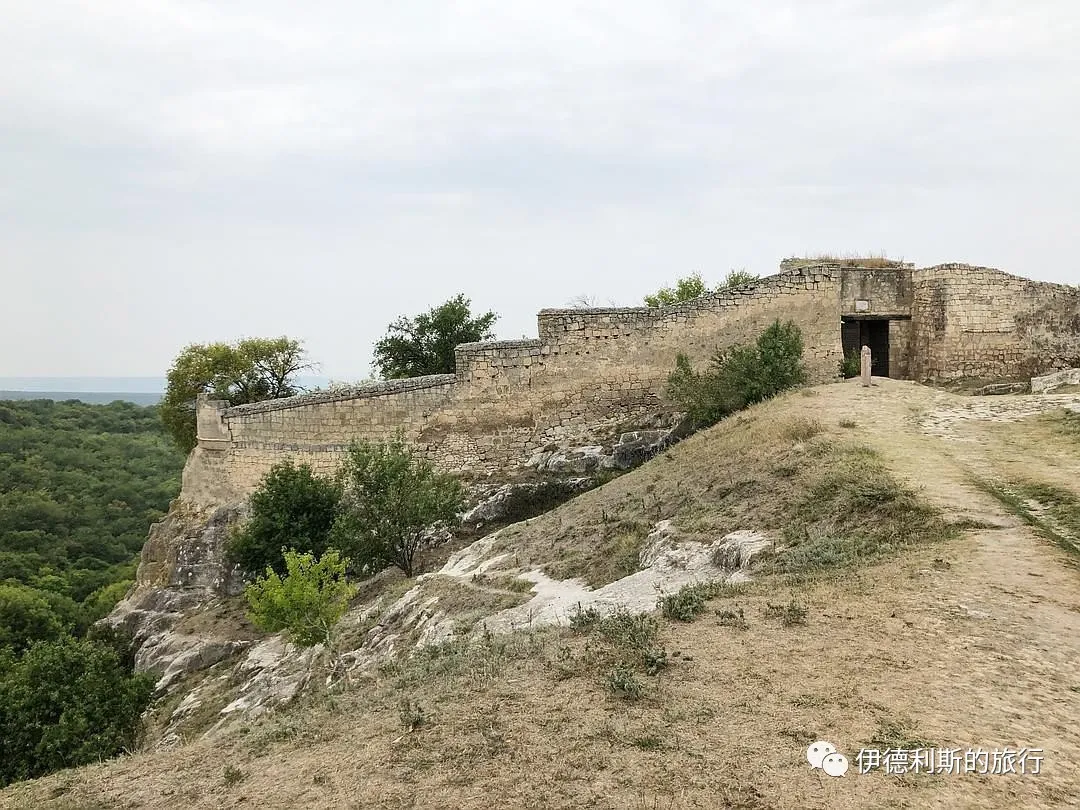
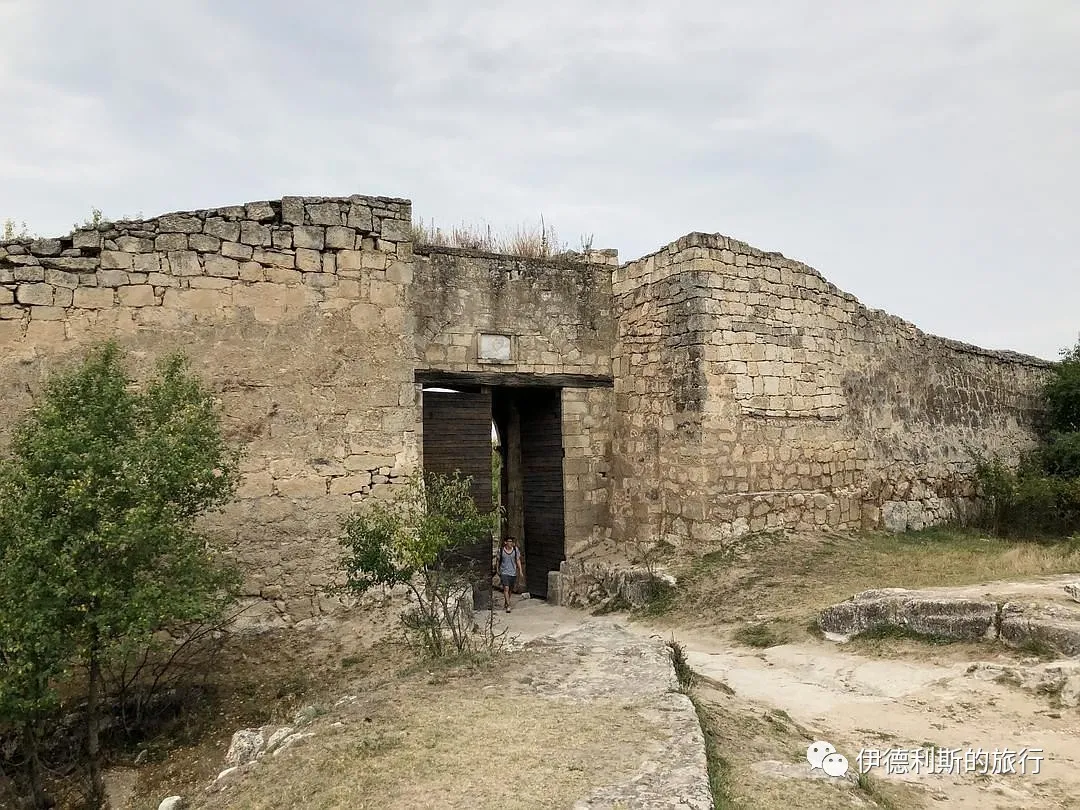
Currently, the original walls consist of two sections, the south wall and the middle wall, along with two gates, the south gate and the middle gate. The south wall is built on the cliff in the southern part of the fortress, weaving between the rocks. The south gate is built in a pocket shape, allowing defenders to surround enemies from above if they break in. The middle wall runs across the space between the north and south cliffs of the fortress and is a typical example of Byzantine wall architecture.
There is no wall on the north cliff, but the steepness of the cliff itself is as effective as a wall. It was very windy when I visited, and I felt nervous just standing by the cliff edge.
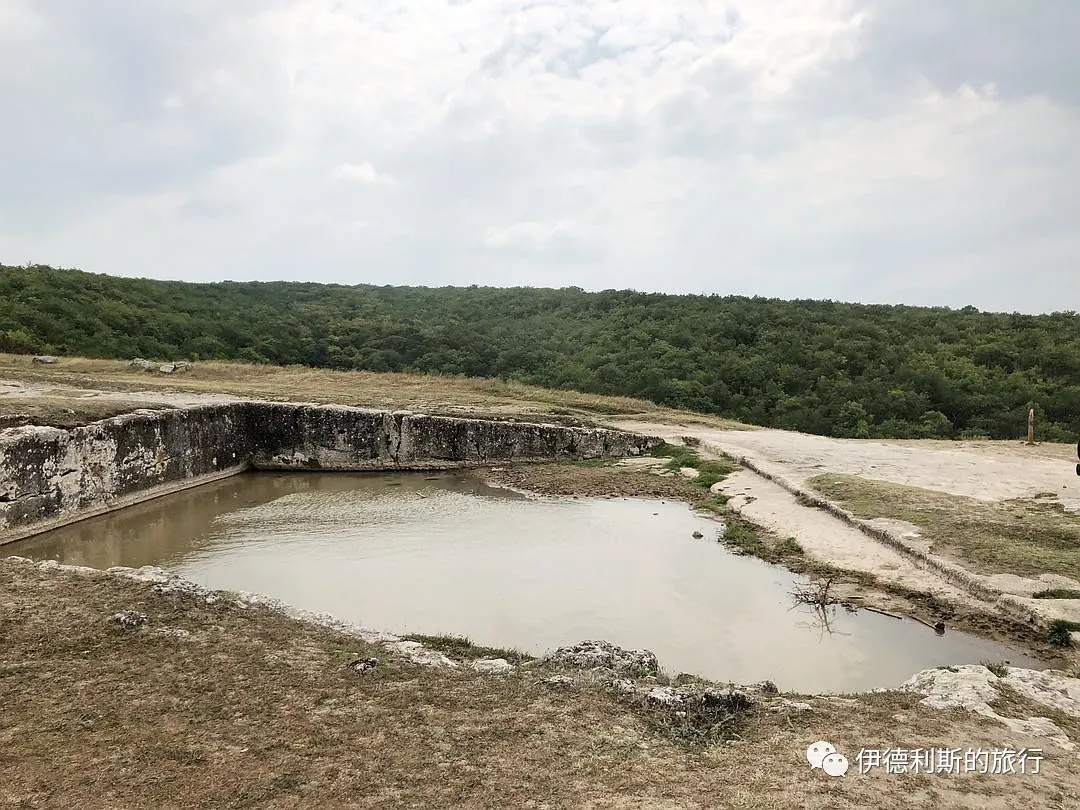
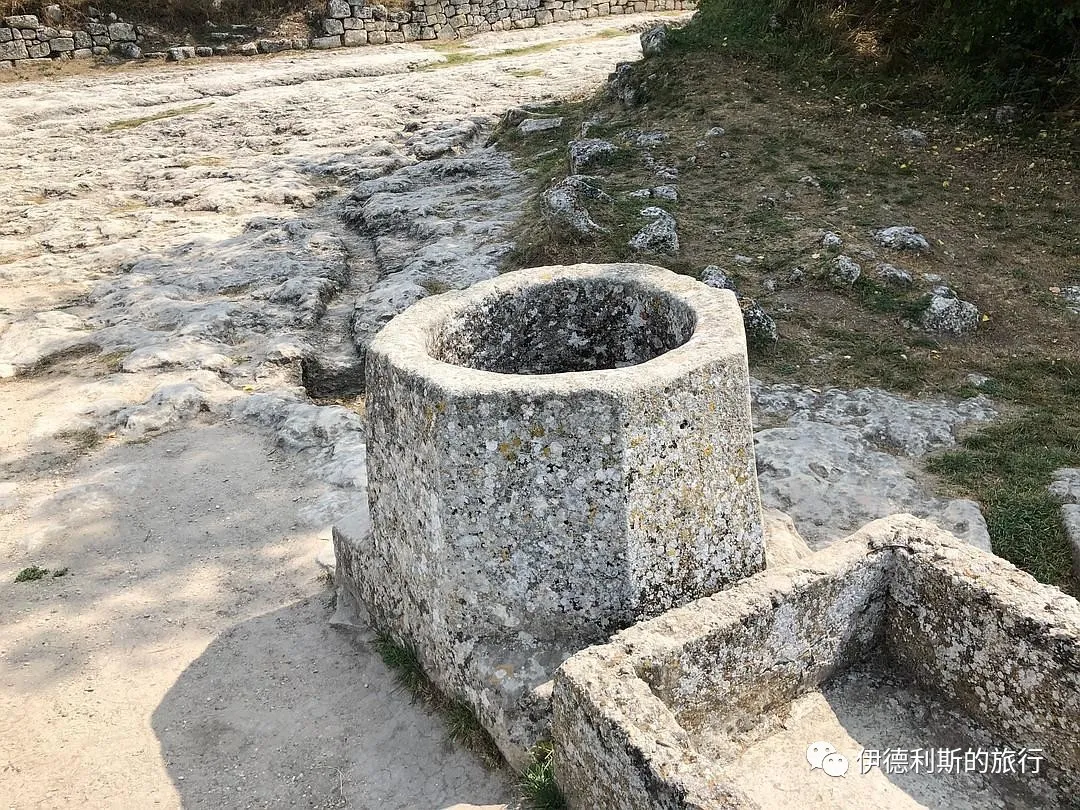
The east wall was built between 1396 and 1433, and there is a lively bazaar outside the gate. Outside the east gate, there is still a preserved water collection area that merchants used to wash and water their livestock.
The Khan Jani Beg mosque is located on the west side of the Jewish fortress. It was first built in 1346 during the reign of Khan Jani Beg (reigned 1342-1357) of the Golden Horde. Khan Jani Beg was the son of Öz Beg Khan. During his father's reign, the Golden Horde fully converted to the faith, and Khan Jani Beg continued to develop the faith within the Khanate. The Khan Jani Beg mosque in the Jewish fortress stands as a witness to this.
In 1455, Haji Giray, the founding Khan of the Crimean Khanate, rebuilt the Khan Jani Beg mosque. An inscription about the reconstruction was once carved above the mosque door and was discovered during an archaeological excavation in 1928.
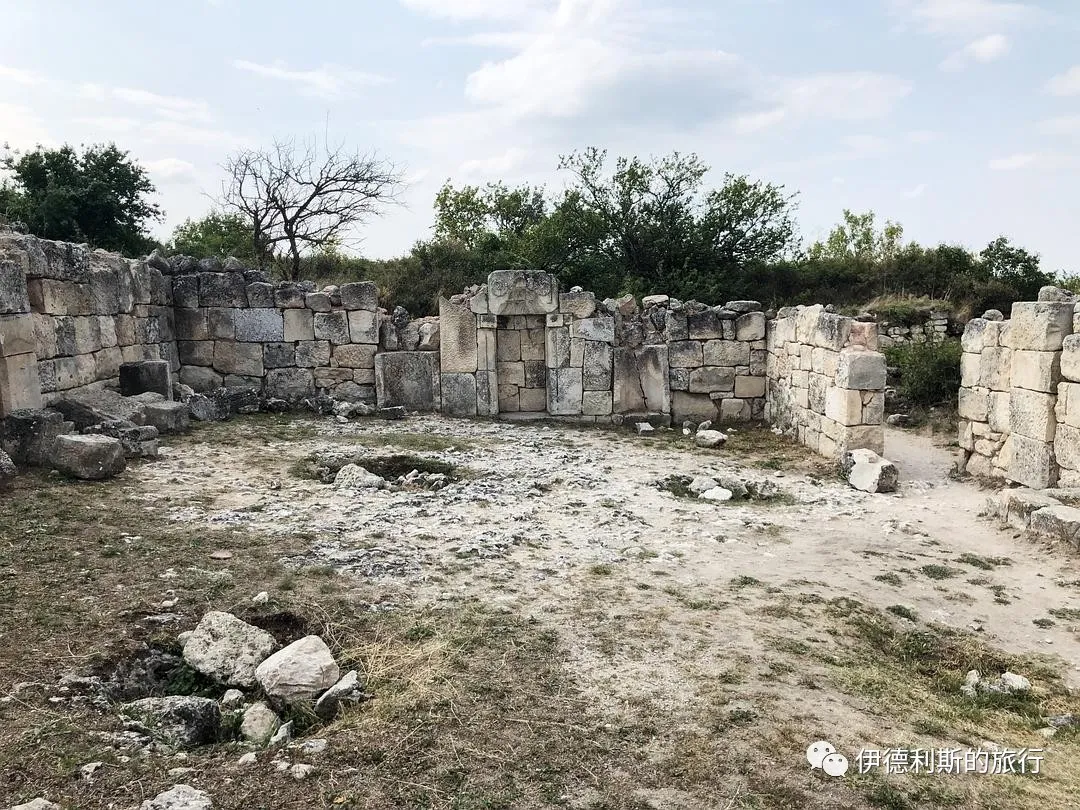
After the mid-17th century, the mosque was eventually abandoned as the Crimean Tatars moved from the Jewish fortress to Bakhchisaray. Today, only ruined walls, a mihrab niche, and some stone carvings remain at the mosque site. From these existing ruins, we can infer that it was a fairly typical traditional Crimean mosque building.
The tomb of Golden Horde Princess Dzhanike Khanym was built in 1437. It is the best-preserved Islamic building inside the Jewish fortress. The princess was the daughter of Tokhtamysh (reigned 1380-1397), the Great Khan of the Golden Horde. Tokhtamysh was the last Great Khan to unite the Golden Horde, but he was eventually defeated by Tamerlane the Great. After Tokhtamysh passed away, Dzhanike Khanym returned to her mother's homeland, Crimea.
The tomb is octagonal. The door is decorated with a classic Seljuk knot, a signature pattern from the Golden Horde period.
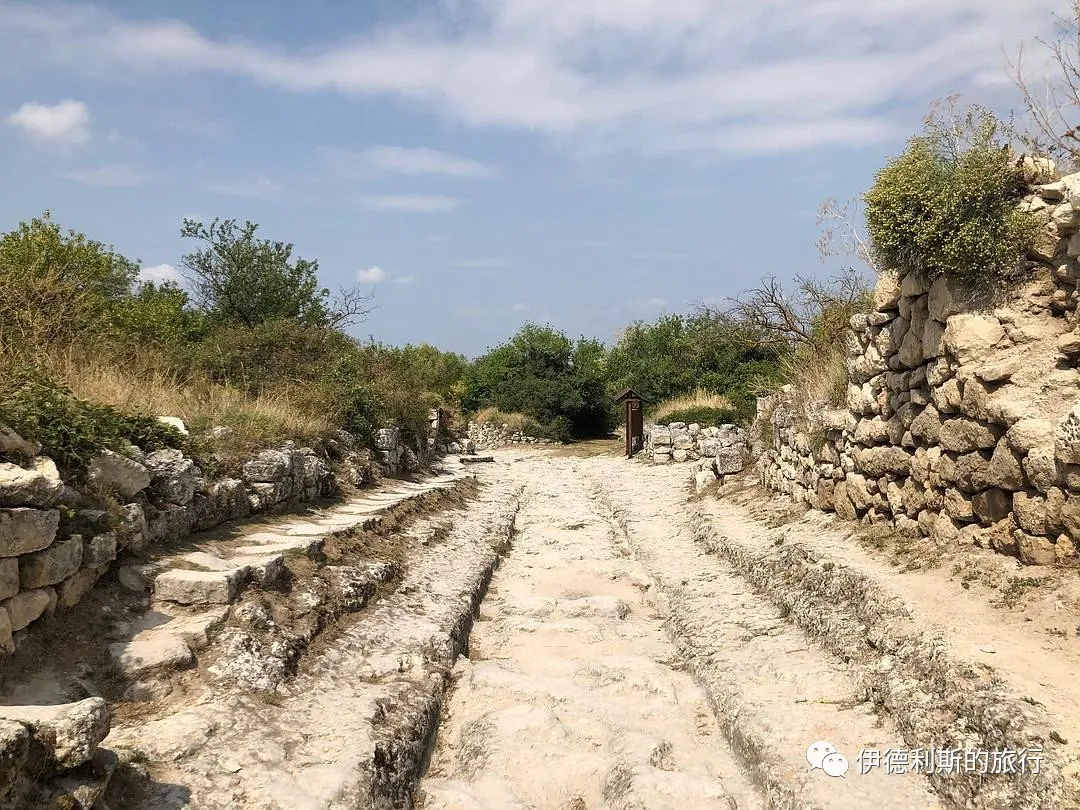
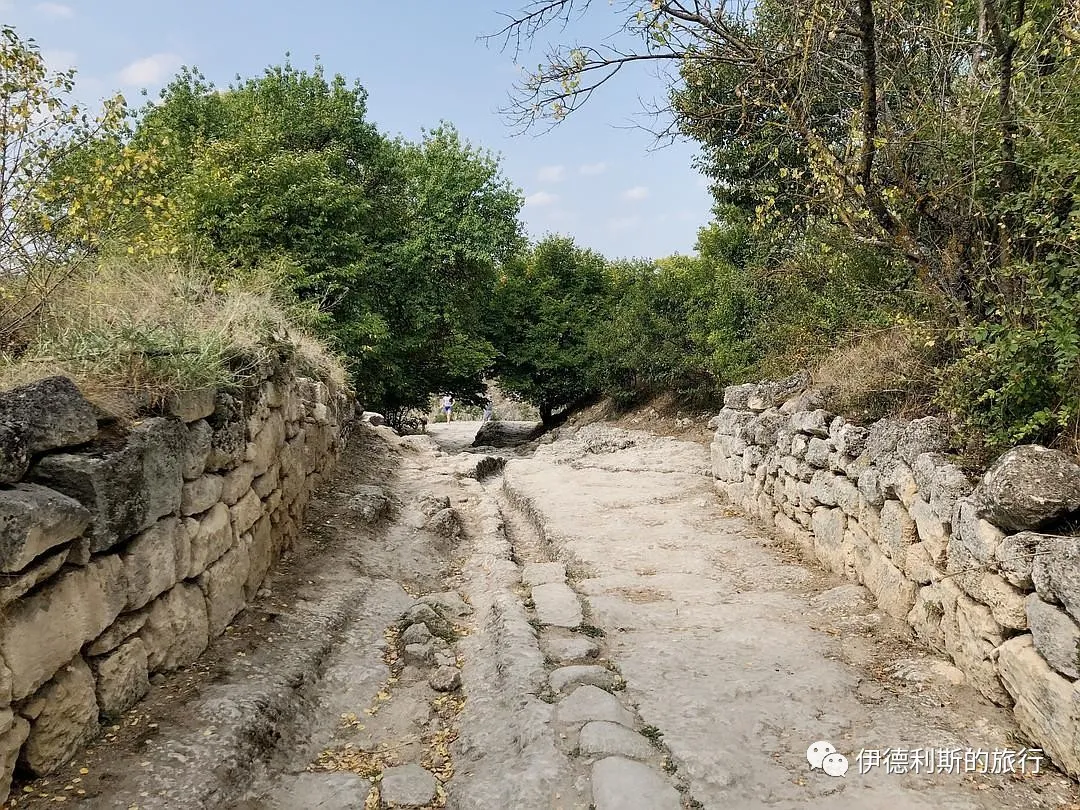
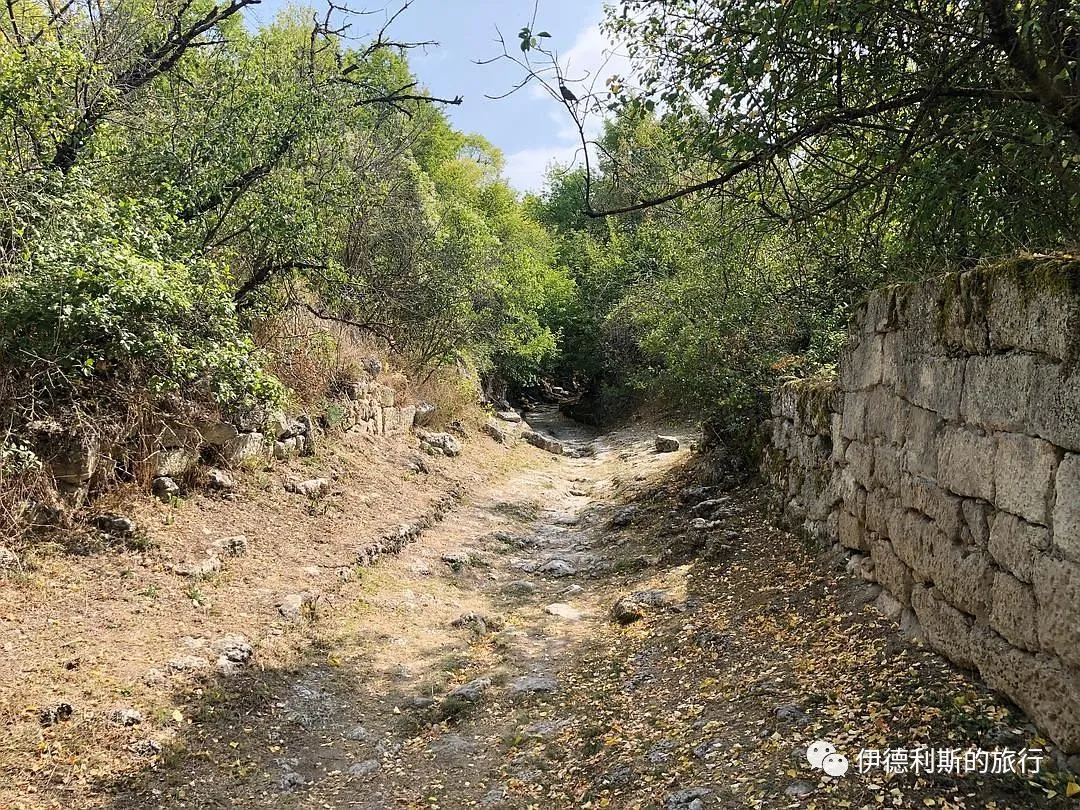
The roads inside the fortress vary in width, and you can see deep cart ruts on the main path.
The Tatar people gradually left the city after the water wells dried up in the 17th century.
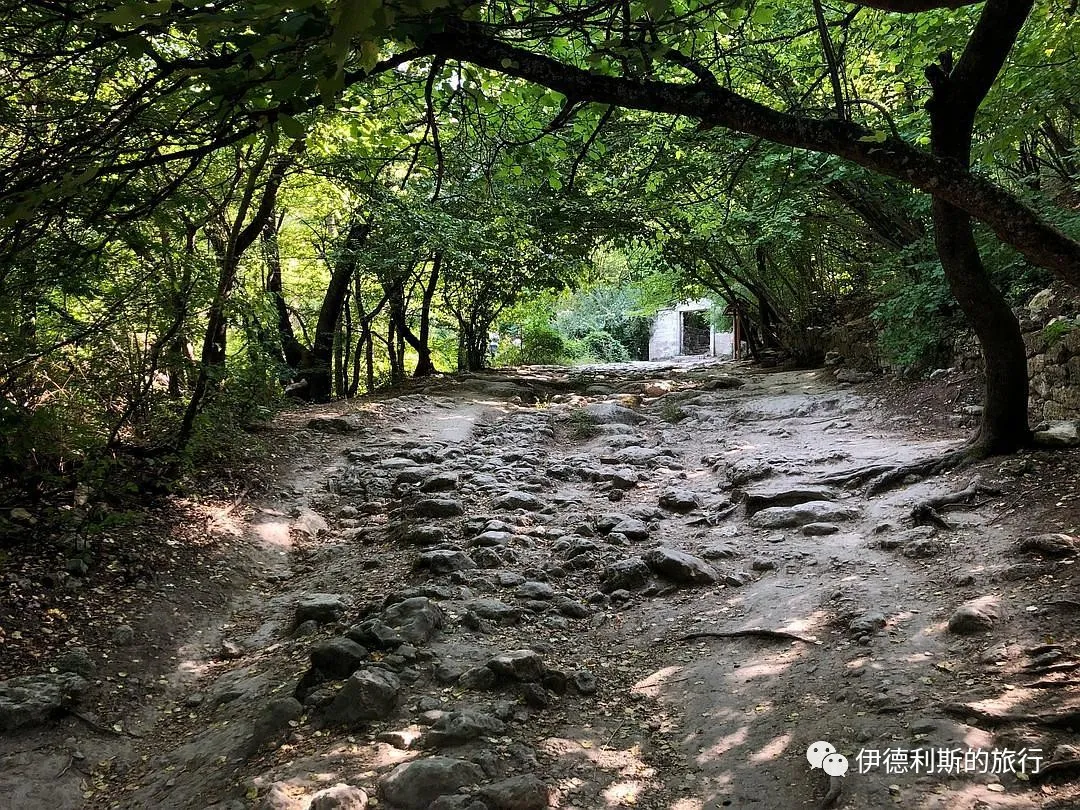
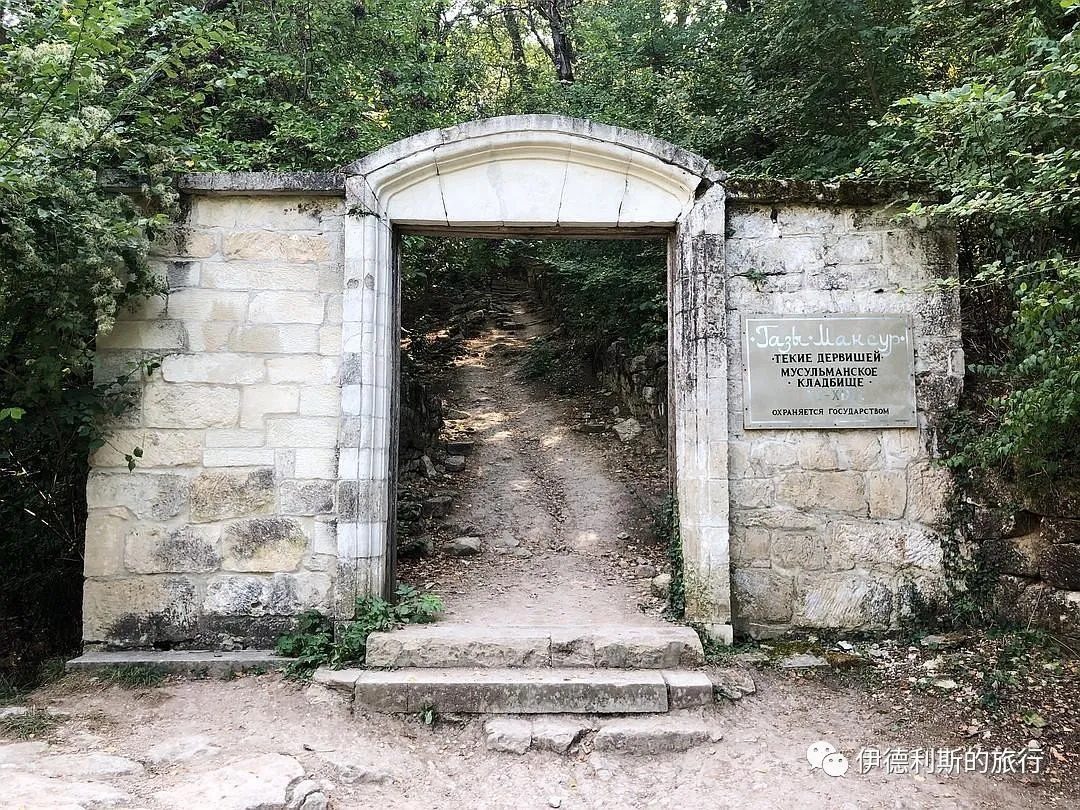
The Gazi Mansur gongbei (shrine) and daotang (religious hall) are located in the valley on the west side of the Jewish fortress.
Legend says that Malik Ashter and Gazi Mansur, two of the first disciples of the Prophet Muhammad, came to the Crimean Peninsula in the 7th century to spread the faith and lived in a valley at the foot of the Jewish fortress. Not long after, Malik Ashter was killed by a giant, and Gazi Mansur died defending the Jewish fortress. They were both buried at the foot of the mountain. They remained unknown for a long time until, centuries later, a sheikh living in the ancient Central Asian city of Bukhara repeatedly dreamed of a narrow valley filled with shrubs. To understand his dream, the sheikh followed the guidance of an elder and began a pilgrimage to the Crimean Peninsula.
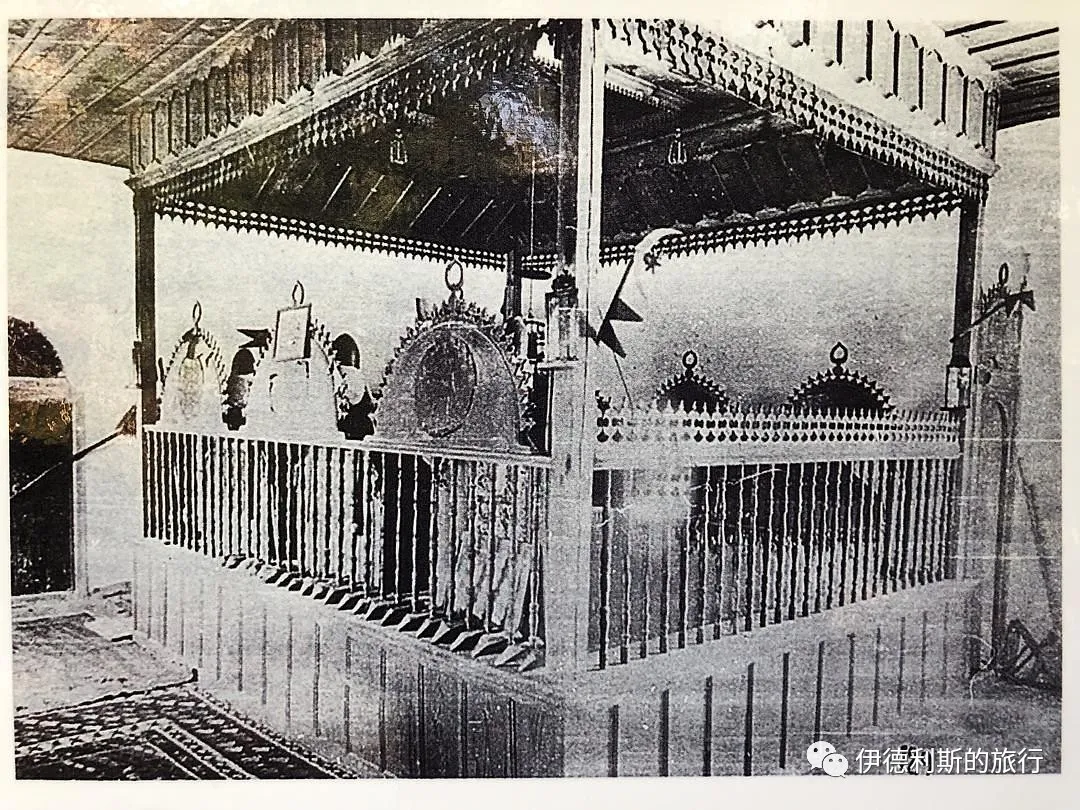
The sheikh arrived in Crimea in 1434. He recognized the valley from his dream at the foot of the Jewish cave and eventually discovered the tomb of Gazi Mansur. The sheikh then built a gongbei and a daotang at the site of the tomb. Because of this legendary karamat (miracle), pilgrims flocked to the site, and it even gained the favor of the Crimean Khan.
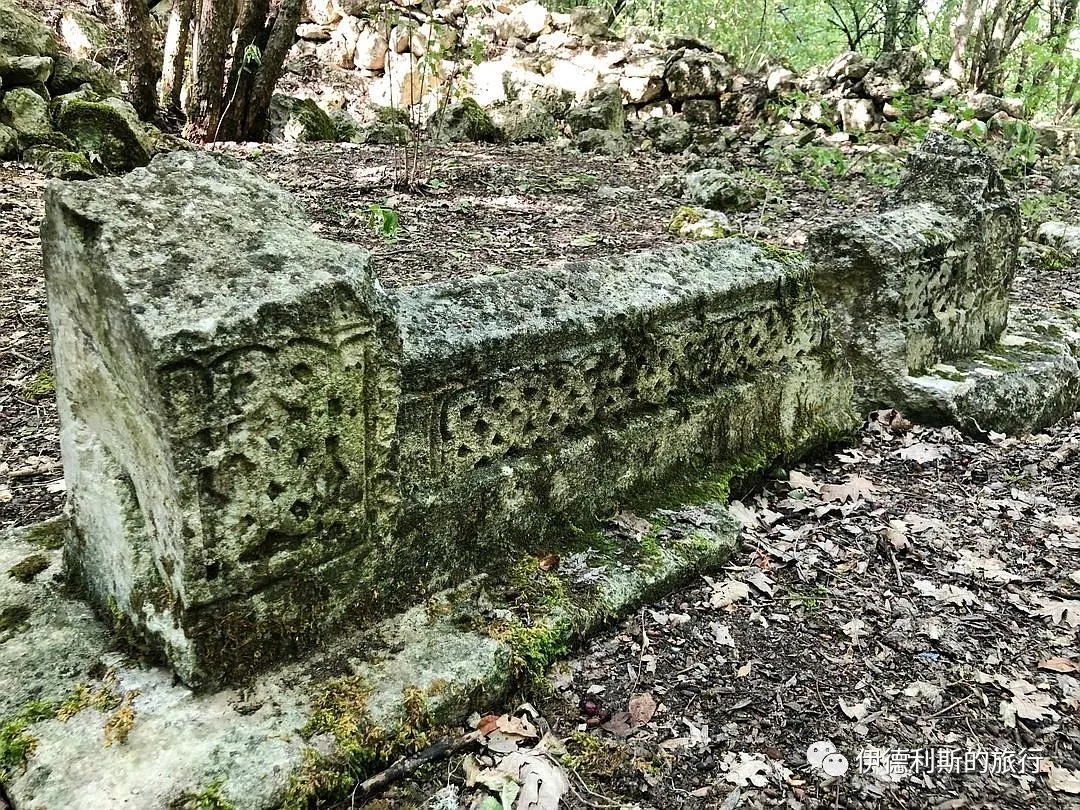
The Gazi Mansur gongbei and daotang stood until the 1930s, but were destroyed during the Soviet era. Today, only broken walls and a few surviving tombstones remain.
Salachik
The Salachik (Salaçıq) historical and archaeological complex was built between the late 15th and early 16th centuries and served as one of the capitals of the Crimean Khanate.
After Haji Giray died in 1466, his sixth son, Mengli I Giray, and his second son, Nur Devlet, fought repeatedly for the throne until Mengli I Giray finally won. Around 1500, Mengli I Giray built the new capital of Salachik in the valley west of the Jewish fortress.
In the 17th century, Salachik included a palace, a high court, baths, the Mengli Giray Mosque, and guard rooms. Genoese records mention that it also had a customs house, but most of these buildings were likely destroyed in an earthquake in 1698.
Today, only the Chain (Zıncırlı) madrasa, built in 1500, and the Haji Giray mausoleum, built in 1501, remain. The madrasa stayed open until the early 20th century. Archaeological excavations in 2008 uncovered the ruins of the baths and identified the general location of the Mengli Giray Mosque.
The Haji Giray mausoleum (Dürbe Hacı I Giray) is an octagonal building with a lead dome, built in 1501 by Mengli I Giray for his father, the founding Khan of Crimea, Haji Giray.
Archaeological digs between 2006 and 2007 examined 18 graves inside the mausoleum, including 13 adults and 5 children. They were wrapped in silk, and some rested on pillows stuffed with fabric scraps and fruit seeds. The mausoleum contains 8 stone sarcophagi covered in velvet, silk, and silver-threaded fabric. These likely include four Crimean Khans: Haji Giray himself, Mengli I Giray, Haji Giray's other son Nur Devlet—who fought Mengli I Giray for the throne for years before losing—and Sahib I Giray, the son of Mengli I Giray and the builder of Bakhchisaray.
These individuals were reburied after research was completed in 2009.
The Chain (Zıncırlı) madrasa was built in 1500 by order of the Crimean Khan Mengli I Giray. The name of the madrasa comes from the Turkic word "zyngyr," which means chain. A chain hangs above the main gate of the madrasa, forcing everyone who enters to bow their head.
The madrasa is rectangular with a central courtyard, an entrance on one side, and 11 rooms on the other three sides. At the time, the madrasa taught Turkish and Arabic grammar, calligraphy, arithmetic, ethics, logic, proof, Islamic law (sharia), and the study of the Quran and Hadith, with the full course of study taking ten years.
In 1909, influenced by the Crimean Tatar enlightenment movement, Gaspirali built a two-story modern Islamic school (madrasa) next to the old one. The school closed in 1917 and became the Mengli Giray Research Institute. The institute was shut down in 1923, then it served as a teacher training college, a medical school, a sanatorium for German soldiers, and a post-war psychiatric clinic. Today, the site is managed by the Bakhchisaray Historical, Cultural and Archaeological Museum.
During excavations at the Salachik historical and archaeological complex in 2008, researchers found 15th-century urban ruins including a bathhouse, a well, and a courtyard.
The bathhouse is a typical Turkish bath (hamam) with separate sections for men and women, each containing five rooms and a heating system. The heating system used clay pipes in the walls and under the floors to circulate warm air, keeping the bath at a constant temperature year-round and saving firewood. Each section also included a steam room, a washing area, a toilet, a lounge, and a changing room.
Archaeologists found many ceramics from the 15th to 18th centuries, mostly architectural tiles and pipes, along with some kitchenware, Turkish pottery, Chinese porcelain, and silver coins from the Crimean Khanate.
Ismail Gaspirali (1851-1914), the founder of the Crimean Tatar enlightenment movement, is buried in the backyard of the Zincirli Madrasa.
Gaspirali was a Crimean Tatar intellectual, educator, and publisher. He was the first to realize that Turkic Muslim society needed education and cultural reform to modernize, so he created the new Jadid education system and became known as the founder of the Crimean Tatar enlightenment.
In 1883, Gaspirali received permission to publish Tercüman, the first Turkic-language newspaper in Russia. Tercüman ran for 35 years. For a long time, it was the only Turkic-language publication in Russia and one of the earliest religious newspapers, influencing the entire Turkic-speaking world.
In the newspaper, he advocated for modernization through education and designed a new teaching method called Jadid. He taught the Arabic alphabet using a new phonetic method, which cut the time it took for students to learn to read from three years down to just a few months.
In 1909, Gaspirali built a two-story modern school next to the Zincirli Madrasa, which operated until it closed in 1917.
After Gasprinsky died in his hometown in 1914, he was buried in the cemetery behind the "Zincirli" (Chain) Madrasa. The original tombstone was lost in the second half of the 20th century, and the current one was rebuilt in the late 1990s.
Eski Yurt Old City
Eski Yurt means "old city." During the Golden Horde era, it was a large trading town and a transportation hub connecting the east and west ends of the Crimean Peninsula. After the Crimean Khanate was established in 1441, Eski Yurt remained an economic center. It was not until 1532, when the Khanate built its new capital, Bakhchisaray, in the valley right next to Eski Yurt, that the status of Eski Yurt was replaced and it began to be called the "old city." Even so, because the city once housed a gongbei (shrine) for the sage Malik Ashtar, Eski Yurt remained a religious center for Crimean Tatars until the Soviet era.
According to legend, Malik Ashtar was a cousin of the noble Prophet and a loyal companion of Imam Ali. In Crimean Tatar legends, Malik Ashtar was a brave warrior and the first person to come to Crimea to spread the faith. He eventually died in battle while fighting a giant in Eski Yurt. Many years later, some Sufi practitioners miraculously discovered his grave in Eski Yurt and built a gongbei there. In reality, Malik Ashtar passed away in Egypt, and the gongbei in Eski Yurt is a place where his karamat (miraculous signs) were manifested. Crimean Tatars believe that if you are bitten by a snake, you can recover by making dua at the Malik Ashtar gongbei.
Due to the importance of the Malik Ashtar gongbei, a complex of hundreds of tombs formed around it. This includes the tombs of three Khans of the Crimean Khanate: Mehmed II Giray (reigned 1577–1584), Saadet II Giray (reigned 1584), and Mehmed III Giray (reigned 1623–1628).
From the era of the Crimean Khanate until the early 20th century, a dhikr ceremony was held every Thursday night at the Malik Ashtar gongbei. After all Crimean Tatars were forced into exile in Central Asia in 1948, the central square of the Malik Ashtar gongbei was turned into a market. After Crimean Tatars began returning in the late 1980s, many demanded that the market be removed from the holy site, and it was finally moved in 2006.
The existing structures in the Malik Ashtar gongbei tomb complex include the 14th-15th century Bey Yude Sultan tomb and Ahmed Bey tomb, the 16th-century Mehmed Bey tomb and the tomb of Khan Mehmed II Giray, as well as the minbar (pulpit) of the Malik Ashtar shrine mosque.
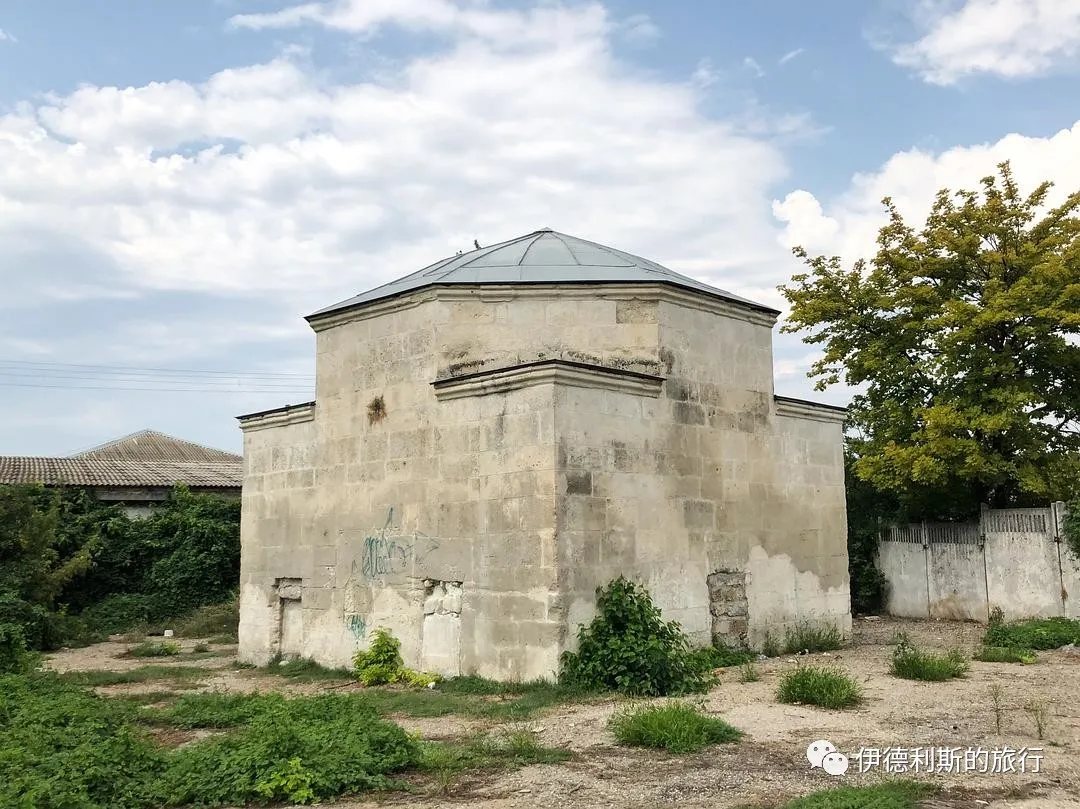
The tomb of Crimean Khan Mehmed II Giray is also known as the Great Octagonal Tomb. During his reign, Mehmed II Giray attacked the Persian Safavid dynasty three times under orders from the Ottoman Empire.
The tomb of Mehmed II Giray is the largest one still standing in Eski Yurt and clearly shows Ottoman influence. Some speculate it was built by a student of the master Ottoman architect Mimar Sinan, but no records about the architect have been found.
The Malik Ashtar gongbei (a shrine for a Sufi saint) was built during the Crimean Khanate era with a minbar (pulpit) for sermons, but the mosque was destroyed in 1955. This place was once where Sufi practitioners performed dhikr (remembrance of Allah), and it served as a Sufi center on the Crimean Peninsula.
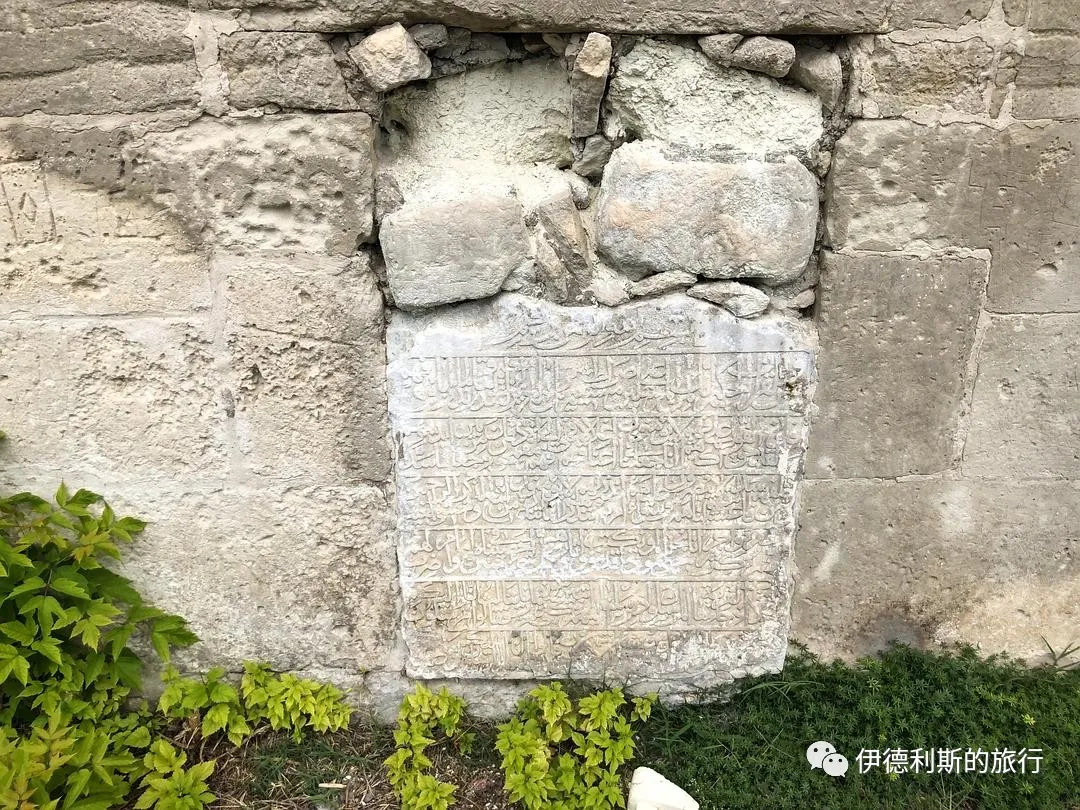
Ahmed Bey died in 1577, and his tombstone was found near the entrance of the tomb in 1924. Although Ahmed Bey died in the 16th century, the architectural style of the tomb itself does not match the Ottoman-influenced tombs of that time; instead, it follows the earlier Golden Horde tomb style. Other buildings similar to Ahmed Bey's tomb date back to the 13th and 14th centuries. Therefore, it is more likely that this tomb was built during the Golden Horde era. view all
Summary: The early capital of the Crimean Khanate is covered through palace sites, mosques, old streets, and Crimean Tatar history. This account keeps the original historical context, place names, architectural details, food notes, and photographs.
The Crimean Peninsula is in the northern Black Sea. It was conquered by the Mongol army in 1238 and later ruled by the Golden Horde. In 1313, Khan Uzbeg officially made Islam the state religion and built mosques (masjid) on the Crimean Peninsula.
At first, the Golden Horde's capital in Crimea was the city of Old Crimea (Stary Krym) in the southeast of the peninsula. In 1441, Haji Giray, a descendant of Genghis Khan's eldest son Jochi, minted coins with his own name at the Jewish Fortress (Chufut-Kale) on a cliff in the southwest of the peninsula, officially establishing the Crimean Khanate. The Jewish Fortress was first built by the Byzantines in the 5th to 6th centuries, and was later inhabited by Alans, Tatars, and Karaites. Today, the fortress still has city walls, gates, mosque ruins, and the tomb of a Golden Horde princess.
After Haji Giray died in 1466, his sixth son, Mengli Giray, eventually won the struggle for the throne. Around 1500, Mengli Giray built a new capital called Salachik. Salachik once had a complex of buildings including a palace, court, baths, and a mosque, but now only a madrasa and the tomb of the founding Crimean Khan, Haji Giray, remain.
Also, to the west of Bakhchysarai is Eski Yurt, a large trading town that was very prosperous during the Golden Horde period. It became a religious center for Crimea because of the gongbei of the religious elder Malik Ashtar. Today, it preserves several 14th to 16th-century tombs, including that of the Crimean Khan Mehmed II Giray.
Jewish Fortress (Chufut-Kale)
Between the 13th and 17th centuries, the Jewish Fortress was called Kyrk-Or, which means forty fortresses. After the mid-16th century, the Crimean Khan Sahib Giray (reigned 1532-1551) moved the capital to Bakhchysarai in the valley west of the Jewish Fortress, and the Tatars in the fortress gradually moved to Bakhchysarai. After the wells in the fortress dried up in the mid-17th century, all the Tatars left. Only the Karaite Jews continued to live there, and the fortress was gradually called the Jewish Fortress by the Crimean Tatars. After the 19th century, the Karaite Jews also left, and the fortress eventually became a ruin.
The walls of the Jewish Fortress were first built during the Byzantine period; some say they were built in the 5th to 6th centuries, while others say the 10th to 11th centuries. In 1299, General Nogai Khan of the Golden Horde led a Tatar army to attack the Crimean Peninsula. Byzantine soldiers used the strong walls of the Jewish fortress to hold off the Golden Horde's attack. The Tatar soldiers reportedly played harsh, loud music for three days and nights to disturb the Byzantine defenders inside the city. On the fourth day, the exhausted Byzantine defenders could no longer hold off a new round of attacks, and the Jewish fortress was captured by the Tatars of the Golden Horde.
Currently, the original walls consist of two sections, the south wall and the middle wall, along with two gates, the south gate and the middle gate. The south wall is built on the cliff in the southern part of the fortress, weaving between the rocks. The south gate is built in a pocket shape, allowing defenders to surround enemies from above if they break in. The middle wall runs across the space between the north and south cliffs of the fortress and is a typical example of Byzantine wall architecture.
There is no wall on the north cliff, but the steepness of the cliff itself is as effective as a wall. It was very windy when I visited, and I felt nervous just standing by the cliff edge.
The east wall was built between 1396 and 1433, and there is a lively bazaar outside the gate. Outside the east gate, there is still a preserved water collection area that merchants used to wash and water their livestock.
The Khan Jani Beg mosque is located on the west side of the Jewish fortress. It was first built in 1346 during the reign of Khan Jani Beg (reigned 1342-1357) of the Golden Horde. Khan Jani Beg was the son of Öz Beg Khan. During his father's reign, the Golden Horde fully converted to the faith, and Khan Jani Beg continued to develop the faith within the Khanate. The Khan Jani Beg mosque in the Jewish fortress stands as a witness to this.
In 1455, Haji Giray, the founding Khan of the Crimean Khanate, rebuilt the Khan Jani Beg mosque. An inscription about the reconstruction was once carved above the mosque door and was discovered during an archaeological excavation in 1928.
After the mid-17th century, the mosque was eventually abandoned as the Crimean Tatars moved from the Jewish fortress to Bakhchisaray. Today, only ruined walls, a mihrab niche, and some stone carvings remain at the mosque site. From these existing ruins, we can infer that it was a fairly typical traditional Crimean mosque building.
The tomb of Golden Horde Princess Dzhanike Khanym was built in 1437. It is the best-preserved Islamic building inside the Jewish fortress. The princess was the daughter of Tokhtamysh (reigned 1380-1397), the Great Khan of the Golden Horde. Tokhtamysh was the last Great Khan to unite the Golden Horde, but he was eventually defeated by Tamerlane the Great. After Tokhtamysh passed away, Dzhanike Khanym returned to her mother's homeland, Crimea.
The tomb is octagonal. The door is decorated with a classic Seljuk knot, a signature pattern from the Golden Horde period.
The roads inside the fortress vary in width, and you can see deep cart ruts on the main path.
The Tatar people gradually left the city after the water wells dried up in the 17th century.
The Gazi Mansur gongbei (shrine) and daotang (religious hall) are located in the valley on the west side of the Jewish fortress.
Legend says that Malik Ashter and Gazi Mansur, two of the first disciples of the Prophet Muhammad, came to the Crimean Peninsula in the 7th century to spread the faith and lived in a valley at the foot of the Jewish fortress. Not long after, Malik Ashter was killed by a giant, and Gazi Mansur died defending the Jewish fortress. They were both buried at the foot of the mountain. They remained unknown for a long time until, centuries later, a sheikh living in the ancient Central Asian city of Bukhara repeatedly dreamed of a narrow valley filled with shrubs. To understand his dream, the sheikh followed the guidance of an elder and began a pilgrimage to the Crimean Peninsula.
The sheikh arrived in Crimea in 1434. He recognized the valley from his dream at the foot of the Jewish cave and eventually discovered the tomb of Gazi Mansur. The sheikh then built a gongbei and a daotang at the site of the tomb. Because of this legendary karamat (miracle), pilgrims flocked to the site, and it even gained the favor of the Crimean Khan.
The Gazi Mansur gongbei and daotang stood until the 1930s, but were destroyed during the Soviet era. Today, only broken walls and a few surviving tombstones remain.
Salachik
The Salachik (Salaçıq) historical and archaeological complex was built between the late 15th and early 16th centuries and served as one of the capitals of the Crimean Khanate.
After Haji Giray died in 1466, his sixth son, Mengli I Giray, and his second son, Nur Devlet, fought repeatedly for the throne until Mengli I Giray finally won. Around 1500, Mengli I Giray built the new capital of Salachik in the valley west of the Jewish fortress.
In the 17th century, Salachik included a palace, a high court, baths, the Mengli Giray Mosque, and guard rooms. Genoese records mention that it also had a customs house, but most of these buildings were likely destroyed in an earthquake in 1698.
Today, only the Chain (Zıncırlı) madrasa, built in 1500, and the Haji Giray mausoleum, built in 1501, remain. The madrasa stayed open until the early 20th century. Archaeological excavations in 2008 uncovered the ruins of the baths and identified the general location of the Mengli Giray Mosque.
The Haji Giray mausoleum (Dürbe Hacı I Giray) is an octagonal building with a lead dome, built in 1501 by Mengli I Giray for his father, the founding Khan of Crimea, Haji Giray.
Archaeological digs between 2006 and 2007 examined 18 graves inside the mausoleum, including 13 adults and 5 children. They were wrapped in silk, and some rested on pillows stuffed with fabric scraps and fruit seeds. The mausoleum contains 8 stone sarcophagi covered in velvet, silk, and silver-threaded fabric. These likely include four Crimean Khans: Haji Giray himself, Mengli I Giray, Haji Giray's other son Nur Devlet—who fought Mengli I Giray for the throne for years before losing—and Sahib I Giray, the son of Mengli I Giray and the builder of Bakhchisaray.
These individuals were reburied after research was completed in 2009.
The Chain (Zıncırlı) madrasa was built in 1500 by order of the Crimean Khan Mengli I Giray. The name of the madrasa comes from the Turkic word "zyngyr," which means chain. A chain hangs above the main gate of the madrasa, forcing everyone who enters to bow their head.
The madrasa is rectangular with a central courtyard, an entrance on one side, and 11 rooms on the other three sides. At the time, the madrasa taught Turkish and Arabic grammar, calligraphy, arithmetic, ethics, logic, proof, Islamic law (sharia), and the study of the Quran and Hadith, with the full course of study taking ten years.
In 1909, influenced by the Crimean Tatar enlightenment movement, Gaspirali built a two-story modern Islamic school (madrasa) next to the old one. The school closed in 1917 and became the Mengli Giray Research Institute. The institute was shut down in 1923, then it served as a teacher training college, a medical school, a sanatorium for German soldiers, and a post-war psychiatric clinic. Today, the site is managed by the Bakhchisaray Historical, Cultural and Archaeological Museum.
During excavations at the Salachik historical and archaeological complex in 2008, researchers found 15th-century urban ruins including a bathhouse, a well, and a courtyard.
The bathhouse is a typical Turkish bath (hamam) with separate sections for men and women, each containing five rooms and a heating system. The heating system used clay pipes in the walls and under the floors to circulate warm air, keeping the bath at a constant temperature year-round and saving firewood. Each section also included a steam room, a washing area, a toilet, a lounge, and a changing room.
Archaeologists found many ceramics from the 15th to 18th centuries, mostly architectural tiles and pipes, along with some kitchenware, Turkish pottery, Chinese porcelain, and silver coins from the Crimean Khanate.
Ismail Gaspirali (1851-1914), the founder of the Crimean Tatar enlightenment movement, is buried in the backyard of the Zincirli Madrasa.
Gaspirali was a Crimean Tatar intellectual, educator, and publisher. He was the first to realize that Turkic Muslim society needed education and cultural reform to modernize, so he created the new Jadid education system and became known as the founder of the Crimean Tatar enlightenment.
In 1883, Gaspirali received permission to publish Tercüman, the first Turkic-language newspaper in Russia. Tercüman ran for 35 years. For a long time, it was the only Turkic-language publication in Russia and one of the earliest religious newspapers, influencing the entire Turkic-speaking world.
In the newspaper, he advocated for modernization through education and designed a new teaching method called Jadid. He taught the Arabic alphabet using a new phonetic method, which cut the time it took for students to learn to read from three years down to just a few months.
In 1909, Gaspirali built a two-story modern school next to the Zincirli Madrasa, which operated until it closed in 1917.
After Gasprinsky died in his hometown in 1914, he was buried in the cemetery behind the "Zincirli" (Chain) Madrasa. The original tombstone was lost in the second half of the 20th century, and the current one was rebuilt in the late 1990s.
Eski Yurt Old City
Eski Yurt means "old city." During the Golden Horde era, it was a large trading town and a transportation hub connecting the east and west ends of the Crimean Peninsula. After the Crimean Khanate was established in 1441, Eski Yurt remained an economic center. It was not until 1532, when the Khanate built its new capital, Bakhchisaray, in the valley right next to Eski Yurt, that the status of Eski Yurt was replaced and it began to be called the "old city." Even so, because the city once housed a gongbei (shrine) for the sage Malik Ashtar, Eski Yurt remained a religious center for Crimean Tatars until the Soviet era.
According to legend, Malik Ashtar was a cousin of the noble Prophet and a loyal companion of Imam Ali. In Crimean Tatar legends, Malik Ashtar was a brave warrior and the first person to come to Crimea to spread the faith. He eventually died in battle while fighting a giant in Eski Yurt. Many years later, some Sufi practitioners miraculously discovered his grave in Eski Yurt and built a gongbei there. In reality, Malik Ashtar passed away in Egypt, and the gongbei in Eski Yurt is a place where his karamat (miraculous signs) were manifested. Crimean Tatars believe that if you are bitten by a snake, you can recover by making dua at the Malik Ashtar gongbei.
Due to the importance of the Malik Ashtar gongbei, a complex of hundreds of tombs formed around it. This includes the tombs of three Khans of the Crimean Khanate: Mehmed II Giray (reigned 1577–1584), Saadet II Giray (reigned 1584), and Mehmed III Giray (reigned 1623–1628).
From the era of the Crimean Khanate until the early 20th century, a dhikr ceremony was held every Thursday night at the Malik Ashtar gongbei. After all Crimean Tatars were forced into exile in Central Asia in 1948, the central square of the Malik Ashtar gongbei was turned into a market. After Crimean Tatars began returning in the late 1980s, many demanded that the market be removed from the holy site, and it was finally moved in 2006.
The existing structures in the Malik Ashtar gongbei tomb complex include the 14th-15th century Bey Yude Sultan tomb and Ahmed Bey tomb, the 16th-century Mehmed Bey tomb and the tomb of Khan Mehmed II Giray, as well as the minbar (pulpit) of the Malik Ashtar shrine mosque.
The tomb of Crimean Khan Mehmed II Giray is also known as the Great Octagonal Tomb. During his reign, Mehmed II Giray attacked the Persian Safavid dynasty three times under orders from the Ottoman Empire.
The tomb of Mehmed II Giray is the largest one still standing in Eski Yurt and clearly shows Ottoman influence. Some speculate it was built by a student of the master Ottoman architect Mimar Sinan, but no records about the architect have been found.
The Malik Ashtar gongbei (a shrine for a Sufi saint) was built during the Crimean Khanate era with a minbar (pulpit) for sermons, but the mosque was destroyed in 1955. This place was once where Sufi practitioners performed dhikr (remembrance of Allah), and it served as a Sufi center on the Crimean Peninsula.
Ahmed Bey died in 1577, and his tombstone was found near the entrance of the tomb in 1924. Although Ahmed Bey died in the 16th century, the architectural style of the tomb itself does not match the Ottoman-influenced tombs of that time; instead, it follows the earlier Golden Horde tomb style. Other buildings similar to Ahmed Bey's tomb date back to the 13th and 14th centuries. Therefore, it is more likely that this tomb was built during the Golden Horde era. view all
Reposted from the web
Summary: The early capital of the Crimean Khanate is covered through palace sites, mosques, old streets, and Crimean Tatar history. This account keeps the original historical context, place names, architectural details, food notes, and photographs.
The Crimean Peninsula is in the northern Black Sea. It was conquered by the Mongol army in 1238 and later ruled by the Golden Horde. In 1313, Khan Uzbeg officially made Islam the state religion and built mosques (masjid) on the Crimean Peninsula.
At first, the Golden Horde's capital in Crimea was the city of Old Crimea (Stary Krym) in the southeast of the peninsula. In 1441, Haji Giray, a descendant of Genghis Khan's eldest son Jochi, minted coins with his own name at the Jewish Fortress (Chufut-Kale) on a cliff in the southwest of the peninsula, officially establishing the Crimean Khanate. The Jewish Fortress was first built by the Byzantines in the 5th to 6th centuries, and was later inhabited by Alans, Tatars, and Karaites. Today, the fortress still has city walls, gates, mosque ruins, and the tomb of a Golden Horde princess.
After Haji Giray died in 1466, his sixth son, Mengli Giray, eventually won the struggle for the throne. Around 1500, Mengli Giray built a new capital called Salachik. Salachik once had a complex of buildings including a palace, court, baths, and a mosque, but now only a madrasa and the tomb of the founding Crimean Khan, Haji Giray, remain.
Also, to the west of Bakhchysarai is Eski Yurt, a large trading town that was very prosperous during the Golden Horde period. It became a religious center for Crimea because of the gongbei of the religious elder Malik Ashtar. Today, it preserves several 14th to 16th-century tombs, including that of the Crimean Khan Mehmed II Giray.
Jewish Fortress (Chufut-Kale)
Between the 13th and 17th centuries, the Jewish Fortress was called Kyrk-Or, which means forty fortresses. After the mid-16th century, the Crimean Khan Sahib Giray (reigned 1532-1551) moved the capital to Bakhchysarai in the valley west of the Jewish Fortress, and the Tatars in the fortress gradually moved to Bakhchysarai. After the wells in the fortress dried up in the mid-17th century, all the Tatars left. Only the Karaite Jews continued to live there, and the fortress was gradually called the Jewish Fortress by the Crimean Tatars. After the 19th century, the Karaite Jews also left, and the fortress eventually became a ruin.
The walls of the Jewish Fortress were first built during the Byzantine period; some say they were built in the 5th to 6th centuries, while others say the 10th to 11th centuries. In 1299, General Nogai Khan of the Golden Horde led a Tatar army to attack the Crimean Peninsula. Byzantine soldiers used the strong walls of the Jewish fortress to hold off the Golden Horde's attack. The Tatar soldiers reportedly played harsh, loud music for three days and nights to disturb the Byzantine defenders inside the city. On the fourth day, the exhausted Byzantine defenders could no longer hold off a new round of attacks, and the Jewish fortress was captured by the Tatars of the Golden Horde.
Currently, the original walls consist of two sections, the south wall and the middle wall, along with two gates, the south gate and the middle gate. The south wall is built on the cliff in the southern part of the fortress, weaving between the rocks. The south gate is built in a pocket shape, allowing defenders to surround enemies from above if they break in. The middle wall runs across the space between the north and south cliffs of the fortress and is a typical example of Byzantine wall architecture.
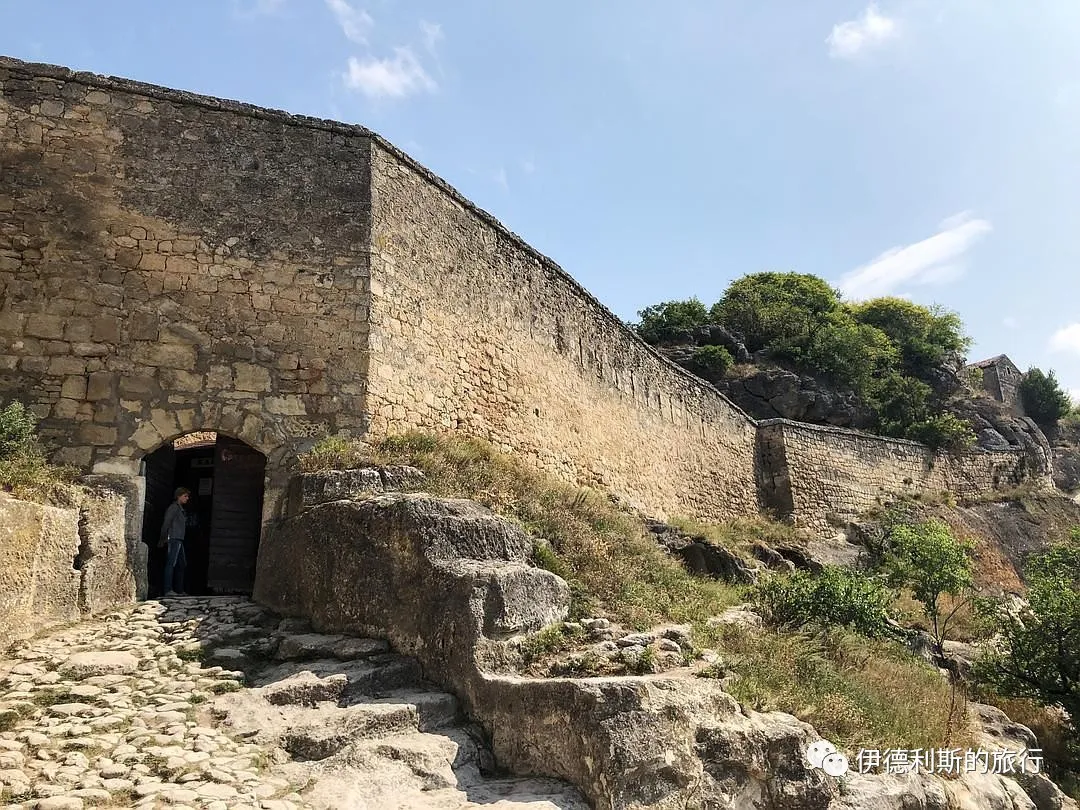
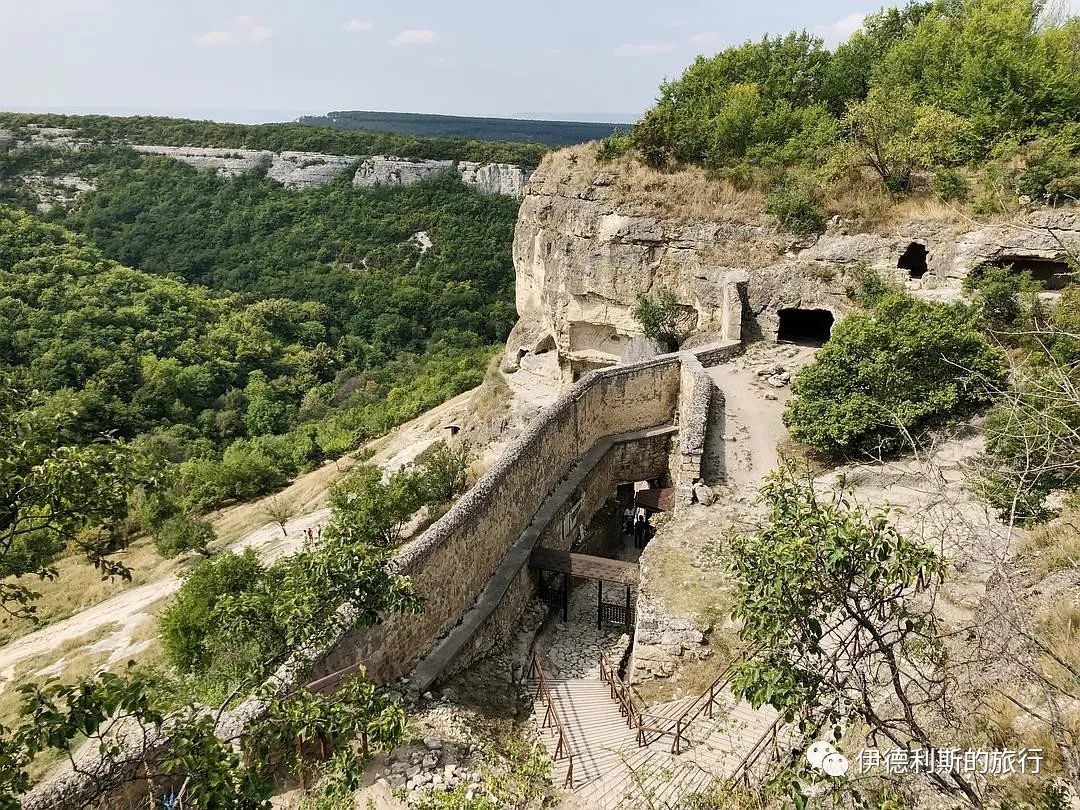
There is no wall on the north cliff, but the steepness of the cliff itself is as effective as a wall. It was very windy when I visited, and I felt nervous just standing by the cliff edge.
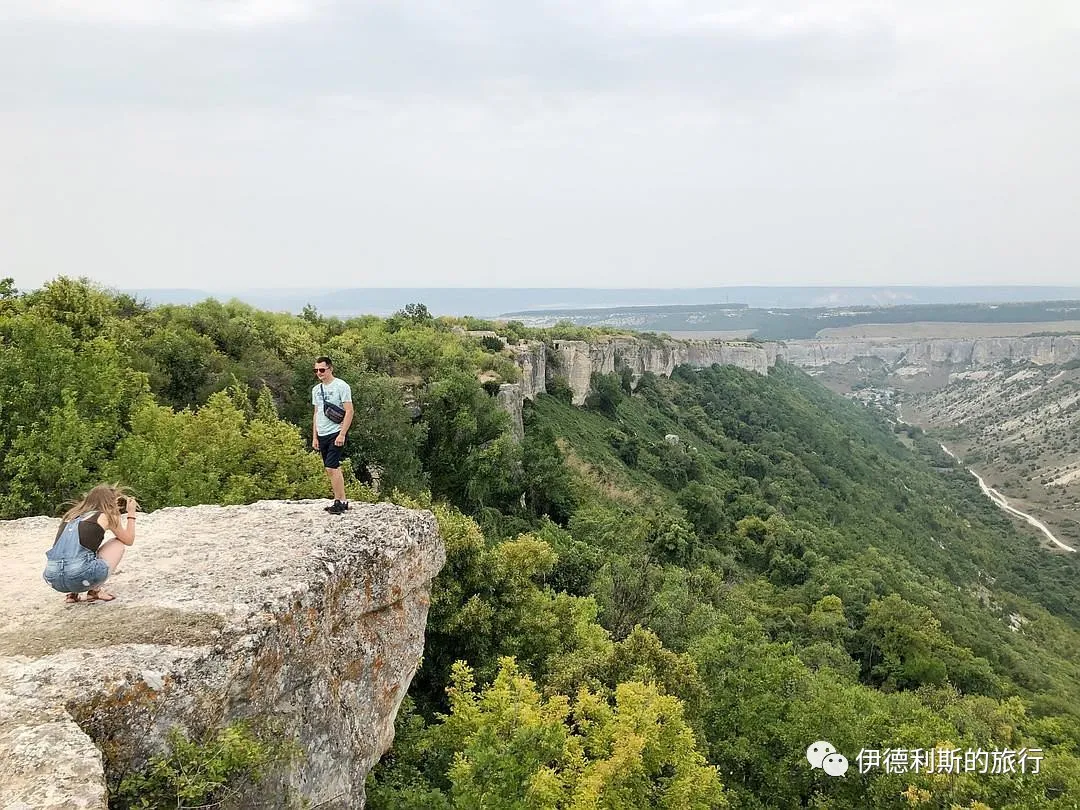
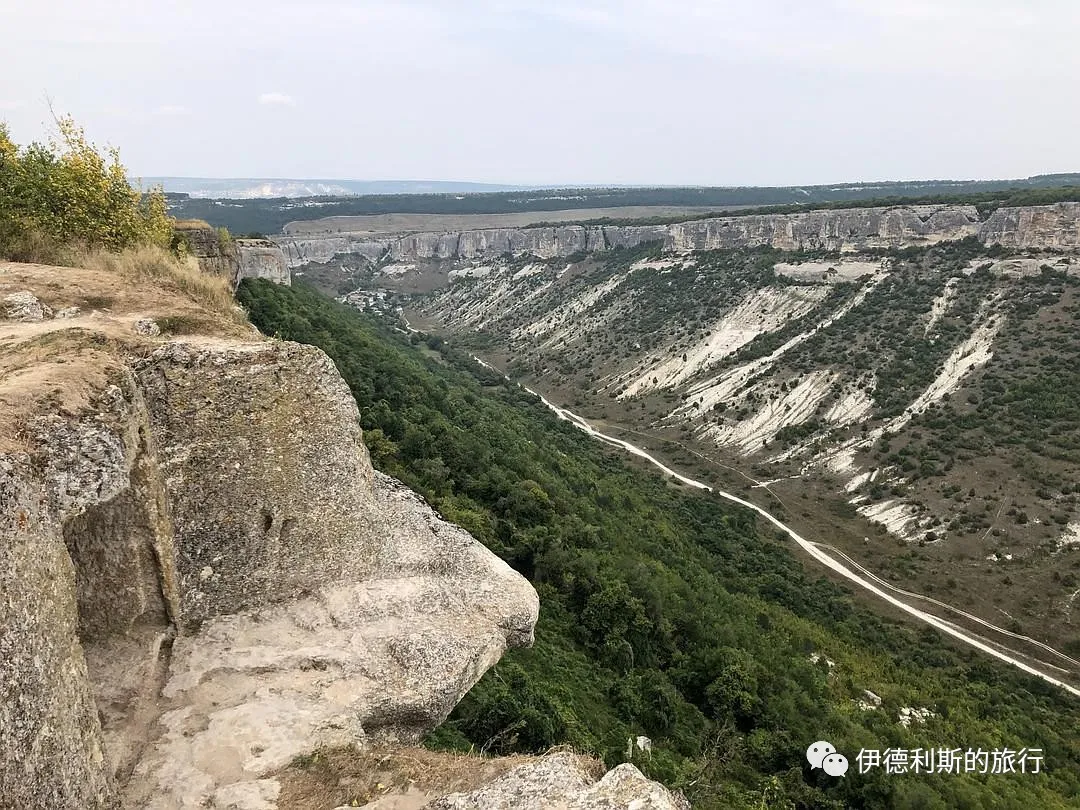
The east wall was built between 1396 and 1433, and there is a lively bazaar outside the gate. Outside the east gate, there is still a preserved water collection area that merchants used to wash and water their livestock.
The Khan Jani Beg mosque is located on the west side of the Jewish fortress. It was first built in 1346 during the reign of Khan Jani Beg (reigned 1342-1357) of the Golden Horde. Khan Jani Beg was the son of Öz Beg Khan. During his father's reign, the Golden Horde fully converted to the faith, and Khan Jani Beg continued to develop the faith within the Khanate. The Khan Jani Beg mosque in the Jewish fortress stands as a witness to this.
In 1455, Haji Giray, the founding Khan of the Crimean Khanate, rebuilt the Khan Jani Beg mosque. An inscription about the reconstruction was once carved above the mosque door and was discovered during an archaeological excavation in 1928.
After the mid-17th century, the mosque was eventually abandoned as the Crimean Tatars moved from the Jewish fortress to Bakhchisaray. Today, only ruined walls, a mihrab niche, and some stone carvings remain at the mosque site. From these existing ruins, we can infer that it was a fairly typical traditional Crimean mosque building.
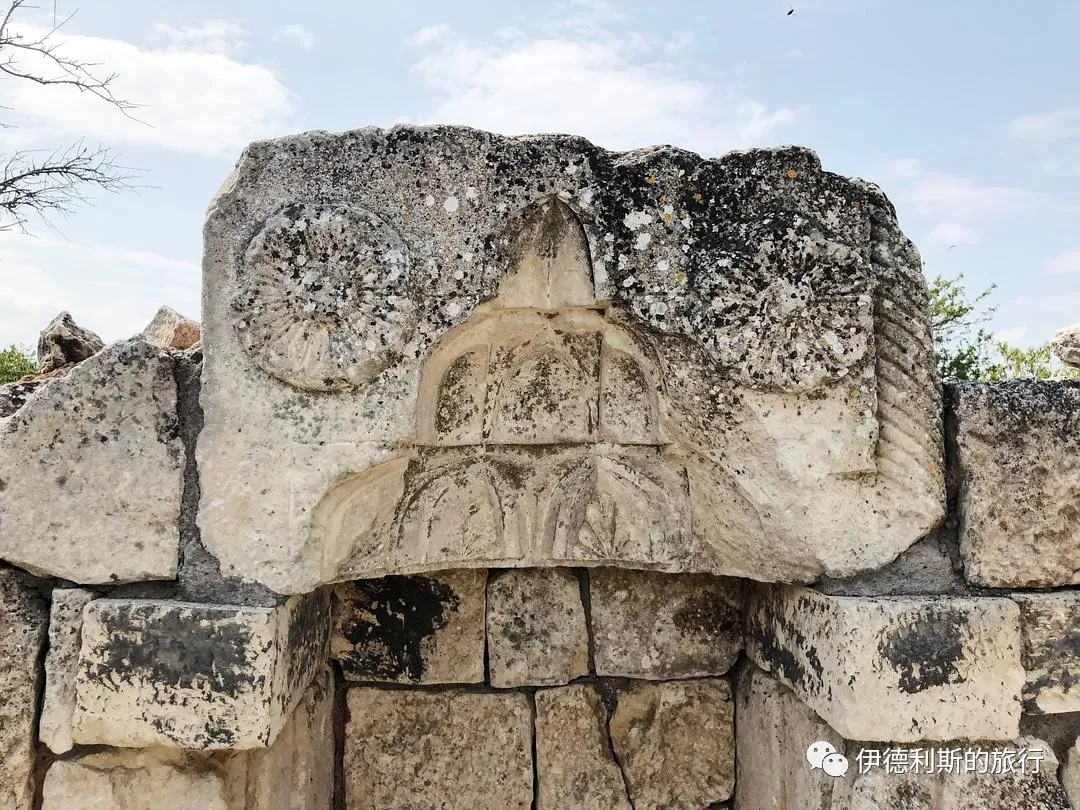
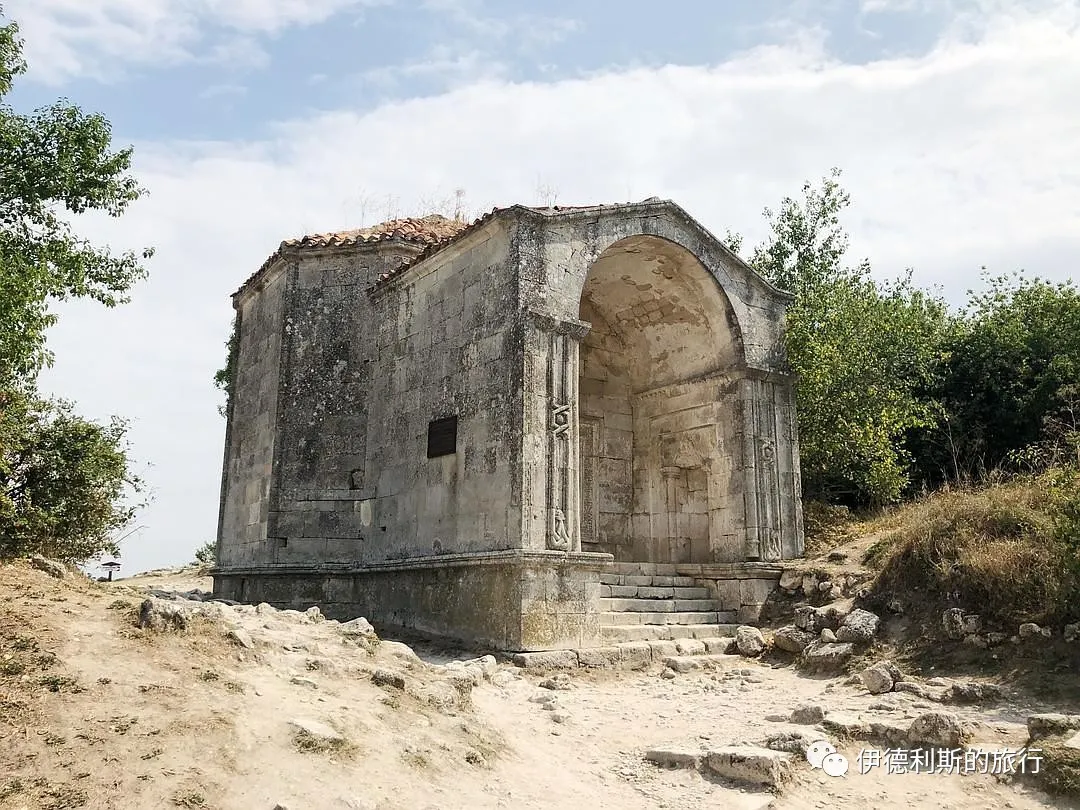
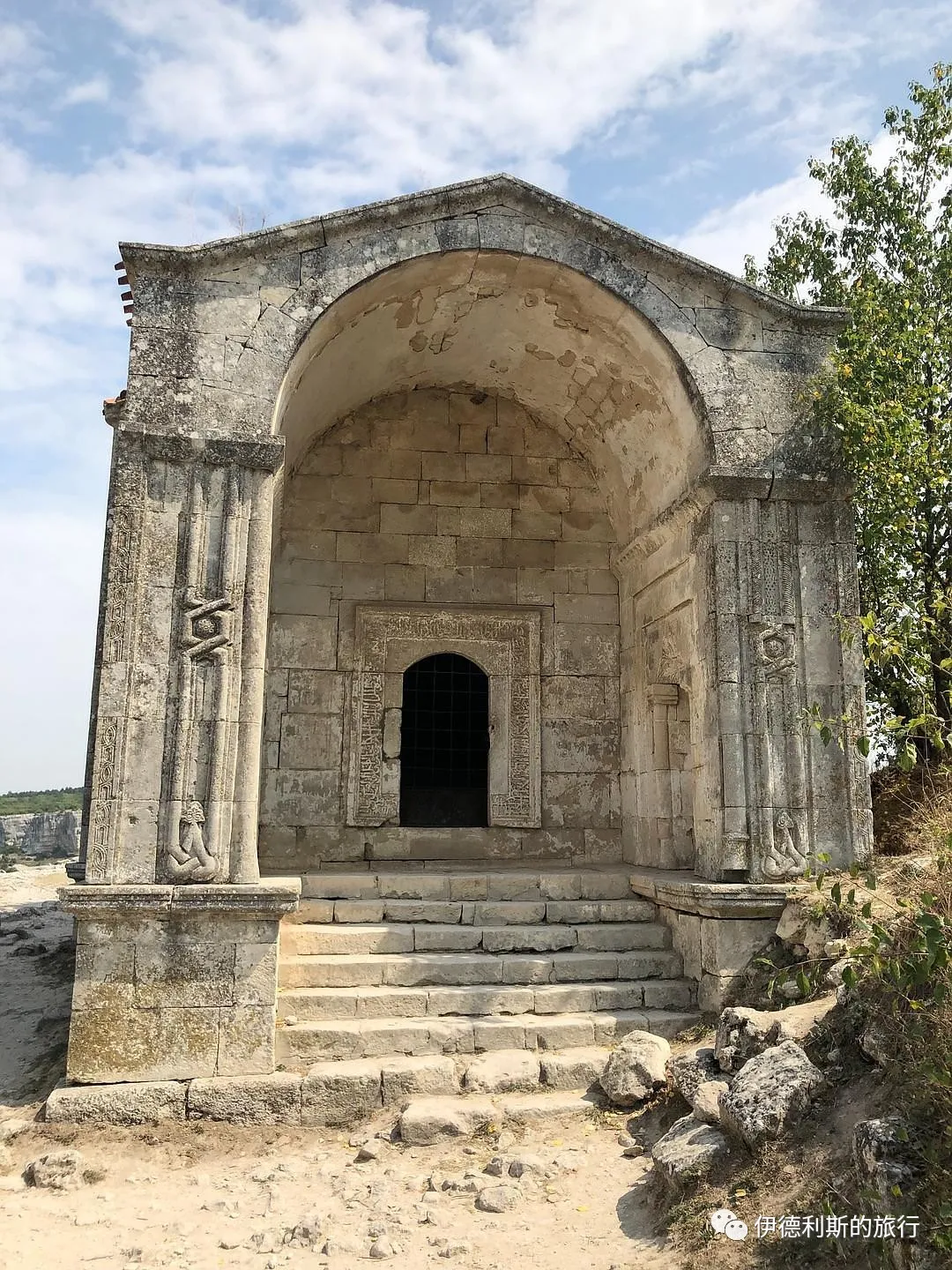
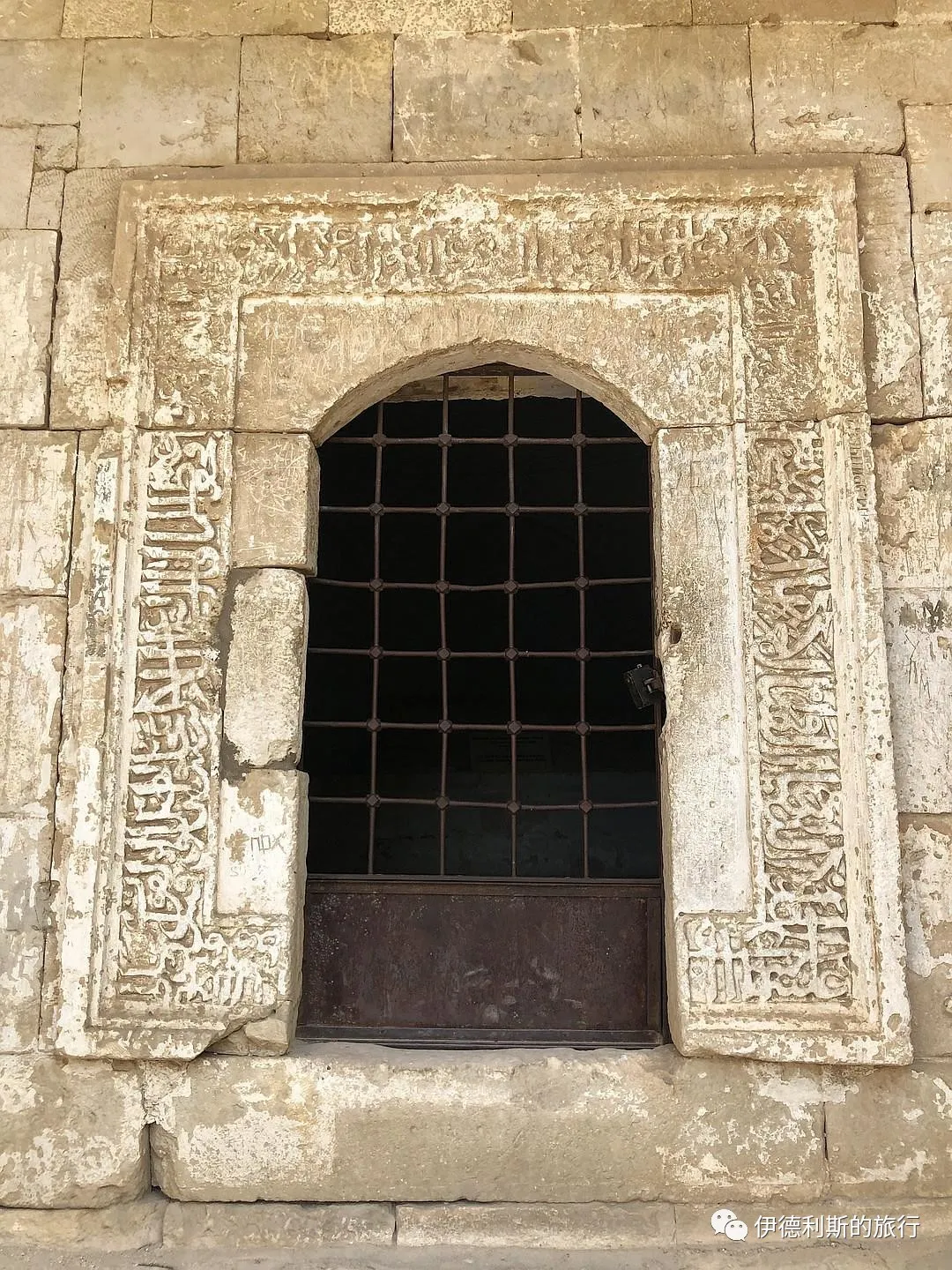
The tomb of Golden Horde Princess Dzhanike Khanym was built in 1437. It is the best-preserved Islamic building inside the Jewish fortress. The princess was the daughter of Tokhtamysh (reigned 1380-1397), the Great Khan of the Golden Horde. Tokhtamysh was the last Great Khan to unite the Golden Horde, but he was eventually defeated by Tamerlane the Great. After Tokhtamysh passed away, Dzhanike Khanym returned to her mother's homeland, Crimea.
The tomb is octagonal. The door is decorated with a classic Seljuk knot, a signature pattern from the Golden Horde period.
The roads inside the fortress vary in width, and you can see deep cart ruts on the main path.
The Tatar people gradually left the city after the water wells dried up in the 17th century.
The Gazi Mansur gongbei (shrine) and daotang (religious hall) are located in the valley on the west side of the Jewish fortress.
Legend says that Malik Ashter and Gazi Mansur, two of the first disciples of the Prophet Muhammad, came to the Crimean Peninsula in the 7th century to spread the faith and lived in a valley at the foot of the Jewish fortress. Not long after, Malik Ashter was killed by a giant, and Gazi Mansur died defending the Jewish fortress. They were both buried at the foot of the mountain. They remained unknown for a long time until, centuries later, a sheikh living in the ancient Central Asian city of Bukhara repeatedly dreamed of a narrow valley filled with shrubs. To understand his dream, the sheikh followed the guidance of an elder and began a pilgrimage to the Crimean Peninsula.
The sheikh arrived in Crimea in 1434. He recognized the valley from his dream at the foot of the Jewish cave and eventually discovered the tomb of Gazi Mansur. The sheikh then built a gongbei and a daotang at the site of the tomb. Because of this legendary karamat (miracle), pilgrims flocked to the site, and it even gained the favor of the Crimean Khan.
The Gazi Mansur gongbei and daotang stood until the 1930s, but were destroyed during the Soviet era. Today, only broken walls and a few surviving tombstones remain.
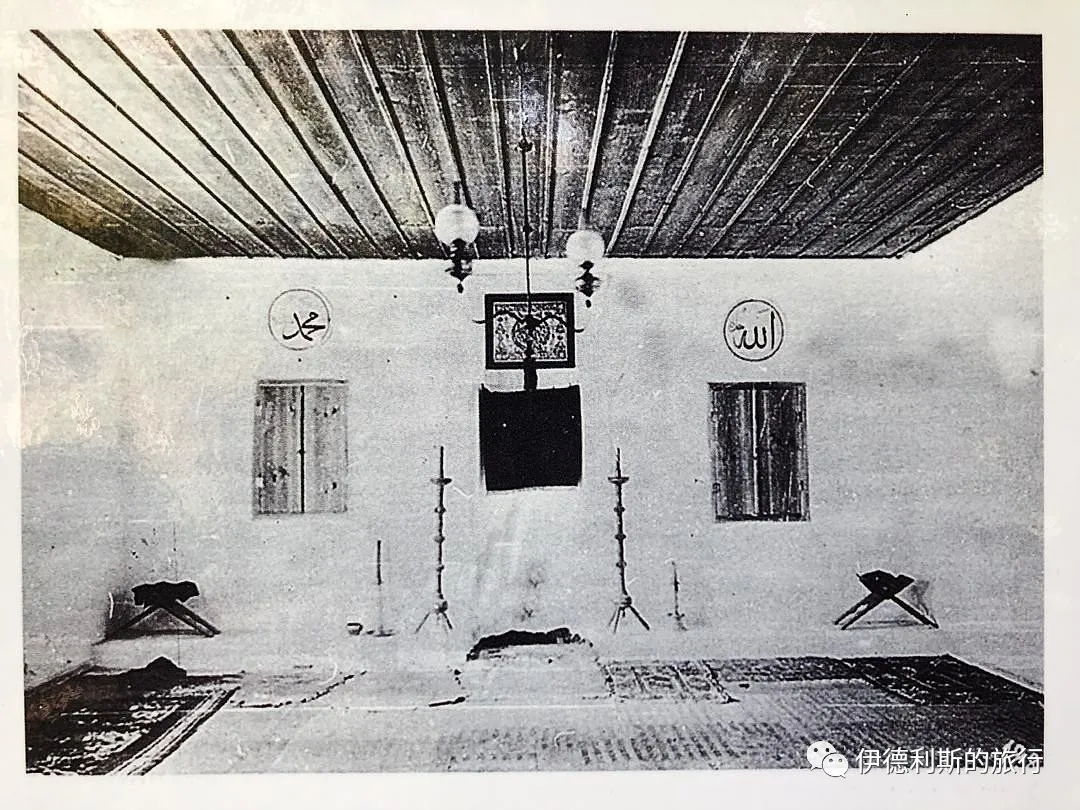
Salachik
The Salachik (Salaçıq) historical and archaeological complex was built between the late 15th and early 16th centuries and served as one of the capitals of the Crimean Khanate.
After Haji Giray died in 1466, his sixth son, Mengli I Giray, and his second son, Nur Devlet, fought repeatedly for the throne until Mengli I Giray finally won. Around 1500, Mengli I Giray built the new capital of Salachik in the valley west of the Jewish fortress.
In the 17th century, Salachik included a palace, a high court, baths, the Mengli Giray Mosque, and guard rooms. Genoese records mention that it also had a customs house, but most of these buildings were likely destroyed in an earthquake in 1698.
Today, only the Chain (Zıncırlı) madrasa, built in 1500, and the Haji Giray mausoleum, built in 1501, remain. The madrasa stayed open until the early 20th century. Archaeological excavations in 2008 uncovered the ruins of the baths and identified the general location of the Mengli Giray Mosque.
The Haji Giray mausoleum (Dürbe Hacı I Giray) is an octagonal building with a lead dome, built in 1501 by Mengli I Giray for his father, the founding Khan of Crimea, Haji Giray.
Archaeological digs between 2006 and 2007 examined 18 graves inside the mausoleum, including 13 adults and 5 children. They were wrapped in silk, and some rested on pillows stuffed with fabric scraps and fruit seeds. The mausoleum contains 8 stone sarcophagi covered in velvet, silk, and silver-threaded fabric. These likely include four Crimean Khans: Haji Giray himself, Mengli I Giray, Haji Giray's other son Nur Devlet—who fought Mengli I Giray for the throne for years before losing—and Sahib I Giray, the son of Mengli I Giray and the builder of Bakhchisaray.
These individuals were reburied after research was completed in 2009.
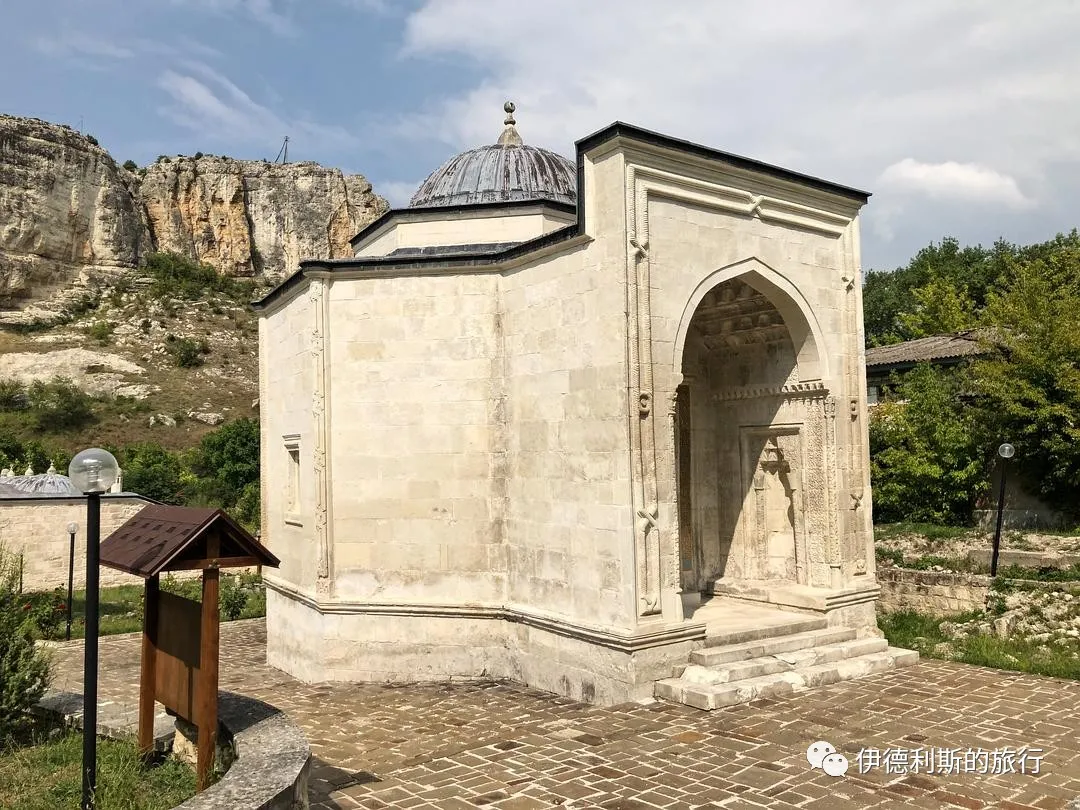
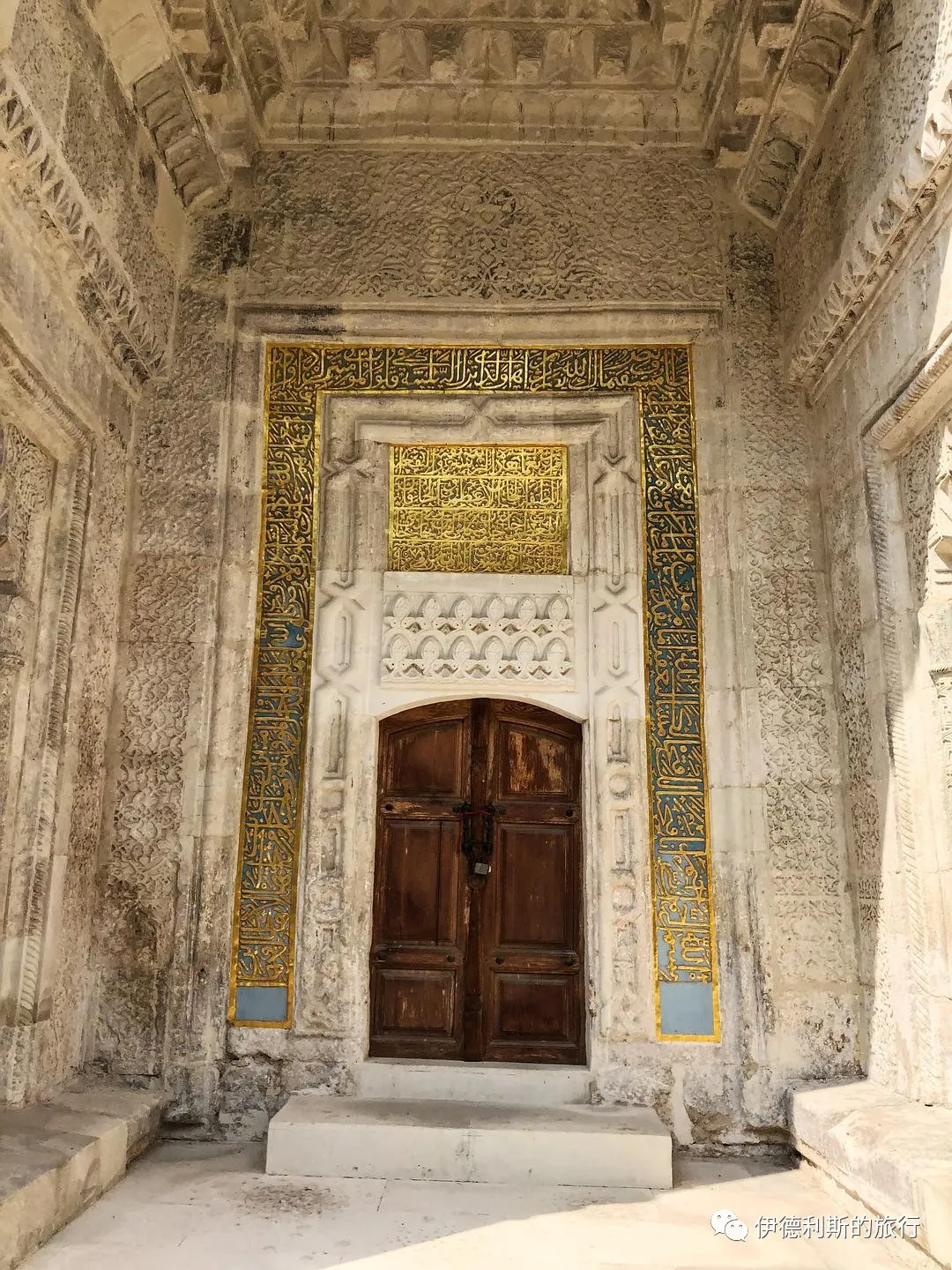
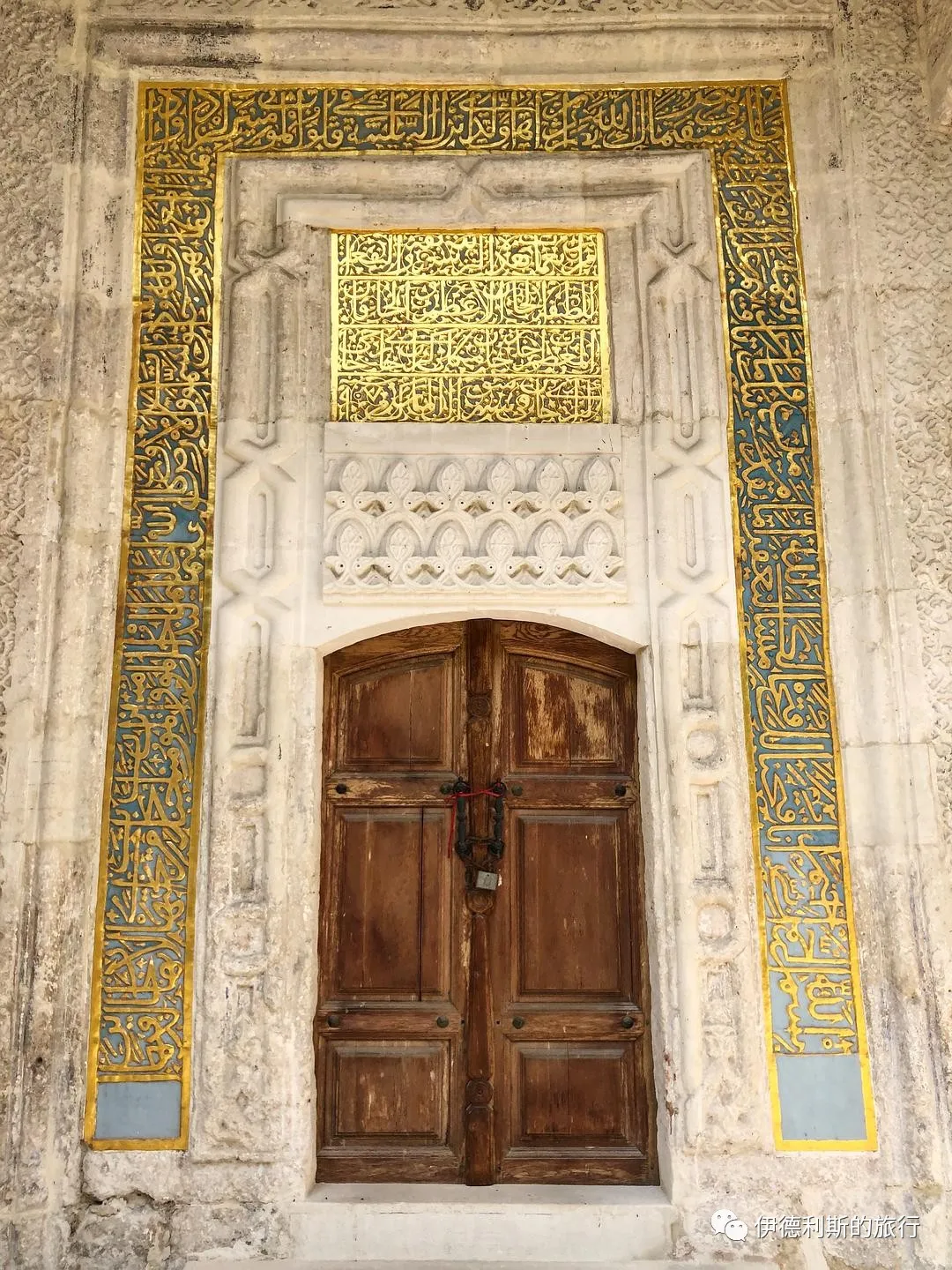
The Chain (Zıncırlı) madrasa was built in 1500 by order of the Crimean Khan Mengli I Giray. The name of the madrasa comes from the Turkic word "zyngyr," which means chain. A chain hangs above the main gate of the madrasa, forcing everyone who enters to bow their head.
The madrasa is rectangular with a central courtyard, an entrance on one side, and 11 rooms on the other three sides. At the time, the madrasa taught Turkish and Arabic grammar, calligraphy, arithmetic, ethics, logic, proof, Islamic law (sharia), and the study of the Quran and Hadith, with the full course of study taking ten years.
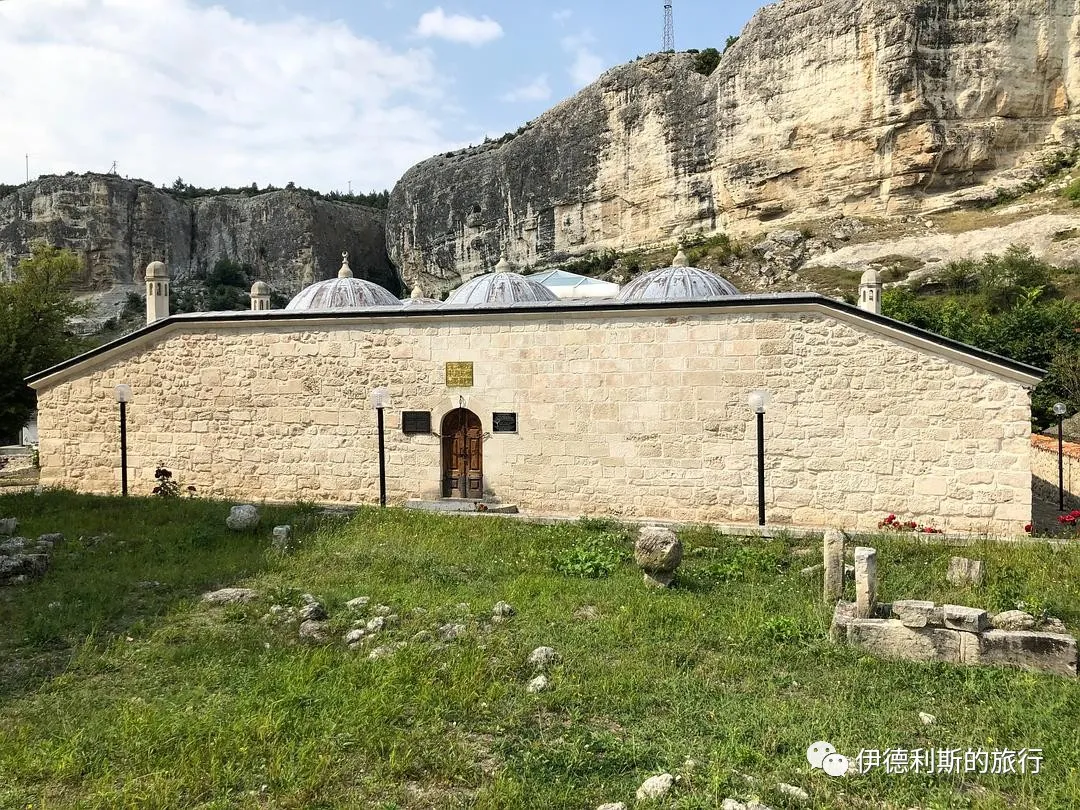
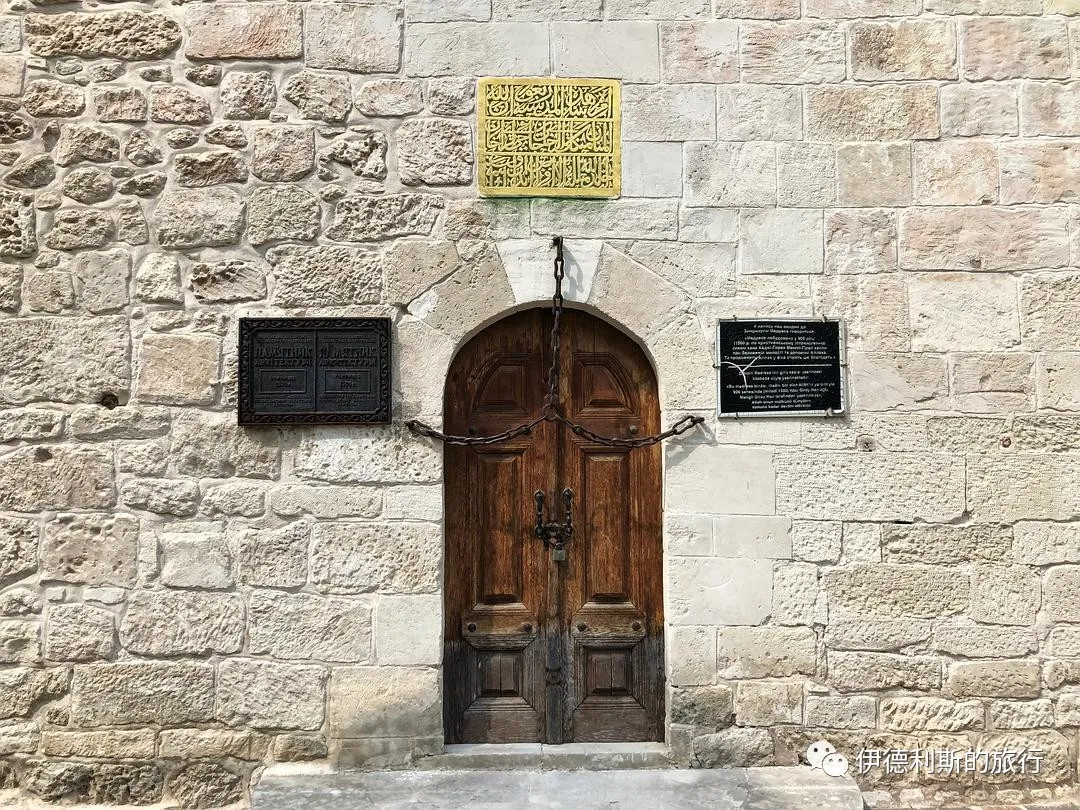
In 1909, influenced by the Crimean Tatar enlightenment movement, Gaspirali built a two-story modern Islamic school (madrasa) next to the old one. The school closed in 1917 and became the Mengli Giray Research Institute. The institute was shut down in 1923, then it served as a teacher training college, a medical school, a sanatorium for German soldiers, and a post-war psychiatric clinic. Today, the site is managed by the Bakhchisaray Historical, Cultural and Archaeological Museum.
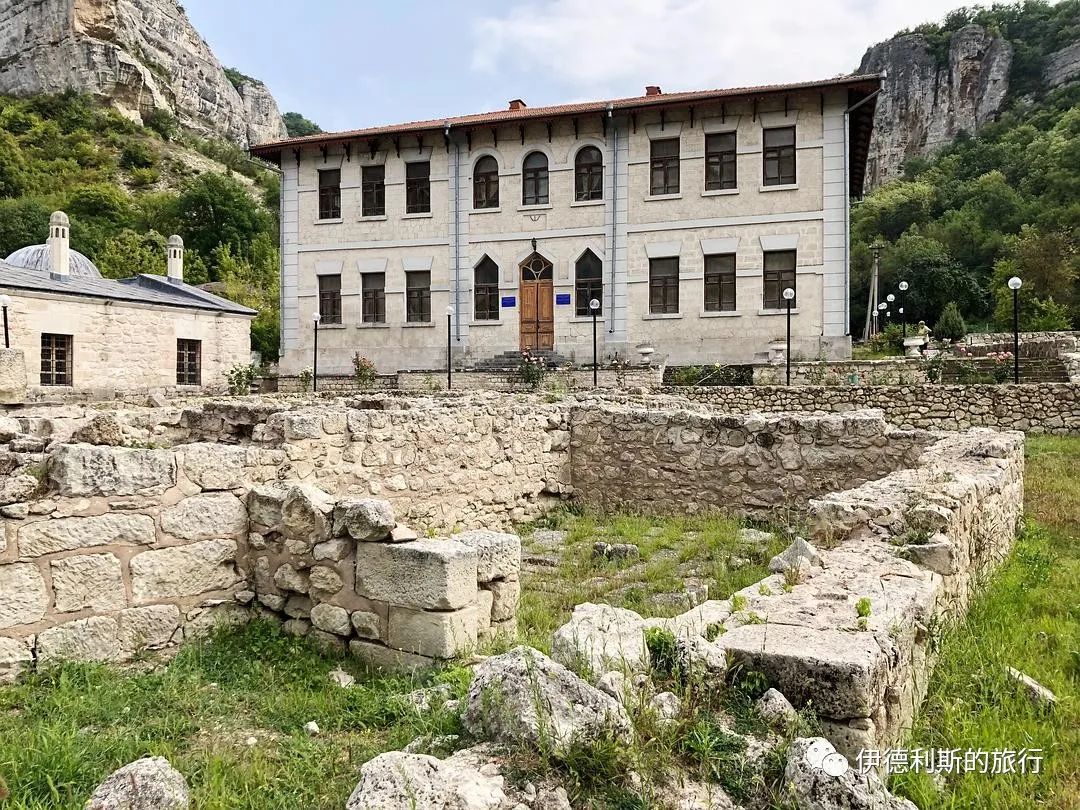
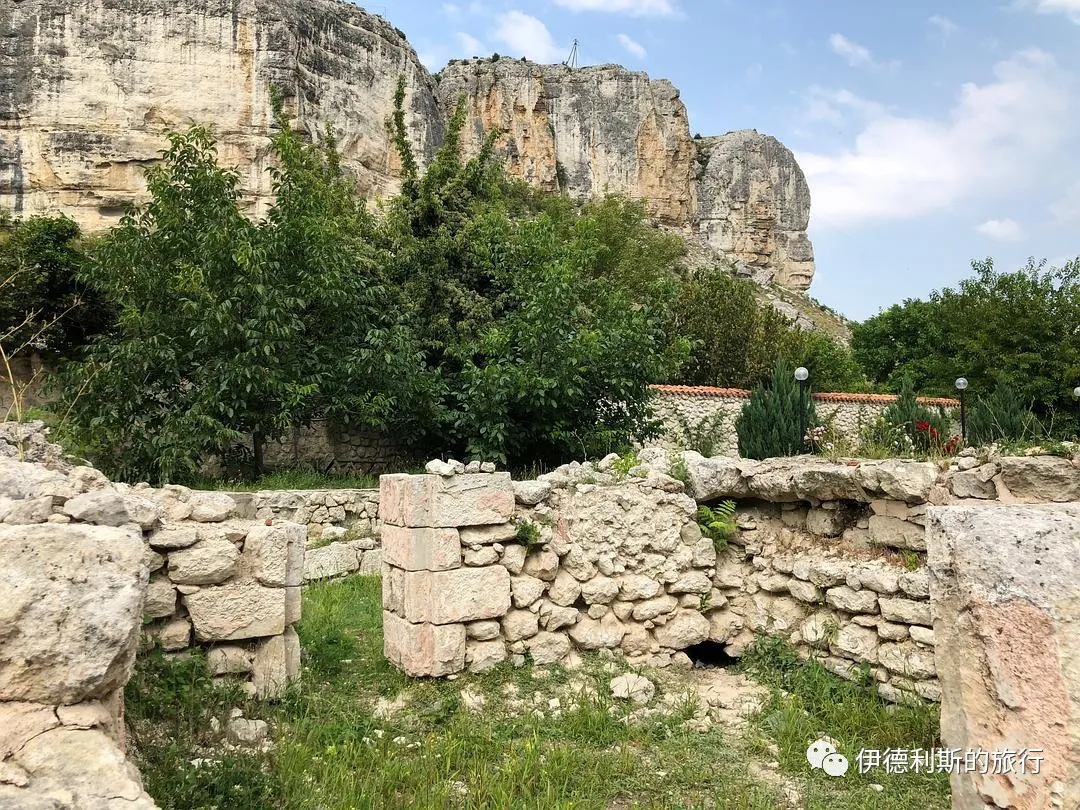
During excavations at the Salachik historical and archaeological complex in 2008, researchers found 15th-century urban ruins including a bathhouse, a well, and a courtyard.
The bathhouse is a typical Turkish bath (hamam) with separate sections for men and women, each containing five rooms and a heating system. The heating system used clay pipes in the walls and under the floors to circulate warm air, keeping the bath at a constant temperature year-round and saving firewood. Each section also included a steam room, a washing area, a toilet, a lounge, and a changing room.
Archaeologists found many ceramics from the 15th to 18th centuries, mostly architectural tiles and pipes, along with some kitchenware, Turkish pottery, Chinese porcelain, and silver coins from the Crimean Khanate.
Ismail Gaspirali (1851-1914), the founder of the Crimean Tatar enlightenment movement, is buried in the backyard of the Zincirli Madrasa.
Gaspirali was a Crimean Tatar intellectual, educator, and publisher. He was the first to realize that Turkic Muslim society needed education and cultural reform to modernize, so he created the new Jadid education system and became known as the founder of the Crimean Tatar enlightenment.
In 1883, Gaspirali received permission to publish Tercüman, the first Turkic-language newspaper in Russia. Tercüman ran for 35 years. For a long time, it was the only Turkic-language publication in Russia and one of the earliest religious newspapers, influencing the entire Turkic-speaking world.
In the newspaper, he advocated for modernization through education and designed a new teaching method called Jadid. He taught the Arabic alphabet using a new phonetic method, which cut the time it took for students to learn to read from three years down to just a few months.
In 1909, Gaspirali built a two-story modern school next to the Zincirli Madrasa, which operated until it closed in 1917.
After Gasprinsky died in his hometown in 1914, he was buried in the cemetery behind the "Zincirli" (Chain) Madrasa. The original tombstone was lost in the second half of the 20th century, and the current one was rebuilt in the late 1990s.
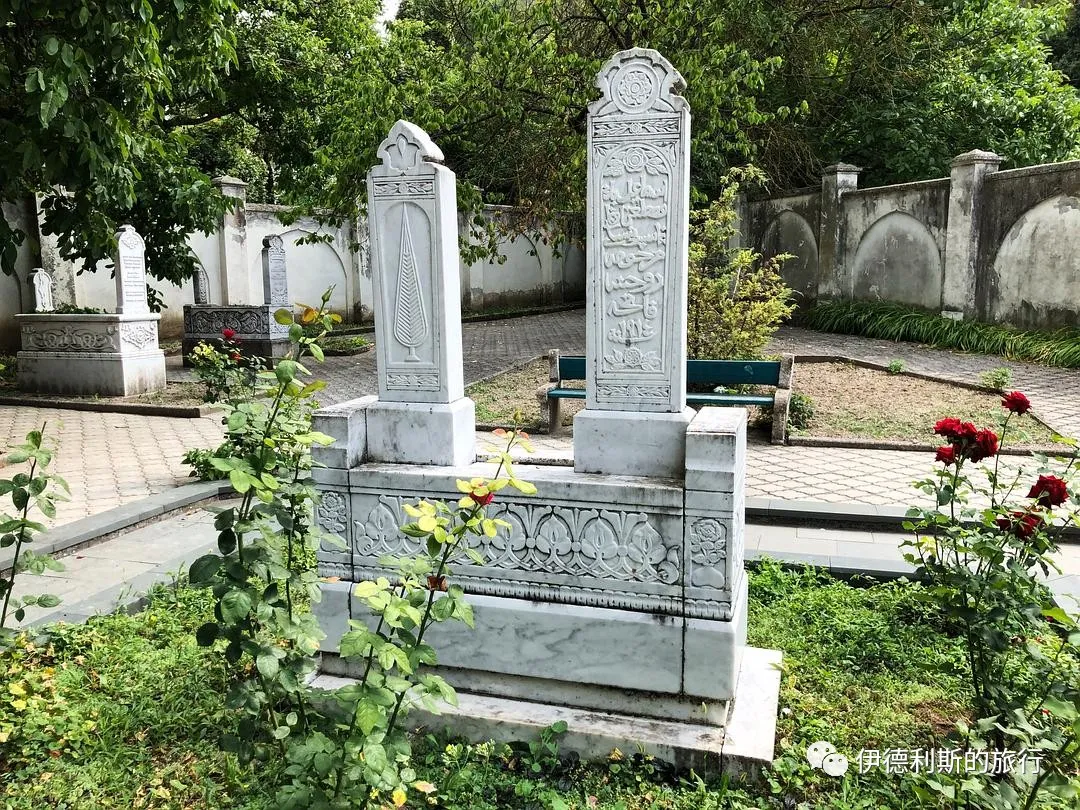
Eski Yurt Old City
Eski Yurt means "old city." During the Golden Horde era, it was a large trading town and a transportation hub connecting the east and west ends of the Crimean Peninsula. After the Crimean Khanate was established in 1441, Eski Yurt remained an economic center. It was not until 1532, when the Khanate built its new capital, Bakhchisaray, in the valley right next to Eski Yurt, that the status of Eski Yurt was replaced and it began to be called the "old city." Even so, because the city once housed a gongbei (shrine) for the sage Malik Ashtar, Eski Yurt remained a religious center for Crimean Tatars until the Soviet era.
According to legend, Malik Ashtar was a cousin of the noble Prophet and a loyal companion of Imam Ali. In Crimean Tatar legends, Malik Ashtar was a brave warrior and the first person to come to Crimea to spread the faith. He eventually died in battle while fighting a giant in Eski Yurt. Many years later, some Sufi practitioners miraculously discovered his grave in Eski Yurt and built a gongbei there. In reality, Malik Ashtar passed away in Egypt, and the gongbei in Eski Yurt is a place where his karamat (miraculous signs) were manifested. Crimean Tatars believe that if you are bitten by a snake, you can recover by making dua at the Malik Ashtar gongbei.
Due to the importance of the Malik Ashtar gongbei, a complex of hundreds of tombs formed around it. This includes the tombs of three Khans of the Crimean Khanate: Mehmed II Giray (reigned 1577–1584), Saadet II Giray (reigned 1584), and Mehmed III Giray (reigned 1623–1628).
From the era of the Crimean Khanate until the early 20th century, a dhikr ceremony was held every Thursday night at the Malik Ashtar gongbei. After all Crimean Tatars were forced into exile in Central Asia in 1948, the central square of the Malik Ashtar gongbei was turned into a market. After Crimean Tatars began returning in the late 1980s, many demanded that the market be removed from the holy site, and it was finally moved in 2006.
The existing structures in the Malik Ashtar gongbei tomb complex include the 14th-15th century Bey Yude Sultan tomb and Ahmed Bey tomb, the 16th-century Mehmed Bey tomb and the tomb of Khan Mehmed II Giray, as well as the minbar (pulpit) of the Malik Ashtar shrine mosque.
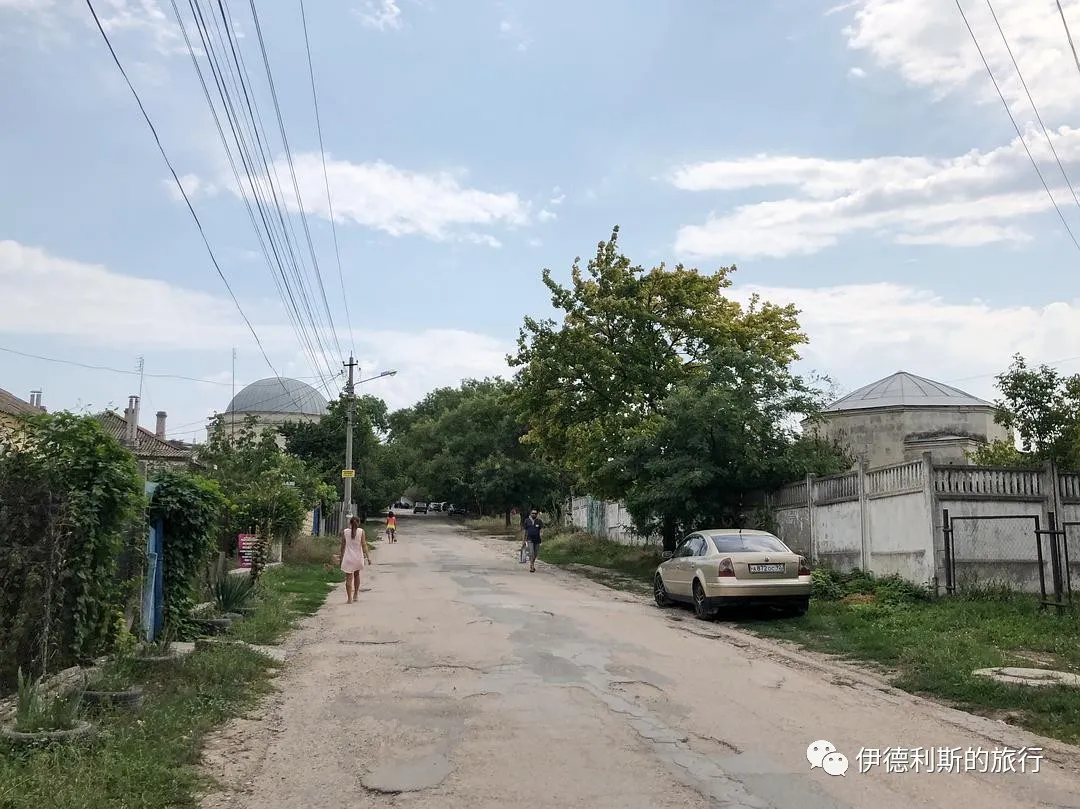
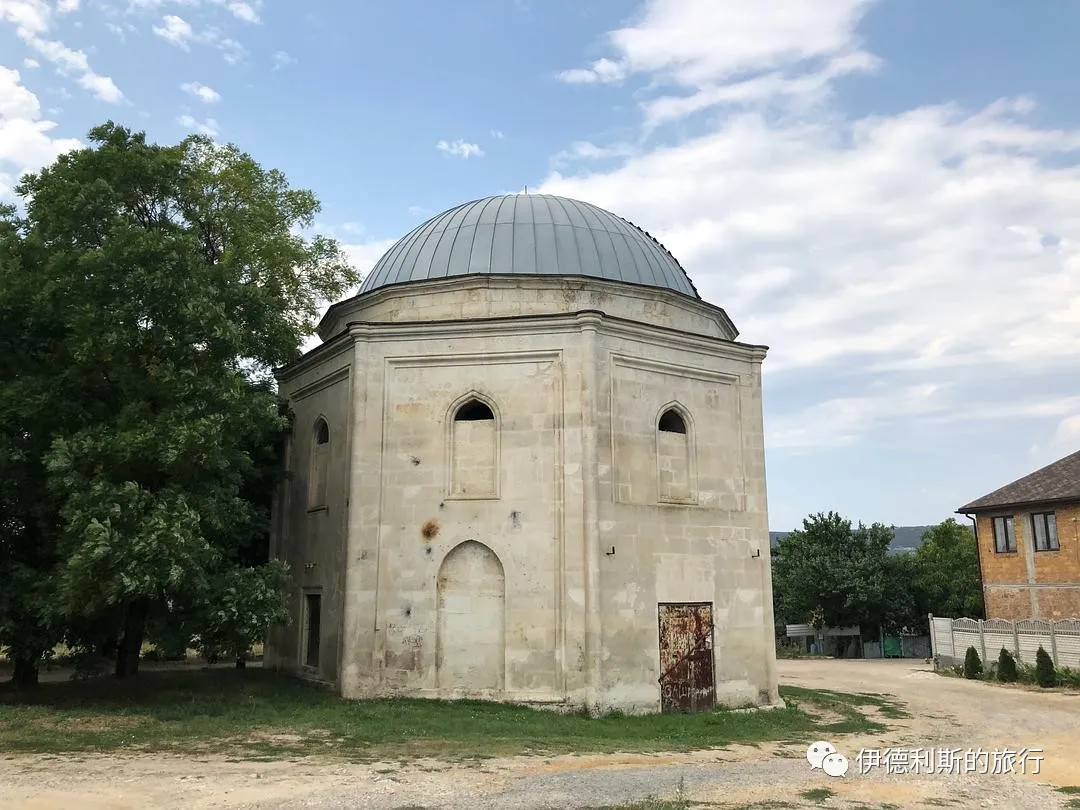
The tomb of Crimean Khan Mehmed II Giray is also known as the Great Octagonal Tomb. During his reign, Mehmed II Giray attacked the Persian Safavid dynasty three times under orders from the Ottoman Empire.
The tomb of Mehmed II Giray is the largest one still standing in Eski Yurt and clearly shows Ottoman influence. Some speculate it was built by a student of the master Ottoman architect Mimar Sinan, but no records about the architect have been found.
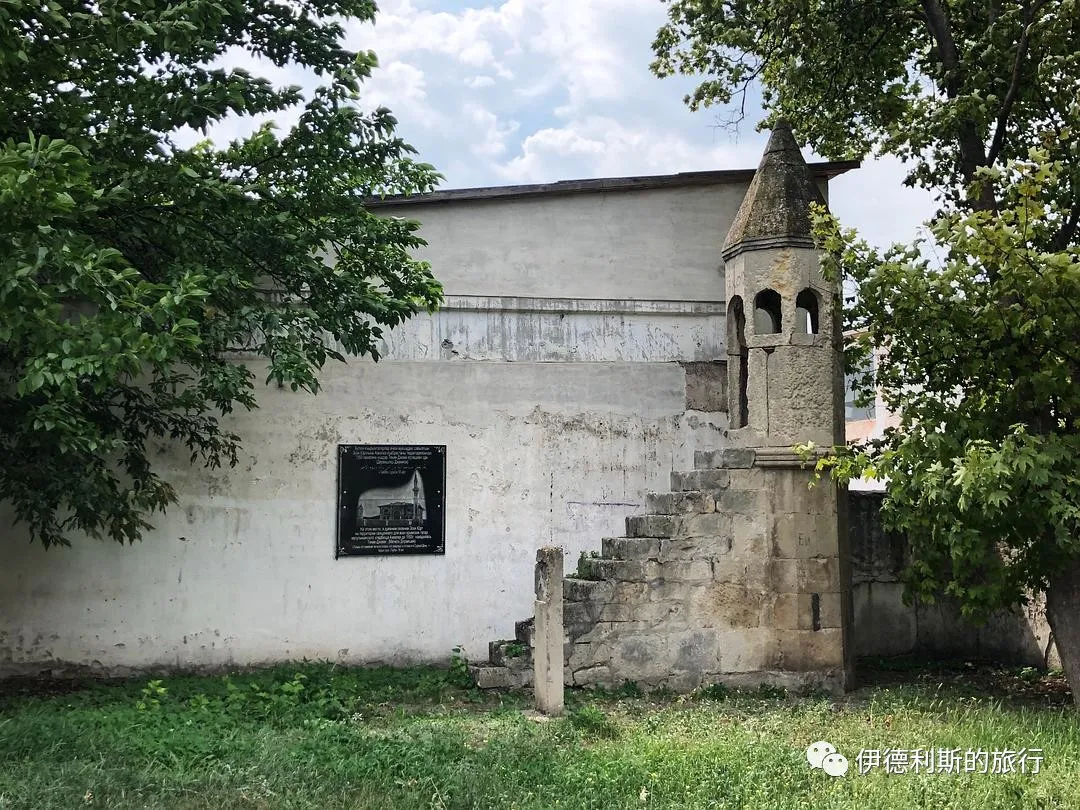
The Malik Ashtar gongbei (a shrine for a Sufi saint) was built during the Crimean Khanate era with a minbar (pulpit) for sermons, but the mosque was destroyed in 1955. This place was once where Sufi practitioners performed dhikr (remembrance of Allah), and it served as a Sufi center on the Crimean Peninsula.
Ahmed Bey died in 1577, and his tombstone was found near the entrance of the tomb in 1924. Although Ahmed Bey died in the 16th century, the architectural style of the tomb itself does not match the Ottoman-influenced tombs of that time; instead, it follows the earlier Golden Horde tomb style. Other buildings similar to Ahmed Bey's tomb date back to the 13th and 14th centuries. Therefore, it is more likely that this tomb was built during the Golden Horde era.
Summary: The early capital of the Crimean Khanate is covered through palace sites, mosques, old streets, and Crimean Tatar history. This account keeps the original historical context, place names, architectural details, food notes, and photographs.
The Crimean Peninsula is in the northern Black Sea. It was conquered by the Mongol army in 1238 and later ruled by the Golden Horde. In 1313, Khan Uzbeg officially made Islam the state religion and built mosques (masjid) on the Crimean Peninsula.
At first, the Golden Horde's capital in Crimea was the city of Old Crimea (Stary Krym) in the southeast of the peninsula. In 1441, Haji Giray, a descendant of Genghis Khan's eldest son Jochi, minted coins with his own name at the Jewish Fortress (Chufut-Kale) on a cliff in the southwest of the peninsula, officially establishing the Crimean Khanate. The Jewish Fortress was first built by the Byzantines in the 5th to 6th centuries, and was later inhabited by Alans, Tatars, and Karaites. Today, the fortress still has city walls, gates, mosque ruins, and the tomb of a Golden Horde princess.
After Haji Giray died in 1466, his sixth son, Mengli Giray, eventually won the struggle for the throne. Around 1500, Mengli Giray built a new capital called Salachik. Salachik once had a complex of buildings including a palace, court, baths, and a mosque, but now only a madrasa and the tomb of the founding Crimean Khan, Haji Giray, remain.
Also, to the west of Bakhchysarai is Eski Yurt, a large trading town that was very prosperous during the Golden Horde period. It became a religious center for Crimea because of the gongbei of the religious elder Malik Ashtar. Today, it preserves several 14th to 16th-century tombs, including that of the Crimean Khan Mehmed II Giray.
Jewish Fortress (Chufut-Kale)
Between the 13th and 17th centuries, the Jewish Fortress was called Kyrk-Or, which means forty fortresses. After the mid-16th century, the Crimean Khan Sahib Giray (reigned 1532-1551) moved the capital to Bakhchysarai in the valley west of the Jewish Fortress, and the Tatars in the fortress gradually moved to Bakhchysarai. After the wells in the fortress dried up in the mid-17th century, all the Tatars left. Only the Karaite Jews continued to live there, and the fortress was gradually called the Jewish Fortress by the Crimean Tatars. After the 19th century, the Karaite Jews also left, and the fortress eventually became a ruin.
The walls of the Jewish Fortress were first built during the Byzantine period; some say they were built in the 5th to 6th centuries, while others say the 10th to 11th centuries. In 1299, General Nogai Khan of the Golden Horde led a Tatar army to attack the Crimean Peninsula. Byzantine soldiers used the strong walls of the Jewish fortress to hold off the Golden Horde's attack. The Tatar soldiers reportedly played harsh, loud music for three days and nights to disturb the Byzantine defenders inside the city. On the fourth day, the exhausted Byzantine defenders could no longer hold off a new round of attacks, and the Jewish fortress was captured by the Tatars of the Golden Horde.
Currently, the original walls consist of two sections, the south wall and the middle wall, along with two gates, the south gate and the middle gate. The south wall is built on the cliff in the southern part of the fortress, weaving between the rocks. The south gate is built in a pocket shape, allowing defenders to surround enemies from above if they break in. The middle wall runs across the space between the north and south cliffs of the fortress and is a typical example of Byzantine wall architecture.
There is no wall on the north cliff, but the steepness of the cliff itself is as effective as a wall. It was very windy when I visited, and I felt nervous just standing by the cliff edge.
The east wall was built between 1396 and 1433, and there is a lively bazaar outside the gate. Outside the east gate, there is still a preserved water collection area that merchants used to wash and water their livestock.
The Khan Jani Beg mosque is located on the west side of the Jewish fortress. It was first built in 1346 during the reign of Khan Jani Beg (reigned 1342-1357) of the Golden Horde. Khan Jani Beg was the son of Öz Beg Khan. During his father's reign, the Golden Horde fully converted to the faith, and Khan Jani Beg continued to develop the faith within the Khanate. The Khan Jani Beg mosque in the Jewish fortress stands as a witness to this.
In 1455, Haji Giray, the founding Khan of the Crimean Khanate, rebuilt the Khan Jani Beg mosque. An inscription about the reconstruction was once carved above the mosque door and was discovered during an archaeological excavation in 1928.
After the mid-17th century, the mosque was eventually abandoned as the Crimean Tatars moved from the Jewish fortress to Bakhchisaray. Today, only ruined walls, a mihrab niche, and some stone carvings remain at the mosque site. From these existing ruins, we can infer that it was a fairly typical traditional Crimean mosque building.
The tomb of Golden Horde Princess Dzhanike Khanym was built in 1437. It is the best-preserved Islamic building inside the Jewish fortress. The princess was the daughter of Tokhtamysh (reigned 1380-1397), the Great Khan of the Golden Horde. Tokhtamysh was the last Great Khan to unite the Golden Horde, but he was eventually defeated by Tamerlane the Great. After Tokhtamysh passed away, Dzhanike Khanym returned to her mother's homeland, Crimea.
The tomb is octagonal. The door is decorated with a classic Seljuk knot, a signature pattern from the Golden Horde period.
The roads inside the fortress vary in width, and you can see deep cart ruts on the main path.
The Tatar people gradually left the city after the water wells dried up in the 17th century.
The Gazi Mansur gongbei (shrine) and daotang (religious hall) are located in the valley on the west side of the Jewish fortress.
Legend says that Malik Ashter and Gazi Mansur, two of the first disciples of the Prophet Muhammad, came to the Crimean Peninsula in the 7th century to spread the faith and lived in a valley at the foot of the Jewish fortress. Not long after, Malik Ashter was killed by a giant, and Gazi Mansur died defending the Jewish fortress. They were both buried at the foot of the mountain. They remained unknown for a long time until, centuries later, a sheikh living in the ancient Central Asian city of Bukhara repeatedly dreamed of a narrow valley filled with shrubs. To understand his dream, the sheikh followed the guidance of an elder and began a pilgrimage to the Crimean Peninsula.
The sheikh arrived in Crimea in 1434. He recognized the valley from his dream at the foot of the Jewish cave and eventually discovered the tomb of Gazi Mansur. The sheikh then built a gongbei and a daotang at the site of the tomb. Because of this legendary karamat (miracle), pilgrims flocked to the site, and it even gained the favor of the Crimean Khan.
The Gazi Mansur gongbei and daotang stood until the 1930s, but were destroyed during the Soviet era. Today, only broken walls and a few surviving tombstones remain.
Salachik
The Salachik (Salaçıq) historical and archaeological complex was built between the late 15th and early 16th centuries and served as one of the capitals of the Crimean Khanate.
After Haji Giray died in 1466, his sixth son, Mengli I Giray, and his second son, Nur Devlet, fought repeatedly for the throne until Mengli I Giray finally won. Around 1500, Mengli I Giray built the new capital of Salachik in the valley west of the Jewish fortress.
In the 17th century, Salachik included a palace, a high court, baths, the Mengli Giray Mosque, and guard rooms. Genoese records mention that it also had a customs house, but most of these buildings were likely destroyed in an earthquake in 1698.
Today, only the Chain (Zıncırlı) madrasa, built in 1500, and the Haji Giray mausoleum, built in 1501, remain. The madrasa stayed open until the early 20th century. Archaeological excavations in 2008 uncovered the ruins of the baths and identified the general location of the Mengli Giray Mosque.
The Haji Giray mausoleum (Dürbe Hacı I Giray) is an octagonal building with a lead dome, built in 1501 by Mengli I Giray for his father, the founding Khan of Crimea, Haji Giray.
Archaeological digs between 2006 and 2007 examined 18 graves inside the mausoleum, including 13 adults and 5 children. They were wrapped in silk, and some rested on pillows stuffed with fabric scraps and fruit seeds. The mausoleum contains 8 stone sarcophagi covered in velvet, silk, and silver-threaded fabric. These likely include four Crimean Khans: Haji Giray himself, Mengli I Giray, Haji Giray's other son Nur Devlet—who fought Mengli I Giray for the throne for years before losing—and Sahib I Giray, the son of Mengli I Giray and the builder of Bakhchisaray.
These individuals were reburied after research was completed in 2009.
The Chain (Zıncırlı) madrasa was built in 1500 by order of the Crimean Khan Mengli I Giray. The name of the madrasa comes from the Turkic word "zyngyr," which means chain. A chain hangs above the main gate of the madrasa, forcing everyone who enters to bow their head.
The madrasa is rectangular with a central courtyard, an entrance on one side, and 11 rooms on the other three sides. At the time, the madrasa taught Turkish and Arabic grammar, calligraphy, arithmetic, ethics, logic, proof, Islamic law (sharia), and the study of the Quran and Hadith, with the full course of study taking ten years.
In 1909, influenced by the Crimean Tatar enlightenment movement, Gaspirali built a two-story modern Islamic school (madrasa) next to the old one. The school closed in 1917 and became the Mengli Giray Research Institute. The institute was shut down in 1923, then it served as a teacher training college, a medical school, a sanatorium for German soldiers, and a post-war psychiatric clinic. Today, the site is managed by the Bakhchisaray Historical, Cultural and Archaeological Museum.
During excavations at the Salachik historical and archaeological complex in 2008, researchers found 15th-century urban ruins including a bathhouse, a well, and a courtyard.
The bathhouse is a typical Turkish bath (hamam) with separate sections for men and women, each containing five rooms and a heating system. The heating system used clay pipes in the walls and under the floors to circulate warm air, keeping the bath at a constant temperature year-round and saving firewood. Each section also included a steam room, a washing area, a toilet, a lounge, and a changing room.
Archaeologists found many ceramics from the 15th to 18th centuries, mostly architectural tiles and pipes, along with some kitchenware, Turkish pottery, Chinese porcelain, and silver coins from the Crimean Khanate.
Ismail Gaspirali (1851-1914), the founder of the Crimean Tatar enlightenment movement, is buried in the backyard of the Zincirli Madrasa.
Gaspirali was a Crimean Tatar intellectual, educator, and publisher. He was the first to realize that Turkic Muslim society needed education and cultural reform to modernize, so he created the new Jadid education system and became known as the founder of the Crimean Tatar enlightenment.
In 1883, Gaspirali received permission to publish Tercüman, the first Turkic-language newspaper in Russia. Tercüman ran for 35 years. For a long time, it was the only Turkic-language publication in Russia and one of the earliest religious newspapers, influencing the entire Turkic-speaking world.
In the newspaper, he advocated for modernization through education and designed a new teaching method called Jadid. He taught the Arabic alphabet using a new phonetic method, which cut the time it took for students to learn to read from three years down to just a few months.
In 1909, Gaspirali built a two-story modern school next to the Zincirli Madrasa, which operated until it closed in 1917.
After Gasprinsky died in his hometown in 1914, he was buried in the cemetery behind the "Zincirli" (Chain) Madrasa. The original tombstone was lost in the second half of the 20th century, and the current one was rebuilt in the late 1990s.
Eski Yurt Old City
Eski Yurt means "old city." During the Golden Horde era, it was a large trading town and a transportation hub connecting the east and west ends of the Crimean Peninsula. After the Crimean Khanate was established in 1441, Eski Yurt remained an economic center. It was not until 1532, when the Khanate built its new capital, Bakhchisaray, in the valley right next to Eski Yurt, that the status of Eski Yurt was replaced and it began to be called the "old city." Even so, because the city once housed a gongbei (shrine) for the sage Malik Ashtar, Eski Yurt remained a religious center for Crimean Tatars until the Soviet era.
According to legend, Malik Ashtar was a cousin of the noble Prophet and a loyal companion of Imam Ali. In Crimean Tatar legends, Malik Ashtar was a brave warrior and the first person to come to Crimea to spread the faith. He eventually died in battle while fighting a giant in Eski Yurt. Many years later, some Sufi practitioners miraculously discovered his grave in Eski Yurt and built a gongbei there. In reality, Malik Ashtar passed away in Egypt, and the gongbei in Eski Yurt is a place where his karamat (miraculous signs) were manifested. Crimean Tatars believe that if you are bitten by a snake, you can recover by making dua at the Malik Ashtar gongbei.
Due to the importance of the Malik Ashtar gongbei, a complex of hundreds of tombs formed around it. This includes the tombs of three Khans of the Crimean Khanate: Mehmed II Giray (reigned 1577–1584), Saadet II Giray (reigned 1584), and Mehmed III Giray (reigned 1623–1628).
From the era of the Crimean Khanate until the early 20th century, a dhikr ceremony was held every Thursday night at the Malik Ashtar gongbei. After all Crimean Tatars were forced into exile in Central Asia in 1948, the central square of the Malik Ashtar gongbei was turned into a market. After Crimean Tatars began returning in the late 1980s, many demanded that the market be removed from the holy site, and it was finally moved in 2006.
The existing structures in the Malik Ashtar gongbei tomb complex include the 14th-15th century Bey Yude Sultan tomb and Ahmed Bey tomb, the 16th-century Mehmed Bey tomb and the tomb of Khan Mehmed II Giray, as well as the minbar (pulpit) of the Malik Ashtar shrine mosque.
The tomb of Crimean Khan Mehmed II Giray is also known as the Great Octagonal Tomb. During his reign, Mehmed II Giray attacked the Persian Safavid dynasty three times under orders from the Ottoman Empire.
The tomb of Mehmed II Giray is the largest one still standing in Eski Yurt and clearly shows Ottoman influence. Some speculate it was built by a student of the master Ottoman architect Mimar Sinan, but no records about the architect have been found.
The Malik Ashtar gongbei (a shrine for a Sufi saint) was built during the Crimean Khanate era with a minbar (pulpit) for sermons, but the mosque was destroyed in 1955. This place was once where Sufi practitioners performed dhikr (remembrance of Allah), and it served as a Sufi center on the Crimean Peninsula.
Ahmed Bey died in 1577, and his tombstone was found near the entrance of the tomb in 1924. Although Ahmed Bey died in the 16th century, the architectural style of the tomb itself does not match the Ottoman-influenced tombs of that time; instead, it follows the earlier Golden Horde tomb style. Other buildings similar to Ahmed Bey's tomb date back to the 13th and 14th centuries. Therefore, it is more likely that this tomb was built during the Golden Horde era.
Halal Travel Guide: Crimean Khanate Early Capital - Mosques and History
Articles • ali2007fr posted the article • 0 comments • 231 views • 2026-05-20 09:03
Reposted from the web
Summary: The early capital of the Crimean Khanate is covered through palace sites, mosques, old streets, and Crimean Tatar history. This account keeps the original historical context, place names, architectural details, food notes, and photographs.
The Crimean Peninsula is in the northern Black Sea. It was conquered by the Mongol army in 1238 and later ruled by the Golden Horde. In 1313, Khan Uzbeg officially made Islam the state religion and built mosques (masjid) on the Crimean Peninsula.
At first, the Golden Horde's capital in Crimea was the city of Old Crimea (Stary Krym) in the southeast of the peninsula. In 1441, Haji Giray, a descendant of Genghis Khan's eldest son Jochi, minted coins with his own name at the Jewish Fortress (Chufut-Kale) on a cliff in the southwest of the peninsula, officially establishing the Crimean Khanate. The Jewish Fortress was first built by the Byzantines in the 5th to 6th centuries, and was later inhabited by Alans, Tatars, and Karaites. Today, the fortress still has city walls, gates, mosque ruins, and the tomb of a Golden Horde princess.
After Haji Giray died in 1466, his sixth son, Mengli Giray, eventually won the struggle for the throne. Around 1500, Mengli Giray built a new capital called Salachik. Salachik once had a complex of buildings including a palace, court, baths, and a mosque, but now only a madrasa and the tomb of the founding Crimean Khan, Haji Giray, remain.
Also, to the west of Bakhchysarai is Eski Yurt, a large trading town that was very prosperous during the Golden Horde period. It became a religious center for Crimea because of the gongbei of the religious elder Malik Ashtar. Today, it preserves several 14th to 16th-century tombs, including that of the Crimean Khan Mehmed II Giray.
Jewish Fortress (Chufut-Kale)
Between the 13th and 17th centuries, the Jewish Fortress was called Kyrk-Or, which means forty fortresses. After the mid-16th century, the Crimean Khan Sahib Giray (reigned 1532-1551) moved the capital to Bakhchysarai in the valley west of the Jewish Fortress, and the Tatars in the fortress gradually moved to Bakhchysarai. After the wells in the fortress dried up in the mid-17th century, all the Tatars left. Only the Karaite Jews continued to live there, and the fortress was gradually called the Jewish Fortress by the Crimean Tatars. After the 19th century, the Karaite Jews also left, and the fortress eventually became a ruin.
The walls of the Jewish Fortress were first built during the Byzantine period; some say they were built in the 5th to 6th centuries, while others say the 10th to 11th centuries. In 1299, General Nogai Khan of the Golden Horde led a Tatar army to attack the Crimean Peninsula. Byzantine soldiers used the strong walls of the Jewish fortress to hold off the Golden Horde's attack. The Tatar soldiers reportedly played harsh, loud music for three days and nights to disturb the Byzantine defenders inside the city. On the fourth day, the exhausted Byzantine defenders could no longer hold off a new round of attacks, and the Jewish fortress was captured by the Tatars of the Golden Horde.
Currently, the original walls consist of two sections, the south wall and the middle wall, along with two gates, the south gate and the middle gate. The south wall is built on the cliff in the southern part of the fortress, weaving between the rocks. The south gate is built in a pocket shape, allowing defenders to surround enemies from above if they break in. The middle wall runs across the space between the north and south cliffs of the fortress and is a typical example of Byzantine wall architecture.
There is no wall on the north cliff, but the steepness of the cliff itself is as effective as a wall. It was very windy when I visited, and I felt nervous just standing by the cliff edge.
The east wall was built between 1396 and 1433, and there is a lively bazaar outside the gate. Outside the east gate, there is still a preserved water collection area that merchants used to wash and water their livestock.
The Khan Jani Beg mosque is located on the west side of the Jewish fortress. It was first built in 1346 during the reign of Khan Jani Beg (reigned 1342-1357) of the Golden Horde. Khan Jani Beg was the son of Öz Beg Khan. During his father's reign, the Golden Horde fully converted to the faith, and Khan Jani Beg continued to develop the faith within the Khanate. The Khan Jani Beg mosque in the Jewish fortress stands as a witness to this.
In 1455, Haji Giray, the founding Khan of the Crimean Khanate, rebuilt the Khan Jani Beg mosque. An inscription about the reconstruction was once carved above the mosque door and was discovered during an archaeological excavation in 1928.
After the mid-17th century, the mosque was eventually abandoned as the Crimean Tatars moved from the Jewish fortress to Bakhchisaray. Today, only ruined walls, a mihrab niche, and some stone carvings remain at the mosque site. From these existing ruins, we can infer that it was a fairly typical traditional Crimean mosque building.
The tomb of Golden Horde Princess Dzhanike Khanym was built in 1437. It is the best-preserved Islamic building inside the Jewish fortress. The princess was the daughter of Tokhtamysh (reigned 1380-1397), the Great Khan of the Golden Horde. Tokhtamysh was the last Great Khan to unite the Golden Horde, but he was eventually defeated by Tamerlane the Great. After Tokhtamysh passed away, Dzhanike Khanym returned to her mother's homeland, Crimea.
The tomb is octagonal. The door is decorated with a classic Seljuk knot, a signature pattern from the Golden Horde period.
The roads inside the fortress vary in width, and you can see deep cart ruts on the main path.
The Tatar people gradually left the city after the water wells dried up in the 17th century.
The Gazi Mansur gongbei (shrine) and daotang (religious hall) are located in the valley on the west side of the Jewish fortress.
Legend says that Malik Ashter and Gazi Mansur, two of the first disciples of the Prophet Muhammad, came to the Crimean Peninsula in the 7th century to spread the faith and lived in a valley at the foot of the Jewish fortress. Not long after, Malik Ashter was killed by a giant, and Gazi Mansur died defending the Jewish fortress. They were both buried at the foot of the mountain. They remained unknown for a long time until, centuries later, a sheikh living in the ancient Central Asian city of Bukhara repeatedly dreamed of a narrow valley filled with shrubs. To understand his dream, the sheikh followed the guidance of an elder and began a pilgrimage to the Crimean Peninsula.
The sheikh arrived in Crimea in 1434. He recognized the valley from his dream at the foot of the Jewish cave and eventually discovered the tomb of Gazi Mansur. The sheikh then built a gongbei and a daotang at the site of the tomb. Because of this legendary karamat (miracle), pilgrims flocked to the site, and it even gained the favor of the Crimean Khan.
The Gazi Mansur gongbei and daotang stood until the 1930s, but were destroyed during the Soviet era. Today, only broken walls and a few surviving tombstones remain.
Salachik
The Salachik (Salaçıq) historical and archaeological complex was built between the late 15th and early 16th centuries and served as one of the capitals of the Crimean Khanate.
After Haji Giray died in 1466, his sixth son, Mengli I Giray, and his second son, Nur Devlet, fought repeatedly for the throne until Mengli I Giray finally won. Around 1500, Mengli I Giray built the new capital of Salachik in the valley west of the Jewish fortress.
In the 17th century, Salachik included a palace, a high court, baths, the Mengli Giray Mosque, and guard rooms. Genoese records mention that it also had a customs house, but most of these buildings were likely destroyed in an earthquake in 1698.
Today, only the Chain (Zıncırlı) madrasa, built in 1500, and the Haji Giray mausoleum, built in 1501, remain. The madrasa stayed open until the early 20th century. Archaeological excavations in 2008 uncovered the ruins of the baths and identified the general location of the Mengli Giray Mosque.
The Haji Giray mausoleum (Dürbe Hacı I Giray) is an octagonal building with a lead dome, built in 1501 by Mengli I Giray for his father, the founding Khan of Crimea, Haji Giray.
Archaeological digs between 2006 and 2007 examined 18 graves inside the mausoleum, including 13 adults and 5 children. They were wrapped in silk, and some rested on pillows stuffed with fabric scraps and fruit seeds. The mausoleum contains 8 stone sarcophagi covered in velvet, silk, and silver-threaded fabric. These likely include four Crimean Khans: Haji Giray himself, Mengli I Giray, Haji Giray's other son Nur Devlet—who fought Mengli I Giray for the throne for years before losing—and Sahib I Giray, the son of Mengli I Giray and the builder of Bakhchisaray.
These individuals were reburied after research was completed in 2009.
The Chain (Zıncırlı) madrasa was built in 1500 by order of the Crimean Khan Mengli I Giray. The name of the madrasa comes from the Turkic word "zyngyr," which means chain. A chain hangs above the main gate of the madrasa, forcing everyone who enters to bow their head.
The madrasa is rectangular with a central courtyard, an entrance on one side, and 11 rooms on the other three sides. At the time, the madrasa taught Turkish and Arabic grammar, calligraphy, arithmetic, ethics, logic, proof, Islamic law (sharia), and the study of the Quran and Hadith, with the full course of study taking ten years.
In 1909, influenced by the Crimean Tatar enlightenment movement, Gaspirali built a two-story modern Islamic school (madrasa) next to the old one. The school closed in 1917 and became the Mengli Giray Research Institute. The institute was shut down in 1923, then it served as a teacher training college, a medical school, a sanatorium for German soldiers, and a post-war psychiatric clinic. Today, the site is managed by the Bakhchisaray Historical, Cultural and Archaeological Museum.
During excavations at the Salachik historical and archaeological complex in 2008, researchers found 15th-century urban ruins including a bathhouse, a well, and a courtyard.
The bathhouse is a typical Turkish bath (hamam) with separate sections for men and women, each containing five rooms and a heating system. The heating system used clay pipes in the walls and under the floors to circulate warm air, keeping the bath at a constant temperature year-round and saving firewood. Each section also included a steam room, a washing area, a toilet, a lounge, and a changing room.
Archaeologists found many ceramics from the 15th to 18th centuries, mostly architectural tiles and pipes, along with some kitchenware, Turkish pottery, Chinese porcelain, and silver coins from the Crimean Khanate.
Ismail Gaspirali (1851-1914), the founder of the Crimean Tatar enlightenment movement, is buried in the backyard of the Zincirli Madrasa.
Gaspirali was a Crimean Tatar intellectual, educator, and publisher. He was the first to realize that Turkic Muslim society needed education and cultural reform to modernize, so he created the new Jadid education system and became known as the founder of the Crimean Tatar enlightenment.
In 1883, Gaspirali received permission to publish Tercüman, the first Turkic-language newspaper in Russia. Tercüman ran for 35 years. For a long time, it was the only Turkic-language publication in Russia and one of the earliest religious newspapers, influencing the entire Turkic-speaking world.
In the newspaper, he advocated for modernization through education and designed a new teaching method called Jadid. He taught the Arabic alphabet using a new phonetic method, which cut the time it took for students to learn to read from three years down to just a few months.
In 1909, Gaspirali built a two-story modern school next to the Zincirli Madrasa, which operated until it closed in 1917.
After Gasprinsky died in his hometown in 1914, he was buried in the cemetery behind the "Zincirli" (Chain) Madrasa. The original tombstone was lost in the second half of the 20th century, and the current one was rebuilt in the late 1990s.
Eski Yurt Old City
Eski Yurt means "old city." During the Golden Horde era, it was a large trading town and a transportation hub connecting the east and west ends of the Crimean Peninsula. After the Crimean Khanate was established in 1441, Eski Yurt remained an economic center. It was not until 1532, when the Khanate built its new capital, Bakhchisaray, in the valley right next to Eski Yurt, that the status of Eski Yurt was replaced and it began to be called the "old city." Even so, because the city once housed a gongbei (shrine) for the sage Malik Ashtar, Eski Yurt remained a religious center for Crimean Tatars until the Soviet era.
According to legend, Malik Ashtar was a cousin of the noble Prophet and a loyal companion of Imam Ali. In Crimean Tatar legends, Malik Ashtar was a brave warrior and the first person to come to Crimea to spread the faith. He eventually died in battle while fighting a giant in Eski Yurt. Many years later, some Sufi practitioners miraculously discovered his grave in Eski Yurt and built a gongbei there. In reality, Malik Ashtar passed away in Egypt, and the gongbei in Eski Yurt is a place where his karamat (miraculous signs) were manifested. Crimean Tatars believe that if you are bitten by a snake, you can recover by making dua at the Malik Ashtar gongbei.
Due to the importance of the Malik Ashtar gongbei, a complex of hundreds of tombs formed around it. This includes the tombs of three Khans of the Crimean Khanate: Mehmed II Giray (reigned 1577–1584), Saadet II Giray (reigned 1584), and Mehmed III Giray (reigned 1623–1628).
From the era of the Crimean Khanate until the early 20th century, a dhikr ceremony was held every Thursday night at the Malik Ashtar gongbei. After all Crimean Tatars were forced into exile in Central Asia in 1948, the central square of the Malik Ashtar gongbei was turned into a market. After Crimean Tatars began returning in the late 1980s, many demanded that the market be removed from the holy site, and it was finally moved in 2006.
The existing structures in the Malik Ashtar gongbei tomb complex include the 14th-15th century Bey Yude Sultan tomb and Ahmed Bey tomb, the 16th-century Mehmed Bey tomb and the tomb of Khan Mehmed II Giray, as well as the minbar (pulpit) of the Malik Ashtar shrine mosque.
The tomb of Crimean Khan Mehmed II Giray is also known as the Great Octagonal Tomb. During his reign, Mehmed II Giray attacked the Persian Safavid dynasty three times under orders from the Ottoman Empire.
The tomb of Mehmed II Giray is the largest one still standing in Eski Yurt and clearly shows Ottoman influence. Some speculate it was built by a student of the master Ottoman architect Mimar Sinan, but no records about the architect have been found.
The Malik Ashtar gongbei (a shrine for a Sufi saint) was built during the Crimean Khanate era with a minbar (pulpit) for sermons, but the mosque was destroyed in 1955. This place was once where Sufi practitioners performed dhikr (remembrance of Allah), and it served as a Sufi center on the Crimean Peninsula.
Ahmed Bey died in 1577, and his tombstone was found near the entrance of the tomb in 1924. Although Ahmed Bey died in the 16th century, the architectural style of the tomb itself does not match the Ottoman-influenced tombs of that time; instead, it follows the earlier Golden Horde tomb style. Other buildings similar to Ahmed Bey's tomb date back to the 13th and 14th centuries. Therefore, it is more likely that this tomb was built during the Golden Horde era. view all
Summary: The early capital of the Crimean Khanate is covered through palace sites, mosques, old streets, and Crimean Tatar history. This account keeps the original historical context, place names, architectural details, food notes, and photographs.
The Crimean Peninsula is in the northern Black Sea. It was conquered by the Mongol army in 1238 and later ruled by the Golden Horde. In 1313, Khan Uzbeg officially made Islam the state religion and built mosques (masjid) on the Crimean Peninsula.
At first, the Golden Horde's capital in Crimea was the city of Old Crimea (Stary Krym) in the southeast of the peninsula. In 1441, Haji Giray, a descendant of Genghis Khan's eldest son Jochi, minted coins with his own name at the Jewish Fortress (Chufut-Kale) on a cliff in the southwest of the peninsula, officially establishing the Crimean Khanate. The Jewish Fortress was first built by the Byzantines in the 5th to 6th centuries, and was later inhabited by Alans, Tatars, and Karaites. Today, the fortress still has city walls, gates, mosque ruins, and the tomb of a Golden Horde princess.
After Haji Giray died in 1466, his sixth son, Mengli Giray, eventually won the struggle for the throne. Around 1500, Mengli Giray built a new capital called Salachik. Salachik once had a complex of buildings including a palace, court, baths, and a mosque, but now only a madrasa and the tomb of the founding Crimean Khan, Haji Giray, remain.
Also, to the west of Bakhchysarai is Eski Yurt, a large trading town that was very prosperous during the Golden Horde period. It became a religious center for Crimea because of the gongbei of the religious elder Malik Ashtar. Today, it preserves several 14th to 16th-century tombs, including that of the Crimean Khan Mehmed II Giray.
Jewish Fortress (Chufut-Kale)
Between the 13th and 17th centuries, the Jewish Fortress was called Kyrk-Or, which means forty fortresses. After the mid-16th century, the Crimean Khan Sahib Giray (reigned 1532-1551) moved the capital to Bakhchysarai in the valley west of the Jewish Fortress, and the Tatars in the fortress gradually moved to Bakhchysarai. After the wells in the fortress dried up in the mid-17th century, all the Tatars left. Only the Karaite Jews continued to live there, and the fortress was gradually called the Jewish Fortress by the Crimean Tatars. After the 19th century, the Karaite Jews also left, and the fortress eventually became a ruin.
The walls of the Jewish Fortress were first built during the Byzantine period; some say they were built in the 5th to 6th centuries, while others say the 10th to 11th centuries. In 1299, General Nogai Khan of the Golden Horde led a Tatar army to attack the Crimean Peninsula. Byzantine soldiers used the strong walls of the Jewish fortress to hold off the Golden Horde's attack. The Tatar soldiers reportedly played harsh, loud music for three days and nights to disturb the Byzantine defenders inside the city. On the fourth day, the exhausted Byzantine defenders could no longer hold off a new round of attacks, and the Jewish fortress was captured by the Tatars of the Golden Horde.
Currently, the original walls consist of two sections, the south wall and the middle wall, along with two gates, the south gate and the middle gate. The south wall is built on the cliff in the southern part of the fortress, weaving between the rocks. The south gate is built in a pocket shape, allowing defenders to surround enemies from above if they break in. The middle wall runs across the space between the north and south cliffs of the fortress and is a typical example of Byzantine wall architecture.
There is no wall on the north cliff, but the steepness of the cliff itself is as effective as a wall. It was very windy when I visited, and I felt nervous just standing by the cliff edge.
The east wall was built between 1396 and 1433, and there is a lively bazaar outside the gate. Outside the east gate, there is still a preserved water collection area that merchants used to wash and water their livestock.
The Khan Jani Beg mosque is located on the west side of the Jewish fortress. It was first built in 1346 during the reign of Khan Jani Beg (reigned 1342-1357) of the Golden Horde. Khan Jani Beg was the son of Öz Beg Khan. During his father's reign, the Golden Horde fully converted to the faith, and Khan Jani Beg continued to develop the faith within the Khanate. The Khan Jani Beg mosque in the Jewish fortress stands as a witness to this.
In 1455, Haji Giray, the founding Khan of the Crimean Khanate, rebuilt the Khan Jani Beg mosque. An inscription about the reconstruction was once carved above the mosque door and was discovered during an archaeological excavation in 1928.
After the mid-17th century, the mosque was eventually abandoned as the Crimean Tatars moved from the Jewish fortress to Bakhchisaray. Today, only ruined walls, a mihrab niche, and some stone carvings remain at the mosque site. From these existing ruins, we can infer that it was a fairly typical traditional Crimean mosque building.
The tomb of Golden Horde Princess Dzhanike Khanym was built in 1437. It is the best-preserved Islamic building inside the Jewish fortress. The princess was the daughter of Tokhtamysh (reigned 1380-1397), the Great Khan of the Golden Horde. Tokhtamysh was the last Great Khan to unite the Golden Horde, but he was eventually defeated by Tamerlane the Great. After Tokhtamysh passed away, Dzhanike Khanym returned to her mother's homeland, Crimea.
The tomb is octagonal. The door is decorated with a classic Seljuk knot, a signature pattern from the Golden Horde period.
The roads inside the fortress vary in width, and you can see deep cart ruts on the main path.
The Tatar people gradually left the city after the water wells dried up in the 17th century.
The Gazi Mansur gongbei (shrine) and daotang (religious hall) are located in the valley on the west side of the Jewish fortress.
Legend says that Malik Ashter and Gazi Mansur, two of the first disciples of the Prophet Muhammad, came to the Crimean Peninsula in the 7th century to spread the faith and lived in a valley at the foot of the Jewish fortress. Not long after, Malik Ashter was killed by a giant, and Gazi Mansur died defending the Jewish fortress. They were both buried at the foot of the mountain. They remained unknown for a long time until, centuries later, a sheikh living in the ancient Central Asian city of Bukhara repeatedly dreamed of a narrow valley filled with shrubs. To understand his dream, the sheikh followed the guidance of an elder and began a pilgrimage to the Crimean Peninsula.
The sheikh arrived in Crimea in 1434. He recognized the valley from his dream at the foot of the Jewish cave and eventually discovered the tomb of Gazi Mansur. The sheikh then built a gongbei and a daotang at the site of the tomb. Because of this legendary karamat (miracle), pilgrims flocked to the site, and it even gained the favor of the Crimean Khan.
The Gazi Mansur gongbei and daotang stood until the 1930s, but were destroyed during the Soviet era. Today, only broken walls and a few surviving tombstones remain.
Salachik
The Salachik (Salaçıq) historical and archaeological complex was built between the late 15th and early 16th centuries and served as one of the capitals of the Crimean Khanate.
After Haji Giray died in 1466, his sixth son, Mengli I Giray, and his second son, Nur Devlet, fought repeatedly for the throne until Mengli I Giray finally won. Around 1500, Mengli I Giray built the new capital of Salachik in the valley west of the Jewish fortress.
In the 17th century, Salachik included a palace, a high court, baths, the Mengli Giray Mosque, and guard rooms. Genoese records mention that it also had a customs house, but most of these buildings were likely destroyed in an earthquake in 1698.
Today, only the Chain (Zıncırlı) madrasa, built in 1500, and the Haji Giray mausoleum, built in 1501, remain. The madrasa stayed open until the early 20th century. Archaeological excavations in 2008 uncovered the ruins of the baths and identified the general location of the Mengli Giray Mosque.
The Haji Giray mausoleum (Dürbe Hacı I Giray) is an octagonal building with a lead dome, built in 1501 by Mengli I Giray for his father, the founding Khan of Crimea, Haji Giray.
Archaeological digs between 2006 and 2007 examined 18 graves inside the mausoleum, including 13 adults and 5 children. They were wrapped in silk, and some rested on pillows stuffed with fabric scraps and fruit seeds. The mausoleum contains 8 stone sarcophagi covered in velvet, silk, and silver-threaded fabric. These likely include four Crimean Khans: Haji Giray himself, Mengli I Giray, Haji Giray's other son Nur Devlet—who fought Mengli I Giray for the throne for years before losing—and Sahib I Giray, the son of Mengli I Giray and the builder of Bakhchisaray.
These individuals were reburied after research was completed in 2009.
The Chain (Zıncırlı) madrasa was built in 1500 by order of the Crimean Khan Mengli I Giray. The name of the madrasa comes from the Turkic word "zyngyr," which means chain. A chain hangs above the main gate of the madrasa, forcing everyone who enters to bow their head.
The madrasa is rectangular with a central courtyard, an entrance on one side, and 11 rooms on the other three sides. At the time, the madrasa taught Turkish and Arabic grammar, calligraphy, arithmetic, ethics, logic, proof, Islamic law (sharia), and the study of the Quran and Hadith, with the full course of study taking ten years.
In 1909, influenced by the Crimean Tatar enlightenment movement, Gaspirali built a two-story modern Islamic school (madrasa) next to the old one. The school closed in 1917 and became the Mengli Giray Research Institute. The institute was shut down in 1923, then it served as a teacher training college, a medical school, a sanatorium for German soldiers, and a post-war psychiatric clinic. Today, the site is managed by the Bakhchisaray Historical, Cultural and Archaeological Museum.
During excavations at the Salachik historical and archaeological complex in 2008, researchers found 15th-century urban ruins including a bathhouse, a well, and a courtyard.
The bathhouse is a typical Turkish bath (hamam) with separate sections for men and women, each containing five rooms and a heating system. The heating system used clay pipes in the walls and under the floors to circulate warm air, keeping the bath at a constant temperature year-round and saving firewood. Each section also included a steam room, a washing area, a toilet, a lounge, and a changing room.
Archaeologists found many ceramics from the 15th to 18th centuries, mostly architectural tiles and pipes, along with some kitchenware, Turkish pottery, Chinese porcelain, and silver coins from the Crimean Khanate.
Ismail Gaspirali (1851-1914), the founder of the Crimean Tatar enlightenment movement, is buried in the backyard of the Zincirli Madrasa.
Gaspirali was a Crimean Tatar intellectual, educator, and publisher. He was the first to realize that Turkic Muslim society needed education and cultural reform to modernize, so he created the new Jadid education system and became known as the founder of the Crimean Tatar enlightenment.
In 1883, Gaspirali received permission to publish Tercüman, the first Turkic-language newspaper in Russia. Tercüman ran for 35 years. For a long time, it was the only Turkic-language publication in Russia and one of the earliest religious newspapers, influencing the entire Turkic-speaking world.
In the newspaper, he advocated for modernization through education and designed a new teaching method called Jadid. He taught the Arabic alphabet using a new phonetic method, which cut the time it took for students to learn to read from three years down to just a few months.
In 1909, Gaspirali built a two-story modern school next to the Zincirli Madrasa, which operated until it closed in 1917.
After Gasprinsky died in his hometown in 1914, he was buried in the cemetery behind the "Zincirli" (Chain) Madrasa. The original tombstone was lost in the second half of the 20th century, and the current one was rebuilt in the late 1990s.
Eski Yurt Old City
Eski Yurt means "old city." During the Golden Horde era, it was a large trading town and a transportation hub connecting the east and west ends of the Crimean Peninsula. After the Crimean Khanate was established in 1441, Eski Yurt remained an economic center. It was not until 1532, when the Khanate built its new capital, Bakhchisaray, in the valley right next to Eski Yurt, that the status of Eski Yurt was replaced and it began to be called the "old city." Even so, because the city once housed a gongbei (shrine) for the sage Malik Ashtar, Eski Yurt remained a religious center for Crimean Tatars until the Soviet era.
According to legend, Malik Ashtar was a cousin of the noble Prophet and a loyal companion of Imam Ali. In Crimean Tatar legends, Malik Ashtar was a brave warrior and the first person to come to Crimea to spread the faith. He eventually died in battle while fighting a giant in Eski Yurt. Many years later, some Sufi practitioners miraculously discovered his grave in Eski Yurt and built a gongbei there. In reality, Malik Ashtar passed away in Egypt, and the gongbei in Eski Yurt is a place where his karamat (miraculous signs) were manifested. Crimean Tatars believe that if you are bitten by a snake, you can recover by making dua at the Malik Ashtar gongbei.
Due to the importance of the Malik Ashtar gongbei, a complex of hundreds of tombs formed around it. This includes the tombs of three Khans of the Crimean Khanate: Mehmed II Giray (reigned 1577–1584), Saadet II Giray (reigned 1584), and Mehmed III Giray (reigned 1623–1628).
From the era of the Crimean Khanate until the early 20th century, a dhikr ceremony was held every Thursday night at the Malik Ashtar gongbei. After all Crimean Tatars were forced into exile in Central Asia in 1948, the central square of the Malik Ashtar gongbei was turned into a market. After Crimean Tatars began returning in the late 1980s, many demanded that the market be removed from the holy site, and it was finally moved in 2006.
The existing structures in the Malik Ashtar gongbei tomb complex include the 14th-15th century Bey Yude Sultan tomb and Ahmed Bey tomb, the 16th-century Mehmed Bey tomb and the tomb of Khan Mehmed II Giray, as well as the minbar (pulpit) of the Malik Ashtar shrine mosque.
The tomb of Crimean Khan Mehmed II Giray is also known as the Great Octagonal Tomb. During his reign, Mehmed II Giray attacked the Persian Safavid dynasty three times under orders from the Ottoman Empire.
The tomb of Mehmed II Giray is the largest one still standing in Eski Yurt and clearly shows Ottoman influence. Some speculate it was built by a student of the master Ottoman architect Mimar Sinan, but no records about the architect have been found.
The Malik Ashtar gongbei (a shrine for a Sufi saint) was built during the Crimean Khanate era with a minbar (pulpit) for sermons, but the mosque was destroyed in 1955. This place was once where Sufi practitioners performed dhikr (remembrance of Allah), and it served as a Sufi center on the Crimean Peninsula.
Ahmed Bey died in 1577, and his tombstone was found near the entrance of the tomb in 1924. Although Ahmed Bey died in the 16th century, the architectural style of the tomb itself does not match the Ottoman-influenced tombs of that time; instead, it follows the earlier Golden Horde tomb style. Other buildings similar to Ahmed Bey's tomb date back to the 13th and 14th centuries. Therefore, it is more likely that this tomb was built during the Golden Horde era. view all
Reposted from the web
Summary: The early capital of the Crimean Khanate is covered through palace sites, mosques, old streets, and Crimean Tatar history. This account keeps the original historical context, place names, architectural details, food notes, and photographs.
The Crimean Peninsula is in the northern Black Sea. It was conquered by the Mongol army in 1238 and later ruled by the Golden Horde. In 1313, Khan Uzbeg officially made Islam the state religion and built mosques (masjid) on the Crimean Peninsula.
At first, the Golden Horde's capital in Crimea was the city of Old Crimea (Stary Krym) in the southeast of the peninsula. In 1441, Haji Giray, a descendant of Genghis Khan's eldest son Jochi, minted coins with his own name at the Jewish Fortress (Chufut-Kale) on a cliff in the southwest of the peninsula, officially establishing the Crimean Khanate. The Jewish Fortress was first built by the Byzantines in the 5th to 6th centuries, and was later inhabited by Alans, Tatars, and Karaites. Today, the fortress still has city walls, gates, mosque ruins, and the tomb of a Golden Horde princess.
After Haji Giray died in 1466, his sixth son, Mengli Giray, eventually won the struggle for the throne. Around 1500, Mengli Giray built a new capital called Salachik. Salachik once had a complex of buildings including a palace, court, baths, and a mosque, but now only a madrasa and the tomb of the founding Crimean Khan, Haji Giray, remain.
Also, to the west of Bakhchysarai is Eski Yurt, a large trading town that was very prosperous during the Golden Horde period. It became a religious center for Crimea because of the gongbei of the religious elder Malik Ashtar. Today, it preserves several 14th to 16th-century tombs, including that of the Crimean Khan Mehmed II Giray.
Jewish Fortress (Chufut-Kale)
Between the 13th and 17th centuries, the Jewish Fortress was called Kyrk-Or, which means forty fortresses. After the mid-16th century, the Crimean Khan Sahib Giray (reigned 1532-1551) moved the capital to Bakhchysarai in the valley west of the Jewish Fortress, and the Tatars in the fortress gradually moved to Bakhchysarai. After the wells in the fortress dried up in the mid-17th century, all the Tatars left. Only the Karaite Jews continued to live there, and the fortress was gradually called the Jewish Fortress by the Crimean Tatars. After the 19th century, the Karaite Jews also left, and the fortress eventually became a ruin.
The walls of the Jewish Fortress were first built during the Byzantine period; some say they were built in the 5th to 6th centuries, while others say the 10th to 11th centuries. In 1299, General Nogai Khan of the Golden Horde led a Tatar army to attack the Crimean Peninsula. Byzantine soldiers used the strong walls of the Jewish fortress to hold off the Golden Horde's attack. The Tatar soldiers reportedly played harsh, loud music for three days and nights to disturb the Byzantine defenders inside the city. On the fourth day, the exhausted Byzantine defenders could no longer hold off a new round of attacks, and the Jewish fortress was captured by the Tatars of the Golden Horde.
Currently, the original walls consist of two sections, the south wall and the middle wall, along with two gates, the south gate and the middle gate. The south wall is built on the cliff in the southern part of the fortress, weaving between the rocks. The south gate is built in a pocket shape, allowing defenders to surround enemies from above if they break in. The middle wall runs across the space between the north and south cliffs of the fortress and is a typical example of Byzantine wall architecture.
There is no wall on the north cliff, but the steepness of the cliff itself is as effective as a wall. It was very windy when I visited, and I felt nervous just standing by the cliff edge.
The east wall was built between 1396 and 1433, and there is a lively bazaar outside the gate. Outside the east gate, there is still a preserved water collection area that merchants used to wash and water their livestock.
The Khan Jani Beg mosque is located on the west side of the Jewish fortress. It was first built in 1346 during the reign of Khan Jani Beg (reigned 1342-1357) of the Golden Horde. Khan Jani Beg was the son of Öz Beg Khan. During his father's reign, the Golden Horde fully converted to the faith, and Khan Jani Beg continued to develop the faith within the Khanate. The Khan Jani Beg mosque in the Jewish fortress stands as a witness to this.
In 1455, Haji Giray, the founding Khan of the Crimean Khanate, rebuilt the Khan Jani Beg mosque. An inscription about the reconstruction was once carved above the mosque door and was discovered during an archaeological excavation in 1928.
After the mid-17th century, the mosque was eventually abandoned as the Crimean Tatars moved from the Jewish fortress to Bakhchisaray. Today, only ruined walls, a mihrab niche, and some stone carvings remain at the mosque site. From these existing ruins, we can infer that it was a fairly typical traditional Crimean mosque building.
The tomb of Golden Horde Princess Dzhanike Khanym was built in 1437. It is the best-preserved Islamic building inside the Jewish fortress. The princess was the daughter of Tokhtamysh (reigned 1380-1397), the Great Khan of the Golden Horde. Tokhtamysh was the last Great Khan to unite the Golden Horde, but he was eventually defeated by Tamerlane the Great. After Tokhtamysh passed away, Dzhanike Khanym returned to her mother's homeland, Crimea.
The tomb is octagonal. The door is decorated with a classic Seljuk knot, a signature pattern from the Golden Horde period.
The roads inside the fortress vary in width, and you can see deep cart ruts on the main path.
The Tatar people gradually left the city after the water wells dried up in the 17th century.
The Gazi Mansur gongbei (shrine) and daotang (religious hall) are located in the valley on the west side of the Jewish fortress.
Legend says that Malik Ashter and Gazi Mansur, two of the first disciples of the Prophet Muhammad, came to the Crimean Peninsula in the 7th century to spread the faith and lived in a valley at the foot of the Jewish fortress. Not long after, Malik Ashter was killed by a giant, and Gazi Mansur died defending the Jewish fortress. They were both buried at the foot of the mountain. They remained unknown for a long time until, centuries later, a sheikh living in the ancient Central Asian city of Bukhara repeatedly dreamed of a narrow valley filled with shrubs. To understand his dream, the sheikh followed the guidance of an elder and began a pilgrimage to the Crimean Peninsula.
The sheikh arrived in Crimea in 1434. He recognized the valley from his dream at the foot of the Jewish cave and eventually discovered the tomb of Gazi Mansur. The sheikh then built a gongbei and a daotang at the site of the tomb. Because of this legendary karamat (miracle), pilgrims flocked to the site, and it even gained the favor of the Crimean Khan.
The Gazi Mansur gongbei and daotang stood until the 1930s, but were destroyed during the Soviet era. Today, only broken walls and a few surviving tombstones remain.
Salachik
The Salachik (Salaçıq) historical and archaeological complex was built between the late 15th and early 16th centuries and served as one of the capitals of the Crimean Khanate.
After Haji Giray died in 1466, his sixth son, Mengli I Giray, and his second son, Nur Devlet, fought repeatedly for the throne until Mengli I Giray finally won. Around 1500, Mengli I Giray built the new capital of Salachik in the valley west of the Jewish fortress.
In the 17th century, Salachik included a palace, a high court, baths, the Mengli Giray Mosque, and guard rooms. Genoese records mention that it also had a customs house, but most of these buildings were likely destroyed in an earthquake in 1698.
Today, only the Chain (Zıncırlı) madrasa, built in 1500, and the Haji Giray mausoleum, built in 1501, remain. The madrasa stayed open until the early 20th century. Archaeological excavations in 2008 uncovered the ruins of the baths and identified the general location of the Mengli Giray Mosque.
The Haji Giray mausoleum (Dürbe Hacı I Giray) is an octagonal building with a lead dome, built in 1501 by Mengli I Giray for his father, the founding Khan of Crimea, Haji Giray.
Archaeological digs between 2006 and 2007 examined 18 graves inside the mausoleum, including 13 adults and 5 children. They were wrapped in silk, and some rested on pillows stuffed with fabric scraps and fruit seeds. The mausoleum contains 8 stone sarcophagi covered in velvet, silk, and silver-threaded fabric. These likely include four Crimean Khans: Haji Giray himself, Mengli I Giray, Haji Giray's other son Nur Devlet—who fought Mengli I Giray for the throne for years before losing—and Sahib I Giray, the son of Mengli I Giray and the builder of Bakhchisaray.
These individuals were reburied after research was completed in 2009.
The Chain (Zıncırlı) madrasa was built in 1500 by order of the Crimean Khan Mengli I Giray. The name of the madrasa comes from the Turkic word "zyngyr," which means chain. A chain hangs above the main gate of the madrasa, forcing everyone who enters to bow their head.
The madrasa is rectangular with a central courtyard, an entrance on one side, and 11 rooms on the other three sides. At the time, the madrasa taught Turkish and Arabic grammar, calligraphy, arithmetic, ethics, logic, proof, Islamic law (sharia), and the study of the Quran and Hadith, with the full course of study taking ten years.
In 1909, influenced by the Crimean Tatar enlightenment movement, Gaspirali built a two-story modern Islamic school (madrasa) next to the old one. The school closed in 1917 and became the Mengli Giray Research Institute. The institute was shut down in 1923, then it served as a teacher training college, a medical school, a sanatorium for German soldiers, and a post-war psychiatric clinic. Today, the site is managed by the Bakhchisaray Historical, Cultural and Archaeological Museum.
During excavations at the Salachik historical and archaeological complex in 2008, researchers found 15th-century urban ruins including a bathhouse, a well, and a courtyard.
The bathhouse is a typical Turkish bath (hamam) with separate sections for men and women, each containing five rooms and a heating system. The heating system used clay pipes in the walls and under the floors to circulate warm air, keeping the bath at a constant temperature year-round and saving firewood. Each section also included a steam room, a washing area, a toilet, a lounge, and a changing room.
Archaeologists found many ceramics from the 15th to 18th centuries, mostly architectural tiles and pipes, along with some kitchenware, Turkish pottery, Chinese porcelain, and silver coins from the Crimean Khanate.
Ismail Gaspirali (1851-1914), the founder of the Crimean Tatar enlightenment movement, is buried in the backyard of the Zincirli Madrasa.
Gaspirali was a Crimean Tatar intellectual, educator, and publisher. He was the first to realize that Turkic Muslim society needed education and cultural reform to modernize, so he created the new Jadid education system and became known as the founder of the Crimean Tatar enlightenment.
In 1883, Gaspirali received permission to publish Tercüman, the first Turkic-language newspaper in Russia. Tercüman ran for 35 years. For a long time, it was the only Turkic-language publication in Russia and one of the earliest religious newspapers, influencing the entire Turkic-speaking world.
In the newspaper, he advocated for modernization through education and designed a new teaching method called Jadid. He taught the Arabic alphabet using a new phonetic method, which cut the time it took for students to learn to read from three years down to just a few months.
In 1909, Gaspirali built a two-story modern school next to the Zincirli Madrasa, which operated until it closed in 1917.
After Gasprinsky died in his hometown in 1914, he was buried in the cemetery behind the "Zincirli" (Chain) Madrasa. The original tombstone was lost in the second half of the 20th century, and the current one was rebuilt in the late 1990s.
Eski Yurt Old City
Eski Yurt means "old city." During the Golden Horde era, it was a large trading town and a transportation hub connecting the east and west ends of the Crimean Peninsula. After the Crimean Khanate was established in 1441, Eski Yurt remained an economic center. It was not until 1532, when the Khanate built its new capital, Bakhchisaray, in the valley right next to Eski Yurt, that the status of Eski Yurt was replaced and it began to be called the "old city." Even so, because the city once housed a gongbei (shrine) for the sage Malik Ashtar, Eski Yurt remained a religious center for Crimean Tatars until the Soviet era.
According to legend, Malik Ashtar was a cousin of the noble Prophet and a loyal companion of Imam Ali. In Crimean Tatar legends, Malik Ashtar was a brave warrior and the first person to come to Crimea to spread the faith. He eventually died in battle while fighting a giant in Eski Yurt. Many years later, some Sufi practitioners miraculously discovered his grave in Eski Yurt and built a gongbei there. In reality, Malik Ashtar passed away in Egypt, and the gongbei in Eski Yurt is a place where his karamat (miraculous signs) were manifested. Crimean Tatars believe that if you are bitten by a snake, you can recover by making dua at the Malik Ashtar gongbei.
Due to the importance of the Malik Ashtar gongbei, a complex of hundreds of tombs formed around it. This includes the tombs of three Khans of the Crimean Khanate: Mehmed II Giray (reigned 1577–1584), Saadet II Giray (reigned 1584), and Mehmed III Giray (reigned 1623–1628).
From the era of the Crimean Khanate until the early 20th century, a dhikr ceremony was held every Thursday night at the Malik Ashtar gongbei. After all Crimean Tatars were forced into exile in Central Asia in 1948, the central square of the Malik Ashtar gongbei was turned into a market. After Crimean Tatars began returning in the late 1980s, many demanded that the market be removed from the holy site, and it was finally moved in 2006.
The existing structures in the Malik Ashtar gongbei tomb complex include the 14th-15th century Bey Yude Sultan tomb and Ahmed Bey tomb, the 16th-century Mehmed Bey tomb and the tomb of Khan Mehmed II Giray, as well as the minbar (pulpit) of the Malik Ashtar shrine mosque.
The tomb of Crimean Khan Mehmed II Giray is also known as the Great Octagonal Tomb. During his reign, Mehmed II Giray attacked the Persian Safavid dynasty three times under orders from the Ottoman Empire.
The tomb of Mehmed II Giray is the largest one still standing in Eski Yurt and clearly shows Ottoman influence. Some speculate it was built by a student of the master Ottoman architect Mimar Sinan, but no records about the architect have been found.
The Malik Ashtar gongbei (a shrine for a Sufi saint) was built during the Crimean Khanate era with a minbar (pulpit) for sermons, but the mosque was destroyed in 1955. This place was once where Sufi practitioners performed dhikr (remembrance of Allah), and it served as a Sufi center on the Crimean Peninsula.
Ahmed Bey died in 1577, and his tombstone was found near the entrance of the tomb in 1924. Although Ahmed Bey died in the 16th century, the architectural style of the tomb itself does not match the Ottoman-influenced tombs of that time; instead, it follows the earlier Golden Horde tomb style. Other buildings similar to Ahmed Bey's tomb date back to the 13th and 14th centuries. Therefore, it is more likely that this tomb was built during the Golden Horde era.
Summary: The early capital of the Crimean Khanate is covered through palace sites, mosques, old streets, and Crimean Tatar history. This account keeps the original historical context, place names, architectural details, food notes, and photographs.
The Crimean Peninsula is in the northern Black Sea. It was conquered by the Mongol army in 1238 and later ruled by the Golden Horde. In 1313, Khan Uzbeg officially made Islam the state religion and built mosques (masjid) on the Crimean Peninsula.
At first, the Golden Horde's capital in Crimea was the city of Old Crimea (Stary Krym) in the southeast of the peninsula. In 1441, Haji Giray, a descendant of Genghis Khan's eldest son Jochi, minted coins with his own name at the Jewish Fortress (Chufut-Kale) on a cliff in the southwest of the peninsula, officially establishing the Crimean Khanate. The Jewish Fortress was first built by the Byzantines in the 5th to 6th centuries, and was later inhabited by Alans, Tatars, and Karaites. Today, the fortress still has city walls, gates, mosque ruins, and the tomb of a Golden Horde princess.
After Haji Giray died in 1466, his sixth son, Mengli Giray, eventually won the struggle for the throne. Around 1500, Mengli Giray built a new capital called Salachik. Salachik once had a complex of buildings including a palace, court, baths, and a mosque, but now only a madrasa and the tomb of the founding Crimean Khan, Haji Giray, remain.
Also, to the west of Bakhchysarai is Eski Yurt, a large trading town that was very prosperous during the Golden Horde period. It became a religious center for Crimea because of the gongbei of the religious elder Malik Ashtar. Today, it preserves several 14th to 16th-century tombs, including that of the Crimean Khan Mehmed II Giray.
Jewish Fortress (Chufut-Kale)
Between the 13th and 17th centuries, the Jewish Fortress was called Kyrk-Or, which means forty fortresses. After the mid-16th century, the Crimean Khan Sahib Giray (reigned 1532-1551) moved the capital to Bakhchysarai in the valley west of the Jewish Fortress, and the Tatars in the fortress gradually moved to Bakhchysarai. After the wells in the fortress dried up in the mid-17th century, all the Tatars left. Only the Karaite Jews continued to live there, and the fortress was gradually called the Jewish Fortress by the Crimean Tatars. After the 19th century, the Karaite Jews also left, and the fortress eventually became a ruin.
The walls of the Jewish Fortress were first built during the Byzantine period; some say they were built in the 5th to 6th centuries, while others say the 10th to 11th centuries. In 1299, General Nogai Khan of the Golden Horde led a Tatar army to attack the Crimean Peninsula. Byzantine soldiers used the strong walls of the Jewish fortress to hold off the Golden Horde's attack. The Tatar soldiers reportedly played harsh, loud music for three days and nights to disturb the Byzantine defenders inside the city. On the fourth day, the exhausted Byzantine defenders could no longer hold off a new round of attacks, and the Jewish fortress was captured by the Tatars of the Golden Horde.
Currently, the original walls consist of two sections, the south wall and the middle wall, along with two gates, the south gate and the middle gate. The south wall is built on the cliff in the southern part of the fortress, weaving between the rocks. The south gate is built in a pocket shape, allowing defenders to surround enemies from above if they break in. The middle wall runs across the space between the north and south cliffs of the fortress and is a typical example of Byzantine wall architecture.
There is no wall on the north cliff, but the steepness of the cliff itself is as effective as a wall. It was very windy when I visited, and I felt nervous just standing by the cliff edge.
The east wall was built between 1396 and 1433, and there is a lively bazaar outside the gate. Outside the east gate, there is still a preserved water collection area that merchants used to wash and water their livestock.
The Khan Jani Beg mosque is located on the west side of the Jewish fortress. It was first built in 1346 during the reign of Khan Jani Beg (reigned 1342-1357) of the Golden Horde. Khan Jani Beg was the son of Öz Beg Khan. During his father's reign, the Golden Horde fully converted to the faith, and Khan Jani Beg continued to develop the faith within the Khanate. The Khan Jani Beg mosque in the Jewish fortress stands as a witness to this.
In 1455, Haji Giray, the founding Khan of the Crimean Khanate, rebuilt the Khan Jani Beg mosque. An inscription about the reconstruction was once carved above the mosque door and was discovered during an archaeological excavation in 1928.
After the mid-17th century, the mosque was eventually abandoned as the Crimean Tatars moved from the Jewish fortress to Bakhchisaray. Today, only ruined walls, a mihrab niche, and some stone carvings remain at the mosque site. From these existing ruins, we can infer that it was a fairly typical traditional Crimean mosque building.
The tomb of Golden Horde Princess Dzhanike Khanym was built in 1437. It is the best-preserved Islamic building inside the Jewish fortress. The princess was the daughter of Tokhtamysh (reigned 1380-1397), the Great Khan of the Golden Horde. Tokhtamysh was the last Great Khan to unite the Golden Horde, but he was eventually defeated by Tamerlane the Great. After Tokhtamysh passed away, Dzhanike Khanym returned to her mother's homeland, Crimea.
The tomb is octagonal. The door is decorated with a classic Seljuk knot, a signature pattern from the Golden Horde period.
The roads inside the fortress vary in width, and you can see deep cart ruts on the main path.
The Tatar people gradually left the city after the water wells dried up in the 17th century.
The Gazi Mansur gongbei (shrine) and daotang (religious hall) are located in the valley on the west side of the Jewish fortress.
Legend says that Malik Ashter and Gazi Mansur, two of the first disciples of the Prophet Muhammad, came to the Crimean Peninsula in the 7th century to spread the faith and lived in a valley at the foot of the Jewish fortress. Not long after, Malik Ashter was killed by a giant, and Gazi Mansur died defending the Jewish fortress. They were both buried at the foot of the mountain. They remained unknown for a long time until, centuries later, a sheikh living in the ancient Central Asian city of Bukhara repeatedly dreamed of a narrow valley filled with shrubs. To understand his dream, the sheikh followed the guidance of an elder and began a pilgrimage to the Crimean Peninsula.
The sheikh arrived in Crimea in 1434. He recognized the valley from his dream at the foot of the Jewish cave and eventually discovered the tomb of Gazi Mansur. The sheikh then built a gongbei and a daotang at the site of the tomb. Because of this legendary karamat (miracle), pilgrims flocked to the site, and it even gained the favor of the Crimean Khan.
The Gazi Mansur gongbei and daotang stood until the 1930s, but were destroyed during the Soviet era. Today, only broken walls and a few surviving tombstones remain.
Salachik
The Salachik (Salaçıq) historical and archaeological complex was built between the late 15th and early 16th centuries and served as one of the capitals of the Crimean Khanate.
After Haji Giray died in 1466, his sixth son, Mengli I Giray, and his second son, Nur Devlet, fought repeatedly for the throne until Mengli I Giray finally won. Around 1500, Mengli I Giray built the new capital of Salachik in the valley west of the Jewish fortress.
In the 17th century, Salachik included a palace, a high court, baths, the Mengli Giray Mosque, and guard rooms. Genoese records mention that it also had a customs house, but most of these buildings were likely destroyed in an earthquake in 1698.
Today, only the Chain (Zıncırlı) madrasa, built in 1500, and the Haji Giray mausoleum, built in 1501, remain. The madrasa stayed open until the early 20th century. Archaeological excavations in 2008 uncovered the ruins of the baths and identified the general location of the Mengli Giray Mosque.
The Haji Giray mausoleum (Dürbe Hacı I Giray) is an octagonal building with a lead dome, built in 1501 by Mengli I Giray for his father, the founding Khan of Crimea, Haji Giray.
Archaeological digs between 2006 and 2007 examined 18 graves inside the mausoleum, including 13 adults and 5 children. They were wrapped in silk, and some rested on pillows stuffed with fabric scraps and fruit seeds. The mausoleum contains 8 stone sarcophagi covered in velvet, silk, and silver-threaded fabric. These likely include four Crimean Khans: Haji Giray himself, Mengli I Giray, Haji Giray's other son Nur Devlet—who fought Mengli I Giray for the throne for years before losing—and Sahib I Giray, the son of Mengli I Giray and the builder of Bakhchisaray.
These individuals were reburied after research was completed in 2009.
The Chain (Zıncırlı) madrasa was built in 1500 by order of the Crimean Khan Mengli I Giray. The name of the madrasa comes from the Turkic word "zyngyr," which means chain. A chain hangs above the main gate of the madrasa, forcing everyone who enters to bow their head.
The madrasa is rectangular with a central courtyard, an entrance on one side, and 11 rooms on the other three sides. At the time, the madrasa taught Turkish and Arabic grammar, calligraphy, arithmetic, ethics, logic, proof, Islamic law (sharia), and the study of the Quran and Hadith, with the full course of study taking ten years.
In 1909, influenced by the Crimean Tatar enlightenment movement, Gaspirali built a two-story modern Islamic school (madrasa) next to the old one. The school closed in 1917 and became the Mengli Giray Research Institute. The institute was shut down in 1923, then it served as a teacher training college, a medical school, a sanatorium for German soldiers, and a post-war psychiatric clinic. Today, the site is managed by the Bakhchisaray Historical, Cultural and Archaeological Museum.
During excavations at the Salachik historical and archaeological complex in 2008, researchers found 15th-century urban ruins including a bathhouse, a well, and a courtyard.
The bathhouse is a typical Turkish bath (hamam) with separate sections for men and women, each containing five rooms and a heating system. The heating system used clay pipes in the walls and under the floors to circulate warm air, keeping the bath at a constant temperature year-round and saving firewood. Each section also included a steam room, a washing area, a toilet, a lounge, and a changing room.
Archaeologists found many ceramics from the 15th to 18th centuries, mostly architectural tiles and pipes, along with some kitchenware, Turkish pottery, Chinese porcelain, and silver coins from the Crimean Khanate.
Ismail Gaspirali (1851-1914), the founder of the Crimean Tatar enlightenment movement, is buried in the backyard of the Zincirli Madrasa.
Gaspirali was a Crimean Tatar intellectual, educator, and publisher. He was the first to realize that Turkic Muslim society needed education and cultural reform to modernize, so he created the new Jadid education system and became known as the founder of the Crimean Tatar enlightenment.
In 1883, Gaspirali received permission to publish Tercüman, the first Turkic-language newspaper in Russia. Tercüman ran for 35 years. For a long time, it was the only Turkic-language publication in Russia and one of the earliest religious newspapers, influencing the entire Turkic-speaking world.
In the newspaper, he advocated for modernization through education and designed a new teaching method called Jadid. He taught the Arabic alphabet using a new phonetic method, which cut the time it took for students to learn to read from three years down to just a few months.
In 1909, Gaspirali built a two-story modern school next to the Zincirli Madrasa, which operated until it closed in 1917.
After Gasprinsky died in his hometown in 1914, he was buried in the cemetery behind the "Zincirli" (Chain) Madrasa. The original tombstone was lost in the second half of the 20th century, and the current one was rebuilt in the late 1990s.
Eski Yurt Old City
Eski Yurt means "old city." During the Golden Horde era, it was a large trading town and a transportation hub connecting the east and west ends of the Crimean Peninsula. After the Crimean Khanate was established in 1441, Eski Yurt remained an economic center. It was not until 1532, when the Khanate built its new capital, Bakhchisaray, in the valley right next to Eski Yurt, that the status of Eski Yurt was replaced and it began to be called the "old city." Even so, because the city once housed a gongbei (shrine) for the sage Malik Ashtar, Eski Yurt remained a religious center for Crimean Tatars until the Soviet era.
According to legend, Malik Ashtar was a cousin of the noble Prophet and a loyal companion of Imam Ali. In Crimean Tatar legends, Malik Ashtar was a brave warrior and the first person to come to Crimea to spread the faith. He eventually died in battle while fighting a giant in Eski Yurt. Many years later, some Sufi practitioners miraculously discovered his grave in Eski Yurt and built a gongbei there. In reality, Malik Ashtar passed away in Egypt, and the gongbei in Eski Yurt is a place where his karamat (miraculous signs) were manifested. Crimean Tatars believe that if you are bitten by a snake, you can recover by making dua at the Malik Ashtar gongbei.
Due to the importance of the Malik Ashtar gongbei, a complex of hundreds of tombs formed around it. This includes the tombs of three Khans of the Crimean Khanate: Mehmed II Giray (reigned 1577–1584), Saadet II Giray (reigned 1584), and Mehmed III Giray (reigned 1623–1628).
From the era of the Crimean Khanate until the early 20th century, a dhikr ceremony was held every Thursday night at the Malik Ashtar gongbei. After all Crimean Tatars were forced into exile in Central Asia in 1948, the central square of the Malik Ashtar gongbei was turned into a market. After Crimean Tatars began returning in the late 1980s, many demanded that the market be removed from the holy site, and it was finally moved in 2006.
The existing structures in the Malik Ashtar gongbei tomb complex include the 14th-15th century Bey Yude Sultan tomb and Ahmed Bey tomb, the 16th-century Mehmed Bey tomb and the tomb of Khan Mehmed II Giray, as well as the minbar (pulpit) of the Malik Ashtar shrine mosque.
The tomb of Crimean Khan Mehmed II Giray is also known as the Great Octagonal Tomb. During his reign, Mehmed II Giray attacked the Persian Safavid dynasty three times under orders from the Ottoman Empire.
The tomb of Mehmed II Giray is the largest one still standing in Eski Yurt and clearly shows Ottoman influence. Some speculate it was built by a student of the master Ottoman architect Mimar Sinan, but no records about the architect have been found.
The Malik Ashtar gongbei (a shrine for a Sufi saint) was built during the Crimean Khanate era with a minbar (pulpit) for sermons, but the mosque was destroyed in 1955. This place was once where Sufi practitioners performed dhikr (remembrance of Allah), and it served as a Sufi center on the Crimean Peninsula.
Ahmed Bey died in 1577, and his tombstone was found near the entrance of the tomb in 1924. Although Ahmed Bey died in the 16th century, the architectural style of the tomb itself does not match the Ottoman-influenced tombs of that time; instead, it follows the earlier Golden Horde tomb style. Other buildings similar to Ahmed Bey's tomb date back to the 13th and 14th centuries. Therefore, it is more likely that this tomb was built during the Golden Horde era.
Muslim History Guide Crimea: Crimean Khanate Early Capital, Mosques and Tatar Heritage
Articles • yusuf908 posted the article • 0 comments • 288 views • 2026-05-23 23:30
Reposted from the web
Summary: The early capital of the Crimean Khanate is covered through palace sites, mosques, old streets, and Crimean Tatar history. This account keeps the original historical context, place names, architectural details, food notes, and photographs.
The Crimean Peninsula is in the northern Black Sea. It was conquered by the Mongol army in 1238 and later ruled by the Golden Horde. In 1313, Khan Uzbeg officially made Islam the state religion and built mosques (masjid) on the Crimean Peninsula.
At first, the Golden Horde's capital in Crimea was the city of Old Crimea (Stary Krym) in the southeast of the peninsula. In 1441, Haji Giray, a descendant of Genghis Khan's eldest son Jochi, minted coins with his own name at the Jewish Fortress (Chufut-Kale) on a cliff in the southwest of the peninsula, officially establishing the Crimean Khanate. The Jewish Fortress was first built by the Byzantines in the 5th to 6th centuries, and was later inhabited by Alans, Tatars, and Karaites. Today, the fortress still has city walls, gates, mosque ruins, and the tomb of a Golden Horde princess.
After Haji Giray died in 1466, his sixth son, Mengli Giray, eventually won the struggle for the throne. Around 1500, Mengli Giray built a new capital called Salachik. Salachik once had a complex of buildings including a palace, court, baths, and a mosque, but now only a madrasa and the tomb of the founding Crimean Khan, Haji Giray, remain.
Also, to the west of Bakhchysarai is Eski Yurt, a large trading town that was very prosperous during the Golden Horde period. It became a religious center for Crimea because of the gongbei of the religious elder Malik Ashtar. Today, it preserves several 14th to 16th-century tombs, including that of the Crimean Khan Mehmed II Giray.
Jewish Fortress (Chufut-Kale)
Between the 13th and 17th centuries, the Jewish Fortress was called Kyrk-Or, which means forty fortresses. After the mid-16th century, the Crimean Khan Sahib Giray (reigned 1532-1551) moved the capital to Bakhchysarai in the valley west of the Jewish Fortress, and the Tatars in the fortress gradually moved to Bakhchysarai. After the wells in the fortress dried up in the mid-17th century, all the Tatars left. Only the Karaite Jews continued to live there, and the fortress was gradually called the Jewish Fortress by the Crimean Tatars. After the 19th century, the Karaite Jews also left, and the fortress eventually became a ruin.
The walls of the Jewish Fortress were first built during the Byzantine period; some say they were built in the 5th to 6th centuries, while others say the 10th to 11th centuries. In 1299, General Nogai Khan of the Golden Horde led a Tatar army to attack the Crimean Peninsula. Byzantine soldiers used the strong walls of the Jewish fortress to hold off the Golden Horde's attack. The Tatar soldiers reportedly played harsh, loud music for three days and nights to disturb the Byzantine defenders inside the city. On the fourth day, the exhausted Byzantine defenders could no longer hold off a new round of attacks, and the Jewish fortress was captured by the Tatars of the Golden Horde.
Currently, the original walls consist of two sections, the south wall and the middle wall, along with two gates, the south gate and the middle gate. The south wall is built on the cliff in the southern part of the fortress, weaving between the rocks. The south gate is built in a pocket shape, allowing defenders to surround enemies from above if they break in. The middle wall runs across the space between the north and south cliffs of the fortress and is a typical example of Byzantine wall architecture.
There is no wall on the north cliff, but the steepness of the cliff itself is as effective as a wall. It was very windy when I visited, and I felt nervous just standing by the cliff edge.
The east wall was built between 1396 and 1433, and there is a lively bazaar outside the gate. Outside the east gate, there is still a preserved water collection area that merchants used to wash and water their livestock.
The Khan Jani Beg mosque is located on the west side of the Jewish fortress. It was first built in 1346 during the reign of Khan Jani Beg (reigned 1342-1357) of the Golden Horde. Khan Jani Beg was the son of Öz Beg Khan. During his father's reign, the Golden Horde fully converted to the faith, and Khan Jani Beg continued to develop the faith within the Khanate. The Khan Jani Beg mosque in the Jewish fortress stands as a witness to this.
In 1455, Haji Giray, the founding Khan of the Crimean Khanate, rebuilt the Khan Jani Beg mosque. An inscription about the reconstruction was once carved above the mosque door and was discovered during an archaeological excavation in 1928.
After the mid-17th century, the mosque was eventually abandoned as the Crimean Tatars moved from the Jewish fortress to Bakhchisaray. Today, only ruined walls, a mihrab niche, and some stone carvings remain at the mosque site. From these existing ruins, we can infer that it was a fairly typical traditional Crimean mosque building.
The tomb of Golden Horde Princess Dzhanike Khanym was built in 1437. It is the best-preserved Islamic building inside the Jewish fortress. The princess was the daughter of Tokhtamysh (reigned 1380-1397), the Great Khan of the Golden Horde. Tokhtamysh was the last Great Khan to unite the Golden Horde, but he was eventually defeated by Tamerlane the Great. After Tokhtamysh passed away, Dzhanike Khanym returned to her mother's homeland, Crimea.
The tomb is octagonal. The door is decorated with a classic Seljuk knot, a signature pattern from the Golden Horde period.
The roads inside the fortress vary in width, and you can see deep cart ruts on the main path.
The Tatar people gradually left the city after the water wells dried up in the 17th century.
The Gazi Mansur gongbei (shrine) and daotang (religious hall) are located in the valley on the west side of the Jewish fortress.
Legend says that Malik Ashter and Gazi Mansur, two of the first disciples of the Prophet Muhammad, came to the Crimean Peninsula in the 7th century to spread the faith and lived in a valley at the foot of the Jewish fortress. Not long after, Malik Ashter was killed by a giant, and Gazi Mansur died defending the Jewish fortress. They were both buried at the foot of the mountain. They remained unknown for a long time until, centuries later, a sheikh living in the ancient Central Asian city of Bukhara repeatedly dreamed of a narrow valley filled with shrubs. To understand his dream, the sheikh followed the guidance of an elder and began a pilgrimage to the Crimean Peninsula.
The sheikh arrived in Crimea in 1434. He recognized the valley from his dream at the foot of the Jewish cave and eventually discovered the tomb of Gazi Mansur. The sheikh then built a gongbei and a daotang at the site of the tomb. Because of this legendary karamat (miracle), pilgrims flocked to the site, and it even gained the favor of the Crimean Khan.
The Gazi Mansur gongbei and daotang stood until the 1930s, but were destroyed during the Soviet era. Today, only broken walls and a few surviving tombstones remain.
Salachik
The Salachik (Salaçıq) historical and archaeological complex was built between the late 15th and early 16th centuries and served as one of the capitals of the Crimean Khanate.
After Haji Giray died in 1466, his sixth son, Mengli I Giray, and his second son, Nur Devlet, fought repeatedly for the throne until Mengli I Giray finally won. Around 1500, Mengli I Giray built the new capital of Salachik in the valley west of the Jewish fortress.
In the 17th century, Salachik included a palace, a high court, baths, the Mengli Giray Mosque, and guard rooms. Genoese records mention that it also had a customs house, but most of these buildings were likely destroyed in an earthquake in 1698.
Today, only the Chain (Zıncırlı) madrasa, built in 1500, and the Haji Giray mausoleum, built in 1501, remain. The madrasa stayed open until the early 20th century. Archaeological excavations in 2008 uncovered the ruins of the baths and identified the general location of the Mengli Giray Mosque.
The Haji Giray mausoleum (Dürbe Hacı I Giray) is an octagonal building with a lead dome, built in 1501 by Mengli I Giray for his father, the founding Khan of Crimea, Haji Giray.
Archaeological digs between 2006 and 2007 examined 18 graves inside the mausoleum, including 13 adults and 5 children. They were wrapped in silk, and some rested on pillows stuffed with fabric scraps and fruit seeds. The mausoleum contains 8 stone sarcophagi covered in velvet, silk, and silver-threaded fabric. These likely include four Crimean Khans: Haji Giray himself, Mengli I Giray, Haji Giray's other son Nur Devlet—who fought Mengli I Giray for the throne for years before losing—and Sahib I Giray, the son of Mengli I Giray and the builder of Bakhchisaray.
These individuals were reburied after research was completed in 2009.
The Chain (Zıncırlı) madrasa was built in 1500 by order of the Crimean Khan Mengli I Giray. The name of the madrasa comes from the Turkic word "zyngyr," which means chain. A chain hangs above the main gate of the madrasa, forcing everyone who enters to bow their head.
The madrasa is rectangular with a central courtyard, an entrance on one side, and 11 rooms on the other three sides. At the time, the madrasa taught Turkish and Arabic grammar, calligraphy, arithmetic, ethics, logic, proof, Islamic law (sharia), and the study of the Quran and Hadith, with the full course of study taking ten years.
In 1909, influenced by the Crimean Tatar enlightenment movement, Gaspirali built a two-story modern Islamic school (madrasa) next to the old one. The school closed in 1917 and became the Mengli Giray Research Institute. The institute was shut down in 1923, then it served as a teacher training college, a medical school, a sanatorium for German soldiers, and a post-war psychiatric clinic. Today, the site is managed by the Bakhchisaray Historical, Cultural and Archaeological Museum.
During excavations at the Salachik historical and archaeological complex in 2008, researchers found 15th-century urban ruins including a bathhouse, a well, and a courtyard.
The bathhouse is a typical Turkish bath (hamam) with separate sections for men and women, each containing five rooms and a heating system. The heating system used clay pipes in the walls and under the floors to circulate warm air, keeping the bath at a constant temperature year-round and saving firewood. Each section also included a steam room, a washing area, a toilet, a lounge, and a changing room.
Archaeologists found many ceramics from the 15th to 18th centuries, mostly architectural tiles and pipes, along with some kitchenware, Turkish pottery, Chinese porcelain, and silver coins from the Crimean Khanate.
Ismail Gaspirali (1851-1914), the founder of the Crimean Tatar enlightenment movement, is buried in the backyard of the Zincirli Madrasa.
Gaspirali was a Crimean Tatar intellectual, educator, and publisher. He was the first to realize that Turkic Muslim society needed education and cultural reform to modernize, so he created the new Jadid education system and became known as the founder of the Crimean Tatar enlightenment.
In 1883, Gaspirali received permission to publish Tercüman, the first Turkic-language newspaper in Russia. Tercüman ran for 35 years. For a long time, it was the only Turkic-language publication in Russia and one of the earliest religious newspapers, influencing the entire Turkic-speaking world.
In the newspaper, he advocated for modernization through education and designed a new teaching method called Jadid. He taught the Arabic alphabet using a new phonetic method, which cut the time it took for students to learn to read from three years down to just a few months.
In 1909, Gaspirali built a two-story modern school next to the Zincirli Madrasa, which operated until it closed in 1917.
After Gasprinsky died in his hometown in 1914, he was buried in the cemetery behind the "Zincirli" (Chain) Madrasa. The original tombstone was lost in the second half of the 20th century, and the current one was rebuilt in the late 1990s.
Eski Yurt Old City
Eski Yurt means "old city." During the Golden Horde era, it was a large trading town and a transportation hub connecting the east and west ends of the Crimean Peninsula. After the Crimean Khanate was established in 1441, Eski Yurt remained an economic center. It was not until 1532, when the Khanate built its new capital, Bakhchisaray, in the valley right next to Eski Yurt, that the status of Eski Yurt was replaced and it began to be called the "old city." Even so, because the city once housed a gongbei (shrine) for the sage Malik Ashtar, Eski Yurt remained a religious center for Crimean Tatars until the Soviet era.
According to legend, Malik Ashtar was a cousin of the noble Prophet and a loyal companion of Imam Ali. In Crimean Tatar legends, Malik Ashtar was a brave warrior and the first person to come to Crimea to spread the faith. He eventually died in battle while fighting a giant in Eski Yurt. Many years later, some Sufi practitioners miraculously discovered his grave in Eski Yurt and built a gongbei there. In reality, Malik Ashtar passed away in Egypt, and the gongbei in Eski Yurt is a place where his karamat (miraculous signs) were manifested. Crimean Tatars believe that if you are bitten by a snake, you can recover by making dua at the Malik Ashtar gongbei.
Due to the importance of the Malik Ashtar gongbei, a complex of hundreds of tombs formed around it. This includes the tombs of three Khans of the Crimean Khanate: Mehmed II Giray (reigned 1577–1584), Saadet II Giray (reigned 1584), and Mehmed III Giray (reigned 1623–1628).
From the era of the Crimean Khanate until the early 20th century, a dhikr ceremony was held every Thursday night at the Malik Ashtar gongbei. After all Crimean Tatars were forced into exile in Central Asia in 1948, the central square of the Malik Ashtar gongbei was turned into a market. After Crimean Tatars began returning in the late 1980s, many demanded that the market be removed from the holy site, and it was finally moved in 2006.
The existing structures in the Malik Ashtar gongbei tomb complex include the 14th-15th century Bey Yude Sultan tomb and Ahmed Bey tomb, the 16th-century Mehmed Bey tomb and the tomb of Khan Mehmed II Giray, as well as the minbar (pulpit) of the Malik Ashtar shrine mosque.
The tomb of Crimean Khan Mehmed II Giray is also known as the Great Octagonal Tomb. During his reign, Mehmed II Giray attacked the Persian Safavid dynasty three times under orders from the Ottoman Empire.
The tomb of Mehmed II Giray is the largest one still standing in Eski Yurt and clearly shows Ottoman influence. Some speculate it was built by a student of the master Ottoman architect Mimar Sinan, but no records about the architect have been found.
The Malik Ashtar gongbei (a shrine for a Sufi saint) was built during the Crimean Khanate era with a minbar (pulpit) for sermons, but the mosque was destroyed in 1955. This place was once where Sufi practitioners performed dhikr (remembrance of Allah), and it served as a Sufi center on the Crimean Peninsula.
Ahmed Bey died in 1577, and his tombstone was found near the entrance of the tomb in 1924. Although Ahmed Bey died in the 16th century, the architectural style of the tomb itself does not match the Ottoman-influenced tombs of that time; instead, it follows the earlier Golden Horde tomb style. Other buildings similar to Ahmed Bey's tomb date back to the 13th and 14th centuries. Therefore, it is more likely that this tomb was built during the Golden Horde era. view all
Summary: The early capital of the Crimean Khanate is covered through palace sites, mosques, old streets, and Crimean Tatar history. This account keeps the original historical context, place names, architectural details, food notes, and photographs.
The Crimean Peninsula is in the northern Black Sea. It was conquered by the Mongol army in 1238 and later ruled by the Golden Horde. In 1313, Khan Uzbeg officially made Islam the state religion and built mosques (masjid) on the Crimean Peninsula.
At first, the Golden Horde's capital in Crimea was the city of Old Crimea (Stary Krym) in the southeast of the peninsula. In 1441, Haji Giray, a descendant of Genghis Khan's eldest son Jochi, minted coins with his own name at the Jewish Fortress (Chufut-Kale) on a cliff in the southwest of the peninsula, officially establishing the Crimean Khanate. The Jewish Fortress was first built by the Byzantines in the 5th to 6th centuries, and was later inhabited by Alans, Tatars, and Karaites. Today, the fortress still has city walls, gates, mosque ruins, and the tomb of a Golden Horde princess.
After Haji Giray died in 1466, his sixth son, Mengli Giray, eventually won the struggle for the throne. Around 1500, Mengli Giray built a new capital called Salachik. Salachik once had a complex of buildings including a palace, court, baths, and a mosque, but now only a madrasa and the tomb of the founding Crimean Khan, Haji Giray, remain.
Also, to the west of Bakhchysarai is Eski Yurt, a large trading town that was very prosperous during the Golden Horde period. It became a religious center for Crimea because of the gongbei of the religious elder Malik Ashtar. Today, it preserves several 14th to 16th-century tombs, including that of the Crimean Khan Mehmed II Giray.
Jewish Fortress (Chufut-Kale)
Between the 13th and 17th centuries, the Jewish Fortress was called Kyrk-Or, which means forty fortresses. After the mid-16th century, the Crimean Khan Sahib Giray (reigned 1532-1551) moved the capital to Bakhchysarai in the valley west of the Jewish Fortress, and the Tatars in the fortress gradually moved to Bakhchysarai. After the wells in the fortress dried up in the mid-17th century, all the Tatars left. Only the Karaite Jews continued to live there, and the fortress was gradually called the Jewish Fortress by the Crimean Tatars. After the 19th century, the Karaite Jews also left, and the fortress eventually became a ruin.
The walls of the Jewish Fortress were first built during the Byzantine period; some say they were built in the 5th to 6th centuries, while others say the 10th to 11th centuries. In 1299, General Nogai Khan of the Golden Horde led a Tatar army to attack the Crimean Peninsula. Byzantine soldiers used the strong walls of the Jewish fortress to hold off the Golden Horde's attack. The Tatar soldiers reportedly played harsh, loud music for three days and nights to disturb the Byzantine defenders inside the city. On the fourth day, the exhausted Byzantine defenders could no longer hold off a new round of attacks, and the Jewish fortress was captured by the Tatars of the Golden Horde.
Currently, the original walls consist of two sections, the south wall and the middle wall, along with two gates, the south gate and the middle gate. The south wall is built on the cliff in the southern part of the fortress, weaving between the rocks. The south gate is built in a pocket shape, allowing defenders to surround enemies from above if they break in. The middle wall runs across the space between the north and south cliffs of the fortress and is a typical example of Byzantine wall architecture.
There is no wall on the north cliff, but the steepness of the cliff itself is as effective as a wall. It was very windy when I visited, and I felt nervous just standing by the cliff edge.
The east wall was built between 1396 and 1433, and there is a lively bazaar outside the gate. Outside the east gate, there is still a preserved water collection area that merchants used to wash and water their livestock.
The Khan Jani Beg mosque is located on the west side of the Jewish fortress. It was first built in 1346 during the reign of Khan Jani Beg (reigned 1342-1357) of the Golden Horde. Khan Jani Beg was the son of Öz Beg Khan. During his father's reign, the Golden Horde fully converted to the faith, and Khan Jani Beg continued to develop the faith within the Khanate. The Khan Jani Beg mosque in the Jewish fortress stands as a witness to this.
In 1455, Haji Giray, the founding Khan of the Crimean Khanate, rebuilt the Khan Jani Beg mosque. An inscription about the reconstruction was once carved above the mosque door and was discovered during an archaeological excavation in 1928.
After the mid-17th century, the mosque was eventually abandoned as the Crimean Tatars moved from the Jewish fortress to Bakhchisaray. Today, only ruined walls, a mihrab niche, and some stone carvings remain at the mosque site. From these existing ruins, we can infer that it was a fairly typical traditional Crimean mosque building.
The tomb of Golden Horde Princess Dzhanike Khanym was built in 1437. It is the best-preserved Islamic building inside the Jewish fortress. The princess was the daughter of Tokhtamysh (reigned 1380-1397), the Great Khan of the Golden Horde. Tokhtamysh was the last Great Khan to unite the Golden Horde, but he was eventually defeated by Tamerlane the Great. After Tokhtamysh passed away, Dzhanike Khanym returned to her mother's homeland, Crimea.
The tomb is octagonal. The door is decorated with a classic Seljuk knot, a signature pattern from the Golden Horde period.
The roads inside the fortress vary in width, and you can see deep cart ruts on the main path.
The Tatar people gradually left the city after the water wells dried up in the 17th century.
The Gazi Mansur gongbei (shrine) and daotang (religious hall) are located in the valley on the west side of the Jewish fortress.
Legend says that Malik Ashter and Gazi Mansur, two of the first disciples of the Prophet Muhammad, came to the Crimean Peninsula in the 7th century to spread the faith and lived in a valley at the foot of the Jewish fortress. Not long after, Malik Ashter was killed by a giant, and Gazi Mansur died defending the Jewish fortress. They were both buried at the foot of the mountain. They remained unknown for a long time until, centuries later, a sheikh living in the ancient Central Asian city of Bukhara repeatedly dreamed of a narrow valley filled with shrubs. To understand his dream, the sheikh followed the guidance of an elder and began a pilgrimage to the Crimean Peninsula.
The sheikh arrived in Crimea in 1434. He recognized the valley from his dream at the foot of the Jewish cave and eventually discovered the tomb of Gazi Mansur. The sheikh then built a gongbei and a daotang at the site of the tomb. Because of this legendary karamat (miracle), pilgrims flocked to the site, and it even gained the favor of the Crimean Khan.
The Gazi Mansur gongbei and daotang stood until the 1930s, but were destroyed during the Soviet era. Today, only broken walls and a few surviving tombstones remain.
Salachik
The Salachik (Salaçıq) historical and archaeological complex was built between the late 15th and early 16th centuries and served as one of the capitals of the Crimean Khanate.
After Haji Giray died in 1466, his sixth son, Mengli I Giray, and his second son, Nur Devlet, fought repeatedly for the throne until Mengli I Giray finally won. Around 1500, Mengli I Giray built the new capital of Salachik in the valley west of the Jewish fortress.
In the 17th century, Salachik included a palace, a high court, baths, the Mengli Giray Mosque, and guard rooms. Genoese records mention that it also had a customs house, but most of these buildings were likely destroyed in an earthquake in 1698.
Today, only the Chain (Zıncırlı) madrasa, built in 1500, and the Haji Giray mausoleum, built in 1501, remain. The madrasa stayed open until the early 20th century. Archaeological excavations in 2008 uncovered the ruins of the baths and identified the general location of the Mengli Giray Mosque.
The Haji Giray mausoleum (Dürbe Hacı I Giray) is an octagonal building with a lead dome, built in 1501 by Mengli I Giray for his father, the founding Khan of Crimea, Haji Giray.
Archaeological digs between 2006 and 2007 examined 18 graves inside the mausoleum, including 13 adults and 5 children. They were wrapped in silk, and some rested on pillows stuffed with fabric scraps and fruit seeds. The mausoleum contains 8 stone sarcophagi covered in velvet, silk, and silver-threaded fabric. These likely include four Crimean Khans: Haji Giray himself, Mengli I Giray, Haji Giray's other son Nur Devlet—who fought Mengli I Giray for the throne for years before losing—and Sahib I Giray, the son of Mengli I Giray and the builder of Bakhchisaray.
These individuals were reburied after research was completed in 2009.
The Chain (Zıncırlı) madrasa was built in 1500 by order of the Crimean Khan Mengli I Giray. The name of the madrasa comes from the Turkic word "zyngyr," which means chain. A chain hangs above the main gate of the madrasa, forcing everyone who enters to bow their head.
The madrasa is rectangular with a central courtyard, an entrance on one side, and 11 rooms on the other three sides. At the time, the madrasa taught Turkish and Arabic grammar, calligraphy, arithmetic, ethics, logic, proof, Islamic law (sharia), and the study of the Quran and Hadith, with the full course of study taking ten years.
In 1909, influenced by the Crimean Tatar enlightenment movement, Gaspirali built a two-story modern Islamic school (madrasa) next to the old one. The school closed in 1917 and became the Mengli Giray Research Institute. The institute was shut down in 1923, then it served as a teacher training college, a medical school, a sanatorium for German soldiers, and a post-war psychiatric clinic. Today, the site is managed by the Bakhchisaray Historical, Cultural and Archaeological Museum.
During excavations at the Salachik historical and archaeological complex in 2008, researchers found 15th-century urban ruins including a bathhouse, a well, and a courtyard.
The bathhouse is a typical Turkish bath (hamam) with separate sections for men and women, each containing five rooms and a heating system. The heating system used clay pipes in the walls and under the floors to circulate warm air, keeping the bath at a constant temperature year-round and saving firewood. Each section also included a steam room, a washing area, a toilet, a lounge, and a changing room.
Archaeologists found many ceramics from the 15th to 18th centuries, mostly architectural tiles and pipes, along with some kitchenware, Turkish pottery, Chinese porcelain, and silver coins from the Crimean Khanate.
Ismail Gaspirali (1851-1914), the founder of the Crimean Tatar enlightenment movement, is buried in the backyard of the Zincirli Madrasa.
Gaspirali was a Crimean Tatar intellectual, educator, and publisher. He was the first to realize that Turkic Muslim society needed education and cultural reform to modernize, so he created the new Jadid education system and became known as the founder of the Crimean Tatar enlightenment.
In 1883, Gaspirali received permission to publish Tercüman, the first Turkic-language newspaper in Russia. Tercüman ran for 35 years. For a long time, it was the only Turkic-language publication in Russia and one of the earliest religious newspapers, influencing the entire Turkic-speaking world.
In the newspaper, he advocated for modernization through education and designed a new teaching method called Jadid. He taught the Arabic alphabet using a new phonetic method, which cut the time it took for students to learn to read from three years down to just a few months.
In 1909, Gaspirali built a two-story modern school next to the Zincirli Madrasa, which operated until it closed in 1917.
After Gasprinsky died in his hometown in 1914, he was buried in the cemetery behind the "Zincirli" (Chain) Madrasa. The original tombstone was lost in the second half of the 20th century, and the current one was rebuilt in the late 1990s.
Eski Yurt Old City
Eski Yurt means "old city." During the Golden Horde era, it was a large trading town and a transportation hub connecting the east and west ends of the Crimean Peninsula. After the Crimean Khanate was established in 1441, Eski Yurt remained an economic center. It was not until 1532, when the Khanate built its new capital, Bakhchisaray, in the valley right next to Eski Yurt, that the status of Eski Yurt was replaced and it began to be called the "old city." Even so, because the city once housed a gongbei (shrine) for the sage Malik Ashtar, Eski Yurt remained a religious center for Crimean Tatars until the Soviet era.
According to legend, Malik Ashtar was a cousin of the noble Prophet and a loyal companion of Imam Ali. In Crimean Tatar legends, Malik Ashtar was a brave warrior and the first person to come to Crimea to spread the faith. He eventually died in battle while fighting a giant in Eski Yurt. Many years later, some Sufi practitioners miraculously discovered his grave in Eski Yurt and built a gongbei there. In reality, Malik Ashtar passed away in Egypt, and the gongbei in Eski Yurt is a place where his karamat (miraculous signs) were manifested. Crimean Tatars believe that if you are bitten by a snake, you can recover by making dua at the Malik Ashtar gongbei.
Due to the importance of the Malik Ashtar gongbei, a complex of hundreds of tombs formed around it. This includes the tombs of three Khans of the Crimean Khanate: Mehmed II Giray (reigned 1577–1584), Saadet II Giray (reigned 1584), and Mehmed III Giray (reigned 1623–1628).
From the era of the Crimean Khanate until the early 20th century, a dhikr ceremony was held every Thursday night at the Malik Ashtar gongbei. After all Crimean Tatars were forced into exile in Central Asia in 1948, the central square of the Malik Ashtar gongbei was turned into a market. After Crimean Tatars began returning in the late 1980s, many demanded that the market be removed from the holy site, and it was finally moved in 2006.
The existing structures in the Malik Ashtar gongbei tomb complex include the 14th-15th century Bey Yude Sultan tomb and Ahmed Bey tomb, the 16th-century Mehmed Bey tomb and the tomb of Khan Mehmed II Giray, as well as the minbar (pulpit) of the Malik Ashtar shrine mosque.
The tomb of Crimean Khan Mehmed II Giray is also known as the Great Octagonal Tomb. During his reign, Mehmed II Giray attacked the Persian Safavid dynasty three times under orders from the Ottoman Empire.
The tomb of Mehmed II Giray is the largest one still standing in Eski Yurt and clearly shows Ottoman influence. Some speculate it was built by a student of the master Ottoman architect Mimar Sinan, but no records about the architect have been found.
The Malik Ashtar gongbei (a shrine for a Sufi saint) was built during the Crimean Khanate era with a minbar (pulpit) for sermons, but the mosque was destroyed in 1955. This place was once where Sufi practitioners performed dhikr (remembrance of Allah), and it served as a Sufi center on the Crimean Peninsula.
Ahmed Bey died in 1577, and his tombstone was found near the entrance of the tomb in 1924. Although Ahmed Bey died in the 16th century, the architectural style of the tomb itself does not match the Ottoman-influenced tombs of that time; instead, it follows the earlier Golden Horde tomb style. Other buildings similar to Ahmed Bey's tomb date back to the 13th and 14th centuries. Therefore, it is more likely that this tomb was built during the Golden Horde era. view all
Reposted from the web
Summary: The early capital of the Crimean Khanate is covered through palace sites, mosques, old streets, and Crimean Tatar history. This account keeps the original historical context, place names, architectural details, food notes, and photographs.
The Crimean Peninsula is in the northern Black Sea. It was conquered by the Mongol army in 1238 and later ruled by the Golden Horde. In 1313, Khan Uzbeg officially made Islam the state religion and built mosques (masjid) on the Crimean Peninsula.
At first, the Golden Horde's capital in Crimea was the city of Old Crimea (Stary Krym) in the southeast of the peninsula. In 1441, Haji Giray, a descendant of Genghis Khan's eldest son Jochi, minted coins with his own name at the Jewish Fortress (Chufut-Kale) on a cliff in the southwest of the peninsula, officially establishing the Crimean Khanate. The Jewish Fortress was first built by the Byzantines in the 5th to 6th centuries, and was later inhabited by Alans, Tatars, and Karaites. Today, the fortress still has city walls, gates, mosque ruins, and the tomb of a Golden Horde princess.
After Haji Giray died in 1466, his sixth son, Mengli Giray, eventually won the struggle for the throne. Around 1500, Mengli Giray built a new capital called Salachik. Salachik once had a complex of buildings including a palace, court, baths, and a mosque, but now only a madrasa and the tomb of the founding Crimean Khan, Haji Giray, remain.
Also, to the west of Bakhchysarai is Eski Yurt, a large trading town that was very prosperous during the Golden Horde period. It became a religious center for Crimea because of the gongbei of the religious elder Malik Ashtar. Today, it preserves several 14th to 16th-century tombs, including that of the Crimean Khan Mehmed II Giray.
Jewish Fortress (Chufut-Kale)
Between the 13th and 17th centuries, the Jewish Fortress was called Kyrk-Or, which means forty fortresses. After the mid-16th century, the Crimean Khan Sahib Giray (reigned 1532-1551) moved the capital to Bakhchysarai in the valley west of the Jewish Fortress, and the Tatars in the fortress gradually moved to Bakhchysarai. After the wells in the fortress dried up in the mid-17th century, all the Tatars left. Only the Karaite Jews continued to live there, and the fortress was gradually called the Jewish Fortress by the Crimean Tatars. After the 19th century, the Karaite Jews also left, and the fortress eventually became a ruin.
The walls of the Jewish Fortress were first built during the Byzantine period; some say they were built in the 5th to 6th centuries, while others say the 10th to 11th centuries. In 1299, General Nogai Khan of the Golden Horde led a Tatar army to attack the Crimean Peninsula. Byzantine soldiers used the strong walls of the Jewish fortress to hold off the Golden Horde's attack. The Tatar soldiers reportedly played harsh, loud music for three days and nights to disturb the Byzantine defenders inside the city. On the fourth day, the exhausted Byzantine defenders could no longer hold off a new round of attacks, and the Jewish fortress was captured by the Tatars of the Golden Horde.
Currently, the original walls consist of two sections, the south wall and the middle wall, along with two gates, the south gate and the middle gate. The south wall is built on the cliff in the southern part of the fortress, weaving between the rocks. The south gate is built in a pocket shape, allowing defenders to surround enemies from above if they break in. The middle wall runs across the space between the north and south cliffs of the fortress and is a typical example of Byzantine wall architecture.
There is no wall on the north cliff, but the steepness of the cliff itself is as effective as a wall. It was very windy when I visited, and I felt nervous just standing by the cliff edge.
The east wall was built between 1396 and 1433, and there is a lively bazaar outside the gate. Outside the east gate, there is still a preserved water collection area that merchants used to wash and water their livestock.
The Khan Jani Beg mosque is located on the west side of the Jewish fortress. It was first built in 1346 during the reign of Khan Jani Beg (reigned 1342-1357) of the Golden Horde. Khan Jani Beg was the son of Öz Beg Khan. During his father's reign, the Golden Horde fully converted to the faith, and Khan Jani Beg continued to develop the faith within the Khanate. The Khan Jani Beg mosque in the Jewish fortress stands as a witness to this.
In 1455, Haji Giray, the founding Khan of the Crimean Khanate, rebuilt the Khan Jani Beg mosque. An inscription about the reconstruction was once carved above the mosque door and was discovered during an archaeological excavation in 1928.
After the mid-17th century, the mosque was eventually abandoned as the Crimean Tatars moved from the Jewish fortress to Bakhchisaray. Today, only ruined walls, a mihrab niche, and some stone carvings remain at the mosque site. From these existing ruins, we can infer that it was a fairly typical traditional Crimean mosque building.
The tomb of Golden Horde Princess Dzhanike Khanym was built in 1437. It is the best-preserved Islamic building inside the Jewish fortress. The princess was the daughter of Tokhtamysh (reigned 1380-1397), the Great Khan of the Golden Horde. Tokhtamysh was the last Great Khan to unite the Golden Horde, but he was eventually defeated by Tamerlane the Great. After Tokhtamysh passed away, Dzhanike Khanym returned to her mother's homeland, Crimea.
The tomb is octagonal. The door is decorated with a classic Seljuk knot, a signature pattern from the Golden Horde period.
The roads inside the fortress vary in width, and you can see deep cart ruts on the main path.
The Tatar people gradually left the city after the water wells dried up in the 17th century.
The Gazi Mansur gongbei (shrine) and daotang (religious hall) are located in the valley on the west side of the Jewish fortress.
Legend says that Malik Ashter and Gazi Mansur, two of the first disciples of the Prophet Muhammad, came to the Crimean Peninsula in the 7th century to spread the faith and lived in a valley at the foot of the Jewish fortress. Not long after, Malik Ashter was killed by a giant, and Gazi Mansur died defending the Jewish fortress. They were both buried at the foot of the mountain. They remained unknown for a long time until, centuries later, a sheikh living in the ancient Central Asian city of Bukhara repeatedly dreamed of a narrow valley filled with shrubs. To understand his dream, the sheikh followed the guidance of an elder and began a pilgrimage to the Crimean Peninsula.
The sheikh arrived in Crimea in 1434. He recognized the valley from his dream at the foot of the Jewish cave and eventually discovered the tomb of Gazi Mansur. The sheikh then built a gongbei and a daotang at the site of the tomb. Because of this legendary karamat (miracle), pilgrims flocked to the site, and it even gained the favor of the Crimean Khan.
The Gazi Mansur gongbei and daotang stood until the 1930s, but were destroyed during the Soviet era. Today, only broken walls and a few surviving tombstones remain.
Salachik
The Salachik (Salaçıq) historical and archaeological complex was built between the late 15th and early 16th centuries and served as one of the capitals of the Crimean Khanate.
After Haji Giray died in 1466, his sixth son, Mengli I Giray, and his second son, Nur Devlet, fought repeatedly for the throne until Mengli I Giray finally won. Around 1500, Mengli I Giray built the new capital of Salachik in the valley west of the Jewish fortress.
In the 17th century, Salachik included a palace, a high court, baths, the Mengli Giray Mosque, and guard rooms. Genoese records mention that it also had a customs house, but most of these buildings were likely destroyed in an earthquake in 1698.
Today, only the Chain (Zıncırlı) madrasa, built in 1500, and the Haji Giray mausoleum, built in 1501, remain. The madrasa stayed open until the early 20th century. Archaeological excavations in 2008 uncovered the ruins of the baths and identified the general location of the Mengli Giray Mosque.
The Haji Giray mausoleum (Dürbe Hacı I Giray) is an octagonal building with a lead dome, built in 1501 by Mengli I Giray for his father, the founding Khan of Crimea, Haji Giray.
Archaeological digs between 2006 and 2007 examined 18 graves inside the mausoleum, including 13 adults and 5 children. They were wrapped in silk, and some rested on pillows stuffed with fabric scraps and fruit seeds. The mausoleum contains 8 stone sarcophagi covered in velvet, silk, and silver-threaded fabric. These likely include four Crimean Khans: Haji Giray himself, Mengli I Giray, Haji Giray's other son Nur Devlet—who fought Mengli I Giray for the throne for years before losing—and Sahib I Giray, the son of Mengli I Giray and the builder of Bakhchisaray.
These individuals were reburied after research was completed in 2009.
The Chain (Zıncırlı) madrasa was built in 1500 by order of the Crimean Khan Mengli I Giray. The name of the madrasa comes from the Turkic word "zyngyr," which means chain. A chain hangs above the main gate of the madrasa, forcing everyone who enters to bow their head.
The madrasa is rectangular with a central courtyard, an entrance on one side, and 11 rooms on the other three sides. At the time, the madrasa taught Turkish and Arabic grammar, calligraphy, arithmetic, ethics, logic, proof, Islamic law (sharia), and the study of the Quran and Hadith, with the full course of study taking ten years.
In 1909, influenced by the Crimean Tatar enlightenment movement, Gaspirali built a two-story modern Islamic school (madrasa) next to the old one. The school closed in 1917 and became the Mengli Giray Research Institute. The institute was shut down in 1923, then it served as a teacher training college, a medical school, a sanatorium for German soldiers, and a post-war psychiatric clinic. Today, the site is managed by the Bakhchisaray Historical, Cultural and Archaeological Museum.
During excavations at the Salachik historical and archaeological complex in 2008, researchers found 15th-century urban ruins including a bathhouse, a well, and a courtyard.
The bathhouse is a typical Turkish bath (hamam) with separate sections for men and women, each containing five rooms and a heating system. The heating system used clay pipes in the walls and under the floors to circulate warm air, keeping the bath at a constant temperature year-round and saving firewood. Each section also included a steam room, a washing area, a toilet, a lounge, and a changing room.
Archaeologists found many ceramics from the 15th to 18th centuries, mostly architectural tiles and pipes, along with some kitchenware, Turkish pottery, Chinese porcelain, and silver coins from the Crimean Khanate.
Ismail Gaspirali (1851-1914), the founder of the Crimean Tatar enlightenment movement, is buried in the backyard of the Zincirli Madrasa.
Gaspirali was a Crimean Tatar intellectual, educator, and publisher. He was the first to realize that Turkic Muslim society needed education and cultural reform to modernize, so he created the new Jadid education system and became known as the founder of the Crimean Tatar enlightenment.
In 1883, Gaspirali received permission to publish Tercüman, the first Turkic-language newspaper in Russia. Tercüman ran for 35 years. For a long time, it was the only Turkic-language publication in Russia and one of the earliest religious newspapers, influencing the entire Turkic-speaking world.
In the newspaper, he advocated for modernization through education and designed a new teaching method called Jadid. He taught the Arabic alphabet using a new phonetic method, which cut the time it took for students to learn to read from three years down to just a few months.
In 1909, Gaspirali built a two-story modern school next to the Zincirli Madrasa, which operated until it closed in 1917.
After Gasprinsky died in his hometown in 1914, he was buried in the cemetery behind the "Zincirli" (Chain) Madrasa. The original tombstone was lost in the second half of the 20th century, and the current one was rebuilt in the late 1990s.
Eski Yurt Old City
Eski Yurt means "old city." During the Golden Horde era, it was a large trading town and a transportation hub connecting the east and west ends of the Crimean Peninsula. After the Crimean Khanate was established in 1441, Eski Yurt remained an economic center. It was not until 1532, when the Khanate built its new capital, Bakhchisaray, in the valley right next to Eski Yurt, that the status of Eski Yurt was replaced and it began to be called the "old city." Even so, because the city once housed a gongbei (shrine) for the sage Malik Ashtar, Eski Yurt remained a religious center for Crimean Tatars until the Soviet era.
According to legend, Malik Ashtar was a cousin of the noble Prophet and a loyal companion of Imam Ali. In Crimean Tatar legends, Malik Ashtar was a brave warrior and the first person to come to Crimea to spread the faith. He eventually died in battle while fighting a giant in Eski Yurt. Many years later, some Sufi practitioners miraculously discovered his grave in Eski Yurt and built a gongbei there. In reality, Malik Ashtar passed away in Egypt, and the gongbei in Eski Yurt is a place where his karamat (miraculous signs) were manifested. Crimean Tatars believe that if you are bitten by a snake, you can recover by making dua at the Malik Ashtar gongbei.
Due to the importance of the Malik Ashtar gongbei, a complex of hundreds of tombs formed around it. This includes the tombs of three Khans of the Crimean Khanate: Mehmed II Giray (reigned 1577–1584), Saadet II Giray (reigned 1584), and Mehmed III Giray (reigned 1623–1628).
From the era of the Crimean Khanate until the early 20th century, a dhikr ceremony was held every Thursday night at the Malik Ashtar gongbei. After all Crimean Tatars were forced into exile in Central Asia in 1948, the central square of the Malik Ashtar gongbei was turned into a market. After Crimean Tatars began returning in the late 1980s, many demanded that the market be removed from the holy site, and it was finally moved in 2006.
The existing structures in the Malik Ashtar gongbei tomb complex include the 14th-15th century Bey Yude Sultan tomb and Ahmed Bey tomb, the 16th-century Mehmed Bey tomb and the tomb of Khan Mehmed II Giray, as well as the minbar (pulpit) of the Malik Ashtar shrine mosque.
The tomb of Crimean Khan Mehmed II Giray is also known as the Great Octagonal Tomb. During his reign, Mehmed II Giray attacked the Persian Safavid dynasty three times under orders from the Ottoman Empire.
The tomb of Mehmed II Giray is the largest one still standing in Eski Yurt and clearly shows Ottoman influence. Some speculate it was built by a student of the master Ottoman architect Mimar Sinan, but no records about the architect have been found.
The Malik Ashtar gongbei (a shrine for a Sufi saint) was built during the Crimean Khanate era with a minbar (pulpit) for sermons, but the mosque was destroyed in 1955. This place was once where Sufi practitioners performed dhikr (remembrance of Allah), and it served as a Sufi center on the Crimean Peninsula.
Ahmed Bey died in 1577, and his tombstone was found near the entrance of the tomb in 1924. Although Ahmed Bey died in the 16th century, the architectural style of the tomb itself does not match the Ottoman-influenced tombs of that time; instead, it follows the earlier Golden Horde tomb style. Other buildings similar to Ahmed Bey's tomb date back to the 13th and 14th centuries. Therefore, it is more likely that this tomb was built during the Golden Horde era.
Summary: The early capital of the Crimean Khanate is covered through palace sites, mosques, old streets, and Crimean Tatar history. This account keeps the original historical context, place names, architectural details, food notes, and photographs.
The Crimean Peninsula is in the northern Black Sea. It was conquered by the Mongol army in 1238 and later ruled by the Golden Horde. In 1313, Khan Uzbeg officially made Islam the state religion and built mosques (masjid) on the Crimean Peninsula.
At first, the Golden Horde's capital in Crimea was the city of Old Crimea (Stary Krym) in the southeast of the peninsula. In 1441, Haji Giray, a descendant of Genghis Khan's eldest son Jochi, minted coins with his own name at the Jewish Fortress (Chufut-Kale) on a cliff in the southwest of the peninsula, officially establishing the Crimean Khanate. The Jewish Fortress was first built by the Byzantines in the 5th to 6th centuries, and was later inhabited by Alans, Tatars, and Karaites. Today, the fortress still has city walls, gates, mosque ruins, and the tomb of a Golden Horde princess.
After Haji Giray died in 1466, his sixth son, Mengli Giray, eventually won the struggle for the throne. Around 1500, Mengli Giray built a new capital called Salachik. Salachik once had a complex of buildings including a palace, court, baths, and a mosque, but now only a madrasa and the tomb of the founding Crimean Khan, Haji Giray, remain.
Also, to the west of Bakhchysarai is Eski Yurt, a large trading town that was very prosperous during the Golden Horde period. It became a religious center for Crimea because of the gongbei of the religious elder Malik Ashtar. Today, it preserves several 14th to 16th-century tombs, including that of the Crimean Khan Mehmed II Giray.
Jewish Fortress (Chufut-Kale)
Between the 13th and 17th centuries, the Jewish Fortress was called Kyrk-Or, which means forty fortresses. After the mid-16th century, the Crimean Khan Sahib Giray (reigned 1532-1551) moved the capital to Bakhchysarai in the valley west of the Jewish Fortress, and the Tatars in the fortress gradually moved to Bakhchysarai. After the wells in the fortress dried up in the mid-17th century, all the Tatars left. Only the Karaite Jews continued to live there, and the fortress was gradually called the Jewish Fortress by the Crimean Tatars. After the 19th century, the Karaite Jews also left, and the fortress eventually became a ruin.
The walls of the Jewish Fortress were first built during the Byzantine period; some say they were built in the 5th to 6th centuries, while others say the 10th to 11th centuries. In 1299, General Nogai Khan of the Golden Horde led a Tatar army to attack the Crimean Peninsula. Byzantine soldiers used the strong walls of the Jewish fortress to hold off the Golden Horde's attack. The Tatar soldiers reportedly played harsh, loud music for three days and nights to disturb the Byzantine defenders inside the city. On the fourth day, the exhausted Byzantine defenders could no longer hold off a new round of attacks, and the Jewish fortress was captured by the Tatars of the Golden Horde.
Currently, the original walls consist of two sections, the south wall and the middle wall, along with two gates, the south gate and the middle gate. The south wall is built on the cliff in the southern part of the fortress, weaving between the rocks. The south gate is built in a pocket shape, allowing defenders to surround enemies from above if they break in. The middle wall runs across the space between the north and south cliffs of the fortress and is a typical example of Byzantine wall architecture.
There is no wall on the north cliff, but the steepness of the cliff itself is as effective as a wall. It was very windy when I visited, and I felt nervous just standing by the cliff edge.
The east wall was built between 1396 and 1433, and there is a lively bazaar outside the gate. Outside the east gate, there is still a preserved water collection area that merchants used to wash and water their livestock.
The Khan Jani Beg mosque is located on the west side of the Jewish fortress. It was first built in 1346 during the reign of Khan Jani Beg (reigned 1342-1357) of the Golden Horde. Khan Jani Beg was the son of Öz Beg Khan. During his father's reign, the Golden Horde fully converted to the faith, and Khan Jani Beg continued to develop the faith within the Khanate. The Khan Jani Beg mosque in the Jewish fortress stands as a witness to this.
In 1455, Haji Giray, the founding Khan of the Crimean Khanate, rebuilt the Khan Jani Beg mosque. An inscription about the reconstruction was once carved above the mosque door and was discovered during an archaeological excavation in 1928.
After the mid-17th century, the mosque was eventually abandoned as the Crimean Tatars moved from the Jewish fortress to Bakhchisaray. Today, only ruined walls, a mihrab niche, and some stone carvings remain at the mosque site. From these existing ruins, we can infer that it was a fairly typical traditional Crimean mosque building.
The tomb of Golden Horde Princess Dzhanike Khanym was built in 1437. It is the best-preserved Islamic building inside the Jewish fortress. The princess was the daughter of Tokhtamysh (reigned 1380-1397), the Great Khan of the Golden Horde. Tokhtamysh was the last Great Khan to unite the Golden Horde, but he was eventually defeated by Tamerlane the Great. After Tokhtamysh passed away, Dzhanike Khanym returned to her mother's homeland, Crimea.
The tomb is octagonal. The door is decorated with a classic Seljuk knot, a signature pattern from the Golden Horde period.
The roads inside the fortress vary in width, and you can see deep cart ruts on the main path.
The Tatar people gradually left the city after the water wells dried up in the 17th century.
The Gazi Mansur gongbei (shrine) and daotang (religious hall) are located in the valley on the west side of the Jewish fortress.
Legend says that Malik Ashter and Gazi Mansur, two of the first disciples of the Prophet Muhammad, came to the Crimean Peninsula in the 7th century to spread the faith and lived in a valley at the foot of the Jewish fortress. Not long after, Malik Ashter was killed by a giant, and Gazi Mansur died defending the Jewish fortress. They were both buried at the foot of the mountain. They remained unknown for a long time until, centuries later, a sheikh living in the ancient Central Asian city of Bukhara repeatedly dreamed of a narrow valley filled with shrubs. To understand his dream, the sheikh followed the guidance of an elder and began a pilgrimage to the Crimean Peninsula.
The sheikh arrived in Crimea in 1434. He recognized the valley from his dream at the foot of the Jewish cave and eventually discovered the tomb of Gazi Mansur. The sheikh then built a gongbei and a daotang at the site of the tomb. Because of this legendary karamat (miracle), pilgrims flocked to the site, and it even gained the favor of the Crimean Khan.
The Gazi Mansur gongbei and daotang stood until the 1930s, but were destroyed during the Soviet era. Today, only broken walls and a few surviving tombstones remain.
Salachik
The Salachik (Salaçıq) historical and archaeological complex was built between the late 15th and early 16th centuries and served as one of the capitals of the Crimean Khanate.
After Haji Giray died in 1466, his sixth son, Mengli I Giray, and his second son, Nur Devlet, fought repeatedly for the throne until Mengli I Giray finally won. Around 1500, Mengli I Giray built the new capital of Salachik in the valley west of the Jewish fortress.
In the 17th century, Salachik included a palace, a high court, baths, the Mengli Giray Mosque, and guard rooms. Genoese records mention that it also had a customs house, but most of these buildings were likely destroyed in an earthquake in 1698.
Today, only the Chain (Zıncırlı) madrasa, built in 1500, and the Haji Giray mausoleum, built in 1501, remain. The madrasa stayed open until the early 20th century. Archaeological excavations in 2008 uncovered the ruins of the baths and identified the general location of the Mengli Giray Mosque.
The Haji Giray mausoleum (Dürbe Hacı I Giray) is an octagonal building with a lead dome, built in 1501 by Mengli I Giray for his father, the founding Khan of Crimea, Haji Giray.
Archaeological digs between 2006 and 2007 examined 18 graves inside the mausoleum, including 13 adults and 5 children. They were wrapped in silk, and some rested on pillows stuffed with fabric scraps and fruit seeds. The mausoleum contains 8 stone sarcophagi covered in velvet, silk, and silver-threaded fabric. These likely include four Crimean Khans: Haji Giray himself, Mengli I Giray, Haji Giray's other son Nur Devlet—who fought Mengli I Giray for the throne for years before losing—and Sahib I Giray, the son of Mengli I Giray and the builder of Bakhchisaray.
These individuals were reburied after research was completed in 2009.
The Chain (Zıncırlı) madrasa was built in 1500 by order of the Crimean Khan Mengli I Giray. The name of the madrasa comes from the Turkic word "zyngyr," which means chain. A chain hangs above the main gate of the madrasa, forcing everyone who enters to bow their head.
The madrasa is rectangular with a central courtyard, an entrance on one side, and 11 rooms on the other three sides. At the time, the madrasa taught Turkish and Arabic grammar, calligraphy, arithmetic, ethics, logic, proof, Islamic law (sharia), and the study of the Quran and Hadith, with the full course of study taking ten years.
In 1909, influenced by the Crimean Tatar enlightenment movement, Gaspirali built a two-story modern Islamic school (madrasa) next to the old one. The school closed in 1917 and became the Mengli Giray Research Institute. The institute was shut down in 1923, then it served as a teacher training college, a medical school, a sanatorium for German soldiers, and a post-war psychiatric clinic. Today, the site is managed by the Bakhchisaray Historical, Cultural and Archaeological Museum.
During excavations at the Salachik historical and archaeological complex in 2008, researchers found 15th-century urban ruins including a bathhouse, a well, and a courtyard.
The bathhouse is a typical Turkish bath (hamam) with separate sections for men and women, each containing five rooms and a heating system. The heating system used clay pipes in the walls and under the floors to circulate warm air, keeping the bath at a constant temperature year-round and saving firewood. Each section also included a steam room, a washing area, a toilet, a lounge, and a changing room.
Archaeologists found many ceramics from the 15th to 18th centuries, mostly architectural tiles and pipes, along with some kitchenware, Turkish pottery, Chinese porcelain, and silver coins from the Crimean Khanate.
Ismail Gaspirali (1851-1914), the founder of the Crimean Tatar enlightenment movement, is buried in the backyard of the Zincirli Madrasa.
Gaspirali was a Crimean Tatar intellectual, educator, and publisher. He was the first to realize that Turkic Muslim society needed education and cultural reform to modernize, so he created the new Jadid education system and became known as the founder of the Crimean Tatar enlightenment.
In 1883, Gaspirali received permission to publish Tercüman, the first Turkic-language newspaper in Russia. Tercüman ran for 35 years. For a long time, it was the only Turkic-language publication in Russia and one of the earliest religious newspapers, influencing the entire Turkic-speaking world.
In the newspaper, he advocated for modernization through education and designed a new teaching method called Jadid. He taught the Arabic alphabet using a new phonetic method, which cut the time it took for students to learn to read from three years down to just a few months.
In 1909, Gaspirali built a two-story modern school next to the Zincirli Madrasa, which operated until it closed in 1917.
After Gasprinsky died in his hometown in 1914, he was buried in the cemetery behind the "Zincirli" (Chain) Madrasa. The original tombstone was lost in the second half of the 20th century, and the current one was rebuilt in the late 1990s.
Eski Yurt Old City
Eski Yurt means "old city." During the Golden Horde era, it was a large trading town and a transportation hub connecting the east and west ends of the Crimean Peninsula. After the Crimean Khanate was established in 1441, Eski Yurt remained an economic center. It was not until 1532, when the Khanate built its new capital, Bakhchisaray, in the valley right next to Eski Yurt, that the status of Eski Yurt was replaced and it began to be called the "old city." Even so, because the city once housed a gongbei (shrine) for the sage Malik Ashtar, Eski Yurt remained a religious center for Crimean Tatars until the Soviet era.
According to legend, Malik Ashtar was a cousin of the noble Prophet and a loyal companion of Imam Ali. In Crimean Tatar legends, Malik Ashtar was a brave warrior and the first person to come to Crimea to spread the faith. He eventually died in battle while fighting a giant in Eski Yurt. Many years later, some Sufi practitioners miraculously discovered his grave in Eski Yurt and built a gongbei there. In reality, Malik Ashtar passed away in Egypt, and the gongbei in Eski Yurt is a place where his karamat (miraculous signs) were manifested. Crimean Tatars believe that if you are bitten by a snake, you can recover by making dua at the Malik Ashtar gongbei.
Due to the importance of the Malik Ashtar gongbei, a complex of hundreds of tombs formed around it. This includes the tombs of three Khans of the Crimean Khanate: Mehmed II Giray (reigned 1577–1584), Saadet II Giray (reigned 1584), and Mehmed III Giray (reigned 1623–1628).
From the era of the Crimean Khanate until the early 20th century, a dhikr ceremony was held every Thursday night at the Malik Ashtar gongbei. After all Crimean Tatars were forced into exile in Central Asia in 1948, the central square of the Malik Ashtar gongbei was turned into a market. After Crimean Tatars began returning in the late 1980s, many demanded that the market be removed from the holy site, and it was finally moved in 2006.
The existing structures in the Malik Ashtar gongbei tomb complex include the 14th-15th century Bey Yude Sultan tomb and Ahmed Bey tomb, the 16th-century Mehmed Bey tomb and the tomb of Khan Mehmed II Giray, as well as the minbar (pulpit) of the Malik Ashtar shrine mosque.
The tomb of Crimean Khan Mehmed II Giray is also known as the Great Octagonal Tomb. During his reign, Mehmed II Giray attacked the Persian Safavid dynasty three times under orders from the Ottoman Empire.
The tomb of Mehmed II Giray is the largest one still standing in Eski Yurt and clearly shows Ottoman influence. Some speculate it was built by a student of the master Ottoman architect Mimar Sinan, but no records about the architect have been found.
The Malik Ashtar gongbei (a shrine for a Sufi saint) was built during the Crimean Khanate era with a minbar (pulpit) for sermons, but the mosque was destroyed in 1955. This place was once where Sufi practitioners performed dhikr (remembrance of Allah), and it served as a Sufi center on the Crimean Peninsula.
Ahmed Bey died in 1577, and his tombstone was found near the entrance of the tomb in 1924. Although Ahmed Bey died in the 16th century, the architectural style of the tomb itself does not match the Ottoman-influenced tombs of that time; instead, it follows the earlier Golden Horde tomb style. Other buildings similar to Ahmed Bey's tomb date back to the 13th and 14th centuries. Therefore, it is more likely that this tomb was built during the Golden Horde era.
Halal Travel Guide: Crimean Khanate Early Capital - Mosques and History
Articles • ali2007fr posted the article • 0 comments • 231 views • 2026-05-20 09:03
Reposted from the web
Summary: The early capital of the Crimean Khanate is covered through palace sites, mosques, old streets, and Crimean Tatar history. This account keeps the original historical context, place names, architectural details, food notes, and photographs.
The Crimean Peninsula is in the northern Black Sea. It was conquered by the Mongol army in 1238 and later ruled by the Golden Horde. In 1313, Khan Uzbeg officially made Islam the state religion and built mosques (masjid) on the Crimean Peninsula.
At first, the Golden Horde's capital in Crimea was the city of Old Crimea (Stary Krym) in the southeast of the peninsula. In 1441, Haji Giray, a descendant of Genghis Khan's eldest son Jochi, minted coins with his own name at the Jewish Fortress (Chufut-Kale) on a cliff in the southwest of the peninsula, officially establishing the Crimean Khanate. The Jewish Fortress was first built by the Byzantines in the 5th to 6th centuries, and was later inhabited by Alans, Tatars, and Karaites. Today, the fortress still has city walls, gates, mosque ruins, and the tomb of a Golden Horde princess.
After Haji Giray died in 1466, his sixth son, Mengli Giray, eventually won the struggle for the throne. Around 1500, Mengli Giray built a new capital called Salachik. Salachik once had a complex of buildings including a palace, court, baths, and a mosque, but now only a madrasa and the tomb of the founding Crimean Khan, Haji Giray, remain.
Also, to the west of Bakhchysarai is Eski Yurt, a large trading town that was very prosperous during the Golden Horde period. It became a religious center for Crimea because of the gongbei of the religious elder Malik Ashtar. Today, it preserves several 14th to 16th-century tombs, including that of the Crimean Khan Mehmed II Giray.
Jewish Fortress (Chufut-Kale)
Between the 13th and 17th centuries, the Jewish Fortress was called Kyrk-Or, which means forty fortresses. After the mid-16th century, the Crimean Khan Sahib Giray (reigned 1532-1551) moved the capital to Bakhchysarai in the valley west of the Jewish Fortress, and the Tatars in the fortress gradually moved to Bakhchysarai. After the wells in the fortress dried up in the mid-17th century, all the Tatars left. Only the Karaite Jews continued to live there, and the fortress was gradually called the Jewish Fortress by the Crimean Tatars. After the 19th century, the Karaite Jews also left, and the fortress eventually became a ruin.
The walls of the Jewish Fortress were first built during the Byzantine period; some say they were built in the 5th to 6th centuries, while others say the 10th to 11th centuries. In 1299, General Nogai Khan of the Golden Horde led a Tatar army to attack the Crimean Peninsula. Byzantine soldiers used the strong walls of the Jewish fortress to hold off the Golden Horde's attack. The Tatar soldiers reportedly played harsh, loud music for three days and nights to disturb the Byzantine defenders inside the city. On the fourth day, the exhausted Byzantine defenders could no longer hold off a new round of attacks, and the Jewish fortress was captured by the Tatars of the Golden Horde.
Currently, the original walls consist of two sections, the south wall and the middle wall, along with two gates, the south gate and the middle gate. The south wall is built on the cliff in the southern part of the fortress, weaving between the rocks. The south gate is built in a pocket shape, allowing defenders to surround enemies from above if they break in. The middle wall runs across the space between the north and south cliffs of the fortress and is a typical example of Byzantine wall architecture.
There is no wall on the north cliff, but the steepness of the cliff itself is as effective as a wall. It was very windy when I visited, and I felt nervous just standing by the cliff edge.
The east wall was built between 1396 and 1433, and there is a lively bazaar outside the gate. Outside the east gate, there is still a preserved water collection area that merchants used to wash and water their livestock.
The Khan Jani Beg mosque is located on the west side of the Jewish fortress. It was first built in 1346 during the reign of Khan Jani Beg (reigned 1342-1357) of the Golden Horde. Khan Jani Beg was the son of Öz Beg Khan. During his father's reign, the Golden Horde fully converted to the faith, and Khan Jani Beg continued to develop the faith within the Khanate. The Khan Jani Beg mosque in the Jewish fortress stands as a witness to this.
In 1455, Haji Giray, the founding Khan of the Crimean Khanate, rebuilt the Khan Jani Beg mosque. An inscription about the reconstruction was once carved above the mosque door and was discovered during an archaeological excavation in 1928.
After the mid-17th century, the mosque was eventually abandoned as the Crimean Tatars moved from the Jewish fortress to Bakhchisaray. Today, only ruined walls, a mihrab niche, and some stone carvings remain at the mosque site. From these existing ruins, we can infer that it was a fairly typical traditional Crimean mosque building.
The tomb of Golden Horde Princess Dzhanike Khanym was built in 1437. It is the best-preserved Islamic building inside the Jewish fortress. The princess was the daughter of Tokhtamysh (reigned 1380-1397), the Great Khan of the Golden Horde. Tokhtamysh was the last Great Khan to unite the Golden Horde, but he was eventually defeated by Tamerlane the Great. After Tokhtamysh passed away, Dzhanike Khanym returned to her mother's homeland, Crimea.
The tomb is octagonal. The door is decorated with a classic Seljuk knot, a signature pattern from the Golden Horde period.
The roads inside the fortress vary in width, and you can see deep cart ruts on the main path.
The Tatar people gradually left the city after the water wells dried up in the 17th century.
The Gazi Mansur gongbei (shrine) and daotang (religious hall) are located in the valley on the west side of the Jewish fortress.
Legend says that Malik Ashter and Gazi Mansur, two of the first disciples of the Prophet Muhammad, came to the Crimean Peninsula in the 7th century to spread the faith and lived in a valley at the foot of the Jewish fortress. Not long after, Malik Ashter was killed by a giant, and Gazi Mansur died defending the Jewish fortress. They were both buried at the foot of the mountain. They remained unknown for a long time until, centuries later, a sheikh living in the ancient Central Asian city of Bukhara repeatedly dreamed of a narrow valley filled with shrubs. To understand his dream, the sheikh followed the guidance of an elder and began a pilgrimage to the Crimean Peninsula.
The sheikh arrived in Crimea in 1434. He recognized the valley from his dream at the foot of the Jewish cave and eventually discovered the tomb of Gazi Mansur. The sheikh then built a gongbei and a daotang at the site of the tomb. Because of this legendary karamat (miracle), pilgrims flocked to the site, and it even gained the favor of the Crimean Khan.
The Gazi Mansur gongbei and daotang stood until the 1930s, but were destroyed during the Soviet era. Today, only broken walls and a few surviving tombstones remain.
Salachik
The Salachik (Salaçıq) historical and archaeological complex was built between the late 15th and early 16th centuries and served as one of the capitals of the Crimean Khanate.
After Haji Giray died in 1466, his sixth son, Mengli I Giray, and his second son, Nur Devlet, fought repeatedly for the throne until Mengli I Giray finally won. Around 1500, Mengli I Giray built the new capital of Salachik in the valley west of the Jewish fortress.
In the 17th century, Salachik included a palace, a high court, baths, the Mengli Giray Mosque, and guard rooms. Genoese records mention that it also had a customs house, but most of these buildings were likely destroyed in an earthquake in 1698.
Today, only the Chain (Zıncırlı) madrasa, built in 1500, and the Haji Giray mausoleum, built in 1501, remain. The madrasa stayed open until the early 20th century. Archaeological excavations in 2008 uncovered the ruins of the baths and identified the general location of the Mengli Giray Mosque.
The Haji Giray mausoleum (Dürbe Hacı I Giray) is an octagonal building with a lead dome, built in 1501 by Mengli I Giray for his father, the founding Khan of Crimea, Haji Giray.
Archaeological digs between 2006 and 2007 examined 18 graves inside the mausoleum, including 13 adults and 5 children. They were wrapped in silk, and some rested on pillows stuffed with fabric scraps and fruit seeds. The mausoleum contains 8 stone sarcophagi covered in velvet, silk, and silver-threaded fabric. These likely include four Crimean Khans: Haji Giray himself, Mengli I Giray, Haji Giray's other son Nur Devlet—who fought Mengli I Giray for the throne for years before losing—and Sahib I Giray, the son of Mengli I Giray and the builder of Bakhchisaray.
These individuals were reburied after research was completed in 2009.
The Chain (Zıncırlı) madrasa was built in 1500 by order of the Crimean Khan Mengli I Giray. The name of the madrasa comes from the Turkic word "zyngyr," which means chain. A chain hangs above the main gate of the madrasa, forcing everyone who enters to bow their head.
The madrasa is rectangular with a central courtyard, an entrance on one side, and 11 rooms on the other three sides. At the time, the madrasa taught Turkish and Arabic grammar, calligraphy, arithmetic, ethics, logic, proof, Islamic law (sharia), and the study of the Quran and Hadith, with the full course of study taking ten years.
In 1909, influenced by the Crimean Tatar enlightenment movement, Gaspirali built a two-story modern Islamic school (madrasa) next to the old one. The school closed in 1917 and became the Mengli Giray Research Institute. The institute was shut down in 1923, then it served as a teacher training college, a medical school, a sanatorium for German soldiers, and a post-war psychiatric clinic. Today, the site is managed by the Bakhchisaray Historical, Cultural and Archaeological Museum.
During excavations at the Salachik historical and archaeological complex in 2008, researchers found 15th-century urban ruins including a bathhouse, a well, and a courtyard.
The bathhouse is a typical Turkish bath (hamam) with separate sections for men and women, each containing five rooms and a heating system. The heating system used clay pipes in the walls and under the floors to circulate warm air, keeping the bath at a constant temperature year-round and saving firewood. Each section also included a steam room, a washing area, a toilet, a lounge, and a changing room.
Archaeologists found many ceramics from the 15th to 18th centuries, mostly architectural tiles and pipes, along with some kitchenware, Turkish pottery, Chinese porcelain, and silver coins from the Crimean Khanate.
Ismail Gaspirali (1851-1914), the founder of the Crimean Tatar enlightenment movement, is buried in the backyard of the Zincirli Madrasa.
Gaspirali was a Crimean Tatar intellectual, educator, and publisher. He was the first to realize that Turkic Muslim society needed education and cultural reform to modernize, so he created the new Jadid education system and became known as the founder of the Crimean Tatar enlightenment.
In 1883, Gaspirali received permission to publish Tercüman, the first Turkic-language newspaper in Russia. Tercüman ran for 35 years. For a long time, it was the only Turkic-language publication in Russia and one of the earliest religious newspapers, influencing the entire Turkic-speaking world.
In the newspaper, he advocated for modernization through education and designed a new teaching method called Jadid. He taught the Arabic alphabet using a new phonetic method, which cut the time it took for students to learn to read from three years down to just a few months.
In 1909, Gaspirali built a two-story modern school next to the Zincirli Madrasa, which operated until it closed in 1917.
After Gasprinsky died in his hometown in 1914, he was buried in the cemetery behind the "Zincirli" (Chain) Madrasa. The original tombstone was lost in the second half of the 20th century, and the current one was rebuilt in the late 1990s.
Eski Yurt Old City
Eski Yurt means "old city." During the Golden Horde era, it was a large trading town and a transportation hub connecting the east and west ends of the Crimean Peninsula. After the Crimean Khanate was established in 1441, Eski Yurt remained an economic center. It was not until 1532, when the Khanate built its new capital, Bakhchisaray, in the valley right next to Eski Yurt, that the status of Eski Yurt was replaced and it began to be called the "old city." Even so, because the city once housed a gongbei (shrine) for the sage Malik Ashtar, Eski Yurt remained a religious center for Crimean Tatars until the Soviet era.
According to legend, Malik Ashtar was a cousin of the noble Prophet and a loyal companion of Imam Ali. In Crimean Tatar legends, Malik Ashtar was a brave warrior and the first person to come to Crimea to spread the faith. He eventually died in battle while fighting a giant in Eski Yurt. Many years later, some Sufi practitioners miraculously discovered his grave in Eski Yurt and built a gongbei there. In reality, Malik Ashtar passed away in Egypt, and the gongbei in Eski Yurt is a place where his karamat (miraculous signs) were manifested. Crimean Tatars believe that if you are bitten by a snake, you can recover by making dua at the Malik Ashtar gongbei.
Due to the importance of the Malik Ashtar gongbei, a complex of hundreds of tombs formed around it. This includes the tombs of three Khans of the Crimean Khanate: Mehmed II Giray (reigned 1577–1584), Saadet II Giray (reigned 1584), and Mehmed III Giray (reigned 1623–1628).
From the era of the Crimean Khanate until the early 20th century, a dhikr ceremony was held every Thursday night at the Malik Ashtar gongbei. After all Crimean Tatars were forced into exile in Central Asia in 1948, the central square of the Malik Ashtar gongbei was turned into a market. After Crimean Tatars began returning in the late 1980s, many demanded that the market be removed from the holy site, and it was finally moved in 2006.
The existing structures in the Malik Ashtar gongbei tomb complex include the 14th-15th century Bey Yude Sultan tomb and Ahmed Bey tomb, the 16th-century Mehmed Bey tomb and the tomb of Khan Mehmed II Giray, as well as the minbar (pulpit) of the Malik Ashtar shrine mosque.
The tomb of Crimean Khan Mehmed II Giray is also known as the Great Octagonal Tomb. During his reign, Mehmed II Giray attacked the Persian Safavid dynasty three times under orders from the Ottoman Empire.
The tomb of Mehmed II Giray is the largest one still standing in Eski Yurt and clearly shows Ottoman influence. Some speculate it was built by a student of the master Ottoman architect Mimar Sinan, but no records about the architect have been found.
The Malik Ashtar gongbei (a shrine for a Sufi saint) was built during the Crimean Khanate era with a minbar (pulpit) for sermons, but the mosque was destroyed in 1955. This place was once where Sufi practitioners performed dhikr (remembrance of Allah), and it served as a Sufi center on the Crimean Peninsula.
Ahmed Bey died in 1577, and his tombstone was found near the entrance of the tomb in 1924. Although Ahmed Bey died in the 16th century, the architectural style of the tomb itself does not match the Ottoman-influenced tombs of that time; instead, it follows the earlier Golden Horde tomb style. Other buildings similar to Ahmed Bey's tomb date back to the 13th and 14th centuries. Therefore, it is more likely that this tomb was built during the Golden Horde era. view all
Summary: The early capital of the Crimean Khanate is covered through palace sites, mosques, old streets, and Crimean Tatar history. This account keeps the original historical context, place names, architectural details, food notes, and photographs.
The Crimean Peninsula is in the northern Black Sea. It was conquered by the Mongol army in 1238 and later ruled by the Golden Horde. In 1313, Khan Uzbeg officially made Islam the state religion and built mosques (masjid) on the Crimean Peninsula.
At first, the Golden Horde's capital in Crimea was the city of Old Crimea (Stary Krym) in the southeast of the peninsula. In 1441, Haji Giray, a descendant of Genghis Khan's eldest son Jochi, minted coins with his own name at the Jewish Fortress (Chufut-Kale) on a cliff in the southwest of the peninsula, officially establishing the Crimean Khanate. The Jewish Fortress was first built by the Byzantines in the 5th to 6th centuries, and was later inhabited by Alans, Tatars, and Karaites. Today, the fortress still has city walls, gates, mosque ruins, and the tomb of a Golden Horde princess.
After Haji Giray died in 1466, his sixth son, Mengli Giray, eventually won the struggle for the throne. Around 1500, Mengli Giray built a new capital called Salachik. Salachik once had a complex of buildings including a palace, court, baths, and a mosque, but now only a madrasa and the tomb of the founding Crimean Khan, Haji Giray, remain.
Also, to the west of Bakhchysarai is Eski Yurt, a large trading town that was very prosperous during the Golden Horde period. It became a religious center for Crimea because of the gongbei of the religious elder Malik Ashtar. Today, it preserves several 14th to 16th-century tombs, including that of the Crimean Khan Mehmed II Giray.
Jewish Fortress (Chufut-Kale)
Between the 13th and 17th centuries, the Jewish Fortress was called Kyrk-Or, which means forty fortresses. After the mid-16th century, the Crimean Khan Sahib Giray (reigned 1532-1551) moved the capital to Bakhchysarai in the valley west of the Jewish Fortress, and the Tatars in the fortress gradually moved to Bakhchysarai. After the wells in the fortress dried up in the mid-17th century, all the Tatars left. Only the Karaite Jews continued to live there, and the fortress was gradually called the Jewish Fortress by the Crimean Tatars. After the 19th century, the Karaite Jews also left, and the fortress eventually became a ruin.
The walls of the Jewish Fortress were first built during the Byzantine period; some say they were built in the 5th to 6th centuries, while others say the 10th to 11th centuries. In 1299, General Nogai Khan of the Golden Horde led a Tatar army to attack the Crimean Peninsula. Byzantine soldiers used the strong walls of the Jewish fortress to hold off the Golden Horde's attack. The Tatar soldiers reportedly played harsh, loud music for three days and nights to disturb the Byzantine defenders inside the city. On the fourth day, the exhausted Byzantine defenders could no longer hold off a new round of attacks, and the Jewish fortress was captured by the Tatars of the Golden Horde.
Currently, the original walls consist of two sections, the south wall and the middle wall, along with two gates, the south gate and the middle gate. The south wall is built on the cliff in the southern part of the fortress, weaving between the rocks. The south gate is built in a pocket shape, allowing defenders to surround enemies from above if they break in. The middle wall runs across the space between the north and south cliffs of the fortress and is a typical example of Byzantine wall architecture.
There is no wall on the north cliff, but the steepness of the cliff itself is as effective as a wall. It was very windy when I visited, and I felt nervous just standing by the cliff edge.
The east wall was built between 1396 and 1433, and there is a lively bazaar outside the gate. Outside the east gate, there is still a preserved water collection area that merchants used to wash and water their livestock.
The Khan Jani Beg mosque is located on the west side of the Jewish fortress. It was first built in 1346 during the reign of Khan Jani Beg (reigned 1342-1357) of the Golden Horde. Khan Jani Beg was the son of Öz Beg Khan. During his father's reign, the Golden Horde fully converted to the faith, and Khan Jani Beg continued to develop the faith within the Khanate. The Khan Jani Beg mosque in the Jewish fortress stands as a witness to this.
In 1455, Haji Giray, the founding Khan of the Crimean Khanate, rebuilt the Khan Jani Beg mosque. An inscription about the reconstruction was once carved above the mosque door and was discovered during an archaeological excavation in 1928.
After the mid-17th century, the mosque was eventually abandoned as the Crimean Tatars moved from the Jewish fortress to Bakhchisaray. Today, only ruined walls, a mihrab niche, and some stone carvings remain at the mosque site. From these existing ruins, we can infer that it was a fairly typical traditional Crimean mosque building.
The tomb of Golden Horde Princess Dzhanike Khanym was built in 1437. It is the best-preserved Islamic building inside the Jewish fortress. The princess was the daughter of Tokhtamysh (reigned 1380-1397), the Great Khan of the Golden Horde. Tokhtamysh was the last Great Khan to unite the Golden Horde, but he was eventually defeated by Tamerlane the Great. After Tokhtamysh passed away, Dzhanike Khanym returned to her mother's homeland, Crimea.
The tomb is octagonal. The door is decorated with a classic Seljuk knot, a signature pattern from the Golden Horde period.
The roads inside the fortress vary in width, and you can see deep cart ruts on the main path.
The Tatar people gradually left the city after the water wells dried up in the 17th century.
The Gazi Mansur gongbei (shrine) and daotang (religious hall) are located in the valley on the west side of the Jewish fortress.
Legend says that Malik Ashter and Gazi Mansur, two of the first disciples of the Prophet Muhammad, came to the Crimean Peninsula in the 7th century to spread the faith and lived in a valley at the foot of the Jewish fortress. Not long after, Malik Ashter was killed by a giant, and Gazi Mansur died defending the Jewish fortress. They were both buried at the foot of the mountain. They remained unknown for a long time until, centuries later, a sheikh living in the ancient Central Asian city of Bukhara repeatedly dreamed of a narrow valley filled with shrubs. To understand his dream, the sheikh followed the guidance of an elder and began a pilgrimage to the Crimean Peninsula.
The sheikh arrived in Crimea in 1434. He recognized the valley from his dream at the foot of the Jewish cave and eventually discovered the tomb of Gazi Mansur. The sheikh then built a gongbei and a daotang at the site of the tomb. Because of this legendary karamat (miracle), pilgrims flocked to the site, and it even gained the favor of the Crimean Khan.
The Gazi Mansur gongbei and daotang stood until the 1930s, but were destroyed during the Soviet era. Today, only broken walls and a few surviving tombstones remain.
Salachik
The Salachik (Salaçıq) historical and archaeological complex was built between the late 15th and early 16th centuries and served as one of the capitals of the Crimean Khanate.
After Haji Giray died in 1466, his sixth son, Mengli I Giray, and his second son, Nur Devlet, fought repeatedly for the throne until Mengli I Giray finally won. Around 1500, Mengli I Giray built the new capital of Salachik in the valley west of the Jewish fortress.
In the 17th century, Salachik included a palace, a high court, baths, the Mengli Giray Mosque, and guard rooms. Genoese records mention that it also had a customs house, but most of these buildings were likely destroyed in an earthquake in 1698.
Today, only the Chain (Zıncırlı) madrasa, built in 1500, and the Haji Giray mausoleum, built in 1501, remain. The madrasa stayed open until the early 20th century. Archaeological excavations in 2008 uncovered the ruins of the baths and identified the general location of the Mengli Giray Mosque.
The Haji Giray mausoleum (Dürbe Hacı I Giray) is an octagonal building with a lead dome, built in 1501 by Mengli I Giray for his father, the founding Khan of Crimea, Haji Giray.
Archaeological digs between 2006 and 2007 examined 18 graves inside the mausoleum, including 13 adults and 5 children. They were wrapped in silk, and some rested on pillows stuffed with fabric scraps and fruit seeds. The mausoleum contains 8 stone sarcophagi covered in velvet, silk, and silver-threaded fabric. These likely include four Crimean Khans: Haji Giray himself, Mengli I Giray, Haji Giray's other son Nur Devlet—who fought Mengli I Giray for the throne for years before losing—and Sahib I Giray, the son of Mengli I Giray and the builder of Bakhchisaray.
These individuals were reburied after research was completed in 2009.
The Chain (Zıncırlı) madrasa was built in 1500 by order of the Crimean Khan Mengli I Giray. The name of the madrasa comes from the Turkic word "zyngyr," which means chain. A chain hangs above the main gate of the madrasa, forcing everyone who enters to bow their head.
The madrasa is rectangular with a central courtyard, an entrance on one side, and 11 rooms on the other three sides. At the time, the madrasa taught Turkish and Arabic grammar, calligraphy, arithmetic, ethics, logic, proof, Islamic law (sharia), and the study of the Quran and Hadith, with the full course of study taking ten years.
In 1909, influenced by the Crimean Tatar enlightenment movement, Gaspirali built a two-story modern Islamic school (madrasa) next to the old one. The school closed in 1917 and became the Mengli Giray Research Institute. The institute was shut down in 1923, then it served as a teacher training college, a medical school, a sanatorium for German soldiers, and a post-war psychiatric clinic. Today, the site is managed by the Bakhchisaray Historical, Cultural and Archaeological Museum.
During excavations at the Salachik historical and archaeological complex in 2008, researchers found 15th-century urban ruins including a bathhouse, a well, and a courtyard.
The bathhouse is a typical Turkish bath (hamam) with separate sections for men and women, each containing five rooms and a heating system. The heating system used clay pipes in the walls and under the floors to circulate warm air, keeping the bath at a constant temperature year-round and saving firewood. Each section also included a steam room, a washing area, a toilet, a lounge, and a changing room.
Archaeologists found many ceramics from the 15th to 18th centuries, mostly architectural tiles and pipes, along with some kitchenware, Turkish pottery, Chinese porcelain, and silver coins from the Crimean Khanate.
Ismail Gaspirali (1851-1914), the founder of the Crimean Tatar enlightenment movement, is buried in the backyard of the Zincirli Madrasa.
Gaspirali was a Crimean Tatar intellectual, educator, and publisher. He was the first to realize that Turkic Muslim society needed education and cultural reform to modernize, so he created the new Jadid education system and became known as the founder of the Crimean Tatar enlightenment.
In 1883, Gaspirali received permission to publish Tercüman, the first Turkic-language newspaper in Russia. Tercüman ran for 35 years. For a long time, it was the only Turkic-language publication in Russia and one of the earliest religious newspapers, influencing the entire Turkic-speaking world.
In the newspaper, he advocated for modernization through education and designed a new teaching method called Jadid. He taught the Arabic alphabet using a new phonetic method, which cut the time it took for students to learn to read from three years down to just a few months.
In 1909, Gaspirali built a two-story modern school next to the Zincirli Madrasa, which operated until it closed in 1917.
After Gasprinsky died in his hometown in 1914, he was buried in the cemetery behind the "Zincirli" (Chain) Madrasa. The original tombstone was lost in the second half of the 20th century, and the current one was rebuilt in the late 1990s.
Eski Yurt Old City
Eski Yurt means "old city." During the Golden Horde era, it was a large trading town and a transportation hub connecting the east and west ends of the Crimean Peninsula. After the Crimean Khanate was established in 1441, Eski Yurt remained an economic center. It was not until 1532, when the Khanate built its new capital, Bakhchisaray, in the valley right next to Eski Yurt, that the status of Eski Yurt was replaced and it began to be called the "old city." Even so, because the city once housed a gongbei (shrine) for the sage Malik Ashtar, Eski Yurt remained a religious center for Crimean Tatars until the Soviet era.
According to legend, Malik Ashtar was a cousin of the noble Prophet and a loyal companion of Imam Ali. In Crimean Tatar legends, Malik Ashtar was a brave warrior and the first person to come to Crimea to spread the faith. He eventually died in battle while fighting a giant in Eski Yurt. Many years later, some Sufi practitioners miraculously discovered his grave in Eski Yurt and built a gongbei there. In reality, Malik Ashtar passed away in Egypt, and the gongbei in Eski Yurt is a place where his karamat (miraculous signs) were manifested. Crimean Tatars believe that if you are bitten by a snake, you can recover by making dua at the Malik Ashtar gongbei.
Due to the importance of the Malik Ashtar gongbei, a complex of hundreds of tombs formed around it. This includes the tombs of three Khans of the Crimean Khanate: Mehmed II Giray (reigned 1577–1584), Saadet II Giray (reigned 1584), and Mehmed III Giray (reigned 1623–1628).
From the era of the Crimean Khanate until the early 20th century, a dhikr ceremony was held every Thursday night at the Malik Ashtar gongbei. After all Crimean Tatars were forced into exile in Central Asia in 1948, the central square of the Malik Ashtar gongbei was turned into a market. After Crimean Tatars began returning in the late 1980s, many demanded that the market be removed from the holy site, and it was finally moved in 2006.
The existing structures in the Malik Ashtar gongbei tomb complex include the 14th-15th century Bey Yude Sultan tomb and Ahmed Bey tomb, the 16th-century Mehmed Bey tomb and the tomb of Khan Mehmed II Giray, as well as the minbar (pulpit) of the Malik Ashtar shrine mosque.
The tomb of Crimean Khan Mehmed II Giray is also known as the Great Octagonal Tomb. During his reign, Mehmed II Giray attacked the Persian Safavid dynasty three times under orders from the Ottoman Empire.
The tomb of Mehmed II Giray is the largest one still standing in Eski Yurt and clearly shows Ottoman influence. Some speculate it was built by a student of the master Ottoman architect Mimar Sinan, but no records about the architect have been found.
The Malik Ashtar gongbei (a shrine for a Sufi saint) was built during the Crimean Khanate era with a minbar (pulpit) for sermons, but the mosque was destroyed in 1955. This place was once where Sufi practitioners performed dhikr (remembrance of Allah), and it served as a Sufi center on the Crimean Peninsula.
Ahmed Bey died in 1577, and his tombstone was found near the entrance of the tomb in 1924. Although Ahmed Bey died in the 16th century, the architectural style of the tomb itself does not match the Ottoman-influenced tombs of that time; instead, it follows the earlier Golden Horde tomb style. Other buildings similar to Ahmed Bey's tomb date back to the 13th and 14th centuries. Therefore, it is more likely that this tomb was built during the Golden Horde era. view all
Reposted from the web
Summary: The early capital of the Crimean Khanate is covered through palace sites, mosques, old streets, and Crimean Tatar history. This account keeps the original historical context, place names, architectural details, food notes, and photographs.
The Crimean Peninsula is in the northern Black Sea. It was conquered by the Mongol army in 1238 and later ruled by the Golden Horde. In 1313, Khan Uzbeg officially made Islam the state religion and built mosques (masjid) on the Crimean Peninsula.
At first, the Golden Horde's capital in Crimea was the city of Old Crimea (Stary Krym) in the southeast of the peninsula. In 1441, Haji Giray, a descendant of Genghis Khan's eldest son Jochi, minted coins with his own name at the Jewish Fortress (Chufut-Kale) on a cliff in the southwest of the peninsula, officially establishing the Crimean Khanate. The Jewish Fortress was first built by the Byzantines in the 5th to 6th centuries, and was later inhabited by Alans, Tatars, and Karaites. Today, the fortress still has city walls, gates, mosque ruins, and the tomb of a Golden Horde princess.
After Haji Giray died in 1466, his sixth son, Mengli Giray, eventually won the struggle for the throne. Around 1500, Mengli Giray built a new capital called Salachik. Salachik once had a complex of buildings including a palace, court, baths, and a mosque, but now only a madrasa and the tomb of the founding Crimean Khan, Haji Giray, remain.
Also, to the west of Bakhchysarai is Eski Yurt, a large trading town that was very prosperous during the Golden Horde period. It became a religious center for Crimea because of the gongbei of the religious elder Malik Ashtar. Today, it preserves several 14th to 16th-century tombs, including that of the Crimean Khan Mehmed II Giray.
Jewish Fortress (Chufut-Kale)
Between the 13th and 17th centuries, the Jewish Fortress was called Kyrk-Or, which means forty fortresses. After the mid-16th century, the Crimean Khan Sahib Giray (reigned 1532-1551) moved the capital to Bakhchysarai in the valley west of the Jewish Fortress, and the Tatars in the fortress gradually moved to Bakhchysarai. After the wells in the fortress dried up in the mid-17th century, all the Tatars left. Only the Karaite Jews continued to live there, and the fortress was gradually called the Jewish Fortress by the Crimean Tatars. After the 19th century, the Karaite Jews also left, and the fortress eventually became a ruin.
The walls of the Jewish Fortress were first built during the Byzantine period; some say they were built in the 5th to 6th centuries, while others say the 10th to 11th centuries. In 1299, General Nogai Khan of the Golden Horde led a Tatar army to attack the Crimean Peninsula. Byzantine soldiers used the strong walls of the Jewish fortress to hold off the Golden Horde's attack. The Tatar soldiers reportedly played harsh, loud music for three days and nights to disturb the Byzantine defenders inside the city. On the fourth day, the exhausted Byzantine defenders could no longer hold off a new round of attacks, and the Jewish fortress was captured by the Tatars of the Golden Horde.
Currently, the original walls consist of two sections, the south wall and the middle wall, along with two gates, the south gate and the middle gate. The south wall is built on the cliff in the southern part of the fortress, weaving between the rocks. The south gate is built in a pocket shape, allowing defenders to surround enemies from above if they break in. The middle wall runs across the space between the north and south cliffs of the fortress and is a typical example of Byzantine wall architecture.
There is no wall on the north cliff, but the steepness of the cliff itself is as effective as a wall. It was very windy when I visited, and I felt nervous just standing by the cliff edge.
The east wall was built between 1396 and 1433, and there is a lively bazaar outside the gate. Outside the east gate, there is still a preserved water collection area that merchants used to wash and water their livestock.
The Khan Jani Beg mosque is located on the west side of the Jewish fortress. It was first built in 1346 during the reign of Khan Jani Beg (reigned 1342-1357) of the Golden Horde. Khan Jani Beg was the son of Öz Beg Khan. During his father's reign, the Golden Horde fully converted to the faith, and Khan Jani Beg continued to develop the faith within the Khanate. The Khan Jani Beg mosque in the Jewish fortress stands as a witness to this.
In 1455, Haji Giray, the founding Khan of the Crimean Khanate, rebuilt the Khan Jani Beg mosque. An inscription about the reconstruction was once carved above the mosque door and was discovered during an archaeological excavation in 1928.
After the mid-17th century, the mosque was eventually abandoned as the Crimean Tatars moved from the Jewish fortress to Bakhchisaray. Today, only ruined walls, a mihrab niche, and some stone carvings remain at the mosque site. From these existing ruins, we can infer that it was a fairly typical traditional Crimean mosque building.
The tomb of Golden Horde Princess Dzhanike Khanym was built in 1437. It is the best-preserved Islamic building inside the Jewish fortress. The princess was the daughter of Tokhtamysh (reigned 1380-1397), the Great Khan of the Golden Horde. Tokhtamysh was the last Great Khan to unite the Golden Horde, but he was eventually defeated by Tamerlane the Great. After Tokhtamysh passed away, Dzhanike Khanym returned to her mother's homeland, Crimea.
The tomb is octagonal. The door is decorated with a classic Seljuk knot, a signature pattern from the Golden Horde period.
The roads inside the fortress vary in width, and you can see deep cart ruts on the main path.
The Tatar people gradually left the city after the water wells dried up in the 17th century.
The Gazi Mansur gongbei (shrine) and daotang (religious hall) are located in the valley on the west side of the Jewish fortress.
Legend says that Malik Ashter and Gazi Mansur, two of the first disciples of the Prophet Muhammad, came to the Crimean Peninsula in the 7th century to spread the faith and lived in a valley at the foot of the Jewish fortress. Not long after, Malik Ashter was killed by a giant, and Gazi Mansur died defending the Jewish fortress. They were both buried at the foot of the mountain. They remained unknown for a long time until, centuries later, a sheikh living in the ancient Central Asian city of Bukhara repeatedly dreamed of a narrow valley filled with shrubs. To understand his dream, the sheikh followed the guidance of an elder and began a pilgrimage to the Crimean Peninsula.
The sheikh arrived in Crimea in 1434. He recognized the valley from his dream at the foot of the Jewish cave and eventually discovered the tomb of Gazi Mansur. The sheikh then built a gongbei and a daotang at the site of the tomb. Because of this legendary karamat (miracle), pilgrims flocked to the site, and it even gained the favor of the Crimean Khan.
The Gazi Mansur gongbei and daotang stood until the 1930s, but were destroyed during the Soviet era. Today, only broken walls and a few surviving tombstones remain.
Salachik
The Salachik (Salaçıq) historical and archaeological complex was built between the late 15th and early 16th centuries and served as one of the capitals of the Crimean Khanate.
After Haji Giray died in 1466, his sixth son, Mengli I Giray, and his second son, Nur Devlet, fought repeatedly for the throne until Mengli I Giray finally won. Around 1500, Mengli I Giray built the new capital of Salachik in the valley west of the Jewish fortress.
In the 17th century, Salachik included a palace, a high court, baths, the Mengli Giray Mosque, and guard rooms. Genoese records mention that it also had a customs house, but most of these buildings were likely destroyed in an earthquake in 1698.
Today, only the Chain (Zıncırlı) madrasa, built in 1500, and the Haji Giray mausoleum, built in 1501, remain. The madrasa stayed open until the early 20th century. Archaeological excavations in 2008 uncovered the ruins of the baths and identified the general location of the Mengli Giray Mosque.
The Haji Giray mausoleum (Dürbe Hacı I Giray) is an octagonal building with a lead dome, built in 1501 by Mengli I Giray for his father, the founding Khan of Crimea, Haji Giray.
Archaeological digs between 2006 and 2007 examined 18 graves inside the mausoleum, including 13 adults and 5 children. They were wrapped in silk, and some rested on pillows stuffed with fabric scraps and fruit seeds. The mausoleum contains 8 stone sarcophagi covered in velvet, silk, and silver-threaded fabric. These likely include four Crimean Khans: Haji Giray himself, Mengli I Giray, Haji Giray's other son Nur Devlet—who fought Mengli I Giray for the throne for years before losing—and Sahib I Giray, the son of Mengli I Giray and the builder of Bakhchisaray.
These individuals were reburied after research was completed in 2009.
The Chain (Zıncırlı) madrasa was built in 1500 by order of the Crimean Khan Mengli I Giray. The name of the madrasa comes from the Turkic word "zyngyr," which means chain. A chain hangs above the main gate of the madrasa, forcing everyone who enters to bow their head.
The madrasa is rectangular with a central courtyard, an entrance on one side, and 11 rooms on the other three sides. At the time, the madrasa taught Turkish and Arabic grammar, calligraphy, arithmetic, ethics, logic, proof, Islamic law (sharia), and the study of the Quran and Hadith, with the full course of study taking ten years.
In 1909, influenced by the Crimean Tatar enlightenment movement, Gaspirali built a two-story modern Islamic school (madrasa) next to the old one. The school closed in 1917 and became the Mengli Giray Research Institute. The institute was shut down in 1923, then it served as a teacher training college, a medical school, a sanatorium for German soldiers, and a post-war psychiatric clinic. Today, the site is managed by the Bakhchisaray Historical, Cultural and Archaeological Museum.
During excavations at the Salachik historical and archaeological complex in 2008, researchers found 15th-century urban ruins including a bathhouse, a well, and a courtyard.
The bathhouse is a typical Turkish bath (hamam) with separate sections for men and women, each containing five rooms and a heating system. The heating system used clay pipes in the walls and under the floors to circulate warm air, keeping the bath at a constant temperature year-round and saving firewood. Each section also included a steam room, a washing area, a toilet, a lounge, and a changing room.
Archaeologists found many ceramics from the 15th to 18th centuries, mostly architectural tiles and pipes, along with some kitchenware, Turkish pottery, Chinese porcelain, and silver coins from the Crimean Khanate.
Ismail Gaspirali (1851-1914), the founder of the Crimean Tatar enlightenment movement, is buried in the backyard of the Zincirli Madrasa.
Gaspirali was a Crimean Tatar intellectual, educator, and publisher. He was the first to realize that Turkic Muslim society needed education and cultural reform to modernize, so he created the new Jadid education system and became known as the founder of the Crimean Tatar enlightenment.
In 1883, Gaspirali received permission to publish Tercüman, the first Turkic-language newspaper in Russia. Tercüman ran for 35 years. For a long time, it was the only Turkic-language publication in Russia and one of the earliest religious newspapers, influencing the entire Turkic-speaking world.
In the newspaper, he advocated for modernization through education and designed a new teaching method called Jadid. He taught the Arabic alphabet using a new phonetic method, which cut the time it took for students to learn to read from three years down to just a few months.
In 1909, Gaspirali built a two-story modern school next to the Zincirli Madrasa, which operated until it closed in 1917.
After Gasprinsky died in his hometown in 1914, he was buried in the cemetery behind the "Zincirli" (Chain) Madrasa. The original tombstone was lost in the second half of the 20th century, and the current one was rebuilt in the late 1990s.
Eski Yurt Old City
Eski Yurt means "old city." During the Golden Horde era, it was a large trading town and a transportation hub connecting the east and west ends of the Crimean Peninsula. After the Crimean Khanate was established in 1441, Eski Yurt remained an economic center. It was not until 1532, when the Khanate built its new capital, Bakhchisaray, in the valley right next to Eski Yurt, that the status of Eski Yurt was replaced and it began to be called the "old city." Even so, because the city once housed a gongbei (shrine) for the sage Malik Ashtar, Eski Yurt remained a religious center for Crimean Tatars until the Soviet era.
According to legend, Malik Ashtar was a cousin of the noble Prophet and a loyal companion of Imam Ali. In Crimean Tatar legends, Malik Ashtar was a brave warrior and the first person to come to Crimea to spread the faith. He eventually died in battle while fighting a giant in Eski Yurt. Many years later, some Sufi practitioners miraculously discovered his grave in Eski Yurt and built a gongbei there. In reality, Malik Ashtar passed away in Egypt, and the gongbei in Eski Yurt is a place where his karamat (miraculous signs) were manifested. Crimean Tatars believe that if you are bitten by a snake, you can recover by making dua at the Malik Ashtar gongbei.
Due to the importance of the Malik Ashtar gongbei, a complex of hundreds of tombs formed around it. This includes the tombs of three Khans of the Crimean Khanate: Mehmed II Giray (reigned 1577–1584), Saadet II Giray (reigned 1584), and Mehmed III Giray (reigned 1623–1628).
From the era of the Crimean Khanate until the early 20th century, a dhikr ceremony was held every Thursday night at the Malik Ashtar gongbei. After all Crimean Tatars were forced into exile in Central Asia in 1948, the central square of the Malik Ashtar gongbei was turned into a market. After Crimean Tatars began returning in the late 1980s, many demanded that the market be removed from the holy site, and it was finally moved in 2006.
The existing structures in the Malik Ashtar gongbei tomb complex include the 14th-15th century Bey Yude Sultan tomb and Ahmed Bey tomb, the 16th-century Mehmed Bey tomb and the tomb of Khan Mehmed II Giray, as well as the minbar (pulpit) of the Malik Ashtar shrine mosque.
The tomb of Crimean Khan Mehmed II Giray is also known as the Great Octagonal Tomb. During his reign, Mehmed II Giray attacked the Persian Safavid dynasty three times under orders from the Ottoman Empire.
The tomb of Mehmed II Giray is the largest one still standing in Eski Yurt and clearly shows Ottoman influence. Some speculate it was built by a student of the master Ottoman architect Mimar Sinan, but no records about the architect have been found.
The Malik Ashtar gongbei (a shrine for a Sufi saint) was built during the Crimean Khanate era with a minbar (pulpit) for sermons, but the mosque was destroyed in 1955. This place was once where Sufi practitioners performed dhikr (remembrance of Allah), and it served as a Sufi center on the Crimean Peninsula.
Ahmed Bey died in 1577, and his tombstone was found near the entrance of the tomb in 1924. Although Ahmed Bey died in the 16th century, the architectural style of the tomb itself does not match the Ottoman-influenced tombs of that time; instead, it follows the earlier Golden Horde tomb style. Other buildings similar to Ahmed Bey's tomb date back to the 13th and 14th centuries. Therefore, it is more likely that this tomb was built during the Golden Horde era.
Summary: The early capital of the Crimean Khanate is covered through palace sites, mosques, old streets, and Crimean Tatar history. This account keeps the original historical context, place names, architectural details, food notes, and photographs.
The Crimean Peninsula is in the northern Black Sea. It was conquered by the Mongol army in 1238 and later ruled by the Golden Horde. In 1313, Khan Uzbeg officially made Islam the state religion and built mosques (masjid) on the Crimean Peninsula.
At first, the Golden Horde's capital in Crimea was the city of Old Crimea (Stary Krym) in the southeast of the peninsula. In 1441, Haji Giray, a descendant of Genghis Khan's eldest son Jochi, minted coins with his own name at the Jewish Fortress (Chufut-Kale) on a cliff in the southwest of the peninsula, officially establishing the Crimean Khanate. The Jewish Fortress was first built by the Byzantines in the 5th to 6th centuries, and was later inhabited by Alans, Tatars, and Karaites. Today, the fortress still has city walls, gates, mosque ruins, and the tomb of a Golden Horde princess.
After Haji Giray died in 1466, his sixth son, Mengli Giray, eventually won the struggle for the throne. Around 1500, Mengli Giray built a new capital called Salachik. Salachik once had a complex of buildings including a palace, court, baths, and a mosque, but now only a madrasa and the tomb of the founding Crimean Khan, Haji Giray, remain.
Also, to the west of Bakhchysarai is Eski Yurt, a large trading town that was very prosperous during the Golden Horde period. It became a religious center for Crimea because of the gongbei of the religious elder Malik Ashtar. Today, it preserves several 14th to 16th-century tombs, including that of the Crimean Khan Mehmed II Giray.
Jewish Fortress (Chufut-Kale)
Between the 13th and 17th centuries, the Jewish Fortress was called Kyrk-Or, which means forty fortresses. After the mid-16th century, the Crimean Khan Sahib Giray (reigned 1532-1551) moved the capital to Bakhchysarai in the valley west of the Jewish Fortress, and the Tatars in the fortress gradually moved to Bakhchysarai. After the wells in the fortress dried up in the mid-17th century, all the Tatars left. Only the Karaite Jews continued to live there, and the fortress was gradually called the Jewish Fortress by the Crimean Tatars. After the 19th century, the Karaite Jews also left, and the fortress eventually became a ruin.
The walls of the Jewish Fortress were first built during the Byzantine period; some say they were built in the 5th to 6th centuries, while others say the 10th to 11th centuries. In 1299, General Nogai Khan of the Golden Horde led a Tatar army to attack the Crimean Peninsula. Byzantine soldiers used the strong walls of the Jewish fortress to hold off the Golden Horde's attack. The Tatar soldiers reportedly played harsh, loud music for three days and nights to disturb the Byzantine defenders inside the city. On the fourth day, the exhausted Byzantine defenders could no longer hold off a new round of attacks, and the Jewish fortress was captured by the Tatars of the Golden Horde.
Currently, the original walls consist of two sections, the south wall and the middle wall, along with two gates, the south gate and the middle gate. The south wall is built on the cliff in the southern part of the fortress, weaving between the rocks. The south gate is built in a pocket shape, allowing defenders to surround enemies from above if they break in. The middle wall runs across the space between the north and south cliffs of the fortress and is a typical example of Byzantine wall architecture.
There is no wall on the north cliff, but the steepness of the cliff itself is as effective as a wall. It was very windy when I visited, and I felt nervous just standing by the cliff edge.
The east wall was built between 1396 and 1433, and there is a lively bazaar outside the gate. Outside the east gate, there is still a preserved water collection area that merchants used to wash and water their livestock.
The Khan Jani Beg mosque is located on the west side of the Jewish fortress. It was first built in 1346 during the reign of Khan Jani Beg (reigned 1342-1357) of the Golden Horde. Khan Jani Beg was the son of Öz Beg Khan. During his father's reign, the Golden Horde fully converted to the faith, and Khan Jani Beg continued to develop the faith within the Khanate. The Khan Jani Beg mosque in the Jewish fortress stands as a witness to this.
In 1455, Haji Giray, the founding Khan of the Crimean Khanate, rebuilt the Khan Jani Beg mosque. An inscription about the reconstruction was once carved above the mosque door and was discovered during an archaeological excavation in 1928.
After the mid-17th century, the mosque was eventually abandoned as the Crimean Tatars moved from the Jewish fortress to Bakhchisaray. Today, only ruined walls, a mihrab niche, and some stone carvings remain at the mosque site. From these existing ruins, we can infer that it was a fairly typical traditional Crimean mosque building.
The tomb of Golden Horde Princess Dzhanike Khanym was built in 1437. It is the best-preserved Islamic building inside the Jewish fortress. The princess was the daughter of Tokhtamysh (reigned 1380-1397), the Great Khan of the Golden Horde. Tokhtamysh was the last Great Khan to unite the Golden Horde, but he was eventually defeated by Tamerlane the Great. After Tokhtamysh passed away, Dzhanike Khanym returned to her mother's homeland, Crimea.
The tomb is octagonal. The door is decorated with a classic Seljuk knot, a signature pattern from the Golden Horde period.
The roads inside the fortress vary in width, and you can see deep cart ruts on the main path.
The Tatar people gradually left the city after the water wells dried up in the 17th century.
The Gazi Mansur gongbei (shrine) and daotang (religious hall) are located in the valley on the west side of the Jewish fortress.
Legend says that Malik Ashter and Gazi Mansur, two of the first disciples of the Prophet Muhammad, came to the Crimean Peninsula in the 7th century to spread the faith and lived in a valley at the foot of the Jewish fortress. Not long after, Malik Ashter was killed by a giant, and Gazi Mansur died defending the Jewish fortress. They were both buried at the foot of the mountain. They remained unknown for a long time until, centuries later, a sheikh living in the ancient Central Asian city of Bukhara repeatedly dreamed of a narrow valley filled with shrubs. To understand his dream, the sheikh followed the guidance of an elder and began a pilgrimage to the Crimean Peninsula.
The sheikh arrived in Crimea in 1434. He recognized the valley from his dream at the foot of the Jewish cave and eventually discovered the tomb of Gazi Mansur. The sheikh then built a gongbei and a daotang at the site of the tomb. Because of this legendary karamat (miracle), pilgrims flocked to the site, and it even gained the favor of the Crimean Khan.
The Gazi Mansur gongbei and daotang stood until the 1930s, but were destroyed during the Soviet era. Today, only broken walls and a few surviving tombstones remain.
Salachik
The Salachik (Salaçıq) historical and archaeological complex was built between the late 15th and early 16th centuries and served as one of the capitals of the Crimean Khanate.
After Haji Giray died in 1466, his sixth son, Mengli I Giray, and his second son, Nur Devlet, fought repeatedly for the throne until Mengli I Giray finally won. Around 1500, Mengli I Giray built the new capital of Salachik in the valley west of the Jewish fortress.
In the 17th century, Salachik included a palace, a high court, baths, the Mengli Giray Mosque, and guard rooms. Genoese records mention that it also had a customs house, but most of these buildings were likely destroyed in an earthquake in 1698.
Today, only the Chain (Zıncırlı) madrasa, built in 1500, and the Haji Giray mausoleum, built in 1501, remain. The madrasa stayed open until the early 20th century. Archaeological excavations in 2008 uncovered the ruins of the baths and identified the general location of the Mengli Giray Mosque.
The Haji Giray mausoleum (Dürbe Hacı I Giray) is an octagonal building with a lead dome, built in 1501 by Mengli I Giray for his father, the founding Khan of Crimea, Haji Giray.
Archaeological digs between 2006 and 2007 examined 18 graves inside the mausoleum, including 13 adults and 5 children. They were wrapped in silk, and some rested on pillows stuffed with fabric scraps and fruit seeds. The mausoleum contains 8 stone sarcophagi covered in velvet, silk, and silver-threaded fabric. These likely include four Crimean Khans: Haji Giray himself, Mengli I Giray, Haji Giray's other son Nur Devlet—who fought Mengli I Giray for the throne for years before losing—and Sahib I Giray, the son of Mengli I Giray and the builder of Bakhchisaray.
These individuals were reburied after research was completed in 2009.
The Chain (Zıncırlı) madrasa was built in 1500 by order of the Crimean Khan Mengli I Giray. The name of the madrasa comes from the Turkic word "zyngyr," which means chain. A chain hangs above the main gate of the madrasa, forcing everyone who enters to bow their head.
The madrasa is rectangular with a central courtyard, an entrance on one side, and 11 rooms on the other three sides. At the time, the madrasa taught Turkish and Arabic grammar, calligraphy, arithmetic, ethics, logic, proof, Islamic law (sharia), and the study of the Quran and Hadith, with the full course of study taking ten years.
In 1909, influenced by the Crimean Tatar enlightenment movement, Gaspirali built a two-story modern Islamic school (madrasa) next to the old one. The school closed in 1917 and became the Mengli Giray Research Institute. The institute was shut down in 1923, then it served as a teacher training college, a medical school, a sanatorium for German soldiers, and a post-war psychiatric clinic. Today, the site is managed by the Bakhchisaray Historical, Cultural and Archaeological Museum.
During excavations at the Salachik historical and archaeological complex in 2008, researchers found 15th-century urban ruins including a bathhouse, a well, and a courtyard.
The bathhouse is a typical Turkish bath (hamam) with separate sections for men and women, each containing five rooms and a heating system. The heating system used clay pipes in the walls and under the floors to circulate warm air, keeping the bath at a constant temperature year-round and saving firewood. Each section also included a steam room, a washing area, a toilet, a lounge, and a changing room.
Archaeologists found many ceramics from the 15th to 18th centuries, mostly architectural tiles and pipes, along with some kitchenware, Turkish pottery, Chinese porcelain, and silver coins from the Crimean Khanate.
Ismail Gaspirali (1851-1914), the founder of the Crimean Tatar enlightenment movement, is buried in the backyard of the Zincirli Madrasa.
Gaspirali was a Crimean Tatar intellectual, educator, and publisher. He was the first to realize that Turkic Muslim society needed education and cultural reform to modernize, so he created the new Jadid education system and became known as the founder of the Crimean Tatar enlightenment.
In 1883, Gaspirali received permission to publish Tercüman, the first Turkic-language newspaper in Russia. Tercüman ran for 35 years. For a long time, it was the only Turkic-language publication in Russia and one of the earliest religious newspapers, influencing the entire Turkic-speaking world.
In the newspaper, he advocated for modernization through education and designed a new teaching method called Jadid. He taught the Arabic alphabet using a new phonetic method, which cut the time it took for students to learn to read from three years down to just a few months.
In 1909, Gaspirali built a two-story modern school next to the Zincirli Madrasa, which operated until it closed in 1917.
After Gasprinsky died in his hometown in 1914, he was buried in the cemetery behind the "Zincirli" (Chain) Madrasa. The original tombstone was lost in the second half of the 20th century, and the current one was rebuilt in the late 1990s.
Eski Yurt Old City
Eski Yurt means "old city." During the Golden Horde era, it was a large trading town and a transportation hub connecting the east and west ends of the Crimean Peninsula. After the Crimean Khanate was established in 1441, Eski Yurt remained an economic center. It was not until 1532, when the Khanate built its new capital, Bakhchisaray, in the valley right next to Eski Yurt, that the status of Eski Yurt was replaced and it began to be called the "old city." Even so, because the city once housed a gongbei (shrine) for the sage Malik Ashtar, Eski Yurt remained a religious center for Crimean Tatars until the Soviet era.
According to legend, Malik Ashtar was a cousin of the noble Prophet and a loyal companion of Imam Ali. In Crimean Tatar legends, Malik Ashtar was a brave warrior and the first person to come to Crimea to spread the faith. He eventually died in battle while fighting a giant in Eski Yurt. Many years later, some Sufi practitioners miraculously discovered his grave in Eski Yurt and built a gongbei there. In reality, Malik Ashtar passed away in Egypt, and the gongbei in Eski Yurt is a place where his karamat (miraculous signs) were manifested. Crimean Tatars believe that if you are bitten by a snake, you can recover by making dua at the Malik Ashtar gongbei.
Due to the importance of the Malik Ashtar gongbei, a complex of hundreds of tombs formed around it. This includes the tombs of three Khans of the Crimean Khanate: Mehmed II Giray (reigned 1577–1584), Saadet II Giray (reigned 1584), and Mehmed III Giray (reigned 1623–1628).
From the era of the Crimean Khanate until the early 20th century, a dhikr ceremony was held every Thursday night at the Malik Ashtar gongbei. After all Crimean Tatars were forced into exile in Central Asia in 1948, the central square of the Malik Ashtar gongbei was turned into a market. After Crimean Tatars began returning in the late 1980s, many demanded that the market be removed from the holy site, and it was finally moved in 2006.
The existing structures in the Malik Ashtar gongbei tomb complex include the 14th-15th century Bey Yude Sultan tomb and Ahmed Bey tomb, the 16th-century Mehmed Bey tomb and the tomb of Khan Mehmed II Giray, as well as the minbar (pulpit) of the Malik Ashtar shrine mosque.
The tomb of Crimean Khan Mehmed II Giray is also known as the Great Octagonal Tomb. During his reign, Mehmed II Giray attacked the Persian Safavid dynasty three times under orders from the Ottoman Empire.
The tomb of Mehmed II Giray is the largest one still standing in Eski Yurt and clearly shows Ottoman influence. Some speculate it was built by a student of the master Ottoman architect Mimar Sinan, but no records about the architect have been found.
The Malik Ashtar gongbei (a shrine for a Sufi saint) was built during the Crimean Khanate era with a minbar (pulpit) for sermons, but the mosque was destroyed in 1955. This place was once where Sufi practitioners performed dhikr (remembrance of Allah), and it served as a Sufi center on the Crimean Peninsula.
Ahmed Bey died in 1577, and his tombstone was found near the entrance of the tomb in 1924. Although Ahmed Bey died in the 16th century, the architectural style of the tomb itself does not match the Ottoman-influenced tombs of that time; instead, it follows the earlier Golden Horde tomb style. Other buildings similar to Ahmed Bey's tomb date back to the 13th and 14th centuries. Therefore, it is more likely that this tomb was built during the Golden Horde era.