

Cultural History
Muslim Knowledge Guide China: Tianfang Shijing, Islamic Literature and Cross-Cultural Poetry
Articles • yusuf908 posted the article • 0 comments • 263 views • 2026-05-23 23:30
Reposted from the web
Summary: This book note introduces the renewed publication of Tianfang Shijing, including the classical Ode to the Imperial Robe, as a work linking Islamic literary tradition and Chinese cultural expression. It preserves the source's book details, historical references, publication context, and literary framing.
1
Introduction
In the galaxy of Islamic literature, one poem has been recited for over seven hundred years. It is considered the greatest poem praising the Prophet Muhammad, and it is the famous Arabic literary work, the Burda (al-Burda).
Its full name is al-Kawakib al-Durriyya fi Madh Khayr al-Bariyya, which means "The Glittering Stars in Praise of the Best of Creation." Chinese readers know it better by the title Robe of Honor (Gunyi Song), a work known to every household.
The author of the Classic of Arabian Poetry (Tianfang Shijing) is the famous medieval Arab poet al-Busiri
(1213–c. 1296). In the 16th year of the Guangxu reign of the Qing Dynasty (1890), the Chinese Islamic scholar Ma Dexin
guided the translation and explanation, while Ma Anli
compiled the text with the assistance of Ma Xuehai,
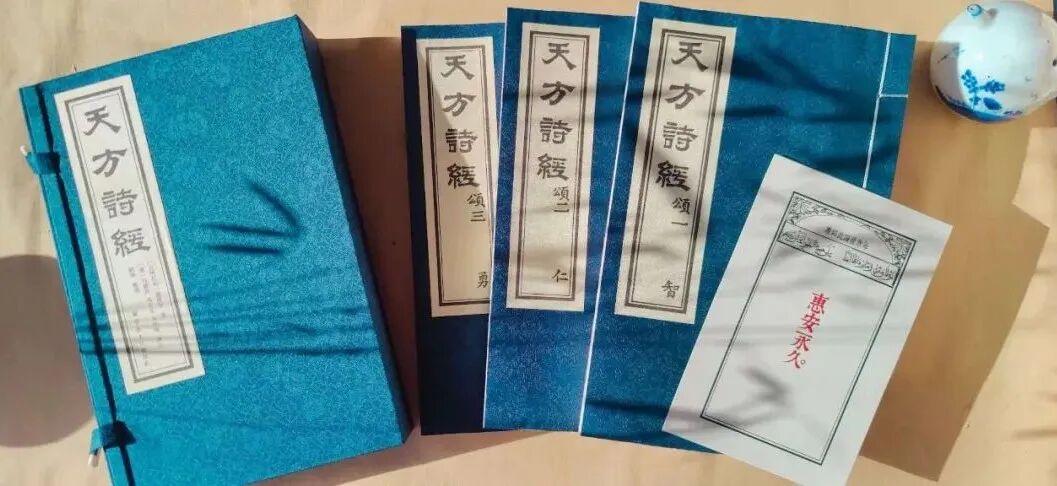
and it was published by the Baozhen Hall in Chengdu. This translation represents the scholarship and faith of several generations of scholars.
The entire book contains 161 bayt (couplets)
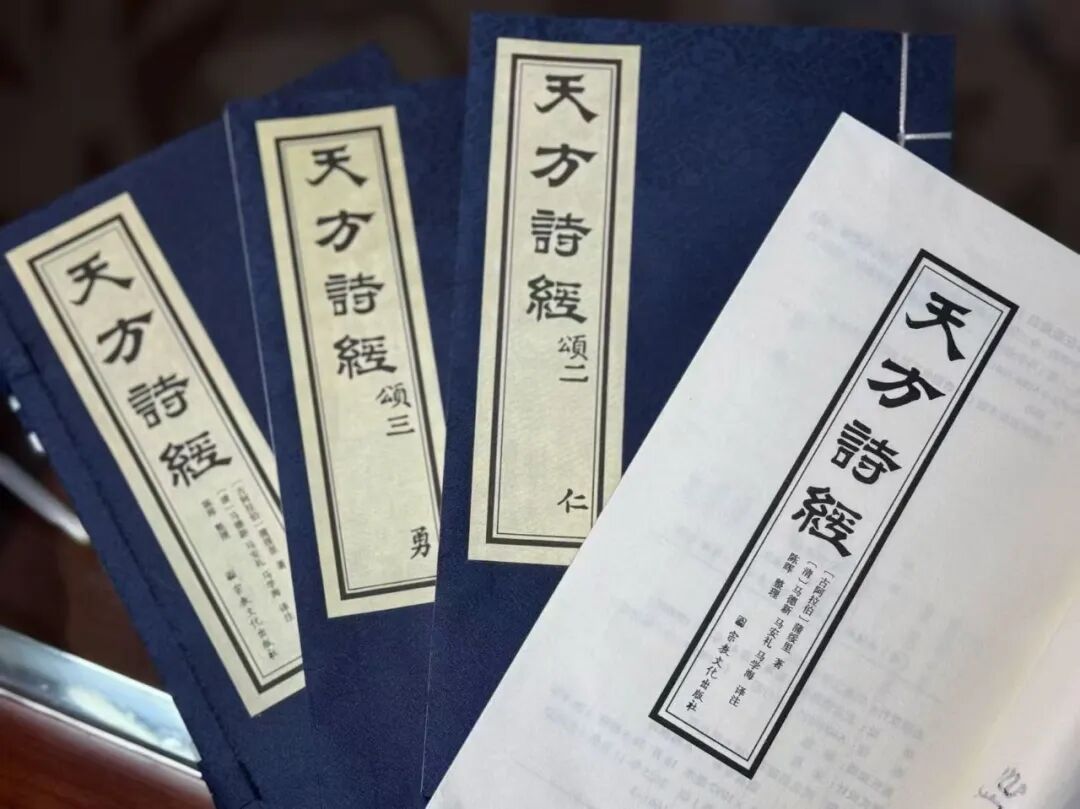
that follow the Arabic letter "mim" rhyme throughout. The poem unfolds in layers, moving from longing and awakening to praise, repentance, and dua, celebrating the perfect virtues of the Prophet Muhammad, whose inner nature and outer conduct were in harmony with Allah. The translators followed the style of the Book of Songs (Shijing) and divided the poem into three volumes: "Wisdom," "Benevolence," and "Courage."
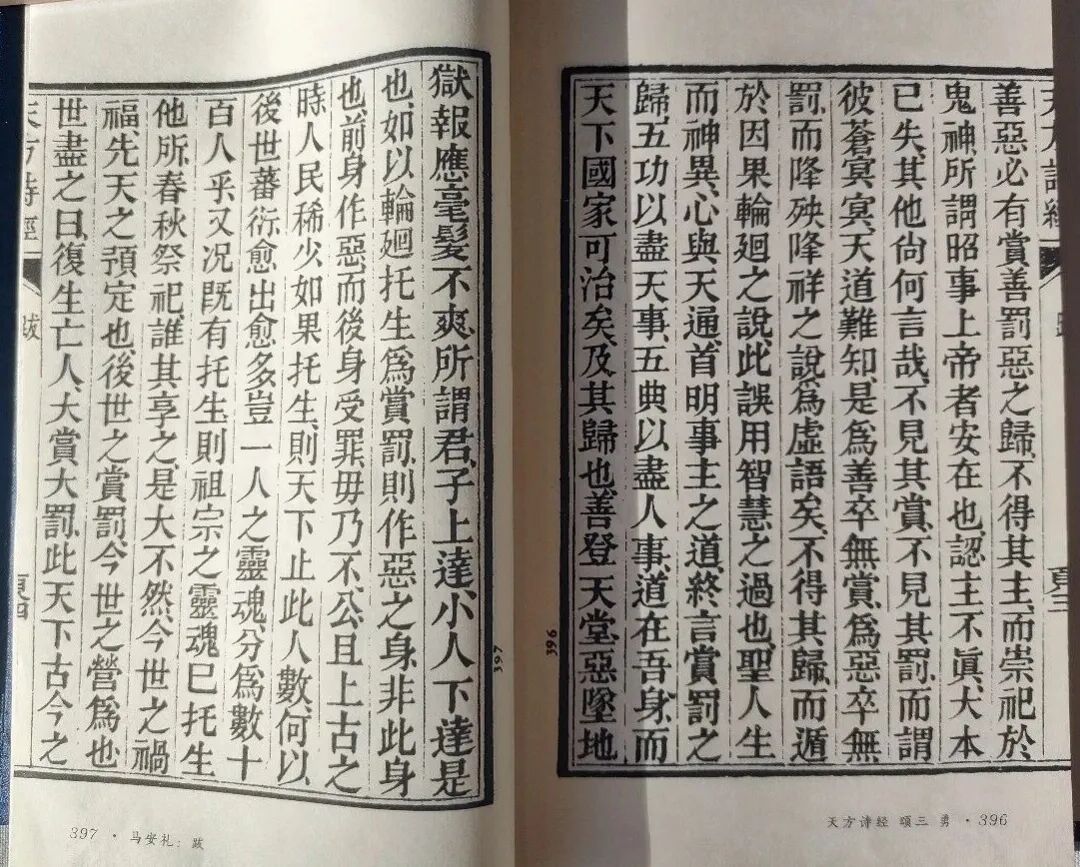
The translation uses four-character lines, four lines per stanza, with rhyming even lines, making it rhythmic and beautiful to read in Chinese.
An inside page of the Classic of Arabian Poetry (Tianfang Shijing)
What makes the Classic of Arabian Poetry (Tianfang Shijing) especially rare is that it is not just a translation of poetry; it also incorporates the commentaries of generations of scholars from the Arab world
to explain the meaning of the poem line by line, which is why it is also called the Collected Commentaries on the Burda (Geshuide Jizhu). Because of this, it can be used for both spiritual cultivation and academic study, holding both literary and intellectual value.
The Classic of Arabian Poetry (Tianfang Shijing) has been recited in China for a long time, and people often read it morning and night as a way to cultivate their spirit. The "Original Preface" in the book lists nine methods for reciting the poem, systematically explaining the rituals and mindset for reading it, turning the poetry into a bridge toward faith and practice. At the end of each chapter, the translators often explain the circumstances under which that chapter should be read. For example, the twenty-second poem says, "Whether hungry or full, guard against the harm of excess;" When suffering from hunger or feeling hurt by accumulation, the end of the collection notes says: 'This chapter and the next are for when the heart is hard or controlled by desires. On the day of congregational prayer (Friday) or during fasting, recite these two chapters again. In the early morning, you will find your heart clear and bright, your desires reduced, and you will be able to perform your daily duties, repent, and seek forgiveness. Allah will accept your sincerity.'
This shows that the 'Tianfang Shijing' (Classic of Arabian Poetry) is a book for constant reading and recitation, meant to cleanse the heart, purify one's nature, control desires, and practice one's faith.
'Tianfang Shijing' (Classic of Arabian Poetry)
Ma Dexin once sighed that this poem had long ago reached China, but because it lacked annotations, it was 'not easily understood by ordinary people,' which kept its brilliance hidden for a long time. During his pilgrimage to Mecca, he obtained an authoritative annotated version. He was determined to 'translate the poetry of the Western Regions into the language of the Eastern Land,' which finally led to the birth of this great Chinese translation.
Against the backdrop of the growing prosperity of Chinese Islamic literature in the mid-to-late Qing Dynasty, the appearance of the 'Tianfang Shijing' was especially precious. Ma Dexin believed that this poem had 'cadence in its words, profound principles, pure and sincere meaning, and deep logic.' It is not only a standard for poets but also a medicine for those who study poetry. As Ma Anli said in his 'Preface,' 'The teachings of poetry are great.' It can rectify customs, harmonize people's hearts, and help people transform themselves through the path.
Today, when we open the 'Tianfang Shijing' again, we are not just reading a religious poem; we are listening to a deep chant that crosses time and space and connects civilizations.
—One poem, one classic, and a history of the blending of Chinese and Arabic cultures.
2
Table of Contents
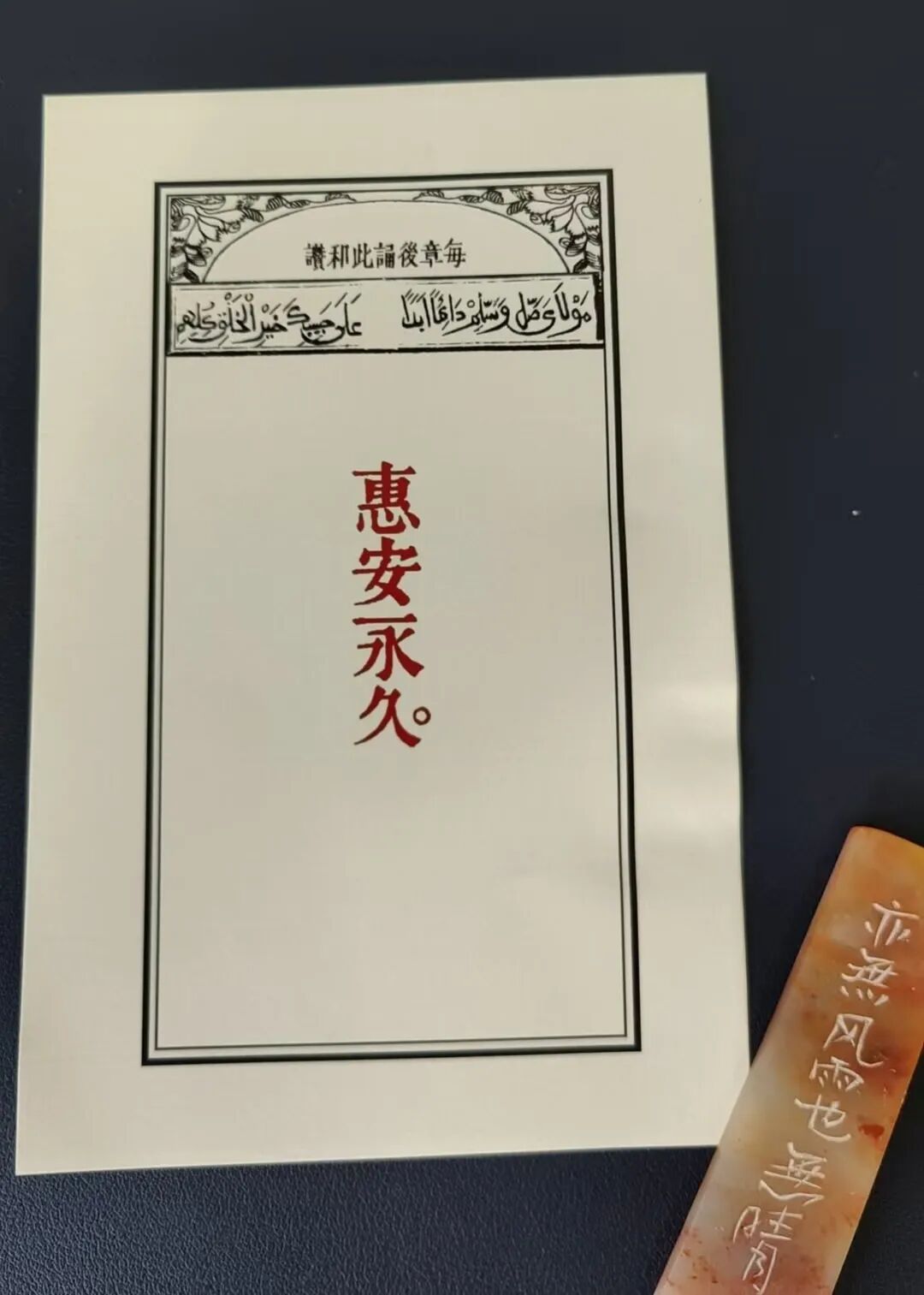
'Tianfang Shijing' Bookmark
'Tianfang Shijing' Copyright Page
'Tianfang Shijing' Table of Contents
'Tianfang Shijing' Editorial Note Signature
3
Book Title Seal
Calligrapher Wang Qifei wrote the Arabic title seal for the 'Tianfang Shijing' in the style of Yunnan Arabic calligraphy.
To thank readers for their support and attention, this book specially invited the famous calligrapher Wang Qifei to handwrite the title for the 'Tianfang Shijing.' Based on this, we created a commemorative seal included with the book as a collectible memory of this literary connection.
The title is presented in Arabic calligraphy. In his creation, Wang Qifei referred to the traditional style of Arabic calligraphy from the madrasas (jingtang) in the Yunnan region.
He combined this with the common writing and design styles of Yunnan religious book titles. This makes the work continue the local calligraphic tradition while fitting the historical atmosphere and spiritual content of the book, making it simple and elegant with a unique charm.
Wang Qifei is a calligrapher who inherits the Ottoman calligraphy art system, a visiting professor of Arabic culture at Beijing Language and Culture University, and a researcher at the OIC Research Center of Hebei University.
Mr. Wang has long been engaged in the teaching of traditional Arabic calligraphy and the collection, organization, and research of Chinese Arabic calligraphy. In recent years, I have given lectures on the history of Arabic calligraphy and taught practical calligraphy courses at universities including Beijing Language and Culture University, Tsinghua University, Beijing International Studies University, Beijing Foreign Studies University, China University of Petroleum, and Communication University of China.
4
How to purchase
To ensure this thousand-year-old cultural heritage is passed down completely and shines again, Mr. Chen Hui has spent many years working with deep respect for ancient texts. He searched for various fragments, traced their origins, compared differences, and carefully edited the text. After many challenges, he finally brought this classic back to the world in a new collector's edition. This new edition is published by the Religious Culture Press. It comes in a hard-case set, printed on high-quality rice paper (xuanzhi). The three-volume set has a clean, elegant layout, making it perfect for both study and collection.
If you love ancient books and cross-cultural stories, this set will help you connect with the history of exchange between Chinese and Arab civilizations. If you value the cultural quality of a collection, this is a treasure worth owning. Whether for reading, display, or as a gift for a friend, it is both meaningful and valuable.
This book comes in a three-volume set, printed on rice paper with a classic, antique feel. You can choose between a signed edition and a commemorative edition:
1. Signed edition: 550 yuan per set (including shipping). It includes a signature from the editor, Mr. Chen Hui, and a commemorative seal featuring the Arabic title written by calligrapher Mr. Wang Qifei.
2. Commemorative edition (only 130 sets available): 680 yuan per set (including shipping). Bonus: A single leaf from an original fragment of the "Tianfang Shijing" (Classic of Arabian Poetry) from Mr. Chen Hui's personal collection. As shown in the picture:
Fragment of the "Tianfang Shijing"
If you are interested, please contact 15901334054.
-END- view all
Summary: This book note introduces the renewed publication of Tianfang Shijing, including the classical Ode to the Imperial Robe, as a work linking Islamic literary tradition and Chinese cultural expression. It preserves the source's book details, historical references, publication context, and literary framing.
1
Introduction
In the galaxy of Islamic literature, one poem has been recited for over seven hundred years. It is considered the greatest poem praising the Prophet Muhammad, and it is the famous Arabic literary work, the Burda (al-Burda).
Its full name is al-Kawakib al-Durriyya fi Madh Khayr al-Bariyya, which means "The Glittering Stars in Praise of the Best of Creation." Chinese readers know it better by the title Robe of Honor (Gunyi Song), a work known to every household.
The author of the Classic of Arabian Poetry (Tianfang Shijing) is the famous medieval Arab poet al-Busiri
(1213–c. 1296). In the 16th year of the Guangxu reign of the Qing Dynasty (1890), the Chinese Islamic scholar Ma Dexin
guided the translation and explanation, while Ma Anli
compiled the text with the assistance of Ma Xuehai,
and it was published by the Baozhen Hall in Chengdu. This translation represents the scholarship and faith of several generations of scholars.
The entire book contains 161 bayt (couplets)
that follow the Arabic letter "mim" rhyme throughout. The poem unfolds in layers, moving from longing and awakening to praise, repentance, and dua, celebrating the perfect virtues of the Prophet Muhammad, whose inner nature and outer conduct were in harmony with Allah. The translators followed the style of the Book of Songs (Shijing) and divided the poem into three volumes: "Wisdom," "Benevolence," and "Courage."
The translation uses four-character lines, four lines per stanza, with rhyming even lines, making it rhythmic and beautiful to read in Chinese.
An inside page of the Classic of Arabian Poetry (Tianfang Shijing)
What makes the Classic of Arabian Poetry (Tianfang Shijing) especially rare is that it is not just a translation of poetry; it also incorporates the commentaries of generations of scholars from the Arab world
to explain the meaning of the poem line by line, which is why it is also called the Collected Commentaries on the Burda (Geshuide Jizhu). Because of this, it can be used for both spiritual cultivation and academic study, holding both literary and intellectual value.
The Classic of Arabian Poetry (Tianfang Shijing) has been recited in China for a long time, and people often read it morning and night as a way to cultivate their spirit. The "Original Preface" in the book lists nine methods for reciting the poem, systematically explaining the rituals and mindset for reading it, turning the poetry into a bridge toward faith and practice. At the end of each chapter, the translators often explain the circumstances under which that chapter should be read. For example, the twenty-second poem says, "Whether hungry or full, guard against the harm of excess;" When suffering from hunger or feeling hurt by accumulation, the end of the collection notes says: 'This chapter and the next are for when the heart is hard or controlled by desires. On the day of congregational prayer (Friday) or during fasting, recite these two chapters again. In the early morning, you will find your heart clear and bright, your desires reduced, and you will be able to perform your daily duties, repent, and seek forgiveness. Allah will accept your sincerity.'
This shows that the 'Tianfang Shijing' (Classic of Arabian Poetry) is a book for constant reading and recitation, meant to cleanse the heart, purify one's nature, control desires, and practice one's faith.
'Tianfang Shijing' (Classic of Arabian Poetry)
Ma Dexin once sighed that this poem had long ago reached China, but because it lacked annotations, it was 'not easily understood by ordinary people,' which kept its brilliance hidden for a long time. During his pilgrimage to Mecca, he obtained an authoritative annotated version. He was determined to 'translate the poetry of the Western Regions into the language of the Eastern Land,' which finally led to the birth of this great Chinese translation.
Against the backdrop of the growing prosperity of Chinese Islamic literature in the mid-to-late Qing Dynasty, the appearance of the 'Tianfang Shijing' was especially precious. Ma Dexin believed that this poem had 'cadence in its words, profound principles, pure and sincere meaning, and deep logic.' It is not only a standard for poets but also a medicine for those who study poetry. As Ma Anli said in his 'Preface,' 'The teachings of poetry are great.' It can rectify customs, harmonize people's hearts, and help people transform themselves through the path.
Today, when we open the 'Tianfang Shijing' again, we are not just reading a religious poem; we are listening to a deep chant that crosses time and space and connects civilizations.
—One poem, one classic, and a history of the blending of Chinese and Arabic cultures.
2
Table of Contents
'Tianfang Shijing' Bookmark
'Tianfang Shijing' Copyright Page
'Tianfang Shijing' Table of Contents
'Tianfang Shijing' Editorial Note Signature
3
Book Title Seal
Calligrapher Wang Qifei wrote the Arabic title seal for the 'Tianfang Shijing' in the style of Yunnan Arabic calligraphy.
To thank readers for their support and attention, this book specially invited the famous calligrapher Wang Qifei to handwrite the title for the 'Tianfang Shijing.' Based on this, we created a commemorative seal included with the book as a collectible memory of this literary connection.
The title is presented in Arabic calligraphy. In his creation, Wang Qifei referred to the traditional style of Arabic calligraphy from the madrasas (jingtang) in the Yunnan region.
He combined this with the common writing and design styles of Yunnan religious book titles. This makes the work continue the local calligraphic tradition while fitting the historical atmosphere and spiritual content of the book, making it simple and elegant with a unique charm.
Wang Qifei is a calligrapher who inherits the Ottoman calligraphy art system, a visiting professor of Arabic culture at Beijing Language and Culture University, and a researcher at the OIC Research Center of Hebei University.
Mr. Wang has long been engaged in the teaching of traditional Arabic calligraphy and the collection, organization, and research of Chinese Arabic calligraphy. In recent years, I have given lectures on the history of Arabic calligraphy and taught practical calligraphy courses at universities including Beijing Language and Culture University, Tsinghua University, Beijing International Studies University, Beijing Foreign Studies University, China University of Petroleum, and Communication University of China.
4
How to purchase
To ensure this thousand-year-old cultural heritage is passed down completely and shines again, Mr. Chen Hui has spent many years working with deep respect for ancient texts. He searched for various fragments, traced their origins, compared differences, and carefully edited the text. After many challenges, he finally brought this classic back to the world in a new collector's edition. This new edition is published by the Religious Culture Press. It comes in a hard-case set, printed on high-quality rice paper (xuanzhi). The three-volume set has a clean, elegant layout, making it perfect for both study and collection.
If you love ancient books and cross-cultural stories, this set will help you connect with the history of exchange between Chinese and Arab civilizations. If you value the cultural quality of a collection, this is a treasure worth owning. Whether for reading, display, or as a gift for a friend, it is both meaningful and valuable.
This book comes in a three-volume set, printed on rice paper with a classic, antique feel. You can choose between a signed edition and a commemorative edition:
1. Signed edition: 550 yuan per set (including shipping). It includes a signature from the editor, Mr. Chen Hui, and a commemorative seal featuring the Arabic title written by calligrapher Mr. Wang Qifei.
2. Commemorative edition (only 130 sets available): 680 yuan per set (including shipping). Bonus: A single leaf from an original fragment of the "Tianfang Shijing" (Classic of Arabian Poetry) from Mr. Chen Hui's personal collection. As shown in the picture:
Fragment of the "Tianfang Shijing"
If you are interested, please contact 15901334054.
-END- view all
Reposted from the web
Summary: This book note introduces the renewed publication of Tianfang Shijing, including the classical Ode to the Imperial Robe, as a work linking Islamic literary tradition and Chinese cultural expression. It preserves the source's book details, historical references, publication context, and literary framing.
1
Introduction
In the galaxy of Islamic literature, one poem has been recited for over seven hundred years. It is considered the greatest poem praising the Prophet Muhammad, and it is the famous Arabic literary work, the Burda (al-Burda).
Its full name is al-Kawakib al-Durriyya fi Madh Khayr al-Bariyya, which means "The Glittering Stars in Praise of the Best of Creation." Chinese readers know it better by the title Robe of Honor (Gunyi Song), a work known to every household.
The author of the Classic of Arabian Poetry (Tianfang Shijing) is the famous medieval Arab poet al-Busiri
(1213–c. 1296). In the 16th year of the Guangxu reign of the Qing Dynasty (1890), the Chinese Islamic scholar Ma Dexin
guided the translation and explanation, while Ma Anli
compiled the text with the assistance of Ma Xuehai,
and it was published by the Baozhen Hall in Chengdu. This translation represents the scholarship and faith of several generations of scholars.
The entire book contains 161 bayt (couplets)
that follow the Arabic letter "mim" rhyme throughout. The poem unfolds in layers, moving from longing and awakening to praise, repentance, and dua, celebrating the perfect virtues of the Prophet Muhammad, whose inner nature and outer conduct were in harmony with Allah. The translators followed the style of the Book of Songs (Shijing) and divided the poem into three volumes: "Wisdom," "Benevolence," and "Courage."
The translation uses four-character lines, four lines per stanza, with rhyming even lines, making it rhythmic and beautiful to read in Chinese.
An inside page of the Classic of Arabian Poetry (Tianfang Shijing)
What makes the Classic of Arabian Poetry (Tianfang Shijing) especially rare is that it is not just a translation of poetry; it also incorporates the commentaries of generations of scholars from the Arab world
to explain the meaning of the poem line by line, which is why it is also called the Collected Commentaries on the Burda (Geshuide Jizhu). Because of this, it can be used for both spiritual cultivation and academic study, holding both literary and intellectual value.
The Classic of Arabian Poetry (Tianfang Shijing) has been recited in China for a long time, and people often read it morning and night as a way to cultivate their spirit. The "Original Preface" in the book lists nine methods for reciting the poem, systematically explaining the rituals and mindset for reading it, turning the poetry into a bridge toward faith and practice. At the end of each chapter, the translators often explain the circumstances under which that chapter should be read. For example, the twenty-second poem says, "Whether hungry or full, guard against the harm of excess;" When suffering from hunger or feeling hurt by accumulation, the end of the collection notes says: 'This chapter and the next are for when the heart is hard or controlled by desires. On the day of congregational prayer (Friday) or during fasting, recite these two chapters again. In the early morning, you will find your heart clear and bright, your desires reduced, and you will be able to perform your daily duties, repent, and seek forgiveness. Allah will accept your sincerity.'
This shows that the 'Tianfang Shijing' (Classic of Arabian Poetry) is a book for constant reading and recitation, meant to cleanse the heart, purify one's nature, control desires, and practice one's faith.
'Tianfang Shijing' (Classic of Arabian Poetry)
Ma Dexin once sighed that this poem had long ago reached China, but because it lacked annotations, it was 'not easily understood by ordinary people,' which kept its brilliance hidden for a long time. During his pilgrimage to Mecca, he obtained an authoritative annotated version. He was determined to 'translate the poetry of the Western Regions into the language of the Eastern Land,' which finally led to the birth of this great Chinese translation.
Against the backdrop of the growing prosperity of Chinese Islamic literature in the mid-to-late Qing Dynasty, the appearance of the 'Tianfang Shijing' was especially precious. Ma Dexin believed that this poem had 'cadence in its words, profound principles, pure and sincere meaning, and deep logic.' It is not only a standard for poets but also a medicine for those who study poetry. As Ma Anli said in his 'Preface,' 'The teachings of poetry are great.' It can rectify customs, harmonize people's hearts, and help people transform themselves through the path.
Today, when we open the 'Tianfang Shijing' again, we are not just reading a religious poem; we are listening to a deep chant that crosses time and space and connects civilizations.
—One poem, one classic, and a history of the blending of Chinese and Arabic cultures.
2
Table of Contents
'Tianfang Shijing' Bookmark
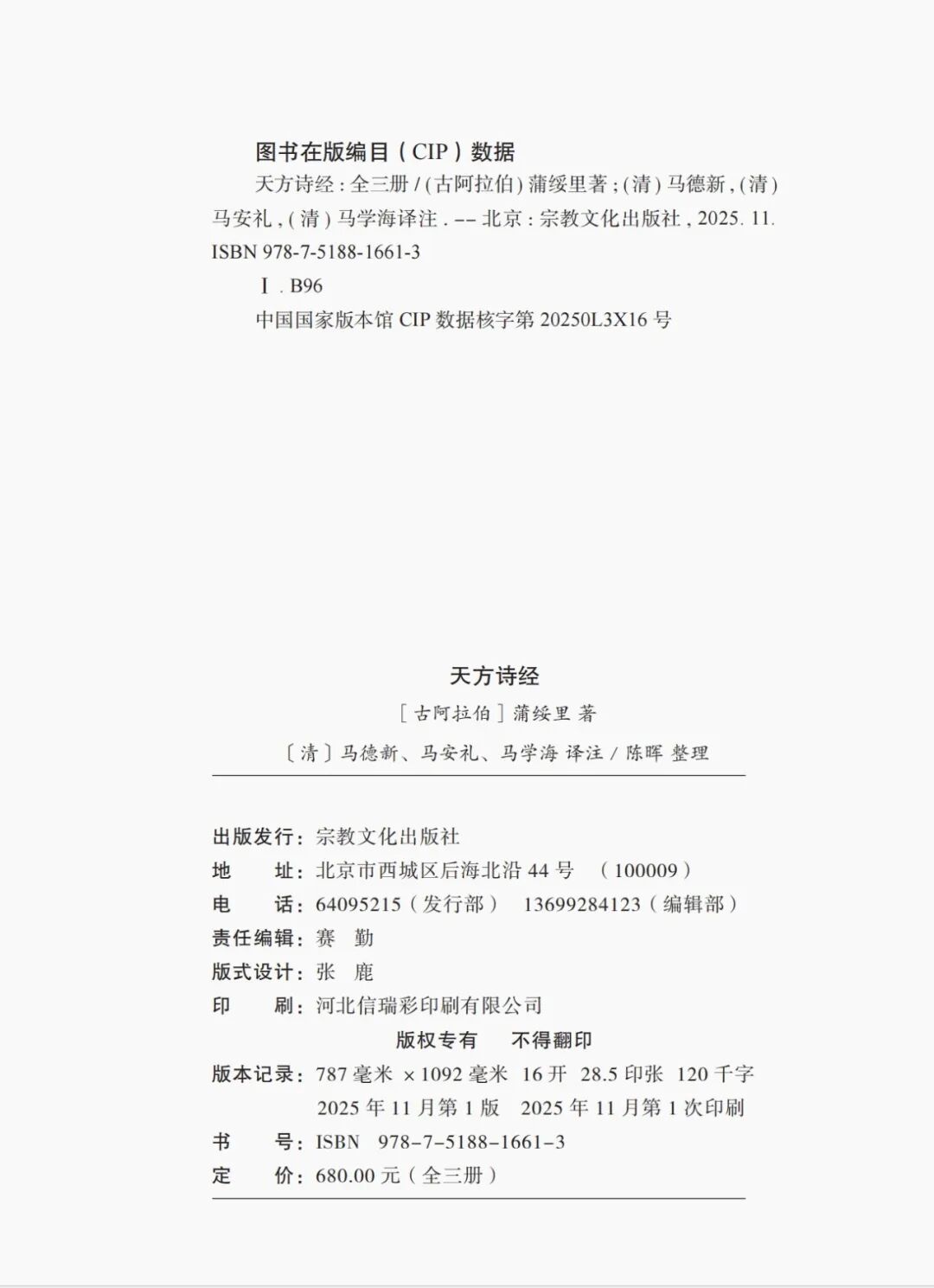
'Tianfang Shijing' Copyright Page
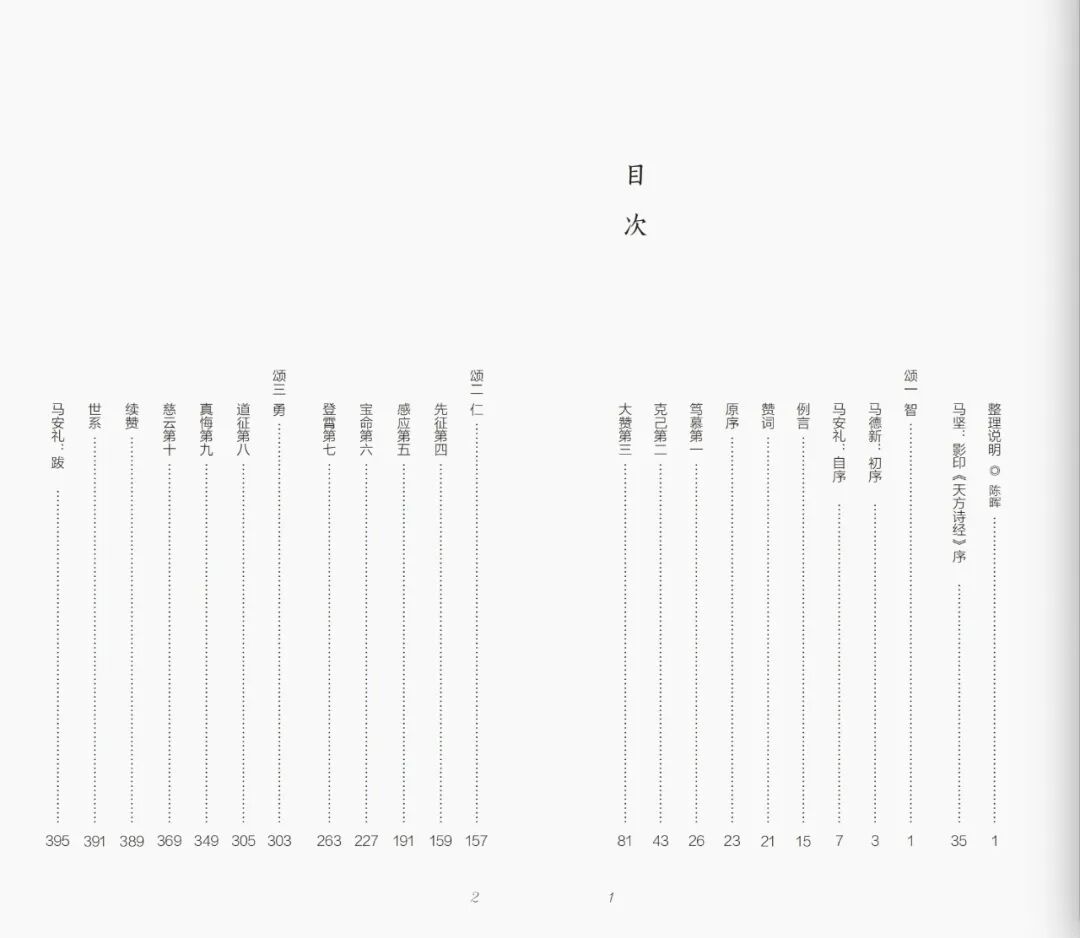
'Tianfang Shijing' Table of Contents
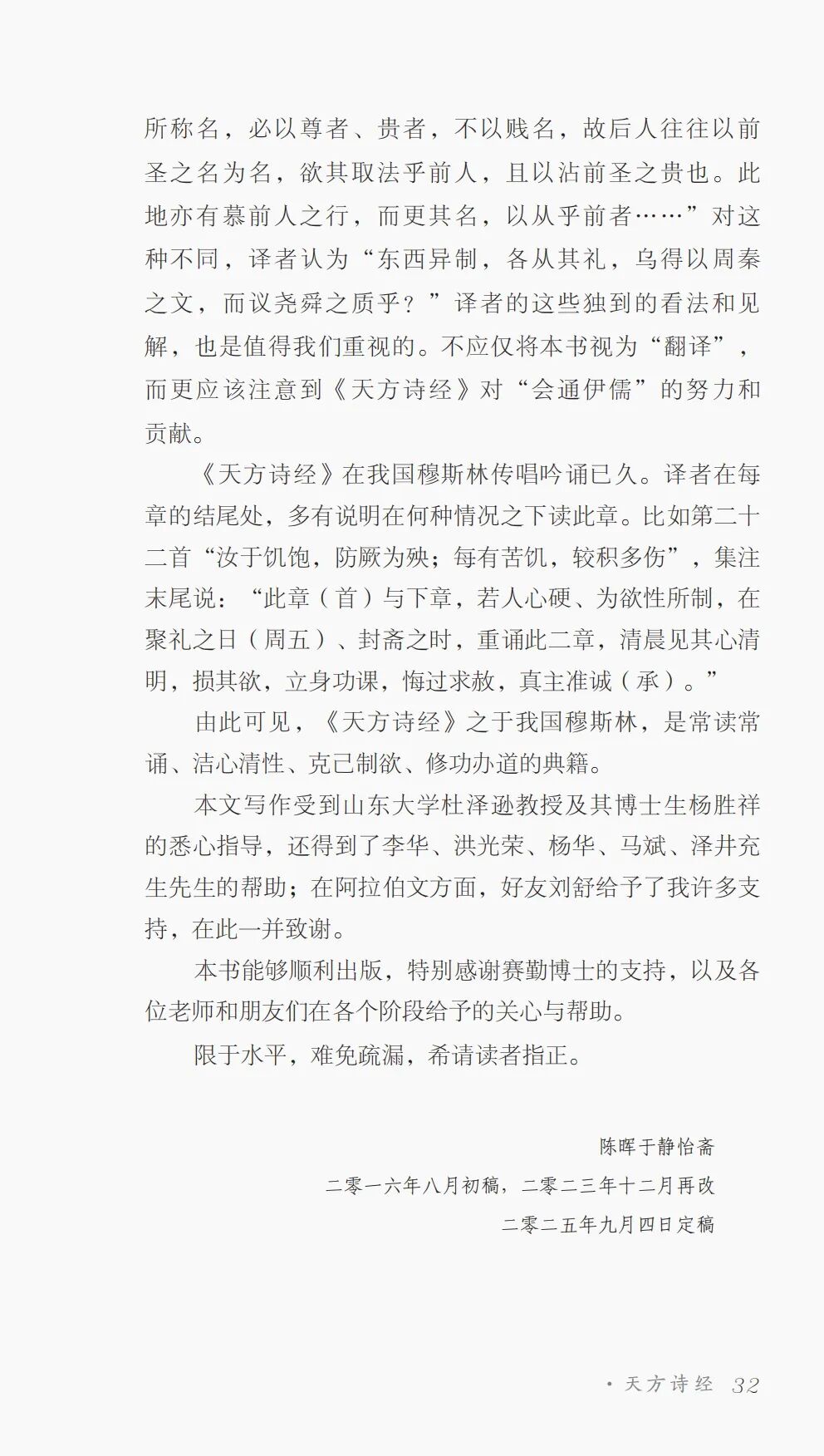
'Tianfang Shijing' Editorial Note Signature
3
Book Title Seal
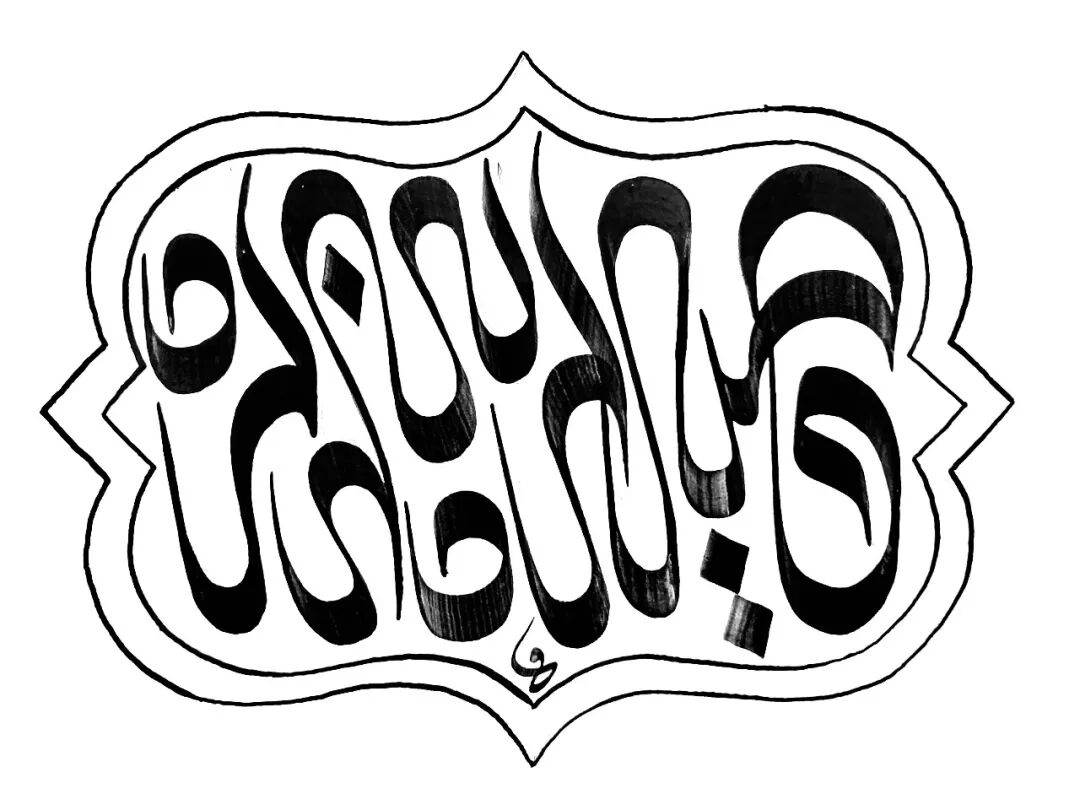
Calligrapher Wang Qifei wrote the Arabic title seal for the 'Tianfang Shijing' in the style of Yunnan Arabic calligraphy.
To thank readers for their support and attention, this book specially invited the famous calligrapher Wang Qifei to handwrite the title for the 'Tianfang Shijing.' Based on this, we created a commemorative seal included with the book as a collectible memory of this literary connection.
The title is presented in Arabic calligraphy. In his creation, Wang Qifei referred to the traditional style of Arabic calligraphy from the madrasas (jingtang) in the Yunnan region.
He combined this with the common writing and design styles of Yunnan religious book titles. This makes the work continue the local calligraphic tradition while fitting the historical atmosphere and spiritual content of the book, making it simple and elegant with a unique charm.
Wang Qifei is a calligrapher who inherits the Ottoman calligraphy art system, a visiting professor of Arabic culture at Beijing Language and Culture University, and a researcher at the OIC Research Center of Hebei University.
Mr. Wang has long been engaged in the teaching of traditional Arabic calligraphy and the collection, organization, and research of Chinese Arabic calligraphy. In recent years, I have given lectures on the history of Arabic calligraphy and taught practical calligraphy courses at universities including Beijing Language and Culture University, Tsinghua University, Beijing International Studies University, Beijing Foreign Studies University, China University of Petroleum, and Communication University of China.
4
How to purchase
To ensure this thousand-year-old cultural heritage is passed down completely and shines again, Mr. Chen Hui has spent many years working with deep respect for ancient texts. He searched for various fragments, traced their origins, compared differences, and carefully edited the text. After many challenges, he finally brought this classic back to the world in a new collector's edition. This new edition is published by the Religious Culture Press. It comes in a hard-case set, printed on high-quality rice paper (xuanzhi). The three-volume set has a clean, elegant layout, making it perfect for both study and collection.
If you love ancient books and cross-cultural stories, this set will help you connect with the history of exchange between Chinese and Arab civilizations. If you value the cultural quality of a collection, this is a treasure worth owning. Whether for reading, display, or as a gift for a friend, it is both meaningful and valuable.
This book comes in a three-volume set, printed on rice paper with a classic, antique feel. You can choose between a signed edition and a commemorative edition:
1. Signed edition: 550 yuan per set (including shipping). It includes a signature from the editor, Mr. Chen Hui, and a commemorative seal featuring the Arabic title written by calligrapher Mr. Wang Qifei.
2. Commemorative edition (only 130 sets available): 680 yuan per set (including shipping). Bonus: A single leaf from an original fragment of the "Tianfang Shijing" (Classic of Arabian Poetry) from Mr. Chen Hui's personal collection. As shown in the picture:
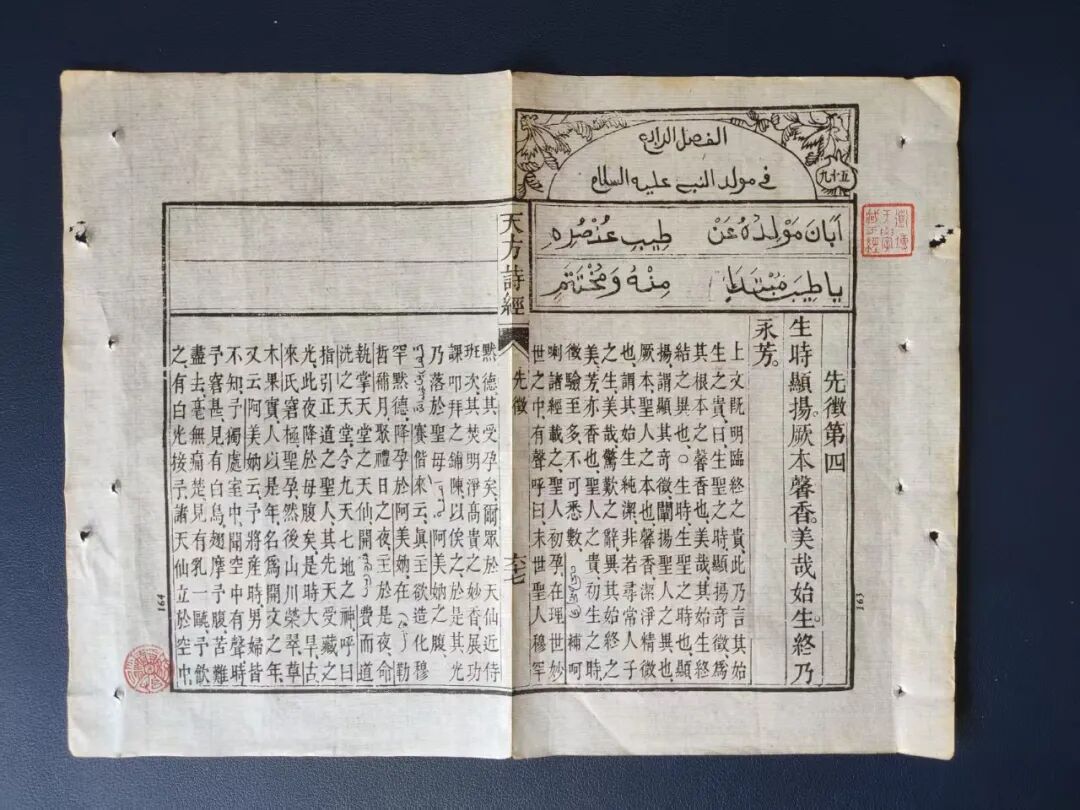
Fragment of the "Tianfang Shijing"
If you are interested, please contact 15901334054.
-END-
Summary: This book note introduces the renewed publication of Tianfang Shijing, including the classical Ode to the Imperial Robe, as a work linking Islamic literary tradition and Chinese cultural expression. It preserves the source's book details, historical references, publication context, and literary framing.
1
Introduction
In the galaxy of Islamic literature, one poem has been recited for over seven hundred years. It is considered the greatest poem praising the Prophet Muhammad, and it is the famous Arabic literary work, the Burda (al-Burda).
Its full name is al-Kawakib al-Durriyya fi Madh Khayr al-Bariyya, which means "The Glittering Stars in Praise of the Best of Creation." Chinese readers know it better by the title Robe of Honor (Gunyi Song), a work known to every household.
The author of the Classic of Arabian Poetry (Tianfang Shijing) is the famous medieval Arab poet al-Busiri
(1213–c. 1296). In the 16th year of the Guangxu reign of the Qing Dynasty (1890), the Chinese Islamic scholar Ma Dexin
guided the translation and explanation, while Ma Anli
compiled the text with the assistance of Ma Xuehai,
and it was published by the Baozhen Hall in Chengdu. This translation represents the scholarship and faith of several generations of scholars.
The entire book contains 161 bayt (couplets)
that follow the Arabic letter "mim" rhyme throughout. The poem unfolds in layers, moving from longing and awakening to praise, repentance, and dua, celebrating the perfect virtues of the Prophet Muhammad, whose inner nature and outer conduct were in harmony with Allah. The translators followed the style of the Book of Songs (Shijing) and divided the poem into three volumes: "Wisdom," "Benevolence," and "Courage."
The translation uses four-character lines, four lines per stanza, with rhyming even lines, making it rhythmic and beautiful to read in Chinese.
An inside page of the Classic of Arabian Poetry (Tianfang Shijing)
What makes the Classic of Arabian Poetry (Tianfang Shijing) especially rare is that it is not just a translation of poetry; it also incorporates the commentaries of generations of scholars from the Arab world
to explain the meaning of the poem line by line, which is why it is also called the Collected Commentaries on the Burda (Geshuide Jizhu). Because of this, it can be used for both spiritual cultivation and academic study, holding both literary and intellectual value.
The Classic of Arabian Poetry (Tianfang Shijing) has been recited in China for a long time, and people often read it morning and night as a way to cultivate their spirit. The "Original Preface" in the book lists nine methods for reciting the poem, systematically explaining the rituals and mindset for reading it, turning the poetry into a bridge toward faith and practice. At the end of each chapter, the translators often explain the circumstances under which that chapter should be read. For example, the twenty-second poem says, "Whether hungry or full, guard against the harm of excess;" When suffering from hunger or feeling hurt by accumulation, the end of the collection notes says: 'This chapter and the next are for when the heart is hard or controlled by desires. On the day of congregational prayer (Friday) or during fasting, recite these two chapters again. In the early morning, you will find your heart clear and bright, your desires reduced, and you will be able to perform your daily duties, repent, and seek forgiveness. Allah will accept your sincerity.'
This shows that the 'Tianfang Shijing' (Classic of Arabian Poetry) is a book for constant reading and recitation, meant to cleanse the heart, purify one's nature, control desires, and practice one's faith.
'Tianfang Shijing' (Classic of Arabian Poetry)
Ma Dexin once sighed that this poem had long ago reached China, but because it lacked annotations, it was 'not easily understood by ordinary people,' which kept its brilliance hidden for a long time. During his pilgrimage to Mecca, he obtained an authoritative annotated version. He was determined to 'translate the poetry of the Western Regions into the language of the Eastern Land,' which finally led to the birth of this great Chinese translation.
Against the backdrop of the growing prosperity of Chinese Islamic literature in the mid-to-late Qing Dynasty, the appearance of the 'Tianfang Shijing' was especially precious. Ma Dexin believed that this poem had 'cadence in its words, profound principles, pure and sincere meaning, and deep logic.' It is not only a standard for poets but also a medicine for those who study poetry. As Ma Anli said in his 'Preface,' 'The teachings of poetry are great.' It can rectify customs, harmonize people's hearts, and help people transform themselves through the path.
Today, when we open the 'Tianfang Shijing' again, we are not just reading a religious poem; we are listening to a deep chant that crosses time and space and connects civilizations.
—One poem, one classic, and a history of the blending of Chinese and Arabic cultures.
2
Table of Contents
'Tianfang Shijing' Bookmark
'Tianfang Shijing' Copyright Page
'Tianfang Shijing' Table of Contents
'Tianfang Shijing' Editorial Note Signature
3
Book Title Seal
Calligrapher Wang Qifei wrote the Arabic title seal for the 'Tianfang Shijing' in the style of Yunnan Arabic calligraphy.
To thank readers for their support and attention, this book specially invited the famous calligrapher Wang Qifei to handwrite the title for the 'Tianfang Shijing.' Based on this, we created a commemorative seal included with the book as a collectible memory of this literary connection.
The title is presented in Arabic calligraphy. In his creation, Wang Qifei referred to the traditional style of Arabic calligraphy from the madrasas (jingtang) in the Yunnan region.
He combined this with the common writing and design styles of Yunnan religious book titles. This makes the work continue the local calligraphic tradition while fitting the historical atmosphere and spiritual content of the book, making it simple and elegant with a unique charm.
Wang Qifei is a calligrapher who inherits the Ottoman calligraphy art system, a visiting professor of Arabic culture at Beijing Language and Culture University, and a researcher at the OIC Research Center of Hebei University.
Mr. Wang has long been engaged in the teaching of traditional Arabic calligraphy and the collection, organization, and research of Chinese Arabic calligraphy. In recent years, I have given lectures on the history of Arabic calligraphy and taught practical calligraphy courses at universities including Beijing Language and Culture University, Tsinghua University, Beijing International Studies University, Beijing Foreign Studies University, China University of Petroleum, and Communication University of China.
4
How to purchase
To ensure this thousand-year-old cultural heritage is passed down completely and shines again, Mr. Chen Hui has spent many years working with deep respect for ancient texts. He searched for various fragments, traced their origins, compared differences, and carefully edited the text. After many challenges, he finally brought this classic back to the world in a new collector's edition. This new edition is published by the Religious Culture Press. It comes in a hard-case set, printed on high-quality rice paper (xuanzhi). The three-volume set has a clean, elegant layout, making it perfect for both study and collection.
If you love ancient books and cross-cultural stories, this set will help you connect with the history of exchange between Chinese and Arab civilizations. If you value the cultural quality of a collection, this is a treasure worth owning. Whether for reading, display, or as a gift for a friend, it is both meaningful and valuable.
This book comes in a three-volume set, printed on rice paper with a classic, antique feel. You can choose between a signed edition and a commemorative edition:
1. Signed edition: 550 yuan per set (including shipping). It includes a signature from the editor, Mr. Chen Hui, and a commemorative seal featuring the Arabic title written by calligrapher Mr. Wang Qifei.
2. Commemorative edition (only 130 sets available): 680 yuan per set (including shipping). Bonus: A single leaf from an original fragment of the "Tianfang Shijing" (Classic of Arabian Poetry) from Mr. Chen Hui's personal collection. As shown in the picture:
Fragment of the "Tianfang Shijing"
If you are interested, please contact 15901334054.
-END-
Muslim Knowledge Guide China: Tianfang Shijing, Islamic Literature and Cross-Cultural Poetry
Articles • yusuf908 posted the article • 0 comments • 263 views • 2026-05-23 23:30
Reposted from the web
Summary: This book note introduces the renewed publication of Tianfang Shijing, including the classical Ode to the Imperial Robe, as a work linking Islamic literary tradition and Chinese cultural expression. It preserves the source's book details, historical references, publication context, and literary framing.
1
Introduction
In the galaxy of Islamic literature, one poem has been recited for over seven hundred years. It is considered the greatest poem praising the Prophet Muhammad, and it is the famous Arabic literary work, the Burda (al-Burda).
Its full name is al-Kawakib al-Durriyya fi Madh Khayr al-Bariyya, which means "The Glittering Stars in Praise of the Best of Creation." Chinese readers know it better by the title Robe of Honor (Gunyi Song), a work known to every household.
The author of the Classic of Arabian Poetry (Tianfang Shijing) is the famous medieval Arab poet al-Busiri
(1213–c. 1296). In the 16th year of the Guangxu reign of the Qing Dynasty (1890), the Chinese Islamic scholar Ma Dexin
guided the translation and explanation, while Ma Anli
compiled the text with the assistance of Ma Xuehai,
and it was published by the Baozhen Hall in Chengdu. This translation represents the scholarship and faith of several generations of scholars.
The entire book contains 161 bayt (couplets)
that follow the Arabic letter "mim" rhyme throughout. The poem unfolds in layers, moving from longing and awakening to praise, repentance, and dua, celebrating the perfect virtues of the Prophet Muhammad, whose inner nature and outer conduct were in harmony with Allah. The translators followed the style of the Book of Songs (Shijing) and divided the poem into three volumes: "Wisdom," "Benevolence," and "Courage."
The translation uses four-character lines, four lines per stanza, with rhyming even lines, making it rhythmic and beautiful to read in Chinese.
An inside page of the Classic of Arabian Poetry (Tianfang Shijing)
What makes the Classic of Arabian Poetry (Tianfang Shijing) especially rare is that it is not just a translation of poetry; it also incorporates the commentaries of generations of scholars from the Arab world
to explain the meaning of the poem line by line, which is why it is also called the Collected Commentaries on the Burda (Geshuide Jizhu). Because of this, it can be used for both spiritual cultivation and academic study, holding both literary and intellectual value.
The Classic of Arabian Poetry (Tianfang Shijing) has been recited in China for a long time, and people often read it morning and night as a way to cultivate their spirit. The "Original Preface" in the book lists nine methods for reciting the poem, systematically explaining the rituals and mindset for reading it, turning the poetry into a bridge toward faith and practice. At the end of each chapter, the translators often explain the circumstances under which that chapter should be read. For example, the twenty-second poem says, "Whether hungry or full, guard against the harm of excess;" When suffering from hunger or feeling hurt by accumulation, the end of the collection notes says: 'This chapter and the next are for when the heart is hard or controlled by desires. On the day of congregational prayer (Friday) or during fasting, recite these two chapters again. In the early morning, you will find your heart clear and bright, your desires reduced, and you will be able to perform your daily duties, repent, and seek forgiveness. Allah will accept your sincerity.'
This shows that the 'Tianfang Shijing' (Classic of Arabian Poetry) is a book for constant reading and recitation, meant to cleanse the heart, purify one's nature, control desires, and practice one's faith.
'Tianfang Shijing' (Classic of Arabian Poetry)
Ma Dexin once sighed that this poem had long ago reached China, but because it lacked annotations, it was 'not easily understood by ordinary people,' which kept its brilliance hidden for a long time. During his pilgrimage to Mecca, he obtained an authoritative annotated version. He was determined to 'translate the poetry of the Western Regions into the language of the Eastern Land,' which finally led to the birth of this great Chinese translation.
Against the backdrop of the growing prosperity of Chinese Islamic literature in the mid-to-late Qing Dynasty, the appearance of the 'Tianfang Shijing' was especially precious. Ma Dexin believed that this poem had 'cadence in its words, profound principles, pure and sincere meaning, and deep logic.' It is not only a standard for poets but also a medicine for those who study poetry. As Ma Anli said in his 'Preface,' 'The teachings of poetry are great.' It can rectify customs, harmonize people's hearts, and help people transform themselves through the path.
Today, when we open the 'Tianfang Shijing' again, we are not just reading a religious poem; we are listening to a deep chant that crosses time and space and connects civilizations.
—One poem, one classic, and a history of the blending of Chinese and Arabic cultures.
2
Table of Contents
'Tianfang Shijing' Bookmark
'Tianfang Shijing' Copyright Page
'Tianfang Shijing' Table of Contents
'Tianfang Shijing' Editorial Note Signature
3
Book Title Seal
Calligrapher Wang Qifei wrote the Arabic title seal for the 'Tianfang Shijing' in the style of Yunnan Arabic calligraphy.
To thank readers for their support and attention, this book specially invited the famous calligrapher Wang Qifei to handwrite the title for the 'Tianfang Shijing.' Based on this, we created a commemorative seal included with the book as a collectible memory of this literary connection.
The title is presented in Arabic calligraphy. In his creation, Wang Qifei referred to the traditional style of Arabic calligraphy from the madrasas (jingtang) in the Yunnan region.
He combined this with the common writing and design styles of Yunnan religious book titles. This makes the work continue the local calligraphic tradition while fitting the historical atmosphere and spiritual content of the book, making it simple and elegant with a unique charm.
Wang Qifei is a calligrapher who inherits the Ottoman calligraphy art system, a visiting professor of Arabic culture at Beijing Language and Culture University, and a researcher at the OIC Research Center of Hebei University.
Mr. Wang has long been engaged in the teaching of traditional Arabic calligraphy and the collection, organization, and research of Chinese Arabic calligraphy. In recent years, I have given lectures on the history of Arabic calligraphy and taught practical calligraphy courses at universities including Beijing Language and Culture University, Tsinghua University, Beijing International Studies University, Beijing Foreign Studies University, China University of Petroleum, and Communication University of China.
4
How to purchase
To ensure this thousand-year-old cultural heritage is passed down completely and shines again, Mr. Chen Hui has spent many years working with deep respect for ancient texts. He searched for various fragments, traced their origins, compared differences, and carefully edited the text. After many challenges, he finally brought this classic back to the world in a new collector's edition. This new edition is published by the Religious Culture Press. It comes in a hard-case set, printed on high-quality rice paper (xuanzhi). The three-volume set has a clean, elegant layout, making it perfect for both study and collection.
If you love ancient books and cross-cultural stories, this set will help you connect with the history of exchange between Chinese and Arab civilizations. If you value the cultural quality of a collection, this is a treasure worth owning. Whether for reading, display, or as a gift for a friend, it is both meaningful and valuable.
This book comes in a three-volume set, printed on rice paper with a classic, antique feel. You can choose between a signed edition and a commemorative edition:
1. Signed edition: 550 yuan per set (including shipping). It includes a signature from the editor, Mr. Chen Hui, and a commemorative seal featuring the Arabic title written by calligrapher Mr. Wang Qifei.
2. Commemorative edition (only 130 sets available): 680 yuan per set (including shipping). Bonus: A single leaf from an original fragment of the "Tianfang Shijing" (Classic of Arabian Poetry) from Mr. Chen Hui's personal collection. As shown in the picture:
Fragment of the "Tianfang Shijing"
If you are interested, please contact 15901334054.
-END- view all
Summary: This book note introduces the renewed publication of Tianfang Shijing, including the classical Ode to the Imperial Robe, as a work linking Islamic literary tradition and Chinese cultural expression. It preserves the source's book details, historical references, publication context, and literary framing.
1
Introduction
In the galaxy of Islamic literature, one poem has been recited for over seven hundred years. It is considered the greatest poem praising the Prophet Muhammad, and it is the famous Arabic literary work, the Burda (al-Burda).
Its full name is al-Kawakib al-Durriyya fi Madh Khayr al-Bariyya, which means "The Glittering Stars in Praise of the Best of Creation." Chinese readers know it better by the title Robe of Honor (Gunyi Song), a work known to every household.
The author of the Classic of Arabian Poetry (Tianfang Shijing) is the famous medieval Arab poet al-Busiri
(1213–c. 1296). In the 16th year of the Guangxu reign of the Qing Dynasty (1890), the Chinese Islamic scholar Ma Dexin
guided the translation and explanation, while Ma Anli
compiled the text with the assistance of Ma Xuehai,
and it was published by the Baozhen Hall in Chengdu. This translation represents the scholarship and faith of several generations of scholars.
The entire book contains 161 bayt (couplets)
that follow the Arabic letter "mim" rhyme throughout. The poem unfolds in layers, moving from longing and awakening to praise, repentance, and dua, celebrating the perfect virtues of the Prophet Muhammad, whose inner nature and outer conduct were in harmony with Allah. The translators followed the style of the Book of Songs (Shijing) and divided the poem into three volumes: "Wisdom," "Benevolence," and "Courage."
The translation uses four-character lines, four lines per stanza, with rhyming even lines, making it rhythmic and beautiful to read in Chinese.
An inside page of the Classic of Arabian Poetry (Tianfang Shijing)
What makes the Classic of Arabian Poetry (Tianfang Shijing) especially rare is that it is not just a translation of poetry; it also incorporates the commentaries of generations of scholars from the Arab world
to explain the meaning of the poem line by line, which is why it is also called the Collected Commentaries on the Burda (Geshuide Jizhu). Because of this, it can be used for both spiritual cultivation and academic study, holding both literary and intellectual value.
The Classic of Arabian Poetry (Tianfang Shijing) has been recited in China for a long time, and people often read it morning and night as a way to cultivate their spirit. The "Original Preface" in the book lists nine methods for reciting the poem, systematically explaining the rituals and mindset for reading it, turning the poetry into a bridge toward faith and practice. At the end of each chapter, the translators often explain the circumstances under which that chapter should be read. For example, the twenty-second poem says, "Whether hungry or full, guard against the harm of excess;" When suffering from hunger or feeling hurt by accumulation, the end of the collection notes says: 'This chapter and the next are for when the heart is hard or controlled by desires. On the day of congregational prayer (Friday) or during fasting, recite these two chapters again. In the early morning, you will find your heart clear and bright, your desires reduced, and you will be able to perform your daily duties, repent, and seek forgiveness. Allah will accept your sincerity.'
This shows that the 'Tianfang Shijing' (Classic of Arabian Poetry) is a book for constant reading and recitation, meant to cleanse the heart, purify one's nature, control desires, and practice one's faith.
'Tianfang Shijing' (Classic of Arabian Poetry)
Ma Dexin once sighed that this poem had long ago reached China, but because it lacked annotations, it was 'not easily understood by ordinary people,' which kept its brilliance hidden for a long time. During his pilgrimage to Mecca, he obtained an authoritative annotated version. He was determined to 'translate the poetry of the Western Regions into the language of the Eastern Land,' which finally led to the birth of this great Chinese translation.
Against the backdrop of the growing prosperity of Chinese Islamic literature in the mid-to-late Qing Dynasty, the appearance of the 'Tianfang Shijing' was especially precious. Ma Dexin believed that this poem had 'cadence in its words, profound principles, pure and sincere meaning, and deep logic.' It is not only a standard for poets but also a medicine for those who study poetry. As Ma Anli said in his 'Preface,' 'The teachings of poetry are great.' It can rectify customs, harmonize people's hearts, and help people transform themselves through the path.
Today, when we open the 'Tianfang Shijing' again, we are not just reading a religious poem; we are listening to a deep chant that crosses time and space and connects civilizations.
—One poem, one classic, and a history of the blending of Chinese and Arabic cultures.
2
Table of Contents
'Tianfang Shijing' Bookmark
'Tianfang Shijing' Copyright Page
'Tianfang Shijing' Table of Contents
'Tianfang Shijing' Editorial Note Signature
3
Book Title Seal
Calligrapher Wang Qifei wrote the Arabic title seal for the 'Tianfang Shijing' in the style of Yunnan Arabic calligraphy.
To thank readers for their support and attention, this book specially invited the famous calligrapher Wang Qifei to handwrite the title for the 'Tianfang Shijing.' Based on this, we created a commemorative seal included with the book as a collectible memory of this literary connection.
The title is presented in Arabic calligraphy. In his creation, Wang Qifei referred to the traditional style of Arabic calligraphy from the madrasas (jingtang) in the Yunnan region.
He combined this with the common writing and design styles of Yunnan religious book titles. This makes the work continue the local calligraphic tradition while fitting the historical atmosphere and spiritual content of the book, making it simple and elegant with a unique charm.
Wang Qifei is a calligrapher who inherits the Ottoman calligraphy art system, a visiting professor of Arabic culture at Beijing Language and Culture University, and a researcher at the OIC Research Center of Hebei University.
Mr. Wang has long been engaged in the teaching of traditional Arabic calligraphy and the collection, organization, and research of Chinese Arabic calligraphy. In recent years, I have given lectures on the history of Arabic calligraphy and taught practical calligraphy courses at universities including Beijing Language and Culture University, Tsinghua University, Beijing International Studies University, Beijing Foreign Studies University, China University of Petroleum, and Communication University of China.
4
How to purchase
To ensure this thousand-year-old cultural heritage is passed down completely and shines again, Mr. Chen Hui has spent many years working with deep respect for ancient texts. He searched for various fragments, traced their origins, compared differences, and carefully edited the text. After many challenges, he finally brought this classic back to the world in a new collector's edition. This new edition is published by the Religious Culture Press. It comes in a hard-case set, printed on high-quality rice paper (xuanzhi). The three-volume set has a clean, elegant layout, making it perfect for both study and collection.
If you love ancient books and cross-cultural stories, this set will help you connect with the history of exchange between Chinese and Arab civilizations. If you value the cultural quality of a collection, this is a treasure worth owning. Whether for reading, display, or as a gift for a friend, it is both meaningful and valuable.
This book comes in a three-volume set, printed on rice paper with a classic, antique feel. You can choose between a signed edition and a commemorative edition:
1. Signed edition: 550 yuan per set (including shipping). It includes a signature from the editor, Mr. Chen Hui, and a commemorative seal featuring the Arabic title written by calligrapher Mr. Wang Qifei.
2. Commemorative edition (only 130 sets available): 680 yuan per set (including shipping). Bonus: A single leaf from an original fragment of the "Tianfang Shijing" (Classic of Arabian Poetry) from Mr. Chen Hui's personal collection. As shown in the picture:
Fragment of the "Tianfang Shijing"
If you are interested, please contact 15901334054.
-END- view all
Reposted from the web
Summary: This book note introduces the renewed publication of Tianfang Shijing, including the classical Ode to the Imperial Robe, as a work linking Islamic literary tradition and Chinese cultural expression. It preserves the source's book details, historical references, publication context, and literary framing.
1
Introduction
In the galaxy of Islamic literature, one poem has been recited for over seven hundred years. It is considered the greatest poem praising the Prophet Muhammad, and it is the famous Arabic literary work, the Burda (al-Burda).
Its full name is al-Kawakib al-Durriyya fi Madh Khayr al-Bariyya, which means "The Glittering Stars in Praise of the Best of Creation." Chinese readers know it better by the title Robe of Honor (Gunyi Song), a work known to every household.
The author of the Classic of Arabian Poetry (Tianfang Shijing) is the famous medieval Arab poet al-Busiri
(1213–c. 1296). In the 16th year of the Guangxu reign of the Qing Dynasty (1890), the Chinese Islamic scholar Ma Dexin
guided the translation and explanation, while Ma Anli
compiled the text with the assistance of Ma Xuehai,
and it was published by the Baozhen Hall in Chengdu. This translation represents the scholarship and faith of several generations of scholars.
The entire book contains 161 bayt (couplets)
that follow the Arabic letter "mim" rhyme throughout. The poem unfolds in layers, moving from longing and awakening to praise, repentance, and dua, celebrating the perfect virtues of the Prophet Muhammad, whose inner nature and outer conduct were in harmony with Allah. The translators followed the style of the Book of Songs (Shijing) and divided the poem into three volumes: "Wisdom," "Benevolence," and "Courage."
The translation uses four-character lines, four lines per stanza, with rhyming even lines, making it rhythmic and beautiful to read in Chinese.
An inside page of the Classic of Arabian Poetry (Tianfang Shijing)
What makes the Classic of Arabian Poetry (Tianfang Shijing) especially rare is that it is not just a translation of poetry; it also incorporates the commentaries of generations of scholars from the Arab world
to explain the meaning of the poem line by line, which is why it is also called the Collected Commentaries on the Burda (Geshuide Jizhu). Because of this, it can be used for both spiritual cultivation and academic study, holding both literary and intellectual value.
The Classic of Arabian Poetry (Tianfang Shijing) has been recited in China for a long time, and people often read it morning and night as a way to cultivate their spirit. The "Original Preface" in the book lists nine methods for reciting the poem, systematically explaining the rituals and mindset for reading it, turning the poetry into a bridge toward faith and practice. At the end of each chapter, the translators often explain the circumstances under which that chapter should be read. For example, the twenty-second poem says, "Whether hungry or full, guard against the harm of excess;" When suffering from hunger or feeling hurt by accumulation, the end of the collection notes says: 'This chapter and the next are for when the heart is hard or controlled by desires. On the day of congregational prayer (Friday) or during fasting, recite these two chapters again. In the early morning, you will find your heart clear and bright, your desires reduced, and you will be able to perform your daily duties, repent, and seek forgiveness. Allah will accept your sincerity.'
This shows that the 'Tianfang Shijing' (Classic of Arabian Poetry) is a book for constant reading and recitation, meant to cleanse the heart, purify one's nature, control desires, and practice one's faith.
'Tianfang Shijing' (Classic of Arabian Poetry)
Ma Dexin once sighed that this poem had long ago reached China, but because it lacked annotations, it was 'not easily understood by ordinary people,' which kept its brilliance hidden for a long time. During his pilgrimage to Mecca, he obtained an authoritative annotated version. He was determined to 'translate the poetry of the Western Regions into the language of the Eastern Land,' which finally led to the birth of this great Chinese translation.
Against the backdrop of the growing prosperity of Chinese Islamic literature in the mid-to-late Qing Dynasty, the appearance of the 'Tianfang Shijing' was especially precious. Ma Dexin believed that this poem had 'cadence in its words, profound principles, pure and sincere meaning, and deep logic.' It is not only a standard for poets but also a medicine for those who study poetry. As Ma Anli said in his 'Preface,' 'The teachings of poetry are great.' It can rectify customs, harmonize people's hearts, and help people transform themselves through the path.
Today, when we open the 'Tianfang Shijing' again, we are not just reading a religious poem; we are listening to a deep chant that crosses time and space and connects civilizations.
—One poem, one classic, and a history of the blending of Chinese and Arabic cultures.
2
Table of Contents
'Tianfang Shijing' Bookmark
'Tianfang Shijing' Copyright Page
'Tianfang Shijing' Table of Contents
'Tianfang Shijing' Editorial Note Signature
3
Book Title Seal
Calligrapher Wang Qifei wrote the Arabic title seal for the 'Tianfang Shijing' in the style of Yunnan Arabic calligraphy.
To thank readers for their support and attention, this book specially invited the famous calligrapher Wang Qifei to handwrite the title for the 'Tianfang Shijing.' Based on this, we created a commemorative seal included with the book as a collectible memory of this literary connection.
The title is presented in Arabic calligraphy. In his creation, Wang Qifei referred to the traditional style of Arabic calligraphy from the madrasas (jingtang) in the Yunnan region.
He combined this with the common writing and design styles of Yunnan religious book titles. This makes the work continue the local calligraphic tradition while fitting the historical atmosphere and spiritual content of the book, making it simple and elegant with a unique charm.
Wang Qifei is a calligrapher who inherits the Ottoman calligraphy art system, a visiting professor of Arabic culture at Beijing Language and Culture University, and a researcher at the OIC Research Center of Hebei University.
Mr. Wang has long been engaged in the teaching of traditional Arabic calligraphy and the collection, organization, and research of Chinese Arabic calligraphy. In recent years, I have given lectures on the history of Arabic calligraphy and taught practical calligraphy courses at universities including Beijing Language and Culture University, Tsinghua University, Beijing International Studies University, Beijing Foreign Studies University, China University of Petroleum, and Communication University of China.
4
How to purchase
To ensure this thousand-year-old cultural heritage is passed down completely and shines again, Mr. Chen Hui has spent many years working with deep respect for ancient texts. He searched for various fragments, traced their origins, compared differences, and carefully edited the text. After many challenges, he finally brought this classic back to the world in a new collector's edition. This new edition is published by the Religious Culture Press. It comes in a hard-case set, printed on high-quality rice paper (xuanzhi). The three-volume set has a clean, elegant layout, making it perfect for both study and collection.
If you love ancient books and cross-cultural stories, this set will help you connect with the history of exchange between Chinese and Arab civilizations. If you value the cultural quality of a collection, this is a treasure worth owning. Whether for reading, display, or as a gift for a friend, it is both meaningful and valuable.
This book comes in a three-volume set, printed on rice paper with a classic, antique feel. You can choose between a signed edition and a commemorative edition:
1. Signed edition: 550 yuan per set (including shipping). It includes a signature from the editor, Mr. Chen Hui, and a commemorative seal featuring the Arabic title written by calligrapher Mr. Wang Qifei.
2. Commemorative edition (only 130 sets available): 680 yuan per set (including shipping). Bonus: A single leaf from an original fragment of the "Tianfang Shijing" (Classic of Arabian Poetry) from Mr. Chen Hui's personal collection. As shown in the picture:
Fragment of the "Tianfang Shijing"
If you are interested, please contact 15901334054.
-END-
Summary: This book note introduces the renewed publication of Tianfang Shijing, including the classical Ode to the Imperial Robe, as a work linking Islamic literary tradition and Chinese cultural expression. It preserves the source's book details, historical references, publication context, and literary framing.
1
Introduction
In the galaxy of Islamic literature, one poem has been recited for over seven hundred years. It is considered the greatest poem praising the Prophet Muhammad, and it is the famous Arabic literary work, the Burda (al-Burda).
Its full name is al-Kawakib al-Durriyya fi Madh Khayr al-Bariyya, which means "The Glittering Stars in Praise of the Best of Creation." Chinese readers know it better by the title Robe of Honor (Gunyi Song), a work known to every household.
The author of the Classic of Arabian Poetry (Tianfang Shijing) is the famous medieval Arab poet al-Busiri
(1213–c. 1296). In the 16th year of the Guangxu reign of the Qing Dynasty (1890), the Chinese Islamic scholar Ma Dexin
guided the translation and explanation, while Ma Anli
compiled the text with the assistance of Ma Xuehai,
and it was published by the Baozhen Hall in Chengdu. This translation represents the scholarship and faith of several generations of scholars.
The entire book contains 161 bayt (couplets)
that follow the Arabic letter "mim" rhyme throughout. The poem unfolds in layers, moving from longing and awakening to praise, repentance, and dua, celebrating the perfect virtues of the Prophet Muhammad, whose inner nature and outer conduct were in harmony with Allah. The translators followed the style of the Book of Songs (Shijing) and divided the poem into three volumes: "Wisdom," "Benevolence," and "Courage."
The translation uses four-character lines, four lines per stanza, with rhyming even lines, making it rhythmic and beautiful to read in Chinese.
An inside page of the Classic of Arabian Poetry (Tianfang Shijing)
What makes the Classic of Arabian Poetry (Tianfang Shijing) especially rare is that it is not just a translation of poetry; it also incorporates the commentaries of generations of scholars from the Arab world
to explain the meaning of the poem line by line, which is why it is also called the Collected Commentaries on the Burda (Geshuide Jizhu). Because of this, it can be used for both spiritual cultivation and academic study, holding both literary and intellectual value.
The Classic of Arabian Poetry (Tianfang Shijing) has been recited in China for a long time, and people often read it morning and night as a way to cultivate their spirit. The "Original Preface" in the book lists nine methods for reciting the poem, systematically explaining the rituals and mindset for reading it, turning the poetry into a bridge toward faith and practice. At the end of each chapter, the translators often explain the circumstances under which that chapter should be read. For example, the twenty-second poem says, "Whether hungry or full, guard against the harm of excess;" When suffering from hunger or feeling hurt by accumulation, the end of the collection notes says: 'This chapter and the next are for when the heart is hard or controlled by desires. On the day of congregational prayer (Friday) or during fasting, recite these two chapters again. In the early morning, you will find your heart clear and bright, your desires reduced, and you will be able to perform your daily duties, repent, and seek forgiveness. Allah will accept your sincerity.'
This shows that the 'Tianfang Shijing' (Classic of Arabian Poetry) is a book for constant reading and recitation, meant to cleanse the heart, purify one's nature, control desires, and practice one's faith.
'Tianfang Shijing' (Classic of Arabian Poetry)
Ma Dexin once sighed that this poem had long ago reached China, but because it lacked annotations, it was 'not easily understood by ordinary people,' which kept its brilliance hidden for a long time. During his pilgrimage to Mecca, he obtained an authoritative annotated version. He was determined to 'translate the poetry of the Western Regions into the language of the Eastern Land,' which finally led to the birth of this great Chinese translation.
Against the backdrop of the growing prosperity of Chinese Islamic literature in the mid-to-late Qing Dynasty, the appearance of the 'Tianfang Shijing' was especially precious. Ma Dexin believed that this poem had 'cadence in its words, profound principles, pure and sincere meaning, and deep logic.' It is not only a standard for poets but also a medicine for those who study poetry. As Ma Anli said in his 'Preface,' 'The teachings of poetry are great.' It can rectify customs, harmonize people's hearts, and help people transform themselves through the path.
Today, when we open the 'Tianfang Shijing' again, we are not just reading a religious poem; we are listening to a deep chant that crosses time and space and connects civilizations.
—One poem, one classic, and a history of the blending of Chinese and Arabic cultures.
2
Table of Contents
'Tianfang Shijing' Bookmark
'Tianfang Shijing' Copyright Page
'Tianfang Shijing' Table of Contents
'Tianfang Shijing' Editorial Note Signature
3
Book Title Seal
Calligrapher Wang Qifei wrote the Arabic title seal for the 'Tianfang Shijing' in the style of Yunnan Arabic calligraphy.
To thank readers for their support and attention, this book specially invited the famous calligrapher Wang Qifei to handwrite the title for the 'Tianfang Shijing.' Based on this, we created a commemorative seal included with the book as a collectible memory of this literary connection.
The title is presented in Arabic calligraphy. In his creation, Wang Qifei referred to the traditional style of Arabic calligraphy from the madrasas (jingtang) in the Yunnan region.
He combined this with the common writing and design styles of Yunnan religious book titles. This makes the work continue the local calligraphic tradition while fitting the historical atmosphere and spiritual content of the book, making it simple and elegant with a unique charm.
Wang Qifei is a calligrapher who inherits the Ottoman calligraphy art system, a visiting professor of Arabic culture at Beijing Language and Culture University, and a researcher at the OIC Research Center of Hebei University.
Mr. Wang has long been engaged in the teaching of traditional Arabic calligraphy and the collection, organization, and research of Chinese Arabic calligraphy. In recent years, I have given lectures on the history of Arabic calligraphy and taught practical calligraphy courses at universities including Beijing Language and Culture University, Tsinghua University, Beijing International Studies University, Beijing Foreign Studies University, China University of Petroleum, and Communication University of China.
4
How to purchase
To ensure this thousand-year-old cultural heritage is passed down completely and shines again, Mr. Chen Hui has spent many years working with deep respect for ancient texts. He searched for various fragments, traced their origins, compared differences, and carefully edited the text. After many challenges, he finally brought this classic back to the world in a new collector's edition. This new edition is published by the Religious Culture Press. It comes in a hard-case set, printed on high-quality rice paper (xuanzhi). The three-volume set has a clean, elegant layout, making it perfect for both study and collection.
If you love ancient books and cross-cultural stories, this set will help you connect with the history of exchange between Chinese and Arab civilizations. If you value the cultural quality of a collection, this is a treasure worth owning. Whether for reading, display, or as a gift for a friend, it is both meaningful and valuable.
This book comes in a three-volume set, printed on rice paper with a classic, antique feel. You can choose between a signed edition and a commemorative edition:
1. Signed edition: 550 yuan per set (including shipping). It includes a signature from the editor, Mr. Chen Hui, and a commemorative seal featuring the Arabic title written by calligrapher Mr. Wang Qifei.
2. Commemorative edition (only 130 sets available): 680 yuan per set (including shipping). Bonus: A single leaf from an original fragment of the "Tianfang Shijing" (Classic of Arabian Poetry) from Mr. Chen Hui's personal collection. As shown in the picture:
Fragment of the "Tianfang Shijing"
If you are interested, please contact 15901334054.
-END-