

Cultural Revival
Islamic Golden Age Heritage: Moving Beyond Nostalgia to Future Revival in the Modern World
Articles • Hasan09 posted the article • 0 comments • 77 views • 2026-10-26 09:28
[Internet Repost]
Exploring how ancient civilizations handle the gap between past glory and present-day challenges. It points out that historical greatness should serve as a spark to inspire current learning and innovation rather than an escape from reality, emphasizing that only through grounded hard work in education and industry can we build a better future.
When a civilization tries to survive purely on memories.
An old desk lamp in a dim study. Memories of a glorious past are like an old desk lamp, shedding light on a dimly lit room today.
Late at night, your mind tends to wander. I was scrolling through a post a while ago about an old photography website called TrekEarth that got shut down, where tons of people had stored their travel photos over the last decade or two. On the day it closed down, some folks didn't even have time to back up their files, leaving them to comment in the forum, 'My favorite photo is completely gone.'
At that moment, I suddenly kind of got what people mean by the 'loss of a civilization.'
On this side of the screen, you have everyday internet users feeling sad about their sunset photos, while on the other side, there are people clinging to thicker photo albums labeled Baghdad, Cordoba, Samarkand, Cairo... These names shine bright in history books, and their descendants live off these stories much like an old desk lamp lights up a gloomy room.
The Islamic world's attachment to its golden past is pretty much just like that desk lamp.
Part 1: A lamp that lit up the world from the desert.
You will notice that many Muslims, no matter how much education they have, can pretty much tell you the whole story of their history—heroes, empires, scholars, and cities lining up one after another.
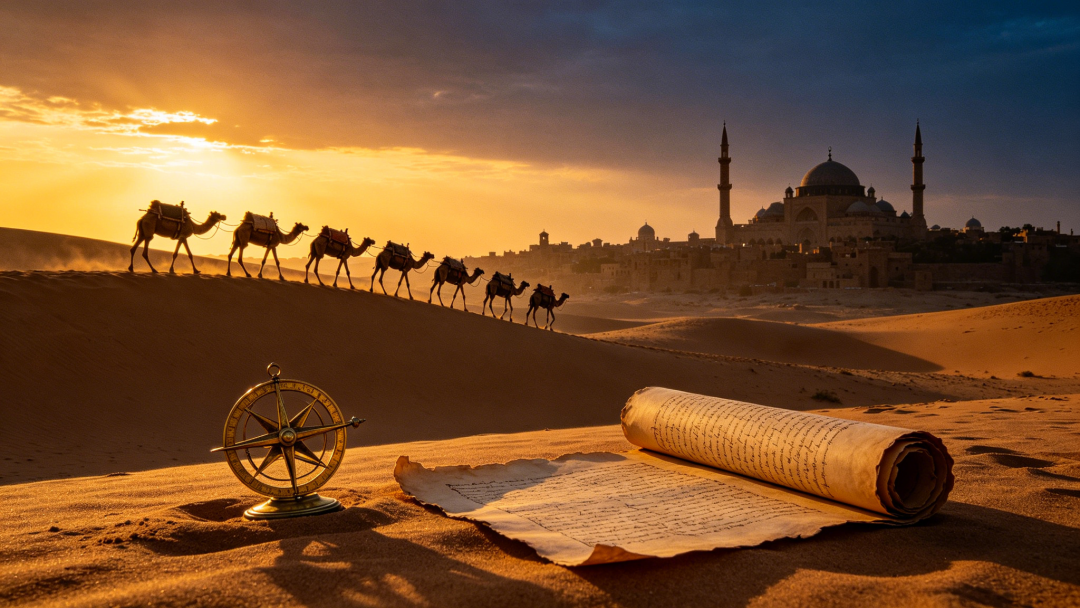
In less than a century after the Prophet, stretching all the way from North Africa to the Indian subcontinent, an unfolded map easily put the peak of the Roman Empire to shame. This narrative easily turns into solid proof—look, we walked the path of truth, and Allah gave us rewards in return.
A caravan in the desert at twilight. The Golden Age: From North Africa to the Indian subcontinent, an unfolded map, a lamp that lit up the entire world.
From the 7th to the 18th century, a Muslim could very likely live under the rule of some caliph or sultan, finding fellow believers all the way from Timbuktu to Mindanao. Cities had mosques, schools, and markets, tying faith and daily life tightly together.
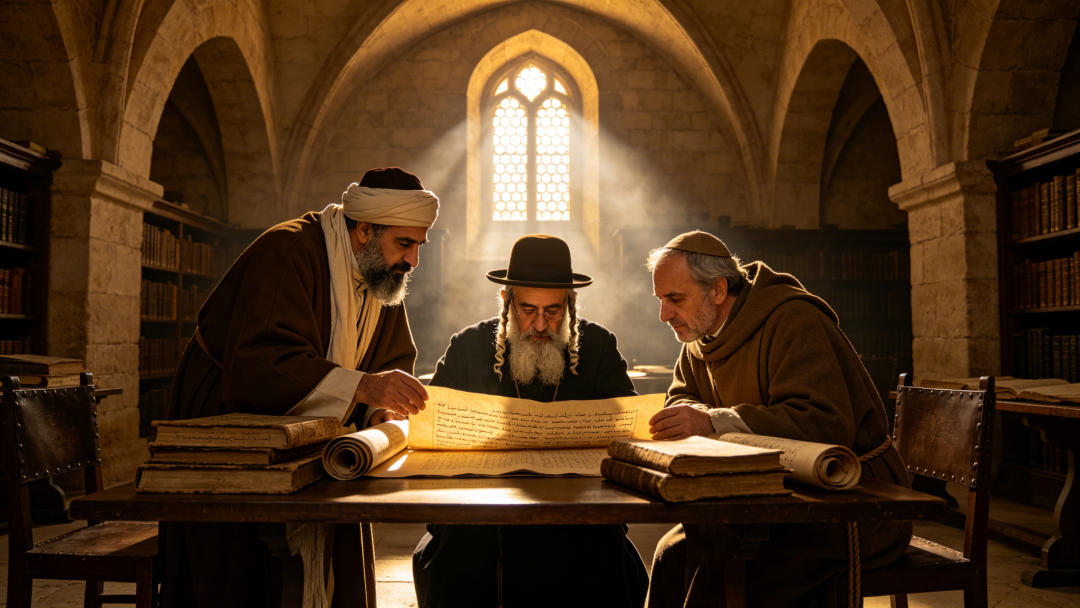
That era wasn't just about swords; it was also an era of libraries and laboratories. Christian and Jewish scholars within the empire worked right alongside Muslims, translating classical Greek, Persian, Syriac, and Sanskrit texts into Arabic one by one. Philosophy, medicine, astronomy, and mathematics were gathered like parts shipped in from all over and reassembled in one massive engine room.
Scholars translating ancient texts beneath an arcade. The Translation Movement: Christian, Jewish scholars, and Muslims working side by side to translate texts into Arabic.
Once the translation movement slowed down, a new generation of scholars started building their own parts. Optics, architecture, algebra, and astronomical tables—you can name famous figures left and right, and the word 'al-Jabr' slowly evolved into what we call 'algebra' today.
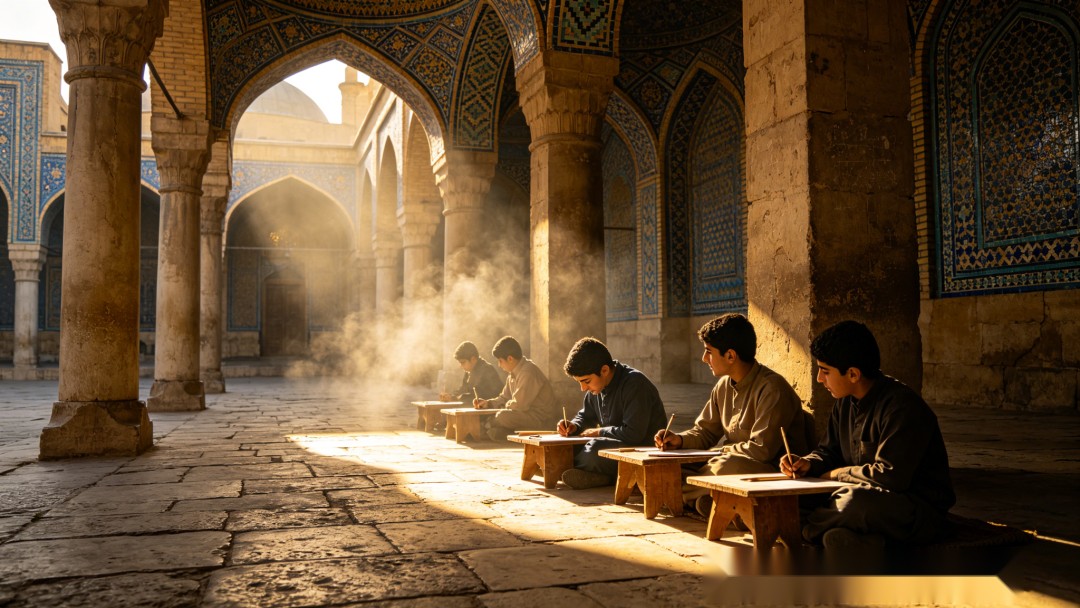
Sometimes I picture that scene at Al-Azhar in Cairo: sitting cross-legged under the stone pillars of the mosque, sunlight streaming through the courtyard arches, dust motes spinning in the air, someone writing on parchment with a reed pen, jotting down the trajectory of the cosmos while having a personal dua with Allah.
A school beneath the arches of a mosque courtyard. The madrasa: Students sitting cross-legged beneath stone pillars with sunlight passing through the arches, dust motes spinning in the light.
That mosque later turned into a university, taking in students since the late 10th century and still running today as one of the oldest higher education institutions in the world. Interestingly enough, the first time I saw photos of it wasn't in a religious textbook, but on an old link from that now-defunct photography website, where someone took a less-than-perfect picture of it standing beneath the grand hall, the angle even a bit tilted. Yet you could feel that the person behind the lens held genuine reverence for those stones and the passage of time.
The internet turns Al-Azhar into an image you can save with a right-click, and history itself turns into a high-res wallpaper inside many people's hearts, hanging deep within their memories.
Part 2: When the 'teacher' becomes the 'student', the psychological gap hits hard.
Once Europeans slowly dragged themselves out of the Dark Ages, the story suddenly took a sharp turn.
They went to these Muslim academic hubs to 'borrow homework,' copying ancient Greek philosophy, Roman law, and a bunch of scientific theories straight back from Arabic texts to patch up the cultural heritage they had burned or lost themselves.
The flow of culture did a complete 180 right then and there. It used to flow from the East to the West, but now it was pumping science, institutions, technology, and pop culture out to the rest of the world like a massive open fire hydrant.
The ironic part is that these Muslim scholars and their civilization—who once served as the teachers of knowledge—disappeared from the main stage of Western narratives for a long time, glossed over in textbooks and making rare cameos in films, while most of the time it felt like history only started taking off seriously during the Renaissance.
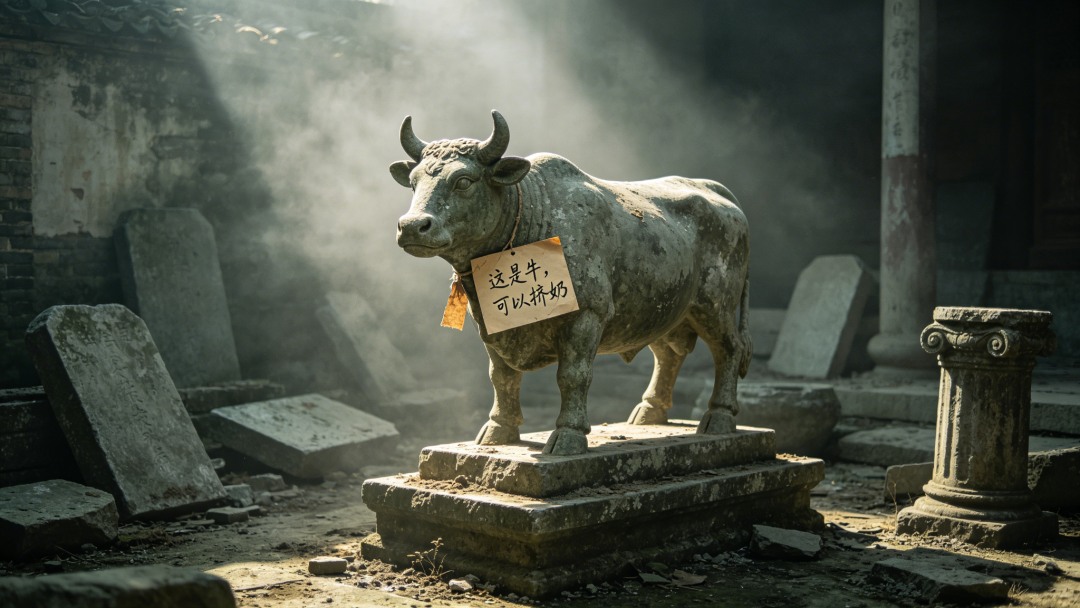
Gabriel García Márquez wrote in *One Hundred Years of Solitude* that the people of a village forgot the names of things and had to hang labels on objects to remind themselves, 'This is a cow, it gives milk.' When a civilization is forgotten, it's pretty much the same thing—except this time, what got forgotten was the contribution of an entire region of the world.
The Forgotten Stone Cow with a Tag: When a civilization is forgotten, even its name requires a label just to remind us it exists.
For many Muslims, memory and faith are woven together. That golden age of rising empires, intellectual brilliance, and thriving cities stands as proof that 'the truth actually works.' You see, when their ancestors walked that path with sincerity, Allah granted them strength and glory.
The problem, however, lies in the comparison.
Turn on the news today, and you still see the scars left by the colonial era. Wars still rage in some regions, economies have ground to a halt, corruption and unemployment are piled high, and political instability is the norm. Many ordinary people live under the dual weight of being 'crushed by outside forces' and 'failing from within.'
At this point, 'why did we end up like this' becomes an unavoidable question.
Some people blame the external factors: historical colonization or the power struggles of modern global giants, feeling the world order is inherently biased against them. Others point fingers inward, believing they’ve lost that early sense of clarity, self-restraint, and the pursuit of knowledge, straying from the original justice and discipline of their faith, and that’s why they’ve slid downhill step by step.
Both explanations are often used in tandem, fueling long, drawn-out conversations in tea houses.
3. Leaders as a mirror: A sharp and stinging metaphor.
There is a Hadith that says whether Allah is pleased with a community can be seen through their leaders—if He is pleased, He lets the best among them lead; if He is not, He allows the worst to rise to the top.
Reflections in a Tarnished Bronze Mirror: Leaders are treated as a 'mirror' for the community, reflecting collective choices, values, and the baseline of tolerance.
This concept is a bit of a gut-punch, not unlike how we say, 'you can tell what a company is like just by looking at its boss.' Leaders serve as a mirror for the collective, revealing the group's choices, values, and the point at which they stop saying 'enough.'
That’s why, when many Muslims lament their current reality, they might acknowledge the advantages of Western political systems and market efficiency, yet instinctively feel that they should return to 'that original path' rather than just copy-pasting someone else’s template.
In many studies, the majority of respondents link 'progress' with 'morality' and 'spiritual values.' It’s not just about GDP growth or more skyscrapers; it’s about whether the hearts and minds of the people are still on the right track.
This logic shouldn’t sound foreign to you. When we discuss educational anxiety, extreme competition, or materialism, our tone is much the same. We envy the welfare states and research environments of developed nations, but we also worry that if we copy them entirely, we might lose those charming traditions that make us who we are.
In *The Hunchback of Notre-Dame*, Victor Hugo wrote that the cathedral was a 'book written in stone.' For many civilizations, leaders, institutions, cities, and daily rituals are actually 'living books' that record what a community cares about, what it fears, and what it’s willing to sacrifice for.
4. The user who lost their website, and the civilization that lost its empire.
Let’s go back to that defunct photography website.
Some people were kicked off TrekEarth or Treklens by the system and ended up on another forum, stumbling into a travel photography section. The moderator posted a welcome note and provided a new link, saying they could continue building albums and uploading photos there.
Sounds pretty wholesome, right?
But the replies beneath were complicated—someone asked if they could still get serious critiques on their photos like before. Another person vented in anger that when the old site shut down, it didn’t even leave a proper backup channel. Someone else mentioned that one of their favorite photos, which had been posted there, was lost in a real-world accident when their hard drive crashed. Since then, that image has vanished from the world; they don't even remember where they were standing when they pressed the shutter.
Lost: Old Hard Drives and Faded Sunset Photos—The hard drive is broken, that image is gone forever, and they don't even remember where they were when they took it.
You’ll find that a person’s feelings about 'losing something' have nothing to do with its size; it could be an entire empire or just a slightly blurry photo of a sunset.
That feeling is called 'there is no going back.'
For many in the Muslim world, their memories of past empires and civilizations are just like those of these internet users: the original photos are gone, leaving only legends told by others and scattered, blurry puzzle pieces in their own minds.
The difference is that the photographers could upload their photos to a new site, but the glory of a civilization can't be restored by a simple copy-and-paste.
Tolstoy once wrote in War and Peace that history isn't shaped by the will of a few great leaders, but by the massive tide created by countless tiny choices. In the same way, the revival of a civilization can't be triggered by just one 'emotional moment' or by chanting slogans about 'returning to the Golden Age.' It requires breaking down that memory into small, actionable steps.
For example, taking a commitment to knowledge seriously means reading a few extra pages or attending an extra class today, instead of just bragging about 'how glorious we used to be' during a chat. Emphasizing justice means playing by the rules and cutting fewer corners right now, rather than just venting about how corrupt the leadership is.
If you can't actually do these things, that memory just becomes a piece of candy—it tastes sweet for a second, but once it dissolves, there’s nothing left.
5. Faith, values, and modern life are basically just 'roommates'
There’s a common stereotype that pits 'religion' against 'modern life,' as if your smartphone is on the left and the Quran is on the right, and you’re forced to pick one or the other.
But in the real world, who actually lives in such a neat binary? Most of the time, faith, cultural heritage, modern institutions, and globalization are all crammed into the same tiny apartment, and none of them are going anywhere.
Old books on a late-night desk and a smartphone; faith, tradition, and modern life are squeezed into the same room, and neither can move out.
Many studies show that Muslims often value modern education, technology, and the market, while also firmly believing that moral and spiritual values are the true bedrock of real 'progress.'
It might sound contradictory, but look at our own daily lives—don't we often complain that 'money is everything' and 'people are too cold,' while simultaneously sharing posts about 'having a conscience' and 'not being a heartless person'?
This isn't some special 'East vs. West' issue; it’s just the universal struggle of being alive in the modern world.
Some say The Alchemist is about destiny, but it’s really about choices. The shepherd boy in the story encounters various cultures, beliefs, and languages on his journey. His lesson isn't to find out which one is absolutely 'right,' but how to respect others without losing the inner spark that defines him.
For many Muslim societies today, the real challenge isn't 'should we modernize,' but 'how do we hold onto our core values while modernizing?' It’s about engaging with the world without feeling inferior or superior, acknowledging what others do well, and being brave enough to admit where we’re actually falling behind.
It’s like when we mindlessly scroll through short videos, grumbling that 'the algorithm got me again.' We say we’ll 'stop scrolling,' but our fingers keep moving across the screen anyway. This contradiction is just the 'mental muscle ache' that every modern person deals with.
6. Turning the Golden Age from a wall calendar into a toolbox
There’s a key point in the material: many people tie their societal progress very closely to 'moral and spiritual values.'
If you break that concept down, you’ll find a real opportunity.
If the glories of the past are just a calendar hanging on the wall—where you flip to the month, sigh, and say 'wow, they were so great back then,' but your actual life never changes—then that memory is just a self-soothing comfort.
The wall calendar vs. the toolbox: Turning the Golden Age from a wall calendar into a toolbox.
But if you treat that history like a toolbox, everything changes.
For instance, a major part of that history was 'knowledge exchange' and 'cross-cultural cooperation.' Christian and Jewish scholars working within the empire to participate in the Translation Movement was, in itself, a practical example of diverse collaboration. In our globalized world today, that ability to 'sit at the same table and work with people who are different' is a tool we can start using again.
Or take the deep focus on law and ethics: this could evolve into facing public rules more seriously in modern society, encouraging transparency, limiting the abuse of power, and cherishing contracts—instead of just complaining about 'the people at the top' and blaming everything on some abstract concept of fate.
Then there’s that long-term perspective of 'being accountable for the afterlife.' If translated into terms a secular society can grasp, it’s basically 'think long-term, don’t just look for a quick buck.' This can play a huge role in how we use resources, protect the environment, and ensure fairness between generations.
See? The collective memory of a religious civilization can absolutely be translated into a language that modern policy and social psychology can understand. The question is whether you’re willing to do the translation work.
Liang Xiaosheng wrote about the lives of ordinary families in A Lifelong Journey, and the line that hits home for many is that 'a good life isn't achieved by shouting, but by grinding through it, bit by bit.' The revival of a civilization is exactly the same concept.
7. Our own little 'Golden Age'
SEO Title: Islamic Golden Age History and Future Revival: Moving Beyond Nostalgia to Real-World Progress
You might be wondering, what does this have to do with the average person? The history of the Islamic world feels so distant, especially when most of us haven’t even gotten our passports ready for travel yet.
It has everything to do with it.
Every nation, every culture, and even every family has its own 'Golden Age' that they look back on—maybe it was those years of rapid economic growth, a time when neighbors could always count on each other, or those early mornings when your parents were young and biked you across town to school.
But remember, nothing lasts forever; no country stays at the top indefinitely.
These memories are beautiful, but if we just get stuck sighing, 'Oh, things were so much better back then,' that nostalgia turns into a sweet kind of paralysis.
Look at the people on photography forums reminiscing about old websites: some just vent their frustrations in a post and call it a day, while others immediately start building new galleries, moving every old photo they can find and telling newcomers, 'I actually captured a sunset from this exact angle back in the day.'
Civilization works the same way. If you want to keep a memory alive, you need people who are willing to take new photos, write new footnotes, and run new experiments. You have to take that sense of 'what made us great' and find a way to grow it again in a new city, a new era, and a new system.
There’s a line in the book 'To Live' that basically says people live simply for the sake of living, not for anything else. Civilization is the same—it exists to keep living, not to replicate some perfect past.
We respect every kind of faith, seeing it as a way for a community to understand the world and find peace for their souls, but we must also realize that every faith and tradition only earns continued respect if it’s willing to provide real solutions to modern-day challenges.
When a group defines 'progress' as the elevation of moral and spiritual values, that’s a beautiful thing. The real test is whether that understanding can move from just words to action, and from memory to actual practice.
Think of it like an old desk lamp: you can spend every day polishing it and missing how bright it used to be, or you can use that light while it’s still working to read a few more pages or help a few more people. That way, when the bulb finally burns out, you can rest easy knowing that the light wasn't wasted.
For the traveler walking toward the distance in the morning light, what truly saves us is the old piece of wisdom: focus on the very next step you take. We talk about the memories of the Islamic world not to judge who was better or worse, but to remind ourselves not to treat the 'Golden Age' as just a bedtime story, and definitely not to use the past as an excuse. No matter what you believe or where you stand, what truly saves us is that same old piece of wisdom: focus on the very next step you take. view all
[Internet Repost]
Exploring how ancient civilizations handle the gap between past glory and present-day challenges. It points out that historical greatness should serve as a spark to inspire current learning and innovation rather than an escape from reality, emphasizing that only through grounded hard work in education and industry can we build a better future.
When a civilization tries to survive purely on memories.

An old desk lamp in a dim study. Memories of a glorious past are like an old desk lamp, shedding light on a dimly lit room today.
Late at night, your mind tends to wander. I was scrolling through a post a while ago about an old photography website called TrekEarth that got shut down, where tons of people had stored their travel photos over the last decade or two. On the day it closed down, some folks didn't even have time to back up their files, leaving them to comment in the forum, 'My favorite photo is completely gone.'
At that moment, I suddenly kind of got what people mean by the 'loss of a civilization.'
On this side of the screen, you have everyday internet users feeling sad about their sunset photos, while on the other side, there are people clinging to thicker photo albums labeled Baghdad, Cordoba, Samarkand, Cairo... These names shine bright in history books, and their descendants live off these stories much like an old desk lamp lights up a gloomy room.
The Islamic world's attachment to its golden past is pretty much just like that desk lamp.
Part 1: A lamp that lit up the world from the desert.
You will notice that many Muslims, no matter how much education they have, can pretty much tell you the whole story of their history—heroes, empires, scholars, and cities lining up one after another.
In less than a century after the Prophet, stretching all the way from North Africa to the Indian subcontinent, an unfolded map easily put the peak of the Roman Empire to shame. This narrative easily turns into solid proof—look, we walked the path of truth, and Allah gave us rewards in return.
A caravan in the desert at twilight. The Golden Age: From North Africa to the Indian subcontinent, an unfolded map, a lamp that lit up the entire world.
From the 7th to the 18th century, a Muslim could very likely live under the rule of some caliph or sultan, finding fellow believers all the way from Timbuktu to Mindanao. Cities had mosques, schools, and markets, tying faith and daily life tightly together.
That era wasn't just about swords; it was also an era of libraries and laboratories. Christian and Jewish scholars within the empire worked right alongside Muslims, translating classical Greek, Persian, Syriac, and Sanskrit texts into Arabic one by one. Philosophy, medicine, astronomy, and mathematics were gathered like parts shipped in from all over and reassembled in one massive engine room.
Scholars translating ancient texts beneath an arcade. The Translation Movement: Christian, Jewish scholars, and Muslims working side by side to translate texts into Arabic.
Once the translation movement slowed down, a new generation of scholars started building their own parts. Optics, architecture, algebra, and astronomical tables—you can name famous figures left and right, and the word 'al-Jabr' slowly evolved into what we call 'algebra' today.
Sometimes I picture that scene at Al-Azhar in Cairo: sitting cross-legged under the stone pillars of the mosque, sunlight streaming through the courtyard arches, dust motes spinning in the air, someone writing on parchment with a reed pen, jotting down the trajectory of the cosmos while having a personal dua with Allah.
A school beneath the arches of a mosque courtyard. The madrasa: Students sitting cross-legged beneath stone pillars with sunlight passing through the arches, dust motes spinning in the light.
That mosque later turned into a university, taking in students since the late 10th century and still running today as one of the oldest higher education institutions in the world. Interestingly enough, the first time I saw photos of it wasn't in a religious textbook, but on an old link from that now-defunct photography website, where someone took a less-than-perfect picture of it standing beneath the grand hall, the angle even a bit tilted. Yet you could feel that the person behind the lens held genuine reverence for those stones and the passage of time.
The internet turns Al-Azhar into an image you can save with a right-click, and history itself turns into a high-res wallpaper inside many people's hearts, hanging deep within their memories.
Part 2: When the 'teacher' becomes the 'student', the psychological gap hits hard.
Once Europeans slowly dragged themselves out of the Dark Ages, the story suddenly took a sharp turn.
They went to these Muslim academic hubs to 'borrow homework,' copying ancient Greek philosophy, Roman law, and a bunch of scientific theories straight back from Arabic texts to patch up the cultural heritage they had burned or lost themselves.
The flow of culture did a complete 180 right then and there. It used to flow from the East to the West, but now it was pumping science, institutions, technology, and pop culture out to the rest of the world like a massive open fire hydrant.
The ironic part is that these Muslim scholars and their civilization—who once served as the teachers of knowledge—disappeared from the main stage of Western narratives for a long time, glossed over in textbooks and making rare cameos in films, while most of the time it felt like history only started taking off seriously during the Renaissance.
Gabriel García Márquez wrote in *One Hundred Years of Solitude* that the people of a village forgot the names of things and had to hang labels on objects to remind themselves, 'This is a cow, it gives milk.' When a civilization is forgotten, it's pretty much the same thing—except this time, what got forgotten was the contribution of an entire region of the world.
The Forgotten Stone Cow with a Tag: When a civilization is forgotten, even its name requires a label just to remind us it exists.
For many Muslims, memory and faith are woven together. That golden age of rising empires, intellectual brilliance, and thriving cities stands as proof that 'the truth actually works.' You see, when their ancestors walked that path with sincerity, Allah granted them strength and glory.
The problem, however, lies in the comparison.
Turn on the news today, and you still see the scars left by the colonial era. Wars still rage in some regions, economies have ground to a halt, corruption and unemployment are piled high, and political instability is the norm. Many ordinary people live under the dual weight of being 'crushed by outside forces' and 'failing from within.'
At this point, 'why did we end up like this' becomes an unavoidable question.
Some people blame the external factors: historical colonization or the power struggles of modern global giants, feeling the world order is inherently biased against them. Others point fingers inward, believing they’ve lost that early sense of clarity, self-restraint, and the pursuit of knowledge, straying from the original justice and discipline of their faith, and that’s why they’ve slid downhill step by step.
Both explanations are often used in tandem, fueling long, drawn-out conversations in tea houses.
3. Leaders as a mirror: A sharp and stinging metaphor.
There is a Hadith that says whether Allah is pleased with a community can be seen through their leaders—if He is pleased, He lets the best among them lead; if He is not, He allows the worst to rise to the top.
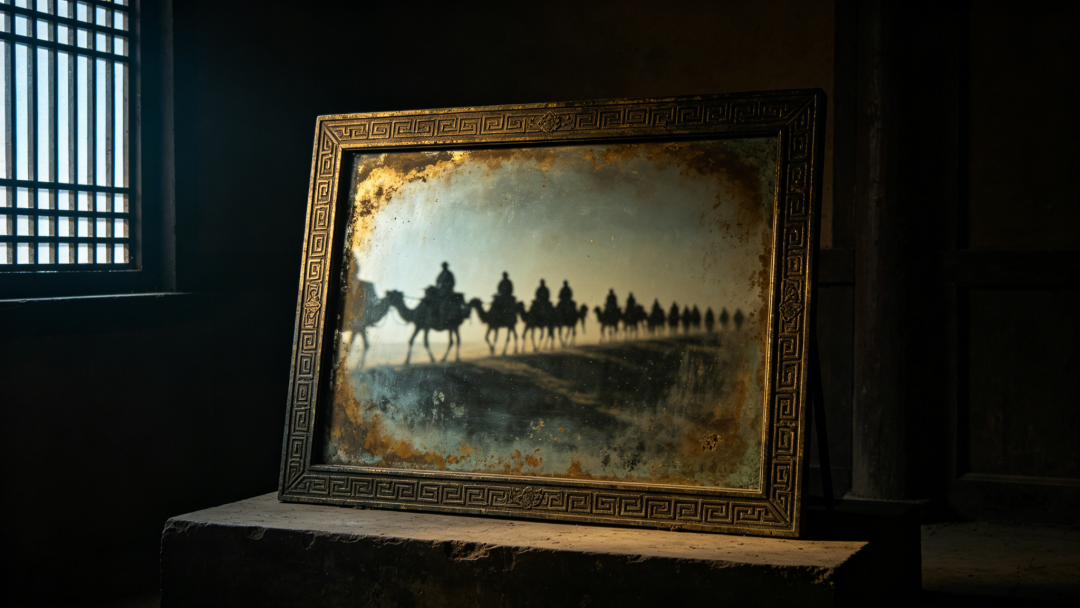
Reflections in a Tarnished Bronze Mirror: Leaders are treated as a 'mirror' for the community, reflecting collective choices, values, and the baseline of tolerance.
This concept is a bit of a gut-punch, not unlike how we say, 'you can tell what a company is like just by looking at its boss.' Leaders serve as a mirror for the collective, revealing the group's choices, values, and the point at which they stop saying 'enough.'
That’s why, when many Muslims lament their current reality, they might acknowledge the advantages of Western political systems and market efficiency, yet instinctively feel that they should return to 'that original path' rather than just copy-pasting someone else’s template.
In many studies, the majority of respondents link 'progress' with 'morality' and 'spiritual values.' It’s not just about GDP growth or more skyscrapers; it’s about whether the hearts and minds of the people are still on the right track.
This logic shouldn’t sound foreign to you. When we discuss educational anxiety, extreme competition, or materialism, our tone is much the same. We envy the welfare states and research environments of developed nations, but we also worry that if we copy them entirely, we might lose those charming traditions that make us who we are.
In *The Hunchback of Notre-Dame*, Victor Hugo wrote that the cathedral was a 'book written in stone.' For many civilizations, leaders, institutions, cities, and daily rituals are actually 'living books' that record what a community cares about, what it fears, and what it’s willing to sacrifice for.
4. The user who lost their website, and the civilization that lost its empire.
Let’s go back to that defunct photography website.
Some people were kicked off TrekEarth or Treklens by the system and ended up on another forum, stumbling into a travel photography section. The moderator posted a welcome note and provided a new link, saying they could continue building albums and uploading photos there.
Sounds pretty wholesome, right?
But the replies beneath were complicated—someone asked if they could still get serious critiques on their photos like before. Another person vented in anger that when the old site shut down, it didn’t even leave a proper backup channel. Someone else mentioned that one of their favorite photos, which had been posted there, was lost in a real-world accident when their hard drive crashed. Since then, that image has vanished from the world; they don't even remember where they were standing when they pressed the shutter.

Lost: Old Hard Drives and Faded Sunset Photos—The hard drive is broken, that image is gone forever, and they don't even remember where they were when they took it.
You’ll find that a person’s feelings about 'losing something' have nothing to do with its size; it could be an entire empire or just a slightly blurry photo of a sunset.
That feeling is called 'there is no going back.'
For many in the Muslim world, their memories of past empires and civilizations are just like those of these internet users: the original photos are gone, leaving only legends told by others and scattered, blurry puzzle pieces in their own minds.
The difference is that the photographers could upload their photos to a new site, but the glory of a civilization can't be restored by a simple copy-and-paste.
Tolstoy once wrote in War and Peace that history isn't shaped by the will of a few great leaders, but by the massive tide created by countless tiny choices. In the same way, the revival of a civilization can't be triggered by just one 'emotional moment' or by chanting slogans about 'returning to the Golden Age.' It requires breaking down that memory into small, actionable steps.
For example, taking a commitment to knowledge seriously means reading a few extra pages or attending an extra class today, instead of just bragging about 'how glorious we used to be' during a chat. Emphasizing justice means playing by the rules and cutting fewer corners right now, rather than just venting about how corrupt the leadership is.
If you can't actually do these things, that memory just becomes a piece of candy—it tastes sweet for a second, but once it dissolves, there’s nothing left.
5. Faith, values, and modern life are basically just 'roommates'
There’s a common stereotype that pits 'religion' against 'modern life,' as if your smartphone is on the left and the Quran is on the right, and you’re forced to pick one or the other.
But in the real world, who actually lives in such a neat binary? Most of the time, faith, cultural heritage, modern institutions, and globalization are all crammed into the same tiny apartment, and none of them are going anywhere.

Old books on a late-night desk and a smartphone; faith, tradition, and modern life are squeezed into the same room, and neither can move out.
Many studies show that Muslims often value modern education, technology, and the market, while also firmly believing that moral and spiritual values are the true bedrock of real 'progress.'
It might sound contradictory, but look at our own daily lives—don't we often complain that 'money is everything' and 'people are too cold,' while simultaneously sharing posts about 'having a conscience' and 'not being a heartless person'?
This isn't some special 'East vs. West' issue; it’s just the universal struggle of being alive in the modern world.
Some say The Alchemist is about destiny, but it’s really about choices. The shepherd boy in the story encounters various cultures, beliefs, and languages on his journey. His lesson isn't to find out which one is absolutely 'right,' but how to respect others without losing the inner spark that defines him.
For many Muslim societies today, the real challenge isn't 'should we modernize,' but 'how do we hold onto our core values while modernizing?' It’s about engaging with the world without feeling inferior or superior, acknowledging what others do well, and being brave enough to admit where we’re actually falling behind.
It’s like when we mindlessly scroll through short videos, grumbling that 'the algorithm got me again.' We say we’ll 'stop scrolling,' but our fingers keep moving across the screen anyway. This contradiction is just the 'mental muscle ache' that every modern person deals with.
6. Turning the Golden Age from a wall calendar into a toolbox
There’s a key point in the material: many people tie their societal progress very closely to 'moral and spiritual values.'
If you break that concept down, you’ll find a real opportunity.
If the glories of the past are just a calendar hanging on the wall—where you flip to the month, sigh, and say 'wow, they were so great back then,' but your actual life never changes—then that memory is just a self-soothing comfort.
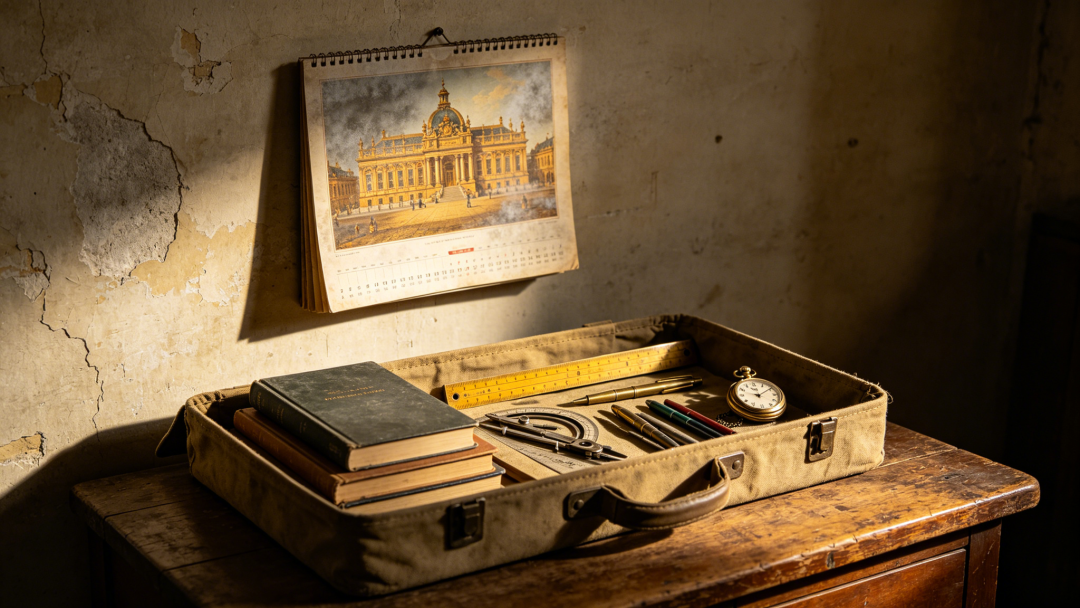
The wall calendar vs. the toolbox: Turning the Golden Age from a wall calendar into a toolbox.
But if you treat that history like a toolbox, everything changes.
For instance, a major part of that history was 'knowledge exchange' and 'cross-cultural cooperation.' Christian and Jewish scholars working within the empire to participate in the Translation Movement was, in itself, a practical example of diverse collaboration. In our globalized world today, that ability to 'sit at the same table and work with people who are different' is a tool we can start using again.
Or take the deep focus on law and ethics: this could evolve into facing public rules more seriously in modern society, encouraging transparency, limiting the abuse of power, and cherishing contracts—instead of just complaining about 'the people at the top' and blaming everything on some abstract concept of fate.
Then there’s that long-term perspective of 'being accountable for the afterlife.' If translated into terms a secular society can grasp, it’s basically 'think long-term, don’t just look for a quick buck.' This can play a huge role in how we use resources, protect the environment, and ensure fairness between generations.
See? The collective memory of a religious civilization can absolutely be translated into a language that modern policy and social psychology can understand. The question is whether you’re willing to do the translation work.
Liang Xiaosheng wrote about the lives of ordinary families in A Lifelong Journey, and the line that hits home for many is that 'a good life isn't achieved by shouting, but by grinding through it, bit by bit.' The revival of a civilization is exactly the same concept.
7. Our own little 'Golden Age'
SEO Title: Islamic Golden Age History and Future Revival: Moving Beyond Nostalgia to Real-World Progress
You might be wondering, what does this have to do with the average person? The history of the Islamic world feels so distant, especially when most of us haven’t even gotten our passports ready for travel yet.
It has everything to do with it.
Every nation, every culture, and even every family has its own 'Golden Age' that they look back on—maybe it was those years of rapid economic growth, a time when neighbors could always count on each other, or those early mornings when your parents were young and biked you across town to school.
But remember, nothing lasts forever; no country stays at the top indefinitely.
These memories are beautiful, but if we just get stuck sighing, 'Oh, things were so much better back then,' that nostalgia turns into a sweet kind of paralysis.
Look at the people on photography forums reminiscing about old websites: some just vent their frustrations in a post and call it a day, while others immediately start building new galleries, moving every old photo they can find and telling newcomers, 'I actually captured a sunset from this exact angle back in the day.'
Civilization works the same way. If you want to keep a memory alive, you need people who are willing to take new photos, write new footnotes, and run new experiments. You have to take that sense of 'what made us great' and find a way to grow it again in a new city, a new era, and a new system.
There’s a line in the book 'To Live' that basically says people live simply for the sake of living, not for anything else. Civilization is the same—it exists to keep living, not to replicate some perfect past.
We respect every kind of faith, seeing it as a way for a community to understand the world and find peace for their souls, but we must also realize that every faith and tradition only earns continued respect if it’s willing to provide real solutions to modern-day challenges.
When a group defines 'progress' as the elevation of moral and spiritual values, that’s a beautiful thing. The real test is whether that understanding can move from just words to action, and from memory to actual practice.

Think of it like an old desk lamp: you can spend every day polishing it and missing how bright it used to be, or you can use that light while it’s still working to read a few more pages or help a few more people. That way, when the bulb finally burns out, you can rest easy knowing that the light wasn't wasted.
For the traveler walking toward the distance in the morning light, what truly saves us is the old piece of wisdom: focus on the very next step you take. We talk about the memories of the Islamic world not to judge who was better or worse, but to remind ourselves not to treat the 'Golden Age' as just a bedtime story, and definitely not to use the past as an excuse. No matter what you believe or where you stand, what truly saves us is that same old piece of wisdom: focus on the very next step you take.
Exploring how ancient civilizations handle the gap between past glory and present-day challenges. It points out that historical greatness should serve as a spark to inspire current learning and innovation rather than an escape from reality, emphasizing that only through grounded hard work in education and industry can we build a better future.
When a civilization tries to survive purely on memories.
An old desk lamp in a dim study. Memories of a glorious past are like an old desk lamp, shedding light on a dimly lit room today.
Late at night, your mind tends to wander. I was scrolling through a post a while ago about an old photography website called TrekEarth that got shut down, where tons of people had stored their travel photos over the last decade or two. On the day it closed down, some folks didn't even have time to back up their files, leaving them to comment in the forum, 'My favorite photo is completely gone.'
At that moment, I suddenly kind of got what people mean by the 'loss of a civilization.'
On this side of the screen, you have everyday internet users feeling sad about their sunset photos, while on the other side, there are people clinging to thicker photo albums labeled Baghdad, Cordoba, Samarkand, Cairo... These names shine bright in history books, and their descendants live off these stories much like an old desk lamp lights up a gloomy room.
The Islamic world's attachment to its golden past is pretty much just like that desk lamp.
Part 1: A lamp that lit up the world from the desert.
You will notice that many Muslims, no matter how much education they have, can pretty much tell you the whole story of their history—heroes, empires, scholars, and cities lining up one after another.
In less than a century after the Prophet, stretching all the way from North Africa to the Indian subcontinent, an unfolded map easily put the peak of the Roman Empire to shame. This narrative easily turns into solid proof—look, we walked the path of truth, and Allah gave us rewards in return.
A caravan in the desert at twilight. The Golden Age: From North Africa to the Indian subcontinent, an unfolded map, a lamp that lit up the entire world.
From the 7th to the 18th century, a Muslim could very likely live under the rule of some caliph or sultan, finding fellow believers all the way from Timbuktu to Mindanao. Cities had mosques, schools, and markets, tying faith and daily life tightly together.
That era wasn't just about swords; it was also an era of libraries and laboratories. Christian and Jewish scholars within the empire worked right alongside Muslims, translating classical Greek, Persian, Syriac, and Sanskrit texts into Arabic one by one. Philosophy, medicine, astronomy, and mathematics were gathered like parts shipped in from all over and reassembled in one massive engine room.
Scholars translating ancient texts beneath an arcade. The Translation Movement: Christian, Jewish scholars, and Muslims working side by side to translate texts into Arabic.
Once the translation movement slowed down, a new generation of scholars started building their own parts. Optics, architecture, algebra, and astronomical tables—you can name famous figures left and right, and the word 'al-Jabr' slowly evolved into what we call 'algebra' today.
Sometimes I picture that scene at Al-Azhar in Cairo: sitting cross-legged under the stone pillars of the mosque, sunlight streaming through the courtyard arches, dust motes spinning in the air, someone writing on parchment with a reed pen, jotting down the trajectory of the cosmos while having a personal dua with Allah.
A school beneath the arches of a mosque courtyard. The madrasa: Students sitting cross-legged beneath stone pillars with sunlight passing through the arches, dust motes spinning in the light.
That mosque later turned into a university, taking in students since the late 10th century and still running today as one of the oldest higher education institutions in the world. Interestingly enough, the first time I saw photos of it wasn't in a religious textbook, but on an old link from that now-defunct photography website, where someone took a less-than-perfect picture of it standing beneath the grand hall, the angle even a bit tilted. Yet you could feel that the person behind the lens held genuine reverence for those stones and the passage of time.
The internet turns Al-Azhar into an image you can save with a right-click, and history itself turns into a high-res wallpaper inside many people's hearts, hanging deep within their memories.
Part 2: When the 'teacher' becomes the 'student', the psychological gap hits hard.
Once Europeans slowly dragged themselves out of the Dark Ages, the story suddenly took a sharp turn.
They went to these Muslim academic hubs to 'borrow homework,' copying ancient Greek philosophy, Roman law, and a bunch of scientific theories straight back from Arabic texts to patch up the cultural heritage they had burned or lost themselves.
The flow of culture did a complete 180 right then and there. It used to flow from the East to the West, but now it was pumping science, institutions, technology, and pop culture out to the rest of the world like a massive open fire hydrant.
The ironic part is that these Muslim scholars and their civilization—who once served as the teachers of knowledge—disappeared from the main stage of Western narratives for a long time, glossed over in textbooks and making rare cameos in films, while most of the time it felt like history only started taking off seriously during the Renaissance.
Gabriel García Márquez wrote in *One Hundred Years of Solitude* that the people of a village forgot the names of things and had to hang labels on objects to remind themselves, 'This is a cow, it gives milk.' When a civilization is forgotten, it's pretty much the same thing—except this time, what got forgotten was the contribution of an entire region of the world.
The Forgotten Stone Cow with a Tag: When a civilization is forgotten, even its name requires a label just to remind us it exists.
For many Muslims, memory and faith are woven together. That golden age of rising empires, intellectual brilliance, and thriving cities stands as proof that 'the truth actually works.' You see, when their ancestors walked that path with sincerity, Allah granted them strength and glory.
The problem, however, lies in the comparison.
Turn on the news today, and you still see the scars left by the colonial era. Wars still rage in some regions, economies have ground to a halt, corruption and unemployment are piled high, and political instability is the norm. Many ordinary people live under the dual weight of being 'crushed by outside forces' and 'failing from within.'
At this point, 'why did we end up like this' becomes an unavoidable question.
Some people blame the external factors: historical colonization or the power struggles of modern global giants, feeling the world order is inherently biased against them. Others point fingers inward, believing they’ve lost that early sense of clarity, self-restraint, and the pursuit of knowledge, straying from the original justice and discipline of their faith, and that’s why they’ve slid downhill step by step.
Both explanations are often used in tandem, fueling long, drawn-out conversations in tea houses.
3. Leaders as a mirror: A sharp and stinging metaphor.
There is a Hadith that says whether Allah is pleased with a community can be seen through their leaders—if He is pleased, He lets the best among them lead; if He is not, He allows the worst to rise to the top.
Reflections in a Tarnished Bronze Mirror: Leaders are treated as a 'mirror' for the community, reflecting collective choices, values, and the baseline of tolerance.
This concept is a bit of a gut-punch, not unlike how we say, 'you can tell what a company is like just by looking at its boss.' Leaders serve as a mirror for the collective, revealing the group's choices, values, and the point at which they stop saying 'enough.'
That’s why, when many Muslims lament their current reality, they might acknowledge the advantages of Western political systems and market efficiency, yet instinctively feel that they should return to 'that original path' rather than just copy-pasting someone else’s template.
In many studies, the majority of respondents link 'progress' with 'morality' and 'spiritual values.' It’s not just about GDP growth or more skyscrapers; it’s about whether the hearts and minds of the people are still on the right track.
This logic shouldn’t sound foreign to you. When we discuss educational anxiety, extreme competition, or materialism, our tone is much the same. We envy the welfare states and research environments of developed nations, but we also worry that if we copy them entirely, we might lose those charming traditions that make us who we are.
In *The Hunchback of Notre-Dame*, Victor Hugo wrote that the cathedral was a 'book written in stone.' For many civilizations, leaders, institutions, cities, and daily rituals are actually 'living books' that record what a community cares about, what it fears, and what it’s willing to sacrifice for.
4. The user who lost their website, and the civilization that lost its empire.
Let’s go back to that defunct photography website.
Some people were kicked off TrekEarth or Treklens by the system and ended up on another forum, stumbling into a travel photography section. The moderator posted a welcome note and provided a new link, saying they could continue building albums and uploading photos there.
Sounds pretty wholesome, right?
But the replies beneath were complicated—someone asked if they could still get serious critiques on their photos like before. Another person vented in anger that when the old site shut down, it didn’t even leave a proper backup channel. Someone else mentioned that one of their favorite photos, which had been posted there, was lost in a real-world accident when their hard drive crashed. Since then, that image has vanished from the world; they don't even remember where they were standing when they pressed the shutter.
Lost: Old Hard Drives and Faded Sunset Photos—The hard drive is broken, that image is gone forever, and they don't even remember where they were when they took it.
You’ll find that a person’s feelings about 'losing something' have nothing to do with its size; it could be an entire empire or just a slightly blurry photo of a sunset.
That feeling is called 'there is no going back.'
For many in the Muslim world, their memories of past empires and civilizations are just like those of these internet users: the original photos are gone, leaving only legends told by others and scattered, blurry puzzle pieces in their own minds.
The difference is that the photographers could upload their photos to a new site, but the glory of a civilization can't be restored by a simple copy-and-paste.
Tolstoy once wrote in War and Peace that history isn't shaped by the will of a few great leaders, but by the massive tide created by countless tiny choices. In the same way, the revival of a civilization can't be triggered by just one 'emotional moment' or by chanting slogans about 'returning to the Golden Age.' It requires breaking down that memory into small, actionable steps.
For example, taking a commitment to knowledge seriously means reading a few extra pages or attending an extra class today, instead of just bragging about 'how glorious we used to be' during a chat. Emphasizing justice means playing by the rules and cutting fewer corners right now, rather than just venting about how corrupt the leadership is.
If you can't actually do these things, that memory just becomes a piece of candy—it tastes sweet for a second, but once it dissolves, there’s nothing left.
5. Faith, values, and modern life are basically just 'roommates'
There’s a common stereotype that pits 'religion' against 'modern life,' as if your smartphone is on the left and the Quran is on the right, and you’re forced to pick one or the other.
But in the real world, who actually lives in such a neat binary? Most of the time, faith, cultural heritage, modern institutions, and globalization are all crammed into the same tiny apartment, and none of them are going anywhere.
Old books on a late-night desk and a smartphone; faith, tradition, and modern life are squeezed into the same room, and neither can move out.
Many studies show that Muslims often value modern education, technology, and the market, while also firmly believing that moral and spiritual values are the true bedrock of real 'progress.'
It might sound contradictory, but look at our own daily lives—don't we often complain that 'money is everything' and 'people are too cold,' while simultaneously sharing posts about 'having a conscience' and 'not being a heartless person'?
This isn't some special 'East vs. West' issue; it’s just the universal struggle of being alive in the modern world.
Some say The Alchemist is about destiny, but it’s really about choices. The shepherd boy in the story encounters various cultures, beliefs, and languages on his journey. His lesson isn't to find out which one is absolutely 'right,' but how to respect others without losing the inner spark that defines him.
For many Muslim societies today, the real challenge isn't 'should we modernize,' but 'how do we hold onto our core values while modernizing?' It’s about engaging with the world without feeling inferior or superior, acknowledging what others do well, and being brave enough to admit where we’re actually falling behind.
It’s like when we mindlessly scroll through short videos, grumbling that 'the algorithm got me again.' We say we’ll 'stop scrolling,' but our fingers keep moving across the screen anyway. This contradiction is just the 'mental muscle ache' that every modern person deals with.
6. Turning the Golden Age from a wall calendar into a toolbox
There’s a key point in the material: many people tie their societal progress very closely to 'moral and spiritual values.'
If you break that concept down, you’ll find a real opportunity.
If the glories of the past are just a calendar hanging on the wall—where you flip to the month, sigh, and say 'wow, they were so great back then,' but your actual life never changes—then that memory is just a self-soothing comfort.
The wall calendar vs. the toolbox: Turning the Golden Age from a wall calendar into a toolbox.
But if you treat that history like a toolbox, everything changes.
For instance, a major part of that history was 'knowledge exchange' and 'cross-cultural cooperation.' Christian and Jewish scholars working within the empire to participate in the Translation Movement was, in itself, a practical example of diverse collaboration. In our globalized world today, that ability to 'sit at the same table and work with people who are different' is a tool we can start using again.
Or take the deep focus on law and ethics: this could evolve into facing public rules more seriously in modern society, encouraging transparency, limiting the abuse of power, and cherishing contracts—instead of just complaining about 'the people at the top' and blaming everything on some abstract concept of fate.
Then there’s that long-term perspective of 'being accountable for the afterlife.' If translated into terms a secular society can grasp, it’s basically 'think long-term, don’t just look for a quick buck.' This can play a huge role in how we use resources, protect the environment, and ensure fairness between generations.
See? The collective memory of a religious civilization can absolutely be translated into a language that modern policy and social psychology can understand. The question is whether you’re willing to do the translation work.
Liang Xiaosheng wrote about the lives of ordinary families in A Lifelong Journey, and the line that hits home for many is that 'a good life isn't achieved by shouting, but by grinding through it, bit by bit.' The revival of a civilization is exactly the same concept.
7. Our own little 'Golden Age'
SEO Title: Islamic Golden Age History and Future Revival: Moving Beyond Nostalgia to Real-World Progress
You might be wondering, what does this have to do with the average person? The history of the Islamic world feels so distant, especially when most of us haven’t even gotten our passports ready for travel yet.
It has everything to do with it.
Every nation, every culture, and even every family has its own 'Golden Age' that they look back on—maybe it was those years of rapid economic growth, a time when neighbors could always count on each other, or those early mornings when your parents were young and biked you across town to school.
But remember, nothing lasts forever; no country stays at the top indefinitely.
These memories are beautiful, but if we just get stuck sighing, 'Oh, things were so much better back then,' that nostalgia turns into a sweet kind of paralysis.
Look at the people on photography forums reminiscing about old websites: some just vent their frustrations in a post and call it a day, while others immediately start building new galleries, moving every old photo they can find and telling newcomers, 'I actually captured a sunset from this exact angle back in the day.'
Civilization works the same way. If you want to keep a memory alive, you need people who are willing to take new photos, write new footnotes, and run new experiments. You have to take that sense of 'what made us great' and find a way to grow it again in a new city, a new era, and a new system.
There’s a line in the book 'To Live' that basically says people live simply for the sake of living, not for anything else. Civilization is the same—it exists to keep living, not to replicate some perfect past.
We respect every kind of faith, seeing it as a way for a community to understand the world and find peace for their souls, but we must also realize that every faith and tradition only earns continued respect if it’s willing to provide real solutions to modern-day challenges.
When a group defines 'progress' as the elevation of moral and spiritual values, that’s a beautiful thing. The real test is whether that understanding can move from just words to action, and from memory to actual practice.
Think of it like an old desk lamp: you can spend every day polishing it and missing how bright it used to be, or you can use that light while it’s still working to read a few more pages or help a few more people. That way, when the bulb finally burns out, you can rest easy knowing that the light wasn't wasted.
For the traveler walking toward the distance in the morning light, what truly saves us is the old piece of wisdom: focus on the very next step you take. We talk about the memories of the Islamic world not to judge who was better or worse, but to remind ourselves not to treat the 'Golden Age' as just a bedtime story, and definitely not to use the past as an excuse. No matter what you believe or where you stand, what truly saves us is that same old piece of wisdom: focus on the very next step you take.
Islamic Golden Age Heritage: Moving Beyond Nostalgia to Future Revival in the Modern World
Articles • Hasan09 posted the article • 0 comments • 77 views • 2026-10-26 09:28
[Internet Repost]
Exploring how ancient civilizations handle the gap between past glory and present-day challenges. It points out that historical greatness should serve as a spark to inspire current learning and innovation rather than an escape from reality, emphasizing that only through grounded hard work in education and industry can we build a better future.
When a civilization tries to survive purely on memories.
An old desk lamp in a dim study. Memories of a glorious past are like an old desk lamp, shedding light on a dimly lit room today.
Late at night, your mind tends to wander. I was scrolling through a post a while ago about an old photography website called TrekEarth that got shut down, where tons of people had stored their travel photos over the last decade or two. On the day it closed down, some folks didn't even have time to back up their files, leaving them to comment in the forum, 'My favorite photo is completely gone.'
At that moment, I suddenly kind of got what people mean by the 'loss of a civilization.'
On this side of the screen, you have everyday internet users feeling sad about their sunset photos, while on the other side, there are people clinging to thicker photo albums labeled Baghdad, Cordoba, Samarkand, Cairo... These names shine bright in history books, and their descendants live off these stories much like an old desk lamp lights up a gloomy room.
The Islamic world's attachment to its golden past is pretty much just like that desk lamp.
Part 1: A lamp that lit up the world from the desert.
You will notice that many Muslims, no matter how much education they have, can pretty much tell you the whole story of their history—heroes, empires, scholars, and cities lining up one after another.
In less than a century after the Prophet, stretching all the way from North Africa to the Indian subcontinent, an unfolded map easily put the peak of the Roman Empire to shame. This narrative easily turns into solid proof—look, we walked the path of truth, and Allah gave us rewards in return.
A caravan in the desert at twilight. The Golden Age: From North Africa to the Indian subcontinent, an unfolded map, a lamp that lit up the entire world.
From the 7th to the 18th century, a Muslim could very likely live under the rule of some caliph or sultan, finding fellow believers all the way from Timbuktu to Mindanao. Cities had mosques, schools, and markets, tying faith and daily life tightly together.
That era wasn't just about swords; it was also an era of libraries and laboratories. Christian and Jewish scholars within the empire worked right alongside Muslims, translating classical Greek, Persian, Syriac, and Sanskrit texts into Arabic one by one. Philosophy, medicine, astronomy, and mathematics were gathered like parts shipped in from all over and reassembled in one massive engine room.
Scholars translating ancient texts beneath an arcade. The Translation Movement: Christian, Jewish scholars, and Muslims working side by side to translate texts into Arabic.
Once the translation movement slowed down, a new generation of scholars started building their own parts. Optics, architecture, algebra, and astronomical tables—you can name famous figures left and right, and the word 'al-Jabr' slowly evolved into what we call 'algebra' today.
Sometimes I picture that scene at Al-Azhar in Cairo: sitting cross-legged under the stone pillars of the mosque, sunlight streaming through the courtyard arches, dust motes spinning in the air, someone writing on parchment with a reed pen, jotting down the trajectory of the cosmos while having a personal dua with Allah.
A school beneath the arches of a mosque courtyard. The madrasa: Students sitting cross-legged beneath stone pillars with sunlight passing through the arches, dust motes spinning in the light.
That mosque later turned into a university, taking in students since the late 10th century and still running today as one of the oldest higher education institutions in the world. Interestingly enough, the first time I saw photos of it wasn't in a religious textbook, but on an old link from that now-defunct photography website, where someone took a less-than-perfect picture of it standing beneath the grand hall, the angle even a bit tilted. Yet you could feel that the person behind the lens held genuine reverence for those stones and the passage of time.
The internet turns Al-Azhar into an image you can save with a right-click, and history itself turns into a high-res wallpaper inside many people's hearts, hanging deep within their memories.
Part 2: When the 'teacher' becomes the 'student', the psychological gap hits hard.
Once Europeans slowly dragged themselves out of the Dark Ages, the story suddenly took a sharp turn.
They went to these Muslim academic hubs to 'borrow homework,' copying ancient Greek philosophy, Roman law, and a bunch of scientific theories straight back from Arabic texts to patch up the cultural heritage they had burned or lost themselves.
The flow of culture did a complete 180 right then and there. It used to flow from the East to the West, but now it was pumping science, institutions, technology, and pop culture out to the rest of the world like a massive open fire hydrant.
The ironic part is that these Muslim scholars and their civilization—who once served as the teachers of knowledge—disappeared from the main stage of Western narratives for a long time, glossed over in textbooks and making rare cameos in films, while most of the time it felt like history only started taking off seriously during the Renaissance.
Gabriel García Márquez wrote in *One Hundred Years of Solitude* that the people of a village forgot the names of things and had to hang labels on objects to remind themselves, 'This is a cow, it gives milk.' When a civilization is forgotten, it's pretty much the same thing—except this time, what got forgotten was the contribution of an entire region of the world.
The Forgotten Stone Cow with a Tag: When a civilization is forgotten, even its name requires a label just to remind us it exists.
For many Muslims, memory and faith are woven together. That golden age of rising empires, intellectual brilliance, and thriving cities stands as proof that 'the truth actually works.' You see, when their ancestors walked that path with sincerity, Allah granted them strength and glory.
The problem, however, lies in the comparison.
Turn on the news today, and you still see the scars left by the colonial era. Wars still rage in some regions, economies have ground to a halt, corruption and unemployment are piled high, and political instability is the norm. Many ordinary people live under the dual weight of being 'crushed by outside forces' and 'failing from within.'
At this point, 'why did we end up like this' becomes an unavoidable question.
Some people blame the external factors: historical colonization or the power struggles of modern global giants, feeling the world order is inherently biased against them. Others point fingers inward, believing they’ve lost that early sense of clarity, self-restraint, and the pursuit of knowledge, straying from the original justice and discipline of their faith, and that’s why they’ve slid downhill step by step.
Both explanations are often used in tandem, fueling long, drawn-out conversations in tea houses.
3. Leaders as a mirror: A sharp and stinging metaphor.
There is a Hadith that says whether Allah is pleased with a community can be seen through their leaders—if He is pleased, He lets the best among them lead; if He is not, He allows the worst to rise to the top.
Reflections in a Tarnished Bronze Mirror: Leaders are treated as a 'mirror' for the community, reflecting collective choices, values, and the baseline of tolerance.
This concept is a bit of a gut-punch, not unlike how we say, 'you can tell what a company is like just by looking at its boss.' Leaders serve as a mirror for the collective, revealing the group's choices, values, and the point at which they stop saying 'enough.'
That’s why, when many Muslims lament their current reality, they might acknowledge the advantages of Western political systems and market efficiency, yet instinctively feel that they should return to 'that original path' rather than just copy-pasting someone else’s template.
In many studies, the majority of respondents link 'progress' with 'morality' and 'spiritual values.' It’s not just about GDP growth or more skyscrapers; it’s about whether the hearts and minds of the people are still on the right track.
This logic shouldn’t sound foreign to you. When we discuss educational anxiety, extreme competition, or materialism, our tone is much the same. We envy the welfare states and research environments of developed nations, but we also worry that if we copy them entirely, we might lose those charming traditions that make us who we are.
In *The Hunchback of Notre-Dame*, Victor Hugo wrote that the cathedral was a 'book written in stone.' For many civilizations, leaders, institutions, cities, and daily rituals are actually 'living books' that record what a community cares about, what it fears, and what it’s willing to sacrifice for.
4. The user who lost their website, and the civilization that lost its empire.
Let’s go back to that defunct photography website.
Some people were kicked off TrekEarth or Treklens by the system and ended up on another forum, stumbling into a travel photography section. The moderator posted a welcome note and provided a new link, saying they could continue building albums and uploading photos there.
Sounds pretty wholesome, right?
But the replies beneath were complicated—someone asked if they could still get serious critiques on their photos like before. Another person vented in anger that when the old site shut down, it didn’t even leave a proper backup channel. Someone else mentioned that one of their favorite photos, which had been posted there, was lost in a real-world accident when their hard drive crashed. Since then, that image has vanished from the world; they don't even remember where they were standing when they pressed the shutter.
Lost: Old Hard Drives and Faded Sunset Photos—The hard drive is broken, that image is gone forever, and they don't even remember where they were when they took it.
You’ll find that a person’s feelings about 'losing something' have nothing to do with its size; it could be an entire empire or just a slightly blurry photo of a sunset.
That feeling is called 'there is no going back.'
For many in the Muslim world, their memories of past empires and civilizations are just like those of these internet users: the original photos are gone, leaving only legends told by others and scattered, blurry puzzle pieces in their own minds.
The difference is that the photographers could upload their photos to a new site, but the glory of a civilization can't be restored by a simple copy-and-paste.
Tolstoy once wrote in War and Peace that history isn't shaped by the will of a few great leaders, but by the massive tide created by countless tiny choices. In the same way, the revival of a civilization can't be triggered by just one 'emotional moment' or by chanting slogans about 'returning to the Golden Age.' It requires breaking down that memory into small, actionable steps.
For example, taking a commitment to knowledge seriously means reading a few extra pages or attending an extra class today, instead of just bragging about 'how glorious we used to be' during a chat. Emphasizing justice means playing by the rules and cutting fewer corners right now, rather than just venting about how corrupt the leadership is.
If you can't actually do these things, that memory just becomes a piece of candy—it tastes sweet for a second, but once it dissolves, there’s nothing left.
5. Faith, values, and modern life are basically just 'roommates'
There’s a common stereotype that pits 'religion' against 'modern life,' as if your smartphone is on the left and the Quran is on the right, and you’re forced to pick one or the other.
But in the real world, who actually lives in such a neat binary? Most of the time, faith, cultural heritage, modern institutions, and globalization are all crammed into the same tiny apartment, and none of them are going anywhere.
Old books on a late-night desk and a smartphone; faith, tradition, and modern life are squeezed into the same room, and neither can move out.
Many studies show that Muslims often value modern education, technology, and the market, while also firmly believing that moral and spiritual values are the true bedrock of real 'progress.'
It might sound contradictory, but look at our own daily lives—don't we often complain that 'money is everything' and 'people are too cold,' while simultaneously sharing posts about 'having a conscience' and 'not being a heartless person'?
This isn't some special 'East vs. West' issue; it’s just the universal struggle of being alive in the modern world.
Some say The Alchemist is about destiny, but it’s really about choices. The shepherd boy in the story encounters various cultures, beliefs, and languages on his journey. His lesson isn't to find out which one is absolutely 'right,' but how to respect others without losing the inner spark that defines him.
For many Muslim societies today, the real challenge isn't 'should we modernize,' but 'how do we hold onto our core values while modernizing?' It’s about engaging with the world without feeling inferior or superior, acknowledging what others do well, and being brave enough to admit where we’re actually falling behind.
It’s like when we mindlessly scroll through short videos, grumbling that 'the algorithm got me again.' We say we’ll 'stop scrolling,' but our fingers keep moving across the screen anyway. This contradiction is just the 'mental muscle ache' that every modern person deals with.
6. Turning the Golden Age from a wall calendar into a toolbox
There’s a key point in the material: many people tie their societal progress very closely to 'moral and spiritual values.'
If you break that concept down, you’ll find a real opportunity.
If the glories of the past are just a calendar hanging on the wall—where you flip to the month, sigh, and say 'wow, they were so great back then,' but your actual life never changes—then that memory is just a self-soothing comfort.
The wall calendar vs. the toolbox: Turning the Golden Age from a wall calendar into a toolbox.
But if you treat that history like a toolbox, everything changes.
For instance, a major part of that history was 'knowledge exchange' and 'cross-cultural cooperation.' Christian and Jewish scholars working within the empire to participate in the Translation Movement was, in itself, a practical example of diverse collaboration. In our globalized world today, that ability to 'sit at the same table and work with people who are different' is a tool we can start using again.
Or take the deep focus on law and ethics: this could evolve into facing public rules more seriously in modern society, encouraging transparency, limiting the abuse of power, and cherishing contracts—instead of just complaining about 'the people at the top' and blaming everything on some abstract concept of fate.
Then there’s that long-term perspective of 'being accountable for the afterlife.' If translated into terms a secular society can grasp, it’s basically 'think long-term, don’t just look for a quick buck.' This can play a huge role in how we use resources, protect the environment, and ensure fairness between generations.
See? The collective memory of a religious civilization can absolutely be translated into a language that modern policy and social psychology can understand. The question is whether you’re willing to do the translation work.
Liang Xiaosheng wrote about the lives of ordinary families in A Lifelong Journey, and the line that hits home for many is that 'a good life isn't achieved by shouting, but by grinding through it, bit by bit.' The revival of a civilization is exactly the same concept.
7. Our own little 'Golden Age'
SEO Title: Islamic Golden Age History and Future Revival: Moving Beyond Nostalgia to Real-World Progress
You might be wondering, what does this have to do with the average person? The history of the Islamic world feels so distant, especially when most of us haven’t even gotten our passports ready for travel yet.
It has everything to do with it.
Every nation, every culture, and even every family has its own 'Golden Age' that they look back on—maybe it was those years of rapid economic growth, a time when neighbors could always count on each other, or those early mornings when your parents were young and biked you across town to school.
But remember, nothing lasts forever; no country stays at the top indefinitely.
These memories are beautiful, but if we just get stuck sighing, 'Oh, things were so much better back then,' that nostalgia turns into a sweet kind of paralysis.
Look at the people on photography forums reminiscing about old websites: some just vent their frustrations in a post and call it a day, while others immediately start building new galleries, moving every old photo they can find and telling newcomers, 'I actually captured a sunset from this exact angle back in the day.'
Civilization works the same way. If you want to keep a memory alive, you need people who are willing to take new photos, write new footnotes, and run new experiments. You have to take that sense of 'what made us great' and find a way to grow it again in a new city, a new era, and a new system.
There’s a line in the book 'To Live' that basically says people live simply for the sake of living, not for anything else. Civilization is the same—it exists to keep living, not to replicate some perfect past.
We respect every kind of faith, seeing it as a way for a community to understand the world and find peace for their souls, but we must also realize that every faith and tradition only earns continued respect if it’s willing to provide real solutions to modern-day challenges.
When a group defines 'progress' as the elevation of moral and spiritual values, that’s a beautiful thing. The real test is whether that understanding can move from just words to action, and from memory to actual practice.
Think of it like an old desk lamp: you can spend every day polishing it and missing how bright it used to be, or you can use that light while it’s still working to read a few more pages or help a few more people. That way, when the bulb finally burns out, you can rest easy knowing that the light wasn't wasted.
For the traveler walking toward the distance in the morning light, what truly saves us is the old piece of wisdom: focus on the very next step you take. We talk about the memories of the Islamic world not to judge who was better or worse, but to remind ourselves not to treat the 'Golden Age' as just a bedtime story, and definitely not to use the past as an excuse. No matter what you believe or where you stand, what truly saves us is that same old piece of wisdom: focus on the very next step you take. view all
Exploring how ancient civilizations handle the gap between past glory and present-day challenges. It points out that historical greatness should serve as a spark to inspire current learning and innovation rather than an escape from reality, emphasizing that only through grounded hard work in education and industry can we build a better future.
When a civilization tries to survive purely on memories.
An old desk lamp in a dim study. Memories of a glorious past are like an old desk lamp, shedding light on a dimly lit room today.
Late at night, your mind tends to wander. I was scrolling through a post a while ago about an old photography website called TrekEarth that got shut down, where tons of people had stored their travel photos over the last decade or two. On the day it closed down, some folks didn't even have time to back up their files, leaving them to comment in the forum, 'My favorite photo is completely gone.'
At that moment, I suddenly kind of got what people mean by the 'loss of a civilization.'
On this side of the screen, you have everyday internet users feeling sad about their sunset photos, while on the other side, there are people clinging to thicker photo albums labeled Baghdad, Cordoba, Samarkand, Cairo... These names shine bright in history books, and their descendants live off these stories much like an old desk lamp lights up a gloomy room.
The Islamic world's attachment to its golden past is pretty much just like that desk lamp.
Part 1: A lamp that lit up the world from the desert.
You will notice that many Muslims, no matter how much education they have, can pretty much tell you the whole story of their history—heroes, empires, scholars, and cities lining up one after another.
In less than a century after the Prophet, stretching all the way from North Africa to the Indian subcontinent, an unfolded map easily put the peak of the Roman Empire to shame. This narrative easily turns into solid proof—look, we walked the path of truth, and Allah gave us rewards in return.
A caravan in the desert at twilight. The Golden Age: From North Africa to the Indian subcontinent, an unfolded map, a lamp that lit up the entire world.
From the 7th to the 18th century, a Muslim could very likely live under the rule of some caliph or sultan, finding fellow believers all the way from Timbuktu to Mindanao. Cities had mosques, schools, and markets, tying faith and daily life tightly together.
That era wasn't just about swords; it was also an era of libraries and laboratories. Christian and Jewish scholars within the empire worked right alongside Muslims, translating classical Greek, Persian, Syriac, and Sanskrit texts into Arabic one by one. Philosophy, medicine, astronomy, and mathematics were gathered like parts shipped in from all over and reassembled in one massive engine room.
Scholars translating ancient texts beneath an arcade. The Translation Movement: Christian, Jewish scholars, and Muslims working side by side to translate texts into Arabic.
Once the translation movement slowed down, a new generation of scholars started building their own parts. Optics, architecture, algebra, and astronomical tables—you can name famous figures left and right, and the word 'al-Jabr' slowly evolved into what we call 'algebra' today.
Sometimes I picture that scene at Al-Azhar in Cairo: sitting cross-legged under the stone pillars of the mosque, sunlight streaming through the courtyard arches, dust motes spinning in the air, someone writing on parchment with a reed pen, jotting down the trajectory of the cosmos while having a personal dua with Allah.
A school beneath the arches of a mosque courtyard. The madrasa: Students sitting cross-legged beneath stone pillars with sunlight passing through the arches, dust motes spinning in the light.
That mosque later turned into a university, taking in students since the late 10th century and still running today as one of the oldest higher education institutions in the world. Interestingly enough, the first time I saw photos of it wasn't in a religious textbook, but on an old link from that now-defunct photography website, where someone took a less-than-perfect picture of it standing beneath the grand hall, the angle even a bit tilted. Yet you could feel that the person behind the lens held genuine reverence for those stones and the passage of time.
The internet turns Al-Azhar into an image you can save with a right-click, and history itself turns into a high-res wallpaper inside many people's hearts, hanging deep within their memories.
Part 2: When the 'teacher' becomes the 'student', the psychological gap hits hard.
Once Europeans slowly dragged themselves out of the Dark Ages, the story suddenly took a sharp turn.
They went to these Muslim academic hubs to 'borrow homework,' copying ancient Greek philosophy, Roman law, and a bunch of scientific theories straight back from Arabic texts to patch up the cultural heritage they had burned or lost themselves.
The flow of culture did a complete 180 right then and there. It used to flow from the East to the West, but now it was pumping science, institutions, technology, and pop culture out to the rest of the world like a massive open fire hydrant.
The ironic part is that these Muslim scholars and their civilization—who once served as the teachers of knowledge—disappeared from the main stage of Western narratives for a long time, glossed over in textbooks and making rare cameos in films, while most of the time it felt like history only started taking off seriously during the Renaissance.
Gabriel García Márquez wrote in *One Hundred Years of Solitude* that the people of a village forgot the names of things and had to hang labels on objects to remind themselves, 'This is a cow, it gives milk.' When a civilization is forgotten, it's pretty much the same thing—except this time, what got forgotten was the contribution of an entire region of the world.
The Forgotten Stone Cow with a Tag: When a civilization is forgotten, even its name requires a label just to remind us it exists.
For many Muslims, memory and faith are woven together. That golden age of rising empires, intellectual brilliance, and thriving cities stands as proof that 'the truth actually works.' You see, when their ancestors walked that path with sincerity, Allah granted them strength and glory.
The problem, however, lies in the comparison.
Turn on the news today, and you still see the scars left by the colonial era. Wars still rage in some regions, economies have ground to a halt, corruption and unemployment are piled high, and political instability is the norm. Many ordinary people live under the dual weight of being 'crushed by outside forces' and 'failing from within.'
At this point, 'why did we end up like this' becomes an unavoidable question.
Some people blame the external factors: historical colonization or the power struggles of modern global giants, feeling the world order is inherently biased against them. Others point fingers inward, believing they’ve lost that early sense of clarity, self-restraint, and the pursuit of knowledge, straying from the original justice and discipline of their faith, and that’s why they’ve slid downhill step by step.
Both explanations are often used in tandem, fueling long, drawn-out conversations in tea houses.
3. Leaders as a mirror: A sharp and stinging metaphor.
There is a Hadith that says whether Allah is pleased with a community can be seen through their leaders—if He is pleased, He lets the best among them lead; if He is not, He allows the worst to rise to the top.
Reflections in a Tarnished Bronze Mirror: Leaders are treated as a 'mirror' for the community, reflecting collective choices, values, and the baseline of tolerance.
This concept is a bit of a gut-punch, not unlike how we say, 'you can tell what a company is like just by looking at its boss.' Leaders serve as a mirror for the collective, revealing the group's choices, values, and the point at which they stop saying 'enough.'
That’s why, when many Muslims lament their current reality, they might acknowledge the advantages of Western political systems and market efficiency, yet instinctively feel that they should return to 'that original path' rather than just copy-pasting someone else’s template.
In many studies, the majority of respondents link 'progress' with 'morality' and 'spiritual values.' It’s not just about GDP growth or more skyscrapers; it’s about whether the hearts and minds of the people are still on the right track.
This logic shouldn’t sound foreign to you. When we discuss educational anxiety, extreme competition, or materialism, our tone is much the same. We envy the welfare states and research environments of developed nations, but we also worry that if we copy them entirely, we might lose those charming traditions that make us who we are.
In *The Hunchback of Notre-Dame*, Victor Hugo wrote that the cathedral was a 'book written in stone.' For many civilizations, leaders, institutions, cities, and daily rituals are actually 'living books' that record what a community cares about, what it fears, and what it’s willing to sacrifice for.
4. The user who lost their website, and the civilization that lost its empire.
Let’s go back to that defunct photography website.
Some people were kicked off TrekEarth or Treklens by the system and ended up on another forum, stumbling into a travel photography section. The moderator posted a welcome note and provided a new link, saying they could continue building albums and uploading photos there.
Sounds pretty wholesome, right?
But the replies beneath were complicated—someone asked if they could still get serious critiques on their photos like before. Another person vented in anger that when the old site shut down, it didn’t even leave a proper backup channel. Someone else mentioned that one of their favorite photos, which had been posted there, was lost in a real-world accident when their hard drive crashed. Since then, that image has vanished from the world; they don't even remember where they were standing when they pressed the shutter.
Lost: Old Hard Drives and Faded Sunset Photos—The hard drive is broken, that image is gone forever, and they don't even remember where they were when they took it.
You’ll find that a person’s feelings about 'losing something' have nothing to do with its size; it could be an entire empire or just a slightly blurry photo of a sunset.
That feeling is called 'there is no going back.'
For many in the Muslim world, their memories of past empires and civilizations are just like those of these internet users: the original photos are gone, leaving only legends told by others and scattered, blurry puzzle pieces in their own minds.
The difference is that the photographers could upload their photos to a new site, but the glory of a civilization can't be restored by a simple copy-and-paste.
Tolstoy once wrote in War and Peace that history isn't shaped by the will of a few great leaders, but by the massive tide created by countless tiny choices. In the same way, the revival of a civilization can't be triggered by just one 'emotional moment' or by chanting slogans about 'returning to the Golden Age.' It requires breaking down that memory into small, actionable steps.
For example, taking a commitment to knowledge seriously means reading a few extra pages or attending an extra class today, instead of just bragging about 'how glorious we used to be' during a chat. Emphasizing justice means playing by the rules and cutting fewer corners right now, rather than just venting about how corrupt the leadership is.
If you can't actually do these things, that memory just becomes a piece of candy—it tastes sweet for a second, but once it dissolves, there’s nothing left.
5. Faith, values, and modern life are basically just 'roommates'
There’s a common stereotype that pits 'religion' against 'modern life,' as if your smartphone is on the left and the Quran is on the right, and you’re forced to pick one or the other.
But in the real world, who actually lives in such a neat binary? Most of the time, faith, cultural heritage, modern institutions, and globalization are all crammed into the same tiny apartment, and none of them are going anywhere.
Old books on a late-night desk and a smartphone; faith, tradition, and modern life are squeezed into the same room, and neither can move out.
Many studies show that Muslims often value modern education, technology, and the market, while also firmly believing that moral and spiritual values are the true bedrock of real 'progress.'
It might sound contradictory, but look at our own daily lives—don't we often complain that 'money is everything' and 'people are too cold,' while simultaneously sharing posts about 'having a conscience' and 'not being a heartless person'?
This isn't some special 'East vs. West' issue; it’s just the universal struggle of being alive in the modern world.
Some say The Alchemist is about destiny, but it’s really about choices. The shepherd boy in the story encounters various cultures, beliefs, and languages on his journey. His lesson isn't to find out which one is absolutely 'right,' but how to respect others without losing the inner spark that defines him.
For many Muslim societies today, the real challenge isn't 'should we modernize,' but 'how do we hold onto our core values while modernizing?' It’s about engaging with the world without feeling inferior or superior, acknowledging what others do well, and being brave enough to admit where we’re actually falling behind.
It’s like when we mindlessly scroll through short videos, grumbling that 'the algorithm got me again.' We say we’ll 'stop scrolling,' but our fingers keep moving across the screen anyway. This contradiction is just the 'mental muscle ache' that every modern person deals with.
6. Turning the Golden Age from a wall calendar into a toolbox
There’s a key point in the material: many people tie their societal progress very closely to 'moral and spiritual values.'
If you break that concept down, you’ll find a real opportunity.
If the glories of the past are just a calendar hanging on the wall—where you flip to the month, sigh, and say 'wow, they were so great back then,' but your actual life never changes—then that memory is just a self-soothing comfort.
The wall calendar vs. the toolbox: Turning the Golden Age from a wall calendar into a toolbox.
But if you treat that history like a toolbox, everything changes.
For instance, a major part of that history was 'knowledge exchange' and 'cross-cultural cooperation.' Christian and Jewish scholars working within the empire to participate in the Translation Movement was, in itself, a practical example of diverse collaboration. In our globalized world today, that ability to 'sit at the same table and work with people who are different' is a tool we can start using again.
Or take the deep focus on law and ethics: this could evolve into facing public rules more seriously in modern society, encouraging transparency, limiting the abuse of power, and cherishing contracts—instead of just complaining about 'the people at the top' and blaming everything on some abstract concept of fate.
Then there’s that long-term perspective of 'being accountable for the afterlife.' If translated into terms a secular society can grasp, it’s basically 'think long-term, don’t just look for a quick buck.' This can play a huge role in how we use resources, protect the environment, and ensure fairness between generations.
See? The collective memory of a religious civilization can absolutely be translated into a language that modern policy and social psychology can understand. The question is whether you’re willing to do the translation work.
Liang Xiaosheng wrote about the lives of ordinary families in A Lifelong Journey, and the line that hits home for many is that 'a good life isn't achieved by shouting, but by grinding through it, bit by bit.' The revival of a civilization is exactly the same concept.
7. Our own little 'Golden Age'
SEO Title: Islamic Golden Age History and Future Revival: Moving Beyond Nostalgia to Real-World Progress
You might be wondering, what does this have to do with the average person? The history of the Islamic world feels so distant, especially when most of us haven’t even gotten our passports ready for travel yet.
It has everything to do with it.
Every nation, every culture, and even every family has its own 'Golden Age' that they look back on—maybe it was those years of rapid economic growth, a time when neighbors could always count on each other, or those early mornings when your parents were young and biked you across town to school.
But remember, nothing lasts forever; no country stays at the top indefinitely.
These memories are beautiful, but if we just get stuck sighing, 'Oh, things were so much better back then,' that nostalgia turns into a sweet kind of paralysis.
Look at the people on photography forums reminiscing about old websites: some just vent their frustrations in a post and call it a day, while others immediately start building new galleries, moving every old photo they can find and telling newcomers, 'I actually captured a sunset from this exact angle back in the day.'
Civilization works the same way. If you want to keep a memory alive, you need people who are willing to take new photos, write new footnotes, and run new experiments. You have to take that sense of 'what made us great' and find a way to grow it again in a new city, a new era, and a new system.
There’s a line in the book 'To Live' that basically says people live simply for the sake of living, not for anything else. Civilization is the same—it exists to keep living, not to replicate some perfect past.
We respect every kind of faith, seeing it as a way for a community to understand the world and find peace for their souls, but we must also realize that every faith and tradition only earns continued respect if it’s willing to provide real solutions to modern-day challenges.
When a group defines 'progress' as the elevation of moral and spiritual values, that’s a beautiful thing. The real test is whether that understanding can move from just words to action, and from memory to actual practice.
Think of it like an old desk lamp: you can spend every day polishing it and missing how bright it used to be, or you can use that light while it’s still working to read a few more pages or help a few more people. That way, when the bulb finally burns out, you can rest easy knowing that the light wasn't wasted.
For the traveler walking toward the distance in the morning light, what truly saves us is the old piece of wisdom: focus on the very next step you take. We talk about the memories of the Islamic world not to judge who was better or worse, but to remind ourselves not to treat the 'Golden Age' as just a bedtime story, and definitely not to use the past as an excuse. No matter what you believe or where you stand, what truly saves us is that same old piece of wisdom: focus on the very next step you take. view all
[Internet Repost]
Exploring how ancient civilizations handle the gap between past glory and present-day challenges. It points out that historical greatness should serve as a spark to inspire current learning and innovation rather than an escape from reality, emphasizing that only through grounded hard work in education and industry can we build a better future.
When a civilization tries to survive purely on memories.
An old desk lamp in a dim study. Memories of a glorious past are like an old desk lamp, shedding light on a dimly lit room today.
Late at night, your mind tends to wander. I was scrolling through a post a while ago about an old photography website called TrekEarth that got shut down, where tons of people had stored their travel photos over the last decade or two. On the day it closed down, some folks didn't even have time to back up their files, leaving them to comment in the forum, 'My favorite photo is completely gone.'
At that moment, I suddenly kind of got what people mean by the 'loss of a civilization.'
On this side of the screen, you have everyday internet users feeling sad about their sunset photos, while on the other side, there are people clinging to thicker photo albums labeled Baghdad, Cordoba, Samarkand, Cairo... These names shine bright in history books, and their descendants live off these stories much like an old desk lamp lights up a gloomy room.
The Islamic world's attachment to its golden past is pretty much just like that desk lamp.
Part 1: A lamp that lit up the world from the desert.
You will notice that many Muslims, no matter how much education they have, can pretty much tell you the whole story of their history—heroes, empires, scholars, and cities lining up one after another.
In less than a century after the Prophet, stretching all the way from North Africa to the Indian subcontinent, an unfolded map easily put the peak of the Roman Empire to shame. This narrative easily turns into solid proof—look, we walked the path of truth, and Allah gave us rewards in return.
A caravan in the desert at twilight. The Golden Age: From North Africa to the Indian subcontinent, an unfolded map, a lamp that lit up the entire world.
From the 7th to the 18th century, a Muslim could very likely live under the rule of some caliph or sultan, finding fellow believers all the way from Timbuktu to Mindanao. Cities had mosques, schools, and markets, tying faith and daily life tightly together.
That era wasn't just about swords; it was also an era of libraries and laboratories. Christian and Jewish scholars within the empire worked right alongside Muslims, translating classical Greek, Persian, Syriac, and Sanskrit texts into Arabic one by one. Philosophy, medicine, astronomy, and mathematics were gathered like parts shipped in from all over and reassembled in one massive engine room.
Scholars translating ancient texts beneath an arcade. The Translation Movement: Christian, Jewish scholars, and Muslims working side by side to translate texts into Arabic.
Once the translation movement slowed down, a new generation of scholars started building their own parts. Optics, architecture, algebra, and astronomical tables—you can name famous figures left and right, and the word 'al-Jabr' slowly evolved into what we call 'algebra' today.
Sometimes I picture that scene at Al-Azhar in Cairo: sitting cross-legged under the stone pillars of the mosque, sunlight streaming through the courtyard arches, dust motes spinning in the air, someone writing on parchment with a reed pen, jotting down the trajectory of the cosmos while having a personal dua with Allah.
A school beneath the arches of a mosque courtyard. The madrasa: Students sitting cross-legged beneath stone pillars with sunlight passing through the arches, dust motes spinning in the light.
That mosque later turned into a university, taking in students since the late 10th century and still running today as one of the oldest higher education institutions in the world. Interestingly enough, the first time I saw photos of it wasn't in a religious textbook, but on an old link from that now-defunct photography website, where someone took a less-than-perfect picture of it standing beneath the grand hall, the angle even a bit tilted. Yet you could feel that the person behind the lens held genuine reverence for those stones and the passage of time.
The internet turns Al-Azhar into an image you can save with a right-click, and history itself turns into a high-res wallpaper inside many people's hearts, hanging deep within their memories.
Part 2: When the 'teacher' becomes the 'student', the psychological gap hits hard.
Once Europeans slowly dragged themselves out of the Dark Ages, the story suddenly took a sharp turn.
They went to these Muslim academic hubs to 'borrow homework,' copying ancient Greek philosophy, Roman law, and a bunch of scientific theories straight back from Arabic texts to patch up the cultural heritage they had burned or lost themselves.
The flow of culture did a complete 180 right then and there. It used to flow from the East to the West, but now it was pumping science, institutions, technology, and pop culture out to the rest of the world like a massive open fire hydrant.
The ironic part is that these Muslim scholars and their civilization—who once served as the teachers of knowledge—disappeared from the main stage of Western narratives for a long time, glossed over in textbooks and making rare cameos in films, while most of the time it felt like history only started taking off seriously during the Renaissance.
Gabriel García Márquez wrote in *One Hundred Years of Solitude* that the people of a village forgot the names of things and had to hang labels on objects to remind themselves, 'This is a cow, it gives milk.' When a civilization is forgotten, it's pretty much the same thing—except this time, what got forgotten was the contribution of an entire region of the world.
The Forgotten Stone Cow with a Tag: When a civilization is forgotten, even its name requires a label just to remind us it exists.
For many Muslims, memory and faith are woven together. That golden age of rising empires, intellectual brilliance, and thriving cities stands as proof that 'the truth actually works.' You see, when their ancestors walked that path with sincerity, Allah granted them strength and glory.
The problem, however, lies in the comparison.
Turn on the news today, and you still see the scars left by the colonial era. Wars still rage in some regions, economies have ground to a halt, corruption and unemployment are piled high, and political instability is the norm. Many ordinary people live under the dual weight of being 'crushed by outside forces' and 'failing from within.'
At this point, 'why did we end up like this' becomes an unavoidable question.
Some people blame the external factors: historical colonization or the power struggles of modern global giants, feeling the world order is inherently biased against them. Others point fingers inward, believing they’ve lost that early sense of clarity, self-restraint, and the pursuit of knowledge, straying from the original justice and discipline of their faith, and that’s why they’ve slid downhill step by step.
Both explanations are often used in tandem, fueling long, drawn-out conversations in tea houses.
3. Leaders as a mirror: A sharp and stinging metaphor.
There is a Hadith that says whether Allah is pleased with a community can be seen through their leaders—if He is pleased, He lets the best among them lead; if He is not, He allows the worst to rise to the top.
Reflections in a Tarnished Bronze Mirror: Leaders are treated as a 'mirror' for the community, reflecting collective choices, values, and the baseline of tolerance.
This concept is a bit of a gut-punch, not unlike how we say, 'you can tell what a company is like just by looking at its boss.' Leaders serve as a mirror for the collective, revealing the group's choices, values, and the point at which they stop saying 'enough.'
That’s why, when many Muslims lament their current reality, they might acknowledge the advantages of Western political systems and market efficiency, yet instinctively feel that they should return to 'that original path' rather than just copy-pasting someone else’s template.
In many studies, the majority of respondents link 'progress' with 'morality' and 'spiritual values.' It’s not just about GDP growth or more skyscrapers; it’s about whether the hearts and minds of the people are still on the right track.
This logic shouldn’t sound foreign to you. When we discuss educational anxiety, extreme competition, or materialism, our tone is much the same. We envy the welfare states and research environments of developed nations, but we also worry that if we copy them entirely, we might lose those charming traditions that make us who we are.
In *The Hunchback of Notre-Dame*, Victor Hugo wrote that the cathedral was a 'book written in stone.' For many civilizations, leaders, institutions, cities, and daily rituals are actually 'living books' that record what a community cares about, what it fears, and what it’s willing to sacrifice for.
4. The user who lost their website, and the civilization that lost its empire.
Let’s go back to that defunct photography website.
Some people were kicked off TrekEarth or Treklens by the system and ended up on another forum, stumbling into a travel photography section. The moderator posted a welcome note and provided a new link, saying they could continue building albums and uploading photos there.
Sounds pretty wholesome, right?
But the replies beneath were complicated—someone asked if they could still get serious critiques on their photos like before. Another person vented in anger that when the old site shut down, it didn’t even leave a proper backup channel. Someone else mentioned that one of their favorite photos, which had been posted there, was lost in a real-world accident when their hard drive crashed. Since then, that image has vanished from the world; they don't even remember where they were standing when they pressed the shutter.
Lost: Old Hard Drives and Faded Sunset Photos—The hard drive is broken, that image is gone forever, and they don't even remember where they were when they took it.
You’ll find that a person’s feelings about 'losing something' have nothing to do with its size; it could be an entire empire or just a slightly blurry photo of a sunset.
That feeling is called 'there is no going back.'
For many in the Muslim world, their memories of past empires and civilizations are just like those of these internet users: the original photos are gone, leaving only legends told by others and scattered, blurry puzzle pieces in their own minds.
The difference is that the photographers could upload their photos to a new site, but the glory of a civilization can't be restored by a simple copy-and-paste.
Tolstoy once wrote in War and Peace that history isn't shaped by the will of a few great leaders, but by the massive tide created by countless tiny choices. In the same way, the revival of a civilization can't be triggered by just one 'emotional moment' or by chanting slogans about 'returning to the Golden Age.' It requires breaking down that memory into small, actionable steps.
For example, taking a commitment to knowledge seriously means reading a few extra pages or attending an extra class today, instead of just bragging about 'how glorious we used to be' during a chat. Emphasizing justice means playing by the rules and cutting fewer corners right now, rather than just venting about how corrupt the leadership is.
If you can't actually do these things, that memory just becomes a piece of candy—it tastes sweet for a second, but once it dissolves, there’s nothing left.
5. Faith, values, and modern life are basically just 'roommates'
There’s a common stereotype that pits 'religion' against 'modern life,' as if your smartphone is on the left and the Quran is on the right, and you’re forced to pick one or the other.
But in the real world, who actually lives in such a neat binary? Most of the time, faith, cultural heritage, modern institutions, and globalization are all crammed into the same tiny apartment, and none of them are going anywhere.
Old books on a late-night desk and a smartphone; faith, tradition, and modern life are squeezed into the same room, and neither can move out.
Many studies show that Muslims often value modern education, technology, and the market, while also firmly believing that moral and spiritual values are the true bedrock of real 'progress.'
It might sound contradictory, but look at our own daily lives—don't we often complain that 'money is everything' and 'people are too cold,' while simultaneously sharing posts about 'having a conscience' and 'not being a heartless person'?
This isn't some special 'East vs. West' issue; it’s just the universal struggle of being alive in the modern world.
Some say The Alchemist is about destiny, but it’s really about choices. The shepherd boy in the story encounters various cultures, beliefs, and languages on his journey. His lesson isn't to find out which one is absolutely 'right,' but how to respect others without losing the inner spark that defines him.
For many Muslim societies today, the real challenge isn't 'should we modernize,' but 'how do we hold onto our core values while modernizing?' It’s about engaging with the world without feeling inferior or superior, acknowledging what others do well, and being brave enough to admit where we’re actually falling behind.
It’s like when we mindlessly scroll through short videos, grumbling that 'the algorithm got me again.' We say we’ll 'stop scrolling,' but our fingers keep moving across the screen anyway. This contradiction is just the 'mental muscle ache' that every modern person deals with.
6. Turning the Golden Age from a wall calendar into a toolbox
There’s a key point in the material: many people tie their societal progress very closely to 'moral and spiritual values.'
If you break that concept down, you’ll find a real opportunity.
If the glories of the past are just a calendar hanging on the wall—where you flip to the month, sigh, and say 'wow, they were so great back then,' but your actual life never changes—then that memory is just a self-soothing comfort.
The wall calendar vs. the toolbox: Turning the Golden Age from a wall calendar into a toolbox.
But if you treat that history like a toolbox, everything changes.
For instance, a major part of that history was 'knowledge exchange' and 'cross-cultural cooperation.' Christian and Jewish scholars working within the empire to participate in the Translation Movement was, in itself, a practical example of diverse collaboration. In our globalized world today, that ability to 'sit at the same table and work with people who are different' is a tool we can start using again.
Or take the deep focus on law and ethics: this could evolve into facing public rules more seriously in modern society, encouraging transparency, limiting the abuse of power, and cherishing contracts—instead of just complaining about 'the people at the top' and blaming everything on some abstract concept of fate.
Then there’s that long-term perspective of 'being accountable for the afterlife.' If translated into terms a secular society can grasp, it’s basically 'think long-term, don’t just look for a quick buck.' This can play a huge role in how we use resources, protect the environment, and ensure fairness between generations.
See? The collective memory of a religious civilization can absolutely be translated into a language that modern policy and social psychology can understand. The question is whether you’re willing to do the translation work.
Liang Xiaosheng wrote about the lives of ordinary families in A Lifelong Journey, and the line that hits home for many is that 'a good life isn't achieved by shouting, but by grinding through it, bit by bit.' The revival of a civilization is exactly the same concept.
7. Our own little 'Golden Age'
SEO Title: Islamic Golden Age History and Future Revival: Moving Beyond Nostalgia to Real-World Progress
You might be wondering, what does this have to do with the average person? The history of the Islamic world feels so distant, especially when most of us haven’t even gotten our passports ready for travel yet.
It has everything to do with it.
Every nation, every culture, and even every family has its own 'Golden Age' that they look back on—maybe it was those years of rapid economic growth, a time when neighbors could always count on each other, or those early mornings when your parents were young and biked you across town to school.
But remember, nothing lasts forever; no country stays at the top indefinitely.
These memories are beautiful, but if we just get stuck sighing, 'Oh, things were so much better back then,' that nostalgia turns into a sweet kind of paralysis.
Look at the people on photography forums reminiscing about old websites: some just vent their frustrations in a post and call it a day, while others immediately start building new galleries, moving every old photo they can find and telling newcomers, 'I actually captured a sunset from this exact angle back in the day.'
Civilization works the same way. If you want to keep a memory alive, you need people who are willing to take new photos, write new footnotes, and run new experiments. You have to take that sense of 'what made us great' and find a way to grow it again in a new city, a new era, and a new system.
There’s a line in the book 'To Live' that basically says people live simply for the sake of living, not for anything else. Civilization is the same—it exists to keep living, not to replicate some perfect past.
We respect every kind of faith, seeing it as a way for a community to understand the world and find peace for their souls, but we must also realize that every faith and tradition only earns continued respect if it’s willing to provide real solutions to modern-day challenges.
When a group defines 'progress' as the elevation of moral and spiritual values, that’s a beautiful thing. The real test is whether that understanding can move from just words to action, and from memory to actual practice.
Think of it like an old desk lamp: you can spend every day polishing it and missing how bright it used to be, or you can use that light while it’s still working to read a few more pages or help a few more people. That way, when the bulb finally burns out, you can rest easy knowing that the light wasn't wasted.
For the traveler walking toward the distance in the morning light, what truly saves us is the old piece of wisdom: focus on the very next step you take. We talk about the memories of the Islamic world not to judge who was better or worse, but to remind ourselves not to treat the 'Golden Age' as just a bedtime story, and definitely not to use the past as an excuse. No matter what you believe or where you stand, what truly saves us is that same old piece of wisdom: focus on the very next step you take.