

Fuchengmen
Beijing Muslim History: Hui Stories Outside Fuchengmen
Articles • ali2007fr posted the article • 0 comments • 154 views • 2026-05-18 06:54
Reposted from the web
Summary: Beijing Muslim History: Hui Stories Outside Fuchengmen is presented here as a firsthand travel account in clear English, beginning with this scene: I recently bought a new book from the Zhengyang Library at Xisi in Beijing this September called 'Memories of the Suburbs Outside Fuchengmen'. The account keeps its focus on Beijing Muslim History, Fuchengmen, Hui Muslims while preserving the names, places, food, and historical details from the Chinese source.
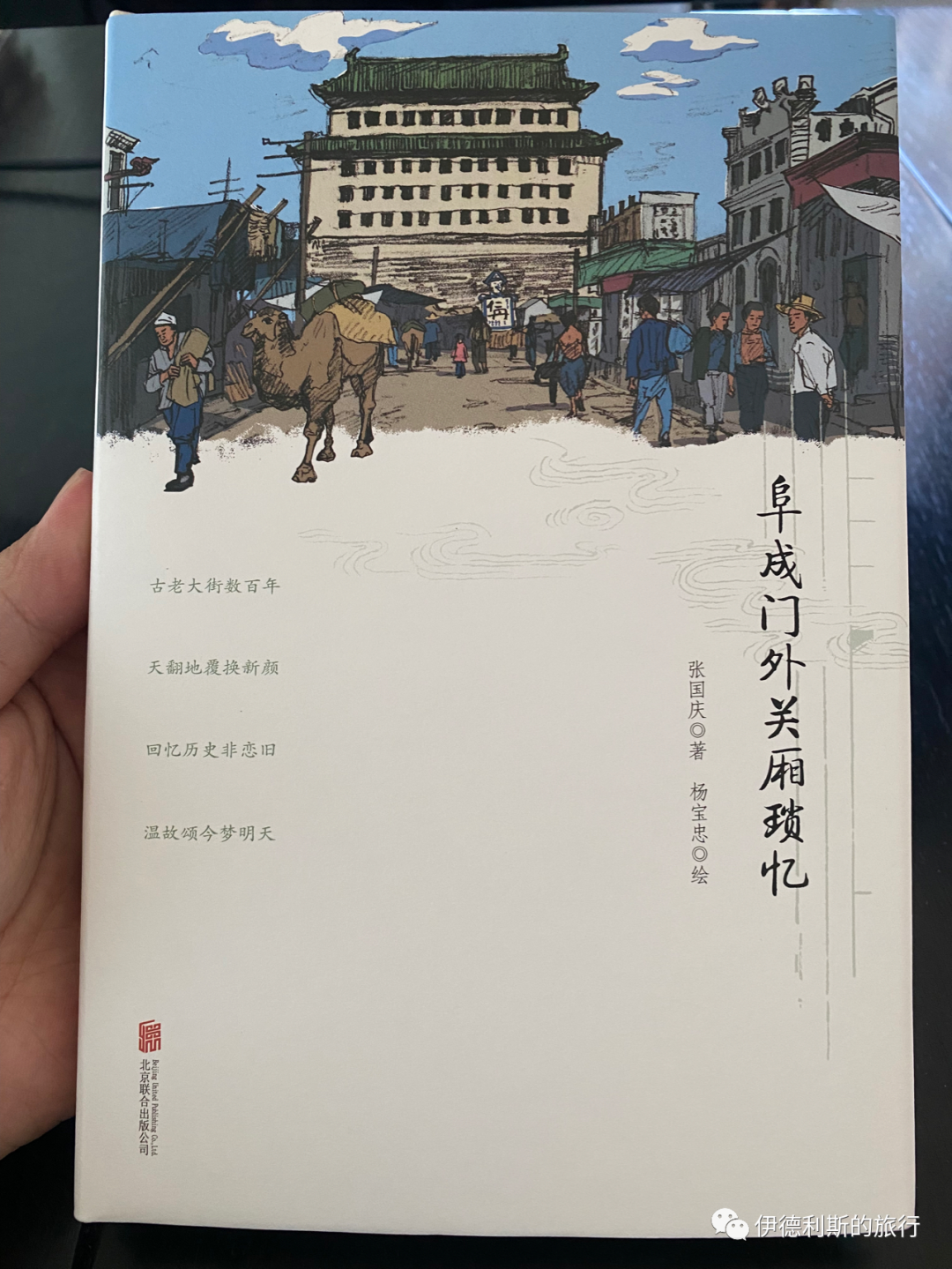
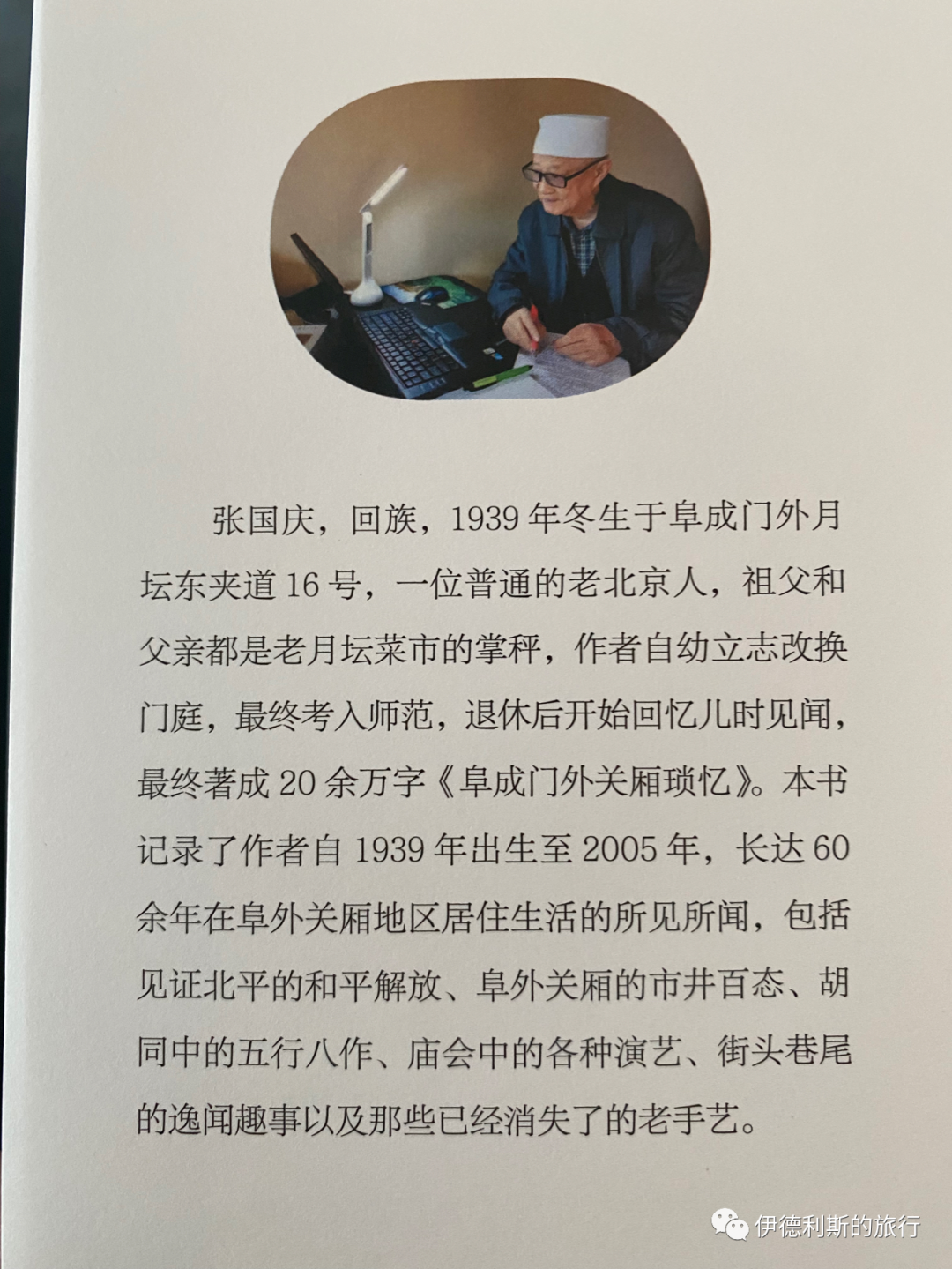
I recently bought a new book from the Zhengyang Library at Xisi in Beijing this September called 'Memories of the Suburbs Outside Fuchengmen'. The author, Zhang Guoqing, is a Hui Muslim who lived outside Fuchengmen for generations. He was born in Yuetan East Alley in 1939 and lived outside Fuchengmen until 2005. After retiring, he started writing down his childhood memories, which eventually became this book.
During the Qing Dynasty and the Republic of China, there were mosque neighborhoods in the suburbs outside all nine gates of Beijing's inner city. Places like the areas outside Chongwenmen and Chaoyangmen even had three or four mosques, and there is relatively more written history about them. Because there were fewer Hui Muslims living outside Fuchengmen and they were more spread out, there has always been a lack of articles about them. This book not only fills the gap in writings about the Hui Muslims outside Fuchengmen, but it is also very special because it comes from vivid childhood memories.
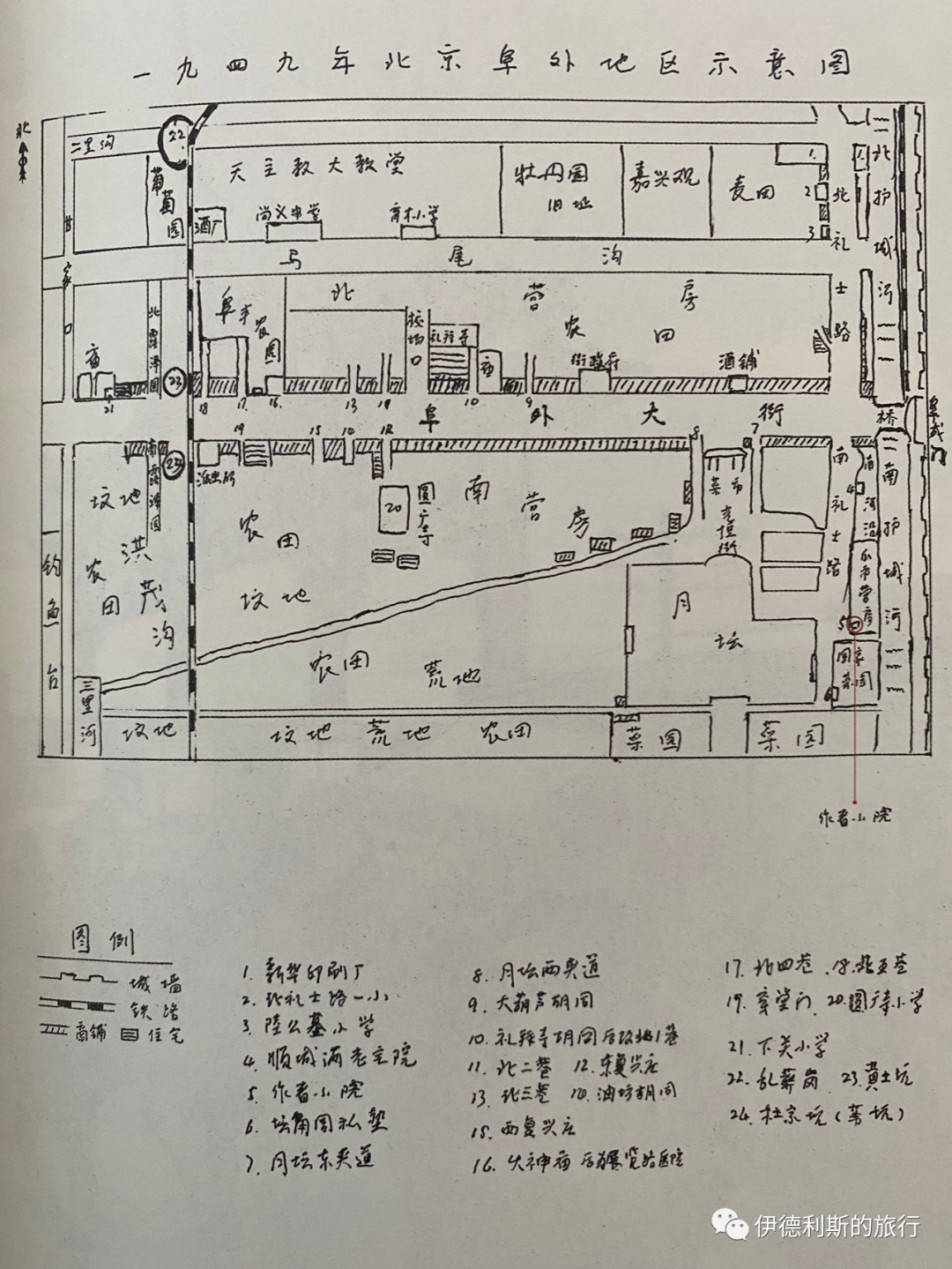
The author drew a map of the area outside Fuchengmen in 1949. You can see the location of the Fuchengmen Outside Mosque (Xiaochangkou libaisi). This is the first time I have seen a map that marks the exact location of this mosque. Today, a stone tablet from the Qianlong period of the Qing Dynasty belonging to the Fuchengmen Outside Mosque is still stored inside the mosque of Emperors of Successive Dynasties in Beijing. It is the only remaining witness to this mosque.
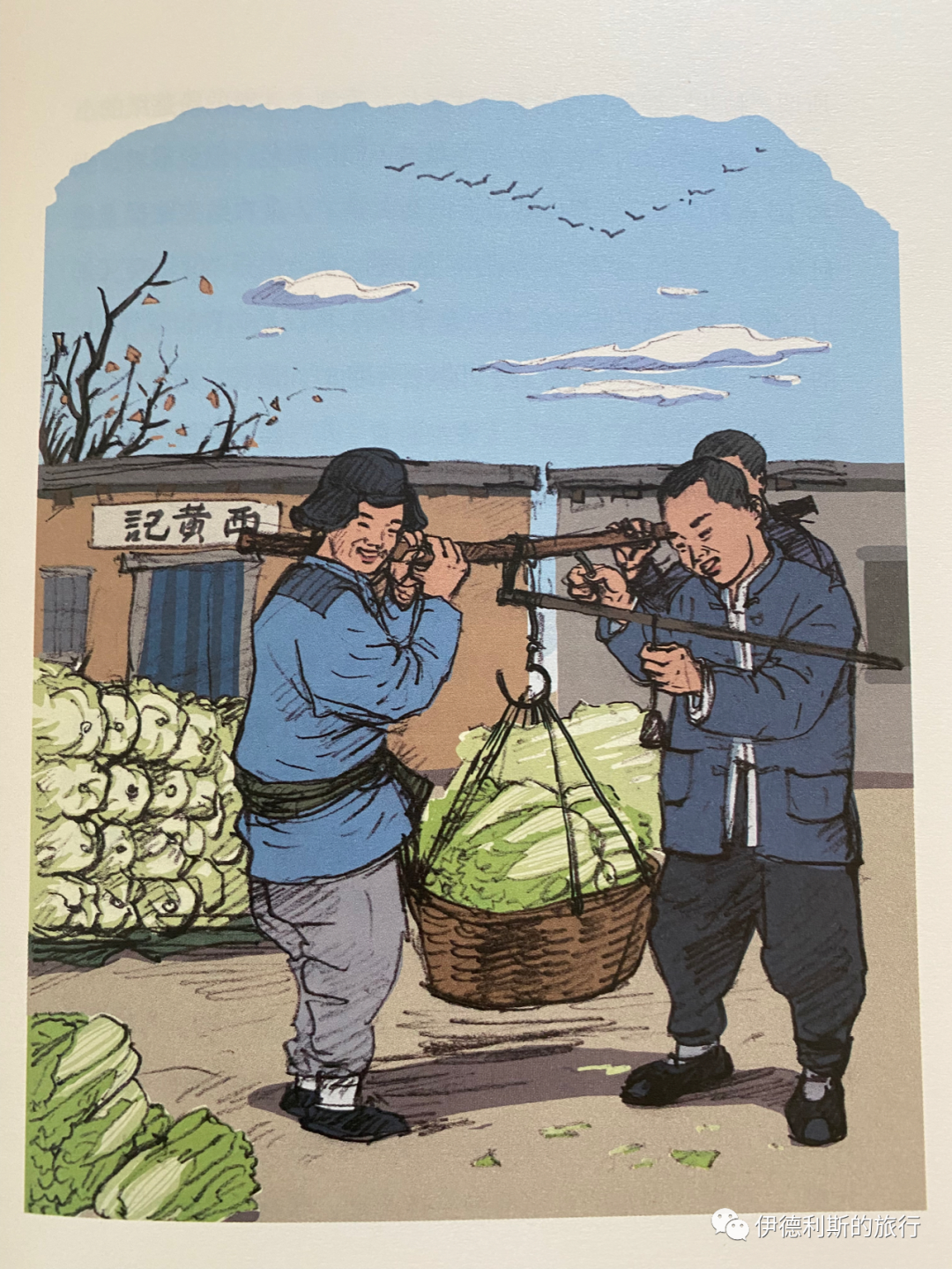
The author's grandfather worked as a scale operator at the Shunxing Vegetable Shop in the Yuetan vegetable market. Every morning, vegetable farmers would drive horse, mule, donkey, and ox carts to deliver vegetables to the shops. Each shop used a large wooden scale that was 1.5 meters long. The scale operator had to quickly and accurately place the weight on the right mark and call out the weight of the vegetables as fast as possible.
The author recalls many halal businesses on Fuwai Street during the Republic of China era. For example, the owners of the Guang Sheng De lamb shop were two brothers from Dezhou, Shandong, who were cousins of the author's grandfather. They named the shop using one character from each of their names and added the character 'De' to show their deep affection for their hometown of Dezhou. The owners of both the Dong Ju Yuan and Xi Ju Yuan lamb shops were Uncle Zhang Dianchen, and the author's third grandfather worked as a butcher there. There were also many others, including the halal Fu Long pastry shop (bobo pu), the halal Huang family sesame flatbread shop (shaobing pu), Wensheng sesame flatbread shop, Yang family breakfast shop, Wan family restaurant, Fucheng Xing grain store, Jin the Hui Muslim's plaster shop, and the Sanjiang Hui Muslim restaurant.
Two Hui Muslim families with ancestral roots in Dezhou, Shandong, shared the surname Man.
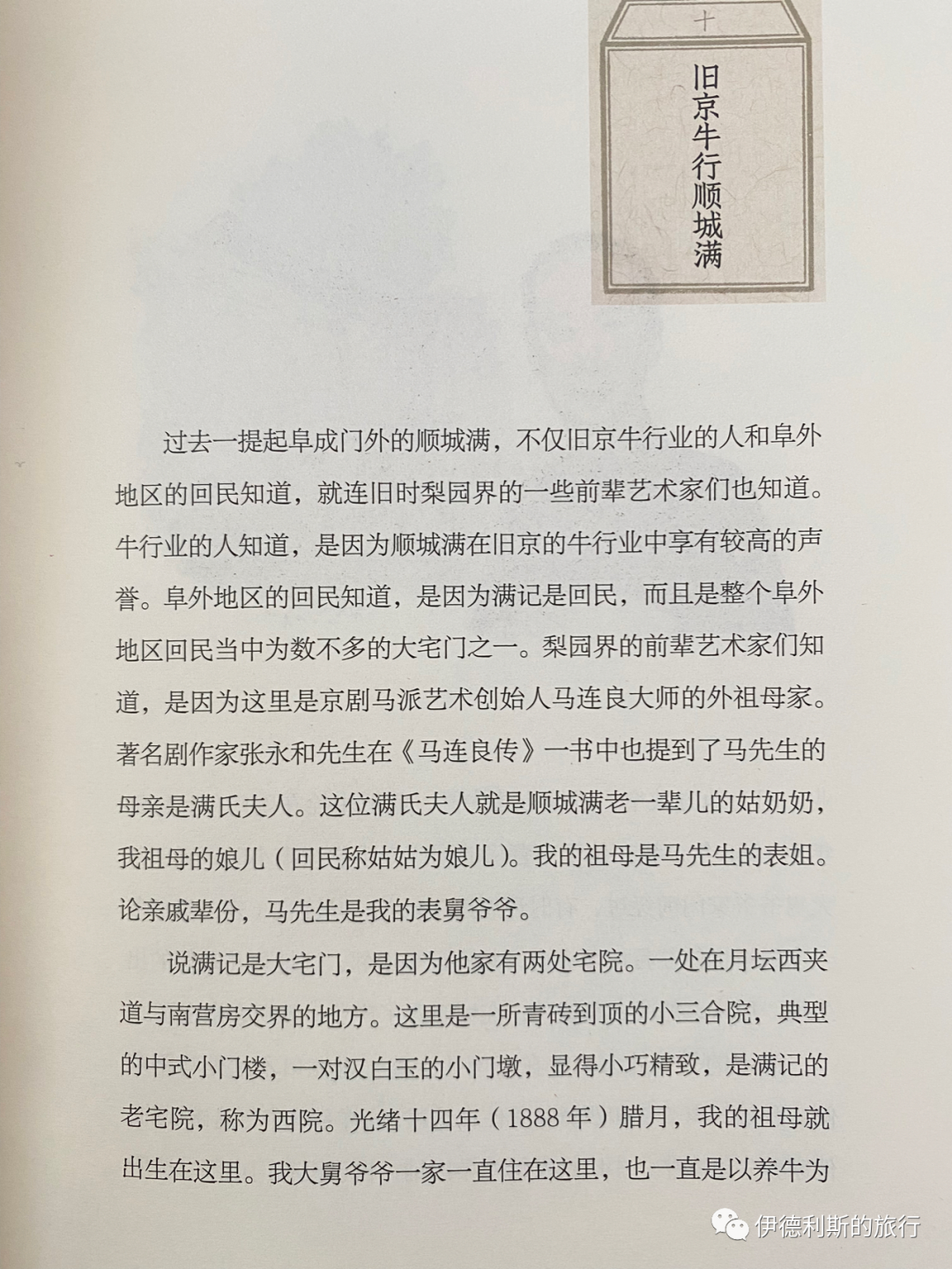
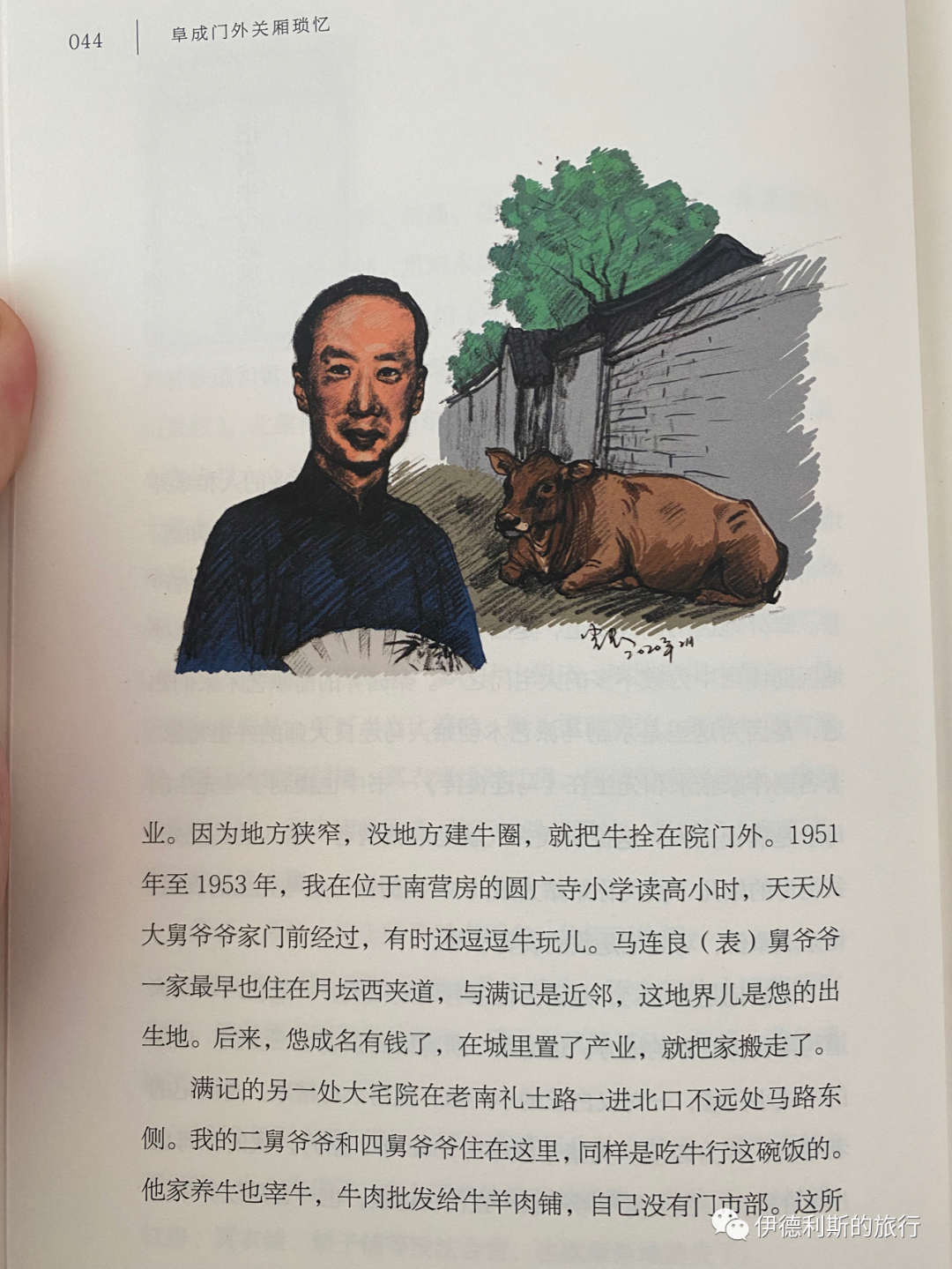
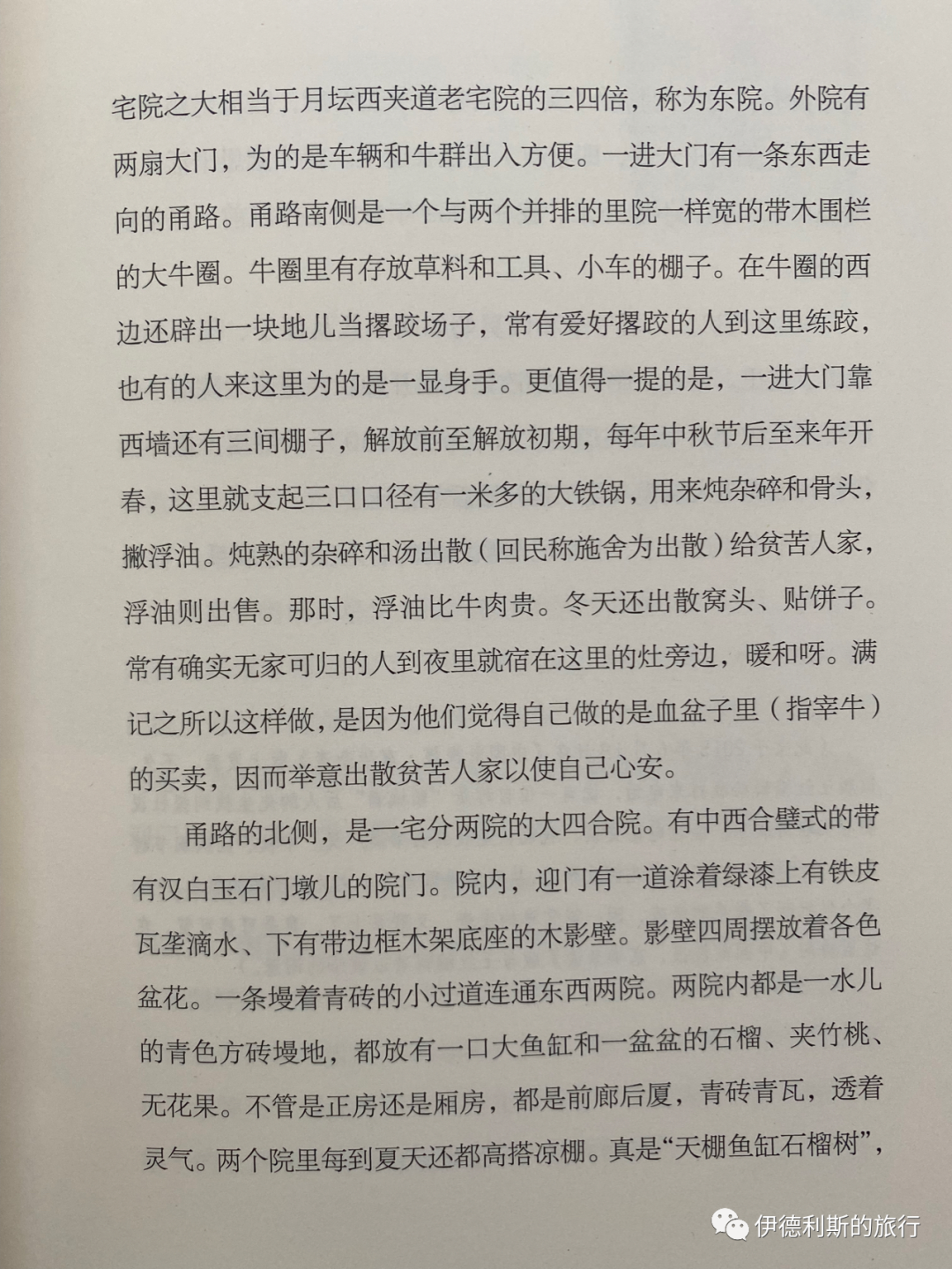
The author's grandmother came from the Man family in Shuncheng outside Fucheng Gate and was a cousin of the famous Peking opera star Ma Lianliang. The Man family in Shuncheng was the largest Hui Muslim household in the area at the time, and they made their living in the cattle business. The Man family raised cattle and also slaughtered them, selling beef wholesale to lamb and beef shops. The east courtyard of the Man family home has a large cattle pen with wooden fences, and next to it is a wrestling ring where anyone who loves to wrestle can show off their skills. Every autumn and winter, the Man family sets up three large iron pots over a meter wide to stew offal (zasui) and beef bones, which they then give away to poor families.
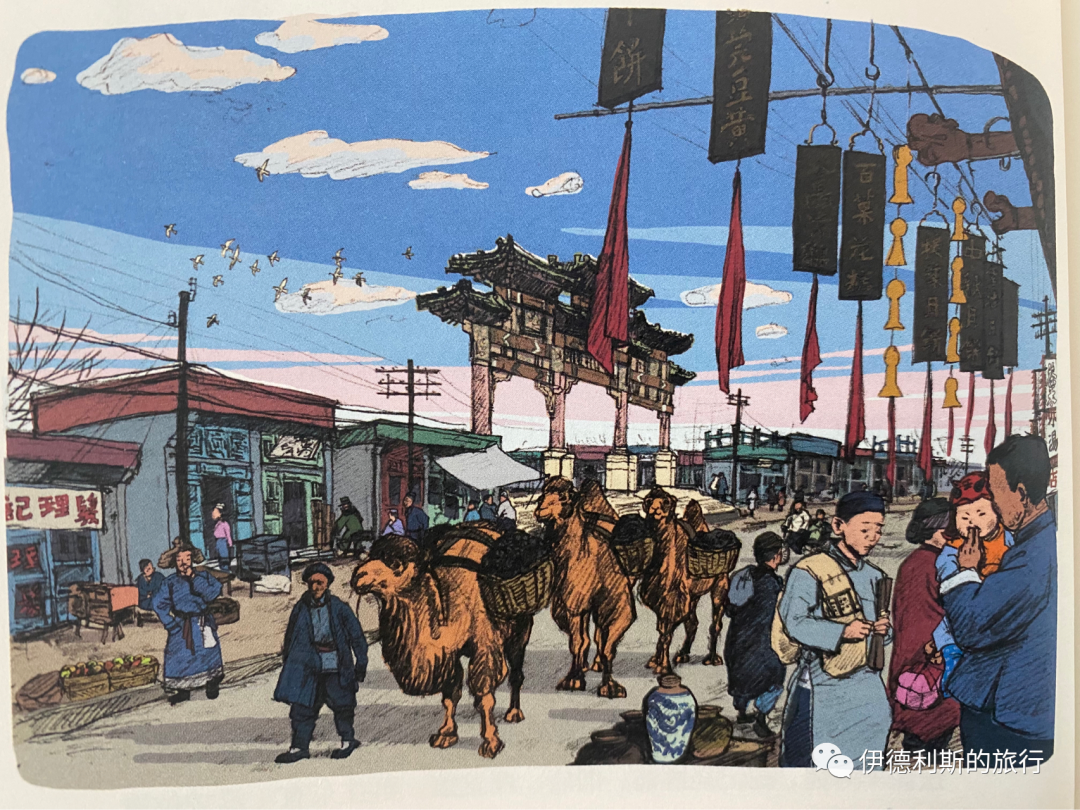
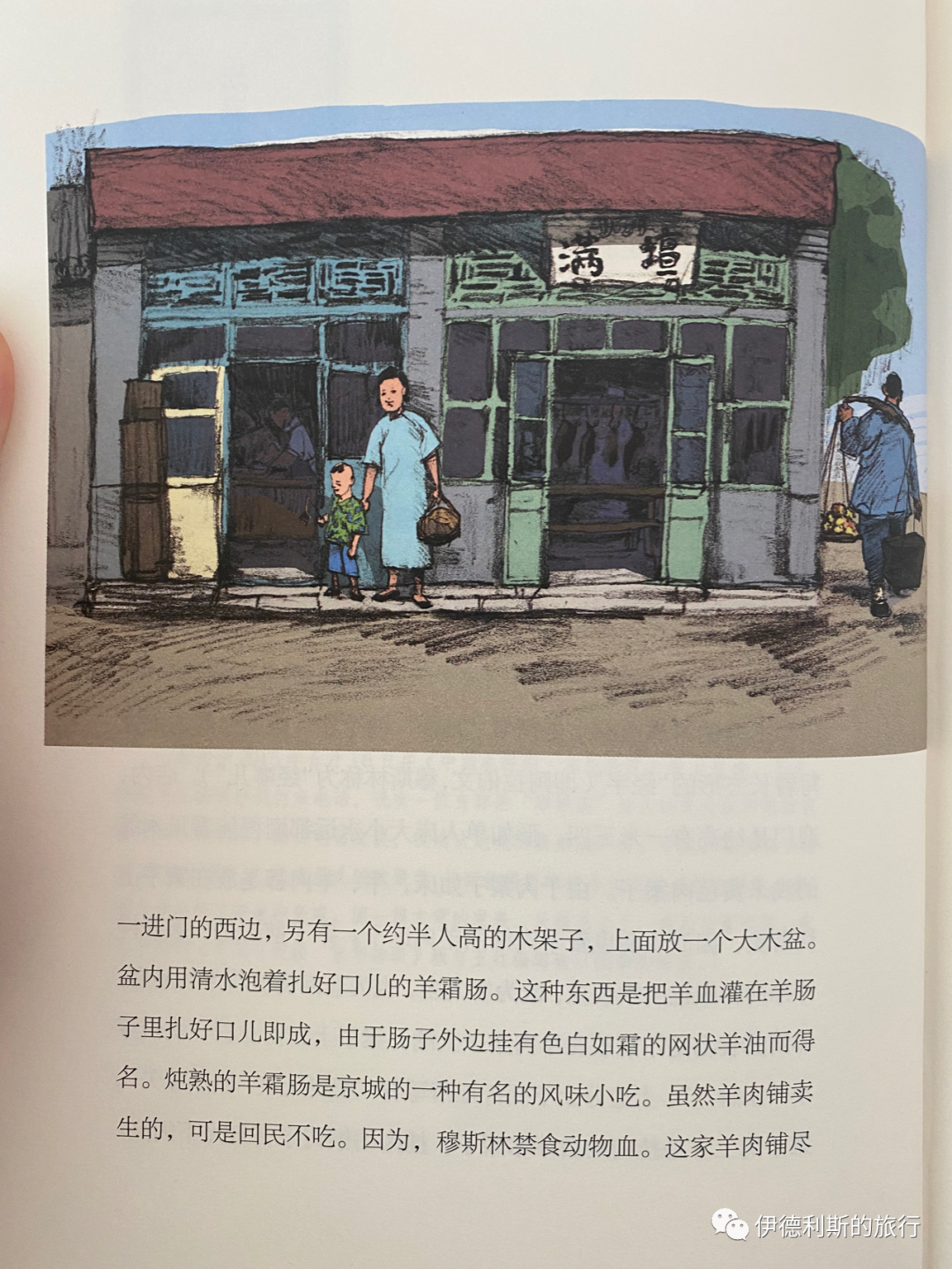
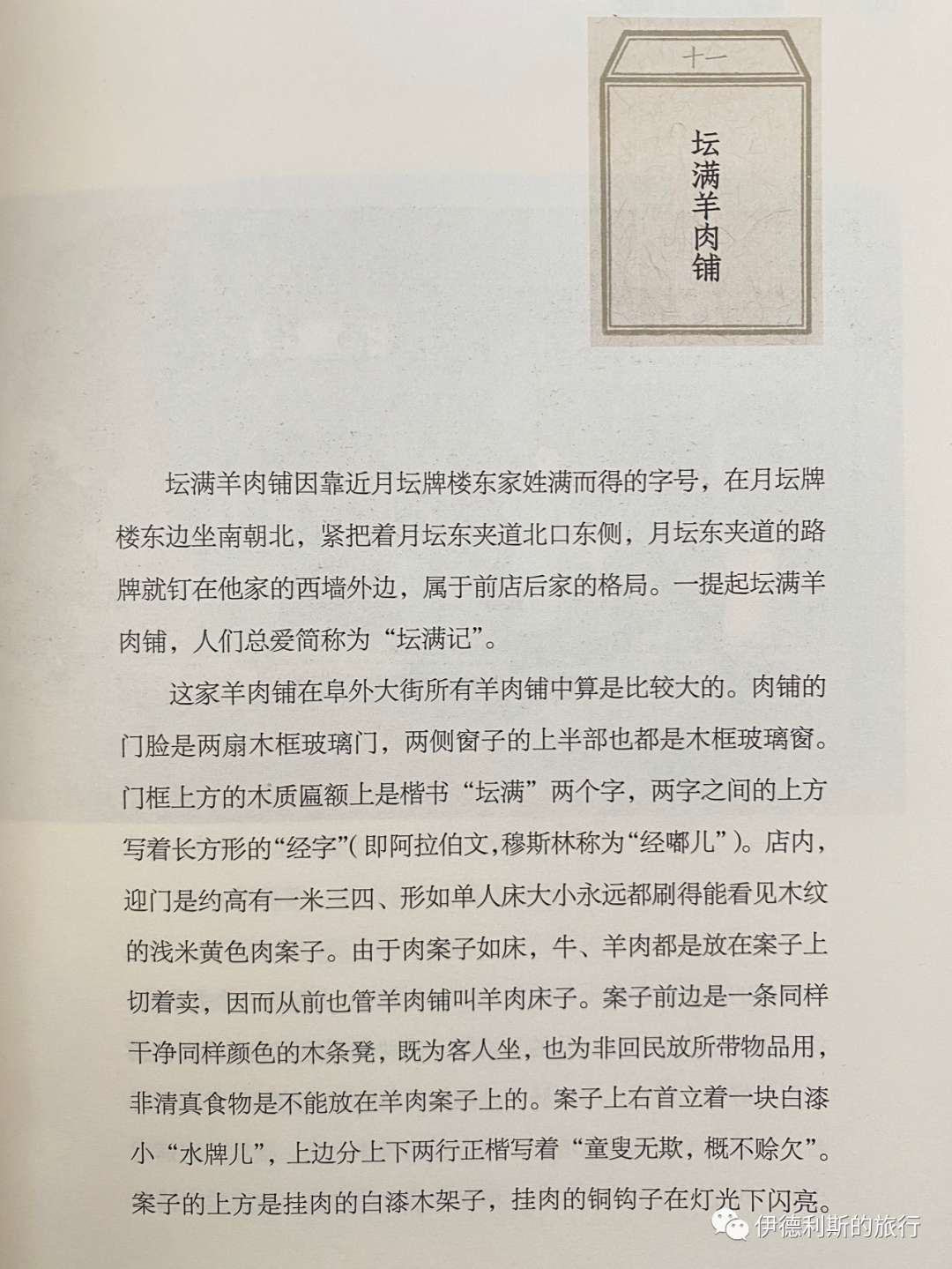
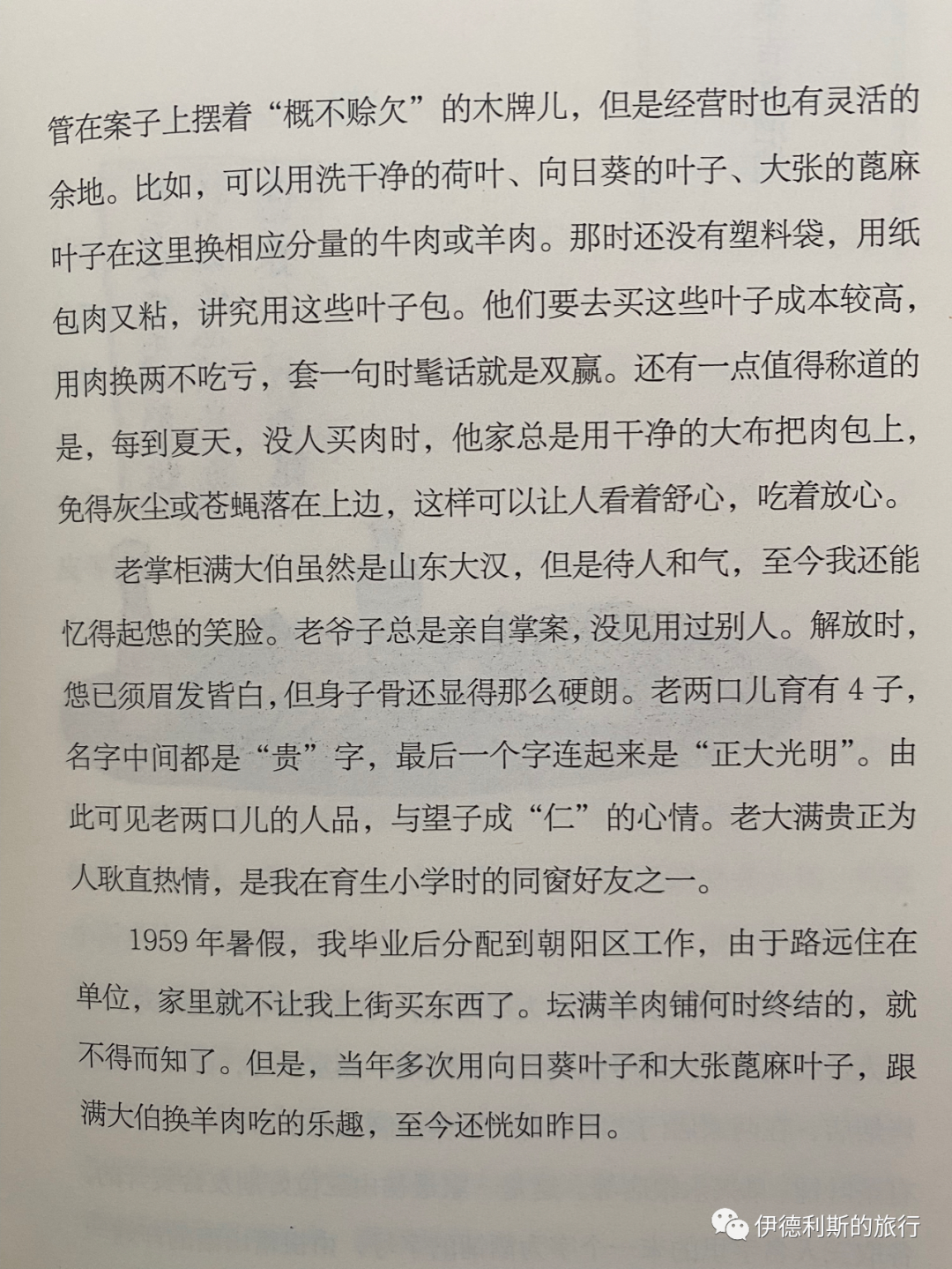
East of the Yuetan Archway is the Man Family Mutton Shop, which is one of the largest mutton shops on Fuchengmen Outer Street. Their meat cutting table (yangrou chuangzi) is about 1.3 or 1.4 meters high and the size of a single bed, and they cut and sell both beef and mutton on it. In front of the table is a wooden bench for customers to sit on or to place their belongings. They allow people to trade clean lotus leaves, sunflower leaves, or large castor leaves for an equal weight of beef or mutton. Since there were no plastic bags back then and paper would stick to the meat, it was common practice to use leaves for wrapping.
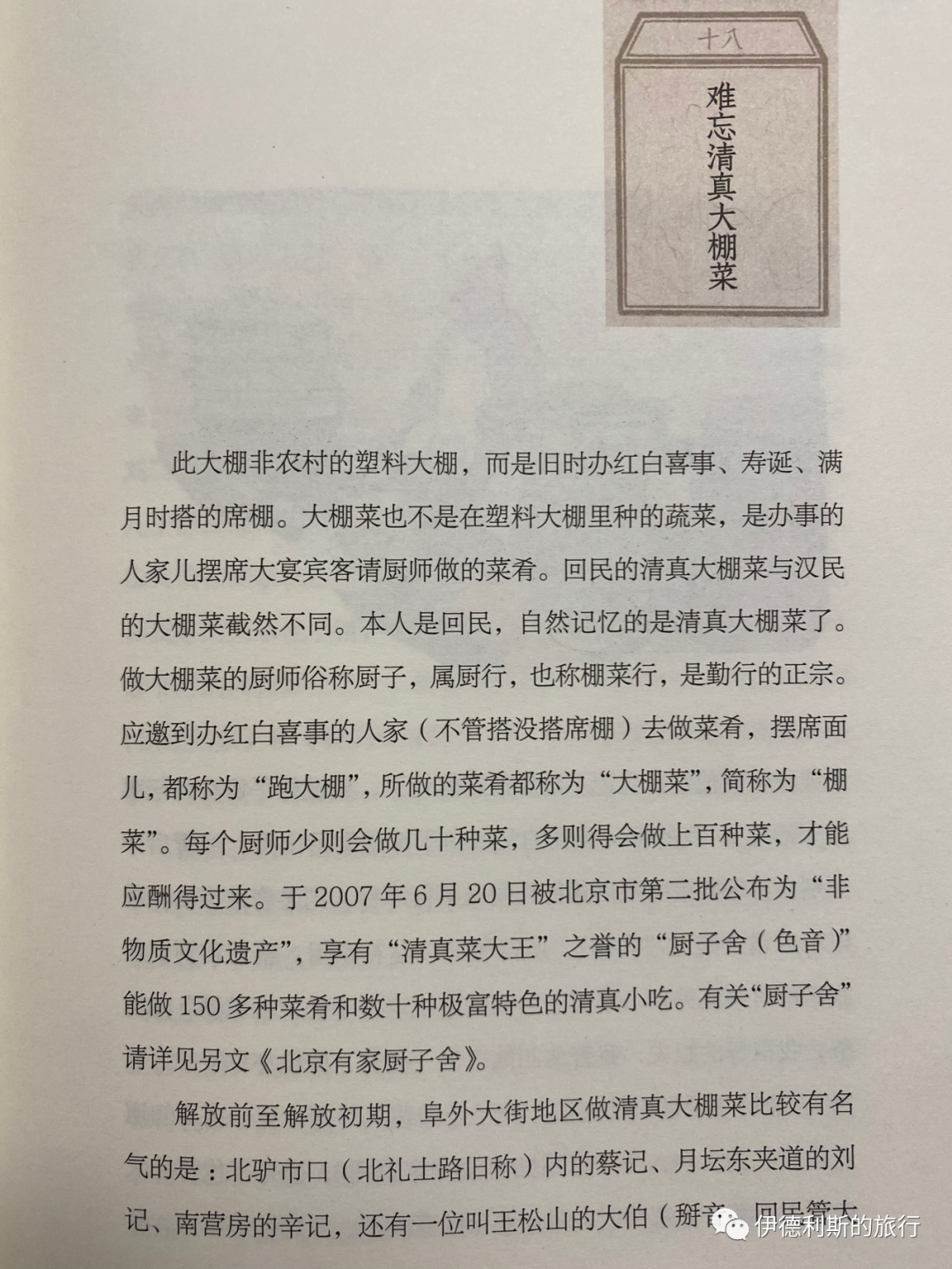
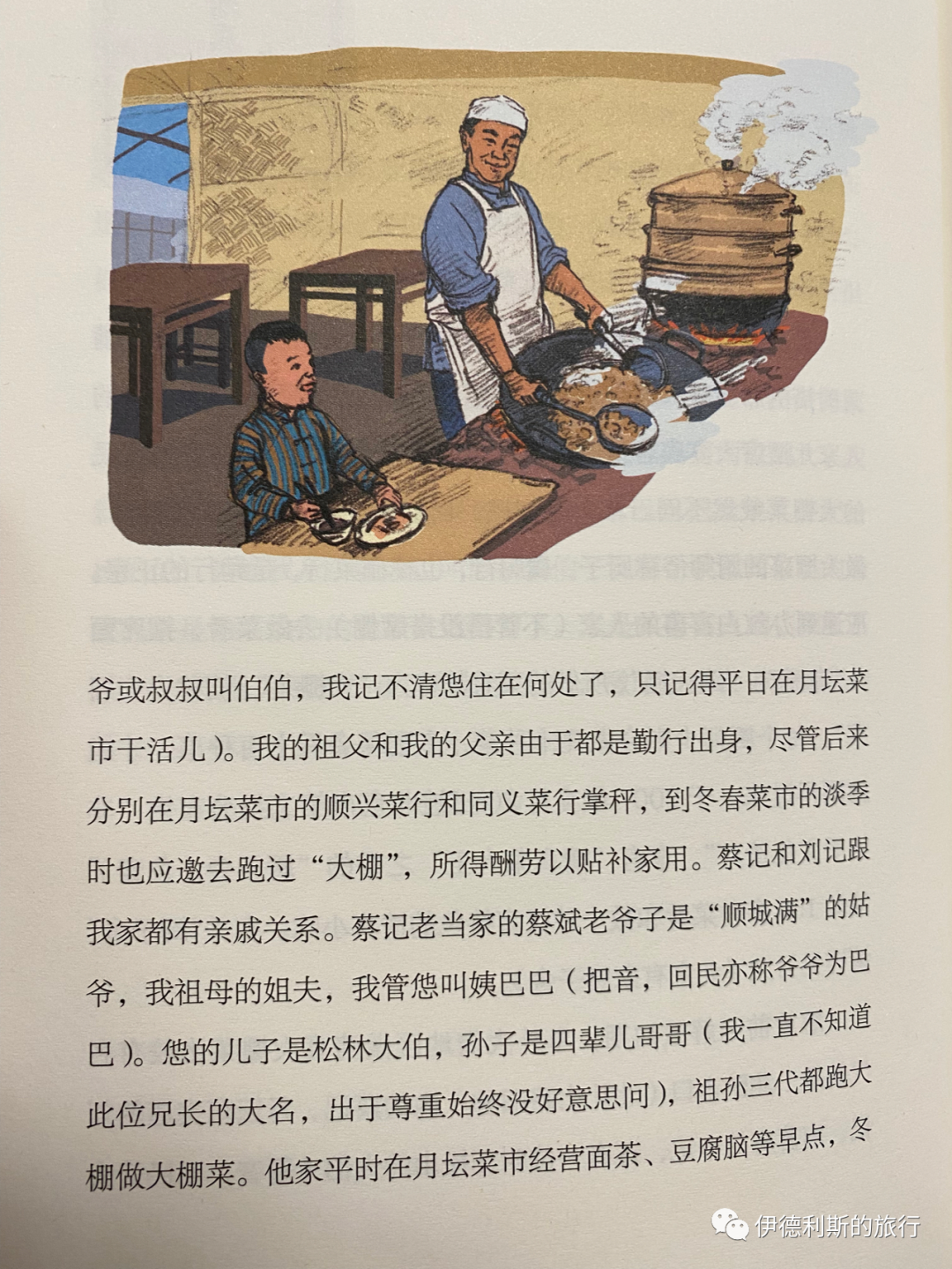
Recalling the halal banquet dishes (dapeng cai) from outside Fuchengmen. In the past, authentic Beijing halal food was found at banquets, not in restaurants. Hui Muslims in Beijing used to prefer hosting banquets at home rather than going to restaurants. It felt more respectful and proper, and they could control every detail.
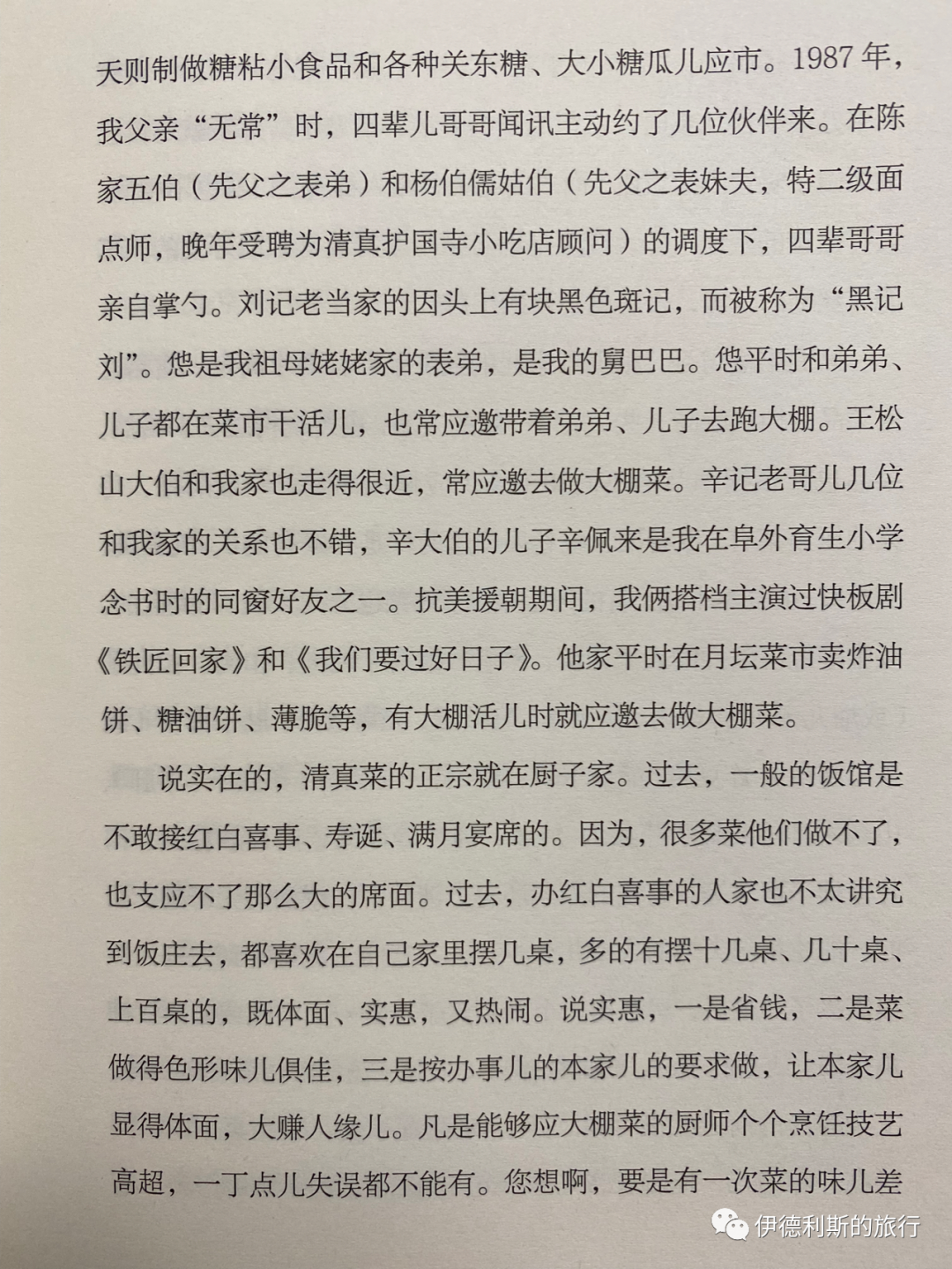
Before the 1950s, famous halal tent-banquet caterers outside Fuchengmen included Cai Ji at Beilushikou, Liu Ji at Yuetan East Alley, Xin Ji at Nanyingfang, and Wang Songshan’s uncle. Cai Ji usually sold millet porridge with sesame paste (miancha) and tofu pudding (doufunao) at the Yuetan market, and made various malt candies (guandongtang) and sugar melons (tanggua) in winter. Xin Ji sold fried dough cakes (youbing), sugar-coated fried dough cakes (tangyoubing), and crispy crackers (baocui) at the same market. The other two families also worked at the market and would set up tent banquets whenever someone invited them.
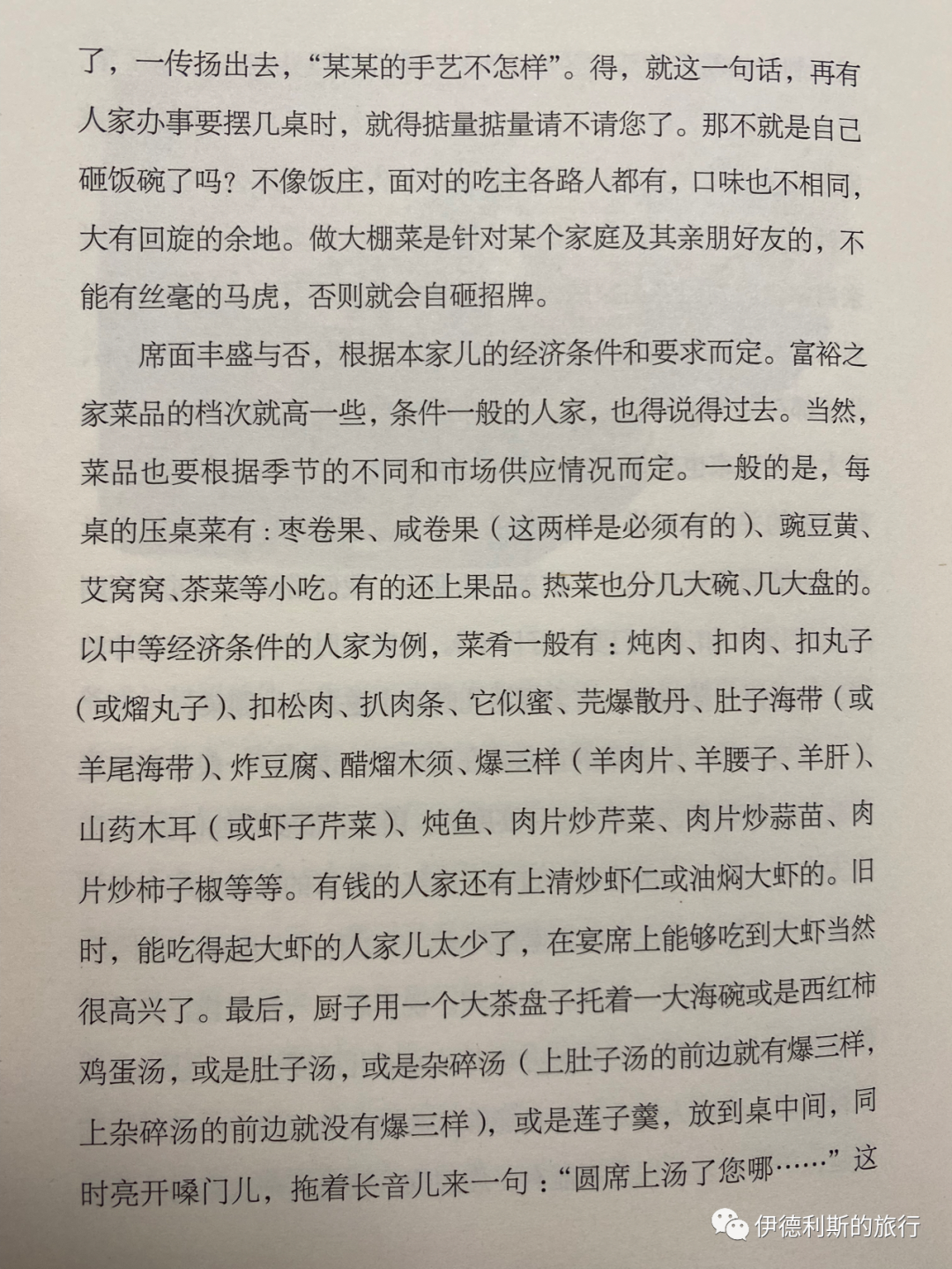
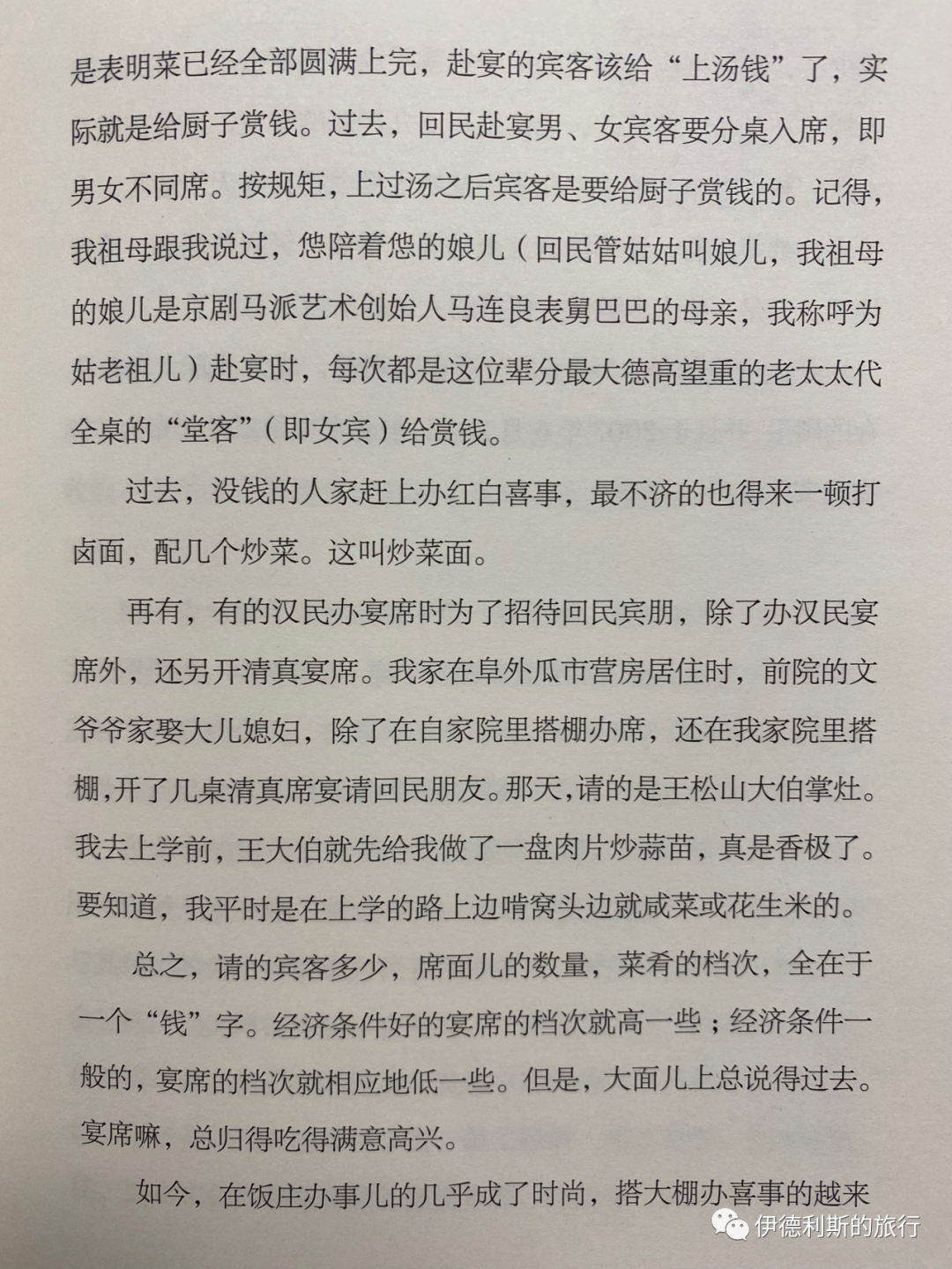
Banquets were categorized by the host's budget and the season. Every table usually started with appetizers like date-stuffed fried rolls (zaojuanguo), savory fried rolls (xianjuanguo), pea flour cake (wandouhuang), steamed rice cakes (aiwowo), and tea-infused vegetables (chacai), sometimes followed by fruit. Mid-range hot dishes included stewed meat, steamed pork with soy sauce (kourou), steamed meatballs (kouwanzi) or stir-fried meatballs (liuwanzi), steamed shredded meat (kousongrou), braised meat strips (paroutiao), sweet and sour lamb (tasimi), stir-fried tripe with coriander (yanbaosandan), tripe with kelp or lamb tail fat with kelp, fried tofu, stir-fried meat with egg and vinegar (culiumuxu), stir-fried trio (baosanyang), yam with wood ear mushrooms or shrimp-roe celery, stewed fish, and various stir-fries with celery, garlic sprouts, or bell peppers. Wealthy families would serve stir-fried shrimp or braised prawns. The meal ended with tomato egg soup, tripe soup, offal soup, or lotus seed soup. The cook would then announce, 'The final soup is served,' signaling the banquet was complete and it was time to tip the chef.
Yang Boru was a master of halal snacks who ran a sesame flatbread (shaobing) shop on Fuchengmen Outer Street in the 1950s. Yang Boru was originally from Dachang, Hebei. He started as an apprentice at the halal Delongshun sesame flatbread shop outside Hepingmen in 1943 and finished his training in 1947. He could use steaming, frying, boiling, and griddle-baking to make over 60 types of halal snacks, including sesame flatbreads (shaobing), baked flatbreads (huoshao), ox-tongue cakes (niushebing), spiral rolls (luosizhuan), crispy crackers (ganbenger), and toad-spitting-honey (hamatumi, a red bean paste-filled flatbread). In 1950, he opened Yang's Sesame Flatbread Shop on Fuchengmen Outer Street, right next to the east side of the Tanman Mutton Shop. At that time, the shop placed a long table outside the door. On the table was a rectangular glass display case with a small cloth curtain on the inside, and several small wicker baskets held the finished food for sale.
In 1959, Yang Boru moved to the Sanlihe Halal Canteen to be in charge of flour-based snacks. In 1978, the canteen expanded into the Henan Restaurant Hui Muslim Snack Shop, and in 1986, it became a joint venture called the Guiyang Hotel, where he served as the head chef of the halal restaurant. Besides being skilled at making pea flour cakes (wandouhuang), steamed rice cakes (aiwowo), date rolls (zaojuanguo), toad-spitting-honey (hamatumi), and fruit-topped rice cakes (guoliaohuayangniangao), Yang Boru also created his own halal snacks like red bean soup (xiaodougen), Buddha-hand rolls (foshoujuan), ruyi rolls (ruyijuan), and yam rolls (shanyaojuan). These were very popular and helped make Beijing halal snack platters a staple at high-end banquets.
The 'Porridge Shop Wei' family from the Fuchengmen Outer Mosque. The Wei family was originally from Dezhou, Shandong. Old Mr. Wei came to Beijing to escape a flood and worked as a clerk at the Jutai Beef and Mutton Shop in Caishikou. Because he was hardworking, Old Mr. Wei inherited the business and eventually built a house next to the Jiaochangkou Mosque outside Fuchengmen. Later, his family bought farmland and expanded their house, becoming a well-known wealthy Hui Muslim household outside Fucheng Gate.
After the Wei family became wealthy, they opened a porridge kitchen next to their home. They gave a bowl of hot porridge to everyone, whether Hui or Han, and provided steamed buns (mantou) and cornmeal buns (wotou) during holidays. In 1945, the Wei family was herding sheep from Zhangbei Bashang to Beijing when they ran into retreating Japanese soldiers. Nearly two hundred sheep were stolen, and they were unable to continue giving out porridge after that.
The Wei family's porridge kitchen compound was among the last old courtyards demolished outside Fucheng Gate. It finally disappeared in the mid-to-late 1990s when Fuwai Street was expanded.
Rice shops and yarn shops run by Hui Muslims in Fuwai. In the past, most descriptions of Hui Muslim businesses focused on beef and mutton shops or halal snack shops, while other types of businesses were relatively rare.
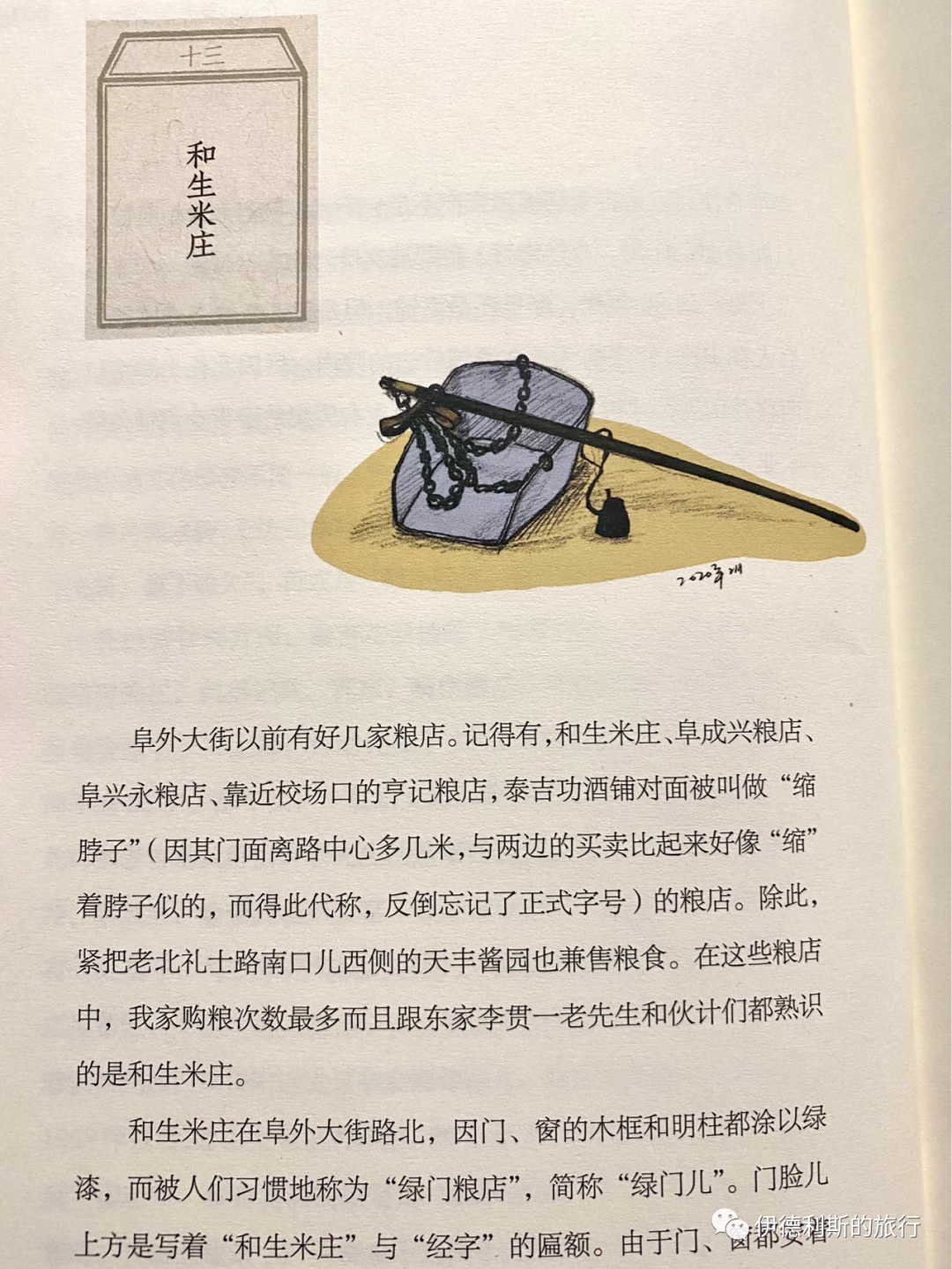
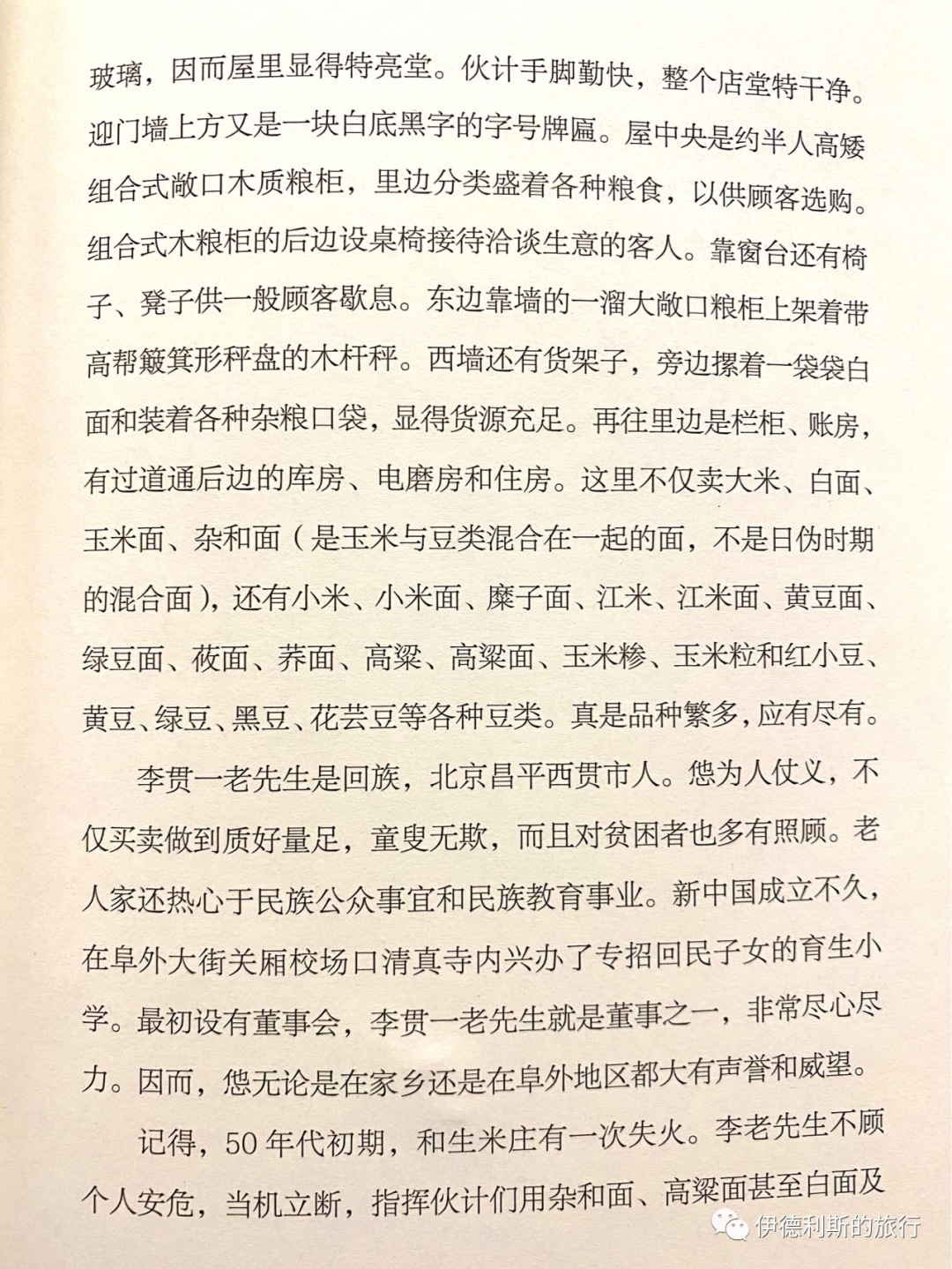
Hesheng Rice Shop was on the north side of Fuwai Street. The owner, Li Guanyi, was originally from Xiguanshi in Changping, Beijing. He was a righteous man and a board member of the Yusheng Primary School run by the Xiaochangkou Mosque in Fuwai. He was highly respected in both Xiguanshi and outside Fucheng Gate.
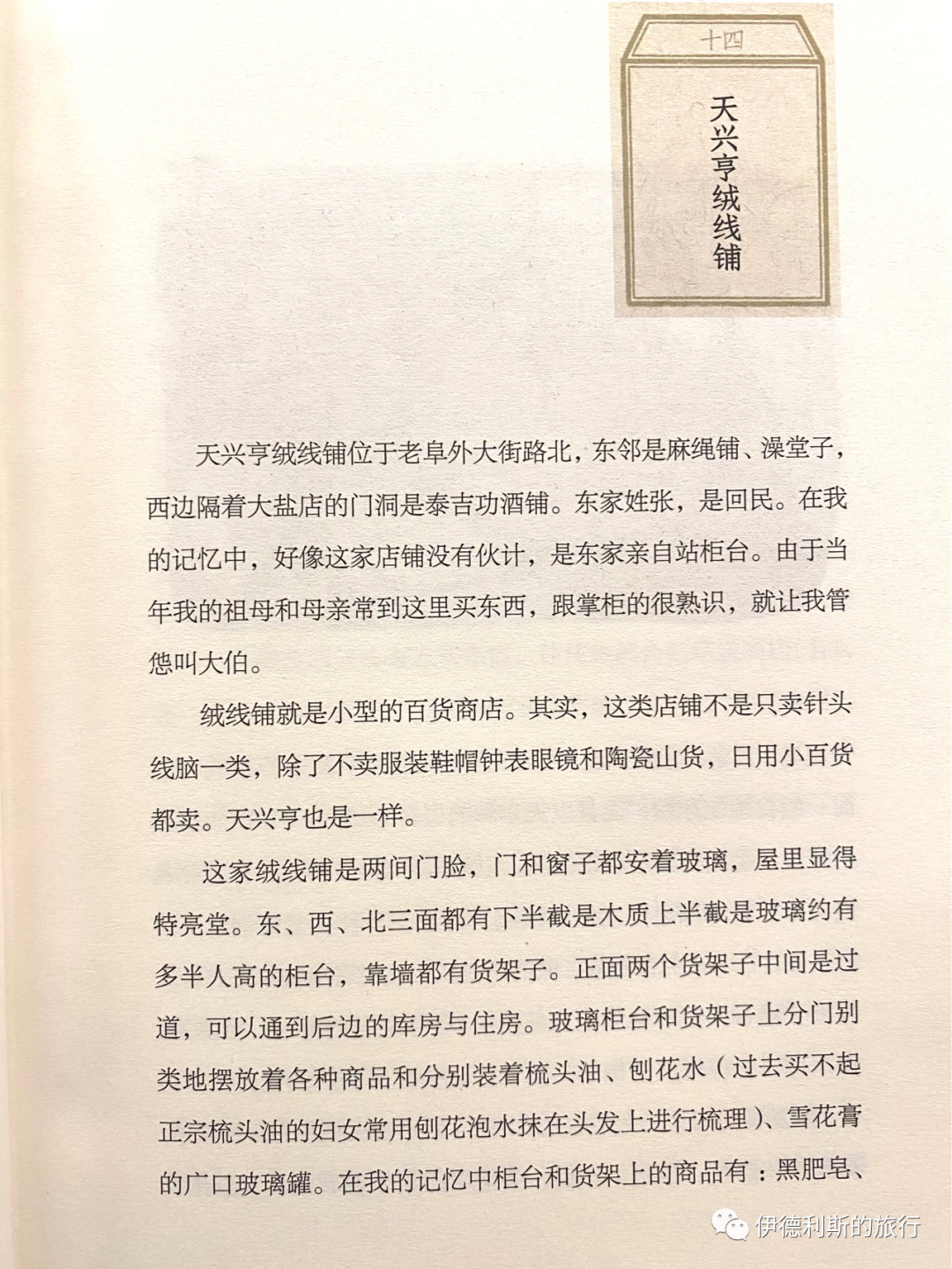
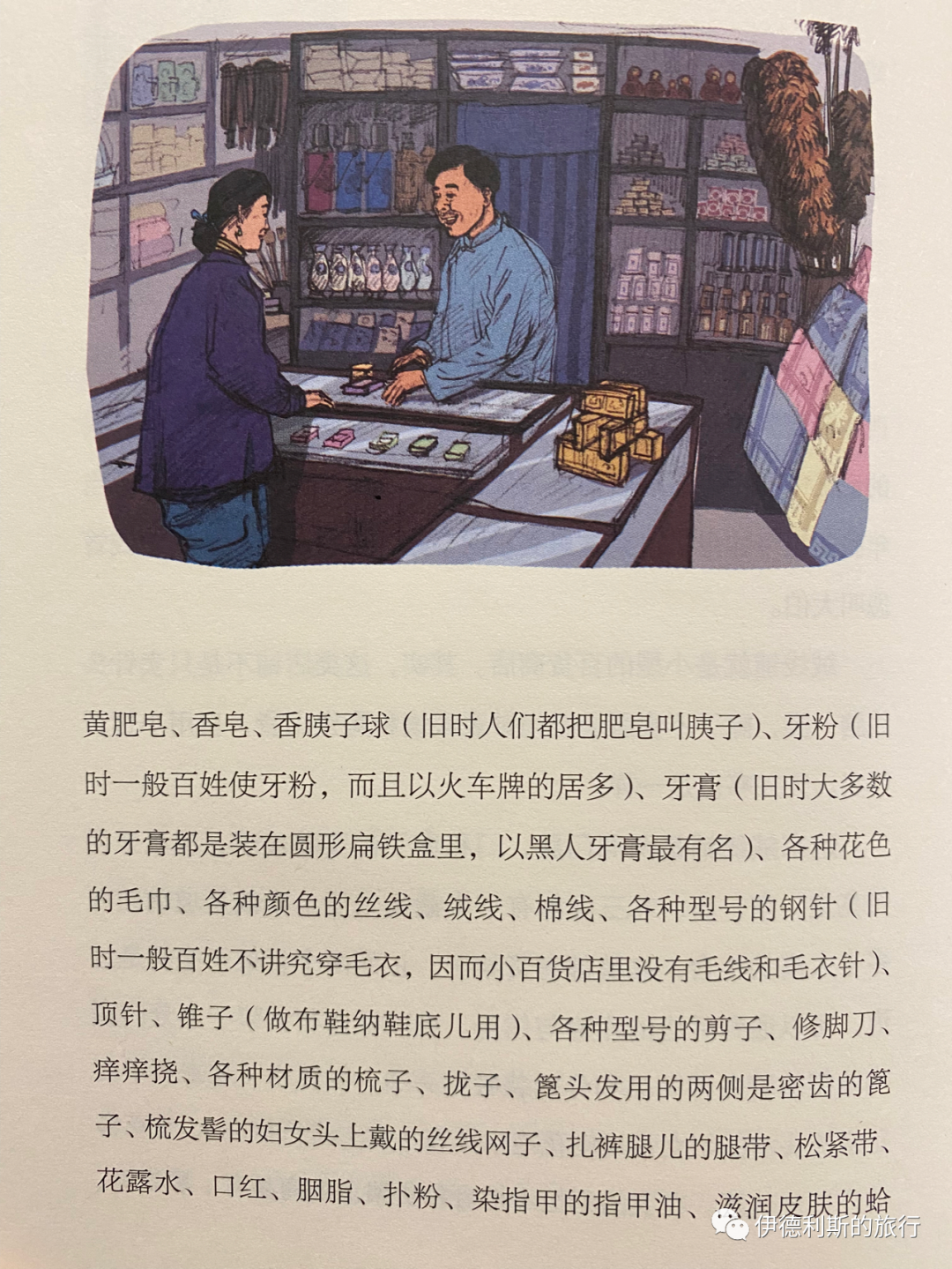
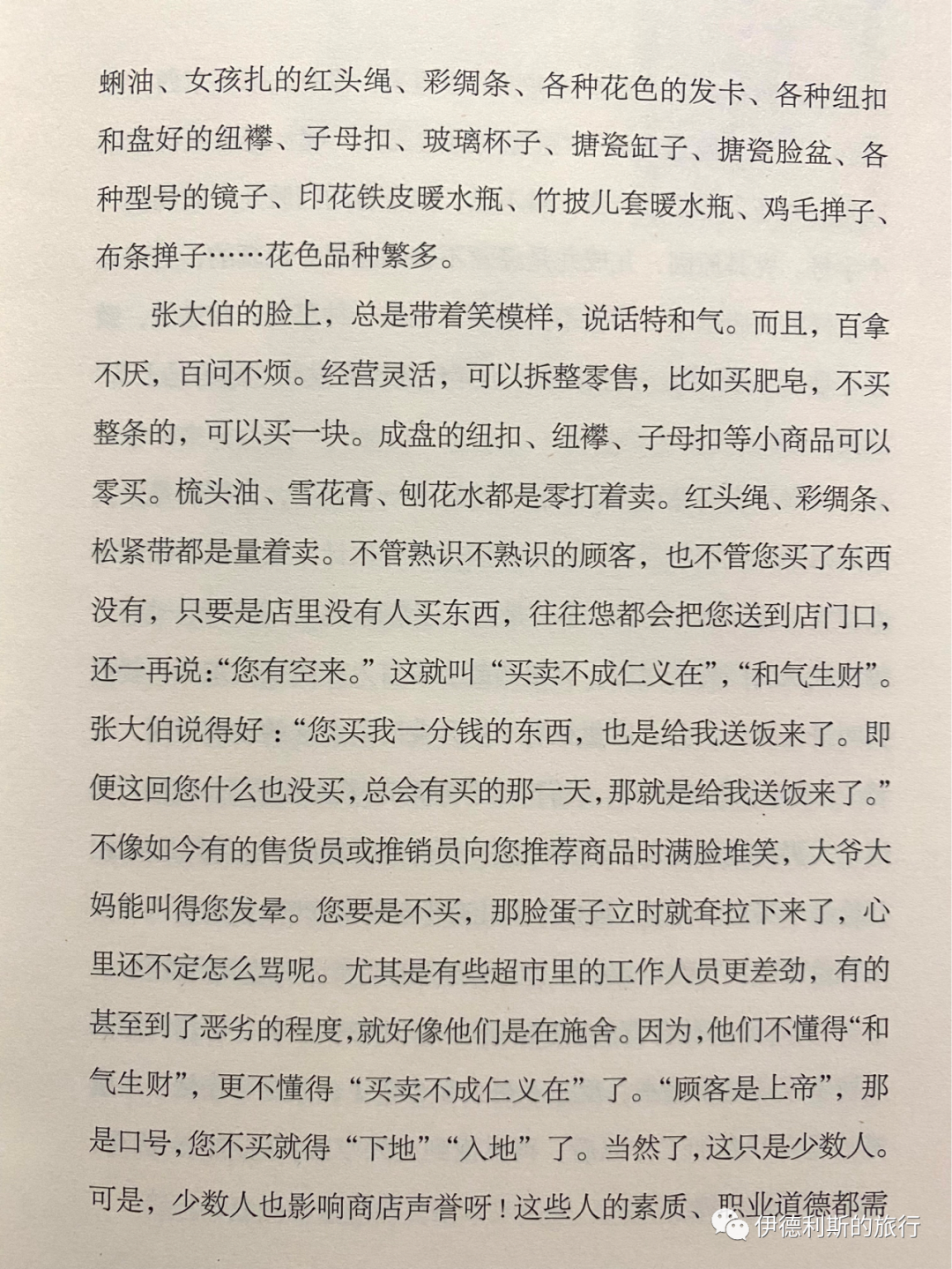
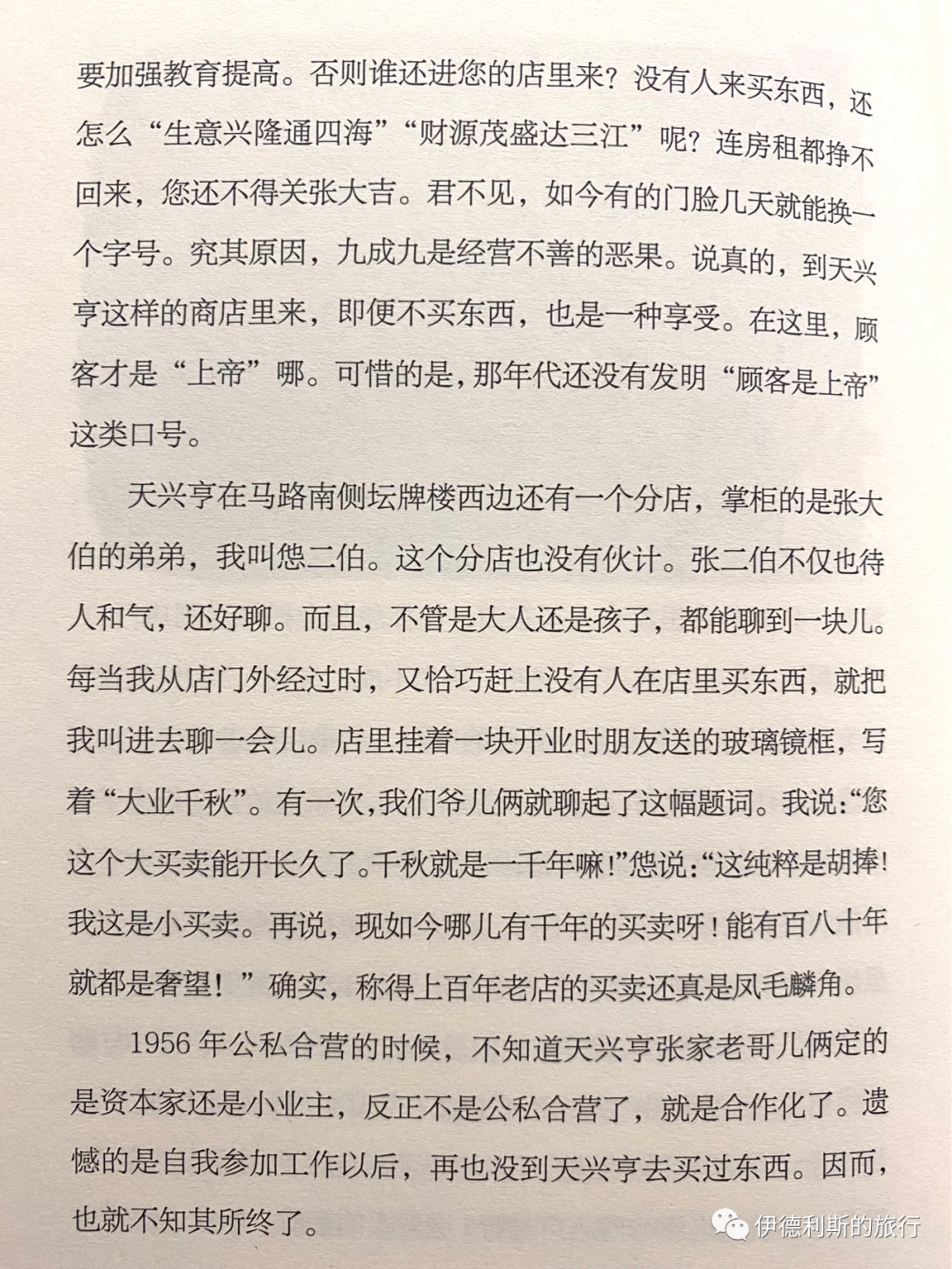
Tianxingheng Yarn Shop was also on the north side of Fuwai Street, and the owner was a Hui Muslim named Zhang. At that time, the yarn shops sold more than just needles and thread; they also carried all kinds of daily necessities, including hair oil, wood shaving water (baohuashui), vanishing cream, soap, scented soap, soap balls (xiangyiziqiu), tooth powder, toothpaste, and towels. Uncle Zhang was kind to everyone. Whether a customer bought something or not, he would walk them to the door and say repeatedly, 'Come back when you have time.'
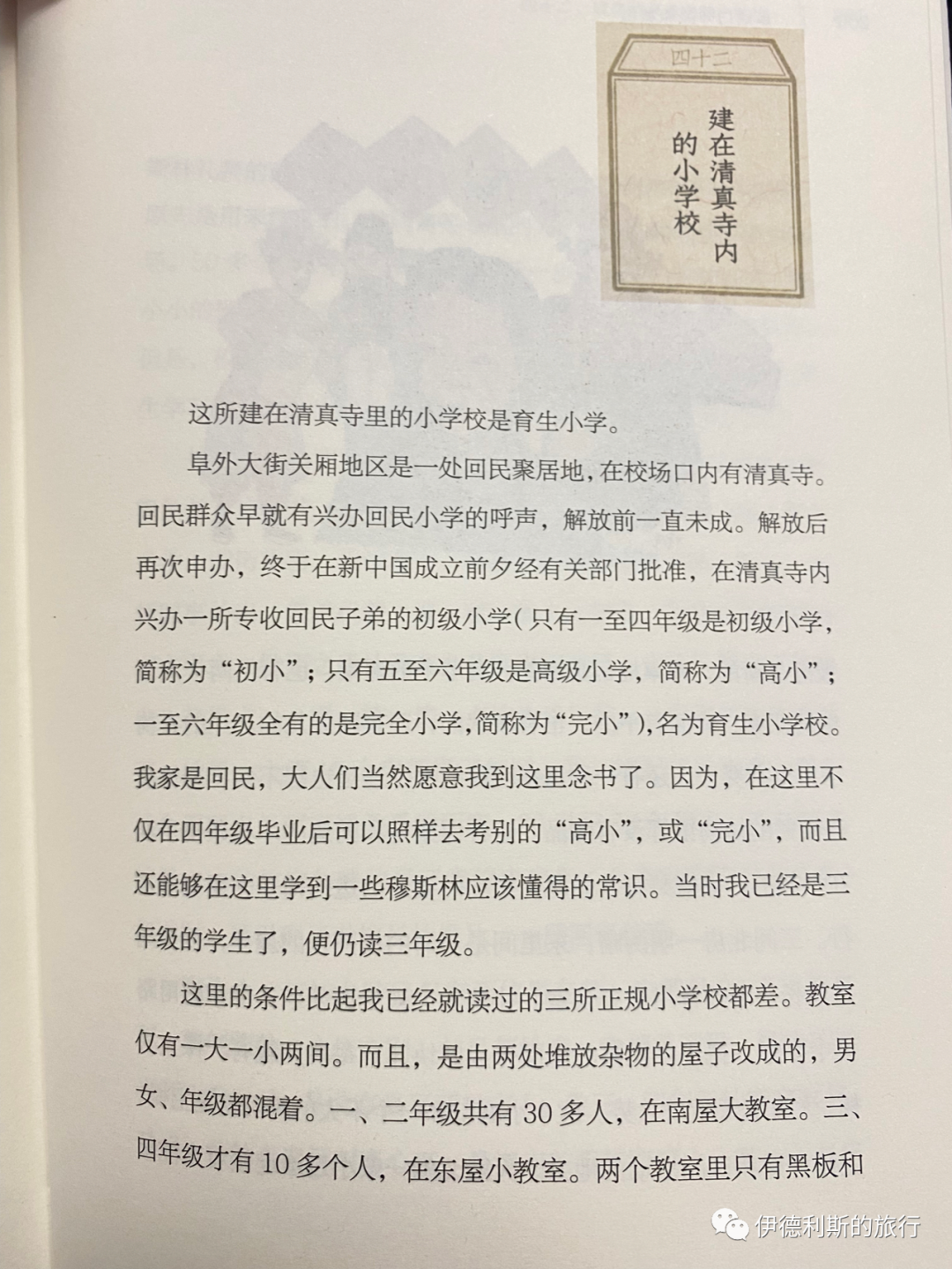
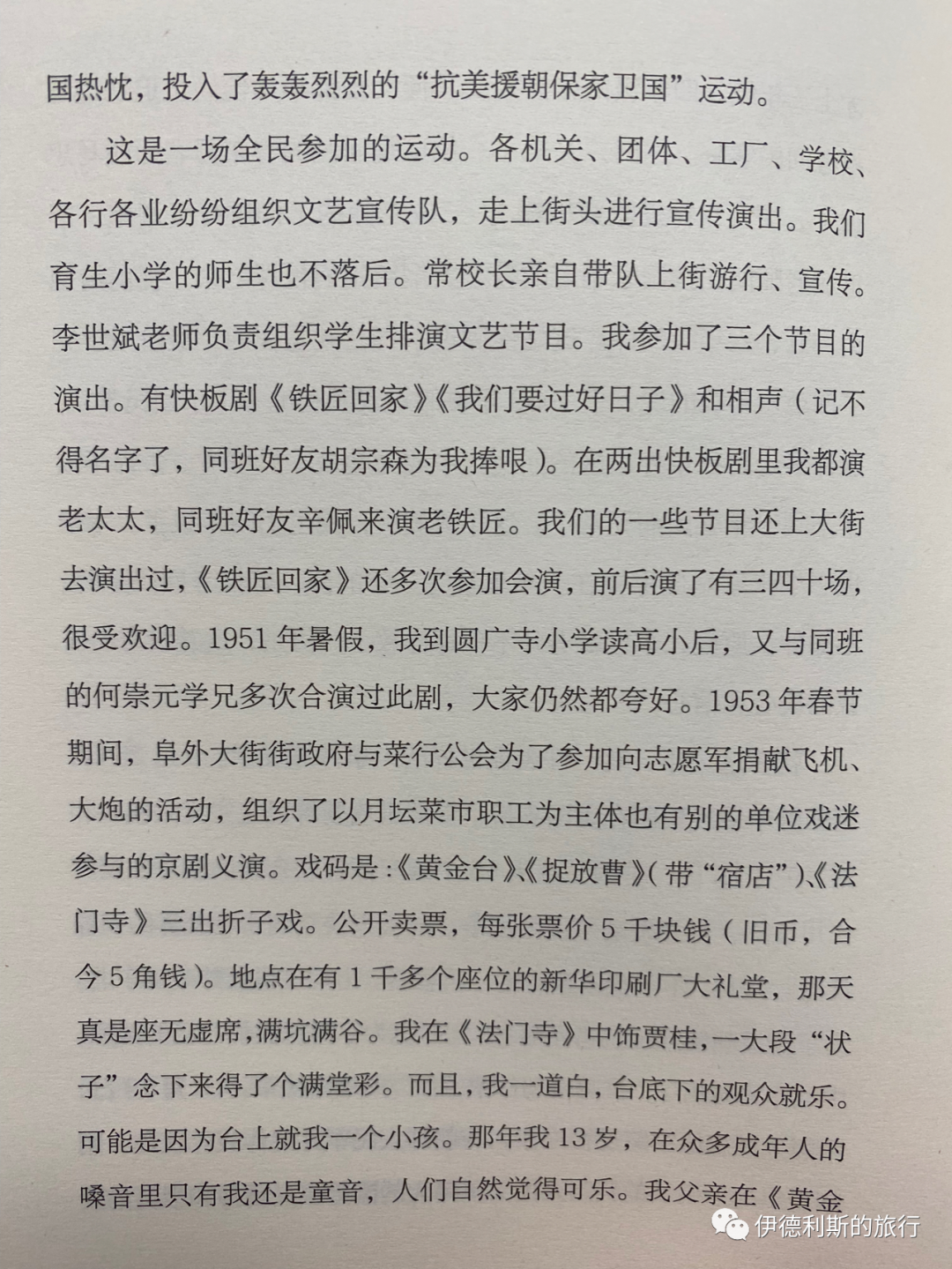
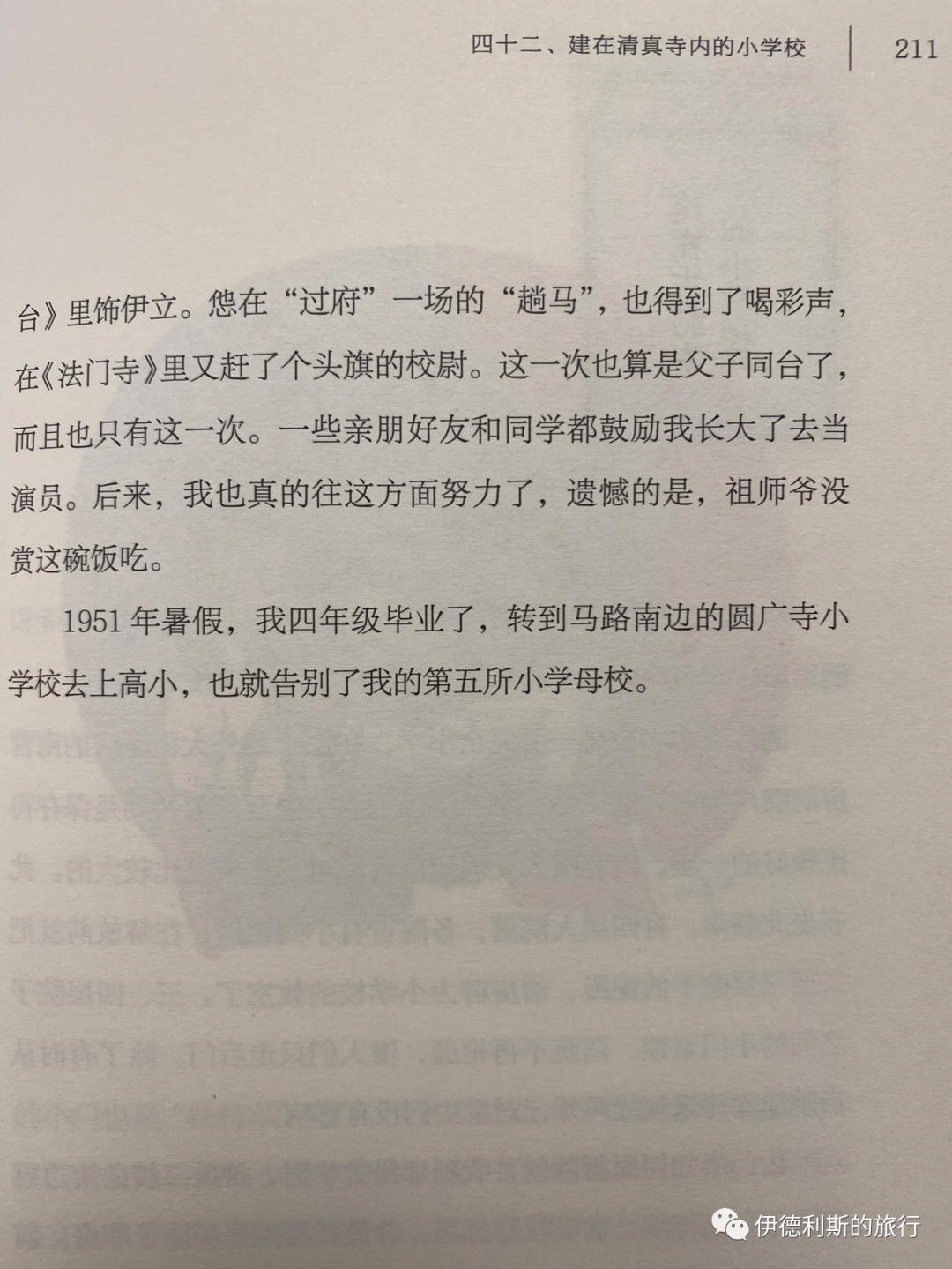
The author recalls attending Yusheng Primary School inside the mosque at Changkou, outside Fuchengmen, from 1949 to 1951. This is the only article currently known about this mosque.
The article recalls that Yusheng Primary School was founded just before the liberation of Beijing. It was a junior primary school with only grades one through four, located right in the courtyard of the Fuchengmen Outer mosque.
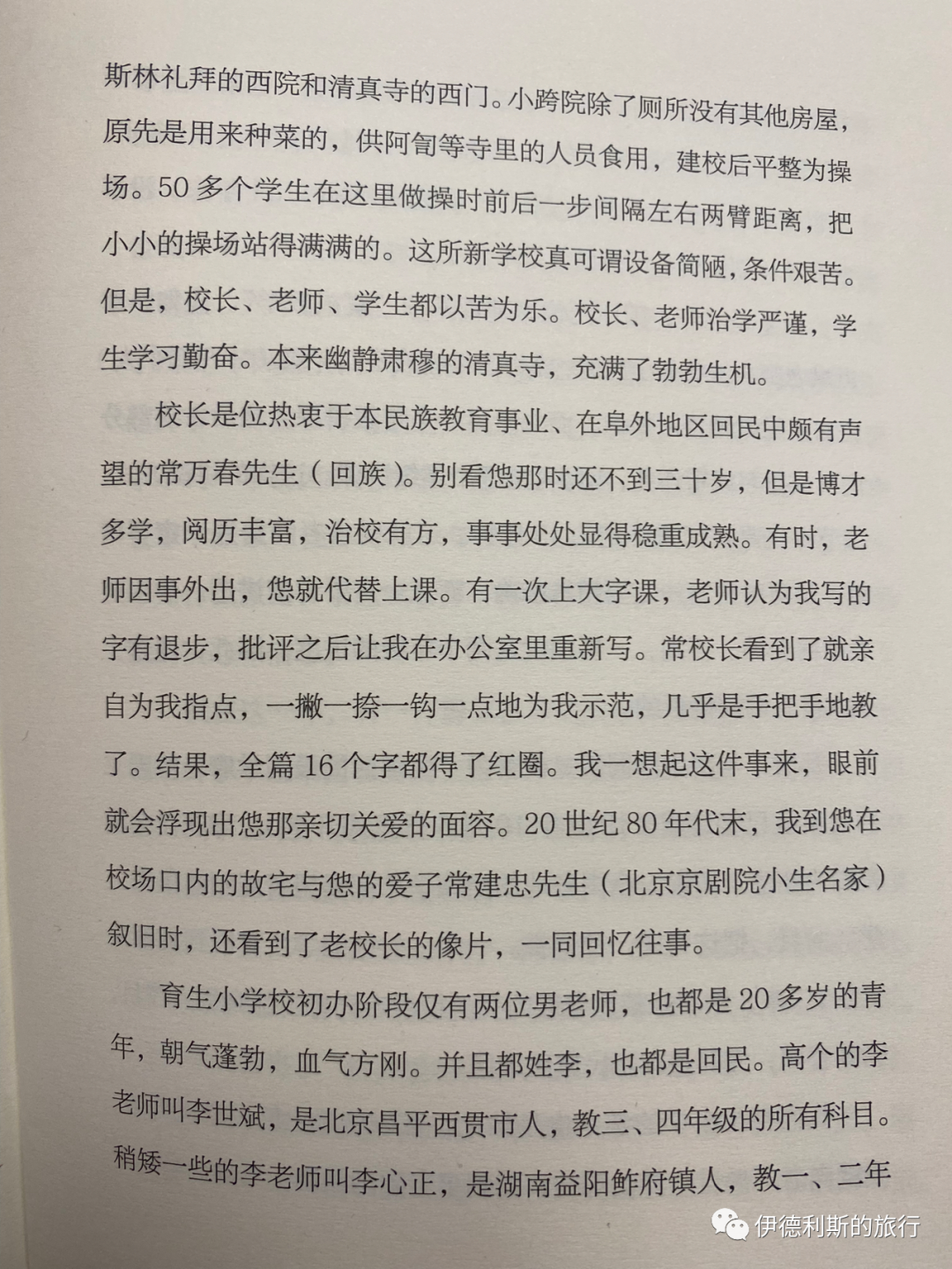
The Fuchengmen Outer mosque was a traditional courtyard. The west room was the prayer hall, the north room was for Imam Yang, the principal, and the teachers, the south room was a large classroom for over 30 students in grades one and two, and the east room was a small classroom for over 10 students in grades three and four. A cross-shaped path divided the small courtyard into four sections, each with a large pine tree that grew so tall it seemed to block out the sky. The side courtyard only had a restroom and was originally used for growing vegetables. After the school was built, it became a playground, serving as the place for students to do morning exercises, attend physical education classes, and play during breaks. a small corridor on the north side of the main hall connected to the women's prayer hall and the west gate.
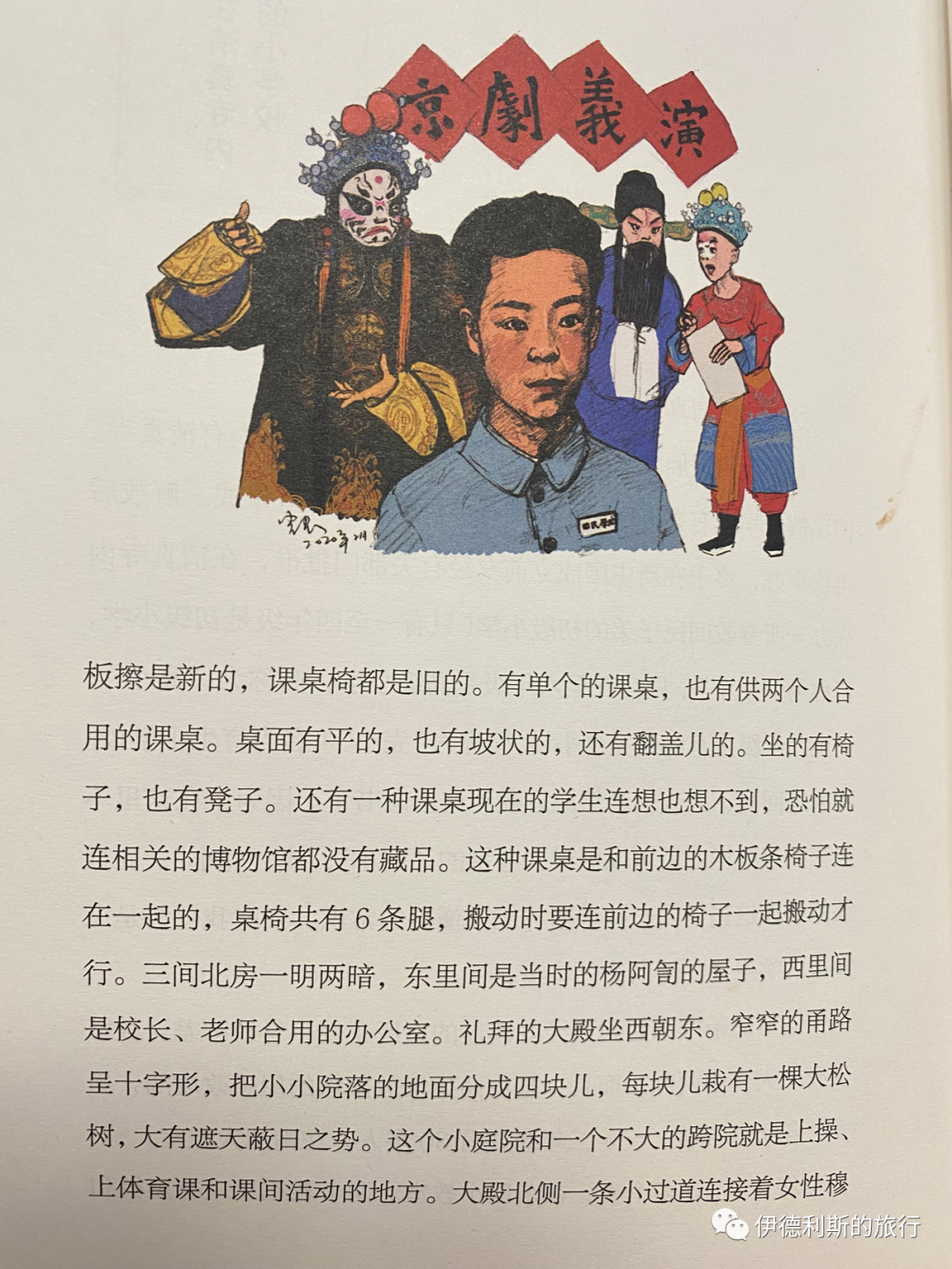
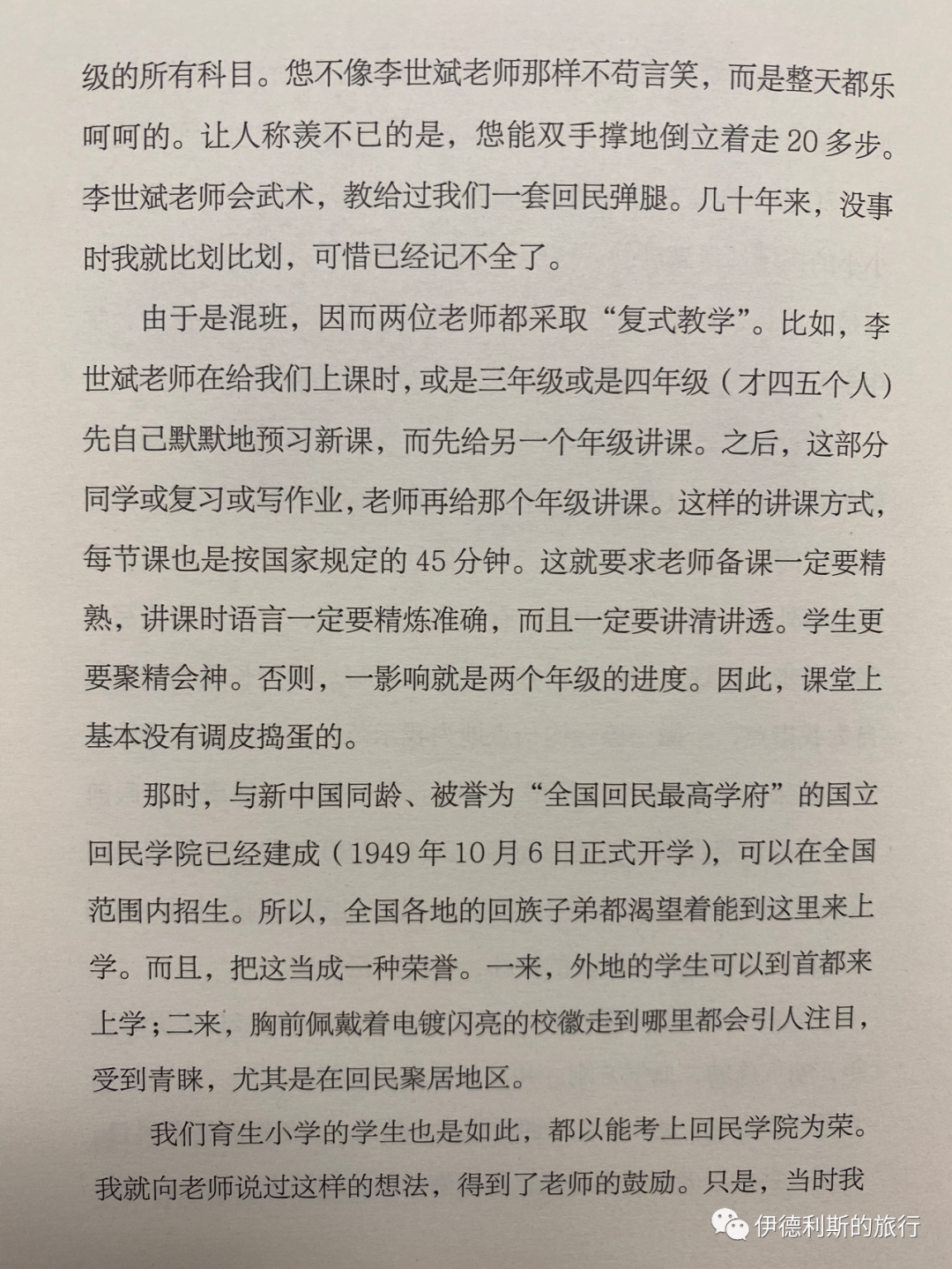
The principal of Yusheng Primary School was Mr. Chang Wanchun, a man well-respected among the Hui Muslims outside Fuchengmen. His son, Chang Jianzhong, is a famous young performer at the Beijing Peking Opera Theater. There were two teachers at the start. Mr. Li Shibin was a Hui Muslim from Xiguanshi in Changping, Beijing, and Mr. Li Xinzheng was a Hui Muslim from Zhafu Town in Yiyang, Hunan. Later, another Hui Muslim teacher from Yunnan named Ma Zhongxun joined them. Mr. Li Shibin knew martial arts and taught the students Hui Muslim spring-leg (tan tui) kung fu.
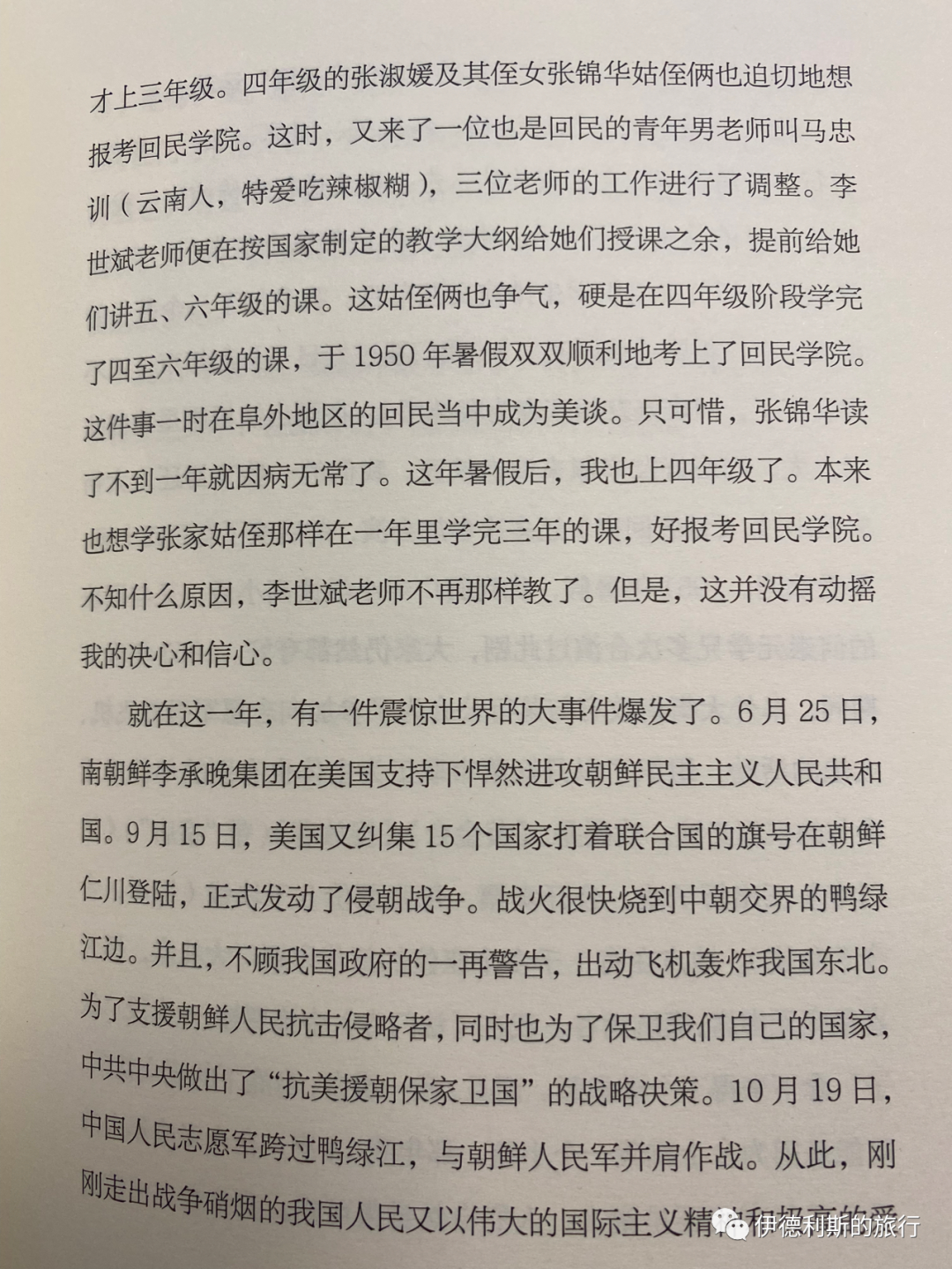
After the National Hui Muslim Academy was founded in 1949, it became the school that Hui Muslim children from all over the country wanted to attend. Mr. Li Shibin focused on training two students, Zhang Shuyuan and Zhang Jinhua. Both were admitted to the academy in 1950, which became a popular success story among the Hui Muslims outside Fuchengmen. view all
Summary: Beijing Muslim History: Hui Stories Outside Fuchengmen is presented here as a firsthand travel account in clear English, beginning with this scene: I recently bought a new book from the Zhengyang Library at Xisi in Beijing this September called 'Memories of the Suburbs Outside Fuchengmen'. The account keeps its focus on Beijing Muslim History, Fuchengmen, Hui Muslims while preserving the names, places, food, and historical details from the Chinese source.
I recently bought a new book from the Zhengyang Library at Xisi in Beijing this September called 'Memories of the Suburbs Outside Fuchengmen'. The author, Zhang Guoqing, is a Hui Muslim who lived outside Fuchengmen for generations. He was born in Yuetan East Alley in 1939 and lived outside Fuchengmen until 2005. After retiring, he started writing down his childhood memories, which eventually became this book.
During the Qing Dynasty and the Republic of China, there were mosque neighborhoods in the suburbs outside all nine gates of Beijing's inner city. Places like the areas outside Chongwenmen and Chaoyangmen even had three or four mosques, and there is relatively more written history about them. Because there were fewer Hui Muslims living outside Fuchengmen and they were more spread out, there has always been a lack of articles about them. This book not only fills the gap in writings about the Hui Muslims outside Fuchengmen, but it is also very special because it comes from vivid childhood memories.
The author drew a map of the area outside Fuchengmen in 1949. You can see the location of the Fuchengmen Outside Mosque (Xiaochangkou libaisi). This is the first time I have seen a map that marks the exact location of this mosque. Today, a stone tablet from the Qianlong period of the Qing Dynasty belonging to the Fuchengmen Outside Mosque is still stored inside the mosque of Emperors of Successive Dynasties in Beijing. It is the only remaining witness to this mosque.
The author's grandfather worked as a scale operator at the Shunxing Vegetable Shop in the Yuetan vegetable market. Every morning, vegetable farmers would drive horse, mule, donkey, and ox carts to deliver vegetables to the shops. Each shop used a large wooden scale that was 1.5 meters long. The scale operator had to quickly and accurately place the weight on the right mark and call out the weight of the vegetables as fast as possible.
The author recalls many halal businesses on Fuwai Street during the Republic of China era. For example, the owners of the Guang Sheng De lamb shop were two brothers from Dezhou, Shandong, who were cousins of the author's grandfather. They named the shop using one character from each of their names and added the character 'De' to show their deep affection for their hometown of Dezhou. The owners of both the Dong Ju Yuan and Xi Ju Yuan lamb shops were Uncle Zhang Dianchen, and the author's third grandfather worked as a butcher there. There were also many others, including the halal Fu Long pastry shop (bobo pu), the halal Huang family sesame flatbread shop (shaobing pu), Wensheng sesame flatbread shop, Yang family breakfast shop, Wan family restaurant, Fucheng Xing grain store, Jin the Hui Muslim's plaster shop, and the Sanjiang Hui Muslim restaurant.
Two Hui Muslim families with ancestral roots in Dezhou, Shandong, shared the surname Man.
The author's grandmother came from the Man family in Shuncheng outside Fucheng Gate and was a cousin of the famous Peking opera star Ma Lianliang. The Man family in Shuncheng was the largest Hui Muslim household in the area at the time, and they made their living in the cattle business. The Man family raised cattle and also slaughtered them, selling beef wholesale to lamb and beef shops. The east courtyard of the Man family home has a large cattle pen with wooden fences, and next to it is a wrestling ring where anyone who loves to wrestle can show off their skills. Every autumn and winter, the Man family sets up three large iron pots over a meter wide to stew offal (zasui) and beef bones, which they then give away to poor families.
East of the Yuetan Archway is the Man Family Mutton Shop, which is one of the largest mutton shops on Fuchengmen Outer Street. Their meat cutting table (yangrou chuangzi) is about 1.3 or 1.4 meters high and the size of a single bed, and they cut and sell both beef and mutton on it. In front of the table is a wooden bench for customers to sit on or to place their belongings. They allow people to trade clean lotus leaves, sunflower leaves, or large castor leaves for an equal weight of beef or mutton. Since there were no plastic bags back then and paper would stick to the meat, it was common practice to use leaves for wrapping.
Recalling the halal banquet dishes (dapeng cai) from outside Fuchengmen. In the past, authentic Beijing halal food was found at banquets, not in restaurants. Hui Muslims in Beijing used to prefer hosting banquets at home rather than going to restaurants. It felt more respectful and proper, and they could control every detail.
Before the 1950s, famous halal tent-banquet caterers outside Fuchengmen included Cai Ji at Beilushikou, Liu Ji at Yuetan East Alley, Xin Ji at Nanyingfang, and Wang Songshan’s uncle. Cai Ji usually sold millet porridge with sesame paste (miancha) and tofu pudding (doufunao) at the Yuetan market, and made various malt candies (guandongtang) and sugar melons (tanggua) in winter. Xin Ji sold fried dough cakes (youbing), sugar-coated fried dough cakes (tangyoubing), and crispy crackers (baocui) at the same market. The other two families also worked at the market and would set up tent banquets whenever someone invited them.
Banquets were categorized by the host's budget and the season. Every table usually started with appetizers like date-stuffed fried rolls (zaojuanguo), savory fried rolls (xianjuanguo), pea flour cake (wandouhuang), steamed rice cakes (aiwowo), and tea-infused vegetables (chacai), sometimes followed by fruit. Mid-range hot dishes included stewed meat, steamed pork with soy sauce (kourou), steamed meatballs (kouwanzi) or stir-fried meatballs (liuwanzi), steamed shredded meat (kousongrou), braised meat strips (paroutiao), sweet and sour lamb (tasimi), stir-fried tripe with coriander (yanbaosandan), tripe with kelp or lamb tail fat with kelp, fried tofu, stir-fried meat with egg and vinegar (culiumuxu), stir-fried trio (baosanyang), yam with wood ear mushrooms or shrimp-roe celery, stewed fish, and various stir-fries with celery, garlic sprouts, or bell peppers. Wealthy families would serve stir-fried shrimp or braised prawns. The meal ended with tomato egg soup, tripe soup, offal soup, or lotus seed soup. The cook would then announce, 'The final soup is served,' signaling the banquet was complete and it was time to tip the chef.
Yang Boru was a master of halal snacks who ran a sesame flatbread (shaobing) shop on Fuchengmen Outer Street in the 1950s. Yang Boru was originally from Dachang, Hebei. He started as an apprentice at the halal Delongshun sesame flatbread shop outside Hepingmen in 1943 and finished his training in 1947. He could use steaming, frying, boiling, and griddle-baking to make over 60 types of halal snacks, including sesame flatbreads (shaobing), baked flatbreads (huoshao), ox-tongue cakes (niushebing), spiral rolls (luosizhuan), crispy crackers (ganbenger), and toad-spitting-honey (hamatumi, a red bean paste-filled flatbread). In 1950, he opened Yang's Sesame Flatbread Shop on Fuchengmen Outer Street, right next to the east side of the Tanman Mutton Shop. At that time, the shop placed a long table outside the door. On the table was a rectangular glass display case with a small cloth curtain on the inside, and several small wicker baskets held the finished food for sale.
In 1959, Yang Boru moved to the Sanlihe Halal Canteen to be in charge of flour-based snacks. In 1978, the canteen expanded into the Henan Restaurant Hui Muslim Snack Shop, and in 1986, it became a joint venture called the Guiyang Hotel, where he served as the head chef of the halal restaurant. Besides being skilled at making pea flour cakes (wandouhuang), steamed rice cakes (aiwowo), date rolls (zaojuanguo), toad-spitting-honey (hamatumi), and fruit-topped rice cakes (guoliaohuayangniangao), Yang Boru also created his own halal snacks like red bean soup (xiaodougen), Buddha-hand rolls (foshoujuan), ruyi rolls (ruyijuan), and yam rolls (shanyaojuan). These were very popular and helped make Beijing halal snack platters a staple at high-end banquets.
The 'Porridge Shop Wei' family from the Fuchengmen Outer Mosque. The Wei family was originally from Dezhou, Shandong. Old Mr. Wei came to Beijing to escape a flood and worked as a clerk at the Jutai Beef and Mutton Shop in Caishikou. Because he was hardworking, Old Mr. Wei inherited the business and eventually built a house next to the Jiaochangkou Mosque outside Fuchengmen. Later, his family bought farmland and expanded their house, becoming a well-known wealthy Hui Muslim household outside Fucheng Gate.
After the Wei family became wealthy, they opened a porridge kitchen next to their home. They gave a bowl of hot porridge to everyone, whether Hui or Han, and provided steamed buns (mantou) and cornmeal buns (wotou) during holidays. In 1945, the Wei family was herding sheep from Zhangbei Bashang to Beijing when they ran into retreating Japanese soldiers. Nearly two hundred sheep were stolen, and they were unable to continue giving out porridge after that.
The Wei family's porridge kitchen compound was among the last old courtyards demolished outside Fucheng Gate. It finally disappeared in the mid-to-late 1990s when Fuwai Street was expanded.
Rice shops and yarn shops run by Hui Muslims in Fuwai. In the past, most descriptions of Hui Muslim businesses focused on beef and mutton shops or halal snack shops, while other types of businesses were relatively rare.
Hesheng Rice Shop was on the north side of Fuwai Street. The owner, Li Guanyi, was originally from Xiguanshi in Changping, Beijing. He was a righteous man and a board member of the Yusheng Primary School run by the Xiaochangkou Mosque in Fuwai. He was highly respected in both Xiguanshi and outside Fucheng Gate.
Tianxingheng Yarn Shop was also on the north side of Fuwai Street, and the owner was a Hui Muslim named Zhang. At that time, the yarn shops sold more than just needles and thread; they also carried all kinds of daily necessities, including hair oil, wood shaving water (baohuashui), vanishing cream, soap, scented soap, soap balls (xiangyiziqiu), tooth powder, toothpaste, and towels. Uncle Zhang was kind to everyone. Whether a customer bought something or not, he would walk them to the door and say repeatedly, 'Come back when you have time.'
The author recalls attending Yusheng Primary School inside the mosque at Changkou, outside Fuchengmen, from 1949 to 1951. This is the only article currently known about this mosque.
The article recalls that Yusheng Primary School was founded just before the liberation of Beijing. It was a junior primary school with only grades one through four, located right in the courtyard of the Fuchengmen Outer mosque.
The Fuchengmen Outer mosque was a traditional courtyard. The west room was the prayer hall, the north room was for Imam Yang, the principal, and the teachers, the south room was a large classroom for over 30 students in grades one and two, and the east room was a small classroom for over 10 students in grades three and four. A cross-shaped path divided the small courtyard into four sections, each with a large pine tree that grew so tall it seemed to block out the sky. The side courtyard only had a restroom and was originally used for growing vegetables. After the school was built, it became a playground, serving as the place for students to do morning exercises, attend physical education classes, and play during breaks. a small corridor on the north side of the main hall connected to the women's prayer hall and the west gate.
The principal of Yusheng Primary School was Mr. Chang Wanchun, a man well-respected among the Hui Muslims outside Fuchengmen. His son, Chang Jianzhong, is a famous young performer at the Beijing Peking Opera Theater. There were two teachers at the start. Mr. Li Shibin was a Hui Muslim from Xiguanshi in Changping, Beijing, and Mr. Li Xinzheng was a Hui Muslim from Zhafu Town in Yiyang, Hunan. Later, another Hui Muslim teacher from Yunnan named Ma Zhongxun joined them. Mr. Li Shibin knew martial arts and taught the students Hui Muslim spring-leg (tan tui) kung fu.
After the National Hui Muslim Academy was founded in 1949, it became the school that Hui Muslim children from all over the country wanted to attend. Mr. Li Shibin focused on training two students, Zhang Shuyuan and Zhang Jinhua. Both were admitted to the academy in 1950, which became a popular success story among the Hui Muslims outside Fuchengmen. view all
Reposted from the web
Summary: Beijing Muslim History: Hui Stories Outside Fuchengmen is presented here as a firsthand travel account in clear English, beginning with this scene: I recently bought a new book from the Zhengyang Library at Xisi in Beijing this September called 'Memories of the Suburbs Outside Fuchengmen'. The account keeps its focus on Beijing Muslim History, Fuchengmen, Hui Muslims while preserving the names, places, food, and historical details from the Chinese source.
I recently bought a new book from the Zhengyang Library at Xisi in Beijing this September called 'Memories of the Suburbs Outside Fuchengmen'. The author, Zhang Guoqing, is a Hui Muslim who lived outside Fuchengmen for generations. He was born in Yuetan East Alley in 1939 and lived outside Fuchengmen until 2005. After retiring, he started writing down his childhood memories, which eventually became this book.
During the Qing Dynasty and the Republic of China, there were mosque neighborhoods in the suburbs outside all nine gates of Beijing's inner city. Places like the areas outside Chongwenmen and Chaoyangmen even had three or four mosques, and there is relatively more written history about them. Because there were fewer Hui Muslims living outside Fuchengmen and they were more spread out, there has always been a lack of articles about them. This book not only fills the gap in writings about the Hui Muslims outside Fuchengmen, but it is also very special because it comes from vivid childhood memories.
The author drew a map of the area outside Fuchengmen in 1949. You can see the location of the Fuchengmen Outside Mosque (Xiaochangkou libaisi). This is the first time I have seen a map that marks the exact location of this mosque. Today, a stone tablet from the Qianlong period of the Qing Dynasty belonging to the Fuchengmen Outside Mosque is still stored inside the mosque of Emperors of Successive Dynasties in Beijing. It is the only remaining witness to this mosque.
The author's grandfather worked as a scale operator at the Shunxing Vegetable Shop in the Yuetan vegetable market. Every morning, vegetable farmers would drive horse, mule, donkey, and ox carts to deliver vegetables to the shops. Each shop used a large wooden scale that was 1.5 meters long. The scale operator had to quickly and accurately place the weight on the right mark and call out the weight of the vegetables as fast as possible.
The author recalls many halal businesses on Fuwai Street during the Republic of China era. For example, the owners of the Guang Sheng De lamb shop were two brothers from Dezhou, Shandong, who were cousins of the author's grandfather. They named the shop using one character from each of their names and added the character 'De' to show their deep affection for their hometown of Dezhou. The owners of both the Dong Ju Yuan and Xi Ju Yuan lamb shops were Uncle Zhang Dianchen, and the author's third grandfather worked as a butcher there. There were also many others, including the halal Fu Long pastry shop (bobo pu), the halal Huang family sesame flatbread shop (shaobing pu), Wensheng sesame flatbread shop, Yang family breakfast shop, Wan family restaurant, Fucheng Xing grain store, Jin the Hui Muslim's plaster shop, and the Sanjiang Hui Muslim restaurant.
Two Hui Muslim families with ancestral roots in Dezhou, Shandong, shared the surname Man.
The author's grandmother came from the Man family in Shuncheng outside Fucheng Gate and was a cousin of the famous Peking opera star Ma Lianliang. The Man family in Shuncheng was the largest Hui Muslim household in the area at the time, and they made their living in the cattle business. The Man family raised cattle and also slaughtered them, selling beef wholesale to lamb and beef shops. The east courtyard of the Man family home has a large cattle pen with wooden fences, and next to it is a wrestling ring where anyone who loves to wrestle can show off their skills. Every autumn and winter, the Man family sets up three large iron pots over a meter wide to stew offal (zasui) and beef bones, which they then give away to poor families.
East of the Yuetan Archway is the Man Family Mutton Shop, which is one of the largest mutton shops on Fuchengmen Outer Street. Their meat cutting table (yangrou chuangzi) is about 1.3 or 1.4 meters high and the size of a single bed, and they cut and sell both beef and mutton on it. In front of the table is a wooden bench for customers to sit on or to place their belongings. They allow people to trade clean lotus leaves, sunflower leaves, or large castor leaves for an equal weight of beef or mutton. Since there were no plastic bags back then and paper would stick to the meat, it was common practice to use leaves for wrapping.
Recalling the halal banquet dishes (dapeng cai) from outside Fuchengmen. In the past, authentic Beijing halal food was found at banquets, not in restaurants. Hui Muslims in Beijing used to prefer hosting banquets at home rather than going to restaurants. It felt more respectful and proper, and they could control every detail.
Before the 1950s, famous halal tent-banquet caterers outside Fuchengmen included Cai Ji at Beilushikou, Liu Ji at Yuetan East Alley, Xin Ji at Nanyingfang, and Wang Songshan’s uncle. Cai Ji usually sold millet porridge with sesame paste (miancha) and tofu pudding (doufunao) at the Yuetan market, and made various malt candies (guandongtang) and sugar melons (tanggua) in winter. Xin Ji sold fried dough cakes (youbing), sugar-coated fried dough cakes (tangyoubing), and crispy crackers (baocui) at the same market. The other two families also worked at the market and would set up tent banquets whenever someone invited them.
Banquets were categorized by the host's budget and the season. Every table usually started with appetizers like date-stuffed fried rolls (zaojuanguo), savory fried rolls (xianjuanguo), pea flour cake (wandouhuang), steamed rice cakes (aiwowo), and tea-infused vegetables (chacai), sometimes followed by fruit. Mid-range hot dishes included stewed meat, steamed pork with soy sauce (kourou), steamed meatballs (kouwanzi) or stir-fried meatballs (liuwanzi), steamed shredded meat (kousongrou), braised meat strips (paroutiao), sweet and sour lamb (tasimi), stir-fried tripe with coriander (yanbaosandan), tripe with kelp or lamb tail fat with kelp, fried tofu, stir-fried meat with egg and vinegar (culiumuxu), stir-fried trio (baosanyang), yam with wood ear mushrooms or shrimp-roe celery, stewed fish, and various stir-fries with celery, garlic sprouts, or bell peppers. Wealthy families would serve stir-fried shrimp or braised prawns. The meal ended with tomato egg soup, tripe soup, offal soup, or lotus seed soup. The cook would then announce, 'The final soup is served,' signaling the banquet was complete and it was time to tip the chef.
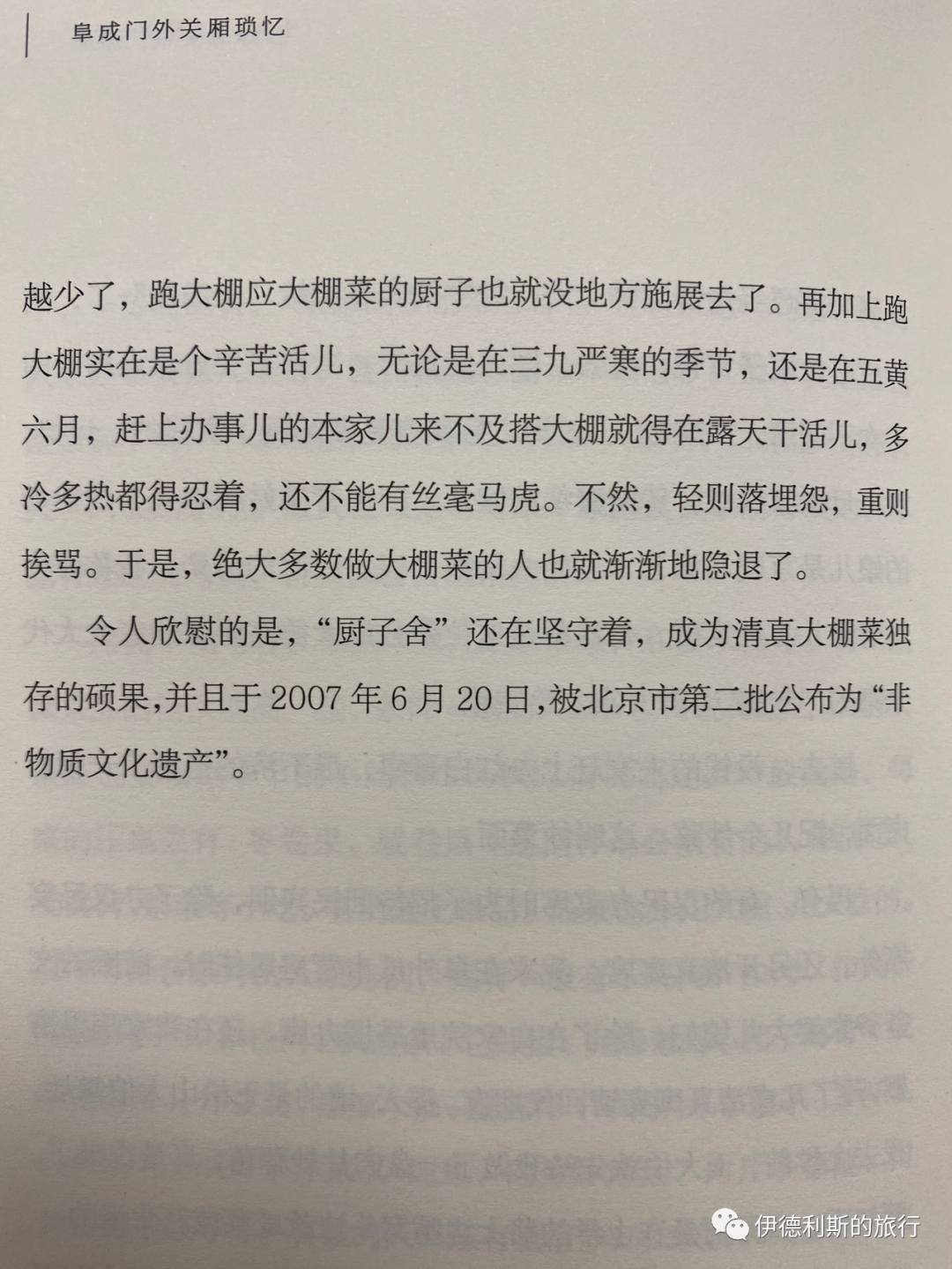
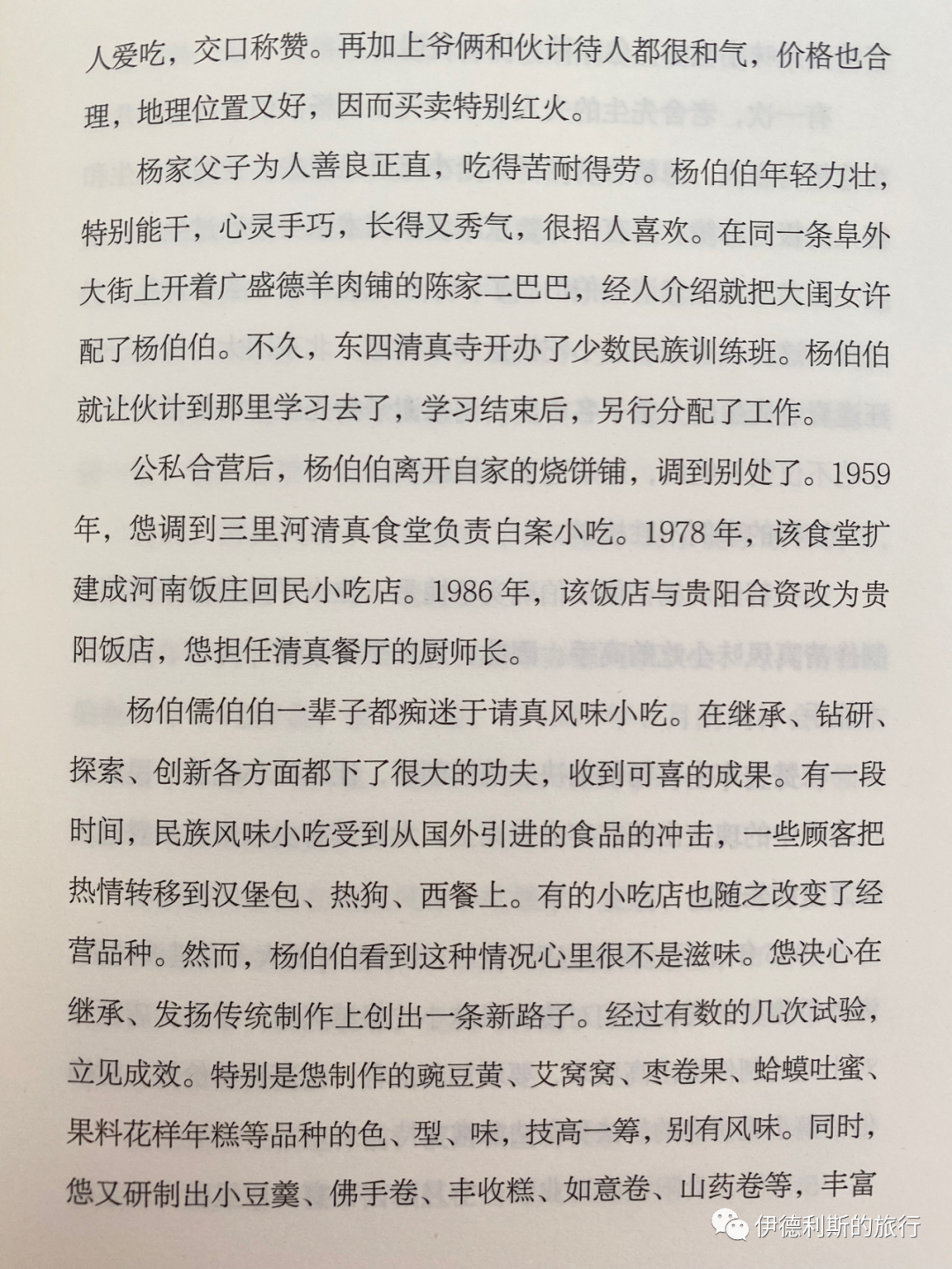
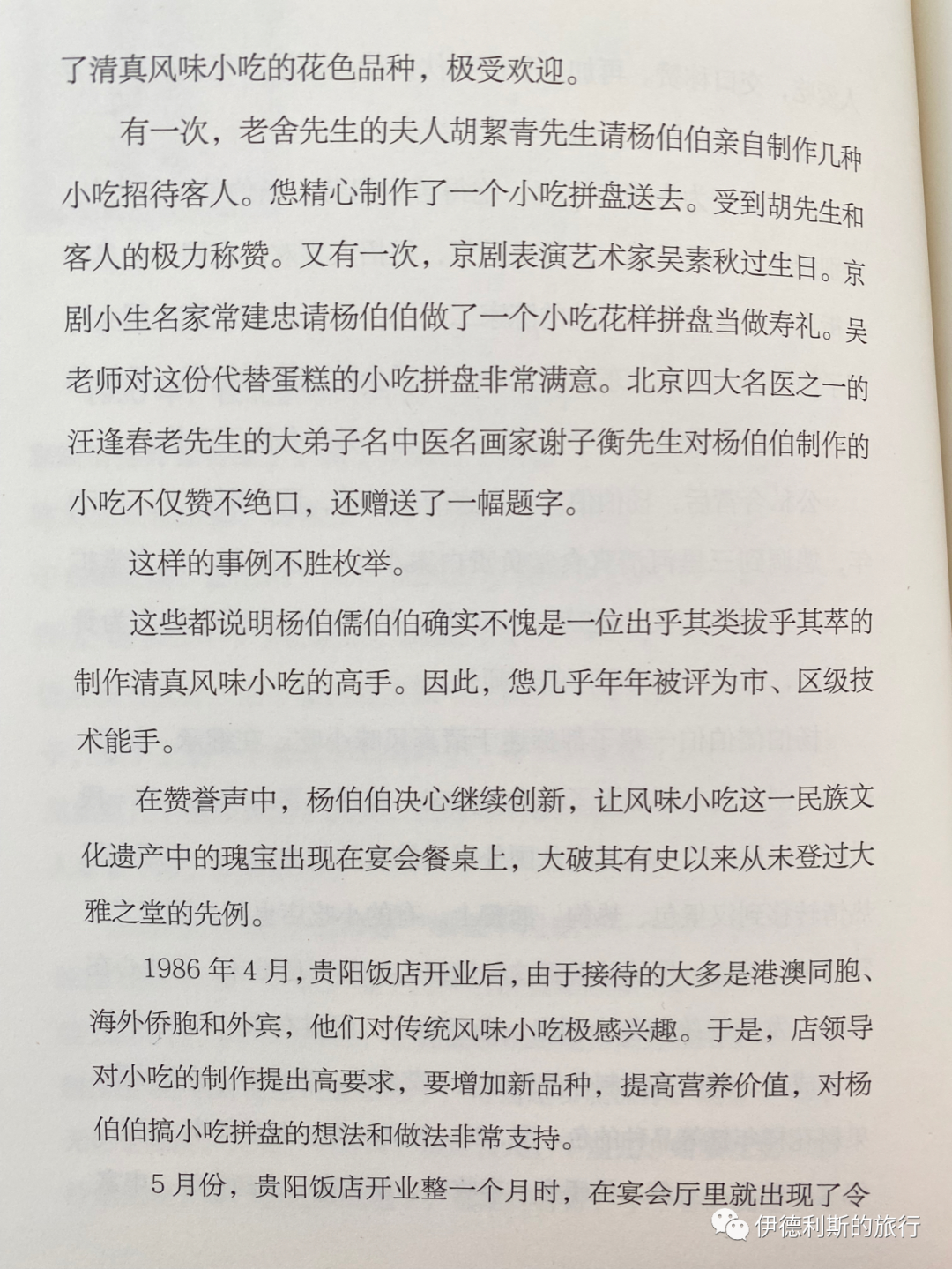
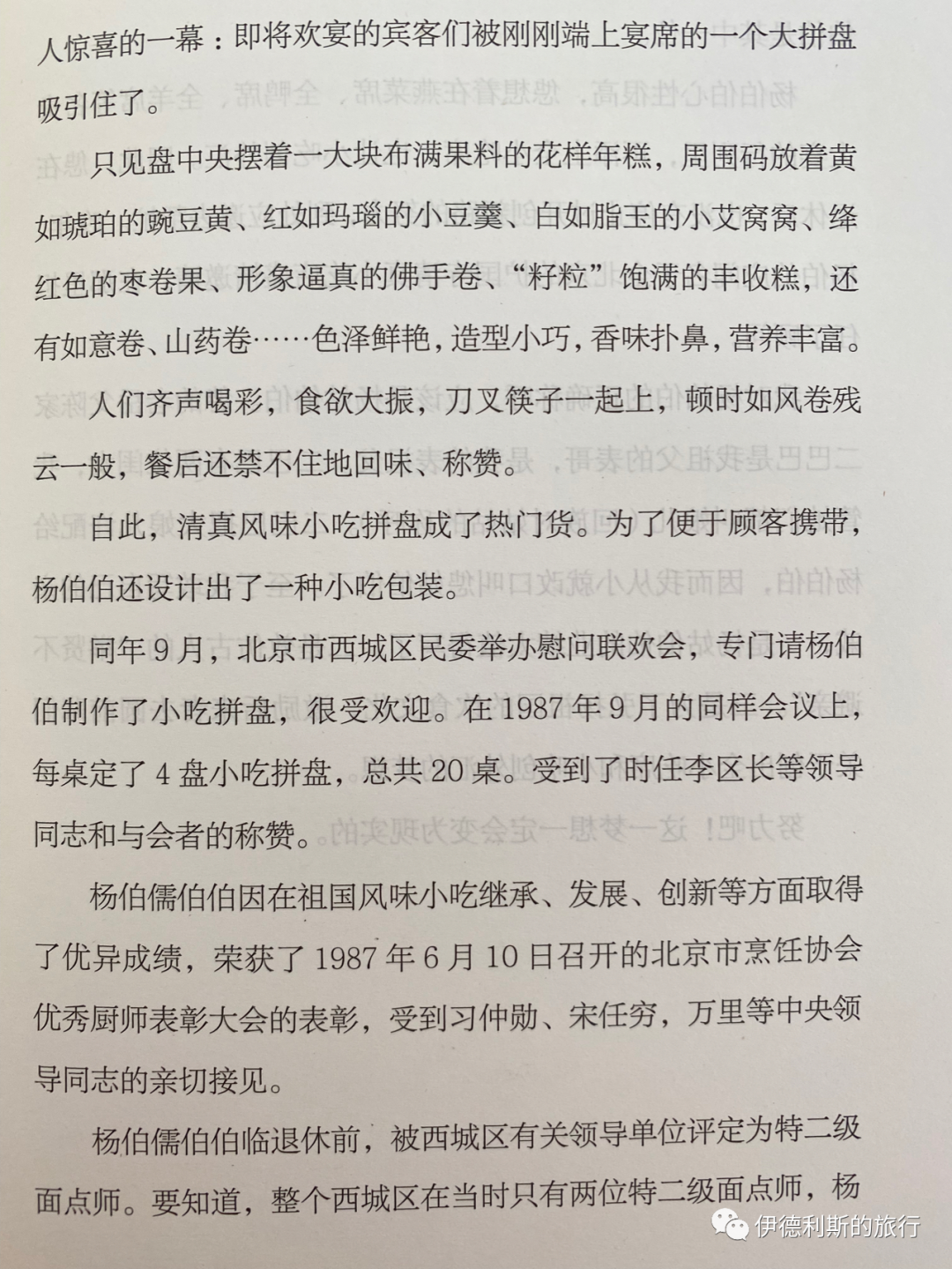
Yang Boru was a master of halal snacks who ran a sesame flatbread (shaobing) shop on Fuchengmen Outer Street in the 1950s. Yang Boru was originally from Dachang, Hebei. He started as an apprentice at the halal Delongshun sesame flatbread shop outside Hepingmen in 1943 and finished his training in 1947. He could use steaming, frying, boiling, and griddle-baking to make over 60 types of halal snacks, including sesame flatbreads (shaobing), baked flatbreads (huoshao), ox-tongue cakes (niushebing), spiral rolls (luosizhuan), crispy crackers (ganbenger), and toad-spitting-honey (hamatumi, a red bean paste-filled flatbread). In 1950, he opened Yang's Sesame Flatbread Shop on Fuchengmen Outer Street, right next to the east side of the Tanman Mutton Shop. At that time, the shop placed a long table outside the door. On the table was a rectangular glass display case with a small cloth curtain on the inside, and several small wicker baskets held the finished food for sale.
In 1959, Yang Boru moved to the Sanlihe Halal Canteen to be in charge of flour-based snacks. In 1978, the canteen expanded into the Henan Restaurant Hui Muslim Snack Shop, and in 1986, it became a joint venture called the Guiyang Hotel, where he served as the head chef of the halal restaurant. Besides being skilled at making pea flour cakes (wandouhuang), steamed rice cakes (aiwowo), date rolls (zaojuanguo), toad-spitting-honey (hamatumi), and fruit-topped rice cakes (guoliaohuayangniangao), Yang Boru also created his own halal snacks like red bean soup (xiaodougen), Buddha-hand rolls (foshoujuan), ruyi rolls (ruyijuan), and yam rolls (shanyaojuan). These were very popular and helped make Beijing halal snack platters a staple at high-end banquets.

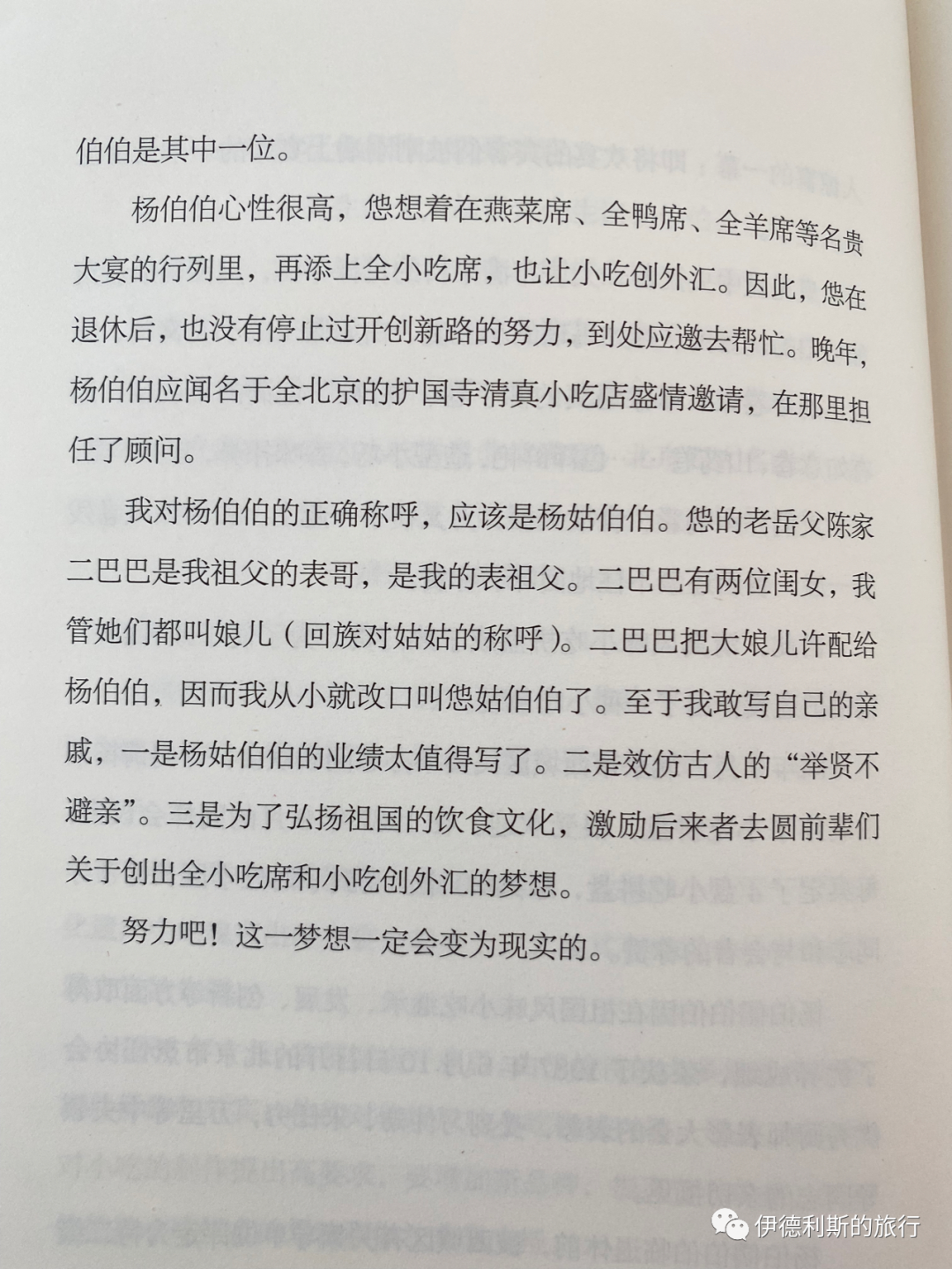
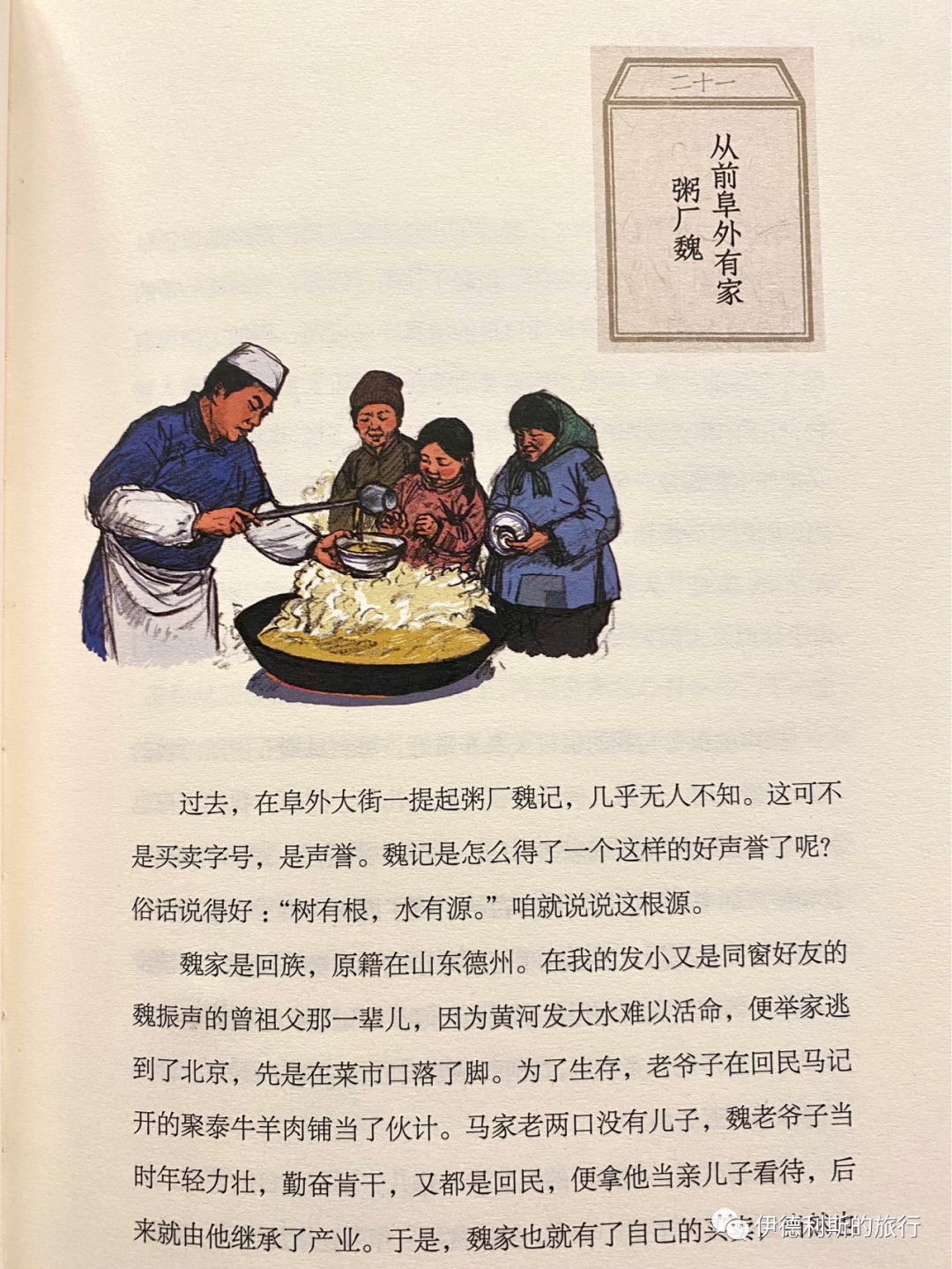
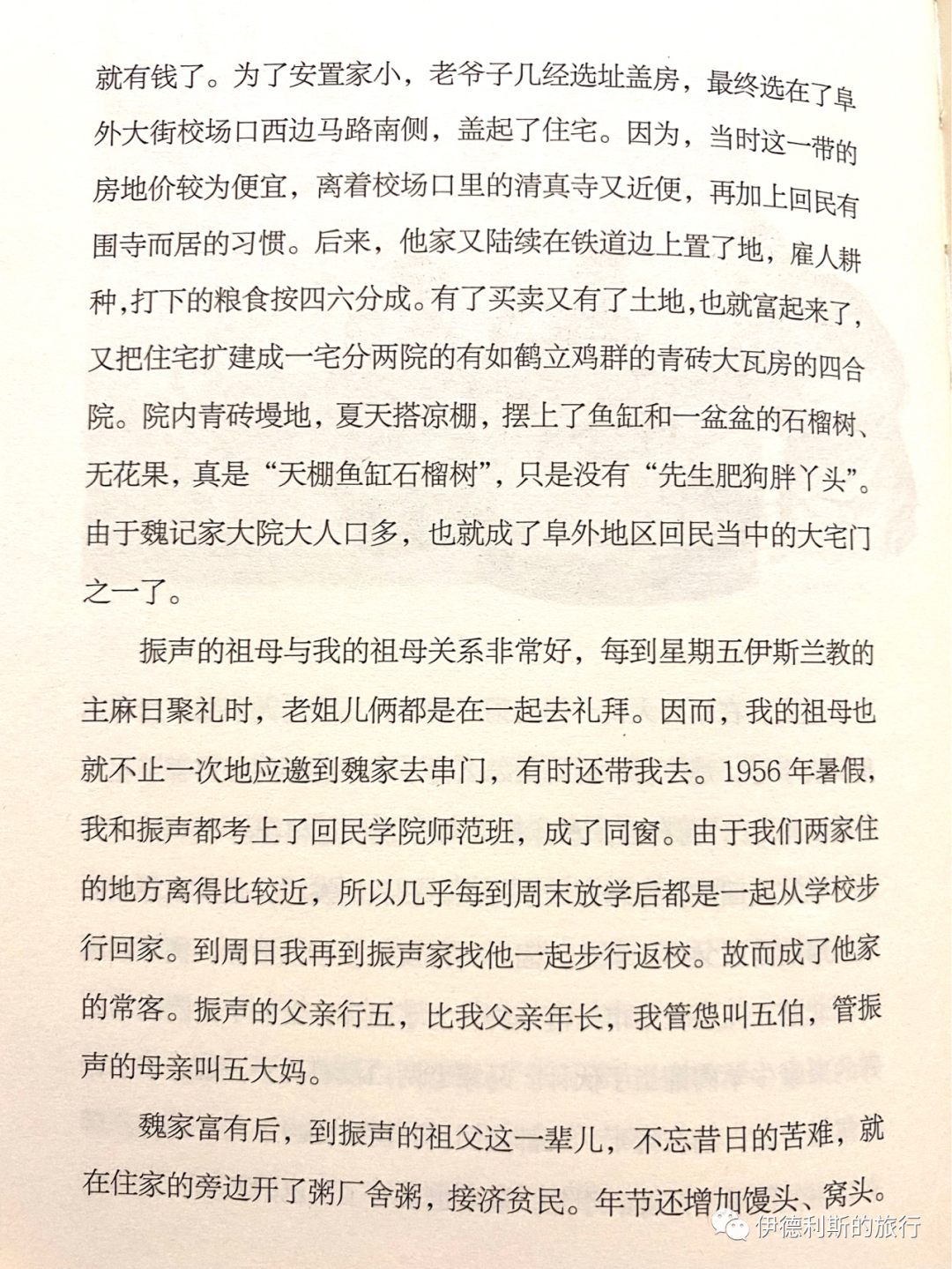
The 'Porridge Shop Wei' family from the Fuchengmen Outer Mosque. The Wei family was originally from Dezhou, Shandong. Old Mr. Wei came to Beijing to escape a flood and worked as a clerk at the Jutai Beef and Mutton Shop in Caishikou. Because he was hardworking, Old Mr. Wei inherited the business and eventually built a house next to the Jiaochangkou Mosque outside Fuchengmen. Later, his family bought farmland and expanded their house, becoming a well-known wealthy Hui Muslim household outside Fucheng Gate.
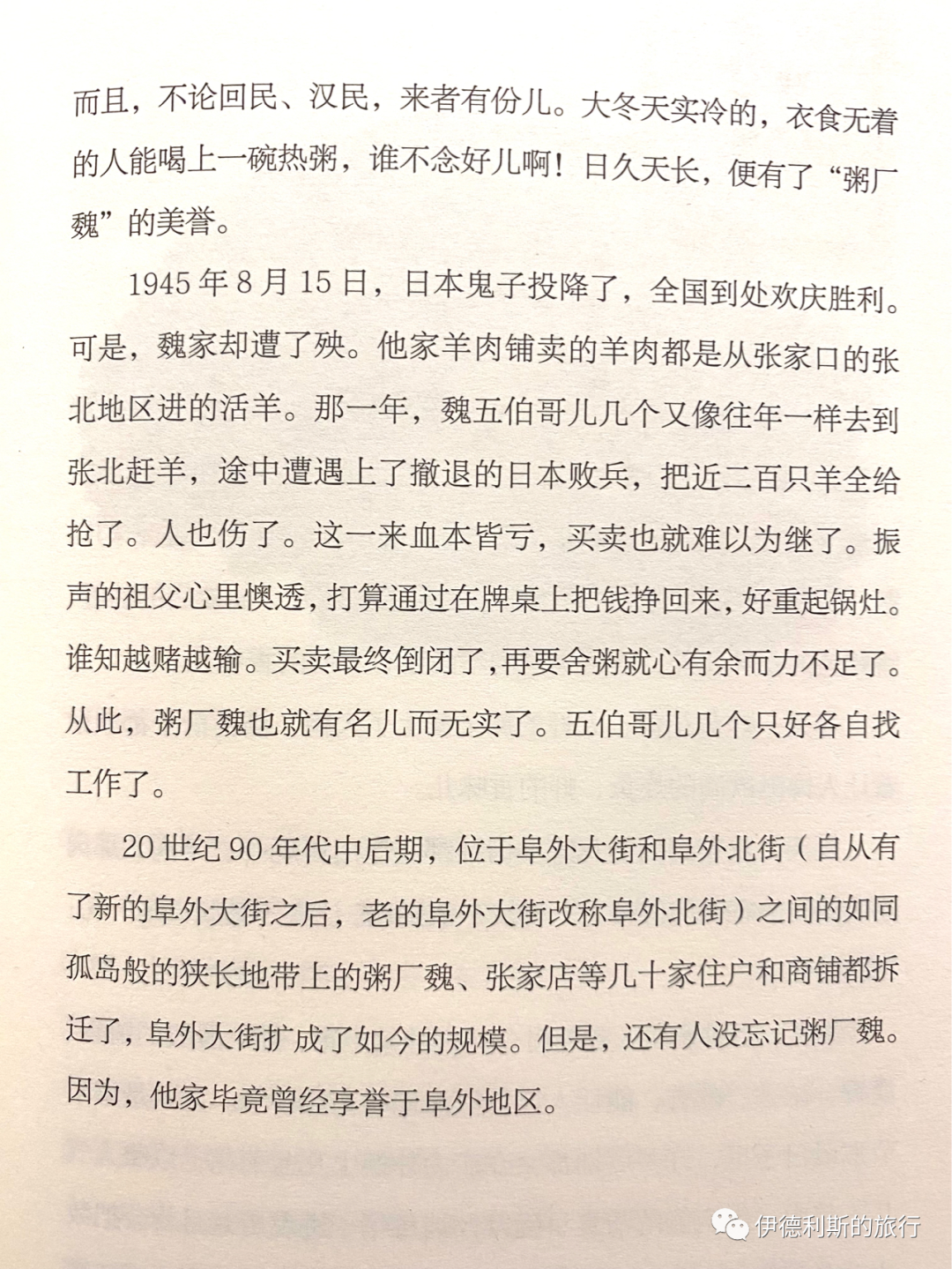
After the Wei family became wealthy, they opened a porridge kitchen next to their home. They gave a bowl of hot porridge to everyone, whether Hui or Han, and provided steamed buns (mantou) and cornmeal buns (wotou) during holidays. In 1945, the Wei family was herding sheep from Zhangbei Bashang to Beijing when they ran into retreating Japanese soldiers. Nearly two hundred sheep were stolen, and they were unable to continue giving out porridge after that.
The Wei family's porridge kitchen compound was among the last old courtyards demolished outside Fucheng Gate. It finally disappeared in the mid-to-late 1990s when Fuwai Street was expanded.
Rice shops and yarn shops run by Hui Muslims in Fuwai. In the past, most descriptions of Hui Muslim businesses focused on beef and mutton shops or halal snack shops, while other types of businesses were relatively rare.
Hesheng Rice Shop was on the north side of Fuwai Street. The owner, Li Guanyi, was originally from Xiguanshi in Changping, Beijing. He was a righteous man and a board member of the Yusheng Primary School run by the Xiaochangkou Mosque in Fuwai. He was highly respected in both Xiguanshi and outside Fucheng Gate.
Tianxingheng Yarn Shop was also on the north side of Fuwai Street, and the owner was a Hui Muslim named Zhang. At that time, the yarn shops sold more than just needles and thread; they also carried all kinds of daily necessities, including hair oil, wood shaving water (baohuashui), vanishing cream, soap, scented soap, soap balls (xiangyiziqiu), tooth powder, toothpaste, and towels. Uncle Zhang was kind to everyone. Whether a customer bought something or not, he would walk them to the door and say repeatedly, 'Come back when you have time.'
The author recalls attending Yusheng Primary School inside the mosque at Changkou, outside Fuchengmen, from 1949 to 1951. This is the only article currently known about this mosque.
The article recalls that Yusheng Primary School was founded just before the liberation of Beijing. It was a junior primary school with only grades one through four, located right in the courtyard of the Fuchengmen Outer mosque.
The Fuchengmen Outer mosque was a traditional courtyard. The west room was the prayer hall, the north room was for Imam Yang, the principal, and the teachers, the south room was a large classroom for over 30 students in grades one and two, and the east room was a small classroom for over 10 students in grades three and four. A cross-shaped path divided the small courtyard into four sections, each with a large pine tree that grew so tall it seemed to block out the sky. The side courtyard only had a restroom and was originally used for growing vegetables. After the school was built, it became a playground, serving as the place for students to do morning exercises, attend physical education classes, and play during breaks. a small corridor on the north side of the main hall connected to the women's prayer hall and the west gate.
The principal of Yusheng Primary School was Mr. Chang Wanchun, a man well-respected among the Hui Muslims outside Fuchengmen. His son, Chang Jianzhong, is a famous young performer at the Beijing Peking Opera Theater. There were two teachers at the start. Mr. Li Shibin was a Hui Muslim from Xiguanshi in Changping, Beijing, and Mr. Li Xinzheng was a Hui Muslim from Zhafu Town in Yiyang, Hunan. Later, another Hui Muslim teacher from Yunnan named Ma Zhongxun joined them. Mr. Li Shibin knew martial arts and taught the students Hui Muslim spring-leg (tan tui) kung fu.
After the National Hui Muslim Academy was founded in 1949, it became the school that Hui Muslim children from all over the country wanted to attend. Mr. Li Shibin focused on training two students, Zhang Shuyuan and Zhang Jinhua. Both were admitted to the academy in 1950, which became a popular success story among the Hui Muslims outside Fuchengmen.
Summary: Beijing Muslim History: Hui Stories Outside Fuchengmen is presented here as a firsthand travel account in clear English, beginning with this scene: I recently bought a new book from the Zhengyang Library at Xisi in Beijing this September called 'Memories of the Suburbs Outside Fuchengmen'. The account keeps its focus on Beijing Muslim History, Fuchengmen, Hui Muslims while preserving the names, places, food, and historical details from the Chinese source.
I recently bought a new book from the Zhengyang Library at Xisi in Beijing this September called 'Memories of the Suburbs Outside Fuchengmen'. The author, Zhang Guoqing, is a Hui Muslim who lived outside Fuchengmen for generations. He was born in Yuetan East Alley in 1939 and lived outside Fuchengmen until 2005. After retiring, he started writing down his childhood memories, which eventually became this book.
During the Qing Dynasty and the Republic of China, there were mosque neighborhoods in the suburbs outside all nine gates of Beijing's inner city. Places like the areas outside Chongwenmen and Chaoyangmen even had three or four mosques, and there is relatively more written history about them. Because there were fewer Hui Muslims living outside Fuchengmen and they were more spread out, there has always been a lack of articles about them. This book not only fills the gap in writings about the Hui Muslims outside Fuchengmen, but it is also very special because it comes from vivid childhood memories.
The author drew a map of the area outside Fuchengmen in 1949. You can see the location of the Fuchengmen Outside Mosque (Xiaochangkou libaisi). This is the first time I have seen a map that marks the exact location of this mosque. Today, a stone tablet from the Qianlong period of the Qing Dynasty belonging to the Fuchengmen Outside Mosque is still stored inside the mosque of Emperors of Successive Dynasties in Beijing. It is the only remaining witness to this mosque.
The author's grandfather worked as a scale operator at the Shunxing Vegetable Shop in the Yuetan vegetable market. Every morning, vegetable farmers would drive horse, mule, donkey, and ox carts to deliver vegetables to the shops. Each shop used a large wooden scale that was 1.5 meters long. The scale operator had to quickly and accurately place the weight on the right mark and call out the weight of the vegetables as fast as possible.
The author recalls many halal businesses on Fuwai Street during the Republic of China era. For example, the owners of the Guang Sheng De lamb shop were two brothers from Dezhou, Shandong, who were cousins of the author's grandfather. They named the shop using one character from each of their names and added the character 'De' to show their deep affection for their hometown of Dezhou. The owners of both the Dong Ju Yuan and Xi Ju Yuan lamb shops were Uncle Zhang Dianchen, and the author's third grandfather worked as a butcher there. There were also many others, including the halal Fu Long pastry shop (bobo pu), the halal Huang family sesame flatbread shop (shaobing pu), Wensheng sesame flatbread shop, Yang family breakfast shop, Wan family restaurant, Fucheng Xing grain store, Jin the Hui Muslim's plaster shop, and the Sanjiang Hui Muslim restaurant.
Two Hui Muslim families with ancestral roots in Dezhou, Shandong, shared the surname Man.
The author's grandmother came from the Man family in Shuncheng outside Fucheng Gate and was a cousin of the famous Peking opera star Ma Lianliang. The Man family in Shuncheng was the largest Hui Muslim household in the area at the time, and they made their living in the cattle business. The Man family raised cattle and also slaughtered them, selling beef wholesale to lamb and beef shops. The east courtyard of the Man family home has a large cattle pen with wooden fences, and next to it is a wrestling ring where anyone who loves to wrestle can show off their skills. Every autumn and winter, the Man family sets up three large iron pots over a meter wide to stew offal (zasui) and beef bones, which they then give away to poor families.
East of the Yuetan Archway is the Man Family Mutton Shop, which is one of the largest mutton shops on Fuchengmen Outer Street. Their meat cutting table (yangrou chuangzi) is about 1.3 or 1.4 meters high and the size of a single bed, and they cut and sell both beef and mutton on it. In front of the table is a wooden bench for customers to sit on or to place their belongings. They allow people to trade clean lotus leaves, sunflower leaves, or large castor leaves for an equal weight of beef or mutton. Since there were no plastic bags back then and paper would stick to the meat, it was common practice to use leaves for wrapping.
Recalling the halal banquet dishes (dapeng cai) from outside Fuchengmen. In the past, authentic Beijing halal food was found at banquets, not in restaurants. Hui Muslims in Beijing used to prefer hosting banquets at home rather than going to restaurants. It felt more respectful and proper, and they could control every detail.
Before the 1950s, famous halal tent-banquet caterers outside Fuchengmen included Cai Ji at Beilushikou, Liu Ji at Yuetan East Alley, Xin Ji at Nanyingfang, and Wang Songshan’s uncle. Cai Ji usually sold millet porridge with sesame paste (miancha) and tofu pudding (doufunao) at the Yuetan market, and made various malt candies (guandongtang) and sugar melons (tanggua) in winter. Xin Ji sold fried dough cakes (youbing), sugar-coated fried dough cakes (tangyoubing), and crispy crackers (baocui) at the same market. The other two families also worked at the market and would set up tent banquets whenever someone invited them.
Banquets were categorized by the host's budget and the season. Every table usually started with appetizers like date-stuffed fried rolls (zaojuanguo), savory fried rolls (xianjuanguo), pea flour cake (wandouhuang), steamed rice cakes (aiwowo), and tea-infused vegetables (chacai), sometimes followed by fruit. Mid-range hot dishes included stewed meat, steamed pork with soy sauce (kourou), steamed meatballs (kouwanzi) or stir-fried meatballs (liuwanzi), steamed shredded meat (kousongrou), braised meat strips (paroutiao), sweet and sour lamb (tasimi), stir-fried tripe with coriander (yanbaosandan), tripe with kelp or lamb tail fat with kelp, fried tofu, stir-fried meat with egg and vinegar (culiumuxu), stir-fried trio (baosanyang), yam with wood ear mushrooms or shrimp-roe celery, stewed fish, and various stir-fries with celery, garlic sprouts, or bell peppers. Wealthy families would serve stir-fried shrimp or braised prawns. The meal ended with tomato egg soup, tripe soup, offal soup, or lotus seed soup. The cook would then announce, 'The final soup is served,' signaling the banquet was complete and it was time to tip the chef.
Yang Boru was a master of halal snacks who ran a sesame flatbread (shaobing) shop on Fuchengmen Outer Street in the 1950s. Yang Boru was originally from Dachang, Hebei. He started as an apprentice at the halal Delongshun sesame flatbread shop outside Hepingmen in 1943 and finished his training in 1947. He could use steaming, frying, boiling, and griddle-baking to make over 60 types of halal snacks, including sesame flatbreads (shaobing), baked flatbreads (huoshao), ox-tongue cakes (niushebing), spiral rolls (luosizhuan), crispy crackers (ganbenger), and toad-spitting-honey (hamatumi, a red bean paste-filled flatbread). In 1950, he opened Yang's Sesame Flatbread Shop on Fuchengmen Outer Street, right next to the east side of the Tanman Mutton Shop. At that time, the shop placed a long table outside the door. On the table was a rectangular glass display case with a small cloth curtain on the inside, and several small wicker baskets held the finished food for sale.
In 1959, Yang Boru moved to the Sanlihe Halal Canteen to be in charge of flour-based snacks. In 1978, the canteen expanded into the Henan Restaurant Hui Muslim Snack Shop, and in 1986, it became a joint venture called the Guiyang Hotel, where he served as the head chef of the halal restaurant. Besides being skilled at making pea flour cakes (wandouhuang), steamed rice cakes (aiwowo), date rolls (zaojuanguo), toad-spitting-honey (hamatumi), and fruit-topped rice cakes (guoliaohuayangniangao), Yang Boru also created his own halal snacks like red bean soup (xiaodougen), Buddha-hand rolls (foshoujuan), ruyi rolls (ruyijuan), and yam rolls (shanyaojuan). These were very popular and helped make Beijing halal snack platters a staple at high-end banquets.
The 'Porridge Shop Wei' family from the Fuchengmen Outer Mosque. The Wei family was originally from Dezhou, Shandong. Old Mr. Wei came to Beijing to escape a flood and worked as a clerk at the Jutai Beef and Mutton Shop in Caishikou. Because he was hardworking, Old Mr. Wei inherited the business and eventually built a house next to the Jiaochangkou Mosque outside Fuchengmen. Later, his family bought farmland and expanded their house, becoming a well-known wealthy Hui Muslim household outside Fucheng Gate.
After the Wei family became wealthy, they opened a porridge kitchen next to their home. They gave a bowl of hot porridge to everyone, whether Hui or Han, and provided steamed buns (mantou) and cornmeal buns (wotou) during holidays. In 1945, the Wei family was herding sheep from Zhangbei Bashang to Beijing when they ran into retreating Japanese soldiers. Nearly two hundred sheep were stolen, and they were unable to continue giving out porridge after that.
The Wei family's porridge kitchen compound was among the last old courtyards demolished outside Fucheng Gate. It finally disappeared in the mid-to-late 1990s when Fuwai Street was expanded.
Rice shops and yarn shops run by Hui Muslims in Fuwai. In the past, most descriptions of Hui Muslim businesses focused on beef and mutton shops or halal snack shops, while other types of businesses were relatively rare.
Hesheng Rice Shop was on the north side of Fuwai Street. The owner, Li Guanyi, was originally from Xiguanshi in Changping, Beijing. He was a righteous man and a board member of the Yusheng Primary School run by the Xiaochangkou Mosque in Fuwai. He was highly respected in both Xiguanshi and outside Fucheng Gate.
Tianxingheng Yarn Shop was also on the north side of Fuwai Street, and the owner was a Hui Muslim named Zhang. At that time, the yarn shops sold more than just needles and thread; they also carried all kinds of daily necessities, including hair oil, wood shaving water (baohuashui), vanishing cream, soap, scented soap, soap balls (xiangyiziqiu), tooth powder, toothpaste, and towels. Uncle Zhang was kind to everyone. Whether a customer bought something or not, he would walk them to the door and say repeatedly, 'Come back when you have time.'
The author recalls attending Yusheng Primary School inside the mosque at Changkou, outside Fuchengmen, from 1949 to 1951. This is the only article currently known about this mosque.
The article recalls that Yusheng Primary School was founded just before the liberation of Beijing. It was a junior primary school with only grades one through four, located right in the courtyard of the Fuchengmen Outer mosque.
The Fuchengmen Outer mosque was a traditional courtyard. The west room was the prayer hall, the north room was for Imam Yang, the principal, and the teachers, the south room was a large classroom for over 30 students in grades one and two, and the east room was a small classroom for over 10 students in grades three and four. A cross-shaped path divided the small courtyard into four sections, each with a large pine tree that grew so tall it seemed to block out the sky. The side courtyard only had a restroom and was originally used for growing vegetables. After the school was built, it became a playground, serving as the place for students to do morning exercises, attend physical education classes, and play during breaks. a small corridor on the north side of the main hall connected to the women's prayer hall and the west gate.
The principal of Yusheng Primary School was Mr. Chang Wanchun, a man well-respected among the Hui Muslims outside Fuchengmen. His son, Chang Jianzhong, is a famous young performer at the Beijing Peking Opera Theater. There were two teachers at the start. Mr. Li Shibin was a Hui Muslim from Xiguanshi in Changping, Beijing, and Mr. Li Xinzheng was a Hui Muslim from Zhafu Town in Yiyang, Hunan. Later, another Hui Muslim teacher from Yunnan named Ma Zhongxun joined them. Mr. Li Shibin knew martial arts and taught the students Hui Muslim spring-leg (tan tui) kung fu.
After the National Hui Muslim Academy was founded in 1949, it became the school that Hui Muslim children from all over the country wanted to attend. Mr. Li Shibin focused on training two students, Zhang Shuyuan and Zhang Jinhua. Both were admitted to the academy in 1950, which became a popular success story among the Hui Muslims outside Fuchengmen.
Beijing Muslim History: Hui Stories Outside Fuchengmen
Articles • ali2007fr posted the article • 0 comments • 154 views • 2026-05-18 06:54
Reposted from the web
Summary: Beijing Muslim History: Hui Stories Outside Fuchengmen is presented here as a firsthand travel account in clear English, beginning with this scene: I recently bought a new book from the Zhengyang Library at Xisi in Beijing this September called 'Memories of the Suburbs Outside Fuchengmen'. The account keeps its focus on Beijing Muslim History, Fuchengmen, Hui Muslims while preserving the names, places, food, and historical details from the Chinese source.
I recently bought a new book from the Zhengyang Library at Xisi in Beijing this September called 'Memories of the Suburbs Outside Fuchengmen'. The author, Zhang Guoqing, is a Hui Muslim who lived outside Fuchengmen for generations. He was born in Yuetan East Alley in 1939 and lived outside Fuchengmen until 2005. After retiring, he started writing down his childhood memories, which eventually became this book.
During the Qing Dynasty and the Republic of China, there were mosque neighborhoods in the suburbs outside all nine gates of Beijing's inner city. Places like the areas outside Chongwenmen and Chaoyangmen even had three or four mosques, and there is relatively more written history about them. Because there were fewer Hui Muslims living outside Fuchengmen and they were more spread out, there has always been a lack of articles about them. This book not only fills the gap in writings about the Hui Muslims outside Fuchengmen, but it is also very special because it comes from vivid childhood memories.
The author drew a map of the area outside Fuchengmen in 1949. You can see the location of the Fuchengmen Outside Mosque (Xiaochangkou libaisi). This is the first time I have seen a map that marks the exact location of this mosque. Today, a stone tablet from the Qianlong period of the Qing Dynasty belonging to the Fuchengmen Outside Mosque is still stored inside the mosque of Emperors of Successive Dynasties in Beijing. It is the only remaining witness to this mosque.
The author's grandfather worked as a scale operator at the Shunxing Vegetable Shop in the Yuetan vegetable market. Every morning, vegetable farmers would drive horse, mule, donkey, and ox carts to deliver vegetables to the shops. Each shop used a large wooden scale that was 1.5 meters long. The scale operator had to quickly and accurately place the weight on the right mark and call out the weight of the vegetables as fast as possible.
The author recalls many halal businesses on Fuwai Street during the Republic of China era. For example, the owners of the Guang Sheng De lamb shop were two brothers from Dezhou, Shandong, who were cousins of the author's grandfather. They named the shop using one character from each of their names and added the character 'De' to show their deep affection for their hometown of Dezhou. The owners of both the Dong Ju Yuan and Xi Ju Yuan lamb shops were Uncle Zhang Dianchen, and the author's third grandfather worked as a butcher there. There were also many others, including the halal Fu Long pastry shop (bobo pu), the halal Huang family sesame flatbread shop (shaobing pu), Wensheng sesame flatbread shop, Yang family breakfast shop, Wan family restaurant, Fucheng Xing grain store, Jin the Hui Muslim's plaster shop, and the Sanjiang Hui Muslim restaurant.
Two Hui Muslim families with ancestral roots in Dezhou, Shandong, shared the surname Man.
The author's grandmother came from the Man family in Shuncheng outside Fucheng Gate and was a cousin of the famous Peking opera star Ma Lianliang. The Man family in Shuncheng was the largest Hui Muslim household in the area at the time, and they made their living in the cattle business. The Man family raised cattle and also slaughtered them, selling beef wholesale to lamb and beef shops. The east courtyard of the Man family home has a large cattle pen with wooden fences, and next to it is a wrestling ring where anyone who loves to wrestle can show off their skills. Every autumn and winter, the Man family sets up three large iron pots over a meter wide to stew offal (zasui) and beef bones, which they then give away to poor families.
East of the Yuetan Archway is the Man Family Mutton Shop, which is one of the largest mutton shops on Fuchengmen Outer Street. Their meat cutting table (yangrou chuangzi) is about 1.3 or 1.4 meters high and the size of a single bed, and they cut and sell both beef and mutton on it. In front of the table is a wooden bench for customers to sit on or to place their belongings. They allow people to trade clean lotus leaves, sunflower leaves, or large castor leaves for an equal weight of beef or mutton. Since there were no plastic bags back then and paper would stick to the meat, it was common practice to use leaves for wrapping.
Recalling the halal banquet dishes (dapeng cai) from outside Fuchengmen. In the past, authentic Beijing halal food was found at banquets, not in restaurants. Hui Muslims in Beijing used to prefer hosting banquets at home rather than going to restaurants. It felt more respectful and proper, and they could control every detail.
Before the 1950s, famous halal tent-banquet caterers outside Fuchengmen included Cai Ji at Beilushikou, Liu Ji at Yuetan East Alley, Xin Ji at Nanyingfang, and Wang Songshan’s uncle. Cai Ji usually sold millet porridge with sesame paste (miancha) and tofu pudding (doufunao) at the Yuetan market, and made various malt candies (guandongtang) and sugar melons (tanggua) in winter. Xin Ji sold fried dough cakes (youbing), sugar-coated fried dough cakes (tangyoubing), and crispy crackers (baocui) at the same market. The other two families also worked at the market and would set up tent banquets whenever someone invited them.
Banquets were categorized by the host's budget and the season. Every table usually started with appetizers like date-stuffed fried rolls (zaojuanguo), savory fried rolls (xianjuanguo), pea flour cake (wandouhuang), steamed rice cakes (aiwowo), and tea-infused vegetables (chacai), sometimes followed by fruit. Mid-range hot dishes included stewed meat, steamed pork with soy sauce (kourou), steamed meatballs (kouwanzi) or stir-fried meatballs (liuwanzi), steamed shredded meat (kousongrou), braised meat strips (paroutiao), sweet and sour lamb (tasimi), stir-fried tripe with coriander (yanbaosandan), tripe with kelp or lamb tail fat with kelp, fried tofu, stir-fried meat with egg and vinegar (culiumuxu), stir-fried trio (baosanyang), yam with wood ear mushrooms or shrimp-roe celery, stewed fish, and various stir-fries with celery, garlic sprouts, or bell peppers. Wealthy families would serve stir-fried shrimp or braised prawns. The meal ended with tomato egg soup, tripe soup, offal soup, or lotus seed soup. The cook would then announce, 'The final soup is served,' signaling the banquet was complete and it was time to tip the chef.
Yang Boru was a master of halal snacks who ran a sesame flatbread (shaobing) shop on Fuchengmen Outer Street in the 1950s. Yang Boru was originally from Dachang, Hebei. He started as an apprentice at the halal Delongshun sesame flatbread shop outside Hepingmen in 1943 and finished his training in 1947. He could use steaming, frying, boiling, and griddle-baking to make over 60 types of halal snacks, including sesame flatbreads (shaobing), baked flatbreads (huoshao), ox-tongue cakes (niushebing), spiral rolls (luosizhuan), crispy crackers (ganbenger), and toad-spitting-honey (hamatumi, a red bean paste-filled flatbread). In 1950, he opened Yang's Sesame Flatbread Shop on Fuchengmen Outer Street, right next to the east side of the Tanman Mutton Shop. At that time, the shop placed a long table outside the door. On the table was a rectangular glass display case with a small cloth curtain on the inside, and several small wicker baskets held the finished food for sale.
In 1959, Yang Boru moved to the Sanlihe Halal Canteen to be in charge of flour-based snacks. In 1978, the canteen expanded into the Henan Restaurant Hui Muslim Snack Shop, and in 1986, it became a joint venture called the Guiyang Hotel, where he served as the head chef of the halal restaurant. Besides being skilled at making pea flour cakes (wandouhuang), steamed rice cakes (aiwowo), date rolls (zaojuanguo), toad-spitting-honey (hamatumi), and fruit-topped rice cakes (guoliaohuayangniangao), Yang Boru also created his own halal snacks like red bean soup (xiaodougen), Buddha-hand rolls (foshoujuan), ruyi rolls (ruyijuan), and yam rolls (shanyaojuan). These were very popular and helped make Beijing halal snack platters a staple at high-end banquets.
The 'Porridge Shop Wei' family from the Fuchengmen Outer Mosque. The Wei family was originally from Dezhou, Shandong. Old Mr. Wei came to Beijing to escape a flood and worked as a clerk at the Jutai Beef and Mutton Shop in Caishikou. Because he was hardworking, Old Mr. Wei inherited the business and eventually built a house next to the Jiaochangkou Mosque outside Fuchengmen. Later, his family bought farmland and expanded their house, becoming a well-known wealthy Hui Muslim household outside Fucheng Gate.
After the Wei family became wealthy, they opened a porridge kitchen next to their home. They gave a bowl of hot porridge to everyone, whether Hui or Han, and provided steamed buns (mantou) and cornmeal buns (wotou) during holidays. In 1945, the Wei family was herding sheep from Zhangbei Bashang to Beijing when they ran into retreating Japanese soldiers. Nearly two hundred sheep were stolen, and they were unable to continue giving out porridge after that.
The Wei family's porridge kitchen compound was among the last old courtyards demolished outside Fucheng Gate. It finally disappeared in the mid-to-late 1990s when Fuwai Street was expanded.
Rice shops and yarn shops run by Hui Muslims in Fuwai. In the past, most descriptions of Hui Muslim businesses focused on beef and mutton shops or halal snack shops, while other types of businesses were relatively rare.
Hesheng Rice Shop was on the north side of Fuwai Street. The owner, Li Guanyi, was originally from Xiguanshi in Changping, Beijing. He was a righteous man and a board member of the Yusheng Primary School run by the Xiaochangkou Mosque in Fuwai. He was highly respected in both Xiguanshi and outside Fucheng Gate.
Tianxingheng Yarn Shop was also on the north side of Fuwai Street, and the owner was a Hui Muslim named Zhang. At that time, the yarn shops sold more than just needles and thread; they also carried all kinds of daily necessities, including hair oil, wood shaving water (baohuashui), vanishing cream, soap, scented soap, soap balls (xiangyiziqiu), tooth powder, toothpaste, and towels. Uncle Zhang was kind to everyone. Whether a customer bought something or not, he would walk them to the door and say repeatedly, 'Come back when you have time.'
The author recalls attending Yusheng Primary School inside the mosque at Changkou, outside Fuchengmen, from 1949 to 1951. This is the only article currently known about this mosque.
The article recalls that Yusheng Primary School was founded just before the liberation of Beijing. It was a junior primary school with only grades one through four, located right in the courtyard of the Fuchengmen Outer mosque.
The Fuchengmen Outer mosque was a traditional courtyard. The west room was the prayer hall, the north room was for Imam Yang, the principal, and the teachers, the south room was a large classroom for over 30 students in grades one and two, and the east room was a small classroom for over 10 students in grades three and four. A cross-shaped path divided the small courtyard into four sections, each with a large pine tree that grew so tall it seemed to block out the sky. The side courtyard only had a restroom and was originally used for growing vegetables. After the school was built, it became a playground, serving as the place for students to do morning exercises, attend physical education classes, and play during breaks. a small corridor on the north side of the main hall connected to the women's prayer hall and the west gate.
The principal of Yusheng Primary School was Mr. Chang Wanchun, a man well-respected among the Hui Muslims outside Fuchengmen. His son, Chang Jianzhong, is a famous young performer at the Beijing Peking Opera Theater. There were two teachers at the start. Mr. Li Shibin was a Hui Muslim from Xiguanshi in Changping, Beijing, and Mr. Li Xinzheng was a Hui Muslim from Zhafu Town in Yiyang, Hunan. Later, another Hui Muslim teacher from Yunnan named Ma Zhongxun joined them. Mr. Li Shibin knew martial arts and taught the students Hui Muslim spring-leg (tan tui) kung fu.
After the National Hui Muslim Academy was founded in 1949, it became the school that Hui Muslim children from all over the country wanted to attend. Mr. Li Shibin focused on training two students, Zhang Shuyuan and Zhang Jinhua. Both were admitted to the academy in 1950, which became a popular success story among the Hui Muslims outside Fuchengmen. view all
Summary: Beijing Muslim History: Hui Stories Outside Fuchengmen is presented here as a firsthand travel account in clear English, beginning with this scene: I recently bought a new book from the Zhengyang Library at Xisi in Beijing this September called 'Memories of the Suburbs Outside Fuchengmen'. The account keeps its focus on Beijing Muslim History, Fuchengmen, Hui Muslims while preserving the names, places, food, and historical details from the Chinese source.
I recently bought a new book from the Zhengyang Library at Xisi in Beijing this September called 'Memories of the Suburbs Outside Fuchengmen'. The author, Zhang Guoqing, is a Hui Muslim who lived outside Fuchengmen for generations. He was born in Yuetan East Alley in 1939 and lived outside Fuchengmen until 2005. After retiring, he started writing down his childhood memories, which eventually became this book.
During the Qing Dynasty and the Republic of China, there were mosque neighborhoods in the suburbs outside all nine gates of Beijing's inner city. Places like the areas outside Chongwenmen and Chaoyangmen even had three or four mosques, and there is relatively more written history about them. Because there were fewer Hui Muslims living outside Fuchengmen and they were more spread out, there has always been a lack of articles about them. This book not only fills the gap in writings about the Hui Muslims outside Fuchengmen, but it is also very special because it comes from vivid childhood memories.
The author drew a map of the area outside Fuchengmen in 1949. You can see the location of the Fuchengmen Outside Mosque (Xiaochangkou libaisi). This is the first time I have seen a map that marks the exact location of this mosque. Today, a stone tablet from the Qianlong period of the Qing Dynasty belonging to the Fuchengmen Outside Mosque is still stored inside the mosque of Emperors of Successive Dynasties in Beijing. It is the only remaining witness to this mosque.
The author's grandfather worked as a scale operator at the Shunxing Vegetable Shop in the Yuetan vegetable market. Every morning, vegetable farmers would drive horse, mule, donkey, and ox carts to deliver vegetables to the shops. Each shop used a large wooden scale that was 1.5 meters long. The scale operator had to quickly and accurately place the weight on the right mark and call out the weight of the vegetables as fast as possible.
The author recalls many halal businesses on Fuwai Street during the Republic of China era. For example, the owners of the Guang Sheng De lamb shop were two brothers from Dezhou, Shandong, who were cousins of the author's grandfather. They named the shop using one character from each of their names and added the character 'De' to show their deep affection for their hometown of Dezhou. The owners of both the Dong Ju Yuan and Xi Ju Yuan lamb shops were Uncle Zhang Dianchen, and the author's third grandfather worked as a butcher there. There were also many others, including the halal Fu Long pastry shop (bobo pu), the halal Huang family sesame flatbread shop (shaobing pu), Wensheng sesame flatbread shop, Yang family breakfast shop, Wan family restaurant, Fucheng Xing grain store, Jin the Hui Muslim's plaster shop, and the Sanjiang Hui Muslim restaurant.
Two Hui Muslim families with ancestral roots in Dezhou, Shandong, shared the surname Man.
The author's grandmother came from the Man family in Shuncheng outside Fucheng Gate and was a cousin of the famous Peking opera star Ma Lianliang. The Man family in Shuncheng was the largest Hui Muslim household in the area at the time, and they made their living in the cattle business. The Man family raised cattle and also slaughtered them, selling beef wholesale to lamb and beef shops. The east courtyard of the Man family home has a large cattle pen with wooden fences, and next to it is a wrestling ring where anyone who loves to wrestle can show off their skills. Every autumn and winter, the Man family sets up three large iron pots over a meter wide to stew offal (zasui) and beef bones, which they then give away to poor families.
East of the Yuetan Archway is the Man Family Mutton Shop, which is one of the largest mutton shops on Fuchengmen Outer Street. Their meat cutting table (yangrou chuangzi) is about 1.3 or 1.4 meters high and the size of a single bed, and they cut and sell both beef and mutton on it. In front of the table is a wooden bench for customers to sit on or to place their belongings. They allow people to trade clean lotus leaves, sunflower leaves, or large castor leaves for an equal weight of beef or mutton. Since there were no plastic bags back then and paper would stick to the meat, it was common practice to use leaves for wrapping.
Recalling the halal banquet dishes (dapeng cai) from outside Fuchengmen. In the past, authentic Beijing halal food was found at banquets, not in restaurants. Hui Muslims in Beijing used to prefer hosting banquets at home rather than going to restaurants. It felt more respectful and proper, and they could control every detail.
Before the 1950s, famous halal tent-banquet caterers outside Fuchengmen included Cai Ji at Beilushikou, Liu Ji at Yuetan East Alley, Xin Ji at Nanyingfang, and Wang Songshan’s uncle. Cai Ji usually sold millet porridge with sesame paste (miancha) and tofu pudding (doufunao) at the Yuetan market, and made various malt candies (guandongtang) and sugar melons (tanggua) in winter. Xin Ji sold fried dough cakes (youbing), sugar-coated fried dough cakes (tangyoubing), and crispy crackers (baocui) at the same market. The other two families also worked at the market and would set up tent banquets whenever someone invited them.
Banquets were categorized by the host's budget and the season. Every table usually started with appetizers like date-stuffed fried rolls (zaojuanguo), savory fried rolls (xianjuanguo), pea flour cake (wandouhuang), steamed rice cakes (aiwowo), and tea-infused vegetables (chacai), sometimes followed by fruit. Mid-range hot dishes included stewed meat, steamed pork with soy sauce (kourou), steamed meatballs (kouwanzi) or stir-fried meatballs (liuwanzi), steamed shredded meat (kousongrou), braised meat strips (paroutiao), sweet and sour lamb (tasimi), stir-fried tripe with coriander (yanbaosandan), tripe with kelp or lamb tail fat with kelp, fried tofu, stir-fried meat with egg and vinegar (culiumuxu), stir-fried trio (baosanyang), yam with wood ear mushrooms or shrimp-roe celery, stewed fish, and various stir-fries with celery, garlic sprouts, or bell peppers. Wealthy families would serve stir-fried shrimp or braised prawns. The meal ended with tomato egg soup, tripe soup, offal soup, or lotus seed soup. The cook would then announce, 'The final soup is served,' signaling the banquet was complete and it was time to tip the chef.
Yang Boru was a master of halal snacks who ran a sesame flatbread (shaobing) shop on Fuchengmen Outer Street in the 1950s. Yang Boru was originally from Dachang, Hebei. He started as an apprentice at the halal Delongshun sesame flatbread shop outside Hepingmen in 1943 and finished his training in 1947. He could use steaming, frying, boiling, and griddle-baking to make over 60 types of halal snacks, including sesame flatbreads (shaobing), baked flatbreads (huoshao), ox-tongue cakes (niushebing), spiral rolls (luosizhuan), crispy crackers (ganbenger), and toad-spitting-honey (hamatumi, a red bean paste-filled flatbread). In 1950, he opened Yang's Sesame Flatbread Shop on Fuchengmen Outer Street, right next to the east side of the Tanman Mutton Shop. At that time, the shop placed a long table outside the door. On the table was a rectangular glass display case with a small cloth curtain on the inside, and several small wicker baskets held the finished food for sale.
In 1959, Yang Boru moved to the Sanlihe Halal Canteen to be in charge of flour-based snacks. In 1978, the canteen expanded into the Henan Restaurant Hui Muslim Snack Shop, and in 1986, it became a joint venture called the Guiyang Hotel, where he served as the head chef of the halal restaurant. Besides being skilled at making pea flour cakes (wandouhuang), steamed rice cakes (aiwowo), date rolls (zaojuanguo), toad-spitting-honey (hamatumi), and fruit-topped rice cakes (guoliaohuayangniangao), Yang Boru also created his own halal snacks like red bean soup (xiaodougen), Buddha-hand rolls (foshoujuan), ruyi rolls (ruyijuan), and yam rolls (shanyaojuan). These were very popular and helped make Beijing halal snack platters a staple at high-end banquets.
The 'Porridge Shop Wei' family from the Fuchengmen Outer Mosque. The Wei family was originally from Dezhou, Shandong. Old Mr. Wei came to Beijing to escape a flood and worked as a clerk at the Jutai Beef and Mutton Shop in Caishikou. Because he was hardworking, Old Mr. Wei inherited the business and eventually built a house next to the Jiaochangkou Mosque outside Fuchengmen. Later, his family bought farmland and expanded their house, becoming a well-known wealthy Hui Muslim household outside Fucheng Gate.
After the Wei family became wealthy, they opened a porridge kitchen next to their home. They gave a bowl of hot porridge to everyone, whether Hui or Han, and provided steamed buns (mantou) and cornmeal buns (wotou) during holidays. In 1945, the Wei family was herding sheep from Zhangbei Bashang to Beijing when they ran into retreating Japanese soldiers. Nearly two hundred sheep were stolen, and they were unable to continue giving out porridge after that.
The Wei family's porridge kitchen compound was among the last old courtyards demolished outside Fucheng Gate. It finally disappeared in the mid-to-late 1990s when Fuwai Street was expanded.
Rice shops and yarn shops run by Hui Muslims in Fuwai. In the past, most descriptions of Hui Muslim businesses focused on beef and mutton shops or halal snack shops, while other types of businesses were relatively rare.
Hesheng Rice Shop was on the north side of Fuwai Street. The owner, Li Guanyi, was originally from Xiguanshi in Changping, Beijing. He was a righteous man and a board member of the Yusheng Primary School run by the Xiaochangkou Mosque in Fuwai. He was highly respected in both Xiguanshi and outside Fucheng Gate.
Tianxingheng Yarn Shop was also on the north side of Fuwai Street, and the owner was a Hui Muslim named Zhang. At that time, the yarn shops sold more than just needles and thread; they also carried all kinds of daily necessities, including hair oil, wood shaving water (baohuashui), vanishing cream, soap, scented soap, soap balls (xiangyiziqiu), tooth powder, toothpaste, and towels. Uncle Zhang was kind to everyone. Whether a customer bought something or not, he would walk them to the door and say repeatedly, 'Come back when you have time.'
The author recalls attending Yusheng Primary School inside the mosque at Changkou, outside Fuchengmen, from 1949 to 1951. This is the only article currently known about this mosque.
The article recalls that Yusheng Primary School was founded just before the liberation of Beijing. It was a junior primary school with only grades one through four, located right in the courtyard of the Fuchengmen Outer mosque.
The Fuchengmen Outer mosque was a traditional courtyard. The west room was the prayer hall, the north room was for Imam Yang, the principal, and the teachers, the south room was a large classroom for over 30 students in grades one and two, and the east room was a small classroom for over 10 students in grades three and four. A cross-shaped path divided the small courtyard into four sections, each with a large pine tree that grew so tall it seemed to block out the sky. The side courtyard only had a restroom and was originally used for growing vegetables. After the school was built, it became a playground, serving as the place for students to do morning exercises, attend physical education classes, and play during breaks. a small corridor on the north side of the main hall connected to the women's prayer hall and the west gate.
The principal of Yusheng Primary School was Mr. Chang Wanchun, a man well-respected among the Hui Muslims outside Fuchengmen. His son, Chang Jianzhong, is a famous young performer at the Beijing Peking Opera Theater. There were two teachers at the start. Mr. Li Shibin was a Hui Muslim from Xiguanshi in Changping, Beijing, and Mr. Li Xinzheng was a Hui Muslim from Zhafu Town in Yiyang, Hunan. Later, another Hui Muslim teacher from Yunnan named Ma Zhongxun joined them. Mr. Li Shibin knew martial arts and taught the students Hui Muslim spring-leg (tan tui) kung fu.
After the National Hui Muslim Academy was founded in 1949, it became the school that Hui Muslim children from all over the country wanted to attend. Mr. Li Shibin focused on training two students, Zhang Shuyuan and Zhang Jinhua. Both were admitted to the academy in 1950, which became a popular success story among the Hui Muslims outside Fuchengmen. view all
Reposted from the web
Summary: Beijing Muslim History: Hui Stories Outside Fuchengmen is presented here as a firsthand travel account in clear English, beginning with this scene: I recently bought a new book from the Zhengyang Library at Xisi in Beijing this September called 'Memories of the Suburbs Outside Fuchengmen'. The account keeps its focus on Beijing Muslim History, Fuchengmen, Hui Muslims while preserving the names, places, food, and historical details from the Chinese source.
I recently bought a new book from the Zhengyang Library at Xisi in Beijing this September called 'Memories of the Suburbs Outside Fuchengmen'. The author, Zhang Guoqing, is a Hui Muslim who lived outside Fuchengmen for generations. He was born in Yuetan East Alley in 1939 and lived outside Fuchengmen until 2005. After retiring, he started writing down his childhood memories, which eventually became this book.
During the Qing Dynasty and the Republic of China, there were mosque neighborhoods in the suburbs outside all nine gates of Beijing's inner city. Places like the areas outside Chongwenmen and Chaoyangmen even had three or four mosques, and there is relatively more written history about them. Because there were fewer Hui Muslims living outside Fuchengmen and they were more spread out, there has always been a lack of articles about them. This book not only fills the gap in writings about the Hui Muslims outside Fuchengmen, but it is also very special because it comes from vivid childhood memories.
The author drew a map of the area outside Fuchengmen in 1949. You can see the location of the Fuchengmen Outside Mosque (Xiaochangkou libaisi). This is the first time I have seen a map that marks the exact location of this mosque. Today, a stone tablet from the Qianlong period of the Qing Dynasty belonging to the Fuchengmen Outside Mosque is still stored inside the mosque of Emperors of Successive Dynasties in Beijing. It is the only remaining witness to this mosque.
The author's grandfather worked as a scale operator at the Shunxing Vegetable Shop in the Yuetan vegetable market. Every morning, vegetable farmers would drive horse, mule, donkey, and ox carts to deliver vegetables to the shops. Each shop used a large wooden scale that was 1.5 meters long. The scale operator had to quickly and accurately place the weight on the right mark and call out the weight of the vegetables as fast as possible.
The author recalls many halal businesses on Fuwai Street during the Republic of China era. For example, the owners of the Guang Sheng De lamb shop were two brothers from Dezhou, Shandong, who were cousins of the author's grandfather. They named the shop using one character from each of their names and added the character 'De' to show their deep affection for their hometown of Dezhou. The owners of both the Dong Ju Yuan and Xi Ju Yuan lamb shops were Uncle Zhang Dianchen, and the author's third grandfather worked as a butcher there. There were also many others, including the halal Fu Long pastry shop (bobo pu), the halal Huang family sesame flatbread shop (shaobing pu), Wensheng sesame flatbread shop, Yang family breakfast shop, Wan family restaurant, Fucheng Xing grain store, Jin the Hui Muslim's plaster shop, and the Sanjiang Hui Muslim restaurant.
Two Hui Muslim families with ancestral roots in Dezhou, Shandong, shared the surname Man.
The author's grandmother came from the Man family in Shuncheng outside Fucheng Gate and was a cousin of the famous Peking opera star Ma Lianliang. The Man family in Shuncheng was the largest Hui Muslim household in the area at the time, and they made their living in the cattle business. The Man family raised cattle and also slaughtered them, selling beef wholesale to lamb and beef shops. The east courtyard of the Man family home has a large cattle pen with wooden fences, and next to it is a wrestling ring where anyone who loves to wrestle can show off their skills. Every autumn and winter, the Man family sets up three large iron pots over a meter wide to stew offal (zasui) and beef bones, which they then give away to poor families.
East of the Yuetan Archway is the Man Family Mutton Shop, which is one of the largest mutton shops on Fuchengmen Outer Street. Their meat cutting table (yangrou chuangzi) is about 1.3 or 1.4 meters high and the size of a single bed, and they cut and sell both beef and mutton on it. In front of the table is a wooden bench for customers to sit on or to place their belongings. They allow people to trade clean lotus leaves, sunflower leaves, or large castor leaves for an equal weight of beef or mutton. Since there were no plastic bags back then and paper would stick to the meat, it was common practice to use leaves for wrapping.
Recalling the halal banquet dishes (dapeng cai) from outside Fuchengmen. In the past, authentic Beijing halal food was found at banquets, not in restaurants. Hui Muslims in Beijing used to prefer hosting banquets at home rather than going to restaurants. It felt more respectful and proper, and they could control every detail.
Before the 1950s, famous halal tent-banquet caterers outside Fuchengmen included Cai Ji at Beilushikou, Liu Ji at Yuetan East Alley, Xin Ji at Nanyingfang, and Wang Songshan’s uncle. Cai Ji usually sold millet porridge with sesame paste (miancha) and tofu pudding (doufunao) at the Yuetan market, and made various malt candies (guandongtang) and sugar melons (tanggua) in winter. Xin Ji sold fried dough cakes (youbing), sugar-coated fried dough cakes (tangyoubing), and crispy crackers (baocui) at the same market. The other two families also worked at the market and would set up tent banquets whenever someone invited them.
Banquets were categorized by the host's budget and the season. Every table usually started with appetizers like date-stuffed fried rolls (zaojuanguo), savory fried rolls (xianjuanguo), pea flour cake (wandouhuang), steamed rice cakes (aiwowo), and tea-infused vegetables (chacai), sometimes followed by fruit. Mid-range hot dishes included stewed meat, steamed pork with soy sauce (kourou), steamed meatballs (kouwanzi) or stir-fried meatballs (liuwanzi), steamed shredded meat (kousongrou), braised meat strips (paroutiao), sweet and sour lamb (tasimi), stir-fried tripe with coriander (yanbaosandan), tripe with kelp or lamb tail fat with kelp, fried tofu, stir-fried meat with egg and vinegar (culiumuxu), stir-fried trio (baosanyang), yam with wood ear mushrooms or shrimp-roe celery, stewed fish, and various stir-fries with celery, garlic sprouts, or bell peppers. Wealthy families would serve stir-fried shrimp or braised prawns. The meal ended with tomato egg soup, tripe soup, offal soup, or lotus seed soup. The cook would then announce, 'The final soup is served,' signaling the banquet was complete and it was time to tip the chef.
Yang Boru was a master of halal snacks who ran a sesame flatbread (shaobing) shop on Fuchengmen Outer Street in the 1950s. Yang Boru was originally from Dachang, Hebei. He started as an apprentice at the halal Delongshun sesame flatbread shop outside Hepingmen in 1943 and finished his training in 1947. He could use steaming, frying, boiling, and griddle-baking to make over 60 types of halal snacks, including sesame flatbreads (shaobing), baked flatbreads (huoshao), ox-tongue cakes (niushebing), spiral rolls (luosizhuan), crispy crackers (ganbenger), and toad-spitting-honey (hamatumi, a red bean paste-filled flatbread). In 1950, he opened Yang's Sesame Flatbread Shop on Fuchengmen Outer Street, right next to the east side of the Tanman Mutton Shop. At that time, the shop placed a long table outside the door. On the table was a rectangular glass display case with a small cloth curtain on the inside, and several small wicker baskets held the finished food for sale.
In 1959, Yang Boru moved to the Sanlihe Halal Canteen to be in charge of flour-based snacks. In 1978, the canteen expanded into the Henan Restaurant Hui Muslim Snack Shop, and in 1986, it became a joint venture called the Guiyang Hotel, where he served as the head chef of the halal restaurant. Besides being skilled at making pea flour cakes (wandouhuang), steamed rice cakes (aiwowo), date rolls (zaojuanguo), toad-spitting-honey (hamatumi), and fruit-topped rice cakes (guoliaohuayangniangao), Yang Boru also created his own halal snacks like red bean soup (xiaodougen), Buddha-hand rolls (foshoujuan), ruyi rolls (ruyijuan), and yam rolls (shanyaojuan). These were very popular and helped make Beijing halal snack platters a staple at high-end banquets.
The 'Porridge Shop Wei' family from the Fuchengmen Outer Mosque. The Wei family was originally from Dezhou, Shandong. Old Mr. Wei came to Beijing to escape a flood and worked as a clerk at the Jutai Beef and Mutton Shop in Caishikou. Because he was hardworking, Old Mr. Wei inherited the business and eventually built a house next to the Jiaochangkou Mosque outside Fuchengmen. Later, his family bought farmland and expanded their house, becoming a well-known wealthy Hui Muslim household outside Fucheng Gate.
After the Wei family became wealthy, they opened a porridge kitchen next to their home. They gave a bowl of hot porridge to everyone, whether Hui or Han, and provided steamed buns (mantou) and cornmeal buns (wotou) during holidays. In 1945, the Wei family was herding sheep from Zhangbei Bashang to Beijing when they ran into retreating Japanese soldiers. Nearly two hundred sheep were stolen, and they were unable to continue giving out porridge after that.
The Wei family's porridge kitchen compound was among the last old courtyards demolished outside Fucheng Gate. It finally disappeared in the mid-to-late 1990s when Fuwai Street was expanded.
Rice shops and yarn shops run by Hui Muslims in Fuwai. In the past, most descriptions of Hui Muslim businesses focused on beef and mutton shops or halal snack shops, while other types of businesses were relatively rare.
Hesheng Rice Shop was on the north side of Fuwai Street. The owner, Li Guanyi, was originally from Xiguanshi in Changping, Beijing. He was a righteous man and a board member of the Yusheng Primary School run by the Xiaochangkou Mosque in Fuwai. He was highly respected in both Xiguanshi and outside Fucheng Gate.
Tianxingheng Yarn Shop was also on the north side of Fuwai Street, and the owner was a Hui Muslim named Zhang. At that time, the yarn shops sold more than just needles and thread; they also carried all kinds of daily necessities, including hair oil, wood shaving water (baohuashui), vanishing cream, soap, scented soap, soap balls (xiangyiziqiu), tooth powder, toothpaste, and towels. Uncle Zhang was kind to everyone. Whether a customer bought something or not, he would walk them to the door and say repeatedly, 'Come back when you have time.'
The author recalls attending Yusheng Primary School inside the mosque at Changkou, outside Fuchengmen, from 1949 to 1951. This is the only article currently known about this mosque.
The article recalls that Yusheng Primary School was founded just before the liberation of Beijing. It was a junior primary school with only grades one through four, located right in the courtyard of the Fuchengmen Outer mosque.
The Fuchengmen Outer mosque was a traditional courtyard. The west room was the prayer hall, the north room was for Imam Yang, the principal, and the teachers, the south room was a large classroom for over 30 students in grades one and two, and the east room was a small classroom for over 10 students in grades three and four. A cross-shaped path divided the small courtyard into four sections, each with a large pine tree that grew so tall it seemed to block out the sky. The side courtyard only had a restroom and was originally used for growing vegetables. After the school was built, it became a playground, serving as the place for students to do morning exercises, attend physical education classes, and play during breaks. a small corridor on the north side of the main hall connected to the women's prayer hall and the west gate.
The principal of Yusheng Primary School was Mr. Chang Wanchun, a man well-respected among the Hui Muslims outside Fuchengmen. His son, Chang Jianzhong, is a famous young performer at the Beijing Peking Opera Theater. There were two teachers at the start. Mr. Li Shibin was a Hui Muslim from Xiguanshi in Changping, Beijing, and Mr. Li Xinzheng was a Hui Muslim from Zhafu Town in Yiyang, Hunan. Later, another Hui Muslim teacher from Yunnan named Ma Zhongxun joined them. Mr. Li Shibin knew martial arts and taught the students Hui Muslim spring-leg (tan tui) kung fu.
After the National Hui Muslim Academy was founded in 1949, it became the school that Hui Muslim children from all over the country wanted to attend. Mr. Li Shibin focused on training two students, Zhang Shuyuan and Zhang Jinhua. Both were admitted to the academy in 1950, which became a popular success story among the Hui Muslims outside Fuchengmen.
Summary: Beijing Muslim History: Hui Stories Outside Fuchengmen is presented here as a firsthand travel account in clear English, beginning with this scene: I recently bought a new book from the Zhengyang Library at Xisi in Beijing this September called 'Memories of the Suburbs Outside Fuchengmen'. The account keeps its focus on Beijing Muslim History, Fuchengmen, Hui Muslims while preserving the names, places, food, and historical details from the Chinese source.
I recently bought a new book from the Zhengyang Library at Xisi in Beijing this September called 'Memories of the Suburbs Outside Fuchengmen'. The author, Zhang Guoqing, is a Hui Muslim who lived outside Fuchengmen for generations. He was born in Yuetan East Alley in 1939 and lived outside Fuchengmen until 2005. After retiring, he started writing down his childhood memories, which eventually became this book.
During the Qing Dynasty and the Republic of China, there were mosque neighborhoods in the suburbs outside all nine gates of Beijing's inner city. Places like the areas outside Chongwenmen and Chaoyangmen even had three or four mosques, and there is relatively more written history about them. Because there were fewer Hui Muslims living outside Fuchengmen and they were more spread out, there has always been a lack of articles about them. This book not only fills the gap in writings about the Hui Muslims outside Fuchengmen, but it is also very special because it comes from vivid childhood memories.
The author drew a map of the area outside Fuchengmen in 1949. You can see the location of the Fuchengmen Outside Mosque (Xiaochangkou libaisi). This is the first time I have seen a map that marks the exact location of this mosque. Today, a stone tablet from the Qianlong period of the Qing Dynasty belonging to the Fuchengmen Outside Mosque is still stored inside the mosque of Emperors of Successive Dynasties in Beijing. It is the only remaining witness to this mosque.
The author's grandfather worked as a scale operator at the Shunxing Vegetable Shop in the Yuetan vegetable market. Every morning, vegetable farmers would drive horse, mule, donkey, and ox carts to deliver vegetables to the shops. Each shop used a large wooden scale that was 1.5 meters long. The scale operator had to quickly and accurately place the weight on the right mark and call out the weight of the vegetables as fast as possible.
The author recalls many halal businesses on Fuwai Street during the Republic of China era. For example, the owners of the Guang Sheng De lamb shop were two brothers from Dezhou, Shandong, who were cousins of the author's grandfather. They named the shop using one character from each of their names and added the character 'De' to show their deep affection for their hometown of Dezhou. The owners of both the Dong Ju Yuan and Xi Ju Yuan lamb shops were Uncle Zhang Dianchen, and the author's third grandfather worked as a butcher there. There were also many others, including the halal Fu Long pastry shop (bobo pu), the halal Huang family sesame flatbread shop (shaobing pu), Wensheng sesame flatbread shop, Yang family breakfast shop, Wan family restaurant, Fucheng Xing grain store, Jin the Hui Muslim's plaster shop, and the Sanjiang Hui Muslim restaurant.
Two Hui Muslim families with ancestral roots in Dezhou, Shandong, shared the surname Man.
The author's grandmother came from the Man family in Shuncheng outside Fucheng Gate and was a cousin of the famous Peking opera star Ma Lianliang. The Man family in Shuncheng was the largest Hui Muslim household in the area at the time, and they made their living in the cattle business. The Man family raised cattle and also slaughtered them, selling beef wholesale to lamb and beef shops. The east courtyard of the Man family home has a large cattle pen with wooden fences, and next to it is a wrestling ring where anyone who loves to wrestle can show off their skills. Every autumn and winter, the Man family sets up three large iron pots over a meter wide to stew offal (zasui) and beef bones, which they then give away to poor families.
East of the Yuetan Archway is the Man Family Mutton Shop, which is one of the largest mutton shops on Fuchengmen Outer Street. Their meat cutting table (yangrou chuangzi) is about 1.3 or 1.4 meters high and the size of a single bed, and they cut and sell both beef and mutton on it. In front of the table is a wooden bench for customers to sit on or to place their belongings. They allow people to trade clean lotus leaves, sunflower leaves, or large castor leaves for an equal weight of beef or mutton. Since there were no plastic bags back then and paper would stick to the meat, it was common practice to use leaves for wrapping.
Recalling the halal banquet dishes (dapeng cai) from outside Fuchengmen. In the past, authentic Beijing halal food was found at banquets, not in restaurants. Hui Muslims in Beijing used to prefer hosting banquets at home rather than going to restaurants. It felt more respectful and proper, and they could control every detail.
Before the 1950s, famous halal tent-banquet caterers outside Fuchengmen included Cai Ji at Beilushikou, Liu Ji at Yuetan East Alley, Xin Ji at Nanyingfang, and Wang Songshan’s uncle. Cai Ji usually sold millet porridge with sesame paste (miancha) and tofu pudding (doufunao) at the Yuetan market, and made various malt candies (guandongtang) and sugar melons (tanggua) in winter. Xin Ji sold fried dough cakes (youbing), sugar-coated fried dough cakes (tangyoubing), and crispy crackers (baocui) at the same market. The other two families also worked at the market and would set up tent banquets whenever someone invited them.
Banquets were categorized by the host's budget and the season. Every table usually started with appetizers like date-stuffed fried rolls (zaojuanguo), savory fried rolls (xianjuanguo), pea flour cake (wandouhuang), steamed rice cakes (aiwowo), and tea-infused vegetables (chacai), sometimes followed by fruit. Mid-range hot dishes included stewed meat, steamed pork with soy sauce (kourou), steamed meatballs (kouwanzi) or stir-fried meatballs (liuwanzi), steamed shredded meat (kousongrou), braised meat strips (paroutiao), sweet and sour lamb (tasimi), stir-fried tripe with coriander (yanbaosandan), tripe with kelp or lamb tail fat with kelp, fried tofu, stir-fried meat with egg and vinegar (culiumuxu), stir-fried trio (baosanyang), yam with wood ear mushrooms or shrimp-roe celery, stewed fish, and various stir-fries with celery, garlic sprouts, or bell peppers. Wealthy families would serve stir-fried shrimp or braised prawns. The meal ended with tomato egg soup, tripe soup, offal soup, or lotus seed soup. The cook would then announce, 'The final soup is served,' signaling the banquet was complete and it was time to tip the chef.
Yang Boru was a master of halal snacks who ran a sesame flatbread (shaobing) shop on Fuchengmen Outer Street in the 1950s. Yang Boru was originally from Dachang, Hebei. He started as an apprentice at the halal Delongshun sesame flatbread shop outside Hepingmen in 1943 and finished his training in 1947. He could use steaming, frying, boiling, and griddle-baking to make over 60 types of halal snacks, including sesame flatbreads (shaobing), baked flatbreads (huoshao), ox-tongue cakes (niushebing), spiral rolls (luosizhuan), crispy crackers (ganbenger), and toad-spitting-honey (hamatumi, a red bean paste-filled flatbread). In 1950, he opened Yang's Sesame Flatbread Shop on Fuchengmen Outer Street, right next to the east side of the Tanman Mutton Shop. At that time, the shop placed a long table outside the door. On the table was a rectangular glass display case with a small cloth curtain on the inside, and several small wicker baskets held the finished food for sale.
In 1959, Yang Boru moved to the Sanlihe Halal Canteen to be in charge of flour-based snacks. In 1978, the canteen expanded into the Henan Restaurant Hui Muslim Snack Shop, and in 1986, it became a joint venture called the Guiyang Hotel, where he served as the head chef of the halal restaurant. Besides being skilled at making pea flour cakes (wandouhuang), steamed rice cakes (aiwowo), date rolls (zaojuanguo), toad-spitting-honey (hamatumi), and fruit-topped rice cakes (guoliaohuayangniangao), Yang Boru also created his own halal snacks like red bean soup (xiaodougen), Buddha-hand rolls (foshoujuan), ruyi rolls (ruyijuan), and yam rolls (shanyaojuan). These were very popular and helped make Beijing halal snack platters a staple at high-end banquets.
The 'Porridge Shop Wei' family from the Fuchengmen Outer Mosque. The Wei family was originally from Dezhou, Shandong. Old Mr. Wei came to Beijing to escape a flood and worked as a clerk at the Jutai Beef and Mutton Shop in Caishikou. Because he was hardworking, Old Mr. Wei inherited the business and eventually built a house next to the Jiaochangkou Mosque outside Fuchengmen. Later, his family bought farmland and expanded their house, becoming a well-known wealthy Hui Muslim household outside Fucheng Gate.
After the Wei family became wealthy, they opened a porridge kitchen next to their home. They gave a bowl of hot porridge to everyone, whether Hui or Han, and provided steamed buns (mantou) and cornmeal buns (wotou) during holidays. In 1945, the Wei family was herding sheep from Zhangbei Bashang to Beijing when they ran into retreating Japanese soldiers. Nearly two hundred sheep were stolen, and they were unable to continue giving out porridge after that.
The Wei family's porridge kitchen compound was among the last old courtyards demolished outside Fucheng Gate. It finally disappeared in the mid-to-late 1990s when Fuwai Street was expanded.
Rice shops and yarn shops run by Hui Muslims in Fuwai. In the past, most descriptions of Hui Muslim businesses focused on beef and mutton shops or halal snack shops, while other types of businesses were relatively rare.
Hesheng Rice Shop was on the north side of Fuwai Street. The owner, Li Guanyi, was originally from Xiguanshi in Changping, Beijing. He was a righteous man and a board member of the Yusheng Primary School run by the Xiaochangkou Mosque in Fuwai. He was highly respected in both Xiguanshi and outside Fucheng Gate.
Tianxingheng Yarn Shop was also on the north side of Fuwai Street, and the owner was a Hui Muslim named Zhang. At that time, the yarn shops sold more than just needles and thread; they also carried all kinds of daily necessities, including hair oil, wood shaving water (baohuashui), vanishing cream, soap, scented soap, soap balls (xiangyiziqiu), tooth powder, toothpaste, and towels. Uncle Zhang was kind to everyone. Whether a customer bought something or not, he would walk them to the door and say repeatedly, 'Come back when you have time.'
The author recalls attending Yusheng Primary School inside the mosque at Changkou, outside Fuchengmen, from 1949 to 1951. This is the only article currently known about this mosque.
The article recalls that Yusheng Primary School was founded just before the liberation of Beijing. It was a junior primary school with only grades one through four, located right in the courtyard of the Fuchengmen Outer mosque.
The Fuchengmen Outer mosque was a traditional courtyard. The west room was the prayer hall, the north room was for Imam Yang, the principal, and the teachers, the south room was a large classroom for over 30 students in grades one and two, and the east room was a small classroom for over 10 students in grades three and four. A cross-shaped path divided the small courtyard into four sections, each with a large pine tree that grew so tall it seemed to block out the sky. The side courtyard only had a restroom and was originally used for growing vegetables. After the school was built, it became a playground, serving as the place for students to do morning exercises, attend physical education classes, and play during breaks. a small corridor on the north side of the main hall connected to the women's prayer hall and the west gate.
The principal of Yusheng Primary School was Mr. Chang Wanchun, a man well-respected among the Hui Muslims outside Fuchengmen. His son, Chang Jianzhong, is a famous young performer at the Beijing Peking Opera Theater. There were two teachers at the start. Mr. Li Shibin was a Hui Muslim from Xiguanshi in Changping, Beijing, and Mr. Li Xinzheng was a Hui Muslim from Zhafu Town in Yiyang, Hunan. Later, another Hui Muslim teacher from Yunnan named Ma Zhongxun joined them. Mr. Li Shibin knew martial arts and taught the students Hui Muslim spring-leg (tan tui) kung fu.
After the National Hui Muslim Academy was founded in 1949, it became the school that Hui Muslim children from all over the country wanted to attend. Mr. Li Shibin focused on training two students, Zhang Shuyuan and Zhang Jinhua. Both were admitted to the academy in 1950, which became a popular success story among the Hui Muslims outside Fuchengmen.