

Gharar
Muslim Knowledge Guide China: Riba, Interest, Gharar and the Economics of Sharia Arbitrage
Articles • yusuf908 posted the article • 0 comments • 270 views • 2026-05-23 08:43
Reposted from the web
Summary: This Muslim knowledge guide excerpts Mahmoud A. El-Gamal's work on Islamic finance, explaining the economic substance of riba and interest, gharar, Sharia arbitrage, rent-seeking, and why form-based finance can miss the deeper goals of Islamic law.
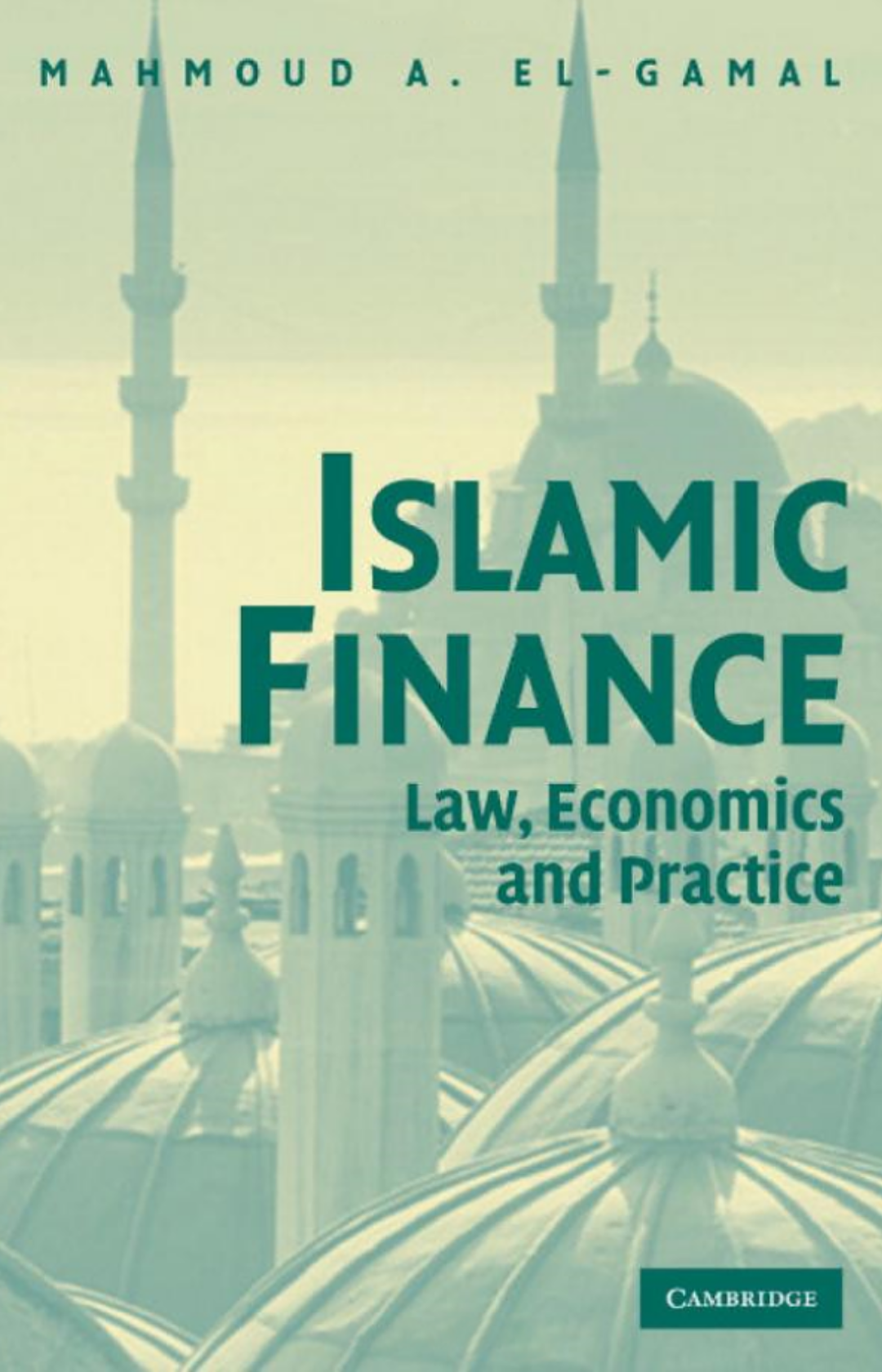
This article is an excerpt from the third chapter of Professor El-Gamal's book, Islamic Finance: Law, Economics, and Practice. The author, Mahmoud A. El-Gamal, is a professor of economics and statistics at Rice University, where he serves as the Chair in Islamic Economics, Finance, and Management. Before joining Rice University in 1998, he was an associate professor of economics at the University of Wisconsin-Madison and an assistant professor of economics at the California Institute of Technology and the University of Rochester. He also worked in the Middle Eastern Department of the International Monetary Fund from 1995 to 1996 and became the first Scholar-in-Residence on Islamic Finance at the U.S. Department of the Treasury in 2004. He has published extensively in the fields of econometrics, finance, experimental economics, and Islamic law and finance.
Professor El-Gamal's economic expertise helps us clarify the dilemmas facing interest-free finance today and provides solutions for how to move forward. Professor El-Gamal's book offers unique insights. His understanding of riba (usury) and gharar (uncertainty) differs from traditional academic views. He has boldly pointed out that the essence of modern Islamic finance is rent-seeking sharia arbitrage. Rent-seeking refers to non-productive profit-seeking activities where one monopolizes social resources or maintains a monopoly position to gain monopoly profits, known as economic rent, without engaging in production. This behavior, similar to corruption and bribery, is even more alarming than so-called interest.
Islamic finance is an industry driven by prohibitions. In this regard, the invalidity of contracts that lead to these prohibitions can almost always be attributed to two factors: riba and gharar. As we showed in the first chapter, mainstream contemporary legal and economic analysts believe that such regulations, which prohibit financial transactions voluntarily entered into by both parties, are paternalistic and lead to efficiency losses. Islamic finance always prefers formal correctness, a characteristic that does almost nothing to refute such sharia prohibitions.
Participants in the industry, especially those who are not believers themselves, respect Muslim religious precepts in their operations and design financial solutions to circumvent various prohibitions based on the opinions of jurists. This attitude encourages Islamic finance to focus more on form than substance. Lawyers and bankers hesitate to question the solutions provided by jurists, viewing them only as inefficient hurdles to transactions they believe are otherwise forbidden. To properly understand today's Islamic finance practices, this chapter covers the economic substance that we believe these prohibitions aim to achieve. In later chapters, we will compare the economic substance of these prohibitions with pre-modern contract conditions in more detail, contrasting the form-oriented approach of contemporary Islamic finance with the substance-oriented approach of classical jurisprudence.
Bounded rationality and paternalism
For alcohol and gambling, the classic solution is to avoid them entirely, as these activities are not necessities. In contrast, credit and risk transfer are at the heart of finance. Without them, the economic system cannot function properly. In this case, the solution under Sharia is to restrict how credit and risk are transferred by prohibiting interest (riba) and uncertainty (gharar). In this chapter, I will argue that in the financial sector, the prohibited interest is essentially credit trading, and the prohibited uncertainty is risk trading. These were meant to be traded as independent commodities.
In other words, Sharia uses these two prohibitions to allow for the transfer of credit and risk to an appropriate degree, helping to achieve economic goals. As many financial market observers and practitioners confirm, credit and risk trading, perfected through derivative securities, are as dangerous as a double-edged sword. Although these tools can be used wisely to reduce risk and improve welfare, they can also easily tempt otherwise cautious people into destructive gambling. While financial regulators try to limit the scope of credit and risk trading to prevent systemic collapse, the purpose of Sharia's prohibitions is also to protect individuals from their own greed and short-sightedness.
What should be prohibited? Balancing benefits and risks
The goal of balancing economic freedom—allowing more contracts to boost economic activity—against the risk of abuse if too much freedom is given, is clear from the fact that some contracts involving interest or uncertainty are permitted in classical and legal literature. Take the example of advance forward sales (salam), which contain a great deal of uncertainty because the item being sold usually does not exist when the contract is signed. However, this uncertainty is considered minor compared to the potential benefits of using salam to provide financing for agriculture and other activities. Therefore, based on this benefit, it overrides the conclusion that a contract is invalid due to uncertainty, a point that can be reached simply through analogical reasoning. Similarly, credit sales can easily be seen as a vehicle for interest. As shown in the previous chapter, in both cases, the benefits of allowing the production of non-existent goods through salam and the consumption of future income through credit sales outweigh the potential dangers of abuse. Thus, despite various negative factors, these contracts are permitted.
The discussion in Chapter Two regarding various legal views on buy-back sales (ina) reflects a legal cost-benefit analysis. Clearly, not all spot sales or credit sales can be prohibited, as that would lead to economic collapse. On one hand, legal experts agree that it is unreasonable to prohibit buy-back sales if the second transaction is stipulated in the first. On the other hand, if the two transactions are executed through separate contracts, some legal experts prohibit this practice to prevent abuse—a means of preventing legal evasion in Maliki jurisprudence—while others, such as Shafi'i, who limits legal reasoning to analogy, consider this practice valid. In Islamic finance, legal experts might be asked to verify each contract separately without needing to explain the entire financial structure it will be used for.
This example is truly essential for understanding our upcoming discussion on contemporary jurisprudence and finance. By definition, almost all new financial transactions and the variations considered by Islamic bank Sharia boards are complex enough to generate multiple legal opinions based on principles like analogy, preventing abuse, and benefit analysis.
Differences in opinion allow Islamic finance providers to practice price discrimination by segmenting the market based on how conservative a believer's faith is, which helps them extract more Islamic finance arbitrage profits from more conservative believers.
The prohibition of interest (riba).
The word "riba" has a three-letter past-tense root from the Arabic verb "raba," which means "to increase." Therefore, jurists usually define the prohibited "riba" as "trading the same type of goods in different quantities, where the added portion is not reasonable compensation." Clearly, the literal meaning of the term, which covers all types of increases, is not what is prohibited. Because of this, many jurists have analyzed the legal meaning of prohibited "riba" for hundreds of years. Although most contemporary jurists deny any uncertainty in the legal definition of prohibited "riba," two research works by Rida (1986) clearly show that the definitions used by pre-modern and contemporary jurists have gone far beyond their original scope.
In this regard, the distinction between legal compensation and prohibited usury is the most fundamental feature of Islamic finance as an industry guided by prohibitions. However, the distinction defined by contemporary jurists is mainly achieved by adopting pre-modern forms rather than by ensuring mechanisms for fair contract pricing. Understanding the religious ban on usury and its modern interpretations is essential for understanding today's Islamic finance industry and any possible alternative Islamic structures. We are now starting an economic analysis of the classic religious texts and traditional legal studies regarding usury. We first look at the classic religious texts.
Classic literature on riba
All scholars agree there are two main types of riba, and scholars from the Shafi'i school have further refined the second type. The first type is called riba al-nasia.
The worst form of this riba is called riba al-jahiliyya (practiced in the Arab region before the founding of Islam). The Quran strictly forbids it, so much so that Imam Malik once called it the strictest prohibition in Islam.
The first mention of riba in the Quran was in Mecca, where it only advised people not to collect riba but did not explicitly forbid it [30:39].
The first verses about riba revealed in Medina only banned the riba practiced in the Arab region before Islam, which meant charging interest on interest-free loans or credit sales when they were due, and then calculating compound interest on later due dates. Therefore, the Quran describes the principal that a debtor should repay as "doubled and multiplied riba" [3:130]. In the final verses of the Quran, the ban on riba was expanded to clearly forbid all forms of riba. In the verses that follow [2:275-9], believers are ordered to give up all remaining interest (likely referring to the form of interest defined in [3:130]).
The main categories of riba in Islamic law.
Most jurists extended the strict pre-Islamic ban on usury found in the Quran to all forms of interest-bearing loans, grouping them under the term riba al-nasia.
They offered three reasons for this ban: (1) people might take advantage of poor debtors who urgently need to borrow money or goods; (2) currency trading might lead to fluctuations in currency value and uncertainty; (3) exchanging food for more food in the future could cause shortages in the spot market (likely because many merchants would hoard food, hoping to sell it at a higher price later! ).
None of these explanations seem very convincing. After all, a loan shark could just as easily exploit a debtor in urgent need of cash by selling them a house worth $100 for a deferred payment of $1,000, without violating the rules of usury envisioned by the jurists. The second explanation also seems weak from an economic perspective. The relative prices of goods can fluctuate due to changes in supply and demand, regardless of whether interest-based credit is available. Finally, the logic regarding food is clearly flawed: traders only prefer deferred transactions when the terms of trade exceed their time preference, and vice versa. In reality, this is how the implicit interest rate is determined in equilibrium based on the time preferences of market participants. if credit transactions for food could cause the problems mentioned by classical jurists, then selling deferred food claims for immediate cash, or selling food for a deferred cash price, would cause the same issues. Yet, jurists consider both of these transactions permissible, even though they implicitly compensate for the time value of money. In fact, jurists from all major schools declare that time has a share in price. They accept the legality of seeking compensation for the value of time in credit and forward sales (salam), including the sale of all goods, such as food.
The second type of riba recognized by jurists is called riba al-fadl (excess riba). It forbids trading goods of the same kind and category in different quantities. This is based on a valid hadith of the Prophet: Gold for gold, silver for silver, copper for copper, grain for grain, dried fruit for dried fruit, and fresh fruit for fresh fruit must be exchanged in equal amounts, and one may not trade more for less. Gold for gold, silver for silver, wheat for wheat, barley for barley, dates for dates, and salt for salt must be exchanged in equal amounts, hand-to-hand. Any increase is riba. Jurists outside the Zahiri school agree that these six goods are only examples. Hanafi jurists extend the prohibition to all fungible goods measured by weight or volume, while Shafi'i and Maliki jurists limit it to monetary goods like gold and silver, and storable food.
When we discuss currency exchange (saraf), we will explore the hadith of the Prophet specifically regarding spot and deferred trades of gold for gold, silver for silver, and gold for silver. These hadith clearly forbid a common method used by Medici bankers to get around the early Catholic Church's ban on interest, which was to include interest rates in exchange rates.
Riba is not interest.
Reports indicate that some famous early companions of the Prophet, including the prominent jurist Abdullah ibn Abbas, believed that riba involving a time factor was absolutely forbidden. Usama ibn Zayd ibn al-Arqam, Ibn Jubayr, and others ruled that the only clearly forbidden riba was the one involving a time factor (riba al-nasi'ah), even citing a hadith of the Prophet to support this view: Riba only exists in deferred payment. Later reports from Jabir show that this hadith referred to trades between different goods, such as gold for silver or wheat for barley, and that Ibn Abbas later changed his view to join the majority opinion that forbids riba al-fadl.
Jurists list two reasons for banning riba al-fadl, which involves time-based factors: (1) Trading different amounts of the same item in a spot transaction easily mixes with credit sales, creating the same effect as riba al-nasi'ah. This is deferred interest (so interest premiums are banned to prevent legal loopholes), and (2) these trades contain excessive uncertainty (avoidable risk and uncertainty), because both sides do not know if the trade will help or harm them. Ibn Rushd based his core analysis on this latter explanation for banning interest, which we will detail below. Including interest premiums in the general category of banned interest is very important for understanding the economic substance of these bans. However, most contemporary jurists and Islamic finance scholars want to avoid discussing this topic, precisely to keep wrongly linking 'interest' and 'usury' one-to-one in their rhetoric. In reality, equating these two terms is highly inappropriate.
First, even the most conservative contemporary jurists do not consider all forms of interest that economists and regulators talk about to be banned interest. Just look at interest-free Islamic finance methods like cost-plus credit sales. Cost-plus financing (murabaha) and leasing (ijara) show that these financing models are not 'interest-free'. In fact, U.S. Truth in Lending regulations require Islamic and traditional financial institutions to report the implied interest rates they charge customers in these financing arrangements. Therefore, Islamic finance's own practices show that certain forms of interest (such as in credit sales and leasing) should not be seen as banned 'interest'. Instead, banning 'interest' (riba) clearly shows that there are banned forms of 'interest' (illegal exchange gains) that do not involve interest. As some Hanafi jurists point out, the Prophet's tradition about the six commodities cited in the previous section sets two conditions: immediate exchange and equal value. So, if you trade one ounce of gold today for one ounce of gold to be delivered next year, it is still considered riba (usury) because it breaks the rule of immediate exchange, even if the interest rate is zero. These Hanafi jurists reason that one ounce of gold today is clearly worth more than one ounce of gold a year from now, which acknowledges the time value of money. Therefore, no one would ever trade one ounce of gold today for one ounce of gold next year unless they were getting some other return that was not disclosed in the sales contract. Whatever that extra benefit might be, they argue it constitutes riba. Our later analysis of the ban on riba—from the perspective of ensuring economic efficiency and fair trade—applies the same general principles to any other interest rate to explain the ban on zero interest: how do we know that zero interest is the fair rate for trading gold today for gold in a year?
The economic essence of the ban on riba
In his pioneering work on comparative jurisprudence, the Maliki jurist, judge, and philosopher Ibn Rushd (also known as Averroes, died 595 AH/1198 AD) adopted the Hanafi approach of extending the rules of riba from the tradition of the six commodities to all fungible goods, based on this economic analysis:
It follows that the goal of the riba prohibited by law is to eliminate the excessive injustice it causes. In this regard, fairness in certain transactions is achieved through equality. Since it is difficult to achieve equal exchange between different types of items, we use money to measure their value. Therefore, for goods that cannot be measured by weight or volume, fairness can be ensured through the ratio of their value. The ratio of the quantity exchanged should be decided by the value ratio of the different goods being traded. For example, if someone trades a horse for clothes, and the horse is worth fifty, the clothes should also be worth fifty. If each piece of clothing is worth five, then the horse should be traded for ten pieces of clothing. For interchangeable goods measured by volume or weight, fairness requires equality because they are relatively uniform and have similar utility. Since people who own these goods do not need to trade them for the same type, fairness is achieved through equal volume or weight because their utility is very similar.
Ibn Rushd clarified the conditions for exchange: the ratio of the quantity traded should be decided by the price ratio, which should equal the ratio of marginal utility. This restriction never became part of the rules prohibiting usury because monitoring the market price of all goods is a very tedious task. Therefore, the prohibition of usury only applies to the direct exchange of interchangeable goods. As Ibn Rushd suggested, if there is a significant difference in quality, people avoid directly trading low-quality goods for high-quality goods of the same kind. Many hadith clearly support achieving fairness through equality when trading uniform goods and explain alternatives to avoid direct barter when the quality of goods differs. In this regard, Buraydah and Abu Hurayrah reported that a man working in Khaybar brought the Prophet some high-quality dates. The Prophet asked if all the dates in Khaybar were like this one, and the man replied that they traded two or three portions of lower-quality dates for one portion of higher-quality dates. The Prophet told him angrily not to do this again, but instead to sell the lower-quality dates and use the money to buy the higher-quality ones.
Achieving fairness and efficiency through market-based pricing.
Sell the first type of date at the highest market price and buy the other at the lowest market price to ensure the trade follows the ratio set by market prices. Naturally, traders will only trade at this ratio if they value the marginal units differently. Considering the law of diminishing marginal utility, where a buyer's valuation of each successive unit of a date type drops, trading stops when the ratio of marginal utility equals the ratio of market prices. This achieves (Pareto) efficiency in exchange, as noted by contemporary neoclassical economic theory. The ban on this type of interest (riba al-fadl) acts as a mechanism that encourages people to gather information on market conditions and set trade terms based on market prices. This protects individuals from unfair trades and improves overall exchange efficiency. Keep in mind that any trade ratio deviating from the market price ratio will necessarily disadvantage one party. Both fairness and efficiency require following this method of using market pricing to determine trade ratios. It is not difficult to extend this logic to exchanges over time, such as credit sales, leasing, or other transactions. In the context of credit sales and lease-to-own financing, the ban on interest is essentially aimed at ensuring fairness in the exchange. These transactions require that credit be issued at an appropriate rate. In this regard, conventional finance plays a very important role for contemporary Islamic finance by setting market interest rates for various borrowers based on their credit status and the security of their collateral.
It is quite appropriate here to benchmark the implied interest rates in Islamic credit sales and lease-purchase transactions against conventional interest rates. In practice, for example, if the market interest rate for a specific borrower and specific collateral is 6%, but the rate requested by the customer is lower than 6%, then this interest rate difference is equivalent to implied interest. However, if a customer and a financier agree to a credit sale transaction with an implied interest rate of 10%, some would argue that this clearly violates the spirit of Islamic law prohibiting usury, even if it uses sales-based methods to bypass ancient forms of prohibition. In this regard, Al-Misri (2004) argues that it is better for Islamic banks to stop calling the markup in their credit sales "profit" and instead list it as "interest," because the former may have no cap, while the latter is restricted by various contemporary anti-usury laws that protect people in need of credit from predatory lenders.
Islamic Finance: A Re-examination of Form and Substance
So, why do we need Islamic finance? Why should we go to the trouble of having an Islamic bank buy a property first and then sell it to the customer on credit, if the actual goal could be achieved more directly through a secured loan transaction? These questions must be answered in two steps: the first step is to recognize that if individuals are left to their own devices, they may over-borrow. Following religious law can act as a constraint. It serves as an effective pre-commitment mechanism to ensure that individuals do not abuse the availability of credit to their own detriment.
The second step is to recognize that religious adherence has historically been ensured through the observance of form, both in the realms of ritual and transaction. In this regard, classical jurists did their best to develop contract forms and their conditions to reflect the spirit of the law as much as possible. Contemporary jurists find it safest to work within the framework of formal and informal methods of Islamic jurisprudence when helping Muslims follow the spirit of the law. As we saw in previous chapters, Islamic jurisprudence is actually a common law system, even though it wears the cloak of canon law, and it focuses on precedent and analogy. Therefore, the contemporary process of adapting classical contract forms to modern needs will inevitably create temporary inefficiencies.
This inefficiency is only tolerable if we ensure that the spirit of the law that birthed these adopted forms is protected. Otherwise, it would be shameful to simply copy or adapt inefficient historical forms and waste the substance of Islamic law. Ideally, contemporary jurists should develop a modern jurisprudence within the context of current legal and regulatory frameworks that incorporates the substance of pre-modern law. This ideal might be achievable in the long run, but it seems impossible in the short term. In this regard, early jurists had the luxury of adopting Roman or other legal forms to seek efficiency. However, later jurists had to work under the heavy burden of sacred history, including an unrealistic worship of the so-called eternal wisdom of their predecessors.
Therefore, practical solutions for Islam in the short to medium term may gradually abandon pre-modern forms.
Regarding multiple paternalistic parties, we discussed the generally paternalistic nature of prohibitions earlier in this chapter. Let us look at the ban on interest (riba). It aims to protect people from too much debt and stops unfair payments or charges when someone borrows money or delays a payment. Some might argue that secular regulators also try, perhaps in a paternalistic way, to stop people from borrowing too much or falling victim to unfair, predatory loans. However, regulators care most about the health of the whole financial system. They only care about the financial health of specific individuals as a secondary concern. Because of this, regulators might allow deals that are risky for a few people. They weigh the well-being of specific groups against the well-being of the whole system, such as economic growth, which is their main job. Bankers also try to prevent too much debt. They give out loans based on how much debt a person has compared to their income and other standards. But bankers and loan officers work for financial institutions. These institutions do not care about the financial health of the system or the individual; they care most about their own profits. So, as long as the expected repayment rate is high enough to make a profit, they usually let many customers borrow too much.
Human time inconsistency and pre-commitment solutions
The limits set by regulators and financial professionals need extra protection for individuals to keep them safe from their own irrational behavior. Religious law can play this role. In this area, psychology and behavioral economics research show that humans are irrational when it comes to time preferences. Pre-commitment mechanisms, including those based on religion, can protect them from this. For example, most people would rather have 100 dollars today than 105 dollars in a year. But they would rather have 105 dollars in twenty years than 100 dollars in nineteen years. These and other time preference anomalies show that people act with dynamic inconsistency when it comes to saving, spending, and borrowing.
This study concludes that people often discount the near future, like one year from now, much more heavily than they discount the distant future, such as between the nineteenth and twentieth years. So, in the previous example, a 5% interest rate seems low for the current year, but it feels high enough for some arbitrary year in the future.
People with this time preference will choose to borrow $100 today, while sincerely planning to save money and pay back the loan in the future. However, when that future arrives, the value of spending now feels much higher than the value of spending later, so the person borrows even more money, dreaming that they will save enough later to pay off both loans. The cycle of debt never ends. Some of these people might see their income grow quickly, which eventually allows them to pay off their debt without needing to increase their savings rate. Many other debtors, however, get stuck in the debt cycle and eventually have to declare personal bankruptcy, which has become a small-scale epidemic in some Western societies.
Good loans and bad loans
Someone might ask why banks give out bad loans that lead to bankruptcy. The answer is that loans are rarely bad at the start. When the economy is doing well, many borrowers see their income grow, and banks have an incentive to keep lending to them because the number of defaults and bankruptcies is too low to hurt their profits. For example, in 1990s Asia, borrowed money was sometimes put into real estate and other assets that were rising in value quickly, which made loans backed by those overvalued assets look less risky than they really were. As the economy worsens and asset bubbles burst, too many of these loans could go bad at once, threatening the financial system. Regulators set limits to make sure bank operations do not threaten the whole system, though this approach is often reactive and fails to prevent later banking crises. In contrast, religious law aims to protect everyone by making sure individuals do not borrow too much. For example, imagine a Muslim client wants to buy a property through lease financing. If the real estate market is in a speculative bubble, this should become clear by comparing the rent the client pays to the Islamic bank—which is set based on mortgage market rates—with the actual market rent for the property. If mortgage payments are too high compared to rent, it usually shows a bubble exists. This shows the client is about to borrow too much money relative to the long-term value of the property used as collateral. Linking the rate to market rental rates should stop individuals from borrowing too much to buy the property. In this process, the client also ensures the implied interest rate is based on the market time value of the property serving as security for the debt.
If these factors are ignored, the Islamic bank just turns the client into a house slave or bankrupts them, while still following the classic contract forms in an Islamic way. This would be a shameful abuse of religion and finance. Even though we accept the necessary inefficiency of Islamic finance in following classic contract forms, ensuring the substance of Islamic law is followed is just as important, if not more so, because pre-modern jurists tried to embed that substance into those classic forms.
Side notes on loans in Islamic law.
We see here that the traditional ban on interest rate spreads in finance under Islamic law refers to the split-sale of credit, where it is hard to link interest rates to the market.
In this regard, the simplest form of split-credit sales is an interest-bearing loan. In fact, if a loan is seen as an exchangeable financial contract, meaning the repayment is seen as compensation for the amount lent, then even an interest-free loan would be considered forbidden riba (interest). Al-Qarafi argued in Al-Furuq, a legal theory book dedicated to explaining jurisprudential distinctions, that loans are not bound by riba rules because they are charitable in nature. From a religious perspective, the person providing the loan does not seek repayment as compensation, but treats the time value of the money or the benefit of the property lent as a charitable donation. Therefore, the companions of the Prophet and early jurists said they preferred to lend a coin and lend it out again after it was returned, rather than just giving it away as a charitable donation. A good loan has a direct charitable nature because the debt is forgiven if a poor debtor cannot pay it back. On the other hand, a poor borrower keeps their dignity by potentially paying back the principal, compared to someone who clearly accepts a charitable donation.
Even when the loan is repaid, the lender earns religious praise for sacrificing the time value of their property and proves they are willing to sacrifice the property itself if necessary. Therefore, Islamic jurisprudence excludes loans from the financial sector to keep their good, charitable nature. This is because all financial goals that can be achieved through commercial loans can be achieved just as well, or even better, through other forms of mutual contracts like sales or leases. view all
Summary: This Muslim knowledge guide excerpts Mahmoud A. El-Gamal's work on Islamic finance, explaining the economic substance of riba and interest, gharar, Sharia arbitrage, rent-seeking, and why form-based finance can miss the deeper goals of Islamic law.
This article is an excerpt from the third chapter of Professor El-Gamal's book, Islamic Finance: Law, Economics, and Practice. The author, Mahmoud A. El-Gamal, is a professor of economics and statistics at Rice University, where he serves as the Chair in Islamic Economics, Finance, and Management. Before joining Rice University in 1998, he was an associate professor of economics at the University of Wisconsin-Madison and an assistant professor of economics at the California Institute of Technology and the University of Rochester. He also worked in the Middle Eastern Department of the International Monetary Fund from 1995 to 1996 and became the first Scholar-in-Residence on Islamic Finance at the U.S. Department of the Treasury in 2004. He has published extensively in the fields of econometrics, finance, experimental economics, and Islamic law and finance.
Professor El-Gamal's economic expertise helps us clarify the dilemmas facing interest-free finance today and provides solutions for how to move forward. Professor El-Gamal's book offers unique insights. His understanding of riba (usury) and gharar (uncertainty) differs from traditional academic views. He has boldly pointed out that the essence of modern Islamic finance is rent-seeking sharia arbitrage. Rent-seeking refers to non-productive profit-seeking activities where one monopolizes social resources or maintains a monopoly position to gain monopoly profits, known as economic rent, without engaging in production. This behavior, similar to corruption and bribery, is even more alarming than so-called interest.
Islamic finance is an industry driven by prohibitions. In this regard, the invalidity of contracts that lead to these prohibitions can almost always be attributed to two factors: riba and gharar. As we showed in the first chapter, mainstream contemporary legal and economic analysts believe that such regulations, which prohibit financial transactions voluntarily entered into by both parties, are paternalistic and lead to efficiency losses. Islamic finance always prefers formal correctness, a characteristic that does almost nothing to refute such sharia prohibitions.
Participants in the industry, especially those who are not believers themselves, respect Muslim religious precepts in their operations and design financial solutions to circumvent various prohibitions based on the opinions of jurists. This attitude encourages Islamic finance to focus more on form than substance. Lawyers and bankers hesitate to question the solutions provided by jurists, viewing them only as inefficient hurdles to transactions they believe are otherwise forbidden. To properly understand today's Islamic finance practices, this chapter covers the economic substance that we believe these prohibitions aim to achieve. In later chapters, we will compare the economic substance of these prohibitions with pre-modern contract conditions in more detail, contrasting the form-oriented approach of contemporary Islamic finance with the substance-oriented approach of classical jurisprudence.
Bounded rationality and paternalism
For alcohol and gambling, the classic solution is to avoid them entirely, as these activities are not necessities. In contrast, credit and risk transfer are at the heart of finance. Without them, the economic system cannot function properly. In this case, the solution under Sharia is to restrict how credit and risk are transferred by prohibiting interest (riba) and uncertainty (gharar). In this chapter, I will argue that in the financial sector, the prohibited interest is essentially credit trading, and the prohibited uncertainty is risk trading. These were meant to be traded as independent commodities.
In other words, Sharia uses these two prohibitions to allow for the transfer of credit and risk to an appropriate degree, helping to achieve economic goals. As many financial market observers and practitioners confirm, credit and risk trading, perfected through derivative securities, are as dangerous as a double-edged sword. Although these tools can be used wisely to reduce risk and improve welfare, they can also easily tempt otherwise cautious people into destructive gambling. While financial regulators try to limit the scope of credit and risk trading to prevent systemic collapse, the purpose of Sharia's prohibitions is also to protect individuals from their own greed and short-sightedness.
What should be prohibited? Balancing benefits and risks
The goal of balancing economic freedom—allowing more contracts to boost economic activity—against the risk of abuse if too much freedom is given, is clear from the fact that some contracts involving interest or uncertainty are permitted in classical and legal literature. Take the example of advance forward sales (salam), which contain a great deal of uncertainty because the item being sold usually does not exist when the contract is signed. However, this uncertainty is considered minor compared to the potential benefits of using salam to provide financing for agriculture and other activities. Therefore, based on this benefit, it overrides the conclusion that a contract is invalid due to uncertainty, a point that can be reached simply through analogical reasoning. Similarly, credit sales can easily be seen as a vehicle for interest. As shown in the previous chapter, in both cases, the benefits of allowing the production of non-existent goods through salam and the consumption of future income through credit sales outweigh the potential dangers of abuse. Thus, despite various negative factors, these contracts are permitted.
The discussion in Chapter Two regarding various legal views on buy-back sales (ina) reflects a legal cost-benefit analysis. Clearly, not all spot sales or credit sales can be prohibited, as that would lead to economic collapse. On one hand, legal experts agree that it is unreasonable to prohibit buy-back sales if the second transaction is stipulated in the first. On the other hand, if the two transactions are executed through separate contracts, some legal experts prohibit this practice to prevent abuse—a means of preventing legal evasion in Maliki jurisprudence—while others, such as Shafi'i, who limits legal reasoning to analogy, consider this practice valid. In Islamic finance, legal experts might be asked to verify each contract separately without needing to explain the entire financial structure it will be used for.
This example is truly essential for understanding our upcoming discussion on contemporary jurisprudence and finance. By definition, almost all new financial transactions and the variations considered by Islamic bank Sharia boards are complex enough to generate multiple legal opinions based on principles like analogy, preventing abuse, and benefit analysis.
Differences in opinion allow Islamic finance providers to practice price discrimination by segmenting the market based on how conservative a believer's faith is, which helps them extract more Islamic finance arbitrage profits from more conservative believers.
The prohibition of interest (riba).
The word "riba" has a three-letter past-tense root from the Arabic verb "raba," which means "to increase." Therefore, jurists usually define the prohibited "riba" as "trading the same type of goods in different quantities, where the added portion is not reasonable compensation." Clearly, the literal meaning of the term, which covers all types of increases, is not what is prohibited. Because of this, many jurists have analyzed the legal meaning of prohibited "riba" for hundreds of years. Although most contemporary jurists deny any uncertainty in the legal definition of prohibited "riba," two research works by Rida (1986) clearly show that the definitions used by pre-modern and contemporary jurists have gone far beyond their original scope.
In this regard, the distinction between legal compensation and prohibited usury is the most fundamental feature of Islamic finance as an industry guided by prohibitions. However, the distinction defined by contemporary jurists is mainly achieved by adopting pre-modern forms rather than by ensuring mechanisms for fair contract pricing. Understanding the religious ban on usury and its modern interpretations is essential for understanding today's Islamic finance industry and any possible alternative Islamic structures. We are now starting an economic analysis of the classic religious texts and traditional legal studies regarding usury. We first look at the classic religious texts.
Classic literature on riba
All scholars agree there are two main types of riba, and scholars from the Shafi'i school have further refined the second type. The first type is called riba al-nasia.
The worst form of this riba is called riba al-jahiliyya (practiced in the Arab region before the founding of Islam). The Quran strictly forbids it, so much so that Imam Malik once called it the strictest prohibition in Islam.
The first mention of riba in the Quran was in Mecca, where it only advised people not to collect riba but did not explicitly forbid it [30:39].
The first verses about riba revealed in Medina only banned the riba practiced in the Arab region before Islam, which meant charging interest on interest-free loans or credit sales when they were due, and then calculating compound interest on later due dates. Therefore, the Quran describes the principal that a debtor should repay as "doubled and multiplied riba" [3:130]. In the final verses of the Quran, the ban on riba was expanded to clearly forbid all forms of riba. In the verses that follow [2:275-9], believers are ordered to give up all remaining interest (likely referring to the form of interest defined in [3:130]).
The main categories of riba in Islamic law.
Most jurists extended the strict pre-Islamic ban on usury found in the Quran to all forms of interest-bearing loans, grouping them under the term riba al-nasia.
They offered three reasons for this ban: (1) people might take advantage of poor debtors who urgently need to borrow money or goods; (2) currency trading might lead to fluctuations in currency value and uncertainty; (3) exchanging food for more food in the future could cause shortages in the spot market (likely because many merchants would hoard food, hoping to sell it at a higher price later! ).
None of these explanations seem very convincing. After all, a loan shark could just as easily exploit a debtor in urgent need of cash by selling them a house worth $100 for a deferred payment of $1,000, without violating the rules of usury envisioned by the jurists. The second explanation also seems weak from an economic perspective. The relative prices of goods can fluctuate due to changes in supply and demand, regardless of whether interest-based credit is available. Finally, the logic regarding food is clearly flawed: traders only prefer deferred transactions when the terms of trade exceed their time preference, and vice versa. In reality, this is how the implicit interest rate is determined in equilibrium based on the time preferences of market participants. if credit transactions for food could cause the problems mentioned by classical jurists, then selling deferred food claims for immediate cash, or selling food for a deferred cash price, would cause the same issues. Yet, jurists consider both of these transactions permissible, even though they implicitly compensate for the time value of money. In fact, jurists from all major schools declare that time has a share in price. They accept the legality of seeking compensation for the value of time in credit and forward sales (salam), including the sale of all goods, such as food.
The second type of riba recognized by jurists is called riba al-fadl (excess riba). It forbids trading goods of the same kind and category in different quantities. This is based on a valid hadith of the Prophet: Gold for gold, silver for silver, copper for copper, grain for grain, dried fruit for dried fruit, and fresh fruit for fresh fruit must be exchanged in equal amounts, and one may not trade more for less. Gold for gold, silver for silver, wheat for wheat, barley for barley, dates for dates, and salt for salt must be exchanged in equal amounts, hand-to-hand. Any increase is riba. Jurists outside the Zahiri school agree that these six goods are only examples. Hanafi jurists extend the prohibition to all fungible goods measured by weight or volume, while Shafi'i and Maliki jurists limit it to monetary goods like gold and silver, and storable food.
When we discuss currency exchange (saraf), we will explore the hadith of the Prophet specifically regarding spot and deferred trades of gold for gold, silver for silver, and gold for silver. These hadith clearly forbid a common method used by Medici bankers to get around the early Catholic Church's ban on interest, which was to include interest rates in exchange rates.
Riba is not interest.
Reports indicate that some famous early companions of the Prophet, including the prominent jurist Abdullah ibn Abbas, believed that riba involving a time factor was absolutely forbidden. Usama ibn Zayd ibn al-Arqam, Ibn Jubayr, and others ruled that the only clearly forbidden riba was the one involving a time factor (riba al-nasi'ah), even citing a hadith of the Prophet to support this view: Riba only exists in deferred payment. Later reports from Jabir show that this hadith referred to trades between different goods, such as gold for silver or wheat for barley, and that Ibn Abbas later changed his view to join the majority opinion that forbids riba al-fadl.
Jurists list two reasons for banning riba al-fadl, which involves time-based factors: (1) Trading different amounts of the same item in a spot transaction easily mixes with credit sales, creating the same effect as riba al-nasi'ah. This is deferred interest (so interest premiums are banned to prevent legal loopholes), and (2) these trades contain excessive uncertainty (avoidable risk and uncertainty), because both sides do not know if the trade will help or harm them. Ibn Rushd based his core analysis on this latter explanation for banning interest, which we will detail below. Including interest premiums in the general category of banned interest is very important for understanding the economic substance of these bans. However, most contemporary jurists and Islamic finance scholars want to avoid discussing this topic, precisely to keep wrongly linking 'interest' and 'usury' one-to-one in their rhetoric. In reality, equating these two terms is highly inappropriate.
First, even the most conservative contemporary jurists do not consider all forms of interest that economists and regulators talk about to be banned interest. Just look at interest-free Islamic finance methods like cost-plus credit sales. Cost-plus financing (murabaha) and leasing (ijara) show that these financing models are not 'interest-free'. In fact, U.S. Truth in Lending regulations require Islamic and traditional financial institutions to report the implied interest rates they charge customers in these financing arrangements. Therefore, Islamic finance's own practices show that certain forms of interest (such as in credit sales and leasing) should not be seen as banned 'interest'. Instead, banning 'interest' (riba) clearly shows that there are banned forms of 'interest' (illegal exchange gains) that do not involve interest. As some Hanafi jurists point out, the Prophet's tradition about the six commodities cited in the previous section sets two conditions: immediate exchange and equal value. So, if you trade one ounce of gold today for one ounce of gold to be delivered next year, it is still considered riba (usury) because it breaks the rule of immediate exchange, even if the interest rate is zero. These Hanafi jurists reason that one ounce of gold today is clearly worth more than one ounce of gold a year from now, which acknowledges the time value of money. Therefore, no one would ever trade one ounce of gold today for one ounce of gold next year unless they were getting some other return that was not disclosed in the sales contract. Whatever that extra benefit might be, they argue it constitutes riba. Our later analysis of the ban on riba—from the perspective of ensuring economic efficiency and fair trade—applies the same general principles to any other interest rate to explain the ban on zero interest: how do we know that zero interest is the fair rate for trading gold today for gold in a year?
The economic essence of the ban on riba
In his pioneering work on comparative jurisprudence, the Maliki jurist, judge, and philosopher Ibn Rushd (also known as Averroes, died 595 AH/1198 AD) adopted the Hanafi approach of extending the rules of riba from the tradition of the six commodities to all fungible goods, based on this economic analysis:
It follows that the goal of the riba prohibited by law is to eliminate the excessive injustice it causes. In this regard, fairness in certain transactions is achieved through equality. Since it is difficult to achieve equal exchange between different types of items, we use money to measure their value. Therefore, for goods that cannot be measured by weight or volume, fairness can be ensured through the ratio of their value. The ratio of the quantity exchanged should be decided by the value ratio of the different goods being traded. For example, if someone trades a horse for clothes, and the horse is worth fifty, the clothes should also be worth fifty. If each piece of clothing is worth five, then the horse should be traded for ten pieces of clothing. For interchangeable goods measured by volume or weight, fairness requires equality because they are relatively uniform and have similar utility. Since people who own these goods do not need to trade them for the same type, fairness is achieved through equal volume or weight because their utility is very similar.
Ibn Rushd clarified the conditions for exchange: the ratio of the quantity traded should be decided by the price ratio, which should equal the ratio of marginal utility. This restriction never became part of the rules prohibiting usury because monitoring the market price of all goods is a very tedious task. Therefore, the prohibition of usury only applies to the direct exchange of interchangeable goods. As Ibn Rushd suggested, if there is a significant difference in quality, people avoid directly trading low-quality goods for high-quality goods of the same kind. Many hadith clearly support achieving fairness through equality when trading uniform goods and explain alternatives to avoid direct barter when the quality of goods differs. In this regard, Buraydah and Abu Hurayrah reported that a man working in Khaybar brought the Prophet some high-quality dates. The Prophet asked if all the dates in Khaybar were like this one, and the man replied that they traded two or three portions of lower-quality dates for one portion of higher-quality dates. The Prophet told him angrily not to do this again, but instead to sell the lower-quality dates and use the money to buy the higher-quality ones.
Achieving fairness and efficiency through market-based pricing.
Sell the first type of date at the highest market price and buy the other at the lowest market price to ensure the trade follows the ratio set by market prices. Naturally, traders will only trade at this ratio if they value the marginal units differently. Considering the law of diminishing marginal utility, where a buyer's valuation of each successive unit of a date type drops, trading stops when the ratio of marginal utility equals the ratio of market prices. This achieves (Pareto) efficiency in exchange, as noted by contemporary neoclassical economic theory. The ban on this type of interest (riba al-fadl) acts as a mechanism that encourages people to gather information on market conditions and set trade terms based on market prices. This protects individuals from unfair trades and improves overall exchange efficiency. Keep in mind that any trade ratio deviating from the market price ratio will necessarily disadvantage one party. Both fairness and efficiency require following this method of using market pricing to determine trade ratios. It is not difficult to extend this logic to exchanges over time, such as credit sales, leasing, or other transactions. In the context of credit sales and lease-to-own financing, the ban on interest is essentially aimed at ensuring fairness in the exchange. These transactions require that credit be issued at an appropriate rate. In this regard, conventional finance plays a very important role for contemporary Islamic finance by setting market interest rates for various borrowers based on their credit status and the security of their collateral.
It is quite appropriate here to benchmark the implied interest rates in Islamic credit sales and lease-purchase transactions against conventional interest rates. In practice, for example, if the market interest rate for a specific borrower and specific collateral is 6%, but the rate requested by the customer is lower than 6%, then this interest rate difference is equivalent to implied interest. However, if a customer and a financier agree to a credit sale transaction with an implied interest rate of 10%, some would argue that this clearly violates the spirit of Islamic law prohibiting usury, even if it uses sales-based methods to bypass ancient forms of prohibition. In this regard, Al-Misri (2004) argues that it is better for Islamic banks to stop calling the markup in their credit sales "profit" and instead list it as "interest," because the former may have no cap, while the latter is restricted by various contemporary anti-usury laws that protect people in need of credit from predatory lenders.
Islamic Finance: A Re-examination of Form and Substance
So, why do we need Islamic finance? Why should we go to the trouble of having an Islamic bank buy a property first and then sell it to the customer on credit, if the actual goal could be achieved more directly through a secured loan transaction? These questions must be answered in two steps: the first step is to recognize that if individuals are left to their own devices, they may over-borrow. Following religious law can act as a constraint. It serves as an effective pre-commitment mechanism to ensure that individuals do not abuse the availability of credit to their own detriment.
The second step is to recognize that religious adherence has historically been ensured through the observance of form, both in the realms of ritual and transaction. In this regard, classical jurists did their best to develop contract forms and their conditions to reflect the spirit of the law as much as possible. Contemporary jurists find it safest to work within the framework of formal and informal methods of Islamic jurisprudence when helping Muslims follow the spirit of the law. As we saw in previous chapters, Islamic jurisprudence is actually a common law system, even though it wears the cloak of canon law, and it focuses on precedent and analogy. Therefore, the contemporary process of adapting classical contract forms to modern needs will inevitably create temporary inefficiencies.
This inefficiency is only tolerable if we ensure that the spirit of the law that birthed these adopted forms is protected. Otherwise, it would be shameful to simply copy or adapt inefficient historical forms and waste the substance of Islamic law. Ideally, contemporary jurists should develop a modern jurisprudence within the context of current legal and regulatory frameworks that incorporates the substance of pre-modern law. This ideal might be achievable in the long run, but it seems impossible in the short term. In this regard, early jurists had the luxury of adopting Roman or other legal forms to seek efficiency. However, later jurists had to work under the heavy burden of sacred history, including an unrealistic worship of the so-called eternal wisdom of their predecessors.
Therefore, practical solutions for Islam in the short to medium term may gradually abandon pre-modern forms.
Regarding multiple paternalistic parties, we discussed the generally paternalistic nature of prohibitions earlier in this chapter. Let us look at the ban on interest (riba). It aims to protect people from too much debt and stops unfair payments or charges when someone borrows money or delays a payment. Some might argue that secular regulators also try, perhaps in a paternalistic way, to stop people from borrowing too much or falling victim to unfair, predatory loans. However, regulators care most about the health of the whole financial system. They only care about the financial health of specific individuals as a secondary concern. Because of this, regulators might allow deals that are risky for a few people. They weigh the well-being of specific groups against the well-being of the whole system, such as economic growth, which is their main job. Bankers also try to prevent too much debt. They give out loans based on how much debt a person has compared to their income and other standards. But bankers and loan officers work for financial institutions. These institutions do not care about the financial health of the system or the individual; they care most about their own profits. So, as long as the expected repayment rate is high enough to make a profit, they usually let many customers borrow too much.
Human time inconsistency and pre-commitment solutions
The limits set by regulators and financial professionals need extra protection for individuals to keep them safe from their own irrational behavior. Religious law can play this role. In this area, psychology and behavioral economics research show that humans are irrational when it comes to time preferences. Pre-commitment mechanisms, including those based on religion, can protect them from this. For example, most people would rather have 100 dollars today than 105 dollars in a year. But they would rather have 105 dollars in twenty years than 100 dollars in nineteen years. These and other time preference anomalies show that people act with dynamic inconsistency when it comes to saving, spending, and borrowing.
This study concludes that people often discount the near future, like one year from now, much more heavily than they discount the distant future, such as between the nineteenth and twentieth years. So, in the previous example, a 5% interest rate seems low for the current year, but it feels high enough for some arbitrary year in the future.
People with this time preference will choose to borrow $100 today, while sincerely planning to save money and pay back the loan in the future. However, when that future arrives, the value of spending now feels much higher than the value of spending later, so the person borrows even more money, dreaming that they will save enough later to pay off both loans. The cycle of debt never ends. Some of these people might see their income grow quickly, which eventually allows them to pay off their debt without needing to increase their savings rate. Many other debtors, however, get stuck in the debt cycle and eventually have to declare personal bankruptcy, which has become a small-scale epidemic in some Western societies.
Good loans and bad loans
Someone might ask why banks give out bad loans that lead to bankruptcy. The answer is that loans are rarely bad at the start. When the economy is doing well, many borrowers see their income grow, and banks have an incentive to keep lending to them because the number of defaults and bankruptcies is too low to hurt their profits. For example, in 1990s Asia, borrowed money was sometimes put into real estate and other assets that were rising in value quickly, which made loans backed by those overvalued assets look less risky than they really were. As the economy worsens and asset bubbles burst, too many of these loans could go bad at once, threatening the financial system. Regulators set limits to make sure bank operations do not threaten the whole system, though this approach is often reactive and fails to prevent later banking crises. In contrast, religious law aims to protect everyone by making sure individuals do not borrow too much. For example, imagine a Muslim client wants to buy a property through lease financing. If the real estate market is in a speculative bubble, this should become clear by comparing the rent the client pays to the Islamic bank—which is set based on mortgage market rates—with the actual market rent for the property. If mortgage payments are too high compared to rent, it usually shows a bubble exists. This shows the client is about to borrow too much money relative to the long-term value of the property used as collateral. Linking the rate to market rental rates should stop individuals from borrowing too much to buy the property. In this process, the client also ensures the implied interest rate is based on the market time value of the property serving as security for the debt.
If these factors are ignored, the Islamic bank just turns the client into a house slave or bankrupts them, while still following the classic contract forms in an Islamic way. This would be a shameful abuse of religion and finance. Even though we accept the necessary inefficiency of Islamic finance in following classic contract forms, ensuring the substance of Islamic law is followed is just as important, if not more so, because pre-modern jurists tried to embed that substance into those classic forms.
Side notes on loans in Islamic law.
We see here that the traditional ban on interest rate spreads in finance under Islamic law refers to the split-sale of credit, where it is hard to link interest rates to the market.
In this regard, the simplest form of split-credit sales is an interest-bearing loan. In fact, if a loan is seen as an exchangeable financial contract, meaning the repayment is seen as compensation for the amount lent, then even an interest-free loan would be considered forbidden riba (interest). Al-Qarafi argued in Al-Furuq, a legal theory book dedicated to explaining jurisprudential distinctions, that loans are not bound by riba rules because they are charitable in nature. From a religious perspective, the person providing the loan does not seek repayment as compensation, but treats the time value of the money or the benefit of the property lent as a charitable donation. Therefore, the companions of the Prophet and early jurists said they preferred to lend a coin and lend it out again after it was returned, rather than just giving it away as a charitable donation. A good loan has a direct charitable nature because the debt is forgiven if a poor debtor cannot pay it back. On the other hand, a poor borrower keeps their dignity by potentially paying back the principal, compared to someone who clearly accepts a charitable donation.
Even when the loan is repaid, the lender earns religious praise for sacrificing the time value of their property and proves they are willing to sacrifice the property itself if necessary. Therefore, Islamic jurisprudence excludes loans from the financial sector to keep their good, charitable nature. This is because all financial goals that can be achieved through commercial loans can be achieved just as well, or even better, through other forms of mutual contracts like sales or leases. view all
Reposted from the web
Summary: This Muslim knowledge guide excerpts Mahmoud A. El-Gamal's work on Islamic finance, explaining the economic substance of riba and interest, gharar, Sharia arbitrage, rent-seeking, and why form-based finance can miss the deeper goals of Islamic law.
This article is an excerpt from the third chapter of Professor El-Gamal's book, Islamic Finance: Law, Economics, and Practice. The author, Mahmoud A. El-Gamal, is a professor of economics and statistics at Rice University, where he serves as the Chair in Islamic Economics, Finance, and Management. Before joining Rice University in 1998, he was an associate professor of economics at the University of Wisconsin-Madison and an assistant professor of economics at the California Institute of Technology and the University of Rochester. He also worked in the Middle Eastern Department of the International Monetary Fund from 1995 to 1996 and became the first Scholar-in-Residence on Islamic Finance at the U.S. Department of the Treasury in 2004. He has published extensively in the fields of econometrics, finance, experimental economics, and Islamic law and finance.
Professor El-Gamal's economic expertise helps us clarify the dilemmas facing interest-free finance today and provides solutions for how to move forward. Professor El-Gamal's book offers unique insights. His understanding of riba (usury) and gharar (uncertainty) differs from traditional academic views. He has boldly pointed out that the essence of modern Islamic finance is rent-seeking sharia arbitrage. Rent-seeking refers to non-productive profit-seeking activities where one monopolizes social resources or maintains a monopoly position to gain monopoly profits, known as economic rent, without engaging in production. This behavior, similar to corruption and bribery, is even more alarming than so-called interest.
Islamic finance is an industry driven by prohibitions. In this regard, the invalidity of contracts that lead to these prohibitions can almost always be attributed to two factors: riba and gharar. As we showed in the first chapter, mainstream contemporary legal and economic analysts believe that such regulations, which prohibit financial transactions voluntarily entered into by both parties, are paternalistic and lead to efficiency losses. Islamic finance always prefers formal correctness, a characteristic that does almost nothing to refute such sharia prohibitions.
Participants in the industry, especially those who are not believers themselves, respect Muslim religious precepts in their operations and design financial solutions to circumvent various prohibitions based on the opinions of jurists. This attitude encourages Islamic finance to focus more on form than substance. Lawyers and bankers hesitate to question the solutions provided by jurists, viewing them only as inefficient hurdles to transactions they believe are otherwise forbidden. To properly understand today's Islamic finance practices, this chapter covers the economic substance that we believe these prohibitions aim to achieve. In later chapters, we will compare the economic substance of these prohibitions with pre-modern contract conditions in more detail, contrasting the form-oriented approach of contemporary Islamic finance with the substance-oriented approach of classical jurisprudence.
Bounded rationality and paternalism
For alcohol and gambling, the classic solution is to avoid them entirely, as these activities are not necessities. In contrast, credit and risk transfer are at the heart of finance. Without them, the economic system cannot function properly. In this case, the solution under Sharia is to restrict how credit and risk are transferred by prohibiting interest (riba) and uncertainty (gharar). In this chapter, I will argue that in the financial sector, the prohibited interest is essentially credit trading, and the prohibited uncertainty is risk trading. These were meant to be traded as independent commodities.
In other words, Sharia uses these two prohibitions to allow for the transfer of credit and risk to an appropriate degree, helping to achieve economic goals. As many financial market observers and practitioners confirm, credit and risk trading, perfected through derivative securities, are as dangerous as a double-edged sword. Although these tools can be used wisely to reduce risk and improve welfare, they can also easily tempt otherwise cautious people into destructive gambling. While financial regulators try to limit the scope of credit and risk trading to prevent systemic collapse, the purpose of Sharia's prohibitions is also to protect individuals from their own greed and short-sightedness.
What should be prohibited? Balancing benefits and risks
The goal of balancing economic freedom—allowing more contracts to boost economic activity—against the risk of abuse if too much freedom is given, is clear from the fact that some contracts involving interest or uncertainty are permitted in classical and legal literature. Take the example of advance forward sales (salam), which contain a great deal of uncertainty because the item being sold usually does not exist when the contract is signed. However, this uncertainty is considered minor compared to the potential benefits of using salam to provide financing for agriculture and other activities. Therefore, based on this benefit, it overrides the conclusion that a contract is invalid due to uncertainty, a point that can be reached simply through analogical reasoning. Similarly, credit sales can easily be seen as a vehicle for interest. As shown in the previous chapter, in both cases, the benefits of allowing the production of non-existent goods through salam and the consumption of future income through credit sales outweigh the potential dangers of abuse. Thus, despite various negative factors, these contracts are permitted.
The discussion in Chapter Two regarding various legal views on buy-back sales (ina) reflects a legal cost-benefit analysis. Clearly, not all spot sales or credit sales can be prohibited, as that would lead to economic collapse. On one hand, legal experts agree that it is unreasonable to prohibit buy-back sales if the second transaction is stipulated in the first. On the other hand, if the two transactions are executed through separate contracts, some legal experts prohibit this practice to prevent abuse—a means of preventing legal evasion in Maliki jurisprudence—while others, such as Shafi'i, who limits legal reasoning to analogy, consider this practice valid. In Islamic finance, legal experts might be asked to verify each contract separately without needing to explain the entire financial structure it will be used for.
This example is truly essential for understanding our upcoming discussion on contemporary jurisprudence and finance. By definition, almost all new financial transactions and the variations considered by Islamic bank Sharia boards are complex enough to generate multiple legal opinions based on principles like analogy, preventing abuse, and benefit analysis.
Differences in opinion allow Islamic finance providers to practice price discrimination by segmenting the market based on how conservative a believer's faith is, which helps them extract more Islamic finance arbitrage profits from more conservative believers.
The prohibition of interest (riba).
The word "riba" has a three-letter past-tense root from the Arabic verb "raba," which means "to increase." Therefore, jurists usually define the prohibited "riba" as "trading the same type of goods in different quantities, where the added portion is not reasonable compensation." Clearly, the literal meaning of the term, which covers all types of increases, is not what is prohibited. Because of this, many jurists have analyzed the legal meaning of prohibited "riba" for hundreds of years. Although most contemporary jurists deny any uncertainty in the legal definition of prohibited "riba," two research works by Rida (1986) clearly show that the definitions used by pre-modern and contemporary jurists have gone far beyond their original scope.
In this regard, the distinction between legal compensation and prohibited usury is the most fundamental feature of Islamic finance as an industry guided by prohibitions. However, the distinction defined by contemporary jurists is mainly achieved by adopting pre-modern forms rather than by ensuring mechanisms for fair contract pricing. Understanding the religious ban on usury and its modern interpretations is essential for understanding today's Islamic finance industry and any possible alternative Islamic structures. We are now starting an economic analysis of the classic religious texts and traditional legal studies regarding usury. We first look at the classic religious texts.
Classic literature on riba
All scholars agree there are two main types of riba, and scholars from the Shafi'i school have further refined the second type. The first type is called riba al-nasia.
The worst form of this riba is called riba al-jahiliyya (practiced in the Arab region before the founding of Islam). The Quran strictly forbids it, so much so that Imam Malik once called it the strictest prohibition in Islam.
The first mention of riba in the Quran was in Mecca, where it only advised people not to collect riba but did not explicitly forbid it [30:39].
The first verses about riba revealed in Medina only banned the riba practiced in the Arab region before Islam, which meant charging interest on interest-free loans or credit sales when they were due, and then calculating compound interest on later due dates. Therefore, the Quran describes the principal that a debtor should repay as "doubled and multiplied riba" [3:130]. In the final verses of the Quran, the ban on riba was expanded to clearly forbid all forms of riba. In the verses that follow [2:275-9], believers are ordered to give up all remaining interest (likely referring to the form of interest defined in [3:130]).
The main categories of riba in Islamic law.
Most jurists extended the strict pre-Islamic ban on usury found in the Quran to all forms of interest-bearing loans, grouping them under the term riba al-nasia.
They offered three reasons for this ban: (1) people might take advantage of poor debtors who urgently need to borrow money or goods; (2) currency trading might lead to fluctuations in currency value and uncertainty; (3) exchanging food for more food in the future could cause shortages in the spot market (likely because many merchants would hoard food, hoping to sell it at a higher price later! ).
None of these explanations seem very convincing. After all, a loan shark could just as easily exploit a debtor in urgent need of cash by selling them a house worth $100 for a deferred payment of $1,000, without violating the rules of usury envisioned by the jurists. The second explanation also seems weak from an economic perspective. The relative prices of goods can fluctuate due to changes in supply and demand, regardless of whether interest-based credit is available. Finally, the logic regarding food is clearly flawed: traders only prefer deferred transactions when the terms of trade exceed their time preference, and vice versa. In reality, this is how the implicit interest rate is determined in equilibrium based on the time preferences of market participants. if credit transactions for food could cause the problems mentioned by classical jurists, then selling deferred food claims for immediate cash, or selling food for a deferred cash price, would cause the same issues. Yet, jurists consider both of these transactions permissible, even though they implicitly compensate for the time value of money. In fact, jurists from all major schools declare that time has a share in price. They accept the legality of seeking compensation for the value of time in credit and forward sales (salam), including the sale of all goods, such as food.
The second type of riba recognized by jurists is called riba al-fadl (excess riba). It forbids trading goods of the same kind and category in different quantities. This is based on a valid hadith of the Prophet: Gold for gold, silver for silver, copper for copper, grain for grain, dried fruit for dried fruit, and fresh fruit for fresh fruit must be exchanged in equal amounts, and one may not trade more for less. Gold for gold, silver for silver, wheat for wheat, barley for barley, dates for dates, and salt for salt must be exchanged in equal amounts, hand-to-hand. Any increase is riba. Jurists outside the Zahiri school agree that these six goods are only examples. Hanafi jurists extend the prohibition to all fungible goods measured by weight or volume, while Shafi'i and Maliki jurists limit it to monetary goods like gold and silver, and storable food.
When we discuss currency exchange (saraf), we will explore the hadith of the Prophet specifically regarding spot and deferred trades of gold for gold, silver for silver, and gold for silver. These hadith clearly forbid a common method used by Medici bankers to get around the early Catholic Church's ban on interest, which was to include interest rates in exchange rates.
Riba is not interest.
Reports indicate that some famous early companions of the Prophet, including the prominent jurist Abdullah ibn Abbas, believed that riba involving a time factor was absolutely forbidden. Usama ibn Zayd ibn al-Arqam, Ibn Jubayr, and others ruled that the only clearly forbidden riba was the one involving a time factor (riba al-nasi'ah), even citing a hadith of the Prophet to support this view: Riba only exists in deferred payment. Later reports from Jabir show that this hadith referred to trades between different goods, such as gold for silver or wheat for barley, and that Ibn Abbas later changed his view to join the majority opinion that forbids riba al-fadl.
Jurists list two reasons for banning riba al-fadl, which involves time-based factors: (1) Trading different amounts of the same item in a spot transaction easily mixes with credit sales, creating the same effect as riba al-nasi'ah. This is deferred interest (so interest premiums are banned to prevent legal loopholes), and (2) these trades contain excessive uncertainty (avoidable risk and uncertainty), because both sides do not know if the trade will help or harm them. Ibn Rushd based his core analysis on this latter explanation for banning interest, which we will detail below. Including interest premiums in the general category of banned interest is very important for understanding the economic substance of these bans. However, most contemporary jurists and Islamic finance scholars want to avoid discussing this topic, precisely to keep wrongly linking 'interest' and 'usury' one-to-one in their rhetoric. In reality, equating these two terms is highly inappropriate.
First, even the most conservative contemporary jurists do not consider all forms of interest that economists and regulators talk about to be banned interest. Just look at interest-free Islamic finance methods like cost-plus credit sales. Cost-plus financing (murabaha) and leasing (ijara) show that these financing models are not 'interest-free'. In fact, U.S. Truth in Lending regulations require Islamic and traditional financial institutions to report the implied interest rates they charge customers in these financing arrangements. Therefore, Islamic finance's own practices show that certain forms of interest (such as in credit sales and leasing) should not be seen as banned 'interest'. Instead, banning 'interest' (riba) clearly shows that there are banned forms of 'interest' (illegal exchange gains) that do not involve interest. As some Hanafi jurists point out, the Prophet's tradition about the six commodities cited in the previous section sets two conditions: immediate exchange and equal value. So, if you trade one ounce of gold today for one ounce of gold to be delivered next year, it is still considered riba (usury) because it breaks the rule of immediate exchange, even if the interest rate is zero. These Hanafi jurists reason that one ounce of gold today is clearly worth more than one ounce of gold a year from now, which acknowledges the time value of money. Therefore, no one would ever trade one ounce of gold today for one ounce of gold next year unless they were getting some other return that was not disclosed in the sales contract. Whatever that extra benefit might be, they argue it constitutes riba. Our later analysis of the ban on riba—from the perspective of ensuring economic efficiency and fair trade—applies the same general principles to any other interest rate to explain the ban on zero interest: how do we know that zero interest is the fair rate for trading gold today for gold in a year?
The economic essence of the ban on riba
In his pioneering work on comparative jurisprudence, the Maliki jurist, judge, and philosopher Ibn Rushd (also known as Averroes, died 595 AH/1198 AD) adopted the Hanafi approach of extending the rules of riba from the tradition of the six commodities to all fungible goods, based on this economic analysis:
It follows that the goal of the riba prohibited by law is to eliminate the excessive injustice it causes. In this regard, fairness in certain transactions is achieved through equality. Since it is difficult to achieve equal exchange between different types of items, we use money to measure their value. Therefore, for goods that cannot be measured by weight or volume, fairness can be ensured through the ratio of their value. The ratio of the quantity exchanged should be decided by the value ratio of the different goods being traded. For example, if someone trades a horse for clothes, and the horse is worth fifty, the clothes should also be worth fifty. If each piece of clothing is worth five, then the horse should be traded for ten pieces of clothing. For interchangeable goods measured by volume or weight, fairness requires equality because they are relatively uniform and have similar utility. Since people who own these goods do not need to trade them for the same type, fairness is achieved through equal volume or weight because their utility is very similar.
Ibn Rushd clarified the conditions for exchange: the ratio of the quantity traded should be decided by the price ratio, which should equal the ratio of marginal utility. This restriction never became part of the rules prohibiting usury because monitoring the market price of all goods is a very tedious task. Therefore, the prohibition of usury only applies to the direct exchange of interchangeable goods. As Ibn Rushd suggested, if there is a significant difference in quality, people avoid directly trading low-quality goods for high-quality goods of the same kind. Many hadith clearly support achieving fairness through equality when trading uniform goods and explain alternatives to avoid direct barter when the quality of goods differs. In this regard, Buraydah and Abu Hurayrah reported that a man working in Khaybar brought the Prophet some high-quality dates. The Prophet asked if all the dates in Khaybar were like this one, and the man replied that they traded two or three portions of lower-quality dates for one portion of higher-quality dates. The Prophet told him angrily not to do this again, but instead to sell the lower-quality dates and use the money to buy the higher-quality ones.
Achieving fairness and efficiency through market-based pricing.
Sell the first type of date at the highest market price and buy the other at the lowest market price to ensure the trade follows the ratio set by market prices. Naturally, traders will only trade at this ratio if they value the marginal units differently. Considering the law of diminishing marginal utility, where a buyer's valuation of each successive unit of a date type drops, trading stops when the ratio of marginal utility equals the ratio of market prices. This achieves (Pareto) efficiency in exchange, as noted by contemporary neoclassical economic theory. The ban on this type of interest (riba al-fadl) acts as a mechanism that encourages people to gather information on market conditions and set trade terms based on market prices. This protects individuals from unfair trades and improves overall exchange efficiency. Keep in mind that any trade ratio deviating from the market price ratio will necessarily disadvantage one party. Both fairness and efficiency require following this method of using market pricing to determine trade ratios. It is not difficult to extend this logic to exchanges over time, such as credit sales, leasing, or other transactions. In the context of credit sales and lease-to-own financing, the ban on interest is essentially aimed at ensuring fairness in the exchange. These transactions require that credit be issued at an appropriate rate. In this regard, conventional finance plays a very important role for contemporary Islamic finance by setting market interest rates for various borrowers based on their credit status and the security of their collateral.
It is quite appropriate here to benchmark the implied interest rates in Islamic credit sales and lease-purchase transactions against conventional interest rates. In practice, for example, if the market interest rate for a specific borrower and specific collateral is 6%, but the rate requested by the customer is lower than 6%, then this interest rate difference is equivalent to implied interest. However, if a customer and a financier agree to a credit sale transaction with an implied interest rate of 10%, some would argue that this clearly violates the spirit of Islamic law prohibiting usury, even if it uses sales-based methods to bypass ancient forms of prohibition. In this regard, Al-Misri (2004) argues that it is better for Islamic banks to stop calling the markup in their credit sales "profit" and instead list it as "interest," because the former may have no cap, while the latter is restricted by various contemporary anti-usury laws that protect people in need of credit from predatory lenders.
Islamic Finance: A Re-examination of Form and Substance
So, why do we need Islamic finance? Why should we go to the trouble of having an Islamic bank buy a property first and then sell it to the customer on credit, if the actual goal could be achieved more directly through a secured loan transaction? These questions must be answered in two steps: the first step is to recognize that if individuals are left to their own devices, they may over-borrow. Following religious law can act as a constraint. It serves as an effective pre-commitment mechanism to ensure that individuals do not abuse the availability of credit to their own detriment.
The second step is to recognize that religious adherence has historically been ensured through the observance of form, both in the realms of ritual and transaction. In this regard, classical jurists did their best to develop contract forms and their conditions to reflect the spirit of the law as much as possible. Contemporary jurists find it safest to work within the framework of formal and informal methods of Islamic jurisprudence when helping Muslims follow the spirit of the law. As we saw in previous chapters, Islamic jurisprudence is actually a common law system, even though it wears the cloak of canon law, and it focuses on precedent and analogy. Therefore, the contemporary process of adapting classical contract forms to modern needs will inevitably create temporary inefficiencies.
This inefficiency is only tolerable if we ensure that the spirit of the law that birthed these adopted forms is protected. Otherwise, it would be shameful to simply copy or adapt inefficient historical forms and waste the substance of Islamic law. Ideally, contemporary jurists should develop a modern jurisprudence within the context of current legal and regulatory frameworks that incorporates the substance of pre-modern law. This ideal might be achievable in the long run, but it seems impossible in the short term. In this regard, early jurists had the luxury of adopting Roman or other legal forms to seek efficiency. However, later jurists had to work under the heavy burden of sacred history, including an unrealistic worship of the so-called eternal wisdom of their predecessors.
Therefore, practical solutions for Islam in the short to medium term may gradually abandon pre-modern forms.
Regarding multiple paternalistic parties, we discussed the generally paternalistic nature of prohibitions earlier in this chapter. Let us look at the ban on interest (riba). It aims to protect people from too much debt and stops unfair payments or charges when someone borrows money or delays a payment. Some might argue that secular regulators also try, perhaps in a paternalistic way, to stop people from borrowing too much or falling victim to unfair, predatory loans. However, regulators care most about the health of the whole financial system. They only care about the financial health of specific individuals as a secondary concern. Because of this, regulators might allow deals that are risky for a few people. They weigh the well-being of specific groups against the well-being of the whole system, such as economic growth, which is their main job. Bankers also try to prevent too much debt. They give out loans based on how much debt a person has compared to their income and other standards. But bankers and loan officers work for financial institutions. These institutions do not care about the financial health of the system or the individual; they care most about their own profits. So, as long as the expected repayment rate is high enough to make a profit, they usually let many customers borrow too much.
Human time inconsistency and pre-commitment solutions
The limits set by regulators and financial professionals need extra protection for individuals to keep them safe from their own irrational behavior. Religious law can play this role. In this area, psychology and behavioral economics research show that humans are irrational when it comes to time preferences. Pre-commitment mechanisms, including those based on religion, can protect them from this. For example, most people would rather have 100 dollars today than 105 dollars in a year. But they would rather have 105 dollars in twenty years than 100 dollars in nineteen years. These and other time preference anomalies show that people act with dynamic inconsistency when it comes to saving, spending, and borrowing.
This study concludes that people often discount the near future, like one year from now, much more heavily than they discount the distant future, such as between the nineteenth and twentieth years. So, in the previous example, a 5% interest rate seems low for the current year, but it feels high enough for some arbitrary year in the future.
People with this time preference will choose to borrow $100 today, while sincerely planning to save money and pay back the loan in the future. However, when that future arrives, the value of spending now feels much higher than the value of spending later, so the person borrows even more money, dreaming that they will save enough later to pay off both loans. The cycle of debt never ends. Some of these people might see their income grow quickly, which eventually allows them to pay off their debt without needing to increase their savings rate. Many other debtors, however, get stuck in the debt cycle and eventually have to declare personal bankruptcy, which has become a small-scale epidemic in some Western societies.
Good loans and bad loans
Someone might ask why banks give out bad loans that lead to bankruptcy. The answer is that loans are rarely bad at the start. When the economy is doing well, many borrowers see their income grow, and banks have an incentive to keep lending to them because the number of defaults and bankruptcies is too low to hurt their profits. For example, in 1990s Asia, borrowed money was sometimes put into real estate and other assets that were rising in value quickly, which made loans backed by those overvalued assets look less risky than they really were. As the economy worsens and asset bubbles burst, too many of these loans could go bad at once, threatening the financial system. Regulators set limits to make sure bank operations do not threaten the whole system, though this approach is often reactive and fails to prevent later banking crises. In contrast, religious law aims to protect everyone by making sure individuals do not borrow too much. For example, imagine a Muslim client wants to buy a property through lease financing. If the real estate market is in a speculative bubble, this should become clear by comparing the rent the client pays to the Islamic bank—which is set based on mortgage market rates—with the actual market rent for the property. If mortgage payments are too high compared to rent, it usually shows a bubble exists. This shows the client is about to borrow too much money relative to the long-term value of the property used as collateral. Linking the rate to market rental rates should stop individuals from borrowing too much to buy the property. In this process, the client also ensures the implied interest rate is based on the market time value of the property serving as security for the debt.
If these factors are ignored, the Islamic bank just turns the client into a house slave or bankrupts them, while still following the classic contract forms in an Islamic way. This would be a shameful abuse of religion and finance. Even though we accept the necessary inefficiency of Islamic finance in following classic contract forms, ensuring the substance of Islamic law is followed is just as important, if not more so, because pre-modern jurists tried to embed that substance into those classic forms.
Side notes on loans in Islamic law.
We see here that the traditional ban on interest rate spreads in finance under Islamic law refers to the split-sale of credit, where it is hard to link interest rates to the market.
In this regard, the simplest form of split-credit sales is an interest-bearing loan. In fact, if a loan is seen as an exchangeable financial contract, meaning the repayment is seen as compensation for the amount lent, then even an interest-free loan would be considered forbidden riba (interest). Al-Qarafi argued in Al-Furuq, a legal theory book dedicated to explaining jurisprudential distinctions, that loans are not bound by riba rules because they are charitable in nature. From a religious perspective, the person providing the loan does not seek repayment as compensation, but treats the time value of the money or the benefit of the property lent as a charitable donation. Therefore, the companions of the Prophet and early jurists said they preferred to lend a coin and lend it out again after it was returned, rather than just giving it away as a charitable donation. A good loan has a direct charitable nature because the debt is forgiven if a poor debtor cannot pay it back. On the other hand, a poor borrower keeps their dignity by potentially paying back the principal, compared to someone who clearly accepts a charitable donation.
Even when the loan is repaid, the lender earns religious praise for sacrificing the time value of their property and proves they are willing to sacrifice the property itself if necessary. Therefore, Islamic jurisprudence excludes loans from the financial sector to keep their good, charitable nature. This is because all financial goals that can be achieved through commercial loans can be achieved just as well, or even better, through other forms of mutual contracts like sales or leases.
Summary: This Muslim knowledge guide excerpts Mahmoud A. El-Gamal's work on Islamic finance, explaining the economic substance of riba and interest, gharar, Sharia arbitrage, rent-seeking, and why form-based finance can miss the deeper goals of Islamic law.
This article is an excerpt from the third chapter of Professor El-Gamal's book, Islamic Finance: Law, Economics, and Practice. The author, Mahmoud A. El-Gamal, is a professor of economics and statistics at Rice University, where he serves as the Chair in Islamic Economics, Finance, and Management. Before joining Rice University in 1998, he was an associate professor of economics at the University of Wisconsin-Madison and an assistant professor of economics at the California Institute of Technology and the University of Rochester. He also worked in the Middle Eastern Department of the International Monetary Fund from 1995 to 1996 and became the first Scholar-in-Residence on Islamic Finance at the U.S. Department of the Treasury in 2004. He has published extensively in the fields of econometrics, finance, experimental economics, and Islamic law and finance.
Professor El-Gamal's economic expertise helps us clarify the dilemmas facing interest-free finance today and provides solutions for how to move forward. Professor El-Gamal's book offers unique insights. His understanding of riba (usury) and gharar (uncertainty) differs from traditional academic views. He has boldly pointed out that the essence of modern Islamic finance is rent-seeking sharia arbitrage. Rent-seeking refers to non-productive profit-seeking activities where one monopolizes social resources or maintains a monopoly position to gain monopoly profits, known as economic rent, without engaging in production. This behavior, similar to corruption and bribery, is even more alarming than so-called interest.
Islamic finance is an industry driven by prohibitions. In this regard, the invalidity of contracts that lead to these prohibitions can almost always be attributed to two factors: riba and gharar. As we showed in the first chapter, mainstream contemporary legal and economic analysts believe that such regulations, which prohibit financial transactions voluntarily entered into by both parties, are paternalistic and lead to efficiency losses. Islamic finance always prefers formal correctness, a characteristic that does almost nothing to refute such sharia prohibitions.
Participants in the industry, especially those who are not believers themselves, respect Muslim religious precepts in their operations and design financial solutions to circumvent various prohibitions based on the opinions of jurists. This attitude encourages Islamic finance to focus more on form than substance. Lawyers and bankers hesitate to question the solutions provided by jurists, viewing them only as inefficient hurdles to transactions they believe are otherwise forbidden. To properly understand today's Islamic finance practices, this chapter covers the economic substance that we believe these prohibitions aim to achieve. In later chapters, we will compare the economic substance of these prohibitions with pre-modern contract conditions in more detail, contrasting the form-oriented approach of contemporary Islamic finance with the substance-oriented approach of classical jurisprudence.
Bounded rationality and paternalism
For alcohol and gambling, the classic solution is to avoid them entirely, as these activities are not necessities. In contrast, credit and risk transfer are at the heart of finance. Without them, the economic system cannot function properly. In this case, the solution under Sharia is to restrict how credit and risk are transferred by prohibiting interest (riba) and uncertainty (gharar). In this chapter, I will argue that in the financial sector, the prohibited interest is essentially credit trading, and the prohibited uncertainty is risk trading. These were meant to be traded as independent commodities.
In other words, Sharia uses these two prohibitions to allow for the transfer of credit and risk to an appropriate degree, helping to achieve economic goals. As many financial market observers and practitioners confirm, credit and risk trading, perfected through derivative securities, are as dangerous as a double-edged sword. Although these tools can be used wisely to reduce risk and improve welfare, they can also easily tempt otherwise cautious people into destructive gambling. While financial regulators try to limit the scope of credit and risk trading to prevent systemic collapse, the purpose of Sharia's prohibitions is also to protect individuals from their own greed and short-sightedness.
What should be prohibited? Balancing benefits and risks
The goal of balancing economic freedom—allowing more contracts to boost economic activity—against the risk of abuse if too much freedom is given, is clear from the fact that some contracts involving interest or uncertainty are permitted in classical and legal literature. Take the example of advance forward sales (salam), which contain a great deal of uncertainty because the item being sold usually does not exist when the contract is signed. However, this uncertainty is considered minor compared to the potential benefits of using salam to provide financing for agriculture and other activities. Therefore, based on this benefit, it overrides the conclusion that a contract is invalid due to uncertainty, a point that can be reached simply through analogical reasoning. Similarly, credit sales can easily be seen as a vehicle for interest. As shown in the previous chapter, in both cases, the benefits of allowing the production of non-existent goods through salam and the consumption of future income through credit sales outweigh the potential dangers of abuse. Thus, despite various negative factors, these contracts are permitted.
The discussion in Chapter Two regarding various legal views on buy-back sales (ina) reflects a legal cost-benefit analysis. Clearly, not all spot sales or credit sales can be prohibited, as that would lead to economic collapse. On one hand, legal experts agree that it is unreasonable to prohibit buy-back sales if the second transaction is stipulated in the first. On the other hand, if the two transactions are executed through separate contracts, some legal experts prohibit this practice to prevent abuse—a means of preventing legal evasion in Maliki jurisprudence—while others, such as Shafi'i, who limits legal reasoning to analogy, consider this practice valid. In Islamic finance, legal experts might be asked to verify each contract separately without needing to explain the entire financial structure it will be used for.
This example is truly essential for understanding our upcoming discussion on contemporary jurisprudence and finance. By definition, almost all new financial transactions and the variations considered by Islamic bank Sharia boards are complex enough to generate multiple legal opinions based on principles like analogy, preventing abuse, and benefit analysis.
Differences in opinion allow Islamic finance providers to practice price discrimination by segmenting the market based on how conservative a believer's faith is, which helps them extract more Islamic finance arbitrage profits from more conservative believers.
The prohibition of interest (riba).
The word "riba" has a three-letter past-tense root from the Arabic verb "raba," which means "to increase." Therefore, jurists usually define the prohibited "riba" as "trading the same type of goods in different quantities, where the added portion is not reasonable compensation." Clearly, the literal meaning of the term, which covers all types of increases, is not what is prohibited. Because of this, many jurists have analyzed the legal meaning of prohibited "riba" for hundreds of years. Although most contemporary jurists deny any uncertainty in the legal definition of prohibited "riba," two research works by Rida (1986) clearly show that the definitions used by pre-modern and contemporary jurists have gone far beyond their original scope.
In this regard, the distinction between legal compensation and prohibited usury is the most fundamental feature of Islamic finance as an industry guided by prohibitions. However, the distinction defined by contemporary jurists is mainly achieved by adopting pre-modern forms rather than by ensuring mechanisms for fair contract pricing. Understanding the religious ban on usury and its modern interpretations is essential for understanding today's Islamic finance industry and any possible alternative Islamic structures. We are now starting an economic analysis of the classic religious texts and traditional legal studies regarding usury. We first look at the classic religious texts.
Classic literature on riba
All scholars agree there are two main types of riba, and scholars from the Shafi'i school have further refined the second type. The first type is called riba al-nasia.
The worst form of this riba is called riba al-jahiliyya (practiced in the Arab region before the founding of Islam). The Quran strictly forbids it, so much so that Imam Malik once called it the strictest prohibition in Islam.
The first mention of riba in the Quran was in Mecca, where it only advised people not to collect riba but did not explicitly forbid it [30:39].
The first verses about riba revealed in Medina only banned the riba practiced in the Arab region before Islam, which meant charging interest on interest-free loans or credit sales when they were due, and then calculating compound interest on later due dates. Therefore, the Quran describes the principal that a debtor should repay as "doubled and multiplied riba" [3:130]. In the final verses of the Quran, the ban on riba was expanded to clearly forbid all forms of riba. In the verses that follow [2:275-9], believers are ordered to give up all remaining interest (likely referring to the form of interest defined in [3:130]).
The main categories of riba in Islamic law.
Most jurists extended the strict pre-Islamic ban on usury found in the Quran to all forms of interest-bearing loans, grouping them under the term riba al-nasia.
They offered three reasons for this ban: (1) people might take advantage of poor debtors who urgently need to borrow money or goods; (2) currency trading might lead to fluctuations in currency value and uncertainty; (3) exchanging food for more food in the future could cause shortages in the spot market (likely because many merchants would hoard food, hoping to sell it at a higher price later! ).
None of these explanations seem very convincing. After all, a loan shark could just as easily exploit a debtor in urgent need of cash by selling them a house worth $100 for a deferred payment of $1,000, without violating the rules of usury envisioned by the jurists. The second explanation also seems weak from an economic perspective. The relative prices of goods can fluctuate due to changes in supply and demand, regardless of whether interest-based credit is available. Finally, the logic regarding food is clearly flawed: traders only prefer deferred transactions when the terms of trade exceed their time preference, and vice versa. In reality, this is how the implicit interest rate is determined in equilibrium based on the time preferences of market participants. if credit transactions for food could cause the problems mentioned by classical jurists, then selling deferred food claims for immediate cash, or selling food for a deferred cash price, would cause the same issues. Yet, jurists consider both of these transactions permissible, even though they implicitly compensate for the time value of money. In fact, jurists from all major schools declare that time has a share in price. They accept the legality of seeking compensation for the value of time in credit and forward sales (salam), including the sale of all goods, such as food.
The second type of riba recognized by jurists is called riba al-fadl (excess riba). It forbids trading goods of the same kind and category in different quantities. This is based on a valid hadith of the Prophet: Gold for gold, silver for silver, copper for copper, grain for grain, dried fruit for dried fruit, and fresh fruit for fresh fruit must be exchanged in equal amounts, and one may not trade more for less. Gold for gold, silver for silver, wheat for wheat, barley for barley, dates for dates, and salt for salt must be exchanged in equal amounts, hand-to-hand. Any increase is riba. Jurists outside the Zahiri school agree that these six goods are only examples. Hanafi jurists extend the prohibition to all fungible goods measured by weight or volume, while Shafi'i and Maliki jurists limit it to monetary goods like gold and silver, and storable food.
When we discuss currency exchange (saraf), we will explore the hadith of the Prophet specifically regarding spot and deferred trades of gold for gold, silver for silver, and gold for silver. These hadith clearly forbid a common method used by Medici bankers to get around the early Catholic Church's ban on interest, which was to include interest rates in exchange rates.
Riba is not interest.
Reports indicate that some famous early companions of the Prophet, including the prominent jurist Abdullah ibn Abbas, believed that riba involving a time factor was absolutely forbidden. Usama ibn Zayd ibn al-Arqam, Ibn Jubayr, and others ruled that the only clearly forbidden riba was the one involving a time factor (riba al-nasi'ah), even citing a hadith of the Prophet to support this view: Riba only exists in deferred payment. Later reports from Jabir show that this hadith referred to trades between different goods, such as gold for silver or wheat for barley, and that Ibn Abbas later changed his view to join the majority opinion that forbids riba al-fadl.
Jurists list two reasons for banning riba al-fadl, which involves time-based factors: (1) Trading different amounts of the same item in a spot transaction easily mixes with credit sales, creating the same effect as riba al-nasi'ah. This is deferred interest (so interest premiums are banned to prevent legal loopholes), and (2) these trades contain excessive uncertainty (avoidable risk and uncertainty), because both sides do not know if the trade will help or harm them. Ibn Rushd based his core analysis on this latter explanation for banning interest, which we will detail below. Including interest premiums in the general category of banned interest is very important for understanding the economic substance of these bans. However, most contemporary jurists and Islamic finance scholars want to avoid discussing this topic, precisely to keep wrongly linking 'interest' and 'usury' one-to-one in their rhetoric. In reality, equating these two terms is highly inappropriate.
First, even the most conservative contemporary jurists do not consider all forms of interest that economists and regulators talk about to be banned interest. Just look at interest-free Islamic finance methods like cost-plus credit sales. Cost-plus financing (murabaha) and leasing (ijara) show that these financing models are not 'interest-free'. In fact, U.S. Truth in Lending regulations require Islamic and traditional financial institutions to report the implied interest rates they charge customers in these financing arrangements. Therefore, Islamic finance's own practices show that certain forms of interest (such as in credit sales and leasing) should not be seen as banned 'interest'. Instead, banning 'interest' (riba) clearly shows that there are banned forms of 'interest' (illegal exchange gains) that do not involve interest. As some Hanafi jurists point out, the Prophet's tradition about the six commodities cited in the previous section sets two conditions: immediate exchange and equal value. So, if you trade one ounce of gold today for one ounce of gold to be delivered next year, it is still considered riba (usury) because it breaks the rule of immediate exchange, even if the interest rate is zero. These Hanafi jurists reason that one ounce of gold today is clearly worth more than one ounce of gold a year from now, which acknowledges the time value of money. Therefore, no one would ever trade one ounce of gold today for one ounce of gold next year unless they were getting some other return that was not disclosed in the sales contract. Whatever that extra benefit might be, they argue it constitutes riba. Our later analysis of the ban on riba—from the perspective of ensuring economic efficiency and fair trade—applies the same general principles to any other interest rate to explain the ban on zero interest: how do we know that zero interest is the fair rate for trading gold today for gold in a year?
The economic essence of the ban on riba
In his pioneering work on comparative jurisprudence, the Maliki jurist, judge, and philosopher Ibn Rushd (also known as Averroes, died 595 AH/1198 AD) adopted the Hanafi approach of extending the rules of riba from the tradition of the six commodities to all fungible goods, based on this economic analysis:
It follows that the goal of the riba prohibited by law is to eliminate the excessive injustice it causes. In this regard, fairness in certain transactions is achieved through equality. Since it is difficult to achieve equal exchange between different types of items, we use money to measure their value. Therefore, for goods that cannot be measured by weight or volume, fairness can be ensured through the ratio of their value. The ratio of the quantity exchanged should be decided by the value ratio of the different goods being traded. For example, if someone trades a horse for clothes, and the horse is worth fifty, the clothes should also be worth fifty. If each piece of clothing is worth five, then the horse should be traded for ten pieces of clothing. For interchangeable goods measured by volume or weight, fairness requires equality because they are relatively uniform and have similar utility. Since people who own these goods do not need to trade them for the same type, fairness is achieved through equal volume or weight because their utility is very similar.
Ibn Rushd clarified the conditions for exchange: the ratio of the quantity traded should be decided by the price ratio, which should equal the ratio of marginal utility. This restriction never became part of the rules prohibiting usury because monitoring the market price of all goods is a very tedious task. Therefore, the prohibition of usury only applies to the direct exchange of interchangeable goods. As Ibn Rushd suggested, if there is a significant difference in quality, people avoid directly trading low-quality goods for high-quality goods of the same kind. Many hadith clearly support achieving fairness through equality when trading uniform goods and explain alternatives to avoid direct barter when the quality of goods differs. In this regard, Buraydah and Abu Hurayrah reported that a man working in Khaybar brought the Prophet some high-quality dates. The Prophet asked if all the dates in Khaybar were like this one, and the man replied that they traded two or three portions of lower-quality dates for one portion of higher-quality dates. The Prophet told him angrily not to do this again, but instead to sell the lower-quality dates and use the money to buy the higher-quality ones.
Achieving fairness and efficiency through market-based pricing.
Sell the first type of date at the highest market price and buy the other at the lowest market price to ensure the trade follows the ratio set by market prices. Naturally, traders will only trade at this ratio if they value the marginal units differently. Considering the law of diminishing marginal utility, where a buyer's valuation of each successive unit of a date type drops, trading stops when the ratio of marginal utility equals the ratio of market prices. This achieves (Pareto) efficiency in exchange, as noted by contemporary neoclassical economic theory. The ban on this type of interest (riba al-fadl) acts as a mechanism that encourages people to gather information on market conditions and set trade terms based on market prices. This protects individuals from unfair trades and improves overall exchange efficiency. Keep in mind that any trade ratio deviating from the market price ratio will necessarily disadvantage one party. Both fairness and efficiency require following this method of using market pricing to determine trade ratios. It is not difficult to extend this logic to exchanges over time, such as credit sales, leasing, or other transactions. In the context of credit sales and lease-to-own financing, the ban on interest is essentially aimed at ensuring fairness in the exchange. These transactions require that credit be issued at an appropriate rate. In this regard, conventional finance plays a very important role for contemporary Islamic finance by setting market interest rates for various borrowers based on their credit status and the security of their collateral.
It is quite appropriate here to benchmark the implied interest rates in Islamic credit sales and lease-purchase transactions against conventional interest rates. In practice, for example, if the market interest rate for a specific borrower and specific collateral is 6%, but the rate requested by the customer is lower than 6%, then this interest rate difference is equivalent to implied interest. However, if a customer and a financier agree to a credit sale transaction with an implied interest rate of 10%, some would argue that this clearly violates the spirit of Islamic law prohibiting usury, even if it uses sales-based methods to bypass ancient forms of prohibition. In this regard, Al-Misri (2004) argues that it is better for Islamic banks to stop calling the markup in their credit sales "profit" and instead list it as "interest," because the former may have no cap, while the latter is restricted by various contemporary anti-usury laws that protect people in need of credit from predatory lenders.
Islamic Finance: A Re-examination of Form and Substance
So, why do we need Islamic finance? Why should we go to the trouble of having an Islamic bank buy a property first and then sell it to the customer on credit, if the actual goal could be achieved more directly through a secured loan transaction? These questions must be answered in two steps: the first step is to recognize that if individuals are left to their own devices, they may over-borrow. Following religious law can act as a constraint. It serves as an effective pre-commitment mechanism to ensure that individuals do not abuse the availability of credit to their own detriment.
The second step is to recognize that religious adherence has historically been ensured through the observance of form, both in the realms of ritual and transaction. In this regard, classical jurists did their best to develop contract forms and their conditions to reflect the spirit of the law as much as possible. Contemporary jurists find it safest to work within the framework of formal and informal methods of Islamic jurisprudence when helping Muslims follow the spirit of the law. As we saw in previous chapters, Islamic jurisprudence is actually a common law system, even though it wears the cloak of canon law, and it focuses on precedent and analogy. Therefore, the contemporary process of adapting classical contract forms to modern needs will inevitably create temporary inefficiencies.
This inefficiency is only tolerable if we ensure that the spirit of the law that birthed these adopted forms is protected. Otherwise, it would be shameful to simply copy or adapt inefficient historical forms and waste the substance of Islamic law. Ideally, contemporary jurists should develop a modern jurisprudence within the context of current legal and regulatory frameworks that incorporates the substance of pre-modern law. This ideal might be achievable in the long run, but it seems impossible in the short term. In this regard, early jurists had the luxury of adopting Roman or other legal forms to seek efficiency. However, later jurists had to work under the heavy burden of sacred history, including an unrealistic worship of the so-called eternal wisdom of their predecessors.
Therefore, practical solutions for Islam in the short to medium term may gradually abandon pre-modern forms.
Regarding multiple paternalistic parties, we discussed the generally paternalistic nature of prohibitions earlier in this chapter. Let us look at the ban on interest (riba). It aims to protect people from too much debt and stops unfair payments or charges when someone borrows money or delays a payment. Some might argue that secular regulators also try, perhaps in a paternalistic way, to stop people from borrowing too much or falling victim to unfair, predatory loans. However, regulators care most about the health of the whole financial system. They only care about the financial health of specific individuals as a secondary concern. Because of this, regulators might allow deals that are risky for a few people. They weigh the well-being of specific groups against the well-being of the whole system, such as economic growth, which is their main job. Bankers also try to prevent too much debt. They give out loans based on how much debt a person has compared to their income and other standards. But bankers and loan officers work for financial institutions. These institutions do not care about the financial health of the system or the individual; they care most about their own profits. So, as long as the expected repayment rate is high enough to make a profit, they usually let many customers borrow too much.
Human time inconsistency and pre-commitment solutions
The limits set by regulators and financial professionals need extra protection for individuals to keep them safe from their own irrational behavior. Religious law can play this role. In this area, psychology and behavioral economics research show that humans are irrational when it comes to time preferences. Pre-commitment mechanisms, including those based on religion, can protect them from this. For example, most people would rather have 100 dollars today than 105 dollars in a year. But they would rather have 105 dollars in twenty years than 100 dollars in nineteen years. These and other time preference anomalies show that people act with dynamic inconsistency when it comes to saving, spending, and borrowing.
This study concludes that people often discount the near future, like one year from now, much more heavily than they discount the distant future, such as between the nineteenth and twentieth years. So, in the previous example, a 5% interest rate seems low for the current year, but it feels high enough for some arbitrary year in the future.
People with this time preference will choose to borrow $100 today, while sincerely planning to save money and pay back the loan in the future. However, when that future arrives, the value of spending now feels much higher than the value of spending later, so the person borrows even more money, dreaming that they will save enough later to pay off both loans. The cycle of debt never ends. Some of these people might see their income grow quickly, which eventually allows them to pay off their debt without needing to increase their savings rate. Many other debtors, however, get stuck in the debt cycle and eventually have to declare personal bankruptcy, which has become a small-scale epidemic in some Western societies.
Good loans and bad loans
Someone might ask why banks give out bad loans that lead to bankruptcy. The answer is that loans are rarely bad at the start. When the economy is doing well, many borrowers see their income grow, and banks have an incentive to keep lending to them because the number of defaults and bankruptcies is too low to hurt their profits. For example, in 1990s Asia, borrowed money was sometimes put into real estate and other assets that were rising in value quickly, which made loans backed by those overvalued assets look less risky than they really were. As the economy worsens and asset bubbles burst, too many of these loans could go bad at once, threatening the financial system. Regulators set limits to make sure bank operations do not threaten the whole system, though this approach is often reactive and fails to prevent later banking crises. In contrast, religious law aims to protect everyone by making sure individuals do not borrow too much. For example, imagine a Muslim client wants to buy a property through lease financing. If the real estate market is in a speculative bubble, this should become clear by comparing the rent the client pays to the Islamic bank—which is set based on mortgage market rates—with the actual market rent for the property. If mortgage payments are too high compared to rent, it usually shows a bubble exists. This shows the client is about to borrow too much money relative to the long-term value of the property used as collateral. Linking the rate to market rental rates should stop individuals from borrowing too much to buy the property. In this process, the client also ensures the implied interest rate is based on the market time value of the property serving as security for the debt.
If these factors are ignored, the Islamic bank just turns the client into a house slave or bankrupts them, while still following the classic contract forms in an Islamic way. This would be a shameful abuse of religion and finance. Even though we accept the necessary inefficiency of Islamic finance in following classic contract forms, ensuring the substance of Islamic law is followed is just as important, if not more so, because pre-modern jurists tried to embed that substance into those classic forms.
Side notes on loans in Islamic law.
We see here that the traditional ban on interest rate spreads in finance under Islamic law refers to the split-sale of credit, where it is hard to link interest rates to the market.
In this regard, the simplest form of split-credit sales is an interest-bearing loan. In fact, if a loan is seen as an exchangeable financial contract, meaning the repayment is seen as compensation for the amount lent, then even an interest-free loan would be considered forbidden riba (interest). Al-Qarafi argued in Al-Furuq, a legal theory book dedicated to explaining jurisprudential distinctions, that loans are not bound by riba rules because they are charitable in nature. From a religious perspective, the person providing the loan does not seek repayment as compensation, but treats the time value of the money or the benefit of the property lent as a charitable donation. Therefore, the companions of the Prophet and early jurists said they preferred to lend a coin and lend it out again after it was returned, rather than just giving it away as a charitable donation. A good loan has a direct charitable nature because the debt is forgiven if a poor debtor cannot pay it back. On the other hand, a poor borrower keeps their dignity by potentially paying back the principal, compared to someone who clearly accepts a charitable donation.
Even when the loan is repaid, the lender earns religious praise for sacrificing the time value of their property and proves they are willing to sacrifice the property itself if necessary. Therefore, Islamic jurisprudence excludes loans from the financial sector to keep their good, charitable nature. This is because all financial goals that can be achieved through commercial loans can be achieved just as well, or even better, through other forms of mutual contracts like sales or leases.
Muslim Knowledge Guide China: Riba, Interest, Gharar and the Economics of Sharia Arbitrage
Articles • yusuf908 posted the article • 0 comments • 270 views • 2026-05-23 08:43
Reposted from the web
Summary: This Muslim knowledge guide excerpts Mahmoud A. El-Gamal's work on Islamic finance, explaining the economic substance of riba and interest, gharar, Sharia arbitrage, rent-seeking, and why form-based finance can miss the deeper goals of Islamic law.
This article is an excerpt from the third chapter of Professor El-Gamal's book, Islamic Finance: Law, Economics, and Practice. The author, Mahmoud A. El-Gamal, is a professor of economics and statistics at Rice University, where he serves as the Chair in Islamic Economics, Finance, and Management. Before joining Rice University in 1998, he was an associate professor of economics at the University of Wisconsin-Madison and an assistant professor of economics at the California Institute of Technology and the University of Rochester. He also worked in the Middle Eastern Department of the International Monetary Fund from 1995 to 1996 and became the first Scholar-in-Residence on Islamic Finance at the U.S. Department of the Treasury in 2004. He has published extensively in the fields of econometrics, finance, experimental economics, and Islamic law and finance.
Professor El-Gamal's economic expertise helps us clarify the dilemmas facing interest-free finance today and provides solutions for how to move forward. Professor El-Gamal's book offers unique insights. His understanding of riba (usury) and gharar (uncertainty) differs from traditional academic views. He has boldly pointed out that the essence of modern Islamic finance is rent-seeking sharia arbitrage. Rent-seeking refers to non-productive profit-seeking activities where one monopolizes social resources or maintains a monopoly position to gain monopoly profits, known as economic rent, without engaging in production. This behavior, similar to corruption and bribery, is even more alarming than so-called interest.
Islamic finance is an industry driven by prohibitions. In this regard, the invalidity of contracts that lead to these prohibitions can almost always be attributed to two factors: riba and gharar. As we showed in the first chapter, mainstream contemporary legal and economic analysts believe that such regulations, which prohibit financial transactions voluntarily entered into by both parties, are paternalistic and lead to efficiency losses. Islamic finance always prefers formal correctness, a characteristic that does almost nothing to refute such sharia prohibitions.
Participants in the industry, especially those who are not believers themselves, respect Muslim religious precepts in their operations and design financial solutions to circumvent various prohibitions based on the opinions of jurists. This attitude encourages Islamic finance to focus more on form than substance. Lawyers and bankers hesitate to question the solutions provided by jurists, viewing them only as inefficient hurdles to transactions they believe are otherwise forbidden. To properly understand today's Islamic finance practices, this chapter covers the economic substance that we believe these prohibitions aim to achieve. In later chapters, we will compare the economic substance of these prohibitions with pre-modern contract conditions in more detail, contrasting the form-oriented approach of contemporary Islamic finance with the substance-oriented approach of classical jurisprudence.
Bounded rationality and paternalism
For alcohol and gambling, the classic solution is to avoid them entirely, as these activities are not necessities. In contrast, credit and risk transfer are at the heart of finance. Without them, the economic system cannot function properly. In this case, the solution under Sharia is to restrict how credit and risk are transferred by prohibiting interest (riba) and uncertainty (gharar). In this chapter, I will argue that in the financial sector, the prohibited interest is essentially credit trading, and the prohibited uncertainty is risk trading. These were meant to be traded as independent commodities.
In other words, Sharia uses these two prohibitions to allow for the transfer of credit and risk to an appropriate degree, helping to achieve economic goals. As many financial market observers and practitioners confirm, credit and risk trading, perfected through derivative securities, are as dangerous as a double-edged sword. Although these tools can be used wisely to reduce risk and improve welfare, they can also easily tempt otherwise cautious people into destructive gambling. While financial regulators try to limit the scope of credit and risk trading to prevent systemic collapse, the purpose of Sharia's prohibitions is also to protect individuals from their own greed and short-sightedness.
What should be prohibited? Balancing benefits and risks
The goal of balancing economic freedom—allowing more contracts to boost economic activity—against the risk of abuse if too much freedom is given, is clear from the fact that some contracts involving interest or uncertainty are permitted in classical and legal literature. Take the example of advance forward sales (salam), which contain a great deal of uncertainty because the item being sold usually does not exist when the contract is signed. However, this uncertainty is considered minor compared to the potential benefits of using salam to provide financing for agriculture and other activities. Therefore, based on this benefit, it overrides the conclusion that a contract is invalid due to uncertainty, a point that can be reached simply through analogical reasoning. Similarly, credit sales can easily be seen as a vehicle for interest. As shown in the previous chapter, in both cases, the benefits of allowing the production of non-existent goods through salam and the consumption of future income through credit sales outweigh the potential dangers of abuse. Thus, despite various negative factors, these contracts are permitted.
The discussion in Chapter Two regarding various legal views on buy-back sales (ina) reflects a legal cost-benefit analysis. Clearly, not all spot sales or credit sales can be prohibited, as that would lead to economic collapse. On one hand, legal experts agree that it is unreasonable to prohibit buy-back sales if the second transaction is stipulated in the first. On the other hand, if the two transactions are executed through separate contracts, some legal experts prohibit this practice to prevent abuse—a means of preventing legal evasion in Maliki jurisprudence—while others, such as Shafi'i, who limits legal reasoning to analogy, consider this practice valid. In Islamic finance, legal experts might be asked to verify each contract separately without needing to explain the entire financial structure it will be used for.
This example is truly essential for understanding our upcoming discussion on contemporary jurisprudence and finance. By definition, almost all new financial transactions and the variations considered by Islamic bank Sharia boards are complex enough to generate multiple legal opinions based on principles like analogy, preventing abuse, and benefit analysis.
Differences in opinion allow Islamic finance providers to practice price discrimination by segmenting the market based on how conservative a believer's faith is, which helps them extract more Islamic finance arbitrage profits from more conservative believers.
The prohibition of interest (riba).
The word "riba" has a three-letter past-tense root from the Arabic verb "raba," which means "to increase." Therefore, jurists usually define the prohibited "riba" as "trading the same type of goods in different quantities, where the added portion is not reasonable compensation." Clearly, the literal meaning of the term, which covers all types of increases, is not what is prohibited. Because of this, many jurists have analyzed the legal meaning of prohibited "riba" for hundreds of years. Although most contemporary jurists deny any uncertainty in the legal definition of prohibited "riba," two research works by Rida (1986) clearly show that the definitions used by pre-modern and contemporary jurists have gone far beyond their original scope.
In this regard, the distinction between legal compensation and prohibited usury is the most fundamental feature of Islamic finance as an industry guided by prohibitions. However, the distinction defined by contemporary jurists is mainly achieved by adopting pre-modern forms rather than by ensuring mechanisms for fair contract pricing. Understanding the religious ban on usury and its modern interpretations is essential for understanding today's Islamic finance industry and any possible alternative Islamic structures. We are now starting an economic analysis of the classic religious texts and traditional legal studies regarding usury. We first look at the classic religious texts.
Classic literature on riba
All scholars agree there are two main types of riba, and scholars from the Shafi'i school have further refined the second type. The first type is called riba al-nasia.
The worst form of this riba is called riba al-jahiliyya (practiced in the Arab region before the founding of Islam). The Quran strictly forbids it, so much so that Imam Malik once called it the strictest prohibition in Islam.
The first mention of riba in the Quran was in Mecca, where it only advised people not to collect riba but did not explicitly forbid it [30:39].
The first verses about riba revealed in Medina only banned the riba practiced in the Arab region before Islam, which meant charging interest on interest-free loans or credit sales when they were due, and then calculating compound interest on later due dates. Therefore, the Quran describes the principal that a debtor should repay as "doubled and multiplied riba" [3:130]. In the final verses of the Quran, the ban on riba was expanded to clearly forbid all forms of riba. In the verses that follow [2:275-9], believers are ordered to give up all remaining interest (likely referring to the form of interest defined in [3:130]).
The main categories of riba in Islamic law.
Most jurists extended the strict pre-Islamic ban on usury found in the Quran to all forms of interest-bearing loans, grouping them under the term riba al-nasia.
They offered three reasons for this ban: (1) people might take advantage of poor debtors who urgently need to borrow money or goods; (2) currency trading might lead to fluctuations in currency value and uncertainty; (3) exchanging food for more food in the future could cause shortages in the spot market (likely because many merchants would hoard food, hoping to sell it at a higher price later! ).
None of these explanations seem very convincing. After all, a loan shark could just as easily exploit a debtor in urgent need of cash by selling them a house worth $100 for a deferred payment of $1,000, without violating the rules of usury envisioned by the jurists. The second explanation also seems weak from an economic perspective. The relative prices of goods can fluctuate due to changes in supply and demand, regardless of whether interest-based credit is available. Finally, the logic regarding food is clearly flawed: traders only prefer deferred transactions when the terms of trade exceed their time preference, and vice versa. In reality, this is how the implicit interest rate is determined in equilibrium based on the time preferences of market participants. if credit transactions for food could cause the problems mentioned by classical jurists, then selling deferred food claims for immediate cash, or selling food for a deferred cash price, would cause the same issues. Yet, jurists consider both of these transactions permissible, even though they implicitly compensate for the time value of money. In fact, jurists from all major schools declare that time has a share in price. They accept the legality of seeking compensation for the value of time in credit and forward sales (salam), including the sale of all goods, such as food.
The second type of riba recognized by jurists is called riba al-fadl (excess riba). It forbids trading goods of the same kind and category in different quantities. This is based on a valid hadith of the Prophet: Gold for gold, silver for silver, copper for copper, grain for grain, dried fruit for dried fruit, and fresh fruit for fresh fruit must be exchanged in equal amounts, and one may not trade more for less. Gold for gold, silver for silver, wheat for wheat, barley for barley, dates for dates, and salt for salt must be exchanged in equal amounts, hand-to-hand. Any increase is riba. Jurists outside the Zahiri school agree that these six goods are only examples. Hanafi jurists extend the prohibition to all fungible goods measured by weight or volume, while Shafi'i and Maliki jurists limit it to monetary goods like gold and silver, and storable food.
When we discuss currency exchange (saraf), we will explore the hadith of the Prophet specifically regarding spot and deferred trades of gold for gold, silver for silver, and gold for silver. These hadith clearly forbid a common method used by Medici bankers to get around the early Catholic Church's ban on interest, which was to include interest rates in exchange rates.
Riba is not interest.
Reports indicate that some famous early companions of the Prophet, including the prominent jurist Abdullah ibn Abbas, believed that riba involving a time factor was absolutely forbidden. Usama ibn Zayd ibn al-Arqam, Ibn Jubayr, and others ruled that the only clearly forbidden riba was the one involving a time factor (riba al-nasi'ah), even citing a hadith of the Prophet to support this view: Riba only exists in deferred payment. Later reports from Jabir show that this hadith referred to trades between different goods, such as gold for silver or wheat for barley, and that Ibn Abbas later changed his view to join the majority opinion that forbids riba al-fadl.
Jurists list two reasons for banning riba al-fadl, which involves time-based factors: (1) Trading different amounts of the same item in a spot transaction easily mixes with credit sales, creating the same effect as riba al-nasi'ah. This is deferred interest (so interest premiums are banned to prevent legal loopholes), and (2) these trades contain excessive uncertainty (avoidable risk and uncertainty), because both sides do not know if the trade will help or harm them. Ibn Rushd based his core analysis on this latter explanation for banning interest, which we will detail below. Including interest premiums in the general category of banned interest is very important for understanding the economic substance of these bans. However, most contemporary jurists and Islamic finance scholars want to avoid discussing this topic, precisely to keep wrongly linking 'interest' and 'usury' one-to-one in their rhetoric. In reality, equating these two terms is highly inappropriate.
First, even the most conservative contemporary jurists do not consider all forms of interest that economists and regulators talk about to be banned interest. Just look at interest-free Islamic finance methods like cost-plus credit sales. Cost-plus financing (murabaha) and leasing (ijara) show that these financing models are not 'interest-free'. In fact, U.S. Truth in Lending regulations require Islamic and traditional financial institutions to report the implied interest rates they charge customers in these financing arrangements. Therefore, Islamic finance's own practices show that certain forms of interest (such as in credit sales and leasing) should not be seen as banned 'interest'. Instead, banning 'interest' (riba) clearly shows that there are banned forms of 'interest' (illegal exchange gains) that do not involve interest. As some Hanafi jurists point out, the Prophet's tradition about the six commodities cited in the previous section sets two conditions: immediate exchange and equal value. So, if you trade one ounce of gold today for one ounce of gold to be delivered next year, it is still considered riba (usury) because it breaks the rule of immediate exchange, even if the interest rate is zero. These Hanafi jurists reason that one ounce of gold today is clearly worth more than one ounce of gold a year from now, which acknowledges the time value of money. Therefore, no one would ever trade one ounce of gold today for one ounce of gold next year unless they were getting some other return that was not disclosed in the sales contract. Whatever that extra benefit might be, they argue it constitutes riba. Our later analysis of the ban on riba—from the perspective of ensuring economic efficiency and fair trade—applies the same general principles to any other interest rate to explain the ban on zero interest: how do we know that zero interest is the fair rate for trading gold today for gold in a year?
The economic essence of the ban on riba
In his pioneering work on comparative jurisprudence, the Maliki jurist, judge, and philosopher Ibn Rushd (also known as Averroes, died 595 AH/1198 AD) adopted the Hanafi approach of extending the rules of riba from the tradition of the six commodities to all fungible goods, based on this economic analysis:
It follows that the goal of the riba prohibited by law is to eliminate the excessive injustice it causes. In this regard, fairness in certain transactions is achieved through equality. Since it is difficult to achieve equal exchange between different types of items, we use money to measure their value. Therefore, for goods that cannot be measured by weight or volume, fairness can be ensured through the ratio of their value. The ratio of the quantity exchanged should be decided by the value ratio of the different goods being traded. For example, if someone trades a horse for clothes, and the horse is worth fifty, the clothes should also be worth fifty. If each piece of clothing is worth five, then the horse should be traded for ten pieces of clothing. For interchangeable goods measured by volume or weight, fairness requires equality because they are relatively uniform and have similar utility. Since people who own these goods do not need to trade them for the same type, fairness is achieved through equal volume or weight because their utility is very similar.
Ibn Rushd clarified the conditions for exchange: the ratio of the quantity traded should be decided by the price ratio, which should equal the ratio of marginal utility. This restriction never became part of the rules prohibiting usury because monitoring the market price of all goods is a very tedious task. Therefore, the prohibition of usury only applies to the direct exchange of interchangeable goods. As Ibn Rushd suggested, if there is a significant difference in quality, people avoid directly trading low-quality goods for high-quality goods of the same kind. Many hadith clearly support achieving fairness through equality when trading uniform goods and explain alternatives to avoid direct barter when the quality of goods differs. In this regard, Buraydah and Abu Hurayrah reported that a man working in Khaybar brought the Prophet some high-quality dates. The Prophet asked if all the dates in Khaybar were like this one, and the man replied that they traded two or three portions of lower-quality dates for one portion of higher-quality dates. The Prophet told him angrily not to do this again, but instead to sell the lower-quality dates and use the money to buy the higher-quality ones.
Achieving fairness and efficiency through market-based pricing.
Sell the first type of date at the highest market price and buy the other at the lowest market price to ensure the trade follows the ratio set by market prices. Naturally, traders will only trade at this ratio if they value the marginal units differently. Considering the law of diminishing marginal utility, where a buyer's valuation of each successive unit of a date type drops, trading stops when the ratio of marginal utility equals the ratio of market prices. This achieves (Pareto) efficiency in exchange, as noted by contemporary neoclassical economic theory. The ban on this type of interest (riba al-fadl) acts as a mechanism that encourages people to gather information on market conditions and set trade terms based on market prices. This protects individuals from unfair trades and improves overall exchange efficiency. Keep in mind that any trade ratio deviating from the market price ratio will necessarily disadvantage one party. Both fairness and efficiency require following this method of using market pricing to determine trade ratios. It is not difficult to extend this logic to exchanges over time, such as credit sales, leasing, or other transactions. In the context of credit sales and lease-to-own financing, the ban on interest is essentially aimed at ensuring fairness in the exchange. These transactions require that credit be issued at an appropriate rate. In this regard, conventional finance plays a very important role for contemporary Islamic finance by setting market interest rates for various borrowers based on their credit status and the security of their collateral.
It is quite appropriate here to benchmark the implied interest rates in Islamic credit sales and lease-purchase transactions against conventional interest rates. In practice, for example, if the market interest rate for a specific borrower and specific collateral is 6%, but the rate requested by the customer is lower than 6%, then this interest rate difference is equivalent to implied interest. However, if a customer and a financier agree to a credit sale transaction with an implied interest rate of 10%, some would argue that this clearly violates the spirit of Islamic law prohibiting usury, even if it uses sales-based methods to bypass ancient forms of prohibition. In this regard, Al-Misri (2004) argues that it is better for Islamic banks to stop calling the markup in their credit sales "profit" and instead list it as "interest," because the former may have no cap, while the latter is restricted by various contemporary anti-usury laws that protect people in need of credit from predatory lenders.
Islamic Finance: A Re-examination of Form and Substance
So, why do we need Islamic finance? Why should we go to the trouble of having an Islamic bank buy a property first and then sell it to the customer on credit, if the actual goal could be achieved more directly through a secured loan transaction? These questions must be answered in two steps: the first step is to recognize that if individuals are left to their own devices, they may over-borrow. Following religious law can act as a constraint. It serves as an effective pre-commitment mechanism to ensure that individuals do not abuse the availability of credit to their own detriment.
The second step is to recognize that religious adherence has historically been ensured through the observance of form, both in the realms of ritual and transaction. In this regard, classical jurists did their best to develop contract forms and their conditions to reflect the spirit of the law as much as possible. Contemporary jurists find it safest to work within the framework of formal and informal methods of Islamic jurisprudence when helping Muslims follow the spirit of the law. As we saw in previous chapters, Islamic jurisprudence is actually a common law system, even though it wears the cloak of canon law, and it focuses on precedent and analogy. Therefore, the contemporary process of adapting classical contract forms to modern needs will inevitably create temporary inefficiencies.
This inefficiency is only tolerable if we ensure that the spirit of the law that birthed these adopted forms is protected. Otherwise, it would be shameful to simply copy or adapt inefficient historical forms and waste the substance of Islamic law. Ideally, contemporary jurists should develop a modern jurisprudence within the context of current legal and regulatory frameworks that incorporates the substance of pre-modern law. This ideal might be achievable in the long run, but it seems impossible in the short term. In this regard, early jurists had the luxury of adopting Roman or other legal forms to seek efficiency. However, later jurists had to work under the heavy burden of sacred history, including an unrealistic worship of the so-called eternal wisdom of their predecessors.
Therefore, practical solutions for Islam in the short to medium term may gradually abandon pre-modern forms.
Regarding multiple paternalistic parties, we discussed the generally paternalistic nature of prohibitions earlier in this chapter. Let us look at the ban on interest (riba). It aims to protect people from too much debt and stops unfair payments or charges when someone borrows money or delays a payment. Some might argue that secular regulators also try, perhaps in a paternalistic way, to stop people from borrowing too much or falling victim to unfair, predatory loans. However, regulators care most about the health of the whole financial system. They only care about the financial health of specific individuals as a secondary concern. Because of this, regulators might allow deals that are risky for a few people. They weigh the well-being of specific groups against the well-being of the whole system, such as economic growth, which is their main job. Bankers also try to prevent too much debt. They give out loans based on how much debt a person has compared to their income and other standards. But bankers and loan officers work for financial institutions. These institutions do not care about the financial health of the system or the individual; they care most about their own profits. So, as long as the expected repayment rate is high enough to make a profit, they usually let many customers borrow too much.
Human time inconsistency and pre-commitment solutions
The limits set by regulators and financial professionals need extra protection for individuals to keep them safe from their own irrational behavior. Religious law can play this role. In this area, psychology and behavioral economics research show that humans are irrational when it comes to time preferences. Pre-commitment mechanisms, including those based on religion, can protect them from this. For example, most people would rather have 100 dollars today than 105 dollars in a year. But they would rather have 105 dollars in twenty years than 100 dollars in nineteen years. These and other time preference anomalies show that people act with dynamic inconsistency when it comes to saving, spending, and borrowing.
This study concludes that people often discount the near future, like one year from now, much more heavily than they discount the distant future, such as between the nineteenth and twentieth years. So, in the previous example, a 5% interest rate seems low for the current year, but it feels high enough for some arbitrary year in the future.
People with this time preference will choose to borrow $100 today, while sincerely planning to save money and pay back the loan in the future. However, when that future arrives, the value of spending now feels much higher than the value of spending later, so the person borrows even more money, dreaming that they will save enough later to pay off both loans. The cycle of debt never ends. Some of these people might see their income grow quickly, which eventually allows them to pay off their debt without needing to increase their savings rate. Many other debtors, however, get stuck in the debt cycle and eventually have to declare personal bankruptcy, which has become a small-scale epidemic in some Western societies.
Good loans and bad loans
Someone might ask why banks give out bad loans that lead to bankruptcy. The answer is that loans are rarely bad at the start. When the economy is doing well, many borrowers see their income grow, and banks have an incentive to keep lending to them because the number of defaults and bankruptcies is too low to hurt their profits. For example, in 1990s Asia, borrowed money was sometimes put into real estate and other assets that were rising in value quickly, which made loans backed by those overvalued assets look less risky than they really were. As the economy worsens and asset bubbles burst, too many of these loans could go bad at once, threatening the financial system. Regulators set limits to make sure bank operations do not threaten the whole system, though this approach is often reactive and fails to prevent later banking crises. In contrast, religious law aims to protect everyone by making sure individuals do not borrow too much. For example, imagine a Muslim client wants to buy a property through lease financing. If the real estate market is in a speculative bubble, this should become clear by comparing the rent the client pays to the Islamic bank—which is set based on mortgage market rates—with the actual market rent for the property. If mortgage payments are too high compared to rent, it usually shows a bubble exists. This shows the client is about to borrow too much money relative to the long-term value of the property used as collateral. Linking the rate to market rental rates should stop individuals from borrowing too much to buy the property. In this process, the client also ensures the implied interest rate is based on the market time value of the property serving as security for the debt.
If these factors are ignored, the Islamic bank just turns the client into a house slave or bankrupts them, while still following the classic contract forms in an Islamic way. This would be a shameful abuse of religion and finance. Even though we accept the necessary inefficiency of Islamic finance in following classic contract forms, ensuring the substance of Islamic law is followed is just as important, if not more so, because pre-modern jurists tried to embed that substance into those classic forms.
Side notes on loans in Islamic law.
We see here that the traditional ban on interest rate spreads in finance under Islamic law refers to the split-sale of credit, where it is hard to link interest rates to the market.
In this regard, the simplest form of split-credit sales is an interest-bearing loan. In fact, if a loan is seen as an exchangeable financial contract, meaning the repayment is seen as compensation for the amount lent, then even an interest-free loan would be considered forbidden riba (interest). Al-Qarafi argued in Al-Furuq, a legal theory book dedicated to explaining jurisprudential distinctions, that loans are not bound by riba rules because they are charitable in nature. From a religious perspective, the person providing the loan does not seek repayment as compensation, but treats the time value of the money or the benefit of the property lent as a charitable donation. Therefore, the companions of the Prophet and early jurists said they preferred to lend a coin and lend it out again after it was returned, rather than just giving it away as a charitable donation. A good loan has a direct charitable nature because the debt is forgiven if a poor debtor cannot pay it back. On the other hand, a poor borrower keeps their dignity by potentially paying back the principal, compared to someone who clearly accepts a charitable donation.
Even when the loan is repaid, the lender earns religious praise for sacrificing the time value of their property and proves they are willing to sacrifice the property itself if necessary. Therefore, Islamic jurisprudence excludes loans from the financial sector to keep their good, charitable nature. This is because all financial goals that can be achieved through commercial loans can be achieved just as well, or even better, through other forms of mutual contracts like sales or leases. view all
Summary: This Muslim knowledge guide excerpts Mahmoud A. El-Gamal's work on Islamic finance, explaining the economic substance of riba and interest, gharar, Sharia arbitrage, rent-seeking, and why form-based finance can miss the deeper goals of Islamic law.
This article is an excerpt from the third chapter of Professor El-Gamal's book, Islamic Finance: Law, Economics, and Practice. The author, Mahmoud A. El-Gamal, is a professor of economics and statistics at Rice University, where he serves as the Chair in Islamic Economics, Finance, and Management. Before joining Rice University in 1998, he was an associate professor of economics at the University of Wisconsin-Madison and an assistant professor of economics at the California Institute of Technology and the University of Rochester. He also worked in the Middle Eastern Department of the International Monetary Fund from 1995 to 1996 and became the first Scholar-in-Residence on Islamic Finance at the U.S. Department of the Treasury in 2004. He has published extensively in the fields of econometrics, finance, experimental economics, and Islamic law and finance.
Professor El-Gamal's economic expertise helps us clarify the dilemmas facing interest-free finance today and provides solutions for how to move forward. Professor El-Gamal's book offers unique insights. His understanding of riba (usury) and gharar (uncertainty) differs from traditional academic views. He has boldly pointed out that the essence of modern Islamic finance is rent-seeking sharia arbitrage. Rent-seeking refers to non-productive profit-seeking activities where one monopolizes social resources or maintains a monopoly position to gain monopoly profits, known as economic rent, without engaging in production. This behavior, similar to corruption and bribery, is even more alarming than so-called interest.
Islamic finance is an industry driven by prohibitions. In this regard, the invalidity of contracts that lead to these prohibitions can almost always be attributed to two factors: riba and gharar. As we showed in the first chapter, mainstream contemporary legal and economic analysts believe that such regulations, which prohibit financial transactions voluntarily entered into by both parties, are paternalistic and lead to efficiency losses. Islamic finance always prefers formal correctness, a characteristic that does almost nothing to refute such sharia prohibitions.
Participants in the industry, especially those who are not believers themselves, respect Muslim religious precepts in their operations and design financial solutions to circumvent various prohibitions based on the opinions of jurists. This attitude encourages Islamic finance to focus more on form than substance. Lawyers and bankers hesitate to question the solutions provided by jurists, viewing them only as inefficient hurdles to transactions they believe are otherwise forbidden. To properly understand today's Islamic finance practices, this chapter covers the economic substance that we believe these prohibitions aim to achieve. In later chapters, we will compare the economic substance of these prohibitions with pre-modern contract conditions in more detail, contrasting the form-oriented approach of contemporary Islamic finance with the substance-oriented approach of classical jurisprudence.
Bounded rationality and paternalism
For alcohol and gambling, the classic solution is to avoid them entirely, as these activities are not necessities. In contrast, credit and risk transfer are at the heart of finance. Without them, the economic system cannot function properly. In this case, the solution under Sharia is to restrict how credit and risk are transferred by prohibiting interest (riba) and uncertainty (gharar). In this chapter, I will argue that in the financial sector, the prohibited interest is essentially credit trading, and the prohibited uncertainty is risk trading. These were meant to be traded as independent commodities.
In other words, Sharia uses these two prohibitions to allow for the transfer of credit and risk to an appropriate degree, helping to achieve economic goals. As many financial market observers and practitioners confirm, credit and risk trading, perfected through derivative securities, are as dangerous as a double-edged sword. Although these tools can be used wisely to reduce risk and improve welfare, they can also easily tempt otherwise cautious people into destructive gambling. While financial regulators try to limit the scope of credit and risk trading to prevent systemic collapse, the purpose of Sharia's prohibitions is also to protect individuals from their own greed and short-sightedness.
What should be prohibited? Balancing benefits and risks
The goal of balancing economic freedom—allowing more contracts to boost economic activity—against the risk of abuse if too much freedom is given, is clear from the fact that some contracts involving interest or uncertainty are permitted in classical and legal literature. Take the example of advance forward sales (salam), which contain a great deal of uncertainty because the item being sold usually does not exist when the contract is signed. However, this uncertainty is considered minor compared to the potential benefits of using salam to provide financing for agriculture and other activities. Therefore, based on this benefit, it overrides the conclusion that a contract is invalid due to uncertainty, a point that can be reached simply through analogical reasoning. Similarly, credit sales can easily be seen as a vehicle for interest. As shown in the previous chapter, in both cases, the benefits of allowing the production of non-existent goods through salam and the consumption of future income through credit sales outweigh the potential dangers of abuse. Thus, despite various negative factors, these contracts are permitted.
The discussion in Chapter Two regarding various legal views on buy-back sales (ina) reflects a legal cost-benefit analysis. Clearly, not all spot sales or credit sales can be prohibited, as that would lead to economic collapse. On one hand, legal experts agree that it is unreasonable to prohibit buy-back sales if the second transaction is stipulated in the first. On the other hand, if the two transactions are executed through separate contracts, some legal experts prohibit this practice to prevent abuse—a means of preventing legal evasion in Maliki jurisprudence—while others, such as Shafi'i, who limits legal reasoning to analogy, consider this practice valid. In Islamic finance, legal experts might be asked to verify each contract separately without needing to explain the entire financial structure it will be used for.
This example is truly essential for understanding our upcoming discussion on contemporary jurisprudence and finance. By definition, almost all new financial transactions and the variations considered by Islamic bank Sharia boards are complex enough to generate multiple legal opinions based on principles like analogy, preventing abuse, and benefit analysis.
Differences in opinion allow Islamic finance providers to practice price discrimination by segmenting the market based on how conservative a believer's faith is, which helps them extract more Islamic finance arbitrage profits from more conservative believers.
The prohibition of interest (riba).
The word "riba" has a three-letter past-tense root from the Arabic verb "raba," which means "to increase." Therefore, jurists usually define the prohibited "riba" as "trading the same type of goods in different quantities, where the added portion is not reasonable compensation." Clearly, the literal meaning of the term, which covers all types of increases, is not what is prohibited. Because of this, many jurists have analyzed the legal meaning of prohibited "riba" for hundreds of years. Although most contemporary jurists deny any uncertainty in the legal definition of prohibited "riba," two research works by Rida (1986) clearly show that the definitions used by pre-modern and contemporary jurists have gone far beyond their original scope.
In this regard, the distinction between legal compensation and prohibited usury is the most fundamental feature of Islamic finance as an industry guided by prohibitions. However, the distinction defined by contemporary jurists is mainly achieved by adopting pre-modern forms rather than by ensuring mechanisms for fair contract pricing. Understanding the religious ban on usury and its modern interpretations is essential for understanding today's Islamic finance industry and any possible alternative Islamic structures. We are now starting an economic analysis of the classic religious texts and traditional legal studies regarding usury. We first look at the classic religious texts.
Classic literature on riba
All scholars agree there are two main types of riba, and scholars from the Shafi'i school have further refined the second type. The first type is called riba al-nasia.
The worst form of this riba is called riba al-jahiliyya (practiced in the Arab region before the founding of Islam). The Quran strictly forbids it, so much so that Imam Malik once called it the strictest prohibition in Islam.
The first mention of riba in the Quran was in Mecca, where it only advised people not to collect riba but did not explicitly forbid it [30:39].
The first verses about riba revealed in Medina only banned the riba practiced in the Arab region before Islam, which meant charging interest on interest-free loans or credit sales when they were due, and then calculating compound interest on later due dates. Therefore, the Quran describes the principal that a debtor should repay as "doubled and multiplied riba" [3:130]. In the final verses of the Quran, the ban on riba was expanded to clearly forbid all forms of riba. In the verses that follow [2:275-9], believers are ordered to give up all remaining interest (likely referring to the form of interest defined in [3:130]).
The main categories of riba in Islamic law.
Most jurists extended the strict pre-Islamic ban on usury found in the Quran to all forms of interest-bearing loans, grouping them under the term riba al-nasia.
They offered three reasons for this ban: (1) people might take advantage of poor debtors who urgently need to borrow money or goods; (2) currency trading might lead to fluctuations in currency value and uncertainty; (3) exchanging food for more food in the future could cause shortages in the spot market (likely because many merchants would hoard food, hoping to sell it at a higher price later! ).
None of these explanations seem very convincing. After all, a loan shark could just as easily exploit a debtor in urgent need of cash by selling them a house worth $100 for a deferred payment of $1,000, without violating the rules of usury envisioned by the jurists. The second explanation also seems weak from an economic perspective. The relative prices of goods can fluctuate due to changes in supply and demand, regardless of whether interest-based credit is available. Finally, the logic regarding food is clearly flawed: traders only prefer deferred transactions when the terms of trade exceed their time preference, and vice versa. In reality, this is how the implicit interest rate is determined in equilibrium based on the time preferences of market participants. if credit transactions for food could cause the problems mentioned by classical jurists, then selling deferred food claims for immediate cash, or selling food for a deferred cash price, would cause the same issues. Yet, jurists consider both of these transactions permissible, even though they implicitly compensate for the time value of money. In fact, jurists from all major schools declare that time has a share in price. They accept the legality of seeking compensation for the value of time in credit and forward sales (salam), including the sale of all goods, such as food.
The second type of riba recognized by jurists is called riba al-fadl (excess riba). It forbids trading goods of the same kind and category in different quantities. This is based on a valid hadith of the Prophet: Gold for gold, silver for silver, copper for copper, grain for grain, dried fruit for dried fruit, and fresh fruit for fresh fruit must be exchanged in equal amounts, and one may not trade more for less. Gold for gold, silver for silver, wheat for wheat, barley for barley, dates for dates, and salt for salt must be exchanged in equal amounts, hand-to-hand. Any increase is riba. Jurists outside the Zahiri school agree that these six goods are only examples. Hanafi jurists extend the prohibition to all fungible goods measured by weight or volume, while Shafi'i and Maliki jurists limit it to monetary goods like gold and silver, and storable food.
When we discuss currency exchange (saraf), we will explore the hadith of the Prophet specifically regarding spot and deferred trades of gold for gold, silver for silver, and gold for silver. These hadith clearly forbid a common method used by Medici bankers to get around the early Catholic Church's ban on interest, which was to include interest rates in exchange rates.
Riba is not interest.
Reports indicate that some famous early companions of the Prophet, including the prominent jurist Abdullah ibn Abbas, believed that riba involving a time factor was absolutely forbidden. Usama ibn Zayd ibn al-Arqam, Ibn Jubayr, and others ruled that the only clearly forbidden riba was the one involving a time factor (riba al-nasi'ah), even citing a hadith of the Prophet to support this view: Riba only exists in deferred payment. Later reports from Jabir show that this hadith referred to trades between different goods, such as gold for silver or wheat for barley, and that Ibn Abbas later changed his view to join the majority opinion that forbids riba al-fadl.
Jurists list two reasons for banning riba al-fadl, which involves time-based factors: (1) Trading different amounts of the same item in a spot transaction easily mixes with credit sales, creating the same effect as riba al-nasi'ah. This is deferred interest (so interest premiums are banned to prevent legal loopholes), and (2) these trades contain excessive uncertainty (avoidable risk and uncertainty), because both sides do not know if the trade will help or harm them. Ibn Rushd based his core analysis on this latter explanation for banning interest, which we will detail below. Including interest premiums in the general category of banned interest is very important for understanding the economic substance of these bans. However, most contemporary jurists and Islamic finance scholars want to avoid discussing this topic, precisely to keep wrongly linking 'interest' and 'usury' one-to-one in their rhetoric. In reality, equating these two terms is highly inappropriate.
First, even the most conservative contemporary jurists do not consider all forms of interest that economists and regulators talk about to be banned interest. Just look at interest-free Islamic finance methods like cost-plus credit sales. Cost-plus financing (murabaha) and leasing (ijara) show that these financing models are not 'interest-free'. In fact, U.S. Truth in Lending regulations require Islamic and traditional financial institutions to report the implied interest rates they charge customers in these financing arrangements. Therefore, Islamic finance's own practices show that certain forms of interest (such as in credit sales and leasing) should not be seen as banned 'interest'. Instead, banning 'interest' (riba) clearly shows that there are banned forms of 'interest' (illegal exchange gains) that do not involve interest. As some Hanafi jurists point out, the Prophet's tradition about the six commodities cited in the previous section sets two conditions: immediate exchange and equal value. So, if you trade one ounce of gold today for one ounce of gold to be delivered next year, it is still considered riba (usury) because it breaks the rule of immediate exchange, even if the interest rate is zero. These Hanafi jurists reason that one ounce of gold today is clearly worth more than one ounce of gold a year from now, which acknowledges the time value of money. Therefore, no one would ever trade one ounce of gold today for one ounce of gold next year unless they were getting some other return that was not disclosed in the sales contract. Whatever that extra benefit might be, they argue it constitutes riba. Our later analysis of the ban on riba—from the perspective of ensuring economic efficiency and fair trade—applies the same general principles to any other interest rate to explain the ban on zero interest: how do we know that zero interest is the fair rate for trading gold today for gold in a year?
The economic essence of the ban on riba
In his pioneering work on comparative jurisprudence, the Maliki jurist, judge, and philosopher Ibn Rushd (also known as Averroes, died 595 AH/1198 AD) adopted the Hanafi approach of extending the rules of riba from the tradition of the six commodities to all fungible goods, based on this economic analysis:
It follows that the goal of the riba prohibited by law is to eliminate the excessive injustice it causes. In this regard, fairness in certain transactions is achieved through equality. Since it is difficult to achieve equal exchange between different types of items, we use money to measure their value. Therefore, for goods that cannot be measured by weight or volume, fairness can be ensured through the ratio of their value. The ratio of the quantity exchanged should be decided by the value ratio of the different goods being traded. For example, if someone trades a horse for clothes, and the horse is worth fifty, the clothes should also be worth fifty. If each piece of clothing is worth five, then the horse should be traded for ten pieces of clothing. For interchangeable goods measured by volume or weight, fairness requires equality because they are relatively uniform and have similar utility. Since people who own these goods do not need to trade them for the same type, fairness is achieved through equal volume or weight because their utility is very similar.
Ibn Rushd clarified the conditions for exchange: the ratio of the quantity traded should be decided by the price ratio, which should equal the ratio of marginal utility. This restriction never became part of the rules prohibiting usury because monitoring the market price of all goods is a very tedious task. Therefore, the prohibition of usury only applies to the direct exchange of interchangeable goods. As Ibn Rushd suggested, if there is a significant difference in quality, people avoid directly trading low-quality goods for high-quality goods of the same kind. Many hadith clearly support achieving fairness through equality when trading uniform goods and explain alternatives to avoid direct barter when the quality of goods differs. In this regard, Buraydah and Abu Hurayrah reported that a man working in Khaybar brought the Prophet some high-quality dates. The Prophet asked if all the dates in Khaybar were like this one, and the man replied that they traded two or three portions of lower-quality dates for one portion of higher-quality dates. The Prophet told him angrily not to do this again, but instead to sell the lower-quality dates and use the money to buy the higher-quality ones.
Achieving fairness and efficiency through market-based pricing.
Sell the first type of date at the highest market price and buy the other at the lowest market price to ensure the trade follows the ratio set by market prices. Naturally, traders will only trade at this ratio if they value the marginal units differently. Considering the law of diminishing marginal utility, where a buyer's valuation of each successive unit of a date type drops, trading stops when the ratio of marginal utility equals the ratio of market prices. This achieves (Pareto) efficiency in exchange, as noted by contemporary neoclassical economic theory. The ban on this type of interest (riba al-fadl) acts as a mechanism that encourages people to gather information on market conditions and set trade terms based on market prices. This protects individuals from unfair trades and improves overall exchange efficiency. Keep in mind that any trade ratio deviating from the market price ratio will necessarily disadvantage one party. Both fairness and efficiency require following this method of using market pricing to determine trade ratios. It is not difficult to extend this logic to exchanges over time, such as credit sales, leasing, or other transactions. In the context of credit sales and lease-to-own financing, the ban on interest is essentially aimed at ensuring fairness in the exchange. These transactions require that credit be issued at an appropriate rate. In this regard, conventional finance plays a very important role for contemporary Islamic finance by setting market interest rates for various borrowers based on their credit status and the security of their collateral.
It is quite appropriate here to benchmark the implied interest rates in Islamic credit sales and lease-purchase transactions against conventional interest rates. In practice, for example, if the market interest rate for a specific borrower and specific collateral is 6%, but the rate requested by the customer is lower than 6%, then this interest rate difference is equivalent to implied interest. However, if a customer and a financier agree to a credit sale transaction with an implied interest rate of 10%, some would argue that this clearly violates the spirit of Islamic law prohibiting usury, even if it uses sales-based methods to bypass ancient forms of prohibition. In this regard, Al-Misri (2004) argues that it is better for Islamic banks to stop calling the markup in their credit sales "profit" and instead list it as "interest," because the former may have no cap, while the latter is restricted by various contemporary anti-usury laws that protect people in need of credit from predatory lenders.
Islamic Finance: A Re-examination of Form and Substance
So, why do we need Islamic finance? Why should we go to the trouble of having an Islamic bank buy a property first and then sell it to the customer on credit, if the actual goal could be achieved more directly through a secured loan transaction? These questions must be answered in two steps: the first step is to recognize that if individuals are left to their own devices, they may over-borrow. Following religious law can act as a constraint. It serves as an effective pre-commitment mechanism to ensure that individuals do not abuse the availability of credit to their own detriment.
The second step is to recognize that religious adherence has historically been ensured through the observance of form, both in the realms of ritual and transaction. In this regard, classical jurists did their best to develop contract forms and their conditions to reflect the spirit of the law as much as possible. Contemporary jurists find it safest to work within the framework of formal and informal methods of Islamic jurisprudence when helping Muslims follow the spirit of the law. As we saw in previous chapters, Islamic jurisprudence is actually a common law system, even though it wears the cloak of canon law, and it focuses on precedent and analogy. Therefore, the contemporary process of adapting classical contract forms to modern needs will inevitably create temporary inefficiencies.
This inefficiency is only tolerable if we ensure that the spirit of the law that birthed these adopted forms is protected. Otherwise, it would be shameful to simply copy or adapt inefficient historical forms and waste the substance of Islamic law. Ideally, contemporary jurists should develop a modern jurisprudence within the context of current legal and regulatory frameworks that incorporates the substance of pre-modern law. This ideal might be achievable in the long run, but it seems impossible in the short term. In this regard, early jurists had the luxury of adopting Roman or other legal forms to seek efficiency. However, later jurists had to work under the heavy burden of sacred history, including an unrealistic worship of the so-called eternal wisdom of their predecessors.
Therefore, practical solutions for Islam in the short to medium term may gradually abandon pre-modern forms.
Regarding multiple paternalistic parties, we discussed the generally paternalistic nature of prohibitions earlier in this chapter. Let us look at the ban on interest (riba). It aims to protect people from too much debt and stops unfair payments or charges when someone borrows money or delays a payment. Some might argue that secular regulators also try, perhaps in a paternalistic way, to stop people from borrowing too much or falling victim to unfair, predatory loans. However, regulators care most about the health of the whole financial system. They only care about the financial health of specific individuals as a secondary concern. Because of this, regulators might allow deals that are risky for a few people. They weigh the well-being of specific groups against the well-being of the whole system, such as economic growth, which is their main job. Bankers also try to prevent too much debt. They give out loans based on how much debt a person has compared to their income and other standards. But bankers and loan officers work for financial institutions. These institutions do not care about the financial health of the system or the individual; they care most about their own profits. So, as long as the expected repayment rate is high enough to make a profit, they usually let many customers borrow too much.
Human time inconsistency and pre-commitment solutions
The limits set by regulators and financial professionals need extra protection for individuals to keep them safe from their own irrational behavior. Religious law can play this role. In this area, psychology and behavioral economics research show that humans are irrational when it comes to time preferences. Pre-commitment mechanisms, including those based on religion, can protect them from this. For example, most people would rather have 100 dollars today than 105 dollars in a year. But they would rather have 105 dollars in twenty years than 100 dollars in nineteen years. These and other time preference anomalies show that people act with dynamic inconsistency when it comes to saving, spending, and borrowing.
This study concludes that people often discount the near future, like one year from now, much more heavily than they discount the distant future, such as between the nineteenth and twentieth years. So, in the previous example, a 5% interest rate seems low for the current year, but it feels high enough for some arbitrary year in the future.
People with this time preference will choose to borrow $100 today, while sincerely planning to save money and pay back the loan in the future. However, when that future arrives, the value of spending now feels much higher than the value of spending later, so the person borrows even more money, dreaming that they will save enough later to pay off both loans. The cycle of debt never ends. Some of these people might see their income grow quickly, which eventually allows them to pay off their debt without needing to increase their savings rate. Many other debtors, however, get stuck in the debt cycle and eventually have to declare personal bankruptcy, which has become a small-scale epidemic in some Western societies.
Good loans and bad loans
Someone might ask why banks give out bad loans that lead to bankruptcy. The answer is that loans are rarely bad at the start. When the economy is doing well, many borrowers see their income grow, and banks have an incentive to keep lending to them because the number of defaults and bankruptcies is too low to hurt their profits. For example, in 1990s Asia, borrowed money was sometimes put into real estate and other assets that were rising in value quickly, which made loans backed by those overvalued assets look less risky than they really were. As the economy worsens and asset bubbles burst, too many of these loans could go bad at once, threatening the financial system. Regulators set limits to make sure bank operations do not threaten the whole system, though this approach is often reactive and fails to prevent later banking crises. In contrast, religious law aims to protect everyone by making sure individuals do not borrow too much. For example, imagine a Muslim client wants to buy a property through lease financing. If the real estate market is in a speculative bubble, this should become clear by comparing the rent the client pays to the Islamic bank—which is set based on mortgage market rates—with the actual market rent for the property. If mortgage payments are too high compared to rent, it usually shows a bubble exists. This shows the client is about to borrow too much money relative to the long-term value of the property used as collateral. Linking the rate to market rental rates should stop individuals from borrowing too much to buy the property. In this process, the client also ensures the implied interest rate is based on the market time value of the property serving as security for the debt.
If these factors are ignored, the Islamic bank just turns the client into a house slave or bankrupts them, while still following the classic contract forms in an Islamic way. This would be a shameful abuse of religion and finance. Even though we accept the necessary inefficiency of Islamic finance in following classic contract forms, ensuring the substance of Islamic law is followed is just as important, if not more so, because pre-modern jurists tried to embed that substance into those classic forms.
Side notes on loans in Islamic law.
We see here that the traditional ban on interest rate spreads in finance under Islamic law refers to the split-sale of credit, where it is hard to link interest rates to the market.
In this regard, the simplest form of split-credit sales is an interest-bearing loan. In fact, if a loan is seen as an exchangeable financial contract, meaning the repayment is seen as compensation for the amount lent, then even an interest-free loan would be considered forbidden riba (interest). Al-Qarafi argued in Al-Furuq, a legal theory book dedicated to explaining jurisprudential distinctions, that loans are not bound by riba rules because they are charitable in nature. From a religious perspective, the person providing the loan does not seek repayment as compensation, but treats the time value of the money or the benefit of the property lent as a charitable donation. Therefore, the companions of the Prophet and early jurists said they preferred to lend a coin and lend it out again after it was returned, rather than just giving it away as a charitable donation. A good loan has a direct charitable nature because the debt is forgiven if a poor debtor cannot pay it back. On the other hand, a poor borrower keeps their dignity by potentially paying back the principal, compared to someone who clearly accepts a charitable donation.
Even when the loan is repaid, the lender earns religious praise for sacrificing the time value of their property and proves they are willing to sacrifice the property itself if necessary. Therefore, Islamic jurisprudence excludes loans from the financial sector to keep their good, charitable nature. This is because all financial goals that can be achieved through commercial loans can be achieved just as well, or even better, through other forms of mutual contracts like sales or leases. view all
Reposted from the web
Summary: This Muslim knowledge guide excerpts Mahmoud A. El-Gamal's work on Islamic finance, explaining the economic substance of riba and interest, gharar, Sharia arbitrage, rent-seeking, and why form-based finance can miss the deeper goals of Islamic law.
This article is an excerpt from the third chapter of Professor El-Gamal's book, Islamic Finance: Law, Economics, and Practice. The author, Mahmoud A. El-Gamal, is a professor of economics and statistics at Rice University, where he serves as the Chair in Islamic Economics, Finance, and Management. Before joining Rice University in 1998, he was an associate professor of economics at the University of Wisconsin-Madison and an assistant professor of economics at the California Institute of Technology and the University of Rochester. He also worked in the Middle Eastern Department of the International Monetary Fund from 1995 to 1996 and became the first Scholar-in-Residence on Islamic Finance at the U.S. Department of the Treasury in 2004. He has published extensively in the fields of econometrics, finance, experimental economics, and Islamic law and finance.
Professor El-Gamal's economic expertise helps us clarify the dilemmas facing interest-free finance today and provides solutions for how to move forward. Professor El-Gamal's book offers unique insights. His understanding of riba (usury) and gharar (uncertainty) differs from traditional academic views. He has boldly pointed out that the essence of modern Islamic finance is rent-seeking sharia arbitrage. Rent-seeking refers to non-productive profit-seeking activities where one monopolizes social resources or maintains a monopoly position to gain monopoly profits, known as economic rent, without engaging in production. This behavior, similar to corruption and bribery, is even more alarming than so-called interest.
Islamic finance is an industry driven by prohibitions. In this regard, the invalidity of contracts that lead to these prohibitions can almost always be attributed to two factors: riba and gharar. As we showed in the first chapter, mainstream contemporary legal and economic analysts believe that such regulations, which prohibit financial transactions voluntarily entered into by both parties, are paternalistic and lead to efficiency losses. Islamic finance always prefers formal correctness, a characteristic that does almost nothing to refute such sharia prohibitions.
Participants in the industry, especially those who are not believers themselves, respect Muslim religious precepts in their operations and design financial solutions to circumvent various prohibitions based on the opinions of jurists. This attitude encourages Islamic finance to focus more on form than substance. Lawyers and bankers hesitate to question the solutions provided by jurists, viewing them only as inefficient hurdles to transactions they believe are otherwise forbidden. To properly understand today's Islamic finance practices, this chapter covers the economic substance that we believe these prohibitions aim to achieve. In later chapters, we will compare the economic substance of these prohibitions with pre-modern contract conditions in more detail, contrasting the form-oriented approach of contemporary Islamic finance with the substance-oriented approach of classical jurisprudence.
Bounded rationality and paternalism
For alcohol and gambling, the classic solution is to avoid them entirely, as these activities are not necessities. In contrast, credit and risk transfer are at the heart of finance. Without them, the economic system cannot function properly. In this case, the solution under Sharia is to restrict how credit and risk are transferred by prohibiting interest (riba) and uncertainty (gharar). In this chapter, I will argue that in the financial sector, the prohibited interest is essentially credit trading, and the prohibited uncertainty is risk trading. These were meant to be traded as independent commodities.
In other words, Sharia uses these two prohibitions to allow for the transfer of credit and risk to an appropriate degree, helping to achieve economic goals. As many financial market observers and practitioners confirm, credit and risk trading, perfected through derivative securities, are as dangerous as a double-edged sword. Although these tools can be used wisely to reduce risk and improve welfare, they can also easily tempt otherwise cautious people into destructive gambling. While financial regulators try to limit the scope of credit and risk trading to prevent systemic collapse, the purpose of Sharia's prohibitions is also to protect individuals from their own greed and short-sightedness.
What should be prohibited? Balancing benefits and risks
The goal of balancing economic freedom—allowing more contracts to boost economic activity—against the risk of abuse if too much freedom is given, is clear from the fact that some contracts involving interest or uncertainty are permitted in classical and legal literature. Take the example of advance forward sales (salam), which contain a great deal of uncertainty because the item being sold usually does not exist when the contract is signed. However, this uncertainty is considered minor compared to the potential benefits of using salam to provide financing for agriculture and other activities. Therefore, based on this benefit, it overrides the conclusion that a contract is invalid due to uncertainty, a point that can be reached simply through analogical reasoning. Similarly, credit sales can easily be seen as a vehicle for interest. As shown in the previous chapter, in both cases, the benefits of allowing the production of non-existent goods through salam and the consumption of future income through credit sales outweigh the potential dangers of abuse. Thus, despite various negative factors, these contracts are permitted.
The discussion in Chapter Two regarding various legal views on buy-back sales (ina) reflects a legal cost-benefit analysis. Clearly, not all spot sales or credit sales can be prohibited, as that would lead to economic collapse. On one hand, legal experts agree that it is unreasonable to prohibit buy-back sales if the second transaction is stipulated in the first. On the other hand, if the two transactions are executed through separate contracts, some legal experts prohibit this practice to prevent abuse—a means of preventing legal evasion in Maliki jurisprudence—while others, such as Shafi'i, who limits legal reasoning to analogy, consider this practice valid. In Islamic finance, legal experts might be asked to verify each contract separately without needing to explain the entire financial structure it will be used for.
This example is truly essential for understanding our upcoming discussion on contemporary jurisprudence and finance. By definition, almost all new financial transactions and the variations considered by Islamic bank Sharia boards are complex enough to generate multiple legal opinions based on principles like analogy, preventing abuse, and benefit analysis.
Differences in opinion allow Islamic finance providers to practice price discrimination by segmenting the market based on how conservative a believer's faith is, which helps them extract more Islamic finance arbitrage profits from more conservative believers.
The prohibition of interest (riba).
The word "riba" has a three-letter past-tense root from the Arabic verb "raba," which means "to increase." Therefore, jurists usually define the prohibited "riba" as "trading the same type of goods in different quantities, where the added portion is not reasonable compensation." Clearly, the literal meaning of the term, which covers all types of increases, is not what is prohibited. Because of this, many jurists have analyzed the legal meaning of prohibited "riba" for hundreds of years. Although most contemporary jurists deny any uncertainty in the legal definition of prohibited "riba," two research works by Rida (1986) clearly show that the definitions used by pre-modern and contemporary jurists have gone far beyond their original scope.
In this regard, the distinction between legal compensation and prohibited usury is the most fundamental feature of Islamic finance as an industry guided by prohibitions. However, the distinction defined by contemporary jurists is mainly achieved by adopting pre-modern forms rather than by ensuring mechanisms for fair contract pricing. Understanding the religious ban on usury and its modern interpretations is essential for understanding today's Islamic finance industry and any possible alternative Islamic structures. We are now starting an economic analysis of the classic religious texts and traditional legal studies regarding usury. We first look at the classic religious texts.
Classic literature on riba
All scholars agree there are two main types of riba, and scholars from the Shafi'i school have further refined the second type. The first type is called riba al-nasia.
The worst form of this riba is called riba al-jahiliyya (practiced in the Arab region before the founding of Islam). The Quran strictly forbids it, so much so that Imam Malik once called it the strictest prohibition in Islam.
The first mention of riba in the Quran was in Mecca, where it only advised people not to collect riba but did not explicitly forbid it [30:39].
The first verses about riba revealed in Medina only banned the riba practiced in the Arab region before Islam, which meant charging interest on interest-free loans or credit sales when they were due, and then calculating compound interest on later due dates. Therefore, the Quran describes the principal that a debtor should repay as "doubled and multiplied riba" [3:130]. In the final verses of the Quran, the ban on riba was expanded to clearly forbid all forms of riba. In the verses that follow [2:275-9], believers are ordered to give up all remaining interest (likely referring to the form of interest defined in [3:130]).
The main categories of riba in Islamic law.
Most jurists extended the strict pre-Islamic ban on usury found in the Quran to all forms of interest-bearing loans, grouping them under the term riba al-nasia.
They offered three reasons for this ban: (1) people might take advantage of poor debtors who urgently need to borrow money or goods; (2) currency trading might lead to fluctuations in currency value and uncertainty; (3) exchanging food for more food in the future could cause shortages in the spot market (likely because many merchants would hoard food, hoping to sell it at a higher price later! ).
None of these explanations seem very convincing. After all, a loan shark could just as easily exploit a debtor in urgent need of cash by selling them a house worth $100 for a deferred payment of $1,000, without violating the rules of usury envisioned by the jurists. The second explanation also seems weak from an economic perspective. The relative prices of goods can fluctuate due to changes in supply and demand, regardless of whether interest-based credit is available. Finally, the logic regarding food is clearly flawed: traders only prefer deferred transactions when the terms of trade exceed their time preference, and vice versa. In reality, this is how the implicit interest rate is determined in equilibrium based on the time preferences of market participants. if credit transactions for food could cause the problems mentioned by classical jurists, then selling deferred food claims for immediate cash, or selling food for a deferred cash price, would cause the same issues. Yet, jurists consider both of these transactions permissible, even though they implicitly compensate for the time value of money. In fact, jurists from all major schools declare that time has a share in price. They accept the legality of seeking compensation for the value of time in credit and forward sales (salam), including the sale of all goods, such as food.
The second type of riba recognized by jurists is called riba al-fadl (excess riba). It forbids trading goods of the same kind and category in different quantities. This is based on a valid hadith of the Prophet: Gold for gold, silver for silver, copper for copper, grain for grain, dried fruit for dried fruit, and fresh fruit for fresh fruit must be exchanged in equal amounts, and one may not trade more for less. Gold for gold, silver for silver, wheat for wheat, barley for barley, dates for dates, and salt for salt must be exchanged in equal amounts, hand-to-hand. Any increase is riba. Jurists outside the Zahiri school agree that these six goods are only examples. Hanafi jurists extend the prohibition to all fungible goods measured by weight or volume, while Shafi'i and Maliki jurists limit it to monetary goods like gold and silver, and storable food.
When we discuss currency exchange (saraf), we will explore the hadith of the Prophet specifically regarding spot and deferred trades of gold for gold, silver for silver, and gold for silver. These hadith clearly forbid a common method used by Medici bankers to get around the early Catholic Church's ban on interest, which was to include interest rates in exchange rates.
Riba is not interest.
Reports indicate that some famous early companions of the Prophet, including the prominent jurist Abdullah ibn Abbas, believed that riba involving a time factor was absolutely forbidden. Usama ibn Zayd ibn al-Arqam, Ibn Jubayr, and others ruled that the only clearly forbidden riba was the one involving a time factor (riba al-nasi'ah), even citing a hadith of the Prophet to support this view: Riba only exists in deferred payment. Later reports from Jabir show that this hadith referred to trades between different goods, such as gold for silver or wheat for barley, and that Ibn Abbas later changed his view to join the majority opinion that forbids riba al-fadl.
Jurists list two reasons for banning riba al-fadl, which involves time-based factors: (1) Trading different amounts of the same item in a spot transaction easily mixes with credit sales, creating the same effect as riba al-nasi'ah. This is deferred interest (so interest premiums are banned to prevent legal loopholes), and (2) these trades contain excessive uncertainty (avoidable risk and uncertainty), because both sides do not know if the trade will help or harm them. Ibn Rushd based his core analysis on this latter explanation for banning interest, which we will detail below. Including interest premiums in the general category of banned interest is very important for understanding the economic substance of these bans. However, most contemporary jurists and Islamic finance scholars want to avoid discussing this topic, precisely to keep wrongly linking 'interest' and 'usury' one-to-one in their rhetoric. In reality, equating these two terms is highly inappropriate.
First, even the most conservative contemporary jurists do not consider all forms of interest that economists and regulators talk about to be banned interest. Just look at interest-free Islamic finance methods like cost-plus credit sales. Cost-plus financing (murabaha) and leasing (ijara) show that these financing models are not 'interest-free'. In fact, U.S. Truth in Lending regulations require Islamic and traditional financial institutions to report the implied interest rates they charge customers in these financing arrangements. Therefore, Islamic finance's own practices show that certain forms of interest (such as in credit sales and leasing) should not be seen as banned 'interest'. Instead, banning 'interest' (riba) clearly shows that there are banned forms of 'interest' (illegal exchange gains) that do not involve interest. As some Hanafi jurists point out, the Prophet's tradition about the six commodities cited in the previous section sets two conditions: immediate exchange and equal value. So, if you trade one ounce of gold today for one ounce of gold to be delivered next year, it is still considered riba (usury) because it breaks the rule of immediate exchange, even if the interest rate is zero. These Hanafi jurists reason that one ounce of gold today is clearly worth more than one ounce of gold a year from now, which acknowledges the time value of money. Therefore, no one would ever trade one ounce of gold today for one ounce of gold next year unless they were getting some other return that was not disclosed in the sales contract. Whatever that extra benefit might be, they argue it constitutes riba. Our later analysis of the ban on riba—from the perspective of ensuring economic efficiency and fair trade—applies the same general principles to any other interest rate to explain the ban on zero interest: how do we know that zero interest is the fair rate for trading gold today for gold in a year?
The economic essence of the ban on riba
In his pioneering work on comparative jurisprudence, the Maliki jurist, judge, and philosopher Ibn Rushd (also known as Averroes, died 595 AH/1198 AD) adopted the Hanafi approach of extending the rules of riba from the tradition of the six commodities to all fungible goods, based on this economic analysis:
It follows that the goal of the riba prohibited by law is to eliminate the excessive injustice it causes. In this regard, fairness in certain transactions is achieved through equality. Since it is difficult to achieve equal exchange between different types of items, we use money to measure their value. Therefore, for goods that cannot be measured by weight or volume, fairness can be ensured through the ratio of their value. The ratio of the quantity exchanged should be decided by the value ratio of the different goods being traded. For example, if someone trades a horse for clothes, and the horse is worth fifty, the clothes should also be worth fifty. If each piece of clothing is worth five, then the horse should be traded for ten pieces of clothing. For interchangeable goods measured by volume or weight, fairness requires equality because they are relatively uniform and have similar utility. Since people who own these goods do not need to trade them for the same type, fairness is achieved through equal volume or weight because their utility is very similar.
Ibn Rushd clarified the conditions for exchange: the ratio of the quantity traded should be decided by the price ratio, which should equal the ratio of marginal utility. This restriction never became part of the rules prohibiting usury because monitoring the market price of all goods is a very tedious task. Therefore, the prohibition of usury only applies to the direct exchange of interchangeable goods. As Ibn Rushd suggested, if there is a significant difference in quality, people avoid directly trading low-quality goods for high-quality goods of the same kind. Many hadith clearly support achieving fairness through equality when trading uniform goods and explain alternatives to avoid direct barter when the quality of goods differs. In this regard, Buraydah and Abu Hurayrah reported that a man working in Khaybar brought the Prophet some high-quality dates. The Prophet asked if all the dates in Khaybar were like this one, and the man replied that they traded two or three portions of lower-quality dates for one portion of higher-quality dates. The Prophet told him angrily not to do this again, but instead to sell the lower-quality dates and use the money to buy the higher-quality ones.
Achieving fairness and efficiency through market-based pricing.
Sell the first type of date at the highest market price and buy the other at the lowest market price to ensure the trade follows the ratio set by market prices. Naturally, traders will only trade at this ratio if they value the marginal units differently. Considering the law of diminishing marginal utility, where a buyer's valuation of each successive unit of a date type drops, trading stops when the ratio of marginal utility equals the ratio of market prices. This achieves (Pareto) efficiency in exchange, as noted by contemporary neoclassical economic theory. The ban on this type of interest (riba al-fadl) acts as a mechanism that encourages people to gather information on market conditions and set trade terms based on market prices. This protects individuals from unfair trades and improves overall exchange efficiency. Keep in mind that any trade ratio deviating from the market price ratio will necessarily disadvantage one party. Both fairness and efficiency require following this method of using market pricing to determine trade ratios. It is not difficult to extend this logic to exchanges over time, such as credit sales, leasing, or other transactions. In the context of credit sales and lease-to-own financing, the ban on interest is essentially aimed at ensuring fairness in the exchange. These transactions require that credit be issued at an appropriate rate. In this regard, conventional finance plays a very important role for contemporary Islamic finance by setting market interest rates for various borrowers based on their credit status and the security of their collateral.
It is quite appropriate here to benchmark the implied interest rates in Islamic credit sales and lease-purchase transactions against conventional interest rates. In practice, for example, if the market interest rate for a specific borrower and specific collateral is 6%, but the rate requested by the customer is lower than 6%, then this interest rate difference is equivalent to implied interest. However, if a customer and a financier agree to a credit sale transaction with an implied interest rate of 10%, some would argue that this clearly violates the spirit of Islamic law prohibiting usury, even if it uses sales-based methods to bypass ancient forms of prohibition. In this regard, Al-Misri (2004) argues that it is better for Islamic banks to stop calling the markup in their credit sales "profit" and instead list it as "interest," because the former may have no cap, while the latter is restricted by various contemporary anti-usury laws that protect people in need of credit from predatory lenders.
Islamic Finance: A Re-examination of Form and Substance
So, why do we need Islamic finance? Why should we go to the trouble of having an Islamic bank buy a property first and then sell it to the customer on credit, if the actual goal could be achieved more directly through a secured loan transaction? These questions must be answered in two steps: the first step is to recognize that if individuals are left to their own devices, they may over-borrow. Following religious law can act as a constraint. It serves as an effective pre-commitment mechanism to ensure that individuals do not abuse the availability of credit to their own detriment.
The second step is to recognize that religious adherence has historically been ensured through the observance of form, both in the realms of ritual and transaction. In this regard, classical jurists did their best to develop contract forms and their conditions to reflect the spirit of the law as much as possible. Contemporary jurists find it safest to work within the framework of formal and informal methods of Islamic jurisprudence when helping Muslims follow the spirit of the law. As we saw in previous chapters, Islamic jurisprudence is actually a common law system, even though it wears the cloak of canon law, and it focuses on precedent and analogy. Therefore, the contemporary process of adapting classical contract forms to modern needs will inevitably create temporary inefficiencies.
This inefficiency is only tolerable if we ensure that the spirit of the law that birthed these adopted forms is protected. Otherwise, it would be shameful to simply copy or adapt inefficient historical forms and waste the substance of Islamic law. Ideally, contemporary jurists should develop a modern jurisprudence within the context of current legal and regulatory frameworks that incorporates the substance of pre-modern law. This ideal might be achievable in the long run, but it seems impossible in the short term. In this regard, early jurists had the luxury of adopting Roman or other legal forms to seek efficiency. However, later jurists had to work under the heavy burden of sacred history, including an unrealistic worship of the so-called eternal wisdom of their predecessors.
Therefore, practical solutions for Islam in the short to medium term may gradually abandon pre-modern forms.
Regarding multiple paternalistic parties, we discussed the generally paternalistic nature of prohibitions earlier in this chapter. Let us look at the ban on interest (riba). It aims to protect people from too much debt and stops unfair payments or charges when someone borrows money or delays a payment. Some might argue that secular regulators also try, perhaps in a paternalistic way, to stop people from borrowing too much or falling victim to unfair, predatory loans. However, regulators care most about the health of the whole financial system. They only care about the financial health of specific individuals as a secondary concern. Because of this, regulators might allow deals that are risky for a few people. They weigh the well-being of specific groups against the well-being of the whole system, such as economic growth, which is their main job. Bankers also try to prevent too much debt. They give out loans based on how much debt a person has compared to their income and other standards. But bankers and loan officers work for financial institutions. These institutions do not care about the financial health of the system or the individual; they care most about their own profits. So, as long as the expected repayment rate is high enough to make a profit, they usually let many customers borrow too much.
Human time inconsistency and pre-commitment solutions
The limits set by regulators and financial professionals need extra protection for individuals to keep them safe from their own irrational behavior. Religious law can play this role. In this area, psychology and behavioral economics research show that humans are irrational when it comes to time preferences. Pre-commitment mechanisms, including those based on religion, can protect them from this. For example, most people would rather have 100 dollars today than 105 dollars in a year. But they would rather have 105 dollars in twenty years than 100 dollars in nineteen years. These and other time preference anomalies show that people act with dynamic inconsistency when it comes to saving, spending, and borrowing.
This study concludes that people often discount the near future, like one year from now, much more heavily than they discount the distant future, such as between the nineteenth and twentieth years. So, in the previous example, a 5% interest rate seems low for the current year, but it feels high enough for some arbitrary year in the future.
People with this time preference will choose to borrow $100 today, while sincerely planning to save money and pay back the loan in the future. However, when that future arrives, the value of spending now feels much higher than the value of spending later, so the person borrows even more money, dreaming that they will save enough later to pay off both loans. The cycle of debt never ends. Some of these people might see their income grow quickly, which eventually allows them to pay off their debt without needing to increase their savings rate. Many other debtors, however, get stuck in the debt cycle and eventually have to declare personal bankruptcy, which has become a small-scale epidemic in some Western societies.
Good loans and bad loans
Someone might ask why banks give out bad loans that lead to bankruptcy. The answer is that loans are rarely bad at the start. When the economy is doing well, many borrowers see their income grow, and banks have an incentive to keep lending to them because the number of defaults and bankruptcies is too low to hurt their profits. For example, in 1990s Asia, borrowed money was sometimes put into real estate and other assets that were rising in value quickly, which made loans backed by those overvalued assets look less risky than they really were. As the economy worsens and asset bubbles burst, too many of these loans could go bad at once, threatening the financial system. Regulators set limits to make sure bank operations do not threaten the whole system, though this approach is often reactive and fails to prevent later banking crises. In contrast, religious law aims to protect everyone by making sure individuals do not borrow too much. For example, imagine a Muslim client wants to buy a property through lease financing. If the real estate market is in a speculative bubble, this should become clear by comparing the rent the client pays to the Islamic bank—which is set based on mortgage market rates—with the actual market rent for the property. If mortgage payments are too high compared to rent, it usually shows a bubble exists. This shows the client is about to borrow too much money relative to the long-term value of the property used as collateral. Linking the rate to market rental rates should stop individuals from borrowing too much to buy the property. In this process, the client also ensures the implied interest rate is based on the market time value of the property serving as security for the debt.
If these factors are ignored, the Islamic bank just turns the client into a house slave or bankrupts them, while still following the classic contract forms in an Islamic way. This would be a shameful abuse of religion and finance. Even though we accept the necessary inefficiency of Islamic finance in following classic contract forms, ensuring the substance of Islamic law is followed is just as important, if not more so, because pre-modern jurists tried to embed that substance into those classic forms.
Side notes on loans in Islamic law.
We see here that the traditional ban on interest rate spreads in finance under Islamic law refers to the split-sale of credit, where it is hard to link interest rates to the market.
In this regard, the simplest form of split-credit sales is an interest-bearing loan. In fact, if a loan is seen as an exchangeable financial contract, meaning the repayment is seen as compensation for the amount lent, then even an interest-free loan would be considered forbidden riba (interest). Al-Qarafi argued in Al-Furuq, a legal theory book dedicated to explaining jurisprudential distinctions, that loans are not bound by riba rules because they are charitable in nature. From a religious perspective, the person providing the loan does not seek repayment as compensation, but treats the time value of the money or the benefit of the property lent as a charitable donation. Therefore, the companions of the Prophet and early jurists said they preferred to lend a coin and lend it out again after it was returned, rather than just giving it away as a charitable donation. A good loan has a direct charitable nature because the debt is forgiven if a poor debtor cannot pay it back. On the other hand, a poor borrower keeps their dignity by potentially paying back the principal, compared to someone who clearly accepts a charitable donation.
Even when the loan is repaid, the lender earns religious praise for sacrificing the time value of their property and proves they are willing to sacrifice the property itself if necessary. Therefore, Islamic jurisprudence excludes loans from the financial sector to keep their good, charitable nature. This is because all financial goals that can be achieved through commercial loans can be achieved just as well, or even better, through other forms of mutual contracts like sales or leases.
Summary: This Muslim knowledge guide excerpts Mahmoud A. El-Gamal's work on Islamic finance, explaining the economic substance of riba and interest, gharar, Sharia arbitrage, rent-seeking, and why form-based finance can miss the deeper goals of Islamic law.
This article is an excerpt from the third chapter of Professor El-Gamal's book, Islamic Finance: Law, Economics, and Practice. The author, Mahmoud A. El-Gamal, is a professor of economics and statistics at Rice University, where he serves as the Chair in Islamic Economics, Finance, and Management. Before joining Rice University in 1998, he was an associate professor of economics at the University of Wisconsin-Madison and an assistant professor of economics at the California Institute of Technology and the University of Rochester. He also worked in the Middle Eastern Department of the International Monetary Fund from 1995 to 1996 and became the first Scholar-in-Residence on Islamic Finance at the U.S. Department of the Treasury in 2004. He has published extensively in the fields of econometrics, finance, experimental economics, and Islamic law and finance.
Professor El-Gamal's economic expertise helps us clarify the dilemmas facing interest-free finance today and provides solutions for how to move forward. Professor El-Gamal's book offers unique insights. His understanding of riba (usury) and gharar (uncertainty) differs from traditional academic views. He has boldly pointed out that the essence of modern Islamic finance is rent-seeking sharia arbitrage. Rent-seeking refers to non-productive profit-seeking activities where one monopolizes social resources or maintains a monopoly position to gain monopoly profits, known as economic rent, without engaging in production. This behavior, similar to corruption and bribery, is even more alarming than so-called interest.
Islamic finance is an industry driven by prohibitions. In this regard, the invalidity of contracts that lead to these prohibitions can almost always be attributed to two factors: riba and gharar. As we showed in the first chapter, mainstream contemporary legal and economic analysts believe that such regulations, which prohibit financial transactions voluntarily entered into by both parties, are paternalistic and lead to efficiency losses. Islamic finance always prefers formal correctness, a characteristic that does almost nothing to refute such sharia prohibitions.
Participants in the industry, especially those who are not believers themselves, respect Muslim religious precepts in their operations and design financial solutions to circumvent various prohibitions based on the opinions of jurists. This attitude encourages Islamic finance to focus more on form than substance. Lawyers and bankers hesitate to question the solutions provided by jurists, viewing them only as inefficient hurdles to transactions they believe are otherwise forbidden. To properly understand today's Islamic finance practices, this chapter covers the economic substance that we believe these prohibitions aim to achieve. In later chapters, we will compare the economic substance of these prohibitions with pre-modern contract conditions in more detail, contrasting the form-oriented approach of contemporary Islamic finance with the substance-oriented approach of classical jurisprudence.
Bounded rationality and paternalism
For alcohol and gambling, the classic solution is to avoid them entirely, as these activities are not necessities. In contrast, credit and risk transfer are at the heart of finance. Without them, the economic system cannot function properly. In this case, the solution under Sharia is to restrict how credit and risk are transferred by prohibiting interest (riba) and uncertainty (gharar). In this chapter, I will argue that in the financial sector, the prohibited interest is essentially credit trading, and the prohibited uncertainty is risk trading. These were meant to be traded as independent commodities.
In other words, Sharia uses these two prohibitions to allow for the transfer of credit and risk to an appropriate degree, helping to achieve economic goals. As many financial market observers and practitioners confirm, credit and risk trading, perfected through derivative securities, are as dangerous as a double-edged sword. Although these tools can be used wisely to reduce risk and improve welfare, they can also easily tempt otherwise cautious people into destructive gambling. While financial regulators try to limit the scope of credit and risk trading to prevent systemic collapse, the purpose of Sharia's prohibitions is also to protect individuals from their own greed and short-sightedness.
What should be prohibited? Balancing benefits and risks
The goal of balancing economic freedom—allowing more contracts to boost economic activity—against the risk of abuse if too much freedom is given, is clear from the fact that some contracts involving interest or uncertainty are permitted in classical and legal literature. Take the example of advance forward sales (salam), which contain a great deal of uncertainty because the item being sold usually does not exist when the contract is signed. However, this uncertainty is considered minor compared to the potential benefits of using salam to provide financing for agriculture and other activities. Therefore, based on this benefit, it overrides the conclusion that a contract is invalid due to uncertainty, a point that can be reached simply through analogical reasoning. Similarly, credit sales can easily be seen as a vehicle for interest. As shown in the previous chapter, in both cases, the benefits of allowing the production of non-existent goods through salam and the consumption of future income through credit sales outweigh the potential dangers of abuse. Thus, despite various negative factors, these contracts are permitted.
The discussion in Chapter Two regarding various legal views on buy-back sales (ina) reflects a legal cost-benefit analysis. Clearly, not all spot sales or credit sales can be prohibited, as that would lead to economic collapse. On one hand, legal experts agree that it is unreasonable to prohibit buy-back sales if the second transaction is stipulated in the first. On the other hand, if the two transactions are executed through separate contracts, some legal experts prohibit this practice to prevent abuse—a means of preventing legal evasion in Maliki jurisprudence—while others, such as Shafi'i, who limits legal reasoning to analogy, consider this practice valid. In Islamic finance, legal experts might be asked to verify each contract separately without needing to explain the entire financial structure it will be used for.
This example is truly essential for understanding our upcoming discussion on contemporary jurisprudence and finance. By definition, almost all new financial transactions and the variations considered by Islamic bank Sharia boards are complex enough to generate multiple legal opinions based on principles like analogy, preventing abuse, and benefit analysis.
Differences in opinion allow Islamic finance providers to practice price discrimination by segmenting the market based on how conservative a believer's faith is, which helps them extract more Islamic finance arbitrage profits from more conservative believers.
The prohibition of interest (riba).
The word "riba" has a three-letter past-tense root from the Arabic verb "raba," which means "to increase." Therefore, jurists usually define the prohibited "riba" as "trading the same type of goods in different quantities, where the added portion is not reasonable compensation." Clearly, the literal meaning of the term, which covers all types of increases, is not what is prohibited. Because of this, many jurists have analyzed the legal meaning of prohibited "riba" for hundreds of years. Although most contemporary jurists deny any uncertainty in the legal definition of prohibited "riba," two research works by Rida (1986) clearly show that the definitions used by pre-modern and contemporary jurists have gone far beyond their original scope.
In this regard, the distinction between legal compensation and prohibited usury is the most fundamental feature of Islamic finance as an industry guided by prohibitions. However, the distinction defined by contemporary jurists is mainly achieved by adopting pre-modern forms rather than by ensuring mechanisms for fair contract pricing. Understanding the religious ban on usury and its modern interpretations is essential for understanding today's Islamic finance industry and any possible alternative Islamic structures. We are now starting an economic analysis of the classic religious texts and traditional legal studies regarding usury. We first look at the classic religious texts.
Classic literature on riba
All scholars agree there are two main types of riba, and scholars from the Shafi'i school have further refined the second type. The first type is called riba al-nasia.
The worst form of this riba is called riba al-jahiliyya (practiced in the Arab region before the founding of Islam). The Quran strictly forbids it, so much so that Imam Malik once called it the strictest prohibition in Islam.
The first mention of riba in the Quran was in Mecca, where it only advised people not to collect riba but did not explicitly forbid it [30:39].
The first verses about riba revealed in Medina only banned the riba practiced in the Arab region before Islam, which meant charging interest on interest-free loans or credit sales when they were due, and then calculating compound interest on later due dates. Therefore, the Quran describes the principal that a debtor should repay as "doubled and multiplied riba" [3:130]. In the final verses of the Quran, the ban on riba was expanded to clearly forbid all forms of riba. In the verses that follow [2:275-9], believers are ordered to give up all remaining interest (likely referring to the form of interest defined in [3:130]).
The main categories of riba in Islamic law.
Most jurists extended the strict pre-Islamic ban on usury found in the Quran to all forms of interest-bearing loans, grouping them under the term riba al-nasia.
They offered three reasons for this ban: (1) people might take advantage of poor debtors who urgently need to borrow money or goods; (2) currency trading might lead to fluctuations in currency value and uncertainty; (3) exchanging food for more food in the future could cause shortages in the spot market (likely because many merchants would hoard food, hoping to sell it at a higher price later! ).
None of these explanations seem very convincing. After all, a loan shark could just as easily exploit a debtor in urgent need of cash by selling them a house worth $100 for a deferred payment of $1,000, without violating the rules of usury envisioned by the jurists. The second explanation also seems weak from an economic perspective. The relative prices of goods can fluctuate due to changes in supply and demand, regardless of whether interest-based credit is available. Finally, the logic regarding food is clearly flawed: traders only prefer deferred transactions when the terms of trade exceed their time preference, and vice versa. In reality, this is how the implicit interest rate is determined in equilibrium based on the time preferences of market participants. if credit transactions for food could cause the problems mentioned by classical jurists, then selling deferred food claims for immediate cash, or selling food for a deferred cash price, would cause the same issues. Yet, jurists consider both of these transactions permissible, even though they implicitly compensate for the time value of money. In fact, jurists from all major schools declare that time has a share in price. They accept the legality of seeking compensation for the value of time in credit and forward sales (salam), including the sale of all goods, such as food.
The second type of riba recognized by jurists is called riba al-fadl (excess riba). It forbids trading goods of the same kind and category in different quantities. This is based on a valid hadith of the Prophet: Gold for gold, silver for silver, copper for copper, grain for grain, dried fruit for dried fruit, and fresh fruit for fresh fruit must be exchanged in equal amounts, and one may not trade more for less. Gold for gold, silver for silver, wheat for wheat, barley for barley, dates for dates, and salt for salt must be exchanged in equal amounts, hand-to-hand. Any increase is riba. Jurists outside the Zahiri school agree that these six goods are only examples. Hanafi jurists extend the prohibition to all fungible goods measured by weight or volume, while Shafi'i and Maliki jurists limit it to monetary goods like gold and silver, and storable food.
When we discuss currency exchange (saraf), we will explore the hadith of the Prophet specifically regarding spot and deferred trades of gold for gold, silver for silver, and gold for silver. These hadith clearly forbid a common method used by Medici bankers to get around the early Catholic Church's ban on interest, which was to include interest rates in exchange rates.
Riba is not interest.
Reports indicate that some famous early companions of the Prophet, including the prominent jurist Abdullah ibn Abbas, believed that riba involving a time factor was absolutely forbidden. Usama ibn Zayd ibn al-Arqam, Ibn Jubayr, and others ruled that the only clearly forbidden riba was the one involving a time factor (riba al-nasi'ah), even citing a hadith of the Prophet to support this view: Riba only exists in deferred payment. Later reports from Jabir show that this hadith referred to trades between different goods, such as gold for silver or wheat for barley, and that Ibn Abbas later changed his view to join the majority opinion that forbids riba al-fadl.
Jurists list two reasons for banning riba al-fadl, which involves time-based factors: (1) Trading different amounts of the same item in a spot transaction easily mixes with credit sales, creating the same effect as riba al-nasi'ah. This is deferred interest (so interest premiums are banned to prevent legal loopholes), and (2) these trades contain excessive uncertainty (avoidable risk and uncertainty), because both sides do not know if the trade will help or harm them. Ibn Rushd based his core analysis on this latter explanation for banning interest, which we will detail below. Including interest premiums in the general category of banned interest is very important for understanding the economic substance of these bans. However, most contemporary jurists and Islamic finance scholars want to avoid discussing this topic, precisely to keep wrongly linking 'interest' and 'usury' one-to-one in their rhetoric. In reality, equating these two terms is highly inappropriate.
First, even the most conservative contemporary jurists do not consider all forms of interest that economists and regulators talk about to be banned interest. Just look at interest-free Islamic finance methods like cost-plus credit sales. Cost-plus financing (murabaha) and leasing (ijara) show that these financing models are not 'interest-free'. In fact, U.S. Truth in Lending regulations require Islamic and traditional financial institutions to report the implied interest rates they charge customers in these financing arrangements. Therefore, Islamic finance's own practices show that certain forms of interest (such as in credit sales and leasing) should not be seen as banned 'interest'. Instead, banning 'interest' (riba) clearly shows that there are banned forms of 'interest' (illegal exchange gains) that do not involve interest. As some Hanafi jurists point out, the Prophet's tradition about the six commodities cited in the previous section sets two conditions: immediate exchange and equal value. So, if you trade one ounce of gold today for one ounce of gold to be delivered next year, it is still considered riba (usury) because it breaks the rule of immediate exchange, even if the interest rate is zero. These Hanafi jurists reason that one ounce of gold today is clearly worth more than one ounce of gold a year from now, which acknowledges the time value of money. Therefore, no one would ever trade one ounce of gold today for one ounce of gold next year unless they were getting some other return that was not disclosed in the sales contract. Whatever that extra benefit might be, they argue it constitutes riba. Our later analysis of the ban on riba—from the perspective of ensuring economic efficiency and fair trade—applies the same general principles to any other interest rate to explain the ban on zero interest: how do we know that zero interest is the fair rate for trading gold today for gold in a year?
The economic essence of the ban on riba
In his pioneering work on comparative jurisprudence, the Maliki jurist, judge, and philosopher Ibn Rushd (also known as Averroes, died 595 AH/1198 AD) adopted the Hanafi approach of extending the rules of riba from the tradition of the six commodities to all fungible goods, based on this economic analysis:
It follows that the goal of the riba prohibited by law is to eliminate the excessive injustice it causes. In this regard, fairness in certain transactions is achieved through equality. Since it is difficult to achieve equal exchange between different types of items, we use money to measure their value. Therefore, for goods that cannot be measured by weight or volume, fairness can be ensured through the ratio of their value. The ratio of the quantity exchanged should be decided by the value ratio of the different goods being traded. For example, if someone trades a horse for clothes, and the horse is worth fifty, the clothes should also be worth fifty. If each piece of clothing is worth five, then the horse should be traded for ten pieces of clothing. For interchangeable goods measured by volume or weight, fairness requires equality because they are relatively uniform and have similar utility. Since people who own these goods do not need to trade them for the same type, fairness is achieved through equal volume or weight because their utility is very similar.
Ibn Rushd clarified the conditions for exchange: the ratio of the quantity traded should be decided by the price ratio, which should equal the ratio of marginal utility. This restriction never became part of the rules prohibiting usury because monitoring the market price of all goods is a very tedious task. Therefore, the prohibition of usury only applies to the direct exchange of interchangeable goods. As Ibn Rushd suggested, if there is a significant difference in quality, people avoid directly trading low-quality goods for high-quality goods of the same kind. Many hadith clearly support achieving fairness through equality when trading uniform goods and explain alternatives to avoid direct barter when the quality of goods differs. In this regard, Buraydah and Abu Hurayrah reported that a man working in Khaybar brought the Prophet some high-quality dates. The Prophet asked if all the dates in Khaybar were like this one, and the man replied that they traded two or three portions of lower-quality dates for one portion of higher-quality dates. The Prophet told him angrily not to do this again, but instead to sell the lower-quality dates and use the money to buy the higher-quality ones.
Achieving fairness and efficiency through market-based pricing.
Sell the first type of date at the highest market price and buy the other at the lowest market price to ensure the trade follows the ratio set by market prices. Naturally, traders will only trade at this ratio if they value the marginal units differently. Considering the law of diminishing marginal utility, where a buyer's valuation of each successive unit of a date type drops, trading stops when the ratio of marginal utility equals the ratio of market prices. This achieves (Pareto) efficiency in exchange, as noted by contemporary neoclassical economic theory. The ban on this type of interest (riba al-fadl) acts as a mechanism that encourages people to gather information on market conditions and set trade terms based on market prices. This protects individuals from unfair trades and improves overall exchange efficiency. Keep in mind that any trade ratio deviating from the market price ratio will necessarily disadvantage one party. Both fairness and efficiency require following this method of using market pricing to determine trade ratios. It is not difficult to extend this logic to exchanges over time, such as credit sales, leasing, or other transactions. In the context of credit sales and lease-to-own financing, the ban on interest is essentially aimed at ensuring fairness in the exchange. These transactions require that credit be issued at an appropriate rate. In this regard, conventional finance plays a very important role for contemporary Islamic finance by setting market interest rates for various borrowers based on their credit status and the security of their collateral.
It is quite appropriate here to benchmark the implied interest rates in Islamic credit sales and lease-purchase transactions against conventional interest rates. In practice, for example, if the market interest rate for a specific borrower and specific collateral is 6%, but the rate requested by the customer is lower than 6%, then this interest rate difference is equivalent to implied interest. However, if a customer and a financier agree to a credit sale transaction with an implied interest rate of 10%, some would argue that this clearly violates the spirit of Islamic law prohibiting usury, even if it uses sales-based methods to bypass ancient forms of prohibition. In this regard, Al-Misri (2004) argues that it is better for Islamic banks to stop calling the markup in their credit sales "profit" and instead list it as "interest," because the former may have no cap, while the latter is restricted by various contemporary anti-usury laws that protect people in need of credit from predatory lenders.
Islamic Finance: A Re-examination of Form and Substance
So, why do we need Islamic finance? Why should we go to the trouble of having an Islamic bank buy a property first and then sell it to the customer on credit, if the actual goal could be achieved more directly through a secured loan transaction? These questions must be answered in two steps: the first step is to recognize that if individuals are left to their own devices, they may over-borrow. Following religious law can act as a constraint. It serves as an effective pre-commitment mechanism to ensure that individuals do not abuse the availability of credit to their own detriment.
The second step is to recognize that religious adherence has historically been ensured through the observance of form, both in the realms of ritual and transaction. In this regard, classical jurists did their best to develop contract forms and their conditions to reflect the spirit of the law as much as possible. Contemporary jurists find it safest to work within the framework of formal and informal methods of Islamic jurisprudence when helping Muslims follow the spirit of the law. As we saw in previous chapters, Islamic jurisprudence is actually a common law system, even though it wears the cloak of canon law, and it focuses on precedent and analogy. Therefore, the contemporary process of adapting classical contract forms to modern needs will inevitably create temporary inefficiencies.
This inefficiency is only tolerable if we ensure that the spirit of the law that birthed these adopted forms is protected. Otherwise, it would be shameful to simply copy or adapt inefficient historical forms and waste the substance of Islamic law. Ideally, contemporary jurists should develop a modern jurisprudence within the context of current legal and regulatory frameworks that incorporates the substance of pre-modern law. This ideal might be achievable in the long run, but it seems impossible in the short term. In this regard, early jurists had the luxury of adopting Roman or other legal forms to seek efficiency. However, later jurists had to work under the heavy burden of sacred history, including an unrealistic worship of the so-called eternal wisdom of their predecessors.
Therefore, practical solutions for Islam in the short to medium term may gradually abandon pre-modern forms.
Regarding multiple paternalistic parties, we discussed the generally paternalistic nature of prohibitions earlier in this chapter. Let us look at the ban on interest (riba). It aims to protect people from too much debt and stops unfair payments or charges when someone borrows money or delays a payment. Some might argue that secular regulators also try, perhaps in a paternalistic way, to stop people from borrowing too much or falling victim to unfair, predatory loans. However, regulators care most about the health of the whole financial system. They only care about the financial health of specific individuals as a secondary concern. Because of this, regulators might allow deals that are risky for a few people. They weigh the well-being of specific groups against the well-being of the whole system, such as economic growth, which is their main job. Bankers also try to prevent too much debt. They give out loans based on how much debt a person has compared to their income and other standards. But bankers and loan officers work for financial institutions. These institutions do not care about the financial health of the system or the individual; they care most about their own profits. So, as long as the expected repayment rate is high enough to make a profit, they usually let many customers borrow too much.
Human time inconsistency and pre-commitment solutions
The limits set by regulators and financial professionals need extra protection for individuals to keep them safe from their own irrational behavior. Religious law can play this role. In this area, psychology and behavioral economics research show that humans are irrational when it comes to time preferences. Pre-commitment mechanisms, including those based on religion, can protect them from this. For example, most people would rather have 100 dollars today than 105 dollars in a year. But they would rather have 105 dollars in twenty years than 100 dollars in nineteen years. These and other time preference anomalies show that people act with dynamic inconsistency when it comes to saving, spending, and borrowing.
This study concludes that people often discount the near future, like one year from now, much more heavily than they discount the distant future, such as between the nineteenth and twentieth years. So, in the previous example, a 5% interest rate seems low for the current year, but it feels high enough for some arbitrary year in the future.
People with this time preference will choose to borrow $100 today, while sincerely planning to save money and pay back the loan in the future. However, when that future arrives, the value of spending now feels much higher than the value of spending later, so the person borrows even more money, dreaming that they will save enough later to pay off both loans. The cycle of debt never ends. Some of these people might see their income grow quickly, which eventually allows them to pay off their debt without needing to increase their savings rate. Many other debtors, however, get stuck in the debt cycle and eventually have to declare personal bankruptcy, which has become a small-scale epidemic in some Western societies.
Good loans and bad loans
Someone might ask why banks give out bad loans that lead to bankruptcy. The answer is that loans are rarely bad at the start. When the economy is doing well, many borrowers see their income grow, and banks have an incentive to keep lending to them because the number of defaults and bankruptcies is too low to hurt their profits. For example, in 1990s Asia, borrowed money was sometimes put into real estate and other assets that were rising in value quickly, which made loans backed by those overvalued assets look less risky than they really were. As the economy worsens and asset bubbles burst, too many of these loans could go bad at once, threatening the financial system. Regulators set limits to make sure bank operations do not threaten the whole system, though this approach is often reactive and fails to prevent later banking crises. In contrast, religious law aims to protect everyone by making sure individuals do not borrow too much. For example, imagine a Muslim client wants to buy a property through lease financing. If the real estate market is in a speculative bubble, this should become clear by comparing the rent the client pays to the Islamic bank—which is set based on mortgage market rates—with the actual market rent for the property. If mortgage payments are too high compared to rent, it usually shows a bubble exists. This shows the client is about to borrow too much money relative to the long-term value of the property used as collateral. Linking the rate to market rental rates should stop individuals from borrowing too much to buy the property. In this process, the client also ensures the implied interest rate is based on the market time value of the property serving as security for the debt.
If these factors are ignored, the Islamic bank just turns the client into a house slave or bankrupts them, while still following the classic contract forms in an Islamic way. This would be a shameful abuse of religion and finance. Even though we accept the necessary inefficiency of Islamic finance in following classic contract forms, ensuring the substance of Islamic law is followed is just as important, if not more so, because pre-modern jurists tried to embed that substance into those classic forms.
Side notes on loans in Islamic law.
We see here that the traditional ban on interest rate spreads in finance under Islamic law refers to the split-sale of credit, where it is hard to link interest rates to the market.
In this regard, the simplest form of split-credit sales is an interest-bearing loan. In fact, if a loan is seen as an exchangeable financial contract, meaning the repayment is seen as compensation for the amount lent, then even an interest-free loan would be considered forbidden riba (interest). Al-Qarafi argued in Al-Furuq, a legal theory book dedicated to explaining jurisprudential distinctions, that loans are not bound by riba rules because they are charitable in nature. From a religious perspective, the person providing the loan does not seek repayment as compensation, but treats the time value of the money or the benefit of the property lent as a charitable donation. Therefore, the companions of the Prophet and early jurists said they preferred to lend a coin and lend it out again after it was returned, rather than just giving it away as a charitable donation. A good loan has a direct charitable nature because the debt is forgiven if a poor debtor cannot pay it back. On the other hand, a poor borrower keeps their dignity by potentially paying back the principal, compared to someone who clearly accepts a charitable donation.
Even when the loan is repaid, the lender earns religious praise for sacrificing the time value of their property and proves they are willing to sacrifice the property itself if necessary. Therefore, Islamic jurisprudence excludes loans from the financial sector to keep their good, charitable nature. This is because all financial goals that can be achieved through commercial loans can be achieved just as well, or even better, through other forms of mutual contracts like sales or leases.