

Global Governance
Muslim World Governance and Social Participation: Authentic Perspectives on Democracy, Justice, and Faith
Articles • Hasan09 posted the article • 0 comments • 29 views • 2026-10-26 09:25
[Internet Repost]
By combining detailed international survey data with vivid, everyday life scenarios, this article examines the genuine aspirations of people in contemporary Muslim-majority countries regarding social governance. It reveals a complex mindset where people desire broad public participation and transparent, fair institutions, while simultaneously cherishing traditional values and the comfort of faith.
They want participation, they want justice, and they want the solace of faith.
The old guys arguing at the entrance of the residential complex at dusk; they can even turn a simple building supervisor selection into two conflicting 'proposals'.
The other day, while I was waiting for my delivery at the complex gate, some older guys were arguing while soaking up the sun. The topic? Whether the neighborhood committee should hold a 'vote for building supervisor.' One guy said, 'Sure, let’s vote—it’s great to hear everyone’s opinions.' Another curled his lip and snapped, 'Vote for what? I want Old Li, the guy who always fixes our lightbulbs, to be the supervisor. He’s going to be the one doing the work anyway, vote or not.'
See? You can get two entirely different 'views on governance' over something as small as picking a building supervisor, let alone running a whole country. Yet, online, whenever the topic of 'how the Muslim world views democracy' comes up, people jump to conclusions. It’s always either 'they don’t understand democracy' or 'religion is inherently at odds with democracy.' It sounds satisfying—like slicing a watermelon in one clean cut—and it saves effort, but the truth is rarely that convenient.
How about we hold off on picking a side for a second? Let’s just clear the table, set out some food, and take a closer look at what 'democracy' actually looks like through the eyes of Muslims.
Part One: When 'Freedom' meets 'Faith,' the multiple-choice questions get a lot harder.
There’s a fascinating detail that not many people are aware of. Extensive surveys conducted in several Muslim-majority countries asked a very 'Western' question: If you were writing a constitution for a new country, would you include 'freedom of speech'—specifically the right for all citizens to express their opinions on political, social, and economic issues?
The results were obvious: over 90% of people in Burkina Faso said yes, as did more than 90% in Egypt, nearly 95% in Iran, and roughly 90% in Indonesia. Think about what that means—it’s like knocking on every door in your apartment building to ask if people want the freedom to vent about the property management in the group chat, and nine out of ten people say yes.
Knocking on doors in the twilight hallway: it's like asking if people want the freedom to vent about the property manager in a group chat, with nine out of ten people saying: yes.
So, many ordinary Muslims are actually quite supportive of the ideas of 'speaking up, participating, and overseeing,' which is a far cry from the stereotype that 'they just like being told what to do.'
The disconnect happens in the second half of the question. If you dig deeper, you realize that most respondents clearly appreciate many democratic practices—they like elections, oversight, and preventing abuse of power—but they don’t want to copy-paste a 'Western' model and bring it home as is. It’s like going to a supermarket and thinking milk and eggs are great, but nobody wants to lug the entire cold-storage warehouse into their home kitchen.
They think the milk and eggs are great, but nobody wants to move the entire walk-in fridge into their own kitchen.
Many would say they hope for a 'democracy of their own'—one that allows for voting and participation, but stays aligned with Sharia (Islamic law) and the religious values they hold dear. You’ll find that for them, 'democracy' and 'religion' aren't a black-and-white, either-or choice. It’s more like cooking: you need the heat to start the oil, but you also have to balance the timing and the ratio of the spices.
If you only hear the first half—'they support democracy'—and assume they want to copy the Western system exactly, you’re being a bit presumptuous. If you only focus on the second half—'they want Sharia'—and jump to the conclusion that 'this obviously means they reject democracy,' that’s just another form of intellectual laziness.
People always love to think they know where history is headed, but every generation can only take steps on the small patch of land right beneath their feet. The hesitation and conflict in the Muslim world today regarding institutional design is just like that: they don’t want to give up the sense of participation, but they also don’t want to throw away the moral framework provided by their faith.
Part Two: Sharia isn't a giant rock; it's more like a pot of 'lao tang' (long-simmered broth).
When people talk about 'Sharia' online, it’s often described like a massive, cold, immovable boulder—as if mentioning it alone would inevitably crush all modern political systems. But in the context of many Muslims' lives, it’s more like a pot of broth that’s been simmering for over a thousand years. It’s full of classic texts, scholarly interpretations, local customs, and historical experiences. The flavor profile is incredibly complex.
A pot of old broth bubbling away on the stove.
Surveys show that the views on whether Sharia should be part of the legal system, and to what extent, vary wildly from country to country. In some places, the majority say they want it to be just one source of law among many. In other nations—like Jordan, Egypt, Pakistan, Afghanistan, and Bangladesh—more people lean toward making Sharia the 'sole source,' as if the law should have the same flavor as that pot of broth.
Even more interesting is that many people assume the ones who want Sharia to 'call the shots' are mostly older men, and that women would surely oppose it more. The surveys don't fit that narrative; in many countries, the difference in attitude between men and women is very small, and in some places, women’s support is even slightly higher. If you try to force this into a binary framework of 'patriarchal oppression' vs. 'women’s awakening,' it won't hold up for long.
Why is this? In the eyes of many Muslims, Sharia isn't just a cold legal term; it’s a whole set of guidelines for 'being a good person.' It’s the language they use to understand 'justice,' 'moderation,' and 'helping the weak.' In reality, facing corruption, wealth inequality, and social chaos, many naturally hope that the law will do more than just decide 'how many days someone goes to jail.' They want it to be like an old village elder who can mediate conflicts, curb greed, and remind everyone not to go too far.
You see those respected elders in rural areas who often do exactly this—they clarify how to handle weddings and funerals based on village customs, while also teaching the younger generation that 'a person should have boundaries and self-restraint.' For many Muslims, writing Sharia into the law feels like writing the 'rules of conduct' into the national law—it’s both a realistic expectation and a psychological safety net.
At this point, if someone shows up with a modern law textbook and says, 'This broth of yours is too backward, throw it out and drink this bottle of nutrition drink instead,' it’s easy to imagine why they’d feel some pushback—it’s only natural. They aren't necessarily against rules; they’re just skeptical of the oversimplified story that 'complete Westernization equals happiness.'
If a family keeps repeating the same mistakes, it’s because no one has clearly explained the stories of those who came before. The complex attitude the Muslim world has toward Sharia today is actually the product of hundreds of years of piled-up stories—memories of empires, the trauma of colonialism, and the confusion of modernization—all stewed together in this pot.
III. Americans actually love the idea of 'Scripture in Law,' but the mirror reflection is a bit awkward.
Speaking of this, there’s a little bit of gossip that’s perfect for breaking the ice. Many people are used to labeling the 'desire to incorporate religion into law' as some kind of 'specialty of underdeveloped regions,' as if it only belongs to a world of desert sands, dates, and the mosque.
But there’s a survey from the U.S. that asked average Americans if they think the Bible should play a role in legislation. It turns out that a good number of people feel it could serve as 'one of the sources of law,' and a small group flat-out wants it to be the 'only source.' Even more surprisingly, a segment of the population hopes religious leaders would have a say in drafting the Constitution—data that is actually pretty close to that of certain Muslim-majority nations.
If this scene had a background track, it would be perfect to use that line from 'Dying to Survive': 'There is only one illness in this world, and that is poverty.' If we apply that to institutional imagination, we might change it to say: there is only one 'inertia' in this world, which is the constant feeling that your own tradition should be written into the highest rules. That’s not being poor; that’s just human nature.
Scripture and Codes at the Same Table, Tangled Reflections in the Mirror: The entanglement of sacred texts and national law is a global phenomenon.
So, the idea that 'mentioning religion in law equals fundamentalism, and only Muslims are into that' is a bit like staring at someone else’s skin condition while ignoring the mole on your own back. Once you turn the mirror around, you realize that the struggle between 'sacred texts' and 'national law' is actually a global phenomenon; it’s just that the intensity and form vary from place to place.
That line from 'Farewell My Concubine' fits perfectly here: 'It was supposed to be a lifetime, but even missing a year, a month, or a day doesn't count as a lifetime.' Many people view democracy as a cookie-cutter process and religion as something that should be kept in a small box within one's heart. Using these standards to judge others is like wishing the whole world lived by the same 'template-style life.' But the real world is mostly made up of those 'missing days and months,' filled with its own deviations and compromises.
IV. What they want isn't 'Western-style democracy,' but 'dignified participation.'
Circling back to the topic, we have to land on a simple, relatable life experience. For many ordinary Muslims, when they talk about democracy, they aren't holding a political science textbook; they’re starting from the same place we are—the daily grind of groceries, bills, and their children’s futures.
If you look at those survey questions—things like 'should the government listen to public opinion,' 'can we criticize officials,' or 'should women have the right to work and education'—the support rates in many Muslim societies are actually quite high. What people really care about often boils down to three things: Can I have a voice? Can I be respected? And will the things I believe in be completely erased from public life?
These three things tangled together form their standard for a 'good system.' It’s a different angle from the 'procedures' or 'separation of powers' that we’re used to talking about, but it’s not necessarily in opposition.
Think of it like buying a smartphone: some people prioritize pixels, others care more about battery life, and some are obsessed with whether the software is easy to use. For many in the Muslim world, the priority might be: 'This phone needs a stable signal that won't drop, and it has to be compatible with the apps I already use.' The democracy they want is one that connects to their own values, not one that forces them to upload their entire life’s data into a brand-new system.
Living is just about living itself. For many who have survived wars, sanctions, inflation, and instability, 'democracy' might not be a grand classroom theory, but a question of 'who can make us feel safer and more dignified?' If, in their observation, Western democracy comes with intervention, civil war, and social fracture, they naturally won’t see it as a gold-standard brand. If certain religious-leaning parties are doing honest grassroots work—fixing roads, running schools, or doing charity—they’ll be willing to give them a shot.
Workers fixing roads in a village at dusk and villagers watching: When people do honest charity, roadwork, and schooling at the grassroots level, they win the trust of the community.
This doesn’t mean they don’t understand democracy; it just means they view it as a tool—a way to serve their lives—rather than a slogan written on a wall.
V. From village loudspeakers to the mosque pulpit, human hearts are looking for the same sense of security.
If you really take a trip through the Muslim world, you’ll find a lot of familiar scenes. The old village mosque acts like the community center in our own hometowns—it’s both a place for dua (prayer) and a hub for information exchange. What the Imam says from the pulpit isn’t just scripture; he’s talking about who needs help, which road needs repairs, and what the local buzz is. In many people's eyes, this place is a primary source of social trust.
A crowd sitting under the porch of an old mosque: The old mosque is like a community center, acting as both a place for dua (prayer) and a node for information flow.
When the institutions of a modern state aren't stable enough, the media isn't trustworthy, and the courts are too far removed from ordinary people, these networks based on religious communities naturally become the channels for organizing the public and expressing their demands. That’s why many Islamic parties and movements start out doing charity, education, and community service; as they keep at it, they gain the public’s trust, and their political influence grows accordingly.
You might think of the big loudspeakers, ancestral halls, or local temple fairs back in your hometown—many disputes don't necessarily go to court because respected elders in the village step in to mediate, and everyone has a sense of what's right. In such cases, if the state system can connect with this 'grassroots public trust' and combine it with modern law and public services, things stay relatively stable. If the system is completely cut off from or even opposes these traditional nodes, the hearts of the people are easily torn apart.
In the Muslim world, the chorus of voices saying 'we want democracy but we also want religious values' is, to put it plainly, a hope that the new political system won't completely sweep away the familiar value framework that already holds high credibility. They don’t want to go back to a 'Middle Ages' state, but they also don’t want to be forced to abandon religion entirely and become 'new humans' who only talk about 'universal values.' This mentality is actually very practical and quite human.
In the movie 'A Chinese Odyssey,' that line—'Once, a sincere love was placed before me, but I didn't cherish it'—became a huge meme. For many Muslims, their 'sincere love' is the faith and social order accumulated over hundreds of years. It’s not that it doesn’t have problems, but it’s the thing that has walked through so many storms with them. If the new system construction completely ignores this affection and even labels it as a 'backward obstacle,' then the backlash that follows is not surprising at all.
VI. The world’s problems always act as a mirror when reflected back at us.
Coming to this point, a little question inevitably pops up: Why do we always love to turn 'how Muslims view democracy' into a dramatic topic, as if this group is naturally standing outside the gates of modern politics and it’s all up to them to 'see the light' before they can enter?
But if you stretch the timeline, you’ll find that every civilization’s understanding of democracy, the state, and power was figured out bit by bit. Some places went through a religious reformation first; others focused more on the rise of merchants and cities; others were exhausted by long, tangled chains of colonialism and anti-colonialism. Because the paths taken were different, there are naturally different perspectives when arriving at the word 'democracy'.
Diverse Perspectives on Social Governance: Understanding the Muslim World's Expectations for Public Participation, Justice, and Faith.
When it comes to democracy, the Muslim world has a lot of things they’re balancing at once. It’s about having a seat at the table, being heard, and having a system that can fix its own mistakes. They want justice, checks on power, and a safety net for the vulnerable—all while keeping their faith as a core guide for daily life. It’s not that they don't want rules; it’s just that they don’t want to be forced into a single, cookie-cutter definition of what a 'good society' should look like.
If the outside world just treats them like they're taking a test—constantly asking, 'Do you meet this or that country’s standard?'—then the conversation just turns into a blame game. But if we can actually accept that there are many different paths to a good political life, and that even if we share the same goals, the way we get there can look totally different, then we might start looking at each other with a lot more empathy.
Lu Xun once famously said, 'Human joys and sorrows are not interconnected; I just feel they are noisy.' In this era of information overload, that quote serves as a reminder to me: don't rush to act like you understand someone else's struggle. Whenever we boil down the Muslim world's complex take on democracy into a few lazy soundbites, we’re probably just tricking ourselves into thinking we 'get it' when we really don't.
Seven: A Self-Reminder
As I write this, it’s already dark outside. Down in the apartment complex square, people are out doing their evening dance, and an old familiar line from the classic movie-turned-series 'Legend of the Mountain' (also known as 'The Herdsman') plays over the speakers: 'The hard times will pass, and the good times will come.' This simple kind of hope is something most people around the world share, no matter their religion or where they come from.
Evening dancers in the apartment square: The hope that hard times will pass and better days are coming.
How does the Muslim world view democracy? To put it bluntly but honestly, they’re not blind followers, but they aren't totally rejecting it either. They’re navigating their own messy reality, trying to find a path where they can have a voice without losing their faith. Sometimes they take two steps forward, sometimes they slip back, and sometimes they stumble. But that kind of back-and-forth is just how history works.
For those of us watching from a distance, the real value isn't in grading others. It's in using them as a mirror to ask ourselves: Are we too quick to force our own 'good system' template onto everyone else? Can we be a little more patient and respectful when we see others struggling? Are we always trying to turn complex, real-world issues into simple stories just to save ourselves the mental effort?
The world’s problems aren't just 'theirs'—they’re all interconnected pieces of the same puzzle. The hesitation, the experiments, the persistence, and the setbacks the Muslim world faces regarding democracy aren't just their fate; they act as a mirror that helps us understand the boundaries of human political imagination.
When we look toward those lands of deserts and skyscrapers, we’re actually taking a look at ourselves. We’re forced to ask: Are we really willing to admit that the world can have more than one way to reach dignity, participation, and justice?
A voting booth and passersby near a mosque at dusk.
Whether it's the mosque next to the ballot box or the loudspeakers in the village, everything is slowly moving forward in its own time.
The road is long, there are a lot of people, and everyone moves to a different beat. But as long as we all hold onto the idea of 'not letting ordinary people suffer for nothing,' then whether it's the mosque by the ballot box or the village square speakers, we’re all moving, sooner or later, toward a more stable and peaceful direction. view all
[Internet Repost]
By combining detailed international survey data with vivid, everyday life scenarios, this article examines the genuine aspirations of people in contemporary Muslim-majority countries regarding social governance. It reveals a complex mindset where people desire broad public participation and transparent, fair institutions, while simultaneously cherishing traditional values and the comfort of faith.
They want participation, they want justice, and they want the solace of faith.

The old guys arguing at the entrance of the residential complex at dusk; they can even turn a simple building supervisor selection into two conflicting 'proposals'.
The other day, while I was waiting for my delivery at the complex gate, some older guys were arguing while soaking up the sun. The topic? Whether the neighborhood committee should hold a 'vote for building supervisor.' One guy said, 'Sure, let’s vote—it’s great to hear everyone’s opinions.' Another curled his lip and snapped, 'Vote for what? I want Old Li, the guy who always fixes our lightbulbs, to be the supervisor. He’s going to be the one doing the work anyway, vote or not.'
See? You can get two entirely different 'views on governance' over something as small as picking a building supervisor, let alone running a whole country. Yet, online, whenever the topic of 'how the Muslim world views democracy' comes up, people jump to conclusions. It’s always either 'they don’t understand democracy' or 'religion is inherently at odds with democracy.' It sounds satisfying—like slicing a watermelon in one clean cut—and it saves effort, but the truth is rarely that convenient.
How about we hold off on picking a side for a second? Let’s just clear the table, set out some food, and take a closer look at what 'democracy' actually looks like through the eyes of Muslims.
Part One: When 'Freedom' meets 'Faith,' the multiple-choice questions get a lot harder.
There’s a fascinating detail that not many people are aware of. Extensive surveys conducted in several Muslim-majority countries asked a very 'Western' question: If you were writing a constitution for a new country, would you include 'freedom of speech'—specifically the right for all citizens to express their opinions on political, social, and economic issues?
The results were obvious: over 90% of people in Burkina Faso said yes, as did more than 90% in Egypt, nearly 95% in Iran, and roughly 90% in Indonesia. Think about what that means—it’s like knocking on every door in your apartment building to ask if people want the freedom to vent about the property management in the group chat, and nine out of ten people say yes.

Knocking on doors in the twilight hallway: it's like asking if people want the freedom to vent about the property manager in a group chat, with nine out of ten people saying: yes.
So, many ordinary Muslims are actually quite supportive of the ideas of 'speaking up, participating, and overseeing,' which is a far cry from the stereotype that 'they just like being told what to do.'
The disconnect happens in the second half of the question. If you dig deeper, you realize that most respondents clearly appreciate many democratic practices—they like elections, oversight, and preventing abuse of power—but they don’t want to copy-paste a 'Western' model and bring it home as is. It’s like going to a supermarket and thinking milk and eggs are great, but nobody wants to lug the entire cold-storage warehouse into their home kitchen.

They think the milk and eggs are great, but nobody wants to move the entire walk-in fridge into their own kitchen.
Many would say they hope for a 'democracy of their own'—one that allows for voting and participation, but stays aligned with Sharia (Islamic law) and the religious values they hold dear. You’ll find that for them, 'democracy' and 'religion' aren't a black-and-white, either-or choice. It’s more like cooking: you need the heat to start the oil, but you also have to balance the timing and the ratio of the spices.
If you only hear the first half—'they support democracy'—and assume they want to copy the Western system exactly, you’re being a bit presumptuous. If you only focus on the second half—'they want Sharia'—and jump to the conclusion that 'this obviously means they reject democracy,' that’s just another form of intellectual laziness.
People always love to think they know where history is headed, but every generation can only take steps on the small patch of land right beneath their feet. The hesitation and conflict in the Muslim world today regarding institutional design is just like that: they don’t want to give up the sense of participation, but they also don’t want to throw away the moral framework provided by their faith.
Part Two: Sharia isn't a giant rock; it's more like a pot of 'lao tang' (long-simmered broth).
When people talk about 'Sharia' online, it’s often described like a massive, cold, immovable boulder—as if mentioning it alone would inevitably crush all modern political systems. But in the context of many Muslims' lives, it’s more like a pot of broth that’s been simmering for over a thousand years. It’s full of classic texts, scholarly interpretations, local customs, and historical experiences. The flavor profile is incredibly complex.

A pot of old broth bubbling away on the stove.
Surveys show that the views on whether Sharia should be part of the legal system, and to what extent, vary wildly from country to country. In some places, the majority say they want it to be just one source of law among many. In other nations—like Jordan, Egypt, Pakistan, Afghanistan, and Bangladesh—more people lean toward making Sharia the 'sole source,' as if the law should have the same flavor as that pot of broth.
Even more interesting is that many people assume the ones who want Sharia to 'call the shots' are mostly older men, and that women would surely oppose it more. The surveys don't fit that narrative; in many countries, the difference in attitude between men and women is very small, and in some places, women’s support is even slightly higher. If you try to force this into a binary framework of 'patriarchal oppression' vs. 'women’s awakening,' it won't hold up for long.
Why is this? In the eyes of many Muslims, Sharia isn't just a cold legal term; it’s a whole set of guidelines for 'being a good person.' It’s the language they use to understand 'justice,' 'moderation,' and 'helping the weak.' In reality, facing corruption, wealth inequality, and social chaos, many naturally hope that the law will do more than just decide 'how many days someone goes to jail.' They want it to be like an old village elder who can mediate conflicts, curb greed, and remind everyone not to go too far.
You see those respected elders in rural areas who often do exactly this—they clarify how to handle weddings and funerals based on village customs, while also teaching the younger generation that 'a person should have boundaries and self-restraint.' For many Muslims, writing Sharia into the law feels like writing the 'rules of conduct' into the national law—it’s both a realistic expectation and a psychological safety net.
At this point, if someone shows up with a modern law textbook and says, 'This broth of yours is too backward, throw it out and drink this bottle of nutrition drink instead,' it’s easy to imagine why they’d feel some pushback—it’s only natural. They aren't necessarily against rules; they’re just skeptical of the oversimplified story that 'complete Westernization equals happiness.'
If a family keeps repeating the same mistakes, it’s because no one has clearly explained the stories of those who came before. The complex attitude the Muslim world has toward Sharia today is actually the product of hundreds of years of piled-up stories—memories of empires, the trauma of colonialism, and the confusion of modernization—all stewed together in this pot.
III. Americans actually love the idea of 'Scripture in Law,' but the mirror reflection is a bit awkward.
Speaking of this, there’s a little bit of gossip that’s perfect for breaking the ice. Many people are used to labeling the 'desire to incorporate religion into law' as some kind of 'specialty of underdeveloped regions,' as if it only belongs to a world of desert sands, dates, and the mosque.
But there’s a survey from the U.S. that asked average Americans if they think the Bible should play a role in legislation. It turns out that a good number of people feel it could serve as 'one of the sources of law,' and a small group flat-out wants it to be the 'only source.' Even more surprisingly, a segment of the population hopes religious leaders would have a say in drafting the Constitution—data that is actually pretty close to that of certain Muslim-majority nations.
If this scene had a background track, it would be perfect to use that line from 'Dying to Survive': 'There is only one illness in this world, and that is poverty.' If we apply that to institutional imagination, we might change it to say: there is only one 'inertia' in this world, which is the constant feeling that your own tradition should be written into the highest rules. That’s not being poor; that’s just human nature.

Scripture and Codes at the Same Table, Tangled Reflections in the Mirror: The entanglement of sacred texts and national law is a global phenomenon.
So, the idea that 'mentioning religion in law equals fundamentalism, and only Muslims are into that' is a bit like staring at someone else’s skin condition while ignoring the mole on your own back. Once you turn the mirror around, you realize that the struggle between 'sacred texts' and 'national law' is actually a global phenomenon; it’s just that the intensity and form vary from place to place.
That line from 'Farewell My Concubine' fits perfectly here: 'It was supposed to be a lifetime, but even missing a year, a month, or a day doesn't count as a lifetime.' Many people view democracy as a cookie-cutter process and religion as something that should be kept in a small box within one's heart. Using these standards to judge others is like wishing the whole world lived by the same 'template-style life.' But the real world is mostly made up of those 'missing days and months,' filled with its own deviations and compromises.
IV. What they want isn't 'Western-style democracy,' but 'dignified participation.'
Circling back to the topic, we have to land on a simple, relatable life experience. For many ordinary Muslims, when they talk about democracy, they aren't holding a political science textbook; they’re starting from the same place we are—the daily grind of groceries, bills, and their children’s futures.
If you look at those survey questions—things like 'should the government listen to public opinion,' 'can we criticize officials,' or 'should women have the right to work and education'—the support rates in many Muslim societies are actually quite high. What people really care about often boils down to three things: Can I have a voice? Can I be respected? And will the things I believe in be completely erased from public life?
These three things tangled together form their standard for a 'good system.' It’s a different angle from the 'procedures' or 'separation of powers' that we’re used to talking about, but it’s not necessarily in opposition.
Think of it like buying a smartphone: some people prioritize pixels, others care more about battery life, and some are obsessed with whether the software is easy to use. For many in the Muslim world, the priority might be: 'This phone needs a stable signal that won't drop, and it has to be compatible with the apps I already use.' The democracy they want is one that connects to their own values, not one that forces them to upload their entire life’s data into a brand-new system.
Living is just about living itself. For many who have survived wars, sanctions, inflation, and instability, 'democracy' might not be a grand classroom theory, but a question of 'who can make us feel safer and more dignified?' If, in their observation, Western democracy comes with intervention, civil war, and social fracture, they naturally won’t see it as a gold-standard brand. If certain religious-leaning parties are doing honest grassroots work—fixing roads, running schools, or doing charity—they’ll be willing to give them a shot.

Workers fixing roads in a village at dusk and villagers watching: When people do honest charity, roadwork, and schooling at the grassroots level, they win the trust of the community.
This doesn’t mean they don’t understand democracy; it just means they view it as a tool—a way to serve their lives—rather than a slogan written on a wall.
V. From village loudspeakers to the mosque pulpit, human hearts are looking for the same sense of security.
If you really take a trip through the Muslim world, you’ll find a lot of familiar scenes. The old village mosque acts like the community center in our own hometowns—it’s both a place for dua (prayer) and a hub for information exchange. What the Imam says from the pulpit isn’t just scripture; he’s talking about who needs help, which road needs repairs, and what the local buzz is. In many people's eyes, this place is a primary source of social trust.
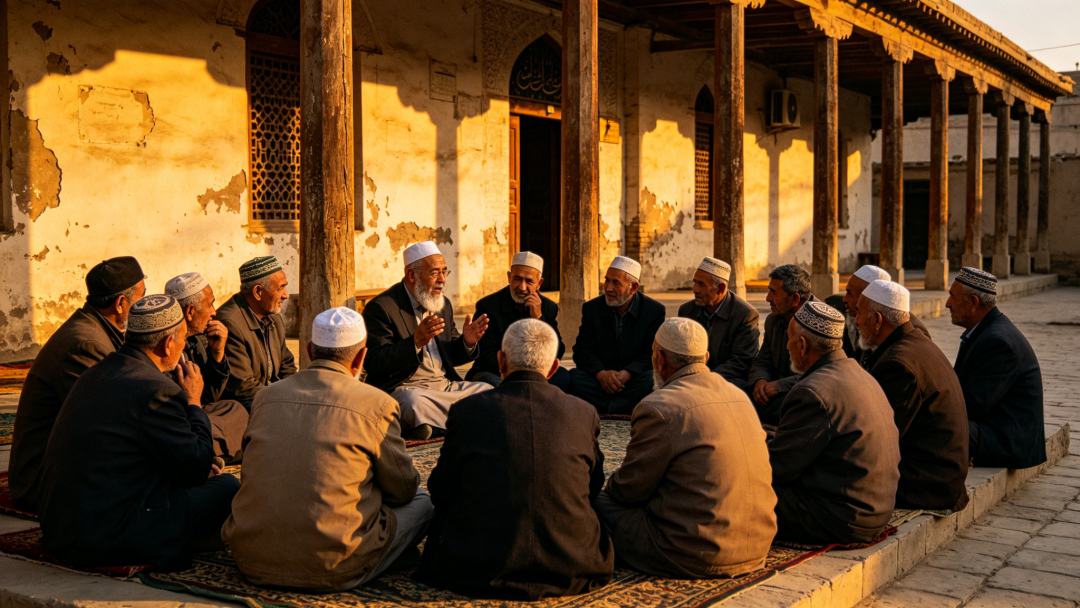
A crowd sitting under the porch of an old mosque: The old mosque is like a community center, acting as both a place for dua (prayer) and a node for information flow.
When the institutions of a modern state aren't stable enough, the media isn't trustworthy, and the courts are too far removed from ordinary people, these networks based on religious communities naturally become the channels for organizing the public and expressing their demands. That’s why many Islamic parties and movements start out doing charity, education, and community service; as they keep at it, they gain the public’s trust, and their political influence grows accordingly.
You might think of the big loudspeakers, ancestral halls, or local temple fairs back in your hometown—many disputes don't necessarily go to court because respected elders in the village step in to mediate, and everyone has a sense of what's right. In such cases, if the state system can connect with this 'grassroots public trust' and combine it with modern law and public services, things stay relatively stable. If the system is completely cut off from or even opposes these traditional nodes, the hearts of the people are easily torn apart.
In the Muslim world, the chorus of voices saying 'we want democracy but we also want religious values' is, to put it plainly, a hope that the new political system won't completely sweep away the familiar value framework that already holds high credibility. They don’t want to go back to a 'Middle Ages' state, but they also don’t want to be forced to abandon religion entirely and become 'new humans' who only talk about 'universal values.' This mentality is actually very practical and quite human.
In the movie 'A Chinese Odyssey,' that line—'Once, a sincere love was placed before me, but I didn't cherish it'—became a huge meme. For many Muslims, their 'sincere love' is the faith and social order accumulated over hundreds of years. It’s not that it doesn’t have problems, but it’s the thing that has walked through so many storms with them. If the new system construction completely ignores this affection and even labels it as a 'backward obstacle,' then the backlash that follows is not surprising at all.
VI. The world’s problems always act as a mirror when reflected back at us.
Coming to this point, a little question inevitably pops up: Why do we always love to turn 'how Muslims view democracy' into a dramatic topic, as if this group is naturally standing outside the gates of modern politics and it’s all up to them to 'see the light' before they can enter?
But if you stretch the timeline, you’ll find that every civilization’s understanding of democracy, the state, and power was figured out bit by bit. Some places went through a religious reformation first; others focused more on the rise of merchants and cities; others were exhausted by long, tangled chains of colonialism and anti-colonialism. Because the paths taken were different, there are naturally different perspectives when arriving at the word 'democracy'.
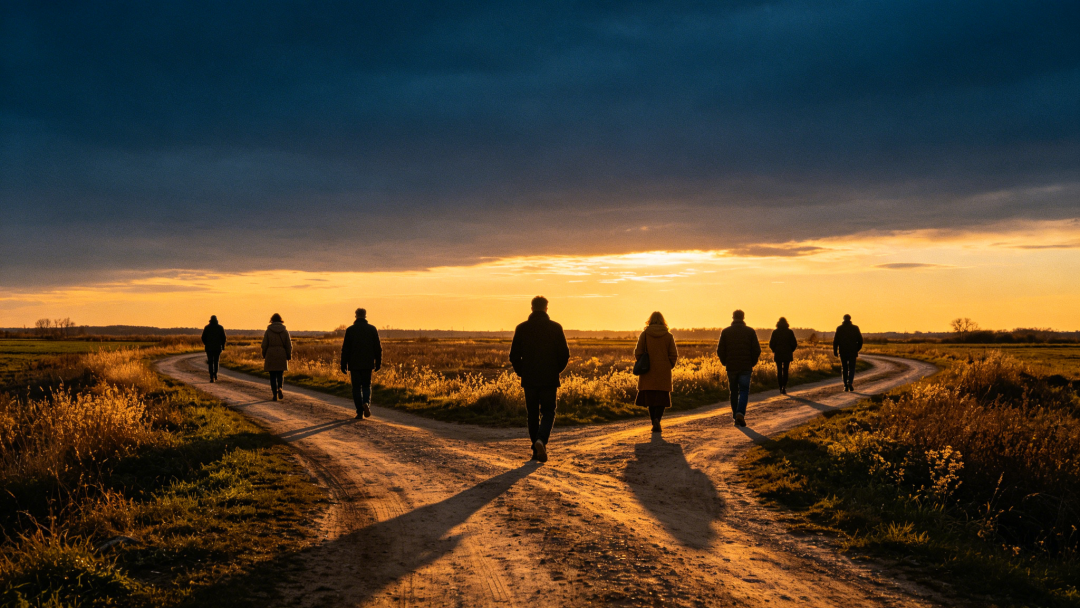
Diverse Perspectives on Social Governance: Understanding the Muslim World's Expectations for Public Participation, Justice, and Faith.
When it comes to democracy, the Muslim world has a lot of things they’re balancing at once. It’s about having a seat at the table, being heard, and having a system that can fix its own mistakes. They want justice, checks on power, and a safety net for the vulnerable—all while keeping their faith as a core guide for daily life. It’s not that they don't want rules; it’s just that they don’t want to be forced into a single, cookie-cutter definition of what a 'good society' should look like.
If the outside world just treats them like they're taking a test—constantly asking, 'Do you meet this or that country’s standard?'—then the conversation just turns into a blame game. But if we can actually accept that there are many different paths to a good political life, and that even if we share the same goals, the way we get there can look totally different, then we might start looking at each other with a lot more empathy.
Lu Xun once famously said, 'Human joys and sorrows are not interconnected; I just feel they are noisy.' In this era of information overload, that quote serves as a reminder to me: don't rush to act like you understand someone else's struggle. Whenever we boil down the Muslim world's complex take on democracy into a few lazy soundbites, we’re probably just tricking ourselves into thinking we 'get it' when we really don't.
Seven: A Self-Reminder
As I write this, it’s already dark outside. Down in the apartment complex square, people are out doing their evening dance, and an old familiar line from the classic movie-turned-series 'Legend of the Mountain' (also known as 'The Herdsman') plays over the speakers: 'The hard times will pass, and the good times will come.' This simple kind of hope is something most people around the world share, no matter their religion or where they come from.
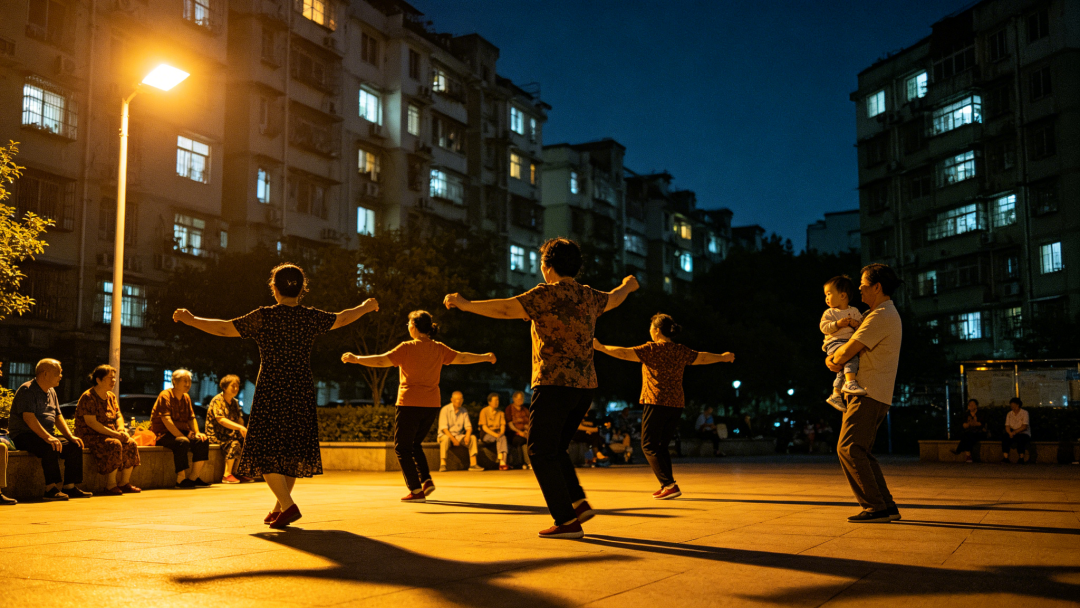
Evening dancers in the apartment square: The hope that hard times will pass and better days are coming.
How does the Muslim world view democracy? To put it bluntly but honestly, they’re not blind followers, but they aren't totally rejecting it either. They’re navigating their own messy reality, trying to find a path where they can have a voice without losing their faith. Sometimes they take two steps forward, sometimes they slip back, and sometimes they stumble. But that kind of back-and-forth is just how history works.
For those of us watching from a distance, the real value isn't in grading others. It's in using them as a mirror to ask ourselves: Are we too quick to force our own 'good system' template onto everyone else? Can we be a little more patient and respectful when we see others struggling? Are we always trying to turn complex, real-world issues into simple stories just to save ourselves the mental effort?
The world’s problems aren't just 'theirs'—they’re all interconnected pieces of the same puzzle. The hesitation, the experiments, the persistence, and the setbacks the Muslim world faces regarding democracy aren't just their fate; they act as a mirror that helps us understand the boundaries of human political imagination.
When we look toward those lands of deserts and skyscrapers, we’re actually taking a look at ourselves. We’re forced to ask: Are we really willing to admit that the world can have more than one way to reach dignity, participation, and justice?
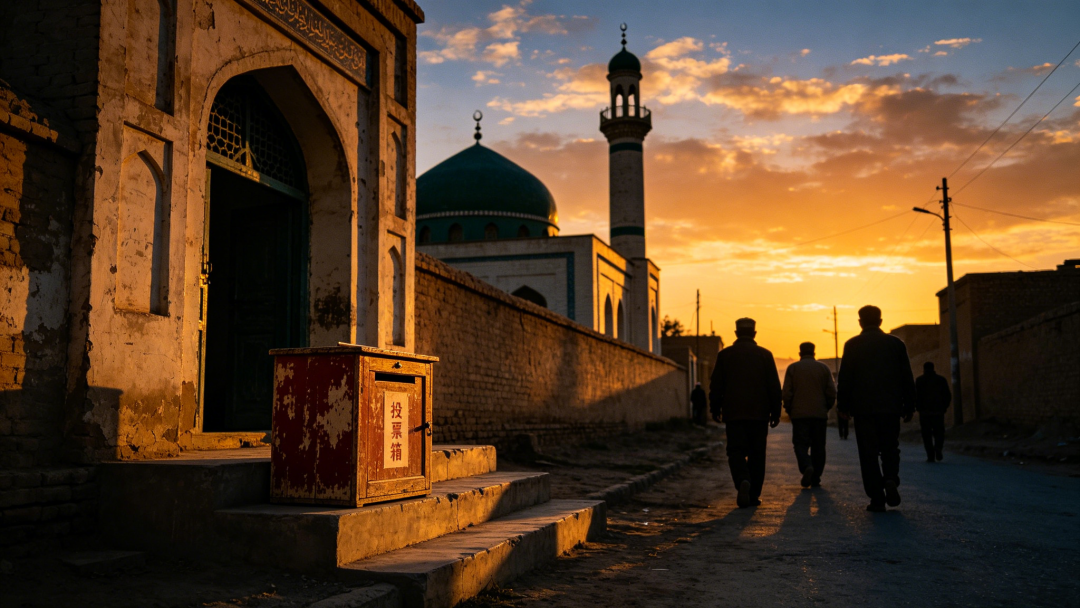
A voting booth and passersby near a mosque at dusk.
Whether it's the mosque next to the ballot box or the loudspeakers in the village, everything is slowly moving forward in its own time.
The road is long, there are a lot of people, and everyone moves to a different beat. But as long as we all hold onto the idea of 'not letting ordinary people suffer for nothing,' then whether it's the mosque by the ballot box or the village square speakers, we’re all moving, sooner or later, toward a more stable and peaceful direction.
By combining detailed international survey data with vivid, everyday life scenarios, this article examines the genuine aspirations of people in contemporary Muslim-majority countries regarding social governance. It reveals a complex mindset where people desire broad public participation and transparent, fair institutions, while simultaneously cherishing traditional values and the comfort of faith.
They want participation, they want justice, and they want the solace of faith.
The old guys arguing at the entrance of the residential complex at dusk; they can even turn a simple building supervisor selection into two conflicting 'proposals'.
The other day, while I was waiting for my delivery at the complex gate, some older guys were arguing while soaking up the sun. The topic? Whether the neighborhood committee should hold a 'vote for building supervisor.' One guy said, 'Sure, let’s vote—it’s great to hear everyone’s opinions.' Another curled his lip and snapped, 'Vote for what? I want Old Li, the guy who always fixes our lightbulbs, to be the supervisor. He’s going to be the one doing the work anyway, vote or not.'
See? You can get two entirely different 'views on governance' over something as small as picking a building supervisor, let alone running a whole country. Yet, online, whenever the topic of 'how the Muslim world views democracy' comes up, people jump to conclusions. It’s always either 'they don’t understand democracy' or 'religion is inherently at odds with democracy.' It sounds satisfying—like slicing a watermelon in one clean cut—and it saves effort, but the truth is rarely that convenient.
How about we hold off on picking a side for a second? Let’s just clear the table, set out some food, and take a closer look at what 'democracy' actually looks like through the eyes of Muslims.
Part One: When 'Freedom' meets 'Faith,' the multiple-choice questions get a lot harder.
There’s a fascinating detail that not many people are aware of. Extensive surveys conducted in several Muslim-majority countries asked a very 'Western' question: If you were writing a constitution for a new country, would you include 'freedom of speech'—specifically the right for all citizens to express their opinions on political, social, and economic issues?
The results were obvious: over 90% of people in Burkina Faso said yes, as did more than 90% in Egypt, nearly 95% in Iran, and roughly 90% in Indonesia. Think about what that means—it’s like knocking on every door in your apartment building to ask if people want the freedom to vent about the property management in the group chat, and nine out of ten people say yes.
Knocking on doors in the twilight hallway: it's like asking if people want the freedom to vent about the property manager in a group chat, with nine out of ten people saying: yes.
So, many ordinary Muslims are actually quite supportive of the ideas of 'speaking up, participating, and overseeing,' which is a far cry from the stereotype that 'they just like being told what to do.'
The disconnect happens in the second half of the question. If you dig deeper, you realize that most respondents clearly appreciate many democratic practices—they like elections, oversight, and preventing abuse of power—but they don’t want to copy-paste a 'Western' model and bring it home as is. It’s like going to a supermarket and thinking milk and eggs are great, but nobody wants to lug the entire cold-storage warehouse into their home kitchen.
They think the milk and eggs are great, but nobody wants to move the entire walk-in fridge into their own kitchen.
Many would say they hope for a 'democracy of their own'—one that allows for voting and participation, but stays aligned with Sharia (Islamic law) and the religious values they hold dear. You’ll find that for them, 'democracy' and 'religion' aren't a black-and-white, either-or choice. It’s more like cooking: you need the heat to start the oil, but you also have to balance the timing and the ratio of the spices.
If you only hear the first half—'they support democracy'—and assume they want to copy the Western system exactly, you’re being a bit presumptuous. If you only focus on the second half—'they want Sharia'—and jump to the conclusion that 'this obviously means they reject democracy,' that’s just another form of intellectual laziness.
People always love to think they know where history is headed, but every generation can only take steps on the small patch of land right beneath their feet. The hesitation and conflict in the Muslim world today regarding institutional design is just like that: they don’t want to give up the sense of participation, but they also don’t want to throw away the moral framework provided by their faith.
Part Two: Sharia isn't a giant rock; it's more like a pot of 'lao tang' (long-simmered broth).
When people talk about 'Sharia' online, it’s often described like a massive, cold, immovable boulder—as if mentioning it alone would inevitably crush all modern political systems. But in the context of many Muslims' lives, it’s more like a pot of broth that’s been simmering for over a thousand years. It’s full of classic texts, scholarly interpretations, local customs, and historical experiences. The flavor profile is incredibly complex.
A pot of old broth bubbling away on the stove.
Surveys show that the views on whether Sharia should be part of the legal system, and to what extent, vary wildly from country to country. In some places, the majority say they want it to be just one source of law among many. In other nations—like Jordan, Egypt, Pakistan, Afghanistan, and Bangladesh—more people lean toward making Sharia the 'sole source,' as if the law should have the same flavor as that pot of broth.
Even more interesting is that many people assume the ones who want Sharia to 'call the shots' are mostly older men, and that women would surely oppose it more. The surveys don't fit that narrative; in many countries, the difference in attitude between men and women is very small, and in some places, women’s support is even slightly higher. If you try to force this into a binary framework of 'patriarchal oppression' vs. 'women’s awakening,' it won't hold up for long.
Why is this? In the eyes of many Muslims, Sharia isn't just a cold legal term; it’s a whole set of guidelines for 'being a good person.' It’s the language they use to understand 'justice,' 'moderation,' and 'helping the weak.' In reality, facing corruption, wealth inequality, and social chaos, many naturally hope that the law will do more than just decide 'how many days someone goes to jail.' They want it to be like an old village elder who can mediate conflicts, curb greed, and remind everyone not to go too far.
You see those respected elders in rural areas who often do exactly this—they clarify how to handle weddings and funerals based on village customs, while also teaching the younger generation that 'a person should have boundaries and self-restraint.' For many Muslims, writing Sharia into the law feels like writing the 'rules of conduct' into the national law—it’s both a realistic expectation and a psychological safety net.
At this point, if someone shows up with a modern law textbook and says, 'This broth of yours is too backward, throw it out and drink this bottle of nutrition drink instead,' it’s easy to imagine why they’d feel some pushback—it’s only natural. They aren't necessarily against rules; they’re just skeptical of the oversimplified story that 'complete Westernization equals happiness.'
If a family keeps repeating the same mistakes, it’s because no one has clearly explained the stories of those who came before. The complex attitude the Muslim world has toward Sharia today is actually the product of hundreds of years of piled-up stories—memories of empires, the trauma of colonialism, and the confusion of modernization—all stewed together in this pot.
III. Americans actually love the idea of 'Scripture in Law,' but the mirror reflection is a bit awkward.
Speaking of this, there’s a little bit of gossip that’s perfect for breaking the ice. Many people are used to labeling the 'desire to incorporate religion into law' as some kind of 'specialty of underdeveloped regions,' as if it only belongs to a world of desert sands, dates, and the mosque.
But there’s a survey from the U.S. that asked average Americans if they think the Bible should play a role in legislation. It turns out that a good number of people feel it could serve as 'one of the sources of law,' and a small group flat-out wants it to be the 'only source.' Even more surprisingly, a segment of the population hopes religious leaders would have a say in drafting the Constitution—data that is actually pretty close to that of certain Muslim-majority nations.
If this scene had a background track, it would be perfect to use that line from 'Dying to Survive': 'There is only one illness in this world, and that is poverty.' If we apply that to institutional imagination, we might change it to say: there is only one 'inertia' in this world, which is the constant feeling that your own tradition should be written into the highest rules. That’s not being poor; that’s just human nature.
Scripture and Codes at the Same Table, Tangled Reflections in the Mirror: The entanglement of sacred texts and national law is a global phenomenon.
So, the idea that 'mentioning religion in law equals fundamentalism, and only Muslims are into that' is a bit like staring at someone else’s skin condition while ignoring the mole on your own back. Once you turn the mirror around, you realize that the struggle between 'sacred texts' and 'national law' is actually a global phenomenon; it’s just that the intensity and form vary from place to place.
That line from 'Farewell My Concubine' fits perfectly here: 'It was supposed to be a lifetime, but even missing a year, a month, or a day doesn't count as a lifetime.' Many people view democracy as a cookie-cutter process and religion as something that should be kept in a small box within one's heart. Using these standards to judge others is like wishing the whole world lived by the same 'template-style life.' But the real world is mostly made up of those 'missing days and months,' filled with its own deviations and compromises.
IV. What they want isn't 'Western-style democracy,' but 'dignified participation.'
Circling back to the topic, we have to land on a simple, relatable life experience. For many ordinary Muslims, when they talk about democracy, they aren't holding a political science textbook; they’re starting from the same place we are—the daily grind of groceries, bills, and their children’s futures.
If you look at those survey questions—things like 'should the government listen to public opinion,' 'can we criticize officials,' or 'should women have the right to work and education'—the support rates in many Muslim societies are actually quite high. What people really care about often boils down to three things: Can I have a voice? Can I be respected? And will the things I believe in be completely erased from public life?
These three things tangled together form their standard for a 'good system.' It’s a different angle from the 'procedures' or 'separation of powers' that we’re used to talking about, but it’s not necessarily in opposition.
Think of it like buying a smartphone: some people prioritize pixels, others care more about battery life, and some are obsessed with whether the software is easy to use. For many in the Muslim world, the priority might be: 'This phone needs a stable signal that won't drop, and it has to be compatible with the apps I already use.' The democracy they want is one that connects to their own values, not one that forces them to upload their entire life’s data into a brand-new system.
Living is just about living itself. For many who have survived wars, sanctions, inflation, and instability, 'democracy' might not be a grand classroom theory, but a question of 'who can make us feel safer and more dignified?' If, in their observation, Western democracy comes with intervention, civil war, and social fracture, they naturally won’t see it as a gold-standard brand. If certain religious-leaning parties are doing honest grassroots work—fixing roads, running schools, or doing charity—they’ll be willing to give them a shot.
Workers fixing roads in a village at dusk and villagers watching: When people do honest charity, roadwork, and schooling at the grassroots level, they win the trust of the community.
This doesn’t mean they don’t understand democracy; it just means they view it as a tool—a way to serve their lives—rather than a slogan written on a wall.
V. From village loudspeakers to the mosque pulpit, human hearts are looking for the same sense of security.
If you really take a trip through the Muslim world, you’ll find a lot of familiar scenes. The old village mosque acts like the community center in our own hometowns—it’s both a place for dua (prayer) and a hub for information exchange. What the Imam says from the pulpit isn’t just scripture; he’s talking about who needs help, which road needs repairs, and what the local buzz is. In many people's eyes, this place is a primary source of social trust.
A crowd sitting under the porch of an old mosque: The old mosque is like a community center, acting as both a place for dua (prayer) and a node for information flow.
When the institutions of a modern state aren't stable enough, the media isn't trustworthy, and the courts are too far removed from ordinary people, these networks based on religious communities naturally become the channels for organizing the public and expressing their demands. That’s why many Islamic parties and movements start out doing charity, education, and community service; as they keep at it, they gain the public’s trust, and their political influence grows accordingly.
You might think of the big loudspeakers, ancestral halls, or local temple fairs back in your hometown—many disputes don't necessarily go to court because respected elders in the village step in to mediate, and everyone has a sense of what's right. In such cases, if the state system can connect with this 'grassroots public trust' and combine it with modern law and public services, things stay relatively stable. If the system is completely cut off from or even opposes these traditional nodes, the hearts of the people are easily torn apart.
In the Muslim world, the chorus of voices saying 'we want democracy but we also want religious values' is, to put it plainly, a hope that the new political system won't completely sweep away the familiar value framework that already holds high credibility. They don’t want to go back to a 'Middle Ages' state, but they also don’t want to be forced to abandon religion entirely and become 'new humans' who only talk about 'universal values.' This mentality is actually very practical and quite human.
In the movie 'A Chinese Odyssey,' that line—'Once, a sincere love was placed before me, but I didn't cherish it'—became a huge meme. For many Muslims, their 'sincere love' is the faith and social order accumulated over hundreds of years. It’s not that it doesn’t have problems, but it’s the thing that has walked through so many storms with them. If the new system construction completely ignores this affection and even labels it as a 'backward obstacle,' then the backlash that follows is not surprising at all.
VI. The world’s problems always act as a mirror when reflected back at us.
Coming to this point, a little question inevitably pops up: Why do we always love to turn 'how Muslims view democracy' into a dramatic topic, as if this group is naturally standing outside the gates of modern politics and it’s all up to them to 'see the light' before they can enter?
But if you stretch the timeline, you’ll find that every civilization’s understanding of democracy, the state, and power was figured out bit by bit. Some places went through a religious reformation first; others focused more on the rise of merchants and cities; others were exhausted by long, tangled chains of colonialism and anti-colonialism. Because the paths taken were different, there are naturally different perspectives when arriving at the word 'democracy'.
Diverse Perspectives on Social Governance: Understanding the Muslim World's Expectations for Public Participation, Justice, and Faith.
When it comes to democracy, the Muslim world has a lot of things they’re balancing at once. It’s about having a seat at the table, being heard, and having a system that can fix its own mistakes. They want justice, checks on power, and a safety net for the vulnerable—all while keeping their faith as a core guide for daily life. It’s not that they don't want rules; it’s just that they don’t want to be forced into a single, cookie-cutter definition of what a 'good society' should look like.
If the outside world just treats them like they're taking a test—constantly asking, 'Do you meet this or that country’s standard?'—then the conversation just turns into a blame game. But if we can actually accept that there are many different paths to a good political life, and that even if we share the same goals, the way we get there can look totally different, then we might start looking at each other with a lot more empathy.
Lu Xun once famously said, 'Human joys and sorrows are not interconnected; I just feel they are noisy.' In this era of information overload, that quote serves as a reminder to me: don't rush to act like you understand someone else's struggle. Whenever we boil down the Muslim world's complex take on democracy into a few lazy soundbites, we’re probably just tricking ourselves into thinking we 'get it' when we really don't.
Seven: A Self-Reminder
As I write this, it’s already dark outside. Down in the apartment complex square, people are out doing their evening dance, and an old familiar line from the classic movie-turned-series 'Legend of the Mountain' (also known as 'The Herdsman') plays over the speakers: 'The hard times will pass, and the good times will come.' This simple kind of hope is something most people around the world share, no matter their religion or where they come from.
Evening dancers in the apartment square: The hope that hard times will pass and better days are coming.
How does the Muslim world view democracy? To put it bluntly but honestly, they’re not blind followers, but they aren't totally rejecting it either. They’re navigating their own messy reality, trying to find a path where they can have a voice without losing their faith. Sometimes they take two steps forward, sometimes they slip back, and sometimes they stumble. But that kind of back-and-forth is just how history works.
For those of us watching from a distance, the real value isn't in grading others. It's in using them as a mirror to ask ourselves: Are we too quick to force our own 'good system' template onto everyone else? Can we be a little more patient and respectful when we see others struggling? Are we always trying to turn complex, real-world issues into simple stories just to save ourselves the mental effort?
The world’s problems aren't just 'theirs'—they’re all interconnected pieces of the same puzzle. The hesitation, the experiments, the persistence, and the setbacks the Muslim world faces regarding democracy aren't just their fate; they act as a mirror that helps us understand the boundaries of human political imagination.
When we look toward those lands of deserts and skyscrapers, we’re actually taking a look at ourselves. We’re forced to ask: Are we really willing to admit that the world can have more than one way to reach dignity, participation, and justice?
A voting booth and passersby near a mosque at dusk.
Whether it's the mosque next to the ballot box or the loudspeakers in the village, everything is slowly moving forward in its own time.
The road is long, there are a lot of people, and everyone moves to a different beat. But as long as we all hold onto the idea of 'not letting ordinary people suffer for nothing,' then whether it's the mosque by the ballot box or the village square speakers, we’re all moving, sooner or later, toward a more stable and peaceful direction.
Muslim World Governance and Social Participation: Authentic Perspectives on Democracy, Justice, and Faith
Articles • Hasan09 posted the article • 0 comments • 29 views • 2026-10-26 09:25
[Internet Repost]
By combining detailed international survey data with vivid, everyday life scenarios, this article examines the genuine aspirations of people in contemporary Muslim-majority countries regarding social governance. It reveals a complex mindset where people desire broad public participation and transparent, fair institutions, while simultaneously cherishing traditional values and the comfort of faith.
They want participation, they want justice, and they want the solace of faith.
The old guys arguing at the entrance of the residential complex at dusk; they can even turn a simple building supervisor selection into two conflicting 'proposals'.
The other day, while I was waiting for my delivery at the complex gate, some older guys were arguing while soaking up the sun. The topic? Whether the neighborhood committee should hold a 'vote for building supervisor.' One guy said, 'Sure, let’s vote—it’s great to hear everyone’s opinions.' Another curled his lip and snapped, 'Vote for what? I want Old Li, the guy who always fixes our lightbulbs, to be the supervisor. He’s going to be the one doing the work anyway, vote or not.'
See? You can get two entirely different 'views on governance' over something as small as picking a building supervisor, let alone running a whole country. Yet, online, whenever the topic of 'how the Muslim world views democracy' comes up, people jump to conclusions. It’s always either 'they don’t understand democracy' or 'religion is inherently at odds with democracy.' It sounds satisfying—like slicing a watermelon in one clean cut—and it saves effort, but the truth is rarely that convenient.
How about we hold off on picking a side for a second? Let’s just clear the table, set out some food, and take a closer look at what 'democracy' actually looks like through the eyes of Muslims.
Part One: When 'Freedom' meets 'Faith,' the multiple-choice questions get a lot harder.
There’s a fascinating detail that not many people are aware of. Extensive surveys conducted in several Muslim-majority countries asked a very 'Western' question: If you were writing a constitution for a new country, would you include 'freedom of speech'—specifically the right for all citizens to express their opinions on political, social, and economic issues?
The results were obvious: over 90% of people in Burkina Faso said yes, as did more than 90% in Egypt, nearly 95% in Iran, and roughly 90% in Indonesia. Think about what that means—it’s like knocking on every door in your apartment building to ask if people want the freedom to vent about the property management in the group chat, and nine out of ten people say yes.
Knocking on doors in the twilight hallway: it's like asking if people want the freedom to vent about the property manager in a group chat, with nine out of ten people saying: yes.
So, many ordinary Muslims are actually quite supportive of the ideas of 'speaking up, participating, and overseeing,' which is a far cry from the stereotype that 'they just like being told what to do.'
The disconnect happens in the second half of the question. If you dig deeper, you realize that most respondents clearly appreciate many democratic practices—they like elections, oversight, and preventing abuse of power—but they don’t want to copy-paste a 'Western' model and bring it home as is. It’s like going to a supermarket and thinking milk and eggs are great, but nobody wants to lug the entire cold-storage warehouse into their home kitchen.
They think the milk and eggs are great, but nobody wants to move the entire walk-in fridge into their own kitchen.
Many would say they hope for a 'democracy of their own'—one that allows for voting and participation, but stays aligned with Sharia (Islamic law) and the religious values they hold dear. You’ll find that for them, 'democracy' and 'religion' aren't a black-and-white, either-or choice. It’s more like cooking: you need the heat to start the oil, but you also have to balance the timing and the ratio of the spices.
If you only hear the first half—'they support democracy'—and assume they want to copy the Western system exactly, you’re being a bit presumptuous. If you only focus on the second half—'they want Sharia'—and jump to the conclusion that 'this obviously means they reject democracy,' that’s just another form of intellectual laziness.
People always love to think they know where history is headed, but every generation can only take steps on the small patch of land right beneath their feet. The hesitation and conflict in the Muslim world today regarding institutional design is just like that: they don’t want to give up the sense of participation, but they also don’t want to throw away the moral framework provided by their faith.
Part Two: Sharia isn't a giant rock; it's more like a pot of 'lao tang' (long-simmered broth).
When people talk about 'Sharia' online, it’s often described like a massive, cold, immovable boulder—as if mentioning it alone would inevitably crush all modern political systems. But in the context of many Muslims' lives, it’s more like a pot of broth that’s been simmering for over a thousand years. It’s full of classic texts, scholarly interpretations, local customs, and historical experiences. The flavor profile is incredibly complex.
A pot of old broth bubbling away on the stove.
Surveys show that the views on whether Sharia should be part of the legal system, and to what extent, vary wildly from country to country. In some places, the majority say they want it to be just one source of law among many. In other nations—like Jordan, Egypt, Pakistan, Afghanistan, and Bangladesh—more people lean toward making Sharia the 'sole source,' as if the law should have the same flavor as that pot of broth.
Even more interesting is that many people assume the ones who want Sharia to 'call the shots' are mostly older men, and that women would surely oppose it more. The surveys don't fit that narrative; in many countries, the difference in attitude between men and women is very small, and in some places, women’s support is even slightly higher. If you try to force this into a binary framework of 'patriarchal oppression' vs. 'women’s awakening,' it won't hold up for long.
Why is this? In the eyes of many Muslims, Sharia isn't just a cold legal term; it’s a whole set of guidelines for 'being a good person.' It’s the language they use to understand 'justice,' 'moderation,' and 'helping the weak.' In reality, facing corruption, wealth inequality, and social chaos, many naturally hope that the law will do more than just decide 'how many days someone goes to jail.' They want it to be like an old village elder who can mediate conflicts, curb greed, and remind everyone not to go too far.
You see those respected elders in rural areas who often do exactly this—they clarify how to handle weddings and funerals based on village customs, while also teaching the younger generation that 'a person should have boundaries and self-restraint.' For many Muslims, writing Sharia into the law feels like writing the 'rules of conduct' into the national law—it’s both a realistic expectation and a psychological safety net.
At this point, if someone shows up with a modern law textbook and says, 'This broth of yours is too backward, throw it out and drink this bottle of nutrition drink instead,' it’s easy to imagine why they’d feel some pushback—it’s only natural. They aren't necessarily against rules; they’re just skeptical of the oversimplified story that 'complete Westernization equals happiness.'
If a family keeps repeating the same mistakes, it’s because no one has clearly explained the stories of those who came before. The complex attitude the Muslim world has toward Sharia today is actually the product of hundreds of years of piled-up stories—memories of empires, the trauma of colonialism, and the confusion of modernization—all stewed together in this pot.
III. Americans actually love the idea of 'Scripture in Law,' but the mirror reflection is a bit awkward.
Speaking of this, there’s a little bit of gossip that’s perfect for breaking the ice. Many people are used to labeling the 'desire to incorporate religion into law' as some kind of 'specialty of underdeveloped regions,' as if it only belongs to a world of desert sands, dates, and the mosque.
But there’s a survey from the U.S. that asked average Americans if they think the Bible should play a role in legislation. It turns out that a good number of people feel it could serve as 'one of the sources of law,' and a small group flat-out wants it to be the 'only source.' Even more surprisingly, a segment of the population hopes religious leaders would have a say in drafting the Constitution—data that is actually pretty close to that of certain Muslim-majority nations.
If this scene had a background track, it would be perfect to use that line from 'Dying to Survive': 'There is only one illness in this world, and that is poverty.' If we apply that to institutional imagination, we might change it to say: there is only one 'inertia' in this world, which is the constant feeling that your own tradition should be written into the highest rules. That’s not being poor; that’s just human nature.
Scripture and Codes at the Same Table, Tangled Reflections in the Mirror: The entanglement of sacred texts and national law is a global phenomenon.
So, the idea that 'mentioning religion in law equals fundamentalism, and only Muslims are into that' is a bit like staring at someone else’s skin condition while ignoring the mole on your own back. Once you turn the mirror around, you realize that the struggle between 'sacred texts' and 'national law' is actually a global phenomenon; it’s just that the intensity and form vary from place to place.
That line from 'Farewell My Concubine' fits perfectly here: 'It was supposed to be a lifetime, but even missing a year, a month, or a day doesn't count as a lifetime.' Many people view democracy as a cookie-cutter process and religion as something that should be kept in a small box within one's heart. Using these standards to judge others is like wishing the whole world lived by the same 'template-style life.' But the real world is mostly made up of those 'missing days and months,' filled with its own deviations and compromises.
IV. What they want isn't 'Western-style democracy,' but 'dignified participation.'
Circling back to the topic, we have to land on a simple, relatable life experience. For many ordinary Muslims, when they talk about democracy, they aren't holding a political science textbook; they’re starting from the same place we are—the daily grind of groceries, bills, and their children’s futures.
If you look at those survey questions—things like 'should the government listen to public opinion,' 'can we criticize officials,' or 'should women have the right to work and education'—the support rates in many Muslim societies are actually quite high. What people really care about often boils down to three things: Can I have a voice? Can I be respected? And will the things I believe in be completely erased from public life?
These three things tangled together form their standard for a 'good system.' It’s a different angle from the 'procedures' or 'separation of powers' that we’re used to talking about, but it’s not necessarily in opposition.
Think of it like buying a smartphone: some people prioritize pixels, others care more about battery life, and some are obsessed with whether the software is easy to use. For many in the Muslim world, the priority might be: 'This phone needs a stable signal that won't drop, and it has to be compatible with the apps I already use.' The democracy they want is one that connects to their own values, not one that forces them to upload their entire life’s data into a brand-new system.
Living is just about living itself. For many who have survived wars, sanctions, inflation, and instability, 'democracy' might not be a grand classroom theory, but a question of 'who can make us feel safer and more dignified?' If, in their observation, Western democracy comes with intervention, civil war, and social fracture, they naturally won’t see it as a gold-standard brand. If certain religious-leaning parties are doing honest grassroots work—fixing roads, running schools, or doing charity—they’ll be willing to give them a shot.
Workers fixing roads in a village at dusk and villagers watching: When people do honest charity, roadwork, and schooling at the grassroots level, they win the trust of the community.
This doesn’t mean they don’t understand democracy; it just means they view it as a tool—a way to serve their lives—rather than a slogan written on a wall.
V. From village loudspeakers to the mosque pulpit, human hearts are looking for the same sense of security.
If you really take a trip through the Muslim world, you’ll find a lot of familiar scenes. The old village mosque acts like the community center in our own hometowns—it’s both a place for dua (prayer) and a hub for information exchange. What the Imam says from the pulpit isn’t just scripture; he’s talking about who needs help, which road needs repairs, and what the local buzz is. In many people's eyes, this place is a primary source of social trust.
A crowd sitting under the porch of an old mosque: The old mosque is like a community center, acting as both a place for dua (prayer) and a node for information flow.
When the institutions of a modern state aren't stable enough, the media isn't trustworthy, and the courts are too far removed from ordinary people, these networks based on religious communities naturally become the channels for organizing the public and expressing their demands. That’s why many Islamic parties and movements start out doing charity, education, and community service; as they keep at it, they gain the public’s trust, and their political influence grows accordingly.
You might think of the big loudspeakers, ancestral halls, or local temple fairs back in your hometown—many disputes don't necessarily go to court because respected elders in the village step in to mediate, and everyone has a sense of what's right. In such cases, if the state system can connect with this 'grassroots public trust' and combine it with modern law and public services, things stay relatively stable. If the system is completely cut off from or even opposes these traditional nodes, the hearts of the people are easily torn apart.
In the Muslim world, the chorus of voices saying 'we want democracy but we also want religious values' is, to put it plainly, a hope that the new political system won't completely sweep away the familiar value framework that already holds high credibility. They don’t want to go back to a 'Middle Ages' state, but they also don’t want to be forced to abandon religion entirely and become 'new humans' who only talk about 'universal values.' This mentality is actually very practical and quite human.
In the movie 'A Chinese Odyssey,' that line—'Once, a sincere love was placed before me, but I didn't cherish it'—became a huge meme. For many Muslims, their 'sincere love' is the faith and social order accumulated over hundreds of years. It’s not that it doesn’t have problems, but it’s the thing that has walked through so many storms with them. If the new system construction completely ignores this affection and even labels it as a 'backward obstacle,' then the backlash that follows is not surprising at all.
VI. The world’s problems always act as a mirror when reflected back at us.
Coming to this point, a little question inevitably pops up: Why do we always love to turn 'how Muslims view democracy' into a dramatic topic, as if this group is naturally standing outside the gates of modern politics and it’s all up to them to 'see the light' before they can enter?
But if you stretch the timeline, you’ll find that every civilization’s understanding of democracy, the state, and power was figured out bit by bit. Some places went through a religious reformation first; others focused more on the rise of merchants and cities; others were exhausted by long, tangled chains of colonialism and anti-colonialism. Because the paths taken were different, there are naturally different perspectives when arriving at the word 'democracy'.
Diverse Perspectives on Social Governance: Understanding the Muslim World's Expectations for Public Participation, Justice, and Faith.
When it comes to democracy, the Muslim world has a lot of things they’re balancing at once. It’s about having a seat at the table, being heard, and having a system that can fix its own mistakes. They want justice, checks on power, and a safety net for the vulnerable—all while keeping their faith as a core guide for daily life. It’s not that they don't want rules; it’s just that they don’t want to be forced into a single, cookie-cutter definition of what a 'good society' should look like.
If the outside world just treats them like they're taking a test—constantly asking, 'Do you meet this or that country’s standard?'—then the conversation just turns into a blame game. But if we can actually accept that there are many different paths to a good political life, and that even if we share the same goals, the way we get there can look totally different, then we might start looking at each other with a lot more empathy.
Lu Xun once famously said, 'Human joys and sorrows are not interconnected; I just feel they are noisy.' In this era of information overload, that quote serves as a reminder to me: don't rush to act like you understand someone else's struggle. Whenever we boil down the Muslim world's complex take on democracy into a few lazy soundbites, we’re probably just tricking ourselves into thinking we 'get it' when we really don't.
Seven: A Self-Reminder
As I write this, it’s already dark outside. Down in the apartment complex square, people are out doing their evening dance, and an old familiar line from the classic movie-turned-series 'Legend of the Mountain' (also known as 'The Herdsman') plays over the speakers: 'The hard times will pass, and the good times will come.' This simple kind of hope is something most people around the world share, no matter their religion or where they come from.
Evening dancers in the apartment square: The hope that hard times will pass and better days are coming.
How does the Muslim world view democracy? To put it bluntly but honestly, they’re not blind followers, but they aren't totally rejecting it either. They’re navigating their own messy reality, trying to find a path where they can have a voice without losing their faith. Sometimes they take two steps forward, sometimes they slip back, and sometimes they stumble. But that kind of back-and-forth is just how history works.
For those of us watching from a distance, the real value isn't in grading others. It's in using them as a mirror to ask ourselves: Are we too quick to force our own 'good system' template onto everyone else? Can we be a little more patient and respectful when we see others struggling? Are we always trying to turn complex, real-world issues into simple stories just to save ourselves the mental effort?
The world’s problems aren't just 'theirs'—they’re all interconnected pieces of the same puzzle. The hesitation, the experiments, the persistence, and the setbacks the Muslim world faces regarding democracy aren't just their fate; they act as a mirror that helps us understand the boundaries of human political imagination.
When we look toward those lands of deserts and skyscrapers, we’re actually taking a look at ourselves. We’re forced to ask: Are we really willing to admit that the world can have more than one way to reach dignity, participation, and justice?
A voting booth and passersby near a mosque at dusk.
Whether it's the mosque next to the ballot box or the loudspeakers in the village, everything is slowly moving forward in its own time.
The road is long, there are a lot of people, and everyone moves to a different beat. But as long as we all hold onto the idea of 'not letting ordinary people suffer for nothing,' then whether it's the mosque by the ballot box or the village square speakers, we’re all moving, sooner or later, toward a more stable and peaceful direction. view all
By combining detailed international survey data with vivid, everyday life scenarios, this article examines the genuine aspirations of people in contemporary Muslim-majority countries regarding social governance. It reveals a complex mindset where people desire broad public participation and transparent, fair institutions, while simultaneously cherishing traditional values and the comfort of faith.
They want participation, they want justice, and they want the solace of faith.
The old guys arguing at the entrance of the residential complex at dusk; they can even turn a simple building supervisor selection into two conflicting 'proposals'.
The other day, while I was waiting for my delivery at the complex gate, some older guys were arguing while soaking up the sun. The topic? Whether the neighborhood committee should hold a 'vote for building supervisor.' One guy said, 'Sure, let’s vote—it’s great to hear everyone’s opinions.' Another curled his lip and snapped, 'Vote for what? I want Old Li, the guy who always fixes our lightbulbs, to be the supervisor. He’s going to be the one doing the work anyway, vote or not.'
See? You can get two entirely different 'views on governance' over something as small as picking a building supervisor, let alone running a whole country. Yet, online, whenever the topic of 'how the Muslim world views democracy' comes up, people jump to conclusions. It’s always either 'they don’t understand democracy' or 'religion is inherently at odds with democracy.' It sounds satisfying—like slicing a watermelon in one clean cut—and it saves effort, but the truth is rarely that convenient.
How about we hold off on picking a side for a second? Let’s just clear the table, set out some food, and take a closer look at what 'democracy' actually looks like through the eyes of Muslims.
Part One: When 'Freedom' meets 'Faith,' the multiple-choice questions get a lot harder.
There’s a fascinating detail that not many people are aware of. Extensive surveys conducted in several Muslim-majority countries asked a very 'Western' question: If you were writing a constitution for a new country, would you include 'freedom of speech'—specifically the right for all citizens to express their opinions on political, social, and economic issues?
The results were obvious: over 90% of people in Burkina Faso said yes, as did more than 90% in Egypt, nearly 95% in Iran, and roughly 90% in Indonesia. Think about what that means—it’s like knocking on every door in your apartment building to ask if people want the freedom to vent about the property management in the group chat, and nine out of ten people say yes.
Knocking on doors in the twilight hallway: it's like asking if people want the freedom to vent about the property manager in a group chat, with nine out of ten people saying: yes.
So, many ordinary Muslims are actually quite supportive of the ideas of 'speaking up, participating, and overseeing,' which is a far cry from the stereotype that 'they just like being told what to do.'
The disconnect happens in the second half of the question. If you dig deeper, you realize that most respondents clearly appreciate many democratic practices—they like elections, oversight, and preventing abuse of power—but they don’t want to copy-paste a 'Western' model and bring it home as is. It’s like going to a supermarket and thinking milk and eggs are great, but nobody wants to lug the entire cold-storage warehouse into their home kitchen.
They think the milk and eggs are great, but nobody wants to move the entire walk-in fridge into their own kitchen.
Many would say they hope for a 'democracy of their own'—one that allows for voting and participation, but stays aligned with Sharia (Islamic law) and the religious values they hold dear. You’ll find that for them, 'democracy' and 'religion' aren't a black-and-white, either-or choice. It’s more like cooking: you need the heat to start the oil, but you also have to balance the timing and the ratio of the spices.
If you only hear the first half—'they support democracy'—and assume they want to copy the Western system exactly, you’re being a bit presumptuous. If you only focus on the second half—'they want Sharia'—and jump to the conclusion that 'this obviously means they reject democracy,' that’s just another form of intellectual laziness.
People always love to think they know where history is headed, but every generation can only take steps on the small patch of land right beneath their feet. The hesitation and conflict in the Muslim world today regarding institutional design is just like that: they don’t want to give up the sense of participation, but they also don’t want to throw away the moral framework provided by their faith.
Part Two: Sharia isn't a giant rock; it's more like a pot of 'lao tang' (long-simmered broth).
When people talk about 'Sharia' online, it’s often described like a massive, cold, immovable boulder—as if mentioning it alone would inevitably crush all modern political systems. But in the context of many Muslims' lives, it’s more like a pot of broth that’s been simmering for over a thousand years. It’s full of classic texts, scholarly interpretations, local customs, and historical experiences. The flavor profile is incredibly complex.
A pot of old broth bubbling away on the stove.
Surveys show that the views on whether Sharia should be part of the legal system, and to what extent, vary wildly from country to country. In some places, the majority say they want it to be just one source of law among many. In other nations—like Jordan, Egypt, Pakistan, Afghanistan, and Bangladesh—more people lean toward making Sharia the 'sole source,' as if the law should have the same flavor as that pot of broth.
Even more interesting is that many people assume the ones who want Sharia to 'call the shots' are mostly older men, and that women would surely oppose it more. The surveys don't fit that narrative; in many countries, the difference in attitude between men and women is very small, and in some places, women’s support is even slightly higher. If you try to force this into a binary framework of 'patriarchal oppression' vs. 'women’s awakening,' it won't hold up for long.
Why is this? In the eyes of many Muslims, Sharia isn't just a cold legal term; it’s a whole set of guidelines for 'being a good person.' It’s the language they use to understand 'justice,' 'moderation,' and 'helping the weak.' In reality, facing corruption, wealth inequality, and social chaos, many naturally hope that the law will do more than just decide 'how many days someone goes to jail.' They want it to be like an old village elder who can mediate conflicts, curb greed, and remind everyone not to go too far.
You see those respected elders in rural areas who often do exactly this—they clarify how to handle weddings and funerals based on village customs, while also teaching the younger generation that 'a person should have boundaries and self-restraint.' For many Muslims, writing Sharia into the law feels like writing the 'rules of conduct' into the national law—it’s both a realistic expectation and a psychological safety net.
At this point, if someone shows up with a modern law textbook and says, 'This broth of yours is too backward, throw it out and drink this bottle of nutrition drink instead,' it’s easy to imagine why they’d feel some pushback—it’s only natural. They aren't necessarily against rules; they’re just skeptical of the oversimplified story that 'complete Westernization equals happiness.'
If a family keeps repeating the same mistakes, it’s because no one has clearly explained the stories of those who came before. The complex attitude the Muslim world has toward Sharia today is actually the product of hundreds of years of piled-up stories—memories of empires, the trauma of colonialism, and the confusion of modernization—all stewed together in this pot.
III. Americans actually love the idea of 'Scripture in Law,' but the mirror reflection is a bit awkward.
Speaking of this, there’s a little bit of gossip that’s perfect for breaking the ice. Many people are used to labeling the 'desire to incorporate religion into law' as some kind of 'specialty of underdeveloped regions,' as if it only belongs to a world of desert sands, dates, and the mosque.
But there’s a survey from the U.S. that asked average Americans if they think the Bible should play a role in legislation. It turns out that a good number of people feel it could serve as 'one of the sources of law,' and a small group flat-out wants it to be the 'only source.' Even more surprisingly, a segment of the population hopes religious leaders would have a say in drafting the Constitution—data that is actually pretty close to that of certain Muslim-majority nations.
If this scene had a background track, it would be perfect to use that line from 'Dying to Survive': 'There is only one illness in this world, and that is poverty.' If we apply that to institutional imagination, we might change it to say: there is only one 'inertia' in this world, which is the constant feeling that your own tradition should be written into the highest rules. That’s not being poor; that’s just human nature.
Scripture and Codes at the Same Table, Tangled Reflections in the Mirror: The entanglement of sacred texts and national law is a global phenomenon.
So, the idea that 'mentioning religion in law equals fundamentalism, and only Muslims are into that' is a bit like staring at someone else’s skin condition while ignoring the mole on your own back. Once you turn the mirror around, you realize that the struggle between 'sacred texts' and 'national law' is actually a global phenomenon; it’s just that the intensity and form vary from place to place.
That line from 'Farewell My Concubine' fits perfectly here: 'It was supposed to be a lifetime, but even missing a year, a month, or a day doesn't count as a lifetime.' Many people view democracy as a cookie-cutter process and religion as something that should be kept in a small box within one's heart. Using these standards to judge others is like wishing the whole world lived by the same 'template-style life.' But the real world is mostly made up of those 'missing days and months,' filled with its own deviations and compromises.
IV. What they want isn't 'Western-style democracy,' but 'dignified participation.'
Circling back to the topic, we have to land on a simple, relatable life experience. For many ordinary Muslims, when they talk about democracy, they aren't holding a political science textbook; they’re starting from the same place we are—the daily grind of groceries, bills, and their children’s futures.
If you look at those survey questions—things like 'should the government listen to public opinion,' 'can we criticize officials,' or 'should women have the right to work and education'—the support rates in many Muslim societies are actually quite high. What people really care about often boils down to three things: Can I have a voice? Can I be respected? And will the things I believe in be completely erased from public life?
These three things tangled together form their standard for a 'good system.' It’s a different angle from the 'procedures' or 'separation of powers' that we’re used to talking about, but it’s not necessarily in opposition.
Think of it like buying a smartphone: some people prioritize pixels, others care more about battery life, and some are obsessed with whether the software is easy to use. For many in the Muslim world, the priority might be: 'This phone needs a stable signal that won't drop, and it has to be compatible with the apps I already use.' The democracy they want is one that connects to their own values, not one that forces them to upload their entire life’s data into a brand-new system.
Living is just about living itself. For many who have survived wars, sanctions, inflation, and instability, 'democracy' might not be a grand classroom theory, but a question of 'who can make us feel safer and more dignified?' If, in their observation, Western democracy comes with intervention, civil war, and social fracture, they naturally won’t see it as a gold-standard brand. If certain religious-leaning parties are doing honest grassroots work—fixing roads, running schools, or doing charity—they’ll be willing to give them a shot.
Workers fixing roads in a village at dusk and villagers watching: When people do honest charity, roadwork, and schooling at the grassroots level, they win the trust of the community.
This doesn’t mean they don’t understand democracy; it just means they view it as a tool—a way to serve their lives—rather than a slogan written on a wall.
V. From village loudspeakers to the mosque pulpit, human hearts are looking for the same sense of security.
If you really take a trip through the Muslim world, you’ll find a lot of familiar scenes. The old village mosque acts like the community center in our own hometowns—it’s both a place for dua (prayer) and a hub for information exchange. What the Imam says from the pulpit isn’t just scripture; he’s talking about who needs help, which road needs repairs, and what the local buzz is. In many people's eyes, this place is a primary source of social trust.
A crowd sitting under the porch of an old mosque: The old mosque is like a community center, acting as both a place for dua (prayer) and a node for information flow.
When the institutions of a modern state aren't stable enough, the media isn't trustworthy, and the courts are too far removed from ordinary people, these networks based on religious communities naturally become the channels for organizing the public and expressing their demands. That’s why many Islamic parties and movements start out doing charity, education, and community service; as they keep at it, they gain the public’s trust, and their political influence grows accordingly.
You might think of the big loudspeakers, ancestral halls, or local temple fairs back in your hometown—many disputes don't necessarily go to court because respected elders in the village step in to mediate, and everyone has a sense of what's right. In such cases, if the state system can connect with this 'grassroots public trust' and combine it with modern law and public services, things stay relatively stable. If the system is completely cut off from or even opposes these traditional nodes, the hearts of the people are easily torn apart.
In the Muslim world, the chorus of voices saying 'we want democracy but we also want religious values' is, to put it plainly, a hope that the new political system won't completely sweep away the familiar value framework that already holds high credibility. They don’t want to go back to a 'Middle Ages' state, but they also don’t want to be forced to abandon religion entirely and become 'new humans' who only talk about 'universal values.' This mentality is actually very practical and quite human.
In the movie 'A Chinese Odyssey,' that line—'Once, a sincere love was placed before me, but I didn't cherish it'—became a huge meme. For many Muslims, their 'sincere love' is the faith and social order accumulated over hundreds of years. It’s not that it doesn’t have problems, but it’s the thing that has walked through so many storms with them. If the new system construction completely ignores this affection and even labels it as a 'backward obstacle,' then the backlash that follows is not surprising at all.
VI. The world’s problems always act as a mirror when reflected back at us.
Coming to this point, a little question inevitably pops up: Why do we always love to turn 'how Muslims view democracy' into a dramatic topic, as if this group is naturally standing outside the gates of modern politics and it’s all up to them to 'see the light' before they can enter?
But if you stretch the timeline, you’ll find that every civilization’s understanding of democracy, the state, and power was figured out bit by bit. Some places went through a religious reformation first; others focused more on the rise of merchants and cities; others were exhausted by long, tangled chains of colonialism and anti-colonialism. Because the paths taken were different, there are naturally different perspectives when arriving at the word 'democracy'.
Diverse Perspectives on Social Governance: Understanding the Muslim World's Expectations for Public Participation, Justice, and Faith.
When it comes to democracy, the Muslim world has a lot of things they’re balancing at once. It’s about having a seat at the table, being heard, and having a system that can fix its own mistakes. They want justice, checks on power, and a safety net for the vulnerable—all while keeping their faith as a core guide for daily life. It’s not that they don't want rules; it’s just that they don’t want to be forced into a single, cookie-cutter definition of what a 'good society' should look like.
If the outside world just treats them like they're taking a test—constantly asking, 'Do you meet this or that country’s standard?'—then the conversation just turns into a blame game. But if we can actually accept that there are many different paths to a good political life, and that even if we share the same goals, the way we get there can look totally different, then we might start looking at each other with a lot more empathy.
Lu Xun once famously said, 'Human joys and sorrows are not interconnected; I just feel they are noisy.' In this era of information overload, that quote serves as a reminder to me: don't rush to act like you understand someone else's struggle. Whenever we boil down the Muslim world's complex take on democracy into a few lazy soundbites, we’re probably just tricking ourselves into thinking we 'get it' when we really don't.
Seven: A Self-Reminder
As I write this, it’s already dark outside. Down in the apartment complex square, people are out doing their evening dance, and an old familiar line from the classic movie-turned-series 'Legend of the Mountain' (also known as 'The Herdsman') plays over the speakers: 'The hard times will pass, and the good times will come.' This simple kind of hope is something most people around the world share, no matter their religion or where they come from.
Evening dancers in the apartment square: The hope that hard times will pass and better days are coming.
How does the Muslim world view democracy? To put it bluntly but honestly, they’re not blind followers, but they aren't totally rejecting it either. They’re navigating their own messy reality, trying to find a path where they can have a voice without losing their faith. Sometimes they take two steps forward, sometimes they slip back, and sometimes they stumble. But that kind of back-and-forth is just how history works.
For those of us watching from a distance, the real value isn't in grading others. It's in using them as a mirror to ask ourselves: Are we too quick to force our own 'good system' template onto everyone else? Can we be a little more patient and respectful when we see others struggling? Are we always trying to turn complex, real-world issues into simple stories just to save ourselves the mental effort?
The world’s problems aren't just 'theirs'—they’re all interconnected pieces of the same puzzle. The hesitation, the experiments, the persistence, and the setbacks the Muslim world faces regarding democracy aren't just their fate; they act as a mirror that helps us understand the boundaries of human political imagination.
When we look toward those lands of deserts and skyscrapers, we’re actually taking a look at ourselves. We’re forced to ask: Are we really willing to admit that the world can have more than one way to reach dignity, participation, and justice?
A voting booth and passersby near a mosque at dusk.
Whether it's the mosque next to the ballot box or the loudspeakers in the village, everything is slowly moving forward in its own time.
The road is long, there are a lot of people, and everyone moves to a different beat. But as long as we all hold onto the idea of 'not letting ordinary people suffer for nothing,' then whether it's the mosque by the ballot box or the village square speakers, we’re all moving, sooner or later, toward a more stable and peaceful direction. view all
[Internet Repost]
By combining detailed international survey data with vivid, everyday life scenarios, this article examines the genuine aspirations of people in contemporary Muslim-majority countries regarding social governance. It reveals a complex mindset where people desire broad public participation and transparent, fair institutions, while simultaneously cherishing traditional values and the comfort of faith.
They want participation, they want justice, and they want the solace of faith.
The old guys arguing at the entrance of the residential complex at dusk; they can even turn a simple building supervisor selection into two conflicting 'proposals'.
The other day, while I was waiting for my delivery at the complex gate, some older guys were arguing while soaking up the sun. The topic? Whether the neighborhood committee should hold a 'vote for building supervisor.' One guy said, 'Sure, let’s vote—it’s great to hear everyone’s opinions.' Another curled his lip and snapped, 'Vote for what? I want Old Li, the guy who always fixes our lightbulbs, to be the supervisor. He’s going to be the one doing the work anyway, vote or not.'
See? You can get two entirely different 'views on governance' over something as small as picking a building supervisor, let alone running a whole country. Yet, online, whenever the topic of 'how the Muslim world views democracy' comes up, people jump to conclusions. It’s always either 'they don’t understand democracy' or 'religion is inherently at odds with democracy.' It sounds satisfying—like slicing a watermelon in one clean cut—and it saves effort, but the truth is rarely that convenient.
How about we hold off on picking a side for a second? Let’s just clear the table, set out some food, and take a closer look at what 'democracy' actually looks like through the eyes of Muslims.
Part One: When 'Freedom' meets 'Faith,' the multiple-choice questions get a lot harder.
There’s a fascinating detail that not many people are aware of. Extensive surveys conducted in several Muslim-majority countries asked a very 'Western' question: If you were writing a constitution for a new country, would you include 'freedom of speech'—specifically the right for all citizens to express their opinions on political, social, and economic issues?
The results were obvious: over 90% of people in Burkina Faso said yes, as did more than 90% in Egypt, nearly 95% in Iran, and roughly 90% in Indonesia. Think about what that means—it’s like knocking on every door in your apartment building to ask if people want the freedom to vent about the property management in the group chat, and nine out of ten people say yes.
Knocking on doors in the twilight hallway: it's like asking if people want the freedom to vent about the property manager in a group chat, with nine out of ten people saying: yes.
So, many ordinary Muslims are actually quite supportive of the ideas of 'speaking up, participating, and overseeing,' which is a far cry from the stereotype that 'they just like being told what to do.'
The disconnect happens in the second half of the question. If you dig deeper, you realize that most respondents clearly appreciate many democratic practices—they like elections, oversight, and preventing abuse of power—but they don’t want to copy-paste a 'Western' model and bring it home as is. It’s like going to a supermarket and thinking milk and eggs are great, but nobody wants to lug the entire cold-storage warehouse into their home kitchen.
They think the milk and eggs are great, but nobody wants to move the entire walk-in fridge into their own kitchen.
Many would say they hope for a 'democracy of their own'—one that allows for voting and participation, but stays aligned with Sharia (Islamic law) and the religious values they hold dear. You’ll find that for them, 'democracy' and 'religion' aren't a black-and-white, either-or choice. It’s more like cooking: you need the heat to start the oil, but you also have to balance the timing and the ratio of the spices.
If you only hear the first half—'they support democracy'—and assume they want to copy the Western system exactly, you’re being a bit presumptuous. If you only focus on the second half—'they want Sharia'—and jump to the conclusion that 'this obviously means they reject democracy,' that’s just another form of intellectual laziness.
People always love to think they know where history is headed, but every generation can only take steps on the small patch of land right beneath their feet. The hesitation and conflict in the Muslim world today regarding institutional design is just like that: they don’t want to give up the sense of participation, but they also don’t want to throw away the moral framework provided by their faith.
Part Two: Sharia isn't a giant rock; it's more like a pot of 'lao tang' (long-simmered broth).
When people talk about 'Sharia' online, it’s often described like a massive, cold, immovable boulder—as if mentioning it alone would inevitably crush all modern political systems. But in the context of many Muslims' lives, it’s more like a pot of broth that’s been simmering for over a thousand years. It’s full of classic texts, scholarly interpretations, local customs, and historical experiences. The flavor profile is incredibly complex.
A pot of old broth bubbling away on the stove.
Surveys show that the views on whether Sharia should be part of the legal system, and to what extent, vary wildly from country to country. In some places, the majority say they want it to be just one source of law among many. In other nations—like Jordan, Egypt, Pakistan, Afghanistan, and Bangladesh—more people lean toward making Sharia the 'sole source,' as if the law should have the same flavor as that pot of broth.
Even more interesting is that many people assume the ones who want Sharia to 'call the shots' are mostly older men, and that women would surely oppose it more. The surveys don't fit that narrative; in many countries, the difference in attitude between men and women is very small, and in some places, women’s support is even slightly higher. If you try to force this into a binary framework of 'patriarchal oppression' vs. 'women’s awakening,' it won't hold up for long.
Why is this? In the eyes of many Muslims, Sharia isn't just a cold legal term; it’s a whole set of guidelines for 'being a good person.' It’s the language they use to understand 'justice,' 'moderation,' and 'helping the weak.' In reality, facing corruption, wealth inequality, and social chaos, many naturally hope that the law will do more than just decide 'how many days someone goes to jail.' They want it to be like an old village elder who can mediate conflicts, curb greed, and remind everyone not to go too far.
You see those respected elders in rural areas who often do exactly this—they clarify how to handle weddings and funerals based on village customs, while also teaching the younger generation that 'a person should have boundaries and self-restraint.' For many Muslims, writing Sharia into the law feels like writing the 'rules of conduct' into the national law—it’s both a realistic expectation and a psychological safety net.
At this point, if someone shows up with a modern law textbook and says, 'This broth of yours is too backward, throw it out and drink this bottle of nutrition drink instead,' it’s easy to imagine why they’d feel some pushback—it’s only natural. They aren't necessarily against rules; they’re just skeptical of the oversimplified story that 'complete Westernization equals happiness.'
If a family keeps repeating the same mistakes, it’s because no one has clearly explained the stories of those who came before. The complex attitude the Muslim world has toward Sharia today is actually the product of hundreds of years of piled-up stories—memories of empires, the trauma of colonialism, and the confusion of modernization—all stewed together in this pot.
III. Americans actually love the idea of 'Scripture in Law,' but the mirror reflection is a bit awkward.
Speaking of this, there’s a little bit of gossip that’s perfect for breaking the ice. Many people are used to labeling the 'desire to incorporate religion into law' as some kind of 'specialty of underdeveloped regions,' as if it only belongs to a world of desert sands, dates, and the mosque.
But there’s a survey from the U.S. that asked average Americans if they think the Bible should play a role in legislation. It turns out that a good number of people feel it could serve as 'one of the sources of law,' and a small group flat-out wants it to be the 'only source.' Even more surprisingly, a segment of the population hopes religious leaders would have a say in drafting the Constitution—data that is actually pretty close to that of certain Muslim-majority nations.
If this scene had a background track, it would be perfect to use that line from 'Dying to Survive': 'There is only one illness in this world, and that is poverty.' If we apply that to institutional imagination, we might change it to say: there is only one 'inertia' in this world, which is the constant feeling that your own tradition should be written into the highest rules. That’s not being poor; that’s just human nature.
Scripture and Codes at the Same Table, Tangled Reflections in the Mirror: The entanglement of sacred texts and national law is a global phenomenon.
So, the idea that 'mentioning religion in law equals fundamentalism, and only Muslims are into that' is a bit like staring at someone else’s skin condition while ignoring the mole on your own back. Once you turn the mirror around, you realize that the struggle between 'sacred texts' and 'national law' is actually a global phenomenon; it’s just that the intensity and form vary from place to place.
That line from 'Farewell My Concubine' fits perfectly here: 'It was supposed to be a lifetime, but even missing a year, a month, or a day doesn't count as a lifetime.' Many people view democracy as a cookie-cutter process and religion as something that should be kept in a small box within one's heart. Using these standards to judge others is like wishing the whole world lived by the same 'template-style life.' But the real world is mostly made up of those 'missing days and months,' filled with its own deviations and compromises.
IV. What they want isn't 'Western-style democracy,' but 'dignified participation.'
Circling back to the topic, we have to land on a simple, relatable life experience. For many ordinary Muslims, when they talk about democracy, they aren't holding a political science textbook; they’re starting from the same place we are—the daily grind of groceries, bills, and their children’s futures.
If you look at those survey questions—things like 'should the government listen to public opinion,' 'can we criticize officials,' or 'should women have the right to work and education'—the support rates in many Muslim societies are actually quite high. What people really care about often boils down to three things: Can I have a voice? Can I be respected? And will the things I believe in be completely erased from public life?
These three things tangled together form their standard for a 'good system.' It’s a different angle from the 'procedures' or 'separation of powers' that we’re used to talking about, but it’s not necessarily in opposition.
Think of it like buying a smartphone: some people prioritize pixels, others care more about battery life, and some are obsessed with whether the software is easy to use. For many in the Muslim world, the priority might be: 'This phone needs a stable signal that won't drop, and it has to be compatible with the apps I already use.' The democracy they want is one that connects to their own values, not one that forces them to upload their entire life’s data into a brand-new system.
Living is just about living itself. For many who have survived wars, sanctions, inflation, and instability, 'democracy' might not be a grand classroom theory, but a question of 'who can make us feel safer and more dignified?' If, in their observation, Western democracy comes with intervention, civil war, and social fracture, they naturally won’t see it as a gold-standard brand. If certain religious-leaning parties are doing honest grassroots work—fixing roads, running schools, or doing charity—they’ll be willing to give them a shot.
Workers fixing roads in a village at dusk and villagers watching: When people do honest charity, roadwork, and schooling at the grassroots level, they win the trust of the community.
This doesn’t mean they don’t understand democracy; it just means they view it as a tool—a way to serve their lives—rather than a slogan written on a wall.
V. From village loudspeakers to the mosque pulpit, human hearts are looking for the same sense of security.
If you really take a trip through the Muslim world, you’ll find a lot of familiar scenes. The old village mosque acts like the community center in our own hometowns—it’s both a place for dua (prayer) and a hub for information exchange. What the Imam says from the pulpit isn’t just scripture; he’s talking about who needs help, which road needs repairs, and what the local buzz is. In many people's eyes, this place is a primary source of social trust.
A crowd sitting under the porch of an old mosque: The old mosque is like a community center, acting as both a place for dua (prayer) and a node for information flow.
When the institutions of a modern state aren't stable enough, the media isn't trustworthy, and the courts are too far removed from ordinary people, these networks based on religious communities naturally become the channels for organizing the public and expressing their demands. That’s why many Islamic parties and movements start out doing charity, education, and community service; as they keep at it, they gain the public’s trust, and their political influence grows accordingly.
You might think of the big loudspeakers, ancestral halls, or local temple fairs back in your hometown—many disputes don't necessarily go to court because respected elders in the village step in to mediate, and everyone has a sense of what's right. In such cases, if the state system can connect with this 'grassroots public trust' and combine it with modern law and public services, things stay relatively stable. If the system is completely cut off from or even opposes these traditional nodes, the hearts of the people are easily torn apart.
In the Muslim world, the chorus of voices saying 'we want democracy but we also want religious values' is, to put it plainly, a hope that the new political system won't completely sweep away the familiar value framework that already holds high credibility. They don’t want to go back to a 'Middle Ages' state, but they also don’t want to be forced to abandon religion entirely and become 'new humans' who only talk about 'universal values.' This mentality is actually very practical and quite human.
In the movie 'A Chinese Odyssey,' that line—'Once, a sincere love was placed before me, but I didn't cherish it'—became a huge meme. For many Muslims, their 'sincere love' is the faith and social order accumulated over hundreds of years. It’s not that it doesn’t have problems, but it’s the thing that has walked through so many storms with them. If the new system construction completely ignores this affection and even labels it as a 'backward obstacle,' then the backlash that follows is not surprising at all.
VI. The world’s problems always act as a mirror when reflected back at us.
Coming to this point, a little question inevitably pops up: Why do we always love to turn 'how Muslims view democracy' into a dramatic topic, as if this group is naturally standing outside the gates of modern politics and it’s all up to them to 'see the light' before they can enter?
But if you stretch the timeline, you’ll find that every civilization’s understanding of democracy, the state, and power was figured out bit by bit. Some places went through a religious reformation first; others focused more on the rise of merchants and cities; others were exhausted by long, tangled chains of colonialism and anti-colonialism. Because the paths taken were different, there are naturally different perspectives when arriving at the word 'democracy'.
Diverse Perspectives on Social Governance: Understanding the Muslim World's Expectations for Public Participation, Justice, and Faith.
When it comes to democracy, the Muslim world has a lot of things they’re balancing at once. It’s about having a seat at the table, being heard, and having a system that can fix its own mistakes. They want justice, checks on power, and a safety net for the vulnerable—all while keeping their faith as a core guide for daily life. It’s not that they don't want rules; it’s just that they don’t want to be forced into a single, cookie-cutter definition of what a 'good society' should look like.
If the outside world just treats them like they're taking a test—constantly asking, 'Do you meet this or that country’s standard?'—then the conversation just turns into a blame game. But if we can actually accept that there are many different paths to a good political life, and that even if we share the same goals, the way we get there can look totally different, then we might start looking at each other with a lot more empathy.
Lu Xun once famously said, 'Human joys and sorrows are not interconnected; I just feel they are noisy.' In this era of information overload, that quote serves as a reminder to me: don't rush to act like you understand someone else's struggle. Whenever we boil down the Muslim world's complex take on democracy into a few lazy soundbites, we’re probably just tricking ourselves into thinking we 'get it' when we really don't.
Seven: A Self-Reminder
As I write this, it’s already dark outside. Down in the apartment complex square, people are out doing their evening dance, and an old familiar line from the classic movie-turned-series 'Legend of the Mountain' (also known as 'The Herdsman') plays over the speakers: 'The hard times will pass, and the good times will come.' This simple kind of hope is something most people around the world share, no matter their religion or where they come from.
Evening dancers in the apartment square: The hope that hard times will pass and better days are coming.
How does the Muslim world view democracy? To put it bluntly but honestly, they’re not blind followers, but they aren't totally rejecting it either. They’re navigating their own messy reality, trying to find a path where they can have a voice without losing their faith. Sometimes they take two steps forward, sometimes they slip back, and sometimes they stumble. But that kind of back-and-forth is just how history works.
For those of us watching from a distance, the real value isn't in grading others. It's in using them as a mirror to ask ourselves: Are we too quick to force our own 'good system' template onto everyone else? Can we be a little more patient and respectful when we see others struggling? Are we always trying to turn complex, real-world issues into simple stories just to save ourselves the mental effort?
The world’s problems aren't just 'theirs'—they’re all interconnected pieces of the same puzzle. The hesitation, the experiments, the persistence, and the setbacks the Muslim world faces regarding democracy aren't just their fate; they act as a mirror that helps us understand the boundaries of human political imagination.
When we look toward those lands of deserts and skyscrapers, we’re actually taking a look at ourselves. We’re forced to ask: Are we really willing to admit that the world can have more than one way to reach dignity, participation, and justice?
A voting booth and passersby near a mosque at dusk.
Whether it's the mosque next to the ballot box or the loudspeakers in the village, everything is slowly moving forward in its own time.
The road is long, there are a lot of people, and everyone moves to a different beat. But as long as we all hold onto the idea of 'not letting ordinary people suffer for nothing,' then whether it's the mosque by the ballot box or the village square speakers, we’re all moving, sooner or later, toward a more stable and peaceful direction.