

Habib Noh Shrine
Muslim Travel Guide Singapore 2026: Habib Noh Shrine, Changi Airport Prayer Rooms and Mosque Route
Articles • Hasan09 posted the article • 0 comments • 373 views • 2026-05-24 01:48
Reposted from the web
Summary: This Singapore Muslim travel guide gathers the route covering Habib Noh Shrine, Haji Mohamed Salleh Mosque, Singapore Islamic Centre, and Changi Airport prayer rooms. It keeps the original checklist and image order intact.
In this issue:
18. Habib Noh Shrine
19. Haji Muhammad Salleh Mosque
20. Hajjah Fatimah Mosque
21. Changi Airport Prayer Room
Main text:
18. Habib Noh Shrine
Habib Noh is the local Singaporean transliteration. If we follow our naming habits back home, it is usually translated as Habib Nuh. Habib means beloved, and Nuh is the Prophet Noah. Nuh is a very common name in the Muslim world.
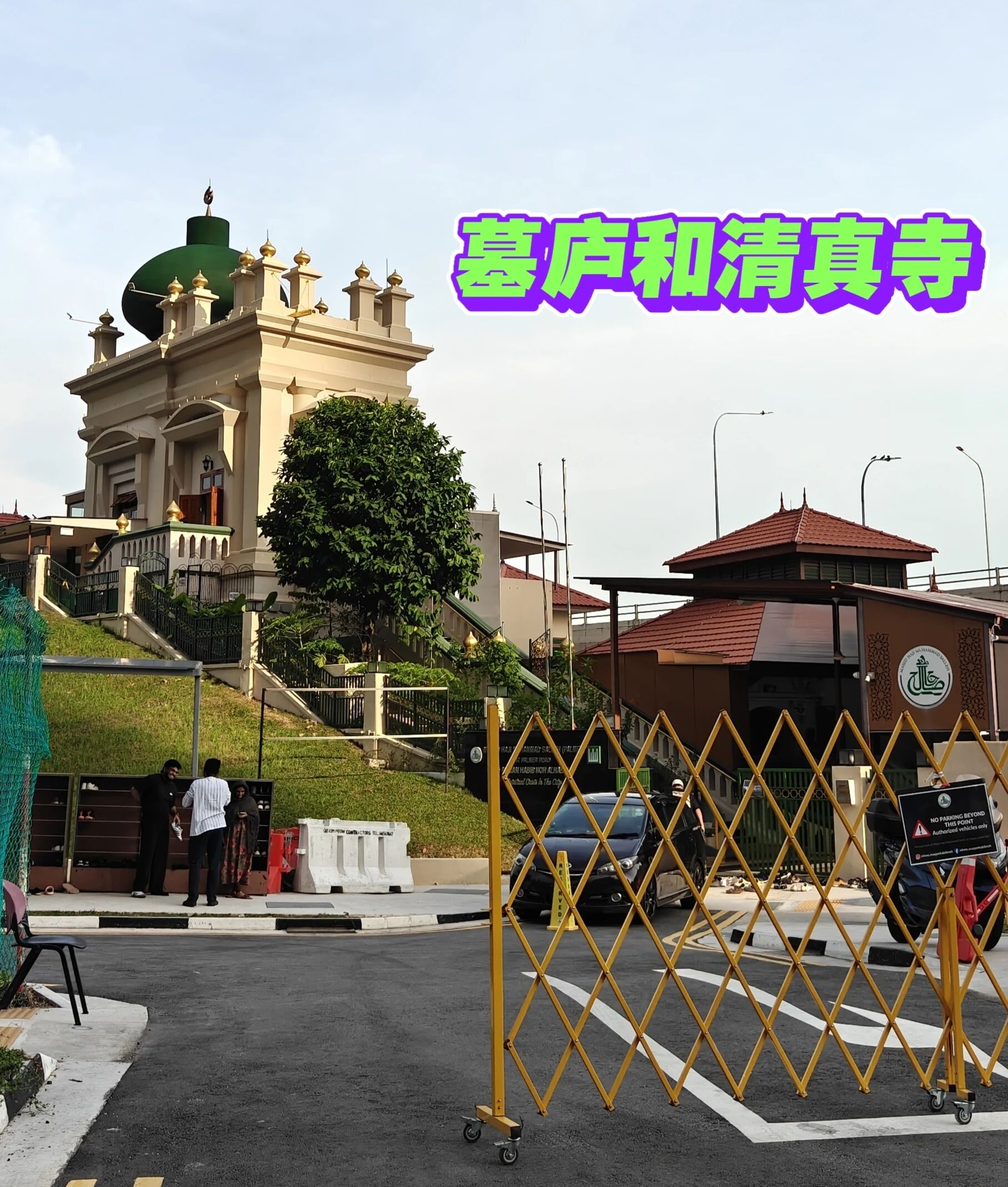
The domed building in the picture below is his shrine. This mosque actually started as a small prayer room built next to the shrine by Habib Nuh's friend, Haji Muhammad Salleh. It was later expanded into the mosque you see today.
When I visited at the end of last year, the shrine was undergoing renovations and was closed to the public. That is why I only visited the mosque back then and could not make it up to the tomb. I went back this time and the renovations were finally finished, so I could go up. To get up there, you have to climb a flight of stairs, and there is a front hall at the top. I met an elderly volunteer on duty there who told me that the person buried in the tomb, Habib Noh, was a descendant of the Prophet. He also urged me to look up his history. After looking it up, I learned that this wise man grew up in Penang, Malaysia, before moving to Singapore to settle down. His family roots were in Yemen, and he was born on a ship heading to Penang. He often used to go to Mount Palmer—the small hill where he is buried now—to meditate and perform namaz.
People say that after he passed away, they tried to bury him in a regular cemetery, but they could not move his body no matter what they did. Then, someone remembered him saying during his life that he wanted to be buried on Mount Palmer. They tried moving him there, and that is how they finally succeeded in burying him. As for this story, everyone can decide for themselves what to make of it.
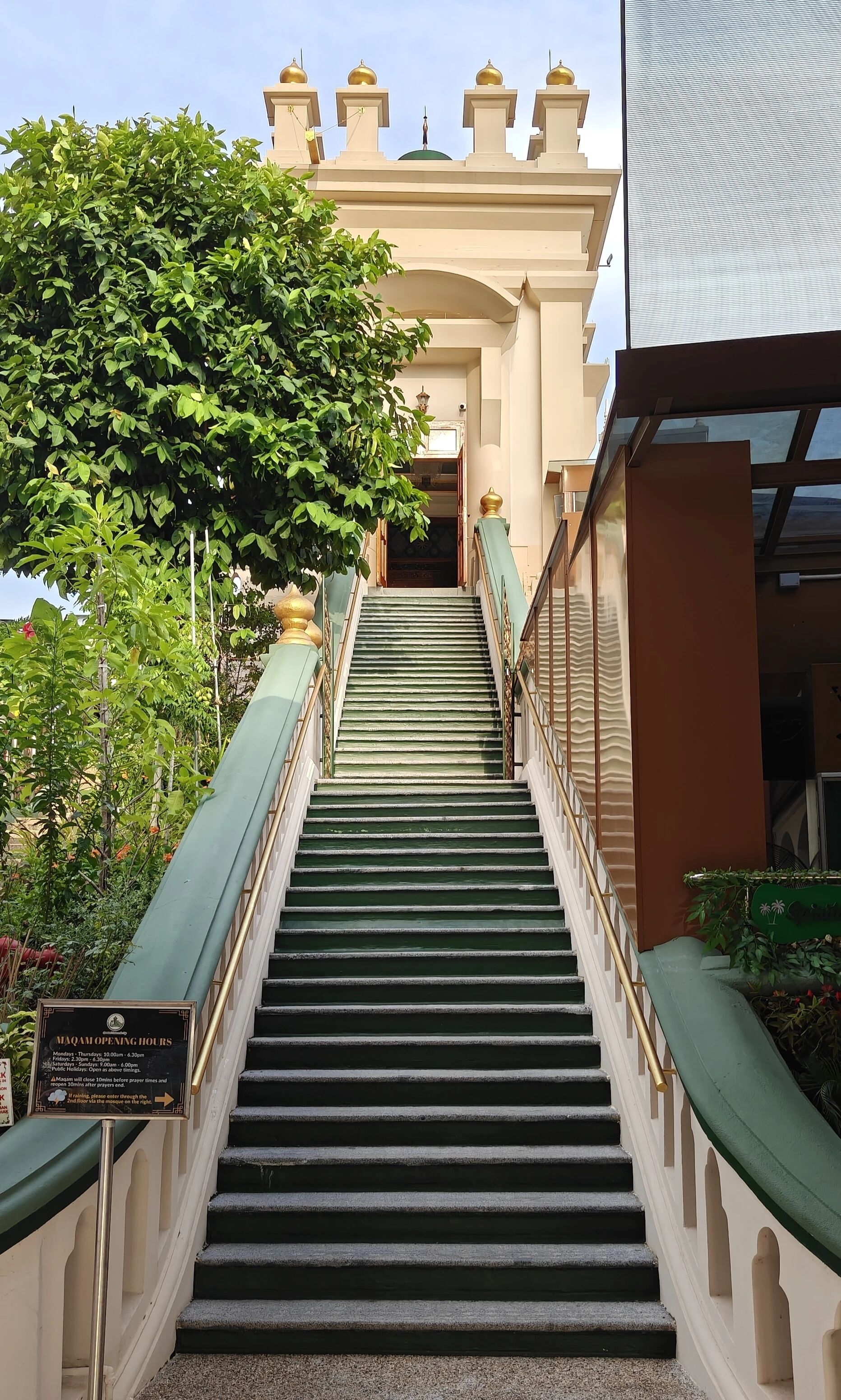
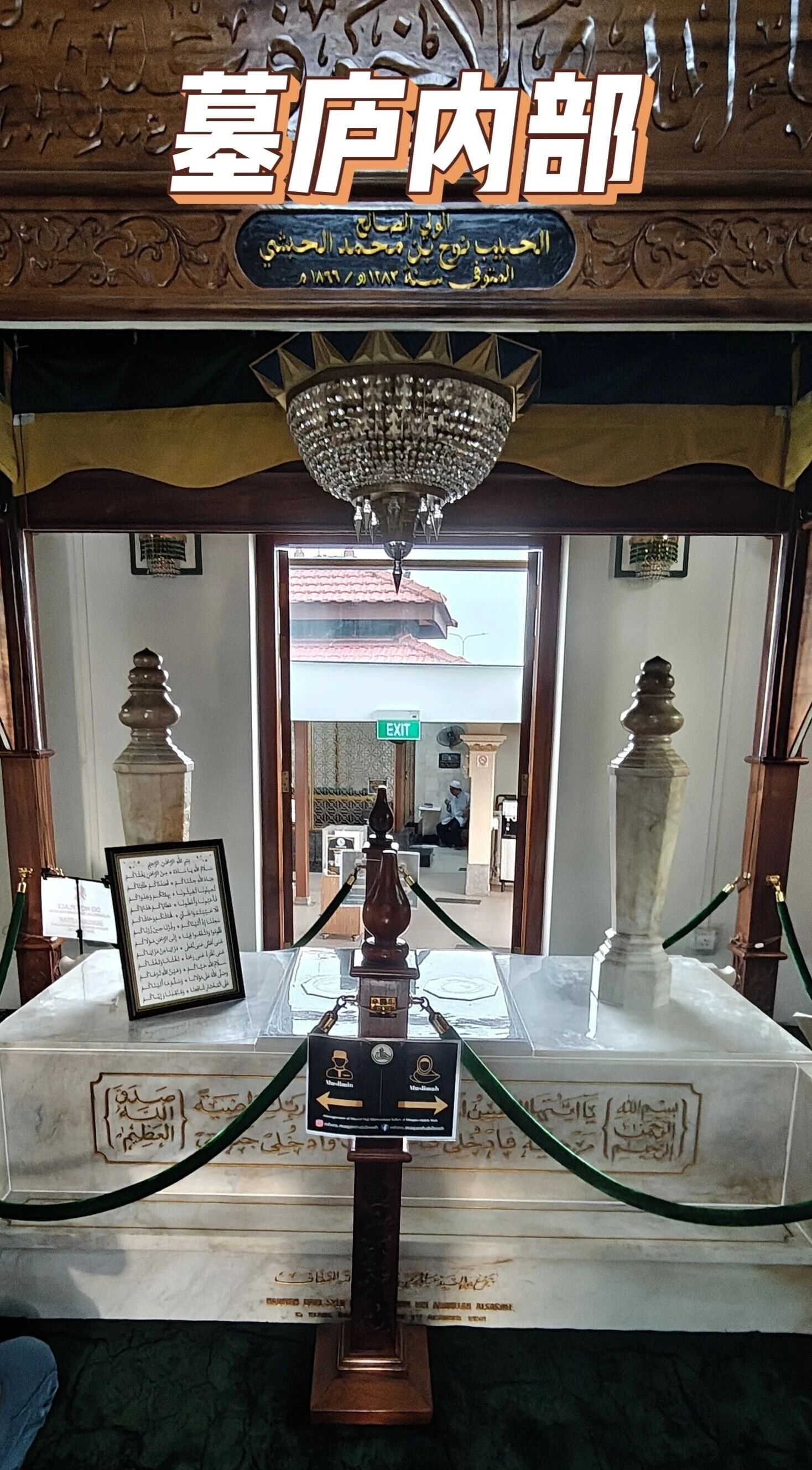
Because the tomb is built on top of the hill, you have to climb a very long flight of stairs to reach it. After entering the tomb chamber, I found a spot and sat down cross-legged. People around me were kneeling, whispering duas, and then raising their hands to make dua to Allah.
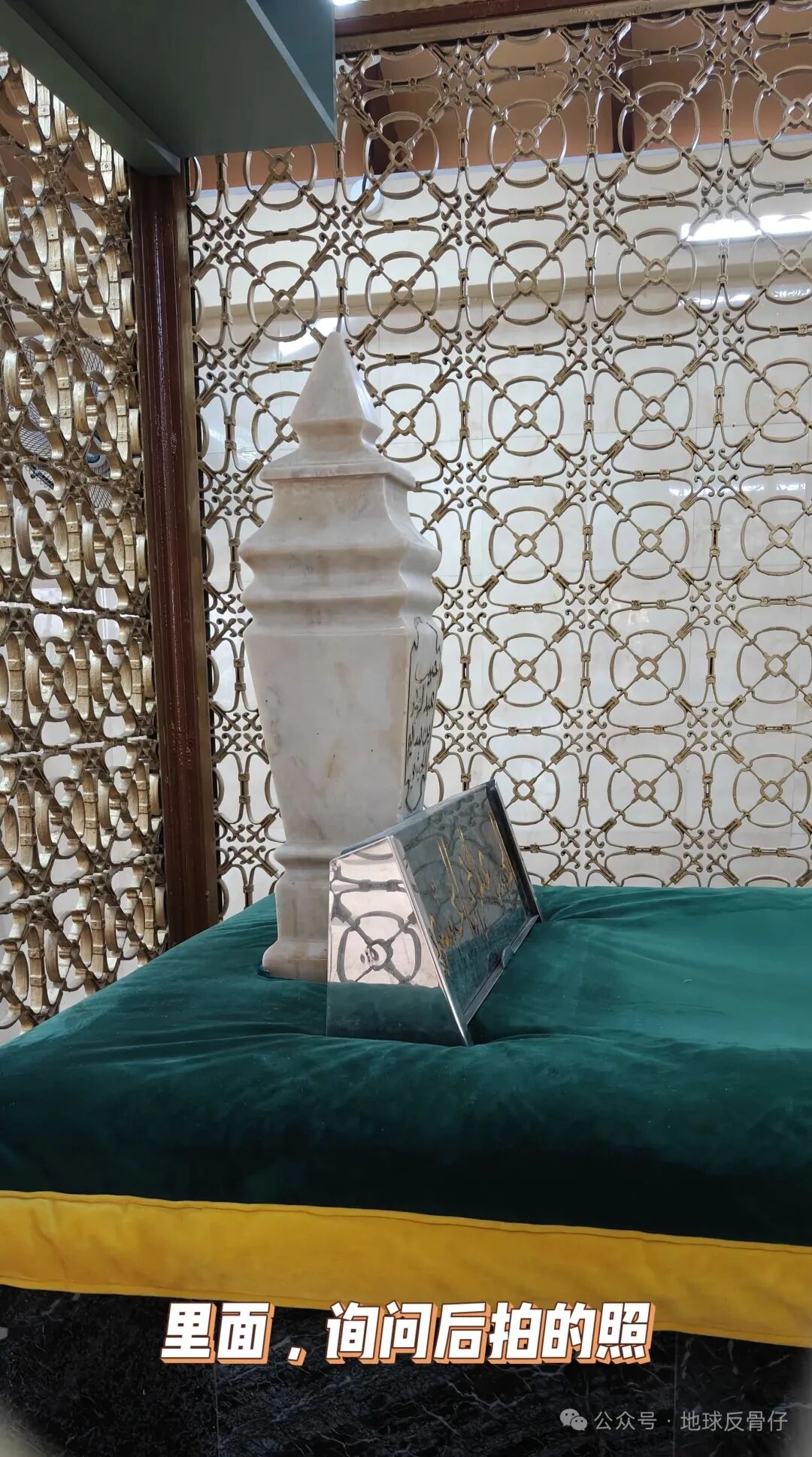
Behind the tomb chamber is another grave covered by a metal grid, where Habib Nuh's cousin, Habib Abdul Rahman, is buried. He was Singapore's first kadi, which is an Islamic judge.
19. Haji Muhammad Salleh Mosque
This mosque is connected to the tomb chamber because it started as a prayer room next to the grave, built by a friend of Habib Nuh. The prayer room was expanded later to reach its current size. Let me show you what the inside of the main prayer hall looks like.
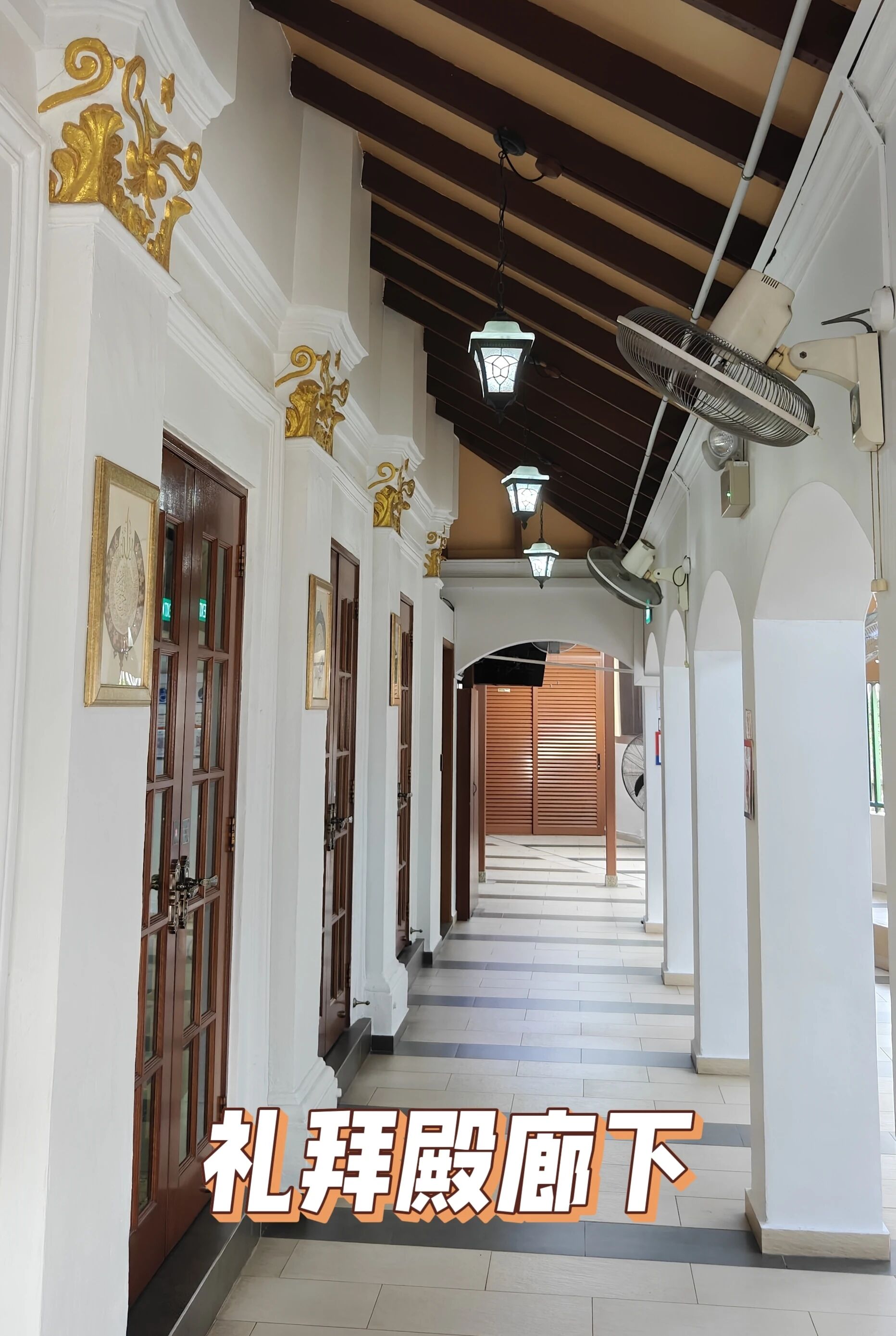
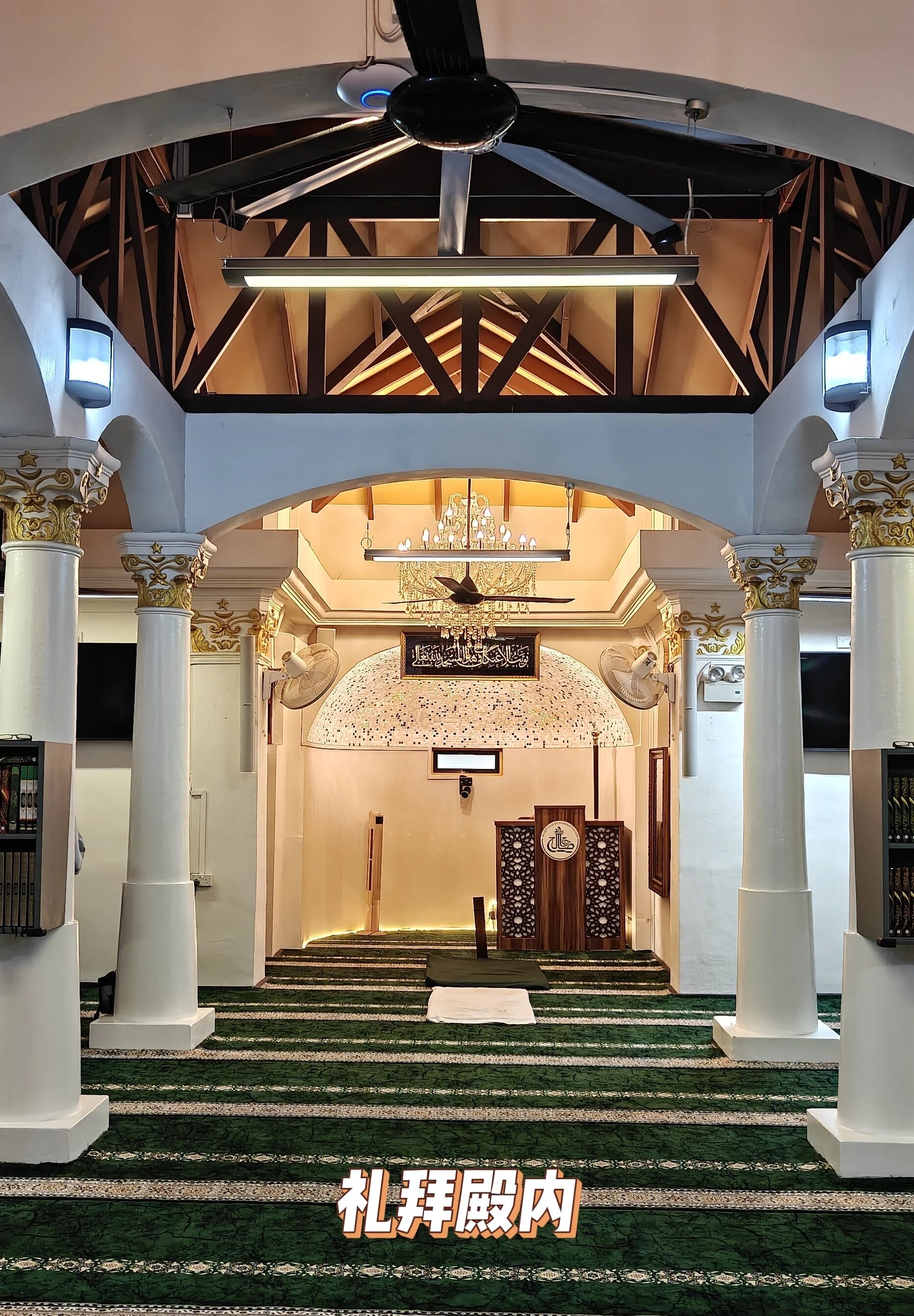
The main hall is not very big, but it is small and beautiful with a simple, modest style that does not look cheap at all. The pillars in the hall are mostly pure white, but the tops are decorated with gold, adding a touch of elegance to the room.
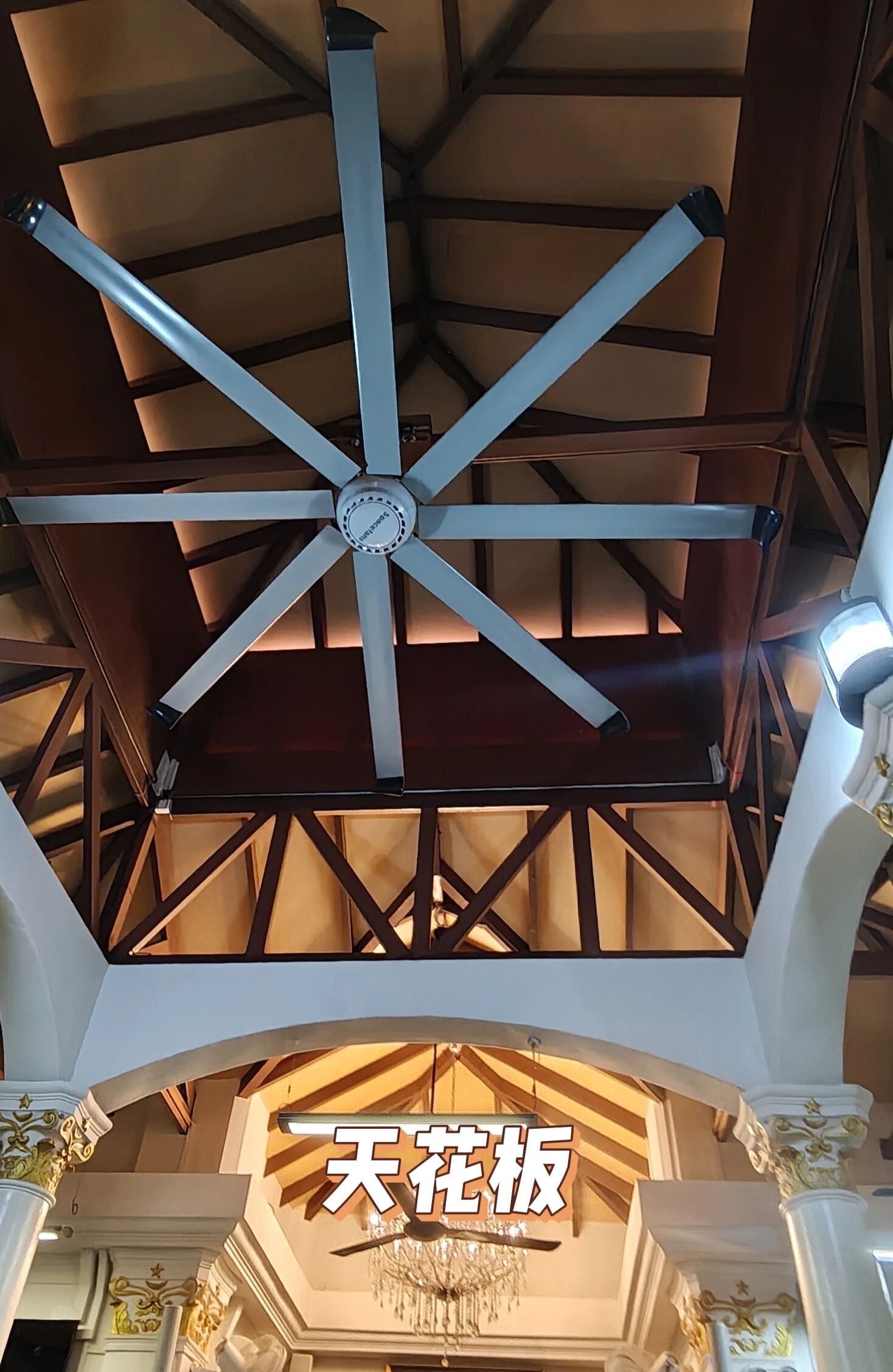
Although the ceiling is low, the designer used an open design so you can see the wooden beams. This design keeps the ceiling from feeling heavy, because if the room were already low and had a solid ceiling, it would feel very cramped.
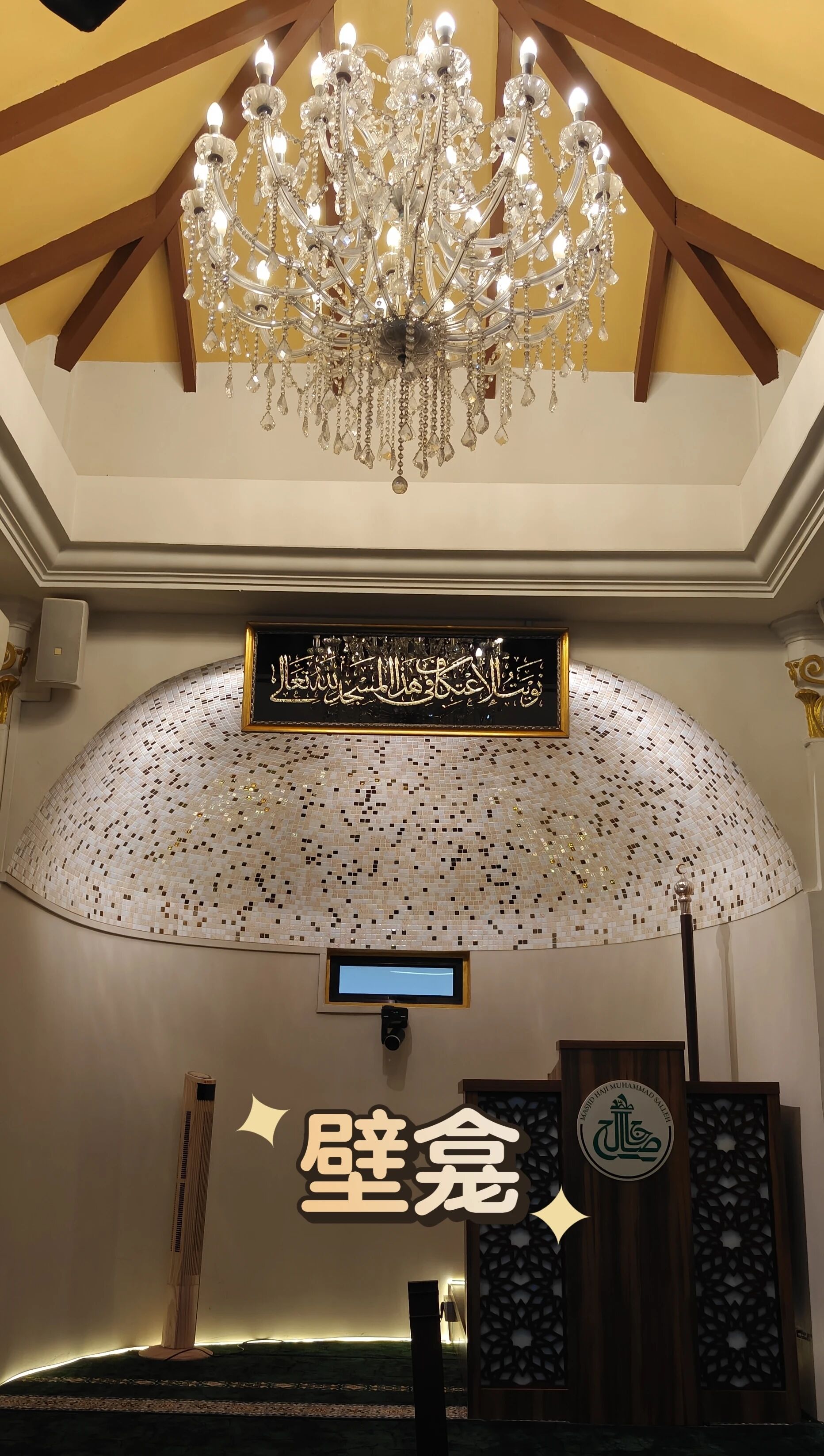
The top of the mihrab niche is covered in simple mosaic tiles. The colors are muted and the patterns are basic, so it looks quite pleasant and does not distract from the rest of the room. A staff stands on the pulpit. The khutbah staff here in Singapore is different from the ones back home in China, where we usually use a smooth, dried branch that keeps the original shape of the wood. In Singapore, it is a straight metal staff with a metal ball attached to the top.
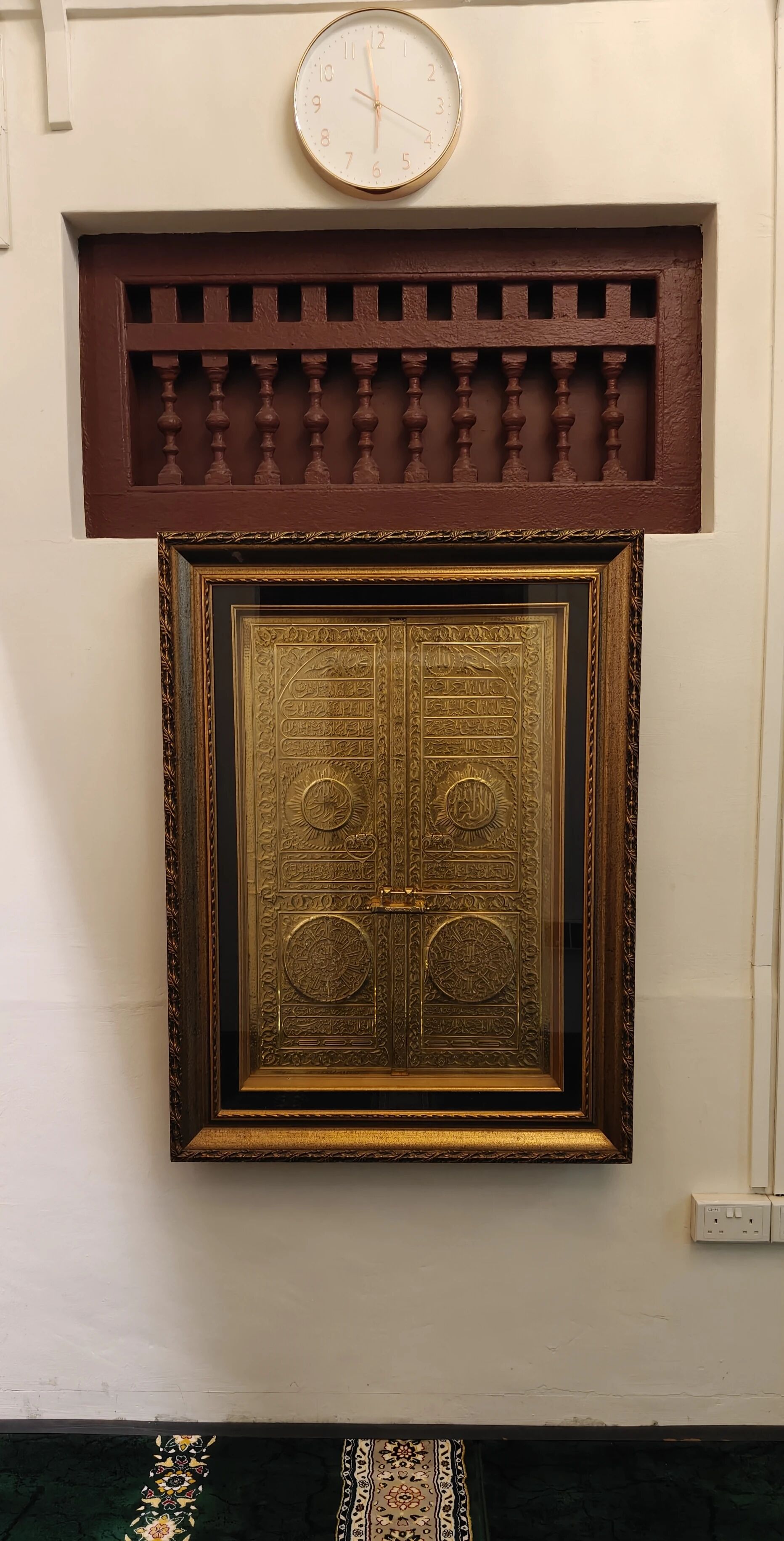
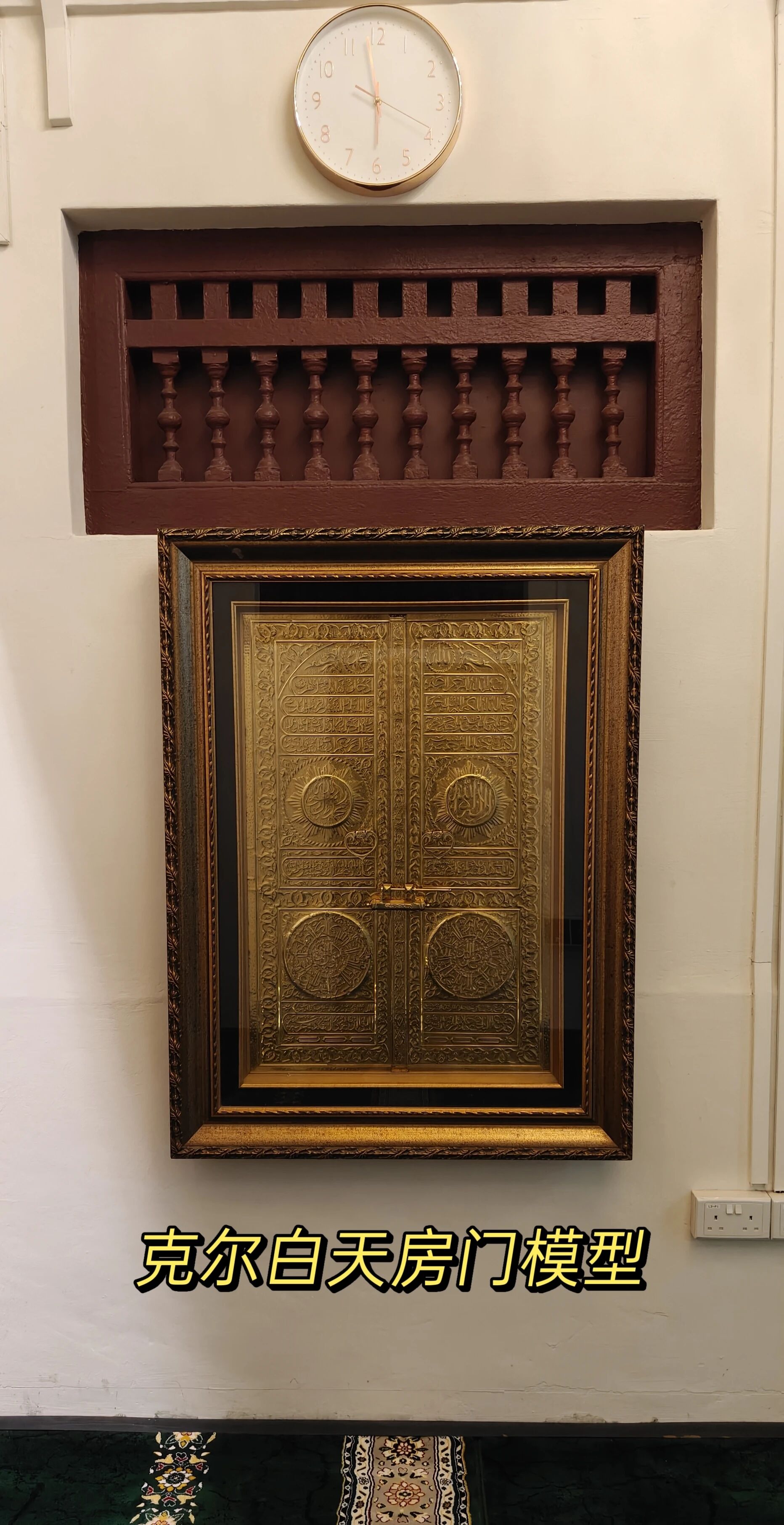
On the inner wall to the right of the niche hangs a small model of the door of the Kaaba (Mecca's House of God). I have seen this kind of model before in the gift shop of the Islamic Arts Museum Malaysia, so this style seems quite popular in mosques across Singapore and Malaysia.
Do you remember those steps leading up to the tomb (gongbei)? Looking up the steps, you can see the mosque's striking red roof.
20. Hajjah Fatimah Mosque
A wealthy lady donated the money to build this mosque. Her name was Hajjah Fatimah, and she was of Malay descent. A sign at the mosque entrance says it was built between 1845 and 1846, and the site was originally Hajjah Fatimah's own home. Hajjah Fatimah was a very wealthy Malay woman whose hometown was Malacca, Malaysia. You can see from this how close the connection is between Singapore and Malaysia. Just like the Temenggong Mosque we talked about before, that land still belongs to the state of Johor in Malaysia. Back to the story, in the late 1830s, this generous lady donated her property to build this mosque.
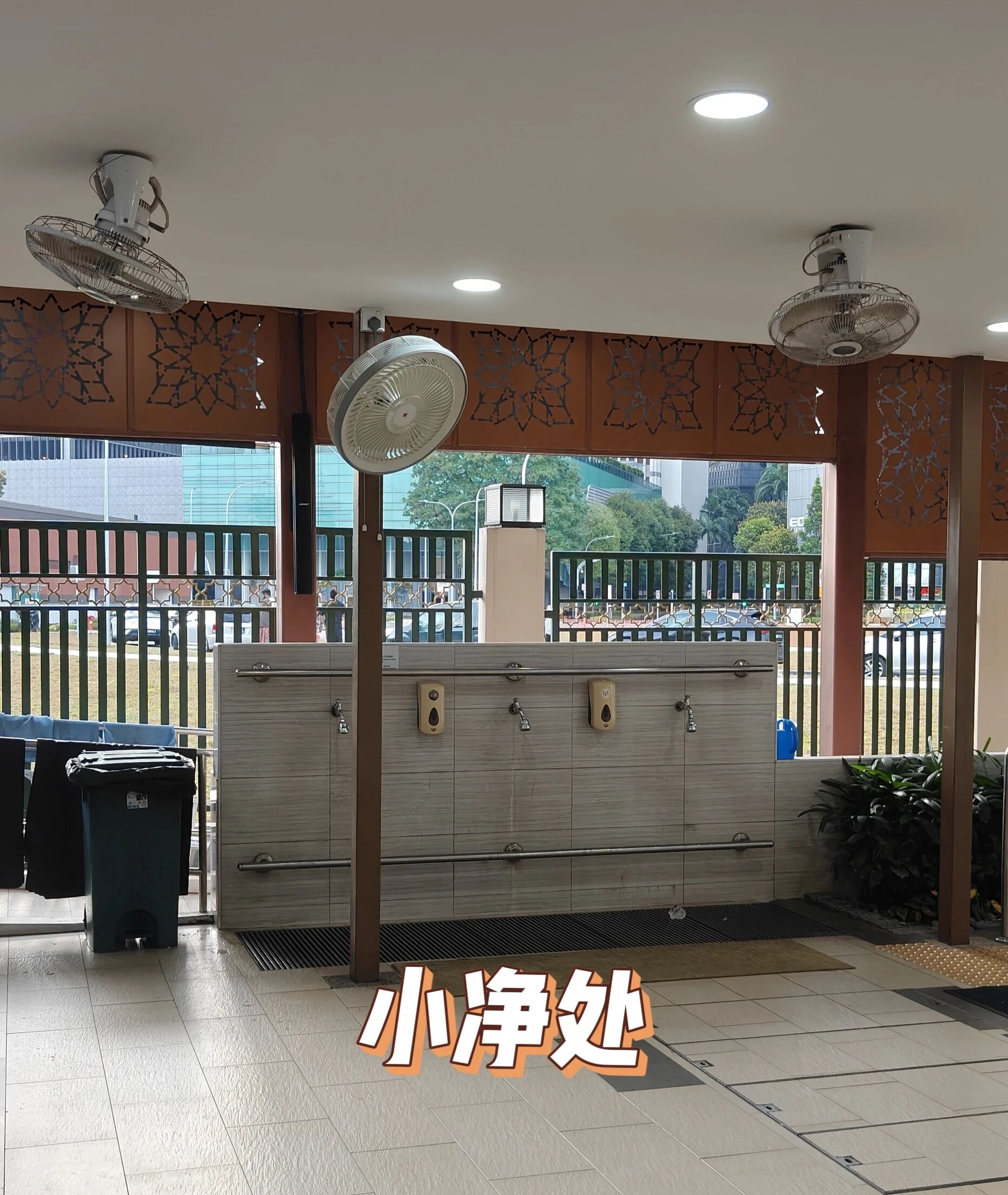
The first time I went there, it was almost nine o'clock at night, and Google Maps said it closed at nine. When I arrived, it didn't look like they were planning to close, so I wondered if Google Maps could be wrong. But after I finished my wudu and got ready to go in, the main hall was already locked. Well, they were polite enough to wait until I finished my namaz outside before they locked the courtyard gate.
I decided to go back the next day to see what the inside of the main hall looked like.
The most unique feature of this mosque is its minaret. Because it was designed by a British architect, the minaret has a Western style. Looking at it from a distance, I almost mistook it for a Christian church.
I came back here again the next morning. I found several groups of children sitting inside and outside the main hall, with about ten kids in each circle. A teacher led each group, teaching them to recite the Quran.
After finishing my namaz inside, I rushed to the airport because you really need to get there early for flights. I discovered that some flights actually stop boarding an hour early, which really caused me a lot of trouble. Isn't it usually half an hour before? I had about an hour left when I arrived at Changi Airport, and I told myself I would definitely make it. I did not expect my flight to close its counter exactly one hour early. The money for my plane ticket just went down the drain.
21. Prayer rooms at Singapore Changi Airport
Every terminal at Singapore Changi Airport actually has its own dedicated prayer room.
This time, I will show you the prayer room in Terminal 2 (T2) of Singapore Changi Airport. This place is very easy to find because the signs are clear, saying "dua room" in English with the Chinese and Japanese characters for dua room next to it.
The prayer rooms are separated for men and women. There is a sensor at the entrance, so you just wave your hand in front of it and the door opens automatically.
In the entryway of the prayer room, there are small stools for changing shoes and a shoe cabinet.
I have visited prayer rooms at Muscat Airport in Oman, Imam Khomeini Airport in Tehran, Iran, Qatar Airport, and Narita Airport in Japan. Compared to the airports in Middle Eastern countries, the prayer rooms at Singapore Airport are quite simple and have almost no decorations, much like the ones in Japan.
Next to the prayer area, there are various prayer supplies available, such as prayer caps, the Quran, perfume, and the sarong skirts worn by our Malay brothers.
Writing this, I have basically shared all the mosques I have visited in Singapore. I say "basically" because there is another mosque on Orchard Road located on the ground floor of an office building. It is decorated like a grand banquet hall, but unfortunately, I did not keep any photos of it. So, I did not include it this time. There is also the Darussalam Mosque. It was under construction when I visited, so I did not get any good photos and decided not to post about it yet.
Thank you all for your continued support. I will continue to update my travelogues about visiting mosques in other countries on this public platform. Please stay tuned. view all
Summary: This Singapore Muslim travel guide gathers the route covering Habib Noh Shrine, Haji Mohamed Salleh Mosque, Singapore Islamic Centre, and Changi Airport prayer rooms. It keeps the original checklist and image order intact.
In this issue:
18. Habib Noh Shrine
19. Haji Muhammad Salleh Mosque
20. Hajjah Fatimah Mosque
21. Changi Airport Prayer Room
Main text:
18. Habib Noh Shrine
Habib Noh is the local Singaporean transliteration. If we follow our naming habits back home, it is usually translated as Habib Nuh. Habib means beloved, and Nuh is the Prophet Noah. Nuh is a very common name in the Muslim world.
The domed building in the picture below is his shrine. This mosque actually started as a small prayer room built next to the shrine by Habib Nuh's friend, Haji Muhammad Salleh. It was later expanded into the mosque you see today.
When I visited at the end of last year, the shrine was undergoing renovations and was closed to the public. That is why I only visited the mosque back then and could not make it up to the tomb. I went back this time and the renovations were finally finished, so I could go up. To get up there, you have to climb a flight of stairs, and there is a front hall at the top. I met an elderly volunteer on duty there who told me that the person buried in the tomb, Habib Noh, was a descendant of the Prophet. He also urged me to look up his history. After looking it up, I learned that this wise man grew up in Penang, Malaysia, before moving to Singapore to settle down. His family roots were in Yemen, and he was born on a ship heading to Penang. He often used to go to Mount Palmer—the small hill where he is buried now—to meditate and perform namaz.
People say that after he passed away, they tried to bury him in a regular cemetery, but they could not move his body no matter what they did. Then, someone remembered him saying during his life that he wanted to be buried on Mount Palmer. They tried moving him there, and that is how they finally succeeded in burying him. As for this story, everyone can decide for themselves what to make of it.
Because the tomb is built on top of the hill, you have to climb a very long flight of stairs to reach it. After entering the tomb chamber, I found a spot and sat down cross-legged. People around me were kneeling, whispering duas, and then raising their hands to make dua to Allah.
Behind the tomb chamber is another grave covered by a metal grid, where Habib Nuh's cousin, Habib Abdul Rahman, is buried. He was Singapore's first kadi, which is an Islamic judge.
19. Haji Muhammad Salleh Mosque
This mosque is connected to the tomb chamber because it started as a prayer room next to the grave, built by a friend of Habib Nuh. The prayer room was expanded later to reach its current size. Let me show you what the inside of the main prayer hall looks like.
The main hall is not very big, but it is small and beautiful with a simple, modest style that does not look cheap at all. The pillars in the hall are mostly pure white, but the tops are decorated with gold, adding a touch of elegance to the room.
Although the ceiling is low, the designer used an open design so you can see the wooden beams. This design keeps the ceiling from feeling heavy, because if the room were already low and had a solid ceiling, it would feel very cramped.
The top of the mihrab niche is covered in simple mosaic tiles. The colors are muted and the patterns are basic, so it looks quite pleasant and does not distract from the rest of the room. A staff stands on the pulpit. The khutbah staff here in Singapore is different from the ones back home in China, where we usually use a smooth, dried branch that keeps the original shape of the wood. In Singapore, it is a straight metal staff with a metal ball attached to the top.
On the inner wall to the right of the niche hangs a small model of the door of the Kaaba (Mecca's House of God). I have seen this kind of model before in the gift shop of the Islamic Arts Museum Malaysia, so this style seems quite popular in mosques across Singapore and Malaysia.
Do you remember those steps leading up to the tomb (gongbei)? Looking up the steps, you can see the mosque's striking red roof.
20. Hajjah Fatimah Mosque
A wealthy lady donated the money to build this mosque. Her name was Hajjah Fatimah, and she was of Malay descent. A sign at the mosque entrance says it was built between 1845 and 1846, and the site was originally Hajjah Fatimah's own home. Hajjah Fatimah was a very wealthy Malay woman whose hometown was Malacca, Malaysia. You can see from this how close the connection is between Singapore and Malaysia. Just like the Temenggong Mosque we talked about before, that land still belongs to the state of Johor in Malaysia. Back to the story, in the late 1830s, this generous lady donated her property to build this mosque.
The first time I went there, it was almost nine o'clock at night, and Google Maps said it closed at nine. When I arrived, it didn't look like they were planning to close, so I wondered if Google Maps could be wrong. But after I finished my wudu and got ready to go in, the main hall was already locked. Well, they were polite enough to wait until I finished my namaz outside before they locked the courtyard gate.
I decided to go back the next day to see what the inside of the main hall looked like.
The most unique feature of this mosque is its minaret. Because it was designed by a British architect, the minaret has a Western style. Looking at it from a distance, I almost mistook it for a Christian church.
I came back here again the next morning. I found several groups of children sitting inside and outside the main hall, with about ten kids in each circle. A teacher led each group, teaching them to recite the Quran.
After finishing my namaz inside, I rushed to the airport because you really need to get there early for flights. I discovered that some flights actually stop boarding an hour early, which really caused me a lot of trouble. Isn't it usually half an hour before? I had about an hour left when I arrived at Changi Airport, and I told myself I would definitely make it. I did not expect my flight to close its counter exactly one hour early. The money for my plane ticket just went down the drain.
21. Prayer rooms at Singapore Changi Airport
Every terminal at Singapore Changi Airport actually has its own dedicated prayer room.
This time, I will show you the prayer room in Terminal 2 (T2) of Singapore Changi Airport. This place is very easy to find because the signs are clear, saying "dua room" in English with the Chinese and Japanese characters for dua room next to it.
The prayer rooms are separated for men and women. There is a sensor at the entrance, so you just wave your hand in front of it and the door opens automatically.
In the entryway of the prayer room, there are small stools for changing shoes and a shoe cabinet.
I have visited prayer rooms at Muscat Airport in Oman, Imam Khomeini Airport in Tehran, Iran, Qatar Airport, and Narita Airport in Japan. Compared to the airports in Middle Eastern countries, the prayer rooms at Singapore Airport are quite simple and have almost no decorations, much like the ones in Japan.
Next to the prayer area, there are various prayer supplies available, such as prayer caps, the Quran, perfume, and the sarong skirts worn by our Malay brothers.
Writing this, I have basically shared all the mosques I have visited in Singapore. I say "basically" because there is another mosque on Orchard Road located on the ground floor of an office building. It is decorated like a grand banquet hall, but unfortunately, I did not keep any photos of it. So, I did not include it this time. There is also the Darussalam Mosque. It was under construction when I visited, so I did not get any good photos and decided not to post about it yet.
Thank you all for your continued support. I will continue to update my travelogues about visiting mosques in other countries on this public platform. Please stay tuned. view all
Reposted from the web
Summary: This Singapore Muslim travel guide gathers the route covering Habib Noh Shrine, Haji Mohamed Salleh Mosque, Singapore Islamic Centre, and Changi Airport prayer rooms. It keeps the original checklist and image order intact.
In this issue:
18. Habib Noh Shrine
19. Haji Muhammad Salleh Mosque
20. Hajjah Fatimah Mosque
21. Changi Airport Prayer Room
Main text:
18. Habib Noh Shrine
Habib Noh is the local Singaporean transliteration. If we follow our naming habits back home, it is usually translated as Habib Nuh. Habib means beloved, and Nuh is the Prophet Noah. Nuh is a very common name in the Muslim world.
The domed building in the picture below is his shrine. This mosque actually started as a small prayer room built next to the shrine by Habib Nuh's friend, Haji Muhammad Salleh. It was later expanded into the mosque you see today.
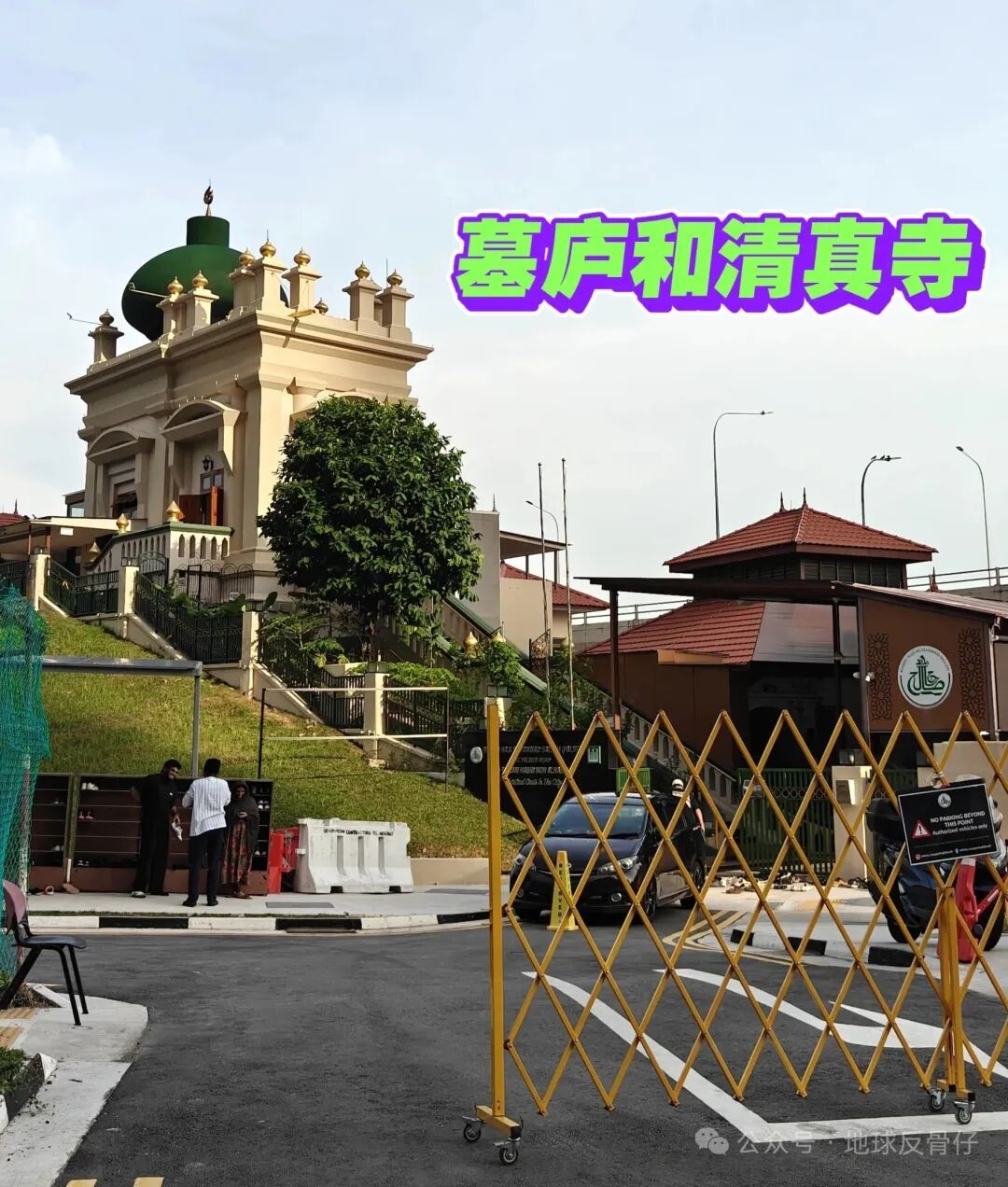
When I visited at the end of last year, the shrine was undergoing renovations and was closed to the public. That is why I only visited the mosque back then and could not make it up to the tomb. I went back this time and the renovations were finally finished, so I could go up. To get up there, you have to climb a flight of stairs, and there is a front hall at the top. I met an elderly volunteer on duty there who told me that the person buried in the tomb, Habib Noh, was a descendant of the Prophet. He also urged me to look up his history. After looking it up, I learned that this wise man grew up in Penang, Malaysia, before moving to Singapore to settle down. His family roots were in Yemen, and he was born on a ship heading to Penang. He often used to go to Mount Palmer—the small hill where he is buried now—to meditate and perform namaz.
People say that after he passed away, they tried to bury him in a regular cemetery, but they could not move his body no matter what they did. Then, someone remembered him saying during his life that he wanted to be buried on Mount Palmer. They tried moving him there, and that is how they finally succeeded in burying him. As for this story, everyone can decide for themselves what to make of it.
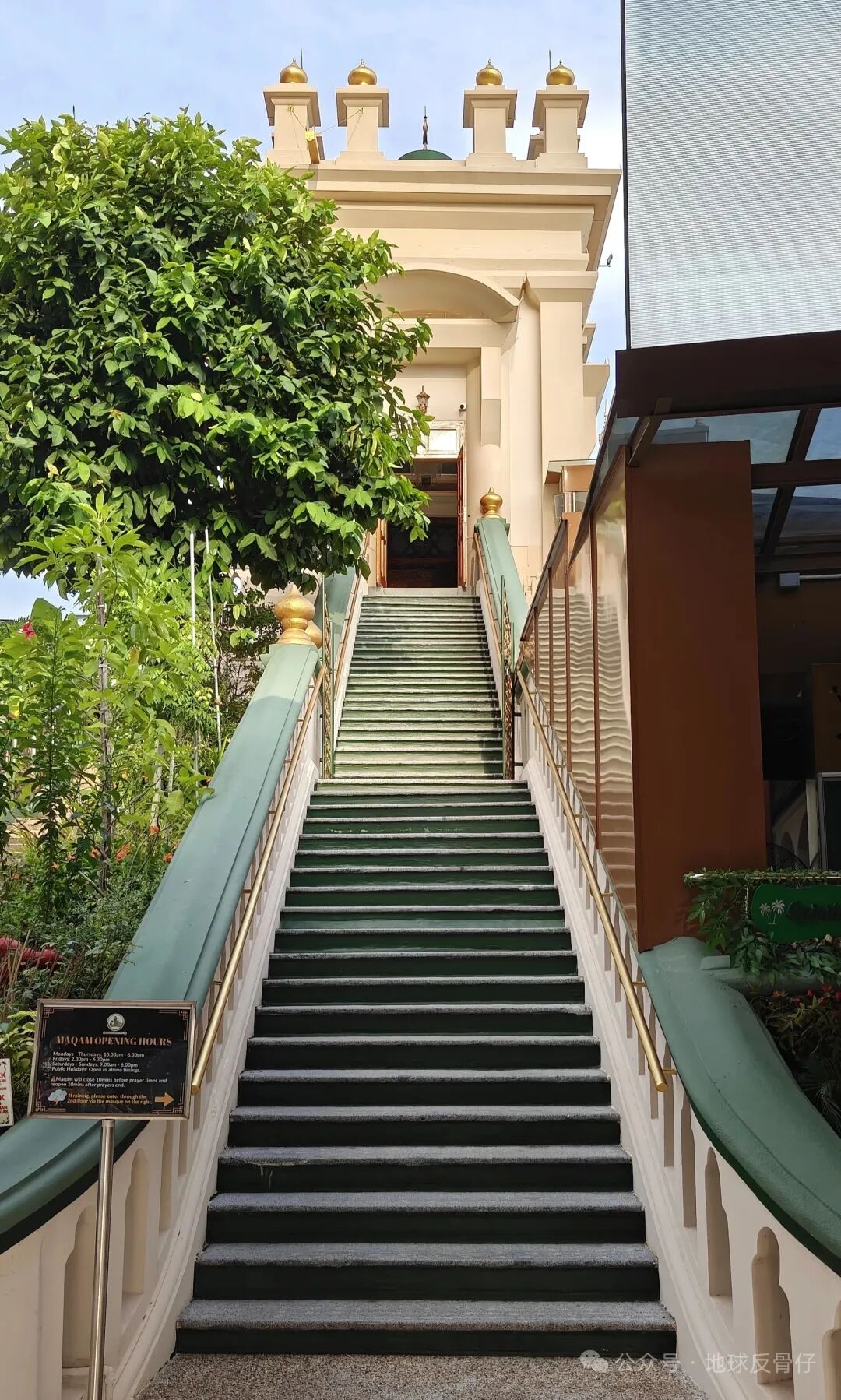
Because the tomb is built on top of the hill, you have to climb a very long flight of stairs to reach it. After entering the tomb chamber, I found a spot and sat down cross-legged. People around me were kneeling, whispering duas, and then raising their hands to make dua to Allah.
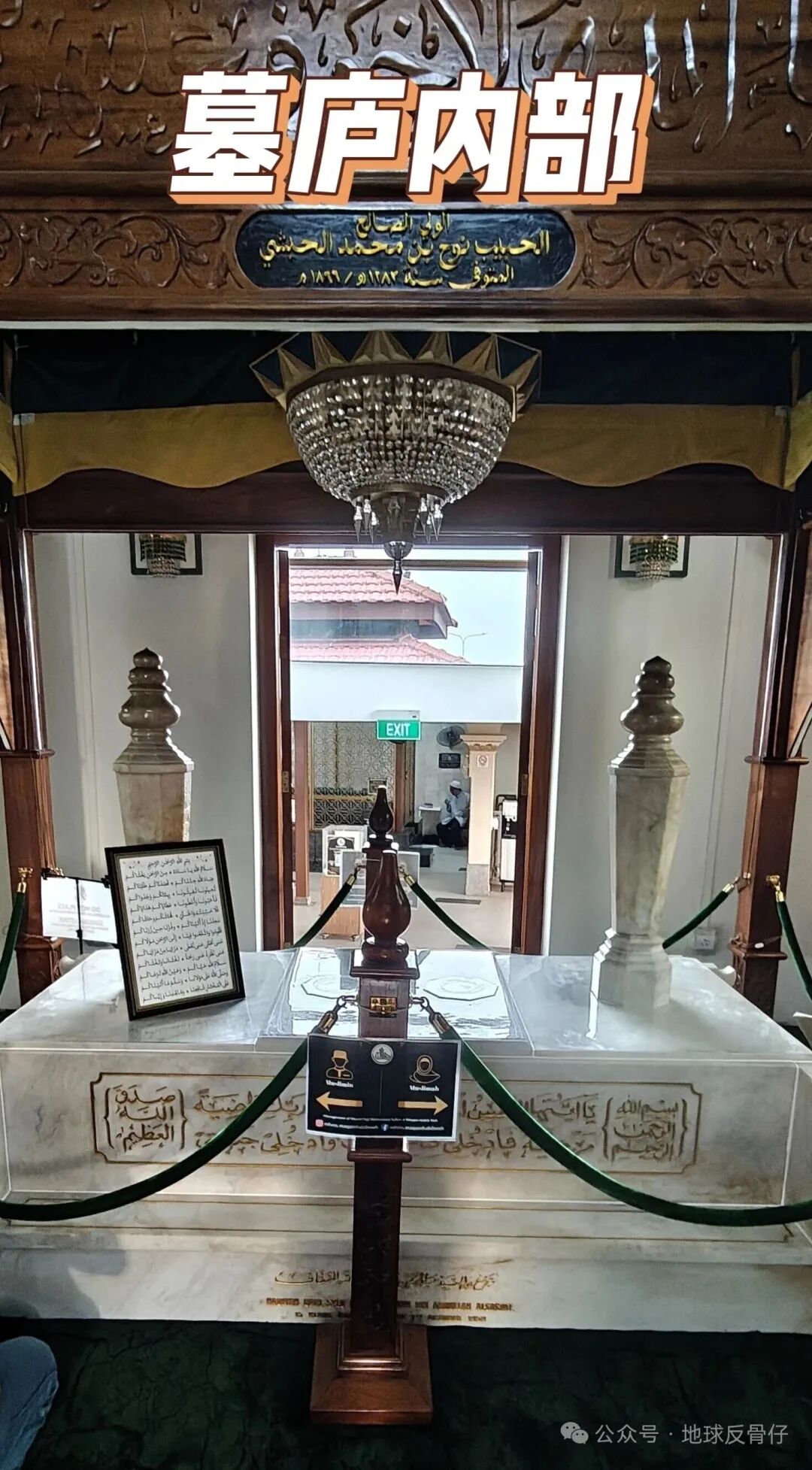
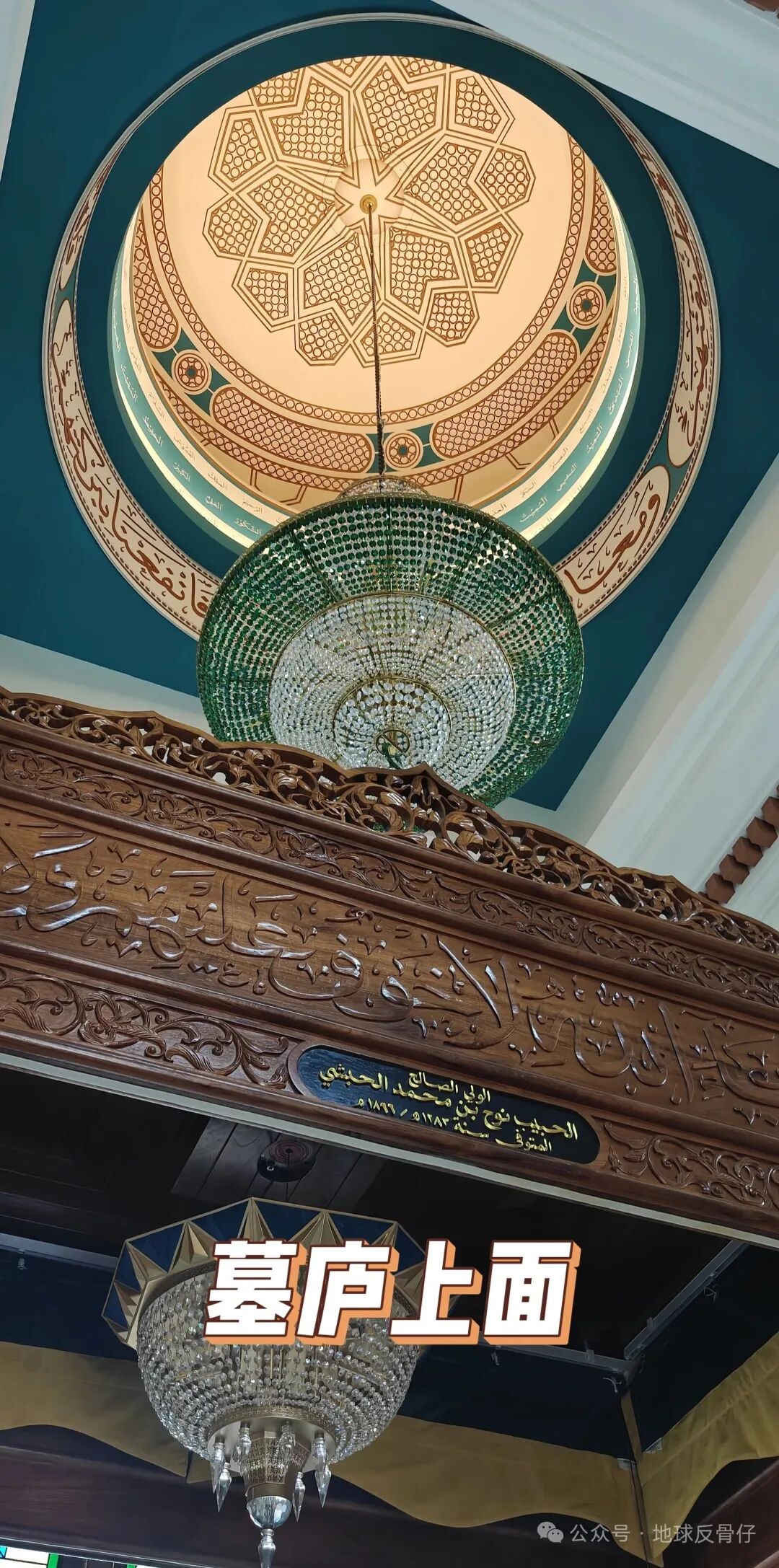
Behind the tomb chamber is another grave covered by a metal grid, where Habib Nuh's cousin, Habib Abdul Rahman, is buried. He was Singapore's first kadi, which is an Islamic judge.
19. Haji Muhammad Salleh Mosque
This mosque is connected to the tomb chamber because it started as a prayer room next to the grave, built by a friend of Habib Nuh. The prayer room was expanded later to reach its current size. Let me show you what the inside of the main prayer hall looks like.
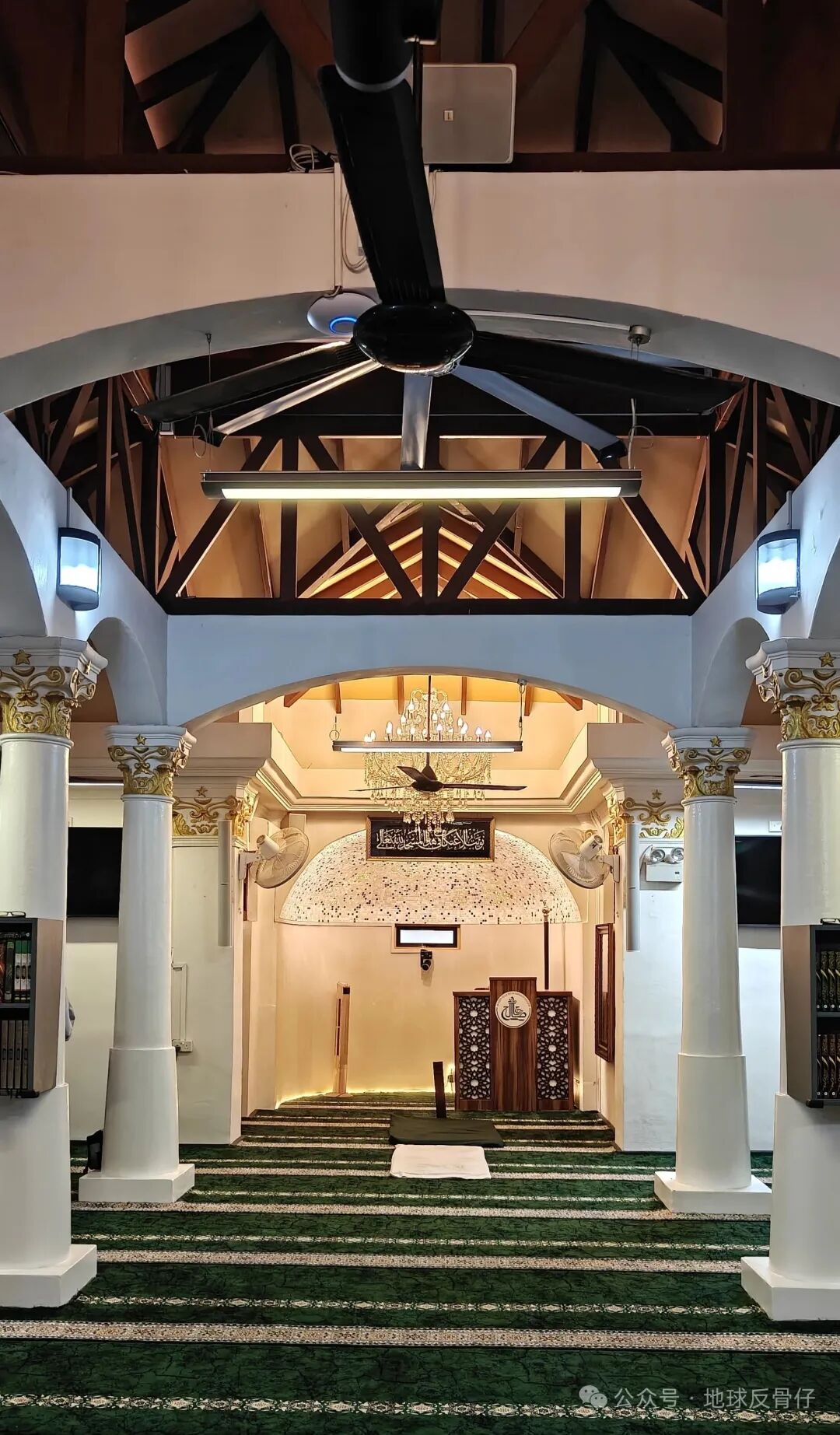
The main hall is not very big, but it is small and beautiful with a simple, modest style that does not look cheap at all. The pillars in the hall are mostly pure white, but the tops are decorated with gold, adding a touch of elegance to the room.
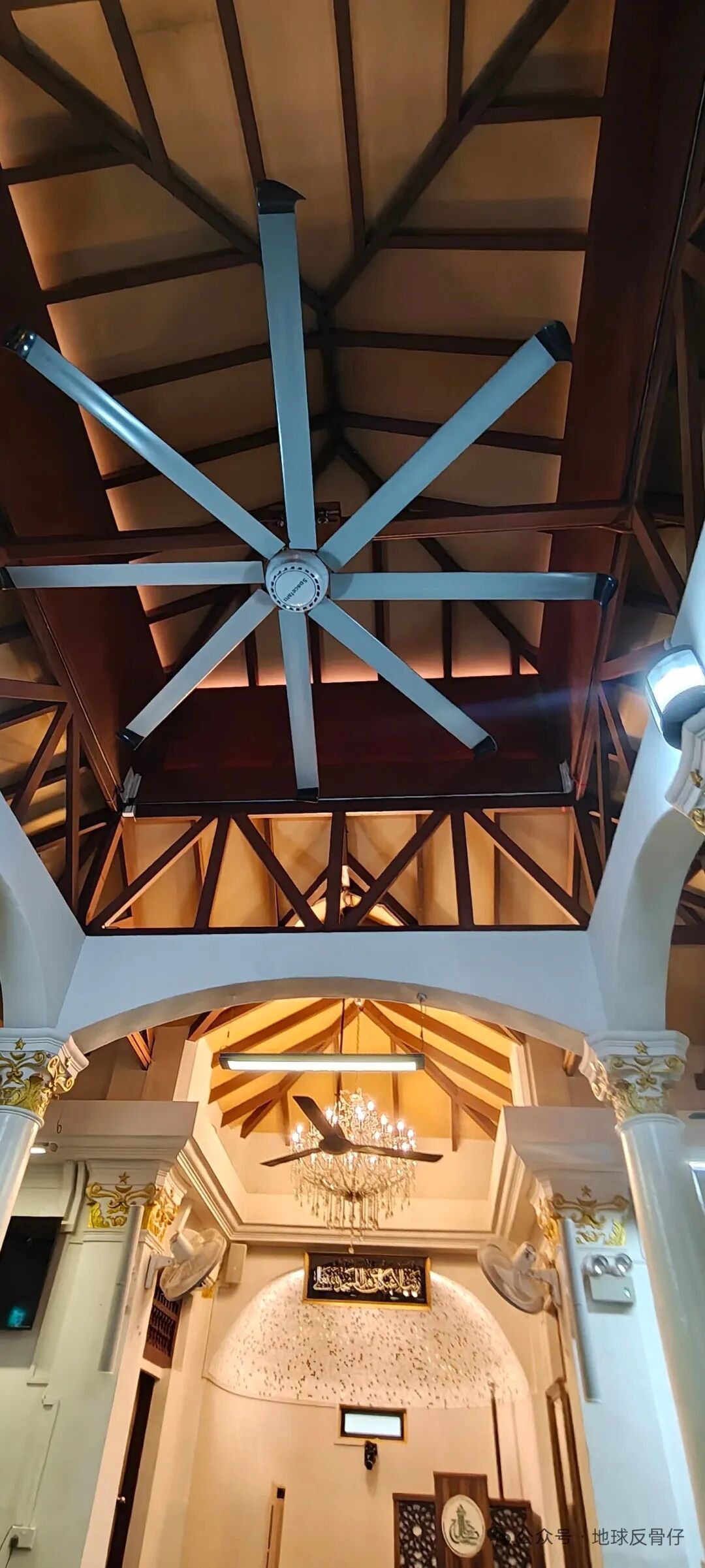
Although the ceiling is low, the designer used an open design so you can see the wooden beams. This design keeps the ceiling from feeling heavy, because if the room were already low and had a solid ceiling, it would feel very cramped.
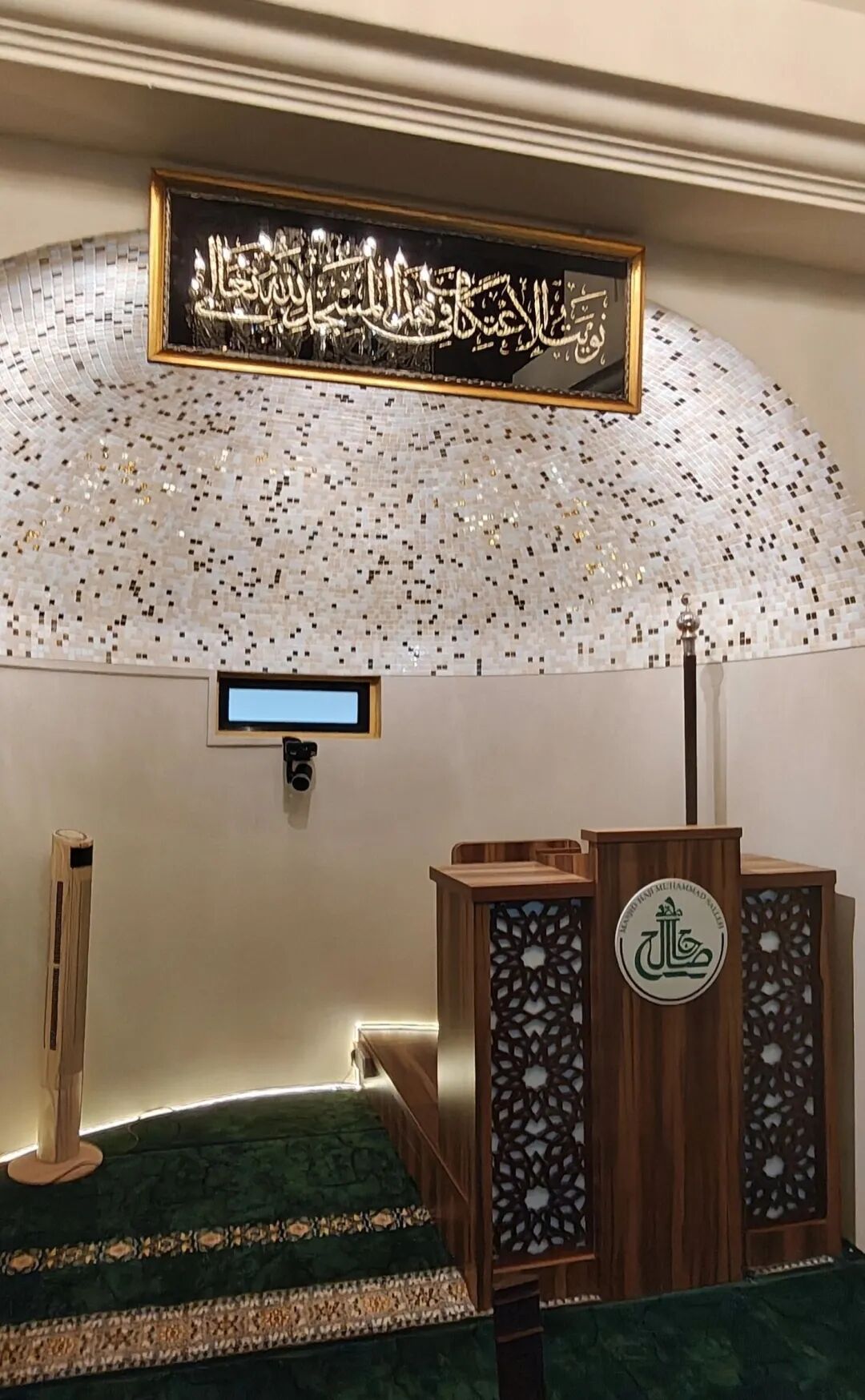
The top of the mihrab niche is covered in simple mosaic tiles. The colors are muted and the patterns are basic, so it looks quite pleasant and does not distract from the rest of the room. A staff stands on the pulpit. The khutbah staff here in Singapore is different from the ones back home in China, where we usually use a smooth, dried branch that keeps the original shape of the wood. In Singapore, it is a straight metal staff with a metal ball attached to the top.
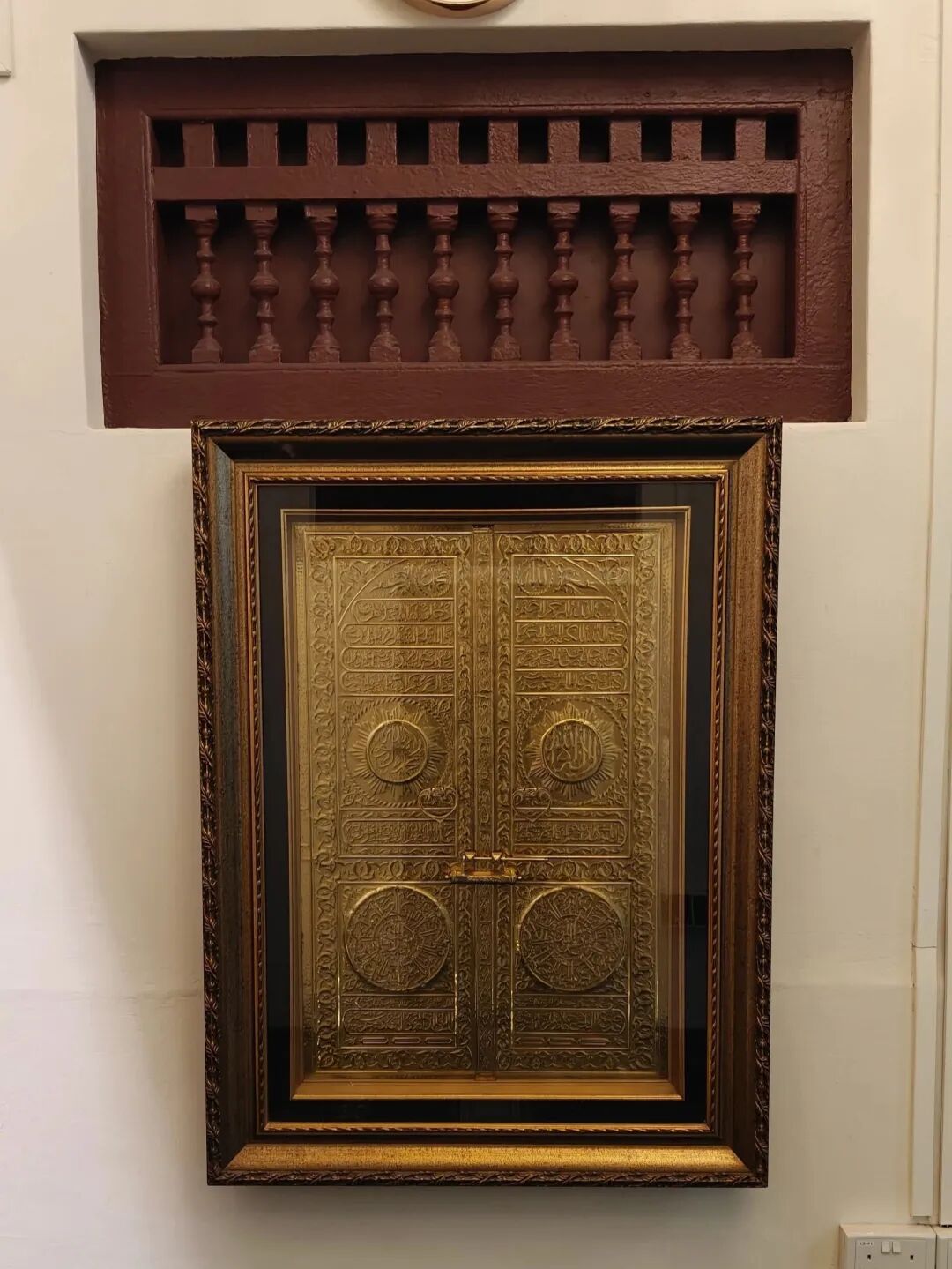
On the inner wall to the right of the niche hangs a small model of the door of the Kaaba (Mecca's House of God). I have seen this kind of model before in the gift shop of the Islamic Arts Museum Malaysia, so this style seems quite popular in mosques across Singapore and Malaysia.
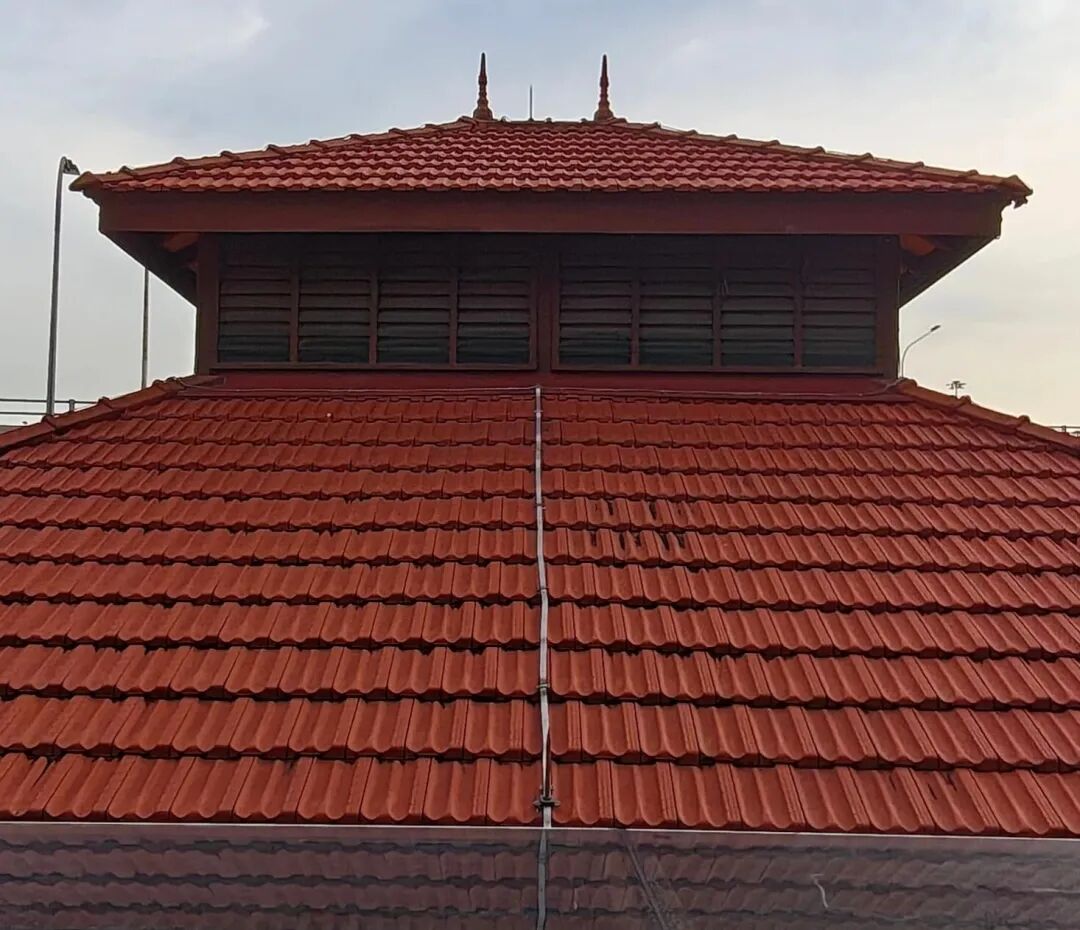
Do you remember those steps leading up to the tomb (gongbei)? Looking up the steps, you can see the mosque's striking red roof.
20. Hajjah Fatimah Mosque
A wealthy lady donated the money to build this mosque. Her name was Hajjah Fatimah, and she was of Malay descent. A sign at the mosque entrance says it was built between 1845 and 1846, and the site was originally Hajjah Fatimah's own home. Hajjah Fatimah was a very wealthy Malay woman whose hometown was Malacca, Malaysia. You can see from this how close the connection is between Singapore and Malaysia. Just like the Temenggong Mosque we talked about before, that land still belongs to the state of Johor in Malaysia. Back to the story, in the late 1830s, this generous lady donated her property to build this mosque.
The first time I went there, it was almost nine o'clock at night, and Google Maps said it closed at nine. When I arrived, it didn't look like they were planning to close, so I wondered if Google Maps could be wrong. But after I finished my wudu and got ready to go in, the main hall was already locked. Well, they were polite enough to wait until I finished my namaz outside before they locked the courtyard gate.
I decided to go back the next day to see what the inside of the main hall looked like.
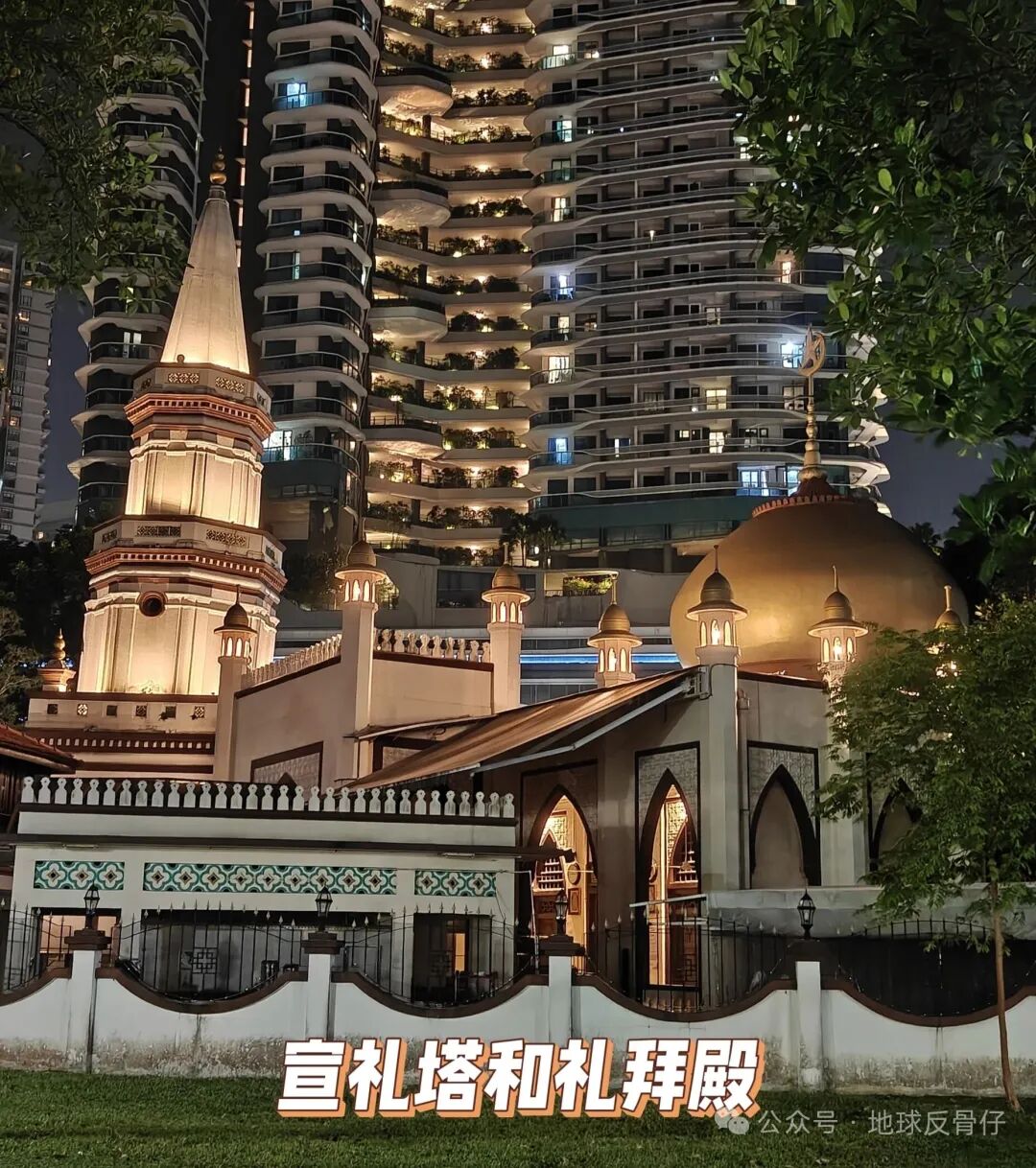
The most unique feature of this mosque is its minaret. Because it was designed by a British architect, the minaret has a Western style. Looking at it from a distance, I almost mistook it for a Christian church.
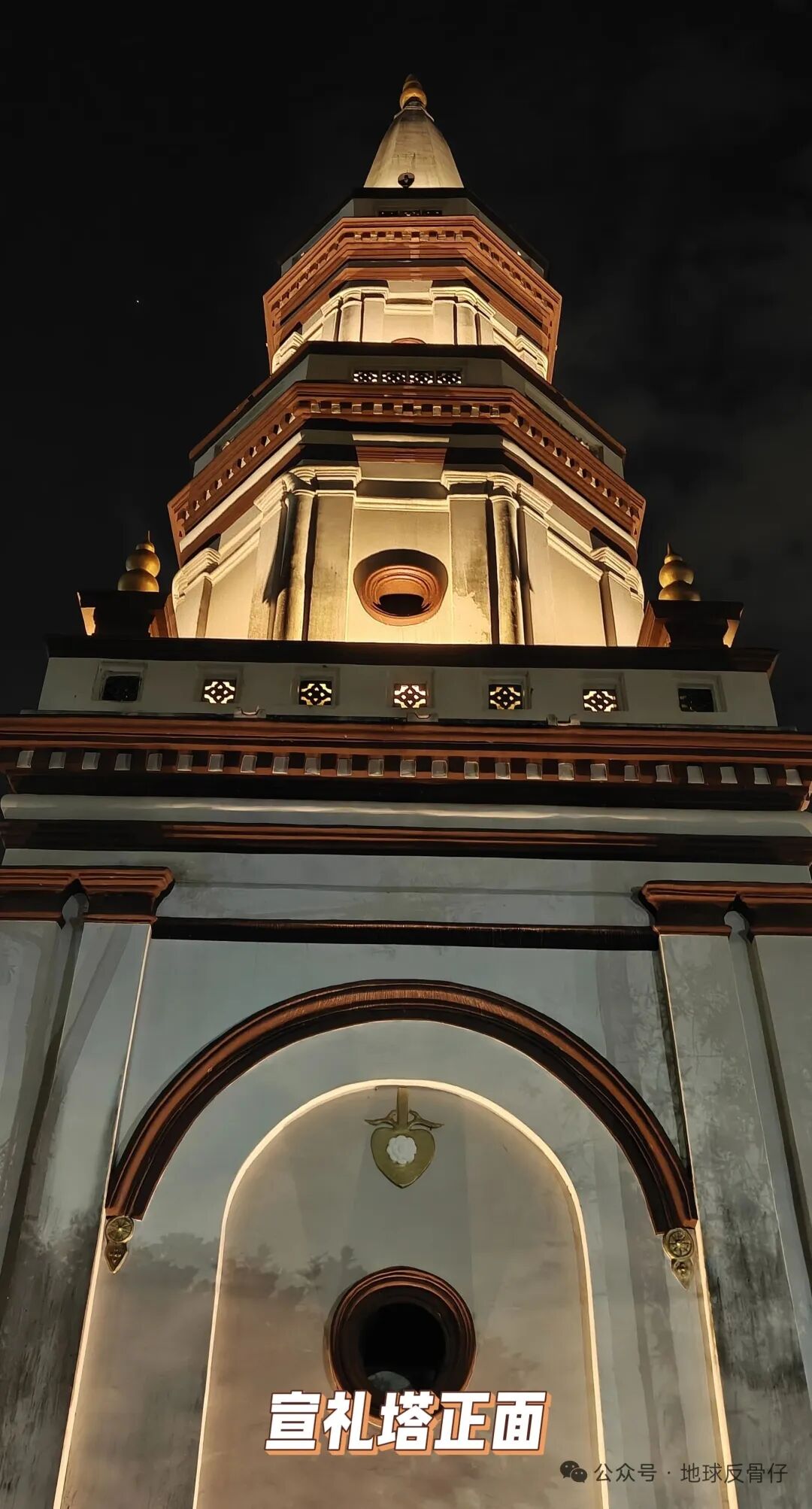
I came back here again the next morning. I found several groups of children sitting inside and outside the main hall, with about ten kids in each circle. A teacher led each group, teaching them to recite the Quran.
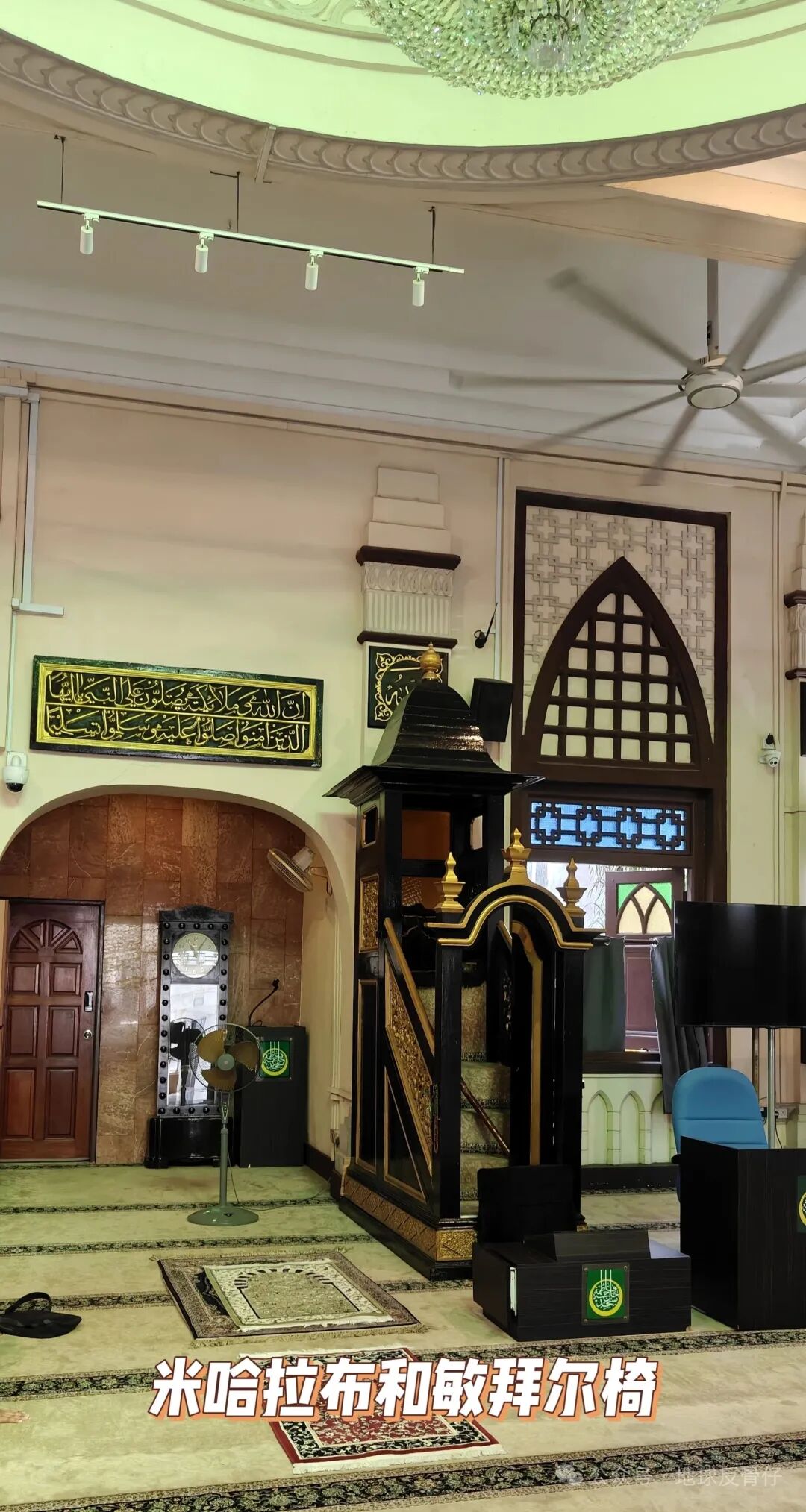
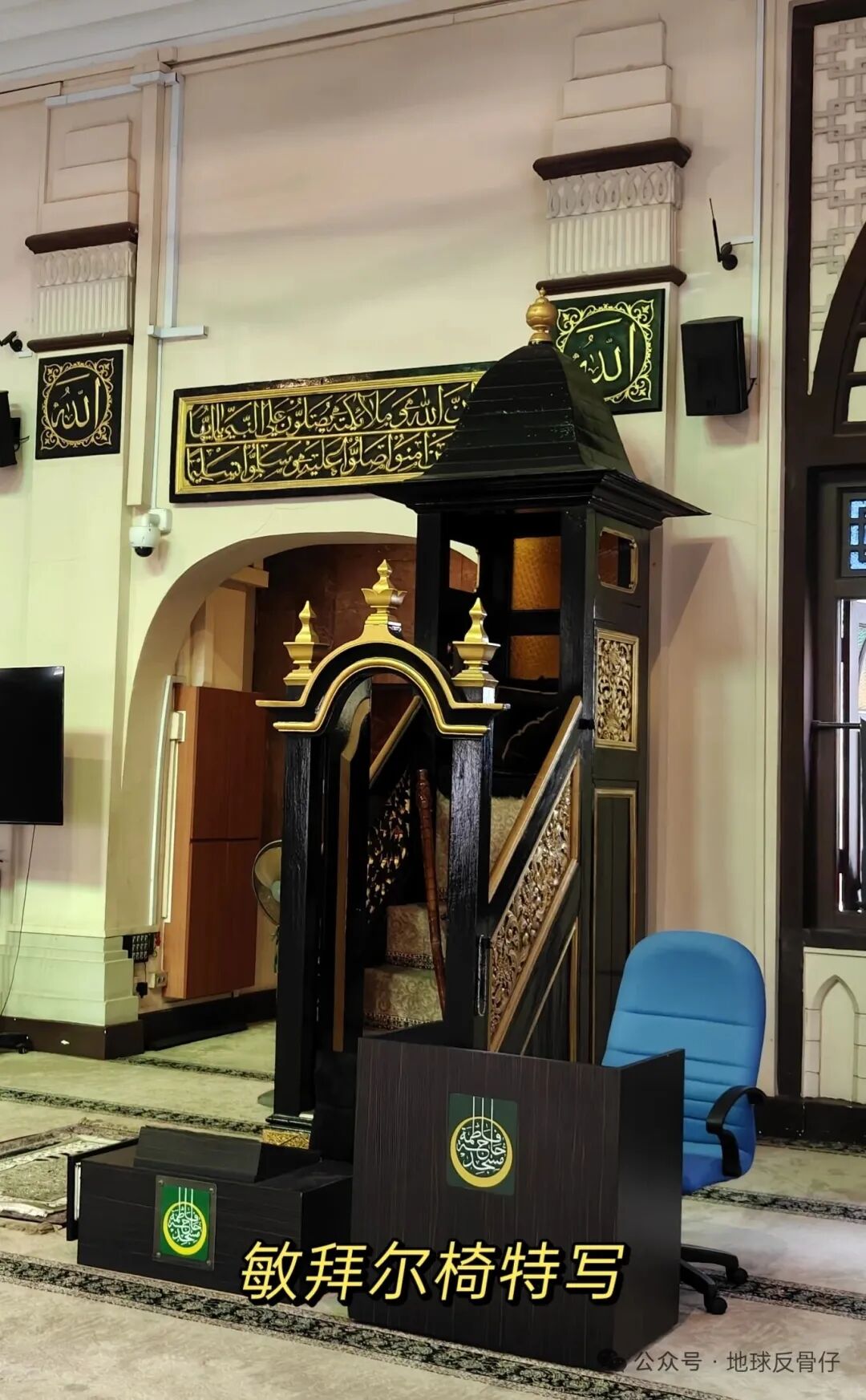
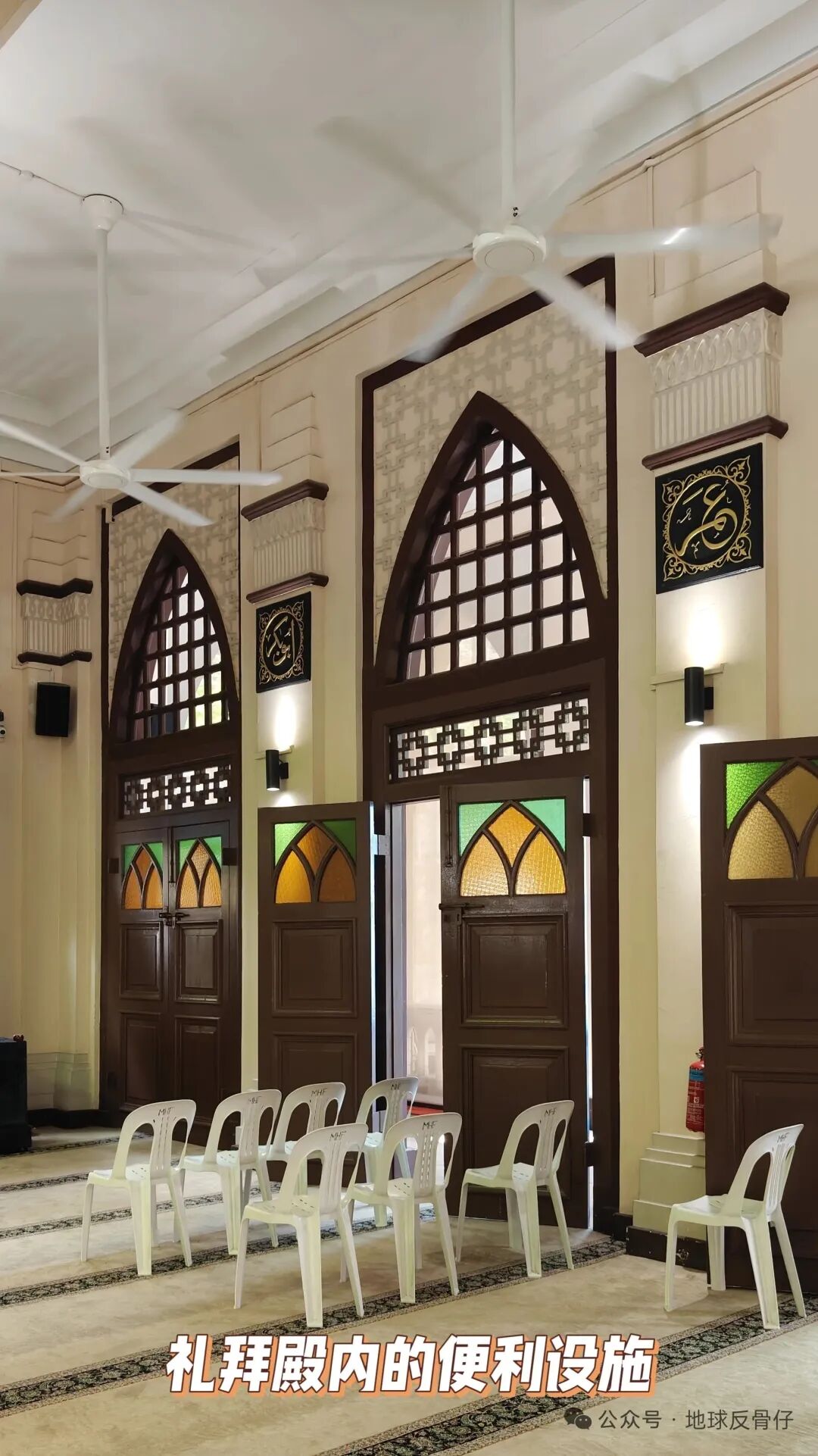
After finishing my namaz inside, I rushed to the airport because you really need to get there early for flights. I discovered that some flights actually stop boarding an hour early, which really caused me a lot of trouble. Isn't it usually half an hour before? I had about an hour left when I arrived at Changi Airport, and I told myself I would definitely make it. I did not expect my flight to close its counter exactly one hour early. The money for my plane ticket just went down the drain.
21. Prayer rooms at Singapore Changi Airport
Every terminal at Singapore Changi Airport actually has its own dedicated prayer room.
This time, I will show you the prayer room in Terminal 2 (T2) of Singapore Changi Airport. This place is very easy to find because the signs are clear, saying "dua room" in English with the Chinese and Japanese characters for dua room next to it.
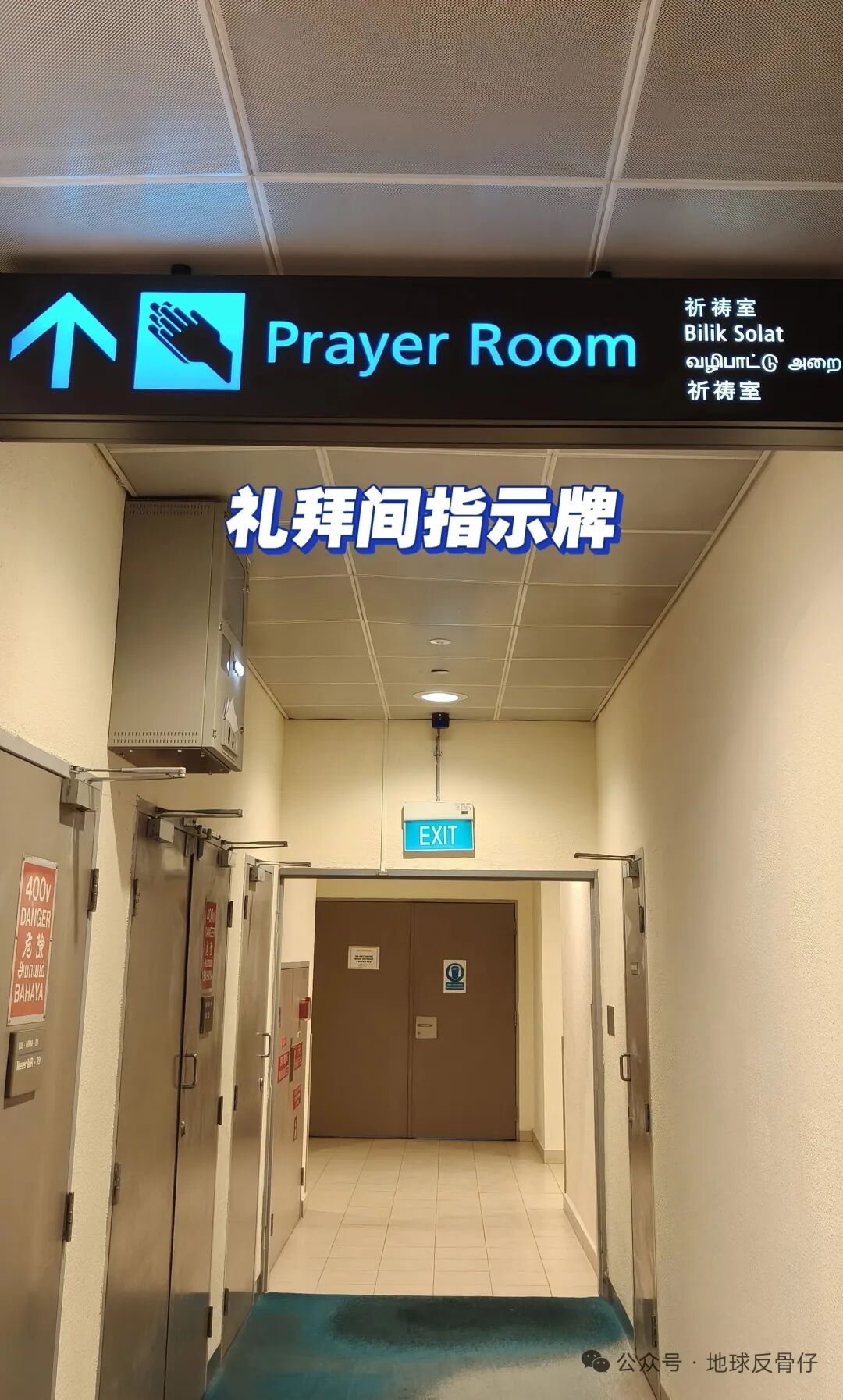
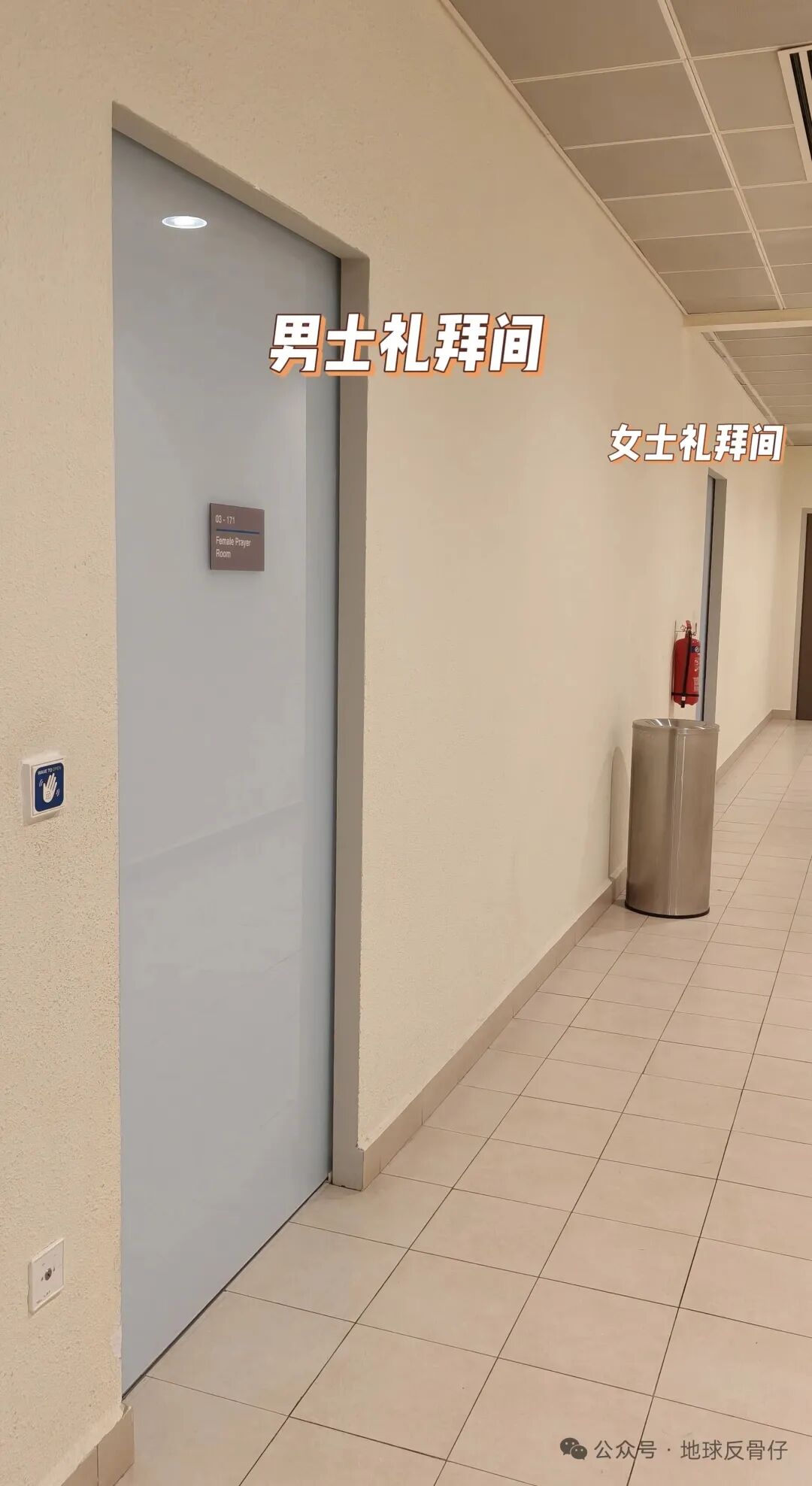
The prayer rooms are separated for men and women. There is a sensor at the entrance, so you just wave your hand in front of it and the door opens automatically.
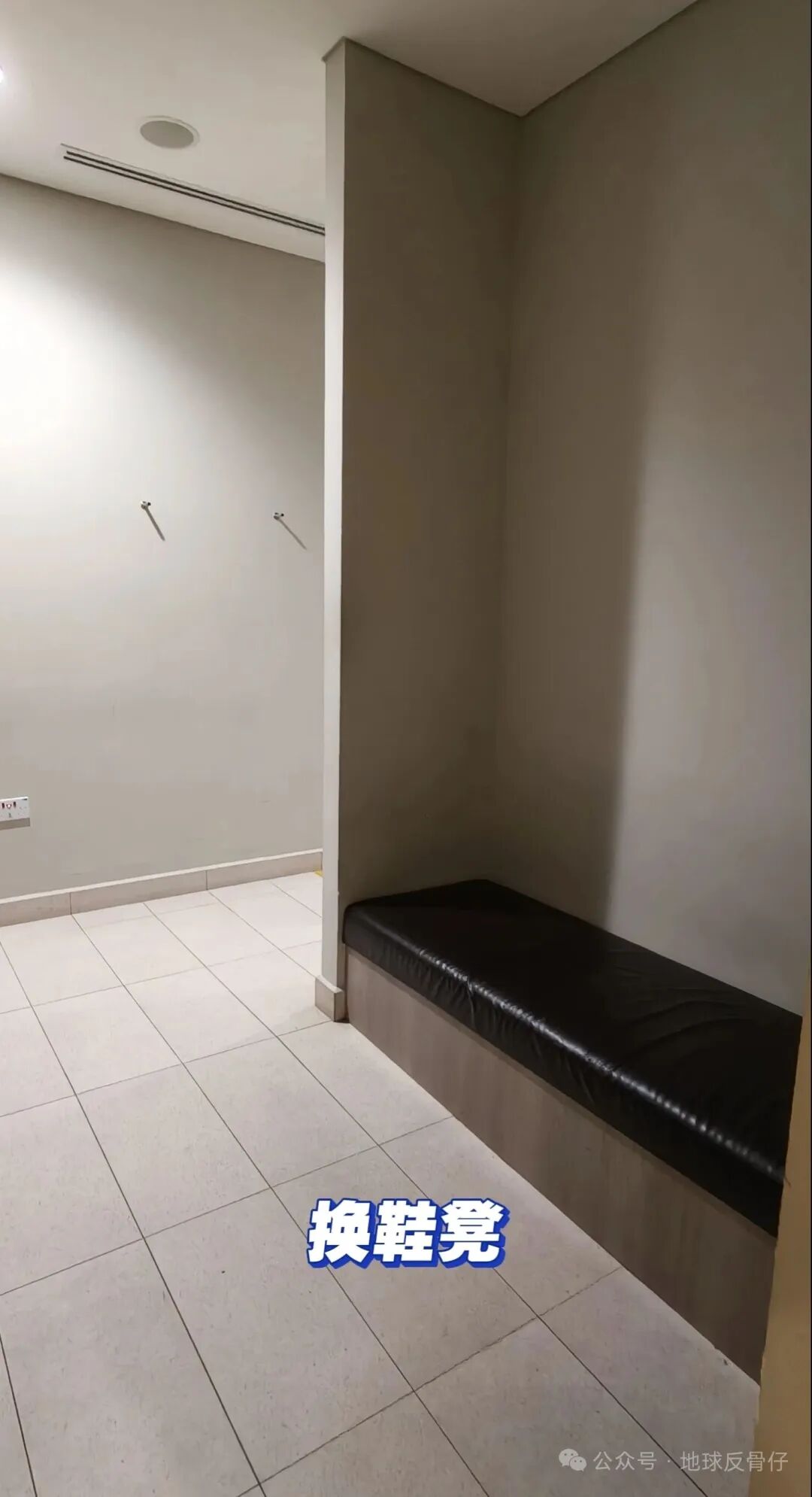
In the entryway of the prayer room, there are small stools for changing shoes and a shoe cabinet.
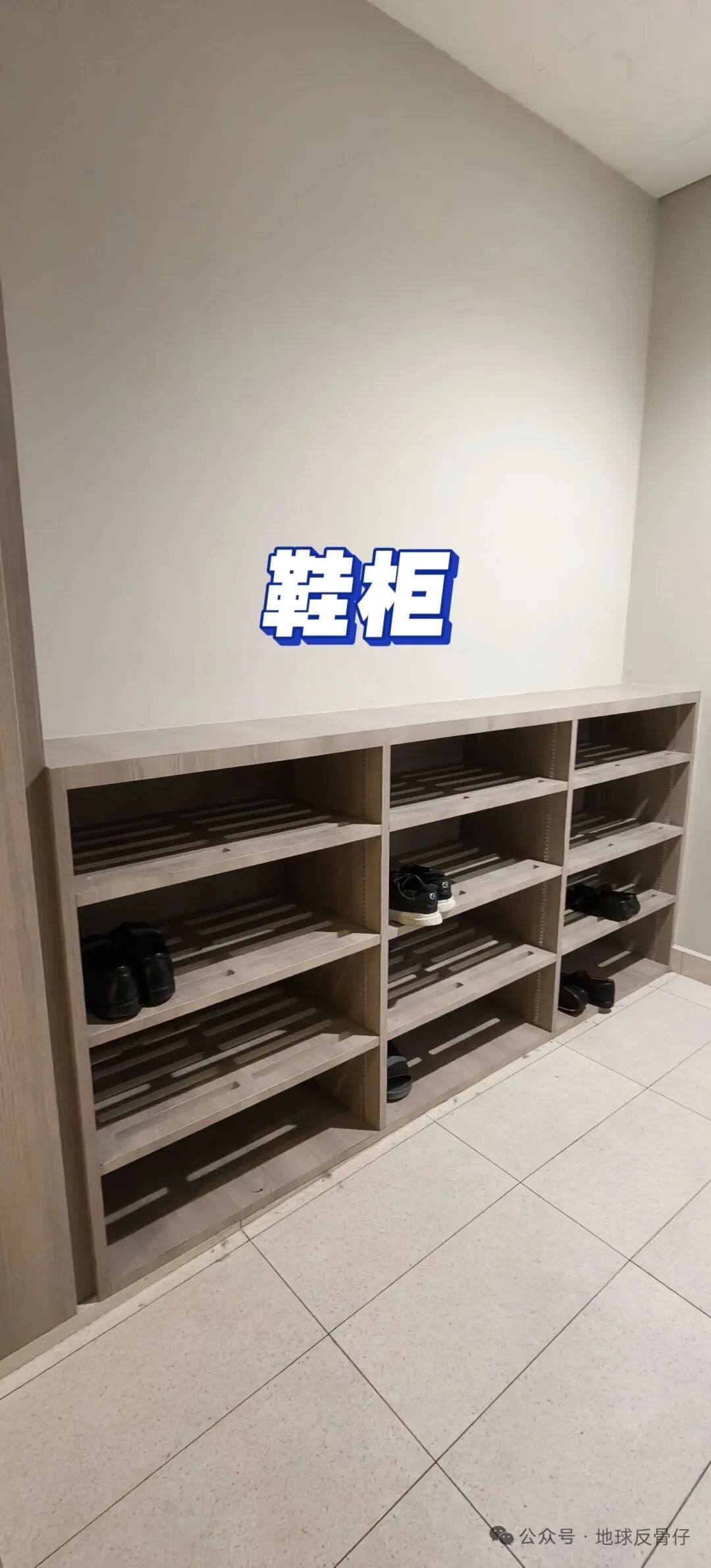
I have visited prayer rooms at Muscat Airport in Oman, Imam Khomeini Airport in Tehran, Iran, Qatar Airport, and Narita Airport in Japan. Compared to the airports in Middle Eastern countries, the prayer rooms at Singapore Airport are quite simple and have almost no decorations, much like the ones in Japan.
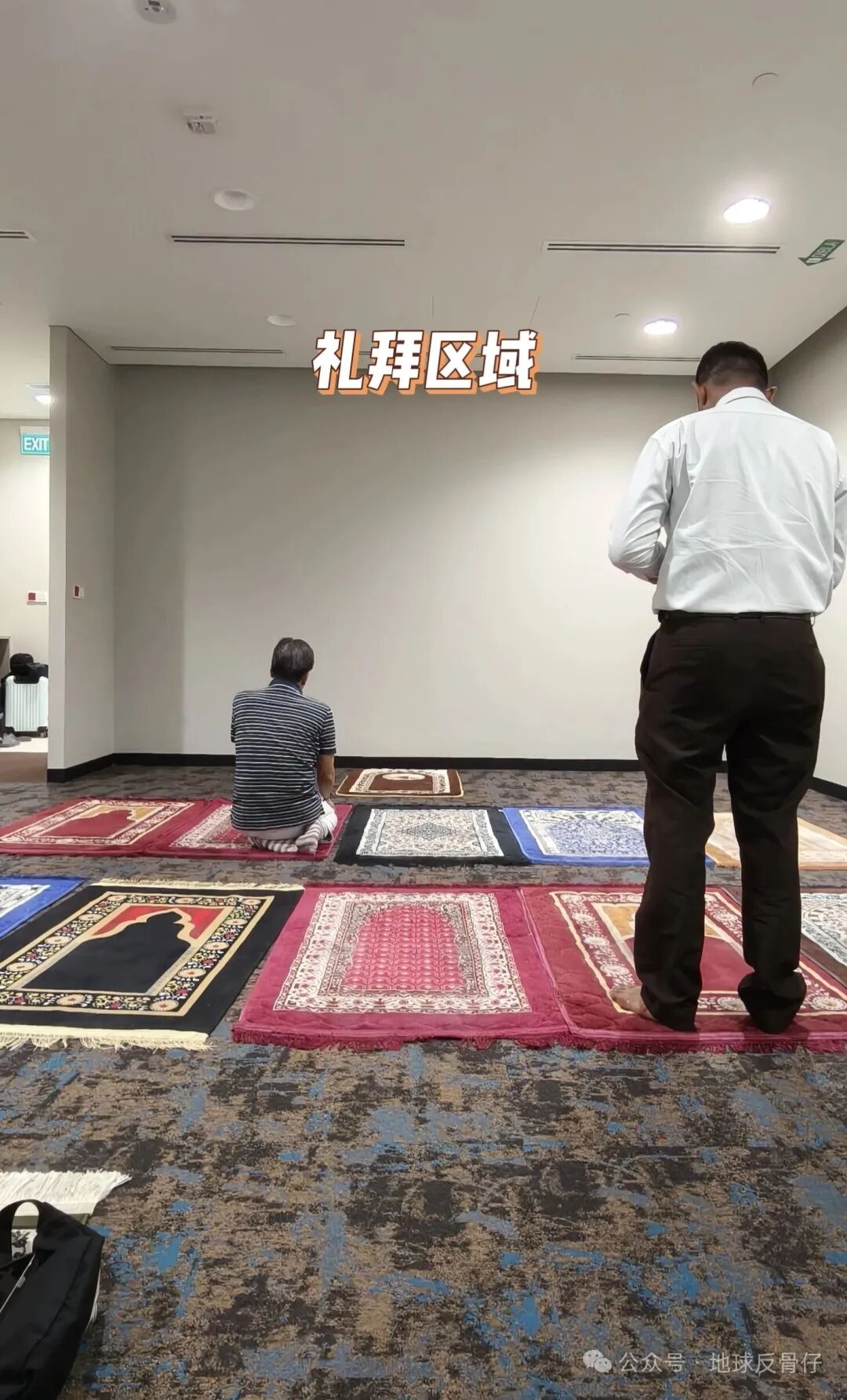
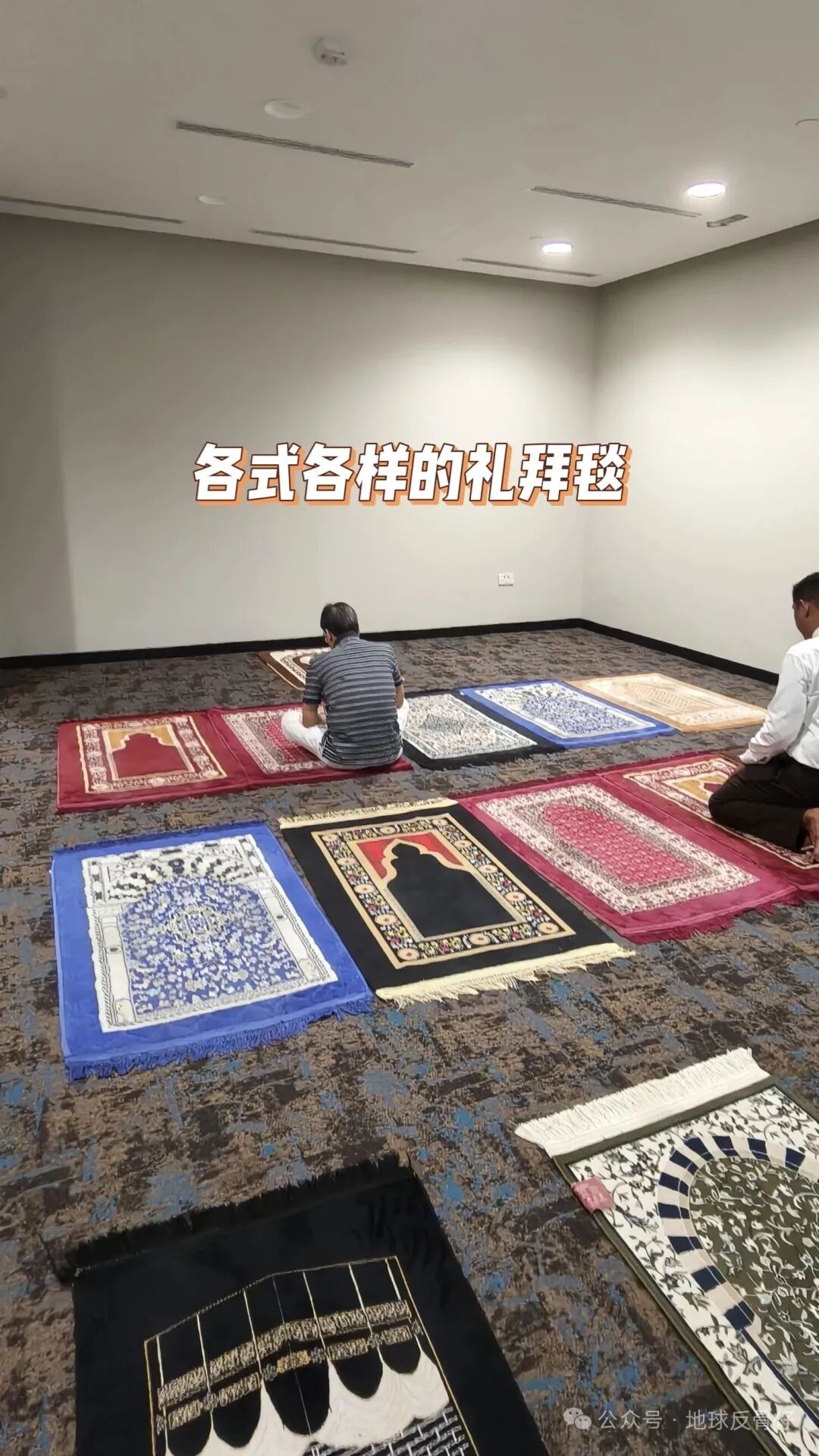
Next to the prayer area, there are various prayer supplies available, such as prayer caps, the Quran, perfume, and the sarong skirts worn by our Malay brothers.
Writing this, I have basically shared all the mosques I have visited in Singapore. I say "basically" because there is another mosque on Orchard Road located on the ground floor of an office building. It is decorated like a grand banquet hall, but unfortunately, I did not keep any photos of it. So, I did not include it this time. There is also the Darussalam Mosque. It was under construction when I visited, so I did not get any good photos and decided not to post about it yet.
Thank you all for your continued support. I will continue to update my travelogues about visiting mosques in other countries on this public platform. Please stay tuned.
Summary: This Singapore Muslim travel guide gathers the route covering Habib Noh Shrine, Haji Mohamed Salleh Mosque, Singapore Islamic Centre, and Changi Airport prayer rooms. It keeps the original checklist and image order intact.
In this issue:
18. Habib Noh Shrine
19. Haji Muhammad Salleh Mosque
20. Hajjah Fatimah Mosque
21. Changi Airport Prayer Room
Main text:
18. Habib Noh Shrine
Habib Noh is the local Singaporean transliteration. If we follow our naming habits back home, it is usually translated as Habib Nuh. Habib means beloved, and Nuh is the Prophet Noah. Nuh is a very common name in the Muslim world.
The domed building in the picture below is his shrine. This mosque actually started as a small prayer room built next to the shrine by Habib Nuh's friend, Haji Muhammad Salleh. It was later expanded into the mosque you see today.
When I visited at the end of last year, the shrine was undergoing renovations and was closed to the public. That is why I only visited the mosque back then and could not make it up to the tomb. I went back this time and the renovations were finally finished, so I could go up. To get up there, you have to climb a flight of stairs, and there is a front hall at the top. I met an elderly volunteer on duty there who told me that the person buried in the tomb, Habib Noh, was a descendant of the Prophet. He also urged me to look up his history. After looking it up, I learned that this wise man grew up in Penang, Malaysia, before moving to Singapore to settle down. His family roots were in Yemen, and he was born on a ship heading to Penang. He often used to go to Mount Palmer—the small hill where he is buried now—to meditate and perform namaz.
People say that after he passed away, they tried to bury him in a regular cemetery, but they could not move his body no matter what they did. Then, someone remembered him saying during his life that he wanted to be buried on Mount Palmer. They tried moving him there, and that is how they finally succeeded in burying him. As for this story, everyone can decide for themselves what to make of it.
Because the tomb is built on top of the hill, you have to climb a very long flight of stairs to reach it. After entering the tomb chamber, I found a spot and sat down cross-legged. People around me were kneeling, whispering duas, and then raising their hands to make dua to Allah.
Behind the tomb chamber is another grave covered by a metal grid, where Habib Nuh's cousin, Habib Abdul Rahman, is buried. He was Singapore's first kadi, which is an Islamic judge.
19. Haji Muhammad Salleh Mosque
This mosque is connected to the tomb chamber because it started as a prayer room next to the grave, built by a friend of Habib Nuh. The prayer room was expanded later to reach its current size. Let me show you what the inside of the main prayer hall looks like.
The main hall is not very big, but it is small and beautiful with a simple, modest style that does not look cheap at all. The pillars in the hall are mostly pure white, but the tops are decorated with gold, adding a touch of elegance to the room.
Although the ceiling is low, the designer used an open design so you can see the wooden beams. This design keeps the ceiling from feeling heavy, because if the room were already low and had a solid ceiling, it would feel very cramped.
The top of the mihrab niche is covered in simple mosaic tiles. The colors are muted and the patterns are basic, so it looks quite pleasant and does not distract from the rest of the room. A staff stands on the pulpit. The khutbah staff here in Singapore is different from the ones back home in China, where we usually use a smooth, dried branch that keeps the original shape of the wood. In Singapore, it is a straight metal staff with a metal ball attached to the top.
On the inner wall to the right of the niche hangs a small model of the door of the Kaaba (Mecca's House of God). I have seen this kind of model before in the gift shop of the Islamic Arts Museum Malaysia, so this style seems quite popular in mosques across Singapore and Malaysia.
Do you remember those steps leading up to the tomb (gongbei)? Looking up the steps, you can see the mosque's striking red roof.
20. Hajjah Fatimah Mosque
A wealthy lady donated the money to build this mosque. Her name was Hajjah Fatimah, and she was of Malay descent. A sign at the mosque entrance says it was built between 1845 and 1846, and the site was originally Hajjah Fatimah's own home. Hajjah Fatimah was a very wealthy Malay woman whose hometown was Malacca, Malaysia. You can see from this how close the connection is between Singapore and Malaysia. Just like the Temenggong Mosque we talked about before, that land still belongs to the state of Johor in Malaysia. Back to the story, in the late 1830s, this generous lady donated her property to build this mosque.
The first time I went there, it was almost nine o'clock at night, and Google Maps said it closed at nine. When I arrived, it didn't look like they were planning to close, so I wondered if Google Maps could be wrong. But after I finished my wudu and got ready to go in, the main hall was already locked. Well, they were polite enough to wait until I finished my namaz outside before they locked the courtyard gate.
I decided to go back the next day to see what the inside of the main hall looked like.
The most unique feature of this mosque is its minaret. Because it was designed by a British architect, the minaret has a Western style. Looking at it from a distance, I almost mistook it for a Christian church.
I came back here again the next morning. I found several groups of children sitting inside and outside the main hall, with about ten kids in each circle. A teacher led each group, teaching them to recite the Quran.
After finishing my namaz inside, I rushed to the airport because you really need to get there early for flights. I discovered that some flights actually stop boarding an hour early, which really caused me a lot of trouble. Isn't it usually half an hour before? I had about an hour left when I arrived at Changi Airport, and I told myself I would definitely make it. I did not expect my flight to close its counter exactly one hour early. The money for my plane ticket just went down the drain.
21. Prayer rooms at Singapore Changi Airport
Every terminal at Singapore Changi Airport actually has its own dedicated prayer room.
This time, I will show you the prayer room in Terminal 2 (T2) of Singapore Changi Airport. This place is very easy to find because the signs are clear, saying "dua room" in English with the Chinese and Japanese characters for dua room next to it.
The prayer rooms are separated for men and women. There is a sensor at the entrance, so you just wave your hand in front of it and the door opens automatically.
In the entryway of the prayer room, there are small stools for changing shoes and a shoe cabinet.
I have visited prayer rooms at Muscat Airport in Oman, Imam Khomeini Airport in Tehran, Iran, Qatar Airport, and Narita Airport in Japan. Compared to the airports in Middle Eastern countries, the prayer rooms at Singapore Airport are quite simple and have almost no decorations, much like the ones in Japan.
Next to the prayer area, there are various prayer supplies available, such as prayer caps, the Quran, perfume, and the sarong skirts worn by our Malay brothers.
Writing this, I have basically shared all the mosques I have visited in Singapore. I say "basically" because there is another mosque on Orchard Road located on the ground floor of an office building. It is decorated like a grand banquet hall, but unfortunately, I did not keep any photos of it. So, I did not include it this time. There is also the Darussalam Mosque. It was under construction when I visited, so I did not get any good photos and decided not to post about it yet.
Thank you all for your continued support. I will continue to update my travelogues about visiting mosques in other countries on this public platform. Please stay tuned.
Muslim Travel Guide Singapore: Haji Mohamed Salleh Mosque, Habib Noh Shrine and Prayer Hall
Articles • Hasan09 posted the article • 0 comments • 306 views • 2026-05-24 01:47
Reposted from the web
Summary: This Singapore Muslim travel guide turns from Habib Noh Shrine to Haji Mohamed Salleh Mosque itself. It keeps the mosque layout, prayer-hall notes, hillside setting, and source sequence unchanged.
Last time we focused on the tomb (gongbei) on the small hill next to the mosque. This time, let's look at the mosque itself. This mosque started as a small prayer room next to a tomb. It was later expanded to its current size.
The prayer hall is not very large, but it is small and beautiful. The interior decoration is simple and plain, but it is definitely not crude. The pillars inside are mostly pure white, but the tops are accented with a touch of gold, adding a bit of elegance to the hall.
The ceiling (Image 3) is low, but it has an open design that shows the wooden structure. This keeps the ceiling from feeling heavy, as a solid ceiling in such a low room would make people feel cramped.
The top of the mihrab (Image 5) is covered in simple mosaic tiles. The colors are muted and the design is simple, so it does not look too flashy or distract from the space.
A staff stands on the pulpit. The khutbah staff here in Singapore is different from the ones in China, where they are usually smooth, dry branches that keep the original shape of the wood. The one here in Singapore is a straight metal staff with a metal sphere on top.
On the right side inside the niche, there is a miniature model of the door of the Kaaba in Mecca (Image 6). I have seen this type of model in the shop at the Islamic Arts Museum Malaysia, so it seems popular in mosques across Singapore and Malaysia.
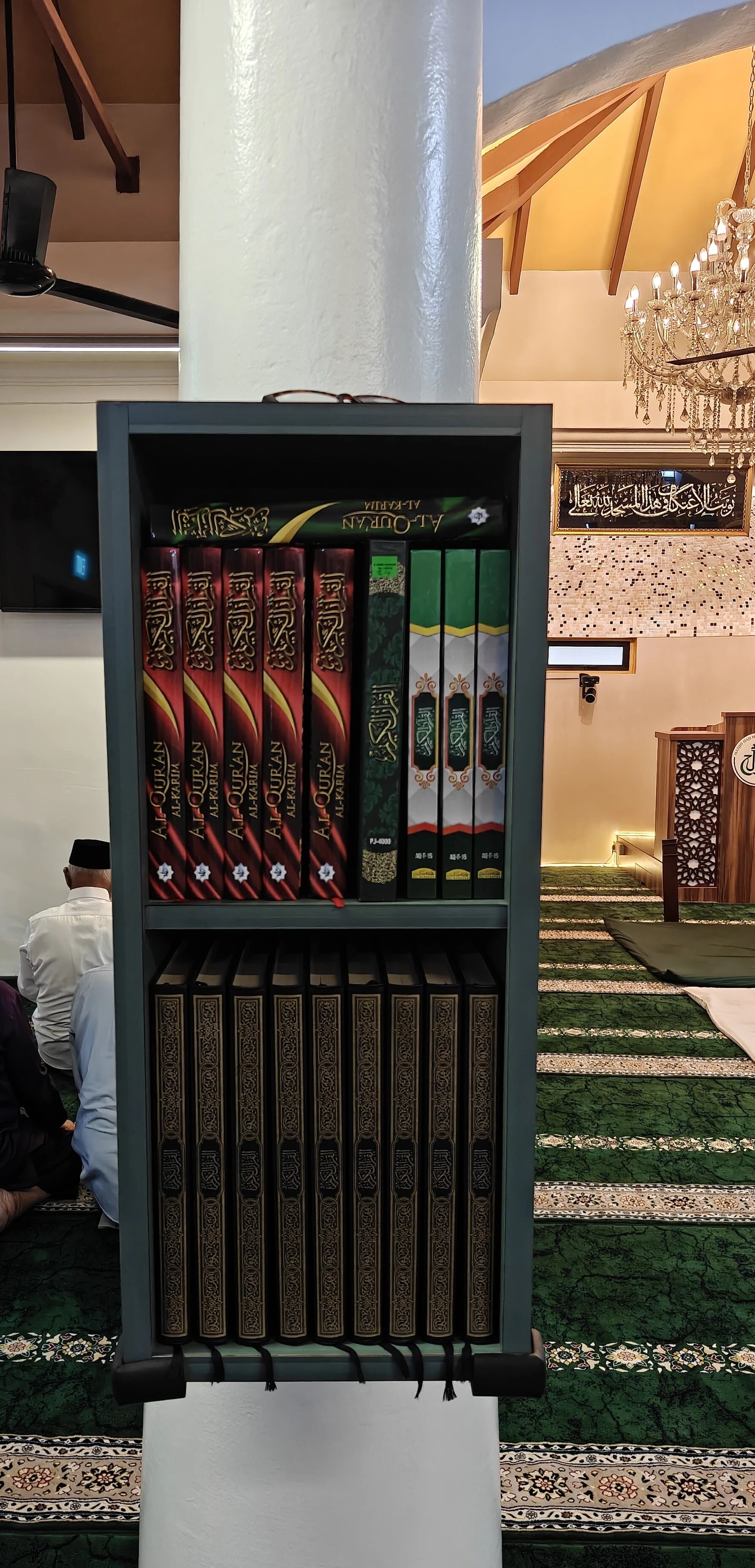
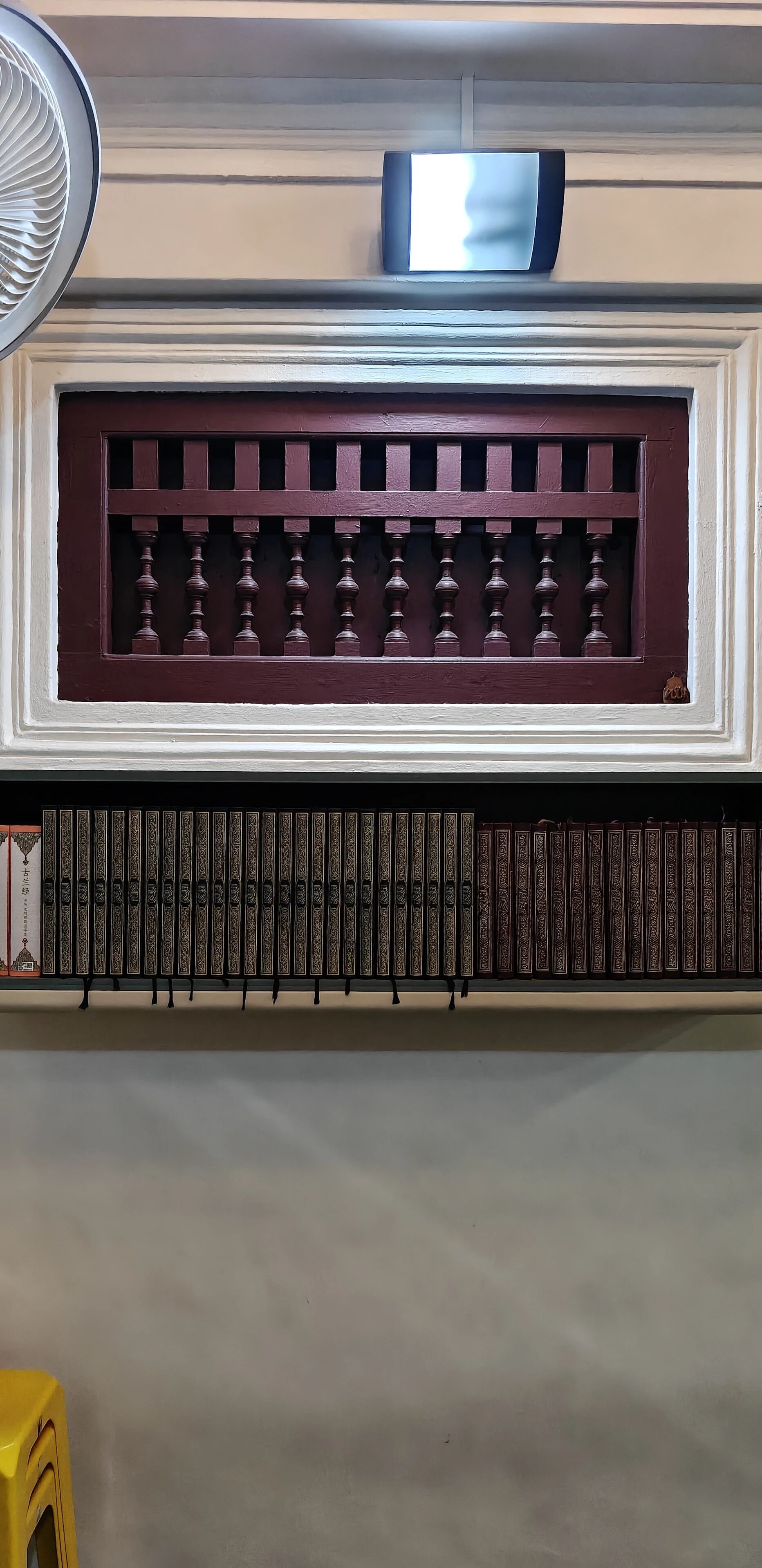
Copies of the Quran (Image 7) are neatly stacked on the pillars in the prayer hall. In some mosques, the books are placed a bit randomly and come in different styles.
I think the mosque management intentionally bought many copies of the Quran with the same covers to keep the interior looking tidy. Someone is specifically in charge of organizing them, making sure books with the same covers are kept together.
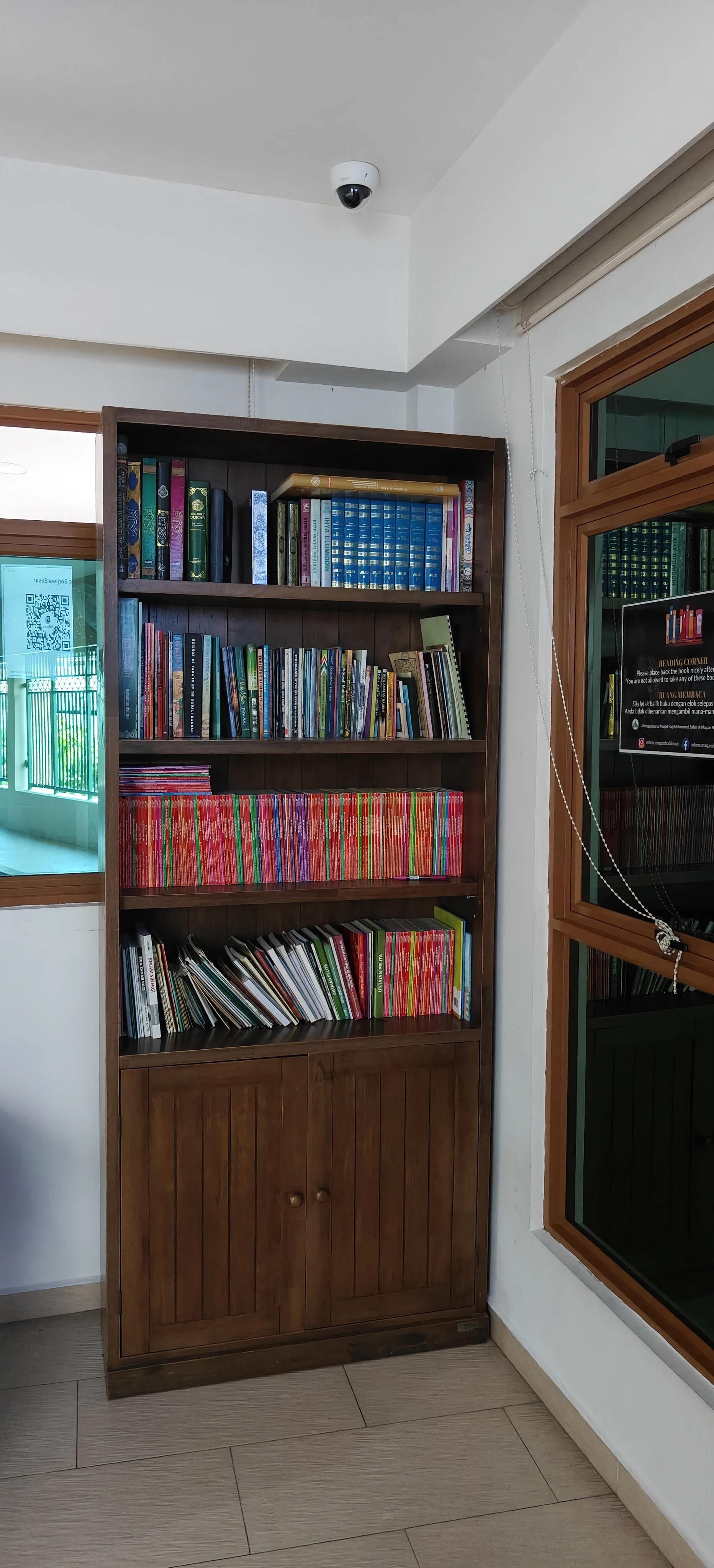
Let's look outside the prayer hall. Some guides mention a library here (Figure 10), which likely refers to a reading corner behind the prayer hall.
This small mosque also has an accessible elevator. I only noticed it while looking through my photos, even though I visited twice and never saw it.
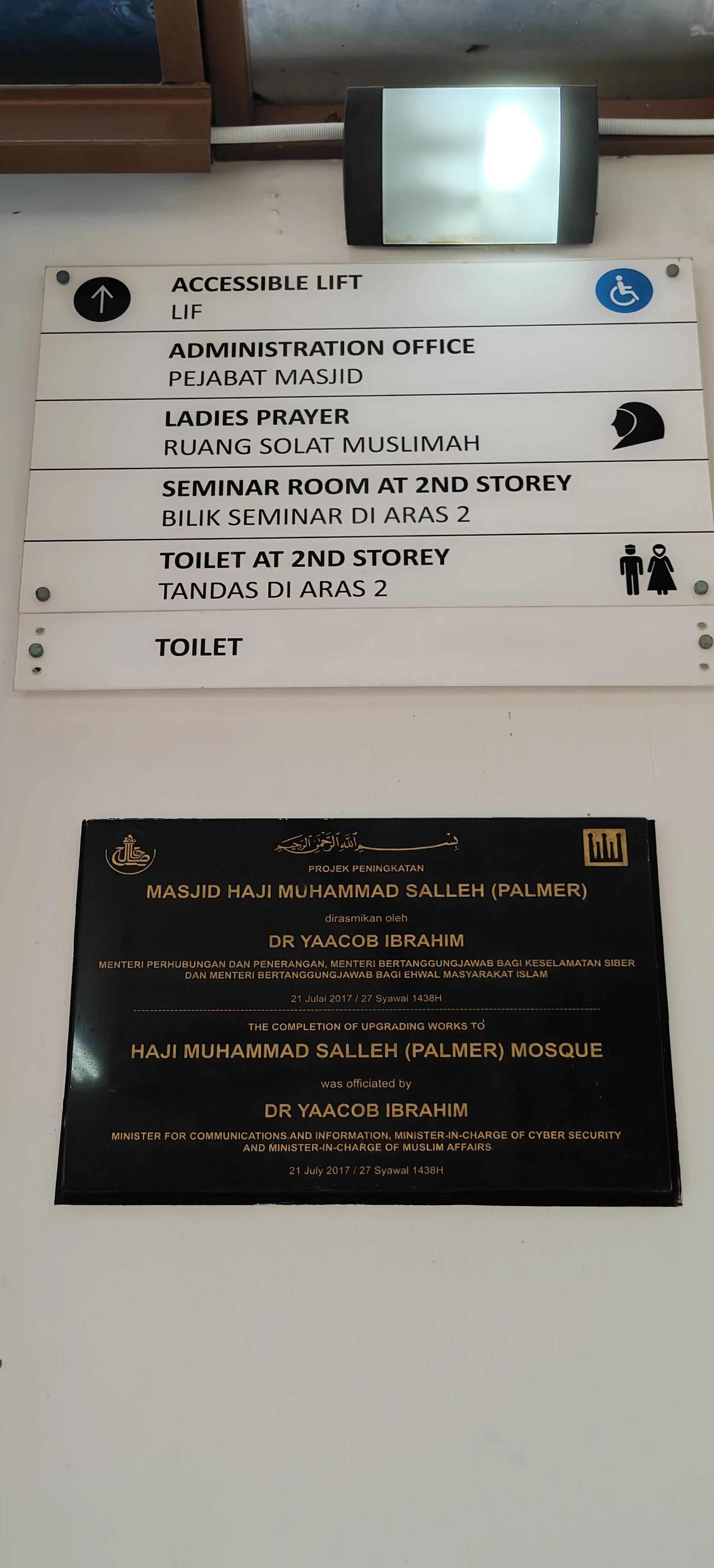
According to the sign (Figure 11), the second floor has a small meeting room, a women's prayer area, restrooms, and an administrative office.
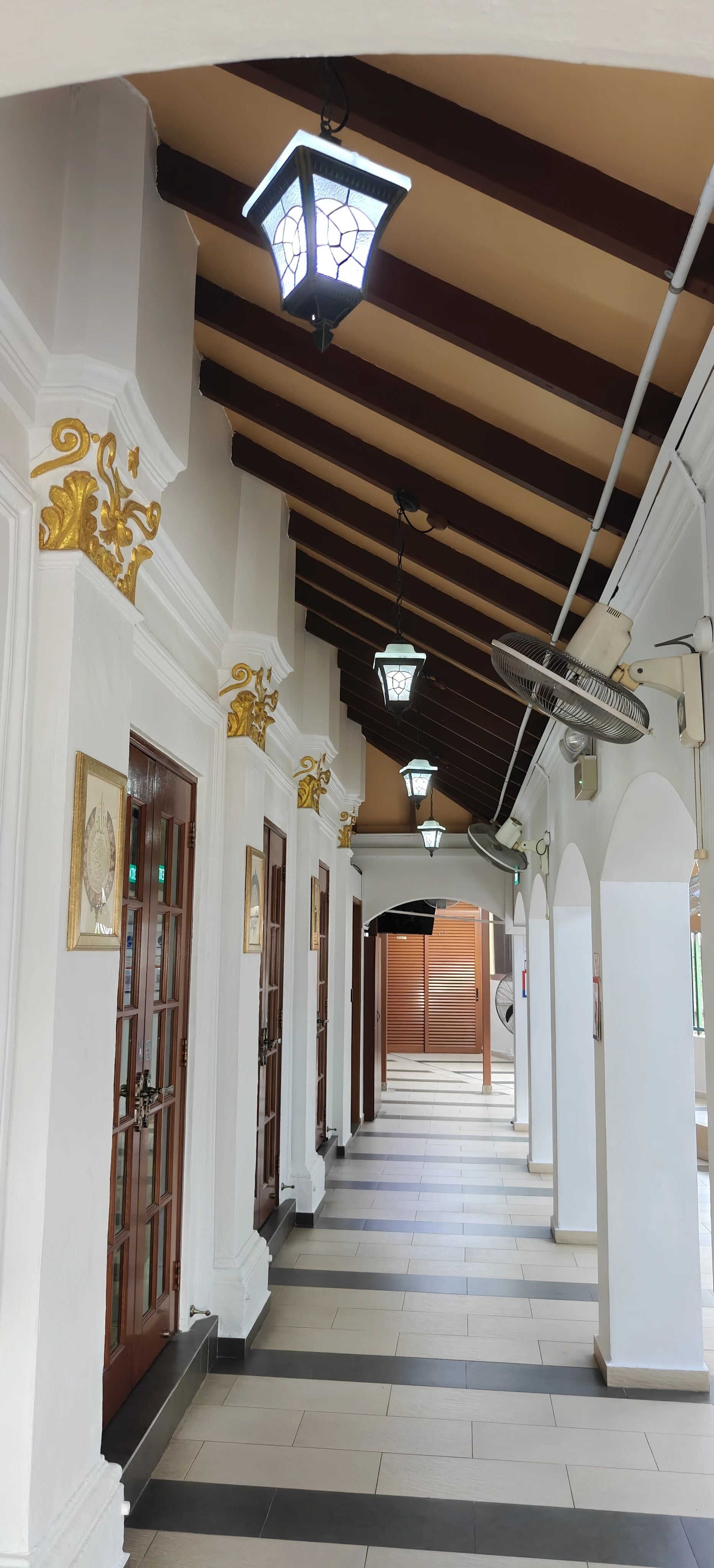
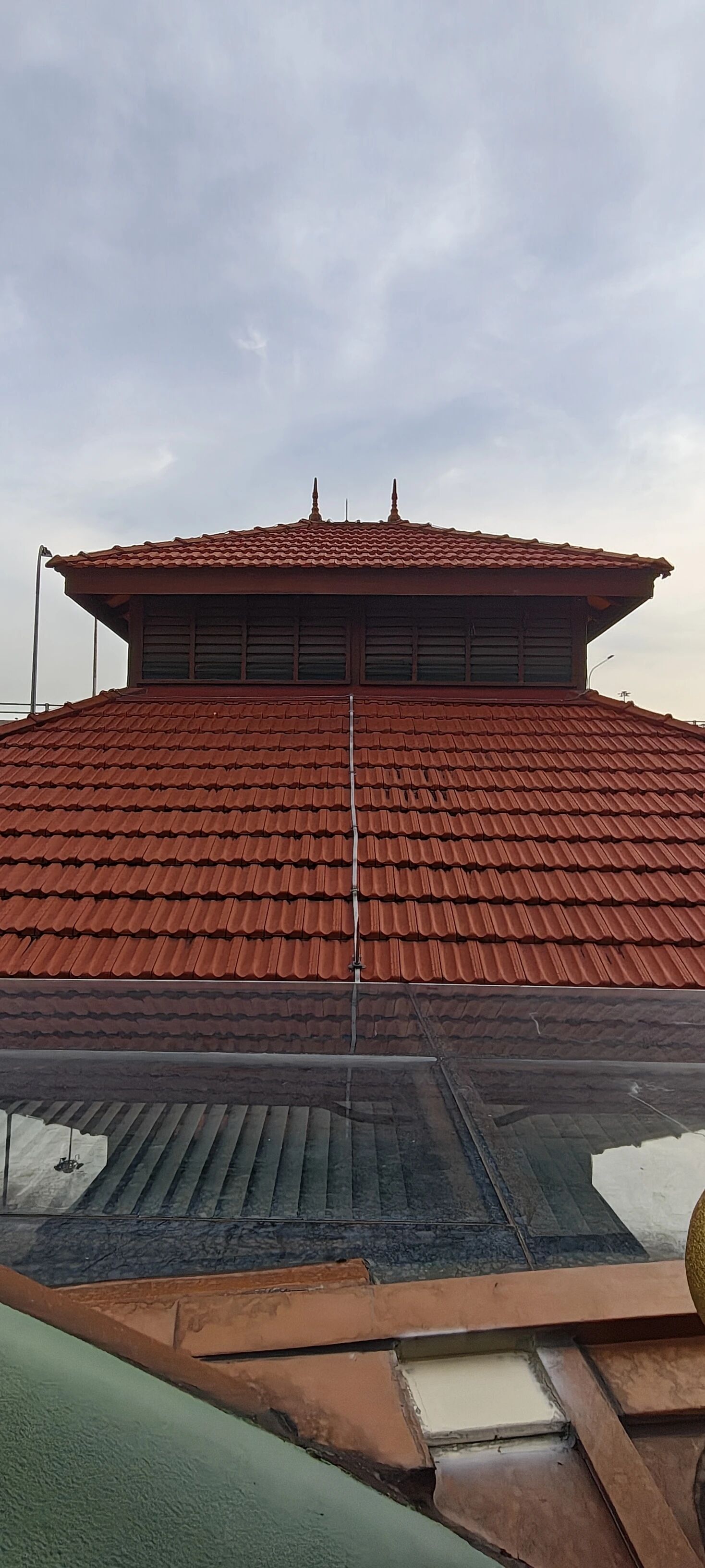
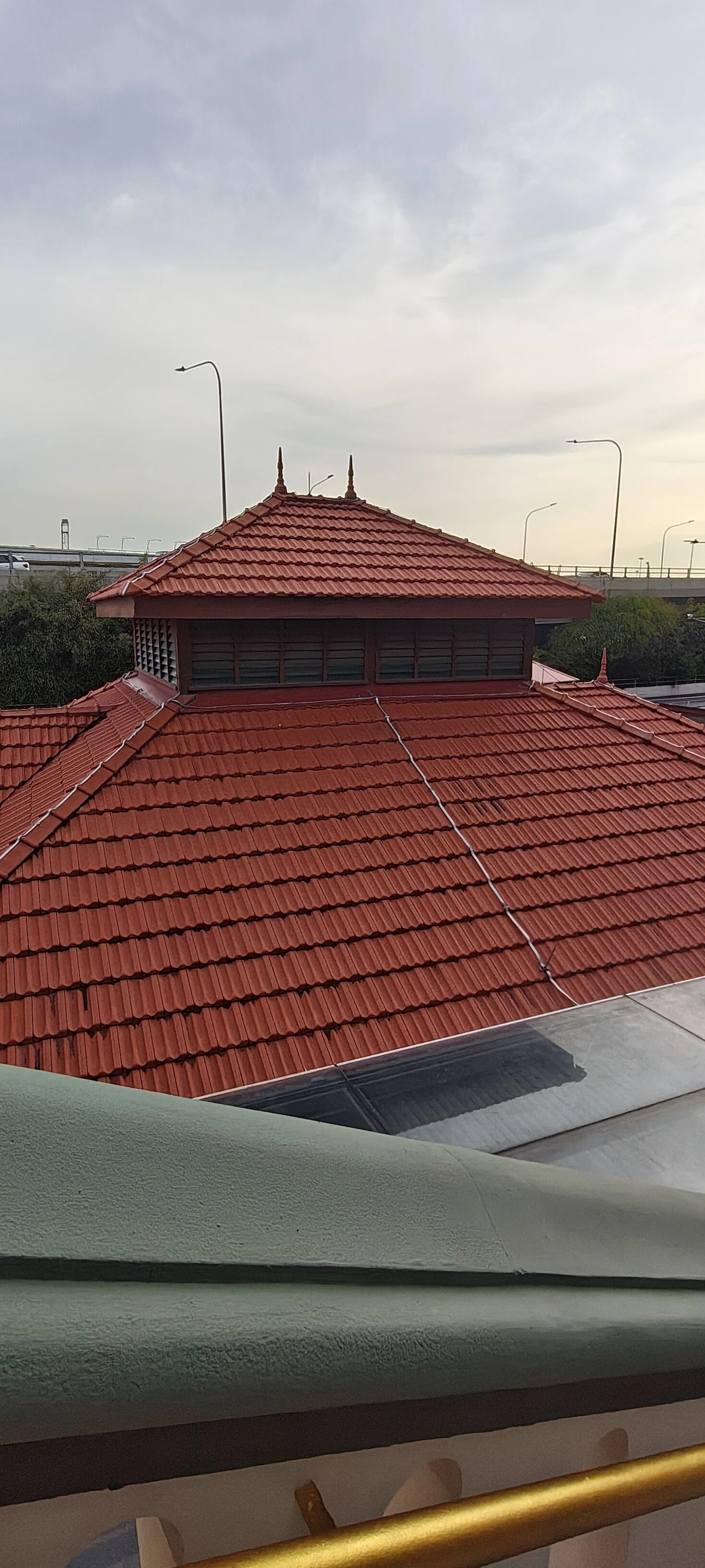
Climb the long steps up the nearby hill to see the roof of the mosque's prayer hall (Figure 12, Figure 13). The Malay-style building features this kind of sloped roof. view all
Summary: This Singapore Muslim travel guide turns from Habib Noh Shrine to Haji Mohamed Salleh Mosque itself. It keeps the mosque layout, prayer-hall notes, hillside setting, and source sequence unchanged.
Last time we focused on the tomb (gongbei) on the small hill next to the mosque. This time, let's look at the mosque itself. This mosque started as a small prayer room next to a tomb. It was later expanded to its current size.
The prayer hall is not very large, but it is small and beautiful. The interior decoration is simple and plain, but it is definitely not crude. The pillars inside are mostly pure white, but the tops are accented with a touch of gold, adding a bit of elegance to the hall.
The ceiling (Image 3) is low, but it has an open design that shows the wooden structure. This keeps the ceiling from feeling heavy, as a solid ceiling in such a low room would make people feel cramped.
The top of the mihrab (Image 5) is covered in simple mosaic tiles. The colors are muted and the design is simple, so it does not look too flashy or distract from the space.
A staff stands on the pulpit. The khutbah staff here in Singapore is different from the ones in China, where they are usually smooth, dry branches that keep the original shape of the wood. The one here in Singapore is a straight metal staff with a metal sphere on top.
On the right side inside the niche, there is a miniature model of the door of the Kaaba in Mecca (Image 6). I have seen this type of model in the shop at the Islamic Arts Museum Malaysia, so it seems popular in mosques across Singapore and Malaysia.
Copies of the Quran (Image 7) are neatly stacked on the pillars in the prayer hall. In some mosques, the books are placed a bit randomly and come in different styles.
I think the mosque management intentionally bought many copies of the Quran with the same covers to keep the interior looking tidy. Someone is specifically in charge of organizing them, making sure books with the same covers are kept together.
Let's look outside the prayer hall. Some guides mention a library here (Figure 10), which likely refers to a reading corner behind the prayer hall.
This small mosque also has an accessible elevator. I only noticed it while looking through my photos, even though I visited twice and never saw it.
According to the sign (Figure 11), the second floor has a small meeting room, a women's prayer area, restrooms, and an administrative office.
Climb the long steps up the nearby hill to see the roof of the mosque's prayer hall (Figure 12, Figure 13). The Malay-style building features this kind of sloped roof. view all
Reposted from the web
Summary: This Singapore Muslim travel guide turns from Habib Noh Shrine to Haji Mohamed Salleh Mosque itself. It keeps the mosque layout, prayer-hall notes, hillside setting, and source sequence unchanged.
Last time we focused on the tomb (gongbei) on the small hill next to the mosque. This time, let's look at the mosque itself. This mosque started as a small prayer room next to a tomb. It was later expanded to its current size.
The prayer hall is not very large, but it is small and beautiful. The interior decoration is simple and plain, but it is definitely not crude. The pillars inside are mostly pure white, but the tops are accented with a touch of gold, adding a bit of elegance to the hall.
The ceiling (Image 3) is low, but it has an open design that shows the wooden structure. This keeps the ceiling from feeling heavy, as a solid ceiling in such a low room would make people feel cramped.
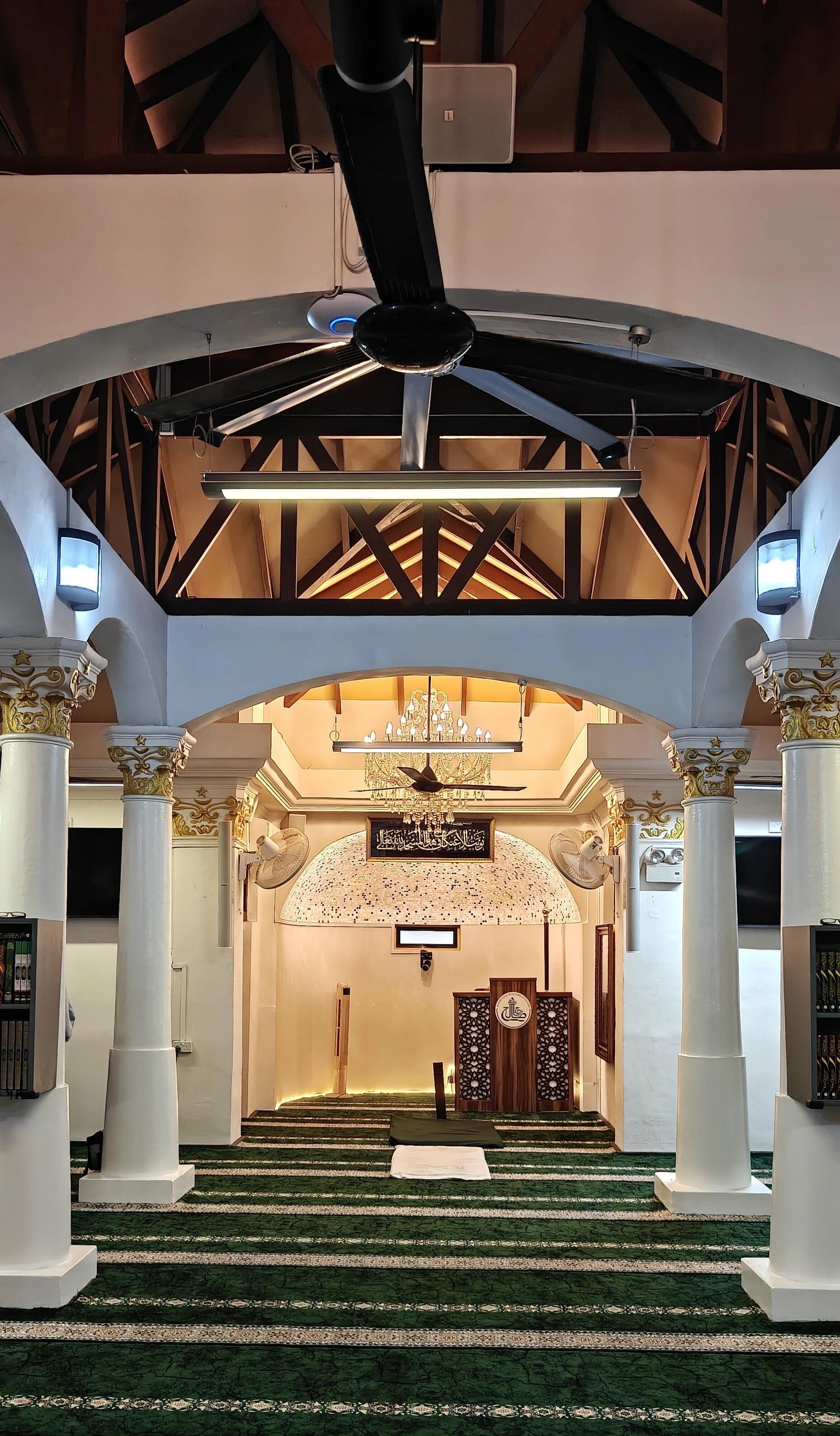
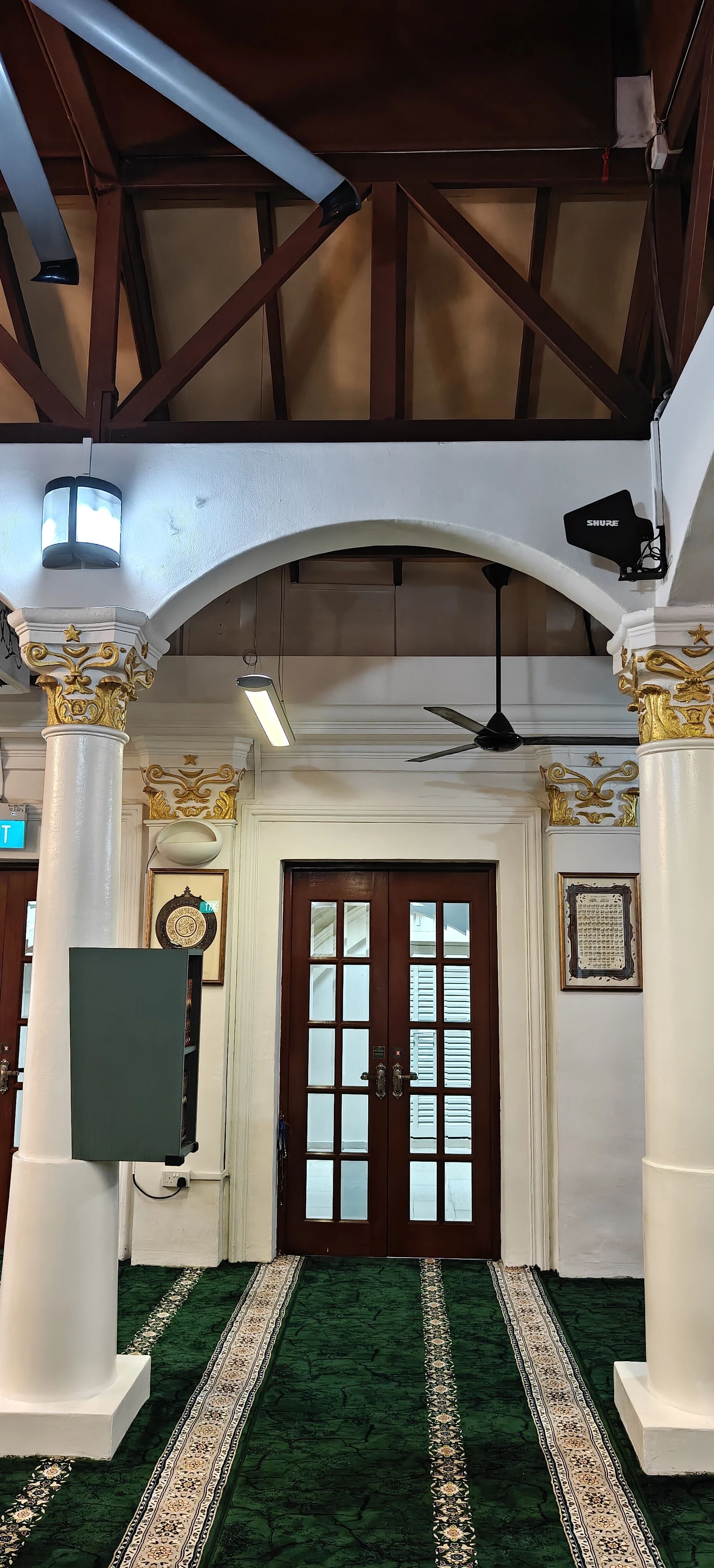
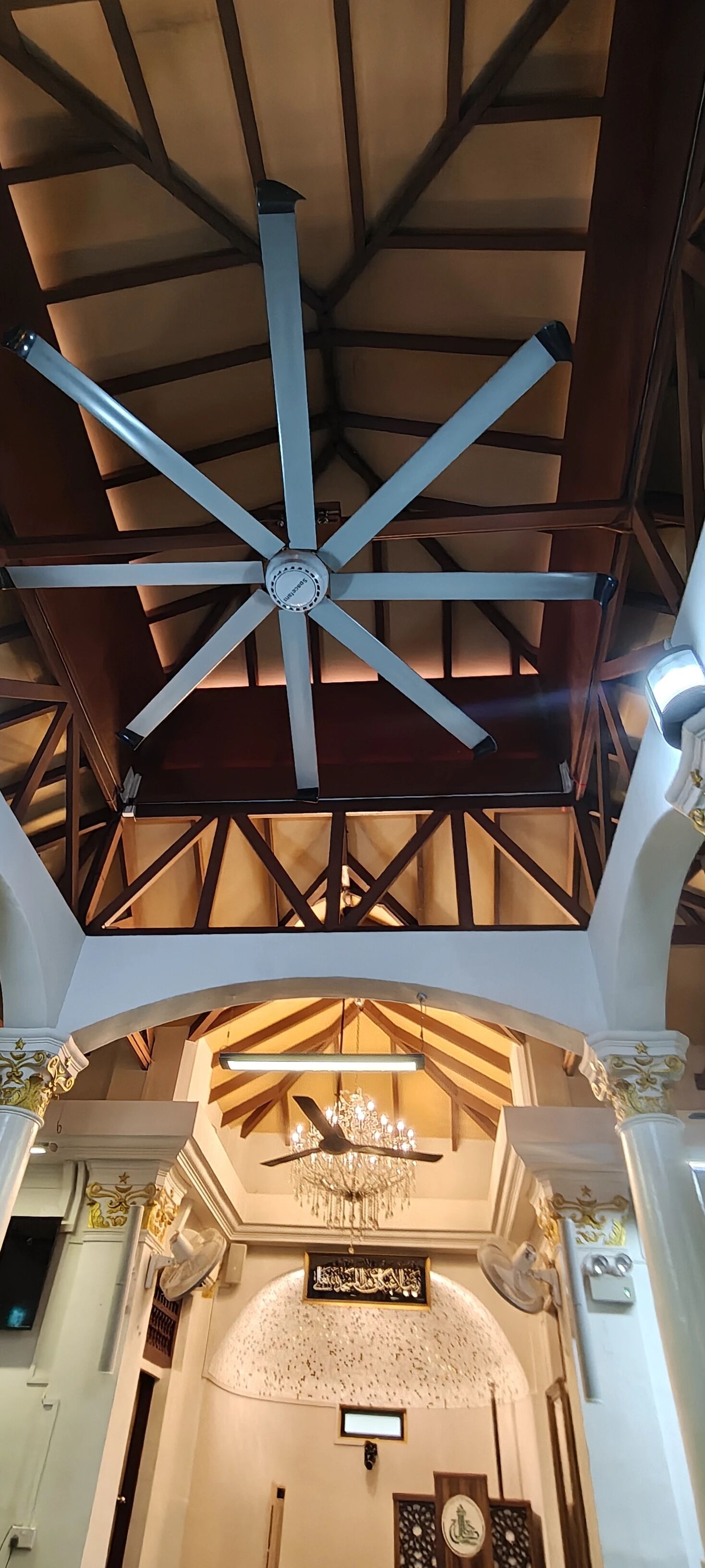
The top of the mihrab (Image 5) is covered in simple mosaic tiles. The colors are muted and the design is simple, so it does not look too flashy or distract from the space.
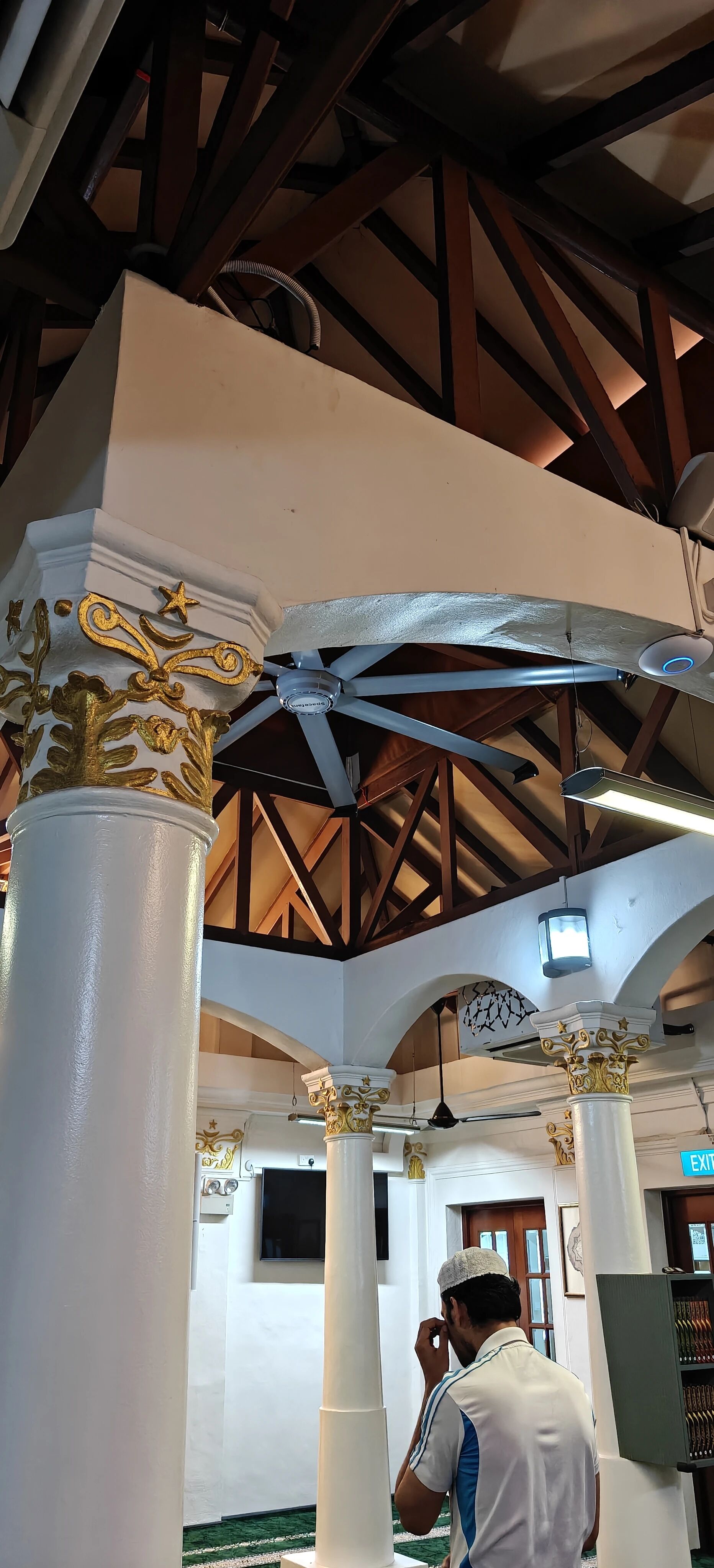
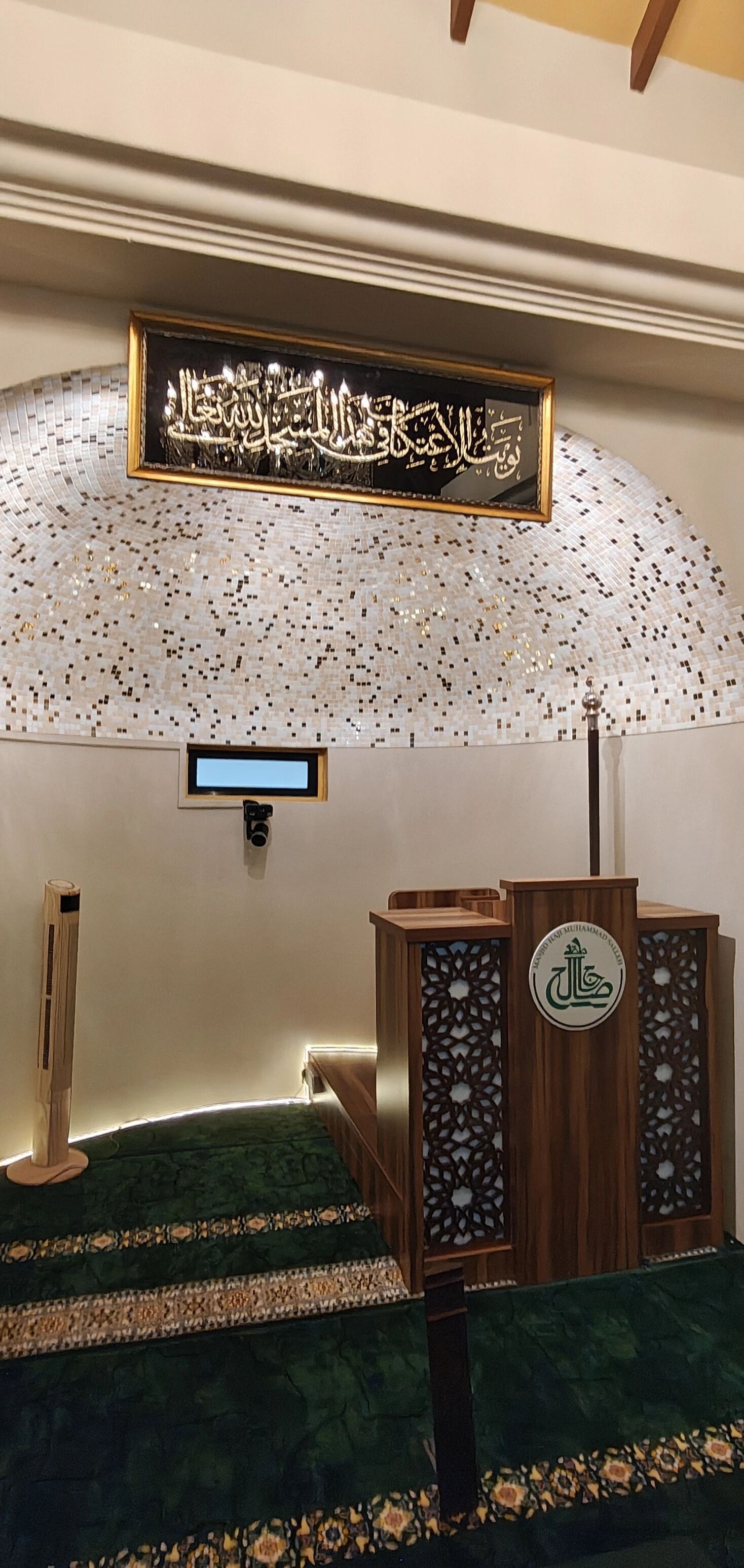
A staff stands on the pulpit. The khutbah staff here in Singapore is different from the ones in China, where they are usually smooth, dry branches that keep the original shape of the wood. The one here in Singapore is a straight metal staff with a metal sphere on top.
On the right side inside the niche, there is a miniature model of the door of the Kaaba in Mecca (Image 6). I have seen this type of model in the shop at the Islamic Arts Museum Malaysia, so it seems popular in mosques across Singapore and Malaysia.
Copies of the Quran (Image 7) are neatly stacked on the pillars in the prayer hall. In some mosques, the books are placed a bit randomly and come in different styles.
I think the mosque management intentionally bought many copies of the Quran with the same covers to keep the interior looking tidy. Someone is specifically in charge of organizing them, making sure books with the same covers are kept together.
Let's look outside the prayer hall. Some guides mention a library here (Figure 10), which likely refers to a reading corner behind the prayer hall.
This small mosque also has an accessible elevator. I only noticed it while looking through my photos, even though I visited twice and never saw it.
According to the sign (Figure 11), the second floor has a small meeting room, a women's prayer area, restrooms, and an administrative office.
Climb the long steps up the nearby hill to see the roof of the mosque's prayer hall (Figure 12, Figure 13). The Malay-style building features this kind of sloped roof.
Summary: This Singapore Muslim travel guide turns from Habib Noh Shrine to Haji Mohamed Salleh Mosque itself. It keeps the mosque layout, prayer-hall notes, hillside setting, and source sequence unchanged.
Last time we focused on the tomb (gongbei) on the small hill next to the mosque. This time, let's look at the mosque itself. This mosque started as a small prayer room next to a tomb. It was later expanded to its current size.
The prayer hall is not very large, but it is small and beautiful. The interior decoration is simple and plain, but it is definitely not crude. The pillars inside are mostly pure white, but the tops are accented with a touch of gold, adding a bit of elegance to the hall.
The ceiling (Image 3) is low, but it has an open design that shows the wooden structure. This keeps the ceiling from feeling heavy, as a solid ceiling in such a low room would make people feel cramped.
The top of the mihrab (Image 5) is covered in simple mosaic tiles. The colors are muted and the design is simple, so it does not look too flashy or distract from the space.
A staff stands on the pulpit. The khutbah staff here in Singapore is different from the ones in China, where they are usually smooth, dry branches that keep the original shape of the wood. The one here in Singapore is a straight metal staff with a metal sphere on top.
On the right side inside the niche, there is a miniature model of the door of the Kaaba in Mecca (Image 6). I have seen this type of model in the shop at the Islamic Arts Museum Malaysia, so it seems popular in mosques across Singapore and Malaysia.
Copies of the Quran (Image 7) are neatly stacked on the pillars in the prayer hall. In some mosques, the books are placed a bit randomly and come in different styles.
I think the mosque management intentionally bought many copies of the Quran with the same covers to keep the interior looking tidy. Someone is specifically in charge of organizing them, making sure books with the same covers are kept together.
Let's look outside the prayer hall. Some guides mention a library here (Figure 10), which likely refers to a reading corner behind the prayer hall.
This small mosque also has an accessible elevator. I only noticed it while looking through my photos, even though I visited twice and never saw it.
According to the sign (Figure 11), the second floor has a small meeting room, a women's prayer area, restrooms, and an administrative office.
Climb the long steps up the nearby hill to see the roof of the mosque's prayer hall (Figure 12, Figure 13). The Malay-style building features this kind of sloped roof.
Muslim Travel Guide Singapore: Habib Noh Shrine, Gongbei Tomb and Haji Mohamed Salleh Mosque
Articles • Hasan09 posted the article • 0 comments • 337 views • 2026-05-24 01:47
Reposted from the web
Summary: This Singapore Muslim travel guide visits Habib Noh Shrine beside Haji Mohamed Salleh Mosque. It preserves the route, the 1788-1866 date note, the gongbei tomb description, and the local Muslim heritage details.
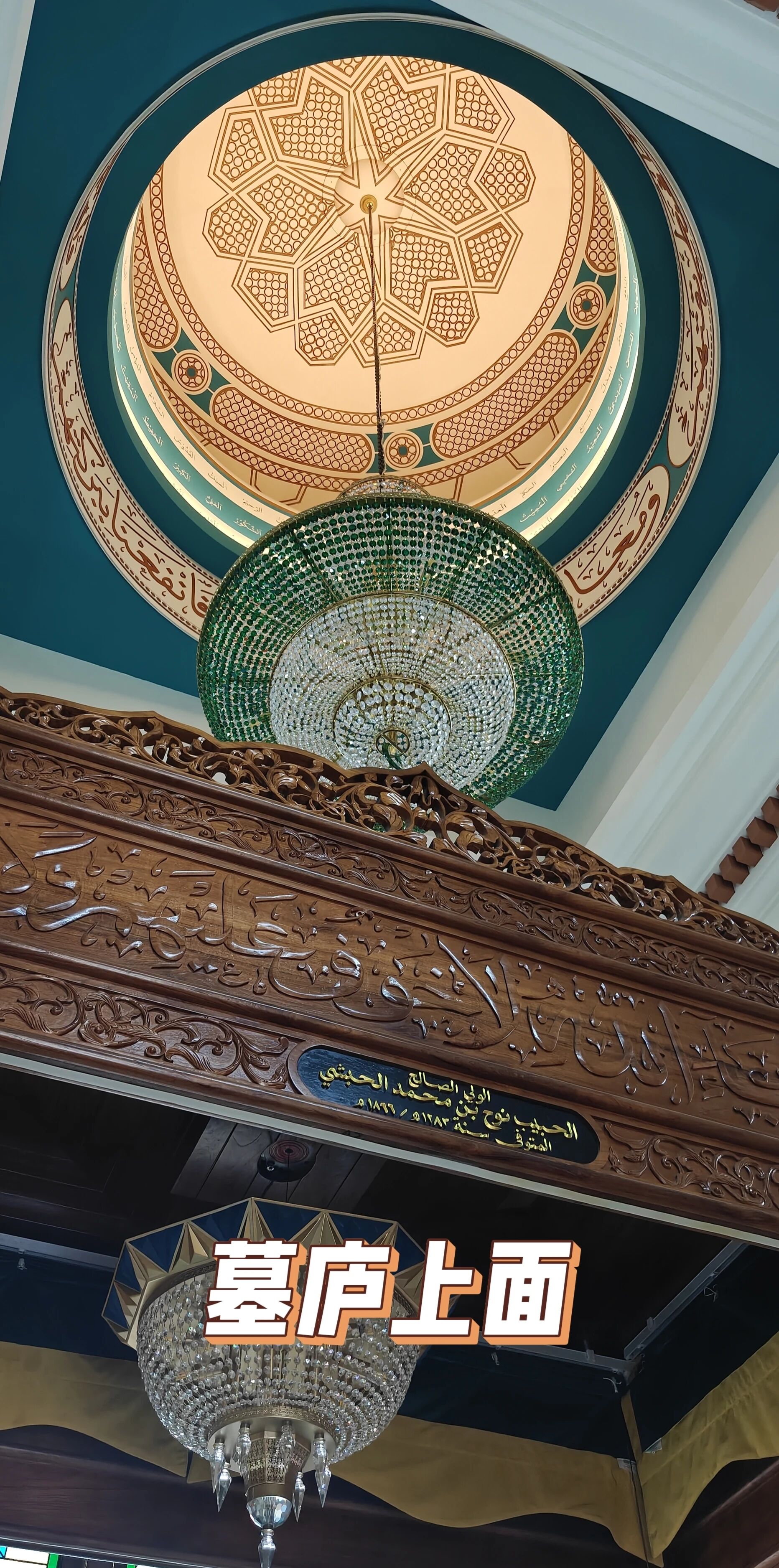
To get here, set your navigation for Haji Muhammad Salleh Mosque. The mosque sits next to a small hill where a Muslim sage named Habib Noh (1788–1866) is buried. The building with the dome is his tomb (gongbei).
Haji Muhammad Salleh, a friend of Habib Noh, originally built a prayer room next to the tomb, which was later expanded into this mosque.
I visited at the end of last year, but the tomb was closed for renovations. So, I only visited the mosque and did not go up to the tomb. This time, the renovations were finished, so I could go up.
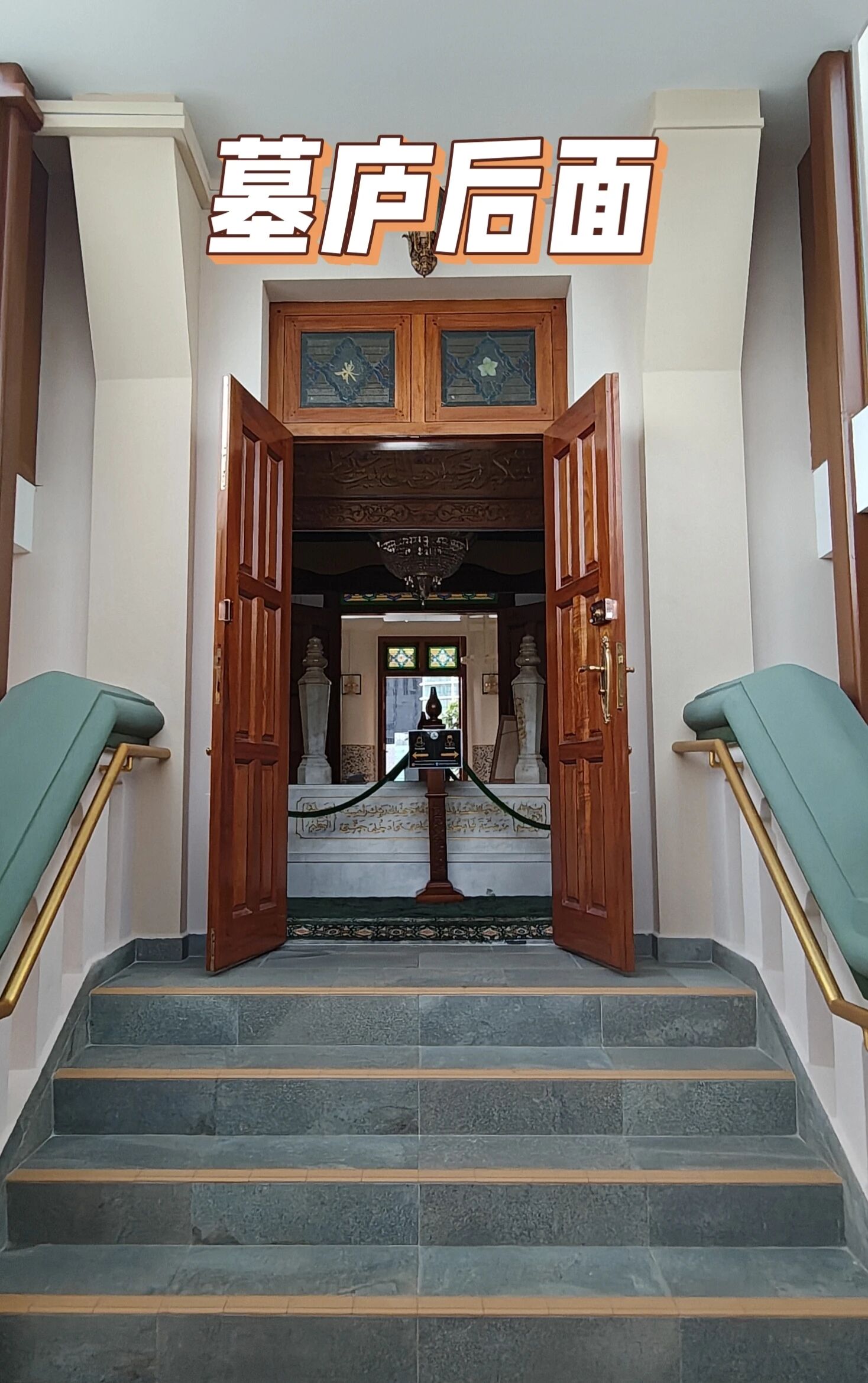
You have to climb a flight of stairs to reach the tomb's front hall. An elderly volunteer who guards the tomb told me that Habib Noh was a descendant of the Prophet and suggested I look up more information about him.
It turns out this sage grew up in Penang, Malaysia, before moving to Singapore. His family was from Yemen, and he was born on a ship heading to Penang. He often spent time meditating on Palmer Hill, the same small hill where he is buried today.
People say that after he passed away, they tried to move his body to a cemetery, but they could not move him at all. At this point, someone remembered he had said before he died that he wanted to be buried on the hills of Parma. Only then were they able to bury him successfully. Everyone can form their own opinion on this story.
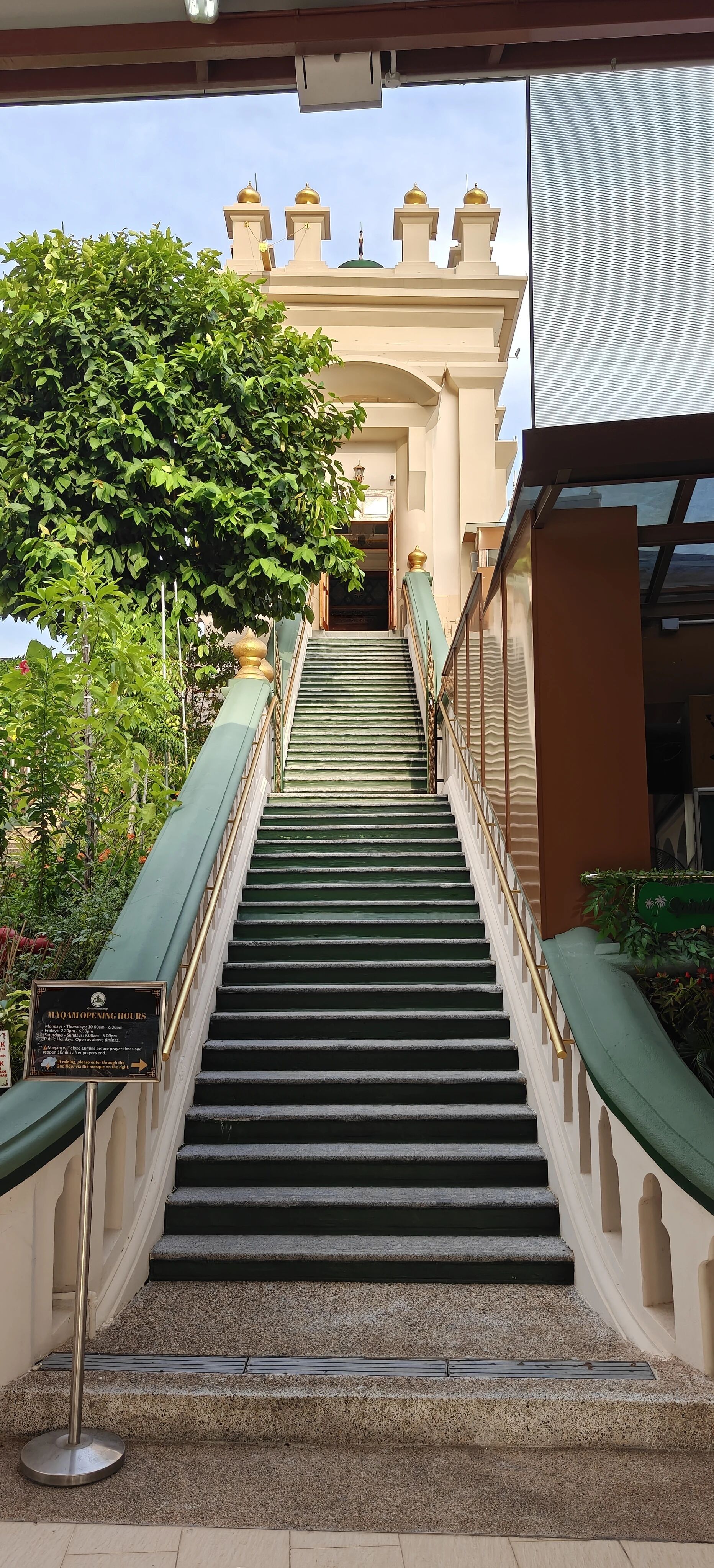
We can enter the tomb chamber by taking the long stairs shown in picture three.
Once inside the tomb chamber, I sat cross-legged. The people around me knelt, whispered prayers, and then raised their hands to make dua.
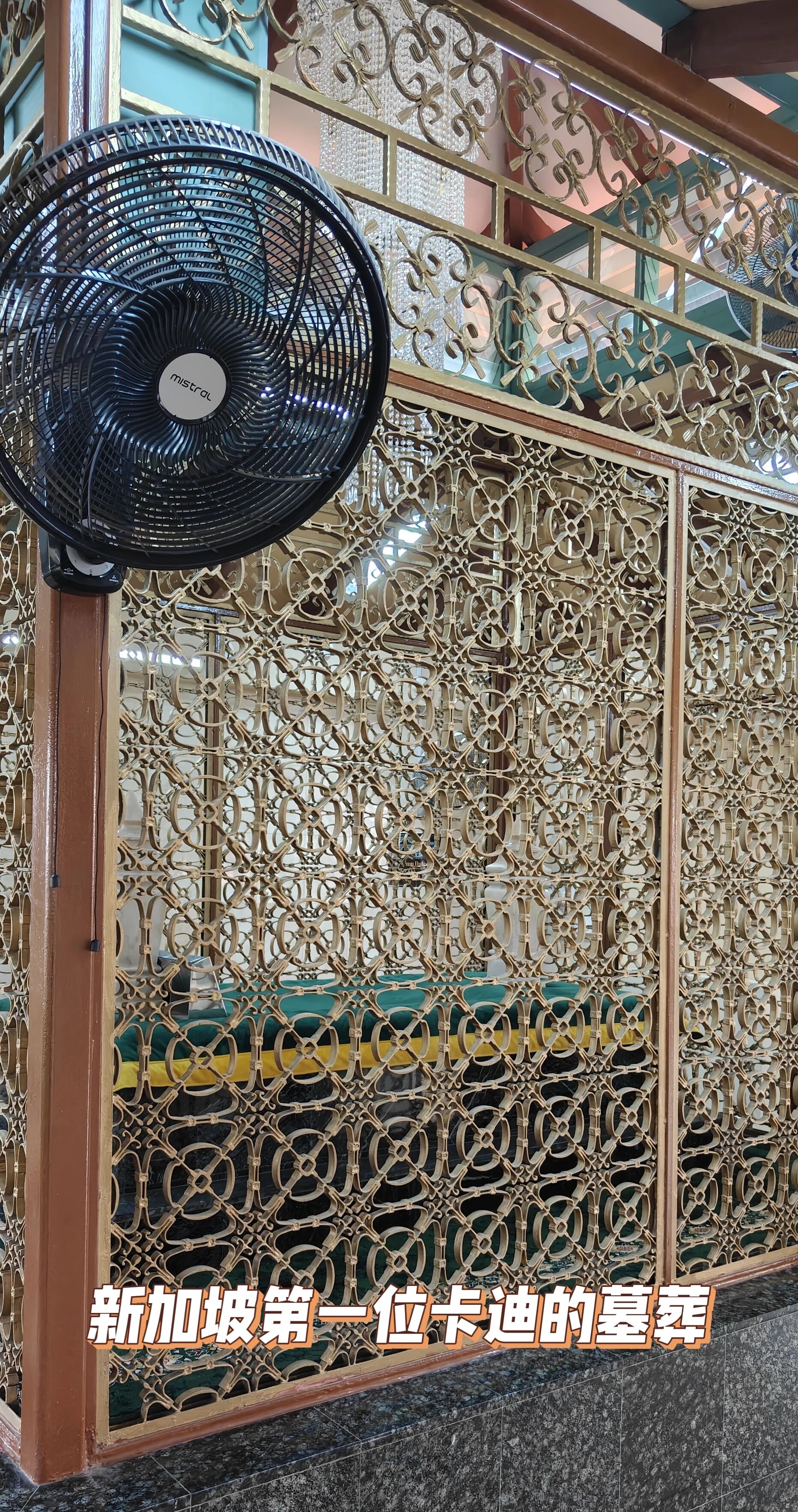
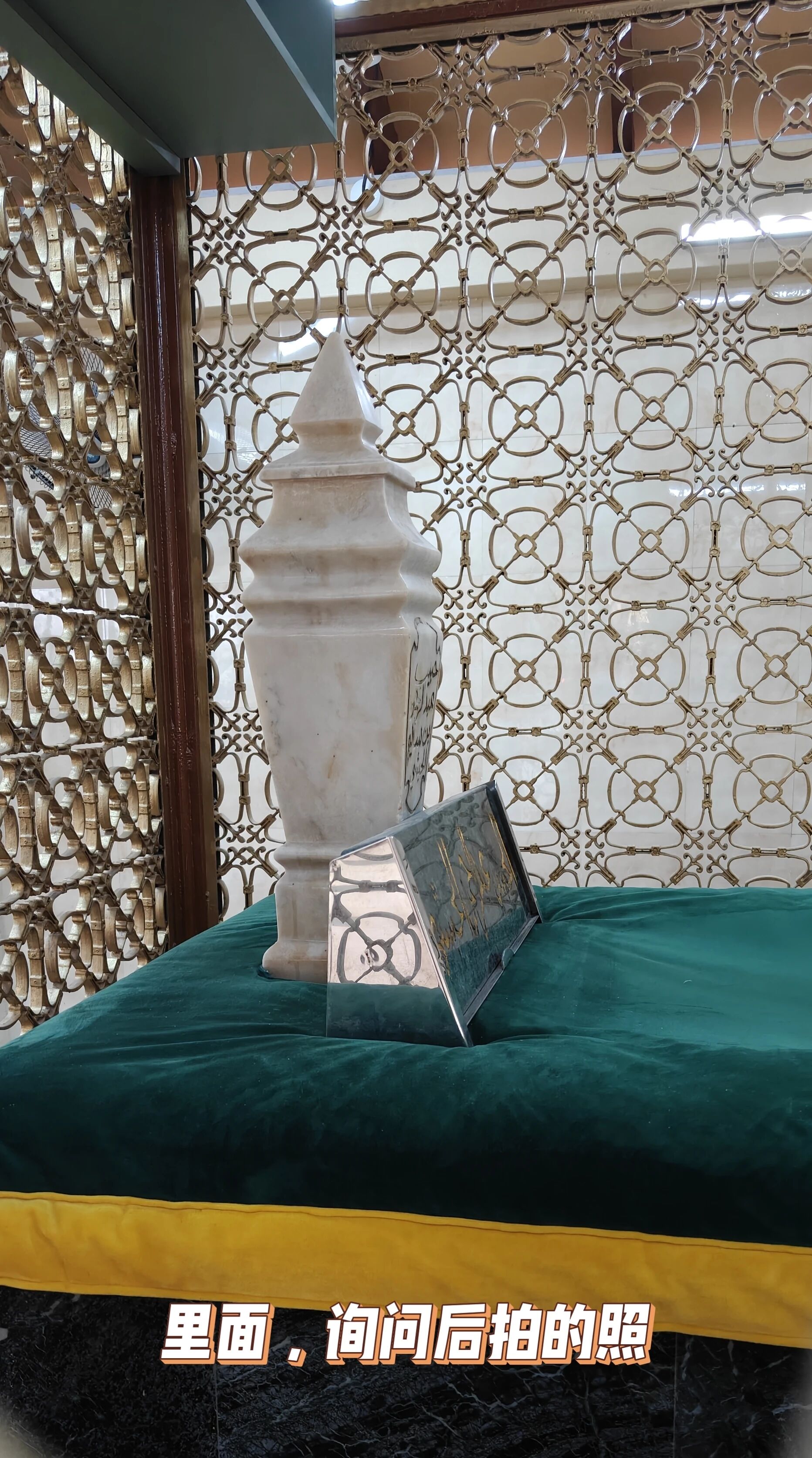
Behind the tomb chamber is another grave covered by a metal grid, where Habib Nuh's cousin, Habib Abdul Rahman, is buried. He was the first kadi (Islamic judge) of Singapore.
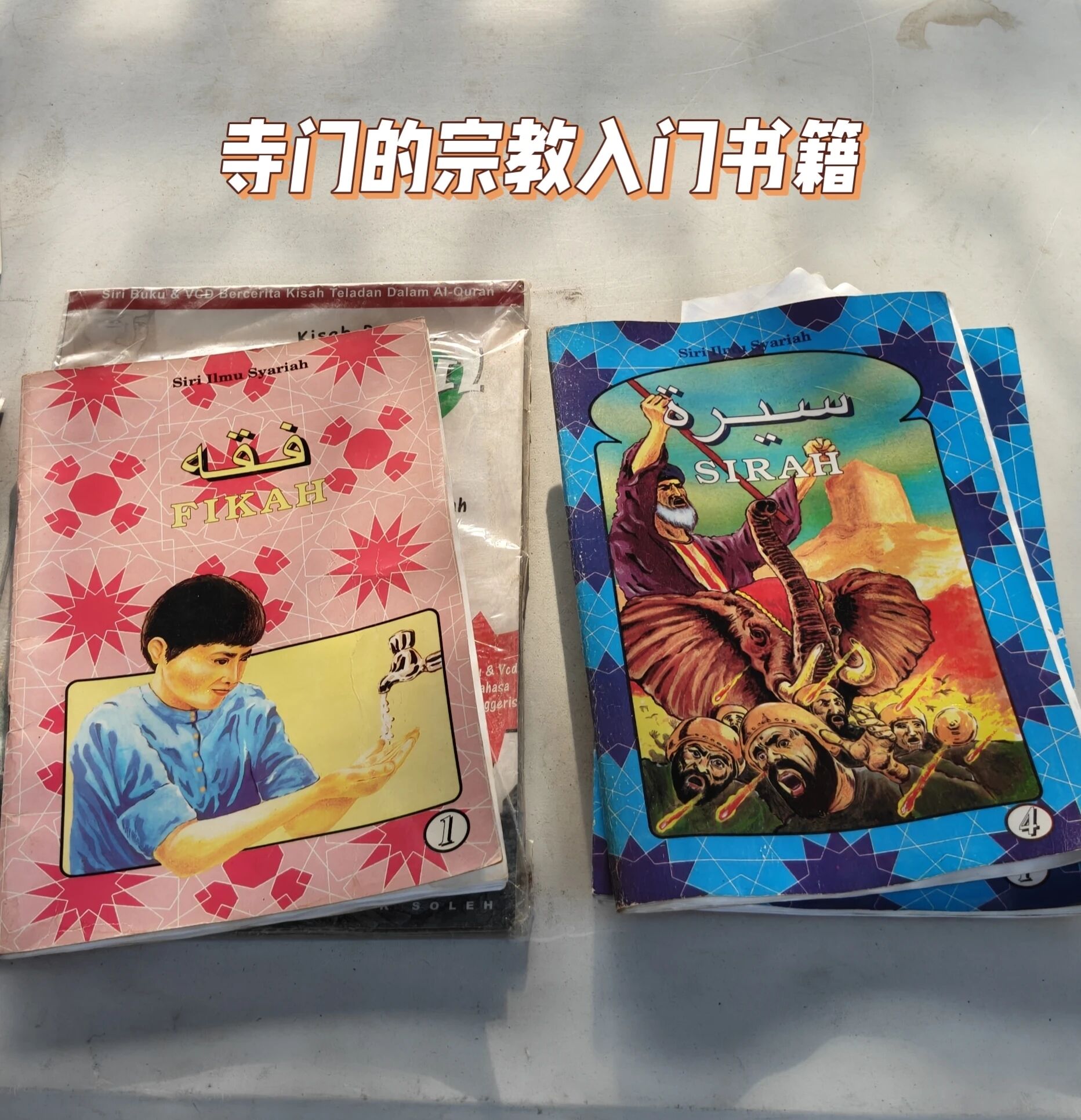
We returned to the mosque, where some introductory religious books were displayed at the entrance (picture nine); judging by the covers, the one on the left likely teaches how to perform wudu before namaz.
The book on the right features an elephant and a meteorite on the cover, so it is likely about the story of the Elephant in the Quran, making it a book of Quranic stories.
The mosque at the foot of the hill has a distinct Southeast Asian style with a clearly visible roof structure, similar to the huts built by the Malay people. It seems like living in a house like this would be very cool.
Inside the mihrab niche, there is also a miniature model of the door to the Kaaba in Mecca (Figure 14).
This place is very close to the busy areas of Singapore, so I usually head over to the Flower Dome after visiting here. view all
Summary: This Singapore Muslim travel guide visits Habib Noh Shrine beside Haji Mohamed Salleh Mosque. It preserves the route, the 1788-1866 date note, the gongbei tomb description, and the local Muslim heritage details.
To get here, set your navigation for Haji Muhammad Salleh Mosque. The mosque sits next to a small hill where a Muslim sage named Habib Noh (1788–1866) is buried. The building with the dome is his tomb (gongbei).
Haji Muhammad Salleh, a friend of Habib Noh, originally built a prayer room next to the tomb, which was later expanded into this mosque.
I visited at the end of last year, but the tomb was closed for renovations. So, I only visited the mosque and did not go up to the tomb. This time, the renovations were finished, so I could go up.
You have to climb a flight of stairs to reach the tomb's front hall. An elderly volunteer who guards the tomb told me that Habib Noh was a descendant of the Prophet and suggested I look up more information about him.
It turns out this sage grew up in Penang, Malaysia, before moving to Singapore. His family was from Yemen, and he was born on a ship heading to Penang. He often spent time meditating on Palmer Hill, the same small hill where he is buried today.
People say that after he passed away, they tried to move his body to a cemetery, but they could not move him at all. At this point, someone remembered he had said before he died that he wanted to be buried on the hills of Parma. Only then were they able to bury him successfully. Everyone can form their own opinion on this story.
We can enter the tomb chamber by taking the long stairs shown in picture three.
Once inside the tomb chamber, I sat cross-legged. The people around me knelt, whispered prayers, and then raised their hands to make dua.
Behind the tomb chamber is another grave covered by a metal grid, where Habib Nuh's cousin, Habib Abdul Rahman, is buried. He was the first kadi (Islamic judge) of Singapore.
We returned to the mosque, where some introductory religious books were displayed at the entrance (picture nine); judging by the covers, the one on the left likely teaches how to perform wudu before namaz.
The book on the right features an elephant and a meteorite on the cover, so it is likely about the story of the Elephant in the Quran, making it a book of Quranic stories.
The mosque at the foot of the hill has a distinct Southeast Asian style with a clearly visible roof structure, similar to the huts built by the Malay people. It seems like living in a house like this would be very cool.
Inside the mihrab niche, there is also a miniature model of the door to the Kaaba in Mecca (Figure 14).
This place is very close to the busy areas of Singapore, so I usually head over to the Flower Dome after visiting here. view all
Reposted from the web
Summary: This Singapore Muslim travel guide visits Habib Noh Shrine beside Haji Mohamed Salleh Mosque. It preserves the route, the 1788-1866 date note, the gongbei tomb description, and the local Muslim heritage details.
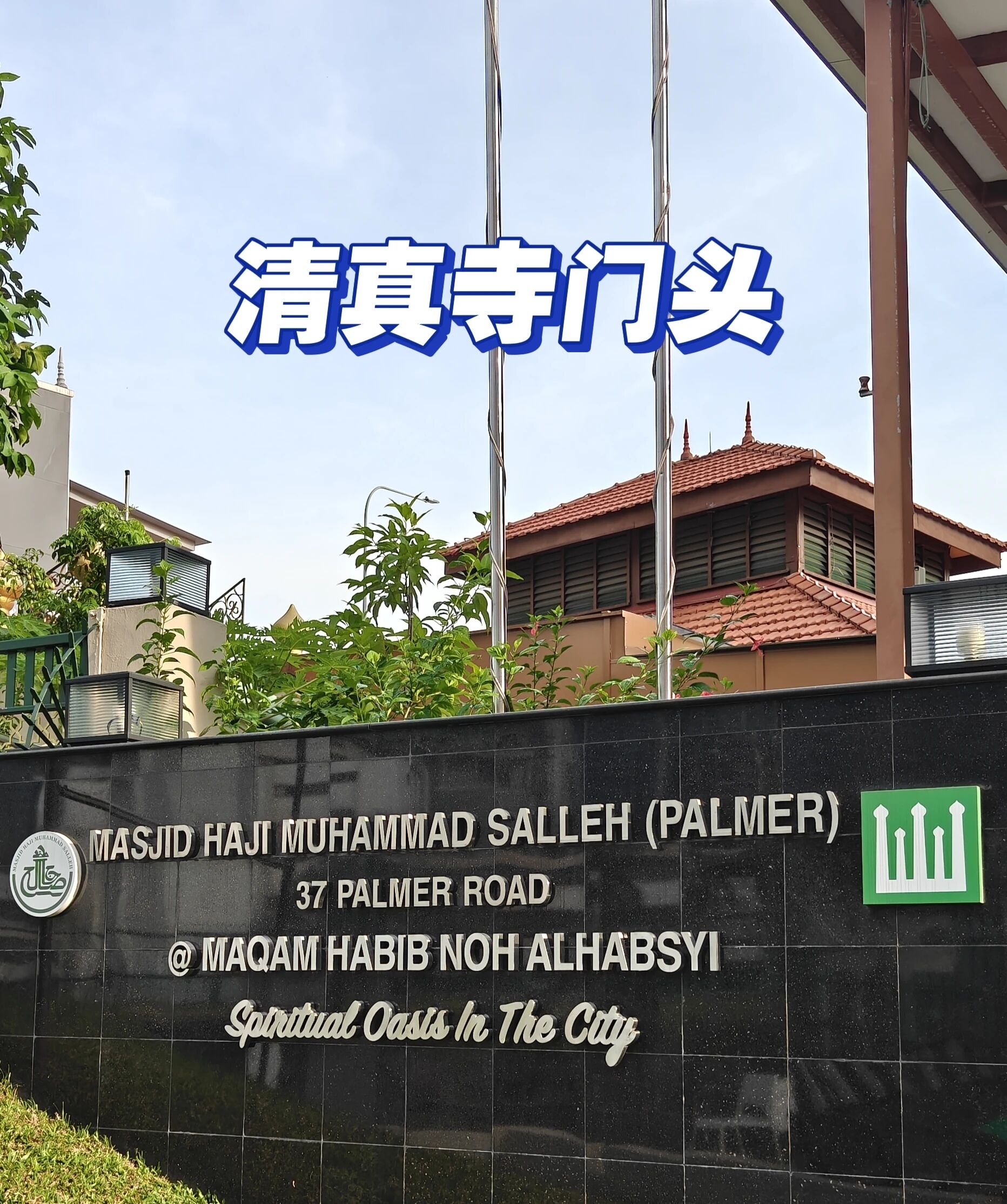
To get here, set your navigation for Haji Muhammad Salleh Mosque. The mosque sits next to a small hill where a Muslim sage named Habib Noh (1788–1866) is buried. The building with the dome is his tomb (gongbei).
Haji Muhammad Salleh, a friend of Habib Noh, originally built a prayer room next to the tomb, which was later expanded into this mosque.
I visited at the end of last year, but the tomb was closed for renovations. So, I only visited the mosque and did not go up to the tomb. This time, the renovations were finished, so I could go up.
You have to climb a flight of stairs to reach the tomb's front hall. An elderly volunteer who guards the tomb told me that Habib Noh was a descendant of the Prophet and suggested I look up more information about him.
It turns out this sage grew up in Penang, Malaysia, before moving to Singapore. His family was from Yemen, and he was born on a ship heading to Penang. He often spent time meditating on Palmer Hill, the same small hill where he is buried today.
People say that after he passed away, they tried to move his body to a cemetery, but they could not move him at all. At this point, someone remembered he had said before he died that he wanted to be buried on the hills of Parma. Only then were they able to bury him successfully. Everyone can form their own opinion on this story.
We can enter the tomb chamber by taking the long stairs shown in picture three.
Once inside the tomb chamber, I sat cross-legged. The people around me knelt, whispered prayers, and then raised their hands to make dua.
Behind the tomb chamber is another grave covered by a metal grid, where Habib Nuh's cousin, Habib Abdul Rahman, is buried. He was the first kadi (Islamic judge) of Singapore.
We returned to the mosque, where some introductory religious books were displayed at the entrance (picture nine); judging by the covers, the one on the left likely teaches how to perform wudu before namaz.
The book on the right features an elephant and a meteorite on the cover, so it is likely about the story of the Elephant in the Quran, making it a book of Quranic stories.
The mosque at the foot of the hill has a distinct Southeast Asian style with a clearly visible roof structure, similar to the huts built by the Malay people. It seems like living in a house like this would be very cool.
Inside the mihrab niche, there is also a miniature model of the door to the Kaaba in Mecca (Figure 14).
This place is very close to the busy areas of Singapore, so I usually head over to the Flower Dome after visiting here.
Summary: This Singapore Muslim travel guide visits Habib Noh Shrine beside Haji Mohamed Salleh Mosque. It preserves the route, the 1788-1866 date note, the gongbei tomb description, and the local Muslim heritage details.
To get here, set your navigation for Haji Muhammad Salleh Mosque. The mosque sits next to a small hill where a Muslim sage named Habib Noh (1788–1866) is buried. The building with the dome is his tomb (gongbei).
Haji Muhammad Salleh, a friend of Habib Noh, originally built a prayer room next to the tomb, which was later expanded into this mosque.
I visited at the end of last year, but the tomb was closed for renovations. So, I only visited the mosque and did not go up to the tomb. This time, the renovations were finished, so I could go up.
You have to climb a flight of stairs to reach the tomb's front hall. An elderly volunteer who guards the tomb told me that Habib Noh was a descendant of the Prophet and suggested I look up more information about him.
It turns out this sage grew up in Penang, Malaysia, before moving to Singapore. His family was from Yemen, and he was born on a ship heading to Penang. He often spent time meditating on Palmer Hill, the same small hill where he is buried today.
People say that after he passed away, they tried to move his body to a cemetery, but they could not move him at all. At this point, someone remembered he had said before he died that he wanted to be buried on the hills of Parma. Only then were they able to bury him successfully. Everyone can form their own opinion on this story.
We can enter the tomb chamber by taking the long stairs shown in picture three.
Once inside the tomb chamber, I sat cross-legged. The people around me knelt, whispered prayers, and then raised their hands to make dua.
Behind the tomb chamber is another grave covered by a metal grid, where Habib Nuh's cousin, Habib Abdul Rahman, is buried. He was the first kadi (Islamic judge) of Singapore.
We returned to the mosque, where some introductory religious books were displayed at the entrance (picture nine); judging by the covers, the one on the left likely teaches how to perform wudu before namaz.
The book on the right features an elephant and a meteorite on the cover, so it is likely about the story of the Elephant in the Quran, making it a book of Quranic stories.
The mosque at the foot of the hill has a distinct Southeast Asian style with a clearly visible roof structure, similar to the huts built by the Malay people. It seems like living in a house like this would be very cool.
Inside the mihrab niche, there is also a miniature model of the door to the Kaaba in Mecca (Figure 14).
This place is very close to the busy areas of Singapore, so I usually head over to the Flower Dome after visiting here.
Muslim Travel Guide Singapore 2026: Habib Noh Shrine, Changi Airport Prayer Rooms and Mosque Route
Articles • Hasan09 posted the article • 0 comments • 373 views • 2026-05-24 01:48
Reposted from the web
Summary: This Singapore Muslim travel guide gathers the route covering Habib Noh Shrine, Haji Mohamed Salleh Mosque, Singapore Islamic Centre, and Changi Airport prayer rooms. It keeps the original checklist and image order intact.
In this issue:
18. Habib Noh Shrine
19. Haji Muhammad Salleh Mosque
20. Hajjah Fatimah Mosque
21. Changi Airport Prayer Room
Main text:
18. Habib Noh Shrine
Habib Noh is the local Singaporean transliteration. If we follow our naming habits back home, it is usually translated as Habib Nuh. Habib means beloved, and Nuh is the Prophet Noah. Nuh is a very common name in the Muslim world.
The domed building in the picture below is his shrine. This mosque actually started as a small prayer room built next to the shrine by Habib Nuh's friend, Haji Muhammad Salleh. It was later expanded into the mosque you see today.
When I visited at the end of last year, the shrine was undergoing renovations and was closed to the public. That is why I only visited the mosque back then and could not make it up to the tomb. I went back this time and the renovations were finally finished, so I could go up. To get up there, you have to climb a flight of stairs, and there is a front hall at the top. I met an elderly volunteer on duty there who told me that the person buried in the tomb, Habib Noh, was a descendant of the Prophet. He also urged me to look up his history. After looking it up, I learned that this wise man grew up in Penang, Malaysia, before moving to Singapore to settle down. His family roots were in Yemen, and he was born on a ship heading to Penang. He often used to go to Mount Palmer—the small hill where he is buried now—to meditate and perform namaz.
People say that after he passed away, they tried to bury him in a regular cemetery, but they could not move his body no matter what they did. Then, someone remembered him saying during his life that he wanted to be buried on Mount Palmer. They tried moving him there, and that is how they finally succeeded in burying him. As for this story, everyone can decide for themselves what to make of it.
Because the tomb is built on top of the hill, you have to climb a very long flight of stairs to reach it. After entering the tomb chamber, I found a spot and sat down cross-legged. People around me were kneeling, whispering duas, and then raising their hands to make dua to Allah.
Behind the tomb chamber is another grave covered by a metal grid, where Habib Nuh's cousin, Habib Abdul Rahman, is buried. He was Singapore's first kadi, which is an Islamic judge.
19. Haji Muhammad Salleh Mosque
This mosque is connected to the tomb chamber because it started as a prayer room next to the grave, built by a friend of Habib Nuh. The prayer room was expanded later to reach its current size. Let me show you what the inside of the main prayer hall looks like.
The main hall is not very big, but it is small and beautiful with a simple, modest style that does not look cheap at all. The pillars in the hall are mostly pure white, but the tops are decorated with gold, adding a touch of elegance to the room.
Although the ceiling is low, the designer used an open design so you can see the wooden beams. This design keeps the ceiling from feeling heavy, because if the room were already low and had a solid ceiling, it would feel very cramped.
The top of the mihrab niche is covered in simple mosaic tiles. The colors are muted and the patterns are basic, so it looks quite pleasant and does not distract from the rest of the room. A staff stands on the pulpit. The khutbah staff here in Singapore is different from the ones back home in China, where we usually use a smooth, dried branch that keeps the original shape of the wood. In Singapore, it is a straight metal staff with a metal ball attached to the top.
On the inner wall to the right of the niche hangs a small model of the door of the Kaaba (Mecca's House of God). I have seen this kind of model before in the gift shop of the Islamic Arts Museum Malaysia, so this style seems quite popular in mosques across Singapore and Malaysia.
Do you remember those steps leading up to the tomb (gongbei)? Looking up the steps, you can see the mosque's striking red roof.
20. Hajjah Fatimah Mosque
A wealthy lady donated the money to build this mosque. Her name was Hajjah Fatimah, and she was of Malay descent. A sign at the mosque entrance says it was built between 1845 and 1846, and the site was originally Hajjah Fatimah's own home. Hajjah Fatimah was a very wealthy Malay woman whose hometown was Malacca, Malaysia. You can see from this how close the connection is between Singapore and Malaysia. Just like the Temenggong Mosque we talked about before, that land still belongs to the state of Johor in Malaysia. Back to the story, in the late 1830s, this generous lady donated her property to build this mosque.
The first time I went there, it was almost nine o'clock at night, and Google Maps said it closed at nine. When I arrived, it didn't look like they were planning to close, so I wondered if Google Maps could be wrong. But after I finished my wudu and got ready to go in, the main hall was already locked. Well, they were polite enough to wait until I finished my namaz outside before they locked the courtyard gate.
I decided to go back the next day to see what the inside of the main hall looked like.
The most unique feature of this mosque is its minaret. Because it was designed by a British architect, the minaret has a Western style. Looking at it from a distance, I almost mistook it for a Christian church.
I came back here again the next morning. I found several groups of children sitting inside and outside the main hall, with about ten kids in each circle. A teacher led each group, teaching them to recite the Quran.
After finishing my namaz inside, I rushed to the airport because you really need to get there early for flights. I discovered that some flights actually stop boarding an hour early, which really caused me a lot of trouble. Isn't it usually half an hour before? I had about an hour left when I arrived at Changi Airport, and I told myself I would definitely make it. I did not expect my flight to close its counter exactly one hour early. The money for my plane ticket just went down the drain.
21. Prayer rooms at Singapore Changi Airport
Every terminal at Singapore Changi Airport actually has its own dedicated prayer room.
This time, I will show you the prayer room in Terminal 2 (T2) of Singapore Changi Airport. This place is very easy to find because the signs are clear, saying "dua room" in English with the Chinese and Japanese characters for dua room next to it.
The prayer rooms are separated for men and women. There is a sensor at the entrance, so you just wave your hand in front of it and the door opens automatically.
In the entryway of the prayer room, there are small stools for changing shoes and a shoe cabinet.
I have visited prayer rooms at Muscat Airport in Oman, Imam Khomeini Airport in Tehran, Iran, Qatar Airport, and Narita Airport in Japan. Compared to the airports in Middle Eastern countries, the prayer rooms at Singapore Airport are quite simple and have almost no decorations, much like the ones in Japan.
Next to the prayer area, there are various prayer supplies available, such as prayer caps, the Quran, perfume, and the sarong skirts worn by our Malay brothers.
Writing this, I have basically shared all the mosques I have visited in Singapore. I say "basically" because there is another mosque on Orchard Road located on the ground floor of an office building. It is decorated like a grand banquet hall, but unfortunately, I did not keep any photos of it. So, I did not include it this time. There is also the Darussalam Mosque. It was under construction when I visited, so I did not get any good photos and decided not to post about it yet.
Thank you all for your continued support. I will continue to update my travelogues about visiting mosques in other countries on this public platform. Please stay tuned. view all
Summary: This Singapore Muslim travel guide gathers the route covering Habib Noh Shrine, Haji Mohamed Salleh Mosque, Singapore Islamic Centre, and Changi Airport prayer rooms. It keeps the original checklist and image order intact.
In this issue:
18. Habib Noh Shrine
19. Haji Muhammad Salleh Mosque
20. Hajjah Fatimah Mosque
21. Changi Airport Prayer Room
Main text:
18. Habib Noh Shrine
Habib Noh is the local Singaporean transliteration. If we follow our naming habits back home, it is usually translated as Habib Nuh. Habib means beloved, and Nuh is the Prophet Noah. Nuh is a very common name in the Muslim world.
The domed building in the picture below is his shrine. This mosque actually started as a small prayer room built next to the shrine by Habib Nuh's friend, Haji Muhammad Salleh. It was later expanded into the mosque you see today.
When I visited at the end of last year, the shrine was undergoing renovations and was closed to the public. That is why I only visited the mosque back then and could not make it up to the tomb. I went back this time and the renovations were finally finished, so I could go up. To get up there, you have to climb a flight of stairs, and there is a front hall at the top. I met an elderly volunteer on duty there who told me that the person buried in the tomb, Habib Noh, was a descendant of the Prophet. He also urged me to look up his history. After looking it up, I learned that this wise man grew up in Penang, Malaysia, before moving to Singapore to settle down. His family roots were in Yemen, and he was born on a ship heading to Penang. He often used to go to Mount Palmer—the small hill where he is buried now—to meditate and perform namaz.
People say that after he passed away, they tried to bury him in a regular cemetery, but they could not move his body no matter what they did. Then, someone remembered him saying during his life that he wanted to be buried on Mount Palmer. They tried moving him there, and that is how they finally succeeded in burying him. As for this story, everyone can decide for themselves what to make of it.
Because the tomb is built on top of the hill, you have to climb a very long flight of stairs to reach it. After entering the tomb chamber, I found a spot and sat down cross-legged. People around me were kneeling, whispering duas, and then raising their hands to make dua to Allah.
Behind the tomb chamber is another grave covered by a metal grid, where Habib Nuh's cousin, Habib Abdul Rahman, is buried. He was Singapore's first kadi, which is an Islamic judge.
19. Haji Muhammad Salleh Mosque
This mosque is connected to the tomb chamber because it started as a prayer room next to the grave, built by a friend of Habib Nuh. The prayer room was expanded later to reach its current size. Let me show you what the inside of the main prayer hall looks like.
The main hall is not very big, but it is small and beautiful with a simple, modest style that does not look cheap at all. The pillars in the hall are mostly pure white, but the tops are decorated with gold, adding a touch of elegance to the room.
Although the ceiling is low, the designer used an open design so you can see the wooden beams. This design keeps the ceiling from feeling heavy, because if the room were already low and had a solid ceiling, it would feel very cramped.
The top of the mihrab niche is covered in simple mosaic tiles. The colors are muted and the patterns are basic, so it looks quite pleasant and does not distract from the rest of the room. A staff stands on the pulpit. The khutbah staff here in Singapore is different from the ones back home in China, where we usually use a smooth, dried branch that keeps the original shape of the wood. In Singapore, it is a straight metal staff with a metal ball attached to the top.
On the inner wall to the right of the niche hangs a small model of the door of the Kaaba (Mecca's House of God). I have seen this kind of model before in the gift shop of the Islamic Arts Museum Malaysia, so this style seems quite popular in mosques across Singapore and Malaysia.
Do you remember those steps leading up to the tomb (gongbei)? Looking up the steps, you can see the mosque's striking red roof.
20. Hajjah Fatimah Mosque
A wealthy lady donated the money to build this mosque. Her name was Hajjah Fatimah, and she was of Malay descent. A sign at the mosque entrance says it was built between 1845 and 1846, and the site was originally Hajjah Fatimah's own home. Hajjah Fatimah was a very wealthy Malay woman whose hometown was Malacca, Malaysia. You can see from this how close the connection is between Singapore and Malaysia. Just like the Temenggong Mosque we talked about before, that land still belongs to the state of Johor in Malaysia. Back to the story, in the late 1830s, this generous lady donated her property to build this mosque.
The first time I went there, it was almost nine o'clock at night, and Google Maps said it closed at nine. When I arrived, it didn't look like they were planning to close, so I wondered if Google Maps could be wrong. But after I finished my wudu and got ready to go in, the main hall was already locked. Well, they were polite enough to wait until I finished my namaz outside before they locked the courtyard gate.
I decided to go back the next day to see what the inside of the main hall looked like.
The most unique feature of this mosque is its minaret. Because it was designed by a British architect, the minaret has a Western style. Looking at it from a distance, I almost mistook it for a Christian church.
I came back here again the next morning. I found several groups of children sitting inside and outside the main hall, with about ten kids in each circle. A teacher led each group, teaching them to recite the Quran.
After finishing my namaz inside, I rushed to the airport because you really need to get there early for flights. I discovered that some flights actually stop boarding an hour early, which really caused me a lot of trouble. Isn't it usually half an hour before? I had about an hour left when I arrived at Changi Airport, and I told myself I would definitely make it. I did not expect my flight to close its counter exactly one hour early. The money for my plane ticket just went down the drain.
21. Prayer rooms at Singapore Changi Airport
Every terminal at Singapore Changi Airport actually has its own dedicated prayer room.
This time, I will show you the prayer room in Terminal 2 (T2) of Singapore Changi Airport. This place is very easy to find because the signs are clear, saying "dua room" in English with the Chinese and Japanese characters for dua room next to it.
The prayer rooms are separated for men and women. There is a sensor at the entrance, so you just wave your hand in front of it and the door opens automatically.
In the entryway of the prayer room, there are small stools for changing shoes and a shoe cabinet.
I have visited prayer rooms at Muscat Airport in Oman, Imam Khomeini Airport in Tehran, Iran, Qatar Airport, and Narita Airport in Japan. Compared to the airports in Middle Eastern countries, the prayer rooms at Singapore Airport are quite simple and have almost no decorations, much like the ones in Japan.
Next to the prayer area, there are various prayer supplies available, such as prayer caps, the Quran, perfume, and the sarong skirts worn by our Malay brothers.
Writing this, I have basically shared all the mosques I have visited in Singapore. I say "basically" because there is another mosque on Orchard Road located on the ground floor of an office building. It is decorated like a grand banquet hall, but unfortunately, I did not keep any photos of it. So, I did not include it this time. There is also the Darussalam Mosque. It was under construction when I visited, so I did not get any good photos and decided not to post about it yet.
Thank you all for your continued support. I will continue to update my travelogues about visiting mosques in other countries on this public platform. Please stay tuned. view all
Reposted from the web
Summary: This Singapore Muslim travel guide gathers the route covering Habib Noh Shrine, Haji Mohamed Salleh Mosque, Singapore Islamic Centre, and Changi Airport prayer rooms. It keeps the original checklist and image order intact.
In this issue:
18. Habib Noh Shrine
19. Haji Muhammad Salleh Mosque
20. Hajjah Fatimah Mosque
21. Changi Airport Prayer Room
Main text:
18. Habib Noh Shrine
Habib Noh is the local Singaporean transliteration. If we follow our naming habits back home, it is usually translated as Habib Nuh. Habib means beloved, and Nuh is the Prophet Noah. Nuh is a very common name in the Muslim world.
The domed building in the picture below is his shrine. This mosque actually started as a small prayer room built next to the shrine by Habib Nuh's friend, Haji Muhammad Salleh. It was later expanded into the mosque you see today.
When I visited at the end of last year, the shrine was undergoing renovations and was closed to the public. That is why I only visited the mosque back then and could not make it up to the tomb. I went back this time and the renovations were finally finished, so I could go up. To get up there, you have to climb a flight of stairs, and there is a front hall at the top. I met an elderly volunteer on duty there who told me that the person buried in the tomb, Habib Noh, was a descendant of the Prophet. He also urged me to look up his history. After looking it up, I learned that this wise man grew up in Penang, Malaysia, before moving to Singapore to settle down. His family roots were in Yemen, and he was born on a ship heading to Penang. He often used to go to Mount Palmer—the small hill where he is buried now—to meditate and perform namaz.
People say that after he passed away, they tried to bury him in a regular cemetery, but they could not move his body no matter what they did. Then, someone remembered him saying during his life that he wanted to be buried on Mount Palmer. They tried moving him there, and that is how they finally succeeded in burying him. As for this story, everyone can decide for themselves what to make of it.
Because the tomb is built on top of the hill, you have to climb a very long flight of stairs to reach it. After entering the tomb chamber, I found a spot and sat down cross-legged. People around me were kneeling, whispering duas, and then raising their hands to make dua to Allah.
Behind the tomb chamber is another grave covered by a metal grid, where Habib Nuh's cousin, Habib Abdul Rahman, is buried. He was Singapore's first kadi, which is an Islamic judge.
19. Haji Muhammad Salleh Mosque
This mosque is connected to the tomb chamber because it started as a prayer room next to the grave, built by a friend of Habib Nuh. The prayer room was expanded later to reach its current size. Let me show you what the inside of the main prayer hall looks like.
The main hall is not very big, but it is small and beautiful with a simple, modest style that does not look cheap at all. The pillars in the hall are mostly pure white, but the tops are decorated with gold, adding a touch of elegance to the room.
Although the ceiling is low, the designer used an open design so you can see the wooden beams. This design keeps the ceiling from feeling heavy, because if the room were already low and had a solid ceiling, it would feel very cramped.
The top of the mihrab niche is covered in simple mosaic tiles. The colors are muted and the patterns are basic, so it looks quite pleasant and does not distract from the rest of the room. A staff stands on the pulpit. The khutbah staff here in Singapore is different from the ones back home in China, where we usually use a smooth, dried branch that keeps the original shape of the wood. In Singapore, it is a straight metal staff with a metal ball attached to the top.
On the inner wall to the right of the niche hangs a small model of the door of the Kaaba (Mecca's House of God). I have seen this kind of model before in the gift shop of the Islamic Arts Museum Malaysia, so this style seems quite popular in mosques across Singapore and Malaysia.
Do you remember those steps leading up to the tomb (gongbei)? Looking up the steps, you can see the mosque's striking red roof.
20. Hajjah Fatimah Mosque
A wealthy lady donated the money to build this mosque. Her name was Hajjah Fatimah, and she was of Malay descent. A sign at the mosque entrance says it was built between 1845 and 1846, and the site was originally Hajjah Fatimah's own home. Hajjah Fatimah was a very wealthy Malay woman whose hometown was Malacca, Malaysia. You can see from this how close the connection is between Singapore and Malaysia. Just like the Temenggong Mosque we talked about before, that land still belongs to the state of Johor in Malaysia. Back to the story, in the late 1830s, this generous lady donated her property to build this mosque.
The first time I went there, it was almost nine o'clock at night, and Google Maps said it closed at nine. When I arrived, it didn't look like they were planning to close, so I wondered if Google Maps could be wrong. But after I finished my wudu and got ready to go in, the main hall was already locked. Well, they were polite enough to wait until I finished my namaz outside before they locked the courtyard gate.
I decided to go back the next day to see what the inside of the main hall looked like.
The most unique feature of this mosque is its minaret. Because it was designed by a British architect, the minaret has a Western style. Looking at it from a distance, I almost mistook it for a Christian church.
I came back here again the next morning. I found several groups of children sitting inside and outside the main hall, with about ten kids in each circle. A teacher led each group, teaching them to recite the Quran.
After finishing my namaz inside, I rushed to the airport because you really need to get there early for flights. I discovered that some flights actually stop boarding an hour early, which really caused me a lot of trouble. Isn't it usually half an hour before? I had about an hour left when I arrived at Changi Airport, and I told myself I would definitely make it. I did not expect my flight to close its counter exactly one hour early. The money for my plane ticket just went down the drain.
21. Prayer rooms at Singapore Changi Airport
Every terminal at Singapore Changi Airport actually has its own dedicated prayer room.
This time, I will show you the prayer room in Terminal 2 (T2) of Singapore Changi Airport. This place is very easy to find because the signs are clear, saying "dua room" in English with the Chinese and Japanese characters for dua room next to it.
The prayer rooms are separated for men and women. There is a sensor at the entrance, so you just wave your hand in front of it and the door opens automatically.
In the entryway of the prayer room, there are small stools for changing shoes and a shoe cabinet.
I have visited prayer rooms at Muscat Airport in Oman, Imam Khomeini Airport in Tehran, Iran, Qatar Airport, and Narita Airport in Japan. Compared to the airports in Middle Eastern countries, the prayer rooms at Singapore Airport are quite simple and have almost no decorations, much like the ones in Japan.
Next to the prayer area, there are various prayer supplies available, such as prayer caps, the Quran, perfume, and the sarong skirts worn by our Malay brothers.
Writing this, I have basically shared all the mosques I have visited in Singapore. I say "basically" because there is another mosque on Orchard Road located on the ground floor of an office building. It is decorated like a grand banquet hall, but unfortunately, I did not keep any photos of it. So, I did not include it this time. There is also the Darussalam Mosque. It was under construction when I visited, so I did not get any good photos and decided not to post about it yet.
Thank you all for your continued support. I will continue to update my travelogues about visiting mosques in other countries on this public platform. Please stay tuned.
Summary: This Singapore Muslim travel guide gathers the route covering Habib Noh Shrine, Haji Mohamed Salleh Mosque, Singapore Islamic Centre, and Changi Airport prayer rooms. It keeps the original checklist and image order intact.
In this issue:
18. Habib Noh Shrine
19. Haji Muhammad Salleh Mosque
20. Hajjah Fatimah Mosque
21. Changi Airport Prayer Room
Main text:
18. Habib Noh Shrine
Habib Noh is the local Singaporean transliteration. If we follow our naming habits back home, it is usually translated as Habib Nuh. Habib means beloved, and Nuh is the Prophet Noah. Nuh is a very common name in the Muslim world.
The domed building in the picture below is his shrine. This mosque actually started as a small prayer room built next to the shrine by Habib Nuh's friend, Haji Muhammad Salleh. It was later expanded into the mosque you see today.
When I visited at the end of last year, the shrine was undergoing renovations and was closed to the public. That is why I only visited the mosque back then and could not make it up to the tomb. I went back this time and the renovations were finally finished, so I could go up. To get up there, you have to climb a flight of stairs, and there is a front hall at the top. I met an elderly volunteer on duty there who told me that the person buried in the tomb, Habib Noh, was a descendant of the Prophet. He also urged me to look up his history. After looking it up, I learned that this wise man grew up in Penang, Malaysia, before moving to Singapore to settle down. His family roots were in Yemen, and he was born on a ship heading to Penang. He often used to go to Mount Palmer—the small hill where he is buried now—to meditate and perform namaz.
People say that after he passed away, they tried to bury him in a regular cemetery, but they could not move his body no matter what they did. Then, someone remembered him saying during his life that he wanted to be buried on Mount Palmer. They tried moving him there, and that is how they finally succeeded in burying him. As for this story, everyone can decide for themselves what to make of it.
Because the tomb is built on top of the hill, you have to climb a very long flight of stairs to reach it. After entering the tomb chamber, I found a spot and sat down cross-legged. People around me were kneeling, whispering duas, and then raising their hands to make dua to Allah.
Behind the tomb chamber is another grave covered by a metal grid, where Habib Nuh's cousin, Habib Abdul Rahman, is buried. He was Singapore's first kadi, which is an Islamic judge.
19. Haji Muhammad Salleh Mosque
This mosque is connected to the tomb chamber because it started as a prayer room next to the grave, built by a friend of Habib Nuh. The prayer room was expanded later to reach its current size. Let me show you what the inside of the main prayer hall looks like.
The main hall is not very big, but it is small and beautiful with a simple, modest style that does not look cheap at all. The pillars in the hall are mostly pure white, but the tops are decorated with gold, adding a touch of elegance to the room.
Although the ceiling is low, the designer used an open design so you can see the wooden beams. This design keeps the ceiling from feeling heavy, because if the room were already low and had a solid ceiling, it would feel very cramped.
The top of the mihrab niche is covered in simple mosaic tiles. The colors are muted and the patterns are basic, so it looks quite pleasant and does not distract from the rest of the room. A staff stands on the pulpit. The khutbah staff here in Singapore is different from the ones back home in China, where we usually use a smooth, dried branch that keeps the original shape of the wood. In Singapore, it is a straight metal staff with a metal ball attached to the top.
On the inner wall to the right of the niche hangs a small model of the door of the Kaaba (Mecca's House of God). I have seen this kind of model before in the gift shop of the Islamic Arts Museum Malaysia, so this style seems quite popular in mosques across Singapore and Malaysia.
Do you remember those steps leading up to the tomb (gongbei)? Looking up the steps, you can see the mosque's striking red roof.
20. Hajjah Fatimah Mosque
A wealthy lady donated the money to build this mosque. Her name was Hajjah Fatimah, and she was of Malay descent. A sign at the mosque entrance says it was built between 1845 and 1846, and the site was originally Hajjah Fatimah's own home. Hajjah Fatimah was a very wealthy Malay woman whose hometown was Malacca, Malaysia. You can see from this how close the connection is between Singapore and Malaysia. Just like the Temenggong Mosque we talked about before, that land still belongs to the state of Johor in Malaysia. Back to the story, in the late 1830s, this generous lady donated her property to build this mosque.
The first time I went there, it was almost nine o'clock at night, and Google Maps said it closed at nine. When I arrived, it didn't look like they were planning to close, so I wondered if Google Maps could be wrong. But after I finished my wudu and got ready to go in, the main hall was already locked. Well, they were polite enough to wait until I finished my namaz outside before they locked the courtyard gate.
I decided to go back the next day to see what the inside of the main hall looked like.
The most unique feature of this mosque is its minaret. Because it was designed by a British architect, the minaret has a Western style. Looking at it from a distance, I almost mistook it for a Christian church.
I came back here again the next morning. I found several groups of children sitting inside and outside the main hall, with about ten kids in each circle. A teacher led each group, teaching them to recite the Quran.
After finishing my namaz inside, I rushed to the airport because you really need to get there early for flights. I discovered that some flights actually stop boarding an hour early, which really caused me a lot of trouble. Isn't it usually half an hour before? I had about an hour left when I arrived at Changi Airport, and I told myself I would definitely make it. I did not expect my flight to close its counter exactly one hour early. The money for my plane ticket just went down the drain.
21. Prayer rooms at Singapore Changi Airport
Every terminal at Singapore Changi Airport actually has its own dedicated prayer room.
This time, I will show you the prayer room in Terminal 2 (T2) of Singapore Changi Airport. This place is very easy to find because the signs are clear, saying "dua room" in English with the Chinese and Japanese characters for dua room next to it.
The prayer rooms are separated for men and women. There is a sensor at the entrance, so you just wave your hand in front of it and the door opens automatically.
In the entryway of the prayer room, there are small stools for changing shoes and a shoe cabinet.
I have visited prayer rooms at Muscat Airport in Oman, Imam Khomeini Airport in Tehran, Iran, Qatar Airport, and Narita Airport in Japan. Compared to the airports in Middle Eastern countries, the prayer rooms at Singapore Airport are quite simple and have almost no decorations, much like the ones in Japan.
Next to the prayer area, there are various prayer supplies available, such as prayer caps, the Quran, perfume, and the sarong skirts worn by our Malay brothers.
Writing this, I have basically shared all the mosques I have visited in Singapore. I say "basically" because there is another mosque on Orchard Road located on the ground floor of an office building. It is decorated like a grand banquet hall, but unfortunately, I did not keep any photos of it. So, I did not include it this time. There is also the Darussalam Mosque. It was under construction when I visited, so I did not get any good photos and decided not to post about it yet.
Thank you all for your continued support. I will continue to update my travelogues about visiting mosques in other countries on this public platform. Please stay tuned.
Muslim Travel Guide Singapore: Haji Mohamed Salleh Mosque, Habib Noh Shrine and Prayer Hall
Articles • Hasan09 posted the article • 0 comments • 306 views • 2026-05-24 01:47
Reposted from the web
Summary: This Singapore Muslim travel guide turns from Habib Noh Shrine to Haji Mohamed Salleh Mosque itself. It keeps the mosque layout, prayer-hall notes, hillside setting, and source sequence unchanged.
Last time we focused on the tomb (gongbei) on the small hill next to the mosque. This time, let's look at the mosque itself. This mosque started as a small prayer room next to a tomb. It was later expanded to its current size.
The prayer hall is not very large, but it is small and beautiful. The interior decoration is simple and plain, but it is definitely not crude. The pillars inside are mostly pure white, but the tops are accented with a touch of gold, adding a bit of elegance to the hall.
The ceiling (Image 3) is low, but it has an open design that shows the wooden structure. This keeps the ceiling from feeling heavy, as a solid ceiling in such a low room would make people feel cramped.
The top of the mihrab (Image 5) is covered in simple mosaic tiles. The colors are muted and the design is simple, so it does not look too flashy or distract from the space.
A staff stands on the pulpit. The khutbah staff here in Singapore is different from the ones in China, where they are usually smooth, dry branches that keep the original shape of the wood. The one here in Singapore is a straight metal staff with a metal sphere on top.
On the right side inside the niche, there is a miniature model of the door of the Kaaba in Mecca (Image 6). I have seen this type of model in the shop at the Islamic Arts Museum Malaysia, so it seems popular in mosques across Singapore and Malaysia.
Copies of the Quran (Image 7) are neatly stacked on the pillars in the prayer hall. In some mosques, the books are placed a bit randomly and come in different styles.
I think the mosque management intentionally bought many copies of the Quran with the same covers to keep the interior looking tidy. Someone is specifically in charge of organizing them, making sure books with the same covers are kept together.
Let's look outside the prayer hall. Some guides mention a library here (Figure 10), which likely refers to a reading corner behind the prayer hall.
This small mosque also has an accessible elevator. I only noticed it while looking through my photos, even though I visited twice and never saw it.
According to the sign (Figure 11), the second floor has a small meeting room, a women's prayer area, restrooms, and an administrative office.
Climb the long steps up the nearby hill to see the roof of the mosque's prayer hall (Figure 12, Figure 13). The Malay-style building features this kind of sloped roof. view all
Summary: This Singapore Muslim travel guide turns from Habib Noh Shrine to Haji Mohamed Salleh Mosque itself. It keeps the mosque layout, prayer-hall notes, hillside setting, and source sequence unchanged.
Last time we focused on the tomb (gongbei) on the small hill next to the mosque. This time, let's look at the mosque itself. This mosque started as a small prayer room next to a tomb. It was later expanded to its current size.
The prayer hall is not very large, but it is small and beautiful. The interior decoration is simple and plain, but it is definitely not crude. The pillars inside are mostly pure white, but the tops are accented with a touch of gold, adding a bit of elegance to the hall.
The ceiling (Image 3) is low, but it has an open design that shows the wooden structure. This keeps the ceiling from feeling heavy, as a solid ceiling in such a low room would make people feel cramped.
The top of the mihrab (Image 5) is covered in simple mosaic tiles. The colors are muted and the design is simple, so it does not look too flashy or distract from the space.
A staff stands on the pulpit. The khutbah staff here in Singapore is different from the ones in China, where they are usually smooth, dry branches that keep the original shape of the wood. The one here in Singapore is a straight metal staff with a metal sphere on top.
On the right side inside the niche, there is a miniature model of the door of the Kaaba in Mecca (Image 6). I have seen this type of model in the shop at the Islamic Arts Museum Malaysia, so it seems popular in mosques across Singapore and Malaysia.
Copies of the Quran (Image 7) are neatly stacked on the pillars in the prayer hall. In some mosques, the books are placed a bit randomly and come in different styles.
I think the mosque management intentionally bought many copies of the Quran with the same covers to keep the interior looking tidy. Someone is specifically in charge of organizing them, making sure books with the same covers are kept together.
Let's look outside the prayer hall. Some guides mention a library here (Figure 10), which likely refers to a reading corner behind the prayer hall.
This small mosque also has an accessible elevator. I only noticed it while looking through my photos, even though I visited twice and never saw it.
According to the sign (Figure 11), the second floor has a small meeting room, a women's prayer area, restrooms, and an administrative office.
Climb the long steps up the nearby hill to see the roof of the mosque's prayer hall (Figure 12, Figure 13). The Malay-style building features this kind of sloped roof. view all
Reposted from the web
Summary: This Singapore Muslim travel guide turns from Habib Noh Shrine to Haji Mohamed Salleh Mosque itself. It keeps the mosque layout, prayer-hall notes, hillside setting, and source sequence unchanged.
Last time we focused on the tomb (gongbei) on the small hill next to the mosque. This time, let's look at the mosque itself. This mosque started as a small prayer room next to a tomb. It was later expanded to its current size.
The prayer hall is not very large, but it is small and beautiful. The interior decoration is simple and plain, but it is definitely not crude. The pillars inside are mostly pure white, but the tops are accented with a touch of gold, adding a bit of elegance to the hall.
The ceiling (Image 3) is low, but it has an open design that shows the wooden structure. This keeps the ceiling from feeling heavy, as a solid ceiling in such a low room would make people feel cramped.
The top of the mihrab (Image 5) is covered in simple mosaic tiles. The colors are muted and the design is simple, so it does not look too flashy or distract from the space.
A staff stands on the pulpit. The khutbah staff here in Singapore is different from the ones in China, where they are usually smooth, dry branches that keep the original shape of the wood. The one here in Singapore is a straight metal staff with a metal sphere on top.
On the right side inside the niche, there is a miniature model of the door of the Kaaba in Mecca (Image 6). I have seen this type of model in the shop at the Islamic Arts Museum Malaysia, so it seems popular in mosques across Singapore and Malaysia.
Copies of the Quran (Image 7) are neatly stacked on the pillars in the prayer hall. In some mosques, the books are placed a bit randomly and come in different styles.
I think the mosque management intentionally bought many copies of the Quran with the same covers to keep the interior looking tidy. Someone is specifically in charge of organizing them, making sure books with the same covers are kept together.
Let's look outside the prayer hall. Some guides mention a library here (Figure 10), which likely refers to a reading corner behind the prayer hall.
This small mosque also has an accessible elevator. I only noticed it while looking through my photos, even though I visited twice and never saw it.
According to the sign (Figure 11), the second floor has a small meeting room, a women's prayer area, restrooms, and an administrative office.
Climb the long steps up the nearby hill to see the roof of the mosque's prayer hall (Figure 12, Figure 13). The Malay-style building features this kind of sloped roof.
Summary: This Singapore Muslim travel guide turns from Habib Noh Shrine to Haji Mohamed Salleh Mosque itself. It keeps the mosque layout, prayer-hall notes, hillside setting, and source sequence unchanged.
Last time we focused on the tomb (gongbei) on the small hill next to the mosque. This time, let's look at the mosque itself. This mosque started as a small prayer room next to a tomb. It was later expanded to its current size.
The prayer hall is not very large, but it is small and beautiful. The interior decoration is simple and plain, but it is definitely not crude. The pillars inside are mostly pure white, but the tops are accented with a touch of gold, adding a bit of elegance to the hall.
The ceiling (Image 3) is low, but it has an open design that shows the wooden structure. This keeps the ceiling from feeling heavy, as a solid ceiling in such a low room would make people feel cramped.
The top of the mihrab (Image 5) is covered in simple mosaic tiles. The colors are muted and the design is simple, so it does not look too flashy or distract from the space.
A staff stands on the pulpit. The khutbah staff here in Singapore is different from the ones in China, where they are usually smooth, dry branches that keep the original shape of the wood. The one here in Singapore is a straight metal staff with a metal sphere on top.
On the right side inside the niche, there is a miniature model of the door of the Kaaba in Mecca (Image 6). I have seen this type of model in the shop at the Islamic Arts Museum Malaysia, so it seems popular in mosques across Singapore and Malaysia.
Copies of the Quran (Image 7) are neatly stacked on the pillars in the prayer hall. In some mosques, the books are placed a bit randomly and come in different styles.
I think the mosque management intentionally bought many copies of the Quran with the same covers to keep the interior looking tidy. Someone is specifically in charge of organizing them, making sure books with the same covers are kept together.
Let's look outside the prayer hall. Some guides mention a library here (Figure 10), which likely refers to a reading corner behind the prayer hall.
This small mosque also has an accessible elevator. I only noticed it while looking through my photos, even though I visited twice and never saw it.
According to the sign (Figure 11), the second floor has a small meeting room, a women's prayer area, restrooms, and an administrative office.
Climb the long steps up the nearby hill to see the roof of the mosque's prayer hall (Figure 12, Figure 13). The Malay-style building features this kind of sloped roof.
Muslim Travel Guide Singapore: Habib Noh Shrine, Gongbei Tomb and Haji Mohamed Salleh Mosque
Articles • Hasan09 posted the article • 0 comments • 337 views • 2026-05-24 01:47
Reposted from the web
Summary: This Singapore Muslim travel guide visits Habib Noh Shrine beside Haji Mohamed Salleh Mosque. It preserves the route, the 1788-1866 date note, the gongbei tomb description, and the local Muslim heritage details.
To get here, set your navigation for Haji Muhammad Salleh Mosque. The mosque sits next to a small hill where a Muslim sage named Habib Noh (1788–1866) is buried. The building with the dome is his tomb (gongbei).
Haji Muhammad Salleh, a friend of Habib Noh, originally built a prayer room next to the tomb, which was later expanded into this mosque.
I visited at the end of last year, but the tomb was closed for renovations. So, I only visited the mosque and did not go up to the tomb. This time, the renovations were finished, so I could go up.
You have to climb a flight of stairs to reach the tomb's front hall. An elderly volunteer who guards the tomb told me that Habib Noh was a descendant of the Prophet and suggested I look up more information about him.
It turns out this sage grew up in Penang, Malaysia, before moving to Singapore. His family was from Yemen, and he was born on a ship heading to Penang. He often spent time meditating on Palmer Hill, the same small hill where he is buried today.
People say that after he passed away, they tried to move his body to a cemetery, but they could not move him at all. At this point, someone remembered he had said before he died that he wanted to be buried on the hills of Parma. Only then were they able to bury him successfully. Everyone can form their own opinion on this story.
We can enter the tomb chamber by taking the long stairs shown in picture three.
Once inside the tomb chamber, I sat cross-legged. The people around me knelt, whispered prayers, and then raised their hands to make dua.
Behind the tomb chamber is another grave covered by a metal grid, where Habib Nuh's cousin, Habib Abdul Rahman, is buried. He was the first kadi (Islamic judge) of Singapore.
We returned to the mosque, where some introductory religious books were displayed at the entrance (picture nine); judging by the covers, the one on the left likely teaches how to perform wudu before namaz.
The book on the right features an elephant and a meteorite on the cover, so it is likely about the story of the Elephant in the Quran, making it a book of Quranic stories.
The mosque at the foot of the hill has a distinct Southeast Asian style with a clearly visible roof structure, similar to the huts built by the Malay people. It seems like living in a house like this would be very cool.
Inside the mihrab niche, there is also a miniature model of the door to the Kaaba in Mecca (Figure 14).
This place is very close to the busy areas of Singapore, so I usually head over to the Flower Dome after visiting here. view all
Summary: This Singapore Muslim travel guide visits Habib Noh Shrine beside Haji Mohamed Salleh Mosque. It preserves the route, the 1788-1866 date note, the gongbei tomb description, and the local Muslim heritage details.
To get here, set your navigation for Haji Muhammad Salleh Mosque. The mosque sits next to a small hill where a Muslim sage named Habib Noh (1788–1866) is buried. The building with the dome is his tomb (gongbei).
Haji Muhammad Salleh, a friend of Habib Noh, originally built a prayer room next to the tomb, which was later expanded into this mosque.
I visited at the end of last year, but the tomb was closed for renovations. So, I only visited the mosque and did not go up to the tomb. This time, the renovations were finished, so I could go up.
You have to climb a flight of stairs to reach the tomb's front hall. An elderly volunteer who guards the tomb told me that Habib Noh was a descendant of the Prophet and suggested I look up more information about him.
It turns out this sage grew up in Penang, Malaysia, before moving to Singapore. His family was from Yemen, and he was born on a ship heading to Penang. He often spent time meditating on Palmer Hill, the same small hill where he is buried today.
People say that after he passed away, they tried to move his body to a cemetery, but they could not move him at all. At this point, someone remembered he had said before he died that he wanted to be buried on the hills of Parma. Only then were they able to bury him successfully. Everyone can form their own opinion on this story.
We can enter the tomb chamber by taking the long stairs shown in picture three.
Once inside the tomb chamber, I sat cross-legged. The people around me knelt, whispered prayers, and then raised their hands to make dua.
Behind the tomb chamber is another grave covered by a metal grid, where Habib Nuh's cousin, Habib Abdul Rahman, is buried. He was the first kadi (Islamic judge) of Singapore.
We returned to the mosque, where some introductory religious books were displayed at the entrance (picture nine); judging by the covers, the one on the left likely teaches how to perform wudu before namaz.
The book on the right features an elephant and a meteorite on the cover, so it is likely about the story of the Elephant in the Quran, making it a book of Quranic stories.
The mosque at the foot of the hill has a distinct Southeast Asian style with a clearly visible roof structure, similar to the huts built by the Malay people. It seems like living in a house like this would be very cool.
Inside the mihrab niche, there is also a miniature model of the door to the Kaaba in Mecca (Figure 14).
This place is very close to the busy areas of Singapore, so I usually head over to the Flower Dome after visiting here. view all
Reposted from the web
Summary: This Singapore Muslim travel guide visits Habib Noh Shrine beside Haji Mohamed Salleh Mosque. It preserves the route, the 1788-1866 date note, the gongbei tomb description, and the local Muslim heritage details.
To get here, set your navigation for Haji Muhammad Salleh Mosque. The mosque sits next to a small hill where a Muslim sage named Habib Noh (1788–1866) is buried. The building with the dome is his tomb (gongbei).
Haji Muhammad Salleh, a friend of Habib Noh, originally built a prayer room next to the tomb, which was later expanded into this mosque.
I visited at the end of last year, but the tomb was closed for renovations. So, I only visited the mosque and did not go up to the tomb. This time, the renovations were finished, so I could go up.
You have to climb a flight of stairs to reach the tomb's front hall. An elderly volunteer who guards the tomb told me that Habib Noh was a descendant of the Prophet and suggested I look up more information about him.
It turns out this sage grew up in Penang, Malaysia, before moving to Singapore. His family was from Yemen, and he was born on a ship heading to Penang. He often spent time meditating on Palmer Hill, the same small hill where he is buried today.
People say that after he passed away, they tried to move his body to a cemetery, but they could not move him at all. At this point, someone remembered he had said before he died that he wanted to be buried on the hills of Parma. Only then were they able to bury him successfully. Everyone can form their own opinion on this story.
We can enter the tomb chamber by taking the long stairs shown in picture three.
Once inside the tomb chamber, I sat cross-legged. The people around me knelt, whispered prayers, and then raised their hands to make dua.
Behind the tomb chamber is another grave covered by a metal grid, where Habib Nuh's cousin, Habib Abdul Rahman, is buried. He was the first kadi (Islamic judge) of Singapore.
We returned to the mosque, where some introductory religious books were displayed at the entrance (picture nine); judging by the covers, the one on the left likely teaches how to perform wudu before namaz.
The book on the right features an elephant and a meteorite on the cover, so it is likely about the story of the Elephant in the Quran, making it a book of Quranic stories.
The mosque at the foot of the hill has a distinct Southeast Asian style with a clearly visible roof structure, similar to the huts built by the Malay people. It seems like living in a house like this would be very cool.
Inside the mihrab niche, there is also a miniature model of the door to the Kaaba in Mecca (Figure 14).
This place is very close to the busy areas of Singapore, so I usually head over to the Flower Dome after visiting here.
Summary: This Singapore Muslim travel guide visits Habib Noh Shrine beside Haji Mohamed Salleh Mosque. It preserves the route, the 1788-1866 date note, the gongbei tomb description, and the local Muslim heritage details.
To get here, set your navigation for Haji Muhammad Salleh Mosque. The mosque sits next to a small hill where a Muslim sage named Habib Noh (1788–1866) is buried. The building with the dome is his tomb (gongbei).
Haji Muhammad Salleh, a friend of Habib Noh, originally built a prayer room next to the tomb, which was later expanded into this mosque.
I visited at the end of last year, but the tomb was closed for renovations. So, I only visited the mosque and did not go up to the tomb. This time, the renovations were finished, so I could go up.
You have to climb a flight of stairs to reach the tomb's front hall. An elderly volunteer who guards the tomb told me that Habib Noh was a descendant of the Prophet and suggested I look up more information about him.
It turns out this sage grew up in Penang, Malaysia, before moving to Singapore. His family was from Yemen, and he was born on a ship heading to Penang. He often spent time meditating on Palmer Hill, the same small hill where he is buried today.
People say that after he passed away, they tried to move his body to a cemetery, but they could not move him at all. At this point, someone remembered he had said before he died that he wanted to be buried on the hills of Parma. Only then were they able to bury him successfully. Everyone can form their own opinion on this story.
We can enter the tomb chamber by taking the long stairs shown in picture three.
Once inside the tomb chamber, I sat cross-legged. The people around me knelt, whispered prayers, and then raised their hands to make dua.
Behind the tomb chamber is another grave covered by a metal grid, where Habib Nuh's cousin, Habib Abdul Rahman, is buried. He was the first kadi (Islamic judge) of Singapore.
We returned to the mosque, where some introductory religious books were displayed at the entrance (picture nine); judging by the covers, the one on the left likely teaches how to perform wudu before namaz.
The book on the right features an elephant and a meteorite on the cover, so it is likely about the story of the Elephant in the Quran, making it a book of Quranic stories.
The mosque at the foot of the hill has a distinct Southeast Asian style with a clearly visible roof structure, similar to the huts built by the Malay people. It seems like living in a house like this would be very cool.
Inside the mihrab niche, there is also a miniature model of the door to the Kaaba in Mecca (Figure 14).
This place is very close to the busy areas of Singapore, so I usually head over to the Flower Dome after visiting here.