

Harvard Yenching
Claude L. Pickens Jr. Collection: Republican-Era Hui Muslim Documents
Articles • ali2007fr posted the article • 0 comments • 215 views • 2026-05-18 02:26
Reposted from the web
Summary: Claude L. Pickens Jr. Collection: Republican-Era Hui Muslim Documents is presented here as a firsthand travel account in clear English, beginning with this scene: Claude L. Pickens Jr. was an American missionary who came to China in 1926 and worked mainly in Hankou. The account keeps its focus on Hui Muslims, Islamic Manuscripts, Harvard Yenching while preserving the names, places, food, and historical details from the Chinese source.
Claude L. Pickens Jr. was an American missionary who came to China in 1926 and worked mainly in Hankou. He traveled to the Muslim-populated areas of Northwest China twice, in 1933 and 1936, taking many photos and leaving behind valuable records.
Pickens collected many precious documents from Hui Muslims during the Republic of China era, including scripture calligraphy, wall charts, religious calendars, and calligraphy works. He donated them all to the Harvard-Yenching Library in 1984, where they were digitized and displayed on the library's official website.
Most of these documents came from the Muslim Book and Newspaper Press (Qingzhen Shubao She) on Niujie Street in Beiping. The Muslim Book and Newspaper Press was founded in the early years of the Republic of China by Imam Ma Kuilin of Niujie. In the 1920s and 1930s, it printed various scripture textbooks and scholarly works in a shop north of Guang'anmen Street, which were sold all over the country. After Imam Ma Kuilin passed away in 1940, his fourth son, Ma Zhongdao, continued to run the business until it was merged into the Xuanwu Xinhua Bookstore in 1956. After 1966, all the books and records from the Muslim Book and Newspaper Press that had been handed over to the Xuanwu Xinhua Bookstore went missing, and the collection held by Ma Zhongdao himself was forced to be burned by his own hands. Because of this, the collection of books and records from the Muslim Book and Newspaper Press held by Pickens has become the most precious material available.
Official website: library.harvard.edu/collections/rev-claude-l-pickens-jr-collection-muslims-china
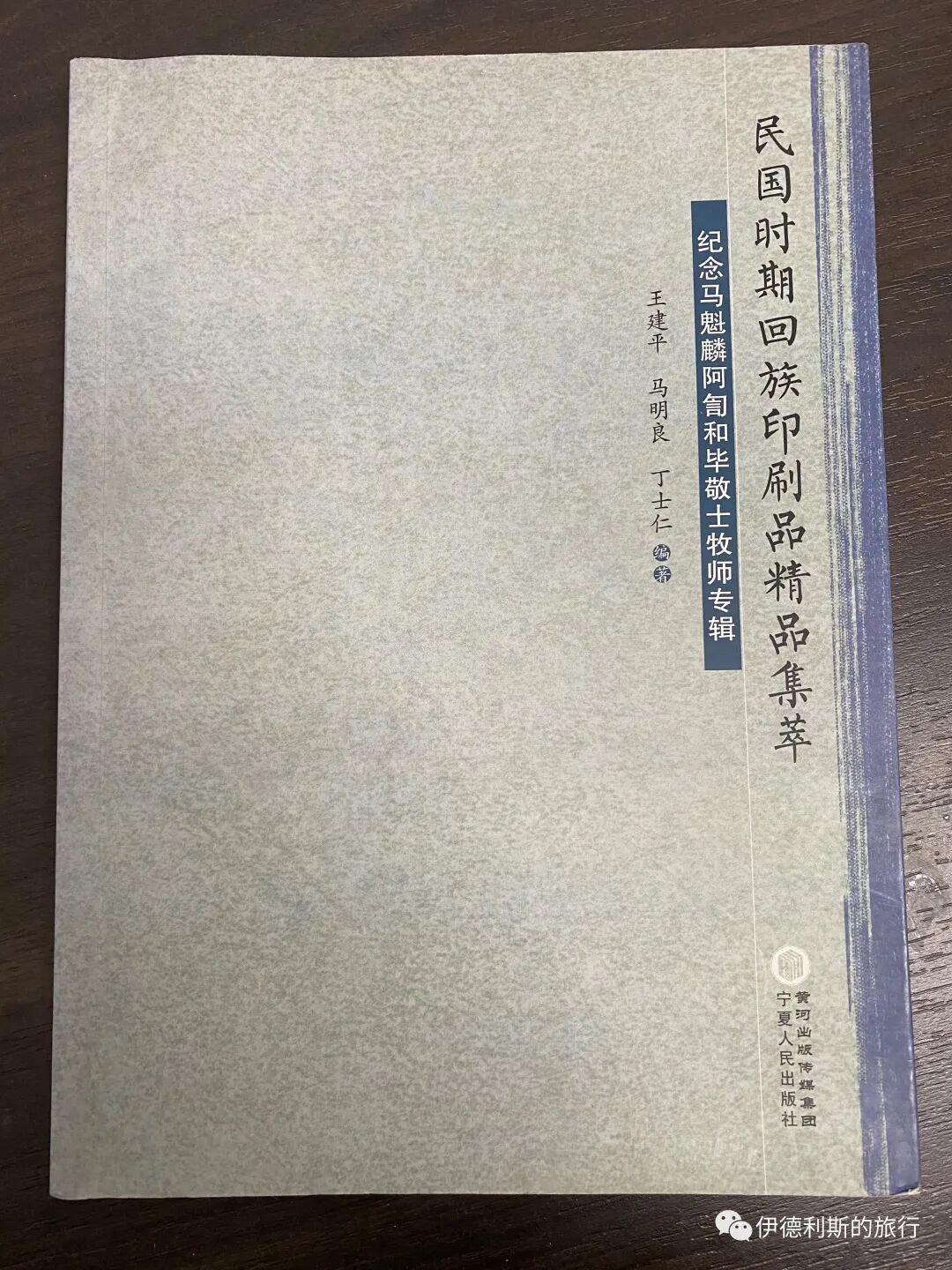
The book "Selected Fine Prints of Hui Muslim Materials from the Republic of China Era" provides a detailed introduction to these documents, but unfortunately, due to layout and paper limitations, the images in the book are not printed clearly enough.
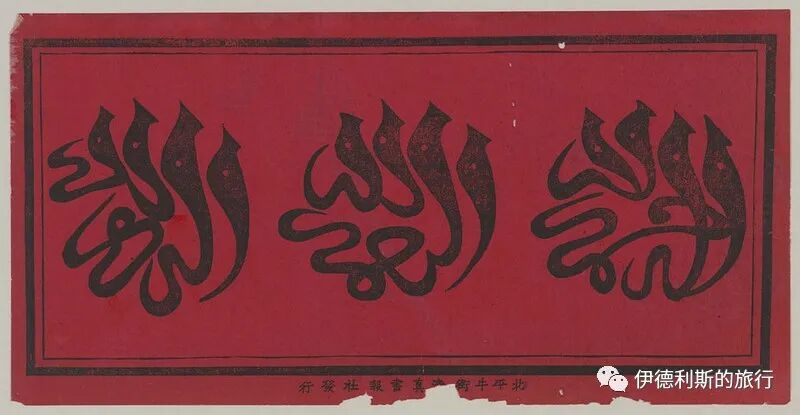
A wall scroll (zhongtang) of calligraphy finely produced by the Beiping Niujie Muslim Book and Newspaper Press.
Inna-hu alimun bi-zat al-sudur, finely produced by the Beiping Niujie Muslim Book and Newspaper Press.
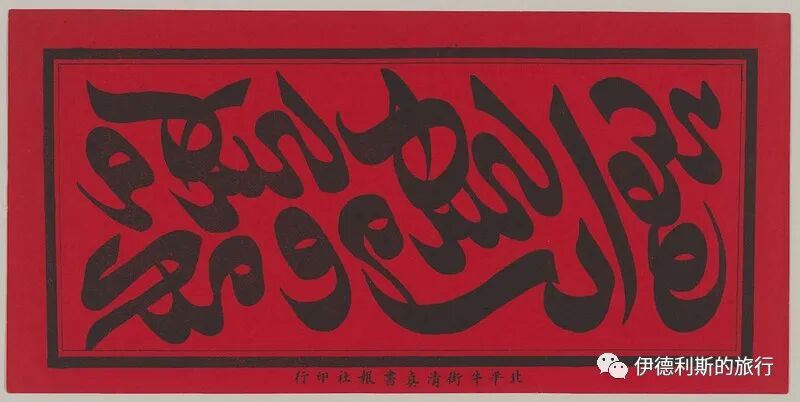
A quote from Caliph Umar: Kafa bi-al-mawt wai zan, wa kafa bi-al-dahr tafarruqan.
Death is enough as a warning, and the world is enough as a separation (from Allah).
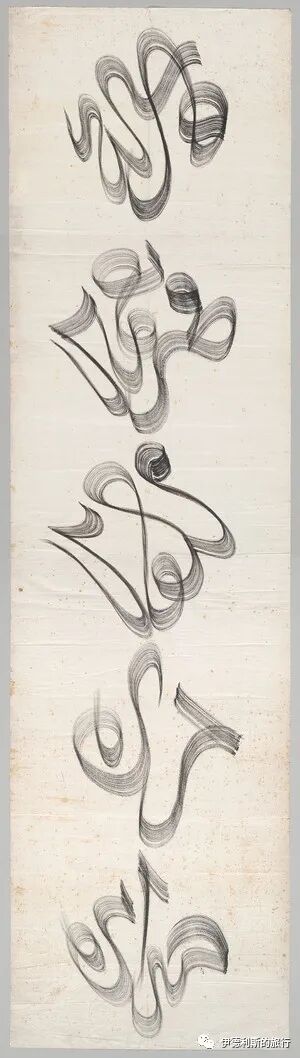
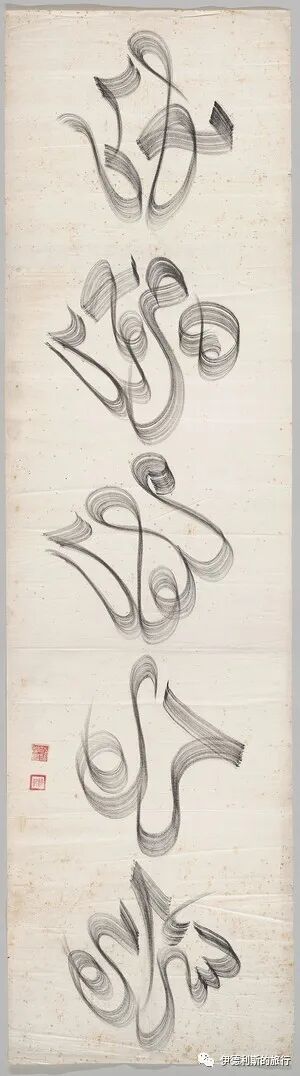
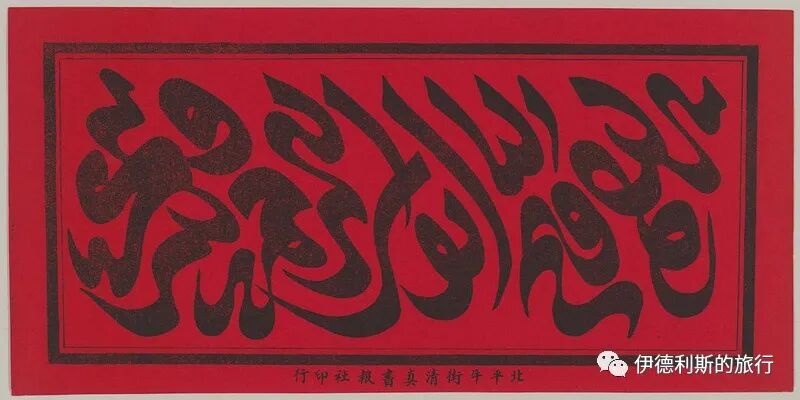
A wall scroll, printed by the Beiping Niujie Muslim Book and Newspaper Press. According to teacher Wang Qifei, this is the work of Imam Li Chaozhen or Li Shouzhen from Cangzhou.
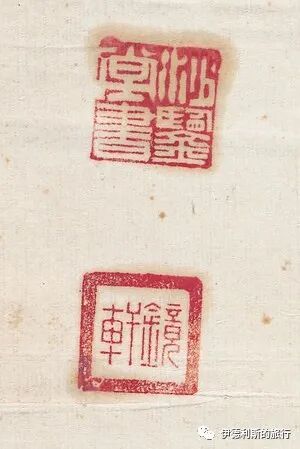
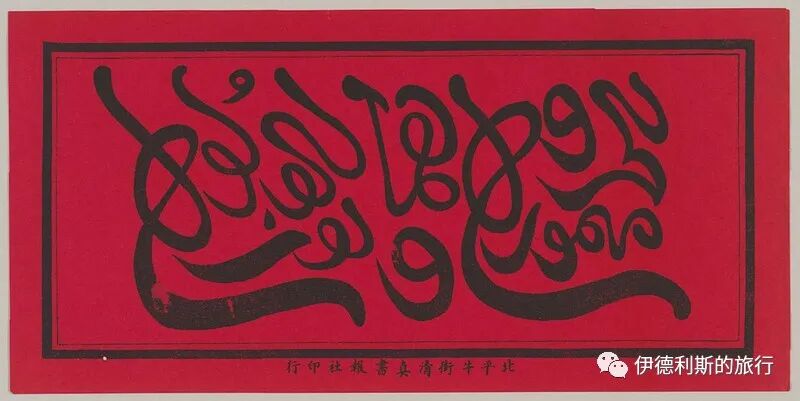
A wall scroll featuring scripture calligraphy. Guide us to the straight path (1:6), with a seal that reads "Xuanjing." According to teacher Mu Ning, the author is likely Fa Jingxuan from Jinan. Fa Jingxuan was a famous educator and one of the founders of the Chengda Teachers' School.
The scripture couplets on both sides of the wall scroll also come from the Fatiha.
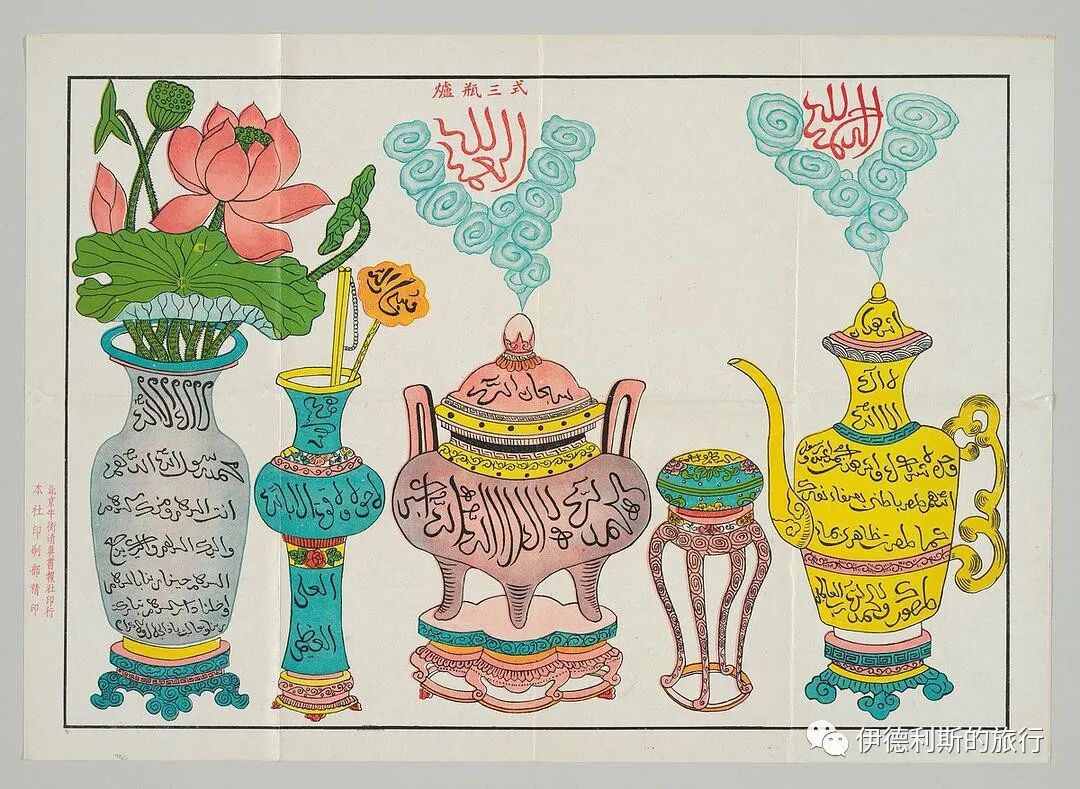
A color-printed set of the three-piece incense set (luping sanshi) from the Beijing Niujie Muslim Book and Newspaper Press. From right to left are the teapot, incense box, incense burner, chopstick vase, and flower vase.
Ali's sword, the first print says published by Beijing Niujie Muslim Book and Newspaper Press, and the second print was changed to "Beiping."
A color-printed Basmala (tasimi), published by the Niujie Halal Bookstore in Beiping.
The Sea of Fury Ship (nuhai chuan), published by the Niujie Halal Bookstore in Beijing.
The Praise of the Prophet on the Sea (haishui zansheng), printed by the Niujie Halal Bookstore in Beiping, features 34 lines of dua written within the waves.
Scripture characters on red paper, printed by the Niujie Halal Bookstore in Beiping.
Basmala (tasimi).
All praise is due to Allah (written eight times).
Printed by the Niujie Halal Bookstore in Beiping, the Prophet's Last Words (guisheng cishi yiyan) exist in 1925 and 1932 editions and depict the appearance of the Prophet Muhammad.
Halal Miaoxiangge Star and Moon brand orchid perfume, made by Li Peilin, with the main factory located at No. 17 Santuanqiao Dongting Alley, outside Chongwenmen, Beiping.
A halal marriage certificate, dated November 25, 1922, published by the Nanjing Halal Board and the Daoyi Society, with the printing plate kept at the Tangzi Street Mosque in Nanjing.
Essentials of the Right Path (zhengdao genyuan jiaotiao zhiyao), a public notice from the mosque outside the south gate of Liuhe, Nanjing, compiled by Ma Youheng Mingsanshi of Sichuan. It describes various actions that destroy, harm, or help one's faith (imani).
A Simple Explanation of the Essentials of Halal Faith, published in the eighth month of the 31st year of the Guangxu reign (1905) by Ma Dengshou and other students of the Hujia Mosque. Hujia Mosque is located in Longhu Village, Xindu District, Chengdu, Sichuan, and was founded in 1738. The Hu family's ancestral home was in Weinan, Shaanxi, and they moved to Sichuan between the end of the Ming Dynasty and the beginning of the Qing Dynasty.
Book catalog of the Beiping Chengda Normal School Publishing Department, May 25, 1934.
Price list for various Islamic scriptures sold by the Zhenxue Society in the provincial capital of Yunnan. Sold on behalf of the society by Ma Jun Renqing, manager of the Lihechang Leather Store at No. 133 Shuncheng Shangjie, outside the Great South Gate of the provincial capital of Yunnan.
Catalog of books from the Beijing Niujie Halal Bookstore.
The 99 Names of Allah and the eight gates of Paradise, source unknown.
Chart of the Fifty Generations of Light (wushi dai chuanguang tu), printed by the Niujie Halal Bookstore in Beijing. It includes the lineage of fifty generations from the Prophet Adam to the Prophet Muhammad. The prophets in the central large circle are Adam (Adan), Noah (Nuha), Abraham (Yibulaximai), Moses (Musa), David (Dawudai), Jesus (Ersa), and the Holy Prophet Muhammad (Muhammaidai).
Printed by the Zungutang Lithographic Press in Tianjin.
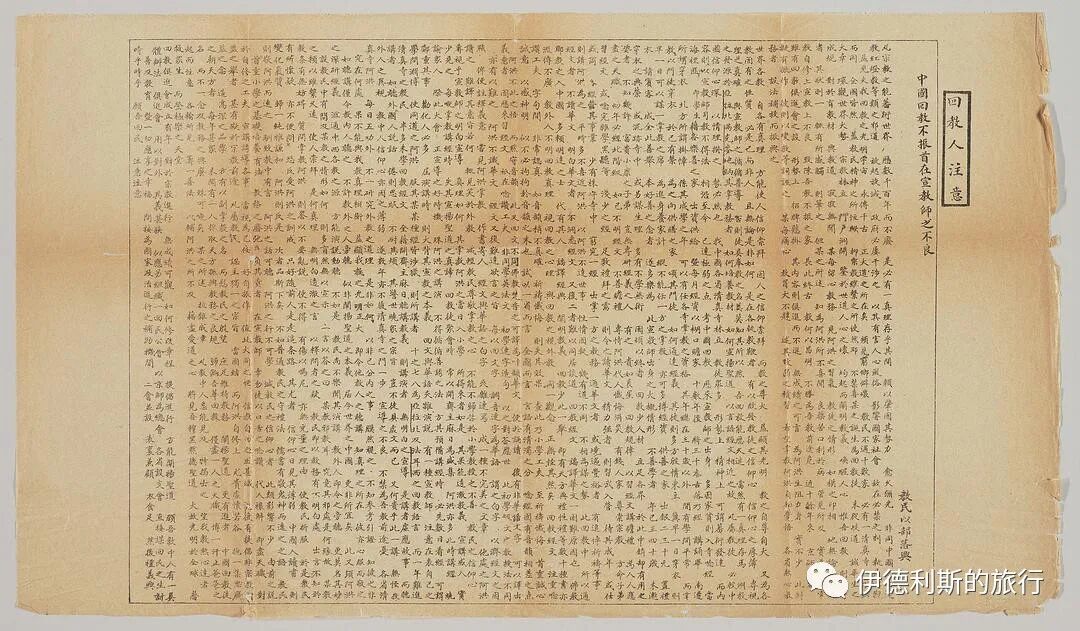
Attention, Muslims.
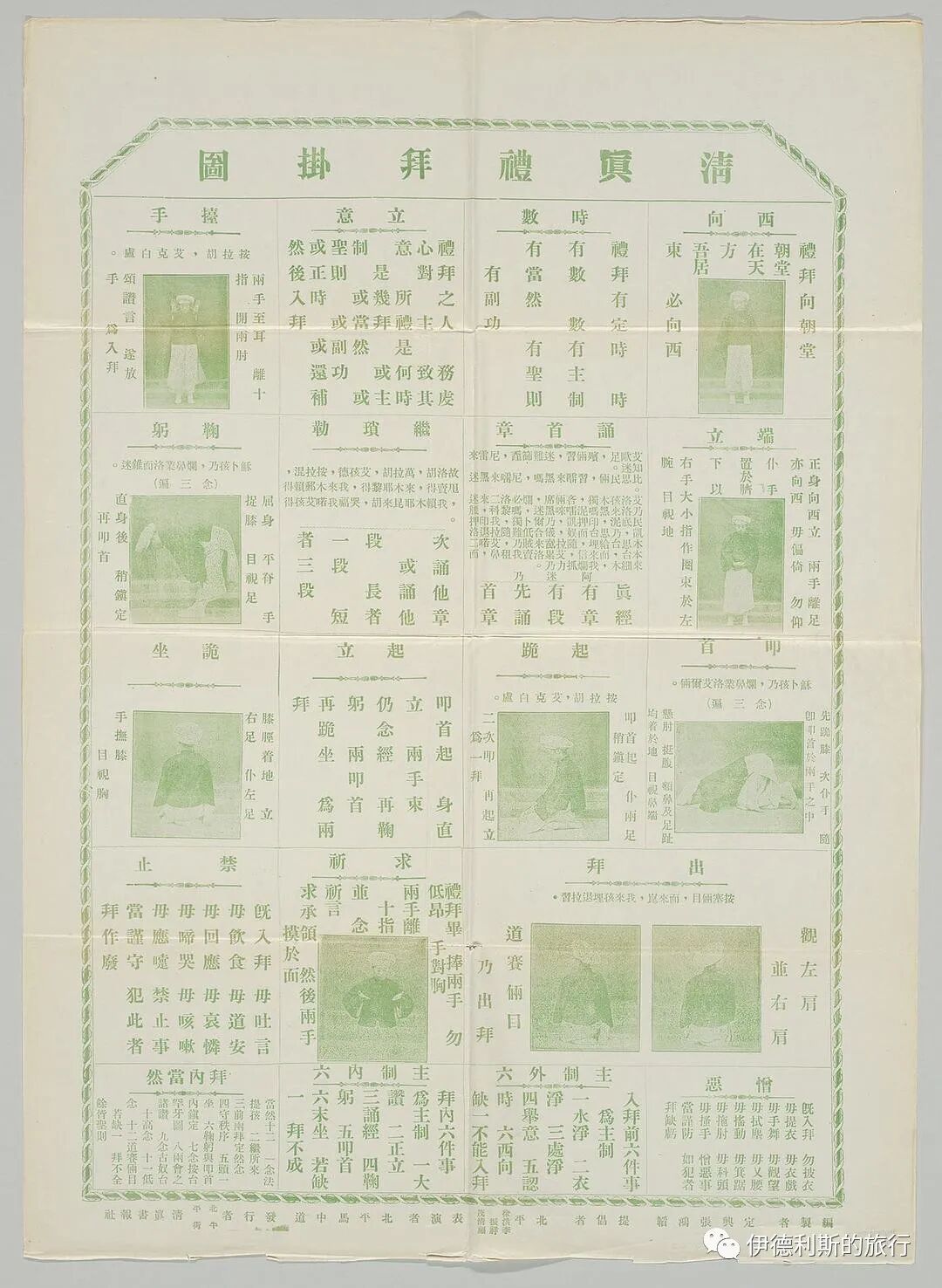
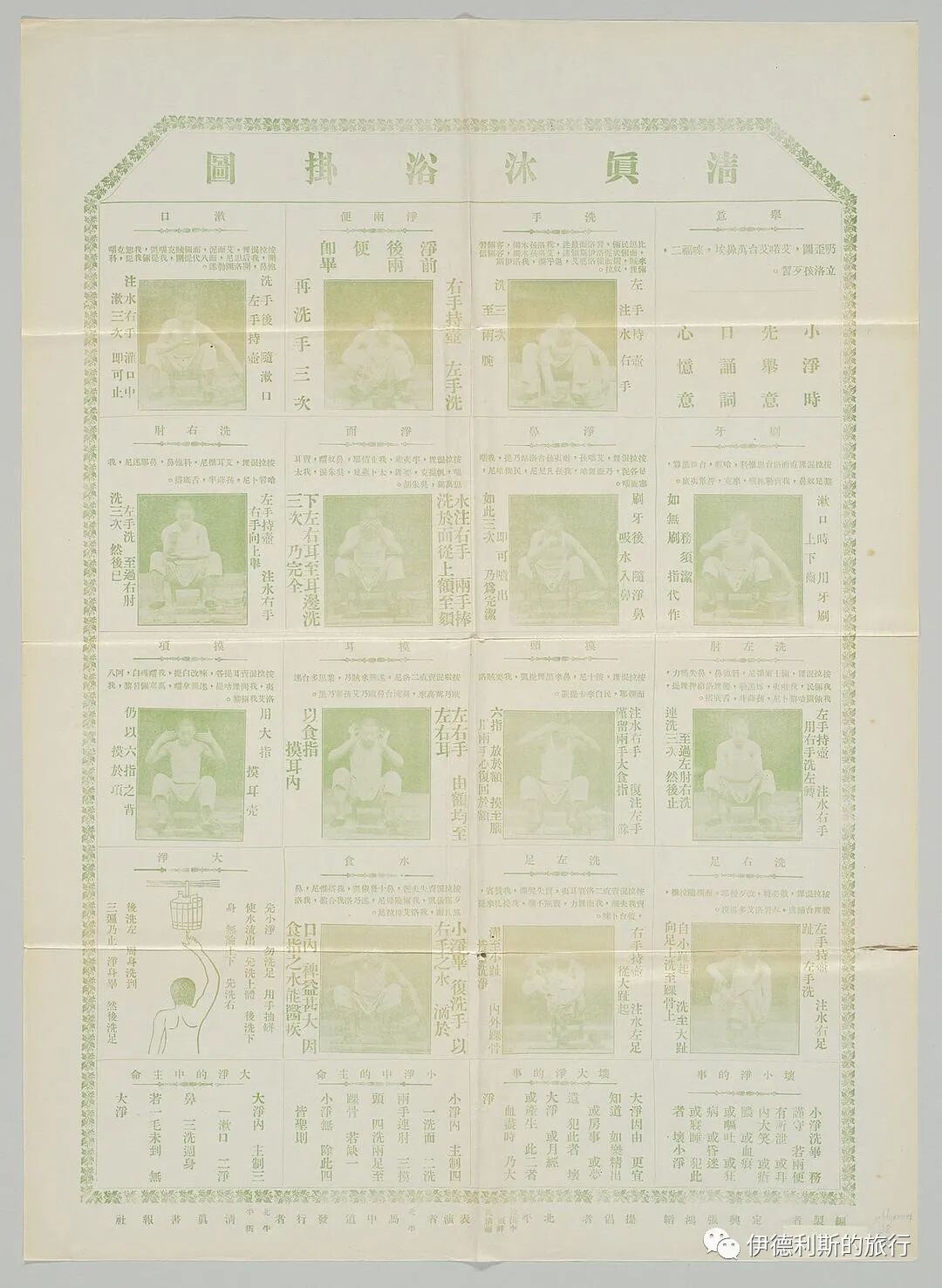
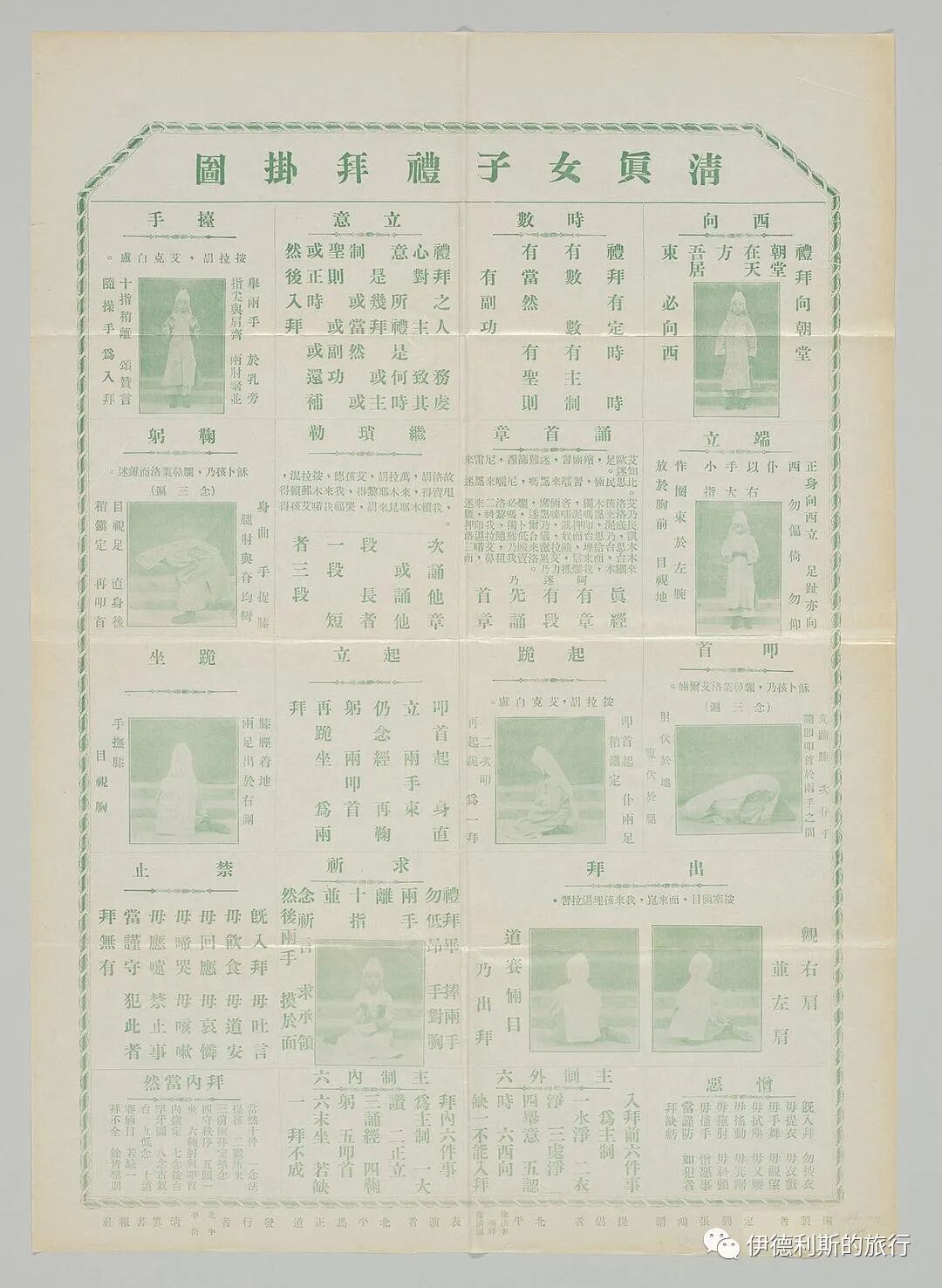
The Islamic ritual washing (wudu) wall chart and prayer wall chart were compiled by Zhang Hongtao from Dingxing, performed by Ma Zhongdao from Beiping, and published by the Beiping Niujie Mosque Newspaper and Book Agency.
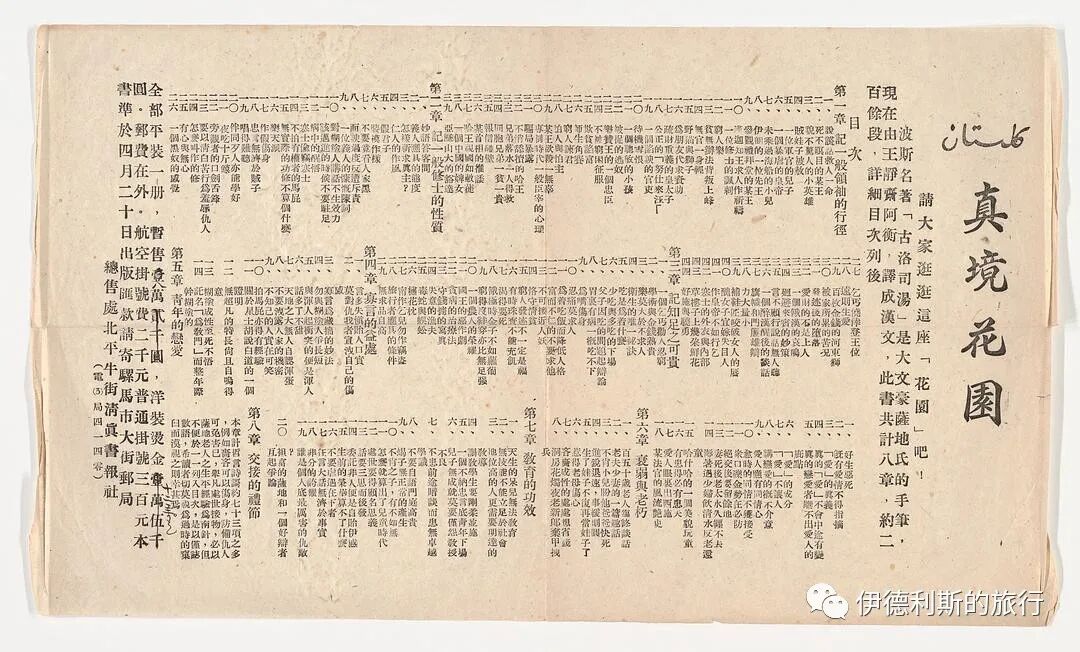
A promotional flyer for the True Mirror Garden (Zhenjing Huayuan) from the Beiping Niujie Mosque Newspaper and Book Agency.
4. Islamic Calendar.
In 1946, the Religious Affairs Committee of the Yunnan Provincial Branch of the China Islamic Association compiled and printed the Islamic monthly start dates, festivals, fasting, and prayer schedule.
Published by the Yuehua Newspaper Agency in 1946.
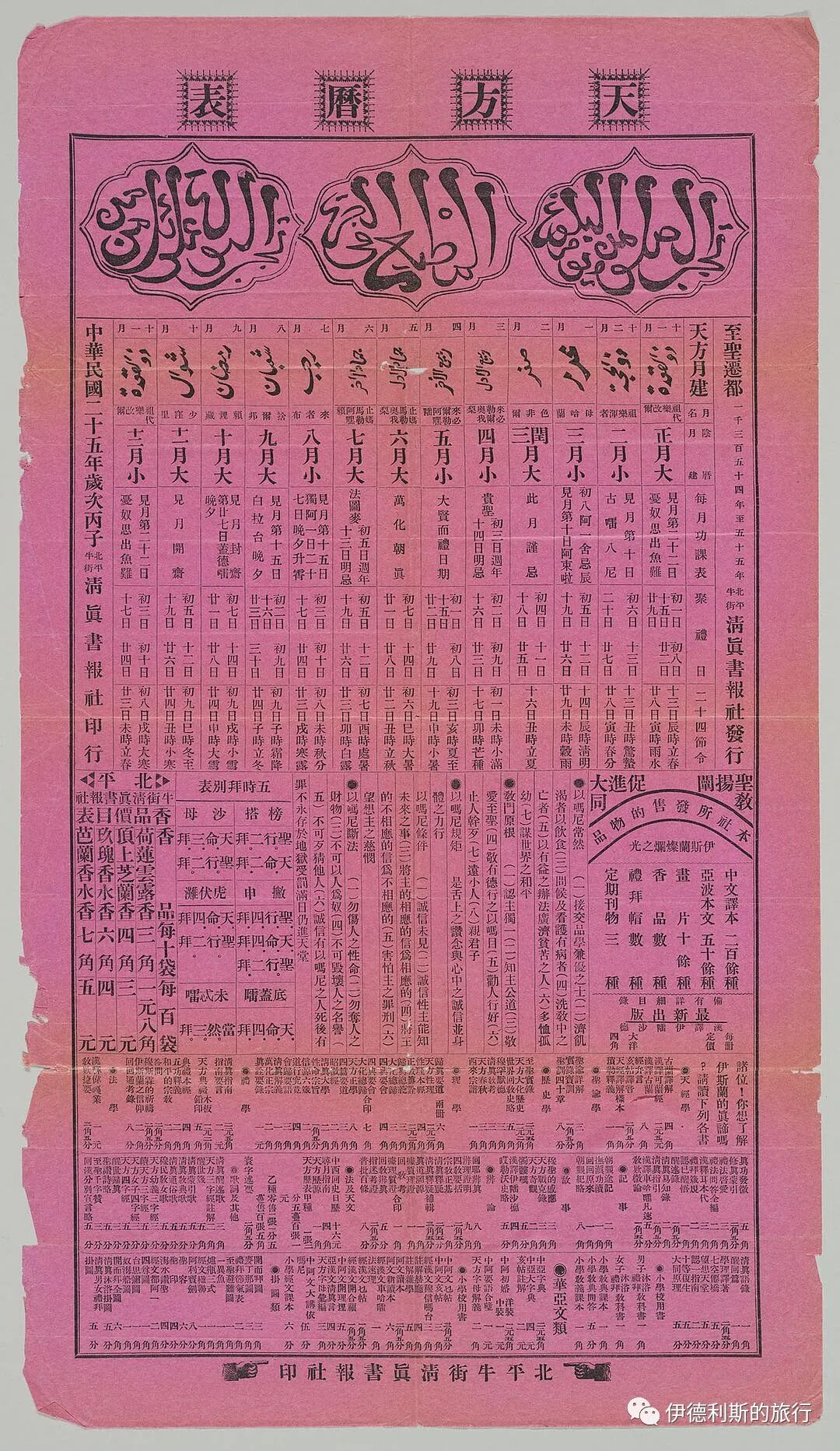
Printed by the Beiping Niujie Mosque Newspaper and Book Agency in 1936.
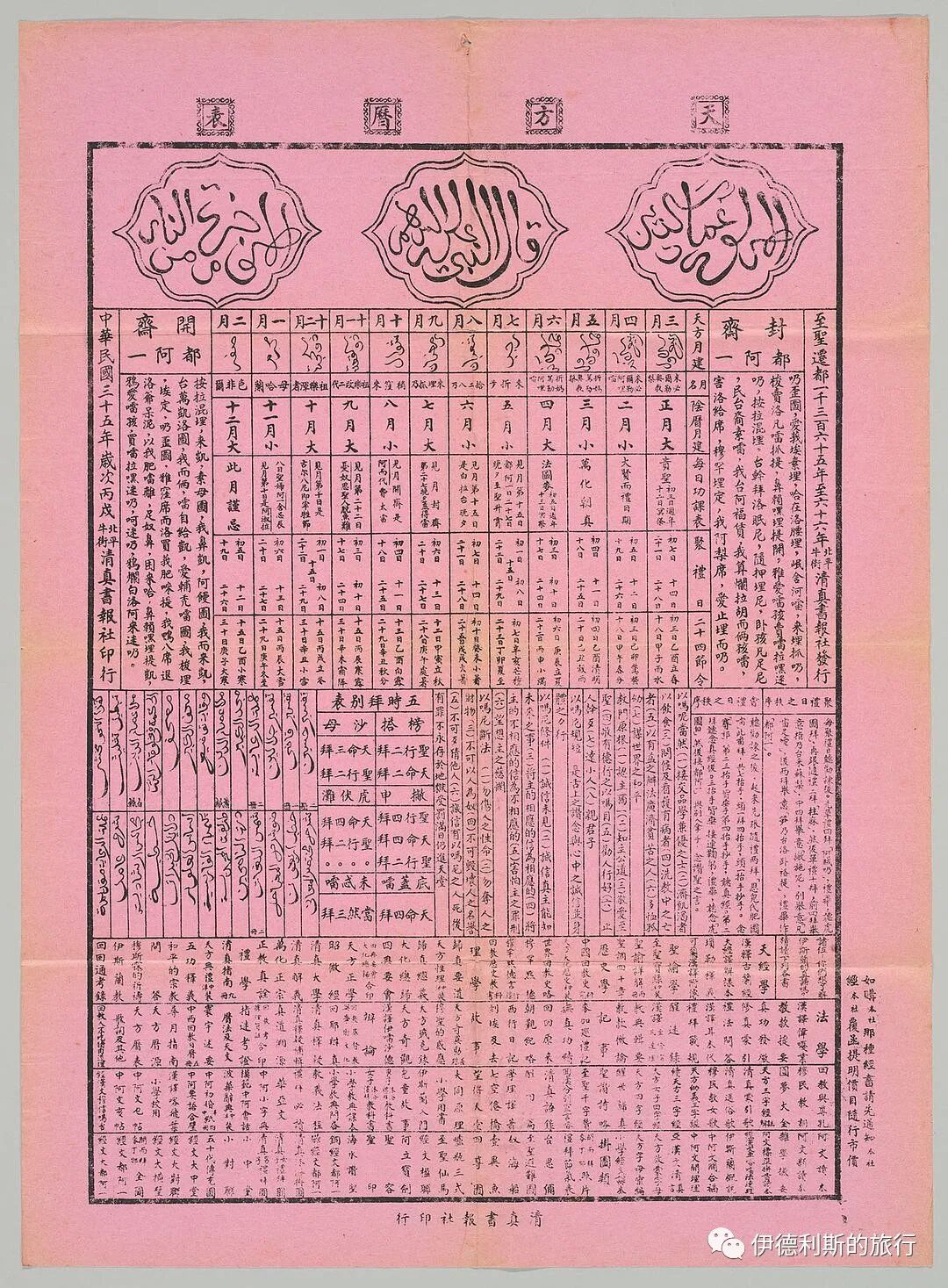
Printed by the Beiping Niujie Mosque Newspaper and Book Agency in 1946.
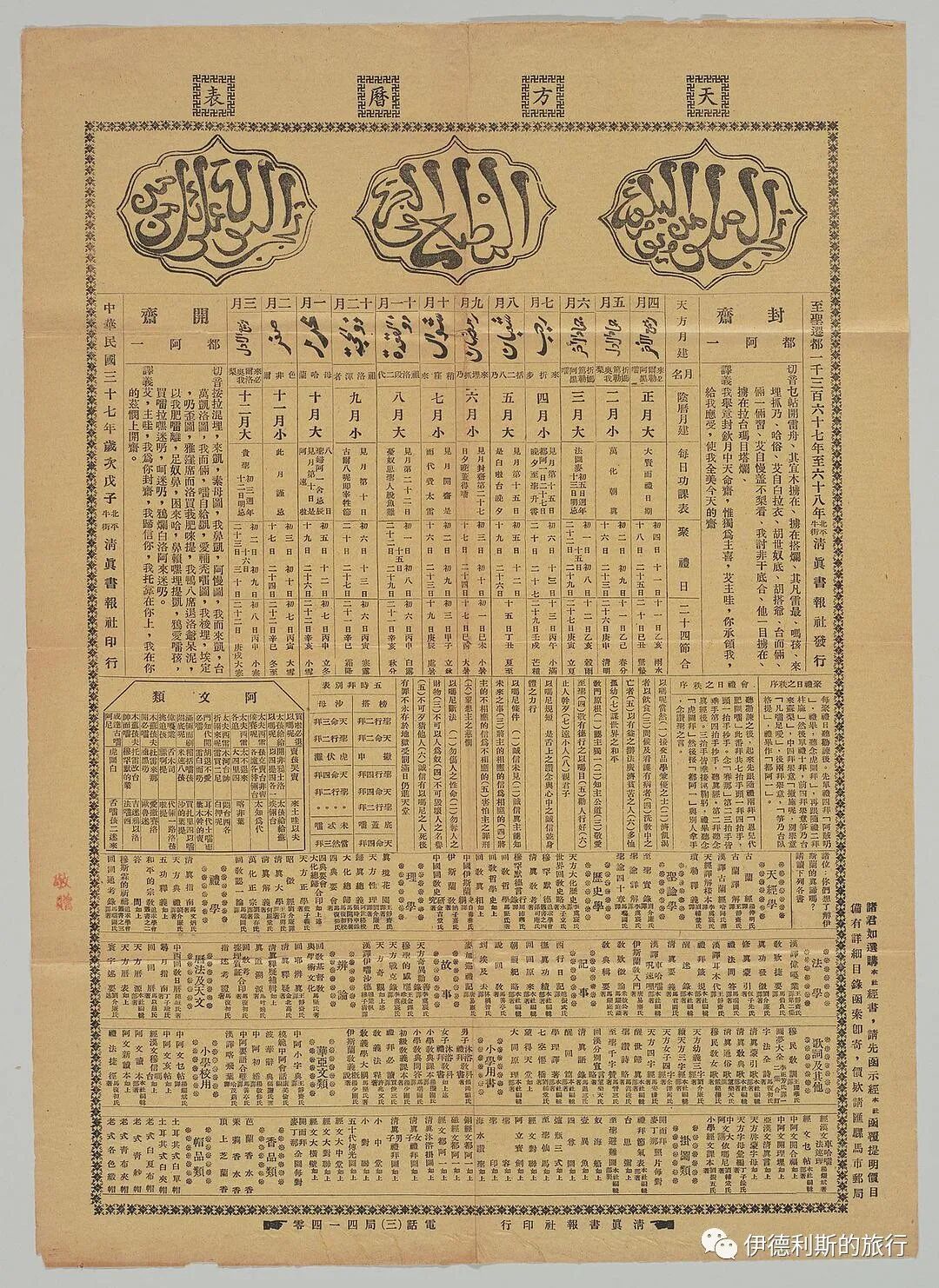
Printed by the Beiping Niujie Mosque Newspaper and Book Agency in 1948.
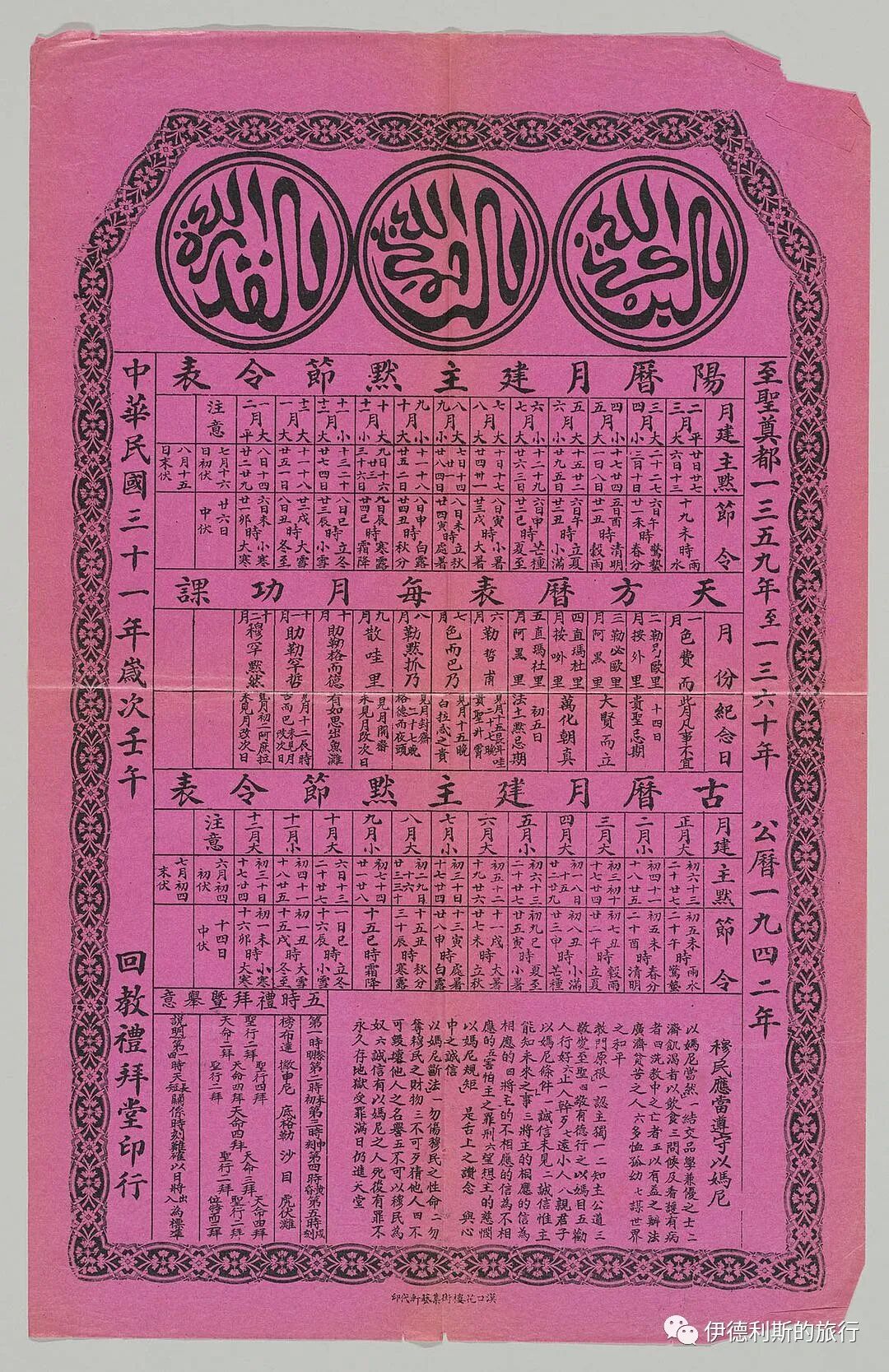
Printed on behalf of the Jiyixuan studio on Hualou Street in Hankou in 1942. view all
Summary: Claude L. Pickens Jr. Collection: Republican-Era Hui Muslim Documents is presented here as a firsthand travel account in clear English, beginning with this scene: Claude L. Pickens Jr. was an American missionary who came to China in 1926 and worked mainly in Hankou. The account keeps its focus on Hui Muslims, Islamic Manuscripts, Harvard Yenching while preserving the names, places, food, and historical details from the Chinese source.
Claude L. Pickens Jr. was an American missionary who came to China in 1926 and worked mainly in Hankou. He traveled to the Muslim-populated areas of Northwest China twice, in 1933 and 1936, taking many photos and leaving behind valuable records.
Pickens collected many precious documents from Hui Muslims during the Republic of China era, including scripture calligraphy, wall charts, religious calendars, and calligraphy works. He donated them all to the Harvard-Yenching Library in 1984, where they were digitized and displayed on the library's official website.
Most of these documents came from the Muslim Book and Newspaper Press (Qingzhen Shubao She) on Niujie Street in Beiping. The Muslim Book and Newspaper Press was founded in the early years of the Republic of China by Imam Ma Kuilin of Niujie. In the 1920s and 1930s, it printed various scripture textbooks and scholarly works in a shop north of Guang'anmen Street, which were sold all over the country. After Imam Ma Kuilin passed away in 1940, his fourth son, Ma Zhongdao, continued to run the business until it was merged into the Xuanwu Xinhua Bookstore in 1956. After 1966, all the books and records from the Muslim Book and Newspaper Press that had been handed over to the Xuanwu Xinhua Bookstore went missing, and the collection held by Ma Zhongdao himself was forced to be burned by his own hands. Because of this, the collection of books and records from the Muslim Book and Newspaper Press held by Pickens has become the most precious material available.
Official website: library.harvard.edu/collections/rev-claude-l-pickens-jr-collection-muslims-china
The book "Selected Fine Prints of Hui Muslim Materials from the Republic of China Era" provides a detailed introduction to these documents, but unfortunately, due to layout and paper limitations, the images in the book are not printed clearly enough.
A wall scroll (zhongtang) of calligraphy finely produced by the Beiping Niujie Muslim Book and Newspaper Press.
Inna-hu alimun bi-zat al-sudur, finely produced by the Beiping Niujie Muslim Book and Newspaper Press.
A quote from Caliph Umar: Kafa bi-al-mawt wai zan, wa kafa bi-al-dahr tafarruqan.
Death is enough as a warning, and the world is enough as a separation (from Allah).
A wall scroll, printed by the Beiping Niujie Muslim Book and Newspaper Press. According to teacher Wang Qifei, this is the work of Imam Li Chaozhen or Li Shouzhen from Cangzhou.
A wall scroll featuring scripture calligraphy. Guide us to the straight path (1:6), with a seal that reads "Xuanjing." According to teacher Mu Ning, the author is likely Fa Jingxuan from Jinan. Fa Jingxuan was a famous educator and one of the founders of the Chengda Teachers' School.
The scripture couplets on both sides of the wall scroll also come from the Fatiha.
A color-printed set of the three-piece incense set (luping sanshi) from the Beijing Niujie Muslim Book and Newspaper Press. From right to left are the teapot, incense box, incense burner, chopstick vase, and flower vase.
Ali's sword, the first print says published by Beijing Niujie Muslim Book and Newspaper Press, and the second print was changed to "Beiping."
A color-printed Basmala (tasimi), published by the Niujie Halal Bookstore in Beiping.
The Sea of Fury Ship (nuhai chuan), published by the Niujie Halal Bookstore in Beijing.
The Praise of the Prophet on the Sea (haishui zansheng), printed by the Niujie Halal Bookstore in Beiping, features 34 lines of dua written within the waves.
Scripture characters on red paper, printed by the Niujie Halal Bookstore in Beiping.
Basmala (tasimi).
All praise is due to Allah (written eight times).
Printed by the Niujie Halal Bookstore in Beiping, the Prophet's Last Words (guisheng cishi yiyan) exist in 1925 and 1932 editions and depict the appearance of the Prophet Muhammad.
Halal Miaoxiangge Star and Moon brand orchid perfume, made by Li Peilin, with the main factory located at No. 17 Santuanqiao Dongting Alley, outside Chongwenmen, Beiping.
A halal marriage certificate, dated November 25, 1922, published by the Nanjing Halal Board and the Daoyi Society, with the printing plate kept at the Tangzi Street Mosque in Nanjing.
Essentials of the Right Path (zhengdao genyuan jiaotiao zhiyao), a public notice from the mosque outside the south gate of Liuhe, Nanjing, compiled by Ma Youheng Mingsanshi of Sichuan. It describes various actions that destroy, harm, or help one's faith (imani).
A Simple Explanation of the Essentials of Halal Faith, published in the eighth month of the 31st year of the Guangxu reign (1905) by Ma Dengshou and other students of the Hujia Mosque. Hujia Mosque is located in Longhu Village, Xindu District, Chengdu, Sichuan, and was founded in 1738. The Hu family's ancestral home was in Weinan, Shaanxi, and they moved to Sichuan between the end of the Ming Dynasty and the beginning of the Qing Dynasty.
Book catalog of the Beiping Chengda Normal School Publishing Department, May 25, 1934.
Price list for various Islamic scriptures sold by the Zhenxue Society in the provincial capital of Yunnan. Sold on behalf of the society by Ma Jun Renqing, manager of the Lihechang Leather Store at No. 133 Shuncheng Shangjie, outside the Great South Gate of the provincial capital of Yunnan.
Catalog of books from the Beijing Niujie Halal Bookstore.
The 99 Names of Allah and the eight gates of Paradise, source unknown.
Chart of the Fifty Generations of Light (wushi dai chuanguang tu), printed by the Niujie Halal Bookstore in Beijing. It includes the lineage of fifty generations from the Prophet Adam to the Prophet Muhammad. The prophets in the central large circle are Adam (Adan), Noah (Nuha), Abraham (Yibulaximai), Moses (Musa), David (Dawudai), Jesus (Ersa), and the Holy Prophet Muhammad (Muhammaidai).
Printed by the Zungutang Lithographic Press in Tianjin.
Attention, Muslims.
The Islamic ritual washing (wudu) wall chart and prayer wall chart were compiled by Zhang Hongtao from Dingxing, performed by Ma Zhongdao from Beiping, and published by the Beiping Niujie Mosque Newspaper and Book Agency.
A promotional flyer for the True Mirror Garden (Zhenjing Huayuan) from the Beiping Niujie Mosque Newspaper and Book Agency.
4. Islamic Calendar.
In 1946, the Religious Affairs Committee of the Yunnan Provincial Branch of the China Islamic Association compiled and printed the Islamic monthly start dates, festivals, fasting, and prayer schedule.
Published by the Yuehua Newspaper Agency in 1946.
Printed by the Beiping Niujie Mosque Newspaper and Book Agency in 1936.
Printed by the Beiping Niujie Mosque Newspaper and Book Agency in 1946.
Printed by the Beiping Niujie Mosque Newspaper and Book Agency in 1948.
Printed on behalf of the Jiyixuan studio on Hualou Street in Hankou in 1942. view all
Reposted from the web
Summary: Claude L. Pickens Jr. Collection: Republican-Era Hui Muslim Documents is presented here as a firsthand travel account in clear English, beginning with this scene: Claude L. Pickens Jr. was an American missionary who came to China in 1926 and worked mainly in Hankou. The account keeps its focus on Hui Muslims, Islamic Manuscripts, Harvard Yenching while preserving the names, places, food, and historical details from the Chinese source.
Claude L. Pickens Jr. was an American missionary who came to China in 1926 and worked mainly in Hankou. He traveled to the Muslim-populated areas of Northwest China twice, in 1933 and 1936, taking many photos and leaving behind valuable records.
Pickens collected many precious documents from Hui Muslims during the Republic of China era, including scripture calligraphy, wall charts, religious calendars, and calligraphy works. He donated them all to the Harvard-Yenching Library in 1984, where they were digitized and displayed on the library's official website.
Most of these documents came from the Muslim Book and Newspaper Press (Qingzhen Shubao She) on Niujie Street in Beiping. The Muslim Book and Newspaper Press was founded in the early years of the Republic of China by Imam Ma Kuilin of Niujie. In the 1920s and 1930s, it printed various scripture textbooks and scholarly works in a shop north of Guang'anmen Street, which were sold all over the country. After Imam Ma Kuilin passed away in 1940, his fourth son, Ma Zhongdao, continued to run the business until it was merged into the Xuanwu Xinhua Bookstore in 1956. After 1966, all the books and records from the Muslim Book and Newspaper Press that had been handed over to the Xuanwu Xinhua Bookstore went missing, and the collection held by Ma Zhongdao himself was forced to be burned by his own hands. Because of this, the collection of books and records from the Muslim Book and Newspaper Press held by Pickens has become the most precious material available.
Official website: library.harvard.edu/collections/rev-claude-l-pickens-jr-collection-muslims-china
The book "Selected Fine Prints of Hui Muslim Materials from the Republic of China Era" provides a detailed introduction to these documents, but unfortunately, due to layout and paper limitations, the images in the book are not printed clearly enough.
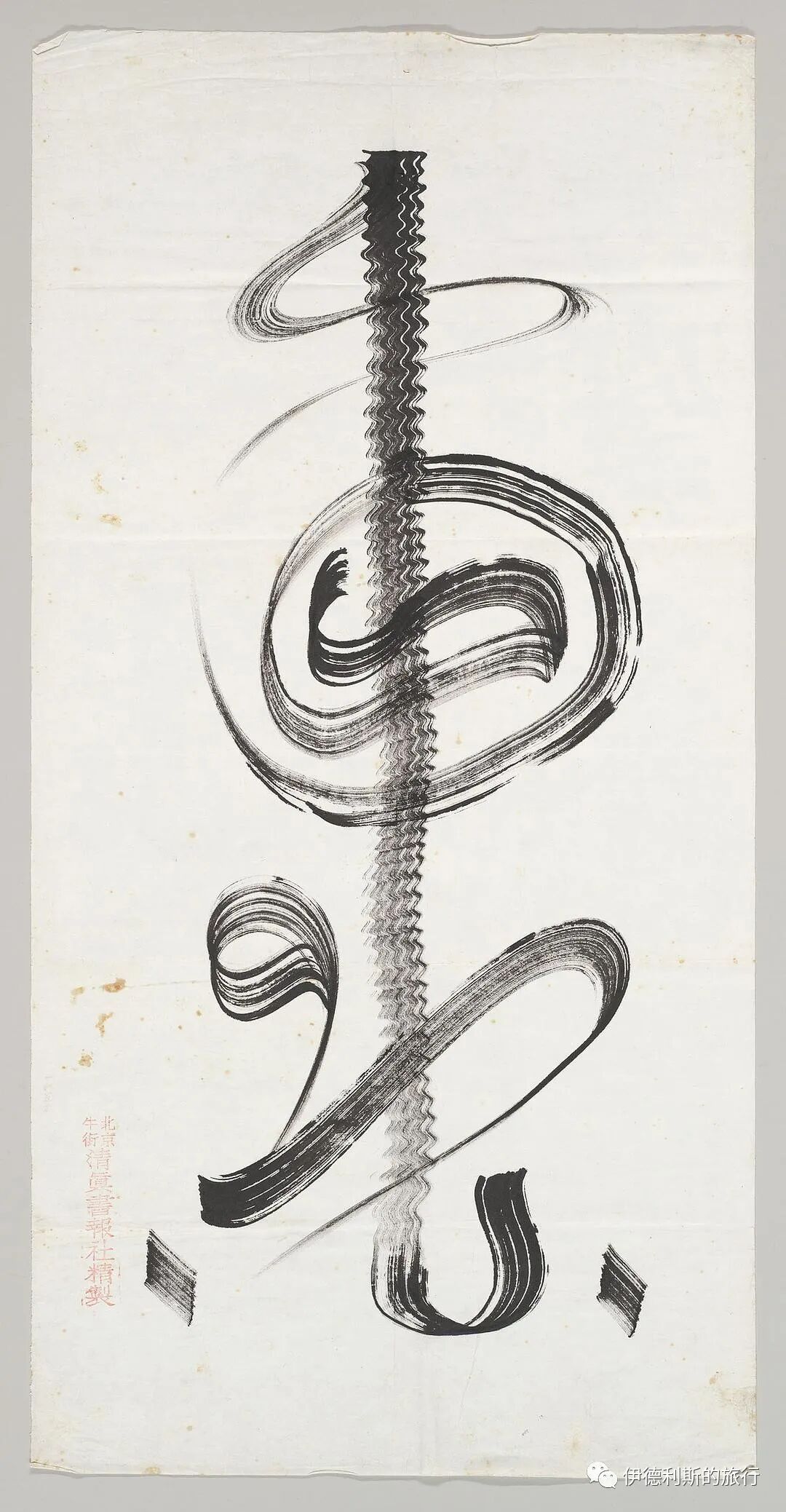
A wall scroll (zhongtang) of calligraphy finely produced by the Beiping Niujie Muslim Book and Newspaper Press.
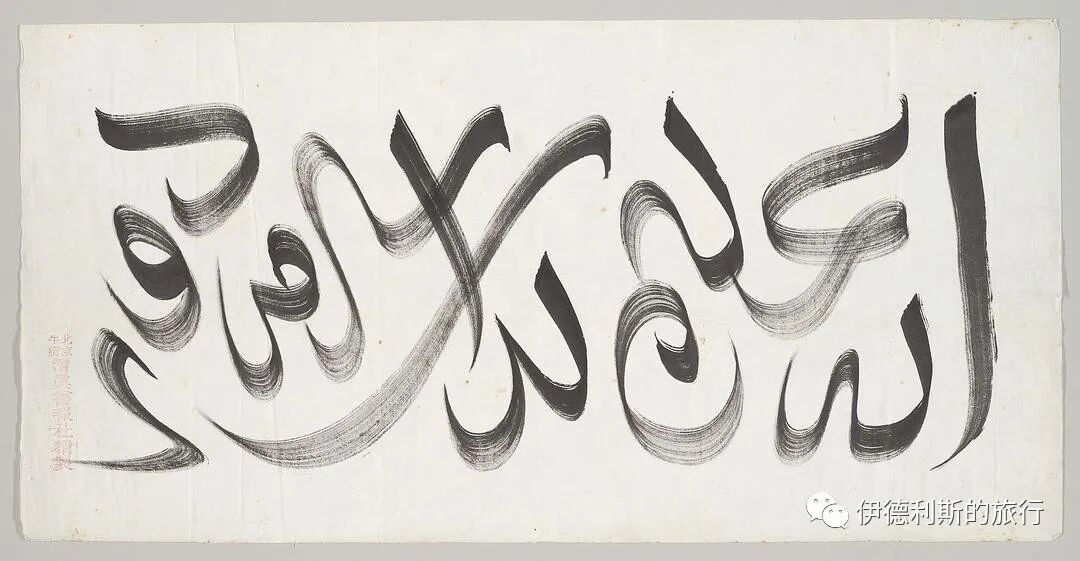
Inna-hu alimun bi-zat al-sudur, finely produced by the Beiping Niujie Muslim Book and Newspaper Press.
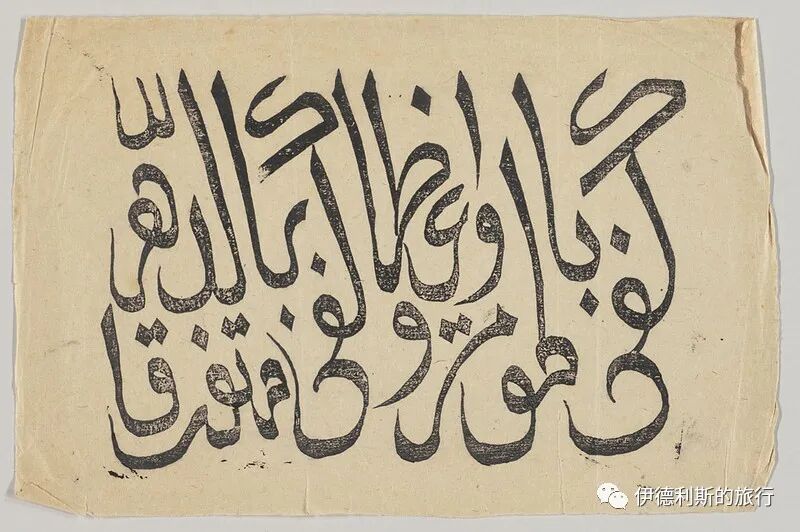
A quote from Caliph Umar: Kafa bi-al-mawt wai zan, wa kafa bi-al-dahr tafarruqan.
Death is enough as a warning, and the world is enough as a separation (from Allah).
A wall scroll, printed by the Beiping Niujie Muslim Book and Newspaper Press. According to teacher Wang Qifei, this is the work of Imam Li Chaozhen or Li Shouzhen from Cangzhou.
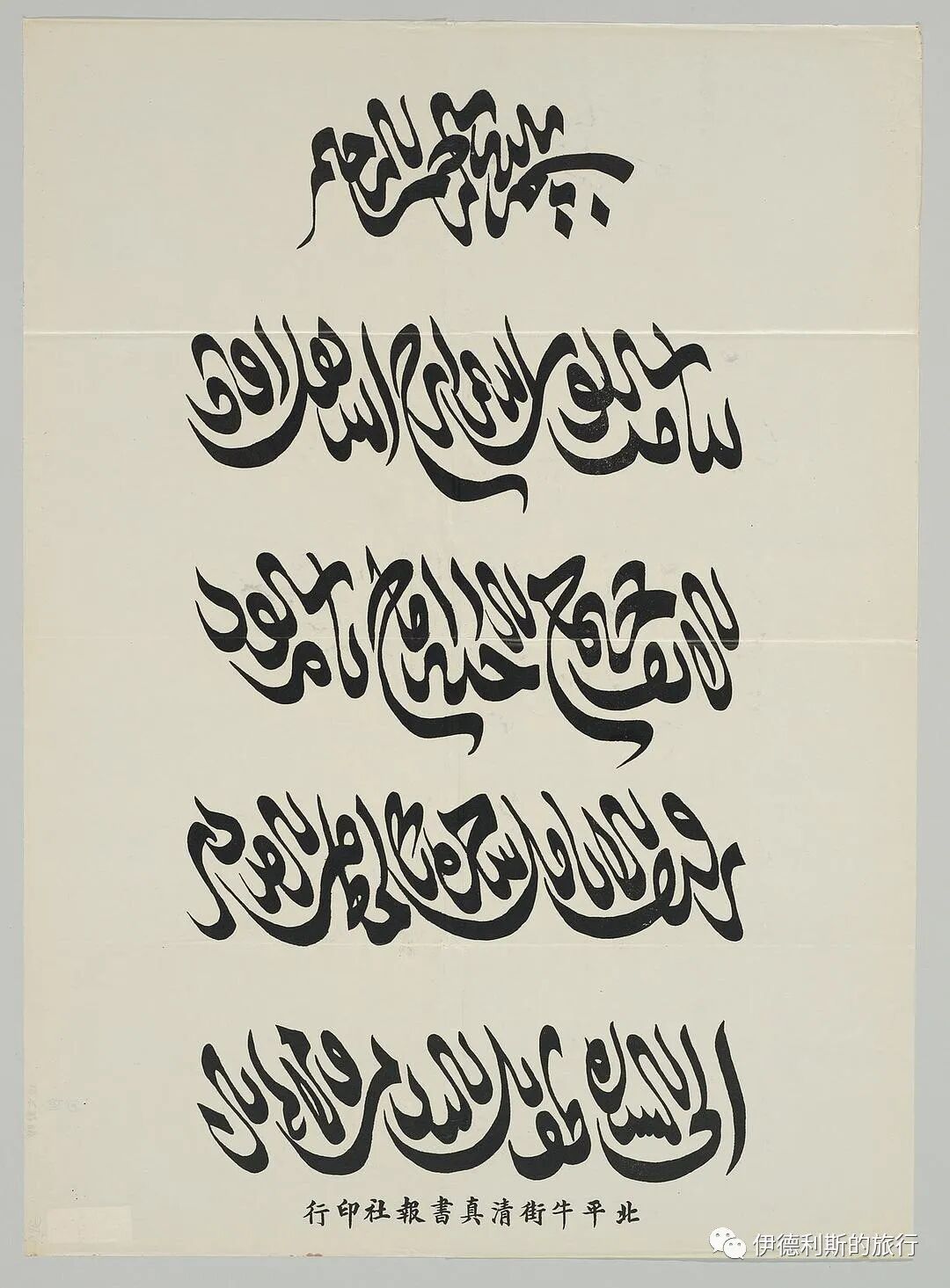
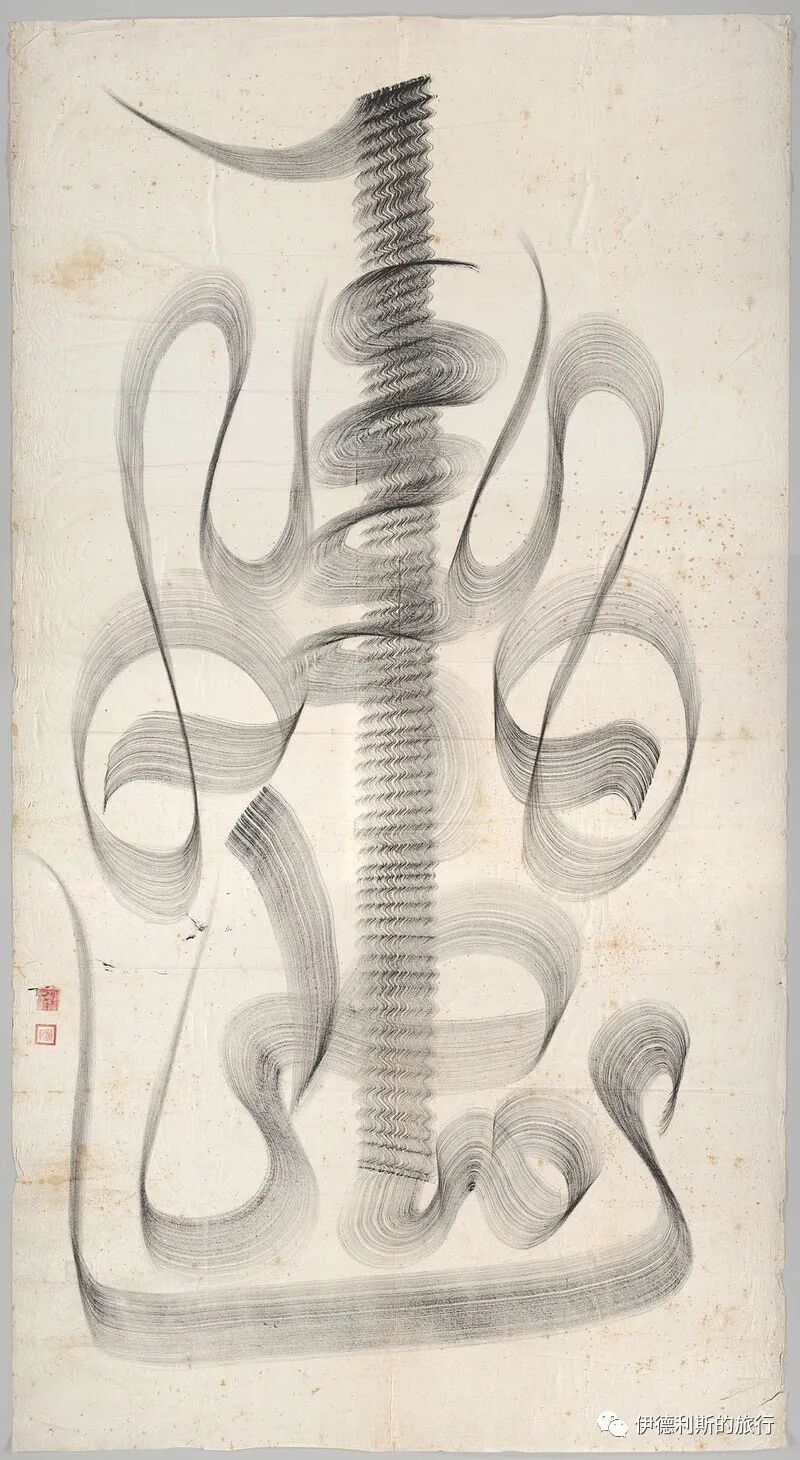
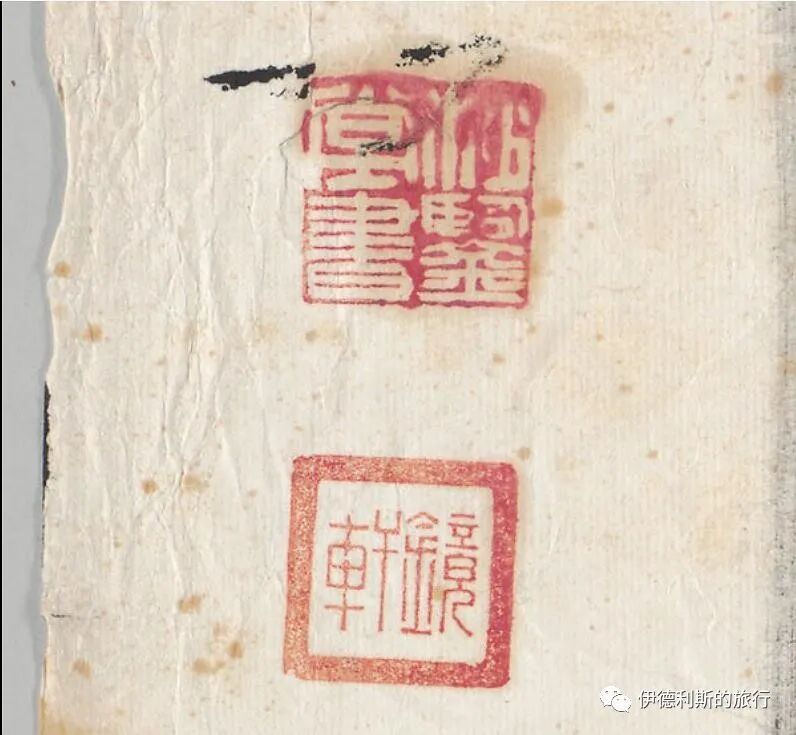
A wall scroll featuring scripture calligraphy. Guide us to the straight path (1:6), with a seal that reads "Xuanjing." According to teacher Mu Ning, the author is likely Fa Jingxuan from Jinan. Fa Jingxuan was a famous educator and one of the founders of the Chengda Teachers' School.
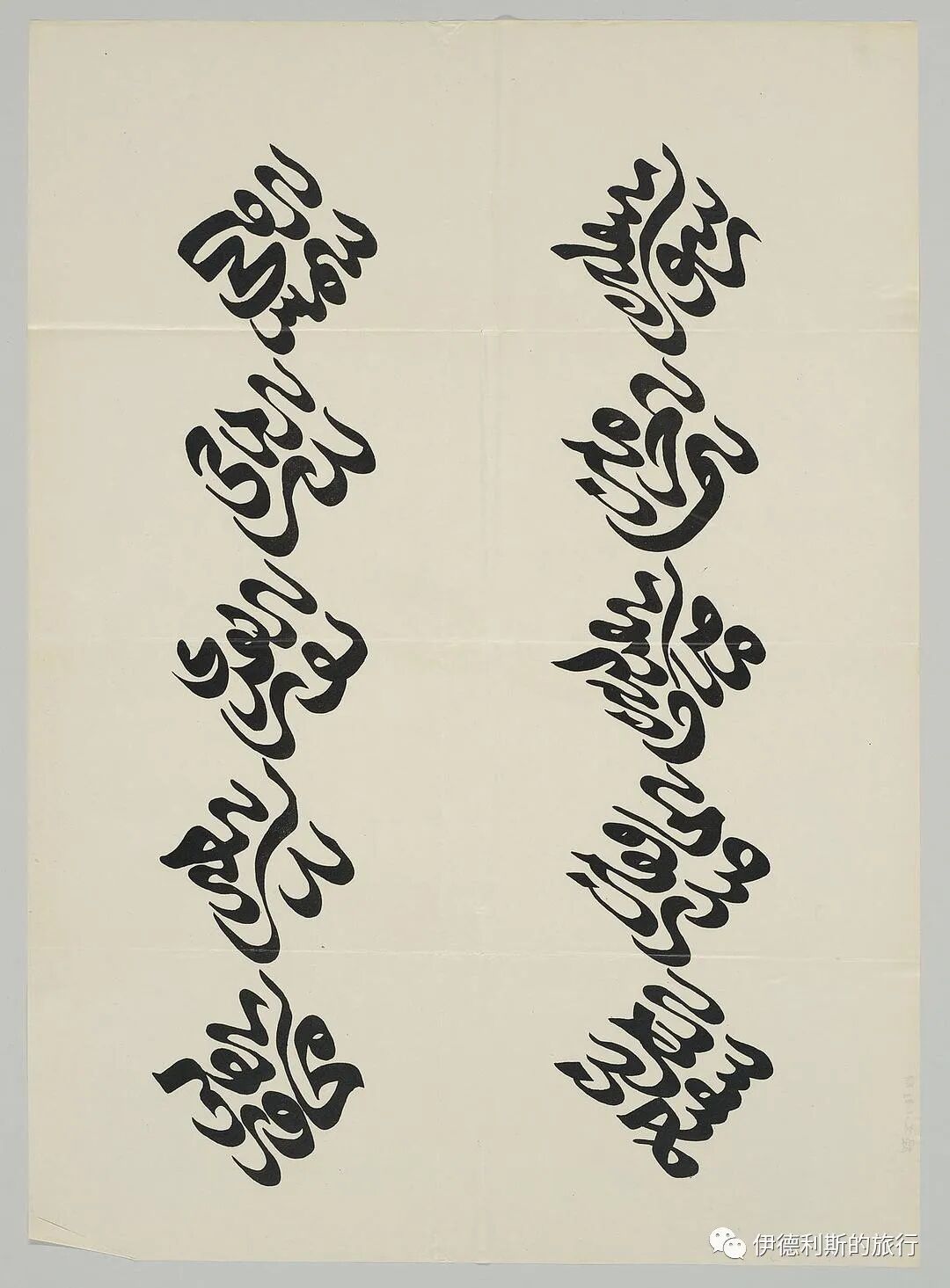
The scripture couplets on both sides of the wall scroll also come from the Fatiha.
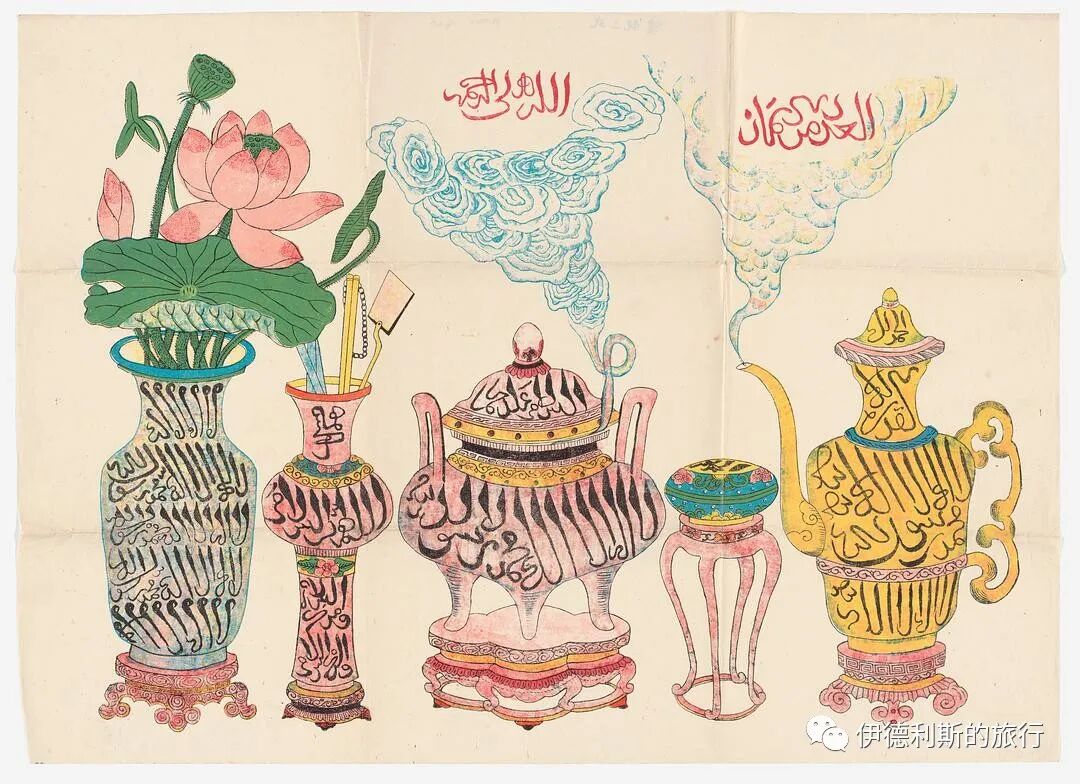
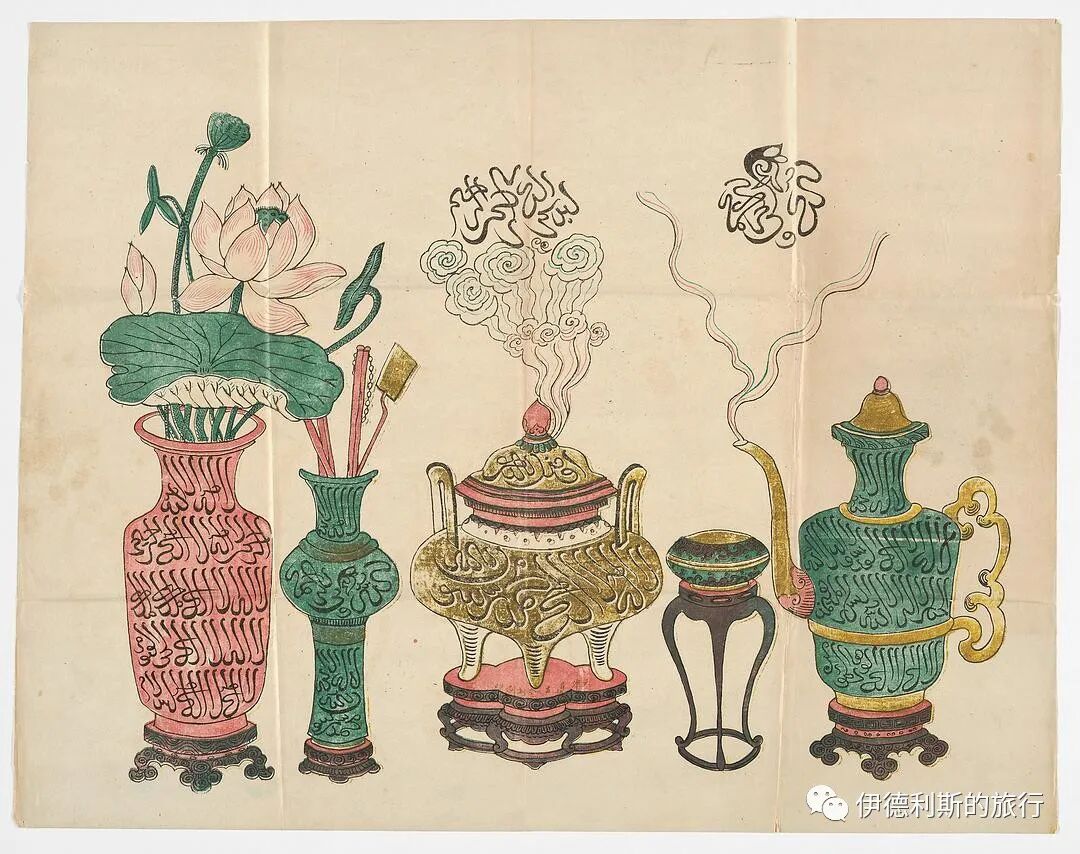
A color-printed set of the three-piece incense set (luping sanshi) from the Beijing Niujie Muslim Book and Newspaper Press. From right to left are the teapot, incense box, incense burner, chopstick vase, and flower vase.
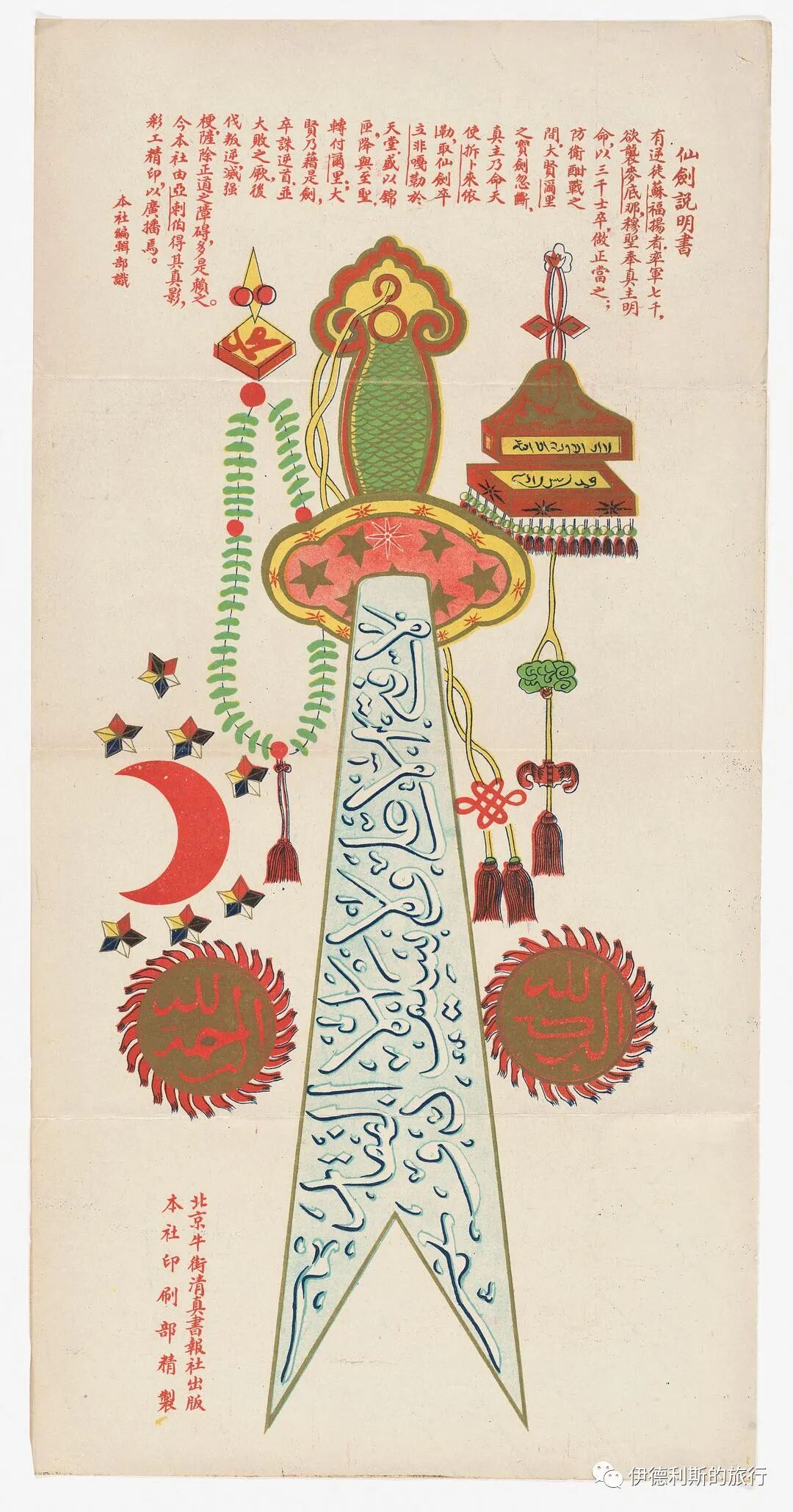
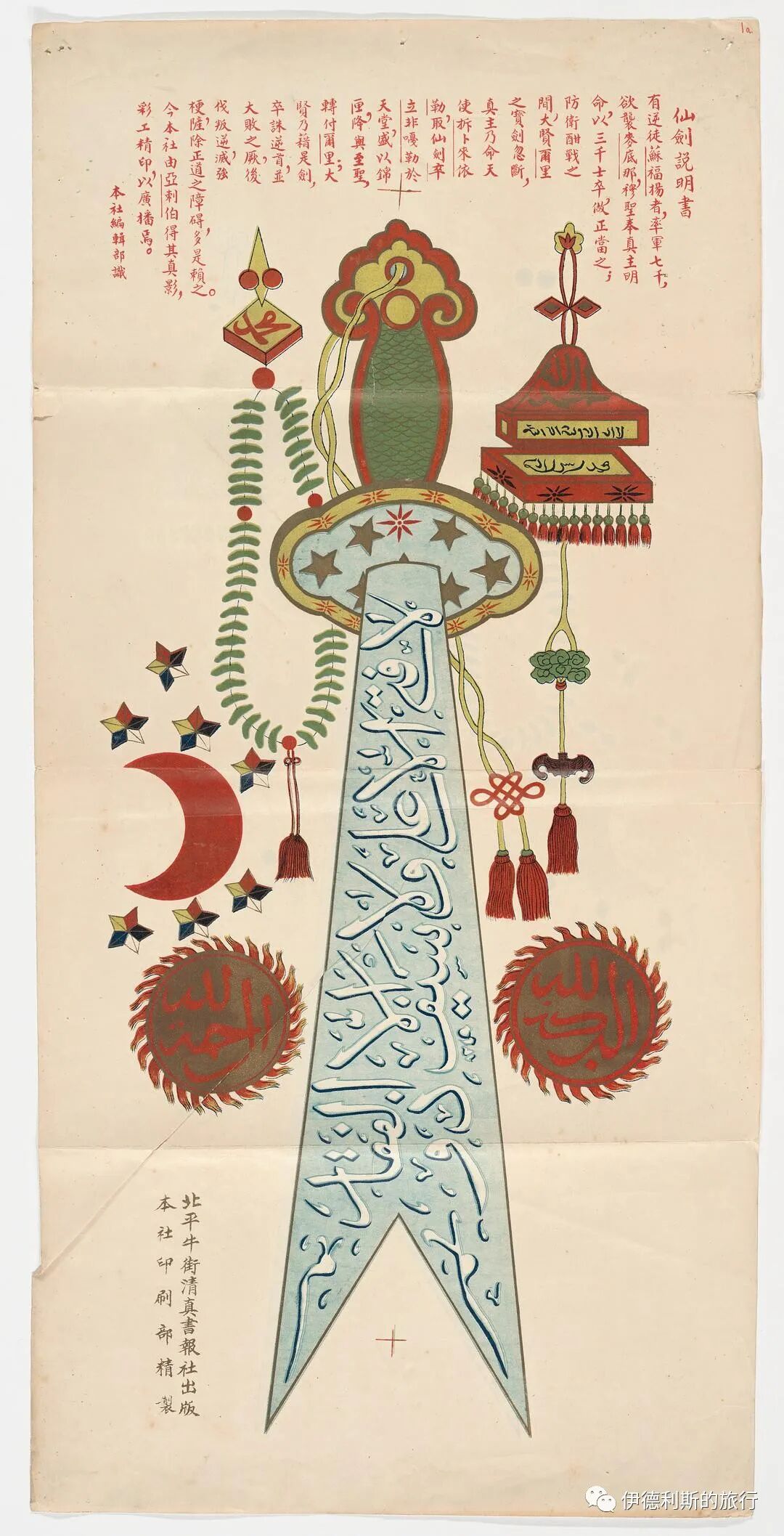
Ali's sword, the first print says published by Beijing Niujie Muslim Book and Newspaper Press, and the second print was changed to "Beiping."
A color-printed Basmala (tasimi), published by the Niujie Halal Bookstore in Beiping.
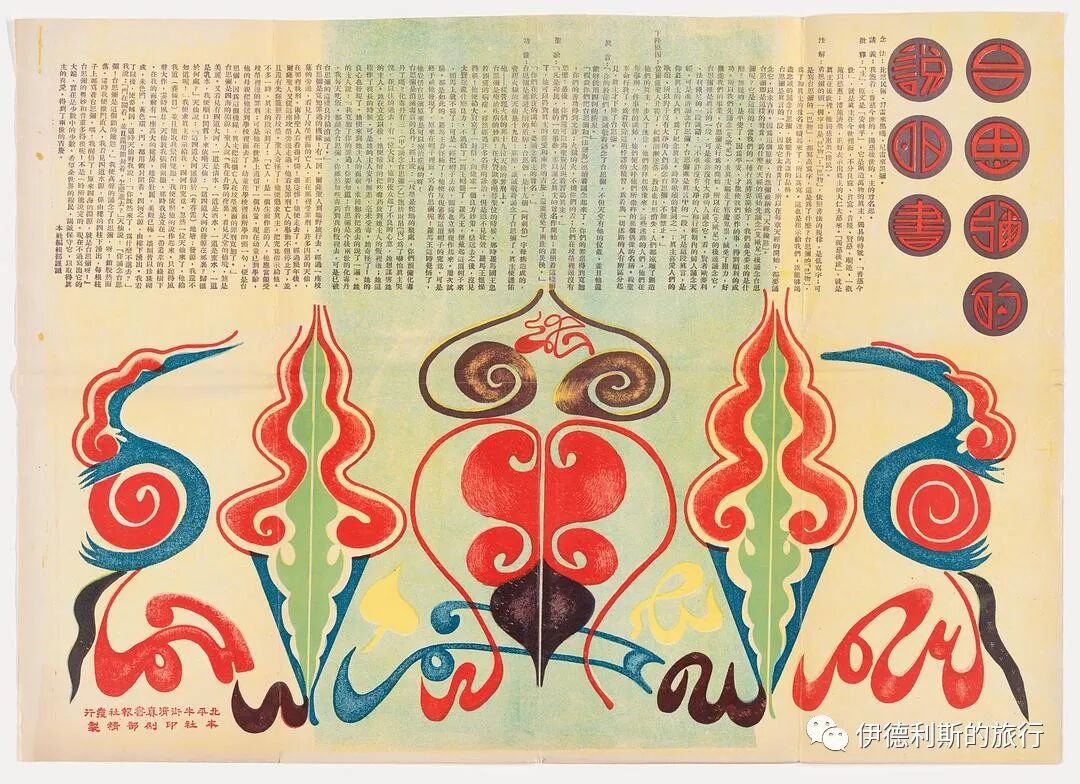
The Sea of Fury Ship (nuhai chuan), published by the Niujie Halal Bookstore in Beijing.
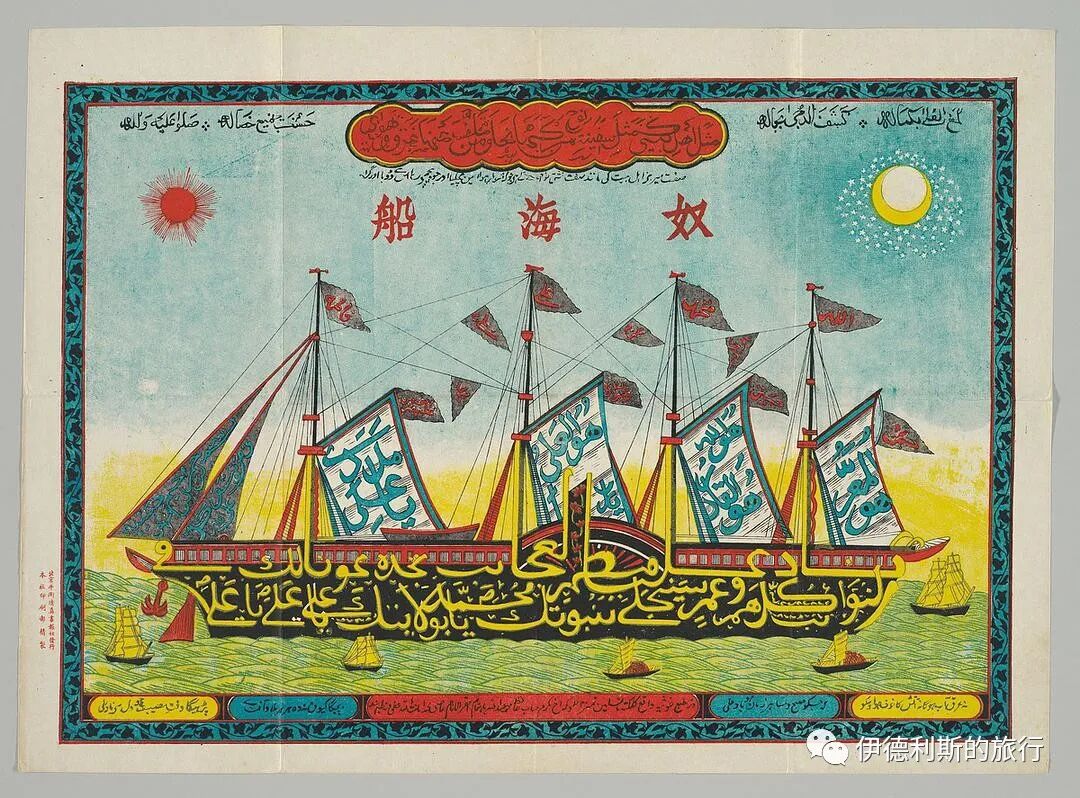
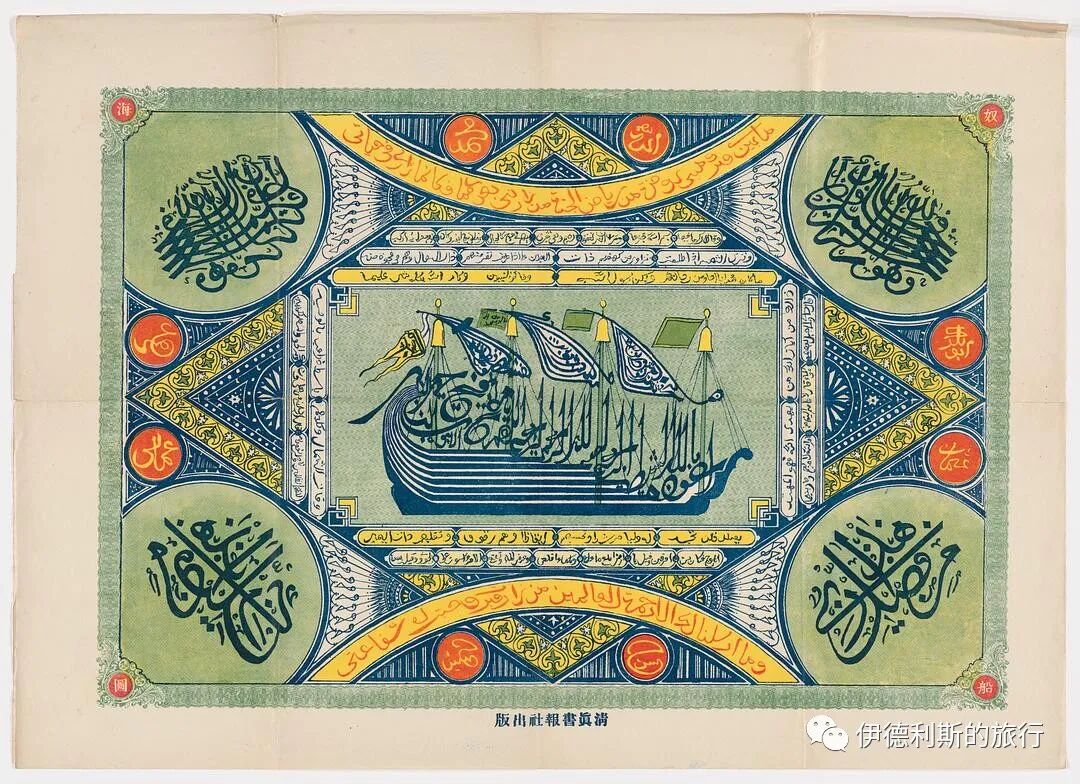
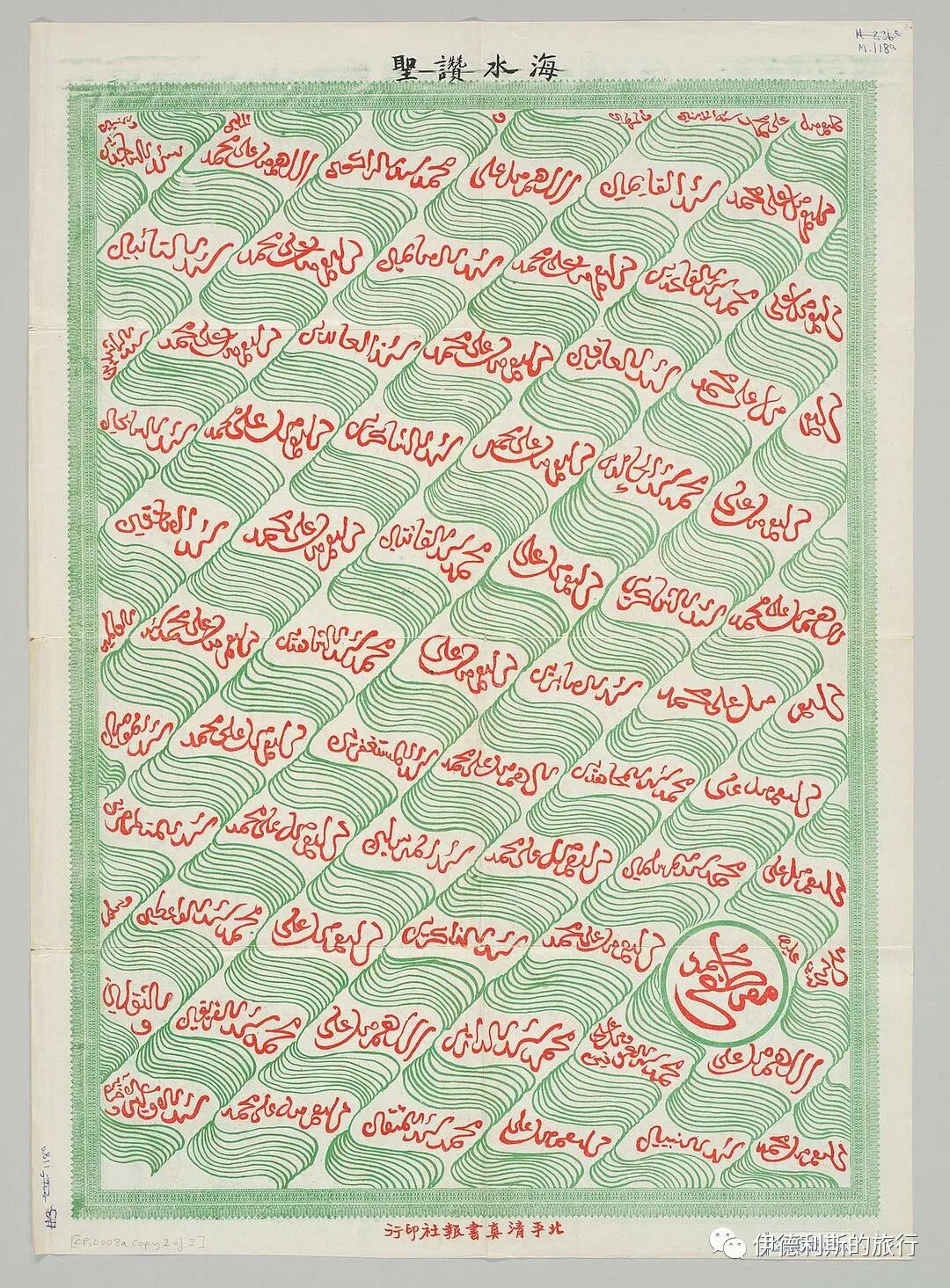
The Praise of the Prophet on the Sea (haishui zansheng), printed by the Niujie Halal Bookstore in Beiping, features 34 lines of dua written within the waves.
Scripture characters on red paper, printed by the Niujie Halal Bookstore in Beiping.
Basmala (tasimi).
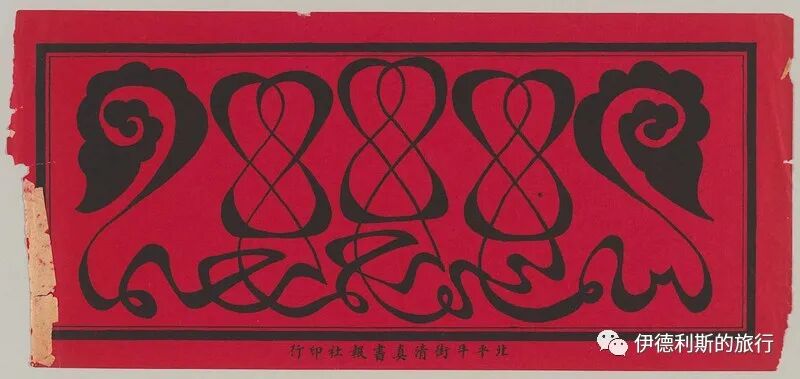
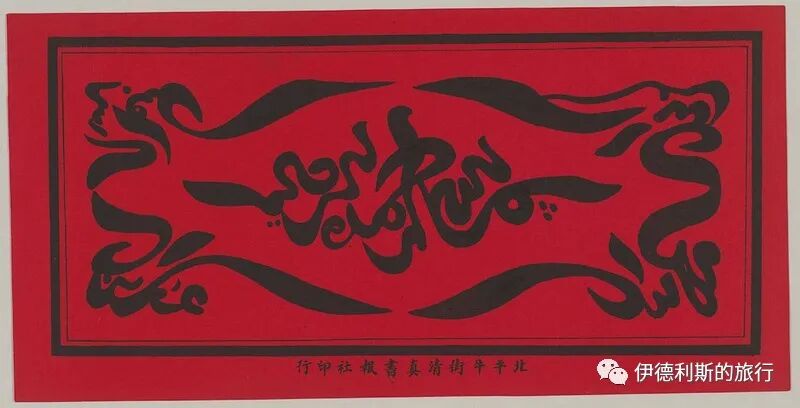
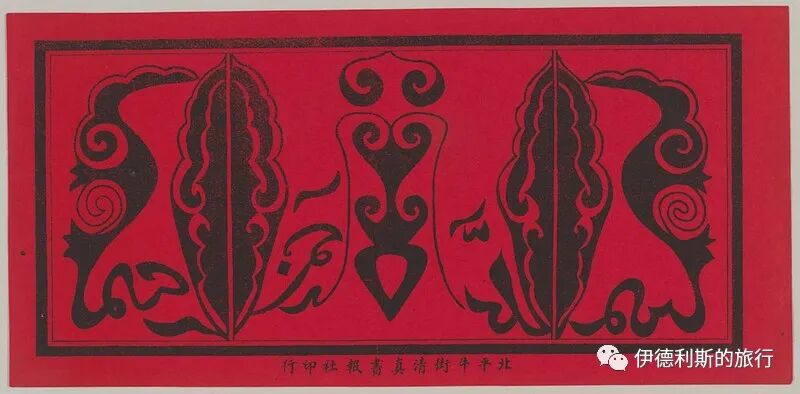
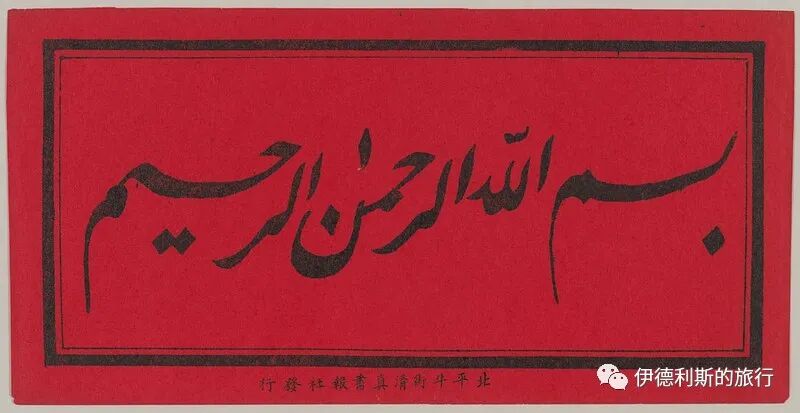
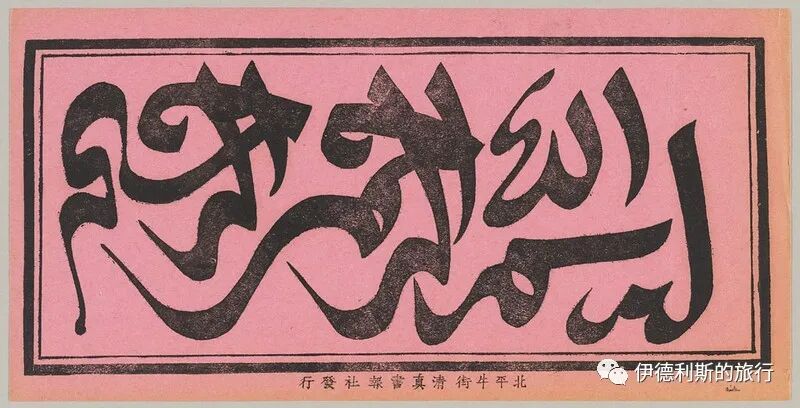
All praise is due to Allah (written eight times).
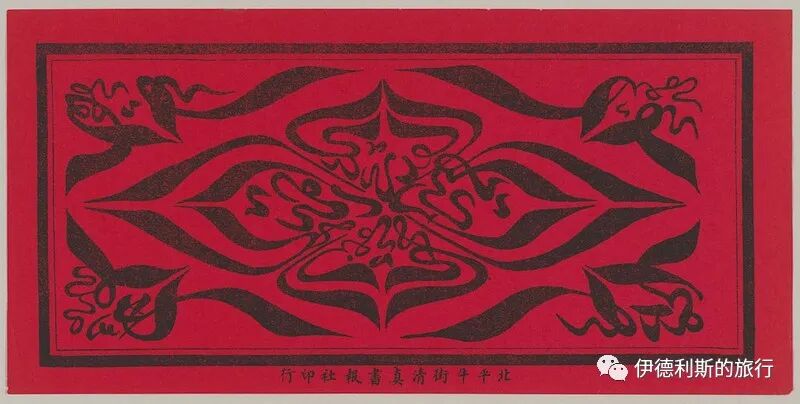
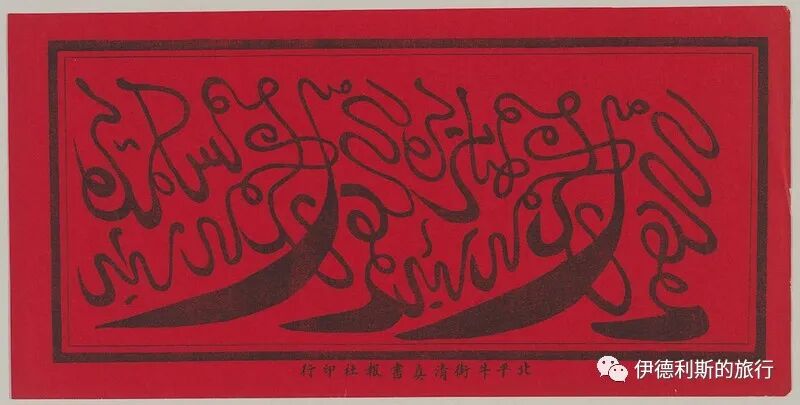
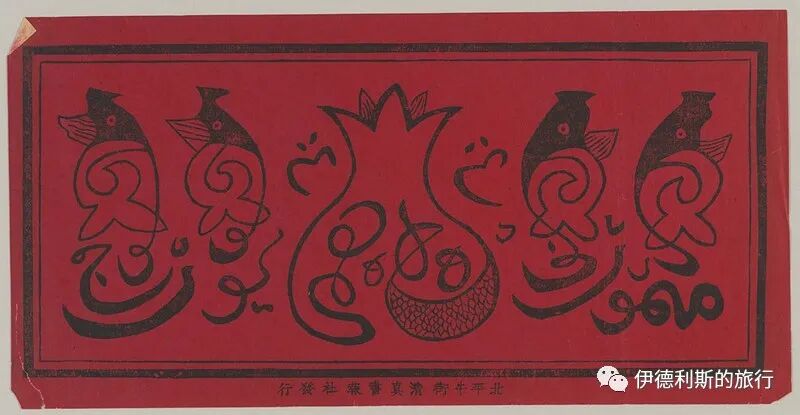
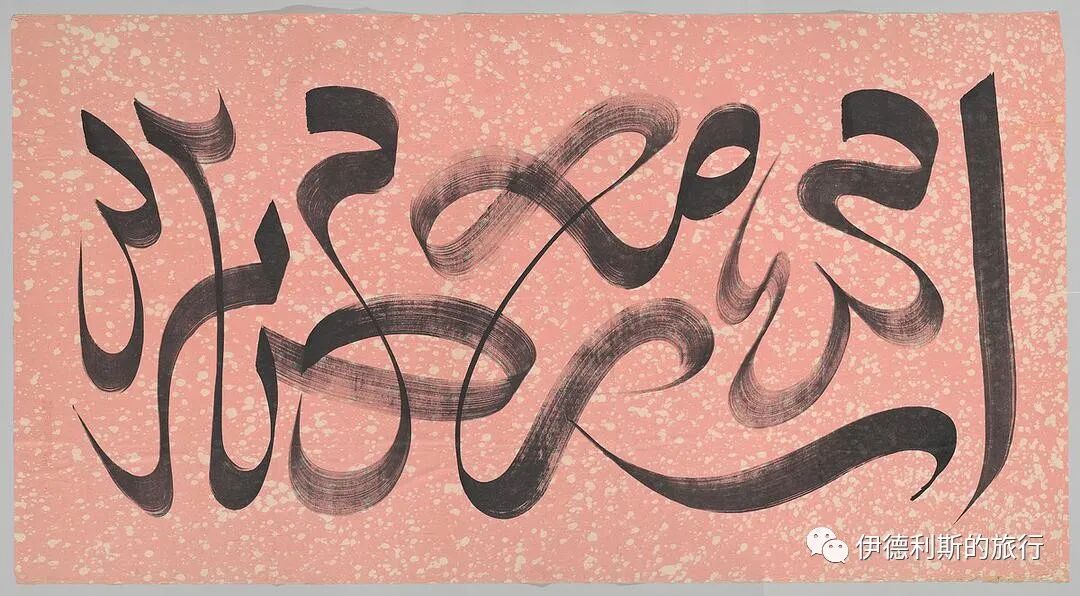
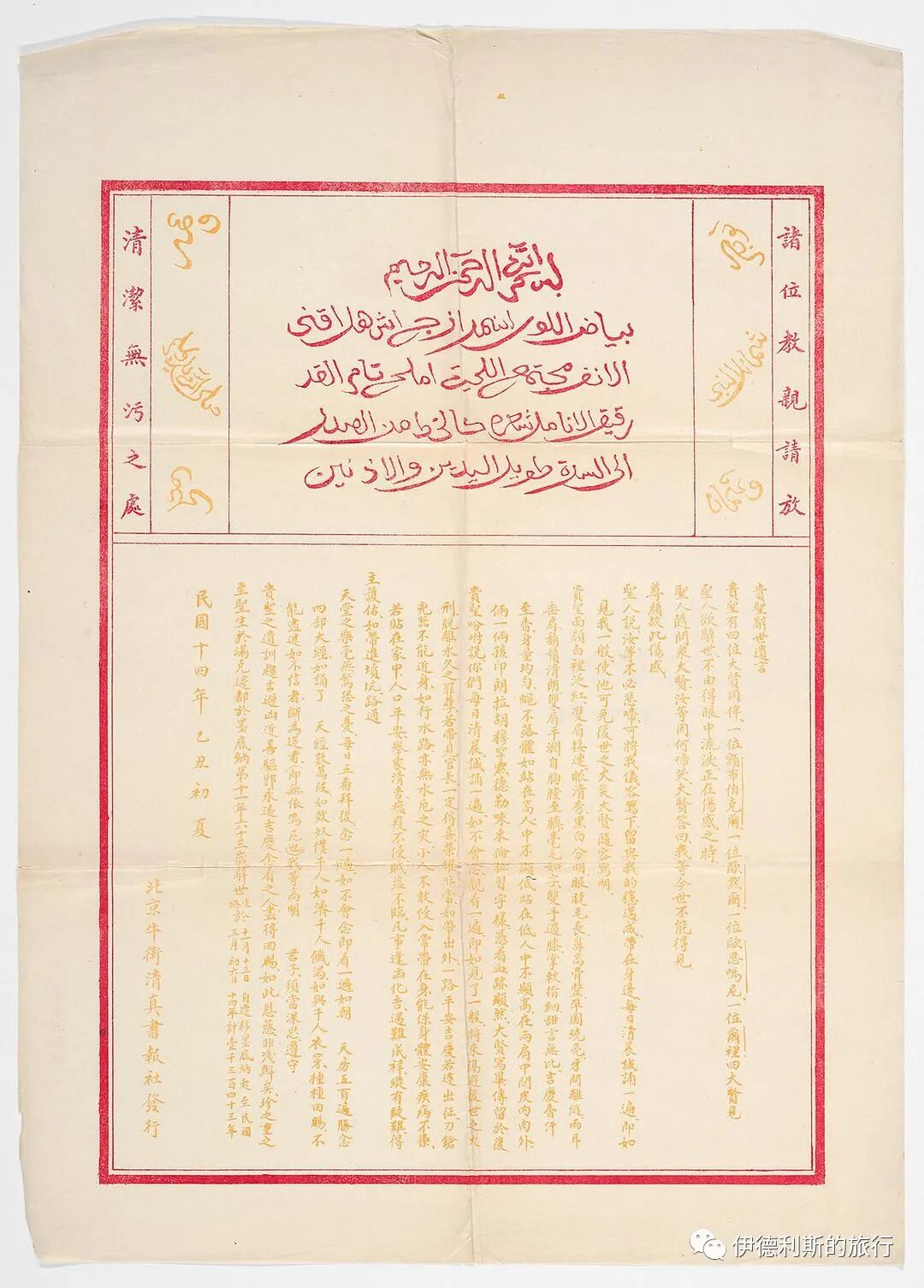
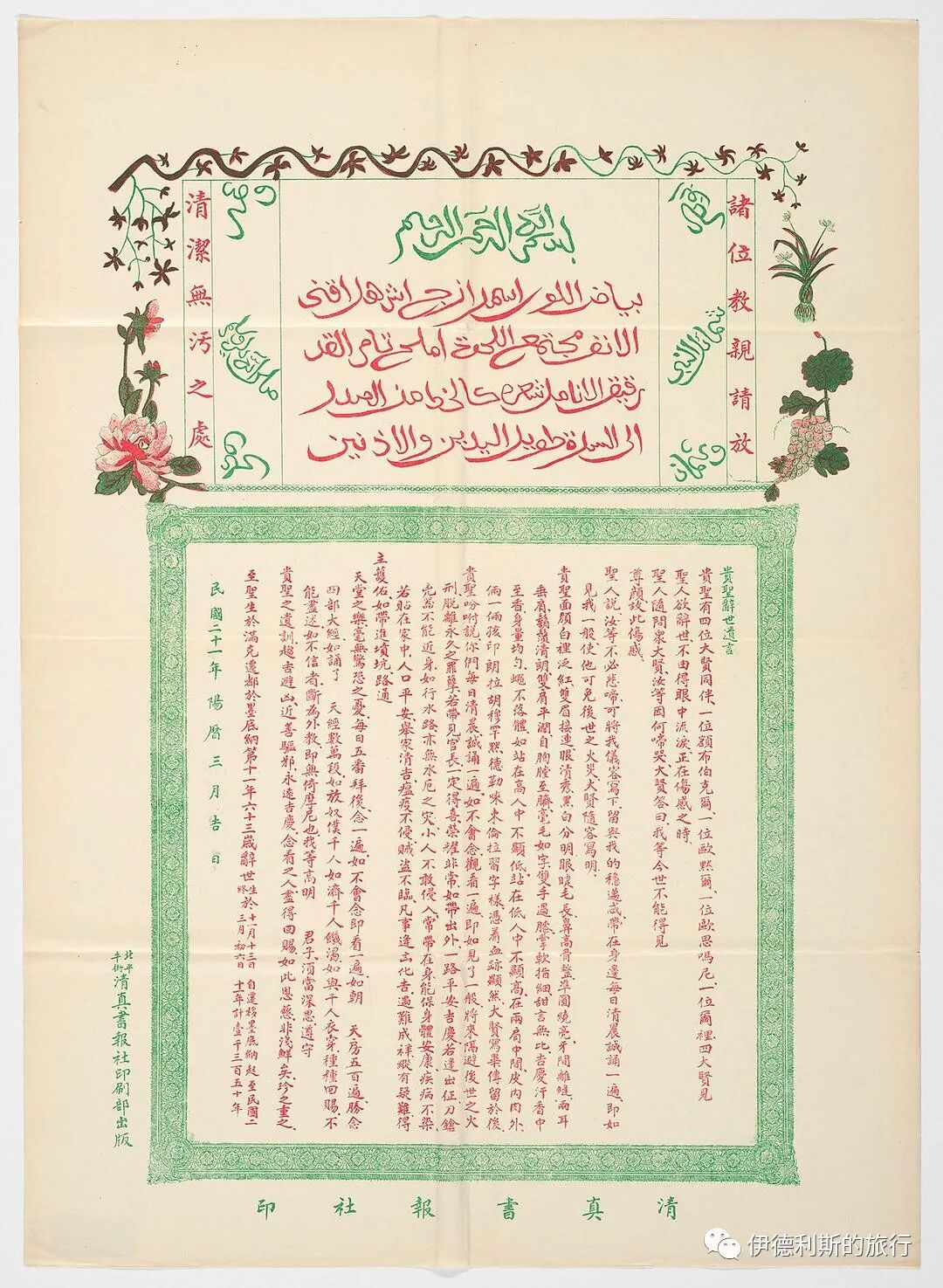
Printed by the Niujie Halal Bookstore in Beiping, the Prophet's Last Words (guisheng cishi yiyan) exist in 1925 and 1932 editions and depict the appearance of the Prophet Muhammad.
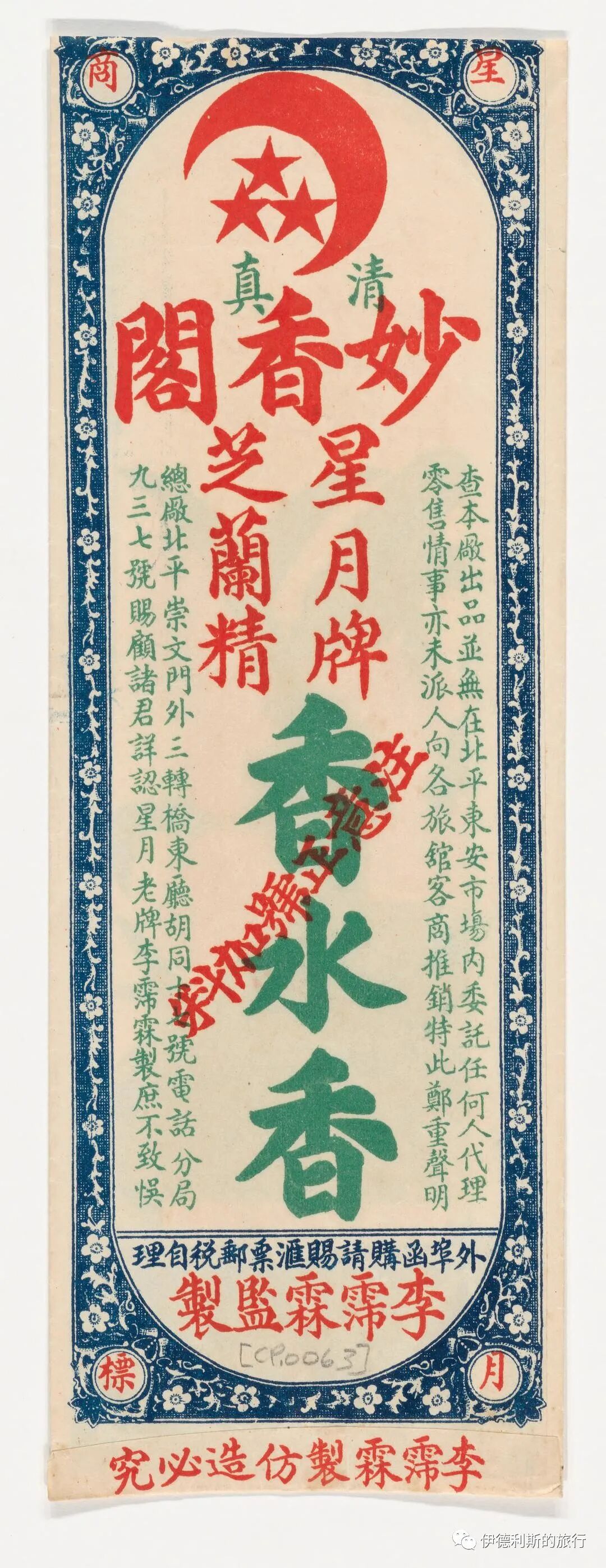
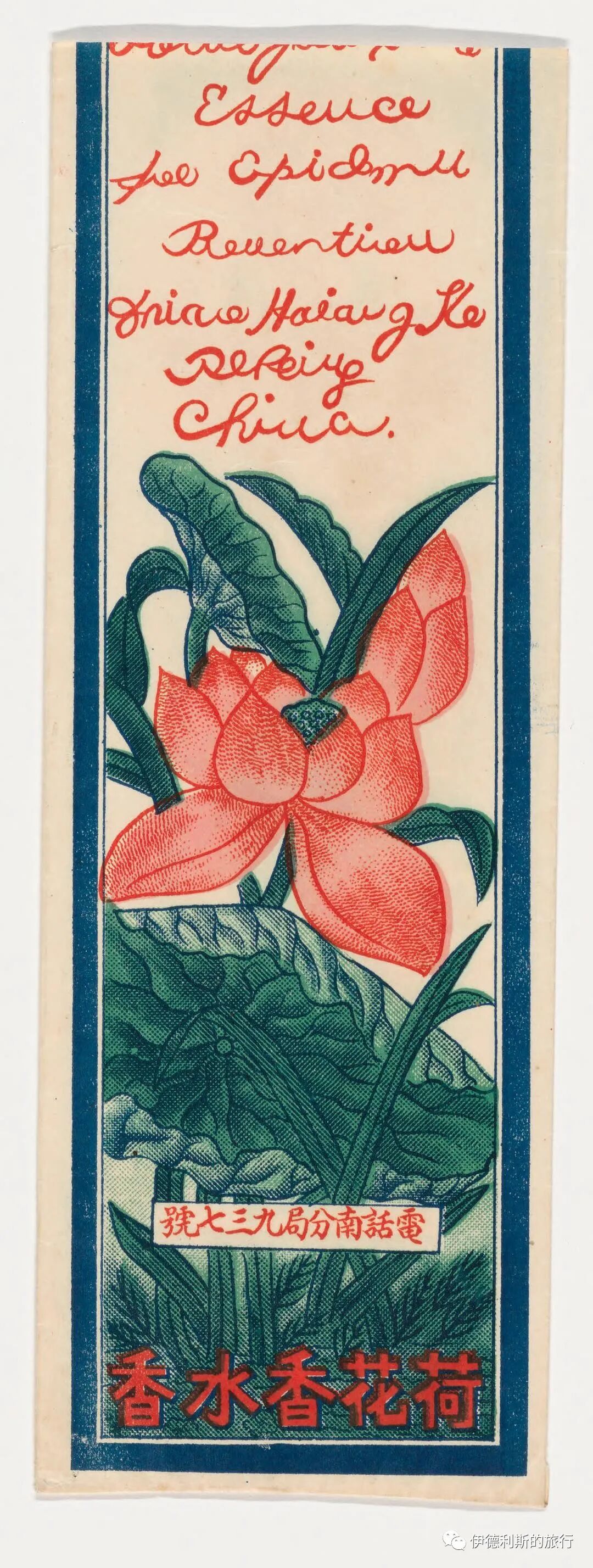
Halal Miaoxiangge Star and Moon brand orchid perfume, made by Li Peilin, with the main factory located at No. 17 Santuanqiao Dongting Alley, outside Chongwenmen, Beiping.
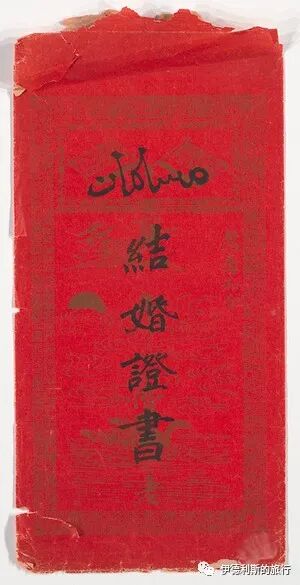
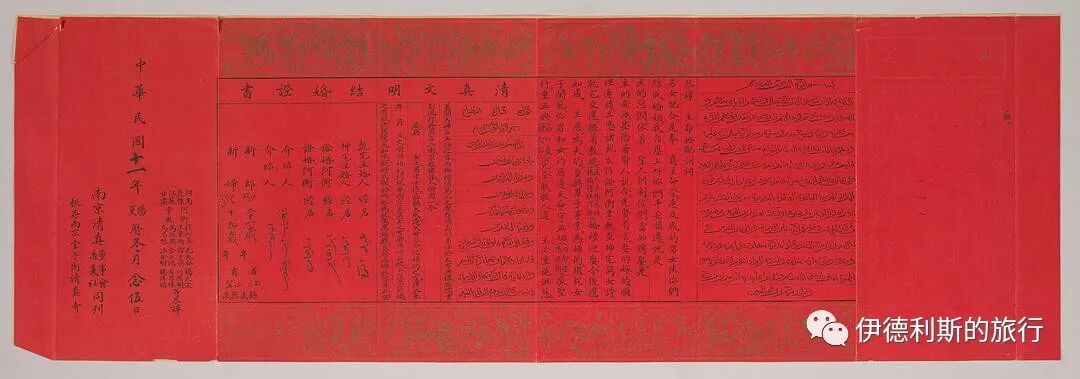
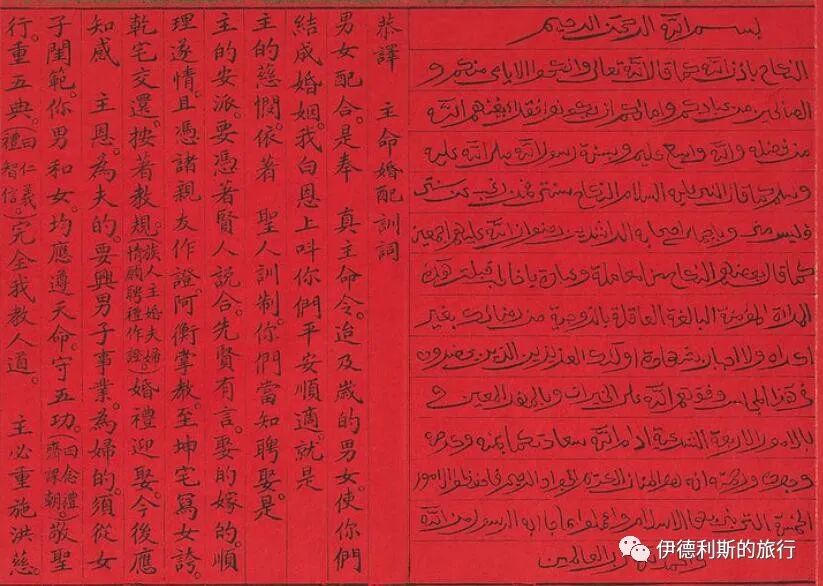
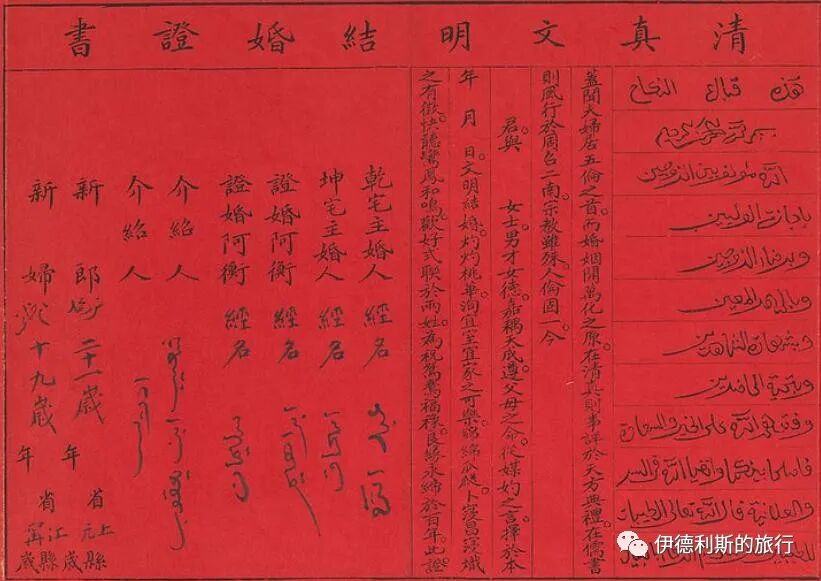
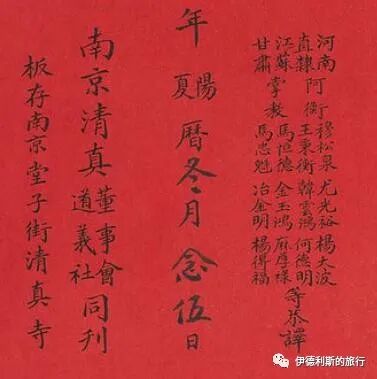
A halal marriage certificate, dated November 25, 1922, published by the Nanjing Halal Board and the Daoyi Society, with the printing plate kept at the Tangzi Street Mosque in Nanjing.
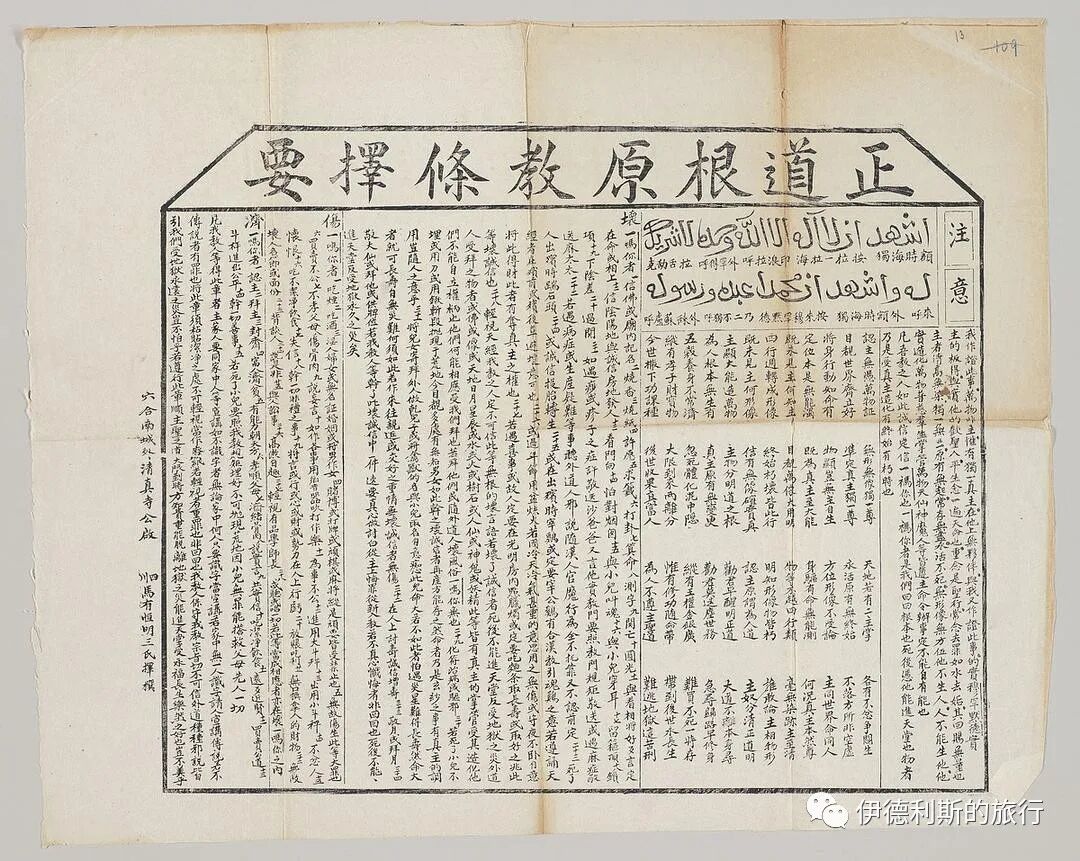
Essentials of the Right Path (zhengdao genyuan jiaotiao zhiyao), a public notice from the mosque outside the south gate of Liuhe, Nanjing, compiled by Ma Youheng Mingsanshi of Sichuan. It describes various actions that destroy, harm, or help one's faith (imani).
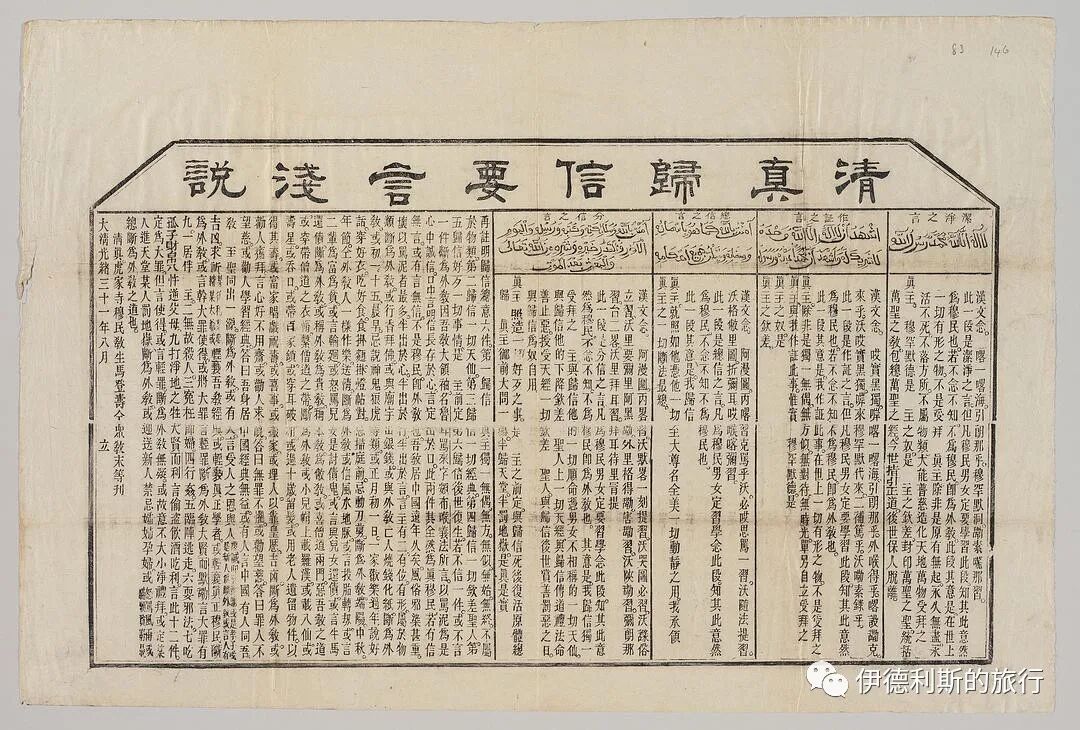
A Simple Explanation of the Essentials of Halal Faith, published in the eighth month of the 31st year of the Guangxu reign (1905) by Ma Dengshou and other students of the Hujia Mosque. Hujia Mosque is located in Longhu Village, Xindu District, Chengdu, Sichuan, and was founded in 1738. The Hu family's ancestral home was in Weinan, Shaanxi, and they moved to Sichuan between the end of the Ming Dynasty and the beginning of the Qing Dynasty.
Book catalog of the Beiping Chengda Normal School Publishing Department, May 25, 1934.
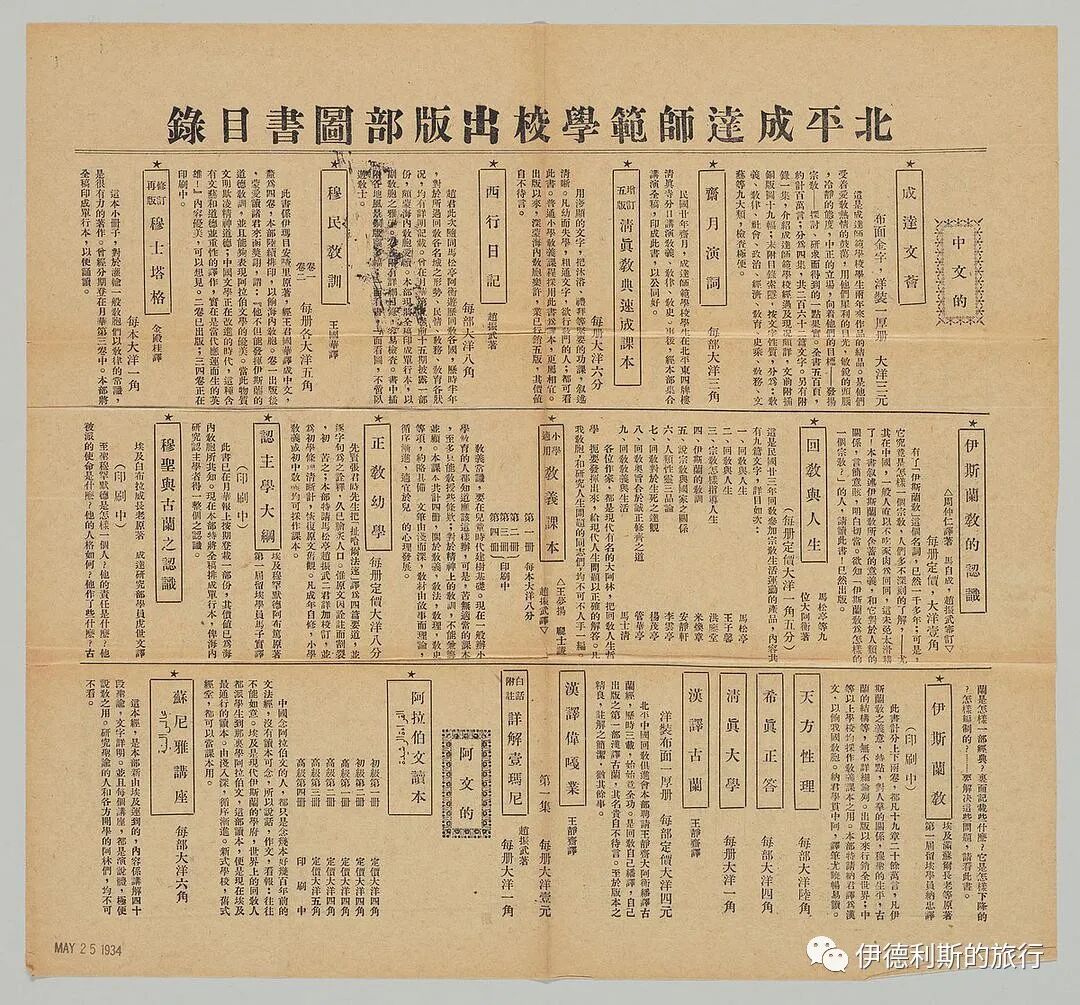
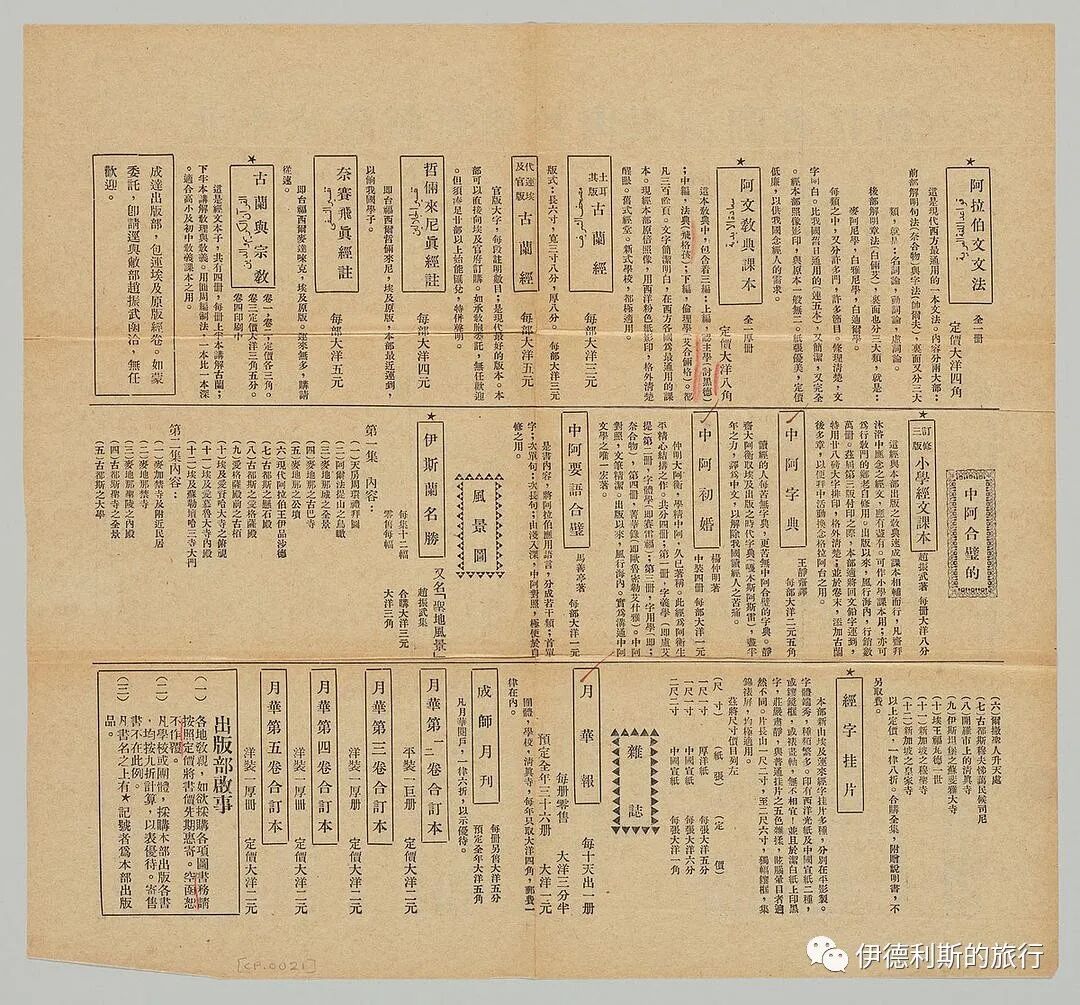
Price list for various Islamic scriptures sold by the Zhenxue Society in the provincial capital of Yunnan. Sold on behalf of the society by Ma Jun Renqing, manager of the Lihechang Leather Store at No. 133 Shuncheng Shangjie, outside the Great South Gate of the provincial capital of Yunnan.
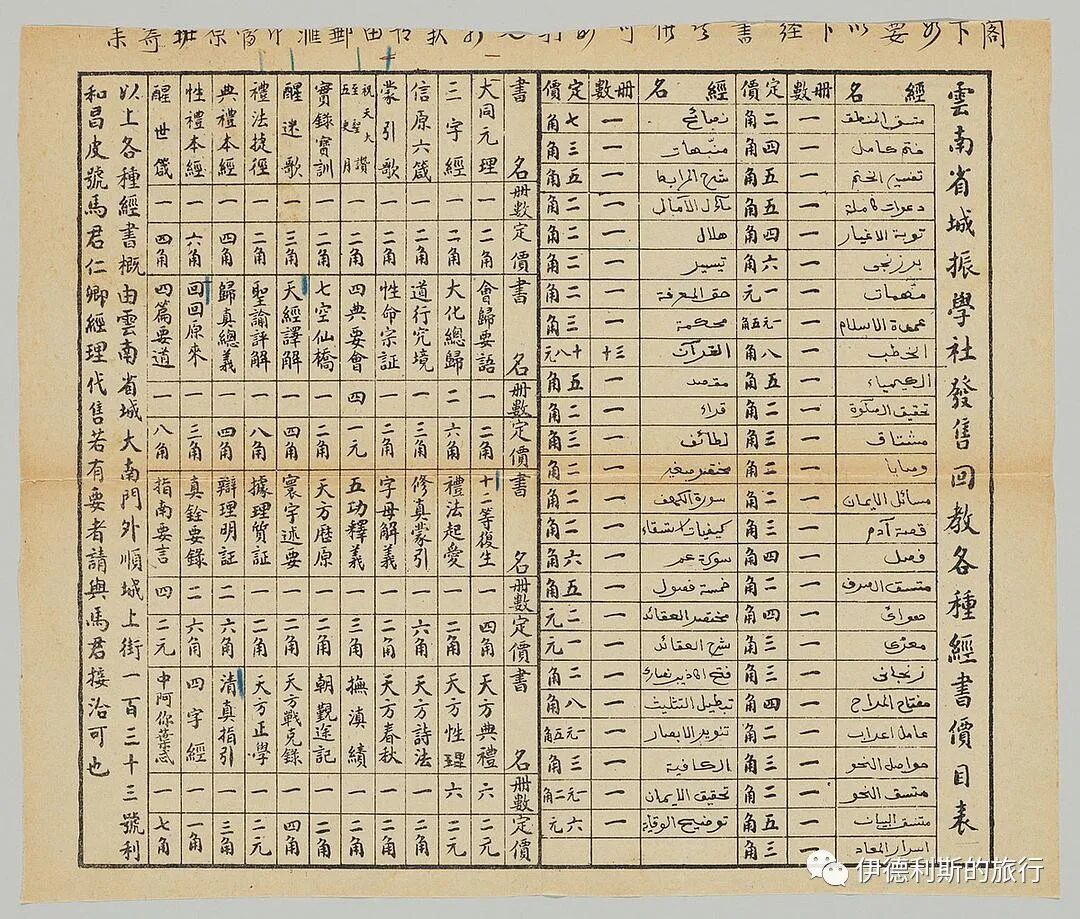
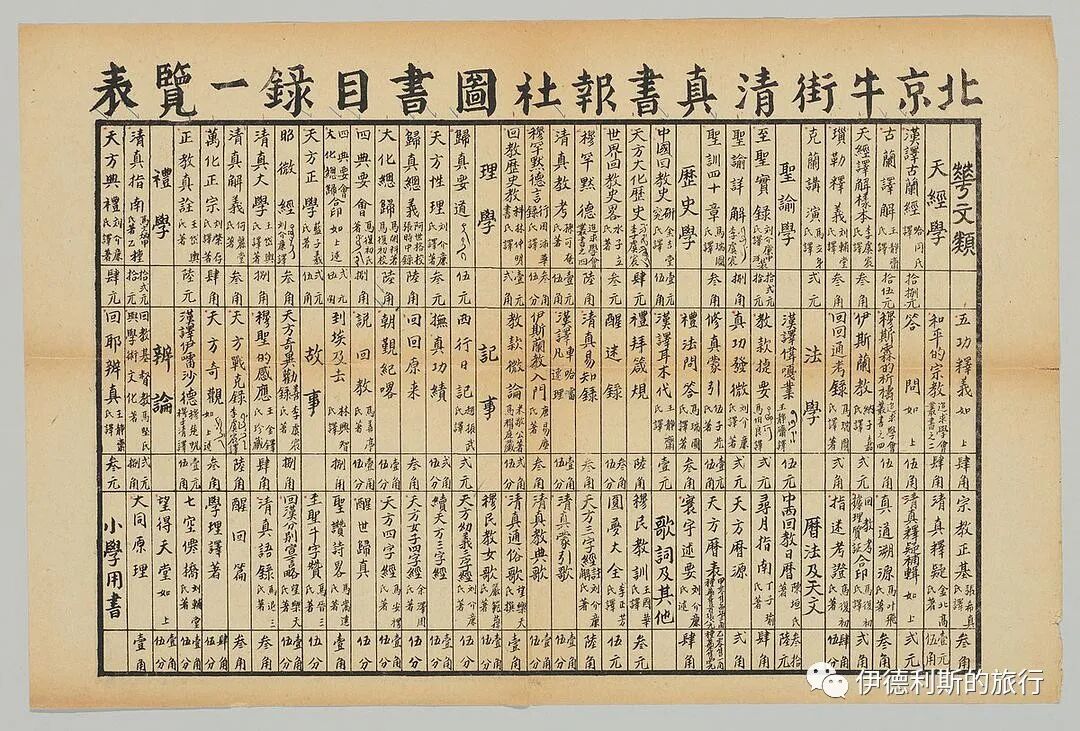
Catalog of books from the Beijing Niujie Halal Bookstore.
The 99 Names of Allah and the eight gates of Paradise, source unknown.
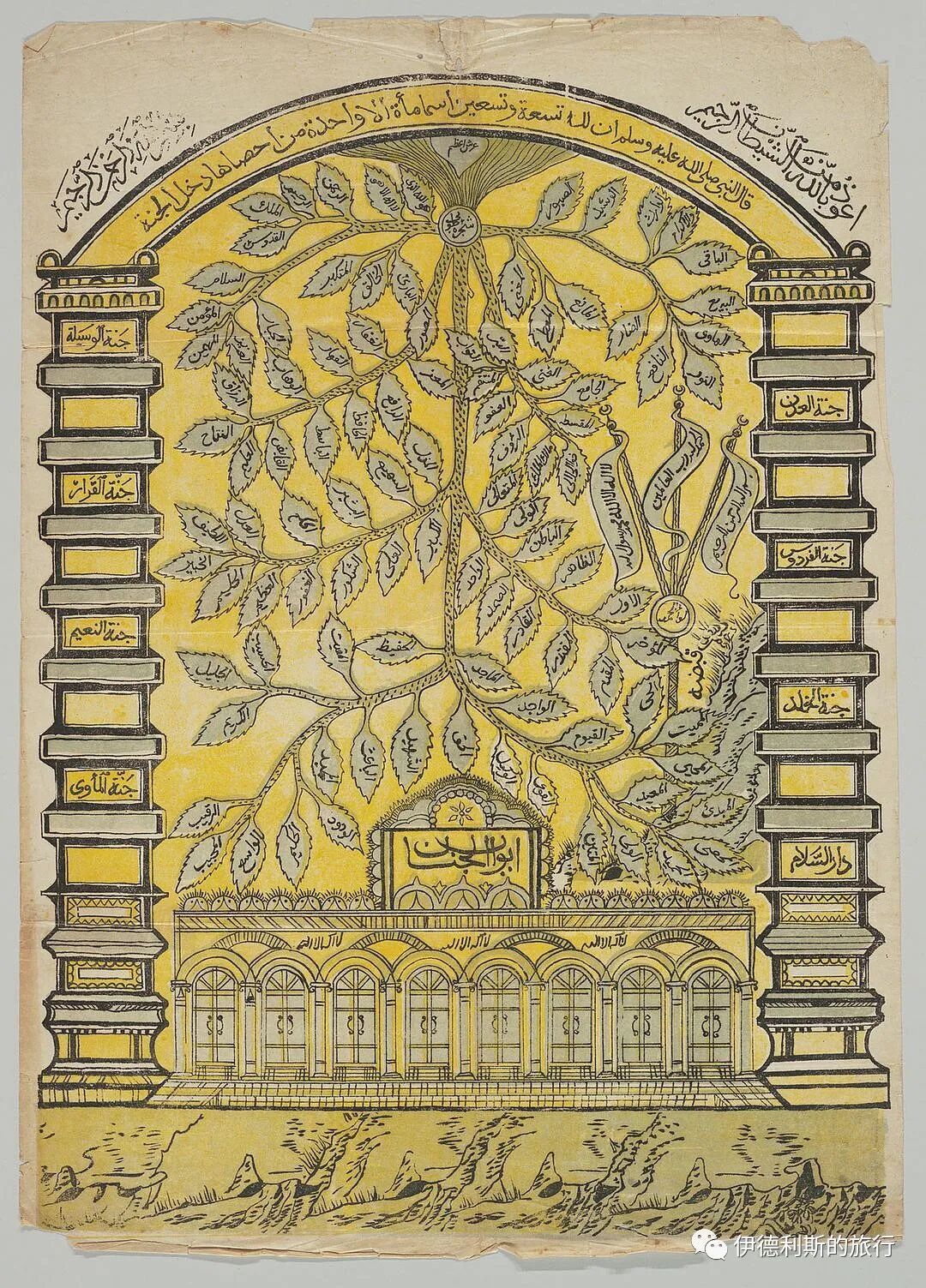
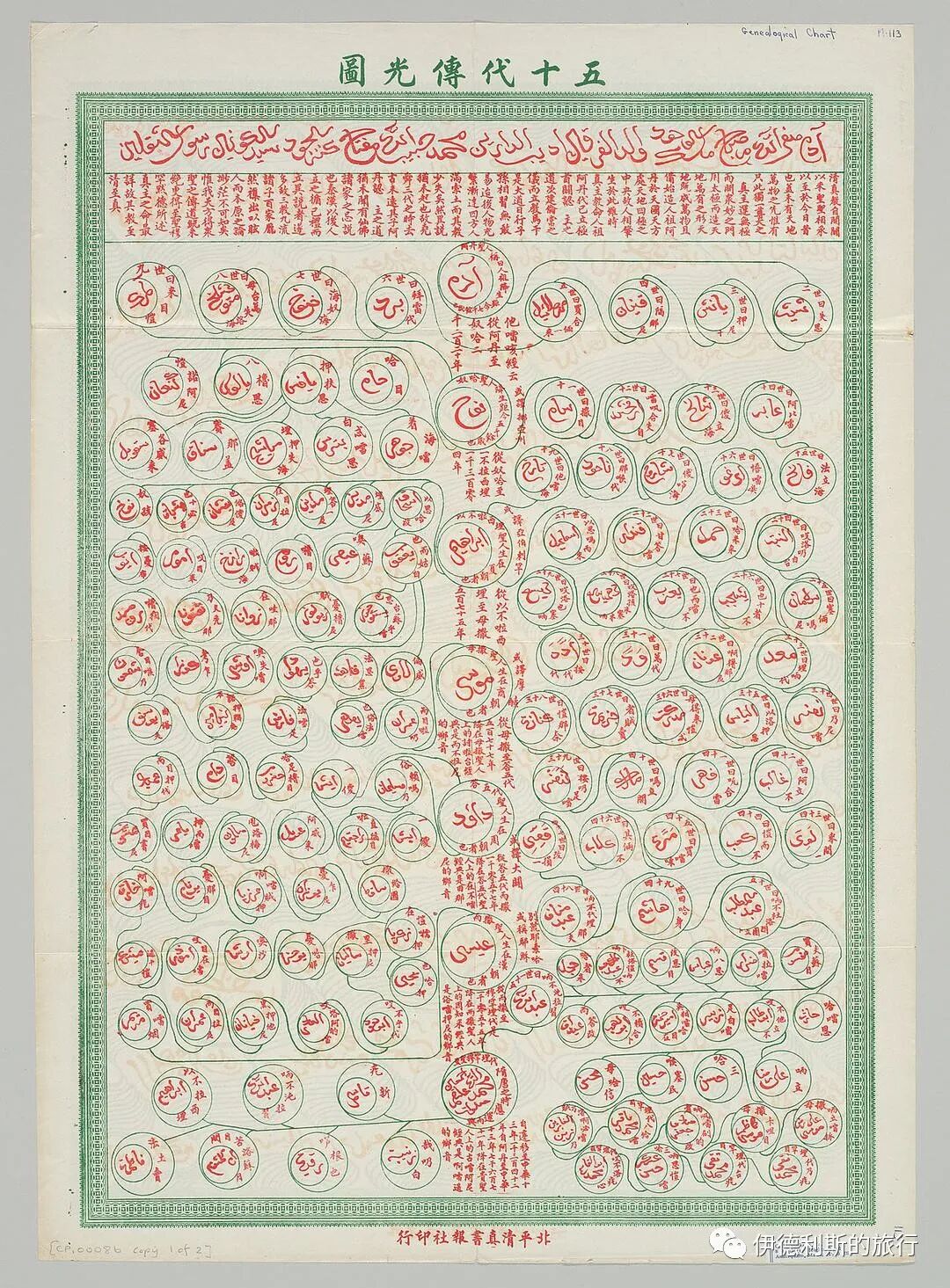
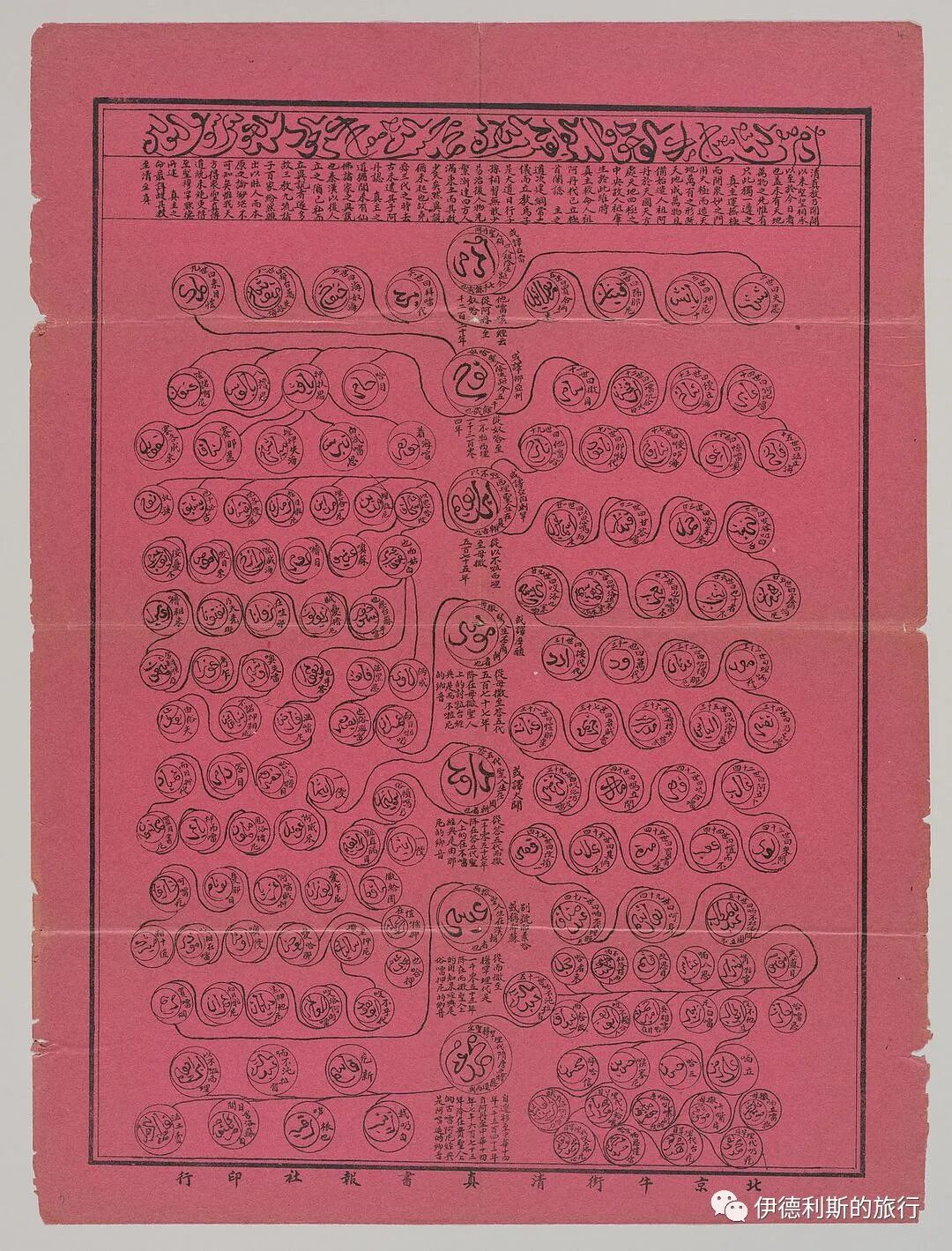
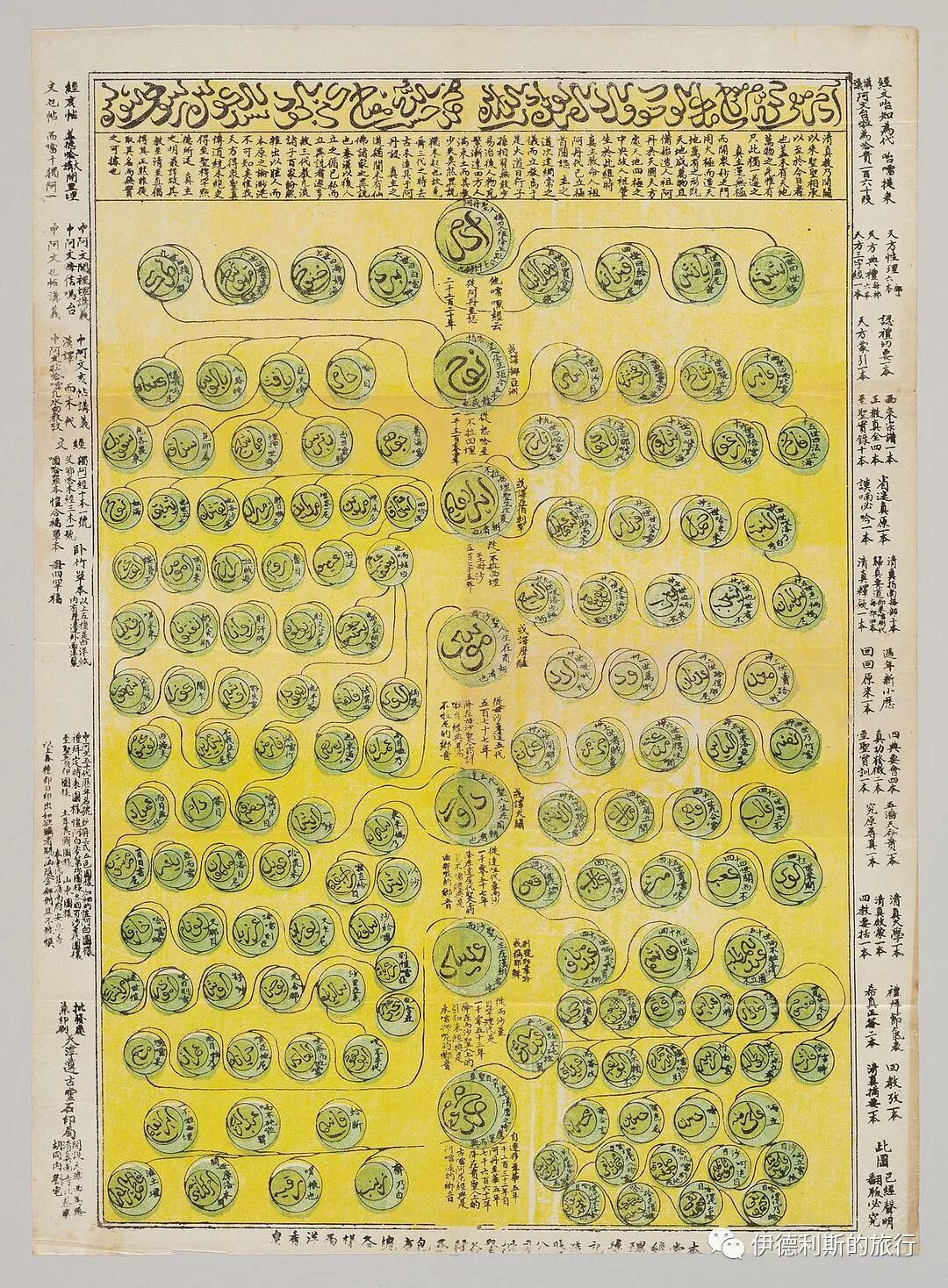
Chart of the Fifty Generations of Light (wushi dai chuanguang tu), printed by the Niujie Halal Bookstore in Beijing. It includes the lineage of fifty generations from the Prophet Adam to the Prophet Muhammad. The prophets in the central large circle are Adam (Adan), Noah (Nuha), Abraham (Yibulaximai), Moses (Musa), David (Dawudai), Jesus (Ersa), and the Holy Prophet Muhammad (Muhammaidai).
Printed by the Zungutang Lithographic Press in Tianjin.
Attention, Muslims.
The Islamic ritual washing (wudu) wall chart and prayer wall chart were compiled by Zhang Hongtao from Dingxing, performed by Ma Zhongdao from Beiping, and published by the Beiping Niujie Mosque Newspaper and Book Agency.
A promotional flyer for the True Mirror Garden (Zhenjing Huayuan) from the Beiping Niujie Mosque Newspaper and Book Agency.
4. Islamic Calendar.
In 1946, the Religious Affairs Committee of the Yunnan Provincial Branch of the China Islamic Association compiled and printed the Islamic monthly start dates, festivals, fasting, and prayer schedule.
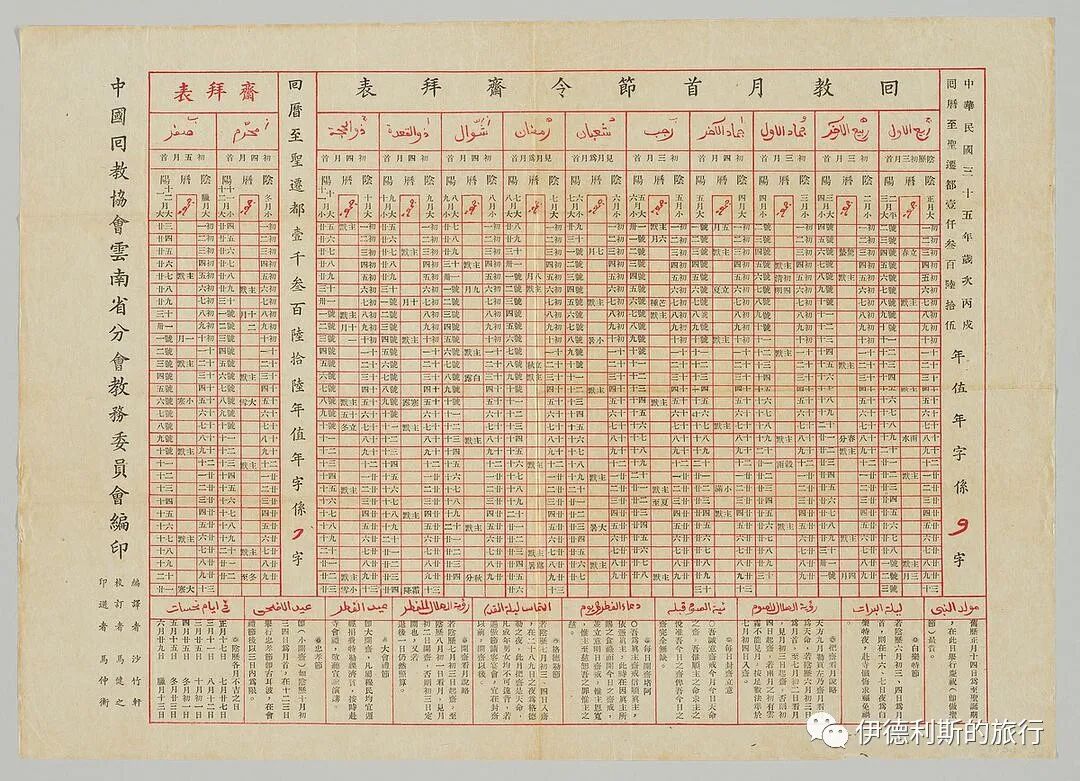
Published by the Yuehua Newspaper Agency in 1946.
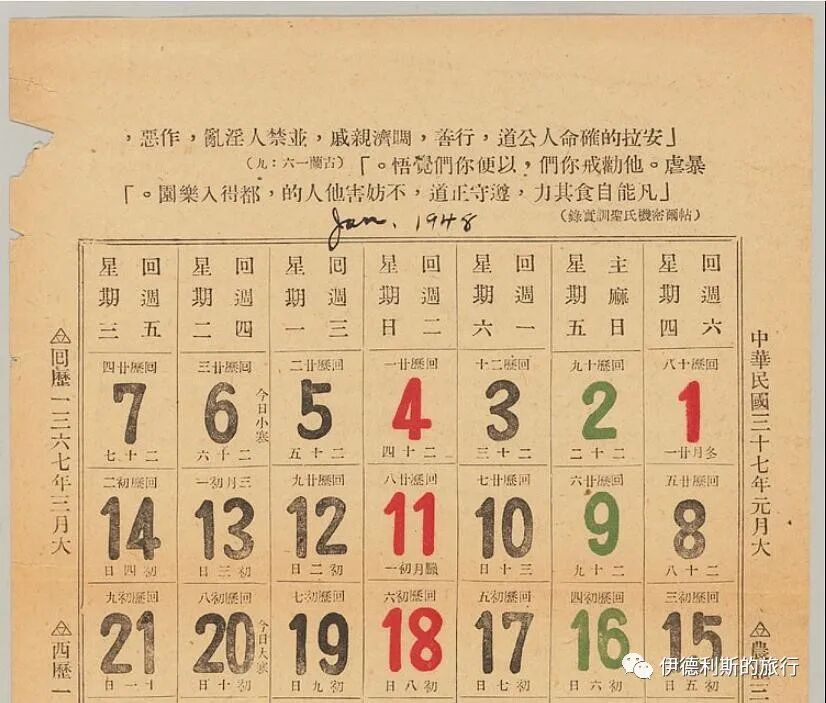
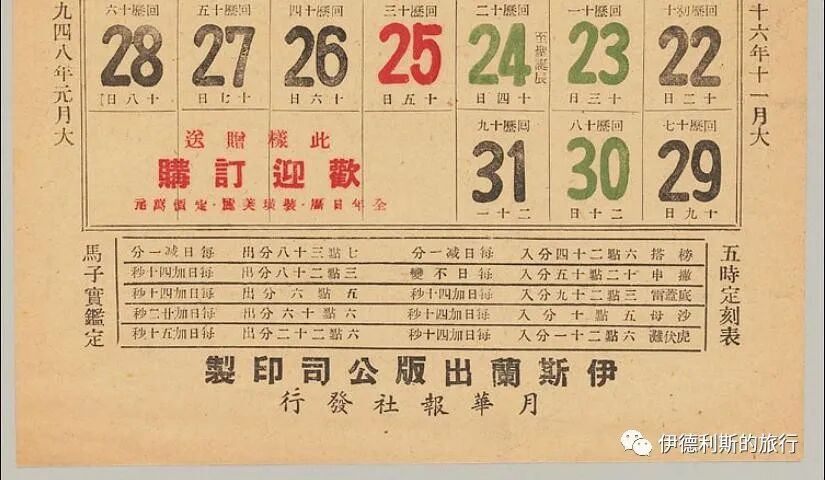
Printed by the Beiping Niujie Mosque Newspaper and Book Agency in 1936.
Printed by the Beiping Niujie Mosque Newspaper and Book Agency in 1946.
Printed by the Beiping Niujie Mosque Newspaper and Book Agency in 1948.
Printed on behalf of the Jiyixuan studio on Hualou Street in Hankou in 1942.
Summary: Claude L. Pickens Jr. Collection: Republican-Era Hui Muslim Documents is presented here as a firsthand travel account in clear English, beginning with this scene: Claude L. Pickens Jr. was an American missionary who came to China in 1926 and worked mainly in Hankou. The account keeps its focus on Hui Muslims, Islamic Manuscripts, Harvard Yenching while preserving the names, places, food, and historical details from the Chinese source.
Claude L. Pickens Jr. was an American missionary who came to China in 1926 and worked mainly in Hankou. He traveled to the Muslim-populated areas of Northwest China twice, in 1933 and 1936, taking many photos and leaving behind valuable records.
Pickens collected many precious documents from Hui Muslims during the Republic of China era, including scripture calligraphy, wall charts, religious calendars, and calligraphy works. He donated them all to the Harvard-Yenching Library in 1984, where they were digitized and displayed on the library's official website.
Most of these documents came from the Muslim Book and Newspaper Press (Qingzhen Shubao She) on Niujie Street in Beiping. The Muslim Book and Newspaper Press was founded in the early years of the Republic of China by Imam Ma Kuilin of Niujie. In the 1920s and 1930s, it printed various scripture textbooks and scholarly works in a shop north of Guang'anmen Street, which were sold all over the country. After Imam Ma Kuilin passed away in 1940, his fourth son, Ma Zhongdao, continued to run the business until it was merged into the Xuanwu Xinhua Bookstore in 1956. After 1966, all the books and records from the Muslim Book and Newspaper Press that had been handed over to the Xuanwu Xinhua Bookstore went missing, and the collection held by Ma Zhongdao himself was forced to be burned by his own hands. Because of this, the collection of books and records from the Muslim Book and Newspaper Press held by Pickens has become the most precious material available.
Official website: library.harvard.edu/collections/rev-claude-l-pickens-jr-collection-muslims-china
The book "Selected Fine Prints of Hui Muslim Materials from the Republic of China Era" provides a detailed introduction to these documents, but unfortunately, due to layout and paper limitations, the images in the book are not printed clearly enough.
A wall scroll (zhongtang) of calligraphy finely produced by the Beiping Niujie Muslim Book and Newspaper Press.
Inna-hu alimun bi-zat al-sudur, finely produced by the Beiping Niujie Muslim Book and Newspaper Press.
A quote from Caliph Umar: Kafa bi-al-mawt wai zan, wa kafa bi-al-dahr tafarruqan.
Death is enough as a warning, and the world is enough as a separation (from Allah).
A wall scroll, printed by the Beiping Niujie Muslim Book and Newspaper Press. According to teacher Wang Qifei, this is the work of Imam Li Chaozhen or Li Shouzhen from Cangzhou.
A wall scroll featuring scripture calligraphy. Guide us to the straight path (1:6), with a seal that reads "Xuanjing." According to teacher Mu Ning, the author is likely Fa Jingxuan from Jinan. Fa Jingxuan was a famous educator and one of the founders of the Chengda Teachers' School.
The scripture couplets on both sides of the wall scroll also come from the Fatiha.
A color-printed set of the three-piece incense set (luping sanshi) from the Beijing Niujie Muslim Book and Newspaper Press. From right to left are the teapot, incense box, incense burner, chopstick vase, and flower vase.
Ali's sword, the first print says published by Beijing Niujie Muslim Book and Newspaper Press, and the second print was changed to "Beiping."
A color-printed Basmala (tasimi), published by the Niujie Halal Bookstore in Beiping.
The Sea of Fury Ship (nuhai chuan), published by the Niujie Halal Bookstore in Beijing.
The Praise of the Prophet on the Sea (haishui zansheng), printed by the Niujie Halal Bookstore in Beiping, features 34 lines of dua written within the waves.
Scripture characters on red paper, printed by the Niujie Halal Bookstore in Beiping.
Basmala (tasimi).
All praise is due to Allah (written eight times).
Printed by the Niujie Halal Bookstore in Beiping, the Prophet's Last Words (guisheng cishi yiyan) exist in 1925 and 1932 editions and depict the appearance of the Prophet Muhammad.
Halal Miaoxiangge Star and Moon brand orchid perfume, made by Li Peilin, with the main factory located at No. 17 Santuanqiao Dongting Alley, outside Chongwenmen, Beiping.
A halal marriage certificate, dated November 25, 1922, published by the Nanjing Halal Board and the Daoyi Society, with the printing plate kept at the Tangzi Street Mosque in Nanjing.
Essentials of the Right Path (zhengdao genyuan jiaotiao zhiyao), a public notice from the mosque outside the south gate of Liuhe, Nanjing, compiled by Ma Youheng Mingsanshi of Sichuan. It describes various actions that destroy, harm, or help one's faith (imani).
A Simple Explanation of the Essentials of Halal Faith, published in the eighth month of the 31st year of the Guangxu reign (1905) by Ma Dengshou and other students of the Hujia Mosque. Hujia Mosque is located in Longhu Village, Xindu District, Chengdu, Sichuan, and was founded in 1738. The Hu family's ancestral home was in Weinan, Shaanxi, and they moved to Sichuan between the end of the Ming Dynasty and the beginning of the Qing Dynasty.
Book catalog of the Beiping Chengda Normal School Publishing Department, May 25, 1934.
Price list for various Islamic scriptures sold by the Zhenxue Society in the provincial capital of Yunnan. Sold on behalf of the society by Ma Jun Renqing, manager of the Lihechang Leather Store at No. 133 Shuncheng Shangjie, outside the Great South Gate of the provincial capital of Yunnan.
Catalog of books from the Beijing Niujie Halal Bookstore.
The 99 Names of Allah and the eight gates of Paradise, source unknown.
Chart of the Fifty Generations of Light (wushi dai chuanguang tu), printed by the Niujie Halal Bookstore in Beijing. It includes the lineage of fifty generations from the Prophet Adam to the Prophet Muhammad. The prophets in the central large circle are Adam (Adan), Noah (Nuha), Abraham (Yibulaximai), Moses (Musa), David (Dawudai), Jesus (Ersa), and the Holy Prophet Muhammad (Muhammaidai).
Printed by the Zungutang Lithographic Press in Tianjin.
Attention, Muslims.
The Islamic ritual washing (wudu) wall chart and prayer wall chart were compiled by Zhang Hongtao from Dingxing, performed by Ma Zhongdao from Beiping, and published by the Beiping Niujie Mosque Newspaper and Book Agency.
A promotional flyer for the True Mirror Garden (Zhenjing Huayuan) from the Beiping Niujie Mosque Newspaper and Book Agency.
4. Islamic Calendar.
In 1946, the Religious Affairs Committee of the Yunnan Provincial Branch of the China Islamic Association compiled and printed the Islamic monthly start dates, festivals, fasting, and prayer schedule.
Published by the Yuehua Newspaper Agency in 1946.
Printed by the Beiping Niujie Mosque Newspaper and Book Agency in 1936.
Printed by the Beiping Niujie Mosque Newspaper and Book Agency in 1946.
Printed by the Beiping Niujie Mosque Newspaper and Book Agency in 1948.
Printed on behalf of the Jiyixuan studio on Hualou Street in Hankou in 1942.
Claude L. Pickens Jr. Collection: Republican-Era Hui Muslim Documents
Articles • ali2007fr posted the article • 0 comments • 215 views • 2026-05-18 02:26
Reposted from the web
Summary: Claude L. Pickens Jr. Collection: Republican-Era Hui Muslim Documents is presented here as a firsthand travel account in clear English, beginning with this scene: Claude L. Pickens Jr. was an American missionary who came to China in 1926 and worked mainly in Hankou. The account keeps its focus on Hui Muslims, Islamic Manuscripts, Harvard Yenching while preserving the names, places, food, and historical details from the Chinese source.
Claude L. Pickens Jr. was an American missionary who came to China in 1926 and worked mainly in Hankou. He traveled to the Muslim-populated areas of Northwest China twice, in 1933 and 1936, taking many photos and leaving behind valuable records.
Pickens collected many precious documents from Hui Muslims during the Republic of China era, including scripture calligraphy, wall charts, religious calendars, and calligraphy works. He donated them all to the Harvard-Yenching Library in 1984, where they were digitized and displayed on the library's official website.
Most of these documents came from the Muslim Book and Newspaper Press (Qingzhen Shubao She) on Niujie Street in Beiping. The Muslim Book and Newspaper Press was founded in the early years of the Republic of China by Imam Ma Kuilin of Niujie. In the 1920s and 1930s, it printed various scripture textbooks and scholarly works in a shop north of Guang'anmen Street, which were sold all over the country. After Imam Ma Kuilin passed away in 1940, his fourth son, Ma Zhongdao, continued to run the business until it was merged into the Xuanwu Xinhua Bookstore in 1956. After 1966, all the books and records from the Muslim Book and Newspaper Press that had been handed over to the Xuanwu Xinhua Bookstore went missing, and the collection held by Ma Zhongdao himself was forced to be burned by his own hands. Because of this, the collection of books and records from the Muslim Book and Newspaper Press held by Pickens has become the most precious material available.
Official website: library.harvard.edu/collections/rev-claude-l-pickens-jr-collection-muslims-china
The book "Selected Fine Prints of Hui Muslim Materials from the Republic of China Era" provides a detailed introduction to these documents, but unfortunately, due to layout and paper limitations, the images in the book are not printed clearly enough.
A wall scroll (zhongtang) of calligraphy finely produced by the Beiping Niujie Muslim Book and Newspaper Press.
Inna-hu alimun bi-zat al-sudur, finely produced by the Beiping Niujie Muslim Book and Newspaper Press.
A quote from Caliph Umar: Kafa bi-al-mawt wai zan, wa kafa bi-al-dahr tafarruqan.
Death is enough as a warning, and the world is enough as a separation (from Allah).
A wall scroll, printed by the Beiping Niujie Muslim Book and Newspaper Press. According to teacher Wang Qifei, this is the work of Imam Li Chaozhen or Li Shouzhen from Cangzhou.
A wall scroll featuring scripture calligraphy. Guide us to the straight path (1:6), with a seal that reads "Xuanjing." According to teacher Mu Ning, the author is likely Fa Jingxuan from Jinan. Fa Jingxuan was a famous educator and one of the founders of the Chengda Teachers' School.
The scripture couplets on both sides of the wall scroll also come from the Fatiha.
A color-printed set of the three-piece incense set (luping sanshi) from the Beijing Niujie Muslim Book and Newspaper Press. From right to left are the teapot, incense box, incense burner, chopstick vase, and flower vase.
Ali's sword, the first print says published by Beijing Niujie Muslim Book and Newspaper Press, and the second print was changed to "Beiping."
A color-printed Basmala (tasimi), published by the Niujie Halal Bookstore in Beiping.
The Sea of Fury Ship (nuhai chuan), published by the Niujie Halal Bookstore in Beijing.
The Praise of the Prophet on the Sea (haishui zansheng), printed by the Niujie Halal Bookstore in Beiping, features 34 lines of dua written within the waves.
Scripture characters on red paper, printed by the Niujie Halal Bookstore in Beiping.
Basmala (tasimi).
All praise is due to Allah (written eight times).
Printed by the Niujie Halal Bookstore in Beiping, the Prophet's Last Words (guisheng cishi yiyan) exist in 1925 and 1932 editions and depict the appearance of the Prophet Muhammad.
Halal Miaoxiangge Star and Moon brand orchid perfume, made by Li Peilin, with the main factory located at No. 17 Santuanqiao Dongting Alley, outside Chongwenmen, Beiping.
A halal marriage certificate, dated November 25, 1922, published by the Nanjing Halal Board and the Daoyi Society, with the printing plate kept at the Tangzi Street Mosque in Nanjing.
Essentials of the Right Path (zhengdao genyuan jiaotiao zhiyao), a public notice from the mosque outside the south gate of Liuhe, Nanjing, compiled by Ma Youheng Mingsanshi of Sichuan. It describes various actions that destroy, harm, or help one's faith (imani).
A Simple Explanation of the Essentials of Halal Faith, published in the eighth month of the 31st year of the Guangxu reign (1905) by Ma Dengshou and other students of the Hujia Mosque. Hujia Mosque is located in Longhu Village, Xindu District, Chengdu, Sichuan, and was founded in 1738. The Hu family's ancestral home was in Weinan, Shaanxi, and they moved to Sichuan between the end of the Ming Dynasty and the beginning of the Qing Dynasty.
Book catalog of the Beiping Chengda Normal School Publishing Department, May 25, 1934.
Price list for various Islamic scriptures sold by the Zhenxue Society in the provincial capital of Yunnan. Sold on behalf of the society by Ma Jun Renqing, manager of the Lihechang Leather Store at No. 133 Shuncheng Shangjie, outside the Great South Gate of the provincial capital of Yunnan.
Catalog of books from the Beijing Niujie Halal Bookstore.
The 99 Names of Allah and the eight gates of Paradise, source unknown.
Chart of the Fifty Generations of Light (wushi dai chuanguang tu), printed by the Niujie Halal Bookstore in Beijing. It includes the lineage of fifty generations from the Prophet Adam to the Prophet Muhammad. The prophets in the central large circle are Adam (Adan), Noah (Nuha), Abraham (Yibulaximai), Moses (Musa), David (Dawudai), Jesus (Ersa), and the Holy Prophet Muhammad (Muhammaidai).
Printed by the Zungutang Lithographic Press in Tianjin.
Attention, Muslims.
The Islamic ritual washing (wudu) wall chart and prayer wall chart were compiled by Zhang Hongtao from Dingxing, performed by Ma Zhongdao from Beiping, and published by the Beiping Niujie Mosque Newspaper and Book Agency.
A promotional flyer for the True Mirror Garden (Zhenjing Huayuan) from the Beiping Niujie Mosque Newspaper and Book Agency.
4. Islamic Calendar.
In 1946, the Religious Affairs Committee of the Yunnan Provincial Branch of the China Islamic Association compiled and printed the Islamic monthly start dates, festivals, fasting, and prayer schedule.
Published by the Yuehua Newspaper Agency in 1946.
Printed by the Beiping Niujie Mosque Newspaper and Book Agency in 1936.
Printed by the Beiping Niujie Mosque Newspaper and Book Agency in 1946.
Printed by the Beiping Niujie Mosque Newspaper and Book Agency in 1948.
Printed on behalf of the Jiyixuan studio on Hualou Street in Hankou in 1942. view all
Summary: Claude L. Pickens Jr. Collection: Republican-Era Hui Muslim Documents is presented here as a firsthand travel account in clear English, beginning with this scene: Claude L. Pickens Jr. was an American missionary who came to China in 1926 and worked mainly in Hankou. The account keeps its focus on Hui Muslims, Islamic Manuscripts, Harvard Yenching while preserving the names, places, food, and historical details from the Chinese source.
Claude L. Pickens Jr. was an American missionary who came to China in 1926 and worked mainly in Hankou. He traveled to the Muslim-populated areas of Northwest China twice, in 1933 and 1936, taking many photos and leaving behind valuable records.
Pickens collected many precious documents from Hui Muslims during the Republic of China era, including scripture calligraphy, wall charts, religious calendars, and calligraphy works. He donated them all to the Harvard-Yenching Library in 1984, where they were digitized and displayed on the library's official website.
Most of these documents came from the Muslim Book and Newspaper Press (Qingzhen Shubao She) on Niujie Street in Beiping. The Muslim Book and Newspaper Press was founded in the early years of the Republic of China by Imam Ma Kuilin of Niujie. In the 1920s and 1930s, it printed various scripture textbooks and scholarly works in a shop north of Guang'anmen Street, which were sold all over the country. After Imam Ma Kuilin passed away in 1940, his fourth son, Ma Zhongdao, continued to run the business until it was merged into the Xuanwu Xinhua Bookstore in 1956. After 1966, all the books and records from the Muslim Book and Newspaper Press that had been handed over to the Xuanwu Xinhua Bookstore went missing, and the collection held by Ma Zhongdao himself was forced to be burned by his own hands. Because of this, the collection of books and records from the Muslim Book and Newspaper Press held by Pickens has become the most precious material available.
Official website: library.harvard.edu/collections/rev-claude-l-pickens-jr-collection-muslims-china
The book "Selected Fine Prints of Hui Muslim Materials from the Republic of China Era" provides a detailed introduction to these documents, but unfortunately, due to layout and paper limitations, the images in the book are not printed clearly enough.
A wall scroll (zhongtang) of calligraphy finely produced by the Beiping Niujie Muslim Book and Newspaper Press.
Inna-hu alimun bi-zat al-sudur, finely produced by the Beiping Niujie Muslim Book and Newspaper Press.
A quote from Caliph Umar: Kafa bi-al-mawt wai zan, wa kafa bi-al-dahr tafarruqan.
Death is enough as a warning, and the world is enough as a separation (from Allah).
A wall scroll, printed by the Beiping Niujie Muslim Book and Newspaper Press. According to teacher Wang Qifei, this is the work of Imam Li Chaozhen or Li Shouzhen from Cangzhou.
A wall scroll featuring scripture calligraphy. Guide us to the straight path (1:6), with a seal that reads "Xuanjing." According to teacher Mu Ning, the author is likely Fa Jingxuan from Jinan. Fa Jingxuan was a famous educator and one of the founders of the Chengda Teachers' School.
The scripture couplets on both sides of the wall scroll also come from the Fatiha.
A color-printed set of the three-piece incense set (luping sanshi) from the Beijing Niujie Muslim Book and Newspaper Press. From right to left are the teapot, incense box, incense burner, chopstick vase, and flower vase.
Ali's sword, the first print says published by Beijing Niujie Muslim Book and Newspaper Press, and the second print was changed to "Beiping."
A color-printed Basmala (tasimi), published by the Niujie Halal Bookstore in Beiping.
The Sea of Fury Ship (nuhai chuan), published by the Niujie Halal Bookstore in Beijing.
The Praise of the Prophet on the Sea (haishui zansheng), printed by the Niujie Halal Bookstore in Beiping, features 34 lines of dua written within the waves.
Scripture characters on red paper, printed by the Niujie Halal Bookstore in Beiping.
Basmala (tasimi).
All praise is due to Allah (written eight times).
Printed by the Niujie Halal Bookstore in Beiping, the Prophet's Last Words (guisheng cishi yiyan) exist in 1925 and 1932 editions and depict the appearance of the Prophet Muhammad.
Halal Miaoxiangge Star and Moon brand orchid perfume, made by Li Peilin, with the main factory located at No. 17 Santuanqiao Dongting Alley, outside Chongwenmen, Beiping.
A halal marriage certificate, dated November 25, 1922, published by the Nanjing Halal Board and the Daoyi Society, with the printing plate kept at the Tangzi Street Mosque in Nanjing.
Essentials of the Right Path (zhengdao genyuan jiaotiao zhiyao), a public notice from the mosque outside the south gate of Liuhe, Nanjing, compiled by Ma Youheng Mingsanshi of Sichuan. It describes various actions that destroy, harm, or help one's faith (imani).
A Simple Explanation of the Essentials of Halal Faith, published in the eighth month of the 31st year of the Guangxu reign (1905) by Ma Dengshou and other students of the Hujia Mosque. Hujia Mosque is located in Longhu Village, Xindu District, Chengdu, Sichuan, and was founded in 1738. The Hu family's ancestral home was in Weinan, Shaanxi, and they moved to Sichuan between the end of the Ming Dynasty and the beginning of the Qing Dynasty.
Book catalog of the Beiping Chengda Normal School Publishing Department, May 25, 1934.
Price list for various Islamic scriptures sold by the Zhenxue Society in the provincial capital of Yunnan. Sold on behalf of the society by Ma Jun Renqing, manager of the Lihechang Leather Store at No. 133 Shuncheng Shangjie, outside the Great South Gate of the provincial capital of Yunnan.
Catalog of books from the Beijing Niujie Halal Bookstore.
The 99 Names of Allah and the eight gates of Paradise, source unknown.
Chart of the Fifty Generations of Light (wushi dai chuanguang tu), printed by the Niujie Halal Bookstore in Beijing. It includes the lineage of fifty generations from the Prophet Adam to the Prophet Muhammad. The prophets in the central large circle are Adam (Adan), Noah (Nuha), Abraham (Yibulaximai), Moses (Musa), David (Dawudai), Jesus (Ersa), and the Holy Prophet Muhammad (Muhammaidai).
Printed by the Zungutang Lithographic Press in Tianjin.
Attention, Muslims.
The Islamic ritual washing (wudu) wall chart and prayer wall chart were compiled by Zhang Hongtao from Dingxing, performed by Ma Zhongdao from Beiping, and published by the Beiping Niujie Mosque Newspaper and Book Agency.
A promotional flyer for the True Mirror Garden (Zhenjing Huayuan) from the Beiping Niujie Mosque Newspaper and Book Agency.
4. Islamic Calendar.
In 1946, the Religious Affairs Committee of the Yunnan Provincial Branch of the China Islamic Association compiled and printed the Islamic monthly start dates, festivals, fasting, and prayer schedule.
Published by the Yuehua Newspaper Agency in 1946.
Printed by the Beiping Niujie Mosque Newspaper and Book Agency in 1936.
Printed by the Beiping Niujie Mosque Newspaper and Book Agency in 1946.
Printed by the Beiping Niujie Mosque Newspaper and Book Agency in 1948.
Printed on behalf of the Jiyixuan studio on Hualou Street in Hankou in 1942. view all
Reposted from the web
Summary: Claude L. Pickens Jr. Collection: Republican-Era Hui Muslim Documents is presented here as a firsthand travel account in clear English, beginning with this scene: Claude L. Pickens Jr. was an American missionary who came to China in 1926 and worked mainly in Hankou. The account keeps its focus on Hui Muslims, Islamic Manuscripts, Harvard Yenching while preserving the names, places, food, and historical details from the Chinese source.
Claude L. Pickens Jr. was an American missionary who came to China in 1926 and worked mainly in Hankou. He traveled to the Muslim-populated areas of Northwest China twice, in 1933 and 1936, taking many photos and leaving behind valuable records.
Pickens collected many precious documents from Hui Muslims during the Republic of China era, including scripture calligraphy, wall charts, religious calendars, and calligraphy works. He donated them all to the Harvard-Yenching Library in 1984, where they were digitized and displayed on the library's official website.
Most of these documents came from the Muslim Book and Newspaper Press (Qingzhen Shubao She) on Niujie Street in Beiping. The Muslim Book and Newspaper Press was founded in the early years of the Republic of China by Imam Ma Kuilin of Niujie. In the 1920s and 1930s, it printed various scripture textbooks and scholarly works in a shop north of Guang'anmen Street, which were sold all over the country. After Imam Ma Kuilin passed away in 1940, his fourth son, Ma Zhongdao, continued to run the business until it was merged into the Xuanwu Xinhua Bookstore in 1956. After 1966, all the books and records from the Muslim Book and Newspaper Press that had been handed over to the Xuanwu Xinhua Bookstore went missing, and the collection held by Ma Zhongdao himself was forced to be burned by his own hands. Because of this, the collection of books and records from the Muslim Book and Newspaper Press held by Pickens has become the most precious material available.
Official website: library.harvard.edu/collections/rev-claude-l-pickens-jr-collection-muslims-china
The book "Selected Fine Prints of Hui Muslim Materials from the Republic of China Era" provides a detailed introduction to these documents, but unfortunately, due to layout and paper limitations, the images in the book are not printed clearly enough.
A wall scroll (zhongtang) of calligraphy finely produced by the Beiping Niujie Muslim Book and Newspaper Press.
Inna-hu alimun bi-zat al-sudur, finely produced by the Beiping Niujie Muslim Book and Newspaper Press.
A quote from Caliph Umar: Kafa bi-al-mawt wai zan, wa kafa bi-al-dahr tafarruqan.
Death is enough as a warning, and the world is enough as a separation (from Allah).
A wall scroll, printed by the Beiping Niujie Muslim Book and Newspaper Press. According to teacher Wang Qifei, this is the work of Imam Li Chaozhen or Li Shouzhen from Cangzhou.
A wall scroll featuring scripture calligraphy. Guide us to the straight path (1:6), with a seal that reads "Xuanjing." According to teacher Mu Ning, the author is likely Fa Jingxuan from Jinan. Fa Jingxuan was a famous educator and one of the founders of the Chengda Teachers' School.
The scripture couplets on both sides of the wall scroll also come from the Fatiha.
A color-printed set of the three-piece incense set (luping sanshi) from the Beijing Niujie Muslim Book and Newspaper Press. From right to left are the teapot, incense box, incense burner, chopstick vase, and flower vase.
Ali's sword, the first print says published by Beijing Niujie Muslim Book and Newspaper Press, and the second print was changed to "Beiping."
A color-printed Basmala (tasimi), published by the Niujie Halal Bookstore in Beiping.
The Sea of Fury Ship (nuhai chuan), published by the Niujie Halal Bookstore in Beijing.
The Praise of the Prophet on the Sea (haishui zansheng), printed by the Niujie Halal Bookstore in Beiping, features 34 lines of dua written within the waves.
Scripture characters on red paper, printed by the Niujie Halal Bookstore in Beiping.
Basmala (tasimi).
All praise is due to Allah (written eight times).
Printed by the Niujie Halal Bookstore in Beiping, the Prophet's Last Words (guisheng cishi yiyan) exist in 1925 and 1932 editions and depict the appearance of the Prophet Muhammad.
Halal Miaoxiangge Star and Moon brand orchid perfume, made by Li Peilin, with the main factory located at No. 17 Santuanqiao Dongting Alley, outside Chongwenmen, Beiping.
A halal marriage certificate, dated November 25, 1922, published by the Nanjing Halal Board and the Daoyi Society, with the printing plate kept at the Tangzi Street Mosque in Nanjing.
Essentials of the Right Path (zhengdao genyuan jiaotiao zhiyao), a public notice from the mosque outside the south gate of Liuhe, Nanjing, compiled by Ma Youheng Mingsanshi of Sichuan. It describes various actions that destroy, harm, or help one's faith (imani).
A Simple Explanation of the Essentials of Halal Faith, published in the eighth month of the 31st year of the Guangxu reign (1905) by Ma Dengshou and other students of the Hujia Mosque. Hujia Mosque is located in Longhu Village, Xindu District, Chengdu, Sichuan, and was founded in 1738. The Hu family's ancestral home was in Weinan, Shaanxi, and they moved to Sichuan between the end of the Ming Dynasty and the beginning of the Qing Dynasty.
Book catalog of the Beiping Chengda Normal School Publishing Department, May 25, 1934.
Price list for various Islamic scriptures sold by the Zhenxue Society in the provincial capital of Yunnan. Sold on behalf of the society by Ma Jun Renqing, manager of the Lihechang Leather Store at No. 133 Shuncheng Shangjie, outside the Great South Gate of the provincial capital of Yunnan.
Catalog of books from the Beijing Niujie Halal Bookstore.
The 99 Names of Allah and the eight gates of Paradise, source unknown.
Chart of the Fifty Generations of Light (wushi dai chuanguang tu), printed by the Niujie Halal Bookstore in Beijing. It includes the lineage of fifty generations from the Prophet Adam to the Prophet Muhammad. The prophets in the central large circle are Adam (Adan), Noah (Nuha), Abraham (Yibulaximai), Moses (Musa), David (Dawudai), Jesus (Ersa), and the Holy Prophet Muhammad (Muhammaidai).
Printed by the Zungutang Lithographic Press in Tianjin.
Attention, Muslims.
The Islamic ritual washing (wudu) wall chart and prayer wall chart were compiled by Zhang Hongtao from Dingxing, performed by Ma Zhongdao from Beiping, and published by the Beiping Niujie Mosque Newspaper and Book Agency.
A promotional flyer for the True Mirror Garden (Zhenjing Huayuan) from the Beiping Niujie Mosque Newspaper and Book Agency.
4. Islamic Calendar.
In 1946, the Religious Affairs Committee of the Yunnan Provincial Branch of the China Islamic Association compiled and printed the Islamic monthly start dates, festivals, fasting, and prayer schedule.
Published by the Yuehua Newspaper Agency in 1946.
Printed by the Beiping Niujie Mosque Newspaper and Book Agency in 1936.
Printed by the Beiping Niujie Mosque Newspaper and Book Agency in 1946.
Printed by the Beiping Niujie Mosque Newspaper and Book Agency in 1948.
Printed on behalf of the Jiyixuan studio on Hualou Street in Hankou in 1942.
Summary: Claude L. Pickens Jr. Collection: Republican-Era Hui Muslim Documents is presented here as a firsthand travel account in clear English, beginning with this scene: Claude L. Pickens Jr. was an American missionary who came to China in 1926 and worked mainly in Hankou. The account keeps its focus on Hui Muslims, Islamic Manuscripts, Harvard Yenching while preserving the names, places, food, and historical details from the Chinese source.
Claude L. Pickens Jr. was an American missionary who came to China in 1926 and worked mainly in Hankou. He traveled to the Muslim-populated areas of Northwest China twice, in 1933 and 1936, taking many photos and leaving behind valuable records.
Pickens collected many precious documents from Hui Muslims during the Republic of China era, including scripture calligraphy, wall charts, religious calendars, and calligraphy works. He donated them all to the Harvard-Yenching Library in 1984, where they were digitized and displayed on the library's official website.
Most of these documents came from the Muslim Book and Newspaper Press (Qingzhen Shubao She) on Niujie Street in Beiping. The Muslim Book and Newspaper Press was founded in the early years of the Republic of China by Imam Ma Kuilin of Niujie. In the 1920s and 1930s, it printed various scripture textbooks and scholarly works in a shop north of Guang'anmen Street, which were sold all over the country. After Imam Ma Kuilin passed away in 1940, his fourth son, Ma Zhongdao, continued to run the business until it was merged into the Xuanwu Xinhua Bookstore in 1956. After 1966, all the books and records from the Muslim Book and Newspaper Press that had been handed over to the Xuanwu Xinhua Bookstore went missing, and the collection held by Ma Zhongdao himself was forced to be burned by his own hands. Because of this, the collection of books and records from the Muslim Book and Newspaper Press held by Pickens has become the most precious material available.
Official website: library.harvard.edu/collections/rev-claude-l-pickens-jr-collection-muslims-china
The book "Selected Fine Prints of Hui Muslim Materials from the Republic of China Era" provides a detailed introduction to these documents, but unfortunately, due to layout and paper limitations, the images in the book are not printed clearly enough.
A wall scroll (zhongtang) of calligraphy finely produced by the Beiping Niujie Muslim Book and Newspaper Press.
Inna-hu alimun bi-zat al-sudur, finely produced by the Beiping Niujie Muslim Book and Newspaper Press.
A quote from Caliph Umar: Kafa bi-al-mawt wai zan, wa kafa bi-al-dahr tafarruqan.
Death is enough as a warning, and the world is enough as a separation (from Allah).
A wall scroll, printed by the Beiping Niujie Muslim Book and Newspaper Press. According to teacher Wang Qifei, this is the work of Imam Li Chaozhen or Li Shouzhen from Cangzhou.
A wall scroll featuring scripture calligraphy. Guide us to the straight path (1:6), with a seal that reads "Xuanjing." According to teacher Mu Ning, the author is likely Fa Jingxuan from Jinan. Fa Jingxuan was a famous educator and one of the founders of the Chengda Teachers' School.
The scripture couplets on both sides of the wall scroll also come from the Fatiha.
A color-printed set of the three-piece incense set (luping sanshi) from the Beijing Niujie Muslim Book and Newspaper Press. From right to left are the teapot, incense box, incense burner, chopstick vase, and flower vase.
Ali's sword, the first print says published by Beijing Niujie Muslim Book and Newspaper Press, and the second print was changed to "Beiping."
A color-printed Basmala (tasimi), published by the Niujie Halal Bookstore in Beiping.
The Sea of Fury Ship (nuhai chuan), published by the Niujie Halal Bookstore in Beijing.
The Praise of the Prophet on the Sea (haishui zansheng), printed by the Niujie Halal Bookstore in Beiping, features 34 lines of dua written within the waves.
Scripture characters on red paper, printed by the Niujie Halal Bookstore in Beiping.
Basmala (tasimi).
All praise is due to Allah (written eight times).
Printed by the Niujie Halal Bookstore in Beiping, the Prophet's Last Words (guisheng cishi yiyan) exist in 1925 and 1932 editions and depict the appearance of the Prophet Muhammad.
Halal Miaoxiangge Star and Moon brand orchid perfume, made by Li Peilin, with the main factory located at No. 17 Santuanqiao Dongting Alley, outside Chongwenmen, Beiping.
A halal marriage certificate, dated November 25, 1922, published by the Nanjing Halal Board and the Daoyi Society, with the printing plate kept at the Tangzi Street Mosque in Nanjing.
Essentials of the Right Path (zhengdao genyuan jiaotiao zhiyao), a public notice from the mosque outside the south gate of Liuhe, Nanjing, compiled by Ma Youheng Mingsanshi of Sichuan. It describes various actions that destroy, harm, or help one's faith (imani).
A Simple Explanation of the Essentials of Halal Faith, published in the eighth month of the 31st year of the Guangxu reign (1905) by Ma Dengshou and other students of the Hujia Mosque. Hujia Mosque is located in Longhu Village, Xindu District, Chengdu, Sichuan, and was founded in 1738. The Hu family's ancestral home was in Weinan, Shaanxi, and they moved to Sichuan between the end of the Ming Dynasty and the beginning of the Qing Dynasty.
Book catalog of the Beiping Chengda Normal School Publishing Department, May 25, 1934.
Price list for various Islamic scriptures sold by the Zhenxue Society in the provincial capital of Yunnan. Sold on behalf of the society by Ma Jun Renqing, manager of the Lihechang Leather Store at No. 133 Shuncheng Shangjie, outside the Great South Gate of the provincial capital of Yunnan.
Catalog of books from the Beijing Niujie Halal Bookstore.
The 99 Names of Allah and the eight gates of Paradise, source unknown.
Chart of the Fifty Generations of Light (wushi dai chuanguang tu), printed by the Niujie Halal Bookstore in Beijing. It includes the lineage of fifty generations from the Prophet Adam to the Prophet Muhammad. The prophets in the central large circle are Adam (Adan), Noah (Nuha), Abraham (Yibulaximai), Moses (Musa), David (Dawudai), Jesus (Ersa), and the Holy Prophet Muhammad (Muhammaidai).
Printed by the Zungutang Lithographic Press in Tianjin.
Attention, Muslims.
The Islamic ritual washing (wudu) wall chart and prayer wall chart were compiled by Zhang Hongtao from Dingxing, performed by Ma Zhongdao from Beiping, and published by the Beiping Niujie Mosque Newspaper and Book Agency.
A promotional flyer for the True Mirror Garden (Zhenjing Huayuan) from the Beiping Niujie Mosque Newspaper and Book Agency.
4. Islamic Calendar.
In 1946, the Religious Affairs Committee of the Yunnan Provincial Branch of the China Islamic Association compiled and printed the Islamic monthly start dates, festivals, fasting, and prayer schedule.
Published by the Yuehua Newspaper Agency in 1946.
Printed by the Beiping Niujie Mosque Newspaper and Book Agency in 1936.
Printed by the Beiping Niujie Mosque Newspaper and Book Agency in 1946.
Printed by the Beiping Niujie Mosque Newspaper and Book Agency in 1948.
Printed on behalf of the Jiyixuan studio on Hualou Street in Hankou in 1942.