

Hui muslim
Discover Taiwan through the eyes of a Muslim traveler | revealing hidden muslim communities and Allah's blessings in unexpected corners.
Articles • ahmedla posted the article • 0 comments • 1480 views • 2025-06-08 20:44
For the longest time, the idea of "Taiwan" and "Islam" in the American mind felt like two completely unrelated concepts. It's tough for folks to naturally picture a place there where Muslims could truly put down roots and thrive. If it even crossed their minds, it was usually imagined much like other Northeast Asian countries: a need for foreign laborers due to an aging population. These workers, often from Muslim nations, toiled in low-wage jobs within an unfamiliar culture, all while clinging to religious beliefs that locals might find "odd and out of place."
Thanks to the rapid growth of the internet over the past decade, the Hui Muslim community in mainland China has definitely gained a deeper understanding of their Taiwanese counterparts. In Shanghai, especially, there are more chances to connect with Muslim friends, relatives, or workers from the island. These interactions give us a peek behind the curtain, offering a glimpse into their lives. Taiwan's relatively open publishing industry has also allowed a wealth of Islam-related Chinese books to flow back to the mainland, building crucial bridges between East and West, and between different faiths and cultures.
Truth be told, Taiwan's modern Muslim history is far richer than most people imagine. It's a story that globalizes local Hui history, tracing their journey from the mainland, heading south into Myanmar and Thailand, and eventually finding their home in Taiwan. Their individual experiences paint a hidden yet grand picture of East Asian Islam. My trip this time was only ten days – not enough time to tell the whole enchilada, but I hope to leave a few clues for others to chew on later.
Taipei: Muslim-Friendly Amenities Galore
The Taipei Grand Mosque is certainly no longer an "isolated island" of faith, and Islamic beliefs are no longer confined within mosque walls. The Taiwanese authorities have been pushing a "Muslim-Friendly Policy" in recent years, setting up convenient facilities for Muslims in transportation hubs, universities, and major tourist spots. We're talking prayer rooms, dedicated facilities for wudu (ablution), and the like. The very first day I arrived in Taipei, I spotted clear signs for Muslim facilities in the downtown Taipei Main Station. Following the directions, it was a piece of cake to find both the restrooms and the prayer room.
Even though I didn't actually need to pray at that moment, I specifically asked a kind cleaning lady to open the wudu room door, just to see if it was the real deal or just for show. To my surprise, she was super enthusiastic, opened the door right away, and even proactively told me where the prayer room was and how to use it. In that moment, my tired body and soul immediately felt a boost – Taiwan really made a fantastic first impression. When someone extends a hand of kindness, we shouldn't just gladly accept it; we should also respond positively. If every Muslim doesn't overlook these readily available conveniences, then those who set up these facilities will also truly feel the meaning and necessity of their efforts.
Descendants of the "Lonely Army" on Myanmar Street
The very first day I landed in Taipei, even before checking into my hotel, I was in a hurry-scurry to get to the Taipei Grand Mosque, right next to Daan Forest Park. I rolled up just in time for a funeral, and honestly, seeing the family all dressed in black, lined up in two rows on the way to the wudu room, really caught me off guard. The deceased was there, waiting to be washed. I, with my luggage in tow, walked into the wudu room under their somewhat puzzled gazes. I naturally figured most of these family members weren't Muslim and probably wondered why a rushed traveler like me was heading into a washroom meant for the departed. Without a second to spare, I quickly performed wudu and headed to the main prayer hall, waiting for Dhuhr (midday prayer).
Glancing around at the people waiting for prayer, my eyes immediately landed on the "legendary" newly appointed young Imam. I went over and gave him a salam, and we agreed to chat after prayers. After we finished, we all stood for the Janazah (funeral prayer) for the deceased. Afterward, we started talking, and when the young Imam mentioned the deceased, he told me the person might be a descendant of Yunnan Hui Muslims from Myanmar, a young man from Myanmar Street, not even 30 years old. He also mentioned he was heading to "Myanmar Street" that evening to grab some food. I was all ears, quickly asking what the connection was between Myanmar Street and Muslims. To my surprise, the Imam explained that a significant part of Taiwan's Muslim community is made up of these Yunnanese Muslims, and Myanmar Street is one of their main hangouts. My aimless Taiwan trip suddenly had a bullseye: Myanmar Street.
Myanmar Street: Home to the "Lonely Army's" Descendants
Hua Xin Street, nestled in Taipei's Zhonghe District, is widely known as "Myanmar Street." It's a vibrant hub for Burmese Chinese and, crucially, a stopping point for Hui Muslims from Yunnan. These folks are descendants of what's often called the "Burma-Thailand Lonely Army," gradually settling here after the 1980s. The "Lonely Army," also known as the "Yunnan-Burma Lonely Army" or "Remnants of the KMT Army," refers to Nationalist (Kuomintang, or KMT) troops who retreated to Myanmar after the People's Republic of China was established in 1949. A significant number of Yunnanese Muslim soldiers and their families moved with them, forming a distinct Muslim community within the ranks of this "Lonely Army." Early on, a large number of these Muslim families found a base in the border regions of Myanmar's Shan and Kachin states. Another segment later migrated to northern Thailand, making their lives along the Mekong River.
For most Taiwanese, these folks are cultural and geographical "outsiders." The Imam, with a touch of melancholy, recently told me that young people aren't really into Islam anymore, and many religious practices have simply become "customs." You could see this plain as day among the young folks at the funeral. While the older aunties wore their headscarves, the younger generation opted for general funeral attire – black to show respect – looking no different from any other non-Muslim from the outside. The Initium (a Chinese digital media outlet) even published an article titled "The Outsiders" that delves into the identity struggles of a young person from Myanmar Street. These Muslim descendants grapple with a unique "Yunnan-Myanmar-Taiwan" triple cultural identity, a blend of Chinese culture, Islamic faith, and Southeast Asian influences. But they don't quite belong to Myanmar, and it seems they don't fully belong to Taiwan either. Even their Yunnan accent has become a source of discrimination. Myanmar Street is their Huifang – their Muslim quarter. For the younger generation "from the block," stepping outside this Huifang might feel like a more "fitting" integration, while holding onto your turf makes you a stubborn outsider. It’s the bitter taste of growing up in the Huicamps. Perhaps it’s not until they can truly think for themselves that they can appreciate the preciousness of what they already possess.
Despite all this, Myanmar Street remains their Huifang. Burmese signs are everywhere you look, and the names of street snacks like "Ersi" (rice noodles) and "Ganba" (dried beef) betray their Yunnan roots. Here, you can still confidently enjoy halal food that’s both Burmese and Yunnanese. The older sister running the "Yongli" snack shop told me she only arrived in Taiwan a few years ago and isn't quite used to living here. If her husband hadn't been here for decades, she never would have considered moving. Everything is just so different. Speaking in a somewhat broken Yunnan-inflected Mandarin, she warned me, "Young folks gotta be careful and protect yourselves, okay? Yesterday, a young guy died in a motorcycle accident, only in his twenties." I quickly chimed in, "I stood for the Janazah at the mosque today for the deceased. You must be talking about that very same person!"
Longgang: Another Haven for Yunnan Muslims in Taiwan
These days, Longgang, over in Taoyuan's Zhongli District, is another super important spot where Yunnan Muslims have really set down roots. Back in the 1950s, the Taiwanese government brought over the Dian-Myanmar "Lonely Army" and their families from Thailand and Myanmar, settling them all right here. To keep their faith alive and kicking, the Muslim community pooled their resources and built the Longgang Mosque. It's not just a place for salat (prayers); it's a vibrant hub where their culture and spirit come together. The fact that every single mosque in Taiwan has a Yunnanese Imam really shows just how big a deal these Yunnan descendants are within the Taiwanese Muslim community.
Lukang: Where History and Faith Whisper (Quietly)
My first footprint on the mainland Hui Muslim journey in Taiwan was in Lukang, a town absolutely bursting with incense smoke. As I made my way south from Taipei to Taichung, my Aunt Ma, who I'd been in touch with, kept bringing up taking me to Lukang. I was a bit in the dark, honestly, wondering what this little town had to do with Hui Muslims. Once I hit Taichung, Sister Shi, who picked me up with my aunt, was a local from Lukang herself. She told me she was a descendant of the famous General Shi Lang, and that Lukang was one of the very first places mainlanders settled in Taiwan. Lukang’s temples are crammed with worshipers; Sister Shi mentioned they get tens of millions of visitors every year. Walking near the old street, temples and ancestral halls are everywhere, and as Aunt Ma put it, "The idols have taken over this place."
Sister Shi, with her headscarf, definitely sticks out like a sore thumb here. But even before she embraced Islam, she wasn't part of the mainstream. She used to be a devout Christian, knew her Bible inside and out, and could debate scripture with anyone.
But the Lukang I want to talk about is a different side of it – this is where Taiwan first intersected with Hui Muslims. As early as the late Ming Dynasty, some descendants of Hui Muslims living in the Quanzhou region followed the migration waves to Taiwan, settling in what is now Lukang and Taisi. This marked the earliest recorded presence of Muslims in Taiwan. Today, Lukang is primarily home to the Chen-dai Ding and Guo families. The earliest observations of them date back to the 1920s, when scholars noted there wasn't a single trace of Islamic practice left in their lives. Their descendants even revealed that their ancestors had a strict rule: "Hide the fact that you are Muslim at all costs." Despite fully adopting Han customs, their family genealogies still record their connections to the mainland and their Muslim ancestors. The Ding clan in Lukang still knows they are descendants of the 18th generation. Some of their unique ancestral worship rituals might also hint at their special identity. For instance, the Ding family has a peculiar custom during funerals called "Guan Mao" (pouring water from the roof into a well) where the family patriarch or eldest grandson pours three cups of wine into a bowl. The Ding family's main house is a siheyuan (quadrangle courtyard), which from above forms the Chinese character "回" (Hui/return), unlike the local sanheyuan (three-sided courtyard). Plus, there are no ancestral tablets in their ancestral hall. For the Guo clan, not using pork in their ancestral worship is perhaps more direct evidence of their Muslim lineage. The Guo family also doesn't invite Taoist priests to chant scriptures; instead, they specifically invite someone familiar with Guo family customs to perform the rituals. There's even a rumor that a local temple called Bao'an Temple was originally a mosque, later converted into an ancestral hall.
Unlike the Yunnanese descendants who came to Taiwan in the 1980s, Lukang presents a much more localized form of Muslim history, and you won't find many visible signs of Islam here. There's only one small prayer spot for Indonesian migrant workers, maintained and managed by two Taiwanese converts to Islam. The converts and the deeply assimilated Hui descendants form a stark contrast. Modern Lukang is booming with traditional worship, but it's also stubbornly resistant to change. Grandpa Xue, a convert from Kaohsiung, picked up his Iman (faith) after converting and started Da'wah (religious outreach) in a park not far from the Lukang Mosque. In over ten years, he only managed to guide one person to Islam – and that person was my guide, Sister Shi.
Kaohsiung: Tracing the Footsteps of Our Elders
Kaohsiung holds a special place, as it was one of the first cities in Taiwan to establish a mosque. The early Kaohsiung Mosque was originally located at 117 Wufu 4th Road in Yancheng District – that spot is actually a Hong Kong-style tea restaurant now. Back then, the second floor had tatami mats laid out for prayer, a small space, until they eventually moved to Linsen 1st Road. Not far from this old prayer hall, there was a Beijing Halal Restaurant that was a regular hangout spot for the "people of the faith."
The owner of that halal restaurant was a man named Zhao Mingyuan from Qingzhou, Shandong. During the Republic of China era, he actually recommended Imam Wang Jingzhai to serve at the Qingzhou Mosque. Even after coming to Taiwan with the Kuomintang in '48, his heart remained devoted to the Deen (faith). He was one of the original founders, along with twelve others, who established the Kaohsiung Mosque. When I mentioned Zhao Mingyuan, a teacher named Y from Taipei told me that the Zhao clan of Qingzhou was a prominent family, a big deal in the Muslim community, and they contributed a ton to the Deen. Nowadays, the Zhao family gatherings are practically international events, with their descendants found from mainland China all the way to North America. There’s even a Chinese-American Imam named Zhao in the States who's part of that very family. But perhaps even more well-known in Taiwan is the grandson of elder Zhao Mingyuan, the famous former Imam of the Taipei Grand Mosque, Dr. Zhao Xilin. Today, the Kaohsiung Mosque has been at its current location on Jianjun Road in Lingya District since 1992. The first Imam of the new Kaohsiung Mosque, Chen Yongwu, hails from Myanmar and is still serving there today, carrying on the rich tradition of the Dian-Myanmar Muslims.
Of course, there are also some less visible Hui Muslims who quietly live in Kaohsiung, like my own grand-uncle. After being forced to retreat to Taiwan with the larger army as a wounded soldier, my grand-uncle lived alone on this land. He didn't seem to interact with these active "people of the faith." I often wondered, as a Hui Muslim from Northeast China, how he managed to make a life for himself all alone here. Following the address my dad sent me, which had been mailed from Taiwan, I went to his old place. Now, it's just a parking lot – nothing left of what it used to be.
A Mix of Sacred and Secular: Indonesian Prayer Spots
Given Taiwan's geography and terrain, the island's east coast has always been pretty off the beaten path, with very few people living there. So, finding a sizable Muslim community there is practically a pipe dream. Even so, you can still scout out some places to pray in a few cities. The thing is, these prayer spots aren't necessarily what you'd call serene or super peaceful. When I followed my map to two Indonesian prayer spots in Hualien City, the noisy surroundings honestly made me cringe a little bit.
At one of them, the first floor was a bustling restaurant, and the third floor was the prayer hall. But get this: sandwiched right in between, on the second floor, was a hidden dance hall! So, there I was, praying on the third floor, prostrating to Allah (SWT), and feeling the vibrations of the speakers and hearing the faint sounds of singing wafting up from the floor below. Subhanallah! It was a truly unique experience, a test of focus, no doubt.
At the other prayer spot in Hualien, the secular world had seeped in even more thoroughly. The prayer room was still upstairs, but the first floor was like a reception area, or maybe a community hangout. As soon as you walked in, there was a living room setup, complete with a kitchen. Indonesian folks were busy preparing meals right there for others sitting downstairs. I gave a friendly nod to the "hosts" on the first floor and headed upstairs to pray. Just when I thought this might be a quieter spot, a wave of smoke from downstairs started drifting up, making the second floor feel all hazy and ethereal – and not in a good way, if you catch my drift.
Ultimately, though, much like the laborers themselves, the Deen (faith) here is something that's been brought in from elsewhere. Beyond these two prayer spots, even finding a single halal restaurant was a tall order, almost a luxury. It truly put into perspective the challenges faced by our brothers and sisters in places where Islam isn't the dominant culture. May Allah make it easy for them.
Taichung Mosque: A Hub of Faith
Taichung is home to a pretty active Muslim community, and my main reason for coming to Taiwan this time around was to visit my Uncle and Aunt Ma, who live there. Now, Uncle Ma, bless his heart, is an engineer by trade, not some academic from an Islamic studies program. But in his free time, he dedicates himself to a word-by-word morphological and grammatical analysis of the Quran, then pays out of his own pocket to print and publish his findings online for others to learn from. Aunt Ma, for her part, is the quiet force behind the scenes, a true pillar of strength for the Taichung Mosque. They've been my gateway to understanding Taiwan's Muslim community, and getting to know them has really opened my eyes.
Culture Mosque: A Community-Driven Space
As one of only two real mosques in Taipei, the Culture Mosque doesn't have a permanent Imam. So, it's usually run by amateur Imams. There's one particular Pakistani uncle who prays there regularly; he's gotten Taiwanese citizenship through marriage and is now a bona fide Taiwanese citizen. Masha'Allah!
Food Chronicles: Beef and Its Vegetarian Buddies
Long story short, if you're on the west side of Taiwan, you won't have any trouble finding halal food. But head east, and you're pretty much out of luck. There are no more than two halal spots in Taitung, and maybe three at most in Hualien... it's a tough nut to crack if you're trying to keep things strictly halal.
Halal Bites Across the Island
Halal cuisine at Taipei Airport (A true blessing when you're traveling!)
Taiwan's chain fried chicken shops (Always a crowd-pleaser!)
Halal beef noodle soup joint in Kaohsiung (A warm bowl of goodness!)
Halal beef noodle shop in Taipei (Classic comfort food, Muslim-style!)
A halal Roujiamo (Chinese meat burger) spot (A little taste of home for many!)
Postscript: The Unfolding Journey
Taiwan really brought to mind a topic we often discuss: migration. For an individual, migration can be quite a conscious choice, a proactive step. But for an entire community, it feels like there's no escaping the gears of destiny and the call of Qadar (Divine decree), no matter where you go. The reality that descends upon a community can't be faced by constantly running away. Some might ask if Taiwan is suitable for Muslims to live in. If you consider food, clothing, and education, simply existing as a Muslim here is a huge test. Yet, you can't really tell those who've already put down roots here to find a more "Muslim-friendly" country. Looking back at them, they've constantly been on the move, and while Taiwan might not be the ideal Jannah (paradise), it has given them a chance to catch their breath. We, as humans, merely pass through this life fleetingly. It's only by accepting hardships that we can truly overcome them and face the Hereafter with peace. Finding glimmers of light – good people and good deeds – amidst the chaos was truly enough to uplift my ruh (spirit) and strengthen my iman. Alhamdulillah for all His blessings.
view all
For the longest time, the idea of "Taiwan" and "Islam" in the American mind felt like two completely unrelated concepts. It's tough for folks to naturally picture a place there where Muslims could truly put down roots and thrive. If it even crossed their minds, it was usually imagined much like other Northeast Asian countries: a need for foreign laborers due to an aging population. These workers, often from Muslim nations, toiled in low-wage jobs within an unfamiliar culture, all while clinging to religious beliefs that locals might find "odd and out of place."
Thanks to the rapid growth of the internet over the past decade, the Hui Muslim community in mainland China has definitely gained a deeper understanding of their Taiwanese counterparts. In Shanghai, especially, there are more chances to connect with Muslim friends, relatives, or workers from the island. These interactions give us a peek behind the curtain, offering a glimpse into their lives. Taiwan's relatively open publishing industry has also allowed a wealth of Islam-related Chinese books to flow back to the mainland, building crucial bridges between East and West, and between different faiths and cultures.


Truth be told, Taiwan's modern Muslim history is far richer than most people imagine. It's a story that globalizes local Hui history, tracing their journey from the mainland, heading south into Myanmar and Thailand, and eventually finding their home in Taiwan. Their individual experiences paint a hidden yet grand picture of East Asian Islam. My trip this time was only ten days – not enough time to tell the whole enchilada, but I hope to leave a few clues for others to chew on later.
Taipei: Muslim-Friendly Amenities Galore
The Taipei Grand Mosque is certainly no longer an "isolated island" of faith, and Islamic beliefs are no longer confined within mosque walls. The Taiwanese authorities have been pushing a "Muslim-Friendly Policy" in recent years, setting up convenient facilities for Muslims in transportation hubs, universities, and major tourist spots. We're talking prayer rooms, dedicated facilities for wudu (ablution), and the like. The very first day I arrived in Taipei, I spotted clear signs for Muslim facilities in the downtown Taipei Main Station. Following the directions, it was a piece of cake to find both the restrooms and the prayer room.

Even though I didn't actually need to pray at that moment, I specifically asked a kind cleaning lady to open the wudu room door, just to see if it was the real deal or just for show. To my surprise, she was super enthusiastic, opened the door right away, and even proactively told me where the prayer room was and how to use it. In that moment, my tired body and soul immediately felt a boost – Taiwan really made a fantastic first impression. When someone extends a hand of kindness, we shouldn't just gladly accept it; we should also respond positively. If every Muslim doesn't overlook these readily available conveniences, then those who set up these facilities will also truly feel the meaning and necessity of their efforts.
Descendants of the "Lonely Army" on Myanmar Street
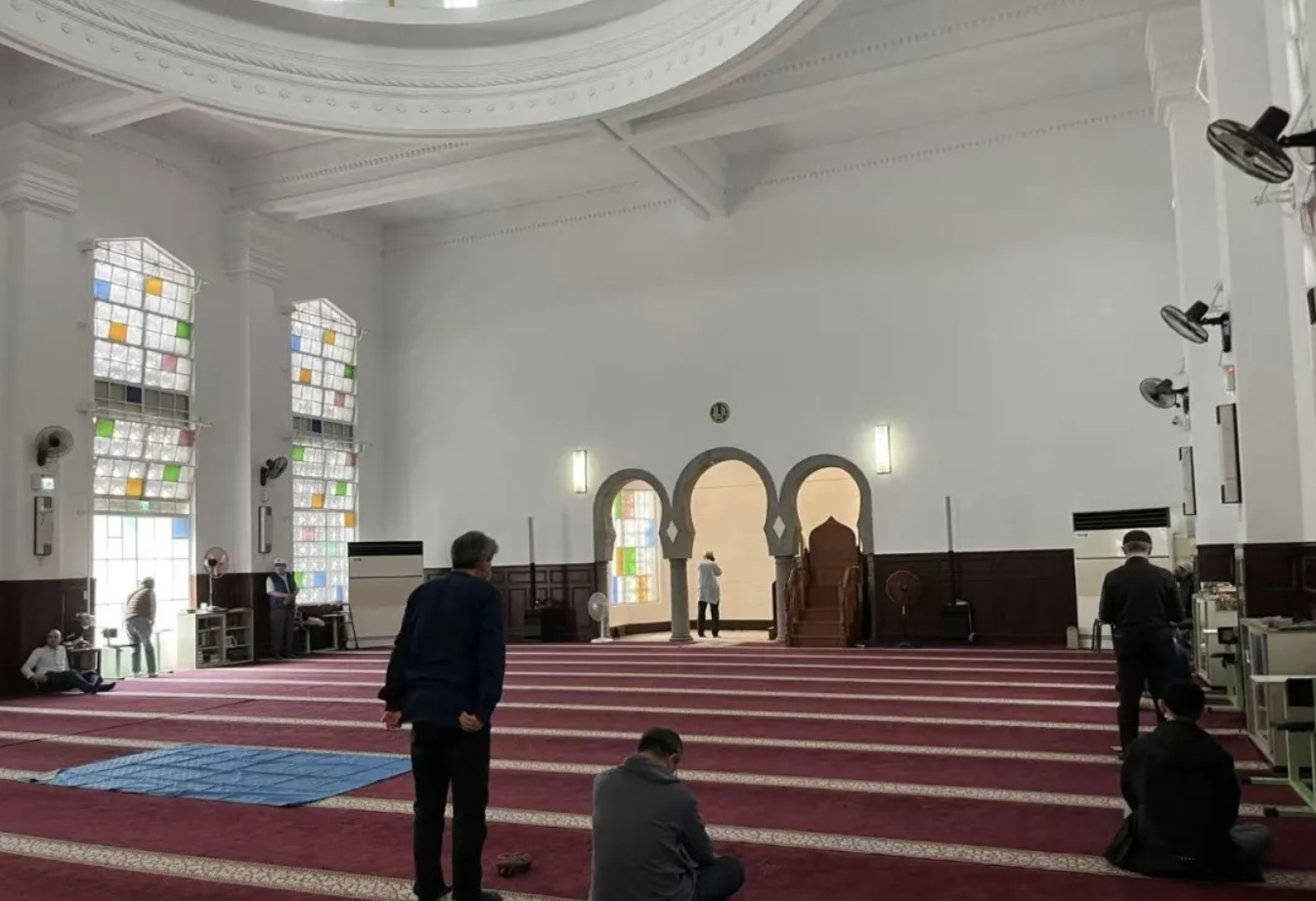
The very first day I landed in Taipei, even before checking into my hotel, I was in a hurry-scurry to get to the Taipei Grand Mosque, right next to Daan Forest Park. I rolled up just in time for a funeral, and honestly, seeing the family all dressed in black, lined up in two rows on the way to the wudu room, really caught me off guard. The deceased was there, waiting to be washed. I, with my luggage in tow, walked into the wudu room under their somewhat puzzled gazes. I naturally figured most of these family members weren't Muslim and probably wondered why a rushed traveler like me was heading into a washroom meant for the departed. Without a second to spare, I quickly performed wudu and headed to the main prayer hall, waiting for Dhuhr (midday prayer).
Glancing around at the people waiting for prayer, my eyes immediately landed on the "legendary" newly appointed young Imam. I went over and gave him a salam, and we agreed to chat after prayers. After we finished, we all stood for the Janazah (funeral prayer) for the deceased. Afterward, we started talking, and when the young Imam mentioned the deceased, he told me the person might be a descendant of Yunnan Hui Muslims from Myanmar, a young man from Myanmar Street, not even 30 years old. He also mentioned he was heading to "Myanmar Street" that evening to grab some food. I was all ears, quickly asking what the connection was between Myanmar Street and Muslims. To my surprise, the Imam explained that a significant part of Taiwan's Muslim community is made up of these Yunnanese Muslims, and Myanmar Street is one of their main hangouts. My aimless Taiwan trip suddenly had a bullseye: Myanmar Street.


Myanmar Street: Home to the "Lonely Army's" Descendants
Hua Xin Street, nestled in Taipei's Zhonghe District, is widely known as "Myanmar Street." It's a vibrant hub for Burmese Chinese and, crucially, a stopping point for Hui Muslims from Yunnan. These folks are descendants of what's often called the "Burma-Thailand Lonely Army," gradually settling here after the 1980s. The "Lonely Army," also known as the "Yunnan-Burma Lonely Army" or "Remnants of the KMT Army," refers to Nationalist (Kuomintang, or KMT) troops who retreated to Myanmar after the People's Republic of China was established in 1949. A significant number of Yunnanese Muslim soldiers and their families moved with them, forming a distinct Muslim community within the ranks of this "Lonely Army." Early on, a large number of these Muslim families found a base in the border regions of Myanmar's Shan and Kachin states. Another segment later migrated to northern Thailand, making their lives along the Mekong River.

For most Taiwanese, these folks are cultural and geographical "outsiders." The Imam, with a touch of melancholy, recently told me that young people aren't really into Islam anymore, and many religious practices have simply become "customs." You could see this plain as day among the young folks at the funeral. While the older aunties wore their headscarves, the younger generation opted for general funeral attire – black to show respect – looking no different from any other non-Muslim from the outside. The Initium (a Chinese digital media outlet) even published an article titled "The Outsiders" that delves into the identity struggles of a young person from Myanmar Street. These Muslim descendants grapple with a unique "Yunnan-Myanmar-Taiwan" triple cultural identity, a blend of Chinese culture, Islamic faith, and Southeast Asian influences. But they don't quite belong to Myanmar, and it seems they don't fully belong to Taiwan either. Even their Yunnan accent has become a source of discrimination. Myanmar Street is their Huifang – their Muslim quarter. For the younger generation "from the block," stepping outside this Huifang might feel like a more "fitting" integration, while holding onto your turf makes you a stubborn outsider. It’s the bitter taste of growing up in the Huicamps. Perhaps it’s not until they can truly think for themselves that they can appreciate the preciousness of what they already possess.


Despite all this, Myanmar Street remains their Huifang. Burmese signs are everywhere you look, and the names of street snacks like "Ersi" (rice noodles) and "Ganba" (dried beef) betray their Yunnan roots. Here, you can still confidently enjoy halal food that’s both Burmese and Yunnanese. The older sister running the "Yongli" snack shop told me she only arrived in Taiwan a few years ago and isn't quite used to living here. If her husband hadn't been here for decades, she never would have considered moving. Everything is just so different. Speaking in a somewhat broken Yunnan-inflected Mandarin, she warned me, "Young folks gotta be careful and protect yourselves, okay? Yesterday, a young guy died in a motorcycle accident, only in his twenties." I quickly chimed in, "I stood for the Janazah at the mosque today for the deceased. You must be talking about that very same person!"
Longgang: Another Haven for Yunnan Muslims in Taiwan
These days, Longgang, over in Taoyuan's Zhongli District, is another super important spot where Yunnan Muslims have really set down roots. Back in the 1950s, the Taiwanese government brought over the Dian-Myanmar "Lonely Army" and their families from Thailand and Myanmar, settling them all right here. To keep their faith alive and kicking, the Muslim community pooled their resources and built the Longgang Mosque. It's not just a place for salat (prayers); it's a vibrant hub where their culture and spirit come together. The fact that every single mosque in Taiwan has a Yunnanese Imam really shows just how big a deal these Yunnan descendants are within the Taiwanese Muslim community.


Lukang: Where History and Faith Whisper (Quietly)
My first footprint on the mainland Hui Muslim journey in Taiwan was in Lukang, a town absolutely bursting with incense smoke. As I made my way south from Taipei to Taichung, my Aunt Ma, who I'd been in touch with, kept bringing up taking me to Lukang. I was a bit in the dark, honestly, wondering what this little town had to do with Hui Muslims. Once I hit Taichung, Sister Shi, who picked me up with my aunt, was a local from Lukang herself. She told me she was a descendant of the famous General Shi Lang, and that Lukang was one of the very first places mainlanders settled in Taiwan. Lukang’s temples are crammed with worshipers; Sister Shi mentioned they get tens of millions of visitors every year. Walking near the old street, temples and ancestral halls are everywhere, and as Aunt Ma put it, "The idols have taken over this place."
Sister Shi, with her headscarf, definitely sticks out like a sore thumb here. But even before she embraced Islam, she wasn't part of the mainstream. She used to be a devout Christian, knew her Bible inside and out, and could debate scripture with anyone.
But the Lukang I want to talk about is a different side of it – this is where Taiwan first intersected with Hui Muslims. As early as the late Ming Dynasty, some descendants of Hui Muslims living in the Quanzhou region followed the migration waves to Taiwan, settling in what is now Lukang and Taisi. This marked the earliest recorded presence of Muslims in Taiwan. Today, Lukang is primarily home to the Chen-dai Ding and Guo families. The earliest observations of them date back to the 1920s, when scholars noted there wasn't a single trace of Islamic practice left in their lives. Their descendants even revealed that their ancestors had a strict rule: "Hide the fact that you are Muslim at all costs." Despite fully adopting Han customs, their family genealogies still record their connections to the mainland and their Muslim ancestors. The Ding clan in Lukang still knows they are descendants of the 18th generation. Some of their unique ancestral worship rituals might also hint at their special identity. For instance, the Ding family has a peculiar custom during funerals called "Guan Mao" (pouring water from the roof into a well) where the family patriarch or eldest grandson pours three cups of wine into a bowl. The Ding family's main house is a siheyuan (quadrangle courtyard), which from above forms the Chinese character "回" (Hui/return), unlike the local sanheyuan (three-sided courtyard). Plus, there are no ancestral tablets in their ancestral hall. For the Guo clan, not using pork in their ancestral worship is perhaps more direct evidence of their Muslim lineage. The Guo family also doesn't invite Taoist priests to chant scriptures; instead, they specifically invite someone familiar with Guo family customs to perform the rituals. There's even a rumor that a local temple called Bao'an Temple was originally a mosque, later converted into an ancestral hall.
Unlike the Yunnanese descendants who came to Taiwan in the 1980s, Lukang presents a much more localized form of Muslim history, and you won't find many visible signs of Islam here. There's only one small prayer spot for Indonesian migrant workers, maintained and managed by two Taiwanese converts to Islam. The converts and the deeply assimilated Hui descendants form a stark contrast. Modern Lukang is booming with traditional worship, but it's also stubbornly resistant to change. Grandpa Xue, a convert from Kaohsiung, picked up his Iman (faith) after converting and started Da'wah (religious outreach) in a park not far from the Lukang Mosque. In over ten years, he only managed to guide one person to Islam – and that person was my guide, Sister Shi.


Kaohsiung: Tracing the Footsteps of Our Elders
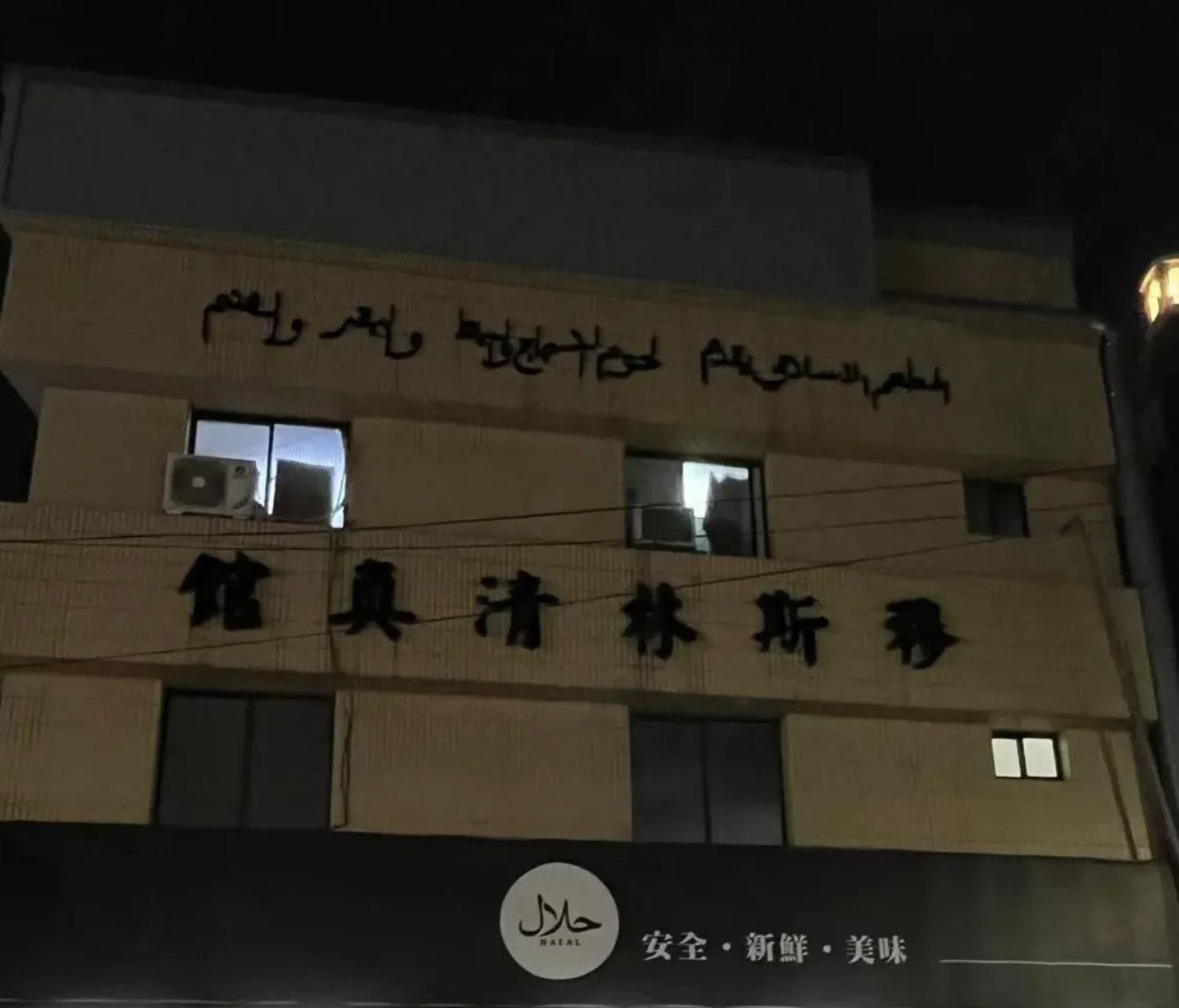
Kaohsiung holds a special place, as it was one of the first cities in Taiwan to establish a mosque. The early Kaohsiung Mosque was originally located at 117 Wufu 4th Road in Yancheng District – that spot is actually a Hong Kong-style tea restaurant now. Back then, the second floor had tatami mats laid out for prayer, a small space, until they eventually moved to Linsen 1st Road. Not far from this old prayer hall, there was a Beijing Halal Restaurant that was a regular hangout spot for the "people of the faith."
The owner of that halal restaurant was a man named Zhao Mingyuan from Qingzhou, Shandong. During the Republic of China era, he actually recommended Imam Wang Jingzhai to serve at the Qingzhou Mosque. Even after coming to Taiwan with the Kuomintang in '48, his heart remained devoted to the Deen (faith). He was one of the original founders, along with twelve others, who established the Kaohsiung Mosque. When I mentioned Zhao Mingyuan, a teacher named Y from Taipei told me that the Zhao clan of Qingzhou was a prominent family, a big deal in the Muslim community, and they contributed a ton to the Deen. Nowadays, the Zhao family gatherings are practically international events, with their descendants found from mainland China all the way to North America. There’s even a Chinese-American Imam named Zhao in the States who's part of that very family. But perhaps even more well-known in Taiwan is the grandson of elder Zhao Mingyuan, the famous former Imam of the Taipei Grand Mosque, Dr. Zhao Xilin. Today, the Kaohsiung Mosque has been at its current location on Jianjun Road in Lingya District since 1992. The first Imam of the new Kaohsiung Mosque, Chen Yongwu, hails from Myanmar and is still serving there today, carrying on the rich tradition of the Dian-Myanmar Muslims.
Of course, there are also some less visible Hui Muslims who quietly live in Kaohsiung, like my own grand-uncle. After being forced to retreat to Taiwan with the larger army as a wounded soldier, my grand-uncle lived alone on this land. He didn't seem to interact with these active "people of the faith." I often wondered, as a Hui Muslim from Northeast China, how he managed to make a life for himself all alone here. Following the address my dad sent me, which had been mailed from Taiwan, I went to his old place. Now, it's just a parking lot – nothing left of what it used to be.




A Mix of Sacred and Secular: Indonesian Prayer Spots
Given Taiwan's geography and terrain, the island's east coast has always been pretty off the beaten path, with very few people living there. So, finding a sizable Muslim community there is practically a pipe dream. Even so, you can still scout out some places to pray in a few cities. The thing is, these prayer spots aren't necessarily what you'd call serene or super peaceful. When I followed my map to two Indonesian prayer spots in Hualien City, the noisy surroundings honestly made me cringe a little bit.
At one of them, the first floor was a bustling restaurant, and the third floor was the prayer hall. But get this: sandwiched right in between, on the second floor, was a hidden dance hall! So, there I was, praying on the third floor, prostrating to Allah (SWT), and feeling the vibrations of the speakers and hearing the faint sounds of singing wafting up from the floor below. Subhanallah! It was a truly unique experience, a test of focus, no doubt.
At the other prayer spot in Hualien, the secular world had seeped in even more thoroughly. The prayer room was still upstairs, but the first floor was like a reception area, or maybe a community hangout. As soon as you walked in, there was a living room setup, complete with a kitchen. Indonesian folks were busy preparing meals right there for others sitting downstairs. I gave a friendly nod to the "hosts" on the first floor and headed upstairs to pray. Just when I thought this might be a quieter spot, a wave of smoke from downstairs started drifting up, making the second floor feel all hazy and ethereal – and not in a good way, if you catch my drift.
Ultimately, though, much like the laborers themselves, the Deen (faith) here is something that's been brought in from elsewhere. Beyond these two prayer spots, even finding a single halal restaurant was a tall order, almost a luxury. It truly put into perspective the challenges faced by our brothers and sisters in places where Islam isn't the dominant culture. May Allah make it easy for them.


Taichung Mosque: A Hub of Faith
Taichung is home to a pretty active Muslim community, and my main reason for coming to Taiwan this time around was to visit my Uncle and Aunt Ma, who live there. Now, Uncle Ma, bless his heart, is an engineer by trade, not some academic from an Islamic studies program. But in his free time, he dedicates himself to a word-by-word morphological and grammatical analysis of the Quran, then pays out of his own pocket to print and publish his findings online for others to learn from. Aunt Ma, for her part, is the quiet force behind the scenes, a true pillar of strength for the Taichung Mosque. They've been my gateway to understanding Taiwan's Muslim community, and getting to know them has really opened my eyes.


Culture Mosque: A Community-Driven Space
As one of only two real mosques in Taipei, the Culture Mosque doesn't have a permanent Imam. So, it's usually run by amateur Imams. There's one particular Pakistani uncle who prays there regularly; he's gotten Taiwanese citizenship through marriage and is now a bona fide Taiwanese citizen. Masha'Allah!
Food Chronicles: Beef and Its Vegetarian Buddies
Long story short, if you're on the west side of Taiwan, you won't have any trouble finding halal food. But head east, and you're pretty much out of luck. There are no more than two halal spots in Taitung, and maybe three at most in Hualien... it's a tough nut to crack if you're trying to keep things strictly halal.


Halal Bites Across the Island
Halal cuisine at Taipei Airport (A true blessing when you're traveling!)

Taiwan's chain fried chicken shops (Always a crowd-pleaser!)


Halal beef noodle soup joint in Kaohsiung (A warm bowl of goodness!)

Halal beef noodle shop in Taipei (Classic comfort food, Muslim-style!)


A halal Roujiamo (Chinese meat burger) spot (A little taste of home for many!)


Postscript: The Unfolding Journey
Taiwan really brought to mind a topic we often discuss: migration. For an individual, migration can be quite a conscious choice, a proactive step. But for an entire community, it feels like there's no escaping the gears of destiny and the call of Qadar (Divine decree), no matter where you go. The reality that descends upon a community can't be faced by constantly running away. Some might ask if Taiwan is suitable for Muslims to live in. If you consider food, clothing, and education, simply existing as a Muslim here is a huge test. Yet, you can't really tell those who've already put down roots here to find a more "Muslim-friendly" country. Looking back at them, they've constantly been on the move, and while Taiwan might not be the ideal Jannah (paradise), it has given them a chance to catch their breath. We, as humans, merely pass through this life fleetingly. It's only by accepting hardships that we can truly overcome them and face the Hereafter with peace. Finding glimmers of light – good people and good deeds – amidst the chaos was truly enough to uplift my ruh (spirit) and strengthen my iman. Alhamdulillah for all His blessings.
Najiaying mosque latest news: The Chinese police and armed military still control the Najiaying town and Najiaying mosque
News • napio posted the article • 0 comments • 1402 views • 2023-05-28 19:19
click and watch video:
Your browser does not support the video tag.
view all
click and watch video:
The Xi Jinping government has also sent out hungry wolf-like troops to suppress the Hui Muslim in Najiaying town!
News • napio posted the article • 0 comments • 1358 views • 2023-05-28 19:15
Local Muslim pray and say “ Allah is the most greatest” to protest.
click and watch the video:
https://video.twimg.com/ext_tw ... T.mp4
view all
Local Muslim pray and say “ Allah is the most greatest” to protest.
click and watch the video:
https://video.twimg.com/ext_tw ... T.mp4
Joint CHRD and HUIF Civil Society Report Submitted to CESCR – January 15, 2023
Articles • Dmitry posted the article • 0 comments • 1498 views • 2023-02-14 05:26
A joint submission to
The Committee on Economic, Social and Cultural Rights
for its
3rd Periodic Review of the Implementation by the People’s Republic of China
of the
International Covenant on Economic, Social and Cultural Rights
Submitting organizations:
Network of Chinese Human Rights Defenders (CHRD)
A coalition of Chinese and international human rights non-governmental organizations. The network is dedicated to the promotion of human rights through peaceful efforts to push for democratic and rule of law reforms and to strengthen grassroots activism in China.
[email protected]
https://www.nchrd.org/
Hope Umbrella International Foundation
An organization whose mission is to preserve the cultural, religious, and intellectual heritage of the Hui people. The organization also documents the effects of government policies that violate the human rights of Hui communities in China.
Date of Submission: January 15, 2023
Executive Summary
1. China’s Hui population in the Xinjiang Uyghur Autonomous Region—numbering over a million—has been among the groups targeted by crimes against humanity in the government’s counter-terrorism campaign in the region. Beginning in 2014 and escalating in 2017, this is the same counter-terrorism campaign that has received widespread international coverage for targeting Uyghurs, Kazakhs, Kyrgyz, and other Turkic-speaking groups. The campaign has resulted in the detentions of a plausible estimate of more than 100,000 Hui in re-education centers, in addition to pre-trial detentions and imprisonments. The Hui have also been subject to restrictions aimed at eliminating “signs of extremism” that include what the OHCHR has referred to as religious and cultural expression protected under the Covenant, and intrusive surveillance of public and private life.
2. The Hui are an ethno-religious group of primarily Chinese-speaking adherents of Islam who are descendants of Han Chinese and immigrants from Central Asia and the Middle East via the Silk Road trade. A few ethnically distinct Muslim groups in China are also classified as Hui by the Chinese government. There are 11.4 million Hui in China according to the most recent national census, making them the third most populous of the officially recognized ethnic groups in China.1 Hui communities are concentrated in various regions in China, with the largest number in the northwestern provinces.
3. This submission also covers violations of Hui cultural and religious rights throughout China. Through the government’s “Sinification” campaign, authorities have tried to forcibly integrate religious groups into the government and Party system and to eliminate aspects of cultural expression that are seen by authorities as being incompatible with Han Chinese culture. Authorities have intimidated and detained lawyers taking up cases of Hui persecuted for exercising their cultural rights and censored online content about Hui and Islam, while permitting officials to foment hate speech and campaigns attacking Hui communities on Chinese social media.
4. “Poverty alleviation” is another Chinese government policy with a significant impact on Hui social, cultural, and economic rights. Officials have implemented two major poverty alleviation programs among Hui communities that require relocation: “ecological migration” and domestic “labor transfers” to more economically developed regions within China. In designing these programs, authorities have failed to conduct consultations with the communities that would be seriously affected. Officials have stated that the goals of these policies include assimilation of minority groups. These policies have forced the integration of ethnic minority communities into Han Chinese-dominant cities, where Hui find their employment opportunities limited to unstable and low-paying wage work.
5. Finally, this report covers violations of Hui economic rights in the context of forced labor in Xinjiang and the threatened deprivation of social benefits in both the Xinjiang counter-terrorism campaign and the nationwide “Sinification” campaign. Hui throughout China have also faced discrimination in the job market and the workplace, and this discrimination has worsened because of the stigmatizing effect of the government campaigns marginalizing and criminalizing Hui religious and cultural practices.
Chapter 1. Counter-Terrorism Policies Targeting Hui in Xinjiang
1.1 Targeting Hui for Exhibiting “Signs of Extremism” (Articles 2 & 15; List of Issues pars. 12, 29)
6. Beginning in 2014 and escalating in 2017, the Chinese government’s “strike hard” campaign to counter “terrorism” and “extremism” in the Xinjiang Uyghur Autonomous Region (Xinjiang or XUAR) has resulted in egregious violations of the social, economic, and cultural rights of the over one million Hui persons in region.2 Though the resulting crimes against humanity directed at Uyghurs and Kazakhs have drawn more widespread attention, China’s Hui population has also been among the targeted groups.
7. As part of the “strike hard” campaign, authorities have implemented a series of laws3 and policies that have been used to impose severe sanctions on a wide range of activities that government officials have designated “signs of extremism.”4 Authorities have rounded up members of the Hui community and held them in detention centers and re-education camps and sentenced some of them to prison for engaging in Hui religious and cultural activities such as praying at home5 or in mosques,6 watching7 or discussing8 religious content online, traveling to Muslim-majority countries,9 having funded mosque construction,10 going on Hajj pilgrimages,>11 being an imam, both with12 and without13 state licenses, and keeping religious paraphernalia in the home.14Such government measures targeting Hui persons for the above-listed activities violate their rights under the ICESCR to non-discrimination (article 2.2) and to take part in cultural life (15.1.a).
8. In further violation of the Hui community’s cultural rights under article 15.1.a, authorities have prohibited Hui communities in Xinjiang from engaging in religious and cultural activities such as observing Ramadan and Eid-al-Adha and have required Hui individuals to renounce their religion under duress.15 Authorities have required Hui families of those who had been detained in re-education camps to attend weekly flag-raising ceremonies16 and evening classes with “anti-religious” curriculum and demanded that attendees report on the religious observance of friends and family, threatening to send those who failed to report to a re-education camp.17
1.2 Detention of Hui & Mistreatment in Detention (Articles 11 & 12)
9. As part of the counter-terrorism campaign beginning in 2014, Hui in Xinjiang have been detained in pre-trial detention centers and re-education camps and sentenced to prison. The Chinese government has made little information public about the number or ethnicity of those detained in the campaign. In the absence of official data, researcher Gene Bunin has found that many witness testimonies from former detainees who later fled to Kazakhstan mention that Hui were detained alongside them in Xinjiang; Bunin also found that a report of 43 persons detained in Xinjiang in one predominantly Hui village of 60 households was comparable to expert estimates of the proportion detained in Uyghur communities in Xinjiang.18 Using researchers’ conservative estimate of 10 percent for the proportion of those detained in Uyghur communities,19 it is plausible to estimate that perhaps more than 100,000 Hui may have been deprived of liberty in connection with the campaign in Xinjiang.
10. The conditions in which Hui persons have been held in custody have resulted in serious violations of their rights to an adequate standard of living (article 11) and to physical and mental health (article 12). Uyghur, Kazakh, and other majority Muslim groups have reported significant physical and psychological abuse in custody,20 and reports indicate that Hui in custody have been subject to similar treatment,21 such as being crowded in squalid conditions of around 40 detainees to a cell with space so limited they could only sleep in shifts, being deprived of sunlight, and malnutrition so severe that detainees suffered from life-threatening anemia and weight loss.22 Like other detainees, Hui have been handcuffed and shackled for long periods,23 with at least one account having emerged of a Hui man dying in detention after being restrained in a tiger chair for 78 hours.24
1.3 Surveillance in Public and Private Life (Articles 2, 10, 12, & 13)
11. The detentions described above underpin a broader system of surveillance and restrictions aimed at eliminating the aforementioned “signs” of religious “extremism” in public and private life in the XUAR. The implementation of such policies has violated the rights of Hui individuals to non-discrimination (Article 2.2) These measures include close scrutiny of the movements and activities of Hui and other non-Han persons residing in the XUAR through security checkpoints,25 forced inspection of social media history,26 random cellphone checks,27 home inspections,28 regular questioning by police in person and over social media,29 and assigning public employees to stay in homes to monitor for religious observance and other “signs of extremism.”30
12. To facilitate monitoring by local authorities, Hui persons have also been subjected to discriminatory travel, residence, and employment restrictions, with reports of local authorities selectively requiring Hui to return to their registered hometowns.31 Authorities have also prohibited Hui from relocating within Xinjiang by reportedly refusing to register them as new residents.32
13. Authorities have also subjected Hui persons to physically and psychologically intrusive surveillance of their private lives. As part of the “becoming family” homestay program, public employees have reportedly monitored people in their homes for long periods of time with highly intrusive methods—continuously taking pictures of their activities, asking children about their parents’ activities,33 and even sleeping with families in their beds.34 The program constitutes a serious, coercive disruption of family life (Article 10.1) and also violates the right to enjoyment of mental health (Article 12.1) and to ensure the religious and moral education of one’s children (Article 13.3).
1.4. Recommendations
14. We urge the Committee to recommend that the State party:
Indicate any concrete steps taken to adopt comprehensive legislation or to review the existing laws, including “counter-terrorism” legislation, for eliminating discrimination and violations of social, cultural, and economic rights against ethnic groups including the Hui.
Provide information on the measures taken, and their effectiveness, to combat widespread social stigma and discrimination against ethnic and religious minority groups, including the Hui, in the country’s counter-terror campaigns.
Provide statistical data on children of ethnic or religious minorities including the children of Hui persons, who have been separated from their families, without adequate care, when parents are taken to “vocational training” camps.
Indicate the measures taken to improve access to health-care services, particularly among persons living in rural ethnic minority regions, including the Hui regions, and detainees and prisoners.
Provide information on the measures taken to ensure the freedom of Hui parents to determine the religious and moral education of their children.
Chapter 2. Discriminatory Policies and Practices Violating Hui Cultural and Religious Rights
2.1 “Sinification” Policy Undermines Hui Religious Freedom and Identity (Articles 2 & 15; List of Issues par. 30)
15. In CESCR’s List of Issues, paragraph 30, the Committee asks the state to “indicate the measures taken to ensure that the cultural, religious and linguistic identity of ethnic minority groups is not undermined by the assimilation policy of the State party, known as “Sinification.”
16. Much of the Sinification campaign has targeted the Hui people, which appears to be authorized and coordinated via secretive directives35 from the PRC State Council and the United Front Work Department. Implementation of the campaign has had the effect of expunging communities of their connections to Hui culture, religion, and each other so thoroughly that some leaders view the erasure of a meaningful Hui identity within another generation as being a likely possibility.36
17. A classified 2018 State Council directive called for eliminating signs of Arab cultural influence in Islamic venues, dress, and religious observance, prohibiting waqf charitable funds from being independently held and administered by local Islamic communities, and barring Islamic organizations from running programs involving minors—from kindergartens to Arabic language schools and study abroad programs.37
18. Among the forms of “Arab influence” being targeted for removal since 2016 are Arabic lettering and motifs on buildings, in public areas, and in people’s homes.38 Islamic dietary restrictions have also been targeted as an unacceptable expression of Hui identity: since 2016 across China, restaurants and groceries have been forced to remove halal signage,39 and by 2019 authorities in Ningxia, Beijing, and elsewhere were no longer allowing food, dairy, and wheat producers and restaurants to certify food as halal.40
19. The Sinification campaign also aims to prevent transmission of cultural and religious heritage across generations. Minors under 18 have been prohibited from entering mosques and other religious venues in many areas, and Arabic language and Islamic schools have been shut down by authorities. In Gansu, extremely limited quotas for Arab language and religious instruction have made it impossible for most children to access instruction.41
20. In 2018, the Chinese Islamic Association—the state-sanctioned leadership organization for Islamic religious leaders—released measures regarding the Sinification of mosques and Islamic doctrine.42 The policy was referred to as the “four entries,” and directed local officials to ensure that “four” things make their “entry” into Hui, Uyghur, and all other mosques: the national flag, the Chinese constitution and laws, core socialist values, and Chinese traditional culture.43 Mosques were reportedly required to raise national flags,44 which were often accompanied by slogans exhorting patriotism, ethnic unity, and social stability.45
21. The “four entries” also heralded the intrusion of official surveillance into the religious and private life of Hui. Surveillance cameras have been installed by local police to monitor activity inside mosques in Ningxia and Henan.46 Hui have also been expected by the government to report on the religious activities of friends and families, with monetary rewards offered to informants.47
22. Authorities have sought to introduce the last two “entries”—core socialist values and Chinese traditional culture—through Hui religious leaders. Imams are only able to openly preach contingent on whether they demonstrate loyalty to the government’s Sinification program.48 Mosques without licensed imams have been shut down entirely.49 Officials in Ningxia and Henan now require imams to attend monthly training sessions regarding Party ideology and official policies governing ethnic minorities; for renewal of their imam license they must pass yearly tests regarding Party ideology.50 Imams are closely policed to monitor their deviation from officially prescribed interpretations of Islam.51
23. Meanwhile, the Sinification policy seeks to change the very beliefs of Islam by inserting “core socialist values” into the religious doctrine itself. The state-led China Islamic Association began leading conferences in December 2020 for the purpose of generating official re-interpretations of Islamic theology from the perspective of Confucianism and “core socialist values” so that they can be in line with “Chinese traditional culture.”52 Officials have worked methodically to remove signs of Arabic influence from mosques: the call to prayer in Arabic was prohibited in at least Ningxia and Gansu and replaced with the sound of a siren; as with all other buildings, Arabic inscriptions and motifs were removed from mosque walls.53
24. The Sinification measure that has provoked the strongest reaction in Hui communities is the forced demolition of mosque domes and minarets and their replacement with traditional Chinese roof designs.54 Authorities have retaliated against those opposing the demolitions. Following mass protests in Tongxin, Ningxia over the attempted removal of a mosque dome in August 2018, authorities visited each Hui household in the community requiring each to give consent to the replacement of the dome, issuing threats such as job loss for family members who were public employees.55
2.2 Intimidation and Detention of Lawyers Taking up Cases of Hui Cultural Rights (Article 2, List of Issues par. 4)
25. In its List of Issues (paragraph 4), the Committee asks the government to provide information about the intimidation of lawyers taking up cases of violations of economic, social and cultural rights. Chinese authorities have harassed, threatened, and detained lawyers for representing Hui clients charged in connection with their religious identity or activities. Instead, authorities forced Hui detainees to be represented by government-appointed attorneys.
26. One Hui interviewee told CHRD in 2022 that in 2017, a lawyer was disappeared by authorities in Xinjiang for several days after being engaged to represent Hui religious leader Jin Dehuai, who was convicted for separatism based on religious activities such as preaching in his home, encouraging proselytizing, and organizing religious conferences with participants from abroad.56 The lawyer canceled representation after being released by authorities.
27. The same interviewee informed CHRD that authorities in the Ningxia Hui Autonomous Region in 2019 warned lawyers against attempting to represent Hui defendants who had been detained for their refusal to consent to the government’s removal of a mosque minaret. The defendants were members of the leadership committee of the Weizhou Grand Mosque in Ningxia’s Tongxin county,57 Consequently, the defendants were assigned government-appointed lawyers and later convicted for “criminal syndicate activity.”58 Charges involving “criminal syndicates” have allowed for expedited prosecution and lower levels of judicial scrutiny under a major national anti-corruption campaign initiated in 2018 known as “Sweep Away the Dark Forces and Eliminate the Evil” (saohei chu’e).59
2.3 Internet Censorship (Article 15; List of Issues par. 31)
28. Chinese internet regulations have led to the selective censorship of content from Hui internet users while allowing denigrating and hateful speech about Hui and Islam to proliferate on social media. This combined with the encouragement of hate speech by public figures in official positions has contributed to worsening discrimination against Hui persons in Chinese society more generally.
29. In March 2022, a state ban on independent publication of “religious information” online went into effect, allowing only officially registered organizations vetted by the government to publish information online about “religious doctrine, knowledge, culture, or activities.”60 Prior to this ban, websites and online platforms popular among users in the Hui community had already been shut down.
30. For example, the website Zhongmu (www.2muslim.com) was shut down when a user-posted an open letter to Xi Jinping calling for the release of political prisoners was reposted by Chinese Academy of Social Sciences scholar Xi Wuyi on Chinese social media platform Sina Weibo as evidence of Hui subversion.61 The website had been online for over 13 years and included forums for 77 local communities throughout China, and former users searching for “Zhongmu” on Chinese social media found that searches on these platforms produced no results, thus preventing them from reconnecting.62 In addition to Zhomgmu, the personal websites of leading Hui cultural figures such as imam Li Yunfei and writer Zhang Chengzhi were shut down in 2020 and 2021, respectively.63
31. Individual Hui Internet users have also encountered censorship online. Researchers reported in a 2018 study that Hui users frequently found that their online posts about Islam or official ethnic policies were deleted or their accounts blocked, while state-approved imams have been allowed to discuss Islam online.64 Such targeted censorship has effectively prevented Hui persons from freely exchanging ideas and information on the internet.
32. While websites and Hui Internet users have been censored, discriminatory and hateful speech about Islam and Muslims has flourished on Chinese-language social media platforms. Academic experts have observed that such anti-Muslim rhetoric online has been indirectly encouraged by state media, which almost always portrays Muslims as the grateful beneficiaries of state programs or as violent extremists.65 Studies also find that social media platforms selectively fail to remove Islamophobic content clearly in violation of platform policies,66 which experts note is itself a reflection of suspicion of Muslim groups among Chinese authorities67 because authorities have significant control over what content appears online.68 Islamophobic hate speech also comes in the form of vicious online attacks against social media users identified as Hui, which has caused many Hui internet users to avoid engaging on issues related to Islam online.69
33. Government officials are often both the source and propagators of some of the most vitriolic comments about Muslims and Islam on Chinese social media. Scholar of Marxism at the Chinese Academy of Social Sciences Xi Wuyi (mentioned above) has led numerous online campaigns against accommodations for or acknowledgment of Muslim members of Chinese society.70 Another government figure who has mobilized online followers to target the Hui community is a government propaganda and cyberspace official named Cui Zijian, who said it was part of his “professional and patriotic duty” to lead a 2017 online campaign to shut down the construction of a mosque in Hefei, provincial capital of Anhui.71 The status of such officials as in government capacity further legitimates hate speech about Muslims in mainstream discourse.
2.4 Recommendations
34. The Committee should recommend that the State Party:
Provide information on the efforts undertaken to promote and protect the culture, religion and language of ethnic minority groups, including the Hui, and show how the measures taken to ensure that the cultural, religious and linguistic identity of ethnic minority groups including the Hui are not undermined by the assimilation policy of the State party, known as “Sinicization.” Please also comment on reports that the State party has attempted to eradicate the culture, religion, and language of Hui through the destruction of sacred cultural and religious sites and bans on engaging in religious activity.Provide information about avenues for accountability, redress, and compensation for lawyers and law firms subject to intimidation, detention, and retaliation for taking up cases of violations of economic, social and cultural rights. Also provide information on the measures taken to provide an enabling environment for lawyers and human rights defenders to advocate and promote economic, social and cultural rights, particularly for Hui persons.Provide information on any measures taken to ensure the free exchange of ideas and information online without interference to the enjoyment of Hui persons to cultural rights and religious freedom.
Chapter 3. “Poverty Alleviation” Policies Disperse Hui Communities and Facilitate Cultural Assimilation
3.1 Political Goals and Effects of “Poverty Alleviation” Programs (Articles 2, 11 & 15; List of Issues par. 24)
35. In its List of Issues (paragraph 24), the Committee asks the Chinese government to “specify the efforts made … to involve the affected individuals and communities in designing and implementing various poverty alleviation projects, especially those entailing relocation and resettlement of residents[.]” CHRD finds that few, if any, such efforts have been made with Hui communities.
36. Chinese officials have implemented two major poverty alleviation policies among Hui communities that require relocation: “ecological migration” and domestic “labor transfers” to more economically developed regions within China. “Ecological migration” has been touted by President and Party Chairman Xi Jinping as part of a series of the government’s ethnic minority policies that would create “mutually embedded social structures,” “intermingle ethnic groups,” and “guide people of different ethnic groups to correctly understand ethnic relations and issues.”72 Meanwhile, officials involved in a 2020 “labor transfer” recruitment effort targeting Hui workers cited the importance of “ensuring social stability and harmony” and “strengthening national unity.”73
37. In practice, such policies force the integration of ethnic minority communities into Han Chinese-dominant society, where they find employment opportunities limited to unstable and low-paying wage work. In designing these programs, authorities have failed to conduct consultations with the Hui communities that would be seriously affected by their implementation. The Chinese government’s implementation of “ecological migration” and “labor transfer” policies has violated the rights of Hui persons to an adequate standard of living (article 11) and/or to participate in cultural life (article 15). The design and execution of these programs have also negatively impacted the rights of the Hui persons to non-discrimination (article 2) by targeting Hui for dispersal to achieve political goals.
3.2 “Ecological migration” (Articles 2, 11 & 15; List of Issues par. 24)
38. The Ningxia Hui Autonomous Region (Ningxia) hosts the world’s largest planned “ecological migration” project in terms of people affected. Begun in 1983, the government has relocated more than 1.1 million residents, out of a total of 7.2 million people in the region to achieve “environmental” and “poverty alleviation” goals.74 Scholars have contended that the policies are also a cover for dispersing and dislocating ethnic minority groups.75 Ecological migration projects have been used to disperse hundreds of thousands of ethnic minorities in other areas: 710,000 people—72 percent ethnic minority—were resettled across 506 resettlement areas in the Guangxi Zhuang Autonomous Region between 2016 and 2020. The design of the resettlement plan emphasized relocating people from Zhuang, Miao, Yao, Maonan, and other ethnic minority groups and resettling them in mixed communities to promote “ethnic unity.”76 In Ningxia, although Hui make up 35% of the population, the majority of those resettled have been Hui.77
39. In one example, journalists found that Hui were forced to abandon independent farming for poorly remunerated jobs on industrial farms when 7,000 of them were relocated from Yejiahe Village in the Xihaigu region to the newly established Miaomiao Lake Village.78 Authorities denied farm subsidies and water pipelines to households that chose to remain.79 The relocated villagers were not compensated for the land they relinquished in their original village, and they were required to pay a “resettlement fee” of 14,000 RMB (USD $2,100) per household.80 Local officials told Chinese media that in exchange each household received 300 square meters for housing,81 but journalists found that relocated families of as many as eleven people were living in 50-square-meter, 2-bedroom apartments.82
40. Despite government promises that some families would be able to support themselves by farming allotted land in the new village, officials forced families to lease their plots to an agricultural company at low rates that the company allegedly stopped paying after the first year.83 A quarter of the 350,000 people84 relocated between 2011 and 2015 were not allotted any land for farming.85 Officials justified this by insisting that proximity to highways and urban areas amounted to an improvement in quality of life and encouraging residents to work in nearby cities.86 Officials boasted a high employment rate at 93 percent, but these figures were contested by local residents who reported that men were unable to find construction work and families relied on government loans to meet expenses.87 By 2021, Chinese media reported that garment work had been brought onsite to the village in a trailer.88
3.3 Domestic “labor transfers” (Articles 2 & 15; List of Issues par. 24)
41. The other major “poverty alleviation” policy resulting in relocation and dispersal for Hui communities is the practice of domestic “labor transfers” coordinated by authorities in Ningxia89, Gansu,90 Qinghai,91 and Yunnan,92 where majority-Hui communities are concentrated. Government officials run these programs in conjunction with companies and other cities or regions seeking workers.
42. These “labor transfer” programs have displaced hundreds of thousands of people at any given time. In 2020, the Ningxia government had coordinated the “labor transfer” of 817,600 residents to work in the coastal province of Fujian and other parts of China as of August.93 In Linxia Hui Autonomous Prefecture, Gansu province, 550,000 out of 2 million total residents of the province was working as transferred labor outside of Gansu, according to numbers reported in 2020.94 Some of these local governments have been engaged in labor transfers of their residents for decades—Ningxia and Qinghai began enlisting residents to work for companies in coastal areas such as Fujian, Guangdong, and Shanghai as early as 2005.95
43. Although there is no available official data tracking the exact number and proportion of Hui people involved in “labor transfers,” there are indications that the Hui people in particular are significantly impacted. A free trade-zone official from Ningbo met with government leaders from both the Ningxia region and Linxia Prefecture in Gansu Province in 2020 to recruit Hui workers specifically, citing the importance of “ensuring social stability and harmony,” and “strengthening national unity.”96 Such “labor transfer” coordination is discriminatory as it targets Hui communities to achieve political goals.
44. We do not currently have evidence that these government-coordinated labor transfers are coercive in nature, in contrast to the labor transfer programs organized by local governments in Xinjiang (see Section 4.1).97 However, surveys suggest that the transfers are neither planned nor implemented in consultation with the affected communities, who have found that labor transfers disrupt social and cultural life in undesirable ways.
45. One 2014 study of the labor transfer programs in Zhangjiachuan Hui Autonomous County in Gansu province found that the 70 percent Hui population preferred to continue individual farming and to earn income without having to leave the region and work in other parts of the country.98 A survey of Muslim “labor transfer” participants from Linxia Hui Autonomous Prefecture in Gansu province found that transferred laborers faced language barriers, difficulty finding Halal food, and lack of accommodation for religious observance, particularly for those traveling to eastern coastal cities where there was not a significant Muslim presence.99 Despite their preferences, such communities have become dependent on the labor transfer system for income—in 2021, remittances from labor transfers were more than half of local GDP in Zhangjiachuan county (1.77 billion RMB out of 3.39 billion RMB).100
3.3 Recommendations
46. The Committee should recommend that the State Party:
Specify the efforts made by the State party to involve the affected individuals and communities in designing and implementing various poverty alleviation projects in ethnic Hui regions, especially those entailing both temporary (as in the case of labor transfers) and permanent relocation of residents (as in the case of ecological migration), and to carry out those projects in accordance with its obligations under the Covenant. Please provide statistical data, disaggregated by region, on the number of land expropriations carried out and the number of persons relocated accordingly.
Provide information on the steps taken to address the reportedly persistent discrimination faced by ethnic minority persons with rural household registration in accessing employment, social security, housing, health care, education and other social services.
Chapter 4. Violations of Hui Economic Rights
4.1 Forced Labor in Xinjiang (Articles 6 & 11; List of Issues par. 16)
47. There is evidence suggesting that Hui detainees in Xinjiang (see Section 1.2) have been subjected to forced labor: Hui persons have served for periods in and around Ürümchi at Wujiaqu Prison and Badaowan Vocational Education and Training Center where forced labor has been documented;101 in one case, authorities have sent a Hui person to work in factories rather than allowing them to return home after being released from re-education camps.102
48. Xinjiang authorities have also promulgated official policies intended to forcibly displace residents for the purpose of performing forced labor as part of a political and cultural reform program. In 2018, the Yanqi Hui Autonomous County government in the XUAR issued Document No. 99 outlining a government-administered system of coercive relocation for labor, stating that “those who are transferred for work are not allowed to return without permission,” workers would be assessed based on “ideological education,” and administrative units would report on their progress in ideological training to the local Political Legal Committee and the Public Security Bureau.103
49. The scale of detentions of Hui and other Muslim-majority persons has also directly impoverished entire communities in the region. For example, a 2020 report describes 43 men in a village of around 60 households in Tacheng prefecture being sent to re-education camps. Without their labor, the main economic activity in the village, farming, was largely discontinued and the families remaining in the farming community no longer have sufficient income for necessities.104 Thus, the mass detentions have infringed on the right of the families of the detained to an adequate standard of living (Article 11).
4.2 Deprivation of Social Benefits, Rights to Work and Education (Articles 6, 9 & 13)
50. Chinese government officials have denied or threatened to deny public education, pensions, and other social benefits to compel Hui persons to comply with certain counter-extremism policies. This is in violation of their rights to work (article 6), social security (article 9), and education (article 13). For example, a Hui woman in Karamay prefecture in Xinjiang was threatened with the loss of her pension and her son’s minimal living allowance if she did not renounce her religion.105 In some cases, officials have coerced Hui migrants in Xinjiang to other parts of the regions to return to their registered residential locations by denying employment and public education for their children in the cities where they had been found work and lived for a long time.106
4.3 Employment Discrimination against Hui Muslims (Articles 2, 6; List of Issues par. 15)
51. Hui have historically faced discrimination in the job market and the workplace. In recent years this discrimination has worsened because of the stigmatizing effect of government campaigns marginalizing and criminalizing Hui religious and cultural practices described in preceding sections. A 2020 academic study found that Muslim job seekers in China are more than 50 percent less likely to advance beyond an initial interview than Han Chinese job seekers, discrimination that would primarily affect Hui, Uyghur, other predominantly Muslim groups. The study also found that despite government mandates to prioritize ethnic minority applicants, state-owned enterprises are as likely as private companies to engage in discriminatory hiring.107
52. More recently, such pervasive discrimination has been compounded by religious restrictions in the workplace imposed by local authorities as part of the government’s nationwide crackdown on religion in general. Since 2015, civil servants, teachers, and other public sector employees in Xinjiang have been banned from fasting during Ramadan;108 Hui make up approximately 9 percent of the population of Xinjiang of the population. As early as 2018, in Ningxia Hui Autonomous Region, public sector employees have been prohibited from appearing at work wearing the white caps Hui men customarily wear.109 Around 2016, the Chinese Communist Party warned its members of disciplinary measures if they believe in any religion, with state media publicized cases of CCP officials being subjected to disciplinary penalties for harboring religious beliefs.110
4.4 Recommendations
53. The Committee should recommend that the State party:
Provide information on any specific steps taken to ensure that no alternative or parallel system of forced labor is still in place, provide information on the steps taken to address reports about forced labour and physical and mental abuse of detainees allegedly involved in the so-called “vocational training programmes” operated by the State party, including through vocational training centres, for surplus rural workforce, particularly Uighurs, Tibetans, Huis and other ethnic minority groups; and indicate what support is provided to families whose primary breadwinner is sent to such centres.
Provide information on the trends in coverage of each social security scheme during the reporting period and the efforts made to expand the coverage of social security schemes, particularly among rural ethnic minority (including the Hui) migrant workers and workers in the informal economy or with non-standard forms of employment.
Endnotes:
1 According to the 2021 China Annual Statistical Yearbook. Cited in: https://baike.baidu.com/item/% ... ence-[4]-2699-wrap
2 China Internet Information Center, August 1, 2021.Available at: http://www.china.com.cn/opinio ... shtml
3 PRC Counterterrorism Law; XUAR Implementing Measures for the PRC Counterterrorism Law; PRC Criminal Law; XUAR Religious Affairs Regulation; 2017 XUAR Regulation on De-Extremification.
4 “新疆局地组织民众识别75种宗教极端活动” [“Local Xinjiang Authorities Organize Public to Identify 75 Signs of Religious Extremism”], Sina, December 14, 2014. Available at: http://news.sina.com.cn/c/2014 ... shtml
5 Xiang Yi, “Xinjiang, Where Even Buildings Tell Tragic Stories of Muslims,” Bitter Winter, December 18, 2019. Available at: https://bitterwinter.org/xinji ... lims/
6 Chang Xin, “Xinjiang Woman Struggles to Care for Her Grandchildren,” Bitter Winter, February 11, 2019. Available at: https://bitterwinter.org/woman ... n/%3B Xiang Yi, “Xinjiang, Where Even Buildings Tell Tragic Stories of Muslims,” Bitter Winter, December 18, 2019. Available at: https://bitterwinter.org/xinji ... lims/
7 Xinjiang Victims Database, “Ma Zhengxiu,” May 14, 2022.
8 Xinjiang Victims Database, “Ma Zhixue,” May 14, 2022.
9 Xinjiang Victims Database, “Ma Xuexian,” December 27, 2019; Xinjiang Victims Database, “Ma Yuanlan,” December 27, 2019; Xinjiang Victims Database, “Wang Yali,” December 28, 2019.
10 Xinjiang Victims Database, “Ma Zhongbao,” December 18, 2018.
11 Emily Feng, “‘Afraid We Will Become the Next Xinjiang’: China’s Hui Muslims Face Crackdown,” NPR, September 26, 2019. Available at: https://www.npr.org/2019/09/26 ... kdown
12 Li Zaili, “Volatile Times Ahead for Muslims in Xinjiang,” Bitter Winter, September 5, 2018. Available at: https://bitterwinter.org/volat ... iang/
13 Li Zaili, “Monetary Reward Offered for Muslim Man’s Recapture,” Bitter Winter, November 21, 2018. Available at: https://bitterwinter.org/monet ... ture/
14 Li Zaili, “Volatile Times Ahead for Muslims in Xinjiang,” Bitter Winter, September 5, 2018. Available at: https://bitterwinter.org/volat ... iang/
15 Li Zaili, “Volatile Times Ahead for Muslims in Xinjiang,” Bitter Winter, September 5, 2018. Available at: https://bitterwinter.org/volat ... iang/
16 Li Zaili, “Volatile Times Ahead for Muslims in Xinjiang,” Bitter Winter, September 5, 2018. Available at: https://bitterwinter.org/volat ... iang/
17 Xiang Yi, “With Husbands in Camps, Hui Women Struggle Taking Care of Families,” Bitter Winter, January 4, 2020. Available at: https://bitterwinter.org/hui-w ... lies/
18 Gene Bunin, “Xinjiang’s Hui Muslims Were Swept Into Camps Alongside Uighurs,” Foreign Policy, February 10, 2020. Available at: https://foreignpolicy.com/2020 ... ghur/
19 Jessica Batke, “Where Did the One Million Figure for Detentions in Xinjiang’s Camps Come From?” ChinaFile, January 8, 2019. Available at: https://www.chinafile.com/repo ... -come
20 Gene Bunin, “Because you had to do it very quickly, or you could be punished,” Art of Life in Chinese Central Asia, November 1, 2019. Available at: https://livingotherwise.com/20 ... hed/. Gene Bunin, “Xinjiang’s Hui Muslims Were Swept Into Camps Alongside Uighurs,” Foreign Policy, February 10, 2020. Available at: https://foreignpolicy.com/2020 ... ghur/
21 Gene Bunin, “Xinjiang’s Hui Muslims Were Swept Into Camps Alongside Uighurs,” Foreign Policy, February 10, 2020. Available at: https://foreignpolicy.com/2020 ... ghur/
22 Li Zaili, “Muslim Woman Reveals Details of Her Life in Detention,” Bitter Winter, October 30, 2018. Available at: https://bitterwinter.org/musli ... tion/
23 Li Benbo, “Released from Xinjiang Camps but Forced to Lie About Them,” Bitter Winter, February 24, 2020. Available at: https://bitterwinter.org/relea ... hem/. Li Zaili, “Imam Forced to Recite CCP Policies,” Bitter Winter, October 18, 2018. Available at:https://bitterwinter.org/imam- ... cies/
24 Gene Bunin, “Xinjiang’s Hui Muslims Were Swept Into Camps Alongside Uighurs,” Foreign Policy, February 10, 2020. Available at: https://foreignpolicy.com/2020 ... ghur/
25 Darren Byler, “Do Coercive Reeducation Technologies Actually Work?,” Los Angeles Review of Books (Blog) , January 6, 2020. Available at: https://blog.lareviewofbooks.o ... work/
26 Gerry Shih, “China’s crackdown on Uighurs spreads to even mild critics,” Associated Press, December 28, 2017.
Available at: https://apnews.com/article/ap- ... 09ce8
27 Li Zaili, “CCP Monitors, Punishes Comments on Social Media,” Bitter Winter, December 28, 2018. Available at: https://bitterwinter.org/ccp-m ... edia/
28 Li Zaili, “Volatile Times Ahead for Muslims in Xinjiang,” Bitter Winter, September 5, 2018. Available at: https://bitterwinter.org/volat ... iang/
29 Darren Byler, “Do Coercive Reeducation Technologies Actually Work?,” Los Angeles Review of Books (Blog) , January 6, 2020. Available at: https://blog.lareviewofbooks.o ... work/
30 Xiang Yi, “Xinjiang, Where Even Buildings Tell Tragic Stories of Muslims,” Bitter Winter, December 18, 2019. Available at: https://bitterwinter.org/xinji ... ims/. For general information about the “Becoming Family” program, see UN Office of the High Commissioner on Human Rights, “OHCHR Assessment of human rights concerns in the Xinjiang Uyghur Autonomous Region, People’s Republic of China,” August 31, 2022, pars. 100-101. Available at: https://www.ohchr.org/sites/de ... t.pdf
31 Gene Bunin, “Xinjiang’s Hui Muslims Were Swept Into Camps Alongside Uighurs,” Foreign Policy, February 10, 2020. Available at: https://foreignpolicy.com/2020 ... hur/. Li Zaili, “Imam Forced to Recite CCP Policies,” Bitter Winter, October 18, 2019. Available at: https://bitterwinter.org/imam- ... s/%3B
32 Li Zaili, “Muslims Pushed to the Fringes of Housing Market,” Bitter Winter, November 25, 2018. Available at: https://bitterwinter.org/musli ... rket/
33 Xiang Yi, “Xinjiang, Where Even Buildings Tell Tragic Stories of Muslims,” Bitter Winter, December 18, 2019. Available at: https://bitterwinter.org/xinji ... lims/
34 Ivan Watson and Rebecca Wright, “The Chinese policy that makes Uyghurs feel like hostages in their own homes,” CNN, May 8, 2021. Available at: https://www.cnn.com/2021/05/08 ... html. For general information about the “Becoming Family” program, see UN Office of the High Commissioner on Human Rights, “OHCHR Assessment of human rights concerns in the Xinjiang Uyghur Autonomous Region, People’s Republic of China,” August 31, 2022, pars. 100-101. Available at: https://www.ohchr.org/sites/de ... .pdf. See also University of British Columbia Xinjiang Documentation Project, ““Hundred Questions and Hundred Examples”: Cadre Handbooks in the Fanghuiju Campaign,” accessed January 11, 2023. Available at: https://xinjiang.sppga.ubc.ca/ ... ooks/
35 Steven Lee Myers, “A Crackdown on Islam Is Spreading Across China,” New York Times, September 22, 2019. Available at: https://www.nytimes.com/2019/0 ... html. Emily Feng, “‘Afraid We Will Become the Next Xinjiang’: China’s Hui Muslims Face Crackdown,” NPR, September 26, 2019. Available at: https://www.npr.org/2019/09/26 ... down. Gerry Shih, “‘Boiling us like frogs’: China’s clampdown on Muslims creeps into the heartland, finds new targets,” Washington Post, September 20, 2019. Available at: https://www.washingtonpost.com ... .html
36 Gerry Shih, “‘Boiling us like frogs’: China’s clampdown on Muslims creeps into the heartland, finds new targets,” Washington Post, September 20, 2019. Available at: https://www.washingtonpost.com ... .html
37 Steven Lee Myers, “A Crackdown on Islam Is Spreading Across China,” New York Times, September 22, 2019. Available at: https://www.nytimes.com/2019/0 ... .html
38 Nectar Gan, “How China is trying to impose Islam with Chinese characteristics in the Hui Muslim heartland,” South China Morning Post, May 14, 2018. Available at: https://www.scmp.com/news/chin ... stics
39 David R. Stroup, “The de-Islamification of Public Space and Sinicization of Ethnic Politics in Xi’s China,” Middle East Institute, September 24, 2019. Available at: https://www.mei.edu/publicatio ... ftn4. Nectar Gan, “How China is trying to impose Islam with Chinese characteristics in the Hui Muslim heartland,” South China Morning Post, May 14, 2018. Available at: https://www.scmp.com/news/chin ... tics. Huizhong Wu, “Sign of the times: China’s capital orders Arabic, Muslim symbols taken down,” Reuters, July 31, 2019. Available at: https://www.reuters.com/articl ... Q0JF. “China’s repression of Islam is spreading beyond Xinjiang,” The Economist, September 26, 2019. Available at: https://www.economist.com/chin ... iang. Keith Bradsher and Amy Qin, “China’s Crackdown on Muslims Extends to a Resort Island,” New York Times, February 14, 2021.Available at: https://www.nytimes.com/2021/0 ... ml%3B Gerry Shih, “‘Boiling us like frogs’: China’s clampdown on Muslims creeps into the heartland, finds new targets,” Washington Post, September 20, 2019. Available at: https://www.washingtonpost.com ... .html
40 Steven Lee Myers, “A Crackdown on Islam Is Spreading Across China,” New York Times, September 22, 2019. Available at: https://www.nytimes.com/2019/0 ... .html
41 Gerry Shih, “‘Boiling us like frogs’: China’s clampdown on Muslims creeps into the heartland, finds new targets,” Washington Post, September 20, 2019. Available at: https://www.washingtonpost.com ... .html
42 “中国伊斯兰教协会“四进”清真寺活动在京启动” [“China Islamic Association “Four Entries” Initiative Launches in Beijing”], Xinhua, May 18, 2018. Available at: http://www.xinhuanet.com/polit ... 4.htm
43 “中国伊斯兰教协会“四进”清真寺活动在京启动” [“China Islamic Association “Four Entries” Initiative Launches in Beijing”], Xinhua, May 18, 2018. Available at: http://www.xinhuanet.com/polit ... 4.htm
44 Nectar Gan, “How China is trying to impose Islam with Chinese characteristics in the Hui Muslim heartland,” South China Morning Post, May 14, 2018. Available at: https://www.scmp.com/news/chin ... tics. Matthew Chitwood, “China’s Crackdown on Islam Brings Back Memories of 1975 Massacre,” Foreign Policy, April 11, 2021. Available at: https://foreignpolicy.com/2021 ... obia/
45 Steven Lee Myers, “A Crackdown on Islam Is Spreading Across China,” New York Times, September 22, 2019. Available at: https://www.nytimes.com/2019/0 ... html. Alice Su, “China’s new campaign to make Muslims devoted to the state rather than Islam,” Los Angeles Times, November 20, 2020.Available at: https://www.latimes.com/world- ... gansu
46 Emily Feng, “‘Afraid We Will Become the Next Xinjiang’: China’s Hui Muslims Face Crackdown,” NPR, September 26, 2019. Available at: https://www.npr.org/2019/09/26 ... kdown
47 “China’s repression of Islam is spreading beyond Xinjiang,” The Economist, September 26, 2019. Available at: https://www.economist.com/chin ... iang. Emily Feng, “‘Afraid We Will Become the Next Xinjiang’: China’s Hui Muslims Face Crackdown,” NPR, September 26, 2019. Available at: https://www.npr.org/2019/09/26 ... kdown
48 Emily Feng, “‘Afraid We Will Become the Next Xinjiang’: China’s Hui Muslims Face Crackdown,” NPR, September 26, 2019. Available at: https://www.npr.org/2019/09/26 ... kdown
49 Emily Feng, “‘Afraid We Will Become the Next Xinjiang’: China’s Hui Muslims Face Crackdown,” NPR, September 26, 2019. Available at: https://www.npr.org/2019/09/26 ... kdown
50 Emily Feng, “‘Afraid We Will Become the Next Xinjiang’: China’s Hui Muslims Face Crackdown,” NPR, September 26, 2019. Available at: https://www.npr.org/2019/09/26 ... down. Congressional Executive Commission on China, 2019 Annual Report, November 18, 2019, pg. 110. Available at: https://www.cecc.gov/sites/chi ... N.pdf
51 Emily Feng, “‘Afraid We Will Become the Next Xinjiang’: China’s Hui Muslims Face Crackdown,” NPR, September 26, 2019. Available at: https://www.npr.org/2019/09/26 ... kdown
52 China Islamic Association, “Holding Fast to Our Country’s Direction of Islamic Sinification: 5-Year Plan of Work Outline (2018-2022)” [“坚持我国伊斯兰教中国化方向 五年工作规划纲要 (2018-2022)”]. Available at: https://mp.weixin.qq.com/s/yqRJy1eNTNZdEqq8n12MKg.
53 Alice Su, “China’s new campaign to make Muslims devoted to the state rather than Islam,” Los Angeles Times, November 20, 2020.Available at: https://www.latimes.com/world- ... ansu. Nectar Gan, “How China is trying to impose Islam with Chinese characteristics in the Hui Muslim heartland,” South China Morning Post, May 14, 2018. Available at: https://www.scmp.com/news/chin ... tics. Steven Lee Myers, “A Crackdown on Islam Is Spreading Across China,” New York Times, September 22, 2019. Available at: https://www.nytimes.com/2019/0 ... html.
54 “被政府盯上的穹顶 宁夏韦州清真大寺对峙事件原委” [“Mosque in the Eye of the Government: the Story of the Ningxia Weizhou Grand Mosque Standoff”], BBC Chinese, August 10, 2018.Available at: https://www.bbc.com/zhongwen/s ... 6943. China Aid, “Ningxia Plots to Destroy Mosques,” February 20, 2018. Available at: https://chinaaid.org/ningxia-p ... ues/.
55 Emily Feng, “‘Afraid We Will Become the Next Xinjiang’: China’s Hui Muslims Face Crackdown,” NPR, September 26, 2019. Available at: https://www.npr.org/2019/09/26 ... down. Nectar Gan, “How China is trying to impose Islam with Chinese characteristics in the Hui Muslim heartland,” South China Morning Post, May 14, 2018. Available at: https://www.scmp.com/news/chin ... stics
56 CHRD interview; for more information about Jin Dehuai, see Xinjiang Victims Database, “Jin Dehuai,” September 15, 2019.
57 CHRD interview; for information about the demolition of the Weizhou Grand Mosque dome, see Emily Feng, “‘Afraid We Will Become the Next Xinjiang’: China’s Hui Muslims Face Crackdown,” NPR, September 26, 2019. Available at: https://www.npr.org/2019/09/26 ... kdown
58 PRC Criminal Law, Art. 294.
59 Supreme People’s Court Monitor, “The New Campaign to Sweep Away Black and Eliminate Evil,” January 31, 2018. Available at: https://supremepeoplescourtmon ... evil/
60 互联网宗教信息服务管理办法 [Measures on the Administration of Internet Religious Information Services]. Available at: http://www.gov.cn/gongbao/cont ... .htm. English translation:
https://www.chinalawtranslate. ... tion/
61 “中穆网疑刊载海外留学生致习近平公开信遭封杀” [Zhongmu.com website taken down, suspected due to overseas student’s posting of public letter to Xi Jinping], Radio Free Asia,December 12, 2016. Available at: https://www.rfa.org/cantonese/ ... ified
62 CHRD interview with Hui scholar, July 2022.
63 CHRD interview with Hui scholar, July 2022.
64 Rose Luqiu and Fan Yang, “Anti-Muslim sentiment is on the rise in China,” Washington Post, May 12, 2017. Available at: https://www.washingtonpost.com ... this/
65 Rose Luqiu and Fan Yang, “Anti-Muslim sentiment is on the rise in China,” Washington Post, May 12, 2017. Available at: https://www.washingtonpost.com ... his/. Bailey Marscheck and Kangyu Mark Wang, “Islamophobia on Chinese Social Media,” China Data Lab, September 25, 2018. Available at: https://chinadatalab.ucsd.edu/ ... dia/. David R. Stroup, “Good Minzu and bad Muslims: Islamophobia in China’s State Media,” Nations and Nationalism, Vol. 27, Issue 4, July 20, 2021. Available at: https://onlinelibrary.wiley.co ... 12758
66 Wang Shuaishuai, “How Hate Speech Falls Through the Cracks of the Chinese Internet,” Sixth Tone, November 23, 2022. Available at: https://www.sixthtone.com/news ... rnet-
67 Viola Zhou, “‘When are you going back to Arabia?’: How Chinese Muslims became the target of online hate,” South China Morning Post, July 20, 2021. Available at: https://www.scmp.com/week-asia ... rget. “Islamophobia in China: A ChinaFile Conversation,” ChinaFile, May 14, 2019. Available at: https://www.chinafile.com/conv ... china
68 Mary Gallagher and Blake Miller, “Can the Chinese Government really control the internet? We found cracks in the Great Firewall,” Washington Post, February 21, 2017. Available at: https://www.washingtonpost.com ... wall/
69 Viola Zhou, “‘When are you going back to Arabia?’: How Chinese Muslims became the target of online hate,” South China Morning Post, July 20, 2021. Available at: https://www.scmp.com/week-asia ... arget
70 Phoebe Zhang, “No halal please: meet China’s pig vigilantes,” South China Morning Post, February 9, 2019.
71 Viola Zhou, “‘When are you going back to Arabia?’: How Chinese Muslims became the target of online hate,” South China Morning Post, July 20, 2021. Available at: https://www.scmp.com/week-asia ... rget. Gerry Shih, “Unfettered online hate speech fuels Islamophobia in China,” Associated Press, April 9, 2017. Available at: https://apnews.com/article/ap- ... 424fa
72 中共宁夏回族自治区委员会书记 [Ningxia Hui Autonomous Region Chinese Communist Party Committee Secretary], “全面贯彻落实党的民族政策 谱写新时代宁夏民族团结进步事业新篇章” [Fully implement the Party’s ethnic policy: write a new chapter advancing national unity in Ningxia in the new era], 求是网 [QS Theory], September 16, 2018. Available at: http://www.qstheory.cn/dukan/q ... 1.htm
73 宁波保税区人社局公众服务 [Public Services, Ningbo Free Trade Zone Human Resources and Social Security Bureau], “我区赴甘、宁两地做好回族务工人员关爱和劳务对接工作” [Ningbo FTZ visits Gansu, Ningxia to advance Hui worker care and labor transfer project], 搜狐 [Sohu], October 19, 2020. Available at: https://www.sohu.com/a/425773701_100020442
74 王志章, 孙晗霖, 张国栋 [Wang Zhizhang, Sun Hanlin, Zhang Guodong], 生态移民的理论与实践创新:宁夏的经验 [A New Theory and Practice of Ecological Migration: The Ningxia Experience], Shandong University Journal, 2020 Issue 4, April 5, 2020, pp. 50-63, p. 56. Available at: https://www.journal.sdu.edu.cn ... 5.pdf
75 Edward Wong, “Resettling China’s Ecological Migrants,” New York Times, October 25, 2016. Available at: https://www.nytimes.com/intera ... .html
76 周映 [Zhou Ying], “广西易地搬迁安置点经验做法获国家发改委表扬” [National Development and Reform Commission Praises Guangxi’s Experience and Handling of Relocation Settlements], 广西日报 [Guangxi Daily], November 23, 2022. Available at: http://gx.news.cn/newscenter/2 ... 6.htm
77 Edward Wong, “Resettling China’s Ecological Migrants,” New York Times, October 25, 2016. Available at: https://www.nytimes.com/intera ... .html
78 Edward Wong, “Resettling China’s Ecological Migrants,” New York Times, October 25, 2016. Available at: https://www.nytimes.com/intera ... .html
79 Edward Wong, “Resettling China’s Ecological Migrants,” New York Times, October 25, 2016. Available at: https://www.nytimes.com/intera ... .html
80 Edward Wong, “Resettling China’s Ecological Migrants,” New York Times, October 25, 2016. Available at: https://www.nytimes.com/intera ... .html
81 邝亮桢, 张浩哲 [Kuang Liangzhen, Zhang Haozhe], “庙庙湖村:生态移民的扶贫之路” [“Miaomiao Lake Village: Ecological Migrants on the Road to Escaping Poverty”], 中国甘肃网 [Gansu China Net], August 4, 2017. Available at: http://gansu.gscn.com.cn/syste ... shtml
82 Edward Wong, “Resettling China’s Ecological Migrants,” New York Times, October 25, 2016. Available at: https://www.nytimes.com/intera ... .html
83 Edward Wong, “Resettling China’s Ecological Migrants,” New York Times, October 25, 2016. Available at: https://www.nytimes.com/intera ... .html
84 王志章, 孙晗霖, 张国栋 [Wang Zhizhang, Sun Hanlin, Zhang Guodong], 生态移民的理论与实践创新:宁夏的经验 [A New Theory and Practice of Ecological Migration: The Ningxia Experience], Shandong University Journal, 2020 Issue 4, April view all
A joint submission to
The Committee on Economic, Social and Cultural Rights
for its
3rd Periodic Review of the Implementation by the People’s Republic of China
of the
International Covenant on Economic, Social and Cultural Rights
Submitting organizations:
Network of Chinese Human Rights Defenders (CHRD)
A coalition of Chinese and international human rights non-governmental organizations. The network is dedicated to the promotion of human rights through peaceful efforts to push for democratic and rule of law reforms and to strengthen grassroots activism in China.
[email protected]
https://www.nchrd.org/
Hope Umbrella International Foundation
An organization whose mission is to preserve the cultural, religious, and intellectual heritage of the Hui people. The organization also documents the effects of government policies that violate the human rights of Hui communities in China.
Date of Submission: January 15, 2023
Executive Summary
1. China’s Hui population in the Xinjiang Uyghur Autonomous Region—numbering over a million—has been among the groups targeted by crimes against humanity in the government’s counter-terrorism campaign in the region. Beginning in 2014 and escalating in 2017, this is the same counter-terrorism campaign that has received widespread international coverage for targeting Uyghurs, Kazakhs, Kyrgyz, and other Turkic-speaking groups. The campaign has resulted in the detentions of a plausible estimate of more than 100,000 Hui in re-education centers, in addition to pre-trial detentions and imprisonments. The Hui have also been subject to restrictions aimed at eliminating “signs of extremism” that include what the OHCHR has referred to as religious and cultural expression protected under the Covenant, and intrusive surveillance of public and private life.
2. The Hui are an ethno-religious group of primarily Chinese-speaking adherents of Islam who are descendants of Han Chinese and immigrants from Central Asia and the Middle East via the Silk Road trade. A few ethnically distinct Muslim groups in China are also classified as Hui by the Chinese government. There are 11.4 million Hui in China according to the most recent national census, making them the third most populous of the officially recognized ethnic groups in China.1 Hui communities are concentrated in various regions in China, with the largest number in the northwestern provinces.
3. This submission also covers violations of Hui cultural and religious rights throughout China. Through the government’s “Sinification” campaign, authorities have tried to forcibly integrate religious groups into the government and Party system and to eliminate aspects of cultural expression that are seen by authorities as being incompatible with Han Chinese culture. Authorities have intimidated and detained lawyers taking up cases of Hui persecuted for exercising their cultural rights and censored online content about Hui and Islam, while permitting officials to foment hate speech and campaigns attacking Hui communities on Chinese social media.
4. “Poverty alleviation” is another Chinese government policy with a significant impact on Hui social, cultural, and economic rights. Officials have implemented two major poverty alleviation programs among Hui communities that require relocation: “ecological migration” and domestic “labor transfers” to more economically developed regions within China. In designing these programs, authorities have failed to conduct consultations with the communities that would be seriously affected. Officials have stated that the goals of these policies include assimilation of minority groups. These policies have forced the integration of ethnic minority communities into Han Chinese-dominant cities, where Hui find their employment opportunities limited to unstable and low-paying wage work.
5. Finally, this report covers violations of Hui economic rights in the context of forced labor in Xinjiang and the threatened deprivation of social benefits in both the Xinjiang counter-terrorism campaign and the nationwide “Sinification” campaign. Hui throughout China have also faced discrimination in the job market and the workplace, and this discrimination has worsened because of the stigmatizing effect of the government campaigns marginalizing and criminalizing Hui religious and cultural practices.
Chapter 1. Counter-Terrorism Policies Targeting Hui in Xinjiang
1.1 Targeting Hui for Exhibiting “Signs of Extremism” (Articles 2 & 15; List of Issues pars. 12, 29)
6. Beginning in 2014 and escalating in 2017, the Chinese government’s “strike hard” campaign to counter “terrorism” and “extremism” in the Xinjiang Uyghur Autonomous Region (Xinjiang or XUAR) has resulted in egregious violations of the social, economic, and cultural rights of the over one million Hui persons in region.2 Though the resulting crimes against humanity directed at Uyghurs and Kazakhs have drawn more widespread attention, China’s Hui population has also been among the targeted groups.
7. As part of the “strike hard” campaign, authorities have implemented a series of laws3 and policies that have been used to impose severe sanctions on a wide range of activities that government officials have designated “signs of extremism.”4 Authorities have rounded up members of the Hui community and held them in detention centers and re-education camps and sentenced some of them to prison for engaging in Hui religious and cultural activities such as praying at home5 or in mosques,6 watching7 or discussing8 religious content online, traveling to Muslim-majority countries,9 having funded mosque construction,10 going on Hajj pilgrimages,>11 being an imam, both with12 and without13 state licenses, and keeping religious paraphernalia in the home.14Such government measures targeting Hui persons for the above-listed activities violate their rights under the ICESCR to non-discrimination (article 2.2) and to take part in cultural life (15.1.a).
8. In further violation of the Hui community’s cultural rights under article 15.1.a, authorities have prohibited Hui communities in Xinjiang from engaging in religious and cultural activities such as observing Ramadan and Eid-al-Adha and have required Hui individuals to renounce their religion under duress.15 Authorities have required Hui families of those who had been detained in re-education camps to attend weekly flag-raising ceremonies16 and evening classes with “anti-religious” curriculum and demanded that attendees report on the religious observance of friends and family, threatening to send those who failed to report to a re-education camp.17
1.2 Detention of Hui & Mistreatment in Detention (Articles 11 & 12)
9. As part of the counter-terrorism campaign beginning in 2014, Hui in Xinjiang have been detained in pre-trial detention centers and re-education camps and sentenced to prison. The Chinese government has made little information public about the number or ethnicity of those detained in the campaign. In the absence of official data, researcher Gene Bunin has found that many witness testimonies from former detainees who later fled to Kazakhstan mention that Hui were detained alongside them in Xinjiang; Bunin also found that a report of 43 persons detained in Xinjiang in one predominantly Hui village of 60 households was comparable to expert estimates of the proportion detained in Uyghur communities in Xinjiang.18 Using researchers’ conservative estimate of 10 percent for the proportion of those detained in Uyghur communities,19 it is plausible to estimate that perhaps more than 100,000 Hui may have been deprived of liberty in connection with the campaign in Xinjiang.
10. The conditions in which Hui persons have been held in custody have resulted in serious violations of their rights to an adequate standard of living (article 11) and to physical and mental health (article 12). Uyghur, Kazakh, and other majority Muslim groups have reported significant physical and psychological abuse in custody,20 and reports indicate that Hui in custody have been subject to similar treatment,21 such as being crowded in squalid conditions of around 40 detainees to a cell with space so limited they could only sleep in shifts, being deprived of sunlight, and malnutrition so severe that detainees suffered from life-threatening anemia and weight loss.22 Like other detainees, Hui have been handcuffed and shackled for long periods,23 with at least one account having emerged of a Hui man dying in detention after being restrained in a tiger chair for 78 hours.24
1.3 Surveillance in Public and Private Life (Articles 2, 10, 12, & 13)
11. The detentions described above underpin a broader system of surveillance and restrictions aimed at eliminating the aforementioned “signs” of religious “extremism” in public and private life in the XUAR. The implementation of such policies has violated the rights of Hui individuals to non-discrimination (Article 2.2) These measures include close scrutiny of the movements and activities of Hui and other non-Han persons residing in the XUAR through security checkpoints,25 forced inspection of social media history,26 random cellphone checks,27 home inspections,28 regular questioning by police in person and over social media,29 and assigning public employees to stay in homes to monitor for religious observance and other “signs of extremism.”30
12. To facilitate monitoring by local authorities, Hui persons have also been subjected to discriminatory travel, residence, and employment restrictions, with reports of local authorities selectively requiring Hui to return to their registered hometowns.31 Authorities have also prohibited Hui from relocating within Xinjiang by reportedly refusing to register them as new residents.32
13. Authorities have also subjected Hui persons to physically and psychologically intrusive surveillance of their private lives. As part of the “becoming family” homestay program, public employees have reportedly monitored people in their homes for long periods of time with highly intrusive methods—continuously taking pictures of their activities, asking children about their parents’ activities,33 and even sleeping with families in their beds.34 The program constitutes a serious, coercive disruption of family life (Article 10.1) and also violates the right to enjoyment of mental health (Article 12.1) and to ensure the religious and moral education of one’s children (Article 13.3).
1.4. Recommendations
14. We urge the Committee to recommend that the State party:
Indicate any concrete steps taken to adopt comprehensive legislation or to review the existing laws, including “counter-terrorism” legislation, for eliminating discrimination and violations of social, cultural, and economic rights against ethnic groups including the Hui.
Provide information on the measures taken, and their effectiveness, to combat widespread social stigma and discrimination against ethnic and religious minority groups, including the Hui, in the country’s counter-terror campaigns.
Provide statistical data on children of ethnic or religious minorities including the children of Hui persons, who have been separated from their families, without adequate care, when parents are taken to “vocational training” camps.
Indicate the measures taken to improve access to health-care services, particularly among persons living in rural ethnic minority regions, including the Hui regions, and detainees and prisoners.
Provide information on the measures taken to ensure the freedom of Hui parents to determine the religious and moral education of their children.
Chapter 2. Discriminatory Policies and Practices Violating Hui Cultural and Religious Rights
2.1 “Sinification” Policy Undermines Hui Religious Freedom and Identity (Articles 2 & 15; List of Issues par. 30)
15. In CESCR’s List of Issues, paragraph 30, the Committee asks the state to “indicate the measures taken to ensure that the cultural, religious and linguistic identity of ethnic minority groups is not undermined by the assimilation policy of the State party, known as “Sinification.”
16. Much of the Sinification campaign has targeted the Hui people, which appears to be authorized and coordinated via secretive directives35 from the PRC State Council and the United Front Work Department. Implementation of the campaign has had the effect of expunging communities of their connections to Hui culture, religion, and each other so thoroughly that some leaders view the erasure of a meaningful Hui identity within another generation as being a likely possibility.36
17. A classified 2018 State Council directive called for eliminating signs of Arab cultural influence in Islamic venues, dress, and religious observance, prohibiting waqf charitable funds from being independently held and administered by local Islamic communities, and barring Islamic organizations from running programs involving minors—from kindergartens to Arabic language schools and study abroad programs.37
18. Among the forms of “Arab influence” being targeted for removal since 2016 are Arabic lettering and motifs on buildings, in public areas, and in people’s homes.38 Islamic dietary restrictions have also been targeted as an unacceptable expression of Hui identity: since 2016 across China, restaurants and groceries have been forced to remove halal signage,39 and by 2019 authorities in Ningxia, Beijing, and elsewhere were no longer allowing food, dairy, and wheat producers and restaurants to certify food as halal.40
19. The Sinification campaign also aims to prevent transmission of cultural and religious heritage across generations. Minors under 18 have been prohibited from entering mosques and other religious venues in many areas, and Arabic language and Islamic schools have been shut down by authorities. In Gansu, extremely limited quotas for Arab language and religious instruction have made it impossible for most children to access instruction.41
20. In 2018, the Chinese Islamic Association—the state-sanctioned leadership organization for Islamic religious leaders—released measures regarding the Sinification of mosques and Islamic doctrine.42 The policy was referred to as the “four entries,” and directed local officials to ensure that “four” things make their “entry” into Hui, Uyghur, and all other mosques: the national flag, the Chinese constitution and laws, core socialist values, and Chinese traditional culture.43 Mosques were reportedly required to raise national flags,44 which were often accompanied by slogans exhorting patriotism, ethnic unity, and social stability.45
21. The “four entries” also heralded the intrusion of official surveillance into the religious and private life of Hui. Surveillance cameras have been installed by local police to monitor activity inside mosques in Ningxia and Henan.46 Hui have also been expected by the government to report on the religious activities of friends and families, with monetary rewards offered to informants.47
22. Authorities have sought to introduce the last two “entries”—core socialist values and Chinese traditional culture—through Hui religious leaders. Imams are only able to openly preach contingent on whether they demonstrate loyalty to the government’s Sinification program.48 Mosques without licensed imams have been shut down entirely.49 Officials in Ningxia and Henan now require imams to attend monthly training sessions regarding Party ideology and official policies governing ethnic minorities; for renewal of their imam license they must pass yearly tests regarding Party ideology.50 Imams are closely policed to monitor their deviation from officially prescribed interpretations of Islam.51
23. Meanwhile, the Sinification policy seeks to change the very beliefs of Islam by inserting “core socialist values” into the religious doctrine itself. The state-led China Islamic Association began leading conferences in December 2020 for the purpose of generating official re-interpretations of Islamic theology from the perspective of Confucianism and “core socialist values” so that they can be in line with “Chinese traditional culture.”52 Officials have worked methodically to remove signs of Arabic influence from mosques: the call to prayer in Arabic was prohibited in at least Ningxia and Gansu and replaced with the sound of a siren; as with all other buildings, Arabic inscriptions and motifs were removed from mosque walls.53
24. The Sinification measure that has provoked the strongest reaction in Hui communities is the forced demolition of mosque domes and minarets and their replacement with traditional Chinese roof designs.54 Authorities have retaliated against those opposing the demolitions. Following mass protests in Tongxin, Ningxia over the attempted removal of a mosque dome in August 2018, authorities visited each Hui household in the community requiring each to give consent to the replacement of the dome, issuing threats such as job loss for family members who were public employees.55
2.2 Intimidation and Detention of Lawyers Taking up Cases of Hui Cultural Rights (Article 2, List of Issues par. 4)
25. In its List of Issues (paragraph 4), the Committee asks the government to provide information about the intimidation of lawyers taking up cases of violations of economic, social and cultural rights. Chinese authorities have harassed, threatened, and detained lawyers for representing Hui clients charged in connection with their religious identity or activities. Instead, authorities forced Hui detainees to be represented by government-appointed attorneys.
26. One Hui interviewee told CHRD in 2022 that in 2017, a lawyer was disappeared by authorities in Xinjiang for several days after being engaged to represent Hui religious leader Jin Dehuai, who was convicted for separatism based on religious activities such as preaching in his home, encouraging proselytizing, and organizing religious conferences with participants from abroad.56 The lawyer canceled representation after being released by authorities.
27. The same interviewee informed CHRD that authorities in the Ningxia Hui Autonomous Region in 2019 warned lawyers against attempting to represent Hui defendants who had been detained for their refusal to consent to the government’s removal of a mosque minaret. The defendants were members of the leadership committee of the Weizhou Grand Mosque in Ningxia’s Tongxin county,57 Consequently, the defendants were assigned government-appointed lawyers and later convicted for “criminal syndicate activity.”58 Charges involving “criminal syndicates” have allowed for expedited prosecution and lower levels of judicial scrutiny under a major national anti-corruption campaign initiated in 2018 known as “Sweep Away the Dark Forces and Eliminate the Evil” (saohei chu’e).59
2.3 Internet Censorship (Article 15; List of Issues par. 31)
28. Chinese internet regulations have led to the selective censorship of content from Hui internet users while allowing denigrating and hateful speech about Hui and Islam to proliferate on social media. This combined with the encouragement of hate speech by public figures in official positions has contributed to worsening discrimination against Hui persons in Chinese society more generally.
29. In March 2022, a state ban on independent publication of “religious information” online went into effect, allowing only officially registered organizations vetted by the government to publish information online about “religious doctrine, knowledge, culture, or activities.”60 Prior to this ban, websites and online platforms popular among users in the Hui community had already been shut down.
30. For example, the website Zhongmu (www.2muslim.com) was shut down when a user-posted an open letter to Xi Jinping calling for the release of political prisoners was reposted by Chinese Academy of Social Sciences scholar Xi Wuyi on Chinese social media platform Sina Weibo as evidence of Hui subversion.61 The website had been online for over 13 years and included forums for 77 local communities throughout China, and former users searching for “Zhongmu” on Chinese social media found that searches on these platforms produced no results, thus preventing them from reconnecting.62 In addition to Zhomgmu, the personal websites of leading Hui cultural figures such as imam Li Yunfei and writer Zhang Chengzhi were shut down in 2020 and 2021, respectively.63
31. Individual Hui Internet users have also encountered censorship online. Researchers reported in a 2018 study that Hui users frequently found that their online posts about Islam or official ethnic policies were deleted or their accounts blocked, while state-approved imams have been allowed to discuss Islam online.64 Such targeted censorship has effectively prevented Hui persons from freely exchanging ideas and information on the internet.
32. While websites and Hui Internet users have been censored, discriminatory and hateful speech about Islam and Muslims has flourished on Chinese-language social media platforms. Academic experts have observed that such anti-Muslim rhetoric online has been indirectly encouraged by state media, which almost always portrays Muslims as the grateful beneficiaries of state programs or as violent extremists.65 Studies also find that social media platforms selectively fail to remove Islamophobic content clearly in violation of platform policies,66 which experts note is itself a reflection of suspicion of Muslim groups among Chinese authorities67 because authorities have significant control over what content appears online.68 Islamophobic hate speech also comes in the form of vicious online attacks against social media users identified as Hui, which has caused many Hui internet users to avoid engaging on issues related to Islam online.69
33. Government officials are often both the source and propagators of some of the most vitriolic comments about Muslims and Islam on Chinese social media. Scholar of Marxism at the Chinese Academy of Social Sciences Xi Wuyi (mentioned above) has led numerous online campaigns against accommodations for or acknowledgment of Muslim members of Chinese society.70 Another government figure who has mobilized online followers to target the Hui community is a government propaganda and cyberspace official named Cui Zijian, who said it was part of his “professional and patriotic duty” to lead a 2017 online campaign to shut down the construction of a mosque in Hefei, provincial capital of Anhui.71 The status of such officials as in government capacity further legitimates hate speech about Muslims in mainstream discourse.
2.4 Recommendations
34. The Committee should recommend that the State Party:
- Provide information on the efforts undertaken to promote and protect the culture, religion and language of ethnic minority groups, including the Hui, and show how the measures taken to ensure that the cultural, religious and linguistic identity of ethnic minority groups including the Hui are not undermined by the assimilation policy of the State party, known as “Sinicization.” Please also comment on reports that the State party has attempted to eradicate the culture, religion, and language of Hui through the destruction of sacred cultural and religious sites and bans on engaging in religious activity.
- Provide information about avenues for accountability, redress, and compensation for lawyers and law firms subject to intimidation, detention, and retaliation for taking up cases of violations of economic, social and cultural rights. Also provide information on the measures taken to provide an enabling environment for lawyers and human rights defenders to advocate and promote economic, social and cultural rights, particularly for Hui persons.
- Provide information on any measures taken to ensure the free exchange of ideas and information online without interference to the enjoyment of Hui persons to cultural rights and religious freedom.
Chapter 3. “Poverty Alleviation” Policies Disperse Hui Communities and Facilitate Cultural Assimilation
3.1 Political Goals and Effects of “Poverty Alleviation” Programs (Articles 2, 11 & 15; List of Issues par. 24)
35. In its List of Issues (paragraph 24), the Committee asks the Chinese government to “specify the efforts made … to involve the affected individuals and communities in designing and implementing various poverty alleviation projects, especially those entailing relocation and resettlement of residents[.]” CHRD finds that few, if any, such efforts have been made with Hui communities.
36. Chinese officials have implemented two major poverty alleviation policies among Hui communities that require relocation: “ecological migration” and domestic “labor transfers” to more economically developed regions within China. “Ecological migration” has been touted by President and Party Chairman Xi Jinping as part of a series of the government’s ethnic minority policies that would create “mutually embedded social structures,” “intermingle ethnic groups,” and “guide people of different ethnic groups to correctly understand ethnic relations and issues.”72 Meanwhile, officials involved in a 2020 “labor transfer” recruitment effort targeting Hui workers cited the importance of “ensuring social stability and harmony” and “strengthening national unity.”73
37. In practice, such policies force the integration of ethnic minority communities into Han Chinese-dominant society, where they find employment opportunities limited to unstable and low-paying wage work. In designing these programs, authorities have failed to conduct consultations with the Hui communities that would be seriously affected by their implementation. The Chinese government’s implementation of “ecological migration” and “labor transfer” policies has violated the rights of Hui persons to an adequate standard of living (article 11) and/or to participate in cultural life (article 15). The design and execution of these programs have also negatively impacted the rights of the Hui persons to non-discrimination (article 2) by targeting Hui for dispersal to achieve political goals.
3.2 “Ecological migration” (Articles 2, 11 & 15; List of Issues par. 24)
38. The Ningxia Hui Autonomous Region (Ningxia) hosts the world’s largest planned “ecological migration” project in terms of people affected. Begun in 1983, the government has relocated more than 1.1 million residents, out of a total of 7.2 million people in the region to achieve “environmental” and “poverty alleviation” goals.74 Scholars have contended that the policies are also a cover for dispersing and dislocating ethnic minority groups.75 Ecological migration projects have been used to disperse hundreds of thousands of ethnic minorities in other areas: 710,000 people—72 percent ethnic minority—were resettled across 506 resettlement areas in the Guangxi Zhuang Autonomous Region between 2016 and 2020. The design of the resettlement plan emphasized relocating people from Zhuang, Miao, Yao, Maonan, and other ethnic minority groups and resettling them in mixed communities to promote “ethnic unity.”76 In Ningxia, although Hui make up 35% of the population, the majority of those resettled have been Hui.77
39. In one example, journalists found that Hui were forced to abandon independent farming for poorly remunerated jobs on industrial farms when 7,000 of them were relocated from Yejiahe Village in the Xihaigu region to the newly established Miaomiao Lake Village.78 Authorities denied farm subsidies and water pipelines to households that chose to remain.79 The relocated villagers were not compensated for the land they relinquished in their original village, and they were required to pay a “resettlement fee” of 14,000 RMB (USD $2,100) per household.80 Local officials told Chinese media that in exchange each household received 300 square meters for housing,81 but journalists found that relocated families of as many as eleven people were living in 50-square-meter, 2-bedroom apartments.82
40. Despite government promises that some families would be able to support themselves by farming allotted land in the new village, officials forced families to lease their plots to an agricultural company at low rates that the company allegedly stopped paying after the first year.83 A quarter of the 350,000 people84 relocated between 2011 and 2015 were not allotted any land for farming.85 Officials justified this by insisting that proximity to highways and urban areas amounted to an improvement in quality of life and encouraging residents to work in nearby cities.86 Officials boasted a high employment rate at 93 percent, but these figures were contested by local residents who reported that men were unable to find construction work and families relied on government loans to meet expenses.87 By 2021, Chinese media reported that garment work had been brought onsite to the village in a trailer.88
3.3 Domestic “labor transfers” (Articles 2 & 15; List of Issues par. 24)
41. The other major “poverty alleviation” policy resulting in relocation and dispersal for Hui communities is the practice of domestic “labor transfers” coordinated by authorities in Ningxia89, Gansu,90 Qinghai,91 and Yunnan,92 where majority-Hui communities are concentrated. Government officials run these programs in conjunction with companies and other cities or regions seeking workers.
42. These “labor transfer” programs have displaced hundreds of thousands of people at any given time. In 2020, the Ningxia government had coordinated the “labor transfer” of 817,600 residents to work in the coastal province of Fujian and other parts of China as of August.93 In Linxia Hui Autonomous Prefecture, Gansu province, 550,000 out of 2 million total residents of the province was working as transferred labor outside of Gansu, according to numbers reported in 2020.94 Some of these local governments have been engaged in labor transfers of their residents for decades—Ningxia and Qinghai began enlisting residents to work for companies in coastal areas such as Fujian, Guangdong, and Shanghai as early as 2005.95
43. Although there is no available official data tracking the exact number and proportion of Hui people involved in “labor transfers,” there are indications that the Hui people in particular are significantly impacted. A free trade-zone official from Ningbo met with government leaders from both the Ningxia region and Linxia Prefecture in Gansu Province in 2020 to recruit Hui workers specifically, citing the importance of “ensuring social stability and harmony,” and “strengthening national unity.”96 Such “labor transfer” coordination is discriminatory as it targets Hui communities to achieve political goals.
44. We do not currently have evidence that these government-coordinated labor transfers are coercive in nature, in contrast to the labor transfer programs organized by local governments in Xinjiang (see Section 4.1).97 However, surveys suggest that the transfers are neither planned nor implemented in consultation with the affected communities, who have found that labor transfers disrupt social and cultural life in undesirable ways.
45. One 2014 study of the labor transfer programs in Zhangjiachuan Hui Autonomous County in Gansu province found that the 70 percent Hui population preferred to continue individual farming and to earn income without having to leave the region and work in other parts of the country.98 A survey of Muslim “labor transfer” participants from Linxia Hui Autonomous Prefecture in Gansu province found that transferred laborers faced language barriers, difficulty finding Halal food, and lack of accommodation for religious observance, particularly for those traveling to eastern coastal cities where there was not a significant Muslim presence.99 Despite their preferences, such communities have become dependent on the labor transfer system for income—in 2021, remittances from labor transfers were more than half of local GDP in Zhangjiachuan county (1.77 billion RMB out of 3.39 billion RMB).100
3.3 Recommendations
46. The Committee should recommend that the State Party:
Specify the efforts made by the State party to involve the affected individuals and communities in designing and implementing various poverty alleviation projects in ethnic Hui regions, especially those entailing both temporary (as in the case of labor transfers) and permanent relocation of residents (as in the case of ecological migration), and to carry out those projects in accordance with its obligations under the Covenant. Please provide statistical data, disaggregated by region, on the number of land expropriations carried out and the number of persons relocated accordingly.
Provide information on the steps taken to address the reportedly persistent discrimination faced by ethnic minority persons with rural household registration in accessing employment, social security, housing, health care, education and other social services.
Chapter 4. Violations of Hui Economic Rights
4.1 Forced Labor in Xinjiang (Articles 6 & 11; List of Issues par. 16)
47. There is evidence suggesting that Hui detainees in Xinjiang (see Section 1.2) have been subjected to forced labor: Hui persons have served for periods in and around Ürümchi at Wujiaqu Prison and Badaowan Vocational Education and Training Center where forced labor has been documented;101 in one case, authorities have sent a Hui person to work in factories rather than allowing them to return home after being released from re-education camps.102
48. Xinjiang authorities have also promulgated official policies intended to forcibly displace residents for the purpose of performing forced labor as part of a political and cultural reform program. In 2018, the Yanqi Hui Autonomous County government in the XUAR issued Document No. 99 outlining a government-administered system of coercive relocation for labor, stating that “those who are transferred for work are not allowed to return without permission,” workers would be assessed based on “ideological education,” and administrative units would report on their progress in ideological training to the local Political Legal Committee and the Public Security Bureau.103
49. The scale of detentions of Hui and other Muslim-majority persons has also directly impoverished entire communities in the region. For example, a 2020 report describes 43 men in a village of around 60 households in Tacheng prefecture being sent to re-education camps. Without their labor, the main economic activity in the village, farming, was largely discontinued and the families remaining in the farming community no longer have sufficient income for necessities.104 Thus, the mass detentions have infringed on the right of the families of the detained to an adequate standard of living (Article 11).
4.2 Deprivation of Social Benefits, Rights to Work and Education (Articles 6, 9 & 13)
50. Chinese government officials have denied or threatened to deny public education, pensions, and other social benefits to compel Hui persons to comply with certain counter-extremism policies. This is in violation of their rights to work (article 6), social security (article 9), and education (article 13). For example, a Hui woman in Karamay prefecture in Xinjiang was threatened with the loss of her pension and her son’s minimal living allowance if she did not renounce her religion.105 In some cases, officials have coerced Hui migrants in Xinjiang to other parts of the regions to return to their registered residential locations by denying employment and public education for their children in the cities where they had been found work and lived for a long time.106
4.3 Employment Discrimination against Hui Muslims (Articles 2, 6; List of Issues par. 15)
51. Hui have historically faced discrimination in the job market and the workplace. In recent years this discrimination has worsened because of the stigmatizing effect of government campaigns marginalizing and criminalizing Hui religious and cultural practices described in preceding sections. A 2020 academic study found that Muslim job seekers in China are more than 50 percent less likely to advance beyond an initial interview than Han Chinese job seekers, discrimination that would primarily affect Hui, Uyghur, other predominantly Muslim groups. The study also found that despite government mandates to prioritize ethnic minority applicants, state-owned enterprises are as likely as private companies to engage in discriminatory hiring.107
52. More recently, such pervasive discrimination has been compounded by religious restrictions in the workplace imposed by local authorities as part of the government’s nationwide crackdown on religion in general. Since 2015, civil servants, teachers, and other public sector employees in Xinjiang have been banned from fasting during Ramadan;108 Hui make up approximately 9 percent of the population of Xinjiang of the population. As early as 2018, in Ningxia Hui Autonomous Region, public sector employees have been prohibited from appearing at work wearing the white caps Hui men customarily wear.109 Around 2016, the Chinese Communist Party warned its members of disciplinary measures if they believe in any religion, with state media publicized cases of CCP officials being subjected to disciplinary penalties for harboring religious beliefs.110
4.4 Recommendations
53. The Committee should recommend that the State party:
Provide information on any specific steps taken to ensure that no alternative or parallel system of forced labor is still in place, provide information on the steps taken to address reports about forced labour and physical and mental abuse of detainees allegedly involved in the so-called “vocational training programmes” operated by the State party, including through vocational training centres, for surplus rural workforce, particularly Uighurs, Tibetans, Huis and other ethnic minority groups; and indicate what support is provided to families whose primary breadwinner is sent to such centres.
Provide information on the trends in coverage of each social security scheme during the reporting period and the efforts made to expand the coverage of social security schemes, particularly among rural ethnic minority (including the Hui) migrant workers and workers in the informal economy or with non-standard forms of employment.
Endnotes:
1 According to the 2021 China Annual Statistical Yearbook. Cited in: https://baike.baidu.com/item/% ... ence-[4]-2699-wrap
2 China Internet Information Center, August 1, 2021.Available at: http://www.china.com.cn/opinio ... shtml
3 PRC Counterterrorism Law; XUAR Implementing Measures for the PRC Counterterrorism Law; PRC Criminal Law; XUAR Religious Affairs Regulation; 2017 XUAR Regulation on De-Extremification.
4 “新疆局地组织民众识别75种宗教极端活动” [“Local Xinjiang Authorities Organize Public to Identify 75 Signs of Religious Extremism”], Sina, December 14, 2014. Available at: http://news.sina.com.cn/c/2014 ... shtml
5 Xiang Yi, “Xinjiang, Where Even Buildings Tell Tragic Stories of Muslims,” Bitter Winter, December 18, 2019. Available at: https://bitterwinter.org/xinji ... lims/
6 Chang Xin, “Xinjiang Woman Struggles to Care for Her Grandchildren,” Bitter Winter, February 11, 2019. Available at: https://bitterwinter.org/woman ... n/%3B Xiang Yi, “Xinjiang, Where Even Buildings Tell Tragic Stories of Muslims,” Bitter Winter, December 18, 2019. Available at: https://bitterwinter.org/xinji ... lims/
7 Xinjiang Victims Database, “Ma Zhengxiu,” May 14, 2022.
8 Xinjiang Victims Database, “Ma Zhixue,” May 14, 2022.
9 Xinjiang Victims Database, “Ma Xuexian,” December 27, 2019; Xinjiang Victims Database, “Ma Yuanlan,” December 27, 2019; Xinjiang Victims Database, “Wang Yali,” December 28, 2019.
10 Xinjiang Victims Database, “Ma Zhongbao,” December 18, 2018.
11 Emily Feng, “‘Afraid We Will Become the Next Xinjiang’: China’s Hui Muslims Face Crackdown,” NPR, September 26, 2019. Available at: https://www.npr.org/2019/09/26 ... kdown
12 Li Zaili, “Volatile Times Ahead for Muslims in Xinjiang,” Bitter Winter, September 5, 2018. Available at: https://bitterwinter.org/volat ... iang/
13 Li Zaili, “Monetary Reward Offered for Muslim Man’s Recapture,” Bitter Winter, November 21, 2018. Available at: https://bitterwinter.org/monet ... ture/
14 Li Zaili, “Volatile Times Ahead for Muslims in Xinjiang,” Bitter Winter, September 5, 2018. Available at: https://bitterwinter.org/volat ... iang/
15 Li Zaili, “Volatile Times Ahead for Muslims in Xinjiang,” Bitter Winter, September 5, 2018. Available at: https://bitterwinter.org/volat ... iang/
16 Li Zaili, “Volatile Times Ahead for Muslims in Xinjiang,” Bitter Winter, September 5, 2018. Available at: https://bitterwinter.org/volat ... iang/
17 Xiang Yi, “With Husbands in Camps, Hui Women Struggle Taking Care of Families,” Bitter Winter, January 4, 2020. Available at: https://bitterwinter.org/hui-w ... lies/
18 Gene Bunin, “Xinjiang’s Hui Muslims Were Swept Into Camps Alongside Uighurs,” Foreign Policy, February 10, 2020. Available at: https://foreignpolicy.com/2020 ... ghur/
19 Jessica Batke, “Where Did the One Million Figure for Detentions in Xinjiang’s Camps Come From?” ChinaFile, January 8, 2019. Available at: https://www.chinafile.com/repo ... -come
20 Gene Bunin, “Because you had to do it very quickly, or you could be punished,” Art of Life in Chinese Central Asia, November 1, 2019. Available at: https://livingotherwise.com/20 ... hed/. Gene Bunin, “Xinjiang’s Hui Muslims Were Swept Into Camps Alongside Uighurs,” Foreign Policy, February 10, 2020. Available at: https://foreignpolicy.com/2020 ... ghur/
21 Gene Bunin, “Xinjiang’s Hui Muslims Were Swept Into Camps Alongside Uighurs,” Foreign Policy, February 10, 2020. Available at: https://foreignpolicy.com/2020 ... ghur/
22 Li Zaili, “Muslim Woman Reveals Details of Her Life in Detention,” Bitter Winter, October 30, 2018. Available at: https://bitterwinter.org/musli ... tion/
23 Li Benbo, “Released from Xinjiang Camps but Forced to Lie About Them,” Bitter Winter, February 24, 2020. Available at: https://bitterwinter.org/relea ... hem/. Li Zaili, “Imam Forced to Recite CCP Policies,” Bitter Winter, October 18, 2018. Available at:https://bitterwinter.org/imam- ... cies/
24 Gene Bunin, “Xinjiang’s Hui Muslims Were Swept Into Camps Alongside Uighurs,” Foreign Policy, February 10, 2020. Available at: https://foreignpolicy.com/2020 ... ghur/
25 Darren Byler, “Do Coercive Reeducation Technologies Actually Work?,” Los Angeles Review of Books (Blog) , January 6, 2020. Available at: https://blog.lareviewofbooks.o ... work/
26 Gerry Shih, “China’s crackdown on Uighurs spreads to even mild critics,” Associated Press, December 28, 2017.
Available at: https://apnews.com/article/ap- ... 09ce8
27 Li Zaili, “CCP Monitors, Punishes Comments on Social Media,” Bitter Winter, December 28, 2018. Available at: https://bitterwinter.org/ccp-m ... edia/
28 Li Zaili, “Volatile Times Ahead for Muslims in Xinjiang,” Bitter Winter, September 5, 2018. Available at: https://bitterwinter.org/volat ... iang/
29 Darren Byler, “Do Coercive Reeducation Technologies Actually Work?,” Los Angeles Review of Books (Blog) , January 6, 2020. Available at: https://blog.lareviewofbooks.o ... work/
30 Xiang Yi, “Xinjiang, Where Even Buildings Tell Tragic Stories of Muslims,” Bitter Winter, December 18, 2019. Available at: https://bitterwinter.org/xinji ... ims/. For general information about the “Becoming Family” program, see UN Office of the High Commissioner on Human Rights, “OHCHR Assessment of human rights concerns in the Xinjiang Uyghur Autonomous Region, People’s Republic of China,” August 31, 2022, pars. 100-101. Available at: https://www.ohchr.org/sites/de ... t.pdf
31 Gene Bunin, “Xinjiang’s Hui Muslims Were Swept Into Camps Alongside Uighurs,” Foreign Policy, February 10, 2020. Available at: https://foreignpolicy.com/2020 ... hur/. Li Zaili, “Imam Forced to Recite CCP Policies,” Bitter Winter, October 18, 2019. Available at: https://bitterwinter.org/imam- ... s/%3B
32 Li Zaili, “Muslims Pushed to the Fringes of Housing Market,” Bitter Winter, November 25, 2018. Available at: https://bitterwinter.org/musli ... rket/
33 Xiang Yi, “Xinjiang, Where Even Buildings Tell Tragic Stories of Muslims,” Bitter Winter, December 18, 2019. Available at: https://bitterwinter.org/xinji ... lims/
34 Ivan Watson and Rebecca Wright, “The Chinese policy that makes Uyghurs feel like hostages in their own homes,” CNN, May 8, 2021. Available at: https://www.cnn.com/2021/05/08 ... html. For general information about the “Becoming Family” program, see UN Office of the High Commissioner on Human Rights, “OHCHR Assessment of human rights concerns in the Xinjiang Uyghur Autonomous Region, People’s Republic of China,” August 31, 2022, pars. 100-101. Available at: https://www.ohchr.org/sites/de ... .pdf. See also University of British Columbia Xinjiang Documentation Project, ““Hundred Questions and Hundred Examples”: Cadre Handbooks in the Fanghuiju Campaign,” accessed January 11, 2023. Available at: https://xinjiang.sppga.ubc.ca/ ... ooks/
35 Steven Lee Myers, “A Crackdown on Islam Is Spreading Across China,” New York Times, September 22, 2019. Available at: https://www.nytimes.com/2019/0 ... html. Emily Feng, “‘Afraid We Will Become the Next Xinjiang’: China’s Hui Muslims Face Crackdown,” NPR, September 26, 2019. Available at: https://www.npr.org/2019/09/26 ... down. Gerry Shih, “‘Boiling us like frogs’: China’s clampdown on Muslims creeps into the heartland, finds new targets,” Washington Post, September 20, 2019. Available at: https://www.washingtonpost.com ... .html
36 Gerry Shih, “‘Boiling us like frogs’: China’s clampdown on Muslims creeps into the heartland, finds new targets,” Washington Post, September 20, 2019. Available at: https://www.washingtonpost.com ... .html
37 Steven Lee Myers, “A Crackdown on Islam Is Spreading Across China,” New York Times, September 22, 2019. Available at: https://www.nytimes.com/2019/0 ... .html
38 Nectar Gan, “How China is trying to impose Islam with Chinese characteristics in the Hui Muslim heartland,” South China Morning Post, May 14, 2018. Available at: https://www.scmp.com/news/chin ... stics
39 David R. Stroup, “The de-Islamification of Public Space and Sinicization of Ethnic Politics in Xi’s China,” Middle East Institute, September 24, 2019. Available at: https://www.mei.edu/publicatio ... ftn4. Nectar Gan, “How China is trying to impose Islam with Chinese characteristics in the Hui Muslim heartland,” South China Morning Post, May 14, 2018. Available at: https://www.scmp.com/news/chin ... tics. Huizhong Wu, “Sign of the times: China’s capital orders Arabic, Muslim symbols taken down,” Reuters, July 31, 2019. Available at: https://www.reuters.com/articl ... Q0JF. “China’s repression of Islam is spreading beyond Xinjiang,” The Economist, September 26, 2019. Available at: https://www.economist.com/chin ... iang. Keith Bradsher and Amy Qin, “China’s Crackdown on Muslims Extends to a Resort Island,” New York Times, February 14, 2021.Available at: https://www.nytimes.com/2021/0 ... ml%3B Gerry Shih, “‘Boiling us like frogs’: China’s clampdown on Muslims creeps into the heartland, finds new targets,” Washington Post, September 20, 2019. Available at: https://www.washingtonpost.com ... .html
40 Steven Lee Myers, “A Crackdown on Islam Is Spreading Across China,” New York Times, September 22, 2019. Available at: https://www.nytimes.com/2019/0 ... .html
41 Gerry Shih, “‘Boiling us like frogs’: China’s clampdown on Muslims creeps into the heartland, finds new targets,” Washington Post, September 20, 2019. Available at: https://www.washingtonpost.com ... .html
42 “中国伊斯兰教协会“四进”清真寺活动在京启动” [“China Islamic Association “Four Entries” Initiative Launches in Beijing”], Xinhua, May 18, 2018. Available at: http://www.xinhuanet.com/polit ... 4.htm
43 “中国伊斯兰教协会“四进”清真寺活动在京启动” [“China Islamic Association “Four Entries” Initiative Launches in Beijing”], Xinhua, May 18, 2018. Available at: http://www.xinhuanet.com/polit ... 4.htm
44 Nectar Gan, “How China is trying to impose Islam with Chinese characteristics in the Hui Muslim heartland,” South China Morning Post, May 14, 2018. Available at: https://www.scmp.com/news/chin ... tics. Matthew Chitwood, “China’s Crackdown on Islam Brings Back Memories of 1975 Massacre,” Foreign Policy, April 11, 2021. Available at: https://foreignpolicy.com/2021 ... obia/
45 Steven Lee Myers, “A Crackdown on Islam Is Spreading Across China,” New York Times, September 22, 2019. Available at: https://www.nytimes.com/2019/0 ... html. Alice Su, “China’s new campaign to make Muslims devoted to the state rather than Islam,” Los Angeles Times, November 20, 2020.Available at: https://www.latimes.com/world- ... gansu
46 Emily Feng, “‘Afraid We Will Become the Next Xinjiang’: China’s Hui Muslims Face Crackdown,” NPR, September 26, 2019. Available at: https://www.npr.org/2019/09/26 ... kdown
47 “China’s repression of Islam is spreading beyond Xinjiang,” The Economist, September 26, 2019. Available at: https://www.economist.com/chin ... iang. Emily Feng, “‘Afraid We Will Become the Next Xinjiang’: China’s Hui Muslims Face Crackdown,” NPR, September 26, 2019. Available at: https://www.npr.org/2019/09/26 ... kdown
48 Emily Feng, “‘Afraid We Will Become the Next Xinjiang’: China’s Hui Muslims Face Crackdown,” NPR, September 26, 2019. Available at: https://www.npr.org/2019/09/26 ... kdown
49 Emily Feng, “‘Afraid We Will Become the Next Xinjiang’: China’s Hui Muslims Face Crackdown,” NPR, September 26, 2019. Available at: https://www.npr.org/2019/09/26 ... kdown
50 Emily Feng, “‘Afraid We Will Become the Next Xinjiang’: China’s Hui Muslims Face Crackdown,” NPR, September 26, 2019. Available at: https://www.npr.org/2019/09/26 ... down. Congressional Executive Commission on China, 2019 Annual Report, November 18, 2019, pg. 110. Available at: https://www.cecc.gov/sites/chi ... N.pdf
51 Emily Feng, “‘Afraid We Will Become the Next Xinjiang’: China’s Hui Muslims Face Crackdown,” NPR, September 26, 2019. Available at: https://www.npr.org/2019/09/26 ... kdown
52 China Islamic Association, “Holding Fast to Our Country’s Direction of Islamic Sinification: 5-Year Plan of Work Outline (2018-2022)” [“坚持我国伊斯兰教中国化方向 五年工作规划纲要 (2018-2022)”]. Available at: https://mp.weixin.qq.com/s/yqRJy1eNTNZdEqq8n12MKg.
53 Alice Su, “China’s new campaign to make Muslims devoted to the state rather than Islam,” Los Angeles Times, November 20, 2020.Available at: https://www.latimes.com/world- ... ansu. Nectar Gan, “How China is trying to impose Islam with Chinese characteristics in the Hui Muslim heartland,” South China Morning Post, May 14, 2018. Available at: https://www.scmp.com/news/chin ... tics. Steven Lee Myers, “A Crackdown on Islam Is Spreading Across China,” New York Times, September 22, 2019. Available at: https://www.nytimes.com/2019/0 ... html.
54 “被政府盯上的穹顶 宁夏韦州清真大寺对峙事件原委” [“Mosque in the Eye of the Government: the Story of the Ningxia Weizhou Grand Mosque Standoff”], BBC Chinese, August 10, 2018.Available at: https://www.bbc.com/zhongwen/s ... 6943. China Aid, “Ningxia Plots to Destroy Mosques,” February 20, 2018. Available at: https://chinaaid.org/ningxia-p ... ues/.
55 Emily Feng, “‘Afraid We Will Become the Next Xinjiang’: China’s Hui Muslims Face Crackdown,” NPR, September 26, 2019. Available at: https://www.npr.org/2019/09/26 ... down. Nectar Gan, “How China is trying to impose Islam with Chinese characteristics in the Hui Muslim heartland,” South China Morning Post, May 14, 2018. Available at: https://www.scmp.com/news/chin ... stics
56 CHRD interview; for more information about Jin Dehuai, see Xinjiang Victims Database, “Jin Dehuai,” September 15, 2019.
57 CHRD interview; for information about the demolition of the Weizhou Grand Mosque dome, see Emily Feng, “‘Afraid We Will Become the Next Xinjiang’: China’s Hui Muslims Face Crackdown,” NPR, September 26, 2019. Available at: https://www.npr.org/2019/09/26 ... kdown
58 PRC Criminal Law, Art. 294.
59 Supreme People’s Court Monitor, “The New Campaign to Sweep Away Black and Eliminate Evil,” January 31, 2018. Available at: https://supremepeoplescourtmon ... evil/
60 互联网宗教信息服务管理办法 [Measures on the Administration of Internet Religious Information Services]. Available at: http://www.gov.cn/gongbao/cont ... .htm. English translation:
https://www.chinalawtranslate. ... tion/
61 “中穆网疑刊载海外留学生致习近平公开信遭封杀” [Zhongmu.com website taken down, suspected due to overseas student’s posting of public letter to Xi Jinping], Radio Free Asia,December 12, 2016. Available at: https://www.rfa.org/cantonese/ ... ified
62 CHRD interview with Hui scholar, July 2022.
63 CHRD interview with Hui scholar, July 2022.
64 Rose Luqiu and Fan Yang, “Anti-Muslim sentiment is on the rise in China,” Washington Post, May 12, 2017. Available at: https://www.washingtonpost.com ... this/
65 Rose Luqiu and Fan Yang, “Anti-Muslim sentiment is on the rise in China,” Washington Post, May 12, 2017. Available at: https://www.washingtonpost.com ... his/. Bailey Marscheck and Kangyu Mark Wang, “Islamophobia on Chinese Social Media,” China Data Lab, September 25, 2018. Available at: https://chinadatalab.ucsd.edu/ ... dia/. David R. Stroup, “Good Minzu and bad Muslims: Islamophobia in China’s State Media,” Nations and Nationalism, Vol. 27, Issue 4, July 20, 2021. Available at: https://onlinelibrary.wiley.co ... 12758
66 Wang Shuaishuai, “How Hate Speech Falls Through the Cracks of the Chinese Internet,” Sixth Tone, November 23, 2022. Available at: https://www.sixthtone.com/news ... rnet-
67 Viola Zhou, “‘When are you going back to Arabia?’: How Chinese Muslims became the target of online hate,” South China Morning Post, July 20, 2021. Available at: https://www.scmp.com/week-asia ... rget. “Islamophobia in China: A ChinaFile Conversation,” ChinaFile, May 14, 2019. Available at: https://www.chinafile.com/conv ... china
68 Mary Gallagher and Blake Miller, “Can the Chinese Government really control the internet? We found cracks in the Great Firewall,” Washington Post, February 21, 2017. Available at: https://www.washingtonpost.com ... wall/
69 Viola Zhou, “‘When are you going back to Arabia?’: How Chinese Muslims became the target of online hate,” South China Morning Post, July 20, 2021. Available at: https://www.scmp.com/week-asia ... arget
70 Phoebe Zhang, “No halal please: meet China’s pig vigilantes,” South China Morning Post, February 9, 2019.
71 Viola Zhou, “‘When are you going back to Arabia?’: How Chinese Muslims became the target of online hate,” South China Morning Post, July 20, 2021. Available at: https://www.scmp.com/week-asia ... rget. Gerry Shih, “Unfettered online hate speech fuels Islamophobia in China,” Associated Press, April 9, 2017. Available at: https://apnews.com/article/ap- ... 424fa
72 中共宁夏回族自治区委员会书记 [Ningxia Hui Autonomous Region Chinese Communist Party Committee Secretary], “全面贯彻落实党的民族政策 谱写新时代宁夏民族团结进步事业新篇章” [Fully implement the Party’s ethnic policy: write a new chapter advancing national unity in Ningxia in the new era], 求是网 [QS Theory], September 16, 2018. Available at: http://www.qstheory.cn/dukan/q ... 1.htm
73 宁波保税区人社局公众服务 [Public Services, Ningbo Free Trade Zone Human Resources and Social Security Bureau], “我区赴甘、宁两地做好回族务工人员关爱和劳务对接工作” [Ningbo FTZ visits Gansu, Ningxia to advance Hui worker care and labor transfer project], 搜狐 [Sohu], October 19, 2020. Available at: https://www.sohu.com/a/425773701_100020442
74 王志章, 孙晗霖, 张国栋 [Wang Zhizhang, Sun Hanlin, Zhang Guodong], 生态移民的理论与实践创新:宁夏的经验 [A New Theory and Practice of Ecological Migration: The Ningxia Experience], Shandong University Journal, 2020 Issue 4, April 5, 2020, pp. 50-63, p. 56. Available at: https://www.journal.sdu.edu.cn ... 5.pdf
75 Edward Wong, “Resettling China’s Ecological Migrants,” New York Times, October 25, 2016. Available at: https://www.nytimes.com/intera ... .html
76 周映 [Zhou Ying], “广西易地搬迁安置点经验做法获国家发改委表扬” [National Development and Reform Commission Praises Guangxi’s Experience and Handling of Relocation Settlements], 广西日报 [Guangxi Daily], November 23, 2022. Available at: http://gx.news.cn/newscenter/2 ... 6.htm
77 Edward Wong, “Resettling China’s Ecological Migrants,” New York Times, October 25, 2016. Available at: https://www.nytimes.com/intera ... .html
78 Edward Wong, “Resettling China’s Ecological Migrants,” New York Times, October 25, 2016. Available at: https://www.nytimes.com/intera ... .html
79 Edward Wong, “Resettling China’s Ecological Migrants,” New York Times, October 25, 2016. Available at: https://www.nytimes.com/intera ... .html
80 Edward Wong, “Resettling China’s Ecological Migrants,” New York Times, October 25, 2016. Available at: https://www.nytimes.com/intera ... .html
81 邝亮桢, 张浩哲 [Kuang Liangzhen, Zhang Haozhe], “庙庙湖村:生态移民的扶贫之路” [“Miaomiao Lake Village: Ecological Migrants on the Road to Escaping Poverty”], 中国甘肃网 [Gansu China Net], August 4, 2017. Available at: http://gansu.gscn.com.cn/syste ... shtml
82 Edward Wong, “Resettling China’s Ecological Migrants,” New York Times, October 25, 2016. Available at: https://www.nytimes.com/intera ... .html
83 Edward Wong, “Resettling China’s Ecological Migrants,” New York Times, October 25, 2016. Available at: https://www.nytimes.com/intera ... .html
84 王志章, 孙晗霖, 张国栋 [Wang Zhizhang, Sun Hanlin, Zhang Guodong], 生态移民的理论与实践创新:宁夏的经验 [A New Theory and Practice of Ecological Migration: The Ningxia Experience], Shandong University Journal, 2020 Issue 4, April
Hui muslim mosques in China. Now where is Muslim ummah?
News • Yosuf posted the article • 0 comments • 1130 views • 2022-07-28 08:57


Discover Taiwan through the eyes of a Muslim traveler | revealing hidden muslim communities and Allah's blessings in unexpected corners.
Articles • ahmedla posted the article • 0 comments • 1480 views • 2025-06-08 20:44
For the longest time, the idea of "Taiwan" and "Islam" in the American mind felt like two completely unrelated concepts. It's tough for folks to naturally picture a place there where Muslims could truly put down roots and thrive. If it even crossed their minds, it was usually imagined much like other Northeast Asian countries: a need for foreign laborers due to an aging population. These workers, often from Muslim nations, toiled in low-wage jobs within an unfamiliar culture, all while clinging to religious beliefs that locals might find "odd and out of place."
Thanks to the rapid growth of the internet over the past decade, the Hui Muslim community in mainland China has definitely gained a deeper understanding of their Taiwanese counterparts. In Shanghai, especially, there are more chances to connect with Muslim friends, relatives, or workers from the island. These interactions give us a peek behind the curtain, offering a glimpse into their lives. Taiwan's relatively open publishing industry has also allowed a wealth of Islam-related Chinese books to flow back to the mainland, building crucial bridges between East and West, and between different faiths and cultures.
Truth be told, Taiwan's modern Muslim history is far richer than most people imagine. It's a story that globalizes local Hui history, tracing their journey from the mainland, heading south into Myanmar and Thailand, and eventually finding their home in Taiwan. Their individual experiences paint a hidden yet grand picture of East Asian Islam. My trip this time was only ten days – not enough time to tell the whole enchilada, but I hope to leave a few clues for others to chew on later.
Taipei: Muslim-Friendly Amenities Galore
The Taipei Grand Mosque is certainly no longer an "isolated island" of faith, and Islamic beliefs are no longer confined within mosque walls. The Taiwanese authorities have been pushing a "Muslim-Friendly Policy" in recent years, setting up convenient facilities for Muslims in transportation hubs, universities, and major tourist spots. We're talking prayer rooms, dedicated facilities for wudu (ablution), and the like. The very first day I arrived in Taipei, I spotted clear signs for Muslim facilities in the downtown Taipei Main Station. Following the directions, it was a piece of cake to find both the restrooms and the prayer room.
Even though I didn't actually need to pray at that moment, I specifically asked a kind cleaning lady to open the wudu room door, just to see if it was the real deal or just for show. To my surprise, she was super enthusiastic, opened the door right away, and even proactively told me where the prayer room was and how to use it. In that moment, my tired body and soul immediately felt a boost – Taiwan really made a fantastic first impression. When someone extends a hand of kindness, we shouldn't just gladly accept it; we should also respond positively. If every Muslim doesn't overlook these readily available conveniences, then those who set up these facilities will also truly feel the meaning and necessity of their efforts.
Descendants of the "Lonely Army" on Myanmar Street
The very first day I landed in Taipei, even before checking into my hotel, I was in a hurry-scurry to get to the Taipei Grand Mosque, right next to Daan Forest Park. I rolled up just in time for a funeral, and honestly, seeing the family all dressed in black, lined up in two rows on the way to the wudu room, really caught me off guard. The deceased was there, waiting to be washed. I, with my luggage in tow, walked into the wudu room under their somewhat puzzled gazes. I naturally figured most of these family members weren't Muslim and probably wondered why a rushed traveler like me was heading into a washroom meant for the departed. Without a second to spare, I quickly performed wudu and headed to the main prayer hall, waiting for Dhuhr (midday prayer).
Glancing around at the people waiting for prayer, my eyes immediately landed on the "legendary" newly appointed young Imam. I went over and gave him a salam, and we agreed to chat after prayers. After we finished, we all stood for the Janazah (funeral prayer) for the deceased. Afterward, we started talking, and when the young Imam mentioned the deceased, he told me the person might be a descendant of Yunnan Hui Muslims from Myanmar, a young man from Myanmar Street, not even 30 years old. He also mentioned he was heading to "Myanmar Street" that evening to grab some food. I was all ears, quickly asking what the connection was between Myanmar Street and Muslims. To my surprise, the Imam explained that a significant part of Taiwan's Muslim community is made up of these Yunnanese Muslims, and Myanmar Street is one of their main hangouts. My aimless Taiwan trip suddenly had a bullseye: Myanmar Street.
Myanmar Street: Home to the "Lonely Army's" Descendants
Hua Xin Street, nestled in Taipei's Zhonghe District, is widely known as "Myanmar Street." It's a vibrant hub for Burmese Chinese and, crucially, a stopping point for Hui Muslims from Yunnan. These folks are descendants of what's often called the "Burma-Thailand Lonely Army," gradually settling here after the 1980s. The "Lonely Army," also known as the "Yunnan-Burma Lonely Army" or "Remnants of the KMT Army," refers to Nationalist (Kuomintang, or KMT) troops who retreated to Myanmar after the People's Republic of China was established in 1949. A significant number of Yunnanese Muslim soldiers and their families moved with them, forming a distinct Muslim community within the ranks of this "Lonely Army." Early on, a large number of these Muslim families found a base in the border regions of Myanmar's Shan and Kachin states. Another segment later migrated to northern Thailand, making their lives along the Mekong River.
For most Taiwanese, these folks are cultural and geographical "outsiders." The Imam, with a touch of melancholy, recently told me that young people aren't really into Islam anymore, and many religious practices have simply become "customs." You could see this plain as day among the young folks at the funeral. While the older aunties wore their headscarves, the younger generation opted for general funeral attire – black to show respect – looking no different from any other non-Muslim from the outside. The Initium (a Chinese digital media outlet) even published an article titled "The Outsiders" that delves into the identity struggles of a young person from Myanmar Street. These Muslim descendants grapple with a unique "Yunnan-Myanmar-Taiwan" triple cultural identity, a blend of Chinese culture, Islamic faith, and Southeast Asian influences. But they don't quite belong to Myanmar, and it seems they don't fully belong to Taiwan either. Even their Yunnan accent has become a source of discrimination. Myanmar Street is their Huifang – their Muslim quarter. For the younger generation "from the block," stepping outside this Huifang might feel like a more "fitting" integration, while holding onto your turf makes you a stubborn outsider. It’s the bitter taste of growing up in the Huicamps. Perhaps it’s not until they can truly think for themselves that they can appreciate the preciousness of what they already possess.
Despite all this, Myanmar Street remains their Huifang. Burmese signs are everywhere you look, and the names of street snacks like "Ersi" (rice noodles) and "Ganba" (dried beef) betray their Yunnan roots. Here, you can still confidently enjoy halal food that’s both Burmese and Yunnanese. The older sister running the "Yongli" snack shop told me she only arrived in Taiwan a few years ago and isn't quite used to living here. If her husband hadn't been here for decades, she never would have considered moving. Everything is just so different. Speaking in a somewhat broken Yunnan-inflected Mandarin, she warned me, "Young folks gotta be careful and protect yourselves, okay? Yesterday, a young guy died in a motorcycle accident, only in his twenties." I quickly chimed in, "I stood for the Janazah at the mosque today for the deceased. You must be talking about that very same person!"
Longgang: Another Haven for Yunnan Muslims in Taiwan
These days, Longgang, over in Taoyuan's Zhongli District, is another super important spot where Yunnan Muslims have really set down roots. Back in the 1950s, the Taiwanese government brought over the Dian-Myanmar "Lonely Army" and their families from Thailand and Myanmar, settling them all right here. To keep their faith alive and kicking, the Muslim community pooled their resources and built the Longgang Mosque. It's not just a place for salat (prayers); it's a vibrant hub where their culture and spirit come together. The fact that every single mosque in Taiwan has a Yunnanese Imam really shows just how big a deal these Yunnan descendants are within the Taiwanese Muslim community.
Lukang: Where History and Faith Whisper (Quietly)
My first footprint on the mainland Hui Muslim journey in Taiwan was in Lukang, a town absolutely bursting with incense smoke. As I made my way south from Taipei to Taichung, my Aunt Ma, who I'd been in touch with, kept bringing up taking me to Lukang. I was a bit in the dark, honestly, wondering what this little town had to do with Hui Muslims. Once I hit Taichung, Sister Shi, who picked me up with my aunt, was a local from Lukang herself. She told me she was a descendant of the famous General Shi Lang, and that Lukang was one of the very first places mainlanders settled in Taiwan. Lukang’s temples are crammed with worshipers; Sister Shi mentioned they get tens of millions of visitors every year. Walking near the old street, temples and ancestral halls are everywhere, and as Aunt Ma put it, "The idols have taken over this place."
Sister Shi, with her headscarf, definitely sticks out like a sore thumb here. But even before she embraced Islam, she wasn't part of the mainstream. She used to be a devout Christian, knew her Bible inside and out, and could debate scripture with anyone.
But the Lukang I want to talk about is a different side of it – this is where Taiwan first intersected with Hui Muslims. As early as the late Ming Dynasty, some descendants of Hui Muslims living in the Quanzhou region followed the migration waves to Taiwan, settling in what is now Lukang and Taisi. This marked the earliest recorded presence of Muslims in Taiwan. Today, Lukang is primarily home to the Chen-dai Ding and Guo families. The earliest observations of them date back to the 1920s, when scholars noted there wasn't a single trace of Islamic practice left in their lives. Their descendants even revealed that their ancestors had a strict rule: "Hide the fact that you are Muslim at all costs." Despite fully adopting Han customs, their family genealogies still record their connections to the mainland and their Muslim ancestors. The Ding clan in Lukang still knows they are descendants of the 18th generation. Some of their unique ancestral worship rituals might also hint at their special identity. For instance, the Ding family has a peculiar custom during funerals called "Guan Mao" (pouring water from the roof into a well) where the family patriarch or eldest grandson pours three cups of wine into a bowl. The Ding family's main house is a siheyuan (quadrangle courtyard), which from above forms the Chinese character "回" (Hui/return), unlike the local sanheyuan (three-sided courtyard). Plus, there are no ancestral tablets in their ancestral hall. For the Guo clan, not using pork in their ancestral worship is perhaps more direct evidence of their Muslim lineage. The Guo family also doesn't invite Taoist priests to chant scriptures; instead, they specifically invite someone familiar with Guo family customs to perform the rituals. There's even a rumor that a local temple called Bao'an Temple was originally a mosque, later converted into an ancestral hall.
Unlike the Yunnanese descendants who came to Taiwan in the 1980s, Lukang presents a much more localized form of Muslim history, and you won't find many visible signs of Islam here. There's only one small prayer spot for Indonesian migrant workers, maintained and managed by two Taiwanese converts to Islam. The converts and the deeply assimilated Hui descendants form a stark contrast. Modern Lukang is booming with traditional worship, but it's also stubbornly resistant to change. Grandpa Xue, a convert from Kaohsiung, picked up his Iman (faith) after converting and started Da'wah (religious outreach) in a park not far from the Lukang Mosque. In over ten years, he only managed to guide one person to Islam – and that person was my guide, Sister Shi.
Kaohsiung: Tracing the Footsteps of Our Elders
Kaohsiung holds a special place, as it was one of the first cities in Taiwan to establish a mosque. The early Kaohsiung Mosque was originally located at 117 Wufu 4th Road in Yancheng District – that spot is actually a Hong Kong-style tea restaurant now. Back then, the second floor had tatami mats laid out for prayer, a small space, until they eventually moved to Linsen 1st Road. Not far from this old prayer hall, there was a Beijing Halal Restaurant that was a regular hangout spot for the "people of the faith."
The owner of that halal restaurant was a man named Zhao Mingyuan from Qingzhou, Shandong. During the Republic of China era, he actually recommended Imam Wang Jingzhai to serve at the Qingzhou Mosque. Even after coming to Taiwan with the Kuomintang in '48, his heart remained devoted to the Deen (faith). He was one of the original founders, along with twelve others, who established the Kaohsiung Mosque. When I mentioned Zhao Mingyuan, a teacher named Y from Taipei told me that the Zhao clan of Qingzhou was a prominent family, a big deal in the Muslim community, and they contributed a ton to the Deen. Nowadays, the Zhao family gatherings are practically international events, with their descendants found from mainland China all the way to North America. There’s even a Chinese-American Imam named Zhao in the States who's part of that very family. But perhaps even more well-known in Taiwan is the grandson of elder Zhao Mingyuan, the famous former Imam of the Taipei Grand Mosque, Dr. Zhao Xilin. Today, the Kaohsiung Mosque has been at its current location on Jianjun Road in Lingya District since 1992. The first Imam of the new Kaohsiung Mosque, Chen Yongwu, hails from Myanmar and is still serving there today, carrying on the rich tradition of the Dian-Myanmar Muslims.
Of course, there are also some less visible Hui Muslims who quietly live in Kaohsiung, like my own grand-uncle. After being forced to retreat to Taiwan with the larger army as a wounded soldier, my grand-uncle lived alone on this land. He didn't seem to interact with these active "people of the faith." I often wondered, as a Hui Muslim from Northeast China, how he managed to make a life for himself all alone here. Following the address my dad sent me, which had been mailed from Taiwan, I went to his old place. Now, it's just a parking lot – nothing left of what it used to be.
A Mix of Sacred and Secular: Indonesian Prayer Spots
Given Taiwan's geography and terrain, the island's east coast has always been pretty off the beaten path, with very few people living there. So, finding a sizable Muslim community there is practically a pipe dream. Even so, you can still scout out some places to pray in a few cities. The thing is, these prayer spots aren't necessarily what you'd call serene or super peaceful. When I followed my map to two Indonesian prayer spots in Hualien City, the noisy surroundings honestly made me cringe a little bit.
At one of them, the first floor was a bustling restaurant, and the third floor was the prayer hall. But get this: sandwiched right in between, on the second floor, was a hidden dance hall! So, there I was, praying on the third floor, prostrating to Allah (SWT), and feeling the vibrations of the speakers and hearing the faint sounds of singing wafting up from the floor below. Subhanallah! It was a truly unique experience, a test of focus, no doubt.
At the other prayer spot in Hualien, the secular world had seeped in even more thoroughly. The prayer room was still upstairs, but the first floor was like a reception area, or maybe a community hangout. As soon as you walked in, there was a living room setup, complete with a kitchen. Indonesian folks were busy preparing meals right there for others sitting downstairs. I gave a friendly nod to the "hosts" on the first floor and headed upstairs to pray. Just when I thought this might be a quieter spot, a wave of smoke from downstairs started drifting up, making the second floor feel all hazy and ethereal – and not in a good way, if you catch my drift.
Ultimately, though, much like the laborers themselves, the Deen (faith) here is something that's been brought in from elsewhere. Beyond these two prayer spots, even finding a single halal restaurant was a tall order, almost a luxury. It truly put into perspective the challenges faced by our brothers and sisters in places where Islam isn't the dominant culture. May Allah make it easy for them.
Taichung Mosque: A Hub of Faith
Taichung is home to a pretty active Muslim community, and my main reason for coming to Taiwan this time around was to visit my Uncle and Aunt Ma, who live there. Now, Uncle Ma, bless his heart, is an engineer by trade, not some academic from an Islamic studies program. But in his free time, he dedicates himself to a word-by-word morphological and grammatical analysis of the Quran, then pays out of his own pocket to print and publish his findings online for others to learn from. Aunt Ma, for her part, is the quiet force behind the scenes, a true pillar of strength for the Taichung Mosque. They've been my gateway to understanding Taiwan's Muslim community, and getting to know them has really opened my eyes.
Culture Mosque: A Community-Driven Space
As one of only two real mosques in Taipei, the Culture Mosque doesn't have a permanent Imam. So, it's usually run by amateur Imams. There's one particular Pakistani uncle who prays there regularly; he's gotten Taiwanese citizenship through marriage and is now a bona fide Taiwanese citizen. Masha'Allah!
Food Chronicles: Beef and Its Vegetarian Buddies
Long story short, if you're on the west side of Taiwan, you won't have any trouble finding halal food. But head east, and you're pretty much out of luck. There are no more than two halal spots in Taitung, and maybe three at most in Hualien... it's a tough nut to crack if you're trying to keep things strictly halal.
Halal Bites Across the Island
Halal cuisine at Taipei Airport (A true blessing when you're traveling!)
Taiwan's chain fried chicken shops (Always a crowd-pleaser!)
Halal beef noodle soup joint in Kaohsiung (A warm bowl of goodness!)
Halal beef noodle shop in Taipei (Classic comfort food, Muslim-style!)
A halal Roujiamo (Chinese meat burger) spot (A little taste of home for many!)
Postscript: The Unfolding Journey
Taiwan really brought to mind a topic we often discuss: migration. For an individual, migration can be quite a conscious choice, a proactive step. But for an entire community, it feels like there's no escaping the gears of destiny and the call of Qadar (Divine decree), no matter where you go. The reality that descends upon a community can't be faced by constantly running away. Some might ask if Taiwan is suitable for Muslims to live in. If you consider food, clothing, and education, simply existing as a Muslim here is a huge test. Yet, you can't really tell those who've already put down roots here to find a more "Muslim-friendly" country. Looking back at them, they've constantly been on the move, and while Taiwan might not be the ideal Jannah (paradise), it has given them a chance to catch their breath. We, as humans, merely pass through this life fleetingly. It's only by accepting hardships that we can truly overcome them and face the Hereafter with peace. Finding glimmers of light – good people and good deeds – amidst the chaos was truly enough to uplift my ruh (spirit) and strengthen my iman. Alhamdulillah for all His blessings.
view all
For the longest time, the idea of "Taiwan" and "Islam" in the American mind felt like two completely unrelated concepts. It's tough for folks to naturally picture a place there where Muslims could truly put down roots and thrive. If it even crossed their minds, it was usually imagined much like other Northeast Asian countries: a need for foreign laborers due to an aging population. These workers, often from Muslim nations, toiled in low-wage jobs within an unfamiliar culture, all while clinging to religious beliefs that locals might find "odd and out of place."
Thanks to the rapid growth of the internet over the past decade, the Hui Muslim community in mainland China has definitely gained a deeper understanding of their Taiwanese counterparts. In Shanghai, especially, there are more chances to connect with Muslim friends, relatives, or workers from the island. These interactions give us a peek behind the curtain, offering a glimpse into their lives. Taiwan's relatively open publishing industry has also allowed a wealth of Islam-related Chinese books to flow back to the mainland, building crucial bridges between East and West, and between different faiths and cultures.
Truth be told, Taiwan's modern Muslim history is far richer than most people imagine. It's a story that globalizes local Hui history, tracing their journey from the mainland, heading south into Myanmar and Thailand, and eventually finding their home in Taiwan. Their individual experiences paint a hidden yet grand picture of East Asian Islam. My trip this time was only ten days – not enough time to tell the whole enchilada, but I hope to leave a few clues for others to chew on later.
Taipei: Muslim-Friendly Amenities Galore
The Taipei Grand Mosque is certainly no longer an "isolated island" of faith, and Islamic beliefs are no longer confined within mosque walls. The Taiwanese authorities have been pushing a "Muslim-Friendly Policy" in recent years, setting up convenient facilities for Muslims in transportation hubs, universities, and major tourist spots. We're talking prayer rooms, dedicated facilities for wudu (ablution), and the like. The very first day I arrived in Taipei, I spotted clear signs for Muslim facilities in the downtown Taipei Main Station. Following the directions, it was a piece of cake to find both the restrooms and the prayer room.
Even though I didn't actually need to pray at that moment, I specifically asked a kind cleaning lady to open the wudu room door, just to see if it was the real deal or just for show. To my surprise, she was super enthusiastic, opened the door right away, and even proactively told me where the prayer room was and how to use it. In that moment, my tired body and soul immediately felt a boost – Taiwan really made a fantastic first impression. When someone extends a hand of kindness, we shouldn't just gladly accept it; we should also respond positively. If every Muslim doesn't overlook these readily available conveniences, then those who set up these facilities will also truly feel the meaning and necessity of their efforts.
Descendants of the "Lonely Army" on Myanmar Street
The very first day I landed in Taipei, even before checking into my hotel, I was in a hurry-scurry to get to the Taipei Grand Mosque, right next to Daan Forest Park. I rolled up just in time for a funeral, and honestly, seeing the family all dressed in black, lined up in two rows on the way to the wudu room, really caught me off guard. The deceased was there, waiting to be washed. I, with my luggage in tow, walked into the wudu room under their somewhat puzzled gazes. I naturally figured most of these family members weren't Muslim and probably wondered why a rushed traveler like me was heading into a washroom meant for the departed. Without a second to spare, I quickly performed wudu and headed to the main prayer hall, waiting for Dhuhr (midday prayer).
Glancing around at the people waiting for prayer, my eyes immediately landed on the "legendary" newly appointed young Imam. I went over and gave him a salam, and we agreed to chat after prayers. After we finished, we all stood for the Janazah (funeral prayer) for the deceased. Afterward, we started talking, and when the young Imam mentioned the deceased, he told me the person might be a descendant of Yunnan Hui Muslims from Myanmar, a young man from Myanmar Street, not even 30 years old. He also mentioned he was heading to "Myanmar Street" that evening to grab some food. I was all ears, quickly asking what the connection was between Myanmar Street and Muslims. To my surprise, the Imam explained that a significant part of Taiwan's Muslim community is made up of these Yunnanese Muslims, and Myanmar Street is one of their main hangouts. My aimless Taiwan trip suddenly had a bullseye: Myanmar Street.
Myanmar Street: Home to the "Lonely Army's" Descendants
Hua Xin Street, nestled in Taipei's Zhonghe District, is widely known as "Myanmar Street." It's a vibrant hub for Burmese Chinese and, crucially, a stopping point for Hui Muslims from Yunnan. These folks are descendants of what's often called the "Burma-Thailand Lonely Army," gradually settling here after the 1980s. The "Lonely Army," also known as the "Yunnan-Burma Lonely Army" or "Remnants of the KMT Army," refers to Nationalist (Kuomintang, or KMT) troops who retreated to Myanmar after the People's Republic of China was established in 1949. A significant number of Yunnanese Muslim soldiers and their families moved with them, forming a distinct Muslim community within the ranks of this "Lonely Army." Early on, a large number of these Muslim families found a base in the border regions of Myanmar's Shan and Kachin states. Another segment later migrated to northern Thailand, making their lives along the Mekong River.
For most Taiwanese, these folks are cultural and geographical "outsiders." The Imam, with a touch of melancholy, recently told me that young people aren't really into Islam anymore, and many religious practices have simply become "customs." You could see this plain as day among the young folks at the funeral. While the older aunties wore their headscarves, the younger generation opted for general funeral attire – black to show respect – looking no different from any other non-Muslim from the outside. The Initium (a Chinese digital media outlet) even published an article titled "The Outsiders" that delves into the identity struggles of a young person from Myanmar Street. These Muslim descendants grapple with a unique "Yunnan-Myanmar-Taiwan" triple cultural identity, a blend of Chinese culture, Islamic faith, and Southeast Asian influences. But they don't quite belong to Myanmar, and it seems they don't fully belong to Taiwan either. Even their Yunnan accent has become a source of discrimination. Myanmar Street is their Huifang – their Muslim quarter. For the younger generation "from the block," stepping outside this Huifang might feel like a more "fitting" integration, while holding onto your turf makes you a stubborn outsider. It’s the bitter taste of growing up in the Huicamps. Perhaps it’s not until they can truly think for themselves that they can appreciate the preciousness of what they already possess.
Despite all this, Myanmar Street remains their Huifang. Burmese signs are everywhere you look, and the names of street snacks like "Ersi" (rice noodles) and "Ganba" (dried beef) betray their Yunnan roots. Here, you can still confidently enjoy halal food that’s both Burmese and Yunnanese. The older sister running the "Yongli" snack shop told me she only arrived in Taiwan a few years ago and isn't quite used to living here. If her husband hadn't been here for decades, she never would have considered moving. Everything is just so different. Speaking in a somewhat broken Yunnan-inflected Mandarin, she warned me, "Young folks gotta be careful and protect yourselves, okay? Yesterday, a young guy died in a motorcycle accident, only in his twenties." I quickly chimed in, "I stood for the Janazah at the mosque today for the deceased. You must be talking about that very same person!"
Longgang: Another Haven for Yunnan Muslims in Taiwan
These days, Longgang, over in Taoyuan's Zhongli District, is another super important spot where Yunnan Muslims have really set down roots. Back in the 1950s, the Taiwanese government brought over the Dian-Myanmar "Lonely Army" and their families from Thailand and Myanmar, settling them all right here. To keep their faith alive and kicking, the Muslim community pooled their resources and built the Longgang Mosque. It's not just a place for salat (prayers); it's a vibrant hub where their culture and spirit come together. The fact that every single mosque in Taiwan has a Yunnanese Imam really shows just how big a deal these Yunnan descendants are within the Taiwanese Muslim community.
Lukang: Where History and Faith Whisper (Quietly)
My first footprint on the mainland Hui Muslim journey in Taiwan was in Lukang, a town absolutely bursting with incense smoke. As I made my way south from Taipei to Taichung, my Aunt Ma, who I'd been in touch with, kept bringing up taking me to Lukang. I was a bit in the dark, honestly, wondering what this little town had to do with Hui Muslims. Once I hit Taichung, Sister Shi, who picked me up with my aunt, was a local from Lukang herself. She told me she was a descendant of the famous General Shi Lang, and that Lukang was one of the very first places mainlanders settled in Taiwan. Lukang’s temples are crammed with worshipers; Sister Shi mentioned they get tens of millions of visitors every year. Walking near the old street, temples and ancestral halls are everywhere, and as Aunt Ma put it, "The idols have taken over this place."
Sister Shi, with her headscarf, definitely sticks out like a sore thumb here. But even before she embraced Islam, she wasn't part of the mainstream. She used to be a devout Christian, knew her Bible inside and out, and could debate scripture with anyone.
But the Lukang I want to talk about is a different side of it – this is where Taiwan first intersected with Hui Muslims. As early as the late Ming Dynasty, some descendants of Hui Muslims living in the Quanzhou region followed the migration waves to Taiwan, settling in what is now Lukang and Taisi. This marked the earliest recorded presence of Muslims in Taiwan. Today, Lukang is primarily home to the Chen-dai Ding and Guo families. The earliest observations of them date back to the 1920s, when scholars noted there wasn't a single trace of Islamic practice left in their lives. Their descendants even revealed that their ancestors had a strict rule: "Hide the fact that you are Muslim at all costs." Despite fully adopting Han customs, their family genealogies still record their connections to the mainland and their Muslim ancestors. The Ding clan in Lukang still knows they are descendants of the 18th generation. Some of their unique ancestral worship rituals might also hint at their special identity. For instance, the Ding family has a peculiar custom during funerals called "Guan Mao" (pouring water from the roof into a well) where the family patriarch or eldest grandson pours three cups of wine into a bowl. The Ding family's main house is a siheyuan (quadrangle courtyard), which from above forms the Chinese character "回" (Hui/return), unlike the local sanheyuan (three-sided courtyard). Plus, there are no ancestral tablets in their ancestral hall. For the Guo clan, not using pork in their ancestral worship is perhaps more direct evidence of their Muslim lineage. The Guo family also doesn't invite Taoist priests to chant scriptures; instead, they specifically invite someone familiar with Guo family customs to perform the rituals. There's even a rumor that a local temple called Bao'an Temple was originally a mosque, later converted into an ancestral hall.
Unlike the Yunnanese descendants who came to Taiwan in the 1980s, Lukang presents a much more localized form of Muslim history, and you won't find many visible signs of Islam here. There's only one small prayer spot for Indonesian migrant workers, maintained and managed by two Taiwanese converts to Islam. The converts and the deeply assimilated Hui descendants form a stark contrast. Modern Lukang is booming with traditional worship, but it's also stubbornly resistant to change. Grandpa Xue, a convert from Kaohsiung, picked up his Iman (faith) after converting and started Da'wah (religious outreach) in a park not far from the Lukang Mosque. In over ten years, he only managed to guide one person to Islam – and that person was my guide, Sister Shi.
Kaohsiung: Tracing the Footsteps of Our Elders
Kaohsiung holds a special place, as it was one of the first cities in Taiwan to establish a mosque. The early Kaohsiung Mosque was originally located at 117 Wufu 4th Road in Yancheng District – that spot is actually a Hong Kong-style tea restaurant now. Back then, the second floor had tatami mats laid out for prayer, a small space, until they eventually moved to Linsen 1st Road. Not far from this old prayer hall, there was a Beijing Halal Restaurant that was a regular hangout spot for the "people of the faith."
The owner of that halal restaurant was a man named Zhao Mingyuan from Qingzhou, Shandong. During the Republic of China era, he actually recommended Imam Wang Jingzhai to serve at the Qingzhou Mosque. Even after coming to Taiwan with the Kuomintang in '48, his heart remained devoted to the Deen (faith). He was one of the original founders, along with twelve others, who established the Kaohsiung Mosque. When I mentioned Zhao Mingyuan, a teacher named Y from Taipei told me that the Zhao clan of Qingzhou was a prominent family, a big deal in the Muslim community, and they contributed a ton to the Deen. Nowadays, the Zhao family gatherings are practically international events, with their descendants found from mainland China all the way to North America. There’s even a Chinese-American Imam named Zhao in the States who's part of that very family. But perhaps even more well-known in Taiwan is the grandson of elder Zhao Mingyuan, the famous former Imam of the Taipei Grand Mosque, Dr. Zhao Xilin. Today, the Kaohsiung Mosque has been at its current location on Jianjun Road in Lingya District since 1992. The first Imam of the new Kaohsiung Mosque, Chen Yongwu, hails from Myanmar and is still serving there today, carrying on the rich tradition of the Dian-Myanmar Muslims.
Of course, there are also some less visible Hui Muslims who quietly live in Kaohsiung, like my own grand-uncle. After being forced to retreat to Taiwan with the larger army as a wounded soldier, my grand-uncle lived alone on this land. He didn't seem to interact with these active "people of the faith." I often wondered, as a Hui Muslim from Northeast China, how he managed to make a life for himself all alone here. Following the address my dad sent me, which had been mailed from Taiwan, I went to his old place. Now, it's just a parking lot – nothing left of what it used to be.
A Mix of Sacred and Secular: Indonesian Prayer Spots
Given Taiwan's geography and terrain, the island's east coast has always been pretty off the beaten path, with very few people living there. So, finding a sizable Muslim community there is practically a pipe dream. Even so, you can still scout out some places to pray in a few cities. The thing is, these prayer spots aren't necessarily what you'd call serene or super peaceful. When I followed my map to two Indonesian prayer spots in Hualien City, the noisy surroundings honestly made me cringe a little bit.
At one of them, the first floor was a bustling restaurant, and the third floor was the prayer hall. But get this: sandwiched right in between, on the second floor, was a hidden dance hall! So, there I was, praying on the third floor, prostrating to Allah (SWT), and feeling the vibrations of the speakers and hearing the faint sounds of singing wafting up from the floor below. Subhanallah! It was a truly unique experience, a test of focus, no doubt.
At the other prayer spot in Hualien, the secular world had seeped in even more thoroughly. The prayer room was still upstairs, but the first floor was like a reception area, or maybe a community hangout. As soon as you walked in, there was a living room setup, complete with a kitchen. Indonesian folks were busy preparing meals right there for others sitting downstairs. I gave a friendly nod to the "hosts" on the first floor and headed upstairs to pray. Just when I thought this might be a quieter spot, a wave of smoke from downstairs started drifting up, making the second floor feel all hazy and ethereal – and not in a good way, if you catch my drift.
Ultimately, though, much like the laborers themselves, the Deen (faith) here is something that's been brought in from elsewhere. Beyond these two prayer spots, even finding a single halal restaurant was a tall order, almost a luxury. It truly put into perspective the challenges faced by our brothers and sisters in places where Islam isn't the dominant culture. May Allah make it easy for them.
Taichung Mosque: A Hub of Faith
Taichung is home to a pretty active Muslim community, and my main reason for coming to Taiwan this time around was to visit my Uncle and Aunt Ma, who live there. Now, Uncle Ma, bless his heart, is an engineer by trade, not some academic from an Islamic studies program. But in his free time, he dedicates himself to a word-by-word morphological and grammatical analysis of the Quran, then pays out of his own pocket to print and publish his findings online for others to learn from. Aunt Ma, for her part, is the quiet force behind the scenes, a true pillar of strength for the Taichung Mosque. They've been my gateway to understanding Taiwan's Muslim community, and getting to know them has really opened my eyes.
Culture Mosque: A Community-Driven Space
As one of only two real mosques in Taipei, the Culture Mosque doesn't have a permanent Imam. So, it's usually run by amateur Imams. There's one particular Pakistani uncle who prays there regularly; he's gotten Taiwanese citizenship through marriage and is now a bona fide Taiwanese citizen. Masha'Allah!
Food Chronicles: Beef and Its Vegetarian Buddies
Long story short, if you're on the west side of Taiwan, you won't have any trouble finding halal food. But head east, and you're pretty much out of luck. There are no more than two halal spots in Taitung, and maybe three at most in Hualien... it's a tough nut to crack if you're trying to keep things strictly halal.
Halal Bites Across the Island
Halal cuisine at Taipei Airport (A true blessing when you're traveling!)
Taiwan's chain fried chicken shops (Always a crowd-pleaser!)
Halal beef noodle soup joint in Kaohsiung (A warm bowl of goodness!)
Halal beef noodle shop in Taipei (Classic comfort food, Muslim-style!)
A halal Roujiamo (Chinese meat burger) spot (A little taste of home for many!)
Postscript: The Unfolding Journey
Taiwan really brought to mind a topic we often discuss: migration. For an individual, migration can be quite a conscious choice, a proactive step. But for an entire community, it feels like there's no escaping the gears of destiny and the call of Qadar (Divine decree), no matter where you go. The reality that descends upon a community can't be faced by constantly running away. Some might ask if Taiwan is suitable for Muslims to live in. If you consider food, clothing, and education, simply existing as a Muslim here is a huge test. Yet, you can't really tell those who've already put down roots here to find a more "Muslim-friendly" country. Looking back at them, they've constantly been on the move, and while Taiwan might not be the ideal Jannah (paradise), it has given them a chance to catch their breath. We, as humans, merely pass through this life fleetingly. It's only by accepting hardships that we can truly overcome them and face the Hereafter with peace. Finding glimmers of light – good people and good deeds – amidst the chaos was truly enough to uplift my ruh (spirit) and strengthen my iman. Alhamdulillah for all His blessings.
Najiaying mosque latest news: The Chinese police and armed military still control the Najiaying town and Najiaying mosque
News • napio posted the article • 0 comments • 1402 views • 2023-05-28 19:19
click and watch video:
Your browser does not support the video tag.
view all
click and watch video:
The Xi Jinping government has also sent out hungry wolf-like troops to suppress the Hui Muslim in Najiaying town!
News • napio posted the article • 0 comments • 1358 views • 2023-05-28 19:15
Local Muslim pray and say “ Allah is the most greatest” to protest.
click and watch the video:
https://video.twimg.com/ext_tw ... T.mp4
view all
Local Muslim pray and say “ Allah is the most greatest” to protest.
click and watch the video:
https://video.twimg.com/ext_tw ... T.mp4
Joint CHRD and HUIF Civil Society Report Submitted to CESCR – January 15, 2023
Articles • Dmitry posted the article • 0 comments • 1498 views • 2023-02-14 05:26
A joint submission to
The Committee on Economic, Social and Cultural Rights
for its
3rd Periodic Review of the Implementation by the People’s Republic of China
of the
International Covenant on Economic, Social and Cultural Rights
Submitting organizations:
Network of Chinese Human Rights Defenders (CHRD)
A coalition of Chinese and international human rights non-governmental organizations. The network is dedicated to the promotion of human rights through peaceful efforts to push for democratic and rule of law reforms and to strengthen grassroots activism in China.
[email protected]
https://www.nchrd.org/
Hope Umbrella International Foundation
An organization whose mission is to preserve the cultural, religious, and intellectual heritage of the Hui people. The organization also documents the effects of government policies that violate the human rights of Hui communities in China.
Date of Submission: January 15, 2023
Executive Summary
1. China’s Hui population in the Xinjiang Uyghur Autonomous Region—numbering over a million—has been among the groups targeted by crimes against humanity in the government’s counter-terrorism campaign in the region. Beginning in 2014 and escalating in 2017, this is the same counter-terrorism campaign that has received widespread international coverage for targeting Uyghurs, Kazakhs, Kyrgyz, and other Turkic-speaking groups. The campaign has resulted in the detentions of a plausible estimate of more than 100,000 Hui in re-education centers, in addition to pre-trial detentions and imprisonments. The Hui have also been subject to restrictions aimed at eliminating “signs of extremism” that include what the OHCHR has referred to as religious and cultural expression protected under the Covenant, and intrusive surveillance of public and private life.
2. The Hui are an ethno-religious group of primarily Chinese-speaking adherents of Islam who are descendants of Han Chinese and immigrants from Central Asia and the Middle East via the Silk Road trade. A few ethnically distinct Muslim groups in China are also classified as Hui by the Chinese government. There are 11.4 million Hui in China according to the most recent national census, making them the third most populous of the officially recognized ethnic groups in China.1 Hui communities are concentrated in various regions in China, with the largest number in the northwestern provinces.
3. This submission also covers violations of Hui cultural and religious rights throughout China. Through the government’s “Sinification” campaign, authorities have tried to forcibly integrate religious groups into the government and Party system and to eliminate aspects of cultural expression that are seen by authorities as being incompatible with Han Chinese culture. Authorities have intimidated and detained lawyers taking up cases of Hui persecuted for exercising their cultural rights and censored online content about Hui and Islam, while permitting officials to foment hate speech and campaigns attacking Hui communities on Chinese social media.
4. “Poverty alleviation” is another Chinese government policy with a significant impact on Hui social, cultural, and economic rights. Officials have implemented two major poverty alleviation programs among Hui communities that require relocation: “ecological migration” and domestic “labor transfers” to more economically developed regions within China. In designing these programs, authorities have failed to conduct consultations with the communities that would be seriously affected. Officials have stated that the goals of these policies include assimilation of minority groups. These policies have forced the integration of ethnic minority communities into Han Chinese-dominant cities, where Hui find their employment opportunities limited to unstable and low-paying wage work.
5. Finally, this report covers violations of Hui economic rights in the context of forced labor in Xinjiang and the threatened deprivation of social benefits in both the Xinjiang counter-terrorism campaign and the nationwide “Sinification” campaign. Hui throughout China have also faced discrimination in the job market and the workplace, and this discrimination has worsened because of the stigmatizing effect of the government campaigns marginalizing and criminalizing Hui religious and cultural practices.
Chapter 1. Counter-Terrorism Policies Targeting Hui in Xinjiang
1.1 Targeting Hui for Exhibiting “Signs of Extremism” (Articles 2 & 15; List of Issues pars. 12, 29)
6. Beginning in 2014 and escalating in 2017, the Chinese government’s “strike hard” campaign to counter “terrorism” and “extremism” in the Xinjiang Uyghur Autonomous Region (Xinjiang or XUAR) has resulted in egregious violations of the social, economic, and cultural rights of the over one million Hui persons in region.2 Though the resulting crimes against humanity directed at Uyghurs and Kazakhs have drawn more widespread attention, China’s Hui population has also been among the targeted groups.
7. As part of the “strike hard” campaign, authorities have implemented a series of laws3 and policies that have been used to impose severe sanctions on a wide range of activities that government officials have designated “signs of extremism.”4 Authorities have rounded up members of the Hui community and held them in detention centers and re-education camps and sentenced some of them to prison for engaging in Hui religious and cultural activities such as praying at home5 or in mosques,6 watching7 or discussing8 religious content online, traveling to Muslim-majority countries,9 having funded mosque construction,10 going on Hajj pilgrimages,>11 being an imam, both with12 and without13 state licenses, and keeping religious paraphernalia in the home.14Such government measures targeting Hui persons for the above-listed activities violate their rights under the ICESCR to non-discrimination (article 2.2) and to take part in cultural life (15.1.a).
8. In further violation of the Hui community’s cultural rights under article 15.1.a, authorities have prohibited Hui communities in Xinjiang from engaging in religious and cultural activities such as observing Ramadan and Eid-al-Adha and have required Hui individuals to renounce their religion under duress.15 Authorities have required Hui families of those who had been detained in re-education camps to attend weekly flag-raising ceremonies16 and evening classes with “anti-religious” curriculum and demanded that attendees report on the religious observance of friends and family, threatening to send those who failed to report to a re-education camp.17
1.2 Detention of Hui & Mistreatment in Detention (Articles 11 & 12)
9. As part of the counter-terrorism campaign beginning in 2014, Hui in Xinjiang have been detained in pre-trial detention centers and re-education camps and sentenced to prison. The Chinese government has made little information public about the number or ethnicity of those detained in the campaign. In the absence of official data, researcher Gene Bunin has found that many witness testimonies from former detainees who later fled to Kazakhstan mention that Hui were detained alongside them in Xinjiang; Bunin also found that a report of 43 persons detained in Xinjiang in one predominantly Hui village of 60 households was comparable to expert estimates of the proportion detained in Uyghur communities in Xinjiang.18 Using researchers’ conservative estimate of 10 percent for the proportion of those detained in Uyghur communities,19 it is plausible to estimate that perhaps more than 100,000 Hui may have been deprived of liberty in connection with the campaign in Xinjiang.
10. The conditions in which Hui persons have been held in custody have resulted in serious violations of their rights to an adequate standard of living (article 11) and to physical and mental health (article 12). Uyghur, Kazakh, and other majority Muslim groups have reported significant physical and psychological abuse in custody,20 and reports indicate that Hui in custody have been subject to similar treatment,21 such as being crowded in squalid conditions of around 40 detainees to a cell with space so limited they could only sleep in shifts, being deprived of sunlight, and malnutrition so severe that detainees suffered from life-threatening anemia and weight loss.22 Like other detainees, Hui have been handcuffed and shackled for long periods,23 with at least one account having emerged of a Hui man dying in detention after being restrained in a tiger chair for 78 hours.24
1.3 Surveillance in Public and Private Life (Articles 2, 10, 12, & 13)
11. The detentions described above underpin a broader system of surveillance and restrictions aimed at eliminating the aforementioned “signs” of religious “extremism” in public and private life in the XUAR. The implementation of such policies has violated the rights of Hui individuals to non-discrimination (Article 2.2) These measures include close scrutiny of the movements and activities of Hui and other non-Han persons residing in the XUAR through security checkpoints,25 forced inspection of social media history,26 random cellphone checks,27 home inspections,28 regular questioning by police in person and over social media,29 and assigning public employees to stay in homes to monitor for religious observance and other “signs of extremism.”30
12. To facilitate monitoring by local authorities, Hui persons have also been subjected to discriminatory travel, residence, and employment restrictions, with reports of local authorities selectively requiring Hui to return to their registered hometowns.31 Authorities have also prohibited Hui from relocating within Xinjiang by reportedly refusing to register them as new residents.32
13. Authorities have also subjected Hui persons to physically and psychologically intrusive surveillance of their private lives. As part of the “becoming family” homestay program, public employees have reportedly monitored people in their homes for long periods of time with highly intrusive methods—continuously taking pictures of their activities, asking children about their parents’ activities,33 and even sleeping with families in their beds.34 The program constitutes a serious, coercive disruption of family life (Article 10.1) and also violates the right to enjoyment of mental health (Article 12.1) and to ensure the religious and moral education of one’s children (Article 13.3).
1.4. Recommendations
14. We urge the Committee to recommend that the State party:
Indicate any concrete steps taken to adopt comprehensive legislation or to review the existing laws, including “counter-terrorism” legislation, for eliminating discrimination and violations of social, cultural, and economic rights against ethnic groups including the Hui.
Provide information on the measures taken, and their effectiveness, to combat widespread social stigma and discrimination against ethnic and religious minority groups, including the Hui, in the country’s counter-terror campaigns.
Provide statistical data on children of ethnic or religious minorities including the children of Hui persons, who have been separated from their families, without adequate care, when parents are taken to “vocational training” camps.
Indicate the measures taken to improve access to health-care services, particularly among persons living in rural ethnic minority regions, including the Hui regions, and detainees and prisoners.
Provide information on the measures taken to ensure the freedom of Hui parents to determine the religious and moral education of their children.
Chapter 2. Discriminatory Policies and Practices Violating Hui Cultural and Religious Rights
2.1 “Sinification” Policy Undermines Hui Religious Freedom and Identity (Articles 2 & 15; List of Issues par. 30)
15. In CESCR’s List of Issues, paragraph 30, the Committee asks the state to “indicate the measures taken to ensure that the cultural, religious and linguistic identity of ethnic minority groups is not undermined by the assimilation policy of the State party, known as “Sinification.”
16. Much of the Sinification campaign has targeted the Hui people, which appears to be authorized and coordinated via secretive directives35 from the PRC State Council and the United Front Work Department. Implementation of the campaign has had the effect of expunging communities of their connections to Hui culture, religion, and each other so thoroughly that some leaders view the erasure of a meaningful Hui identity within another generation as being a likely possibility.36
17. A classified 2018 State Council directive called for eliminating signs of Arab cultural influence in Islamic venues, dress, and religious observance, prohibiting waqf charitable funds from being independently held and administered by local Islamic communities, and barring Islamic organizations from running programs involving minors—from kindergartens to Arabic language schools and study abroad programs.37
18. Among the forms of “Arab influence” being targeted for removal since 2016 are Arabic lettering and motifs on buildings, in public areas, and in people’s homes.38 Islamic dietary restrictions have also been targeted as an unacceptable expression of Hui identity: since 2016 across China, restaurants and groceries have been forced to remove halal signage,39 and by 2019 authorities in Ningxia, Beijing, and elsewhere were no longer allowing food, dairy, and wheat producers and restaurants to certify food as halal.40
19. The Sinification campaign also aims to prevent transmission of cultural and religious heritage across generations. Minors under 18 have been prohibited from entering mosques and other religious venues in many areas, and Arabic language and Islamic schools have been shut down by authorities. In Gansu, extremely limited quotas for Arab language and religious instruction have made it impossible for most children to access instruction.41
20. In 2018, the Chinese Islamic Association—the state-sanctioned leadership organization for Islamic religious leaders—released measures regarding the Sinification of mosques and Islamic doctrine.42 The policy was referred to as the “four entries,” and directed local officials to ensure that “four” things make their “entry” into Hui, Uyghur, and all other mosques: the national flag, the Chinese constitution and laws, core socialist values, and Chinese traditional culture.43 Mosques were reportedly required to raise national flags,44 which were often accompanied by slogans exhorting patriotism, ethnic unity, and social stability.45
21. The “four entries” also heralded the intrusion of official surveillance into the religious and private life of Hui. Surveillance cameras have been installed by local police to monitor activity inside mosques in Ningxia and Henan.46 Hui have also been expected by the government to report on the religious activities of friends and families, with monetary rewards offered to informants.47
22. Authorities have sought to introduce the last two “entries”—core socialist values and Chinese traditional culture—through Hui religious leaders. Imams are only able to openly preach contingent on whether they demonstrate loyalty to the government’s Sinification program.48 Mosques without licensed imams have been shut down entirely.49 Officials in Ningxia and Henan now require imams to attend monthly training sessions regarding Party ideology and official policies governing ethnic minorities; for renewal of their imam license they must pass yearly tests regarding Party ideology.50 Imams are closely policed to monitor their deviation from officially prescribed interpretations of Islam.51
23. Meanwhile, the Sinification policy seeks to change the very beliefs of Islam by inserting “core socialist values” into the religious doctrine itself. The state-led China Islamic Association began leading conferences in December 2020 for the purpose of generating official re-interpretations of Islamic theology from the perspective of Confucianism and “core socialist values” so that they can be in line with “Chinese traditional culture.”52 Officials have worked methodically to remove signs of Arabic influence from mosques: the call to prayer in Arabic was prohibited in at least Ningxia and Gansu and replaced with the sound of a siren; as with all other buildings, Arabic inscriptions and motifs were removed from mosque walls.53
24. The Sinification measure that has provoked the strongest reaction in Hui communities is the forced demolition of mosque domes and minarets and their replacement with traditional Chinese roof designs.54 Authorities have retaliated against those opposing the demolitions. Following mass protests in Tongxin, Ningxia over the attempted removal of a mosque dome in August 2018, authorities visited each Hui household in the community requiring each to give consent to the replacement of the dome, issuing threats such as job loss for family members who were public employees.55
2.2 Intimidation and Detention of Lawyers Taking up Cases of Hui Cultural Rights (Article 2, List of Issues par. 4)
25. In its List of Issues (paragraph 4), the Committee asks the government to provide information about the intimidation of lawyers taking up cases of violations of economic, social and cultural rights. Chinese authorities have harassed, threatened, and detained lawyers for representing Hui clients charged in connection with their religious identity or activities. Instead, authorities forced Hui detainees to be represented by government-appointed attorneys.
26. One Hui interviewee told CHRD in 2022 that in 2017, a lawyer was disappeared by authorities in Xinjiang for several days after being engaged to represent Hui religious leader Jin Dehuai, who was convicted for separatism based on religious activities such as preaching in his home, encouraging proselytizing, and organizing religious conferences with participants from abroad.56 The lawyer canceled representation after being released by authorities.
27. The same interviewee informed CHRD that authorities in the Ningxia Hui Autonomous Region in 2019 warned lawyers against attempting to represent Hui defendants who had been detained for their refusal to consent to the government’s removal of a mosque minaret. The defendants were members of the leadership committee of the Weizhou Grand Mosque in Ningxia’s Tongxin county,57 Consequently, the defendants were assigned government-appointed lawyers and later convicted for “criminal syndicate activity.”58 Charges involving “criminal syndicates” have allowed for expedited prosecution and lower levels of judicial scrutiny under a major national anti-corruption campaign initiated in 2018 known as “Sweep Away the Dark Forces and Eliminate the Evil” (saohei chu’e).59
2.3 Internet Censorship (Article 15; List of Issues par. 31)
28. Chinese internet regulations have led to the selective censorship of content from Hui internet users while allowing denigrating and hateful speech about Hui and Islam to proliferate on social media. This combined with the encouragement of hate speech by public figures in official positions has contributed to worsening discrimination against Hui persons in Chinese society more generally.
29. In March 2022, a state ban on independent publication of “religious information” online went into effect, allowing only officially registered organizations vetted by the government to publish information online about “religious doctrine, knowledge, culture, or activities.”60 Prior to this ban, websites and online platforms popular among users in the Hui community had already been shut down.
30. For example, the website Zhongmu (www.2muslim.com) was shut down when a user-posted an open letter to Xi Jinping calling for the release of political prisoners was reposted by Chinese Academy of Social Sciences scholar Xi Wuyi on Chinese social media platform Sina Weibo as evidence of Hui subversion.61 The website had been online for over 13 years and included forums for 77 local communities throughout China, and former users searching for “Zhongmu” on Chinese social media found that searches on these platforms produced no results, thus preventing them from reconnecting.62 In addition to Zhomgmu, the personal websites of leading Hui cultural figures such as imam Li Yunfei and writer Zhang Chengzhi were shut down in 2020 and 2021, respectively.63
31. Individual Hui Internet users have also encountered censorship online. Researchers reported in a 2018 study that Hui users frequently found that their online posts about Islam or official ethnic policies were deleted or their accounts blocked, while state-approved imams have been allowed to discuss Islam online.64 Such targeted censorship has effectively prevented Hui persons from freely exchanging ideas and information on the internet.
32. While websites and Hui Internet users have been censored, discriminatory and hateful speech about Islam and Muslims has flourished on Chinese-language social media platforms. Academic experts have observed that such anti-Muslim rhetoric online has been indirectly encouraged by state media, which almost always portrays Muslims as the grateful beneficiaries of state programs or as violent extremists.65 Studies also find that social media platforms selectively fail to remove Islamophobic content clearly in violation of platform policies,66 which experts note is itself a reflection of suspicion of Muslim groups among Chinese authorities67 because authorities have significant control over what content appears online.68 Islamophobic hate speech also comes in the form of vicious online attacks against social media users identified as Hui, which has caused many Hui internet users to avoid engaging on issues related to Islam online.69
33. Government officials are often both the source and propagators of some of the most vitriolic comments about Muslims and Islam on Chinese social media. Scholar of Marxism at the Chinese Academy of Social Sciences Xi Wuyi (mentioned above) has led numerous online campaigns against accommodations for or acknowledgment of Muslim members of Chinese society.70 Another government figure who has mobilized online followers to target the Hui community is a government propaganda and cyberspace official named Cui Zijian, who said it was part of his “professional and patriotic duty” to lead a 2017 online campaign to shut down the construction of a mosque in Hefei, provincial capital of Anhui.71 The status of such officials as in government capacity further legitimates hate speech about Muslims in mainstream discourse.
2.4 Recommendations
34. The Committee should recommend that the State Party:
Provide information on the efforts undertaken to promote and protect the culture, religion and language of ethnic minority groups, including the Hui, and show how the measures taken to ensure that the cultural, religious and linguistic identity of ethnic minority groups including the Hui are not undermined by the assimilation policy of the State party, known as “Sinicization.” Please also comment on reports that the State party has attempted to eradicate the culture, religion, and language of Hui through the destruction of sacred cultural and religious sites and bans on engaging in religious activity.Provide information about avenues for accountability, redress, and compensation for lawyers and law firms subject to intimidation, detention, and retaliation for taking up cases of violations of economic, social and cultural rights. Also provide information on the measures taken to provide an enabling environment for lawyers and human rights defenders to advocate and promote economic, social and cultural rights, particularly for Hui persons.Provide information on any measures taken to ensure the free exchange of ideas and information online without interference to the enjoyment of Hui persons to cultural rights and religious freedom.
Chapter 3. “Poverty Alleviation” Policies Disperse Hui Communities and Facilitate Cultural Assimilation
3.1 Political Goals and Effects of “Poverty Alleviation” Programs (Articles 2, 11 & 15; List of Issues par. 24)
35. In its List of Issues (paragraph 24), the Committee asks the Chinese government to “specify the efforts made … to involve the affected individuals and communities in designing and implementing various poverty alleviation projects, especially those entailing relocation and resettlement of residents[.]” CHRD finds that few, if any, such efforts have been made with Hui communities.
36. Chinese officials have implemented two major poverty alleviation policies among Hui communities that require relocation: “ecological migration” and domestic “labor transfers” to more economically developed regions within China. “Ecological migration” has been touted by President and Party Chairman Xi Jinping as part of a series of the government’s ethnic minority policies that would create “mutually embedded social structures,” “intermingle ethnic groups,” and “guide people of different ethnic groups to correctly understand ethnic relations and issues.”72 Meanwhile, officials involved in a 2020 “labor transfer” recruitment effort targeting Hui workers cited the importance of “ensuring social stability and harmony” and “strengthening national unity.”73
37. In practice, such policies force the integration of ethnic minority communities into Han Chinese-dominant society, where they find employment opportunities limited to unstable and low-paying wage work. In designing these programs, authorities have failed to conduct consultations with the Hui communities that would be seriously affected by their implementation. The Chinese government’s implementation of “ecological migration” and “labor transfer” policies has violated the rights of Hui persons to an adequate standard of living (article 11) and/or to participate in cultural life (article 15). The design and execution of these programs have also negatively impacted the rights of the Hui persons to non-discrimination (article 2) by targeting Hui for dispersal to achieve political goals.
3.2 “Ecological migration” (Articles 2, 11 & 15; List of Issues par. 24)
38. The Ningxia Hui Autonomous Region (Ningxia) hosts the world’s largest planned “ecological migration” project in terms of people affected. Begun in 1983, the government has relocated more than 1.1 million residents, out of a total of 7.2 million people in the region to achieve “environmental” and “poverty alleviation” goals.74 Scholars have contended that the policies are also a cover for dispersing and dislocating ethnic minority groups.75 Ecological migration projects have been used to disperse hundreds of thousands of ethnic minorities in other areas: 710,000 people—72 percent ethnic minority—were resettled across 506 resettlement areas in the Guangxi Zhuang Autonomous Region between 2016 and 2020. The design of the resettlement plan emphasized relocating people from Zhuang, Miao, Yao, Maonan, and other ethnic minority groups and resettling them in mixed communities to promote “ethnic unity.”76 In Ningxia, although Hui make up 35% of the population, the majority of those resettled have been Hui.77
39. In one example, journalists found that Hui were forced to abandon independent farming for poorly remunerated jobs on industrial farms when 7,000 of them were relocated from Yejiahe Village in the Xihaigu region to the newly established Miaomiao Lake Village.78 Authorities denied farm subsidies and water pipelines to households that chose to remain.79 The relocated villagers were not compensated for the land they relinquished in their original village, and they were required to pay a “resettlement fee” of 14,000 RMB (USD $2,100) per household.80 Local officials told Chinese media that in exchange each household received 300 square meters for housing,81 but journalists found that relocated families of as many as eleven people were living in 50-square-meter, 2-bedroom apartments.82
40. Despite government promises that some families would be able to support themselves by farming allotted land in the new village, officials forced families to lease their plots to an agricultural company at low rates that the company allegedly stopped paying after the first year.83 A quarter of the 350,000 people84 relocated between 2011 and 2015 were not allotted any land for farming.85 Officials justified this by insisting that proximity to highways and urban areas amounted to an improvement in quality of life and encouraging residents to work in nearby cities.86 Officials boasted a high employment rate at 93 percent, but these figures were contested by local residents who reported that men were unable to find construction work and families relied on government loans to meet expenses.87 By 2021, Chinese media reported that garment work had been brought onsite to the village in a trailer.88
3.3 Domestic “labor transfers” (Articles 2 & 15; List of Issues par. 24)
41. The other major “poverty alleviation” policy resulting in relocation and dispersal for Hui communities is the practice of domestic “labor transfers” coordinated by authorities in Ningxia89, Gansu,90 Qinghai,91 and Yunnan,92 where majority-Hui communities are concentrated. Government officials run these programs in conjunction with companies and other cities or regions seeking workers.
42. These “labor transfer” programs have displaced hundreds of thousands of people at any given time. In 2020, the Ningxia government had coordinated the “labor transfer” of 817,600 residents to work in the coastal province of Fujian and other parts of China as of August.93 In Linxia Hui Autonomous Prefecture, Gansu province, 550,000 out of 2 million total residents of the province was working as transferred labor outside of Gansu, according to numbers reported in 2020.94 Some of these local governments have been engaged in labor transfers of their residents for decades—Ningxia and Qinghai began enlisting residents to work for companies in coastal areas such as Fujian, Guangdong, and Shanghai as early as 2005.95
43. Although there is no available official data tracking the exact number and proportion of Hui people involved in “labor transfers,” there are indications that the Hui people in particular are significantly impacted. A free trade-zone official from Ningbo met with government leaders from both the Ningxia region and Linxia Prefecture in Gansu Province in 2020 to recruit Hui workers specifically, citing the importance of “ensuring social stability and harmony,” and “strengthening national unity.”96 Such “labor transfer” coordination is discriminatory as it targets Hui communities to achieve political goals.
44. We do not currently have evidence that these government-coordinated labor transfers are coercive in nature, in contrast to the labor transfer programs organized by local governments in Xinjiang (see Section 4.1).97 However, surveys suggest that the transfers are neither planned nor implemented in consultation with the affected communities, who have found that labor transfers disrupt social and cultural life in undesirable ways.
45. One 2014 study of the labor transfer programs in Zhangjiachuan Hui Autonomous County in Gansu province found that the 70 percent Hui population preferred to continue individual farming and to earn income without having to leave the region and work in other parts of the country.98 A survey of Muslim “labor transfer” participants from Linxia Hui Autonomous Prefecture in Gansu province found that transferred laborers faced language barriers, difficulty finding Halal food, and lack of accommodation for religious observance, particularly for those traveling to eastern coastal cities where there was not a significant Muslim presence.99 Despite their preferences, such communities have become dependent on the labor transfer system for income—in 2021, remittances from labor transfers were more than half of local GDP in Zhangjiachuan county (1.77 billion RMB out of 3.39 billion RMB).100
3.3 Recommendations
46. The Committee should recommend that the State Party:
Specify the efforts made by the State party to involve the affected individuals and communities in designing and implementing various poverty alleviation projects in ethnic Hui regions, especially those entailing both temporary (as in the case of labor transfers) and permanent relocation of residents (as in the case of ecological migration), and to carry out those projects in accordance with its obligations under the Covenant. Please provide statistical data, disaggregated by region, on the number of land expropriations carried out and the number of persons relocated accordingly.
Provide information on the steps taken to address the reportedly persistent discrimination faced by ethnic minority persons with rural household registration in accessing employment, social security, housing, health care, education and other social services.
Chapter 4. Violations of Hui Economic Rights
4.1 Forced Labor in Xinjiang (Articles 6 & 11; List of Issues par. 16)
47. There is evidence suggesting that Hui detainees in Xinjiang (see Section 1.2) have been subjected to forced labor: Hui persons have served for periods in and around Ürümchi at Wujiaqu Prison and Badaowan Vocational Education and Training Center where forced labor has been documented;101 in one case, authorities have sent a Hui person to work in factories rather than allowing them to return home after being released from re-education camps.102
48. Xinjiang authorities have also promulgated official policies intended to forcibly displace residents for the purpose of performing forced labor as part of a political and cultural reform program. In 2018, the Yanqi Hui Autonomous County government in the XUAR issued Document No. 99 outlining a government-administered system of coercive relocation for labor, stating that “those who are transferred for work are not allowed to return without permission,” workers would be assessed based on “ideological education,” and administrative units would report on their progress in ideological training to the local Political Legal Committee and the Public Security Bureau.103
49. The scale of detentions of Hui and other Muslim-majority persons has also directly impoverished entire communities in the region. For example, a 2020 report describes 43 men in a village of around 60 households in Tacheng prefecture being sent to re-education camps. Without their labor, the main economic activity in the village, farming, was largely discontinued and the families remaining in the farming community no longer have sufficient income for necessities.104 Thus, the mass detentions have infringed on the right of the families of the detained to an adequate standard of living (Article 11).
4.2 Deprivation of Social Benefits, Rights to Work and Education (Articles 6, 9 & 13)
50. Chinese government officials have denied or threatened to deny public education, pensions, and other social benefits to compel Hui persons to comply with certain counter-extremism policies. This is in violation of their rights to work (article 6), social security (article 9), and education (article 13). For example, a Hui woman in Karamay prefecture in Xinjiang was threatened with the loss of her pension and her son’s minimal living allowance if she did not renounce her religion.105 In some cases, officials have coerced Hui migrants in Xinjiang to other parts of the regions to return to their registered residential locations by denying employment and public education for their children in the cities where they had been found work and lived for a long time.106
4.3 Employment Discrimination against Hui Muslims (Articles 2, 6; List of Issues par. 15)
51. Hui have historically faced discrimination in the job market and the workplace. In recent years this discrimination has worsened because of the stigmatizing effect of government campaigns marginalizing and criminalizing Hui religious and cultural practices described in preceding sections. A 2020 academic study found that Muslim job seekers in China are more than 50 percent less likely to advance beyond an initial interview than Han Chinese job seekers, discrimination that would primarily affect Hui, Uyghur, other predominantly Muslim groups. The study also found that despite government mandates to prioritize ethnic minority applicants, state-owned enterprises are as likely as private companies to engage in discriminatory hiring.107
52. More recently, such pervasive discrimination has been compounded by religious restrictions in the workplace imposed by local authorities as part of the government’s nationwide crackdown on religion in general. Since 2015, civil servants, teachers, and other public sector employees in Xinjiang have been banned from fasting during Ramadan;108 Hui make up approximately 9 percent of the population of Xinjiang of the population. As early as 2018, in Ningxia Hui Autonomous Region, public sector employees have been prohibited from appearing at work wearing the white caps Hui men customarily wear.109 Around 2016, the Chinese Communist Party warned its members of disciplinary measures if they believe in any religion, with state media publicized cases of CCP officials being subjected to disciplinary penalties for harboring religious beliefs.110
4.4 Recommendations
53. The Committee should recommend that the State party:
Provide information on any specific steps taken to ensure that no alternative or parallel system of forced labor is still in place, provide information on the steps taken to address reports about forced labour and physical and mental abuse of detainees allegedly involved in the so-called “vocational training programmes” operated by the State party, including through vocational training centres, for surplus rural workforce, particularly Uighurs, Tibetans, Huis and other ethnic minority groups; and indicate what support is provided to families whose primary breadwinner is sent to such centres.
Provide information on the trends in coverage of each social security scheme during the reporting period and the efforts made to expand the coverage of social security schemes, particularly among rural ethnic minority (including the Hui) migrant workers and workers in the informal economy or with non-standard forms of employment.
Endnotes:
1 According to the 2021 China Annual Statistical Yearbook. Cited in: https://baike.baidu.com/item/% ... ence-[4]-2699-wrap
2 China Internet Information Center, August 1, 2021.Available at: http://www.china.com.cn/opinio ... shtml
3 PRC Counterterrorism Law; XUAR Implementing Measures for the PRC Counterterrorism Law; PRC Criminal Law; XUAR Religious Affairs Regulation; 2017 XUAR Regulation on De-Extremification.
4 “新疆局地组织民众识别75种宗教极端活动” [“Local Xinjiang Authorities Organize Public to Identify 75 Signs of Religious Extremism”], Sina, December 14, 2014. Available at: http://news.sina.com.cn/c/2014 ... shtml
5 Xiang Yi, “Xinjiang, Where Even Buildings Tell Tragic Stories of Muslims,” Bitter Winter, December 18, 2019. Available at: https://bitterwinter.org/xinji ... lims/
6 Chang Xin, “Xinjiang Woman Struggles to Care for Her Grandchildren,” Bitter Winter, February 11, 2019. Available at: https://bitterwinter.org/woman ... n/%3B Xiang Yi, “Xinjiang, Where Even Buildings Tell Tragic Stories of Muslims,” Bitter Winter, December 18, 2019. Available at: https://bitterwinter.org/xinji ... lims/
7 Xinjiang Victims Database, “Ma Zhengxiu,” May 14, 2022.
8 Xinjiang Victims Database, “Ma Zhixue,” May 14, 2022.
9 Xinjiang Victims Database, “Ma Xuexian,” December 27, 2019; Xinjiang Victims Database, “Ma Yuanlan,” December 27, 2019; Xinjiang Victims Database, “Wang Yali,” December 28, 2019.
10 Xinjiang Victims Database, “Ma Zhongbao,” December 18, 2018.
11 Emily Feng, “‘Afraid We Will Become the Next Xinjiang’: China’s Hui Muslims Face Crackdown,” NPR, September 26, 2019. Available at: https://www.npr.org/2019/09/26 ... kdown
12 Li Zaili, “Volatile Times Ahead for Muslims in Xinjiang,” Bitter Winter, September 5, 2018. Available at: https://bitterwinter.org/volat ... iang/
13 Li Zaili, “Monetary Reward Offered for Muslim Man’s Recapture,” Bitter Winter, November 21, 2018. Available at: https://bitterwinter.org/monet ... ture/
14 Li Zaili, “Volatile Times Ahead for Muslims in Xinjiang,” Bitter Winter, September 5, 2018. Available at: https://bitterwinter.org/volat ... iang/
15 Li Zaili, “Volatile Times Ahead for Muslims in Xinjiang,” Bitter Winter, September 5, 2018. Available at: https://bitterwinter.org/volat ... iang/
16 Li Zaili, “Volatile Times Ahead for Muslims in Xinjiang,” Bitter Winter, September 5, 2018. Available at: https://bitterwinter.org/volat ... iang/
17 Xiang Yi, “With Husbands in Camps, Hui Women Struggle Taking Care of Families,” Bitter Winter, January 4, 2020. Available at: https://bitterwinter.org/hui-w ... lies/
18 Gene Bunin, “Xinjiang’s Hui Muslims Were Swept Into Camps Alongside Uighurs,” Foreign Policy, February 10, 2020. Available at: https://foreignpolicy.com/2020 ... ghur/
19 Jessica Batke, “Where Did the One Million Figure for Detentions in Xinjiang’s Camps Come From?” ChinaFile, January 8, 2019. Available at: https://www.chinafile.com/repo ... -come
20 Gene Bunin, “Because you had to do it very quickly, or you could be punished,” Art of Life in Chinese Central Asia, November 1, 2019. Available at: https://livingotherwise.com/20 ... hed/. Gene Bunin, “Xinjiang’s Hui Muslims Were Swept Into Camps Alongside Uighurs,” Foreign Policy, February 10, 2020. Available at: https://foreignpolicy.com/2020 ... ghur/
21 Gene Bunin, “Xinjiang’s Hui Muslims Were Swept Into Camps Alongside Uighurs,” Foreign Policy, February 10, 2020. Available at: https://foreignpolicy.com/2020 ... ghur/
22 Li Zaili, “Muslim Woman Reveals Details of Her Life in Detention,” Bitter Winter, October 30, 2018. Available at: https://bitterwinter.org/musli ... tion/
23 Li Benbo, “Released from Xinjiang Camps but Forced to Lie About Them,” Bitter Winter, February 24, 2020. Available at: https://bitterwinter.org/relea ... hem/. Li Zaili, “Imam Forced to Recite CCP Policies,” Bitter Winter, October 18, 2018. Available at:https://bitterwinter.org/imam- ... cies/
24 Gene Bunin, “Xinjiang’s Hui Muslims Were Swept Into Camps Alongside Uighurs,” Foreign Policy, February 10, 2020. Available at: https://foreignpolicy.com/2020 ... ghur/
25 Darren Byler, “Do Coercive Reeducation Technologies Actually Work?,” Los Angeles Review of Books (Blog) , January 6, 2020. Available at: https://blog.lareviewofbooks.o ... work/
26 Gerry Shih, “China’s crackdown on Uighurs spreads to even mild critics,” Associated Press, December 28, 2017.
Available at: https://apnews.com/article/ap- ... 09ce8
27 Li Zaili, “CCP Monitors, Punishes Comments on Social Media,” Bitter Winter, December 28, 2018. Available at: https://bitterwinter.org/ccp-m ... edia/
28 Li Zaili, “Volatile Times Ahead for Muslims in Xinjiang,” Bitter Winter, September 5, 2018. Available at: https://bitterwinter.org/volat ... iang/
29 Darren Byler, “Do Coercive Reeducation Technologies Actually Work?,” Los Angeles Review of Books (Blog) , January 6, 2020. Available at: https://blog.lareviewofbooks.o ... work/
30 Xiang Yi, “Xinjiang, Where Even Buildings Tell Tragic Stories of Muslims,” Bitter Winter, December 18, 2019. Available at: https://bitterwinter.org/xinji ... ims/. For general information about the “Becoming Family” program, see UN Office of the High Commissioner on Human Rights, “OHCHR Assessment of human rights concerns in the Xinjiang Uyghur Autonomous Region, People’s Republic of China,” August 31, 2022, pars. 100-101. Available at: https://www.ohchr.org/sites/de ... t.pdf
31 Gene Bunin, “Xinjiang’s Hui Muslims Were Swept Into Camps Alongside Uighurs,” Foreign Policy, February 10, 2020. Available at: https://foreignpolicy.com/2020 ... hur/. Li Zaili, “Imam Forced to Recite CCP Policies,” Bitter Winter, October 18, 2019. Available at: https://bitterwinter.org/imam- ... s/%3B
32 Li Zaili, “Muslims Pushed to the Fringes of Housing Market,” Bitter Winter, November 25, 2018. Available at: https://bitterwinter.org/musli ... rket/
33 Xiang Yi, “Xinjiang, Where Even Buildings Tell Tragic Stories of Muslims,” Bitter Winter, December 18, 2019. Available at: https://bitterwinter.org/xinji ... lims/
34 Ivan Watson and Rebecca Wright, “The Chinese policy that makes Uyghurs feel like hostages in their own homes,” CNN, May 8, 2021. Available at: https://www.cnn.com/2021/05/08 ... html. For general information about the “Becoming Family” program, see UN Office of the High Commissioner on Human Rights, “OHCHR Assessment of human rights concerns in the Xinjiang Uyghur Autonomous Region, People’s Republic of China,” August 31, 2022, pars. 100-101. Available at: https://www.ohchr.org/sites/de ... .pdf. See also University of British Columbia Xinjiang Documentation Project, ““Hundred Questions and Hundred Examples”: Cadre Handbooks in the Fanghuiju Campaign,” accessed January 11, 2023. Available at: https://xinjiang.sppga.ubc.ca/ ... ooks/
35 Steven Lee Myers, “A Crackdown on Islam Is Spreading Across China,” New York Times, September 22, 2019. Available at: https://www.nytimes.com/2019/0 ... html. Emily Feng, “‘Afraid We Will Become the Next Xinjiang’: China’s Hui Muslims Face Crackdown,” NPR, September 26, 2019. Available at: https://www.npr.org/2019/09/26 ... down. Gerry Shih, “‘Boiling us like frogs’: China’s clampdown on Muslims creeps into the heartland, finds new targets,” Washington Post, September 20, 2019. Available at: https://www.washingtonpost.com ... .html
36 Gerry Shih, “‘Boiling us like frogs’: China’s clampdown on Muslims creeps into the heartland, finds new targets,” Washington Post, September 20, 2019. Available at: https://www.washingtonpost.com ... .html
37 Steven Lee Myers, “A Crackdown on Islam Is Spreading Across China,” New York Times, September 22, 2019. Available at: https://www.nytimes.com/2019/0 ... .html
38 Nectar Gan, “How China is trying to impose Islam with Chinese characteristics in the Hui Muslim heartland,” South China Morning Post, May 14, 2018. Available at: https://www.scmp.com/news/chin ... stics
39 David R. Stroup, “The de-Islamification of Public Space and Sinicization of Ethnic Politics in Xi’s China,” Middle East Institute, September 24, 2019. Available at: https://www.mei.edu/publicatio ... ftn4. Nectar Gan, “How China is trying to impose Islam with Chinese characteristics in the Hui Muslim heartland,” South China Morning Post, May 14, 2018. Available at: https://www.scmp.com/news/chin ... tics. Huizhong Wu, “Sign of the times: China’s capital orders Arabic, Muslim symbols taken down,” Reuters, July 31, 2019. Available at: https://www.reuters.com/articl ... Q0JF. “China’s repression of Islam is spreading beyond Xinjiang,” The Economist, September 26, 2019. Available at: https://www.economist.com/chin ... iang. Keith Bradsher and Amy Qin, “China’s Crackdown on Muslims Extends to a Resort Island,” New York Times, February 14, 2021.Available at: https://www.nytimes.com/2021/0 ... ml%3B Gerry Shih, “‘Boiling us like frogs’: China’s clampdown on Muslims creeps into the heartland, finds new targets,” Washington Post, September 20, 2019. Available at: https://www.washingtonpost.com ... .html
40 Steven Lee Myers, “A Crackdown on Islam Is Spreading Across China,” New York Times, September 22, 2019. Available at: https://www.nytimes.com/2019/0 ... .html
41 Gerry Shih, “‘Boiling us like frogs’: China’s clampdown on Muslims creeps into the heartland, finds new targets,” Washington Post, September 20, 2019. Available at: https://www.washingtonpost.com ... .html
42 “中国伊斯兰教协会“四进”清真寺活动在京启动” [“China Islamic Association “Four Entries” Initiative Launches in Beijing”], Xinhua, May 18, 2018. Available at: http://www.xinhuanet.com/polit ... 4.htm
43 “中国伊斯兰教协会“四进”清真寺活动在京启动” [“China Islamic Association “Four Entries” Initiative Launches in Beijing”], Xinhua, May 18, 2018. Available at: http://www.xinhuanet.com/polit ... 4.htm
44 Nectar Gan, “How China is trying to impose Islam with Chinese characteristics in the Hui Muslim heartland,” South China Morning Post, May 14, 2018. Available at: https://www.scmp.com/news/chin ... tics. Matthew Chitwood, “China’s Crackdown on Islam Brings Back Memories of 1975 Massacre,” Foreign Policy, April 11, 2021. Available at: https://foreignpolicy.com/2021 ... obia/
45 Steven Lee Myers, “A Crackdown on Islam Is Spreading Across China,” New York Times, September 22, 2019. Available at: https://www.nytimes.com/2019/0 ... html. Alice Su, “China’s new campaign to make Muslims devoted to the state rather than Islam,” Los Angeles Times, November 20, 2020.Available at: https://www.latimes.com/world- ... gansu
46 Emily Feng, “‘Afraid We Will Become the Next Xinjiang’: China’s Hui Muslims Face Crackdown,” NPR, September 26, 2019. Available at: https://www.npr.org/2019/09/26 ... kdown
47 “China’s repression of Islam is spreading beyond Xinjiang,” The Economist, September 26, 2019. Available at: https://www.economist.com/chin ... iang. Emily Feng, “‘Afraid We Will Become the Next Xinjiang’: China’s Hui Muslims Face Crackdown,” NPR, September 26, 2019. Available at: https://www.npr.org/2019/09/26 ... kdown
48 Emily Feng, “‘Afraid We Will Become the Next Xinjiang’: China’s Hui Muslims Face Crackdown,” NPR, September 26, 2019. Available at: https://www.npr.org/2019/09/26 ... kdown
49 Emily Feng, “‘Afraid We Will Become the Next Xinjiang’: China’s Hui Muslims Face Crackdown,” NPR, September 26, 2019. Available at: https://www.npr.org/2019/09/26 ... kdown
50 Emily Feng, “‘Afraid We Will Become the Next Xinjiang’: China’s Hui Muslims Face Crackdown,” NPR, September 26, 2019. Available at: https://www.npr.org/2019/09/26 ... down. Congressional Executive Commission on China, 2019 Annual Report, November 18, 2019, pg. 110. Available at: https://www.cecc.gov/sites/chi ... N.pdf
51 Emily Feng, “‘Afraid We Will Become the Next Xinjiang’: China’s Hui Muslims Face Crackdown,” NPR, September 26, 2019. Available at: https://www.npr.org/2019/09/26 ... kdown
52 China Islamic Association, “Holding Fast to Our Country’s Direction of Islamic Sinification: 5-Year Plan of Work Outline (2018-2022)” [“坚持我国伊斯兰教中国化方向 五年工作规划纲要 (2018-2022)”]. Available at: https://mp.weixin.qq.com/s/yqRJy1eNTNZdEqq8n12MKg.
53 Alice Su, “China’s new campaign to make Muslims devoted to the state rather than Islam,” Los Angeles Times, November 20, 2020.Available at: https://www.latimes.com/world- ... ansu. Nectar Gan, “How China is trying to impose Islam with Chinese characteristics in the Hui Muslim heartland,” South China Morning Post, May 14, 2018. Available at: https://www.scmp.com/news/chin ... tics. Steven Lee Myers, “A Crackdown on Islam Is Spreading Across China,” New York Times, September 22, 2019. Available at: https://www.nytimes.com/2019/0 ... html.
54 “被政府盯上的穹顶 宁夏韦州清真大寺对峙事件原委” [“Mosque in the Eye of the Government: the Story of the Ningxia Weizhou Grand Mosque Standoff”], BBC Chinese, August 10, 2018.Available at: https://www.bbc.com/zhongwen/s ... 6943. China Aid, “Ningxia Plots to Destroy Mosques,” February 20, 2018. Available at: https://chinaaid.org/ningxia-p ... ues/.
55 Emily Feng, “‘Afraid We Will Become the Next Xinjiang’: China’s Hui Muslims Face Crackdown,” NPR, September 26, 2019. Available at: https://www.npr.org/2019/09/26 ... down. Nectar Gan, “How China is trying to impose Islam with Chinese characteristics in the Hui Muslim heartland,” South China Morning Post, May 14, 2018. Available at: https://www.scmp.com/news/chin ... stics
56 CHRD interview; for more information about Jin Dehuai, see Xinjiang Victims Database, “Jin Dehuai,” September 15, 2019.
57 CHRD interview; for information about the demolition of the Weizhou Grand Mosque dome, see Emily Feng, “‘Afraid We Will Become the Next Xinjiang’: China’s Hui Muslims Face Crackdown,” NPR, September 26, 2019. Available at: https://www.npr.org/2019/09/26 ... kdown
58 PRC Criminal Law, Art. 294.
59 Supreme People’s Court Monitor, “The New Campaign to Sweep Away Black and Eliminate Evil,” January 31, 2018. Available at: https://supremepeoplescourtmon ... evil/
60 互联网宗教信息服务管理办法 [Measures on the Administration of Internet Religious Information Services]. Available at: http://www.gov.cn/gongbao/cont ... .htm. English translation:
https://www.chinalawtranslate. ... tion/
61 “中穆网疑刊载海外留学生致习近平公开信遭封杀” [Zhongmu.com website taken down, suspected due to overseas student’s posting of public letter to Xi Jinping], Radio Free Asia,December 12, 2016. Available at: https://www.rfa.org/cantonese/ ... ified
62 CHRD interview with Hui scholar, July 2022.
63 CHRD interview with Hui scholar, July 2022.
64 Rose Luqiu and Fan Yang, “Anti-Muslim sentiment is on the rise in China,” Washington Post, May 12, 2017. Available at: https://www.washingtonpost.com ... this/
65 Rose Luqiu and Fan Yang, “Anti-Muslim sentiment is on the rise in China,” Washington Post, May 12, 2017. Available at: https://www.washingtonpost.com ... his/. Bailey Marscheck and Kangyu Mark Wang, “Islamophobia on Chinese Social Media,” China Data Lab, September 25, 2018. Available at: https://chinadatalab.ucsd.edu/ ... dia/. David R. Stroup, “Good Minzu and bad Muslims: Islamophobia in China’s State Media,” Nations and Nationalism, Vol. 27, Issue 4, July 20, 2021. Available at: https://onlinelibrary.wiley.co ... 12758
66 Wang Shuaishuai, “How Hate Speech Falls Through the Cracks of the Chinese Internet,” Sixth Tone, November 23, 2022. Available at: https://www.sixthtone.com/news ... rnet-
67 Viola Zhou, “‘When are you going back to Arabia?’: How Chinese Muslims became the target of online hate,” South China Morning Post, July 20, 2021. Available at: https://www.scmp.com/week-asia ... rget. “Islamophobia in China: A ChinaFile Conversation,” ChinaFile, May 14, 2019. Available at: https://www.chinafile.com/conv ... china
68 Mary Gallagher and Blake Miller, “Can the Chinese Government really control the internet? We found cracks in the Great Firewall,” Washington Post, February 21, 2017. Available at: https://www.washingtonpost.com ... wall/
69 Viola Zhou, “‘When are you going back to Arabia?’: How Chinese Muslims became the target of online hate,” South China Morning Post, July 20, 2021. Available at: https://www.scmp.com/week-asia ... arget
70 Phoebe Zhang, “No halal please: meet China’s pig vigilantes,” South China Morning Post, February 9, 2019.
71 Viola Zhou, “‘When are you going back to Arabia?’: How Chinese Muslims became the target of online hate,” South China Morning Post, July 20, 2021. Available at: https://www.scmp.com/week-asia ... rget. Gerry Shih, “Unfettered online hate speech fuels Islamophobia in China,” Associated Press, April 9, 2017. Available at: https://apnews.com/article/ap- ... 424fa
72 中共宁夏回族自治区委员会书记 [Ningxia Hui Autonomous Region Chinese Communist Party Committee Secretary], “全面贯彻落实党的民族政策 谱写新时代宁夏民族团结进步事业新篇章” [Fully implement the Party’s ethnic policy: write a new chapter advancing national unity in Ningxia in the new era], 求是网 [QS Theory], September 16, 2018. Available at: http://www.qstheory.cn/dukan/q ... 1.htm
73 宁波保税区人社局公众服务 [Public Services, Ningbo Free Trade Zone Human Resources and Social Security Bureau], “我区赴甘、宁两地做好回族务工人员关爱和劳务对接工作” [Ningbo FTZ visits Gansu, Ningxia to advance Hui worker care and labor transfer project], 搜狐 [Sohu], October 19, 2020. Available at: https://www.sohu.com/a/425773701_100020442
74 王志章, 孙晗霖, 张国栋 [Wang Zhizhang, Sun Hanlin, Zhang Guodong], 生态移民的理论与实践创新:宁夏的经验 [A New Theory and Practice of Ecological Migration: The Ningxia Experience], Shandong University Journal, 2020 Issue 4, April 5, 2020, pp. 50-63, p. 56. Available at: https://www.journal.sdu.edu.cn ... 5.pdf
75 Edward Wong, “Resettling China’s Ecological Migrants,” New York Times, October 25, 2016. Available at: https://www.nytimes.com/intera ... .html
76 周映 [Zhou Ying], “广西易地搬迁安置点经验做法获国家发改委表扬” [National Development and Reform Commission Praises Guangxi’s Experience and Handling of Relocation Settlements], 广西日报 [Guangxi Daily], November 23, 2022. Available at: http://gx.news.cn/newscenter/2 ... 6.htm
77 Edward Wong, “Resettling China’s Ecological Migrants,” New York Times, October 25, 2016. Available at: https://www.nytimes.com/intera ... .html
78 Edward Wong, “Resettling China’s Ecological Migrants,” New York Times, October 25, 2016. Available at: https://www.nytimes.com/intera ... .html
79 Edward Wong, “Resettling China’s Ecological Migrants,” New York Times, October 25, 2016. Available at: https://www.nytimes.com/intera ... .html
80 Edward Wong, “Resettling China’s Ecological Migrants,” New York Times, October 25, 2016. Available at: https://www.nytimes.com/intera ... .html
81 邝亮桢, 张浩哲 [Kuang Liangzhen, Zhang Haozhe], “庙庙湖村:生态移民的扶贫之路” [“Miaomiao Lake Village: Ecological Migrants on the Road to Escaping Poverty”], 中国甘肃网 [Gansu China Net], August 4, 2017. Available at: http://gansu.gscn.com.cn/syste ... shtml
82 Edward Wong, “Resettling China’s Ecological Migrants,” New York Times, October 25, 2016. Available at: https://www.nytimes.com/intera ... .html
83 Edward Wong, “Resettling China’s Ecological Migrants,” New York Times, October 25, 2016. Available at: https://www.nytimes.com/intera ... .html
84 王志章, 孙晗霖, 张国栋 [Wang Zhizhang, Sun Hanlin, Zhang Guodong], 生态移民的理论与实践创新:宁夏的经验 [A New Theory and Practice of Ecological Migration: The Ningxia Experience], Shandong University Journal, 2020 Issue 4, April view all
A joint submission to
The Committee on Economic, Social and Cultural Rights
for its
3rd Periodic Review of the Implementation by the People’s Republic of China
of the
International Covenant on Economic, Social and Cultural Rights
Submitting organizations:
Network of Chinese Human Rights Defenders (CHRD)
A coalition of Chinese and international human rights non-governmental organizations. The network is dedicated to the promotion of human rights through peaceful efforts to push for democratic and rule of law reforms and to strengthen grassroots activism in China.
[email protected]
https://www.nchrd.org/
Hope Umbrella International Foundation
An organization whose mission is to preserve the cultural, religious, and intellectual heritage of the Hui people. The organization also documents the effects of government policies that violate the human rights of Hui communities in China.
Date of Submission: January 15, 2023
Executive Summary
1. China’s Hui population in the Xinjiang Uyghur Autonomous Region—numbering over a million—has been among the groups targeted by crimes against humanity in the government’s counter-terrorism campaign in the region. Beginning in 2014 and escalating in 2017, this is the same counter-terrorism campaign that has received widespread international coverage for targeting Uyghurs, Kazakhs, Kyrgyz, and other Turkic-speaking groups. The campaign has resulted in the detentions of a plausible estimate of more than 100,000 Hui in re-education centers, in addition to pre-trial detentions and imprisonments. The Hui have also been subject to restrictions aimed at eliminating “signs of extremism” that include what the OHCHR has referred to as religious and cultural expression protected under the Covenant, and intrusive surveillance of public and private life.
2. The Hui are an ethno-religious group of primarily Chinese-speaking adherents of Islam who are descendants of Han Chinese and immigrants from Central Asia and the Middle East via the Silk Road trade. A few ethnically distinct Muslim groups in China are also classified as Hui by the Chinese government. There are 11.4 million Hui in China according to the most recent national census, making them the third most populous of the officially recognized ethnic groups in China.1 Hui communities are concentrated in various regions in China, with the largest number in the northwestern provinces.
3. This submission also covers violations of Hui cultural and religious rights throughout China. Through the government’s “Sinification” campaign, authorities have tried to forcibly integrate religious groups into the government and Party system and to eliminate aspects of cultural expression that are seen by authorities as being incompatible with Han Chinese culture. Authorities have intimidated and detained lawyers taking up cases of Hui persecuted for exercising their cultural rights and censored online content about Hui and Islam, while permitting officials to foment hate speech and campaigns attacking Hui communities on Chinese social media.
4. “Poverty alleviation” is another Chinese government policy with a significant impact on Hui social, cultural, and economic rights. Officials have implemented two major poverty alleviation programs among Hui communities that require relocation: “ecological migration” and domestic “labor transfers” to more economically developed regions within China. In designing these programs, authorities have failed to conduct consultations with the communities that would be seriously affected. Officials have stated that the goals of these policies include assimilation of minority groups. These policies have forced the integration of ethnic minority communities into Han Chinese-dominant cities, where Hui find their employment opportunities limited to unstable and low-paying wage work.
5. Finally, this report covers violations of Hui economic rights in the context of forced labor in Xinjiang and the threatened deprivation of social benefits in both the Xinjiang counter-terrorism campaign and the nationwide “Sinification” campaign. Hui throughout China have also faced discrimination in the job market and the workplace, and this discrimination has worsened because of the stigmatizing effect of the government campaigns marginalizing and criminalizing Hui religious and cultural practices.
Chapter 1. Counter-Terrorism Policies Targeting Hui in Xinjiang
1.1 Targeting Hui for Exhibiting “Signs of Extremism” (Articles 2 & 15; List of Issues pars. 12, 29)
6. Beginning in 2014 and escalating in 2017, the Chinese government’s “strike hard” campaign to counter “terrorism” and “extremism” in the Xinjiang Uyghur Autonomous Region (Xinjiang or XUAR) has resulted in egregious violations of the social, economic, and cultural rights of the over one million Hui persons in region.2 Though the resulting crimes against humanity directed at Uyghurs and Kazakhs have drawn more widespread attention, China’s Hui population has also been among the targeted groups.
7. As part of the “strike hard” campaign, authorities have implemented a series of laws3 and policies that have been used to impose severe sanctions on a wide range of activities that government officials have designated “signs of extremism.”4 Authorities have rounded up members of the Hui community and held them in detention centers and re-education camps and sentenced some of them to prison for engaging in Hui religious and cultural activities such as praying at home5 or in mosques,6 watching7 or discussing8 religious content online, traveling to Muslim-majority countries,9 having funded mosque construction,10 going on Hajj pilgrimages,>11 being an imam, both with12 and without13 state licenses, and keeping religious paraphernalia in the home.14Such government measures targeting Hui persons for the above-listed activities violate their rights under the ICESCR to non-discrimination (article 2.2) and to take part in cultural life (15.1.a).
8. In further violation of the Hui community’s cultural rights under article 15.1.a, authorities have prohibited Hui communities in Xinjiang from engaging in religious and cultural activities such as observing Ramadan and Eid-al-Adha and have required Hui individuals to renounce their religion under duress.15 Authorities have required Hui families of those who had been detained in re-education camps to attend weekly flag-raising ceremonies16 and evening classes with “anti-religious” curriculum and demanded that attendees report on the religious observance of friends and family, threatening to send those who failed to report to a re-education camp.17
1.2 Detention of Hui & Mistreatment in Detention (Articles 11 & 12)
9. As part of the counter-terrorism campaign beginning in 2014, Hui in Xinjiang have been detained in pre-trial detention centers and re-education camps and sentenced to prison. The Chinese government has made little information public about the number or ethnicity of those detained in the campaign. In the absence of official data, researcher Gene Bunin has found that many witness testimonies from former detainees who later fled to Kazakhstan mention that Hui were detained alongside them in Xinjiang; Bunin also found that a report of 43 persons detained in Xinjiang in one predominantly Hui village of 60 households was comparable to expert estimates of the proportion detained in Uyghur communities in Xinjiang.18 Using researchers’ conservative estimate of 10 percent for the proportion of those detained in Uyghur communities,19 it is plausible to estimate that perhaps more than 100,000 Hui may have been deprived of liberty in connection with the campaign in Xinjiang.
10. The conditions in which Hui persons have been held in custody have resulted in serious violations of their rights to an adequate standard of living (article 11) and to physical and mental health (article 12). Uyghur, Kazakh, and other majority Muslim groups have reported significant physical and psychological abuse in custody,20 and reports indicate that Hui in custody have been subject to similar treatment,21 such as being crowded in squalid conditions of around 40 detainees to a cell with space so limited they could only sleep in shifts, being deprived of sunlight, and malnutrition so severe that detainees suffered from life-threatening anemia and weight loss.22 Like other detainees, Hui have been handcuffed and shackled for long periods,23 with at least one account having emerged of a Hui man dying in detention after being restrained in a tiger chair for 78 hours.24
1.3 Surveillance in Public and Private Life (Articles 2, 10, 12, & 13)
11. The detentions described above underpin a broader system of surveillance and restrictions aimed at eliminating the aforementioned “signs” of religious “extremism” in public and private life in the XUAR. The implementation of such policies has violated the rights of Hui individuals to non-discrimination (Article 2.2) These measures include close scrutiny of the movements and activities of Hui and other non-Han persons residing in the XUAR through security checkpoints,25 forced inspection of social media history,26 random cellphone checks,27 home inspections,28 regular questioning by police in person and over social media,29 and assigning public employees to stay in homes to monitor for religious observance and other “signs of extremism.”30
12. To facilitate monitoring by local authorities, Hui persons have also been subjected to discriminatory travel, residence, and employment restrictions, with reports of local authorities selectively requiring Hui to return to their registered hometowns.31 Authorities have also prohibited Hui from relocating within Xinjiang by reportedly refusing to register them as new residents.32
13. Authorities have also subjected Hui persons to physically and psychologically intrusive surveillance of their private lives. As part of the “becoming family” homestay program, public employees have reportedly monitored people in their homes for long periods of time with highly intrusive methods—continuously taking pictures of their activities, asking children about their parents’ activities,33 and even sleeping with families in their beds.34 The program constitutes a serious, coercive disruption of family life (Article 10.1) and also violates the right to enjoyment of mental health (Article 12.1) and to ensure the religious and moral education of one’s children (Article 13.3).
1.4. Recommendations
14. We urge the Committee to recommend that the State party:
Indicate any concrete steps taken to adopt comprehensive legislation or to review the existing laws, including “counter-terrorism” legislation, for eliminating discrimination and violations of social, cultural, and economic rights against ethnic groups including the Hui.
Provide information on the measures taken, and their effectiveness, to combat widespread social stigma and discrimination against ethnic and religious minority groups, including the Hui, in the country’s counter-terror campaigns.
Provide statistical data on children of ethnic or religious minorities including the children of Hui persons, who have been separated from their families, without adequate care, when parents are taken to “vocational training” camps.
Indicate the measures taken to improve access to health-care services, particularly among persons living in rural ethnic minority regions, including the Hui regions, and detainees and prisoners.
Provide information on the measures taken to ensure the freedom of Hui parents to determine the religious and moral education of their children.
Chapter 2. Discriminatory Policies and Practices Violating Hui Cultural and Religious Rights
2.1 “Sinification” Policy Undermines Hui Religious Freedom and Identity (Articles 2 & 15; List of Issues par. 30)
15. In CESCR’s List of Issues, paragraph 30, the Committee asks the state to “indicate the measures taken to ensure that the cultural, religious and linguistic identity of ethnic minority groups is not undermined by the assimilation policy of the State party, known as “Sinification.”
16. Much of the Sinification campaign has targeted the Hui people, which appears to be authorized and coordinated via secretive directives35 from the PRC State Council and the United Front Work Department. Implementation of the campaign has had the effect of expunging communities of their connections to Hui culture, religion, and each other so thoroughly that some leaders view the erasure of a meaningful Hui identity within another generation as being a likely possibility.36
17. A classified 2018 State Council directive called for eliminating signs of Arab cultural influence in Islamic venues, dress, and religious observance, prohibiting waqf charitable funds from being independently held and administered by local Islamic communities, and barring Islamic organizations from running programs involving minors—from kindergartens to Arabic language schools and study abroad programs.37
18. Among the forms of “Arab influence” being targeted for removal since 2016 are Arabic lettering and motifs on buildings, in public areas, and in people’s homes.38 Islamic dietary restrictions have also been targeted as an unacceptable expression of Hui identity: since 2016 across China, restaurants and groceries have been forced to remove halal signage,39 and by 2019 authorities in Ningxia, Beijing, and elsewhere were no longer allowing food, dairy, and wheat producers and restaurants to certify food as halal.40
19. The Sinification campaign also aims to prevent transmission of cultural and religious heritage across generations. Minors under 18 have been prohibited from entering mosques and other religious venues in many areas, and Arabic language and Islamic schools have been shut down by authorities. In Gansu, extremely limited quotas for Arab language and religious instruction have made it impossible for most children to access instruction.41
20. In 2018, the Chinese Islamic Association—the state-sanctioned leadership organization for Islamic religious leaders—released measures regarding the Sinification of mosques and Islamic doctrine.42 The policy was referred to as the “four entries,” and directed local officials to ensure that “four” things make their “entry” into Hui, Uyghur, and all other mosques: the national flag, the Chinese constitution and laws, core socialist values, and Chinese traditional culture.43 Mosques were reportedly required to raise national flags,44 which were often accompanied by slogans exhorting patriotism, ethnic unity, and social stability.45
21. The “four entries” also heralded the intrusion of official surveillance into the religious and private life of Hui. Surveillance cameras have been installed by local police to monitor activity inside mosques in Ningxia and Henan.46 Hui have also been expected by the government to report on the religious activities of friends and families, with monetary rewards offered to informants.47
22. Authorities have sought to introduce the last two “entries”—core socialist values and Chinese traditional culture—through Hui religious leaders. Imams are only able to openly preach contingent on whether they demonstrate loyalty to the government’s Sinification program.48 Mosques without licensed imams have been shut down entirely.49 Officials in Ningxia and Henan now require imams to attend monthly training sessions regarding Party ideology and official policies governing ethnic minorities; for renewal of their imam license they must pass yearly tests regarding Party ideology.50 Imams are closely policed to monitor their deviation from officially prescribed interpretations of Islam.51
23. Meanwhile, the Sinification policy seeks to change the very beliefs of Islam by inserting “core socialist values” into the religious doctrine itself. The state-led China Islamic Association began leading conferences in December 2020 for the purpose of generating official re-interpretations of Islamic theology from the perspective of Confucianism and “core socialist values” so that they can be in line with “Chinese traditional culture.”52 Officials have worked methodically to remove signs of Arabic influence from mosques: the call to prayer in Arabic was prohibited in at least Ningxia and Gansu and replaced with the sound of a siren; as with all other buildings, Arabic inscriptions and motifs were removed from mosque walls.53
24. The Sinification measure that has provoked the strongest reaction in Hui communities is the forced demolition of mosque domes and minarets and their replacement with traditional Chinese roof designs.54 Authorities have retaliated against those opposing the demolitions. Following mass protests in Tongxin, Ningxia over the attempted removal of a mosque dome in August 2018, authorities visited each Hui household in the community requiring each to give consent to the replacement of the dome, issuing threats such as job loss for family members who were public employees.55
2.2 Intimidation and Detention of Lawyers Taking up Cases of Hui Cultural Rights (Article 2, List of Issues par. 4)
25. In its List of Issues (paragraph 4), the Committee asks the government to provide information about the intimidation of lawyers taking up cases of violations of economic, social and cultural rights. Chinese authorities have harassed, threatened, and detained lawyers for representing Hui clients charged in connection with their religious identity or activities. Instead, authorities forced Hui detainees to be represented by government-appointed attorneys.
26. One Hui interviewee told CHRD in 2022 that in 2017, a lawyer was disappeared by authorities in Xinjiang for several days after being engaged to represent Hui religious leader Jin Dehuai, who was convicted for separatism based on religious activities such as preaching in his home, encouraging proselytizing, and organizing religious conferences with participants from abroad.56 The lawyer canceled representation after being released by authorities.
27. The same interviewee informed CHRD that authorities in the Ningxia Hui Autonomous Region in 2019 warned lawyers against attempting to represent Hui defendants who had been detained for their refusal to consent to the government’s removal of a mosque minaret. The defendants were members of the leadership committee of the Weizhou Grand Mosque in Ningxia’s Tongxin county,57 Consequently, the defendants were assigned government-appointed lawyers and later convicted for “criminal syndicate activity.”58 Charges involving “criminal syndicates” have allowed for expedited prosecution and lower levels of judicial scrutiny under a major national anti-corruption campaign initiated in 2018 known as “Sweep Away the Dark Forces and Eliminate the Evil” (saohei chu’e).59
2.3 Internet Censorship (Article 15; List of Issues par. 31)
28. Chinese internet regulations have led to the selective censorship of content from Hui internet users while allowing denigrating and hateful speech about Hui and Islam to proliferate on social media. This combined with the encouragement of hate speech by public figures in official positions has contributed to worsening discrimination against Hui persons in Chinese society more generally.
29. In March 2022, a state ban on independent publication of “religious information” online went into effect, allowing only officially registered organizations vetted by the government to publish information online about “religious doctrine, knowledge, culture, or activities.”60 Prior to this ban, websites and online platforms popular among users in the Hui community had already been shut down.
30. For example, the website Zhongmu (www.2muslim.com) was shut down when a user-posted an open letter to Xi Jinping calling for the release of political prisoners was reposted by Chinese Academy of Social Sciences scholar Xi Wuyi on Chinese social media platform Sina Weibo as evidence of Hui subversion.61 The website had been online for over 13 years and included forums for 77 local communities throughout China, and former users searching for “Zhongmu” on Chinese social media found that searches on these platforms produced no results, thus preventing them from reconnecting.62 In addition to Zhomgmu, the personal websites of leading Hui cultural figures such as imam Li Yunfei and writer Zhang Chengzhi were shut down in 2020 and 2021, respectively.63
31. Individual Hui Internet users have also encountered censorship online. Researchers reported in a 2018 study that Hui users frequently found that their online posts about Islam or official ethnic policies were deleted or their accounts blocked, while state-approved imams have been allowed to discuss Islam online.64 Such targeted censorship has effectively prevented Hui persons from freely exchanging ideas and information on the internet.
32. While websites and Hui Internet users have been censored, discriminatory and hateful speech about Islam and Muslims has flourished on Chinese-language social media platforms. Academic experts have observed that such anti-Muslim rhetoric online has been indirectly encouraged by state media, which almost always portrays Muslims as the grateful beneficiaries of state programs or as violent extremists.65 Studies also find that social media platforms selectively fail to remove Islamophobic content clearly in violation of platform policies,66 which experts note is itself a reflection of suspicion of Muslim groups among Chinese authorities67 because authorities have significant control over what content appears online.68 Islamophobic hate speech also comes in the form of vicious online attacks against social media users identified as Hui, which has caused many Hui internet users to avoid engaging on issues related to Islam online.69
33. Government officials are often both the source and propagators of some of the most vitriolic comments about Muslims and Islam on Chinese social media. Scholar of Marxism at the Chinese Academy of Social Sciences Xi Wuyi (mentioned above) has led numerous online campaigns against accommodations for or acknowledgment of Muslim members of Chinese society.70 Another government figure who has mobilized online followers to target the Hui community is a government propaganda and cyberspace official named Cui Zijian, who said it was part of his “professional and patriotic duty” to lead a 2017 online campaign to shut down the construction of a mosque in Hefei, provincial capital of Anhui.71 The status of such officials as in government capacity further legitimates hate speech about Muslims in mainstream discourse.
2.4 Recommendations
34. The Committee should recommend that the State Party:
- Provide information on the efforts undertaken to promote and protect the culture, religion and language of ethnic minority groups, including the Hui, and show how the measures taken to ensure that the cultural, religious and linguistic identity of ethnic minority groups including the Hui are not undermined by the assimilation policy of the State party, known as “Sinicization.” Please also comment on reports that the State party has attempted to eradicate the culture, religion, and language of Hui through the destruction of sacred cultural and religious sites and bans on engaging in religious activity.
- Provide information about avenues for accountability, redress, and compensation for lawyers and law firms subject to intimidation, detention, and retaliation for taking up cases of violations of economic, social and cultural rights. Also provide information on the measures taken to provide an enabling environment for lawyers and human rights defenders to advocate and promote economic, social and cultural rights, particularly for Hui persons.
- Provide information on any measures taken to ensure the free exchange of ideas and information online without interference to the enjoyment of Hui persons to cultural rights and religious freedom.
Chapter 3. “Poverty Alleviation” Policies Disperse Hui Communities and Facilitate Cultural Assimilation
3.1 Political Goals and Effects of “Poverty Alleviation” Programs (Articles 2, 11 & 15; List of Issues par. 24)
35. In its List of Issues (paragraph 24), the Committee asks the Chinese government to “specify the efforts made … to involve the affected individuals and communities in designing and implementing various poverty alleviation projects, especially those entailing relocation and resettlement of residents[.]” CHRD finds that few, if any, such efforts have been made with Hui communities.
36. Chinese officials have implemented two major poverty alleviation policies among Hui communities that require relocation: “ecological migration” and domestic “labor transfers” to more economically developed regions within China. “Ecological migration” has been touted by President and Party Chairman Xi Jinping as part of a series of the government’s ethnic minority policies that would create “mutually embedded social structures,” “intermingle ethnic groups,” and “guide people of different ethnic groups to correctly understand ethnic relations and issues.”72 Meanwhile, officials involved in a 2020 “labor transfer” recruitment effort targeting Hui workers cited the importance of “ensuring social stability and harmony” and “strengthening national unity.”73
37. In practice, such policies force the integration of ethnic minority communities into Han Chinese-dominant society, where they find employment opportunities limited to unstable and low-paying wage work. In designing these programs, authorities have failed to conduct consultations with the Hui communities that would be seriously affected by their implementation. The Chinese government’s implementation of “ecological migration” and “labor transfer” policies has violated the rights of Hui persons to an adequate standard of living (article 11) and/or to participate in cultural life (article 15). The design and execution of these programs have also negatively impacted the rights of the Hui persons to non-discrimination (article 2) by targeting Hui for dispersal to achieve political goals.
3.2 “Ecological migration” (Articles 2, 11 & 15; List of Issues par. 24)
38. The Ningxia Hui Autonomous Region (Ningxia) hosts the world’s largest planned “ecological migration” project in terms of people affected. Begun in 1983, the government has relocated more than 1.1 million residents, out of a total of 7.2 million people in the region to achieve “environmental” and “poverty alleviation” goals.74 Scholars have contended that the policies are also a cover for dispersing and dislocating ethnic minority groups.75 Ecological migration projects have been used to disperse hundreds of thousands of ethnic minorities in other areas: 710,000 people—72 percent ethnic minority—were resettled across 506 resettlement areas in the Guangxi Zhuang Autonomous Region between 2016 and 2020. The design of the resettlement plan emphasized relocating people from Zhuang, Miao, Yao, Maonan, and other ethnic minority groups and resettling them in mixed communities to promote “ethnic unity.”76 In Ningxia, although Hui make up 35% of the population, the majority of those resettled have been Hui.77
39. In one example, journalists found that Hui were forced to abandon independent farming for poorly remunerated jobs on industrial farms when 7,000 of them were relocated from Yejiahe Village in the Xihaigu region to the newly established Miaomiao Lake Village.78 Authorities denied farm subsidies and water pipelines to households that chose to remain.79 The relocated villagers were not compensated for the land they relinquished in their original village, and they were required to pay a “resettlement fee” of 14,000 RMB (USD $2,100) per household.80 Local officials told Chinese media that in exchange each household received 300 square meters for housing,81 but journalists found that relocated families of as many as eleven people were living in 50-square-meter, 2-bedroom apartments.82
40. Despite government promises that some families would be able to support themselves by farming allotted land in the new village, officials forced families to lease their plots to an agricultural company at low rates that the company allegedly stopped paying after the first year.83 A quarter of the 350,000 people84 relocated between 2011 and 2015 were not allotted any land for farming.85 Officials justified this by insisting that proximity to highways and urban areas amounted to an improvement in quality of life and encouraging residents to work in nearby cities.86 Officials boasted a high employment rate at 93 percent, but these figures were contested by local residents who reported that men were unable to find construction work and families relied on government loans to meet expenses.87 By 2021, Chinese media reported that garment work had been brought onsite to the village in a trailer.88
3.3 Domestic “labor transfers” (Articles 2 & 15; List of Issues par. 24)
41. The other major “poverty alleviation” policy resulting in relocation and dispersal for Hui communities is the practice of domestic “labor transfers” coordinated by authorities in Ningxia89, Gansu,90 Qinghai,91 and Yunnan,92 where majority-Hui communities are concentrated. Government officials run these programs in conjunction with companies and other cities or regions seeking workers.
42. These “labor transfer” programs have displaced hundreds of thousands of people at any given time. In 2020, the Ningxia government had coordinated the “labor transfer” of 817,600 residents to work in the coastal province of Fujian and other parts of China as of August.93 In Linxia Hui Autonomous Prefecture, Gansu province, 550,000 out of 2 million total residents of the province was working as transferred labor outside of Gansu, according to numbers reported in 2020.94 Some of these local governments have been engaged in labor transfers of their residents for decades—Ningxia and Qinghai began enlisting residents to work for companies in coastal areas such as Fujian, Guangdong, and Shanghai as early as 2005.95
43. Although there is no available official data tracking the exact number and proportion of Hui people involved in “labor transfers,” there are indications that the Hui people in particular are significantly impacted. A free trade-zone official from Ningbo met with government leaders from both the Ningxia region and Linxia Prefecture in Gansu Province in 2020 to recruit Hui workers specifically, citing the importance of “ensuring social stability and harmony,” and “strengthening national unity.”96 Such “labor transfer” coordination is discriminatory as it targets Hui communities to achieve political goals.
44. We do not currently have evidence that these government-coordinated labor transfers are coercive in nature, in contrast to the labor transfer programs organized by local governments in Xinjiang (see Section 4.1).97 However, surveys suggest that the transfers are neither planned nor implemented in consultation with the affected communities, who have found that labor transfers disrupt social and cultural life in undesirable ways.
45. One 2014 study of the labor transfer programs in Zhangjiachuan Hui Autonomous County in Gansu province found that the 70 percent Hui population preferred to continue individual farming and to earn income without having to leave the region and work in other parts of the country.98 A survey of Muslim “labor transfer” participants from Linxia Hui Autonomous Prefecture in Gansu province found that transferred laborers faced language barriers, difficulty finding Halal food, and lack of accommodation for religious observance, particularly for those traveling to eastern coastal cities where there was not a significant Muslim presence.99 Despite their preferences, such communities have become dependent on the labor transfer system for income—in 2021, remittances from labor transfers were more than half of local GDP in Zhangjiachuan county (1.77 billion RMB out of 3.39 billion RMB).100
3.3 Recommendations
46. The Committee should recommend that the State Party:
Specify the efforts made by the State party to involve the affected individuals and communities in designing and implementing various poverty alleviation projects in ethnic Hui regions, especially those entailing both temporary (as in the case of labor transfers) and permanent relocation of residents (as in the case of ecological migration), and to carry out those projects in accordance with its obligations under the Covenant. Please provide statistical data, disaggregated by region, on the number of land expropriations carried out and the number of persons relocated accordingly.
Provide information on the steps taken to address the reportedly persistent discrimination faced by ethnic minority persons with rural household registration in accessing employment, social security, housing, health care, education and other social services.
Chapter 4. Violations of Hui Economic Rights
4.1 Forced Labor in Xinjiang (Articles 6 & 11; List of Issues par. 16)
47. There is evidence suggesting that Hui detainees in Xinjiang (see Section 1.2) have been subjected to forced labor: Hui persons have served for periods in and around Ürümchi at Wujiaqu Prison and Badaowan Vocational Education and Training Center where forced labor has been documented;101 in one case, authorities have sent a Hui person to work in factories rather than allowing them to return home after being released from re-education camps.102
48. Xinjiang authorities have also promulgated official policies intended to forcibly displace residents for the purpose of performing forced labor as part of a political and cultural reform program. In 2018, the Yanqi Hui Autonomous County government in the XUAR issued Document No. 99 outlining a government-administered system of coercive relocation for labor, stating that “those who are transferred for work are not allowed to return without permission,” workers would be assessed based on “ideological education,” and administrative units would report on their progress in ideological training to the local Political Legal Committee and the Public Security Bureau.103
49. The scale of detentions of Hui and other Muslim-majority persons has also directly impoverished entire communities in the region. For example, a 2020 report describes 43 men in a village of around 60 households in Tacheng prefecture being sent to re-education camps. Without their labor, the main economic activity in the village, farming, was largely discontinued and the families remaining in the farming community no longer have sufficient income for necessities.104 Thus, the mass detentions have infringed on the right of the families of the detained to an adequate standard of living (Article 11).
4.2 Deprivation of Social Benefits, Rights to Work and Education (Articles 6, 9 & 13)
50. Chinese government officials have denied or threatened to deny public education, pensions, and other social benefits to compel Hui persons to comply with certain counter-extremism policies. This is in violation of their rights to work (article 6), social security (article 9), and education (article 13). For example, a Hui woman in Karamay prefecture in Xinjiang was threatened with the loss of her pension and her son’s minimal living allowance if she did not renounce her religion.105 In some cases, officials have coerced Hui migrants in Xinjiang to other parts of the regions to return to their registered residential locations by denying employment and public education for their children in the cities where they had been found work and lived for a long time.106
4.3 Employment Discrimination against Hui Muslims (Articles 2, 6; List of Issues par. 15)
51. Hui have historically faced discrimination in the job market and the workplace. In recent years this discrimination has worsened because of the stigmatizing effect of government campaigns marginalizing and criminalizing Hui religious and cultural practices described in preceding sections. A 2020 academic study found that Muslim job seekers in China are more than 50 percent less likely to advance beyond an initial interview than Han Chinese job seekers, discrimination that would primarily affect Hui, Uyghur, other predominantly Muslim groups. The study also found that despite government mandates to prioritize ethnic minority applicants, state-owned enterprises are as likely as private companies to engage in discriminatory hiring.107
52. More recently, such pervasive discrimination has been compounded by religious restrictions in the workplace imposed by local authorities as part of the government’s nationwide crackdown on religion in general. Since 2015, civil servants, teachers, and other public sector employees in Xinjiang have been banned from fasting during Ramadan;108 Hui make up approximately 9 percent of the population of Xinjiang of the population. As early as 2018, in Ningxia Hui Autonomous Region, public sector employees have been prohibited from appearing at work wearing the white caps Hui men customarily wear.109 Around 2016, the Chinese Communist Party warned its members of disciplinary measures if they believe in any religion, with state media publicized cases of CCP officials being subjected to disciplinary penalties for harboring religious beliefs.110
4.4 Recommendations
53. The Committee should recommend that the State party:
Provide information on any specific steps taken to ensure that no alternative or parallel system of forced labor is still in place, provide information on the steps taken to address reports about forced labour and physical and mental abuse of detainees allegedly involved in the so-called “vocational training programmes” operated by the State party, including through vocational training centres, for surplus rural workforce, particularly Uighurs, Tibetans, Huis and other ethnic minority groups; and indicate what support is provided to families whose primary breadwinner is sent to such centres.
Provide information on the trends in coverage of each social security scheme during the reporting period and the efforts made to expand the coverage of social security schemes, particularly among rural ethnic minority (including the Hui) migrant workers and workers in the informal economy or with non-standard forms of employment.
Endnotes:
1 According to the 2021 China Annual Statistical Yearbook. Cited in: https://baike.baidu.com/item/% ... ence-[4]-2699-wrap
2 China Internet Information Center, August 1, 2021.Available at: http://www.china.com.cn/opinio ... shtml
3 PRC Counterterrorism Law; XUAR Implementing Measures for the PRC Counterterrorism Law; PRC Criminal Law; XUAR Religious Affairs Regulation; 2017 XUAR Regulation on De-Extremification.
4 “新疆局地组织民众识别75种宗教极端活动” [“Local Xinjiang Authorities Organize Public to Identify 75 Signs of Religious Extremism”], Sina, December 14, 2014. Available at: http://news.sina.com.cn/c/2014 ... shtml
5 Xiang Yi, “Xinjiang, Where Even Buildings Tell Tragic Stories of Muslims,” Bitter Winter, December 18, 2019. Available at: https://bitterwinter.org/xinji ... lims/
6 Chang Xin, “Xinjiang Woman Struggles to Care for Her Grandchildren,” Bitter Winter, February 11, 2019. Available at: https://bitterwinter.org/woman ... n/%3B Xiang Yi, “Xinjiang, Where Even Buildings Tell Tragic Stories of Muslims,” Bitter Winter, December 18, 2019. Available at: https://bitterwinter.org/xinji ... lims/
7 Xinjiang Victims Database, “Ma Zhengxiu,” May 14, 2022.
8 Xinjiang Victims Database, “Ma Zhixue,” May 14, 2022.
9 Xinjiang Victims Database, “Ma Xuexian,” December 27, 2019; Xinjiang Victims Database, “Ma Yuanlan,” December 27, 2019; Xinjiang Victims Database, “Wang Yali,” December 28, 2019.
10 Xinjiang Victims Database, “Ma Zhongbao,” December 18, 2018.
11 Emily Feng, “‘Afraid We Will Become the Next Xinjiang’: China’s Hui Muslims Face Crackdown,” NPR, September 26, 2019. Available at: https://www.npr.org/2019/09/26 ... kdown
12 Li Zaili, “Volatile Times Ahead for Muslims in Xinjiang,” Bitter Winter, September 5, 2018. Available at: https://bitterwinter.org/volat ... iang/
13 Li Zaili, “Monetary Reward Offered for Muslim Man’s Recapture,” Bitter Winter, November 21, 2018. Available at: https://bitterwinter.org/monet ... ture/
14 Li Zaili, “Volatile Times Ahead for Muslims in Xinjiang,” Bitter Winter, September 5, 2018. Available at: https://bitterwinter.org/volat ... iang/
15 Li Zaili, “Volatile Times Ahead for Muslims in Xinjiang,” Bitter Winter, September 5, 2018. Available at: https://bitterwinter.org/volat ... iang/
16 Li Zaili, “Volatile Times Ahead for Muslims in Xinjiang,” Bitter Winter, September 5, 2018. Available at: https://bitterwinter.org/volat ... iang/
17 Xiang Yi, “With Husbands in Camps, Hui Women Struggle Taking Care of Families,” Bitter Winter, January 4, 2020. Available at: https://bitterwinter.org/hui-w ... lies/
18 Gene Bunin, “Xinjiang’s Hui Muslims Were Swept Into Camps Alongside Uighurs,” Foreign Policy, February 10, 2020. Available at: https://foreignpolicy.com/2020 ... ghur/
19 Jessica Batke, “Where Did the One Million Figure for Detentions in Xinjiang’s Camps Come From?” ChinaFile, January 8, 2019. Available at: https://www.chinafile.com/repo ... -come
20 Gene Bunin, “Because you had to do it very quickly, or you could be punished,” Art of Life in Chinese Central Asia, November 1, 2019. Available at: https://livingotherwise.com/20 ... hed/. Gene Bunin, “Xinjiang’s Hui Muslims Were Swept Into Camps Alongside Uighurs,” Foreign Policy, February 10, 2020. Available at: https://foreignpolicy.com/2020 ... ghur/
21 Gene Bunin, “Xinjiang’s Hui Muslims Were Swept Into Camps Alongside Uighurs,” Foreign Policy, February 10, 2020. Available at: https://foreignpolicy.com/2020 ... ghur/
22 Li Zaili, “Muslim Woman Reveals Details of Her Life in Detention,” Bitter Winter, October 30, 2018. Available at: https://bitterwinter.org/musli ... tion/
23 Li Benbo, “Released from Xinjiang Camps but Forced to Lie About Them,” Bitter Winter, February 24, 2020. Available at: https://bitterwinter.org/relea ... hem/. Li Zaili, “Imam Forced to Recite CCP Policies,” Bitter Winter, October 18, 2018. Available at:https://bitterwinter.org/imam- ... cies/
24 Gene Bunin, “Xinjiang’s Hui Muslims Were Swept Into Camps Alongside Uighurs,” Foreign Policy, February 10, 2020. Available at: https://foreignpolicy.com/2020 ... ghur/
25 Darren Byler, “Do Coercive Reeducation Technologies Actually Work?,” Los Angeles Review of Books (Blog) , January 6, 2020. Available at: https://blog.lareviewofbooks.o ... work/
26 Gerry Shih, “China’s crackdown on Uighurs spreads to even mild critics,” Associated Press, December 28, 2017.
Available at: https://apnews.com/article/ap- ... 09ce8
27 Li Zaili, “CCP Monitors, Punishes Comments on Social Media,” Bitter Winter, December 28, 2018. Available at: https://bitterwinter.org/ccp-m ... edia/
28 Li Zaili, “Volatile Times Ahead for Muslims in Xinjiang,” Bitter Winter, September 5, 2018. Available at: https://bitterwinter.org/volat ... iang/
29 Darren Byler, “Do Coercive Reeducation Technologies Actually Work?,” Los Angeles Review of Books (Blog) , January 6, 2020. Available at: https://blog.lareviewofbooks.o ... work/
30 Xiang Yi, “Xinjiang, Where Even Buildings Tell Tragic Stories of Muslims,” Bitter Winter, December 18, 2019. Available at: https://bitterwinter.org/xinji ... ims/. For general information about the “Becoming Family” program, see UN Office of the High Commissioner on Human Rights, “OHCHR Assessment of human rights concerns in the Xinjiang Uyghur Autonomous Region, People’s Republic of China,” August 31, 2022, pars. 100-101. Available at: https://www.ohchr.org/sites/de ... t.pdf
31 Gene Bunin, “Xinjiang’s Hui Muslims Were Swept Into Camps Alongside Uighurs,” Foreign Policy, February 10, 2020. Available at: https://foreignpolicy.com/2020 ... hur/. Li Zaili, “Imam Forced to Recite CCP Policies,” Bitter Winter, October 18, 2019. Available at: https://bitterwinter.org/imam- ... s/%3B
32 Li Zaili, “Muslims Pushed to the Fringes of Housing Market,” Bitter Winter, November 25, 2018. Available at: https://bitterwinter.org/musli ... rket/
33 Xiang Yi, “Xinjiang, Where Even Buildings Tell Tragic Stories of Muslims,” Bitter Winter, December 18, 2019. Available at: https://bitterwinter.org/xinji ... lims/
34 Ivan Watson and Rebecca Wright, “The Chinese policy that makes Uyghurs feel like hostages in their own homes,” CNN, May 8, 2021. Available at: https://www.cnn.com/2021/05/08 ... html. For general information about the “Becoming Family” program, see UN Office of the High Commissioner on Human Rights, “OHCHR Assessment of human rights concerns in the Xinjiang Uyghur Autonomous Region, People’s Republic of China,” August 31, 2022, pars. 100-101. Available at: https://www.ohchr.org/sites/de ... .pdf. See also University of British Columbia Xinjiang Documentation Project, ““Hundred Questions and Hundred Examples”: Cadre Handbooks in the Fanghuiju Campaign,” accessed January 11, 2023. Available at: https://xinjiang.sppga.ubc.ca/ ... ooks/
35 Steven Lee Myers, “A Crackdown on Islam Is Spreading Across China,” New York Times, September 22, 2019. Available at: https://www.nytimes.com/2019/0 ... html. Emily Feng, “‘Afraid We Will Become the Next Xinjiang’: China’s Hui Muslims Face Crackdown,” NPR, September 26, 2019. Available at: https://www.npr.org/2019/09/26 ... down. Gerry Shih, “‘Boiling us like frogs’: China’s clampdown on Muslims creeps into the heartland, finds new targets,” Washington Post, September 20, 2019. Available at: https://www.washingtonpost.com ... .html
36 Gerry Shih, “‘Boiling us like frogs’: China’s clampdown on Muslims creeps into the heartland, finds new targets,” Washington Post, September 20, 2019. Available at: https://www.washingtonpost.com ... .html
37 Steven Lee Myers, “A Crackdown on Islam Is Spreading Across China,” New York Times, September 22, 2019. Available at: https://www.nytimes.com/2019/0 ... .html
38 Nectar Gan, “How China is trying to impose Islam with Chinese characteristics in the Hui Muslim heartland,” South China Morning Post, May 14, 2018. Available at: https://www.scmp.com/news/chin ... stics
39 David R. Stroup, “The de-Islamification of Public Space and Sinicization of Ethnic Politics in Xi’s China,” Middle East Institute, September 24, 2019. Available at: https://www.mei.edu/publicatio ... ftn4. Nectar Gan, “How China is trying to impose Islam with Chinese characteristics in the Hui Muslim heartland,” South China Morning Post, May 14, 2018. Available at: https://www.scmp.com/news/chin ... tics. Huizhong Wu, “Sign of the times: China’s capital orders Arabic, Muslim symbols taken down,” Reuters, July 31, 2019. Available at: https://www.reuters.com/articl ... Q0JF. “China’s repression of Islam is spreading beyond Xinjiang,” The Economist, September 26, 2019. Available at: https://www.economist.com/chin ... iang. Keith Bradsher and Amy Qin, “China’s Crackdown on Muslims Extends to a Resort Island,” New York Times, February 14, 2021.Available at: https://www.nytimes.com/2021/0 ... ml%3B Gerry Shih, “‘Boiling us like frogs’: China’s clampdown on Muslims creeps into the heartland, finds new targets,” Washington Post, September 20, 2019. Available at: https://www.washingtonpost.com ... .html
40 Steven Lee Myers, “A Crackdown on Islam Is Spreading Across China,” New York Times, September 22, 2019. Available at: https://www.nytimes.com/2019/0 ... .html
41 Gerry Shih, “‘Boiling us like frogs’: China’s clampdown on Muslims creeps into the heartland, finds new targets,” Washington Post, September 20, 2019. Available at: https://www.washingtonpost.com ... .html
42 “中国伊斯兰教协会“四进”清真寺活动在京启动” [“China Islamic Association “Four Entries” Initiative Launches in Beijing”], Xinhua, May 18, 2018. Available at: http://www.xinhuanet.com/polit ... 4.htm
43 “中国伊斯兰教协会“四进”清真寺活动在京启动” [“China Islamic Association “Four Entries” Initiative Launches in Beijing”], Xinhua, May 18, 2018. Available at: http://www.xinhuanet.com/polit ... 4.htm
44 Nectar Gan, “How China is trying to impose Islam with Chinese characteristics in the Hui Muslim heartland,” South China Morning Post, May 14, 2018. Available at: https://www.scmp.com/news/chin ... tics. Matthew Chitwood, “China’s Crackdown on Islam Brings Back Memories of 1975 Massacre,” Foreign Policy, April 11, 2021. Available at: https://foreignpolicy.com/2021 ... obia/
45 Steven Lee Myers, “A Crackdown on Islam Is Spreading Across China,” New York Times, September 22, 2019. Available at: https://www.nytimes.com/2019/0 ... html. Alice Su, “China’s new campaign to make Muslims devoted to the state rather than Islam,” Los Angeles Times, November 20, 2020.Available at: https://www.latimes.com/world- ... gansu
46 Emily Feng, “‘Afraid We Will Become the Next Xinjiang’: China’s Hui Muslims Face Crackdown,” NPR, September 26, 2019. Available at: https://www.npr.org/2019/09/26 ... kdown
47 “China’s repression of Islam is spreading beyond Xinjiang,” The Economist, September 26, 2019. Available at: https://www.economist.com/chin ... iang. Emily Feng, “‘Afraid We Will Become the Next Xinjiang’: China’s Hui Muslims Face Crackdown,” NPR, September 26, 2019. Available at: https://www.npr.org/2019/09/26 ... kdown
48 Emily Feng, “‘Afraid We Will Become the Next Xinjiang’: China’s Hui Muslims Face Crackdown,” NPR, September 26, 2019. Available at: https://www.npr.org/2019/09/26 ... kdown
49 Emily Feng, “‘Afraid We Will Become the Next Xinjiang’: China’s Hui Muslims Face Crackdown,” NPR, September 26, 2019. Available at: https://www.npr.org/2019/09/26 ... kdown
50 Emily Feng, “‘Afraid We Will Become the Next Xinjiang’: China’s Hui Muslims Face Crackdown,” NPR, September 26, 2019. Available at: https://www.npr.org/2019/09/26 ... down. Congressional Executive Commission on China, 2019 Annual Report, November 18, 2019, pg. 110. Available at: https://www.cecc.gov/sites/chi ... N.pdf
51 Emily Feng, “‘Afraid We Will Become the Next Xinjiang’: China’s Hui Muslims Face Crackdown,” NPR, September 26, 2019. Available at: https://www.npr.org/2019/09/26 ... kdown
52 China Islamic Association, “Holding Fast to Our Country’s Direction of Islamic Sinification: 5-Year Plan of Work Outline (2018-2022)” [“坚持我国伊斯兰教中国化方向 五年工作规划纲要 (2018-2022)”]. Available at: https://mp.weixin.qq.com/s/yqRJy1eNTNZdEqq8n12MKg.
53 Alice Su, “China’s new campaign to make Muslims devoted to the state rather than Islam,” Los Angeles Times, November 20, 2020.Available at: https://www.latimes.com/world- ... ansu. Nectar Gan, “How China is trying to impose Islam with Chinese characteristics in the Hui Muslim heartland,” South China Morning Post, May 14, 2018. Available at: https://www.scmp.com/news/chin ... tics. Steven Lee Myers, “A Crackdown on Islam Is Spreading Across China,” New York Times, September 22, 2019. Available at: https://www.nytimes.com/2019/0 ... html.
54 “被政府盯上的穹顶 宁夏韦州清真大寺对峙事件原委” [“Mosque in the Eye of the Government: the Story of the Ningxia Weizhou Grand Mosque Standoff”], BBC Chinese, August 10, 2018.Available at: https://www.bbc.com/zhongwen/s ... 6943. China Aid, “Ningxia Plots to Destroy Mosques,” February 20, 2018. Available at: https://chinaaid.org/ningxia-p ... ues/.
55 Emily Feng, “‘Afraid We Will Become the Next Xinjiang’: China’s Hui Muslims Face Crackdown,” NPR, September 26, 2019. Available at: https://www.npr.org/2019/09/26 ... down. Nectar Gan, “How China is trying to impose Islam with Chinese characteristics in the Hui Muslim heartland,” South China Morning Post, May 14, 2018. Available at: https://www.scmp.com/news/chin ... stics
56 CHRD interview; for more information about Jin Dehuai, see Xinjiang Victims Database, “Jin Dehuai,” September 15, 2019.
57 CHRD interview; for information about the demolition of the Weizhou Grand Mosque dome, see Emily Feng, “‘Afraid We Will Become the Next Xinjiang’: China’s Hui Muslims Face Crackdown,” NPR, September 26, 2019. Available at: https://www.npr.org/2019/09/26 ... kdown
58 PRC Criminal Law, Art. 294.
59 Supreme People’s Court Monitor, “The New Campaign to Sweep Away Black and Eliminate Evil,” January 31, 2018. Available at: https://supremepeoplescourtmon ... evil/
60 互联网宗教信息服务管理办法 [Measures on the Administration of Internet Religious Information Services]. Available at: http://www.gov.cn/gongbao/cont ... .htm. English translation:
https://www.chinalawtranslate. ... tion/
61 “中穆网疑刊载海外留学生致习近平公开信遭封杀” [Zhongmu.com website taken down, suspected due to overseas student’s posting of public letter to Xi Jinping], Radio Free Asia,December 12, 2016. Available at: https://www.rfa.org/cantonese/ ... ified
62 CHRD interview with Hui scholar, July 2022.
63 CHRD interview with Hui scholar, July 2022.
64 Rose Luqiu and Fan Yang, “Anti-Muslim sentiment is on the rise in China,” Washington Post, May 12, 2017. Available at: https://www.washingtonpost.com ... this/
65 Rose Luqiu and Fan Yang, “Anti-Muslim sentiment is on the rise in China,” Washington Post, May 12, 2017. Available at: https://www.washingtonpost.com ... his/. Bailey Marscheck and Kangyu Mark Wang, “Islamophobia on Chinese Social Media,” China Data Lab, September 25, 2018. Available at: https://chinadatalab.ucsd.edu/ ... dia/. David R. Stroup, “Good Minzu and bad Muslims: Islamophobia in China’s State Media,” Nations and Nationalism, Vol. 27, Issue 4, July 20, 2021. Available at: https://onlinelibrary.wiley.co ... 12758
66 Wang Shuaishuai, “How Hate Speech Falls Through the Cracks of the Chinese Internet,” Sixth Tone, November 23, 2022. Available at: https://www.sixthtone.com/news ... rnet-
67 Viola Zhou, “‘When are you going back to Arabia?’: How Chinese Muslims became the target of online hate,” South China Morning Post, July 20, 2021. Available at: https://www.scmp.com/week-asia ... rget. “Islamophobia in China: A ChinaFile Conversation,” ChinaFile, May 14, 2019. Available at: https://www.chinafile.com/conv ... china
68 Mary Gallagher and Blake Miller, “Can the Chinese Government really control the internet? We found cracks in the Great Firewall,” Washington Post, February 21, 2017. Available at: https://www.washingtonpost.com ... wall/
69 Viola Zhou, “‘When are you going back to Arabia?’: How Chinese Muslims became the target of online hate,” South China Morning Post, July 20, 2021. Available at: https://www.scmp.com/week-asia ... arget
70 Phoebe Zhang, “No halal please: meet China’s pig vigilantes,” South China Morning Post, February 9, 2019.
71 Viola Zhou, “‘When are you going back to Arabia?’: How Chinese Muslims became the target of online hate,” South China Morning Post, July 20, 2021. Available at: https://www.scmp.com/week-asia ... rget. Gerry Shih, “Unfettered online hate speech fuels Islamophobia in China,” Associated Press, April 9, 2017. Available at: https://apnews.com/article/ap- ... 424fa
72 中共宁夏回族自治区委员会书记 [Ningxia Hui Autonomous Region Chinese Communist Party Committee Secretary], “全面贯彻落实党的民族政策 谱写新时代宁夏民族团结进步事业新篇章” [Fully implement the Party’s ethnic policy: write a new chapter advancing national unity in Ningxia in the new era], 求是网 [QS Theory], September 16, 2018. Available at: http://www.qstheory.cn/dukan/q ... 1.htm
73 宁波保税区人社局公众服务 [Public Services, Ningbo Free Trade Zone Human Resources and Social Security Bureau], “我区赴甘、宁两地做好回族务工人员关爱和劳务对接工作” [Ningbo FTZ visits Gansu, Ningxia to advance Hui worker care and labor transfer project], 搜狐 [Sohu], October 19, 2020. Available at: https://www.sohu.com/a/425773701_100020442
74 王志章, 孙晗霖, 张国栋 [Wang Zhizhang, Sun Hanlin, Zhang Guodong], 生态移民的理论与实践创新:宁夏的经验 [A New Theory and Practice of Ecological Migration: The Ningxia Experience], Shandong University Journal, 2020 Issue 4, April 5, 2020, pp. 50-63, p. 56. Available at: https://www.journal.sdu.edu.cn ... 5.pdf
75 Edward Wong, “Resettling China’s Ecological Migrants,” New York Times, October 25, 2016. Available at: https://www.nytimes.com/intera ... .html
76 周映 [Zhou Ying], “广西易地搬迁安置点经验做法获国家发改委表扬” [National Development and Reform Commission Praises Guangxi’s Experience and Handling of Relocation Settlements], 广西日报 [Guangxi Daily], November 23, 2022. Available at: http://gx.news.cn/newscenter/2 ... 6.htm
77 Edward Wong, “Resettling China’s Ecological Migrants,” New York Times, October 25, 2016. Available at: https://www.nytimes.com/intera ... .html
78 Edward Wong, “Resettling China’s Ecological Migrants,” New York Times, October 25, 2016. Available at: https://www.nytimes.com/intera ... .html
79 Edward Wong, “Resettling China’s Ecological Migrants,” New York Times, October 25, 2016. Available at: https://www.nytimes.com/intera ... .html
80 Edward Wong, “Resettling China’s Ecological Migrants,” New York Times, October 25, 2016. Available at: https://www.nytimes.com/intera ... .html
81 邝亮桢, 张浩哲 [Kuang Liangzhen, Zhang Haozhe], “庙庙湖村:生态移民的扶贫之路” [“Miaomiao Lake Village: Ecological Migrants on the Road to Escaping Poverty”], 中国甘肃网 [Gansu China Net], August 4, 2017. Available at: http://gansu.gscn.com.cn/syste ... shtml
82 Edward Wong, “Resettling China’s Ecological Migrants,” New York Times, October 25, 2016. Available at: https://www.nytimes.com/intera ... .html
83 Edward Wong, “Resettling China’s Ecological Migrants,” New York Times, October 25, 2016. Available at: https://www.nytimes.com/intera ... .html
84 王志章, 孙晗霖, 张国栋 [Wang Zhizhang, Sun Hanlin, Zhang Guodong], 生态移民的理论与实践创新:宁夏的经验 [A New Theory and Practice of Ecological Migration: The Ningxia Experience], Shandong University Journal, 2020 Issue 4, April
Hui muslim mosques in China. Now where is Muslim ummah?
News • Yosuf posted the article • 0 comments • 1130 views • 2022-07-28 08:57