

Imam al_Shafi'i
Understanding Islamic Jurisprudence: Imam al-Shafi'i and the Evolution of Usul al-Fiqh from Theory to Practice
Articles • Hasan09 posted the article • 0 comments • 11 views • 9 hours ago
[Internet Repost]
Let’s dive into the legacy of Imam al-Shafi'i and his famous work, the Risala, and see how they shaped the history of Islamic jurisprudence (Usul al-Fiqh). By looking at recent academic research in Islamic legal history, we can break down how these theories spread and evolved during the 9th and 10th centuries.
The content here comes from a paper by Professor Wael Hallaq, a world-renowned legal scholar of Palestinian descent. I’ve mentioned him on my channel before, and this is my own summary of his work rather than a word-for-word translation, which should make it much easier to grasp.
The traditional view, held by scholars like Schacht and Coulson, is that al-Shafi'i is the 'father of jurisprudence,' claiming his Risala was a fully formed legal textbook. However, Hallaq argues that al-Shafi'i wasn't the actual founder. Instead, he suggests that a mature, fully developed field of jurisprudence didn't really emerge until the 9th to mid-10th century—about a hundred years after al-Shafi'i.
The person who actually built the first real framework for jurisprudence was Ibn Surayj and his students.
Hallaq argues that there are five key conditions that had to be met for mature jurisprudence to exist:
1. The standardization of the four sources of law: the Quran, Sunnah, Ijma (consensus), and Qiyas (analogy). These weren't always universally accepted. In the early 9th and 10th centuries, scholars proposed all sorts of sources—some suggested seven, while others rejected consensus and analogy entirely. Al-Shafi'i didn't offer a complete four-source theory, and even though Ibn Surayj recognized them, he didn't codify or order them. It wasn't until the 11th century that the 'four sources' became the standard consensus.
2. A structured approach to writing. Mature legal works aren't just random musings; they follow a logical sequence that the author explains. Early works from the 9th and 10th centuries—by figures like Ibn Dawud, al-Tabari, and Ibn al-Qassar—were pretty disorganized. Some put consensus first, others put 'taqlid' (blind following) at the front. The turning point came with al-Baqillani (died 403/1012), who finally dedicated sections to explaining why the Quran and Sunnah should come first, with consensus and analogy following. It was the wrap-up of a century of debate.
3. Clear disciplinary boundaries. A mature field needs general, universal principles that can be applied to specific cases. This didn't exist with Ibn Surayj or Ibn al-Qassar. The first person to clearly define the scope of jurisprudence was likely al-Basri (died 436/1044), and these definitions didn't really solidify until the 11th century.
4. Disciplinary self-awareness. Jurisprudence eventually anchored itself in three pillars: Kalam (theology), Fiqh (law), and linguistics. Early on, the term for 'law' was plural, referring to a scattered bunch of sources. Later, it became a singular, formal discipline. Professional 'jurists' didn't even exist in the early days; people like Ibn Surayj were just known for writing about law. The formal identity of a 'jurist' didn't appear until the late 10th century.
5. Independent, standardized text formats. Before this, there was no independent 'textbook' for jurisprudence. Al-Baqillani was the turning point here, too. Once the format was standardized, it led to branches like dialectics, legal theory, and conceptual analysis.
Hallaq believes that only when all five of these conditions are met can we call jurisprudence 'mature.' By this metric, al-Shafi'i doesn't qualify; he belongs to the 'prehistoric' phase of the field. His work was more like a draft for debate than a finished legal manual.
Hallaq proposes eight stages of development for Islamic jurisprudence:
Stage 1 (780–870 AD): The germination period. Works by people like al-Shafi'i were just drafts; whether or not his ideas survived depended on the debates that followed.
Stage 2 (850–940 AD): The struggle for legal authority. This was a messy time of debate between the Hanafis, Shafi'is, Mu'tazilites, and the literalist schools. There was no single mainstream theory yet; this was the era of Ibn Surayj and Ibn Dawud.
Stage 3 (920–1010 AD): The terminology shift. Legal terms moved from general religious roots toward the specific, technical field of jurisprudence. Al-Baqillani marks the tail end of this era.
Stage 4 (990–1130 AD): The crystallization period. All five conditions were met, and mature jurisprudence appeared. This is the era of al-Basri, al-Juwayni, and al-Ghazali.
Stage 5 (1100–1220 AD): Specialization. With jurisprudence now mature, sub-disciplines emerged, and legal theory began to integrate deeply with philosophy and theology, famously led by figures like al-Razi.
Stage 6 (1200–1400 AD): The standardization of textbooks. The written format for legal studies became fixed, spawning numerous sub-fields.
Stage 7 (1400–1830 AD): The stability phase. The Sharia education system became the core, stable structure that continued to function across the Muslim world.
Stage 8 (1830–present): Decline and fragmentation. During the colonial era, institutions like the Waqf (endowment) were dismantled, and European civil codes were introduced. The traditional education system began to die out, and those foundational legal texts became museum pieces.
Hallaq also pushes back against critics who argue that scholars like Ibn Dawud or al-Tabari had already written complete legal works. He notes that the original manuscripts don't exist; we only have fragments cited by others. Even if you piece them together, the logic is totally scrambled and doesn't match a mature structure. Mature texts prioritize linguistics, while Ibn Dawud put consensus right at the start. Al-Tabari’s work just included legal bits as an addendum; it’s not a structured legal treatise.
Some people claim the Hanafi school was the actual founder of jurisprudence. Hallaq disagrees, arguing that the early Hanafi reliance on personal opinion (ra'y) and independent reasoning was exactly what mature jurisprudence formed to reorganize and constrain.
Hallaq isn't suggesting there was a complete break in the chain of transmission. He admits al-Shafi'i’s idea of prioritizing the Quran and Sunnah had a huge impact. But it was just a draft for later debates. Decades after he died, his ideas were often ignored, and his direct student, al-Buwayti, actually toned down or modified some of al-Shafi'i’s core views on analogy. It wasn't a smooth path. Ibn Surayj’s theories also diverged from al-Shafi'i’s, and he never even used the term 'jurisprudence.'
Hallaq acknowledges that al-Shafi'i did establish the general direction—that the revealed text is the foundation of law—and everyone later inherited that. However, the purpose and structure of their writing were totally different. Mature jurisprudence aimed to create a complete 'tool' to handle brand-new legal cases, something that wasn't on al-Shafi'i’s radar.
Hallaq doesn't deny al-Shafi'i’s historical impact, but he insists that we can't equate his work with the mature books of jurisprudence we see later. True jurisprudence was born out of centuries of intense sectarian conflict, filtering, editing, and synthesis.
The emergence of jurisprudence was a product of intellectual struggle. It represents a massive integration within the Sunni tradition, bridging the gap between traditionalists and rationalists to build a comprehensive Sunni worldview and ethical framework. view all
[Internet Repost]
Let’s dive into the legacy of Imam al-Shafi'i and his famous work, the Risala, and see how they shaped the history of Islamic jurisprudence (Usul al-Fiqh). By looking at recent academic research in Islamic legal history, we can break down how these theories spread and evolved during the 9th and 10th centuries.
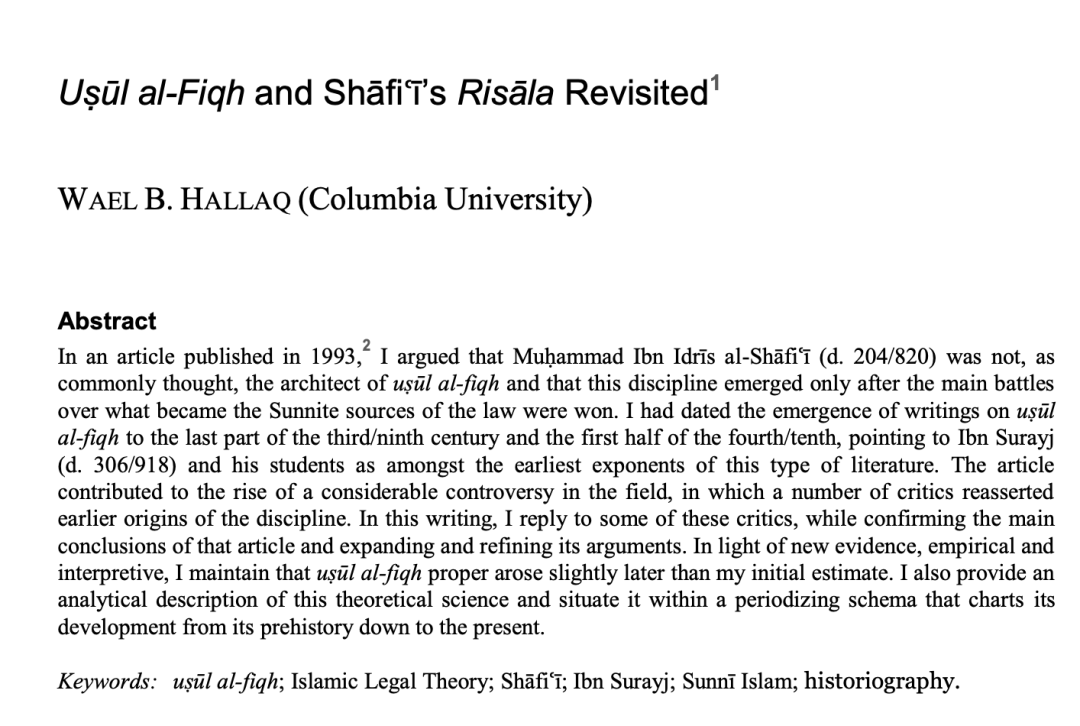
The content here comes from a paper by Professor Wael Hallaq, a world-renowned legal scholar of Palestinian descent. I’ve mentioned him on my channel before, and this is my own summary of his work rather than a word-for-word translation, which should make it much easier to grasp.
The traditional view, held by scholars like Schacht and Coulson, is that al-Shafi'i is the 'father of jurisprudence,' claiming his Risala was a fully formed legal textbook. However, Hallaq argues that al-Shafi'i wasn't the actual founder. Instead, he suggests that a mature, fully developed field of jurisprudence didn't really emerge until the 9th to mid-10th century—about a hundred years after al-Shafi'i.
The person who actually built the first real framework for jurisprudence was Ibn Surayj and his students.
Hallaq argues that there are five key conditions that had to be met for mature jurisprudence to exist:
1. The standardization of the four sources of law: the Quran, Sunnah, Ijma (consensus), and Qiyas (analogy). These weren't always universally accepted. In the early 9th and 10th centuries, scholars proposed all sorts of sources—some suggested seven, while others rejected consensus and analogy entirely. Al-Shafi'i didn't offer a complete four-source theory, and even though Ibn Surayj recognized them, he didn't codify or order them. It wasn't until the 11th century that the 'four sources' became the standard consensus.
2. A structured approach to writing. Mature legal works aren't just random musings; they follow a logical sequence that the author explains. Early works from the 9th and 10th centuries—by figures like Ibn Dawud, al-Tabari, and Ibn al-Qassar—were pretty disorganized. Some put consensus first, others put 'taqlid' (blind following) at the front. The turning point came with al-Baqillani (died 403/1012), who finally dedicated sections to explaining why the Quran and Sunnah should come first, with consensus and analogy following. It was the wrap-up of a century of debate.
3. Clear disciplinary boundaries. A mature field needs general, universal principles that can be applied to specific cases. This didn't exist with Ibn Surayj or Ibn al-Qassar. The first person to clearly define the scope of jurisprudence was likely al-Basri (died 436/1044), and these definitions didn't really solidify until the 11th century.
4. Disciplinary self-awareness. Jurisprudence eventually anchored itself in three pillars: Kalam (theology), Fiqh (law), and linguistics. Early on, the term for 'law' was plural, referring to a scattered bunch of sources. Later, it became a singular, formal discipline. Professional 'jurists' didn't even exist in the early days; people like Ibn Surayj were just known for writing about law. The formal identity of a 'jurist' didn't appear until the late 10th century.
5. Independent, standardized text formats. Before this, there was no independent 'textbook' for jurisprudence. Al-Baqillani was the turning point here, too. Once the format was standardized, it led to branches like dialectics, legal theory, and conceptual analysis.
Hallaq believes that only when all five of these conditions are met can we call jurisprudence 'mature.' By this metric, al-Shafi'i doesn't qualify; he belongs to the 'prehistoric' phase of the field. His work was more like a draft for debate than a finished legal manual.
Hallaq proposes eight stages of development for Islamic jurisprudence:
Stage 1 (780–870 AD): The germination period. Works by people like al-Shafi'i were just drafts; whether or not his ideas survived depended on the debates that followed.
Stage 2 (850–940 AD): The struggle for legal authority. This was a messy time of debate between the Hanafis, Shafi'is, Mu'tazilites, and the literalist schools. There was no single mainstream theory yet; this was the era of Ibn Surayj and Ibn Dawud.
Stage 3 (920–1010 AD): The terminology shift. Legal terms moved from general religious roots toward the specific, technical field of jurisprudence. Al-Baqillani marks the tail end of this era.
Stage 4 (990–1130 AD): The crystallization period. All five conditions were met, and mature jurisprudence appeared. This is the era of al-Basri, al-Juwayni, and al-Ghazali.
Stage 5 (1100–1220 AD): Specialization. With jurisprudence now mature, sub-disciplines emerged, and legal theory began to integrate deeply with philosophy and theology, famously led by figures like al-Razi.
Stage 6 (1200–1400 AD): The standardization of textbooks. The written format for legal studies became fixed, spawning numerous sub-fields.
Stage 7 (1400–1830 AD): The stability phase. The Sharia education system became the core, stable structure that continued to function across the Muslim world.
Stage 8 (1830–present): Decline and fragmentation. During the colonial era, institutions like the Waqf (endowment) were dismantled, and European civil codes were introduced. The traditional education system began to die out, and those foundational legal texts became museum pieces.
Hallaq also pushes back against critics who argue that scholars like Ibn Dawud or al-Tabari had already written complete legal works. He notes that the original manuscripts don't exist; we only have fragments cited by others. Even if you piece them together, the logic is totally scrambled and doesn't match a mature structure. Mature texts prioritize linguistics, while Ibn Dawud put consensus right at the start. Al-Tabari’s work just included legal bits as an addendum; it’s not a structured legal treatise.
Some people claim the Hanafi school was the actual founder of jurisprudence. Hallaq disagrees, arguing that the early Hanafi reliance on personal opinion (ra'y) and independent reasoning was exactly what mature jurisprudence formed to reorganize and constrain.
Hallaq isn't suggesting there was a complete break in the chain of transmission. He admits al-Shafi'i’s idea of prioritizing the Quran and Sunnah had a huge impact. But it was just a draft for later debates. Decades after he died, his ideas were often ignored, and his direct student, al-Buwayti, actually toned down or modified some of al-Shafi'i’s core views on analogy. It wasn't a smooth path. Ibn Surayj’s theories also diverged from al-Shafi'i’s, and he never even used the term 'jurisprudence.'
Hallaq acknowledges that al-Shafi'i did establish the general direction—that the revealed text is the foundation of law—and everyone later inherited that. However, the purpose and structure of their writing were totally different. Mature jurisprudence aimed to create a complete 'tool' to handle brand-new legal cases, something that wasn't on al-Shafi'i’s radar.
Hallaq doesn't deny al-Shafi'i’s historical impact, but he insists that we can't equate his work with the mature books of jurisprudence we see later. True jurisprudence was born out of centuries of intense sectarian conflict, filtering, editing, and synthesis.
The emergence of jurisprudence was a product of intellectual struggle. It represents a massive integration within the Sunni tradition, bridging the gap between traditionalists and rationalists to build a comprehensive Sunni worldview and ethical framework.
Let’s dive into the legacy of Imam al-Shafi'i and his famous work, the Risala, and see how they shaped the history of Islamic jurisprudence (Usul al-Fiqh). By looking at recent academic research in Islamic legal history, we can break down how these theories spread and evolved during the 9th and 10th centuries.
The content here comes from a paper by Professor Wael Hallaq, a world-renowned legal scholar of Palestinian descent. I’ve mentioned him on my channel before, and this is my own summary of his work rather than a word-for-word translation, which should make it much easier to grasp.
The traditional view, held by scholars like Schacht and Coulson, is that al-Shafi'i is the 'father of jurisprudence,' claiming his Risala was a fully formed legal textbook. However, Hallaq argues that al-Shafi'i wasn't the actual founder. Instead, he suggests that a mature, fully developed field of jurisprudence didn't really emerge until the 9th to mid-10th century—about a hundred years after al-Shafi'i.
The person who actually built the first real framework for jurisprudence was Ibn Surayj and his students.
Hallaq argues that there are five key conditions that had to be met for mature jurisprudence to exist:
1. The standardization of the four sources of law: the Quran, Sunnah, Ijma (consensus), and Qiyas (analogy). These weren't always universally accepted. In the early 9th and 10th centuries, scholars proposed all sorts of sources—some suggested seven, while others rejected consensus and analogy entirely. Al-Shafi'i didn't offer a complete four-source theory, and even though Ibn Surayj recognized them, he didn't codify or order them. It wasn't until the 11th century that the 'four sources' became the standard consensus.
2. A structured approach to writing. Mature legal works aren't just random musings; they follow a logical sequence that the author explains. Early works from the 9th and 10th centuries—by figures like Ibn Dawud, al-Tabari, and Ibn al-Qassar—were pretty disorganized. Some put consensus first, others put 'taqlid' (blind following) at the front. The turning point came with al-Baqillani (died 403/1012), who finally dedicated sections to explaining why the Quran and Sunnah should come first, with consensus and analogy following. It was the wrap-up of a century of debate.
3. Clear disciplinary boundaries. A mature field needs general, universal principles that can be applied to specific cases. This didn't exist with Ibn Surayj or Ibn al-Qassar. The first person to clearly define the scope of jurisprudence was likely al-Basri (died 436/1044), and these definitions didn't really solidify until the 11th century.
4. Disciplinary self-awareness. Jurisprudence eventually anchored itself in three pillars: Kalam (theology), Fiqh (law), and linguistics. Early on, the term for 'law' was plural, referring to a scattered bunch of sources. Later, it became a singular, formal discipline. Professional 'jurists' didn't even exist in the early days; people like Ibn Surayj were just known for writing about law. The formal identity of a 'jurist' didn't appear until the late 10th century.
5. Independent, standardized text formats. Before this, there was no independent 'textbook' for jurisprudence. Al-Baqillani was the turning point here, too. Once the format was standardized, it led to branches like dialectics, legal theory, and conceptual analysis.
Hallaq believes that only when all five of these conditions are met can we call jurisprudence 'mature.' By this metric, al-Shafi'i doesn't qualify; he belongs to the 'prehistoric' phase of the field. His work was more like a draft for debate than a finished legal manual.
Hallaq proposes eight stages of development for Islamic jurisprudence:
Stage 1 (780–870 AD): The germination period. Works by people like al-Shafi'i were just drafts; whether or not his ideas survived depended on the debates that followed.
Stage 2 (850–940 AD): The struggle for legal authority. This was a messy time of debate between the Hanafis, Shafi'is, Mu'tazilites, and the literalist schools. There was no single mainstream theory yet; this was the era of Ibn Surayj and Ibn Dawud.
Stage 3 (920–1010 AD): The terminology shift. Legal terms moved from general religious roots toward the specific, technical field of jurisprudence. Al-Baqillani marks the tail end of this era.
Stage 4 (990–1130 AD): The crystallization period. All five conditions were met, and mature jurisprudence appeared. This is the era of al-Basri, al-Juwayni, and al-Ghazali.
Stage 5 (1100–1220 AD): Specialization. With jurisprudence now mature, sub-disciplines emerged, and legal theory began to integrate deeply with philosophy and theology, famously led by figures like al-Razi.
Stage 6 (1200–1400 AD): The standardization of textbooks. The written format for legal studies became fixed, spawning numerous sub-fields.
Stage 7 (1400–1830 AD): The stability phase. The Sharia education system became the core, stable structure that continued to function across the Muslim world.
Stage 8 (1830–present): Decline and fragmentation. During the colonial era, institutions like the Waqf (endowment) were dismantled, and European civil codes were introduced. The traditional education system began to die out, and those foundational legal texts became museum pieces.
Hallaq also pushes back against critics who argue that scholars like Ibn Dawud or al-Tabari had already written complete legal works. He notes that the original manuscripts don't exist; we only have fragments cited by others. Even if you piece them together, the logic is totally scrambled and doesn't match a mature structure. Mature texts prioritize linguistics, while Ibn Dawud put consensus right at the start. Al-Tabari’s work just included legal bits as an addendum; it’s not a structured legal treatise.
Some people claim the Hanafi school was the actual founder of jurisprudence. Hallaq disagrees, arguing that the early Hanafi reliance on personal opinion (ra'y) and independent reasoning was exactly what mature jurisprudence formed to reorganize and constrain.
Hallaq isn't suggesting there was a complete break in the chain of transmission. He admits al-Shafi'i’s idea of prioritizing the Quran and Sunnah had a huge impact. But it was just a draft for later debates. Decades after he died, his ideas were often ignored, and his direct student, al-Buwayti, actually toned down or modified some of al-Shafi'i’s core views on analogy. It wasn't a smooth path. Ibn Surayj’s theories also diverged from al-Shafi'i’s, and he never even used the term 'jurisprudence.'
Hallaq acknowledges that al-Shafi'i did establish the general direction—that the revealed text is the foundation of law—and everyone later inherited that. However, the purpose and structure of their writing were totally different. Mature jurisprudence aimed to create a complete 'tool' to handle brand-new legal cases, something that wasn't on al-Shafi'i’s radar.
Hallaq doesn't deny al-Shafi'i’s historical impact, but he insists that we can't equate his work with the mature books of jurisprudence we see later. True jurisprudence was born out of centuries of intense sectarian conflict, filtering, editing, and synthesis.
The emergence of jurisprudence was a product of intellectual struggle. It represents a massive integration within the Sunni tradition, bridging the gap between traditionalists and rationalists to build a comprehensive Sunni worldview and ethical framework.
Understanding Islamic Jurisprudence: Imam al-Shafi'i and the Evolution of Usul al-Fiqh from Theory to Practice
Articles • Hasan09 posted the article • 0 comments • 11 views • 9 hours ago
[Internet Repost]
Let’s dive into the legacy of Imam al-Shafi'i and his famous work, the Risala, and see how they shaped the history of Islamic jurisprudence (Usul al-Fiqh). By looking at recent academic research in Islamic legal history, we can break down how these theories spread and evolved during the 9th and 10th centuries.
The content here comes from a paper by Professor Wael Hallaq, a world-renowned legal scholar of Palestinian descent. I’ve mentioned him on my channel before, and this is my own summary of his work rather than a word-for-word translation, which should make it much easier to grasp.
The traditional view, held by scholars like Schacht and Coulson, is that al-Shafi'i is the 'father of jurisprudence,' claiming his Risala was a fully formed legal textbook. However, Hallaq argues that al-Shafi'i wasn't the actual founder. Instead, he suggests that a mature, fully developed field of jurisprudence didn't really emerge until the 9th to mid-10th century—about a hundred years after al-Shafi'i.
The person who actually built the first real framework for jurisprudence was Ibn Surayj and his students.
Hallaq argues that there are five key conditions that had to be met for mature jurisprudence to exist:
1. The standardization of the four sources of law: the Quran, Sunnah, Ijma (consensus), and Qiyas (analogy). These weren't always universally accepted. In the early 9th and 10th centuries, scholars proposed all sorts of sources—some suggested seven, while others rejected consensus and analogy entirely. Al-Shafi'i didn't offer a complete four-source theory, and even though Ibn Surayj recognized them, he didn't codify or order them. It wasn't until the 11th century that the 'four sources' became the standard consensus.
2. A structured approach to writing. Mature legal works aren't just random musings; they follow a logical sequence that the author explains. Early works from the 9th and 10th centuries—by figures like Ibn Dawud, al-Tabari, and Ibn al-Qassar—were pretty disorganized. Some put consensus first, others put 'taqlid' (blind following) at the front. The turning point came with al-Baqillani (died 403/1012), who finally dedicated sections to explaining why the Quran and Sunnah should come first, with consensus and analogy following. It was the wrap-up of a century of debate.
3. Clear disciplinary boundaries. A mature field needs general, universal principles that can be applied to specific cases. This didn't exist with Ibn Surayj or Ibn al-Qassar. The first person to clearly define the scope of jurisprudence was likely al-Basri (died 436/1044), and these definitions didn't really solidify until the 11th century.
4. Disciplinary self-awareness. Jurisprudence eventually anchored itself in three pillars: Kalam (theology), Fiqh (law), and linguistics. Early on, the term for 'law' was plural, referring to a scattered bunch of sources. Later, it became a singular, formal discipline. Professional 'jurists' didn't even exist in the early days; people like Ibn Surayj were just known for writing about law. The formal identity of a 'jurist' didn't appear until the late 10th century.
5. Independent, standardized text formats. Before this, there was no independent 'textbook' for jurisprudence. Al-Baqillani was the turning point here, too. Once the format was standardized, it led to branches like dialectics, legal theory, and conceptual analysis.
Hallaq believes that only when all five of these conditions are met can we call jurisprudence 'mature.' By this metric, al-Shafi'i doesn't qualify; he belongs to the 'prehistoric' phase of the field. His work was more like a draft for debate than a finished legal manual.
Hallaq proposes eight stages of development for Islamic jurisprudence:
Stage 1 (780–870 AD): The germination period. Works by people like al-Shafi'i were just drafts; whether or not his ideas survived depended on the debates that followed.
Stage 2 (850–940 AD): The struggle for legal authority. This was a messy time of debate between the Hanafis, Shafi'is, Mu'tazilites, and the literalist schools. There was no single mainstream theory yet; this was the era of Ibn Surayj and Ibn Dawud.
Stage 3 (920–1010 AD): The terminology shift. Legal terms moved from general religious roots toward the specific, technical field of jurisprudence. Al-Baqillani marks the tail end of this era.
Stage 4 (990–1130 AD): The crystallization period. All five conditions were met, and mature jurisprudence appeared. This is the era of al-Basri, al-Juwayni, and al-Ghazali.
Stage 5 (1100–1220 AD): Specialization. With jurisprudence now mature, sub-disciplines emerged, and legal theory began to integrate deeply with philosophy and theology, famously led by figures like al-Razi.
Stage 6 (1200–1400 AD): The standardization of textbooks. The written format for legal studies became fixed, spawning numerous sub-fields.
Stage 7 (1400–1830 AD): The stability phase. The Sharia education system became the core, stable structure that continued to function across the Muslim world.
Stage 8 (1830–present): Decline and fragmentation. During the colonial era, institutions like the Waqf (endowment) were dismantled, and European civil codes were introduced. The traditional education system began to die out, and those foundational legal texts became museum pieces.
Hallaq also pushes back against critics who argue that scholars like Ibn Dawud or al-Tabari had already written complete legal works. He notes that the original manuscripts don't exist; we only have fragments cited by others. Even if you piece them together, the logic is totally scrambled and doesn't match a mature structure. Mature texts prioritize linguistics, while Ibn Dawud put consensus right at the start. Al-Tabari’s work just included legal bits as an addendum; it’s not a structured legal treatise.
Some people claim the Hanafi school was the actual founder of jurisprudence. Hallaq disagrees, arguing that the early Hanafi reliance on personal opinion (ra'y) and independent reasoning was exactly what mature jurisprudence formed to reorganize and constrain.
Hallaq isn't suggesting there was a complete break in the chain of transmission. He admits al-Shafi'i’s idea of prioritizing the Quran and Sunnah had a huge impact. But it was just a draft for later debates. Decades after he died, his ideas were often ignored, and his direct student, al-Buwayti, actually toned down or modified some of al-Shafi'i’s core views on analogy. It wasn't a smooth path. Ibn Surayj’s theories also diverged from al-Shafi'i’s, and he never even used the term 'jurisprudence.'
Hallaq acknowledges that al-Shafi'i did establish the general direction—that the revealed text is the foundation of law—and everyone later inherited that. However, the purpose and structure of their writing were totally different. Mature jurisprudence aimed to create a complete 'tool' to handle brand-new legal cases, something that wasn't on al-Shafi'i’s radar.
Hallaq doesn't deny al-Shafi'i’s historical impact, but he insists that we can't equate his work with the mature books of jurisprudence we see later. True jurisprudence was born out of centuries of intense sectarian conflict, filtering, editing, and synthesis.
The emergence of jurisprudence was a product of intellectual struggle. It represents a massive integration within the Sunni tradition, bridging the gap between traditionalists and rationalists to build a comprehensive Sunni worldview and ethical framework. view all
Let’s dive into the legacy of Imam al-Shafi'i and his famous work, the Risala, and see how they shaped the history of Islamic jurisprudence (Usul al-Fiqh). By looking at recent academic research in Islamic legal history, we can break down how these theories spread and evolved during the 9th and 10th centuries.
The content here comes from a paper by Professor Wael Hallaq, a world-renowned legal scholar of Palestinian descent. I’ve mentioned him on my channel before, and this is my own summary of his work rather than a word-for-word translation, which should make it much easier to grasp.
The traditional view, held by scholars like Schacht and Coulson, is that al-Shafi'i is the 'father of jurisprudence,' claiming his Risala was a fully formed legal textbook. However, Hallaq argues that al-Shafi'i wasn't the actual founder. Instead, he suggests that a mature, fully developed field of jurisprudence didn't really emerge until the 9th to mid-10th century—about a hundred years after al-Shafi'i.
The person who actually built the first real framework for jurisprudence was Ibn Surayj and his students.
Hallaq argues that there are five key conditions that had to be met for mature jurisprudence to exist:
1. The standardization of the four sources of law: the Quran, Sunnah, Ijma (consensus), and Qiyas (analogy). These weren't always universally accepted. In the early 9th and 10th centuries, scholars proposed all sorts of sources—some suggested seven, while others rejected consensus and analogy entirely. Al-Shafi'i didn't offer a complete four-source theory, and even though Ibn Surayj recognized them, he didn't codify or order them. It wasn't until the 11th century that the 'four sources' became the standard consensus.
2. A structured approach to writing. Mature legal works aren't just random musings; they follow a logical sequence that the author explains. Early works from the 9th and 10th centuries—by figures like Ibn Dawud, al-Tabari, and Ibn al-Qassar—were pretty disorganized. Some put consensus first, others put 'taqlid' (blind following) at the front. The turning point came with al-Baqillani (died 403/1012), who finally dedicated sections to explaining why the Quran and Sunnah should come first, with consensus and analogy following. It was the wrap-up of a century of debate.
3. Clear disciplinary boundaries. A mature field needs general, universal principles that can be applied to specific cases. This didn't exist with Ibn Surayj or Ibn al-Qassar. The first person to clearly define the scope of jurisprudence was likely al-Basri (died 436/1044), and these definitions didn't really solidify until the 11th century.
4. Disciplinary self-awareness. Jurisprudence eventually anchored itself in three pillars: Kalam (theology), Fiqh (law), and linguistics. Early on, the term for 'law' was plural, referring to a scattered bunch of sources. Later, it became a singular, formal discipline. Professional 'jurists' didn't even exist in the early days; people like Ibn Surayj were just known for writing about law. The formal identity of a 'jurist' didn't appear until the late 10th century.
5. Independent, standardized text formats. Before this, there was no independent 'textbook' for jurisprudence. Al-Baqillani was the turning point here, too. Once the format was standardized, it led to branches like dialectics, legal theory, and conceptual analysis.
Hallaq believes that only when all five of these conditions are met can we call jurisprudence 'mature.' By this metric, al-Shafi'i doesn't qualify; he belongs to the 'prehistoric' phase of the field. His work was more like a draft for debate than a finished legal manual.
Hallaq proposes eight stages of development for Islamic jurisprudence:
Stage 1 (780–870 AD): The germination period. Works by people like al-Shafi'i were just drafts; whether or not his ideas survived depended on the debates that followed.
Stage 2 (850–940 AD): The struggle for legal authority. This was a messy time of debate between the Hanafis, Shafi'is, Mu'tazilites, and the literalist schools. There was no single mainstream theory yet; this was the era of Ibn Surayj and Ibn Dawud.
Stage 3 (920–1010 AD): The terminology shift. Legal terms moved from general religious roots toward the specific, technical field of jurisprudence. Al-Baqillani marks the tail end of this era.
Stage 4 (990–1130 AD): The crystallization period. All five conditions were met, and mature jurisprudence appeared. This is the era of al-Basri, al-Juwayni, and al-Ghazali.
Stage 5 (1100–1220 AD): Specialization. With jurisprudence now mature, sub-disciplines emerged, and legal theory began to integrate deeply with philosophy and theology, famously led by figures like al-Razi.
Stage 6 (1200–1400 AD): The standardization of textbooks. The written format for legal studies became fixed, spawning numerous sub-fields.
Stage 7 (1400–1830 AD): The stability phase. The Sharia education system became the core, stable structure that continued to function across the Muslim world.
Stage 8 (1830–present): Decline and fragmentation. During the colonial era, institutions like the Waqf (endowment) were dismantled, and European civil codes were introduced. The traditional education system began to die out, and those foundational legal texts became museum pieces.
Hallaq also pushes back against critics who argue that scholars like Ibn Dawud or al-Tabari had already written complete legal works. He notes that the original manuscripts don't exist; we only have fragments cited by others. Even if you piece them together, the logic is totally scrambled and doesn't match a mature structure. Mature texts prioritize linguistics, while Ibn Dawud put consensus right at the start. Al-Tabari’s work just included legal bits as an addendum; it’s not a structured legal treatise.
Some people claim the Hanafi school was the actual founder of jurisprudence. Hallaq disagrees, arguing that the early Hanafi reliance on personal opinion (ra'y) and independent reasoning was exactly what mature jurisprudence formed to reorganize and constrain.
Hallaq isn't suggesting there was a complete break in the chain of transmission. He admits al-Shafi'i’s idea of prioritizing the Quran and Sunnah had a huge impact. But it was just a draft for later debates. Decades after he died, his ideas were often ignored, and his direct student, al-Buwayti, actually toned down or modified some of al-Shafi'i’s core views on analogy. It wasn't a smooth path. Ibn Surayj’s theories also diverged from al-Shafi'i’s, and he never even used the term 'jurisprudence.'
Hallaq acknowledges that al-Shafi'i did establish the general direction—that the revealed text is the foundation of law—and everyone later inherited that. However, the purpose and structure of their writing were totally different. Mature jurisprudence aimed to create a complete 'tool' to handle brand-new legal cases, something that wasn't on al-Shafi'i’s radar.
Hallaq doesn't deny al-Shafi'i’s historical impact, but he insists that we can't equate his work with the mature books of jurisprudence we see later. True jurisprudence was born out of centuries of intense sectarian conflict, filtering, editing, and synthesis.
The emergence of jurisprudence was a product of intellectual struggle. It represents a massive integration within the Sunni tradition, bridging the gap between traditionalists and rationalists to build a comprehensive Sunni worldview and ethical framework. view all
[Internet Repost]
Let’s dive into the legacy of Imam al-Shafi'i and his famous work, the Risala, and see how they shaped the history of Islamic jurisprudence (Usul al-Fiqh). By looking at recent academic research in Islamic legal history, we can break down how these theories spread and evolved during the 9th and 10th centuries.
The content here comes from a paper by Professor Wael Hallaq, a world-renowned legal scholar of Palestinian descent. I’ve mentioned him on my channel before, and this is my own summary of his work rather than a word-for-word translation, which should make it much easier to grasp.
The traditional view, held by scholars like Schacht and Coulson, is that al-Shafi'i is the 'father of jurisprudence,' claiming his Risala was a fully formed legal textbook. However, Hallaq argues that al-Shafi'i wasn't the actual founder. Instead, he suggests that a mature, fully developed field of jurisprudence didn't really emerge until the 9th to mid-10th century—about a hundred years after al-Shafi'i.
The person who actually built the first real framework for jurisprudence was Ibn Surayj and his students.
Hallaq argues that there are five key conditions that had to be met for mature jurisprudence to exist:
1. The standardization of the four sources of law: the Quran, Sunnah, Ijma (consensus), and Qiyas (analogy). These weren't always universally accepted. In the early 9th and 10th centuries, scholars proposed all sorts of sources—some suggested seven, while others rejected consensus and analogy entirely. Al-Shafi'i didn't offer a complete four-source theory, and even though Ibn Surayj recognized them, he didn't codify or order them. It wasn't until the 11th century that the 'four sources' became the standard consensus.
2. A structured approach to writing. Mature legal works aren't just random musings; they follow a logical sequence that the author explains. Early works from the 9th and 10th centuries—by figures like Ibn Dawud, al-Tabari, and Ibn al-Qassar—were pretty disorganized. Some put consensus first, others put 'taqlid' (blind following) at the front. The turning point came with al-Baqillani (died 403/1012), who finally dedicated sections to explaining why the Quran and Sunnah should come first, with consensus and analogy following. It was the wrap-up of a century of debate.
3. Clear disciplinary boundaries. A mature field needs general, universal principles that can be applied to specific cases. This didn't exist with Ibn Surayj or Ibn al-Qassar. The first person to clearly define the scope of jurisprudence was likely al-Basri (died 436/1044), and these definitions didn't really solidify until the 11th century.
4. Disciplinary self-awareness. Jurisprudence eventually anchored itself in three pillars: Kalam (theology), Fiqh (law), and linguistics. Early on, the term for 'law' was plural, referring to a scattered bunch of sources. Later, it became a singular, formal discipline. Professional 'jurists' didn't even exist in the early days; people like Ibn Surayj were just known for writing about law. The formal identity of a 'jurist' didn't appear until the late 10th century.
5. Independent, standardized text formats. Before this, there was no independent 'textbook' for jurisprudence. Al-Baqillani was the turning point here, too. Once the format was standardized, it led to branches like dialectics, legal theory, and conceptual analysis.
Hallaq believes that only when all five of these conditions are met can we call jurisprudence 'mature.' By this metric, al-Shafi'i doesn't qualify; he belongs to the 'prehistoric' phase of the field. His work was more like a draft for debate than a finished legal manual.
Hallaq proposes eight stages of development for Islamic jurisprudence:
Stage 1 (780–870 AD): The germination period. Works by people like al-Shafi'i were just drafts; whether or not his ideas survived depended on the debates that followed.
Stage 2 (850–940 AD): The struggle for legal authority. This was a messy time of debate between the Hanafis, Shafi'is, Mu'tazilites, and the literalist schools. There was no single mainstream theory yet; this was the era of Ibn Surayj and Ibn Dawud.
Stage 3 (920–1010 AD): The terminology shift. Legal terms moved from general religious roots toward the specific, technical field of jurisprudence. Al-Baqillani marks the tail end of this era.
Stage 4 (990–1130 AD): The crystallization period. All five conditions were met, and mature jurisprudence appeared. This is the era of al-Basri, al-Juwayni, and al-Ghazali.
Stage 5 (1100–1220 AD): Specialization. With jurisprudence now mature, sub-disciplines emerged, and legal theory began to integrate deeply with philosophy and theology, famously led by figures like al-Razi.
Stage 6 (1200–1400 AD): The standardization of textbooks. The written format for legal studies became fixed, spawning numerous sub-fields.
Stage 7 (1400–1830 AD): The stability phase. The Sharia education system became the core, stable structure that continued to function across the Muslim world.
Stage 8 (1830–present): Decline and fragmentation. During the colonial era, institutions like the Waqf (endowment) were dismantled, and European civil codes were introduced. The traditional education system began to die out, and those foundational legal texts became museum pieces.
Hallaq also pushes back against critics who argue that scholars like Ibn Dawud or al-Tabari had already written complete legal works. He notes that the original manuscripts don't exist; we only have fragments cited by others. Even if you piece them together, the logic is totally scrambled and doesn't match a mature structure. Mature texts prioritize linguistics, while Ibn Dawud put consensus right at the start. Al-Tabari’s work just included legal bits as an addendum; it’s not a structured legal treatise.
Some people claim the Hanafi school was the actual founder of jurisprudence. Hallaq disagrees, arguing that the early Hanafi reliance on personal opinion (ra'y) and independent reasoning was exactly what mature jurisprudence formed to reorganize and constrain.
Hallaq isn't suggesting there was a complete break in the chain of transmission. He admits al-Shafi'i’s idea of prioritizing the Quran and Sunnah had a huge impact. But it was just a draft for later debates. Decades after he died, his ideas were often ignored, and his direct student, al-Buwayti, actually toned down or modified some of al-Shafi'i’s core views on analogy. It wasn't a smooth path. Ibn Surayj’s theories also diverged from al-Shafi'i’s, and he never even used the term 'jurisprudence.'
Hallaq acknowledges that al-Shafi'i did establish the general direction—that the revealed text is the foundation of law—and everyone later inherited that. However, the purpose and structure of their writing were totally different. Mature jurisprudence aimed to create a complete 'tool' to handle brand-new legal cases, something that wasn't on al-Shafi'i’s radar.
Hallaq doesn't deny al-Shafi'i’s historical impact, but he insists that we can't equate his work with the mature books of jurisprudence we see later. True jurisprudence was born out of centuries of intense sectarian conflict, filtering, editing, and synthesis.
The emergence of jurisprudence was a product of intellectual struggle. It represents a massive integration within the Sunni tradition, bridging the gap between traditionalists and rationalists to build a comprehensive Sunni worldview and ethical framework.