

Iranian Art
Islamic Art Guide: Iranian Artifacts at Beijing Forbidden City (Part 1)
Articles • ali2007fr posted the article • 0 comments • 196 views • 2026-05-19 08:52
Reposted from the web
Summary: Islamic Art Guide: Iranian Artifacts at Beijing Forbidden City (Part 1) is presented here as a firsthand travel account in clear, natural English. The account focuses on Iranian Art, Forbidden City, Islamic Heritage while preserving the names, places, food, photos, and historical details from the Chinese source.
The East Wing of the Meridian Gate at the Forbidden City hosted the 'Splendors of Persia: Exhibition of Iranian Cultural Relics' from January 12 to April 11, 2024. The National Museum of Iran sent many precious artifacts for everyone to enjoy.
I visited the National Museum of Iran in 2019, as seen in my article 'Exhibition Notes from the Museum of the Islamic Era in Iran'.
I will share some of the artifacts from the exhibition with you below.
Was the Zhengde Emperor's Islamic name 'Suleiman'?
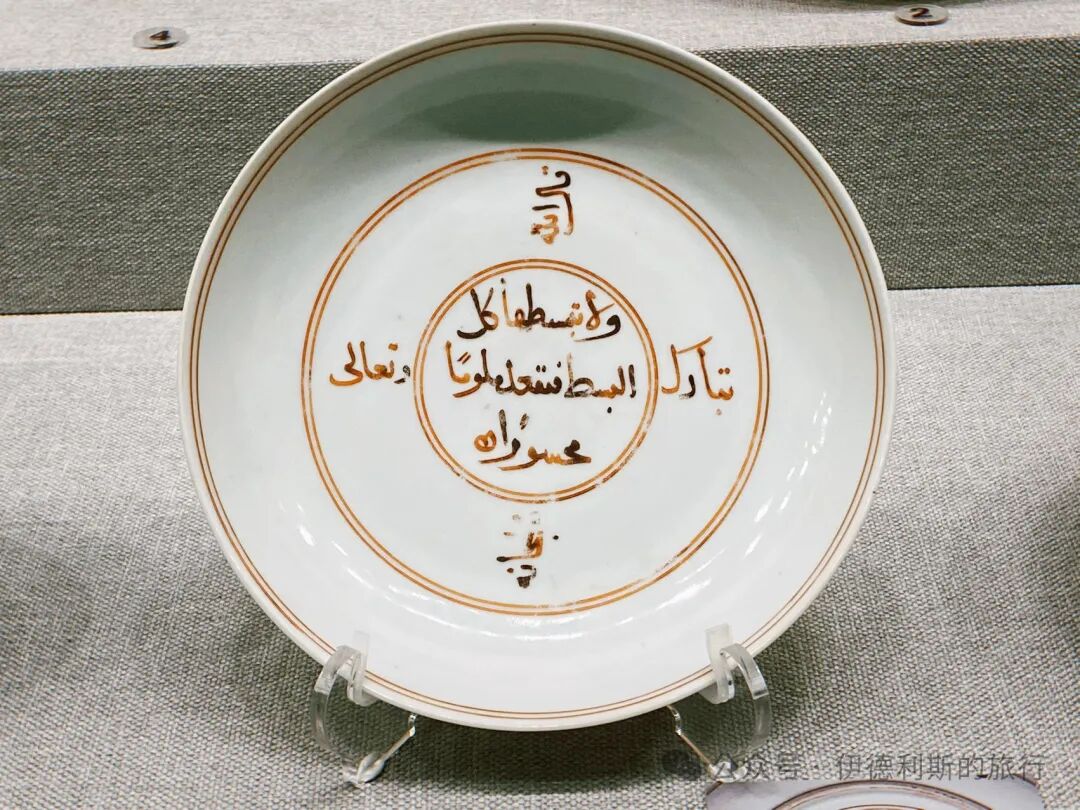
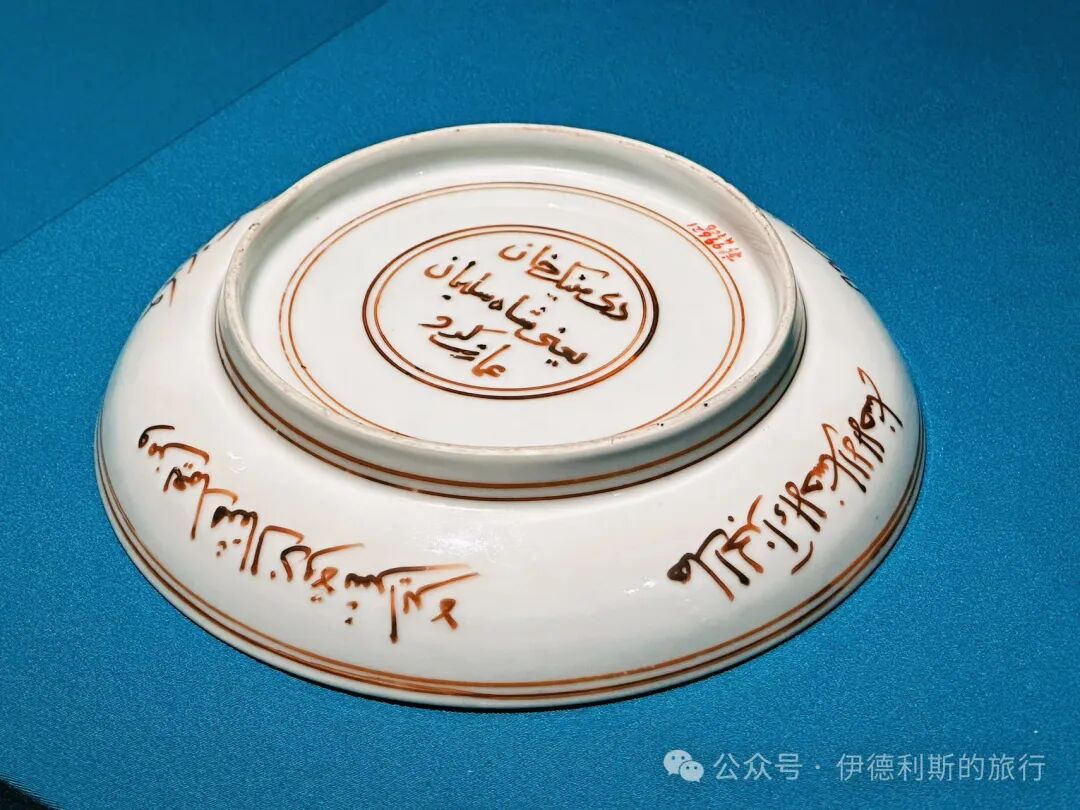
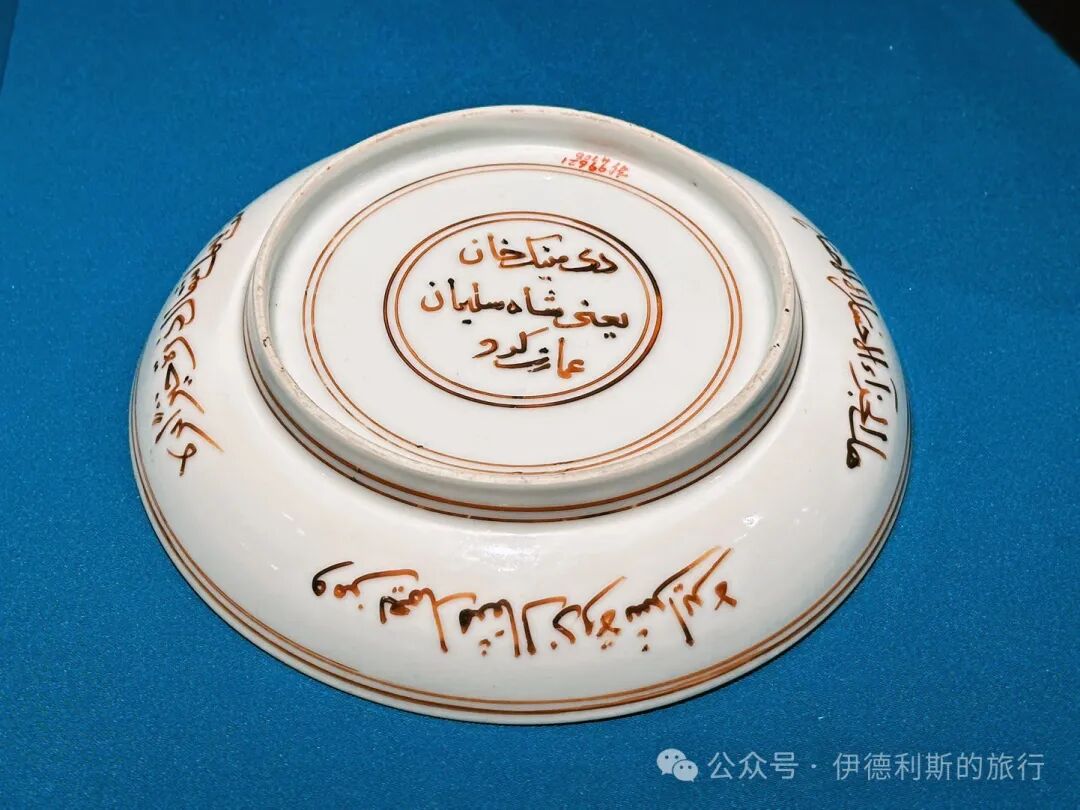
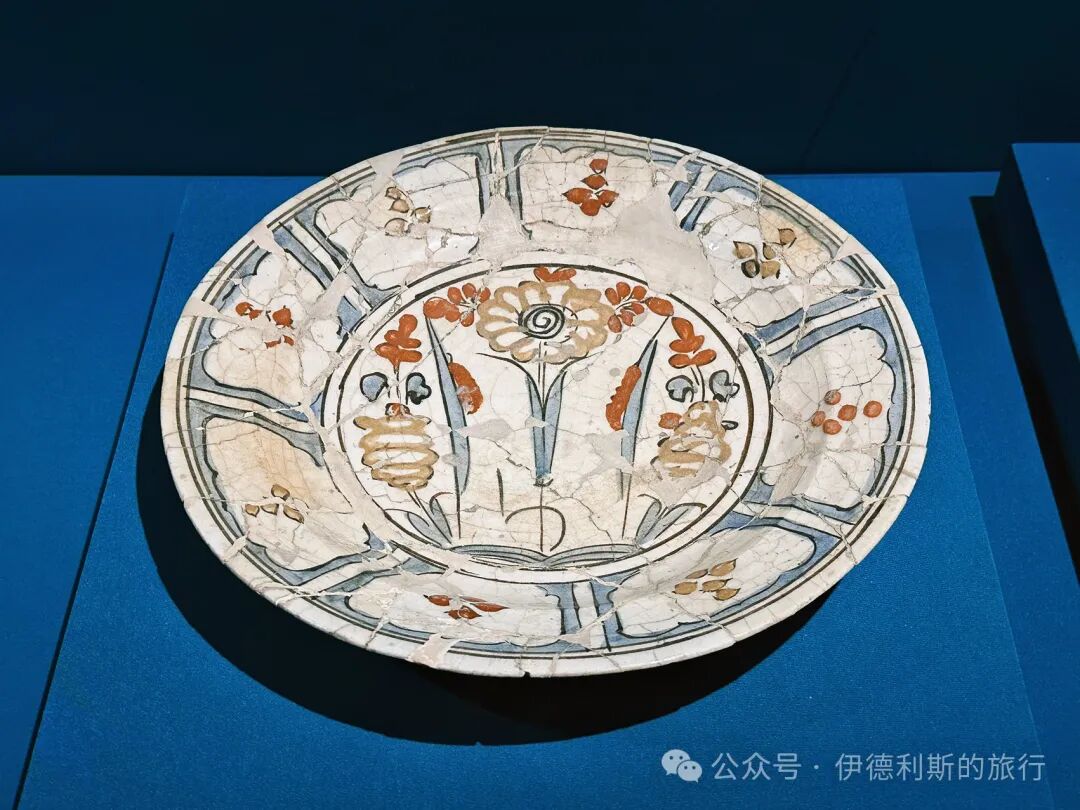
For this Iranian exhibition at the Meridian Gate, the Forbidden City contributed a heavyweight artifact: a white-glazed, iron-red decorated plate with Arabic and Persian inscriptions, fired at the imperial kilns during the Zhengde period (1506–1521) of the Ming Dynasty. Previously, the Wuyingdian Ceramics Gallery only displayed the front, but this time we finally got to see the bottom of the plate, which holds much more information.
According to Li Yihua's 1984 article 'Two Pieces of Zhengde-era Arabic and Persian Porcelain—Also Discussing the Influence of Islamic Culture' in the 'Journal of the Palace Museum', this is the only red-decorated piece among the more than 20 pieces of Zhengde Arabic and Persian porcelain in the Forbidden City's collection. The wall of the plate features a Hadith: 'The Exalted and Majestic Lord says, whoever does a good deed the size of a speck of dust, (or) whoever does a bad deed the size of a speck of dust, He will see it; this is the reward for those who do good.' The most interesting part is the three lines of text on the bottom of the plate. Li Yihua interpreted them as 'Dimani Khan, namely Aman Suleiman Shah,' and suggested it might have been commissioned for a country in the Arab region. However, some scholars lean toward the idea that 'Dimani Ke' should be 'Da Mink,' meaning 'Great Ming.' Based on this, the text reads 'The ruler of the Great Ming is King Suleiman.' This means the Zhengde Emperor's Islamic name was likely 'Suleiman,' which is why some people jokingly call this piece 'King Solomon's Treasure'.
During the Zhengde period, the palace was very fond of using porcelain with Arabic and Persian inscriptions. Most were bowls, cups, brush rests, and boxes with the same shapes as official kiln wares, and the content was mostly Quranic verses, Hadith, and praises. According to research by Professor Jin Liyan and records in the 'Veritable Records of the Joseon Dynasty,' the Zhengde Emperor studied Islamic knowledge in 1509 (the third year of Zhengde): 'Hearing that Hui Muslims do not eat meat slaughtered by others, but must slaughter it themselves, and that they have kind hearts and read scriptures, he invited them into the palace to learn from them.'
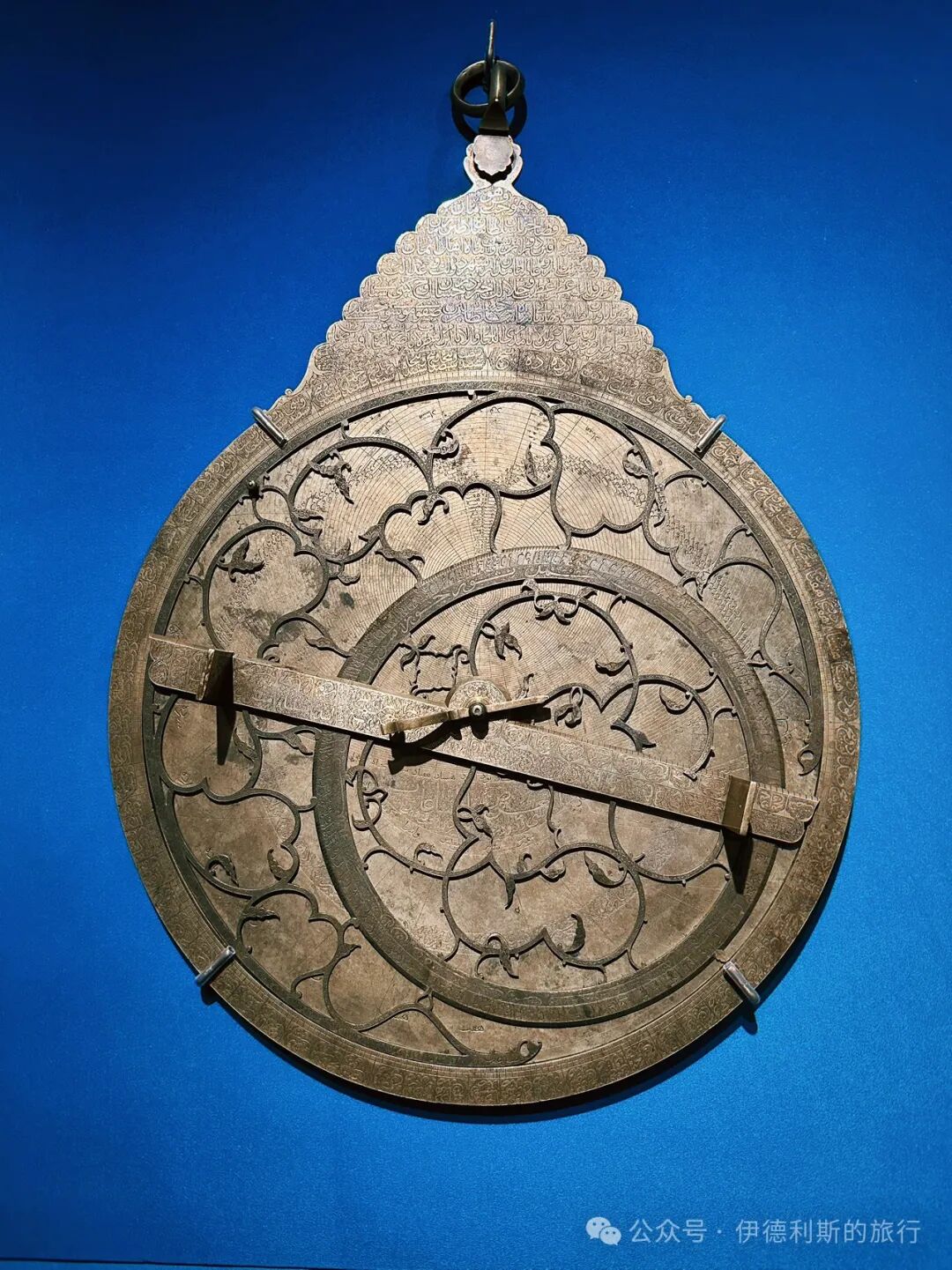
The largest astrolabe from the National Museum of Iran
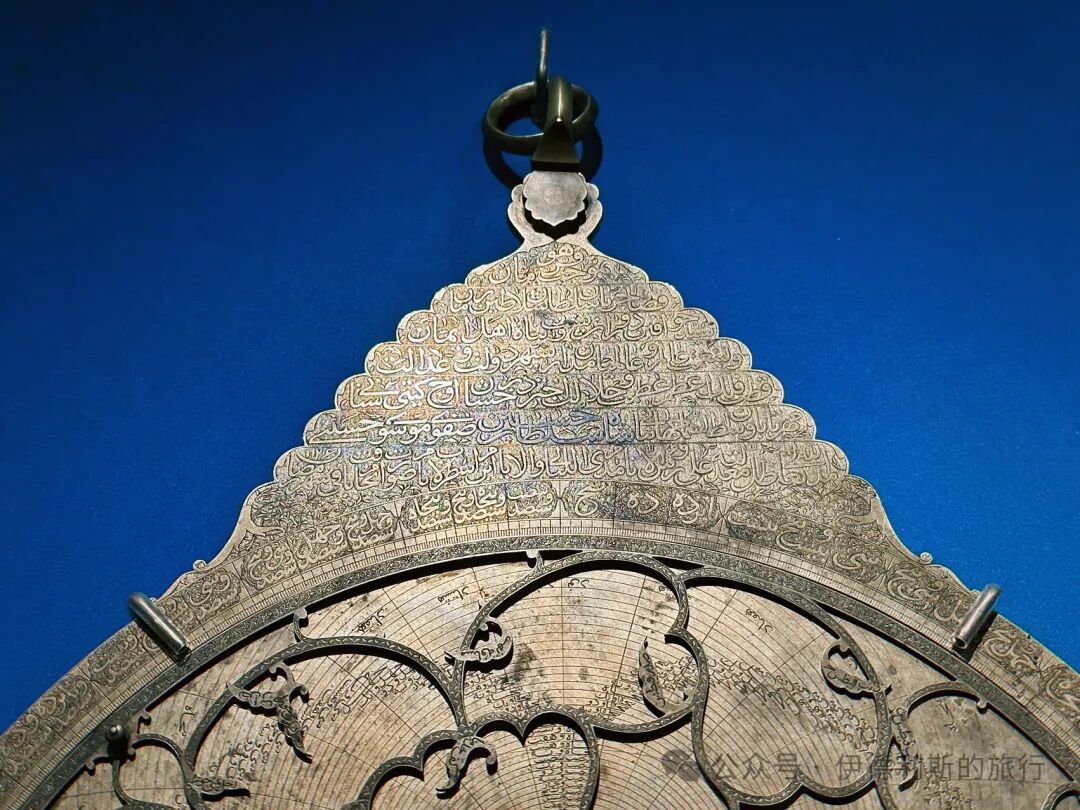
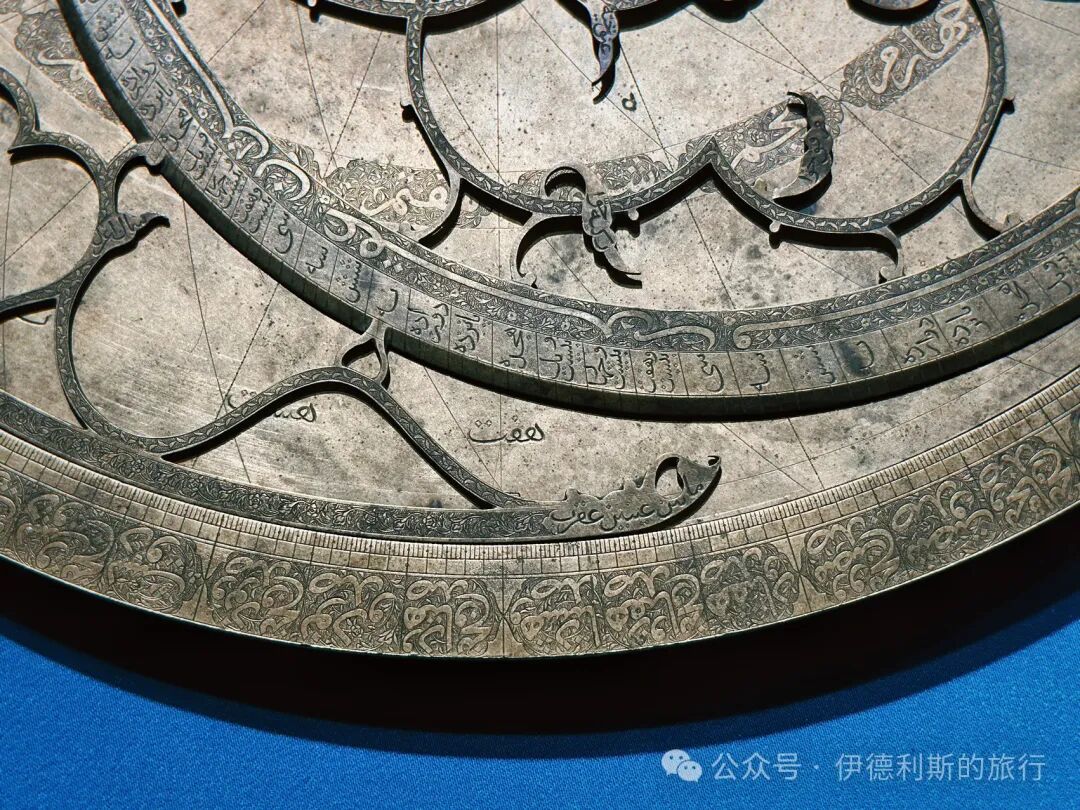
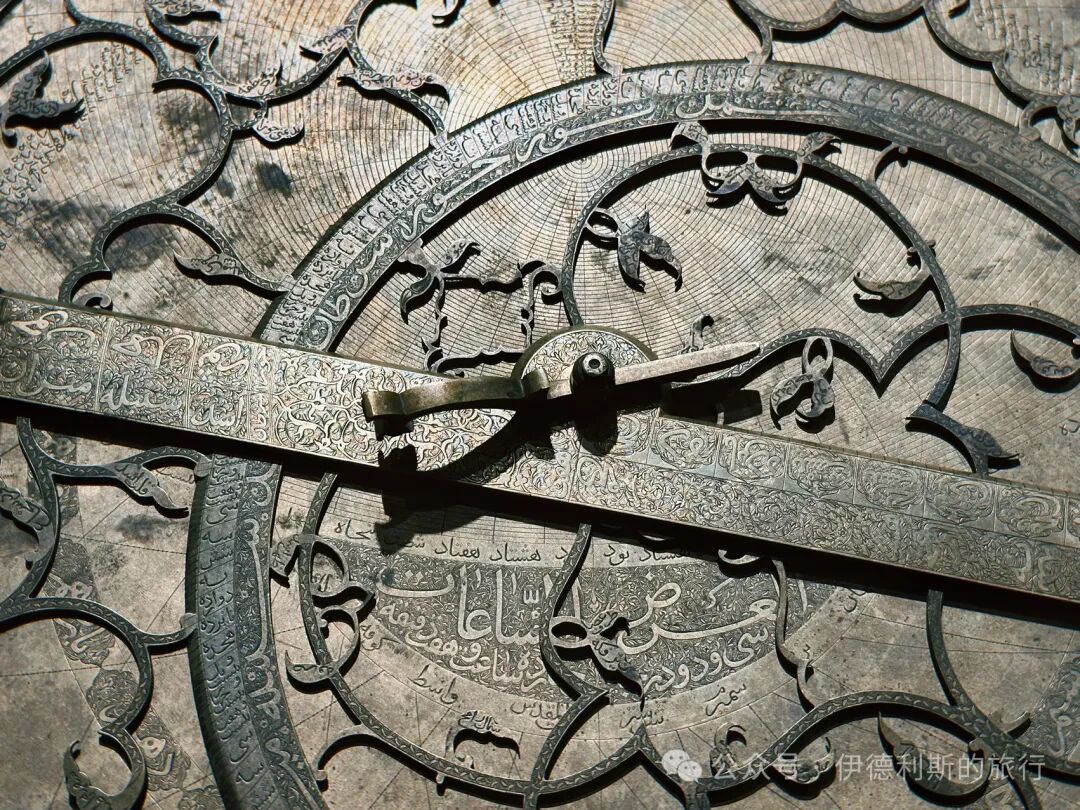
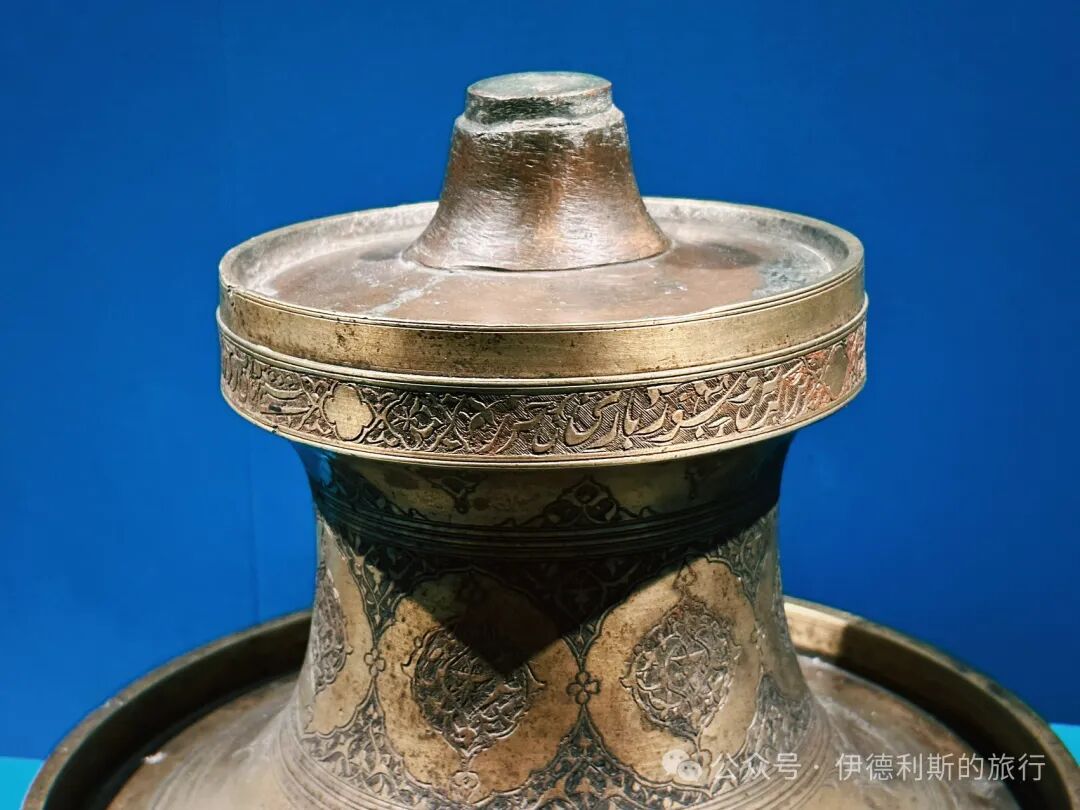
The National Museum of Iran brought its largest astrolabe for this exhibition. It weighs five kilograms, is over forty centimeters in diameter, and is made of six pieces of brass. It uses scales to mark geographical zones, and the crown-shaped decoration at the top is engraved with the names of two rulers from the Safavid and Qajar dynasties on either side.
The astrolabe comes from the famous Golestan Palace in Tehran. Golestan Palace was the royal palace of the Qajar dynasty and was listed as a UNESCO World Heritage site in 2013. Golestan Palace was first called Tehran Citadel. It was built during the reign of Tahmasp I (ruled 1524-76) of the Safavid dynasty and rebuilt during the reign of Karim Khan (ruled 1750-79) of the Zand dynasty. After Agha Mohammad Khan (ruled 1789-97) of the Qajar dynasty made Tehran the capital, he officially converted Tehran Citadel into Golestan Palace. Between 1925 and 1945, Reza Shah (ruled 1925-41) of the Pahlavi dynasty ordered the demolition of most of Golestan Palace for modern urban construction. Modern-style commercial buildings were built there one after another during the 1950s and 1960s.
Sheikh Safi al-Din Shrine (gongbei)
For this exhibition at the Meridian Gate of the Forbidden City, the National Museum of Iran brought a large number of Ming dynasty porcelains from the Sheikh Safi al-Din Khānegāh and Shrine Ensemble (gongbei). It was a real eye-opener, as I did not get to see these porcelains when I visited the National Museum of Iran before.
Sheikh Safi al-Din (1252-1334) was a Kurdish Sufi master during the Ilkhanate period and the founder of the Safaviyya order. This order eventually established the Safavid dynasty in 1501. After the Safavid dynasty was established, they expanded the Sheikh Safi al-Din Shrine (gongbei) in Ardabil, northwestern Iran, on a large scale between the 16th and 18th centuries, turning it into a massive building complex. The Porcelain House, built in the 17th century, has a huge cross-shaped space. The small niches densely packed on the walls were once filled with Chinese porcelain. Today, most of these porcelains are kept in museums in Tehran.
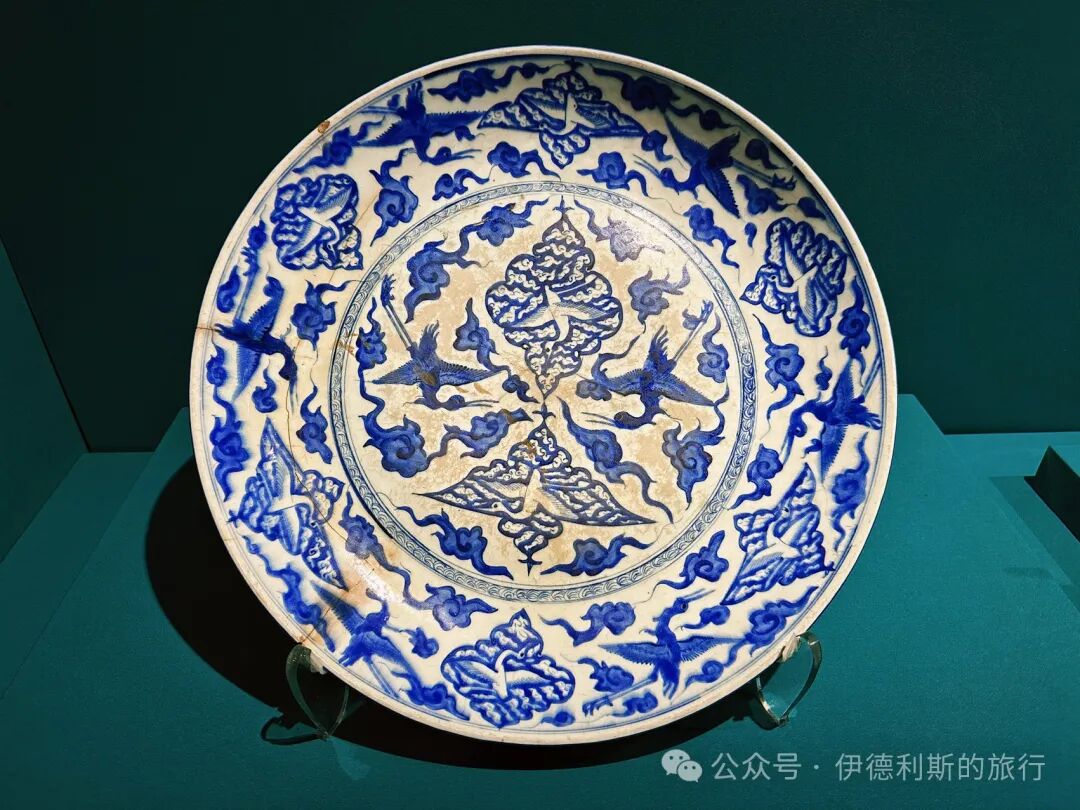
16th-century Ming dynasty blue and white porcelain with cloud and crane patterns.
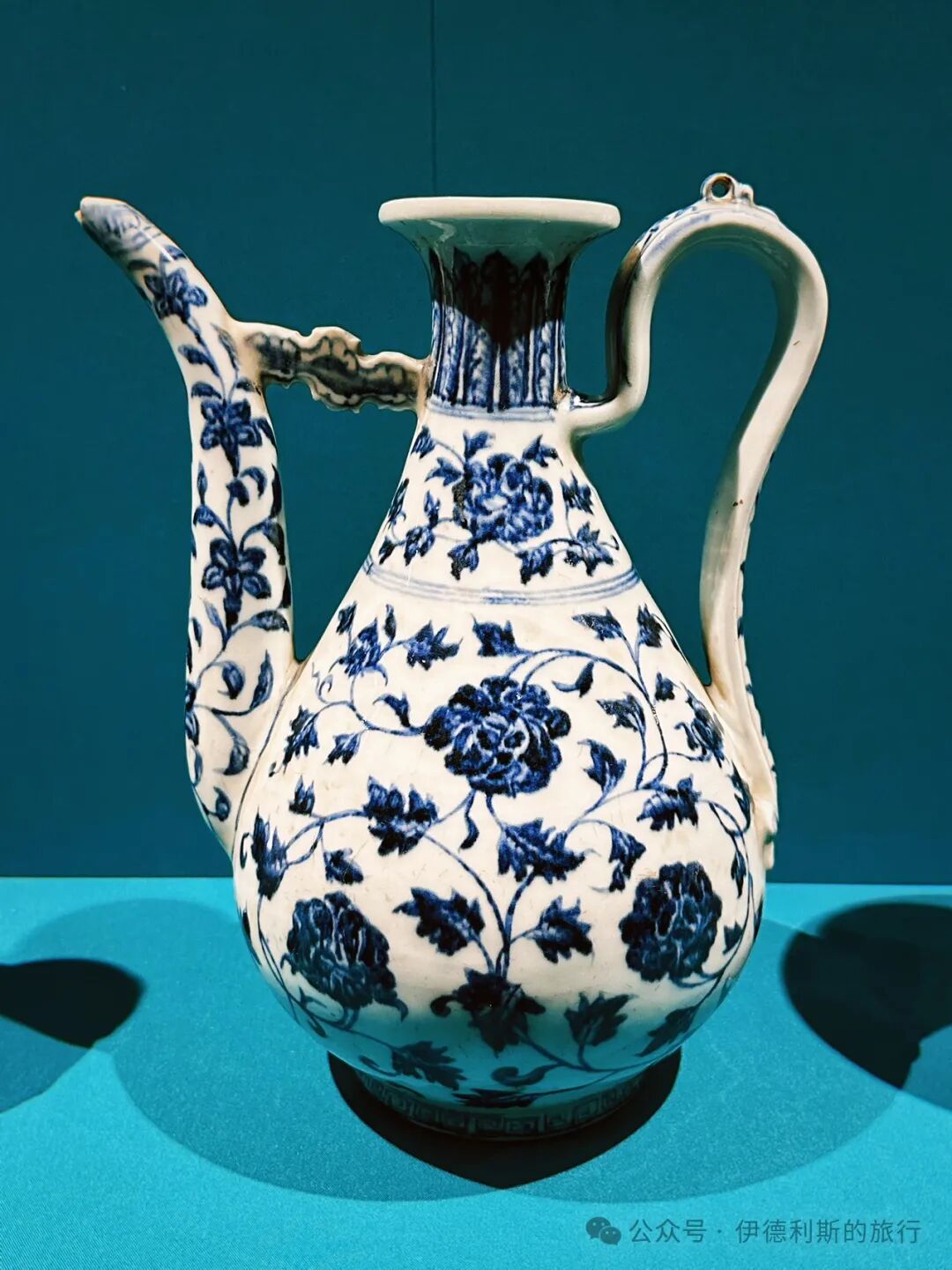
15th-16th-century Ming dynasty blue and white ewer with openwork, peacock and peony patterns, and lotus scroll patterns, featuring unglazed panels.
Late 16th-century Ming dynasty blue and white ewer with seahorse and floral patterns.
Late 16th-century Ming dynasty blue and white jar with bird and flower patterns.
Late 16th-century Ming dynasty blue and white jar with scrolling vine patterns.
16th-century Ming dynasty blue and white bowl with polychrome figure patterns.
16th-century Ming dynasty blue and white porcelain bowl with seahorse and floral patterns.
Early 15th-century Ming dynasty white porcelain plate.
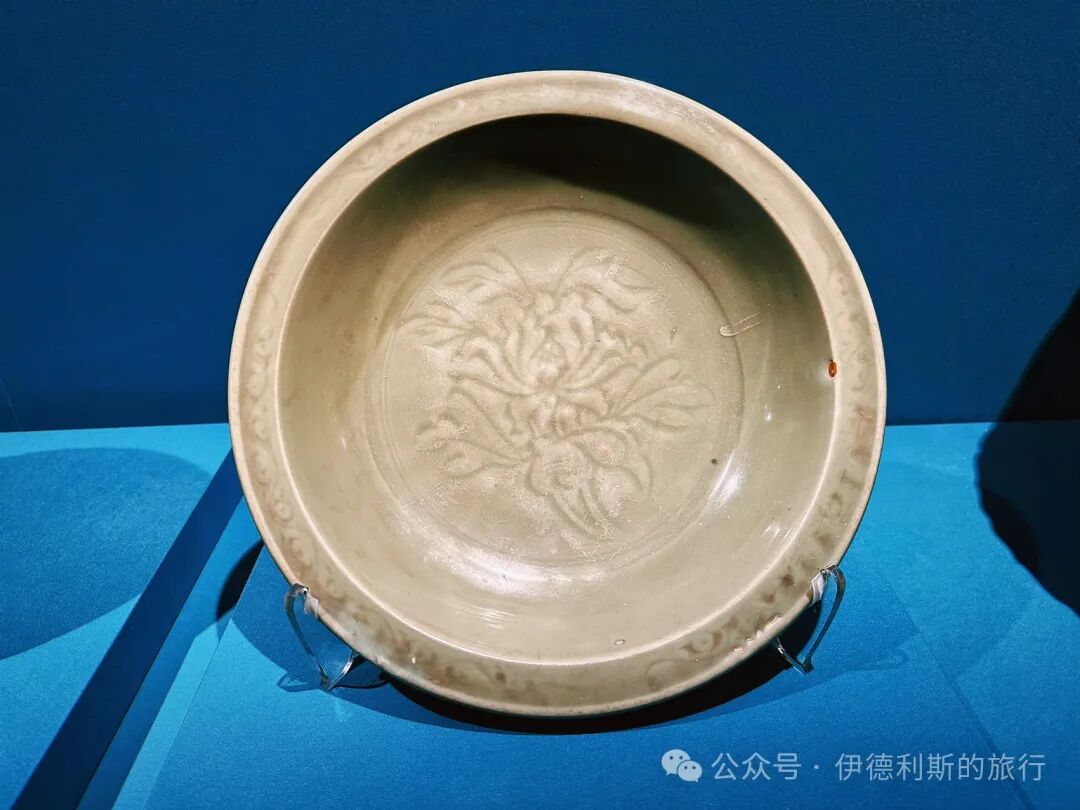
15th-century Ming Dynasty celadon plate with chrysanthemum petal patterns.
15th-century Ming Dynasty celadon plate with floral branch patterns.
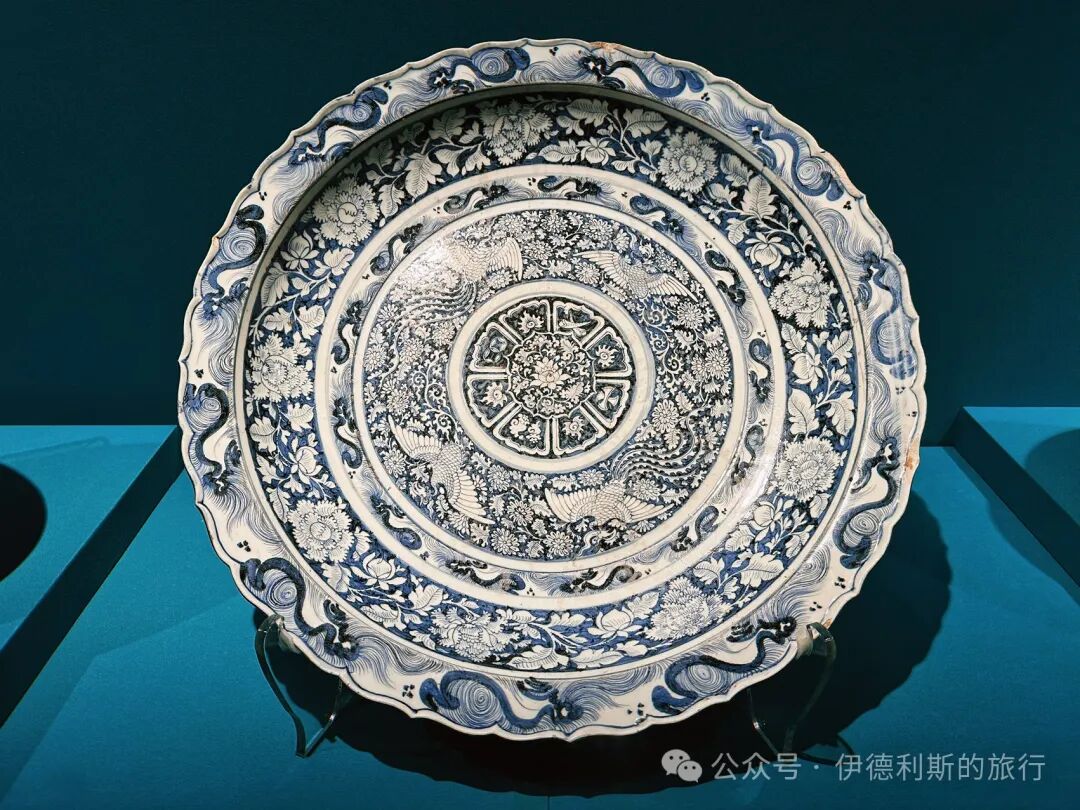
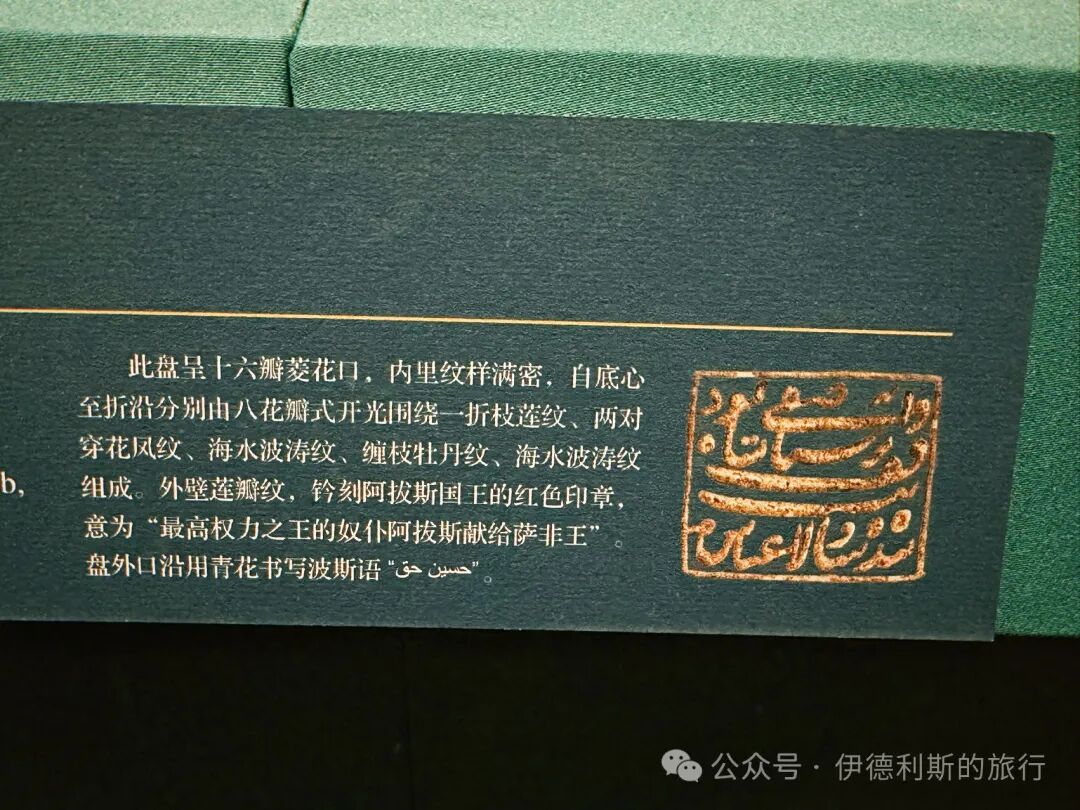
14th-century Yuan Dynasty blue and white plate with phoenix and flower patterns. The outer wall is stamped with the seal of the Abbasid Caliph.
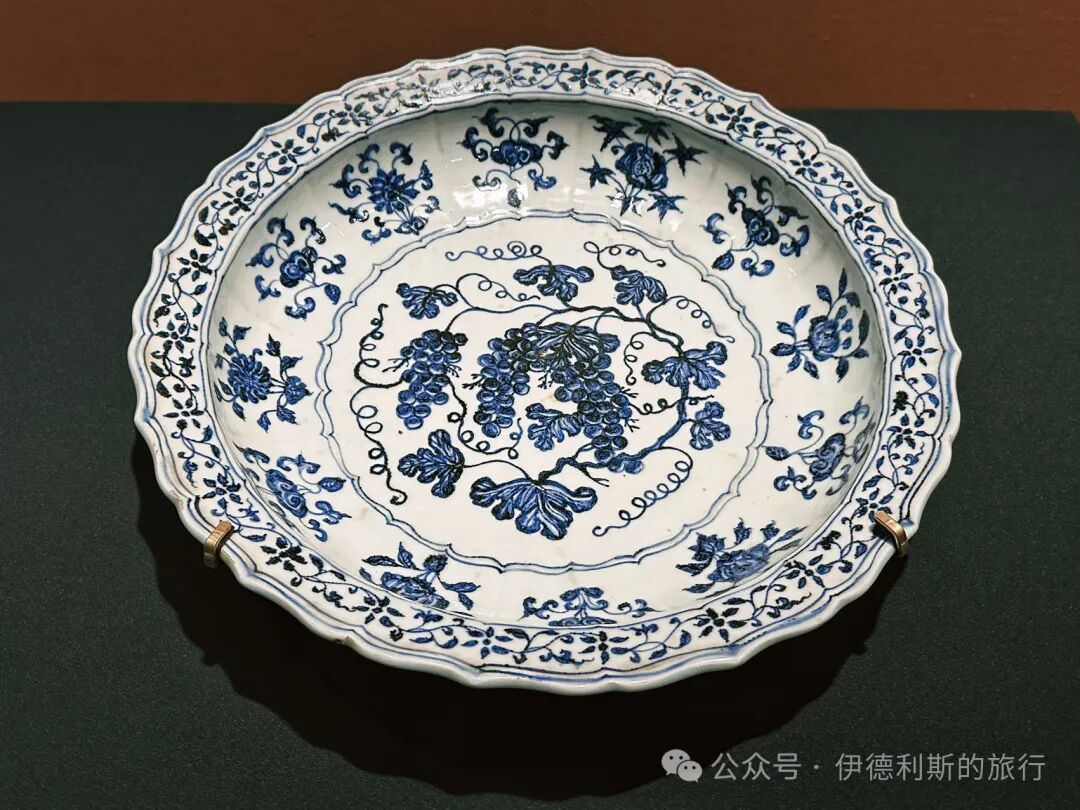
Late 14th to early 15th-century Yuan and Ming Dynasty large celadon plate.
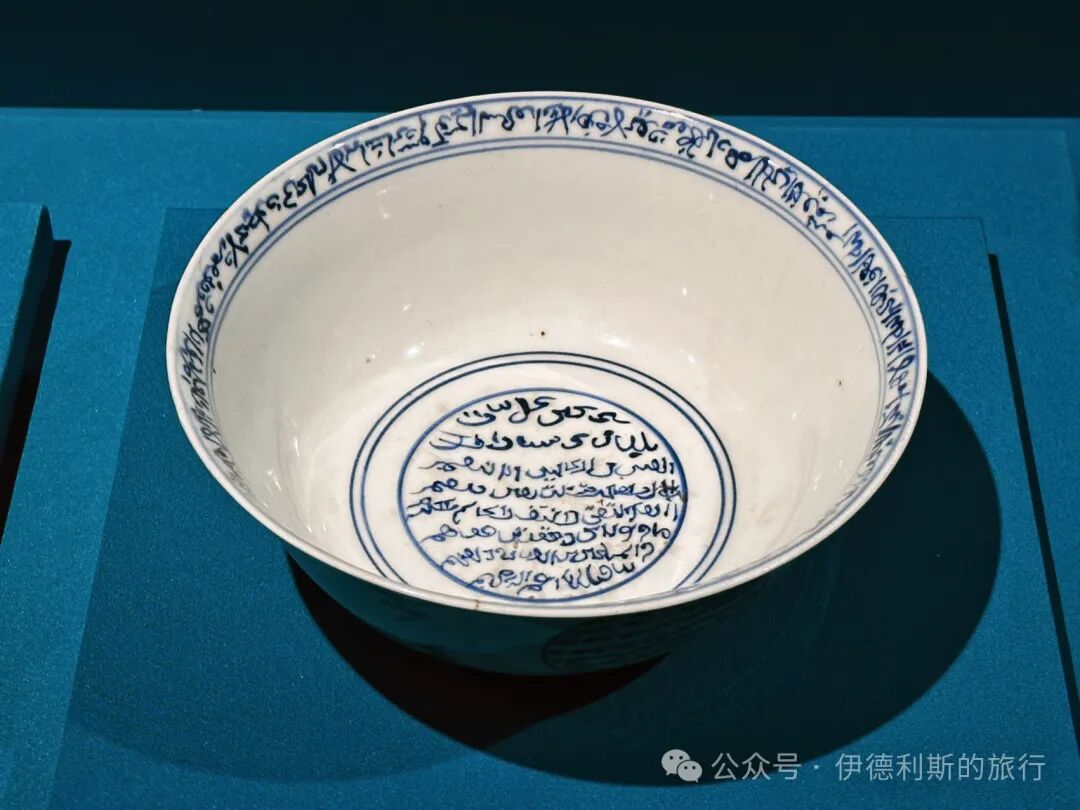
Early 16th-century Ming Dynasty blue and white bowl with Arabic script and Xuande mark.
16th-century Ming Dynasty yellow-glazed plate.
Late 16th-century Ming Dynasty iron-red glazed porcelain plate with fish patterns.
16th-century Ming Dynasty brown-glazed bowl with Jiajing mark.
Late 15th-century Ming Dynasty blue and white moon flask with arabesque patterns.
Late 14th-century Ming Dynasty blue and white ewer with scrolling flower patterns.
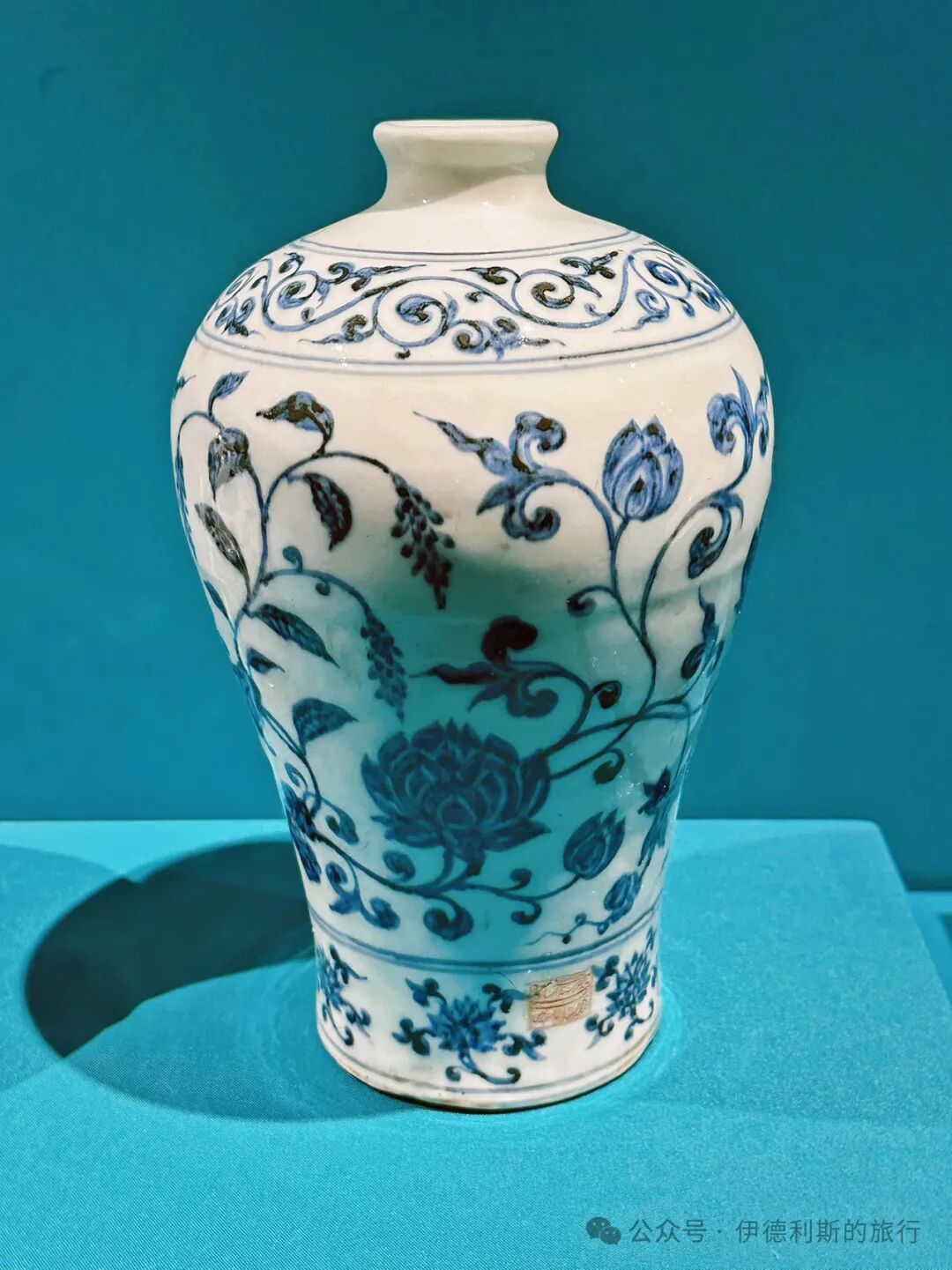
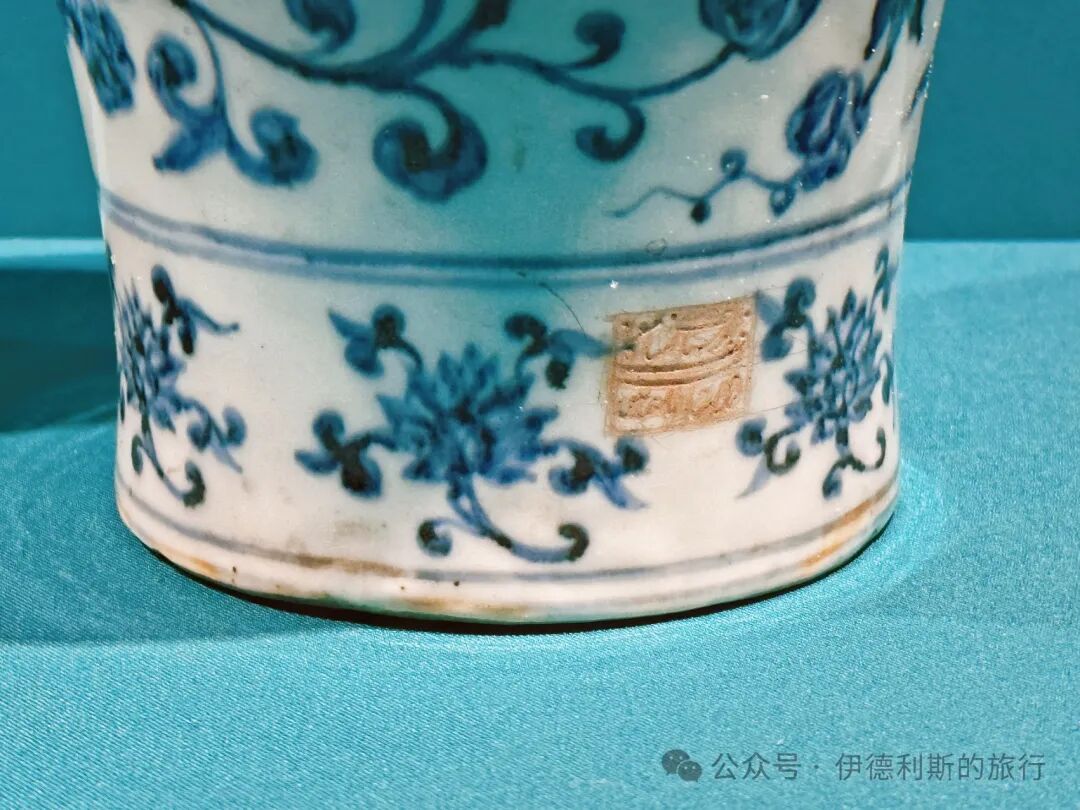
15th-century Ming Dynasty blue and white plum vase (meiping) with scrolling lotus patterns. The vase body is stamped with the seal of the Abbasid Caliph, which can also be seen on other items in this exhibition. The text reads, 'Abbas, servant of the King of Supreme Power, dedicated to King Safi'. After the Mongol army destroyed Baghdad in 1261, the Mamluk Sultanate in Egypt re-established the Abbasid Caliphate in Cairo. The Abbasid Caliphs in Egypt continued to serve as religious authorities but could not get involved in secular affairs. In 1517, the Ottoman Empire conquered Cairo, the last Abbasid Caliph was taken to Istanbul, and the Abbasid Caliphate came to an end.
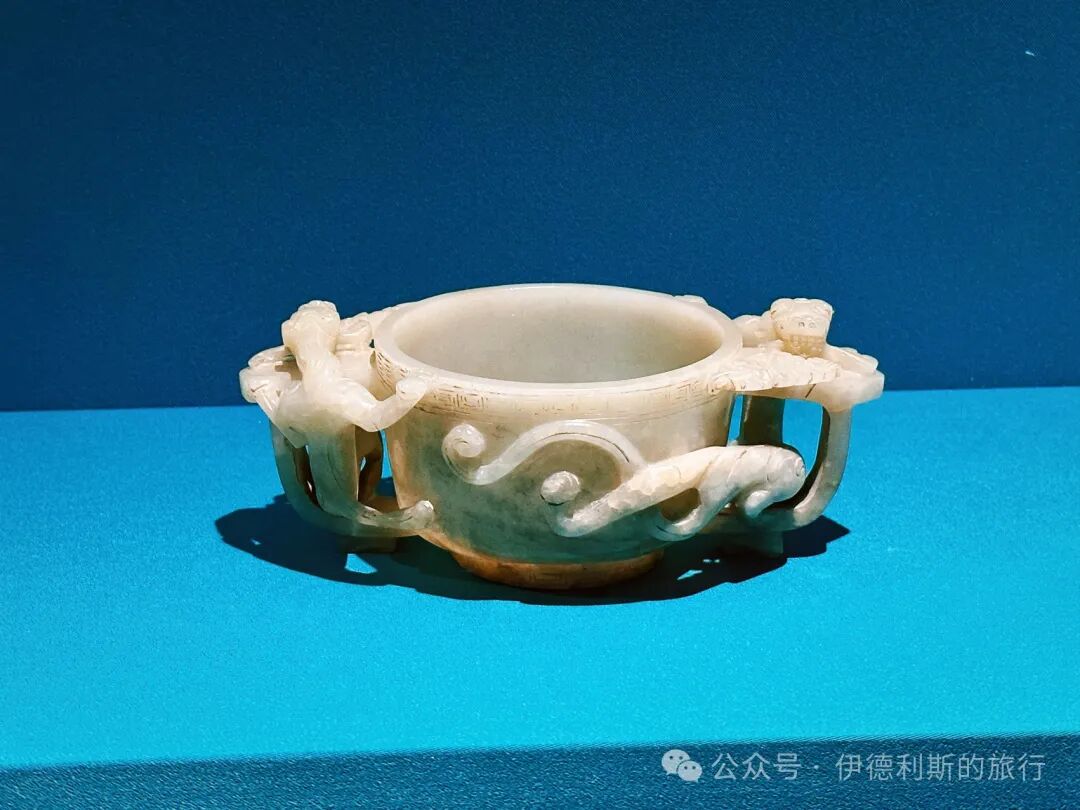
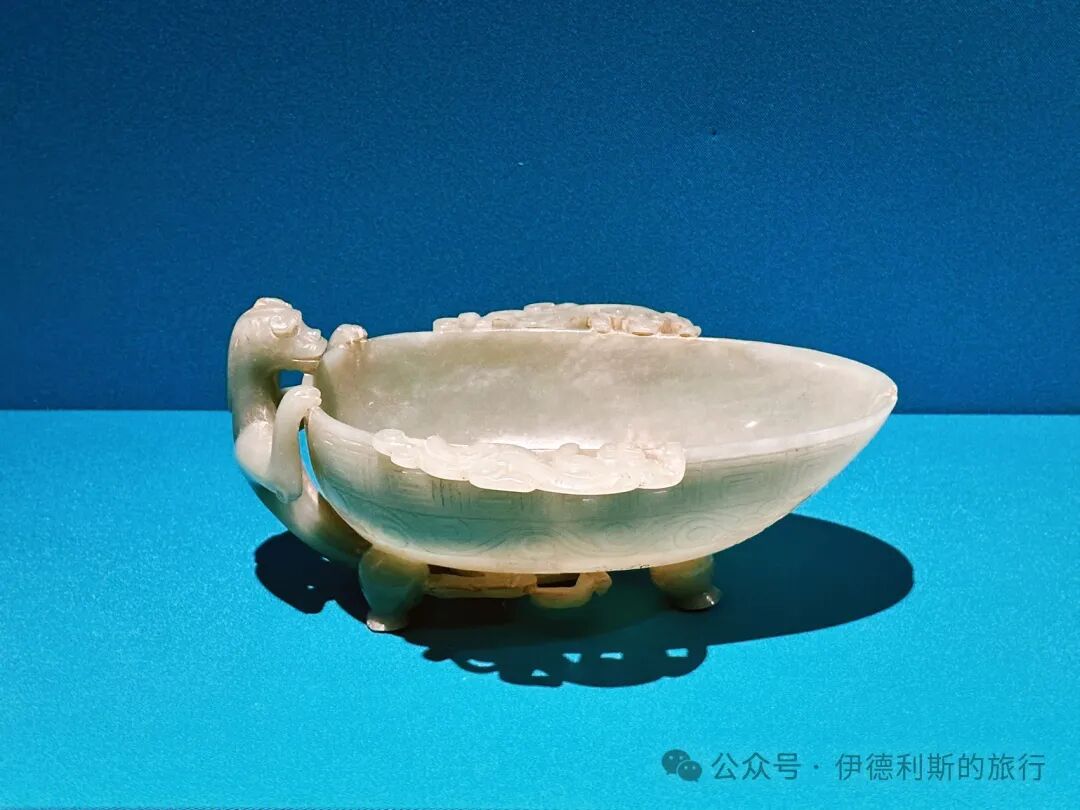
A 16th-century Ming Dynasty jade cup with a dragon-shaped handle and beast-ear decorations, featuring the seal of the Abbasid Caliph carved on the bottom.
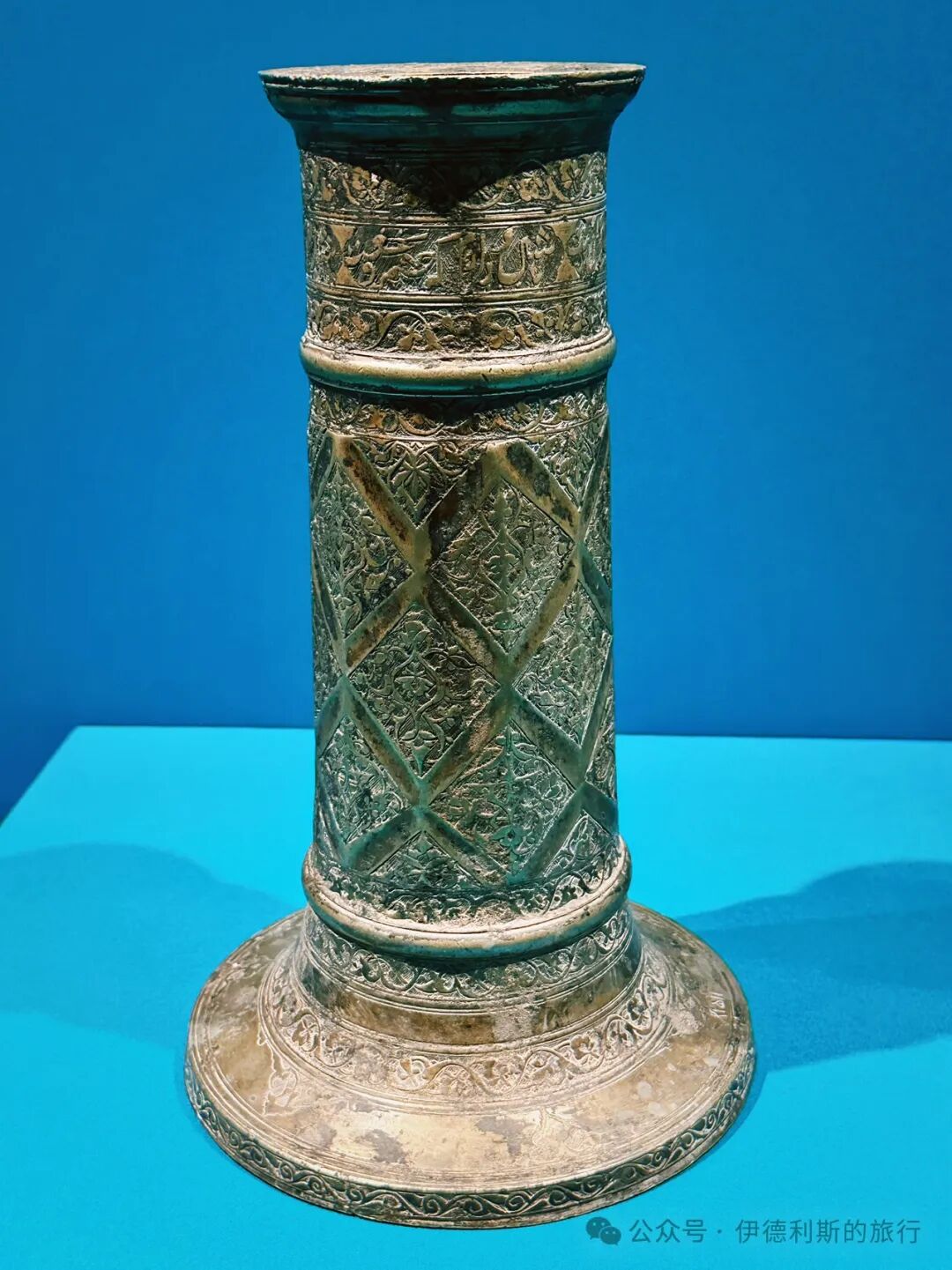
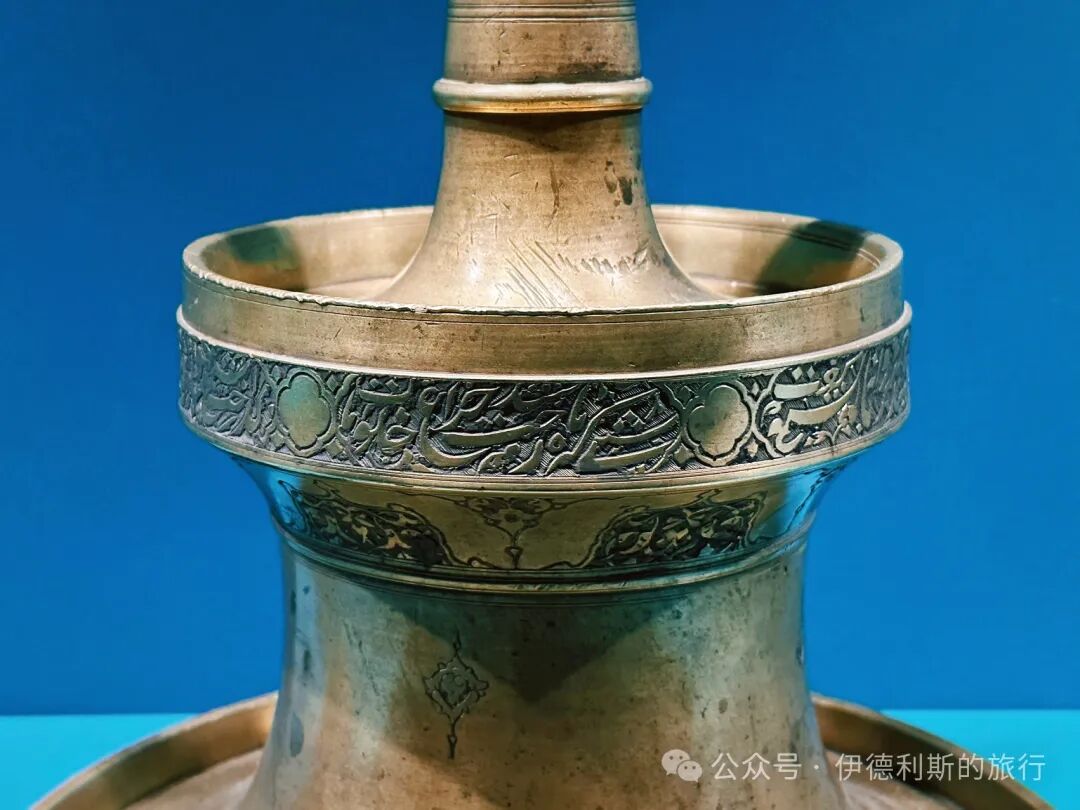
A 17th-century brass candlestick from the Safavid Dynasty.
A 16th-17th century double-headed brass candlestick from the Safavid Dynasty, engraved with Persian poetry by the famous poet Saadi:
One night I could not sleep and stayed awake all night,
I heard a conversation between a moth and a candle.
I am a lover who burns willingly with all my heart,
Why do you cry out in pain with tears streaming down?
Nishapur
Nishapur is an ancient city on the Silk Road in northeastern Iran, once one of the four major cities of the Greater Khorasan region. Nishapur became the capital of the Persian Tahirid Dynasty in the 9th century, grew into an important cultural and commercial hub under the Persian Samanid Dynasty in the 10th century, and continued to thrive during the Seljuk Empire in the 11th century. Between the 9th and 11th centuries, trade routes from Transoxiana in Central Asia, China, Iraq, and Egypt met here. Glazed pottery produced in Nishapur at that time became a major trade commodity in the West, rivaling Baghdad and Cairo.
In 1221, Nishapur was massacred by the Mongols and then destroyed, leaving the former metropolis buried deep underground. It was not until archaeological excavations by the Metropolitan Museum of Art in New York between 1935 and 1940 that countless artifacts were discovered beneath the farmland. Today, most of the excavated Nishapur artifacts are kept at the Metropolitan Museum of Art, as well as in museums in Tehran and Mashhad.
A 10th-11th century stucco panel with floral patterns.
A tombstone from the 9th to 11th century featuring Kufic script for Yahya ibn Ja'far.
A 9th to 10th-century glazed pottery bowl with slip-painted horseman designs.
A 10th-century glazed pottery bowl with geometric patterns.
A 9th to 10th-century Nishapur-style glazed pottery bowl with geometric and plant patterns.
A 9th to 10th-century Nishapur-style glazed pottery bowl with geometric and plant patterns.
A 10th-century Nishapur-style glazed pottery bowl with slip-painted imitation Kufic inscriptions.
A 10th-century glazed pottery bowl with Kufic script.
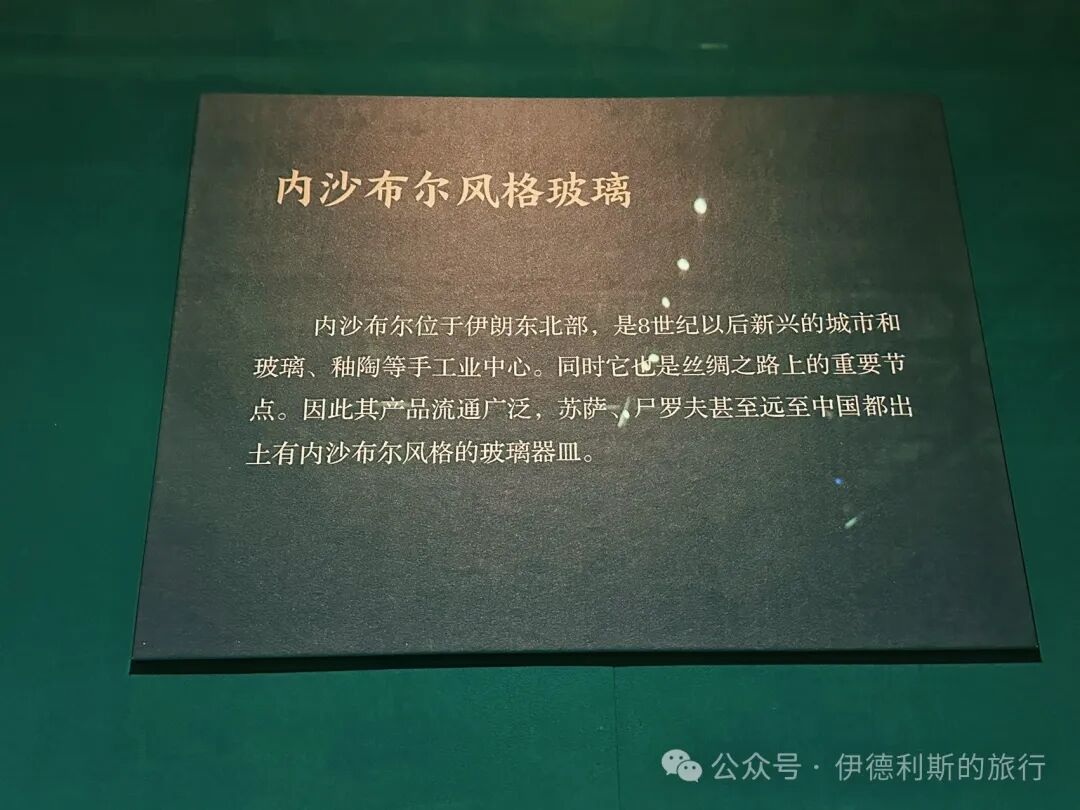
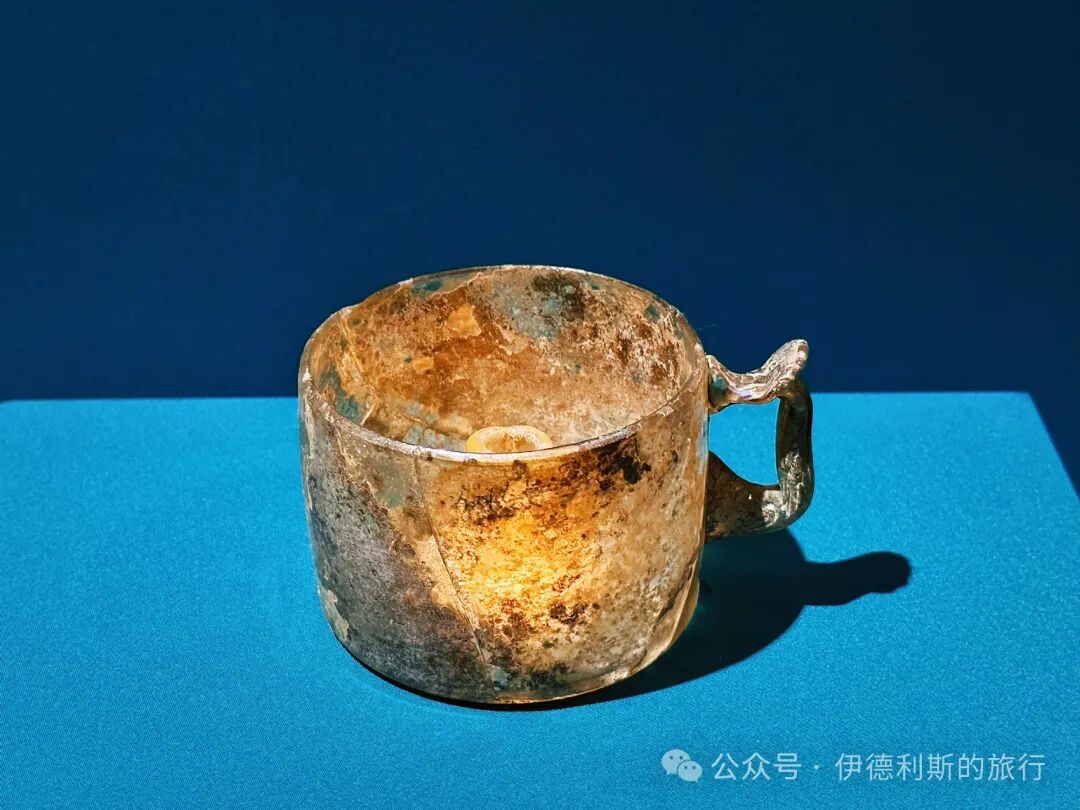
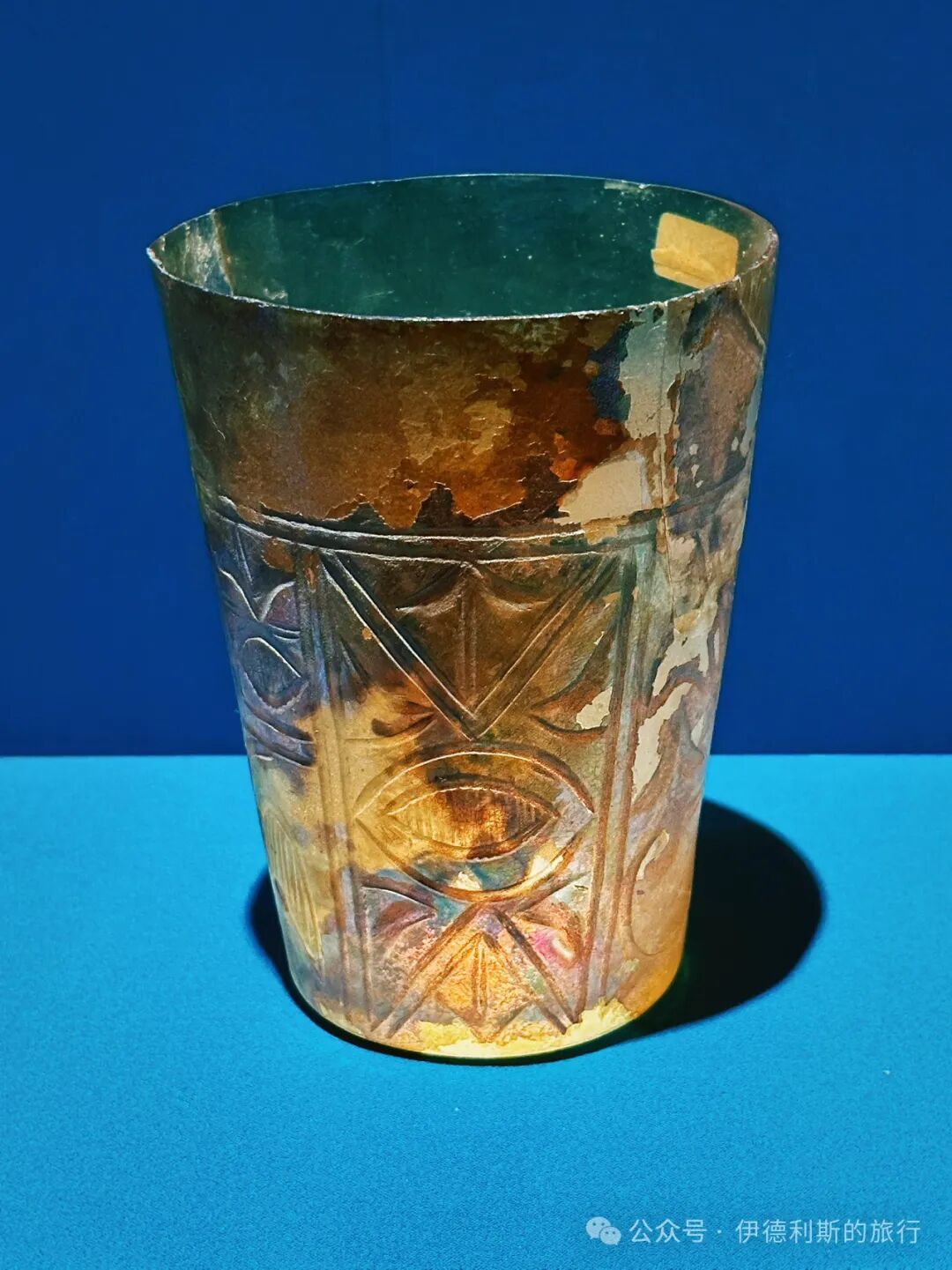
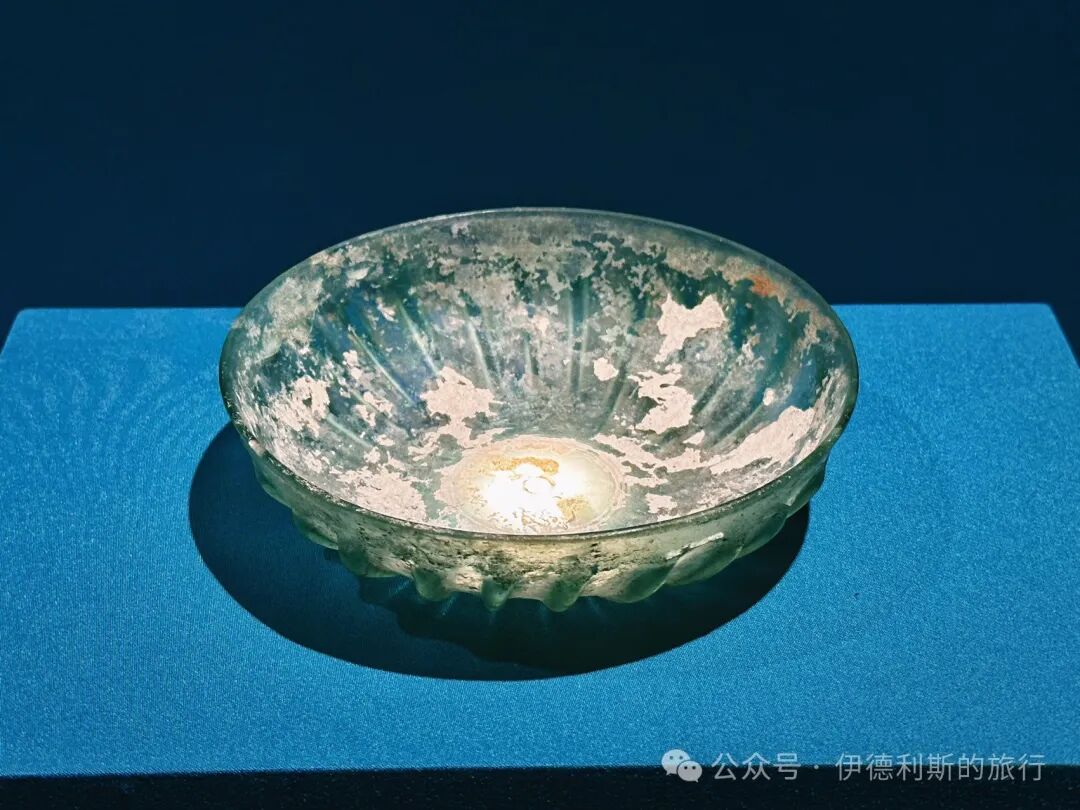
Glass lamps, glass cups, and glass bowls from the 9th to 10th century. Besides glazed pottery, Nishapur was also a center for glass craftsmanship from the 9th to 11th century.
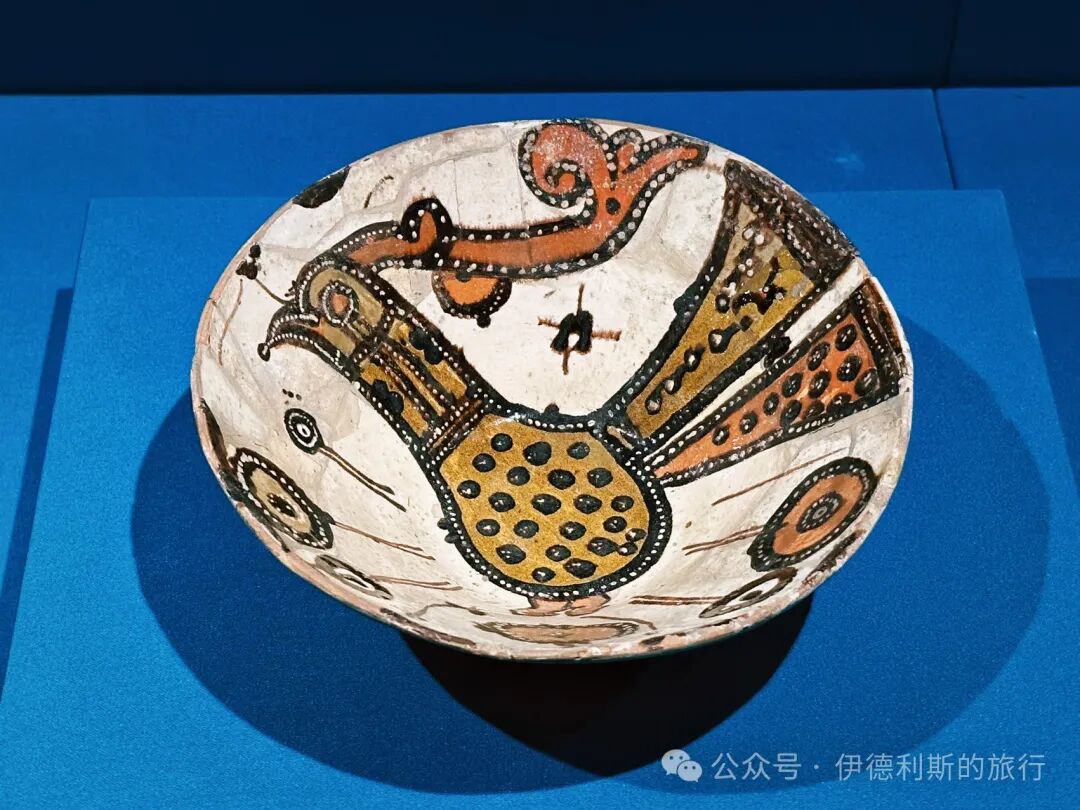
A 10th-century Sari-style glazed pottery bowl with slip-painted bird patterns.
Gorgan.
Glazed pottery from the ancient city of Gorgan. Gorgan was an important city on the Caspian coast during the Sasanian period and remained a center for Zoroastrianism after the 8th century. The old city of Gorgan was destroyed during the Mongol invasion in the 13th century, and it was moved to the current new city during the Ilkhanate period.
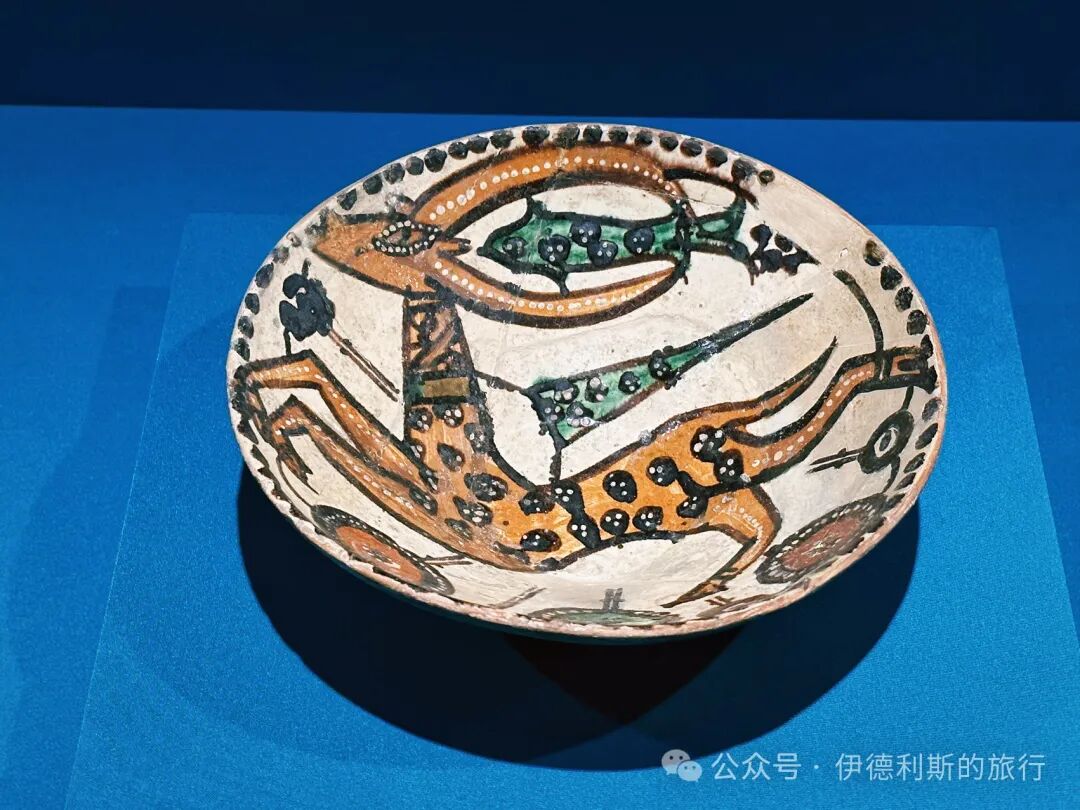
A 10th-century glazed pottery bowl with slip-painted antelope patterns.
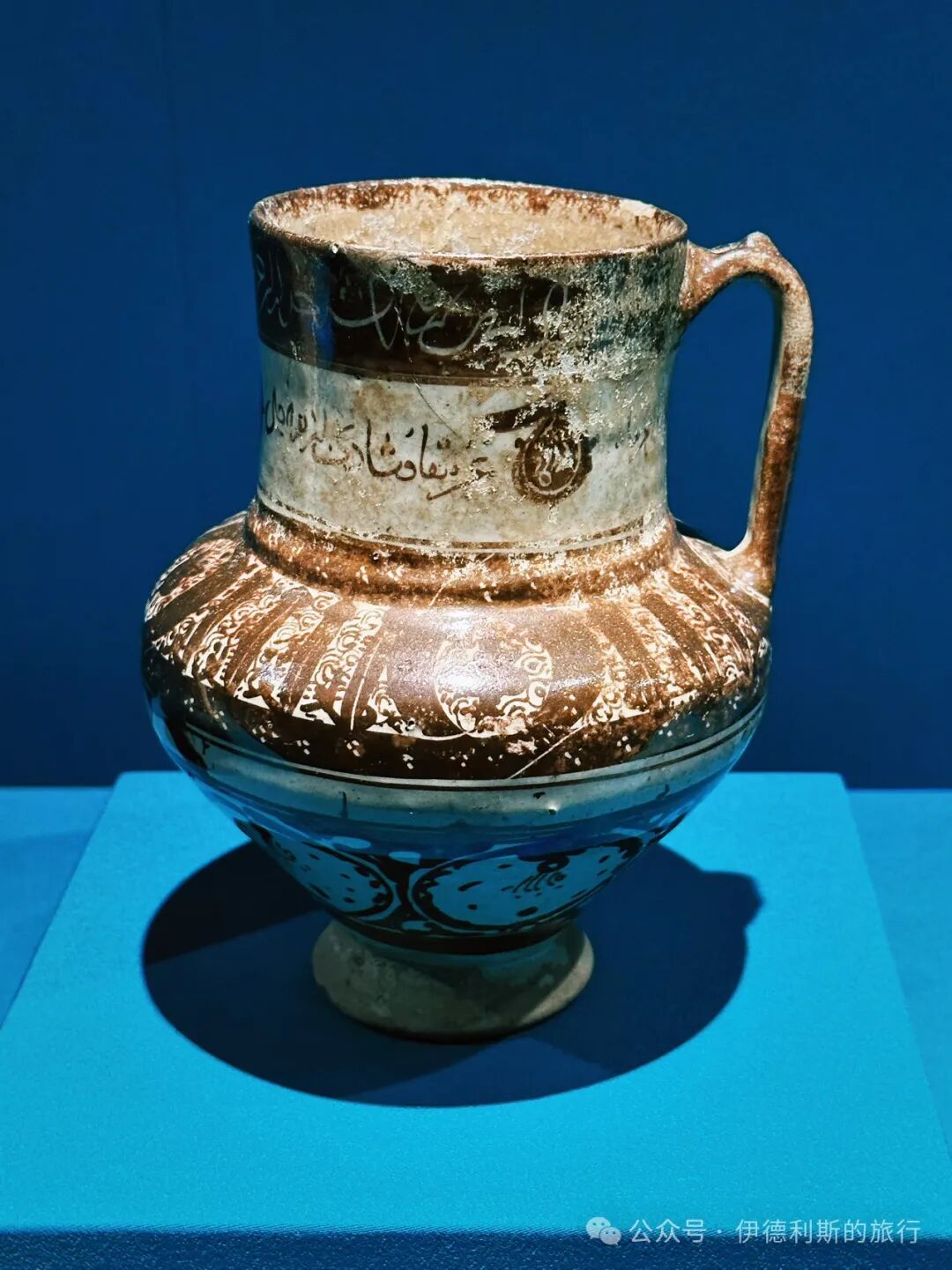
A 13th to 14th-century Ilkhanate-period glazed pottery jar with a single handle and calligraphic text.
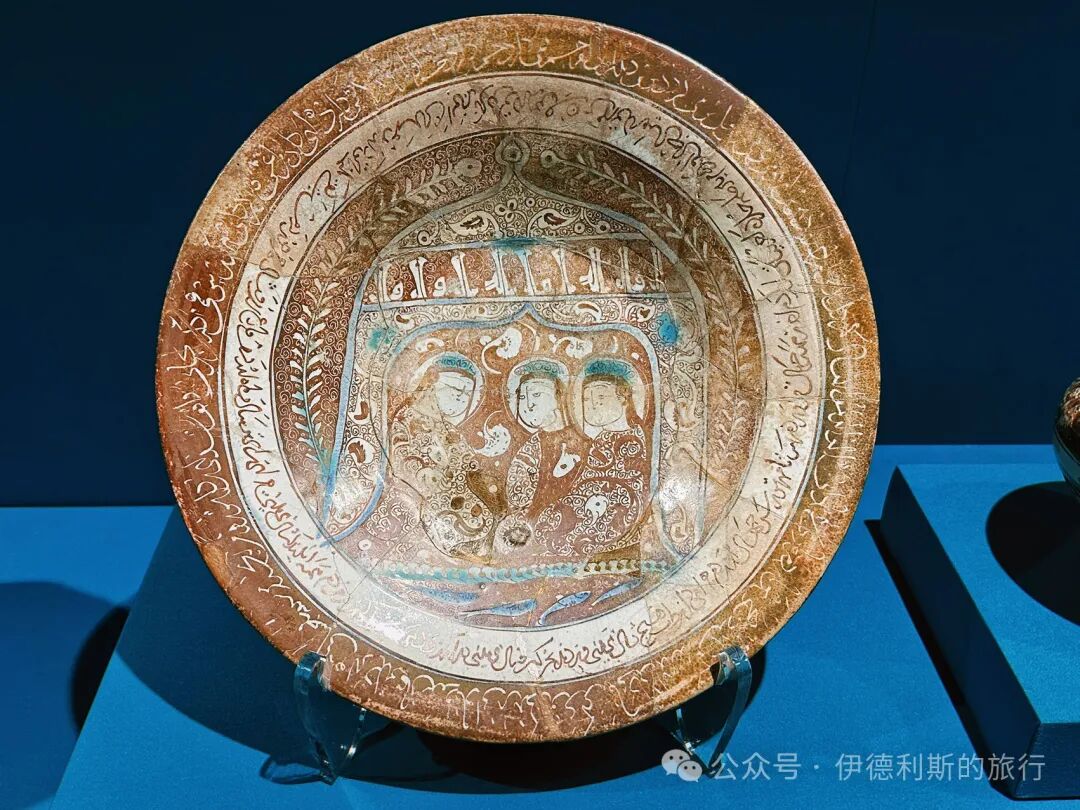
Luster-glazed ceramic plate with figure patterns from the Ilkhanate period, 13th-14th century.
Glazed ceramic bowl with geometric patterns from the Ilkhanate period, 14th century.
Glazed ceramic bowl with floral patterns and calligraphy from the Ilkhanate period, 13th century.
Gorgan-style luster-glazed inscription brick with Thuluth script from the Ilkhanate period, 13th-14th century.
Glassware and bronze ware from the ancient city of Gorgan.
Single-handled glass jar, 9th-10th century.
Glass ewer, 10th century.
Single-handled glass jar, 10th century.
Bird-shaped glass ewer from the Seljuk Empire, 11th-12th century.
Glass bowl with flower patterns from the Ilkhanate period, 13th century.
Glass bottle with circle patterns from the Ilkhanate period, 13th century.
Single-handled bronze ewer, 9th-10th century.
Two-handled bronze cauldron with inscriptions from the Seljuk Empire period, 12th century.
Ray.
Ray is located in the southern suburbs of Tehran and is an important ancient city in northern Iran. It is referred to as "Layi" in books like the History of Yuan. In 1043, Tuğrul Beg, the founder of the Seljuk Empire, made Ray the capital of the empire and carried out large-scale reconstruction of the ancient city. Under the rule of the Seljuk Empire, Rey reached its peak with a massive marketplace and a very prosperous trade scene. Import and export trade, mainly in silk, connected the entire Eurasian continent. At that time, Rey was the center for making painted pottery in Iran, and Rey-style painted pottery was an important handicraft of the period.
In 1220, the Mongol army invaded Rey, which was then under the rule of the Khwarazmian Empire. Because there was no fierce resistance, the Mongols did not massacre the city. Even so, the residents gradually left, and the center for pottery production moved to the southern city of Kashan.
Stucco figure from the Seljuk dynasty, 11th to 12th century.
Ceramic tile from the Seljuk dynasty, 11th to 12th century.
Single-handled pottery jar from the 9th century.
Three-handled pottery jar from the 9th to 10th century.
Blue-glazed narrow-necked pottery vase from the Ilkhanate period, 13th century.
Rey-style Mina'i glazed pottery bowl with a camel rider pattern, from the late Seljuk dynasty to the Ilkhanate period, 12th to 13th century.
Rey-style Mina'i glazed pottery bowl with a sphinx pattern, from the late Seljuk dynasty to the Ilkhanate period, 12th to 13th century.
Glazed pottery bowl with geometric patterns from the ancient city of Rey, Ilkhanate period, 13th to 14th century.
Seljuk dynasty.
Bronze ware from the Seljuk dynasty.
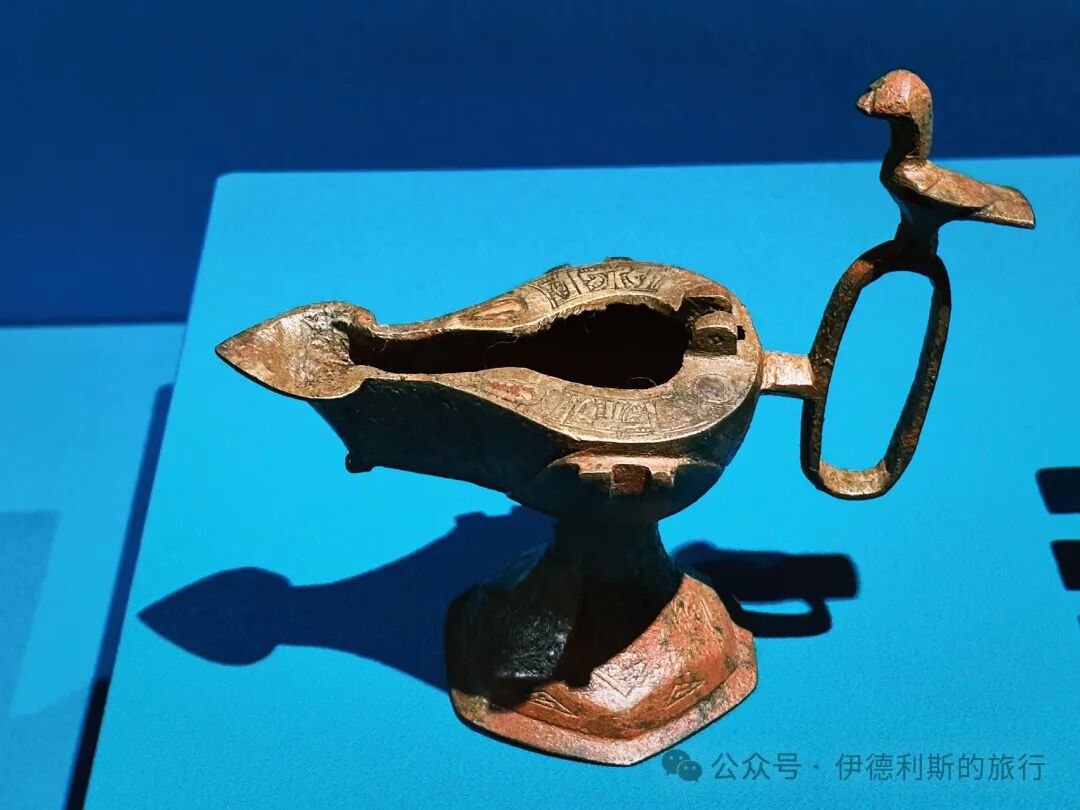
11th-12th century Seljuk dynasty single-handled bronze lamp with a bird figure from Quchan. Quchan is in northeastern Iran near the border with Turkmenistan. The lamp has Kufic script and scroll patterns on both sides. Similar designs were found in Nishapur, which may link to traditions in northeastern Iran.
12th century Seljuk dynasty bronze ewer with calligraphy in the Khorasan style.
12th century Seljuk dynasty bronze incense burner from Sowme'eh Sara. Sowme'eh Sara is on the Caspian Sea coast in northwestern Iran.
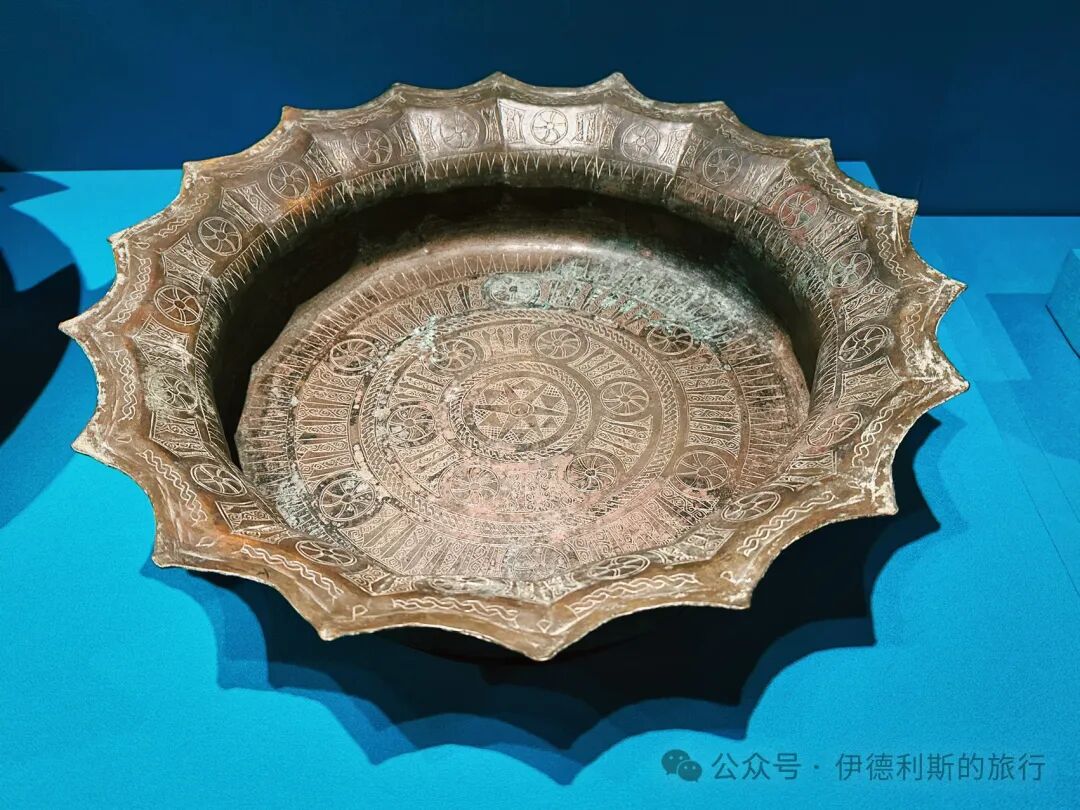
11th-12th century Seljuk dynasty bronze basin with a floral rim and geometric patterns from Rafsanjan. Rafsanjan is in southeastern Iran. It is the world's largest producer of pistachios and a center for carpet production in Iran.
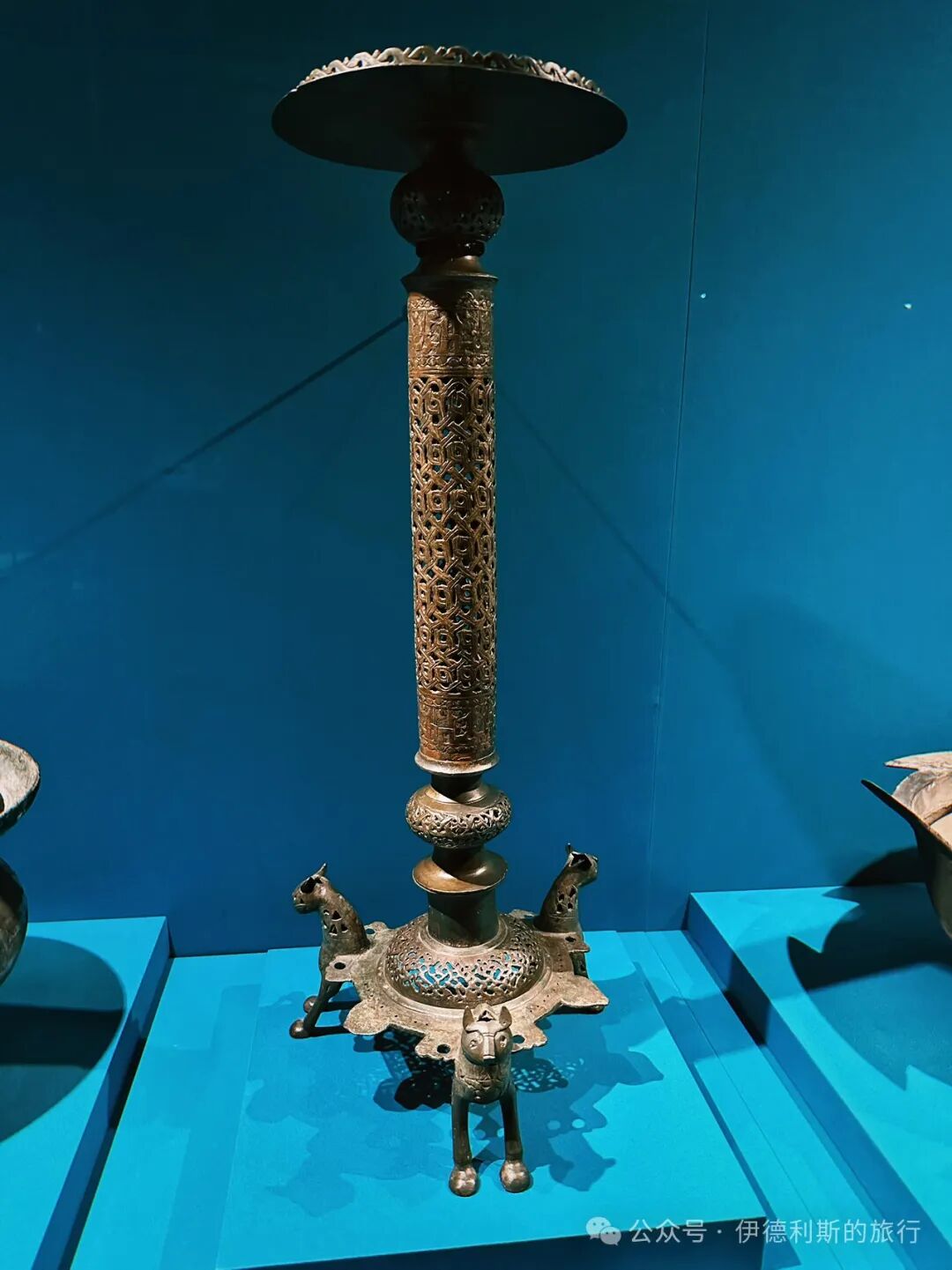
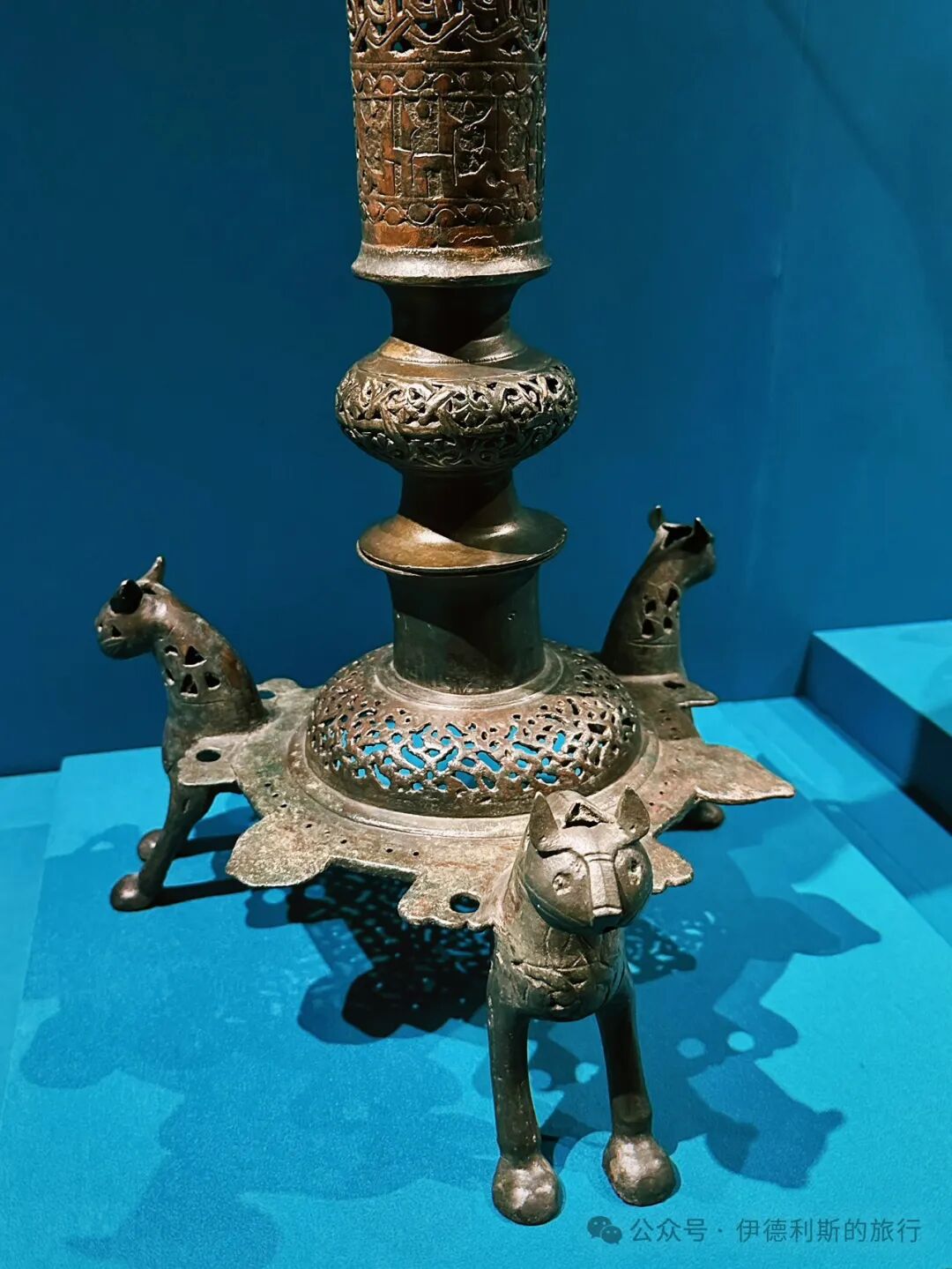
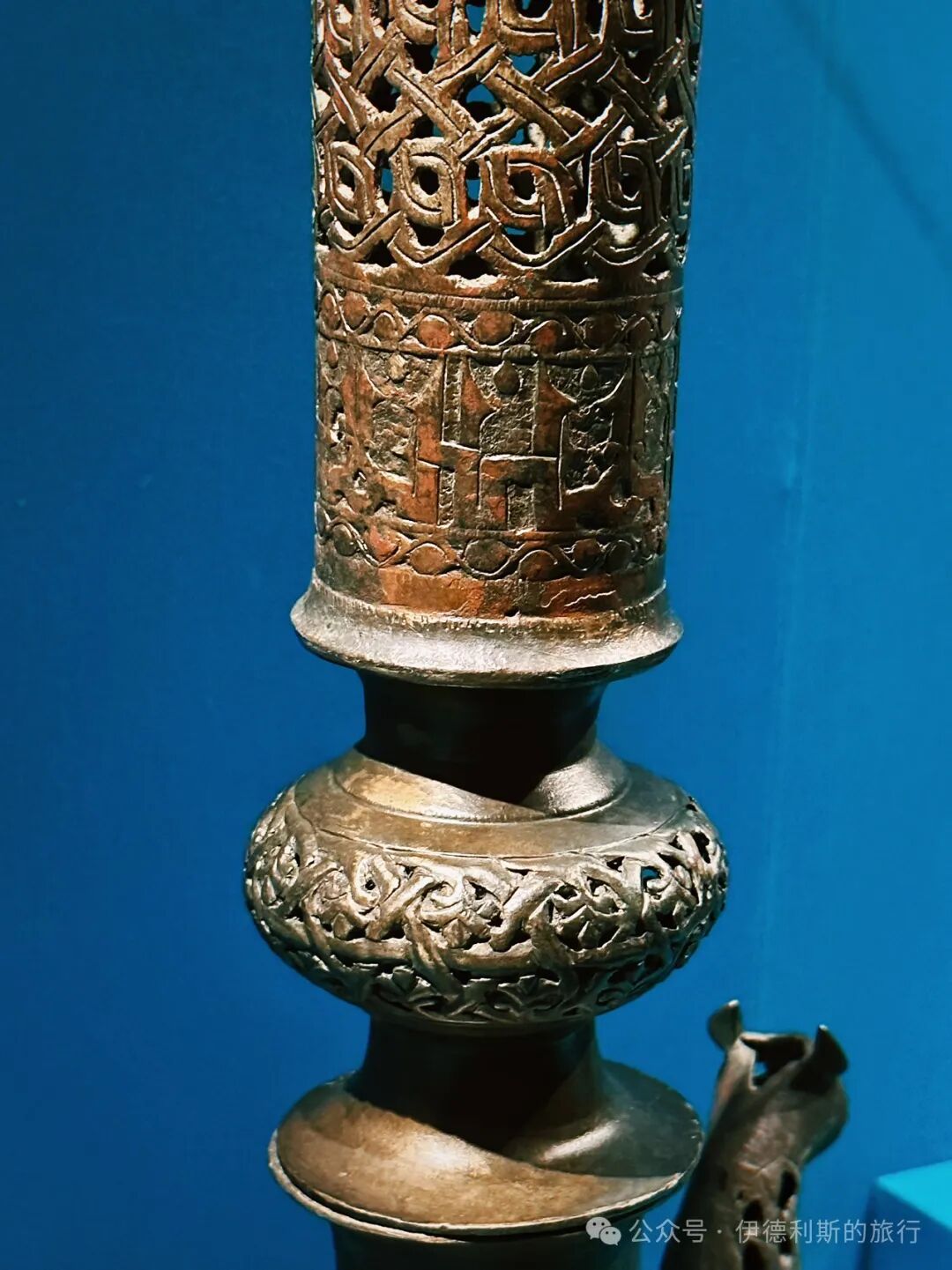
11th-12th century Seljuk dynasty bronze candlestick with three animal-shaped feet in the Khorasan style.
Summer palace of the Ilkhanate.
Artifacts unearthed at the Takht-e Soleyman site, the summer palace of the Ilkhanate. Takht-e Soleyman is a World Heritage site that served as the summer palace for the Ilkhanate in the 13th century. The Ilkhanate blended Eastern and Iranian art here to develop a unique Ilkhanid artistic style.
Takht-e Soleyman is the only surviving secular building complex from the Ilkhanate. The walls of the Great Khan's palace still have beautiful glazed tile decorations, which directly reflect the cultural and artistic exchange between China and Iran in the 14th century. The glazed tiles show various flowers, animals, and figures. The themes cover Chinese mythology, Iranian mythology, and calligraphic scripture, showing a blend of many cultures. Some of the tile themes come from the famous Iranian epic, the Shahnameh, which shows how the Ilkhanate integrated into Iran at the time.
Late 13th to early 14th century stucco panel with bird patterns.
Late 13th to early 14th century, Lajvardina glazed tiles with deer and lion patterns.
13th to 14th century, lusterware glazed tiles with camel and sphinx patterns. Lusterware, also called iridescent glaze, is a decorative technique using a second low-temperature firing. This second firing uses a reduction atmosphere to create a shimmering metallic finish.
13th to 14th century, Lajvardina glazed tile with a dragon pattern. This piece is a signature artifact from Takht-e Soleyman, and the National Museum of Iran even sells magnets featuring it.
12th to 13th century, late Seljuk to Ilkhanate period, green-glazed pottery bowl with carved scrolling leaf patterns in panels.
Late 13th to early 14th century, lusterware glazed pottery bowl with animal patterns.
Late 13th to early 14th century, Ilkhanate period, glazed pottery bowl with a twin-ram pattern.
Kashan
Glazed pottery from the ancient city of Kashan. During the 12th to 14th centuries under Seljuk and Ilkhanate rule, Kashan was a major center for producing high-quality glazed pottery in Iran. In modern Persian, the word for tile (kashi) comes from the name Kashan.
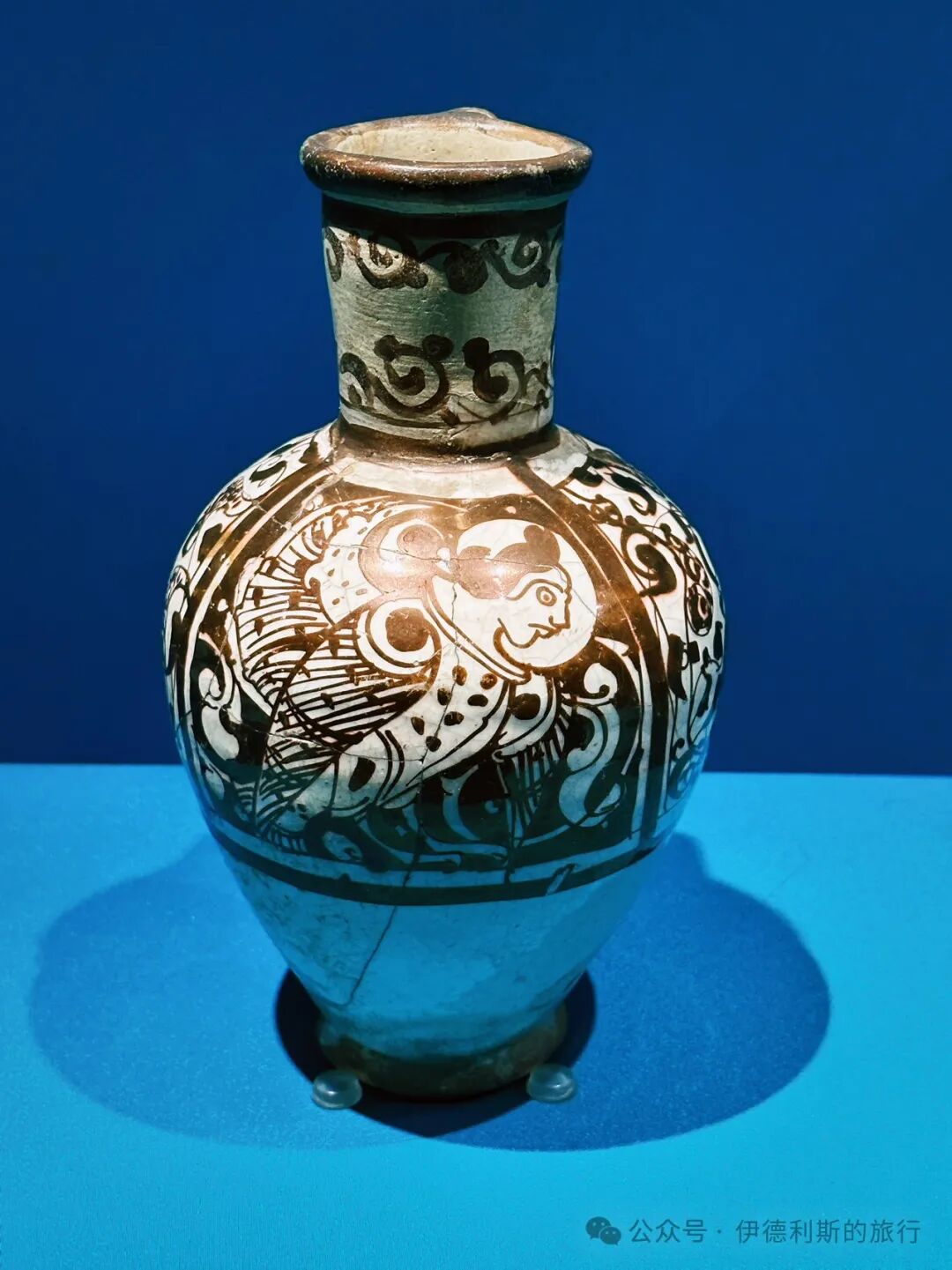
13th to 14th century, Ilkhanate period, lusterware glazed pottery jug with one handle and a sphinx pattern.
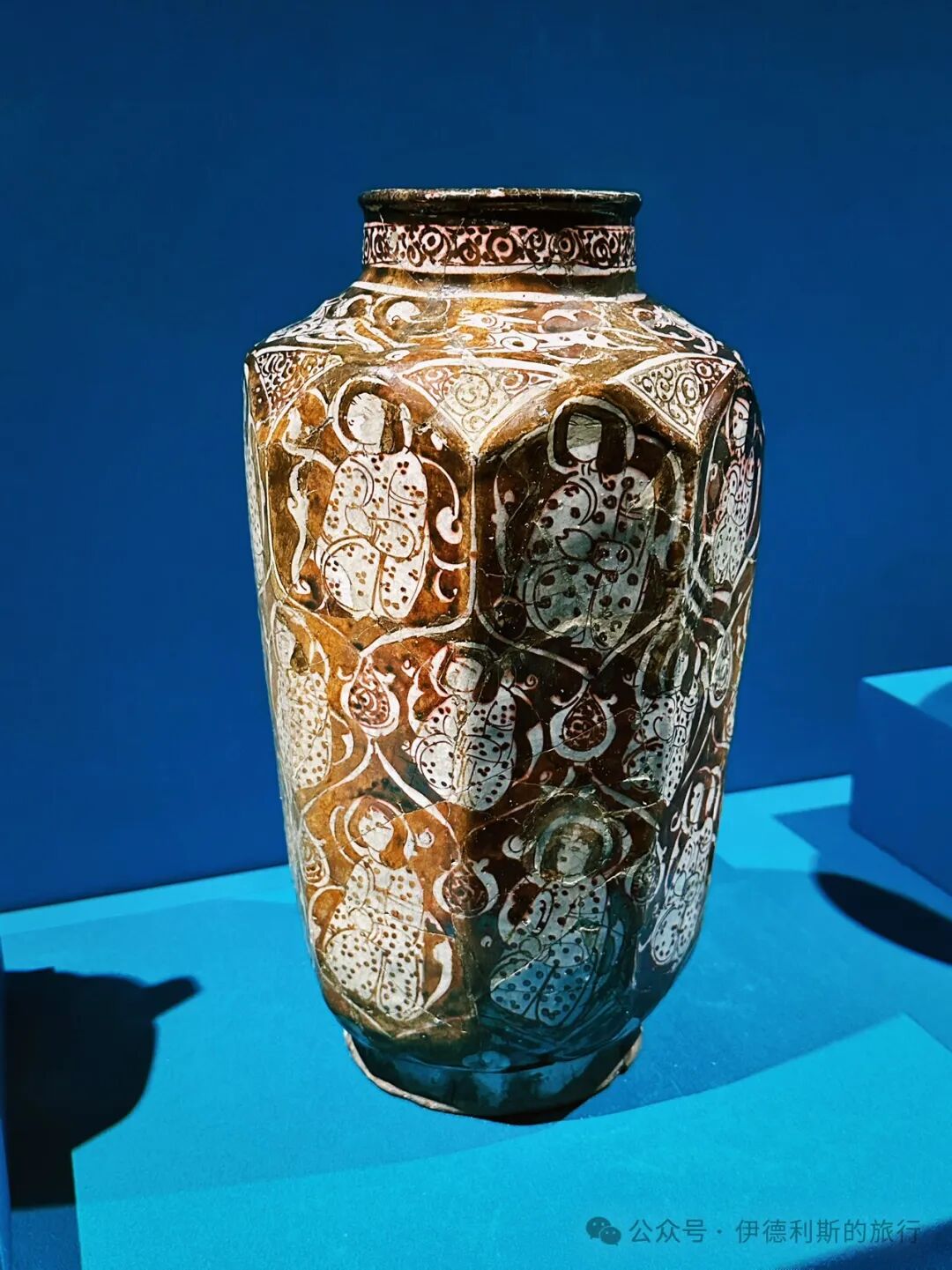
13th to 14th century, Ilkhanate period, lusterware glazed pottery jug with human figure patterns.
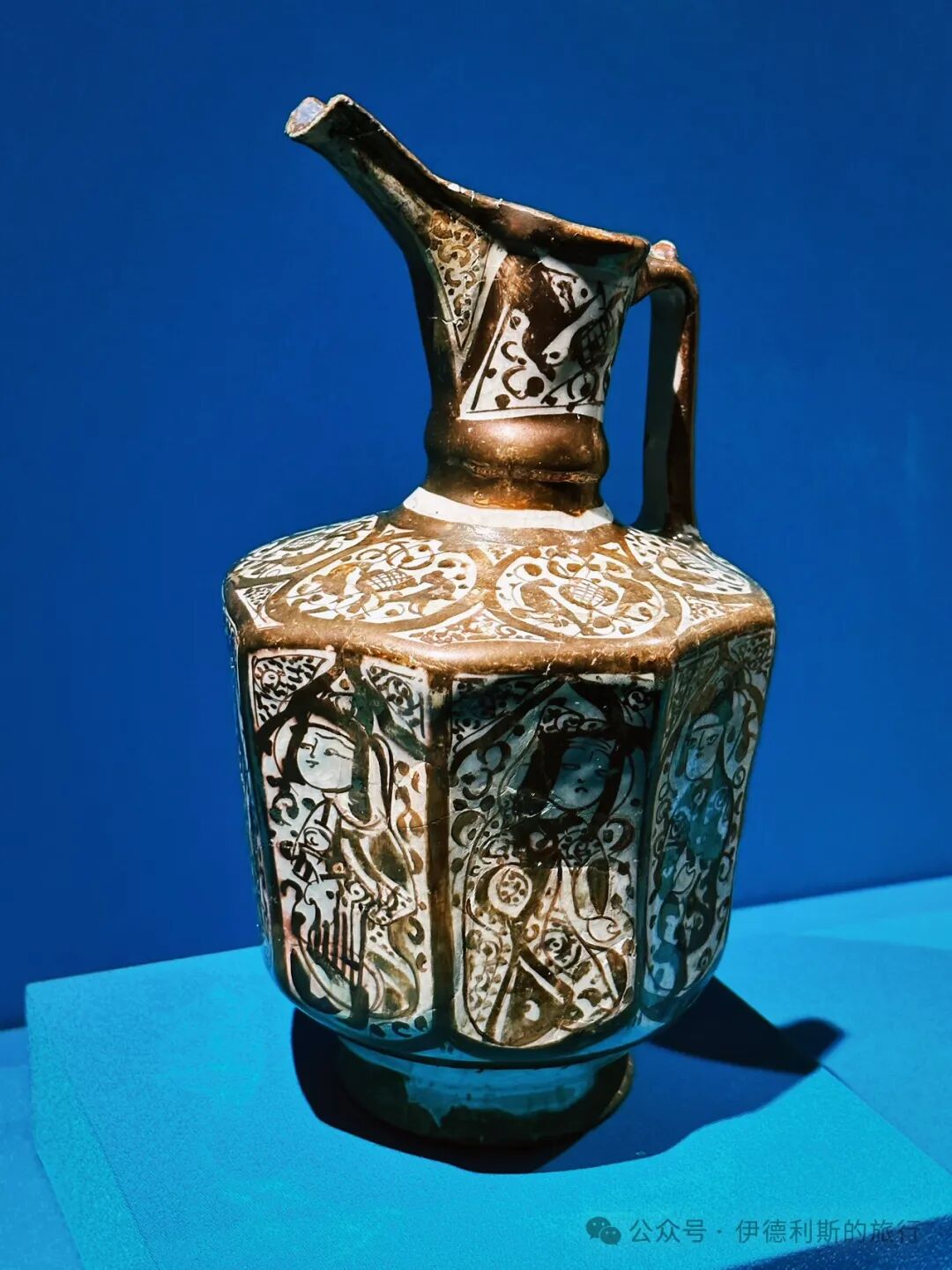
13th to 14th century, Ilkhanate period, lusterware glazed pottery watering vessel with human figure patterns.
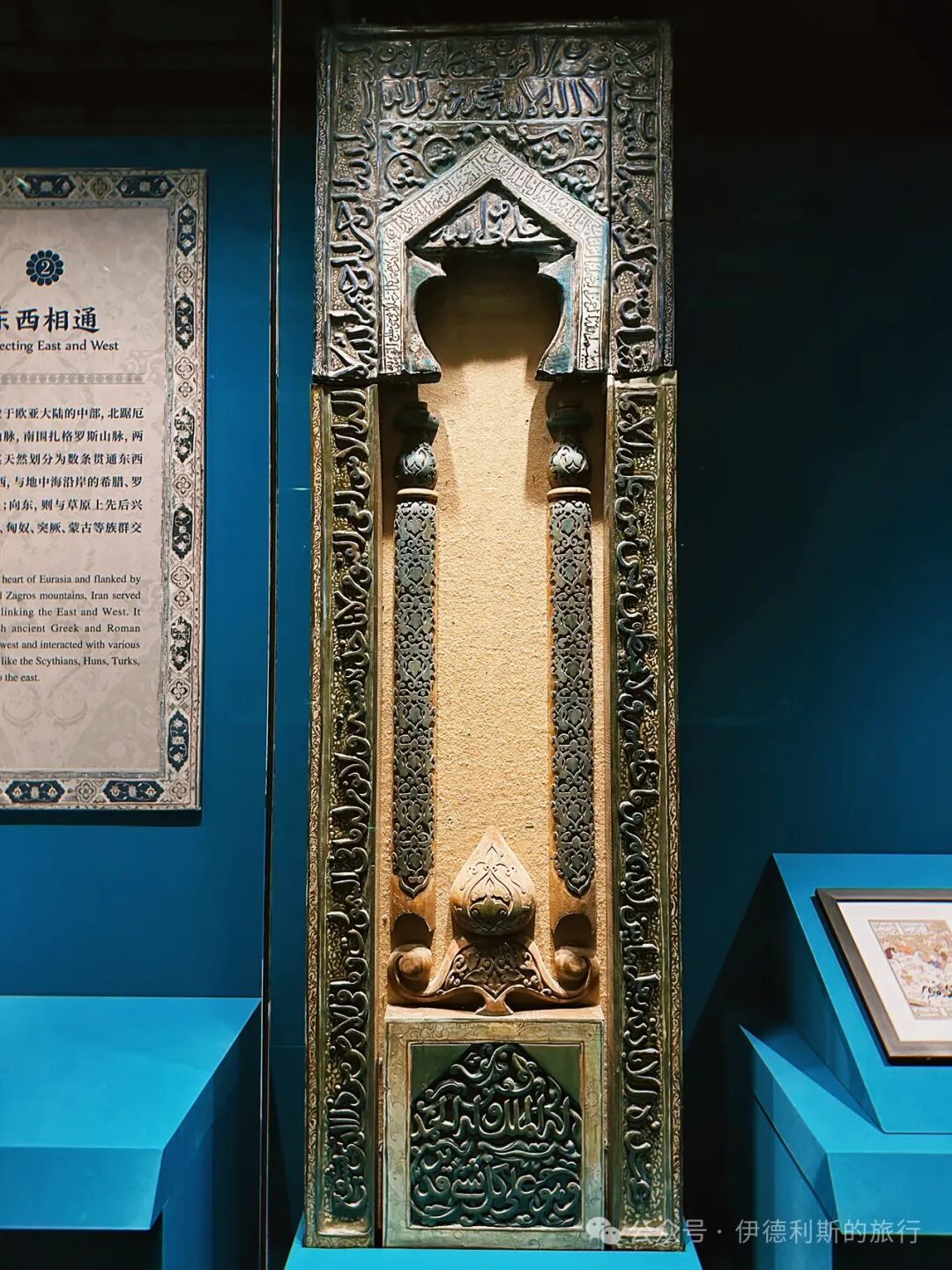
13th to 14th century, Ilkhanate period, lusterware glazed mihrab with Thuluth script inscriptions. This mihrab is definitely one of the best pieces on display at the National Museum of Iran.
14th-century Ilkhanate period, Saveh, Lajvardina glazed molded inscription tile. Saveh is located southwest of Tehran and was an important city during the Ilkhanate period. Lajvardina is an overglaze technique known for its lapis lazuli-like blue base glaze, often seen on building facades from the Ilkhanate period.
14th-century Ilkhanate period, Sultanabad, glazed pottery bowl with mythical bird and deer patterns. The bowl depicts the Simurgh, a mythical bird from Persian legends. During the Sassanid Empire, the Simurgh was depicted with a dog's head and a peacock's tail, but it transformed into a peacock-like image under Chinese influence during the Ilkhanate period.
Timurid Dynasty
14th-15th century Timurid period, Borujerd, silver-inlaid bronze stemmed bowl.
14th-century Timurid period, Khorasan region, mosaic tile with checkerboard Kufic script.
16th-17th century Shahsavar, overglaze painted tile with human figures.
Safavid Dynasty
16th-17th century Isfahan province, stucco panel with calligraphic inscriptions.
17th-century Amol, blue glazed pottery bowl with floral patterns. Amol is located on the Caspian Sea coast. It was a major trading hub in history and continued to grow during the Safavid Dynasty, becoming a favorite residence of the Safavid King Abbas II, who reigned from 1632 to 1666.
16th-century Amol, blue and white porcelain plate.
17th-century glazed pottery plate with underglaze floral patterns from northern Iran.
16th-century bronze incense burner with a dragon head from Yazd Province.
16th-century bronze plate with floral patterns and inscriptions from Kermanshah Province.
16th-century bronze candlestick from Isfahan. In 1598, Safavid King Abbas I (reigned 1588-1629) made Isfahan his capital. He rebuilt it into a prosperous and beautiful city, and Isfahan entered a golden age of culture. view all
Summary: Islamic Art Guide: Iranian Artifacts at Beijing Forbidden City (Part 1) is presented here as a firsthand travel account in clear, natural English. The account focuses on Iranian Art, Forbidden City, Islamic Heritage while preserving the names, places, food, photos, and historical details from the Chinese source.
The East Wing of the Meridian Gate at the Forbidden City hosted the 'Splendors of Persia: Exhibition of Iranian Cultural Relics' from January 12 to April 11, 2024. The National Museum of Iran sent many precious artifacts for everyone to enjoy.
I visited the National Museum of Iran in 2019, as seen in my article 'Exhibition Notes from the Museum of the Islamic Era in Iran'.
I will share some of the artifacts from the exhibition with you below.
Was the Zhengde Emperor's Islamic name 'Suleiman'?
For this Iranian exhibition at the Meridian Gate, the Forbidden City contributed a heavyweight artifact: a white-glazed, iron-red decorated plate with Arabic and Persian inscriptions, fired at the imperial kilns during the Zhengde period (1506–1521) of the Ming Dynasty. Previously, the Wuyingdian Ceramics Gallery only displayed the front, but this time we finally got to see the bottom of the plate, which holds much more information.
According to Li Yihua's 1984 article 'Two Pieces of Zhengde-era Arabic and Persian Porcelain—Also Discussing the Influence of Islamic Culture' in the 'Journal of the Palace Museum', this is the only red-decorated piece among the more than 20 pieces of Zhengde Arabic and Persian porcelain in the Forbidden City's collection. The wall of the plate features a Hadith: 'The Exalted and Majestic Lord says, whoever does a good deed the size of a speck of dust, (or) whoever does a bad deed the size of a speck of dust, He will see it; this is the reward for those who do good.' The most interesting part is the three lines of text on the bottom of the plate. Li Yihua interpreted them as 'Dimani Khan, namely Aman Suleiman Shah,' and suggested it might have been commissioned for a country in the Arab region. However, some scholars lean toward the idea that 'Dimani Ke' should be 'Da Mink,' meaning 'Great Ming.' Based on this, the text reads 'The ruler of the Great Ming is King Suleiman.' This means the Zhengde Emperor's Islamic name was likely 'Suleiman,' which is why some people jokingly call this piece 'King Solomon's Treasure'.
During the Zhengde period, the palace was very fond of using porcelain with Arabic and Persian inscriptions. Most were bowls, cups, brush rests, and boxes with the same shapes as official kiln wares, and the content was mostly Quranic verses, Hadith, and praises. According to research by Professor Jin Liyan and records in the 'Veritable Records of the Joseon Dynasty,' the Zhengde Emperor studied Islamic knowledge in 1509 (the third year of Zhengde): 'Hearing that Hui Muslims do not eat meat slaughtered by others, but must slaughter it themselves, and that they have kind hearts and read scriptures, he invited them into the palace to learn from them.'
The largest astrolabe from the National Museum of Iran
The National Museum of Iran brought its largest astrolabe for this exhibition. It weighs five kilograms, is over forty centimeters in diameter, and is made of six pieces of brass. It uses scales to mark geographical zones, and the crown-shaped decoration at the top is engraved with the names of two rulers from the Safavid and Qajar dynasties on either side.
The astrolabe comes from the famous Golestan Palace in Tehran. Golestan Palace was the royal palace of the Qajar dynasty and was listed as a UNESCO World Heritage site in 2013. Golestan Palace was first called Tehran Citadel. It was built during the reign of Tahmasp I (ruled 1524-76) of the Safavid dynasty and rebuilt during the reign of Karim Khan (ruled 1750-79) of the Zand dynasty. After Agha Mohammad Khan (ruled 1789-97) of the Qajar dynasty made Tehran the capital, he officially converted Tehran Citadel into Golestan Palace. Between 1925 and 1945, Reza Shah (ruled 1925-41) of the Pahlavi dynasty ordered the demolition of most of Golestan Palace for modern urban construction. Modern-style commercial buildings were built there one after another during the 1950s and 1960s.
Sheikh Safi al-Din Shrine (gongbei)
For this exhibition at the Meridian Gate of the Forbidden City, the National Museum of Iran brought a large number of Ming dynasty porcelains from the Sheikh Safi al-Din Khānegāh and Shrine Ensemble (gongbei). It was a real eye-opener, as I did not get to see these porcelains when I visited the National Museum of Iran before.
Sheikh Safi al-Din (1252-1334) was a Kurdish Sufi master during the Ilkhanate period and the founder of the Safaviyya order. This order eventually established the Safavid dynasty in 1501. After the Safavid dynasty was established, they expanded the Sheikh Safi al-Din Shrine (gongbei) in Ardabil, northwestern Iran, on a large scale between the 16th and 18th centuries, turning it into a massive building complex. The Porcelain House, built in the 17th century, has a huge cross-shaped space. The small niches densely packed on the walls were once filled with Chinese porcelain. Today, most of these porcelains are kept in museums in Tehran.
16th-century Ming dynasty blue and white porcelain with cloud and crane patterns.
15th-16th-century Ming dynasty blue and white ewer with openwork, peacock and peony patterns, and lotus scroll patterns, featuring unglazed panels.
Late 16th-century Ming dynasty blue and white ewer with seahorse and floral patterns.
Late 16th-century Ming dynasty blue and white jar with bird and flower patterns.
Late 16th-century Ming dynasty blue and white jar with scrolling vine patterns.
16th-century Ming dynasty blue and white bowl with polychrome figure patterns.
16th-century Ming dynasty blue and white porcelain bowl with seahorse and floral patterns.
Early 15th-century Ming dynasty white porcelain plate.
15th-century Ming Dynasty celadon plate with chrysanthemum petal patterns.
15th-century Ming Dynasty celadon plate with floral branch patterns.
14th-century Yuan Dynasty blue and white plate with phoenix and flower patterns. The outer wall is stamped with the seal of the Abbasid Caliph.
Late 14th to early 15th-century Yuan and Ming Dynasty large celadon plate.
Early 16th-century Ming Dynasty blue and white bowl with Arabic script and Xuande mark.
16th-century Ming Dynasty yellow-glazed plate.
Late 16th-century Ming Dynasty iron-red glazed porcelain plate with fish patterns.
16th-century Ming Dynasty brown-glazed bowl with Jiajing mark.
Late 15th-century Ming Dynasty blue and white moon flask with arabesque patterns.
Late 14th-century Ming Dynasty blue and white ewer with scrolling flower patterns.
15th-century Ming Dynasty blue and white plum vase (meiping) with scrolling lotus patterns. The vase body is stamped with the seal of the Abbasid Caliph, which can also be seen on other items in this exhibition. The text reads, 'Abbas, servant of the King of Supreme Power, dedicated to King Safi'. After the Mongol army destroyed Baghdad in 1261, the Mamluk Sultanate in Egypt re-established the Abbasid Caliphate in Cairo. The Abbasid Caliphs in Egypt continued to serve as religious authorities but could not get involved in secular affairs. In 1517, the Ottoman Empire conquered Cairo, the last Abbasid Caliph was taken to Istanbul, and the Abbasid Caliphate came to an end.
A 16th-century Ming Dynasty jade cup with a dragon-shaped handle and beast-ear decorations, featuring the seal of the Abbasid Caliph carved on the bottom.
A 17th-century brass candlestick from the Safavid Dynasty.
A 16th-17th century double-headed brass candlestick from the Safavid Dynasty, engraved with Persian poetry by the famous poet Saadi:
One night I could not sleep and stayed awake all night,
I heard a conversation between a moth and a candle.
I am a lover who burns willingly with all my heart,
Why do you cry out in pain with tears streaming down?
Nishapur
Nishapur is an ancient city on the Silk Road in northeastern Iran, once one of the four major cities of the Greater Khorasan region. Nishapur became the capital of the Persian Tahirid Dynasty in the 9th century, grew into an important cultural and commercial hub under the Persian Samanid Dynasty in the 10th century, and continued to thrive during the Seljuk Empire in the 11th century. Between the 9th and 11th centuries, trade routes from Transoxiana in Central Asia, China, Iraq, and Egypt met here. Glazed pottery produced in Nishapur at that time became a major trade commodity in the West, rivaling Baghdad and Cairo.
In 1221, Nishapur was massacred by the Mongols and then destroyed, leaving the former metropolis buried deep underground. It was not until archaeological excavations by the Metropolitan Museum of Art in New York between 1935 and 1940 that countless artifacts were discovered beneath the farmland. Today, most of the excavated Nishapur artifacts are kept at the Metropolitan Museum of Art, as well as in museums in Tehran and Mashhad.
A 10th-11th century stucco panel with floral patterns.
A tombstone from the 9th to 11th century featuring Kufic script for Yahya ibn Ja'far.
A 9th to 10th-century glazed pottery bowl with slip-painted horseman designs.
A 10th-century glazed pottery bowl with geometric patterns.
A 9th to 10th-century Nishapur-style glazed pottery bowl with geometric and plant patterns.
A 9th to 10th-century Nishapur-style glazed pottery bowl with geometric and plant patterns.
A 10th-century Nishapur-style glazed pottery bowl with slip-painted imitation Kufic inscriptions.
A 10th-century glazed pottery bowl with Kufic script.
Glass lamps, glass cups, and glass bowls from the 9th to 10th century. Besides glazed pottery, Nishapur was also a center for glass craftsmanship from the 9th to 11th century.
A 10th-century Sari-style glazed pottery bowl with slip-painted bird patterns.
Gorgan.
Glazed pottery from the ancient city of Gorgan. Gorgan was an important city on the Caspian coast during the Sasanian period and remained a center for Zoroastrianism after the 8th century. The old city of Gorgan was destroyed during the Mongol invasion in the 13th century, and it was moved to the current new city during the Ilkhanate period.
A 10th-century glazed pottery bowl with slip-painted antelope patterns.
A 13th to 14th-century Ilkhanate-period glazed pottery jar with a single handle and calligraphic text.
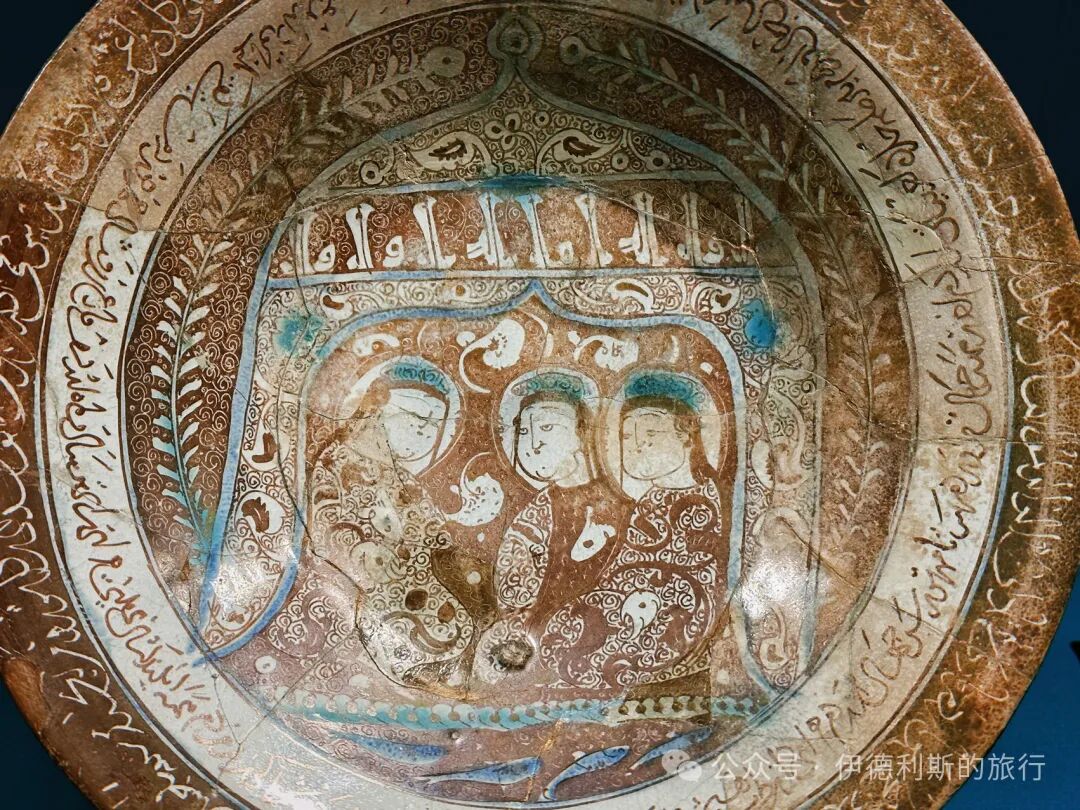
Luster-glazed ceramic plate with figure patterns from the Ilkhanate period, 13th-14th century.
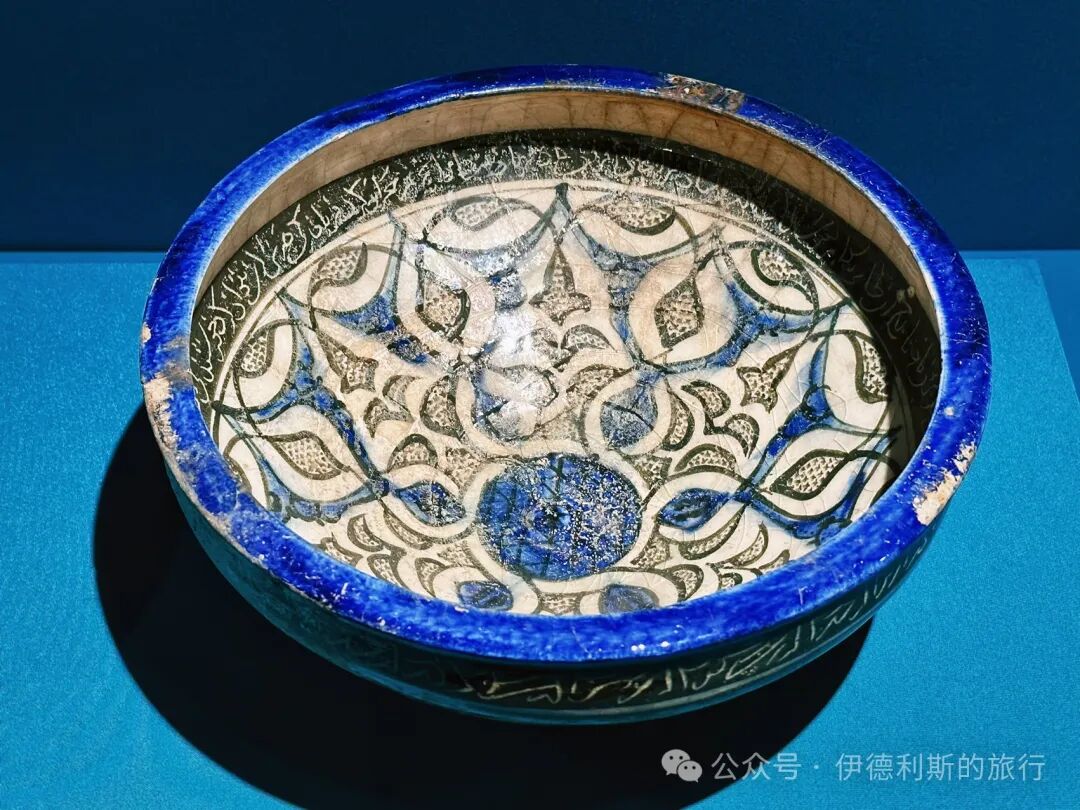
Glazed ceramic bowl with geometric patterns from the Ilkhanate period, 14th century.
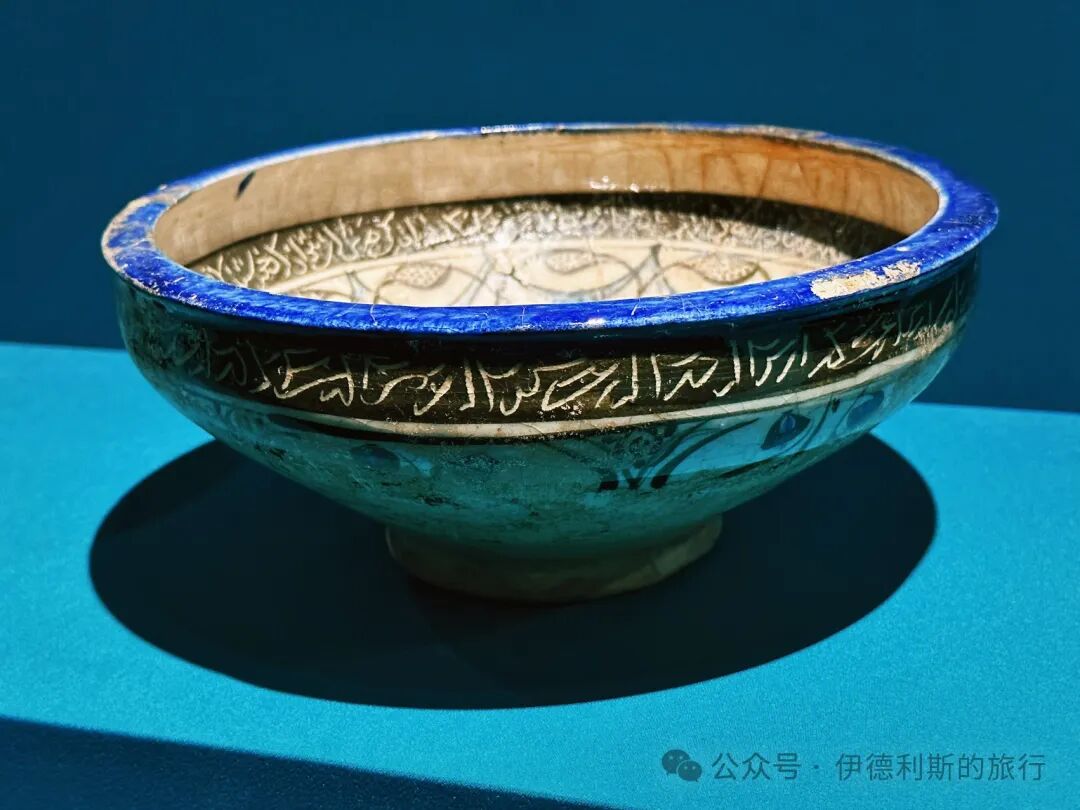
Glazed ceramic bowl with floral patterns and calligraphy from the Ilkhanate period, 13th century.
Gorgan-style luster-glazed inscription brick with Thuluth script from the Ilkhanate period, 13th-14th century.
Glassware and bronze ware from the ancient city of Gorgan.
Single-handled glass jar, 9th-10th century.
Glass ewer, 10th century.
Single-handled glass jar, 10th century.
Bird-shaped glass ewer from the Seljuk Empire, 11th-12th century.
Glass bowl with flower patterns from the Ilkhanate period, 13th century.
Glass bottle with circle patterns from the Ilkhanate period, 13th century.
Single-handled bronze ewer, 9th-10th century.
Two-handled bronze cauldron with inscriptions from the Seljuk Empire period, 12th century.
Ray.
Ray is located in the southern suburbs of Tehran and is an important ancient city in northern Iran. It is referred to as "Layi" in books like the History of Yuan. In 1043, Tuğrul Beg, the founder of the Seljuk Empire, made Ray the capital of the empire and carried out large-scale reconstruction of the ancient city. Under the rule of the Seljuk Empire, Rey reached its peak with a massive marketplace and a very prosperous trade scene. Import and export trade, mainly in silk, connected the entire Eurasian continent. At that time, Rey was the center for making painted pottery in Iran, and Rey-style painted pottery was an important handicraft of the period.
In 1220, the Mongol army invaded Rey, which was then under the rule of the Khwarazmian Empire. Because there was no fierce resistance, the Mongols did not massacre the city. Even so, the residents gradually left, and the center for pottery production moved to the southern city of Kashan.
Stucco figure from the Seljuk dynasty, 11th to 12th century.
Ceramic tile from the Seljuk dynasty, 11th to 12th century.
Single-handled pottery jar from the 9th century.
Three-handled pottery jar from the 9th to 10th century.
Blue-glazed narrow-necked pottery vase from the Ilkhanate period, 13th century.
Rey-style Mina'i glazed pottery bowl with a camel rider pattern, from the late Seljuk dynasty to the Ilkhanate period, 12th to 13th century.
Rey-style Mina'i glazed pottery bowl with a sphinx pattern, from the late Seljuk dynasty to the Ilkhanate period, 12th to 13th century.
Glazed pottery bowl with geometric patterns from the ancient city of Rey, Ilkhanate period, 13th to 14th century.
Seljuk dynasty.
Bronze ware from the Seljuk dynasty.
11th-12th century Seljuk dynasty single-handled bronze lamp with a bird figure from Quchan. Quchan is in northeastern Iran near the border with Turkmenistan. The lamp has Kufic script and scroll patterns on both sides. Similar designs were found in Nishapur, which may link to traditions in northeastern Iran.
12th century Seljuk dynasty bronze ewer with calligraphy in the Khorasan style.
12th century Seljuk dynasty bronze incense burner from Sowme'eh Sara. Sowme'eh Sara is on the Caspian Sea coast in northwestern Iran.
11th-12th century Seljuk dynasty bronze basin with a floral rim and geometric patterns from Rafsanjan. Rafsanjan is in southeastern Iran. It is the world's largest producer of pistachios and a center for carpet production in Iran.
11th-12th century Seljuk dynasty bronze candlestick with three animal-shaped feet in the Khorasan style.
Summer palace of the Ilkhanate.
Artifacts unearthed at the Takht-e Soleyman site, the summer palace of the Ilkhanate. Takht-e Soleyman is a World Heritage site that served as the summer palace for the Ilkhanate in the 13th century. The Ilkhanate blended Eastern and Iranian art here to develop a unique Ilkhanid artistic style.
Takht-e Soleyman is the only surviving secular building complex from the Ilkhanate. The walls of the Great Khan's palace still have beautiful glazed tile decorations, which directly reflect the cultural and artistic exchange between China and Iran in the 14th century. The glazed tiles show various flowers, animals, and figures. The themes cover Chinese mythology, Iranian mythology, and calligraphic scripture, showing a blend of many cultures. Some of the tile themes come from the famous Iranian epic, the Shahnameh, which shows how the Ilkhanate integrated into Iran at the time.
Late 13th to early 14th century stucco panel with bird patterns.
Late 13th to early 14th century, Lajvardina glazed tiles with deer and lion patterns.
13th to 14th century, lusterware glazed tiles with camel and sphinx patterns. Lusterware, also called iridescent glaze, is a decorative technique using a second low-temperature firing. This second firing uses a reduction atmosphere to create a shimmering metallic finish.
13th to 14th century, Lajvardina glazed tile with a dragon pattern. This piece is a signature artifact from Takht-e Soleyman, and the National Museum of Iran even sells magnets featuring it.
12th to 13th century, late Seljuk to Ilkhanate period, green-glazed pottery bowl with carved scrolling leaf patterns in panels.
Late 13th to early 14th century, lusterware glazed pottery bowl with animal patterns.
Late 13th to early 14th century, Ilkhanate period, glazed pottery bowl with a twin-ram pattern.
Kashan
Glazed pottery from the ancient city of Kashan. During the 12th to 14th centuries under Seljuk and Ilkhanate rule, Kashan was a major center for producing high-quality glazed pottery in Iran. In modern Persian, the word for tile (kashi) comes from the name Kashan.
13th to 14th century, Ilkhanate period, lusterware glazed pottery jug with one handle and a sphinx pattern.
13th to 14th century, Ilkhanate period, lusterware glazed pottery jug with human figure patterns.
13th to 14th century, Ilkhanate period, lusterware glazed pottery watering vessel with human figure patterns.
13th to 14th century, Ilkhanate period, lusterware glazed mihrab with Thuluth script inscriptions. This mihrab is definitely one of the best pieces on display at the National Museum of Iran.
14th-century Ilkhanate period, Saveh, Lajvardina glazed molded inscription tile. Saveh is located southwest of Tehran and was an important city during the Ilkhanate period. Lajvardina is an overglaze technique known for its lapis lazuli-like blue base glaze, often seen on building facades from the Ilkhanate period.
14th-century Ilkhanate period, Sultanabad, glazed pottery bowl with mythical bird and deer patterns. The bowl depicts the Simurgh, a mythical bird from Persian legends. During the Sassanid Empire, the Simurgh was depicted with a dog's head and a peacock's tail, but it transformed into a peacock-like image under Chinese influence during the Ilkhanate period.
Timurid Dynasty
14th-15th century Timurid period, Borujerd, silver-inlaid bronze stemmed bowl.
14th-century Timurid period, Khorasan region, mosaic tile with checkerboard Kufic script.
16th-17th century Shahsavar, overglaze painted tile with human figures.
Safavid Dynasty
16th-17th century Isfahan province, stucco panel with calligraphic inscriptions.
17th-century Amol, blue glazed pottery bowl with floral patterns. Amol is located on the Caspian Sea coast. It was a major trading hub in history and continued to grow during the Safavid Dynasty, becoming a favorite residence of the Safavid King Abbas II, who reigned from 1632 to 1666.
16th-century Amol, blue and white porcelain plate.
17th-century glazed pottery plate with underglaze floral patterns from northern Iran.
16th-century bronze incense burner with a dragon head from Yazd Province.
16th-century bronze plate with floral patterns and inscriptions from Kermanshah Province.
16th-century bronze candlestick from Isfahan. In 1598, Safavid King Abbas I (reigned 1588-1629) made Isfahan his capital. He rebuilt it into a prosperous and beautiful city, and Isfahan entered a golden age of culture. view all
Reposted from the web
Summary: Islamic Art Guide: Iranian Artifacts at Beijing Forbidden City (Part 1) is presented here as a firsthand travel account in clear, natural English. The account focuses on Iranian Art, Forbidden City, Islamic Heritage while preserving the names, places, food, photos, and historical details from the Chinese source.
The East Wing of the Meridian Gate at the Forbidden City hosted the 'Splendors of Persia: Exhibition of Iranian Cultural Relics' from January 12 to April 11, 2024. The National Museum of Iran sent many precious artifacts for everyone to enjoy.
I visited the National Museum of Iran in 2019, as seen in my article 'Exhibition Notes from the Museum of the Islamic Era in Iran'.
I will share some of the artifacts from the exhibition with you below.
Was the Zhengde Emperor's Islamic name 'Suleiman'?
For this Iranian exhibition at the Meridian Gate, the Forbidden City contributed a heavyweight artifact: a white-glazed, iron-red decorated plate with Arabic and Persian inscriptions, fired at the imperial kilns during the Zhengde period (1506–1521) of the Ming Dynasty. Previously, the Wuyingdian Ceramics Gallery only displayed the front, but this time we finally got to see the bottom of the plate, which holds much more information.
According to Li Yihua's 1984 article 'Two Pieces of Zhengde-era Arabic and Persian Porcelain—Also Discussing the Influence of Islamic Culture' in the 'Journal of the Palace Museum', this is the only red-decorated piece among the more than 20 pieces of Zhengde Arabic and Persian porcelain in the Forbidden City's collection. The wall of the plate features a Hadith: 'The Exalted and Majestic Lord says, whoever does a good deed the size of a speck of dust, (or) whoever does a bad deed the size of a speck of dust, He will see it; this is the reward for those who do good.' The most interesting part is the three lines of text on the bottom of the plate. Li Yihua interpreted them as 'Dimani Khan, namely Aman Suleiman Shah,' and suggested it might have been commissioned for a country in the Arab region. However, some scholars lean toward the idea that 'Dimani Ke' should be 'Da Mink,' meaning 'Great Ming.' Based on this, the text reads 'The ruler of the Great Ming is King Suleiman.' This means the Zhengde Emperor's Islamic name was likely 'Suleiman,' which is why some people jokingly call this piece 'King Solomon's Treasure'.
During the Zhengde period, the palace was very fond of using porcelain with Arabic and Persian inscriptions. Most were bowls, cups, brush rests, and boxes with the same shapes as official kiln wares, and the content was mostly Quranic verses, Hadith, and praises. According to research by Professor Jin Liyan and records in the 'Veritable Records of the Joseon Dynasty,' the Zhengde Emperor studied Islamic knowledge in 1509 (the third year of Zhengde): 'Hearing that Hui Muslims do not eat meat slaughtered by others, but must slaughter it themselves, and that they have kind hearts and read scriptures, he invited them into the palace to learn from them.'
The largest astrolabe from the National Museum of Iran
The National Museum of Iran brought its largest astrolabe for this exhibition. It weighs five kilograms, is over forty centimeters in diameter, and is made of six pieces of brass. It uses scales to mark geographical zones, and the crown-shaped decoration at the top is engraved with the names of two rulers from the Safavid and Qajar dynasties on either side.
The astrolabe comes from the famous Golestan Palace in Tehran. Golestan Palace was the royal palace of the Qajar dynasty and was listed as a UNESCO World Heritage site in 2013. Golestan Palace was first called Tehran Citadel. It was built during the reign of Tahmasp I (ruled 1524-76) of the Safavid dynasty and rebuilt during the reign of Karim Khan (ruled 1750-79) of the Zand dynasty. After Agha Mohammad Khan (ruled 1789-97) of the Qajar dynasty made Tehran the capital, he officially converted Tehran Citadel into Golestan Palace. Between 1925 and 1945, Reza Shah (ruled 1925-41) of the Pahlavi dynasty ordered the demolition of most of Golestan Palace for modern urban construction. Modern-style commercial buildings were built there one after another during the 1950s and 1960s.
Sheikh Safi al-Din Shrine (gongbei)
For this exhibition at the Meridian Gate of the Forbidden City, the National Museum of Iran brought a large number of Ming dynasty porcelains from the Sheikh Safi al-Din Khānegāh and Shrine Ensemble (gongbei). It was a real eye-opener, as I did not get to see these porcelains when I visited the National Museum of Iran before.
Sheikh Safi al-Din (1252-1334) was a Kurdish Sufi master during the Ilkhanate period and the founder of the Safaviyya order. This order eventually established the Safavid dynasty in 1501. After the Safavid dynasty was established, they expanded the Sheikh Safi al-Din Shrine (gongbei) in Ardabil, northwestern Iran, on a large scale between the 16th and 18th centuries, turning it into a massive building complex. The Porcelain House, built in the 17th century, has a huge cross-shaped space. The small niches densely packed on the walls were once filled with Chinese porcelain. Today, most of these porcelains are kept in museums in Tehran.
16th-century Ming dynasty blue and white porcelain with cloud and crane patterns.
15th-16th-century Ming dynasty blue and white ewer with openwork, peacock and peony patterns, and lotus scroll patterns, featuring unglazed panels.
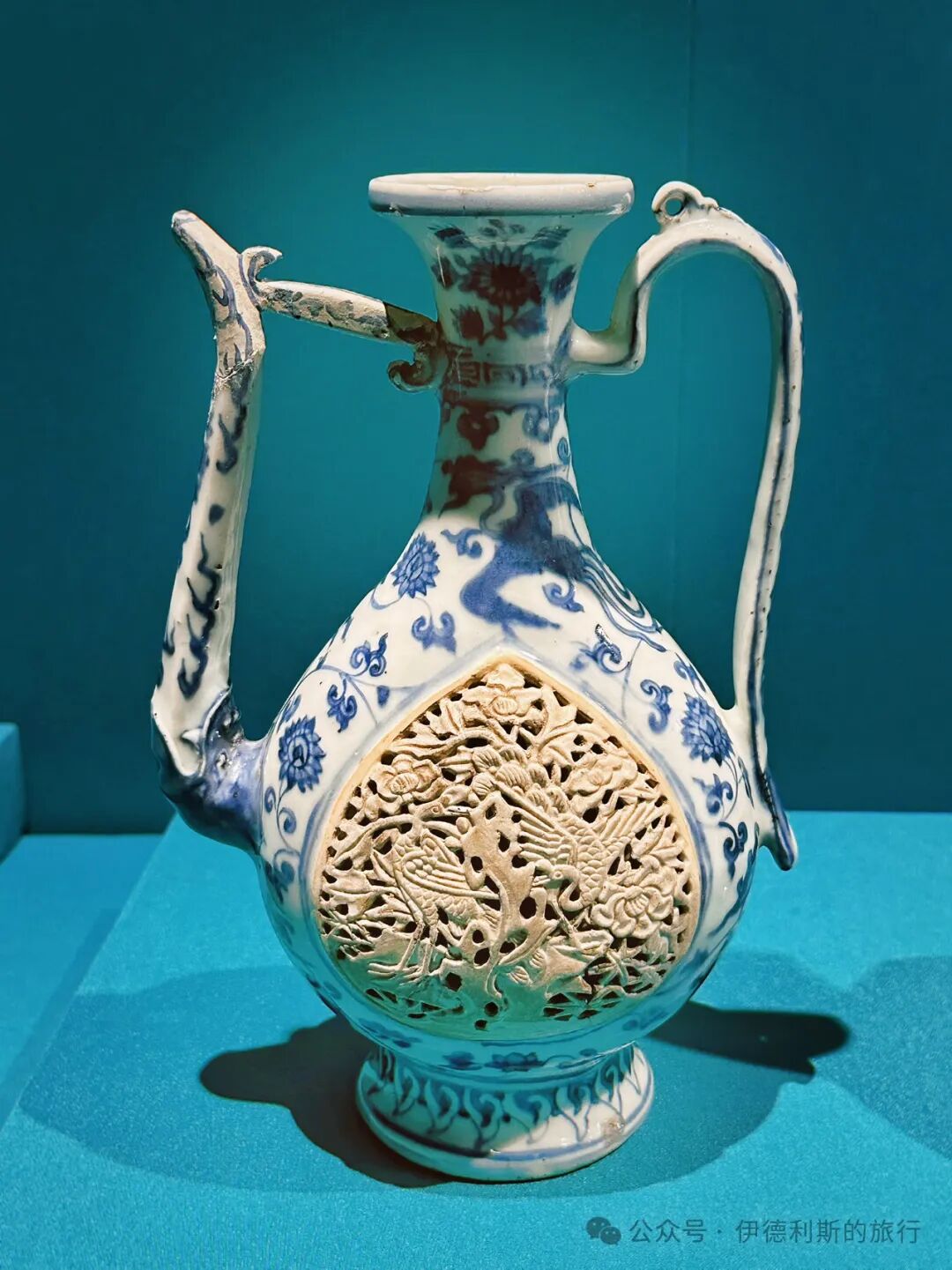
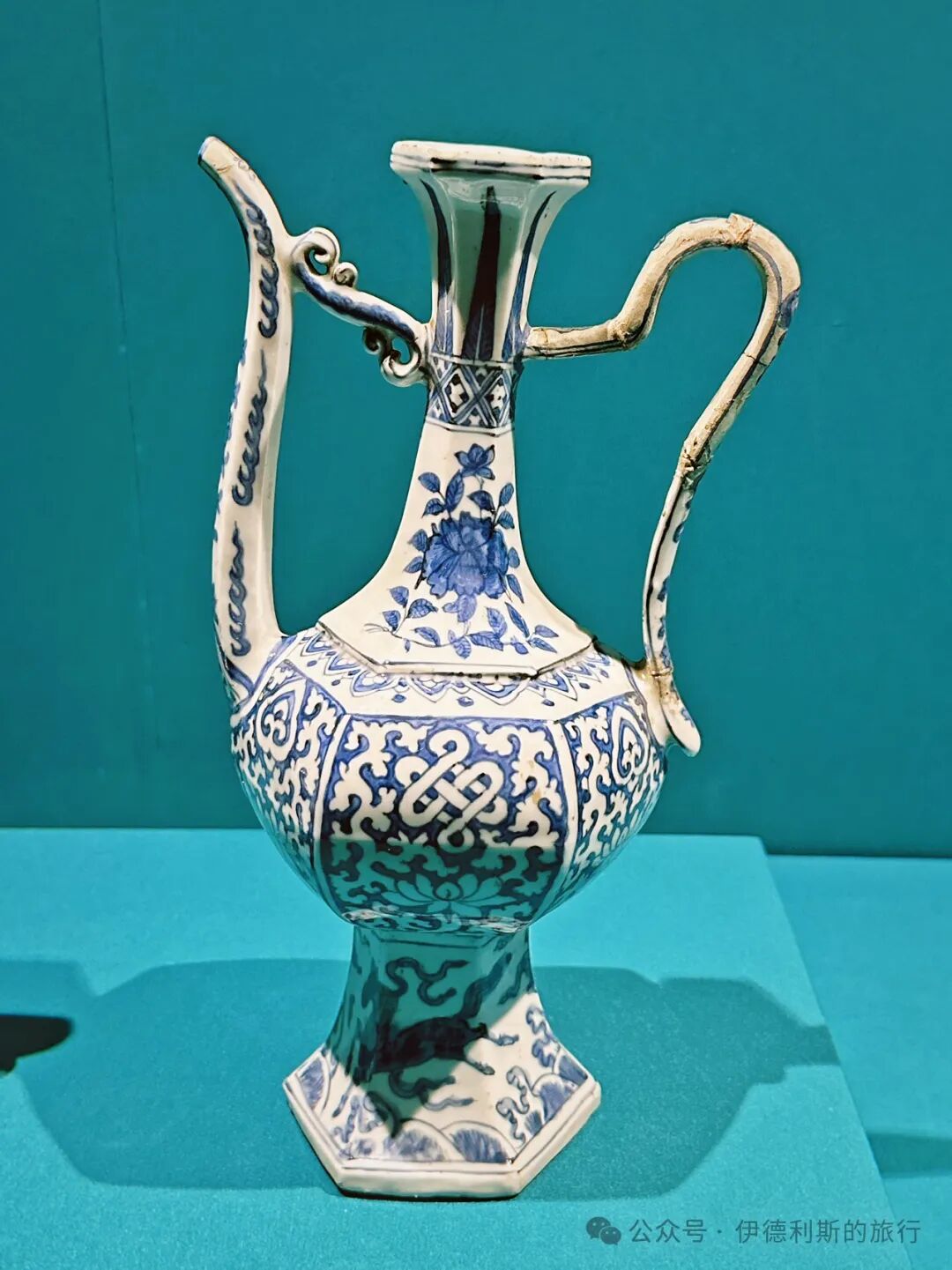
Late 16th-century Ming dynasty blue and white ewer with seahorse and floral patterns.
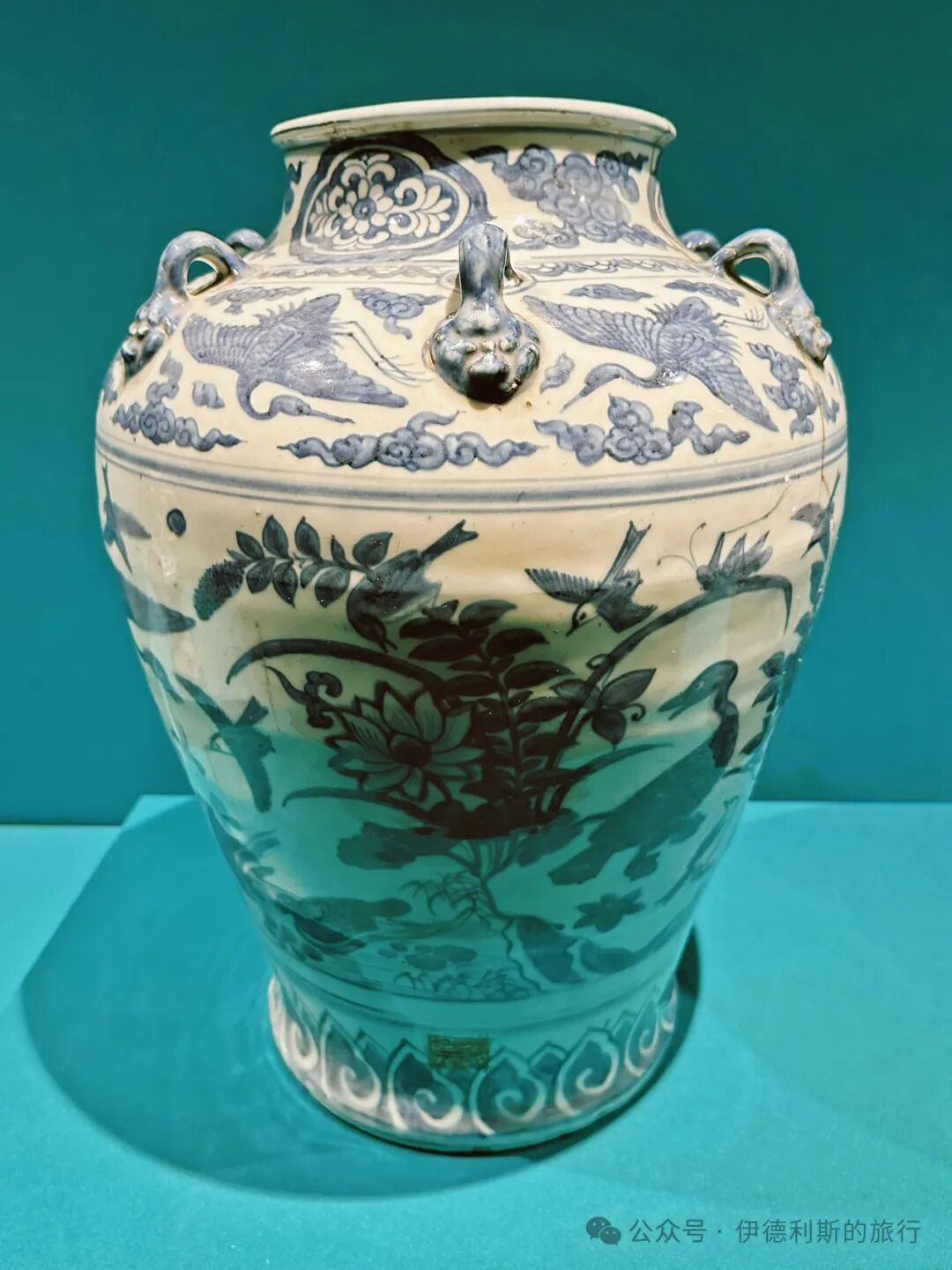
Late 16th-century Ming dynasty blue and white jar with bird and flower patterns.
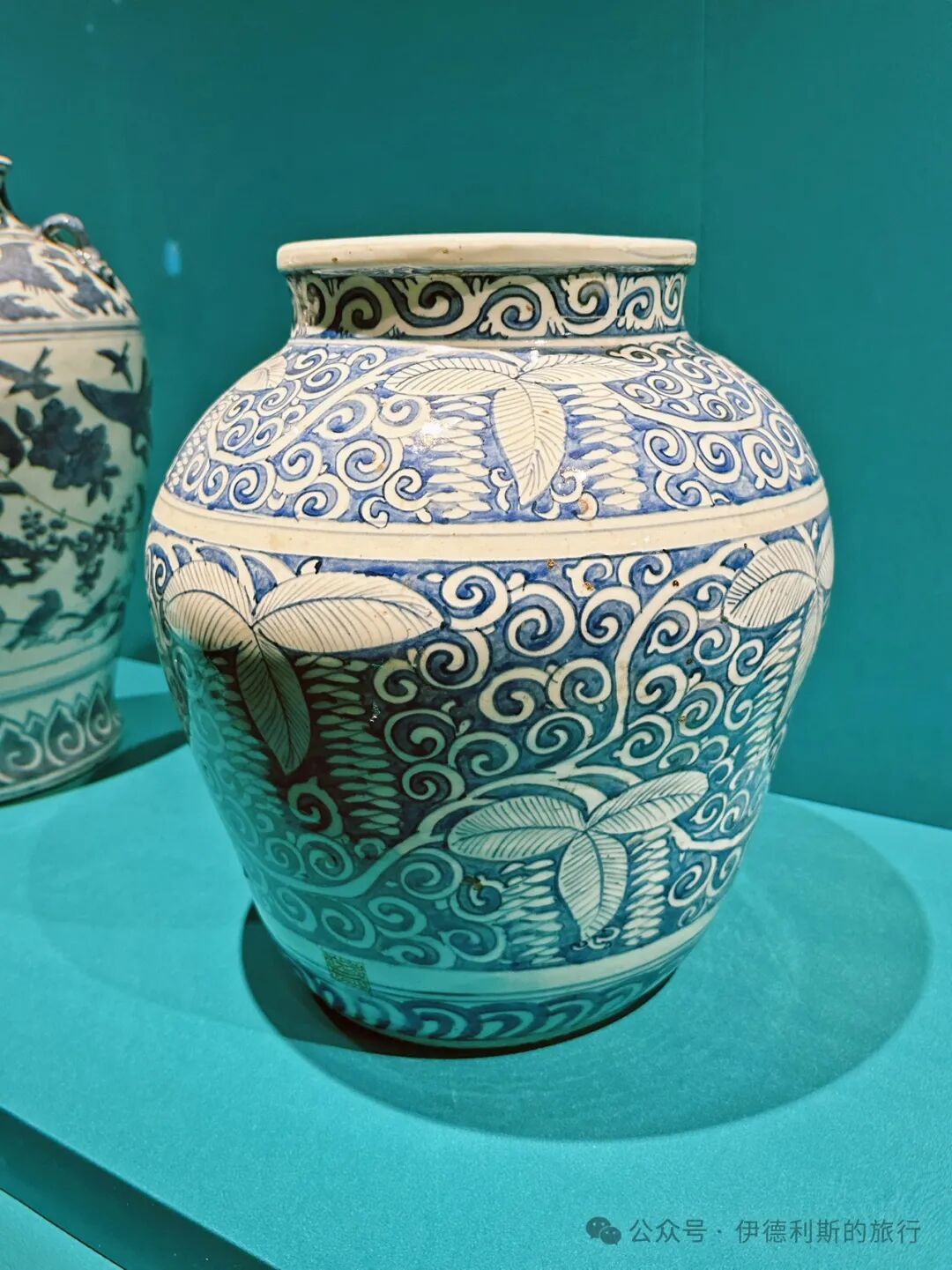
Late 16th-century Ming dynasty blue and white jar with scrolling vine patterns.
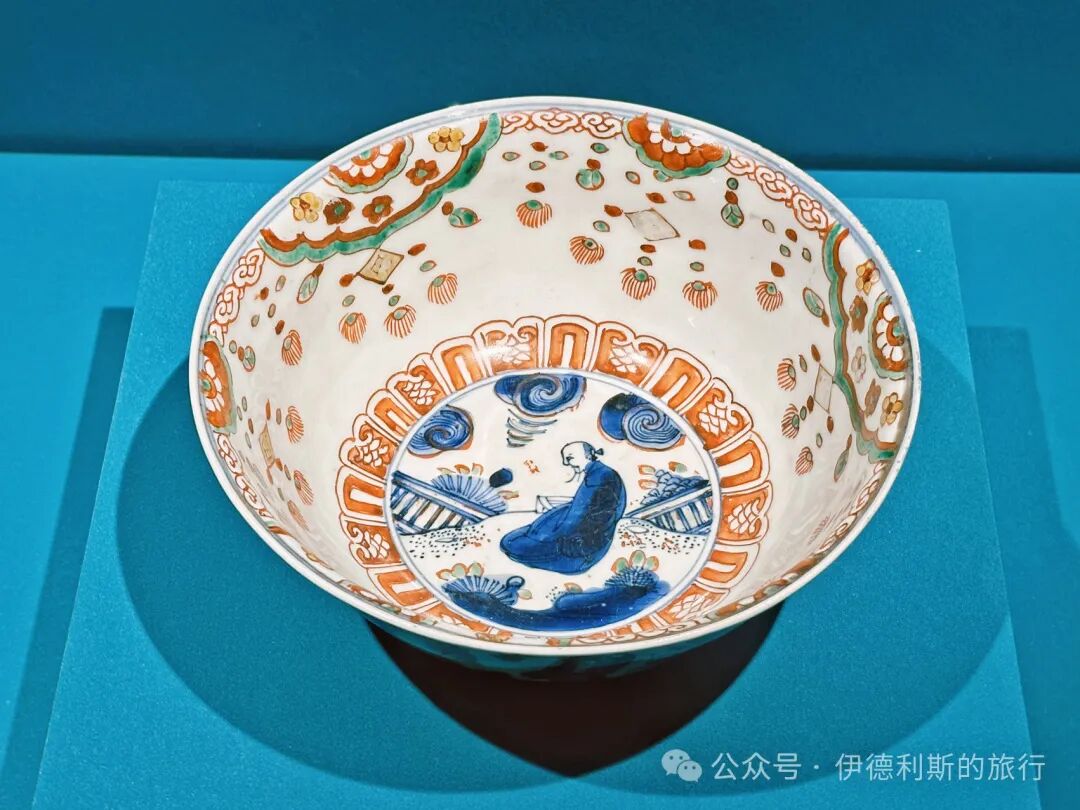
16th-century Ming dynasty blue and white bowl with polychrome figure patterns.
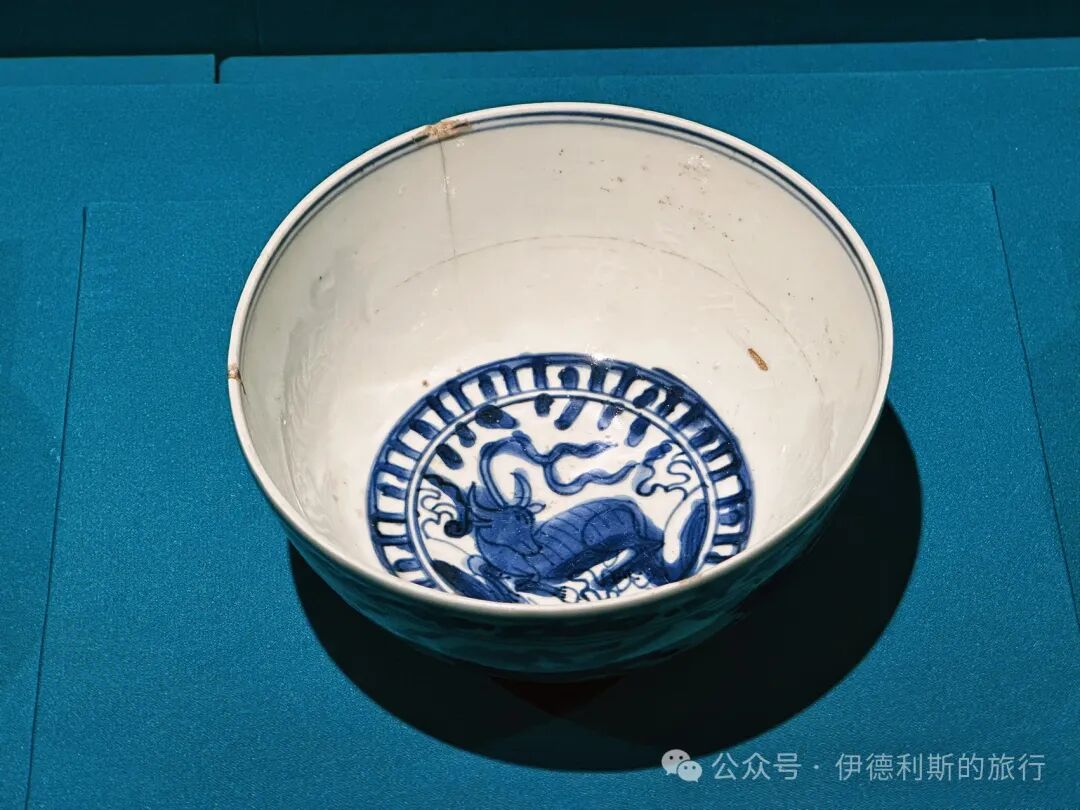
16th-century Ming dynasty blue and white porcelain bowl with seahorse and floral patterns.
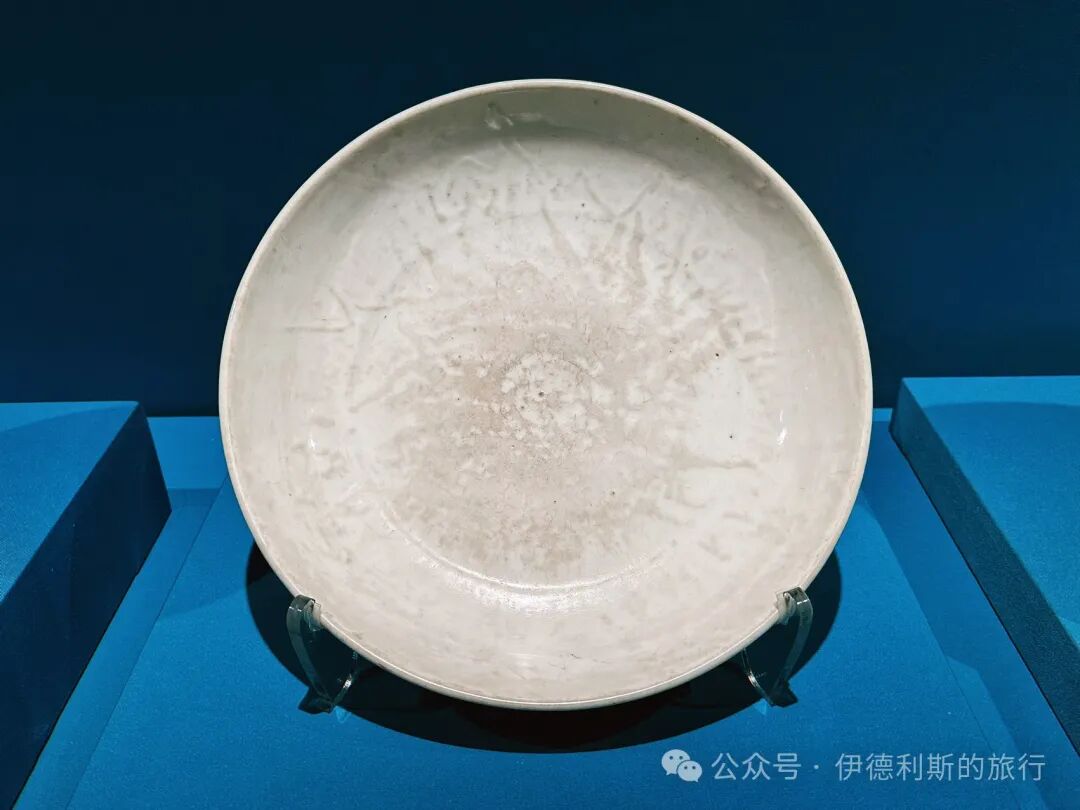
Early 15th-century Ming dynasty white porcelain plate.
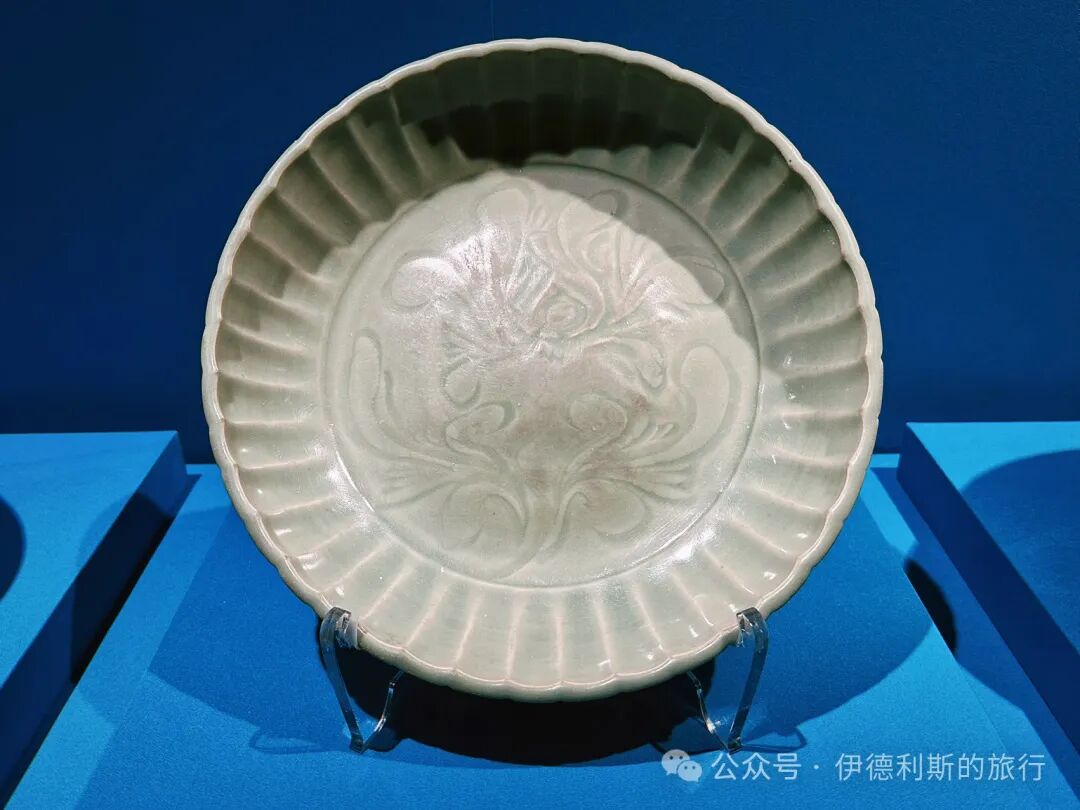
15th-century Ming Dynasty celadon plate with chrysanthemum petal patterns.
15th-century Ming Dynasty celadon plate with floral branch patterns.
14th-century Yuan Dynasty blue and white plate with phoenix and flower patterns. The outer wall is stamped with the seal of the Abbasid Caliph.
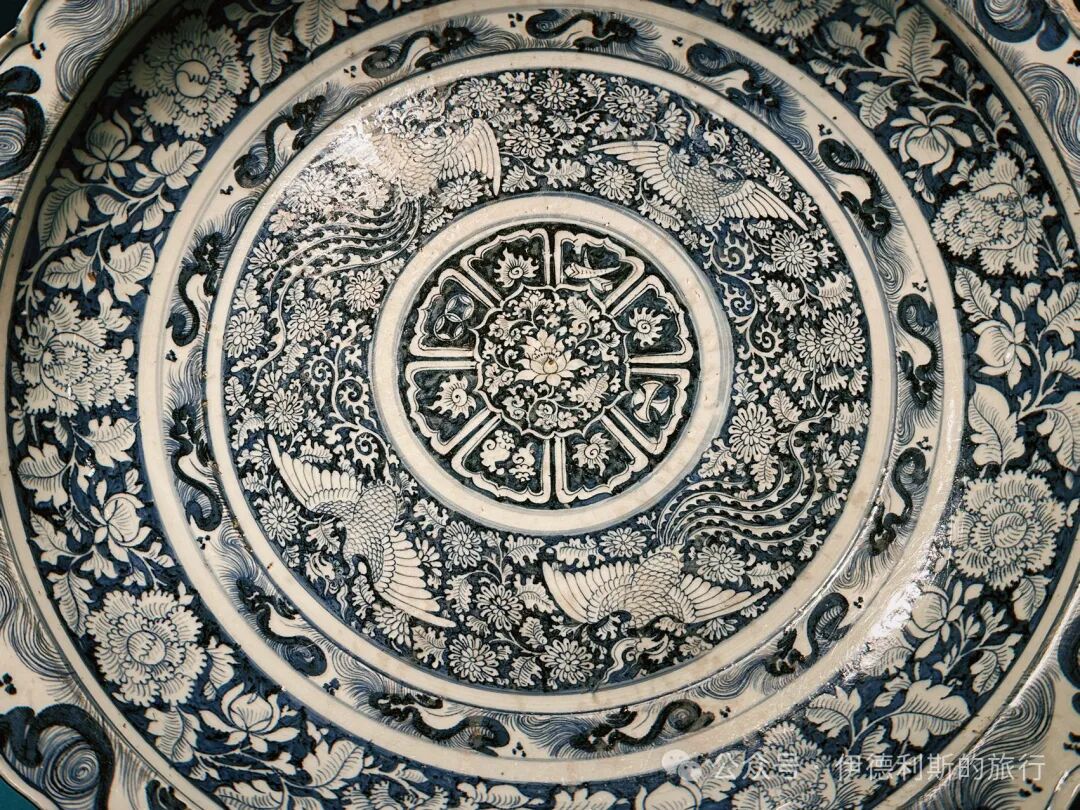
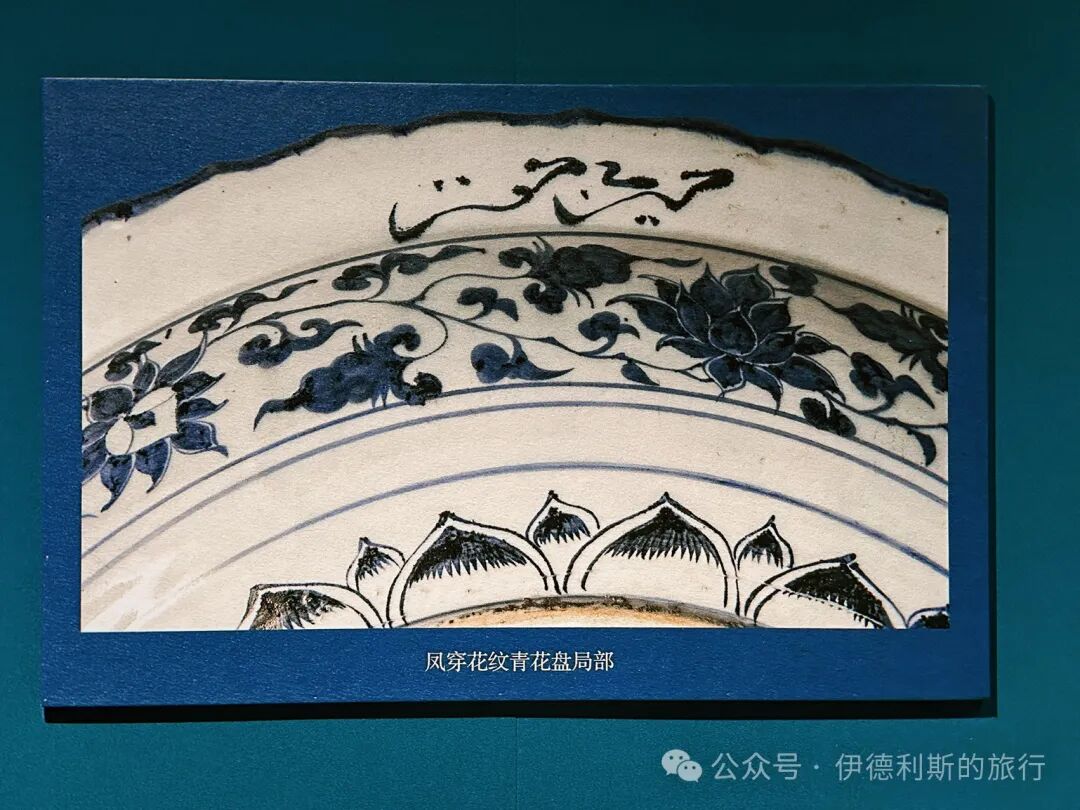
Late 14th to early 15th-century Yuan and Ming Dynasty large celadon plate.
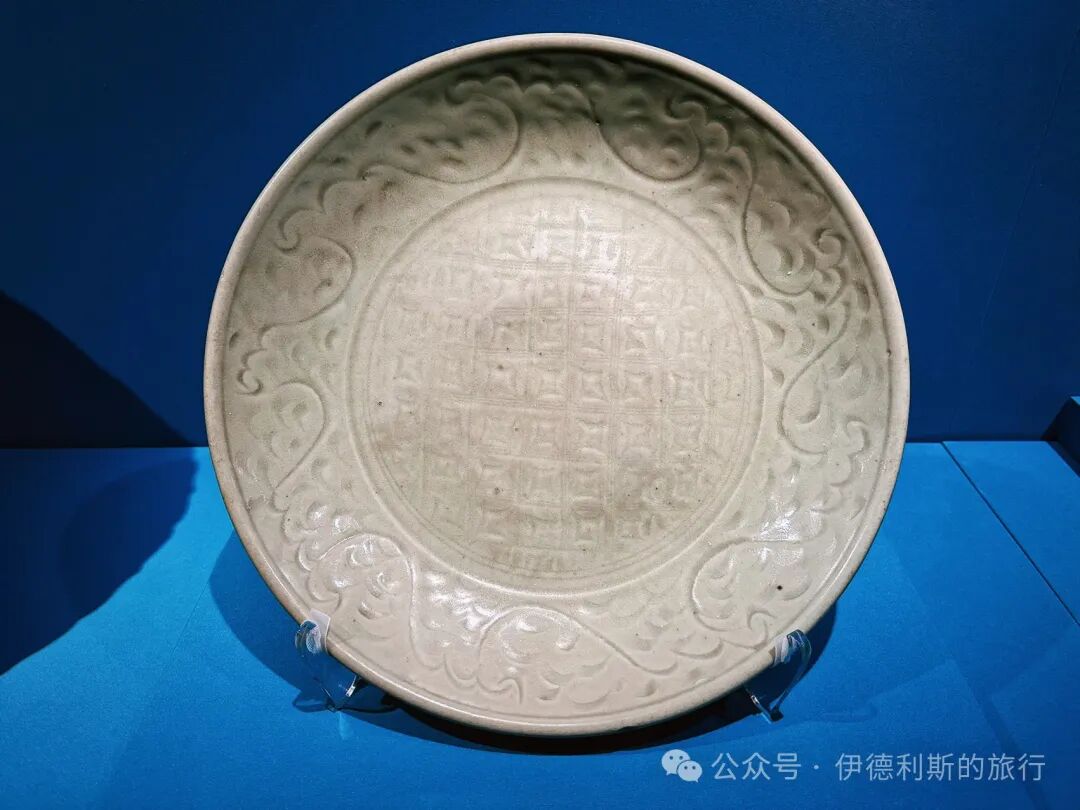
Early 16th-century Ming Dynasty blue and white bowl with Arabic script and Xuande mark.
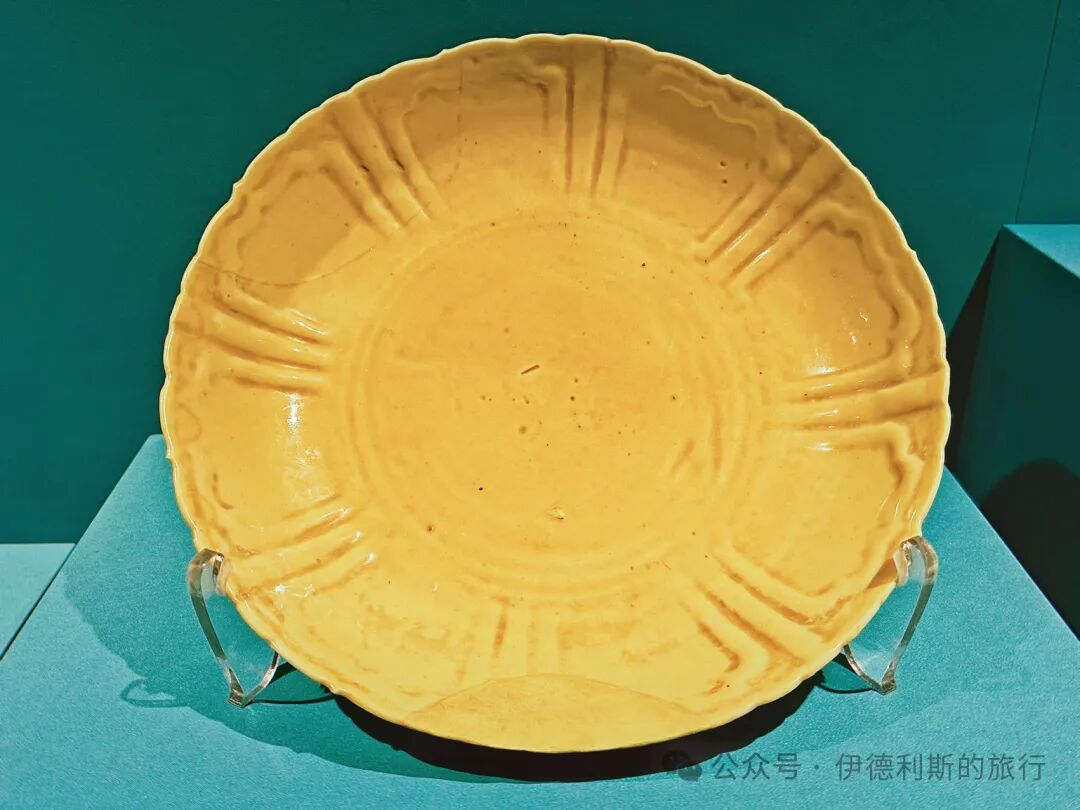
16th-century Ming Dynasty yellow-glazed plate.
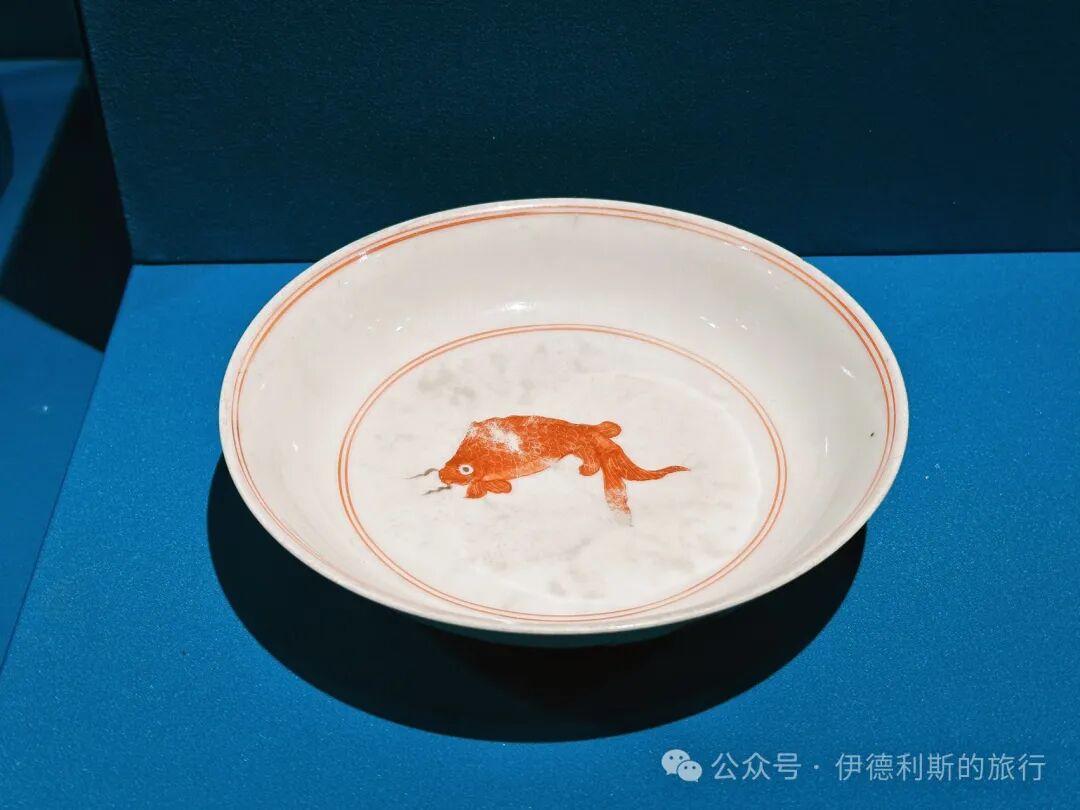
Late 16th-century Ming Dynasty iron-red glazed porcelain plate with fish patterns.
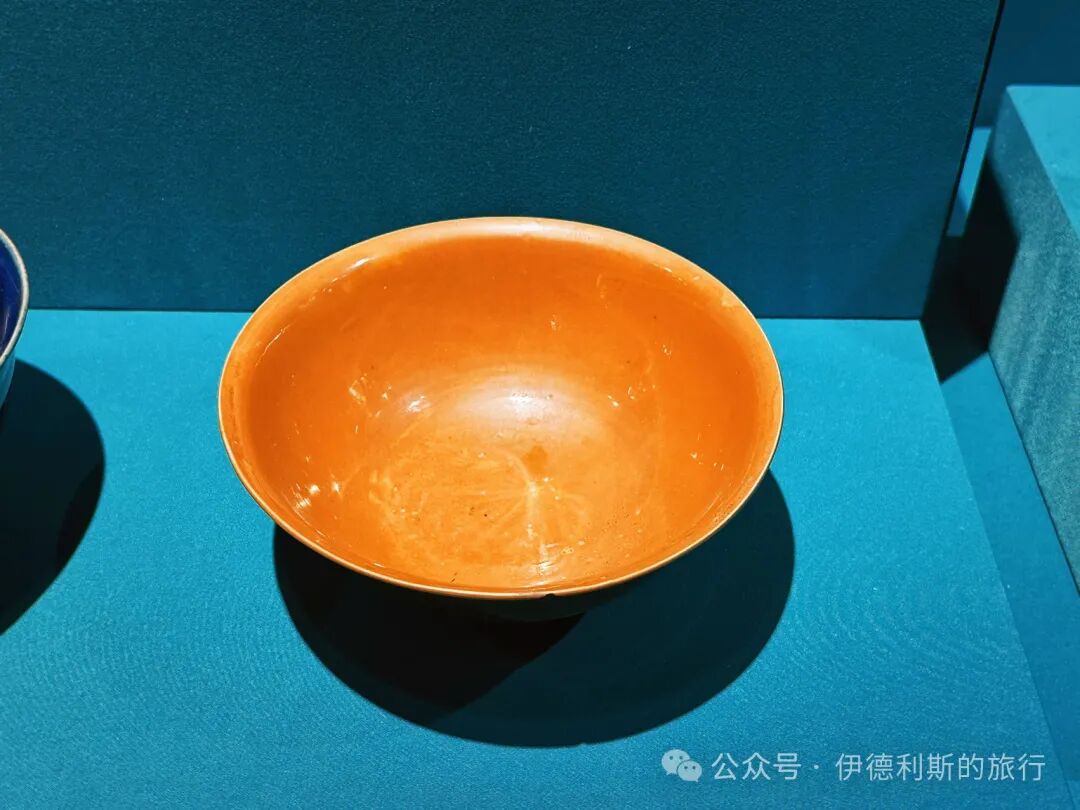
16th-century Ming Dynasty brown-glazed bowl with Jiajing mark.
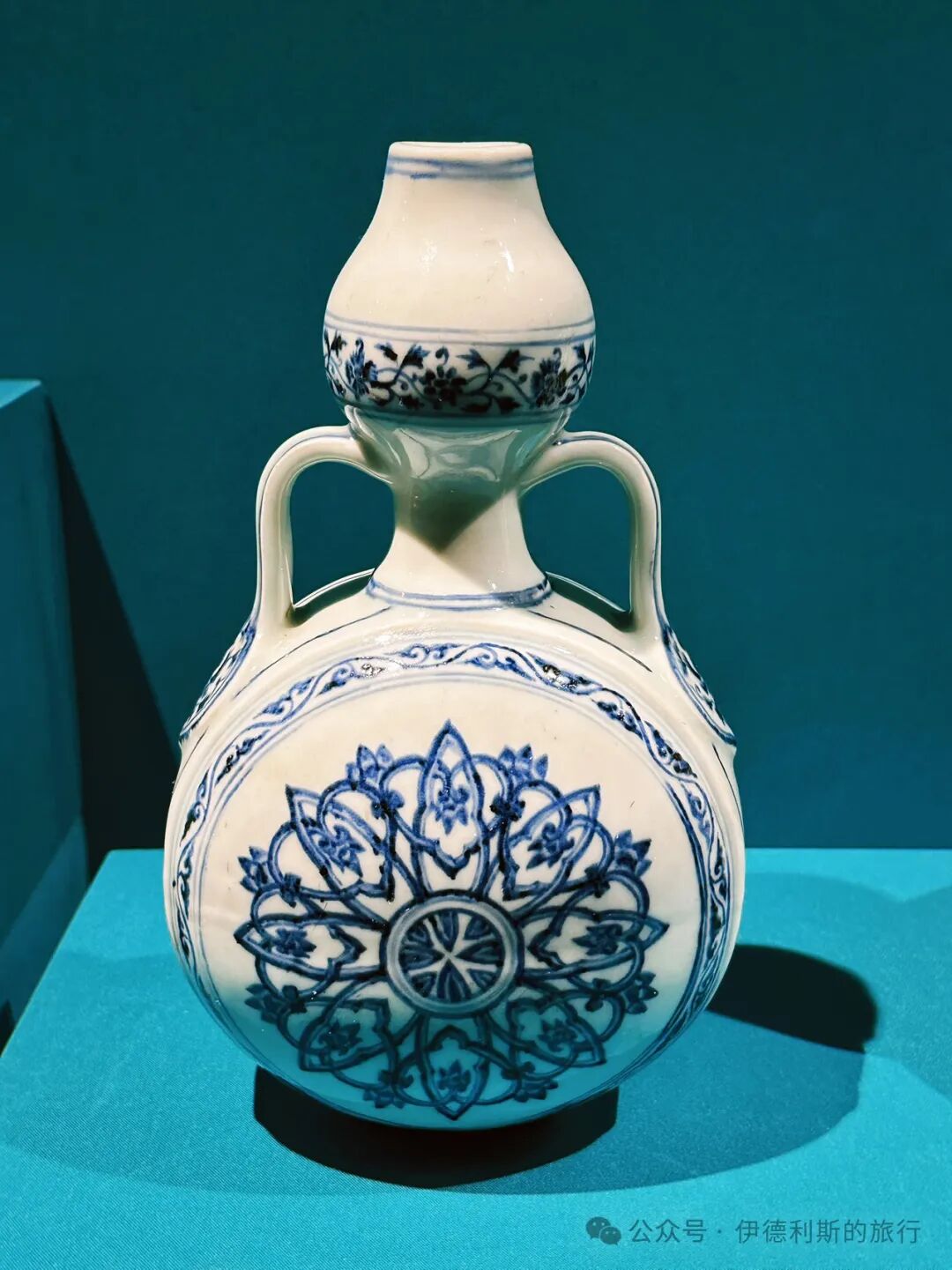
Late 15th-century Ming Dynasty blue and white moon flask with arabesque patterns.
Late 14th-century Ming Dynasty blue and white ewer with scrolling flower patterns.
15th-century Ming Dynasty blue and white plum vase (meiping) with scrolling lotus patterns. The vase body is stamped with the seal of the Abbasid Caliph, which can also be seen on other items in this exhibition. The text reads, 'Abbas, servant of the King of Supreme Power, dedicated to King Safi'. After the Mongol army destroyed Baghdad in 1261, the Mamluk Sultanate in Egypt re-established the Abbasid Caliphate in Cairo. The Abbasid Caliphs in Egypt continued to serve as religious authorities but could not get involved in secular affairs. In 1517, the Ottoman Empire conquered Cairo, the last Abbasid Caliph was taken to Istanbul, and the Abbasid Caliphate came to an end.
A 16th-century Ming Dynasty jade cup with a dragon-shaped handle and beast-ear decorations, featuring the seal of the Abbasid Caliph carved on the bottom.
A 17th-century brass candlestick from the Safavid Dynasty.
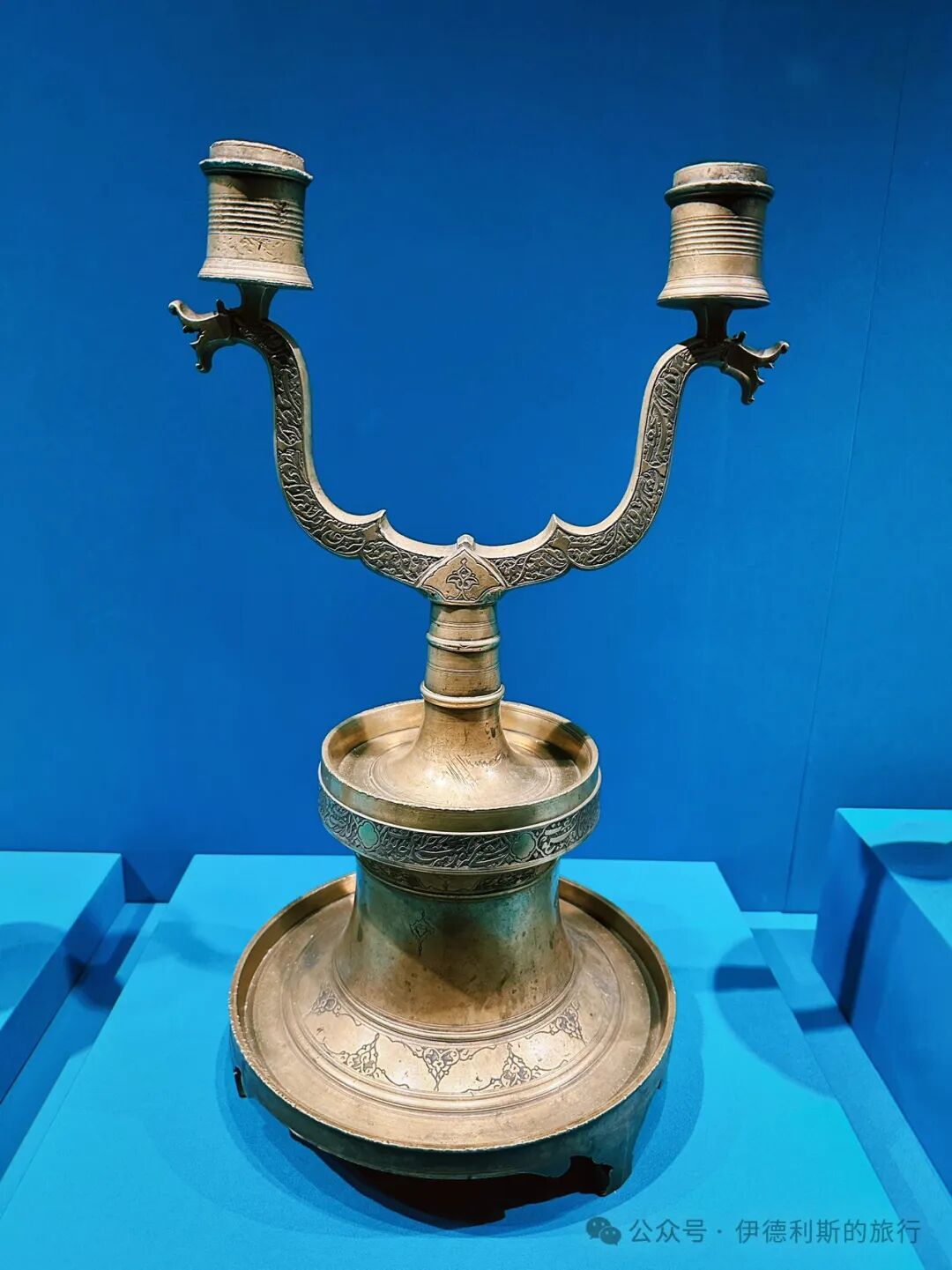
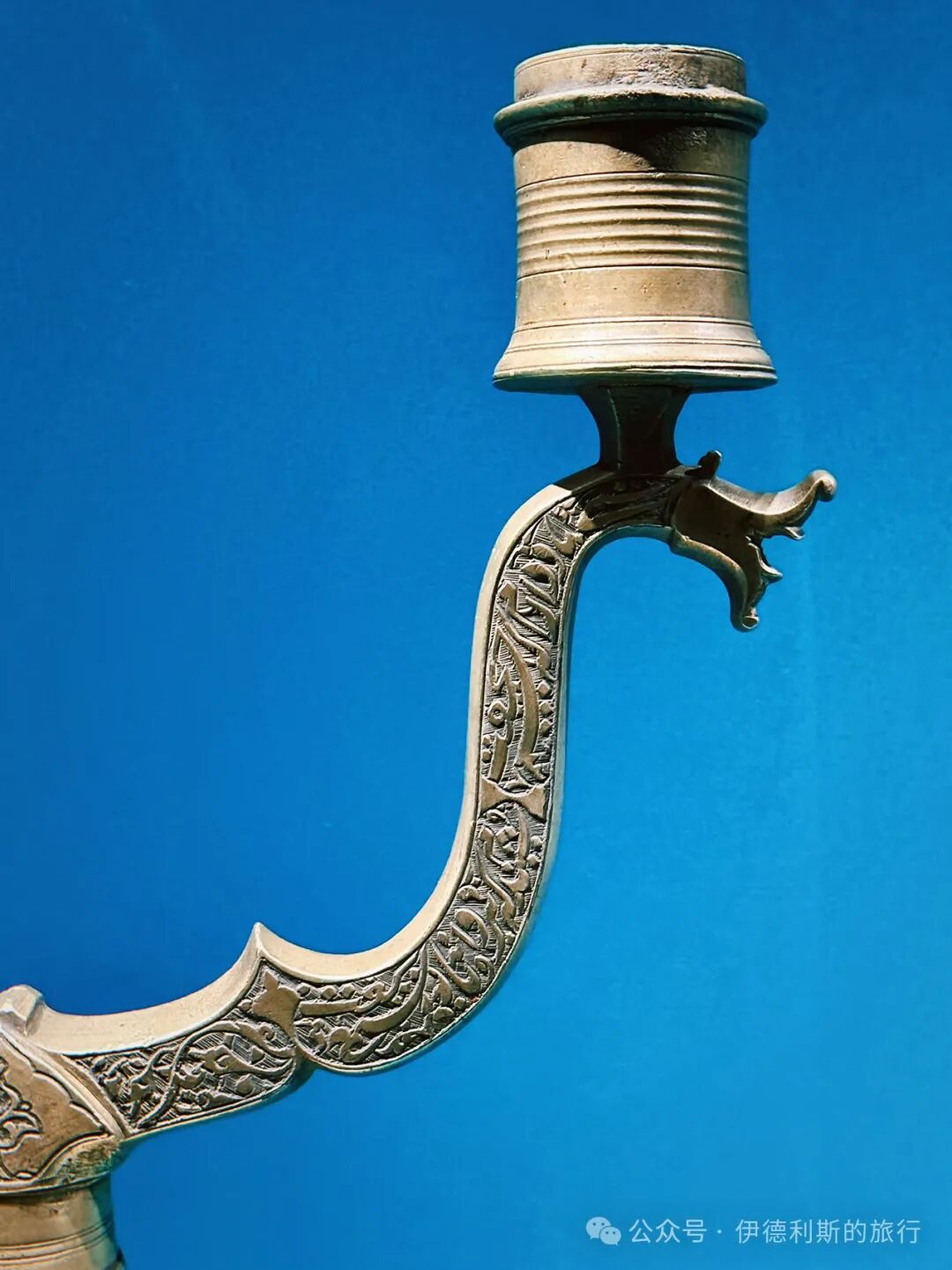
A 16th-17th century double-headed brass candlestick from the Safavid Dynasty, engraved with Persian poetry by the famous poet Saadi:
One night I could not sleep and stayed awake all night,
I heard a conversation between a moth and a candle.
I am a lover who burns willingly with all my heart,
Why do you cry out in pain with tears streaming down?
Nishapur
Nishapur is an ancient city on the Silk Road in northeastern Iran, once one of the four major cities of the Greater Khorasan region. Nishapur became the capital of the Persian Tahirid Dynasty in the 9th century, grew into an important cultural and commercial hub under the Persian Samanid Dynasty in the 10th century, and continued to thrive during the Seljuk Empire in the 11th century. Between the 9th and 11th centuries, trade routes from Transoxiana in Central Asia, China, Iraq, and Egypt met here. Glazed pottery produced in Nishapur at that time became a major trade commodity in the West, rivaling Baghdad and Cairo.
In 1221, Nishapur was massacred by the Mongols and then destroyed, leaving the former metropolis buried deep underground. It was not until archaeological excavations by the Metropolitan Museum of Art in New York between 1935 and 1940 that countless artifacts were discovered beneath the farmland. Today, most of the excavated Nishapur artifacts are kept at the Metropolitan Museum of Art, as well as in museums in Tehran and Mashhad.
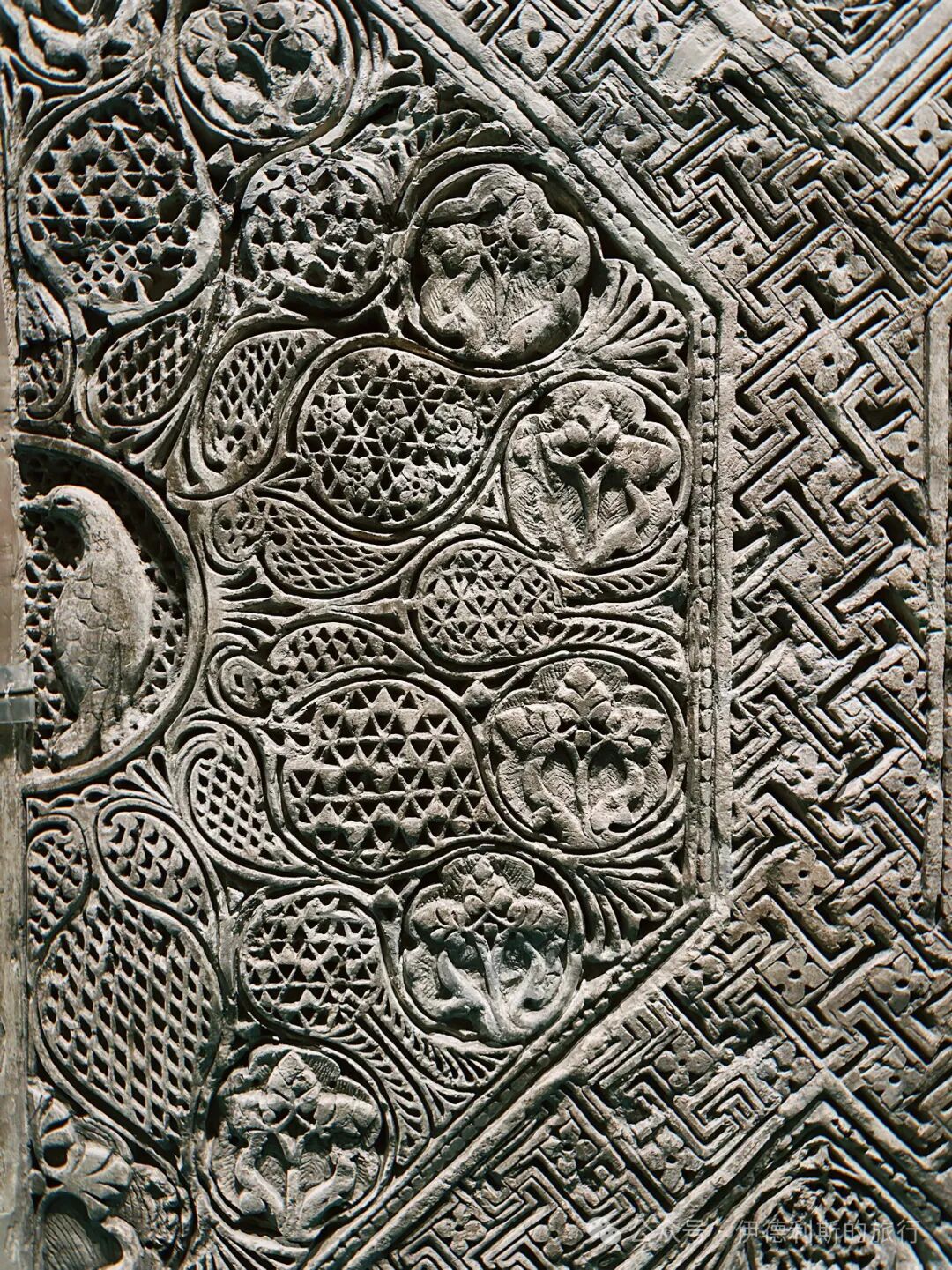
A 10th-11th century stucco panel with floral patterns.
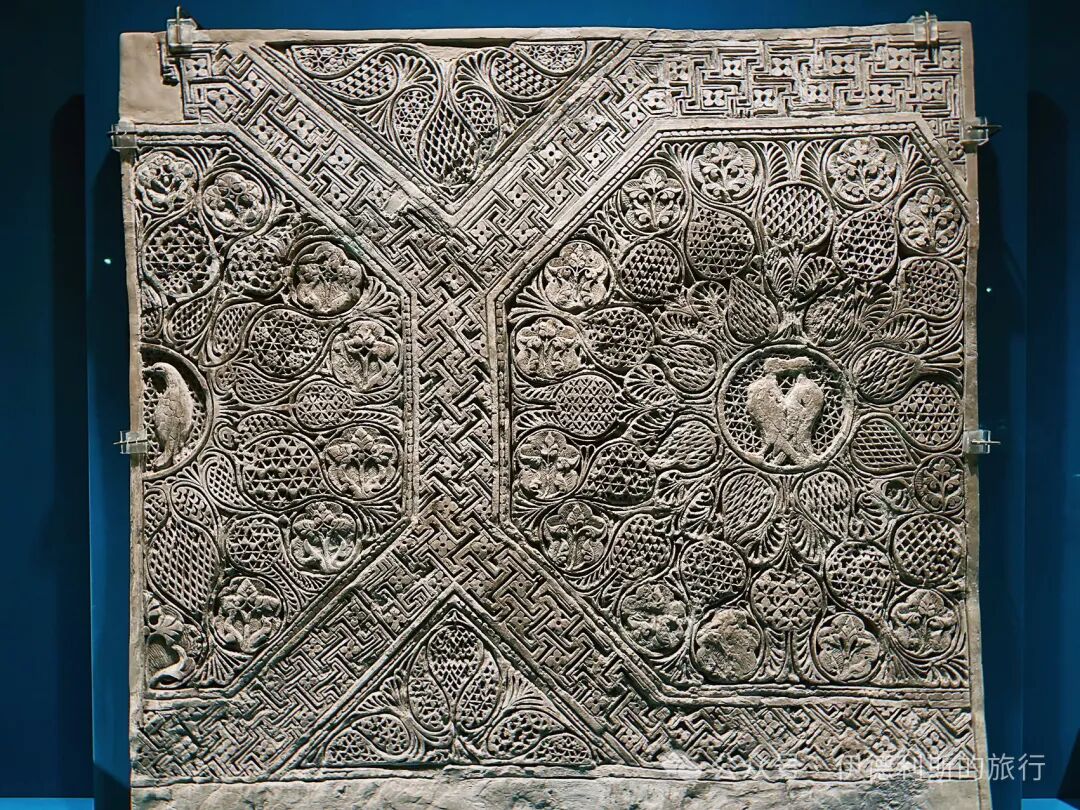
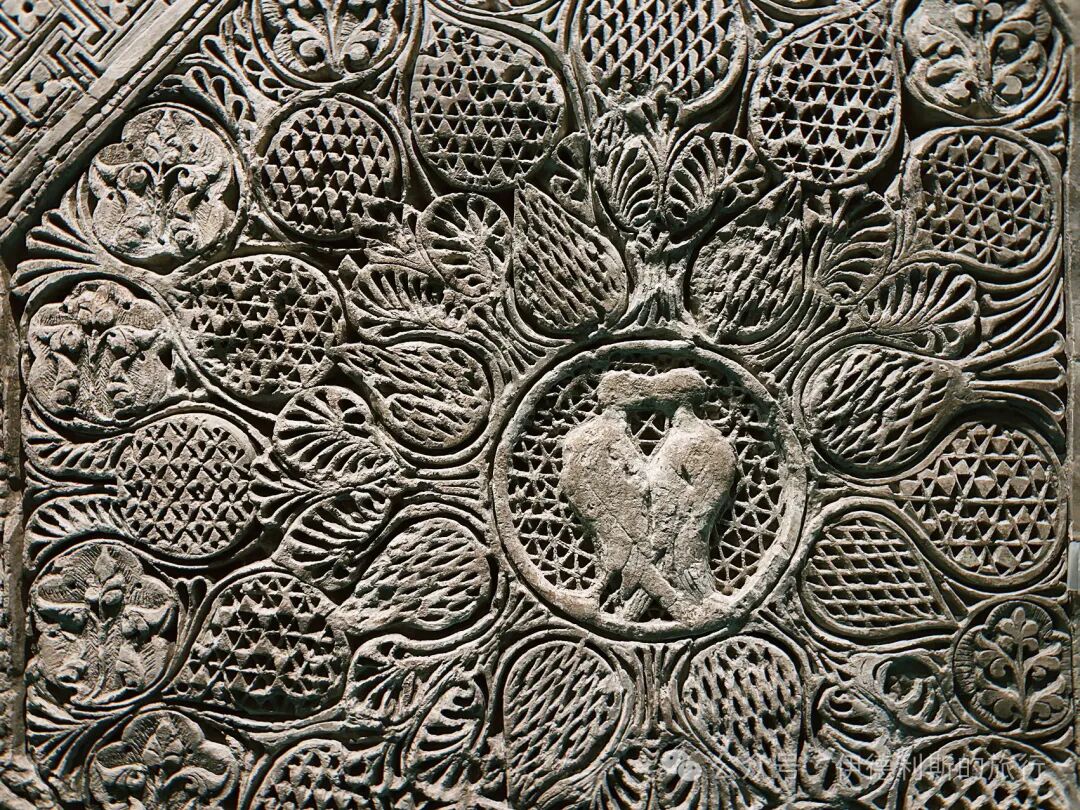
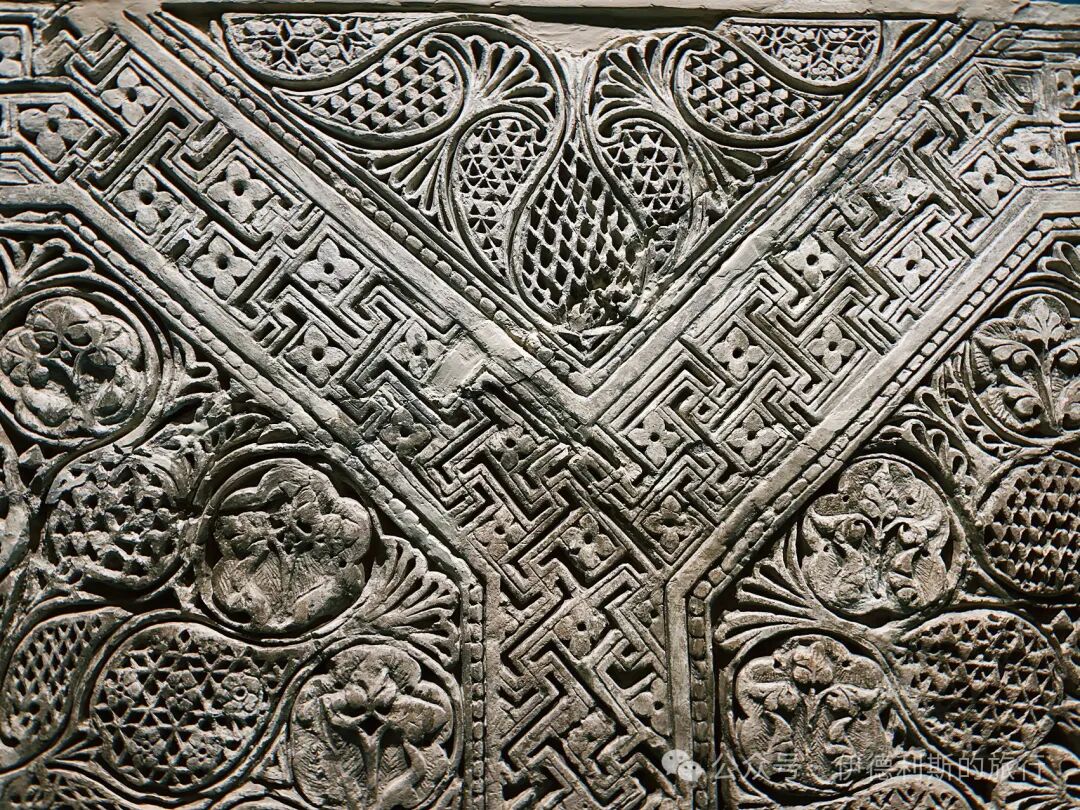
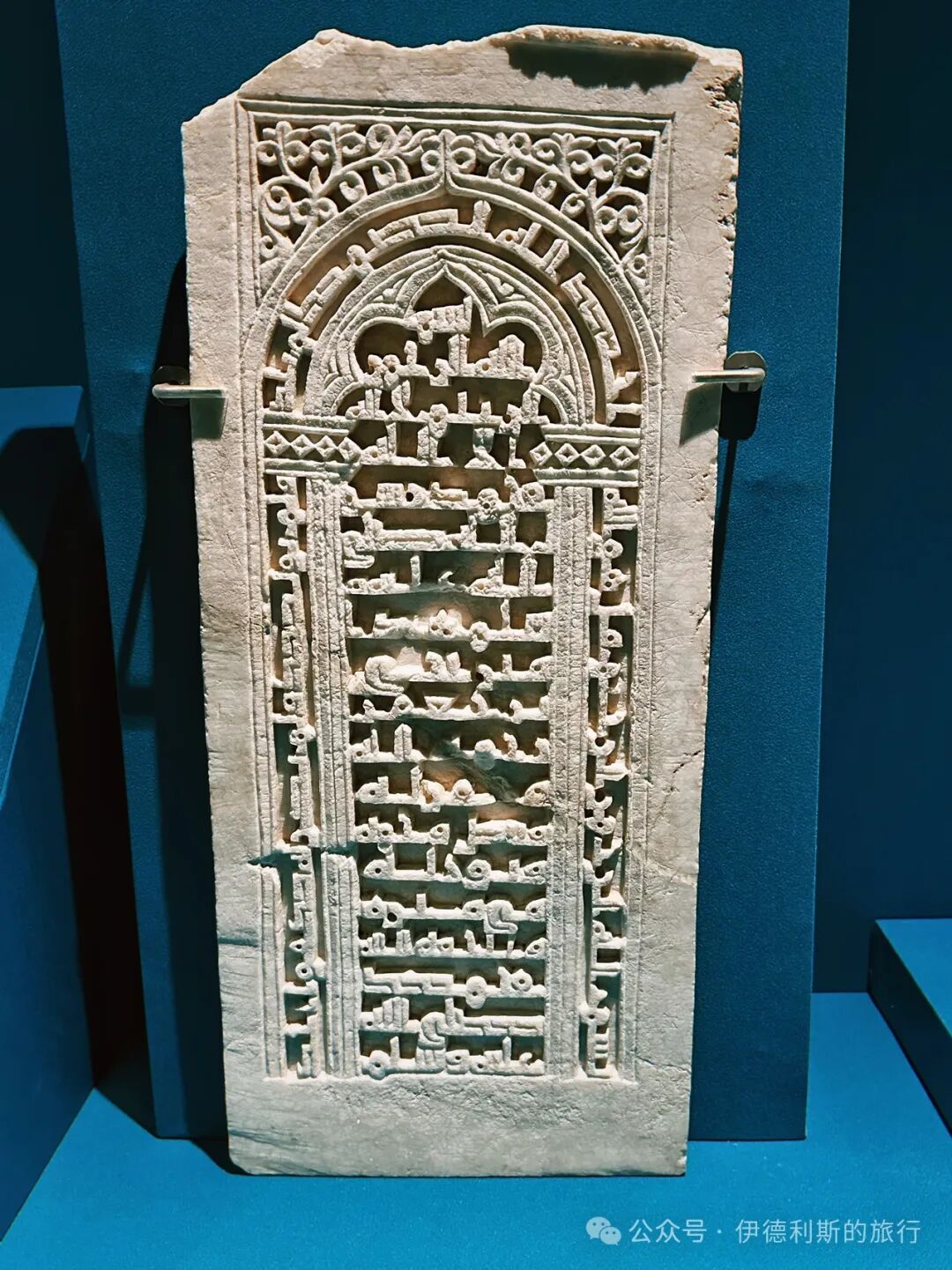
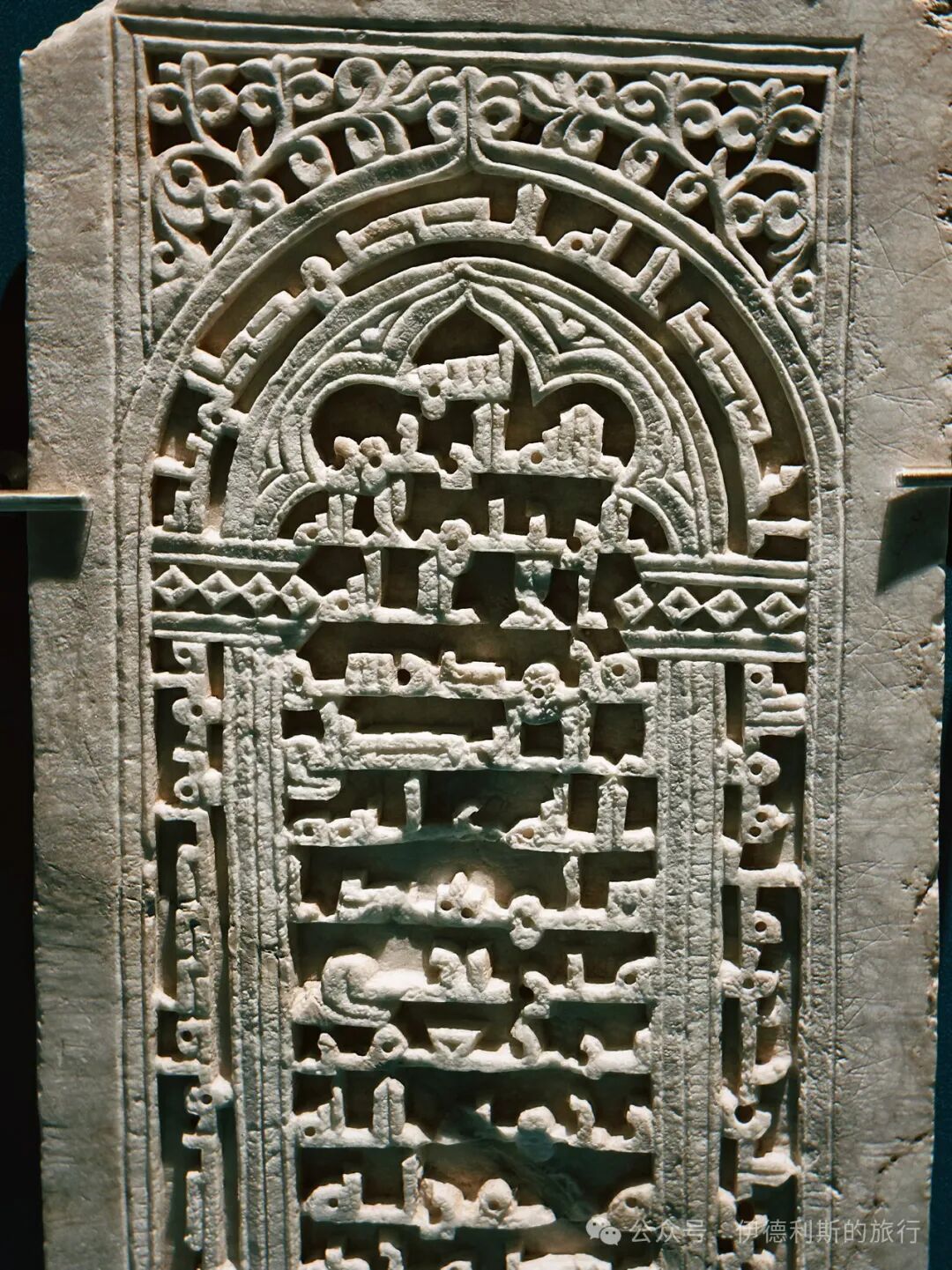
A tombstone from the 9th to 11th century featuring Kufic script for Yahya ibn Ja'far.
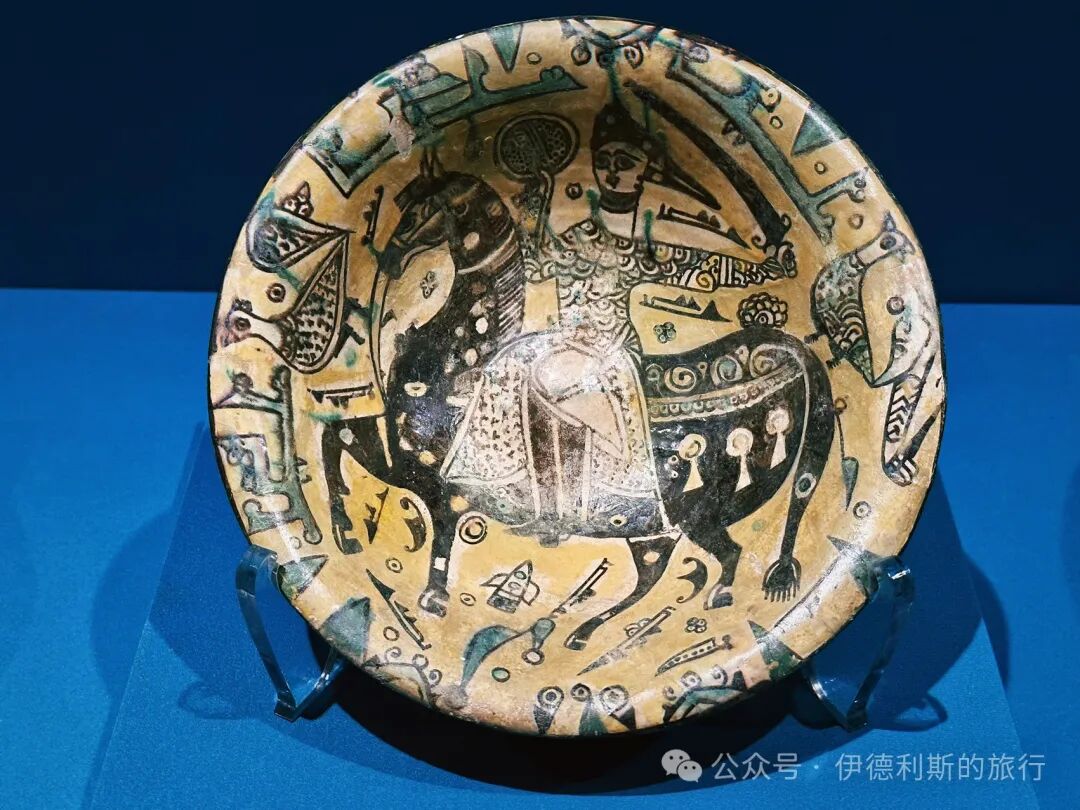
A 9th to 10th-century glazed pottery bowl with slip-painted horseman designs.
A 10th-century glazed pottery bowl with geometric patterns.
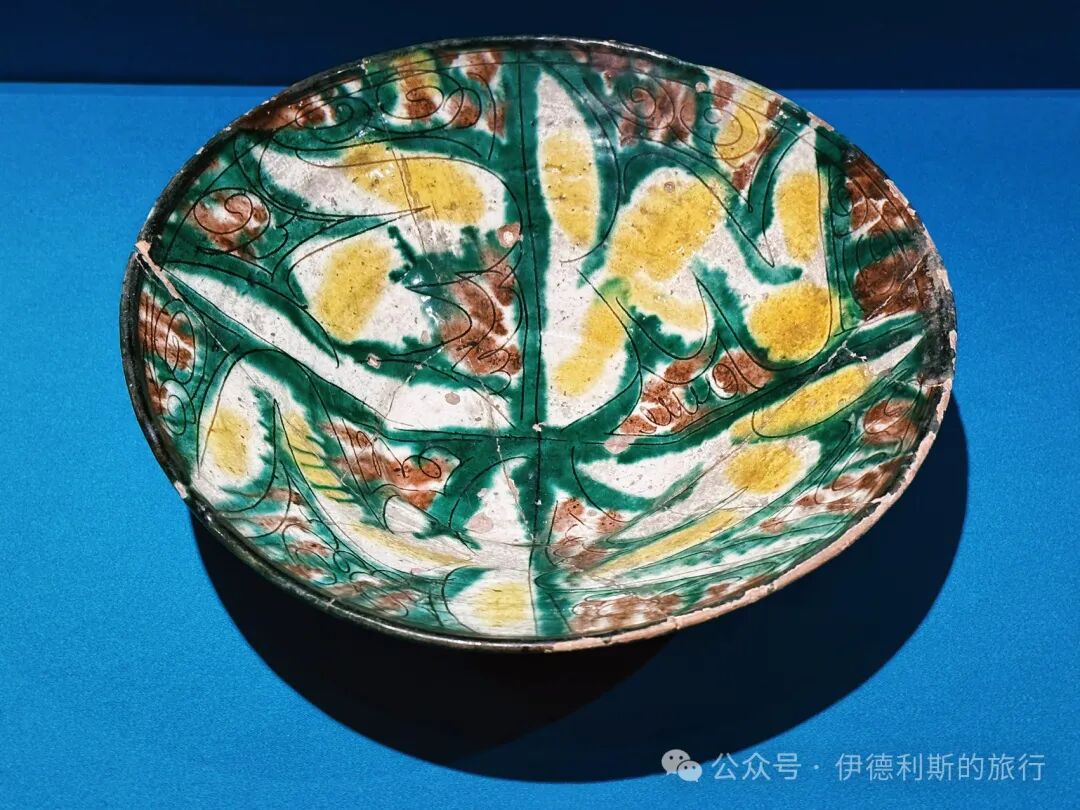
A 9th to 10th-century Nishapur-style glazed pottery bowl with geometric and plant patterns.
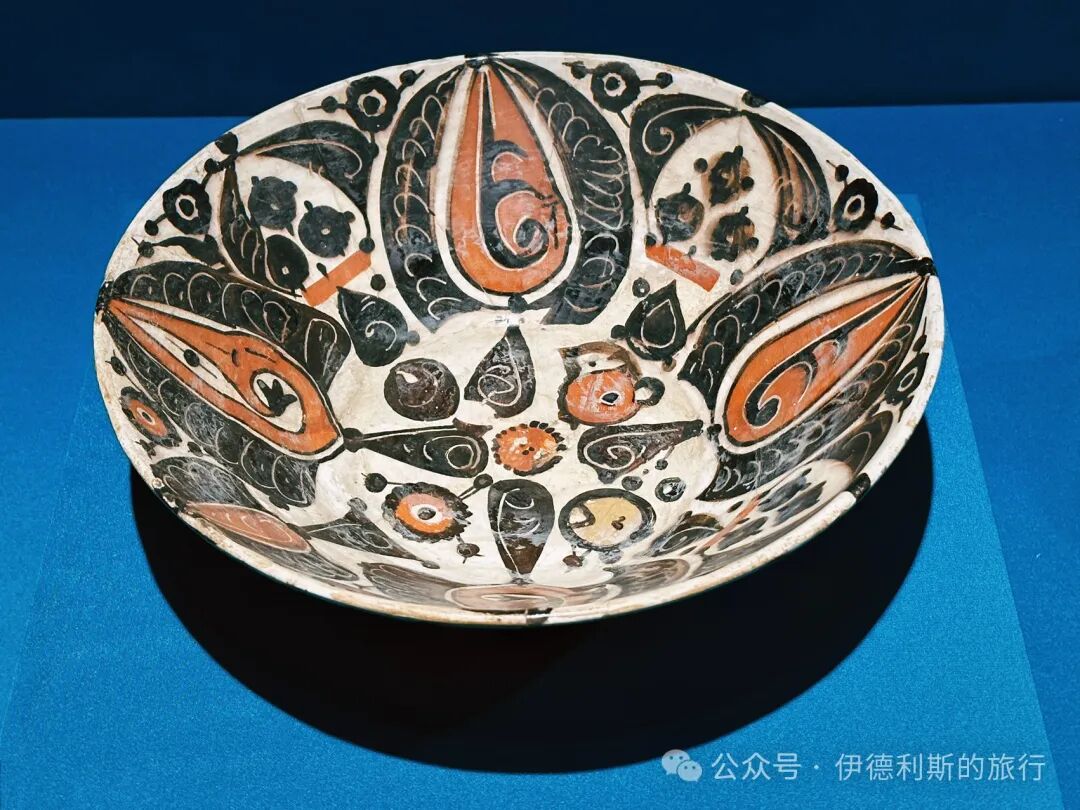
A 9th to 10th-century Nishapur-style glazed pottery bowl with geometric and plant patterns.
A 10th-century Nishapur-style glazed pottery bowl with slip-painted imitation Kufic inscriptions.
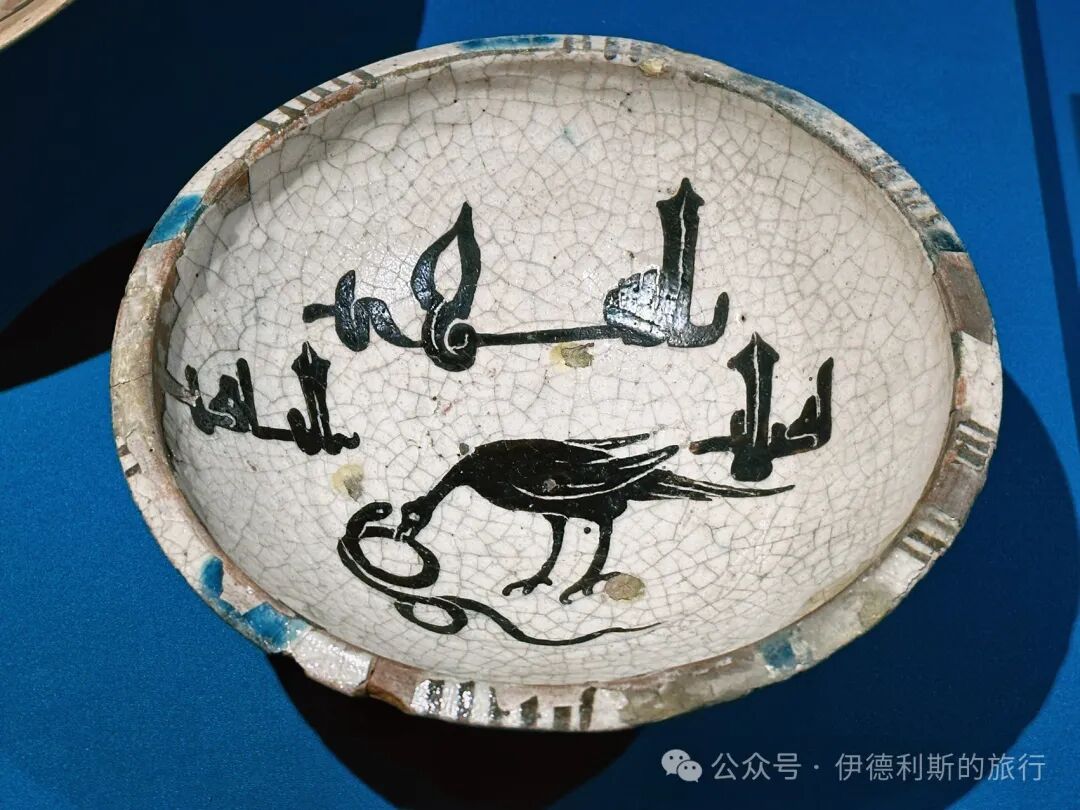
A 10th-century glazed pottery bowl with Kufic script.
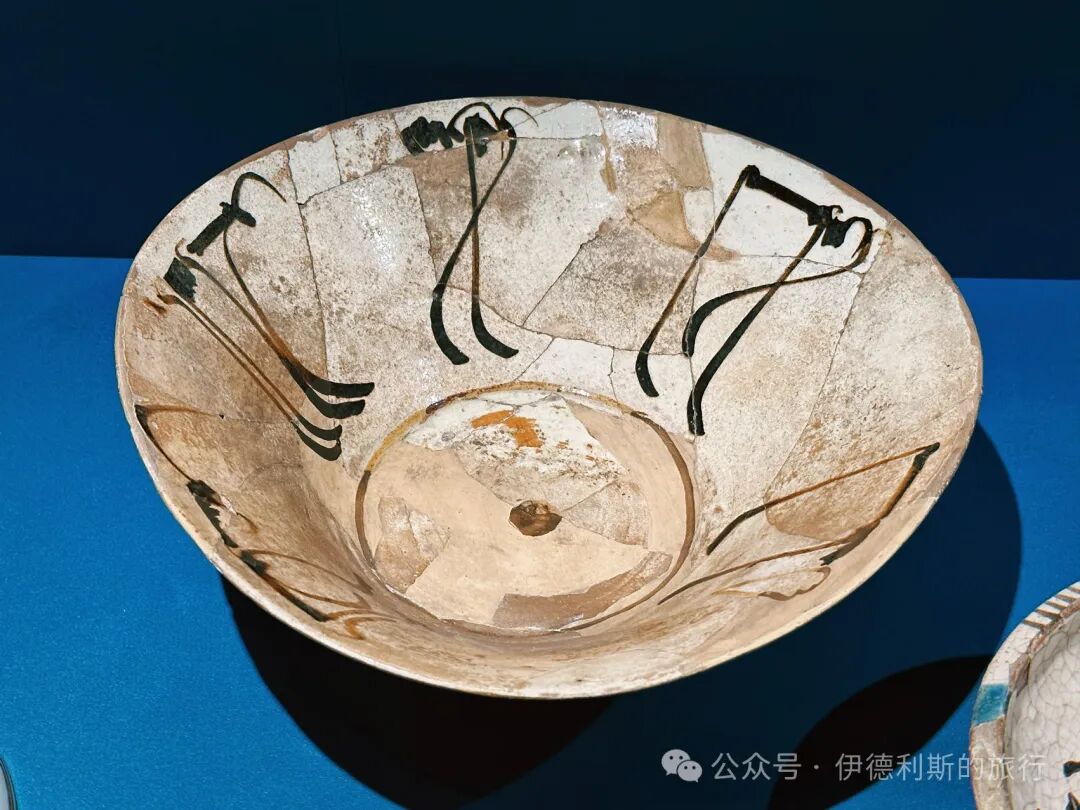
Glass lamps, glass cups, and glass bowls from the 9th to 10th century. Besides glazed pottery, Nishapur was also a center for glass craftsmanship from the 9th to 11th century.
A 10th-century Sari-style glazed pottery bowl with slip-painted bird patterns.
Gorgan.
Glazed pottery from the ancient city of Gorgan. Gorgan was an important city on the Caspian coast during the Sasanian period and remained a center for Zoroastrianism after the 8th century. The old city of Gorgan was destroyed during the Mongol invasion in the 13th century, and it was moved to the current new city during the Ilkhanate period.
A 10th-century glazed pottery bowl with slip-painted antelope patterns.
A 13th to 14th-century Ilkhanate-period glazed pottery jar with a single handle and calligraphic text.
Luster-glazed ceramic plate with figure patterns from the Ilkhanate period, 13th-14th century.
Glazed ceramic bowl with geometric patterns from the Ilkhanate period, 14th century.
Glazed ceramic bowl with floral patterns and calligraphy from the Ilkhanate period, 13th century.
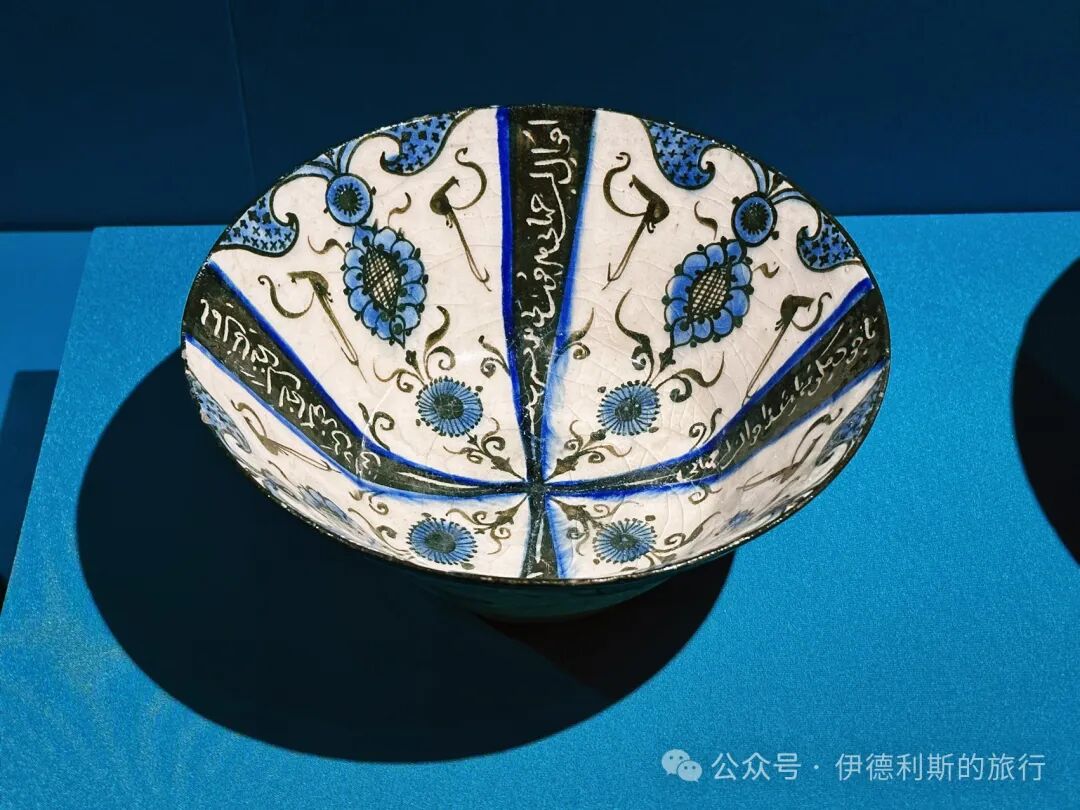
Gorgan-style luster-glazed inscription brick with Thuluth script from the Ilkhanate period, 13th-14th century.
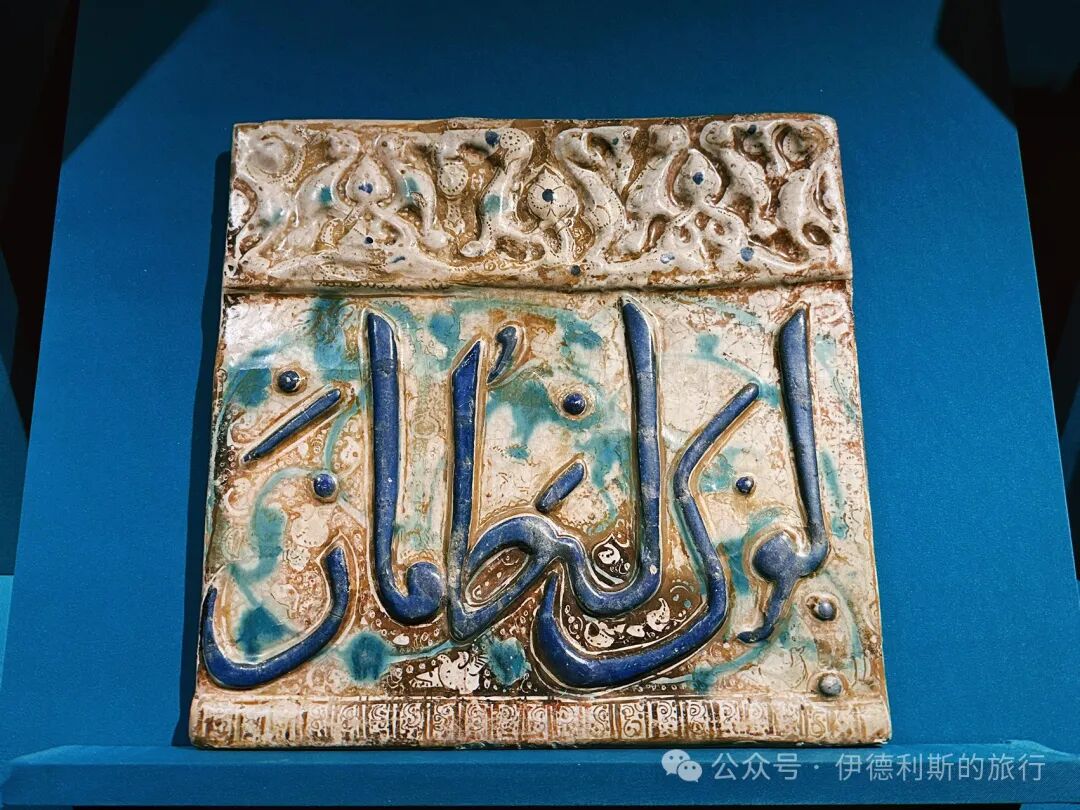
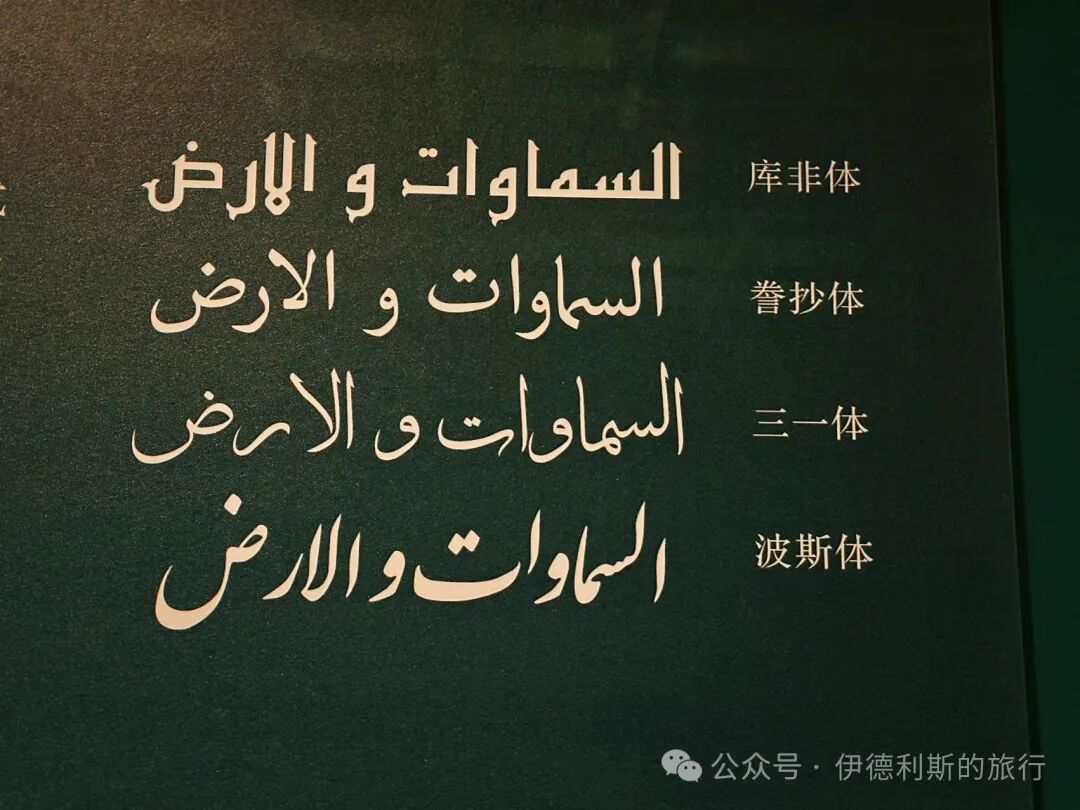
Glassware and bronze ware from the ancient city of Gorgan.
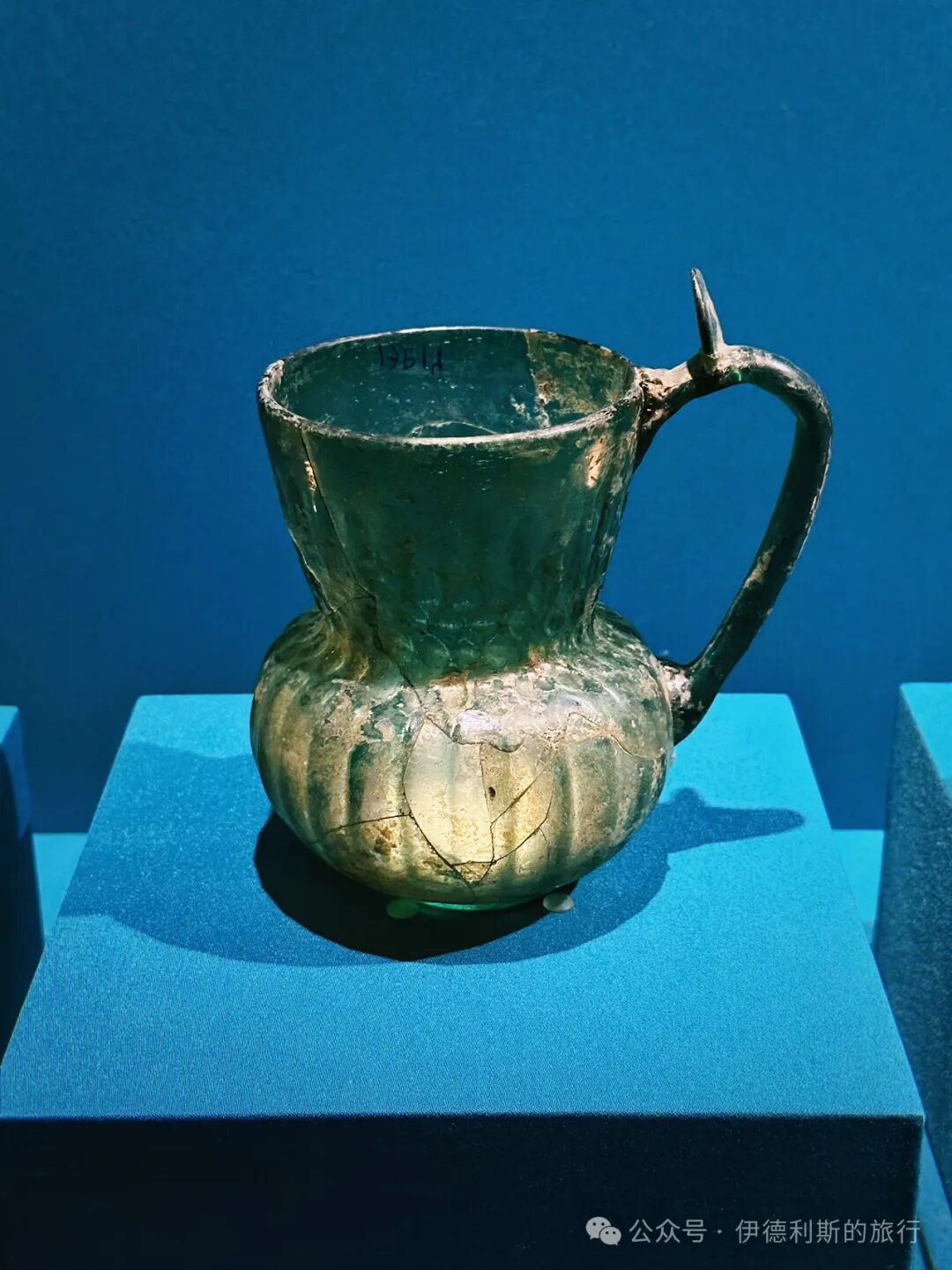
Single-handled glass jar, 9th-10th century.
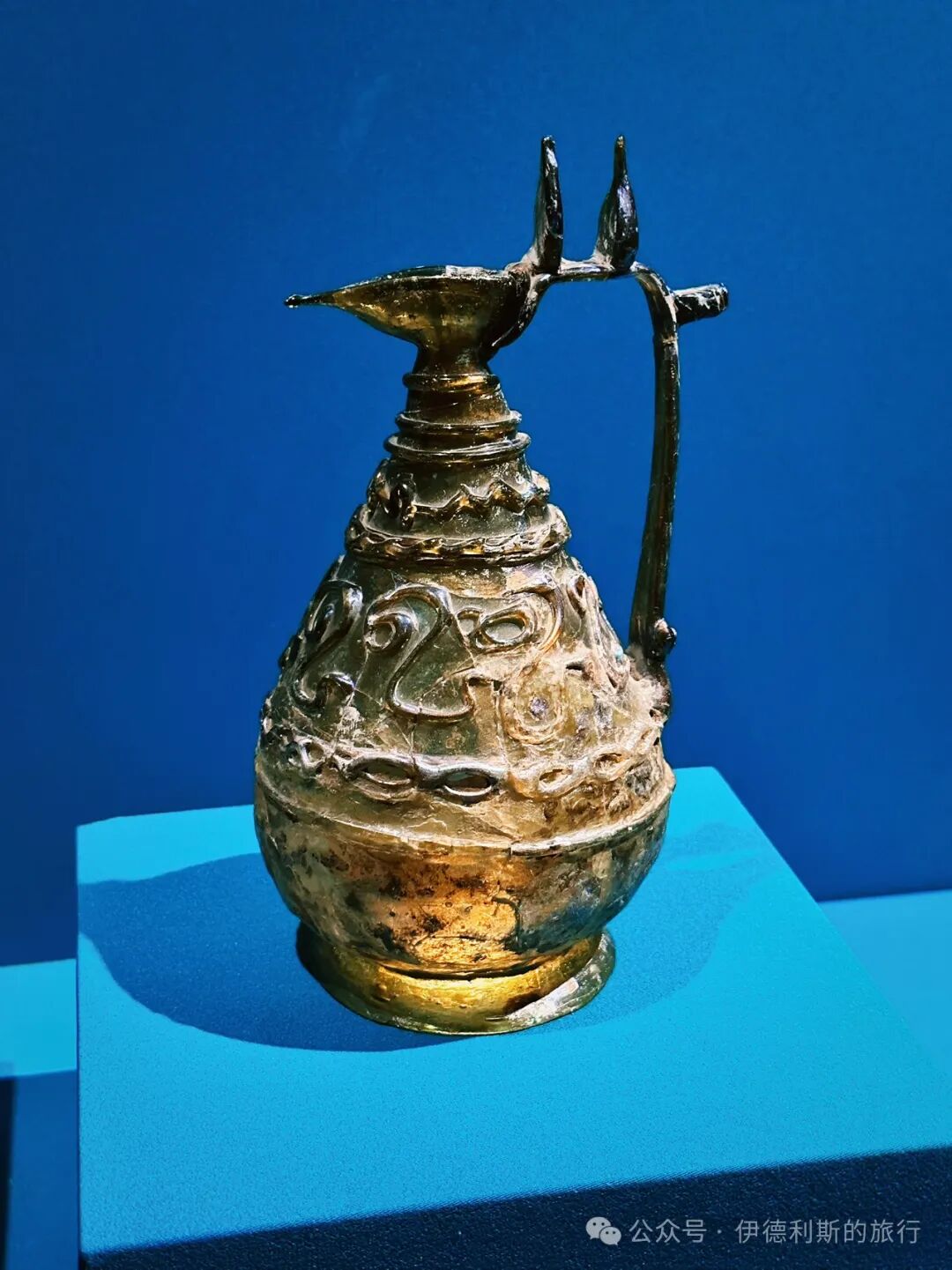
Glass ewer, 10th century.
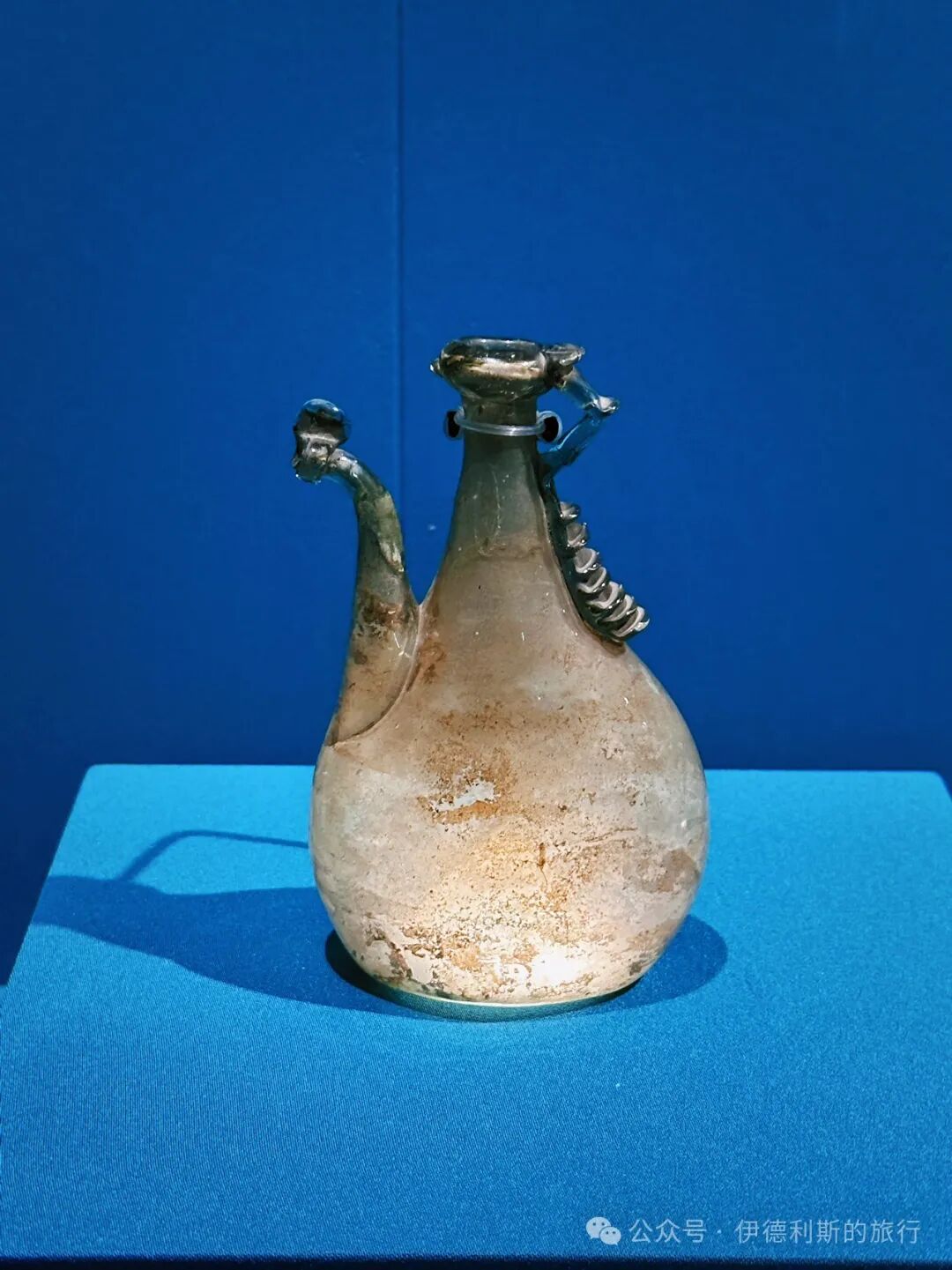
Single-handled glass jar, 10th century.
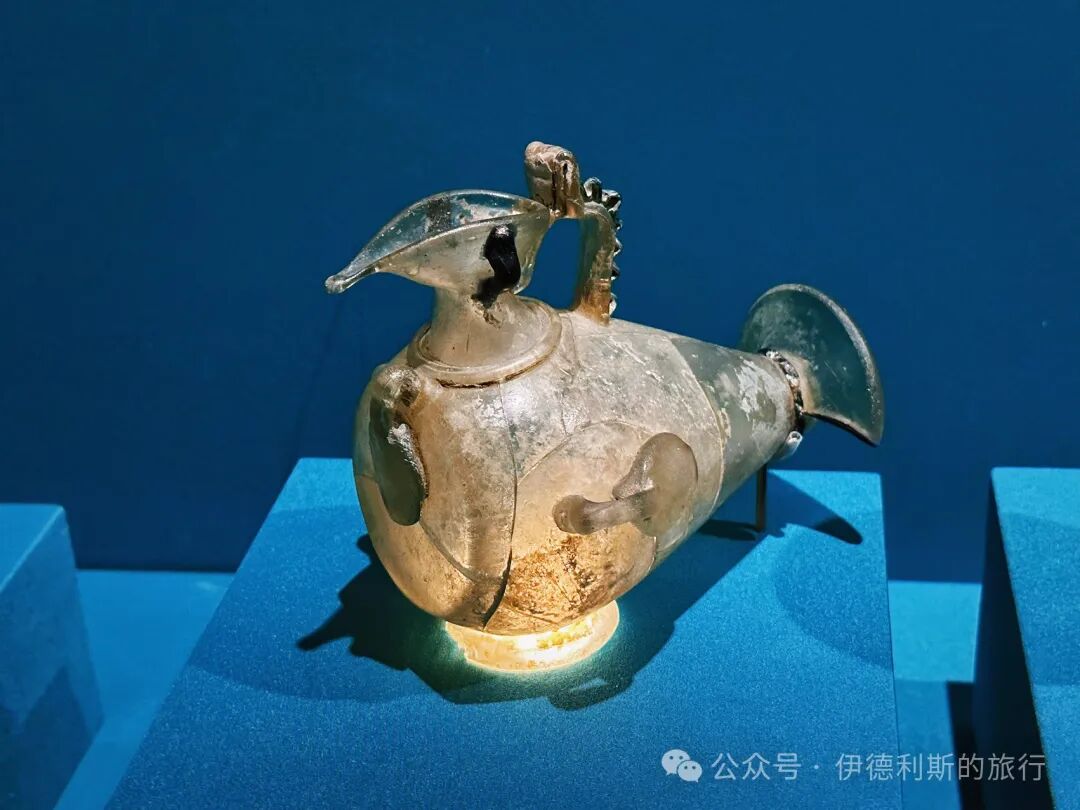
Bird-shaped glass ewer from the Seljuk Empire, 11th-12th century.
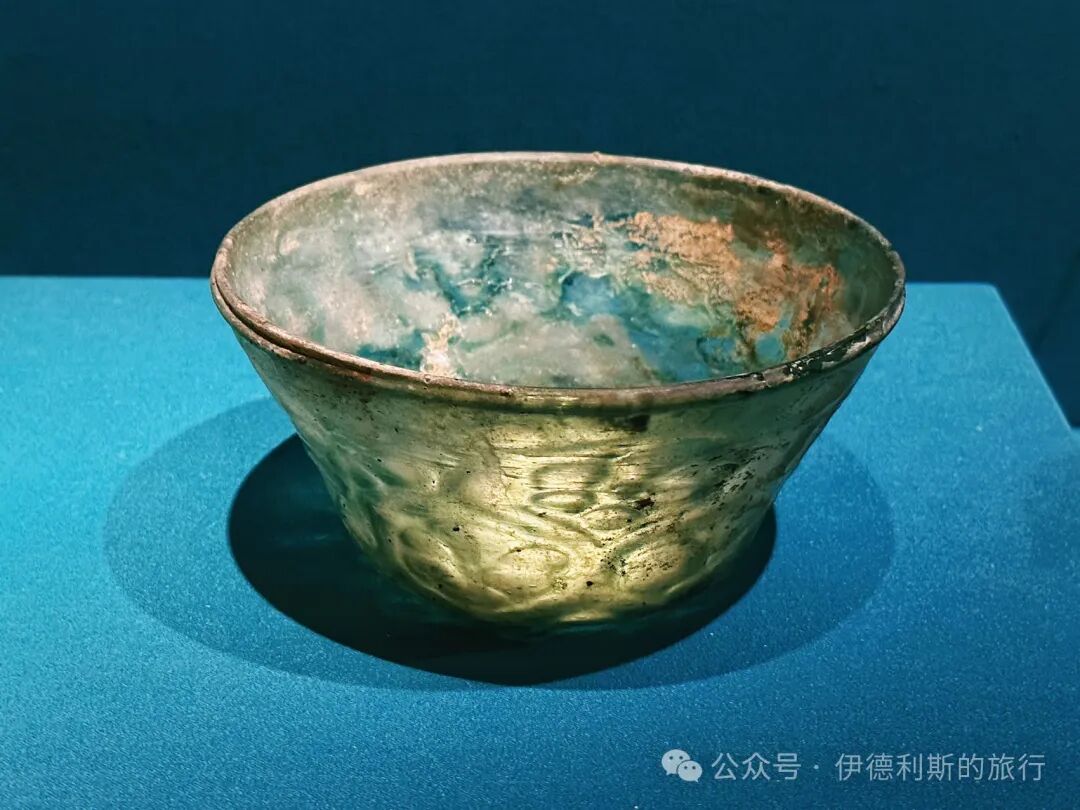
Glass bowl with flower patterns from the Ilkhanate period, 13th century.
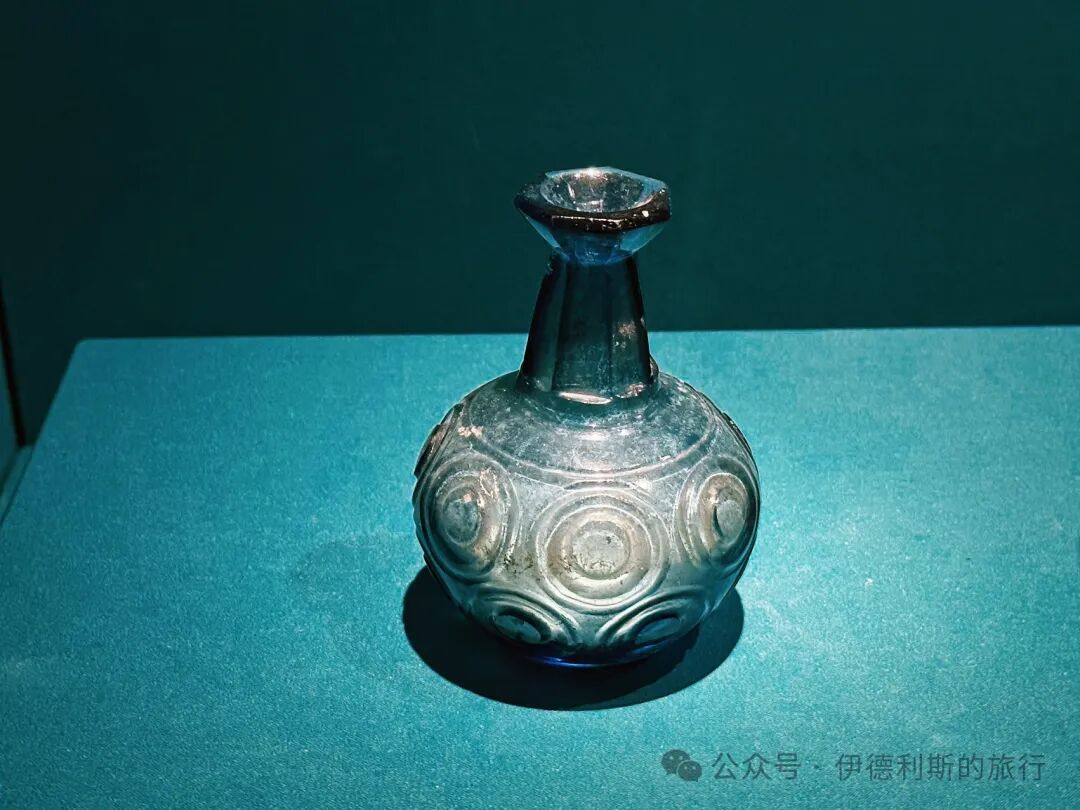
Glass bottle with circle patterns from the Ilkhanate period, 13th century.
Single-handled bronze ewer, 9th-10th century.
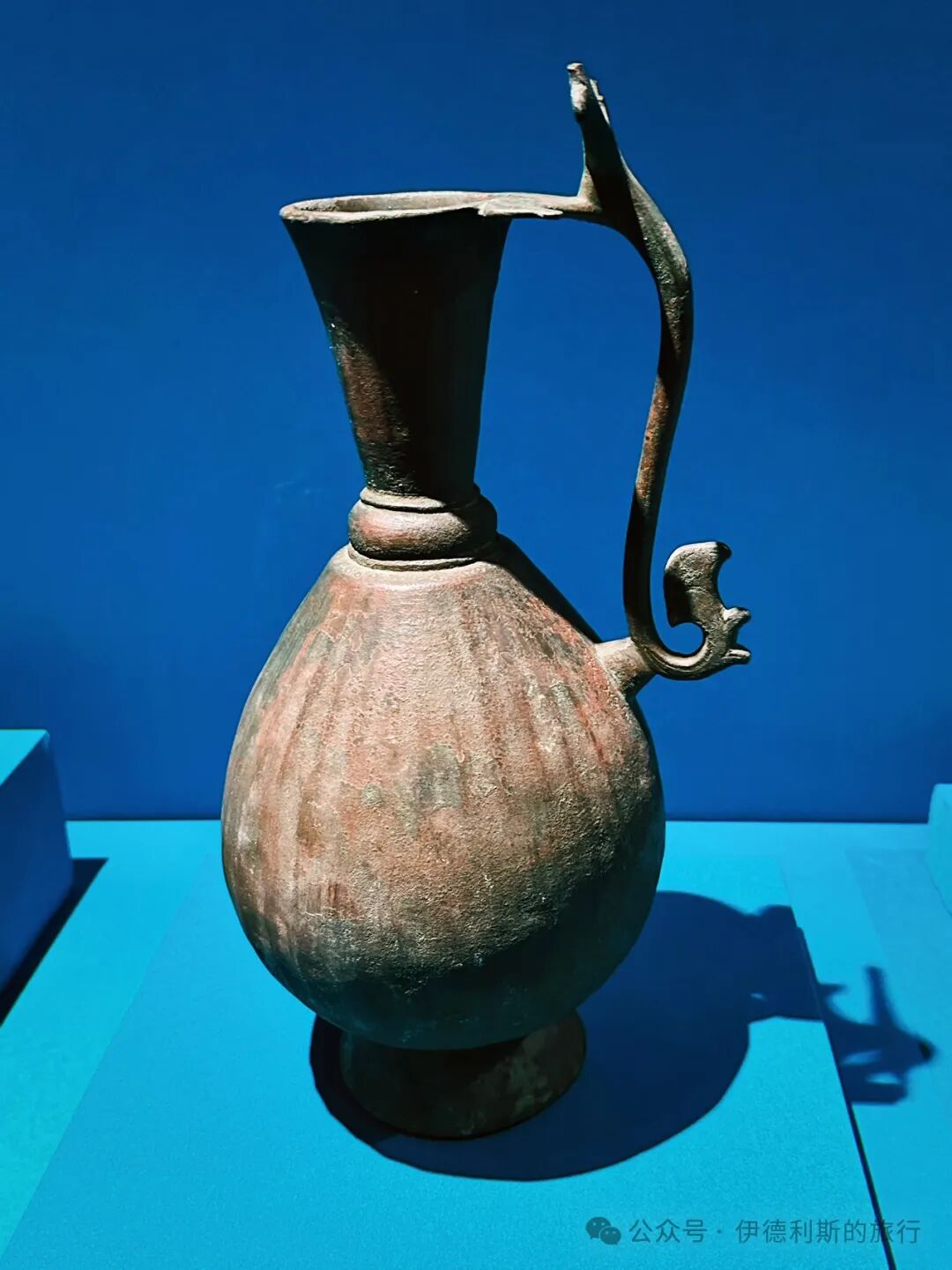
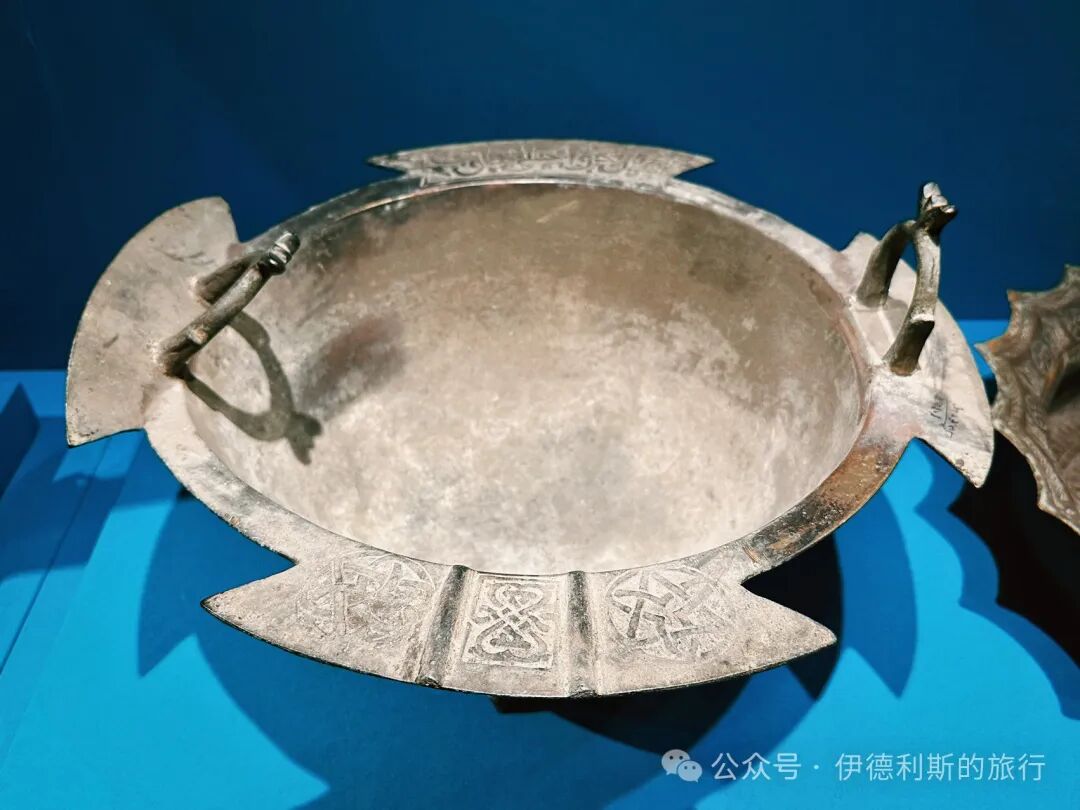
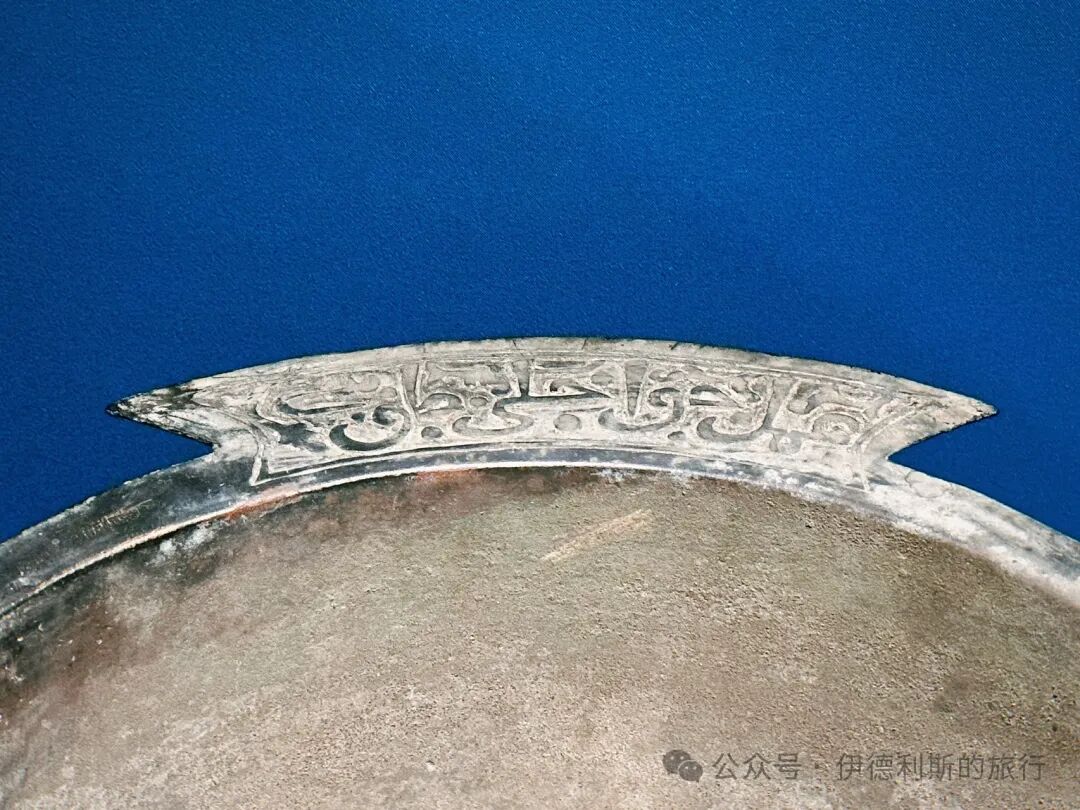
Two-handled bronze cauldron with inscriptions from the Seljuk Empire period, 12th century.
Ray.
Ray is located in the southern suburbs of Tehran and is an important ancient city in northern Iran. It is referred to as "Layi" in books like the History of Yuan. In 1043, Tuğrul Beg, the founder of the Seljuk Empire, made Ray the capital of the empire and carried out large-scale reconstruction of the ancient city. Under the rule of the Seljuk Empire, Rey reached its peak with a massive marketplace and a very prosperous trade scene. Import and export trade, mainly in silk, connected the entire Eurasian continent. At that time, Rey was the center for making painted pottery in Iran, and Rey-style painted pottery was an important handicraft of the period.
In 1220, the Mongol army invaded Rey, which was then under the rule of the Khwarazmian Empire. Because there was no fierce resistance, the Mongols did not massacre the city. Even so, the residents gradually left, and the center for pottery production moved to the southern city of Kashan.
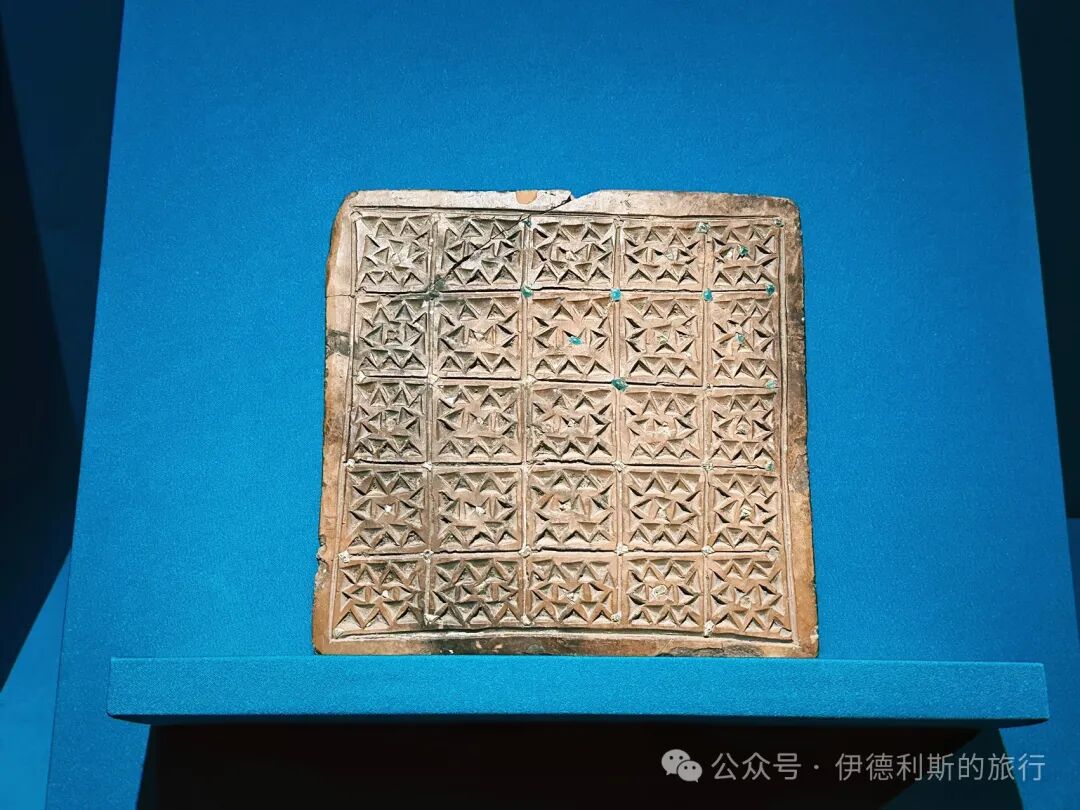
Stucco figure from the Seljuk dynasty, 11th to 12th century.
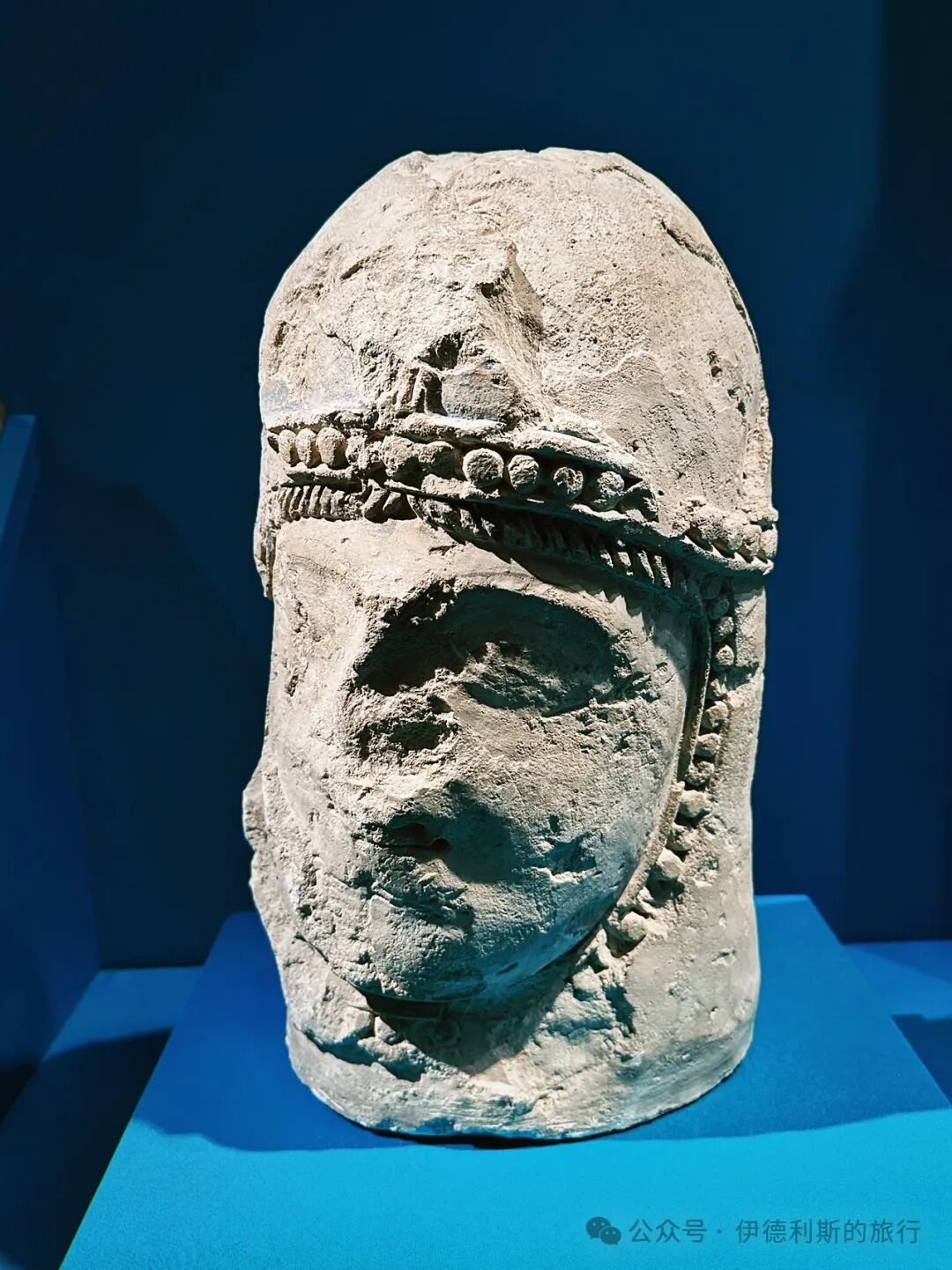
Ceramic tile from the Seljuk dynasty, 11th to 12th century.
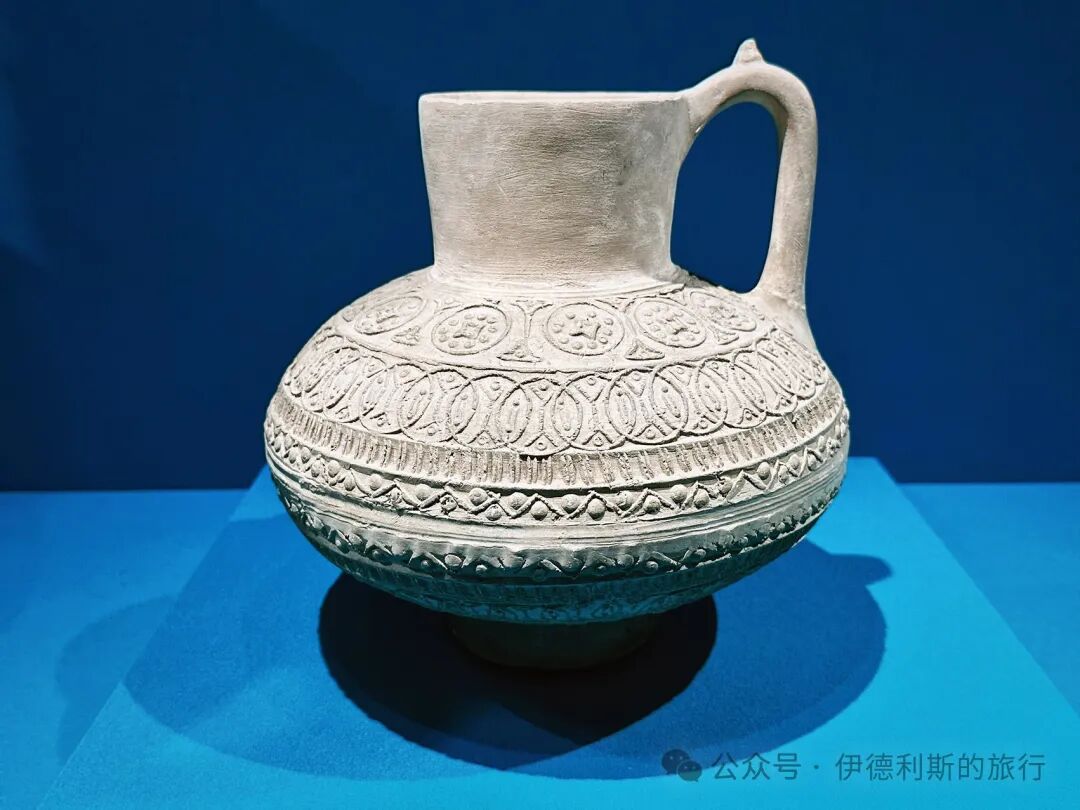
Single-handled pottery jar from the 9th century.
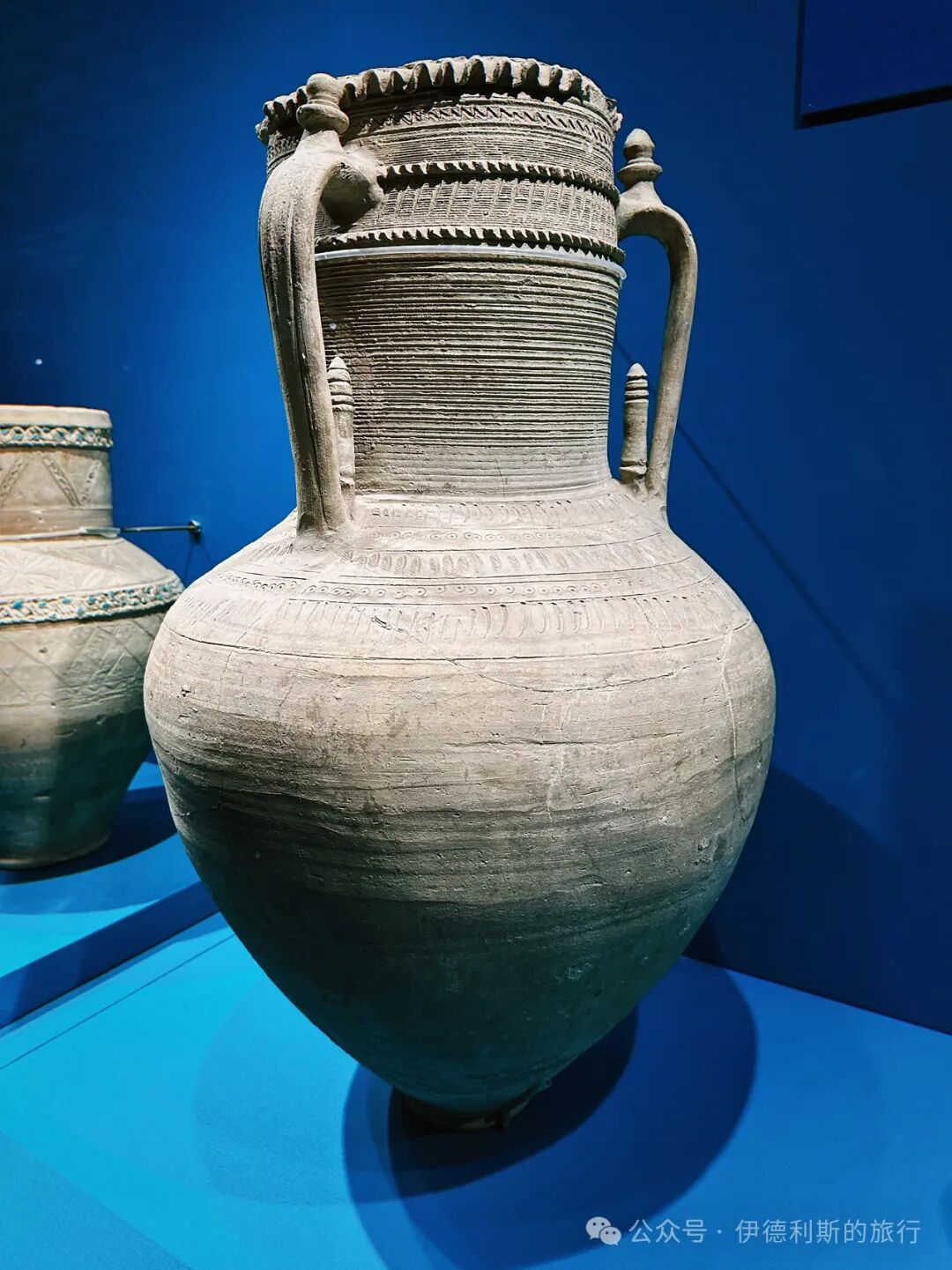
Three-handled pottery jar from the 9th to 10th century.
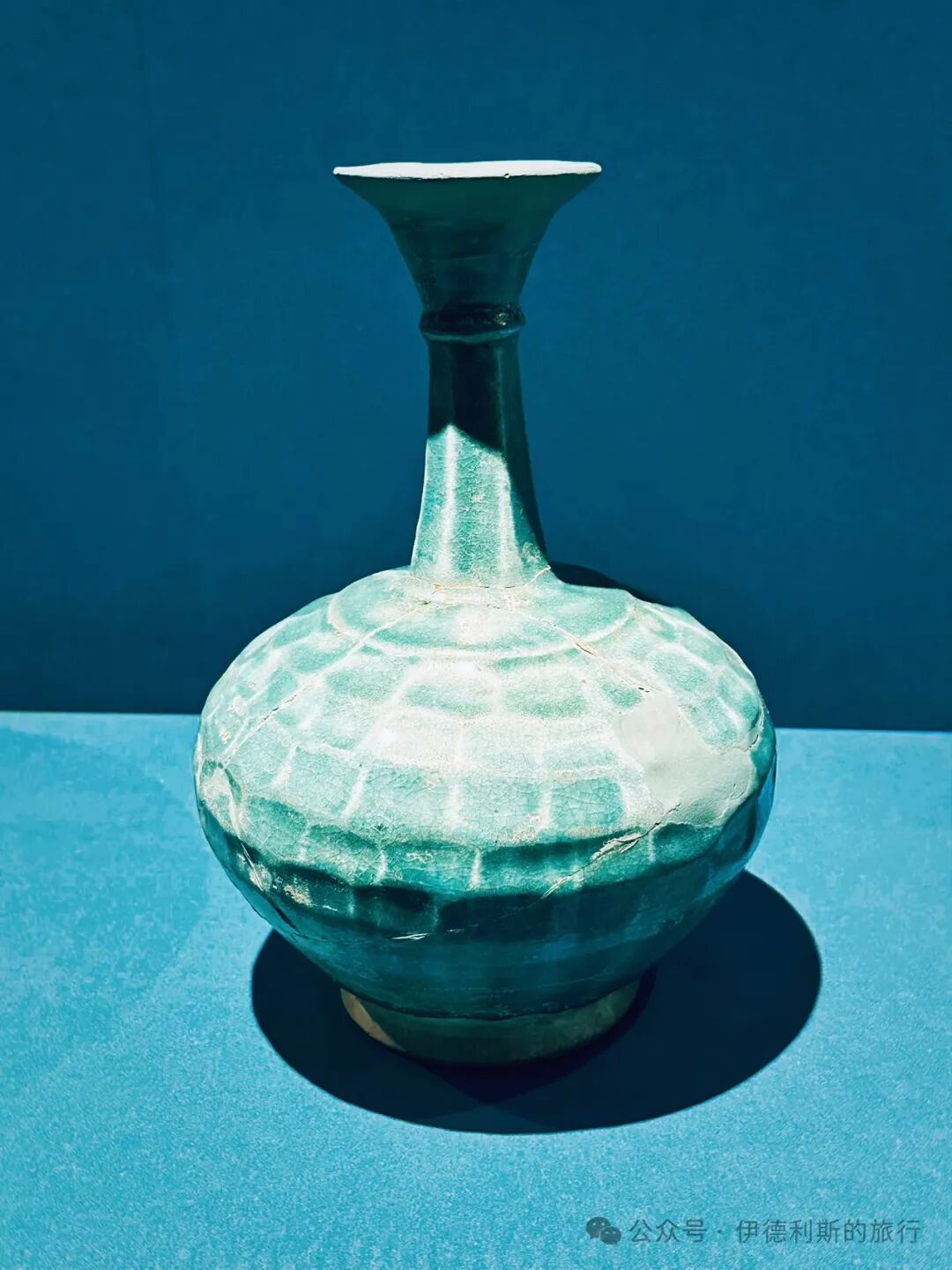
Blue-glazed narrow-necked pottery vase from the Ilkhanate period, 13th century.
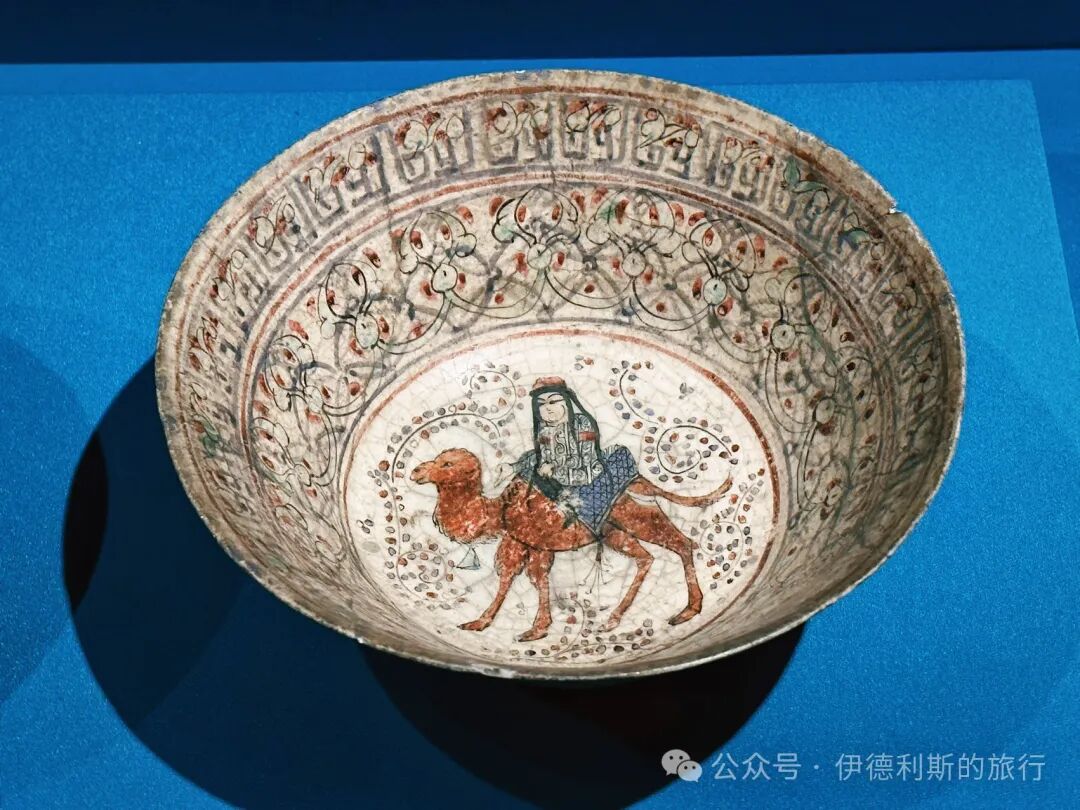
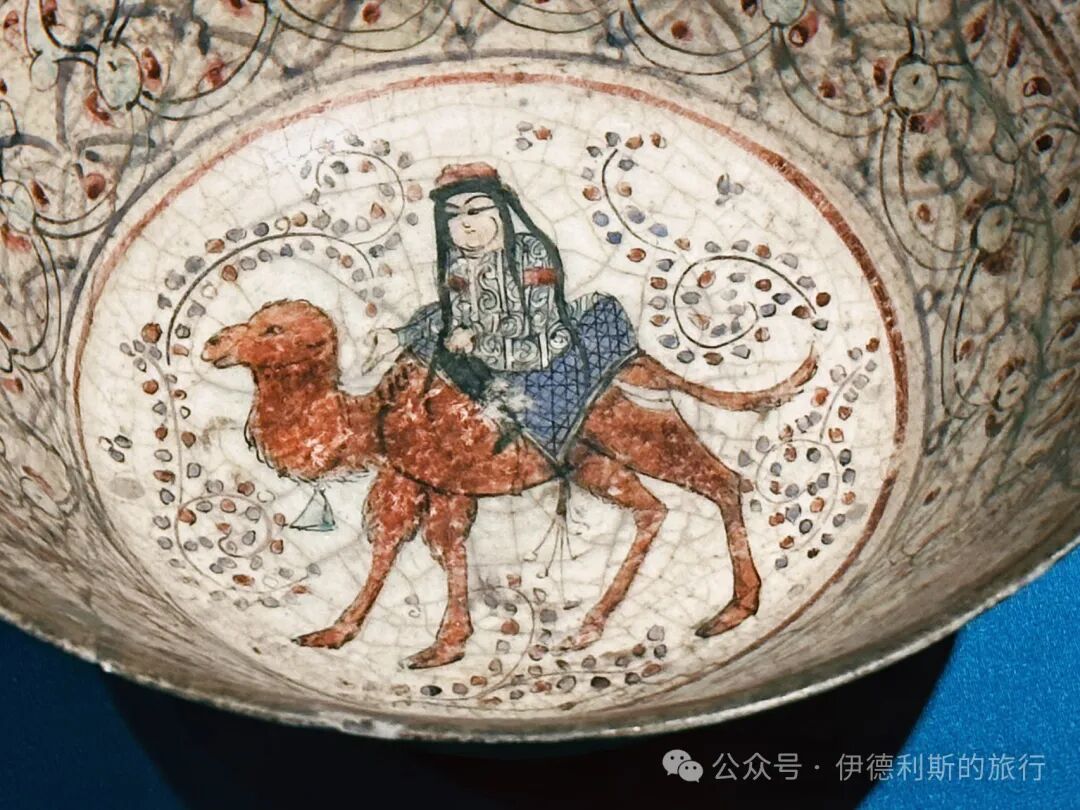
Rey-style Mina'i glazed pottery bowl with a camel rider pattern, from the late Seljuk dynasty to the Ilkhanate period, 12th to 13th century.
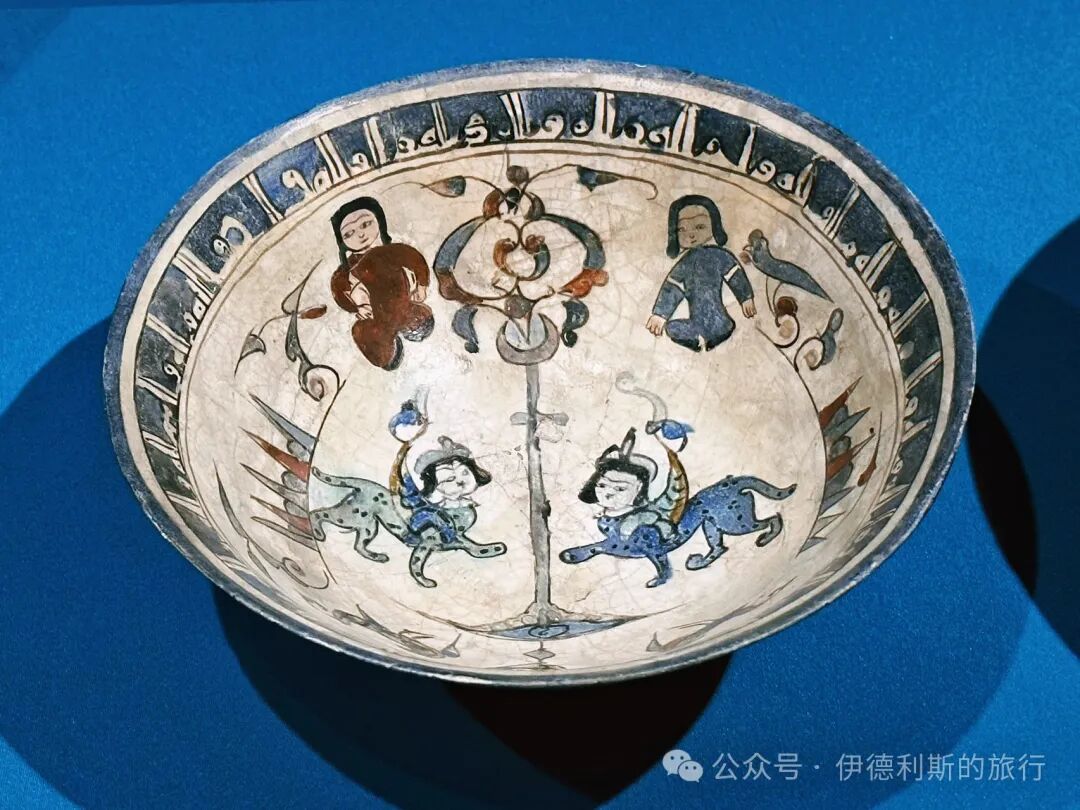
Rey-style Mina'i glazed pottery bowl with a sphinx pattern, from the late Seljuk dynasty to the Ilkhanate period, 12th to 13th century.
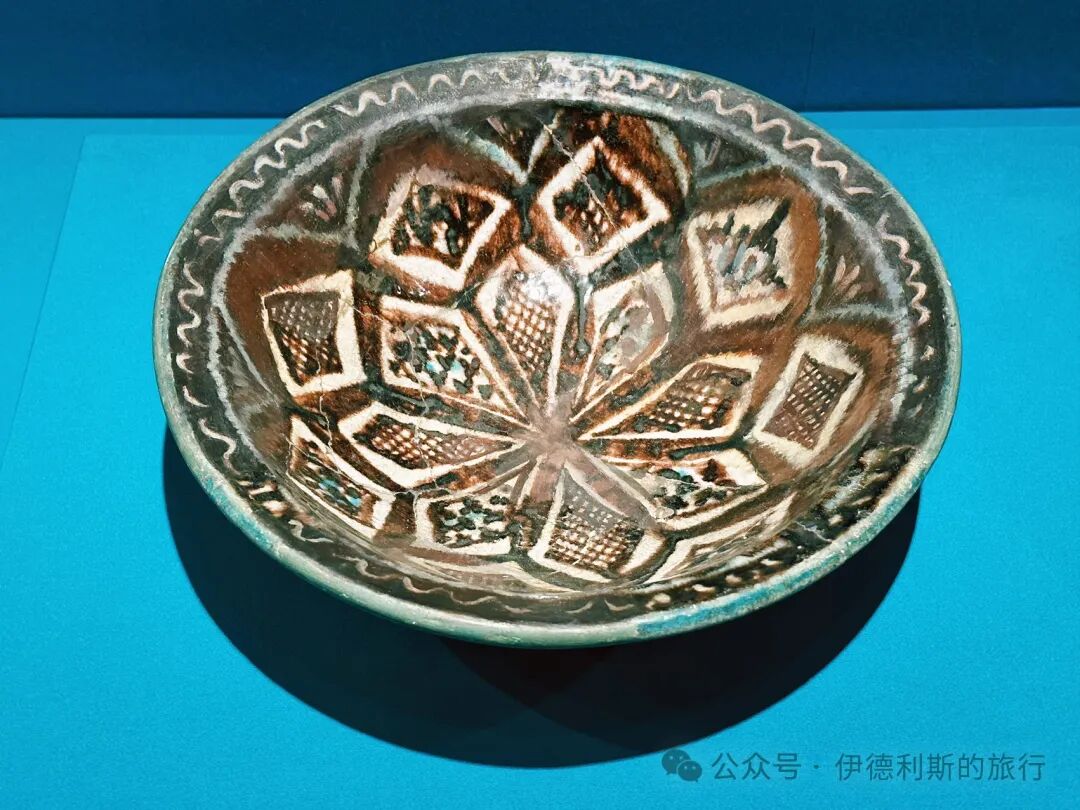
Glazed pottery bowl with geometric patterns from the ancient city of Rey, Ilkhanate period, 13th to 14th century.
Seljuk dynasty.
Bronze ware from the Seljuk dynasty.
11th-12th century Seljuk dynasty single-handled bronze lamp with a bird figure from Quchan. Quchan is in northeastern Iran near the border with Turkmenistan. The lamp has Kufic script and scroll patterns on both sides. Similar designs were found in Nishapur, which may link to traditions in northeastern Iran.
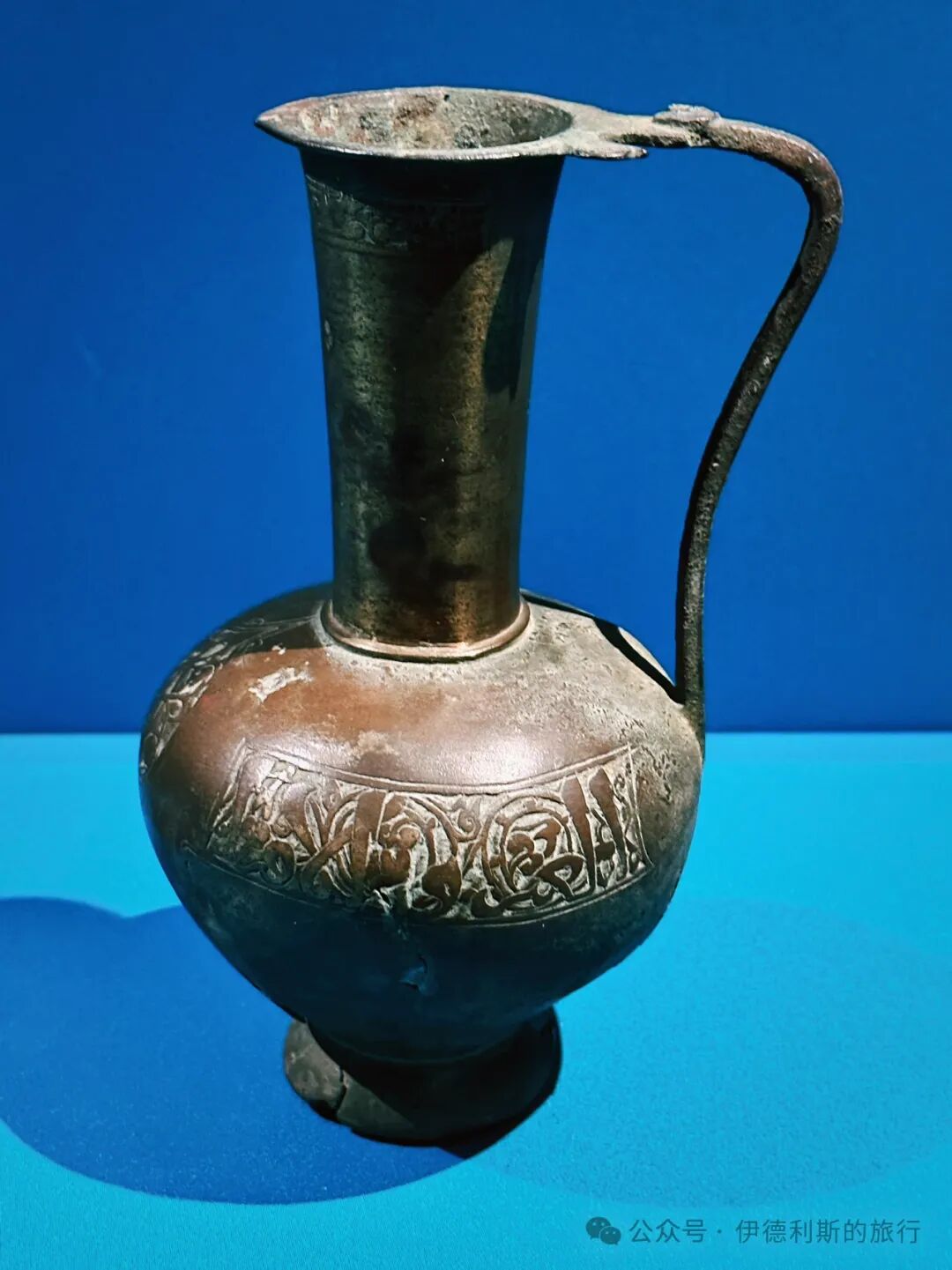
12th century Seljuk dynasty bronze ewer with calligraphy in the Khorasan style.
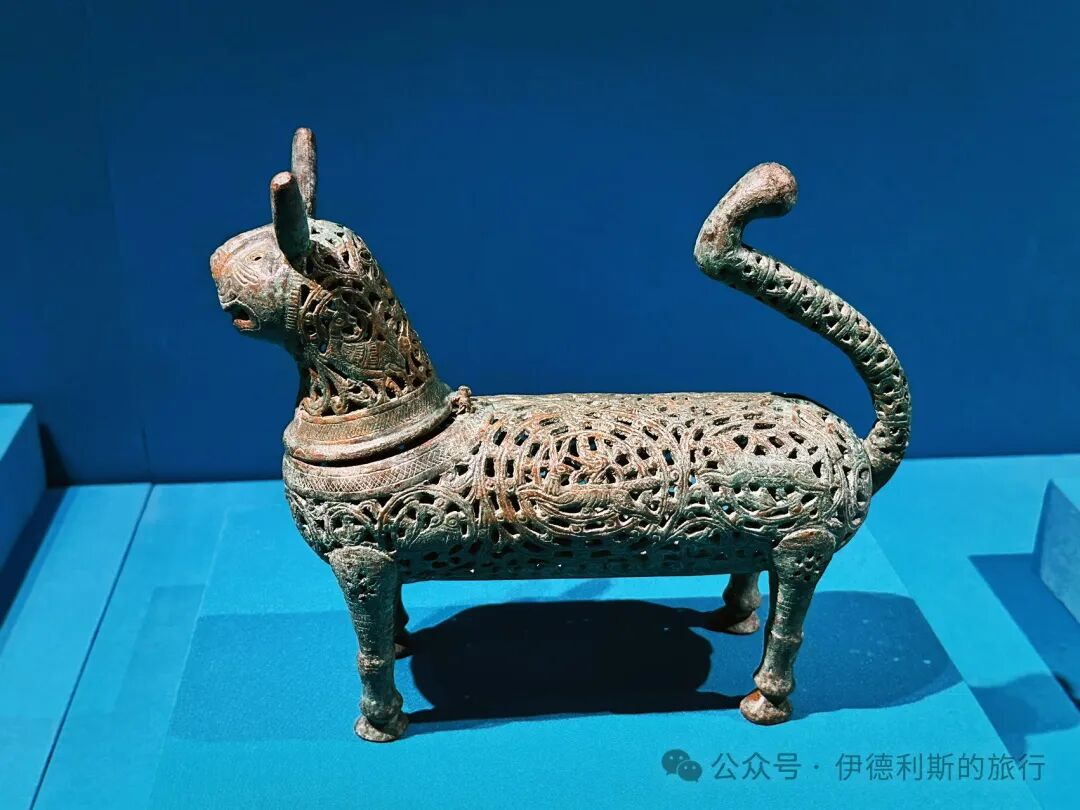
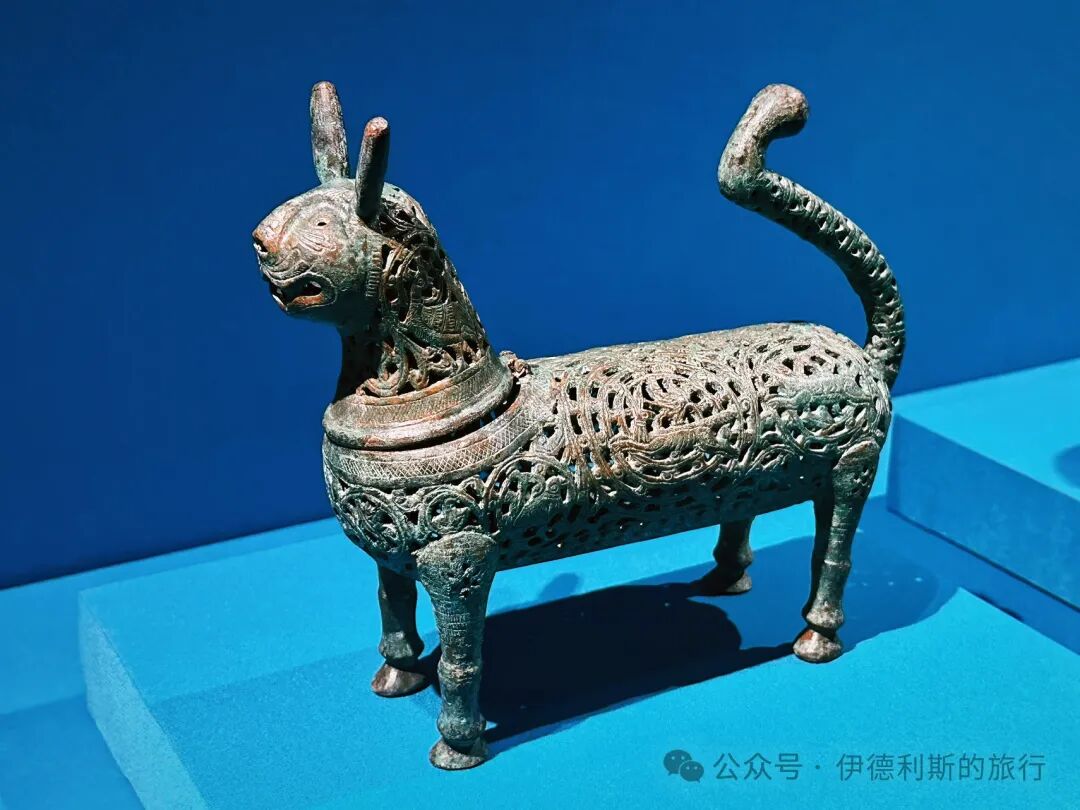
12th century Seljuk dynasty bronze incense burner from Sowme'eh Sara. Sowme'eh Sara is on the Caspian Sea coast in northwestern Iran.
11th-12th century Seljuk dynasty bronze basin with a floral rim and geometric patterns from Rafsanjan. Rafsanjan is in southeastern Iran. It is the world's largest producer of pistachios and a center for carpet production in Iran.
11th-12th century Seljuk dynasty bronze candlestick with three animal-shaped feet in the Khorasan style.
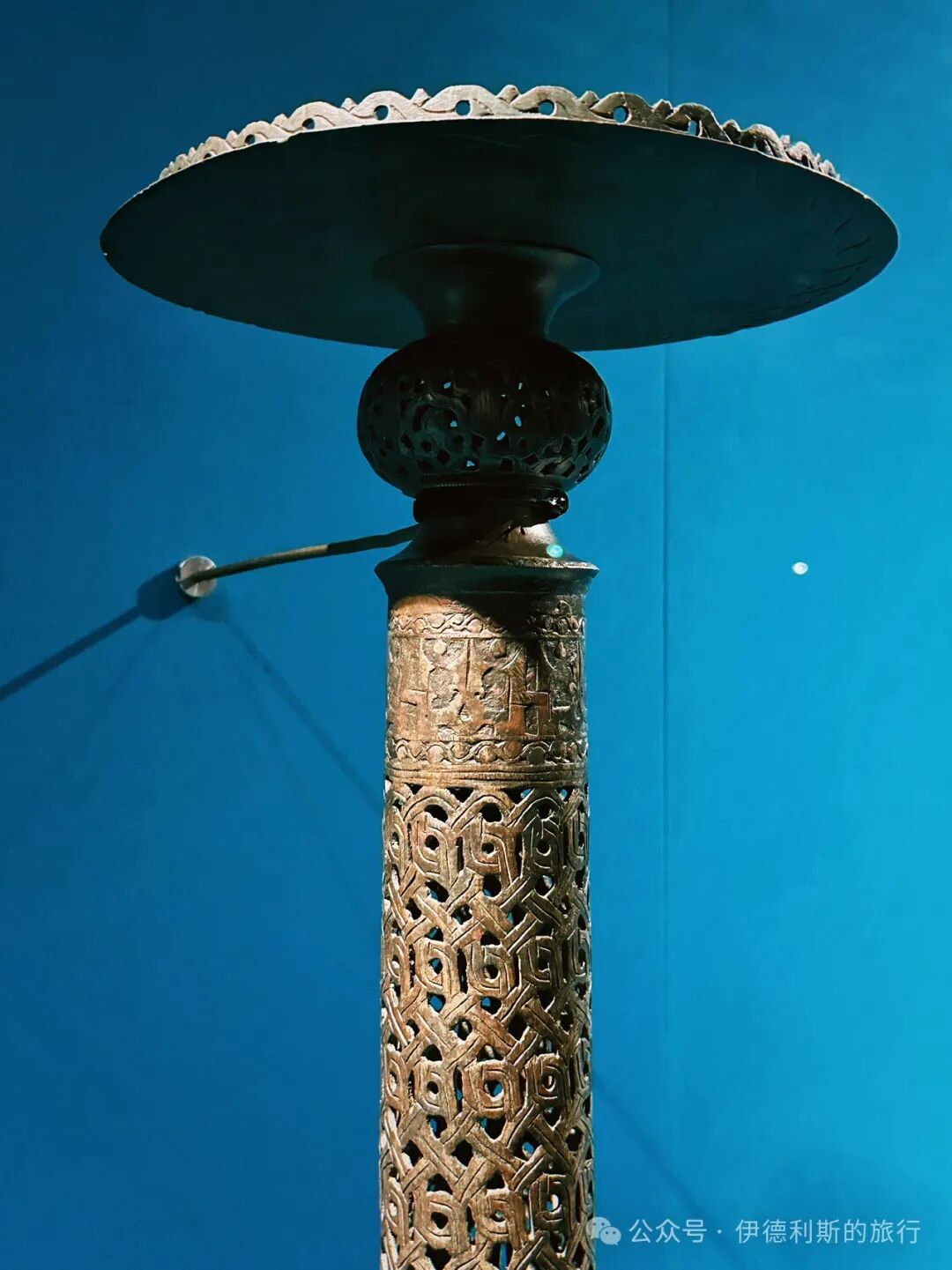
Summer palace of the Ilkhanate.
Artifacts unearthed at the Takht-e Soleyman site, the summer palace of the Ilkhanate. Takht-e Soleyman is a World Heritage site that served as the summer palace for the Ilkhanate in the 13th century. The Ilkhanate blended Eastern and Iranian art here to develop a unique Ilkhanid artistic style.
Takht-e Soleyman is the only surviving secular building complex from the Ilkhanate. The walls of the Great Khan's palace still have beautiful glazed tile decorations, which directly reflect the cultural and artistic exchange between China and Iran in the 14th century. The glazed tiles show various flowers, animals, and figures. The themes cover Chinese mythology, Iranian mythology, and calligraphic scripture, showing a blend of many cultures. Some of the tile themes come from the famous Iranian epic, the Shahnameh, which shows how the Ilkhanate integrated into Iran at the time.
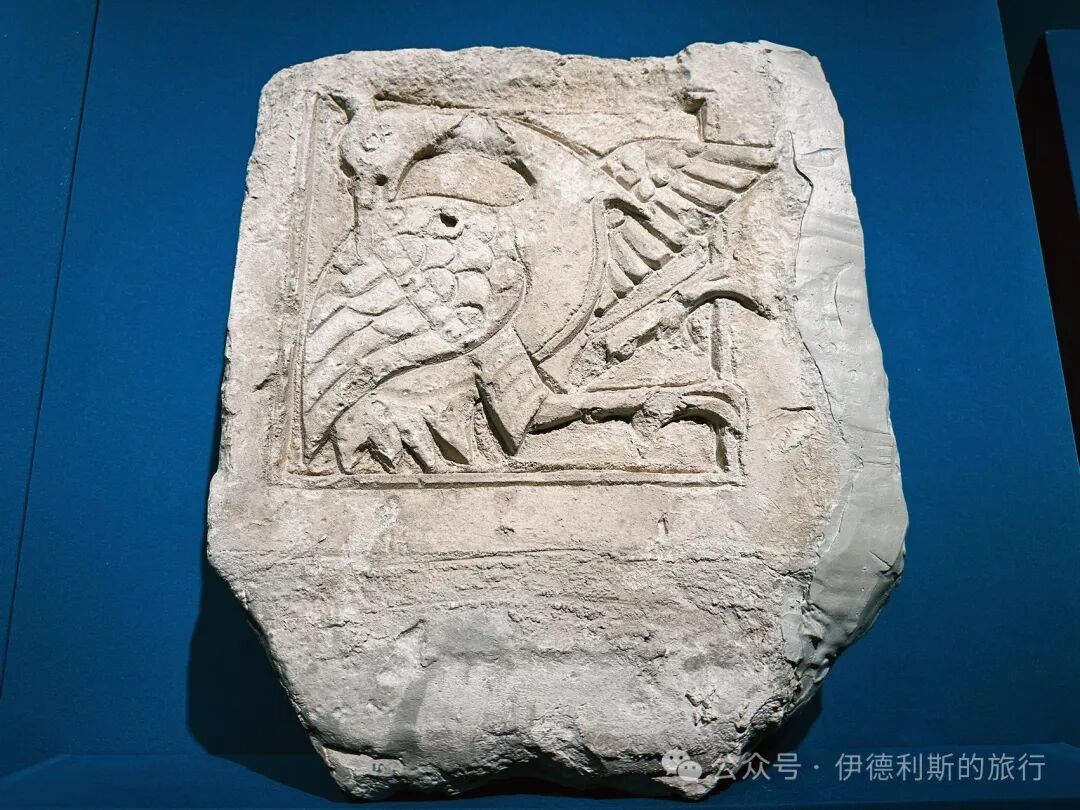
Late 13th to early 14th century stucco panel with bird patterns.
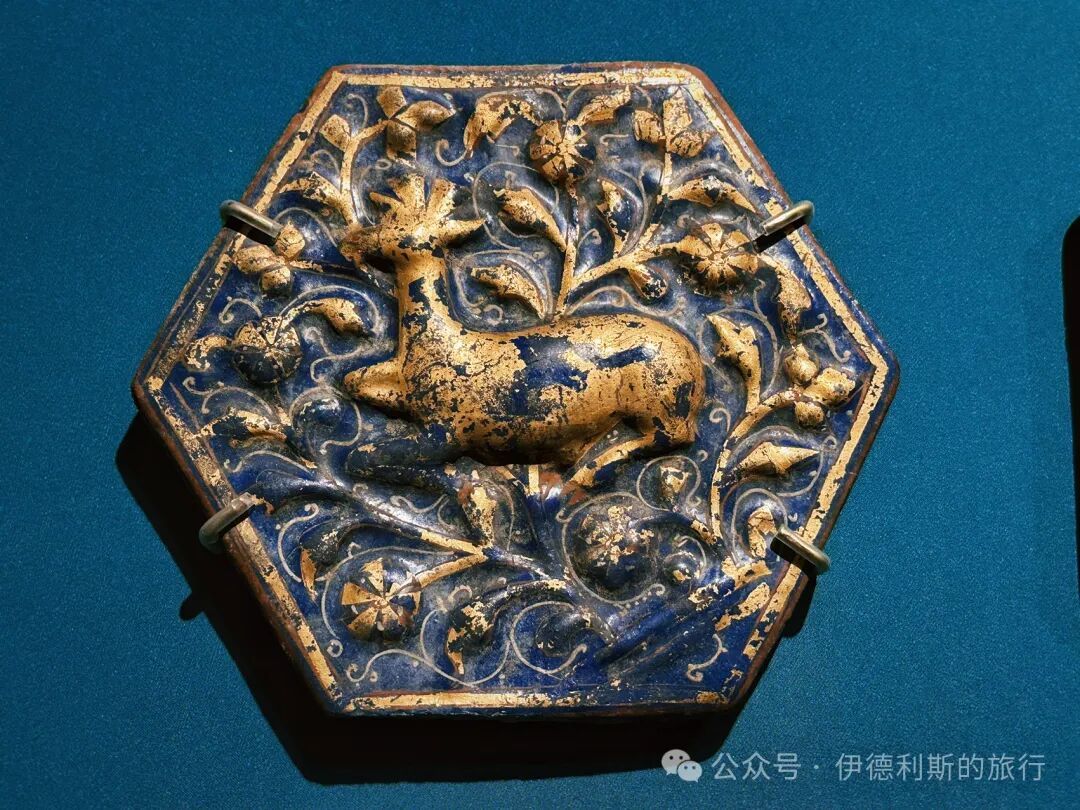
Late 13th to early 14th century, Lajvardina glazed tiles with deer and lion patterns.
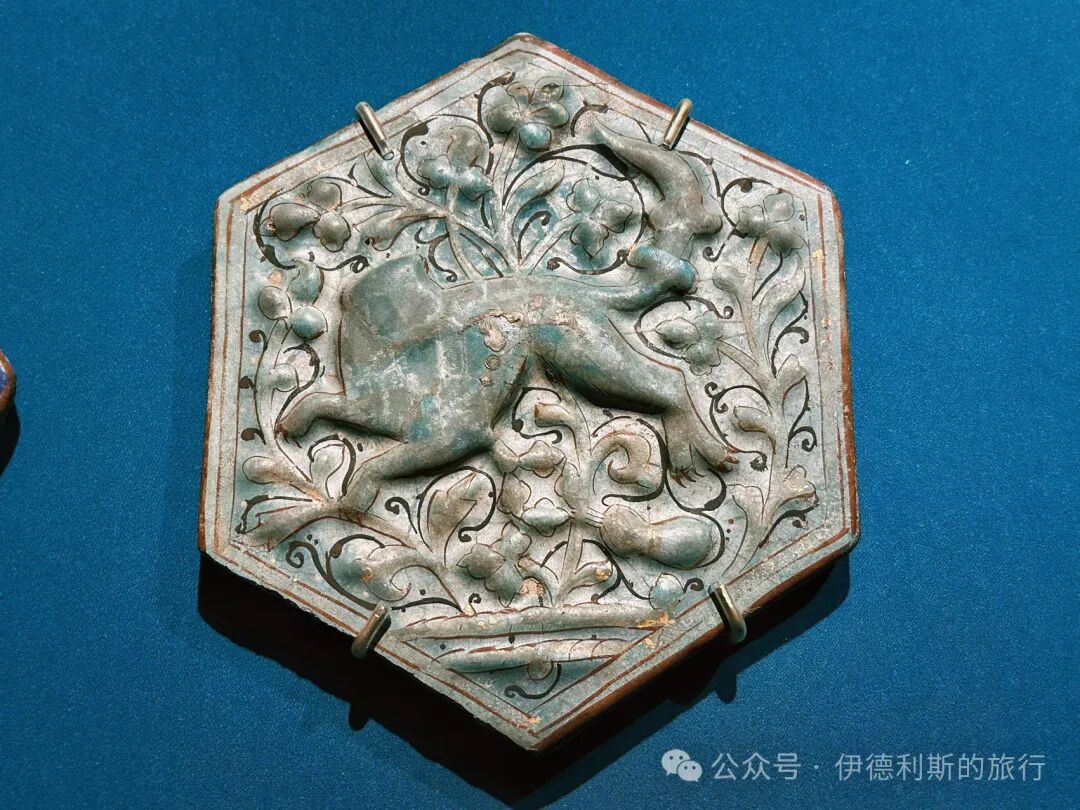
13th to 14th century, lusterware glazed tiles with camel and sphinx patterns. Lusterware, also called iridescent glaze, is a decorative technique using a second low-temperature firing. This second firing uses a reduction atmosphere to create a shimmering metallic finish.
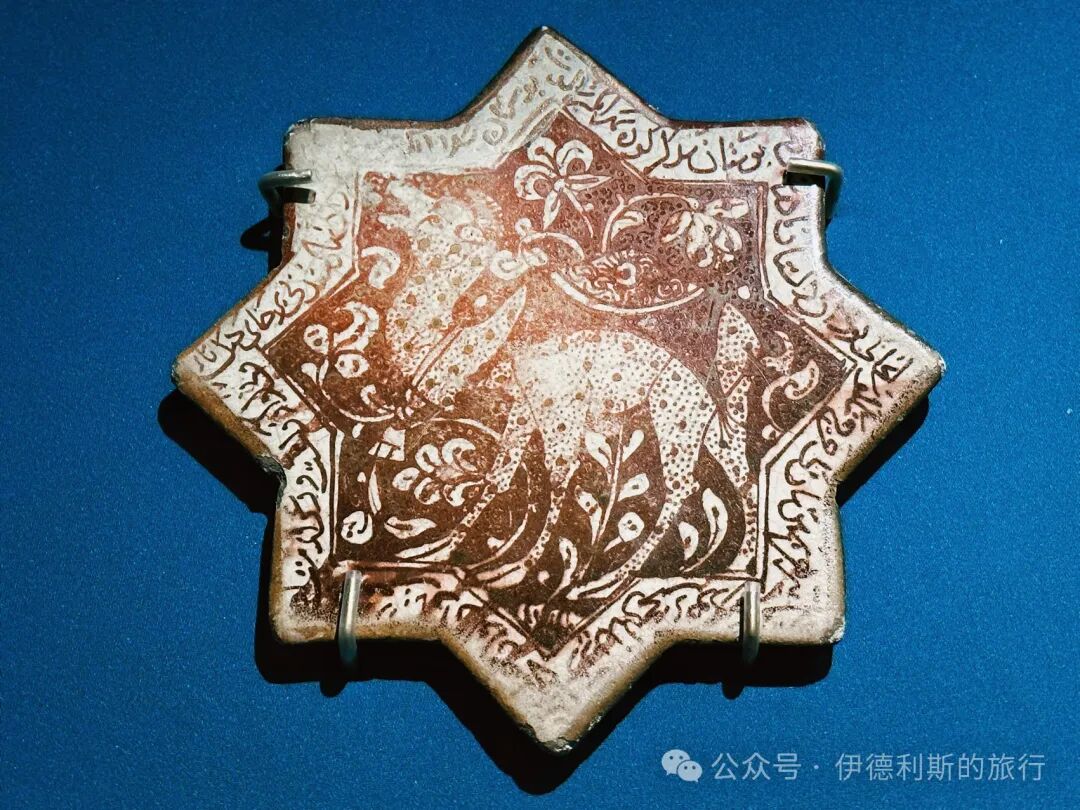
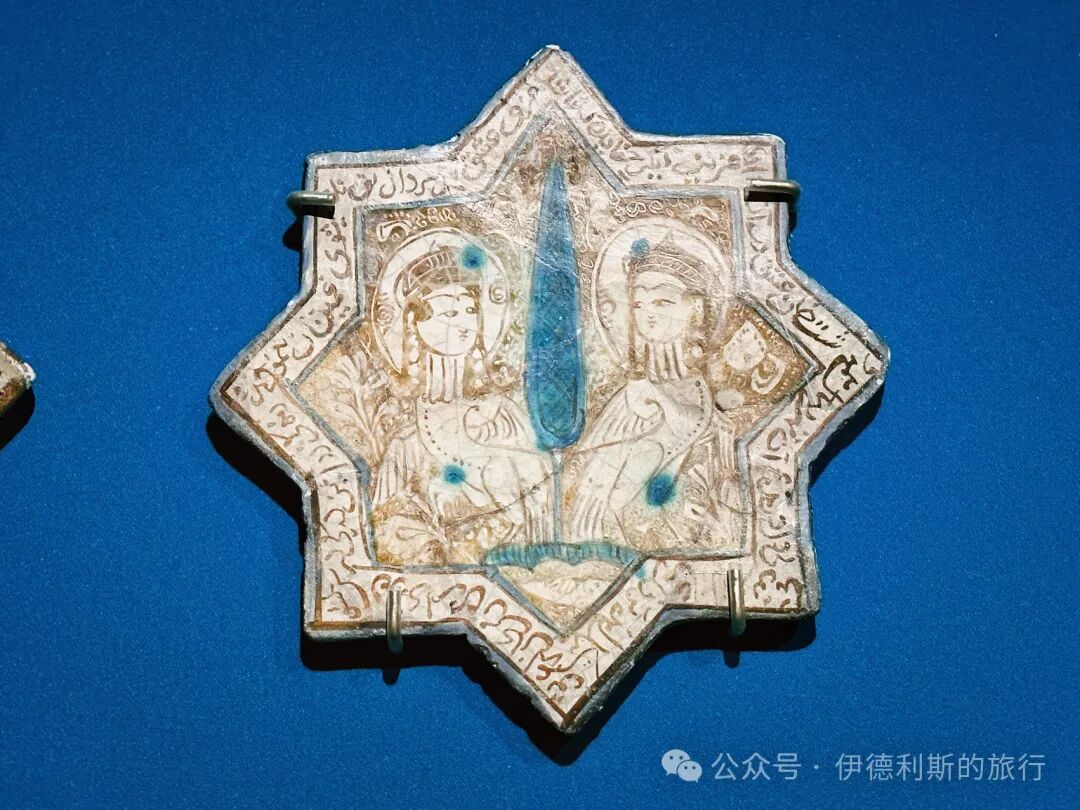
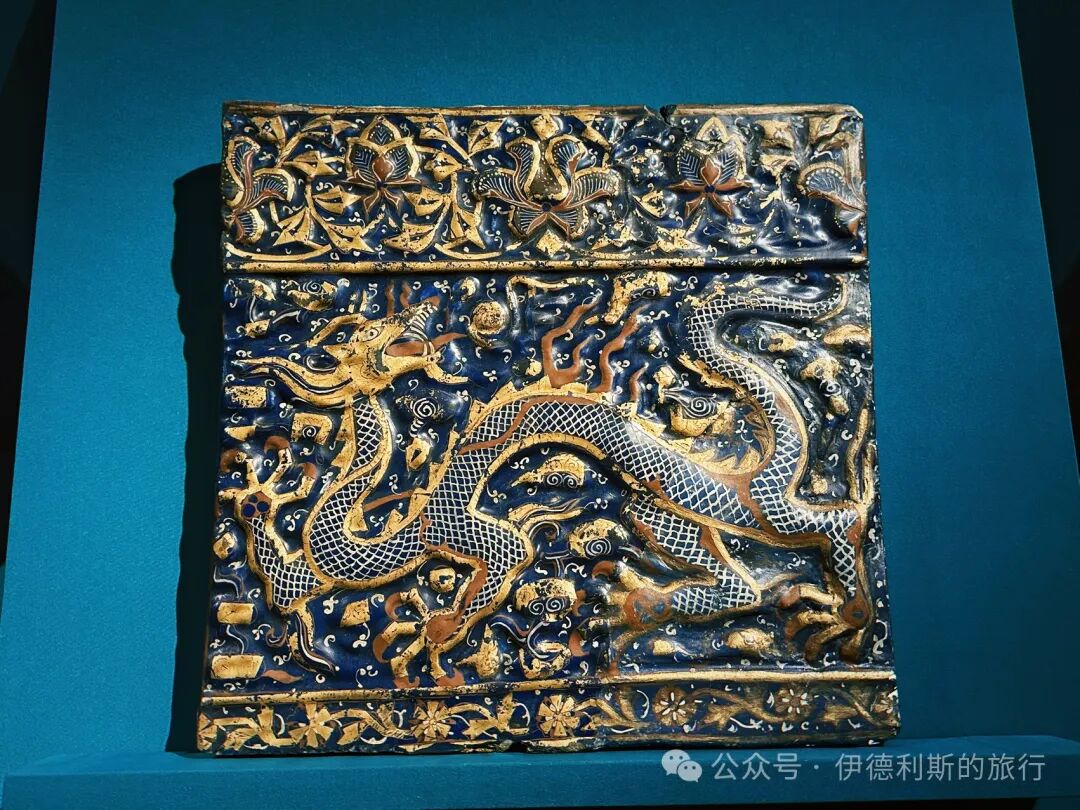
13th to 14th century, Lajvardina glazed tile with a dragon pattern. This piece is a signature artifact from Takht-e Soleyman, and the National Museum of Iran even sells magnets featuring it.
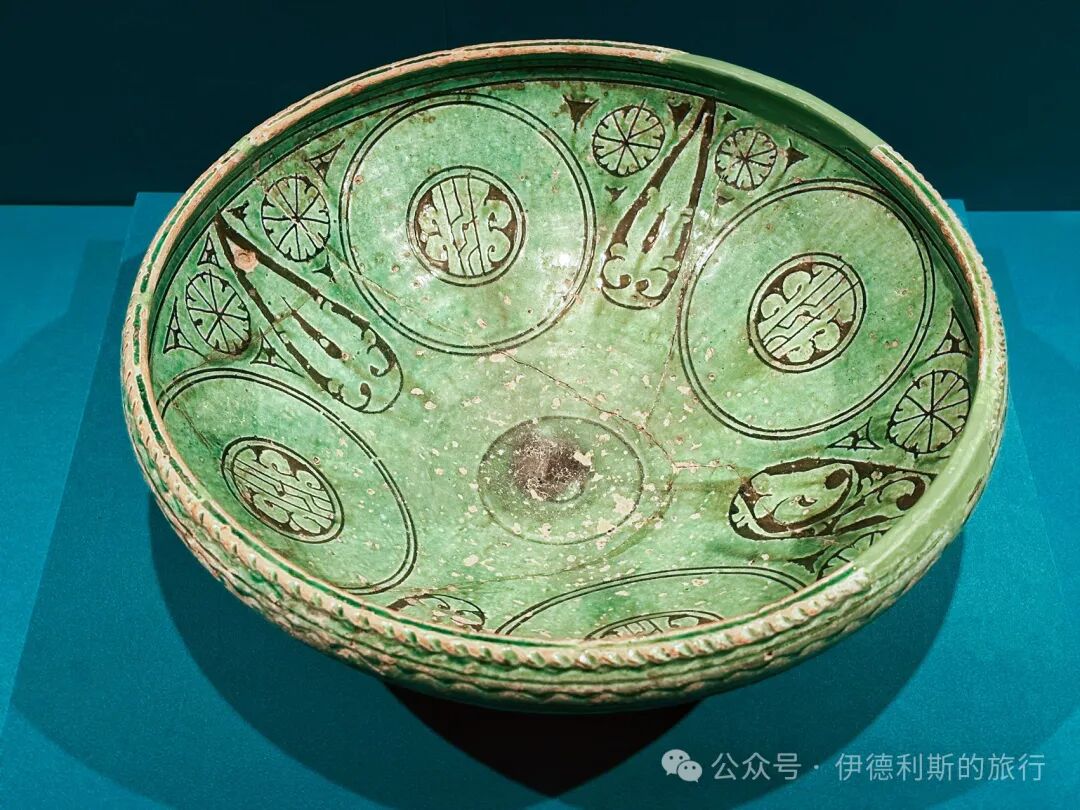
12th to 13th century, late Seljuk to Ilkhanate period, green-glazed pottery bowl with carved scrolling leaf patterns in panels.
Late 13th to early 14th century, lusterware glazed pottery bowl with animal patterns.
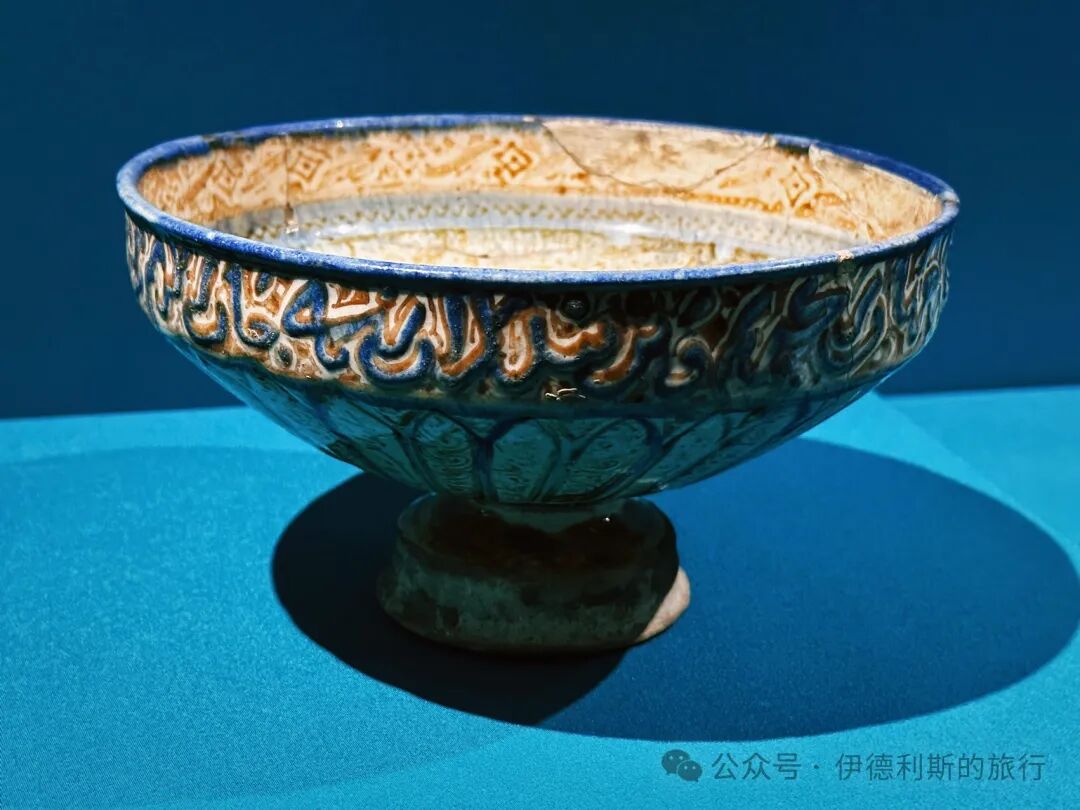
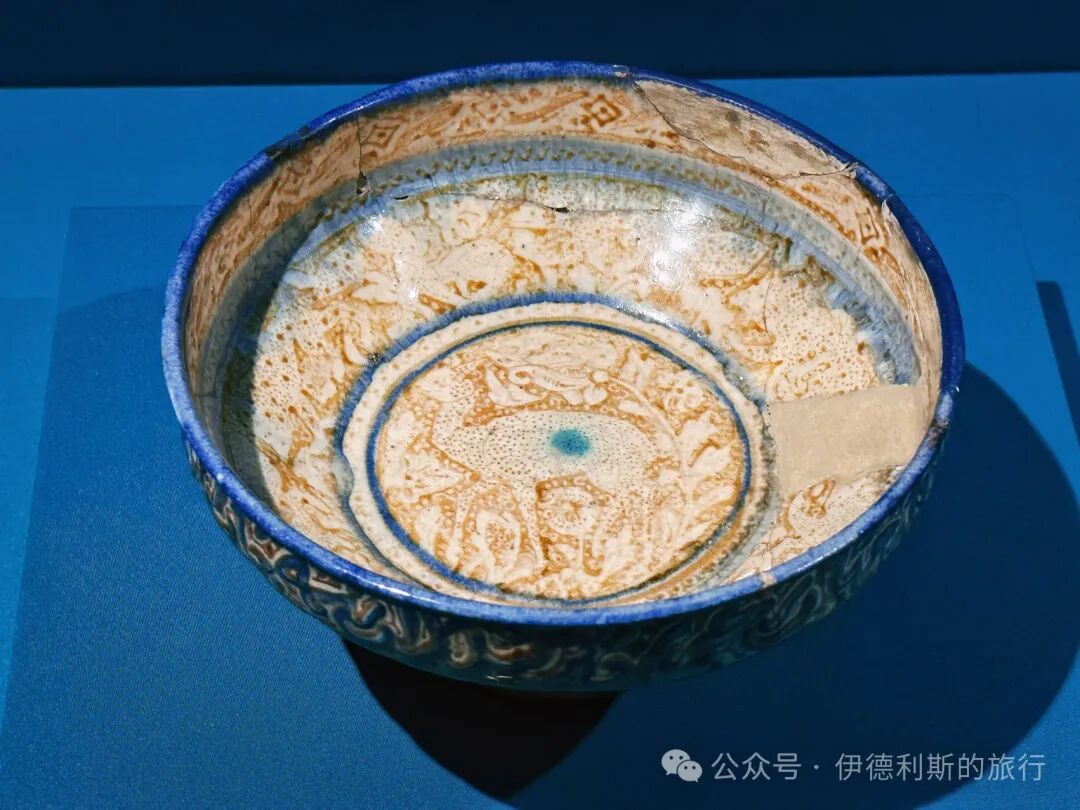
Late 13th to early 14th century, Ilkhanate period, glazed pottery bowl with a twin-ram pattern.
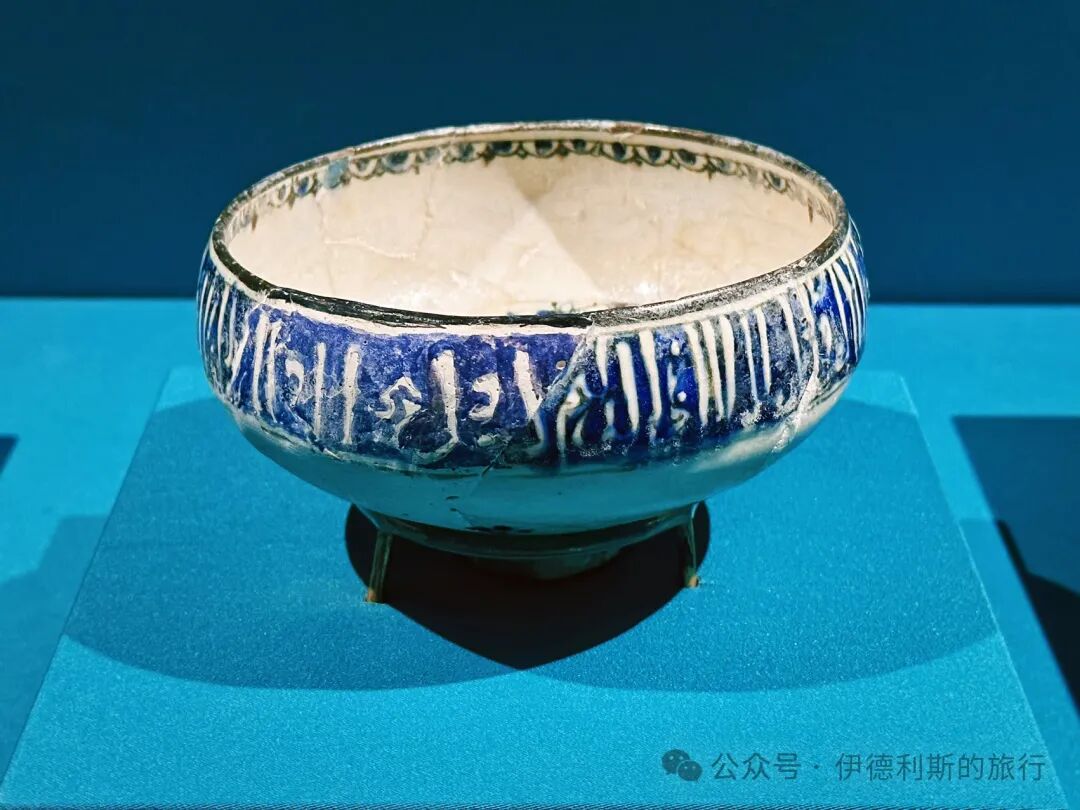
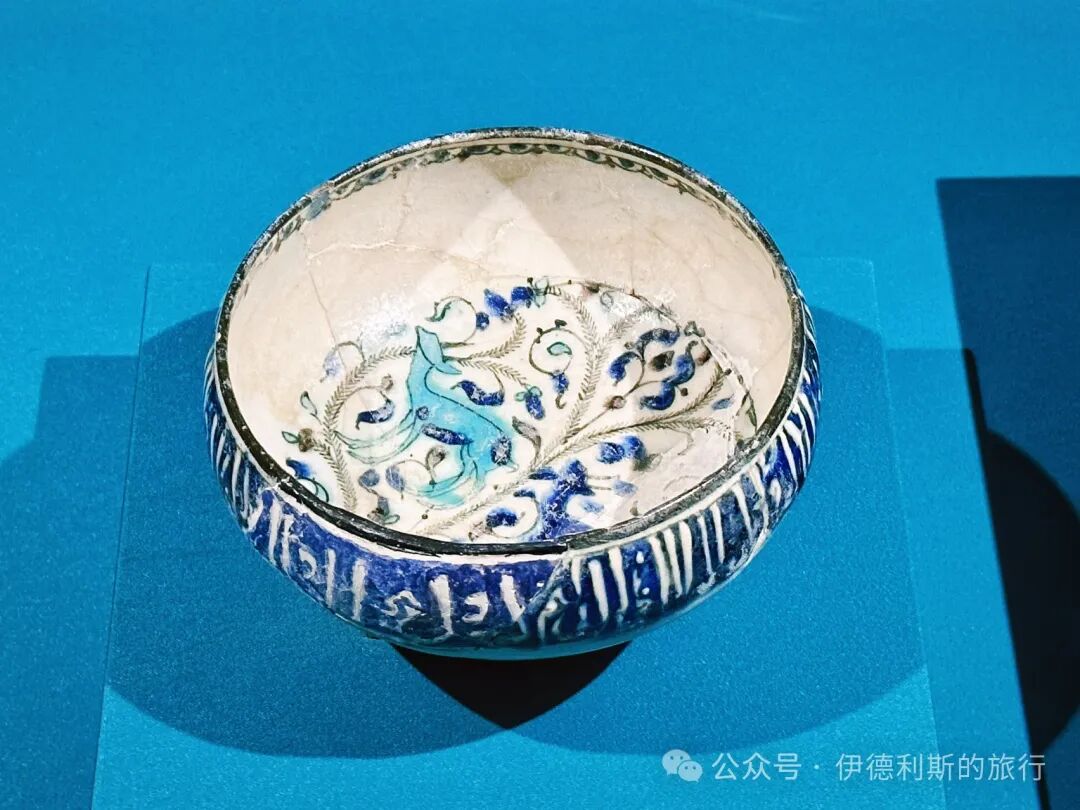
Kashan
Glazed pottery from the ancient city of Kashan. During the 12th to 14th centuries under Seljuk and Ilkhanate rule, Kashan was a major center for producing high-quality glazed pottery in Iran. In modern Persian, the word for tile (kashi) comes from the name Kashan.
13th to 14th century, Ilkhanate period, lusterware glazed pottery jug with one handle and a sphinx pattern.
13th to 14th century, Ilkhanate period, lusterware glazed pottery jug with human figure patterns.
13th to 14th century, Ilkhanate period, lusterware glazed pottery watering vessel with human figure patterns.
13th to 14th century, Ilkhanate period, lusterware glazed mihrab with Thuluth script inscriptions. This mihrab is definitely one of the best pieces on display at the National Museum of Iran.
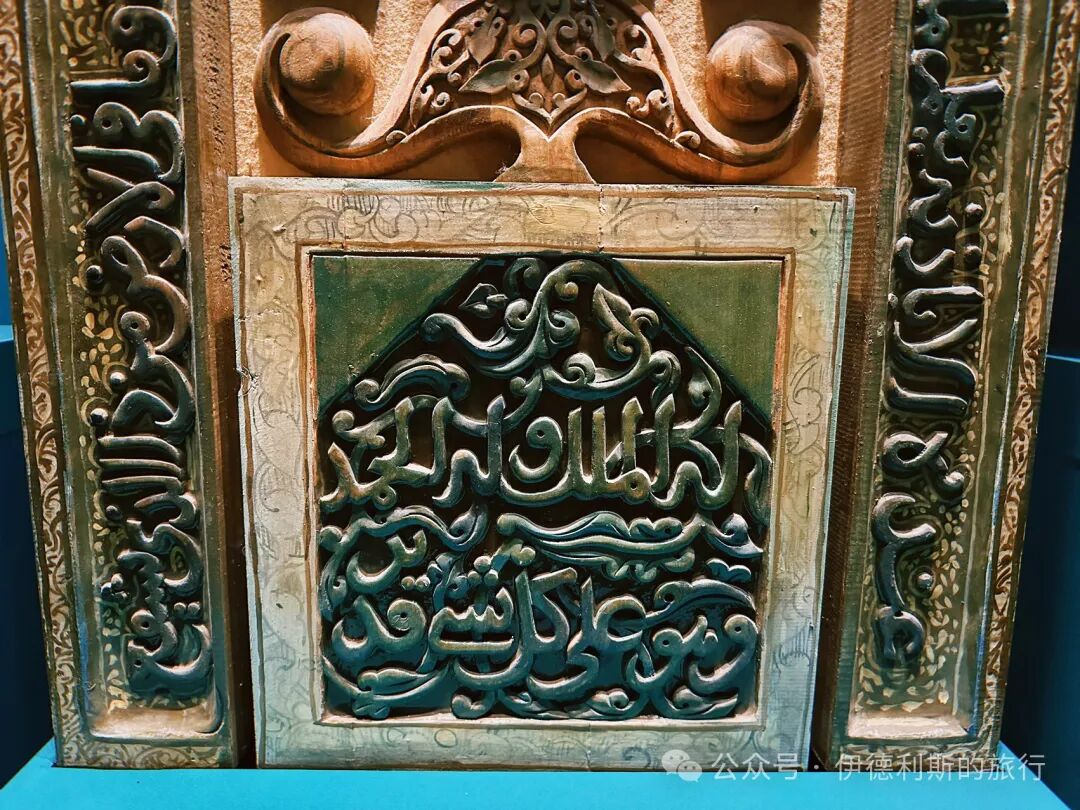
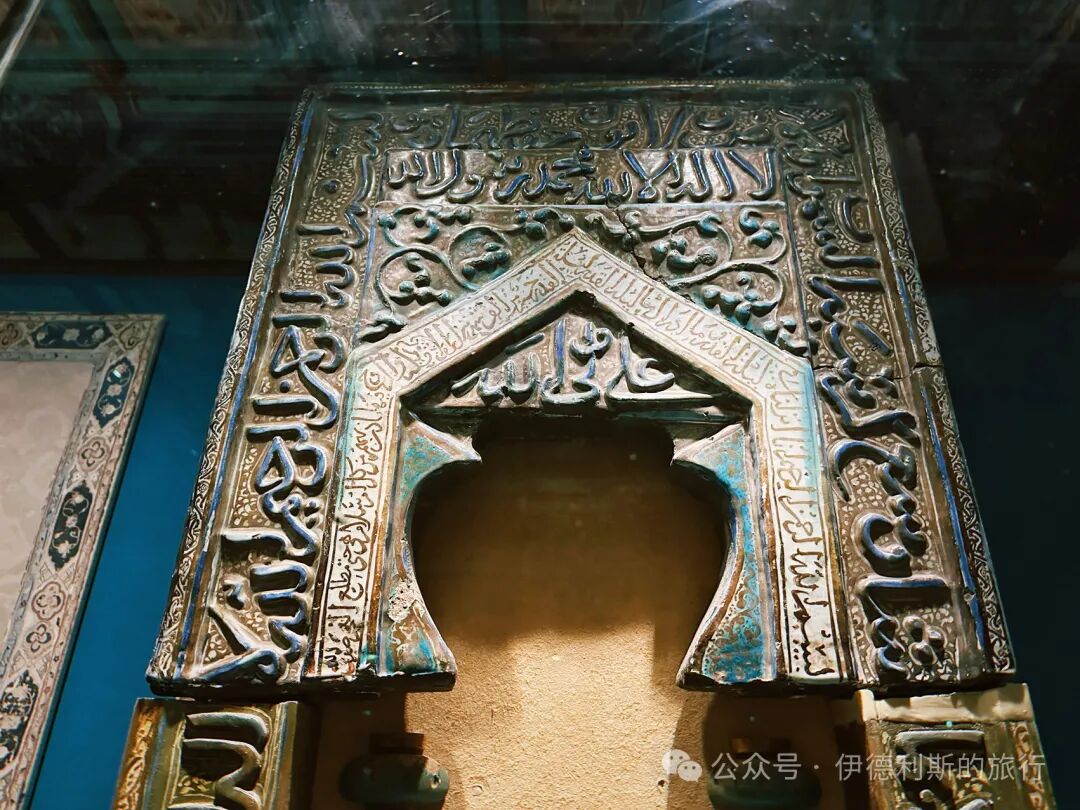
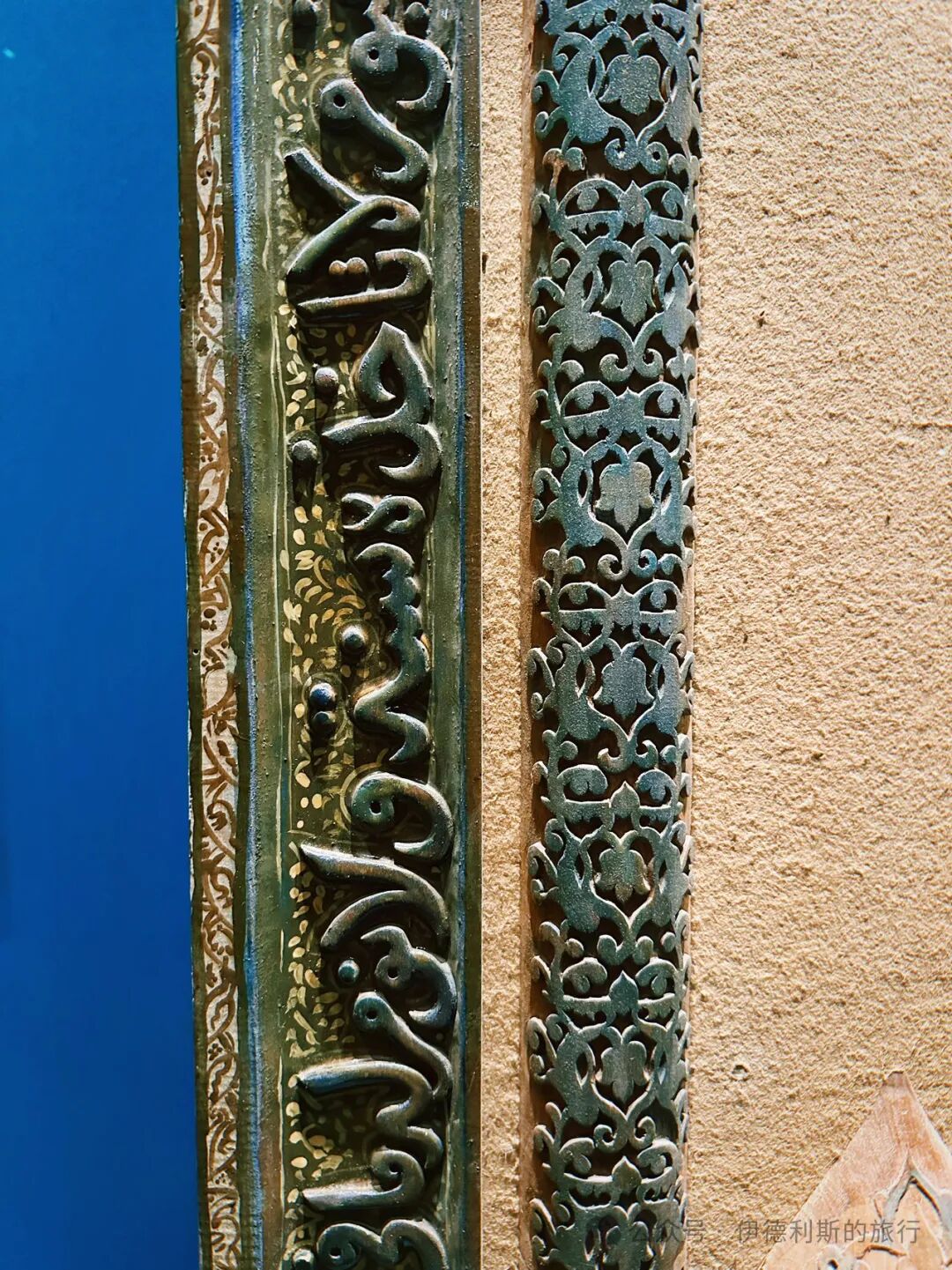
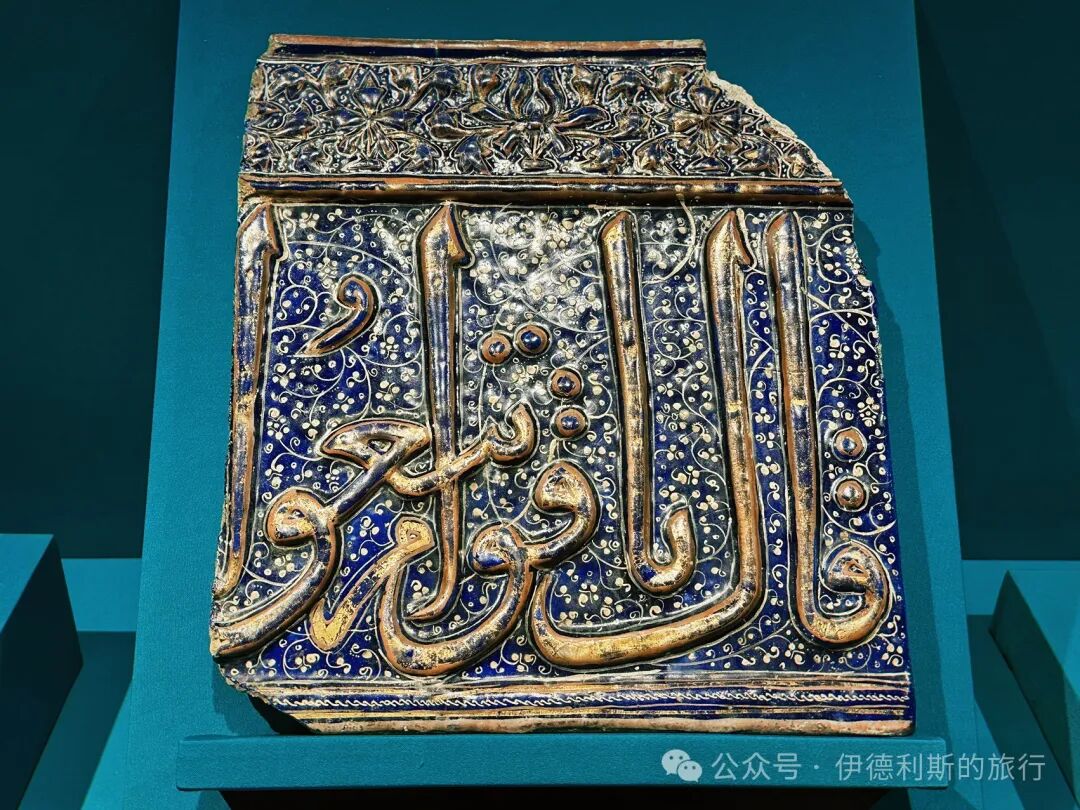
14th-century Ilkhanate period, Saveh, Lajvardina glazed molded inscription tile. Saveh is located southwest of Tehran and was an important city during the Ilkhanate period. Lajvardina is an overglaze technique known for its lapis lazuli-like blue base glaze, often seen on building facades from the Ilkhanate period.
14th-century Ilkhanate period, Sultanabad, glazed pottery bowl with mythical bird and deer patterns. The bowl depicts the Simurgh, a mythical bird from Persian legends. During the Sassanid Empire, the Simurgh was depicted with a dog's head and a peacock's tail, but it transformed into a peacock-like image under Chinese influence during the Ilkhanate period.
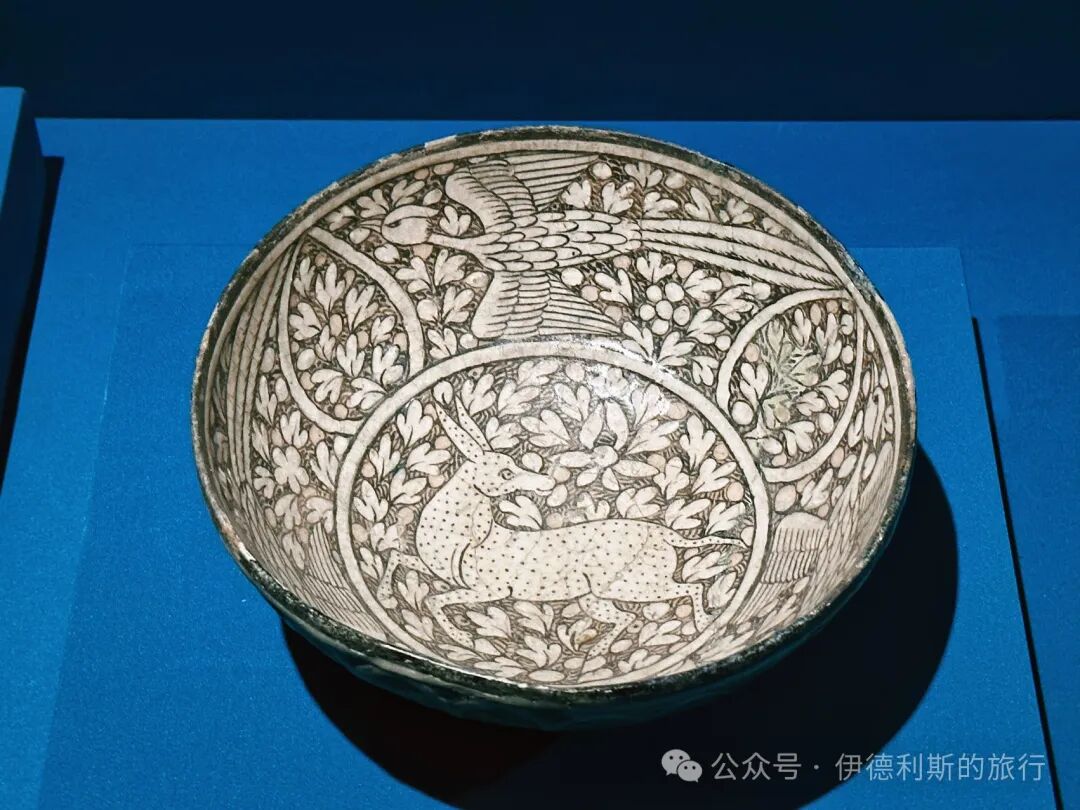
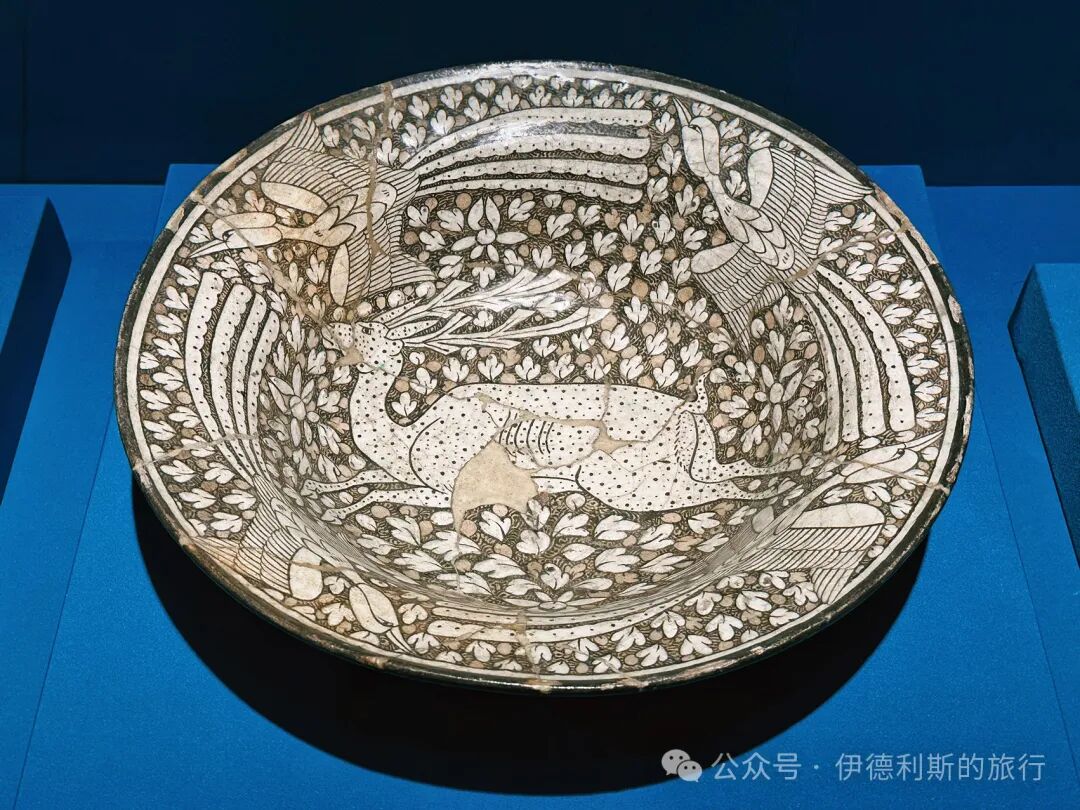
Timurid Dynasty
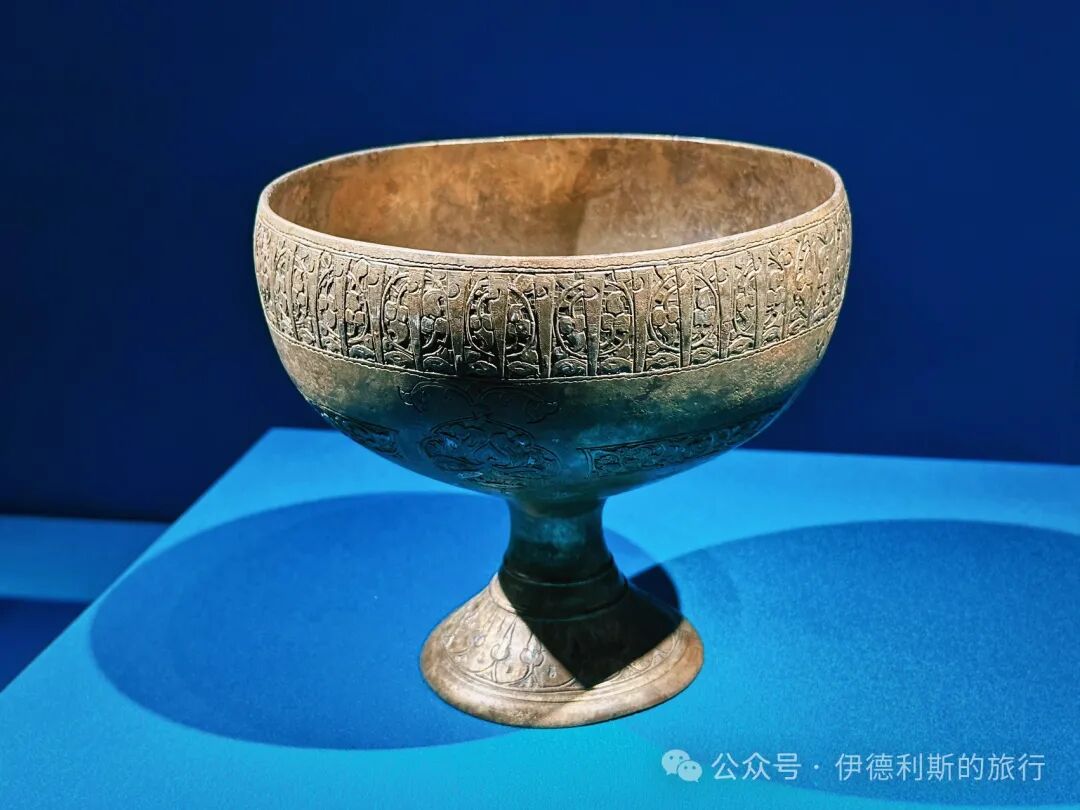
14th-15th century Timurid period, Borujerd, silver-inlaid bronze stemmed bowl.
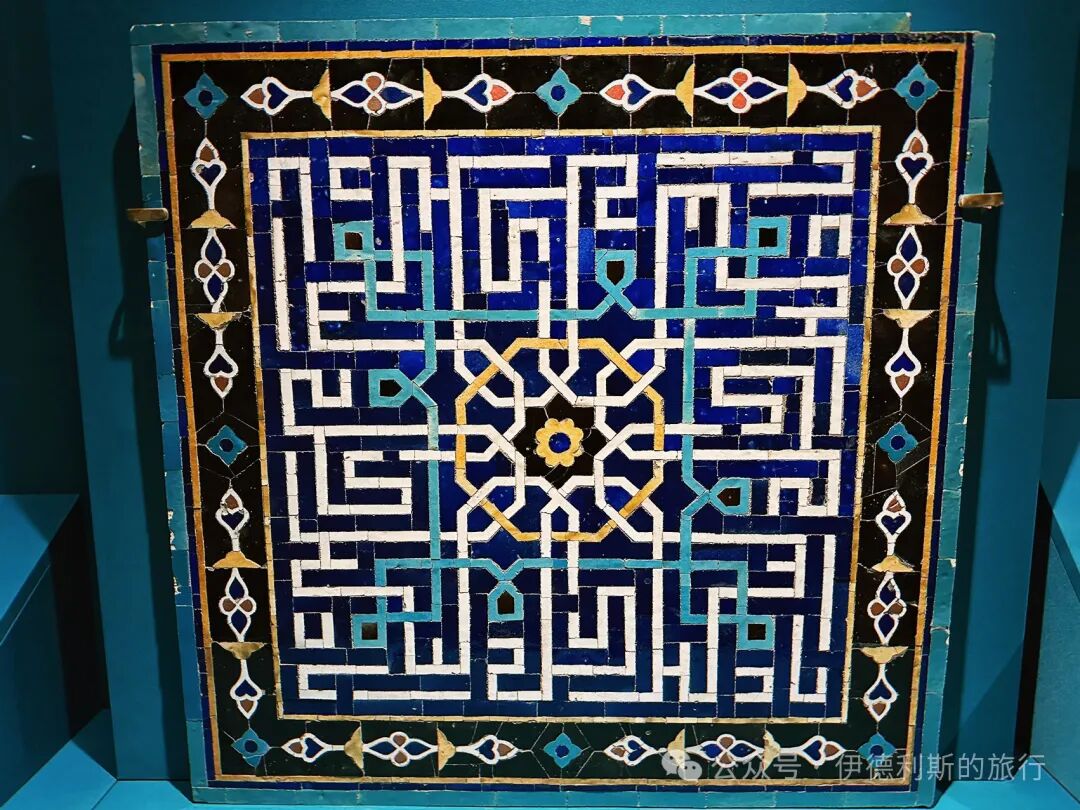
14th-century Timurid period, Khorasan region, mosaic tile with checkerboard Kufic script.
16th-17th century Shahsavar, overglaze painted tile with human figures.
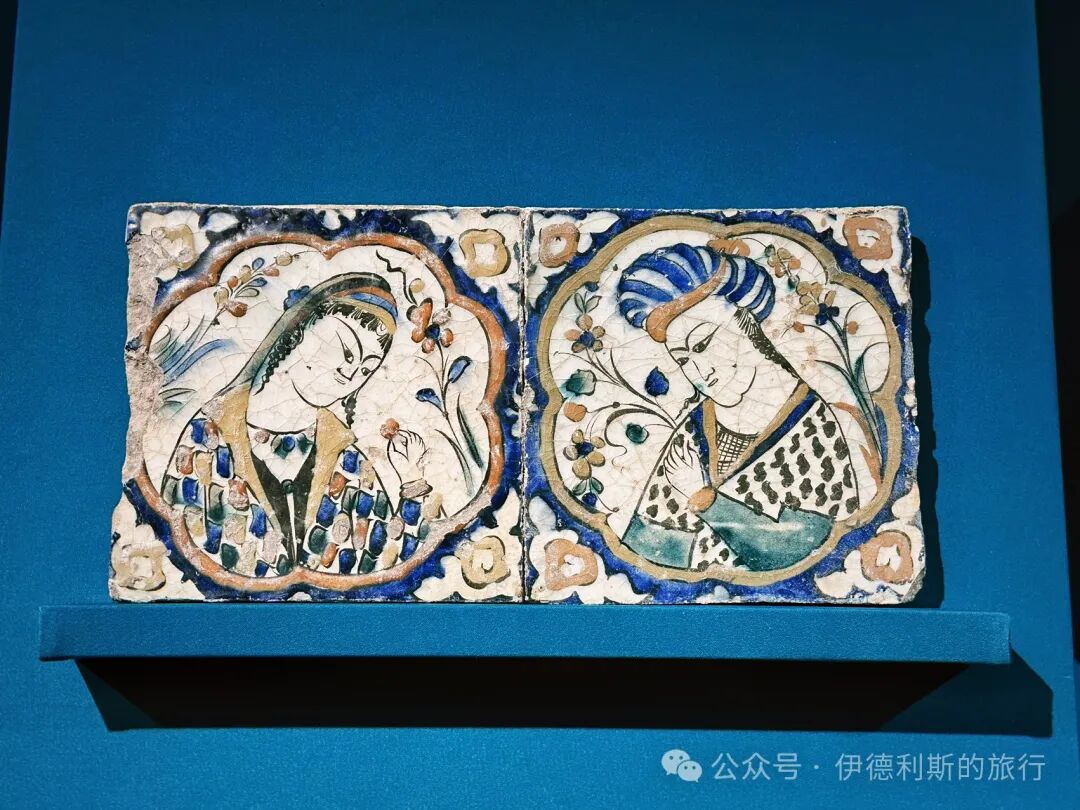
Safavid Dynasty
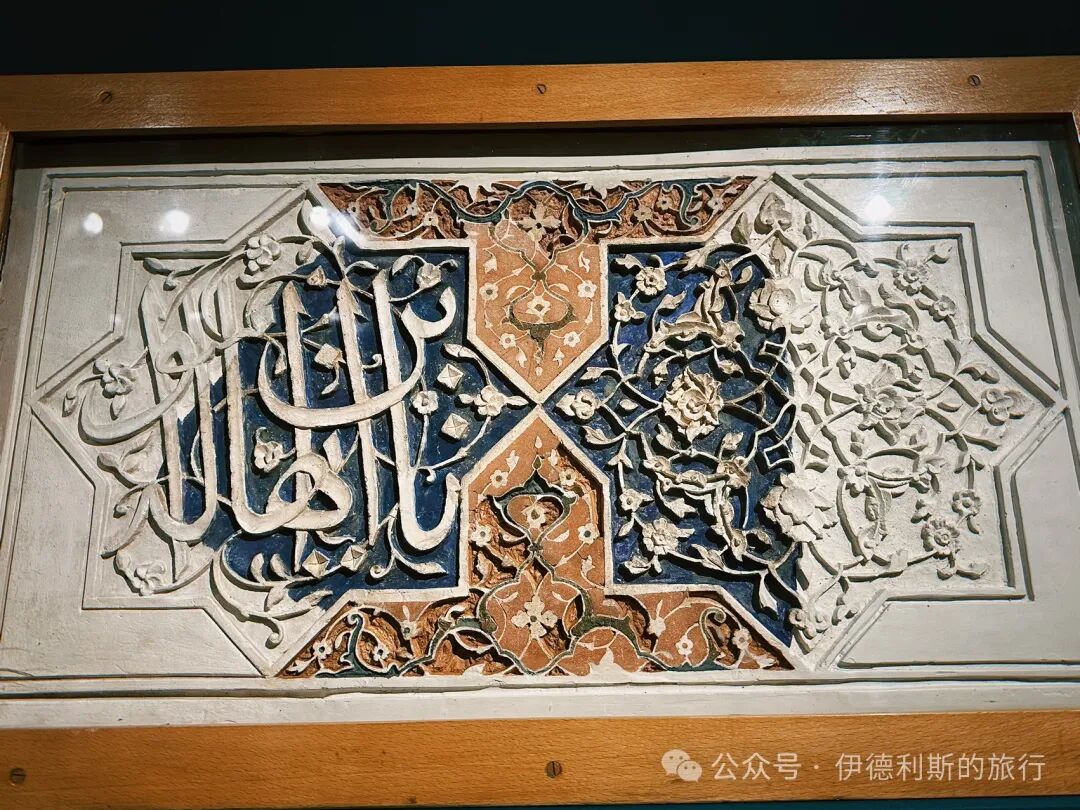
16th-17th century Isfahan province, stucco panel with calligraphic inscriptions.
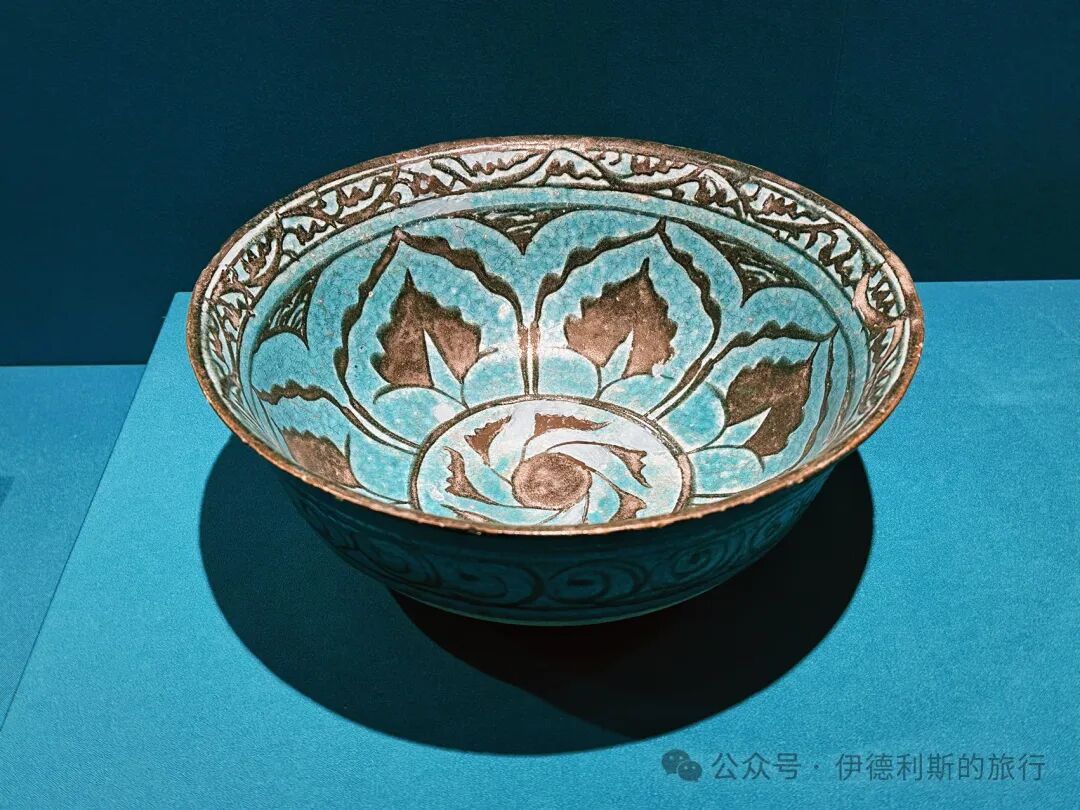
17th-century Amol, blue glazed pottery bowl with floral patterns. Amol is located on the Caspian Sea coast. It was a major trading hub in history and continued to grow during the Safavid Dynasty, becoming a favorite residence of the Safavid King Abbas II, who reigned from 1632 to 1666.
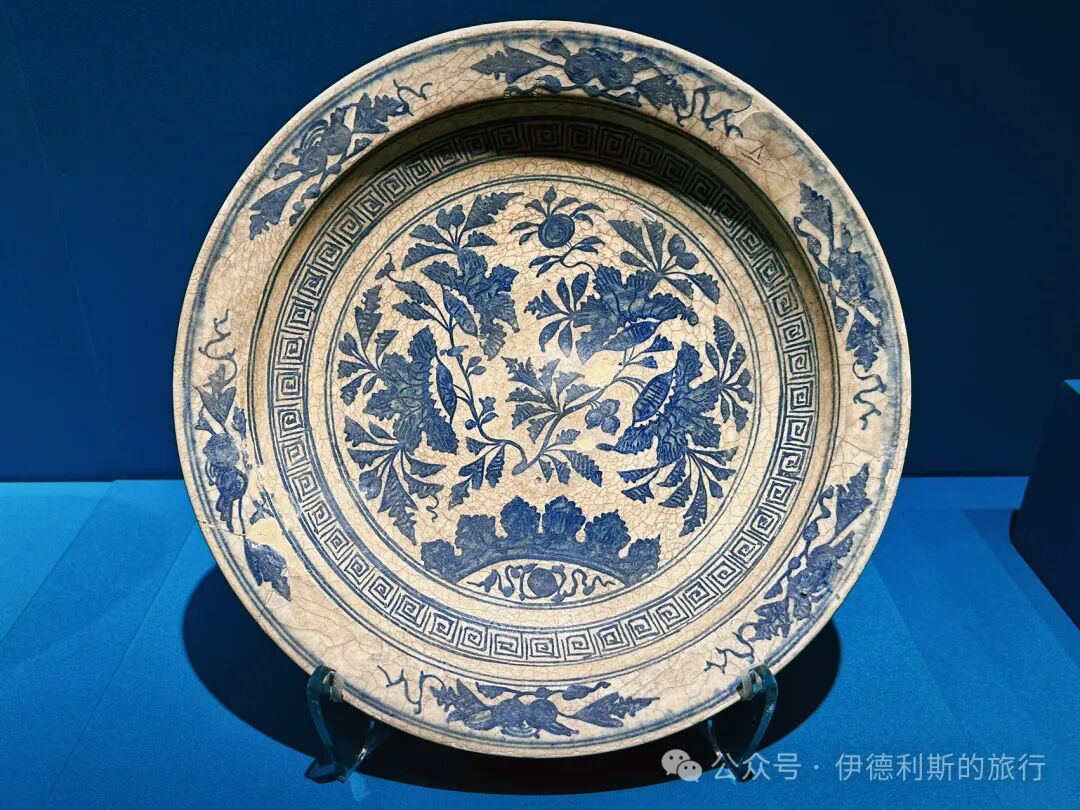
16th-century Amol, blue and white porcelain plate.
17th-century glazed pottery plate with underglaze floral patterns from northern Iran.
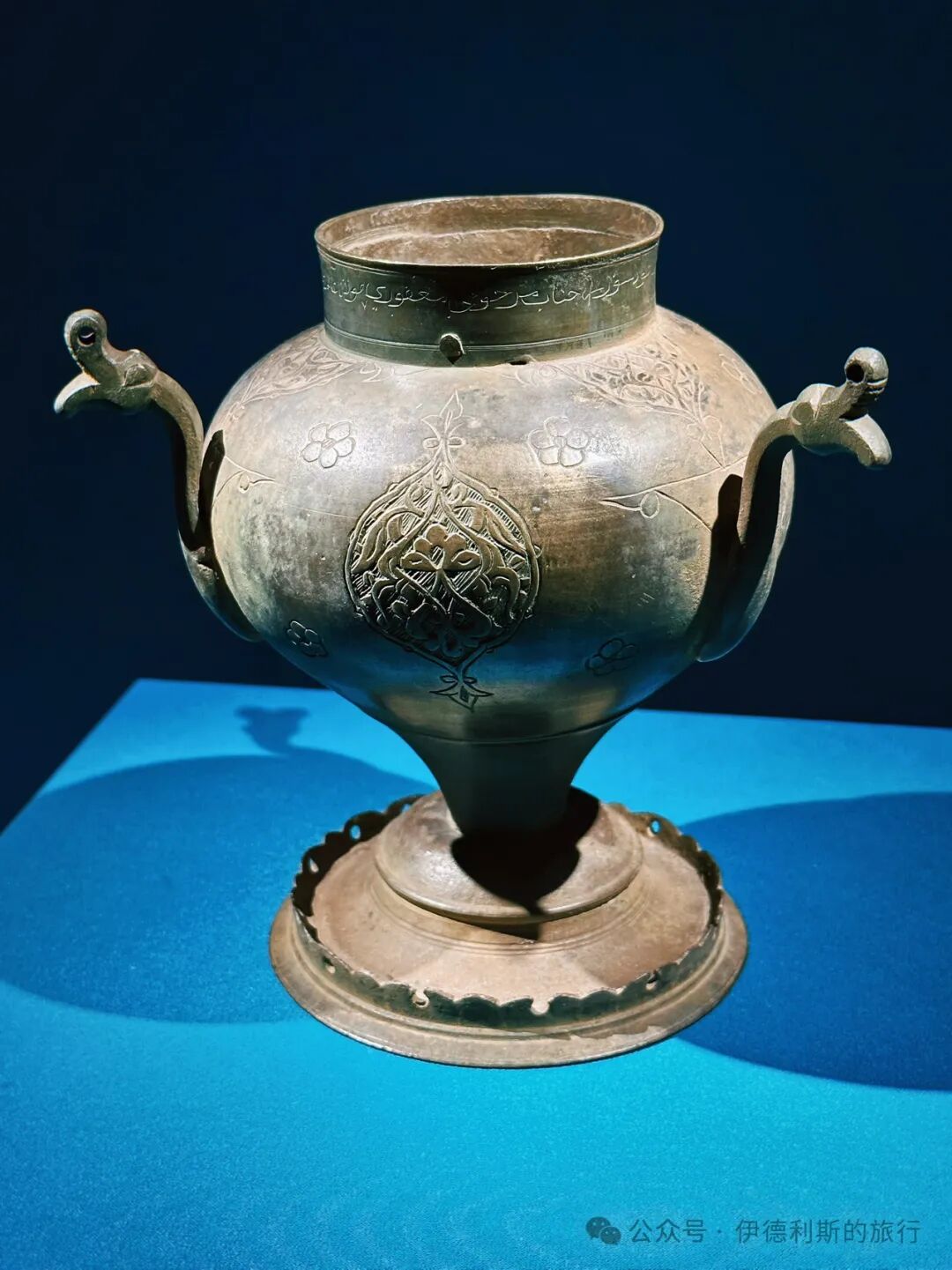
16th-century bronze incense burner with a dragon head from Yazd Province.
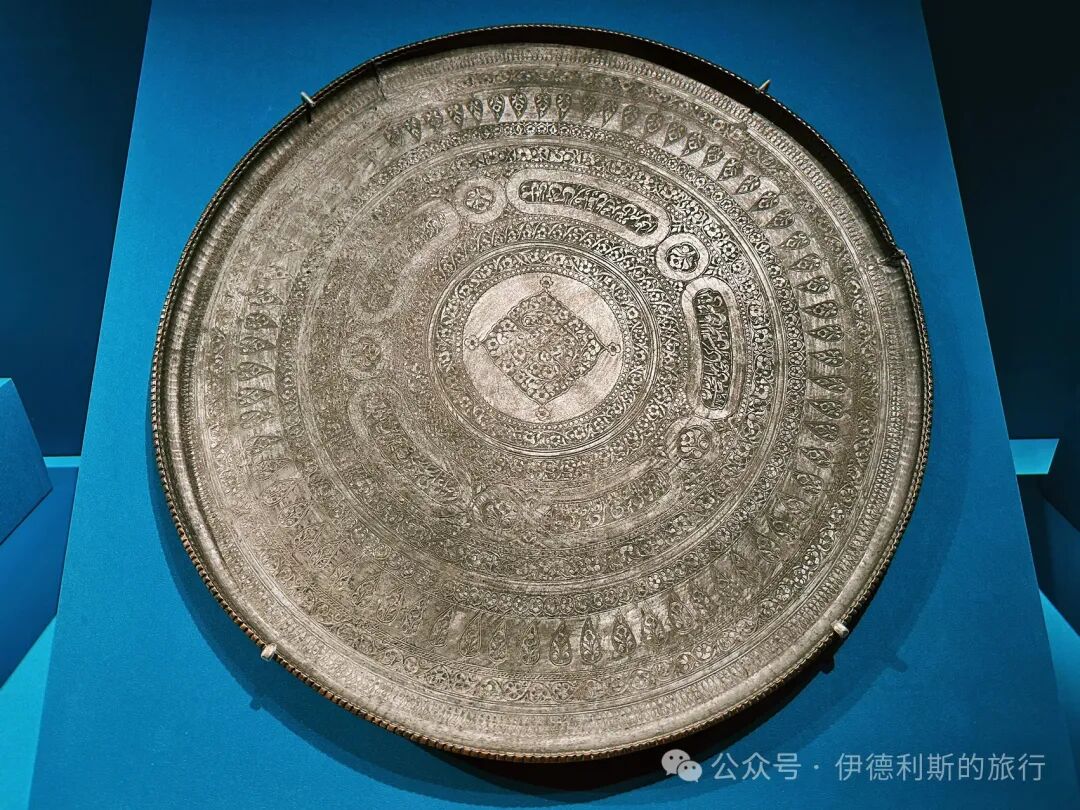
16th-century bronze plate with floral patterns and inscriptions from Kermanshah Province.
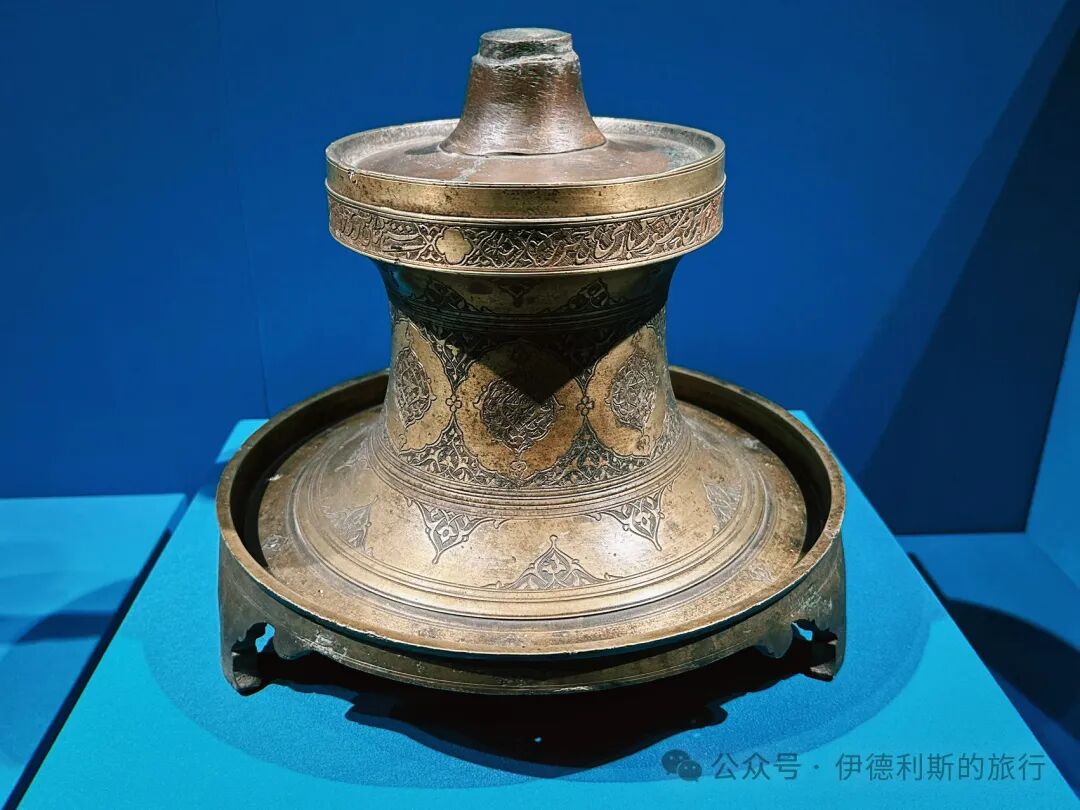
16th-century bronze candlestick from Isfahan. In 1598, Safavid King Abbas I (reigned 1588-1629) made Isfahan his capital. He rebuilt it into a prosperous and beautiful city, and Isfahan entered a golden age of culture.
Summary: Islamic Art Guide: Iranian Artifacts at Beijing Forbidden City (Part 1) is presented here as a firsthand travel account in clear, natural English. The account focuses on Iranian Art, Forbidden City, Islamic Heritage while preserving the names, places, food, photos, and historical details from the Chinese source.
The East Wing of the Meridian Gate at the Forbidden City hosted the 'Splendors of Persia: Exhibition of Iranian Cultural Relics' from January 12 to April 11, 2024. The National Museum of Iran sent many precious artifacts for everyone to enjoy.
I visited the National Museum of Iran in 2019, as seen in my article 'Exhibition Notes from the Museum of the Islamic Era in Iran'.
I will share some of the artifacts from the exhibition with you below.
Was the Zhengde Emperor's Islamic name 'Suleiman'?
For this Iranian exhibition at the Meridian Gate, the Forbidden City contributed a heavyweight artifact: a white-glazed, iron-red decorated plate with Arabic and Persian inscriptions, fired at the imperial kilns during the Zhengde period (1506–1521) of the Ming Dynasty. Previously, the Wuyingdian Ceramics Gallery only displayed the front, but this time we finally got to see the bottom of the plate, which holds much more information.
According to Li Yihua's 1984 article 'Two Pieces of Zhengde-era Arabic and Persian Porcelain—Also Discussing the Influence of Islamic Culture' in the 'Journal of the Palace Museum', this is the only red-decorated piece among the more than 20 pieces of Zhengde Arabic and Persian porcelain in the Forbidden City's collection. The wall of the plate features a Hadith: 'The Exalted and Majestic Lord says, whoever does a good deed the size of a speck of dust, (or) whoever does a bad deed the size of a speck of dust, He will see it; this is the reward for those who do good.' The most interesting part is the three lines of text on the bottom of the plate. Li Yihua interpreted them as 'Dimani Khan, namely Aman Suleiman Shah,' and suggested it might have been commissioned for a country in the Arab region. However, some scholars lean toward the idea that 'Dimani Ke' should be 'Da Mink,' meaning 'Great Ming.' Based on this, the text reads 'The ruler of the Great Ming is King Suleiman.' This means the Zhengde Emperor's Islamic name was likely 'Suleiman,' which is why some people jokingly call this piece 'King Solomon's Treasure'.
During the Zhengde period, the palace was very fond of using porcelain with Arabic and Persian inscriptions. Most were bowls, cups, brush rests, and boxes with the same shapes as official kiln wares, and the content was mostly Quranic verses, Hadith, and praises. According to research by Professor Jin Liyan and records in the 'Veritable Records of the Joseon Dynasty,' the Zhengde Emperor studied Islamic knowledge in 1509 (the third year of Zhengde): 'Hearing that Hui Muslims do not eat meat slaughtered by others, but must slaughter it themselves, and that they have kind hearts and read scriptures, he invited them into the palace to learn from them.'
The largest astrolabe from the National Museum of Iran
The National Museum of Iran brought its largest astrolabe for this exhibition. It weighs five kilograms, is over forty centimeters in diameter, and is made of six pieces of brass. It uses scales to mark geographical zones, and the crown-shaped decoration at the top is engraved with the names of two rulers from the Safavid and Qajar dynasties on either side.
The astrolabe comes from the famous Golestan Palace in Tehran. Golestan Palace was the royal palace of the Qajar dynasty and was listed as a UNESCO World Heritage site in 2013. Golestan Palace was first called Tehran Citadel. It was built during the reign of Tahmasp I (ruled 1524-76) of the Safavid dynasty and rebuilt during the reign of Karim Khan (ruled 1750-79) of the Zand dynasty. After Agha Mohammad Khan (ruled 1789-97) of the Qajar dynasty made Tehran the capital, he officially converted Tehran Citadel into Golestan Palace. Between 1925 and 1945, Reza Shah (ruled 1925-41) of the Pahlavi dynasty ordered the demolition of most of Golestan Palace for modern urban construction. Modern-style commercial buildings were built there one after another during the 1950s and 1960s.
Sheikh Safi al-Din Shrine (gongbei)
For this exhibition at the Meridian Gate of the Forbidden City, the National Museum of Iran brought a large number of Ming dynasty porcelains from the Sheikh Safi al-Din Khānegāh and Shrine Ensemble (gongbei). It was a real eye-opener, as I did not get to see these porcelains when I visited the National Museum of Iran before.
Sheikh Safi al-Din (1252-1334) was a Kurdish Sufi master during the Ilkhanate period and the founder of the Safaviyya order. This order eventually established the Safavid dynasty in 1501. After the Safavid dynasty was established, they expanded the Sheikh Safi al-Din Shrine (gongbei) in Ardabil, northwestern Iran, on a large scale between the 16th and 18th centuries, turning it into a massive building complex. The Porcelain House, built in the 17th century, has a huge cross-shaped space. The small niches densely packed on the walls were once filled with Chinese porcelain. Today, most of these porcelains are kept in museums in Tehran.
16th-century Ming dynasty blue and white porcelain with cloud and crane patterns.
15th-16th-century Ming dynasty blue and white ewer with openwork, peacock and peony patterns, and lotus scroll patterns, featuring unglazed panels.
Late 16th-century Ming dynasty blue and white ewer with seahorse and floral patterns.
Late 16th-century Ming dynasty blue and white jar with bird and flower patterns.
Late 16th-century Ming dynasty blue and white jar with scrolling vine patterns.
16th-century Ming dynasty blue and white bowl with polychrome figure patterns.
16th-century Ming dynasty blue and white porcelain bowl with seahorse and floral patterns.
Early 15th-century Ming dynasty white porcelain plate.
15th-century Ming Dynasty celadon plate with chrysanthemum petal patterns.
15th-century Ming Dynasty celadon plate with floral branch patterns.
14th-century Yuan Dynasty blue and white plate with phoenix and flower patterns. The outer wall is stamped with the seal of the Abbasid Caliph.
Late 14th to early 15th-century Yuan and Ming Dynasty large celadon plate.
Early 16th-century Ming Dynasty blue and white bowl with Arabic script and Xuande mark.
16th-century Ming Dynasty yellow-glazed plate.
Late 16th-century Ming Dynasty iron-red glazed porcelain plate with fish patterns.
16th-century Ming Dynasty brown-glazed bowl with Jiajing mark.
Late 15th-century Ming Dynasty blue and white moon flask with arabesque patterns.
Late 14th-century Ming Dynasty blue and white ewer with scrolling flower patterns.
15th-century Ming Dynasty blue and white plum vase (meiping) with scrolling lotus patterns. The vase body is stamped with the seal of the Abbasid Caliph, which can also be seen on other items in this exhibition. The text reads, 'Abbas, servant of the King of Supreme Power, dedicated to King Safi'. After the Mongol army destroyed Baghdad in 1261, the Mamluk Sultanate in Egypt re-established the Abbasid Caliphate in Cairo. The Abbasid Caliphs in Egypt continued to serve as religious authorities but could not get involved in secular affairs. In 1517, the Ottoman Empire conquered Cairo, the last Abbasid Caliph was taken to Istanbul, and the Abbasid Caliphate came to an end.
A 16th-century Ming Dynasty jade cup with a dragon-shaped handle and beast-ear decorations, featuring the seal of the Abbasid Caliph carved on the bottom.
A 17th-century brass candlestick from the Safavid Dynasty.
A 16th-17th century double-headed brass candlestick from the Safavid Dynasty, engraved with Persian poetry by the famous poet Saadi:
One night I could not sleep and stayed awake all night,
I heard a conversation between a moth and a candle.
I am a lover who burns willingly with all my heart,
Why do you cry out in pain with tears streaming down?
Nishapur
Nishapur is an ancient city on the Silk Road in northeastern Iran, once one of the four major cities of the Greater Khorasan region. Nishapur became the capital of the Persian Tahirid Dynasty in the 9th century, grew into an important cultural and commercial hub under the Persian Samanid Dynasty in the 10th century, and continued to thrive during the Seljuk Empire in the 11th century. Between the 9th and 11th centuries, trade routes from Transoxiana in Central Asia, China, Iraq, and Egypt met here. Glazed pottery produced in Nishapur at that time became a major trade commodity in the West, rivaling Baghdad and Cairo.
In 1221, Nishapur was massacred by the Mongols and then destroyed, leaving the former metropolis buried deep underground. It was not until archaeological excavations by the Metropolitan Museum of Art in New York between 1935 and 1940 that countless artifacts were discovered beneath the farmland. Today, most of the excavated Nishapur artifacts are kept at the Metropolitan Museum of Art, as well as in museums in Tehran and Mashhad.
A 10th-11th century stucco panel with floral patterns.
A tombstone from the 9th to 11th century featuring Kufic script for Yahya ibn Ja'far.
A 9th to 10th-century glazed pottery bowl with slip-painted horseman designs.
A 10th-century glazed pottery bowl with geometric patterns.
A 9th to 10th-century Nishapur-style glazed pottery bowl with geometric and plant patterns.
A 9th to 10th-century Nishapur-style glazed pottery bowl with geometric and plant patterns.
A 10th-century Nishapur-style glazed pottery bowl with slip-painted imitation Kufic inscriptions.
A 10th-century glazed pottery bowl with Kufic script.
Glass lamps, glass cups, and glass bowls from the 9th to 10th century. Besides glazed pottery, Nishapur was also a center for glass craftsmanship from the 9th to 11th century.
A 10th-century Sari-style glazed pottery bowl with slip-painted bird patterns.
Gorgan.
Glazed pottery from the ancient city of Gorgan. Gorgan was an important city on the Caspian coast during the Sasanian period and remained a center for Zoroastrianism after the 8th century. The old city of Gorgan was destroyed during the Mongol invasion in the 13th century, and it was moved to the current new city during the Ilkhanate period.
A 10th-century glazed pottery bowl with slip-painted antelope patterns.
A 13th to 14th-century Ilkhanate-period glazed pottery jar with a single handle and calligraphic text.
Luster-glazed ceramic plate with figure patterns from the Ilkhanate period, 13th-14th century.
Glazed ceramic bowl with geometric patterns from the Ilkhanate period, 14th century.
Glazed ceramic bowl with floral patterns and calligraphy from the Ilkhanate period, 13th century.
Gorgan-style luster-glazed inscription brick with Thuluth script from the Ilkhanate period, 13th-14th century.
Glassware and bronze ware from the ancient city of Gorgan.
Single-handled glass jar, 9th-10th century.
Glass ewer, 10th century.
Single-handled glass jar, 10th century.
Bird-shaped glass ewer from the Seljuk Empire, 11th-12th century.
Glass bowl with flower patterns from the Ilkhanate period, 13th century.
Glass bottle with circle patterns from the Ilkhanate period, 13th century.
Single-handled bronze ewer, 9th-10th century.
Two-handled bronze cauldron with inscriptions from the Seljuk Empire period, 12th century.
Ray.
Ray is located in the southern suburbs of Tehran and is an important ancient city in northern Iran. It is referred to as "Layi" in books like the History of Yuan. In 1043, Tuğrul Beg, the founder of the Seljuk Empire, made Ray the capital of the empire and carried out large-scale reconstruction of the ancient city. Under the rule of the Seljuk Empire, Rey reached its peak with a massive marketplace and a very prosperous trade scene. Import and export trade, mainly in silk, connected the entire Eurasian continent. At that time, Rey was the center for making painted pottery in Iran, and Rey-style painted pottery was an important handicraft of the period.
In 1220, the Mongol army invaded Rey, which was then under the rule of the Khwarazmian Empire. Because there was no fierce resistance, the Mongols did not massacre the city. Even so, the residents gradually left, and the center for pottery production moved to the southern city of Kashan.
Stucco figure from the Seljuk dynasty, 11th to 12th century.
Ceramic tile from the Seljuk dynasty, 11th to 12th century.
Single-handled pottery jar from the 9th century.
Three-handled pottery jar from the 9th to 10th century.
Blue-glazed narrow-necked pottery vase from the Ilkhanate period, 13th century.
Rey-style Mina'i glazed pottery bowl with a camel rider pattern, from the late Seljuk dynasty to the Ilkhanate period, 12th to 13th century.
Rey-style Mina'i glazed pottery bowl with a sphinx pattern, from the late Seljuk dynasty to the Ilkhanate period, 12th to 13th century.
Glazed pottery bowl with geometric patterns from the ancient city of Rey, Ilkhanate period, 13th to 14th century.
Seljuk dynasty.
Bronze ware from the Seljuk dynasty.
11th-12th century Seljuk dynasty single-handled bronze lamp with a bird figure from Quchan. Quchan is in northeastern Iran near the border with Turkmenistan. The lamp has Kufic script and scroll patterns on both sides. Similar designs were found in Nishapur, which may link to traditions in northeastern Iran.
12th century Seljuk dynasty bronze ewer with calligraphy in the Khorasan style.
12th century Seljuk dynasty bronze incense burner from Sowme'eh Sara. Sowme'eh Sara is on the Caspian Sea coast in northwestern Iran.
11th-12th century Seljuk dynasty bronze basin with a floral rim and geometric patterns from Rafsanjan. Rafsanjan is in southeastern Iran. It is the world's largest producer of pistachios and a center for carpet production in Iran.
11th-12th century Seljuk dynasty bronze candlestick with three animal-shaped feet in the Khorasan style.
Summer palace of the Ilkhanate.
Artifacts unearthed at the Takht-e Soleyman site, the summer palace of the Ilkhanate. Takht-e Soleyman is a World Heritage site that served as the summer palace for the Ilkhanate in the 13th century. The Ilkhanate blended Eastern and Iranian art here to develop a unique Ilkhanid artistic style.
Takht-e Soleyman is the only surviving secular building complex from the Ilkhanate. The walls of the Great Khan's palace still have beautiful glazed tile decorations, which directly reflect the cultural and artistic exchange between China and Iran in the 14th century. The glazed tiles show various flowers, animals, and figures. The themes cover Chinese mythology, Iranian mythology, and calligraphic scripture, showing a blend of many cultures. Some of the tile themes come from the famous Iranian epic, the Shahnameh, which shows how the Ilkhanate integrated into Iran at the time.
Late 13th to early 14th century stucco panel with bird patterns.
Late 13th to early 14th century, Lajvardina glazed tiles with deer and lion patterns.
13th to 14th century, lusterware glazed tiles with camel and sphinx patterns. Lusterware, also called iridescent glaze, is a decorative technique using a second low-temperature firing. This second firing uses a reduction atmosphere to create a shimmering metallic finish.
13th to 14th century, Lajvardina glazed tile with a dragon pattern. This piece is a signature artifact from Takht-e Soleyman, and the National Museum of Iran even sells magnets featuring it.
12th to 13th century, late Seljuk to Ilkhanate period, green-glazed pottery bowl with carved scrolling leaf patterns in panels.
Late 13th to early 14th century, lusterware glazed pottery bowl with animal patterns.
Late 13th to early 14th century, Ilkhanate period, glazed pottery bowl with a twin-ram pattern.
Kashan
Glazed pottery from the ancient city of Kashan. During the 12th to 14th centuries under Seljuk and Ilkhanate rule, Kashan was a major center for producing high-quality glazed pottery in Iran. In modern Persian, the word for tile (kashi) comes from the name Kashan.
13th to 14th century, Ilkhanate period, lusterware glazed pottery jug with one handle and a sphinx pattern.
13th to 14th century, Ilkhanate period, lusterware glazed pottery jug with human figure patterns.
13th to 14th century, Ilkhanate period, lusterware glazed pottery watering vessel with human figure patterns.
13th to 14th century, Ilkhanate period, lusterware glazed mihrab with Thuluth script inscriptions. This mihrab is definitely one of the best pieces on display at the National Museum of Iran.
14th-century Ilkhanate period, Saveh, Lajvardina glazed molded inscription tile. Saveh is located southwest of Tehran and was an important city during the Ilkhanate period. Lajvardina is an overglaze technique known for its lapis lazuli-like blue base glaze, often seen on building facades from the Ilkhanate period.
14th-century Ilkhanate period, Sultanabad, glazed pottery bowl with mythical bird and deer patterns. The bowl depicts the Simurgh, a mythical bird from Persian legends. During the Sassanid Empire, the Simurgh was depicted with a dog's head and a peacock's tail, but it transformed into a peacock-like image under Chinese influence during the Ilkhanate period.
Timurid Dynasty
14th-15th century Timurid period, Borujerd, silver-inlaid bronze stemmed bowl.
14th-century Timurid period, Khorasan region, mosaic tile with checkerboard Kufic script.
16th-17th century Shahsavar, overglaze painted tile with human figures.
Safavid Dynasty
16th-17th century Isfahan province, stucco panel with calligraphic inscriptions.
17th-century Amol, blue glazed pottery bowl with floral patterns. Amol is located on the Caspian Sea coast. It was a major trading hub in history and continued to grow during the Safavid Dynasty, becoming a favorite residence of the Safavid King Abbas II, who reigned from 1632 to 1666.
16th-century Amol, blue and white porcelain plate.
17th-century glazed pottery plate with underglaze floral patterns from northern Iran.
16th-century bronze incense burner with a dragon head from Yazd Province.
16th-century bronze plate with floral patterns and inscriptions from Kermanshah Province.
16th-century bronze candlestick from Isfahan. In 1598, Safavid King Abbas I (reigned 1588-1629) made Isfahan his capital. He rebuilt it into a prosperous and beautiful city, and Isfahan entered a golden age of culture.
Islamic Art Guide: Iranian Artifacts at Beijing Forbidden City (Part 2)
Articles • ali2007fr posted the article • 0 comments • 126 views • 2026-05-19 08:52
Reposted from the web
Summary: Islamic Art Guide: Iranian Artifacts at Beijing Forbidden City (Part 2) is presented here as a firsthand travel account in clear, natural English. The account focuses on Iranian Art, Forbidden City, Islamic Heritage while preserving the names, places, food, photos, and historical details from the Chinese source. view all
Summary: Islamic Art Guide: Iranian Artifacts at Beijing Forbidden City (Part 2) is presented here as a firsthand travel account in clear, natural English. The account focuses on Iranian Art, Forbidden City, Islamic Heritage while preserving the names, places, food, photos, and historical details from the Chinese source. view all
Reposted from the web
Summary: Islamic Art Guide: Iranian Artifacts at Beijing Forbidden City (Part 2) is presented here as a firsthand travel account in clear, natural English. The account focuses on Iranian Art, Forbidden City, Islamic Heritage while preserving the names, places, food, photos, and historical details from the Chinese source.
Summary: Islamic Art Guide: Iranian Artifacts at Beijing Forbidden City (Part 2) is presented here as a firsthand travel account in clear, natural English. The account focuses on Iranian Art, Forbidden City, Islamic Heritage while preserving the names, places, food, photos, and historical details from the Chinese source.
Islamic Art Guide: Iranian Artifacts at Beijing Forbidden City (Part 1)
Articles • ali2007fr posted the article • 0 comments • 196 views • 2026-05-19 08:52
Reposted from the web
Summary: Islamic Art Guide: Iranian Artifacts at Beijing Forbidden City (Part 1) is presented here as a firsthand travel account in clear, natural English. The account focuses on Iranian Art, Forbidden City, Islamic Heritage while preserving the names, places, food, photos, and historical details from the Chinese source.
The East Wing of the Meridian Gate at the Forbidden City hosted the 'Splendors of Persia: Exhibition of Iranian Cultural Relics' from January 12 to April 11, 2024. The National Museum of Iran sent many precious artifacts for everyone to enjoy.
I visited the National Museum of Iran in 2019, as seen in my article 'Exhibition Notes from the Museum of the Islamic Era in Iran'.
I will share some of the artifacts from the exhibition with you below.
Was the Zhengde Emperor's Islamic name 'Suleiman'?
For this Iranian exhibition at the Meridian Gate, the Forbidden City contributed a heavyweight artifact: a white-glazed, iron-red decorated plate with Arabic and Persian inscriptions, fired at the imperial kilns during the Zhengde period (1506–1521) of the Ming Dynasty. Previously, the Wuyingdian Ceramics Gallery only displayed the front, but this time we finally got to see the bottom of the plate, which holds much more information.
According to Li Yihua's 1984 article 'Two Pieces of Zhengde-era Arabic and Persian Porcelain—Also Discussing the Influence of Islamic Culture' in the 'Journal of the Palace Museum', this is the only red-decorated piece among the more than 20 pieces of Zhengde Arabic and Persian porcelain in the Forbidden City's collection. The wall of the plate features a Hadith: 'The Exalted and Majestic Lord says, whoever does a good deed the size of a speck of dust, (or) whoever does a bad deed the size of a speck of dust, He will see it; this is the reward for those who do good.' The most interesting part is the three lines of text on the bottom of the plate. Li Yihua interpreted them as 'Dimani Khan, namely Aman Suleiman Shah,' and suggested it might have been commissioned for a country in the Arab region. However, some scholars lean toward the idea that 'Dimani Ke' should be 'Da Mink,' meaning 'Great Ming.' Based on this, the text reads 'The ruler of the Great Ming is King Suleiman.' This means the Zhengde Emperor's Islamic name was likely 'Suleiman,' which is why some people jokingly call this piece 'King Solomon's Treasure'.
During the Zhengde period, the palace was very fond of using porcelain with Arabic and Persian inscriptions. Most were bowls, cups, brush rests, and boxes with the same shapes as official kiln wares, and the content was mostly Quranic verses, Hadith, and praises. According to research by Professor Jin Liyan and records in the 'Veritable Records of the Joseon Dynasty,' the Zhengde Emperor studied Islamic knowledge in 1509 (the third year of Zhengde): 'Hearing that Hui Muslims do not eat meat slaughtered by others, but must slaughter it themselves, and that they have kind hearts and read scriptures, he invited them into the palace to learn from them.'
The largest astrolabe from the National Museum of Iran
The National Museum of Iran brought its largest astrolabe for this exhibition. It weighs five kilograms, is over forty centimeters in diameter, and is made of six pieces of brass. It uses scales to mark geographical zones, and the crown-shaped decoration at the top is engraved with the names of two rulers from the Safavid and Qajar dynasties on either side.
The astrolabe comes from the famous Golestan Palace in Tehran. Golestan Palace was the royal palace of the Qajar dynasty and was listed as a UNESCO World Heritage site in 2013. Golestan Palace was first called Tehran Citadel. It was built during the reign of Tahmasp I (ruled 1524-76) of the Safavid dynasty and rebuilt during the reign of Karim Khan (ruled 1750-79) of the Zand dynasty. After Agha Mohammad Khan (ruled 1789-97) of the Qajar dynasty made Tehran the capital, he officially converted Tehran Citadel into Golestan Palace. Between 1925 and 1945, Reza Shah (ruled 1925-41) of the Pahlavi dynasty ordered the demolition of most of Golestan Palace for modern urban construction. Modern-style commercial buildings were built there one after another during the 1950s and 1960s.
Sheikh Safi al-Din Shrine (gongbei)
For this exhibition at the Meridian Gate of the Forbidden City, the National Museum of Iran brought a large number of Ming dynasty porcelains from the Sheikh Safi al-Din Khānegāh and Shrine Ensemble (gongbei). It was a real eye-opener, as I did not get to see these porcelains when I visited the National Museum of Iran before.
Sheikh Safi al-Din (1252-1334) was a Kurdish Sufi master during the Ilkhanate period and the founder of the Safaviyya order. This order eventually established the Safavid dynasty in 1501. After the Safavid dynasty was established, they expanded the Sheikh Safi al-Din Shrine (gongbei) in Ardabil, northwestern Iran, on a large scale between the 16th and 18th centuries, turning it into a massive building complex. The Porcelain House, built in the 17th century, has a huge cross-shaped space. The small niches densely packed on the walls were once filled with Chinese porcelain. Today, most of these porcelains are kept in museums in Tehran.
16th-century Ming dynasty blue and white porcelain with cloud and crane patterns.
15th-16th-century Ming dynasty blue and white ewer with openwork, peacock and peony patterns, and lotus scroll patterns, featuring unglazed panels.
Late 16th-century Ming dynasty blue and white ewer with seahorse and floral patterns.
Late 16th-century Ming dynasty blue and white jar with bird and flower patterns.
Late 16th-century Ming dynasty blue and white jar with scrolling vine patterns.
16th-century Ming dynasty blue and white bowl with polychrome figure patterns.
16th-century Ming dynasty blue and white porcelain bowl with seahorse and floral patterns.
Early 15th-century Ming dynasty white porcelain plate.
15th-century Ming Dynasty celadon plate with chrysanthemum petal patterns.
15th-century Ming Dynasty celadon plate with floral branch patterns.
14th-century Yuan Dynasty blue and white plate with phoenix and flower patterns. The outer wall is stamped with the seal of the Abbasid Caliph.
Late 14th to early 15th-century Yuan and Ming Dynasty large celadon plate.
Early 16th-century Ming Dynasty blue and white bowl with Arabic script and Xuande mark.
16th-century Ming Dynasty yellow-glazed plate.
Late 16th-century Ming Dynasty iron-red glazed porcelain plate with fish patterns.
16th-century Ming Dynasty brown-glazed bowl with Jiajing mark.
Late 15th-century Ming Dynasty blue and white moon flask with arabesque patterns.
Late 14th-century Ming Dynasty blue and white ewer with scrolling flower patterns.
15th-century Ming Dynasty blue and white plum vase (meiping) with scrolling lotus patterns. The vase body is stamped with the seal of the Abbasid Caliph, which can also be seen on other items in this exhibition. The text reads, 'Abbas, servant of the King of Supreme Power, dedicated to King Safi'. After the Mongol army destroyed Baghdad in 1261, the Mamluk Sultanate in Egypt re-established the Abbasid Caliphate in Cairo. The Abbasid Caliphs in Egypt continued to serve as religious authorities but could not get involved in secular affairs. In 1517, the Ottoman Empire conquered Cairo, the last Abbasid Caliph was taken to Istanbul, and the Abbasid Caliphate came to an end.
A 16th-century Ming Dynasty jade cup with a dragon-shaped handle and beast-ear decorations, featuring the seal of the Abbasid Caliph carved on the bottom.
A 17th-century brass candlestick from the Safavid Dynasty.
A 16th-17th century double-headed brass candlestick from the Safavid Dynasty, engraved with Persian poetry by the famous poet Saadi:
One night I could not sleep and stayed awake all night,
I heard a conversation between a moth and a candle.
I am a lover who burns willingly with all my heart,
Why do you cry out in pain with tears streaming down?
Nishapur
Nishapur is an ancient city on the Silk Road in northeastern Iran, once one of the four major cities of the Greater Khorasan region. Nishapur became the capital of the Persian Tahirid Dynasty in the 9th century, grew into an important cultural and commercial hub under the Persian Samanid Dynasty in the 10th century, and continued to thrive during the Seljuk Empire in the 11th century. Between the 9th and 11th centuries, trade routes from Transoxiana in Central Asia, China, Iraq, and Egypt met here. Glazed pottery produced in Nishapur at that time became a major trade commodity in the West, rivaling Baghdad and Cairo.
In 1221, Nishapur was massacred by the Mongols and then destroyed, leaving the former metropolis buried deep underground. It was not until archaeological excavations by the Metropolitan Museum of Art in New York between 1935 and 1940 that countless artifacts were discovered beneath the farmland. Today, most of the excavated Nishapur artifacts are kept at the Metropolitan Museum of Art, as well as in museums in Tehran and Mashhad.
A 10th-11th century stucco panel with floral patterns.
A tombstone from the 9th to 11th century featuring Kufic script for Yahya ibn Ja'far.
A 9th to 10th-century glazed pottery bowl with slip-painted horseman designs.
A 10th-century glazed pottery bowl with geometric patterns.
A 9th to 10th-century Nishapur-style glazed pottery bowl with geometric and plant patterns.
A 9th to 10th-century Nishapur-style glazed pottery bowl with geometric and plant patterns.
A 10th-century Nishapur-style glazed pottery bowl with slip-painted imitation Kufic inscriptions.
A 10th-century glazed pottery bowl with Kufic script.
Glass lamps, glass cups, and glass bowls from the 9th to 10th century. Besides glazed pottery, Nishapur was also a center for glass craftsmanship from the 9th to 11th century.
A 10th-century Sari-style glazed pottery bowl with slip-painted bird patterns.
Gorgan.
Glazed pottery from the ancient city of Gorgan. Gorgan was an important city on the Caspian coast during the Sasanian period and remained a center for Zoroastrianism after the 8th century. The old city of Gorgan was destroyed during the Mongol invasion in the 13th century, and it was moved to the current new city during the Ilkhanate period.
A 10th-century glazed pottery bowl with slip-painted antelope patterns.
A 13th to 14th-century Ilkhanate-period glazed pottery jar with a single handle and calligraphic text.
Luster-glazed ceramic plate with figure patterns from the Ilkhanate period, 13th-14th century.
Glazed ceramic bowl with geometric patterns from the Ilkhanate period, 14th century.
Glazed ceramic bowl with floral patterns and calligraphy from the Ilkhanate period, 13th century.
Gorgan-style luster-glazed inscription brick with Thuluth script from the Ilkhanate period, 13th-14th century.
Glassware and bronze ware from the ancient city of Gorgan.
Single-handled glass jar, 9th-10th century.
Glass ewer, 10th century.
Single-handled glass jar, 10th century.
Bird-shaped glass ewer from the Seljuk Empire, 11th-12th century.
Glass bowl with flower patterns from the Ilkhanate period, 13th century.
Glass bottle with circle patterns from the Ilkhanate period, 13th century.
Single-handled bronze ewer, 9th-10th century.
Two-handled bronze cauldron with inscriptions from the Seljuk Empire period, 12th century.
Ray.
Ray is located in the southern suburbs of Tehran and is an important ancient city in northern Iran. It is referred to as "Layi" in books like the History of Yuan. In 1043, Tuğrul Beg, the founder of the Seljuk Empire, made Ray the capital of the empire and carried out large-scale reconstruction of the ancient city. Under the rule of the Seljuk Empire, Rey reached its peak with a massive marketplace and a very prosperous trade scene. Import and export trade, mainly in silk, connected the entire Eurasian continent. At that time, Rey was the center for making painted pottery in Iran, and Rey-style painted pottery was an important handicraft of the period.
In 1220, the Mongol army invaded Rey, which was then under the rule of the Khwarazmian Empire. Because there was no fierce resistance, the Mongols did not massacre the city. Even so, the residents gradually left, and the center for pottery production moved to the southern city of Kashan.
Stucco figure from the Seljuk dynasty, 11th to 12th century.
Ceramic tile from the Seljuk dynasty, 11th to 12th century.
Single-handled pottery jar from the 9th century.
Three-handled pottery jar from the 9th to 10th century.
Blue-glazed narrow-necked pottery vase from the Ilkhanate period, 13th century.
Rey-style Mina'i glazed pottery bowl with a camel rider pattern, from the late Seljuk dynasty to the Ilkhanate period, 12th to 13th century.
Rey-style Mina'i glazed pottery bowl with a sphinx pattern, from the late Seljuk dynasty to the Ilkhanate period, 12th to 13th century.
Glazed pottery bowl with geometric patterns from the ancient city of Rey, Ilkhanate period, 13th to 14th century.
Seljuk dynasty.
Bronze ware from the Seljuk dynasty.
11th-12th century Seljuk dynasty single-handled bronze lamp with a bird figure from Quchan. Quchan is in northeastern Iran near the border with Turkmenistan. The lamp has Kufic script and scroll patterns on both sides. Similar designs were found in Nishapur, which may link to traditions in northeastern Iran.
12th century Seljuk dynasty bronze ewer with calligraphy in the Khorasan style.
12th century Seljuk dynasty bronze incense burner from Sowme'eh Sara. Sowme'eh Sara is on the Caspian Sea coast in northwestern Iran.
11th-12th century Seljuk dynasty bronze basin with a floral rim and geometric patterns from Rafsanjan. Rafsanjan is in southeastern Iran. It is the world's largest producer of pistachios and a center for carpet production in Iran.
11th-12th century Seljuk dynasty bronze candlestick with three animal-shaped feet in the Khorasan style.
Summer palace of the Ilkhanate.
Artifacts unearthed at the Takht-e Soleyman site, the summer palace of the Ilkhanate. Takht-e Soleyman is a World Heritage site that served as the summer palace for the Ilkhanate in the 13th century. The Ilkhanate blended Eastern and Iranian art here to develop a unique Ilkhanid artistic style.
Takht-e Soleyman is the only surviving secular building complex from the Ilkhanate. The walls of the Great Khan's palace still have beautiful glazed tile decorations, which directly reflect the cultural and artistic exchange between China and Iran in the 14th century. The glazed tiles show various flowers, animals, and figures. The themes cover Chinese mythology, Iranian mythology, and calligraphic scripture, showing a blend of many cultures. Some of the tile themes come from the famous Iranian epic, the Shahnameh, which shows how the Ilkhanate integrated into Iran at the time.
Late 13th to early 14th century stucco panel with bird patterns.
Late 13th to early 14th century, Lajvardina glazed tiles with deer and lion patterns.
13th to 14th century, lusterware glazed tiles with camel and sphinx patterns. Lusterware, also called iridescent glaze, is a decorative technique using a second low-temperature firing. This second firing uses a reduction atmosphere to create a shimmering metallic finish.
13th to 14th century, Lajvardina glazed tile with a dragon pattern. This piece is a signature artifact from Takht-e Soleyman, and the National Museum of Iran even sells magnets featuring it.
12th to 13th century, late Seljuk to Ilkhanate period, green-glazed pottery bowl with carved scrolling leaf patterns in panels.
Late 13th to early 14th century, lusterware glazed pottery bowl with animal patterns.
Late 13th to early 14th century, Ilkhanate period, glazed pottery bowl with a twin-ram pattern.
Kashan
Glazed pottery from the ancient city of Kashan. During the 12th to 14th centuries under Seljuk and Ilkhanate rule, Kashan was a major center for producing high-quality glazed pottery in Iran. In modern Persian, the word for tile (kashi) comes from the name Kashan.
13th to 14th century, Ilkhanate period, lusterware glazed pottery jug with one handle and a sphinx pattern.
13th to 14th century, Ilkhanate period, lusterware glazed pottery jug with human figure patterns.
13th to 14th century, Ilkhanate period, lusterware glazed pottery watering vessel with human figure patterns.
13th to 14th century, Ilkhanate period, lusterware glazed mihrab with Thuluth script inscriptions. This mihrab is definitely one of the best pieces on display at the National Museum of Iran.
14th-century Ilkhanate period, Saveh, Lajvardina glazed molded inscription tile. Saveh is located southwest of Tehran and was an important city during the Ilkhanate period. Lajvardina is an overglaze technique known for its lapis lazuli-like blue base glaze, often seen on building facades from the Ilkhanate period.
14th-century Ilkhanate period, Sultanabad, glazed pottery bowl with mythical bird and deer patterns. The bowl depicts the Simurgh, a mythical bird from Persian legends. During the Sassanid Empire, the Simurgh was depicted with a dog's head and a peacock's tail, but it transformed into a peacock-like image under Chinese influence during the Ilkhanate period.
Timurid Dynasty
14th-15th century Timurid period, Borujerd, silver-inlaid bronze stemmed bowl.
14th-century Timurid period, Khorasan region, mosaic tile with checkerboard Kufic script.
16th-17th century Shahsavar, overglaze painted tile with human figures.
Safavid Dynasty
16th-17th century Isfahan province, stucco panel with calligraphic inscriptions.
17th-century Amol, blue glazed pottery bowl with floral patterns. Amol is located on the Caspian Sea coast. It was a major trading hub in history and continued to grow during the Safavid Dynasty, becoming a favorite residence of the Safavid King Abbas II, who reigned from 1632 to 1666.
16th-century Amol, blue and white porcelain plate.
17th-century glazed pottery plate with underglaze floral patterns from northern Iran.
16th-century bronze incense burner with a dragon head from Yazd Province.
16th-century bronze plate with floral patterns and inscriptions from Kermanshah Province.
16th-century bronze candlestick from Isfahan. In 1598, Safavid King Abbas I (reigned 1588-1629) made Isfahan his capital. He rebuilt it into a prosperous and beautiful city, and Isfahan entered a golden age of culture. view all
Summary: Islamic Art Guide: Iranian Artifacts at Beijing Forbidden City (Part 1) is presented here as a firsthand travel account in clear, natural English. The account focuses on Iranian Art, Forbidden City, Islamic Heritage while preserving the names, places, food, photos, and historical details from the Chinese source.
The East Wing of the Meridian Gate at the Forbidden City hosted the 'Splendors of Persia: Exhibition of Iranian Cultural Relics' from January 12 to April 11, 2024. The National Museum of Iran sent many precious artifacts for everyone to enjoy.
I visited the National Museum of Iran in 2019, as seen in my article 'Exhibition Notes from the Museum of the Islamic Era in Iran'.
I will share some of the artifacts from the exhibition with you below.
Was the Zhengde Emperor's Islamic name 'Suleiman'?
For this Iranian exhibition at the Meridian Gate, the Forbidden City contributed a heavyweight artifact: a white-glazed, iron-red decorated plate with Arabic and Persian inscriptions, fired at the imperial kilns during the Zhengde period (1506–1521) of the Ming Dynasty. Previously, the Wuyingdian Ceramics Gallery only displayed the front, but this time we finally got to see the bottom of the plate, which holds much more information.
According to Li Yihua's 1984 article 'Two Pieces of Zhengde-era Arabic and Persian Porcelain—Also Discussing the Influence of Islamic Culture' in the 'Journal of the Palace Museum', this is the only red-decorated piece among the more than 20 pieces of Zhengde Arabic and Persian porcelain in the Forbidden City's collection. The wall of the plate features a Hadith: 'The Exalted and Majestic Lord says, whoever does a good deed the size of a speck of dust, (or) whoever does a bad deed the size of a speck of dust, He will see it; this is the reward for those who do good.' The most interesting part is the three lines of text on the bottom of the plate. Li Yihua interpreted them as 'Dimani Khan, namely Aman Suleiman Shah,' and suggested it might have been commissioned for a country in the Arab region. However, some scholars lean toward the idea that 'Dimani Ke' should be 'Da Mink,' meaning 'Great Ming.' Based on this, the text reads 'The ruler of the Great Ming is King Suleiman.' This means the Zhengde Emperor's Islamic name was likely 'Suleiman,' which is why some people jokingly call this piece 'King Solomon's Treasure'.
During the Zhengde period, the palace was very fond of using porcelain with Arabic and Persian inscriptions. Most were bowls, cups, brush rests, and boxes with the same shapes as official kiln wares, and the content was mostly Quranic verses, Hadith, and praises. According to research by Professor Jin Liyan and records in the 'Veritable Records of the Joseon Dynasty,' the Zhengde Emperor studied Islamic knowledge in 1509 (the third year of Zhengde): 'Hearing that Hui Muslims do not eat meat slaughtered by others, but must slaughter it themselves, and that they have kind hearts and read scriptures, he invited them into the palace to learn from them.'
The largest astrolabe from the National Museum of Iran
The National Museum of Iran brought its largest astrolabe for this exhibition. It weighs five kilograms, is over forty centimeters in diameter, and is made of six pieces of brass. It uses scales to mark geographical zones, and the crown-shaped decoration at the top is engraved with the names of two rulers from the Safavid and Qajar dynasties on either side.
The astrolabe comes from the famous Golestan Palace in Tehran. Golestan Palace was the royal palace of the Qajar dynasty and was listed as a UNESCO World Heritage site in 2013. Golestan Palace was first called Tehran Citadel. It was built during the reign of Tahmasp I (ruled 1524-76) of the Safavid dynasty and rebuilt during the reign of Karim Khan (ruled 1750-79) of the Zand dynasty. After Agha Mohammad Khan (ruled 1789-97) of the Qajar dynasty made Tehran the capital, he officially converted Tehran Citadel into Golestan Palace. Between 1925 and 1945, Reza Shah (ruled 1925-41) of the Pahlavi dynasty ordered the demolition of most of Golestan Palace for modern urban construction. Modern-style commercial buildings were built there one after another during the 1950s and 1960s.
Sheikh Safi al-Din Shrine (gongbei)
For this exhibition at the Meridian Gate of the Forbidden City, the National Museum of Iran brought a large number of Ming dynasty porcelains from the Sheikh Safi al-Din Khānegāh and Shrine Ensemble (gongbei). It was a real eye-opener, as I did not get to see these porcelains when I visited the National Museum of Iran before.
Sheikh Safi al-Din (1252-1334) was a Kurdish Sufi master during the Ilkhanate period and the founder of the Safaviyya order. This order eventually established the Safavid dynasty in 1501. After the Safavid dynasty was established, they expanded the Sheikh Safi al-Din Shrine (gongbei) in Ardabil, northwestern Iran, on a large scale between the 16th and 18th centuries, turning it into a massive building complex. The Porcelain House, built in the 17th century, has a huge cross-shaped space. The small niches densely packed on the walls were once filled with Chinese porcelain. Today, most of these porcelains are kept in museums in Tehran.
16th-century Ming dynasty blue and white porcelain with cloud and crane patterns.
15th-16th-century Ming dynasty blue and white ewer with openwork, peacock and peony patterns, and lotus scroll patterns, featuring unglazed panels.
Late 16th-century Ming dynasty blue and white ewer with seahorse and floral patterns.
Late 16th-century Ming dynasty blue and white jar with bird and flower patterns.
Late 16th-century Ming dynasty blue and white jar with scrolling vine patterns.
16th-century Ming dynasty blue and white bowl with polychrome figure patterns.
16th-century Ming dynasty blue and white porcelain bowl with seahorse and floral patterns.
Early 15th-century Ming dynasty white porcelain plate.
15th-century Ming Dynasty celadon plate with chrysanthemum petal patterns.
15th-century Ming Dynasty celadon plate with floral branch patterns.
14th-century Yuan Dynasty blue and white plate with phoenix and flower patterns. The outer wall is stamped with the seal of the Abbasid Caliph.
Late 14th to early 15th-century Yuan and Ming Dynasty large celadon plate.
Early 16th-century Ming Dynasty blue and white bowl with Arabic script and Xuande mark.
16th-century Ming Dynasty yellow-glazed plate.
Late 16th-century Ming Dynasty iron-red glazed porcelain plate with fish patterns.
16th-century Ming Dynasty brown-glazed bowl with Jiajing mark.
Late 15th-century Ming Dynasty blue and white moon flask with arabesque patterns.
Late 14th-century Ming Dynasty blue and white ewer with scrolling flower patterns.
15th-century Ming Dynasty blue and white plum vase (meiping) with scrolling lotus patterns. The vase body is stamped with the seal of the Abbasid Caliph, which can also be seen on other items in this exhibition. The text reads, 'Abbas, servant of the King of Supreme Power, dedicated to King Safi'. After the Mongol army destroyed Baghdad in 1261, the Mamluk Sultanate in Egypt re-established the Abbasid Caliphate in Cairo. The Abbasid Caliphs in Egypt continued to serve as religious authorities but could not get involved in secular affairs. In 1517, the Ottoman Empire conquered Cairo, the last Abbasid Caliph was taken to Istanbul, and the Abbasid Caliphate came to an end.
A 16th-century Ming Dynasty jade cup with a dragon-shaped handle and beast-ear decorations, featuring the seal of the Abbasid Caliph carved on the bottom.
A 17th-century brass candlestick from the Safavid Dynasty.
A 16th-17th century double-headed brass candlestick from the Safavid Dynasty, engraved with Persian poetry by the famous poet Saadi:
One night I could not sleep and stayed awake all night,
I heard a conversation between a moth and a candle.
I am a lover who burns willingly with all my heart,
Why do you cry out in pain with tears streaming down?
Nishapur
Nishapur is an ancient city on the Silk Road in northeastern Iran, once one of the four major cities of the Greater Khorasan region. Nishapur became the capital of the Persian Tahirid Dynasty in the 9th century, grew into an important cultural and commercial hub under the Persian Samanid Dynasty in the 10th century, and continued to thrive during the Seljuk Empire in the 11th century. Between the 9th and 11th centuries, trade routes from Transoxiana in Central Asia, China, Iraq, and Egypt met here. Glazed pottery produced in Nishapur at that time became a major trade commodity in the West, rivaling Baghdad and Cairo.
In 1221, Nishapur was massacred by the Mongols and then destroyed, leaving the former metropolis buried deep underground. It was not until archaeological excavations by the Metropolitan Museum of Art in New York between 1935 and 1940 that countless artifacts were discovered beneath the farmland. Today, most of the excavated Nishapur artifacts are kept at the Metropolitan Museum of Art, as well as in museums in Tehran and Mashhad.
A 10th-11th century stucco panel with floral patterns.
A tombstone from the 9th to 11th century featuring Kufic script for Yahya ibn Ja'far.
A 9th to 10th-century glazed pottery bowl with slip-painted horseman designs.
A 10th-century glazed pottery bowl with geometric patterns.
A 9th to 10th-century Nishapur-style glazed pottery bowl with geometric and plant patterns.
A 9th to 10th-century Nishapur-style glazed pottery bowl with geometric and plant patterns.
A 10th-century Nishapur-style glazed pottery bowl with slip-painted imitation Kufic inscriptions.
A 10th-century glazed pottery bowl with Kufic script.
Glass lamps, glass cups, and glass bowls from the 9th to 10th century. Besides glazed pottery, Nishapur was also a center for glass craftsmanship from the 9th to 11th century.
A 10th-century Sari-style glazed pottery bowl with slip-painted bird patterns.
Gorgan.
Glazed pottery from the ancient city of Gorgan. Gorgan was an important city on the Caspian coast during the Sasanian period and remained a center for Zoroastrianism after the 8th century. The old city of Gorgan was destroyed during the Mongol invasion in the 13th century, and it was moved to the current new city during the Ilkhanate period.
A 10th-century glazed pottery bowl with slip-painted antelope patterns.
A 13th to 14th-century Ilkhanate-period glazed pottery jar with a single handle and calligraphic text.
Luster-glazed ceramic plate with figure patterns from the Ilkhanate period, 13th-14th century.
Glazed ceramic bowl with geometric patterns from the Ilkhanate period, 14th century.
Glazed ceramic bowl with floral patterns and calligraphy from the Ilkhanate period, 13th century.
Gorgan-style luster-glazed inscription brick with Thuluth script from the Ilkhanate period, 13th-14th century.
Glassware and bronze ware from the ancient city of Gorgan.
Single-handled glass jar, 9th-10th century.
Glass ewer, 10th century.
Single-handled glass jar, 10th century.
Bird-shaped glass ewer from the Seljuk Empire, 11th-12th century.
Glass bowl with flower patterns from the Ilkhanate period, 13th century.
Glass bottle with circle patterns from the Ilkhanate period, 13th century.
Single-handled bronze ewer, 9th-10th century.
Two-handled bronze cauldron with inscriptions from the Seljuk Empire period, 12th century.
Ray.
Ray is located in the southern suburbs of Tehran and is an important ancient city in northern Iran. It is referred to as "Layi" in books like the History of Yuan. In 1043, Tuğrul Beg, the founder of the Seljuk Empire, made Ray the capital of the empire and carried out large-scale reconstruction of the ancient city. Under the rule of the Seljuk Empire, Rey reached its peak with a massive marketplace and a very prosperous trade scene. Import and export trade, mainly in silk, connected the entire Eurasian continent. At that time, Rey was the center for making painted pottery in Iran, and Rey-style painted pottery was an important handicraft of the period.
In 1220, the Mongol army invaded Rey, which was then under the rule of the Khwarazmian Empire. Because there was no fierce resistance, the Mongols did not massacre the city. Even so, the residents gradually left, and the center for pottery production moved to the southern city of Kashan.
Stucco figure from the Seljuk dynasty, 11th to 12th century.
Ceramic tile from the Seljuk dynasty, 11th to 12th century.
Single-handled pottery jar from the 9th century.
Three-handled pottery jar from the 9th to 10th century.
Blue-glazed narrow-necked pottery vase from the Ilkhanate period, 13th century.
Rey-style Mina'i glazed pottery bowl with a camel rider pattern, from the late Seljuk dynasty to the Ilkhanate period, 12th to 13th century.
Rey-style Mina'i glazed pottery bowl with a sphinx pattern, from the late Seljuk dynasty to the Ilkhanate period, 12th to 13th century.
Glazed pottery bowl with geometric patterns from the ancient city of Rey, Ilkhanate period, 13th to 14th century.
Seljuk dynasty.
Bronze ware from the Seljuk dynasty.
11th-12th century Seljuk dynasty single-handled bronze lamp with a bird figure from Quchan. Quchan is in northeastern Iran near the border with Turkmenistan. The lamp has Kufic script and scroll patterns on both sides. Similar designs were found in Nishapur, which may link to traditions in northeastern Iran.
12th century Seljuk dynasty bronze ewer with calligraphy in the Khorasan style.
12th century Seljuk dynasty bronze incense burner from Sowme'eh Sara. Sowme'eh Sara is on the Caspian Sea coast in northwestern Iran.
11th-12th century Seljuk dynasty bronze basin with a floral rim and geometric patterns from Rafsanjan. Rafsanjan is in southeastern Iran. It is the world's largest producer of pistachios and a center for carpet production in Iran.
11th-12th century Seljuk dynasty bronze candlestick with three animal-shaped feet in the Khorasan style.
Summer palace of the Ilkhanate.
Artifacts unearthed at the Takht-e Soleyman site, the summer palace of the Ilkhanate. Takht-e Soleyman is a World Heritage site that served as the summer palace for the Ilkhanate in the 13th century. The Ilkhanate blended Eastern and Iranian art here to develop a unique Ilkhanid artistic style.
Takht-e Soleyman is the only surviving secular building complex from the Ilkhanate. The walls of the Great Khan's palace still have beautiful glazed tile decorations, which directly reflect the cultural and artistic exchange between China and Iran in the 14th century. The glazed tiles show various flowers, animals, and figures. The themes cover Chinese mythology, Iranian mythology, and calligraphic scripture, showing a blend of many cultures. Some of the tile themes come from the famous Iranian epic, the Shahnameh, which shows how the Ilkhanate integrated into Iran at the time.
Late 13th to early 14th century stucco panel with bird patterns.
Late 13th to early 14th century, Lajvardina glazed tiles with deer and lion patterns.
13th to 14th century, lusterware glazed tiles with camel and sphinx patterns. Lusterware, also called iridescent glaze, is a decorative technique using a second low-temperature firing. This second firing uses a reduction atmosphere to create a shimmering metallic finish.
13th to 14th century, Lajvardina glazed tile with a dragon pattern. This piece is a signature artifact from Takht-e Soleyman, and the National Museum of Iran even sells magnets featuring it.
12th to 13th century, late Seljuk to Ilkhanate period, green-glazed pottery bowl with carved scrolling leaf patterns in panels.
Late 13th to early 14th century, lusterware glazed pottery bowl with animal patterns.
Late 13th to early 14th century, Ilkhanate period, glazed pottery bowl with a twin-ram pattern.
Kashan
Glazed pottery from the ancient city of Kashan. During the 12th to 14th centuries under Seljuk and Ilkhanate rule, Kashan was a major center for producing high-quality glazed pottery in Iran. In modern Persian, the word for tile (kashi) comes from the name Kashan.
13th to 14th century, Ilkhanate period, lusterware glazed pottery jug with one handle and a sphinx pattern.
13th to 14th century, Ilkhanate period, lusterware glazed pottery jug with human figure patterns.
13th to 14th century, Ilkhanate period, lusterware glazed pottery watering vessel with human figure patterns.
13th to 14th century, Ilkhanate period, lusterware glazed mihrab with Thuluth script inscriptions. This mihrab is definitely one of the best pieces on display at the National Museum of Iran.
14th-century Ilkhanate period, Saveh, Lajvardina glazed molded inscription tile. Saveh is located southwest of Tehran and was an important city during the Ilkhanate period. Lajvardina is an overglaze technique known for its lapis lazuli-like blue base glaze, often seen on building facades from the Ilkhanate period.
14th-century Ilkhanate period, Sultanabad, glazed pottery bowl with mythical bird and deer patterns. The bowl depicts the Simurgh, a mythical bird from Persian legends. During the Sassanid Empire, the Simurgh was depicted with a dog's head and a peacock's tail, but it transformed into a peacock-like image under Chinese influence during the Ilkhanate period.
Timurid Dynasty
14th-15th century Timurid period, Borujerd, silver-inlaid bronze stemmed bowl.
14th-century Timurid period, Khorasan region, mosaic tile with checkerboard Kufic script.
16th-17th century Shahsavar, overglaze painted tile with human figures.
Safavid Dynasty
16th-17th century Isfahan province, stucco panel with calligraphic inscriptions.
17th-century Amol, blue glazed pottery bowl with floral patterns. Amol is located on the Caspian Sea coast. It was a major trading hub in history and continued to grow during the Safavid Dynasty, becoming a favorite residence of the Safavid King Abbas II, who reigned from 1632 to 1666.
16th-century Amol, blue and white porcelain plate.
17th-century glazed pottery plate with underglaze floral patterns from northern Iran.
16th-century bronze incense burner with a dragon head from Yazd Province.
16th-century bronze plate with floral patterns and inscriptions from Kermanshah Province.
16th-century bronze candlestick from Isfahan. In 1598, Safavid King Abbas I (reigned 1588-1629) made Isfahan his capital. He rebuilt it into a prosperous and beautiful city, and Isfahan entered a golden age of culture. view all
Reposted from the web
Summary: Islamic Art Guide: Iranian Artifacts at Beijing Forbidden City (Part 1) is presented here as a firsthand travel account in clear, natural English. The account focuses on Iranian Art, Forbidden City, Islamic Heritage while preserving the names, places, food, photos, and historical details from the Chinese source.
The East Wing of the Meridian Gate at the Forbidden City hosted the 'Splendors of Persia: Exhibition of Iranian Cultural Relics' from January 12 to April 11, 2024. The National Museum of Iran sent many precious artifacts for everyone to enjoy.
I visited the National Museum of Iran in 2019, as seen in my article 'Exhibition Notes from the Museum of the Islamic Era in Iran'.
I will share some of the artifacts from the exhibition with you below.
Was the Zhengde Emperor's Islamic name 'Suleiman'?
For this Iranian exhibition at the Meridian Gate, the Forbidden City contributed a heavyweight artifact: a white-glazed, iron-red decorated plate with Arabic and Persian inscriptions, fired at the imperial kilns during the Zhengde period (1506–1521) of the Ming Dynasty. Previously, the Wuyingdian Ceramics Gallery only displayed the front, but this time we finally got to see the bottom of the plate, which holds much more information.
According to Li Yihua's 1984 article 'Two Pieces of Zhengde-era Arabic and Persian Porcelain—Also Discussing the Influence of Islamic Culture' in the 'Journal of the Palace Museum', this is the only red-decorated piece among the more than 20 pieces of Zhengde Arabic and Persian porcelain in the Forbidden City's collection. The wall of the plate features a Hadith: 'The Exalted and Majestic Lord says, whoever does a good deed the size of a speck of dust, (or) whoever does a bad deed the size of a speck of dust, He will see it; this is the reward for those who do good.' The most interesting part is the three lines of text on the bottom of the plate. Li Yihua interpreted them as 'Dimani Khan, namely Aman Suleiman Shah,' and suggested it might have been commissioned for a country in the Arab region. However, some scholars lean toward the idea that 'Dimani Ke' should be 'Da Mink,' meaning 'Great Ming.' Based on this, the text reads 'The ruler of the Great Ming is King Suleiman.' This means the Zhengde Emperor's Islamic name was likely 'Suleiman,' which is why some people jokingly call this piece 'King Solomon's Treasure'.
During the Zhengde period, the palace was very fond of using porcelain with Arabic and Persian inscriptions. Most were bowls, cups, brush rests, and boxes with the same shapes as official kiln wares, and the content was mostly Quranic verses, Hadith, and praises. According to research by Professor Jin Liyan and records in the 'Veritable Records of the Joseon Dynasty,' the Zhengde Emperor studied Islamic knowledge in 1509 (the third year of Zhengde): 'Hearing that Hui Muslims do not eat meat slaughtered by others, but must slaughter it themselves, and that they have kind hearts and read scriptures, he invited them into the palace to learn from them.'
The largest astrolabe from the National Museum of Iran
The National Museum of Iran brought its largest astrolabe for this exhibition. It weighs five kilograms, is over forty centimeters in diameter, and is made of six pieces of brass. It uses scales to mark geographical zones, and the crown-shaped decoration at the top is engraved with the names of two rulers from the Safavid and Qajar dynasties on either side.
The astrolabe comes from the famous Golestan Palace in Tehran. Golestan Palace was the royal palace of the Qajar dynasty and was listed as a UNESCO World Heritage site in 2013. Golestan Palace was first called Tehran Citadel. It was built during the reign of Tahmasp I (ruled 1524-76) of the Safavid dynasty and rebuilt during the reign of Karim Khan (ruled 1750-79) of the Zand dynasty. After Agha Mohammad Khan (ruled 1789-97) of the Qajar dynasty made Tehran the capital, he officially converted Tehran Citadel into Golestan Palace. Between 1925 and 1945, Reza Shah (ruled 1925-41) of the Pahlavi dynasty ordered the demolition of most of Golestan Palace for modern urban construction. Modern-style commercial buildings were built there one after another during the 1950s and 1960s.
Sheikh Safi al-Din Shrine (gongbei)
For this exhibition at the Meridian Gate of the Forbidden City, the National Museum of Iran brought a large number of Ming dynasty porcelains from the Sheikh Safi al-Din Khānegāh and Shrine Ensemble (gongbei). It was a real eye-opener, as I did not get to see these porcelains when I visited the National Museum of Iran before.
Sheikh Safi al-Din (1252-1334) was a Kurdish Sufi master during the Ilkhanate period and the founder of the Safaviyya order. This order eventually established the Safavid dynasty in 1501. After the Safavid dynasty was established, they expanded the Sheikh Safi al-Din Shrine (gongbei) in Ardabil, northwestern Iran, on a large scale between the 16th and 18th centuries, turning it into a massive building complex. The Porcelain House, built in the 17th century, has a huge cross-shaped space. The small niches densely packed on the walls were once filled with Chinese porcelain. Today, most of these porcelains are kept in museums in Tehran.
16th-century Ming dynasty blue and white porcelain with cloud and crane patterns.
15th-16th-century Ming dynasty blue and white ewer with openwork, peacock and peony patterns, and lotus scroll patterns, featuring unglazed panels.
Late 16th-century Ming dynasty blue and white ewer with seahorse and floral patterns.
Late 16th-century Ming dynasty blue and white jar with bird and flower patterns.
Late 16th-century Ming dynasty blue and white jar with scrolling vine patterns.
16th-century Ming dynasty blue and white bowl with polychrome figure patterns.
16th-century Ming dynasty blue and white porcelain bowl with seahorse and floral patterns.
Early 15th-century Ming dynasty white porcelain plate.
15th-century Ming Dynasty celadon plate with chrysanthemum petal patterns.
15th-century Ming Dynasty celadon plate with floral branch patterns.
14th-century Yuan Dynasty blue and white plate with phoenix and flower patterns. The outer wall is stamped with the seal of the Abbasid Caliph.
Late 14th to early 15th-century Yuan and Ming Dynasty large celadon plate.
Early 16th-century Ming Dynasty blue and white bowl with Arabic script and Xuande mark.
16th-century Ming Dynasty yellow-glazed plate.
Late 16th-century Ming Dynasty iron-red glazed porcelain plate with fish patterns.
16th-century Ming Dynasty brown-glazed bowl with Jiajing mark.
Late 15th-century Ming Dynasty blue and white moon flask with arabesque patterns.
Late 14th-century Ming Dynasty blue and white ewer with scrolling flower patterns.
15th-century Ming Dynasty blue and white plum vase (meiping) with scrolling lotus patterns. The vase body is stamped with the seal of the Abbasid Caliph, which can also be seen on other items in this exhibition. The text reads, 'Abbas, servant of the King of Supreme Power, dedicated to King Safi'. After the Mongol army destroyed Baghdad in 1261, the Mamluk Sultanate in Egypt re-established the Abbasid Caliphate in Cairo. The Abbasid Caliphs in Egypt continued to serve as religious authorities but could not get involved in secular affairs. In 1517, the Ottoman Empire conquered Cairo, the last Abbasid Caliph was taken to Istanbul, and the Abbasid Caliphate came to an end.
A 16th-century Ming Dynasty jade cup with a dragon-shaped handle and beast-ear decorations, featuring the seal of the Abbasid Caliph carved on the bottom.
A 17th-century brass candlestick from the Safavid Dynasty.
A 16th-17th century double-headed brass candlestick from the Safavid Dynasty, engraved with Persian poetry by the famous poet Saadi:
One night I could not sleep and stayed awake all night,
I heard a conversation between a moth and a candle.
I am a lover who burns willingly with all my heart,
Why do you cry out in pain with tears streaming down?
Nishapur
Nishapur is an ancient city on the Silk Road in northeastern Iran, once one of the four major cities of the Greater Khorasan region. Nishapur became the capital of the Persian Tahirid Dynasty in the 9th century, grew into an important cultural and commercial hub under the Persian Samanid Dynasty in the 10th century, and continued to thrive during the Seljuk Empire in the 11th century. Between the 9th and 11th centuries, trade routes from Transoxiana in Central Asia, China, Iraq, and Egypt met here. Glazed pottery produced in Nishapur at that time became a major trade commodity in the West, rivaling Baghdad and Cairo.
In 1221, Nishapur was massacred by the Mongols and then destroyed, leaving the former metropolis buried deep underground. It was not until archaeological excavations by the Metropolitan Museum of Art in New York between 1935 and 1940 that countless artifacts were discovered beneath the farmland. Today, most of the excavated Nishapur artifacts are kept at the Metropolitan Museum of Art, as well as in museums in Tehran and Mashhad.
A 10th-11th century stucco panel with floral patterns.
A tombstone from the 9th to 11th century featuring Kufic script for Yahya ibn Ja'far.
A 9th to 10th-century glazed pottery bowl with slip-painted horseman designs.
A 10th-century glazed pottery bowl with geometric patterns.
A 9th to 10th-century Nishapur-style glazed pottery bowl with geometric and plant patterns.
A 9th to 10th-century Nishapur-style glazed pottery bowl with geometric and plant patterns.
A 10th-century Nishapur-style glazed pottery bowl with slip-painted imitation Kufic inscriptions.
A 10th-century glazed pottery bowl with Kufic script.
Glass lamps, glass cups, and glass bowls from the 9th to 10th century. Besides glazed pottery, Nishapur was also a center for glass craftsmanship from the 9th to 11th century.
A 10th-century Sari-style glazed pottery bowl with slip-painted bird patterns.
Gorgan.
Glazed pottery from the ancient city of Gorgan. Gorgan was an important city on the Caspian coast during the Sasanian period and remained a center for Zoroastrianism after the 8th century. The old city of Gorgan was destroyed during the Mongol invasion in the 13th century, and it was moved to the current new city during the Ilkhanate period.
A 10th-century glazed pottery bowl with slip-painted antelope patterns.
A 13th to 14th-century Ilkhanate-period glazed pottery jar with a single handle and calligraphic text.
Luster-glazed ceramic plate with figure patterns from the Ilkhanate period, 13th-14th century.
Glazed ceramic bowl with geometric patterns from the Ilkhanate period, 14th century.
Glazed ceramic bowl with floral patterns and calligraphy from the Ilkhanate period, 13th century.
Gorgan-style luster-glazed inscription brick with Thuluth script from the Ilkhanate period, 13th-14th century.
Glassware and bronze ware from the ancient city of Gorgan.
Single-handled glass jar, 9th-10th century.
Glass ewer, 10th century.
Single-handled glass jar, 10th century.
Bird-shaped glass ewer from the Seljuk Empire, 11th-12th century.
Glass bowl with flower patterns from the Ilkhanate period, 13th century.
Glass bottle with circle patterns from the Ilkhanate period, 13th century.
Single-handled bronze ewer, 9th-10th century.
Two-handled bronze cauldron with inscriptions from the Seljuk Empire period, 12th century.
Ray.
Ray is located in the southern suburbs of Tehran and is an important ancient city in northern Iran. It is referred to as "Layi" in books like the History of Yuan. In 1043, Tuğrul Beg, the founder of the Seljuk Empire, made Ray the capital of the empire and carried out large-scale reconstruction of the ancient city. Under the rule of the Seljuk Empire, Rey reached its peak with a massive marketplace and a very prosperous trade scene. Import and export trade, mainly in silk, connected the entire Eurasian continent. At that time, Rey was the center for making painted pottery in Iran, and Rey-style painted pottery was an important handicraft of the period.
In 1220, the Mongol army invaded Rey, which was then under the rule of the Khwarazmian Empire. Because there was no fierce resistance, the Mongols did not massacre the city. Even so, the residents gradually left, and the center for pottery production moved to the southern city of Kashan.
Stucco figure from the Seljuk dynasty, 11th to 12th century.
Ceramic tile from the Seljuk dynasty, 11th to 12th century.
Single-handled pottery jar from the 9th century.
Three-handled pottery jar from the 9th to 10th century.
Blue-glazed narrow-necked pottery vase from the Ilkhanate period, 13th century.
Rey-style Mina'i glazed pottery bowl with a camel rider pattern, from the late Seljuk dynasty to the Ilkhanate period, 12th to 13th century.
Rey-style Mina'i glazed pottery bowl with a sphinx pattern, from the late Seljuk dynasty to the Ilkhanate period, 12th to 13th century.
Glazed pottery bowl with geometric patterns from the ancient city of Rey, Ilkhanate period, 13th to 14th century.
Seljuk dynasty.
Bronze ware from the Seljuk dynasty.
11th-12th century Seljuk dynasty single-handled bronze lamp with a bird figure from Quchan. Quchan is in northeastern Iran near the border with Turkmenistan. The lamp has Kufic script and scroll patterns on both sides. Similar designs were found in Nishapur, which may link to traditions in northeastern Iran.
12th century Seljuk dynasty bronze ewer with calligraphy in the Khorasan style.
12th century Seljuk dynasty bronze incense burner from Sowme'eh Sara. Sowme'eh Sara is on the Caspian Sea coast in northwestern Iran.
11th-12th century Seljuk dynasty bronze basin with a floral rim and geometric patterns from Rafsanjan. Rafsanjan is in southeastern Iran. It is the world's largest producer of pistachios and a center for carpet production in Iran.
11th-12th century Seljuk dynasty bronze candlestick with three animal-shaped feet in the Khorasan style.
Summer palace of the Ilkhanate.
Artifacts unearthed at the Takht-e Soleyman site, the summer palace of the Ilkhanate. Takht-e Soleyman is a World Heritage site that served as the summer palace for the Ilkhanate in the 13th century. The Ilkhanate blended Eastern and Iranian art here to develop a unique Ilkhanid artistic style.
Takht-e Soleyman is the only surviving secular building complex from the Ilkhanate. The walls of the Great Khan's palace still have beautiful glazed tile decorations, which directly reflect the cultural and artistic exchange between China and Iran in the 14th century. The glazed tiles show various flowers, animals, and figures. The themes cover Chinese mythology, Iranian mythology, and calligraphic scripture, showing a blend of many cultures. Some of the tile themes come from the famous Iranian epic, the Shahnameh, which shows how the Ilkhanate integrated into Iran at the time.
Late 13th to early 14th century stucco panel with bird patterns.
Late 13th to early 14th century, Lajvardina glazed tiles with deer and lion patterns.
13th to 14th century, lusterware glazed tiles with camel and sphinx patterns. Lusterware, also called iridescent glaze, is a decorative technique using a second low-temperature firing. This second firing uses a reduction atmosphere to create a shimmering metallic finish.
13th to 14th century, Lajvardina glazed tile with a dragon pattern. This piece is a signature artifact from Takht-e Soleyman, and the National Museum of Iran even sells magnets featuring it.
12th to 13th century, late Seljuk to Ilkhanate period, green-glazed pottery bowl with carved scrolling leaf patterns in panels.
Late 13th to early 14th century, lusterware glazed pottery bowl with animal patterns.
Late 13th to early 14th century, Ilkhanate period, glazed pottery bowl with a twin-ram pattern.
Kashan
Glazed pottery from the ancient city of Kashan. During the 12th to 14th centuries under Seljuk and Ilkhanate rule, Kashan was a major center for producing high-quality glazed pottery in Iran. In modern Persian, the word for tile (kashi) comes from the name Kashan.
13th to 14th century, Ilkhanate period, lusterware glazed pottery jug with one handle and a sphinx pattern.
13th to 14th century, Ilkhanate period, lusterware glazed pottery jug with human figure patterns.
13th to 14th century, Ilkhanate period, lusterware glazed pottery watering vessel with human figure patterns.
13th to 14th century, Ilkhanate period, lusterware glazed mihrab with Thuluth script inscriptions. This mihrab is definitely one of the best pieces on display at the National Museum of Iran.
14th-century Ilkhanate period, Saveh, Lajvardina glazed molded inscription tile. Saveh is located southwest of Tehran and was an important city during the Ilkhanate period. Lajvardina is an overglaze technique known for its lapis lazuli-like blue base glaze, often seen on building facades from the Ilkhanate period.
14th-century Ilkhanate period, Sultanabad, glazed pottery bowl with mythical bird and deer patterns. The bowl depicts the Simurgh, a mythical bird from Persian legends. During the Sassanid Empire, the Simurgh was depicted with a dog's head and a peacock's tail, but it transformed into a peacock-like image under Chinese influence during the Ilkhanate period.
Timurid Dynasty
14th-15th century Timurid period, Borujerd, silver-inlaid bronze stemmed bowl.
14th-century Timurid period, Khorasan region, mosaic tile with checkerboard Kufic script.
16th-17th century Shahsavar, overglaze painted tile with human figures.
Safavid Dynasty
16th-17th century Isfahan province, stucco panel with calligraphic inscriptions.
17th-century Amol, blue glazed pottery bowl with floral patterns. Amol is located on the Caspian Sea coast. It was a major trading hub in history and continued to grow during the Safavid Dynasty, becoming a favorite residence of the Safavid King Abbas II, who reigned from 1632 to 1666.
16th-century Amol, blue and white porcelain plate.
17th-century glazed pottery plate with underglaze floral patterns from northern Iran.
16th-century bronze incense burner with a dragon head from Yazd Province.
16th-century bronze plate with floral patterns and inscriptions from Kermanshah Province.
16th-century bronze candlestick from Isfahan. In 1598, Safavid King Abbas I (reigned 1588-1629) made Isfahan his capital. He rebuilt it into a prosperous and beautiful city, and Isfahan entered a golden age of culture.
Summary: Islamic Art Guide: Iranian Artifacts at Beijing Forbidden City (Part 1) is presented here as a firsthand travel account in clear, natural English. The account focuses on Iranian Art, Forbidden City, Islamic Heritage while preserving the names, places, food, photos, and historical details from the Chinese source.
The East Wing of the Meridian Gate at the Forbidden City hosted the 'Splendors of Persia: Exhibition of Iranian Cultural Relics' from January 12 to April 11, 2024. The National Museum of Iran sent many precious artifacts for everyone to enjoy.
I visited the National Museum of Iran in 2019, as seen in my article 'Exhibition Notes from the Museum of the Islamic Era in Iran'.
I will share some of the artifacts from the exhibition with you below.
Was the Zhengde Emperor's Islamic name 'Suleiman'?
For this Iranian exhibition at the Meridian Gate, the Forbidden City contributed a heavyweight artifact: a white-glazed, iron-red decorated plate with Arabic and Persian inscriptions, fired at the imperial kilns during the Zhengde period (1506–1521) of the Ming Dynasty. Previously, the Wuyingdian Ceramics Gallery only displayed the front, but this time we finally got to see the bottom of the plate, which holds much more information.
According to Li Yihua's 1984 article 'Two Pieces of Zhengde-era Arabic and Persian Porcelain—Also Discussing the Influence of Islamic Culture' in the 'Journal of the Palace Museum', this is the only red-decorated piece among the more than 20 pieces of Zhengde Arabic and Persian porcelain in the Forbidden City's collection. The wall of the plate features a Hadith: 'The Exalted and Majestic Lord says, whoever does a good deed the size of a speck of dust, (or) whoever does a bad deed the size of a speck of dust, He will see it; this is the reward for those who do good.' The most interesting part is the three lines of text on the bottom of the plate. Li Yihua interpreted them as 'Dimani Khan, namely Aman Suleiman Shah,' and suggested it might have been commissioned for a country in the Arab region. However, some scholars lean toward the idea that 'Dimani Ke' should be 'Da Mink,' meaning 'Great Ming.' Based on this, the text reads 'The ruler of the Great Ming is King Suleiman.' This means the Zhengde Emperor's Islamic name was likely 'Suleiman,' which is why some people jokingly call this piece 'King Solomon's Treasure'.
During the Zhengde period, the palace was very fond of using porcelain with Arabic and Persian inscriptions. Most were bowls, cups, brush rests, and boxes with the same shapes as official kiln wares, and the content was mostly Quranic verses, Hadith, and praises. According to research by Professor Jin Liyan and records in the 'Veritable Records of the Joseon Dynasty,' the Zhengde Emperor studied Islamic knowledge in 1509 (the third year of Zhengde): 'Hearing that Hui Muslims do not eat meat slaughtered by others, but must slaughter it themselves, and that they have kind hearts and read scriptures, he invited them into the palace to learn from them.'
The largest astrolabe from the National Museum of Iran
The National Museum of Iran brought its largest astrolabe for this exhibition. It weighs five kilograms, is over forty centimeters in diameter, and is made of six pieces of brass. It uses scales to mark geographical zones, and the crown-shaped decoration at the top is engraved with the names of two rulers from the Safavid and Qajar dynasties on either side.
The astrolabe comes from the famous Golestan Palace in Tehran. Golestan Palace was the royal palace of the Qajar dynasty and was listed as a UNESCO World Heritage site in 2013. Golestan Palace was first called Tehran Citadel. It was built during the reign of Tahmasp I (ruled 1524-76) of the Safavid dynasty and rebuilt during the reign of Karim Khan (ruled 1750-79) of the Zand dynasty. After Agha Mohammad Khan (ruled 1789-97) of the Qajar dynasty made Tehran the capital, he officially converted Tehran Citadel into Golestan Palace. Between 1925 and 1945, Reza Shah (ruled 1925-41) of the Pahlavi dynasty ordered the demolition of most of Golestan Palace for modern urban construction. Modern-style commercial buildings were built there one after another during the 1950s and 1960s.
Sheikh Safi al-Din Shrine (gongbei)
For this exhibition at the Meridian Gate of the Forbidden City, the National Museum of Iran brought a large number of Ming dynasty porcelains from the Sheikh Safi al-Din Khānegāh and Shrine Ensemble (gongbei). It was a real eye-opener, as I did not get to see these porcelains when I visited the National Museum of Iran before.
Sheikh Safi al-Din (1252-1334) was a Kurdish Sufi master during the Ilkhanate period and the founder of the Safaviyya order. This order eventually established the Safavid dynasty in 1501. After the Safavid dynasty was established, they expanded the Sheikh Safi al-Din Shrine (gongbei) in Ardabil, northwestern Iran, on a large scale between the 16th and 18th centuries, turning it into a massive building complex. The Porcelain House, built in the 17th century, has a huge cross-shaped space. The small niches densely packed on the walls were once filled with Chinese porcelain. Today, most of these porcelains are kept in museums in Tehran.
16th-century Ming dynasty blue and white porcelain with cloud and crane patterns.
15th-16th-century Ming dynasty blue and white ewer with openwork, peacock and peony patterns, and lotus scroll patterns, featuring unglazed panels.
Late 16th-century Ming dynasty blue and white ewer with seahorse and floral patterns.
Late 16th-century Ming dynasty blue and white jar with bird and flower patterns.
Late 16th-century Ming dynasty blue and white jar with scrolling vine patterns.
16th-century Ming dynasty blue and white bowl with polychrome figure patterns.
16th-century Ming dynasty blue and white porcelain bowl with seahorse and floral patterns.
Early 15th-century Ming dynasty white porcelain plate.
15th-century Ming Dynasty celadon plate with chrysanthemum petal patterns.
15th-century Ming Dynasty celadon plate with floral branch patterns.
14th-century Yuan Dynasty blue and white plate with phoenix and flower patterns. The outer wall is stamped with the seal of the Abbasid Caliph.
Late 14th to early 15th-century Yuan and Ming Dynasty large celadon plate.
Early 16th-century Ming Dynasty blue and white bowl with Arabic script and Xuande mark.
16th-century Ming Dynasty yellow-glazed plate.
Late 16th-century Ming Dynasty iron-red glazed porcelain plate with fish patterns.
16th-century Ming Dynasty brown-glazed bowl with Jiajing mark.
Late 15th-century Ming Dynasty blue and white moon flask with arabesque patterns.
Late 14th-century Ming Dynasty blue and white ewer with scrolling flower patterns.
15th-century Ming Dynasty blue and white plum vase (meiping) with scrolling lotus patterns. The vase body is stamped with the seal of the Abbasid Caliph, which can also be seen on other items in this exhibition. The text reads, 'Abbas, servant of the King of Supreme Power, dedicated to King Safi'. After the Mongol army destroyed Baghdad in 1261, the Mamluk Sultanate in Egypt re-established the Abbasid Caliphate in Cairo. The Abbasid Caliphs in Egypt continued to serve as religious authorities but could not get involved in secular affairs. In 1517, the Ottoman Empire conquered Cairo, the last Abbasid Caliph was taken to Istanbul, and the Abbasid Caliphate came to an end.
A 16th-century Ming Dynasty jade cup with a dragon-shaped handle and beast-ear decorations, featuring the seal of the Abbasid Caliph carved on the bottom.
A 17th-century brass candlestick from the Safavid Dynasty.
A 16th-17th century double-headed brass candlestick from the Safavid Dynasty, engraved with Persian poetry by the famous poet Saadi:
One night I could not sleep and stayed awake all night,
I heard a conversation between a moth and a candle.
I am a lover who burns willingly with all my heart,
Why do you cry out in pain with tears streaming down?
Nishapur
Nishapur is an ancient city on the Silk Road in northeastern Iran, once one of the four major cities of the Greater Khorasan region. Nishapur became the capital of the Persian Tahirid Dynasty in the 9th century, grew into an important cultural and commercial hub under the Persian Samanid Dynasty in the 10th century, and continued to thrive during the Seljuk Empire in the 11th century. Between the 9th and 11th centuries, trade routes from Transoxiana in Central Asia, China, Iraq, and Egypt met here. Glazed pottery produced in Nishapur at that time became a major trade commodity in the West, rivaling Baghdad and Cairo.
In 1221, Nishapur was massacred by the Mongols and then destroyed, leaving the former metropolis buried deep underground. It was not until archaeological excavations by the Metropolitan Museum of Art in New York between 1935 and 1940 that countless artifacts were discovered beneath the farmland. Today, most of the excavated Nishapur artifacts are kept at the Metropolitan Museum of Art, as well as in museums in Tehran and Mashhad.
A 10th-11th century stucco panel with floral patterns.
A tombstone from the 9th to 11th century featuring Kufic script for Yahya ibn Ja'far.
A 9th to 10th-century glazed pottery bowl with slip-painted horseman designs.
A 10th-century glazed pottery bowl with geometric patterns.
A 9th to 10th-century Nishapur-style glazed pottery bowl with geometric and plant patterns.
A 9th to 10th-century Nishapur-style glazed pottery bowl with geometric and plant patterns.
A 10th-century Nishapur-style glazed pottery bowl with slip-painted imitation Kufic inscriptions.
A 10th-century glazed pottery bowl with Kufic script.
Glass lamps, glass cups, and glass bowls from the 9th to 10th century. Besides glazed pottery, Nishapur was also a center for glass craftsmanship from the 9th to 11th century.
A 10th-century Sari-style glazed pottery bowl with slip-painted bird patterns.
Gorgan.
Glazed pottery from the ancient city of Gorgan. Gorgan was an important city on the Caspian coast during the Sasanian period and remained a center for Zoroastrianism after the 8th century. The old city of Gorgan was destroyed during the Mongol invasion in the 13th century, and it was moved to the current new city during the Ilkhanate period.
A 10th-century glazed pottery bowl with slip-painted antelope patterns.
A 13th to 14th-century Ilkhanate-period glazed pottery jar with a single handle and calligraphic text.
Luster-glazed ceramic plate with figure patterns from the Ilkhanate period, 13th-14th century.
Glazed ceramic bowl with geometric patterns from the Ilkhanate period, 14th century.
Glazed ceramic bowl with floral patterns and calligraphy from the Ilkhanate period, 13th century.
Gorgan-style luster-glazed inscription brick with Thuluth script from the Ilkhanate period, 13th-14th century.
Glassware and bronze ware from the ancient city of Gorgan.
Single-handled glass jar, 9th-10th century.
Glass ewer, 10th century.
Single-handled glass jar, 10th century.
Bird-shaped glass ewer from the Seljuk Empire, 11th-12th century.
Glass bowl with flower patterns from the Ilkhanate period, 13th century.
Glass bottle with circle patterns from the Ilkhanate period, 13th century.
Single-handled bronze ewer, 9th-10th century.
Two-handled bronze cauldron with inscriptions from the Seljuk Empire period, 12th century.
Ray.
Ray is located in the southern suburbs of Tehran and is an important ancient city in northern Iran. It is referred to as "Layi" in books like the History of Yuan. In 1043, Tuğrul Beg, the founder of the Seljuk Empire, made Ray the capital of the empire and carried out large-scale reconstruction of the ancient city. Under the rule of the Seljuk Empire, Rey reached its peak with a massive marketplace and a very prosperous trade scene. Import and export trade, mainly in silk, connected the entire Eurasian continent. At that time, Rey was the center for making painted pottery in Iran, and Rey-style painted pottery was an important handicraft of the period.
In 1220, the Mongol army invaded Rey, which was then under the rule of the Khwarazmian Empire. Because there was no fierce resistance, the Mongols did not massacre the city. Even so, the residents gradually left, and the center for pottery production moved to the southern city of Kashan.
Stucco figure from the Seljuk dynasty, 11th to 12th century.
Ceramic tile from the Seljuk dynasty, 11th to 12th century.
Single-handled pottery jar from the 9th century.
Three-handled pottery jar from the 9th to 10th century.
Blue-glazed narrow-necked pottery vase from the Ilkhanate period, 13th century.
Rey-style Mina'i glazed pottery bowl with a camel rider pattern, from the late Seljuk dynasty to the Ilkhanate period, 12th to 13th century.
Rey-style Mina'i glazed pottery bowl with a sphinx pattern, from the late Seljuk dynasty to the Ilkhanate period, 12th to 13th century.
Glazed pottery bowl with geometric patterns from the ancient city of Rey, Ilkhanate period, 13th to 14th century.
Seljuk dynasty.
Bronze ware from the Seljuk dynasty.
11th-12th century Seljuk dynasty single-handled bronze lamp with a bird figure from Quchan. Quchan is in northeastern Iran near the border with Turkmenistan. The lamp has Kufic script and scroll patterns on both sides. Similar designs were found in Nishapur, which may link to traditions in northeastern Iran.
12th century Seljuk dynasty bronze ewer with calligraphy in the Khorasan style.
12th century Seljuk dynasty bronze incense burner from Sowme'eh Sara. Sowme'eh Sara is on the Caspian Sea coast in northwestern Iran.
11th-12th century Seljuk dynasty bronze basin with a floral rim and geometric patterns from Rafsanjan. Rafsanjan is in southeastern Iran. It is the world's largest producer of pistachios and a center for carpet production in Iran.
11th-12th century Seljuk dynasty bronze candlestick with three animal-shaped feet in the Khorasan style.
Summer palace of the Ilkhanate.
Artifacts unearthed at the Takht-e Soleyman site, the summer palace of the Ilkhanate. Takht-e Soleyman is a World Heritage site that served as the summer palace for the Ilkhanate in the 13th century. The Ilkhanate blended Eastern and Iranian art here to develop a unique Ilkhanid artistic style.
Takht-e Soleyman is the only surviving secular building complex from the Ilkhanate. The walls of the Great Khan's palace still have beautiful glazed tile decorations, which directly reflect the cultural and artistic exchange between China and Iran in the 14th century. The glazed tiles show various flowers, animals, and figures. The themes cover Chinese mythology, Iranian mythology, and calligraphic scripture, showing a blend of many cultures. Some of the tile themes come from the famous Iranian epic, the Shahnameh, which shows how the Ilkhanate integrated into Iran at the time.
Late 13th to early 14th century stucco panel with bird patterns.
Late 13th to early 14th century, Lajvardina glazed tiles with deer and lion patterns.
13th to 14th century, lusterware glazed tiles with camel and sphinx patterns. Lusterware, also called iridescent glaze, is a decorative technique using a second low-temperature firing. This second firing uses a reduction atmosphere to create a shimmering metallic finish.
13th to 14th century, Lajvardina glazed tile with a dragon pattern. This piece is a signature artifact from Takht-e Soleyman, and the National Museum of Iran even sells magnets featuring it.
12th to 13th century, late Seljuk to Ilkhanate period, green-glazed pottery bowl with carved scrolling leaf patterns in panels.
Late 13th to early 14th century, lusterware glazed pottery bowl with animal patterns.
Late 13th to early 14th century, Ilkhanate period, glazed pottery bowl with a twin-ram pattern.
Kashan
Glazed pottery from the ancient city of Kashan. During the 12th to 14th centuries under Seljuk and Ilkhanate rule, Kashan was a major center for producing high-quality glazed pottery in Iran. In modern Persian, the word for tile (kashi) comes from the name Kashan.
13th to 14th century, Ilkhanate period, lusterware glazed pottery jug with one handle and a sphinx pattern.
13th to 14th century, Ilkhanate period, lusterware glazed pottery jug with human figure patterns.
13th to 14th century, Ilkhanate period, lusterware glazed pottery watering vessel with human figure patterns.
13th to 14th century, Ilkhanate period, lusterware glazed mihrab with Thuluth script inscriptions. This mihrab is definitely one of the best pieces on display at the National Museum of Iran.
14th-century Ilkhanate period, Saveh, Lajvardina glazed molded inscription tile. Saveh is located southwest of Tehran and was an important city during the Ilkhanate period. Lajvardina is an overglaze technique known for its lapis lazuli-like blue base glaze, often seen on building facades from the Ilkhanate period.
14th-century Ilkhanate period, Sultanabad, glazed pottery bowl with mythical bird and deer patterns. The bowl depicts the Simurgh, a mythical bird from Persian legends. During the Sassanid Empire, the Simurgh was depicted with a dog's head and a peacock's tail, but it transformed into a peacock-like image under Chinese influence during the Ilkhanate period.
Timurid Dynasty
14th-15th century Timurid period, Borujerd, silver-inlaid bronze stemmed bowl.
14th-century Timurid period, Khorasan region, mosaic tile with checkerboard Kufic script.
16th-17th century Shahsavar, overglaze painted tile with human figures.
Safavid Dynasty
16th-17th century Isfahan province, stucco panel with calligraphic inscriptions.
17th-century Amol, blue glazed pottery bowl with floral patterns. Amol is located on the Caspian Sea coast. It was a major trading hub in history and continued to grow during the Safavid Dynasty, becoming a favorite residence of the Safavid King Abbas II, who reigned from 1632 to 1666.
16th-century Amol, blue and white porcelain plate.
17th-century glazed pottery plate with underglaze floral patterns from northern Iran.
16th-century bronze incense burner with a dragon head from Yazd Province.
16th-century bronze plate with floral patterns and inscriptions from Kermanshah Province.
16th-century bronze candlestick from Isfahan. In 1598, Safavid King Abbas I (reigned 1588-1629) made Isfahan his capital. He rebuilt it into a prosperous and beautiful city, and Isfahan entered a golden age of culture.
Islamic Art Guide: Iranian Artifacts at Beijing Forbidden City (Part 2)
Articles • ali2007fr posted the article • 0 comments • 126 views • 2026-05-19 08:52
Reposted from the web
Summary: Islamic Art Guide: Iranian Artifacts at Beijing Forbidden City (Part 2) is presented here as a firsthand travel account in clear, natural English. The account focuses on Iranian Art, Forbidden City, Islamic Heritage while preserving the names, places, food, photos, and historical details from the Chinese source. view all
Summary: Islamic Art Guide: Iranian Artifacts at Beijing Forbidden City (Part 2) is presented here as a firsthand travel account in clear, natural English. The account focuses on Iranian Art, Forbidden City, Islamic Heritage while preserving the names, places, food, photos, and historical details from the Chinese source. view all
Reposted from the web
Summary: Islamic Art Guide: Iranian Artifacts at Beijing Forbidden City (Part 2) is presented here as a firsthand travel account in clear, natural English. The account focuses on Iranian Art, Forbidden City, Islamic Heritage while preserving the names, places, food, photos, and historical details from the Chinese source.
Summary: Islamic Art Guide: Iranian Artifacts at Beijing Forbidden City (Part 2) is presented here as a firsthand travel account in clear, natural English. The account focuses on Iranian Art, Forbidden City, Islamic Heritage while preserving the names, places, food, photos, and historical details from the Chinese source.