

Islam Books
Islam Book Guide: DK Introduction to Islam — Muslim History and Visual Culture
Articles • ali2007fr posted the article • 0 comments • 224 views • 2026-05-18 09:20
Reposted from the web
Summary: Islam Book Guide: DK Introduction to Islam — Muslim History and Visual Culture is presented here as a firsthand travel account in clear English, beginning with this scene: I found a popular science book titled Islam published by DK at the Panjiayuan antique book market. It is full of pictures and text and even comes with a giant poster. The account keeps its focus on Islam Books, DK Islam, Muslim History while preserving the names, places, food, and historical details from the Chinese source.
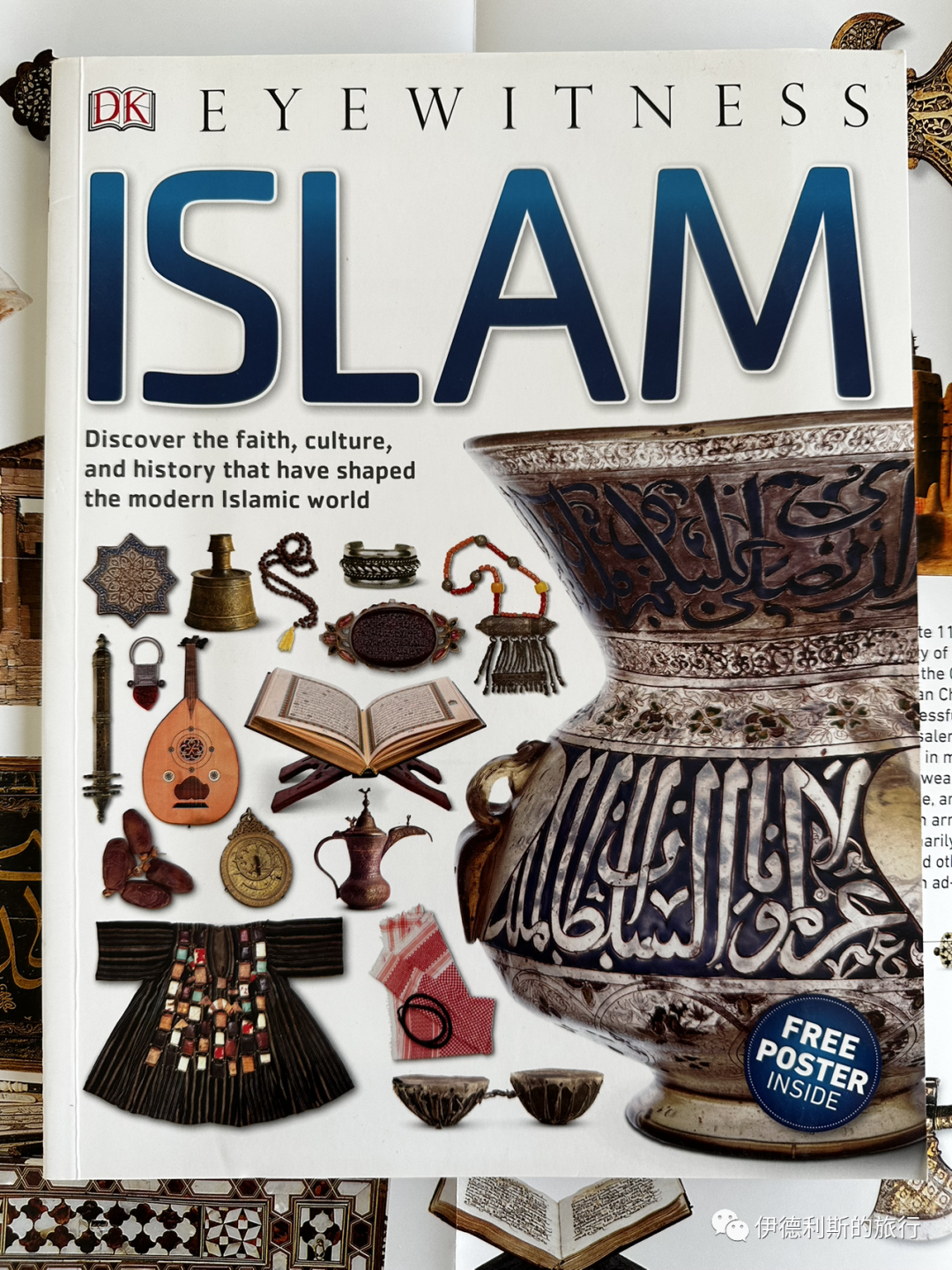
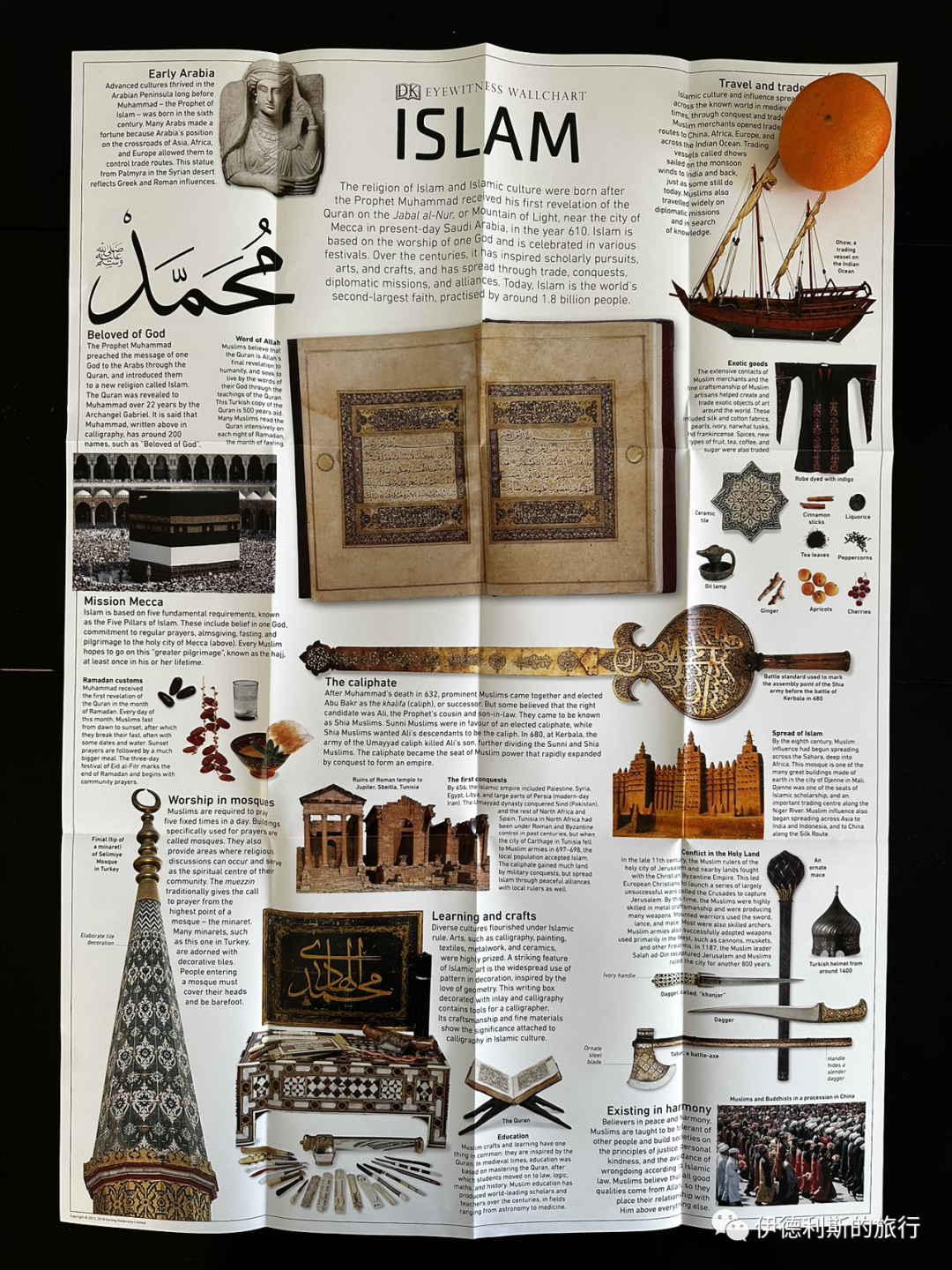
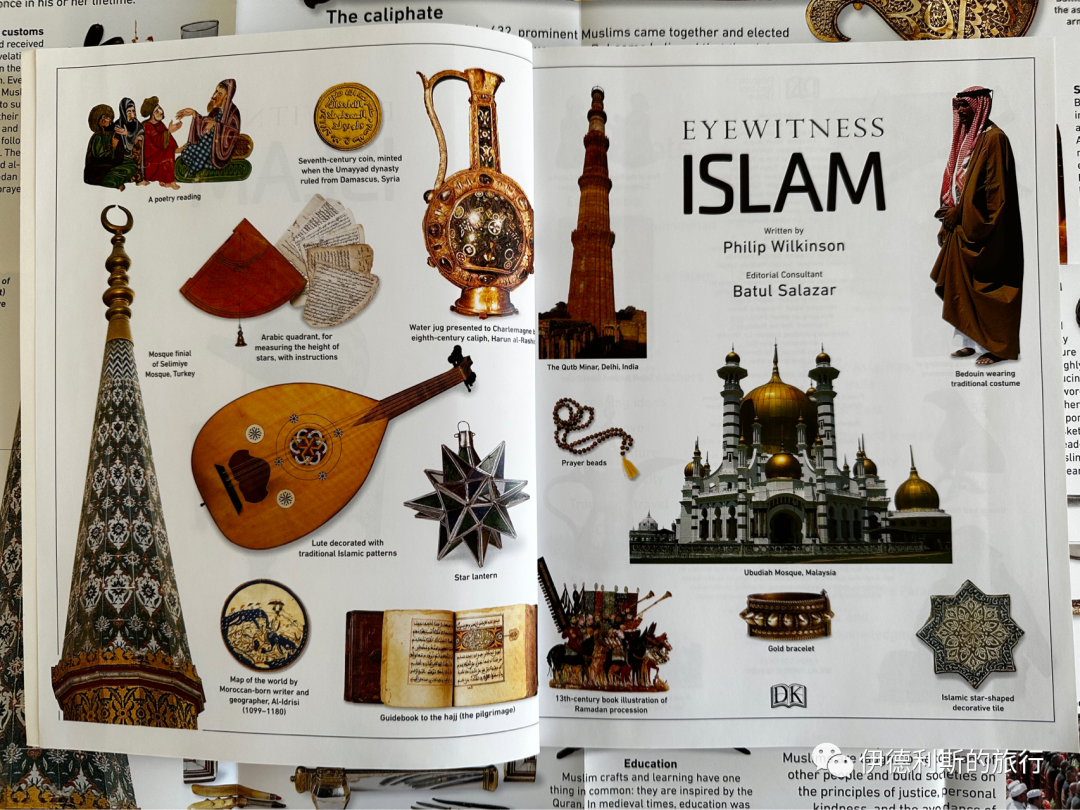
I found a popular science book titled Islam published by DK at the Panjiayuan antique book market. It is full of pictures and text and even comes with a giant poster.
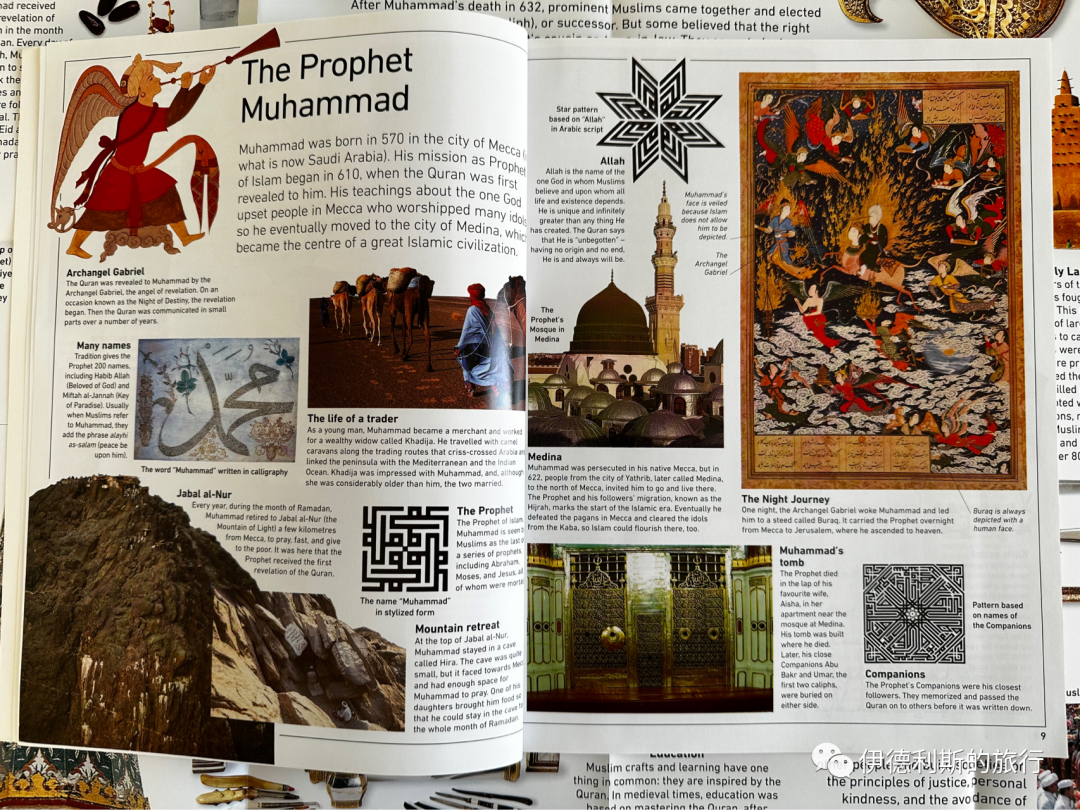
The first chapter is about the story of the noble Prophet, where you can see that classic miniature painting of the Night Journey.
The second chapter is about the Quran, showing beautiful handwritten manuscripts.
The third chapter introduces the Five Pillars. It includes demonstrations by modern people and paintings from the Ottoman period, and it uses a tile artifact featuring the Kaaba to explain how the Kaaba is structured.
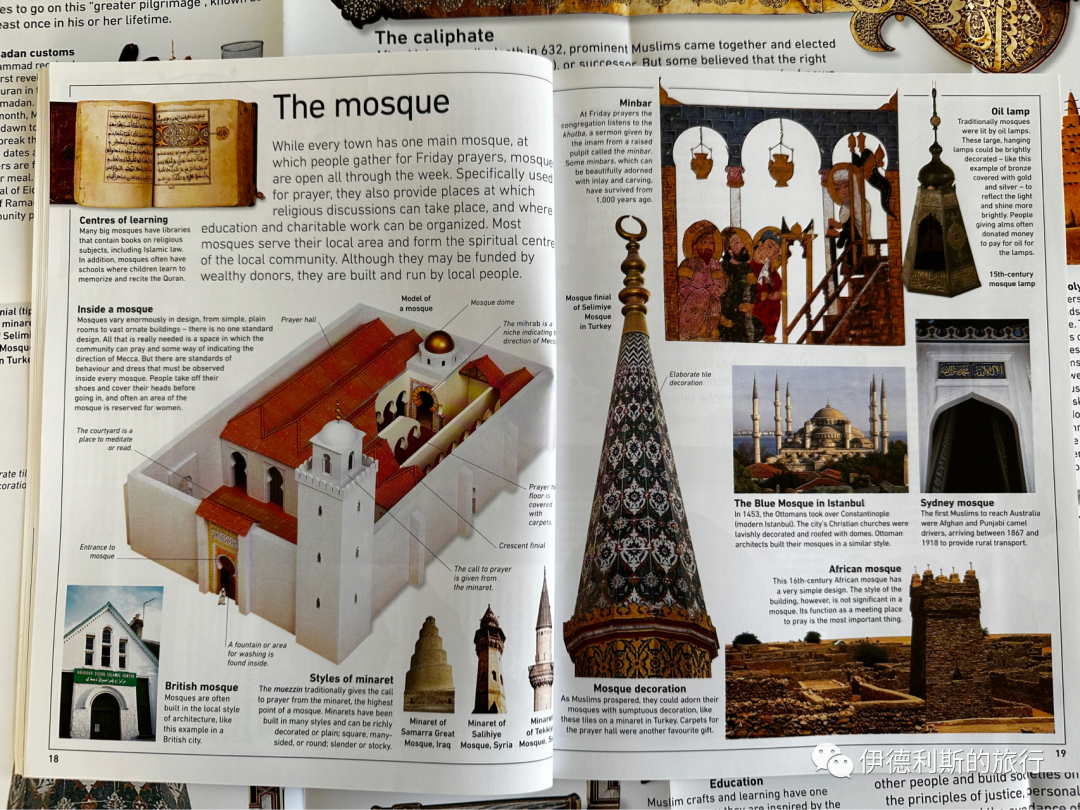
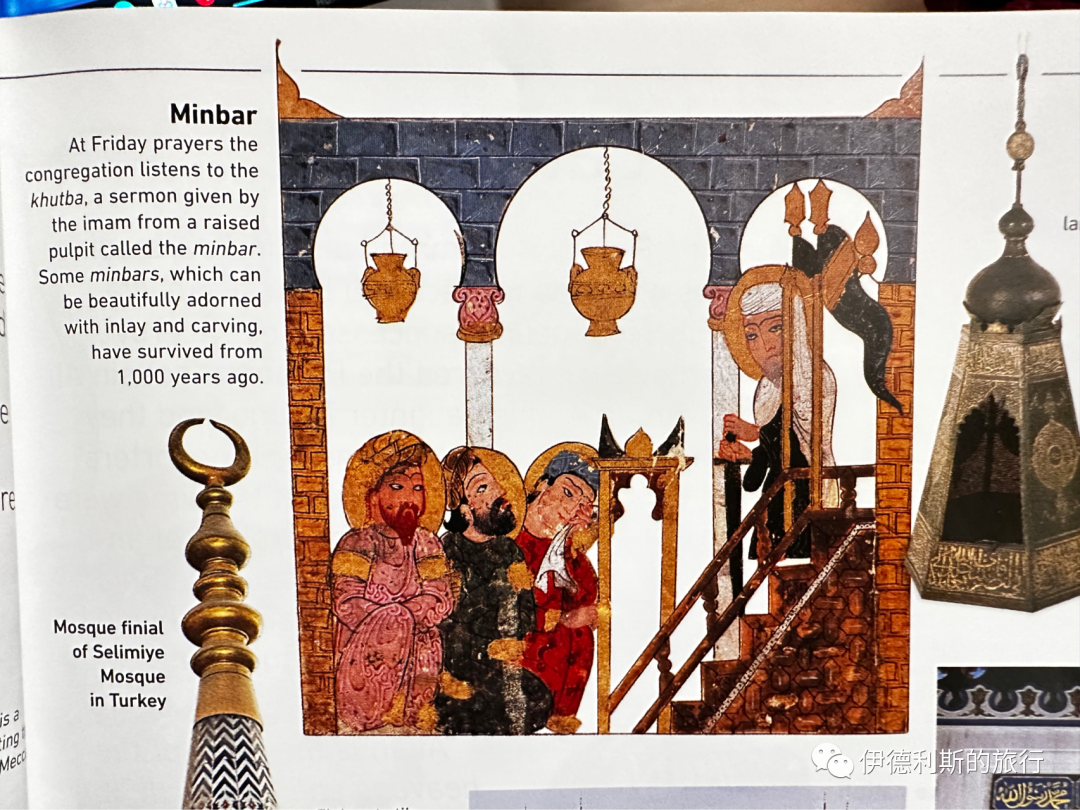
The fourth chapter introduces the mosque (masjid). It uses a small Andalusian-style mosque model to explain the basic structure, and the miniature painting on the right showing an imam giving a khutbah on the minbar is also very cute.
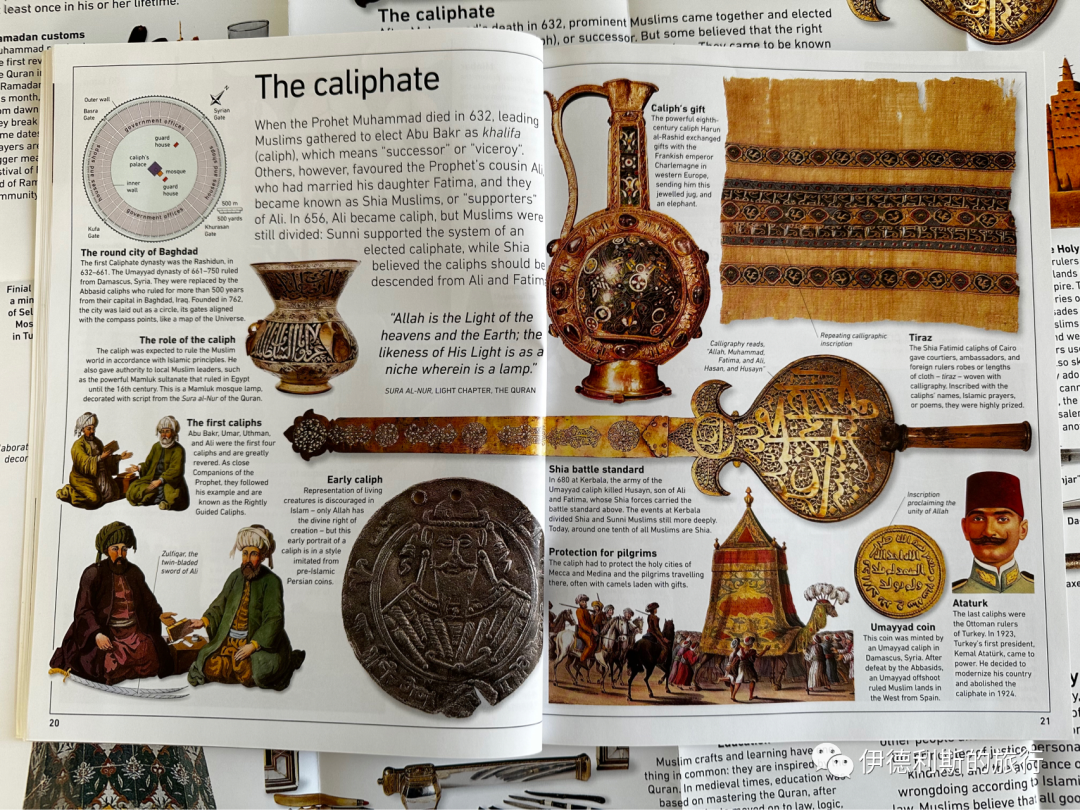
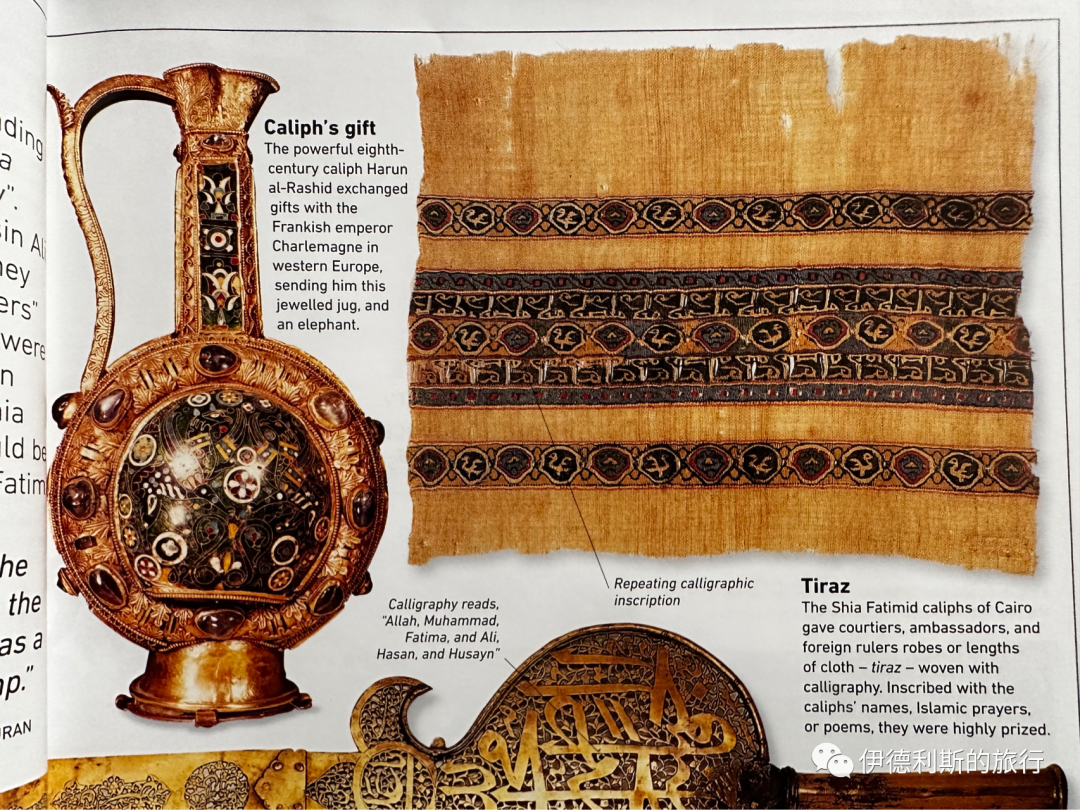
The fifth chapter covers the history of the Caliphs. The Tiraz in the top right corner is an embroidered decoration sent by the Caliph. It can be in various forms like armbands, robes, or headscarves, and it is embroidered with the Caliph's name, a dua, or poetry.
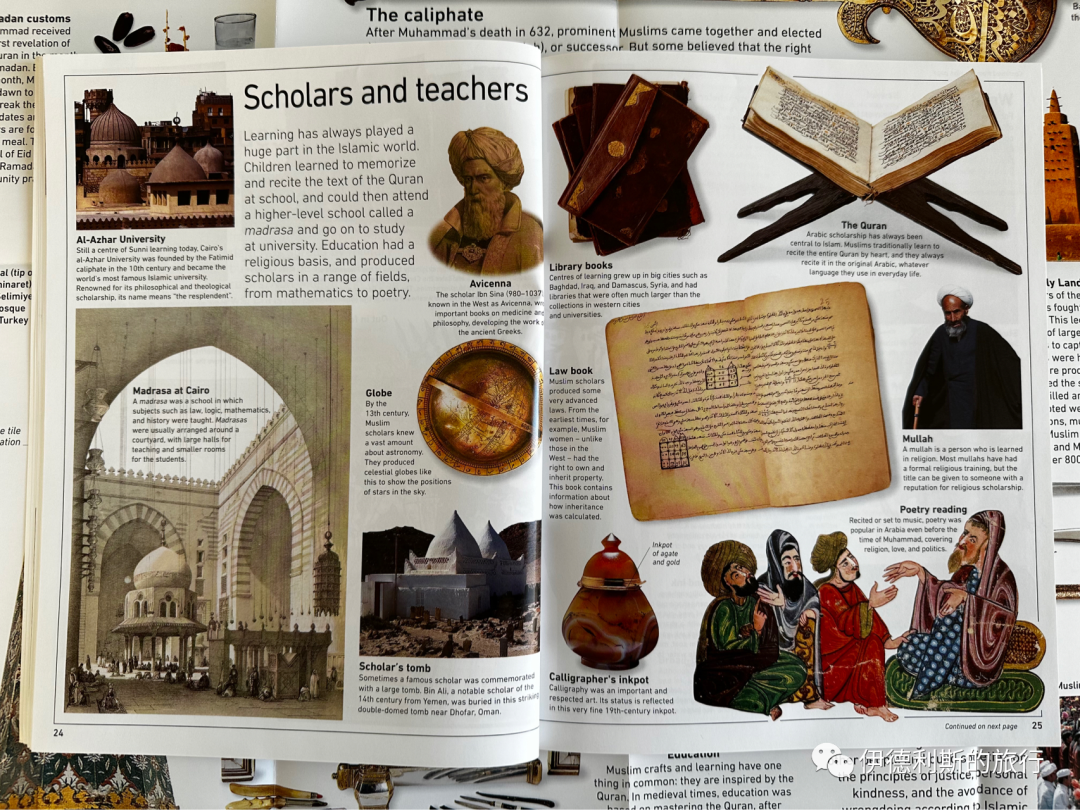
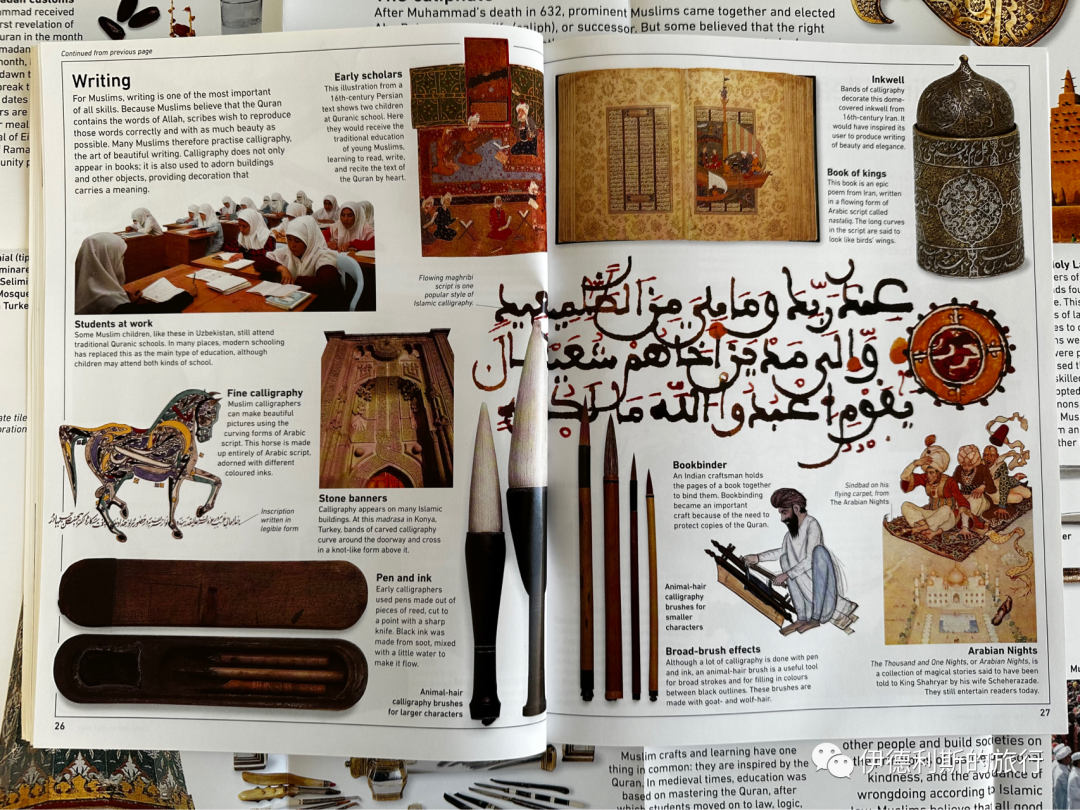
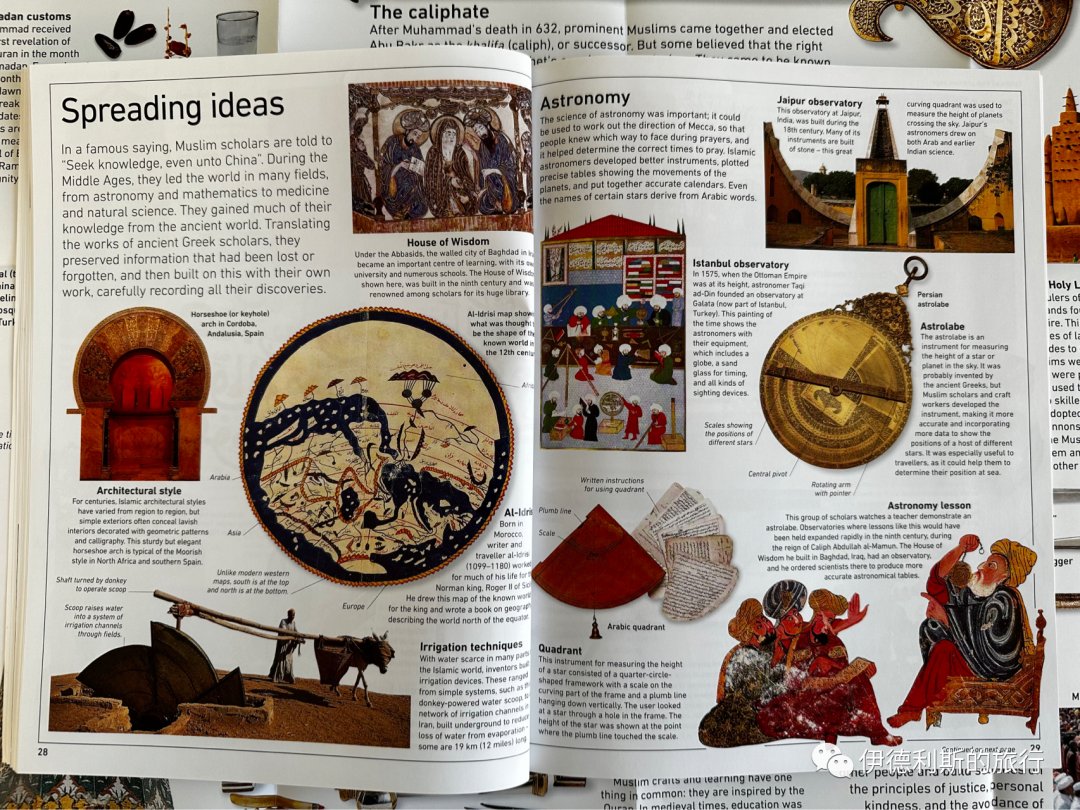
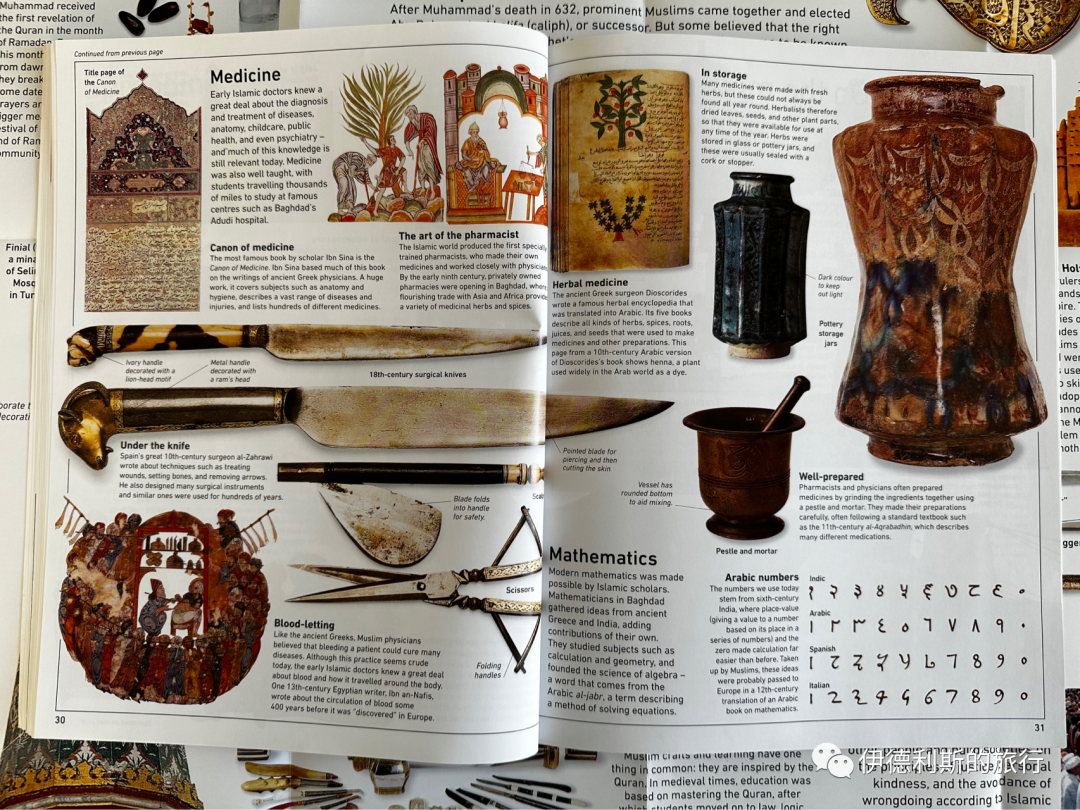
The sixth chapter is about scholars and teachers. The eighth chapter is about calligraphy and writing. The ninth chapter covers various explorations of knowledge like astronomy, navigation, and architecture.
Let's take a look at the religious holidays.
The first is Ramadan. The book shows a colorful glass lamp lit during iftar.
The second is the Prophet's Birthday (Mawlid an-Nabi). The book shows Kenyan children celebrating the day, when many people recite the praise poem Qasīdat al-Burda.
The third is Eid al-Fitr. On the left are the Eid cards people send each other, and on the right are Eid balloons that add to the festive atmosphere.
The fourth is Eid al-Adha. The Hausa people in northern Nigeria call it the Durbar festival or Sallah festival, where they hold colorful knight parades and equestrian performances.
The fifth is called Seb-i Arus, which is the day of the Sufi master Rumi. On this day, the Mevlevi Sufi order he founded holds grand commemorative events and performs the Sema whirling ceremony.
The sixth is Ashura, when the Shia mourn Imam Hussein. The book shows people carrying a model of the Hussein gongbei.
The seventh is Laylat al-Miraj. Muslims in Iran, Turkey, and South Asia all celebrate this day, lighting up entire cities with lamps and candles. The book shows the Buraq that the noble Prophet rode during his Night Journey, which is often depicted as a human-faced horse in Persian and South Asian miniature paintings.
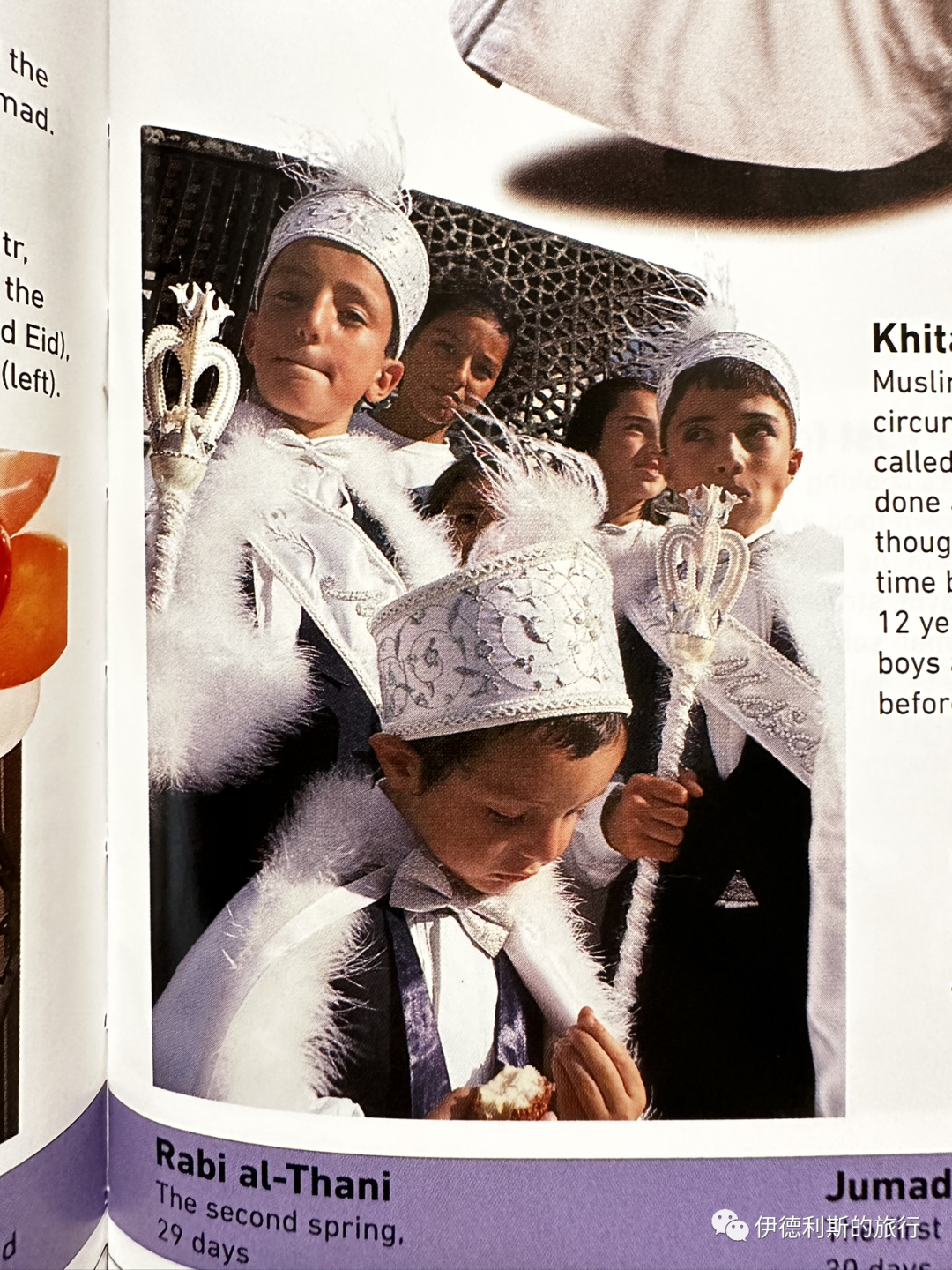
The eighth is circumcision (Khitan), which is usually performed at age seven. The book shows a group of Turkish boys preparing to enter the mosque for their circumcision.
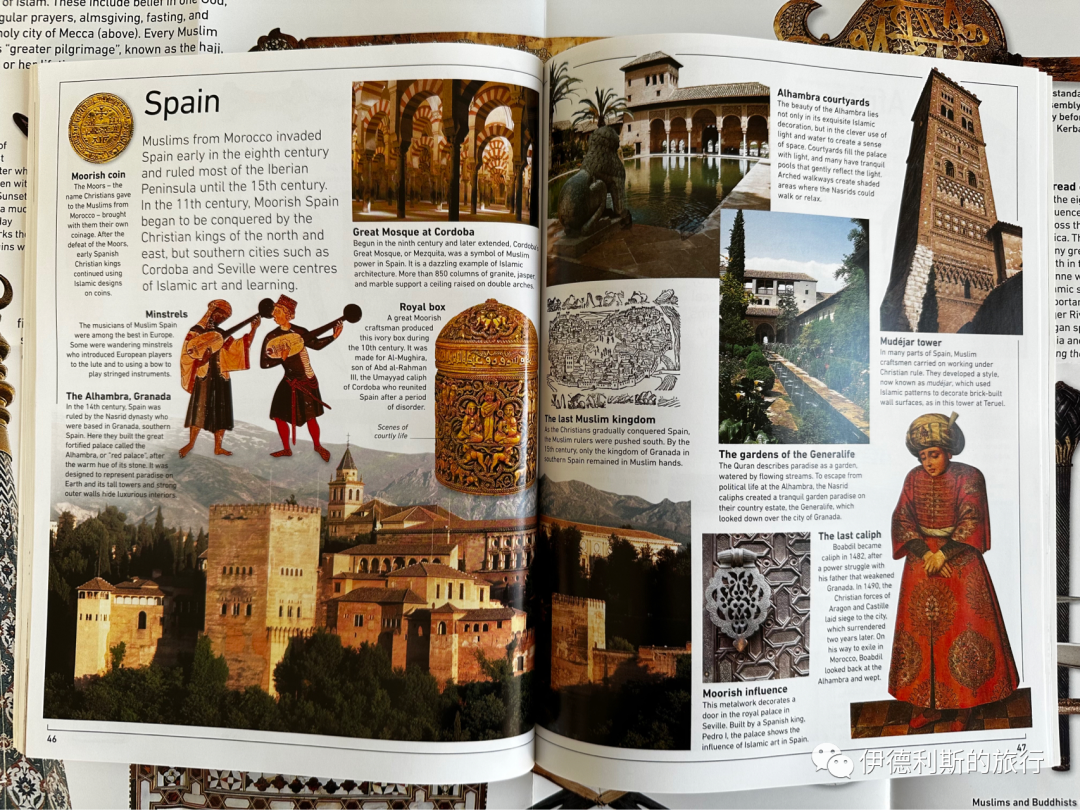
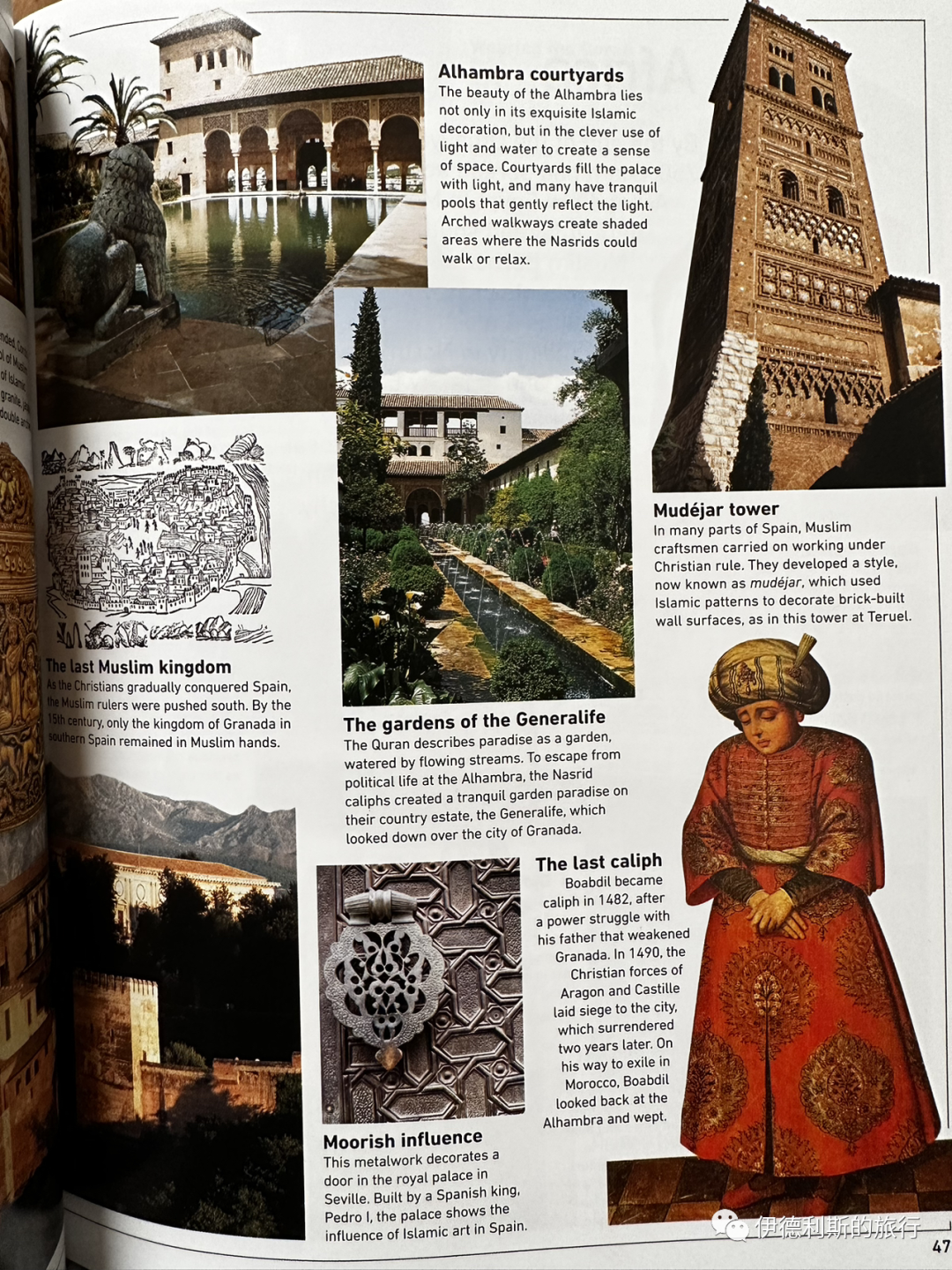
In the Spain section, the left side introduces Andalusian troubadours, the Great Mosque of Cordoba, the Alhambra, and an ivory carved box from the Umayyad Caliphate. The right side introduces the ancient city of Granada and the last Caliph, the Mudejar architecture developed by Andalusian Muslims after Christian rule, and the Moorish style in Spanish architecture.
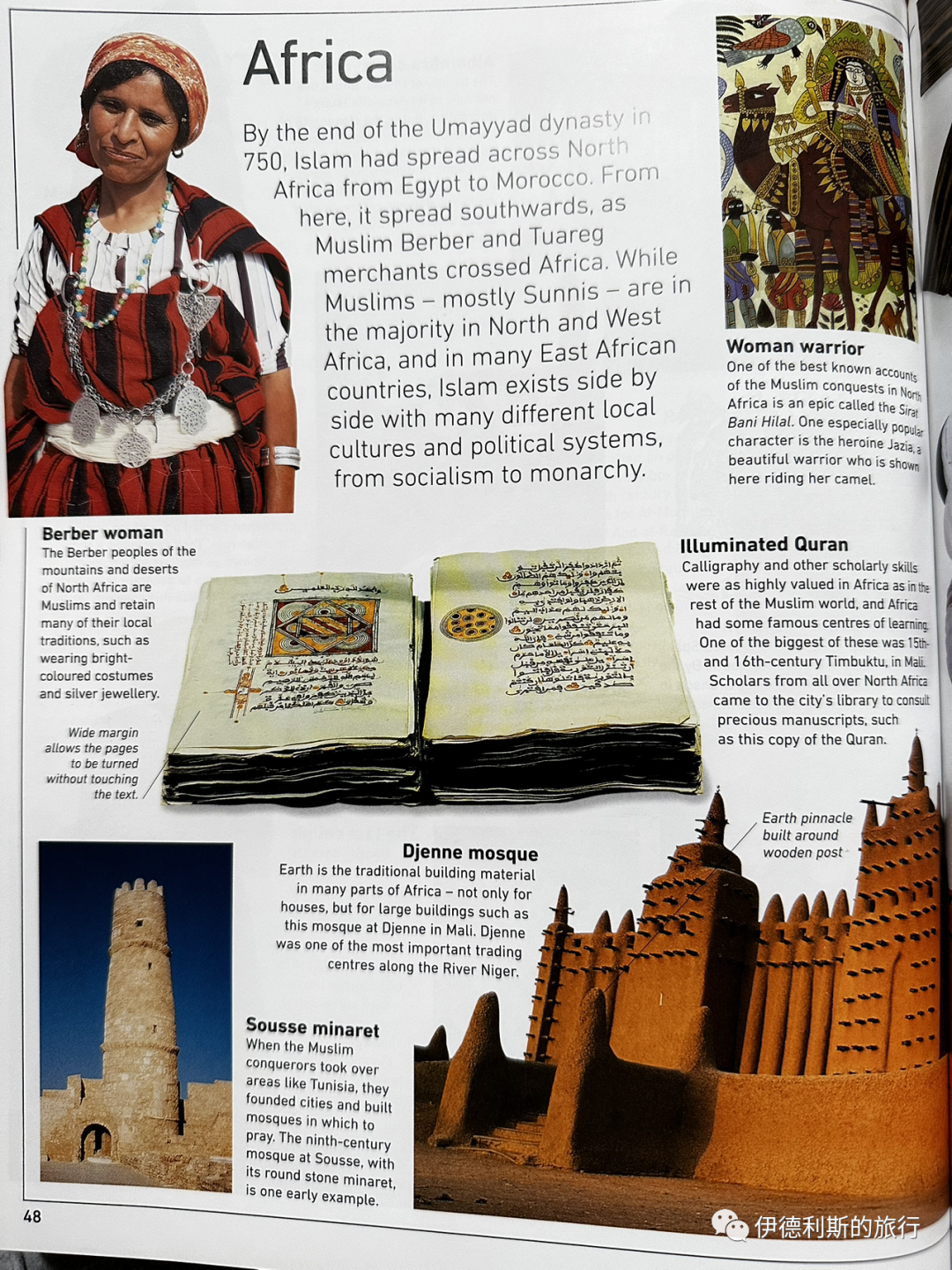
In the Africa section, the left side introduces the Berbers, Quran manuscripts from Timbuktu, the mud-built Great Mosque of Djenne, and the 9th-century ribat in the ancient Tunisian city of Sousse. The right side introduces a Mauritanian scholar studying, West African Ashanti warriors wearing robes covered in leather pouches containing the Quran, North African floral pattern tiles, the famous medieval Catalan Atlas showing the ruler of the West African Mali Empire, Mansa Musa, traveling for Hajj between 1324 and 1325, and the gongbei of a saint in Sudan. view all
Summary: Islam Book Guide: DK Introduction to Islam — Muslim History and Visual Culture is presented here as a firsthand travel account in clear English, beginning with this scene: I found a popular science book titled Islam published by DK at the Panjiayuan antique book market. It is full of pictures and text and even comes with a giant poster. The account keeps its focus on Islam Books, DK Islam, Muslim History while preserving the names, places, food, and historical details from the Chinese source.
I found a popular science book titled Islam published by DK at the Panjiayuan antique book market. It is full of pictures and text and even comes with a giant poster.
The first chapter is about the story of the noble Prophet, where you can see that classic miniature painting of the Night Journey.
The second chapter is about the Quran, showing beautiful handwritten manuscripts.
The third chapter introduces the Five Pillars. It includes demonstrations by modern people and paintings from the Ottoman period, and it uses a tile artifact featuring the Kaaba to explain how the Kaaba is structured.
The fourth chapter introduces the mosque (masjid). It uses a small Andalusian-style mosque model to explain the basic structure, and the miniature painting on the right showing an imam giving a khutbah on the minbar is also very cute.
The fifth chapter covers the history of the Caliphs. The Tiraz in the top right corner is an embroidered decoration sent by the Caliph. It can be in various forms like armbands, robes, or headscarves, and it is embroidered with the Caliph's name, a dua, or poetry.
The sixth chapter is about scholars and teachers. The eighth chapter is about calligraphy and writing. The ninth chapter covers various explorations of knowledge like astronomy, navigation, and architecture.
Let's take a look at the religious holidays.
The first is Ramadan. The book shows a colorful glass lamp lit during iftar.
The second is the Prophet's Birthday (Mawlid an-Nabi). The book shows Kenyan children celebrating the day, when many people recite the praise poem Qasīdat al-Burda.
The third is Eid al-Fitr. On the left are the Eid cards people send each other, and on the right are Eid balloons that add to the festive atmosphere.
The fourth is Eid al-Adha. The Hausa people in northern Nigeria call it the Durbar festival or Sallah festival, where they hold colorful knight parades and equestrian performances.
The fifth is called Seb-i Arus, which is the day of the Sufi master Rumi. On this day, the Mevlevi Sufi order he founded holds grand commemorative events and performs the Sema whirling ceremony.
The sixth is Ashura, when the Shia mourn Imam Hussein. The book shows people carrying a model of the Hussein gongbei.
The seventh is Laylat al-Miraj. Muslims in Iran, Turkey, and South Asia all celebrate this day, lighting up entire cities with lamps and candles. The book shows the Buraq that the noble Prophet rode during his Night Journey, which is often depicted as a human-faced horse in Persian and South Asian miniature paintings.
The eighth is circumcision (Khitan), which is usually performed at age seven. The book shows a group of Turkish boys preparing to enter the mosque for their circumcision.
In the Spain section, the left side introduces Andalusian troubadours, the Great Mosque of Cordoba, the Alhambra, and an ivory carved box from the Umayyad Caliphate. The right side introduces the ancient city of Granada and the last Caliph, the Mudejar architecture developed by Andalusian Muslims after Christian rule, and the Moorish style in Spanish architecture.
In the Africa section, the left side introduces the Berbers, Quran manuscripts from Timbuktu, the mud-built Great Mosque of Djenne, and the 9th-century ribat in the ancient Tunisian city of Sousse. The right side introduces a Mauritanian scholar studying, West African Ashanti warriors wearing robes covered in leather pouches containing the Quran, North African floral pattern tiles, the famous medieval Catalan Atlas showing the ruler of the West African Mali Empire, Mansa Musa, traveling for Hajj between 1324 and 1325, and the gongbei of a saint in Sudan. view all
Reposted from the web
Summary: Islam Book Guide: DK Introduction to Islam — Muslim History and Visual Culture is presented here as a firsthand travel account in clear English, beginning with this scene: I found a popular science book titled Islam published by DK at the Panjiayuan antique book market. It is full of pictures and text and even comes with a giant poster. The account keeps its focus on Islam Books, DK Islam, Muslim History while preserving the names, places, food, and historical details from the Chinese source.
I found a popular science book titled Islam published by DK at the Panjiayuan antique book market. It is full of pictures and text and even comes with a giant poster.
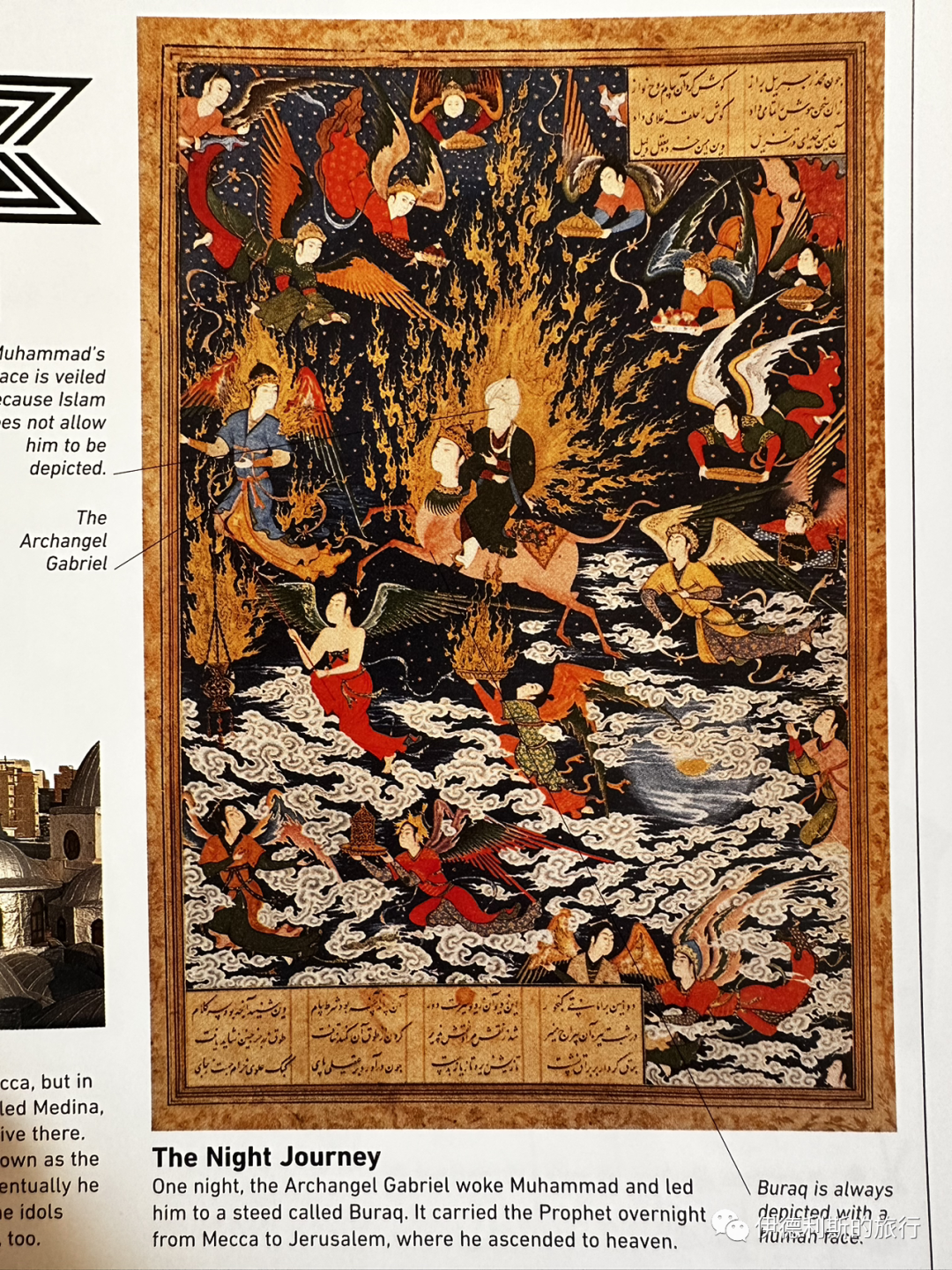
The first chapter is about the story of the noble Prophet, where you can see that classic miniature painting of the Night Journey.
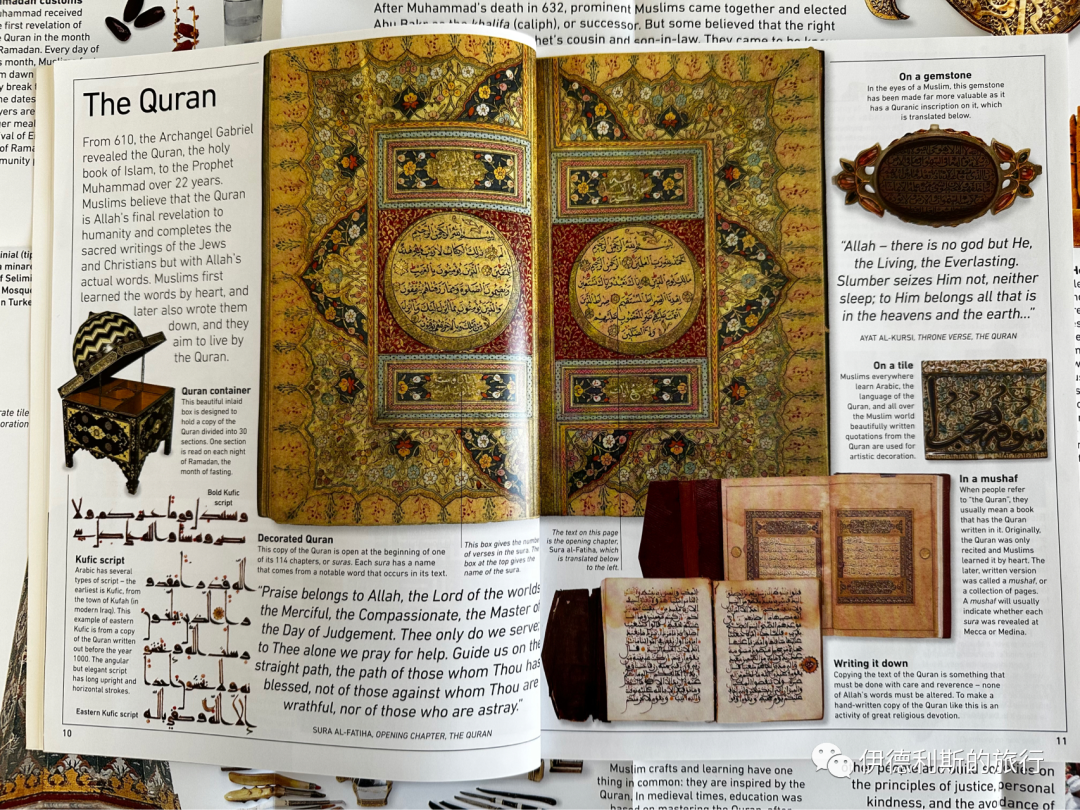
The second chapter is about the Quran, showing beautiful handwritten manuscripts.
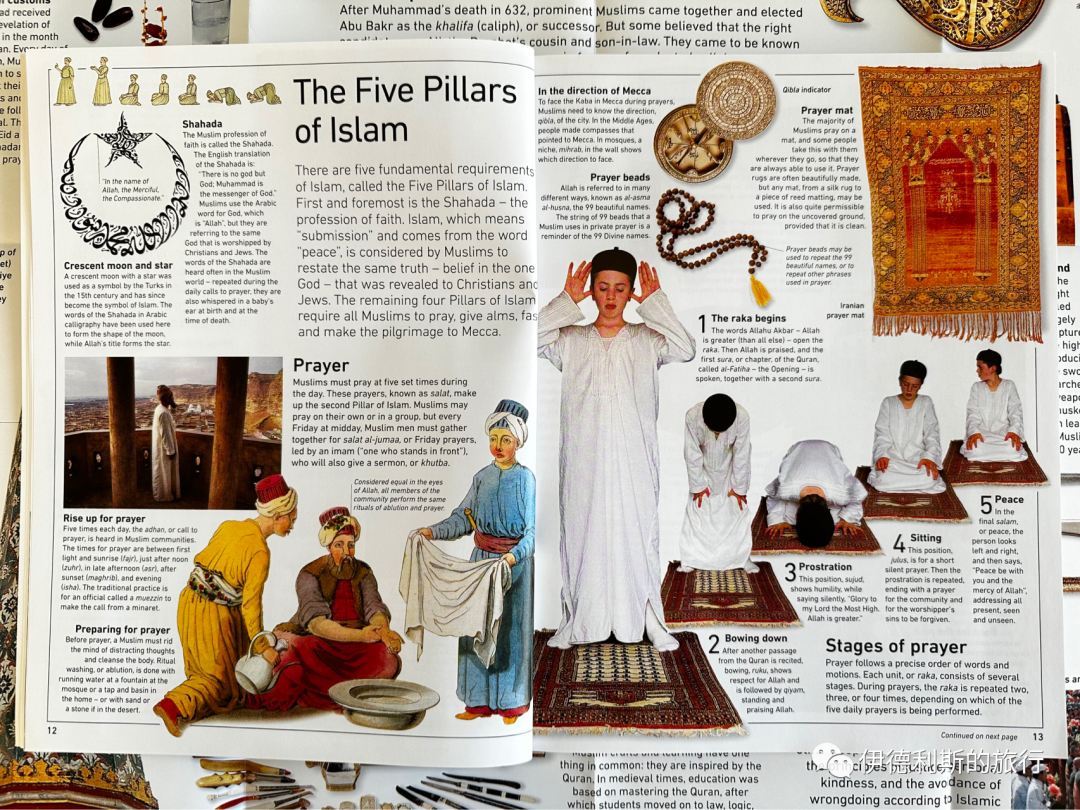
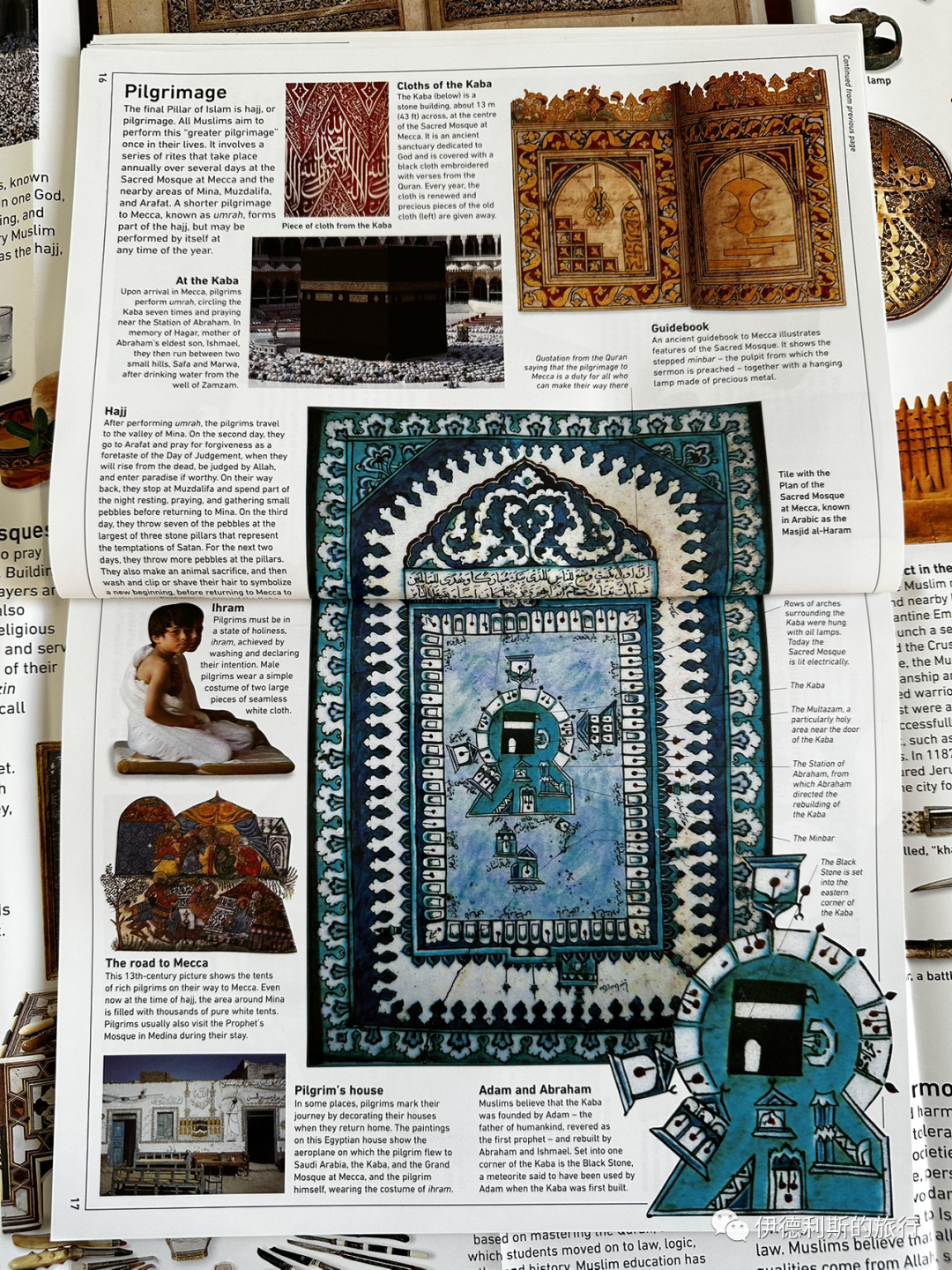
The third chapter introduces the Five Pillars. It includes demonstrations by modern people and paintings from the Ottoman period, and it uses a tile artifact featuring the Kaaba to explain how the Kaaba is structured.
The fourth chapter introduces the mosque (masjid). It uses a small Andalusian-style mosque model to explain the basic structure, and the miniature painting on the right showing an imam giving a khutbah on the minbar is also very cute.
The fifth chapter covers the history of the Caliphs. The Tiraz in the top right corner is an embroidered decoration sent by the Caliph. It can be in various forms like armbands, robes, or headscarves, and it is embroidered with the Caliph's name, a dua, or poetry.
The sixth chapter is about scholars and teachers. The eighth chapter is about calligraphy and writing. The ninth chapter covers various explorations of knowledge like astronomy, navigation, and architecture.
Let's take a look at the religious holidays.
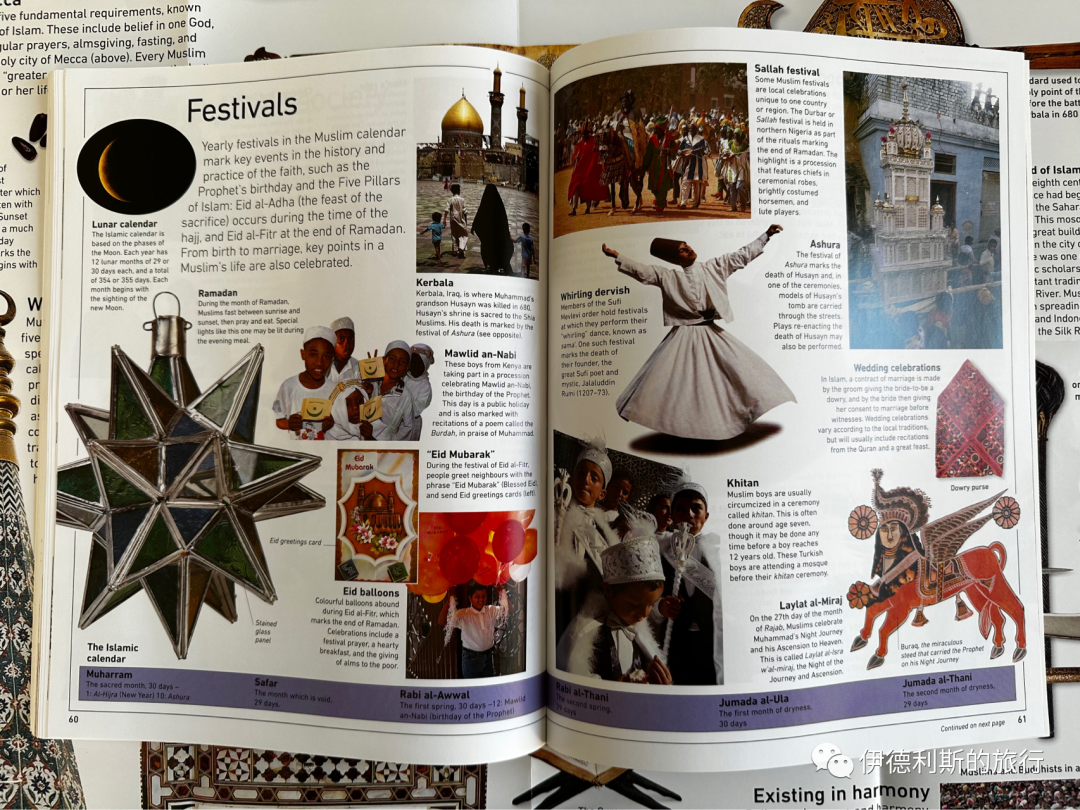
The first is Ramadan. The book shows a colorful glass lamp lit during iftar.
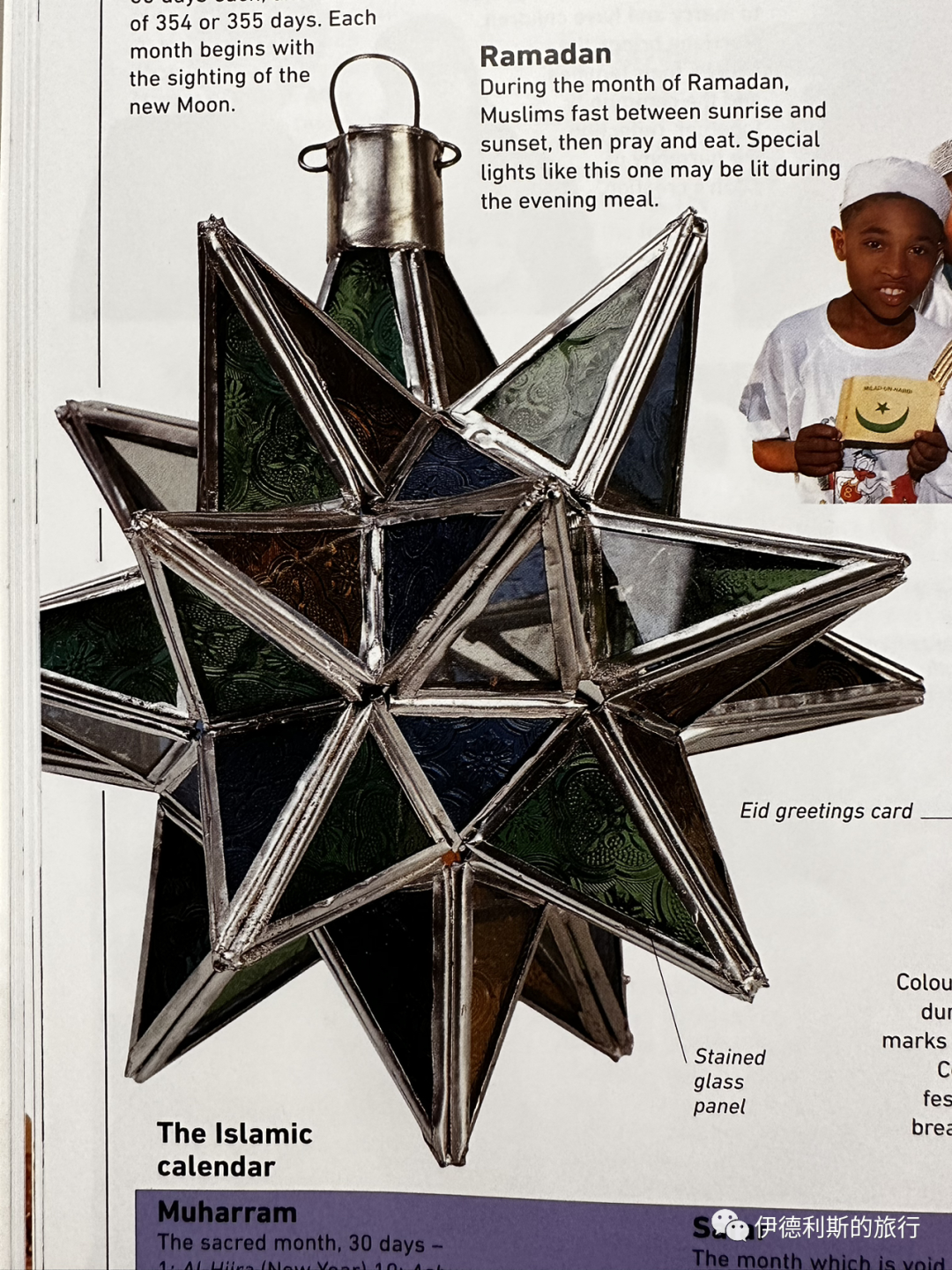
The second is the Prophet's Birthday (Mawlid an-Nabi). The book shows Kenyan children celebrating the day, when many people recite the praise poem Qasīdat al-Burda.
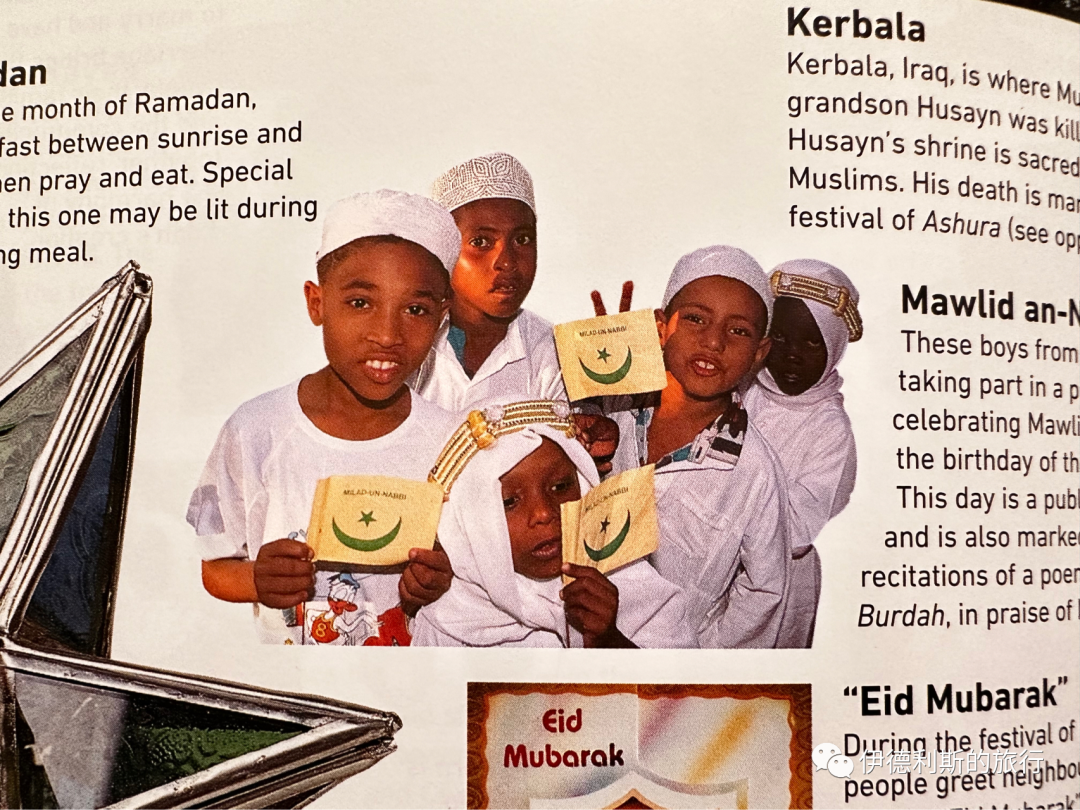
The third is Eid al-Fitr. On the left are the Eid cards people send each other, and on the right are Eid balloons that add to the festive atmosphere.
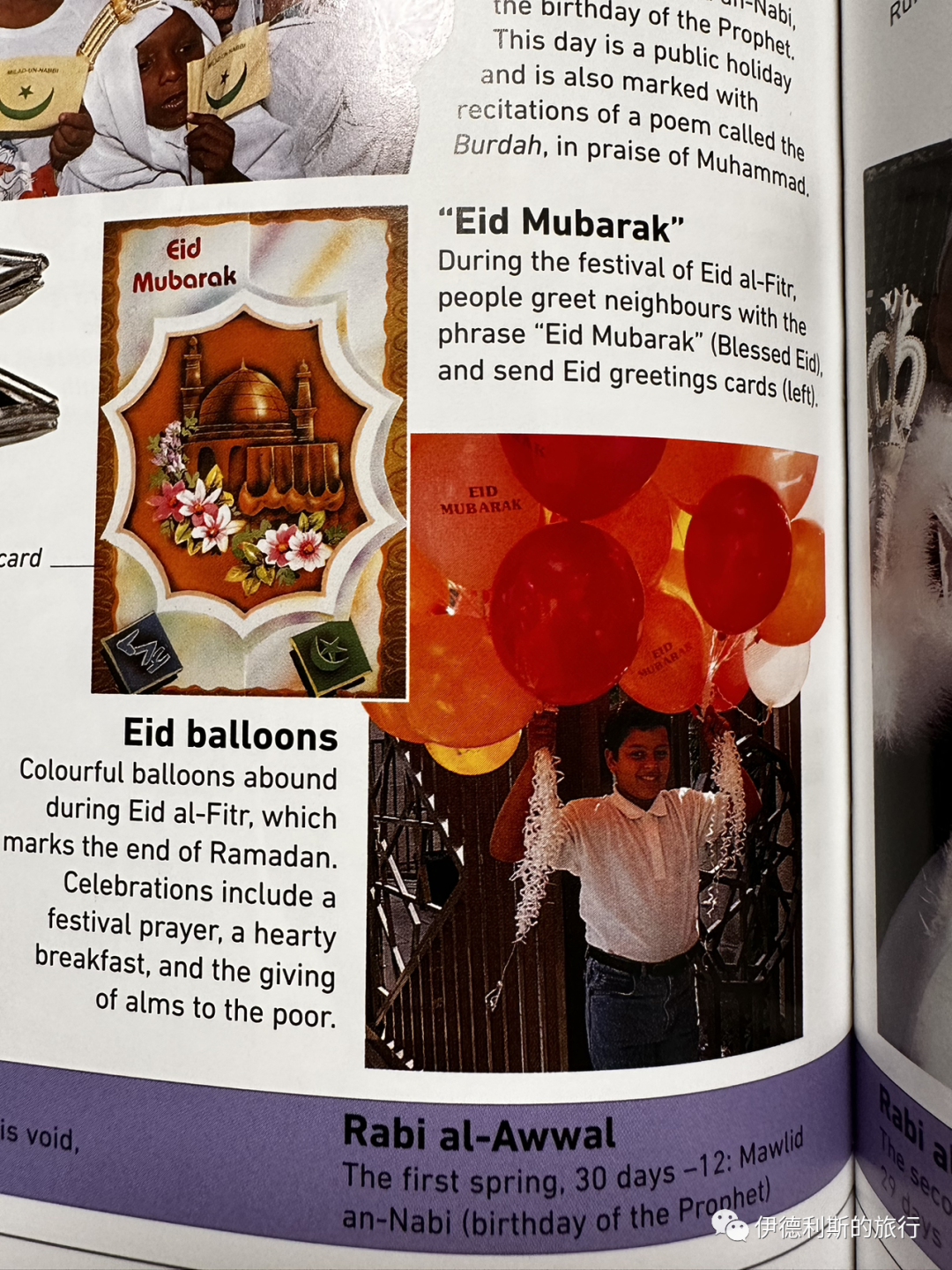
The fourth is Eid al-Adha. The Hausa people in northern Nigeria call it the Durbar festival or Sallah festival, where they hold colorful knight parades and equestrian performances.
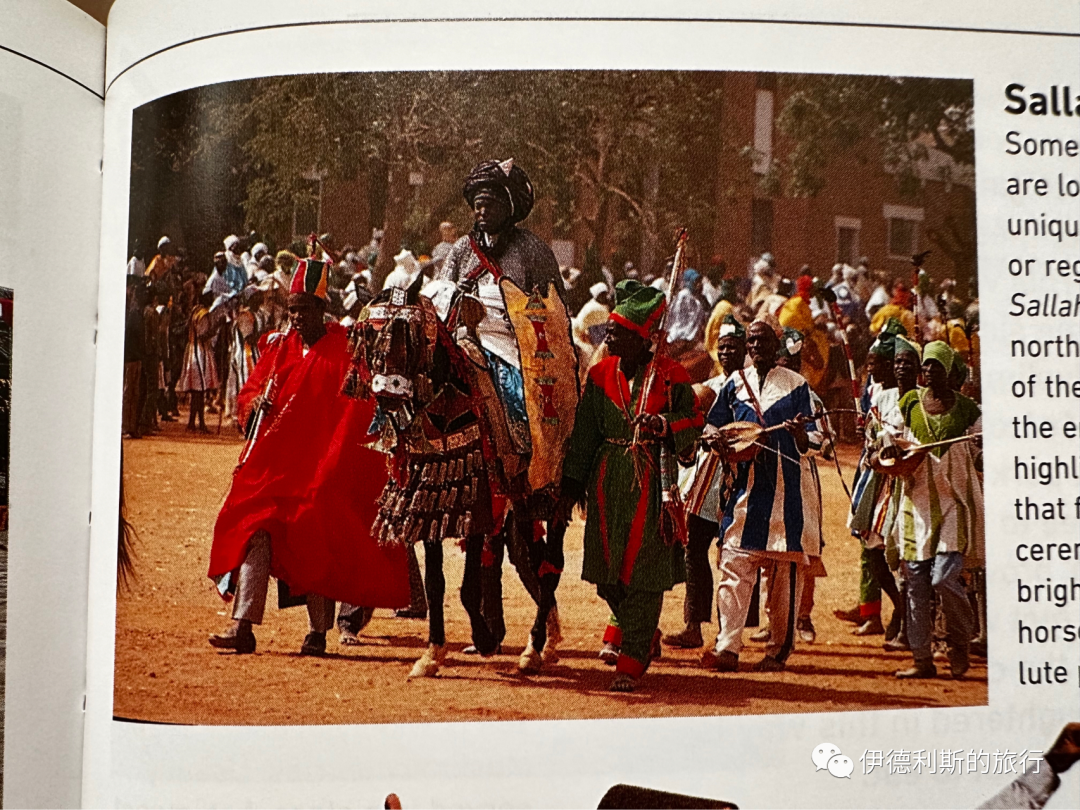
The fifth is called Seb-i Arus, which is the day of the Sufi master Rumi. On this day, the Mevlevi Sufi order he founded holds grand commemorative events and performs the Sema whirling ceremony.
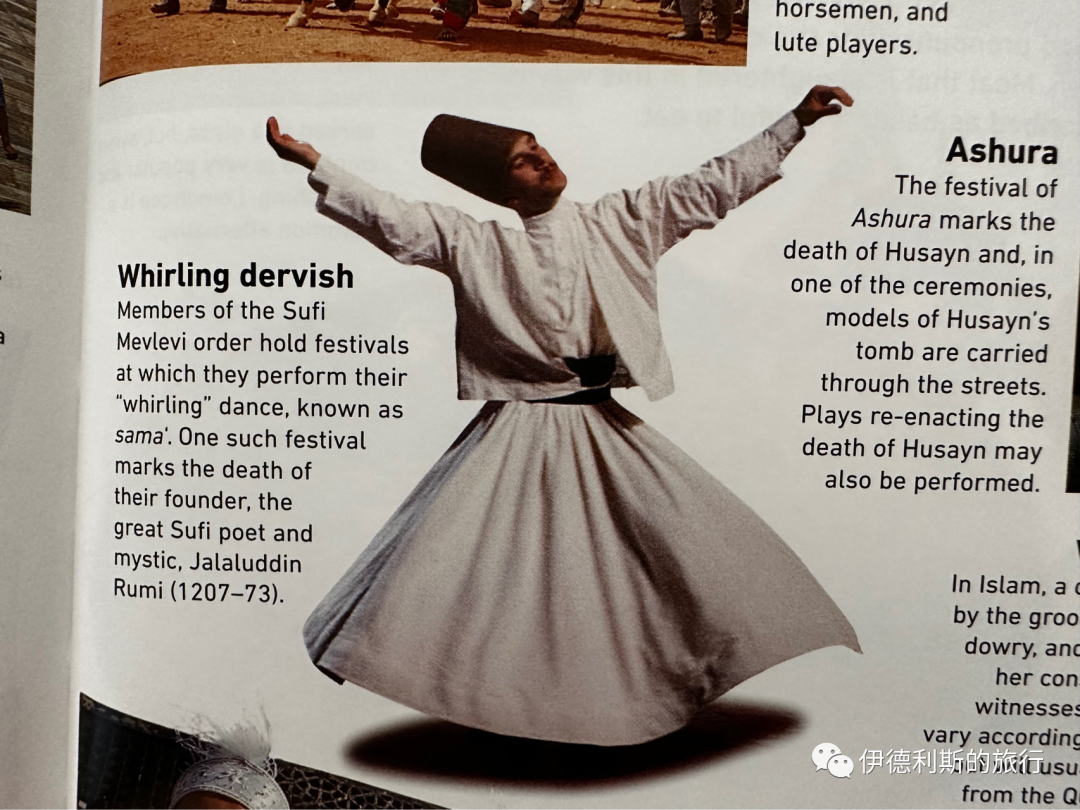
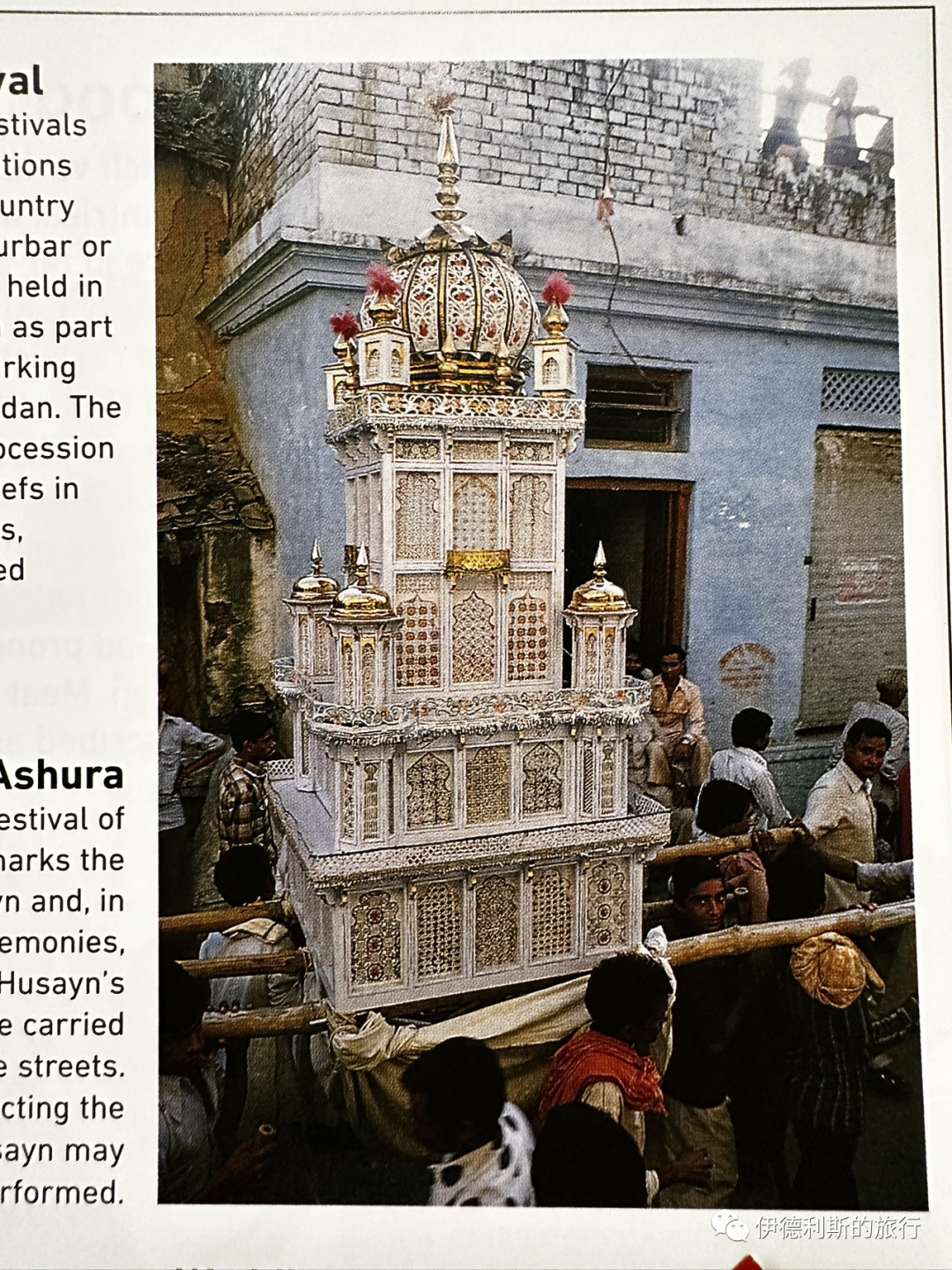
The sixth is Ashura, when the Shia mourn Imam Hussein. The book shows people carrying a model of the Hussein gongbei.
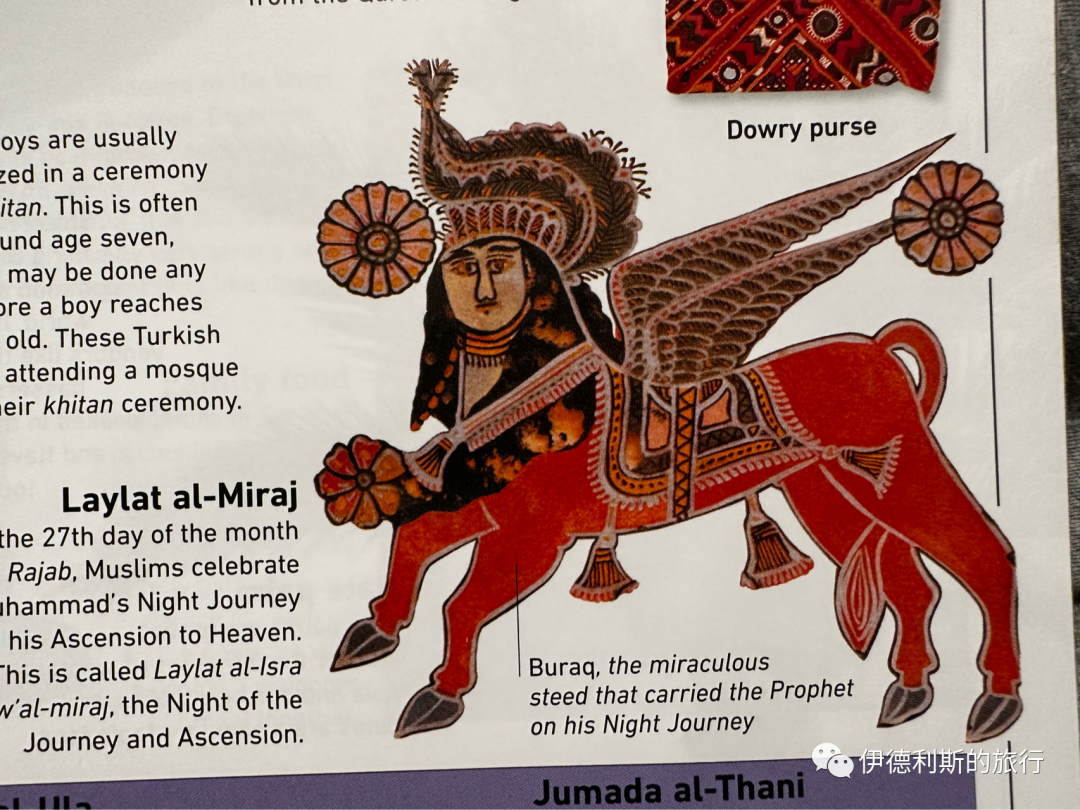
The seventh is Laylat al-Miraj. Muslims in Iran, Turkey, and South Asia all celebrate this day, lighting up entire cities with lamps and candles. The book shows the Buraq that the noble Prophet rode during his Night Journey, which is often depicted as a human-faced horse in Persian and South Asian miniature paintings.
The eighth is circumcision (Khitan), which is usually performed at age seven. The book shows a group of Turkish boys preparing to enter the mosque for their circumcision.
In the Spain section, the left side introduces Andalusian troubadours, the Great Mosque of Cordoba, the Alhambra, and an ivory carved box from the Umayyad Caliphate. The right side introduces the ancient city of Granada and the last Caliph, the Mudejar architecture developed by Andalusian Muslims after Christian rule, and the Moorish style in Spanish architecture.
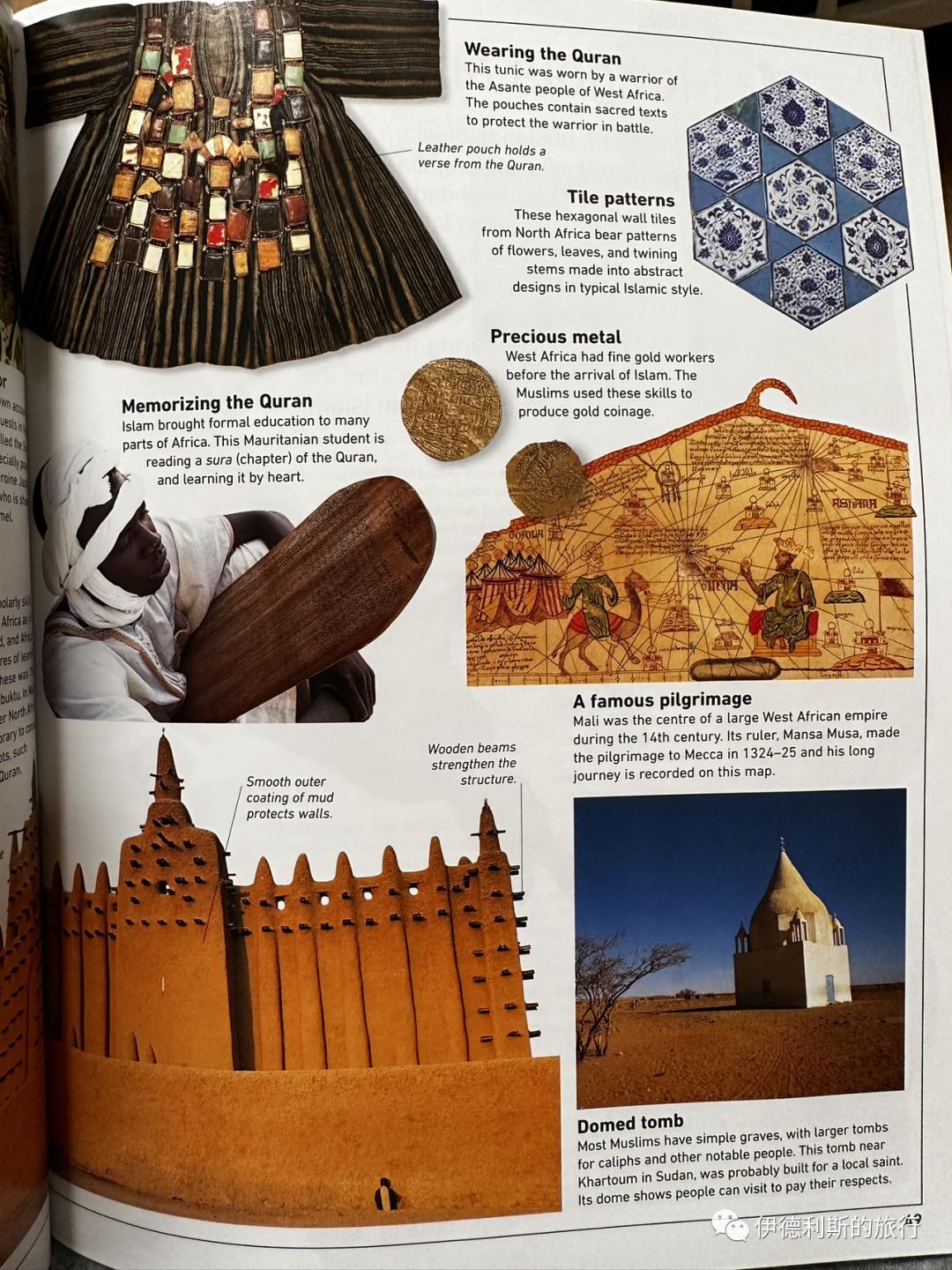
In the Africa section, the left side introduces the Berbers, Quran manuscripts from Timbuktu, the mud-built Great Mosque of Djenne, and the 9th-century ribat in the ancient Tunisian city of Sousse. The right side introduces a Mauritanian scholar studying, West African Ashanti warriors wearing robes covered in leather pouches containing the Quran, North African floral pattern tiles, the famous medieval Catalan Atlas showing the ruler of the West African Mali Empire, Mansa Musa, traveling for Hajj between 1324 and 1325, and the gongbei of a saint in Sudan.
Summary: Islam Book Guide: DK Introduction to Islam — Muslim History and Visual Culture is presented here as a firsthand travel account in clear English, beginning with this scene: I found a popular science book titled Islam published by DK at the Panjiayuan antique book market. It is full of pictures and text and even comes with a giant poster. The account keeps its focus on Islam Books, DK Islam, Muslim History while preserving the names, places, food, and historical details from the Chinese source.
I found a popular science book titled Islam published by DK at the Panjiayuan antique book market. It is full of pictures and text and even comes with a giant poster.
The first chapter is about the story of the noble Prophet, where you can see that classic miniature painting of the Night Journey.
The second chapter is about the Quran, showing beautiful handwritten manuscripts.
The third chapter introduces the Five Pillars. It includes demonstrations by modern people and paintings from the Ottoman period, and it uses a tile artifact featuring the Kaaba to explain how the Kaaba is structured.
The fourth chapter introduces the mosque (masjid). It uses a small Andalusian-style mosque model to explain the basic structure, and the miniature painting on the right showing an imam giving a khutbah on the minbar is also very cute.
The fifth chapter covers the history of the Caliphs. The Tiraz in the top right corner is an embroidered decoration sent by the Caliph. It can be in various forms like armbands, robes, or headscarves, and it is embroidered with the Caliph's name, a dua, or poetry.
The sixth chapter is about scholars and teachers. The eighth chapter is about calligraphy and writing. The ninth chapter covers various explorations of knowledge like astronomy, navigation, and architecture.
Let's take a look at the religious holidays.
The first is Ramadan. The book shows a colorful glass lamp lit during iftar.
The second is the Prophet's Birthday (Mawlid an-Nabi). The book shows Kenyan children celebrating the day, when many people recite the praise poem Qasīdat al-Burda.
The third is Eid al-Fitr. On the left are the Eid cards people send each other, and on the right are Eid balloons that add to the festive atmosphere.
The fourth is Eid al-Adha. The Hausa people in northern Nigeria call it the Durbar festival or Sallah festival, where they hold colorful knight parades and equestrian performances.
The fifth is called Seb-i Arus, which is the day of the Sufi master Rumi. On this day, the Mevlevi Sufi order he founded holds grand commemorative events and performs the Sema whirling ceremony.
The sixth is Ashura, when the Shia mourn Imam Hussein. The book shows people carrying a model of the Hussein gongbei.
The seventh is Laylat al-Miraj. Muslims in Iran, Turkey, and South Asia all celebrate this day, lighting up entire cities with lamps and candles. The book shows the Buraq that the noble Prophet rode during his Night Journey, which is often depicted as a human-faced horse in Persian and South Asian miniature paintings.
The eighth is circumcision (Khitan), which is usually performed at age seven. The book shows a group of Turkish boys preparing to enter the mosque for their circumcision.
In the Spain section, the left side introduces Andalusian troubadours, the Great Mosque of Cordoba, the Alhambra, and an ivory carved box from the Umayyad Caliphate. The right side introduces the ancient city of Granada and the last Caliph, the Mudejar architecture developed by Andalusian Muslims after Christian rule, and the Moorish style in Spanish architecture.
In the Africa section, the left side introduces the Berbers, Quran manuscripts from Timbuktu, the mud-built Great Mosque of Djenne, and the 9th-century ribat in the ancient Tunisian city of Sousse. The right side introduces a Mauritanian scholar studying, West African Ashanti warriors wearing robes covered in leather pouches containing the Quran, North African floral pattern tiles, the famous medieval Catalan Atlas showing the ruler of the West African Mali Empire, Mansa Musa, traveling for Hajj between 1324 and 1325, and the gongbei of a saint in Sudan.
Islam Book Guide: DK Introduction to Islam — Muslim History and Visual Culture
Articles • ali2007fr posted the article • 0 comments • 224 views • 2026-05-18 09:20
Reposted from the web
Summary: Islam Book Guide: DK Introduction to Islam — Muslim History and Visual Culture is presented here as a firsthand travel account in clear English, beginning with this scene: I found a popular science book titled Islam published by DK at the Panjiayuan antique book market. It is full of pictures and text and even comes with a giant poster. The account keeps its focus on Islam Books, DK Islam, Muslim History while preserving the names, places, food, and historical details from the Chinese source.
I found a popular science book titled Islam published by DK at the Panjiayuan antique book market. It is full of pictures and text and even comes with a giant poster.
The first chapter is about the story of the noble Prophet, where you can see that classic miniature painting of the Night Journey.
The second chapter is about the Quran, showing beautiful handwritten manuscripts.
The third chapter introduces the Five Pillars. It includes demonstrations by modern people and paintings from the Ottoman period, and it uses a tile artifact featuring the Kaaba to explain how the Kaaba is structured.
The fourth chapter introduces the mosque (masjid). It uses a small Andalusian-style mosque model to explain the basic structure, and the miniature painting on the right showing an imam giving a khutbah on the minbar is also very cute.
The fifth chapter covers the history of the Caliphs. The Tiraz in the top right corner is an embroidered decoration sent by the Caliph. It can be in various forms like armbands, robes, or headscarves, and it is embroidered with the Caliph's name, a dua, or poetry.
The sixth chapter is about scholars and teachers. The eighth chapter is about calligraphy and writing. The ninth chapter covers various explorations of knowledge like astronomy, navigation, and architecture.
Let's take a look at the religious holidays.
The first is Ramadan. The book shows a colorful glass lamp lit during iftar.
The second is the Prophet's Birthday (Mawlid an-Nabi). The book shows Kenyan children celebrating the day, when many people recite the praise poem Qasīdat al-Burda.
The third is Eid al-Fitr. On the left are the Eid cards people send each other, and on the right are Eid balloons that add to the festive atmosphere.
The fourth is Eid al-Adha. The Hausa people in northern Nigeria call it the Durbar festival or Sallah festival, where they hold colorful knight parades and equestrian performances.
The fifth is called Seb-i Arus, which is the day of the Sufi master Rumi. On this day, the Mevlevi Sufi order he founded holds grand commemorative events and performs the Sema whirling ceremony.
The sixth is Ashura, when the Shia mourn Imam Hussein. The book shows people carrying a model of the Hussein gongbei.
The seventh is Laylat al-Miraj. Muslims in Iran, Turkey, and South Asia all celebrate this day, lighting up entire cities with lamps and candles. The book shows the Buraq that the noble Prophet rode during his Night Journey, which is often depicted as a human-faced horse in Persian and South Asian miniature paintings.
The eighth is circumcision (Khitan), which is usually performed at age seven. The book shows a group of Turkish boys preparing to enter the mosque for their circumcision.
In the Spain section, the left side introduces Andalusian troubadours, the Great Mosque of Cordoba, the Alhambra, and an ivory carved box from the Umayyad Caliphate. The right side introduces the ancient city of Granada and the last Caliph, the Mudejar architecture developed by Andalusian Muslims after Christian rule, and the Moorish style in Spanish architecture.
In the Africa section, the left side introduces the Berbers, Quran manuscripts from Timbuktu, the mud-built Great Mosque of Djenne, and the 9th-century ribat in the ancient Tunisian city of Sousse. The right side introduces a Mauritanian scholar studying, West African Ashanti warriors wearing robes covered in leather pouches containing the Quran, North African floral pattern tiles, the famous medieval Catalan Atlas showing the ruler of the West African Mali Empire, Mansa Musa, traveling for Hajj between 1324 and 1325, and the gongbei of a saint in Sudan. view all
Summary: Islam Book Guide: DK Introduction to Islam — Muslim History and Visual Culture is presented here as a firsthand travel account in clear English, beginning with this scene: I found a popular science book titled Islam published by DK at the Panjiayuan antique book market. It is full of pictures and text and even comes with a giant poster. The account keeps its focus on Islam Books, DK Islam, Muslim History while preserving the names, places, food, and historical details from the Chinese source.
I found a popular science book titled Islam published by DK at the Panjiayuan antique book market. It is full of pictures and text and even comes with a giant poster.
The first chapter is about the story of the noble Prophet, where you can see that classic miniature painting of the Night Journey.
The second chapter is about the Quran, showing beautiful handwritten manuscripts.
The third chapter introduces the Five Pillars. It includes demonstrations by modern people and paintings from the Ottoman period, and it uses a tile artifact featuring the Kaaba to explain how the Kaaba is structured.
The fourth chapter introduces the mosque (masjid). It uses a small Andalusian-style mosque model to explain the basic structure, and the miniature painting on the right showing an imam giving a khutbah on the minbar is also very cute.
The fifth chapter covers the history of the Caliphs. The Tiraz in the top right corner is an embroidered decoration sent by the Caliph. It can be in various forms like armbands, robes, or headscarves, and it is embroidered with the Caliph's name, a dua, or poetry.
The sixth chapter is about scholars and teachers. The eighth chapter is about calligraphy and writing. The ninth chapter covers various explorations of knowledge like astronomy, navigation, and architecture.
Let's take a look at the religious holidays.
The first is Ramadan. The book shows a colorful glass lamp lit during iftar.
The second is the Prophet's Birthday (Mawlid an-Nabi). The book shows Kenyan children celebrating the day, when many people recite the praise poem Qasīdat al-Burda.
The third is Eid al-Fitr. On the left are the Eid cards people send each other, and on the right are Eid balloons that add to the festive atmosphere.
The fourth is Eid al-Adha. The Hausa people in northern Nigeria call it the Durbar festival or Sallah festival, where they hold colorful knight parades and equestrian performances.
The fifth is called Seb-i Arus, which is the day of the Sufi master Rumi. On this day, the Mevlevi Sufi order he founded holds grand commemorative events and performs the Sema whirling ceremony.
The sixth is Ashura, when the Shia mourn Imam Hussein. The book shows people carrying a model of the Hussein gongbei.
The seventh is Laylat al-Miraj. Muslims in Iran, Turkey, and South Asia all celebrate this day, lighting up entire cities with lamps and candles. The book shows the Buraq that the noble Prophet rode during his Night Journey, which is often depicted as a human-faced horse in Persian and South Asian miniature paintings.
The eighth is circumcision (Khitan), which is usually performed at age seven. The book shows a group of Turkish boys preparing to enter the mosque for their circumcision.
In the Spain section, the left side introduces Andalusian troubadours, the Great Mosque of Cordoba, the Alhambra, and an ivory carved box from the Umayyad Caliphate. The right side introduces the ancient city of Granada and the last Caliph, the Mudejar architecture developed by Andalusian Muslims after Christian rule, and the Moorish style in Spanish architecture.
In the Africa section, the left side introduces the Berbers, Quran manuscripts from Timbuktu, the mud-built Great Mosque of Djenne, and the 9th-century ribat in the ancient Tunisian city of Sousse. The right side introduces a Mauritanian scholar studying, West African Ashanti warriors wearing robes covered in leather pouches containing the Quran, North African floral pattern tiles, the famous medieval Catalan Atlas showing the ruler of the West African Mali Empire, Mansa Musa, traveling for Hajj between 1324 and 1325, and the gongbei of a saint in Sudan. view all
Reposted from the web
Summary: Islam Book Guide: DK Introduction to Islam — Muslim History and Visual Culture is presented here as a firsthand travel account in clear English, beginning with this scene: I found a popular science book titled Islam published by DK at the Panjiayuan antique book market. It is full of pictures and text and even comes with a giant poster. The account keeps its focus on Islam Books, DK Islam, Muslim History while preserving the names, places, food, and historical details from the Chinese source.
I found a popular science book titled Islam published by DK at the Panjiayuan antique book market. It is full of pictures and text and even comes with a giant poster.
The first chapter is about the story of the noble Prophet, where you can see that classic miniature painting of the Night Journey.
The second chapter is about the Quran, showing beautiful handwritten manuscripts.
The third chapter introduces the Five Pillars. It includes demonstrations by modern people and paintings from the Ottoman period, and it uses a tile artifact featuring the Kaaba to explain how the Kaaba is structured.
The fourth chapter introduces the mosque (masjid). It uses a small Andalusian-style mosque model to explain the basic structure, and the miniature painting on the right showing an imam giving a khutbah on the minbar is also very cute.
The fifth chapter covers the history of the Caliphs. The Tiraz in the top right corner is an embroidered decoration sent by the Caliph. It can be in various forms like armbands, robes, or headscarves, and it is embroidered with the Caliph's name, a dua, or poetry.
The sixth chapter is about scholars and teachers. The eighth chapter is about calligraphy and writing. The ninth chapter covers various explorations of knowledge like astronomy, navigation, and architecture.
Let's take a look at the religious holidays.
The first is Ramadan. The book shows a colorful glass lamp lit during iftar.
The second is the Prophet's Birthday (Mawlid an-Nabi). The book shows Kenyan children celebrating the day, when many people recite the praise poem Qasīdat al-Burda.
The third is Eid al-Fitr. On the left are the Eid cards people send each other, and on the right are Eid balloons that add to the festive atmosphere.
The fourth is Eid al-Adha. The Hausa people in northern Nigeria call it the Durbar festival or Sallah festival, where they hold colorful knight parades and equestrian performances.
The fifth is called Seb-i Arus, which is the day of the Sufi master Rumi. On this day, the Mevlevi Sufi order he founded holds grand commemorative events and performs the Sema whirling ceremony.
The sixth is Ashura, when the Shia mourn Imam Hussein. The book shows people carrying a model of the Hussein gongbei.
The seventh is Laylat al-Miraj. Muslims in Iran, Turkey, and South Asia all celebrate this day, lighting up entire cities with lamps and candles. The book shows the Buraq that the noble Prophet rode during his Night Journey, which is often depicted as a human-faced horse in Persian and South Asian miniature paintings.
The eighth is circumcision (Khitan), which is usually performed at age seven. The book shows a group of Turkish boys preparing to enter the mosque for their circumcision.
In the Spain section, the left side introduces Andalusian troubadours, the Great Mosque of Cordoba, the Alhambra, and an ivory carved box from the Umayyad Caliphate. The right side introduces the ancient city of Granada and the last Caliph, the Mudejar architecture developed by Andalusian Muslims after Christian rule, and the Moorish style in Spanish architecture.
In the Africa section, the left side introduces the Berbers, Quran manuscripts from Timbuktu, the mud-built Great Mosque of Djenne, and the 9th-century ribat in the ancient Tunisian city of Sousse. The right side introduces a Mauritanian scholar studying, West African Ashanti warriors wearing robes covered in leather pouches containing the Quran, North African floral pattern tiles, the famous medieval Catalan Atlas showing the ruler of the West African Mali Empire, Mansa Musa, traveling for Hajj between 1324 and 1325, and the gongbei of a saint in Sudan.
Summary: Islam Book Guide: DK Introduction to Islam — Muslim History and Visual Culture is presented here as a firsthand travel account in clear English, beginning with this scene: I found a popular science book titled Islam published by DK at the Panjiayuan antique book market. It is full of pictures and text and even comes with a giant poster. The account keeps its focus on Islam Books, DK Islam, Muslim History while preserving the names, places, food, and historical details from the Chinese source.
I found a popular science book titled Islam published by DK at the Panjiayuan antique book market. It is full of pictures and text and even comes with a giant poster.
The first chapter is about the story of the noble Prophet, where you can see that classic miniature painting of the Night Journey.
The second chapter is about the Quran, showing beautiful handwritten manuscripts.
The third chapter introduces the Five Pillars. It includes demonstrations by modern people and paintings from the Ottoman period, and it uses a tile artifact featuring the Kaaba to explain how the Kaaba is structured.
The fourth chapter introduces the mosque (masjid). It uses a small Andalusian-style mosque model to explain the basic structure, and the miniature painting on the right showing an imam giving a khutbah on the minbar is also very cute.
The fifth chapter covers the history of the Caliphs. The Tiraz in the top right corner is an embroidered decoration sent by the Caliph. It can be in various forms like armbands, robes, or headscarves, and it is embroidered with the Caliph's name, a dua, or poetry.
The sixth chapter is about scholars and teachers. The eighth chapter is about calligraphy and writing. The ninth chapter covers various explorations of knowledge like astronomy, navigation, and architecture.
Let's take a look at the religious holidays.
The first is Ramadan. The book shows a colorful glass lamp lit during iftar.
The second is the Prophet's Birthday (Mawlid an-Nabi). The book shows Kenyan children celebrating the day, when many people recite the praise poem Qasīdat al-Burda.
The third is Eid al-Fitr. On the left are the Eid cards people send each other, and on the right are Eid balloons that add to the festive atmosphere.
The fourth is Eid al-Adha. The Hausa people in northern Nigeria call it the Durbar festival or Sallah festival, where they hold colorful knight parades and equestrian performances.
The fifth is called Seb-i Arus, which is the day of the Sufi master Rumi. On this day, the Mevlevi Sufi order he founded holds grand commemorative events and performs the Sema whirling ceremony.
The sixth is Ashura, when the Shia mourn Imam Hussein. The book shows people carrying a model of the Hussein gongbei.
The seventh is Laylat al-Miraj. Muslims in Iran, Turkey, and South Asia all celebrate this day, lighting up entire cities with lamps and candles. The book shows the Buraq that the noble Prophet rode during his Night Journey, which is often depicted as a human-faced horse in Persian and South Asian miniature paintings.
The eighth is circumcision (Khitan), which is usually performed at age seven. The book shows a group of Turkish boys preparing to enter the mosque for their circumcision.
In the Spain section, the left side introduces Andalusian troubadours, the Great Mosque of Cordoba, the Alhambra, and an ivory carved box from the Umayyad Caliphate. The right side introduces the ancient city of Granada and the last Caliph, the Mudejar architecture developed by Andalusian Muslims after Christian rule, and the Moorish style in Spanish architecture.
In the Africa section, the left side introduces the Berbers, Quran manuscripts from Timbuktu, the mud-built Great Mosque of Djenne, and the 9th-century ribat in the ancient Tunisian city of Sousse. The right side introduces a Mauritanian scholar studying, West African Ashanti warriors wearing robes covered in leather pouches containing the Quran, North African floral pattern tiles, the famous medieval Catalan Atlas showing the ruler of the West African Mali Empire, Mansa Musa, traveling for Hajj between 1324 and 1325, and the gongbei of a saint in Sudan.