

Islamic Preaching
Mosque Sermons & Imam Guidance: Embracing Prophet Muhammad's Gentle Wisdom for a Stronger Muslim Community
Articles • Hasan09 posted the article • 0 comments • 8 views • 3 hours ago
Many of us want to feel closer to our faith, but sometimes the message from the pulpit can feel distant or even judgmental. This article, penned by an ordinary working Muslim, honestly discusses the harsh and accusatory tone sometimes heard in mosque sermons today, suggesting a more compassionate approach. It draws upon classical Islamic teachings and the compassionate, understanding, and gentle preaching style of Prophet Muhammad to urge imams and mosque management committees to connect with congregants through understanding, care, and warm smiles, bridging the gap between them and the mosque.
I'm just a regular Muslim, and because of my work, research, and family duties, I can't make it to the mosque for daily prayers. But that doesn't mean I've given up on my faith. I fast every Ramadan, try my best to attend Jumu'ah (Friday congregational prayers) weekly, and I also read some Quran translations and Hadith in my spare time. Today, as a community member, I want to share some honest thoughts with the imams. These aren't directed at any single person, but rather at a pretty common issue: some imams, when delivering sermons at the mosque, often use a condescending tone to criticize people, especially those who don't come to the mosque for prayers. They might think they're 'enjoining good and forbidding evil,' but the real effect is pushing many people further and further away.
First off, I want to make it clear that I'm not against imams encouraging people to pray. Prayer is a pillar of Islam and an obligation for every adult Muslim. However, the way we encourage others must align with Allah's teachings and the Sunnah of the Prophet. If the method is wrong, even if the goal is right, the outcome can be completely counterproductive.
1. A Real-Life Scenario I Experienced
Let me start by describing a scene I personally experienced. One Jumu'ah, I walked into the mosque and saw the imam already sitting on the pulpit. I was hoping for a sermon that would bring peace to my soul, but the imam immediately started by saying: 'You people who haven't been coming to the mosque for prayers for a long time, your hearts have hardened! Are you only concerned with this worldly life and not afraid of the Hereafter? Look at your phones, you spend way more time scrolling through short videos than you do praying! What right do you have to call yourselves Muslims anymore?'
As he said these words, his eyes swept over the congregation, and his tone was like an interrogation. Sitting there, I felt really uncomfortable. I admit that I'm busy with work and can't come to the mosque for daily prayers, but my faith isn't completely gone. What I needed wasn't to be labeled as having 'faith issues,' but rather some warm words, a piece of wisdom that could draw me closer to Allah. I believe many people in the congregation share similar feelings with me.
Some imams, during their talks, always like to separate 'you' and 'us.' They stand on the pulpit as if they've already secured their tickets to Paradise, while the congregation below are all sinners. Relying on their knowledge of scriptures and Hadith, they harshly criticize the problems they see in people. What they most frequently criticize is people not coming to the mosque for prayers. They rarely patiently ask why people don't come, and they seldom consider people's work hours, commute distances, family burdens, or social pressures. They just repeatedly scold and show disdain, which really alienates the listeners.
Here's a frank statement: an imam's duty is to 'call people to Allah,' not to judge people on behalf of Allah. Allah clearly states in the Quran: 'So remind, (O Muhammad); you are only a reminder. You are not a controller over them.' (Quran 88:21-22) This verse makes the role of a preacher very clear. An imam is a teacher, not a supervisor; a reminder, not a judge. If an imam takes on the role of a supervisor, he has already deviated from the fundamental preaching method of the Prophet.
2. What Allah and His Prophet Expect from Preachers
Let's turn back to the scriptures and Hadith to see what explicit requirements Allah and His Prophet have for the methods of preaching.
Allah says in the Quran: 'Invite to the way of your Lord with wisdom and good instruction, and argue with them in a way that is best. Indeed, your Lord is most knowing of who has strayed from His way, and He is most knowing of who is (rightly) guided.' (Quran 16:125)
The keywords in this verse are 'wisdom' and 'good instruction.' Allah didn't say, 'You should encourage people through blame and humiliation,' nor did He say, 'You should argue with people with the harshest attitude.' Allah speaks of 'good instruction' and 'in a way that is best.' This is not a trivial matter of politeness; it's a crucial condition for the success of da'wah (preaching/inviting to Islam).
Allah also says in the Quran to Prophet Muhammad: 'And by the mercy of Allah, you dealt with them gently. And had you been rude (in speech) and harsh in heart, they would have disbanded from about you. So pardon them and ask forgiveness for them and consult them in the matter. And when you have decided, then rely upon Allah. Indeed, Allah loves those who rely (upon Him).' (Quran 3:159)
This verse is incredibly important. Allah tells the Prophet that if he had been harsh and cruel, people would have certainly left him. In other words, a harsh attitude directly leads to the failure of da'wah. This isn't a problem with the people; it's a problem with the preacher's method. Unfortunately, some imams today have forgotten this very point. They might think their knowledge can overpower the congregation, but in reality, people's hearts are drifting further and further away from them.
What's even more thought-provoking is that when Allah sent Prophets Musa (Moses) and Harun (Aaron) to persuade the tyrannical Pharaoh, He also instructed them to speak gently. Allah said: 'And speak to him with gentle speech that perhaps he may be reminded or fear (Allah).' (Quran 20:44)
Who was Pharaoh? He was a tyrant who claimed divinity and brutally oppressed the Children of Israel. Yet, Allah instructed His prophets to speak gently even to such a person. So, what justification do our imams have to be condescending and use harsh words when addressing Muslim congregants? If gentleness is required even for Pharaoh, then it should be even more so for our Muslim brothers and sisters.
Allah also says: 'And not equal are the good deed and the bad. Repel (evil) by that which is best; then verily he, between whom and you was enmity, (will become) as though he was a loyal friend.' (Quran 41:34)
Some imams might perceive people not coming to the mosque for prayers as 'bad conduct,' and so they respond with a harsh attitude. But Allah teaches us to repel bad conduct with that which is best. This isn't weakness; it's wisdom. Good character can resolve animosity, while a harsh attitude only creates more of it.
Allah summarized the Prophet's mission by saying: 'And We have not sent you, (O Muhammad), except as a mercy to the worlds.' (Quran 21:107)
'Mercy' is the core of the Prophet's mission. Mercy isn't a condescending handout; it's empathetic care. If an imam lacks mercy for the congregation, he won't be able to understand their struggles, nor will he truly be able to guide them to the path of Allah.
Allah also tells us that the Prophet is the best example for Muslims. Allah says: 'There has certainly been for you in the Messenger of Allah an excellent pattern for anyone whose hope is in Allah and the Last Day and (who) remembers Allah often.' (Quran 33:21)
So, how did the Prophet preach? There are clear records in the Hadith. Narrated by Anas ibn Malik, the Prophet said: 'Make things easy for people and do not make them difficult, and give them good tidings and do not make them run away (from Islam).' (Sahih al-Bukhari, Hadith 69)
This Hadith clarifies the principles of da'wah very well: make things easy, not difficult; give good tidings, not push people away. Some imams' sermons do the exact opposite; they create difficulties for people and alienate them. Their intention might be to get people to come to the mosque for prayers, but their attitude ends up driving people away from the mosque doors.
Narrated by Aisha, the Messenger of Allah said: 'O Aisha, Allah is Kind and loves kindness, and He grants to kindness what He does not grant to harshness or anything else.' (Sahih Muslim, Hadith 2599)
This Hadith teaches us that kindness is an attribute of Allah. Whoever is kind in their da'wah approaches Allah's attributes; whoever is harsh in their da'wah distances themselves from Allah's love. If imams truly fear Allah, they should demonstrate Allah's kindness in their attitudes.
Narrated by Abu Hurairah, the Prophet said: 'Whoever believes in Allah and the Last Day should speak good or remain silent.' (Sahih al-Bukhari, Hadith 6018)
This Hadith is a general requirement for every Muslim, and it's especially important for imams. An imam stands on the pulpit, facing Allah's servants, and he should only speak good words. If he cannot speak good words, he should at least remain silent. Words full of accusation, disdain, and mockery are certainly not good words.
Narrated by Tamim ad-Dari, the Prophet said: 'Religion is sincerity.' We asked, 'Sincerity to whom?' He said, 'To Allah, His Book, His Messenger, to the leaders of the Muslims and to their common folk.' (Sahih Muslim, Hadith 55)
The original meaning of 'sincerity' in this context is genuinely wishing well for others, not exposing their faults, humiliating them, or attacking them. For an imam to be sincere to the congregation, he should genuinely care about their religious and worldly lives, rather than standing above them and criticizing them.
Narrated by Anas ibn Malik, the Prophet said: 'None of you will have true faith until he wishes for his brother what he wishes for himself.' (Sahih al-Bukhari, Hadith 13)
If an imam truly regards the congregation as his brothers and sisters, he wouldn't speak with such a condescending attitude. He would advise them patiently, gently, and sincerely, just as he would his own close siblings, instead of showing disdain and making accusations.
3. Why Condescending Accusations Are Wrong
Based on the scriptures and Hadith, condescending accusations are wrong in at least the following ways.
First, it transforms da'wah into judgment. Allah says in the Quran: 'So remind, (O Muhammad); you are only a reminder. You are not a controller over them.' (Quran 88:21-22) An imam's role is to teach and remind, not to supervise or control. Supervision is a power reserved solely for Allah. Whether a person's faith is sincere, or why someone doesn't come to the mosque for prayers—only Allah knows these things best. If an imam takes it upon himself to be a supervisor, he has overstepped his authority.
Second, it forgets the principle that there is no compulsion in religion. Allah says in the Quran: 'There shall be no compulsion in (acceptance of) the religion. The right course has become clear from the wrong.' (Quran 2:256) Allah also says: 'And if your Lord had willed, those on earth would have believed—all of them entirely. So, will you compel the people until they become believers?' (Quran 10:99)
These verses remind us that faith is, at its core, a matter of personal choice. Allah did not force people to believe, nor did the Prophet, and an Ahong (Islamic religious leader) certainly shouldn't try to use verbal aggression or mental pressure to force the masses. An Ahong can encourage prayer, but they shouldn't use blame and disdain to pressure people into it. Coercion and criticism don't deepen faith; they only breed resentment and drive people away from the mosque.
Thirdly, the message must include both warnings and glad tidings. In the Quran, Allah says to the Prophet: 'O Prophet, indeed We have sent you as a witness and a bringer of good tidings and a warner, and one who invites to Allah, by His permission, and an illuminating lamp.' (Quran 33:45–46)
The Prophet’s mission includes both 'good tidings' and 'warnings.' To focus only on warnings while ignoring the good news is a narrow understanding of that mission. Some Ahongs' speeches are filled with threats of hellfire, Allah's punishment, and the terror of the end times, but they rarely speak of Allah's mercy, forgiveness, acceptance, and rewards. This lopsided preaching leaves people feeling hopeless instead of inspired. It is hard for someone in despair to find the motivation to draw near to Allah; only someone filled with hope will voluntarily walk toward the mosque.
Fourth, it violates the basic requirement of 'kind words.' Allah says in the Quran: 'Invite to the way of your Lord with wisdom and good instruction.' (Quran 16:125). Blaming, shunning, and mocking are not 'good instruction.' If an Ahong thinks that because they know the scriptures they can criticize the masses at will, they have forgotten Allah's requirement for kind speech. Knowledge is not meant to be used to suppress people; it is meant to serve them.
Fifth, it ignores the specific circumstances and practical challenges of the people. Many people don't come to the mosque for prayer not because they lack Allah in their hearts, but because of work, family, or health issues. For example, a doctor might be busy in surgery for hours and miss prayer time; an engineer might be working overtime on a construction site and unable to leave; a young mother might be at home caring for a sick child. If an Ahong doesn't understand these realities and just keeps pointing fingers, they end up wronging good people and making those with genuine struggles feel misunderstood and hurt.
Sixth, it destroys the bond of brotherhood among Muslims. Allah says in the Quran: 'The believers are but brothers, so make settlement between your brothers. And fear Allah that you may receive mercy.' (Quran 49:10)
Ahongs and the congregation are all Muslims; we are brothers. Brothers should respect, understand, and help each other. If an Ahong positions themselves against the congregation and speaks with a condescending attitude, they shatter that brotherhood. Allah also warns us in the Quran: 'O you who have believed, let not a people ridicule (another) people; perhaps they may be better than them; nor let women ridicule (other) women; perhaps they may be better than them. And do not insult one another and do not call each other by (offensive) nicknames. Wretched is the name of disobedience after (one's) faith. And whoever does not repent - then it is those who are the wrongdoers.' (Quran 49:11)
Some Ahongs use labels in their speeches, calling people 'slaves of this world,' 'hypocrites,' or 'lazy people.' These terms not only violate this verse but also deeply hurt people's feelings. Allah has explicitly forbidden mocking, slandering, and using offensive nicknames; an Ahong should be the first to set a good example.
Seventh, it exposes the arrogance of the preacher. Allah says in the Quran: 'And do not turn your cheek (in contempt) toward people and do not walk through the earth exultantly. Indeed, Allah does not like everyone self-deluded and boastful. And be moderate in your pace and lower your voice; indeed, the most disagreeable of sounds is the voice of donkeys.' (Quran 31:18–19)
Although this verse is a warning to everyone, it is especially important for an Ahong. When an Ahong stands on the podium, the most common trap is pride. They feel they know the scriptures while the congregation doesn't; they feel they are the ones praying while the masses are not; they feel they are pious while the congregation is not. This sense of superiority makes them look down on the masses without even realizing it. But Allah does not love the arrogant. Allah loves those who are humble with others, even when they possess great knowledge and devotion.
IV. What Kind of Speeches We, the Congregation, Want to Hear
As a member of the congregation, I want to be honest with the Ahongs about the kind of speeches we hope to hear.
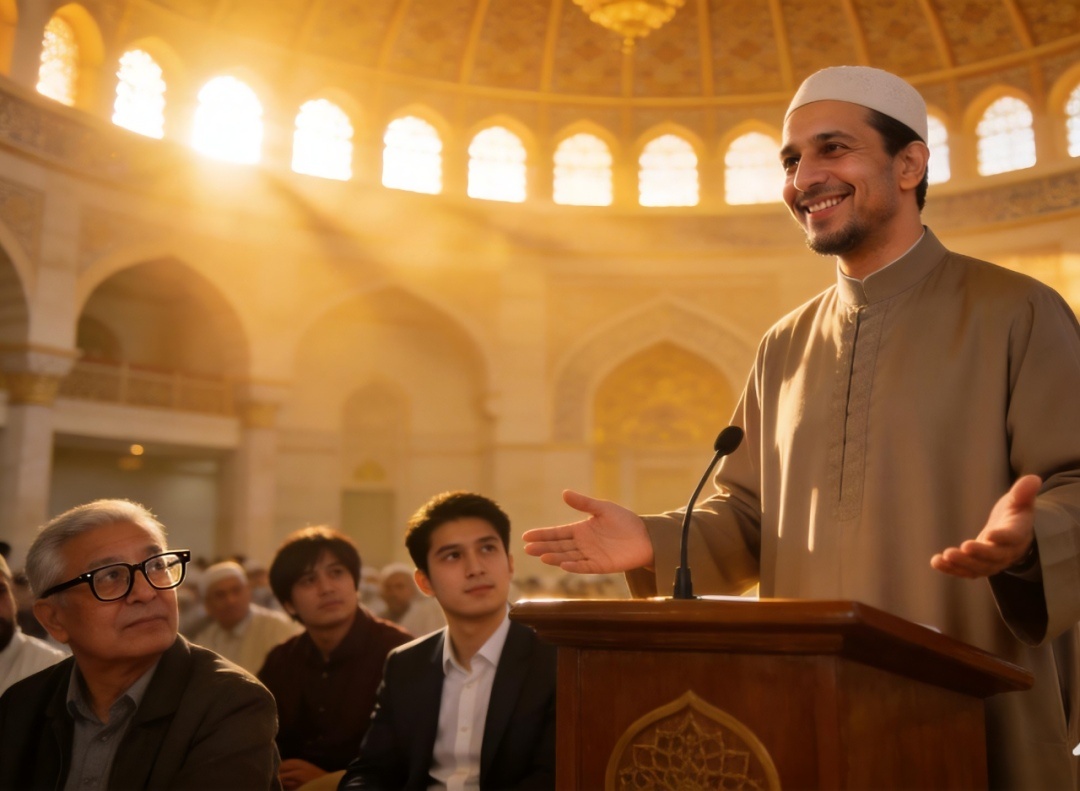
First, we hope to see an Ahong smile during their speech. The Prophet taught us that a smile is a form of charity. A sincere smile can bridge the distance between people. If an Ahong walks up to the podium with a stern face and starts criticizing from the first sentence, our hearts will close off. We are much more willing to listen to an Ahong who smiles and speaks with a gentle tone because we feel respected.
Second, we hope to hear about Allah's mercy and forgiveness, not just hellfire and punishment. Of course, we know that hellfire is real and warnings are necessary. However, we hope that while delivering warnings, the Ahong also speaks of Allah's mercy and forgiveness. We want to hear messages like: 'No matter how many mistakes you have made in the past, Allah's door is always open to those who repent.' Messages like this give us hope and the motivation to change for the better.
Third, we hope an Ahong uses scriptural teachings to explain issues rather than just blaming people. We have the ability to think critically. We are willing to listen to an Ahong cite sources and explain why prayer is important and why the mosque is a home for Muslims. We want to hear logical, well-supported speeches, not emotional outbursts of scolding. For instance, an Ahong could talk about the mental health benefits of prayer, how prayer helps with time management, or how the Prophet’s companions overcame difficulties to attend prayer. These concrete, insightful topics are far more persuasive than simple scolding.
Fourth, we hope an Ahong takes real-life circumstances into account and offers practical advice. Many people don't come to the mosque because they truly have difficulties. An Ahong could suggest solutions, like telling office workers how to find time for a quick prayer during breaks, helping young parents figure out how to bring their children along, or explaining how people with physical limitations can pray while seated. If an Ahong understands our struggles and helps us find solutions, we would be much more likely to draw near to the mosque.
Fifth, we hope an Ahong can admit to their own shortcomings and engage with the congregation as an equal. An Ahong is human and also has weaknesses and flaws. If an Ahong says during a speech, 'I, too, have been lazy at times, and I have missed prayers due to work, but Allah guided me,' we would feel a connection rather than being judged. We want our Ahong to be a guide, not a judge standing on a pedestal.
Sixth, we hope an Ahong tells more stories about the Prophet and his companions, using role models to touch people's hearts. Stories are more powerful than lectures. How the Prophet treated people who made mistakes, how the companions overcame obstacles to pray—these stories can move us. We hope an Ahong tells these warm, inspiring stories instead of just talking about punishment and terror.
Seventh, we hope that criticism is directed at behavior, not people, and that there is no labeling or humiliation. We can accept an Ahong criticizing a wrong action—for example, saying 'not praying is risky'—but we cannot accept it when they say, 'You people who don't pray are all hypocrites.' The former is a critique of behavior, while the latter is an insult to our character. We hope an Ahong can tell the difference.
Eighth, we hope to hear, 'I understand your difficulties, but Allah's door is always open,' instead of, 'If you don't come to the mosque, there is something wrong with your faith.' We want to feel an Ahong’s care and empathy in their speech, not their disdain and exclusion. When an Ahong says, 'I understand you,' our hearts soften; when an Ahong says, 'You are the problem,' our hearts harden.
Ninth, we hope an Ahong's speech has depth, warmth, and logic. We respect knowledge and reason. If a speech is empty and just repeats slogans, we will be disappointed. If the speech is grounded in scripture, reflects concern for our reality, and is logically structured, we will listen carefully and reflect on it.
Tenth, we hope an Ahong builds the mosque into a welcoming place, not a courtroom. The mosque is the house of Allah and should be open to everyone. We hope to feel peace in the mosque, not pressure. If a mosque makes people feel judged and unwanted, many will simply stay away. An Ahong should strive to make the mosque a sanctuary for the soul, not a place people fear to enter.
V. Suggestions for Ahongs and Mosque Administrators
Based on these feelings and the teachings of the scriptures, I would like to offer a few suggestions to Ahongs and mosque administrators.
First, an Ahong should re-examine the Prophet's way of preaching. The reason Prophet Muhammad's mission was successful was not only because he conveyed the truth, but because of his noble character and gentle attitude. Allah says in the Quran: 'And indeed, you are of a great moral character.' (Quran 68:4). The Prophet touched countless lives through his character. An Ahong should take the Prophet as their role model and influence the congregation with character, not temper.
Second, an Ahong should balance 'good tidings' and 'warnings.' Allah sent the Prophet as both a bringer of good tidings and a warner. An Ahong’s speech should reflect both. Focusing only on good news leads to complacency, while focusing only on warnings leads to despair. An Ahong should help people both fear Allah and love Him. In the Quran, Allah says: 'Indeed, it is He who is the Forgiving, the Merciful.' An Ahong should speak more about these attributes of Allah.
Third, an Ahong should improve their communication skills. Preaching is a skill-based task. An Ahong needs to understand not just the scriptures, but also the human heart. An Ahong could learn about psychology, sociology, and communication techniques. They should understand the psychological traits of different groups—the masses, the youth, the elderly, women, and children—and adapt their language accordingly. Allah says in the Quran: 'Invite to the way of your Lord with wisdom and good instruction.' (Quran 16:125). Wisdom includes using different methods for different people.
Fourth, an Ahong should view speaking as a service, not a display of power. Standing on the podium isn't for showing off one's superior knowledge, but to serve the people. An Ahong should ask: 'Does my speech make the people love Allah more? Does it make them more willing to come to the mosque? Does it bring them warmth?' If the answer is no, the Ahong should adjust their approach.
Fifth, regarding those who don't attend prayer, an Ahong should show private concern rather than publicly calling them out. Public scolding humiliates the individual and makes the congregation uneasy. Private concern makes people feel valued. Outside of speeches, an Ahong could take the initiative to visit those who haven't attended for a long time, understand their struggles, offer help, and invite them back. This approach is more in line with the Sunnah (the Prophet's tradition).
Sixth, an Ahong should reflect on their intentions. Is the preaching for the sake of Allah, or to show off? If the intention is sincere, the preaching will be gentle, patient, and wise. If the intention is mixed with pride and superiority, the Ahong will look down on and criticize the congregation. An Ahong should regularly check their heart to ensure their intentions remain pure.
Seventh, mosque administrators should create a welcoming environment. The mosque doors should be open, and staff and volunteers should warmly greet everyone who arrives. The mosque can utilize its space and sense of community to organize activities for different groups, such as public lectures, non-religious family-oriented activities, or relaxation and light sports, making the mosque a warm center for the neighborhood. Ahongs and administrators should work together to ensure the mosque is no longer a place that causes pressure and judgment.
Finally, I write this article not to attack any specific Ahong, nor to make excuses for those who don't pray. I sincerely hope our mosques become better and that the relationship between Ahongs and the congregation becomes more harmonious. Allah says in the Quran: 'Invite to the way of your Lord with wisdom and good instruction, and argue with them in a way that is best.' (Quran 16:125). This is not just a lesson for the Prophet; it is a lesson for every preacher.
Prophet Muhammad left us the best example. He preached with gentleness, patience, and wisdom; he touched countless people with love and character. I hope our Ahongs will take the Prophet as their example, replacing harshness with gentleness, threats with good news, blame with wisdom, and shunning with care. I hope that one day, when an Ahong stands on the podium, the people below aren't looking at their phones or feeling resentment, but are listening with respect and sincerity. I hope the mosque becomes a harbor for the soul, not a place people avoid.
Oh, Ahongs, please speak to us in the way of the Prophet. We want to listen, we want to change, and we want to draw closer to Allah. But please, start by offering us a gentle smile, a kind word, and some understanding. Because Allah is gentle, and He loves gentleness in all things. May Allah guide us all, may Allah have mercy on our Ahongs and our people, and may the mosque be filled with love and wisdom, not criticism and disdain. view all
Many of us want to feel closer to our faith, but sometimes the message from the pulpit can feel distant or even judgmental. This article, penned by an ordinary working Muslim, honestly discusses the harsh and accusatory tone sometimes heard in mosque sermons today, suggesting a more compassionate approach. It draws upon classical Islamic teachings and the compassionate, understanding, and gentle preaching style of Prophet Muhammad to urge imams and mosque management committees to connect with congregants through understanding, care, and warm smiles, bridging the gap between them and the mosque.
I'm just a regular Muslim, and because of my work, research, and family duties, I can't make it to the mosque for daily prayers. But that doesn't mean I've given up on my faith. I fast every Ramadan, try my best to attend Jumu'ah (Friday congregational prayers) weekly, and I also read some Quran translations and Hadith in my spare time. Today, as a community member, I want to share some honest thoughts with the imams. These aren't directed at any single person, but rather at a pretty common issue: some imams, when delivering sermons at the mosque, often use a condescending tone to criticize people, especially those who don't come to the mosque for prayers. They might think they're 'enjoining good and forbidding evil,' but the real effect is pushing many people further and further away.
First off, I want to make it clear that I'm not against imams encouraging people to pray. Prayer is a pillar of Islam and an obligation for every adult Muslim. However, the way we encourage others must align with Allah's teachings and the Sunnah of the Prophet. If the method is wrong, even if the goal is right, the outcome can be completely counterproductive.
1. A Real-Life Scenario I Experienced
Let me start by describing a scene I personally experienced. One Jumu'ah, I walked into the mosque and saw the imam already sitting on the pulpit. I was hoping for a sermon that would bring peace to my soul, but the imam immediately started by saying: 'You people who haven't been coming to the mosque for prayers for a long time, your hearts have hardened! Are you only concerned with this worldly life and not afraid of the Hereafter? Look at your phones, you spend way more time scrolling through short videos than you do praying! What right do you have to call yourselves Muslims anymore?'
As he said these words, his eyes swept over the congregation, and his tone was like an interrogation. Sitting there, I felt really uncomfortable. I admit that I'm busy with work and can't come to the mosque for daily prayers, but my faith isn't completely gone. What I needed wasn't to be labeled as having 'faith issues,' but rather some warm words, a piece of wisdom that could draw me closer to Allah. I believe many people in the congregation share similar feelings with me.
Some imams, during their talks, always like to separate 'you' and 'us.' They stand on the pulpit as if they've already secured their tickets to Paradise, while the congregation below are all sinners. Relying on their knowledge of scriptures and Hadith, they harshly criticize the problems they see in people. What they most frequently criticize is people not coming to the mosque for prayers. They rarely patiently ask why people don't come, and they seldom consider people's work hours, commute distances, family burdens, or social pressures. They just repeatedly scold and show disdain, which really alienates the listeners.
Here's a frank statement: an imam's duty is to 'call people to Allah,' not to judge people on behalf of Allah. Allah clearly states in the Quran: 'So remind, (O Muhammad); you are only a reminder. You are not a controller over them.' (Quran 88:21-22) This verse makes the role of a preacher very clear. An imam is a teacher, not a supervisor; a reminder, not a judge. If an imam takes on the role of a supervisor, he has already deviated from the fundamental preaching method of the Prophet.
2. What Allah and His Prophet Expect from Preachers
Let's turn back to the scriptures and Hadith to see what explicit requirements Allah and His Prophet have for the methods of preaching.
Allah says in the Quran: 'Invite to the way of your Lord with wisdom and good instruction, and argue with them in a way that is best. Indeed, your Lord is most knowing of who has strayed from His way, and He is most knowing of who is (rightly) guided.' (Quran 16:125)
The keywords in this verse are 'wisdom' and 'good instruction.' Allah didn't say, 'You should encourage people through blame and humiliation,' nor did He say, 'You should argue with people with the harshest attitude.' Allah speaks of 'good instruction' and 'in a way that is best.' This is not a trivial matter of politeness; it's a crucial condition for the success of da'wah (preaching/inviting to Islam).
Allah also says in the Quran to Prophet Muhammad: 'And by the mercy of Allah, you dealt with them gently. And had you been rude (in speech) and harsh in heart, they would have disbanded from about you. So pardon them and ask forgiveness for them and consult them in the matter. And when you have decided, then rely upon Allah. Indeed, Allah loves those who rely (upon Him).' (Quran 3:159)
This verse is incredibly important. Allah tells the Prophet that if he had been harsh and cruel, people would have certainly left him. In other words, a harsh attitude directly leads to the failure of da'wah. This isn't a problem with the people; it's a problem with the preacher's method. Unfortunately, some imams today have forgotten this very point. They might think their knowledge can overpower the congregation, but in reality, people's hearts are drifting further and further away from them.
What's even more thought-provoking is that when Allah sent Prophets Musa (Moses) and Harun (Aaron) to persuade the tyrannical Pharaoh, He also instructed them to speak gently. Allah said: 'And speak to him with gentle speech that perhaps he may be reminded or fear (Allah).' (Quran 20:44)
Who was Pharaoh? He was a tyrant who claimed divinity and brutally oppressed the Children of Israel. Yet, Allah instructed His prophets to speak gently even to such a person. So, what justification do our imams have to be condescending and use harsh words when addressing Muslim congregants? If gentleness is required even for Pharaoh, then it should be even more so for our Muslim brothers and sisters.
Allah also says: 'And not equal are the good deed and the bad. Repel (evil) by that which is best; then verily he, between whom and you was enmity, (will become) as though he was a loyal friend.' (Quran 41:34)
Some imams might perceive people not coming to the mosque for prayers as 'bad conduct,' and so they respond with a harsh attitude. But Allah teaches us to repel bad conduct with that which is best. This isn't weakness; it's wisdom. Good character can resolve animosity, while a harsh attitude only creates more of it.
Allah summarized the Prophet's mission by saying: 'And We have not sent you, (O Muhammad), except as a mercy to the worlds.' (Quran 21:107)
'Mercy' is the core of the Prophet's mission. Mercy isn't a condescending handout; it's empathetic care. If an imam lacks mercy for the congregation, he won't be able to understand their struggles, nor will he truly be able to guide them to the path of Allah.
Allah also tells us that the Prophet is the best example for Muslims. Allah says: 'There has certainly been for you in the Messenger of Allah an excellent pattern for anyone whose hope is in Allah and the Last Day and (who) remembers Allah often.' (Quran 33:21)
So, how did the Prophet preach? There are clear records in the Hadith. Narrated by Anas ibn Malik, the Prophet said: 'Make things easy for people and do not make them difficult, and give them good tidings and do not make them run away (from Islam).' (Sahih al-Bukhari, Hadith 69)
This Hadith clarifies the principles of da'wah very well: make things easy, not difficult; give good tidings, not push people away. Some imams' sermons do the exact opposite; they create difficulties for people and alienate them. Their intention might be to get people to come to the mosque for prayers, but their attitude ends up driving people away from the mosque doors.
Narrated by Aisha, the Messenger of Allah said: 'O Aisha, Allah is Kind and loves kindness, and He grants to kindness what He does not grant to harshness or anything else.' (Sahih Muslim, Hadith 2599)
This Hadith teaches us that kindness is an attribute of Allah. Whoever is kind in their da'wah approaches Allah's attributes; whoever is harsh in their da'wah distances themselves from Allah's love. If imams truly fear Allah, they should demonstrate Allah's kindness in their attitudes.
Narrated by Abu Hurairah, the Prophet said: 'Whoever believes in Allah and the Last Day should speak good or remain silent.' (Sahih al-Bukhari, Hadith 6018)
This Hadith is a general requirement for every Muslim, and it's especially important for imams. An imam stands on the pulpit, facing Allah's servants, and he should only speak good words. If he cannot speak good words, he should at least remain silent. Words full of accusation, disdain, and mockery are certainly not good words.
Narrated by Tamim ad-Dari, the Prophet said: 'Religion is sincerity.' We asked, 'Sincerity to whom?' He said, 'To Allah, His Book, His Messenger, to the leaders of the Muslims and to their common folk.' (Sahih Muslim, Hadith 55)
The original meaning of 'sincerity' in this context is genuinely wishing well for others, not exposing their faults, humiliating them, or attacking them. For an imam to be sincere to the congregation, he should genuinely care about their religious and worldly lives, rather than standing above them and criticizing them.
Narrated by Anas ibn Malik, the Prophet said: 'None of you will have true faith until he wishes for his brother what he wishes for himself.' (Sahih al-Bukhari, Hadith 13)
If an imam truly regards the congregation as his brothers and sisters, he wouldn't speak with such a condescending attitude. He would advise them patiently, gently, and sincerely, just as he would his own close siblings, instead of showing disdain and making accusations.
3. Why Condescending Accusations Are Wrong
Based on the scriptures and Hadith, condescending accusations are wrong in at least the following ways.
First, it transforms da'wah into judgment. Allah says in the Quran: 'So remind, (O Muhammad); you are only a reminder. You are not a controller over them.' (Quran 88:21-22) An imam's role is to teach and remind, not to supervise or control. Supervision is a power reserved solely for Allah. Whether a person's faith is sincere, or why someone doesn't come to the mosque for prayers—only Allah knows these things best. If an imam takes it upon himself to be a supervisor, he has overstepped his authority.
Second, it forgets the principle that there is no compulsion in religion. Allah says in the Quran: 'There shall be no compulsion in (acceptance of) the religion. The right course has become clear from the wrong.' (Quran 2:256) Allah also says: 'And if your Lord had willed, those on earth would have believed—all of them entirely. So, will you compel the people until they become believers?' (Quran 10:99)
These verses remind us that faith is, at its core, a matter of personal choice. Allah did not force people to believe, nor did the Prophet, and an Ahong (Islamic religious leader) certainly shouldn't try to use verbal aggression or mental pressure to force the masses. An Ahong can encourage prayer, but they shouldn't use blame and disdain to pressure people into it. Coercion and criticism don't deepen faith; they only breed resentment and drive people away from the mosque.
Thirdly, the message must include both warnings and glad tidings. In the Quran, Allah says to the Prophet: 'O Prophet, indeed We have sent you as a witness and a bringer of good tidings and a warner, and one who invites to Allah, by His permission, and an illuminating lamp.' (Quran 33:45–46)
The Prophet’s mission includes both 'good tidings' and 'warnings.' To focus only on warnings while ignoring the good news is a narrow understanding of that mission. Some Ahongs' speeches are filled with threats of hellfire, Allah's punishment, and the terror of the end times, but they rarely speak of Allah's mercy, forgiveness, acceptance, and rewards. This lopsided preaching leaves people feeling hopeless instead of inspired. It is hard for someone in despair to find the motivation to draw near to Allah; only someone filled with hope will voluntarily walk toward the mosque.
Fourth, it violates the basic requirement of 'kind words.' Allah says in the Quran: 'Invite to the way of your Lord with wisdom and good instruction.' (Quran 16:125). Blaming, shunning, and mocking are not 'good instruction.' If an Ahong thinks that because they know the scriptures they can criticize the masses at will, they have forgotten Allah's requirement for kind speech. Knowledge is not meant to be used to suppress people; it is meant to serve them.
Fifth, it ignores the specific circumstances and practical challenges of the people. Many people don't come to the mosque for prayer not because they lack Allah in their hearts, but because of work, family, or health issues. For example, a doctor might be busy in surgery for hours and miss prayer time; an engineer might be working overtime on a construction site and unable to leave; a young mother might be at home caring for a sick child. If an Ahong doesn't understand these realities and just keeps pointing fingers, they end up wronging good people and making those with genuine struggles feel misunderstood and hurt.
Sixth, it destroys the bond of brotherhood among Muslims. Allah says in the Quran: 'The believers are but brothers, so make settlement between your brothers. And fear Allah that you may receive mercy.' (Quran 49:10)
Ahongs and the congregation are all Muslims; we are brothers. Brothers should respect, understand, and help each other. If an Ahong positions themselves against the congregation and speaks with a condescending attitude, they shatter that brotherhood. Allah also warns us in the Quran: 'O you who have believed, let not a people ridicule (another) people; perhaps they may be better than them; nor let women ridicule (other) women; perhaps they may be better than them. And do not insult one another and do not call each other by (offensive) nicknames. Wretched is the name of disobedience after (one's) faith. And whoever does not repent - then it is those who are the wrongdoers.' (Quran 49:11)
Some Ahongs use labels in their speeches, calling people 'slaves of this world,' 'hypocrites,' or 'lazy people.' These terms not only violate this verse but also deeply hurt people's feelings. Allah has explicitly forbidden mocking, slandering, and using offensive nicknames; an Ahong should be the first to set a good example.
Seventh, it exposes the arrogance of the preacher. Allah says in the Quran: 'And do not turn your cheek (in contempt) toward people and do not walk through the earth exultantly. Indeed, Allah does not like everyone self-deluded and boastful. And be moderate in your pace and lower your voice; indeed, the most disagreeable of sounds is the voice of donkeys.' (Quran 31:18–19)
Although this verse is a warning to everyone, it is especially important for an Ahong. When an Ahong stands on the podium, the most common trap is pride. They feel they know the scriptures while the congregation doesn't; they feel they are the ones praying while the masses are not; they feel they are pious while the congregation is not. This sense of superiority makes them look down on the masses without even realizing it. But Allah does not love the arrogant. Allah loves those who are humble with others, even when they possess great knowledge and devotion.
IV. What Kind of Speeches We, the Congregation, Want to Hear
As a member of the congregation, I want to be honest with the Ahongs about the kind of speeches we hope to hear.
First, we hope to see an Ahong smile during their speech. The Prophet taught us that a smile is a form of charity. A sincere smile can bridge the distance between people. If an Ahong walks up to the podium with a stern face and starts criticizing from the first sentence, our hearts will close off. We are much more willing to listen to an Ahong who smiles and speaks with a gentle tone because we feel respected.
Second, we hope to hear about Allah's mercy and forgiveness, not just hellfire and punishment. Of course, we know that hellfire is real and warnings are necessary. However, we hope that while delivering warnings, the Ahong also speaks of Allah's mercy and forgiveness. We want to hear messages like: 'No matter how many mistakes you have made in the past, Allah's door is always open to those who repent.' Messages like this give us hope and the motivation to change for the better.
Third, we hope an Ahong uses scriptural teachings to explain issues rather than just blaming people. We have the ability to think critically. We are willing to listen to an Ahong cite sources and explain why prayer is important and why the mosque is a home for Muslims. We want to hear logical, well-supported speeches, not emotional outbursts of scolding. For instance, an Ahong could talk about the mental health benefits of prayer, how prayer helps with time management, or how the Prophet’s companions overcame difficulties to attend prayer. These concrete, insightful topics are far more persuasive than simple scolding.
Fourth, we hope an Ahong takes real-life circumstances into account and offers practical advice. Many people don't come to the mosque because they truly have difficulties. An Ahong could suggest solutions, like telling office workers how to find time for a quick prayer during breaks, helping young parents figure out how to bring their children along, or explaining how people with physical limitations can pray while seated. If an Ahong understands our struggles and helps us find solutions, we would be much more likely to draw near to the mosque.
Fifth, we hope an Ahong can admit to their own shortcomings and engage with the congregation as an equal. An Ahong is human and also has weaknesses and flaws. If an Ahong says during a speech, 'I, too, have been lazy at times, and I have missed prayers due to work, but Allah guided me,' we would feel a connection rather than being judged. We want our Ahong to be a guide, not a judge standing on a pedestal.
Sixth, we hope an Ahong tells more stories about the Prophet and his companions, using role models to touch people's hearts. Stories are more powerful than lectures. How the Prophet treated people who made mistakes, how the companions overcame obstacles to pray—these stories can move us. We hope an Ahong tells these warm, inspiring stories instead of just talking about punishment and terror.
Seventh, we hope that criticism is directed at behavior, not people, and that there is no labeling or humiliation. We can accept an Ahong criticizing a wrong action—for example, saying 'not praying is risky'—but we cannot accept it when they say, 'You people who don't pray are all hypocrites.' The former is a critique of behavior, while the latter is an insult to our character. We hope an Ahong can tell the difference.
Eighth, we hope to hear, 'I understand your difficulties, but Allah's door is always open,' instead of, 'If you don't come to the mosque, there is something wrong with your faith.' We want to feel an Ahong’s care and empathy in their speech, not their disdain and exclusion. When an Ahong says, 'I understand you,' our hearts soften; when an Ahong says, 'You are the problem,' our hearts harden.
Ninth, we hope an Ahong's speech has depth, warmth, and logic. We respect knowledge and reason. If a speech is empty and just repeats slogans, we will be disappointed. If the speech is grounded in scripture, reflects concern for our reality, and is logically structured, we will listen carefully and reflect on it.
Tenth, we hope an Ahong builds the mosque into a welcoming place, not a courtroom. The mosque is the house of Allah and should be open to everyone. We hope to feel peace in the mosque, not pressure. If a mosque makes people feel judged and unwanted, many will simply stay away. An Ahong should strive to make the mosque a sanctuary for the soul, not a place people fear to enter.
V. Suggestions for Ahongs and Mosque Administrators
Based on these feelings and the teachings of the scriptures, I would like to offer a few suggestions to Ahongs and mosque administrators.
First, an Ahong should re-examine the Prophet's way of preaching. The reason Prophet Muhammad's mission was successful was not only because he conveyed the truth, but because of his noble character and gentle attitude. Allah says in the Quran: 'And indeed, you are of a great moral character.' (Quran 68:4). The Prophet touched countless lives through his character. An Ahong should take the Prophet as their role model and influence the congregation with character, not temper.
Second, an Ahong should balance 'good tidings' and 'warnings.' Allah sent the Prophet as both a bringer of good tidings and a warner. An Ahong’s speech should reflect both. Focusing only on good news leads to complacency, while focusing only on warnings leads to despair. An Ahong should help people both fear Allah and love Him. In the Quran, Allah says: 'Indeed, it is He who is the Forgiving, the Merciful.' An Ahong should speak more about these attributes of Allah.
Third, an Ahong should improve their communication skills. Preaching is a skill-based task. An Ahong needs to understand not just the scriptures, but also the human heart. An Ahong could learn about psychology, sociology, and communication techniques. They should understand the psychological traits of different groups—the masses, the youth, the elderly, women, and children—and adapt their language accordingly. Allah says in the Quran: 'Invite to the way of your Lord with wisdom and good instruction.' (Quran 16:125). Wisdom includes using different methods for different people.
Fourth, an Ahong should view speaking as a service, not a display of power. Standing on the podium isn't for showing off one's superior knowledge, but to serve the people. An Ahong should ask: 'Does my speech make the people love Allah more? Does it make them more willing to come to the mosque? Does it bring them warmth?' If the answer is no, the Ahong should adjust their approach.
Fifth, regarding those who don't attend prayer, an Ahong should show private concern rather than publicly calling them out. Public scolding humiliates the individual and makes the congregation uneasy. Private concern makes people feel valued. Outside of speeches, an Ahong could take the initiative to visit those who haven't attended for a long time, understand their struggles, offer help, and invite them back. This approach is more in line with the Sunnah (the Prophet's tradition).
Sixth, an Ahong should reflect on their intentions. Is the preaching for the sake of Allah, or to show off? If the intention is sincere, the preaching will be gentle, patient, and wise. If the intention is mixed with pride and superiority, the Ahong will look down on and criticize the congregation. An Ahong should regularly check their heart to ensure their intentions remain pure.
Seventh, mosque administrators should create a welcoming environment. The mosque doors should be open, and staff and volunteers should warmly greet everyone who arrives. The mosque can utilize its space and sense of community to organize activities for different groups, such as public lectures, non-religious family-oriented activities, or relaxation and light sports, making the mosque a warm center for the neighborhood. Ahongs and administrators should work together to ensure the mosque is no longer a place that causes pressure and judgment.
Finally, I write this article not to attack any specific Ahong, nor to make excuses for those who don't pray. I sincerely hope our mosques become better and that the relationship between Ahongs and the congregation becomes more harmonious. Allah says in the Quran: 'Invite to the way of your Lord with wisdom and good instruction, and argue with them in a way that is best.' (Quran 16:125). This is not just a lesson for the Prophet; it is a lesson for every preacher.
Prophet Muhammad left us the best example. He preached with gentleness, patience, and wisdom; he touched countless people with love and character. I hope our Ahongs will take the Prophet as their example, replacing harshness with gentleness, threats with good news, blame with wisdom, and shunning with care. I hope that one day, when an Ahong stands on the podium, the people below aren't looking at their phones or feeling resentment, but are listening with respect and sincerity. I hope the mosque becomes a harbor for the soul, not a place people avoid.
Oh, Ahongs, please speak to us in the way of the Prophet. We want to listen, we want to change, and we want to draw closer to Allah. But please, start by offering us a gentle smile, a kind word, and some understanding. Because Allah is gentle, and He loves gentleness in all things. May Allah guide us all, may Allah have mercy on our Ahongs and our people, and may the mosque be filled with love and wisdom, not criticism and disdain.
I'm just a regular Muslim, and because of my work, research, and family duties, I can't make it to the mosque for daily prayers. But that doesn't mean I've given up on my faith. I fast every Ramadan, try my best to attend Jumu'ah (Friday congregational prayers) weekly, and I also read some Quran translations and Hadith in my spare time. Today, as a community member, I want to share some honest thoughts with the imams. These aren't directed at any single person, but rather at a pretty common issue: some imams, when delivering sermons at the mosque, often use a condescending tone to criticize people, especially those who don't come to the mosque for prayers. They might think they're 'enjoining good and forbidding evil,' but the real effect is pushing many people further and further away.
First off, I want to make it clear that I'm not against imams encouraging people to pray. Prayer is a pillar of Islam and an obligation for every adult Muslim. However, the way we encourage others must align with Allah's teachings and the Sunnah of the Prophet. If the method is wrong, even if the goal is right, the outcome can be completely counterproductive.
1. A Real-Life Scenario I Experienced
Let me start by describing a scene I personally experienced. One Jumu'ah, I walked into the mosque and saw the imam already sitting on the pulpit. I was hoping for a sermon that would bring peace to my soul, but the imam immediately started by saying: 'You people who haven't been coming to the mosque for prayers for a long time, your hearts have hardened! Are you only concerned with this worldly life and not afraid of the Hereafter? Look at your phones, you spend way more time scrolling through short videos than you do praying! What right do you have to call yourselves Muslims anymore?'
As he said these words, his eyes swept over the congregation, and his tone was like an interrogation. Sitting there, I felt really uncomfortable. I admit that I'm busy with work and can't come to the mosque for daily prayers, but my faith isn't completely gone. What I needed wasn't to be labeled as having 'faith issues,' but rather some warm words, a piece of wisdom that could draw me closer to Allah. I believe many people in the congregation share similar feelings with me.
Some imams, during their talks, always like to separate 'you' and 'us.' They stand on the pulpit as if they've already secured their tickets to Paradise, while the congregation below are all sinners. Relying on their knowledge of scriptures and Hadith, they harshly criticize the problems they see in people. What they most frequently criticize is people not coming to the mosque for prayers. They rarely patiently ask why people don't come, and they seldom consider people's work hours, commute distances, family burdens, or social pressures. They just repeatedly scold and show disdain, which really alienates the listeners.
Here's a frank statement: an imam's duty is to 'call people to Allah,' not to judge people on behalf of Allah. Allah clearly states in the Quran: 'So remind, (O Muhammad); you are only a reminder. You are not a controller over them.' (Quran 88:21-22) This verse makes the role of a preacher very clear. An imam is a teacher, not a supervisor; a reminder, not a judge. If an imam takes on the role of a supervisor, he has already deviated from the fundamental preaching method of the Prophet.
2. What Allah and His Prophet Expect from Preachers
Let's turn back to the scriptures and Hadith to see what explicit requirements Allah and His Prophet have for the methods of preaching.
Allah says in the Quran: 'Invite to the way of your Lord with wisdom and good instruction, and argue with them in a way that is best. Indeed, your Lord is most knowing of who has strayed from His way, and He is most knowing of who is (rightly) guided.' (Quran 16:125)
The keywords in this verse are 'wisdom' and 'good instruction.' Allah didn't say, 'You should encourage people through blame and humiliation,' nor did He say, 'You should argue with people with the harshest attitude.' Allah speaks of 'good instruction' and 'in a way that is best.' This is not a trivial matter of politeness; it's a crucial condition for the success of da'wah (preaching/inviting to Islam).
Allah also says in the Quran to Prophet Muhammad: 'And by the mercy of Allah, you dealt with them gently. And had you been rude (in speech) and harsh in heart, they would have disbanded from about you. So pardon them and ask forgiveness for them and consult them in the matter. And when you have decided, then rely upon Allah. Indeed, Allah loves those who rely (upon Him).' (Quran 3:159)
This verse is incredibly important. Allah tells the Prophet that if he had been harsh and cruel, people would have certainly left him. In other words, a harsh attitude directly leads to the failure of da'wah. This isn't a problem with the people; it's a problem with the preacher's method. Unfortunately, some imams today have forgotten this very point. They might think their knowledge can overpower the congregation, but in reality, people's hearts are drifting further and further away from them.
What's even more thought-provoking is that when Allah sent Prophets Musa (Moses) and Harun (Aaron) to persuade the tyrannical Pharaoh, He also instructed them to speak gently. Allah said: 'And speak to him with gentle speech that perhaps he may be reminded or fear (Allah).' (Quran 20:44)
Who was Pharaoh? He was a tyrant who claimed divinity and brutally oppressed the Children of Israel. Yet, Allah instructed His prophets to speak gently even to such a person. So, what justification do our imams have to be condescending and use harsh words when addressing Muslim congregants? If gentleness is required even for Pharaoh, then it should be even more so for our Muslim brothers and sisters.
Allah also says: 'And not equal are the good deed and the bad. Repel (evil) by that which is best; then verily he, between whom and you was enmity, (will become) as though he was a loyal friend.' (Quran 41:34)
Some imams might perceive people not coming to the mosque for prayers as 'bad conduct,' and so they respond with a harsh attitude. But Allah teaches us to repel bad conduct with that which is best. This isn't weakness; it's wisdom. Good character can resolve animosity, while a harsh attitude only creates more of it.
Allah summarized the Prophet's mission by saying: 'And We have not sent you, (O Muhammad), except as a mercy to the worlds.' (Quran 21:107)
'Mercy' is the core of the Prophet's mission. Mercy isn't a condescending handout; it's empathetic care. If an imam lacks mercy for the congregation, he won't be able to understand their struggles, nor will he truly be able to guide them to the path of Allah.
Allah also tells us that the Prophet is the best example for Muslims. Allah says: 'There has certainly been for you in the Messenger of Allah an excellent pattern for anyone whose hope is in Allah and the Last Day and (who) remembers Allah often.' (Quran 33:21)
So, how did the Prophet preach? There are clear records in the Hadith. Narrated by Anas ibn Malik, the Prophet said: 'Make things easy for people and do not make them difficult, and give them good tidings and do not make them run away (from Islam).' (Sahih al-Bukhari, Hadith 69)
This Hadith clarifies the principles of da'wah very well: make things easy, not difficult; give good tidings, not push people away. Some imams' sermons do the exact opposite; they create difficulties for people and alienate them. Their intention might be to get people to come to the mosque for prayers, but their attitude ends up driving people away from the mosque doors.
Narrated by Aisha, the Messenger of Allah said: 'O Aisha, Allah is Kind and loves kindness, and He grants to kindness what He does not grant to harshness or anything else.' (Sahih Muslim, Hadith 2599)
This Hadith teaches us that kindness is an attribute of Allah. Whoever is kind in their da'wah approaches Allah's attributes; whoever is harsh in their da'wah distances themselves from Allah's love. If imams truly fear Allah, they should demonstrate Allah's kindness in their attitudes.
Narrated by Abu Hurairah, the Prophet said: 'Whoever believes in Allah and the Last Day should speak good or remain silent.' (Sahih al-Bukhari, Hadith 6018)
This Hadith is a general requirement for every Muslim, and it's especially important for imams. An imam stands on the pulpit, facing Allah's servants, and he should only speak good words. If he cannot speak good words, he should at least remain silent. Words full of accusation, disdain, and mockery are certainly not good words.
Narrated by Tamim ad-Dari, the Prophet said: 'Religion is sincerity.' We asked, 'Sincerity to whom?' He said, 'To Allah, His Book, His Messenger, to the leaders of the Muslims and to their common folk.' (Sahih Muslim, Hadith 55)
The original meaning of 'sincerity' in this context is genuinely wishing well for others, not exposing their faults, humiliating them, or attacking them. For an imam to be sincere to the congregation, he should genuinely care about their religious and worldly lives, rather than standing above them and criticizing them.
Narrated by Anas ibn Malik, the Prophet said: 'None of you will have true faith until he wishes for his brother what he wishes for himself.' (Sahih al-Bukhari, Hadith 13)
If an imam truly regards the congregation as his brothers and sisters, he wouldn't speak with such a condescending attitude. He would advise them patiently, gently, and sincerely, just as he would his own close siblings, instead of showing disdain and making accusations.
3. Why Condescending Accusations Are Wrong
Based on the scriptures and Hadith, condescending accusations are wrong in at least the following ways.
First, it transforms da'wah into judgment. Allah says in the Quran: 'So remind, (O Muhammad); you are only a reminder. You are not a controller over them.' (Quran 88:21-22) An imam's role is to teach and remind, not to supervise or control. Supervision is a power reserved solely for Allah. Whether a person's faith is sincere, or why someone doesn't come to the mosque for prayers—only Allah knows these things best. If an imam takes it upon himself to be a supervisor, he has overstepped his authority.
Second, it forgets the principle that there is no compulsion in religion. Allah says in the Quran: 'There shall be no compulsion in (acceptance of) the religion. The right course has become clear from the wrong.' (Quran 2:256) Allah also says: 'And if your Lord had willed, those on earth would have believed—all of them entirely. So, will you compel the people until they become believers?' (Quran 10:99)
These verses remind us that faith is, at its core, a matter of personal choice. Allah did not force people to believe, nor did the Prophet, and an Ahong (Islamic religious leader) certainly shouldn't try to use verbal aggression or mental pressure to force the masses. An Ahong can encourage prayer, but they shouldn't use blame and disdain to pressure people into it. Coercion and criticism don't deepen faith; they only breed resentment and drive people away from the mosque.
Thirdly, the message must include both warnings and glad tidings. In the Quran, Allah says to the Prophet: 'O Prophet, indeed We have sent you as a witness and a bringer of good tidings and a warner, and one who invites to Allah, by His permission, and an illuminating lamp.' (Quran 33:45–46)
The Prophet’s mission includes both 'good tidings' and 'warnings.' To focus only on warnings while ignoring the good news is a narrow understanding of that mission. Some Ahongs' speeches are filled with threats of hellfire, Allah's punishment, and the terror of the end times, but they rarely speak of Allah's mercy, forgiveness, acceptance, and rewards. This lopsided preaching leaves people feeling hopeless instead of inspired. It is hard for someone in despair to find the motivation to draw near to Allah; only someone filled with hope will voluntarily walk toward the mosque.
Fourth, it violates the basic requirement of 'kind words.' Allah says in the Quran: 'Invite to the way of your Lord with wisdom and good instruction.' (Quran 16:125). Blaming, shunning, and mocking are not 'good instruction.' If an Ahong thinks that because they know the scriptures they can criticize the masses at will, they have forgotten Allah's requirement for kind speech. Knowledge is not meant to be used to suppress people; it is meant to serve them.
Fifth, it ignores the specific circumstances and practical challenges of the people. Many people don't come to the mosque for prayer not because they lack Allah in their hearts, but because of work, family, or health issues. For example, a doctor might be busy in surgery for hours and miss prayer time; an engineer might be working overtime on a construction site and unable to leave; a young mother might be at home caring for a sick child. If an Ahong doesn't understand these realities and just keeps pointing fingers, they end up wronging good people and making those with genuine struggles feel misunderstood and hurt.
Sixth, it destroys the bond of brotherhood among Muslims. Allah says in the Quran: 'The believers are but brothers, so make settlement between your brothers. And fear Allah that you may receive mercy.' (Quran 49:10)
Ahongs and the congregation are all Muslims; we are brothers. Brothers should respect, understand, and help each other. If an Ahong positions themselves against the congregation and speaks with a condescending attitude, they shatter that brotherhood. Allah also warns us in the Quran: 'O you who have believed, let not a people ridicule (another) people; perhaps they may be better than them; nor let women ridicule (other) women; perhaps they may be better than them. And do not insult one another and do not call each other by (offensive) nicknames. Wretched is the name of disobedience after (one's) faith. And whoever does not repent - then it is those who are the wrongdoers.' (Quran 49:11)
Some Ahongs use labels in their speeches, calling people 'slaves of this world,' 'hypocrites,' or 'lazy people.' These terms not only violate this verse but also deeply hurt people's feelings. Allah has explicitly forbidden mocking, slandering, and using offensive nicknames; an Ahong should be the first to set a good example.
Seventh, it exposes the arrogance of the preacher. Allah says in the Quran: 'And do not turn your cheek (in contempt) toward people and do not walk through the earth exultantly. Indeed, Allah does not like everyone self-deluded and boastful. And be moderate in your pace and lower your voice; indeed, the most disagreeable of sounds is the voice of donkeys.' (Quran 31:18–19)
Although this verse is a warning to everyone, it is especially important for an Ahong. When an Ahong stands on the podium, the most common trap is pride. They feel they know the scriptures while the congregation doesn't; they feel they are the ones praying while the masses are not; they feel they are pious while the congregation is not. This sense of superiority makes them look down on the masses without even realizing it. But Allah does not love the arrogant. Allah loves those who are humble with others, even when they possess great knowledge and devotion.
IV. What Kind of Speeches We, the Congregation, Want to Hear
As a member of the congregation, I want to be honest with the Ahongs about the kind of speeches we hope to hear.
First, we hope to see an Ahong smile during their speech. The Prophet taught us that a smile is a form of charity. A sincere smile can bridge the distance between people. If an Ahong walks up to the podium with a stern face and starts criticizing from the first sentence, our hearts will close off. We are much more willing to listen to an Ahong who smiles and speaks with a gentle tone because we feel respected.
Second, we hope to hear about Allah's mercy and forgiveness, not just hellfire and punishment. Of course, we know that hellfire is real and warnings are necessary. However, we hope that while delivering warnings, the Ahong also speaks of Allah's mercy and forgiveness. We want to hear messages like: 'No matter how many mistakes you have made in the past, Allah's door is always open to those who repent.' Messages like this give us hope and the motivation to change for the better.
Third, we hope an Ahong uses scriptural teachings to explain issues rather than just blaming people. We have the ability to think critically. We are willing to listen to an Ahong cite sources and explain why prayer is important and why the mosque is a home for Muslims. We want to hear logical, well-supported speeches, not emotional outbursts of scolding. For instance, an Ahong could talk about the mental health benefits of prayer, how prayer helps with time management, or how the Prophet’s companions overcame difficulties to attend prayer. These concrete, insightful topics are far more persuasive than simple scolding.
Fourth, we hope an Ahong takes real-life circumstances into account and offers practical advice. Many people don't come to the mosque because they truly have difficulties. An Ahong could suggest solutions, like telling office workers how to find time for a quick prayer during breaks, helping young parents figure out how to bring their children along, or explaining how people with physical limitations can pray while seated. If an Ahong understands our struggles and helps us find solutions, we would be much more likely to draw near to the mosque.
Fifth, we hope an Ahong can admit to their own shortcomings and engage with the congregation as an equal. An Ahong is human and also has weaknesses and flaws. If an Ahong says during a speech, 'I, too, have been lazy at times, and I have missed prayers due to work, but Allah guided me,' we would feel a connection rather than being judged. We want our Ahong to be a guide, not a judge standing on a pedestal.
Sixth, we hope an Ahong tells more stories about the Prophet and his companions, using role models to touch people's hearts. Stories are more powerful than lectures. How the Prophet treated people who made mistakes, how the companions overcame obstacles to pray—these stories can move us. We hope an Ahong tells these warm, inspiring stories instead of just talking about punishment and terror.
Seventh, we hope that criticism is directed at behavior, not people, and that there is no labeling or humiliation. We can accept an Ahong criticizing a wrong action—for example, saying 'not praying is risky'—but we cannot accept it when they say, 'You people who don't pray are all hypocrites.' The former is a critique of behavior, while the latter is an insult to our character. We hope an Ahong can tell the difference.
Eighth, we hope to hear, 'I understand your difficulties, but Allah's door is always open,' instead of, 'If you don't come to the mosque, there is something wrong with your faith.' We want to feel an Ahong’s care and empathy in their speech, not their disdain and exclusion. When an Ahong says, 'I understand you,' our hearts soften; when an Ahong says, 'You are the problem,' our hearts harden.
Ninth, we hope an Ahong's speech has depth, warmth, and logic. We respect knowledge and reason. If a speech is empty and just repeats slogans, we will be disappointed. If the speech is grounded in scripture, reflects concern for our reality, and is logically structured, we will listen carefully and reflect on it.
Tenth, we hope an Ahong builds the mosque into a welcoming place, not a courtroom. The mosque is the house of Allah and should be open to everyone. We hope to feel peace in the mosque, not pressure. If a mosque makes people feel judged and unwanted, many will simply stay away. An Ahong should strive to make the mosque a sanctuary for the soul, not a place people fear to enter.
V. Suggestions for Ahongs and Mosque Administrators
Based on these feelings and the teachings of the scriptures, I would like to offer a few suggestions to Ahongs and mosque administrators.
First, an Ahong should re-examine the Prophet's way of preaching. The reason Prophet Muhammad's mission was successful was not only because he conveyed the truth, but because of his noble character and gentle attitude. Allah says in the Quran: 'And indeed, you are of a great moral character.' (Quran 68:4). The Prophet touched countless lives through his character. An Ahong should take the Prophet as their role model and influence the congregation with character, not temper.
Second, an Ahong should balance 'good tidings' and 'warnings.' Allah sent the Prophet as both a bringer of good tidings and a warner. An Ahong’s speech should reflect both. Focusing only on good news leads to complacency, while focusing only on warnings leads to despair. An Ahong should help people both fear Allah and love Him. In the Quran, Allah says: 'Indeed, it is He who is the Forgiving, the Merciful.' An Ahong should speak more about these attributes of Allah.
Third, an Ahong should improve their communication skills. Preaching is a skill-based task. An Ahong needs to understand not just the scriptures, but also the human heart. An Ahong could learn about psychology, sociology, and communication techniques. They should understand the psychological traits of different groups—the masses, the youth, the elderly, women, and children—and adapt their language accordingly. Allah says in the Quran: 'Invite to the way of your Lord with wisdom and good instruction.' (Quran 16:125). Wisdom includes using different methods for different people.
Fourth, an Ahong should view speaking as a service, not a display of power. Standing on the podium isn't for showing off one's superior knowledge, but to serve the people. An Ahong should ask: 'Does my speech make the people love Allah more? Does it make them more willing to come to the mosque? Does it bring them warmth?' If the answer is no, the Ahong should adjust their approach.
Fifth, regarding those who don't attend prayer, an Ahong should show private concern rather than publicly calling them out. Public scolding humiliates the individual and makes the congregation uneasy. Private concern makes people feel valued. Outside of speeches, an Ahong could take the initiative to visit those who haven't attended for a long time, understand their struggles, offer help, and invite them back. This approach is more in line with the Sunnah (the Prophet's tradition).
Sixth, an Ahong should reflect on their intentions. Is the preaching for the sake of Allah, or to show off? If the intention is sincere, the preaching will be gentle, patient, and wise. If the intention is mixed with pride and superiority, the Ahong will look down on and criticize the congregation. An Ahong should regularly check their heart to ensure their intentions remain pure.
Seventh, mosque administrators should create a welcoming environment. The mosque doors should be open, and staff and volunteers should warmly greet everyone who arrives. The mosque can utilize its space and sense of community to organize activities for different groups, such as public lectures, non-religious family-oriented activities, or relaxation and light sports, making the mosque a warm center for the neighborhood. Ahongs and administrators should work together to ensure the mosque is no longer a place that causes pressure and judgment.
Finally, I write this article not to attack any specific Ahong, nor to make excuses for those who don't pray. I sincerely hope our mosques become better and that the relationship between Ahongs and the congregation becomes more harmonious. Allah says in the Quran: 'Invite to the way of your Lord with wisdom and good instruction, and argue with them in a way that is best.' (Quran 16:125). This is not just a lesson for the Prophet; it is a lesson for every preacher.
Prophet Muhammad left us the best example. He preached with gentleness, patience, and wisdom; he touched countless people with love and character. I hope our Ahongs will take the Prophet as their example, replacing harshness with gentleness, threats with good news, blame with wisdom, and shunning with care. I hope that one day, when an Ahong stands on the podium, the people below aren't looking at their phones or feeling resentment, but are listening with respect and sincerity. I hope the mosque becomes a harbor for the soul, not a place people avoid.
Oh, Ahongs, please speak to us in the way of the Prophet. We want to listen, we want to change, and we want to draw closer to Allah. But please, start by offering us a gentle smile, a kind word, and some understanding. Because Allah is gentle, and He loves gentleness in all things. May Allah guide us all, may Allah have mercy on our Ahongs and our people, and may the mosque be filled with love and wisdom, not criticism and disdain.
Mosque Sermons & Imam Guidance: Embracing Prophet Muhammad's Gentle Wisdom for a Stronger Muslim Community
Articles • Hasan09 posted the article • 0 comments • 8 views • 3 hours ago
Many of us want to feel closer to our faith, but sometimes the message from the pulpit can feel distant or even judgmental. This article, penned by an ordinary working Muslim, honestly discusses the harsh and accusatory tone sometimes heard in mosque sermons today, suggesting a more compassionate approach. It draws upon classical Islamic teachings and the compassionate, understanding, and gentle preaching style of Prophet Muhammad to urge imams and mosque management committees to connect with congregants through understanding, care, and warm smiles, bridging the gap between them and the mosque.
I'm just a regular Muslim, and because of my work, research, and family duties, I can't make it to the mosque for daily prayers. But that doesn't mean I've given up on my faith. I fast every Ramadan, try my best to attend Jumu'ah (Friday congregational prayers) weekly, and I also read some Quran translations and Hadith in my spare time. Today, as a community member, I want to share some honest thoughts with the imams. These aren't directed at any single person, but rather at a pretty common issue: some imams, when delivering sermons at the mosque, often use a condescending tone to criticize people, especially those who don't come to the mosque for prayers. They might think they're 'enjoining good and forbidding evil,' but the real effect is pushing many people further and further away.
First off, I want to make it clear that I'm not against imams encouraging people to pray. Prayer is a pillar of Islam and an obligation for every adult Muslim. However, the way we encourage others must align with Allah's teachings and the Sunnah of the Prophet. If the method is wrong, even if the goal is right, the outcome can be completely counterproductive.
1. A Real-Life Scenario I Experienced
Let me start by describing a scene I personally experienced. One Jumu'ah, I walked into the mosque and saw the imam already sitting on the pulpit. I was hoping for a sermon that would bring peace to my soul, but the imam immediately started by saying: 'You people who haven't been coming to the mosque for prayers for a long time, your hearts have hardened! Are you only concerned with this worldly life and not afraid of the Hereafter? Look at your phones, you spend way more time scrolling through short videos than you do praying! What right do you have to call yourselves Muslims anymore?'
As he said these words, his eyes swept over the congregation, and his tone was like an interrogation. Sitting there, I felt really uncomfortable. I admit that I'm busy with work and can't come to the mosque for daily prayers, but my faith isn't completely gone. What I needed wasn't to be labeled as having 'faith issues,' but rather some warm words, a piece of wisdom that could draw me closer to Allah. I believe many people in the congregation share similar feelings with me.
Some imams, during their talks, always like to separate 'you' and 'us.' They stand on the pulpit as if they've already secured their tickets to Paradise, while the congregation below are all sinners. Relying on their knowledge of scriptures and Hadith, they harshly criticize the problems they see in people. What they most frequently criticize is people not coming to the mosque for prayers. They rarely patiently ask why people don't come, and they seldom consider people's work hours, commute distances, family burdens, or social pressures. They just repeatedly scold and show disdain, which really alienates the listeners.
Here's a frank statement: an imam's duty is to 'call people to Allah,' not to judge people on behalf of Allah. Allah clearly states in the Quran: 'So remind, (O Muhammad); you are only a reminder. You are not a controller over them.' (Quran 88:21-22) This verse makes the role of a preacher very clear. An imam is a teacher, not a supervisor; a reminder, not a judge. If an imam takes on the role of a supervisor, he has already deviated from the fundamental preaching method of the Prophet.
2. What Allah and His Prophet Expect from Preachers
Let's turn back to the scriptures and Hadith to see what explicit requirements Allah and His Prophet have for the methods of preaching.
Allah says in the Quran: 'Invite to the way of your Lord with wisdom and good instruction, and argue with them in a way that is best. Indeed, your Lord is most knowing of who has strayed from His way, and He is most knowing of who is (rightly) guided.' (Quran 16:125)
The keywords in this verse are 'wisdom' and 'good instruction.' Allah didn't say, 'You should encourage people through blame and humiliation,' nor did He say, 'You should argue with people with the harshest attitude.' Allah speaks of 'good instruction' and 'in a way that is best.' This is not a trivial matter of politeness; it's a crucial condition for the success of da'wah (preaching/inviting to Islam).
Allah also says in the Quran to Prophet Muhammad: 'And by the mercy of Allah, you dealt with them gently. And had you been rude (in speech) and harsh in heart, they would have disbanded from about you. So pardon them and ask forgiveness for them and consult them in the matter. And when you have decided, then rely upon Allah. Indeed, Allah loves those who rely (upon Him).' (Quran 3:159)
This verse is incredibly important. Allah tells the Prophet that if he had been harsh and cruel, people would have certainly left him. In other words, a harsh attitude directly leads to the failure of da'wah. This isn't a problem with the people; it's a problem with the preacher's method. Unfortunately, some imams today have forgotten this very point. They might think their knowledge can overpower the congregation, but in reality, people's hearts are drifting further and further away from them.
What's even more thought-provoking is that when Allah sent Prophets Musa (Moses) and Harun (Aaron) to persuade the tyrannical Pharaoh, He also instructed them to speak gently. Allah said: 'And speak to him with gentle speech that perhaps he may be reminded or fear (Allah).' (Quran 20:44)
Who was Pharaoh? He was a tyrant who claimed divinity and brutally oppressed the Children of Israel. Yet, Allah instructed His prophets to speak gently even to such a person. So, what justification do our imams have to be condescending and use harsh words when addressing Muslim congregants? If gentleness is required even for Pharaoh, then it should be even more so for our Muslim brothers and sisters.
Allah also says: 'And not equal are the good deed and the bad. Repel (evil) by that which is best; then verily he, between whom and you was enmity, (will become) as though he was a loyal friend.' (Quran 41:34)
Some imams might perceive people not coming to the mosque for prayers as 'bad conduct,' and so they respond with a harsh attitude. But Allah teaches us to repel bad conduct with that which is best. This isn't weakness; it's wisdom. Good character can resolve animosity, while a harsh attitude only creates more of it.
Allah summarized the Prophet's mission by saying: 'And We have not sent you, (O Muhammad), except as a mercy to the worlds.' (Quran 21:107)
'Mercy' is the core of the Prophet's mission. Mercy isn't a condescending handout; it's empathetic care. If an imam lacks mercy for the congregation, he won't be able to understand their struggles, nor will he truly be able to guide them to the path of Allah.
Allah also tells us that the Prophet is the best example for Muslims. Allah says: 'There has certainly been for you in the Messenger of Allah an excellent pattern for anyone whose hope is in Allah and the Last Day and (who) remembers Allah often.' (Quran 33:21)
So, how did the Prophet preach? There are clear records in the Hadith. Narrated by Anas ibn Malik, the Prophet said: 'Make things easy for people and do not make them difficult, and give them good tidings and do not make them run away (from Islam).' (Sahih al-Bukhari, Hadith 69)
This Hadith clarifies the principles of da'wah very well: make things easy, not difficult; give good tidings, not push people away. Some imams' sermons do the exact opposite; they create difficulties for people and alienate them. Their intention might be to get people to come to the mosque for prayers, but their attitude ends up driving people away from the mosque doors.
Narrated by Aisha, the Messenger of Allah said: 'O Aisha, Allah is Kind and loves kindness, and He grants to kindness what He does not grant to harshness or anything else.' (Sahih Muslim, Hadith 2599)
This Hadith teaches us that kindness is an attribute of Allah. Whoever is kind in their da'wah approaches Allah's attributes; whoever is harsh in their da'wah distances themselves from Allah's love. If imams truly fear Allah, they should demonstrate Allah's kindness in their attitudes.
Narrated by Abu Hurairah, the Prophet said: 'Whoever believes in Allah and the Last Day should speak good or remain silent.' (Sahih al-Bukhari, Hadith 6018)
This Hadith is a general requirement for every Muslim, and it's especially important for imams. An imam stands on the pulpit, facing Allah's servants, and he should only speak good words. If he cannot speak good words, he should at least remain silent. Words full of accusation, disdain, and mockery are certainly not good words.
Narrated by Tamim ad-Dari, the Prophet said: 'Religion is sincerity.' We asked, 'Sincerity to whom?' He said, 'To Allah, His Book, His Messenger, to the leaders of the Muslims and to their common folk.' (Sahih Muslim, Hadith 55)
The original meaning of 'sincerity' in this context is genuinely wishing well for others, not exposing their faults, humiliating them, or attacking them. For an imam to be sincere to the congregation, he should genuinely care about their religious and worldly lives, rather than standing above them and criticizing them.
Narrated by Anas ibn Malik, the Prophet said: 'None of you will have true faith until he wishes for his brother what he wishes for himself.' (Sahih al-Bukhari, Hadith 13)
If an imam truly regards the congregation as his brothers and sisters, he wouldn't speak with such a condescending attitude. He would advise them patiently, gently, and sincerely, just as he would his own close siblings, instead of showing disdain and making accusations.
3. Why Condescending Accusations Are Wrong
Based on the scriptures and Hadith, condescending accusations are wrong in at least the following ways.
First, it transforms da'wah into judgment. Allah says in the Quran: 'So remind, (O Muhammad); you are only a reminder. You are not a controller over them.' (Quran 88:21-22) An imam's role is to teach and remind, not to supervise or control. Supervision is a power reserved solely for Allah. Whether a person's faith is sincere, or why someone doesn't come to the mosque for prayers—only Allah knows these things best. If an imam takes it upon himself to be a supervisor, he has overstepped his authority.
Second, it forgets the principle that there is no compulsion in religion. Allah says in the Quran: 'There shall be no compulsion in (acceptance of) the religion. The right course has become clear from the wrong.' (Quran 2:256) Allah also says: 'And if your Lord had willed, those on earth would have believed—all of them entirely. So, will you compel the people until they become believers?' (Quran 10:99)
These verses remind us that faith is, at its core, a matter of personal choice. Allah did not force people to believe, nor did the Prophet, and an Ahong (Islamic religious leader) certainly shouldn't try to use verbal aggression or mental pressure to force the masses. An Ahong can encourage prayer, but they shouldn't use blame and disdain to pressure people into it. Coercion and criticism don't deepen faith; they only breed resentment and drive people away from the mosque.
Thirdly, the message must include both warnings and glad tidings. In the Quran, Allah says to the Prophet: 'O Prophet, indeed We have sent you as a witness and a bringer of good tidings and a warner, and one who invites to Allah, by His permission, and an illuminating lamp.' (Quran 33:45–46)
The Prophet’s mission includes both 'good tidings' and 'warnings.' To focus only on warnings while ignoring the good news is a narrow understanding of that mission. Some Ahongs' speeches are filled with threats of hellfire, Allah's punishment, and the terror of the end times, but they rarely speak of Allah's mercy, forgiveness, acceptance, and rewards. This lopsided preaching leaves people feeling hopeless instead of inspired. It is hard for someone in despair to find the motivation to draw near to Allah; only someone filled with hope will voluntarily walk toward the mosque.
Fourth, it violates the basic requirement of 'kind words.' Allah says in the Quran: 'Invite to the way of your Lord with wisdom and good instruction.' (Quran 16:125). Blaming, shunning, and mocking are not 'good instruction.' If an Ahong thinks that because they know the scriptures they can criticize the masses at will, they have forgotten Allah's requirement for kind speech. Knowledge is not meant to be used to suppress people; it is meant to serve them.
Fifth, it ignores the specific circumstances and practical challenges of the people. Many people don't come to the mosque for prayer not because they lack Allah in their hearts, but because of work, family, or health issues. For example, a doctor might be busy in surgery for hours and miss prayer time; an engineer might be working overtime on a construction site and unable to leave; a young mother might be at home caring for a sick child. If an Ahong doesn't understand these realities and just keeps pointing fingers, they end up wronging good people and making those with genuine struggles feel misunderstood and hurt.
Sixth, it destroys the bond of brotherhood among Muslims. Allah says in the Quran: 'The believers are but brothers, so make settlement between your brothers. And fear Allah that you may receive mercy.' (Quran 49:10)
Ahongs and the congregation are all Muslims; we are brothers. Brothers should respect, understand, and help each other. If an Ahong positions themselves against the congregation and speaks with a condescending attitude, they shatter that brotherhood. Allah also warns us in the Quran: 'O you who have believed, let not a people ridicule (another) people; perhaps they may be better than them; nor let women ridicule (other) women; perhaps they may be better than them. And do not insult one another and do not call each other by (offensive) nicknames. Wretched is the name of disobedience after (one's) faith. And whoever does not repent - then it is those who are the wrongdoers.' (Quran 49:11)
Some Ahongs use labels in their speeches, calling people 'slaves of this world,' 'hypocrites,' or 'lazy people.' These terms not only violate this verse but also deeply hurt people's feelings. Allah has explicitly forbidden mocking, slandering, and using offensive nicknames; an Ahong should be the first to set a good example.
Seventh, it exposes the arrogance of the preacher. Allah says in the Quran: 'And do not turn your cheek (in contempt) toward people and do not walk through the earth exultantly. Indeed, Allah does not like everyone self-deluded and boastful. And be moderate in your pace and lower your voice; indeed, the most disagreeable of sounds is the voice of donkeys.' (Quran 31:18–19)
Although this verse is a warning to everyone, it is especially important for an Ahong. When an Ahong stands on the podium, the most common trap is pride. They feel they know the scriptures while the congregation doesn't; they feel they are the ones praying while the masses are not; they feel they are pious while the congregation is not. This sense of superiority makes them look down on the masses without even realizing it. But Allah does not love the arrogant. Allah loves those who are humble with others, even when they possess great knowledge and devotion.
IV. What Kind of Speeches We, the Congregation, Want to Hear
As a member of the congregation, I want to be honest with the Ahongs about the kind of speeches we hope to hear.
First, we hope to see an Ahong smile during their speech. The Prophet taught us that a smile is a form of charity. A sincere smile can bridge the distance between people. If an Ahong walks up to the podium with a stern face and starts criticizing from the first sentence, our hearts will close off. We are much more willing to listen to an Ahong who smiles and speaks with a gentle tone because we feel respected.
Second, we hope to hear about Allah's mercy and forgiveness, not just hellfire and punishment. Of course, we know that hellfire is real and warnings are necessary. However, we hope that while delivering warnings, the Ahong also speaks of Allah's mercy and forgiveness. We want to hear messages like: 'No matter how many mistakes you have made in the past, Allah's door is always open to those who repent.' Messages like this give us hope and the motivation to change for the better.
Third, we hope an Ahong uses scriptural teachings to explain issues rather than just blaming people. We have the ability to think critically. We are willing to listen to an Ahong cite sources and explain why prayer is important and why the mosque is a home for Muslims. We want to hear logical, well-supported speeches, not emotional outbursts of scolding. For instance, an Ahong could talk about the mental health benefits of prayer, how prayer helps with time management, or how the Prophet’s companions overcame difficulties to attend prayer. These concrete, insightful topics are far more persuasive than simple scolding.
Fourth, we hope an Ahong takes real-life circumstances into account and offers practical advice. Many people don't come to the mosque because they truly have difficulties. An Ahong could suggest solutions, like telling office workers how to find time for a quick prayer during breaks, helping young parents figure out how to bring their children along, or explaining how people with physical limitations can pray while seated. If an Ahong understands our struggles and helps us find solutions, we would be much more likely to draw near to the mosque.
Fifth, we hope an Ahong can admit to their own shortcomings and engage with the congregation as an equal. An Ahong is human and also has weaknesses and flaws. If an Ahong says during a speech, 'I, too, have been lazy at times, and I have missed prayers due to work, but Allah guided me,' we would feel a connection rather than being judged. We want our Ahong to be a guide, not a judge standing on a pedestal.
Sixth, we hope an Ahong tells more stories about the Prophet and his companions, using role models to touch people's hearts. Stories are more powerful than lectures. How the Prophet treated people who made mistakes, how the companions overcame obstacles to pray—these stories can move us. We hope an Ahong tells these warm, inspiring stories instead of just talking about punishment and terror.
Seventh, we hope that criticism is directed at behavior, not people, and that there is no labeling or humiliation. We can accept an Ahong criticizing a wrong action—for example, saying 'not praying is risky'—but we cannot accept it when they say, 'You people who don't pray are all hypocrites.' The former is a critique of behavior, while the latter is an insult to our character. We hope an Ahong can tell the difference.
Eighth, we hope to hear, 'I understand your difficulties, but Allah's door is always open,' instead of, 'If you don't come to the mosque, there is something wrong with your faith.' We want to feel an Ahong’s care and empathy in their speech, not their disdain and exclusion. When an Ahong says, 'I understand you,' our hearts soften; when an Ahong says, 'You are the problem,' our hearts harden.
Ninth, we hope an Ahong's speech has depth, warmth, and logic. We respect knowledge and reason. If a speech is empty and just repeats slogans, we will be disappointed. If the speech is grounded in scripture, reflects concern for our reality, and is logically structured, we will listen carefully and reflect on it.
Tenth, we hope an Ahong builds the mosque into a welcoming place, not a courtroom. The mosque is the house of Allah and should be open to everyone. We hope to feel peace in the mosque, not pressure. If a mosque makes people feel judged and unwanted, many will simply stay away. An Ahong should strive to make the mosque a sanctuary for the soul, not a place people fear to enter.
V. Suggestions for Ahongs and Mosque Administrators
Based on these feelings and the teachings of the scriptures, I would like to offer a few suggestions to Ahongs and mosque administrators.
First, an Ahong should re-examine the Prophet's way of preaching. The reason Prophet Muhammad's mission was successful was not only because he conveyed the truth, but because of his noble character and gentle attitude. Allah says in the Quran: 'And indeed, you are of a great moral character.' (Quran 68:4). The Prophet touched countless lives through his character. An Ahong should take the Prophet as their role model and influence the congregation with character, not temper.
Second, an Ahong should balance 'good tidings' and 'warnings.' Allah sent the Prophet as both a bringer of good tidings and a warner. An Ahong’s speech should reflect both. Focusing only on good news leads to complacency, while focusing only on warnings leads to despair. An Ahong should help people both fear Allah and love Him. In the Quran, Allah says: 'Indeed, it is He who is the Forgiving, the Merciful.' An Ahong should speak more about these attributes of Allah.
Third, an Ahong should improve their communication skills. Preaching is a skill-based task. An Ahong needs to understand not just the scriptures, but also the human heart. An Ahong could learn about psychology, sociology, and communication techniques. They should understand the psychological traits of different groups—the masses, the youth, the elderly, women, and children—and adapt their language accordingly. Allah says in the Quran: 'Invite to the way of your Lord with wisdom and good instruction.' (Quran 16:125). Wisdom includes using different methods for different people.
Fourth, an Ahong should view speaking as a service, not a display of power. Standing on the podium isn't for showing off one's superior knowledge, but to serve the people. An Ahong should ask: 'Does my speech make the people love Allah more? Does it make them more willing to come to the mosque? Does it bring them warmth?' If the answer is no, the Ahong should adjust their approach.
Fifth, regarding those who don't attend prayer, an Ahong should show private concern rather than publicly calling them out. Public scolding humiliates the individual and makes the congregation uneasy. Private concern makes people feel valued. Outside of speeches, an Ahong could take the initiative to visit those who haven't attended for a long time, understand their struggles, offer help, and invite them back. This approach is more in line with the Sunnah (the Prophet's tradition).
Sixth, an Ahong should reflect on their intentions. Is the preaching for the sake of Allah, or to show off? If the intention is sincere, the preaching will be gentle, patient, and wise. If the intention is mixed with pride and superiority, the Ahong will look down on and criticize the congregation. An Ahong should regularly check their heart to ensure their intentions remain pure.
Seventh, mosque administrators should create a welcoming environment. The mosque doors should be open, and staff and volunteers should warmly greet everyone who arrives. The mosque can utilize its space and sense of community to organize activities for different groups, such as public lectures, non-religious family-oriented activities, or relaxation and light sports, making the mosque a warm center for the neighborhood. Ahongs and administrators should work together to ensure the mosque is no longer a place that causes pressure and judgment.
Finally, I write this article not to attack any specific Ahong, nor to make excuses for those who don't pray. I sincerely hope our mosques become better and that the relationship between Ahongs and the congregation becomes more harmonious. Allah says in the Quran: 'Invite to the way of your Lord with wisdom and good instruction, and argue with them in a way that is best.' (Quran 16:125). This is not just a lesson for the Prophet; it is a lesson for every preacher.
Prophet Muhammad left us the best example. He preached with gentleness, patience, and wisdom; he touched countless people with love and character. I hope our Ahongs will take the Prophet as their example, replacing harshness with gentleness, threats with good news, blame with wisdom, and shunning with care. I hope that one day, when an Ahong stands on the podium, the people below aren't looking at their phones or feeling resentment, but are listening with respect and sincerity. I hope the mosque becomes a harbor for the soul, not a place people avoid.
Oh, Ahongs, please speak to us in the way of the Prophet. We want to listen, we want to change, and we want to draw closer to Allah. But please, start by offering us a gentle smile, a kind word, and some understanding. Because Allah is gentle, and He loves gentleness in all things. May Allah guide us all, may Allah have mercy on our Ahongs and our people, and may the mosque be filled with love and wisdom, not criticism and disdain. view all
I'm just a regular Muslim, and because of my work, research, and family duties, I can't make it to the mosque for daily prayers. But that doesn't mean I've given up on my faith. I fast every Ramadan, try my best to attend Jumu'ah (Friday congregational prayers) weekly, and I also read some Quran translations and Hadith in my spare time. Today, as a community member, I want to share some honest thoughts with the imams. These aren't directed at any single person, but rather at a pretty common issue: some imams, when delivering sermons at the mosque, often use a condescending tone to criticize people, especially those who don't come to the mosque for prayers. They might think they're 'enjoining good and forbidding evil,' but the real effect is pushing many people further and further away.
First off, I want to make it clear that I'm not against imams encouraging people to pray. Prayer is a pillar of Islam and an obligation for every adult Muslim. However, the way we encourage others must align with Allah's teachings and the Sunnah of the Prophet. If the method is wrong, even if the goal is right, the outcome can be completely counterproductive.
1. A Real-Life Scenario I Experienced
Let me start by describing a scene I personally experienced. One Jumu'ah, I walked into the mosque and saw the imam already sitting on the pulpit. I was hoping for a sermon that would bring peace to my soul, but the imam immediately started by saying: 'You people who haven't been coming to the mosque for prayers for a long time, your hearts have hardened! Are you only concerned with this worldly life and not afraid of the Hereafter? Look at your phones, you spend way more time scrolling through short videos than you do praying! What right do you have to call yourselves Muslims anymore?'
As he said these words, his eyes swept over the congregation, and his tone was like an interrogation. Sitting there, I felt really uncomfortable. I admit that I'm busy with work and can't come to the mosque for daily prayers, but my faith isn't completely gone. What I needed wasn't to be labeled as having 'faith issues,' but rather some warm words, a piece of wisdom that could draw me closer to Allah. I believe many people in the congregation share similar feelings with me.
Some imams, during their talks, always like to separate 'you' and 'us.' They stand on the pulpit as if they've already secured their tickets to Paradise, while the congregation below are all sinners. Relying on their knowledge of scriptures and Hadith, they harshly criticize the problems they see in people. What they most frequently criticize is people not coming to the mosque for prayers. They rarely patiently ask why people don't come, and they seldom consider people's work hours, commute distances, family burdens, or social pressures. They just repeatedly scold and show disdain, which really alienates the listeners.
Here's a frank statement: an imam's duty is to 'call people to Allah,' not to judge people on behalf of Allah. Allah clearly states in the Quran: 'So remind, (O Muhammad); you are only a reminder. You are not a controller over them.' (Quran 88:21-22) This verse makes the role of a preacher very clear. An imam is a teacher, not a supervisor; a reminder, not a judge. If an imam takes on the role of a supervisor, he has already deviated from the fundamental preaching method of the Prophet.
2. What Allah and His Prophet Expect from Preachers
Let's turn back to the scriptures and Hadith to see what explicit requirements Allah and His Prophet have for the methods of preaching.
Allah says in the Quran: 'Invite to the way of your Lord with wisdom and good instruction, and argue with them in a way that is best. Indeed, your Lord is most knowing of who has strayed from His way, and He is most knowing of who is (rightly) guided.' (Quran 16:125)
The keywords in this verse are 'wisdom' and 'good instruction.' Allah didn't say, 'You should encourage people through blame and humiliation,' nor did He say, 'You should argue with people with the harshest attitude.' Allah speaks of 'good instruction' and 'in a way that is best.' This is not a trivial matter of politeness; it's a crucial condition for the success of da'wah (preaching/inviting to Islam).
Allah also says in the Quran to Prophet Muhammad: 'And by the mercy of Allah, you dealt with them gently. And had you been rude (in speech) and harsh in heart, they would have disbanded from about you. So pardon them and ask forgiveness for them and consult them in the matter. And when you have decided, then rely upon Allah. Indeed, Allah loves those who rely (upon Him).' (Quran 3:159)
This verse is incredibly important. Allah tells the Prophet that if he had been harsh and cruel, people would have certainly left him. In other words, a harsh attitude directly leads to the failure of da'wah. This isn't a problem with the people; it's a problem with the preacher's method. Unfortunately, some imams today have forgotten this very point. They might think their knowledge can overpower the congregation, but in reality, people's hearts are drifting further and further away from them.
What's even more thought-provoking is that when Allah sent Prophets Musa (Moses) and Harun (Aaron) to persuade the tyrannical Pharaoh, He also instructed them to speak gently. Allah said: 'And speak to him with gentle speech that perhaps he may be reminded or fear (Allah).' (Quran 20:44)
Who was Pharaoh? He was a tyrant who claimed divinity and brutally oppressed the Children of Israel. Yet, Allah instructed His prophets to speak gently even to such a person. So, what justification do our imams have to be condescending and use harsh words when addressing Muslim congregants? If gentleness is required even for Pharaoh, then it should be even more so for our Muslim brothers and sisters.
Allah also says: 'And not equal are the good deed and the bad. Repel (evil) by that which is best; then verily he, between whom and you was enmity, (will become) as though he was a loyal friend.' (Quran 41:34)
Some imams might perceive people not coming to the mosque for prayers as 'bad conduct,' and so they respond with a harsh attitude. But Allah teaches us to repel bad conduct with that which is best. This isn't weakness; it's wisdom. Good character can resolve animosity, while a harsh attitude only creates more of it.
Allah summarized the Prophet's mission by saying: 'And We have not sent you, (O Muhammad), except as a mercy to the worlds.' (Quran 21:107)
'Mercy' is the core of the Prophet's mission. Mercy isn't a condescending handout; it's empathetic care. If an imam lacks mercy for the congregation, he won't be able to understand their struggles, nor will he truly be able to guide them to the path of Allah.
Allah also tells us that the Prophet is the best example for Muslims. Allah says: 'There has certainly been for you in the Messenger of Allah an excellent pattern for anyone whose hope is in Allah and the Last Day and (who) remembers Allah often.' (Quran 33:21)
So, how did the Prophet preach? There are clear records in the Hadith. Narrated by Anas ibn Malik, the Prophet said: 'Make things easy for people and do not make them difficult, and give them good tidings and do not make them run away (from Islam).' (Sahih al-Bukhari, Hadith 69)
This Hadith clarifies the principles of da'wah very well: make things easy, not difficult; give good tidings, not push people away. Some imams' sermons do the exact opposite; they create difficulties for people and alienate them. Their intention might be to get people to come to the mosque for prayers, but their attitude ends up driving people away from the mosque doors.
Narrated by Aisha, the Messenger of Allah said: 'O Aisha, Allah is Kind and loves kindness, and He grants to kindness what He does not grant to harshness or anything else.' (Sahih Muslim, Hadith 2599)
This Hadith teaches us that kindness is an attribute of Allah. Whoever is kind in their da'wah approaches Allah's attributes; whoever is harsh in their da'wah distances themselves from Allah's love. If imams truly fear Allah, they should demonstrate Allah's kindness in their attitudes.
Narrated by Abu Hurairah, the Prophet said: 'Whoever believes in Allah and the Last Day should speak good or remain silent.' (Sahih al-Bukhari, Hadith 6018)
This Hadith is a general requirement for every Muslim, and it's especially important for imams. An imam stands on the pulpit, facing Allah's servants, and he should only speak good words. If he cannot speak good words, he should at least remain silent. Words full of accusation, disdain, and mockery are certainly not good words.
Narrated by Tamim ad-Dari, the Prophet said: 'Religion is sincerity.' We asked, 'Sincerity to whom?' He said, 'To Allah, His Book, His Messenger, to the leaders of the Muslims and to their common folk.' (Sahih Muslim, Hadith 55)
The original meaning of 'sincerity' in this context is genuinely wishing well for others, not exposing their faults, humiliating them, or attacking them. For an imam to be sincere to the congregation, he should genuinely care about their religious and worldly lives, rather than standing above them and criticizing them.
Narrated by Anas ibn Malik, the Prophet said: 'None of you will have true faith until he wishes for his brother what he wishes for himself.' (Sahih al-Bukhari, Hadith 13)
If an imam truly regards the congregation as his brothers and sisters, he wouldn't speak with such a condescending attitude. He would advise them patiently, gently, and sincerely, just as he would his own close siblings, instead of showing disdain and making accusations.
3. Why Condescending Accusations Are Wrong
Based on the scriptures and Hadith, condescending accusations are wrong in at least the following ways.
First, it transforms da'wah into judgment. Allah says in the Quran: 'So remind, (O Muhammad); you are only a reminder. You are not a controller over them.' (Quran 88:21-22) An imam's role is to teach and remind, not to supervise or control. Supervision is a power reserved solely for Allah. Whether a person's faith is sincere, or why someone doesn't come to the mosque for prayers—only Allah knows these things best. If an imam takes it upon himself to be a supervisor, he has overstepped his authority.
Second, it forgets the principle that there is no compulsion in religion. Allah says in the Quran: 'There shall be no compulsion in (acceptance of) the religion. The right course has become clear from the wrong.' (Quran 2:256) Allah also says: 'And if your Lord had willed, those on earth would have believed—all of them entirely. So, will you compel the people until they become believers?' (Quran 10:99)
These verses remind us that faith is, at its core, a matter of personal choice. Allah did not force people to believe, nor did the Prophet, and an Ahong (Islamic religious leader) certainly shouldn't try to use verbal aggression or mental pressure to force the masses. An Ahong can encourage prayer, but they shouldn't use blame and disdain to pressure people into it. Coercion and criticism don't deepen faith; they only breed resentment and drive people away from the mosque.
Thirdly, the message must include both warnings and glad tidings. In the Quran, Allah says to the Prophet: 'O Prophet, indeed We have sent you as a witness and a bringer of good tidings and a warner, and one who invites to Allah, by His permission, and an illuminating lamp.' (Quran 33:45–46)
The Prophet’s mission includes both 'good tidings' and 'warnings.' To focus only on warnings while ignoring the good news is a narrow understanding of that mission. Some Ahongs' speeches are filled with threats of hellfire, Allah's punishment, and the terror of the end times, but they rarely speak of Allah's mercy, forgiveness, acceptance, and rewards. This lopsided preaching leaves people feeling hopeless instead of inspired. It is hard for someone in despair to find the motivation to draw near to Allah; only someone filled with hope will voluntarily walk toward the mosque.
Fourth, it violates the basic requirement of 'kind words.' Allah says in the Quran: 'Invite to the way of your Lord with wisdom and good instruction.' (Quran 16:125). Blaming, shunning, and mocking are not 'good instruction.' If an Ahong thinks that because they know the scriptures they can criticize the masses at will, they have forgotten Allah's requirement for kind speech. Knowledge is not meant to be used to suppress people; it is meant to serve them.
Fifth, it ignores the specific circumstances and practical challenges of the people. Many people don't come to the mosque for prayer not because they lack Allah in their hearts, but because of work, family, or health issues. For example, a doctor might be busy in surgery for hours and miss prayer time; an engineer might be working overtime on a construction site and unable to leave; a young mother might be at home caring for a sick child. If an Ahong doesn't understand these realities and just keeps pointing fingers, they end up wronging good people and making those with genuine struggles feel misunderstood and hurt.
Sixth, it destroys the bond of brotherhood among Muslims. Allah says in the Quran: 'The believers are but brothers, so make settlement between your brothers. And fear Allah that you may receive mercy.' (Quran 49:10)
Ahongs and the congregation are all Muslims; we are brothers. Brothers should respect, understand, and help each other. If an Ahong positions themselves against the congregation and speaks with a condescending attitude, they shatter that brotherhood. Allah also warns us in the Quran: 'O you who have believed, let not a people ridicule (another) people; perhaps they may be better than them; nor let women ridicule (other) women; perhaps they may be better than them. And do not insult one another and do not call each other by (offensive) nicknames. Wretched is the name of disobedience after (one's) faith. And whoever does not repent - then it is those who are the wrongdoers.' (Quran 49:11)
Some Ahongs use labels in their speeches, calling people 'slaves of this world,' 'hypocrites,' or 'lazy people.' These terms not only violate this verse but also deeply hurt people's feelings. Allah has explicitly forbidden mocking, slandering, and using offensive nicknames; an Ahong should be the first to set a good example.
Seventh, it exposes the arrogance of the preacher. Allah says in the Quran: 'And do not turn your cheek (in contempt) toward people and do not walk through the earth exultantly. Indeed, Allah does not like everyone self-deluded and boastful. And be moderate in your pace and lower your voice; indeed, the most disagreeable of sounds is the voice of donkeys.' (Quran 31:18–19)
Although this verse is a warning to everyone, it is especially important for an Ahong. When an Ahong stands on the podium, the most common trap is pride. They feel they know the scriptures while the congregation doesn't; they feel they are the ones praying while the masses are not; they feel they are pious while the congregation is not. This sense of superiority makes them look down on the masses without even realizing it. But Allah does not love the arrogant. Allah loves those who are humble with others, even when they possess great knowledge and devotion.
IV. What Kind of Speeches We, the Congregation, Want to Hear
As a member of the congregation, I want to be honest with the Ahongs about the kind of speeches we hope to hear.
First, we hope to see an Ahong smile during their speech. The Prophet taught us that a smile is a form of charity. A sincere smile can bridge the distance between people. If an Ahong walks up to the podium with a stern face and starts criticizing from the first sentence, our hearts will close off. We are much more willing to listen to an Ahong who smiles and speaks with a gentle tone because we feel respected.
Second, we hope to hear about Allah's mercy and forgiveness, not just hellfire and punishment. Of course, we know that hellfire is real and warnings are necessary. However, we hope that while delivering warnings, the Ahong also speaks of Allah's mercy and forgiveness. We want to hear messages like: 'No matter how many mistakes you have made in the past, Allah's door is always open to those who repent.' Messages like this give us hope and the motivation to change for the better.
Third, we hope an Ahong uses scriptural teachings to explain issues rather than just blaming people. We have the ability to think critically. We are willing to listen to an Ahong cite sources and explain why prayer is important and why the mosque is a home for Muslims. We want to hear logical, well-supported speeches, not emotional outbursts of scolding. For instance, an Ahong could talk about the mental health benefits of prayer, how prayer helps with time management, or how the Prophet’s companions overcame difficulties to attend prayer. These concrete, insightful topics are far more persuasive than simple scolding.
Fourth, we hope an Ahong takes real-life circumstances into account and offers practical advice. Many people don't come to the mosque because they truly have difficulties. An Ahong could suggest solutions, like telling office workers how to find time for a quick prayer during breaks, helping young parents figure out how to bring their children along, or explaining how people with physical limitations can pray while seated. If an Ahong understands our struggles and helps us find solutions, we would be much more likely to draw near to the mosque.
Fifth, we hope an Ahong can admit to their own shortcomings and engage with the congregation as an equal. An Ahong is human and also has weaknesses and flaws. If an Ahong says during a speech, 'I, too, have been lazy at times, and I have missed prayers due to work, but Allah guided me,' we would feel a connection rather than being judged. We want our Ahong to be a guide, not a judge standing on a pedestal.
Sixth, we hope an Ahong tells more stories about the Prophet and his companions, using role models to touch people's hearts. Stories are more powerful than lectures. How the Prophet treated people who made mistakes, how the companions overcame obstacles to pray—these stories can move us. We hope an Ahong tells these warm, inspiring stories instead of just talking about punishment and terror.
Seventh, we hope that criticism is directed at behavior, not people, and that there is no labeling or humiliation. We can accept an Ahong criticizing a wrong action—for example, saying 'not praying is risky'—but we cannot accept it when they say, 'You people who don't pray are all hypocrites.' The former is a critique of behavior, while the latter is an insult to our character. We hope an Ahong can tell the difference.
Eighth, we hope to hear, 'I understand your difficulties, but Allah's door is always open,' instead of, 'If you don't come to the mosque, there is something wrong with your faith.' We want to feel an Ahong’s care and empathy in their speech, not their disdain and exclusion. When an Ahong says, 'I understand you,' our hearts soften; when an Ahong says, 'You are the problem,' our hearts harden.
Ninth, we hope an Ahong's speech has depth, warmth, and logic. We respect knowledge and reason. If a speech is empty and just repeats slogans, we will be disappointed. If the speech is grounded in scripture, reflects concern for our reality, and is logically structured, we will listen carefully and reflect on it.
Tenth, we hope an Ahong builds the mosque into a welcoming place, not a courtroom. The mosque is the house of Allah and should be open to everyone. We hope to feel peace in the mosque, not pressure. If a mosque makes people feel judged and unwanted, many will simply stay away. An Ahong should strive to make the mosque a sanctuary for the soul, not a place people fear to enter.
V. Suggestions for Ahongs and Mosque Administrators
Based on these feelings and the teachings of the scriptures, I would like to offer a few suggestions to Ahongs and mosque administrators.
First, an Ahong should re-examine the Prophet's way of preaching. The reason Prophet Muhammad's mission was successful was not only because he conveyed the truth, but because of his noble character and gentle attitude. Allah says in the Quran: 'And indeed, you are of a great moral character.' (Quran 68:4). The Prophet touched countless lives through his character. An Ahong should take the Prophet as their role model and influence the congregation with character, not temper.
Second, an Ahong should balance 'good tidings' and 'warnings.' Allah sent the Prophet as both a bringer of good tidings and a warner. An Ahong’s speech should reflect both. Focusing only on good news leads to complacency, while focusing only on warnings leads to despair. An Ahong should help people both fear Allah and love Him. In the Quran, Allah says: 'Indeed, it is He who is the Forgiving, the Merciful.' An Ahong should speak more about these attributes of Allah.
Third, an Ahong should improve their communication skills. Preaching is a skill-based task. An Ahong needs to understand not just the scriptures, but also the human heart. An Ahong could learn about psychology, sociology, and communication techniques. They should understand the psychological traits of different groups—the masses, the youth, the elderly, women, and children—and adapt their language accordingly. Allah says in the Quran: 'Invite to the way of your Lord with wisdom and good instruction.' (Quran 16:125). Wisdom includes using different methods for different people.
Fourth, an Ahong should view speaking as a service, not a display of power. Standing on the podium isn't for showing off one's superior knowledge, but to serve the people. An Ahong should ask: 'Does my speech make the people love Allah more? Does it make them more willing to come to the mosque? Does it bring them warmth?' If the answer is no, the Ahong should adjust their approach.
Fifth, regarding those who don't attend prayer, an Ahong should show private concern rather than publicly calling them out. Public scolding humiliates the individual and makes the congregation uneasy. Private concern makes people feel valued. Outside of speeches, an Ahong could take the initiative to visit those who haven't attended for a long time, understand their struggles, offer help, and invite them back. This approach is more in line with the Sunnah (the Prophet's tradition).
Sixth, an Ahong should reflect on their intentions. Is the preaching for the sake of Allah, or to show off? If the intention is sincere, the preaching will be gentle, patient, and wise. If the intention is mixed with pride and superiority, the Ahong will look down on and criticize the congregation. An Ahong should regularly check their heart to ensure their intentions remain pure.
Seventh, mosque administrators should create a welcoming environment. The mosque doors should be open, and staff and volunteers should warmly greet everyone who arrives. The mosque can utilize its space and sense of community to organize activities for different groups, such as public lectures, non-religious family-oriented activities, or relaxation and light sports, making the mosque a warm center for the neighborhood. Ahongs and administrators should work together to ensure the mosque is no longer a place that causes pressure and judgment.
Finally, I write this article not to attack any specific Ahong, nor to make excuses for those who don't pray. I sincerely hope our mosques become better and that the relationship between Ahongs and the congregation becomes more harmonious. Allah says in the Quran: 'Invite to the way of your Lord with wisdom and good instruction, and argue with them in a way that is best.' (Quran 16:125). This is not just a lesson for the Prophet; it is a lesson for every preacher.
Prophet Muhammad left us the best example. He preached with gentleness, patience, and wisdom; he touched countless people with love and character. I hope our Ahongs will take the Prophet as their example, replacing harshness with gentleness, threats with good news, blame with wisdom, and shunning with care. I hope that one day, when an Ahong stands on the podium, the people below aren't looking at their phones or feeling resentment, but are listening with respect and sincerity. I hope the mosque becomes a harbor for the soul, not a place people avoid.
Oh, Ahongs, please speak to us in the way of the Prophet. We want to listen, we want to change, and we want to draw closer to Allah. But please, start by offering us a gentle smile, a kind word, and some understanding. Because Allah is gentle, and He loves gentleness in all things. May Allah guide us all, may Allah have mercy on our Ahongs and our people, and may the mosque be filled with love and wisdom, not criticism and disdain. view all
Many of us want to feel closer to our faith, but sometimes the message from the pulpit can feel distant or even judgmental. This article, penned by an ordinary working Muslim, honestly discusses the harsh and accusatory tone sometimes heard in mosque sermons today, suggesting a more compassionate approach. It draws upon classical Islamic teachings and the compassionate, understanding, and gentle preaching style of Prophet Muhammad to urge imams and mosque management committees to connect with congregants through understanding, care, and warm smiles, bridging the gap between them and the mosque.
I'm just a regular Muslim, and because of my work, research, and family duties, I can't make it to the mosque for daily prayers. But that doesn't mean I've given up on my faith. I fast every Ramadan, try my best to attend Jumu'ah (Friday congregational prayers) weekly, and I also read some Quran translations and Hadith in my spare time. Today, as a community member, I want to share some honest thoughts with the imams. These aren't directed at any single person, but rather at a pretty common issue: some imams, when delivering sermons at the mosque, often use a condescending tone to criticize people, especially those who don't come to the mosque for prayers. They might think they're 'enjoining good and forbidding evil,' but the real effect is pushing many people further and further away.
First off, I want to make it clear that I'm not against imams encouraging people to pray. Prayer is a pillar of Islam and an obligation for every adult Muslim. However, the way we encourage others must align with Allah's teachings and the Sunnah of the Prophet. If the method is wrong, even if the goal is right, the outcome can be completely counterproductive.
1. A Real-Life Scenario I Experienced
Let me start by describing a scene I personally experienced. One Jumu'ah, I walked into the mosque and saw the imam already sitting on the pulpit. I was hoping for a sermon that would bring peace to my soul, but the imam immediately started by saying: 'You people who haven't been coming to the mosque for prayers for a long time, your hearts have hardened! Are you only concerned with this worldly life and not afraid of the Hereafter? Look at your phones, you spend way more time scrolling through short videos than you do praying! What right do you have to call yourselves Muslims anymore?'
As he said these words, his eyes swept over the congregation, and his tone was like an interrogation. Sitting there, I felt really uncomfortable. I admit that I'm busy with work and can't come to the mosque for daily prayers, but my faith isn't completely gone. What I needed wasn't to be labeled as having 'faith issues,' but rather some warm words, a piece of wisdom that could draw me closer to Allah. I believe many people in the congregation share similar feelings with me.
Some imams, during their talks, always like to separate 'you' and 'us.' They stand on the pulpit as if they've already secured their tickets to Paradise, while the congregation below are all sinners. Relying on their knowledge of scriptures and Hadith, they harshly criticize the problems they see in people. What they most frequently criticize is people not coming to the mosque for prayers. They rarely patiently ask why people don't come, and they seldom consider people's work hours, commute distances, family burdens, or social pressures. They just repeatedly scold and show disdain, which really alienates the listeners.
Here's a frank statement: an imam's duty is to 'call people to Allah,' not to judge people on behalf of Allah. Allah clearly states in the Quran: 'So remind, (O Muhammad); you are only a reminder. You are not a controller over them.' (Quran 88:21-22) This verse makes the role of a preacher very clear. An imam is a teacher, not a supervisor; a reminder, not a judge. If an imam takes on the role of a supervisor, he has already deviated from the fundamental preaching method of the Prophet.
2. What Allah and His Prophet Expect from Preachers
Let's turn back to the scriptures and Hadith to see what explicit requirements Allah and His Prophet have for the methods of preaching.
Allah says in the Quran: 'Invite to the way of your Lord with wisdom and good instruction, and argue with them in a way that is best. Indeed, your Lord is most knowing of who has strayed from His way, and He is most knowing of who is (rightly) guided.' (Quran 16:125)
The keywords in this verse are 'wisdom' and 'good instruction.' Allah didn't say, 'You should encourage people through blame and humiliation,' nor did He say, 'You should argue with people with the harshest attitude.' Allah speaks of 'good instruction' and 'in a way that is best.' This is not a trivial matter of politeness; it's a crucial condition for the success of da'wah (preaching/inviting to Islam).
Allah also says in the Quran to Prophet Muhammad: 'And by the mercy of Allah, you dealt with them gently. And had you been rude (in speech) and harsh in heart, they would have disbanded from about you. So pardon them and ask forgiveness for them and consult them in the matter. And when you have decided, then rely upon Allah. Indeed, Allah loves those who rely (upon Him).' (Quran 3:159)
This verse is incredibly important. Allah tells the Prophet that if he had been harsh and cruel, people would have certainly left him. In other words, a harsh attitude directly leads to the failure of da'wah. This isn't a problem with the people; it's a problem with the preacher's method. Unfortunately, some imams today have forgotten this very point. They might think their knowledge can overpower the congregation, but in reality, people's hearts are drifting further and further away from them.
What's even more thought-provoking is that when Allah sent Prophets Musa (Moses) and Harun (Aaron) to persuade the tyrannical Pharaoh, He also instructed them to speak gently. Allah said: 'And speak to him with gentle speech that perhaps he may be reminded or fear (Allah).' (Quran 20:44)
Who was Pharaoh? He was a tyrant who claimed divinity and brutally oppressed the Children of Israel. Yet, Allah instructed His prophets to speak gently even to such a person. So, what justification do our imams have to be condescending and use harsh words when addressing Muslim congregants? If gentleness is required even for Pharaoh, then it should be even more so for our Muslim brothers and sisters.
Allah also says: 'And not equal are the good deed and the bad. Repel (evil) by that which is best; then verily he, between whom and you was enmity, (will become) as though he was a loyal friend.' (Quran 41:34)
Some imams might perceive people not coming to the mosque for prayers as 'bad conduct,' and so they respond with a harsh attitude. But Allah teaches us to repel bad conduct with that which is best. This isn't weakness; it's wisdom. Good character can resolve animosity, while a harsh attitude only creates more of it.
Allah summarized the Prophet's mission by saying: 'And We have not sent you, (O Muhammad), except as a mercy to the worlds.' (Quran 21:107)
'Mercy' is the core of the Prophet's mission. Mercy isn't a condescending handout; it's empathetic care. If an imam lacks mercy for the congregation, he won't be able to understand their struggles, nor will he truly be able to guide them to the path of Allah.
Allah also tells us that the Prophet is the best example for Muslims. Allah says: 'There has certainly been for you in the Messenger of Allah an excellent pattern for anyone whose hope is in Allah and the Last Day and (who) remembers Allah often.' (Quran 33:21)
So, how did the Prophet preach? There are clear records in the Hadith. Narrated by Anas ibn Malik, the Prophet said: 'Make things easy for people and do not make them difficult, and give them good tidings and do not make them run away (from Islam).' (Sahih al-Bukhari, Hadith 69)
This Hadith clarifies the principles of da'wah very well: make things easy, not difficult; give good tidings, not push people away. Some imams' sermons do the exact opposite; they create difficulties for people and alienate them. Their intention might be to get people to come to the mosque for prayers, but their attitude ends up driving people away from the mosque doors.
Narrated by Aisha, the Messenger of Allah said: 'O Aisha, Allah is Kind and loves kindness, and He grants to kindness what He does not grant to harshness or anything else.' (Sahih Muslim, Hadith 2599)
This Hadith teaches us that kindness is an attribute of Allah. Whoever is kind in their da'wah approaches Allah's attributes; whoever is harsh in their da'wah distances themselves from Allah's love. If imams truly fear Allah, they should demonstrate Allah's kindness in their attitudes.
Narrated by Abu Hurairah, the Prophet said: 'Whoever believes in Allah and the Last Day should speak good or remain silent.' (Sahih al-Bukhari, Hadith 6018)
This Hadith is a general requirement for every Muslim, and it's especially important for imams. An imam stands on the pulpit, facing Allah's servants, and he should only speak good words. If he cannot speak good words, he should at least remain silent. Words full of accusation, disdain, and mockery are certainly not good words.
Narrated by Tamim ad-Dari, the Prophet said: 'Religion is sincerity.' We asked, 'Sincerity to whom?' He said, 'To Allah, His Book, His Messenger, to the leaders of the Muslims and to their common folk.' (Sahih Muslim, Hadith 55)
The original meaning of 'sincerity' in this context is genuinely wishing well for others, not exposing their faults, humiliating them, or attacking them. For an imam to be sincere to the congregation, he should genuinely care about their religious and worldly lives, rather than standing above them and criticizing them.
Narrated by Anas ibn Malik, the Prophet said: 'None of you will have true faith until he wishes for his brother what he wishes for himself.' (Sahih al-Bukhari, Hadith 13)
If an imam truly regards the congregation as his brothers and sisters, he wouldn't speak with such a condescending attitude. He would advise them patiently, gently, and sincerely, just as he would his own close siblings, instead of showing disdain and making accusations.
3. Why Condescending Accusations Are Wrong
Based on the scriptures and Hadith, condescending accusations are wrong in at least the following ways.
First, it transforms da'wah into judgment. Allah says in the Quran: 'So remind, (O Muhammad); you are only a reminder. You are not a controller over them.' (Quran 88:21-22) An imam's role is to teach and remind, not to supervise or control. Supervision is a power reserved solely for Allah. Whether a person's faith is sincere, or why someone doesn't come to the mosque for prayers—only Allah knows these things best. If an imam takes it upon himself to be a supervisor, he has overstepped his authority.
Second, it forgets the principle that there is no compulsion in religion. Allah says in the Quran: 'There shall be no compulsion in (acceptance of) the religion. The right course has become clear from the wrong.' (Quran 2:256) Allah also says: 'And if your Lord had willed, those on earth would have believed—all of them entirely. So, will you compel the people until they become believers?' (Quran 10:99)
These verses remind us that faith is, at its core, a matter of personal choice. Allah did not force people to believe, nor did the Prophet, and an Ahong (Islamic religious leader) certainly shouldn't try to use verbal aggression or mental pressure to force the masses. An Ahong can encourage prayer, but they shouldn't use blame and disdain to pressure people into it. Coercion and criticism don't deepen faith; they only breed resentment and drive people away from the mosque.
Thirdly, the message must include both warnings and glad tidings. In the Quran, Allah says to the Prophet: 'O Prophet, indeed We have sent you as a witness and a bringer of good tidings and a warner, and one who invites to Allah, by His permission, and an illuminating lamp.' (Quran 33:45–46)
The Prophet’s mission includes both 'good tidings' and 'warnings.' To focus only on warnings while ignoring the good news is a narrow understanding of that mission. Some Ahongs' speeches are filled with threats of hellfire, Allah's punishment, and the terror of the end times, but they rarely speak of Allah's mercy, forgiveness, acceptance, and rewards. This lopsided preaching leaves people feeling hopeless instead of inspired. It is hard for someone in despair to find the motivation to draw near to Allah; only someone filled with hope will voluntarily walk toward the mosque.
Fourth, it violates the basic requirement of 'kind words.' Allah says in the Quran: 'Invite to the way of your Lord with wisdom and good instruction.' (Quran 16:125). Blaming, shunning, and mocking are not 'good instruction.' If an Ahong thinks that because they know the scriptures they can criticize the masses at will, they have forgotten Allah's requirement for kind speech. Knowledge is not meant to be used to suppress people; it is meant to serve them.
Fifth, it ignores the specific circumstances and practical challenges of the people. Many people don't come to the mosque for prayer not because they lack Allah in their hearts, but because of work, family, or health issues. For example, a doctor might be busy in surgery for hours and miss prayer time; an engineer might be working overtime on a construction site and unable to leave; a young mother might be at home caring for a sick child. If an Ahong doesn't understand these realities and just keeps pointing fingers, they end up wronging good people and making those with genuine struggles feel misunderstood and hurt.
Sixth, it destroys the bond of brotherhood among Muslims. Allah says in the Quran: 'The believers are but brothers, so make settlement between your brothers. And fear Allah that you may receive mercy.' (Quran 49:10)
Ahongs and the congregation are all Muslims; we are brothers. Brothers should respect, understand, and help each other. If an Ahong positions themselves against the congregation and speaks with a condescending attitude, they shatter that brotherhood. Allah also warns us in the Quran: 'O you who have believed, let not a people ridicule (another) people; perhaps they may be better than them; nor let women ridicule (other) women; perhaps they may be better than them. And do not insult one another and do not call each other by (offensive) nicknames. Wretched is the name of disobedience after (one's) faith. And whoever does not repent - then it is those who are the wrongdoers.' (Quran 49:11)
Some Ahongs use labels in their speeches, calling people 'slaves of this world,' 'hypocrites,' or 'lazy people.' These terms not only violate this verse but also deeply hurt people's feelings. Allah has explicitly forbidden mocking, slandering, and using offensive nicknames; an Ahong should be the first to set a good example.
Seventh, it exposes the arrogance of the preacher. Allah says in the Quran: 'And do not turn your cheek (in contempt) toward people and do not walk through the earth exultantly. Indeed, Allah does not like everyone self-deluded and boastful. And be moderate in your pace and lower your voice; indeed, the most disagreeable of sounds is the voice of donkeys.' (Quran 31:18–19)
Although this verse is a warning to everyone, it is especially important for an Ahong. When an Ahong stands on the podium, the most common trap is pride. They feel they know the scriptures while the congregation doesn't; they feel they are the ones praying while the masses are not; they feel they are pious while the congregation is not. This sense of superiority makes them look down on the masses without even realizing it. But Allah does not love the arrogant. Allah loves those who are humble with others, even when they possess great knowledge and devotion.
IV. What Kind of Speeches We, the Congregation, Want to Hear
As a member of the congregation, I want to be honest with the Ahongs about the kind of speeches we hope to hear.
First, we hope to see an Ahong smile during their speech. The Prophet taught us that a smile is a form of charity. A sincere smile can bridge the distance between people. If an Ahong walks up to the podium with a stern face and starts criticizing from the first sentence, our hearts will close off. We are much more willing to listen to an Ahong who smiles and speaks with a gentle tone because we feel respected.
Second, we hope to hear about Allah's mercy and forgiveness, not just hellfire and punishment. Of course, we know that hellfire is real and warnings are necessary. However, we hope that while delivering warnings, the Ahong also speaks of Allah's mercy and forgiveness. We want to hear messages like: 'No matter how many mistakes you have made in the past, Allah's door is always open to those who repent.' Messages like this give us hope and the motivation to change for the better.
Third, we hope an Ahong uses scriptural teachings to explain issues rather than just blaming people. We have the ability to think critically. We are willing to listen to an Ahong cite sources and explain why prayer is important and why the mosque is a home for Muslims. We want to hear logical, well-supported speeches, not emotional outbursts of scolding. For instance, an Ahong could talk about the mental health benefits of prayer, how prayer helps with time management, or how the Prophet’s companions overcame difficulties to attend prayer. These concrete, insightful topics are far more persuasive than simple scolding.
Fourth, we hope an Ahong takes real-life circumstances into account and offers practical advice. Many people don't come to the mosque because they truly have difficulties. An Ahong could suggest solutions, like telling office workers how to find time for a quick prayer during breaks, helping young parents figure out how to bring their children along, or explaining how people with physical limitations can pray while seated. If an Ahong understands our struggles and helps us find solutions, we would be much more likely to draw near to the mosque.
Fifth, we hope an Ahong can admit to their own shortcomings and engage with the congregation as an equal. An Ahong is human and also has weaknesses and flaws. If an Ahong says during a speech, 'I, too, have been lazy at times, and I have missed prayers due to work, but Allah guided me,' we would feel a connection rather than being judged. We want our Ahong to be a guide, not a judge standing on a pedestal.
Sixth, we hope an Ahong tells more stories about the Prophet and his companions, using role models to touch people's hearts. Stories are more powerful than lectures. How the Prophet treated people who made mistakes, how the companions overcame obstacles to pray—these stories can move us. We hope an Ahong tells these warm, inspiring stories instead of just talking about punishment and terror.
Seventh, we hope that criticism is directed at behavior, not people, and that there is no labeling or humiliation. We can accept an Ahong criticizing a wrong action—for example, saying 'not praying is risky'—but we cannot accept it when they say, 'You people who don't pray are all hypocrites.' The former is a critique of behavior, while the latter is an insult to our character. We hope an Ahong can tell the difference.
Eighth, we hope to hear, 'I understand your difficulties, but Allah's door is always open,' instead of, 'If you don't come to the mosque, there is something wrong with your faith.' We want to feel an Ahong’s care and empathy in their speech, not their disdain and exclusion. When an Ahong says, 'I understand you,' our hearts soften; when an Ahong says, 'You are the problem,' our hearts harden.
Ninth, we hope an Ahong's speech has depth, warmth, and logic. We respect knowledge and reason. If a speech is empty and just repeats slogans, we will be disappointed. If the speech is grounded in scripture, reflects concern for our reality, and is logically structured, we will listen carefully and reflect on it.
Tenth, we hope an Ahong builds the mosque into a welcoming place, not a courtroom. The mosque is the house of Allah and should be open to everyone. We hope to feel peace in the mosque, not pressure. If a mosque makes people feel judged and unwanted, many will simply stay away. An Ahong should strive to make the mosque a sanctuary for the soul, not a place people fear to enter.
V. Suggestions for Ahongs and Mosque Administrators
Based on these feelings and the teachings of the scriptures, I would like to offer a few suggestions to Ahongs and mosque administrators.
First, an Ahong should re-examine the Prophet's way of preaching. The reason Prophet Muhammad's mission was successful was not only because he conveyed the truth, but because of his noble character and gentle attitude. Allah says in the Quran: 'And indeed, you are of a great moral character.' (Quran 68:4). The Prophet touched countless lives through his character. An Ahong should take the Prophet as their role model and influence the congregation with character, not temper.
Second, an Ahong should balance 'good tidings' and 'warnings.' Allah sent the Prophet as both a bringer of good tidings and a warner. An Ahong’s speech should reflect both. Focusing only on good news leads to complacency, while focusing only on warnings leads to despair. An Ahong should help people both fear Allah and love Him. In the Quran, Allah says: 'Indeed, it is He who is the Forgiving, the Merciful.' An Ahong should speak more about these attributes of Allah.
Third, an Ahong should improve their communication skills. Preaching is a skill-based task. An Ahong needs to understand not just the scriptures, but also the human heart. An Ahong could learn about psychology, sociology, and communication techniques. They should understand the psychological traits of different groups—the masses, the youth, the elderly, women, and children—and adapt their language accordingly. Allah says in the Quran: 'Invite to the way of your Lord with wisdom and good instruction.' (Quran 16:125). Wisdom includes using different methods for different people.
Fourth, an Ahong should view speaking as a service, not a display of power. Standing on the podium isn't for showing off one's superior knowledge, but to serve the people. An Ahong should ask: 'Does my speech make the people love Allah more? Does it make them more willing to come to the mosque? Does it bring them warmth?' If the answer is no, the Ahong should adjust their approach.
Fifth, regarding those who don't attend prayer, an Ahong should show private concern rather than publicly calling them out. Public scolding humiliates the individual and makes the congregation uneasy. Private concern makes people feel valued. Outside of speeches, an Ahong could take the initiative to visit those who haven't attended for a long time, understand their struggles, offer help, and invite them back. This approach is more in line with the Sunnah (the Prophet's tradition).
Sixth, an Ahong should reflect on their intentions. Is the preaching for the sake of Allah, or to show off? If the intention is sincere, the preaching will be gentle, patient, and wise. If the intention is mixed with pride and superiority, the Ahong will look down on and criticize the congregation. An Ahong should regularly check their heart to ensure their intentions remain pure.
Seventh, mosque administrators should create a welcoming environment. The mosque doors should be open, and staff and volunteers should warmly greet everyone who arrives. The mosque can utilize its space and sense of community to organize activities for different groups, such as public lectures, non-religious family-oriented activities, or relaxation and light sports, making the mosque a warm center for the neighborhood. Ahongs and administrators should work together to ensure the mosque is no longer a place that causes pressure and judgment.
Finally, I write this article not to attack any specific Ahong, nor to make excuses for those who don't pray. I sincerely hope our mosques become better and that the relationship between Ahongs and the congregation becomes more harmonious. Allah says in the Quran: 'Invite to the way of your Lord with wisdom and good instruction, and argue with them in a way that is best.' (Quran 16:125). This is not just a lesson for the Prophet; it is a lesson for every preacher.
Prophet Muhammad left us the best example. He preached with gentleness, patience, and wisdom; he touched countless people with love and character. I hope our Ahongs will take the Prophet as their example, replacing harshness with gentleness, threats with good news, blame with wisdom, and shunning with care. I hope that one day, when an Ahong stands on the podium, the people below aren't looking at their phones or feeling resentment, but are listening with respect and sincerity. I hope the mosque becomes a harbor for the soul, not a place people avoid.
Oh, Ahongs, please speak to us in the way of the Prophet. We want to listen, we want to change, and we want to draw closer to Allah. But please, start by offering us a gentle smile, a kind word, and some understanding. Because Allah is gentle, and He loves gentleness in all things. May Allah guide us all, may Allah have mercy on our Ahongs and our people, and may the mosque be filled with love and wisdom, not criticism and disdain.