

Linxia
Exploring Linxia's Historic Mosques: A Documentary on Hui Muslim Architecture and Islamic Heritage in Gansu
Articles • Hasan09 posted the article • 0 comments • 10 views • 3 hours ago
This is the fifth installment of my documentary photography series, 'The Vanishing Arch.' I headed into the bustling streets of Linxia, Gansu—a hub of Islamic culture in China—during the Jumu'ah (Friday congregational prayer) to explore how the function of minarets has shifted over time. By comparing rare, on-the-ground photos from 2016 and 2023 of the Huasi Mosque and the Baijia Mosque, I capture the enduring, vibrant spirit of religious life in Hezhou.
Minarets have effectively lost their original purpose as call-to-prayer towers. In the days before everyone carried a watch, the Imam would climb to the top of the tower and use his powerful voice to call the faithful to prayer. Later, loudspeakers made the climb unnecessary, followed by alarm clocks and wristwatches. In our mobile internet era, countless apps and mini-programs have emerged to handle the job. The minaret has moved past its functional roots to become a symbolic landmark of the mosque—a pillar of the Muslim spirit and a 'sword' that once pierced the sky, only to be dulled by the passage of time.
Words/Photos: Li Ming
5. Jumu'ah in Linxia
1
When I arrived in Linxia, it was just before the Dhuhr (noon) prayer on Jumu'ah. The sidewalks on both sides of Xinxilu were packed, with men heading toward a single destination: a mosque with traditional Chinese feiyan dougong (flying eaves and brackets) about 300 meters away. Looking down the street, I could see several mosques standing along the one-kilometer stretch. The view felt exactly like a scene I had photographed eight years ago, so I asked Zhang Yi to pull over. He hesitated, so I hopped out while he went off to find parking. I pulled up the photos from eight years ago on my phone to compare the architecture to what was in front of me. The changes were massive. The street was filled with new, towering buildings. A high tower in the distance seemed to be the one from my old photos, but its style had changed—a clear result of 'Sinicization.' I started hunting for the side of a house from my old photo, thinking it might be a building about 300 meters away that matched the color and style, so I started walking toward it.
However, as I got closer to that building and checked the photo again, some details didn't line up. The distance to the mid-ground was off, and there were so many strange new buildings in the way. I had no choice but to keep walking to close the gap between me and the tower.
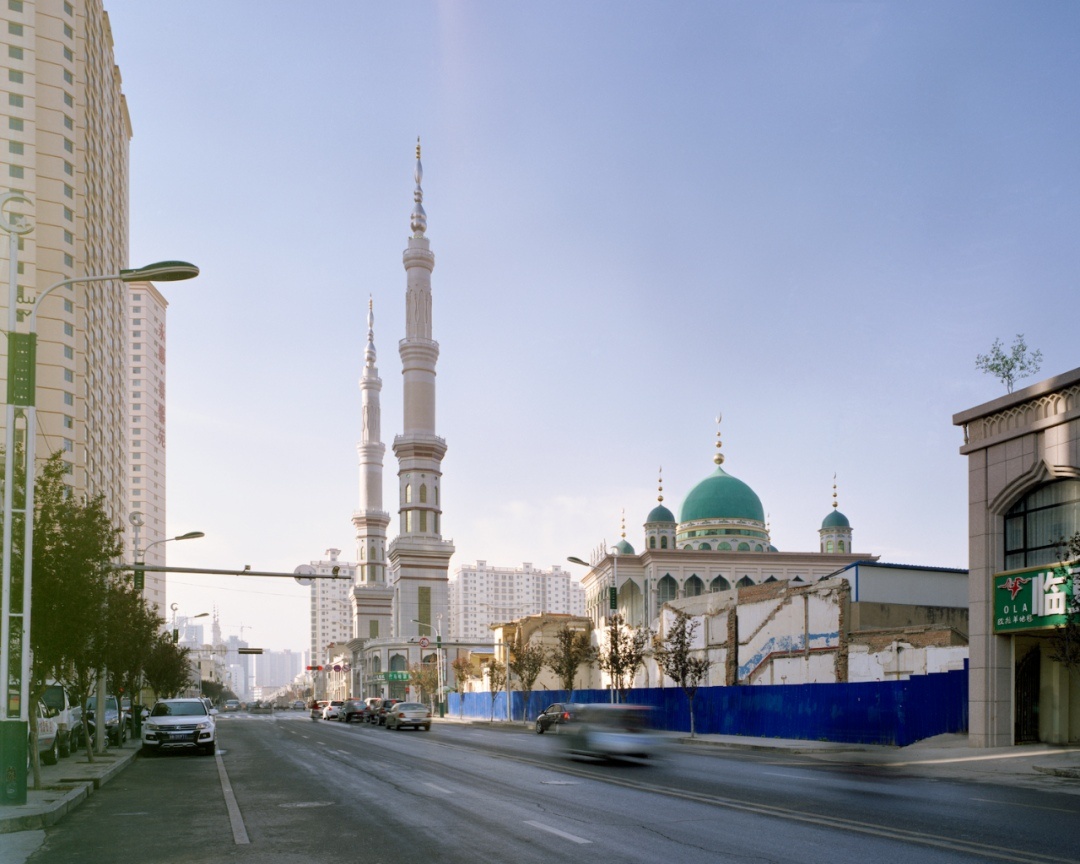
It wasn't until I stopped to check my photo again that I realized I had made a mistake. I quickly opened Gaode Maps to check the street layout. The old-style mosque I first spotted was the famous Tiejiasi Mosque, and I had mistakenly assumed it was the old Huasi Mosque. In reality, the old Huasi Mosque was further down the road. The two high towers in the middle were the minarets of Huasi, and whether you look from one end of the street or the other, those high minarets will always be the focal point of the scene.
At this moment, I couldn't find Zhang Yi and had no idea where he parked. You can park on both sides of the street, but even though he didn't listen to me about finding a proper spot, I noticed the 'No Parking' signs were quite clear. I hadn't paid them much mind initially, but as I walked toward the old Huasi Mosque, seeing car after car parked along the road made me realize: it was prayer time, so temporary parking on the street was completely acceptable.
Ikhwan (a major reformist movement in Chinese Islam) believers from all over were flooding into the mosque. Their dark blue long coats seemed to unify the believers, mostly middle-aged men in their 40s or 50s. Every now and then, an elderly man in a white or light gray robe would pass by, wearing a tasdeler (a traditional white turban), looking quite venerable—likely an Imam.
The Old Huasi Mosque sits right next to the New Huasi Mosque; this is the birthplace of the Huasi sect of Chinese Islam.
A street vendor selling oranges in front of the Huasi Mosque left his cart at the entrance and joined the men heading toward the main prayer hall for the start of the Dhuhr prayer. This area used to be called Huasi Street, and even the new residential complex across the street is named Huasi Mingdu.
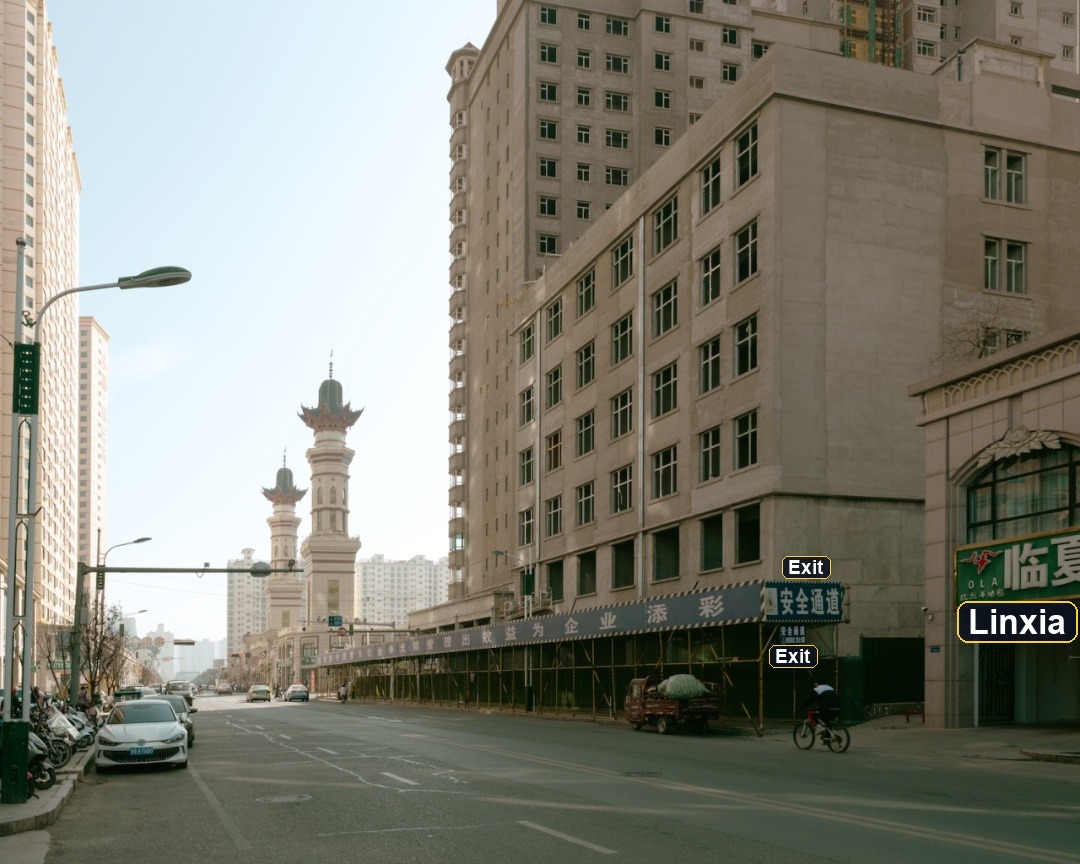
When I reached the other end of the street and crossed an intersection, I looked back. The scene finally matched my photos from eight years ago. I checked my phone again, confirmed the angle and position were correct, and started looking for the exact spot where I had taken the shot. After moving just 20 or 30 meters, I found the original location. Fortunately, most of the buildings on either side of the street remained the same. What shocked me, however, was a new, massive building being constructed on the right. The huge tower wasn't finished yet, but the main structure was there, with dark gray concrete covering everything and taking up half the frame. I compared the details again to refine the composition, only to realize that my perfect vantage point was currently occupied by a parked car. The driver was gone, and since the worshippers weren't likely to park there, I had no idea how long it would stay. I needed it to move; the car was sitting exactly where I needed to set up my tripod.
I waited, watching the light and meticulously studying the composition. The street hadn't changed much, but the details had shifted quietly. The star and crescent decorations on the street lamp poles were gone, replaced by stainless steel spheres like the ones on top of flagpoles. The Islamic pointed arch designs above the windows of the building on the right had vanished, replaced by new floral reliefs. Since the peony is the city flower of Linxia and the national flower of China, the peony patterns felt like a 'safe' choice—I suppose that was the intention. Even the halal sign in Arabic on the beef and mutton shop’s sign was gone, leaving only the Chinese characters for 'Halal.' These details are telling; Islamic identity is quietly shifting from the visible to the invisible.
Yu Li and Zhang Yi had gotten separated from me. I was in such a rush to catch the worshippers before the prayer began that I didn't get a chance to tell my companions. They must have assumed I was still shooting near where we got out of the car, never imagining I had sprinted from the south end of the street to the north. I decided to wait for the car's driver. A three-to-five-meter error in position would ruin the composition, and if the driver came back soon—after all, street parking is strictly prohibited here, so this must be temporary—plus, I had time to kill while waiting for my companions to catch up.
Next to me was a tiny yogurt shop. The yogurt, served in porcelain bowls, had a thick layer of yellow cream on top. A piece of glass covered each bowl, with another bowl stacked on top of it, creating a four-layer 'flower wall' of yogurt bowls displayed in a glass cabinet at the shop front. Both the display and the yogurt itself looked no different from what you'd find in Xining. Inside the refrigerated case, there were plastic-packaged versions that looked identical to the porcelain ones. The owner was a short, chubby man in his fifties. Like other men his age in Linxia, he wore a dark blue half-length coat and a white prayer cap. Judging by his sparse but clearly groomed beard, he was likely a follower of the Ikhwan movement, as Ikhwan followers keep beards, whereas the Khufiyya school does not.
'As-salamu alaykum,' I greeted the shopkeeper.
'Wa alaykum as-salam,' he replied. He had been watching me, and hearing me greet him in their way, he looked completely stunned. 'Where are you from?'
I told him I was here to photograph the mosques. He probably figured that out as soon as I reached his shop, but what he didn't know was that I had taken a photo here eight years ago, or that I had photographed many mosques throughout Linxia and the Hehuang Valley.
I showed him the next mosque I planned to visit on my phone and asked him which one it was.
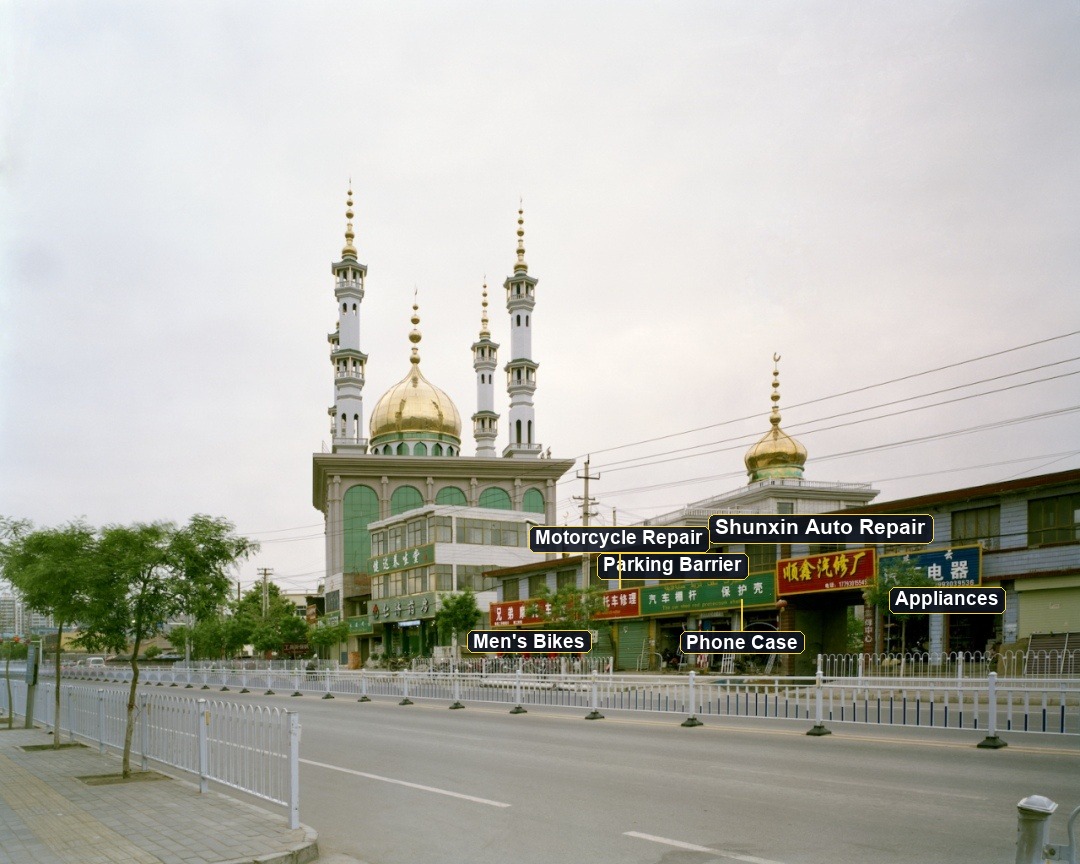
'Baijia Mosque,' he said, recognizing it immediately. 'But the top is gone now; they took it down,' he said, pointing to the dome in my photo. He gave a sheepish, awkward smile, almost as if he were responsible for the demolition himself.
'Baijia Mosque, Baijia?' I confirmed.
'That's right, Bai as in white tree (bai shu).'
'Oh, you mean Bai (cypress/cedar) with the wood radical?' I finally understood.
So that was it. I quickly searched for it on Gaode Maps, and there it was. Looking at its location, it was exactly the mosque I had been looking for. This was the first time I'd heard this name; for all these years, I had been labeling the mosque incorrectly.
The students (mulla) in the Old Huasi Mosque
2
The driver of the sedan and Yu Li appeared almost at the same time. As soon as the car pulled away, I quickly moved my tripod into position, terrified that someone else would take the spot.
The shoot went smoothly. When I packed up my camera, Zhang Yi arrived. He asked if Yu Li and I had gone to the Bafang Thirteen Alleys. I said no. That area is part of the old town of Linxia, a traditional Hui Muslim neighborhood. Even today, Hui communities in cities are often referred to as 'fangs.' A 'fang' usually centers around a specific mosque for worship—it's a spiritual anchor, but historically, it was also a comprehensive management system for the Hui people, covering clan ties, bloodlines, economy, and faith.
I didn't have time to leisurely explore the Bafang Thirteen Alleys. The photo assignment was far too urgent. Having lost a day or two giving a lecture at the Modern Photography Institute in Lanzhou, my schedule for Linxia and Xining was incredibly tight. I had no time for wandering through the old alleyways.
Zhang Yi parked the car in the New Huasi Mosque’s lot, and the three of us started walking back the way we came. The prayer service had ended, and the men in white prayer caps were slowly leaving their sanctuary. The owner of the orange cart had moved it right back to the front gate of the mosque, and the crowd of worshippers had to divert slightly around it as they dispersed in every direction.
'This is truly spectacular, so many people praying,' Zhang Yi marveled.
'It's Jumu'ah today, which is like Sunday for them, the day of the weekly congregational prayer—especially this noon session,' I explained to him.
'This is the headquarters of the Huasi school. You know that incident I told you about in Lanzhou, where Ma Mingxin was killed on the city gate? It didn't start because of a dispute between two sects, but rather because of this group,' I said, wondering if he remembered the tragic story of the Jahriyya sect's fight to protect their faith that I had shared with him.
The Huasi Mosque was originally called the 'Flower Mosque' (Huasi). This sect was founded during the Yongzheng reign and, along with the slightly later Jahriyya, became a major force that would shape the religious landscape of Chinese Islam for the next few hundred years.
I need to lay out a brief history of these two schools of thought and their founders. In the sixth year of the Yongzheng reign (1728 AD), there were two men from Linxia—one older, one younger—who set out for the Hajj in Mecca. At the time, Ma Laichi was 48 and already a renowned Akhund (religious leader), while Ma Mingxin was just a 10-year-old student. They both departed from Hezhou: Ma Laichi traveled via Guangzhou and Hong Kong by sea, while Ma Mingxin took the Silk Road through Xinjiang with his uncle. Their common destination was the Kaaba in Mecca.
Over the next few years, both men completed their Hajj and studied different teachings within the Shadhiliyya Sufi order in Yemen. By 1734, at age 54, Ma Laichi returned home, began teaching in the Xunhua area, and later spread the Jahriyya (a Sufi order) theology to the Tibetan regions of Hualong and Guide counties, becoming known as the Kaligang Tibetan-Hui Muslims. Ma Laichi became a famous Akhund in the Hehuang region.
Young Ma Mingxin studied in Yemen for 16 years and finally returned to Hezhou in the ninth year of the Qianlong reign (1744 AD) at age 26. He began teaching around Xunhua and gradually built his own following among the Salar people, who became the earliest followers of the Jahriyya order, including key figures like Su 43 and He Maluhu.
While Ma Mingxin lived in the Dashiguan area of Hezhou, he interacted frequently with Ma Laichi, discussing their teachings and philosophies together, and there was no conflict between them at the time.
In the 31st year of the Qianlong reign (1766 AD), Ma Laichi passed away in Hezhou at the age of 86. In his later years, he had handed religious authority to his son, Ma Guobao. Ma Mingxin questioned the legitimacy of this succession, arguing that it violated the principle of passing leadership to the virtuous rather than by hereditary right. This created a rift between the Jahriyya and the Huasi (Flower Mosque) factions as they competed for followers.
In 1762, the two leaders clashed during a Jumu'ah (Friday prayer) at the Zhangga Mosque in Xunhua. Ma Guobao subsequently reported Ma Mingxin to the authorities, labeling the Jahriyya a heretical sect. The government sided with the older Huasi faction, and under official pressure, both leaders were forced to leave Xunhua; Ma Guobao returned to Hezhou, while Ma Mingxin drifted to Dingxi.
In 1773, the Huasi leader Ma Guobao died of illness in Baotou at the young age of 36. His successor, the third leader known as Beichuan Taiye from Xining, didn't leave much of a religious legacy, but he was responsible for building the Huasi. In 1775, a Muslim from Xiguan in Hezhou donated his garden to the order and funded the construction of a mosque, naming it Huasi (Flower Mosque). It was later renamed to signify the 'Mosque of the Chinese land.' This was the predecessor to the current old Huasi.
In 1781 (the 46th year of the Qianlong reign), violent clashes broke out between the Jahriyya and Huasi factions in Xunhua. Soon after, the Jahriyya disciple Su 43 led the Salar people to attack Hezhou, turning a religious dispute into a bloody insurrection against the government. By March, the Salars had reached the gates of Lanzhou. The authorities managed to capture Ma Mingxin and bring him to Lanzhou, which led to the tragic events at the Old West Gate where the leader was executed, his followers retreated to Hualin Mountain, and after months of bitter fighting, they were completely wiped out. The Jahriyya movement in the Hehuang region fell with them.
The old Huasi mosque I see before me is the former Flower Mosque. The origins of its name are rather informal. There are two theories: first, it was built on a donated garden; second, its classical Chinese architectural style, with ornate, colorful carvings, was considered quite fancy. As for changing it from 'Flower' to the current 'Hua' (China), it sounds a bit forced.
The two towering minarets in the middle of my photo are part of the gatehouse of the old Huasi. I used to mistake them for the minarets of the nearby new Huasi. These towers are the centerpiece of this shot. Their original, soaring spires have been lowered significantly and are no longer pointed; the tops have been replaced with Chinese-style glazed tiles, making them look like strange, felt caps. The sharp blades that once pierced the sky have been dulled. Now, they look like defeated soldiers hiding their heads under green felt caps, seemingly full of shame.
On both sides of the main prayer hall are dormitories and classrooms for the students. The two-story height and the Arabian-style pointed arches between the pillars are well-preserved. However, there are huge slogans on the building: at the top are three-meter-high advertisement letters reading 'Unity, Mutual Aid, Harmony.' Hanging from the corridors of the first and second floors are three red banners with white text: 'All ethnic groups should embrace each other tightly like pomegranate seeds.' In front of this building, a five-star red flag flutters atop a tall stainless steel pole. On the corridor of the teaching building opposite it, which shares the same style, are two more red-and-white banners: 'The Chinese nation is one family, working together to build the Chinese dream' and 'Listen to the Party, appreciate the Party's grace, follow the Party, and promote a harmonious society.'
A break on Huasi Street
3
We walked against the flow of the crowd toward the center of the Huasi world. This massive reinforced concrete building has been fitted with a Chinese-style roof. Wooden decorative beams and brackets extend outward in layers, and the roof features dual-layered arched ridges with green glazed tiles, which break up the original, overly bulky roofline, making it appear more proportional. However, if you had visited a few years ago and examined it closely, you would notice that this roof is a recent modification; the original building was topped with three green, Arabian-style rounded domes.
Unlike the later Ikhwan school, the Sufi order does not reject Chinese elements in architecture. On the front of the main hall, there is a large couplet that reads: 'Broadly learn the scriptures and teachings to promote the doctrine; follow the righteous path to pass on peace.' Such couplets are very rare in the mosques of the Ikhwan and Salafiyya schools.
To enter the main hall, one must climb dozens of steps—it's essentially a full floor's height. Actually, the prayer hall is on the second floor. The mechanical act of climbing these dozens of stairs is a part of the religious ritual, the beginning of the purification process.
At the top of the stairs is the entrance to the hall. There are a few pairs of shoes on the white marble floor, as the worshipers haven't all left yet. I did not enter the prayer hall.
The LED display on the teaching building scrolls through the prayer times. According to the order shown, the content is as follows:
Prayer times for today
December 7, 2023 AD
(23rd day of the 5th month, 1445 AH)
Fajr (Morning Prayer) 06:47
Dhuhr (Noon Prayer) 13:03
Asr (Afternoon Prayer) 16:15
Maghrib (Evening Prayer) 17:57
Isha (Night Prayer) 19:09
The text in parentheses is in Persian; I used to think it was a phonetic guide for Arabic. The last line is a bit cut off, but that doesn't stop one from seeing the prayer times clearly. The minaret next to it has lost its original call-to-prayer function. In the long era before wristwatches, an Akhund had to climb to the top of the minaret and use a loud voice to remind the faithful. The invention of loudspeakers made this daily climbing easier, then came alarm clocks and watches. In the age of mobile internet, various apps and mini-programs have been created to provide reminders. The minaret long ago ended its original function and became a landmark of the mosque, a monument in the hearts of Muslims, a sword of resistance—yet now, the sword that once pierced the sky has been broken.
Standing at the top of the high stairs and looking down, the noon prayer of Jumu'ah has already finished. Many people participate in prayers in Linxia, especially the noon prayer on Jumu'ah, where almost every Muslim—at least all the men—goes to the mosque. In a community where Muslims are the majority, the practice of faith is a social act. At noon on Jumu'ah, a city or community dominated by Muslims heads to the mosque in unison, and all social activities pause to make way for faith. In such an environment, it would be unthinkable for a Muslim not to participate in prayer. There is a sense of mutual reminder and even supervision among everyone. This is the social nature of practicing Islam.
(To be continued)
Huasi in 2016
Huasi in 2023
Baijia Mosque in 2016
Baijia Mosque in 2023 view all
This is the fifth installment of my documentary photography series, 'The Vanishing Arch.' I headed into the bustling streets of Linxia, Gansu—a hub of Islamic culture in China—during the Jumu'ah (Friday congregational prayer) to explore how the function of minarets has shifted over time. By comparing rare, on-the-ground photos from 2016 and 2023 of the Huasi Mosque and the Baijia Mosque, I capture the enduring, vibrant spirit of religious life in Hezhou.
Minarets have effectively lost their original purpose as call-to-prayer towers. In the days before everyone carried a watch, the Imam would climb to the top of the tower and use his powerful voice to call the faithful to prayer. Later, loudspeakers made the climb unnecessary, followed by alarm clocks and wristwatches. In our mobile internet era, countless apps and mini-programs have emerged to handle the job. The minaret has moved past its functional roots to become a symbolic landmark of the mosque—a pillar of the Muslim spirit and a 'sword' that once pierced the sky, only to be dulled by the passage of time.
Words/Photos: Li Ming
5. Jumu'ah in Linxia
1
When I arrived in Linxia, it was just before the Dhuhr (noon) prayer on Jumu'ah. The sidewalks on both sides of Xinxilu were packed, with men heading toward a single destination: a mosque with traditional Chinese feiyan dougong (flying eaves and brackets) about 300 meters away. Looking down the street, I could see several mosques standing along the one-kilometer stretch. The view felt exactly like a scene I had photographed eight years ago, so I asked Zhang Yi to pull over. He hesitated, so I hopped out while he went off to find parking. I pulled up the photos from eight years ago on my phone to compare the architecture to what was in front of me. The changes were massive. The street was filled with new, towering buildings. A high tower in the distance seemed to be the one from my old photos, but its style had changed—a clear result of 'Sinicization.' I started hunting for the side of a house from my old photo, thinking it might be a building about 300 meters away that matched the color and style, so I started walking toward it.
However, as I got closer to that building and checked the photo again, some details didn't line up. The distance to the mid-ground was off, and there were so many strange new buildings in the way. I had no choice but to keep walking to close the gap between me and the tower.
It wasn't until I stopped to check my photo again that I realized I had made a mistake. I quickly opened Gaode Maps to check the street layout. The old-style mosque I first spotted was the famous Tiejiasi Mosque, and I had mistakenly assumed it was the old Huasi Mosque. In reality, the old Huasi Mosque was further down the road. The two high towers in the middle were the minarets of Huasi, and whether you look from one end of the street or the other, those high minarets will always be the focal point of the scene.
At this moment, I couldn't find Zhang Yi and had no idea where he parked. You can park on both sides of the street, but even though he didn't listen to me about finding a proper spot, I noticed the 'No Parking' signs were quite clear. I hadn't paid them much mind initially, but as I walked toward the old Huasi Mosque, seeing car after car parked along the road made me realize: it was prayer time, so temporary parking on the street was completely acceptable.
Ikhwan (a major reformist movement in Chinese Islam) believers from all over were flooding into the mosque. Their dark blue long coats seemed to unify the believers, mostly middle-aged men in their 40s or 50s. Every now and then, an elderly man in a white or light gray robe would pass by, wearing a tasdeler (a traditional white turban), looking quite venerable—likely an Imam.
The Old Huasi Mosque sits right next to the New Huasi Mosque; this is the birthplace of the Huasi sect of Chinese Islam.
A street vendor selling oranges in front of the Huasi Mosque left his cart at the entrance and joined the men heading toward the main prayer hall for the start of the Dhuhr prayer. This area used to be called Huasi Street, and even the new residential complex across the street is named Huasi Mingdu.
When I reached the other end of the street and crossed an intersection, I looked back. The scene finally matched my photos from eight years ago. I checked my phone again, confirmed the angle and position were correct, and started looking for the exact spot where I had taken the shot. After moving just 20 or 30 meters, I found the original location. Fortunately, most of the buildings on either side of the street remained the same. What shocked me, however, was a new, massive building being constructed on the right. The huge tower wasn't finished yet, but the main structure was there, with dark gray concrete covering everything and taking up half the frame. I compared the details again to refine the composition, only to realize that my perfect vantage point was currently occupied by a parked car. The driver was gone, and since the worshippers weren't likely to park there, I had no idea how long it would stay. I needed it to move; the car was sitting exactly where I needed to set up my tripod.
I waited, watching the light and meticulously studying the composition. The street hadn't changed much, but the details had shifted quietly. The star and crescent decorations on the street lamp poles were gone, replaced by stainless steel spheres like the ones on top of flagpoles. The Islamic pointed arch designs above the windows of the building on the right had vanished, replaced by new floral reliefs. Since the peony is the city flower of Linxia and the national flower of China, the peony patterns felt like a 'safe' choice—I suppose that was the intention. Even the halal sign in Arabic on the beef and mutton shop’s sign was gone, leaving only the Chinese characters for 'Halal.' These details are telling; Islamic identity is quietly shifting from the visible to the invisible.
Yu Li and Zhang Yi had gotten separated from me. I was in such a rush to catch the worshippers before the prayer began that I didn't get a chance to tell my companions. They must have assumed I was still shooting near where we got out of the car, never imagining I had sprinted from the south end of the street to the north. I decided to wait for the car's driver. A three-to-five-meter error in position would ruin the composition, and if the driver came back soon—after all, street parking is strictly prohibited here, so this must be temporary—plus, I had time to kill while waiting for my companions to catch up.
Next to me was a tiny yogurt shop. The yogurt, served in porcelain bowls, had a thick layer of yellow cream on top. A piece of glass covered each bowl, with another bowl stacked on top of it, creating a four-layer 'flower wall' of yogurt bowls displayed in a glass cabinet at the shop front. Both the display and the yogurt itself looked no different from what you'd find in Xining. Inside the refrigerated case, there were plastic-packaged versions that looked identical to the porcelain ones. The owner was a short, chubby man in his fifties. Like other men his age in Linxia, he wore a dark blue half-length coat and a white prayer cap. Judging by his sparse but clearly groomed beard, he was likely a follower of the Ikhwan movement, as Ikhwan followers keep beards, whereas the Khufiyya school does not.
'As-salamu alaykum,' I greeted the shopkeeper.
'Wa alaykum as-salam,' he replied. He had been watching me, and hearing me greet him in their way, he looked completely stunned. 'Where are you from?'
I told him I was here to photograph the mosques. He probably figured that out as soon as I reached his shop, but what he didn't know was that I had taken a photo here eight years ago, or that I had photographed many mosques throughout Linxia and the Hehuang Valley.
I showed him the next mosque I planned to visit on my phone and asked him which one it was.
'Baijia Mosque,' he said, recognizing it immediately. 'But the top is gone now; they took it down,' he said, pointing to the dome in my photo. He gave a sheepish, awkward smile, almost as if he were responsible for the demolition himself.
'Baijia Mosque, Baijia?' I confirmed.
'That's right, Bai as in white tree (bai shu).'
'Oh, you mean Bai (cypress/cedar) with the wood radical?' I finally understood.
So that was it. I quickly searched for it on Gaode Maps, and there it was. Looking at its location, it was exactly the mosque I had been looking for. This was the first time I'd heard this name; for all these years, I had been labeling the mosque incorrectly.

The students (mulla) in the Old Huasi Mosque
2
The driver of the sedan and Yu Li appeared almost at the same time. As soon as the car pulled away, I quickly moved my tripod into position, terrified that someone else would take the spot.
The shoot went smoothly. When I packed up my camera, Zhang Yi arrived. He asked if Yu Li and I had gone to the Bafang Thirteen Alleys. I said no. That area is part of the old town of Linxia, a traditional Hui Muslim neighborhood. Even today, Hui communities in cities are often referred to as 'fangs.' A 'fang' usually centers around a specific mosque for worship—it's a spiritual anchor, but historically, it was also a comprehensive management system for the Hui people, covering clan ties, bloodlines, economy, and faith.
I didn't have time to leisurely explore the Bafang Thirteen Alleys. The photo assignment was far too urgent. Having lost a day or two giving a lecture at the Modern Photography Institute in Lanzhou, my schedule for Linxia and Xining was incredibly tight. I had no time for wandering through the old alleyways.
Zhang Yi parked the car in the New Huasi Mosque’s lot, and the three of us started walking back the way we came. The prayer service had ended, and the men in white prayer caps were slowly leaving their sanctuary. The owner of the orange cart had moved it right back to the front gate of the mosque, and the crowd of worshippers had to divert slightly around it as they dispersed in every direction.
'This is truly spectacular, so many people praying,' Zhang Yi marveled.
'It's Jumu'ah today, which is like Sunday for them, the day of the weekly congregational prayer—especially this noon session,' I explained to him.
'This is the headquarters of the Huasi school. You know that incident I told you about in Lanzhou, where Ma Mingxin was killed on the city gate? It didn't start because of a dispute between two sects, but rather because of this group,' I said, wondering if he remembered the tragic story of the Jahriyya sect's fight to protect their faith that I had shared with him.
The Huasi Mosque was originally called the 'Flower Mosque' (Huasi). This sect was founded during the Yongzheng reign and, along with the slightly later Jahriyya, became a major force that would shape the religious landscape of Chinese Islam for the next few hundred years.
I need to lay out a brief history of these two schools of thought and their founders. In the sixth year of the Yongzheng reign (1728 AD), there were two men from Linxia—one older, one younger—who set out for the Hajj in Mecca. At the time, Ma Laichi was 48 and already a renowned Akhund (religious leader), while Ma Mingxin was just a 10-year-old student. They both departed from Hezhou: Ma Laichi traveled via Guangzhou and Hong Kong by sea, while Ma Mingxin took the Silk Road through Xinjiang with his uncle. Their common destination was the Kaaba in Mecca.
Over the next few years, both men completed their Hajj and studied different teachings within the Shadhiliyya Sufi order in Yemen. By 1734, at age 54, Ma Laichi returned home, began teaching in the Xunhua area, and later spread the Jahriyya (a Sufi order) theology to the Tibetan regions of Hualong and Guide counties, becoming known as the Kaligang Tibetan-Hui Muslims. Ma Laichi became a famous Akhund in the Hehuang region.
Young Ma Mingxin studied in Yemen for 16 years and finally returned to Hezhou in the ninth year of the Qianlong reign (1744 AD) at age 26. He began teaching around Xunhua and gradually built his own following among the Salar people, who became the earliest followers of the Jahriyya order, including key figures like Su 43 and He Maluhu.
While Ma Mingxin lived in the Dashiguan area of Hezhou, he interacted frequently with Ma Laichi, discussing their teachings and philosophies together, and there was no conflict between them at the time.
In the 31st year of the Qianlong reign (1766 AD), Ma Laichi passed away in Hezhou at the age of 86. In his later years, he had handed religious authority to his son, Ma Guobao. Ma Mingxin questioned the legitimacy of this succession, arguing that it violated the principle of passing leadership to the virtuous rather than by hereditary right. This created a rift between the Jahriyya and the Huasi (Flower Mosque) factions as they competed for followers.
In 1762, the two leaders clashed during a Jumu'ah (Friday prayer) at the Zhangga Mosque in Xunhua. Ma Guobao subsequently reported Ma Mingxin to the authorities, labeling the Jahriyya a heretical sect. The government sided with the older Huasi faction, and under official pressure, both leaders were forced to leave Xunhua; Ma Guobao returned to Hezhou, while Ma Mingxin drifted to Dingxi.
In 1773, the Huasi leader Ma Guobao died of illness in Baotou at the young age of 36. His successor, the third leader known as Beichuan Taiye from Xining, didn't leave much of a religious legacy, but he was responsible for building the Huasi. In 1775, a Muslim from Xiguan in Hezhou donated his garden to the order and funded the construction of a mosque, naming it Huasi (Flower Mosque). It was later renamed to signify the 'Mosque of the Chinese land.' This was the predecessor to the current old Huasi.
In 1781 (the 46th year of the Qianlong reign), violent clashes broke out between the Jahriyya and Huasi factions in Xunhua. Soon after, the Jahriyya disciple Su 43 led the Salar people to attack Hezhou, turning a religious dispute into a bloody insurrection against the government. By March, the Salars had reached the gates of Lanzhou. The authorities managed to capture Ma Mingxin and bring him to Lanzhou, which led to the tragic events at the Old West Gate where the leader was executed, his followers retreated to Hualin Mountain, and after months of bitter fighting, they were completely wiped out. The Jahriyya movement in the Hehuang region fell with them.
The old Huasi mosque I see before me is the former Flower Mosque. The origins of its name are rather informal. There are two theories: first, it was built on a donated garden; second, its classical Chinese architectural style, with ornate, colorful carvings, was considered quite fancy. As for changing it from 'Flower' to the current 'Hua' (China), it sounds a bit forced.
The two towering minarets in the middle of my photo are part of the gatehouse of the old Huasi. I used to mistake them for the minarets of the nearby new Huasi. These towers are the centerpiece of this shot. Their original, soaring spires have been lowered significantly and are no longer pointed; the tops have been replaced with Chinese-style glazed tiles, making them look like strange, felt caps. The sharp blades that once pierced the sky have been dulled. Now, they look like defeated soldiers hiding their heads under green felt caps, seemingly full of shame.
On both sides of the main prayer hall are dormitories and classrooms for the students. The two-story height and the Arabian-style pointed arches between the pillars are well-preserved. However, there are huge slogans on the building: at the top are three-meter-high advertisement letters reading 'Unity, Mutual Aid, Harmony.' Hanging from the corridors of the first and second floors are three red banners with white text: 'All ethnic groups should embrace each other tightly like pomegranate seeds.' In front of this building, a five-star red flag flutters atop a tall stainless steel pole. On the corridor of the teaching building opposite it, which shares the same style, are two more red-and-white banners: 'The Chinese nation is one family, working together to build the Chinese dream' and 'Listen to the Party, appreciate the Party's grace, follow the Party, and promote a harmonious society.'

A break on Huasi Street
3
We walked against the flow of the crowd toward the center of the Huasi world. This massive reinforced concrete building has been fitted with a Chinese-style roof. Wooden decorative beams and brackets extend outward in layers, and the roof features dual-layered arched ridges with green glazed tiles, which break up the original, overly bulky roofline, making it appear more proportional. However, if you had visited a few years ago and examined it closely, you would notice that this roof is a recent modification; the original building was topped with three green, Arabian-style rounded domes.
Unlike the later Ikhwan school, the Sufi order does not reject Chinese elements in architecture. On the front of the main hall, there is a large couplet that reads: 'Broadly learn the scriptures and teachings to promote the doctrine; follow the righteous path to pass on peace.' Such couplets are very rare in the mosques of the Ikhwan and Salafiyya schools.
To enter the main hall, one must climb dozens of steps—it's essentially a full floor's height. Actually, the prayer hall is on the second floor. The mechanical act of climbing these dozens of stairs is a part of the religious ritual, the beginning of the purification process.
At the top of the stairs is the entrance to the hall. There are a few pairs of shoes on the white marble floor, as the worshipers haven't all left yet. I did not enter the prayer hall.
The LED display on the teaching building scrolls through the prayer times. According to the order shown, the content is as follows:
Prayer times for today
December 7, 2023 AD
(23rd day of the 5th month, 1445 AH)
Fajr (Morning Prayer) 06:47
Dhuhr (Noon Prayer) 13:03
Asr (Afternoon Prayer) 16:15
Maghrib (Evening Prayer) 17:57
Isha (Night Prayer) 19:09
The text in parentheses is in Persian; I used to think it was a phonetic guide for Arabic. The last line is a bit cut off, but that doesn't stop one from seeing the prayer times clearly. The minaret next to it has lost its original call-to-prayer function. In the long era before wristwatches, an Akhund had to climb to the top of the minaret and use a loud voice to remind the faithful. The invention of loudspeakers made this daily climbing easier, then came alarm clocks and watches. In the age of mobile internet, various apps and mini-programs have been created to provide reminders. The minaret long ago ended its original function and became a landmark of the mosque, a monument in the hearts of Muslims, a sword of resistance—yet now, the sword that once pierced the sky has been broken.
Standing at the top of the high stairs and looking down, the noon prayer of Jumu'ah has already finished. Many people participate in prayers in Linxia, especially the noon prayer on Jumu'ah, where almost every Muslim—at least all the men—goes to the mosque. In a community where Muslims are the majority, the practice of faith is a social act. At noon on Jumu'ah, a city or community dominated by Muslims heads to the mosque in unison, and all social activities pause to make way for faith. In such an environment, it would be unthinkable for a Muslim not to participate in prayer. There is a sense of mutual reminder and even supervision among everyone. This is the social nature of practicing Islam.
(To be continued)
Huasi in 2016
Huasi in 2023
Baijia Mosque in 2016

Baijia Mosque in 2023
Minarets have effectively lost their original purpose as call-to-prayer towers. In the days before everyone carried a watch, the Imam would climb to the top of the tower and use his powerful voice to call the faithful to prayer. Later, loudspeakers made the climb unnecessary, followed by alarm clocks and wristwatches. In our mobile internet era, countless apps and mini-programs have emerged to handle the job. The minaret has moved past its functional roots to become a symbolic landmark of the mosque—a pillar of the Muslim spirit and a 'sword' that once pierced the sky, only to be dulled by the passage of time.
Words/Photos: Li Ming
5. Jumu'ah in Linxia
1
When I arrived in Linxia, it was just before the Dhuhr (noon) prayer on Jumu'ah. The sidewalks on both sides of Xinxilu were packed, with men heading toward a single destination: a mosque with traditional Chinese feiyan dougong (flying eaves and brackets) about 300 meters away. Looking down the street, I could see several mosques standing along the one-kilometer stretch. The view felt exactly like a scene I had photographed eight years ago, so I asked Zhang Yi to pull over. He hesitated, so I hopped out while he went off to find parking. I pulled up the photos from eight years ago on my phone to compare the architecture to what was in front of me. The changes were massive. The street was filled with new, towering buildings. A high tower in the distance seemed to be the one from my old photos, but its style had changed—a clear result of 'Sinicization.' I started hunting for the side of a house from my old photo, thinking it might be a building about 300 meters away that matched the color and style, so I started walking toward it.
However, as I got closer to that building and checked the photo again, some details didn't line up. The distance to the mid-ground was off, and there were so many strange new buildings in the way. I had no choice but to keep walking to close the gap between me and the tower.
It wasn't until I stopped to check my photo again that I realized I had made a mistake. I quickly opened Gaode Maps to check the street layout. The old-style mosque I first spotted was the famous Tiejiasi Mosque, and I had mistakenly assumed it was the old Huasi Mosque. In reality, the old Huasi Mosque was further down the road. The two high towers in the middle were the minarets of Huasi, and whether you look from one end of the street or the other, those high minarets will always be the focal point of the scene.
At this moment, I couldn't find Zhang Yi and had no idea where he parked. You can park on both sides of the street, but even though he didn't listen to me about finding a proper spot, I noticed the 'No Parking' signs were quite clear. I hadn't paid them much mind initially, but as I walked toward the old Huasi Mosque, seeing car after car parked along the road made me realize: it was prayer time, so temporary parking on the street was completely acceptable.
Ikhwan (a major reformist movement in Chinese Islam) believers from all over were flooding into the mosque. Their dark blue long coats seemed to unify the believers, mostly middle-aged men in their 40s or 50s. Every now and then, an elderly man in a white or light gray robe would pass by, wearing a tasdeler (a traditional white turban), looking quite venerable—likely an Imam.
The Old Huasi Mosque sits right next to the New Huasi Mosque; this is the birthplace of the Huasi sect of Chinese Islam.
A street vendor selling oranges in front of the Huasi Mosque left his cart at the entrance and joined the men heading toward the main prayer hall for the start of the Dhuhr prayer. This area used to be called Huasi Street, and even the new residential complex across the street is named Huasi Mingdu.
When I reached the other end of the street and crossed an intersection, I looked back. The scene finally matched my photos from eight years ago. I checked my phone again, confirmed the angle and position were correct, and started looking for the exact spot where I had taken the shot. After moving just 20 or 30 meters, I found the original location. Fortunately, most of the buildings on either side of the street remained the same. What shocked me, however, was a new, massive building being constructed on the right. The huge tower wasn't finished yet, but the main structure was there, with dark gray concrete covering everything and taking up half the frame. I compared the details again to refine the composition, only to realize that my perfect vantage point was currently occupied by a parked car. The driver was gone, and since the worshippers weren't likely to park there, I had no idea how long it would stay. I needed it to move; the car was sitting exactly where I needed to set up my tripod.
I waited, watching the light and meticulously studying the composition. The street hadn't changed much, but the details had shifted quietly. The star and crescent decorations on the street lamp poles were gone, replaced by stainless steel spheres like the ones on top of flagpoles. The Islamic pointed arch designs above the windows of the building on the right had vanished, replaced by new floral reliefs. Since the peony is the city flower of Linxia and the national flower of China, the peony patterns felt like a 'safe' choice—I suppose that was the intention. Even the halal sign in Arabic on the beef and mutton shop’s sign was gone, leaving only the Chinese characters for 'Halal.' These details are telling; Islamic identity is quietly shifting from the visible to the invisible.
Yu Li and Zhang Yi had gotten separated from me. I was in such a rush to catch the worshippers before the prayer began that I didn't get a chance to tell my companions. They must have assumed I was still shooting near where we got out of the car, never imagining I had sprinted from the south end of the street to the north. I decided to wait for the car's driver. A three-to-five-meter error in position would ruin the composition, and if the driver came back soon—after all, street parking is strictly prohibited here, so this must be temporary—plus, I had time to kill while waiting for my companions to catch up.
Next to me was a tiny yogurt shop. The yogurt, served in porcelain bowls, had a thick layer of yellow cream on top. A piece of glass covered each bowl, with another bowl stacked on top of it, creating a four-layer 'flower wall' of yogurt bowls displayed in a glass cabinet at the shop front. Both the display and the yogurt itself looked no different from what you'd find in Xining. Inside the refrigerated case, there were plastic-packaged versions that looked identical to the porcelain ones. The owner was a short, chubby man in his fifties. Like other men his age in Linxia, he wore a dark blue half-length coat and a white prayer cap. Judging by his sparse but clearly groomed beard, he was likely a follower of the Ikhwan movement, as Ikhwan followers keep beards, whereas the Khufiyya school does not.
'As-salamu alaykum,' I greeted the shopkeeper.
'Wa alaykum as-salam,' he replied. He had been watching me, and hearing me greet him in their way, he looked completely stunned. 'Where are you from?'
I told him I was here to photograph the mosques. He probably figured that out as soon as I reached his shop, but what he didn't know was that I had taken a photo here eight years ago, or that I had photographed many mosques throughout Linxia and the Hehuang Valley.
I showed him the next mosque I planned to visit on my phone and asked him which one it was.
'Baijia Mosque,' he said, recognizing it immediately. 'But the top is gone now; they took it down,' he said, pointing to the dome in my photo. He gave a sheepish, awkward smile, almost as if he were responsible for the demolition himself.
'Baijia Mosque, Baijia?' I confirmed.
'That's right, Bai as in white tree (bai shu).'
'Oh, you mean Bai (cypress/cedar) with the wood radical?' I finally understood.
So that was it. I quickly searched for it on Gaode Maps, and there it was. Looking at its location, it was exactly the mosque I had been looking for. This was the first time I'd heard this name; for all these years, I had been labeling the mosque incorrectly.
The students (mulla) in the Old Huasi Mosque
2
The driver of the sedan and Yu Li appeared almost at the same time. As soon as the car pulled away, I quickly moved my tripod into position, terrified that someone else would take the spot.
The shoot went smoothly. When I packed up my camera, Zhang Yi arrived. He asked if Yu Li and I had gone to the Bafang Thirteen Alleys. I said no. That area is part of the old town of Linxia, a traditional Hui Muslim neighborhood. Even today, Hui communities in cities are often referred to as 'fangs.' A 'fang' usually centers around a specific mosque for worship—it's a spiritual anchor, but historically, it was also a comprehensive management system for the Hui people, covering clan ties, bloodlines, economy, and faith.
I didn't have time to leisurely explore the Bafang Thirteen Alleys. The photo assignment was far too urgent. Having lost a day or two giving a lecture at the Modern Photography Institute in Lanzhou, my schedule for Linxia and Xining was incredibly tight. I had no time for wandering through the old alleyways.
Zhang Yi parked the car in the New Huasi Mosque’s lot, and the three of us started walking back the way we came. The prayer service had ended, and the men in white prayer caps were slowly leaving their sanctuary. The owner of the orange cart had moved it right back to the front gate of the mosque, and the crowd of worshippers had to divert slightly around it as they dispersed in every direction.
'This is truly spectacular, so many people praying,' Zhang Yi marveled.
'It's Jumu'ah today, which is like Sunday for them, the day of the weekly congregational prayer—especially this noon session,' I explained to him.
'This is the headquarters of the Huasi school. You know that incident I told you about in Lanzhou, where Ma Mingxin was killed on the city gate? It didn't start because of a dispute between two sects, but rather because of this group,' I said, wondering if he remembered the tragic story of the Jahriyya sect's fight to protect their faith that I had shared with him.
The Huasi Mosque was originally called the 'Flower Mosque' (Huasi). This sect was founded during the Yongzheng reign and, along with the slightly later Jahriyya, became a major force that would shape the religious landscape of Chinese Islam for the next few hundred years.
I need to lay out a brief history of these two schools of thought and their founders. In the sixth year of the Yongzheng reign (1728 AD), there were two men from Linxia—one older, one younger—who set out for the Hajj in Mecca. At the time, Ma Laichi was 48 and already a renowned Akhund (religious leader), while Ma Mingxin was just a 10-year-old student. They both departed from Hezhou: Ma Laichi traveled via Guangzhou and Hong Kong by sea, while Ma Mingxin took the Silk Road through Xinjiang with his uncle. Their common destination was the Kaaba in Mecca.
Over the next few years, both men completed their Hajj and studied different teachings within the Shadhiliyya Sufi order in Yemen. By 1734, at age 54, Ma Laichi returned home, began teaching in the Xunhua area, and later spread the Jahriyya (a Sufi order) theology to the Tibetan regions of Hualong and Guide counties, becoming known as the Kaligang Tibetan-Hui Muslims. Ma Laichi became a famous Akhund in the Hehuang region.
Young Ma Mingxin studied in Yemen for 16 years and finally returned to Hezhou in the ninth year of the Qianlong reign (1744 AD) at age 26. He began teaching around Xunhua and gradually built his own following among the Salar people, who became the earliest followers of the Jahriyya order, including key figures like Su 43 and He Maluhu.
While Ma Mingxin lived in the Dashiguan area of Hezhou, he interacted frequently with Ma Laichi, discussing their teachings and philosophies together, and there was no conflict between them at the time.
In the 31st year of the Qianlong reign (1766 AD), Ma Laichi passed away in Hezhou at the age of 86. In his later years, he had handed religious authority to his son, Ma Guobao. Ma Mingxin questioned the legitimacy of this succession, arguing that it violated the principle of passing leadership to the virtuous rather than by hereditary right. This created a rift between the Jahriyya and the Huasi (Flower Mosque) factions as they competed for followers.
In 1762, the two leaders clashed during a Jumu'ah (Friday prayer) at the Zhangga Mosque in Xunhua. Ma Guobao subsequently reported Ma Mingxin to the authorities, labeling the Jahriyya a heretical sect. The government sided with the older Huasi faction, and under official pressure, both leaders were forced to leave Xunhua; Ma Guobao returned to Hezhou, while Ma Mingxin drifted to Dingxi.
In 1773, the Huasi leader Ma Guobao died of illness in Baotou at the young age of 36. His successor, the third leader known as Beichuan Taiye from Xining, didn't leave much of a religious legacy, but he was responsible for building the Huasi. In 1775, a Muslim from Xiguan in Hezhou donated his garden to the order and funded the construction of a mosque, naming it Huasi (Flower Mosque). It was later renamed to signify the 'Mosque of the Chinese land.' This was the predecessor to the current old Huasi.
In 1781 (the 46th year of the Qianlong reign), violent clashes broke out between the Jahriyya and Huasi factions in Xunhua. Soon after, the Jahriyya disciple Su 43 led the Salar people to attack Hezhou, turning a religious dispute into a bloody insurrection against the government. By March, the Salars had reached the gates of Lanzhou. The authorities managed to capture Ma Mingxin and bring him to Lanzhou, which led to the tragic events at the Old West Gate where the leader was executed, his followers retreated to Hualin Mountain, and after months of bitter fighting, they were completely wiped out. The Jahriyya movement in the Hehuang region fell with them.
The old Huasi mosque I see before me is the former Flower Mosque. The origins of its name are rather informal. There are two theories: first, it was built on a donated garden; second, its classical Chinese architectural style, with ornate, colorful carvings, was considered quite fancy. As for changing it from 'Flower' to the current 'Hua' (China), it sounds a bit forced.
The two towering minarets in the middle of my photo are part of the gatehouse of the old Huasi. I used to mistake them for the minarets of the nearby new Huasi. These towers are the centerpiece of this shot. Their original, soaring spires have been lowered significantly and are no longer pointed; the tops have been replaced with Chinese-style glazed tiles, making them look like strange, felt caps. The sharp blades that once pierced the sky have been dulled. Now, they look like defeated soldiers hiding their heads under green felt caps, seemingly full of shame.
On both sides of the main prayer hall are dormitories and classrooms for the students. The two-story height and the Arabian-style pointed arches between the pillars are well-preserved. However, there are huge slogans on the building: at the top are three-meter-high advertisement letters reading 'Unity, Mutual Aid, Harmony.' Hanging from the corridors of the first and second floors are three red banners with white text: 'All ethnic groups should embrace each other tightly like pomegranate seeds.' In front of this building, a five-star red flag flutters atop a tall stainless steel pole. On the corridor of the teaching building opposite it, which shares the same style, are two more red-and-white banners: 'The Chinese nation is one family, working together to build the Chinese dream' and 'Listen to the Party, appreciate the Party's grace, follow the Party, and promote a harmonious society.'
A break on Huasi Street
3
We walked against the flow of the crowd toward the center of the Huasi world. This massive reinforced concrete building has been fitted with a Chinese-style roof. Wooden decorative beams and brackets extend outward in layers, and the roof features dual-layered arched ridges with green glazed tiles, which break up the original, overly bulky roofline, making it appear more proportional. However, if you had visited a few years ago and examined it closely, you would notice that this roof is a recent modification; the original building was topped with three green, Arabian-style rounded domes.
Unlike the later Ikhwan school, the Sufi order does not reject Chinese elements in architecture. On the front of the main hall, there is a large couplet that reads: 'Broadly learn the scriptures and teachings to promote the doctrine; follow the righteous path to pass on peace.' Such couplets are very rare in the mosques of the Ikhwan and Salafiyya schools.
To enter the main hall, one must climb dozens of steps—it's essentially a full floor's height. Actually, the prayer hall is on the second floor. The mechanical act of climbing these dozens of stairs is a part of the religious ritual, the beginning of the purification process.
At the top of the stairs is the entrance to the hall. There are a few pairs of shoes on the white marble floor, as the worshipers haven't all left yet. I did not enter the prayer hall.
The LED display on the teaching building scrolls through the prayer times. According to the order shown, the content is as follows:
Prayer times for today
December 7, 2023 AD
(23rd day of the 5th month, 1445 AH)
Fajr (Morning Prayer) 06:47
Dhuhr (Noon Prayer) 13:03
Asr (Afternoon Prayer) 16:15
Maghrib (Evening Prayer) 17:57
Isha (Night Prayer) 19:09
The text in parentheses is in Persian; I used to think it was a phonetic guide for Arabic. The last line is a bit cut off, but that doesn't stop one from seeing the prayer times clearly. The minaret next to it has lost its original call-to-prayer function. In the long era before wristwatches, an Akhund had to climb to the top of the minaret and use a loud voice to remind the faithful. The invention of loudspeakers made this daily climbing easier, then came alarm clocks and watches. In the age of mobile internet, various apps and mini-programs have been created to provide reminders. The minaret long ago ended its original function and became a landmark of the mosque, a monument in the hearts of Muslims, a sword of resistance—yet now, the sword that once pierced the sky has been broken.
Standing at the top of the high stairs and looking down, the noon prayer of Jumu'ah has already finished. Many people participate in prayers in Linxia, especially the noon prayer on Jumu'ah, where almost every Muslim—at least all the men—goes to the mosque. In a community where Muslims are the majority, the practice of faith is a social act. At noon on Jumu'ah, a city or community dominated by Muslims heads to the mosque in unison, and all social activities pause to make way for faith. In such an environment, it would be unthinkable for a Muslim not to participate in prayer. There is a sense of mutual reminder and even supervision among everyone. This is the social nature of practicing Islam.
(To be continued)
Huasi in 2016
Huasi in 2023
Baijia Mosque in 2016
Baijia Mosque in 2023
Exploring Linxia's Historic Mosques: A Documentary on Hui Muslim Architecture and Islamic Heritage in Gansu
Articles • Hasan09 posted the article • 0 comments • 10 views • 3 hours ago
This is the fifth installment of my documentary photography series, 'The Vanishing Arch.' I headed into the bustling streets of Linxia, Gansu—a hub of Islamic culture in China—during the Jumu'ah (Friday congregational prayer) to explore how the function of minarets has shifted over time. By comparing rare, on-the-ground photos from 2016 and 2023 of the Huasi Mosque and the Baijia Mosque, I capture the enduring, vibrant spirit of religious life in Hezhou.
Minarets have effectively lost their original purpose as call-to-prayer towers. In the days before everyone carried a watch, the Imam would climb to the top of the tower and use his powerful voice to call the faithful to prayer. Later, loudspeakers made the climb unnecessary, followed by alarm clocks and wristwatches. In our mobile internet era, countless apps and mini-programs have emerged to handle the job. The minaret has moved past its functional roots to become a symbolic landmark of the mosque—a pillar of the Muslim spirit and a 'sword' that once pierced the sky, only to be dulled by the passage of time.
Words/Photos: Li Ming
5. Jumu'ah in Linxia
1
When I arrived in Linxia, it was just before the Dhuhr (noon) prayer on Jumu'ah. The sidewalks on both sides of Xinxilu were packed, with men heading toward a single destination: a mosque with traditional Chinese feiyan dougong (flying eaves and brackets) about 300 meters away. Looking down the street, I could see several mosques standing along the one-kilometer stretch. The view felt exactly like a scene I had photographed eight years ago, so I asked Zhang Yi to pull over. He hesitated, so I hopped out while he went off to find parking. I pulled up the photos from eight years ago on my phone to compare the architecture to what was in front of me. The changes were massive. The street was filled with new, towering buildings. A high tower in the distance seemed to be the one from my old photos, but its style had changed—a clear result of 'Sinicization.' I started hunting for the side of a house from my old photo, thinking it might be a building about 300 meters away that matched the color and style, so I started walking toward it.
However, as I got closer to that building and checked the photo again, some details didn't line up. The distance to the mid-ground was off, and there were so many strange new buildings in the way. I had no choice but to keep walking to close the gap between me and the tower.
It wasn't until I stopped to check my photo again that I realized I had made a mistake. I quickly opened Gaode Maps to check the street layout. The old-style mosque I first spotted was the famous Tiejiasi Mosque, and I had mistakenly assumed it was the old Huasi Mosque. In reality, the old Huasi Mosque was further down the road. The two high towers in the middle were the minarets of Huasi, and whether you look from one end of the street or the other, those high minarets will always be the focal point of the scene.
At this moment, I couldn't find Zhang Yi and had no idea where he parked. You can park on both sides of the street, but even though he didn't listen to me about finding a proper spot, I noticed the 'No Parking' signs were quite clear. I hadn't paid them much mind initially, but as I walked toward the old Huasi Mosque, seeing car after car parked along the road made me realize: it was prayer time, so temporary parking on the street was completely acceptable.
Ikhwan (a major reformist movement in Chinese Islam) believers from all over were flooding into the mosque. Their dark blue long coats seemed to unify the believers, mostly middle-aged men in their 40s or 50s. Every now and then, an elderly man in a white or light gray robe would pass by, wearing a tasdeler (a traditional white turban), looking quite venerable—likely an Imam.
The Old Huasi Mosque sits right next to the New Huasi Mosque; this is the birthplace of the Huasi sect of Chinese Islam.
A street vendor selling oranges in front of the Huasi Mosque left his cart at the entrance and joined the men heading toward the main prayer hall for the start of the Dhuhr prayer. This area used to be called Huasi Street, and even the new residential complex across the street is named Huasi Mingdu.
When I reached the other end of the street and crossed an intersection, I looked back. The scene finally matched my photos from eight years ago. I checked my phone again, confirmed the angle and position were correct, and started looking for the exact spot where I had taken the shot. After moving just 20 or 30 meters, I found the original location. Fortunately, most of the buildings on either side of the street remained the same. What shocked me, however, was a new, massive building being constructed on the right. The huge tower wasn't finished yet, but the main structure was there, with dark gray concrete covering everything and taking up half the frame. I compared the details again to refine the composition, only to realize that my perfect vantage point was currently occupied by a parked car. The driver was gone, and since the worshippers weren't likely to park there, I had no idea how long it would stay. I needed it to move; the car was sitting exactly where I needed to set up my tripod.
I waited, watching the light and meticulously studying the composition. The street hadn't changed much, but the details had shifted quietly. The star and crescent decorations on the street lamp poles were gone, replaced by stainless steel spheres like the ones on top of flagpoles. The Islamic pointed arch designs above the windows of the building on the right had vanished, replaced by new floral reliefs. Since the peony is the city flower of Linxia and the national flower of China, the peony patterns felt like a 'safe' choice—I suppose that was the intention. Even the halal sign in Arabic on the beef and mutton shop’s sign was gone, leaving only the Chinese characters for 'Halal.' These details are telling; Islamic identity is quietly shifting from the visible to the invisible.
Yu Li and Zhang Yi had gotten separated from me. I was in such a rush to catch the worshippers before the prayer began that I didn't get a chance to tell my companions. They must have assumed I was still shooting near where we got out of the car, never imagining I had sprinted from the south end of the street to the north. I decided to wait for the car's driver. A three-to-five-meter error in position would ruin the composition, and if the driver came back soon—after all, street parking is strictly prohibited here, so this must be temporary—plus, I had time to kill while waiting for my companions to catch up.
Next to me was a tiny yogurt shop. The yogurt, served in porcelain bowls, had a thick layer of yellow cream on top. A piece of glass covered each bowl, with another bowl stacked on top of it, creating a four-layer 'flower wall' of yogurt bowls displayed in a glass cabinet at the shop front. Both the display and the yogurt itself looked no different from what you'd find in Xining. Inside the refrigerated case, there were plastic-packaged versions that looked identical to the porcelain ones. The owner was a short, chubby man in his fifties. Like other men his age in Linxia, he wore a dark blue half-length coat and a white prayer cap. Judging by his sparse but clearly groomed beard, he was likely a follower of the Ikhwan movement, as Ikhwan followers keep beards, whereas the Khufiyya school does not.
'As-salamu alaykum,' I greeted the shopkeeper.
'Wa alaykum as-salam,' he replied. He had been watching me, and hearing me greet him in their way, he looked completely stunned. 'Where are you from?'
I told him I was here to photograph the mosques. He probably figured that out as soon as I reached his shop, but what he didn't know was that I had taken a photo here eight years ago, or that I had photographed many mosques throughout Linxia and the Hehuang Valley.
I showed him the next mosque I planned to visit on my phone and asked him which one it was.
'Baijia Mosque,' he said, recognizing it immediately. 'But the top is gone now; they took it down,' he said, pointing to the dome in my photo. He gave a sheepish, awkward smile, almost as if he were responsible for the demolition himself.
'Baijia Mosque, Baijia?' I confirmed.
'That's right, Bai as in white tree (bai shu).'
'Oh, you mean Bai (cypress/cedar) with the wood radical?' I finally understood.
So that was it. I quickly searched for it on Gaode Maps, and there it was. Looking at its location, it was exactly the mosque I had been looking for. This was the first time I'd heard this name; for all these years, I had been labeling the mosque incorrectly.
The students (mulla) in the Old Huasi Mosque
2
The driver of the sedan and Yu Li appeared almost at the same time. As soon as the car pulled away, I quickly moved my tripod into position, terrified that someone else would take the spot.
The shoot went smoothly. When I packed up my camera, Zhang Yi arrived. He asked if Yu Li and I had gone to the Bafang Thirteen Alleys. I said no. That area is part of the old town of Linxia, a traditional Hui Muslim neighborhood. Even today, Hui communities in cities are often referred to as 'fangs.' A 'fang' usually centers around a specific mosque for worship—it's a spiritual anchor, but historically, it was also a comprehensive management system for the Hui people, covering clan ties, bloodlines, economy, and faith.
I didn't have time to leisurely explore the Bafang Thirteen Alleys. The photo assignment was far too urgent. Having lost a day or two giving a lecture at the Modern Photography Institute in Lanzhou, my schedule for Linxia and Xining was incredibly tight. I had no time for wandering through the old alleyways.
Zhang Yi parked the car in the New Huasi Mosque’s lot, and the three of us started walking back the way we came. The prayer service had ended, and the men in white prayer caps were slowly leaving their sanctuary. The owner of the orange cart had moved it right back to the front gate of the mosque, and the crowd of worshippers had to divert slightly around it as they dispersed in every direction.
'This is truly spectacular, so many people praying,' Zhang Yi marveled.
'It's Jumu'ah today, which is like Sunday for them, the day of the weekly congregational prayer—especially this noon session,' I explained to him.
'This is the headquarters of the Huasi school. You know that incident I told you about in Lanzhou, where Ma Mingxin was killed on the city gate? It didn't start because of a dispute between two sects, but rather because of this group,' I said, wondering if he remembered the tragic story of the Jahriyya sect's fight to protect their faith that I had shared with him.
The Huasi Mosque was originally called the 'Flower Mosque' (Huasi). This sect was founded during the Yongzheng reign and, along with the slightly later Jahriyya, became a major force that would shape the religious landscape of Chinese Islam for the next few hundred years.
I need to lay out a brief history of these two schools of thought and their founders. In the sixth year of the Yongzheng reign (1728 AD), there were two men from Linxia—one older, one younger—who set out for the Hajj in Mecca. At the time, Ma Laichi was 48 and already a renowned Akhund (religious leader), while Ma Mingxin was just a 10-year-old student. They both departed from Hezhou: Ma Laichi traveled via Guangzhou and Hong Kong by sea, while Ma Mingxin took the Silk Road through Xinjiang with his uncle. Their common destination was the Kaaba in Mecca.
Over the next few years, both men completed their Hajj and studied different teachings within the Shadhiliyya Sufi order in Yemen. By 1734, at age 54, Ma Laichi returned home, began teaching in the Xunhua area, and later spread the Jahriyya (a Sufi order) theology to the Tibetan regions of Hualong and Guide counties, becoming known as the Kaligang Tibetan-Hui Muslims. Ma Laichi became a famous Akhund in the Hehuang region.
Young Ma Mingxin studied in Yemen for 16 years and finally returned to Hezhou in the ninth year of the Qianlong reign (1744 AD) at age 26. He began teaching around Xunhua and gradually built his own following among the Salar people, who became the earliest followers of the Jahriyya order, including key figures like Su 43 and He Maluhu.
While Ma Mingxin lived in the Dashiguan area of Hezhou, he interacted frequently with Ma Laichi, discussing their teachings and philosophies together, and there was no conflict between them at the time.
In the 31st year of the Qianlong reign (1766 AD), Ma Laichi passed away in Hezhou at the age of 86. In his later years, he had handed religious authority to his son, Ma Guobao. Ma Mingxin questioned the legitimacy of this succession, arguing that it violated the principle of passing leadership to the virtuous rather than by hereditary right. This created a rift between the Jahriyya and the Huasi (Flower Mosque) factions as they competed for followers.
In 1762, the two leaders clashed during a Jumu'ah (Friday prayer) at the Zhangga Mosque in Xunhua. Ma Guobao subsequently reported Ma Mingxin to the authorities, labeling the Jahriyya a heretical sect. The government sided with the older Huasi faction, and under official pressure, both leaders were forced to leave Xunhua; Ma Guobao returned to Hezhou, while Ma Mingxin drifted to Dingxi.
In 1773, the Huasi leader Ma Guobao died of illness in Baotou at the young age of 36. His successor, the third leader known as Beichuan Taiye from Xining, didn't leave much of a religious legacy, but he was responsible for building the Huasi. In 1775, a Muslim from Xiguan in Hezhou donated his garden to the order and funded the construction of a mosque, naming it Huasi (Flower Mosque). It was later renamed to signify the 'Mosque of the Chinese land.' This was the predecessor to the current old Huasi.
In 1781 (the 46th year of the Qianlong reign), violent clashes broke out between the Jahriyya and Huasi factions in Xunhua. Soon after, the Jahriyya disciple Su 43 led the Salar people to attack Hezhou, turning a religious dispute into a bloody insurrection against the government. By March, the Salars had reached the gates of Lanzhou. The authorities managed to capture Ma Mingxin and bring him to Lanzhou, which led to the tragic events at the Old West Gate where the leader was executed, his followers retreated to Hualin Mountain, and after months of bitter fighting, they were completely wiped out. The Jahriyya movement in the Hehuang region fell with them.
The old Huasi mosque I see before me is the former Flower Mosque. The origins of its name are rather informal. There are two theories: first, it was built on a donated garden; second, its classical Chinese architectural style, with ornate, colorful carvings, was considered quite fancy. As for changing it from 'Flower' to the current 'Hua' (China), it sounds a bit forced.
The two towering minarets in the middle of my photo are part of the gatehouse of the old Huasi. I used to mistake them for the minarets of the nearby new Huasi. These towers are the centerpiece of this shot. Their original, soaring spires have been lowered significantly and are no longer pointed; the tops have been replaced with Chinese-style glazed tiles, making them look like strange, felt caps. The sharp blades that once pierced the sky have been dulled. Now, they look like defeated soldiers hiding their heads under green felt caps, seemingly full of shame.
On both sides of the main prayer hall are dormitories and classrooms for the students. The two-story height and the Arabian-style pointed arches between the pillars are well-preserved. However, there are huge slogans on the building: at the top are three-meter-high advertisement letters reading 'Unity, Mutual Aid, Harmony.' Hanging from the corridors of the first and second floors are three red banners with white text: 'All ethnic groups should embrace each other tightly like pomegranate seeds.' In front of this building, a five-star red flag flutters atop a tall stainless steel pole. On the corridor of the teaching building opposite it, which shares the same style, are two more red-and-white banners: 'The Chinese nation is one family, working together to build the Chinese dream' and 'Listen to the Party, appreciate the Party's grace, follow the Party, and promote a harmonious society.'
A break on Huasi Street
3
We walked against the flow of the crowd toward the center of the Huasi world. This massive reinforced concrete building has been fitted with a Chinese-style roof. Wooden decorative beams and brackets extend outward in layers, and the roof features dual-layered arched ridges with green glazed tiles, which break up the original, overly bulky roofline, making it appear more proportional. However, if you had visited a few years ago and examined it closely, you would notice that this roof is a recent modification; the original building was topped with three green, Arabian-style rounded domes.
Unlike the later Ikhwan school, the Sufi order does not reject Chinese elements in architecture. On the front of the main hall, there is a large couplet that reads: 'Broadly learn the scriptures and teachings to promote the doctrine; follow the righteous path to pass on peace.' Such couplets are very rare in the mosques of the Ikhwan and Salafiyya schools.
To enter the main hall, one must climb dozens of steps—it's essentially a full floor's height. Actually, the prayer hall is on the second floor. The mechanical act of climbing these dozens of stairs is a part of the religious ritual, the beginning of the purification process.
At the top of the stairs is the entrance to the hall. There are a few pairs of shoes on the white marble floor, as the worshipers haven't all left yet. I did not enter the prayer hall.
The LED display on the teaching building scrolls through the prayer times. According to the order shown, the content is as follows:
Prayer times for today
December 7, 2023 AD
(23rd day of the 5th month, 1445 AH)
Fajr (Morning Prayer) 06:47
Dhuhr (Noon Prayer) 13:03
Asr (Afternoon Prayer) 16:15
Maghrib (Evening Prayer) 17:57
Isha (Night Prayer) 19:09
The text in parentheses is in Persian; I used to think it was a phonetic guide for Arabic. The last line is a bit cut off, but that doesn't stop one from seeing the prayer times clearly. The minaret next to it has lost its original call-to-prayer function. In the long era before wristwatches, an Akhund had to climb to the top of the minaret and use a loud voice to remind the faithful. The invention of loudspeakers made this daily climbing easier, then came alarm clocks and watches. In the age of mobile internet, various apps and mini-programs have been created to provide reminders. The minaret long ago ended its original function and became a landmark of the mosque, a monument in the hearts of Muslims, a sword of resistance—yet now, the sword that once pierced the sky has been broken.
Standing at the top of the high stairs and looking down, the noon prayer of Jumu'ah has already finished. Many people participate in prayers in Linxia, especially the noon prayer on Jumu'ah, where almost every Muslim—at least all the men—goes to the mosque. In a community where Muslims are the majority, the practice of faith is a social act. At noon on Jumu'ah, a city or community dominated by Muslims heads to the mosque in unison, and all social activities pause to make way for faith. In such an environment, it would be unthinkable for a Muslim not to participate in prayer. There is a sense of mutual reminder and even supervision among everyone. This is the social nature of practicing Islam.
(To be continued)
Huasi in 2016
Huasi in 2023
Baijia Mosque in 2016
Baijia Mosque in 2023 view all
Minarets have effectively lost their original purpose as call-to-prayer towers. In the days before everyone carried a watch, the Imam would climb to the top of the tower and use his powerful voice to call the faithful to prayer. Later, loudspeakers made the climb unnecessary, followed by alarm clocks and wristwatches. In our mobile internet era, countless apps and mini-programs have emerged to handle the job. The minaret has moved past its functional roots to become a symbolic landmark of the mosque—a pillar of the Muslim spirit and a 'sword' that once pierced the sky, only to be dulled by the passage of time.
Words/Photos: Li Ming
5. Jumu'ah in Linxia
1
When I arrived in Linxia, it was just before the Dhuhr (noon) prayer on Jumu'ah. The sidewalks on both sides of Xinxilu were packed, with men heading toward a single destination: a mosque with traditional Chinese feiyan dougong (flying eaves and brackets) about 300 meters away. Looking down the street, I could see several mosques standing along the one-kilometer stretch. The view felt exactly like a scene I had photographed eight years ago, so I asked Zhang Yi to pull over. He hesitated, so I hopped out while he went off to find parking. I pulled up the photos from eight years ago on my phone to compare the architecture to what was in front of me. The changes were massive. The street was filled with new, towering buildings. A high tower in the distance seemed to be the one from my old photos, but its style had changed—a clear result of 'Sinicization.' I started hunting for the side of a house from my old photo, thinking it might be a building about 300 meters away that matched the color and style, so I started walking toward it.
However, as I got closer to that building and checked the photo again, some details didn't line up. The distance to the mid-ground was off, and there were so many strange new buildings in the way. I had no choice but to keep walking to close the gap between me and the tower.
It wasn't until I stopped to check my photo again that I realized I had made a mistake. I quickly opened Gaode Maps to check the street layout. The old-style mosque I first spotted was the famous Tiejiasi Mosque, and I had mistakenly assumed it was the old Huasi Mosque. In reality, the old Huasi Mosque was further down the road. The two high towers in the middle were the minarets of Huasi, and whether you look from one end of the street or the other, those high minarets will always be the focal point of the scene.
At this moment, I couldn't find Zhang Yi and had no idea where he parked. You can park on both sides of the street, but even though he didn't listen to me about finding a proper spot, I noticed the 'No Parking' signs were quite clear. I hadn't paid them much mind initially, but as I walked toward the old Huasi Mosque, seeing car after car parked along the road made me realize: it was prayer time, so temporary parking on the street was completely acceptable.
Ikhwan (a major reformist movement in Chinese Islam) believers from all over were flooding into the mosque. Their dark blue long coats seemed to unify the believers, mostly middle-aged men in their 40s or 50s. Every now and then, an elderly man in a white or light gray robe would pass by, wearing a tasdeler (a traditional white turban), looking quite venerable—likely an Imam.
The Old Huasi Mosque sits right next to the New Huasi Mosque; this is the birthplace of the Huasi sect of Chinese Islam.
A street vendor selling oranges in front of the Huasi Mosque left his cart at the entrance and joined the men heading toward the main prayer hall for the start of the Dhuhr prayer. This area used to be called Huasi Street, and even the new residential complex across the street is named Huasi Mingdu.
When I reached the other end of the street and crossed an intersection, I looked back. The scene finally matched my photos from eight years ago. I checked my phone again, confirmed the angle and position were correct, and started looking for the exact spot where I had taken the shot. After moving just 20 or 30 meters, I found the original location. Fortunately, most of the buildings on either side of the street remained the same. What shocked me, however, was a new, massive building being constructed on the right. The huge tower wasn't finished yet, but the main structure was there, with dark gray concrete covering everything and taking up half the frame. I compared the details again to refine the composition, only to realize that my perfect vantage point was currently occupied by a parked car. The driver was gone, and since the worshippers weren't likely to park there, I had no idea how long it would stay. I needed it to move; the car was sitting exactly where I needed to set up my tripod.
I waited, watching the light and meticulously studying the composition. The street hadn't changed much, but the details had shifted quietly. The star and crescent decorations on the street lamp poles were gone, replaced by stainless steel spheres like the ones on top of flagpoles. The Islamic pointed arch designs above the windows of the building on the right had vanished, replaced by new floral reliefs. Since the peony is the city flower of Linxia and the national flower of China, the peony patterns felt like a 'safe' choice—I suppose that was the intention. Even the halal sign in Arabic on the beef and mutton shop’s sign was gone, leaving only the Chinese characters for 'Halal.' These details are telling; Islamic identity is quietly shifting from the visible to the invisible.
Yu Li and Zhang Yi had gotten separated from me. I was in such a rush to catch the worshippers before the prayer began that I didn't get a chance to tell my companions. They must have assumed I was still shooting near where we got out of the car, never imagining I had sprinted from the south end of the street to the north. I decided to wait for the car's driver. A three-to-five-meter error in position would ruin the composition, and if the driver came back soon—after all, street parking is strictly prohibited here, so this must be temporary—plus, I had time to kill while waiting for my companions to catch up.
Next to me was a tiny yogurt shop. The yogurt, served in porcelain bowls, had a thick layer of yellow cream on top. A piece of glass covered each bowl, with another bowl stacked on top of it, creating a four-layer 'flower wall' of yogurt bowls displayed in a glass cabinet at the shop front. Both the display and the yogurt itself looked no different from what you'd find in Xining. Inside the refrigerated case, there were plastic-packaged versions that looked identical to the porcelain ones. The owner was a short, chubby man in his fifties. Like other men his age in Linxia, he wore a dark blue half-length coat and a white prayer cap. Judging by his sparse but clearly groomed beard, he was likely a follower of the Ikhwan movement, as Ikhwan followers keep beards, whereas the Khufiyya school does not.
'As-salamu alaykum,' I greeted the shopkeeper.
'Wa alaykum as-salam,' he replied. He had been watching me, and hearing me greet him in their way, he looked completely stunned. 'Where are you from?'
I told him I was here to photograph the mosques. He probably figured that out as soon as I reached his shop, but what he didn't know was that I had taken a photo here eight years ago, or that I had photographed many mosques throughout Linxia and the Hehuang Valley.
I showed him the next mosque I planned to visit on my phone and asked him which one it was.
'Baijia Mosque,' he said, recognizing it immediately. 'But the top is gone now; they took it down,' he said, pointing to the dome in my photo. He gave a sheepish, awkward smile, almost as if he were responsible for the demolition himself.
'Baijia Mosque, Baijia?' I confirmed.
'That's right, Bai as in white tree (bai shu).'
'Oh, you mean Bai (cypress/cedar) with the wood radical?' I finally understood.
So that was it. I quickly searched for it on Gaode Maps, and there it was. Looking at its location, it was exactly the mosque I had been looking for. This was the first time I'd heard this name; for all these years, I had been labeling the mosque incorrectly.
The students (mulla) in the Old Huasi Mosque
2
The driver of the sedan and Yu Li appeared almost at the same time. As soon as the car pulled away, I quickly moved my tripod into position, terrified that someone else would take the spot.
The shoot went smoothly. When I packed up my camera, Zhang Yi arrived. He asked if Yu Li and I had gone to the Bafang Thirteen Alleys. I said no. That area is part of the old town of Linxia, a traditional Hui Muslim neighborhood. Even today, Hui communities in cities are often referred to as 'fangs.' A 'fang' usually centers around a specific mosque for worship—it's a spiritual anchor, but historically, it was also a comprehensive management system for the Hui people, covering clan ties, bloodlines, economy, and faith.
I didn't have time to leisurely explore the Bafang Thirteen Alleys. The photo assignment was far too urgent. Having lost a day or two giving a lecture at the Modern Photography Institute in Lanzhou, my schedule for Linxia and Xining was incredibly tight. I had no time for wandering through the old alleyways.
Zhang Yi parked the car in the New Huasi Mosque’s lot, and the three of us started walking back the way we came. The prayer service had ended, and the men in white prayer caps were slowly leaving their sanctuary. The owner of the orange cart had moved it right back to the front gate of the mosque, and the crowd of worshippers had to divert slightly around it as they dispersed in every direction.
'This is truly spectacular, so many people praying,' Zhang Yi marveled.
'It's Jumu'ah today, which is like Sunday for them, the day of the weekly congregational prayer—especially this noon session,' I explained to him.
'This is the headquarters of the Huasi school. You know that incident I told you about in Lanzhou, where Ma Mingxin was killed on the city gate? It didn't start because of a dispute between two sects, but rather because of this group,' I said, wondering if he remembered the tragic story of the Jahriyya sect's fight to protect their faith that I had shared with him.
The Huasi Mosque was originally called the 'Flower Mosque' (Huasi). This sect was founded during the Yongzheng reign and, along with the slightly later Jahriyya, became a major force that would shape the religious landscape of Chinese Islam for the next few hundred years.
I need to lay out a brief history of these two schools of thought and their founders. In the sixth year of the Yongzheng reign (1728 AD), there were two men from Linxia—one older, one younger—who set out for the Hajj in Mecca. At the time, Ma Laichi was 48 and already a renowned Akhund (religious leader), while Ma Mingxin was just a 10-year-old student. They both departed from Hezhou: Ma Laichi traveled via Guangzhou and Hong Kong by sea, while Ma Mingxin took the Silk Road through Xinjiang with his uncle. Their common destination was the Kaaba in Mecca.
Over the next few years, both men completed their Hajj and studied different teachings within the Shadhiliyya Sufi order in Yemen. By 1734, at age 54, Ma Laichi returned home, began teaching in the Xunhua area, and later spread the Jahriyya (a Sufi order) theology to the Tibetan regions of Hualong and Guide counties, becoming known as the Kaligang Tibetan-Hui Muslims. Ma Laichi became a famous Akhund in the Hehuang region.
Young Ma Mingxin studied in Yemen for 16 years and finally returned to Hezhou in the ninth year of the Qianlong reign (1744 AD) at age 26. He began teaching around Xunhua and gradually built his own following among the Salar people, who became the earliest followers of the Jahriyya order, including key figures like Su 43 and He Maluhu.
While Ma Mingxin lived in the Dashiguan area of Hezhou, he interacted frequently with Ma Laichi, discussing their teachings and philosophies together, and there was no conflict between them at the time.
In the 31st year of the Qianlong reign (1766 AD), Ma Laichi passed away in Hezhou at the age of 86. In his later years, he had handed religious authority to his son, Ma Guobao. Ma Mingxin questioned the legitimacy of this succession, arguing that it violated the principle of passing leadership to the virtuous rather than by hereditary right. This created a rift between the Jahriyya and the Huasi (Flower Mosque) factions as they competed for followers.
In 1762, the two leaders clashed during a Jumu'ah (Friday prayer) at the Zhangga Mosque in Xunhua. Ma Guobao subsequently reported Ma Mingxin to the authorities, labeling the Jahriyya a heretical sect. The government sided with the older Huasi faction, and under official pressure, both leaders were forced to leave Xunhua; Ma Guobao returned to Hezhou, while Ma Mingxin drifted to Dingxi.
In 1773, the Huasi leader Ma Guobao died of illness in Baotou at the young age of 36. His successor, the third leader known as Beichuan Taiye from Xining, didn't leave much of a religious legacy, but he was responsible for building the Huasi. In 1775, a Muslim from Xiguan in Hezhou donated his garden to the order and funded the construction of a mosque, naming it Huasi (Flower Mosque). It was later renamed to signify the 'Mosque of the Chinese land.' This was the predecessor to the current old Huasi.
In 1781 (the 46th year of the Qianlong reign), violent clashes broke out between the Jahriyya and Huasi factions in Xunhua. Soon after, the Jahriyya disciple Su 43 led the Salar people to attack Hezhou, turning a religious dispute into a bloody insurrection against the government. By March, the Salars had reached the gates of Lanzhou. The authorities managed to capture Ma Mingxin and bring him to Lanzhou, which led to the tragic events at the Old West Gate where the leader was executed, his followers retreated to Hualin Mountain, and after months of bitter fighting, they were completely wiped out. The Jahriyya movement in the Hehuang region fell with them.
The old Huasi mosque I see before me is the former Flower Mosque. The origins of its name are rather informal. There are two theories: first, it was built on a donated garden; second, its classical Chinese architectural style, with ornate, colorful carvings, was considered quite fancy. As for changing it from 'Flower' to the current 'Hua' (China), it sounds a bit forced.
The two towering minarets in the middle of my photo are part of the gatehouse of the old Huasi. I used to mistake them for the minarets of the nearby new Huasi. These towers are the centerpiece of this shot. Their original, soaring spires have been lowered significantly and are no longer pointed; the tops have been replaced with Chinese-style glazed tiles, making them look like strange, felt caps. The sharp blades that once pierced the sky have been dulled. Now, they look like defeated soldiers hiding their heads under green felt caps, seemingly full of shame.
On both sides of the main prayer hall are dormitories and classrooms for the students. The two-story height and the Arabian-style pointed arches between the pillars are well-preserved. However, there are huge slogans on the building: at the top are three-meter-high advertisement letters reading 'Unity, Mutual Aid, Harmony.' Hanging from the corridors of the first and second floors are three red banners with white text: 'All ethnic groups should embrace each other tightly like pomegranate seeds.' In front of this building, a five-star red flag flutters atop a tall stainless steel pole. On the corridor of the teaching building opposite it, which shares the same style, are two more red-and-white banners: 'The Chinese nation is one family, working together to build the Chinese dream' and 'Listen to the Party, appreciate the Party's grace, follow the Party, and promote a harmonious society.'
A break on Huasi Street
3
We walked against the flow of the crowd toward the center of the Huasi world. This massive reinforced concrete building has been fitted with a Chinese-style roof. Wooden decorative beams and brackets extend outward in layers, and the roof features dual-layered arched ridges with green glazed tiles, which break up the original, overly bulky roofline, making it appear more proportional. However, if you had visited a few years ago and examined it closely, you would notice that this roof is a recent modification; the original building was topped with three green, Arabian-style rounded domes.
Unlike the later Ikhwan school, the Sufi order does not reject Chinese elements in architecture. On the front of the main hall, there is a large couplet that reads: 'Broadly learn the scriptures and teachings to promote the doctrine; follow the righteous path to pass on peace.' Such couplets are very rare in the mosques of the Ikhwan and Salafiyya schools.
To enter the main hall, one must climb dozens of steps—it's essentially a full floor's height. Actually, the prayer hall is on the second floor. The mechanical act of climbing these dozens of stairs is a part of the religious ritual, the beginning of the purification process.
At the top of the stairs is the entrance to the hall. There are a few pairs of shoes on the white marble floor, as the worshipers haven't all left yet. I did not enter the prayer hall.
The LED display on the teaching building scrolls through the prayer times. According to the order shown, the content is as follows:
Prayer times for today
December 7, 2023 AD
(23rd day of the 5th month, 1445 AH)
Fajr (Morning Prayer) 06:47
Dhuhr (Noon Prayer) 13:03
Asr (Afternoon Prayer) 16:15
Maghrib (Evening Prayer) 17:57
Isha (Night Prayer) 19:09
The text in parentheses is in Persian; I used to think it was a phonetic guide for Arabic. The last line is a bit cut off, but that doesn't stop one from seeing the prayer times clearly. The minaret next to it has lost its original call-to-prayer function. In the long era before wristwatches, an Akhund had to climb to the top of the minaret and use a loud voice to remind the faithful. The invention of loudspeakers made this daily climbing easier, then came alarm clocks and watches. In the age of mobile internet, various apps and mini-programs have been created to provide reminders. The minaret long ago ended its original function and became a landmark of the mosque, a monument in the hearts of Muslims, a sword of resistance—yet now, the sword that once pierced the sky has been broken.
Standing at the top of the high stairs and looking down, the noon prayer of Jumu'ah has already finished. Many people participate in prayers in Linxia, especially the noon prayer on Jumu'ah, where almost every Muslim—at least all the men—goes to the mosque. In a community where Muslims are the majority, the practice of faith is a social act. At noon on Jumu'ah, a city or community dominated by Muslims heads to the mosque in unison, and all social activities pause to make way for faith. In such an environment, it would be unthinkable for a Muslim not to participate in prayer. There is a sense of mutual reminder and even supervision among everyone. This is the social nature of practicing Islam.
(To be continued)
Huasi in 2016
Huasi in 2023
Baijia Mosque in 2016
Baijia Mosque in 2023 view all
This is the fifth installment of my documentary photography series, 'The Vanishing Arch.' I headed into the bustling streets of Linxia, Gansu—a hub of Islamic culture in China—during the Jumu'ah (Friday congregational prayer) to explore how the function of minarets has shifted over time. By comparing rare, on-the-ground photos from 2016 and 2023 of the Huasi Mosque and the Baijia Mosque, I capture the enduring, vibrant spirit of religious life in Hezhou.
Minarets have effectively lost their original purpose as call-to-prayer towers. In the days before everyone carried a watch, the Imam would climb to the top of the tower and use his powerful voice to call the faithful to prayer. Later, loudspeakers made the climb unnecessary, followed by alarm clocks and wristwatches. In our mobile internet era, countless apps and mini-programs have emerged to handle the job. The minaret has moved past its functional roots to become a symbolic landmark of the mosque—a pillar of the Muslim spirit and a 'sword' that once pierced the sky, only to be dulled by the passage of time.
Words/Photos: Li Ming
5. Jumu'ah in Linxia
1
When I arrived in Linxia, it was just before the Dhuhr (noon) prayer on Jumu'ah. The sidewalks on both sides of Xinxilu were packed, with men heading toward a single destination: a mosque with traditional Chinese feiyan dougong (flying eaves and brackets) about 300 meters away. Looking down the street, I could see several mosques standing along the one-kilometer stretch. The view felt exactly like a scene I had photographed eight years ago, so I asked Zhang Yi to pull over. He hesitated, so I hopped out while he went off to find parking. I pulled up the photos from eight years ago on my phone to compare the architecture to what was in front of me. The changes were massive. The street was filled with new, towering buildings. A high tower in the distance seemed to be the one from my old photos, but its style had changed—a clear result of 'Sinicization.' I started hunting for the side of a house from my old photo, thinking it might be a building about 300 meters away that matched the color and style, so I started walking toward it.
However, as I got closer to that building and checked the photo again, some details didn't line up. The distance to the mid-ground was off, and there were so many strange new buildings in the way. I had no choice but to keep walking to close the gap between me and the tower.
It wasn't until I stopped to check my photo again that I realized I had made a mistake. I quickly opened Gaode Maps to check the street layout. The old-style mosque I first spotted was the famous Tiejiasi Mosque, and I had mistakenly assumed it was the old Huasi Mosque. In reality, the old Huasi Mosque was further down the road. The two high towers in the middle were the minarets of Huasi, and whether you look from one end of the street or the other, those high minarets will always be the focal point of the scene.
At this moment, I couldn't find Zhang Yi and had no idea where he parked. You can park on both sides of the street, but even though he didn't listen to me about finding a proper spot, I noticed the 'No Parking' signs were quite clear. I hadn't paid them much mind initially, but as I walked toward the old Huasi Mosque, seeing car after car parked along the road made me realize: it was prayer time, so temporary parking on the street was completely acceptable.
Ikhwan (a major reformist movement in Chinese Islam) believers from all over were flooding into the mosque. Their dark blue long coats seemed to unify the believers, mostly middle-aged men in their 40s or 50s. Every now and then, an elderly man in a white or light gray robe would pass by, wearing a tasdeler (a traditional white turban), looking quite venerable—likely an Imam.
The Old Huasi Mosque sits right next to the New Huasi Mosque; this is the birthplace of the Huasi sect of Chinese Islam.
A street vendor selling oranges in front of the Huasi Mosque left his cart at the entrance and joined the men heading toward the main prayer hall for the start of the Dhuhr prayer. This area used to be called Huasi Street, and even the new residential complex across the street is named Huasi Mingdu.
When I reached the other end of the street and crossed an intersection, I looked back. The scene finally matched my photos from eight years ago. I checked my phone again, confirmed the angle and position were correct, and started looking for the exact spot where I had taken the shot. After moving just 20 or 30 meters, I found the original location. Fortunately, most of the buildings on either side of the street remained the same. What shocked me, however, was a new, massive building being constructed on the right. The huge tower wasn't finished yet, but the main structure was there, with dark gray concrete covering everything and taking up half the frame. I compared the details again to refine the composition, only to realize that my perfect vantage point was currently occupied by a parked car. The driver was gone, and since the worshippers weren't likely to park there, I had no idea how long it would stay. I needed it to move; the car was sitting exactly where I needed to set up my tripod.
I waited, watching the light and meticulously studying the composition. The street hadn't changed much, but the details had shifted quietly. The star and crescent decorations on the street lamp poles were gone, replaced by stainless steel spheres like the ones on top of flagpoles. The Islamic pointed arch designs above the windows of the building on the right had vanished, replaced by new floral reliefs. Since the peony is the city flower of Linxia and the national flower of China, the peony patterns felt like a 'safe' choice—I suppose that was the intention. Even the halal sign in Arabic on the beef and mutton shop’s sign was gone, leaving only the Chinese characters for 'Halal.' These details are telling; Islamic identity is quietly shifting from the visible to the invisible.
Yu Li and Zhang Yi had gotten separated from me. I was in such a rush to catch the worshippers before the prayer began that I didn't get a chance to tell my companions. They must have assumed I was still shooting near where we got out of the car, never imagining I had sprinted from the south end of the street to the north. I decided to wait for the car's driver. A three-to-five-meter error in position would ruin the composition, and if the driver came back soon—after all, street parking is strictly prohibited here, so this must be temporary—plus, I had time to kill while waiting for my companions to catch up.
Next to me was a tiny yogurt shop. The yogurt, served in porcelain bowls, had a thick layer of yellow cream on top. A piece of glass covered each bowl, with another bowl stacked on top of it, creating a four-layer 'flower wall' of yogurt bowls displayed in a glass cabinet at the shop front. Both the display and the yogurt itself looked no different from what you'd find in Xining. Inside the refrigerated case, there were plastic-packaged versions that looked identical to the porcelain ones. The owner was a short, chubby man in his fifties. Like other men his age in Linxia, he wore a dark blue half-length coat and a white prayer cap. Judging by his sparse but clearly groomed beard, he was likely a follower of the Ikhwan movement, as Ikhwan followers keep beards, whereas the Khufiyya school does not.
'As-salamu alaykum,' I greeted the shopkeeper.
'Wa alaykum as-salam,' he replied. He had been watching me, and hearing me greet him in their way, he looked completely stunned. 'Where are you from?'
I told him I was here to photograph the mosques. He probably figured that out as soon as I reached his shop, but what he didn't know was that I had taken a photo here eight years ago, or that I had photographed many mosques throughout Linxia and the Hehuang Valley.
I showed him the next mosque I planned to visit on my phone and asked him which one it was.
'Baijia Mosque,' he said, recognizing it immediately. 'But the top is gone now; they took it down,' he said, pointing to the dome in my photo. He gave a sheepish, awkward smile, almost as if he were responsible for the demolition himself.
'Baijia Mosque, Baijia?' I confirmed.
'That's right, Bai as in white tree (bai shu).'
'Oh, you mean Bai (cypress/cedar) with the wood radical?' I finally understood.
So that was it. I quickly searched for it on Gaode Maps, and there it was. Looking at its location, it was exactly the mosque I had been looking for. This was the first time I'd heard this name; for all these years, I had been labeling the mosque incorrectly.
The students (mulla) in the Old Huasi Mosque
2
The driver of the sedan and Yu Li appeared almost at the same time. As soon as the car pulled away, I quickly moved my tripod into position, terrified that someone else would take the spot.
The shoot went smoothly. When I packed up my camera, Zhang Yi arrived. He asked if Yu Li and I had gone to the Bafang Thirteen Alleys. I said no. That area is part of the old town of Linxia, a traditional Hui Muslim neighborhood. Even today, Hui communities in cities are often referred to as 'fangs.' A 'fang' usually centers around a specific mosque for worship—it's a spiritual anchor, but historically, it was also a comprehensive management system for the Hui people, covering clan ties, bloodlines, economy, and faith.
I didn't have time to leisurely explore the Bafang Thirteen Alleys. The photo assignment was far too urgent. Having lost a day or two giving a lecture at the Modern Photography Institute in Lanzhou, my schedule for Linxia and Xining was incredibly tight. I had no time for wandering through the old alleyways.
Zhang Yi parked the car in the New Huasi Mosque’s lot, and the three of us started walking back the way we came. The prayer service had ended, and the men in white prayer caps were slowly leaving their sanctuary. The owner of the orange cart had moved it right back to the front gate of the mosque, and the crowd of worshippers had to divert slightly around it as they dispersed in every direction.
'This is truly spectacular, so many people praying,' Zhang Yi marveled.
'It's Jumu'ah today, which is like Sunday for them, the day of the weekly congregational prayer—especially this noon session,' I explained to him.
'This is the headquarters of the Huasi school. You know that incident I told you about in Lanzhou, where Ma Mingxin was killed on the city gate? It didn't start because of a dispute between two sects, but rather because of this group,' I said, wondering if he remembered the tragic story of the Jahriyya sect's fight to protect their faith that I had shared with him.
The Huasi Mosque was originally called the 'Flower Mosque' (Huasi). This sect was founded during the Yongzheng reign and, along with the slightly later Jahriyya, became a major force that would shape the religious landscape of Chinese Islam for the next few hundred years.
I need to lay out a brief history of these two schools of thought and their founders. In the sixth year of the Yongzheng reign (1728 AD), there were two men from Linxia—one older, one younger—who set out for the Hajj in Mecca. At the time, Ma Laichi was 48 and already a renowned Akhund (religious leader), while Ma Mingxin was just a 10-year-old student. They both departed from Hezhou: Ma Laichi traveled via Guangzhou and Hong Kong by sea, while Ma Mingxin took the Silk Road through Xinjiang with his uncle. Their common destination was the Kaaba in Mecca.
Over the next few years, both men completed their Hajj and studied different teachings within the Shadhiliyya Sufi order in Yemen. By 1734, at age 54, Ma Laichi returned home, began teaching in the Xunhua area, and later spread the Jahriyya (a Sufi order) theology to the Tibetan regions of Hualong and Guide counties, becoming known as the Kaligang Tibetan-Hui Muslims. Ma Laichi became a famous Akhund in the Hehuang region.
Young Ma Mingxin studied in Yemen for 16 years and finally returned to Hezhou in the ninth year of the Qianlong reign (1744 AD) at age 26. He began teaching around Xunhua and gradually built his own following among the Salar people, who became the earliest followers of the Jahriyya order, including key figures like Su 43 and He Maluhu.
While Ma Mingxin lived in the Dashiguan area of Hezhou, he interacted frequently with Ma Laichi, discussing their teachings and philosophies together, and there was no conflict between them at the time.
In the 31st year of the Qianlong reign (1766 AD), Ma Laichi passed away in Hezhou at the age of 86. In his later years, he had handed religious authority to his son, Ma Guobao. Ma Mingxin questioned the legitimacy of this succession, arguing that it violated the principle of passing leadership to the virtuous rather than by hereditary right. This created a rift between the Jahriyya and the Huasi (Flower Mosque) factions as they competed for followers.
In 1762, the two leaders clashed during a Jumu'ah (Friday prayer) at the Zhangga Mosque in Xunhua. Ma Guobao subsequently reported Ma Mingxin to the authorities, labeling the Jahriyya a heretical sect. The government sided with the older Huasi faction, and under official pressure, both leaders were forced to leave Xunhua; Ma Guobao returned to Hezhou, while Ma Mingxin drifted to Dingxi.
In 1773, the Huasi leader Ma Guobao died of illness in Baotou at the young age of 36. His successor, the third leader known as Beichuan Taiye from Xining, didn't leave much of a religious legacy, but he was responsible for building the Huasi. In 1775, a Muslim from Xiguan in Hezhou donated his garden to the order and funded the construction of a mosque, naming it Huasi (Flower Mosque). It was later renamed to signify the 'Mosque of the Chinese land.' This was the predecessor to the current old Huasi.
In 1781 (the 46th year of the Qianlong reign), violent clashes broke out between the Jahriyya and Huasi factions in Xunhua. Soon after, the Jahriyya disciple Su 43 led the Salar people to attack Hezhou, turning a religious dispute into a bloody insurrection against the government. By March, the Salars had reached the gates of Lanzhou. The authorities managed to capture Ma Mingxin and bring him to Lanzhou, which led to the tragic events at the Old West Gate where the leader was executed, his followers retreated to Hualin Mountain, and after months of bitter fighting, they were completely wiped out. The Jahriyya movement in the Hehuang region fell with them.
The old Huasi mosque I see before me is the former Flower Mosque. The origins of its name are rather informal. There are two theories: first, it was built on a donated garden; second, its classical Chinese architectural style, with ornate, colorful carvings, was considered quite fancy. As for changing it from 'Flower' to the current 'Hua' (China), it sounds a bit forced.
The two towering minarets in the middle of my photo are part of the gatehouse of the old Huasi. I used to mistake them for the minarets of the nearby new Huasi. These towers are the centerpiece of this shot. Their original, soaring spires have been lowered significantly and are no longer pointed; the tops have been replaced with Chinese-style glazed tiles, making them look like strange, felt caps. The sharp blades that once pierced the sky have been dulled. Now, they look like defeated soldiers hiding their heads under green felt caps, seemingly full of shame.
On both sides of the main prayer hall are dormitories and classrooms for the students. The two-story height and the Arabian-style pointed arches between the pillars are well-preserved. However, there are huge slogans on the building: at the top are three-meter-high advertisement letters reading 'Unity, Mutual Aid, Harmony.' Hanging from the corridors of the first and second floors are three red banners with white text: 'All ethnic groups should embrace each other tightly like pomegranate seeds.' In front of this building, a five-star red flag flutters atop a tall stainless steel pole. On the corridor of the teaching building opposite it, which shares the same style, are two more red-and-white banners: 'The Chinese nation is one family, working together to build the Chinese dream' and 'Listen to the Party, appreciate the Party's grace, follow the Party, and promote a harmonious society.'
A break on Huasi Street
3
We walked against the flow of the crowd toward the center of the Huasi world. This massive reinforced concrete building has been fitted with a Chinese-style roof. Wooden decorative beams and brackets extend outward in layers, and the roof features dual-layered arched ridges with green glazed tiles, which break up the original, overly bulky roofline, making it appear more proportional. However, if you had visited a few years ago and examined it closely, you would notice that this roof is a recent modification; the original building was topped with three green, Arabian-style rounded domes.
Unlike the later Ikhwan school, the Sufi order does not reject Chinese elements in architecture. On the front of the main hall, there is a large couplet that reads: 'Broadly learn the scriptures and teachings to promote the doctrine; follow the righteous path to pass on peace.' Such couplets are very rare in the mosques of the Ikhwan and Salafiyya schools.
To enter the main hall, one must climb dozens of steps—it's essentially a full floor's height. Actually, the prayer hall is on the second floor. The mechanical act of climbing these dozens of stairs is a part of the religious ritual, the beginning of the purification process.
At the top of the stairs is the entrance to the hall. There are a few pairs of shoes on the white marble floor, as the worshipers haven't all left yet. I did not enter the prayer hall.
The LED display on the teaching building scrolls through the prayer times. According to the order shown, the content is as follows:
Prayer times for today
December 7, 2023 AD
(23rd day of the 5th month, 1445 AH)
Fajr (Morning Prayer) 06:47
Dhuhr (Noon Prayer) 13:03
Asr (Afternoon Prayer) 16:15
Maghrib (Evening Prayer) 17:57
Isha (Night Prayer) 19:09
The text in parentheses is in Persian; I used to think it was a phonetic guide for Arabic. The last line is a bit cut off, but that doesn't stop one from seeing the prayer times clearly. The minaret next to it has lost its original call-to-prayer function. In the long era before wristwatches, an Akhund had to climb to the top of the minaret and use a loud voice to remind the faithful. The invention of loudspeakers made this daily climbing easier, then came alarm clocks and watches. In the age of mobile internet, various apps and mini-programs have been created to provide reminders. The minaret long ago ended its original function and became a landmark of the mosque, a monument in the hearts of Muslims, a sword of resistance—yet now, the sword that once pierced the sky has been broken.
Standing at the top of the high stairs and looking down, the noon prayer of Jumu'ah has already finished. Many people participate in prayers in Linxia, especially the noon prayer on Jumu'ah, where almost every Muslim—at least all the men—goes to the mosque. In a community where Muslims are the majority, the practice of faith is a social act. At noon on Jumu'ah, a city or community dominated by Muslims heads to the mosque in unison, and all social activities pause to make way for faith. In such an environment, it would be unthinkable for a Muslim not to participate in prayer. There is a sense of mutual reminder and even supervision among everyone. This is the social nature of practicing Islam.
(To be continued)
Huasi in 2016
Huasi in 2023
Baijia Mosque in 2016
Baijia Mosque in 2023