

Muslim Knowledge
Muslim Knowledge Guide China: Is Riba the Same as Interest in Islamic Finance or Is There No Consensus
Articles • yusuf908 posted the article • 0 comments • 156 views • 2026-05-24 00:17
Summary: This Muslim knowledge guide translates and reviews Dr. Mohammad Omar Farooq's discussion of whether riba is the same as interest, why Islamic finance scholars disagree, and why the article argues that there is no true consensus equating all interest with riba.
This is one of a series of articles where I translate foreign scholars' questions about so-called Islamic finance. I will share more works from time to time. These articles show that scholars have never reached a consensus on whether interest is the same as usury. The discussions are deep and thought-provoking.
This is a repost of an old article. The original was deleted, so I have edited the content.: The Riba-Interest Equivalence: Is there a consensus?
Author: Dr. Mohammad Omar Farooq is an associate professor of economics and finance at the University of Bahrain and teaches in the Islamic banking department. He served as the director of the Islamic finance center at the Bahrain Institute of Banking and Finance. Before that, he lived in the United States for 20 years, worked as a postdoctoral researcher at the University of California, Berkeley, and taught at Upper Iowa University. He is also a member of the technical working group for the Accounting and Auditing Organization for Islamic Financial Institutions (AAOIFI).
Main text:
One academic view defines usury as any profit made without a transfer of value. This includes not only interest but also transactions involving speculation, capital gains, monopolies, hoarding, and rent-free land.
Islamic banking is different from traditional interest-based banking. It is based on the Islamic claim that interest is forbidden. Of course, usury is clearly and indisputably forbidden.
There is absolutely no dispute regarding certain types of forbidden usury. Since this article does not need to explain every relevant Islamic term in detail, I will note here that interest is classified as either Riba al-nasia (interest on deferred payments) or Riba al-fadl (interest related to the exchange of goods, especially in barter trade). The latter was added mainly based on the Hadith.
In modern jurisprudence, the scope of Riba has expanded to include all forms of interest, such as high or low rates, nominal or real, and simple or compound. Riba al-fadl has also been extended to more than six types of goods based on qiyas (analogical deduction).
However, Ibn Abbas, a main companion of the Prophet and an early Islamic jurist, along with a few other companions like Usama ibn Zayd, Abdullah ibn Masud, Urwa ibn al-Zubayr, and Zayd ibn Arqam, believed the only illegal riba was riba al-jahiliyyah, which is a form of riba an-nasia [Saleh, p. 27]. The orthodox position popular today is the opposite of this record.
What is usury and what is its scope? Are interest and usury exactly the same, or is one stricter? Another word is riba. Is bank interest specifically usury? Traditional texts from the same school of thought equate riba with interest in general [Ahmed, p. 28], using the two terms interchangeably. When explaining why usury is forbidden, the literature addresses the reasons for forbidding interest, assuming the two are exactly the same.
Advocates of the Islamic banking and finance movement often claim there is a consensus that usury is the same as interest. In this article, we examine the truth and validity of this claim. In other words, the subject of this article is not whether interest is forbidden, but whether a consensus exists that usury is equal to interest.
Consensus—is the claim that interest equals usury true?
The question of whether interest is usury is important beyond just academic discussion or debate. In fact, there is a tendency to claim the debate is already over, or that there is no room for further argument. Here are some examples.
The general consensus among scholars is clearly that there is no difference between riba and interest. [Muhammad Arif]
Islamic law does not allow usury, and economists now generally believe that riba is not limited to usury but also includes interest. [Chiara Segrado, "Islamic Microfinance and Socially Responsible Investments", August 2005]
The famous scholar Dr. Yusuf al-Qaradawi believes the issue of banning interest is settled. He says there is no rule that allows any reformer to reinterpret it or find an excuse to claim otherwise. He points out that this is a matter that has passed the test of consensus among the Ummah, both today and in the past. [Syed Tanveer Ahmed. Attempts to defend interest are in vain,]
Jurists and economic experts agree that interest is the same as what is called usury in Islamic law, and it is strongly condemned. [Mabid Ali al-Jarhi and Munawar Iqbal. Islamic Banking: Answers to Some Common Questions, Islamic Development Bank, Occasional Paper No. 4, 2001.
Historically, all schools of thought have consistently recognized that riba and interest are the same. Based on this consensus, the Islamic Fiqh Academy of the Organization of Islamic Cooperation (OIC) recently issued a ruling in its Resolution No. 10 (10/2) supporting the historical consensus on the prohibition of interest. [Iqbal and Molyneux, page 9; IFC/2000]
Riba (usury), or bank interest if you prefer, is forbidden by the texts of the Quran and Sunnah. This is the conclusion reached by all jurists. [Nyazee, page 1]
Scholars established an academic consensus that both types of riba are not allowed, which ended any debate. [Zuhayli, Abdulkader Thomas, page 29]
The ban on riba al-nasia basically means Islamic law does not allow a predetermined positive return on a loan as a reward for waiting. In this sense, according to the consensus of all jurists, usury has the same meaning and significance as the modern concept of interest. It makes no difference whether a loan is for personal consumption or business purposes, or whether the loan is provided or accepted by a commercial bank.
Discussions about economics and finance are full of this kind of pious and absolutist language. However, the reality is not like this, and claiming a consensus exists is a common practice among scholars. The concept of consensus or unanimous agreement can only be viewed from a factual level, regardless of whether this consensus exists or has existed. The use of the word consensus itself inspires awe in believers because, according to the principles of jurisprudence, the concept of consensus carries the idea of religious infallibility and is therefore binding; opposing it might lead to being cast out by the orthodox.
While a detailed explanation of the concept of consensus in legal discourse is not the focus of this article and cannot be covered here, the question of whether there is a consensus on equating usury with interest—which would mean Islam forbids interest—requires a basic understanding of consensus. On one hand, ordinary Muslims easily misunderstand these issues and get misled. On the other hand, if we do not recognize and address the reality of the nature and problems of the concept of consensus from the start, then other pious scholars or even experts might distort these issues. To fully explain the doctrine of consensus, I encourage readers to read my book, Towards Our Reformation: From Legalism to Value-Oriented Law and Jurisprudence, published by the International Institute of Islamic Thought in 2011, specifically the chapter titled The Doctrine of Consensus: Is There a Consensus? This chapter covers the doctrine of consensus.
When it comes to consensus, people run into doctrinal problems right from the start. There is no consensus on the definition of consensus. Some define it as the consensus of the companions of the Prophet. Others define it as the consensus of scholars. Still others define it as the consensus of the entire world. Some believe consensus is reached through active participation, while others think silence in the face of any dissenting voice is acceptable. While some think consensus is binding on contemporary people, others believe that once a consensus is achieved, it is inviolable and binding forever.
By the 3rd and 4th centuries of the Hijri calendar, several orthodox schools of thought emerged, and each school had a broad consensus within itself. However, the existence of multiple schools of jurisprudence is not evidence of consensus, but rather evidence of a lack of consensus.
If you flip through The Hedaya (translated by Charles Hamilton, Darul Ishaat, Karachi, 1989), one of the main texts of Hanafi law, you can pick almost any topic at random. You can then see if the three elders of the Hanafi school—Imam Abu Hanifa and his two students, Imam Abu Yusuf and Imam Muhammad—agree on most of the issues covered in the book. The reality is that no matter which definition you choose—the consensus of the companions, the scholars, or the entire Ummah—there are not actually many topics or issues where a consensus exists.
This is not to suggest or assert that consensus has not played a vital role in history, or that it has no role at all. Instead, this is to help people clearly realize that one neither needs nor should claim the sanctity of a concept when that concept simply does not have such recognized sanctity. as explained in the chapter on consensus [Farooq, 2010], except for a few broad and basic issues, there is almost nothing that can reach a consensus. Therefore, one needs to be cautious when accepting any claim that there is a consensus on something.
In fact, it is reported that Imam Hanbali, the founder of one of the four orthodox schools, made a cautionary assertion: Anyone who claims there is a consensus is a liar.
The position that this interest is riba is a general, orthodox stance. However, any claim of consensus regarding the equivalence of riba and interest should be treated with great caution. This is especially true because even the orthodox position cannot clarify any workable and agreed-upon definition of usury.
This may surprise many people, but as a prominent contemporary Pakistani orthodox jurist and scholar wrote: Despite the rampant activities in Islamic banking and finance, and despite the general agreement on the prohibition of usury, there is no agreement on the exact meaning of usury. For example, the Supreme Court of Pakistan issued a questionnaire in 1992, and the very first question was: What is the meaning of riba?
One would have thought that the Islamic Fiqh Academy or other religious groups would have formulated a definition for guidance, especially for investors. Although the academy's rulings are not binding on anyone and are only suggestions, a definition could have been refined through discussion for the benefit of all to suit modern transactions. A clear statement on the meaning of riba in the form of a definition would be very helpful, even for banks, especially Western banks. Unfortunately, no such definition was formulated. [Nyazee, 2000, p. 2]
Nyazee explained further: this might sound like an exaggeration, but it is not. Many scholars today insist that riba is not what we call interest in modern terms. However, most modern scholars insist that interest is forbidden. Even these scholars are not entirely sure which transactions riba covers. This uncertainty comes from the ambiguity surrounding riba and its rules.
Just as voices advocating for Islamic banking and finance grow stronger, other voices have existed in the past that challenge the relevance and overall Islamic nature of these institutions and their operations. Although only a few legal experts have provided fatwas (religious decrees), the literature on Islamic economics and finance has so far been unconvincing. It has failed to successfully clear up the doubts about the equivalence of so-called interest and usury, or perhaps not enough voices have been heard. [I'lam al-Muwaqqi'in, Part 2, page 179.]
This may be the only area in Sharia or law that involves risks worth hundreds of billions of dollars. many Sharia experts can accumulate significant worldly wealth. [See Owen Matthews, "How the West Runs Islamic Banking," Newsweek (October 31, 2005)]
While the orthodox position on the evolution of riba is not necessarily tainted by secular considerations, contemporary Islamic banking and finance (IBF) discourse does note the "debate over 'selling fatwas'... 'fatwa wars' and so on" [Warde, page 227].
The classical orthodox position centers on riba, while modern, contemporary discourse centers not only on riba but also on "riba-interest." Contemporary Sharia experts have little to say about the political tyranny or the concentration of wealth among the patrons of the IBF movement.
Different positions on riba and interest
Ibn Abbas [passed away in 687 AH]. Abdullah ibn Abbas was the cousin of the Prophet and was born two years before the Hijri calendar (622 AD). He is better known for his vast knowledge of traditions than for the controversial political role he played after the Prophet died.
Ibn Abbas and some of the Prophet's companions—Usama ibn Zayd, Abdullah ibn Masud, Urwa ibn Zubayr, Zayd ibn Arqam, and leading Meccan scholars—believed the only illegal riba was riba al-jahiliyyah (usury of the pre-Islamic period of ignorance).
The lender would ask the borrower on the due date: 'Will you pay back the debt or increase the debt?' The increased interest was usually achieved by charging accrued interest on interest that had already been calculated when the loan agreement was made. In contrast, riba al-Nasaiah and riba al-Fadl were considered legal according to the six items specified in famous hadith: gold, silver, wheat, barley, dates, and salt.
This liberal interpretation of riba relies on a hadith narrated by Ibn Abbas himself, which in his view had replaced the previous hadith. The authenticity of this final hadith about usury is generally not established, but it is interpreted in contradictory ways. It essentially says: 'There is no usury except for nasiah (nasiah is understood here as the usury of the pre-Islamic period of ignorance).' Opponents of Ibn Abbas's interpretation of this hadith argue that it places more emphasis on riba al-nasi'a rather than replacing the previous hadith. [Salih, pp. 26-27]
To better understand the position of Ibn Abbas, it is important to understand that if his position is true—and we have no reason to believe it is less authentic than other hadith or accounts about usury—then all views equating usury with interest cannot stand. This hadith can be found in Sahih al-Bukhari, Kitab al-Buyu, #2178. According to the position of Ibn Abbas reported in this hadith, there is no riba except for transactions involving deferred payments. Therefore, this position of Ibn Abbas denies the other form of riba al-Fadl. Schools of thought representing orthodox views believe all forms of interest or unreasonable deferred payments are forbidden. This general stance contradicts the position held by Ibn Abbas. Essentially, the account from Ibn Abbas suggests that only riba al-jahiliyyah, or pre-Islamic usury, is illegal. (Sahih, p. 27)
If only riba al-jahiliyyah is considered forbidden, then when a borrower cannot pay back a debt in full, the prohibition only applies if the principal amount increases or multiplies in an exploitative environment. In other words, a total ban on interest cannot be inferred from the ban on riba al-jahiliyyah, which is also called forbidden usury in the Quran. This is why the position of Ibn Abbas and other companions of the Prophet, who did not consider riba al-fadl to be forbidden, is so important. Riba al-fadl established a broader ban on riba, claiming to include all interest or specified excesses. As Nyazee reflects:
Definitions given by early jurists are now considered by many scholars to be unsuitable for modern transactions. In fact, most scholars limit this definition to the area of riba al-fadl as they understand it. [Nyazee, 2000, p. 2, fn.#7]
Given the ambiguity in the definition and understanding of usury, the position of Ibn Abbas rejecting the ban on riba al-fadl is a thorn in the side of the orthodox view. Therefore, there is a tendency to dismiss his claim by saying he changed his mind later, or by arguing he only meant to emphasize the presence of riba in transactions involving deferred payments. Fazlur Rahman discusses the position of Ibn Abbas in detail in his article "Riba and Interest" [Rahman 1964] and exposes the fallacies of those who try to explain away the variant position of Ibn Abbas. See also Farooq, 2007a.
Usama ibn Zayd:
Regarding the same hadith from Ibn Abbas mentioned above, another companion of the Prophet, Usama, also held the same view. Further discussion on this point can be found in an article by Dr. Raquib uz Zaman, "Monetary and Fiscal Policies of the State: Claims and Reality" [Zaman, 1988]. The implications of this view are the same as those of Ibn Abbas discussed above. [See Abdullah Saeed, p. 30]
Zayd ibn Arqam:
The riba prohibited by the Quran is known as riba al-Duyun, riba al-Jahili, or riba al-Nasiah. Some followers of the Prophet believed this was the only prohibited usury. They relied on a statement attributed to Ibn Abbas after Usama ibn Zayd, which means: "There is no usury except in Nasiah." [Saleh, op. cit.]
This argument also reflects the views of Zayd ibn Arqam, Bara ibn Azib, and Ibn Zubayr among the companions of the Prophet. [Dr. Engku Rabiah Adawiya Engku Ali, "riba and its Prohibition in Islam," International Islamic University Malaysia].
This view means the same thing as the opinion of Ibn Abbas discussed above. See also Saleh, pages 26-27.
It is reported that Bara ibn Azib held the same view on usury as the companions mentioned above. [Saleh, pages 26-27; Ingu Ali]
It is reported that Urwa ibn al-Zubayr held the same view on usury as the companions mentioned above. [Saleh, pages 26-27; Ingu Ali]
It is reported that Abdullah ibn Masud held the same view on usury as the companions mentioned above. [Saleh, pages 26-27] Dawud ibn Ali [passed away in 270 AH]
Dawud ibn Ali is better known as the founder of the Zahiri school. An article titled Zahirism by Dr. Omar Farrukh explains the Zahiri view on usury in detail.
The issue of usury: Usury is forbidden. However, a tradition regarding it creates difficulty. Related to this, the Prophet Muhammad said: '(You may) exchange gold for gold, silver for silver, wheat for wheat, barley for barley, dates for dates, and salt for salt, only in equal amounts and on the spot.'
For all other goods, you can trade as you wish, provided the barter happens on the spot. Early jurists concluded from this tradition that no quantity of any good should be bartered for a larger amount of the same good; otherwise, the surplus taken would be usury. However, if you exchange a certain amount of forged gold for a larger amount of unrefined gold, the surplus is a gain, or better yet, a wage for craftsmanship. they believed the six goods mentioned by the Prophet were only examples; therefore, exchanging copper, coffee, leather, apples, or wool for a larger amount of those same goods was also considered a form of usury by analogy. On the other hand, Dawud ibn Ali believed the Prophet Muhammad named those goods intentionally. If he had intended to extend the list, nothing would have stopped him from doing so. Therefore, if a person exchanges a certain amount of goods, such as iron, corn, apples, or pepper, for a larger amount of the same goods, the surplus is not usury, but a gain. [Farrukh, undated]
According to al-Zahiri, the forbidden usury in riba al-Fadl (barter exchange) only applies to the six goods specified by the Prophet in the hadith. Because the Zahiri school rejects analogical reasoning, it refuses to extend usury to other goods. This contradicts the IBF movement's stance of broadly banning all forms of excess (usury), including interest. Dawud al-Zahiri was very controversial, and many orthodox scholars were highly critical of him. However, later on, Imam Ibn Hazm also accepted Zahirism and became a more important symbol of the school than al-Zahiri himself. Ibn Hazm also took the same position as al-Zahiri. In other words, according to Zahirism, the scope of the prohibition is much more limited or narrow than the traditionally expanded prohibition.
Imam Ahmad ibn Hanbal [passed away in 273 AH]:
Even among classical scholars, there is a lot of room for disagreement regarding the definition and interpretation of usury. Imam Ahmad is considered the founder of one of the orthodox schools of jurisprudence. His position is that only riba al-jahiliyyah is illegal usury.
The Quran strongly condemns usury, but other than contrasting usury with charity and mentioning excessive doubling, it barely explains the meaning of the word. Commentators describe a pre-Islamic practice of delaying payment for a debtor in exchange for an increase in the principal (riba al-jahiliyyah). Because this practice was recorded as already existing at the time of revelation, it is a specific example of what is forbidden. Therefore, Ibn Hanbal, the founder of the Hanbali school, declared that this practice—paying or increasing interest—is the only form of usury and is undoubtedly forbidden. [Vogel and Hayes, pp. 72-73, citing Ibn Qayyim al-Jawziyya, died 1350, I'lam al-muwaqqa'in 'ala rabb 'alamin, edited by Taha 'Abd al-Ra'uf Sa'd, Beirut: Dar al-Jil, 1973, 2:153-4]
Some argue that even if the validity of analogy as a source of law is accepted, extending the prohibition beyond the six commodities might violate one of the conditions for a valid analogy. The fifth condition for a valid analogy is that the legal wording of the original case must not be changed once the causal relationship is determined. The reason is that, in both letter and spirit, the textual prohibition takes precedence over analogy. Analogy is invalid when there is a textual law. Likewise, it is invalid if the legal wording of the original case is changed...[For example]... the Prophet only permitted the killing of five specific types of reptiles within the holy sanctuary. The analogy of these reptiles cannot be extended to other animals because the causal relationship changes the text's wording. Consequently, the number of animals exempted by the Prophet would exceed five. Therefore, this cannot be allowed. [Hassan, 1986, p. 23]
Once again, the argument for a total and general ban on interest goes against this position, as long as pre-Islamic interest (riba al-Jahiliyyah) is illegal.
Ibn Qudamah [passed away 1223 AD]:
He is a famous scholar of the Hanbali school. He believes that when a loan involves items that are neither weighed nor measured, the creditor should get back the original value. Although this view only applies to items that are not weighed or measured, it influenced the later, more general view of Imam Ibn Taymiyyah discussed below.
"If the borrowed item is neither weighed nor measured, one may choose to ask for an equivalent to be returned on the day of repayment, or ask for the value of the item on the day it was borrowed." Ibn Qudamah argues that for items without measurement or weight, there can be no equivalent, so the debtor must return to the creditor the value of the item when it first existed, which is the value at the time the loan contract was made. [W. M. Ballantyne, Commercial Law in the Arab Middle East: The Gulf States (London: Lloyds of London Press, 1986), pp. 125-6; *refer to Al-Mughni, Vol. 4, pp. 357-8]
Imam Ibn Taymiyyah [passed away 1328 AD]:
Imam Ibn Taymiyyah needs almost no introduction, and his views build further upon those of Ibn Qudamah. He explains that a lender should be able to recover the original value or its inflation-adjusted value, which relates to the difference between nominal and real value. From his perspective, it follows that there cannot be a total ban on interest. This means that nominal interest, which only covers the inflation premium, would not be forbidden. In this case, you cannot say interest is forbidden, but positive real interest is. Ibn Taymiya, an independent Hanbali scholar whose views are often supported by legal modernists, argued that a lender should recover the original value.
There is reason to believe Ibn Taymiya's view should be adopted because the lender is not involved in the trade and does not make a real profit from it. If he cannot cover losses caused by inflation, he will be even less willing to provide interest-free loans. [W. M. Ballantyne, Commercial Law in the Arab Middle East: The Gulf States (London: Lloyd's of London Press, 1986), pp. 125-6]
Ebusuud Efendi, Mufti of Istanbul from 1545 to 1574 AD:
Perhaps the oldest statement of this kind was made by Ebusuud Efendi, the Mufti of Istanbul between 1545 and 1574 AD, who held the title of Sheikh ul-Islam toward the end of his term. Ebusuud defended this practice of collecting interest, especially for charitable foundations (waqf), arguing it was a practical necessity. As expected, this minority view, while endorsed by the Ottoman Sultan Suleiman, was rejected by most scholars in the Arab world who continued to support interest-free loans and traditional partnership financing. Because of this, European banking models were not widely adopted in the Islamic world until the 18th century. [el-Gamal, 2000; online, page 2]
Sir Syed Ahmad Khan [1817-1898 CE]:
Sir Syed Ahmad Khan was a reformist leader of the Aligarh Movement in India and the founder of Aligarh Muslim University. The confusing issue of banning usury or any transaction involving usury was solved by translating the word 'riba' as usury and distinguishing it from the Western concept of interest. This was the line of thinking adopted in India by Sir Syed Ahmad Khan and others in his school of thought, such as Nazir Ahmad and Syed Tufail Ahmad Manglori. Some Egyptian scholars (ulama), such as Tawfik Affendi and Sh. Islamil Khalil, along with modernists in Turkey, expressed the same view. [Fazlur Rahman Gunnauri, pages 24-25]
"... His focus on social cohesion, social progress, and social justice influenced his resistance to the standard prohibition of usury (interest) held by scholars until then. He asserted that this ban should only apply to the debts of poor people who borrowed money out of necessity. It should not apply to those who contribute to public interest by constantly expanding commercial activities. [Charles Tripp, Islam and the Moral Economy: The Challenge of Capitalism [Cambridge University Press, 2006, page 26, citing J. M. S. Baljon, The Reforms and Religious Ideas of Sir Syed Ahmad Khan (Lahore, 1970), pages 34-49] Muhammad Abduh [1849-1905] and Muhammad Rashid Rida [1865-1935]
Muhammad Rashid Rida:
It is claimed that according to the Grand Mufti of Egypt Muhammad Abduh (who passed away in 1905) and his disciple Muhammad Rashid Rida, what was forbidden was the form used during the Age of Ignorance. Nabil Saleh summarizes the views of Abduh and Rida by stating that, according to them, the first increase on a regular loan is lawful, but if a decision is made at the due date to postpone it for a further increase, this is forbidden. This view is clearly based on reports in the commentary of Tabari regarding how usury was practiced in the pre-Islamic period. These scholars did not explicitly and openly suggest that interest is acceptable without any restrictions. [Saeed, p. 43; For similar observations, see also Saleh, p. 28; El-Gamal: 'Rashid Rida on Usury']. Abdullah Saeed discusses the following based on Muhammad Rashid Rida (who passed away in 1935), a prominent scholar and disciple of Shaikh Muhammad Abduh.
'... Among the authentic hadith attributed to the Prophet regarding usury, there is one that seems to mention the terms loan (qard) or debt (dayn).' The fact that no loan or debt is mentioned in hadith related to usury led a minority of jurists to argue that the usury actually forbidden refers to certain forms of sales mentioned in the hadith literature. [Cited from Rida, al-Riba wa al-Mu'amalat fil al-Islam, Cairo: Maktabat al-Qahira, 1959, p. 11] Abduh's views are primarily known through the works of his disciple Rida. Their views did not receive any blanket approval. The reality is the opposite. In this context, they did not agree with any simple equation between riba and interest, and they even approved of certain forms of interest.
Whatever Abduh's exact intentions were, his ambivalence about equating all forms of interest with usury echoes the ongoing reassessment of the limits of legality in a changing environment. [Tripp, ibid., p. 127]
Ulama (scholars) from India and Mecca [1920s AD]:
Some scholars believe that only consumer loans fall under the prohibition of usury, because borrowers may be at a disadvantage for various reasons and are vulnerable to injustice and exploitation. This position and the basic argument may be questionable, but in this paper, each different position is not studied in detail. Instead, the facts being presented contradict the claims of a consensus regarding the equivalence of riba and interest.
Sheikh Muhammad Abu Zayd (1930):
He was a sheikh from Damanhur, Egypt. He earned the anger of the orthodox for his book 'Al-hidaya 'irfan fi tafsir al-Qur'an bil-Qur'an'. In 1930, Abu Zayd tried to use independent legal reasoning (ijtihad) to explain current riba practices, insisting that only excessively high interest is illegal. [Jansen, J. J. G., The Interpretation of the Modern Egypt, Leiden, E. J. Brill, 1980, p. 89, mentioned by Jay Smith in January 1996,
Dr. Marouf al-Daoualibi:
In the 1930s, Syrian scholar Marouf al-Daoualibi suggested that the Quran only forbids interest on consumer loans, not interest on investment loans. In the 1940s, Egyptian jurist Sanhuri argued that only compound interest should be forbidden.
Shaikh Mohammad Abd Allah Draz was a member of the Grand Ulema institution and a professor at Al-Azhar University in Cairo. Shaikh Draz earned his doctorate at the Sorbonne University. [Saleh, p. 29] mentions that his position contradicts the idea that usury is the same as interest. His position was mentioned in an appeal to the Supreme Court of Pakistan, which opposed treating all interest in the country as part of Sharia.
Zaidan Abu Karim Hassan:
[Saleh, p. 29] mentions this scholar's different position in his book. Abdullah Yusuf Ali [passed away in 1953]
Abdullah Yusuf Ali is perhaps the author of the most popular English translation of the Quran. Instead of equating riba with usury, he distinguishes between them, writing in footnote #324 of The Holy Qur'an: Text, Translation and Commentary [Tahrike Tarsile Qur'an, 2nd edition, 1988]:
Usury is condemned and forbidden in the strongest terms, and there is no doubt about this prohibition. When we talk about the definition of usury, there is room for disagreement. According to Ibn Kathir, Hazrat Umar found this matter difficult because the Messenger left this world before the details of the issue were fully resolved. This was one of three issues he hoped to receive more revelation about from the Messenger, with the other two being the Caliphate (Khilafat) and the inheritance of distant relatives (Kalalat). Our scholars (ulama), both ancient and modern, have written a great deal of literature on usury. I agree with their views on the main principles, but I differ from them on the definition of usury. Because this topic is very controversial, I will not discuss it in this commentary, but will address it elsewhere at an appropriate time. The definition I accept is: unfair profit earned from loans of gold and silver, and from necessities like wheat, barley, dates, and salt (based on the list mentioned by the Prophet himself), rather than through legitimate trade. My definition includes various forms of profiteering, but it does not include economic credit, which is a product of modern banking and finance.
Muhammad Asad [1900-1992]:
Muhammad Asad, the famous author of The Message of the Quran, does not equate interest with usury, but rather equates riba with usury. His commentary on this matter explains:
This is the earliest mention of the word and concept of usury in the chronology of the Quranic revelations. In a general linguistic sense, the term means an increase or addition of something beyond its original size or amount. In technical terms, it refers to an illegal increase of money or goods lent by one person or group to another person or group at interest. Considering the economic conditions of their time or earlier, most early jurists linked this illegal increase to profits gained through any form of interest-bearing loan, regardless of the interest rate or economic motive involved. In summary, as shown by the vast legal literature on this subject, scholars have not been able to reach an absolute consensus on the definition of usury that would cover all possible legal situations and address all emergencies in changing economic environments.
In the words of Ibn Kathir, the subject of usury is one of the most difficult subjects for many scholars (ahl al-ilm). It should be remembered that the passages legally condemning and prohibiting usury (2:275-281) were the last revelations received by the Prophet, who passed away a few days later (see the note on 2:281). Therefore, the companions did not have the chance to ask him about the implications of the prohibition for Islamic law, to the point that it is reliably narrated that Umar ibn al-Khattab said: The last thing revealed was the passage about usury; Lo, the Prophet passed away without explaining its meaning to us (Ibn Hanbal, on the authority of Said ibn al-Musayyab). However, the harsh condemnation of usury and those who consume it—especially when viewed against the backdrop of human economic experience in the following centuries—clearly shows its nature and its social and moral impact. Roughly speaking, the condemnation of usury refers to profits gained through interest-bearing loans that involve the exploitation of the economically weak by the strong and resourceful. This exploitation is characterized by the lender retaining full ownership of the loan capital and having no legal concern for the purpose of the loan, maintaining a contractually guaranteed profit regardless of any losses the borrower might suffer from the transaction or how the borrower uses the money. Considering this definition, we realize that the question of which types of financial transactions fall into the category of usury is, in the final analysis, a moral issue closely related to the socio-economic motives behind the relationship between the borrower and the lender. From a purely economic view, this is about how both sides can fairly share profits and risks in a loan deal. It is impossible to answer this dual question in a rigid, once-and-for-all way. Our answers must change as human society and technology develop, which also changes our economic environment. While the condemnation of the concept and practice of usury is clear and final, every generation faces the challenge of giving this term new dimensions and economic meanings. For lack of a better word, this term might be interpreted as usury.
Professor Fazlur Rahman [passed away in 1988]:
Fazlur Rahman (1911-88) was perhaps the most learned of the major thinkers in the second half of the twentieth century, both in classical and Western philosophical and theological discourse. He came from a Punjabi family immersed in traditional learning. He then went on to study modern critical thinking at Oxford University under H. A. R. Gibb and Van Der Bergh. Overall, he was a dedicated teacher and research scholar, especially innovative in his Avicenna studies, and held positions at Durham, McGill in Montreal, and the University of California. From 1969 until his death, he served as a professor at the University of Chicago. [M. Yahya Birt, Information on Fazlur Rahman, 1996] As one of the most prominent scholars of the last century, his work on riba and interest is essential reading. He challenged the traditional position that equates usury with interest. [Rahman, 1964]
Allamah Iqbal Ahmad Khan Suhail:
Allamah Suhail studied under famous Indian scholars like Allamah Shibli Nomani. His book written in the 1930s, "What is Usury?" only recently became available in English. This is a must-read for anyone wanting to understand the challenges of equating usury with interest. He uses classical sources to show how traditional, orthodox views on equating usury with interest are simplistic and wrong, and how Quranic verses and relevant hadith about usury are misunderstood and misused.
Maulana Sa'id was the Grand Mufti of Darul Uloom (Waqf) in Deoband. Following general Hanafi Fiqh, and specifically the Deobandi tradition, he believed that interest-based transactions are conditionally allowed in non-Muslim countries, especially charging interest to non-Muslims. In a fatwa regarding bank interest and insurance, Maulana Sa'id argued:
"...there is no doubt that giving one rupee to a non-Muslim and taking back two rupees from him with his consent is correct, because this [excess amount] is not usury." (Suhail, page 192)
In fact, this is the consistent position of Deoband and its leaders and scholars. The meaning of this position is that it does not align with any total ban on usury, let alone interest.
Maulana Abul Kalam Azad:
Maulana Abul Kalam Azad (1888-1958) is a famous figure in modern Indian history. He is also a famous scholar. I have not yet confirmed his views directly from his own writings. However, his views are mentioned in testimony given during the Pakistan Supreme Court hearings on the issue of banning interest.
To support the argument that charging interest on bank loans does not violate Sharia, the lawyer mentioned Maulana Abul Kalam Azad. Chief Justice Sheikh Riaz pointed out that Maulana Azad's Quranic commentary (tafseer) is incomplete and only covers 17 sections. The lawyer replied that this made no difference to him because the commentary on the Chapter of the Cow (Surah Al-Baqarah) he wanted to mention is complete. He said that the application of the verse is limited to the poor class and does not apply to all transactions.
Sheikh Mahmoud Shaltut:
Sheikh Mahmoud Shaltut (1893-1963) was a prominent Egyptian scholar. From 1958 to 1963, he was also an imam at Al-Azhar University in Egypt. Dr. Fathi Osman mentions the following on page 919 of his book.
Muhammad Abduh, the prominent Egyptian mufti, believed that interest paid by post offices on savings there was halal. This view was later supported by former Grand Imam of Al-Azhar Mahmud Shaltut [who passed away in 1962]. he allowed interest on national bonds if economic development and personal or public interest required issuing them [al-Fatawa, Issue 8, Cairo: 1975, pp. 351-355]. Shaltut also agreed in advance to any fixed-interest transactions offered by the state, state-affiliated institutions, or any agency connected to the state, assuming there was no exploitation by any party in those cases.
Dr. Said Ashmawi, an Egyptian religious reformer and former chief justice:
Ashmawi's argument is interesting. He points out that in the early days, usury led to the enslavement of debtors, such as debtors being sold as slaves by the Prophet according to the hadith. For the interpretation and dating of this hadith, which stands in opposition to later laws, see Irene Schneider, Kinderverkauf und Schuldknechtschaft (Stuttgart, 1999), p. 74ff., which is a response to H. Mozki, “Der Prophet und die Schuldner,” Der Islam 77 (2000), p. 1ff. [Book review of Schari'a und Moderne: Diskussionen über Schwangerschaftsabbruch, Versicherung und Zinsen, by Rüdiger Lohlker. (Abhandlungen für die Kunde des Morgenlandes) 156 pages, bibliography. Stuttgart, Germany: Deutsche Morgenländische Gesellschaft, 1996. (Thesis) ISBN: 3-515065-822; Reviewer, Adam Sabra, University of Michigan, note #1]
Shaykh Muhammad Sayyid Tantawi was the highest-ranking scholar and cleric at Al-Azhar and the Grand Mufti of Egypt.
A more extreme and recent example is the view of Egyptian Mufti Shaykh Muhammad Sayyid Tantawi. In 1989, he declared that interest from certain government investments based on interest was not forbidden usury. He argued that the earnings were little different from sharing in the profits of the government's use of funds, or that bank deposit contracts were new. By doing this, he joined a small group of famous religious figures who issued fatwas declaring clear interest-based practices to be permissible. This fatwa caused a storm of controversy. Almost all traditional religious scholars opposed it, while secular modernizers praised it warmly. Later, he went even further, saying that interest-bearing bank deposits were completely lawful, especially compared to accounts that imposed unfavorable conditions on customers. He suggested that the law should change the legal terms used for bank interest and bank accounts to clarify that they were free from the stain of usury. [Vogel and Hayes, page 46]
Although he was a traditional and orthodox scholar in every way, his position was met with harsh and flat rejection by other scholars. However, this is an illustrative case for those who think, argue, or claim that only heretical or deviant scholars or intellectuals could possibly hold a different position challenging the equivalence of interest to usury. Yet, as Mahmoud Jamal pointed out, the basis for this fatwa goes back at least a century. The basis for this fatwa is at least a century old.
Abd al-Wahhab Khallaf [1888-1956]:
Dr. Abd al-Wahhab Khallaf was a famous scholar and jurist from Al-Azhar. Principles of Islamic Jurisprudence (Usul al-Fiqh) was one of his main fields, and he made valuable academic contributions in these areas. Sheikh Tantawi drew on some important opinions from Dr. Abdul Wahab Khallaf when he formulated the aforementioned religious ruling (fatwa).
Tantawi (2001, p. 131) quotes word-for-word similar statements from Khallaf (pp. 94-104), Al-Khafif (pp. 165-204), and others (pp. 204-211), saying: 'In this era of corruption, dishonesty, and greed, not fixing the profit (as a percentage of capital) will leave the principal at the mercy of the investment fund's agent, whether it is a bank or another institution.' [Quoted from Mahmoud El Gamal's introduction, available on the La Riba Bank website]
Sheikh Nasr Farid Wasil, Tantawi's successor as the Grand Mufti of Egypt:
Sheikh Nasr Farid Wasil echoed his predecessor, Sheikh Tantawi, in 1997 by simply stating that the controversy over bank interest should end because 'there is no such thing as an Islamic bank and a non-Islamic bank.' [Tripp, ibid., p. 130]
'I will give you a final and decisive ruling (fatwa)... as long as the bank invests the money in permissible venues, then the transaction is permissible.' Otherwise, it is forbidden... there is no such thing as an Islamic or non-Islamic bank. Therefore, let us stop this controversy over bank interest.' [Al-Ittihad (UAE), August 22, 1997]
Dr. Fathi Osman:
Dr. Fathi Osman is a famous scholar. He has taught at famous universities in the Middle East, Asia, and the West. In his highly praised work, Dr. Osman responds to Muhammad Asad's views on this issue and adds the following commentary on verses 275-281 of al-Baqarah:
The verses above deal with illegal riba, followed by other verses involving loan contracts between people. Usury, or riba in Arabic, was mentioned earlier. Riba can include any illegal increase on the principal if that increase is unfair and therefore harmful to individuals and society. As Ibn Kathir noted in his commentary on verse 2:275, and as other commentators and jurists have noted, riba is one of the most difficult subjects in law. This is because the verses prohibiting riba, along with what the Prophet said about riba during his Farewell Pilgrimage sermon, appeared in the final days of the Prophet's life. Therefore, according to a manuscript by Ibn Hanbal, the companions did not have the chance to ask him about this matter, and even Caliph Umar expressed a wish that the Prophet could have provided some explanation. Generally, riba relates to loans that involve exploiting the economically weak: the borrower might only be using the money to meet basic living needs. Even if he or she uses the loan for investment, the interest they receive might be less than what the lender gets in any case, or the borrower might lose everything. In his commentary on the above verses, Muhammad Asad correctly points out: "...we recognize that the question of which types of financial transactions fall into the category of riba is closely related to socio-economic motives." The motives mentioned here are the motives for lending and borrowing, which, beyond the genuine agreement of the borrower and lender, relate to mutual gains and losses and the circumstances upon which fair interest in a transaction is based. So, this is a question of how both sides fairly share the profits and risks of a loan deal. Our answer must change as things change. These changes might happen in the situation of the parties involved, the society, or the economy.
What Muhammad Asad clarified is vital. Usury is not the name of a specific physical object. It is a transaction between two or more people that can only be understood within its historical and social context. Explaining usury as an increase or addition does not explain the issue, because any legal profit is also an increase. Linking the word increase to a loan might not be convincing enough. You must consider the situation of the society and the traders, because a loan might provide mutual benefit or social usefulness. Therefore, the socio-economic background is necessary to define socio-economic practices and to clarify the harm and injustice in a transaction that provides a legal basis for prohibition. The scriptures about usury are few, and the Prophet passed away before detailing answers to questions about it. In his Farewell Sermon, he mentioned usury only in the context of loans between Arabs before the time of ignorance (al-jahiliyyah), which emphasizes the historical and social context of this transaction.
Some modern jurists ignore historical development and socio-economic differences and changes. They tend to treat the word interest used in modern transactions, such as banking, insurance, and mortgages, as if it were the exact synonym for usury. This ignores the modern development of banking and insurance businesses and independent institutions. It leads to a separation between financing and financial investment on one side, and production, whether agricultural, industrial, or commercial, on the other. Also, the time factor has become vital in modern transactions. Revolutionary changes in transport and communication have had a huge impact on the circulation of money, the flow and availability of cash, and therefore the demand for credit.
Transactions made by phone, fax, or computer have sped up, which increases the risk factor. The modern global village we live in has developed mass production and mass marketing, which require huge capital. An Australian company might have businesses in Malaysia or Pakistan and might rely on financing from American or European banks. This creates a need for specialized institutions to handle financing and provide financial services that differ from the long-term or medium-term operations and risks of agricultural, industrial, or commercial businesses. These financial institutions benefit a wide range of shareholders, depositors, and borrowers, and they are usually not owned by individuals. Legal protections can therefore prevent monopolies and various forms of fraud and exploitation. The central bank has a supervisory and controlling role over financial activities and financial institutions. Also, money no longer exists in the form of gold or silver, so it cannot keep its value stable. Over time, fluctuations in currency value and inflation in commodity prices affect the purchasing power of money. All these qualitative changes in the contemporary world economy must be considered deeply to accurately determine the nature and role of interest.
The famous Egyptian jurist and professor of Islamic law at Cairo University, Abdel-Wahab Khallaf (who returned to Allah in January 1956), cited late Hanafi sources in his distinguished book Ilm Usul al-Fiqh (first edition, 1942). This source allows borrowing if the borrower is in need, and the loan can be repaid with an extra amount (page 210). 12th edition, Kuwait, 1978. here that, in general, even if there is a clear and explicit prohibition against something, Allah allows an individual to do it in cases of necessity (for example, 2:173; 5:3; 6:119, 145). 16:115], he allows society to do the same in cases of common need [for example, see Khallaf, 'Ilm Usul al-Fiqh, pp. 208-210; al-Juwayni, Imam ul-Haramayn Abdul-Malik, Ghiyath al-Umam, edited by Fu'ad Abdel Mun'im, Mustafa Hilmi, Cairo: no date, p. 345])
Dr. Ibrahim Shihata [1937-2001]:
Dr. Shihata was a legal scholar who served as General Counsel of the World Bank and Secretary-General of the International Centre for Settlement of Investment Disputes. "There is no doubt that usury is prohibited by the two main sources of law—the Quran and Sunnah. However, neither of these sources defines the scope of this prohibition. A rational interpretation of these sources suggests that as an exception to the general rule of freedom of contract, this prohibition should be interpreted strictly according to its underlying rationale, which is to help transactions rather than complicate them. Therefore, prohibited usury can cover cases of clear enrichment in trade and loan operations without justification, to ensure the fairness of these transactions and protect weaker parties from unfair exploitation and excessive uncertainty. [Some comments on the issue of usury and the challenges faced by 'Islamic banking']
Dr. Syed Nawab Haider Naqvi:
Dr. Naqvi is a leading economist in Pakistan and holds a PhD from Princeton University. From 1979 to 1995, he served as the Director of the Pakistan Institute of Development Economics in Islamabad. He also wrote Ethics and Economics: An Islamic Synthesis [UK: Islamic Foundation, 1981]. He is very cautious about equating interest with usury, especially when trying to abolish interest while keeping the capitalist system mostly intact. He is also unwilling to take a clear stand on the issue of banning interest. Because of this, he hedges his observations by saying, "if [interest] is identified as usury." In the article Banking: An Assessment, he writes:
Banking theory is caught between two related logical statements: (i) usury is equivalent to all modern interest-based financial transactions, including bank interest; (i) usury is equivalent to all modern interest-based financial transactions; (i) usury is equivalent to all modern interest-based financial transactions; (i) usury is equivalent to all modern interest-based financial transactions; (ii) profit-based banking—more accurately, a banking system proposed according to general profit and loss sharing (PLS) principles, without any guaranteed support for bank deposits or bank advance returns—is superior to capitalist interest-based banking. These two assertions, although (wrongly) viewed by most thinkers as absolute truths not limited by space and time, do raise difficult theoretical and empirical questions, and there are no simple answers. As for the first assertion—that bank interest is usury and therefore forbidden, while profit is allowed—the root of the difficulty is that in a capitalist system, interest and profit are inseparable; in fact, the two are connected like Siamese twins. The mainstream view among secular economists is that average interest rates are determined by the same set of forces that determine the rate of profit on capital invested in production, independent of monetary variables (Panica, 1991). Changes in the rate of profit are caused by changes in interest rates, speculative trading, and productivity (Pindyck, 1988). Therefore, separating the twins requires a complex surgical operation on the economic structure.
in a world without a surplus of capital, the possibility of zero interest rates is flatly denied, because it is hard to imagine people having enough savings to drive the net productivity of capital down to zero. However, this does not mean we should not abolish bank interest if it is considered usury, but we should clearly realize that once interest is permanently abolished as a source of income in a capitalist economy, we simply do not know what the results of this step will be. In the same article, Naqvi also asserts: "Contrary to popular concepts, risk and uncertainty do not necessarily constitute the characteristics of interest that are illegal in Islamic law, which is the meaning of usury." echoing those who believe exploitation and injustice are the focus of scholars and experts, Naqvi wrote: "Economists have widely pointed out that the reason for prohibiting usury ('illat al-hukm) is not just the mathematical formula used to calculate it itself;" Instead, it is its so-called adverse effect on the distribution of income and wealth.
Professor Salim Rashid:
Professor Rashid holds a Ph. D. in economics from Yale University. Currently, he is a professor of economics at the University of Illinois at Urbana-Champaign. In an unpublished, privately circulated paper titled 'The Value of Time and Risk in Islamic Economics' (1983), he explains his questions regarding the equivalence of riba and interest, and why denying the 'time value of money' from an Islamic perspective leads to anomalies and makes economics inefficient from an economic standpoint. He wrote: "If Islam truly does not allow any time discrimination regarding economic value, then the Islamic system must be economically inefficient." This is not the case.
Dr. Imad-ad-Deen Ahmad:
He is an American scholar and the president of the Minaret of Freedom Institute. His views are explained in an article titled: "riba and interest: Definitions and Implications."
Dr. Abdulaziz Sachedina:
Dr. Sachedina is a professor of religious studies at the University of Virginia. His views are explained in an article titled: "The Problem of Usury in Faith and Law."
Dr. Omar Afzal:
Dr. Afzal earned a doctorate in linguistics from Cornell University, is an alumnus of Aligarh University, and holds an Alim degree (Islamic and Arabic studies) from IHIS Rampur. He is a distinguished linguist who is fluent in many languages from the Middle East, South Asia, and Europe. He has expertise in Islamic law, Islamic history, contemporary Islamic movements, the Islamic calendar, and modern Islamic thought. He worked at Cornell University for twenty-six years. He guided several research projects and earned his doctorate and master's degrees. He is a prolific writer, an editor of The Message, and a member of the law faculty. He also served as the chairman of the Center for Research and Communication and the Committee for Crescent Observation International.
In an article titled "Riba: Interest, Usury or Both?", he wrote: "[It] is an attempt to open a debate on 'interest'—a term well-known in modern monetary transactions and legalistic views." Modern banking is largely based on the traditional interpretation of "usury," which does not distinguish between "usury" and "interest." It is also an undeniable fact that modern financial institutions like banks and insurance companies must be corrected to reduce fraud and provide better service. However, any Islamic solution must also be judged by similar standards of "justice" and social responsibility.
Banking is a new phenomenon, and so is interest, which is different from usury. Over the past few decades, it has become an essential part of normal human life. Even those who call interest usury have bank accounts, write checks, use credit cards, and take out loans to buy homes. All Muslim countries, including those that are officially Islamic states, actively participate in interest-based banking. Islamic scholars (ulama) should sit down with economists and experts in finance and development to find ways to align the intentions of Allah with the needs of modern economy and development.
Dr. M. Raquib uz Zaman:
Dr. Zaman served as the Charles A. Dana Professor of Finance and International Business and as chair of the Department of Business Administration at Ithaca College in New York. He has published many academic works in the fields of Islamic economics, finance, and banking. Please visit his webpage for a complete list. Several of his articles are available on the learning resources page. "In Islamic law, there is no preliminary evidence to prove that all interest is usury. So-called Islamic banks are neither Islamic banks nor commercial banks in the true sense. Islamic fiscal policy is more like a lofty slogan than a practical policy tool for today's governments to adopt." [Monetary and Fiscal Policies of Islamic Countries: Claims and Reality]
Dr. Hormoz Movassaghi:
Dr. Movassaghi is a professor and associate dean at the School of Business at Ithaca College (New York). He has co-authored many research works on Islamic finance and banking with Dr. M. Raquib uz Zaman (mentioned above).
Dr. Abdullah Saeed:
Dr. Sayyid is a professor of Arab and Islamic studies for the Sultan of Oman and the director of the Centre for Contemporary Islamic Studies at the University of Melbourne. From a critical perspective, his book, Islamic Banking and Interest: A Study of the Prohibition of Riba and its Contemporary Interpretation, is a must-read.
Dr. Mahmoud El-Gamal:
Dr. El-Gamal is the chair of the Islamic economics, finance, and management department at Rice University, and a professor of economics and statistics. He has published many academic works in this field. He also maintains an active blog. He is known for emphasizing the mutual benefits of organizing Islamic financial institutions, which is not the case at present. Therefore, we discard overly simplistic and incorrect assertions that Islamic finance is 'interest-free' or that it denies the 'time value of money'. [El-Gamal, "The Economic Wisdom of the Prohibition of Riba", Thomas, p. 123]
While Dr. El-Gamal does assert that "...no one can correctly deny that interest on loans is the prohibited riba an-nasiah," he also challenges the simplistic and general equation of riba and interest. "Not all interest is prohibited riba,... [and] not all riba is interest."
Dr. Muhammad Shawqi al-Fanjari:
Dr. al-Fanjari once taught economics at Al-Azhar University in Egypt. He wrote a book titled The Essence of Economic Policy in the Importance of Islamic Economics, which is available online. Like any Muslim, he views usury as forbidden. However, when discussing public interest or common interest, he wrote that interest changes depending on the situation. He acknowledged, without criticism, the views of some scholars who avoid making a blanket statement between riba and interest.
What is considered beneficial in one situation might not be considered beneficial in another. Imam al-Shatibi said on this matter: We believe most things we call good or bad are relative, not absolute. Things are good or harmful in one situation but not in another, and for one person but not for someone else. They are that way at a specific time, but not at another time.
Perhaps this is why some scholars believe interest from savings accounts, government bonds, and investment certificates is not usury (see Sheltout 1969 303, and Khallaf and Abou Zahra 1951).
Dr. Rasul Shams:
Hamburg Institute of International Economics: Religion can promote the development of science, but it is not meant to establish different branches of science. We cannot find any basis to prove that Islamic economics is a science based on the prohibition of interest. ["A Critical Assessment of Islamic Economics", Hamburg Institute of International Economics, 2004]
Professor Emeritus, Department of Economics, University of Alberta, Canada:
Professor Noorzoy distinguishes between nominal terms and real terms. Although he seems to genuinely consider excessive behavior, distinguishing between real interest and nominal interest does not align with the traditional position held by schools of Islamic law, which maintain that any indexation based on inflation is singular. "Traditional interpretations of riba laws show that when usury is converted into average interest, the loan principal is not allowed to 'increase'. However, is this 'increase' measured in real value or nominal value, and therefore, should a real interest rate or a nominal interest rate be applied to the loan? The interpretation of 'increase' in laws involving usury includes both nominal and real forms. According to usury of delay (riba al-nasi'ah), 'increase' refers to the nominal measure of the loan principal. However, according to usury of surplus (riba al-fadl), growth is measured by real value because the law refers to non-monetized barter transactions, where any change in value is measured in real terms. ["Islamic Law on Usury (Interest) and Its Economic Implications"]
Dr. Mohammad Fadel:
Dr. Fadel is an assistant professor of law at the University of Toronto. He holds a doctorate in Near Eastern Languages and Civilizations from the University of Chicago. In a conference discussion on page 7 of Volume 1, Issue 2 of the International Journal of Islamic Financial Services, Dr. Fadel explained his position on the equivalence of riba and interest. The type of usury that applies to credit sales is called usury of delay (riba nasi'a). Nasi'a means delay. The same structure applies here as well. Credit sales are not restricted by the rules of usury of delay (riba nasi'a) unless there is evidence that the traded goods have been marked for special regulation. However, the reason for prohibiting this type of usury is solely the delay in exchange (nasi'a), not the difference between the cash price and the credit price. To give another example, selling a car for a cash price of $10,000 or a credit price of $12,000 to be paid over 5 years is not prohibited under the rules of usury of delay (riba nasi'a): according to the jurists (fuqaha'), goods simply have two different prices, a cash price and a credit price. This transaction does not involve usury because the buyer is taking on a debt, rather than increasing the value of an existing debt in exchange for more time to pay it back. Therefore, it also does not involve pre-Islamic usury (riba al-jahiliyya). However, according to economists, the price difference is a function of the time value of money, which is interest. Therefore, the words riba and interest are not synonyms, and we should stop confusing them. Some usury is interest, but not all of it. For example, trading one pound of high-quality dates for two pounds of lower-quality dates does not involve the time value of money at all, yet it is described as usury. Similarly, some interest is usury, but not all of it. If I owe a bank 100 dollars and agree to delay payment by increasing the debt I owe in exchange for the debt, this is both interest and usury. However, if I buy a car on credit, I will pay interest, but I will not be paying usury.
Dr. Muhammad, also known as Abu Yusuf Khalil Correnti, studied in Saudi Arabia, Syria, and Yemen according to the religious beliefs of Sunni, Shia, and Zaydi followers, specializing in law. He earned his doctorate in Islamic law (sharia) from McGill University. His academic works include books on eschatology, faith, and practice, as well as translations of religious literature by other scholars. He is currently a professor of religious studies at San Diego State University. In answering a question put to him, he wrote: Let us not consume usury many times over (3:130). This statement exists because, according to the mufassir, when a person borrowed money in the pre-Islamic period and promised to repay it within a year, they were asked to pay the amount due at the end of that period. If they could not pay, they would extend the time for another year, but the amount owed would double. Da'f means doubling (3:130). If they could not pay at the end of the second year, the amount owed would double again, which meant that in many cases, the amortized amount would become several times higher than the original loan amount. This practice is called riba, which translates to usury in modern terms.
In my view, many scholars, experts, and professionals in Islamic finance do not believe that riba and interest are the same thing. For example, read the book Islamic Finance in the Global Economy by Ibrahim Warde (Edinburgh University Press, 2000) and see if you can determine his personal stance on whether riba equals interest view all
Summary: This Muslim knowledge guide translates and reviews Dr. Mohammad Omar Farooq's discussion of whether riba is the same as interest, why Islamic finance scholars disagree, and why the article argues that there is no true consensus equating all interest with riba.
This is one of a series of articles where I translate foreign scholars' questions about so-called Islamic finance. I will share more works from time to time. These articles show that scholars have never reached a consensus on whether interest is the same as usury. The discussions are deep and thought-provoking.
This is a repost of an old article. The original was deleted, so I have edited the content.: The Riba-Interest Equivalence: Is there a consensus?
Author: Dr. Mohammad Omar Farooq is an associate professor of economics and finance at the University of Bahrain and teaches in the Islamic banking department. He served as the director of the Islamic finance center at the Bahrain Institute of Banking and Finance. Before that, he lived in the United States for 20 years, worked as a postdoctoral researcher at the University of California, Berkeley, and taught at Upper Iowa University. He is also a member of the technical working group for the Accounting and Auditing Organization for Islamic Financial Institutions (AAOIFI).
Main text:
One academic view defines usury as any profit made without a transfer of value. This includes not only interest but also transactions involving speculation, capital gains, monopolies, hoarding, and rent-free land.
Islamic banking is different from traditional interest-based banking. It is based on the Islamic claim that interest is forbidden. Of course, usury is clearly and indisputably forbidden.
There is absolutely no dispute regarding certain types of forbidden usury. Since this article does not need to explain every relevant Islamic term in detail, I will note here that interest is classified as either Riba al-nasia (interest on deferred payments) or Riba al-fadl (interest related to the exchange of goods, especially in barter trade). The latter was added mainly based on the Hadith.
In modern jurisprudence, the scope of Riba has expanded to include all forms of interest, such as high or low rates, nominal or real, and simple or compound. Riba al-fadl has also been extended to more than six types of goods based on qiyas (analogical deduction).
However, Ibn Abbas, a main companion of the Prophet and an early Islamic jurist, along with a few other companions like Usama ibn Zayd, Abdullah ibn Masud, Urwa ibn al-Zubayr, and Zayd ibn Arqam, believed the only illegal riba was riba al-jahiliyyah, which is a form of riba an-nasia [Saleh, p. 27]. The orthodox position popular today is the opposite of this record.
What is usury and what is its scope? Are interest and usury exactly the same, or is one stricter? Another word is riba. Is bank interest specifically usury? Traditional texts from the same school of thought equate riba with interest in general [Ahmed, p. 28], using the two terms interchangeably. When explaining why usury is forbidden, the literature addresses the reasons for forbidding interest, assuming the two are exactly the same.
Advocates of the Islamic banking and finance movement often claim there is a consensus that usury is the same as interest. In this article, we examine the truth and validity of this claim. In other words, the subject of this article is not whether interest is forbidden, but whether a consensus exists that usury is equal to interest.
Consensus—is the claim that interest equals usury true?
The question of whether interest is usury is important beyond just academic discussion or debate. In fact, there is a tendency to claim the debate is already over, or that there is no room for further argument. Here are some examples.
The general consensus among scholars is clearly that there is no difference between riba and interest. [Muhammad Arif]
Islamic law does not allow usury, and economists now generally believe that riba is not limited to usury but also includes interest. [Chiara Segrado, "Islamic Microfinance and Socially Responsible Investments", August 2005]
The famous scholar Dr. Yusuf al-Qaradawi believes the issue of banning interest is settled. He says there is no rule that allows any reformer to reinterpret it or find an excuse to claim otherwise. He points out that this is a matter that has passed the test of consensus among the Ummah, both today and in the past. [Syed Tanveer Ahmed. Attempts to defend interest are in vain,]
Jurists and economic experts agree that interest is the same as what is called usury in Islamic law, and it is strongly condemned. [Mabid Ali al-Jarhi and Munawar Iqbal. Islamic Banking: Answers to Some Common Questions, Islamic Development Bank, Occasional Paper No. 4, 2001.
Historically, all schools of thought have consistently recognized that riba and interest are the same. Based on this consensus, the Islamic Fiqh Academy of the Organization of Islamic Cooperation (OIC) recently issued a ruling in its Resolution No. 10 (10/2) supporting the historical consensus on the prohibition of interest. [Iqbal and Molyneux, page 9; IFC/2000]
Riba (usury), or bank interest if you prefer, is forbidden by the texts of the Quran and Sunnah. This is the conclusion reached by all jurists. [Nyazee, page 1]
Scholars established an academic consensus that both types of riba are not allowed, which ended any debate. [Zuhayli, Abdulkader Thomas, page 29]
The ban on riba al-nasia basically means Islamic law does not allow a predetermined positive return on a loan as a reward for waiting. In this sense, according to the consensus of all jurists, usury has the same meaning and significance as the modern concept of interest. It makes no difference whether a loan is for personal consumption or business purposes, or whether the loan is provided or accepted by a commercial bank.
Discussions about economics and finance are full of this kind of pious and absolutist language. However, the reality is not like this, and claiming a consensus exists is a common practice among scholars. The concept of consensus or unanimous agreement can only be viewed from a factual level, regardless of whether this consensus exists or has existed. The use of the word consensus itself inspires awe in believers because, according to the principles of jurisprudence, the concept of consensus carries the idea of religious infallibility and is therefore binding; opposing it might lead to being cast out by the orthodox.
While a detailed explanation of the concept of consensus in legal discourse is not the focus of this article and cannot be covered here, the question of whether there is a consensus on equating usury with interest—which would mean Islam forbids interest—requires a basic understanding of consensus. On one hand, ordinary Muslims easily misunderstand these issues and get misled. On the other hand, if we do not recognize and address the reality of the nature and problems of the concept of consensus from the start, then other pious scholars or even experts might distort these issues. To fully explain the doctrine of consensus, I encourage readers to read my book, Towards Our Reformation: From Legalism to Value-Oriented Law and Jurisprudence, published by the International Institute of Islamic Thought in 2011, specifically the chapter titled The Doctrine of Consensus: Is There a Consensus? This chapter covers the doctrine of consensus.
When it comes to consensus, people run into doctrinal problems right from the start. There is no consensus on the definition of consensus. Some define it as the consensus of the companions of the Prophet. Others define it as the consensus of scholars. Still others define it as the consensus of the entire world. Some believe consensus is reached through active participation, while others think silence in the face of any dissenting voice is acceptable. While some think consensus is binding on contemporary people, others believe that once a consensus is achieved, it is inviolable and binding forever.
By the 3rd and 4th centuries of the Hijri calendar, several orthodox schools of thought emerged, and each school had a broad consensus within itself. However, the existence of multiple schools of jurisprudence is not evidence of consensus, but rather evidence of a lack of consensus.
If you flip through The Hedaya (translated by Charles Hamilton, Darul Ishaat, Karachi, 1989), one of the main texts of Hanafi law, you can pick almost any topic at random. You can then see if the three elders of the Hanafi school—Imam Abu Hanifa and his two students, Imam Abu Yusuf and Imam Muhammad—agree on most of the issues covered in the book. The reality is that no matter which definition you choose—the consensus of the companions, the scholars, or the entire Ummah—there are not actually many topics or issues where a consensus exists.
This is not to suggest or assert that consensus has not played a vital role in history, or that it has no role at all. Instead, this is to help people clearly realize that one neither needs nor should claim the sanctity of a concept when that concept simply does not have such recognized sanctity. as explained in the chapter on consensus [Farooq, 2010], except for a few broad and basic issues, there is almost nothing that can reach a consensus. Therefore, one needs to be cautious when accepting any claim that there is a consensus on something.
In fact, it is reported that Imam Hanbali, the founder of one of the four orthodox schools, made a cautionary assertion: Anyone who claims there is a consensus is a liar.
The position that this interest is riba is a general, orthodox stance. However, any claim of consensus regarding the equivalence of riba and interest should be treated with great caution. This is especially true because even the orthodox position cannot clarify any workable and agreed-upon definition of usury.
This may surprise many people, but as a prominent contemporary Pakistani orthodox jurist and scholar wrote: Despite the rampant activities in Islamic banking and finance, and despite the general agreement on the prohibition of usury, there is no agreement on the exact meaning of usury. For example, the Supreme Court of Pakistan issued a questionnaire in 1992, and the very first question was: What is the meaning of riba?
One would have thought that the Islamic Fiqh Academy or other religious groups would have formulated a definition for guidance, especially for investors. Although the academy's rulings are not binding on anyone and are only suggestions, a definition could have been refined through discussion for the benefit of all to suit modern transactions. A clear statement on the meaning of riba in the form of a definition would be very helpful, even for banks, especially Western banks. Unfortunately, no such definition was formulated. [Nyazee, 2000, p. 2]
Nyazee explained further: this might sound like an exaggeration, but it is not. Many scholars today insist that riba is not what we call interest in modern terms. However, most modern scholars insist that interest is forbidden. Even these scholars are not entirely sure which transactions riba covers. This uncertainty comes from the ambiguity surrounding riba and its rules.
Just as voices advocating for Islamic banking and finance grow stronger, other voices have existed in the past that challenge the relevance and overall Islamic nature of these institutions and their operations. Although only a few legal experts have provided fatwas (religious decrees), the literature on Islamic economics and finance has so far been unconvincing. It has failed to successfully clear up the doubts about the equivalence of so-called interest and usury, or perhaps not enough voices have been heard. [I'lam al-Muwaqqi'in, Part 2, page 179.]
This may be the only area in Sharia or law that involves risks worth hundreds of billions of dollars. many Sharia experts can accumulate significant worldly wealth. [See Owen Matthews, "How the West Runs Islamic Banking," Newsweek (October 31, 2005)]
While the orthodox position on the evolution of riba is not necessarily tainted by secular considerations, contemporary Islamic banking and finance (IBF) discourse does note the "debate over 'selling fatwas'... 'fatwa wars' and so on" [Warde, page 227].
The classical orthodox position centers on riba, while modern, contemporary discourse centers not only on riba but also on "riba-interest." Contemporary Sharia experts have little to say about the political tyranny or the concentration of wealth among the patrons of the IBF movement.
Different positions on riba and interest
Ibn Abbas [passed away in 687 AH]. Abdullah ibn Abbas was the cousin of the Prophet and was born two years before the Hijri calendar (622 AD). He is better known for his vast knowledge of traditions than for the controversial political role he played after the Prophet died.
Ibn Abbas and some of the Prophet's companions—Usama ibn Zayd, Abdullah ibn Masud, Urwa ibn Zubayr, Zayd ibn Arqam, and leading Meccan scholars—believed the only illegal riba was riba al-jahiliyyah (usury of the pre-Islamic period of ignorance).
The lender would ask the borrower on the due date: 'Will you pay back the debt or increase the debt?' The increased interest was usually achieved by charging accrued interest on interest that had already been calculated when the loan agreement was made. In contrast, riba al-Nasaiah and riba al-Fadl were considered legal according to the six items specified in famous hadith: gold, silver, wheat, barley, dates, and salt.
This liberal interpretation of riba relies on a hadith narrated by Ibn Abbas himself, which in his view had replaced the previous hadith. The authenticity of this final hadith about usury is generally not established, but it is interpreted in contradictory ways. It essentially says: 'There is no usury except for nasiah (nasiah is understood here as the usury of the pre-Islamic period of ignorance).' Opponents of Ibn Abbas's interpretation of this hadith argue that it places more emphasis on riba al-nasi'a rather than replacing the previous hadith. [Salih, pp. 26-27]
To better understand the position of Ibn Abbas, it is important to understand that if his position is true—and we have no reason to believe it is less authentic than other hadith or accounts about usury—then all views equating usury with interest cannot stand. This hadith can be found in Sahih al-Bukhari, Kitab al-Buyu, #2178. According to the position of Ibn Abbas reported in this hadith, there is no riba except for transactions involving deferred payments. Therefore, this position of Ibn Abbas denies the other form of riba al-Fadl. Schools of thought representing orthodox views believe all forms of interest or unreasonable deferred payments are forbidden. This general stance contradicts the position held by Ibn Abbas. Essentially, the account from Ibn Abbas suggests that only riba al-jahiliyyah, or pre-Islamic usury, is illegal. (Sahih, p. 27)
If only riba al-jahiliyyah is considered forbidden, then when a borrower cannot pay back a debt in full, the prohibition only applies if the principal amount increases or multiplies in an exploitative environment. In other words, a total ban on interest cannot be inferred from the ban on riba al-jahiliyyah, which is also called forbidden usury in the Quran. This is why the position of Ibn Abbas and other companions of the Prophet, who did not consider riba al-fadl to be forbidden, is so important. Riba al-fadl established a broader ban on riba, claiming to include all interest or specified excesses. As Nyazee reflects:
Definitions given by early jurists are now considered by many scholars to be unsuitable for modern transactions. In fact, most scholars limit this definition to the area of riba al-fadl as they understand it. [Nyazee, 2000, p. 2, fn.#7]
Given the ambiguity in the definition and understanding of usury, the position of Ibn Abbas rejecting the ban on riba al-fadl is a thorn in the side of the orthodox view. Therefore, there is a tendency to dismiss his claim by saying he changed his mind later, or by arguing he only meant to emphasize the presence of riba in transactions involving deferred payments. Fazlur Rahman discusses the position of Ibn Abbas in detail in his article "Riba and Interest" [Rahman 1964] and exposes the fallacies of those who try to explain away the variant position of Ibn Abbas. See also Farooq, 2007a.
Usama ibn Zayd:
Regarding the same hadith from Ibn Abbas mentioned above, another companion of the Prophet, Usama, also held the same view. Further discussion on this point can be found in an article by Dr. Raquib uz Zaman, "Monetary and Fiscal Policies of the State: Claims and Reality" [Zaman, 1988]. The implications of this view are the same as those of Ibn Abbas discussed above. [See Abdullah Saeed, p. 30]
Zayd ibn Arqam:
The riba prohibited by the Quran is known as riba al-Duyun, riba al-Jahili, or riba al-Nasiah. Some followers of the Prophet believed this was the only prohibited usury. They relied on a statement attributed to Ibn Abbas after Usama ibn Zayd, which means: "There is no usury except in Nasiah." [Saleh, op. cit.]
This argument also reflects the views of Zayd ibn Arqam, Bara ibn Azib, and Ibn Zubayr among the companions of the Prophet. [Dr. Engku Rabiah Adawiya Engku Ali, "riba and its Prohibition in Islam," International Islamic University Malaysia].
This view means the same thing as the opinion of Ibn Abbas discussed above. See also Saleh, pages 26-27.
It is reported that Bara ibn Azib held the same view on usury as the companions mentioned above. [Saleh, pages 26-27; Ingu Ali]
It is reported that Urwa ibn al-Zubayr held the same view on usury as the companions mentioned above. [Saleh, pages 26-27; Ingu Ali]
It is reported that Abdullah ibn Masud held the same view on usury as the companions mentioned above. [Saleh, pages 26-27] Dawud ibn Ali [passed away in 270 AH]
Dawud ibn Ali is better known as the founder of the Zahiri school. An article titled Zahirism by Dr. Omar Farrukh explains the Zahiri view on usury in detail.
The issue of usury: Usury is forbidden. However, a tradition regarding it creates difficulty. Related to this, the Prophet Muhammad said: '(You may) exchange gold for gold, silver for silver, wheat for wheat, barley for barley, dates for dates, and salt for salt, only in equal amounts and on the spot.'
For all other goods, you can trade as you wish, provided the barter happens on the spot. Early jurists concluded from this tradition that no quantity of any good should be bartered for a larger amount of the same good; otherwise, the surplus taken would be usury. However, if you exchange a certain amount of forged gold for a larger amount of unrefined gold, the surplus is a gain, or better yet, a wage for craftsmanship. they believed the six goods mentioned by the Prophet were only examples; therefore, exchanging copper, coffee, leather, apples, or wool for a larger amount of those same goods was also considered a form of usury by analogy. On the other hand, Dawud ibn Ali believed the Prophet Muhammad named those goods intentionally. If he had intended to extend the list, nothing would have stopped him from doing so. Therefore, if a person exchanges a certain amount of goods, such as iron, corn, apples, or pepper, for a larger amount of the same goods, the surplus is not usury, but a gain. [Farrukh, undated]
According to al-Zahiri, the forbidden usury in riba al-Fadl (barter exchange) only applies to the six goods specified by the Prophet in the hadith. Because the Zahiri school rejects analogical reasoning, it refuses to extend usury to other goods. This contradicts the IBF movement's stance of broadly banning all forms of excess (usury), including interest. Dawud al-Zahiri was very controversial, and many orthodox scholars were highly critical of him. However, later on, Imam Ibn Hazm also accepted Zahirism and became a more important symbol of the school than al-Zahiri himself. Ibn Hazm also took the same position as al-Zahiri. In other words, according to Zahirism, the scope of the prohibition is much more limited or narrow than the traditionally expanded prohibition.
Imam Ahmad ibn Hanbal [passed away in 273 AH]:
Even among classical scholars, there is a lot of room for disagreement regarding the definition and interpretation of usury. Imam Ahmad is considered the founder of one of the orthodox schools of jurisprudence. His position is that only riba al-jahiliyyah is illegal usury.
The Quran strongly condemns usury, but other than contrasting usury with charity and mentioning excessive doubling, it barely explains the meaning of the word. Commentators describe a pre-Islamic practice of delaying payment for a debtor in exchange for an increase in the principal (riba al-jahiliyyah). Because this practice was recorded as already existing at the time of revelation, it is a specific example of what is forbidden. Therefore, Ibn Hanbal, the founder of the Hanbali school, declared that this practice—paying or increasing interest—is the only form of usury and is undoubtedly forbidden. [Vogel and Hayes, pp. 72-73, citing Ibn Qayyim al-Jawziyya, died 1350, I'lam al-muwaqqa'in 'ala rabb 'alamin, edited by Taha 'Abd al-Ra'uf Sa'd, Beirut: Dar al-Jil, 1973, 2:153-4]
Some argue that even if the validity of analogy as a source of law is accepted, extending the prohibition beyond the six commodities might violate one of the conditions for a valid analogy. The fifth condition for a valid analogy is that the legal wording of the original case must not be changed once the causal relationship is determined. The reason is that, in both letter and spirit, the textual prohibition takes precedence over analogy. Analogy is invalid when there is a textual law. Likewise, it is invalid if the legal wording of the original case is changed...[For example]... the Prophet only permitted the killing of five specific types of reptiles within the holy sanctuary. The analogy of these reptiles cannot be extended to other animals because the causal relationship changes the text's wording. Consequently, the number of animals exempted by the Prophet would exceed five. Therefore, this cannot be allowed. [Hassan, 1986, p. 23]
Once again, the argument for a total and general ban on interest goes against this position, as long as pre-Islamic interest (riba al-Jahiliyyah) is illegal.
Ibn Qudamah [passed away 1223 AD]:
He is a famous scholar of the Hanbali school. He believes that when a loan involves items that are neither weighed nor measured, the creditor should get back the original value. Although this view only applies to items that are not weighed or measured, it influenced the later, more general view of Imam Ibn Taymiyyah discussed below.
"If the borrowed item is neither weighed nor measured, one may choose to ask for an equivalent to be returned on the day of repayment, or ask for the value of the item on the day it was borrowed." Ibn Qudamah argues that for items without measurement or weight, there can be no equivalent, so the debtor must return to the creditor the value of the item when it first existed, which is the value at the time the loan contract was made. [W. M. Ballantyne, Commercial Law in the Arab Middle East: The Gulf States (London: Lloyds of London Press, 1986), pp. 125-6; *refer to Al-Mughni, Vol. 4, pp. 357-8]
Imam Ibn Taymiyyah [passed away 1328 AD]:
Imam Ibn Taymiyyah needs almost no introduction, and his views build further upon those of Ibn Qudamah. He explains that a lender should be able to recover the original value or its inflation-adjusted value, which relates to the difference between nominal and real value. From his perspective, it follows that there cannot be a total ban on interest. This means that nominal interest, which only covers the inflation premium, would not be forbidden. In this case, you cannot say interest is forbidden, but positive real interest is. Ibn Taymiya, an independent Hanbali scholar whose views are often supported by legal modernists, argued that a lender should recover the original value.
There is reason to believe Ibn Taymiya's view should be adopted because the lender is not involved in the trade and does not make a real profit from it. If he cannot cover losses caused by inflation, he will be even less willing to provide interest-free loans. [W. M. Ballantyne, Commercial Law in the Arab Middle East: The Gulf States (London: Lloyd's of London Press, 1986), pp. 125-6]
Ebusuud Efendi, Mufti of Istanbul from 1545 to 1574 AD:
Perhaps the oldest statement of this kind was made by Ebusuud Efendi, the Mufti of Istanbul between 1545 and 1574 AD, who held the title of Sheikh ul-Islam toward the end of his term. Ebusuud defended this practice of collecting interest, especially for charitable foundations (waqf), arguing it was a practical necessity. As expected, this minority view, while endorsed by the Ottoman Sultan Suleiman, was rejected by most scholars in the Arab world who continued to support interest-free loans and traditional partnership financing. Because of this, European banking models were not widely adopted in the Islamic world until the 18th century. [el-Gamal, 2000; online, page 2]
Sir Syed Ahmad Khan [1817-1898 CE]:
Sir Syed Ahmad Khan was a reformist leader of the Aligarh Movement in India and the founder of Aligarh Muslim University. The confusing issue of banning usury or any transaction involving usury was solved by translating the word 'riba' as usury and distinguishing it from the Western concept of interest. This was the line of thinking adopted in India by Sir Syed Ahmad Khan and others in his school of thought, such as Nazir Ahmad and Syed Tufail Ahmad Manglori. Some Egyptian scholars (ulama), such as Tawfik Affendi and Sh. Islamil Khalil, along with modernists in Turkey, expressed the same view. [Fazlur Rahman Gunnauri, pages 24-25]
"... His focus on social cohesion, social progress, and social justice influenced his resistance to the standard prohibition of usury (interest) held by scholars until then. He asserted that this ban should only apply to the debts of poor people who borrowed money out of necessity. It should not apply to those who contribute to public interest by constantly expanding commercial activities. [Charles Tripp, Islam and the Moral Economy: The Challenge of Capitalism [Cambridge University Press, 2006, page 26, citing J. M. S. Baljon, The Reforms and Religious Ideas of Sir Syed Ahmad Khan (Lahore, 1970), pages 34-49] Muhammad Abduh [1849-1905] and Muhammad Rashid Rida [1865-1935]
Muhammad Rashid Rida:
It is claimed that according to the Grand Mufti of Egypt Muhammad Abduh (who passed away in 1905) and his disciple Muhammad Rashid Rida, what was forbidden was the form used during the Age of Ignorance. Nabil Saleh summarizes the views of Abduh and Rida by stating that, according to them, the first increase on a regular loan is lawful, but if a decision is made at the due date to postpone it for a further increase, this is forbidden. This view is clearly based on reports in the commentary of Tabari regarding how usury was practiced in the pre-Islamic period. These scholars did not explicitly and openly suggest that interest is acceptable without any restrictions. [Saeed, p. 43; For similar observations, see also Saleh, p. 28; El-Gamal: 'Rashid Rida on Usury']. Abdullah Saeed discusses the following based on Muhammad Rashid Rida (who passed away in 1935), a prominent scholar and disciple of Shaikh Muhammad Abduh.
'... Among the authentic hadith attributed to the Prophet regarding usury, there is one that seems to mention the terms loan (qard) or debt (dayn).' The fact that no loan or debt is mentioned in hadith related to usury led a minority of jurists to argue that the usury actually forbidden refers to certain forms of sales mentioned in the hadith literature. [Cited from Rida, al-Riba wa al-Mu'amalat fil al-Islam, Cairo: Maktabat al-Qahira, 1959, p. 11] Abduh's views are primarily known through the works of his disciple Rida. Their views did not receive any blanket approval. The reality is the opposite. In this context, they did not agree with any simple equation between riba and interest, and they even approved of certain forms of interest.
Whatever Abduh's exact intentions were, his ambivalence about equating all forms of interest with usury echoes the ongoing reassessment of the limits of legality in a changing environment. [Tripp, ibid., p. 127]
Ulama (scholars) from India and Mecca [1920s AD]:
Some scholars believe that only consumer loans fall under the prohibition of usury, because borrowers may be at a disadvantage for various reasons and are vulnerable to injustice and exploitation. This position and the basic argument may be questionable, but in this paper, each different position is not studied in detail. Instead, the facts being presented contradict the claims of a consensus regarding the equivalence of riba and interest.
Sheikh Muhammad Abu Zayd (1930):
He was a sheikh from Damanhur, Egypt. He earned the anger of the orthodox for his book 'Al-hidaya 'irfan fi tafsir al-Qur'an bil-Qur'an'. In 1930, Abu Zayd tried to use independent legal reasoning (ijtihad) to explain current riba practices, insisting that only excessively high interest is illegal. [Jansen, J. J. G., The Interpretation of the Modern Egypt, Leiden, E. J. Brill, 1980, p. 89, mentioned by Jay Smith in January 1996,
Dr. Marouf al-Daoualibi:
In the 1930s, Syrian scholar Marouf al-Daoualibi suggested that the Quran only forbids interest on consumer loans, not interest on investment loans. In the 1940s, Egyptian jurist Sanhuri argued that only compound interest should be forbidden.
Shaikh Mohammad Abd Allah Draz was a member of the Grand Ulema institution and a professor at Al-Azhar University in Cairo. Shaikh Draz earned his doctorate at the Sorbonne University. [Saleh, p. 29] mentions that his position contradicts the idea that usury is the same as interest. His position was mentioned in an appeal to the Supreme Court of Pakistan, which opposed treating all interest in the country as part of Sharia.
Zaidan Abu Karim Hassan:
[Saleh, p. 29] mentions this scholar's different position in his book. Abdullah Yusuf Ali [passed away in 1953]
Abdullah Yusuf Ali is perhaps the author of the most popular English translation of the Quran. Instead of equating riba with usury, he distinguishes between them, writing in footnote #324 of The Holy Qur'an: Text, Translation and Commentary [Tahrike Tarsile Qur'an, 2nd edition, 1988]:
Usury is condemned and forbidden in the strongest terms, and there is no doubt about this prohibition. When we talk about the definition of usury, there is room for disagreement. According to Ibn Kathir, Hazrat Umar found this matter difficult because the Messenger left this world before the details of the issue were fully resolved. This was one of three issues he hoped to receive more revelation about from the Messenger, with the other two being the Caliphate (Khilafat) and the inheritance of distant relatives (Kalalat). Our scholars (ulama), both ancient and modern, have written a great deal of literature on usury. I agree with their views on the main principles, but I differ from them on the definition of usury. Because this topic is very controversial, I will not discuss it in this commentary, but will address it elsewhere at an appropriate time. The definition I accept is: unfair profit earned from loans of gold and silver, and from necessities like wheat, barley, dates, and salt (based on the list mentioned by the Prophet himself), rather than through legitimate trade. My definition includes various forms of profiteering, but it does not include economic credit, which is a product of modern banking and finance.
Muhammad Asad [1900-1992]:
Muhammad Asad, the famous author of The Message of the Quran, does not equate interest with usury, but rather equates riba with usury. His commentary on this matter explains:
This is the earliest mention of the word and concept of usury in the chronology of the Quranic revelations. In a general linguistic sense, the term means an increase or addition of something beyond its original size or amount. In technical terms, it refers to an illegal increase of money or goods lent by one person or group to another person or group at interest. Considering the economic conditions of their time or earlier, most early jurists linked this illegal increase to profits gained through any form of interest-bearing loan, regardless of the interest rate or economic motive involved. In summary, as shown by the vast legal literature on this subject, scholars have not been able to reach an absolute consensus on the definition of usury that would cover all possible legal situations and address all emergencies in changing economic environments.
In the words of Ibn Kathir, the subject of usury is one of the most difficult subjects for many scholars (ahl al-ilm). It should be remembered that the passages legally condemning and prohibiting usury (2:275-281) were the last revelations received by the Prophet, who passed away a few days later (see the note on 2:281). Therefore, the companions did not have the chance to ask him about the implications of the prohibition for Islamic law, to the point that it is reliably narrated that Umar ibn al-Khattab said: The last thing revealed was the passage about usury; Lo, the Prophet passed away without explaining its meaning to us (Ibn Hanbal, on the authority of Said ibn al-Musayyab). However, the harsh condemnation of usury and those who consume it—especially when viewed against the backdrop of human economic experience in the following centuries—clearly shows its nature and its social and moral impact. Roughly speaking, the condemnation of usury refers to profits gained through interest-bearing loans that involve the exploitation of the economically weak by the strong and resourceful. This exploitation is characterized by the lender retaining full ownership of the loan capital and having no legal concern for the purpose of the loan, maintaining a contractually guaranteed profit regardless of any losses the borrower might suffer from the transaction or how the borrower uses the money. Considering this definition, we realize that the question of which types of financial transactions fall into the category of usury is, in the final analysis, a moral issue closely related to the socio-economic motives behind the relationship between the borrower and the lender. From a purely economic view, this is about how both sides can fairly share profits and risks in a loan deal. It is impossible to answer this dual question in a rigid, once-and-for-all way. Our answers must change as human society and technology develop, which also changes our economic environment. While the condemnation of the concept and practice of usury is clear and final, every generation faces the challenge of giving this term new dimensions and economic meanings. For lack of a better word, this term might be interpreted as usury.
Professor Fazlur Rahman [passed away in 1988]:
Fazlur Rahman (1911-88) was perhaps the most learned of the major thinkers in the second half of the twentieth century, both in classical and Western philosophical and theological discourse. He came from a Punjabi family immersed in traditional learning. He then went on to study modern critical thinking at Oxford University under H. A. R. Gibb and Van Der Bergh. Overall, he was a dedicated teacher and research scholar, especially innovative in his Avicenna studies, and held positions at Durham, McGill in Montreal, and the University of California. From 1969 until his death, he served as a professor at the University of Chicago. [M. Yahya Birt, Information on Fazlur Rahman, 1996] As one of the most prominent scholars of the last century, his work on riba and interest is essential reading. He challenged the traditional position that equates usury with interest. [Rahman, 1964]
Allamah Iqbal Ahmad Khan Suhail:
Allamah Suhail studied under famous Indian scholars like Allamah Shibli Nomani. His book written in the 1930s, "What is Usury?" only recently became available in English. This is a must-read for anyone wanting to understand the challenges of equating usury with interest. He uses classical sources to show how traditional, orthodox views on equating usury with interest are simplistic and wrong, and how Quranic verses and relevant hadith about usury are misunderstood and misused.
Maulana Sa'id was the Grand Mufti of Darul Uloom (Waqf) in Deoband. Following general Hanafi Fiqh, and specifically the Deobandi tradition, he believed that interest-based transactions are conditionally allowed in non-Muslim countries, especially charging interest to non-Muslims. In a fatwa regarding bank interest and insurance, Maulana Sa'id argued:
"...there is no doubt that giving one rupee to a non-Muslim and taking back two rupees from him with his consent is correct, because this [excess amount] is not usury." (Suhail, page 192)
In fact, this is the consistent position of Deoband and its leaders and scholars. The meaning of this position is that it does not align with any total ban on usury, let alone interest.
Maulana Abul Kalam Azad:
Maulana Abul Kalam Azad (1888-1958) is a famous figure in modern Indian history. He is also a famous scholar. I have not yet confirmed his views directly from his own writings. However, his views are mentioned in testimony given during the Pakistan Supreme Court hearings on the issue of banning interest.
To support the argument that charging interest on bank loans does not violate Sharia, the lawyer mentioned Maulana Abul Kalam Azad. Chief Justice Sheikh Riaz pointed out that Maulana Azad's Quranic commentary (tafseer) is incomplete and only covers 17 sections. The lawyer replied that this made no difference to him because the commentary on the Chapter of the Cow (Surah Al-Baqarah) he wanted to mention is complete. He said that the application of the verse is limited to the poor class and does not apply to all transactions.
Sheikh Mahmoud Shaltut:
Sheikh Mahmoud Shaltut (1893-1963) was a prominent Egyptian scholar. From 1958 to 1963, he was also an imam at Al-Azhar University in Egypt. Dr. Fathi Osman mentions the following on page 919 of his book.
Muhammad Abduh, the prominent Egyptian mufti, believed that interest paid by post offices on savings there was halal. This view was later supported by former Grand Imam of Al-Azhar Mahmud Shaltut [who passed away in 1962]. he allowed interest on national bonds if economic development and personal or public interest required issuing them [al-Fatawa, Issue 8, Cairo: 1975, pp. 351-355]. Shaltut also agreed in advance to any fixed-interest transactions offered by the state, state-affiliated institutions, or any agency connected to the state, assuming there was no exploitation by any party in those cases.
Dr. Said Ashmawi, an Egyptian religious reformer and former chief justice:
Ashmawi's argument is interesting. He points out that in the early days, usury led to the enslavement of debtors, such as debtors being sold as slaves by the Prophet according to the hadith. For the interpretation and dating of this hadith, which stands in opposition to later laws, see Irene Schneider, Kinderverkauf und Schuldknechtschaft (Stuttgart, 1999), p. 74ff., which is a response to H. Mozki, “Der Prophet und die Schuldner,” Der Islam 77 (2000), p. 1ff. [Book review of Schari'a und Moderne: Diskussionen über Schwangerschaftsabbruch, Versicherung und Zinsen, by Rüdiger Lohlker. (Abhandlungen für die Kunde des Morgenlandes) 156 pages, bibliography. Stuttgart, Germany: Deutsche Morgenländische Gesellschaft, 1996. (Thesis) ISBN: 3-515065-822; Reviewer, Adam Sabra, University of Michigan, note #1]
Shaykh Muhammad Sayyid Tantawi was the highest-ranking scholar and cleric at Al-Azhar and the Grand Mufti of Egypt.
A more extreme and recent example is the view of Egyptian Mufti Shaykh Muhammad Sayyid Tantawi. In 1989, he declared that interest from certain government investments based on interest was not forbidden usury. He argued that the earnings were little different from sharing in the profits of the government's use of funds, or that bank deposit contracts were new. By doing this, he joined a small group of famous religious figures who issued fatwas declaring clear interest-based practices to be permissible. This fatwa caused a storm of controversy. Almost all traditional religious scholars opposed it, while secular modernizers praised it warmly. Later, he went even further, saying that interest-bearing bank deposits were completely lawful, especially compared to accounts that imposed unfavorable conditions on customers. He suggested that the law should change the legal terms used for bank interest and bank accounts to clarify that they were free from the stain of usury. [Vogel and Hayes, page 46]
Although he was a traditional and orthodox scholar in every way, his position was met with harsh and flat rejection by other scholars. However, this is an illustrative case for those who think, argue, or claim that only heretical or deviant scholars or intellectuals could possibly hold a different position challenging the equivalence of interest to usury. Yet, as Mahmoud Jamal pointed out, the basis for this fatwa goes back at least a century. The basis for this fatwa is at least a century old.
Abd al-Wahhab Khallaf [1888-1956]:
Dr. Abd al-Wahhab Khallaf was a famous scholar and jurist from Al-Azhar. Principles of Islamic Jurisprudence (Usul al-Fiqh) was one of his main fields, and he made valuable academic contributions in these areas. Sheikh Tantawi drew on some important opinions from Dr. Abdul Wahab Khallaf when he formulated the aforementioned religious ruling (fatwa).
Tantawi (2001, p. 131) quotes word-for-word similar statements from Khallaf (pp. 94-104), Al-Khafif (pp. 165-204), and others (pp. 204-211), saying: 'In this era of corruption, dishonesty, and greed, not fixing the profit (as a percentage of capital) will leave the principal at the mercy of the investment fund's agent, whether it is a bank or another institution.' [Quoted from Mahmoud El Gamal's introduction, available on the La Riba Bank website]
Sheikh Nasr Farid Wasil, Tantawi's successor as the Grand Mufti of Egypt:
Sheikh Nasr Farid Wasil echoed his predecessor, Sheikh Tantawi, in 1997 by simply stating that the controversy over bank interest should end because 'there is no such thing as an Islamic bank and a non-Islamic bank.' [Tripp, ibid., p. 130]
'I will give you a final and decisive ruling (fatwa)... as long as the bank invests the money in permissible venues, then the transaction is permissible.' Otherwise, it is forbidden... there is no such thing as an Islamic or non-Islamic bank. Therefore, let us stop this controversy over bank interest.' [Al-Ittihad (UAE), August 22, 1997]
Dr. Fathi Osman:
Dr. Fathi Osman is a famous scholar. He has taught at famous universities in the Middle East, Asia, and the West. In his highly praised work, Dr. Osman responds to Muhammad Asad's views on this issue and adds the following commentary on verses 275-281 of al-Baqarah:
The verses above deal with illegal riba, followed by other verses involving loan contracts between people. Usury, or riba in Arabic, was mentioned earlier. Riba can include any illegal increase on the principal if that increase is unfair and therefore harmful to individuals and society. As Ibn Kathir noted in his commentary on verse 2:275, and as other commentators and jurists have noted, riba is one of the most difficult subjects in law. This is because the verses prohibiting riba, along with what the Prophet said about riba during his Farewell Pilgrimage sermon, appeared in the final days of the Prophet's life. Therefore, according to a manuscript by Ibn Hanbal, the companions did not have the chance to ask him about this matter, and even Caliph Umar expressed a wish that the Prophet could have provided some explanation. Generally, riba relates to loans that involve exploiting the economically weak: the borrower might only be using the money to meet basic living needs. Even if he or she uses the loan for investment, the interest they receive might be less than what the lender gets in any case, or the borrower might lose everything. In his commentary on the above verses, Muhammad Asad correctly points out: "...we recognize that the question of which types of financial transactions fall into the category of riba is closely related to socio-economic motives." The motives mentioned here are the motives for lending and borrowing, which, beyond the genuine agreement of the borrower and lender, relate to mutual gains and losses and the circumstances upon which fair interest in a transaction is based. So, this is a question of how both sides fairly share the profits and risks of a loan deal. Our answer must change as things change. These changes might happen in the situation of the parties involved, the society, or the economy.
What Muhammad Asad clarified is vital. Usury is not the name of a specific physical object. It is a transaction between two or more people that can only be understood within its historical and social context. Explaining usury as an increase or addition does not explain the issue, because any legal profit is also an increase. Linking the word increase to a loan might not be convincing enough. You must consider the situation of the society and the traders, because a loan might provide mutual benefit or social usefulness. Therefore, the socio-economic background is necessary to define socio-economic practices and to clarify the harm and injustice in a transaction that provides a legal basis for prohibition. The scriptures about usury are few, and the Prophet passed away before detailing answers to questions about it. In his Farewell Sermon, he mentioned usury only in the context of loans between Arabs before the time of ignorance (al-jahiliyyah), which emphasizes the historical and social context of this transaction.
Some modern jurists ignore historical development and socio-economic differences and changes. They tend to treat the word interest used in modern transactions, such as banking, insurance, and mortgages, as if it were the exact synonym for usury. This ignores the modern development of banking and insurance businesses and independent institutions. It leads to a separation between financing and financial investment on one side, and production, whether agricultural, industrial, or commercial, on the other. Also, the time factor has become vital in modern transactions. Revolutionary changes in transport and communication have had a huge impact on the circulation of money, the flow and availability of cash, and therefore the demand for credit.
Transactions made by phone, fax, or computer have sped up, which increases the risk factor. The modern global village we live in has developed mass production and mass marketing, which require huge capital. An Australian company might have businesses in Malaysia or Pakistan and might rely on financing from American or European banks. This creates a need for specialized institutions to handle financing and provide financial services that differ from the long-term or medium-term operations and risks of agricultural, industrial, or commercial businesses. These financial institutions benefit a wide range of shareholders, depositors, and borrowers, and they are usually not owned by individuals. Legal protections can therefore prevent monopolies and various forms of fraud and exploitation. The central bank has a supervisory and controlling role over financial activities and financial institutions. Also, money no longer exists in the form of gold or silver, so it cannot keep its value stable. Over time, fluctuations in currency value and inflation in commodity prices affect the purchasing power of money. All these qualitative changes in the contemporary world economy must be considered deeply to accurately determine the nature and role of interest.
The famous Egyptian jurist and professor of Islamic law at Cairo University, Abdel-Wahab Khallaf (who returned to Allah in January 1956), cited late Hanafi sources in his distinguished book Ilm Usul al-Fiqh (first edition, 1942). This source allows borrowing if the borrower is in need, and the loan can be repaid with an extra amount (page 210). 12th edition, Kuwait, 1978. here that, in general, even if there is a clear and explicit prohibition against something, Allah allows an individual to do it in cases of necessity (for example, 2:173; 5:3; 6:119, 145). 16:115], he allows society to do the same in cases of common need [for example, see Khallaf, 'Ilm Usul al-Fiqh, pp. 208-210; al-Juwayni, Imam ul-Haramayn Abdul-Malik, Ghiyath al-Umam, edited by Fu'ad Abdel Mun'im, Mustafa Hilmi, Cairo: no date, p. 345])
Dr. Ibrahim Shihata [1937-2001]:
Dr. Shihata was a legal scholar who served as General Counsel of the World Bank and Secretary-General of the International Centre for Settlement of Investment Disputes. "There is no doubt that usury is prohibited by the two main sources of law—the Quran and Sunnah. However, neither of these sources defines the scope of this prohibition. A rational interpretation of these sources suggests that as an exception to the general rule of freedom of contract, this prohibition should be interpreted strictly according to its underlying rationale, which is to help transactions rather than complicate them. Therefore, prohibited usury can cover cases of clear enrichment in trade and loan operations without justification, to ensure the fairness of these transactions and protect weaker parties from unfair exploitation and excessive uncertainty. [Some comments on the issue of usury and the challenges faced by 'Islamic banking']
Dr. Syed Nawab Haider Naqvi:
Dr. Naqvi is a leading economist in Pakistan and holds a PhD from Princeton University. From 1979 to 1995, he served as the Director of the Pakistan Institute of Development Economics in Islamabad. He also wrote Ethics and Economics: An Islamic Synthesis [UK: Islamic Foundation, 1981]. He is very cautious about equating interest with usury, especially when trying to abolish interest while keeping the capitalist system mostly intact. He is also unwilling to take a clear stand on the issue of banning interest. Because of this, he hedges his observations by saying, "if [interest] is identified as usury." In the article Banking: An Assessment, he writes:
Banking theory is caught between two related logical statements: (i) usury is equivalent to all modern interest-based financial transactions, including bank interest; (i) usury is equivalent to all modern interest-based financial transactions; (i) usury is equivalent to all modern interest-based financial transactions; (i) usury is equivalent to all modern interest-based financial transactions; (ii) profit-based banking—more accurately, a banking system proposed according to general profit and loss sharing (PLS) principles, without any guaranteed support for bank deposits or bank advance returns—is superior to capitalist interest-based banking. These two assertions, although (wrongly) viewed by most thinkers as absolute truths not limited by space and time, do raise difficult theoretical and empirical questions, and there are no simple answers. As for the first assertion—that bank interest is usury and therefore forbidden, while profit is allowed—the root of the difficulty is that in a capitalist system, interest and profit are inseparable; in fact, the two are connected like Siamese twins. The mainstream view among secular economists is that average interest rates are determined by the same set of forces that determine the rate of profit on capital invested in production, independent of monetary variables (Panica, 1991). Changes in the rate of profit are caused by changes in interest rates, speculative trading, and productivity (Pindyck, 1988). Therefore, separating the twins requires a complex surgical operation on the economic structure.
in a world without a surplus of capital, the possibility of zero interest rates is flatly denied, because it is hard to imagine people having enough savings to drive the net productivity of capital down to zero. However, this does not mean we should not abolish bank interest if it is considered usury, but we should clearly realize that once interest is permanently abolished as a source of income in a capitalist economy, we simply do not know what the results of this step will be. In the same article, Naqvi also asserts: "Contrary to popular concepts, risk and uncertainty do not necessarily constitute the characteristics of interest that are illegal in Islamic law, which is the meaning of usury." echoing those who believe exploitation and injustice are the focus of scholars and experts, Naqvi wrote: "Economists have widely pointed out that the reason for prohibiting usury ('illat al-hukm) is not just the mathematical formula used to calculate it itself;" Instead, it is its so-called adverse effect on the distribution of income and wealth.
Professor Salim Rashid:
Professor Rashid holds a Ph. D. in economics from Yale University. Currently, he is a professor of economics at the University of Illinois at Urbana-Champaign. In an unpublished, privately circulated paper titled 'The Value of Time and Risk in Islamic Economics' (1983), he explains his questions regarding the equivalence of riba and interest, and why denying the 'time value of money' from an Islamic perspective leads to anomalies and makes economics inefficient from an economic standpoint. He wrote: "If Islam truly does not allow any time discrimination regarding economic value, then the Islamic system must be economically inefficient." This is not the case.
Dr. Imad-ad-Deen Ahmad:
He is an American scholar and the president of the Minaret of Freedom Institute. His views are explained in an article titled: "riba and interest: Definitions and Implications."
Dr. Abdulaziz Sachedina:
Dr. Sachedina is a professor of religious studies at the University of Virginia. His views are explained in an article titled: "The Problem of Usury in Faith and Law."
Dr. Omar Afzal:
Dr. Afzal earned a doctorate in linguistics from Cornell University, is an alumnus of Aligarh University, and holds an Alim degree (Islamic and Arabic studies) from IHIS Rampur. He is a distinguished linguist who is fluent in many languages from the Middle East, South Asia, and Europe. He has expertise in Islamic law, Islamic history, contemporary Islamic movements, the Islamic calendar, and modern Islamic thought. He worked at Cornell University for twenty-six years. He guided several research projects and earned his doctorate and master's degrees. He is a prolific writer, an editor of The Message, and a member of the law faculty. He also served as the chairman of the Center for Research and Communication and the Committee for Crescent Observation International.
In an article titled "Riba: Interest, Usury or Both?", he wrote: "[It] is an attempt to open a debate on 'interest'—a term well-known in modern monetary transactions and legalistic views." Modern banking is largely based on the traditional interpretation of "usury," which does not distinguish between "usury" and "interest." It is also an undeniable fact that modern financial institutions like banks and insurance companies must be corrected to reduce fraud and provide better service. However, any Islamic solution must also be judged by similar standards of "justice" and social responsibility.
Banking is a new phenomenon, and so is interest, which is different from usury. Over the past few decades, it has become an essential part of normal human life. Even those who call interest usury have bank accounts, write checks, use credit cards, and take out loans to buy homes. All Muslim countries, including those that are officially Islamic states, actively participate in interest-based banking. Islamic scholars (ulama) should sit down with economists and experts in finance and development to find ways to align the intentions of Allah with the needs of modern economy and development.
Dr. M. Raquib uz Zaman:
Dr. Zaman served as the Charles A. Dana Professor of Finance and International Business and as chair of the Department of Business Administration at Ithaca College in New York. He has published many academic works in the fields of Islamic economics, finance, and banking. Please visit his webpage for a complete list. Several of his articles are available on the learning resources page. "In Islamic law, there is no preliminary evidence to prove that all interest is usury. So-called Islamic banks are neither Islamic banks nor commercial banks in the true sense. Islamic fiscal policy is more like a lofty slogan than a practical policy tool for today's governments to adopt." [Monetary and Fiscal Policies of Islamic Countries: Claims and Reality]
Dr. Hormoz Movassaghi:
Dr. Movassaghi is a professor and associate dean at the School of Business at Ithaca College (New York). He has co-authored many research works on Islamic finance and banking with Dr. M. Raquib uz Zaman (mentioned above).
Dr. Abdullah Saeed:
Dr. Sayyid is a professor of Arab and Islamic studies for the Sultan of Oman and the director of the Centre for Contemporary Islamic Studies at the University of Melbourne. From a critical perspective, his book, Islamic Banking and Interest: A Study of the Prohibition of Riba and its Contemporary Interpretation, is a must-read.
Dr. Mahmoud El-Gamal:
Dr. El-Gamal is the chair of the Islamic economics, finance, and management department at Rice University, and a professor of economics and statistics. He has published many academic works in this field. He also maintains an active blog. He is known for emphasizing the mutual benefits of organizing Islamic financial institutions, which is not the case at present. Therefore, we discard overly simplistic and incorrect assertions that Islamic finance is 'interest-free' or that it denies the 'time value of money'. [El-Gamal, "The Economic Wisdom of the Prohibition of Riba", Thomas, p. 123]
While Dr. El-Gamal does assert that "...no one can correctly deny that interest on loans is the prohibited riba an-nasiah," he also challenges the simplistic and general equation of riba and interest. "Not all interest is prohibited riba,... [and] not all riba is interest."
Dr. Muhammad Shawqi al-Fanjari:
Dr. al-Fanjari once taught economics at Al-Azhar University in Egypt. He wrote a book titled The Essence of Economic Policy in the Importance of Islamic Economics, which is available online. Like any Muslim, he views usury as forbidden. However, when discussing public interest or common interest, he wrote that interest changes depending on the situation. He acknowledged, without criticism, the views of some scholars who avoid making a blanket statement between riba and interest.
What is considered beneficial in one situation might not be considered beneficial in another. Imam al-Shatibi said on this matter: We believe most things we call good or bad are relative, not absolute. Things are good or harmful in one situation but not in another, and for one person but not for someone else. They are that way at a specific time, but not at another time.
Perhaps this is why some scholars believe interest from savings accounts, government bonds, and investment certificates is not usury (see Sheltout 1969 303, and Khallaf and Abou Zahra 1951).
Dr. Rasul Shams:
Hamburg Institute of International Economics: Religion can promote the development of science, but it is not meant to establish different branches of science. We cannot find any basis to prove that Islamic economics is a science based on the prohibition of interest. ["A Critical Assessment of Islamic Economics", Hamburg Institute of International Economics, 2004]
Professor Emeritus, Department of Economics, University of Alberta, Canada:
Professor Noorzoy distinguishes between nominal terms and real terms. Although he seems to genuinely consider excessive behavior, distinguishing between real interest and nominal interest does not align with the traditional position held by schools of Islamic law, which maintain that any indexation based on inflation is singular. "Traditional interpretations of riba laws show that when usury is converted into average interest, the loan principal is not allowed to 'increase'. However, is this 'increase' measured in real value or nominal value, and therefore, should a real interest rate or a nominal interest rate be applied to the loan? The interpretation of 'increase' in laws involving usury includes both nominal and real forms. According to usury of delay (riba al-nasi'ah), 'increase' refers to the nominal measure of the loan principal. However, according to usury of surplus (riba al-fadl), growth is measured by real value because the law refers to non-monetized barter transactions, where any change in value is measured in real terms. ["Islamic Law on Usury (Interest) and Its Economic Implications"]
Dr. Mohammad Fadel:
Dr. Fadel is an assistant professor of law at the University of Toronto. He holds a doctorate in Near Eastern Languages and Civilizations from the University of Chicago. In a conference discussion on page 7 of Volume 1, Issue 2 of the International Journal of Islamic Financial Services, Dr. Fadel explained his position on the equivalence of riba and interest. The type of usury that applies to credit sales is called usury of delay (riba nasi'a). Nasi'a means delay. The same structure applies here as well. Credit sales are not restricted by the rules of usury of delay (riba nasi'a) unless there is evidence that the traded goods have been marked for special regulation. However, the reason for prohibiting this type of usury is solely the delay in exchange (nasi'a), not the difference between the cash price and the credit price. To give another example, selling a car for a cash price of $10,000 or a credit price of $12,000 to be paid over 5 years is not prohibited under the rules of usury of delay (riba nasi'a): according to the jurists (fuqaha'), goods simply have two different prices, a cash price and a credit price. This transaction does not involve usury because the buyer is taking on a debt, rather than increasing the value of an existing debt in exchange for more time to pay it back. Therefore, it also does not involve pre-Islamic usury (riba al-jahiliyya). However, according to economists, the price difference is a function of the time value of money, which is interest. Therefore, the words riba and interest are not synonyms, and we should stop confusing them. Some usury is interest, but not all of it. For example, trading one pound of high-quality dates for two pounds of lower-quality dates does not involve the time value of money at all, yet it is described as usury. Similarly, some interest is usury, but not all of it. If I owe a bank 100 dollars and agree to delay payment by increasing the debt I owe in exchange for the debt, this is both interest and usury. However, if I buy a car on credit, I will pay interest, but I will not be paying usury.
Dr. Muhammad, also known as Abu Yusuf Khalil Correnti, studied in Saudi Arabia, Syria, and Yemen according to the religious beliefs of Sunni, Shia, and Zaydi followers, specializing in law. He earned his doctorate in Islamic law (sharia) from McGill University. His academic works include books on eschatology, faith, and practice, as well as translations of religious literature by other scholars. He is currently a professor of religious studies at San Diego State University. In answering a question put to him, he wrote: Let us not consume usury many times over (3:130). This statement exists because, according to the mufassir, when a person borrowed money in the pre-Islamic period and promised to repay it within a year, they were asked to pay the amount due at the end of that period. If they could not pay, they would extend the time for another year, but the amount owed would double. Da'f means doubling (3:130). If they could not pay at the end of the second year, the amount owed would double again, which meant that in many cases, the amortized amount would become several times higher than the original loan amount. This practice is called riba, which translates to usury in modern terms.
In my view, many scholars, experts, and professionals in Islamic finance do not believe that riba and interest are the same thing. For example, read the book Islamic Finance in the Global Economy by Ibrahim Warde (Edinburgh University Press, 2000) and see if you can determine his personal stance on whether riba equals interest
Muslim Knowledge Guide Egypt: Ali Gomaa Fatwa Review and Andrew Booso Response
Articles • yusuf908 posted the article • 0 comments • 188 views • 2026-05-24 00:17
Summary: This Muslim knowledge guide reviews Andrew Booso's response to Ali Gomaa's book Responding from the Tradition, focusing on contemporary fatwas, questions about context, dar al-harb, selling alcohol outside Muslim lands, lottery participation, and how Muslims choose scholarly opinions.
I actually mentioned the different opinions on the fatwa he issued in my last article about Gomaa, and I even included references. But many people clearly just read the headline and started complaining. Those familiar with my style know that any point I make has a source. Some people always say only scholars are qualified to express opinions. I have no interest in becoming a scholar, but I am very willing to use the words of scholars to silence some people. In reality, when the scholarly opinions I cite differ from what these people believe, they follow their own desires and refuse to accept them. That is human nature.
Ali Gomaa's fatwa has been posted on the Egyptian Ministry of Justice website (https://www.dar-alifta.org/en/... tries) since 2005, providing guidance to Muslims worldwide. A year before he stepped down, he even published a book titled Responding from the Tradition: One Hundred Contemporary Fatwas, which included this fatwa. Clearly, he has not changed his opinion to this day.
However, I found a review written by a British scholar on Ali Gomaa's thought. The author mainly wants to express that his opinion differs from Gomaa's, and it is written in a very accessible way. Everyone has the right to choose the scholarly views they prefer, and doing so is the safest approach. I am now translating the article for readers to reference.
Review of Gomaa’s Responding from the Tradition
Author: Andrew Booso, a British Muslim scholar who graduated from the Law Department of the London School of Economics.
In the English-speaking world, few important contemporary scholars engage with a series of current issues of concern. Therefore, this work will be eagerly welcomed in many parts of the English-speaking world. Their expectations are justified because this work covers various topics, including theology, law, customs, and spirituality. Ultimately, it should simply be seen as an introductory text. We can look forward to more works in the future addressing the more pressing life challenges faced by Muslims in the English-speaking world.
Regrettably, Responding from the Tradition does not provide context on how or where the one hundred fatwas answered in the book were asked. One does not know if they were simply selected from a broader database, and if so, what criteria were used to select them. Or whether Sheikh Gomaa himself decided to publish these specific answers in one volume. Such details could be very helpful, especially if we are told that these questions were chosen by Sheikh Gomaa himself, because this would tell us what he considers more important for an English-speaking audience.
From a theological perspective, this work is Sunni orthodox, even though it was published by a publishing house known for spreading perennial philosophy. The answer to question 1 affirms that Islam is the final religion sent by Allah to humanity and is applicable to people of every race and geographic location. the answer to question 2 adds that Allah wants Islam to be the seal of all religions in the field of law and to make it the only religion in the field of faith.
The general Sunni position mentioned above is elaborated more specifically in answer 33, where Juma points out that the orthodox schools of Sunni Islam include the Ash'ari and Maturidi schools. He adds that those who criticize these schools know nothing about their creed regarding belief in Allah, and the misunderstanding is mainly related to the attributes of Allah.
Juma distinguishes between early and late Ash'ari theologians. He argues that the early Ash'aris accepted the attributes used in the Quran to refer to Allah without believing in the literal meaning of their linguistic expressions. Conversely, he points out that later Ash'ari theologians adopted an interpretive approach because they believed that affirming attributes in an ambiguous way would lead some people to develop anthropomorphic beliefs and everything that entails. In his final comments, Juma effectively summarizes the debate surrounding the attributes of Allah, and he approvingly cites the non-Ash'ari-Maturidi scholar Ibn Qudama al-Maqdisi in his book Lum'a al-I'tiqad, calling it perhaps the best commentary. The latter points out that a person is obligated to believe in and accept without reservation everything in the Quran or everything the Messenger of Allah (peace and blessings of Allah be upon him) said regarding the qualities of the Most Merciful. People should avoid rejecting them, obsessing over their interpretation, or comparing Allah to His creation.
One has to wonder how much Gomaa will take a revisionist stance on late Ash'ari theology to support an earlier, minimalist version. For example, would he also be willing to stop defining the contrast between the actual speech of Allah (kalam nafsi) and the scripture revealed by Allah (kalam lafzi)? Would he just stop and say the Quran is the word of Allah, or simply that it is the uncreated word of Allah? A total minimalism of the scholastic school might be more effective today, avoiding many past and present debates, and the answer to the latter question is a result of that.
The legal approach of this work is helpfully explained at the beginning by Gomaa himself under the title 'The Art of Issuing Fatwas'. He believes the mufti's job in this era is to make things easy for people by bringing them into the religion of Allah, protecting them, and providing a way for them to act according to positions recognized by Islamic law. Gomaa points out that when answering questions, a mufti should first consult the Quran, then the Sunnah if it is not in the Quran, then use analogy, and should not violate consensus. the protocols established by the schools of jurisprudence allow a mufti to follow any mujtahid school to issue a fatwa, as long as his own ijtihad does not convince him that the truth lies elsewhere. He explains that Dar al-Iftar' al-Misriyyah (the Egyptian House of Fatwa) spreads the schools followed by the four Sunni schools (Hanafi, Maliki, Shafi'i, and Hanbali), as well as many non-Sunni schools (such as Ja'fari, Zaydi, Ibadi, and Zahiri), and even
expanded the range of evidence it relies on to include the major schools of over 80 companions in Muslim history, such as al-Awza'i, al-Tabari, al-Layth ibn Sa'd, and others. The opinions of these schools are taken into account and may even be prioritized based on the strength of their evidence, the need for their views, the purpose of the greater good, or to achieve the goals of Islamic law. This method reflects the values used by all academic groups today, whether in the East, the West, or across the Muslim world.
Given these comments, it is no surprise that Juma does not show school-of-thought bias from a strict ideological position.
One of the high points of his legal answers is his response to whether Islamic inheritance law oppresses women (Question 9). This answer is very important because the English-speaking world knows very little about inheritance rules, let alone how to defend them. His answer is very detailed, and it summarizes as follows:
There are 30 situations where a woman inherits the same amount as a man or more than a man. In some cases, she inherits, while her male counterpart inherits nothing at all. However, there are only four situations where a woman inherits half the share of a man.
It is the general lack of knowledge about these 34 possible situations, combined with a failure to remember that Islamic law was set by Allah for all times and all societies—rather than for individual families or whims—that leads to many modern doubts. What makes this detailed fatwa by Juma important for people to understand is the BBC series on inheritance called 'Can't Take It With You'. In that series, there is a Muslim couple from the UK who want to write a will that meets both Islamic and British legal requirements. But they were shocked when they were told that the Quran states their daughter is entitled to half the share of their son. It is a pity that the program did not include an answer like Gomaa's, which shows his deep understanding of divine law and fiqh al-waqi' (understanding of social reality). First, Gomaa's understanding of divine law here is stronger because his answer aligns with the Quran and Islamic scholars. Second, he explains why a brother has the right to receive more than his sister in this situation:
"When a group of heirs, such as the children of the deceased, are equal in the first two factors mentioned above [degree of kinship to the deceased and the generation the heir belongs to], their shares are then affected by the third [economic responsibility]." In this specific case, the misunderstood Quranic verse implied in the original question comes into play. The Quran does not make the gap between men and women a general rule, but limits it to this specific situation. When individuals in a group of heirs are equal in their relationship to the deceased and in age, the male son of the deceased receives twice as much as the female daughter of the deceased. The wisdom behind this arrangement is as follows: the man is responsible for the financial support of his wife and children, while his sister's financial support is the responsibility of someone other than herself, such as her husband or father. Therefore, for all practical purposes, this gap favors women because the wealth she inherits does not have to be used for family expenses, and she can spend her wealth however she likes. This economic advantage also protects her from any situation that might lead her into financial hardship. Unfortunately, few people today understand this detail of the Muslim inheritance system.
Juma adds that men also have the financial responsibility to "provide a dowry for his spouse," which "is a man's obligation, not a woman's." And 'if the situation requires it, men also need to financially support their extended family members'. This answer truly shows the now-clichéd context of the text, without needing to change the ruling. In fact, Juma pointed out the shallowness of our common understanding by emphasizing this point:
'...wealth is a broader concept than income. Income becomes part of wealth, but it is not wealth itself, because wealth is what remains after all expenses.' In cases where women receive half the inheritance of men, the woman's new income is protected by Sharia law and can be spent however she wishes. On the other hand, the man's new income is meant to help him support the family members now under his care. This is why we can say that Islamic inheritance law protects women's wealth and gives them rights that take priority over men's.
This answer is a helpful reminder that, as mentioned in the translator's introduction, Gomaa's first degree was a business degree from 'Ayn Shams University, so one expects him to have a full understanding of the economic consequences required for this issue, along with his extensive legal training at Al-Azhar University.
Nevertheless, economic and legal training is not political training, and two answers of a political nature in the collection might cause some people concern. The first is the answer to question 23, where he uses the legal understanding of Abu Hanifa and Shaybani to allow Muslims living in bilad ghayr al-Muslimin (non-Muslim lands)—because he prefers to call the latter this rather than dar al-kufr (abode of disbelief) or dar al-harb (abode of war), since 'the situation has changed' and Muslims are now not prevented from living in these lands, he says, 'there is no open declaration of war against Islam and Muslims'—to give and receive usury (riba) and engage in other transactions that are invalid in Muslim lands, such as selling meat not slaughtered according to Islamic law, selling pork or alcohol, or engaging in gambling. [This fatwa has been discussed previously on virtualmosque.com.] As reported by Taqi 'Uthmani (in Contemporary Fatawa), 'Abdullah Bin Bayyah (in a CD series titled 'Sacred Law in Secular Lands: A Guide for Muslim Survival in the West, Vol. 1', translated by Hamza Yusuf), and Muhammad Hamid (quoted in Reliance of the Traveller, translated by Nuh Keller), Jumuah's understanding of the positions of Abu Hanifa and Shaybani is correct. Nuh Keller translated it.
Now, 'Uthmani, Bin Bayyah, and Hamid focus on why they prefer positions that oppose Abu Hanifa's allowance for Muslims to act differently in the land of war (dar al-harb), rather than their obligation to act differently in Muslim lands. 'Uthmani appeals to the 'overwhelming majority' that opposes this position, while Hamid tentatively appeals to the opposing views of Shafi'i and Abu Yusuf, which are 'not weak views without supporting evidence'. Bin Bayyah argues that terms like dar al-harb and dar al-Islam are not 'evidence'—meaning they do not come from the Quran and Sunnah (narrations)—and that the world should be re-evaluated because the modern world has changed so much (another source for Bin Bayyah's view), which also aligns with Jumuah's understanding in his answer. As H. A. Hellyer mentions in his book Muslims of Europe: The 'Other' Europeans, Bin Bayyah prefers to call the West the abode of trust (dar al-aman). In fact, as explained initially above, Jumuah himself denies using the term dar al-harb in a modern context, but is satisfied with applying rulings related to a state of affairs that does not currently exist.
Now, none of the scholars mentioned above discuss whether Abu Hanifa's actual ruling would remain in a modern context according to his own criteria. For those who agree with the understanding of Abu Hanifa that the West is still dar al-harb, this is the only argument. [I will focus on Abu Hanifa's position because, as discussed below, Shaybani's view may have more far-reaching consequences, where the entire world could be viewed as dar al-harb. Muhammad Shoaib Omar, the editor of 'Uthmani's Contemporary Fatawa—whom 'Uthmani praises in the preface as a 'learned brother' and for whom he expresses 'gratitude' for adding 'explanatory footnotes that clarify certain answers'—tentatively questions 'Uthmani in a footnote, opposing the allowance of usury in the West based on Abu Hanifa's understanding: 'Muslims living as a minority in a non-Muslim country enjoy constitutional rights and protection in a secular state just like other citizens. Their status seems different from the abode of war (Darul-Harb), which is actually a state of ongoing military conflict between the abode of Islam (Darul-Islam) and the abode of war (Darul-Harb).' We need to correctly define the Abode of War (Darul-Harb) in the context of modern nations to see if Imam Abu Hanifah's views still apply.
The research Omar calls for was largely presented by Ahmed Mohsen al-Dawoody in his 2009 doctoral thesis at the University of Birmingham in the UK, titled 'War in Islamic Law: Justifications and Regulations' (later published by Palgrave as 'The Islamic Law of War: Justifications and Regulations'). Al-Dawoody points out that Shaybani believed the Abode of Islam (Dar al-Islam) is a place where Islamic law (Sharia) is applied. But Abu Hanifah believed that the Abode of Islam is a region where Islamic law is applied and where Muslims and protected non-Muslim citizens (ahl al-dhimma) are safe. Jasser Auda, in an article titled 'How Much of an "Abode of Islam" is Europe Today?' He cites a study of classical jurisprudence that quotes Abu Hanifah from Kasani's 'Wondrous Arts' (Bada'i al-Sana'i): 'The purpose (maqsud) of calling a land the "Abode of Islam" or the "Abode of Disbelief" (kufr) is not the opposition between Islam and disbelief, but rather between safety and insecurity.'
Bin Bayyah says in his book 'Sacred Law in Secular Lands' that the Hanafi school, including Sarakhsi and Kasani, says that any place where Muslims have 'amn' or 'safety, well-being, or security' is the Abode of Islam. Another Al-Azhar graduate, Shahrul Hussain, in his work 'Dār al-Islām and Dār al-Ĥarb: An Analytical Study of Their Historical Origins, Definitions by Classical Scholars, and Their Application in the Contemporary World,' quotes the relevant section on the Abode of Islam from Sarakhsi's 'The Extended' (al-Mabsut): 'A place that is under Muslim authority or ownership, proving that Muslims are safe within it.' Al-Dawoody adds, while capturing this concept of 'safety':
'In other words, it (the Abode of War) is a region where religious freedom does not exist and the lives of Muslims and protected non-Muslim citizens (dhimmi) are not safe.' Therefore, the classification of the Abode of War and the Abode of Islam refers to the presence or absence of safety and peace, specifically the freedom for Muslims to apply and practice Islamic law. It is worth adding here that calling a territory the Abode of War 'does not mean actual fighting,' but it clearly indicates a state of potential hostility, enmity, or war when the territory does not belong to the Abode of Islam and has no peace treaty or alliance with it, especially if Islamic law cannot be applied. Muslims claim their faith in Islam and their dua are not safe, and the lives of Muslims and protected non-Muslims (dhimmis) are under threat.
According to Wahba al-Zuhayli in his book The Effects of War in Islam (Athar al-Harb fi al-Islam), most jurists including Abu Hanifa do not accept the third conceptual division of the abode of peace (dar al-sulh). They believe that if a region signs a peace treaty and pays taxes to the abode of Islam (dar al-Islam), it becomes part of the dar al-Islam, and therefore the dar al-Islam is obligated to protect it.
Therefore, according to Abu Hanifa's definition, non-Muslim countries today would be classified as dar al-Islam because the Muslims living there are safe. In the view of other Hanafi jurists al-Shaybani and Abu Yusuf, non-Muslim countries and most Muslim countries should now be the abode of war (dar al-harb) because some parts of Islamic law do not apply there.
These academic attempts to truly understand Abu Hanifa's view of dar al-harb provide enough material to question the idea that he would uphold the specific rulings he discussed in this context. Even if one could argue that the element of non-Muslim signatories agreeing to pay taxes to Muslim countries is missing, which makes one question if he would call the West Islamic, other conditions certainly make one doubt he would consider today's geopolitical reality the same as his understanding of his own time. One must also question if al-Shaybani would hold the same view on this matter. This topic is by no means final, but there is enough reason to question the minority position, which could have dire consequences if the West followed it.
To look at the issue of allowing usury, the sale of alcohol, and gambling from a purely Western perspective, Eastern muftis should be very careful before giving such a legal opinion (fatwa) to us Westerners. This is especially true when our inner cities are full of Muslims who give in to the evils and sins of drinkers, even when Muslims sell alcohol to them from their own shops, like many Arab-owned liquor stores in American inner cities. This also applies to the issue of giving in to accepting interest-based loans that they cannot afford to repay, and even as they become addicted to gambling and the terrible consequences this causes for themselves and those around them. when selling alcohol in the city center, how can Muslims appear as upright callers to a noble and original Islam when they hear the human degradation that Gil Scott-Heron complains about in his song The Bottle? In rejecting such a fatwa, we Westerners might not only be able to reject it because most Islamic jurists in the past and present have rejected it, or because one could argue that if Abu Hanifa and al-Shaybani lived in our time, they might also change their positions—as Juma says in The Art of Issuing Fatwas: 'A fatwa changes according to its specific time, place, people, and conditions' regarding non-definitive issues that never change—but rather, we Westerners can reject the fatwa because it is actually a huge danger to us, especially those of us struggling in the already difficult reality of Western inner cities. We really do not need Muslims to fuel this problem by using, or abusing, such a fatwa.
The second surprising political fatwa addresses question 16 and the modern application of Islamic corporal punishment (hudud). Gomaa says:
For over a thousand years, countries like Egypt have not carried out corporal punishment. This is because the legal conditions they require, which describe the specific means to determine guilt and allow for the retraction of a confession, have not been met. The penal codes of the remaining Islamic countries, which make up 56 out of the 196 countries in the world, remain silent on the issue of corporal punishment (hudud). This is because our era is one of general uncertainty (shubha), and the Prophet, may Allah bless him and grant him peace, said: 'Stop carrying out corporal punishment when there is doubt.' the legally recognized witnesses needed to convict a criminal in capital cases requiring corporal punishment have not existed for a long time. Al-Tanuki mentions in his book Mishwar al-Muhadara that in the past, a judge would enter a region or a village and find forty witnesses whose fairness and accuracy we were satisfied with, whereas today, a judge enters a town and finds only one or two witnesses. Therefore, our era can generally be described as an era without witnesses.
People will be curious about such a fatwa, not only because of its grand historical claims, but also because it seems to equate much of the Muslim world, such as large cities like Cairo where Gomaa himself lives, with some rural regions or villages. This fatwa is undoubtedly a secularist's dream. For a famous Islamic scholar, it is surprising that Gomaa's answer shows a certain resignation to the current situation, without seeking to remedy the circumstances he admits have led to neglecting the following of certain Quranic rulings. It is this apparent indifference and submission that caused the greatest shock. Now, with the greatest respect, the Arab Spring reminds our scholars—including the Jumu'ah discussed here with such compassion by Hisham Hellyer—that it is not always the smartest politics.
The translation of this book was strengthened by being reviewed by two learned scholars trained in Islamic law, Abdullah ibn Hamid Ali and Musa Furber.
In short, this is a welcome addition to English literature, containing a wealth of valuable academic discussion from Jumu'ah himself and some of the greatest Islamic history scholars from various major schools. Nevertheless, this work serves as a warning to Muslim minorities in the West to be cautious with Islamic scholarship, even when it comes from the best places currently available. This places a great responsibility on Western Muslims. They must commit to studying Islamic sciences, even if they do not become full-fledged scholars, to gain enough knowledge to coherently follow Islamic academic arguments and, to some extent, choose views with the best academic strength and benefit (a limited form of tarjih).
Of course, we acknowledge that knowledge from the East has enlightened our hearts, but the light from that region is multifaceted, so we must be careful not to choose only one beautiful beam while excluding all others. At the same time, we must offer dua for colorblindness: we often think we see things as they truly are when we do not see them at all. Nevertheless, in the West, we still have an urgent need for expert scholars who empower their audience, rather than those who seek to bully academic research by appealing to narrow authority. Finally, this work is a welcome addition to English libraries, and we pray that more publishers produce legal works by English-speaking experts. We rely on Allah, and we pray that Allah forgives our ignorance. view all
Summary: This Muslim knowledge guide reviews Andrew Booso's response to Ali Gomaa's book Responding from the Tradition, focusing on contemporary fatwas, questions about context, dar al-harb, selling alcohol outside Muslim lands, lottery participation, and how Muslims choose scholarly opinions.
I actually mentioned the different opinions on the fatwa he issued in my last article about Gomaa, and I even included references. But many people clearly just read the headline and started complaining. Those familiar with my style know that any point I make has a source. Some people always say only scholars are qualified to express opinions. I have no interest in becoming a scholar, but I am very willing to use the words of scholars to silence some people. In reality, when the scholarly opinions I cite differ from what these people believe, they follow their own desires and refuse to accept them. That is human nature.
Ali Gomaa's fatwa has been posted on the Egyptian Ministry of Justice website (https://www.dar-alifta.org/en/... tries) since 2005, providing guidance to Muslims worldwide. A year before he stepped down, he even published a book titled Responding from the Tradition: One Hundred Contemporary Fatwas, which included this fatwa. Clearly, he has not changed his opinion to this day.
However, I found a review written by a British scholar on Ali Gomaa's thought. The author mainly wants to express that his opinion differs from Gomaa's, and it is written in a very accessible way. Everyone has the right to choose the scholarly views they prefer, and doing so is the safest approach. I am now translating the article for readers to reference.
Review of Gomaa’s Responding from the Tradition
Author: Andrew Booso, a British Muslim scholar who graduated from the Law Department of the London School of Economics.
In the English-speaking world, few important contemporary scholars engage with a series of current issues of concern. Therefore, this work will be eagerly welcomed in many parts of the English-speaking world. Their expectations are justified because this work covers various topics, including theology, law, customs, and spirituality. Ultimately, it should simply be seen as an introductory text. We can look forward to more works in the future addressing the more pressing life challenges faced by Muslims in the English-speaking world.
Regrettably, Responding from the Tradition does not provide context on how or where the one hundred fatwas answered in the book were asked. One does not know if they were simply selected from a broader database, and if so, what criteria were used to select them. Or whether Sheikh Gomaa himself decided to publish these specific answers in one volume. Such details could be very helpful, especially if we are told that these questions were chosen by Sheikh Gomaa himself, because this would tell us what he considers more important for an English-speaking audience.
From a theological perspective, this work is Sunni orthodox, even though it was published by a publishing house known for spreading perennial philosophy. The answer to question 1 affirms that Islam is the final religion sent by Allah to humanity and is applicable to people of every race and geographic location. the answer to question 2 adds that Allah wants Islam to be the seal of all religions in the field of law and to make it the only religion in the field of faith.
The general Sunni position mentioned above is elaborated more specifically in answer 33, where Juma points out that the orthodox schools of Sunni Islam include the Ash'ari and Maturidi schools. He adds that those who criticize these schools know nothing about their creed regarding belief in Allah, and the misunderstanding is mainly related to the attributes of Allah.
Juma distinguishes between early and late Ash'ari theologians. He argues that the early Ash'aris accepted the attributes used in the Quran to refer to Allah without believing in the literal meaning of their linguistic expressions. Conversely, he points out that later Ash'ari theologians adopted an interpretive approach because they believed that affirming attributes in an ambiguous way would lead some people to develop anthropomorphic beliefs and everything that entails. In his final comments, Juma effectively summarizes the debate surrounding the attributes of Allah, and he approvingly cites the non-Ash'ari-Maturidi scholar Ibn Qudama al-Maqdisi in his book Lum'a al-I'tiqad, calling it perhaps the best commentary. The latter points out that a person is obligated to believe in and accept without reservation everything in the Quran or everything the Messenger of Allah (peace and blessings of Allah be upon him) said regarding the qualities of the Most Merciful. People should avoid rejecting them, obsessing over their interpretation, or comparing Allah to His creation.
One has to wonder how much Gomaa will take a revisionist stance on late Ash'ari theology to support an earlier, minimalist version. For example, would he also be willing to stop defining the contrast between the actual speech of Allah (kalam nafsi) and the scripture revealed by Allah (kalam lafzi)? Would he just stop and say the Quran is the word of Allah, or simply that it is the uncreated word of Allah? A total minimalism of the scholastic school might be more effective today, avoiding many past and present debates, and the answer to the latter question is a result of that.
The legal approach of this work is helpfully explained at the beginning by Gomaa himself under the title 'The Art of Issuing Fatwas'. He believes the mufti's job in this era is to make things easy for people by bringing them into the religion of Allah, protecting them, and providing a way for them to act according to positions recognized by Islamic law. Gomaa points out that when answering questions, a mufti should first consult the Quran, then the Sunnah if it is not in the Quran, then use analogy, and should not violate consensus. the protocols established by the schools of jurisprudence allow a mufti to follow any mujtahid school to issue a fatwa, as long as his own ijtihad does not convince him that the truth lies elsewhere. He explains that Dar al-Iftar' al-Misriyyah (the Egyptian House of Fatwa) spreads the schools followed by the four Sunni schools (Hanafi, Maliki, Shafi'i, and Hanbali), as well as many non-Sunni schools (such as Ja'fari, Zaydi, Ibadi, and Zahiri), and even
expanded the range of evidence it relies on to include the major schools of over 80 companions in Muslim history, such as al-Awza'i, al-Tabari, al-Layth ibn Sa'd, and others. The opinions of these schools are taken into account and may even be prioritized based on the strength of their evidence, the need for their views, the purpose of the greater good, or to achieve the goals of Islamic law. This method reflects the values used by all academic groups today, whether in the East, the West, or across the Muslim world.
Given these comments, it is no surprise that Juma does not show school-of-thought bias from a strict ideological position.
One of the high points of his legal answers is his response to whether Islamic inheritance law oppresses women (Question 9). This answer is very important because the English-speaking world knows very little about inheritance rules, let alone how to defend them. His answer is very detailed, and it summarizes as follows:
There are 30 situations where a woman inherits the same amount as a man or more than a man. In some cases, she inherits, while her male counterpart inherits nothing at all. However, there are only four situations where a woman inherits half the share of a man.
It is the general lack of knowledge about these 34 possible situations, combined with a failure to remember that Islamic law was set by Allah for all times and all societies—rather than for individual families or whims—that leads to many modern doubts. What makes this detailed fatwa by Juma important for people to understand is the BBC series on inheritance called 'Can't Take It With You'. In that series, there is a Muslim couple from the UK who want to write a will that meets both Islamic and British legal requirements. But they were shocked when they were told that the Quran states their daughter is entitled to half the share of their son. It is a pity that the program did not include an answer like Gomaa's, which shows his deep understanding of divine law and fiqh al-waqi' (understanding of social reality). First, Gomaa's understanding of divine law here is stronger because his answer aligns with the Quran and Islamic scholars. Second, he explains why a brother has the right to receive more than his sister in this situation:
"When a group of heirs, such as the children of the deceased, are equal in the first two factors mentioned above [degree of kinship to the deceased and the generation the heir belongs to], their shares are then affected by the third [economic responsibility]." In this specific case, the misunderstood Quranic verse implied in the original question comes into play. The Quran does not make the gap between men and women a general rule, but limits it to this specific situation. When individuals in a group of heirs are equal in their relationship to the deceased and in age, the male son of the deceased receives twice as much as the female daughter of the deceased. The wisdom behind this arrangement is as follows: the man is responsible for the financial support of his wife and children, while his sister's financial support is the responsibility of someone other than herself, such as her husband or father. Therefore, for all practical purposes, this gap favors women because the wealth she inherits does not have to be used for family expenses, and she can spend her wealth however she likes. This economic advantage also protects her from any situation that might lead her into financial hardship. Unfortunately, few people today understand this detail of the Muslim inheritance system.
Juma adds that men also have the financial responsibility to "provide a dowry for his spouse," which "is a man's obligation, not a woman's." And 'if the situation requires it, men also need to financially support their extended family members'. This answer truly shows the now-clichéd context of the text, without needing to change the ruling. In fact, Juma pointed out the shallowness of our common understanding by emphasizing this point:
'...wealth is a broader concept than income. Income becomes part of wealth, but it is not wealth itself, because wealth is what remains after all expenses.' In cases where women receive half the inheritance of men, the woman's new income is protected by Sharia law and can be spent however she wishes. On the other hand, the man's new income is meant to help him support the family members now under his care. This is why we can say that Islamic inheritance law protects women's wealth and gives them rights that take priority over men's.
This answer is a helpful reminder that, as mentioned in the translator's introduction, Gomaa's first degree was a business degree from 'Ayn Shams University, so one expects him to have a full understanding of the economic consequences required for this issue, along with his extensive legal training at Al-Azhar University.
Nevertheless, economic and legal training is not political training, and two answers of a political nature in the collection might cause some people concern. The first is the answer to question 23, where he uses the legal understanding of Abu Hanifa and Shaybani to allow Muslims living in bilad ghayr al-Muslimin (non-Muslim lands)—because he prefers to call the latter this rather than dar al-kufr (abode of disbelief) or dar al-harb (abode of war), since 'the situation has changed' and Muslims are now not prevented from living in these lands, he says, 'there is no open declaration of war against Islam and Muslims'—to give and receive usury (riba) and engage in other transactions that are invalid in Muslim lands, such as selling meat not slaughtered according to Islamic law, selling pork or alcohol, or engaging in gambling. [This fatwa has been discussed previously on virtualmosque.com.] As reported by Taqi 'Uthmani (in Contemporary Fatawa), 'Abdullah Bin Bayyah (in a CD series titled 'Sacred Law in Secular Lands: A Guide for Muslim Survival in the West, Vol. 1', translated by Hamza Yusuf), and Muhammad Hamid (quoted in Reliance of the Traveller, translated by Nuh Keller), Jumuah's understanding of the positions of Abu Hanifa and Shaybani is correct. Nuh Keller translated it.
Now, 'Uthmani, Bin Bayyah, and Hamid focus on why they prefer positions that oppose Abu Hanifa's allowance for Muslims to act differently in the land of war (dar al-harb), rather than their obligation to act differently in Muslim lands. 'Uthmani appeals to the 'overwhelming majority' that opposes this position, while Hamid tentatively appeals to the opposing views of Shafi'i and Abu Yusuf, which are 'not weak views without supporting evidence'. Bin Bayyah argues that terms like dar al-harb and dar al-Islam are not 'evidence'—meaning they do not come from the Quran and Sunnah (narrations)—and that the world should be re-evaluated because the modern world has changed so much (another source for Bin Bayyah's view), which also aligns with Jumuah's understanding in his answer. As H. A. Hellyer mentions in his book Muslims of Europe: The 'Other' Europeans, Bin Bayyah prefers to call the West the abode of trust (dar al-aman). In fact, as explained initially above, Jumuah himself denies using the term dar al-harb in a modern context, but is satisfied with applying rulings related to a state of affairs that does not currently exist.
Now, none of the scholars mentioned above discuss whether Abu Hanifa's actual ruling would remain in a modern context according to his own criteria. For those who agree with the understanding of Abu Hanifa that the West is still dar al-harb, this is the only argument. [I will focus on Abu Hanifa's position because, as discussed below, Shaybani's view may have more far-reaching consequences, where the entire world could be viewed as dar al-harb. Muhammad Shoaib Omar, the editor of 'Uthmani's Contemporary Fatawa—whom 'Uthmani praises in the preface as a 'learned brother' and for whom he expresses 'gratitude' for adding 'explanatory footnotes that clarify certain answers'—tentatively questions 'Uthmani in a footnote, opposing the allowance of usury in the West based on Abu Hanifa's understanding: 'Muslims living as a minority in a non-Muslim country enjoy constitutional rights and protection in a secular state just like other citizens. Their status seems different from the abode of war (Darul-Harb), which is actually a state of ongoing military conflict between the abode of Islam (Darul-Islam) and the abode of war (Darul-Harb).' We need to correctly define the Abode of War (Darul-Harb) in the context of modern nations to see if Imam Abu Hanifah's views still apply.
The research Omar calls for was largely presented by Ahmed Mohsen al-Dawoody in his 2009 doctoral thesis at the University of Birmingham in the UK, titled 'War in Islamic Law: Justifications and Regulations' (later published by Palgrave as 'The Islamic Law of War: Justifications and Regulations'). Al-Dawoody points out that Shaybani believed the Abode of Islam (Dar al-Islam) is a place where Islamic law (Sharia) is applied. But Abu Hanifah believed that the Abode of Islam is a region where Islamic law is applied and where Muslims and protected non-Muslim citizens (ahl al-dhimma) are safe. Jasser Auda, in an article titled 'How Much of an "Abode of Islam" is Europe Today?' He cites a study of classical jurisprudence that quotes Abu Hanifah from Kasani's 'Wondrous Arts' (Bada'i al-Sana'i): 'The purpose (maqsud) of calling a land the "Abode of Islam" or the "Abode of Disbelief" (kufr) is not the opposition between Islam and disbelief, but rather between safety and insecurity.'
Bin Bayyah says in his book 'Sacred Law in Secular Lands' that the Hanafi school, including Sarakhsi and Kasani, says that any place where Muslims have 'amn' or 'safety, well-being, or security' is the Abode of Islam. Another Al-Azhar graduate, Shahrul Hussain, in his work 'Dār al-Islām and Dār al-Ĥarb: An Analytical Study of Their Historical Origins, Definitions by Classical Scholars, and Their Application in the Contemporary World,' quotes the relevant section on the Abode of Islam from Sarakhsi's 'The Extended' (al-Mabsut): 'A place that is under Muslim authority or ownership, proving that Muslims are safe within it.' Al-Dawoody adds, while capturing this concept of 'safety':
'In other words, it (the Abode of War) is a region where religious freedom does not exist and the lives of Muslims and protected non-Muslim citizens (dhimmi) are not safe.' Therefore, the classification of the Abode of War and the Abode of Islam refers to the presence or absence of safety and peace, specifically the freedom for Muslims to apply and practice Islamic law. It is worth adding here that calling a territory the Abode of War 'does not mean actual fighting,' but it clearly indicates a state of potential hostility, enmity, or war when the territory does not belong to the Abode of Islam and has no peace treaty or alliance with it, especially if Islamic law cannot be applied. Muslims claim their faith in Islam and their dua are not safe, and the lives of Muslims and protected non-Muslims (dhimmis) are under threat.
According to Wahba al-Zuhayli in his book The Effects of War in Islam (Athar al-Harb fi al-Islam), most jurists including Abu Hanifa do not accept the third conceptual division of the abode of peace (dar al-sulh). They believe that if a region signs a peace treaty and pays taxes to the abode of Islam (dar al-Islam), it becomes part of the dar al-Islam, and therefore the dar al-Islam is obligated to protect it.
Therefore, according to Abu Hanifa's definition, non-Muslim countries today would be classified as dar al-Islam because the Muslims living there are safe. In the view of other Hanafi jurists al-Shaybani and Abu Yusuf, non-Muslim countries and most Muslim countries should now be the abode of war (dar al-harb) because some parts of Islamic law do not apply there.
These academic attempts to truly understand Abu Hanifa's view of dar al-harb provide enough material to question the idea that he would uphold the specific rulings he discussed in this context. Even if one could argue that the element of non-Muslim signatories agreeing to pay taxes to Muslim countries is missing, which makes one question if he would call the West Islamic, other conditions certainly make one doubt he would consider today's geopolitical reality the same as his understanding of his own time. One must also question if al-Shaybani would hold the same view on this matter. This topic is by no means final, but there is enough reason to question the minority position, which could have dire consequences if the West followed it.
To look at the issue of allowing usury, the sale of alcohol, and gambling from a purely Western perspective, Eastern muftis should be very careful before giving such a legal opinion (fatwa) to us Westerners. This is especially true when our inner cities are full of Muslims who give in to the evils and sins of drinkers, even when Muslims sell alcohol to them from their own shops, like many Arab-owned liquor stores in American inner cities. This also applies to the issue of giving in to accepting interest-based loans that they cannot afford to repay, and even as they become addicted to gambling and the terrible consequences this causes for themselves and those around them. when selling alcohol in the city center, how can Muslims appear as upright callers to a noble and original Islam when they hear the human degradation that Gil Scott-Heron complains about in his song The Bottle? In rejecting such a fatwa, we Westerners might not only be able to reject it because most Islamic jurists in the past and present have rejected it, or because one could argue that if Abu Hanifa and al-Shaybani lived in our time, they might also change their positions—as Juma says in The Art of Issuing Fatwas: 'A fatwa changes according to its specific time, place, people, and conditions' regarding non-definitive issues that never change—but rather, we Westerners can reject the fatwa because it is actually a huge danger to us, especially those of us struggling in the already difficult reality of Western inner cities. We really do not need Muslims to fuel this problem by using, or abusing, such a fatwa.
The second surprising political fatwa addresses question 16 and the modern application of Islamic corporal punishment (hudud). Gomaa says:
For over a thousand years, countries like Egypt have not carried out corporal punishment. This is because the legal conditions they require, which describe the specific means to determine guilt and allow for the retraction of a confession, have not been met. The penal codes of the remaining Islamic countries, which make up 56 out of the 196 countries in the world, remain silent on the issue of corporal punishment (hudud). This is because our era is one of general uncertainty (shubha), and the Prophet, may Allah bless him and grant him peace, said: 'Stop carrying out corporal punishment when there is doubt.' the legally recognized witnesses needed to convict a criminal in capital cases requiring corporal punishment have not existed for a long time. Al-Tanuki mentions in his book Mishwar al-Muhadara that in the past, a judge would enter a region or a village and find forty witnesses whose fairness and accuracy we were satisfied with, whereas today, a judge enters a town and finds only one or two witnesses. Therefore, our era can generally be described as an era without witnesses.
People will be curious about such a fatwa, not only because of its grand historical claims, but also because it seems to equate much of the Muslim world, such as large cities like Cairo where Gomaa himself lives, with some rural regions or villages. This fatwa is undoubtedly a secularist's dream. For a famous Islamic scholar, it is surprising that Gomaa's answer shows a certain resignation to the current situation, without seeking to remedy the circumstances he admits have led to neglecting the following of certain Quranic rulings. It is this apparent indifference and submission that caused the greatest shock. Now, with the greatest respect, the Arab Spring reminds our scholars—including the Jumu'ah discussed here with such compassion by Hisham Hellyer—that it is not always the smartest politics.
The translation of this book was strengthened by being reviewed by two learned scholars trained in Islamic law, Abdullah ibn Hamid Ali and Musa Furber.
In short, this is a welcome addition to English literature, containing a wealth of valuable academic discussion from Jumu'ah himself and some of the greatest Islamic history scholars from various major schools. Nevertheless, this work serves as a warning to Muslim minorities in the West to be cautious with Islamic scholarship, even when it comes from the best places currently available. This places a great responsibility on Western Muslims. They must commit to studying Islamic sciences, even if they do not become full-fledged scholars, to gain enough knowledge to coherently follow Islamic academic arguments and, to some extent, choose views with the best academic strength and benefit (a limited form of tarjih).
Of course, we acknowledge that knowledge from the East has enlightened our hearts, but the light from that region is multifaceted, so we must be careful not to choose only one beautiful beam while excluding all others. At the same time, we must offer dua for colorblindness: we often think we see things as they truly are when we do not see them at all. Nevertheless, in the West, we still have an urgent need for expert scholars who empower their audience, rather than those who seek to bully academic research by appealing to narrow authority. Finally, this work is a welcome addition to English libraries, and we pray that more publishers produce legal works by English-speaking experts. We rely on Allah, and we pray that Allah forgives our ignorance.
Muslim Knowledge Guide: Women in Islam, Judaism and Christianity Across the Muslim World
Articles • yusuf908 posted the article • 0 comments • 163 views • 2026-05-24 00:17
Summary: Muslim Knowledge Guide: Women in Islam, Judaism and Christianity Across the Muslim World is presented here as a clear English account for Muslim readers, beginning with this scene: I have adjusted and shortened the order of the chapters. I am sharing this book not to attack followers of other religions. The content is objective, and the parts about Judaism and Christianity cite their own. The article keeps the original names, food details, mosque details, photographs, and cultural context while focusing on Women in Islam, Religious Comparison, Muslim Knowledge.
This article is an excerpt from a book by Canadian Muslim scholar Sherif Abdel Azeem.
The book is titled "
Women in Islam (Compared to Women in Judaism and Christianity)."
I have adjusted and shortened the order of the chapters. I am sharing this book not to attack followers of other religions. The content is objective, and the parts about Judaism and Christianity cite their own traditional scriptures, so there is no fabrication. Dr. Azeem wrote this book with a very humble and friendly attitude, and his citations are quite gentle.
I have always believed that Muslims should live among non-Muslims. The Quran allows Muslims to have friendly exchanges with non-Muslims. This helps us make comparisons and see our own strengths. If we only live among Muslims, many things become routine, just like air. We stop noticing them and forget to cherish them. Living with non-Muslims also promotes religious dialogue and encourages people to follow the right path, which is something the Quran allows us to do. "Invite to the way of your Lord with wisdom and good instruction, and argue with them in a way that is best. "(16:125)
The content is a screenshot from Islamic Law (Sharia).
The law clearly states that Muslims cannot interfere with the lives of non-Muslims. This includes not pouring out their wine, not stopping them from eating pork, and certainly not tearing down their churches. As long as both sides follow their own principles, we can communicate with their wise people.
Today, most Jews, Christians, and even Muslims do not practice their religion exactly as written in their scriptures. They choose what to believe based on their own understanding. Therefore, comparing the individual actions of believers from different religions is not representative and cannot be done. However, we can study the scriptures of these religions to trace their roots and compare how they describe certain topics. This article selects the most controversial issue, the status of women, for comparison.
Women in Islam (Compared to Women in Judaism and Christianity)
The status of women in Jewish and Christian traditions is undoubtedly shocking when measured by the standards of the late 20th century. However, it must be viewed within its proper historical context. This means that any objective evaluation of the status of women in Jewish and Christian traditions must take into account the historical circumstances in which these traditions developed.
There is no doubt that the views of Jewish legal scholars and church fathers on women were influenced by the ideas common in the societies where they lived. The Bible itself was written by different authors in different eras. These authors could not help but be influenced by the values and lifestyles of the people around them. For example, the extreme bias against women in the Old Testament laws regarding adultery is hard for us to explain with our way of thinking. However, if we consider the fact that early Jewish tribes cared deeply about their lineage, they had an extreme desire to define themselves as distinct from the surrounding tribes. In this context, only the sexual misconduct of married women could threaten the desire they valued so much. Considering this, we can understand this bias. Similarly, the various condemnations of women by church fathers cannot be separated from the misogynistic Greco-Roman cultural background of their lives. Therefore, it is unfair to evaluate Jewish and Christian cultural heritage without considering the relevant historical background. In fact, correctly understanding the historical background of Judaism and Christianity is also extremely important for understanding the significance of Islam's contribution to world history and human civilization.
1. The Sin of Eve
When Allah condemned Adam's actions, he pushed all the blame onto Eve: 'The man said, The woman you put here with me—she gave me some fruit from the tree, and I ate it.' (Old Testament, Genesis 3:12) Allah then said to Eve: 'I will make your pains in childbearing very severe; with painful labor you will give birth to children.' 'Your desire will be for your husband, and he will rule over you.' He then said to Adam: 'Because you listened to your wife and ate fruit from the tree about which I commanded you, You must not eat from it, cursed is the ground because of you.' 'Through painful toil you will eat food from it all the days of your life.' (Old Testament, Genesis 3:16-17) In the Islamic faith, the story of how humans were first created is mentioned many times, such as: 'O Adam!' Dwell with your wife in Paradise, and eat from it wherever you wish. But do not approach this tree; otherwise, you will become among the wrongdoers. ' But Satan whispered to them to reveal that which was hidden of their private parts.
He said: 'Your Lord did not forbid you from this tree except that you might become angels or become among the immortals.' ' And he swore to them: 'I am indeed a sincere advisor to you both.' ' He misled them with deception. When they tasted the fruit of the tree, their private parts became apparent to them, and they began to cover themselves with the leaves of Paradise. Their Lord called to them: 'Did I not forbid you from that tree?' Did I not tell you that Satan is a clear enemy to you both? ' They said: 'Our Lord!' We have wronged ourselves, and if You do not forgive us and have mercy upon us, we will surely be among the losers. ' (Quran 7:19-23) If you look closely at these two stories, you will find a clear difference. Unlike the Bible, the Quran treats the mistake made by Adam and Hawa equally. There is no hint in the Quran that Hawa ate the forbidden fruit before Adam, and she never tempted, incited, or deceived him. Also, the pain of childbirth for Eve (Hawa) is not a punishment from Allah. According to the Quran, Allah never punishes one person for the mistakes of another. Adam and Eve both committed the same sin, then they both asked Allah for forgiveness, and Allah forgave them.
2. The inheritance of Eve
In the Bible, Eve is portrayed as a temptress, and this negative image has deeply influenced traditional Jewish and Christian views. They believe all women inherited the traits of their first mother: sinfulness and deceit. Therefore, women are seen as untrustworthy, morally inferior, and evil. Menstruation, pregnancy, and childbirth are considered permanent punishments for women because of that sin. To better understand how this negative image of Eve affects all women, we need to look back at the accounts in some important Jewish and Christian scriptures.
First, let us look at an account from the ancient Bible: I found something more bitter than death: the woman who is a snare, whose heart is a trap and whose hands are chains. The man who pleases God will escape her. But the sinner is caught by her. The preacher says, look, among a thousand men, I found one upright man. But among all the women, I did not find one. I compared these things one by one to find the reason, and while my heart was still searching, I did not find it. (Old Testament, Ecclesiastes 7:26-28) In the Catholic Bible, we can read these sentences: Any wickedness is bearable, but not the wickedness of a woman... Any wickedness is small compared to the wickedness of a woman. (Ecclesiasticus 25:19, 26)
Jewish legal scholars list nine curses women suffer because they caused humanity to be expelled from paradise: a woman must endure nine curses and death throughout her life: menstrual bleeding, bleeding on her wedding night, the hardship of pregnancy, the pain of childbirth, the labor of raising children, covering her head as if in mourning, wearing earrings like a slave, having her testimony rejected in court, and finally, death. To this day, the daily morning prayer of Orthodox Jewish men includes this sentence: "Praise Allah, the King of the Universe, thank you for not creating me a woman." Jewish women, on the other hand, praise Allah in their morning prayer for "creating me according to your will."
Another dua found in many Jewish dua books says: "Praise Allah, who did not create me a non-Jew;" Praise Allah, who did not create me a woman; Praise Allah, who did not create me an ignorant person.
Let us hear what Saint Paul says: "A woman should learn in quietness and full submission." I do not permit a woman to teach or to assume authority over a man; she must be quiet. For Adam was formed first, then Eve. And Adam was not the one deceived; it was the woman who was deceived and became a sinner. (1 Timothy 2:11-14)
Saint Tertullian was even harsher than Saint Paul. When speaking to his "most beloved sisters" about faith, he said: "Do you know that each of you is Eve?" As long as the gender Allah ordained for you continues, the sin you committed will also continue. You are the gateway of the devil; You broke the seal of the forbidden tree. You were the first to disobey the command of Allah. You tempted Adam to sin—the devil originally did not dare to approach him. You destroyed the image of Allah—man—so easily. What is more, the death of the Son of Allah was also due to your rebellion.
Saint Augustine supported his predecessors. In a letter to a friend, he wrote: 'Whether wife or mother, they are no different as women; they are all the temptress Eve. We must be wary of any woman... I see no use for a woman to a man other than bearing children.'
Centuries later, Saint Thomas Aquinas still viewed women as a defect: 'Woman is defective and contemptible.' Man was created perfect, so his perfect attributes were able to continue. Woman was defective from the start, so her errors and defects will remain forever.
Finally, the famous reformer Martin Luther believed women were useless except for bearing as many children as possible: 'If they become exhausted or even die, it does not matter.' Let them die from childbirth; that is the task they came into this world for.
Because Eve existed as a temptress from the beginning, all women have been slandered time and time again. In short, in Jewish and Christian concepts, Eve and her female descendants have a sinful nature. Now, if we turn our attention to the Quran to see how it describes women, we will quickly find that the Islamic concept of women is fundamentally different from that of Judaism and Christianity.
Let us look at what the Quran says: 'Indeed, the Muslim men and Muslim women, the believing men and believing women, the obedient men and obedient women, the truthful men and truthful women, the patient men and patient women, the humble men and humble women, the charitable men and charitable women, the fasting men and fasting women, the men who guard their private parts and the women who do so, and the men who remember Allah often and the women who do so—for them Allah has prepared forgiveness and a great reward.' (Quran 33:35) 'The believing men and believing women are allies of one another. They enjoin what is right and forbid what is wrong and establish prayer and give zakat and obey Allah and His Messenger. Those—Allah will have mercy upon them.' Indeed, Allah is Exalted in Might and Wise. (Quran 9:71) Their Lord answered them: I will never let the work of any worker among you go to waste, whether male or female—you are one from another. (Quran 3:195) Whoever does evil will be repaid with the same evil. Any man or woman who does good and believes will enter Paradise and receive endless provision. (Quran 40:40) Whoever does good, whether male or female, and is a believer, I will surely give them a good life, and I will surely reward them for the best of what they have done. (Quran 16:97)
It is clear that the Quran makes no distinction when mentioning men and women. Allah created them to worship Him on earth, to do good deeds, and to avoid sin. Both men and women will be judged fairly by Allah. The Quran never says that women are a gateway for the devil or that they have a deceptive and seductive nature. The Quran also never says that men are created in the image of Allah. Both men and women are simply creations of Allah, nothing more.
According to the Quran, a woman's role on earth is not just to give birth; she is required to do as many good deeds as men. The Quran does not say that righteous women do not exist. Instead, it commands all believers to take pure women like the Virgin Maryam (Mary) and the wife of Pharaoh as role models: Allah sets the wife of Pharaoh as an example for those who believe. She said: My Lord! Build for me a house in Paradise near You. Save me from Pharaoh and his evil deeds. Save me from the unjust people, O Allah. Allah also sets an example for the believers in Maryam (Mary), the daughter of Imran. She guarded her chastity, so I breathed into her through My spirit. She believed in the words of her Lord and His scriptures, and she was one of the obedient. (Quran 66:11-12)
3. The shameful daughter
In fact, the views on women in the Bible and the Quran are completely different from the moment a girl is born. The Bible states that the period of ritual impurity for a mother after giving birth to a girl is two weeks, which is twice as long as the seven days required after giving birth to a boy (Old Testament, Leviticus 12:2-5). The Catholic Bible explicitly states: 'A daughter is a loss to her father' (Sirach 22:3). In sharp contrast to this shocking statement, boys receive special praise: 'He who instructs his son will make his enemy jealous' (Sirach 30:3).
Jewish legal scholars urged Jews to have as many children as possible to strengthen their people. At the same time, they did not hide their clear preference for boys: 'Even the father of a bad boy is better than the father of a girl,' 'When a boy is born, everyone is happy... when a girl is born, everyone is sad,' and 'When a boy comes into the world, peace comes with him... when a girl comes, she brings nothing.'
A daughter is considered a painful burden and a source of shame for her father: 'Keep a strict watch on a headstrong daughter, lest she make you a laughingstock to your enemies, a byword in the city and the assembly of the people, and put you to shame in public.' (Sirach 42:11) 'Keep a strict watch on a shameless daughter, lest she find an opportunity and indulge herself.' Be careful not to yield to a shameless eye; otherwise, do not be surprised if she offends you. (Sirach 26:13-14) This view of daughters as a source of shame is very similar to the views of the ignorant Arabs who buried infant girls alive before the rise of Islam. The Quran strictly condemns this heinous act: 'When one of them is told that his wife has given birth to a daughter, his face darkens and he is full of complaints.' He hides from his clan because of this bad news, wondering if he should keep her in shame or bury her in the dirt. Or should he bury her alive in the ground? Truly, their judgment is evil. (Quran 16:58-59)
If the Quran had not repeatedly condemned this ugly crime (Quran 16:59, 43:17, 81:8-9), this behavior of the ancient Arabs might never have changed. the Quran treats sons and daughters equally without any difference. Unlike the Bible, the Quran considers the birth of a girl to be a gift and blessing from Allah, just like the birth of a boy. The Quran even mentions the gift of daughters first: "To Allah belongs the dominion of the heavens and the earth. He creates what He wills; He gives to whom He wills female children; and He gives to whom He wills male children. " (Quran 42:49)
In the early days of Islam, to completely end the crime of burying baby girls alive, the Prophet Muhammad promised a great reward to those who were given daughters and raised them well: "Whoever raises daughters and treats them well, he will be protected from the punishment of Hellfire. (Sahih Bukhari and Sahih Muslim) "Whoever raises two girls until they reach adulthood, the distance between him and me on the Day of Resurrection will be like this; saying this, the Prophet held his fingers together. " (Sahih Muslim)
4. Education for women
The core foundation of Judaism is the Torah, or the Book of Law. However, according to the Jewish Talmud, women are exempt from studying the Torah. Some Jewish legal scholars claimed that it is better to burn the Torah than to let women touch it, and that whoever teaches his daughter the Torah is like teaching her lewdness and evil. St. Paul’s attitude in the New Testament was not enlightened either: Women should keep silent in the meetings, just as in all the churches of the saints. Because they are not allowed to speak. They must be submissive, just as the law says. If they want to learn anything, they can ask their husbands at home. Because it is shameful for women to speak in the meeting. (New Testament, 1 Corinthians 14:34-35)
Now, for the sake of fairness, let us ask: Does the Quran have a different view on this? The following story mentioned in the Quran can help us understand this. Khawla was a Muslim woman. Once, her husband Aws got angry and said to her: You are to me like the back of my mother. This was a way for Arabs in the pre-Islamic period to divorce their wives. The husband would cut off all marital relations and responsibilities, but the woman was not allowed to leave his house or marry anyone else. When Khawla heard this from her husband, she was extremely distressed. She went straight to the Prophet Muhammad to pour out her heart. The Prophet told her she should be patient, because there seemed to be no solution for such a matter. However, Khawla argued her case reasonably, trying to save this suspended marriage. Soon, verses from the Quran were revealed. Khawla’s appeal was granted, and Allah abolished this terrible custom. The 58th chapter of the Quran related to this is named Al-Mujadila, meaning 'The Pleading Woman': 'Allah has certainly heard the speech of the one who argues with you, [O Muhammad], concerning her husband and directs her complaint to Allah.' Allah hears your dialogue. Indeed, Allah is All-Hearing and All-Seeing. ' (Quran 58:1) In the Quran, women have the right to debate—even with the Prophet of Islam himself. No one has the right to order her to be silent. She is also not limited to only obtaining knowledge and religion from her husband.
5. Unclean women
Jewish laws and regulations are extremely restrictive and binding for women during their menstrual period. The Old Testament considers any menstruating woman to be unclean and defiled, and her impurity is even 'contagious.' Anyone or anything she touches becomes unclean until evening: 'When a woman has a discharge, if her discharge in her body is blood, she shall continue in her menstrual impurity for seven days; and whoever touches her shall be unclean until evening.' Everything on which she lies during her menstrual impurity shall be unclean, and everything on which she sits shall be unclean. Anyone who touches her bed shall be unclean until evening, and he shall wash his clothes and bathe in water and remain unclean until evening. Anyone who touches any object on which she has sat shall be unclean until evening. ' (Old Testament, Leviticus 15:19-23)
Because of her 'contagiousness,' to avoid any possibility of contact with her, a menstruating woman is sometimes 'banished.' She is sent to a special room called the 'house of uncleanness' to spend her entire menstrual period. The Talmud even suggests that a menstruating woman is 'deadly,' even without any contact: 'Our rabbis taught: If a menstruating woman passes between two men, if it is at the beginning of her period, she will cause one of them to die;' If she is at the end of her period, she will cause a dispute between them. (Talmud b Pes. 111a)
What is more, if the husband of a menstruating woman is contaminated—even by the dust on her feet—he is forbidden from entering the synagogue. A rabbi cannot preach in the synagogue if his wife, daughter, or mother is menstruating. 10. It is no wonder that many Jewish women still call menstruation a "curse" today. In Islamic belief, a menstruating woman is never considered "contagiously unclean," nor is she "untouchable" or a "curse." She goes about her daily life as usual, with only one exception: married couples avoid sexual intercourse during menstruation. Other than that, any physical contact between husband and wife is allowed. During this time, a menstruating woman is exempt from certain religious duties, such as namaz and fasting.
6. Giving testimony
Another issue where the Quran and the Bible differ is the matter of women giving testimony. The Quran commands believers to have two men, or one man and two women, as witnesses when drawing up contracts for business transactions (see Quran 2:282). However, the Quran accepts the testimony of men and women equally in other situations. In fact, a woman's testimony can overturn a man's: if a man accuses his wife of adultery without other evidence, the Quran requires him to swear solemnly five times to prove his words are true. However, if his wife denies it and swears solemnly five times to prove her innocence, she is not found guilty, and the marriage is dissolved (Quran 24:6-11).
On the other hand, in early Jewish society, women were not allowed to give testimony. Jewish jurists listed nine curses women suffered after humans were expelled from Paradise, and one of them is the inability to provide testimony (see Chapter 2). In Israel today, women are not allowed to provide evidence in Jewish religious courts. Jewish jurists explain that this is because the Bible records that Sarah, the wife of Abraham (Ibrahim), told a lie (Old Testament, Genesis 18:9-16). Jewish jurists use this event as evidence that women are not qualified to testify. This story from the Bible is mentioned more than once in the Quran, yet the Quran does not record Sarah lying at all (Quran 11:69-74, 51:24-30). In Western Christian societies, both church law and civil law prohibited women from providing any testimony until the end of the nineteenth century. If a man accuses his wife of adultery, her testimony is not considered according to the Bible. The accused woman must undergo a harsh examination. To confirm her guilt or innocence, she faces many complex and humiliating rituals during this examination (Old Testament, Numbers 5:11-31). After the examination, if she is proven guilty, she will be sentenced to death. If she is proven innocent, her husband does not suffer any punishment for this.
At the same time, if a man marries a woman and then accuses her of not being a virgin, her testimony is not accepted. Her parents must bring evidence of her virginity before the elders of the town. If the parents cannot prove their daughter's innocence, the woman will be stoned to death at the door of her father's house. If her parents can prove her innocence, her husband only needs to pay a fine of one hundred shekels of silver and is never allowed to divorce her: If a man takes a wife, and after sleeping with her hates her, and makes up charges against her, giving her a bad name, and says, I took this woman, and when I slept with her, I did not find proof of her virginity. The woman's parents shall bring the proof of the woman's virginity to the elders of the city. The woman's father will say to the elders, I gave my daughter to this man as his wife, but he hates her and has made false accusations, saying, I did not find proof of your daughter's virginity. But here is the proof of my daughter's virginity. The parents will then spread the cloth out before the elders of the city. The elders of the city will take the man and punish him, and fine him one hundred shekels of silver to give to the woman's father, because he brought a bad name upon a virgin of Israel. The woman will remain his wife, and he may never divorce her for as long as he lives. But if this matter is true and the woman has no proof of her virginity, they will bring the woman to the door of her father's house, and the men of her city will stone her to death. Because she committed a shameful act in Israel by acting promiscuously while in her father's house. In this way, you will purge the evil from among you. (Old Testament, Deuteronomy 22:13-21)
7. Adultery
Adultery is considered a crime by all religions. The Bible sentences men and women who commit adultery to death (Old Testament, Leviticus 20:10). Islam also punishes men and women who commit adultery equally (Quran 24:2). However, the Quran's definition of adultery is very different from the Bible's: according to the Quran, adultery refers to extramarital sexual relations involving a married man or a married woman. The Bible only defines extramarital sexual relations involving a married woman as adultery (Old Testament, Leviticus 20:10, Deuteronomy 22:22, Proverbs 6:20-7:27). If a man is found lying with a woman married to another man, both the man who lay with the woman and the woman must die. In this way, you must purge the evil from Israel. If a man is found sleeping with another man's wife, both the man who slept with her and the woman must die. (Old Testament, Deuteronomy 22:22) (Old Testament, Leviticus 20:10)
According to the definition in the Bible, if a married man sleeps with an unmarried woman, it is not considered a crime at all. The married man who has sex with an unmarried woman is not an adulterer, and the unmarried woman who has sex with him is not an adulteress. Adultery refers to a man—whether he is married or single—sleeping with a married woman. In this case, the man is considered an adulterer regardless of his marital status, and the woman is considered an adulteress. Simply put, adultery refers to improper sexual behavior involving a married woman. Extramarital behavior by a married man is not defined as a crime in the Bible.
Why is there this double standard of morality? According to the Encyclopedia Judaica, a wife is considered the private property of her husband, and adultery means an infringement on the husband's exclusive rights. As the husband's property, the wife has no right to infringe upon his rights. This means that if a man has sex with a married woman, he has infringed upon another man's property and is therefore punished. In Israel today, if a married man has an extramarital affair with an unmarried woman, the child born to them is considered legitimate. However, if a married woman has sex with another man—regardless of whether he is married—the child she has with that man is not only considered illegitimate, but as a bastard, is not allowed to marry any Jew, unless it is with an apostate or another bastard. This prohibition will continue for ten generations among their descendants until the stain of adultery gradually fades.
On the other hand, the Quran does not define any woman as a man's property. The Quran describes the relationship between husband and wife movingly: 'And of His signs is that He created for you from yourselves mates that you may find tranquility in them; and He placed between you affection and mercy.' Indeed in that are signs for a people who give thought. ' (Quran 30:21) This is the concept of marriage in the Quran: love, mercy, and peace, without any ownership or double standards.
8. Vows
According to the Bible, a man must fulfill the vows he makes in the name of Allah and cannot break his word. However, a woman's vows are not her own to make. If she is unmarried, her vow must have her father's consent. If she is married, she must get her husband's consent. If a father or husband disagrees with his daughter's or wife's vow, all her vows become invalid: 'But if her father expresses disapproval on the day he hears about any of her vows or her pledges by which she bound herself, then none of her vows shall stand... Any vow or binding pledge she makes to deny herself, her husband may confirm or nullify.' ' (Old Testament, Numbers 30:2-15)
Why can a woman not decide for herself? The answer is simple: because before marriage she is her father's property, and after marriage she is owned by her husband. A father has absolute control over his daughter, and if he wants to, he can even sell her! Jewish legal scholars point out: 'A man can sell his daughter, but a woman cannot sell her daughter;' a man can betroth his daughter to others, but a woman has no right to betroth her daughter.'
Jewish legal writings also point out that marriage shifts the power of control from the father to the husband: Marriage makes a woman the sacred and inviolable property of her husband. Clearly, if a woman is considered someone's property, she cannot make any promises without the permission of her master. The instructions in the Bible regarding women's vows had a deep negative impact on Jewish and Christian women until the early twentieth century. In the Western Christian world, a married woman had no legal status, and none of her actions had legal value. Her husband had the right to veto any contract, sale, or transaction she made.
In the West, the greatest inheritor of this Judeo-Christian legacy, women could not enter into any treaties because they were effectively someone's property. Because of the biblical view that women belonged to their fathers or husbands, women in the Western world suffered nearly two thousand years of enslavement. In Islam, every Muslim—whether man or woman—is responsible for their own vows, and no one has the right to negate the vows of others. If a man or woman fails to fulfill a solemn vow, according to the Quran, he or she must pay a penalty: Allah will not hold you accountable for your unintentional oaths, but He will hold you accountable for your intentional oaths. The penalty for breaking an oath is to feed ten poor people with the average food you provide for your own family, or to clothe them, or to free a slave. Those who cannot afford to feed the poor or free a slave must fast for three days. This is the penalty for breaking your oaths after you have sworn them. You should keep your oaths. Allah thus explains His signs to you so that you may be grateful to Him. (Quran 5:89)
The companions of the Prophet Muhammad, both men and women, often came before him to swear their allegiance. Women, just like men, came to the Prophet on their own to take an oath: "O Prophet!" If believing women come to you to pledge that they will not associate anything with Allah, will not steal, will not commit adultery, will not kill their children, will not falsely claim that someone else's son is their husband's, and will not disobey your reasonable commands, then accept their pledge and ask Allah to forgive them. Allah is truly the Most Forgiving, the Most Merciful. " (Quran 60:12) A man cannot take an oath on behalf of his daughter or wife, nor can he cancel the oath of any of his female relatives.
9. Headscarf
According to Dr. Menachem Brayer, a professor of biblical literature at Yeshiva University, Jewish law includes a custom where women cover their heads in public. Sometimes they even covered their faces, leaving only one eye visible. He quotes famous ancient Jewish legal scholars who said, "The daughters of Israel must not go out without their heads covered," and "A man who lets his wife's hair be seen by others is cursed... a woman who uses her hair as a decoration will bring poverty upon herself." If a married woman is present with her head uncovered, Jewish law forbids reciting blessings or dua in that space, because her hair is considered "nakedness."
Dr. Brayer also notes: "In the Tannaic era, a woman who failed to cover her head was considered immodest." She might be fined four hundred zuzim for this mistake. Dr. Brayer explains that a Jewish woman's headscarf was not just a sign of modesty; it was sometimes a symbol of status and luxury, representing the nobility and superiority of a high-ranking lady. At the same time, it represented a woman's inviolability, as she was considered the sacred private property of her husband. The headscarf signified a woman's self-respect and social standing. Women of lower social status often wore headscarves to try to give the impression of being noble. Since the headscarf was a sign of honor, it is easy to understand why ancient Jewish society forbade prostitutes from covering their hair. However, to look more respectable, prostitutes would often wear a special type of head covering. Jewish women in Europe kept the tradition of wearing head coverings until the 19th century. By then, their lives were mixed with a lot of the surrounding secular culture, and the outside pressures of European life forced many of them to stop wearing head coverings. Some Jewish women found that wigs were a more convenient way to cover their hair instead of a head covering. Today, most observant Jewish women no longer wear any head covering except when they are at the synagogue. But some of them, such as Hasidic women, still wear wigs.
What about Christian traditions? Everyone knows that Catholic nuns have covered their hair for hundreds of years. However, there is more to it than that. Saint Paul made some very interesting statements about head coverings in the New Testament: I want you to know that Christ is the head of every man, man is the head of woman, and God is the head of Christ. Every man who prays or prophesies with his head covered dishonors his head. Every woman who prays or prophesies with her head uncovered dishonors her head, because it is just like having her hair shaved off. If a woman does not cover her head, she should have her hair cut off. If it is a shame for a woman to have her hair cut or shaved off, then she should cover her head. A man ought not to cover his head, since he is the image and glory of God, but woman is the glory of man. For man did not come from woman, but woman came from man. Neither was man created for woman, but woman was created for man. For this reason, a woman should have a sign of authority on her head because of the angels. (New Testament, 1 Corinthians 11:3-10) Saint Paul's theory on women wearing headscarves is that man is the image and glory of Allah, while the headscarf symbolizes man's authority over woman—woman was created for man.
In his famous book The Veiling of Virgins, Tertullian wrote: "Young women, wear your headscarves when you go out on the street, wear them in church, wear them among strangers, and wear them among your brothers..." In today's Catholic canon law, there is a rule requiring women to cover their heads in church. Certain Christian denominations, such as the Amish and Mennonites, still have women wear headscarves today. The reason, as their church leaders say, is that "covering the head is a symbol of a woman's submission to man and to Allah," which follows the same logic as Saint Paul in the New Testament.
From the evidence above, it is clear that the headscarf was not invented by Islam. However, Islam does support wearing a headscarf. The Quran requires both male and female believers to lower their gaze and cover their private parts, and it requires female believers to extend their headscarves to cover their necks and chests: "Tell the believing men to lower their gaze and guard their private parts; that is purer for them... And tell the believing women to lower their gaze and guard their private parts, and not to display their adornment except what is naturally exposed, and let them draw their veils over their chests and not display their adornment..." (Quran 24:30, 31)
The Quran clearly states that the headscarf is essential for modest and proper dress. But why is modesty important? The Quran remains very clear: "O Prophet! Tell your wives, your daughters, and the women of the believers to draw their outer garments over their bodies. This is more likely to make them recognized and not be harassed. " (Quran 33:59)
10. Polygamy
Now, let us address the important issue of polygamy. Polygamy is an ancient practice in many human societies. The Bible never condemns polygamy. On the contrary, the Old Testament and the writings of Jewish legal scholars repeatedly prove the legality of polygamy. People say King Solomon had more than 700 wives and 300 concubines (1 Kings 11:3). At the same time, King David is also said to have had many wives and concubines (2 Samuel 5:13). The Old Testament contains many instructions on how a man should distribute property to the sons born to his different wives (Deuteronomy 21:15-17). The only restriction on polygamy is the prohibition against marrying two sisters at the same time (Leviticus 18:18).
The Talmud suggests not taking more than four wives. European Jews maintained the practice of polygamy until the 16th century. Eastern Jews maintained polygamy until they set foot on the land of Israel (Israeli civil law now prohibits polygamy). However, polygamy is still permitted under religious law, which stands above civil law.
So, what is the view of the New Testament? According to Father Eugene Hillman in his insightful book, polygamy should be reconsidered: "In the New Testament, there is no explicit command requiring monogamy, nor is there any explicit command prohibiting polygamy." Moreover, in the time of Jesus, polygamy was prevalent in Jewish society, yet Jesus never said anything against it. Father Hillman emphasized the fact that the Roman Church prohibited polygamy by following the customs of Greco-Roman culture (establishing one legal wife while tolerating illegal cohabitation and prostitution). He cited the words of Saint Augustine: "Now, in our time, in order to maintain Roman tradition, it is no longer permitted to take another wife."
Churches and Christians in Africa often remind their European brothers that the Roman Catholic ban on polygamy is just a cultural tradition, not a true Christian prohibition.
The Quran also allows polygamy, but not without limits: "If you fear that you will not deal justly with the orphans, then marry those that please you of other women, two or three or four;" "but if you fear that you will not be just, then marry only one." (Quran 4:3)
11. Mother
Many parts of the Old Testament command people to honor their parents and condemn those who disobey them. For example: "Everyone who curses his father or his mother shall surely be put to death" (Old Testament, Leviticus 20:9) and "A wise son makes a father glad, but a foolish man despises his mother." (Old Testament, Proverbs 15:20) However, in some places, only the father is mentioned, such as "A wise son hears his father's instruction" (Old Testament, Proverbs 13:1), while the mother is never mentioned alone. the great hardship a mother endures through pregnancy, childbirth, and nursing is never highlighted as a reason to thank or treat her with special favor. a father can inherit from his children, but a mother cannot. It is difficult to find verses in the New Testament that require people to respect their mothers. On the contrary, the New Testament gives the impression that honoring one's mother is an obstacle on the path to Allah. According to the New Testament, a person is not worthy of being a disciple of Christ unless they hate their own mother. Jesus said: "If anyone comes to me and does not hate his own father and mother and wife and children and brothers and sisters, yes, and even his own life, he cannot be my disciple." (New Testament, Luke 14:26)
Moreover, the image of Jesus portrayed in the New Testament is one who is indifferent, or even disrespectful, to his mother. For example, when he was preaching among the crowd, his mother came to call him, but he did not care and did not go out to see her: "Then Jesus' mother and brothers came, stood outside, and sent someone to call him. There were many people sitting around Jesus, and they told him, 'Look, your mother and your brothers are looking for you outside.' Jesus replied, 'Who is my mother, and who are my brothers?' He looked around at those sitting in a circle and said, 'Look, my mother and my brothers!' Whoever does the will of Allah is my brother, sister, and mother.' " (New Testament, Gospel of Mark 3:31-35)
Some might argue that Jesus did this to teach people that religious bonds are not weaker than family bonds. However, if that were the case, he could have taught his audience without showing such indifference toward his mother. When a woman in his audience blessed the mother who gave birth to and raised him, Jesus did not agree and again showed the same disrespectful attitude: "As Jesus was saying these things, a woman in the crowd called out, 'Blessed is the mother who gave you birth and nursed you.' Jesus said, 'Blessed rather are those who hear the word of Allah and obey it.' " (New Testament, Gospel of Luke 11:27-28) If a mother with the status of the Virgin Mary was treated so rudely by her son Jesus Christ—as described in the New Testament—then how could an ordinary Christian mother expect to be treated well by her ordinary Christian son?
In Islam, honor, respect, and reverence are uniquely linked to the title of 'mother'. The Quran places the importance of honoring parents second only to the worship of Allah: "Your Lord has decreed that you worship none but Him, and that you be kind to your parents. If one or both of them reach old age in your care, do not say to them, 'Ugh!' ' Do not scold them, but speak to them with polite words. You should serve them with humility and say, 'My Lord!' Have mercy on them both, just as they raised me when I was young. ” (Quran 17:23-24)
The Quran emphasizes the great role of the mother as the one who gives birth and nurtures in many places: “I have commanded people to be kind to their parents—his mother carried him through weakness upon weakness, and his weaning is in two years—I said: ‘You should be grateful to Me and to your parents; to Me is the final destination.” ” (Quran 31:14) Prophet Muhammad once movingly described the special status of mothers in Islam: “A man came to the Prophet and asked: ‘O Messenger of Allah! Who among the people should I treat with the most kindness? ’ The Prophet said: ‘Your mother.’ ’ The man said: ‘And then?’ ’ The Prophet replied: ‘Your mother.’ ’ The man asked again: ‘And then?’ ’ The Prophet replied: ‘Still your mother.’ ’ The man continued to ask: ‘And what about after that?’ ’ The Prophet replied: ‘Next is your father.’ ’ (Sahih al-Bukhari and Sahih Muslim) One of the few Islamic maxims that Muslims still faithfully follow today is: be considerate to your mother. The honor that Muslim mothers receive from their children is exemplary. The sincere, warm relationship between Muslim mothers and their children, and the deep respect that Muslim men show their mothers, often surprise Westerners.
12. Divorce
The three major religions have very different views on divorce. Christianity completely hates divorce. The New Testament clearly supports the idea that marriage cannot be broken. Jesus said: "But I tell you that anyone who divorces his wife, except for sexual immorality, makes her the victim of adultery;" and anyone who marries a divorced woman commits adultery. (New Testament, Matthew 5:32) This firm wish is clearly unrealistic. It asks for a society with a level of moral perfection that humans have never reached. When a couple realizes their marriage cannot be saved, a ban on divorce does not help them at all. Forcing a couple with serious problems to stay together against their will is neither effective nor reasonable. It is not surprising that the entire Christian world now has to allow divorce.
Judaism is the exact opposite. It even allows divorce for no reason at all. The Old Testament gives a husband the right to divorce his wife if he finds something he does not like about her: "If a man marries a woman who becomes displeasing to him because he finds something indecent about her, and he writes her a certificate of divorce, gives it to her and sends her from his house," and if after she leaves his house she becomes the wife of another man, and her second husband dislikes her and writes her a certificate of divorce, gives it to her and sends her from his house, or if he dies, then her first husband, who divorced her, is not allowed to marry her again after she has been defiled, because that would be detestable in the eyes of the Lord. (Old Testament, Deuteronomy 24:1-4) These verses caused a lot of debate among Jewish scholars because they disagreed on the meaning of the words "indecent," "displeasing," and "dislikes." The Talmud records this disagreement: "The School of Shammai says a man cannot divorce his wife unless he finds her guilty of sexual immorality;" The School of Hillel says a man can divorce his wife even if she just breaks a plate." The jurist Akiba believed that a man could divorce his wife if he found a woman more beautiful than her. (Talmud, Gittin 90 a-b)
The New Testament follows the views of the School of Shammai, while Jewish law follows the views of the School of Hillel and the jurist Akiba. After the views of the School of Hillel became dominant, giving a husband the right to divorce his wife freely became an unbreakable tradition in Jewish law. The Old Testament not only gives a husband the right to divorce a wife who does not please him, it even considers it necessary to divorce a 'wicked woman': 'A wicked woman makes a man's spirit dejected, his face gloomy, and his heart wounded.' A husband's hands are weak and his knees are soft because his wife makes him miserable. Sin originated from a woman; because of her, we all must die. Do not leave a leak for water, not even a tiny one, and do not give a wicked woman any freedom. If she does not follow your instructions, you should cut her off from your side. (Sirach 25:31-36)
The Talmud records several behaviors of a wife that, if discovered by her husband, require him to divorce her: 'If she eats in the street, if she drinks water greedily in the street, or if she nurses her baby in the street, in any of these cases, the jurist Meir believes she must be divorced by her husband.' (Talmud, Git. 89 a) The Talmud also stipulates that a wife who has not given birth after ten years of marriage must be divorced: 'Our jurists teach us: if a man marries a wife and lives with her for ten years, and she still has not borne a child, he should divorce his wife.' (Talmud, Yeb. 64 a)
On the other hand, in Jewish law, a wife cannot initiate a divorce from her husband. She can only present sufficient reasons to a Jewish court and request the court's support. The reasons allowed for a woman to file for divorce are extremely limited, including her husband having physical defects or skin diseases, or her husband being unable to fulfill his marital duties. The court might support a wife's divorce petition, but it cannot dissolve the marriage because only the husband can write a letter of divorce to end it. The court can use persuasion, fines, detention, and excommunication to force a husband to write a letter of divorce for his wife. However, if a husband is particularly stubborn and refuses to give his wife a letter of divorce, he can keep her bound permanently, and no one can do anything about it.
Even worse, a husband can abandon his wife without giving her a letter of divorce, leaving her in a state of limbo where she is neither married nor divorced. In this situation, the husband can marry another woman, or even live with a single, unmarried woman and have children (who are considered legitimate under Jewish law). On the other hand, the abandoned wife cannot marry any other man because she is still legally a married woman. At the same time, she cannot live with another man because it would be considered adultery, and if she did so, her descendants for ten generations would be considered illegitimate. Women in this state of limbo are called agunah, which means a chained woman. 34 Today, there are about 1,000 to 1,500 agunah Jewish women in the United States, and as many as 16,000 in Israel. These women are blackmailed by their husbands and must pay them tens of thousands of dollars to get a letter of divorce.
Islamic rulings on divorce fall between those of Christianity and Judaism. In Islam, marriage is a sacred bond that should not be easily broken unless there are compelling reasons. When cracks appear in a marriage, both the husband and wife are taught to try their best to save and repair it. If all efforts fail, divorce is the last resort. Simply put, Islam allows divorce but tries to avoid it as much as possible.
Islam gives husbands the right to divorce their wives. However, unlike in Judaism, Islam also gives wives a right to divorce called khula, which allows them to end the marriage. If a husband divorces his wife, he cannot take back any dowry (mahr) he gave her, no matter how expensive it was: "If you want to replace one wife with another, and you have given one of them a great amount of gold, do not take any of it back." Would you take it back by slandering her and committing a clear sin? (Quran 4:20)
But if the wife chooses to end the marriage herself, she can return the dowry to her husband. Returning the dowry is a fair compensation for the husband, because he wanted to keep the marriage, but since she chose to end it, he must let her go. The Quran teaches Muslim men that they cannot take back any gifts given to their wives, unless the wife chooses to initiate the divorce: "It is not lawful for you to take back anything you have given them, unless both fear they cannot keep the limits set by Allah." If you fear they cannot keep the limits of Allah, then there is no sin if she gives something back to free herself. These are the limits of Allah, so do not cross them. (Quran 2:229) A woman came to the Prophet Muhammad and asked to end her marriage. She told the Prophet that she had no complaints about her husband's character or personality, but her only problem was that she no longer loved him and did not want to live with him anymore. The Prophet asked, "Will you return his garden (the dowry her husband gave her) to him?" She replied, "Yes." The Prophet then ordered her husband to take back the garden and accepted their divorce. (Sahih al-Bukhari)
In some cases, a Muslim woman may have to file for divorce for strong reasons, such as abuse by her husband, being abandoned without cause, or her husband failing to fulfill his marital duties. In these situations, a Muslim court will grant the divorce. In short, Islam gives Muslim women unmatched rights: she can end a marriage by returning her dowry, or she can seek a divorce through the courts. A Muslim woman will never be trapped by an abusive husband. Jewish women living in early Islamic society during the seventh century were drawn to these rights and often went to Muslim courts to ask for a ruling when seeking a divorce. However, Jewish legal scholars declared that divorces granted in Muslim courts were invalid. To stop this from happening, Jewish scholars gave Jewish women certain rights and treatment, trying to make Muslim courts less attractive to them.
Jewish women living in Christian countries did not get similar rights and treatment, because the divorce clauses in Roman law were not more attractive than those in Jewish law. Now, let us turn our attention to how Islam avoids divorce. The Prophet of Islam once warned believers: Of all lawful things, the one Allah hates most is divorce. (Sunan Abu Dawood)
A Muslim man cannot divorce his wife simply because he dislikes her. The Quran teaches Muslim men to treat their wives well, even if they do not like or even hate them: You should treat them well. If you dislike them, you should endure them, because perhaps you dislike a thing, and Allah has placed much good in that thing. (Quran 4:19)
Prophet Muhammad gave a similar instruction: A male believer should not dislike a female believer. If he dislikes her character, other aspects will make you like her. (Sahih Muslim) The Prophet also emphasized that the best Muslims are those who treat their wives well: The believer with the most perfect faith is the one with the best character; The best among you are those who treat their wives the best. (Jami at-Tirmidhi)
However, Islam is a realistic religion, and it recognizes that there are situations where a marriage may be on the verge of collapse. In such a state, kind words alone will not work. So, what should be done in this situation to save the marriage? The Quran provides some truly effective advice for couples facing marital problems caused by the misconduct of one partner. For husbands facing marital problems due to a wife's misconduct, the Quran gives four suggestions: As for those women whose stubbornness you fear, you may advise them, you may forsake them in bed, and you may strike them. If they obey you, then do not seek a way against them. Allah is indeed Exalted and Great. If you fear a breach between the two, then appoint an arbitrator from his family and an arbitrator from her family. If they both desire reconciliation, Allah will cause harmony between them. (Quran 4:34-35)
Try the first three suggestions first. If they are ineffective, then seek the intervention of both families. As mentioned in the text above, for a stubborn wife, striking her is a third, temporary measure that a husband may use as a last resort when he hopes to correct her wrong behavior (striking must not be heavy, and it is not permitted to strike the face or other sensitive areas). If this works, as the scripture says, the husband is not allowed to bully her in any way. If this does not work, the husband is not allowed to use the same method again, but should seek the final path, which is mediation by relatives.
Prophet Muhammad taught Muslim husbands that they must not use hitting as a method, except in extreme cases such as when a wife shows clear lewd behavior (not adultery). Even in such cases, it must only be a light tap. If the wife stops the lewd behavior, the husband is not allowed to cause her pain: If they show clear lewd behavior, you may sleep apart from them and hit them, but do not hit them hard. If they obey, you must not seek any way to make them suffer. (Jami at-Tirmidhi)
Beyond this, the Prophet of Islam forbids any unreasonable beating. Some Muslim women once complained to the Prophet that their husbands had hit them. Hearing this, the Prophet said firmly: Those who do this (hit their wives) are not the best among you (the Muslim community). (Sunan Abu Dawood) At the same time, the Prophet also pointed out: The best among you are those who treat their families well, and I am the best among you in treating my family. (Jami at-Tirmidhi)
The Prophet once advised a Muslim woman named Fatima bint Qais not to marry a certain man because he was known for hitting his wives. This woman narrated: I went to the Prophet and told him: Muawiyah ibn Abi Sufyan and Abu Jahm both want to marry me. The Prophet (advised) saying: Muawiyah is penniless, and Abu Jahm hits his wives. " (Sahih Muslim)
The Jewish Talmud mentions that hitting a wife can be a way to educate her. A husband does not have to limit hitting his wife to extreme cases like infidelity; he is allowed to hit her even if she simply refuses to do housework. he is not limited to light hitting; he can use methods like whipping or withholding food to force his wife to submit. For marital rifts caused by a husband's poor behavior, the Quran offers this advice: If a woman fears her husband's neglect or desertion, there is no sin on them if they reconcile. Reconciliation is better. (Quran 4:128)
In this situation, the wife is advised to seek reconciliation with her husband, whether or not family members get involved. It is clear that the Quran does not suggest the wife use the methods of sleeping apart from her husband or hitting him. The reason for this difference may be to protect the wife and prevent her from facing even stronger retaliation from a husband who is already in the wrong. If such violence occurs, it will only make the wife's situation and the marriage worse.
Some Muslim scholars suggest that a court can take these disciplinary measures against a husband on behalf of the wife. This means the court first admonishes the stubborn husband, then forbids him from sharing a bed with his wife, and finally administers a light physical correction. In summary, Islam provides Muslim couples with many effective suggestions to save troubled or failing marriages. If one spouse damages the marital relationship, the Quran requires the other to take effective measures to save this sacred bond whenever possible. If all measures ultimately fail, Islam allows both parties to divorce peacefully. view all
Summary: Muslim Knowledge Guide: Women in Islam, Judaism and Christianity Across the Muslim World is presented here as a clear English account for Muslim readers, beginning with this scene: I have adjusted and shortened the order of the chapters. I am sharing this book not to attack followers of other religions. The content is objective, and the parts about Judaism and Christianity cite their own. The article keeps the original names, food details, mosque details, photographs, and cultural context while focusing on Women in Islam, Religious Comparison, Muslim Knowledge.
This article is an excerpt from a book by Canadian Muslim scholar Sherif Abdel Azeem.
The book is titled "
Women in Islam (Compared to Women in Judaism and Christianity)."
I have adjusted and shortened the order of the chapters. I am sharing this book not to attack followers of other religions. The content is objective, and the parts about Judaism and Christianity cite their own traditional scriptures, so there is no fabrication. Dr. Azeem wrote this book with a very humble and friendly attitude, and his citations are quite gentle.
I have always believed that Muslims should live among non-Muslims. The Quran allows Muslims to have friendly exchanges with non-Muslims. This helps us make comparisons and see our own strengths. If we only live among Muslims, many things become routine, just like air. We stop noticing them and forget to cherish them. Living with non-Muslims also promotes religious dialogue and encourages people to follow the right path, which is something the Quran allows us to do. "Invite to the way of your Lord with wisdom and good instruction, and argue with them in a way that is best. "(16:125)
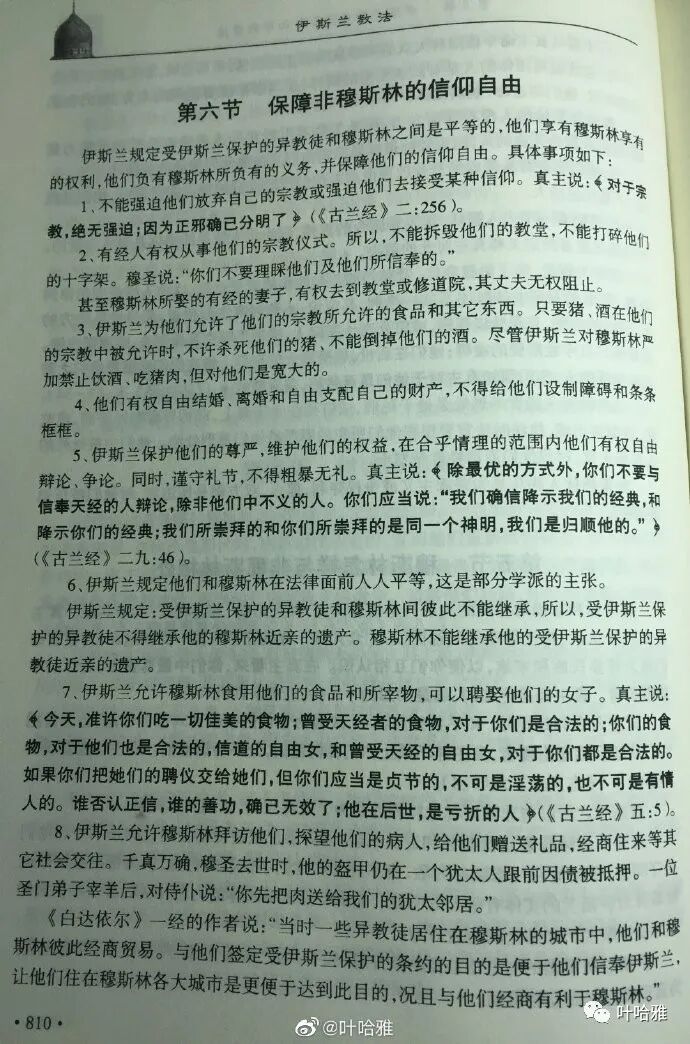
The content is a screenshot from Islamic Law (Sharia).
The law clearly states that Muslims cannot interfere with the lives of non-Muslims. This includes not pouring out their wine, not stopping them from eating pork, and certainly not tearing down their churches. As long as both sides follow their own principles, we can communicate with their wise people.
Today, most Jews, Christians, and even Muslims do not practice their religion exactly as written in their scriptures. They choose what to believe based on their own understanding. Therefore, comparing the individual actions of believers from different religions is not representative and cannot be done. However, we can study the scriptures of these religions to trace their roots and compare how they describe certain topics. This article selects the most controversial issue, the status of women, for comparison.
Women in Islam (Compared to Women in Judaism and Christianity)
The status of women in Jewish and Christian traditions is undoubtedly shocking when measured by the standards of the late 20th century. However, it must be viewed within its proper historical context. This means that any objective evaluation of the status of women in Jewish and Christian traditions must take into account the historical circumstances in which these traditions developed.
There is no doubt that the views of Jewish legal scholars and church fathers on women were influenced by the ideas common in the societies where they lived. The Bible itself was written by different authors in different eras. These authors could not help but be influenced by the values and lifestyles of the people around them. For example, the extreme bias against women in the Old Testament laws regarding adultery is hard for us to explain with our way of thinking. However, if we consider the fact that early Jewish tribes cared deeply about their lineage, they had an extreme desire to define themselves as distinct from the surrounding tribes. In this context, only the sexual misconduct of married women could threaten the desire they valued so much. Considering this, we can understand this bias. Similarly, the various condemnations of women by church fathers cannot be separated from the misogynistic Greco-Roman cultural background of their lives. Therefore, it is unfair to evaluate Jewish and Christian cultural heritage without considering the relevant historical background. In fact, correctly understanding the historical background of Judaism and Christianity is also extremely important for understanding the significance of Islam's contribution to world history and human civilization.
1. The Sin of Eve
When Allah condemned Adam's actions, he pushed all the blame onto Eve: 'The man said, The woman you put here with me—she gave me some fruit from the tree, and I ate it.' (Old Testament, Genesis 3:12) Allah then said to Eve: 'I will make your pains in childbearing very severe; with painful labor you will give birth to children.' 'Your desire will be for your husband, and he will rule over you.' He then said to Adam: 'Because you listened to your wife and ate fruit from the tree about which I commanded you, You must not eat from it, cursed is the ground because of you.' 'Through painful toil you will eat food from it all the days of your life.' (Old Testament, Genesis 3:16-17) In the Islamic faith, the story of how humans were first created is mentioned many times, such as: 'O Adam!' Dwell with your wife in Paradise, and eat from it wherever you wish. But do not approach this tree; otherwise, you will become among the wrongdoers. ' But Satan whispered to them to reveal that which was hidden of their private parts.
He said: 'Your Lord did not forbid you from this tree except that you might become angels or become among the immortals.' ' And he swore to them: 'I am indeed a sincere advisor to you both.' ' He misled them with deception. When they tasted the fruit of the tree, their private parts became apparent to them, and they began to cover themselves with the leaves of Paradise. Their Lord called to them: 'Did I not forbid you from that tree?' Did I not tell you that Satan is a clear enemy to you both? ' They said: 'Our Lord!' We have wronged ourselves, and if You do not forgive us and have mercy upon us, we will surely be among the losers. ' (Quran 7:19-23) If you look closely at these two stories, you will find a clear difference. Unlike the Bible, the Quran treats the mistake made by Adam and Hawa equally. There is no hint in the Quran that Hawa ate the forbidden fruit before Adam, and she never tempted, incited, or deceived him. Also, the pain of childbirth for Eve (Hawa) is not a punishment from Allah. According to the Quran, Allah never punishes one person for the mistakes of another. Adam and Eve both committed the same sin, then they both asked Allah for forgiveness, and Allah forgave them.
2. The inheritance of Eve
In the Bible, Eve is portrayed as a temptress, and this negative image has deeply influenced traditional Jewish and Christian views. They believe all women inherited the traits of their first mother: sinfulness and deceit. Therefore, women are seen as untrustworthy, morally inferior, and evil. Menstruation, pregnancy, and childbirth are considered permanent punishments for women because of that sin. To better understand how this negative image of Eve affects all women, we need to look back at the accounts in some important Jewish and Christian scriptures.
First, let us look at an account from the ancient Bible: I found something more bitter than death: the woman who is a snare, whose heart is a trap and whose hands are chains. The man who pleases God will escape her. But the sinner is caught by her. The preacher says, look, among a thousand men, I found one upright man. But among all the women, I did not find one. I compared these things one by one to find the reason, and while my heart was still searching, I did not find it. (Old Testament, Ecclesiastes 7:26-28) In the Catholic Bible, we can read these sentences: Any wickedness is bearable, but not the wickedness of a woman... Any wickedness is small compared to the wickedness of a woman. (Ecclesiasticus 25:19, 26)
Jewish legal scholars list nine curses women suffer because they caused humanity to be expelled from paradise: a woman must endure nine curses and death throughout her life: menstrual bleeding, bleeding on her wedding night, the hardship of pregnancy, the pain of childbirth, the labor of raising children, covering her head as if in mourning, wearing earrings like a slave, having her testimony rejected in court, and finally, death. To this day, the daily morning prayer of Orthodox Jewish men includes this sentence: "Praise Allah, the King of the Universe, thank you for not creating me a woman." Jewish women, on the other hand, praise Allah in their morning prayer for "creating me according to your will."
Another dua found in many Jewish dua books says: "Praise Allah, who did not create me a non-Jew;" Praise Allah, who did not create me a woman; Praise Allah, who did not create me an ignorant person.
Let us hear what Saint Paul says: "A woman should learn in quietness and full submission." I do not permit a woman to teach or to assume authority over a man; she must be quiet. For Adam was formed first, then Eve. And Adam was not the one deceived; it was the woman who was deceived and became a sinner. (1 Timothy 2:11-14)
Saint Tertullian was even harsher than Saint Paul. When speaking to his "most beloved sisters" about faith, he said: "Do you know that each of you is Eve?" As long as the gender Allah ordained for you continues, the sin you committed will also continue. You are the gateway of the devil; You broke the seal of the forbidden tree. You were the first to disobey the command of Allah. You tempted Adam to sin—the devil originally did not dare to approach him. You destroyed the image of Allah—man—so easily. What is more, the death of the Son of Allah was also due to your rebellion.
Saint Augustine supported his predecessors. In a letter to a friend, he wrote: 'Whether wife or mother, they are no different as women; they are all the temptress Eve. We must be wary of any woman... I see no use for a woman to a man other than bearing children.'
Centuries later, Saint Thomas Aquinas still viewed women as a defect: 'Woman is defective and contemptible.' Man was created perfect, so his perfect attributes were able to continue. Woman was defective from the start, so her errors and defects will remain forever.
Finally, the famous reformer Martin Luther believed women were useless except for bearing as many children as possible: 'If they become exhausted or even die, it does not matter.' Let them die from childbirth; that is the task they came into this world for.
Because Eve existed as a temptress from the beginning, all women have been slandered time and time again. In short, in Jewish and Christian concepts, Eve and her female descendants have a sinful nature. Now, if we turn our attention to the Quran to see how it describes women, we will quickly find that the Islamic concept of women is fundamentally different from that of Judaism and Christianity.
Let us look at what the Quran says: 'Indeed, the Muslim men and Muslim women, the believing men and believing women, the obedient men and obedient women, the truthful men and truthful women, the patient men and patient women, the humble men and humble women, the charitable men and charitable women, the fasting men and fasting women, the men who guard their private parts and the women who do so, and the men who remember Allah often and the women who do so—for them Allah has prepared forgiveness and a great reward.' (Quran 33:35) 'The believing men and believing women are allies of one another. They enjoin what is right and forbid what is wrong and establish prayer and give zakat and obey Allah and His Messenger. Those—Allah will have mercy upon them.' Indeed, Allah is Exalted in Might and Wise. (Quran 9:71) Their Lord answered them: I will never let the work of any worker among you go to waste, whether male or female—you are one from another. (Quran 3:195) Whoever does evil will be repaid with the same evil. Any man or woman who does good and believes will enter Paradise and receive endless provision. (Quran 40:40) Whoever does good, whether male or female, and is a believer, I will surely give them a good life, and I will surely reward them for the best of what they have done. (Quran 16:97)
It is clear that the Quran makes no distinction when mentioning men and women. Allah created them to worship Him on earth, to do good deeds, and to avoid sin. Both men and women will be judged fairly by Allah. The Quran never says that women are a gateway for the devil or that they have a deceptive and seductive nature. The Quran also never says that men are created in the image of Allah. Both men and women are simply creations of Allah, nothing more.
According to the Quran, a woman's role on earth is not just to give birth; she is required to do as many good deeds as men. The Quran does not say that righteous women do not exist. Instead, it commands all believers to take pure women like the Virgin Maryam (Mary) and the wife of Pharaoh as role models: Allah sets the wife of Pharaoh as an example for those who believe. She said: My Lord! Build for me a house in Paradise near You. Save me from Pharaoh and his evil deeds. Save me from the unjust people, O Allah. Allah also sets an example for the believers in Maryam (Mary), the daughter of Imran. She guarded her chastity, so I breathed into her through My spirit. She believed in the words of her Lord and His scriptures, and she was one of the obedient. (Quran 66:11-12)
3. The shameful daughter
In fact, the views on women in the Bible and the Quran are completely different from the moment a girl is born. The Bible states that the period of ritual impurity for a mother after giving birth to a girl is two weeks, which is twice as long as the seven days required after giving birth to a boy (Old Testament, Leviticus 12:2-5). The Catholic Bible explicitly states: 'A daughter is a loss to her father' (Sirach 22:3). In sharp contrast to this shocking statement, boys receive special praise: 'He who instructs his son will make his enemy jealous' (Sirach 30:3).
Jewish legal scholars urged Jews to have as many children as possible to strengthen their people. At the same time, they did not hide their clear preference for boys: 'Even the father of a bad boy is better than the father of a girl,' 'When a boy is born, everyone is happy... when a girl is born, everyone is sad,' and 'When a boy comes into the world, peace comes with him... when a girl comes, she brings nothing.'
A daughter is considered a painful burden and a source of shame for her father: 'Keep a strict watch on a headstrong daughter, lest she make you a laughingstock to your enemies, a byword in the city and the assembly of the people, and put you to shame in public.' (Sirach 42:11) 'Keep a strict watch on a shameless daughter, lest she find an opportunity and indulge herself.' Be careful not to yield to a shameless eye; otherwise, do not be surprised if she offends you. (Sirach 26:13-14) This view of daughters as a source of shame is very similar to the views of the ignorant Arabs who buried infant girls alive before the rise of Islam. The Quran strictly condemns this heinous act: 'When one of them is told that his wife has given birth to a daughter, his face darkens and he is full of complaints.' He hides from his clan because of this bad news, wondering if he should keep her in shame or bury her in the dirt. Or should he bury her alive in the ground? Truly, their judgment is evil. (Quran 16:58-59)
If the Quran had not repeatedly condemned this ugly crime (Quran 16:59, 43:17, 81:8-9), this behavior of the ancient Arabs might never have changed. the Quran treats sons and daughters equally without any difference. Unlike the Bible, the Quran considers the birth of a girl to be a gift and blessing from Allah, just like the birth of a boy. The Quran even mentions the gift of daughters first: "To Allah belongs the dominion of the heavens and the earth. He creates what He wills; He gives to whom He wills female children; and He gives to whom He wills male children. " (Quran 42:49)
In the early days of Islam, to completely end the crime of burying baby girls alive, the Prophet Muhammad promised a great reward to those who were given daughters and raised them well: "Whoever raises daughters and treats them well, he will be protected from the punishment of Hellfire. (Sahih Bukhari and Sahih Muslim) "Whoever raises two girls until they reach adulthood, the distance between him and me on the Day of Resurrection will be like this; saying this, the Prophet held his fingers together. " (Sahih Muslim)
4. Education for women
The core foundation of Judaism is the Torah, or the Book of Law. However, according to the Jewish Talmud, women are exempt from studying the Torah. Some Jewish legal scholars claimed that it is better to burn the Torah than to let women touch it, and that whoever teaches his daughter the Torah is like teaching her lewdness and evil. St. Paul’s attitude in the New Testament was not enlightened either: Women should keep silent in the meetings, just as in all the churches of the saints. Because they are not allowed to speak. They must be submissive, just as the law says. If they want to learn anything, they can ask their husbands at home. Because it is shameful for women to speak in the meeting. (New Testament, 1 Corinthians 14:34-35)
Now, for the sake of fairness, let us ask: Does the Quran have a different view on this? The following story mentioned in the Quran can help us understand this. Khawla was a Muslim woman. Once, her husband Aws got angry and said to her: You are to me like the back of my mother. This was a way for Arabs in the pre-Islamic period to divorce their wives. The husband would cut off all marital relations and responsibilities, but the woman was not allowed to leave his house or marry anyone else. When Khawla heard this from her husband, she was extremely distressed. She went straight to the Prophet Muhammad to pour out her heart. The Prophet told her she should be patient, because there seemed to be no solution for such a matter. However, Khawla argued her case reasonably, trying to save this suspended marriage. Soon, verses from the Quran were revealed. Khawla’s appeal was granted, and Allah abolished this terrible custom. The 58th chapter of the Quran related to this is named Al-Mujadila, meaning 'The Pleading Woman': 'Allah has certainly heard the speech of the one who argues with you, [O Muhammad], concerning her husband and directs her complaint to Allah.' Allah hears your dialogue. Indeed, Allah is All-Hearing and All-Seeing. ' (Quran 58:1) In the Quran, women have the right to debate—even with the Prophet of Islam himself. No one has the right to order her to be silent. She is also not limited to only obtaining knowledge and religion from her husband.
5. Unclean women
Jewish laws and regulations are extremely restrictive and binding for women during their menstrual period. The Old Testament considers any menstruating woman to be unclean and defiled, and her impurity is even 'contagious.' Anyone or anything she touches becomes unclean until evening: 'When a woman has a discharge, if her discharge in her body is blood, she shall continue in her menstrual impurity for seven days; and whoever touches her shall be unclean until evening.' Everything on which she lies during her menstrual impurity shall be unclean, and everything on which she sits shall be unclean. Anyone who touches her bed shall be unclean until evening, and he shall wash his clothes and bathe in water and remain unclean until evening. Anyone who touches any object on which she has sat shall be unclean until evening. ' (Old Testament, Leviticus 15:19-23)
Because of her 'contagiousness,' to avoid any possibility of contact with her, a menstruating woman is sometimes 'banished.' She is sent to a special room called the 'house of uncleanness' to spend her entire menstrual period. The Talmud even suggests that a menstruating woman is 'deadly,' even without any contact: 'Our rabbis taught: If a menstruating woman passes between two men, if it is at the beginning of her period, she will cause one of them to die;' If she is at the end of her period, she will cause a dispute between them. (Talmud b Pes. 111a)
What is more, if the husband of a menstruating woman is contaminated—even by the dust on her feet—he is forbidden from entering the synagogue. A rabbi cannot preach in the synagogue if his wife, daughter, or mother is menstruating. 10. It is no wonder that many Jewish women still call menstruation a "curse" today. In Islamic belief, a menstruating woman is never considered "contagiously unclean," nor is she "untouchable" or a "curse." She goes about her daily life as usual, with only one exception: married couples avoid sexual intercourse during menstruation. Other than that, any physical contact between husband and wife is allowed. During this time, a menstruating woman is exempt from certain religious duties, such as namaz and fasting.
6. Giving testimony
Another issue where the Quran and the Bible differ is the matter of women giving testimony. The Quran commands believers to have two men, or one man and two women, as witnesses when drawing up contracts for business transactions (see Quran 2:282). However, the Quran accepts the testimony of men and women equally in other situations. In fact, a woman's testimony can overturn a man's: if a man accuses his wife of adultery without other evidence, the Quran requires him to swear solemnly five times to prove his words are true. However, if his wife denies it and swears solemnly five times to prove her innocence, she is not found guilty, and the marriage is dissolved (Quran 24:6-11).
On the other hand, in early Jewish society, women were not allowed to give testimony. Jewish jurists listed nine curses women suffered after humans were expelled from Paradise, and one of them is the inability to provide testimony (see Chapter 2). In Israel today, women are not allowed to provide evidence in Jewish religious courts. Jewish jurists explain that this is because the Bible records that Sarah, the wife of Abraham (Ibrahim), told a lie (Old Testament, Genesis 18:9-16). Jewish jurists use this event as evidence that women are not qualified to testify. This story from the Bible is mentioned more than once in the Quran, yet the Quran does not record Sarah lying at all (Quran 11:69-74, 51:24-30). In Western Christian societies, both church law and civil law prohibited women from providing any testimony until the end of the nineteenth century. If a man accuses his wife of adultery, her testimony is not considered according to the Bible. The accused woman must undergo a harsh examination. To confirm her guilt or innocence, she faces many complex and humiliating rituals during this examination (Old Testament, Numbers 5:11-31). After the examination, if she is proven guilty, she will be sentenced to death. If she is proven innocent, her husband does not suffer any punishment for this.
At the same time, if a man marries a woman and then accuses her of not being a virgin, her testimony is not accepted. Her parents must bring evidence of her virginity before the elders of the town. If the parents cannot prove their daughter's innocence, the woman will be stoned to death at the door of her father's house. If her parents can prove her innocence, her husband only needs to pay a fine of one hundred shekels of silver and is never allowed to divorce her: If a man takes a wife, and after sleeping with her hates her, and makes up charges against her, giving her a bad name, and says, I took this woman, and when I slept with her, I did not find proof of her virginity. The woman's parents shall bring the proof of the woman's virginity to the elders of the city. The woman's father will say to the elders, I gave my daughter to this man as his wife, but he hates her and has made false accusations, saying, I did not find proof of your daughter's virginity. But here is the proof of my daughter's virginity. The parents will then spread the cloth out before the elders of the city. The elders of the city will take the man and punish him, and fine him one hundred shekels of silver to give to the woman's father, because he brought a bad name upon a virgin of Israel. The woman will remain his wife, and he may never divorce her for as long as he lives. But if this matter is true and the woman has no proof of her virginity, they will bring the woman to the door of her father's house, and the men of her city will stone her to death. Because she committed a shameful act in Israel by acting promiscuously while in her father's house. In this way, you will purge the evil from among you. (Old Testament, Deuteronomy 22:13-21)
7. Adultery
Adultery is considered a crime by all religions. The Bible sentences men and women who commit adultery to death (Old Testament, Leviticus 20:10). Islam also punishes men and women who commit adultery equally (Quran 24:2). However, the Quran's definition of adultery is very different from the Bible's: according to the Quran, adultery refers to extramarital sexual relations involving a married man or a married woman. The Bible only defines extramarital sexual relations involving a married woman as adultery (Old Testament, Leviticus 20:10, Deuteronomy 22:22, Proverbs 6:20-7:27). If a man is found lying with a woman married to another man, both the man who lay with the woman and the woman must die. In this way, you must purge the evil from Israel. If a man is found sleeping with another man's wife, both the man who slept with her and the woman must die. (Old Testament, Deuteronomy 22:22) (Old Testament, Leviticus 20:10)
According to the definition in the Bible, if a married man sleeps with an unmarried woman, it is not considered a crime at all. The married man who has sex with an unmarried woman is not an adulterer, and the unmarried woman who has sex with him is not an adulteress. Adultery refers to a man—whether he is married or single—sleeping with a married woman. In this case, the man is considered an adulterer regardless of his marital status, and the woman is considered an adulteress. Simply put, adultery refers to improper sexual behavior involving a married woman. Extramarital behavior by a married man is not defined as a crime in the Bible.
Why is there this double standard of morality? According to the Encyclopedia Judaica, a wife is considered the private property of her husband, and adultery means an infringement on the husband's exclusive rights. As the husband's property, the wife has no right to infringe upon his rights. This means that if a man has sex with a married woman, he has infringed upon another man's property and is therefore punished. In Israel today, if a married man has an extramarital affair with an unmarried woman, the child born to them is considered legitimate. However, if a married woman has sex with another man—regardless of whether he is married—the child she has with that man is not only considered illegitimate, but as a bastard, is not allowed to marry any Jew, unless it is with an apostate or another bastard. This prohibition will continue for ten generations among their descendants until the stain of adultery gradually fades.
On the other hand, the Quran does not define any woman as a man's property. The Quran describes the relationship between husband and wife movingly: 'And of His signs is that He created for you from yourselves mates that you may find tranquility in them; and He placed between you affection and mercy.' Indeed in that are signs for a people who give thought. ' (Quran 30:21) This is the concept of marriage in the Quran: love, mercy, and peace, without any ownership or double standards.
8. Vows
According to the Bible, a man must fulfill the vows he makes in the name of Allah and cannot break his word. However, a woman's vows are not her own to make. If she is unmarried, her vow must have her father's consent. If she is married, she must get her husband's consent. If a father or husband disagrees with his daughter's or wife's vow, all her vows become invalid: 'But if her father expresses disapproval on the day he hears about any of her vows or her pledges by which she bound herself, then none of her vows shall stand... Any vow or binding pledge she makes to deny herself, her husband may confirm or nullify.' ' (Old Testament, Numbers 30:2-15)
Why can a woman not decide for herself? The answer is simple: because before marriage she is her father's property, and after marriage she is owned by her husband. A father has absolute control over his daughter, and if he wants to, he can even sell her! Jewish legal scholars point out: 'A man can sell his daughter, but a woman cannot sell her daughter;' a man can betroth his daughter to others, but a woman has no right to betroth her daughter.'
Jewish legal writings also point out that marriage shifts the power of control from the father to the husband: Marriage makes a woman the sacred and inviolable property of her husband. Clearly, if a woman is considered someone's property, she cannot make any promises without the permission of her master. The instructions in the Bible regarding women's vows had a deep negative impact on Jewish and Christian women until the early twentieth century. In the Western Christian world, a married woman had no legal status, and none of her actions had legal value. Her husband had the right to veto any contract, sale, or transaction she made.
In the West, the greatest inheritor of this Judeo-Christian legacy, women could not enter into any treaties because they were effectively someone's property. Because of the biblical view that women belonged to their fathers or husbands, women in the Western world suffered nearly two thousand years of enslavement. In Islam, every Muslim—whether man or woman—is responsible for their own vows, and no one has the right to negate the vows of others. If a man or woman fails to fulfill a solemn vow, according to the Quran, he or she must pay a penalty: Allah will not hold you accountable for your unintentional oaths, but He will hold you accountable for your intentional oaths. The penalty for breaking an oath is to feed ten poor people with the average food you provide for your own family, or to clothe them, or to free a slave. Those who cannot afford to feed the poor or free a slave must fast for three days. This is the penalty for breaking your oaths after you have sworn them. You should keep your oaths. Allah thus explains His signs to you so that you may be grateful to Him. (Quran 5:89)
The companions of the Prophet Muhammad, both men and women, often came before him to swear their allegiance. Women, just like men, came to the Prophet on their own to take an oath: "O Prophet!" If believing women come to you to pledge that they will not associate anything with Allah, will not steal, will not commit adultery, will not kill their children, will not falsely claim that someone else's son is their husband's, and will not disobey your reasonable commands, then accept their pledge and ask Allah to forgive them. Allah is truly the Most Forgiving, the Most Merciful. " (Quran 60:12) A man cannot take an oath on behalf of his daughter or wife, nor can he cancel the oath of any of his female relatives.
9. Headscarf
According to Dr. Menachem Brayer, a professor of biblical literature at Yeshiva University, Jewish law includes a custom where women cover their heads in public. Sometimes they even covered their faces, leaving only one eye visible. He quotes famous ancient Jewish legal scholars who said, "The daughters of Israel must not go out without their heads covered," and "A man who lets his wife's hair be seen by others is cursed... a woman who uses her hair as a decoration will bring poverty upon herself." If a married woman is present with her head uncovered, Jewish law forbids reciting blessings or dua in that space, because her hair is considered "nakedness."
Dr. Brayer also notes: "In the Tannaic era, a woman who failed to cover her head was considered immodest." She might be fined four hundred zuzim for this mistake. Dr. Brayer explains that a Jewish woman's headscarf was not just a sign of modesty; it was sometimes a symbol of status and luxury, representing the nobility and superiority of a high-ranking lady. At the same time, it represented a woman's inviolability, as she was considered the sacred private property of her husband. The headscarf signified a woman's self-respect and social standing. Women of lower social status often wore headscarves to try to give the impression of being noble. Since the headscarf was a sign of honor, it is easy to understand why ancient Jewish society forbade prostitutes from covering their hair. However, to look more respectable, prostitutes would often wear a special type of head covering. Jewish women in Europe kept the tradition of wearing head coverings until the 19th century. By then, their lives were mixed with a lot of the surrounding secular culture, and the outside pressures of European life forced many of them to stop wearing head coverings. Some Jewish women found that wigs were a more convenient way to cover their hair instead of a head covering. Today, most observant Jewish women no longer wear any head covering except when they are at the synagogue. But some of them, such as Hasidic women, still wear wigs.
What about Christian traditions? Everyone knows that Catholic nuns have covered their hair for hundreds of years. However, there is more to it than that. Saint Paul made some very interesting statements about head coverings in the New Testament: I want you to know that Christ is the head of every man, man is the head of woman, and God is the head of Christ. Every man who prays or prophesies with his head covered dishonors his head. Every woman who prays or prophesies with her head uncovered dishonors her head, because it is just like having her hair shaved off. If a woman does not cover her head, she should have her hair cut off. If it is a shame for a woman to have her hair cut or shaved off, then she should cover her head. A man ought not to cover his head, since he is the image and glory of God, but woman is the glory of man. For man did not come from woman, but woman came from man. Neither was man created for woman, but woman was created for man. For this reason, a woman should have a sign of authority on her head because of the angels. (New Testament, 1 Corinthians 11:3-10) Saint Paul's theory on women wearing headscarves is that man is the image and glory of Allah, while the headscarf symbolizes man's authority over woman—woman was created for man.
In his famous book The Veiling of Virgins, Tertullian wrote: "Young women, wear your headscarves when you go out on the street, wear them in church, wear them among strangers, and wear them among your brothers..." In today's Catholic canon law, there is a rule requiring women to cover their heads in church. Certain Christian denominations, such as the Amish and Mennonites, still have women wear headscarves today. The reason, as their church leaders say, is that "covering the head is a symbol of a woman's submission to man and to Allah," which follows the same logic as Saint Paul in the New Testament.
From the evidence above, it is clear that the headscarf was not invented by Islam. However, Islam does support wearing a headscarf. The Quran requires both male and female believers to lower their gaze and cover their private parts, and it requires female believers to extend their headscarves to cover their necks and chests: "Tell the believing men to lower their gaze and guard their private parts; that is purer for them... And tell the believing women to lower their gaze and guard their private parts, and not to display their adornment except what is naturally exposed, and let them draw their veils over their chests and not display their adornment..." (Quran 24:30, 31)
The Quran clearly states that the headscarf is essential for modest and proper dress. But why is modesty important? The Quran remains very clear: "O Prophet! Tell your wives, your daughters, and the women of the believers to draw their outer garments over their bodies. This is more likely to make them recognized and not be harassed. " (Quran 33:59)
10. Polygamy
Now, let us address the important issue of polygamy. Polygamy is an ancient practice in many human societies. The Bible never condemns polygamy. On the contrary, the Old Testament and the writings of Jewish legal scholars repeatedly prove the legality of polygamy. People say King Solomon had more than 700 wives and 300 concubines (1 Kings 11:3). At the same time, King David is also said to have had many wives and concubines (2 Samuel 5:13). The Old Testament contains many instructions on how a man should distribute property to the sons born to his different wives (Deuteronomy 21:15-17). The only restriction on polygamy is the prohibition against marrying two sisters at the same time (Leviticus 18:18).
The Talmud suggests not taking more than four wives. European Jews maintained the practice of polygamy until the 16th century. Eastern Jews maintained polygamy until they set foot on the land of Israel (Israeli civil law now prohibits polygamy). However, polygamy is still permitted under religious law, which stands above civil law.
So, what is the view of the New Testament? According to Father Eugene Hillman in his insightful book, polygamy should be reconsidered: "In the New Testament, there is no explicit command requiring monogamy, nor is there any explicit command prohibiting polygamy." Moreover, in the time of Jesus, polygamy was prevalent in Jewish society, yet Jesus never said anything against it. Father Hillman emphasized the fact that the Roman Church prohibited polygamy by following the customs of Greco-Roman culture (establishing one legal wife while tolerating illegal cohabitation and prostitution). He cited the words of Saint Augustine: "Now, in our time, in order to maintain Roman tradition, it is no longer permitted to take another wife."
Churches and Christians in Africa often remind their European brothers that the Roman Catholic ban on polygamy is just a cultural tradition, not a true Christian prohibition.
The Quran also allows polygamy, but not without limits: "If you fear that you will not deal justly with the orphans, then marry those that please you of other women, two or three or four;" "but if you fear that you will not be just, then marry only one." (Quran 4:3)
11. Mother
Many parts of the Old Testament command people to honor their parents and condemn those who disobey them. For example: "Everyone who curses his father or his mother shall surely be put to death" (Old Testament, Leviticus 20:9) and "A wise son makes a father glad, but a foolish man despises his mother." (Old Testament, Proverbs 15:20) However, in some places, only the father is mentioned, such as "A wise son hears his father's instruction" (Old Testament, Proverbs 13:1), while the mother is never mentioned alone. the great hardship a mother endures through pregnancy, childbirth, and nursing is never highlighted as a reason to thank or treat her with special favor. a father can inherit from his children, but a mother cannot. It is difficult to find verses in the New Testament that require people to respect their mothers. On the contrary, the New Testament gives the impression that honoring one's mother is an obstacle on the path to Allah. According to the New Testament, a person is not worthy of being a disciple of Christ unless they hate their own mother. Jesus said: "If anyone comes to me and does not hate his own father and mother and wife and children and brothers and sisters, yes, and even his own life, he cannot be my disciple." (New Testament, Luke 14:26)
Moreover, the image of Jesus portrayed in the New Testament is one who is indifferent, or even disrespectful, to his mother. For example, when he was preaching among the crowd, his mother came to call him, but he did not care and did not go out to see her: "Then Jesus' mother and brothers came, stood outside, and sent someone to call him. There were many people sitting around Jesus, and they told him, 'Look, your mother and your brothers are looking for you outside.' Jesus replied, 'Who is my mother, and who are my brothers?' He looked around at those sitting in a circle and said, 'Look, my mother and my brothers!' Whoever does the will of Allah is my brother, sister, and mother.' " (New Testament, Gospel of Mark 3:31-35)
Some might argue that Jesus did this to teach people that religious bonds are not weaker than family bonds. However, if that were the case, he could have taught his audience without showing such indifference toward his mother. When a woman in his audience blessed the mother who gave birth to and raised him, Jesus did not agree and again showed the same disrespectful attitude: "As Jesus was saying these things, a woman in the crowd called out, 'Blessed is the mother who gave you birth and nursed you.' Jesus said, 'Blessed rather are those who hear the word of Allah and obey it.' " (New Testament, Gospel of Luke 11:27-28) If a mother with the status of the Virgin Mary was treated so rudely by her son Jesus Christ—as described in the New Testament—then how could an ordinary Christian mother expect to be treated well by her ordinary Christian son?
In Islam, honor, respect, and reverence are uniquely linked to the title of 'mother'. The Quran places the importance of honoring parents second only to the worship of Allah: "Your Lord has decreed that you worship none but Him, and that you be kind to your parents. If one or both of them reach old age in your care, do not say to them, 'Ugh!' ' Do not scold them, but speak to them with polite words. You should serve them with humility and say, 'My Lord!' Have mercy on them both, just as they raised me when I was young. ” (Quran 17:23-24)
The Quran emphasizes the great role of the mother as the one who gives birth and nurtures in many places: “I have commanded people to be kind to their parents—his mother carried him through weakness upon weakness, and his weaning is in two years—I said: ‘You should be grateful to Me and to your parents; to Me is the final destination.” ” (Quran 31:14) Prophet Muhammad once movingly described the special status of mothers in Islam: “A man came to the Prophet and asked: ‘O Messenger of Allah! Who among the people should I treat with the most kindness? ’ The Prophet said: ‘Your mother.’ ’ The man said: ‘And then?’ ’ The Prophet replied: ‘Your mother.’ ’ The man asked again: ‘And then?’ ’ The Prophet replied: ‘Still your mother.’ ’ The man continued to ask: ‘And what about after that?’ ’ The Prophet replied: ‘Next is your father.’ ’ (Sahih al-Bukhari and Sahih Muslim) One of the few Islamic maxims that Muslims still faithfully follow today is: be considerate to your mother. The honor that Muslim mothers receive from their children is exemplary. The sincere, warm relationship between Muslim mothers and their children, and the deep respect that Muslim men show their mothers, often surprise Westerners.
12. Divorce
The three major religions have very different views on divorce. Christianity completely hates divorce. The New Testament clearly supports the idea that marriage cannot be broken. Jesus said: "But I tell you that anyone who divorces his wife, except for sexual immorality, makes her the victim of adultery;" and anyone who marries a divorced woman commits adultery. (New Testament, Matthew 5:32) This firm wish is clearly unrealistic. It asks for a society with a level of moral perfection that humans have never reached. When a couple realizes their marriage cannot be saved, a ban on divorce does not help them at all. Forcing a couple with serious problems to stay together against their will is neither effective nor reasonable. It is not surprising that the entire Christian world now has to allow divorce.
Judaism is the exact opposite. It even allows divorce for no reason at all. The Old Testament gives a husband the right to divorce his wife if he finds something he does not like about her: "If a man marries a woman who becomes displeasing to him because he finds something indecent about her, and he writes her a certificate of divorce, gives it to her and sends her from his house," and if after she leaves his house she becomes the wife of another man, and her second husband dislikes her and writes her a certificate of divorce, gives it to her and sends her from his house, or if he dies, then her first husband, who divorced her, is not allowed to marry her again after she has been defiled, because that would be detestable in the eyes of the Lord. (Old Testament, Deuteronomy 24:1-4) These verses caused a lot of debate among Jewish scholars because they disagreed on the meaning of the words "indecent," "displeasing," and "dislikes." The Talmud records this disagreement: "The School of Shammai says a man cannot divorce his wife unless he finds her guilty of sexual immorality;" The School of Hillel says a man can divorce his wife even if she just breaks a plate." The jurist Akiba believed that a man could divorce his wife if he found a woman more beautiful than her. (Talmud, Gittin 90 a-b)
The New Testament follows the views of the School of Shammai, while Jewish law follows the views of the School of Hillel and the jurist Akiba. After the views of the School of Hillel became dominant, giving a husband the right to divorce his wife freely became an unbreakable tradition in Jewish law. The Old Testament not only gives a husband the right to divorce a wife who does not please him, it even considers it necessary to divorce a 'wicked woman': 'A wicked woman makes a man's spirit dejected, his face gloomy, and his heart wounded.' A husband's hands are weak and his knees are soft because his wife makes him miserable. Sin originated from a woman; because of her, we all must die. Do not leave a leak for water, not even a tiny one, and do not give a wicked woman any freedom. If she does not follow your instructions, you should cut her off from your side. (Sirach 25:31-36)
The Talmud records several behaviors of a wife that, if discovered by her husband, require him to divorce her: 'If she eats in the street, if she drinks water greedily in the street, or if she nurses her baby in the street, in any of these cases, the jurist Meir believes she must be divorced by her husband.' (Talmud, Git. 89 a) The Talmud also stipulates that a wife who has not given birth after ten years of marriage must be divorced: 'Our jurists teach us: if a man marries a wife and lives with her for ten years, and she still has not borne a child, he should divorce his wife.' (Talmud, Yeb. 64 a)
On the other hand, in Jewish law, a wife cannot initiate a divorce from her husband. She can only present sufficient reasons to a Jewish court and request the court's support. The reasons allowed for a woman to file for divorce are extremely limited, including her husband having physical defects or skin diseases, or her husband being unable to fulfill his marital duties. The court might support a wife's divorce petition, but it cannot dissolve the marriage because only the husband can write a letter of divorce to end it. The court can use persuasion, fines, detention, and excommunication to force a husband to write a letter of divorce for his wife. However, if a husband is particularly stubborn and refuses to give his wife a letter of divorce, he can keep her bound permanently, and no one can do anything about it.
Even worse, a husband can abandon his wife without giving her a letter of divorce, leaving her in a state of limbo where she is neither married nor divorced. In this situation, the husband can marry another woman, or even live with a single, unmarried woman and have children (who are considered legitimate under Jewish law). On the other hand, the abandoned wife cannot marry any other man because she is still legally a married woman. At the same time, she cannot live with another man because it would be considered adultery, and if she did so, her descendants for ten generations would be considered illegitimate. Women in this state of limbo are called agunah, which means a chained woman. 34 Today, there are about 1,000 to 1,500 agunah Jewish women in the United States, and as many as 16,000 in Israel. These women are blackmailed by their husbands and must pay them tens of thousands of dollars to get a letter of divorce.
Islamic rulings on divorce fall between those of Christianity and Judaism. In Islam, marriage is a sacred bond that should not be easily broken unless there are compelling reasons. When cracks appear in a marriage, both the husband and wife are taught to try their best to save and repair it. If all efforts fail, divorce is the last resort. Simply put, Islam allows divorce but tries to avoid it as much as possible.
Islam gives husbands the right to divorce their wives. However, unlike in Judaism, Islam also gives wives a right to divorce called khula, which allows them to end the marriage. If a husband divorces his wife, he cannot take back any dowry (mahr) he gave her, no matter how expensive it was: "If you want to replace one wife with another, and you have given one of them a great amount of gold, do not take any of it back." Would you take it back by slandering her and committing a clear sin? (Quran 4:20)
But if the wife chooses to end the marriage herself, she can return the dowry to her husband. Returning the dowry is a fair compensation for the husband, because he wanted to keep the marriage, but since she chose to end it, he must let her go. The Quran teaches Muslim men that they cannot take back any gifts given to their wives, unless the wife chooses to initiate the divorce: "It is not lawful for you to take back anything you have given them, unless both fear they cannot keep the limits set by Allah." If you fear they cannot keep the limits of Allah, then there is no sin if she gives something back to free herself. These are the limits of Allah, so do not cross them. (Quran 2:229) A woman came to the Prophet Muhammad and asked to end her marriage. She told the Prophet that she had no complaints about her husband's character or personality, but her only problem was that she no longer loved him and did not want to live with him anymore. The Prophet asked, "Will you return his garden (the dowry her husband gave her) to him?" She replied, "Yes." The Prophet then ordered her husband to take back the garden and accepted their divorce. (Sahih al-Bukhari)
In some cases, a Muslim woman may have to file for divorce for strong reasons, such as abuse by her husband, being abandoned without cause, or her husband failing to fulfill his marital duties. In these situations, a Muslim court will grant the divorce. In short, Islam gives Muslim women unmatched rights: she can end a marriage by returning her dowry, or she can seek a divorce through the courts. A Muslim woman will never be trapped by an abusive husband. Jewish women living in early Islamic society during the seventh century were drawn to these rights and often went to Muslim courts to ask for a ruling when seeking a divorce. However, Jewish legal scholars declared that divorces granted in Muslim courts were invalid. To stop this from happening, Jewish scholars gave Jewish women certain rights and treatment, trying to make Muslim courts less attractive to them.
Jewish women living in Christian countries did not get similar rights and treatment, because the divorce clauses in Roman law were not more attractive than those in Jewish law. Now, let us turn our attention to how Islam avoids divorce. The Prophet of Islam once warned believers: Of all lawful things, the one Allah hates most is divorce. (Sunan Abu Dawood)
A Muslim man cannot divorce his wife simply because he dislikes her. The Quran teaches Muslim men to treat their wives well, even if they do not like or even hate them: You should treat them well. If you dislike them, you should endure them, because perhaps you dislike a thing, and Allah has placed much good in that thing. (Quran 4:19)
Prophet Muhammad gave a similar instruction: A male believer should not dislike a female believer. If he dislikes her character, other aspects will make you like her. (Sahih Muslim) The Prophet also emphasized that the best Muslims are those who treat their wives well: The believer with the most perfect faith is the one with the best character; The best among you are those who treat their wives the best. (Jami at-Tirmidhi)
However, Islam is a realistic religion, and it recognizes that there are situations where a marriage may be on the verge of collapse. In such a state, kind words alone will not work. So, what should be done in this situation to save the marriage? The Quran provides some truly effective advice for couples facing marital problems caused by the misconduct of one partner. For husbands facing marital problems due to a wife's misconduct, the Quran gives four suggestions: As for those women whose stubbornness you fear, you may advise them, you may forsake them in bed, and you may strike them. If they obey you, then do not seek a way against them. Allah is indeed Exalted and Great. If you fear a breach between the two, then appoint an arbitrator from his family and an arbitrator from her family. If they both desire reconciliation, Allah will cause harmony between them. (Quran 4:34-35)
Try the first three suggestions first. If they are ineffective, then seek the intervention of both families. As mentioned in the text above, for a stubborn wife, striking her is a third, temporary measure that a husband may use as a last resort when he hopes to correct her wrong behavior (striking must not be heavy, and it is not permitted to strike the face or other sensitive areas). If this works, as the scripture says, the husband is not allowed to bully her in any way. If this does not work, the husband is not allowed to use the same method again, but should seek the final path, which is mediation by relatives.
Prophet Muhammad taught Muslim husbands that they must not use hitting as a method, except in extreme cases such as when a wife shows clear lewd behavior (not adultery). Even in such cases, it must only be a light tap. If the wife stops the lewd behavior, the husband is not allowed to cause her pain: If they show clear lewd behavior, you may sleep apart from them and hit them, but do not hit them hard. If they obey, you must not seek any way to make them suffer. (Jami at-Tirmidhi)
Beyond this, the Prophet of Islam forbids any unreasonable beating. Some Muslim women once complained to the Prophet that their husbands had hit them. Hearing this, the Prophet said firmly: Those who do this (hit their wives) are not the best among you (the Muslim community). (Sunan Abu Dawood) At the same time, the Prophet also pointed out: The best among you are those who treat their families well, and I am the best among you in treating my family. (Jami at-Tirmidhi)
The Prophet once advised a Muslim woman named Fatima bint Qais not to marry a certain man because he was known for hitting his wives. This woman narrated: I went to the Prophet and told him: Muawiyah ibn Abi Sufyan and Abu Jahm both want to marry me. The Prophet (advised) saying: Muawiyah is penniless, and Abu Jahm hits his wives. " (Sahih Muslim)
The Jewish Talmud mentions that hitting a wife can be a way to educate her. A husband does not have to limit hitting his wife to extreme cases like infidelity; he is allowed to hit her even if she simply refuses to do housework. he is not limited to light hitting; he can use methods like whipping or withholding food to force his wife to submit. For marital rifts caused by a husband's poor behavior, the Quran offers this advice: If a woman fears her husband's neglect or desertion, there is no sin on them if they reconcile. Reconciliation is better. (Quran 4:128)
In this situation, the wife is advised to seek reconciliation with her husband, whether or not family members get involved. It is clear that the Quran does not suggest the wife use the methods of sleeping apart from her husband or hitting him. The reason for this difference may be to protect the wife and prevent her from facing even stronger retaliation from a husband who is already in the wrong. If such violence occurs, it will only make the wife's situation and the marriage worse.
Some Muslim scholars suggest that a court can take these disciplinary measures against a husband on behalf of the wife. This means the court first admonishes the stubborn husband, then forbids him from sharing a bed with his wife, and finally administers a light physical correction. In summary, Islam provides Muslim couples with many effective suggestions to save troubled or failing marriages. If one spouse damages the marital relationship, the Quran requires the other to take effective measures to save this sacred bond whenever possible. If all measures ultimately fail, Islam allows both parties to divorce peacefully.
Muslim Knowledge Guide China: Tianfang Shijing, Islamic Literature and Cross-Cultural Poetry
Articles • yusuf908 posted the article • 0 comments • 246 views • 2026-05-23 23:30
Summary: This book note introduces the renewed publication of Tianfang Shijing, including the classical Ode to the Imperial Robe, as a work linking Islamic literary tradition and Chinese cultural expression. It preserves the source's book details, historical references, publication context, and literary framing.
1
Introduction
In the galaxy of Islamic literature, one poem has been recited for over seven hundred years. It is considered the greatest poem praising the Prophet Muhammad, and it is the famous Arabic literary work, the Burda (al-Burda).
Its full name is al-Kawakib al-Durriyya fi Madh Khayr al-Bariyya, which means "The Glittering Stars in Praise of the Best of Creation." Chinese readers know it better by the title Robe of Honor (Gunyi Song), a work known to every household.
The author of the Classic of Arabian Poetry (Tianfang Shijing) is the famous medieval Arab poet al-Busiri
(1213–c. 1296). In the 16th year of the Guangxu reign of the Qing Dynasty (1890), the Chinese Islamic scholar Ma Dexin
guided the translation and explanation, while Ma Anli
compiled the text with the assistance of Ma Xuehai,
and it was published by the Baozhen Hall in Chengdu. This translation represents the scholarship and faith of several generations of scholars.
The entire book contains 161 bayt (couplets)
that follow the Arabic letter "mim" rhyme throughout. The poem unfolds in layers, moving from longing and awakening to praise, repentance, and dua, celebrating the perfect virtues of the Prophet Muhammad, whose inner nature and outer conduct were in harmony with Allah. The translators followed the style of the Book of Songs (Shijing) and divided the poem into three volumes: "Wisdom," "Benevolence," and "Courage."
The translation uses four-character lines, four lines per stanza, with rhyming even lines, making it rhythmic and beautiful to read in Chinese.
An inside page of the Classic of Arabian Poetry (Tianfang Shijing)
What makes the Classic of Arabian Poetry (Tianfang Shijing) especially rare is that it is not just a translation of poetry; it also incorporates the commentaries of generations of scholars from the Arab world
to explain the meaning of the poem line by line, which is why it is also called the Collected Commentaries on the Burda (Geshuide Jizhu). Because of this, it can be used for both spiritual cultivation and academic study, holding both literary and intellectual value.
The Classic of Arabian Poetry (Tianfang Shijing) has been recited in China for a long time, and people often read it morning and night as a way to cultivate their spirit. The "Original Preface" in the book lists nine methods for reciting the poem, systematically explaining the rituals and mindset for reading it, turning the poetry into a bridge toward faith and practice. At the end of each chapter, the translators often explain the circumstances under which that chapter should be read. For example, the twenty-second poem says, "Whether hungry or full, guard against the harm of excess;" When suffering from hunger or feeling hurt by accumulation, the end of the collection notes says: 'This chapter and the next are for when the heart is hard or controlled by desires. On the day of congregational prayer (Friday) or during fasting, recite these two chapters again. In the early morning, you will find your heart clear and bright, your desires reduced, and you will be able to perform your daily duties, repent, and seek forgiveness. Allah will accept your sincerity.'
This shows that the 'Tianfang Shijing' (Classic of Arabian Poetry) is a book for constant reading and recitation, meant to cleanse the heart, purify one's nature, control desires, and practice one's faith.
'Tianfang Shijing' (Classic of Arabian Poetry)
Ma Dexin once sighed that this poem had long ago reached China, but because it lacked annotations, it was 'not easily understood by ordinary people,' which kept its brilliance hidden for a long time. During his pilgrimage to Mecca, he obtained an authoritative annotated version. He was determined to 'translate the poetry of the Western Regions into the language of the Eastern Land,' which finally led to the birth of this great Chinese translation.
Against the backdrop of the growing prosperity of Chinese Islamic literature in the mid-to-late Qing Dynasty, the appearance of the 'Tianfang Shijing' was especially precious. Ma Dexin believed that this poem had 'cadence in its words, profound principles, pure and sincere meaning, and deep logic.' It is not only a standard for poets but also a medicine for those who study poetry. As Ma Anli said in his 'Preface,' 'The teachings of poetry are great.' It can rectify customs, harmonize people's hearts, and help people transform themselves through the path.
Today, when we open the 'Tianfang Shijing' again, we are not just reading a religious poem; we are listening to a deep chant that crosses time and space and connects civilizations.
—One poem, one classic, and a history of the blending of Chinese and Arabic cultures.
2
Table of Contents
'Tianfang Shijing' Bookmark
'Tianfang Shijing' Copyright Page
'Tianfang Shijing' Table of Contents
'Tianfang Shijing' Editorial Note Signature
3
Book Title Seal
Calligrapher Wang Qifei wrote the Arabic title seal for the 'Tianfang Shijing' in the style of Yunnan Arabic calligraphy.
To thank readers for their support and attention, this book specially invited the famous calligrapher Wang Qifei to handwrite the title for the 'Tianfang Shijing.' Based on this, we created a commemorative seal included with the book as a collectible memory of this literary connection.
The title is presented in Arabic calligraphy. In his creation, Wang Qifei referred to the traditional style of Arabic calligraphy from the madrasas (jingtang) in the Yunnan region.
He combined this with the common writing and design styles of Yunnan religious book titles. This makes the work continue the local calligraphic tradition while fitting the historical atmosphere and spiritual content of the book, making it simple and elegant with a unique charm.
Wang Qifei is a calligrapher who inherits the Ottoman calligraphy art system, a visiting professor of Arabic culture at Beijing Language and Culture University, and a researcher at the OIC Research Center of Hebei University.
Mr. Wang has long been engaged in the teaching of traditional Arabic calligraphy and the collection, organization, and research of Chinese Arabic calligraphy. In recent years, I have given lectures on the history of Arabic calligraphy and taught practical calligraphy courses at universities including Beijing Language and Culture University, Tsinghua University, Beijing International Studies University, Beijing Foreign Studies University, China University of Petroleum, and Communication University of China.
4
How to purchase
To ensure this thousand-year-old cultural heritage is passed down completely and shines again, Mr. Chen Hui has spent many years working with deep respect for ancient texts. He searched for various fragments, traced their origins, compared differences, and carefully edited the text. After many challenges, he finally brought this classic back to the world in a new collector's edition. This new edition is published by the Religious Culture Press. It comes in a hard-case set, printed on high-quality rice paper (xuanzhi). The three-volume set has a clean, elegant layout, making it perfect for both study and collection.
If you love ancient books and cross-cultural stories, this set will help you connect with the history of exchange between Chinese and Arab civilizations. If you value the cultural quality of a collection, this is a treasure worth owning. Whether for reading, display, or as a gift for a friend, it is both meaningful and valuable.
This book comes in a three-volume set, printed on rice paper with a classic, antique feel. You can choose between a signed edition and a commemorative edition:
1. Signed edition: 550 yuan per set (including shipping). It includes a signature from the editor, Mr. Chen Hui, and a commemorative seal featuring the Arabic title written by calligrapher Mr. Wang Qifei.
2. Commemorative edition (only 130 sets available): 680 yuan per set (including shipping). Bonus: A single leaf from an original fragment of the "Tianfang Shijing" (Classic of Arabian Poetry) from Mr. Chen Hui's personal collection. As shown in the picture:
Fragment of the "Tianfang Shijing"
If you are interested, please contact 15901334054.
-END- view all
Summary: This book note introduces the renewed publication of Tianfang Shijing, including the classical Ode to the Imperial Robe, as a work linking Islamic literary tradition and Chinese cultural expression. It preserves the source's book details, historical references, publication context, and literary framing.

1
Introduction
In the galaxy of Islamic literature, one poem has been recited for over seven hundred years. It is considered the greatest poem praising the Prophet Muhammad, and it is the famous Arabic literary work, the Burda (al-Burda).
Its full name is al-Kawakib al-Durriyya fi Madh Khayr al-Bariyya, which means "The Glittering Stars in Praise of the Best of Creation." Chinese readers know it better by the title Robe of Honor (Gunyi Song), a work known to every household.
The author of the Classic of Arabian Poetry (Tianfang Shijing) is the famous medieval Arab poet al-Busiri
(1213–c. 1296). In the 16th year of the Guangxu reign of the Qing Dynasty (1890), the Chinese Islamic scholar Ma Dexin
guided the translation and explanation, while Ma Anli
compiled the text with the assistance of Ma Xuehai,
and it was published by the Baozhen Hall in Chengdu. This translation represents the scholarship and faith of several generations of scholars.
The entire book contains 161 bayt (couplets)
that follow the Arabic letter "mim" rhyme throughout. The poem unfolds in layers, moving from longing and awakening to praise, repentance, and dua, celebrating the perfect virtues of the Prophet Muhammad, whose inner nature and outer conduct were in harmony with Allah. The translators followed the style of the Book of Songs (Shijing) and divided the poem into three volumes: "Wisdom," "Benevolence," and "Courage."
The translation uses four-character lines, four lines per stanza, with rhyming even lines, making it rhythmic and beautiful to read in Chinese.
An inside page of the Classic of Arabian Poetry (Tianfang Shijing)
What makes the Classic of Arabian Poetry (Tianfang Shijing) especially rare is that it is not just a translation of poetry; it also incorporates the commentaries of generations of scholars from the Arab world
to explain the meaning of the poem line by line, which is why it is also called the Collected Commentaries on the Burda (Geshuide Jizhu). Because of this, it can be used for both spiritual cultivation and academic study, holding both literary and intellectual value.
The Classic of Arabian Poetry (Tianfang Shijing) has been recited in China for a long time, and people often read it morning and night as a way to cultivate their spirit. The "Original Preface" in the book lists nine methods for reciting the poem, systematically explaining the rituals and mindset for reading it, turning the poetry into a bridge toward faith and practice. At the end of each chapter, the translators often explain the circumstances under which that chapter should be read. For example, the twenty-second poem says, "Whether hungry or full, guard against the harm of excess;" When suffering from hunger or feeling hurt by accumulation, the end of the collection notes says: 'This chapter and the next are for when the heart is hard or controlled by desires. On the day of congregational prayer (Friday) or during fasting, recite these two chapters again. In the early morning, you will find your heart clear and bright, your desires reduced, and you will be able to perform your daily duties, repent, and seek forgiveness. Allah will accept your sincerity.'
This shows that the 'Tianfang Shijing' (Classic of Arabian Poetry) is a book for constant reading and recitation, meant to cleanse the heart, purify one's nature, control desires, and practice one's faith.

'Tianfang Shijing' (Classic of Arabian Poetry)
Ma Dexin once sighed that this poem had long ago reached China, but because it lacked annotations, it was 'not easily understood by ordinary people,' which kept its brilliance hidden for a long time. During his pilgrimage to Mecca, he obtained an authoritative annotated version. He was determined to 'translate the poetry of the Western Regions into the language of the Eastern Land,' which finally led to the birth of this great Chinese translation.
Against the backdrop of the growing prosperity of Chinese Islamic literature in the mid-to-late Qing Dynasty, the appearance of the 'Tianfang Shijing' was especially precious. Ma Dexin believed that this poem had 'cadence in its words, profound principles, pure and sincere meaning, and deep logic.' It is not only a standard for poets but also a medicine for those who study poetry. As Ma Anli said in his 'Preface,' 'The teachings of poetry are great.' It can rectify customs, harmonize people's hearts, and help people transform themselves through the path.
Today, when we open the 'Tianfang Shijing' again, we are not just reading a religious poem; we are listening to a deep chant that crosses time and space and connects civilizations.
—One poem, one classic, and a history of the blending of Chinese and Arabic cultures.
2
Table of Contents
'Tianfang Shijing' Bookmark

'Tianfang Shijing' Copyright Page

'Tianfang Shijing' Table of Contents
'Tianfang Shijing' Editorial Note Signature
3
Book Title Seal
Calligrapher Wang Qifei wrote the Arabic title seal for the 'Tianfang Shijing' in the style of Yunnan Arabic calligraphy.
To thank readers for their support and attention, this book specially invited the famous calligrapher Wang Qifei to handwrite the title for the 'Tianfang Shijing.' Based on this, we created a commemorative seal included with the book as a collectible memory of this literary connection.
The title is presented in Arabic calligraphy. In his creation, Wang Qifei referred to the traditional style of Arabic calligraphy from the madrasas (jingtang) in the Yunnan region.
He combined this with the common writing and design styles of Yunnan religious book titles. This makes the work continue the local calligraphic tradition while fitting the historical atmosphere and spiritual content of the book, making it simple and elegant with a unique charm.
Wang Qifei is a calligrapher who inherits the Ottoman calligraphy art system, a visiting professor of Arabic culture at Beijing Language and Culture University, and a researcher at the OIC Research Center of Hebei University.
Mr. Wang has long been engaged in the teaching of traditional Arabic calligraphy and the collection, organization, and research of Chinese Arabic calligraphy. In recent years, I have given lectures on the history of Arabic calligraphy and taught practical calligraphy courses at universities including Beijing Language and Culture University, Tsinghua University, Beijing International Studies University, Beijing Foreign Studies University, China University of Petroleum, and Communication University of China.
4
How to purchase
To ensure this thousand-year-old cultural heritage is passed down completely and shines again, Mr. Chen Hui has spent many years working with deep respect for ancient texts. He searched for various fragments, traced their origins, compared differences, and carefully edited the text. After many challenges, he finally brought this classic back to the world in a new collector's edition. This new edition is published by the Religious Culture Press. It comes in a hard-case set, printed on high-quality rice paper (xuanzhi). The three-volume set has a clean, elegant layout, making it perfect for both study and collection.
If you love ancient books and cross-cultural stories, this set will help you connect with the history of exchange between Chinese and Arab civilizations. If you value the cultural quality of a collection, this is a treasure worth owning. Whether for reading, display, or as a gift for a friend, it is both meaningful and valuable.
This book comes in a three-volume set, printed on rice paper with a classic, antique feel. You can choose between a signed edition and a commemorative edition:
1. Signed edition: 550 yuan per set (including shipping). It includes a signature from the editor, Mr. Chen Hui, and a commemorative seal featuring the Arabic title written by calligrapher Mr. Wang Qifei.
2. Commemorative edition (only 130 sets available): 680 yuan per set (including shipping). Bonus: A single leaf from an original fragment of the "Tianfang Shijing" (Classic of Arabian Poetry) from Mr. Chen Hui's personal collection. As shown in the picture:
Fragment of the "Tianfang Shijing"
If you are interested, please contact 15901334054.
-END-

Halal Food in China: Halal Rules, Shrimp Debate, Anti-Muslim Hate Speech and Muslim Community Unity
Articles • yusuf908 posted the article • 0 comments • 200 views • 2026-05-23 22:05
Summary: This essay contrasts heated internal arguments over whether shrimp is halal with more serious anti-Muslim hate speech online, urging Muslims to stay alert to real threats, protect community unity, and avoid wasting energy on hostile infighting.
Originally I didn't plan to write this tweet. Firstly, it's because I'm too busy at home, and secondly, I think people nowadays always pretend to be asleep no matter how loud you scream. Not only will you not be able to wake them up, they will actually think you are disturbing their nap!
"Can shrimp be eaten?" This topic in domestic Muslim circles always has endless topics, endless questions, unsolvable knots and unavoidable ups and downs. Today we won’t talk about whether shrimps can be eaten, because it’s not a big deal at all. If you want to eat it, just eat it. If you don’t want to eat it, don’t eat it. It’s not a big deal. The evidence is there, you can just check it out for yourself. In other words, when you ask this question, you actually know better than the person who answers the question whether you can eat it!
Today I will show you some screenshots from Weibo to let you know what kind of public opinion environment we are facing today. Stop clinging to those miserable "shrimps". Whether you eat them or not will not have any substantial impact on you. However, if these remarks are implemented by extreme people, they will have an immeasurable impact on our group and even the peace and stability of the entire country.
Scary, right? This is just the first one. Also, do you still think "shrimp" is important? unimportant! Not important at all! It's nothing compared to this. Seeing this, I guess there are still many people who don’t understand the purpose of my tweet today. In fact, the purpose of my tweet today is to let everyone stop those insignificant "controversies", return to the great mission of "unity" taught by revelation and precepts, and abandon all prejudices to truly realize the call of "all believers are brothers".
Of course, another purpose of my tweet is that when we meet such people on the Internet or in real life, we don’t have to defend ourselves with them, because these people have twisted psychology. If you encounter such a person, call the police if you are able. The police will punish such people accordingly, and they will also receive the punishment they deserve for their arrogance! However, if you are unable to do anything, then just click on a complaint on the online platform where you encountered such remarks, and I believe that the online platform will handle them accordingly.
"Shrimp" is not a big problem. The big problem of our group now is the insensitivity of the vast majority of people, the carping of some "self-appointed self-appointed self-appointed religious police", and the carnival of some young people. This is the fundamental problem. Are you afraid of eating a shrimp when someone dares to break many serious laws? You sing and dance every day and still care about whether crabs are legal? Let's put aside these insignificant controversies and let's work together to fight against anti-Muslim hate accounts. Don't let another "shrimp" make our group fall apart and become a mess! view all
Summary: This essay contrasts heated internal arguments over whether shrimp is halal with more serious anti-Muslim hate speech online, urging Muslims to stay alert to real threats, protect community unity, and avoid wasting energy on hostile infighting.
Originally I didn't plan to write this tweet. Firstly, it's because I'm too busy at home, and secondly, I think people nowadays always pretend to be asleep no matter how loud you scream. Not only will you not be able to wake them up, they will actually think you are disturbing their nap!
"Can shrimp be eaten?" This topic in domestic Muslim circles always has endless topics, endless questions, unsolvable knots and unavoidable ups and downs. Today we won’t talk about whether shrimps can be eaten, because it’s not a big deal at all. If you want to eat it, just eat it. If you don’t want to eat it, don’t eat it. It’s not a big deal. The evidence is there, you can just check it out for yourself. In other words, when you ask this question, you actually know better than the person who answers the question whether you can eat it!
Today I will show you some screenshots from Weibo to let you know what kind of public opinion environment we are facing today. Stop clinging to those miserable "shrimps". Whether you eat them or not will not have any substantial impact on you. However, if these remarks are implemented by extreme people, they will have an immeasurable impact on our group and even the peace and stability of the entire country.

Scary, right? This is just the first one. Also, do you still think "shrimp" is important? unimportant! Not important at all! It's nothing compared to this. Seeing this, I guess there are still many people who don’t understand the purpose of my tweet today. In fact, the purpose of my tweet today is to let everyone stop those insignificant "controversies", return to the great mission of "unity" taught by revelation and precepts, and abandon all prejudices to truly realize the call of "all believers are brothers".

Of course, another purpose of my tweet is that when we meet such people on the Internet or in real life, we don’t have to defend ourselves with them, because these people have twisted psychology. If you encounter such a person, call the police if you are able. The police will punish such people accordingly, and they will also receive the punishment they deserve for their arrogance! However, if you are unable to do anything, then just click on a complaint on the online platform where you encountered such remarks, and I believe that the online platform will handle them accordingly.

"Shrimp" is not a big problem. The big problem of our group now is the insensitivity of the vast majority of people, the carping of some "self-appointed self-appointed self-appointed religious police", and the carnival of some young people. This is the fundamental problem. Are you afraid of eating a shrimp when someone dares to break many serious laws? You sing and dance every day and still care about whether crabs are legal? Let's put aside these insignificant controversies and let's work together to fight against anti-Muslim hate accounts. Don't let another "shrimp" make our group fall apart and become a mess!

Muslim Life Guide China: Muslim Community, Anti-Muslim Hate Accounts and Social Media Timeline
Articles • yusuf908 posted the article • 0 comments • 238 views • 2026-05-23 22:05
Summary: This timeline explains how anti-Muslim hate accounts developed online, from early forum culture to major social media platforms, showing how rumors, selective incidents, and algorithm-driven outrage shaped a hostile online environment.
Based on my many years of experience fighting anti-Muslim hate accounts, I will summarize the development and growth process of anti-Muslim hate accounts.
We use 2010 as a dividing line. The Internet was not perfect 10 years ago, and the spread was not as fast as it is today, so we ignored it 10 years ago. Black dogs really began to appear on a large scale on the Internet probably around 2012. At that time, they mainly appeared in forums and Baidu Tieba, because these two platforms are more disseminating than one-to-one real-time chat tools such as QQ. At that time, the editor was mainly active on Baidu Tieba. At that time, the more famous anti-Muslim hate accounts included [Old Monster of Deep Sorrow], [Old Man of Iron-Blooded Justice], [Dream of Devon], [Sky of Central Asia] and other anti-Muslim hate accounts who spent all day on Tieba. To be honest, among these people, I admire [Old Weird] quite a lot. This person is not like other anti-Muslim hate accounts who will throw tantrums, cry and scold their mothers if they can't argue. This person should have real talent and knowledge. No matter whether you win or lose in an argument with him, he will not behave like a mad dog and will even argue with you politely. Then [The Sky of Central Asia] is slightly inferior. As for [The Iron-Blooded Righteous Old Man], [Dream of the Devonian] and other little ones, they are just the kind of people who just debate, post pornographic pictures, and post all kinds of disgusting pictures on the forum floor...
After the Kunming Railway Station incident in 2014, anti-Muslim hate account ushered in an explosive growth. Every day when I opened Tieba, anti-Muslim hate account’s replies were 99+. At that time, anti-Muslim hate account gradually became large-scale and had precise goals. After the Wei Zexi Incident in 2016, Baidu Tieba began to decline, and netizens began to move to platforms such as [Sina Weibo] and [WeChat public pages] that were more timely and spread to a wider audience. A group of people named [Xi Wuyi], [Yang Liulang], [Tao Lina], and [Shen Dianqi] gradually became popular on Weibo, and these people basically have various titles - scholars from the Academy of Social Sciences, doctors from a certain hospital, well-known travel bloggers, etc. As a result, their anti-Muslim hate account remarks were widely disseminated as "facts" by some netizens who did not know the truth, leading to the current chaos on the Internet.
Now as the short video industry breaks out, anti-Muslim hate accounts are also timely switching to short video platforms. This time, many anti-Muslim hate accounts are just behind the scenes, supporting some mouthpieces to act as facades. If something goes wrong, just push those facades out, they can still escape and sit firmly on Diaoyutai.
This is what I have summarized about the development and growth of anti-Muslim hate account over the past ten years of fighting with anti-Muslim hate account. Of course, there must be many characters or events that have not been included, but the general development path is like this. You can just take a look at it for your after-dinner entertainment. view all
Summary: This timeline explains how anti-Muslim hate accounts developed online, from early forum culture to major social media platforms, showing how rumors, selective incidents, and algorithm-driven outrage shaped a hostile online environment.
Based on my many years of experience fighting anti-Muslim hate accounts, I will summarize the development and growth process of anti-Muslim hate accounts.
We use 2010 as a dividing line. The Internet was not perfect 10 years ago, and the spread was not as fast as it is today, so we ignored it 10 years ago. Black dogs really began to appear on a large scale on the Internet probably around 2012. At that time, they mainly appeared in forums and Baidu Tieba, because these two platforms are more disseminating than one-to-one real-time chat tools such as QQ. At that time, the editor was mainly active on Baidu Tieba. At that time, the more famous anti-Muslim hate accounts included [Old Monster of Deep Sorrow], [Old Man of Iron-Blooded Justice], [Dream of Devon], [Sky of Central Asia] and other anti-Muslim hate accounts who spent all day on Tieba. To be honest, among these people, I admire [Old Weird] quite a lot. This person is not like other anti-Muslim hate accounts who will throw tantrums, cry and scold their mothers if they can't argue. This person should have real talent and knowledge. No matter whether you win or lose in an argument with him, he will not behave like a mad dog and will even argue with you politely. Then [The Sky of Central Asia] is slightly inferior. As for [The Iron-Blooded Righteous Old Man], [Dream of the Devonian] and other little ones, they are just the kind of people who just debate, post pornographic pictures, and post all kinds of disgusting pictures on the forum floor...
After the Kunming Railway Station incident in 2014, anti-Muslim hate account ushered in an explosive growth. Every day when I opened Tieba, anti-Muslim hate account’s replies were 99+. At that time, anti-Muslim hate account gradually became large-scale and had precise goals. After the Wei Zexi Incident in 2016, Baidu Tieba began to decline, and netizens began to move to platforms such as [Sina Weibo] and [WeChat public pages] that were more timely and spread to a wider audience. A group of people named [Xi Wuyi], [Yang Liulang], [Tao Lina], and [Shen Dianqi] gradually became popular on Weibo, and these people basically have various titles - scholars from the Academy of Social Sciences, doctors from a certain hospital, well-known travel bloggers, etc. As a result, their anti-Muslim hate account remarks were widely disseminated as "facts" by some netizens who did not know the truth, leading to the current chaos on the Internet.
Now as the short video industry breaks out, anti-Muslim hate accounts are also timely switching to short video platforms. This time, many anti-Muslim hate accounts are just behind the scenes, supporting some mouthpieces to act as facades. If something goes wrong, just push those facades out, they can still escape and sit firmly on Diaoyutai.
This is what I have summarized about the development and growth of anti-Muslim hate account over the past ten years of fighting with anti-Muslim hate account. Of course, there must be many characters or events that have not been included, but the general development path is like this. You can just take a look at it for your after-dinner entertainment.
China Muslim Travel Tips: Hui Muslim Community, Extreme Han Nationalism and Ethnic Unity
Articles • yusuf908 posted the article • 0 comments • 212 views • 2026-05-23 21:55
Summary: This essay looks at why extreme Han nationalists show hostility toward minority groups, tracing the problem through historical memory, modern identity anxiety, online nationalism, prejudice, and the need to protect China's ethnic unity.
In recent years, "extreme Han nationalism", as an exclusive nationalist trend of thought, has frequently caused controversy. Its core feature is to regard the Han nationality as the only orthodox representative of Chinese civilization, and belittle or even be hostile to the historical contributions and cultural legitimacy of ethnic minorities. The formation of this kind of thinking not only stems from a one-sided interpretation of history, but is also mixed with realistic contradictions and ideological biases. This article will analyze the logical dilemma and harm of the extreme Han nationalists from the three dimensions of historical narrative, realistic conflicts, and ideological roots.
1. Distortion of historical narrative: one-dimensional "Han-centered" perspective
Extreme Han imperialists often use the "Hua-Yi debate" as a banner to simplify the ethnic relations in ancient China into the opposition of "Han and non-Han". They one-sidedly emphasized the historical slogan of "Expelling the Hu barbarians and restoring China" (such as Zhu Yuanzhang's "Edict to the Central Plains"), but selectively ignored the complex process of national integration. For example:
1. Peace and war during the Qin and Han Dynasties: The relationship between Han and Hungary was not simply hostility. Before Emperor Wu of the Han Dynasty, peace was maintained through peace and marriage for a long time. Emperor Xuan of the Han Dynasty finally established the Western Region Protectorate to achieve multi-ethnic co-governance through political integration.
2. The diverse interactions between the Yuan and Qing dynasties: The Yuan Dynasty implemented the policy of "Inner Mongolia and Foreign Han", and the Qing Dynasty implemented the "Inner Han and Foreign Manchu" policy. Although each had its own emphasis, both promoted cultural integration. For example, the Qing Dynasty managed its borders through the alliance flag system and the Lifan Yuan, and at the same time absorbed Confucian governance concepts to form a "diversified unity" pattern.
3. The normality of ethnic integration: The sinicization of the barbarians during the Southern and Northern Dynasties and the mixed blood of Hu and Han in the Sui and Tang Dynasties all prove that the development of Chinese civilization is inseparable from multi-ethnic interaction. The extreme Han nationalists regard "Han culture" as a static and pure entity, but in fact it goes against the dynamic nature of history.
The root cause of historical misinterpretation: extreme Han nationalists tend to focus on the "victim narrative", exaggerating the "oppressiveness" of the rule of ethnic minority regimes (such as the Yuan and Qing Dynasties), but downplaying the assimilation and conquest of other ethnic groups by the Han regime (such as Qin Shihuang's conquest of southwestern barbarians, and Emperor Wu of Han's border wars). The essence of this double standard is an escape from historical complexity.
2. Projection of realistic contradictions: status anxiety and competition for resources
The hostility of extreme Han nationalism is not only a biased view of history, but also closely related to contemporary social contradictions:
1. Economic disparity and policy disputes: Some ethnic areas enjoy special policies (such as extra points in college entrance examinations and financial subsidies) due to historical and geographical factors, which are regarded as "reverse discrimination" by extreme Han nationalists. They ignore the original intention of these policies to compensate for uneven development and instead attribute them to "national privileges."
2. Misunderstanding of cultural conflicts: The promotion of Mandarin is misinterpreted as "eliminating minority languages", and ethnic autonomy is stigmatized as a "hidden danger of separatism". For example, the National Ethnic Affairs Commission clearly emphasizes that "the promotion of Mandarin and the protection of national languages go hand in hand." However, extreme remarks are often taken out of context to create confrontation.
3. Identity anxiety in the context of globalization: Under the impact of the Western "national self-determination" trend, some Han groups worry that "Han subjectivity" will be weakened, and turn to extreme nationalism to seek security. This anxiety is projected as hostility towards minorities.
Typical case: After the fall of the Qing Dynasty, some Han intellectuals attributed the weakness of modern China to "Manchu rule" and then denied the legitimacy of Manchus and other ethnic minorities. This logic ignores the Qing Dynasty’s contribution to territorial integration (such as the establishment of the Yili General and the Lifan Yuan), and also ignores the complex reasons for the failure of modernization.
3. Intolerance at the root of thought: racism and cultural chauvinism
The essence of extreme Han nationalism is a disguised form of racism, and its theoretical construction relies on the following fallacies:
1. The myth of bloodline theory: Defining the “Han” as a pure-blood group denies the objective fact of ethnic integration. For example, molecular anthropology research shows that modern Han genes contain a large number of elements from ancient ethnic minorities (such as Xianbei and Xiongnu).
2. Cultural hierarchy theory: treating Han culture as the only “advanced civilization” and belittling the cultural value of nomadic and mountainous peoples. For example, the Qing Dynasty's alliance flag system and Tibet's theocratic system were both adaptive governance based on local social forms, but they were denounced as "backward" by extreme Han nationalists.
3. Historical nihilism: denying the contribution of ethnic minority regimes to Chinese civilization. For example, the Yuan Dynasty promoted exchanges between the East and the West and the Qing Dynasty established the territory of modern China, both of which were simplified as "alien colonization."
Harmful: This kind of thinking not only destroys national unity, but also encourages populism. For example, the "extreme Han nationalist" group on the Internet often attacks ethnic minority compatriots in the name of "expelling the Tatars", and even beautifies ethnic cleansing in history (for example, the "shaving of hair and changing clothes" in the early Qing Dynasty was one-sidedly interpreted as "Han resistance", but ignored its violent nature).
4. Ways to break the situation: Reconstructing an inclusive national narrative
To resolve the hostility of extreme Han nationalism, we need to start from three aspects: historical education, institutional protection, and cultural dialogue:
1. Correction of historical education: Emphasize the "diversity and unity" characteristics of Chinese civilization and face up to the historical role of ethnic minorities. For example, textbooks should add details on border management during the Yuan and Qing dynasties, rather than just focusing on war conflicts.
2. Balance between laws and policies: On the premise of adhering to ethnic equality, optimize regional development policies and reduce misunderstandings caused by resource allocation. For example, promoting the development of ethnic minority areas through economic collaboration rather than one-way subsidies.
3. Deepening of cultural dialogue: Encourage mutual learning between Han culture and minority cultures. For example, the ecological wisdom of the Mongolian people and the religious art of the Tibetan people can provide inspiration for modern society, rather than simply being regarded as "others".
Conclusion: The hostility of the extreme Han nationalists is essentially a one-sided and emotional response to history and reality. The greatness of Chinese civilization lies precisely in its inclusiveness - from King Wuling of Zhao's "riding and shooting in Hufu" to Emperor Xiaowen's Sinicization reforms of the Northern Wei Dynasty, from the "Khan of Heaven" in the Tang Dynasty to regional ethnic autonomy in New China, all are witnesses of the symbiosis of diversity. Only by transcending narrow nationalism can we protect true cultural confidence. As an official from the Ethnic Affairs Commission said: "Promoting Mandarin and protecting national languages are not either/or, but symbiotic and co-prosperous." Abandoning hostility and moving toward reconciliation is the future path for a multi-ethnic country. view all
Summary: This essay looks at why extreme Han nationalists show hostility toward minority groups, tracing the problem through historical memory, modern identity anxiety, online nationalism, prejudice, and the need to protect China's ethnic unity.
In recent years, "extreme Han nationalism", as an exclusive nationalist trend of thought, has frequently caused controversy. Its core feature is to regard the Han nationality as the only orthodox representative of Chinese civilization, and belittle or even be hostile to the historical contributions and cultural legitimacy of ethnic minorities. The formation of this kind of thinking not only stems from a one-sided interpretation of history, but is also mixed with realistic contradictions and ideological biases. This article will analyze the logical dilemma and harm of the extreme Han nationalists from the three dimensions of historical narrative, realistic conflicts, and ideological roots.
1. Distortion of historical narrative: one-dimensional "Han-centered" perspective
Extreme Han imperialists often use the "Hua-Yi debate" as a banner to simplify the ethnic relations in ancient China into the opposition of "Han and non-Han". They one-sidedly emphasized the historical slogan of "Expelling the Hu barbarians and restoring China" (such as Zhu Yuanzhang's "Edict to the Central Plains"), but selectively ignored the complex process of national integration. For example:
1. Peace and war during the Qin and Han Dynasties: The relationship between Han and Hungary was not simply hostility. Before Emperor Wu of the Han Dynasty, peace was maintained through peace and marriage for a long time. Emperor Xuan of the Han Dynasty finally established the Western Region Protectorate to achieve multi-ethnic co-governance through political integration.
2. The diverse interactions between the Yuan and Qing dynasties: The Yuan Dynasty implemented the policy of "Inner Mongolia and Foreign Han", and the Qing Dynasty implemented the "Inner Han and Foreign Manchu" policy. Although each had its own emphasis, both promoted cultural integration. For example, the Qing Dynasty managed its borders through the alliance flag system and the Lifan Yuan, and at the same time absorbed Confucian governance concepts to form a "diversified unity" pattern.
3. The normality of ethnic integration: The sinicization of the barbarians during the Southern and Northern Dynasties and the mixed blood of Hu and Han in the Sui and Tang Dynasties all prove that the development of Chinese civilization is inseparable from multi-ethnic interaction. The extreme Han nationalists regard "Han culture" as a static and pure entity, but in fact it goes against the dynamic nature of history.
The root cause of historical misinterpretation: extreme Han nationalists tend to focus on the "victim narrative", exaggerating the "oppressiveness" of the rule of ethnic minority regimes (such as the Yuan and Qing Dynasties), but downplaying the assimilation and conquest of other ethnic groups by the Han regime (such as Qin Shihuang's conquest of southwestern barbarians, and Emperor Wu of Han's border wars). The essence of this double standard is an escape from historical complexity.
2. Projection of realistic contradictions: status anxiety and competition for resources
The hostility of extreme Han nationalism is not only a biased view of history, but also closely related to contemporary social contradictions:
1. Economic disparity and policy disputes: Some ethnic areas enjoy special policies (such as extra points in college entrance examinations and financial subsidies) due to historical and geographical factors, which are regarded as "reverse discrimination" by extreme Han nationalists. They ignore the original intention of these policies to compensate for uneven development and instead attribute them to "national privileges."
2. Misunderstanding of cultural conflicts: The promotion of Mandarin is misinterpreted as "eliminating minority languages", and ethnic autonomy is stigmatized as a "hidden danger of separatism". For example, the National Ethnic Affairs Commission clearly emphasizes that "the promotion of Mandarin and the protection of national languages go hand in hand." However, extreme remarks are often taken out of context to create confrontation.
3. Identity anxiety in the context of globalization: Under the impact of the Western "national self-determination" trend, some Han groups worry that "Han subjectivity" will be weakened, and turn to extreme nationalism to seek security. This anxiety is projected as hostility towards minorities.
Typical case: After the fall of the Qing Dynasty, some Han intellectuals attributed the weakness of modern China to "Manchu rule" and then denied the legitimacy of Manchus and other ethnic minorities. This logic ignores the Qing Dynasty’s contribution to territorial integration (such as the establishment of the Yili General and the Lifan Yuan), and also ignores the complex reasons for the failure of modernization.
3. Intolerance at the root of thought: racism and cultural chauvinism
The essence of extreme Han nationalism is a disguised form of racism, and its theoretical construction relies on the following fallacies:
1. The myth of bloodline theory: Defining the “Han” as a pure-blood group denies the objective fact of ethnic integration. For example, molecular anthropology research shows that modern Han genes contain a large number of elements from ancient ethnic minorities (such as Xianbei and Xiongnu).
2. Cultural hierarchy theory: treating Han culture as the only “advanced civilization” and belittling the cultural value of nomadic and mountainous peoples. For example, the Qing Dynasty's alliance flag system and Tibet's theocratic system were both adaptive governance based on local social forms, but they were denounced as "backward" by extreme Han nationalists.
3. Historical nihilism: denying the contribution of ethnic minority regimes to Chinese civilization. For example, the Yuan Dynasty promoted exchanges between the East and the West and the Qing Dynasty established the territory of modern China, both of which were simplified as "alien colonization."
Harmful: This kind of thinking not only destroys national unity, but also encourages populism. For example, the "extreme Han nationalist" group on the Internet often attacks ethnic minority compatriots in the name of "expelling the Tatars", and even beautifies ethnic cleansing in history (for example, the "shaving of hair and changing clothes" in the early Qing Dynasty was one-sidedly interpreted as "Han resistance", but ignored its violent nature).
4. Ways to break the situation: Reconstructing an inclusive national narrative
To resolve the hostility of extreme Han nationalism, we need to start from three aspects: historical education, institutional protection, and cultural dialogue:
1. Correction of historical education: Emphasize the "diversity and unity" characteristics of Chinese civilization and face up to the historical role of ethnic minorities. For example, textbooks should add details on border management during the Yuan and Qing dynasties, rather than just focusing on war conflicts.
2. Balance between laws and policies: On the premise of adhering to ethnic equality, optimize regional development policies and reduce misunderstandings caused by resource allocation. For example, promoting the development of ethnic minority areas through economic collaboration rather than one-way subsidies.
3. Deepening of cultural dialogue: Encourage mutual learning between Han culture and minority cultures. For example, the ecological wisdom of the Mongolian people and the religious art of the Tibetan people can provide inspiration for modern society, rather than simply being regarded as "others".
Conclusion: The hostility of the extreme Han nationalists is essentially a one-sided and emotional response to history and reality. The greatness of Chinese civilization lies precisely in its inclusiveness - from King Wuling of Zhao's "riding and shooting in Hufu" to Emperor Xiaowen's Sinicization reforms of the Northern Wei Dynasty, from the "Khan of Heaven" in the Tang Dynasty to regional ethnic autonomy in New China, all are witnesses of the symbiosis of diversity. Only by transcending narrow nationalism can we protect true cultural confidence. As an official from the Ethnic Affairs Commission said: "Promoting Mandarin and protecting national languages are not either/or, but symbiotic and co-prosperous." Abandoning hostility and moving toward reconciliation is the future path for a multi-ethnic country.
Muslim Knowledge Guide China: Qur'an, Ancestor Worship, Hui Muslim Tradition and Faith Reform
Articles • yusuf908 posted the article • 0 comments • 207 views • 2026-05-23 21:55
Summary: This reflection uses Qur'an 2:170 to criticize blind ancestor worship and blind loyalty to old customs, especially when Hui Muslim communities repeat inherited practices without measuring them against revelation, truth, and sound religious understanding.
Someone advised them: “You should obey the revelation sent down by the Allah. They said, "Otherwise, we must abide by the teachings of our ancestors." ” Even if their ancestors were ignorant and did not follow the right path (should they still abide by their legacy)? [2:170] Today we are going to talk about a rather heart-wrenching topic. This topic may be rarely mentioned by imams and scholars, because the most talked about topics are "recognition, etiquette, fasting, classes, and pilgrimage," "filial piety to parents," "husband and wife love," "raising children," and "supporting the elderly." Very few imams and scholars emphasize the topic of "ancestor worship" alone, so today I, a "dying man" lying on the hospital bed, will say a few words. Due to my limited knowledge and the torture of illness over the past few months, the article may not be very smooth. Please just read it. If this article offends you, please don't worry about it.
In our country, when people are free, they always brag about how glorious their ancestors were. They were either powerful officials or wealthy merchants, or they were extremely talented and knowledgeable super-literati... In short, "My ancestors are very good, so I am superior to you!" "A few friends said this while exchanging cups at the barbecue stall, a group of friends said the same while sitting at the dinner table, and the neighbors still said the same when they "set up a dragon gate formation" on the road, as if any family without particularly awesome ancestors would be looked down upon by others. In fact, what I want to say is: "In China, as long as the family can have a genealogy passed down, then the ancestors of this family were once prominent bosses. There is no need for everyone to always talk about their ancestors every day!" "I would like to say: "No matter how great your ancestor is, where are they now? Is he still there? In fact, these are just a speck of dust in the long river of history. People always have to look further afield, instead of relying on the protection of their ancestors to stay green forever! no matter how great your ancestors’ achievements were, it was already many years ago. Is the influence of your ancestors still useful today? Your ancestor was an honest and careless person, but you, a complete rotten person who eats, drinks, whores, gambles, cheats, beats the blind, scolds the deaf and chases the lame, what qualifications do you have to brag in the name of your ancestors? If the ancestor could come back in a dream, he would definitely give you, this unworthy descendant, a few big slaps in his dream! "...
In fact, ancestor worship is also a common phenomenon among our Hui Muslims, especially the blind worship of previous scholars. Whenever young imams or scholars ask questions about controversial teachings [such as when to break the fast and enter the fast, when is "Gedler", whether shrimps can be eaten...] and other questions, people will always say: "How old are you?" You only have so much knowledge, but you can’t do this or that! Is he more knowledgeable than ‘elder baba scholars’? This has been done since the days of ‘elder baba scholars’. If you say this is not okay and that is not right today, we won’t listen anyway! We have to do it the way the ‘Old Babas’ do! "It is necessary to respect the old scholars, but the living and learning environment of the old timers at that time was completely different from now. In order to pass on the flame of faith from generation to generation, the old timers chose many "compromise" methods. But today we have no worries about food and clothing, and can access any information and books on various channels, including a lot of information that the "old Babas" have never seen or heard of. When someone comes up with conclusive and correct evidence, what are we objecting to? Are we against the teachings of Allah, or are we against the fear in our hearts after others use true knowledge to break our thousands of years of ancestor worship?
Ancestor worship is a major sin for us Muslims, and it is a sin that will destroy the world. You can refer to the Chinese translation of Kitab al-Kaba'ir as "The Book of Major Sins", which is also translated as "The Seventy Deadly Sins". I won't say more about how serious ancestor worship is. Those who are interested can read the book I mentioned for themselves. Of course, no matter how much you tell someone who is not interested, they will only think that you are "challenging inherited authority" just to gain traffic. Another thing is that the old-timers are modest and cautious. If they see that they are being mythologized by future generations, I wonder if the old-timers will stand in court with us unscrupulous descendants in the court of Allah in the days to come!
My article today is not to tell you to abandon the fine traditions of your ancestors, but to tell you that when someone can produce accurate evidence, some of the things we have passed down from generation to generation need to be improved. Instead of standing there stubbornly, mumbling, "My ancestors did it this way, so I will do it too!" ”, then this goes back to the scripture quoted at the beginning of my article. If our ancestors were unlearned and unskilled people, would you still follow them like this?
Our nation has reached this embarrassing situation today. to the influence of the general environment, it is actually more about people's rigidity and unwillingness to accept things that are inconsistent with their subconscious minds [even if these things are the truth], and then these conventional things are passed down from generation to generation. This reminds me of the fable "The Little Hedgehog Carrying a Watermelon" that I learned when I was studying. Does the sentence "My mother never taught me that" sound like what we say today, "It was like this in the 'elder baba scholars' period"! Today, our bodies are living in the 21st century, but our minds are still stuck in the feudal society. It is completely in the stage of "I will learn whatever the teacher teaches." There are not many people who can calm down and think about the future of this nation and the truth. Anyway, they all have an attitude of going with the flow and having no desires or desires. I just follow what my ancestors did, regardless of whether it’s right or wrong. To quote an internet buzzword, I just do it!
At the end of the article, I still want to pray to Allah to bless the seniors with a generous and everlasting paradise, and to improve the level of the seniors in paradise! Also pray to Allah to enhance our faith and change our rigid thinking! Aminai! view all
Summary: This reflection uses Qur'an 2:170 to criticize blind ancestor worship and blind loyalty to old customs, especially when Hui Muslim communities repeat inherited practices without measuring them against revelation, truth, and sound religious understanding.
Someone advised them: “You should obey the revelation sent down by the Allah. They said, "Otherwise, we must abide by the teachings of our ancestors." ” Even if their ancestors were ignorant and did not follow the right path (should they still abide by their legacy)? [2:170] Today we are going to talk about a rather heart-wrenching topic. This topic may be rarely mentioned by imams and scholars, because the most talked about topics are "recognition, etiquette, fasting, classes, and pilgrimage," "filial piety to parents," "husband and wife love," "raising children," and "supporting the elderly." Very few imams and scholars emphasize the topic of "ancestor worship" alone, so today I, a "dying man" lying on the hospital bed, will say a few words. Due to my limited knowledge and the torture of illness over the past few months, the article may not be very smooth. Please just read it. If this article offends you, please don't worry about it.
In our country, when people are free, they always brag about how glorious their ancestors were. They were either powerful officials or wealthy merchants, or they were extremely talented and knowledgeable super-literati... In short, "My ancestors are very good, so I am superior to you!" "A few friends said this while exchanging cups at the barbecue stall, a group of friends said the same while sitting at the dinner table, and the neighbors still said the same when they "set up a dragon gate formation" on the road, as if any family without particularly awesome ancestors would be looked down upon by others. In fact, what I want to say is: "In China, as long as the family can have a genealogy passed down, then the ancestors of this family were once prominent bosses. There is no need for everyone to always talk about their ancestors every day!" "I would like to say: "No matter how great your ancestor is, where are they now? Is he still there? In fact, these are just a speck of dust in the long river of history. People always have to look further afield, instead of relying on the protection of their ancestors to stay green forever! no matter how great your ancestors’ achievements were, it was already many years ago. Is the influence of your ancestors still useful today? Your ancestor was an honest and careless person, but you, a complete rotten person who eats, drinks, whores, gambles, cheats, beats the blind, scolds the deaf and chases the lame, what qualifications do you have to brag in the name of your ancestors? If the ancestor could come back in a dream, he would definitely give you, this unworthy descendant, a few big slaps in his dream! "...
In fact, ancestor worship is also a common phenomenon among our Hui Muslims, especially the blind worship of previous scholars. Whenever young imams or scholars ask questions about controversial teachings [such as when to break the fast and enter the fast, when is "Gedler", whether shrimps can be eaten...] and other questions, people will always say: "How old are you?" You only have so much knowledge, but you can’t do this or that! Is he more knowledgeable than ‘elder baba scholars’? This has been done since the days of ‘elder baba scholars’. If you say this is not okay and that is not right today, we won’t listen anyway! We have to do it the way the ‘Old Babas’ do! "It is necessary to respect the old scholars, but the living and learning environment of the old timers at that time was completely different from now. In order to pass on the flame of faith from generation to generation, the old timers chose many "compromise" methods. But today we have no worries about food and clothing, and can access any information and books on various channels, including a lot of information that the "old Babas" have never seen or heard of. When someone comes up with conclusive and correct evidence, what are we objecting to? Are we against the teachings of Allah, or are we against the fear in our hearts after others use true knowledge to break our thousands of years of ancestor worship?
Ancestor worship is a major sin for us Muslims, and it is a sin that will destroy the world. You can refer to the Chinese translation of Kitab al-Kaba'ir as "The Book of Major Sins", which is also translated as "The Seventy Deadly Sins". I won't say more about how serious ancestor worship is. Those who are interested can read the book I mentioned for themselves. Of course, no matter how much you tell someone who is not interested, they will only think that you are "challenging inherited authority" just to gain traffic. Another thing is that the old-timers are modest and cautious. If they see that they are being mythologized by future generations, I wonder if the old-timers will stand in court with us unscrupulous descendants in the court of Allah in the days to come!
My article today is not to tell you to abandon the fine traditions of your ancestors, but to tell you that when someone can produce accurate evidence, some of the things we have passed down from generation to generation need to be improved. Instead of standing there stubbornly, mumbling, "My ancestors did it this way, so I will do it too!" ”, then this goes back to the scripture quoted at the beginning of my article. If our ancestors were unlearned and unskilled people, would you still follow them like this?
Our nation has reached this embarrassing situation today. to the influence of the general environment, it is actually more about people's rigidity and unwillingness to accept things that are inconsistent with their subconscious minds [even if these things are the truth], and then these conventional things are passed down from generation to generation. This reminds me of the fable "The Little Hedgehog Carrying a Watermelon" that I learned when I was studying. Does the sentence "My mother never taught me that" sound like what we say today, "It was like this in the 'elder baba scholars' period"! Today, our bodies are living in the 21st century, but our minds are still stuck in the feudal society. It is completely in the stage of "I will learn whatever the teacher teaches." There are not many people who can calm down and think about the future of this nation and the truth. Anyway, they all have an attitude of going with the flow and having no desires or desires. I just follow what my ancestors did, regardless of whether it’s right or wrong. To quote an internet buzzword, I just do it!
At the end of the article, I still want to pray to Allah to bless the seniors with a generous and everlasting paradise, and to improve the level of the seniors in paradise! Also pray to Allah to enhance our faith and change our rigid thinking! Aminai!
Muslim History Guide China: Hui Muslim Community, Anti-Muslim Rumors and Online Hate Speech
Articles • yusuf908 posted the article • 0 comments • 216 views • 2026-05-23 21:54
Summary: This essay analyzes why anti-Muslim online voices spread rumors about Muslims, looking at prejudice, scapegoating, social media echo chambers, political manipulation, and the harm these rumors bring to social trust, Muslim communities, and ethnic unity.
In today's online environment, anti-Muslim hate speech against Muslims are common. They deliberately distort the image of Islam and the Muslim community by taking quotes out of context, fabricating facts, and inciting hatred. This phenomenon not only destroys social harmony, but also encourages extreme oppositional sentiments. So, why are the “anti-Muslim hate account” groups so keen on spreading rumors to smear Muslims? This article will conduct an in-depth analysis from the aspects of psychological motivation, social background, political factors and media influence to reveal the logic and harm behind it.
1. Psychological motivations: driven by prejudice and hatred
1. Cognitive bias leads to generalization
The human brain tends to simplify complex information and form stereotypes. Due to a lack of understanding of Islam, some people are prejudiced against the entire Muslim community based on individual extreme cases (such as terrorist attacks). This "overgeneralization" thinking mode causes them to ignore the fact that the vast majority of Muslims are peaceful and law-abiding.
2. The sense of group identity brought about by hate speech
The "anti-Muslim hate account" group often attacks Muslims to gain recognition from their peers. In closed online communities (such as some extreme forums), they reinforce each other's prejudices and form an "echo chamber effect", which causes extreme speech to continue to escalate. This sense of group identity makes them more brazen in attacking Muslims.
3. Vent emotions and find scapegoats
Social conflicts (such as economic pressure, unemployment issues) may make some people feel dissatisfied, and the Muslim community is wrongly used as a "scapegoat." By attacking Muslims, they deflect their own anxieties and gain false psychological satisfaction.
2. Social background: Extremist ideas and online anonymity fuel rumors
1. Penetration of extreme ideas
In recent years, international extremism (such as "Islamophobia") has spread through the Internet, affecting some domestic netizens. Some "anti-Muslim hate accounts" do not really understand Islam, but are influenced by Western far-right ideas and blindly follow the trend to attack Muslims.
2. online anonymity reduces the cost of spreading rumors
The anonymity of the Internet allows rumormongers to run wild. They can make up absurd statements such as "Halal food is poisonous" and "Muslim reproductive aggression" at will without taking legal responsibility. Even if you are exposed, you can change your account and continue spreading rumors.
3. Algorithm recommendation exacerbates information cocoon
Social media platforms recommend content based on users' interests, which has led to anti-Muslim hate accounts being immersed in hate speech for a long time, further deepening prejudice. All they see is "negative news about Muslims" but they turn a blind eye to the positive information.
3. Political factors: manipulation by people with ulterior motives
1. Foreign forces incite religious opposition
Some anti-China forces try to undermine China's social stability by inciting ethnic and religious conflicts. They fund extremist accounts, concoct false news (such as "Xinjiang persecutes Muslims"), incite domestic "anti-Muslim hate account" sentiments, and create social divisions.
2. Fueled by ultra-nationalists
Some ultra-nationalists mistakenly associate "anti-Muslim" with "patriotism" and believe that attacking Muslims is "preserving Chinese culture." This twisted logic allows them to become spreaders of rumors and even actively fabricate false information.
3. Political instrumentalization: exploiting religious contradictions to seek benefits
Some self-media and Internet influencers deliberately create controversial topics for the sake of traffic. They are well aware that "anti-Muslim commentators" can quickly trigger confrontation and discussion, so they do not hesitate to fabricate rumors to attract attention and earn economic benefits.
4. Media Influence: Selective Reporting Exacerbates Stigma
1. Double standards of Western media
When Western media reports on Muslims, they often highlight extreme cases (such as terrorist attacks) but ignore the positive contributions of the Muslim community. This selective reporting creates the wrong impression that "Muslims = violence" and affects the perception of some domestic netizens.
2. Domestic self-media follow suit and hype
In order to gain traffic, some domestic self-media copy the biased reports of Western media and even add fuel to the fire. For example, ordinary criminal cases are deliberately linked to religion to create the illusion that "Muslims have a high crime rate."
3. Lack of authoritative rumor refuting mechanism
Although officials and scholars have repeatedly clarified the true teachings of Islam, information dispelling rumors is far less powerful than rumors. Some netizens are only willing to believe content that conforms to their own prejudices, causing rumors to persist for a long time.
5. The harm of spreading rumors and smearing
1. Undermining national unity
China is a multi-ethnic country, and Muslims (such as Hui, Uyghur, etc.) are an important part of the Chinese nation. Spreading rumors and smearing will aggravate ethnic gaps and affect social stability.
2. Promoting extremism
"anti-Muslim hate account's" hate speech may stimulate a small number of extremists, form a vicious cycle of "reacting violence with violence", and even trigger actual conflicts.
3. Damage the country’s image
The international community often attacks China on the grounds of "religious freedom", and the extreme remarks of domestic "anti-Muslim hate accounts" may be used by foreign forces to become "evidence" to discredit China.
6. How to deal with the "anti-Muslim hate" rumors?
1. Strengthen the popularization of religious knowledge: let the public understand the true teachings of Islam and reduce prejudice caused by ignorance.
2. Strictly crack down on online rumors: punish rumor mongers in accordance with the law and increase the cost of spreading rumors.
3. Promote positive publicity: The media should objectively report the contributions of the Muslim community instead of focusing only on negative events.
4. Promote rational dialogue: encourage exchanges between different faiths and nationalities and eliminate misunderstandings.
Conclusion: "anti-Muslim hate account" is keen to spread rumors and smear Muslims, which is the result of the combined effect of prejudice, political manipulation, media misinformation and the online environment. This behavior not only goes against the facts, but also harms social harmony. We should remain rational, refuse to be incited by extreme remarks, and jointly safeguard national unity and social stability. view all
Summary: This essay analyzes why anti-Muslim online voices spread rumors about Muslims, looking at prejudice, scapegoating, social media echo chambers, political manipulation, and the harm these rumors bring to social trust, Muslim communities, and ethnic unity.

In today's online environment, anti-Muslim hate speech against Muslims are common. They deliberately distort the image of Islam and the Muslim community by taking quotes out of context, fabricating facts, and inciting hatred. This phenomenon not only destroys social harmony, but also encourages extreme oppositional sentiments. So, why are the “anti-Muslim hate account” groups so keen on spreading rumors to smear Muslims? This article will conduct an in-depth analysis from the aspects of psychological motivation, social background, political factors and media influence to reveal the logic and harm behind it.
1. Psychological motivations: driven by prejudice and hatred
1. Cognitive bias leads to generalization
The human brain tends to simplify complex information and form stereotypes. Due to a lack of understanding of Islam, some people are prejudiced against the entire Muslim community based on individual extreme cases (such as terrorist attacks). This "overgeneralization" thinking mode causes them to ignore the fact that the vast majority of Muslims are peaceful and law-abiding.
2. The sense of group identity brought about by hate speech
The "anti-Muslim hate account" group often attacks Muslims to gain recognition from their peers. In closed online communities (such as some extreme forums), they reinforce each other's prejudices and form an "echo chamber effect", which causes extreme speech to continue to escalate. This sense of group identity makes them more brazen in attacking Muslims.
3. Vent emotions and find scapegoats
Social conflicts (such as economic pressure, unemployment issues) may make some people feel dissatisfied, and the Muslim community is wrongly used as a "scapegoat." By attacking Muslims, they deflect their own anxieties and gain false psychological satisfaction.
2. Social background: Extremist ideas and online anonymity fuel rumors
1. Penetration of extreme ideas
In recent years, international extremism (such as "Islamophobia") has spread through the Internet, affecting some domestic netizens. Some "anti-Muslim hate accounts" do not really understand Islam, but are influenced by Western far-right ideas and blindly follow the trend to attack Muslims.
2. online anonymity reduces the cost of spreading rumors
The anonymity of the Internet allows rumormongers to run wild. They can make up absurd statements such as "Halal food is poisonous" and "Muslim reproductive aggression" at will without taking legal responsibility. Even if you are exposed, you can change your account and continue spreading rumors.
3. Algorithm recommendation exacerbates information cocoon
Social media platforms recommend content based on users' interests, which has led to anti-Muslim hate accounts being immersed in hate speech for a long time, further deepening prejudice. All they see is "negative news about Muslims" but they turn a blind eye to the positive information.
3. Political factors: manipulation by people with ulterior motives
1. Foreign forces incite religious opposition
Some anti-China forces try to undermine China's social stability by inciting ethnic and religious conflicts. They fund extremist accounts, concoct false news (such as "Xinjiang persecutes Muslims"), incite domestic "anti-Muslim hate account" sentiments, and create social divisions.
2. Fueled by ultra-nationalists
Some ultra-nationalists mistakenly associate "anti-Muslim" with "patriotism" and believe that attacking Muslims is "preserving Chinese culture." This twisted logic allows them to become spreaders of rumors and even actively fabricate false information.
3. Political instrumentalization: exploiting religious contradictions to seek benefits
Some self-media and Internet influencers deliberately create controversial topics for the sake of traffic. They are well aware that "anti-Muslim commentators" can quickly trigger confrontation and discussion, so they do not hesitate to fabricate rumors to attract attention and earn economic benefits.

4. Media Influence: Selective Reporting Exacerbates Stigma
1. Double standards of Western media
When Western media reports on Muslims, they often highlight extreme cases (such as terrorist attacks) but ignore the positive contributions of the Muslim community. This selective reporting creates the wrong impression that "Muslims = violence" and affects the perception of some domestic netizens.
2. Domestic self-media follow suit and hype
In order to gain traffic, some domestic self-media copy the biased reports of Western media and even add fuel to the fire. For example, ordinary criminal cases are deliberately linked to religion to create the illusion that "Muslims have a high crime rate."
3. Lack of authoritative rumor refuting mechanism
Although officials and scholars have repeatedly clarified the true teachings of Islam, information dispelling rumors is far less powerful than rumors. Some netizens are only willing to believe content that conforms to their own prejudices, causing rumors to persist for a long time.
5. The harm of spreading rumors and smearing
1. Undermining national unity
China is a multi-ethnic country, and Muslims (such as Hui, Uyghur, etc.) are an important part of the Chinese nation. Spreading rumors and smearing will aggravate ethnic gaps and affect social stability.
2. Promoting extremism
"anti-Muslim hate account's" hate speech may stimulate a small number of extremists, form a vicious cycle of "reacting violence with violence", and even trigger actual conflicts.
3. Damage the country’s image
The international community often attacks China on the grounds of "religious freedom", and the extreme remarks of domestic "anti-Muslim hate accounts" may be used by foreign forces to become "evidence" to discredit China.
6. How to deal with the "anti-Muslim hate" rumors?
1. Strengthen the popularization of religious knowledge: let the public understand the true teachings of Islam and reduce prejudice caused by ignorance.
2. Strictly crack down on online rumors: punish rumor mongers in accordance with the law and increase the cost of spreading rumors.
3. Promote positive publicity: The media should objectively report the contributions of the Muslim community instead of focusing only on negative events.
4. Promote rational dialogue: encourage exchanges between different faiths and nationalities and eliminate misunderstandings.
Conclusion: "anti-Muslim hate account" is keen to spread rumors and smear Muslims, which is the result of the combined effect of prejudice, political manipulation, media misinformation and the online environment. This behavior not only goes against the facts, but also harms social harmony. We should remain rational, refuse to be incited by extreme remarks, and jointly safeguard national unity and social stability.

Muslim Knowledge Guide China: Mosque Teachers, Prayer Unity and Youth Islamic Education
Articles • yusuf908 posted the article • 0 comments • 229 views • 2026-05-23 21:53
Summary: This essay gives direct advice to mosque teachers and imams as students return home, asking them to protect young Muslims from factional hostility, keep fiqh differences in proportion, and guide students with humility, knowledge, and unity for Allah.
This tweet was supposed to be written on the last Sunday, but it has been delayed for another Sunday. Last week, when my cousin came to my house for tea, my cousin and I were having tea with a neighbor. Suddenly my cousin said "Hey" for a long time. The neighbor and I asked him what was wrong. He said, "My precious son is here. He wants to cut off relations with me!" ", and then we were both shocked on the outside and tender on the inside by my cousin's words.
It turned out that my cousin’s son was studying and reciting Qur'an texts at a famous mosque in southern Yunnan. This was originally a very good thing, but they had a holiday there some time ago. After returning home, my cousin took him to our mosque to pray. After returning home, he told my cousin, "Our teacher said, your kind of salah behavior is wrong, and only our posture is correct!" ", and then my cousin argued with him. The result was that the more the two fathers and sons argued, the more they both felt that the other was wrong, and then there was the scene that my cousin said at the beginning.
In fact, what I want to say is that some problems are originally very simple, but in the end we make them complicated. I don't care about "raising the hands three times" or "raising the hands once", nor do I care about "Gedimu" or "Ikhwani", nor do I care about "Jahriyya" or "Khufiyya" or other factions. In fact, these are just branches on the big tree of Islam. Everyone should do their own thing and don't point fingers or even malicious attacks on behaviors that are different from themselves.
What I want to say to all the imams at the beginning of the school year is that students are pure blank slates. How the imams educate their children will be remembered by the students. This is a process that every student will go through on their way to school, whether they are in secular schools or schools of various religions. No matter what knowledge the teacher teaches the students, the students will implement what the teacher said as the truth. Originally, our nation and this group are now in a troubled era. If our teachers and imams still convey some remarks to the students that are not conducive to local unity, then when the students enter the society and return to their hometowns, they will be out of tune with the elders in their hometowns, and even abuse each other. Is this the result you want to see, all our teachers and imams?
"Unity" is the main command. As for how many times we raise our hands or "opening prayers and eating meals" that we have been arguing about in northeastern Yunnan for hundreds of years, these issues are just some Sunnah and some are not even Sunnah, just some customary things, so such disputes are completely meaningless. If the unity of a place is destroyed because of these weightless disputes, then the gain is not worth the loss. I am not belittling the Sunnah. If we were asked to choose between giving up one commandment and giving up a hundred Sunnah, then we should not hesitate to choose to give up a hundred Sunnah. But how can we today give up the great commandment of "unity" for these trivial things? Doesn’t the root cause of this problem have nothing to do with our teachers?
Students are too naive, so I think when our teacher teaches students knowledge, no matter what faction or movements you teach in class, please emphasize to the students at the end: "If you go back to your hometown, the factions and movements in your hometown are different from ours. If you can persuade the people in your hometown, do so. If the people in your hometown do not support the behaviors you have learned, then give up decisively and follow the factions and movements in your hometown!" "Only by emphasizing this sentence to the students over and over again will their eyes be able to tolerate behaviors that are different from their own. And these behaviors are inherently dispensable, light or serious.
when our teachers teach students, please do not interpret knowledge mixed with personal emotions. Instead, we should abandon our own personal emotions and interpret it realistically, without misinterpreting or over-interpreting it. Only in this way will students learn real knowledge, and when they enter society, they will be able to tolerate behaviors different from their own.
If the philosophy our teacher’s teaching platform conveys to students is just “everyone else is a heretic, only we are correct!” ”, then you yourself are the beginning of the heresy. The most taboo thing for us Muslims is the statement "I am the only one who is right", because whenever such words as "I am the only one who is correct" appear, it is actually a sign of arrogance. Arrogance is the most annoying behavior of Allah. It was because of arrogance that Iblis fell into eternal hell. He was just because Allah asked him to bless the Prophet Adam, and he said, "You created me from fire, and he was created by you from the clay, why should I bow to him?" Because in Iblis' view, he who was created from the fire must be nobler than the Prophet Adam who was created from the clay, so he refused to bow to Adam. This is the result of arrogance and arrogance. Isn’t it enough to alert every knowledgeable imam among us?
Humility is the virtue of saints throughout the ages, and we should carry it forward. Therefore, I hope that each of us at our mosque teaching circle, when teaching students, please establish a correct outlook on life and values for students. When each of us at our mosque teaching circle teaches students, please do not interpret knowledge with personal emotions. Otherwise, students will definitely learn biased things, and in the end, only our nation and this group will be harmed. There are countless lessons that have happened due to different factions in history. Have you forgotten it? view all
Summary: This essay gives direct advice to mosque teachers and imams as students return home, asking them to protect young Muslims from factional hostility, keep fiqh differences in proportion, and guide students with humility, knowledge, and unity for Allah.
This tweet was supposed to be written on the last Sunday, but it has been delayed for another Sunday. Last week, when my cousin came to my house for tea, my cousin and I were having tea with a neighbor. Suddenly my cousin said "Hey" for a long time. The neighbor and I asked him what was wrong. He said, "My precious son is here. He wants to cut off relations with me!" ", and then we were both shocked on the outside and tender on the inside by my cousin's words.
It turned out that my cousin’s son was studying and reciting Qur'an texts at a famous mosque in southern Yunnan. This was originally a very good thing, but they had a holiday there some time ago. After returning home, my cousin took him to our mosque to pray. After returning home, he told my cousin, "Our teacher said, your kind of salah behavior is wrong, and only our posture is correct!" ", and then my cousin argued with him. The result was that the more the two fathers and sons argued, the more they both felt that the other was wrong, and then there was the scene that my cousin said at the beginning.

In fact, what I want to say is that some problems are originally very simple, but in the end we make them complicated. I don't care about "raising the hands three times" or "raising the hands once", nor do I care about "Gedimu" or "Ikhwani", nor do I care about "Jahriyya" or "Khufiyya" or other factions. In fact, these are just branches on the big tree of Islam. Everyone should do their own thing and don't point fingers or even malicious attacks on behaviors that are different from themselves.
What I want to say to all the imams at the beginning of the school year is that students are pure blank slates. How the imams educate their children will be remembered by the students. This is a process that every student will go through on their way to school, whether they are in secular schools or schools of various religions. No matter what knowledge the teacher teaches the students, the students will implement what the teacher said as the truth. Originally, our nation and this group are now in a troubled era. If our teachers and imams still convey some remarks to the students that are not conducive to local unity, then when the students enter the society and return to their hometowns, they will be out of tune with the elders in their hometowns, and even abuse each other. Is this the result you want to see, all our teachers and imams?
"Unity" is the main command. As for how many times we raise our hands or "opening prayers and eating meals" that we have been arguing about in northeastern Yunnan for hundreds of years, these issues are just some Sunnah and some are not even Sunnah, just some customary things, so such disputes are completely meaningless. If the unity of a place is destroyed because of these weightless disputes, then the gain is not worth the loss. I am not belittling the Sunnah. If we were asked to choose between giving up one commandment and giving up a hundred Sunnah, then we should not hesitate to choose to give up a hundred Sunnah. But how can we today give up the great commandment of "unity" for these trivial things? Doesn’t the root cause of this problem have nothing to do with our teachers?

Students are too naive, so I think when our teacher teaches students knowledge, no matter what faction or movements you teach in class, please emphasize to the students at the end: "If you go back to your hometown, the factions and movements in your hometown are different from ours. If you can persuade the people in your hometown, do so. If the people in your hometown do not support the behaviors you have learned, then give up decisively and follow the factions and movements in your hometown!" "Only by emphasizing this sentence to the students over and over again will their eyes be able to tolerate behaviors that are different from their own. And these behaviors are inherently dispensable, light or serious.
when our teachers teach students, please do not interpret knowledge mixed with personal emotions. Instead, we should abandon our own personal emotions and interpret it realistically, without misinterpreting or over-interpreting it. Only in this way will students learn real knowledge, and when they enter society, they will be able to tolerate behaviors different from their own.

If the philosophy our teacher’s teaching platform conveys to students is just “everyone else is a heretic, only we are correct!” ”, then you yourself are the beginning of the heresy. The most taboo thing for us Muslims is the statement "I am the only one who is right", because whenever such words as "I am the only one who is correct" appear, it is actually a sign of arrogance. Arrogance is the most annoying behavior of Allah. It was because of arrogance that Iblis fell into eternal hell. He was just because Allah asked him to bless the Prophet Adam, and he said, "You created me from fire, and he was created by you from the clay, why should I bow to him?" Because in Iblis' view, he who was created from the fire must be nobler than the Prophet Adam who was created from the clay, so he refused to bow to Adam. This is the result of arrogance and arrogance. Isn’t it enough to alert every knowledgeable imam among us?
Humility is the virtue of saints throughout the ages, and we should carry it forward. Therefore, I hope that each of us at our mosque teaching circle, when teaching students, please establish a correct outlook on life and values for students. When each of us at our mosque teaching circle teaches students, please do not interpret knowledge with personal emotions. Otherwise, students will definitely learn biased things, and in the end, only our nation and this group will be harmed. There are countless lessons that have happened due to different factions in history. Have you forgotten it?

Muslim Knowledge Guide China: Salah, Palestine Dua, Qur'an Values and Community Speech
Articles • yusuf908 posted the article • 0 comments • 205 views • 2026-05-23 21:31
Summary: This Muslim knowledge essay responds to an online article about salah, worship, Palestine, and public speech, arguing that media voices should respect core religious duties and avoid confusing personal limits with community guidance.
The day before yesterday, a tweet from a public account called "Weekly Notes" flooded Moments. In the circle of friends, many people are filled with indignation, and there are also a lot of people who are applauding. I didn’t want to say anything, but yesterday the author of the tweet posted another tweet titled “Regret and Gladness—Responses to the Reactions to the Weekly Notes.” I feel that if yesterday’s “Prayer Notes” was just what you were thinking, then yesterday’s “Response” is more like a naked provocation, provoking the tolerance of the entire religious community and challenging the entire community’s core belief in the “Five Destinies.”
The "Weekly Notes" article written the day before yesterday is indeed innocuous from a purely literary or public welfare perspective, and it is even worthy of everyone giving the blogger a thumbs up. However, the article’s characterization of salah as “a practice practiced by retired, idle old people” is extremely disgusting. If you can't or don't want to do it, it's your personal business. After all, "there is no compulsion in religion, right and wrong are clearly defined" [2:256], but you have to say out loud what you think you can't do or don't want to do, and then get many people to respond. This is disgusting. We all know that salah is a regular duty for every sane adult, and we all know that it is better to salah together than to salah alone at home. But there is a kind of strange and sinister language everywhere in your article, which makes people feel like they are stuck in their throats after reading it.
I admire your continued advocacy and hard work for Palestinian refugees. However, some things must be coded in the same code, and the concepts cannot be confused. Friends around me who have a sense of justice have all spoken out for the Palestinian refugees, and they are even actively donating money to purchase various living supplies for the Palestinian refugees. In fact, almost every Muslim compatriot also cares about the Palestinian refugees. No one is hard-hearted, but they are separated by thousands of miles and rivers. There are even many people like us with limited mobility. Apart from donating money, the only thing we can do is to hold up our hands and make dua for Palestinian refugees after salah.
The whole world is paying attention to the Palestinian-Israeli conflict, and everyone with conscience can see that the Israelis want to commit genocide against the Palestinians, just like the heinous crimes committed by the Japanese in our country. Therefore, our country has been urging both sides to exercise restraint and eventually brokered a short-lived ceasefire agreement. We don’t know how Israeli artillery fire will wreak havoc on Palestinian land after Ramadan, but at least during the ceasefire they are safe and can fast without worrying about shells of war suddenly falling on people’s heads.
I still say that I admire all the efforts you have made for Palestinian refugees over the years, but you can't force a group of people to follow your footsteps just because you can't do something well. For example, if a person doesn't like to eat cilantro, he can't say that cilantro doesn't taste good in front of a vegetable stall selling cilantro, nor can he say don't buy cilantro when meeting people on the street!
In fact, every one of us in the media often has to not only do what we should do, but also pay attention to the impact our words and deeds will have on the people around us. You cannot just say and do whatever you want based on your own selfish desires. Doing so will cause irreversible harm to the group and even the entire society, and will cause the group to fall apart or even be completely disintegrated.
I won’t say anything else, but wish you good luck! view all
Summary: This Muslim knowledge essay responds to an online article about salah, worship, Palestine, and public speech, arguing that media voices should respect core religious duties and avoid confusing personal limits with community guidance.

The day before yesterday, a tweet from a public account called "Weekly Notes" flooded Moments. In the circle of friends, many people are filled with indignation, and there are also a lot of people who are applauding. I didn’t want to say anything, but yesterday the author of the tweet posted another tweet titled “Regret and Gladness—Responses to the Reactions to the Weekly Notes.” I feel that if yesterday’s “Prayer Notes” was just what you were thinking, then yesterday’s “Response” is more like a naked provocation, provoking the tolerance of the entire religious community and challenging the entire community’s core belief in the “Five Destinies.”
The "Weekly Notes" article written the day before yesterday is indeed innocuous from a purely literary or public welfare perspective, and it is even worthy of everyone giving the blogger a thumbs up. However, the article’s characterization of salah as “a practice practiced by retired, idle old people” is extremely disgusting. If you can't or don't want to do it, it's your personal business. After all, "there is no compulsion in religion, right and wrong are clearly defined" [2:256], but you have to say out loud what you think you can't do or don't want to do, and then get many people to respond. This is disgusting. We all know that salah is a regular duty for every sane adult, and we all know that it is better to salah together than to salah alone at home. But there is a kind of strange and sinister language everywhere in your article, which makes people feel like they are stuck in their throats after reading it.

I admire your continued advocacy and hard work for Palestinian refugees. However, some things must be coded in the same code, and the concepts cannot be confused. Friends around me who have a sense of justice have all spoken out for the Palestinian refugees, and they are even actively donating money to purchase various living supplies for the Palestinian refugees. In fact, almost every Muslim compatriot also cares about the Palestinian refugees. No one is hard-hearted, but they are separated by thousands of miles and rivers. There are even many people like us with limited mobility. Apart from donating money, the only thing we can do is to hold up our hands and make dua for Palestinian refugees after salah.
The whole world is paying attention to the Palestinian-Israeli conflict, and everyone with conscience can see that the Israelis want to commit genocide against the Palestinians, just like the heinous crimes committed by the Japanese in our country. Therefore, our country has been urging both sides to exercise restraint and eventually brokered a short-lived ceasefire agreement. We don’t know how Israeli artillery fire will wreak havoc on Palestinian land after Ramadan, but at least during the ceasefire they are safe and can fast without worrying about shells of war suddenly falling on people’s heads.
I still say that I admire all the efforts you have made for Palestinian refugees over the years, but you can't force a group of people to follow your footsteps just because you can't do something well. For example, if a person doesn't like to eat cilantro, he can't say that cilantro doesn't taste good in front of a vegetable stall selling cilantro, nor can he say don't buy cilantro when meeting people on the street!
In fact, every one of us in the media often has to not only do what we should do, but also pay attention to the impact our words and deeds will have on the people around us. You cannot just say and do whatever you want based on your own selfish desires. Doing so will cause irreversible harm to the group and even the entire society, and will cause the group to fall apart or even be completely disintegrated.
I won’t say anything else, but wish you good luck!
Muslim Knowledge Guide China: Why Quran Reciters Deserve Respect and Religious Dignity
Articles • yusuf908 posted the article • 0 comments • 204 views • 2026-05-23 21:31
Summary: This Muslim knowledge essay responds to debate around respect for Quran reciters and imams, explaining the author's concern about paid event recitation, religious dignity, sincere service, and protecting the honor of people who serve Allah.
Yesterday I wrote an article "Why don't people respect imams today?" "Tweet, I successfully sent the tweet at 12:00 in the morning, and then went to bed. I originally thought that it would only get the same three to five hundred views as the ones I wrote before, but who knew that the effect of this tweet after being successfully sent was surprisingly good. When I woke up this morning, I saw that the number of readings was almost 2,000. I was a little at a loss. By about three o'clock in the afternoon, the number of readings had exceeded 10,000. I have not had such readings for a long time since I was officially restricted. In the past two or three years, no matter how thoughtful my tweets were, how sincere they were, and how much I expressed my hopes for the future of our nation, my tweets received only a pitiful three to five hundred to one thousand views. Maybe it’s because the topic was eye-catching yesterday, or maybe it’s because this tweet touched everyone’s heart. Anyway, the number of readers has been rising steadily, and more than a hundred new fans have followed.
As the number of reads of this tweet continued to increase, some friends who did not know whether they had read the tweet carefully also expressed their "questions", saying that this article was too arbitrary, and that it was very difficult for the imams [professional mosque imams] in some small villages, and I should not write such an article. Then I politely replied to these brothers and told them that the imams mentioned in my article that people disrespected were those "paid event imams" [professional Maiti imams] who were busy all day long for weddings and weddings, not the professional imams who had been silently working hard and dedicating themselves to the cause of the Allah. I told them, "What people hate is not the imams who work silently for the cause of Allah, but the "casual imams" who sell their feathers for three to five yuan or ten to eight yuan. However, it is precisely this group of "paid event imams" who "represent" the imams, which is what our hometown says, "one bad actor can spoil the whole pot." ", but fortunately these brothers also listened and did not continue to question me.
To be honest, regarding the tweets refuting the [professional paid imams], I have written two articles before, namely - [Which is more important, filial piety to parents or hiring hundreds of imams after the death of the elderly] and [When "professional paid imams" become widespread, how much harm will it do to our group? ], and those two articles were written more thoroughly, but the reading volume was not high, so they were not seen by everyone. The popularity of this tweet yesterday was unexpected but reasonable. I have been criticizing [Professional Maiti Imam] and it finally has some effect. To be honest, I think these [professional Maiti imams] are really the kind of people mentioned in the Qur'an, "They want to use this in exchange for a small price, alas! ” (2:79), they threw away the backbone of a Qur'an reciter for the sake of the ten or twenty yuan “suggestive gift”. Some people may say that they had no choice but to do it because their families were not rich and they could not afford to go out to work. It seems easy for anyone to say this. I am also a Qur'an reciter myself. Since the day I graduated, I have not received a single point of the "sadaqah gift" that I get for participating in weddings and weddings. Every time I receive this money, I pass it to the person next to me. Now I myself am terminally ill, and I don’t know how long I can survive. I have completely lost the ability to work, so I rely on my wife to do odd jobs in our county to support my family, which only costs about 2,000 yuan a month. Her salary is basically enough to cover the living expenses of a family of three. However, as long as I attend weddings and weddings, I will still pass on the "sadaqah gift" I receive to others. I am not flaunting how noble I am, nor am I trying to be miserable here. I just think that every Qur'an reciter should have that innate backbone. I always believe in that hadith that "the hand that gives is more valuable than the hand that receives." Therefore, I give alms as much as I can, but I always maintain my integrity as a Qur'an reciter, and do not let myself become a [professional paid imam] just for the ten or twenty yuan "token gift".
Now when our imams from Zhao (Zhaoyang District), Wei (Weining County, Guizhou), and Lu (Ludian County) attend weddings and weddings, they "begin the Qur'an recitation" very quickly. It only takes eleven or twelve minutes from begin the Qur'an recitation to the end of the Qur'an recitation. I just came back from Guangdong a year ago, and happened to encounter the death of an old man in our village. After everyone prayed to the deceased, they "opened the sutra" together in the main hall of the mosque. I had just read more than ten pages of the Qur'an, and then there was a person standing in front of me waiting for me to close the Qur'an. I looked up and saw that everyone had already closed the Qur'an and was waiting for me. I was confused and embarrassed and handed the Qur'an stand to the person who was waiting for me. I remember back then, when we first recited the Qur'an, the Qur'an recitation on such occasions would last at least half an hour. Why did it become like this today? I couldn't understand why it turned out to be like this. Later, when I talked about this with my friends, my friends woke me up. They said, "There must be another wheat body behind, and they are rushing to participate in the next wheat body." Then my friend gave me a meaningful and "you know" expression, and I was instantly enlightened...
I'm not targeting any one person, I'm just targeting those "professional paid imams" who are "paid event imams". If a Qur'an reciter abandons the backbone of the Qur'an reciter for a small price, then who else will be despised if you are not despised by "the community"? So I once again appeal to all Qur'an reciters to please cherish your feathers and don’t break your feathers easily! view all
Summary: This Muslim knowledge essay responds to debate around respect for Quran reciters and imams, explaining the author's concern about paid event recitation, religious dignity, sincere service, and protecting the honor of people who serve Allah.
Yesterday I wrote an article "Why don't people respect imams today?" "Tweet, I successfully sent the tweet at 12:00 in the morning, and then went to bed. I originally thought that it would only get the same three to five hundred views as the ones I wrote before, but who knew that the effect of this tweet after being successfully sent was surprisingly good. When I woke up this morning, I saw that the number of readings was almost 2,000. I was a little at a loss. By about three o'clock in the afternoon, the number of readings had exceeded 10,000. I have not had such readings for a long time since I was officially restricted. In the past two or three years, no matter how thoughtful my tweets were, how sincere they were, and how much I expressed my hopes for the future of our nation, my tweets received only a pitiful three to five hundred to one thousand views. Maybe it’s because the topic was eye-catching yesterday, or maybe it’s because this tweet touched everyone’s heart. Anyway, the number of readers has been rising steadily, and more than a hundred new fans have followed.

As the number of reads of this tweet continued to increase, some friends who did not know whether they had read the tweet carefully also expressed their "questions", saying that this article was too arbitrary, and that it was very difficult for the imams [professional mosque imams] in some small villages, and I should not write such an article. Then I politely replied to these brothers and told them that the imams mentioned in my article that people disrespected were those "paid event imams" [professional Maiti imams] who were busy all day long for weddings and weddings, not the professional imams who had been silently working hard and dedicating themselves to the cause of the Allah. I told them, "What people hate is not the imams who work silently for the cause of Allah, but the "casual imams" who sell their feathers for three to five yuan or ten to eight yuan. However, it is precisely this group of "paid event imams" who "represent" the imams, which is what our hometown says, "one bad actor can spoil the whole pot." ", but fortunately these brothers also listened and did not continue to question me.

To be honest, regarding the tweets refuting the [professional paid imams], I have written two articles before, namely - [Which is more important, filial piety to parents or hiring hundreds of imams after the death of the elderly] and [When "professional paid imams" become widespread, how much harm will it do to our group? ], and those two articles were written more thoroughly, but the reading volume was not high, so they were not seen by everyone. The popularity of this tweet yesterday was unexpected but reasonable. I have been criticizing [Professional Maiti Imam] and it finally has some effect. To be honest, I think these [professional Maiti imams] are really the kind of people mentioned in the Qur'an, "They want to use this in exchange for a small price, alas! ” (2:79), they threw away the backbone of a Qur'an reciter for the sake of the ten or twenty yuan “suggestive gift”. Some people may say that they had no choice but to do it because their families were not rich and they could not afford to go out to work. It seems easy for anyone to say this. I am also a Qur'an reciter myself. Since the day I graduated, I have not received a single point of the "sadaqah gift" that I get for participating in weddings and weddings. Every time I receive this money, I pass it to the person next to me. Now I myself am terminally ill, and I don’t know how long I can survive. I have completely lost the ability to work, so I rely on my wife to do odd jobs in our county to support my family, which only costs about 2,000 yuan a month. Her salary is basically enough to cover the living expenses of a family of three. However, as long as I attend weddings and weddings, I will still pass on the "sadaqah gift" I receive to others. I am not flaunting how noble I am, nor am I trying to be miserable here. I just think that every Qur'an reciter should have that innate backbone. I always believe in that hadith that "the hand that gives is more valuable than the hand that receives." Therefore, I give alms as much as I can, but I always maintain my integrity as a Qur'an reciter, and do not let myself become a [professional paid imam] just for the ten or twenty yuan "token gift".
Now when our imams from Zhao (Zhaoyang District), Wei (Weining County, Guizhou), and Lu (Ludian County) attend weddings and weddings, they "begin the Qur'an recitation" very quickly. It only takes eleven or twelve minutes from begin the Qur'an recitation to the end of the Qur'an recitation. I just came back from Guangdong a year ago, and happened to encounter the death of an old man in our village. After everyone prayed to the deceased, they "opened the sutra" together in the main hall of the mosque. I had just read more than ten pages of the Qur'an, and then there was a person standing in front of me waiting for me to close the Qur'an. I looked up and saw that everyone had already closed the Qur'an and was waiting for me. I was confused and embarrassed and handed the Qur'an stand to the person who was waiting for me. I remember back then, when we first recited the Qur'an, the Qur'an recitation on such occasions would last at least half an hour. Why did it become like this today? I couldn't understand why it turned out to be like this. Later, when I talked about this with my friends, my friends woke me up. They said, "There must be another wheat body behind, and they are rushing to participate in the next wheat body." Then my friend gave me a meaningful and "you know" expression, and I was instantly enlightened...
I'm not targeting any one person, I'm just targeting those "professional paid imams" who are "paid event imams". If a Qur'an reciter abandons the backbone of the Qur'an reciter for a small price, then who else will be despised if you are not despised by "the community"? So I once again appeal to all Qur'an reciters to please cherish your feathers and don’t break your feathers easily!
Muslim Knowledge Guide China: Is Riba the Same as Interest in Islamic Finance or Is There No Consensus
Articles • yusuf908 posted the article • 0 comments • 160 views • 2026-05-23 21:09
Summary: This Muslim knowledge guide translates and reviews Dr. Mohammad Omar Farooq's discussion of whether riba is the same as interest, why Islamic finance scholars disagree, and why the article argues that there is no true consensus equating all interest with riba.
This is one of a series of articles where I translate foreign scholars' questions about so-called Islamic finance. I will share more works from time to time. These articles show that scholars have never reached a consensus on whether interest is the same as usury. The discussions are deep and thought-provoking.
This is a repost of an old article. The original was deleted, so I have edited the content.: The Riba-Interest Equivalence: Is there a consensus?
Author: Dr. Mohammad Omar Farooq is an associate professor of economics and finance at the University of Bahrain and teaches in the Islamic banking department. He served as the director of the Islamic finance center at the Bahrain Institute of Banking and Finance. Before that, he lived in the United States for 20 years, worked as a postdoctoral researcher at the University of California, Berkeley, and taught at Upper Iowa University. He is also a member of the technical working group for the Accounting and Auditing Organization for Islamic Financial Institutions (AAOIFI).
Main text:
One academic view defines usury as any profit made without a transfer of value. This includes not only interest but also transactions involving speculation, capital gains, monopolies, hoarding, and rent-free land.
Islamic banking is different from traditional interest-based banking. It is based on the Islamic claim that interest is forbidden. Of course, usury is clearly and indisputably forbidden.
There is absolutely no dispute regarding certain types of forbidden usury. Since this article does not need to explain every relevant Islamic term in detail, I will note here that interest is classified as either Riba al-nasia (interest on deferred payments) or Riba al-fadl (interest related to the exchange of goods, especially in barter trade). The latter was added mainly based on the Hadith.
In modern jurisprudence, the scope of Riba has expanded to include all forms of interest, such as high or low rates, nominal or real, and simple or compound. Riba al-fadl has also been extended to more than six types of goods based on qiyas (analogical deduction).
However, Ibn Abbas, a main companion of the Prophet and an early Islamic jurist, along with a few other companions like Usama ibn Zayd, Abdullah ibn Masud, Urwa ibn al-Zubayr, and Zayd ibn Arqam, believed the only illegal riba was riba al-jahiliyyah, which is a form of riba an-nasia [Saleh, p. 27]. The orthodox position popular today is the opposite of this record.
What is usury and what is its scope? Are interest and usury exactly the same, or is one stricter? Another word is riba. Is bank interest specifically usury? Traditional texts from the same school of thought equate riba with interest in general [Ahmed, p. 28], using the two terms interchangeably. When explaining why usury is forbidden, the literature addresses the reasons for forbidding interest, assuming the two are exactly the same.
Advocates of the Islamic banking and finance movement often claim there is a consensus that usury is the same as interest. In this article, we examine the truth and validity of this claim. In other words, the subject of this article is not whether interest is forbidden, but whether a consensus exists that usury is equal to interest.
Consensus—is the claim that interest equals usury true?
The question of whether interest is usury is important beyond just academic discussion or debate. In fact, there is a tendency to claim the debate is already over, or that there is no room for further argument. Here are some examples.
The general consensus among scholars is clearly that there is no difference between riba and interest. [Muhammad Arif]
Islamic law does not allow usury, and economists now generally believe that riba is not limited to usury but also includes interest. [Chiara Segrado, "Islamic Microfinance and Socially Responsible Investments", August 2005]
The famous scholar Dr. Yusuf al-Qaradawi believes the issue of banning interest is settled. He says there is no rule that allows any reformer to reinterpret it or find an excuse to claim otherwise. He points out that this is a matter that has passed the test of consensus among the Ummah, both today and in the past. [Syed Tanveer Ahmed. Attempts to defend interest are in vain,]
Jurists and economic experts agree that interest is the same as what is called usury in Islamic law, and it is strongly condemned. [Mabid Ali al-Jarhi and Munawar Iqbal. Islamic Banking: Answers to Some Common Questions, Islamic Development Bank, Occasional Paper No. 4, 2001.
Historically, all schools of thought have consistently recognized that riba and interest are the same. Based on this consensus, the Islamic Fiqh Academy of the Organization of Islamic Cooperation (OIC) recently issued a ruling in its Resolution No. 10 (10/2) supporting the historical consensus on the prohibition of interest. [Iqbal and Molyneux, page 9; IFC/2000]
Riba (usury), or bank interest if you prefer, is forbidden by the texts of the Quran and Sunnah. This is the conclusion reached by all jurists. [Nyazee, page 1]
Scholars established an academic consensus that both types of riba are not allowed, which ended any debate. [Zuhayli, Abdulkader Thomas, page 29]
The ban on riba al-nasia basically means Islamic law does not allow a predetermined positive return on a loan as a reward for waiting. In this sense, according to the consensus of all jurists, usury has the same meaning and significance as the modern concept of interest. It makes no difference whether a loan is for personal consumption or business purposes, or whether the loan is provided or accepted by a commercial bank.
Discussions about economics and finance are full of this kind of pious and absolutist language. However, the reality is not like this, and claiming a consensus exists is a common practice among scholars. The concept of consensus or unanimous agreement can only be viewed from a factual level, regardless of whether this consensus exists or has existed. The use of the word consensus itself inspires awe in believers because, according to the principles of jurisprudence, the concept of consensus carries the idea of religious infallibility and is therefore binding; opposing it might lead to being cast out by the orthodox.
While a detailed explanation of the concept of consensus in legal discourse is not the focus of this article and cannot be covered here, the question of whether there is a consensus on equating usury with interest—which would mean Islam forbids interest—requires a basic understanding of consensus. On one hand, ordinary Muslims easily misunderstand these issues and get misled. On the other hand, if we do not recognize and address the reality of the nature and problems of the concept of consensus from the start, then other pious scholars or even experts might distort these issues. To fully explain the doctrine of consensus, I encourage readers to read my book, Towards Our Reformation: From Legalism to Value-Oriented Law and Jurisprudence, published by the International Institute of Islamic Thought in 2011, specifically the chapter titled The Doctrine of Consensus: Is There a Consensus? This chapter covers the doctrine of consensus.
When it comes to consensus, people run into doctrinal problems right from the start. There is no consensus on the definition of consensus. Some define it as the consensus of the companions of the Prophet. Others define it as the consensus of scholars. Still others define it as the consensus of the entire world. Some believe consensus is reached through active participation, while others think silence in the face of any dissenting voice is acceptable. While some think consensus is binding on contemporary people, others believe that once a consensus is achieved, it is inviolable and binding forever.
By the 3rd and 4th centuries of the Hijri calendar, several orthodox schools of thought emerged, and each school had a broad consensus within itself. However, the existence of multiple schools of jurisprudence is not evidence of consensus, but rather evidence of a lack of consensus.
If you flip through The Hedaya (translated by Charles Hamilton, Darul Ishaat, Karachi, 1989), one of the main texts of Hanafi law, you can pick almost any topic at random. You can then see if the three elders of the Hanafi school—Imam Abu Hanifa and his two students, Imam Abu Yusuf and Imam Muhammad—agree on most of the issues covered in the book. The reality is that no matter which definition you choose—the consensus of the companions, the scholars, or the entire Ummah—there are not actually many topics or issues where a consensus exists.
This is not to suggest or assert that consensus has not played a vital role in history, or that it has no role at all. Instead, this is to help people clearly realize that one neither needs nor should claim the sanctity of a concept when that concept simply does not have such recognized sanctity. as explained in the chapter on consensus [Farooq, 2010], except for a few broad and basic issues, there is almost nothing that can reach a consensus. Therefore, one needs to be cautious when accepting any claim that there is a consensus on something.
In fact, it is reported that Imam Hanbali, the founder of one of the four orthodox schools, made a cautionary assertion: Anyone who claims there is a consensus is a liar.
The position that this interest is riba is a general, orthodox stance. However, any claim of consensus regarding the equivalence of riba and interest should be treated with great caution. This is especially true because even the orthodox position cannot clarify any workable and agreed-upon definition of usury.
This may surprise many people, but as a prominent contemporary Pakistani orthodox jurist and scholar wrote: Despite the rampant activities in Islamic banking and finance, and despite the general agreement on the prohibition of usury, there is no agreement on the exact meaning of usury. For example, the Supreme Court of Pakistan issued a questionnaire in 1992, and the very first question was: What is the meaning of riba?
One would have thought that the Islamic Fiqh Academy or other religious groups would have formulated a definition for guidance, especially for investors. Although the academy's rulings are not binding on anyone and are only suggestions, a definition could have been refined through discussion for the benefit of all to suit modern transactions. A clear statement on the meaning of riba in the form of a definition would be very helpful, even for banks, especially Western banks. Unfortunately, no such definition was formulated. [Nyazee, 2000, p. 2]
Nyazee explained further: this might sound like an exaggeration, but it is not. Many scholars today insist that riba is not what we call interest in modern terms. However, most modern scholars insist that interest is forbidden. Even these scholars are not entirely sure which transactions riba covers. This uncertainty comes from the ambiguity surrounding riba and its rules.
Just as voices advocating for Islamic banking and finance grow stronger, other voices have existed in the past that challenge the relevance and overall Islamic nature of these institutions and their operations. Although only a few legal experts have provided fatwas (religious decrees), the literature on Islamic economics and finance has so far been unconvincing. It has failed to successfully clear up the doubts about the equivalence of so-called interest and usury, or perhaps not enough voices have been heard. [I'lam al-Muwaqqi'in, Part 2, page 179.]
This may be the only area in Sharia or law that involves risks worth hundreds of billions of dollars. many Sharia experts can accumulate significant worldly wealth. [See Owen Matthews, "How the West Runs Islamic Banking," Newsweek (October 31, 2005)]
While the orthodox position on the evolution of riba is not necessarily tainted by secular considerations, contemporary Islamic banking and finance (IBF) discourse does note the "debate over 'selling fatwas'... 'fatwa wars' and so on" [Warde, page 227].
The classical orthodox position centers on riba, while modern, contemporary discourse centers not only on riba but also on "riba-interest." Contemporary Sharia experts have little to say about the political tyranny or the concentration of wealth among the patrons of the IBF movement.
Different positions on riba and interest
Ibn Abbas [passed away in 687 AH]. Abdullah ibn Abbas was the cousin of the Prophet and was born two years before the Hijri calendar (622 AD). He is better known for his vast knowledge of traditions than for the controversial political role he played after the Prophet died.
Ibn Abbas and some of the Prophet's companions—Usama ibn Zayd, Abdullah ibn Masud, Urwa ibn Zubayr, Zayd ibn Arqam, and leading Meccan scholars—believed the only illegal riba was riba al-jahiliyyah (usury of the pre-Islamic period of ignorance).
The lender would ask the borrower on the due date: 'Will you pay back the debt or increase the debt?' The increased interest was usually achieved by charging accrued interest on interest that had already been calculated when the loan agreement was made. In contrast, riba al-Nasaiah and riba al-Fadl were considered legal according to the six items specified in famous hadith: gold, silver, wheat, barley, dates, and salt.
This liberal interpretation of riba relies on a hadith narrated by Ibn Abbas himself, which in his view had replaced the previous hadith. The authenticity of this final hadith about usury is generally not established, but it is interpreted in contradictory ways. It essentially says: 'There is no usury except for nasiah (nasiah is understood here as the usury of the pre-Islamic period of ignorance).' Opponents of Ibn Abbas's interpretation of this hadith argue that it places more emphasis on riba al-nasi'a rather than replacing the previous hadith. [Salih, pp. 26-27]
To better understand the position of Ibn Abbas, it is important to understand that if his position is true—and we have no reason to believe it is less authentic than other hadith or accounts about usury—then all views equating usury with interest cannot stand. This hadith can be found in Sahih al-Bukhari, Kitab al-Buyu, #2178. According to the position of Ibn Abbas reported in this hadith, there is no riba except for transactions involving deferred payments. Therefore, this position of Ibn Abbas denies the other form of riba al-Fadl. Schools of thought representing orthodox views believe all forms of interest or unreasonable deferred payments are forbidden. This general stance contradicts the position held by Ibn Abbas. Essentially, the account from Ibn Abbas suggests that only riba al-jahiliyyah, or pre-Islamic usury, is illegal. (Sahih, p. 27)
If only riba al-jahiliyyah is considered forbidden, then when a borrower cannot pay back a debt in full, the prohibition only applies if the principal amount increases or multiplies in an exploitative environment. In other words, a total ban on interest cannot be inferred from the ban on riba al-jahiliyyah, which is also called forbidden usury in the Quran. This is why the position of Ibn Abbas and other companions of the Prophet, who did not consider riba al-fadl to be forbidden, is so important. Riba al-fadl established a broader ban on riba, claiming to include all interest or specified excesses. As Nyazee reflects:
Definitions given by early jurists are now considered by many scholars to be unsuitable for modern transactions. In fact, most scholars limit this definition to the area of riba al-fadl as they understand it. [Nyazee, 2000, p. 2, fn.#7]
Given the ambiguity in the definition and understanding of usury, the position of Ibn Abbas rejecting the ban on riba al-fadl is a thorn in the side of the orthodox view. Therefore, there is a tendency to dismiss his claim by saying he changed his mind later, or by arguing he only meant to emphasize the presence of riba in transactions involving deferred payments. Fazlur Rahman discusses the position of Ibn Abbas in detail in his article "Riba and Interest" [Rahman 1964] and exposes the fallacies of those who try to explain away the variant position of Ibn Abbas. See also Farooq, 2007a.
Usama ibn Zayd:
Regarding the same hadith from Ibn Abbas mentioned above, another companion of the Prophet, Usama, also held the same view. Further discussion on this point can be found in an article by Dr. Raquib uz Zaman, "Monetary and Fiscal Policies of the State: Claims and Reality" [Zaman, 1988]. The implications of this view are the same as those of Ibn Abbas discussed above. [See Abdullah Saeed, p. 30]
Zayd ibn Arqam:
The riba prohibited by the Quran is known as riba al-Duyun, riba al-Jahili, or riba al-Nasiah. Some followers of the Prophet believed this was the only prohibited usury. They relied on a statement attributed to Ibn Abbas after Usama ibn Zayd, which means: "There is no usury except in Nasiah." [Saleh, op. cit.]
This argument also reflects the views of Zayd ibn Arqam, Bara ibn Azib, and Ibn Zubayr among the companions of the Prophet. [Dr. Engku Rabiah Adawiya Engku Ali, "riba and its Prohibition in Islam," International Islamic University Malaysia].
This view means the same thing as the opinion of Ibn Abbas discussed above. See also Saleh, pages 26-27.
It is reported that Bara ibn Azib held the same view on usury as the companions mentioned above. [Saleh, pages 26-27; Ingu Ali]
It is reported that Urwa ibn al-Zubayr held the same view on usury as the companions mentioned above. [Saleh, pages 26-27; Ingu Ali]
It is reported that Abdullah ibn Masud held the same view on usury as the companions mentioned above. [Saleh, pages 26-27] Dawud ibn Ali [passed away in 270 AH]
Dawud ibn Ali is better known as the founder of the Zahiri school. An article titled Zahirism by Dr. Omar Farrukh explains the Zahiri view on usury in detail.
The issue of usury: Usury is forbidden. However, a tradition regarding it creates difficulty. Related to this, the Prophet Muhammad said: '(You may) exchange gold for gold, silver for silver, wheat for wheat, barley for barley, dates for dates, and salt for salt, only in equal amounts and on the spot.'
For all other goods, you can trade as you wish, provided the barter happens on the spot. Early jurists concluded from this tradition that no quantity of any good should be bartered for a larger amount of the same good; otherwise, the surplus taken would be usury. However, if you exchange a certain amount of forged gold for a larger amount of unrefined gold, the surplus is a gain, or better yet, a wage for craftsmanship. they believed the six goods mentioned by the Prophet were only examples; therefore, exchanging copper, coffee, leather, apples, or wool for a larger amount of those same goods was also considered a form of usury by analogy. On the other hand, Dawud ibn Ali believed the Prophet Muhammad named those goods intentionally. If he had intended to extend the list, nothing would have stopped him from doing so. Therefore, if a person exchanges a certain amount of goods, such as iron, corn, apples, or pepper, for a larger amount of the same goods, the surplus is not usury, but a gain. [Farrukh, undated]
According to al-Zahiri, the forbidden usury in riba al-Fadl (barter exchange) only applies to the six goods specified by the Prophet in the hadith. Because the Zahiri school rejects analogical reasoning, it refuses to extend usury to other goods. This contradicts the IBF movement's stance of broadly banning all forms of excess (usury), including interest. Dawud al-Zahiri was very controversial, and many orthodox scholars were highly critical of him. However, later on, Imam Ibn Hazm also accepted Zahirism and became a more important symbol of the school than al-Zahiri himself. Ibn Hazm also took the same position as al-Zahiri. In other words, according to Zahirism, the scope of the prohibition is much more limited or narrow than the traditionally expanded prohibition.
Imam Ahmad ibn Hanbal [passed away in 273 AH]:
Even among classical scholars, there is a lot of room for disagreement regarding the definition and interpretation of usury. Imam Ahmad is considered the founder of one of the orthodox schools of jurisprudence. His position is that only riba al-jahiliyyah is illegal usury.
The Quran strongly condemns usury, but other than contrasting usury with charity and mentioning excessive doubling, it barely explains the meaning of the word. Commentators describe a pre-Islamic practice of delaying payment for a debtor in exchange for an increase in the principal (riba al-jahiliyyah). Because this practice was recorded as already existing at the time of revelation, it is a specific example of what is forbidden. Therefore, Ibn Hanbal, the founder of the Hanbali school, declared that this practice—paying or increasing interest—is the only form of usury and is undoubtedly forbidden. [Vogel and Hayes, pp. 72-73, citing Ibn Qayyim al-Jawziyya, died 1350, I'lam al-muwaqqa'in 'ala rabb 'alamin, edited by Taha 'Abd al-Ra'uf Sa'd, Beirut: Dar al-Jil, 1973, 2:153-4]
Some argue that even if the validity of analogy as a source of law is accepted, extending the prohibition beyond the six commodities might violate one of the conditions for a valid analogy. The fifth condition for a valid analogy is that the legal wording of the original case must not be changed once the causal relationship is determined. The reason is that, in both letter and spirit, the textual prohibition takes precedence over analogy. Analogy is invalid when there is a textual law. Likewise, it is invalid if the legal wording of the original case is changed...[For example]... the Prophet only permitted the killing of five specific types of reptiles within the holy sanctuary. The analogy of these reptiles cannot be extended to other animals because the causal relationship changes the text's wording. Consequently, the number of animals exempted by the Prophet would exceed five. Therefore, this cannot be allowed. [Hassan, 1986, p. 23]
Once again, the argument for a total and general ban on interest goes against this position, as long as pre-Islamic interest (riba al-Jahiliyyah) is illegal.
Ibn Qudamah [passed away 1223 AD]:
He is a famous scholar of the Hanbali school. He believes that when a loan involves items that are neither weighed nor measured, the creditor should get back the original value. Although this view only applies to items that are not weighed or measured, it influenced the later, more general view of Imam Ibn Taymiyyah discussed below.
"If the borrowed item is neither weighed nor measured, one may choose to ask for an equivalent to be returned on the day of repayment, or ask for the value of the item on the day it was borrowed." Ibn Qudamah argues that for items without measurement or weight, there can be no equivalent, so the debtor must return to the creditor the value of the item when it first existed, which is the value at the time the loan contract was made. [W. M. Ballantyne, Commercial Law in the Arab Middle East: The Gulf States (London: Lloyds of London Press, 1986), pp. 125-6; *refer to Al-Mughni, Vol. 4, pp. 357-8]
Imam Ibn Taymiyyah [passed away 1328 AD]:
Imam Ibn Taymiyyah needs almost no introduction, and his views build further upon those of Ibn Qudamah. He explains that a lender should be able to recover the original value or its inflation-adjusted value, which relates to the difference between nominal and real value. From his perspective, it follows that there cannot be a total ban on interest. This means that nominal interest, which only covers the inflation premium, would not be forbidden. In this case, you cannot say interest is forbidden, but positive real interest is. Ibn Taymiya, an independent Hanbali scholar whose views are often supported by legal modernists, argued that a lender should recover the original value.
There is reason to believe Ibn Taymiya's view should be adopted because the lender is not involved in the trade and does not make a real profit from it. If he cannot cover losses caused by inflation, he will be even less willing to provide interest-free loans. [W. M. Ballantyne, Commercial Law in the Arab Middle East: The Gulf States (London: Lloyd's of London Press, 1986), pp. 125-6]
Ebusuud Efendi, Mufti of Istanbul from 1545 to 1574 AD:
Perhaps the oldest statement of this kind was made by Ebusuud Efendi, the Mufti of Istanbul between 1545 and 1574 AD, who held the title of Sheikh ul-Islam toward the end of his term. Ebusuud defended this practice of collecting interest, especially for charitable foundations (waqf), arguing it was a practical necessity. As expected, this minority view, while endorsed by the Ottoman Sultan Suleiman, was rejected by most scholars in the Arab world who continued to support interest-free loans and traditional partnership financing. Because of this, European banking models were not widely adopted in the Islamic world until the 18th century. [el-Gamal, 2000; online, page 2]
Sir Syed Ahmad Khan [1817-1898 CE]:
Sir Syed Ahmad Khan was a reformist leader of the Aligarh Movement in India and the founder of Aligarh Muslim University. The confusing issue of banning usury or any transaction involving usury was solved by translating the word 'riba' as usury and distinguishing it from the Western concept of interest. This was the line of thinking adopted in India by Sir Syed Ahmad Khan and others in his school of thought, such as Nazir Ahmad and Syed Tufail Ahmad Manglori. Some Egyptian scholars (ulama), such as Tawfik Affendi and Sh. Islamil Khalil, along with modernists in Turkey, expressed the same view. [Fazlur Rahman Gunnauri, pages 24-25]
"... His focus on social cohesion, social progress, and social justice influenced his resistance to the standard prohibition of usury (interest) held by scholars until then. He asserted that this ban should only apply to the debts of poor people who borrowed money out of necessity. It should not apply to those who contribute to public interest by constantly expanding commercial activities. [Charles Tripp, Islam and the Moral Economy: The Challenge of Capitalism [Cambridge University Press, 2006, page 26, citing J. M. S. Baljon, The Reforms and Religious Ideas of Sir Syed Ahmad Khan (Lahore, 1970), pages 34-49] Muhammad Abduh [1849-1905] and Muhammad Rashid Rida [1865-1935]
Muhammad Rashid Rida:
It is claimed that according to the Grand Mufti of Egypt Muhammad Abduh (who passed away in 1905) and his disciple Muhammad Rashid Rida, what was forbidden was the form used during the Age of Ignorance. Nabil Saleh summarizes the views of Abduh and Rida by stating that, according to them, the first increase on a regular loan is lawful, but if a decision is made at the due date to postpone it for a further increase, this is forbidden. This view is clearly based on reports in the commentary of Tabari regarding how usury was practiced in the pre-Islamic period. These scholars did not explicitly and openly suggest that interest is acceptable without any restrictions. [Saeed, p. 43; For similar observations, see also Saleh, p. 28; El-Gamal: 'Rashid Rida on Usury']. Abdullah Saeed discusses the following based on Muhammad Rashid Rida (who passed away in 1935), a prominent scholar and disciple of Shaikh Muhammad Abduh.
'... Among the authentic hadith attributed to the Prophet regarding usury, there is one that seems to mention the terms loan (qard) or debt (dayn).' The fact that no loan or debt is mentioned in hadith related to usury led a minority of jurists to argue that the usury actually forbidden refers to certain forms of sales mentioned in the hadith literature. [Cited from Rida, al-Riba wa al-Mu'amalat fil al-Islam, Cairo: Maktabat al-Qahira, 1959, p. 11] Abduh's views are primarily known through the works of his disciple Rida. Their views did not receive any blanket approval. The reality is the opposite. In this context, they did not agree with any simple equation between riba and interest, and they even approved of certain forms of interest.
Whatever Abduh's exact intentions were, his ambivalence about equating all forms of interest with usury echoes the ongoing reassessment of the limits of legality in a changing environment. [Tripp, ibid., p. 127]
Ulama (scholars) from India and Mecca [1920s AD]:
Some scholars believe that only consumer loans fall under the prohibition of usury, because borrowers may be at a disadvantage for various reasons and are vulnerable to injustice and exploitation. This position and the basic argument may be questionable, but in this paper, each different position is not studied in detail. Instead, the facts being presented contradict the claims of a consensus regarding the equivalence of riba and interest.
Sheikh Muhammad Abu Zayd (1930):
He was a sheikh from Damanhur, Egypt. He earned the anger of the orthodox for his book 'Al-hidaya 'irfan fi tafsir al-Qur'an bil-Qur'an'. In 1930, Abu Zayd tried to use independent legal reasoning (ijtihad) to explain current riba practices, insisting that only excessively high interest is illegal. [Jansen, J. J. G., The Interpretation of the Modern Egypt, Leiden, E. J. Brill, 1980, p. 89, mentioned by Jay Smith in January 1996,
Dr. Marouf al-Daoualibi:
In the 1930s, Syrian scholar Marouf al-Daoualibi suggested that the Quran only forbids interest on consumer loans, not interest on investment loans. In the 1940s, Egyptian jurist Sanhuri argued that only compound interest should be forbidden.
Shaikh Mohammad Abd Allah Draz was a member of the Grand Ulema institution and a professor at Al-Azhar University in Cairo. Shaikh Draz earned his doctorate at the Sorbonne University. [Saleh, p. 29] mentions that his position contradicts the idea that usury is the same as interest. His position was mentioned in an appeal to the Supreme Court of Pakistan, which opposed treating all interest in the country as part of Sharia.
Zaidan Abu Karim Hassan:
[Saleh, p. 29] mentions this scholar's different position in his book. Abdullah Yusuf Ali [passed away in 1953]
Abdullah Yusuf Ali is perhaps the author of the most popular English translation of the Quran. Instead of equating riba with usury, he distinguishes between them, writing in footnote #324 of The Holy Qur'an: Text, Translation and Commentary [Tahrike Tarsile Qur'an, 2nd edition, 1988]:
Usury is condemned and forbidden in the strongest terms, and there is no doubt about this prohibition. When we talk about the definition of usury, there is room for disagreement. According to Ibn Kathir, Hazrat Umar found this matter difficult because the Messenger left this world before the details of the issue were fully resolved. This was one of three issues he hoped to receive more revelation about from the Messenger, with the other two being the Caliphate (Khilafat) and the inheritance of distant relatives (Kalalat). Our scholars (ulama), both ancient and modern, have written a great deal of literature on usury. I agree with their views on the main principles, but I differ from them on the definition of usury. Because this topic is very controversial, I will not discuss it in this commentary, but will address it elsewhere at an appropriate time. The definition I accept is: unfair profit earned from loans of gold and silver, and from necessities like wheat, barley, dates, and salt (based on the list mentioned by the Prophet himself), rather than through legitimate trade. My definition includes various forms of profiteering, but it does not include economic credit, which is a product of modern banking and finance.
Muhammad Asad [1900-1992]:
Muhammad Asad, the famous author of The Message of the Quran, does not equate interest with usury, but rather equates riba with usury. His commentary on this matter explains:
This is the earliest mention of the word and concept of usury in the chronology of the Quranic revelations. In a general linguistic sense, the term means an increase or addition of something beyond its original size or amount. In technical terms, it refers to an illegal increase of money or goods lent by one person or group to another person or group at interest. Considering the economic conditions of their time or earlier, most early jurists linked this illegal increase to profits gained through any form of interest-bearing loan, regardless of the interest rate or economic motive involved. In summary, as shown by the vast legal literature on this subject, scholars have not been able to reach an absolute consensus on the definition of usury that would cover all possible legal situations and address all emergencies in changing economic environments.
In the words of Ibn Kathir, the subject of usury is one of the most difficult subjects for many scholars (ahl al-ilm). It should be remembered that the passages legally condemning and prohibiting usury (2:275-281) were the last revelations received by the Prophet, who passed away a few days later (see the note on 2:281). Therefore, the companions did not have the chance to ask him about the implications of the prohibition for Islamic law, to the point that it is reliably narrated that Umar ibn al-Khattab said: The last thing revealed was the passage about usury; Lo, the Prophet passed away without explaining its meaning to us (Ibn Hanbal, on the authority of Said ibn al-Musayyab). However, the harsh condemnation of usury and those who consume it—especially when viewed against the backdrop of human economic experience in the following centuries—clearly shows its nature and its social and moral impact. Roughly speaking, the condemnation of usury refers to profits gained through interest-bearing loans that involve the exploitation of the economically weak by the strong and resourceful. This exploitation is characterized by the lender retaining full ownership of the loan capital and having no legal concern for the purpose of the loan, maintaining a contractually guaranteed profit regardless of any losses the borrower might suffer from the transaction or how the borrower uses the money. Considering this definition, we realize that the question of which types of financial transactions fall into the category of usury is, in the final analysis, a moral issue closely related to the socio-economic motives behind the relationship between the borrower and the lender. From a purely economic view, this is about how both sides can fairly share profits and risks in a loan deal. It is impossible to answer this dual question in a rigid, once-and-for-all way. Our answers must change as human society and technology develop, which also changes our economic environment. While the condemnation of the concept and practice of usury is clear and final, every generation faces the challenge of giving this term new dimensions and economic meanings. For lack of a better word, this term might be interpreted as usury.
Professor Fazlur Rahman [passed away in 1988]:
Fazlur Rahman (1911-88) was perhaps the most learned of the major thinkers in the second half of the twentieth century, both in classical and Western philosophical and theological discourse. He came from a Punjabi family immersed in traditional learning. He then went on to study modern critical thinking at Oxford University under H. A. R. Gibb and Van Der Bergh. Overall, he was a dedicated teacher and research scholar, especially innovative in his Avicenna studies, and held positions at Durham, McGill in Montreal, and the University of California. From 1969 until his death, he served as a professor at the University of Chicago. [M. Yahya Birt, Information on Fazlur Rahman, 1996] As one of the most prominent scholars of the last century, his work on riba and interest is essential reading. He challenged the traditional position that equates usury with interest. [Rahman, 1964]
Allamah Iqbal Ahmad Khan Suhail:
Allamah Suhail studied under famous Indian scholars like Allamah Shibli Nomani. His book written in the 1930s, "What is Usury?" only recently became available in English. This is a must-read for anyone wanting to understand the challenges of equating usury with interest. He uses classical sources to show how traditional, orthodox views on equating usury with interest are simplistic and wrong, and how Quranic verses and relevant hadith about usury are misunderstood and misused.
Maulana Sa'id was the Grand Mufti of Darul Uloom (Waqf) in Deoband. Following general Hanafi Fiqh, and specifically the Deobandi tradition, he believed that interest-based transactions are conditionally allowed in non-Muslim countries, especially charging interest to non-Muslims. In a fatwa regarding bank interest and insurance, Maulana Sa'id argued:
"...there is no doubt that giving one rupee to a non-Muslim and taking back two rupees from him with his consent is correct, because this [excess amount] is not usury." (Suhail, page 192)
In fact, this is the consistent position of Deoband and its leaders and scholars. The meaning of this position is that it does not align with any total ban on usury, let alone interest.
Maulana Abul Kalam Azad:
Maulana Abul Kalam Azad (1888-1958) is a famous figure in modern Indian history. He is also a famous scholar. I have not yet confirmed his views directly from his own writings. However, his views are mentioned in testimony given during the Pakistan Supreme Court hearings on the issue of banning interest.
To support the argument that charging interest on bank loans does not violate Sharia, the lawyer mentioned Maulana Abul Kalam Azad. Chief Justice Sheikh Riaz pointed out that Maulana Azad's Quranic commentary (tafseer) is incomplete and only covers 17 sections. The lawyer replied that this made no difference to him because the commentary on the Chapter of the Cow (Surah Al-Baqarah) he wanted to mention is complete. He said that the application of the verse is limited to the poor class and does not apply to all transactions.
Sheikh Mahmoud Shaltut:
Sheikh Mahmoud Shaltut (1893-1963) was a prominent Egyptian scholar. From 1958 to 1963, he was also an imam at Al-Azhar University in Egypt. Dr. Fathi Osman mentions the following on page 919 of his book.
Muhammad Abduh, the prominent Egyptian mufti, believed that interest paid by post offices on savings there was halal. This view was later supported by former Grand Imam of Al-Azhar Mahmud Shaltut [who passed away in 1962]. he allowed interest on national bonds if economic development and personal or public interest required issuing them [al-Fatawa, Issue 8, Cairo: 1975, pp. 351-355]. Shaltut also agreed in advance to any fixed-interest transactions offered by the state, state-affiliated institutions, or any agency connected to the state, assuming there was no exploitation by any party in those cases.
Dr. Said Ashmawi, an Egyptian religious reformer and former chief justice:
Ashmawi's argument is interesting. He points out that in the early days, usury led to the enslavement of debtors, such as debtors being sold as slaves by the Prophet according to the hadith. For the interpretation and dating of this hadith, which stands in opposition to later laws, see Irene Schneider, Kinderverkauf und Schuldknechtschaft (Stuttgart, 1999), p. 74ff., which is a response to H. Mozki, “Der Prophet und die Schuldner,” Der Islam 77 (2000), p. 1ff. [Book review of Schari'a und Moderne: Diskussionen über Schwangerschaftsabbruch, Versicherung und Zinsen, by Rüdiger Lohlker. (Abhandlungen für die Kunde des Morgenlandes) 156 pages, bibliography. Stuttgart, Germany: Deutsche Morgenländische Gesellschaft, 1996. (Thesis) ISBN: 3-515065-822; Reviewer, Adam Sabra, University of Michigan, note #1]
Shaykh Muhammad Sayyid Tantawi was the highest-ranking scholar and cleric at Al-Azhar and the Grand Mufti of Egypt.
A more extreme and recent example is the view of Egyptian Mufti Shaykh Muhammad Sayyid Tantawi. In 1989, he declared that interest from certain government investments based on interest was not forbidden usury. He argued that the earnings were little different from sharing in the profits of the government's use of funds, or that bank deposit contracts were new. By doing this, he joined a small group of famous religious figures who issued fatwas declaring clear interest-based practices to be permissible. This fatwa caused a storm of controversy. Almost all traditional religious scholars opposed it, while secular modernizers praised it warmly. Later, he went even further, saying that interest-bearing bank deposits were completely lawful, especially compared to accounts that imposed unfavorable conditions on customers. He suggested that the law should change the legal terms used for bank interest and bank accounts to clarify that they were free from the stain of usury. [Vogel and Hayes, page 46]
Although he was a traditional and orthodox scholar in every way, his position was met with harsh and flat rejection by other scholars. However, this is an illustrative case for those who think, argue, or claim that only heretical or deviant scholars or intellectuals could possibly hold a different position challenging the equivalence of interest to usury. Yet, as Mahmoud Jamal pointed out, the basis for this fatwa goes back at least a century. The basis for this fatwa is at least a century old.
Abd al-Wahhab Khallaf [1888-1956]:
Dr. Abd al-Wahhab Khallaf was a famous scholar and jurist from Al-Azhar. Principles of Islamic Jurisprudence (Usul al-Fiqh) was one of his main fields, and he made valuable academic contributions in these areas. Sheikh Tantawi drew on some important opinions from Dr. Abdul Wahab Khallaf when he formulated the aforementioned religious ruling (fatwa).
Tantawi (2001, p. 131) quotes word-for-word similar statements from Khallaf (pp. 94-104), Al-Khafif (pp. 165-204), and others (pp. 204-211), saying: 'In this era of corruption, dishonesty, and greed, not fixing the profit (as a percentage of capital) will leave the principal at the mercy of the investment fund's agent, whether it is a bank or another institution.' [Quoted from Mahmoud El Gamal's introduction, available on the La Riba Bank website]
Sheikh Nasr Farid Wasil, Tantawi's successor as the Grand Mufti of Egypt:
Sheikh Nasr Farid Wasil echoed his predecessor, Sheikh Tantawi, in 1997 by simply stating that the controversy over bank interest should end because 'there is no such thing as an Islamic bank and a non-Islamic bank.' [Tripp, ibid., p. 130]
'I will give you a final and decisive ruling (fatwa)... as long as the bank invests the money in permissible venues, then the transaction is permissible.' Otherwise, it is forbidden... there is no such thing as an Islamic or non-Islamic bank. Therefore, let us stop this controversy over bank interest.' [Al-Ittihad (UAE), August 22, 1997]
Dr. Fathi Osman:
Dr. Fathi Osman is a famous scholar. He has taught at famous universities in the Middle East, Asia, and the West. In his highly praised work, Dr. Osman responds to Muhammad Asad's views on this issue and adds the following commentary on verses 275-281 of al-Baqarah:
The verses above deal with illegal riba, followed by other verses involving loan contracts between people. Usury, or riba in Arabic, was mentioned earlier. Riba can include any illegal increase on the principal if that increase is unfair and therefore harmful to individuals and society. As Ibn Kathir noted in his commentary on verse 2:275, and as other commentators and jurists have noted, riba is one of the most difficult subjects in law. This is because the verses prohibiting riba, along with what the Prophet said about riba during his Farewell Pilgrimage sermon, appeared in the final days of the Prophet's life. Therefore, according to a manuscript by Ibn Hanbal, the companions did not have the chance to ask him about this matter, and even Caliph Umar expressed a wish that the Prophet could have provided some explanation. Generally, riba relates to loans that involve exploiting the economically weak: the borrower might only be using the money to meet basic living needs. Even if he or she uses the loan for investment, the interest they receive might be less than what the lender gets in any case, or the borrower might lose everything. In his commentary on the above verses, Muhammad Asad correctly points out: "...we recognize that the question of which types of financial transactions fall into the category of riba is closely related to socio-economic motives." The motives mentioned here are the motives for lending and borrowing, which, beyond the genuine agreement of the borrower and lender, relate to mutual gains and losses and the circumstances upon which fair interest in a transaction is based. So, this is a question of how both sides fairly share the profits and risks of a loan deal. Our answer must change as things change. These changes might happen in the situation of the parties involved, the society, or the economy.
What Muhammad Asad clarified is vital. Usury is not the name of a specific physical object. It is a transaction between two or more people that can only be understood within its historical and social context. Explaining usury as an increase or addition does not explain the issue, because any legal profit is also an increase. Linking the word increase to a loan might not be convincing enough. You must consider the situation of the society and the traders, because a loan might provide mutual benefit or social usefulness. Therefore, the socio-economic background is necessary to define socio-economic practices and to clarify the harm and injustice in a transaction that provides a legal basis for prohibition. The scriptures about usury are few, and the Prophet passed away before detailing answers to questions about it. In his Farewell Sermon, he mentioned usury only in the context of loans between Arabs before the time of ignorance (al-jahiliyyah), which emphasizes the historical and social context of this transaction.
Some modern jurists ignore historical development and socio-economic differences and changes. They tend to treat the word interest used in modern transactions, such as banking, insurance, and mortgages, as if it were the exact synonym for usury. This ignores the modern development of banking and insurance businesses and independent institutions. It leads to a separation between financing and financial investment on one side, and production, whether agricultural, industrial, or commercial, on the other. Also, the time factor has become vital in modern transactions. Revolutionary changes in transport and communication have had a huge impact on the circulation of money, the flow and availability of cash, and therefore the demand for credit.
Transactions made by phone, fax, or computer have sped up, which increases the risk factor. The modern global village we live in has developed mass production and mass marketing, which require huge capital. An Australian company might have businesses in Malaysia or Pakistan and might rely on financing from American or European banks. This creates a need for specialized institutions to handle financing and provide financial services that differ from the long-term or medium-term operations and risks of agricultural, industrial, or commercial businesses. These financial institutions benefit a wide range of shareholders, depositors, and borrowers, and they are usually not owned by individuals. Legal protections can therefore prevent monopolies and various forms of fraud and exploitation. The central bank has a supervisory and controlling role over financial activities and financial institutions. Also, money no longer exists in the form of gold or silver, so it cannot keep its value stable. Over time, fluctuations in currency value and inflation in commodity prices affect the purchasing power of money. All these qualitative changes in the contemporary world economy must be considered deeply to accurately determine the nature and role of interest.
The famous Egyptian jurist and professor of Islamic law at Cairo University, Abdel-Wahab Khallaf (who returned to Allah in January 1956), cited late Hanafi sources in his distinguished book Ilm Usul al-Fiqh (first edition, 1942). This source allows borrowing if the borrower is in need, and the loan can be repaid with an extra amount (page 210). 12th edition, Kuwait, 1978. here that, in general, even if there is a clear and explicit prohibition against something, Allah allows an individual to do it in cases of necessity (for example, 2:173; 5:3; 6:119, 145). 16:115], he allows society to do the same in cases of common need [for example, see Khallaf, 'Ilm Usul al-Fiqh, pp. 208-210; al-Juwayni, Imam ul-Haramayn Abdul-Malik, Ghiyath al-Umam, edited by Fu'ad Abdel Mun'im, Mustafa Hilmi, Cairo: no date, p. 345])
Dr. Ibrahim Shihata [1937-2001]:
Dr. Shihata was a legal scholar who served as General Counsel of the World Bank and Secretary-General of the International Centre for Settlement of Investment Disputes. "There is no doubt that usury is prohibited by the two main sources of law—the Quran and Sunnah. However, neither of these sources defines the scope of this prohibition. A rational interpretation of these sources suggests that as an exception to the general rule of freedom of contract, this prohibition should be interpreted strictly according to its underlying rationale, which is to help transactions rather than complicate them. Therefore, prohibited usury can cover cases of clear enrichment in trade and loan operations without justification, to ensure the fairness of these transactions and protect weaker parties from unfair exploitation and excessive uncertainty. [Some comments on the issue of usury and the challenges faced by 'Islamic banking']
Dr. Syed Nawab Haider Naqvi:
Dr. Naqvi is a leading economist in Pakistan and holds a PhD from Princeton University. From 1979 to 1995, he served as the Director of the Pakistan Institute of Development Economics in Islamabad. He also wrote Ethics and Economics: An Islamic Synthesis [UK: Islamic Foundation, 1981]. He is very cautious about equating interest with usury, especially when trying to abolish interest while keeping the capitalist system mostly intact. He is also unwilling to take a clear stand on the issue of banning interest. Because of this, he hedges his observations by saying, "if [interest] is identified as usury." In the article Banking: An Assessment, he writes:
Banking theory is caught between two related logical statements: (i) usury is equivalent to all modern interest-based financial transactions, including bank interest; (i) usury is equivalent to all modern interest-based financial transactions; (i) usury is equivalent to all modern interest-based financial transactions; (i) usury is equivalent to all modern interest-based financial transactions; (ii) profit-based banking—more accurately, a banking system proposed according to general profit and loss sharing (PLS) principles, without any guaranteed support for bank deposits or bank advance returns—is superior to capitalist interest-based banking. These two assertions, although (wrongly) viewed by most thinkers as absolute truths not limited by space and time, do raise difficult theoretical and empirical questions, and there are no simple answers. As for the first assertion—that bank interest is usury and therefore forbidden, while profit is allowed—the root of the difficulty is that in a capitalist system, interest and profit are inseparable; in fact, the two are connected like Siamese twins. The mainstream view among secular economists is that average interest rates are determined by the same set of forces that determine the rate of profit on capital invested in production, independent of monetary variables (Panica, 1991). Changes in the rate of profit are caused by changes in interest rates, speculative trading, and productivity (Pindyck, 1988). Therefore, separating the twins requires a complex surgical operation on the economic structure.
in a world without a surplus of capital, the possibility of zero interest rates is flatly denied, because it is hard to imagine people having enough savings to drive the net productivity of capital down to zero. However, this does not mean we should not abolish bank interest if it is considered usury, but we should clearly realize that once interest is permanently abolished as a source of income in a capitalist economy, we simply do not know what the results of this step will be. In the same article, Naqvi also asserts: "Contrary to popular concepts, risk and uncertainty do not necessarily constitute the characteristics of interest that are illegal in Islamic law, which is the meaning of usury." echoing those who believe exploitation and injustice are the focus of scholars and experts, Naqvi wrote: "Economists have widely pointed out that the reason for prohibiting usury ('illat al-hukm) is not just the mathematical formula used to calculate it itself;" Instead, it is its so-called adverse effect on the distribution of income and wealth.
Professor Salim Rashid:
Professor Rashid holds a Ph. D. in economics from Yale University. Currently, he is a professor of economics at the University of Illinois at Urbana-Champaign. In an unpublished, privately circulated paper titled 'The Value of Time and Risk in Islamic Economics' (1983), he explains his questions regarding the equivalence of riba and interest, and why denying the 'time value of money' from an Islamic perspective leads to anomalies and makes economics inefficient from an economic standpoint. He wrote: "If Islam truly does not allow any time discrimination regarding economic value, then the Islamic system must be economically inefficient." This is not the case.
Dr. Imad-ad-Deen Ahmad:
He is an American scholar and the president of the Minaret of Freedom Institute. His views are explained in an article titled: "riba and interest: Definitions and Implications."
Dr. Abdulaziz Sachedina:
Dr. Sachedina is a professor of religious studies at the University of Virginia. His views are explained in an article titled: "The Problem of Usury in Faith and Law."
Dr. Omar Afzal:
Dr. Afzal earned a doctorate in linguistics from Cornell University, is an alumnus of Aligarh University, and holds an Alim degree (Islamic and Arabic studies) from IHIS Rampur. He is a distinguished linguist who is fluent in many languages from the Middle East, South Asia, and Europe. He has expertise in Islamic law, Islamic history, contemporary Islamic movements, the Islamic calendar, and modern Islamic thought. He worked at Cornell University for twenty-six years. He guided several research projects and earned his doctorate and master's degrees. He is a prolific writer, an editor of The Message, and a member of the law faculty. He also served as the chairman of the Center for Research and Communication and the Committee for Crescent Observation International.
In an article titled "Riba: Interest, Usury or Both?", he wrote: "[It] is an attempt to open a debate on 'interest'—a term well-known in modern monetary transactions and legalistic views." Modern banking is largely based on the traditional interpretation of "usury," which does not distinguish between "usury" and "interest." It is also an undeniable fact that modern financial institutions like banks and insurance companies must be corrected to reduce fraud and provide better service. However, any Islamic solution must also be judged by similar standards of "justice" and social responsibility.
Banking is a new phenomenon, and so is interest, which is different from usury. Over the past few decades, it has become an essential part of normal human life. Even those who call interest usury have bank accounts, write checks, use credit cards, and take out loans to buy homes. All Muslim countries, including those that are officially Islamic states, actively participate in interest-based banking. Islamic scholars (ulama) should sit down with economists and experts in finance and development to find ways to align the intentions of Allah with the needs of modern economy and development.
Dr. M. Raquib uz Zaman:
Dr. Zaman served as the Charles A. Dana Professor of Finance and International Business and as chair of the Department of Business Administration at Ithaca College in New York. He has published many academic works in the fields of Islamic economics, finance, and banking. Please visit his webpage for a complete list. Several of his articles are available on the learning resources page. "In Islamic law, there is no preliminary evidence to prove that all interest is usury. So-called Islamic banks are neither Islamic banks nor commercial banks in the true sense. Islamic fiscal policy is more like a lofty slogan than a practical policy tool for today's governments to adopt." [Monetary and Fiscal Policies of Islamic Countries: Claims and Reality]
Dr. Hormoz Movassaghi:
Dr. Movassaghi is a professor and associate dean at the School of Business at Ithaca College (New York). He has co-authored many research works on Islamic finance and banking with Dr. M. Raquib uz Zaman (mentioned above).
Dr. Abdullah Saeed:
Dr. Sayyid is a professor of Arab and Islamic studies for the Sultan of Oman and the director of the Centre for Contemporary Islamic Studies at the University of Melbourne. From a critical perspective, his book, Islamic Banking and Interest: A Study of the Prohibition of Riba and its Contemporary Interpretation, is a must-read.
Dr. Mahmoud El-Gamal:
Dr. El-Gamal is the chair of the Islamic economics, finance, and management department at Rice University, and a professor of economics and statistics. He has published many academic works in this field. He also maintains an active blog. He is known for emphasizing the mutual benefits of organizing Islamic financial institutions, which is not the case at present. Therefore, we discard overly simplistic and incorrect assertions that Islamic finance is 'interest-free' or that it denies the 'time value of money'. [El-Gamal, "The Economic Wisdom of the Prohibition of Riba", Thomas, p. 123]
While Dr. El-Gamal does assert that "...no one can correctly deny that interest on loans is the prohibited riba an-nasiah," he also challenges the simplistic and general equation of riba and interest. "Not all interest is prohibited riba,... [and] not all riba is interest."
Dr. Muhammad Shawqi al-Fanjari:
Dr. al-Fanjari once taught economics at Al-Azhar University in Egypt. He wrote a book titled The Essence of Economic Policy in the Importance of Islamic Economics, which is available online. Like any Muslim, he views usury as forbidden. However, when discussing public interest or common interest, he wrote that interest changes depending on the situation. He acknowledged, without criticism, the views of some scholars who avoid making a blanket statement between riba and interest.
What is considered beneficial in one situation might not be considered beneficial in another. Imam al-Shatibi said on this matter: We believe most things we call good or bad are relative, not absolute. Things are good or harmful in one situation but not in another, and for one person but not for someone else. They are that way at a specific time, but not at another time.
Perhaps this is why some scholars believe interest from savings accounts, government bonds, and investment certificates is not usury (see Sheltout 1969 303, and Khallaf and Abou Zahra 1951).
Dr. Rasul Shams:
Hamburg Institute of International Economics: Religion can promote the development of science, but it is not meant to establish different branches of science. We cannot find any basis to prove that Islamic economics is a science based on the prohibition of interest. ["A Critical Assessment of Islamic Economics", Hamburg Institute of International Economics, 2004]
Professor Emeritus, Department of Economics, University of Alberta, Canada:
Professor Noorzoy distinguishes between nominal terms and real terms. Although he seems to genuinely consider excessive behavior, distinguishing between real interest and nominal interest does not align with the traditional position held by schools of Islamic law, which maintain that any indexation based on inflation is singular. "Traditional interpretations of riba laws show that when usury is converted into average interest, the loan principal is not allowed to 'increase'. However, is this 'increase' measured in real value or nominal value, and therefore, should a real interest rate or a nominal interest rate be applied to the loan? The interpretation of 'increase' in laws involving usury includes both nominal and real forms. According to usury of delay (riba al-nasi'ah), 'increase' refers to the nominal measure of the loan principal. However, according to usury of surplus (riba al-fadl), growth is measured by real value because the law refers to non-monetized barter transactions, where any change in value is measured in real terms. ["Islamic Law on Usury (Interest) and Its Economic Implications"]
Dr. Mohammad Fadel:
Dr. Fadel is an assistant professor of law at the University of Toronto. He holds a doctorate in Near Eastern Languages and Civilizations from the University of Chicago. In a conference discussion on page 7 of Volume 1, Issue 2 of the International Journal of Islamic Financial Services, Dr. Fadel explained his position on the equivalence of riba and interest. The type of usury that applies to credit sales is called usury of delay (riba nasi'a). Nasi'a means delay. The same structure applies here as well. Credit sales are not restricted by the rules of usury of delay (riba nasi'a) unless there is evidence that the traded goods have been marked for special regulation. However, the reason for prohibiting this type of usury is solely the delay in exchange (nasi'a), not the difference between the cash price and the credit price. To give another example, selling a car for a cash price of $10,000 or a credit price of $12,000 to be paid over 5 years is not prohibited under the rules of usury of delay (riba nasi'a): according to the jurists (fuqaha'), goods simply have two different prices, a cash price and a credit price. This transaction does not involve usury because the buyer is taking on a debt, rather than increasing the value of an existing debt in exchange for more time to pay it back. Therefore, it also does not involve pre-Islamic usury (riba al-jahiliyya). However, according to economists, the price difference is a function of the time value of money, which is interest. Therefore, the words riba and interest are not synonyms, and we should stop confusing them. Some usury is interest, but not all of it. For example, trading one pound of high-quality dates for two pounds of lower-quality dates does not involve the time value of money at all, yet it is described as usury. Similarly, some interest is usury, but not all of it. If I owe a bank 100 dollars and agree to delay payment by increasing the debt I owe in exchange for the debt, this is both interest and usury. However, if I buy a car on credit, I will pay interest, but I will not be paying usury.
Dr. Muhammad, also known as Abu Yusuf Khalil Correnti, studied in Saudi Arabia, Syria, and Yemen according to the religious beliefs of Sunni, Shia, and Zaydi followers, specializing in law. He earned his doctorate in Islamic law (sharia) from McGill University. His academic works include books on eschatology, faith, and practice, as well as translations of religious literature by other scholars. He is currently a professor of religious studies at San Diego State University. In answering a question put to him, he wrote: Let us not consume usury many times over (3:130). This statement exists because, according to the mufassir, when a person borrowed money in the pre-Islamic period and promised to repay it within a year, they were asked to pay the amount due at the end of that period. If they could not pay, they would extend the time for another year, but the amount owed would double. Da'f means doubling (3:130). If they could not pay at the end of the second year, the amount owed would double again, which meant that in many cases, the amortized amount would become several times higher than the original loan amount. This practice is called riba, which translates to usury in modern terms.
In my view, many scholars, experts, and professionals in Islamic finance do not believe that riba and interest are the same thing. For example, read the book Islamic Finance in the Global Economy by Ibrahim Warde (Edinburgh University Press, 2000) and see if you can determine his personal stance on whether riba equals interest view all
Summary: This Muslim knowledge guide translates and reviews Dr. Mohammad Omar Farooq's discussion of whether riba is the same as interest, why Islamic finance scholars disagree, and why the article argues that there is no true consensus equating all interest with riba.
This is one of a series of articles where I translate foreign scholars' questions about so-called Islamic finance. I will share more works from time to time. These articles show that scholars have never reached a consensus on whether interest is the same as usury. The discussions are deep and thought-provoking.
This is a repost of an old article. The original was deleted, so I have edited the content.: The Riba-Interest Equivalence: Is there a consensus?
Author: Dr. Mohammad Omar Farooq is an associate professor of economics and finance at the University of Bahrain and teaches in the Islamic banking department. He served as the director of the Islamic finance center at the Bahrain Institute of Banking and Finance. Before that, he lived in the United States for 20 years, worked as a postdoctoral researcher at the University of California, Berkeley, and taught at Upper Iowa University. He is also a member of the technical working group for the Accounting and Auditing Organization for Islamic Financial Institutions (AAOIFI).
Main text:
One academic view defines usury as any profit made without a transfer of value. This includes not only interest but also transactions involving speculation, capital gains, monopolies, hoarding, and rent-free land.
Islamic banking is different from traditional interest-based banking. It is based on the Islamic claim that interest is forbidden. Of course, usury is clearly and indisputably forbidden.
There is absolutely no dispute regarding certain types of forbidden usury. Since this article does not need to explain every relevant Islamic term in detail, I will note here that interest is classified as either Riba al-nasia (interest on deferred payments) or Riba al-fadl (interest related to the exchange of goods, especially in barter trade). The latter was added mainly based on the Hadith.
In modern jurisprudence, the scope of Riba has expanded to include all forms of interest, such as high or low rates, nominal or real, and simple or compound. Riba al-fadl has also been extended to more than six types of goods based on qiyas (analogical deduction).
However, Ibn Abbas, a main companion of the Prophet and an early Islamic jurist, along with a few other companions like Usama ibn Zayd, Abdullah ibn Masud, Urwa ibn al-Zubayr, and Zayd ibn Arqam, believed the only illegal riba was riba al-jahiliyyah, which is a form of riba an-nasia [Saleh, p. 27]. The orthodox position popular today is the opposite of this record.
What is usury and what is its scope? Are interest and usury exactly the same, or is one stricter? Another word is riba. Is bank interest specifically usury? Traditional texts from the same school of thought equate riba with interest in general [Ahmed, p. 28], using the two terms interchangeably. When explaining why usury is forbidden, the literature addresses the reasons for forbidding interest, assuming the two are exactly the same.
Advocates of the Islamic banking and finance movement often claim there is a consensus that usury is the same as interest. In this article, we examine the truth and validity of this claim. In other words, the subject of this article is not whether interest is forbidden, but whether a consensus exists that usury is equal to interest.
Consensus—is the claim that interest equals usury true?
The question of whether interest is usury is important beyond just academic discussion or debate. In fact, there is a tendency to claim the debate is already over, or that there is no room for further argument. Here are some examples.
The general consensus among scholars is clearly that there is no difference between riba and interest. [Muhammad Arif]
Islamic law does not allow usury, and economists now generally believe that riba is not limited to usury but also includes interest. [Chiara Segrado, "Islamic Microfinance and Socially Responsible Investments", August 2005]
The famous scholar Dr. Yusuf al-Qaradawi believes the issue of banning interest is settled. He says there is no rule that allows any reformer to reinterpret it or find an excuse to claim otherwise. He points out that this is a matter that has passed the test of consensus among the Ummah, both today and in the past. [Syed Tanveer Ahmed. Attempts to defend interest are in vain,]
Jurists and economic experts agree that interest is the same as what is called usury in Islamic law, and it is strongly condemned. [Mabid Ali al-Jarhi and Munawar Iqbal. Islamic Banking: Answers to Some Common Questions, Islamic Development Bank, Occasional Paper No. 4, 2001.
Historically, all schools of thought have consistently recognized that riba and interest are the same. Based on this consensus, the Islamic Fiqh Academy of the Organization of Islamic Cooperation (OIC) recently issued a ruling in its Resolution No. 10 (10/2) supporting the historical consensus on the prohibition of interest. [Iqbal and Molyneux, page 9; IFC/2000]
Riba (usury), or bank interest if you prefer, is forbidden by the texts of the Quran and Sunnah. This is the conclusion reached by all jurists. [Nyazee, page 1]
Scholars established an academic consensus that both types of riba are not allowed, which ended any debate. [Zuhayli, Abdulkader Thomas, page 29]
The ban on riba al-nasia basically means Islamic law does not allow a predetermined positive return on a loan as a reward for waiting. In this sense, according to the consensus of all jurists, usury has the same meaning and significance as the modern concept of interest. It makes no difference whether a loan is for personal consumption or business purposes, or whether the loan is provided or accepted by a commercial bank.
Discussions about economics and finance are full of this kind of pious and absolutist language. However, the reality is not like this, and claiming a consensus exists is a common practice among scholars. The concept of consensus or unanimous agreement can only be viewed from a factual level, regardless of whether this consensus exists or has existed. The use of the word consensus itself inspires awe in believers because, according to the principles of jurisprudence, the concept of consensus carries the idea of religious infallibility and is therefore binding; opposing it might lead to being cast out by the orthodox.
While a detailed explanation of the concept of consensus in legal discourse is not the focus of this article and cannot be covered here, the question of whether there is a consensus on equating usury with interest—which would mean Islam forbids interest—requires a basic understanding of consensus. On one hand, ordinary Muslims easily misunderstand these issues and get misled. On the other hand, if we do not recognize and address the reality of the nature and problems of the concept of consensus from the start, then other pious scholars or even experts might distort these issues. To fully explain the doctrine of consensus, I encourage readers to read my book, Towards Our Reformation: From Legalism to Value-Oriented Law and Jurisprudence, published by the International Institute of Islamic Thought in 2011, specifically the chapter titled The Doctrine of Consensus: Is There a Consensus? This chapter covers the doctrine of consensus.
When it comes to consensus, people run into doctrinal problems right from the start. There is no consensus on the definition of consensus. Some define it as the consensus of the companions of the Prophet. Others define it as the consensus of scholars. Still others define it as the consensus of the entire world. Some believe consensus is reached through active participation, while others think silence in the face of any dissenting voice is acceptable. While some think consensus is binding on contemporary people, others believe that once a consensus is achieved, it is inviolable and binding forever.
By the 3rd and 4th centuries of the Hijri calendar, several orthodox schools of thought emerged, and each school had a broad consensus within itself. However, the existence of multiple schools of jurisprudence is not evidence of consensus, but rather evidence of a lack of consensus.
If you flip through The Hedaya (translated by Charles Hamilton, Darul Ishaat, Karachi, 1989), one of the main texts of Hanafi law, you can pick almost any topic at random. You can then see if the three elders of the Hanafi school—Imam Abu Hanifa and his two students, Imam Abu Yusuf and Imam Muhammad—agree on most of the issues covered in the book. The reality is that no matter which definition you choose—the consensus of the companions, the scholars, or the entire Ummah—there are not actually many topics or issues where a consensus exists.
This is not to suggest or assert that consensus has not played a vital role in history, or that it has no role at all. Instead, this is to help people clearly realize that one neither needs nor should claim the sanctity of a concept when that concept simply does not have such recognized sanctity. as explained in the chapter on consensus [Farooq, 2010], except for a few broad and basic issues, there is almost nothing that can reach a consensus. Therefore, one needs to be cautious when accepting any claim that there is a consensus on something.
In fact, it is reported that Imam Hanbali, the founder of one of the four orthodox schools, made a cautionary assertion: Anyone who claims there is a consensus is a liar.
The position that this interest is riba is a general, orthodox stance. However, any claim of consensus regarding the equivalence of riba and interest should be treated with great caution. This is especially true because even the orthodox position cannot clarify any workable and agreed-upon definition of usury.
This may surprise many people, but as a prominent contemporary Pakistani orthodox jurist and scholar wrote: Despite the rampant activities in Islamic banking and finance, and despite the general agreement on the prohibition of usury, there is no agreement on the exact meaning of usury. For example, the Supreme Court of Pakistan issued a questionnaire in 1992, and the very first question was: What is the meaning of riba?
One would have thought that the Islamic Fiqh Academy or other religious groups would have formulated a definition for guidance, especially for investors. Although the academy's rulings are not binding on anyone and are only suggestions, a definition could have been refined through discussion for the benefit of all to suit modern transactions. A clear statement on the meaning of riba in the form of a definition would be very helpful, even for banks, especially Western banks. Unfortunately, no such definition was formulated. [Nyazee, 2000, p. 2]
Nyazee explained further: this might sound like an exaggeration, but it is not. Many scholars today insist that riba is not what we call interest in modern terms. However, most modern scholars insist that interest is forbidden. Even these scholars are not entirely sure which transactions riba covers. This uncertainty comes from the ambiguity surrounding riba and its rules.
Just as voices advocating for Islamic banking and finance grow stronger, other voices have existed in the past that challenge the relevance and overall Islamic nature of these institutions and their operations. Although only a few legal experts have provided fatwas (religious decrees), the literature on Islamic economics and finance has so far been unconvincing. It has failed to successfully clear up the doubts about the equivalence of so-called interest and usury, or perhaps not enough voices have been heard. [I'lam al-Muwaqqi'in, Part 2, page 179.]
This may be the only area in Sharia or law that involves risks worth hundreds of billions of dollars. many Sharia experts can accumulate significant worldly wealth. [See Owen Matthews, "How the West Runs Islamic Banking," Newsweek (October 31, 2005)]
While the orthodox position on the evolution of riba is not necessarily tainted by secular considerations, contemporary Islamic banking and finance (IBF) discourse does note the "debate over 'selling fatwas'... 'fatwa wars' and so on" [Warde, page 227].
The classical orthodox position centers on riba, while modern, contemporary discourse centers not only on riba but also on "riba-interest." Contemporary Sharia experts have little to say about the political tyranny or the concentration of wealth among the patrons of the IBF movement.
Different positions on riba and interest
Ibn Abbas [passed away in 687 AH]. Abdullah ibn Abbas was the cousin of the Prophet and was born two years before the Hijri calendar (622 AD). He is better known for his vast knowledge of traditions than for the controversial political role he played after the Prophet died.
Ibn Abbas and some of the Prophet's companions—Usama ibn Zayd, Abdullah ibn Masud, Urwa ibn Zubayr, Zayd ibn Arqam, and leading Meccan scholars—believed the only illegal riba was riba al-jahiliyyah (usury of the pre-Islamic period of ignorance).
The lender would ask the borrower on the due date: 'Will you pay back the debt or increase the debt?' The increased interest was usually achieved by charging accrued interest on interest that had already been calculated when the loan agreement was made. In contrast, riba al-Nasaiah and riba al-Fadl were considered legal according to the six items specified in famous hadith: gold, silver, wheat, barley, dates, and salt.
This liberal interpretation of riba relies on a hadith narrated by Ibn Abbas himself, which in his view had replaced the previous hadith. The authenticity of this final hadith about usury is generally not established, but it is interpreted in contradictory ways. It essentially says: 'There is no usury except for nasiah (nasiah is understood here as the usury of the pre-Islamic period of ignorance).' Opponents of Ibn Abbas's interpretation of this hadith argue that it places more emphasis on riba al-nasi'a rather than replacing the previous hadith. [Salih, pp. 26-27]
To better understand the position of Ibn Abbas, it is important to understand that if his position is true—and we have no reason to believe it is less authentic than other hadith or accounts about usury—then all views equating usury with interest cannot stand. This hadith can be found in Sahih al-Bukhari, Kitab al-Buyu, #2178. According to the position of Ibn Abbas reported in this hadith, there is no riba except for transactions involving deferred payments. Therefore, this position of Ibn Abbas denies the other form of riba al-Fadl. Schools of thought representing orthodox views believe all forms of interest or unreasonable deferred payments are forbidden. This general stance contradicts the position held by Ibn Abbas. Essentially, the account from Ibn Abbas suggests that only riba al-jahiliyyah, or pre-Islamic usury, is illegal. (Sahih, p. 27)
If only riba al-jahiliyyah is considered forbidden, then when a borrower cannot pay back a debt in full, the prohibition only applies if the principal amount increases or multiplies in an exploitative environment. In other words, a total ban on interest cannot be inferred from the ban on riba al-jahiliyyah, which is also called forbidden usury in the Quran. This is why the position of Ibn Abbas and other companions of the Prophet, who did not consider riba al-fadl to be forbidden, is so important. Riba al-fadl established a broader ban on riba, claiming to include all interest or specified excesses. As Nyazee reflects:
Definitions given by early jurists are now considered by many scholars to be unsuitable for modern transactions. In fact, most scholars limit this definition to the area of riba al-fadl as they understand it. [Nyazee, 2000, p. 2, fn.#7]
Given the ambiguity in the definition and understanding of usury, the position of Ibn Abbas rejecting the ban on riba al-fadl is a thorn in the side of the orthodox view. Therefore, there is a tendency to dismiss his claim by saying he changed his mind later, or by arguing he only meant to emphasize the presence of riba in transactions involving deferred payments. Fazlur Rahman discusses the position of Ibn Abbas in detail in his article "Riba and Interest" [Rahman 1964] and exposes the fallacies of those who try to explain away the variant position of Ibn Abbas. See also Farooq, 2007a.
Usama ibn Zayd:
Regarding the same hadith from Ibn Abbas mentioned above, another companion of the Prophet, Usama, also held the same view. Further discussion on this point can be found in an article by Dr. Raquib uz Zaman, "Monetary and Fiscal Policies of the State: Claims and Reality" [Zaman, 1988]. The implications of this view are the same as those of Ibn Abbas discussed above. [See Abdullah Saeed, p. 30]
Zayd ibn Arqam:
The riba prohibited by the Quran is known as riba al-Duyun, riba al-Jahili, or riba al-Nasiah. Some followers of the Prophet believed this was the only prohibited usury. They relied on a statement attributed to Ibn Abbas after Usama ibn Zayd, which means: "There is no usury except in Nasiah." [Saleh, op. cit.]
This argument also reflects the views of Zayd ibn Arqam, Bara ibn Azib, and Ibn Zubayr among the companions of the Prophet. [Dr. Engku Rabiah Adawiya Engku Ali, "riba and its Prohibition in Islam," International Islamic University Malaysia].
This view means the same thing as the opinion of Ibn Abbas discussed above. See also Saleh, pages 26-27.
It is reported that Bara ibn Azib held the same view on usury as the companions mentioned above. [Saleh, pages 26-27; Ingu Ali]
It is reported that Urwa ibn al-Zubayr held the same view on usury as the companions mentioned above. [Saleh, pages 26-27; Ingu Ali]
It is reported that Abdullah ibn Masud held the same view on usury as the companions mentioned above. [Saleh, pages 26-27] Dawud ibn Ali [passed away in 270 AH]
Dawud ibn Ali is better known as the founder of the Zahiri school. An article titled Zahirism by Dr. Omar Farrukh explains the Zahiri view on usury in detail.
The issue of usury: Usury is forbidden. However, a tradition regarding it creates difficulty. Related to this, the Prophet Muhammad said: '(You may) exchange gold for gold, silver for silver, wheat for wheat, barley for barley, dates for dates, and salt for salt, only in equal amounts and on the spot.'
For all other goods, you can trade as you wish, provided the barter happens on the spot. Early jurists concluded from this tradition that no quantity of any good should be bartered for a larger amount of the same good; otherwise, the surplus taken would be usury. However, if you exchange a certain amount of forged gold for a larger amount of unrefined gold, the surplus is a gain, or better yet, a wage for craftsmanship. they believed the six goods mentioned by the Prophet were only examples; therefore, exchanging copper, coffee, leather, apples, or wool for a larger amount of those same goods was also considered a form of usury by analogy. On the other hand, Dawud ibn Ali believed the Prophet Muhammad named those goods intentionally. If he had intended to extend the list, nothing would have stopped him from doing so. Therefore, if a person exchanges a certain amount of goods, such as iron, corn, apples, or pepper, for a larger amount of the same goods, the surplus is not usury, but a gain. [Farrukh, undated]
According to al-Zahiri, the forbidden usury in riba al-Fadl (barter exchange) only applies to the six goods specified by the Prophet in the hadith. Because the Zahiri school rejects analogical reasoning, it refuses to extend usury to other goods. This contradicts the IBF movement's stance of broadly banning all forms of excess (usury), including interest. Dawud al-Zahiri was very controversial, and many orthodox scholars were highly critical of him. However, later on, Imam Ibn Hazm also accepted Zahirism and became a more important symbol of the school than al-Zahiri himself. Ibn Hazm also took the same position as al-Zahiri. In other words, according to Zahirism, the scope of the prohibition is much more limited or narrow than the traditionally expanded prohibition.
Imam Ahmad ibn Hanbal [passed away in 273 AH]:
Even among classical scholars, there is a lot of room for disagreement regarding the definition and interpretation of usury. Imam Ahmad is considered the founder of one of the orthodox schools of jurisprudence. His position is that only riba al-jahiliyyah is illegal usury.
The Quran strongly condemns usury, but other than contrasting usury with charity and mentioning excessive doubling, it barely explains the meaning of the word. Commentators describe a pre-Islamic practice of delaying payment for a debtor in exchange for an increase in the principal (riba al-jahiliyyah). Because this practice was recorded as already existing at the time of revelation, it is a specific example of what is forbidden. Therefore, Ibn Hanbal, the founder of the Hanbali school, declared that this practice—paying or increasing interest—is the only form of usury and is undoubtedly forbidden. [Vogel and Hayes, pp. 72-73, citing Ibn Qayyim al-Jawziyya, died 1350, I'lam al-muwaqqa'in 'ala rabb 'alamin, edited by Taha 'Abd al-Ra'uf Sa'd, Beirut: Dar al-Jil, 1973, 2:153-4]
Some argue that even if the validity of analogy as a source of law is accepted, extending the prohibition beyond the six commodities might violate one of the conditions for a valid analogy. The fifth condition for a valid analogy is that the legal wording of the original case must not be changed once the causal relationship is determined. The reason is that, in both letter and spirit, the textual prohibition takes precedence over analogy. Analogy is invalid when there is a textual law. Likewise, it is invalid if the legal wording of the original case is changed...[For example]... the Prophet only permitted the killing of five specific types of reptiles within the holy sanctuary. The analogy of these reptiles cannot be extended to other animals because the causal relationship changes the text's wording. Consequently, the number of animals exempted by the Prophet would exceed five. Therefore, this cannot be allowed. [Hassan, 1986, p. 23]
Once again, the argument for a total and general ban on interest goes against this position, as long as pre-Islamic interest (riba al-Jahiliyyah) is illegal.
Ibn Qudamah [passed away 1223 AD]:
He is a famous scholar of the Hanbali school. He believes that when a loan involves items that are neither weighed nor measured, the creditor should get back the original value. Although this view only applies to items that are not weighed or measured, it influenced the later, more general view of Imam Ibn Taymiyyah discussed below.
"If the borrowed item is neither weighed nor measured, one may choose to ask for an equivalent to be returned on the day of repayment, or ask for the value of the item on the day it was borrowed." Ibn Qudamah argues that for items without measurement or weight, there can be no equivalent, so the debtor must return to the creditor the value of the item when it first existed, which is the value at the time the loan contract was made. [W. M. Ballantyne, Commercial Law in the Arab Middle East: The Gulf States (London: Lloyds of London Press, 1986), pp. 125-6; *refer to Al-Mughni, Vol. 4, pp. 357-8]
Imam Ibn Taymiyyah [passed away 1328 AD]:
Imam Ibn Taymiyyah needs almost no introduction, and his views build further upon those of Ibn Qudamah. He explains that a lender should be able to recover the original value or its inflation-adjusted value, which relates to the difference between nominal and real value. From his perspective, it follows that there cannot be a total ban on interest. This means that nominal interest, which only covers the inflation premium, would not be forbidden. In this case, you cannot say interest is forbidden, but positive real interest is. Ibn Taymiya, an independent Hanbali scholar whose views are often supported by legal modernists, argued that a lender should recover the original value.
There is reason to believe Ibn Taymiya's view should be adopted because the lender is not involved in the trade and does not make a real profit from it. If he cannot cover losses caused by inflation, he will be even less willing to provide interest-free loans. [W. M. Ballantyne, Commercial Law in the Arab Middle East: The Gulf States (London: Lloyd's of London Press, 1986), pp. 125-6]
Ebusuud Efendi, Mufti of Istanbul from 1545 to 1574 AD:
Perhaps the oldest statement of this kind was made by Ebusuud Efendi, the Mufti of Istanbul between 1545 and 1574 AD, who held the title of Sheikh ul-Islam toward the end of his term. Ebusuud defended this practice of collecting interest, especially for charitable foundations (waqf), arguing it was a practical necessity. As expected, this minority view, while endorsed by the Ottoman Sultan Suleiman, was rejected by most scholars in the Arab world who continued to support interest-free loans and traditional partnership financing. Because of this, European banking models were not widely adopted in the Islamic world until the 18th century. [el-Gamal, 2000; online, page 2]
Sir Syed Ahmad Khan [1817-1898 CE]:
Sir Syed Ahmad Khan was a reformist leader of the Aligarh Movement in India and the founder of Aligarh Muslim University. The confusing issue of banning usury or any transaction involving usury was solved by translating the word 'riba' as usury and distinguishing it from the Western concept of interest. This was the line of thinking adopted in India by Sir Syed Ahmad Khan and others in his school of thought, such as Nazir Ahmad and Syed Tufail Ahmad Manglori. Some Egyptian scholars (ulama), such as Tawfik Affendi and Sh. Islamil Khalil, along with modernists in Turkey, expressed the same view. [Fazlur Rahman Gunnauri, pages 24-25]
"... His focus on social cohesion, social progress, and social justice influenced his resistance to the standard prohibition of usury (interest) held by scholars until then. He asserted that this ban should only apply to the debts of poor people who borrowed money out of necessity. It should not apply to those who contribute to public interest by constantly expanding commercial activities. [Charles Tripp, Islam and the Moral Economy: The Challenge of Capitalism [Cambridge University Press, 2006, page 26, citing J. M. S. Baljon, The Reforms and Religious Ideas of Sir Syed Ahmad Khan (Lahore, 1970), pages 34-49] Muhammad Abduh [1849-1905] and Muhammad Rashid Rida [1865-1935]
Muhammad Rashid Rida:
It is claimed that according to the Grand Mufti of Egypt Muhammad Abduh (who passed away in 1905) and his disciple Muhammad Rashid Rida, what was forbidden was the form used during the Age of Ignorance. Nabil Saleh summarizes the views of Abduh and Rida by stating that, according to them, the first increase on a regular loan is lawful, but if a decision is made at the due date to postpone it for a further increase, this is forbidden. This view is clearly based on reports in the commentary of Tabari regarding how usury was practiced in the pre-Islamic period. These scholars did not explicitly and openly suggest that interest is acceptable without any restrictions. [Saeed, p. 43; For similar observations, see also Saleh, p. 28; El-Gamal: 'Rashid Rida on Usury']. Abdullah Saeed discusses the following based on Muhammad Rashid Rida (who passed away in 1935), a prominent scholar and disciple of Shaikh Muhammad Abduh.
'... Among the authentic hadith attributed to the Prophet regarding usury, there is one that seems to mention the terms loan (qard) or debt (dayn).' The fact that no loan or debt is mentioned in hadith related to usury led a minority of jurists to argue that the usury actually forbidden refers to certain forms of sales mentioned in the hadith literature. [Cited from Rida, al-Riba wa al-Mu'amalat fil al-Islam, Cairo: Maktabat al-Qahira, 1959, p. 11] Abduh's views are primarily known through the works of his disciple Rida. Their views did not receive any blanket approval. The reality is the opposite. In this context, they did not agree with any simple equation between riba and interest, and they even approved of certain forms of interest.
Whatever Abduh's exact intentions were, his ambivalence about equating all forms of interest with usury echoes the ongoing reassessment of the limits of legality in a changing environment. [Tripp, ibid., p. 127]
Ulama (scholars) from India and Mecca [1920s AD]:
Some scholars believe that only consumer loans fall under the prohibition of usury, because borrowers may be at a disadvantage for various reasons and are vulnerable to injustice and exploitation. This position and the basic argument may be questionable, but in this paper, each different position is not studied in detail. Instead, the facts being presented contradict the claims of a consensus regarding the equivalence of riba and interest.
Sheikh Muhammad Abu Zayd (1930):
He was a sheikh from Damanhur, Egypt. He earned the anger of the orthodox for his book 'Al-hidaya 'irfan fi tafsir al-Qur'an bil-Qur'an'. In 1930, Abu Zayd tried to use independent legal reasoning (ijtihad) to explain current riba practices, insisting that only excessively high interest is illegal. [Jansen, J. J. G., The Interpretation of the Modern Egypt, Leiden, E. J. Brill, 1980, p. 89, mentioned by Jay Smith in January 1996,
Dr. Marouf al-Daoualibi:
In the 1930s, Syrian scholar Marouf al-Daoualibi suggested that the Quran only forbids interest on consumer loans, not interest on investment loans. In the 1940s, Egyptian jurist Sanhuri argued that only compound interest should be forbidden.
Shaikh Mohammad Abd Allah Draz was a member of the Grand Ulema institution and a professor at Al-Azhar University in Cairo. Shaikh Draz earned his doctorate at the Sorbonne University. [Saleh, p. 29] mentions that his position contradicts the idea that usury is the same as interest. His position was mentioned in an appeal to the Supreme Court of Pakistan, which opposed treating all interest in the country as part of Sharia.
Zaidan Abu Karim Hassan:
[Saleh, p. 29] mentions this scholar's different position in his book. Abdullah Yusuf Ali [passed away in 1953]
Abdullah Yusuf Ali is perhaps the author of the most popular English translation of the Quran. Instead of equating riba with usury, he distinguishes between them, writing in footnote #324 of The Holy Qur'an: Text, Translation and Commentary [Tahrike Tarsile Qur'an, 2nd edition, 1988]:
Usury is condemned and forbidden in the strongest terms, and there is no doubt about this prohibition. When we talk about the definition of usury, there is room for disagreement. According to Ibn Kathir, Hazrat Umar found this matter difficult because the Messenger left this world before the details of the issue were fully resolved. This was one of three issues he hoped to receive more revelation about from the Messenger, with the other two being the Caliphate (Khilafat) and the inheritance of distant relatives (Kalalat). Our scholars (ulama), both ancient and modern, have written a great deal of literature on usury. I agree with their views on the main principles, but I differ from them on the definition of usury. Because this topic is very controversial, I will not discuss it in this commentary, but will address it elsewhere at an appropriate time. The definition I accept is: unfair profit earned from loans of gold and silver, and from necessities like wheat, barley, dates, and salt (based on the list mentioned by the Prophet himself), rather than through legitimate trade. My definition includes various forms of profiteering, but it does not include economic credit, which is a product of modern banking and finance.
Muhammad Asad [1900-1992]:
Muhammad Asad, the famous author of The Message of the Quran, does not equate interest with usury, but rather equates riba with usury. His commentary on this matter explains:
This is the earliest mention of the word and concept of usury in the chronology of the Quranic revelations. In a general linguistic sense, the term means an increase or addition of something beyond its original size or amount. In technical terms, it refers to an illegal increase of money or goods lent by one person or group to another person or group at interest. Considering the economic conditions of their time or earlier, most early jurists linked this illegal increase to profits gained through any form of interest-bearing loan, regardless of the interest rate or economic motive involved. In summary, as shown by the vast legal literature on this subject, scholars have not been able to reach an absolute consensus on the definition of usury that would cover all possible legal situations and address all emergencies in changing economic environments.
In the words of Ibn Kathir, the subject of usury is one of the most difficult subjects for many scholars (ahl al-ilm). It should be remembered that the passages legally condemning and prohibiting usury (2:275-281) were the last revelations received by the Prophet, who passed away a few days later (see the note on 2:281). Therefore, the companions did not have the chance to ask him about the implications of the prohibition for Islamic law, to the point that it is reliably narrated that Umar ibn al-Khattab said: The last thing revealed was the passage about usury; Lo, the Prophet passed away without explaining its meaning to us (Ibn Hanbal, on the authority of Said ibn al-Musayyab). However, the harsh condemnation of usury and those who consume it—especially when viewed against the backdrop of human economic experience in the following centuries—clearly shows its nature and its social and moral impact. Roughly speaking, the condemnation of usury refers to profits gained through interest-bearing loans that involve the exploitation of the economically weak by the strong and resourceful. This exploitation is characterized by the lender retaining full ownership of the loan capital and having no legal concern for the purpose of the loan, maintaining a contractually guaranteed profit regardless of any losses the borrower might suffer from the transaction or how the borrower uses the money. Considering this definition, we realize that the question of which types of financial transactions fall into the category of usury is, in the final analysis, a moral issue closely related to the socio-economic motives behind the relationship between the borrower and the lender. From a purely economic view, this is about how both sides can fairly share profits and risks in a loan deal. It is impossible to answer this dual question in a rigid, once-and-for-all way. Our answers must change as human society and technology develop, which also changes our economic environment. While the condemnation of the concept and practice of usury is clear and final, every generation faces the challenge of giving this term new dimensions and economic meanings. For lack of a better word, this term might be interpreted as usury.
Professor Fazlur Rahman [passed away in 1988]:
Fazlur Rahman (1911-88) was perhaps the most learned of the major thinkers in the second half of the twentieth century, both in classical and Western philosophical and theological discourse. He came from a Punjabi family immersed in traditional learning. He then went on to study modern critical thinking at Oxford University under H. A. R. Gibb and Van Der Bergh. Overall, he was a dedicated teacher and research scholar, especially innovative in his Avicenna studies, and held positions at Durham, McGill in Montreal, and the University of California. From 1969 until his death, he served as a professor at the University of Chicago. [M. Yahya Birt, Information on Fazlur Rahman, 1996] As one of the most prominent scholars of the last century, his work on riba and interest is essential reading. He challenged the traditional position that equates usury with interest. [Rahman, 1964]
Allamah Iqbal Ahmad Khan Suhail:
Allamah Suhail studied under famous Indian scholars like Allamah Shibli Nomani. His book written in the 1930s, "What is Usury?" only recently became available in English. This is a must-read for anyone wanting to understand the challenges of equating usury with interest. He uses classical sources to show how traditional, orthodox views on equating usury with interest are simplistic and wrong, and how Quranic verses and relevant hadith about usury are misunderstood and misused.
Maulana Sa'id was the Grand Mufti of Darul Uloom (Waqf) in Deoband. Following general Hanafi Fiqh, and specifically the Deobandi tradition, he believed that interest-based transactions are conditionally allowed in non-Muslim countries, especially charging interest to non-Muslims. In a fatwa regarding bank interest and insurance, Maulana Sa'id argued:
"...there is no doubt that giving one rupee to a non-Muslim and taking back two rupees from him with his consent is correct, because this [excess amount] is not usury." (Suhail, page 192)
In fact, this is the consistent position of Deoband and its leaders and scholars. The meaning of this position is that it does not align with any total ban on usury, let alone interest.
Maulana Abul Kalam Azad:
Maulana Abul Kalam Azad (1888-1958) is a famous figure in modern Indian history. He is also a famous scholar. I have not yet confirmed his views directly from his own writings. However, his views are mentioned in testimony given during the Pakistan Supreme Court hearings on the issue of banning interest.
To support the argument that charging interest on bank loans does not violate Sharia, the lawyer mentioned Maulana Abul Kalam Azad. Chief Justice Sheikh Riaz pointed out that Maulana Azad's Quranic commentary (tafseer) is incomplete and only covers 17 sections. The lawyer replied that this made no difference to him because the commentary on the Chapter of the Cow (Surah Al-Baqarah) he wanted to mention is complete. He said that the application of the verse is limited to the poor class and does not apply to all transactions.
Sheikh Mahmoud Shaltut:
Sheikh Mahmoud Shaltut (1893-1963) was a prominent Egyptian scholar. From 1958 to 1963, he was also an imam at Al-Azhar University in Egypt. Dr. Fathi Osman mentions the following on page 919 of his book.
Muhammad Abduh, the prominent Egyptian mufti, believed that interest paid by post offices on savings there was halal. This view was later supported by former Grand Imam of Al-Azhar Mahmud Shaltut [who passed away in 1962]. he allowed interest on national bonds if economic development and personal or public interest required issuing them [al-Fatawa, Issue 8, Cairo: 1975, pp. 351-355]. Shaltut also agreed in advance to any fixed-interest transactions offered by the state, state-affiliated institutions, or any agency connected to the state, assuming there was no exploitation by any party in those cases.
Dr. Said Ashmawi, an Egyptian religious reformer and former chief justice:
Ashmawi's argument is interesting. He points out that in the early days, usury led to the enslavement of debtors, such as debtors being sold as slaves by the Prophet according to the hadith. For the interpretation and dating of this hadith, which stands in opposition to later laws, see Irene Schneider, Kinderverkauf und Schuldknechtschaft (Stuttgart, 1999), p. 74ff., which is a response to H. Mozki, “Der Prophet und die Schuldner,” Der Islam 77 (2000), p. 1ff. [Book review of Schari'a und Moderne: Diskussionen über Schwangerschaftsabbruch, Versicherung und Zinsen, by Rüdiger Lohlker. (Abhandlungen für die Kunde des Morgenlandes) 156 pages, bibliography. Stuttgart, Germany: Deutsche Morgenländische Gesellschaft, 1996. (Thesis) ISBN: 3-515065-822; Reviewer, Adam Sabra, University of Michigan, note #1]
Shaykh Muhammad Sayyid Tantawi was the highest-ranking scholar and cleric at Al-Azhar and the Grand Mufti of Egypt.
A more extreme and recent example is the view of Egyptian Mufti Shaykh Muhammad Sayyid Tantawi. In 1989, he declared that interest from certain government investments based on interest was not forbidden usury. He argued that the earnings were little different from sharing in the profits of the government's use of funds, or that bank deposit contracts were new. By doing this, he joined a small group of famous religious figures who issued fatwas declaring clear interest-based practices to be permissible. This fatwa caused a storm of controversy. Almost all traditional religious scholars opposed it, while secular modernizers praised it warmly. Later, he went even further, saying that interest-bearing bank deposits were completely lawful, especially compared to accounts that imposed unfavorable conditions on customers. He suggested that the law should change the legal terms used for bank interest and bank accounts to clarify that they were free from the stain of usury. [Vogel and Hayes, page 46]
Although he was a traditional and orthodox scholar in every way, his position was met with harsh and flat rejection by other scholars. However, this is an illustrative case for those who think, argue, or claim that only heretical or deviant scholars or intellectuals could possibly hold a different position challenging the equivalence of interest to usury. Yet, as Mahmoud Jamal pointed out, the basis for this fatwa goes back at least a century. The basis for this fatwa is at least a century old.
Abd al-Wahhab Khallaf [1888-1956]:
Dr. Abd al-Wahhab Khallaf was a famous scholar and jurist from Al-Azhar. Principles of Islamic Jurisprudence (Usul al-Fiqh) was one of his main fields, and he made valuable academic contributions in these areas. Sheikh Tantawi drew on some important opinions from Dr. Abdul Wahab Khallaf when he formulated the aforementioned religious ruling (fatwa).
Tantawi (2001, p. 131) quotes word-for-word similar statements from Khallaf (pp. 94-104), Al-Khafif (pp. 165-204), and others (pp. 204-211), saying: 'In this era of corruption, dishonesty, and greed, not fixing the profit (as a percentage of capital) will leave the principal at the mercy of the investment fund's agent, whether it is a bank or another institution.' [Quoted from Mahmoud El Gamal's introduction, available on the La Riba Bank website]
Sheikh Nasr Farid Wasil, Tantawi's successor as the Grand Mufti of Egypt:
Sheikh Nasr Farid Wasil echoed his predecessor, Sheikh Tantawi, in 1997 by simply stating that the controversy over bank interest should end because 'there is no such thing as an Islamic bank and a non-Islamic bank.' [Tripp, ibid., p. 130]
'I will give you a final and decisive ruling (fatwa)... as long as the bank invests the money in permissible venues, then the transaction is permissible.' Otherwise, it is forbidden... there is no such thing as an Islamic or non-Islamic bank. Therefore, let us stop this controversy over bank interest.' [Al-Ittihad (UAE), August 22, 1997]
Dr. Fathi Osman:
Dr. Fathi Osman is a famous scholar. He has taught at famous universities in the Middle East, Asia, and the West. In his highly praised work, Dr. Osman responds to Muhammad Asad's views on this issue and adds the following commentary on verses 275-281 of al-Baqarah:
The verses above deal with illegal riba, followed by other verses involving loan contracts between people. Usury, or riba in Arabic, was mentioned earlier. Riba can include any illegal increase on the principal if that increase is unfair and therefore harmful to individuals and society. As Ibn Kathir noted in his commentary on verse 2:275, and as other commentators and jurists have noted, riba is one of the most difficult subjects in law. This is because the verses prohibiting riba, along with what the Prophet said about riba during his Farewell Pilgrimage sermon, appeared in the final days of the Prophet's life. Therefore, according to a manuscript by Ibn Hanbal, the companions did not have the chance to ask him about this matter, and even Caliph Umar expressed a wish that the Prophet could have provided some explanation. Generally, riba relates to loans that involve exploiting the economically weak: the borrower might only be using the money to meet basic living needs. Even if he or she uses the loan for investment, the interest they receive might be less than what the lender gets in any case, or the borrower might lose everything. In his commentary on the above verses, Muhammad Asad correctly points out: "...we recognize that the question of which types of financial transactions fall into the category of riba is closely related to socio-economic motives." The motives mentioned here are the motives for lending and borrowing, which, beyond the genuine agreement of the borrower and lender, relate to mutual gains and losses and the circumstances upon which fair interest in a transaction is based. So, this is a question of how both sides fairly share the profits and risks of a loan deal. Our answer must change as things change. These changes might happen in the situation of the parties involved, the society, or the economy.
What Muhammad Asad clarified is vital. Usury is not the name of a specific physical object. It is a transaction between two or more people that can only be understood within its historical and social context. Explaining usury as an increase or addition does not explain the issue, because any legal profit is also an increase. Linking the word increase to a loan might not be convincing enough. You must consider the situation of the society and the traders, because a loan might provide mutual benefit or social usefulness. Therefore, the socio-economic background is necessary to define socio-economic practices and to clarify the harm and injustice in a transaction that provides a legal basis for prohibition. The scriptures about usury are few, and the Prophet passed away before detailing answers to questions about it. In his Farewell Sermon, he mentioned usury only in the context of loans between Arabs before the time of ignorance (al-jahiliyyah), which emphasizes the historical and social context of this transaction.
Some modern jurists ignore historical development and socio-economic differences and changes. They tend to treat the word interest used in modern transactions, such as banking, insurance, and mortgages, as if it were the exact synonym for usury. This ignores the modern development of banking and insurance businesses and independent institutions. It leads to a separation between financing and financial investment on one side, and production, whether agricultural, industrial, or commercial, on the other. Also, the time factor has become vital in modern transactions. Revolutionary changes in transport and communication have had a huge impact on the circulation of money, the flow and availability of cash, and therefore the demand for credit.
Transactions made by phone, fax, or computer have sped up, which increases the risk factor. The modern global village we live in has developed mass production and mass marketing, which require huge capital. An Australian company might have businesses in Malaysia or Pakistan and might rely on financing from American or European banks. This creates a need for specialized institutions to handle financing and provide financial services that differ from the long-term or medium-term operations and risks of agricultural, industrial, or commercial businesses. These financial institutions benefit a wide range of shareholders, depositors, and borrowers, and they are usually not owned by individuals. Legal protections can therefore prevent monopolies and various forms of fraud and exploitation. The central bank has a supervisory and controlling role over financial activities and financial institutions. Also, money no longer exists in the form of gold or silver, so it cannot keep its value stable. Over time, fluctuations in currency value and inflation in commodity prices affect the purchasing power of money. All these qualitative changes in the contemporary world economy must be considered deeply to accurately determine the nature and role of interest.
The famous Egyptian jurist and professor of Islamic law at Cairo University, Abdel-Wahab Khallaf (who returned to Allah in January 1956), cited late Hanafi sources in his distinguished book Ilm Usul al-Fiqh (first edition, 1942). This source allows borrowing if the borrower is in need, and the loan can be repaid with an extra amount (page 210). 12th edition, Kuwait, 1978. here that, in general, even if there is a clear and explicit prohibition against something, Allah allows an individual to do it in cases of necessity (for example, 2:173; 5:3; 6:119, 145). 16:115], he allows society to do the same in cases of common need [for example, see Khallaf, 'Ilm Usul al-Fiqh, pp. 208-210; al-Juwayni, Imam ul-Haramayn Abdul-Malik, Ghiyath al-Umam, edited by Fu'ad Abdel Mun'im, Mustafa Hilmi, Cairo: no date, p. 345])
Dr. Ibrahim Shihata [1937-2001]:
Dr. Shihata was a legal scholar who served as General Counsel of the World Bank and Secretary-General of the International Centre for Settlement of Investment Disputes. "There is no doubt that usury is prohibited by the two main sources of law—the Quran and Sunnah. However, neither of these sources defines the scope of this prohibition. A rational interpretation of these sources suggests that as an exception to the general rule of freedom of contract, this prohibition should be interpreted strictly according to its underlying rationale, which is to help transactions rather than complicate them. Therefore, prohibited usury can cover cases of clear enrichment in trade and loan operations without justification, to ensure the fairness of these transactions and protect weaker parties from unfair exploitation and excessive uncertainty. [Some comments on the issue of usury and the challenges faced by 'Islamic banking']
Dr. Syed Nawab Haider Naqvi:
Dr. Naqvi is a leading economist in Pakistan and holds a PhD from Princeton University. From 1979 to 1995, he served as the Director of the Pakistan Institute of Development Economics in Islamabad. He also wrote Ethics and Economics: An Islamic Synthesis [UK: Islamic Foundation, 1981]. He is very cautious about equating interest with usury, especially when trying to abolish interest while keeping the capitalist system mostly intact. He is also unwilling to take a clear stand on the issue of banning interest. Because of this, he hedges his observations by saying, "if [interest] is identified as usury." In the article Banking: An Assessment, he writes:
Banking theory is caught between two related logical statements: (i) usury is equivalent to all modern interest-based financial transactions, including bank interest; (i) usury is equivalent to all modern interest-based financial transactions; (i) usury is equivalent to all modern interest-based financial transactions; (i) usury is equivalent to all modern interest-based financial transactions; (ii) profit-based banking—more accurately, a banking system proposed according to general profit and loss sharing (PLS) principles, without any guaranteed support for bank deposits or bank advance returns—is superior to capitalist interest-based banking. These two assertions, although (wrongly) viewed by most thinkers as absolute truths not limited by space and time, do raise difficult theoretical and empirical questions, and there are no simple answers. As for the first assertion—that bank interest is usury and therefore forbidden, while profit is allowed—the root of the difficulty is that in a capitalist system, interest and profit are inseparable; in fact, the two are connected like Siamese twins. The mainstream view among secular economists is that average interest rates are determined by the same set of forces that determine the rate of profit on capital invested in production, independent of monetary variables (Panica, 1991). Changes in the rate of profit are caused by changes in interest rates, speculative trading, and productivity (Pindyck, 1988). Therefore, separating the twins requires a complex surgical operation on the economic structure.
in a world without a surplus of capital, the possibility of zero interest rates is flatly denied, because it is hard to imagine people having enough savings to drive the net productivity of capital down to zero. However, this does not mean we should not abolish bank interest if it is considered usury, but we should clearly realize that once interest is permanently abolished as a source of income in a capitalist economy, we simply do not know what the results of this step will be. In the same article, Naqvi also asserts: "Contrary to popular concepts, risk and uncertainty do not necessarily constitute the characteristics of interest that are illegal in Islamic law, which is the meaning of usury." echoing those who believe exploitation and injustice are the focus of scholars and experts, Naqvi wrote: "Economists have widely pointed out that the reason for prohibiting usury ('illat al-hukm) is not just the mathematical formula used to calculate it itself;" Instead, it is its so-called adverse effect on the distribution of income and wealth.
Professor Salim Rashid:
Professor Rashid holds a Ph. D. in economics from Yale University. Currently, he is a professor of economics at the University of Illinois at Urbana-Champaign. In an unpublished, privately circulated paper titled 'The Value of Time and Risk in Islamic Economics' (1983), he explains his questions regarding the equivalence of riba and interest, and why denying the 'time value of money' from an Islamic perspective leads to anomalies and makes economics inefficient from an economic standpoint. He wrote: "If Islam truly does not allow any time discrimination regarding economic value, then the Islamic system must be economically inefficient." This is not the case.
Dr. Imad-ad-Deen Ahmad:
He is an American scholar and the president of the Minaret of Freedom Institute. His views are explained in an article titled: "riba and interest: Definitions and Implications."
Dr. Abdulaziz Sachedina:
Dr. Sachedina is a professor of religious studies at the University of Virginia. His views are explained in an article titled: "The Problem of Usury in Faith and Law."
Dr. Omar Afzal:
Dr. Afzal earned a doctorate in linguistics from Cornell University, is an alumnus of Aligarh University, and holds an Alim degree (Islamic and Arabic studies) from IHIS Rampur. He is a distinguished linguist who is fluent in many languages from the Middle East, South Asia, and Europe. He has expertise in Islamic law, Islamic history, contemporary Islamic movements, the Islamic calendar, and modern Islamic thought. He worked at Cornell University for twenty-six years. He guided several research projects and earned his doctorate and master's degrees. He is a prolific writer, an editor of The Message, and a member of the law faculty. He also served as the chairman of the Center for Research and Communication and the Committee for Crescent Observation International.
In an article titled "Riba: Interest, Usury or Both?", he wrote: "[It] is an attempt to open a debate on 'interest'—a term well-known in modern monetary transactions and legalistic views." Modern banking is largely based on the traditional interpretation of "usury," which does not distinguish between "usury" and "interest." It is also an undeniable fact that modern financial institutions like banks and insurance companies must be corrected to reduce fraud and provide better service. However, any Islamic solution must also be judged by similar standards of "justice" and social responsibility.
Banking is a new phenomenon, and so is interest, which is different from usury. Over the past few decades, it has become an essential part of normal human life. Even those who call interest usury have bank accounts, write checks, use credit cards, and take out loans to buy homes. All Muslim countries, including those that are officially Islamic states, actively participate in interest-based banking. Islamic scholars (ulama) should sit down with economists and experts in finance and development to find ways to align the intentions of Allah with the needs of modern economy and development.
Dr. M. Raquib uz Zaman:
Dr. Zaman served as the Charles A. Dana Professor of Finance and International Business and as chair of the Department of Business Administration at Ithaca College in New York. He has published many academic works in the fields of Islamic economics, finance, and banking. Please visit his webpage for a complete list. Several of his articles are available on the learning resources page. "In Islamic law, there is no preliminary evidence to prove that all interest is usury. So-called Islamic banks are neither Islamic banks nor commercial banks in the true sense. Islamic fiscal policy is more like a lofty slogan than a practical policy tool for today's governments to adopt." [Monetary and Fiscal Policies of Islamic Countries: Claims and Reality]
Dr. Hormoz Movassaghi:
Dr. Movassaghi is a professor and associate dean at the School of Business at Ithaca College (New York). He has co-authored many research works on Islamic finance and banking with Dr. M. Raquib uz Zaman (mentioned above).
Dr. Abdullah Saeed:
Dr. Sayyid is a professor of Arab and Islamic studies for the Sultan of Oman and the director of the Centre for Contemporary Islamic Studies at the University of Melbourne. From a critical perspective, his book, Islamic Banking and Interest: A Study of the Prohibition of Riba and its Contemporary Interpretation, is a must-read.
Dr. Mahmoud El-Gamal:
Dr. El-Gamal is the chair of the Islamic economics, finance, and management department at Rice University, and a professor of economics and statistics. He has published many academic works in this field. He also maintains an active blog. He is known for emphasizing the mutual benefits of organizing Islamic financial institutions, which is not the case at present. Therefore, we discard overly simplistic and incorrect assertions that Islamic finance is 'interest-free' or that it denies the 'time value of money'. [El-Gamal, "The Economic Wisdom of the Prohibition of Riba", Thomas, p. 123]
While Dr. El-Gamal does assert that "...no one can correctly deny that interest on loans is the prohibited riba an-nasiah," he also challenges the simplistic and general equation of riba and interest. "Not all interest is prohibited riba,... [and] not all riba is interest."
Dr. Muhammad Shawqi al-Fanjari:
Dr. al-Fanjari once taught economics at Al-Azhar University in Egypt. He wrote a book titled The Essence of Economic Policy in the Importance of Islamic Economics, which is available online. Like any Muslim, he views usury as forbidden. However, when discussing public interest or common interest, he wrote that interest changes depending on the situation. He acknowledged, without criticism, the views of some scholars who avoid making a blanket statement between riba and interest.
What is considered beneficial in one situation might not be considered beneficial in another. Imam al-Shatibi said on this matter: We believe most things we call good or bad are relative, not absolute. Things are good or harmful in one situation but not in another, and for one person but not for someone else. They are that way at a specific time, but not at another time.
Perhaps this is why some scholars believe interest from savings accounts, government bonds, and investment certificates is not usury (see Sheltout 1969 303, and Khallaf and Abou Zahra 1951).
Dr. Rasul Shams:
Hamburg Institute of International Economics: Religion can promote the development of science, but it is not meant to establish different branches of science. We cannot find any basis to prove that Islamic economics is a science based on the prohibition of interest. ["A Critical Assessment of Islamic Economics", Hamburg Institute of International Economics, 2004]
Professor Emeritus, Department of Economics, University of Alberta, Canada:
Professor Noorzoy distinguishes between nominal terms and real terms. Although he seems to genuinely consider excessive behavior, distinguishing between real interest and nominal interest does not align with the traditional position held by schools of Islamic law, which maintain that any indexation based on inflation is singular. "Traditional interpretations of riba laws show that when usury is converted into average interest, the loan principal is not allowed to 'increase'. However, is this 'increase' measured in real value or nominal value, and therefore, should a real interest rate or a nominal interest rate be applied to the loan? The interpretation of 'increase' in laws involving usury includes both nominal and real forms. According to usury of delay (riba al-nasi'ah), 'increase' refers to the nominal measure of the loan principal. However, according to usury of surplus (riba al-fadl), growth is measured by real value because the law refers to non-monetized barter transactions, where any change in value is measured in real terms. ["Islamic Law on Usury (Interest) and Its Economic Implications"]
Dr. Mohammad Fadel:
Dr. Fadel is an assistant professor of law at the University of Toronto. He holds a doctorate in Near Eastern Languages and Civilizations from the University of Chicago. In a conference discussion on page 7 of Volume 1, Issue 2 of the International Journal of Islamic Financial Services, Dr. Fadel explained his position on the equivalence of riba and interest. The type of usury that applies to credit sales is called usury of delay (riba nasi'a). Nasi'a means delay. The same structure applies here as well. Credit sales are not restricted by the rules of usury of delay (riba nasi'a) unless there is evidence that the traded goods have been marked for special regulation. However, the reason for prohibiting this type of usury is solely the delay in exchange (nasi'a), not the difference between the cash price and the credit price. To give another example, selling a car for a cash price of $10,000 or a credit price of $12,000 to be paid over 5 years is not prohibited under the rules of usury of delay (riba nasi'a): according to the jurists (fuqaha'), goods simply have two different prices, a cash price and a credit price. This transaction does not involve usury because the buyer is taking on a debt, rather than increasing the value of an existing debt in exchange for more time to pay it back. Therefore, it also does not involve pre-Islamic usury (riba al-jahiliyya). However, according to economists, the price difference is a function of the time value of money, which is interest. Therefore, the words riba and interest are not synonyms, and we should stop confusing them. Some usury is interest, but not all of it. For example, trading one pound of high-quality dates for two pounds of lower-quality dates does not involve the time value of money at all, yet it is described as usury. Similarly, some interest is usury, but not all of it. If I owe a bank 100 dollars and agree to delay payment by increasing the debt I owe in exchange for the debt, this is both interest and usury. However, if I buy a car on credit, I will pay interest, but I will not be paying usury.
Dr. Muhammad, also known as Abu Yusuf Khalil Correnti, studied in Saudi Arabia, Syria, and Yemen according to the religious beliefs of Sunni, Shia, and Zaydi followers, specializing in law. He earned his doctorate in Islamic law (sharia) from McGill University. His academic works include books on eschatology, faith, and practice, as well as translations of religious literature by other scholars. He is currently a professor of religious studies at San Diego State University. In answering a question put to him, he wrote: Let us not consume usury many times over (3:130). This statement exists because, according to the mufassir, when a person borrowed money in the pre-Islamic period and promised to repay it within a year, they were asked to pay the amount due at the end of that period. If they could not pay, they would extend the time for another year, but the amount owed would double. Da'f means doubling (3:130). If they could not pay at the end of the second year, the amount owed would double again, which meant that in many cases, the amortized amount would become several times higher than the original loan amount. This practice is called riba, which translates to usury in modern terms.
In my view, many scholars, experts, and professionals in Islamic finance do not believe that riba and interest are the same thing. For example, read the book Islamic Finance in the Global Economy by Ibrahim Warde (Edinburgh University Press, 2000) and see if you can determine his personal stance on whether riba equals interest
Muslim Knowledge Guide Egypt: Ali Gomaa Fatwa Review and Andrew Booso Response
Articles • yusuf908 posted the article • 0 comments • 209 views • 2026-05-23 08:23
Summary: This Muslim knowledge guide reviews Andrew Booso's response to Ali Gomaa's book Responding from the Tradition, focusing on contemporary fatwas, questions about context, dar al-harb, selling alcohol outside Muslim lands, lottery participation, and how Muslims choose scholarly opinions.
I actually mentioned the different opinions on the fatwa he issued in my last article about Gomaa, and I even included references. But many people clearly just read the headline and started complaining. Those familiar with my style know that any point I make has a source. Some people always say only scholars are qualified to express opinions. I have no interest in becoming a scholar, but I am very willing to use the words of scholars to silence some people. In reality, when the scholarly opinions I cite differ from what these people believe, they follow their own desires and refuse to accept them. That is human nature.
Ali Gomaa's fatwa has been posted on the Egyptian Ministry of Justice website (https://www.dar-alifta.org/en/... tries) since 2005, providing guidance to Muslims worldwide. A year before he stepped down, he even published a book titled Responding from the Tradition: One Hundred Contemporary Fatwas, which included this fatwa. Clearly, he has not changed his opinion to this day.
However, I found a review written by a British scholar on Ali Gomaa's thought. The author mainly wants to express that his opinion differs from Gomaa's, and it is written in a very accessible way. Everyone has the right to choose the scholarly views they prefer, and doing so is the safest approach. I am now translating the article for readers to reference.
Review of Gomaa’s Responding from the Tradition
Author: Andrew Booso, a British Muslim scholar who graduated from the Law Department of the London School of Economics.
In the English-speaking world, few important contemporary scholars engage with a series of current issues of concern. Therefore, this work will be eagerly welcomed in many parts of the English-speaking world. Their expectations are justified because this work covers various topics, including theology, law, customs, and spirituality. Ultimately, it should simply be seen as an introductory text. We can look forward to more works in the future addressing the more pressing life challenges faced by Muslims in the English-speaking world.
Regrettably, Responding from the Tradition does not provide context on how or where the one hundred fatwas answered in the book were asked. One does not know if they were simply selected from a broader database, and if so, what criteria were used to select them. Or whether Sheikh Gomaa himself decided to publish these specific answers in one volume. Such details could be very helpful, especially if we are told that these questions were chosen by Sheikh Gomaa himself, because this would tell us what he considers more important for an English-speaking audience.
From a theological perspective, this work is Sunni orthodox, even though it was published by a publishing house known for spreading perennial philosophy. The answer to question 1 affirms that Islam is the final religion sent by Allah to humanity and is applicable to people of every race and geographic location. the answer to question 2 adds that Allah wants Islam to be the seal of all religions in the field of law and to make it the only religion in the field of faith.
The general Sunni position mentioned above is elaborated more specifically in answer 33, where Juma points out that the orthodox schools of Sunni Islam include the Ash'ari and Maturidi schools. He adds that those who criticize these schools know nothing about their creed regarding belief in Allah, and the misunderstanding is mainly related to the attributes of Allah.
Juma distinguishes between early and late Ash'ari theologians. He argues that the early Ash'aris accepted the attributes used in the Quran to refer to Allah without believing in the literal meaning of their linguistic expressions. Conversely, he points out that later Ash'ari theologians adopted an interpretive approach because they believed that affirming attributes in an ambiguous way would lead some people to develop anthropomorphic beliefs and everything that entails. In his final comments, Juma effectively summarizes the debate surrounding the attributes of Allah, and he approvingly cites the non-Ash'ari-Maturidi scholar Ibn Qudama al-Maqdisi in his book Lum'a al-I'tiqad, calling it perhaps the best commentary. The latter points out that a person is obligated to believe in and accept without reservation everything in the Quran or everything the Messenger of Allah (peace and blessings of Allah be upon him) said regarding the qualities of the Most Merciful. People should avoid rejecting them, obsessing over their interpretation, or comparing Allah to His creation.
One has to wonder how much Gomaa will take a revisionist stance on late Ash'ari theology to support an earlier, minimalist version. For example, would he also be willing to stop defining the contrast between the actual speech of Allah (kalam nafsi) and the scripture revealed by Allah (kalam lafzi)? Would he just stop and say the Quran is the word of Allah, or simply that it is the uncreated word of Allah? A total minimalism of the scholastic school might be more effective today, avoiding many past and present debates, and the answer to the latter question is a result of that.
The legal approach of this work is helpfully explained at the beginning by Gomaa himself under the title 'The Art of Issuing Fatwas'. He believes the mufti's job in this era is to make things easy for people by bringing them into the religion of Allah, protecting them, and providing a way for them to act according to positions recognized by Islamic law. Gomaa points out that when answering questions, a mufti should first consult the Quran, then the Sunnah if it is not in the Quran, then use analogy, and should not violate consensus. the protocols established by the schools of jurisprudence allow a mufti to follow any mujtahid school to issue a fatwa, as long as his own ijtihad does not convince him that the truth lies elsewhere. He explains that Dar al-Iftar' al-Misriyyah (the Egyptian House of Fatwa) spreads the schools followed by the four Sunni schools (Hanafi, Maliki, Shafi'i, and Hanbali), as well as many non-Sunni schools (such as Ja'fari, Zaydi, Ibadi, and Zahiri), and even
expanded the range of evidence it relies on to include the major schools of over 80 companions in Muslim history, such as al-Awza'i, al-Tabari, al-Layth ibn Sa'd, and others. The opinions of these schools are taken into account and may even be prioritized based on the strength of their evidence, the need for their views, the purpose of the greater good, or to achieve the goals of Islamic law. This method reflects the values used by all academic groups today, whether in the East, the West, or across the Muslim world.
Given these comments, it is no surprise that Juma does not show school-of-thought bias from a strict ideological position.
One of the high points of his legal answers is his response to whether Islamic inheritance law oppresses women (Question 9). This answer is very important because the English-speaking world knows very little about inheritance rules, let alone how to defend them. His answer is very detailed, and it summarizes as follows:
There are 30 situations where a woman inherits the same amount as a man or more than a man. In some cases, she inherits, while her male counterpart inherits nothing at all. However, there are only four situations where a woman inherits half the share of a man.
It is the general lack of knowledge about these 34 possible situations, combined with a failure to remember that Islamic law was set by Allah for all times and all societies—rather than for individual families or whims—that leads to many modern doubts. What makes this detailed fatwa by Juma important for people to understand is the BBC series on inheritance called 'Can't Take It With You'. In that series, there is a Muslim couple from the UK who want to write a will that meets both Islamic and British legal requirements. But they were shocked when they were told that the Quran states their daughter is entitled to half the share of their son. It is a pity that the program did not include an answer like Gomaa's, which shows his deep understanding of divine law and fiqh al-waqi' (understanding of social reality). First, Gomaa's understanding of divine law here is stronger because his answer aligns with the Quran and Islamic scholars. Second, he explains why a brother has the right to receive more than his sister in this situation:
"When a group of heirs, such as the children of the deceased, are equal in the first two factors mentioned above [degree of kinship to the deceased and the generation the heir belongs to], their shares are then affected by the third [economic responsibility]." In this specific case, the misunderstood Quranic verse implied in the original question comes into play. The Quran does not make the gap between men and women a general rule, but limits it to this specific situation. When individuals in a group of heirs are equal in their relationship to the deceased and in age, the male son of the deceased receives twice as much as the female daughter of the deceased. The wisdom behind this arrangement is as follows: the man is responsible for the financial support of his wife and children, while his sister's financial support is the responsibility of someone other than herself, such as her husband or father. Therefore, for all practical purposes, this gap favors women because the wealth she inherits does not have to be used for family expenses, and she can spend her wealth however she likes. This economic advantage also protects her from any situation that might lead her into financial hardship. Unfortunately, few people today understand this detail of the Muslim inheritance system.
Juma adds that men also have the financial responsibility to "provide a dowry for his spouse," which "is a man's obligation, not a woman's." And 'if the situation requires it, men also need to financially support their extended family members'. This answer truly shows the now-clichéd context of the text, without needing to change the ruling. In fact, Juma pointed out the shallowness of our common understanding by emphasizing this point:
'...wealth is a broader concept than income. Income becomes part of wealth, but it is not wealth itself, because wealth is what remains after all expenses.' In cases where women receive half the inheritance of men, the woman's new income is protected by Sharia law and can be spent however she wishes. On the other hand, the man's new income is meant to help him support the family members now under his care. This is why we can say that Islamic inheritance law protects women's wealth and gives them rights that take priority over men's.
This answer is a helpful reminder that, as mentioned in the translator's introduction, Gomaa's first degree was a business degree from 'Ayn Shams University, so one expects him to have a full understanding of the economic consequences required for this issue, along with his extensive legal training at Al-Azhar University.
Nevertheless, economic and legal training is not political training, and two answers of a political nature in the collection might cause some people concern. The first is the answer to question 23, where he uses the legal understanding of Abu Hanifa and Shaybani to allow Muslims living in bilad ghayr al-Muslimin (non-Muslim lands)—because he prefers to call the latter this rather than dar al-kufr (abode of disbelief) or dar al-harb (abode of war), since 'the situation has changed' and Muslims are now not prevented from living in these lands, he says, 'there is no open declaration of war against Islam and Muslims'—to give and receive usury (riba) and engage in other transactions that are invalid in Muslim lands, such as selling meat not slaughtered according to Islamic law, selling pork or alcohol, or engaging in gambling. [This fatwa has been discussed previously on virtualmosque.com.] As reported by Taqi 'Uthmani (in Contemporary Fatawa), 'Abdullah Bin Bayyah (in a CD series titled 'Sacred Law in Secular Lands: A Guide for Muslim Survival in the West, Vol. 1', translated by Hamza Yusuf), and Muhammad Hamid (quoted in Reliance of the Traveller, translated by Nuh Keller), Jumuah's understanding of the positions of Abu Hanifa and Shaybani is correct. Nuh Keller translated it.
Now, 'Uthmani, Bin Bayyah, and Hamid focus on why they prefer positions that oppose Abu Hanifa's allowance for Muslims to act differently in the land of war (dar al-harb), rather than their obligation to act differently in Muslim lands. 'Uthmani appeals to the 'overwhelming majority' that opposes this position, while Hamid tentatively appeals to the opposing views of Shafi'i and Abu Yusuf, which are 'not weak views without supporting evidence'. Bin Bayyah argues that terms like dar al-harb and dar al-Islam are not 'evidence'—meaning they do not come from the Quran and Sunnah (narrations)—and that the world should be re-evaluated because the modern world has changed so much (another source for Bin Bayyah's view), which also aligns with Jumuah's understanding in his answer. As H. A. Hellyer mentions in his book Muslims of Europe: The 'Other' Europeans, Bin Bayyah prefers to call the West the abode of trust (dar al-aman). In fact, as explained initially above, Jumuah himself denies using the term dar al-harb in a modern context, but is satisfied with applying rulings related to a state of affairs that does not currently exist.
Now, none of the scholars mentioned above discuss whether Abu Hanifa's actual ruling would remain in a modern context according to his own criteria. For those who agree with the understanding of Abu Hanifa that the West is still dar al-harb, this is the only argument. [I will focus on Abu Hanifa's position because, as discussed below, Shaybani's view may have more far-reaching consequences, where the entire world could be viewed as dar al-harb. Muhammad Shoaib Omar, the editor of 'Uthmani's Contemporary Fatawa—whom 'Uthmani praises in the preface as a 'learned brother' and for whom he expresses 'gratitude' for adding 'explanatory footnotes that clarify certain answers'—tentatively questions 'Uthmani in a footnote, opposing the allowance of usury in the West based on Abu Hanifa's understanding: 'Muslims living as a minority in a non-Muslim country enjoy constitutional rights and protection in a secular state just like other citizens. Their status seems different from the abode of war (Darul-Harb), which is actually a state of ongoing military conflict between the abode of Islam (Darul-Islam) and the abode of war (Darul-Harb).' We need to correctly define the Abode of War (Darul-Harb) in the context of modern nations to see if Imam Abu Hanifah's views still apply.
The research Omar calls for was largely presented by Ahmed Mohsen al-Dawoody in his 2009 doctoral thesis at the University of Birmingham in the UK, titled 'War in Islamic Law: Justifications and Regulations' (later published by Palgrave as 'The Islamic Law of War: Justifications and Regulations'). Al-Dawoody points out that Shaybani believed the Abode of Islam (Dar al-Islam) is a place where Islamic law (Sharia) is applied. But Abu Hanifah believed that the Abode of Islam is a region where Islamic law is applied and where Muslims and protected non-Muslim citizens (ahl al-dhimma) are safe. Jasser Auda, in an article titled 'How Much of an "Abode of Islam" is Europe Today?' He cites a study of classical jurisprudence that quotes Abu Hanifah from Kasani's 'Wondrous Arts' (Bada'i al-Sana'i): 'The purpose (maqsud) of calling a land the "Abode of Islam" or the "Abode of Disbelief" (kufr) is not the opposition between Islam and disbelief, but rather between safety and insecurity.'
Bin Bayyah says in his book 'Sacred Law in Secular Lands' that the Hanafi school, including Sarakhsi and Kasani, says that any place where Muslims have 'amn' or 'safety, well-being, or security' is the Abode of Islam. Another Al-Azhar graduate, Shahrul Hussain, in his work 'Dār al-Islām and Dār al-Ĥarb: An Analytical Study of Their Historical Origins, Definitions by Classical Scholars, and Their Application in the Contemporary World,' quotes the relevant section on the Abode of Islam from Sarakhsi's 'The Extended' (al-Mabsut): 'A place that is under Muslim authority or ownership, proving that Muslims are safe within it.' Al-Dawoody adds, while capturing this concept of 'safety':
'In other words, it (the Abode of War) is a region where religious freedom does not exist and the lives of Muslims and protected non-Muslim citizens (dhimmi) are not safe.' Therefore, the classification of the Abode of War and the Abode of Islam refers to the presence or absence of safety and peace, specifically the freedom for Muslims to apply and practice Islamic law. It is worth adding here that calling a territory the Abode of War 'does not mean actual fighting,' but it clearly indicates a state of potential hostility, enmity, or war when the territory does not belong to the Abode of Islam and has no peace treaty or alliance with it, especially if Islamic law cannot be applied. Muslims claim their faith in Islam and their dua are not safe, and the lives of Muslims and protected non-Muslims (dhimmis) are under threat.
According to Wahba al-Zuhayli in his book The Effects of War in Islam (Athar al-Harb fi al-Islam), most jurists including Abu Hanifa do not accept the third conceptual division of the abode of peace (dar al-sulh). They believe that if a region signs a peace treaty and pays taxes to the abode of Islam (dar al-Islam), it becomes part of the dar al-Islam, and therefore the dar al-Islam is obligated to protect it.
Therefore, according to Abu Hanifa's definition, non-Muslim countries today would be classified as dar al-Islam because the Muslims living there are safe. In the view of other Hanafi jurists al-Shaybani and Abu Yusuf, non-Muslim countries and most Muslim countries should now be the abode of war (dar al-harb) because some parts of Islamic law do not apply there.
These academic attempts to truly understand Abu Hanifa's view of dar al-harb provide enough material to question the idea that he would uphold the specific rulings he discussed in this context. Even if one could argue that the element of non-Muslim signatories agreeing to pay taxes to Muslim countries is missing, which makes one question if he would call the West Islamic, other conditions certainly make one doubt he would consider today's geopolitical reality the same as his understanding of his own time. One must also question if al-Shaybani would hold the same view on this matter. This topic is by no means final, but there is enough reason to question the minority position, which could have dire consequences if the West followed it.
To look at the issue of allowing usury, the sale of alcohol, and gambling from a purely Western perspective, Eastern muftis should be very careful before giving such a legal opinion (fatwa) to us Westerners. This is especially true when our inner cities are full of Muslims who give in to the evils and sins of drinkers, even when Muslims sell alcohol to them from their own shops, like many Arab-owned liquor stores in American inner cities. This also applies to the issue of giving in to accepting interest-based loans that they cannot afford to repay, and even as they become addicted to gambling and the terrible consequences this causes for themselves and those around them. when selling alcohol in the city center, how can Muslims appear as upright callers to a noble and original Islam when they hear the human degradation that Gil Scott-Heron complains about in his song The Bottle? In rejecting such a fatwa, we Westerners might not only be able to reject it because most Islamic jurists in the past and present have rejected it, or because one could argue that if Abu Hanifa and al-Shaybani lived in our time, they might also change their positions—as Juma says in The Art of Issuing Fatwas: 'A fatwa changes according to its specific time, place, people, and conditions' regarding non-definitive issues that never change—but rather, we Westerners can reject the fatwa because it is actually a huge danger to us, especially those of us struggling in the already difficult reality of Western inner cities. We really do not need Muslims to fuel this problem by using, or abusing, such a fatwa.
The second surprising political fatwa addresses question 16 and the modern application of Islamic corporal punishment (hudud). Gomaa says:
For over a thousand years, countries like Egypt have not carried out corporal punishment. This is because the legal conditions they require, which describe the specific means to determine guilt and allow for the retraction of a confession, have not been met. The penal codes of the remaining Islamic countries, which make up 56 out of the 196 countries in the world, remain silent on the issue of corporal punishment (hudud). This is because our era is one of general uncertainty (shubha), and the Prophet, may Allah bless him and grant him peace, said: 'Stop carrying out corporal punishment when there is doubt.' the legally recognized witnesses needed to convict a criminal in capital cases requiring corporal punishment have not existed for a long time. Al-Tanuki mentions in his book Mishwar al-Muhadara that in the past, a judge would enter a region or a village and find forty witnesses whose fairness and accuracy we were satisfied with, whereas today, a judge enters a town and finds only one or two witnesses. Therefore, our era can generally be described as an era without witnesses.
People will be curious about such a fatwa, not only because of its grand historical claims, but also because it seems to equate much of the Muslim world, such as large cities like Cairo where Gomaa himself lives, with some rural regions or villages. This fatwa is undoubtedly a secularist's dream. For a famous Islamic scholar, it is surprising that Gomaa's answer shows a certain resignation to the current situation, without seeking to remedy the circumstances he admits have led to neglecting the following of certain Quranic rulings. It is this apparent indifference and submission that caused the greatest shock. Now, with the greatest respect, the Arab Spring reminds our scholars—including the Jumu'ah discussed here with such compassion by Hisham Hellyer—that it is not always the smartest politics.
The translation of this book was strengthened by being reviewed by two learned scholars trained in Islamic law, Abdullah ibn Hamid Ali and Musa Furber.
In short, this is a welcome addition to English literature, containing a wealth of valuable academic discussion from Jumu'ah himself and some of the greatest Islamic history scholars from various major schools. Nevertheless, this work serves as a warning to Muslim minorities in the West to be cautious with Islamic scholarship, even when it comes from the best places currently available. This places a great responsibility on Western Muslims. They must commit to studying Islamic sciences, even if they do not become full-fledged scholars, to gain enough knowledge to coherently follow Islamic academic arguments and, to some extent, choose views with the best academic strength and benefit (a limited form of tarjih).
Of course, we acknowledge that knowledge from the East has enlightened our hearts, but the light from that region is multifaceted, so we must be careful not to choose only one beautiful beam while excluding all others. At the same time, we must offer dua for colorblindness: we often think we see things as they truly are when we do not see them at all. Nevertheless, in the West, we still have an urgent need for expert scholars who empower their audience, rather than those who seek to bully academic research by appealing to narrow authority. Finally, this work is a welcome addition to English libraries, and we pray that more publishers produce legal works by English-speaking experts. We rely on Allah, and we pray that Allah forgives our ignorance. view all
Summary: This Muslim knowledge guide reviews Andrew Booso's response to Ali Gomaa's book Responding from the Tradition, focusing on contemporary fatwas, questions about context, dar al-harb, selling alcohol outside Muslim lands, lottery participation, and how Muslims choose scholarly opinions.
I actually mentioned the different opinions on the fatwa he issued in my last article about Gomaa, and I even included references. But many people clearly just read the headline and started complaining. Those familiar with my style know that any point I make has a source. Some people always say only scholars are qualified to express opinions. I have no interest in becoming a scholar, but I am very willing to use the words of scholars to silence some people. In reality, when the scholarly opinions I cite differ from what these people believe, they follow their own desires and refuse to accept them. That is human nature.
Ali Gomaa's fatwa has been posted on the Egyptian Ministry of Justice website (https://www.dar-alifta.org/en/... tries) since 2005, providing guidance to Muslims worldwide. A year before he stepped down, he even published a book titled Responding from the Tradition: One Hundred Contemporary Fatwas, which included this fatwa. Clearly, he has not changed his opinion to this day.
However, I found a review written by a British scholar on Ali Gomaa's thought. The author mainly wants to express that his opinion differs from Gomaa's, and it is written in a very accessible way. Everyone has the right to choose the scholarly views they prefer, and doing so is the safest approach. I am now translating the article for readers to reference.
Review of Gomaa’s Responding from the Tradition
Author: Andrew Booso, a British Muslim scholar who graduated from the Law Department of the London School of Economics.
In the English-speaking world, few important contemporary scholars engage with a series of current issues of concern. Therefore, this work will be eagerly welcomed in many parts of the English-speaking world. Their expectations are justified because this work covers various topics, including theology, law, customs, and spirituality. Ultimately, it should simply be seen as an introductory text. We can look forward to more works in the future addressing the more pressing life challenges faced by Muslims in the English-speaking world.
Regrettably, Responding from the Tradition does not provide context on how or where the one hundred fatwas answered in the book were asked. One does not know if they were simply selected from a broader database, and if so, what criteria were used to select them. Or whether Sheikh Gomaa himself decided to publish these specific answers in one volume. Such details could be very helpful, especially if we are told that these questions were chosen by Sheikh Gomaa himself, because this would tell us what he considers more important for an English-speaking audience.
From a theological perspective, this work is Sunni orthodox, even though it was published by a publishing house known for spreading perennial philosophy. The answer to question 1 affirms that Islam is the final religion sent by Allah to humanity and is applicable to people of every race and geographic location. the answer to question 2 adds that Allah wants Islam to be the seal of all religions in the field of law and to make it the only religion in the field of faith.
The general Sunni position mentioned above is elaborated more specifically in answer 33, where Juma points out that the orthodox schools of Sunni Islam include the Ash'ari and Maturidi schools. He adds that those who criticize these schools know nothing about their creed regarding belief in Allah, and the misunderstanding is mainly related to the attributes of Allah.
Juma distinguishes between early and late Ash'ari theologians. He argues that the early Ash'aris accepted the attributes used in the Quran to refer to Allah without believing in the literal meaning of their linguistic expressions. Conversely, he points out that later Ash'ari theologians adopted an interpretive approach because they believed that affirming attributes in an ambiguous way would lead some people to develop anthropomorphic beliefs and everything that entails. In his final comments, Juma effectively summarizes the debate surrounding the attributes of Allah, and he approvingly cites the non-Ash'ari-Maturidi scholar Ibn Qudama al-Maqdisi in his book Lum'a al-I'tiqad, calling it perhaps the best commentary. The latter points out that a person is obligated to believe in and accept without reservation everything in the Quran or everything the Messenger of Allah (peace and blessings of Allah be upon him) said regarding the qualities of the Most Merciful. People should avoid rejecting them, obsessing over their interpretation, or comparing Allah to His creation.
One has to wonder how much Gomaa will take a revisionist stance on late Ash'ari theology to support an earlier, minimalist version. For example, would he also be willing to stop defining the contrast between the actual speech of Allah (kalam nafsi) and the scripture revealed by Allah (kalam lafzi)? Would he just stop and say the Quran is the word of Allah, or simply that it is the uncreated word of Allah? A total minimalism of the scholastic school might be more effective today, avoiding many past and present debates, and the answer to the latter question is a result of that.
The legal approach of this work is helpfully explained at the beginning by Gomaa himself under the title 'The Art of Issuing Fatwas'. He believes the mufti's job in this era is to make things easy for people by bringing them into the religion of Allah, protecting them, and providing a way for them to act according to positions recognized by Islamic law. Gomaa points out that when answering questions, a mufti should first consult the Quran, then the Sunnah if it is not in the Quran, then use analogy, and should not violate consensus. the protocols established by the schools of jurisprudence allow a mufti to follow any mujtahid school to issue a fatwa, as long as his own ijtihad does not convince him that the truth lies elsewhere. He explains that Dar al-Iftar' al-Misriyyah (the Egyptian House of Fatwa) spreads the schools followed by the four Sunni schools (Hanafi, Maliki, Shafi'i, and Hanbali), as well as many non-Sunni schools (such as Ja'fari, Zaydi, Ibadi, and Zahiri), and even
expanded the range of evidence it relies on to include the major schools of over 80 companions in Muslim history, such as al-Awza'i, al-Tabari, al-Layth ibn Sa'd, and others. The opinions of these schools are taken into account and may even be prioritized based on the strength of their evidence, the need for their views, the purpose of the greater good, or to achieve the goals of Islamic law. This method reflects the values used by all academic groups today, whether in the East, the West, or across the Muslim world.
Given these comments, it is no surprise that Juma does not show school-of-thought bias from a strict ideological position.
One of the high points of his legal answers is his response to whether Islamic inheritance law oppresses women (Question 9). This answer is very important because the English-speaking world knows very little about inheritance rules, let alone how to defend them. His answer is very detailed, and it summarizes as follows:
There are 30 situations where a woman inherits the same amount as a man or more than a man. In some cases, she inherits, while her male counterpart inherits nothing at all. However, there are only four situations where a woman inherits half the share of a man.
It is the general lack of knowledge about these 34 possible situations, combined with a failure to remember that Islamic law was set by Allah for all times and all societies—rather than for individual families or whims—that leads to many modern doubts. What makes this detailed fatwa by Juma important for people to understand is the BBC series on inheritance called 'Can't Take It With You'. In that series, there is a Muslim couple from the UK who want to write a will that meets both Islamic and British legal requirements. But they were shocked when they were told that the Quran states their daughter is entitled to half the share of their son. It is a pity that the program did not include an answer like Gomaa's, which shows his deep understanding of divine law and fiqh al-waqi' (understanding of social reality). First, Gomaa's understanding of divine law here is stronger because his answer aligns with the Quran and Islamic scholars. Second, he explains why a brother has the right to receive more than his sister in this situation:
"When a group of heirs, such as the children of the deceased, are equal in the first two factors mentioned above [degree of kinship to the deceased and the generation the heir belongs to], their shares are then affected by the third [economic responsibility]." In this specific case, the misunderstood Quranic verse implied in the original question comes into play. The Quran does not make the gap between men and women a general rule, but limits it to this specific situation. When individuals in a group of heirs are equal in their relationship to the deceased and in age, the male son of the deceased receives twice as much as the female daughter of the deceased. The wisdom behind this arrangement is as follows: the man is responsible for the financial support of his wife and children, while his sister's financial support is the responsibility of someone other than herself, such as her husband or father. Therefore, for all practical purposes, this gap favors women because the wealth she inherits does not have to be used for family expenses, and she can spend her wealth however she likes. This economic advantage also protects her from any situation that might lead her into financial hardship. Unfortunately, few people today understand this detail of the Muslim inheritance system.
Juma adds that men also have the financial responsibility to "provide a dowry for his spouse," which "is a man's obligation, not a woman's." And 'if the situation requires it, men also need to financially support their extended family members'. This answer truly shows the now-clichéd context of the text, without needing to change the ruling. In fact, Juma pointed out the shallowness of our common understanding by emphasizing this point:
'...wealth is a broader concept than income. Income becomes part of wealth, but it is not wealth itself, because wealth is what remains after all expenses.' In cases where women receive half the inheritance of men, the woman's new income is protected by Sharia law and can be spent however she wishes. On the other hand, the man's new income is meant to help him support the family members now under his care. This is why we can say that Islamic inheritance law protects women's wealth and gives them rights that take priority over men's.
This answer is a helpful reminder that, as mentioned in the translator's introduction, Gomaa's first degree was a business degree from 'Ayn Shams University, so one expects him to have a full understanding of the economic consequences required for this issue, along with his extensive legal training at Al-Azhar University.
Nevertheless, economic and legal training is not political training, and two answers of a political nature in the collection might cause some people concern. The first is the answer to question 23, where he uses the legal understanding of Abu Hanifa and Shaybani to allow Muslims living in bilad ghayr al-Muslimin (non-Muslim lands)—because he prefers to call the latter this rather than dar al-kufr (abode of disbelief) or dar al-harb (abode of war), since 'the situation has changed' and Muslims are now not prevented from living in these lands, he says, 'there is no open declaration of war against Islam and Muslims'—to give and receive usury (riba) and engage in other transactions that are invalid in Muslim lands, such as selling meat not slaughtered according to Islamic law, selling pork or alcohol, or engaging in gambling. [This fatwa has been discussed previously on virtualmosque.com.] As reported by Taqi 'Uthmani (in Contemporary Fatawa), 'Abdullah Bin Bayyah (in a CD series titled 'Sacred Law in Secular Lands: A Guide for Muslim Survival in the West, Vol. 1', translated by Hamza Yusuf), and Muhammad Hamid (quoted in Reliance of the Traveller, translated by Nuh Keller), Jumuah's understanding of the positions of Abu Hanifa and Shaybani is correct. Nuh Keller translated it.
Now, 'Uthmani, Bin Bayyah, and Hamid focus on why they prefer positions that oppose Abu Hanifa's allowance for Muslims to act differently in the land of war (dar al-harb), rather than their obligation to act differently in Muslim lands. 'Uthmani appeals to the 'overwhelming majority' that opposes this position, while Hamid tentatively appeals to the opposing views of Shafi'i and Abu Yusuf, which are 'not weak views without supporting evidence'. Bin Bayyah argues that terms like dar al-harb and dar al-Islam are not 'evidence'—meaning they do not come from the Quran and Sunnah (narrations)—and that the world should be re-evaluated because the modern world has changed so much (another source for Bin Bayyah's view), which also aligns with Jumuah's understanding in his answer. As H. A. Hellyer mentions in his book Muslims of Europe: The 'Other' Europeans, Bin Bayyah prefers to call the West the abode of trust (dar al-aman). In fact, as explained initially above, Jumuah himself denies using the term dar al-harb in a modern context, but is satisfied with applying rulings related to a state of affairs that does not currently exist.
Now, none of the scholars mentioned above discuss whether Abu Hanifa's actual ruling would remain in a modern context according to his own criteria. For those who agree with the understanding of Abu Hanifa that the West is still dar al-harb, this is the only argument. [I will focus on Abu Hanifa's position because, as discussed below, Shaybani's view may have more far-reaching consequences, where the entire world could be viewed as dar al-harb. Muhammad Shoaib Omar, the editor of 'Uthmani's Contemporary Fatawa—whom 'Uthmani praises in the preface as a 'learned brother' and for whom he expresses 'gratitude' for adding 'explanatory footnotes that clarify certain answers'—tentatively questions 'Uthmani in a footnote, opposing the allowance of usury in the West based on Abu Hanifa's understanding: 'Muslims living as a minority in a non-Muslim country enjoy constitutional rights and protection in a secular state just like other citizens. Their status seems different from the abode of war (Darul-Harb), which is actually a state of ongoing military conflict between the abode of Islam (Darul-Islam) and the abode of war (Darul-Harb).' We need to correctly define the Abode of War (Darul-Harb) in the context of modern nations to see if Imam Abu Hanifah's views still apply.
The research Omar calls for was largely presented by Ahmed Mohsen al-Dawoody in his 2009 doctoral thesis at the University of Birmingham in the UK, titled 'War in Islamic Law: Justifications and Regulations' (later published by Palgrave as 'The Islamic Law of War: Justifications and Regulations'). Al-Dawoody points out that Shaybani believed the Abode of Islam (Dar al-Islam) is a place where Islamic law (Sharia) is applied. But Abu Hanifah believed that the Abode of Islam is a region where Islamic law is applied and where Muslims and protected non-Muslim citizens (ahl al-dhimma) are safe. Jasser Auda, in an article titled 'How Much of an "Abode of Islam" is Europe Today?' He cites a study of classical jurisprudence that quotes Abu Hanifah from Kasani's 'Wondrous Arts' (Bada'i al-Sana'i): 'The purpose (maqsud) of calling a land the "Abode of Islam" or the "Abode of Disbelief" (kufr) is not the opposition between Islam and disbelief, but rather between safety and insecurity.'
Bin Bayyah says in his book 'Sacred Law in Secular Lands' that the Hanafi school, including Sarakhsi and Kasani, says that any place where Muslims have 'amn' or 'safety, well-being, or security' is the Abode of Islam. Another Al-Azhar graduate, Shahrul Hussain, in his work 'Dār al-Islām and Dār al-Ĥarb: An Analytical Study of Their Historical Origins, Definitions by Classical Scholars, and Their Application in the Contemporary World,' quotes the relevant section on the Abode of Islam from Sarakhsi's 'The Extended' (al-Mabsut): 'A place that is under Muslim authority or ownership, proving that Muslims are safe within it.' Al-Dawoody adds, while capturing this concept of 'safety':
'In other words, it (the Abode of War) is a region where religious freedom does not exist and the lives of Muslims and protected non-Muslim citizens (dhimmi) are not safe.' Therefore, the classification of the Abode of War and the Abode of Islam refers to the presence or absence of safety and peace, specifically the freedom for Muslims to apply and practice Islamic law. It is worth adding here that calling a territory the Abode of War 'does not mean actual fighting,' but it clearly indicates a state of potential hostility, enmity, or war when the territory does not belong to the Abode of Islam and has no peace treaty or alliance with it, especially if Islamic law cannot be applied. Muslims claim their faith in Islam and their dua are not safe, and the lives of Muslims and protected non-Muslims (dhimmis) are under threat.
According to Wahba al-Zuhayli in his book The Effects of War in Islam (Athar al-Harb fi al-Islam), most jurists including Abu Hanifa do not accept the third conceptual division of the abode of peace (dar al-sulh). They believe that if a region signs a peace treaty and pays taxes to the abode of Islam (dar al-Islam), it becomes part of the dar al-Islam, and therefore the dar al-Islam is obligated to protect it.
Therefore, according to Abu Hanifa's definition, non-Muslim countries today would be classified as dar al-Islam because the Muslims living there are safe. In the view of other Hanafi jurists al-Shaybani and Abu Yusuf, non-Muslim countries and most Muslim countries should now be the abode of war (dar al-harb) because some parts of Islamic law do not apply there.
These academic attempts to truly understand Abu Hanifa's view of dar al-harb provide enough material to question the idea that he would uphold the specific rulings he discussed in this context. Even if one could argue that the element of non-Muslim signatories agreeing to pay taxes to Muslim countries is missing, which makes one question if he would call the West Islamic, other conditions certainly make one doubt he would consider today's geopolitical reality the same as his understanding of his own time. One must also question if al-Shaybani would hold the same view on this matter. This topic is by no means final, but there is enough reason to question the minority position, which could have dire consequences if the West followed it.
To look at the issue of allowing usury, the sale of alcohol, and gambling from a purely Western perspective, Eastern muftis should be very careful before giving such a legal opinion (fatwa) to us Westerners. This is especially true when our inner cities are full of Muslims who give in to the evils and sins of drinkers, even when Muslims sell alcohol to them from their own shops, like many Arab-owned liquor stores in American inner cities. This also applies to the issue of giving in to accepting interest-based loans that they cannot afford to repay, and even as they become addicted to gambling and the terrible consequences this causes for themselves and those around them. when selling alcohol in the city center, how can Muslims appear as upright callers to a noble and original Islam when they hear the human degradation that Gil Scott-Heron complains about in his song The Bottle? In rejecting such a fatwa, we Westerners might not only be able to reject it because most Islamic jurists in the past and present have rejected it, or because one could argue that if Abu Hanifa and al-Shaybani lived in our time, they might also change their positions—as Juma says in The Art of Issuing Fatwas: 'A fatwa changes according to its specific time, place, people, and conditions' regarding non-definitive issues that never change—but rather, we Westerners can reject the fatwa because it is actually a huge danger to us, especially those of us struggling in the already difficult reality of Western inner cities. We really do not need Muslims to fuel this problem by using, or abusing, such a fatwa.
The second surprising political fatwa addresses question 16 and the modern application of Islamic corporal punishment (hudud). Gomaa says:
For over a thousand years, countries like Egypt have not carried out corporal punishment. This is because the legal conditions they require, which describe the specific means to determine guilt and allow for the retraction of a confession, have not been met. The penal codes of the remaining Islamic countries, which make up 56 out of the 196 countries in the world, remain silent on the issue of corporal punishment (hudud). This is because our era is one of general uncertainty (shubha), and the Prophet, may Allah bless him and grant him peace, said: 'Stop carrying out corporal punishment when there is doubt.' the legally recognized witnesses needed to convict a criminal in capital cases requiring corporal punishment have not existed for a long time. Al-Tanuki mentions in his book Mishwar al-Muhadara that in the past, a judge would enter a region or a village and find forty witnesses whose fairness and accuracy we were satisfied with, whereas today, a judge enters a town and finds only one or two witnesses. Therefore, our era can generally be described as an era without witnesses.
People will be curious about such a fatwa, not only because of its grand historical claims, but also because it seems to equate much of the Muslim world, such as large cities like Cairo where Gomaa himself lives, with some rural regions or villages. This fatwa is undoubtedly a secularist's dream. For a famous Islamic scholar, it is surprising that Gomaa's answer shows a certain resignation to the current situation, without seeking to remedy the circumstances he admits have led to neglecting the following of certain Quranic rulings. It is this apparent indifference and submission that caused the greatest shock. Now, with the greatest respect, the Arab Spring reminds our scholars—including the Jumu'ah discussed here with such compassion by Hisham Hellyer—that it is not always the smartest politics.
The translation of this book was strengthened by being reviewed by two learned scholars trained in Islamic law, Abdullah ibn Hamid Ali and Musa Furber.
In short, this is a welcome addition to English literature, containing a wealth of valuable academic discussion from Jumu'ah himself and some of the greatest Islamic history scholars from various major schools. Nevertheless, this work serves as a warning to Muslim minorities in the West to be cautious with Islamic scholarship, even when it comes from the best places currently available. This places a great responsibility on Western Muslims. They must commit to studying Islamic sciences, even if they do not become full-fledged scholars, to gain enough knowledge to coherently follow Islamic academic arguments and, to some extent, choose views with the best academic strength and benefit (a limited form of tarjih).
Of course, we acknowledge that knowledge from the East has enlightened our hearts, but the light from that region is multifaceted, so we must be careful not to choose only one beautiful beam while excluding all others. At the same time, we must offer dua for colorblindness: we often think we see things as they truly are when we do not see them at all. Nevertheless, in the West, we still have an urgent need for expert scholars who empower their audience, rather than those who seek to bully academic research by appealing to narrow authority. Finally, this work is a welcome addition to English libraries, and we pray that more publishers produce legal works by English-speaking experts. We rely on Allah, and we pray that Allah forgives our ignorance.
Muslim Knowledge Guide China: Maliki School Halal Food Rules, Frogs, Seafood and Meat
Articles • yusuf908 posted the article • 0 comments • 277 views • 2026-05-23 02:37
Summary: This Muslim knowledge guide explains food rulings in the Maliki school, including halal and haram animals, frogs, sea creatures, domesticated and wild animals, slaughter rules, People of the Book, utensils, wine, vinegar, and food-related transactions.
Imam Malik (711-795) was from Medina. He was the teacher of Imam Shafi'i, and Shafi'i was the teacher of Imam Hanbali. Shafi'i once said that the book of hadith written by Malik, the Muwatta, was the most perfect book in the world after the Quran. Malik's teacher was the sixth Imam of the Shia, Jafar. Jafar also had a student named Abu Hanifa, who was the founder of the Hanafi school.
Malik's grandfather, Malik Abi Amir, was a student of Caliph Umar. He was also one of the people who collected the original parchment scrolls of the Quran during the time of Caliph Uthman.
From these lineages, we can see that the four major schools of jurisprudence come from the same source and influenced each other. I do not understand how people who claim we must only follow one school convince themselves of this. I am afraid even the four Imams themselves would not agree with that view.
The Maliki school and the Hanafi school are very closely related. The Abbasid Caliphate favored the Hanafi school, while the Umayyad Caliphate favored the Maliki school. The Maliki school was founded in the 8th century AD. It is mainly found in North Africa, West Africa, Chad, Sudan, Kuwait, Bahrain, Qatar, the UAE, and northeastern Saudi Arabia. In the Middle Ages, it also appeared in Spain and Sicily in Europe. The number of followers is about the same as the Shafi'i school and slightly less than the Hanafi school. Unlike other schools, the Maliki school considers the consensus of the people of Medina as one of the bases for Islamic law.
Malik did not place much importance on analogy. Instead, when the Quran and hadith did not provide clear guidance, he made rulings based on the principle of protecting the public interest. Regarding consensus, it is only considered a valid basis if it comes from the companions of the Prophet or the first three generations of Muslims from Medina. Analogy is only accepted when no answer can be found in other sources.
Title: Chapter On Food – Imam Ibn ‘Abdi’l-Barr Al-Qurtubi (Kitab Al-Kafi)
Author: Ibn ‘Abdi’l-Barr Al-Numayri Al-Qurtubi
Halal and haram animals
Domestic donkeys are not halal, whether they are slaughtered or not. People only want them for their meat or skin. If someone wants to purify a donkey skin, they must tan it. Malik said that wild donkeys cannot be eaten once they are tamed for work or riding because they have become domesticated. The Messenger of Allah forbade eating the meat of domestic donkeys. If a donkey remains wild, it is fine to eat. (From a reliable hadith narrated by Jabir)
Malik believed horses should not be eaten, but this was just a personal preference. Eating horse meat is not forbidden. The same ruling applies to mules. No one should eat elephants, rats, or geckos. It is not allowed to eat beasts with fangs. Any animal that hunts and eats meat is considered a beast. This is the well-known ruling of Malik. However, it is recorded that Malik said there is no harm in eating foxes and weasels. He did not consider these animals to be the same as lions, wolves, lynxes, leopards, and hyenas.
It is not allowed to eat cats, whether wild or domestic. Eating rabbits is allowed. Malik said any bird can be eaten, regardless of whether they are birds of prey, eat carrion, or have talons. You can eat lizards, jerboas, or monitor lizards. Malik allowed eating slaughtered snakes, including venomous ones. It is also fine to eat large lizards, hedgehogs, and frogs.
Other scholars in Medina forbade eating carrion-eaters or any animal that eats excrement. They also forbade eating snakes, geckos, rats, and similar animals. These scholars believed that if it is not allowed to kill these animals, then it is not allowed to eat them either.
You can eat dead fish, including those that are floating or at the bottom. All seafood is halal, although Malik disliked eating water pigs (dolphins). This also applies to sharks. In his view, there is no harm in eating crustaceans, sea turtles, and frogs. Fish caught by anyone can be eaten because fish do not require ritual slaughter. Malik said you cannot eat locusts that died from suffocation. You can eat locusts that died due to human action, such as being cut or thrown into a fire. Scholars outside the Maliki school allow eating locusts regardless of how they died, as they consider them the same as fish.
Food of the People of the Book
The food of those who follow the revealed scriptures is halal for us. (5:6) Animals slaughtered by the People of the Book and their other food are halal for us, and some do not require slaughtering. Out of personal preference, Malik disliked eating meat slaughtered by the People of the Book because there is better meat slaughtered by Muslims available as an alternative.
Malik disliked obtaining fat, camels, and slaughtered animals with claws from Jews, though most scholars believe there is nothing wrong with this since these items are not halal for Jews.
It is fine to eat food from idolaters, but you cannot eat the meat of animals they have slaughtered. Any food from idolaters that does not require slaughtering can be eaten, except for food that has rotted or spoiled.
A child's religious identity is based on the father's faith; if the father is an idolater, the animal slaughtered by the child is also not to be eaten. Other scholars believe that if either parent is an idolater, the animals slaughtered by the child are not to be eaten.
Malik disliked the food of non-believers (kafir) for fear that it might have been sacrificed in a name other than Allah. However, Malik believed that utensils used by non-believers are clean once washed, provided they are not made of gold, silver, or pigskin. Malik allows the use of pig bristles for stitching or making other tools. Pork, fat, and all other parts of the body are considered unclean, except for the hair.
Regarding drinks
Wine (khamr) is a drink made from fermented grapes. Any drink, whether in large or small amounts, that causes intoxication is considered wine. Any amount of wine, no matter how small or what type of drink it is, is forbidden. This is the position of some scholars in the Hejaz and Syria. Anything that contradicts this is rejected by the Prophet's hadith. When the Prophet was asked about honey wine, he said: Everything that intoxicates is wine, and everything that is wine is forbidden (Tirmidhi hadith). Grape juice does not cause intoxication regardless of the amount, so it is a halal drink until it ferments and becomes intoxicating.
Fruit juice that has been boiled is also halal if it does not cause intoxication. You do not need to boil away two-thirds of it, as long as it is not addictive.
No one should make vinegar from wine. If someone does this, it is a sin and they should repent. However, it is legal for a Christian to let wine turn into vinegar without human intervention.
A Muslim must not own any wine or intoxicating drinks. If they do, they should pour it out and break the container. A person who drinks alcohol should receive a punishment of 80 lashes. When someone becomes a Muslim and owns wine, they should pour it out. They will not be punished unless they knew the rules beforehand. A Muslim should not engage in any business related to wine. If they do, they should give away the money they earned as charity and repent to Allah.
Transaction
If a person buys goods from someone suspected of owning illegal property, the transaction itself is legal, unless the goods purchased are known to be illegal.
(End) view all
Summary: This Muslim knowledge guide explains food rulings in the Maliki school, including halal and haram animals, frogs, sea creatures, domesticated and wild animals, slaughter rules, People of the Book, utensils, wine, vinegar, and food-related transactions.

Imam Malik (711-795) was from Medina. He was the teacher of Imam Shafi'i, and Shafi'i was the teacher of Imam Hanbali. Shafi'i once said that the book of hadith written by Malik, the Muwatta, was the most perfect book in the world after the Quran. Malik's teacher was the sixth Imam of the Shia, Jafar. Jafar also had a student named Abu Hanifa, who was the founder of the Hanafi school.
Malik's grandfather, Malik Abi Amir, was a student of Caliph Umar. He was also one of the people who collected the original parchment scrolls of the Quran during the time of Caliph Uthman.
From these lineages, we can see that the four major schools of jurisprudence come from the same source and influenced each other. I do not understand how people who claim we must only follow one school convince themselves of this. I am afraid even the four Imams themselves would not agree with that view.
The Maliki school and the Hanafi school are very closely related. The Abbasid Caliphate favored the Hanafi school, while the Umayyad Caliphate favored the Maliki school. The Maliki school was founded in the 8th century AD. It is mainly found in North Africa, West Africa, Chad, Sudan, Kuwait, Bahrain, Qatar, the UAE, and northeastern Saudi Arabia. In the Middle Ages, it also appeared in Spain and Sicily in Europe. The number of followers is about the same as the Shafi'i school and slightly less than the Hanafi school. Unlike other schools, the Maliki school considers the consensus of the people of Medina as one of the bases for Islamic law.
Malik did not place much importance on analogy. Instead, when the Quran and hadith did not provide clear guidance, he made rulings based on the principle of protecting the public interest. Regarding consensus, it is only considered a valid basis if it comes from the companions of the Prophet or the first three generations of Muslims from Medina. Analogy is only accepted when no answer can be found in other sources.
Title: Chapter On Food – Imam Ibn ‘Abdi’l-Barr Al-Qurtubi (Kitab Al-Kafi)
Author: Ibn ‘Abdi’l-Barr Al-Numayri Al-Qurtubi
Halal and haram animals
Domestic donkeys are not halal, whether they are slaughtered or not. People only want them for their meat or skin. If someone wants to purify a donkey skin, they must tan it. Malik said that wild donkeys cannot be eaten once they are tamed for work or riding because they have become domesticated. The Messenger of Allah forbade eating the meat of domestic donkeys. If a donkey remains wild, it is fine to eat. (From a reliable hadith narrated by Jabir)
Malik believed horses should not be eaten, but this was just a personal preference. Eating horse meat is not forbidden. The same ruling applies to mules. No one should eat elephants, rats, or geckos. It is not allowed to eat beasts with fangs. Any animal that hunts and eats meat is considered a beast. This is the well-known ruling of Malik. However, it is recorded that Malik said there is no harm in eating foxes and weasels. He did not consider these animals to be the same as lions, wolves, lynxes, leopards, and hyenas.
It is not allowed to eat cats, whether wild or domestic. Eating rabbits is allowed. Malik said any bird can be eaten, regardless of whether they are birds of prey, eat carrion, or have talons. You can eat lizards, jerboas, or monitor lizards. Malik allowed eating slaughtered snakes, including venomous ones. It is also fine to eat large lizards, hedgehogs, and frogs.
Other scholars in Medina forbade eating carrion-eaters or any animal that eats excrement. They also forbade eating snakes, geckos, rats, and similar animals. These scholars believed that if it is not allowed to kill these animals, then it is not allowed to eat them either.
You can eat dead fish, including those that are floating or at the bottom. All seafood is halal, although Malik disliked eating water pigs (dolphins). This also applies to sharks. In his view, there is no harm in eating crustaceans, sea turtles, and frogs. Fish caught by anyone can be eaten because fish do not require ritual slaughter. Malik said you cannot eat locusts that died from suffocation. You can eat locusts that died due to human action, such as being cut or thrown into a fire. Scholars outside the Maliki school allow eating locusts regardless of how they died, as they consider them the same as fish.
Food of the People of the Book
The food of those who follow the revealed scriptures is halal for us. (5:6) Animals slaughtered by the People of the Book and their other food are halal for us, and some do not require slaughtering. Out of personal preference, Malik disliked eating meat slaughtered by the People of the Book because there is better meat slaughtered by Muslims available as an alternative.
Malik disliked obtaining fat, camels, and slaughtered animals with claws from Jews, though most scholars believe there is nothing wrong with this since these items are not halal for Jews.
It is fine to eat food from idolaters, but you cannot eat the meat of animals they have slaughtered. Any food from idolaters that does not require slaughtering can be eaten, except for food that has rotted or spoiled.
A child's religious identity is based on the father's faith; if the father is an idolater, the animal slaughtered by the child is also not to be eaten. Other scholars believe that if either parent is an idolater, the animals slaughtered by the child are not to be eaten.
Malik disliked the food of non-believers (kafir) for fear that it might have been sacrificed in a name other than Allah. However, Malik believed that utensils used by non-believers are clean once washed, provided they are not made of gold, silver, or pigskin. Malik allows the use of pig bristles for stitching or making other tools. Pork, fat, and all other parts of the body are considered unclean, except for the hair.
Regarding drinks
Wine (khamr) is a drink made from fermented grapes. Any drink, whether in large or small amounts, that causes intoxication is considered wine. Any amount of wine, no matter how small or what type of drink it is, is forbidden. This is the position of some scholars in the Hejaz and Syria. Anything that contradicts this is rejected by the Prophet's hadith. When the Prophet was asked about honey wine, he said: Everything that intoxicates is wine, and everything that is wine is forbidden (Tirmidhi hadith). Grape juice does not cause intoxication regardless of the amount, so it is a halal drink until it ferments and becomes intoxicating.
Fruit juice that has been boiled is also halal if it does not cause intoxication. You do not need to boil away two-thirds of it, as long as it is not addictive.
No one should make vinegar from wine. If someone does this, it is a sin and they should repent. However, it is legal for a Christian to let wine turn into vinegar without human intervention.
A Muslim must not own any wine or intoxicating drinks. If they do, they should pour it out and break the container. A person who drinks alcohol should receive a punishment of 80 lashes. When someone becomes a Muslim and owns wine, they should pour it out. They will not be punished unless they knew the rules beforehand. A Muslim should not engage in any business related to wine. If they do, they should give away the money they earned as charity and repent to Allah.
Transaction
If a person buys goods from someone suspected of owning illegal property, the transaction itself is legal, unless the goods purchased are known to be illegal.
(End)
Muslim Knowledge Guide China: Loan Interest, Riba and Christian-Islamic Finance Ethics
Articles • yusuf908 posted the article • 0 comments • 230 views • 2026-05-23 01:19
Summary: This Muslim knowledge guide compares Christian and Islamic debates over charging interest on loans, covering biblical arguments, church history, loan types, riba, bank interest, Muslim scholar opinions, and the wider question of finance ethics in daily life.
This article has two parts. The first part covers how Christian scholars view interest, and the second part covers how Muslim scholars view it. You will find that both religions have similar diverse conclusions on interest, but their followers took different paths. This depends on which clergy members have more influence.
Original Title
Is It Wrong to Charge Interest on a Loan?
Author: Kevin DeYoung, Professor of Systematic Theology at Reformed Theological Seminary and Senior Pastor at Christ Covenant Church.
Last week, I posted some content from the Westminster Larger Catechism related to economics. In a place where the doctrine forbids usury, I added a note about loan-sharks. This drew sharp criticism from commentators:
Kevin, you know very well that usury in the Bible and 17th-century church doctrine was not defined as loan-sharks. It was defined as charging any interest rate greater than zero. You are free to think the Bible is outdated and wrong on this point. But please have the courage to stand up and say you think the Bible is wrong. Do not redefine words in the Bible to mean something they do not, just so you can claim you believe in the Bible when you actually do not accept it.
These words are powerful. This gentleman claims that the Westminster clergy opposed charging any form of interest under any circumstances, and he insists that I am wrong and the Bible is wrong.
I removed the notes because I could see that the points I tried to make in parentheses should not be taken as the correct interpretation. My views need a more substantial explanation.
What is at stake here?
Before we discuss the accusation that interest is not biblical, let us first understand everything at stake in this discussion. We might think that making money from interest is a unique profession for bankers, Wall Street people, and other seemingly super-rich bad guys.
But charging interest on loans is what your credit card company does.
It is what the big stores do when you buy a refrigerator.
It is what car companies do when they let you drive a new car off the lot with almost no down payment.
It is what your mortgage company does to make home ownership possible. It is how the government issues student loans, and essentially, it is what you do when you deposit money into a bank or buy government bonds.
You let others use your money because they promise to keep it safe and return it to you with interest.
None of this proves that charging interest is allowed by religious law, but it does mean that people who use the Bible to oppose interest should be ready to oppose and give up almost every part of the modern economy.
A brief history of usury
For most of church history, Christians have opposed charging interest on most loans. This makes sense when you consider the Bible's prohibitions.
According to Leviticus (25:37), you must not lend your money to your brother. Exodus (22:25) states that if you lend money to any poor person among you, you cannot act like a moneylender toward him, nor can you charge him interest.
Deuteronomy (23:20) says the same thing about loans within the Israelite community, but it includes an important warning: you may charge interest to a foreigner. We can understand why charging interest was often opposed.
But it would be wrong to think the church always opposed interest on every type of loan. Usury has always been considered a sin, but not all interest-bearing loans were seen as usury. There is a long history of defining usury as loans for survival rather than loans for capital. Loans in the Old Testament were for those who were destitute and poor, which is the clear context for the passages mentioned above in Exodus and Leviticus. When someone in a covenant community hits rock bottom, the best approach is to give them what they need, followed by a loan. One thing you cannot do is give them an interest-bearing loan. This situation calls for charity, as it is not an opportunity to make money at the expense of someone else's misfortune.
However, loans made as business or investment risks have historically been viewed as a different type of loan. In his book Banking, Justice, and the Common Good, Samuel Gregg examines the history of usury and the church: 'It seems no one seriously objected to people lending money to others.' There is even quite a bit of evidence showing that clergy provided a form of 'banking service' to their peers. To be sure, throughout most of Christendom, the church forbade Christians from charging interest, which is why banking became a business dominated by Jewish people. They were permitted to charge interest on loans (Deuteronomy 23:20). Consequently, Jewish people were often accused of being 'moneylenders,' and their unique role in the financial industry became a contributing factor to centuries of antisemitism.
However, over time, Christians became more careful in how they defined usury. The Fifth Council of the Lateran (1512-17) defined usury as 'nothing other than gain or profit acquired from the use of a thing that is essentially barren, without labor, cost, or risk.'
This means that if a lender provides money with labor, cost, and risk involved, they can charge interest without committing the sin of usury. Similarly, Calvin also spoke about acceptable and unacceptable usury. Making money off the poor is one thing, but if we must do business with the rich, usury is allowed. He believes that besides the principal, high interest should be paid to the creditor to make up for his losses. In short, reason does not lead us to admit that all usury should be condemned without exception (Commentary on Exodus).
Similarly, Ursinus points out in his Commentary on the Heidelberg Catechism that all fair contracts, including paying rent, fair compensation for any loss, partnerships, and purchases, are exempt from being called usury. In other words, not every kind of interest is usury. Some are, and some are not. It depends on whether the loan helps the borrower or is most likely to harm them. Ursinus wrote that there are many questions about usury, and we can judge them based on the rule set by Christ: do to others what you would have them do to you.
Given this history of the Christian church, especially the Reformed churches, it is unlikely that Westminster Theological Seminary would condemn every type of interest-bearing loan. What has been condemned—and will continue to be—is predatory lending. There is no doubt that some people in the financial industry have committed sins in their lending practices, and just because we cannot say every loan is usury does not mean that nothing is usury. For example, in many poorer communities, you will find institutions that charge astronomical interest rates to provide people with cash advances. Given the risks involved, are these higher interest rates reasonable? Or is this exactly the usury that Christians have always condemned—squeezing the last penny from the poor and driving them into bankruptcy? In the book The Ascent of Money, Niall Ferguson argues that the early days of banking were made up of such usurers, which is why I used the phrase in parentheses last week.
Conclusion
For most of human history, charging interest on loans has been controversial, as Jay Richards explains:
By modern standards, almost everyone was poor, and only a very few rich people had money to lend. So, any loan would involve a rich person lending to their poor neighbors, who might be their relatives, to meet basic needs like food. People hid their extra money away, so while a person might have the right to ask for their money back, charging a poor person a fee for the temporary use of money that would otherwise just gather dust seems immoral. Charging huge interest rates that cannot be repaid only makes things worse, because it takes advantage of a person's misfortune and ignorance. Therefore, given the historical context and the belief that money should not be valued above all else, banning usury makes sense. (Money, Greed, and Allah, page 140).
So, has the church changed its view on usury? No, but its definition has become more precise. Usury is not charging interest on a loan to offset the risk of the loan and the cost of giving up other uses for the money; it is unfairly charging fees on a loan by taking advantage of someone when they are in trouble. Considering the context of Old Testament provisions, this seems like a fair distinction.
I do not believe the Bible or the Westminster Confession forbids charging any interest under any circumstances. This is not the universal position of the church. Instead, it teaches that it is wrong to charge interest based on the issuance of a loan, rather than as a basis for providing fair compensation based on factors related to the loan. Bad banks, bad lenders, and bad loans still exist, but neither the Bible nor church tradition requires us to think that banks, lenders, and loans are bad simply because they are banks, lenders, and loans.
The following are the views of Muslim scholars, taken from the book Islamic Finance and Banking System:
Saleh argues that interest-related activities occurred while the Prophet was still in Mecca, at a time when there were very few Jews there. most Jews in Medina at that time were engaged in agriculture rather than commerce, and those who engaged in interest-based transactions were among the Emigrants (Muhajirun) and the Helpers (Ansar). O you who believe! Do not consume interest, doubled and multiplied, but fear Allah that you may succeed. (3:130) The prohibition above was revealed during the Battle of Uhud. The funds for the Battle of Uhud were raised through interest. Abdullah ibn Salam said that interest practices were widespread in Medina, and this happened after the Prophet passed away.
Shaltut (1974) argued that the Quran only forbids excessive interest. To him, it is the 'doubled and multiplied interest' that Allah condemns. The term for interest (riba) that existed before the founding of Islam did not mean turning 100 into 200, but referred to the different ages of camels.
Syeikh Muhammad Abduh was the Mufti of Egypt. In the December 1903 issue of Al-Manar magazine, he published a statement: 'Prescribed usury is not allowed under any circumstances. However, the post office does not view the funds it collects from people as loans for profit. Under the principle of safekeeping, these funds can be used.' (Homoud, 1985, p.122)
Jawish (1908) suggested that the interest mentioned in the Quran refers to interest on delayed payments that has multiplied, not interest on loans.
Redha (1929) believed that a person could borrow 100 dollars and sign a check for 120 dollars, and this practice is absolutely not interest. Interest arising from deferred payment only occurs when the due date of a debt is extended.
Maruf Dawalibi believed that reasonable interest rates should be allowed for production loans. Scholar Syeikh Abdul Jalil Isa also supported this view. At the 1951 International Congress of Comparative Law in Paris, Dawalibi said: 'The forbidden usury refers to usury on consumer loans, not production loans. Usurers exploit the needs of the poor in the former and make them poorer by imposing excessive usury on them.' Now that economic systems are established and many companies have been formed, most loans are issued for production rather than consumption. As civilization develops, it is necessary to consider how these legal provisions should be improved. (Homoud 1985 p.120)
Syeikh Tantawi published a fatwa in the newspaper Al-Ahram stating that interest from investment certificates issued by the National Bank of Egypt (Al-Ahli Bank) is not illegal.
Syeikh Tantawi issued two more legal rulings in November 1989 and 1991, declaring that bank interest is permissible under Islamic law. (Al-Zuhayli, 2003)
In a 2004 study on Indonesian views toward interest, Antonio surveyed 45 influential scholars. Among them, 24 believed that interest paid or charged by banks is not illegal. They argued that interest is only forbidden if it harms the recipient, and only excessive interest should be called usury. Scholars who supported the legality of interest included Ibrahim Hosen, former Indonesian President Abdurrahman Wahid, and Hasan Basri.
These are the views of Muslim scholars who support the legality of interest. In contrast, opposition to interest is represented by Al-Azhar University. At its second annual conference in 1965, the university resolved that any form of interest is illegal. Given the poor state of Egyptian society in modern times and my own observations while visiting Al-Azhar, the Egyptian people have not gained a better life because of the university's presence. In fact, their lives have become harder. Therefore, any statement issued by Al-Azhar holds no authority for me and is for reference only.
We often say the root of the modern Islamic world's backwardness is that we do not follow the teachings of the Quran, but it is worth thinking deeply about exactly where we went wrong. Banks play a decisive role in the development of modern civilization, and where there are banks, there is interest. You cannot imagine someone living in society today without using a commercial bank. Even Islamic banks, which claim not to charge interest on loans, collect fees from borrowers under other names. Otherwise, why would a bank lend you money for free? Even those internet preachers who talk big about how one can live in this world without touching interest still need to use commercial bank accounts to receive donations from their followers.
I found some inspiration while looking into Christian views on lotteries and gambling. Christianity clearly opposes gambling, but they have a different explanation for lotteries, which work on similar principles. The Nanjing Union Theological Seminary believes that lotteries with a public welfare nature are acceptable, while gambling-like lotteries such as the Mark Six (liuhecai) should not be bought. It depends on the motivation and the consequences. However, some Islamic scholars take a one-size-fits-all approach to the same issue. They not only forbid any lottery behavior similar to gambling but even ban games like chess because they suspect gambling. This makes me worry about our future.
Although I do not believe Islam restricts the development of civilization, we must admit that some outdated rulings keep some people in a backward position. On the surface, some rulings seem like minor details, but in reality, they deprive people of the ability to think. If you do not allow people to try and fail, you cannot have innovation.
Finally, I have a question I would like to sincerely ask the scholars: Have you ever thought about whether the zakat, where Muslims give one-fortieth (2.5%) of their surplus wealth every year, counts as interest demanded by Allah from the believers? view all
Summary: This Muslim knowledge guide compares Christian and Islamic debates over charging interest on loans, covering biblical arguments, church history, loan types, riba, bank interest, Muslim scholar opinions, and the wider question of finance ethics in daily life.
This article has two parts. The first part covers how Christian scholars view interest, and the second part covers how Muslim scholars view it. You will find that both religions have similar diverse conclusions on interest, but their followers took different paths. This depends on which clergy members have more influence.
Original Title
Is It Wrong to Charge Interest on a Loan?
Author: Kevin DeYoung, Professor of Systematic Theology at Reformed Theological Seminary and Senior Pastor at Christ Covenant Church.
Last week, I posted some content from the Westminster Larger Catechism related to economics. In a place where the doctrine forbids usury, I added a note about loan-sharks. This drew sharp criticism from commentators:
Kevin, you know very well that usury in the Bible and 17th-century church doctrine was not defined as loan-sharks. It was defined as charging any interest rate greater than zero. You are free to think the Bible is outdated and wrong on this point. But please have the courage to stand up and say you think the Bible is wrong. Do not redefine words in the Bible to mean something they do not, just so you can claim you believe in the Bible when you actually do not accept it.
These words are powerful. This gentleman claims that the Westminster clergy opposed charging any form of interest under any circumstances, and he insists that I am wrong and the Bible is wrong.
I removed the notes because I could see that the points I tried to make in parentheses should not be taken as the correct interpretation. My views need a more substantial explanation.
What is at stake here?
Before we discuss the accusation that interest is not biblical, let us first understand everything at stake in this discussion. We might think that making money from interest is a unique profession for bankers, Wall Street people, and other seemingly super-rich bad guys.
But charging interest on loans is what your credit card company does.
It is what the big stores do when you buy a refrigerator.
It is what car companies do when they let you drive a new car off the lot with almost no down payment.
It is what your mortgage company does to make home ownership possible. It is how the government issues student loans, and essentially, it is what you do when you deposit money into a bank or buy government bonds.
You let others use your money because they promise to keep it safe and return it to you with interest.
None of this proves that charging interest is allowed by religious law, but it does mean that people who use the Bible to oppose interest should be ready to oppose and give up almost every part of the modern economy.
A brief history of usury
For most of church history, Christians have opposed charging interest on most loans. This makes sense when you consider the Bible's prohibitions.
According to Leviticus (25:37), you must not lend your money to your brother. Exodus (22:25) states that if you lend money to any poor person among you, you cannot act like a moneylender toward him, nor can you charge him interest.
Deuteronomy (23:20) says the same thing about loans within the Israelite community, but it includes an important warning: you may charge interest to a foreigner. We can understand why charging interest was often opposed.
But it would be wrong to think the church always opposed interest on every type of loan. Usury has always been considered a sin, but not all interest-bearing loans were seen as usury. There is a long history of defining usury as loans for survival rather than loans for capital. Loans in the Old Testament were for those who were destitute and poor, which is the clear context for the passages mentioned above in Exodus and Leviticus. When someone in a covenant community hits rock bottom, the best approach is to give them what they need, followed by a loan. One thing you cannot do is give them an interest-bearing loan. This situation calls for charity, as it is not an opportunity to make money at the expense of someone else's misfortune.
However, loans made as business or investment risks have historically been viewed as a different type of loan. In his book Banking, Justice, and the Common Good, Samuel Gregg examines the history of usury and the church: 'It seems no one seriously objected to people lending money to others.' There is even quite a bit of evidence showing that clergy provided a form of 'banking service' to their peers. To be sure, throughout most of Christendom, the church forbade Christians from charging interest, which is why banking became a business dominated by Jewish people. They were permitted to charge interest on loans (Deuteronomy 23:20). Consequently, Jewish people were often accused of being 'moneylenders,' and their unique role in the financial industry became a contributing factor to centuries of antisemitism.
However, over time, Christians became more careful in how they defined usury. The Fifth Council of the Lateran (1512-17) defined usury as 'nothing other than gain or profit acquired from the use of a thing that is essentially barren, without labor, cost, or risk.'
This means that if a lender provides money with labor, cost, and risk involved, they can charge interest without committing the sin of usury. Similarly, Calvin also spoke about acceptable and unacceptable usury. Making money off the poor is one thing, but if we must do business with the rich, usury is allowed. He believes that besides the principal, high interest should be paid to the creditor to make up for his losses. In short, reason does not lead us to admit that all usury should be condemned without exception (Commentary on Exodus).
Similarly, Ursinus points out in his Commentary on the Heidelberg Catechism that all fair contracts, including paying rent, fair compensation for any loss, partnerships, and purchases, are exempt from being called usury. In other words, not every kind of interest is usury. Some are, and some are not. It depends on whether the loan helps the borrower or is most likely to harm them. Ursinus wrote that there are many questions about usury, and we can judge them based on the rule set by Christ: do to others what you would have them do to you.
Given this history of the Christian church, especially the Reformed churches, it is unlikely that Westminster Theological Seminary would condemn every type of interest-bearing loan. What has been condemned—and will continue to be—is predatory lending. There is no doubt that some people in the financial industry have committed sins in their lending practices, and just because we cannot say every loan is usury does not mean that nothing is usury. For example, in many poorer communities, you will find institutions that charge astronomical interest rates to provide people with cash advances. Given the risks involved, are these higher interest rates reasonable? Or is this exactly the usury that Christians have always condemned—squeezing the last penny from the poor and driving them into bankruptcy? In the book The Ascent of Money, Niall Ferguson argues that the early days of banking were made up of such usurers, which is why I used the phrase in parentheses last week.
Conclusion
For most of human history, charging interest on loans has been controversial, as Jay Richards explains:
By modern standards, almost everyone was poor, and only a very few rich people had money to lend. So, any loan would involve a rich person lending to their poor neighbors, who might be their relatives, to meet basic needs like food. People hid their extra money away, so while a person might have the right to ask for their money back, charging a poor person a fee for the temporary use of money that would otherwise just gather dust seems immoral. Charging huge interest rates that cannot be repaid only makes things worse, because it takes advantage of a person's misfortune and ignorance. Therefore, given the historical context and the belief that money should not be valued above all else, banning usury makes sense. (Money, Greed, and Allah, page 140).
So, has the church changed its view on usury? No, but its definition has become more precise. Usury is not charging interest on a loan to offset the risk of the loan and the cost of giving up other uses for the money; it is unfairly charging fees on a loan by taking advantage of someone when they are in trouble. Considering the context of Old Testament provisions, this seems like a fair distinction.
I do not believe the Bible or the Westminster Confession forbids charging any interest under any circumstances. This is not the universal position of the church. Instead, it teaches that it is wrong to charge interest based on the issuance of a loan, rather than as a basis for providing fair compensation based on factors related to the loan. Bad banks, bad lenders, and bad loans still exist, but neither the Bible nor church tradition requires us to think that banks, lenders, and loans are bad simply because they are banks, lenders, and loans.
The following are the views of Muslim scholars, taken from the book Islamic Finance and Banking System:
Saleh argues that interest-related activities occurred while the Prophet was still in Mecca, at a time when there were very few Jews there. most Jews in Medina at that time were engaged in agriculture rather than commerce, and those who engaged in interest-based transactions were among the Emigrants (Muhajirun) and the Helpers (Ansar). O you who believe! Do not consume interest, doubled and multiplied, but fear Allah that you may succeed. (3:130) The prohibition above was revealed during the Battle of Uhud. The funds for the Battle of Uhud were raised through interest. Abdullah ibn Salam said that interest practices were widespread in Medina, and this happened after the Prophet passed away.
Shaltut (1974) argued that the Quran only forbids excessive interest. To him, it is the 'doubled and multiplied interest' that Allah condemns. The term for interest (riba) that existed before the founding of Islam did not mean turning 100 into 200, but referred to the different ages of camels.
Syeikh Muhammad Abduh was the Mufti of Egypt. In the December 1903 issue of Al-Manar magazine, he published a statement: 'Prescribed usury is not allowed under any circumstances. However, the post office does not view the funds it collects from people as loans for profit. Under the principle of safekeeping, these funds can be used.' (Homoud, 1985, p.122)
Jawish (1908) suggested that the interest mentioned in the Quran refers to interest on delayed payments that has multiplied, not interest on loans.
Redha (1929) believed that a person could borrow 100 dollars and sign a check for 120 dollars, and this practice is absolutely not interest. Interest arising from deferred payment only occurs when the due date of a debt is extended.
Maruf Dawalibi believed that reasonable interest rates should be allowed for production loans. Scholar Syeikh Abdul Jalil Isa also supported this view. At the 1951 International Congress of Comparative Law in Paris, Dawalibi said: 'The forbidden usury refers to usury on consumer loans, not production loans. Usurers exploit the needs of the poor in the former and make them poorer by imposing excessive usury on them.' Now that economic systems are established and many companies have been formed, most loans are issued for production rather than consumption. As civilization develops, it is necessary to consider how these legal provisions should be improved. (Homoud 1985 p.120)
Syeikh Tantawi published a fatwa in the newspaper Al-Ahram stating that interest from investment certificates issued by the National Bank of Egypt (Al-Ahli Bank) is not illegal.
Syeikh Tantawi issued two more legal rulings in November 1989 and 1991, declaring that bank interest is permissible under Islamic law. (Al-Zuhayli, 2003)
In a 2004 study on Indonesian views toward interest, Antonio surveyed 45 influential scholars. Among them, 24 believed that interest paid or charged by banks is not illegal. They argued that interest is only forbidden if it harms the recipient, and only excessive interest should be called usury. Scholars who supported the legality of interest included Ibrahim Hosen, former Indonesian President Abdurrahman Wahid, and Hasan Basri.
These are the views of Muslim scholars who support the legality of interest. In contrast, opposition to interest is represented by Al-Azhar University. At its second annual conference in 1965, the university resolved that any form of interest is illegal. Given the poor state of Egyptian society in modern times and my own observations while visiting Al-Azhar, the Egyptian people have not gained a better life because of the university's presence. In fact, their lives have become harder. Therefore, any statement issued by Al-Azhar holds no authority for me and is for reference only.
We often say the root of the modern Islamic world's backwardness is that we do not follow the teachings of the Quran, but it is worth thinking deeply about exactly where we went wrong. Banks play a decisive role in the development of modern civilization, and where there are banks, there is interest. You cannot imagine someone living in society today without using a commercial bank. Even Islamic banks, which claim not to charge interest on loans, collect fees from borrowers under other names. Otherwise, why would a bank lend you money for free? Even those internet preachers who talk big about how one can live in this world without touching interest still need to use commercial bank accounts to receive donations from their followers.
I found some inspiration while looking into Christian views on lotteries and gambling. Christianity clearly opposes gambling, but they have a different explanation for lotteries, which work on similar principles. The Nanjing Union Theological Seminary believes that lotteries with a public welfare nature are acceptable, while gambling-like lotteries such as the Mark Six (liuhecai) should not be bought. It depends on the motivation and the consequences. However, some Islamic scholars take a one-size-fits-all approach to the same issue. They not only forbid any lottery behavior similar to gambling but even ban games like chess because they suspect gambling. This makes me worry about our future.
Although I do not believe Islam restricts the development of civilization, we must admit that some outdated rulings keep some people in a backward position. On the surface, some rulings seem like minor details, but in reality, they deprive people of the ability to think. If you do not allow people to try and fail, you cannot have innovation.
Finally, I have a question I would like to sincerely ask the scholars: Have you ever thought about whether the zakat, where Muslims give one-fortieth (2.5%) of their surplus wealth every year, counts as interest demanded by Allah from the believers?
Muslim Knowledge Guide China: Hanafi Shrimp Ruling, Halal Seafood and Islamic Food Rules
Articles • yusuf908 posted the article • 0 comments • 227 views • 2026-05-22 23:36
Summary: This Muslim knowledge guide explains the Hanafi debate on eating shrimp, views from the four Sunni schools, classical scholar opinions, South Asian and Turkish practice, the broader halal seafood principle, and how Islamic food rulings affect daily Muslim life.
What Is the Hanafi School's View on Eating Shrimp? is presented here as a firsthand travel account in clear English, beginning with this scene: About a dozen years ago, when I posted photos of myself eating seafood on social media, some people would leave comments asking if the shrimp in the meal was halal. The account keeps its focus on Halal Travel, Yiwu Food, Muslim Travel while preserving the names, places, food, and historical details from the Chinese source.
About a dozen years ago, when I posted photos of myself eating seafood on social media, some people would leave comments asking if the shrimp in the meal was halal. The people questioning me claimed that the Hanafi school of law forbids eating shrimp and crab. As someone who is self-taught and never attended a formal school, I believe in learning from all sources and taking the best from everyone. I do not blindly follow one specific school of thought, so using the Hanafi label to pressure me does not convince me. However, I was curious about how the Hanafi school explains the issue of shrimp, so I looked up some information and found that the matter is not simple.
In fact, regarding whether shrimp can be eaten, three of the four major schools of Islamic law clearly state that shrimp is permissible. Only some Hanafi scholars classify shrimp as forbidden. Note that I am referring to some Hanafi scholars, not all of them.
The Hanafi school holds that among water animals, only fish are permissible to eat, and all others are not. This view includes animals from the ocean and is a consensus within the Hanafi school with no disagreement.
However, within the Hanafi school, there is a difference of opinion on whether shrimp can be eaten. One group of Hanafi scholars believes that all sea animals are fish, and therefore shrimp are fish. This is also the view of the Shafi'i school. Scholars who hold this view include Hadhrat Maulana Zafar Ahmad Uthmaani.
Scholars who support eating shrimp believe that the definition of 'fish' should not be based on biological classification or dictionary definitions, as these change over time. Instead, it should be based on how ancient Arabs understood 'fish,' and ancient Arabs often grouped shrimp and fish together.
The Hanafi jurist Ibn Abidin said that only seafood that the Arabs considered 'fish' is permitted for consumption. Scholars who hold this view also include Radd al-Muhtar. Other scholars include Ibn al-Humam and Al-Marghinani, authors of Fath al-Qadir 'ala al-Hidayah.
Some Hanafi scholars also take into account the views of the other three schools—Shafi'i, Maliki, and Hanbali—which all permit eating shrimp, and therefore argue that the Hanafi school should be lenient in its ruling.
According to Allama Damiri, shrimp are fish. Based on this, Mawlana Ashraf ‘Ali Thanwi issued a ruling that shrimp is halal (Imdaadul Fataawa, Volume 3, Page 50). This is also the ruling of Mawlana ‘Abdul Hay Laknawi, Mufti ‘Abdul Rahim Lajpuri, and others.
On the other hand, Maulana Rashid Ahmad Gangohi (may Allah be pleased with him) did not consider shrimp to be fish, so he did not permit eating them. (Fataawa Rashidiyya, Volume 2, Page 122). Mawlana Khalil Ahmed Saharanpuri Rahmatullahi 'Alaihi held the same opinion. (Tazkiratul Khaleel, Page 200).
At the start of this article, I mentioned that over ten years ago, there were occasional online comments questioning seafood like shrimp. These have basically disappeared over the years. I think this has a lot to do with people's improved knowledge and the fact that the information we can access is becoming richer. In South Asia, where the Hanafi school is dominant, eating shrimp has always been very common. However, it is forbidden in Turkey, which is also Hanafi. This shows that it is not true, as some of us claim, that all Hanafi followers cannot eat shrimp.
Actually, deciding whether a food is permissible is not a complicated issue. According to the general principle, only foods explicitly mentioned as forbidden in the scriptures are off-limits; everything else is allowed. For details, see the list of non-halal foods mentioned in the Quran and Sunnah.
It is easy for a scholar to label a food as illegal; they just have to say the word. But this creates unnecessary difficulties for everyone. Just imagine if a scholar who forbids eating shrimp and crab appeared in a Southeast Asian island nation—how would the local fishermen make a living? view all
Summary: This Muslim knowledge guide explains the Hanafi debate on eating shrimp, views from the four Sunni schools, classical scholar opinions, South Asian and Turkish practice, the broader halal seafood principle, and how Islamic food rulings affect daily Muslim life.
What Is the Hanafi School's View on Eating Shrimp? is presented here as a firsthand travel account in clear English, beginning with this scene: About a dozen years ago, when I posted photos of myself eating seafood on social media, some people would leave comments asking if the shrimp in the meal was halal. The account keeps its focus on Halal Travel, Yiwu Food, Muslim Travel while preserving the names, places, food, and historical details from the Chinese source.
About a dozen years ago, when I posted photos of myself eating seafood on social media, some people would leave comments asking if the shrimp in the meal was halal. The people questioning me claimed that the Hanafi school of law forbids eating shrimp and crab. As someone who is self-taught and never attended a formal school, I believe in learning from all sources and taking the best from everyone. I do not blindly follow one specific school of thought, so using the Hanafi label to pressure me does not convince me. However, I was curious about how the Hanafi school explains the issue of shrimp, so I looked up some information and found that the matter is not simple.
In fact, regarding whether shrimp can be eaten, three of the four major schools of Islamic law clearly state that shrimp is permissible. Only some Hanafi scholars classify shrimp as forbidden. Note that I am referring to some Hanafi scholars, not all of them.
The Hanafi school holds that among water animals, only fish are permissible to eat, and all others are not. This view includes animals from the ocean and is a consensus within the Hanafi school with no disagreement.
However, within the Hanafi school, there is a difference of opinion on whether shrimp can be eaten. One group of Hanafi scholars believes that all sea animals are fish, and therefore shrimp are fish. This is also the view of the Shafi'i school. Scholars who hold this view include Hadhrat Maulana Zafar Ahmad Uthmaani.
Scholars who support eating shrimp believe that the definition of 'fish' should not be based on biological classification or dictionary definitions, as these change over time. Instead, it should be based on how ancient Arabs understood 'fish,' and ancient Arabs often grouped shrimp and fish together.
The Hanafi jurist Ibn Abidin said that only seafood that the Arabs considered 'fish' is permitted for consumption. Scholars who hold this view also include Radd al-Muhtar. Other scholars include Ibn al-Humam and Al-Marghinani, authors of Fath al-Qadir 'ala al-Hidayah.
Some Hanafi scholars also take into account the views of the other three schools—Shafi'i, Maliki, and Hanbali—which all permit eating shrimp, and therefore argue that the Hanafi school should be lenient in its ruling.
According to Allama Damiri, shrimp are fish. Based on this, Mawlana Ashraf ‘Ali Thanwi issued a ruling that shrimp is halal (Imdaadul Fataawa, Volume 3, Page 50). This is also the ruling of Mawlana ‘Abdul Hay Laknawi, Mufti ‘Abdul Rahim Lajpuri, and others.
On the other hand, Maulana Rashid Ahmad Gangohi (may Allah be pleased with him) did not consider shrimp to be fish, so he did not permit eating them. (Fataawa Rashidiyya, Volume 2, Page 122). Mawlana Khalil Ahmed Saharanpuri Rahmatullahi 'Alaihi held the same opinion. (Tazkiratul Khaleel, Page 200).
At the start of this article, I mentioned that over ten years ago, there were occasional online comments questioning seafood like shrimp. These have basically disappeared over the years. I think this has a lot to do with people's improved knowledge and the fact that the information we can access is becoming richer. In South Asia, where the Hanafi school is dominant, eating shrimp has always been very common. However, it is forbidden in Turkey, which is also Hanafi. This shows that it is not true, as some of us claim, that all Hanafi followers cannot eat shrimp.
Actually, deciding whether a food is permissible is not a complicated issue. According to the general principle, only foods explicitly mentioned as forbidden in the scriptures are off-limits; everything else is allowed. For details, see the list of non-halal foods mentioned in the Quran and Sunnah.
It is easy for a scholar to label a food as illegal; they just have to say the word. But this creates unnecessary difficulties for everyone. Just imagine if a scholar who forbids eating shrimp and crab appeared in a Southeast Asian island nation—how would the local fishermen make a living?
Muslim Knowledge Guide: Women in Islam, Judaism and Christianity Across the Muslim World
Articles • yusuf908 posted the article • 0 comments • 219 views • 2026-05-21 20:58
Summary: Muslim Knowledge Guide: Women in Islam, Judaism and Christianity Across the Muslim World is presented here as a clear English account for Muslim readers, beginning with this scene: I have adjusted and shortened the order of the chapters. I am sharing this book not to attack followers of other religions. The content is objective, and the parts about Judaism and Christianity cite their own. The article keeps the original names, food details, mosque details, photographs, and cultural context while focusing on Women in Islam, Religious Comparison, Muslim Knowledge.
This article is an excerpt from a book by Canadian Muslim scholar Sherif Abdel Azeem.
The book is titled "
Women in Islam (Compared to Women in Judaism and Christianity)."
I have adjusted and shortened the order of the chapters. I am sharing this book not to attack followers of other religions. The content is objective, and the parts about Judaism and Christianity cite their own traditional scriptures, so there is no fabrication. Dr. Azeem wrote this book with a very humble and friendly attitude, and his citations are quite gentle.
I have always believed that Muslims should live among non-Muslims. The Quran allows Muslims to have friendly exchanges with non-Muslims. This helps us make comparisons and see our own strengths. If we only live among Muslims, many things become routine, just like air. We stop noticing them and forget to cherish them. Living with non-Muslims also promotes religious dialogue and encourages people to follow the right path, which is something the Quran allows us to do. "Invite to the way of your Lord with wisdom and good instruction, and argue with them in a way that is best. "(16:125)
The content is a screenshot from Islamic Law (Sharia).
The law clearly states that Muslims cannot interfere with the lives of non-Muslims. This includes not pouring out their wine, not stopping them from eating pork, and certainly not tearing down their churches. As long as both sides follow their own principles, we can communicate with their wise people.
Today, most Jews, Christians, and even Muslims do not practice their religion exactly as written in their scriptures. They choose what to believe based on their own understanding. Therefore, comparing the individual actions of believers from different religions is not representative and cannot be done. However, we can study the scriptures of these religions to trace their roots and compare how they describe certain topics. This article selects the most controversial issue, the status of women, for comparison.
Women in Islam (Compared to Women in Judaism and Christianity)
The status of women in Jewish and Christian traditions is undoubtedly shocking when measured by the standards of the late 20th century. However, it must be viewed within its proper historical context. This means that any objective evaluation of the status of women in Jewish and Christian traditions must take into account the historical circumstances in which these traditions developed.
There is no doubt that the views of Jewish legal scholars and church fathers on women were influenced by the ideas common in the societies where they lived. The Bible itself was written by different authors in different eras. These authors could not help but be influenced by the values and lifestyles of the people around them. For example, the extreme bias against women in the Old Testament laws regarding adultery is hard for us to explain with our way of thinking. However, if we consider the fact that early Jewish tribes cared deeply about their lineage, they had an extreme desire to define themselves as distinct from the surrounding tribes. In this context, only the sexual misconduct of married women could threaten the desire they valued so much. Considering this, we can understand this bias. Similarly, the various condemnations of women by church fathers cannot be separated from the misogynistic Greco-Roman cultural background of their lives. Therefore, it is unfair to evaluate Jewish and Christian cultural heritage without considering the relevant historical background. In fact, correctly understanding the historical background of Judaism and Christianity is also extremely important for understanding the significance of Islam's contribution to world history and human civilization.
1. The Sin of Eve
When Allah condemned Adam's actions, he pushed all the blame onto Eve: 'The man said, The woman you put here with me—she gave me some fruit from the tree, and I ate it.' (Old Testament, Genesis 3:12) Allah then said to Eve: 'I will make your pains in childbearing very severe; with painful labor you will give birth to children.' 'Your desire will be for your husband, and he will rule over you.' He then said to Adam: 'Because you listened to your wife and ate fruit from the tree about which I commanded you, You must not eat from it, cursed is the ground because of you.' 'Through painful toil you will eat food from it all the days of your life.' (Old Testament, Genesis 3:16-17) In the Islamic faith, the story of how humans were first created is mentioned many times, such as: 'O Adam!' Dwell with your wife in Paradise, and eat from it wherever you wish. But do not approach this tree; otherwise, you will become among the wrongdoers. ' But Satan whispered to them to reveal that which was hidden of their private parts.
He said: 'Your Lord did not forbid you from this tree except that you might become angels or become among the immortals.' ' And he swore to them: 'I am indeed a sincere advisor to you both.' ' He misled them with deception. When they tasted the fruit of the tree, their private parts became apparent to them, and they began to cover themselves with the leaves of Paradise. Their Lord called to them: 'Did I not forbid you from that tree?' Did I not tell you that Satan is a clear enemy to you both? ' They said: 'Our Lord!' We have wronged ourselves, and if You do not forgive us and have mercy upon us, we will surely be among the losers. ' (Quran 7:19-23) If you look closely at these two stories, you will find a clear difference. Unlike the Bible, the Quran treats the mistake made by Adam and Hawa equally. There is no hint in the Quran that Hawa ate the forbidden fruit before Adam, and she never tempted, incited, or deceived him. Also, the pain of childbirth for Eve (Hawa) is not a punishment from Allah. According to the Quran, Allah never punishes one person for the mistakes of another. Adam and Eve both committed the same sin, then they both asked Allah for forgiveness, and Allah forgave them.
2. The inheritance of Eve
In the Bible, Eve is portrayed as a temptress, and this negative image has deeply influenced traditional Jewish and Christian views. They believe all women inherited the traits of their first mother: sinfulness and deceit. Therefore, women are seen as untrustworthy, morally inferior, and evil. Menstruation, pregnancy, and childbirth are considered permanent punishments for women because of that sin. To better understand how this negative image of Eve affects all women, we need to look back at the accounts in some important Jewish and Christian scriptures.
First, let us look at an account from the ancient Bible: I found something more bitter than death: the woman who is a snare, whose heart is a trap and whose hands are chains. The man who pleases God will escape her. But the sinner is caught by her. The preacher says, look, among a thousand men, I found one upright man. But among all the women, I did not find one. I compared these things one by one to find the reason, and while my heart was still searching, I did not find it. (Old Testament, Ecclesiastes 7:26-28) In the Catholic Bible, we can read these sentences: Any wickedness is bearable, but not the wickedness of a woman... Any wickedness is small compared to the wickedness of a woman. (Ecclesiasticus 25:19, 26)
Jewish legal scholars list nine curses women suffer because they caused humanity to be expelled from paradise: a woman must endure nine curses and death throughout her life: menstrual bleeding, bleeding on her wedding night, the hardship of pregnancy, the pain of childbirth, the labor of raising children, covering her head as if in mourning, wearing earrings like a slave, having her testimony rejected in court, and finally, death. To this day, the daily morning prayer of Orthodox Jewish men includes this sentence: "Praise Allah, the King of the Universe, thank you for not creating me a woman." Jewish women, on the other hand, praise Allah in their morning prayer for "creating me according to your will."
Another dua found in many Jewish dua books says: "Praise Allah, who did not create me a non-Jew;" Praise Allah, who did not create me a woman; Praise Allah, who did not create me an ignorant person.
Let us hear what Saint Paul says: "A woman should learn in quietness and full submission." I do not permit a woman to teach or to assume authority over a man; she must be quiet. For Adam was formed first, then Eve. And Adam was not the one deceived; it was the woman who was deceived and became a sinner. (1 Timothy 2:11-14)
Saint Tertullian was even harsher than Saint Paul. When speaking to his "most beloved sisters" about faith, he said: "Do you know that each of you is Eve?" As long as the gender Allah ordained for you continues, the sin you committed will also continue. You are the gateway of the devil; You broke the seal of the forbidden tree. You were the first to disobey the command of Allah. You tempted Adam to sin—the devil originally did not dare to approach him. You destroyed the image of Allah—man—so easily. What is more, the death of the Son of Allah was also due to your rebellion.
Saint Augustine supported his predecessors. In a letter to a friend, he wrote: 'Whether wife or mother, they are no different as women; they are all the temptress Eve. We must be wary of any woman... I see no use for a woman to a man other than bearing children.'
Centuries later, Saint Thomas Aquinas still viewed women as a defect: 'Woman is defective and contemptible.' Man was created perfect, so his perfect attributes were able to continue. Woman was defective from the start, so her errors and defects will remain forever.
Finally, the famous reformer Martin Luther believed women were useless except for bearing as many children as possible: 'If they become exhausted or even die, it does not matter.' Let them die from childbirth; that is the task they came into this world for.
Because Eve existed as a temptress from the beginning, all women have been slandered time and time again. In short, in Jewish and Christian concepts, Eve and her female descendants have a sinful nature. Now, if we turn our attention to the Quran to see how it describes women, we will quickly find that the Islamic concept of women is fundamentally different from that of Judaism and Christianity.
Let us look at what the Quran says: 'Indeed, the Muslim men and Muslim women, the believing men and believing women, the obedient men and obedient women, the truthful men and truthful women, the patient men and patient women, the humble men and humble women, the charitable men and charitable women, the fasting men and fasting women, the men who guard their private parts and the women who do so, and the men who remember Allah often and the women who do so—for them Allah has prepared forgiveness and a great reward.' (Quran 33:35) 'The believing men and believing women are allies of one another. They enjoin what is right and forbid what is wrong and establish prayer and give zakat and obey Allah and His Messenger. Those—Allah will have mercy upon them.' Indeed, Allah is Exalted in Might and Wise. (Quran 9:71) Their Lord answered them: I will never let the work of any worker among you go to waste, whether male or female—you are one from another. (Quran 3:195) Whoever does evil will be repaid with the same evil. Any man or woman who does good and believes will enter Paradise and receive endless provision. (Quran 40:40) Whoever does good, whether male or female, and is a believer, I will surely give them a good life, and I will surely reward them for the best of what they have done. (Quran 16:97)
It is clear that the Quran makes no distinction when mentioning men and women. Allah created them to worship Him on earth, to do good deeds, and to avoid sin. Both men and women will be judged fairly by Allah. The Quran never says that women are a gateway for the devil or that they have a deceptive and seductive nature. The Quran also never says that men are created in the image of Allah. Both men and women are simply creations of Allah, nothing more.
According to the Quran, a woman's role on earth is not just to give birth; she is required to do as many good deeds as men. The Quran does not say that righteous women do not exist. Instead, it commands all believers to take pure women like the Virgin Maryam (Mary) and the wife of Pharaoh as role models: Allah sets the wife of Pharaoh as an example for those who believe. She said: My Lord! Build for me a house in Paradise near You. Save me from Pharaoh and his evil deeds. Save me from the unjust people, O Allah. Allah also sets an example for the believers in Maryam (Mary), the daughter of Imran. She guarded her chastity, so I breathed into her through My spirit. She believed in the words of her Lord and His scriptures, and she was one of the obedient. (Quran 66:11-12)
3. The shameful daughter
In fact, the views on women in the Bible and the Quran are completely different from the moment a girl is born. The Bible states that the period of ritual impurity for a mother after giving birth to a girl is two weeks, which is twice as long as the seven days required after giving birth to a boy (Old Testament, Leviticus 12:2-5). The Catholic Bible explicitly states: 'A daughter is a loss to her father' (Sirach 22:3). In sharp contrast to this shocking statement, boys receive special praise: 'He who instructs his son will make his enemy jealous' (Sirach 30:3).
Jewish legal scholars urged Jews to have as many children as possible to strengthen their people. At the same time, they did not hide their clear preference for boys: 'Even the father of a bad boy is better than the father of a girl,' 'When a boy is born, everyone is happy... when a girl is born, everyone is sad,' and 'When a boy comes into the world, peace comes with him... when a girl comes, she brings nothing.'
A daughter is considered a painful burden and a source of shame for her father: 'Keep a strict watch on a headstrong daughter, lest she make you a laughingstock to your enemies, a byword in the city and the assembly of the people, and put you to shame in public.' (Sirach 42:11) 'Keep a strict watch on a shameless daughter, lest she find an opportunity and indulge herself.' Be careful not to yield to a shameless eye; otherwise, do not be surprised if she offends you. (Sirach 26:13-14) This view of daughters as a source of shame is very similar to the views of the ignorant Arabs who buried infant girls alive before the rise of Islam. The Quran strictly condemns this heinous act: 'When one of them is told that his wife has given birth to a daughter, his face darkens and he is full of complaints.' He hides from his clan because of this bad news, wondering if he should keep her in shame or bury her in the dirt. Or should he bury her alive in the ground? Truly, their judgment is evil. (Quran 16:58-59)
If the Quran had not repeatedly condemned this ugly crime (Quran 16:59, 43:17, 81:8-9), this behavior of the ancient Arabs might never have changed. the Quran treats sons and daughters equally without any difference. Unlike the Bible, the Quran considers the birth of a girl to be a gift and blessing from Allah, just like the birth of a boy. The Quran even mentions the gift of daughters first: "To Allah belongs the dominion of the heavens and the earth. He creates what He wills; He gives to whom He wills female children; and He gives to whom He wills male children. " (Quran 42:49)
In the early days of Islam, to completely end the crime of burying baby girls alive, the Prophet Muhammad promised a great reward to those who were given daughters and raised them well: "Whoever raises daughters and treats them well, he will be protected from the punishment of Hellfire. (Sahih Bukhari and Sahih Muslim) "Whoever raises two girls until they reach adulthood, the distance between him and me on the Day of Resurrection will be like this; saying this, the Prophet held his fingers together. " (Sahih Muslim)
4. Education for women
The core foundation of Judaism is the Torah, or the Book of Law. However, according to the Jewish Talmud, women are exempt from studying the Torah. Some Jewish legal scholars claimed that it is better to burn the Torah than to let women touch it, and that whoever teaches his daughter the Torah is like teaching her lewdness and evil. St. Paul’s attitude in the New Testament was not enlightened either: Women should keep silent in the meetings, just as in all the churches of the saints. Because they are not allowed to speak. They must be submissive, just as the law says. If they want to learn anything, they can ask their husbands at home. Because it is shameful for women to speak in the meeting. (New Testament, 1 Corinthians 14:34-35)
Now, for the sake of fairness, let us ask: Does the Quran have a different view on this? The following story mentioned in the Quran can help us understand this. Khawla was a Muslim woman. Once, her husband Aws got angry and said to her: You are to me like the back of my mother. This was a way for Arabs in the pre-Islamic period to divorce their wives. The husband would cut off all marital relations and responsibilities, but the woman was not allowed to leave his house or marry anyone else. When Khawla heard this from her husband, she was extremely distressed. She went straight to the Prophet Muhammad to pour out her heart. The Prophet told her she should be patient, because there seemed to be no solution for such a matter. However, Khawla argued her case reasonably, trying to save this suspended marriage. Soon, verses from the Quran were revealed. Khawla’s appeal was granted, and Allah abolished this terrible custom. The 58th chapter of the Quran related to this is named Al-Mujadila, meaning 'The Pleading Woman': 'Allah has certainly heard the speech of the one who argues with you, [O Muhammad], concerning her husband and directs her complaint to Allah.' Allah hears your dialogue. Indeed, Allah is All-Hearing and All-Seeing. ' (Quran 58:1) In the Quran, women have the right to debate—even with the Prophet of Islam himself. No one has the right to order her to be silent. She is also not limited to only obtaining knowledge and religion from her husband.
5. Unclean women
Jewish laws and regulations are extremely restrictive and binding for women during their menstrual period. The Old Testament considers any menstruating woman to be unclean and defiled, and her impurity is even 'contagious.' Anyone or anything she touches becomes unclean until evening: 'When a woman has a discharge, if her discharge in her body is blood, she shall continue in her menstrual impurity for seven days; and whoever touches her shall be unclean until evening.' Everything on which she lies during her menstrual impurity shall be unclean, and everything on which she sits shall be unclean. Anyone who touches her bed shall be unclean until evening, and he shall wash his clothes and bathe in water and remain unclean until evening. Anyone who touches any object on which she has sat shall be unclean until evening. ' (Old Testament, Leviticus 15:19-23)
Because of her 'contagiousness,' to avoid any possibility of contact with her, a menstruating woman is sometimes 'banished.' She is sent to a special room called the 'house of uncleanness' to spend her entire menstrual period. The Talmud even suggests that a menstruating woman is 'deadly,' even without any contact: 'Our rabbis taught: If a menstruating woman passes between two men, if it is at the beginning of her period, she will cause one of them to die;' If she is at the end of her period, she will cause a dispute between them. (Talmud b Pes. 111a)
What is more, if the husband of a menstruating woman is contaminated—even by the dust on her feet—he is forbidden from entering the synagogue. A rabbi cannot preach in the synagogue if his wife, daughter, or mother is menstruating. 10. It is no wonder that many Jewish women still call menstruation a "curse" today. In Islamic belief, a menstruating woman is never considered "contagiously unclean," nor is she "untouchable" or a "curse." She goes about her daily life as usual, with only one exception: married couples avoid sexual intercourse during menstruation. Other than that, any physical contact between husband and wife is allowed. During this time, a menstruating woman is exempt from certain religious duties, such as namaz and fasting.
6. Giving testimony
Another issue where the Quran and the Bible differ is the matter of women giving testimony. The Quran commands believers to have two men, or one man and two women, as witnesses when drawing up contracts for business transactions (see Quran 2:282). However, the Quran accepts the testimony of men and women equally in other situations. In fact, a woman's testimony can overturn a man's: if a man accuses his wife of adultery without other evidence, the Quran requires him to swear solemnly five times to prove his words are true. However, if his wife denies it and swears solemnly five times to prove her innocence, she is not found guilty, and the marriage is dissolved (Quran 24:6-11).
On the other hand, in early Jewish society, women were not allowed to give testimony. Jewish jurists listed nine curses women suffered after humans were expelled from Paradise, and one of them is the inability to provide testimony (see Chapter 2). In Israel today, women are not allowed to provide evidence in Jewish religious courts. Jewish jurists explain that this is because the Bible records that Sarah, the wife of Abraham (Ibrahim), told a lie (Old Testament, Genesis 18:9-16). Jewish jurists use this event as evidence that women are not qualified to testify. This story from the Bible is mentioned more than once in the Quran, yet the Quran does not record Sarah lying at all (Quran 11:69-74, 51:24-30). In Western Christian societies, both church law and civil law prohibited women from providing any testimony until the end of the nineteenth century. If a man accuses his wife of adultery, her testimony is not considered according to the Bible. The accused woman must undergo a harsh examination. To confirm her guilt or innocence, she faces many complex and humiliating rituals during this examination (Old Testament, Numbers 5:11-31). After the examination, if she is proven guilty, she will be sentenced to death. If she is proven innocent, her husband does not suffer any punishment for this.
At the same time, if a man marries a woman and then accuses her of not being a virgin, her testimony is not accepted. Her parents must bring evidence of her virginity before the elders of the town. If the parents cannot prove their daughter's innocence, the woman will be stoned to death at the door of her father's house. If her parents can prove her innocence, her husband only needs to pay a fine of one hundred shekels of silver and is never allowed to divorce her: If a man takes a wife, and after sleeping with her hates her, and makes up charges against her, giving her a bad name, and says, I took this woman, and when I slept with her, I did not find proof of her virginity. The woman's parents shall bring the proof of the woman's virginity to the elders of the city. The woman's father will say to the elders, I gave my daughter to this man as his wife, but he hates her and has made false accusations, saying, I did not find proof of your daughter's virginity. But here is the proof of my daughter's virginity. The parents will then spread the cloth out before the elders of the city. The elders of the city will take the man and punish him, and fine him one hundred shekels of silver to give to the woman's father, because he brought a bad name upon a virgin of Israel. The woman will remain his wife, and he may never divorce her for as long as he lives. But if this matter is true and the woman has no proof of her virginity, they will bring the woman to the door of her father's house, and the men of her city will stone her to death. Because she committed a shameful act in Israel by acting promiscuously while in her father's house. In this way, you will purge the evil from among you. (Old Testament, Deuteronomy 22:13-21)
7. Adultery
Adultery is considered a crime by all religions. The Bible sentences men and women who commit adultery to death (Old Testament, Leviticus 20:10). Islam also punishes men and women who commit adultery equally (Quran 24:2). However, the Quran's definition of adultery is very different from the Bible's: according to the Quran, adultery refers to extramarital sexual relations involving a married man or a married woman. The Bible only defines extramarital sexual relations involving a married woman as adultery (Old Testament, Leviticus 20:10, Deuteronomy 22:22, Proverbs 6:20-7:27). If a man is found lying with a woman married to another man, both the man who lay with the woman and the woman must die. In this way, you must purge the evil from Israel. If a man is found sleeping with another man's wife, both the man who slept with her and the woman must die. (Old Testament, Deuteronomy 22:22) (Old Testament, Leviticus 20:10)
According to the definition in the Bible, if a married man sleeps with an unmarried woman, it is not considered a crime at all. The married man who has sex with an unmarried woman is not an adulterer, and the unmarried woman who has sex with him is not an adulteress. Adultery refers to a man—whether he is married or single—sleeping with a married woman. In this case, the man is considered an adulterer regardless of his marital status, and the woman is considered an adulteress. Simply put, adultery refers to improper sexual behavior involving a married woman. Extramarital behavior by a married man is not defined as a crime in the Bible.
Why is there this double standard of morality? According to the Encyclopedia Judaica, a wife is considered the private property of her husband, and adultery means an infringement on the husband's exclusive rights. As the husband's property, the wife has no right to infringe upon his rights. This means that if a man has sex with a married woman, he has infringed upon another man's property and is therefore punished. In Israel today, if a married man has an extramarital affair with an unmarried woman, the child born to them is considered legitimate. However, if a married woman has sex with another man—regardless of whether he is married—the child she has with that man is not only considered illegitimate, but as a bastard, is not allowed to marry any Jew, unless it is with an apostate or another bastard. This prohibition will continue for ten generations among their descendants until the stain of adultery gradually fades.
On the other hand, the Quran does not define any woman as a man's property. The Quran describes the relationship between husband and wife movingly: 'And of His signs is that He created for you from yourselves mates that you may find tranquility in them; and He placed between you affection and mercy.' Indeed in that are signs for a people who give thought. ' (Quran 30:21) This is the concept of marriage in the Quran: love, mercy, and peace, without any ownership or double standards.
8. Vows
According to the Bible, a man must fulfill the vows he makes in the name of Allah and cannot break his word. However, a woman's vows are not her own to make. If she is unmarried, her vow must have her father's consent. If she is married, she must get her husband's consent. If a father or husband disagrees with his daughter's or wife's vow, all her vows become invalid: 'But if her father expresses disapproval on the day he hears about any of her vows or her pledges by which she bound herself, then none of her vows shall stand... Any vow or binding pledge she makes to deny herself, her husband may confirm or nullify.' ' (Old Testament, Numbers 30:2-15)
Why can a woman not decide for herself? The answer is simple: because before marriage she is her father's property, and after marriage she is owned by her husband. A father has absolute control over his daughter, and if he wants to, he can even sell her! Jewish legal scholars point out: 'A man can sell his daughter, but a woman cannot sell her daughter;' a man can betroth his daughter to others, but a woman has no right to betroth her daughter.'
Jewish legal writings also point out that marriage shifts the power of control from the father to the husband: Marriage makes a woman the sacred and inviolable property of her husband. Clearly, if a woman is considered someone's property, she cannot make any promises without the permission of her master. The instructions in the Bible regarding women's vows had a deep negative impact on Jewish and Christian women until the early twentieth century. In the Western Christian world, a married woman had no legal status, and none of her actions had legal value. Her husband had the right to veto any contract, sale, or transaction she made.
In the West, the greatest inheritor of this Judeo-Christian legacy, women could not enter into any treaties because they were effectively someone's property. Because of the biblical view that women belonged to their fathers or husbands, women in the Western world suffered nearly two thousand years of enslavement. In Islam, every Muslim—whether man or woman—is responsible for their own vows, and no one has the right to negate the vows of others. If a man or woman fails to fulfill a solemn vow, according to the Quran, he or she must pay a penalty: Allah will not hold you accountable for your unintentional oaths, but He will hold you accountable for your intentional oaths. The penalty for breaking an oath is to feed ten poor people with the average food you provide for your own family, or to clothe them, or to free a slave. Those who cannot afford to feed the poor or free a slave must fast for three days. This is the penalty for breaking your oaths after you have sworn them. You should keep your oaths. Allah thus explains His signs to you so that you may be grateful to Him. (Quran 5:89)
The companions of the Prophet Muhammad, both men and women, often came before him to swear their allegiance. Women, just like men, came to the Prophet on their own to take an oath: "O Prophet!" If believing women come to you to pledge that they will not associate anything with Allah, will not steal, will not commit adultery, will not kill their children, will not falsely claim that someone else's son is their husband's, and will not disobey your reasonable commands, then accept their pledge and ask Allah to forgive them. Allah is truly the Most Forgiving, the Most Merciful. " (Quran 60:12) A man cannot take an oath on behalf of his daughter or wife, nor can he cancel the oath of any of his female relatives.
9. Headscarf
According to Dr. Menachem Brayer, a professor of biblical literature at Yeshiva University, Jewish law includes a custom where women cover their heads in public. Sometimes they even covered their faces, leaving only one eye visible. He quotes famous ancient Jewish legal scholars who said, "The daughters of Israel must not go out without their heads covered," and "A man who lets his wife's hair be seen by others is cursed... a woman who uses her hair as a decoration will bring poverty upon herself." If a married woman is present with her head uncovered, Jewish law forbids reciting blessings or dua in that space, because her hair is considered "nakedness."
Dr. Brayer also notes: "In the Tannaic era, a woman who failed to cover her head was considered immodest." She might be fined four hundred zuzim for this mistake. Dr. Brayer explains that a Jewish woman's headscarf was not just a sign of modesty; it was sometimes a symbol of status and luxury, representing the nobility and superiority of a high-ranking lady. At the same time, it represented a woman's inviolability, as she was considered the sacred private property of her husband. The headscarf signified a woman's self-respect and social standing. Women of lower social status often wore headscarves to try to give the impression of being noble. Since the headscarf was a sign of honor, it is easy to understand why ancient Jewish society forbade prostitutes from covering their hair. However, to look more respectable, prostitutes would often wear a special type of head covering. Jewish women in Europe kept the tradition of wearing head coverings until the 19th century. By then, their lives were mixed with a lot of the surrounding secular culture, and the outside pressures of European life forced many of them to stop wearing head coverings. Some Jewish women found that wigs were a more convenient way to cover their hair instead of a head covering. Today, most observant Jewish women no longer wear any head covering except when they are at the synagogue. But some of them, such as Hasidic women, still wear wigs.
What about Christian traditions? Everyone knows that Catholic nuns have covered their hair for hundreds of years. However, there is more to it than that. Saint Paul made some very interesting statements about head coverings in the New Testament: I want you to know that Christ is the head of every man, man is the head of woman, and God is the head of Christ. Every man who prays or prophesies with his head covered dishonors his head. Every woman who prays or prophesies with her head uncovered dishonors her head, because it is just like having her hair shaved off. If a woman does not cover her head, she should have her hair cut off. If it is a shame for a woman to have her hair cut or shaved off, then she should cover her head. A man ought not to cover his head, since he is the image and glory of God, but woman is the glory of man. For man did not come from woman, but woman came from man. Neither was man created for woman, but woman was created for man. For this reason, a woman should have a sign of authority on her head because of the angels. (New Testament, 1 Corinthians 11:3-10) Saint Paul's theory on women wearing headscarves is that man is the image and glory of Allah, while the headscarf symbolizes man's authority over woman—woman was created for man.
In his famous book The Veiling of Virgins, Tertullian wrote: "Young women, wear your headscarves when you go out on the street, wear them in church, wear them among strangers, and wear them among your brothers..." In today's Catholic canon law, there is a rule requiring women to cover their heads in church. Certain Christian denominations, such as the Amish and Mennonites, still have women wear headscarves today. The reason, as their church leaders say, is that "covering the head is a symbol of a woman's submission to man and to Allah," which follows the same logic as Saint Paul in the New Testament.
From the evidence above, it is clear that the headscarf was not invented by Islam. However, Islam does support wearing a headscarf. The Quran requires both male and female believers to lower their gaze and cover their private parts, and it requires female believers to extend their headscarves to cover their necks and chests: "Tell the believing men to lower their gaze and guard their private parts; that is purer for them... And tell the believing women to lower their gaze and guard their private parts, and not to display their adornment except what is naturally exposed, and let them draw their veils over their chests and not display their adornment..." (Quran 24:30, 31)
The Quran clearly states that the headscarf is essential for modest and proper dress. But why is modesty important? The Quran remains very clear: "O Prophet! Tell your wives, your daughters, and the women of the believers to draw their outer garments over their bodies. This is more likely to make them recognized and not be harassed. " (Quran 33:59)
10. Polygamy
Now, let us address the important issue of polygamy. Polygamy is an ancient practice in many human societies. The Bible never condemns polygamy. On the contrary, the Old Testament and the writings of Jewish legal scholars repeatedly prove the legality of polygamy. People say King Solomon had more than 700 wives and 300 concubines (1 Kings 11:3). At the same time, King David is also said to have had many wives and concubines (2 Samuel 5:13). The Old Testament contains many instructions on how a man should distribute property to the sons born to his different wives (Deuteronomy 21:15-17). The only restriction on polygamy is the prohibition against marrying two sisters at the same time (Leviticus 18:18).
The Talmud suggests not taking more than four wives. European Jews maintained the practice of polygamy until the 16th century. Eastern Jews maintained polygamy until they set foot on the land of Israel (Israeli civil law now prohibits polygamy). However, polygamy is still permitted under religious law, which stands above civil law.
So, what is the view of the New Testament? According to Father Eugene Hillman in his insightful book, polygamy should be reconsidered: "In the New Testament, there is no explicit command requiring monogamy, nor is there any explicit command prohibiting polygamy." Moreover, in the time of Jesus, polygamy was prevalent in Jewish society, yet Jesus never said anything against it. Father Hillman emphasized the fact that the Roman Church prohibited polygamy by following the customs of Greco-Roman culture (establishing one legal wife while tolerating illegal cohabitation and prostitution). He cited the words of Saint Augustine: "Now, in our time, in order to maintain Roman tradition, it is no longer permitted to take another wife."
Churches and Christians in Africa often remind their European brothers that the Roman Catholic ban on polygamy is just a cultural tradition, not a true Christian prohibition.
The Quran also allows polygamy, but not without limits: "If you fear that you will not deal justly with the orphans, then marry those that please you of other women, two or three or four;" "but if you fear that you will not be just, then marry only one." (Quran 4:3)
11. Mother
Many parts of the Old Testament command people to honor their parents and condemn those who disobey them. For example: "Everyone who curses his father or his mother shall surely be put to death" (Old Testament, Leviticus 20:9) and "A wise son makes a father glad, but a foolish man despises his mother." (Old Testament, Proverbs 15:20) However, in some places, only the father is mentioned, such as "A wise son hears his father's instruction" (Old Testament, Proverbs 13:1), while the mother is never mentioned alone. the great hardship a mother endures through pregnancy, childbirth, and nursing is never highlighted as a reason to thank or treat her with special favor. a father can inherit from his children, but a mother cannot. It is difficult to find verses in the New Testament that require people to respect their mothers. On the contrary, the New Testament gives the impression that honoring one's mother is an obstacle on the path to Allah. According to the New Testament, a person is not worthy of being a disciple of Christ unless they hate their own mother. Jesus said: "If anyone comes to me and does not hate his own father and mother and wife and children and brothers and sisters, yes, and even his own life, he cannot be my disciple." (New Testament, Luke 14:26)
Moreover, the image of Jesus portrayed in the New Testament is one who is indifferent, or even disrespectful, to his mother. For example, when he was preaching among the crowd, his mother came to call him, but he did not care and did not go out to see her: "Then Jesus' mother and brothers came, stood outside, and sent someone to call him. There were many people sitting around Jesus, and they told him, 'Look, your mother and your brothers are looking for you outside.' Jesus replied, 'Who is my mother, and who are my brothers?' He looked around at those sitting in a circle and said, 'Look, my mother and my brothers!' Whoever does the will of Allah is my brother, sister, and mother.' " (New Testament, Gospel of Mark 3:31-35)
Some might argue that Jesus did this to teach people that religious bonds are not weaker than family bonds. However, if that were the case, he could have taught his audience without showing such indifference toward his mother. When a woman in his audience blessed the mother who gave birth to and raised him, Jesus did not agree and again showed the same disrespectful attitude: "As Jesus was saying these things, a woman in the crowd called out, 'Blessed is the mother who gave you birth and nursed you.' Jesus said, 'Blessed rather are those who hear the word of Allah and obey it.' " (New Testament, Gospel of Luke 11:27-28) If a mother with the status of the Virgin Mary was treated so rudely by her son Jesus Christ—as described in the New Testament—then how could an ordinary Christian mother expect to be treated well by her ordinary Christian son?
In Islam, honor, respect, and reverence are uniquely linked to the title of 'mother'. The Quran places the importance of honoring parents second only to the worship of Allah: "Your Lord has decreed that you worship none but Him, and that you be kind to your parents. If one or both of them reach old age in your care, do not say to them, 'Ugh!' ' Do not scold them, but speak to them with polite words. You should serve them with humility and say, 'My Lord!' Have mercy on them both, just as they raised me when I was young. ” (Quran 17:23-24)
The Quran emphasizes the great role of the mother as the one who gives birth and nurtures in many places: “I have commanded people to be kind to their parents—his mother carried him through weakness upon weakness, and his weaning is in two years—I said: ‘You should be grateful to Me and to your parents; to Me is the final destination.” ” (Quran 31:14) Prophet Muhammad once movingly described the special status of mothers in Islam: “A man came to the Prophet and asked: ‘O Messenger of Allah! Who among the people should I treat with the most kindness? ’ The Prophet said: ‘Your mother.’ ’ The man said: ‘And then?’ ’ The Prophet replied: ‘Your mother.’ ’ The man asked again: ‘And then?’ ’ The Prophet replied: ‘Still your mother.’ ’ The man continued to ask: ‘And what about after that?’ ’ The Prophet replied: ‘Next is your father.’ ’ (Sahih al-Bukhari and Sahih Muslim) One of the few Islamic maxims that Muslims still faithfully follow today is: be considerate to your mother. The honor that Muslim mothers receive from their children is exemplary. The sincere, warm relationship between Muslim mothers and their children, and the deep respect that Muslim men show their mothers, often surprise Westerners.
12. Divorce
The three major religions have very different views on divorce. Christianity completely hates divorce. The New Testament clearly supports the idea that marriage cannot be broken. Jesus said: "But I tell you that anyone who divorces his wife, except for sexual immorality, makes her the victim of adultery;" and anyone who marries a divorced woman commits adultery. (New Testament, Matthew 5:32) This firm wish is clearly unrealistic. It asks for a society with a level of moral perfection that humans have never reached. When a couple realizes their marriage cannot be saved, a ban on divorce does not help them at all. Forcing a couple with serious problems to stay together against their will is neither effective nor reasonable. It is not surprising that the entire Christian world now has to allow divorce.
Judaism is the exact opposite. It even allows divorce for no reason at all. The Old Testament gives a husband the right to divorce his wife if he finds something he does not like about her: "If a man marries a woman who becomes displeasing to him because he finds something indecent about her, and he writes her a certificate of divorce, gives it to her and sends her from his house," and if after she leaves his house she becomes the wife of another man, and her second husband dislikes her and writes her a certificate of divorce, gives it to her and sends her from his house, or if he dies, then her first husband, who divorced her, is not allowed to marry her again after she has been defiled, because that would be detestable in the eyes of the Lord. (Old Testament, Deuteronomy 24:1-4) These verses caused a lot of debate among Jewish scholars because they disagreed on the meaning of the words "indecent," "displeasing," and "dislikes." The Talmud records this disagreement: "The School of Shammai says a man cannot divorce his wife unless he finds her guilty of sexual immorality;" The School of Hillel says a man can divorce his wife even if she just breaks a plate." The jurist Akiba believed that a man could divorce his wife if he found a woman more beautiful than her. (Talmud, Gittin 90 a-b)
The New Testament follows the views of the School of Shammai, while Jewish law follows the views of the School of Hillel and the jurist Akiba. After the views of the School of Hillel became dominant, giving a husband the right to divorce his wife freely became an unbreakable tradition in Jewish law. The Old Testament not only gives a husband the right to divorce a wife who does not please him, it even considers it necessary to divorce a 'wicked woman': 'A wicked woman makes a man's spirit dejected, his face gloomy, and his heart wounded.' A husband's hands are weak and his knees are soft because his wife makes him miserable. Sin originated from a woman; because of her, we all must die. Do not leave a leak for water, not even a tiny one, and do not give a wicked woman any freedom. If she does not follow your instructions, you should cut her off from your side. (Sirach 25:31-36)
The Talmud records several behaviors of a wife that, if discovered by her husband, require him to divorce her: 'If she eats in the street, if she drinks water greedily in the street, or if she nurses her baby in the street, in any of these cases, the jurist Meir believes she must be divorced by her husband.' (Talmud, Git. 89 a) The Talmud also stipulates that a wife who has not given birth after ten years of marriage must be divorced: 'Our jurists teach us: if a man marries a wife and lives with her for ten years, and she still has not borne a child, he should divorce his wife.' (Talmud, Yeb. 64 a)
On the other hand, in Jewish law, a wife cannot initiate a divorce from her husband. She can only present sufficient reasons to a Jewish court and request the court's support. The reasons allowed for a woman to file for divorce are extremely limited, including her husband having physical defects or skin diseases, or her husband being unable to fulfill his marital duties. The court might support a wife's divorce petition, but it cannot dissolve the marriage because only the husband can write a letter of divorce to end it. The court can use persuasion, fines, detention, and excommunication to force a husband to write a letter of divorce for his wife. However, if a husband is particularly stubborn and refuses to give his wife a letter of divorce, he can keep her bound permanently, and no one can do anything about it.
Even worse, a husband can abandon his wife without giving her a letter of divorce, leaving her in a state of limbo where she is neither married nor divorced. In this situation, the husband can marry another woman, or even live with a single, unmarried woman and have children (who are considered legitimate under Jewish law). On the other hand, the abandoned wife cannot marry any other man because she is still legally a married woman. At the same time, she cannot live with another man because it would be considered adultery, and if she did so, her descendants for ten generations would be considered illegitimate. Women in this state of limbo are called agunah, which means a chained woman. 34 Today, there are about 1,000 to 1,500 agunah Jewish women in the United States, and as many as 16,000 in Israel. These women are blackmailed by their husbands and must pay them tens of thousands of dollars to get a letter of divorce.
Islamic rulings on divorce fall between those of Christianity and Judaism. In Islam, marriage is a sacred bond that should not be easily broken unless there are compelling reasons. When cracks appear in a marriage, both the husband and wife are taught to try their best to save and repair it. If all efforts fail, divorce is the last resort. Simply put, Islam allows divorce but tries to avoid it as much as possible.
Islam gives husbands the right to divorce their wives. However, unlike in Judaism, Islam also gives wives a right to divorce called khula, which allows them to end the marriage. If a husband divorces his wife, he cannot take back any dowry (mahr) he gave her, no matter how expensive it was: "If you want to replace one wife with another, and you have given one of them a great amount of gold, do not take any of it back." Would you take it back by slandering her and committing a clear sin? (Quran 4:20)
But if the wife chooses to end the marriage herself, she can return the dowry to her husband. Returning the dowry is a fair compensation for the husband, because he wanted to keep the marriage, but since she chose to end it, he must let her go. The Quran teaches Muslim men that they cannot take back any gifts given to their wives, unless the wife chooses to initiate the divorce: "It is not lawful for you to take back anything you have given them, unless both fear they cannot keep the limits set by Allah." If you fear they cannot keep the limits of Allah, then there is no sin if she gives something back to free herself. These are the limits of Allah, so do not cross them. (Quran 2:229) A woman came to the Prophet Muhammad and asked to end her marriage. She told the Prophet that she had no complaints about her husband's character or personality, but her only problem was that she no longer loved him and did not want to live with him anymore. The Prophet asked, "Will you return his garden (the dowry her husband gave her) to him?" She replied, "Yes." The Prophet then ordered her husband to take back the garden and accepted their divorce. (Sahih al-Bukhari)
In some cases, a Muslim woman may have to file for divorce for strong reasons, such as abuse by her husband, being abandoned without cause, or her husband failing to fulfill his marital duties. In these situations, a Muslim court will grant the divorce. In short, Islam gives Muslim women unmatched rights: she can end a marriage by returning her dowry, or she can seek a divorce through the courts. A Muslim woman will never be trapped by an abusive husband. Jewish women living in early Islamic society during the seventh century were drawn to these rights and often went to Muslim courts to ask for a ruling when seeking a divorce. However, Jewish legal scholars declared that divorces granted in Muslim courts were invalid. To stop this from happening, Jewish scholars gave Jewish women certain rights and treatment, trying to make Muslim courts less attractive to them.
Jewish women living in Christian countries did not get similar rights and treatment, because the divorce clauses in Roman law were not more attractive than those in Jewish law. Now, let us turn our attention to how Islam avoids divorce. The Prophet of Islam once warned believers: Of all lawful things, the one Allah hates most is divorce. (Sunan Abu Dawood)
A Muslim man cannot divorce his wife simply because he dislikes her. The Quran teaches Muslim men to treat their wives well, even if they do not like or even hate them: You should treat them well. If you dislike them, you should endure them, because perhaps you dislike a thing, and Allah has placed much good in that thing. (Quran 4:19)
Prophet Muhammad gave a similar instruction: A male believer should not dislike a female believer. If he dislikes her character, other aspects will make you like her. (Sahih Muslim) The Prophet also emphasized that the best Muslims are those who treat their wives well: The believer with the most perfect faith is the one with the best character; The best among you are those who treat their wives the best. (Jami at-Tirmidhi)
However, Islam is a realistic religion, and it recognizes that there are situations where a marriage may be on the verge of collapse. In such a state, kind words alone will not work. So, what should be done in this situation to save the marriage? The Quran provides some truly effective advice for couples facing marital problems caused by the misconduct of one partner. For husbands facing marital problems due to a wife's misconduct, the Quran gives four suggestions: As for those women whose stubbornness you fear, you may advise them, you may forsake them in bed, and you may strike them. If they obey you, then do not seek a way against them. Allah is indeed Exalted and Great. If you fear a breach between the two, then appoint an arbitrator from his family and an arbitrator from her family. If they both desire reconciliation, Allah will cause harmony between them. (Quran 4:34-35)
Try the first three suggestions first. If they are ineffective, then seek the intervention of both families. As mentioned in the text above, for a stubborn wife, striking her is a third, temporary measure that a husband may use as a last resort when he hopes to correct her wrong behavior (striking must not be heavy, and it is not permitted to strike the face or other sensitive areas). If this works, as the scripture says, the husband is not allowed to bully her in any way. If this does not work, the husband is not allowed to use the same method again, but should seek the final path, which is mediation by relatives.
Prophet Muhammad taught Muslim husbands that they must not use hitting as a method, except in extreme cases such as when a wife shows clear lewd behavior (not adultery). Even in such cases, it must only be a light tap. If the wife stops the lewd behavior, the husband is not allowed to cause her pain: If they show clear lewd behavior, you may sleep apart from them and hit them, but do not hit them hard. If they obey, you must not seek any way to make them suffer. (Jami at-Tirmidhi)
Beyond this, the Prophet of Islam forbids any unreasonable beating. Some Muslim women once complained to the Prophet that their husbands had hit them. Hearing this, the Prophet said firmly: Those who do this (hit their wives) are not the best among you (the Muslim community). (Sunan Abu Dawood) At the same time, the Prophet also pointed out: The best among you are those who treat their families well, and I am the best among you in treating my family. (Jami at-Tirmidhi)
The Prophet once advised a Muslim woman named Fatima bint Qais not to marry a certain man because he was known for hitting his wives. This woman narrated: I went to the Prophet and told him: Muawiyah ibn Abi Sufyan and Abu Jahm both want to marry me. The Prophet (advised) saying: Muawiyah is penniless, and Abu Jahm hits his wives. " (Sahih Muslim)
The Jewish Talmud mentions that hitting a wife can be a way to educate her. A husband does not have to limit hitting his wife to extreme cases like infidelity; he is allowed to hit her even if she simply refuses to do housework. he is not limited to light hitting; he can use methods like whipping or withholding food to force his wife to submit. For marital rifts caused by a husband's poor behavior, the Quran offers this advice: If a woman fears her husband's neglect or desertion, there is no sin on them if they reconcile. Reconciliation is better. (Quran 4:128)
In this situation, the wife is advised to seek reconciliation with her husband, whether or not family members get involved. It is clear that the Quran does not suggest the wife use the methods of sleeping apart from her husband or hitting him. The reason for this difference may be to protect the wife and prevent her from facing even stronger retaliation from a husband who is already in the wrong. If such violence occurs, it will only make the wife's situation and the marriage worse.
Some Muslim scholars suggest that a court can take these disciplinary measures against a husband on behalf of the wife. This means the court first admonishes the stubborn husband, then forbids him from sharing a bed with his wife, and finally administers a light physical correction. In summary, Islam provides Muslim couples with many effective suggestions to save troubled or failing marriages. If one spouse damages the marital relationship, the Quran requires the other to take effective measures to save this sacred bond whenever possible. If all measures ultimately fail, Islam allows both parties to divorce peacefully. view all
Summary: Muslim Knowledge Guide: Women in Islam, Judaism and Christianity Across the Muslim World is presented here as a clear English account for Muslim readers, beginning with this scene: I have adjusted and shortened the order of the chapters. I am sharing this book not to attack followers of other religions. The content is objective, and the parts about Judaism and Christianity cite their own. The article keeps the original names, food details, mosque details, photographs, and cultural context while focusing on Women in Islam, Religious Comparison, Muslim Knowledge.
This article is an excerpt from a book by Canadian Muslim scholar Sherif Abdel Azeem.
The book is titled "
Women in Islam (Compared to Women in Judaism and Christianity)."
I have adjusted and shortened the order of the chapters. I am sharing this book not to attack followers of other religions. The content is objective, and the parts about Judaism and Christianity cite their own traditional scriptures, so there is no fabrication. Dr. Azeem wrote this book with a very humble and friendly attitude, and his citations are quite gentle.
I have always believed that Muslims should live among non-Muslims. The Quran allows Muslims to have friendly exchanges with non-Muslims. This helps us make comparisons and see our own strengths. If we only live among Muslims, many things become routine, just like air. We stop noticing them and forget to cherish them. Living with non-Muslims also promotes religious dialogue and encourages people to follow the right path, which is something the Quran allows us to do. "Invite to the way of your Lord with wisdom and good instruction, and argue with them in a way that is best. "(16:125)

The content is a screenshot from Islamic Law (Sharia).
The law clearly states that Muslims cannot interfere with the lives of non-Muslims. This includes not pouring out their wine, not stopping them from eating pork, and certainly not tearing down their churches. As long as both sides follow their own principles, we can communicate with their wise people.
Today, most Jews, Christians, and even Muslims do not practice their religion exactly as written in their scriptures. They choose what to believe based on their own understanding. Therefore, comparing the individual actions of believers from different religions is not representative and cannot be done. However, we can study the scriptures of these religions to trace their roots and compare how they describe certain topics. This article selects the most controversial issue, the status of women, for comparison.
Women in Islam (Compared to Women in Judaism and Christianity)
The status of women in Jewish and Christian traditions is undoubtedly shocking when measured by the standards of the late 20th century. However, it must be viewed within its proper historical context. This means that any objective evaluation of the status of women in Jewish and Christian traditions must take into account the historical circumstances in which these traditions developed.
There is no doubt that the views of Jewish legal scholars and church fathers on women were influenced by the ideas common in the societies where they lived. The Bible itself was written by different authors in different eras. These authors could not help but be influenced by the values and lifestyles of the people around them. For example, the extreme bias against women in the Old Testament laws regarding adultery is hard for us to explain with our way of thinking. However, if we consider the fact that early Jewish tribes cared deeply about their lineage, they had an extreme desire to define themselves as distinct from the surrounding tribes. In this context, only the sexual misconduct of married women could threaten the desire they valued so much. Considering this, we can understand this bias. Similarly, the various condemnations of women by church fathers cannot be separated from the misogynistic Greco-Roman cultural background of their lives. Therefore, it is unfair to evaluate Jewish and Christian cultural heritage without considering the relevant historical background. In fact, correctly understanding the historical background of Judaism and Christianity is also extremely important for understanding the significance of Islam's contribution to world history and human civilization.
1. The Sin of Eve
When Allah condemned Adam's actions, he pushed all the blame onto Eve: 'The man said, The woman you put here with me—she gave me some fruit from the tree, and I ate it.' (Old Testament, Genesis 3:12) Allah then said to Eve: 'I will make your pains in childbearing very severe; with painful labor you will give birth to children.' 'Your desire will be for your husband, and he will rule over you.' He then said to Adam: 'Because you listened to your wife and ate fruit from the tree about which I commanded you, You must not eat from it, cursed is the ground because of you.' 'Through painful toil you will eat food from it all the days of your life.' (Old Testament, Genesis 3:16-17) In the Islamic faith, the story of how humans were first created is mentioned many times, such as: 'O Adam!' Dwell with your wife in Paradise, and eat from it wherever you wish. But do not approach this tree; otherwise, you will become among the wrongdoers. ' But Satan whispered to them to reveal that which was hidden of their private parts.
He said: 'Your Lord did not forbid you from this tree except that you might become angels or become among the immortals.' ' And he swore to them: 'I am indeed a sincere advisor to you both.' ' He misled them with deception. When they tasted the fruit of the tree, their private parts became apparent to them, and they began to cover themselves with the leaves of Paradise. Their Lord called to them: 'Did I not forbid you from that tree?' Did I not tell you that Satan is a clear enemy to you both? ' They said: 'Our Lord!' We have wronged ourselves, and if You do not forgive us and have mercy upon us, we will surely be among the losers. ' (Quran 7:19-23) If you look closely at these two stories, you will find a clear difference. Unlike the Bible, the Quran treats the mistake made by Adam and Hawa equally. There is no hint in the Quran that Hawa ate the forbidden fruit before Adam, and she never tempted, incited, or deceived him. Also, the pain of childbirth for Eve (Hawa) is not a punishment from Allah. According to the Quran, Allah never punishes one person for the mistakes of another. Adam and Eve both committed the same sin, then they both asked Allah for forgiveness, and Allah forgave them.
2. The inheritance of Eve
In the Bible, Eve is portrayed as a temptress, and this negative image has deeply influenced traditional Jewish and Christian views. They believe all women inherited the traits of their first mother: sinfulness and deceit. Therefore, women are seen as untrustworthy, morally inferior, and evil. Menstruation, pregnancy, and childbirth are considered permanent punishments for women because of that sin. To better understand how this negative image of Eve affects all women, we need to look back at the accounts in some important Jewish and Christian scriptures.
First, let us look at an account from the ancient Bible: I found something more bitter than death: the woman who is a snare, whose heart is a trap and whose hands are chains. The man who pleases God will escape her. But the sinner is caught by her. The preacher says, look, among a thousand men, I found one upright man. But among all the women, I did not find one. I compared these things one by one to find the reason, and while my heart was still searching, I did not find it. (Old Testament, Ecclesiastes 7:26-28) In the Catholic Bible, we can read these sentences: Any wickedness is bearable, but not the wickedness of a woman... Any wickedness is small compared to the wickedness of a woman. (Ecclesiasticus 25:19, 26)
Jewish legal scholars list nine curses women suffer because they caused humanity to be expelled from paradise: a woman must endure nine curses and death throughout her life: menstrual bleeding, bleeding on her wedding night, the hardship of pregnancy, the pain of childbirth, the labor of raising children, covering her head as if in mourning, wearing earrings like a slave, having her testimony rejected in court, and finally, death. To this day, the daily morning prayer of Orthodox Jewish men includes this sentence: "Praise Allah, the King of the Universe, thank you for not creating me a woman." Jewish women, on the other hand, praise Allah in their morning prayer for "creating me according to your will."
Another dua found in many Jewish dua books says: "Praise Allah, who did not create me a non-Jew;" Praise Allah, who did not create me a woman; Praise Allah, who did not create me an ignorant person.
Let us hear what Saint Paul says: "A woman should learn in quietness and full submission." I do not permit a woman to teach or to assume authority over a man; she must be quiet. For Adam was formed first, then Eve. And Adam was not the one deceived; it was the woman who was deceived and became a sinner. (1 Timothy 2:11-14)
Saint Tertullian was even harsher than Saint Paul. When speaking to his "most beloved sisters" about faith, he said: "Do you know that each of you is Eve?" As long as the gender Allah ordained for you continues, the sin you committed will also continue. You are the gateway of the devil; You broke the seal of the forbidden tree. You were the first to disobey the command of Allah. You tempted Adam to sin—the devil originally did not dare to approach him. You destroyed the image of Allah—man—so easily. What is more, the death of the Son of Allah was also due to your rebellion.
Saint Augustine supported his predecessors. In a letter to a friend, he wrote: 'Whether wife or mother, they are no different as women; they are all the temptress Eve. We must be wary of any woman... I see no use for a woman to a man other than bearing children.'
Centuries later, Saint Thomas Aquinas still viewed women as a defect: 'Woman is defective and contemptible.' Man was created perfect, so his perfect attributes were able to continue. Woman was defective from the start, so her errors and defects will remain forever.
Finally, the famous reformer Martin Luther believed women were useless except for bearing as many children as possible: 'If they become exhausted or even die, it does not matter.' Let them die from childbirth; that is the task they came into this world for.
Because Eve existed as a temptress from the beginning, all women have been slandered time and time again. In short, in Jewish and Christian concepts, Eve and her female descendants have a sinful nature. Now, if we turn our attention to the Quran to see how it describes women, we will quickly find that the Islamic concept of women is fundamentally different from that of Judaism and Christianity.
Let us look at what the Quran says: 'Indeed, the Muslim men and Muslim women, the believing men and believing women, the obedient men and obedient women, the truthful men and truthful women, the patient men and patient women, the humble men and humble women, the charitable men and charitable women, the fasting men and fasting women, the men who guard their private parts and the women who do so, and the men who remember Allah often and the women who do so—for them Allah has prepared forgiveness and a great reward.' (Quran 33:35) 'The believing men and believing women are allies of one another. They enjoin what is right and forbid what is wrong and establish prayer and give zakat and obey Allah and His Messenger. Those—Allah will have mercy upon them.' Indeed, Allah is Exalted in Might and Wise. (Quran 9:71) Their Lord answered them: I will never let the work of any worker among you go to waste, whether male or female—you are one from another. (Quran 3:195) Whoever does evil will be repaid with the same evil. Any man or woman who does good and believes will enter Paradise and receive endless provision. (Quran 40:40) Whoever does good, whether male or female, and is a believer, I will surely give them a good life, and I will surely reward them for the best of what they have done. (Quran 16:97)
It is clear that the Quran makes no distinction when mentioning men and women. Allah created them to worship Him on earth, to do good deeds, and to avoid sin. Both men and women will be judged fairly by Allah. The Quran never says that women are a gateway for the devil or that they have a deceptive and seductive nature. The Quran also never says that men are created in the image of Allah. Both men and women are simply creations of Allah, nothing more.
According to the Quran, a woman's role on earth is not just to give birth; she is required to do as many good deeds as men. The Quran does not say that righteous women do not exist. Instead, it commands all believers to take pure women like the Virgin Maryam (Mary) and the wife of Pharaoh as role models: Allah sets the wife of Pharaoh as an example for those who believe. She said: My Lord! Build for me a house in Paradise near You. Save me from Pharaoh and his evil deeds. Save me from the unjust people, O Allah. Allah also sets an example for the believers in Maryam (Mary), the daughter of Imran. She guarded her chastity, so I breathed into her through My spirit. She believed in the words of her Lord and His scriptures, and she was one of the obedient. (Quran 66:11-12)
3. The shameful daughter
In fact, the views on women in the Bible and the Quran are completely different from the moment a girl is born. The Bible states that the period of ritual impurity for a mother after giving birth to a girl is two weeks, which is twice as long as the seven days required after giving birth to a boy (Old Testament, Leviticus 12:2-5). The Catholic Bible explicitly states: 'A daughter is a loss to her father' (Sirach 22:3). In sharp contrast to this shocking statement, boys receive special praise: 'He who instructs his son will make his enemy jealous' (Sirach 30:3).
Jewish legal scholars urged Jews to have as many children as possible to strengthen their people. At the same time, they did not hide their clear preference for boys: 'Even the father of a bad boy is better than the father of a girl,' 'When a boy is born, everyone is happy... when a girl is born, everyone is sad,' and 'When a boy comes into the world, peace comes with him... when a girl comes, she brings nothing.'
A daughter is considered a painful burden and a source of shame for her father: 'Keep a strict watch on a headstrong daughter, lest she make you a laughingstock to your enemies, a byword in the city and the assembly of the people, and put you to shame in public.' (Sirach 42:11) 'Keep a strict watch on a shameless daughter, lest she find an opportunity and indulge herself.' Be careful not to yield to a shameless eye; otherwise, do not be surprised if she offends you. (Sirach 26:13-14) This view of daughters as a source of shame is very similar to the views of the ignorant Arabs who buried infant girls alive before the rise of Islam. The Quran strictly condemns this heinous act: 'When one of them is told that his wife has given birth to a daughter, his face darkens and he is full of complaints.' He hides from his clan because of this bad news, wondering if he should keep her in shame or bury her in the dirt. Or should he bury her alive in the ground? Truly, their judgment is evil. (Quran 16:58-59)
If the Quran had not repeatedly condemned this ugly crime (Quran 16:59, 43:17, 81:8-9), this behavior of the ancient Arabs might never have changed. the Quran treats sons and daughters equally without any difference. Unlike the Bible, the Quran considers the birth of a girl to be a gift and blessing from Allah, just like the birth of a boy. The Quran even mentions the gift of daughters first: "To Allah belongs the dominion of the heavens and the earth. He creates what He wills; He gives to whom He wills female children; and He gives to whom He wills male children. " (Quran 42:49)
In the early days of Islam, to completely end the crime of burying baby girls alive, the Prophet Muhammad promised a great reward to those who were given daughters and raised them well: "Whoever raises daughters and treats them well, he will be protected from the punishment of Hellfire. (Sahih Bukhari and Sahih Muslim) "Whoever raises two girls until they reach adulthood, the distance between him and me on the Day of Resurrection will be like this; saying this, the Prophet held his fingers together. " (Sahih Muslim)
4. Education for women
The core foundation of Judaism is the Torah, or the Book of Law. However, according to the Jewish Talmud, women are exempt from studying the Torah. Some Jewish legal scholars claimed that it is better to burn the Torah than to let women touch it, and that whoever teaches his daughter the Torah is like teaching her lewdness and evil. St. Paul’s attitude in the New Testament was not enlightened either: Women should keep silent in the meetings, just as in all the churches of the saints. Because they are not allowed to speak. They must be submissive, just as the law says. If they want to learn anything, they can ask their husbands at home. Because it is shameful for women to speak in the meeting. (New Testament, 1 Corinthians 14:34-35)
Now, for the sake of fairness, let us ask: Does the Quran have a different view on this? The following story mentioned in the Quran can help us understand this. Khawla was a Muslim woman. Once, her husband Aws got angry and said to her: You are to me like the back of my mother. This was a way for Arabs in the pre-Islamic period to divorce their wives. The husband would cut off all marital relations and responsibilities, but the woman was not allowed to leave his house or marry anyone else. When Khawla heard this from her husband, she was extremely distressed. She went straight to the Prophet Muhammad to pour out her heart. The Prophet told her she should be patient, because there seemed to be no solution for such a matter. However, Khawla argued her case reasonably, trying to save this suspended marriage. Soon, verses from the Quran were revealed. Khawla’s appeal was granted, and Allah abolished this terrible custom. The 58th chapter of the Quran related to this is named Al-Mujadila, meaning 'The Pleading Woman': 'Allah has certainly heard the speech of the one who argues with you, [O Muhammad], concerning her husband and directs her complaint to Allah.' Allah hears your dialogue. Indeed, Allah is All-Hearing and All-Seeing. ' (Quran 58:1) In the Quran, women have the right to debate—even with the Prophet of Islam himself. No one has the right to order her to be silent. She is also not limited to only obtaining knowledge and religion from her husband.
5. Unclean women
Jewish laws and regulations are extremely restrictive and binding for women during their menstrual period. The Old Testament considers any menstruating woman to be unclean and defiled, and her impurity is even 'contagious.' Anyone or anything she touches becomes unclean until evening: 'When a woman has a discharge, if her discharge in her body is blood, she shall continue in her menstrual impurity for seven days; and whoever touches her shall be unclean until evening.' Everything on which she lies during her menstrual impurity shall be unclean, and everything on which she sits shall be unclean. Anyone who touches her bed shall be unclean until evening, and he shall wash his clothes and bathe in water and remain unclean until evening. Anyone who touches any object on which she has sat shall be unclean until evening. ' (Old Testament, Leviticus 15:19-23)
Because of her 'contagiousness,' to avoid any possibility of contact with her, a menstruating woman is sometimes 'banished.' She is sent to a special room called the 'house of uncleanness' to spend her entire menstrual period. The Talmud even suggests that a menstruating woman is 'deadly,' even without any contact: 'Our rabbis taught: If a menstruating woman passes between two men, if it is at the beginning of her period, she will cause one of them to die;' If she is at the end of her period, she will cause a dispute between them. (Talmud b Pes. 111a)
What is more, if the husband of a menstruating woman is contaminated—even by the dust on her feet—he is forbidden from entering the synagogue. A rabbi cannot preach in the synagogue if his wife, daughter, or mother is menstruating. 10. It is no wonder that many Jewish women still call menstruation a "curse" today. In Islamic belief, a menstruating woman is never considered "contagiously unclean," nor is she "untouchable" or a "curse." She goes about her daily life as usual, with only one exception: married couples avoid sexual intercourse during menstruation. Other than that, any physical contact between husband and wife is allowed. During this time, a menstruating woman is exempt from certain religious duties, such as namaz and fasting.
6. Giving testimony
Another issue where the Quran and the Bible differ is the matter of women giving testimony. The Quran commands believers to have two men, or one man and two women, as witnesses when drawing up contracts for business transactions (see Quran 2:282). However, the Quran accepts the testimony of men and women equally in other situations. In fact, a woman's testimony can overturn a man's: if a man accuses his wife of adultery without other evidence, the Quran requires him to swear solemnly five times to prove his words are true. However, if his wife denies it and swears solemnly five times to prove her innocence, she is not found guilty, and the marriage is dissolved (Quran 24:6-11).
On the other hand, in early Jewish society, women were not allowed to give testimony. Jewish jurists listed nine curses women suffered after humans were expelled from Paradise, and one of them is the inability to provide testimony (see Chapter 2). In Israel today, women are not allowed to provide evidence in Jewish religious courts. Jewish jurists explain that this is because the Bible records that Sarah, the wife of Abraham (Ibrahim), told a lie (Old Testament, Genesis 18:9-16). Jewish jurists use this event as evidence that women are not qualified to testify. This story from the Bible is mentioned more than once in the Quran, yet the Quran does not record Sarah lying at all (Quran 11:69-74, 51:24-30). In Western Christian societies, both church law and civil law prohibited women from providing any testimony until the end of the nineteenth century. If a man accuses his wife of adultery, her testimony is not considered according to the Bible. The accused woman must undergo a harsh examination. To confirm her guilt or innocence, she faces many complex and humiliating rituals during this examination (Old Testament, Numbers 5:11-31). After the examination, if she is proven guilty, she will be sentenced to death. If she is proven innocent, her husband does not suffer any punishment for this.
At the same time, if a man marries a woman and then accuses her of not being a virgin, her testimony is not accepted. Her parents must bring evidence of her virginity before the elders of the town. If the parents cannot prove their daughter's innocence, the woman will be stoned to death at the door of her father's house. If her parents can prove her innocence, her husband only needs to pay a fine of one hundred shekels of silver and is never allowed to divorce her: If a man takes a wife, and after sleeping with her hates her, and makes up charges against her, giving her a bad name, and says, I took this woman, and when I slept with her, I did not find proof of her virginity. The woman's parents shall bring the proof of the woman's virginity to the elders of the city. The woman's father will say to the elders, I gave my daughter to this man as his wife, but he hates her and has made false accusations, saying, I did not find proof of your daughter's virginity. But here is the proof of my daughter's virginity. The parents will then spread the cloth out before the elders of the city. The elders of the city will take the man and punish him, and fine him one hundred shekels of silver to give to the woman's father, because he brought a bad name upon a virgin of Israel. The woman will remain his wife, and he may never divorce her for as long as he lives. But if this matter is true and the woman has no proof of her virginity, they will bring the woman to the door of her father's house, and the men of her city will stone her to death. Because she committed a shameful act in Israel by acting promiscuously while in her father's house. In this way, you will purge the evil from among you. (Old Testament, Deuteronomy 22:13-21)
7. Adultery
Adultery is considered a crime by all religions. The Bible sentences men and women who commit adultery to death (Old Testament, Leviticus 20:10). Islam also punishes men and women who commit adultery equally (Quran 24:2). However, the Quran's definition of adultery is very different from the Bible's: according to the Quran, adultery refers to extramarital sexual relations involving a married man or a married woman. The Bible only defines extramarital sexual relations involving a married woman as adultery (Old Testament, Leviticus 20:10, Deuteronomy 22:22, Proverbs 6:20-7:27). If a man is found lying with a woman married to another man, both the man who lay with the woman and the woman must die. In this way, you must purge the evil from Israel. If a man is found sleeping with another man's wife, both the man who slept with her and the woman must die. (Old Testament, Deuteronomy 22:22) (Old Testament, Leviticus 20:10)
According to the definition in the Bible, if a married man sleeps with an unmarried woman, it is not considered a crime at all. The married man who has sex with an unmarried woman is not an adulterer, and the unmarried woman who has sex with him is not an adulteress. Adultery refers to a man—whether he is married or single—sleeping with a married woman. In this case, the man is considered an adulterer regardless of his marital status, and the woman is considered an adulteress. Simply put, adultery refers to improper sexual behavior involving a married woman. Extramarital behavior by a married man is not defined as a crime in the Bible.
Why is there this double standard of morality? According to the Encyclopedia Judaica, a wife is considered the private property of her husband, and adultery means an infringement on the husband's exclusive rights. As the husband's property, the wife has no right to infringe upon his rights. This means that if a man has sex with a married woman, he has infringed upon another man's property and is therefore punished. In Israel today, if a married man has an extramarital affair with an unmarried woman, the child born to them is considered legitimate. However, if a married woman has sex with another man—regardless of whether he is married—the child she has with that man is not only considered illegitimate, but as a bastard, is not allowed to marry any Jew, unless it is with an apostate or another bastard. This prohibition will continue for ten generations among their descendants until the stain of adultery gradually fades.
On the other hand, the Quran does not define any woman as a man's property. The Quran describes the relationship between husband and wife movingly: 'And of His signs is that He created for you from yourselves mates that you may find tranquility in them; and He placed between you affection and mercy.' Indeed in that are signs for a people who give thought. ' (Quran 30:21) This is the concept of marriage in the Quran: love, mercy, and peace, without any ownership or double standards.
8. Vows
According to the Bible, a man must fulfill the vows he makes in the name of Allah and cannot break his word. However, a woman's vows are not her own to make. If she is unmarried, her vow must have her father's consent. If she is married, she must get her husband's consent. If a father or husband disagrees with his daughter's or wife's vow, all her vows become invalid: 'But if her father expresses disapproval on the day he hears about any of her vows or her pledges by which she bound herself, then none of her vows shall stand... Any vow or binding pledge she makes to deny herself, her husband may confirm or nullify.' ' (Old Testament, Numbers 30:2-15)
Why can a woman not decide for herself? The answer is simple: because before marriage she is her father's property, and after marriage she is owned by her husband. A father has absolute control over his daughter, and if he wants to, he can even sell her! Jewish legal scholars point out: 'A man can sell his daughter, but a woman cannot sell her daughter;' a man can betroth his daughter to others, but a woman has no right to betroth her daughter.'
Jewish legal writings also point out that marriage shifts the power of control from the father to the husband: Marriage makes a woman the sacred and inviolable property of her husband. Clearly, if a woman is considered someone's property, she cannot make any promises without the permission of her master. The instructions in the Bible regarding women's vows had a deep negative impact on Jewish and Christian women until the early twentieth century. In the Western Christian world, a married woman had no legal status, and none of her actions had legal value. Her husband had the right to veto any contract, sale, or transaction she made.
In the West, the greatest inheritor of this Judeo-Christian legacy, women could not enter into any treaties because they were effectively someone's property. Because of the biblical view that women belonged to their fathers or husbands, women in the Western world suffered nearly two thousand years of enslavement. In Islam, every Muslim—whether man or woman—is responsible for their own vows, and no one has the right to negate the vows of others. If a man or woman fails to fulfill a solemn vow, according to the Quran, he or she must pay a penalty: Allah will not hold you accountable for your unintentional oaths, but He will hold you accountable for your intentional oaths. The penalty for breaking an oath is to feed ten poor people with the average food you provide for your own family, or to clothe them, or to free a slave. Those who cannot afford to feed the poor or free a slave must fast for three days. This is the penalty for breaking your oaths after you have sworn them. You should keep your oaths. Allah thus explains His signs to you so that you may be grateful to Him. (Quran 5:89)
The companions of the Prophet Muhammad, both men and women, often came before him to swear their allegiance. Women, just like men, came to the Prophet on their own to take an oath: "O Prophet!" If believing women come to you to pledge that they will not associate anything with Allah, will not steal, will not commit adultery, will not kill their children, will not falsely claim that someone else's son is their husband's, and will not disobey your reasonable commands, then accept their pledge and ask Allah to forgive them. Allah is truly the Most Forgiving, the Most Merciful. " (Quran 60:12) A man cannot take an oath on behalf of his daughter or wife, nor can he cancel the oath of any of his female relatives.
9. Headscarf
According to Dr. Menachem Brayer, a professor of biblical literature at Yeshiva University, Jewish law includes a custom where women cover their heads in public. Sometimes they even covered their faces, leaving only one eye visible. He quotes famous ancient Jewish legal scholars who said, "The daughters of Israel must not go out without their heads covered," and "A man who lets his wife's hair be seen by others is cursed... a woman who uses her hair as a decoration will bring poverty upon herself." If a married woman is present with her head uncovered, Jewish law forbids reciting blessings or dua in that space, because her hair is considered "nakedness."
Dr. Brayer also notes: "In the Tannaic era, a woman who failed to cover her head was considered immodest." She might be fined four hundred zuzim for this mistake. Dr. Brayer explains that a Jewish woman's headscarf was not just a sign of modesty; it was sometimes a symbol of status and luxury, representing the nobility and superiority of a high-ranking lady. At the same time, it represented a woman's inviolability, as she was considered the sacred private property of her husband. The headscarf signified a woman's self-respect and social standing. Women of lower social status often wore headscarves to try to give the impression of being noble. Since the headscarf was a sign of honor, it is easy to understand why ancient Jewish society forbade prostitutes from covering their hair. However, to look more respectable, prostitutes would often wear a special type of head covering. Jewish women in Europe kept the tradition of wearing head coverings until the 19th century. By then, their lives were mixed with a lot of the surrounding secular culture, and the outside pressures of European life forced many of them to stop wearing head coverings. Some Jewish women found that wigs were a more convenient way to cover their hair instead of a head covering. Today, most observant Jewish women no longer wear any head covering except when they are at the synagogue. But some of them, such as Hasidic women, still wear wigs.
What about Christian traditions? Everyone knows that Catholic nuns have covered their hair for hundreds of years. However, there is more to it than that. Saint Paul made some very interesting statements about head coverings in the New Testament: I want you to know that Christ is the head of every man, man is the head of woman, and God is the head of Christ. Every man who prays or prophesies with his head covered dishonors his head. Every woman who prays or prophesies with her head uncovered dishonors her head, because it is just like having her hair shaved off. If a woman does not cover her head, she should have her hair cut off. If it is a shame for a woman to have her hair cut or shaved off, then she should cover her head. A man ought not to cover his head, since he is the image and glory of God, but woman is the glory of man. For man did not come from woman, but woman came from man. Neither was man created for woman, but woman was created for man. For this reason, a woman should have a sign of authority on her head because of the angels. (New Testament, 1 Corinthians 11:3-10) Saint Paul's theory on women wearing headscarves is that man is the image and glory of Allah, while the headscarf symbolizes man's authority over woman—woman was created for man.
In his famous book The Veiling of Virgins, Tertullian wrote: "Young women, wear your headscarves when you go out on the street, wear them in church, wear them among strangers, and wear them among your brothers..." In today's Catholic canon law, there is a rule requiring women to cover their heads in church. Certain Christian denominations, such as the Amish and Mennonites, still have women wear headscarves today. The reason, as their church leaders say, is that "covering the head is a symbol of a woman's submission to man and to Allah," which follows the same logic as Saint Paul in the New Testament.
From the evidence above, it is clear that the headscarf was not invented by Islam. However, Islam does support wearing a headscarf. The Quran requires both male and female believers to lower their gaze and cover their private parts, and it requires female believers to extend their headscarves to cover their necks and chests: "Tell the believing men to lower their gaze and guard their private parts; that is purer for them... And tell the believing women to lower their gaze and guard their private parts, and not to display their adornment except what is naturally exposed, and let them draw their veils over their chests and not display their adornment..." (Quran 24:30, 31)
The Quran clearly states that the headscarf is essential for modest and proper dress. But why is modesty important? The Quran remains very clear: "O Prophet! Tell your wives, your daughters, and the women of the believers to draw their outer garments over their bodies. This is more likely to make them recognized and not be harassed. " (Quran 33:59)
10. Polygamy
Now, let us address the important issue of polygamy. Polygamy is an ancient practice in many human societies. The Bible never condemns polygamy. On the contrary, the Old Testament and the writings of Jewish legal scholars repeatedly prove the legality of polygamy. People say King Solomon had more than 700 wives and 300 concubines (1 Kings 11:3). At the same time, King David is also said to have had many wives and concubines (2 Samuel 5:13). The Old Testament contains many instructions on how a man should distribute property to the sons born to his different wives (Deuteronomy 21:15-17). The only restriction on polygamy is the prohibition against marrying two sisters at the same time (Leviticus 18:18).
The Talmud suggests not taking more than four wives. European Jews maintained the practice of polygamy until the 16th century. Eastern Jews maintained polygamy until they set foot on the land of Israel (Israeli civil law now prohibits polygamy). However, polygamy is still permitted under religious law, which stands above civil law.
So, what is the view of the New Testament? According to Father Eugene Hillman in his insightful book, polygamy should be reconsidered: "In the New Testament, there is no explicit command requiring monogamy, nor is there any explicit command prohibiting polygamy." Moreover, in the time of Jesus, polygamy was prevalent in Jewish society, yet Jesus never said anything against it. Father Hillman emphasized the fact that the Roman Church prohibited polygamy by following the customs of Greco-Roman culture (establishing one legal wife while tolerating illegal cohabitation and prostitution). He cited the words of Saint Augustine: "Now, in our time, in order to maintain Roman tradition, it is no longer permitted to take another wife."
Churches and Christians in Africa often remind their European brothers that the Roman Catholic ban on polygamy is just a cultural tradition, not a true Christian prohibition.
The Quran also allows polygamy, but not without limits: "If you fear that you will not deal justly with the orphans, then marry those that please you of other women, two or three or four;" "but if you fear that you will not be just, then marry only one." (Quran 4:3)
11. Mother
Many parts of the Old Testament command people to honor their parents and condemn those who disobey them. For example: "Everyone who curses his father or his mother shall surely be put to death" (Old Testament, Leviticus 20:9) and "A wise son makes a father glad, but a foolish man despises his mother." (Old Testament, Proverbs 15:20) However, in some places, only the father is mentioned, such as "A wise son hears his father's instruction" (Old Testament, Proverbs 13:1), while the mother is never mentioned alone. the great hardship a mother endures through pregnancy, childbirth, and nursing is never highlighted as a reason to thank or treat her with special favor. a father can inherit from his children, but a mother cannot. It is difficult to find verses in the New Testament that require people to respect their mothers. On the contrary, the New Testament gives the impression that honoring one's mother is an obstacle on the path to Allah. According to the New Testament, a person is not worthy of being a disciple of Christ unless they hate their own mother. Jesus said: "If anyone comes to me and does not hate his own father and mother and wife and children and brothers and sisters, yes, and even his own life, he cannot be my disciple." (New Testament, Luke 14:26)
Moreover, the image of Jesus portrayed in the New Testament is one who is indifferent, or even disrespectful, to his mother. For example, when he was preaching among the crowd, his mother came to call him, but he did not care and did not go out to see her: "Then Jesus' mother and brothers came, stood outside, and sent someone to call him. There were many people sitting around Jesus, and they told him, 'Look, your mother and your brothers are looking for you outside.' Jesus replied, 'Who is my mother, and who are my brothers?' He looked around at those sitting in a circle and said, 'Look, my mother and my brothers!' Whoever does the will of Allah is my brother, sister, and mother.' " (New Testament, Gospel of Mark 3:31-35)
Some might argue that Jesus did this to teach people that religious bonds are not weaker than family bonds. However, if that were the case, he could have taught his audience without showing such indifference toward his mother. When a woman in his audience blessed the mother who gave birth to and raised him, Jesus did not agree and again showed the same disrespectful attitude: "As Jesus was saying these things, a woman in the crowd called out, 'Blessed is the mother who gave you birth and nursed you.' Jesus said, 'Blessed rather are those who hear the word of Allah and obey it.' " (New Testament, Gospel of Luke 11:27-28) If a mother with the status of the Virgin Mary was treated so rudely by her son Jesus Christ—as described in the New Testament—then how could an ordinary Christian mother expect to be treated well by her ordinary Christian son?
In Islam, honor, respect, and reverence are uniquely linked to the title of 'mother'. The Quran places the importance of honoring parents second only to the worship of Allah: "Your Lord has decreed that you worship none but Him, and that you be kind to your parents. If one or both of them reach old age in your care, do not say to them, 'Ugh!' ' Do not scold them, but speak to them with polite words. You should serve them with humility and say, 'My Lord!' Have mercy on them both, just as they raised me when I was young. ” (Quran 17:23-24)
The Quran emphasizes the great role of the mother as the one who gives birth and nurtures in many places: “I have commanded people to be kind to their parents—his mother carried him through weakness upon weakness, and his weaning is in two years—I said: ‘You should be grateful to Me and to your parents; to Me is the final destination.” ” (Quran 31:14) Prophet Muhammad once movingly described the special status of mothers in Islam: “A man came to the Prophet and asked: ‘O Messenger of Allah! Who among the people should I treat with the most kindness? ’ The Prophet said: ‘Your mother.’ ’ The man said: ‘And then?’ ’ The Prophet replied: ‘Your mother.’ ’ The man asked again: ‘And then?’ ’ The Prophet replied: ‘Still your mother.’ ’ The man continued to ask: ‘And what about after that?’ ’ The Prophet replied: ‘Next is your father.’ ’ (Sahih al-Bukhari and Sahih Muslim) One of the few Islamic maxims that Muslims still faithfully follow today is: be considerate to your mother. The honor that Muslim mothers receive from their children is exemplary. The sincere, warm relationship between Muslim mothers and their children, and the deep respect that Muslim men show their mothers, often surprise Westerners.
12. Divorce
The three major religions have very different views on divorce. Christianity completely hates divorce. The New Testament clearly supports the idea that marriage cannot be broken. Jesus said: "But I tell you that anyone who divorces his wife, except for sexual immorality, makes her the victim of adultery;" and anyone who marries a divorced woman commits adultery. (New Testament, Matthew 5:32) This firm wish is clearly unrealistic. It asks for a society with a level of moral perfection that humans have never reached. When a couple realizes their marriage cannot be saved, a ban on divorce does not help them at all. Forcing a couple with serious problems to stay together against their will is neither effective nor reasonable. It is not surprising that the entire Christian world now has to allow divorce.
Judaism is the exact opposite. It even allows divorce for no reason at all. The Old Testament gives a husband the right to divorce his wife if he finds something he does not like about her: "If a man marries a woman who becomes displeasing to him because he finds something indecent about her, and he writes her a certificate of divorce, gives it to her and sends her from his house," and if after she leaves his house she becomes the wife of another man, and her second husband dislikes her and writes her a certificate of divorce, gives it to her and sends her from his house, or if he dies, then her first husband, who divorced her, is not allowed to marry her again after she has been defiled, because that would be detestable in the eyes of the Lord. (Old Testament, Deuteronomy 24:1-4) These verses caused a lot of debate among Jewish scholars because they disagreed on the meaning of the words "indecent," "displeasing," and "dislikes." The Talmud records this disagreement: "The School of Shammai says a man cannot divorce his wife unless he finds her guilty of sexual immorality;" The School of Hillel says a man can divorce his wife even if she just breaks a plate." The jurist Akiba believed that a man could divorce his wife if he found a woman more beautiful than her. (Talmud, Gittin 90 a-b)
The New Testament follows the views of the School of Shammai, while Jewish law follows the views of the School of Hillel and the jurist Akiba. After the views of the School of Hillel became dominant, giving a husband the right to divorce his wife freely became an unbreakable tradition in Jewish law. The Old Testament not only gives a husband the right to divorce a wife who does not please him, it even considers it necessary to divorce a 'wicked woman': 'A wicked woman makes a man's spirit dejected, his face gloomy, and his heart wounded.' A husband's hands are weak and his knees are soft because his wife makes him miserable. Sin originated from a woman; because of her, we all must die. Do not leave a leak for water, not even a tiny one, and do not give a wicked woman any freedom. If she does not follow your instructions, you should cut her off from your side. (Sirach 25:31-36)
The Talmud records several behaviors of a wife that, if discovered by her husband, require him to divorce her: 'If she eats in the street, if she drinks water greedily in the street, or if she nurses her baby in the street, in any of these cases, the jurist Meir believes she must be divorced by her husband.' (Talmud, Git. 89 a) The Talmud also stipulates that a wife who has not given birth after ten years of marriage must be divorced: 'Our jurists teach us: if a man marries a wife and lives with her for ten years, and she still has not borne a child, he should divorce his wife.' (Talmud, Yeb. 64 a)
On the other hand, in Jewish law, a wife cannot initiate a divorce from her husband. She can only present sufficient reasons to a Jewish court and request the court's support. The reasons allowed for a woman to file for divorce are extremely limited, including her husband having physical defects or skin diseases, or her husband being unable to fulfill his marital duties. The court might support a wife's divorce petition, but it cannot dissolve the marriage because only the husband can write a letter of divorce to end it. The court can use persuasion, fines, detention, and excommunication to force a husband to write a letter of divorce for his wife. However, if a husband is particularly stubborn and refuses to give his wife a letter of divorce, he can keep her bound permanently, and no one can do anything about it.
Even worse, a husband can abandon his wife without giving her a letter of divorce, leaving her in a state of limbo where she is neither married nor divorced. In this situation, the husband can marry another woman, or even live with a single, unmarried woman and have children (who are considered legitimate under Jewish law). On the other hand, the abandoned wife cannot marry any other man because she is still legally a married woman. At the same time, she cannot live with another man because it would be considered adultery, and if she did so, her descendants for ten generations would be considered illegitimate. Women in this state of limbo are called agunah, which means a chained woman. 34 Today, there are about 1,000 to 1,500 agunah Jewish women in the United States, and as many as 16,000 in Israel. These women are blackmailed by their husbands and must pay them tens of thousands of dollars to get a letter of divorce.
Islamic rulings on divorce fall between those of Christianity and Judaism. In Islam, marriage is a sacred bond that should not be easily broken unless there are compelling reasons. When cracks appear in a marriage, both the husband and wife are taught to try their best to save and repair it. If all efforts fail, divorce is the last resort. Simply put, Islam allows divorce but tries to avoid it as much as possible.
Islam gives husbands the right to divorce their wives. However, unlike in Judaism, Islam also gives wives a right to divorce called khula, which allows them to end the marriage. If a husband divorces his wife, he cannot take back any dowry (mahr) he gave her, no matter how expensive it was: "If you want to replace one wife with another, and you have given one of them a great amount of gold, do not take any of it back." Would you take it back by slandering her and committing a clear sin? (Quran 4:20)
But if the wife chooses to end the marriage herself, she can return the dowry to her husband. Returning the dowry is a fair compensation for the husband, because he wanted to keep the marriage, but since she chose to end it, he must let her go. The Quran teaches Muslim men that they cannot take back any gifts given to their wives, unless the wife chooses to initiate the divorce: "It is not lawful for you to take back anything you have given them, unless both fear they cannot keep the limits set by Allah." If you fear they cannot keep the limits of Allah, then there is no sin if she gives something back to free herself. These are the limits of Allah, so do not cross them. (Quran 2:229) A woman came to the Prophet Muhammad and asked to end her marriage. She told the Prophet that she had no complaints about her husband's character or personality, but her only problem was that she no longer loved him and did not want to live with him anymore. The Prophet asked, "Will you return his garden (the dowry her husband gave her) to him?" She replied, "Yes." The Prophet then ordered her husband to take back the garden and accepted their divorce. (Sahih al-Bukhari)
In some cases, a Muslim woman may have to file for divorce for strong reasons, such as abuse by her husband, being abandoned without cause, or her husband failing to fulfill his marital duties. In these situations, a Muslim court will grant the divorce. In short, Islam gives Muslim women unmatched rights: she can end a marriage by returning her dowry, or she can seek a divorce through the courts. A Muslim woman will never be trapped by an abusive husband. Jewish women living in early Islamic society during the seventh century were drawn to these rights and often went to Muslim courts to ask for a ruling when seeking a divorce. However, Jewish legal scholars declared that divorces granted in Muslim courts were invalid. To stop this from happening, Jewish scholars gave Jewish women certain rights and treatment, trying to make Muslim courts less attractive to them.
Jewish women living in Christian countries did not get similar rights and treatment, because the divorce clauses in Roman law were not more attractive than those in Jewish law. Now, let us turn our attention to how Islam avoids divorce. The Prophet of Islam once warned believers: Of all lawful things, the one Allah hates most is divorce. (Sunan Abu Dawood)
A Muslim man cannot divorce his wife simply because he dislikes her. The Quran teaches Muslim men to treat their wives well, even if they do not like or even hate them: You should treat them well. If you dislike them, you should endure them, because perhaps you dislike a thing, and Allah has placed much good in that thing. (Quran 4:19)
Prophet Muhammad gave a similar instruction: A male believer should not dislike a female believer. If he dislikes her character, other aspects will make you like her. (Sahih Muslim) The Prophet also emphasized that the best Muslims are those who treat their wives well: The believer with the most perfect faith is the one with the best character; The best among you are those who treat their wives the best. (Jami at-Tirmidhi)
However, Islam is a realistic religion, and it recognizes that there are situations where a marriage may be on the verge of collapse. In such a state, kind words alone will not work. So, what should be done in this situation to save the marriage? The Quran provides some truly effective advice for couples facing marital problems caused by the misconduct of one partner. For husbands facing marital problems due to a wife's misconduct, the Quran gives four suggestions: As for those women whose stubbornness you fear, you may advise them, you may forsake them in bed, and you may strike them. If they obey you, then do not seek a way against them. Allah is indeed Exalted and Great. If you fear a breach between the two, then appoint an arbitrator from his family and an arbitrator from her family. If they both desire reconciliation, Allah will cause harmony between them. (Quran 4:34-35)
Try the first three suggestions first. If they are ineffective, then seek the intervention of both families. As mentioned in the text above, for a stubborn wife, striking her is a third, temporary measure that a husband may use as a last resort when he hopes to correct her wrong behavior (striking must not be heavy, and it is not permitted to strike the face or other sensitive areas). If this works, as the scripture says, the husband is not allowed to bully her in any way. If this does not work, the husband is not allowed to use the same method again, but should seek the final path, which is mediation by relatives.
Prophet Muhammad taught Muslim husbands that they must not use hitting as a method, except in extreme cases such as when a wife shows clear lewd behavior (not adultery). Even in such cases, it must only be a light tap. If the wife stops the lewd behavior, the husband is not allowed to cause her pain: If they show clear lewd behavior, you may sleep apart from them and hit them, but do not hit them hard. If they obey, you must not seek any way to make them suffer. (Jami at-Tirmidhi)
Beyond this, the Prophet of Islam forbids any unreasonable beating. Some Muslim women once complained to the Prophet that their husbands had hit them. Hearing this, the Prophet said firmly: Those who do this (hit their wives) are not the best among you (the Muslim community). (Sunan Abu Dawood) At the same time, the Prophet also pointed out: The best among you are those who treat their families well, and I am the best among you in treating my family. (Jami at-Tirmidhi)
The Prophet once advised a Muslim woman named Fatima bint Qais not to marry a certain man because he was known for hitting his wives. This woman narrated: I went to the Prophet and told him: Muawiyah ibn Abi Sufyan and Abu Jahm both want to marry me. The Prophet (advised) saying: Muawiyah is penniless, and Abu Jahm hits his wives. " (Sahih Muslim)
The Jewish Talmud mentions that hitting a wife can be a way to educate her. A husband does not have to limit hitting his wife to extreme cases like infidelity; he is allowed to hit her even if she simply refuses to do housework. he is not limited to light hitting; he can use methods like whipping or withholding food to force his wife to submit. For marital rifts caused by a husband's poor behavior, the Quran offers this advice: If a woman fears her husband's neglect or desertion, there is no sin on them if they reconcile. Reconciliation is better. (Quran 4:128)
In this situation, the wife is advised to seek reconciliation with her husband, whether or not family members get involved. It is clear that the Quran does not suggest the wife use the methods of sleeping apart from her husband or hitting him. The reason for this difference may be to protect the wife and prevent her from facing even stronger retaliation from a husband who is already in the wrong. If such violence occurs, it will only make the wife's situation and the marriage worse.
Some Muslim scholars suggest that a court can take these disciplinary measures against a husband on behalf of the wife. This means the court first admonishes the stubborn husband, then forbids him from sharing a bed with his wife, and finally administers a light physical correction. In summary, Islam provides Muslim couples with many effective suggestions to save troubled or failing marriages. If one spouse damages the marital relationship, the Quran requires the other to take effective measures to save this sacred bond whenever possible. If all measures ultimately fail, Islam allows both parties to divorce peacefully.
Muslim Knowledge Guide China: Is Riba the Same as Interest in Islamic Finance or Is There No Consensus
Articles • yusuf908 posted the article • 0 comments • 156 views • 2026-05-24 00:17
Summary: This Muslim knowledge guide translates and reviews Dr. Mohammad Omar Farooq's discussion of whether riba is the same as interest, why Islamic finance scholars disagree, and why the article argues that there is no true consensus equating all interest with riba.
This is one of a series of articles where I translate foreign scholars' questions about so-called Islamic finance. I will share more works from time to time. These articles show that scholars have never reached a consensus on whether interest is the same as usury. The discussions are deep and thought-provoking.
This is a repost of an old article. The original was deleted, so I have edited the content.: The Riba-Interest Equivalence: Is there a consensus?
Author: Dr. Mohammad Omar Farooq is an associate professor of economics and finance at the University of Bahrain and teaches in the Islamic banking department. He served as the director of the Islamic finance center at the Bahrain Institute of Banking and Finance. Before that, he lived in the United States for 20 years, worked as a postdoctoral researcher at the University of California, Berkeley, and taught at Upper Iowa University. He is also a member of the technical working group for the Accounting and Auditing Organization for Islamic Financial Institutions (AAOIFI).
Main text:
One academic view defines usury as any profit made without a transfer of value. This includes not only interest but also transactions involving speculation, capital gains, monopolies, hoarding, and rent-free land.
Islamic banking is different from traditional interest-based banking. It is based on the Islamic claim that interest is forbidden. Of course, usury is clearly and indisputably forbidden.
There is absolutely no dispute regarding certain types of forbidden usury. Since this article does not need to explain every relevant Islamic term in detail, I will note here that interest is classified as either Riba al-nasia (interest on deferred payments) or Riba al-fadl (interest related to the exchange of goods, especially in barter trade). The latter was added mainly based on the Hadith.
In modern jurisprudence, the scope of Riba has expanded to include all forms of interest, such as high or low rates, nominal or real, and simple or compound. Riba al-fadl has also been extended to more than six types of goods based on qiyas (analogical deduction).
However, Ibn Abbas, a main companion of the Prophet and an early Islamic jurist, along with a few other companions like Usama ibn Zayd, Abdullah ibn Masud, Urwa ibn al-Zubayr, and Zayd ibn Arqam, believed the only illegal riba was riba al-jahiliyyah, which is a form of riba an-nasia [Saleh, p. 27]. The orthodox position popular today is the opposite of this record.
What is usury and what is its scope? Are interest and usury exactly the same, or is one stricter? Another word is riba. Is bank interest specifically usury? Traditional texts from the same school of thought equate riba with interest in general [Ahmed, p. 28], using the two terms interchangeably. When explaining why usury is forbidden, the literature addresses the reasons for forbidding interest, assuming the two are exactly the same.
Advocates of the Islamic banking and finance movement often claim there is a consensus that usury is the same as interest. In this article, we examine the truth and validity of this claim. In other words, the subject of this article is not whether interest is forbidden, but whether a consensus exists that usury is equal to interest.
Consensus—is the claim that interest equals usury true?
The question of whether interest is usury is important beyond just academic discussion or debate. In fact, there is a tendency to claim the debate is already over, or that there is no room for further argument. Here are some examples.
The general consensus among scholars is clearly that there is no difference between riba and interest. [Muhammad Arif]
Islamic law does not allow usury, and economists now generally believe that riba is not limited to usury but also includes interest. [Chiara Segrado, "Islamic Microfinance and Socially Responsible Investments", August 2005]
The famous scholar Dr. Yusuf al-Qaradawi believes the issue of banning interest is settled. He says there is no rule that allows any reformer to reinterpret it or find an excuse to claim otherwise. He points out that this is a matter that has passed the test of consensus among the Ummah, both today and in the past. [Syed Tanveer Ahmed. Attempts to defend interest are in vain,]
Jurists and economic experts agree that interest is the same as what is called usury in Islamic law, and it is strongly condemned. [Mabid Ali al-Jarhi and Munawar Iqbal. Islamic Banking: Answers to Some Common Questions, Islamic Development Bank, Occasional Paper No. 4, 2001.
Historically, all schools of thought have consistently recognized that riba and interest are the same. Based on this consensus, the Islamic Fiqh Academy of the Organization of Islamic Cooperation (OIC) recently issued a ruling in its Resolution No. 10 (10/2) supporting the historical consensus on the prohibition of interest. [Iqbal and Molyneux, page 9; IFC/2000]
Riba (usury), or bank interest if you prefer, is forbidden by the texts of the Quran and Sunnah. This is the conclusion reached by all jurists. [Nyazee, page 1]
Scholars established an academic consensus that both types of riba are not allowed, which ended any debate. [Zuhayli, Abdulkader Thomas, page 29]
The ban on riba al-nasia basically means Islamic law does not allow a predetermined positive return on a loan as a reward for waiting. In this sense, according to the consensus of all jurists, usury has the same meaning and significance as the modern concept of interest. It makes no difference whether a loan is for personal consumption or business purposes, or whether the loan is provided or accepted by a commercial bank.
Discussions about economics and finance are full of this kind of pious and absolutist language. However, the reality is not like this, and claiming a consensus exists is a common practice among scholars. The concept of consensus or unanimous agreement can only be viewed from a factual level, regardless of whether this consensus exists or has existed. The use of the word consensus itself inspires awe in believers because, according to the principles of jurisprudence, the concept of consensus carries the idea of religious infallibility and is therefore binding; opposing it might lead to being cast out by the orthodox.
While a detailed explanation of the concept of consensus in legal discourse is not the focus of this article and cannot be covered here, the question of whether there is a consensus on equating usury with interest—which would mean Islam forbids interest—requires a basic understanding of consensus. On one hand, ordinary Muslims easily misunderstand these issues and get misled. On the other hand, if we do not recognize and address the reality of the nature and problems of the concept of consensus from the start, then other pious scholars or even experts might distort these issues. To fully explain the doctrine of consensus, I encourage readers to read my book, Towards Our Reformation: From Legalism to Value-Oriented Law and Jurisprudence, published by the International Institute of Islamic Thought in 2011, specifically the chapter titled The Doctrine of Consensus: Is There a Consensus? This chapter covers the doctrine of consensus.
When it comes to consensus, people run into doctrinal problems right from the start. There is no consensus on the definition of consensus. Some define it as the consensus of the companions of the Prophet. Others define it as the consensus of scholars. Still others define it as the consensus of the entire world. Some believe consensus is reached through active participation, while others think silence in the face of any dissenting voice is acceptable. While some think consensus is binding on contemporary people, others believe that once a consensus is achieved, it is inviolable and binding forever.
By the 3rd and 4th centuries of the Hijri calendar, several orthodox schools of thought emerged, and each school had a broad consensus within itself. However, the existence of multiple schools of jurisprudence is not evidence of consensus, but rather evidence of a lack of consensus.
If you flip through The Hedaya (translated by Charles Hamilton, Darul Ishaat, Karachi, 1989), one of the main texts of Hanafi law, you can pick almost any topic at random. You can then see if the three elders of the Hanafi school—Imam Abu Hanifa and his two students, Imam Abu Yusuf and Imam Muhammad—agree on most of the issues covered in the book. The reality is that no matter which definition you choose—the consensus of the companions, the scholars, or the entire Ummah—there are not actually many topics or issues where a consensus exists.
This is not to suggest or assert that consensus has not played a vital role in history, or that it has no role at all. Instead, this is to help people clearly realize that one neither needs nor should claim the sanctity of a concept when that concept simply does not have such recognized sanctity. as explained in the chapter on consensus [Farooq, 2010], except for a few broad and basic issues, there is almost nothing that can reach a consensus. Therefore, one needs to be cautious when accepting any claim that there is a consensus on something.
In fact, it is reported that Imam Hanbali, the founder of one of the four orthodox schools, made a cautionary assertion: Anyone who claims there is a consensus is a liar.
The position that this interest is riba is a general, orthodox stance. However, any claim of consensus regarding the equivalence of riba and interest should be treated with great caution. This is especially true because even the orthodox position cannot clarify any workable and agreed-upon definition of usury.
This may surprise many people, but as a prominent contemporary Pakistani orthodox jurist and scholar wrote: Despite the rampant activities in Islamic banking and finance, and despite the general agreement on the prohibition of usury, there is no agreement on the exact meaning of usury. For example, the Supreme Court of Pakistan issued a questionnaire in 1992, and the very first question was: What is the meaning of riba?
One would have thought that the Islamic Fiqh Academy or other religious groups would have formulated a definition for guidance, especially for investors. Although the academy's rulings are not binding on anyone and are only suggestions, a definition could have been refined through discussion for the benefit of all to suit modern transactions. A clear statement on the meaning of riba in the form of a definition would be very helpful, even for banks, especially Western banks. Unfortunately, no such definition was formulated. [Nyazee, 2000, p. 2]
Nyazee explained further: this might sound like an exaggeration, but it is not. Many scholars today insist that riba is not what we call interest in modern terms. However, most modern scholars insist that interest is forbidden. Even these scholars are not entirely sure which transactions riba covers. This uncertainty comes from the ambiguity surrounding riba and its rules.
Just as voices advocating for Islamic banking and finance grow stronger, other voices have existed in the past that challenge the relevance and overall Islamic nature of these institutions and their operations. Although only a few legal experts have provided fatwas (religious decrees), the literature on Islamic economics and finance has so far been unconvincing. It has failed to successfully clear up the doubts about the equivalence of so-called interest and usury, or perhaps not enough voices have been heard. [I'lam al-Muwaqqi'in, Part 2, page 179.]
This may be the only area in Sharia or law that involves risks worth hundreds of billions of dollars. many Sharia experts can accumulate significant worldly wealth. [See Owen Matthews, "How the West Runs Islamic Banking," Newsweek (October 31, 2005)]
While the orthodox position on the evolution of riba is not necessarily tainted by secular considerations, contemporary Islamic banking and finance (IBF) discourse does note the "debate over 'selling fatwas'... 'fatwa wars' and so on" [Warde, page 227].
The classical orthodox position centers on riba, while modern, contemporary discourse centers not only on riba but also on "riba-interest." Contemporary Sharia experts have little to say about the political tyranny or the concentration of wealth among the patrons of the IBF movement.
Different positions on riba and interest
Ibn Abbas [passed away in 687 AH]. Abdullah ibn Abbas was the cousin of the Prophet and was born two years before the Hijri calendar (622 AD). He is better known for his vast knowledge of traditions than for the controversial political role he played after the Prophet died.
Ibn Abbas and some of the Prophet's companions—Usama ibn Zayd, Abdullah ibn Masud, Urwa ibn Zubayr, Zayd ibn Arqam, and leading Meccan scholars—believed the only illegal riba was riba al-jahiliyyah (usury of the pre-Islamic period of ignorance).
The lender would ask the borrower on the due date: 'Will you pay back the debt or increase the debt?' The increased interest was usually achieved by charging accrued interest on interest that had already been calculated when the loan agreement was made. In contrast, riba al-Nasaiah and riba al-Fadl were considered legal according to the six items specified in famous hadith: gold, silver, wheat, barley, dates, and salt.
This liberal interpretation of riba relies on a hadith narrated by Ibn Abbas himself, which in his view had replaced the previous hadith. The authenticity of this final hadith about usury is generally not established, but it is interpreted in contradictory ways. It essentially says: 'There is no usury except for nasiah (nasiah is understood here as the usury of the pre-Islamic period of ignorance).' Opponents of Ibn Abbas's interpretation of this hadith argue that it places more emphasis on riba al-nasi'a rather than replacing the previous hadith. [Salih, pp. 26-27]
To better understand the position of Ibn Abbas, it is important to understand that if his position is true—and we have no reason to believe it is less authentic than other hadith or accounts about usury—then all views equating usury with interest cannot stand. This hadith can be found in Sahih al-Bukhari, Kitab al-Buyu, #2178. According to the position of Ibn Abbas reported in this hadith, there is no riba except for transactions involving deferred payments. Therefore, this position of Ibn Abbas denies the other form of riba al-Fadl. Schools of thought representing orthodox views believe all forms of interest or unreasonable deferred payments are forbidden. This general stance contradicts the position held by Ibn Abbas. Essentially, the account from Ibn Abbas suggests that only riba al-jahiliyyah, or pre-Islamic usury, is illegal. (Sahih, p. 27)
If only riba al-jahiliyyah is considered forbidden, then when a borrower cannot pay back a debt in full, the prohibition only applies if the principal amount increases or multiplies in an exploitative environment. In other words, a total ban on interest cannot be inferred from the ban on riba al-jahiliyyah, which is also called forbidden usury in the Quran. This is why the position of Ibn Abbas and other companions of the Prophet, who did not consider riba al-fadl to be forbidden, is so important. Riba al-fadl established a broader ban on riba, claiming to include all interest or specified excesses. As Nyazee reflects:
Definitions given by early jurists are now considered by many scholars to be unsuitable for modern transactions. In fact, most scholars limit this definition to the area of riba al-fadl as they understand it. [Nyazee, 2000, p. 2, fn.#7]
Given the ambiguity in the definition and understanding of usury, the position of Ibn Abbas rejecting the ban on riba al-fadl is a thorn in the side of the orthodox view. Therefore, there is a tendency to dismiss his claim by saying he changed his mind later, or by arguing he only meant to emphasize the presence of riba in transactions involving deferred payments. Fazlur Rahman discusses the position of Ibn Abbas in detail in his article "Riba and Interest" [Rahman 1964] and exposes the fallacies of those who try to explain away the variant position of Ibn Abbas. See also Farooq, 2007a.
Usama ibn Zayd:
Regarding the same hadith from Ibn Abbas mentioned above, another companion of the Prophet, Usama, also held the same view. Further discussion on this point can be found in an article by Dr. Raquib uz Zaman, "Monetary and Fiscal Policies of the State: Claims and Reality" [Zaman, 1988]. The implications of this view are the same as those of Ibn Abbas discussed above. [See Abdullah Saeed, p. 30]
Zayd ibn Arqam:
The riba prohibited by the Quran is known as riba al-Duyun, riba al-Jahili, or riba al-Nasiah. Some followers of the Prophet believed this was the only prohibited usury. They relied on a statement attributed to Ibn Abbas after Usama ibn Zayd, which means: "There is no usury except in Nasiah." [Saleh, op. cit.]
This argument also reflects the views of Zayd ibn Arqam, Bara ibn Azib, and Ibn Zubayr among the companions of the Prophet. [Dr. Engku Rabiah Adawiya Engku Ali, "riba and its Prohibition in Islam," International Islamic University Malaysia].
This view means the same thing as the opinion of Ibn Abbas discussed above. See also Saleh, pages 26-27.
It is reported that Bara ibn Azib held the same view on usury as the companions mentioned above. [Saleh, pages 26-27; Ingu Ali]
It is reported that Urwa ibn al-Zubayr held the same view on usury as the companions mentioned above. [Saleh, pages 26-27; Ingu Ali]
It is reported that Abdullah ibn Masud held the same view on usury as the companions mentioned above. [Saleh, pages 26-27] Dawud ibn Ali [passed away in 270 AH]
Dawud ibn Ali is better known as the founder of the Zahiri school. An article titled Zahirism by Dr. Omar Farrukh explains the Zahiri view on usury in detail.
The issue of usury: Usury is forbidden. However, a tradition regarding it creates difficulty. Related to this, the Prophet Muhammad said: '(You may) exchange gold for gold, silver for silver, wheat for wheat, barley for barley, dates for dates, and salt for salt, only in equal amounts and on the spot.'
For all other goods, you can trade as you wish, provided the barter happens on the spot. Early jurists concluded from this tradition that no quantity of any good should be bartered for a larger amount of the same good; otherwise, the surplus taken would be usury. However, if you exchange a certain amount of forged gold for a larger amount of unrefined gold, the surplus is a gain, or better yet, a wage for craftsmanship. they believed the six goods mentioned by the Prophet were only examples; therefore, exchanging copper, coffee, leather, apples, or wool for a larger amount of those same goods was also considered a form of usury by analogy. On the other hand, Dawud ibn Ali believed the Prophet Muhammad named those goods intentionally. If he had intended to extend the list, nothing would have stopped him from doing so. Therefore, if a person exchanges a certain amount of goods, such as iron, corn, apples, or pepper, for a larger amount of the same goods, the surplus is not usury, but a gain. [Farrukh, undated]
According to al-Zahiri, the forbidden usury in riba al-Fadl (barter exchange) only applies to the six goods specified by the Prophet in the hadith. Because the Zahiri school rejects analogical reasoning, it refuses to extend usury to other goods. This contradicts the IBF movement's stance of broadly banning all forms of excess (usury), including interest. Dawud al-Zahiri was very controversial, and many orthodox scholars were highly critical of him. However, later on, Imam Ibn Hazm also accepted Zahirism and became a more important symbol of the school than al-Zahiri himself. Ibn Hazm also took the same position as al-Zahiri. In other words, according to Zahirism, the scope of the prohibition is much more limited or narrow than the traditionally expanded prohibition.
Imam Ahmad ibn Hanbal [passed away in 273 AH]:
Even among classical scholars, there is a lot of room for disagreement regarding the definition and interpretation of usury. Imam Ahmad is considered the founder of one of the orthodox schools of jurisprudence. His position is that only riba al-jahiliyyah is illegal usury.
The Quran strongly condemns usury, but other than contrasting usury with charity and mentioning excessive doubling, it barely explains the meaning of the word. Commentators describe a pre-Islamic practice of delaying payment for a debtor in exchange for an increase in the principal (riba al-jahiliyyah). Because this practice was recorded as already existing at the time of revelation, it is a specific example of what is forbidden. Therefore, Ibn Hanbal, the founder of the Hanbali school, declared that this practice—paying or increasing interest—is the only form of usury and is undoubtedly forbidden. [Vogel and Hayes, pp. 72-73, citing Ibn Qayyim al-Jawziyya, died 1350, I'lam al-muwaqqa'in 'ala rabb 'alamin, edited by Taha 'Abd al-Ra'uf Sa'd, Beirut: Dar al-Jil, 1973, 2:153-4]
Some argue that even if the validity of analogy as a source of law is accepted, extending the prohibition beyond the six commodities might violate one of the conditions for a valid analogy. The fifth condition for a valid analogy is that the legal wording of the original case must not be changed once the causal relationship is determined. The reason is that, in both letter and spirit, the textual prohibition takes precedence over analogy. Analogy is invalid when there is a textual law. Likewise, it is invalid if the legal wording of the original case is changed...[For example]... the Prophet only permitted the killing of five specific types of reptiles within the holy sanctuary. The analogy of these reptiles cannot be extended to other animals because the causal relationship changes the text's wording. Consequently, the number of animals exempted by the Prophet would exceed five. Therefore, this cannot be allowed. [Hassan, 1986, p. 23]
Once again, the argument for a total and general ban on interest goes against this position, as long as pre-Islamic interest (riba al-Jahiliyyah) is illegal.
Ibn Qudamah [passed away 1223 AD]:
He is a famous scholar of the Hanbali school. He believes that when a loan involves items that are neither weighed nor measured, the creditor should get back the original value. Although this view only applies to items that are not weighed or measured, it influenced the later, more general view of Imam Ibn Taymiyyah discussed below.
"If the borrowed item is neither weighed nor measured, one may choose to ask for an equivalent to be returned on the day of repayment, or ask for the value of the item on the day it was borrowed." Ibn Qudamah argues that for items without measurement or weight, there can be no equivalent, so the debtor must return to the creditor the value of the item when it first existed, which is the value at the time the loan contract was made. [W. M. Ballantyne, Commercial Law in the Arab Middle East: The Gulf States (London: Lloyds of London Press, 1986), pp. 125-6; *refer to Al-Mughni, Vol. 4, pp. 357-8]
Imam Ibn Taymiyyah [passed away 1328 AD]:
Imam Ibn Taymiyyah needs almost no introduction, and his views build further upon those of Ibn Qudamah. He explains that a lender should be able to recover the original value or its inflation-adjusted value, which relates to the difference between nominal and real value. From his perspective, it follows that there cannot be a total ban on interest. This means that nominal interest, which only covers the inflation premium, would not be forbidden. In this case, you cannot say interest is forbidden, but positive real interest is. Ibn Taymiya, an independent Hanbali scholar whose views are often supported by legal modernists, argued that a lender should recover the original value.
There is reason to believe Ibn Taymiya's view should be adopted because the lender is not involved in the trade and does not make a real profit from it. If he cannot cover losses caused by inflation, he will be even less willing to provide interest-free loans. [W. M. Ballantyne, Commercial Law in the Arab Middle East: The Gulf States (London: Lloyd's of London Press, 1986), pp. 125-6]
Ebusuud Efendi, Mufti of Istanbul from 1545 to 1574 AD:
Perhaps the oldest statement of this kind was made by Ebusuud Efendi, the Mufti of Istanbul between 1545 and 1574 AD, who held the title of Sheikh ul-Islam toward the end of his term. Ebusuud defended this practice of collecting interest, especially for charitable foundations (waqf), arguing it was a practical necessity. As expected, this minority view, while endorsed by the Ottoman Sultan Suleiman, was rejected by most scholars in the Arab world who continued to support interest-free loans and traditional partnership financing. Because of this, European banking models were not widely adopted in the Islamic world until the 18th century. [el-Gamal, 2000; online, page 2]
Sir Syed Ahmad Khan [1817-1898 CE]:
Sir Syed Ahmad Khan was a reformist leader of the Aligarh Movement in India and the founder of Aligarh Muslim University. The confusing issue of banning usury or any transaction involving usury was solved by translating the word 'riba' as usury and distinguishing it from the Western concept of interest. This was the line of thinking adopted in India by Sir Syed Ahmad Khan and others in his school of thought, such as Nazir Ahmad and Syed Tufail Ahmad Manglori. Some Egyptian scholars (ulama), such as Tawfik Affendi and Sh. Islamil Khalil, along with modernists in Turkey, expressed the same view. [Fazlur Rahman Gunnauri, pages 24-25]
"... His focus on social cohesion, social progress, and social justice influenced his resistance to the standard prohibition of usury (interest) held by scholars until then. He asserted that this ban should only apply to the debts of poor people who borrowed money out of necessity. It should not apply to those who contribute to public interest by constantly expanding commercial activities. [Charles Tripp, Islam and the Moral Economy: The Challenge of Capitalism [Cambridge University Press, 2006, page 26, citing J. M. S. Baljon, The Reforms and Religious Ideas of Sir Syed Ahmad Khan (Lahore, 1970), pages 34-49] Muhammad Abduh [1849-1905] and Muhammad Rashid Rida [1865-1935]
Muhammad Rashid Rida:
It is claimed that according to the Grand Mufti of Egypt Muhammad Abduh (who passed away in 1905) and his disciple Muhammad Rashid Rida, what was forbidden was the form used during the Age of Ignorance. Nabil Saleh summarizes the views of Abduh and Rida by stating that, according to them, the first increase on a regular loan is lawful, but if a decision is made at the due date to postpone it for a further increase, this is forbidden. This view is clearly based on reports in the commentary of Tabari regarding how usury was practiced in the pre-Islamic period. These scholars did not explicitly and openly suggest that interest is acceptable without any restrictions. [Saeed, p. 43; For similar observations, see also Saleh, p. 28; El-Gamal: 'Rashid Rida on Usury']. Abdullah Saeed discusses the following based on Muhammad Rashid Rida (who passed away in 1935), a prominent scholar and disciple of Shaikh Muhammad Abduh.
'... Among the authentic hadith attributed to the Prophet regarding usury, there is one that seems to mention the terms loan (qard) or debt (dayn).' The fact that no loan or debt is mentioned in hadith related to usury led a minority of jurists to argue that the usury actually forbidden refers to certain forms of sales mentioned in the hadith literature. [Cited from Rida, al-Riba wa al-Mu'amalat fil al-Islam, Cairo: Maktabat al-Qahira, 1959, p. 11] Abduh's views are primarily known through the works of his disciple Rida. Their views did not receive any blanket approval. The reality is the opposite. In this context, they did not agree with any simple equation between riba and interest, and they even approved of certain forms of interest.
Whatever Abduh's exact intentions were, his ambivalence about equating all forms of interest with usury echoes the ongoing reassessment of the limits of legality in a changing environment. [Tripp, ibid., p. 127]
Ulama (scholars) from India and Mecca [1920s AD]:
Some scholars believe that only consumer loans fall under the prohibition of usury, because borrowers may be at a disadvantage for various reasons and are vulnerable to injustice and exploitation. This position and the basic argument may be questionable, but in this paper, each different position is not studied in detail. Instead, the facts being presented contradict the claims of a consensus regarding the equivalence of riba and interest.
Sheikh Muhammad Abu Zayd (1930):
He was a sheikh from Damanhur, Egypt. He earned the anger of the orthodox for his book 'Al-hidaya 'irfan fi tafsir al-Qur'an bil-Qur'an'. In 1930, Abu Zayd tried to use independent legal reasoning (ijtihad) to explain current riba practices, insisting that only excessively high interest is illegal. [Jansen, J. J. G., The Interpretation of the Modern Egypt, Leiden, E. J. Brill, 1980, p. 89, mentioned by Jay Smith in January 1996,
Dr. Marouf al-Daoualibi:
In the 1930s, Syrian scholar Marouf al-Daoualibi suggested that the Quran only forbids interest on consumer loans, not interest on investment loans. In the 1940s, Egyptian jurist Sanhuri argued that only compound interest should be forbidden.
Shaikh Mohammad Abd Allah Draz was a member of the Grand Ulema institution and a professor at Al-Azhar University in Cairo. Shaikh Draz earned his doctorate at the Sorbonne University. [Saleh, p. 29] mentions that his position contradicts the idea that usury is the same as interest. His position was mentioned in an appeal to the Supreme Court of Pakistan, which opposed treating all interest in the country as part of Sharia.
Zaidan Abu Karim Hassan:
[Saleh, p. 29] mentions this scholar's different position in his book. Abdullah Yusuf Ali [passed away in 1953]
Abdullah Yusuf Ali is perhaps the author of the most popular English translation of the Quran. Instead of equating riba with usury, he distinguishes between them, writing in footnote #324 of The Holy Qur'an: Text, Translation and Commentary [Tahrike Tarsile Qur'an, 2nd edition, 1988]:
Usury is condemned and forbidden in the strongest terms, and there is no doubt about this prohibition. When we talk about the definition of usury, there is room for disagreement. According to Ibn Kathir, Hazrat Umar found this matter difficult because the Messenger left this world before the details of the issue were fully resolved. This was one of three issues he hoped to receive more revelation about from the Messenger, with the other two being the Caliphate (Khilafat) and the inheritance of distant relatives (Kalalat). Our scholars (ulama), both ancient and modern, have written a great deal of literature on usury. I agree with their views on the main principles, but I differ from them on the definition of usury. Because this topic is very controversial, I will not discuss it in this commentary, but will address it elsewhere at an appropriate time. The definition I accept is: unfair profit earned from loans of gold and silver, and from necessities like wheat, barley, dates, and salt (based on the list mentioned by the Prophet himself), rather than through legitimate trade. My definition includes various forms of profiteering, but it does not include economic credit, which is a product of modern banking and finance.
Muhammad Asad [1900-1992]:
Muhammad Asad, the famous author of The Message of the Quran, does not equate interest with usury, but rather equates riba with usury. His commentary on this matter explains:
This is the earliest mention of the word and concept of usury in the chronology of the Quranic revelations. In a general linguistic sense, the term means an increase or addition of something beyond its original size or amount. In technical terms, it refers to an illegal increase of money or goods lent by one person or group to another person or group at interest. Considering the economic conditions of their time or earlier, most early jurists linked this illegal increase to profits gained through any form of interest-bearing loan, regardless of the interest rate or economic motive involved. In summary, as shown by the vast legal literature on this subject, scholars have not been able to reach an absolute consensus on the definition of usury that would cover all possible legal situations and address all emergencies in changing economic environments.
In the words of Ibn Kathir, the subject of usury is one of the most difficult subjects for many scholars (ahl al-ilm). It should be remembered that the passages legally condemning and prohibiting usury (2:275-281) were the last revelations received by the Prophet, who passed away a few days later (see the note on 2:281). Therefore, the companions did not have the chance to ask him about the implications of the prohibition for Islamic law, to the point that it is reliably narrated that Umar ibn al-Khattab said: The last thing revealed was the passage about usury; Lo, the Prophet passed away without explaining its meaning to us (Ibn Hanbal, on the authority of Said ibn al-Musayyab). However, the harsh condemnation of usury and those who consume it—especially when viewed against the backdrop of human economic experience in the following centuries—clearly shows its nature and its social and moral impact. Roughly speaking, the condemnation of usury refers to profits gained through interest-bearing loans that involve the exploitation of the economically weak by the strong and resourceful. This exploitation is characterized by the lender retaining full ownership of the loan capital and having no legal concern for the purpose of the loan, maintaining a contractually guaranteed profit regardless of any losses the borrower might suffer from the transaction or how the borrower uses the money. Considering this definition, we realize that the question of which types of financial transactions fall into the category of usury is, in the final analysis, a moral issue closely related to the socio-economic motives behind the relationship between the borrower and the lender. From a purely economic view, this is about how both sides can fairly share profits and risks in a loan deal. It is impossible to answer this dual question in a rigid, once-and-for-all way. Our answers must change as human society and technology develop, which also changes our economic environment. While the condemnation of the concept and practice of usury is clear and final, every generation faces the challenge of giving this term new dimensions and economic meanings. For lack of a better word, this term might be interpreted as usury.
Professor Fazlur Rahman [passed away in 1988]:
Fazlur Rahman (1911-88) was perhaps the most learned of the major thinkers in the second half of the twentieth century, both in classical and Western philosophical and theological discourse. He came from a Punjabi family immersed in traditional learning. He then went on to study modern critical thinking at Oxford University under H. A. R. Gibb and Van Der Bergh. Overall, he was a dedicated teacher and research scholar, especially innovative in his Avicenna studies, and held positions at Durham, McGill in Montreal, and the University of California. From 1969 until his death, he served as a professor at the University of Chicago. [M. Yahya Birt, Information on Fazlur Rahman, 1996] As one of the most prominent scholars of the last century, his work on riba and interest is essential reading. He challenged the traditional position that equates usury with interest. [Rahman, 1964]
Allamah Iqbal Ahmad Khan Suhail:
Allamah Suhail studied under famous Indian scholars like Allamah Shibli Nomani. His book written in the 1930s, "What is Usury?" only recently became available in English. This is a must-read for anyone wanting to understand the challenges of equating usury with interest. He uses classical sources to show how traditional, orthodox views on equating usury with interest are simplistic and wrong, and how Quranic verses and relevant hadith about usury are misunderstood and misused.
Maulana Sa'id was the Grand Mufti of Darul Uloom (Waqf) in Deoband. Following general Hanafi Fiqh, and specifically the Deobandi tradition, he believed that interest-based transactions are conditionally allowed in non-Muslim countries, especially charging interest to non-Muslims. In a fatwa regarding bank interest and insurance, Maulana Sa'id argued:
"...there is no doubt that giving one rupee to a non-Muslim and taking back two rupees from him with his consent is correct, because this [excess amount] is not usury." (Suhail, page 192)
In fact, this is the consistent position of Deoband and its leaders and scholars. The meaning of this position is that it does not align with any total ban on usury, let alone interest.
Maulana Abul Kalam Azad:
Maulana Abul Kalam Azad (1888-1958) is a famous figure in modern Indian history. He is also a famous scholar. I have not yet confirmed his views directly from his own writings. However, his views are mentioned in testimony given during the Pakistan Supreme Court hearings on the issue of banning interest.
To support the argument that charging interest on bank loans does not violate Sharia, the lawyer mentioned Maulana Abul Kalam Azad. Chief Justice Sheikh Riaz pointed out that Maulana Azad's Quranic commentary (tafseer) is incomplete and only covers 17 sections. The lawyer replied that this made no difference to him because the commentary on the Chapter of the Cow (Surah Al-Baqarah) he wanted to mention is complete. He said that the application of the verse is limited to the poor class and does not apply to all transactions.
Sheikh Mahmoud Shaltut:
Sheikh Mahmoud Shaltut (1893-1963) was a prominent Egyptian scholar. From 1958 to 1963, he was also an imam at Al-Azhar University in Egypt. Dr. Fathi Osman mentions the following on page 919 of his book.
Muhammad Abduh, the prominent Egyptian mufti, believed that interest paid by post offices on savings there was halal. This view was later supported by former Grand Imam of Al-Azhar Mahmud Shaltut [who passed away in 1962]. he allowed interest on national bonds if economic development and personal or public interest required issuing them [al-Fatawa, Issue 8, Cairo: 1975, pp. 351-355]. Shaltut also agreed in advance to any fixed-interest transactions offered by the state, state-affiliated institutions, or any agency connected to the state, assuming there was no exploitation by any party in those cases.
Dr. Said Ashmawi, an Egyptian religious reformer and former chief justice:
Ashmawi's argument is interesting. He points out that in the early days, usury led to the enslavement of debtors, such as debtors being sold as slaves by the Prophet according to the hadith. For the interpretation and dating of this hadith, which stands in opposition to later laws, see Irene Schneider, Kinderverkauf und Schuldknechtschaft (Stuttgart, 1999), p. 74ff., which is a response to H. Mozki, “Der Prophet und die Schuldner,” Der Islam 77 (2000), p. 1ff. [Book review of Schari'a und Moderne: Diskussionen über Schwangerschaftsabbruch, Versicherung und Zinsen, by Rüdiger Lohlker. (Abhandlungen für die Kunde des Morgenlandes) 156 pages, bibliography. Stuttgart, Germany: Deutsche Morgenländische Gesellschaft, 1996. (Thesis) ISBN: 3-515065-822; Reviewer, Adam Sabra, University of Michigan, note #1]
Shaykh Muhammad Sayyid Tantawi was the highest-ranking scholar and cleric at Al-Azhar and the Grand Mufti of Egypt.
A more extreme and recent example is the view of Egyptian Mufti Shaykh Muhammad Sayyid Tantawi. In 1989, he declared that interest from certain government investments based on interest was not forbidden usury. He argued that the earnings were little different from sharing in the profits of the government's use of funds, or that bank deposit contracts were new. By doing this, he joined a small group of famous religious figures who issued fatwas declaring clear interest-based practices to be permissible. This fatwa caused a storm of controversy. Almost all traditional religious scholars opposed it, while secular modernizers praised it warmly. Later, he went even further, saying that interest-bearing bank deposits were completely lawful, especially compared to accounts that imposed unfavorable conditions on customers. He suggested that the law should change the legal terms used for bank interest and bank accounts to clarify that they were free from the stain of usury. [Vogel and Hayes, page 46]
Although he was a traditional and orthodox scholar in every way, his position was met with harsh and flat rejection by other scholars. However, this is an illustrative case for those who think, argue, or claim that only heretical or deviant scholars or intellectuals could possibly hold a different position challenging the equivalence of interest to usury. Yet, as Mahmoud Jamal pointed out, the basis for this fatwa goes back at least a century. The basis for this fatwa is at least a century old.
Abd al-Wahhab Khallaf [1888-1956]:
Dr. Abd al-Wahhab Khallaf was a famous scholar and jurist from Al-Azhar. Principles of Islamic Jurisprudence (Usul al-Fiqh) was one of his main fields, and he made valuable academic contributions in these areas. Sheikh Tantawi drew on some important opinions from Dr. Abdul Wahab Khallaf when he formulated the aforementioned religious ruling (fatwa).
Tantawi (2001, p. 131) quotes word-for-word similar statements from Khallaf (pp. 94-104), Al-Khafif (pp. 165-204), and others (pp. 204-211), saying: 'In this era of corruption, dishonesty, and greed, not fixing the profit (as a percentage of capital) will leave the principal at the mercy of the investment fund's agent, whether it is a bank or another institution.' [Quoted from Mahmoud El Gamal's introduction, available on the La Riba Bank website]
Sheikh Nasr Farid Wasil, Tantawi's successor as the Grand Mufti of Egypt:
Sheikh Nasr Farid Wasil echoed his predecessor, Sheikh Tantawi, in 1997 by simply stating that the controversy over bank interest should end because 'there is no such thing as an Islamic bank and a non-Islamic bank.' [Tripp, ibid., p. 130]
'I will give you a final and decisive ruling (fatwa)... as long as the bank invests the money in permissible venues, then the transaction is permissible.' Otherwise, it is forbidden... there is no such thing as an Islamic or non-Islamic bank. Therefore, let us stop this controversy over bank interest.' [Al-Ittihad (UAE), August 22, 1997]
Dr. Fathi Osman:
Dr. Fathi Osman is a famous scholar. He has taught at famous universities in the Middle East, Asia, and the West. In his highly praised work, Dr. Osman responds to Muhammad Asad's views on this issue and adds the following commentary on verses 275-281 of al-Baqarah:
The verses above deal with illegal riba, followed by other verses involving loan contracts between people. Usury, or riba in Arabic, was mentioned earlier. Riba can include any illegal increase on the principal if that increase is unfair and therefore harmful to individuals and society. As Ibn Kathir noted in his commentary on verse 2:275, and as other commentators and jurists have noted, riba is one of the most difficult subjects in law. This is because the verses prohibiting riba, along with what the Prophet said about riba during his Farewell Pilgrimage sermon, appeared in the final days of the Prophet's life. Therefore, according to a manuscript by Ibn Hanbal, the companions did not have the chance to ask him about this matter, and even Caliph Umar expressed a wish that the Prophet could have provided some explanation. Generally, riba relates to loans that involve exploiting the economically weak: the borrower might only be using the money to meet basic living needs. Even if he or she uses the loan for investment, the interest they receive might be less than what the lender gets in any case, or the borrower might lose everything. In his commentary on the above verses, Muhammad Asad correctly points out: "...we recognize that the question of which types of financial transactions fall into the category of riba is closely related to socio-economic motives." The motives mentioned here are the motives for lending and borrowing, which, beyond the genuine agreement of the borrower and lender, relate to mutual gains and losses and the circumstances upon which fair interest in a transaction is based. So, this is a question of how both sides fairly share the profits and risks of a loan deal. Our answer must change as things change. These changes might happen in the situation of the parties involved, the society, or the economy.
What Muhammad Asad clarified is vital. Usury is not the name of a specific physical object. It is a transaction between two or more people that can only be understood within its historical and social context. Explaining usury as an increase or addition does not explain the issue, because any legal profit is also an increase. Linking the word increase to a loan might not be convincing enough. You must consider the situation of the society and the traders, because a loan might provide mutual benefit or social usefulness. Therefore, the socio-economic background is necessary to define socio-economic practices and to clarify the harm and injustice in a transaction that provides a legal basis for prohibition. The scriptures about usury are few, and the Prophet passed away before detailing answers to questions about it. In his Farewell Sermon, he mentioned usury only in the context of loans between Arabs before the time of ignorance (al-jahiliyyah), which emphasizes the historical and social context of this transaction.
Some modern jurists ignore historical development and socio-economic differences and changes. They tend to treat the word interest used in modern transactions, such as banking, insurance, and mortgages, as if it were the exact synonym for usury. This ignores the modern development of banking and insurance businesses and independent institutions. It leads to a separation between financing and financial investment on one side, and production, whether agricultural, industrial, or commercial, on the other. Also, the time factor has become vital in modern transactions. Revolutionary changes in transport and communication have had a huge impact on the circulation of money, the flow and availability of cash, and therefore the demand for credit.
Transactions made by phone, fax, or computer have sped up, which increases the risk factor. The modern global village we live in has developed mass production and mass marketing, which require huge capital. An Australian company might have businesses in Malaysia or Pakistan and might rely on financing from American or European banks. This creates a need for specialized institutions to handle financing and provide financial services that differ from the long-term or medium-term operations and risks of agricultural, industrial, or commercial businesses. These financial institutions benefit a wide range of shareholders, depositors, and borrowers, and they are usually not owned by individuals. Legal protections can therefore prevent monopolies and various forms of fraud and exploitation. The central bank has a supervisory and controlling role over financial activities and financial institutions. Also, money no longer exists in the form of gold or silver, so it cannot keep its value stable. Over time, fluctuations in currency value and inflation in commodity prices affect the purchasing power of money. All these qualitative changes in the contemporary world economy must be considered deeply to accurately determine the nature and role of interest.
The famous Egyptian jurist and professor of Islamic law at Cairo University, Abdel-Wahab Khallaf (who returned to Allah in January 1956), cited late Hanafi sources in his distinguished book Ilm Usul al-Fiqh (first edition, 1942). This source allows borrowing if the borrower is in need, and the loan can be repaid with an extra amount (page 210). 12th edition, Kuwait, 1978. here that, in general, even if there is a clear and explicit prohibition against something, Allah allows an individual to do it in cases of necessity (for example, 2:173; 5:3; 6:119, 145). 16:115], he allows society to do the same in cases of common need [for example, see Khallaf, 'Ilm Usul al-Fiqh, pp. 208-210; al-Juwayni, Imam ul-Haramayn Abdul-Malik, Ghiyath al-Umam, edited by Fu'ad Abdel Mun'im, Mustafa Hilmi, Cairo: no date, p. 345])
Dr. Ibrahim Shihata [1937-2001]:
Dr. Shihata was a legal scholar who served as General Counsel of the World Bank and Secretary-General of the International Centre for Settlement of Investment Disputes. "There is no doubt that usury is prohibited by the two main sources of law—the Quran and Sunnah. However, neither of these sources defines the scope of this prohibition. A rational interpretation of these sources suggests that as an exception to the general rule of freedom of contract, this prohibition should be interpreted strictly according to its underlying rationale, which is to help transactions rather than complicate them. Therefore, prohibited usury can cover cases of clear enrichment in trade and loan operations without justification, to ensure the fairness of these transactions and protect weaker parties from unfair exploitation and excessive uncertainty. [Some comments on the issue of usury and the challenges faced by 'Islamic banking']
Dr. Syed Nawab Haider Naqvi:
Dr. Naqvi is a leading economist in Pakistan and holds a PhD from Princeton University. From 1979 to 1995, he served as the Director of the Pakistan Institute of Development Economics in Islamabad. He also wrote Ethics and Economics: An Islamic Synthesis [UK: Islamic Foundation, 1981]. He is very cautious about equating interest with usury, especially when trying to abolish interest while keeping the capitalist system mostly intact. He is also unwilling to take a clear stand on the issue of banning interest. Because of this, he hedges his observations by saying, "if [interest] is identified as usury." In the article Banking: An Assessment, he writes:
Banking theory is caught between two related logical statements: (i) usury is equivalent to all modern interest-based financial transactions, including bank interest; (i) usury is equivalent to all modern interest-based financial transactions; (i) usury is equivalent to all modern interest-based financial transactions; (i) usury is equivalent to all modern interest-based financial transactions; (ii) profit-based banking—more accurately, a banking system proposed according to general profit and loss sharing (PLS) principles, without any guaranteed support for bank deposits or bank advance returns—is superior to capitalist interest-based banking. These two assertions, although (wrongly) viewed by most thinkers as absolute truths not limited by space and time, do raise difficult theoretical and empirical questions, and there are no simple answers. As for the first assertion—that bank interest is usury and therefore forbidden, while profit is allowed—the root of the difficulty is that in a capitalist system, interest and profit are inseparable; in fact, the two are connected like Siamese twins. The mainstream view among secular economists is that average interest rates are determined by the same set of forces that determine the rate of profit on capital invested in production, independent of monetary variables (Panica, 1991). Changes in the rate of profit are caused by changes in interest rates, speculative trading, and productivity (Pindyck, 1988). Therefore, separating the twins requires a complex surgical operation on the economic structure.
in a world without a surplus of capital, the possibility of zero interest rates is flatly denied, because it is hard to imagine people having enough savings to drive the net productivity of capital down to zero. However, this does not mean we should not abolish bank interest if it is considered usury, but we should clearly realize that once interest is permanently abolished as a source of income in a capitalist economy, we simply do not know what the results of this step will be. In the same article, Naqvi also asserts: "Contrary to popular concepts, risk and uncertainty do not necessarily constitute the characteristics of interest that are illegal in Islamic law, which is the meaning of usury." echoing those who believe exploitation and injustice are the focus of scholars and experts, Naqvi wrote: "Economists have widely pointed out that the reason for prohibiting usury ('illat al-hukm) is not just the mathematical formula used to calculate it itself;" Instead, it is its so-called adverse effect on the distribution of income and wealth.
Professor Salim Rashid:
Professor Rashid holds a Ph. D. in economics from Yale University. Currently, he is a professor of economics at the University of Illinois at Urbana-Champaign. In an unpublished, privately circulated paper titled 'The Value of Time and Risk in Islamic Economics' (1983), he explains his questions regarding the equivalence of riba and interest, and why denying the 'time value of money' from an Islamic perspective leads to anomalies and makes economics inefficient from an economic standpoint. He wrote: "If Islam truly does not allow any time discrimination regarding economic value, then the Islamic system must be economically inefficient." This is not the case.
Dr. Imad-ad-Deen Ahmad:
He is an American scholar and the president of the Minaret of Freedom Institute. His views are explained in an article titled: "riba and interest: Definitions and Implications."
Dr. Abdulaziz Sachedina:
Dr. Sachedina is a professor of religious studies at the University of Virginia. His views are explained in an article titled: "The Problem of Usury in Faith and Law."
Dr. Omar Afzal:
Dr. Afzal earned a doctorate in linguistics from Cornell University, is an alumnus of Aligarh University, and holds an Alim degree (Islamic and Arabic studies) from IHIS Rampur. He is a distinguished linguist who is fluent in many languages from the Middle East, South Asia, and Europe. He has expertise in Islamic law, Islamic history, contemporary Islamic movements, the Islamic calendar, and modern Islamic thought. He worked at Cornell University for twenty-six years. He guided several research projects and earned his doctorate and master's degrees. He is a prolific writer, an editor of The Message, and a member of the law faculty. He also served as the chairman of the Center for Research and Communication and the Committee for Crescent Observation International.
In an article titled "Riba: Interest, Usury or Both?", he wrote: "[It] is an attempt to open a debate on 'interest'—a term well-known in modern monetary transactions and legalistic views." Modern banking is largely based on the traditional interpretation of "usury," which does not distinguish between "usury" and "interest." It is also an undeniable fact that modern financial institutions like banks and insurance companies must be corrected to reduce fraud and provide better service. However, any Islamic solution must also be judged by similar standards of "justice" and social responsibility.
Banking is a new phenomenon, and so is interest, which is different from usury. Over the past few decades, it has become an essential part of normal human life. Even those who call interest usury have bank accounts, write checks, use credit cards, and take out loans to buy homes. All Muslim countries, including those that are officially Islamic states, actively participate in interest-based banking. Islamic scholars (ulama) should sit down with economists and experts in finance and development to find ways to align the intentions of Allah with the needs of modern economy and development.
Dr. M. Raquib uz Zaman:
Dr. Zaman served as the Charles A. Dana Professor of Finance and International Business and as chair of the Department of Business Administration at Ithaca College in New York. He has published many academic works in the fields of Islamic economics, finance, and banking. Please visit his webpage for a complete list. Several of his articles are available on the learning resources page. "In Islamic law, there is no preliminary evidence to prove that all interest is usury. So-called Islamic banks are neither Islamic banks nor commercial banks in the true sense. Islamic fiscal policy is more like a lofty slogan than a practical policy tool for today's governments to adopt." [Monetary and Fiscal Policies of Islamic Countries: Claims and Reality]
Dr. Hormoz Movassaghi:
Dr. Movassaghi is a professor and associate dean at the School of Business at Ithaca College (New York). He has co-authored many research works on Islamic finance and banking with Dr. M. Raquib uz Zaman (mentioned above).
Dr. Abdullah Saeed:
Dr. Sayyid is a professor of Arab and Islamic studies for the Sultan of Oman and the director of the Centre for Contemporary Islamic Studies at the University of Melbourne. From a critical perspective, his book, Islamic Banking and Interest: A Study of the Prohibition of Riba and its Contemporary Interpretation, is a must-read.
Dr. Mahmoud El-Gamal:
Dr. El-Gamal is the chair of the Islamic economics, finance, and management department at Rice University, and a professor of economics and statistics. He has published many academic works in this field. He also maintains an active blog. He is known for emphasizing the mutual benefits of organizing Islamic financial institutions, which is not the case at present. Therefore, we discard overly simplistic and incorrect assertions that Islamic finance is 'interest-free' or that it denies the 'time value of money'. [El-Gamal, "The Economic Wisdom of the Prohibition of Riba", Thomas, p. 123]
While Dr. El-Gamal does assert that "...no one can correctly deny that interest on loans is the prohibited riba an-nasiah," he also challenges the simplistic and general equation of riba and interest. "Not all interest is prohibited riba,... [and] not all riba is interest."
Dr. Muhammad Shawqi al-Fanjari:
Dr. al-Fanjari once taught economics at Al-Azhar University in Egypt. He wrote a book titled The Essence of Economic Policy in the Importance of Islamic Economics, which is available online. Like any Muslim, he views usury as forbidden. However, when discussing public interest or common interest, he wrote that interest changes depending on the situation. He acknowledged, without criticism, the views of some scholars who avoid making a blanket statement between riba and interest.
What is considered beneficial in one situation might not be considered beneficial in another. Imam al-Shatibi said on this matter: We believe most things we call good or bad are relative, not absolute. Things are good or harmful in one situation but not in another, and for one person but not for someone else. They are that way at a specific time, but not at another time.
Perhaps this is why some scholars believe interest from savings accounts, government bonds, and investment certificates is not usury (see Sheltout 1969 303, and Khallaf and Abou Zahra 1951).
Dr. Rasul Shams:
Hamburg Institute of International Economics: Religion can promote the development of science, but it is not meant to establish different branches of science. We cannot find any basis to prove that Islamic economics is a science based on the prohibition of interest. ["A Critical Assessment of Islamic Economics", Hamburg Institute of International Economics, 2004]
Professor Emeritus, Department of Economics, University of Alberta, Canada:
Professor Noorzoy distinguishes between nominal terms and real terms. Although he seems to genuinely consider excessive behavior, distinguishing between real interest and nominal interest does not align with the traditional position held by schools of Islamic law, which maintain that any indexation based on inflation is singular. "Traditional interpretations of riba laws show that when usury is converted into average interest, the loan principal is not allowed to 'increase'. However, is this 'increase' measured in real value or nominal value, and therefore, should a real interest rate or a nominal interest rate be applied to the loan? The interpretation of 'increase' in laws involving usury includes both nominal and real forms. According to usury of delay (riba al-nasi'ah), 'increase' refers to the nominal measure of the loan principal. However, according to usury of surplus (riba al-fadl), growth is measured by real value because the law refers to non-monetized barter transactions, where any change in value is measured in real terms. ["Islamic Law on Usury (Interest) and Its Economic Implications"]
Dr. Mohammad Fadel:
Dr. Fadel is an assistant professor of law at the University of Toronto. He holds a doctorate in Near Eastern Languages and Civilizations from the University of Chicago. In a conference discussion on page 7 of Volume 1, Issue 2 of the International Journal of Islamic Financial Services, Dr. Fadel explained his position on the equivalence of riba and interest. The type of usury that applies to credit sales is called usury of delay (riba nasi'a). Nasi'a means delay. The same structure applies here as well. Credit sales are not restricted by the rules of usury of delay (riba nasi'a) unless there is evidence that the traded goods have been marked for special regulation. However, the reason for prohibiting this type of usury is solely the delay in exchange (nasi'a), not the difference between the cash price and the credit price. To give another example, selling a car for a cash price of $10,000 or a credit price of $12,000 to be paid over 5 years is not prohibited under the rules of usury of delay (riba nasi'a): according to the jurists (fuqaha'), goods simply have two different prices, a cash price and a credit price. This transaction does not involve usury because the buyer is taking on a debt, rather than increasing the value of an existing debt in exchange for more time to pay it back. Therefore, it also does not involve pre-Islamic usury (riba al-jahiliyya). However, according to economists, the price difference is a function of the time value of money, which is interest. Therefore, the words riba and interest are not synonyms, and we should stop confusing them. Some usury is interest, but not all of it. For example, trading one pound of high-quality dates for two pounds of lower-quality dates does not involve the time value of money at all, yet it is described as usury. Similarly, some interest is usury, but not all of it. If I owe a bank 100 dollars and agree to delay payment by increasing the debt I owe in exchange for the debt, this is both interest and usury. However, if I buy a car on credit, I will pay interest, but I will not be paying usury.
Dr. Muhammad, also known as Abu Yusuf Khalil Correnti, studied in Saudi Arabia, Syria, and Yemen according to the religious beliefs of Sunni, Shia, and Zaydi followers, specializing in law. He earned his doctorate in Islamic law (sharia) from McGill University. His academic works include books on eschatology, faith, and practice, as well as translations of religious literature by other scholars. He is currently a professor of religious studies at San Diego State University. In answering a question put to him, he wrote: Let us not consume usury many times over (3:130). This statement exists because, according to the mufassir, when a person borrowed money in the pre-Islamic period and promised to repay it within a year, they were asked to pay the amount due at the end of that period. If they could not pay, they would extend the time for another year, but the amount owed would double. Da'f means doubling (3:130). If they could not pay at the end of the second year, the amount owed would double again, which meant that in many cases, the amortized amount would become several times higher than the original loan amount. This practice is called riba, which translates to usury in modern terms.
In my view, many scholars, experts, and professionals in Islamic finance do not believe that riba and interest are the same thing. For example, read the book Islamic Finance in the Global Economy by Ibrahim Warde (Edinburgh University Press, 2000) and see if you can determine his personal stance on whether riba equals interest view all
Summary: This Muslim knowledge guide translates and reviews Dr. Mohammad Omar Farooq's discussion of whether riba is the same as interest, why Islamic finance scholars disagree, and why the article argues that there is no true consensus equating all interest with riba.
This is one of a series of articles where I translate foreign scholars' questions about so-called Islamic finance. I will share more works from time to time. These articles show that scholars have never reached a consensus on whether interest is the same as usury. The discussions are deep and thought-provoking.
This is a repost of an old article. The original was deleted, so I have edited the content.: The Riba-Interest Equivalence: Is there a consensus?
Author: Dr. Mohammad Omar Farooq is an associate professor of economics and finance at the University of Bahrain and teaches in the Islamic banking department. He served as the director of the Islamic finance center at the Bahrain Institute of Banking and Finance. Before that, he lived in the United States for 20 years, worked as a postdoctoral researcher at the University of California, Berkeley, and taught at Upper Iowa University. He is also a member of the technical working group for the Accounting and Auditing Organization for Islamic Financial Institutions (AAOIFI).
Main text:
One academic view defines usury as any profit made without a transfer of value. This includes not only interest but also transactions involving speculation, capital gains, monopolies, hoarding, and rent-free land.
Islamic banking is different from traditional interest-based banking. It is based on the Islamic claim that interest is forbidden. Of course, usury is clearly and indisputably forbidden.
There is absolutely no dispute regarding certain types of forbidden usury. Since this article does not need to explain every relevant Islamic term in detail, I will note here that interest is classified as either Riba al-nasia (interest on deferred payments) or Riba al-fadl (interest related to the exchange of goods, especially in barter trade). The latter was added mainly based on the Hadith.
In modern jurisprudence, the scope of Riba has expanded to include all forms of interest, such as high or low rates, nominal or real, and simple or compound. Riba al-fadl has also been extended to more than six types of goods based on qiyas (analogical deduction).
However, Ibn Abbas, a main companion of the Prophet and an early Islamic jurist, along with a few other companions like Usama ibn Zayd, Abdullah ibn Masud, Urwa ibn al-Zubayr, and Zayd ibn Arqam, believed the only illegal riba was riba al-jahiliyyah, which is a form of riba an-nasia [Saleh, p. 27]. The orthodox position popular today is the opposite of this record.
What is usury and what is its scope? Are interest and usury exactly the same, or is one stricter? Another word is riba. Is bank interest specifically usury? Traditional texts from the same school of thought equate riba with interest in general [Ahmed, p. 28], using the two terms interchangeably. When explaining why usury is forbidden, the literature addresses the reasons for forbidding interest, assuming the two are exactly the same.
Advocates of the Islamic banking and finance movement often claim there is a consensus that usury is the same as interest. In this article, we examine the truth and validity of this claim. In other words, the subject of this article is not whether interest is forbidden, but whether a consensus exists that usury is equal to interest.
Consensus—is the claim that interest equals usury true?
The question of whether interest is usury is important beyond just academic discussion or debate. In fact, there is a tendency to claim the debate is already over, or that there is no room for further argument. Here are some examples.
The general consensus among scholars is clearly that there is no difference between riba and interest. [Muhammad Arif]
Islamic law does not allow usury, and economists now generally believe that riba is not limited to usury but also includes interest. [Chiara Segrado, "Islamic Microfinance and Socially Responsible Investments", August 2005]
The famous scholar Dr. Yusuf al-Qaradawi believes the issue of banning interest is settled. He says there is no rule that allows any reformer to reinterpret it or find an excuse to claim otherwise. He points out that this is a matter that has passed the test of consensus among the Ummah, both today and in the past. [Syed Tanveer Ahmed. Attempts to defend interest are in vain,]
Jurists and economic experts agree that interest is the same as what is called usury in Islamic law, and it is strongly condemned. [Mabid Ali al-Jarhi and Munawar Iqbal. Islamic Banking: Answers to Some Common Questions, Islamic Development Bank, Occasional Paper No. 4, 2001.
Historically, all schools of thought have consistently recognized that riba and interest are the same. Based on this consensus, the Islamic Fiqh Academy of the Organization of Islamic Cooperation (OIC) recently issued a ruling in its Resolution No. 10 (10/2) supporting the historical consensus on the prohibition of interest. [Iqbal and Molyneux, page 9; IFC/2000]
Riba (usury), or bank interest if you prefer, is forbidden by the texts of the Quran and Sunnah. This is the conclusion reached by all jurists. [Nyazee, page 1]
Scholars established an academic consensus that both types of riba are not allowed, which ended any debate. [Zuhayli, Abdulkader Thomas, page 29]
The ban on riba al-nasia basically means Islamic law does not allow a predetermined positive return on a loan as a reward for waiting. In this sense, according to the consensus of all jurists, usury has the same meaning and significance as the modern concept of interest. It makes no difference whether a loan is for personal consumption or business purposes, or whether the loan is provided or accepted by a commercial bank.
Discussions about economics and finance are full of this kind of pious and absolutist language. However, the reality is not like this, and claiming a consensus exists is a common practice among scholars. The concept of consensus or unanimous agreement can only be viewed from a factual level, regardless of whether this consensus exists or has existed. The use of the word consensus itself inspires awe in believers because, according to the principles of jurisprudence, the concept of consensus carries the idea of religious infallibility and is therefore binding; opposing it might lead to being cast out by the orthodox.
While a detailed explanation of the concept of consensus in legal discourse is not the focus of this article and cannot be covered here, the question of whether there is a consensus on equating usury with interest—which would mean Islam forbids interest—requires a basic understanding of consensus. On one hand, ordinary Muslims easily misunderstand these issues and get misled. On the other hand, if we do not recognize and address the reality of the nature and problems of the concept of consensus from the start, then other pious scholars or even experts might distort these issues. To fully explain the doctrine of consensus, I encourage readers to read my book, Towards Our Reformation: From Legalism to Value-Oriented Law and Jurisprudence, published by the International Institute of Islamic Thought in 2011, specifically the chapter titled The Doctrine of Consensus: Is There a Consensus? This chapter covers the doctrine of consensus.
When it comes to consensus, people run into doctrinal problems right from the start. There is no consensus on the definition of consensus. Some define it as the consensus of the companions of the Prophet. Others define it as the consensus of scholars. Still others define it as the consensus of the entire world. Some believe consensus is reached through active participation, while others think silence in the face of any dissenting voice is acceptable. While some think consensus is binding on contemporary people, others believe that once a consensus is achieved, it is inviolable and binding forever.
By the 3rd and 4th centuries of the Hijri calendar, several orthodox schools of thought emerged, and each school had a broad consensus within itself. However, the existence of multiple schools of jurisprudence is not evidence of consensus, but rather evidence of a lack of consensus.
If you flip through The Hedaya (translated by Charles Hamilton, Darul Ishaat, Karachi, 1989), one of the main texts of Hanafi law, you can pick almost any topic at random. You can then see if the three elders of the Hanafi school—Imam Abu Hanifa and his two students, Imam Abu Yusuf and Imam Muhammad—agree on most of the issues covered in the book. The reality is that no matter which definition you choose—the consensus of the companions, the scholars, or the entire Ummah—there are not actually many topics or issues where a consensus exists.
This is not to suggest or assert that consensus has not played a vital role in history, or that it has no role at all. Instead, this is to help people clearly realize that one neither needs nor should claim the sanctity of a concept when that concept simply does not have such recognized sanctity. as explained in the chapter on consensus [Farooq, 2010], except for a few broad and basic issues, there is almost nothing that can reach a consensus. Therefore, one needs to be cautious when accepting any claim that there is a consensus on something.
In fact, it is reported that Imam Hanbali, the founder of one of the four orthodox schools, made a cautionary assertion: Anyone who claims there is a consensus is a liar.
The position that this interest is riba is a general, orthodox stance. However, any claim of consensus regarding the equivalence of riba and interest should be treated with great caution. This is especially true because even the orthodox position cannot clarify any workable and agreed-upon definition of usury.
This may surprise many people, but as a prominent contemporary Pakistani orthodox jurist and scholar wrote: Despite the rampant activities in Islamic banking and finance, and despite the general agreement on the prohibition of usury, there is no agreement on the exact meaning of usury. For example, the Supreme Court of Pakistan issued a questionnaire in 1992, and the very first question was: What is the meaning of riba?
One would have thought that the Islamic Fiqh Academy or other religious groups would have formulated a definition for guidance, especially for investors. Although the academy's rulings are not binding on anyone and are only suggestions, a definition could have been refined through discussion for the benefit of all to suit modern transactions. A clear statement on the meaning of riba in the form of a definition would be very helpful, even for banks, especially Western banks. Unfortunately, no such definition was formulated. [Nyazee, 2000, p. 2]
Nyazee explained further: this might sound like an exaggeration, but it is not. Many scholars today insist that riba is not what we call interest in modern terms. However, most modern scholars insist that interest is forbidden. Even these scholars are not entirely sure which transactions riba covers. This uncertainty comes from the ambiguity surrounding riba and its rules.
Just as voices advocating for Islamic banking and finance grow stronger, other voices have existed in the past that challenge the relevance and overall Islamic nature of these institutions and their operations. Although only a few legal experts have provided fatwas (religious decrees), the literature on Islamic economics and finance has so far been unconvincing. It has failed to successfully clear up the doubts about the equivalence of so-called interest and usury, or perhaps not enough voices have been heard. [I'lam al-Muwaqqi'in, Part 2, page 179.]
This may be the only area in Sharia or law that involves risks worth hundreds of billions of dollars. many Sharia experts can accumulate significant worldly wealth. [See Owen Matthews, "How the West Runs Islamic Banking," Newsweek (October 31, 2005)]
While the orthodox position on the evolution of riba is not necessarily tainted by secular considerations, contemporary Islamic banking and finance (IBF) discourse does note the "debate over 'selling fatwas'... 'fatwa wars' and so on" [Warde, page 227].
The classical orthodox position centers on riba, while modern, contemporary discourse centers not only on riba but also on "riba-interest." Contemporary Sharia experts have little to say about the political tyranny or the concentration of wealth among the patrons of the IBF movement.
Different positions on riba and interest
Ibn Abbas [passed away in 687 AH]. Abdullah ibn Abbas was the cousin of the Prophet and was born two years before the Hijri calendar (622 AD). He is better known for his vast knowledge of traditions than for the controversial political role he played after the Prophet died.
Ibn Abbas and some of the Prophet's companions—Usama ibn Zayd, Abdullah ibn Masud, Urwa ibn Zubayr, Zayd ibn Arqam, and leading Meccan scholars—believed the only illegal riba was riba al-jahiliyyah (usury of the pre-Islamic period of ignorance).
The lender would ask the borrower on the due date: 'Will you pay back the debt or increase the debt?' The increased interest was usually achieved by charging accrued interest on interest that had already been calculated when the loan agreement was made. In contrast, riba al-Nasaiah and riba al-Fadl were considered legal according to the six items specified in famous hadith: gold, silver, wheat, barley, dates, and salt.
This liberal interpretation of riba relies on a hadith narrated by Ibn Abbas himself, which in his view had replaced the previous hadith. The authenticity of this final hadith about usury is generally not established, but it is interpreted in contradictory ways. It essentially says: 'There is no usury except for nasiah (nasiah is understood here as the usury of the pre-Islamic period of ignorance).' Opponents of Ibn Abbas's interpretation of this hadith argue that it places more emphasis on riba al-nasi'a rather than replacing the previous hadith. [Salih, pp. 26-27]
To better understand the position of Ibn Abbas, it is important to understand that if his position is true—and we have no reason to believe it is less authentic than other hadith or accounts about usury—then all views equating usury with interest cannot stand. This hadith can be found in Sahih al-Bukhari, Kitab al-Buyu, #2178. According to the position of Ibn Abbas reported in this hadith, there is no riba except for transactions involving deferred payments. Therefore, this position of Ibn Abbas denies the other form of riba al-Fadl. Schools of thought representing orthodox views believe all forms of interest or unreasonable deferred payments are forbidden. This general stance contradicts the position held by Ibn Abbas. Essentially, the account from Ibn Abbas suggests that only riba al-jahiliyyah, or pre-Islamic usury, is illegal. (Sahih, p. 27)
If only riba al-jahiliyyah is considered forbidden, then when a borrower cannot pay back a debt in full, the prohibition only applies if the principal amount increases or multiplies in an exploitative environment. In other words, a total ban on interest cannot be inferred from the ban on riba al-jahiliyyah, which is also called forbidden usury in the Quran. This is why the position of Ibn Abbas and other companions of the Prophet, who did not consider riba al-fadl to be forbidden, is so important. Riba al-fadl established a broader ban on riba, claiming to include all interest or specified excesses. As Nyazee reflects:
Definitions given by early jurists are now considered by many scholars to be unsuitable for modern transactions. In fact, most scholars limit this definition to the area of riba al-fadl as they understand it. [Nyazee, 2000, p. 2, fn.#7]
Given the ambiguity in the definition and understanding of usury, the position of Ibn Abbas rejecting the ban on riba al-fadl is a thorn in the side of the orthodox view. Therefore, there is a tendency to dismiss his claim by saying he changed his mind later, or by arguing he only meant to emphasize the presence of riba in transactions involving deferred payments. Fazlur Rahman discusses the position of Ibn Abbas in detail in his article "Riba and Interest" [Rahman 1964] and exposes the fallacies of those who try to explain away the variant position of Ibn Abbas. See also Farooq, 2007a.
Usama ibn Zayd:
Regarding the same hadith from Ibn Abbas mentioned above, another companion of the Prophet, Usama, also held the same view. Further discussion on this point can be found in an article by Dr. Raquib uz Zaman, "Monetary and Fiscal Policies of the State: Claims and Reality" [Zaman, 1988]. The implications of this view are the same as those of Ibn Abbas discussed above. [See Abdullah Saeed, p. 30]
Zayd ibn Arqam:
The riba prohibited by the Quran is known as riba al-Duyun, riba al-Jahili, or riba al-Nasiah. Some followers of the Prophet believed this was the only prohibited usury. They relied on a statement attributed to Ibn Abbas after Usama ibn Zayd, which means: "There is no usury except in Nasiah." [Saleh, op. cit.]
This argument also reflects the views of Zayd ibn Arqam, Bara ibn Azib, and Ibn Zubayr among the companions of the Prophet. [Dr. Engku Rabiah Adawiya Engku Ali, "riba and its Prohibition in Islam," International Islamic University Malaysia].
This view means the same thing as the opinion of Ibn Abbas discussed above. See also Saleh, pages 26-27.
It is reported that Bara ibn Azib held the same view on usury as the companions mentioned above. [Saleh, pages 26-27; Ingu Ali]
It is reported that Urwa ibn al-Zubayr held the same view on usury as the companions mentioned above. [Saleh, pages 26-27; Ingu Ali]
It is reported that Abdullah ibn Masud held the same view on usury as the companions mentioned above. [Saleh, pages 26-27] Dawud ibn Ali [passed away in 270 AH]
Dawud ibn Ali is better known as the founder of the Zahiri school. An article titled Zahirism by Dr. Omar Farrukh explains the Zahiri view on usury in detail.
The issue of usury: Usury is forbidden. However, a tradition regarding it creates difficulty. Related to this, the Prophet Muhammad said: '(You may) exchange gold for gold, silver for silver, wheat for wheat, barley for barley, dates for dates, and salt for salt, only in equal amounts and on the spot.'
For all other goods, you can trade as you wish, provided the barter happens on the spot. Early jurists concluded from this tradition that no quantity of any good should be bartered for a larger amount of the same good; otherwise, the surplus taken would be usury. However, if you exchange a certain amount of forged gold for a larger amount of unrefined gold, the surplus is a gain, or better yet, a wage for craftsmanship. they believed the six goods mentioned by the Prophet were only examples; therefore, exchanging copper, coffee, leather, apples, or wool for a larger amount of those same goods was also considered a form of usury by analogy. On the other hand, Dawud ibn Ali believed the Prophet Muhammad named those goods intentionally. If he had intended to extend the list, nothing would have stopped him from doing so. Therefore, if a person exchanges a certain amount of goods, such as iron, corn, apples, or pepper, for a larger amount of the same goods, the surplus is not usury, but a gain. [Farrukh, undated]
According to al-Zahiri, the forbidden usury in riba al-Fadl (barter exchange) only applies to the six goods specified by the Prophet in the hadith. Because the Zahiri school rejects analogical reasoning, it refuses to extend usury to other goods. This contradicts the IBF movement's stance of broadly banning all forms of excess (usury), including interest. Dawud al-Zahiri was very controversial, and many orthodox scholars were highly critical of him. However, later on, Imam Ibn Hazm also accepted Zahirism and became a more important symbol of the school than al-Zahiri himself. Ibn Hazm also took the same position as al-Zahiri. In other words, according to Zahirism, the scope of the prohibition is much more limited or narrow than the traditionally expanded prohibition.
Imam Ahmad ibn Hanbal [passed away in 273 AH]:
Even among classical scholars, there is a lot of room for disagreement regarding the definition and interpretation of usury. Imam Ahmad is considered the founder of one of the orthodox schools of jurisprudence. His position is that only riba al-jahiliyyah is illegal usury.
The Quran strongly condemns usury, but other than contrasting usury with charity and mentioning excessive doubling, it barely explains the meaning of the word. Commentators describe a pre-Islamic practice of delaying payment for a debtor in exchange for an increase in the principal (riba al-jahiliyyah). Because this practice was recorded as already existing at the time of revelation, it is a specific example of what is forbidden. Therefore, Ibn Hanbal, the founder of the Hanbali school, declared that this practice—paying or increasing interest—is the only form of usury and is undoubtedly forbidden. [Vogel and Hayes, pp. 72-73, citing Ibn Qayyim al-Jawziyya, died 1350, I'lam al-muwaqqa'in 'ala rabb 'alamin, edited by Taha 'Abd al-Ra'uf Sa'd, Beirut: Dar al-Jil, 1973, 2:153-4]
Some argue that even if the validity of analogy as a source of law is accepted, extending the prohibition beyond the six commodities might violate one of the conditions for a valid analogy. The fifth condition for a valid analogy is that the legal wording of the original case must not be changed once the causal relationship is determined. The reason is that, in both letter and spirit, the textual prohibition takes precedence over analogy. Analogy is invalid when there is a textual law. Likewise, it is invalid if the legal wording of the original case is changed...[For example]... the Prophet only permitted the killing of five specific types of reptiles within the holy sanctuary. The analogy of these reptiles cannot be extended to other animals because the causal relationship changes the text's wording. Consequently, the number of animals exempted by the Prophet would exceed five. Therefore, this cannot be allowed. [Hassan, 1986, p. 23]
Once again, the argument for a total and general ban on interest goes against this position, as long as pre-Islamic interest (riba al-Jahiliyyah) is illegal.
Ibn Qudamah [passed away 1223 AD]:
He is a famous scholar of the Hanbali school. He believes that when a loan involves items that are neither weighed nor measured, the creditor should get back the original value. Although this view only applies to items that are not weighed or measured, it influenced the later, more general view of Imam Ibn Taymiyyah discussed below.
"If the borrowed item is neither weighed nor measured, one may choose to ask for an equivalent to be returned on the day of repayment, or ask for the value of the item on the day it was borrowed." Ibn Qudamah argues that for items without measurement or weight, there can be no equivalent, so the debtor must return to the creditor the value of the item when it first existed, which is the value at the time the loan contract was made. [W. M. Ballantyne, Commercial Law in the Arab Middle East: The Gulf States (London: Lloyds of London Press, 1986), pp. 125-6; *refer to Al-Mughni, Vol. 4, pp. 357-8]
Imam Ibn Taymiyyah [passed away 1328 AD]:
Imam Ibn Taymiyyah needs almost no introduction, and his views build further upon those of Ibn Qudamah. He explains that a lender should be able to recover the original value or its inflation-adjusted value, which relates to the difference between nominal and real value. From his perspective, it follows that there cannot be a total ban on interest. This means that nominal interest, which only covers the inflation premium, would not be forbidden. In this case, you cannot say interest is forbidden, but positive real interest is. Ibn Taymiya, an independent Hanbali scholar whose views are often supported by legal modernists, argued that a lender should recover the original value.
There is reason to believe Ibn Taymiya's view should be adopted because the lender is not involved in the trade and does not make a real profit from it. If he cannot cover losses caused by inflation, he will be even less willing to provide interest-free loans. [W. M. Ballantyne, Commercial Law in the Arab Middle East: The Gulf States (London: Lloyd's of London Press, 1986), pp. 125-6]
Ebusuud Efendi, Mufti of Istanbul from 1545 to 1574 AD:
Perhaps the oldest statement of this kind was made by Ebusuud Efendi, the Mufti of Istanbul between 1545 and 1574 AD, who held the title of Sheikh ul-Islam toward the end of his term. Ebusuud defended this practice of collecting interest, especially for charitable foundations (waqf), arguing it was a practical necessity. As expected, this minority view, while endorsed by the Ottoman Sultan Suleiman, was rejected by most scholars in the Arab world who continued to support interest-free loans and traditional partnership financing. Because of this, European banking models were not widely adopted in the Islamic world until the 18th century. [el-Gamal, 2000; online, page 2]
Sir Syed Ahmad Khan [1817-1898 CE]:
Sir Syed Ahmad Khan was a reformist leader of the Aligarh Movement in India and the founder of Aligarh Muslim University. The confusing issue of banning usury or any transaction involving usury was solved by translating the word 'riba' as usury and distinguishing it from the Western concept of interest. This was the line of thinking adopted in India by Sir Syed Ahmad Khan and others in his school of thought, such as Nazir Ahmad and Syed Tufail Ahmad Manglori. Some Egyptian scholars (ulama), such as Tawfik Affendi and Sh. Islamil Khalil, along with modernists in Turkey, expressed the same view. [Fazlur Rahman Gunnauri, pages 24-25]
"... His focus on social cohesion, social progress, and social justice influenced his resistance to the standard prohibition of usury (interest) held by scholars until then. He asserted that this ban should only apply to the debts of poor people who borrowed money out of necessity. It should not apply to those who contribute to public interest by constantly expanding commercial activities. [Charles Tripp, Islam and the Moral Economy: The Challenge of Capitalism [Cambridge University Press, 2006, page 26, citing J. M. S. Baljon, The Reforms and Religious Ideas of Sir Syed Ahmad Khan (Lahore, 1970), pages 34-49] Muhammad Abduh [1849-1905] and Muhammad Rashid Rida [1865-1935]
Muhammad Rashid Rida:
It is claimed that according to the Grand Mufti of Egypt Muhammad Abduh (who passed away in 1905) and his disciple Muhammad Rashid Rida, what was forbidden was the form used during the Age of Ignorance. Nabil Saleh summarizes the views of Abduh and Rida by stating that, according to them, the first increase on a regular loan is lawful, but if a decision is made at the due date to postpone it for a further increase, this is forbidden. This view is clearly based on reports in the commentary of Tabari regarding how usury was practiced in the pre-Islamic period. These scholars did not explicitly and openly suggest that interest is acceptable without any restrictions. [Saeed, p. 43; For similar observations, see also Saleh, p. 28; El-Gamal: 'Rashid Rida on Usury']. Abdullah Saeed discusses the following based on Muhammad Rashid Rida (who passed away in 1935), a prominent scholar and disciple of Shaikh Muhammad Abduh.
'... Among the authentic hadith attributed to the Prophet regarding usury, there is one that seems to mention the terms loan (qard) or debt (dayn).' The fact that no loan or debt is mentioned in hadith related to usury led a minority of jurists to argue that the usury actually forbidden refers to certain forms of sales mentioned in the hadith literature. [Cited from Rida, al-Riba wa al-Mu'amalat fil al-Islam, Cairo: Maktabat al-Qahira, 1959, p. 11] Abduh's views are primarily known through the works of his disciple Rida. Their views did not receive any blanket approval. The reality is the opposite. In this context, they did not agree with any simple equation between riba and interest, and they even approved of certain forms of interest.
Whatever Abduh's exact intentions were, his ambivalence about equating all forms of interest with usury echoes the ongoing reassessment of the limits of legality in a changing environment. [Tripp, ibid., p. 127]
Ulama (scholars) from India and Mecca [1920s AD]:
Some scholars believe that only consumer loans fall under the prohibition of usury, because borrowers may be at a disadvantage for various reasons and are vulnerable to injustice and exploitation. This position and the basic argument may be questionable, but in this paper, each different position is not studied in detail. Instead, the facts being presented contradict the claims of a consensus regarding the equivalence of riba and interest.
Sheikh Muhammad Abu Zayd (1930):
He was a sheikh from Damanhur, Egypt. He earned the anger of the orthodox for his book 'Al-hidaya 'irfan fi tafsir al-Qur'an bil-Qur'an'. In 1930, Abu Zayd tried to use independent legal reasoning (ijtihad) to explain current riba practices, insisting that only excessively high interest is illegal. [Jansen, J. J. G., The Interpretation of the Modern Egypt, Leiden, E. J. Brill, 1980, p. 89, mentioned by Jay Smith in January 1996,
Dr. Marouf al-Daoualibi:
In the 1930s, Syrian scholar Marouf al-Daoualibi suggested that the Quran only forbids interest on consumer loans, not interest on investment loans. In the 1940s, Egyptian jurist Sanhuri argued that only compound interest should be forbidden.
Shaikh Mohammad Abd Allah Draz was a member of the Grand Ulema institution and a professor at Al-Azhar University in Cairo. Shaikh Draz earned his doctorate at the Sorbonne University. [Saleh, p. 29] mentions that his position contradicts the idea that usury is the same as interest. His position was mentioned in an appeal to the Supreme Court of Pakistan, which opposed treating all interest in the country as part of Sharia.
Zaidan Abu Karim Hassan:
[Saleh, p. 29] mentions this scholar's different position in his book. Abdullah Yusuf Ali [passed away in 1953]
Abdullah Yusuf Ali is perhaps the author of the most popular English translation of the Quran. Instead of equating riba with usury, he distinguishes between them, writing in footnote #324 of The Holy Qur'an: Text, Translation and Commentary [Tahrike Tarsile Qur'an, 2nd edition, 1988]:
Usury is condemned and forbidden in the strongest terms, and there is no doubt about this prohibition. When we talk about the definition of usury, there is room for disagreement. According to Ibn Kathir, Hazrat Umar found this matter difficult because the Messenger left this world before the details of the issue were fully resolved. This was one of three issues he hoped to receive more revelation about from the Messenger, with the other two being the Caliphate (Khilafat) and the inheritance of distant relatives (Kalalat). Our scholars (ulama), both ancient and modern, have written a great deal of literature on usury. I agree with their views on the main principles, but I differ from them on the definition of usury. Because this topic is very controversial, I will not discuss it in this commentary, but will address it elsewhere at an appropriate time. The definition I accept is: unfair profit earned from loans of gold and silver, and from necessities like wheat, barley, dates, and salt (based on the list mentioned by the Prophet himself), rather than through legitimate trade. My definition includes various forms of profiteering, but it does not include economic credit, which is a product of modern banking and finance.
Muhammad Asad [1900-1992]:
Muhammad Asad, the famous author of The Message of the Quran, does not equate interest with usury, but rather equates riba with usury. His commentary on this matter explains:
This is the earliest mention of the word and concept of usury in the chronology of the Quranic revelations. In a general linguistic sense, the term means an increase or addition of something beyond its original size or amount. In technical terms, it refers to an illegal increase of money or goods lent by one person or group to another person or group at interest. Considering the economic conditions of their time or earlier, most early jurists linked this illegal increase to profits gained through any form of interest-bearing loan, regardless of the interest rate or economic motive involved. In summary, as shown by the vast legal literature on this subject, scholars have not been able to reach an absolute consensus on the definition of usury that would cover all possible legal situations and address all emergencies in changing economic environments.
In the words of Ibn Kathir, the subject of usury is one of the most difficult subjects for many scholars (ahl al-ilm). It should be remembered that the passages legally condemning and prohibiting usury (2:275-281) were the last revelations received by the Prophet, who passed away a few days later (see the note on 2:281). Therefore, the companions did not have the chance to ask him about the implications of the prohibition for Islamic law, to the point that it is reliably narrated that Umar ibn al-Khattab said: The last thing revealed was the passage about usury; Lo, the Prophet passed away without explaining its meaning to us (Ibn Hanbal, on the authority of Said ibn al-Musayyab). However, the harsh condemnation of usury and those who consume it—especially when viewed against the backdrop of human economic experience in the following centuries—clearly shows its nature and its social and moral impact. Roughly speaking, the condemnation of usury refers to profits gained through interest-bearing loans that involve the exploitation of the economically weak by the strong and resourceful. This exploitation is characterized by the lender retaining full ownership of the loan capital and having no legal concern for the purpose of the loan, maintaining a contractually guaranteed profit regardless of any losses the borrower might suffer from the transaction or how the borrower uses the money. Considering this definition, we realize that the question of which types of financial transactions fall into the category of usury is, in the final analysis, a moral issue closely related to the socio-economic motives behind the relationship between the borrower and the lender. From a purely economic view, this is about how both sides can fairly share profits and risks in a loan deal. It is impossible to answer this dual question in a rigid, once-and-for-all way. Our answers must change as human society and technology develop, which also changes our economic environment. While the condemnation of the concept and practice of usury is clear and final, every generation faces the challenge of giving this term new dimensions and economic meanings. For lack of a better word, this term might be interpreted as usury.
Professor Fazlur Rahman [passed away in 1988]:
Fazlur Rahman (1911-88) was perhaps the most learned of the major thinkers in the second half of the twentieth century, both in classical and Western philosophical and theological discourse. He came from a Punjabi family immersed in traditional learning. He then went on to study modern critical thinking at Oxford University under H. A. R. Gibb and Van Der Bergh. Overall, he was a dedicated teacher and research scholar, especially innovative in his Avicenna studies, and held positions at Durham, McGill in Montreal, and the University of California. From 1969 until his death, he served as a professor at the University of Chicago. [M. Yahya Birt, Information on Fazlur Rahman, 1996] As one of the most prominent scholars of the last century, his work on riba and interest is essential reading. He challenged the traditional position that equates usury with interest. [Rahman, 1964]
Allamah Iqbal Ahmad Khan Suhail:
Allamah Suhail studied under famous Indian scholars like Allamah Shibli Nomani. His book written in the 1930s, "What is Usury?" only recently became available in English. This is a must-read for anyone wanting to understand the challenges of equating usury with interest. He uses classical sources to show how traditional, orthodox views on equating usury with interest are simplistic and wrong, and how Quranic verses and relevant hadith about usury are misunderstood and misused.
Maulana Sa'id was the Grand Mufti of Darul Uloom (Waqf) in Deoband. Following general Hanafi Fiqh, and specifically the Deobandi tradition, he believed that interest-based transactions are conditionally allowed in non-Muslim countries, especially charging interest to non-Muslims. In a fatwa regarding bank interest and insurance, Maulana Sa'id argued:
"...there is no doubt that giving one rupee to a non-Muslim and taking back two rupees from him with his consent is correct, because this [excess amount] is not usury." (Suhail, page 192)
In fact, this is the consistent position of Deoband and its leaders and scholars. The meaning of this position is that it does not align with any total ban on usury, let alone interest.
Maulana Abul Kalam Azad:
Maulana Abul Kalam Azad (1888-1958) is a famous figure in modern Indian history. He is also a famous scholar. I have not yet confirmed his views directly from his own writings. However, his views are mentioned in testimony given during the Pakistan Supreme Court hearings on the issue of banning interest.
To support the argument that charging interest on bank loans does not violate Sharia, the lawyer mentioned Maulana Abul Kalam Azad. Chief Justice Sheikh Riaz pointed out that Maulana Azad's Quranic commentary (tafseer) is incomplete and only covers 17 sections. The lawyer replied that this made no difference to him because the commentary on the Chapter of the Cow (Surah Al-Baqarah) he wanted to mention is complete. He said that the application of the verse is limited to the poor class and does not apply to all transactions.
Sheikh Mahmoud Shaltut:
Sheikh Mahmoud Shaltut (1893-1963) was a prominent Egyptian scholar. From 1958 to 1963, he was also an imam at Al-Azhar University in Egypt. Dr. Fathi Osman mentions the following on page 919 of his book.
Muhammad Abduh, the prominent Egyptian mufti, believed that interest paid by post offices on savings there was halal. This view was later supported by former Grand Imam of Al-Azhar Mahmud Shaltut [who passed away in 1962]. he allowed interest on national bonds if economic development and personal or public interest required issuing them [al-Fatawa, Issue 8, Cairo: 1975, pp. 351-355]. Shaltut also agreed in advance to any fixed-interest transactions offered by the state, state-affiliated institutions, or any agency connected to the state, assuming there was no exploitation by any party in those cases.
Dr. Said Ashmawi, an Egyptian religious reformer and former chief justice:
Ashmawi's argument is interesting. He points out that in the early days, usury led to the enslavement of debtors, such as debtors being sold as slaves by the Prophet according to the hadith. For the interpretation and dating of this hadith, which stands in opposition to later laws, see Irene Schneider, Kinderverkauf und Schuldknechtschaft (Stuttgart, 1999), p. 74ff., which is a response to H. Mozki, “Der Prophet und die Schuldner,” Der Islam 77 (2000), p. 1ff. [Book review of Schari'a und Moderne: Diskussionen über Schwangerschaftsabbruch, Versicherung und Zinsen, by Rüdiger Lohlker. (Abhandlungen für die Kunde des Morgenlandes) 156 pages, bibliography. Stuttgart, Germany: Deutsche Morgenländische Gesellschaft, 1996. (Thesis) ISBN: 3-515065-822; Reviewer, Adam Sabra, University of Michigan, note #1]
Shaykh Muhammad Sayyid Tantawi was the highest-ranking scholar and cleric at Al-Azhar and the Grand Mufti of Egypt.
A more extreme and recent example is the view of Egyptian Mufti Shaykh Muhammad Sayyid Tantawi. In 1989, he declared that interest from certain government investments based on interest was not forbidden usury. He argued that the earnings were little different from sharing in the profits of the government's use of funds, or that bank deposit contracts were new. By doing this, he joined a small group of famous religious figures who issued fatwas declaring clear interest-based practices to be permissible. This fatwa caused a storm of controversy. Almost all traditional religious scholars opposed it, while secular modernizers praised it warmly. Later, he went even further, saying that interest-bearing bank deposits were completely lawful, especially compared to accounts that imposed unfavorable conditions on customers. He suggested that the law should change the legal terms used for bank interest and bank accounts to clarify that they were free from the stain of usury. [Vogel and Hayes, page 46]
Although he was a traditional and orthodox scholar in every way, his position was met with harsh and flat rejection by other scholars. However, this is an illustrative case for those who think, argue, or claim that only heretical or deviant scholars or intellectuals could possibly hold a different position challenging the equivalence of interest to usury. Yet, as Mahmoud Jamal pointed out, the basis for this fatwa goes back at least a century. The basis for this fatwa is at least a century old.
Abd al-Wahhab Khallaf [1888-1956]:
Dr. Abd al-Wahhab Khallaf was a famous scholar and jurist from Al-Azhar. Principles of Islamic Jurisprudence (Usul al-Fiqh) was one of his main fields, and he made valuable academic contributions in these areas. Sheikh Tantawi drew on some important opinions from Dr. Abdul Wahab Khallaf when he formulated the aforementioned religious ruling (fatwa).
Tantawi (2001, p. 131) quotes word-for-word similar statements from Khallaf (pp. 94-104), Al-Khafif (pp. 165-204), and others (pp. 204-211), saying: 'In this era of corruption, dishonesty, and greed, not fixing the profit (as a percentage of capital) will leave the principal at the mercy of the investment fund's agent, whether it is a bank or another institution.' [Quoted from Mahmoud El Gamal's introduction, available on the La Riba Bank website]
Sheikh Nasr Farid Wasil, Tantawi's successor as the Grand Mufti of Egypt:
Sheikh Nasr Farid Wasil echoed his predecessor, Sheikh Tantawi, in 1997 by simply stating that the controversy over bank interest should end because 'there is no such thing as an Islamic bank and a non-Islamic bank.' [Tripp, ibid., p. 130]
'I will give you a final and decisive ruling (fatwa)... as long as the bank invests the money in permissible venues, then the transaction is permissible.' Otherwise, it is forbidden... there is no such thing as an Islamic or non-Islamic bank. Therefore, let us stop this controversy over bank interest.' [Al-Ittihad (UAE), August 22, 1997]
Dr. Fathi Osman:
Dr. Fathi Osman is a famous scholar. He has taught at famous universities in the Middle East, Asia, and the West. In his highly praised work, Dr. Osman responds to Muhammad Asad's views on this issue and adds the following commentary on verses 275-281 of al-Baqarah:
The verses above deal with illegal riba, followed by other verses involving loan contracts between people. Usury, or riba in Arabic, was mentioned earlier. Riba can include any illegal increase on the principal if that increase is unfair and therefore harmful to individuals and society. As Ibn Kathir noted in his commentary on verse 2:275, and as other commentators and jurists have noted, riba is one of the most difficult subjects in law. This is because the verses prohibiting riba, along with what the Prophet said about riba during his Farewell Pilgrimage sermon, appeared in the final days of the Prophet's life. Therefore, according to a manuscript by Ibn Hanbal, the companions did not have the chance to ask him about this matter, and even Caliph Umar expressed a wish that the Prophet could have provided some explanation. Generally, riba relates to loans that involve exploiting the economically weak: the borrower might only be using the money to meet basic living needs. Even if he or she uses the loan for investment, the interest they receive might be less than what the lender gets in any case, or the borrower might lose everything. In his commentary on the above verses, Muhammad Asad correctly points out: "...we recognize that the question of which types of financial transactions fall into the category of riba is closely related to socio-economic motives." The motives mentioned here are the motives for lending and borrowing, which, beyond the genuine agreement of the borrower and lender, relate to mutual gains and losses and the circumstances upon which fair interest in a transaction is based. So, this is a question of how both sides fairly share the profits and risks of a loan deal. Our answer must change as things change. These changes might happen in the situation of the parties involved, the society, or the economy.
What Muhammad Asad clarified is vital. Usury is not the name of a specific physical object. It is a transaction between two or more people that can only be understood within its historical and social context. Explaining usury as an increase or addition does not explain the issue, because any legal profit is also an increase. Linking the word increase to a loan might not be convincing enough. You must consider the situation of the society and the traders, because a loan might provide mutual benefit or social usefulness. Therefore, the socio-economic background is necessary to define socio-economic practices and to clarify the harm and injustice in a transaction that provides a legal basis for prohibition. The scriptures about usury are few, and the Prophet passed away before detailing answers to questions about it. In his Farewell Sermon, he mentioned usury only in the context of loans between Arabs before the time of ignorance (al-jahiliyyah), which emphasizes the historical and social context of this transaction.
Some modern jurists ignore historical development and socio-economic differences and changes. They tend to treat the word interest used in modern transactions, such as banking, insurance, and mortgages, as if it were the exact synonym for usury. This ignores the modern development of banking and insurance businesses and independent institutions. It leads to a separation between financing and financial investment on one side, and production, whether agricultural, industrial, or commercial, on the other. Also, the time factor has become vital in modern transactions. Revolutionary changes in transport and communication have had a huge impact on the circulation of money, the flow and availability of cash, and therefore the demand for credit.
Transactions made by phone, fax, or computer have sped up, which increases the risk factor. The modern global village we live in has developed mass production and mass marketing, which require huge capital. An Australian company might have businesses in Malaysia or Pakistan and might rely on financing from American or European banks. This creates a need for specialized institutions to handle financing and provide financial services that differ from the long-term or medium-term operations and risks of agricultural, industrial, or commercial businesses. These financial institutions benefit a wide range of shareholders, depositors, and borrowers, and they are usually not owned by individuals. Legal protections can therefore prevent monopolies and various forms of fraud and exploitation. The central bank has a supervisory and controlling role over financial activities and financial institutions. Also, money no longer exists in the form of gold or silver, so it cannot keep its value stable. Over time, fluctuations in currency value and inflation in commodity prices affect the purchasing power of money. All these qualitative changes in the contemporary world economy must be considered deeply to accurately determine the nature and role of interest.
The famous Egyptian jurist and professor of Islamic law at Cairo University, Abdel-Wahab Khallaf (who returned to Allah in January 1956), cited late Hanafi sources in his distinguished book Ilm Usul al-Fiqh (first edition, 1942). This source allows borrowing if the borrower is in need, and the loan can be repaid with an extra amount (page 210). 12th edition, Kuwait, 1978. here that, in general, even if there is a clear and explicit prohibition against something, Allah allows an individual to do it in cases of necessity (for example, 2:173; 5:3; 6:119, 145). 16:115], he allows society to do the same in cases of common need [for example, see Khallaf, 'Ilm Usul al-Fiqh, pp. 208-210; al-Juwayni, Imam ul-Haramayn Abdul-Malik, Ghiyath al-Umam, edited by Fu'ad Abdel Mun'im, Mustafa Hilmi, Cairo: no date, p. 345])
Dr. Ibrahim Shihata [1937-2001]:
Dr. Shihata was a legal scholar who served as General Counsel of the World Bank and Secretary-General of the International Centre for Settlement of Investment Disputes. "There is no doubt that usury is prohibited by the two main sources of law—the Quran and Sunnah. However, neither of these sources defines the scope of this prohibition. A rational interpretation of these sources suggests that as an exception to the general rule of freedom of contract, this prohibition should be interpreted strictly according to its underlying rationale, which is to help transactions rather than complicate them. Therefore, prohibited usury can cover cases of clear enrichment in trade and loan operations without justification, to ensure the fairness of these transactions and protect weaker parties from unfair exploitation and excessive uncertainty. [Some comments on the issue of usury and the challenges faced by 'Islamic banking']
Dr. Syed Nawab Haider Naqvi:
Dr. Naqvi is a leading economist in Pakistan and holds a PhD from Princeton University. From 1979 to 1995, he served as the Director of the Pakistan Institute of Development Economics in Islamabad. He also wrote Ethics and Economics: An Islamic Synthesis [UK: Islamic Foundation, 1981]. He is very cautious about equating interest with usury, especially when trying to abolish interest while keeping the capitalist system mostly intact. He is also unwilling to take a clear stand on the issue of banning interest. Because of this, he hedges his observations by saying, "if [interest] is identified as usury." In the article Banking: An Assessment, he writes:
Banking theory is caught between two related logical statements: (i) usury is equivalent to all modern interest-based financial transactions, including bank interest; (i) usury is equivalent to all modern interest-based financial transactions; (i) usury is equivalent to all modern interest-based financial transactions; (i) usury is equivalent to all modern interest-based financial transactions; (ii) profit-based banking—more accurately, a banking system proposed according to general profit and loss sharing (PLS) principles, without any guaranteed support for bank deposits or bank advance returns—is superior to capitalist interest-based banking. These two assertions, although (wrongly) viewed by most thinkers as absolute truths not limited by space and time, do raise difficult theoretical and empirical questions, and there are no simple answers. As for the first assertion—that bank interest is usury and therefore forbidden, while profit is allowed—the root of the difficulty is that in a capitalist system, interest and profit are inseparable; in fact, the two are connected like Siamese twins. The mainstream view among secular economists is that average interest rates are determined by the same set of forces that determine the rate of profit on capital invested in production, independent of monetary variables (Panica, 1991). Changes in the rate of profit are caused by changes in interest rates, speculative trading, and productivity (Pindyck, 1988). Therefore, separating the twins requires a complex surgical operation on the economic structure.
in a world without a surplus of capital, the possibility of zero interest rates is flatly denied, because it is hard to imagine people having enough savings to drive the net productivity of capital down to zero. However, this does not mean we should not abolish bank interest if it is considered usury, but we should clearly realize that once interest is permanently abolished as a source of income in a capitalist economy, we simply do not know what the results of this step will be. In the same article, Naqvi also asserts: "Contrary to popular concepts, risk and uncertainty do not necessarily constitute the characteristics of interest that are illegal in Islamic law, which is the meaning of usury." echoing those who believe exploitation and injustice are the focus of scholars and experts, Naqvi wrote: "Economists have widely pointed out that the reason for prohibiting usury ('illat al-hukm) is not just the mathematical formula used to calculate it itself;" Instead, it is its so-called adverse effect on the distribution of income and wealth.
Professor Salim Rashid:
Professor Rashid holds a Ph. D. in economics from Yale University. Currently, he is a professor of economics at the University of Illinois at Urbana-Champaign. In an unpublished, privately circulated paper titled 'The Value of Time and Risk in Islamic Economics' (1983), he explains his questions regarding the equivalence of riba and interest, and why denying the 'time value of money' from an Islamic perspective leads to anomalies and makes economics inefficient from an economic standpoint. He wrote: "If Islam truly does not allow any time discrimination regarding economic value, then the Islamic system must be economically inefficient." This is not the case.
Dr. Imad-ad-Deen Ahmad:
He is an American scholar and the president of the Minaret of Freedom Institute. His views are explained in an article titled: "riba and interest: Definitions and Implications."
Dr. Abdulaziz Sachedina:
Dr. Sachedina is a professor of religious studies at the University of Virginia. His views are explained in an article titled: "The Problem of Usury in Faith and Law."
Dr. Omar Afzal:
Dr. Afzal earned a doctorate in linguistics from Cornell University, is an alumnus of Aligarh University, and holds an Alim degree (Islamic and Arabic studies) from IHIS Rampur. He is a distinguished linguist who is fluent in many languages from the Middle East, South Asia, and Europe. He has expertise in Islamic law, Islamic history, contemporary Islamic movements, the Islamic calendar, and modern Islamic thought. He worked at Cornell University for twenty-six years. He guided several research projects and earned his doctorate and master's degrees. He is a prolific writer, an editor of The Message, and a member of the law faculty. He also served as the chairman of the Center for Research and Communication and the Committee for Crescent Observation International.
In an article titled "Riba: Interest, Usury or Both?", he wrote: "[It] is an attempt to open a debate on 'interest'—a term well-known in modern monetary transactions and legalistic views." Modern banking is largely based on the traditional interpretation of "usury," which does not distinguish between "usury" and "interest." It is also an undeniable fact that modern financial institutions like banks and insurance companies must be corrected to reduce fraud and provide better service. However, any Islamic solution must also be judged by similar standards of "justice" and social responsibility.
Banking is a new phenomenon, and so is interest, which is different from usury. Over the past few decades, it has become an essential part of normal human life. Even those who call interest usury have bank accounts, write checks, use credit cards, and take out loans to buy homes. All Muslim countries, including those that are officially Islamic states, actively participate in interest-based banking. Islamic scholars (ulama) should sit down with economists and experts in finance and development to find ways to align the intentions of Allah with the needs of modern economy and development.
Dr. M. Raquib uz Zaman:
Dr. Zaman served as the Charles A. Dana Professor of Finance and International Business and as chair of the Department of Business Administration at Ithaca College in New York. He has published many academic works in the fields of Islamic economics, finance, and banking. Please visit his webpage for a complete list. Several of his articles are available on the learning resources page. "In Islamic law, there is no preliminary evidence to prove that all interest is usury. So-called Islamic banks are neither Islamic banks nor commercial banks in the true sense. Islamic fiscal policy is more like a lofty slogan than a practical policy tool for today's governments to adopt." [Monetary and Fiscal Policies of Islamic Countries: Claims and Reality]
Dr. Hormoz Movassaghi:
Dr. Movassaghi is a professor and associate dean at the School of Business at Ithaca College (New York). He has co-authored many research works on Islamic finance and banking with Dr. M. Raquib uz Zaman (mentioned above).
Dr. Abdullah Saeed:
Dr. Sayyid is a professor of Arab and Islamic studies for the Sultan of Oman and the director of the Centre for Contemporary Islamic Studies at the University of Melbourne. From a critical perspective, his book, Islamic Banking and Interest: A Study of the Prohibition of Riba and its Contemporary Interpretation, is a must-read.
Dr. Mahmoud El-Gamal:
Dr. El-Gamal is the chair of the Islamic economics, finance, and management department at Rice University, and a professor of economics and statistics. He has published many academic works in this field. He also maintains an active blog. He is known for emphasizing the mutual benefits of organizing Islamic financial institutions, which is not the case at present. Therefore, we discard overly simplistic and incorrect assertions that Islamic finance is 'interest-free' or that it denies the 'time value of money'. [El-Gamal, "The Economic Wisdom of the Prohibition of Riba", Thomas, p. 123]
While Dr. El-Gamal does assert that "...no one can correctly deny that interest on loans is the prohibited riba an-nasiah," he also challenges the simplistic and general equation of riba and interest. "Not all interest is prohibited riba,... [and] not all riba is interest."
Dr. Muhammad Shawqi al-Fanjari:
Dr. al-Fanjari once taught economics at Al-Azhar University in Egypt. He wrote a book titled The Essence of Economic Policy in the Importance of Islamic Economics, which is available online. Like any Muslim, he views usury as forbidden. However, when discussing public interest or common interest, he wrote that interest changes depending on the situation. He acknowledged, without criticism, the views of some scholars who avoid making a blanket statement between riba and interest.
What is considered beneficial in one situation might not be considered beneficial in another. Imam al-Shatibi said on this matter: We believe most things we call good or bad are relative, not absolute. Things are good or harmful in one situation but not in another, and for one person but not for someone else. They are that way at a specific time, but not at another time.
Perhaps this is why some scholars believe interest from savings accounts, government bonds, and investment certificates is not usury (see Sheltout 1969 303, and Khallaf and Abou Zahra 1951).
Dr. Rasul Shams:
Hamburg Institute of International Economics: Religion can promote the development of science, but it is not meant to establish different branches of science. We cannot find any basis to prove that Islamic economics is a science based on the prohibition of interest. ["A Critical Assessment of Islamic Economics", Hamburg Institute of International Economics, 2004]
Professor Emeritus, Department of Economics, University of Alberta, Canada:
Professor Noorzoy distinguishes between nominal terms and real terms. Although he seems to genuinely consider excessive behavior, distinguishing between real interest and nominal interest does not align with the traditional position held by schools of Islamic law, which maintain that any indexation based on inflation is singular. "Traditional interpretations of riba laws show that when usury is converted into average interest, the loan principal is not allowed to 'increase'. However, is this 'increase' measured in real value or nominal value, and therefore, should a real interest rate or a nominal interest rate be applied to the loan? The interpretation of 'increase' in laws involving usury includes both nominal and real forms. According to usury of delay (riba al-nasi'ah), 'increase' refers to the nominal measure of the loan principal. However, according to usury of surplus (riba al-fadl), growth is measured by real value because the law refers to non-monetized barter transactions, where any change in value is measured in real terms. ["Islamic Law on Usury (Interest) and Its Economic Implications"]
Dr. Mohammad Fadel:
Dr. Fadel is an assistant professor of law at the University of Toronto. He holds a doctorate in Near Eastern Languages and Civilizations from the University of Chicago. In a conference discussion on page 7 of Volume 1, Issue 2 of the International Journal of Islamic Financial Services, Dr. Fadel explained his position on the equivalence of riba and interest. The type of usury that applies to credit sales is called usury of delay (riba nasi'a). Nasi'a means delay. The same structure applies here as well. Credit sales are not restricted by the rules of usury of delay (riba nasi'a) unless there is evidence that the traded goods have been marked for special regulation. However, the reason for prohibiting this type of usury is solely the delay in exchange (nasi'a), not the difference between the cash price and the credit price. To give another example, selling a car for a cash price of $10,000 or a credit price of $12,000 to be paid over 5 years is not prohibited under the rules of usury of delay (riba nasi'a): according to the jurists (fuqaha'), goods simply have two different prices, a cash price and a credit price. This transaction does not involve usury because the buyer is taking on a debt, rather than increasing the value of an existing debt in exchange for more time to pay it back. Therefore, it also does not involve pre-Islamic usury (riba al-jahiliyya). However, according to economists, the price difference is a function of the time value of money, which is interest. Therefore, the words riba and interest are not synonyms, and we should stop confusing them. Some usury is interest, but not all of it. For example, trading one pound of high-quality dates for two pounds of lower-quality dates does not involve the time value of money at all, yet it is described as usury. Similarly, some interest is usury, but not all of it. If I owe a bank 100 dollars and agree to delay payment by increasing the debt I owe in exchange for the debt, this is both interest and usury. However, if I buy a car on credit, I will pay interest, but I will not be paying usury.
Dr. Muhammad, also known as Abu Yusuf Khalil Correnti, studied in Saudi Arabia, Syria, and Yemen according to the religious beliefs of Sunni, Shia, and Zaydi followers, specializing in law. He earned his doctorate in Islamic law (sharia) from McGill University. His academic works include books on eschatology, faith, and practice, as well as translations of religious literature by other scholars. He is currently a professor of religious studies at San Diego State University. In answering a question put to him, he wrote: Let us not consume usury many times over (3:130). This statement exists because, according to the mufassir, when a person borrowed money in the pre-Islamic period and promised to repay it within a year, they were asked to pay the amount due at the end of that period. If they could not pay, they would extend the time for another year, but the amount owed would double. Da'f means doubling (3:130). If they could not pay at the end of the second year, the amount owed would double again, which meant that in many cases, the amortized amount would become several times higher than the original loan amount. This practice is called riba, which translates to usury in modern terms.
In my view, many scholars, experts, and professionals in Islamic finance do not believe that riba and interest are the same thing. For example, read the book Islamic Finance in the Global Economy by Ibrahim Warde (Edinburgh University Press, 2000) and see if you can determine his personal stance on whether riba equals interest
Muslim Knowledge Guide Egypt: Ali Gomaa Fatwa Review and Andrew Booso Response
Articles • yusuf908 posted the article • 0 comments • 188 views • 2026-05-24 00:17
Summary: This Muslim knowledge guide reviews Andrew Booso's response to Ali Gomaa's book Responding from the Tradition, focusing on contemporary fatwas, questions about context, dar al-harb, selling alcohol outside Muslim lands, lottery participation, and how Muslims choose scholarly opinions.
I actually mentioned the different opinions on the fatwa he issued in my last article about Gomaa, and I even included references. But many people clearly just read the headline and started complaining. Those familiar with my style know that any point I make has a source. Some people always say only scholars are qualified to express opinions. I have no interest in becoming a scholar, but I am very willing to use the words of scholars to silence some people. In reality, when the scholarly opinions I cite differ from what these people believe, they follow their own desires and refuse to accept them. That is human nature.
Ali Gomaa's fatwa has been posted on the Egyptian Ministry of Justice website (https://www.dar-alifta.org/en/... tries) since 2005, providing guidance to Muslims worldwide. A year before he stepped down, he even published a book titled Responding from the Tradition: One Hundred Contemporary Fatwas, which included this fatwa. Clearly, he has not changed his opinion to this day.
However, I found a review written by a British scholar on Ali Gomaa's thought. The author mainly wants to express that his opinion differs from Gomaa's, and it is written in a very accessible way. Everyone has the right to choose the scholarly views they prefer, and doing so is the safest approach. I am now translating the article for readers to reference.
Review of Gomaa’s Responding from the Tradition
Author: Andrew Booso, a British Muslim scholar who graduated from the Law Department of the London School of Economics.
In the English-speaking world, few important contemporary scholars engage with a series of current issues of concern. Therefore, this work will be eagerly welcomed in many parts of the English-speaking world. Their expectations are justified because this work covers various topics, including theology, law, customs, and spirituality. Ultimately, it should simply be seen as an introductory text. We can look forward to more works in the future addressing the more pressing life challenges faced by Muslims in the English-speaking world.
Regrettably, Responding from the Tradition does not provide context on how or where the one hundred fatwas answered in the book were asked. One does not know if they were simply selected from a broader database, and if so, what criteria were used to select them. Or whether Sheikh Gomaa himself decided to publish these specific answers in one volume. Such details could be very helpful, especially if we are told that these questions were chosen by Sheikh Gomaa himself, because this would tell us what he considers more important for an English-speaking audience.
From a theological perspective, this work is Sunni orthodox, even though it was published by a publishing house known for spreading perennial philosophy. The answer to question 1 affirms that Islam is the final religion sent by Allah to humanity and is applicable to people of every race and geographic location. the answer to question 2 adds that Allah wants Islam to be the seal of all religions in the field of law and to make it the only religion in the field of faith.
The general Sunni position mentioned above is elaborated more specifically in answer 33, where Juma points out that the orthodox schools of Sunni Islam include the Ash'ari and Maturidi schools. He adds that those who criticize these schools know nothing about their creed regarding belief in Allah, and the misunderstanding is mainly related to the attributes of Allah.
Juma distinguishes between early and late Ash'ari theologians. He argues that the early Ash'aris accepted the attributes used in the Quran to refer to Allah without believing in the literal meaning of their linguistic expressions. Conversely, he points out that later Ash'ari theologians adopted an interpretive approach because they believed that affirming attributes in an ambiguous way would lead some people to develop anthropomorphic beliefs and everything that entails. In his final comments, Juma effectively summarizes the debate surrounding the attributes of Allah, and he approvingly cites the non-Ash'ari-Maturidi scholar Ibn Qudama al-Maqdisi in his book Lum'a al-I'tiqad, calling it perhaps the best commentary. The latter points out that a person is obligated to believe in and accept without reservation everything in the Quran or everything the Messenger of Allah (peace and blessings of Allah be upon him) said regarding the qualities of the Most Merciful. People should avoid rejecting them, obsessing over their interpretation, or comparing Allah to His creation.
One has to wonder how much Gomaa will take a revisionist stance on late Ash'ari theology to support an earlier, minimalist version. For example, would he also be willing to stop defining the contrast between the actual speech of Allah (kalam nafsi) and the scripture revealed by Allah (kalam lafzi)? Would he just stop and say the Quran is the word of Allah, or simply that it is the uncreated word of Allah? A total minimalism of the scholastic school might be more effective today, avoiding many past and present debates, and the answer to the latter question is a result of that.
The legal approach of this work is helpfully explained at the beginning by Gomaa himself under the title 'The Art of Issuing Fatwas'. He believes the mufti's job in this era is to make things easy for people by bringing them into the religion of Allah, protecting them, and providing a way for them to act according to positions recognized by Islamic law. Gomaa points out that when answering questions, a mufti should first consult the Quran, then the Sunnah if it is not in the Quran, then use analogy, and should not violate consensus. the protocols established by the schools of jurisprudence allow a mufti to follow any mujtahid school to issue a fatwa, as long as his own ijtihad does not convince him that the truth lies elsewhere. He explains that Dar al-Iftar' al-Misriyyah (the Egyptian House of Fatwa) spreads the schools followed by the four Sunni schools (Hanafi, Maliki, Shafi'i, and Hanbali), as well as many non-Sunni schools (such as Ja'fari, Zaydi, Ibadi, and Zahiri), and even
expanded the range of evidence it relies on to include the major schools of over 80 companions in Muslim history, such as al-Awza'i, al-Tabari, al-Layth ibn Sa'd, and others. The opinions of these schools are taken into account and may even be prioritized based on the strength of their evidence, the need for their views, the purpose of the greater good, or to achieve the goals of Islamic law. This method reflects the values used by all academic groups today, whether in the East, the West, or across the Muslim world.
Given these comments, it is no surprise that Juma does not show school-of-thought bias from a strict ideological position.
One of the high points of his legal answers is his response to whether Islamic inheritance law oppresses women (Question 9). This answer is very important because the English-speaking world knows very little about inheritance rules, let alone how to defend them. His answer is very detailed, and it summarizes as follows:
There are 30 situations where a woman inherits the same amount as a man or more than a man. In some cases, she inherits, while her male counterpart inherits nothing at all. However, there are only four situations where a woman inherits half the share of a man.
It is the general lack of knowledge about these 34 possible situations, combined with a failure to remember that Islamic law was set by Allah for all times and all societies—rather than for individual families or whims—that leads to many modern doubts. What makes this detailed fatwa by Juma important for people to understand is the BBC series on inheritance called 'Can't Take It With You'. In that series, there is a Muslim couple from the UK who want to write a will that meets both Islamic and British legal requirements. But they were shocked when they were told that the Quran states their daughter is entitled to half the share of their son. It is a pity that the program did not include an answer like Gomaa's, which shows his deep understanding of divine law and fiqh al-waqi' (understanding of social reality). First, Gomaa's understanding of divine law here is stronger because his answer aligns with the Quran and Islamic scholars. Second, he explains why a brother has the right to receive more than his sister in this situation:
"When a group of heirs, such as the children of the deceased, are equal in the first two factors mentioned above [degree of kinship to the deceased and the generation the heir belongs to], their shares are then affected by the third [economic responsibility]." In this specific case, the misunderstood Quranic verse implied in the original question comes into play. The Quran does not make the gap between men and women a general rule, but limits it to this specific situation. When individuals in a group of heirs are equal in their relationship to the deceased and in age, the male son of the deceased receives twice as much as the female daughter of the deceased. The wisdom behind this arrangement is as follows: the man is responsible for the financial support of his wife and children, while his sister's financial support is the responsibility of someone other than herself, such as her husband or father. Therefore, for all practical purposes, this gap favors women because the wealth she inherits does not have to be used for family expenses, and she can spend her wealth however she likes. This economic advantage also protects her from any situation that might lead her into financial hardship. Unfortunately, few people today understand this detail of the Muslim inheritance system.
Juma adds that men also have the financial responsibility to "provide a dowry for his spouse," which "is a man's obligation, not a woman's." And 'if the situation requires it, men also need to financially support their extended family members'. This answer truly shows the now-clichéd context of the text, without needing to change the ruling. In fact, Juma pointed out the shallowness of our common understanding by emphasizing this point:
'...wealth is a broader concept than income. Income becomes part of wealth, but it is not wealth itself, because wealth is what remains after all expenses.' In cases where women receive half the inheritance of men, the woman's new income is protected by Sharia law and can be spent however she wishes. On the other hand, the man's new income is meant to help him support the family members now under his care. This is why we can say that Islamic inheritance law protects women's wealth and gives them rights that take priority over men's.
This answer is a helpful reminder that, as mentioned in the translator's introduction, Gomaa's first degree was a business degree from 'Ayn Shams University, so one expects him to have a full understanding of the economic consequences required for this issue, along with his extensive legal training at Al-Azhar University.
Nevertheless, economic and legal training is not political training, and two answers of a political nature in the collection might cause some people concern. The first is the answer to question 23, where he uses the legal understanding of Abu Hanifa and Shaybani to allow Muslims living in bilad ghayr al-Muslimin (non-Muslim lands)—because he prefers to call the latter this rather than dar al-kufr (abode of disbelief) or dar al-harb (abode of war), since 'the situation has changed' and Muslims are now not prevented from living in these lands, he says, 'there is no open declaration of war against Islam and Muslims'—to give and receive usury (riba) and engage in other transactions that are invalid in Muslim lands, such as selling meat not slaughtered according to Islamic law, selling pork or alcohol, or engaging in gambling. [This fatwa has been discussed previously on virtualmosque.com.] As reported by Taqi 'Uthmani (in Contemporary Fatawa), 'Abdullah Bin Bayyah (in a CD series titled 'Sacred Law in Secular Lands: A Guide for Muslim Survival in the West, Vol. 1', translated by Hamza Yusuf), and Muhammad Hamid (quoted in Reliance of the Traveller, translated by Nuh Keller), Jumuah's understanding of the positions of Abu Hanifa and Shaybani is correct. Nuh Keller translated it.
Now, 'Uthmani, Bin Bayyah, and Hamid focus on why they prefer positions that oppose Abu Hanifa's allowance for Muslims to act differently in the land of war (dar al-harb), rather than their obligation to act differently in Muslim lands. 'Uthmani appeals to the 'overwhelming majority' that opposes this position, while Hamid tentatively appeals to the opposing views of Shafi'i and Abu Yusuf, which are 'not weak views without supporting evidence'. Bin Bayyah argues that terms like dar al-harb and dar al-Islam are not 'evidence'—meaning they do not come from the Quran and Sunnah (narrations)—and that the world should be re-evaluated because the modern world has changed so much (another source for Bin Bayyah's view), which also aligns with Jumuah's understanding in his answer. As H. A. Hellyer mentions in his book Muslims of Europe: The 'Other' Europeans, Bin Bayyah prefers to call the West the abode of trust (dar al-aman). In fact, as explained initially above, Jumuah himself denies using the term dar al-harb in a modern context, but is satisfied with applying rulings related to a state of affairs that does not currently exist.
Now, none of the scholars mentioned above discuss whether Abu Hanifa's actual ruling would remain in a modern context according to his own criteria. For those who agree with the understanding of Abu Hanifa that the West is still dar al-harb, this is the only argument. [I will focus on Abu Hanifa's position because, as discussed below, Shaybani's view may have more far-reaching consequences, where the entire world could be viewed as dar al-harb. Muhammad Shoaib Omar, the editor of 'Uthmani's Contemporary Fatawa—whom 'Uthmani praises in the preface as a 'learned brother' and for whom he expresses 'gratitude' for adding 'explanatory footnotes that clarify certain answers'—tentatively questions 'Uthmani in a footnote, opposing the allowance of usury in the West based on Abu Hanifa's understanding: 'Muslims living as a minority in a non-Muslim country enjoy constitutional rights and protection in a secular state just like other citizens. Their status seems different from the abode of war (Darul-Harb), which is actually a state of ongoing military conflict between the abode of Islam (Darul-Islam) and the abode of war (Darul-Harb).' We need to correctly define the Abode of War (Darul-Harb) in the context of modern nations to see if Imam Abu Hanifah's views still apply.
The research Omar calls for was largely presented by Ahmed Mohsen al-Dawoody in his 2009 doctoral thesis at the University of Birmingham in the UK, titled 'War in Islamic Law: Justifications and Regulations' (later published by Palgrave as 'The Islamic Law of War: Justifications and Regulations'). Al-Dawoody points out that Shaybani believed the Abode of Islam (Dar al-Islam) is a place where Islamic law (Sharia) is applied. But Abu Hanifah believed that the Abode of Islam is a region where Islamic law is applied and where Muslims and protected non-Muslim citizens (ahl al-dhimma) are safe. Jasser Auda, in an article titled 'How Much of an "Abode of Islam" is Europe Today?' He cites a study of classical jurisprudence that quotes Abu Hanifah from Kasani's 'Wondrous Arts' (Bada'i al-Sana'i): 'The purpose (maqsud) of calling a land the "Abode of Islam" or the "Abode of Disbelief" (kufr) is not the opposition between Islam and disbelief, but rather between safety and insecurity.'
Bin Bayyah says in his book 'Sacred Law in Secular Lands' that the Hanafi school, including Sarakhsi and Kasani, says that any place where Muslims have 'amn' or 'safety, well-being, or security' is the Abode of Islam. Another Al-Azhar graduate, Shahrul Hussain, in his work 'Dār al-Islām and Dār al-Ĥarb: An Analytical Study of Their Historical Origins, Definitions by Classical Scholars, and Their Application in the Contemporary World,' quotes the relevant section on the Abode of Islam from Sarakhsi's 'The Extended' (al-Mabsut): 'A place that is under Muslim authority or ownership, proving that Muslims are safe within it.' Al-Dawoody adds, while capturing this concept of 'safety':
'In other words, it (the Abode of War) is a region where religious freedom does not exist and the lives of Muslims and protected non-Muslim citizens (dhimmi) are not safe.' Therefore, the classification of the Abode of War and the Abode of Islam refers to the presence or absence of safety and peace, specifically the freedom for Muslims to apply and practice Islamic law. It is worth adding here that calling a territory the Abode of War 'does not mean actual fighting,' but it clearly indicates a state of potential hostility, enmity, or war when the territory does not belong to the Abode of Islam and has no peace treaty or alliance with it, especially if Islamic law cannot be applied. Muslims claim their faith in Islam and their dua are not safe, and the lives of Muslims and protected non-Muslims (dhimmis) are under threat.
According to Wahba al-Zuhayli in his book The Effects of War in Islam (Athar al-Harb fi al-Islam), most jurists including Abu Hanifa do not accept the third conceptual division of the abode of peace (dar al-sulh). They believe that if a region signs a peace treaty and pays taxes to the abode of Islam (dar al-Islam), it becomes part of the dar al-Islam, and therefore the dar al-Islam is obligated to protect it.
Therefore, according to Abu Hanifa's definition, non-Muslim countries today would be classified as dar al-Islam because the Muslims living there are safe. In the view of other Hanafi jurists al-Shaybani and Abu Yusuf, non-Muslim countries and most Muslim countries should now be the abode of war (dar al-harb) because some parts of Islamic law do not apply there.
These academic attempts to truly understand Abu Hanifa's view of dar al-harb provide enough material to question the idea that he would uphold the specific rulings he discussed in this context. Even if one could argue that the element of non-Muslim signatories agreeing to pay taxes to Muslim countries is missing, which makes one question if he would call the West Islamic, other conditions certainly make one doubt he would consider today's geopolitical reality the same as his understanding of his own time. One must also question if al-Shaybani would hold the same view on this matter. This topic is by no means final, but there is enough reason to question the minority position, which could have dire consequences if the West followed it.
To look at the issue of allowing usury, the sale of alcohol, and gambling from a purely Western perspective, Eastern muftis should be very careful before giving such a legal opinion (fatwa) to us Westerners. This is especially true when our inner cities are full of Muslims who give in to the evils and sins of drinkers, even when Muslims sell alcohol to them from their own shops, like many Arab-owned liquor stores in American inner cities. This also applies to the issue of giving in to accepting interest-based loans that they cannot afford to repay, and even as they become addicted to gambling and the terrible consequences this causes for themselves and those around them. when selling alcohol in the city center, how can Muslims appear as upright callers to a noble and original Islam when they hear the human degradation that Gil Scott-Heron complains about in his song The Bottle? In rejecting such a fatwa, we Westerners might not only be able to reject it because most Islamic jurists in the past and present have rejected it, or because one could argue that if Abu Hanifa and al-Shaybani lived in our time, they might also change their positions—as Juma says in The Art of Issuing Fatwas: 'A fatwa changes according to its specific time, place, people, and conditions' regarding non-definitive issues that never change—but rather, we Westerners can reject the fatwa because it is actually a huge danger to us, especially those of us struggling in the already difficult reality of Western inner cities. We really do not need Muslims to fuel this problem by using, or abusing, such a fatwa.
The second surprising political fatwa addresses question 16 and the modern application of Islamic corporal punishment (hudud). Gomaa says:
For over a thousand years, countries like Egypt have not carried out corporal punishment. This is because the legal conditions they require, which describe the specific means to determine guilt and allow for the retraction of a confession, have not been met. The penal codes of the remaining Islamic countries, which make up 56 out of the 196 countries in the world, remain silent on the issue of corporal punishment (hudud). This is because our era is one of general uncertainty (shubha), and the Prophet, may Allah bless him and grant him peace, said: 'Stop carrying out corporal punishment when there is doubt.' the legally recognized witnesses needed to convict a criminal in capital cases requiring corporal punishment have not existed for a long time. Al-Tanuki mentions in his book Mishwar al-Muhadara that in the past, a judge would enter a region or a village and find forty witnesses whose fairness and accuracy we were satisfied with, whereas today, a judge enters a town and finds only one or two witnesses. Therefore, our era can generally be described as an era without witnesses.
People will be curious about such a fatwa, not only because of its grand historical claims, but also because it seems to equate much of the Muslim world, such as large cities like Cairo where Gomaa himself lives, with some rural regions or villages. This fatwa is undoubtedly a secularist's dream. For a famous Islamic scholar, it is surprising that Gomaa's answer shows a certain resignation to the current situation, without seeking to remedy the circumstances he admits have led to neglecting the following of certain Quranic rulings. It is this apparent indifference and submission that caused the greatest shock. Now, with the greatest respect, the Arab Spring reminds our scholars—including the Jumu'ah discussed here with such compassion by Hisham Hellyer—that it is not always the smartest politics.
The translation of this book was strengthened by being reviewed by two learned scholars trained in Islamic law, Abdullah ibn Hamid Ali and Musa Furber.
In short, this is a welcome addition to English literature, containing a wealth of valuable academic discussion from Jumu'ah himself and some of the greatest Islamic history scholars from various major schools. Nevertheless, this work serves as a warning to Muslim minorities in the West to be cautious with Islamic scholarship, even when it comes from the best places currently available. This places a great responsibility on Western Muslims. They must commit to studying Islamic sciences, even if they do not become full-fledged scholars, to gain enough knowledge to coherently follow Islamic academic arguments and, to some extent, choose views with the best academic strength and benefit (a limited form of tarjih).
Of course, we acknowledge that knowledge from the East has enlightened our hearts, but the light from that region is multifaceted, so we must be careful not to choose only one beautiful beam while excluding all others. At the same time, we must offer dua for colorblindness: we often think we see things as they truly are when we do not see them at all. Nevertheless, in the West, we still have an urgent need for expert scholars who empower their audience, rather than those who seek to bully academic research by appealing to narrow authority. Finally, this work is a welcome addition to English libraries, and we pray that more publishers produce legal works by English-speaking experts. We rely on Allah, and we pray that Allah forgives our ignorance. view all
Summary: This Muslim knowledge guide reviews Andrew Booso's response to Ali Gomaa's book Responding from the Tradition, focusing on contemporary fatwas, questions about context, dar al-harb, selling alcohol outside Muslim lands, lottery participation, and how Muslims choose scholarly opinions.
I actually mentioned the different opinions on the fatwa he issued in my last article about Gomaa, and I even included references. But many people clearly just read the headline and started complaining. Those familiar with my style know that any point I make has a source. Some people always say only scholars are qualified to express opinions. I have no interest in becoming a scholar, but I am very willing to use the words of scholars to silence some people. In reality, when the scholarly opinions I cite differ from what these people believe, they follow their own desires and refuse to accept them. That is human nature.
Ali Gomaa's fatwa has been posted on the Egyptian Ministry of Justice website (https://www.dar-alifta.org/en/... tries) since 2005, providing guidance to Muslims worldwide. A year before he stepped down, he even published a book titled Responding from the Tradition: One Hundred Contemporary Fatwas, which included this fatwa. Clearly, he has not changed his opinion to this day.
However, I found a review written by a British scholar on Ali Gomaa's thought. The author mainly wants to express that his opinion differs from Gomaa's, and it is written in a very accessible way. Everyone has the right to choose the scholarly views they prefer, and doing so is the safest approach. I am now translating the article for readers to reference.
Review of Gomaa’s Responding from the Tradition
Author: Andrew Booso, a British Muslim scholar who graduated from the Law Department of the London School of Economics.
In the English-speaking world, few important contemporary scholars engage with a series of current issues of concern. Therefore, this work will be eagerly welcomed in many parts of the English-speaking world. Their expectations are justified because this work covers various topics, including theology, law, customs, and spirituality. Ultimately, it should simply be seen as an introductory text. We can look forward to more works in the future addressing the more pressing life challenges faced by Muslims in the English-speaking world.
Regrettably, Responding from the Tradition does not provide context on how or where the one hundred fatwas answered in the book were asked. One does not know if they were simply selected from a broader database, and if so, what criteria were used to select them. Or whether Sheikh Gomaa himself decided to publish these specific answers in one volume. Such details could be very helpful, especially if we are told that these questions were chosen by Sheikh Gomaa himself, because this would tell us what he considers more important for an English-speaking audience.
From a theological perspective, this work is Sunni orthodox, even though it was published by a publishing house known for spreading perennial philosophy. The answer to question 1 affirms that Islam is the final religion sent by Allah to humanity and is applicable to people of every race and geographic location. the answer to question 2 adds that Allah wants Islam to be the seal of all religions in the field of law and to make it the only religion in the field of faith.
The general Sunni position mentioned above is elaborated more specifically in answer 33, where Juma points out that the orthodox schools of Sunni Islam include the Ash'ari and Maturidi schools. He adds that those who criticize these schools know nothing about their creed regarding belief in Allah, and the misunderstanding is mainly related to the attributes of Allah.
Juma distinguishes between early and late Ash'ari theologians. He argues that the early Ash'aris accepted the attributes used in the Quran to refer to Allah without believing in the literal meaning of their linguistic expressions. Conversely, he points out that later Ash'ari theologians adopted an interpretive approach because they believed that affirming attributes in an ambiguous way would lead some people to develop anthropomorphic beliefs and everything that entails. In his final comments, Juma effectively summarizes the debate surrounding the attributes of Allah, and he approvingly cites the non-Ash'ari-Maturidi scholar Ibn Qudama al-Maqdisi in his book Lum'a al-I'tiqad, calling it perhaps the best commentary. The latter points out that a person is obligated to believe in and accept without reservation everything in the Quran or everything the Messenger of Allah (peace and blessings of Allah be upon him) said regarding the qualities of the Most Merciful. People should avoid rejecting them, obsessing over their interpretation, or comparing Allah to His creation.
One has to wonder how much Gomaa will take a revisionist stance on late Ash'ari theology to support an earlier, minimalist version. For example, would he also be willing to stop defining the contrast between the actual speech of Allah (kalam nafsi) and the scripture revealed by Allah (kalam lafzi)? Would he just stop and say the Quran is the word of Allah, or simply that it is the uncreated word of Allah? A total minimalism of the scholastic school might be more effective today, avoiding many past and present debates, and the answer to the latter question is a result of that.
The legal approach of this work is helpfully explained at the beginning by Gomaa himself under the title 'The Art of Issuing Fatwas'. He believes the mufti's job in this era is to make things easy for people by bringing them into the religion of Allah, protecting them, and providing a way for them to act according to positions recognized by Islamic law. Gomaa points out that when answering questions, a mufti should first consult the Quran, then the Sunnah if it is not in the Quran, then use analogy, and should not violate consensus. the protocols established by the schools of jurisprudence allow a mufti to follow any mujtahid school to issue a fatwa, as long as his own ijtihad does not convince him that the truth lies elsewhere. He explains that Dar al-Iftar' al-Misriyyah (the Egyptian House of Fatwa) spreads the schools followed by the four Sunni schools (Hanafi, Maliki, Shafi'i, and Hanbali), as well as many non-Sunni schools (such as Ja'fari, Zaydi, Ibadi, and Zahiri), and even
expanded the range of evidence it relies on to include the major schools of over 80 companions in Muslim history, such as al-Awza'i, al-Tabari, al-Layth ibn Sa'd, and others. The opinions of these schools are taken into account and may even be prioritized based on the strength of their evidence, the need for their views, the purpose of the greater good, or to achieve the goals of Islamic law. This method reflects the values used by all academic groups today, whether in the East, the West, or across the Muslim world.
Given these comments, it is no surprise that Juma does not show school-of-thought bias from a strict ideological position.
One of the high points of his legal answers is his response to whether Islamic inheritance law oppresses women (Question 9). This answer is very important because the English-speaking world knows very little about inheritance rules, let alone how to defend them. His answer is very detailed, and it summarizes as follows:
There are 30 situations where a woman inherits the same amount as a man or more than a man. In some cases, she inherits, while her male counterpart inherits nothing at all. However, there are only four situations where a woman inherits half the share of a man.
It is the general lack of knowledge about these 34 possible situations, combined with a failure to remember that Islamic law was set by Allah for all times and all societies—rather than for individual families or whims—that leads to many modern doubts. What makes this detailed fatwa by Juma important for people to understand is the BBC series on inheritance called 'Can't Take It With You'. In that series, there is a Muslim couple from the UK who want to write a will that meets both Islamic and British legal requirements. But they were shocked when they were told that the Quran states their daughter is entitled to half the share of their son. It is a pity that the program did not include an answer like Gomaa's, which shows his deep understanding of divine law and fiqh al-waqi' (understanding of social reality). First, Gomaa's understanding of divine law here is stronger because his answer aligns with the Quran and Islamic scholars. Second, he explains why a brother has the right to receive more than his sister in this situation:
"When a group of heirs, such as the children of the deceased, are equal in the first two factors mentioned above [degree of kinship to the deceased and the generation the heir belongs to], their shares are then affected by the third [economic responsibility]." In this specific case, the misunderstood Quranic verse implied in the original question comes into play. The Quran does not make the gap between men and women a general rule, but limits it to this specific situation. When individuals in a group of heirs are equal in their relationship to the deceased and in age, the male son of the deceased receives twice as much as the female daughter of the deceased. The wisdom behind this arrangement is as follows: the man is responsible for the financial support of his wife and children, while his sister's financial support is the responsibility of someone other than herself, such as her husband or father. Therefore, for all practical purposes, this gap favors women because the wealth she inherits does not have to be used for family expenses, and she can spend her wealth however she likes. This economic advantage also protects her from any situation that might lead her into financial hardship. Unfortunately, few people today understand this detail of the Muslim inheritance system.
Juma adds that men also have the financial responsibility to "provide a dowry for his spouse," which "is a man's obligation, not a woman's." And 'if the situation requires it, men also need to financially support their extended family members'. This answer truly shows the now-clichéd context of the text, without needing to change the ruling. In fact, Juma pointed out the shallowness of our common understanding by emphasizing this point:
'...wealth is a broader concept than income. Income becomes part of wealth, but it is not wealth itself, because wealth is what remains after all expenses.' In cases where women receive half the inheritance of men, the woman's new income is protected by Sharia law and can be spent however she wishes. On the other hand, the man's new income is meant to help him support the family members now under his care. This is why we can say that Islamic inheritance law protects women's wealth and gives them rights that take priority over men's.
This answer is a helpful reminder that, as mentioned in the translator's introduction, Gomaa's first degree was a business degree from 'Ayn Shams University, so one expects him to have a full understanding of the economic consequences required for this issue, along with his extensive legal training at Al-Azhar University.
Nevertheless, economic and legal training is not political training, and two answers of a political nature in the collection might cause some people concern. The first is the answer to question 23, where he uses the legal understanding of Abu Hanifa and Shaybani to allow Muslims living in bilad ghayr al-Muslimin (non-Muslim lands)—because he prefers to call the latter this rather than dar al-kufr (abode of disbelief) or dar al-harb (abode of war), since 'the situation has changed' and Muslims are now not prevented from living in these lands, he says, 'there is no open declaration of war against Islam and Muslims'—to give and receive usury (riba) and engage in other transactions that are invalid in Muslim lands, such as selling meat not slaughtered according to Islamic law, selling pork or alcohol, or engaging in gambling. [This fatwa has been discussed previously on virtualmosque.com.] As reported by Taqi 'Uthmani (in Contemporary Fatawa), 'Abdullah Bin Bayyah (in a CD series titled 'Sacred Law in Secular Lands: A Guide for Muslim Survival in the West, Vol. 1', translated by Hamza Yusuf), and Muhammad Hamid (quoted in Reliance of the Traveller, translated by Nuh Keller), Jumuah's understanding of the positions of Abu Hanifa and Shaybani is correct. Nuh Keller translated it.
Now, 'Uthmani, Bin Bayyah, and Hamid focus on why they prefer positions that oppose Abu Hanifa's allowance for Muslims to act differently in the land of war (dar al-harb), rather than their obligation to act differently in Muslim lands. 'Uthmani appeals to the 'overwhelming majority' that opposes this position, while Hamid tentatively appeals to the opposing views of Shafi'i and Abu Yusuf, which are 'not weak views without supporting evidence'. Bin Bayyah argues that terms like dar al-harb and dar al-Islam are not 'evidence'—meaning they do not come from the Quran and Sunnah (narrations)—and that the world should be re-evaluated because the modern world has changed so much (another source for Bin Bayyah's view), which also aligns with Jumuah's understanding in his answer. As H. A. Hellyer mentions in his book Muslims of Europe: The 'Other' Europeans, Bin Bayyah prefers to call the West the abode of trust (dar al-aman). In fact, as explained initially above, Jumuah himself denies using the term dar al-harb in a modern context, but is satisfied with applying rulings related to a state of affairs that does not currently exist.
Now, none of the scholars mentioned above discuss whether Abu Hanifa's actual ruling would remain in a modern context according to his own criteria. For those who agree with the understanding of Abu Hanifa that the West is still dar al-harb, this is the only argument. [I will focus on Abu Hanifa's position because, as discussed below, Shaybani's view may have more far-reaching consequences, where the entire world could be viewed as dar al-harb. Muhammad Shoaib Omar, the editor of 'Uthmani's Contemporary Fatawa—whom 'Uthmani praises in the preface as a 'learned brother' and for whom he expresses 'gratitude' for adding 'explanatory footnotes that clarify certain answers'—tentatively questions 'Uthmani in a footnote, opposing the allowance of usury in the West based on Abu Hanifa's understanding: 'Muslims living as a minority in a non-Muslim country enjoy constitutional rights and protection in a secular state just like other citizens. Their status seems different from the abode of war (Darul-Harb), which is actually a state of ongoing military conflict between the abode of Islam (Darul-Islam) and the abode of war (Darul-Harb).' We need to correctly define the Abode of War (Darul-Harb) in the context of modern nations to see if Imam Abu Hanifah's views still apply.
The research Omar calls for was largely presented by Ahmed Mohsen al-Dawoody in his 2009 doctoral thesis at the University of Birmingham in the UK, titled 'War in Islamic Law: Justifications and Regulations' (later published by Palgrave as 'The Islamic Law of War: Justifications and Regulations'). Al-Dawoody points out that Shaybani believed the Abode of Islam (Dar al-Islam) is a place where Islamic law (Sharia) is applied. But Abu Hanifah believed that the Abode of Islam is a region where Islamic law is applied and where Muslims and protected non-Muslim citizens (ahl al-dhimma) are safe. Jasser Auda, in an article titled 'How Much of an "Abode of Islam" is Europe Today?' He cites a study of classical jurisprudence that quotes Abu Hanifah from Kasani's 'Wondrous Arts' (Bada'i al-Sana'i): 'The purpose (maqsud) of calling a land the "Abode of Islam" or the "Abode of Disbelief" (kufr) is not the opposition between Islam and disbelief, but rather between safety and insecurity.'
Bin Bayyah says in his book 'Sacred Law in Secular Lands' that the Hanafi school, including Sarakhsi and Kasani, says that any place where Muslims have 'amn' or 'safety, well-being, or security' is the Abode of Islam. Another Al-Azhar graduate, Shahrul Hussain, in his work 'Dār al-Islām and Dār al-Ĥarb: An Analytical Study of Their Historical Origins, Definitions by Classical Scholars, and Their Application in the Contemporary World,' quotes the relevant section on the Abode of Islam from Sarakhsi's 'The Extended' (al-Mabsut): 'A place that is under Muslim authority or ownership, proving that Muslims are safe within it.' Al-Dawoody adds, while capturing this concept of 'safety':
'In other words, it (the Abode of War) is a region where religious freedom does not exist and the lives of Muslims and protected non-Muslim citizens (dhimmi) are not safe.' Therefore, the classification of the Abode of War and the Abode of Islam refers to the presence or absence of safety and peace, specifically the freedom for Muslims to apply and practice Islamic law. It is worth adding here that calling a territory the Abode of War 'does not mean actual fighting,' but it clearly indicates a state of potential hostility, enmity, or war when the territory does not belong to the Abode of Islam and has no peace treaty or alliance with it, especially if Islamic law cannot be applied. Muslims claim their faith in Islam and their dua are not safe, and the lives of Muslims and protected non-Muslims (dhimmis) are under threat.
According to Wahba al-Zuhayli in his book The Effects of War in Islam (Athar al-Harb fi al-Islam), most jurists including Abu Hanifa do not accept the third conceptual division of the abode of peace (dar al-sulh). They believe that if a region signs a peace treaty and pays taxes to the abode of Islam (dar al-Islam), it becomes part of the dar al-Islam, and therefore the dar al-Islam is obligated to protect it.
Therefore, according to Abu Hanifa's definition, non-Muslim countries today would be classified as dar al-Islam because the Muslims living there are safe. In the view of other Hanafi jurists al-Shaybani and Abu Yusuf, non-Muslim countries and most Muslim countries should now be the abode of war (dar al-harb) because some parts of Islamic law do not apply there.
These academic attempts to truly understand Abu Hanifa's view of dar al-harb provide enough material to question the idea that he would uphold the specific rulings he discussed in this context. Even if one could argue that the element of non-Muslim signatories agreeing to pay taxes to Muslim countries is missing, which makes one question if he would call the West Islamic, other conditions certainly make one doubt he would consider today's geopolitical reality the same as his understanding of his own time. One must also question if al-Shaybani would hold the same view on this matter. This topic is by no means final, but there is enough reason to question the minority position, which could have dire consequences if the West followed it.
To look at the issue of allowing usury, the sale of alcohol, and gambling from a purely Western perspective, Eastern muftis should be very careful before giving such a legal opinion (fatwa) to us Westerners. This is especially true when our inner cities are full of Muslims who give in to the evils and sins of drinkers, even when Muslims sell alcohol to them from their own shops, like many Arab-owned liquor stores in American inner cities. This also applies to the issue of giving in to accepting interest-based loans that they cannot afford to repay, and even as they become addicted to gambling and the terrible consequences this causes for themselves and those around them. when selling alcohol in the city center, how can Muslims appear as upright callers to a noble and original Islam when they hear the human degradation that Gil Scott-Heron complains about in his song The Bottle? In rejecting such a fatwa, we Westerners might not only be able to reject it because most Islamic jurists in the past and present have rejected it, or because one could argue that if Abu Hanifa and al-Shaybani lived in our time, they might also change their positions—as Juma says in The Art of Issuing Fatwas: 'A fatwa changes according to its specific time, place, people, and conditions' regarding non-definitive issues that never change—but rather, we Westerners can reject the fatwa because it is actually a huge danger to us, especially those of us struggling in the already difficult reality of Western inner cities. We really do not need Muslims to fuel this problem by using, or abusing, such a fatwa.
The second surprising political fatwa addresses question 16 and the modern application of Islamic corporal punishment (hudud). Gomaa says:
For over a thousand years, countries like Egypt have not carried out corporal punishment. This is because the legal conditions they require, which describe the specific means to determine guilt and allow for the retraction of a confession, have not been met. The penal codes of the remaining Islamic countries, which make up 56 out of the 196 countries in the world, remain silent on the issue of corporal punishment (hudud). This is because our era is one of general uncertainty (shubha), and the Prophet, may Allah bless him and grant him peace, said: 'Stop carrying out corporal punishment when there is doubt.' the legally recognized witnesses needed to convict a criminal in capital cases requiring corporal punishment have not existed for a long time. Al-Tanuki mentions in his book Mishwar al-Muhadara that in the past, a judge would enter a region or a village and find forty witnesses whose fairness and accuracy we were satisfied with, whereas today, a judge enters a town and finds only one or two witnesses. Therefore, our era can generally be described as an era without witnesses.
People will be curious about such a fatwa, not only because of its grand historical claims, but also because it seems to equate much of the Muslim world, such as large cities like Cairo where Gomaa himself lives, with some rural regions or villages. This fatwa is undoubtedly a secularist's dream. For a famous Islamic scholar, it is surprising that Gomaa's answer shows a certain resignation to the current situation, without seeking to remedy the circumstances he admits have led to neglecting the following of certain Quranic rulings. It is this apparent indifference and submission that caused the greatest shock. Now, with the greatest respect, the Arab Spring reminds our scholars—including the Jumu'ah discussed here with such compassion by Hisham Hellyer—that it is not always the smartest politics.
The translation of this book was strengthened by being reviewed by two learned scholars trained in Islamic law, Abdullah ibn Hamid Ali and Musa Furber.
In short, this is a welcome addition to English literature, containing a wealth of valuable academic discussion from Jumu'ah himself and some of the greatest Islamic history scholars from various major schools. Nevertheless, this work serves as a warning to Muslim minorities in the West to be cautious with Islamic scholarship, even when it comes from the best places currently available. This places a great responsibility on Western Muslims. They must commit to studying Islamic sciences, even if they do not become full-fledged scholars, to gain enough knowledge to coherently follow Islamic academic arguments and, to some extent, choose views with the best academic strength and benefit (a limited form of tarjih).
Of course, we acknowledge that knowledge from the East has enlightened our hearts, but the light from that region is multifaceted, so we must be careful not to choose only one beautiful beam while excluding all others. At the same time, we must offer dua for colorblindness: we often think we see things as they truly are when we do not see them at all. Nevertheless, in the West, we still have an urgent need for expert scholars who empower their audience, rather than those who seek to bully academic research by appealing to narrow authority. Finally, this work is a welcome addition to English libraries, and we pray that more publishers produce legal works by English-speaking experts. We rely on Allah, and we pray that Allah forgives our ignorance.
Muslim Knowledge Guide: Women in Islam, Judaism and Christianity Across the Muslim World
Articles • yusuf908 posted the article • 0 comments • 163 views • 2026-05-24 00:17
Summary: Muslim Knowledge Guide: Women in Islam, Judaism and Christianity Across the Muslim World is presented here as a clear English account for Muslim readers, beginning with this scene: I have adjusted and shortened the order of the chapters. I am sharing this book not to attack followers of other religions. The content is objective, and the parts about Judaism and Christianity cite their own. The article keeps the original names, food details, mosque details, photographs, and cultural context while focusing on Women in Islam, Religious Comparison, Muslim Knowledge.
This article is an excerpt from a book by Canadian Muslim scholar Sherif Abdel Azeem.
The book is titled "
Women in Islam (Compared to Women in Judaism and Christianity)."
I have adjusted and shortened the order of the chapters. I am sharing this book not to attack followers of other religions. The content is objective, and the parts about Judaism and Christianity cite their own traditional scriptures, so there is no fabrication. Dr. Azeem wrote this book with a very humble and friendly attitude, and his citations are quite gentle.
I have always believed that Muslims should live among non-Muslims. The Quran allows Muslims to have friendly exchanges with non-Muslims. This helps us make comparisons and see our own strengths. If we only live among Muslims, many things become routine, just like air. We stop noticing them and forget to cherish them. Living with non-Muslims also promotes religious dialogue and encourages people to follow the right path, which is something the Quran allows us to do. "Invite to the way of your Lord with wisdom and good instruction, and argue with them in a way that is best. "(16:125)
The content is a screenshot from Islamic Law (Sharia).
The law clearly states that Muslims cannot interfere with the lives of non-Muslims. This includes not pouring out their wine, not stopping them from eating pork, and certainly not tearing down their churches. As long as both sides follow their own principles, we can communicate with their wise people.
Today, most Jews, Christians, and even Muslims do not practice their religion exactly as written in their scriptures. They choose what to believe based on their own understanding. Therefore, comparing the individual actions of believers from different religions is not representative and cannot be done. However, we can study the scriptures of these religions to trace their roots and compare how they describe certain topics. This article selects the most controversial issue, the status of women, for comparison.
Women in Islam (Compared to Women in Judaism and Christianity)
The status of women in Jewish and Christian traditions is undoubtedly shocking when measured by the standards of the late 20th century. However, it must be viewed within its proper historical context. This means that any objective evaluation of the status of women in Jewish and Christian traditions must take into account the historical circumstances in which these traditions developed.
There is no doubt that the views of Jewish legal scholars and church fathers on women were influenced by the ideas common in the societies where they lived. The Bible itself was written by different authors in different eras. These authors could not help but be influenced by the values and lifestyles of the people around them. For example, the extreme bias against women in the Old Testament laws regarding adultery is hard for us to explain with our way of thinking. However, if we consider the fact that early Jewish tribes cared deeply about their lineage, they had an extreme desire to define themselves as distinct from the surrounding tribes. In this context, only the sexual misconduct of married women could threaten the desire they valued so much. Considering this, we can understand this bias. Similarly, the various condemnations of women by church fathers cannot be separated from the misogynistic Greco-Roman cultural background of their lives. Therefore, it is unfair to evaluate Jewish and Christian cultural heritage without considering the relevant historical background. In fact, correctly understanding the historical background of Judaism and Christianity is also extremely important for understanding the significance of Islam's contribution to world history and human civilization.
1. The Sin of Eve
When Allah condemned Adam's actions, he pushed all the blame onto Eve: 'The man said, The woman you put here with me—she gave me some fruit from the tree, and I ate it.' (Old Testament, Genesis 3:12) Allah then said to Eve: 'I will make your pains in childbearing very severe; with painful labor you will give birth to children.' 'Your desire will be for your husband, and he will rule over you.' He then said to Adam: 'Because you listened to your wife and ate fruit from the tree about which I commanded you, You must not eat from it, cursed is the ground because of you.' 'Through painful toil you will eat food from it all the days of your life.' (Old Testament, Genesis 3:16-17) In the Islamic faith, the story of how humans were first created is mentioned many times, such as: 'O Adam!' Dwell with your wife in Paradise, and eat from it wherever you wish. But do not approach this tree; otherwise, you will become among the wrongdoers. ' But Satan whispered to them to reveal that which was hidden of their private parts.
He said: 'Your Lord did not forbid you from this tree except that you might become angels or become among the immortals.' ' And he swore to them: 'I am indeed a sincere advisor to you both.' ' He misled them with deception. When they tasted the fruit of the tree, their private parts became apparent to them, and they began to cover themselves with the leaves of Paradise. Their Lord called to them: 'Did I not forbid you from that tree?' Did I not tell you that Satan is a clear enemy to you both? ' They said: 'Our Lord!' We have wronged ourselves, and if You do not forgive us and have mercy upon us, we will surely be among the losers. ' (Quran 7:19-23) If you look closely at these two stories, you will find a clear difference. Unlike the Bible, the Quran treats the mistake made by Adam and Hawa equally. There is no hint in the Quran that Hawa ate the forbidden fruit before Adam, and she never tempted, incited, or deceived him. Also, the pain of childbirth for Eve (Hawa) is not a punishment from Allah. According to the Quran, Allah never punishes one person for the mistakes of another. Adam and Eve both committed the same sin, then they both asked Allah for forgiveness, and Allah forgave them.
2. The inheritance of Eve
In the Bible, Eve is portrayed as a temptress, and this negative image has deeply influenced traditional Jewish and Christian views. They believe all women inherited the traits of their first mother: sinfulness and deceit. Therefore, women are seen as untrustworthy, morally inferior, and evil. Menstruation, pregnancy, and childbirth are considered permanent punishments for women because of that sin. To better understand how this negative image of Eve affects all women, we need to look back at the accounts in some important Jewish and Christian scriptures.
First, let us look at an account from the ancient Bible: I found something more bitter than death: the woman who is a snare, whose heart is a trap and whose hands are chains. The man who pleases God will escape her. But the sinner is caught by her. The preacher says, look, among a thousand men, I found one upright man. But among all the women, I did not find one. I compared these things one by one to find the reason, and while my heart was still searching, I did not find it. (Old Testament, Ecclesiastes 7:26-28) In the Catholic Bible, we can read these sentences: Any wickedness is bearable, but not the wickedness of a woman... Any wickedness is small compared to the wickedness of a woman. (Ecclesiasticus 25:19, 26)
Jewish legal scholars list nine curses women suffer because they caused humanity to be expelled from paradise: a woman must endure nine curses and death throughout her life: menstrual bleeding, bleeding on her wedding night, the hardship of pregnancy, the pain of childbirth, the labor of raising children, covering her head as if in mourning, wearing earrings like a slave, having her testimony rejected in court, and finally, death. To this day, the daily morning prayer of Orthodox Jewish men includes this sentence: "Praise Allah, the King of the Universe, thank you for not creating me a woman." Jewish women, on the other hand, praise Allah in their morning prayer for "creating me according to your will."
Another dua found in many Jewish dua books says: "Praise Allah, who did not create me a non-Jew;" Praise Allah, who did not create me a woman; Praise Allah, who did not create me an ignorant person.
Let us hear what Saint Paul says: "A woman should learn in quietness and full submission." I do not permit a woman to teach or to assume authority over a man; she must be quiet. For Adam was formed first, then Eve. And Adam was not the one deceived; it was the woman who was deceived and became a sinner. (1 Timothy 2:11-14)
Saint Tertullian was even harsher than Saint Paul. When speaking to his "most beloved sisters" about faith, he said: "Do you know that each of you is Eve?" As long as the gender Allah ordained for you continues, the sin you committed will also continue. You are the gateway of the devil; You broke the seal of the forbidden tree. You were the first to disobey the command of Allah. You tempted Adam to sin—the devil originally did not dare to approach him. You destroyed the image of Allah—man—so easily. What is more, the death of the Son of Allah was also due to your rebellion.
Saint Augustine supported his predecessors. In a letter to a friend, he wrote: 'Whether wife or mother, they are no different as women; they are all the temptress Eve. We must be wary of any woman... I see no use for a woman to a man other than bearing children.'
Centuries later, Saint Thomas Aquinas still viewed women as a defect: 'Woman is defective and contemptible.' Man was created perfect, so his perfect attributes were able to continue. Woman was defective from the start, so her errors and defects will remain forever.
Finally, the famous reformer Martin Luther believed women were useless except for bearing as many children as possible: 'If they become exhausted or even die, it does not matter.' Let them die from childbirth; that is the task they came into this world for.
Because Eve existed as a temptress from the beginning, all women have been slandered time and time again. In short, in Jewish and Christian concepts, Eve and her female descendants have a sinful nature. Now, if we turn our attention to the Quran to see how it describes women, we will quickly find that the Islamic concept of women is fundamentally different from that of Judaism and Christianity.
Let us look at what the Quran says: 'Indeed, the Muslim men and Muslim women, the believing men and believing women, the obedient men and obedient women, the truthful men and truthful women, the patient men and patient women, the humble men and humble women, the charitable men and charitable women, the fasting men and fasting women, the men who guard their private parts and the women who do so, and the men who remember Allah often and the women who do so—for them Allah has prepared forgiveness and a great reward.' (Quran 33:35) 'The believing men and believing women are allies of one another. They enjoin what is right and forbid what is wrong and establish prayer and give zakat and obey Allah and His Messenger. Those—Allah will have mercy upon them.' Indeed, Allah is Exalted in Might and Wise. (Quran 9:71) Their Lord answered them: I will never let the work of any worker among you go to waste, whether male or female—you are one from another. (Quran 3:195) Whoever does evil will be repaid with the same evil. Any man or woman who does good and believes will enter Paradise and receive endless provision. (Quran 40:40) Whoever does good, whether male or female, and is a believer, I will surely give them a good life, and I will surely reward them for the best of what they have done. (Quran 16:97)
It is clear that the Quran makes no distinction when mentioning men and women. Allah created them to worship Him on earth, to do good deeds, and to avoid sin. Both men and women will be judged fairly by Allah. The Quran never says that women are a gateway for the devil or that they have a deceptive and seductive nature. The Quran also never says that men are created in the image of Allah. Both men and women are simply creations of Allah, nothing more.
According to the Quran, a woman's role on earth is not just to give birth; she is required to do as many good deeds as men. The Quran does not say that righteous women do not exist. Instead, it commands all believers to take pure women like the Virgin Maryam (Mary) and the wife of Pharaoh as role models: Allah sets the wife of Pharaoh as an example for those who believe. She said: My Lord! Build for me a house in Paradise near You. Save me from Pharaoh and his evil deeds. Save me from the unjust people, O Allah. Allah also sets an example for the believers in Maryam (Mary), the daughter of Imran. She guarded her chastity, so I breathed into her through My spirit. She believed in the words of her Lord and His scriptures, and she was one of the obedient. (Quran 66:11-12)
3. The shameful daughter
In fact, the views on women in the Bible and the Quran are completely different from the moment a girl is born. The Bible states that the period of ritual impurity for a mother after giving birth to a girl is two weeks, which is twice as long as the seven days required after giving birth to a boy (Old Testament, Leviticus 12:2-5). The Catholic Bible explicitly states: 'A daughter is a loss to her father' (Sirach 22:3). In sharp contrast to this shocking statement, boys receive special praise: 'He who instructs his son will make his enemy jealous' (Sirach 30:3).
Jewish legal scholars urged Jews to have as many children as possible to strengthen their people. At the same time, they did not hide their clear preference for boys: 'Even the father of a bad boy is better than the father of a girl,' 'When a boy is born, everyone is happy... when a girl is born, everyone is sad,' and 'When a boy comes into the world, peace comes with him... when a girl comes, she brings nothing.'
A daughter is considered a painful burden and a source of shame for her father: 'Keep a strict watch on a headstrong daughter, lest she make you a laughingstock to your enemies, a byword in the city and the assembly of the people, and put you to shame in public.' (Sirach 42:11) 'Keep a strict watch on a shameless daughter, lest she find an opportunity and indulge herself.' Be careful not to yield to a shameless eye; otherwise, do not be surprised if she offends you. (Sirach 26:13-14) This view of daughters as a source of shame is very similar to the views of the ignorant Arabs who buried infant girls alive before the rise of Islam. The Quran strictly condemns this heinous act: 'When one of them is told that his wife has given birth to a daughter, his face darkens and he is full of complaints.' He hides from his clan because of this bad news, wondering if he should keep her in shame or bury her in the dirt. Or should he bury her alive in the ground? Truly, their judgment is evil. (Quran 16:58-59)
If the Quran had not repeatedly condemned this ugly crime (Quran 16:59, 43:17, 81:8-9), this behavior of the ancient Arabs might never have changed. the Quran treats sons and daughters equally without any difference. Unlike the Bible, the Quran considers the birth of a girl to be a gift and blessing from Allah, just like the birth of a boy. The Quran even mentions the gift of daughters first: "To Allah belongs the dominion of the heavens and the earth. He creates what He wills; He gives to whom He wills female children; and He gives to whom He wills male children. " (Quran 42:49)
In the early days of Islam, to completely end the crime of burying baby girls alive, the Prophet Muhammad promised a great reward to those who were given daughters and raised them well: "Whoever raises daughters and treats them well, he will be protected from the punishment of Hellfire. (Sahih Bukhari and Sahih Muslim) "Whoever raises two girls until they reach adulthood, the distance between him and me on the Day of Resurrection will be like this; saying this, the Prophet held his fingers together. " (Sahih Muslim)
4. Education for women
The core foundation of Judaism is the Torah, or the Book of Law. However, according to the Jewish Talmud, women are exempt from studying the Torah. Some Jewish legal scholars claimed that it is better to burn the Torah than to let women touch it, and that whoever teaches his daughter the Torah is like teaching her lewdness and evil. St. Paul’s attitude in the New Testament was not enlightened either: Women should keep silent in the meetings, just as in all the churches of the saints. Because they are not allowed to speak. They must be submissive, just as the law says. If they want to learn anything, they can ask their husbands at home. Because it is shameful for women to speak in the meeting. (New Testament, 1 Corinthians 14:34-35)
Now, for the sake of fairness, let us ask: Does the Quran have a different view on this? The following story mentioned in the Quran can help us understand this. Khawla was a Muslim woman. Once, her husband Aws got angry and said to her: You are to me like the back of my mother. This was a way for Arabs in the pre-Islamic period to divorce their wives. The husband would cut off all marital relations and responsibilities, but the woman was not allowed to leave his house or marry anyone else. When Khawla heard this from her husband, she was extremely distressed. She went straight to the Prophet Muhammad to pour out her heart. The Prophet told her she should be patient, because there seemed to be no solution for such a matter. However, Khawla argued her case reasonably, trying to save this suspended marriage. Soon, verses from the Quran were revealed. Khawla’s appeal was granted, and Allah abolished this terrible custom. The 58th chapter of the Quran related to this is named Al-Mujadila, meaning 'The Pleading Woman': 'Allah has certainly heard the speech of the one who argues with you, [O Muhammad], concerning her husband and directs her complaint to Allah.' Allah hears your dialogue. Indeed, Allah is All-Hearing and All-Seeing. ' (Quran 58:1) In the Quran, women have the right to debate—even with the Prophet of Islam himself. No one has the right to order her to be silent. She is also not limited to only obtaining knowledge and religion from her husband.
5. Unclean women
Jewish laws and regulations are extremely restrictive and binding for women during their menstrual period. The Old Testament considers any menstruating woman to be unclean and defiled, and her impurity is even 'contagious.' Anyone or anything she touches becomes unclean until evening: 'When a woman has a discharge, if her discharge in her body is blood, she shall continue in her menstrual impurity for seven days; and whoever touches her shall be unclean until evening.' Everything on which she lies during her menstrual impurity shall be unclean, and everything on which she sits shall be unclean. Anyone who touches her bed shall be unclean until evening, and he shall wash his clothes and bathe in water and remain unclean until evening. Anyone who touches any object on which she has sat shall be unclean until evening. ' (Old Testament, Leviticus 15:19-23)
Because of her 'contagiousness,' to avoid any possibility of contact with her, a menstruating woman is sometimes 'banished.' She is sent to a special room called the 'house of uncleanness' to spend her entire menstrual period. The Talmud even suggests that a menstruating woman is 'deadly,' even without any contact: 'Our rabbis taught: If a menstruating woman passes between two men, if it is at the beginning of her period, she will cause one of them to die;' If she is at the end of her period, she will cause a dispute between them. (Talmud b Pes. 111a)
What is more, if the husband of a menstruating woman is contaminated—even by the dust on her feet—he is forbidden from entering the synagogue. A rabbi cannot preach in the synagogue if his wife, daughter, or mother is menstruating. 10. It is no wonder that many Jewish women still call menstruation a "curse" today. In Islamic belief, a menstruating woman is never considered "contagiously unclean," nor is she "untouchable" or a "curse." She goes about her daily life as usual, with only one exception: married couples avoid sexual intercourse during menstruation. Other than that, any physical contact between husband and wife is allowed. During this time, a menstruating woman is exempt from certain religious duties, such as namaz and fasting.
6. Giving testimony
Another issue where the Quran and the Bible differ is the matter of women giving testimony. The Quran commands believers to have two men, or one man and two women, as witnesses when drawing up contracts for business transactions (see Quran 2:282). However, the Quran accepts the testimony of men and women equally in other situations. In fact, a woman's testimony can overturn a man's: if a man accuses his wife of adultery without other evidence, the Quran requires him to swear solemnly five times to prove his words are true. However, if his wife denies it and swears solemnly five times to prove her innocence, she is not found guilty, and the marriage is dissolved (Quran 24:6-11).
On the other hand, in early Jewish society, women were not allowed to give testimony. Jewish jurists listed nine curses women suffered after humans were expelled from Paradise, and one of them is the inability to provide testimony (see Chapter 2). In Israel today, women are not allowed to provide evidence in Jewish religious courts. Jewish jurists explain that this is because the Bible records that Sarah, the wife of Abraham (Ibrahim), told a lie (Old Testament, Genesis 18:9-16). Jewish jurists use this event as evidence that women are not qualified to testify. This story from the Bible is mentioned more than once in the Quran, yet the Quran does not record Sarah lying at all (Quran 11:69-74, 51:24-30). In Western Christian societies, both church law and civil law prohibited women from providing any testimony until the end of the nineteenth century. If a man accuses his wife of adultery, her testimony is not considered according to the Bible. The accused woman must undergo a harsh examination. To confirm her guilt or innocence, she faces many complex and humiliating rituals during this examination (Old Testament, Numbers 5:11-31). After the examination, if she is proven guilty, she will be sentenced to death. If she is proven innocent, her husband does not suffer any punishment for this.
At the same time, if a man marries a woman and then accuses her of not being a virgin, her testimony is not accepted. Her parents must bring evidence of her virginity before the elders of the town. If the parents cannot prove their daughter's innocence, the woman will be stoned to death at the door of her father's house. If her parents can prove her innocence, her husband only needs to pay a fine of one hundred shekels of silver and is never allowed to divorce her: If a man takes a wife, and after sleeping with her hates her, and makes up charges against her, giving her a bad name, and says, I took this woman, and when I slept with her, I did not find proof of her virginity. The woman's parents shall bring the proof of the woman's virginity to the elders of the city. The woman's father will say to the elders, I gave my daughter to this man as his wife, but he hates her and has made false accusations, saying, I did not find proof of your daughter's virginity. But here is the proof of my daughter's virginity. The parents will then spread the cloth out before the elders of the city. The elders of the city will take the man and punish him, and fine him one hundred shekels of silver to give to the woman's father, because he brought a bad name upon a virgin of Israel. The woman will remain his wife, and he may never divorce her for as long as he lives. But if this matter is true and the woman has no proof of her virginity, they will bring the woman to the door of her father's house, and the men of her city will stone her to death. Because she committed a shameful act in Israel by acting promiscuously while in her father's house. In this way, you will purge the evil from among you. (Old Testament, Deuteronomy 22:13-21)
7. Adultery
Adultery is considered a crime by all religions. The Bible sentences men and women who commit adultery to death (Old Testament, Leviticus 20:10). Islam also punishes men and women who commit adultery equally (Quran 24:2). However, the Quran's definition of adultery is very different from the Bible's: according to the Quran, adultery refers to extramarital sexual relations involving a married man or a married woman. The Bible only defines extramarital sexual relations involving a married woman as adultery (Old Testament, Leviticus 20:10, Deuteronomy 22:22, Proverbs 6:20-7:27). If a man is found lying with a woman married to another man, both the man who lay with the woman and the woman must die. In this way, you must purge the evil from Israel. If a man is found sleeping with another man's wife, both the man who slept with her and the woman must die. (Old Testament, Deuteronomy 22:22) (Old Testament, Leviticus 20:10)
According to the definition in the Bible, if a married man sleeps with an unmarried woman, it is not considered a crime at all. The married man who has sex with an unmarried woman is not an adulterer, and the unmarried woman who has sex with him is not an adulteress. Adultery refers to a man—whether he is married or single—sleeping with a married woman. In this case, the man is considered an adulterer regardless of his marital status, and the woman is considered an adulteress. Simply put, adultery refers to improper sexual behavior involving a married woman. Extramarital behavior by a married man is not defined as a crime in the Bible.
Why is there this double standard of morality? According to the Encyclopedia Judaica, a wife is considered the private property of her husband, and adultery means an infringement on the husband's exclusive rights. As the husband's property, the wife has no right to infringe upon his rights. This means that if a man has sex with a married woman, he has infringed upon another man's property and is therefore punished. In Israel today, if a married man has an extramarital affair with an unmarried woman, the child born to them is considered legitimate. However, if a married woman has sex with another man—regardless of whether he is married—the child she has with that man is not only considered illegitimate, but as a bastard, is not allowed to marry any Jew, unless it is with an apostate or another bastard. This prohibition will continue for ten generations among their descendants until the stain of adultery gradually fades.
On the other hand, the Quran does not define any woman as a man's property. The Quran describes the relationship between husband and wife movingly: 'And of His signs is that He created for you from yourselves mates that you may find tranquility in them; and He placed between you affection and mercy.' Indeed in that are signs for a people who give thought. ' (Quran 30:21) This is the concept of marriage in the Quran: love, mercy, and peace, without any ownership or double standards.
8. Vows
According to the Bible, a man must fulfill the vows he makes in the name of Allah and cannot break his word. However, a woman's vows are not her own to make. If she is unmarried, her vow must have her father's consent. If she is married, she must get her husband's consent. If a father or husband disagrees with his daughter's or wife's vow, all her vows become invalid: 'But if her father expresses disapproval on the day he hears about any of her vows or her pledges by which she bound herself, then none of her vows shall stand... Any vow or binding pledge she makes to deny herself, her husband may confirm or nullify.' ' (Old Testament, Numbers 30:2-15)
Why can a woman not decide for herself? The answer is simple: because before marriage she is her father's property, and after marriage she is owned by her husband. A father has absolute control over his daughter, and if he wants to, he can even sell her! Jewish legal scholars point out: 'A man can sell his daughter, but a woman cannot sell her daughter;' a man can betroth his daughter to others, but a woman has no right to betroth her daughter.'
Jewish legal writings also point out that marriage shifts the power of control from the father to the husband: Marriage makes a woman the sacred and inviolable property of her husband. Clearly, if a woman is considered someone's property, she cannot make any promises without the permission of her master. The instructions in the Bible regarding women's vows had a deep negative impact on Jewish and Christian women until the early twentieth century. In the Western Christian world, a married woman had no legal status, and none of her actions had legal value. Her husband had the right to veto any contract, sale, or transaction she made.
In the West, the greatest inheritor of this Judeo-Christian legacy, women could not enter into any treaties because they were effectively someone's property. Because of the biblical view that women belonged to their fathers or husbands, women in the Western world suffered nearly two thousand years of enslavement. In Islam, every Muslim—whether man or woman—is responsible for their own vows, and no one has the right to negate the vows of others. If a man or woman fails to fulfill a solemn vow, according to the Quran, he or she must pay a penalty: Allah will not hold you accountable for your unintentional oaths, but He will hold you accountable for your intentional oaths. The penalty for breaking an oath is to feed ten poor people with the average food you provide for your own family, or to clothe them, or to free a slave. Those who cannot afford to feed the poor or free a slave must fast for three days. This is the penalty for breaking your oaths after you have sworn them. You should keep your oaths. Allah thus explains His signs to you so that you may be grateful to Him. (Quran 5:89)
The companions of the Prophet Muhammad, both men and women, often came before him to swear their allegiance. Women, just like men, came to the Prophet on their own to take an oath: "O Prophet!" If believing women come to you to pledge that they will not associate anything with Allah, will not steal, will not commit adultery, will not kill their children, will not falsely claim that someone else's son is their husband's, and will not disobey your reasonable commands, then accept their pledge and ask Allah to forgive them. Allah is truly the Most Forgiving, the Most Merciful. " (Quran 60:12) A man cannot take an oath on behalf of his daughter or wife, nor can he cancel the oath of any of his female relatives.
9. Headscarf
According to Dr. Menachem Brayer, a professor of biblical literature at Yeshiva University, Jewish law includes a custom where women cover their heads in public. Sometimes they even covered their faces, leaving only one eye visible. He quotes famous ancient Jewish legal scholars who said, "The daughters of Israel must not go out without their heads covered," and "A man who lets his wife's hair be seen by others is cursed... a woman who uses her hair as a decoration will bring poverty upon herself." If a married woman is present with her head uncovered, Jewish law forbids reciting blessings or dua in that space, because her hair is considered "nakedness."
Dr. Brayer also notes: "In the Tannaic era, a woman who failed to cover her head was considered immodest." She might be fined four hundred zuzim for this mistake. Dr. Brayer explains that a Jewish woman's headscarf was not just a sign of modesty; it was sometimes a symbol of status and luxury, representing the nobility and superiority of a high-ranking lady. At the same time, it represented a woman's inviolability, as she was considered the sacred private property of her husband. The headscarf signified a woman's self-respect and social standing. Women of lower social status often wore headscarves to try to give the impression of being noble. Since the headscarf was a sign of honor, it is easy to understand why ancient Jewish society forbade prostitutes from covering their hair. However, to look more respectable, prostitutes would often wear a special type of head covering. Jewish women in Europe kept the tradition of wearing head coverings until the 19th century. By then, their lives were mixed with a lot of the surrounding secular culture, and the outside pressures of European life forced many of them to stop wearing head coverings. Some Jewish women found that wigs were a more convenient way to cover their hair instead of a head covering. Today, most observant Jewish women no longer wear any head covering except when they are at the synagogue. But some of them, such as Hasidic women, still wear wigs.
What about Christian traditions? Everyone knows that Catholic nuns have covered their hair for hundreds of years. However, there is more to it than that. Saint Paul made some very interesting statements about head coverings in the New Testament: I want you to know that Christ is the head of every man, man is the head of woman, and God is the head of Christ. Every man who prays or prophesies with his head covered dishonors his head. Every woman who prays or prophesies with her head uncovered dishonors her head, because it is just like having her hair shaved off. If a woman does not cover her head, she should have her hair cut off. If it is a shame for a woman to have her hair cut or shaved off, then she should cover her head. A man ought not to cover his head, since he is the image and glory of God, but woman is the glory of man. For man did not come from woman, but woman came from man. Neither was man created for woman, but woman was created for man. For this reason, a woman should have a sign of authority on her head because of the angels. (New Testament, 1 Corinthians 11:3-10) Saint Paul's theory on women wearing headscarves is that man is the image and glory of Allah, while the headscarf symbolizes man's authority over woman—woman was created for man.
In his famous book The Veiling of Virgins, Tertullian wrote: "Young women, wear your headscarves when you go out on the street, wear them in church, wear them among strangers, and wear them among your brothers..." In today's Catholic canon law, there is a rule requiring women to cover their heads in church. Certain Christian denominations, such as the Amish and Mennonites, still have women wear headscarves today. The reason, as their church leaders say, is that "covering the head is a symbol of a woman's submission to man and to Allah," which follows the same logic as Saint Paul in the New Testament.
From the evidence above, it is clear that the headscarf was not invented by Islam. However, Islam does support wearing a headscarf. The Quran requires both male and female believers to lower their gaze and cover their private parts, and it requires female believers to extend their headscarves to cover their necks and chests: "Tell the believing men to lower their gaze and guard their private parts; that is purer for them... And tell the believing women to lower their gaze and guard their private parts, and not to display their adornment except what is naturally exposed, and let them draw their veils over their chests and not display their adornment..." (Quran 24:30, 31)
The Quran clearly states that the headscarf is essential for modest and proper dress. But why is modesty important? The Quran remains very clear: "O Prophet! Tell your wives, your daughters, and the women of the believers to draw their outer garments over their bodies. This is more likely to make them recognized and not be harassed. " (Quran 33:59)
10. Polygamy
Now, let us address the important issue of polygamy. Polygamy is an ancient practice in many human societies. The Bible never condemns polygamy. On the contrary, the Old Testament and the writings of Jewish legal scholars repeatedly prove the legality of polygamy. People say King Solomon had more than 700 wives and 300 concubines (1 Kings 11:3). At the same time, King David is also said to have had many wives and concubines (2 Samuel 5:13). The Old Testament contains many instructions on how a man should distribute property to the sons born to his different wives (Deuteronomy 21:15-17). The only restriction on polygamy is the prohibition against marrying two sisters at the same time (Leviticus 18:18).
The Talmud suggests not taking more than four wives. European Jews maintained the practice of polygamy until the 16th century. Eastern Jews maintained polygamy until they set foot on the land of Israel (Israeli civil law now prohibits polygamy). However, polygamy is still permitted under religious law, which stands above civil law.
So, what is the view of the New Testament? According to Father Eugene Hillman in his insightful book, polygamy should be reconsidered: "In the New Testament, there is no explicit command requiring monogamy, nor is there any explicit command prohibiting polygamy." Moreover, in the time of Jesus, polygamy was prevalent in Jewish society, yet Jesus never said anything against it. Father Hillman emphasized the fact that the Roman Church prohibited polygamy by following the customs of Greco-Roman culture (establishing one legal wife while tolerating illegal cohabitation and prostitution). He cited the words of Saint Augustine: "Now, in our time, in order to maintain Roman tradition, it is no longer permitted to take another wife."
Churches and Christians in Africa often remind their European brothers that the Roman Catholic ban on polygamy is just a cultural tradition, not a true Christian prohibition.
The Quran also allows polygamy, but not without limits: "If you fear that you will not deal justly with the orphans, then marry those that please you of other women, two or three or four;" "but if you fear that you will not be just, then marry only one." (Quran 4:3)
11. Mother
Many parts of the Old Testament command people to honor their parents and condemn those who disobey them. For example: "Everyone who curses his father or his mother shall surely be put to death" (Old Testament, Leviticus 20:9) and "A wise son makes a father glad, but a foolish man despises his mother." (Old Testament, Proverbs 15:20) However, in some places, only the father is mentioned, such as "A wise son hears his father's instruction" (Old Testament, Proverbs 13:1), while the mother is never mentioned alone. the great hardship a mother endures through pregnancy, childbirth, and nursing is never highlighted as a reason to thank or treat her with special favor. a father can inherit from his children, but a mother cannot. It is difficult to find verses in the New Testament that require people to respect their mothers. On the contrary, the New Testament gives the impression that honoring one's mother is an obstacle on the path to Allah. According to the New Testament, a person is not worthy of being a disciple of Christ unless they hate their own mother. Jesus said: "If anyone comes to me and does not hate his own father and mother and wife and children and brothers and sisters, yes, and even his own life, he cannot be my disciple." (New Testament, Luke 14:26)
Moreover, the image of Jesus portrayed in the New Testament is one who is indifferent, or even disrespectful, to his mother. For example, when he was preaching among the crowd, his mother came to call him, but he did not care and did not go out to see her: "Then Jesus' mother and brothers came, stood outside, and sent someone to call him. There were many people sitting around Jesus, and they told him, 'Look, your mother and your brothers are looking for you outside.' Jesus replied, 'Who is my mother, and who are my brothers?' He looked around at those sitting in a circle and said, 'Look, my mother and my brothers!' Whoever does the will of Allah is my brother, sister, and mother.' " (New Testament, Gospel of Mark 3:31-35)
Some might argue that Jesus did this to teach people that religious bonds are not weaker than family bonds. However, if that were the case, he could have taught his audience without showing such indifference toward his mother. When a woman in his audience blessed the mother who gave birth to and raised him, Jesus did not agree and again showed the same disrespectful attitude: "As Jesus was saying these things, a woman in the crowd called out, 'Blessed is the mother who gave you birth and nursed you.' Jesus said, 'Blessed rather are those who hear the word of Allah and obey it.' " (New Testament, Gospel of Luke 11:27-28) If a mother with the status of the Virgin Mary was treated so rudely by her son Jesus Christ—as described in the New Testament—then how could an ordinary Christian mother expect to be treated well by her ordinary Christian son?
In Islam, honor, respect, and reverence are uniquely linked to the title of 'mother'. The Quran places the importance of honoring parents second only to the worship of Allah: "Your Lord has decreed that you worship none but Him, and that you be kind to your parents. If one or both of them reach old age in your care, do not say to them, 'Ugh!' ' Do not scold them, but speak to them with polite words. You should serve them with humility and say, 'My Lord!' Have mercy on them both, just as they raised me when I was young. ” (Quran 17:23-24)
The Quran emphasizes the great role of the mother as the one who gives birth and nurtures in many places: “I have commanded people to be kind to their parents—his mother carried him through weakness upon weakness, and his weaning is in two years—I said: ‘You should be grateful to Me and to your parents; to Me is the final destination.” ” (Quran 31:14) Prophet Muhammad once movingly described the special status of mothers in Islam: “A man came to the Prophet and asked: ‘O Messenger of Allah! Who among the people should I treat with the most kindness? ’ The Prophet said: ‘Your mother.’ ’ The man said: ‘And then?’ ’ The Prophet replied: ‘Your mother.’ ’ The man asked again: ‘And then?’ ’ The Prophet replied: ‘Still your mother.’ ’ The man continued to ask: ‘And what about after that?’ ’ The Prophet replied: ‘Next is your father.’ ’ (Sahih al-Bukhari and Sahih Muslim) One of the few Islamic maxims that Muslims still faithfully follow today is: be considerate to your mother. The honor that Muslim mothers receive from their children is exemplary. The sincere, warm relationship between Muslim mothers and their children, and the deep respect that Muslim men show their mothers, often surprise Westerners.
12. Divorce
The three major religions have very different views on divorce. Christianity completely hates divorce. The New Testament clearly supports the idea that marriage cannot be broken. Jesus said: "But I tell you that anyone who divorces his wife, except for sexual immorality, makes her the victim of adultery;" and anyone who marries a divorced woman commits adultery. (New Testament, Matthew 5:32) This firm wish is clearly unrealistic. It asks for a society with a level of moral perfection that humans have never reached. When a couple realizes their marriage cannot be saved, a ban on divorce does not help them at all. Forcing a couple with serious problems to stay together against their will is neither effective nor reasonable. It is not surprising that the entire Christian world now has to allow divorce.
Judaism is the exact opposite. It even allows divorce for no reason at all. The Old Testament gives a husband the right to divorce his wife if he finds something he does not like about her: "If a man marries a woman who becomes displeasing to him because he finds something indecent about her, and he writes her a certificate of divorce, gives it to her and sends her from his house," and if after she leaves his house she becomes the wife of another man, and her second husband dislikes her and writes her a certificate of divorce, gives it to her and sends her from his house, or if he dies, then her first husband, who divorced her, is not allowed to marry her again after she has been defiled, because that would be detestable in the eyes of the Lord. (Old Testament, Deuteronomy 24:1-4) These verses caused a lot of debate among Jewish scholars because they disagreed on the meaning of the words "indecent," "displeasing," and "dislikes." The Talmud records this disagreement: "The School of Shammai says a man cannot divorce his wife unless he finds her guilty of sexual immorality;" The School of Hillel says a man can divorce his wife even if she just breaks a plate." The jurist Akiba believed that a man could divorce his wife if he found a woman more beautiful than her. (Talmud, Gittin 90 a-b)
The New Testament follows the views of the School of Shammai, while Jewish law follows the views of the School of Hillel and the jurist Akiba. After the views of the School of Hillel became dominant, giving a husband the right to divorce his wife freely became an unbreakable tradition in Jewish law. The Old Testament not only gives a husband the right to divorce a wife who does not please him, it even considers it necessary to divorce a 'wicked woman': 'A wicked woman makes a man's spirit dejected, his face gloomy, and his heart wounded.' A husband's hands are weak and his knees are soft because his wife makes him miserable. Sin originated from a woman; because of her, we all must die. Do not leave a leak for water, not even a tiny one, and do not give a wicked woman any freedom. If she does not follow your instructions, you should cut her off from your side. (Sirach 25:31-36)
The Talmud records several behaviors of a wife that, if discovered by her husband, require him to divorce her: 'If she eats in the street, if she drinks water greedily in the street, or if she nurses her baby in the street, in any of these cases, the jurist Meir believes she must be divorced by her husband.' (Talmud, Git. 89 a) The Talmud also stipulates that a wife who has not given birth after ten years of marriage must be divorced: 'Our jurists teach us: if a man marries a wife and lives with her for ten years, and she still has not borne a child, he should divorce his wife.' (Talmud, Yeb. 64 a)
On the other hand, in Jewish law, a wife cannot initiate a divorce from her husband. She can only present sufficient reasons to a Jewish court and request the court's support. The reasons allowed for a woman to file for divorce are extremely limited, including her husband having physical defects or skin diseases, or her husband being unable to fulfill his marital duties. The court might support a wife's divorce petition, but it cannot dissolve the marriage because only the husband can write a letter of divorce to end it. The court can use persuasion, fines, detention, and excommunication to force a husband to write a letter of divorce for his wife. However, if a husband is particularly stubborn and refuses to give his wife a letter of divorce, he can keep her bound permanently, and no one can do anything about it.
Even worse, a husband can abandon his wife without giving her a letter of divorce, leaving her in a state of limbo where she is neither married nor divorced. In this situation, the husband can marry another woman, or even live with a single, unmarried woman and have children (who are considered legitimate under Jewish law). On the other hand, the abandoned wife cannot marry any other man because she is still legally a married woman. At the same time, she cannot live with another man because it would be considered adultery, and if she did so, her descendants for ten generations would be considered illegitimate. Women in this state of limbo are called agunah, which means a chained woman. 34 Today, there are about 1,000 to 1,500 agunah Jewish women in the United States, and as many as 16,000 in Israel. These women are blackmailed by their husbands and must pay them tens of thousands of dollars to get a letter of divorce.
Islamic rulings on divorce fall between those of Christianity and Judaism. In Islam, marriage is a sacred bond that should not be easily broken unless there are compelling reasons. When cracks appear in a marriage, both the husband and wife are taught to try their best to save and repair it. If all efforts fail, divorce is the last resort. Simply put, Islam allows divorce but tries to avoid it as much as possible.
Islam gives husbands the right to divorce their wives. However, unlike in Judaism, Islam also gives wives a right to divorce called khula, which allows them to end the marriage. If a husband divorces his wife, he cannot take back any dowry (mahr) he gave her, no matter how expensive it was: "If you want to replace one wife with another, and you have given one of them a great amount of gold, do not take any of it back." Would you take it back by slandering her and committing a clear sin? (Quran 4:20)
But if the wife chooses to end the marriage herself, she can return the dowry to her husband. Returning the dowry is a fair compensation for the husband, because he wanted to keep the marriage, but since she chose to end it, he must let her go. The Quran teaches Muslim men that they cannot take back any gifts given to their wives, unless the wife chooses to initiate the divorce: "It is not lawful for you to take back anything you have given them, unless both fear they cannot keep the limits set by Allah." If you fear they cannot keep the limits of Allah, then there is no sin if she gives something back to free herself. These are the limits of Allah, so do not cross them. (Quran 2:229) A woman came to the Prophet Muhammad and asked to end her marriage. She told the Prophet that she had no complaints about her husband's character or personality, but her only problem was that she no longer loved him and did not want to live with him anymore. The Prophet asked, "Will you return his garden (the dowry her husband gave her) to him?" She replied, "Yes." The Prophet then ordered her husband to take back the garden and accepted their divorce. (Sahih al-Bukhari)
In some cases, a Muslim woman may have to file for divorce for strong reasons, such as abuse by her husband, being abandoned without cause, or her husband failing to fulfill his marital duties. In these situations, a Muslim court will grant the divorce. In short, Islam gives Muslim women unmatched rights: she can end a marriage by returning her dowry, or she can seek a divorce through the courts. A Muslim woman will never be trapped by an abusive husband. Jewish women living in early Islamic society during the seventh century were drawn to these rights and often went to Muslim courts to ask for a ruling when seeking a divorce. However, Jewish legal scholars declared that divorces granted in Muslim courts were invalid. To stop this from happening, Jewish scholars gave Jewish women certain rights and treatment, trying to make Muslim courts less attractive to them.
Jewish women living in Christian countries did not get similar rights and treatment, because the divorce clauses in Roman law were not more attractive than those in Jewish law. Now, let us turn our attention to how Islam avoids divorce. The Prophet of Islam once warned believers: Of all lawful things, the one Allah hates most is divorce. (Sunan Abu Dawood)
A Muslim man cannot divorce his wife simply because he dislikes her. The Quran teaches Muslim men to treat their wives well, even if they do not like or even hate them: You should treat them well. If you dislike them, you should endure them, because perhaps you dislike a thing, and Allah has placed much good in that thing. (Quran 4:19)
Prophet Muhammad gave a similar instruction: A male believer should not dislike a female believer. If he dislikes her character, other aspects will make you like her. (Sahih Muslim) The Prophet also emphasized that the best Muslims are those who treat their wives well: The believer with the most perfect faith is the one with the best character; The best among you are those who treat their wives the best. (Jami at-Tirmidhi)
However, Islam is a realistic religion, and it recognizes that there are situations where a marriage may be on the verge of collapse. In such a state, kind words alone will not work. So, what should be done in this situation to save the marriage? The Quran provides some truly effective advice for couples facing marital problems caused by the misconduct of one partner. For husbands facing marital problems due to a wife's misconduct, the Quran gives four suggestions: As for those women whose stubbornness you fear, you may advise them, you may forsake them in bed, and you may strike them. If they obey you, then do not seek a way against them. Allah is indeed Exalted and Great. If you fear a breach between the two, then appoint an arbitrator from his family and an arbitrator from her family. If they both desire reconciliation, Allah will cause harmony between them. (Quran 4:34-35)
Try the first three suggestions first. If they are ineffective, then seek the intervention of both families. As mentioned in the text above, for a stubborn wife, striking her is a third, temporary measure that a husband may use as a last resort when he hopes to correct her wrong behavior (striking must not be heavy, and it is not permitted to strike the face or other sensitive areas). If this works, as the scripture says, the husband is not allowed to bully her in any way. If this does not work, the husband is not allowed to use the same method again, but should seek the final path, which is mediation by relatives.
Prophet Muhammad taught Muslim husbands that they must not use hitting as a method, except in extreme cases such as when a wife shows clear lewd behavior (not adultery). Even in such cases, it must only be a light tap. If the wife stops the lewd behavior, the husband is not allowed to cause her pain: If they show clear lewd behavior, you may sleep apart from them and hit them, but do not hit them hard. If they obey, you must not seek any way to make them suffer. (Jami at-Tirmidhi)
Beyond this, the Prophet of Islam forbids any unreasonable beating. Some Muslim women once complained to the Prophet that their husbands had hit them. Hearing this, the Prophet said firmly: Those who do this (hit their wives) are not the best among you (the Muslim community). (Sunan Abu Dawood) At the same time, the Prophet also pointed out: The best among you are those who treat their families well, and I am the best among you in treating my family. (Jami at-Tirmidhi)
The Prophet once advised a Muslim woman named Fatima bint Qais not to marry a certain man because he was known for hitting his wives. This woman narrated: I went to the Prophet and told him: Muawiyah ibn Abi Sufyan and Abu Jahm both want to marry me. The Prophet (advised) saying: Muawiyah is penniless, and Abu Jahm hits his wives. " (Sahih Muslim)
The Jewish Talmud mentions that hitting a wife can be a way to educate her. A husband does not have to limit hitting his wife to extreme cases like infidelity; he is allowed to hit her even if she simply refuses to do housework. he is not limited to light hitting; he can use methods like whipping or withholding food to force his wife to submit. For marital rifts caused by a husband's poor behavior, the Quran offers this advice: If a woman fears her husband's neglect or desertion, there is no sin on them if they reconcile. Reconciliation is better. (Quran 4:128)
In this situation, the wife is advised to seek reconciliation with her husband, whether or not family members get involved. It is clear that the Quran does not suggest the wife use the methods of sleeping apart from her husband or hitting him. The reason for this difference may be to protect the wife and prevent her from facing even stronger retaliation from a husband who is already in the wrong. If such violence occurs, it will only make the wife's situation and the marriage worse.
Some Muslim scholars suggest that a court can take these disciplinary measures against a husband on behalf of the wife. This means the court first admonishes the stubborn husband, then forbids him from sharing a bed with his wife, and finally administers a light physical correction. In summary, Islam provides Muslim couples with many effective suggestions to save troubled or failing marriages. If one spouse damages the marital relationship, the Quran requires the other to take effective measures to save this sacred bond whenever possible. If all measures ultimately fail, Islam allows both parties to divorce peacefully. view all
Summary: Muslim Knowledge Guide: Women in Islam, Judaism and Christianity Across the Muslim World is presented here as a clear English account for Muslim readers, beginning with this scene: I have adjusted and shortened the order of the chapters. I am sharing this book not to attack followers of other religions. The content is objective, and the parts about Judaism and Christianity cite their own. The article keeps the original names, food details, mosque details, photographs, and cultural context while focusing on Women in Islam, Religious Comparison, Muslim Knowledge.
This article is an excerpt from a book by Canadian Muslim scholar Sherif Abdel Azeem.
The book is titled "
Women in Islam (Compared to Women in Judaism and Christianity)."
I have adjusted and shortened the order of the chapters. I am sharing this book not to attack followers of other religions. The content is objective, and the parts about Judaism and Christianity cite their own traditional scriptures, so there is no fabrication. Dr. Azeem wrote this book with a very humble and friendly attitude, and his citations are quite gentle.
I have always believed that Muslims should live among non-Muslims. The Quran allows Muslims to have friendly exchanges with non-Muslims. This helps us make comparisons and see our own strengths. If we only live among Muslims, many things become routine, just like air. We stop noticing them and forget to cherish them. Living with non-Muslims also promotes religious dialogue and encourages people to follow the right path, which is something the Quran allows us to do. "Invite to the way of your Lord with wisdom and good instruction, and argue with them in a way that is best. "(16:125)
The content is a screenshot from Islamic Law (Sharia).
The law clearly states that Muslims cannot interfere with the lives of non-Muslims. This includes not pouring out their wine, not stopping them from eating pork, and certainly not tearing down their churches. As long as both sides follow their own principles, we can communicate with their wise people.
Today, most Jews, Christians, and even Muslims do not practice their religion exactly as written in their scriptures. They choose what to believe based on their own understanding. Therefore, comparing the individual actions of believers from different religions is not representative and cannot be done. However, we can study the scriptures of these religions to trace their roots and compare how they describe certain topics. This article selects the most controversial issue, the status of women, for comparison.
Women in Islam (Compared to Women in Judaism and Christianity)
The status of women in Jewish and Christian traditions is undoubtedly shocking when measured by the standards of the late 20th century. However, it must be viewed within its proper historical context. This means that any objective evaluation of the status of women in Jewish and Christian traditions must take into account the historical circumstances in which these traditions developed.
There is no doubt that the views of Jewish legal scholars and church fathers on women were influenced by the ideas common in the societies where they lived. The Bible itself was written by different authors in different eras. These authors could not help but be influenced by the values and lifestyles of the people around them. For example, the extreme bias against women in the Old Testament laws regarding adultery is hard for us to explain with our way of thinking. However, if we consider the fact that early Jewish tribes cared deeply about their lineage, they had an extreme desire to define themselves as distinct from the surrounding tribes. In this context, only the sexual misconduct of married women could threaten the desire they valued so much. Considering this, we can understand this bias. Similarly, the various condemnations of women by church fathers cannot be separated from the misogynistic Greco-Roman cultural background of their lives. Therefore, it is unfair to evaluate Jewish and Christian cultural heritage without considering the relevant historical background. In fact, correctly understanding the historical background of Judaism and Christianity is also extremely important for understanding the significance of Islam's contribution to world history and human civilization.
1. The Sin of Eve
When Allah condemned Adam's actions, he pushed all the blame onto Eve: 'The man said, The woman you put here with me—she gave me some fruit from the tree, and I ate it.' (Old Testament, Genesis 3:12) Allah then said to Eve: 'I will make your pains in childbearing very severe; with painful labor you will give birth to children.' 'Your desire will be for your husband, and he will rule over you.' He then said to Adam: 'Because you listened to your wife and ate fruit from the tree about which I commanded you, You must not eat from it, cursed is the ground because of you.' 'Through painful toil you will eat food from it all the days of your life.' (Old Testament, Genesis 3:16-17) In the Islamic faith, the story of how humans were first created is mentioned many times, such as: 'O Adam!' Dwell with your wife in Paradise, and eat from it wherever you wish. But do not approach this tree; otherwise, you will become among the wrongdoers. ' But Satan whispered to them to reveal that which was hidden of their private parts.
He said: 'Your Lord did not forbid you from this tree except that you might become angels or become among the immortals.' ' And he swore to them: 'I am indeed a sincere advisor to you both.' ' He misled them with deception. When they tasted the fruit of the tree, their private parts became apparent to them, and they began to cover themselves with the leaves of Paradise. Their Lord called to them: 'Did I not forbid you from that tree?' Did I not tell you that Satan is a clear enemy to you both? ' They said: 'Our Lord!' We have wronged ourselves, and if You do not forgive us and have mercy upon us, we will surely be among the losers. ' (Quran 7:19-23) If you look closely at these two stories, you will find a clear difference. Unlike the Bible, the Quran treats the mistake made by Adam and Hawa equally. There is no hint in the Quran that Hawa ate the forbidden fruit before Adam, and she never tempted, incited, or deceived him. Also, the pain of childbirth for Eve (Hawa) is not a punishment from Allah. According to the Quran, Allah never punishes one person for the mistakes of another. Adam and Eve both committed the same sin, then they both asked Allah for forgiveness, and Allah forgave them.
2. The inheritance of Eve
In the Bible, Eve is portrayed as a temptress, and this negative image has deeply influenced traditional Jewish and Christian views. They believe all women inherited the traits of their first mother: sinfulness and deceit. Therefore, women are seen as untrustworthy, morally inferior, and evil. Menstruation, pregnancy, and childbirth are considered permanent punishments for women because of that sin. To better understand how this negative image of Eve affects all women, we need to look back at the accounts in some important Jewish and Christian scriptures.
First, let us look at an account from the ancient Bible: I found something more bitter than death: the woman who is a snare, whose heart is a trap and whose hands are chains. The man who pleases God will escape her. But the sinner is caught by her. The preacher says, look, among a thousand men, I found one upright man. But among all the women, I did not find one. I compared these things one by one to find the reason, and while my heart was still searching, I did not find it. (Old Testament, Ecclesiastes 7:26-28) In the Catholic Bible, we can read these sentences: Any wickedness is bearable, but not the wickedness of a woman... Any wickedness is small compared to the wickedness of a woman. (Ecclesiasticus 25:19, 26)
Jewish legal scholars list nine curses women suffer because they caused humanity to be expelled from paradise: a woman must endure nine curses and death throughout her life: menstrual bleeding, bleeding on her wedding night, the hardship of pregnancy, the pain of childbirth, the labor of raising children, covering her head as if in mourning, wearing earrings like a slave, having her testimony rejected in court, and finally, death. To this day, the daily morning prayer of Orthodox Jewish men includes this sentence: "Praise Allah, the King of the Universe, thank you for not creating me a woman." Jewish women, on the other hand, praise Allah in their morning prayer for "creating me according to your will."
Another dua found in many Jewish dua books says: "Praise Allah, who did not create me a non-Jew;" Praise Allah, who did not create me a woman; Praise Allah, who did not create me an ignorant person.
Let us hear what Saint Paul says: "A woman should learn in quietness and full submission." I do not permit a woman to teach or to assume authority over a man; she must be quiet. For Adam was formed first, then Eve. And Adam was not the one deceived; it was the woman who was deceived and became a sinner. (1 Timothy 2:11-14)
Saint Tertullian was even harsher than Saint Paul. When speaking to his "most beloved sisters" about faith, he said: "Do you know that each of you is Eve?" As long as the gender Allah ordained for you continues, the sin you committed will also continue. You are the gateway of the devil; You broke the seal of the forbidden tree. You were the first to disobey the command of Allah. You tempted Adam to sin—the devil originally did not dare to approach him. You destroyed the image of Allah—man—so easily. What is more, the death of the Son of Allah was also due to your rebellion.
Saint Augustine supported his predecessors. In a letter to a friend, he wrote: 'Whether wife or mother, they are no different as women; they are all the temptress Eve. We must be wary of any woman... I see no use for a woman to a man other than bearing children.'
Centuries later, Saint Thomas Aquinas still viewed women as a defect: 'Woman is defective and contemptible.' Man was created perfect, so his perfect attributes were able to continue. Woman was defective from the start, so her errors and defects will remain forever.
Finally, the famous reformer Martin Luther believed women were useless except for bearing as many children as possible: 'If they become exhausted or even die, it does not matter.' Let them die from childbirth; that is the task they came into this world for.
Because Eve existed as a temptress from the beginning, all women have been slandered time and time again. In short, in Jewish and Christian concepts, Eve and her female descendants have a sinful nature. Now, if we turn our attention to the Quran to see how it describes women, we will quickly find that the Islamic concept of women is fundamentally different from that of Judaism and Christianity.
Let us look at what the Quran says: 'Indeed, the Muslim men and Muslim women, the believing men and believing women, the obedient men and obedient women, the truthful men and truthful women, the patient men and patient women, the humble men and humble women, the charitable men and charitable women, the fasting men and fasting women, the men who guard their private parts and the women who do so, and the men who remember Allah often and the women who do so—for them Allah has prepared forgiveness and a great reward.' (Quran 33:35) 'The believing men and believing women are allies of one another. They enjoin what is right and forbid what is wrong and establish prayer and give zakat and obey Allah and His Messenger. Those—Allah will have mercy upon them.' Indeed, Allah is Exalted in Might and Wise. (Quran 9:71) Their Lord answered them: I will never let the work of any worker among you go to waste, whether male or female—you are one from another. (Quran 3:195) Whoever does evil will be repaid with the same evil. Any man or woman who does good and believes will enter Paradise and receive endless provision. (Quran 40:40) Whoever does good, whether male or female, and is a believer, I will surely give them a good life, and I will surely reward them for the best of what they have done. (Quran 16:97)
It is clear that the Quran makes no distinction when mentioning men and women. Allah created them to worship Him on earth, to do good deeds, and to avoid sin. Both men and women will be judged fairly by Allah. The Quran never says that women are a gateway for the devil or that they have a deceptive and seductive nature. The Quran also never says that men are created in the image of Allah. Both men and women are simply creations of Allah, nothing more.
According to the Quran, a woman's role on earth is not just to give birth; she is required to do as many good deeds as men. The Quran does not say that righteous women do not exist. Instead, it commands all believers to take pure women like the Virgin Maryam (Mary) and the wife of Pharaoh as role models: Allah sets the wife of Pharaoh as an example for those who believe. She said: My Lord! Build for me a house in Paradise near You. Save me from Pharaoh and his evil deeds. Save me from the unjust people, O Allah. Allah also sets an example for the believers in Maryam (Mary), the daughter of Imran. She guarded her chastity, so I breathed into her through My spirit. She believed in the words of her Lord and His scriptures, and she was one of the obedient. (Quran 66:11-12)
3. The shameful daughter
In fact, the views on women in the Bible and the Quran are completely different from the moment a girl is born. The Bible states that the period of ritual impurity for a mother after giving birth to a girl is two weeks, which is twice as long as the seven days required after giving birth to a boy (Old Testament, Leviticus 12:2-5). The Catholic Bible explicitly states: 'A daughter is a loss to her father' (Sirach 22:3). In sharp contrast to this shocking statement, boys receive special praise: 'He who instructs his son will make his enemy jealous' (Sirach 30:3).
Jewish legal scholars urged Jews to have as many children as possible to strengthen their people. At the same time, they did not hide their clear preference for boys: 'Even the father of a bad boy is better than the father of a girl,' 'When a boy is born, everyone is happy... when a girl is born, everyone is sad,' and 'When a boy comes into the world, peace comes with him... when a girl comes, she brings nothing.'
A daughter is considered a painful burden and a source of shame for her father: 'Keep a strict watch on a headstrong daughter, lest she make you a laughingstock to your enemies, a byword in the city and the assembly of the people, and put you to shame in public.' (Sirach 42:11) 'Keep a strict watch on a shameless daughter, lest she find an opportunity and indulge herself.' Be careful not to yield to a shameless eye; otherwise, do not be surprised if she offends you. (Sirach 26:13-14) This view of daughters as a source of shame is very similar to the views of the ignorant Arabs who buried infant girls alive before the rise of Islam. The Quran strictly condemns this heinous act: 'When one of them is told that his wife has given birth to a daughter, his face darkens and he is full of complaints.' He hides from his clan because of this bad news, wondering if he should keep her in shame or bury her in the dirt. Or should he bury her alive in the ground? Truly, their judgment is evil. (Quran 16:58-59)
If the Quran had not repeatedly condemned this ugly crime (Quran 16:59, 43:17, 81:8-9), this behavior of the ancient Arabs might never have changed. the Quran treats sons and daughters equally without any difference. Unlike the Bible, the Quran considers the birth of a girl to be a gift and blessing from Allah, just like the birth of a boy. The Quran even mentions the gift of daughters first: "To Allah belongs the dominion of the heavens and the earth. He creates what He wills; He gives to whom He wills female children; and He gives to whom He wills male children. " (Quran 42:49)
In the early days of Islam, to completely end the crime of burying baby girls alive, the Prophet Muhammad promised a great reward to those who were given daughters and raised them well: "Whoever raises daughters and treats them well, he will be protected from the punishment of Hellfire. (Sahih Bukhari and Sahih Muslim) "Whoever raises two girls until they reach adulthood, the distance between him and me on the Day of Resurrection will be like this; saying this, the Prophet held his fingers together. " (Sahih Muslim)
4. Education for women
The core foundation of Judaism is the Torah, or the Book of Law. However, according to the Jewish Talmud, women are exempt from studying the Torah. Some Jewish legal scholars claimed that it is better to burn the Torah than to let women touch it, and that whoever teaches his daughter the Torah is like teaching her lewdness and evil. St. Paul’s attitude in the New Testament was not enlightened either: Women should keep silent in the meetings, just as in all the churches of the saints. Because they are not allowed to speak. They must be submissive, just as the law says. If they want to learn anything, they can ask their husbands at home. Because it is shameful for women to speak in the meeting. (New Testament, 1 Corinthians 14:34-35)
Now, for the sake of fairness, let us ask: Does the Quran have a different view on this? The following story mentioned in the Quran can help us understand this. Khawla was a Muslim woman. Once, her husband Aws got angry and said to her: You are to me like the back of my mother. This was a way for Arabs in the pre-Islamic period to divorce their wives. The husband would cut off all marital relations and responsibilities, but the woman was not allowed to leave his house or marry anyone else. When Khawla heard this from her husband, she was extremely distressed. She went straight to the Prophet Muhammad to pour out her heart. The Prophet told her she should be patient, because there seemed to be no solution for such a matter. However, Khawla argued her case reasonably, trying to save this suspended marriage. Soon, verses from the Quran were revealed. Khawla’s appeal was granted, and Allah abolished this terrible custom. The 58th chapter of the Quran related to this is named Al-Mujadila, meaning 'The Pleading Woman': 'Allah has certainly heard the speech of the one who argues with you, [O Muhammad], concerning her husband and directs her complaint to Allah.' Allah hears your dialogue. Indeed, Allah is All-Hearing and All-Seeing. ' (Quran 58:1) In the Quran, women have the right to debate—even with the Prophet of Islam himself. No one has the right to order her to be silent. She is also not limited to only obtaining knowledge and religion from her husband.
5. Unclean women
Jewish laws and regulations are extremely restrictive and binding for women during their menstrual period. The Old Testament considers any menstruating woman to be unclean and defiled, and her impurity is even 'contagious.' Anyone or anything she touches becomes unclean until evening: 'When a woman has a discharge, if her discharge in her body is blood, she shall continue in her menstrual impurity for seven days; and whoever touches her shall be unclean until evening.' Everything on which she lies during her menstrual impurity shall be unclean, and everything on which she sits shall be unclean. Anyone who touches her bed shall be unclean until evening, and he shall wash his clothes and bathe in water and remain unclean until evening. Anyone who touches any object on which she has sat shall be unclean until evening. ' (Old Testament, Leviticus 15:19-23)
Because of her 'contagiousness,' to avoid any possibility of contact with her, a menstruating woman is sometimes 'banished.' She is sent to a special room called the 'house of uncleanness' to spend her entire menstrual period. The Talmud even suggests that a menstruating woman is 'deadly,' even without any contact: 'Our rabbis taught: If a menstruating woman passes between two men, if it is at the beginning of her period, she will cause one of them to die;' If she is at the end of her period, she will cause a dispute between them. (Talmud b Pes. 111a)
What is more, if the husband of a menstruating woman is contaminated—even by the dust on her feet—he is forbidden from entering the synagogue. A rabbi cannot preach in the synagogue if his wife, daughter, or mother is menstruating. 10. It is no wonder that many Jewish women still call menstruation a "curse" today. In Islamic belief, a menstruating woman is never considered "contagiously unclean," nor is she "untouchable" or a "curse." She goes about her daily life as usual, with only one exception: married couples avoid sexual intercourse during menstruation. Other than that, any physical contact between husband and wife is allowed. During this time, a menstruating woman is exempt from certain religious duties, such as namaz and fasting.
6. Giving testimony
Another issue where the Quran and the Bible differ is the matter of women giving testimony. The Quran commands believers to have two men, or one man and two women, as witnesses when drawing up contracts for business transactions (see Quran 2:282). However, the Quran accepts the testimony of men and women equally in other situations. In fact, a woman's testimony can overturn a man's: if a man accuses his wife of adultery without other evidence, the Quran requires him to swear solemnly five times to prove his words are true. However, if his wife denies it and swears solemnly five times to prove her innocence, she is not found guilty, and the marriage is dissolved (Quran 24:6-11).
On the other hand, in early Jewish society, women were not allowed to give testimony. Jewish jurists listed nine curses women suffered after humans were expelled from Paradise, and one of them is the inability to provide testimony (see Chapter 2). In Israel today, women are not allowed to provide evidence in Jewish religious courts. Jewish jurists explain that this is because the Bible records that Sarah, the wife of Abraham (Ibrahim), told a lie (Old Testament, Genesis 18:9-16). Jewish jurists use this event as evidence that women are not qualified to testify. This story from the Bible is mentioned more than once in the Quran, yet the Quran does not record Sarah lying at all (Quran 11:69-74, 51:24-30). In Western Christian societies, both church law and civil law prohibited women from providing any testimony until the end of the nineteenth century. If a man accuses his wife of adultery, her testimony is not considered according to the Bible. The accused woman must undergo a harsh examination. To confirm her guilt or innocence, she faces many complex and humiliating rituals during this examination (Old Testament, Numbers 5:11-31). After the examination, if she is proven guilty, she will be sentenced to death. If she is proven innocent, her husband does not suffer any punishment for this.
At the same time, if a man marries a woman and then accuses her of not being a virgin, her testimony is not accepted. Her parents must bring evidence of her virginity before the elders of the town. If the parents cannot prove their daughter's innocence, the woman will be stoned to death at the door of her father's house. If her parents can prove her innocence, her husband only needs to pay a fine of one hundred shekels of silver and is never allowed to divorce her: If a man takes a wife, and after sleeping with her hates her, and makes up charges against her, giving her a bad name, and says, I took this woman, and when I slept with her, I did not find proof of her virginity. The woman's parents shall bring the proof of the woman's virginity to the elders of the city. The woman's father will say to the elders, I gave my daughter to this man as his wife, but he hates her and has made false accusations, saying, I did not find proof of your daughter's virginity. But here is the proof of my daughter's virginity. The parents will then spread the cloth out before the elders of the city. The elders of the city will take the man and punish him, and fine him one hundred shekels of silver to give to the woman's father, because he brought a bad name upon a virgin of Israel. The woman will remain his wife, and he may never divorce her for as long as he lives. But if this matter is true and the woman has no proof of her virginity, they will bring the woman to the door of her father's house, and the men of her city will stone her to death. Because she committed a shameful act in Israel by acting promiscuously while in her father's house. In this way, you will purge the evil from among you. (Old Testament, Deuteronomy 22:13-21)
7. Adultery
Adultery is considered a crime by all religions. The Bible sentences men and women who commit adultery to death (Old Testament, Leviticus 20:10). Islam also punishes men and women who commit adultery equally (Quran 24:2). However, the Quran's definition of adultery is very different from the Bible's: according to the Quran, adultery refers to extramarital sexual relations involving a married man or a married woman. The Bible only defines extramarital sexual relations involving a married woman as adultery (Old Testament, Leviticus 20:10, Deuteronomy 22:22, Proverbs 6:20-7:27). If a man is found lying with a woman married to another man, both the man who lay with the woman and the woman must die. In this way, you must purge the evil from Israel. If a man is found sleeping with another man's wife, both the man who slept with her and the woman must die. (Old Testament, Deuteronomy 22:22) (Old Testament, Leviticus 20:10)
According to the definition in the Bible, if a married man sleeps with an unmarried woman, it is not considered a crime at all. The married man who has sex with an unmarried woman is not an adulterer, and the unmarried woman who has sex with him is not an adulteress. Adultery refers to a man—whether he is married or single—sleeping with a married woman. In this case, the man is considered an adulterer regardless of his marital status, and the woman is considered an adulteress. Simply put, adultery refers to improper sexual behavior involving a married woman. Extramarital behavior by a married man is not defined as a crime in the Bible.
Why is there this double standard of morality? According to the Encyclopedia Judaica, a wife is considered the private property of her husband, and adultery means an infringement on the husband's exclusive rights. As the husband's property, the wife has no right to infringe upon his rights. This means that if a man has sex with a married woman, he has infringed upon another man's property and is therefore punished. In Israel today, if a married man has an extramarital affair with an unmarried woman, the child born to them is considered legitimate. However, if a married woman has sex with another man—regardless of whether he is married—the child she has with that man is not only considered illegitimate, but as a bastard, is not allowed to marry any Jew, unless it is with an apostate or another bastard. This prohibition will continue for ten generations among their descendants until the stain of adultery gradually fades.
On the other hand, the Quran does not define any woman as a man's property. The Quran describes the relationship between husband and wife movingly: 'And of His signs is that He created for you from yourselves mates that you may find tranquility in them; and He placed between you affection and mercy.' Indeed in that are signs for a people who give thought. ' (Quran 30:21) This is the concept of marriage in the Quran: love, mercy, and peace, without any ownership or double standards.
8. Vows
According to the Bible, a man must fulfill the vows he makes in the name of Allah and cannot break his word. However, a woman's vows are not her own to make. If she is unmarried, her vow must have her father's consent. If she is married, she must get her husband's consent. If a father or husband disagrees with his daughter's or wife's vow, all her vows become invalid: 'But if her father expresses disapproval on the day he hears about any of her vows or her pledges by which she bound herself, then none of her vows shall stand... Any vow or binding pledge she makes to deny herself, her husband may confirm or nullify.' ' (Old Testament, Numbers 30:2-15)
Why can a woman not decide for herself? The answer is simple: because before marriage she is her father's property, and after marriage she is owned by her husband. A father has absolute control over his daughter, and if he wants to, he can even sell her! Jewish legal scholars point out: 'A man can sell his daughter, but a woman cannot sell her daughter;' a man can betroth his daughter to others, but a woman has no right to betroth her daughter.'
Jewish legal writings also point out that marriage shifts the power of control from the father to the husband: Marriage makes a woman the sacred and inviolable property of her husband. Clearly, if a woman is considered someone's property, she cannot make any promises without the permission of her master. The instructions in the Bible regarding women's vows had a deep negative impact on Jewish and Christian women until the early twentieth century. In the Western Christian world, a married woman had no legal status, and none of her actions had legal value. Her husband had the right to veto any contract, sale, or transaction she made.
In the West, the greatest inheritor of this Judeo-Christian legacy, women could not enter into any treaties because they were effectively someone's property. Because of the biblical view that women belonged to their fathers or husbands, women in the Western world suffered nearly two thousand years of enslavement. In Islam, every Muslim—whether man or woman—is responsible for their own vows, and no one has the right to negate the vows of others. If a man or woman fails to fulfill a solemn vow, according to the Quran, he or she must pay a penalty: Allah will not hold you accountable for your unintentional oaths, but He will hold you accountable for your intentional oaths. The penalty for breaking an oath is to feed ten poor people with the average food you provide for your own family, or to clothe them, or to free a slave. Those who cannot afford to feed the poor or free a slave must fast for three days. This is the penalty for breaking your oaths after you have sworn them. You should keep your oaths. Allah thus explains His signs to you so that you may be grateful to Him. (Quran 5:89)
The companions of the Prophet Muhammad, both men and women, often came before him to swear their allegiance. Women, just like men, came to the Prophet on their own to take an oath: "O Prophet!" If believing women come to you to pledge that they will not associate anything with Allah, will not steal, will not commit adultery, will not kill their children, will not falsely claim that someone else's son is their husband's, and will not disobey your reasonable commands, then accept their pledge and ask Allah to forgive them. Allah is truly the Most Forgiving, the Most Merciful. " (Quran 60:12) A man cannot take an oath on behalf of his daughter or wife, nor can he cancel the oath of any of his female relatives.
9. Headscarf
According to Dr. Menachem Brayer, a professor of biblical literature at Yeshiva University, Jewish law includes a custom where women cover their heads in public. Sometimes they even covered their faces, leaving only one eye visible. He quotes famous ancient Jewish legal scholars who said, "The daughters of Israel must not go out without their heads covered," and "A man who lets his wife's hair be seen by others is cursed... a woman who uses her hair as a decoration will bring poverty upon herself." If a married woman is present with her head uncovered, Jewish law forbids reciting blessings or dua in that space, because her hair is considered "nakedness."
Dr. Brayer also notes: "In the Tannaic era, a woman who failed to cover her head was considered immodest." She might be fined four hundred zuzim for this mistake. Dr. Brayer explains that a Jewish woman's headscarf was not just a sign of modesty; it was sometimes a symbol of status and luxury, representing the nobility and superiority of a high-ranking lady. At the same time, it represented a woman's inviolability, as she was considered the sacred private property of her husband. The headscarf signified a woman's self-respect and social standing. Women of lower social status often wore headscarves to try to give the impression of being noble. Since the headscarf was a sign of honor, it is easy to understand why ancient Jewish society forbade prostitutes from covering their hair. However, to look more respectable, prostitutes would often wear a special type of head covering. Jewish women in Europe kept the tradition of wearing head coverings until the 19th century. By then, their lives were mixed with a lot of the surrounding secular culture, and the outside pressures of European life forced many of them to stop wearing head coverings. Some Jewish women found that wigs were a more convenient way to cover their hair instead of a head covering. Today, most observant Jewish women no longer wear any head covering except when they are at the synagogue. But some of them, such as Hasidic women, still wear wigs.
What about Christian traditions? Everyone knows that Catholic nuns have covered their hair for hundreds of years. However, there is more to it than that. Saint Paul made some very interesting statements about head coverings in the New Testament: I want you to know that Christ is the head of every man, man is the head of woman, and God is the head of Christ. Every man who prays or prophesies with his head covered dishonors his head. Every woman who prays or prophesies with her head uncovered dishonors her head, because it is just like having her hair shaved off. If a woman does not cover her head, she should have her hair cut off. If it is a shame for a woman to have her hair cut or shaved off, then she should cover her head. A man ought not to cover his head, since he is the image and glory of God, but woman is the glory of man. For man did not come from woman, but woman came from man. Neither was man created for woman, but woman was created for man. For this reason, a woman should have a sign of authority on her head because of the angels. (New Testament, 1 Corinthians 11:3-10) Saint Paul's theory on women wearing headscarves is that man is the image and glory of Allah, while the headscarf symbolizes man's authority over woman—woman was created for man.
In his famous book The Veiling of Virgins, Tertullian wrote: "Young women, wear your headscarves when you go out on the street, wear them in church, wear them among strangers, and wear them among your brothers..." In today's Catholic canon law, there is a rule requiring women to cover their heads in church. Certain Christian denominations, such as the Amish and Mennonites, still have women wear headscarves today. The reason, as their church leaders say, is that "covering the head is a symbol of a woman's submission to man and to Allah," which follows the same logic as Saint Paul in the New Testament.
From the evidence above, it is clear that the headscarf was not invented by Islam. However, Islam does support wearing a headscarf. The Quran requires both male and female believers to lower their gaze and cover their private parts, and it requires female believers to extend their headscarves to cover their necks and chests: "Tell the believing men to lower their gaze and guard their private parts; that is purer for them... And tell the believing women to lower their gaze and guard their private parts, and not to display their adornment except what is naturally exposed, and let them draw their veils over their chests and not display their adornment..." (Quran 24:30, 31)
The Quran clearly states that the headscarf is essential for modest and proper dress. But why is modesty important? The Quran remains very clear: "O Prophet! Tell your wives, your daughters, and the women of the believers to draw their outer garments over their bodies. This is more likely to make them recognized and not be harassed. " (Quran 33:59)
10. Polygamy
Now, let us address the important issue of polygamy. Polygamy is an ancient practice in many human societies. The Bible never condemns polygamy. On the contrary, the Old Testament and the writings of Jewish legal scholars repeatedly prove the legality of polygamy. People say King Solomon had more than 700 wives and 300 concubines (1 Kings 11:3). At the same time, King David is also said to have had many wives and concubines (2 Samuel 5:13). The Old Testament contains many instructions on how a man should distribute property to the sons born to his different wives (Deuteronomy 21:15-17). The only restriction on polygamy is the prohibition against marrying two sisters at the same time (Leviticus 18:18).
The Talmud suggests not taking more than four wives. European Jews maintained the practice of polygamy until the 16th century. Eastern Jews maintained polygamy until they set foot on the land of Israel (Israeli civil law now prohibits polygamy). However, polygamy is still permitted under religious law, which stands above civil law.
So, what is the view of the New Testament? According to Father Eugene Hillman in his insightful book, polygamy should be reconsidered: "In the New Testament, there is no explicit command requiring monogamy, nor is there any explicit command prohibiting polygamy." Moreover, in the time of Jesus, polygamy was prevalent in Jewish society, yet Jesus never said anything against it. Father Hillman emphasized the fact that the Roman Church prohibited polygamy by following the customs of Greco-Roman culture (establishing one legal wife while tolerating illegal cohabitation and prostitution). He cited the words of Saint Augustine: "Now, in our time, in order to maintain Roman tradition, it is no longer permitted to take another wife."
Churches and Christians in Africa often remind their European brothers that the Roman Catholic ban on polygamy is just a cultural tradition, not a true Christian prohibition.
The Quran also allows polygamy, but not without limits: "If you fear that you will not deal justly with the orphans, then marry those that please you of other women, two or three or four;" "but if you fear that you will not be just, then marry only one." (Quran 4:3)
11. Mother
Many parts of the Old Testament command people to honor their parents and condemn those who disobey them. For example: "Everyone who curses his father or his mother shall surely be put to death" (Old Testament, Leviticus 20:9) and "A wise son makes a father glad, but a foolish man despises his mother." (Old Testament, Proverbs 15:20) However, in some places, only the father is mentioned, such as "A wise son hears his father's instruction" (Old Testament, Proverbs 13:1), while the mother is never mentioned alone. the great hardship a mother endures through pregnancy, childbirth, and nursing is never highlighted as a reason to thank or treat her with special favor. a father can inherit from his children, but a mother cannot. It is difficult to find verses in the New Testament that require people to respect their mothers. On the contrary, the New Testament gives the impression that honoring one's mother is an obstacle on the path to Allah. According to the New Testament, a person is not worthy of being a disciple of Christ unless they hate their own mother. Jesus said: "If anyone comes to me and does not hate his own father and mother and wife and children and brothers and sisters, yes, and even his own life, he cannot be my disciple." (New Testament, Luke 14:26)
Moreover, the image of Jesus portrayed in the New Testament is one who is indifferent, or even disrespectful, to his mother. For example, when he was preaching among the crowd, his mother came to call him, but he did not care and did not go out to see her: "Then Jesus' mother and brothers came, stood outside, and sent someone to call him. There were many people sitting around Jesus, and they told him, 'Look, your mother and your brothers are looking for you outside.' Jesus replied, 'Who is my mother, and who are my brothers?' He looked around at those sitting in a circle and said, 'Look, my mother and my brothers!' Whoever does the will of Allah is my brother, sister, and mother.' " (New Testament, Gospel of Mark 3:31-35)
Some might argue that Jesus did this to teach people that religious bonds are not weaker than family bonds. However, if that were the case, he could have taught his audience without showing such indifference toward his mother. When a woman in his audience blessed the mother who gave birth to and raised him, Jesus did not agree and again showed the same disrespectful attitude: "As Jesus was saying these things, a woman in the crowd called out, 'Blessed is the mother who gave you birth and nursed you.' Jesus said, 'Blessed rather are those who hear the word of Allah and obey it.' " (New Testament, Gospel of Luke 11:27-28) If a mother with the status of the Virgin Mary was treated so rudely by her son Jesus Christ—as described in the New Testament—then how could an ordinary Christian mother expect to be treated well by her ordinary Christian son?
In Islam, honor, respect, and reverence are uniquely linked to the title of 'mother'. The Quran places the importance of honoring parents second only to the worship of Allah: "Your Lord has decreed that you worship none but Him, and that you be kind to your parents. If one or both of them reach old age in your care, do not say to them, 'Ugh!' ' Do not scold them, but speak to them with polite words. You should serve them with humility and say, 'My Lord!' Have mercy on them both, just as they raised me when I was young. ” (Quran 17:23-24)
The Quran emphasizes the great role of the mother as the one who gives birth and nurtures in many places: “I have commanded people to be kind to their parents—his mother carried him through weakness upon weakness, and his weaning is in two years—I said: ‘You should be grateful to Me and to your parents; to Me is the final destination.” ” (Quran 31:14) Prophet Muhammad once movingly described the special status of mothers in Islam: “A man came to the Prophet and asked: ‘O Messenger of Allah! Who among the people should I treat with the most kindness? ’ The Prophet said: ‘Your mother.’ ’ The man said: ‘And then?’ ’ The Prophet replied: ‘Your mother.’ ’ The man asked again: ‘And then?’ ’ The Prophet replied: ‘Still your mother.’ ’ The man continued to ask: ‘And what about after that?’ ’ The Prophet replied: ‘Next is your father.’ ’ (Sahih al-Bukhari and Sahih Muslim) One of the few Islamic maxims that Muslims still faithfully follow today is: be considerate to your mother. The honor that Muslim mothers receive from their children is exemplary. The sincere, warm relationship between Muslim mothers and their children, and the deep respect that Muslim men show their mothers, often surprise Westerners.
12. Divorce
The three major religions have very different views on divorce. Christianity completely hates divorce. The New Testament clearly supports the idea that marriage cannot be broken. Jesus said: "But I tell you that anyone who divorces his wife, except for sexual immorality, makes her the victim of adultery;" and anyone who marries a divorced woman commits adultery. (New Testament, Matthew 5:32) This firm wish is clearly unrealistic. It asks for a society with a level of moral perfection that humans have never reached. When a couple realizes their marriage cannot be saved, a ban on divorce does not help them at all. Forcing a couple with serious problems to stay together against their will is neither effective nor reasonable. It is not surprising that the entire Christian world now has to allow divorce.
Judaism is the exact opposite. It even allows divorce for no reason at all. The Old Testament gives a husband the right to divorce his wife if he finds something he does not like about her: "If a man marries a woman who becomes displeasing to him because he finds something indecent about her, and he writes her a certificate of divorce, gives it to her and sends her from his house," and if after she leaves his house she becomes the wife of another man, and her second husband dislikes her and writes her a certificate of divorce, gives it to her and sends her from his house, or if he dies, then her first husband, who divorced her, is not allowed to marry her again after she has been defiled, because that would be detestable in the eyes of the Lord. (Old Testament, Deuteronomy 24:1-4) These verses caused a lot of debate among Jewish scholars because they disagreed on the meaning of the words "indecent," "displeasing," and "dislikes." The Talmud records this disagreement: "The School of Shammai says a man cannot divorce his wife unless he finds her guilty of sexual immorality;" The School of Hillel says a man can divorce his wife even if she just breaks a plate." The jurist Akiba believed that a man could divorce his wife if he found a woman more beautiful than her. (Talmud, Gittin 90 a-b)
The New Testament follows the views of the School of Shammai, while Jewish law follows the views of the School of Hillel and the jurist Akiba. After the views of the School of Hillel became dominant, giving a husband the right to divorce his wife freely became an unbreakable tradition in Jewish law. The Old Testament not only gives a husband the right to divorce a wife who does not please him, it even considers it necessary to divorce a 'wicked woman': 'A wicked woman makes a man's spirit dejected, his face gloomy, and his heart wounded.' A husband's hands are weak and his knees are soft because his wife makes him miserable. Sin originated from a woman; because of her, we all must die. Do not leave a leak for water, not even a tiny one, and do not give a wicked woman any freedom. If she does not follow your instructions, you should cut her off from your side. (Sirach 25:31-36)
The Talmud records several behaviors of a wife that, if discovered by her husband, require him to divorce her: 'If she eats in the street, if she drinks water greedily in the street, or if she nurses her baby in the street, in any of these cases, the jurist Meir believes she must be divorced by her husband.' (Talmud, Git. 89 a) The Talmud also stipulates that a wife who has not given birth after ten years of marriage must be divorced: 'Our jurists teach us: if a man marries a wife and lives with her for ten years, and she still has not borne a child, he should divorce his wife.' (Talmud, Yeb. 64 a)
On the other hand, in Jewish law, a wife cannot initiate a divorce from her husband. She can only present sufficient reasons to a Jewish court and request the court's support. The reasons allowed for a woman to file for divorce are extremely limited, including her husband having physical defects or skin diseases, or her husband being unable to fulfill his marital duties. The court might support a wife's divorce petition, but it cannot dissolve the marriage because only the husband can write a letter of divorce to end it. The court can use persuasion, fines, detention, and excommunication to force a husband to write a letter of divorce for his wife. However, if a husband is particularly stubborn and refuses to give his wife a letter of divorce, he can keep her bound permanently, and no one can do anything about it.
Even worse, a husband can abandon his wife without giving her a letter of divorce, leaving her in a state of limbo where she is neither married nor divorced. In this situation, the husband can marry another woman, or even live with a single, unmarried woman and have children (who are considered legitimate under Jewish law). On the other hand, the abandoned wife cannot marry any other man because she is still legally a married woman. At the same time, she cannot live with another man because it would be considered adultery, and if she did so, her descendants for ten generations would be considered illegitimate. Women in this state of limbo are called agunah, which means a chained woman. 34 Today, there are about 1,000 to 1,500 agunah Jewish women in the United States, and as many as 16,000 in Israel. These women are blackmailed by their husbands and must pay them tens of thousands of dollars to get a letter of divorce.
Islamic rulings on divorce fall between those of Christianity and Judaism. In Islam, marriage is a sacred bond that should not be easily broken unless there are compelling reasons. When cracks appear in a marriage, both the husband and wife are taught to try their best to save and repair it. If all efforts fail, divorce is the last resort. Simply put, Islam allows divorce but tries to avoid it as much as possible.
Islam gives husbands the right to divorce their wives. However, unlike in Judaism, Islam also gives wives a right to divorce called khula, which allows them to end the marriage. If a husband divorces his wife, he cannot take back any dowry (mahr) he gave her, no matter how expensive it was: "If you want to replace one wife with another, and you have given one of them a great amount of gold, do not take any of it back." Would you take it back by slandering her and committing a clear sin? (Quran 4:20)
But if the wife chooses to end the marriage herself, she can return the dowry to her husband. Returning the dowry is a fair compensation for the husband, because he wanted to keep the marriage, but since she chose to end it, he must let her go. The Quran teaches Muslim men that they cannot take back any gifts given to their wives, unless the wife chooses to initiate the divorce: "It is not lawful for you to take back anything you have given them, unless both fear they cannot keep the limits set by Allah." If you fear they cannot keep the limits of Allah, then there is no sin if she gives something back to free herself. These are the limits of Allah, so do not cross them. (Quran 2:229) A woman came to the Prophet Muhammad and asked to end her marriage. She told the Prophet that she had no complaints about her husband's character or personality, but her only problem was that she no longer loved him and did not want to live with him anymore. The Prophet asked, "Will you return his garden (the dowry her husband gave her) to him?" She replied, "Yes." The Prophet then ordered her husband to take back the garden and accepted their divorce. (Sahih al-Bukhari)
In some cases, a Muslim woman may have to file for divorce for strong reasons, such as abuse by her husband, being abandoned without cause, or her husband failing to fulfill his marital duties. In these situations, a Muslim court will grant the divorce. In short, Islam gives Muslim women unmatched rights: she can end a marriage by returning her dowry, or she can seek a divorce through the courts. A Muslim woman will never be trapped by an abusive husband. Jewish women living in early Islamic society during the seventh century were drawn to these rights and often went to Muslim courts to ask for a ruling when seeking a divorce. However, Jewish legal scholars declared that divorces granted in Muslim courts were invalid. To stop this from happening, Jewish scholars gave Jewish women certain rights and treatment, trying to make Muslim courts less attractive to them.
Jewish women living in Christian countries did not get similar rights and treatment, because the divorce clauses in Roman law were not more attractive than those in Jewish law. Now, let us turn our attention to how Islam avoids divorce. The Prophet of Islam once warned believers: Of all lawful things, the one Allah hates most is divorce. (Sunan Abu Dawood)
A Muslim man cannot divorce his wife simply because he dislikes her. The Quran teaches Muslim men to treat their wives well, even if they do not like or even hate them: You should treat them well. If you dislike them, you should endure them, because perhaps you dislike a thing, and Allah has placed much good in that thing. (Quran 4:19)
Prophet Muhammad gave a similar instruction: A male believer should not dislike a female believer. If he dislikes her character, other aspects will make you like her. (Sahih Muslim) The Prophet also emphasized that the best Muslims are those who treat their wives well: The believer with the most perfect faith is the one with the best character; The best among you are those who treat their wives the best. (Jami at-Tirmidhi)
However, Islam is a realistic religion, and it recognizes that there are situations where a marriage may be on the verge of collapse. In such a state, kind words alone will not work. So, what should be done in this situation to save the marriage? The Quran provides some truly effective advice for couples facing marital problems caused by the misconduct of one partner. For husbands facing marital problems due to a wife's misconduct, the Quran gives four suggestions: As for those women whose stubbornness you fear, you may advise them, you may forsake them in bed, and you may strike them. If they obey you, then do not seek a way against them. Allah is indeed Exalted and Great. If you fear a breach between the two, then appoint an arbitrator from his family and an arbitrator from her family. If they both desire reconciliation, Allah will cause harmony between them. (Quran 4:34-35)
Try the first three suggestions first. If they are ineffective, then seek the intervention of both families. As mentioned in the text above, for a stubborn wife, striking her is a third, temporary measure that a husband may use as a last resort when he hopes to correct her wrong behavior (striking must not be heavy, and it is not permitted to strike the face or other sensitive areas). If this works, as the scripture says, the husband is not allowed to bully her in any way. If this does not work, the husband is not allowed to use the same method again, but should seek the final path, which is mediation by relatives.
Prophet Muhammad taught Muslim husbands that they must not use hitting as a method, except in extreme cases such as when a wife shows clear lewd behavior (not adultery). Even in such cases, it must only be a light tap. If the wife stops the lewd behavior, the husband is not allowed to cause her pain: If they show clear lewd behavior, you may sleep apart from them and hit them, but do not hit them hard. If they obey, you must not seek any way to make them suffer. (Jami at-Tirmidhi)
Beyond this, the Prophet of Islam forbids any unreasonable beating. Some Muslim women once complained to the Prophet that their husbands had hit them. Hearing this, the Prophet said firmly: Those who do this (hit their wives) are not the best among you (the Muslim community). (Sunan Abu Dawood) At the same time, the Prophet also pointed out: The best among you are those who treat their families well, and I am the best among you in treating my family. (Jami at-Tirmidhi)
The Prophet once advised a Muslim woman named Fatima bint Qais not to marry a certain man because he was known for hitting his wives. This woman narrated: I went to the Prophet and told him: Muawiyah ibn Abi Sufyan and Abu Jahm both want to marry me. The Prophet (advised) saying: Muawiyah is penniless, and Abu Jahm hits his wives. " (Sahih Muslim)
The Jewish Talmud mentions that hitting a wife can be a way to educate her. A husband does not have to limit hitting his wife to extreme cases like infidelity; he is allowed to hit her even if she simply refuses to do housework. he is not limited to light hitting; he can use methods like whipping or withholding food to force his wife to submit. For marital rifts caused by a husband's poor behavior, the Quran offers this advice: If a woman fears her husband's neglect or desertion, there is no sin on them if they reconcile. Reconciliation is better. (Quran 4:128)
In this situation, the wife is advised to seek reconciliation with her husband, whether or not family members get involved. It is clear that the Quran does not suggest the wife use the methods of sleeping apart from her husband or hitting him. The reason for this difference may be to protect the wife and prevent her from facing even stronger retaliation from a husband who is already in the wrong. If such violence occurs, it will only make the wife's situation and the marriage worse.
Some Muslim scholars suggest that a court can take these disciplinary measures against a husband on behalf of the wife. This means the court first admonishes the stubborn husband, then forbids him from sharing a bed with his wife, and finally administers a light physical correction. In summary, Islam provides Muslim couples with many effective suggestions to save troubled or failing marriages. If one spouse damages the marital relationship, the Quran requires the other to take effective measures to save this sacred bond whenever possible. If all measures ultimately fail, Islam allows both parties to divorce peacefully.
Muslim Knowledge Guide China: Tianfang Shijing, Islamic Literature and Cross-Cultural Poetry
Articles • yusuf908 posted the article • 0 comments • 246 views • 2026-05-23 23:30
Summary: This book note introduces the renewed publication of Tianfang Shijing, including the classical Ode to the Imperial Robe, as a work linking Islamic literary tradition and Chinese cultural expression. It preserves the source's book details, historical references, publication context, and literary framing.
1
Introduction
In the galaxy of Islamic literature, one poem has been recited for over seven hundred years. It is considered the greatest poem praising the Prophet Muhammad, and it is the famous Arabic literary work, the Burda (al-Burda).
Its full name is al-Kawakib al-Durriyya fi Madh Khayr al-Bariyya, which means "The Glittering Stars in Praise of the Best of Creation." Chinese readers know it better by the title Robe of Honor (Gunyi Song), a work known to every household.
The author of the Classic of Arabian Poetry (Tianfang Shijing) is the famous medieval Arab poet al-Busiri
(1213–c. 1296). In the 16th year of the Guangxu reign of the Qing Dynasty (1890), the Chinese Islamic scholar Ma Dexin
guided the translation and explanation, while Ma Anli
compiled the text with the assistance of Ma Xuehai,
and it was published by the Baozhen Hall in Chengdu. This translation represents the scholarship and faith of several generations of scholars.
The entire book contains 161 bayt (couplets)
that follow the Arabic letter "mim" rhyme throughout. The poem unfolds in layers, moving from longing and awakening to praise, repentance, and dua, celebrating the perfect virtues of the Prophet Muhammad, whose inner nature and outer conduct were in harmony with Allah. The translators followed the style of the Book of Songs (Shijing) and divided the poem into three volumes: "Wisdom," "Benevolence," and "Courage."
The translation uses four-character lines, four lines per stanza, with rhyming even lines, making it rhythmic and beautiful to read in Chinese.
An inside page of the Classic of Arabian Poetry (Tianfang Shijing)
What makes the Classic of Arabian Poetry (Tianfang Shijing) especially rare is that it is not just a translation of poetry; it also incorporates the commentaries of generations of scholars from the Arab world
to explain the meaning of the poem line by line, which is why it is also called the Collected Commentaries on the Burda (Geshuide Jizhu). Because of this, it can be used for both spiritual cultivation and academic study, holding both literary and intellectual value.
The Classic of Arabian Poetry (Tianfang Shijing) has been recited in China for a long time, and people often read it morning and night as a way to cultivate their spirit. The "Original Preface" in the book lists nine methods for reciting the poem, systematically explaining the rituals and mindset for reading it, turning the poetry into a bridge toward faith and practice. At the end of each chapter, the translators often explain the circumstances under which that chapter should be read. For example, the twenty-second poem says, "Whether hungry or full, guard against the harm of excess;" When suffering from hunger or feeling hurt by accumulation, the end of the collection notes says: 'This chapter and the next are for when the heart is hard or controlled by desires. On the day of congregational prayer (Friday) or during fasting, recite these two chapters again. In the early morning, you will find your heart clear and bright, your desires reduced, and you will be able to perform your daily duties, repent, and seek forgiveness. Allah will accept your sincerity.'
This shows that the 'Tianfang Shijing' (Classic of Arabian Poetry) is a book for constant reading and recitation, meant to cleanse the heart, purify one's nature, control desires, and practice one's faith.
'Tianfang Shijing' (Classic of Arabian Poetry)
Ma Dexin once sighed that this poem had long ago reached China, but because it lacked annotations, it was 'not easily understood by ordinary people,' which kept its brilliance hidden for a long time. During his pilgrimage to Mecca, he obtained an authoritative annotated version. He was determined to 'translate the poetry of the Western Regions into the language of the Eastern Land,' which finally led to the birth of this great Chinese translation.
Against the backdrop of the growing prosperity of Chinese Islamic literature in the mid-to-late Qing Dynasty, the appearance of the 'Tianfang Shijing' was especially precious. Ma Dexin believed that this poem had 'cadence in its words, profound principles, pure and sincere meaning, and deep logic.' It is not only a standard for poets but also a medicine for those who study poetry. As Ma Anli said in his 'Preface,' 'The teachings of poetry are great.' It can rectify customs, harmonize people's hearts, and help people transform themselves through the path.
Today, when we open the 'Tianfang Shijing' again, we are not just reading a religious poem; we are listening to a deep chant that crosses time and space and connects civilizations.
—One poem, one classic, and a history of the blending of Chinese and Arabic cultures.
2
Table of Contents
'Tianfang Shijing' Bookmark
'Tianfang Shijing' Copyright Page
'Tianfang Shijing' Table of Contents
'Tianfang Shijing' Editorial Note Signature
3
Book Title Seal
Calligrapher Wang Qifei wrote the Arabic title seal for the 'Tianfang Shijing' in the style of Yunnan Arabic calligraphy.
To thank readers for their support and attention, this book specially invited the famous calligrapher Wang Qifei to handwrite the title for the 'Tianfang Shijing.' Based on this, we created a commemorative seal included with the book as a collectible memory of this literary connection.
The title is presented in Arabic calligraphy. In his creation, Wang Qifei referred to the traditional style of Arabic calligraphy from the madrasas (jingtang) in the Yunnan region.
He combined this with the common writing and design styles of Yunnan religious book titles. This makes the work continue the local calligraphic tradition while fitting the historical atmosphere and spiritual content of the book, making it simple and elegant with a unique charm.
Wang Qifei is a calligrapher who inherits the Ottoman calligraphy art system, a visiting professor of Arabic culture at Beijing Language and Culture University, and a researcher at the OIC Research Center of Hebei University.
Mr. Wang has long been engaged in the teaching of traditional Arabic calligraphy and the collection, organization, and research of Chinese Arabic calligraphy. In recent years, I have given lectures on the history of Arabic calligraphy and taught practical calligraphy courses at universities including Beijing Language and Culture University, Tsinghua University, Beijing International Studies University, Beijing Foreign Studies University, China University of Petroleum, and Communication University of China.
4
How to purchase
To ensure this thousand-year-old cultural heritage is passed down completely and shines again, Mr. Chen Hui has spent many years working with deep respect for ancient texts. He searched for various fragments, traced their origins, compared differences, and carefully edited the text. After many challenges, he finally brought this classic back to the world in a new collector's edition. This new edition is published by the Religious Culture Press. It comes in a hard-case set, printed on high-quality rice paper (xuanzhi). The three-volume set has a clean, elegant layout, making it perfect for both study and collection.
If you love ancient books and cross-cultural stories, this set will help you connect with the history of exchange between Chinese and Arab civilizations. If you value the cultural quality of a collection, this is a treasure worth owning. Whether for reading, display, or as a gift for a friend, it is both meaningful and valuable.
This book comes in a three-volume set, printed on rice paper with a classic, antique feel. You can choose between a signed edition and a commemorative edition:
1. Signed edition: 550 yuan per set (including shipping). It includes a signature from the editor, Mr. Chen Hui, and a commemorative seal featuring the Arabic title written by calligrapher Mr. Wang Qifei.
2. Commemorative edition (only 130 sets available): 680 yuan per set (including shipping). Bonus: A single leaf from an original fragment of the "Tianfang Shijing" (Classic of Arabian Poetry) from Mr. Chen Hui's personal collection. As shown in the picture:
Fragment of the "Tianfang Shijing"
If you are interested, please contact 15901334054.
-END- view all
Summary: This book note introduces the renewed publication of Tianfang Shijing, including the classical Ode to the Imperial Robe, as a work linking Islamic literary tradition and Chinese cultural expression. It preserves the source's book details, historical references, publication context, and literary framing.
1
Introduction
In the galaxy of Islamic literature, one poem has been recited for over seven hundred years. It is considered the greatest poem praising the Prophet Muhammad, and it is the famous Arabic literary work, the Burda (al-Burda).
Its full name is al-Kawakib al-Durriyya fi Madh Khayr al-Bariyya, which means "The Glittering Stars in Praise of the Best of Creation." Chinese readers know it better by the title Robe of Honor (Gunyi Song), a work known to every household.
The author of the Classic of Arabian Poetry (Tianfang Shijing) is the famous medieval Arab poet al-Busiri
(1213–c. 1296). In the 16th year of the Guangxu reign of the Qing Dynasty (1890), the Chinese Islamic scholar Ma Dexin
guided the translation and explanation, while Ma Anli
compiled the text with the assistance of Ma Xuehai,
and it was published by the Baozhen Hall in Chengdu. This translation represents the scholarship and faith of several generations of scholars.
The entire book contains 161 bayt (couplets)
that follow the Arabic letter "mim" rhyme throughout. The poem unfolds in layers, moving from longing and awakening to praise, repentance, and dua, celebrating the perfect virtues of the Prophet Muhammad, whose inner nature and outer conduct were in harmony with Allah. The translators followed the style of the Book of Songs (Shijing) and divided the poem into three volumes: "Wisdom," "Benevolence," and "Courage."
The translation uses four-character lines, four lines per stanza, with rhyming even lines, making it rhythmic and beautiful to read in Chinese.
An inside page of the Classic of Arabian Poetry (Tianfang Shijing)
What makes the Classic of Arabian Poetry (Tianfang Shijing) especially rare is that it is not just a translation of poetry; it also incorporates the commentaries of generations of scholars from the Arab world
to explain the meaning of the poem line by line, which is why it is also called the Collected Commentaries on the Burda (Geshuide Jizhu). Because of this, it can be used for both spiritual cultivation and academic study, holding both literary and intellectual value.
The Classic of Arabian Poetry (Tianfang Shijing) has been recited in China for a long time, and people often read it morning and night as a way to cultivate their spirit. The "Original Preface" in the book lists nine methods for reciting the poem, systematically explaining the rituals and mindset for reading it, turning the poetry into a bridge toward faith and practice. At the end of each chapter, the translators often explain the circumstances under which that chapter should be read. For example, the twenty-second poem says, "Whether hungry or full, guard against the harm of excess;" When suffering from hunger or feeling hurt by accumulation, the end of the collection notes says: 'This chapter and the next are for when the heart is hard or controlled by desires. On the day of congregational prayer (Friday) or during fasting, recite these two chapters again. In the early morning, you will find your heart clear and bright, your desires reduced, and you will be able to perform your daily duties, repent, and seek forgiveness. Allah will accept your sincerity.'
This shows that the 'Tianfang Shijing' (Classic of Arabian Poetry) is a book for constant reading and recitation, meant to cleanse the heart, purify one's nature, control desires, and practice one's faith.
'Tianfang Shijing' (Classic of Arabian Poetry)
Ma Dexin once sighed that this poem had long ago reached China, but because it lacked annotations, it was 'not easily understood by ordinary people,' which kept its brilliance hidden for a long time. During his pilgrimage to Mecca, he obtained an authoritative annotated version. He was determined to 'translate the poetry of the Western Regions into the language of the Eastern Land,' which finally led to the birth of this great Chinese translation.
Against the backdrop of the growing prosperity of Chinese Islamic literature in the mid-to-late Qing Dynasty, the appearance of the 'Tianfang Shijing' was especially precious. Ma Dexin believed that this poem had 'cadence in its words, profound principles, pure and sincere meaning, and deep logic.' It is not only a standard for poets but also a medicine for those who study poetry. As Ma Anli said in his 'Preface,' 'The teachings of poetry are great.' It can rectify customs, harmonize people's hearts, and help people transform themselves through the path.
Today, when we open the 'Tianfang Shijing' again, we are not just reading a religious poem; we are listening to a deep chant that crosses time and space and connects civilizations.
—One poem, one classic, and a history of the blending of Chinese and Arabic cultures.
2
Table of Contents
'Tianfang Shijing' Bookmark
'Tianfang Shijing' Copyright Page
'Tianfang Shijing' Table of Contents
'Tianfang Shijing' Editorial Note Signature
3
Book Title Seal
Calligrapher Wang Qifei wrote the Arabic title seal for the 'Tianfang Shijing' in the style of Yunnan Arabic calligraphy.
To thank readers for their support and attention, this book specially invited the famous calligrapher Wang Qifei to handwrite the title for the 'Tianfang Shijing.' Based on this, we created a commemorative seal included with the book as a collectible memory of this literary connection.
The title is presented in Arabic calligraphy. In his creation, Wang Qifei referred to the traditional style of Arabic calligraphy from the madrasas (jingtang) in the Yunnan region.
He combined this with the common writing and design styles of Yunnan religious book titles. This makes the work continue the local calligraphic tradition while fitting the historical atmosphere and spiritual content of the book, making it simple and elegant with a unique charm.
Wang Qifei is a calligrapher who inherits the Ottoman calligraphy art system, a visiting professor of Arabic culture at Beijing Language and Culture University, and a researcher at the OIC Research Center of Hebei University.
Mr. Wang has long been engaged in the teaching of traditional Arabic calligraphy and the collection, organization, and research of Chinese Arabic calligraphy. In recent years, I have given lectures on the history of Arabic calligraphy and taught practical calligraphy courses at universities including Beijing Language and Culture University, Tsinghua University, Beijing International Studies University, Beijing Foreign Studies University, China University of Petroleum, and Communication University of China.
4
How to purchase
To ensure this thousand-year-old cultural heritage is passed down completely and shines again, Mr. Chen Hui has spent many years working with deep respect for ancient texts. He searched for various fragments, traced their origins, compared differences, and carefully edited the text. After many challenges, he finally brought this classic back to the world in a new collector's edition. This new edition is published by the Religious Culture Press. It comes in a hard-case set, printed on high-quality rice paper (xuanzhi). The three-volume set has a clean, elegant layout, making it perfect for both study and collection.
If you love ancient books and cross-cultural stories, this set will help you connect with the history of exchange between Chinese and Arab civilizations. If you value the cultural quality of a collection, this is a treasure worth owning. Whether for reading, display, or as a gift for a friend, it is both meaningful and valuable.
This book comes in a three-volume set, printed on rice paper with a classic, antique feel. You can choose between a signed edition and a commemorative edition:
1. Signed edition: 550 yuan per set (including shipping). It includes a signature from the editor, Mr. Chen Hui, and a commemorative seal featuring the Arabic title written by calligrapher Mr. Wang Qifei.
2. Commemorative edition (only 130 sets available): 680 yuan per set (including shipping). Bonus: A single leaf from an original fragment of the "Tianfang Shijing" (Classic of Arabian Poetry) from Mr. Chen Hui's personal collection. As shown in the picture:
Fragment of the "Tianfang Shijing"
If you are interested, please contact 15901334054.
-END-
Halal Food in China: Halal Rules, Shrimp Debate, Anti-Muslim Hate Speech and Muslim Community Unity
Articles • yusuf908 posted the article • 0 comments • 200 views • 2026-05-23 22:05
Summary: This essay contrasts heated internal arguments over whether shrimp is halal with more serious anti-Muslim hate speech online, urging Muslims to stay alert to real threats, protect community unity, and avoid wasting energy on hostile infighting.
Originally I didn't plan to write this tweet. Firstly, it's because I'm too busy at home, and secondly, I think people nowadays always pretend to be asleep no matter how loud you scream. Not only will you not be able to wake them up, they will actually think you are disturbing their nap!
"Can shrimp be eaten?" This topic in domestic Muslim circles always has endless topics, endless questions, unsolvable knots and unavoidable ups and downs. Today we won’t talk about whether shrimps can be eaten, because it’s not a big deal at all. If you want to eat it, just eat it. If you don’t want to eat it, don’t eat it. It’s not a big deal. The evidence is there, you can just check it out for yourself. In other words, when you ask this question, you actually know better than the person who answers the question whether you can eat it!
Today I will show you some screenshots from Weibo to let you know what kind of public opinion environment we are facing today. Stop clinging to those miserable "shrimps". Whether you eat them or not will not have any substantial impact on you. However, if these remarks are implemented by extreme people, they will have an immeasurable impact on our group and even the peace and stability of the entire country.
Scary, right? This is just the first one. Also, do you still think "shrimp" is important? unimportant! Not important at all! It's nothing compared to this. Seeing this, I guess there are still many people who don’t understand the purpose of my tweet today. In fact, the purpose of my tweet today is to let everyone stop those insignificant "controversies", return to the great mission of "unity" taught by revelation and precepts, and abandon all prejudices to truly realize the call of "all believers are brothers".
Of course, another purpose of my tweet is that when we meet such people on the Internet or in real life, we don’t have to defend ourselves with them, because these people have twisted psychology. If you encounter such a person, call the police if you are able. The police will punish such people accordingly, and they will also receive the punishment they deserve for their arrogance! However, if you are unable to do anything, then just click on a complaint on the online platform where you encountered such remarks, and I believe that the online platform will handle them accordingly.
"Shrimp" is not a big problem. The big problem of our group now is the insensitivity of the vast majority of people, the carping of some "self-appointed self-appointed self-appointed religious police", and the carnival of some young people. This is the fundamental problem. Are you afraid of eating a shrimp when someone dares to break many serious laws? You sing and dance every day and still care about whether crabs are legal? Let's put aside these insignificant controversies and let's work together to fight against anti-Muslim hate accounts. Don't let another "shrimp" make our group fall apart and become a mess! view all
Summary: This essay contrasts heated internal arguments over whether shrimp is halal with more serious anti-Muslim hate speech online, urging Muslims to stay alert to real threats, protect community unity, and avoid wasting energy on hostile infighting.
Originally I didn't plan to write this tweet. Firstly, it's because I'm too busy at home, and secondly, I think people nowadays always pretend to be asleep no matter how loud you scream. Not only will you not be able to wake them up, they will actually think you are disturbing their nap!
"Can shrimp be eaten?" This topic in domestic Muslim circles always has endless topics, endless questions, unsolvable knots and unavoidable ups and downs. Today we won’t talk about whether shrimps can be eaten, because it’s not a big deal at all. If you want to eat it, just eat it. If you don’t want to eat it, don’t eat it. It’s not a big deal. The evidence is there, you can just check it out for yourself. In other words, when you ask this question, you actually know better than the person who answers the question whether you can eat it!
Today I will show you some screenshots from Weibo to let you know what kind of public opinion environment we are facing today. Stop clinging to those miserable "shrimps". Whether you eat them or not will not have any substantial impact on you. However, if these remarks are implemented by extreme people, they will have an immeasurable impact on our group and even the peace and stability of the entire country.
Scary, right? This is just the first one. Also, do you still think "shrimp" is important? unimportant! Not important at all! It's nothing compared to this. Seeing this, I guess there are still many people who don’t understand the purpose of my tweet today. In fact, the purpose of my tweet today is to let everyone stop those insignificant "controversies", return to the great mission of "unity" taught by revelation and precepts, and abandon all prejudices to truly realize the call of "all believers are brothers".
Of course, another purpose of my tweet is that when we meet such people on the Internet or in real life, we don’t have to defend ourselves with them, because these people have twisted psychology. If you encounter such a person, call the police if you are able. The police will punish such people accordingly, and they will also receive the punishment they deserve for their arrogance! However, if you are unable to do anything, then just click on a complaint on the online platform where you encountered such remarks, and I believe that the online platform will handle them accordingly.
"Shrimp" is not a big problem. The big problem of our group now is the insensitivity of the vast majority of people, the carping of some "self-appointed self-appointed self-appointed religious police", and the carnival of some young people. This is the fundamental problem. Are you afraid of eating a shrimp when someone dares to break many serious laws? You sing and dance every day and still care about whether crabs are legal? Let's put aside these insignificant controversies and let's work together to fight against anti-Muslim hate accounts. Don't let another "shrimp" make our group fall apart and become a mess!
Muslim Life Guide China: Muslim Community, Anti-Muslim Hate Accounts and Social Media Timeline
Articles • yusuf908 posted the article • 0 comments • 238 views • 2026-05-23 22:05
Summary: This timeline explains how anti-Muslim hate accounts developed online, from early forum culture to major social media platforms, showing how rumors, selective incidents, and algorithm-driven outrage shaped a hostile online environment.
Based on my many years of experience fighting anti-Muslim hate accounts, I will summarize the development and growth process of anti-Muslim hate accounts.
We use 2010 as a dividing line. The Internet was not perfect 10 years ago, and the spread was not as fast as it is today, so we ignored it 10 years ago. Black dogs really began to appear on a large scale on the Internet probably around 2012. At that time, they mainly appeared in forums and Baidu Tieba, because these two platforms are more disseminating than one-to-one real-time chat tools such as QQ. At that time, the editor was mainly active on Baidu Tieba. At that time, the more famous anti-Muslim hate accounts included [Old Monster of Deep Sorrow], [Old Man of Iron-Blooded Justice], [Dream of Devon], [Sky of Central Asia] and other anti-Muslim hate accounts who spent all day on Tieba. To be honest, among these people, I admire [Old Weird] quite a lot. This person is not like other anti-Muslim hate accounts who will throw tantrums, cry and scold their mothers if they can't argue. This person should have real talent and knowledge. No matter whether you win or lose in an argument with him, he will not behave like a mad dog and will even argue with you politely. Then [The Sky of Central Asia] is slightly inferior. As for [The Iron-Blooded Righteous Old Man], [Dream of the Devonian] and other little ones, they are just the kind of people who just debate, post pornographic pictures, and post all kinds of disgusting pictures on the forum floor...
After the Kunming Railway Station incident in 2014, anti-Muslim hate account ushered in an explosive growth. Every day when I opened Tieba, anti-Muslim hate account’s replies were 99+. At that time, anti-Muslim hate account gradually became large-scale and had precise goals. After the Wei Zexi Incident in 2016, Baidu Tieba began to decline, and netizens began to move to platforms such as [Sina Weibo] and [WeChat public pages] that were more timely and spread to a wider audience. A group of people named [Xi Wuyi], [Yang Liulang], [Tao Lina], and [Shen Dianqi] gradually became popular on Weibo, and these people basically have various titles - scholars from the Academy of Social Sciences, doctors from a certain hospital, well-known travel bloggers, etc. As a result, their anti-Muslim hate account remarks were widely disseminated as "facts" by some netizens who did not know the truth, leading to the current chaos on the Internet.
Now as the short video industry breaks out, anti-Muslim hate accounts are also timely switching to short video platforms. This time, many anti-Muslim hate accounts are just behind the scenes, supporting some mouthpieces to act as facades. If something goes wrong, just push those facades out, they can still escape and sit firmly on Diaoyutai.
This is what I have summarized about the development and growth of anti-Muslim hate account over the past ten years of fighting with anti-Muslim hate account. Of course, there must be many characters or events that have not been included, but the general development path is like this. You can just take a look at it for your after-dinner entertainment. view all
Summary: This timeline explains how anti-Muslim hate accounts developed online, from early forum culture to major social media platforms, showing how rumors, selective incidents, and algorithm-driven outrage shaped a hostile online environment.
Based on my many years of experience fighting anti-Muslim hate accounts, I will summarize the development and growth process of anti-Muslim hate accounts.
We use 2010 as a dividing line. The Internet was not perfect 10 years ago, and the spread was not as fast as it is today, so we ignored it 10 years ago. Black dogs really began to appear on a large scale on the Internet probably around 2012. At that time, they mainly appeared in forums and Baidu Tieba, because these two platforms are more disseminating than one-to-one real-time chat tools such as QQ. At that time, the editor was mainly active on Baidu Tieba. At that time, the more famous anti-Muslim hate accounts included [Old Monster of Deep Sorrow], [Old Man of Iron-Blooded Justice], [Dream of Devon], [Sky of Central Asia] and other anti-Muslim hate accounts who spent all day on Tieba. To be honest, among these people, I admire [Old Weird] quite a lot. This person is not like other anti-Muslim hate accounts who will throw tantrums, cry and scold their mothers if they can't argue. This person should have real talent and knowledge. No matter whether you win or lose in an argument with him, he will not behave like a mad dog and will even argue with you politely. Then [The Sky of Central Asia] is slightly inferior. As for [The Iron-Blooded Righteous Old Man], [Dream of the Devonian] and other little ones, they are just the kind of people who just debate, post pornographic pictures, and post all kinds of disgusting pictures on the forum floor...
After the Kunming Railway Station incident in 2014, anti-Muslim hate account ushered in an explosive growth. Every day when I opened Tieba, anti-Muslim hate account’s replies were 99+. At that time, anti-Muslim hate account gradually became large-scale and had precise goals. After the Wei Zexi Incident in 2016, Baidu Tieba began to decline, and netizens began to move to platforms such as [Sina Weibo] and [WeChat public pages] that were more timely and spread to a wider audience. A group of people named [Xi Wuyi], [Yang Liulang], [Tao Lina], and [Shen Dianqi] gradually became popular on Weibo, and these people basically have various titles - scholars from the Academy of Social Sciences, doctors from a certain hospital, well-known travel bloggers, etc. As a result, their anti-Muslim hate account remarks were widely disseminated as "facts" by some netizens who did not know the truth, leading to the current chaos on the Internet.
Now as the short video industry breaks out, anti-Muslim hate accounts are also timely switching to short video platforms. This time, many anti-Muslim hate accounts are just behind the scenes, supporting some mouthpieces to act as facades. If something goes wrong, just push those facades out, they can still escape and sit firmly on Diaoyutai.
This is what I have summarized about the development and growth of anti-Muslim hate account over the past ten years of fighting with anti-Muslim hate account. Of course, there must be many characters or events that have not been included, but the general development path is like this. You can just take a look at it for your after-dinner entertainment.
China Muslim Travel Tips: Hui Muslim Community, Extreme Han Nationalism and Ethnic Unity
Articles • yusuf908 posted the article • 0 comments • 212 views • 2026-05-23 21:55
Summary: This essay looks at why extreme Han nationalists show hostility toward minority groups, tracing the problem through historical memory, modern identity anxiety, online nationalism, prejudice, and the need to protect China's ethnic unity.
In recent years, "extreme Han nationalism", as an exclusive nationalist trend of thought, has frequently caused controversy. Its core feature is to regard the Han nationality as the only orthodox representative of Chinese civilization, and belittle or even be hostile to the historical contributions and cultural legitimacy of ethnic minorities. The formation of this kind of thinking not only stems from a one-sided interpretation of history, but is also mixed with realistic contradictions and ideological biases. This article will analyze the logical dilemma and harm of the extreme Han nationalists from the three dimensions of historical narrative, realistic conflicts, and ideological roots.
1. Distortion of historical narrative: one-dimensional "Han-centered" perspective
Extreme Han imperialists often use the "Hua-Yi debate" as a banner to simplify the ethnic relations in ancient China into the opposition of "Han and non-Han". They one-sidedly emphasized the historical slogan of "Expelling the Hu barbarians and restoring China" (such as Zhu Yuanzhang's "Edict to the Central Plains"), but selectively ignored the complex process of national integration. For example:
1. Peace and war during the Qin and Han Dynasties: The relationship between Han and Hungary was not simply hostility. Before Emperor Wu of the Han Dynasty, peace was maintained through peace and marriage for a long time. Emperor Xuan of the Han Dynasty finally established the Western Region Protectorate to achieve multi-ethnic co-governance through political integration.
2. The diverse interactions between the Yuan and Qing dynasties: The Yuan Dynasty implemented the policy of "Inner Mongolia and Foreign Han", and the Qing Dynasty implemented the "Inner Han and Foreign Manchu" policy. Although each had its own emphasis, both promoted cultural integration. For example, the Qing Dynasty managed its borders through the alliance flag system and the Lifan Yuan, and at the same time absorbed Confucian governance concepts to form a "diversified unity" pattern.
3. The normality of ethnic integration: The sinicization of the barbarians during the Southern and Northern Dynasties and the mixed blood of Hu and Han in the Sui and Tang Dynasties all prove that the development of Chinese civilization is inseparable from multi-ethnic interaction. The extreme Han nationalists regard "Han culture" as a static and pure entity, but in fact it goes against the dynamic nature of history.
The root cause of historical misinterpretation: extreme Han nationalists tend to focus on the "victim narrative", exaggerating the "oppressiveness" of the rule of ethnic minority regimes (such as the Yuan and Qing Dynasties), but downplaying the assimilation and conquest of other ethnic groups by the Han regime (such as Qin Shihuang's conquest of southwestern barbarians, and Emperor Wu of Han's border wars). The essence of this double standard is an escape from historical complexity.
2. Projection of realistic contradictions: status anxiety and competition for resources
The hostility of extreme Han nationalism is not only a biased view of history, but also closely related to contemporary social contradictions:
1. Economic disparity and policy disputes: Some ethnic areas enjoy special policies (such as extra points in college entrance examinations and financial subsidies) due to historical and geographical factors, which are regarded as "reverse discrimination" by extreme Han nationalists. They ignore the original intention of these policies to compensate for uneven development and instead attribute them to "national privileges."
2. Misunderstanding of cultural conflicts: The promotion of Mandarin is misinterpreted as "eliminating minority languages", and ethnic autonomy is stigmatized as a "hidden danger of separatism". For example, the National Ethnic Affairs Commission clearly emphasizes that "the promotion of Mandarin and the protection of national languages go hand in hand." However, extreme remarks are often taken out of context to create confrontation.
3. Identity anxiety in the context of globalization: Under the impact of the Western "national self-determination" trend, some Han groups worry that "Han subjectivity" will be weakened, and turn to extreme nationalism to seek security. This anxiety is projected as hostility towards minorities.
Typical case: After the fall of the Qing Dynasty, some Han intellectuals attributed the weakness of modern China to "Manchu rule" and then denied the legitimacy of Manchus and other ethnic minorities. This logic ignores the Qing Dynasty’s contribution to territorial integration (such as the establishment of the Yili General and the Lifan Yuan), and also ignores the complex reasons for the failure of modernization.
3. Intolerance at the root of thought: racism and cultural chauvinism
The essence of extreme Han nationalism is a disguised form of racism, and its theoretical construction relies on the following fallacies:
1. The myth of bloodline theory: Defining the “Han” as a pure-blood group denies the objective fact of ethnic integration. For example, molecular anthropology research shows that modern Han genes contain a large number of elements from ancient ethnic minorities (such as Xianbei and Xiongnu).
2. Cultural hierarchy theory: treating Han culture as the only “advanced civilization” and belittling the cultural value of nomadic and mountainous peoples. For example, the Qing Dynasty's alliance flag system and Tibet's theocratic system were both adaptive governance based on local social forms, but they were denounced as "backward" by extreme Han nationalists.
3. Historical nihilism: denying the contribution of ethnic minority regimes to Chinese civilization. For example, the Yuan Dynasty promoted exchanges between the East and the West and the Qing Dynasty established the territory of modern China, both of which were simplified as "alien colonization."
Harmful: This kind of thinking not only destroys national unity, but also encourages populism. For example, the "extreme Han nationalist" group on the Internet often attacks ethnic minority compatriots in the name of "expelling the Tatars", and even beautifies ethnic cleansing in history (for example, the "shaving of hair and changing clothes" in the early Qing Dynasty was one-sidedly interpreted as "Han resistance", but ignored its violent nature).
4. Ways to break the situation: Reconstructing an inclusive national narrative
To resolve the hostility of extreme Han nationalism, we need to start from three aspects: historical education, institutional protection, and cultural dialogue:
1. Correction of historical education: Emphasize the "diversity and unity" characteristics of Chinese civilization and face up to the historical role of ethnic minorities. For example, textbooks should add details on border management during the Yuan and Qing dynasties, rather than just focusing on war conflicts.
2. Balance between laws and policies: On the premise of adhering to ethnic equality, optimize regional development policies and reduce misunderstandings caused by resource allocation. For example, promoting the development of ethnic minority areas through economic collaboration rather than one-way subsidies.
3. Deepening of cultural dialogue: Encourage mutual learning between Han culture and minority cultures. For example, the ecological wisdom of the Mongolian people and the religious art of the Tibetan people can provide inspiration for modern society, rather than simply being regarded as "others".
Conclusion: The hostility of the extreme Han nationalists is essentially a one-sided and emotional response to history and reality. The greatness of Chinese civilization lies precisely in its inclusiveness - from King Wuling of Zhao's "riding and shooting in Hufu" to Emperor Xiaowen's Sinicization reforms of the Northern Wei Dynasty, from the "Khan of Heaven" in the Tang Dynasty to regional ethnic autonomy in New China, all are witnesses of the symbiosis of diversity. Only by transcending narrow nationalism can we protect true cultural confidence. As an official from the Ethnic Affairs Commission said: "Promoting Mandarin and protecting national languages are not either/or, but symbiotic and co-prosperous." Abandoning hostility and moving toward reconciliation is the future path for a multi-ethnic country. view all
Summary: This essay looks at why extreme Han nationalists show hostility toward minority groups, tracing the problem through historical memory, modern identity anxiety, online nationalism, prejudice, and the need to protect China's ethnic unity.
In recent years, "extreme Han nationalism", as an exclusive nationalist trend of thought, has frequently caused controversy. Its core feature is to regard the Han nationality as the only orthodox representative of Chinese civilization, and belittle or even be hostile to the historical contributions and cultural legitimacy of ethnic minorities. The formation of this kind of thinking not only stems from a one-sided interpretation of history, but is also mixed with realistic contradictions and ideological biases. This article will analyze the logical dilemma and harm of the extreme Han nationalists from the three dimensions of historical narrative, realistic conflicts, and ideological roots.
1. Distortion of historical narrative: one-dimensional "Han-centered" perspective
Extreme Han imperialists often use the "Hua-Yi debate" as a banner to simplify the ethnic relations in ancient China into the opposition of "Han and non-Han". They one-sidedly emphasized the historical slogan of "Expelling the Hu barbarians and restoring China" (such as Zhu Yuanzhang's "Edict to the Central Plains"), but selectively ignored the complex process of national integration. For example:
1. Peace and war during the Qin and Han Dynasties: The relationship between Han and Hungary was not simply hostility. Before Emperor Wu of the Han Dynasty, peace was maintained through peace and marriage for a long time. Emperor Xuan of the Han Dynasty finally established the Western Region Protectorate to achieve multi-ethnic co-governance through political integration.
2. The diverse interactions between the Yuan and Qing dynasties: The Yuan Dynasty implemented the policy of "Inner Mongolia and Foreign Han", and the Qing Dynasty implemented the "Inner Han and Foreign Manchu" policy. Although each had its own emphasis, both promoted cultural integration. For example, the Qing Dynasty managed its borders through the alliance flag system and the Lifan Yuan, and at the same time absorbed Confucian governance concepts to form a "diversified unity" pattern.
3. The normality of ethnic integration: The sinicization of the barbarians during the Southern and Northern Dynasties and the mixed blood of Hu and Han in the Sui and Tang Dynasties all prove that the development of Chinese civilization is inseparable from multi-ethnic interaction. The extreme Han nationalists regard "Han culture" as a static and pure entity, but in fact it goes against the dynamic nature of history.
The root cause of historical misinterpretation: extreme Han nationalists tend to focus on the "victim narrative", exaggerating the "oppressiveness" of the rule of ethnic minority regimes (such as the Yuan and Qing Dynasties), but downplaying the assimilation and conquest of other ethnic groups by the Han regime (such as Qin Shihuang's conquest of southwestern barbarians, and Emperor Wu of Han's border wars). The essence of this double standard is an escape from historical complexity.
2. Projection of realistic contradictions: status anxiety and competition for resources
The hostility of extreme Han nationalism is not only a biased view of history, but also closely related to contemporary social contradictions:
1. Economic disparity and policy disputes: Some ethnic areas enjoy special policies (such as extra points in college entrance examinations and financial subsidies) due to historical and geographical factors, which are regarded as "reverse discrimination" by extreme Han nationalists. They ignore the original intention of these policies to compensate for uneven development and instead attribute them to "national privileges."
2. Misunderstanding of cultural conflicts: The promotion of Mandarin is misinterpreted as "eliminating minority languages", and ethnic autonomy is stigmatized as a "hidden danger of separatism". For example, the National Ethnic Affairs Commission clearly emphasizes that "the promotion of Mandarin and the protection of national languages go hand in hand." However, extreme remarks are often taken out of context to create confrontation.
3. Identity anxiety in the context of globalization: Under the impact of the Western "national self-determination" trend, some Han groups worry that "Han subjectivity" will be weakened, and turn to extreme nationalism to seek security. This anxiety is projected as hostility towards minorities.
Typical case: After the fall of the Qing Dynasty, some Han intellectuals attributed the weakness of modern China to "Manchu rule" and then denied the legitimacy of Manchus and other ethnic minorities. This logic ignores the Qing Dynasty’s contribution to territorial integration (such as the establishment of the Yili General and the Lifan Yuan), and also ignores the complex reasons for the failure of modernization.
3. Intolerance at the root of thought: racism and cultural chauvinism
The essence of extreme Han nationalism is a disguised form of racism, and its theoretical construction relies on the following fallacies:
1. The myth of bloodline theory: Defining the “Han” as a pure-blood group denies the objective fact of ethnic integration. For example, molecular anthropology research shows that modern Han genes contain a large number of elements from ancient ethnic minorities (such as Xianbei and Xiongnu).
2. Cultural hierarchy theory: treating Han culture as the only “advanced civilization” and belittling the cultural value of nomadic and mountainous peoples. For example, the Qing Dynasty's alliance flag system and Tibet's theocratic system were both adaptive governance based on local social forms, but they were denounced as "backward" by extreme Han nationalists.
3. Historical nihilism: denying the contribution of ethnic minority regimes to Chinese civilization. For example, the Yuan Dynasty promoted exchanges between the East and the West and the Qing Dynasty established the territory of modern China, both of which were simplified as "alien colonization."
Harmful: This kind of thinking not only destroys national unity, but also encourages populism. For example, the "extreme Han nationalist" group on the Internet often attacks ethnic minority compatriots in the name of "expelling the Tatars", and even beautifies ethnic cleansing in history (for example, the "shaving of hair and changing clothes" in the early Qing Dynasty was one-sidedly interpreted as "Han resistance", but ignored its violent nature).
4. Ways to break the situation: Reconstructing an inclusive national narrative
To resolve the hostility of extreme Han nationalism, we need to start from three aspects: historical education, institutional protection, and cultural dialogue:
1. Correction of historical education: Emphasize the "diversity and unity" characteristics of Chinese civilization and face up to the historical role of ethnic minorities. For example, textbooks should add details on border management during the Yuan and Qing dynasties, rather than just focusing on war conflicts.
2. Balance between laws and policies: On the premise of adhering to ethnic equality, optimize regional development policies and reduce misunderstandings caused by resource allocation. For example, promoting the development of ethnic minority areas through economic collaboration rather than one-way subsidies.
3. Deepening of cultural dialogue: Encourage mutual learning between Han culture and minority cultures. For example, the ecological wisdom of the Mongolian people and the religious art of the Tibetan people can provide inspiration for modern society, rather than simply being regarded as "others".
Conclusion: The hostility of the extreme Han nationalists is essentially a one-sided and emotional response to history and reality. The greatness of Chinese civilization lies precisely in its inclusiveness - from King Wuling of Zhao's "riding and shooting in Hufu" to Emperor Xiaowen's Sinicization reforms of the Northern Wei Dynasty, from the "Khan of Heaven" in the Tang Dynasty to regional ethnic autonomy in New China, all are witnesses of the symbiosis of diversity. Only by transcending narrow nationalism can we protect true cultural confidence. As an official from the Ethnic Affairs Commission said: "Promoting Mandarin and protecting national languages are not either/or, but symbiotic and co-prosperous." Abandoning hostility and moving toward reconciliation is the future path for a multi-ethnic country.
Muslim Knowledge Guide China: Qur'an, Ancestor Worship, Hui Muslim Tradition and Faith Reform
Articles • yusuf908 posted the article • 0 comments • 207 views • 2026-05-23 21:55
Summary: This reflection uses Qur'an 2:170 to criticize blind ancestor worship and blind loyalty to old customs, especially when Hui Muslim communities repeat inherited practices without measuring them against revelation, truth, and sound religious understanding.
Someone advised them: “You should obey the revelation sent down by the Allah. They said, "Otherwise, we must abide by the teachings of our ancestors." ” Even if their ancestors were ignorant and did not follow the right path (should they still abide by their legacy)? [2:170] Today we are going to talk about a rather heart-wrenching topic. This topic may be rarely mentioned by imams and scholars, because the most talked about topics are "recognition, etiquette, fasting, classes, and pilgrimage," "filial piety to parents," "husband and wife love," "raising children," and "supporting the elderly." Very few imams and scholars emphasize the topic of "ancestor worship" alone, so today I, a "dying man" lying on the hospital bed, will say a few words. Due to my limited knowledge and the torture of illness over the past few months, the article may not be very smooth. Please just read it. If this article offends you, please don't worry about it.
In our country, when people are free, they always brag about how glorious their ancestors were. They were either powerful officials or wealthy merchants, or they were extremely talented and knowledgeable super-literati... In short, "My ancestors are very good, so I am superior to you!" "A few friends said this while exchanging cups at the barbecue stall, a group of friends said the same while sitting at the dinner table, and the neighbors still said the same when they "set up a dragon gate formation" on the road, as if any family without particularly awesome ancestors would be looked down upon by others. In fact, what I want to say is: "In China, as long as the family can have a genealogy passed down, then the ancestors of this family were once prominent bosses. There is no need for everyone to always talk about their ancestors every day!" "I would like to say: "No matter how great your ancestor is, where are they now? Is he still there? In fact, these are just a speck of dust in the long river of history. People always have to look further afield, instead of relying on the protection of their ancestors to stay green forever! no matter how great your ancestors’ achievements were, it was already many years ago. Is the influence of your ancestors still useful today? Your ancestor was an honest and careless person, but you, a complete rotten person who eats, drinks, whores, gambles, cheats, beats the blind, scolds the deaf and chases the lame, what qualifications do you have to brag in the name of your ancestors? If the ancestor could come back in a dream, he would definitely give you, this unworthy descendant, a few big slaps in his dream! "...
In fact, ancestor worship is also a common phenomenon among our Hui Muslims, especially the blind worship of previous scholars. Whenever young imams or scholars ask questions about controversial teachings [such as when to break the fast and enter the fast, when is "Gedler", whether shrimps can be eaten...] and other questions, people will always say: "How old are you?" You only have so much knowledge, but you can’t do this or that! Is he more knowledgeable than ‘elder baba scholars’? This has been done since the days of ‘elder baba scholars’. If you say this is not okay and that is not right today, we won’t listen anyway! We have to do it the way the ‘Old Babas’ do! "It is necessary to respect the old scholars, but the living and learning environment of the old timers at that time was completely different from now. In order to pass on the flame of faith from generation to generation, the old timers chose many "compromise" methods. But today we have no worries about food and clothing, and can access any information and books on various channels, including a lot of information that the "old Babas" have never seen or heard of. When someone comes up with conclusive and correct evidence, what are we objecting to? Are we against the teachings of Allah, or are we against the fear in our hearts after others use true knowledge to break our thousands of years of ancestor worship?
Ancestor worship is a major sin for us Muslims, and it is a sin that will destroy the world. You can refer to the Chinese translation of Kitab al-Kaba'ir as "The Book of Major Sins", which is also translated as "The Seventy Deadly Sins". I won't say more about how serious ancestor worship is. Those who are interested can read the book I mentioned for themselves. Of course, no matter how much you tell someone who is not interested, they will only think that you are "challenging inherited authority" just to gain traffic. Another thing is that the old-timers are modest and cautious. If they see that they are being mythologized by future generations, I wonder if the old-timers will stand in court with us unscrupulous descendants in the court of Allah in the days to come!
My article today is not to tell you to abandon the fine traditions of your ancestors, but to tell you that when someone can produce accurate evidence, some of the things we have passed down from generation to generation need to be improved. Instead of standing there stubbornly, mumbling, "My ancestors did it this way, so I will do it too!" ”, then this goes back to the scripture quoted at the beginning of my article. If our ancestors were unlearned and unskilled people, would you still follow them like this?
Our nation has reached this embarrassing situation today. to the influence of the general environment, it is actually more about people's rigidity and unwillingness to accept things that are inconsistent with their subconscious minds [even if these things are the truth], and then these conventional things are passed down from generation to generation. This reminds me of the fable "The Little Hedgehog Carrying a Watermelon" that I learned when I was studying. Does the sentence "My mother never taught me that" sound like what we say today, "It was like this in the 'elder baba scholars' period"! Today, our bodies are living in the 21st century, but our minds are still stuck in the feudal society. It is completely in the stage of "I will learn whatever the teacher teaches." There are not many people who can calm down and think about the future of this nation and the truth. Anyway, they all have an attitude of going with the flow and having no desires or desires. I just follow what my ancestors did, regardless of whether it’s right or wrong. To quote an internet buzzword, I just do it!
At the end of the article, I still want to pray to Allah to bless the seniors with a generous and everlasting paradise, and to improve the level of the seniors in paradise! Also pray to Allah to enhance our faith and change our rigid thinking! Aminai! view all
Summary: This reflection uses Qur'an 2:170 to criticize blind ancestor worship and blind loyalty to old customs, especially when Hui Muslim communities repeat inherited practices without measuring them against revelation, truth, and sound religious understanding.
Someone advised them: “You should obey the revelation sent down by the Allah. They said, "Otherwise, we must abide by the teachings of our ancestors." ” Even if their ancestors were ignorant and did not follow the right path (should they still abide by their legacy)? [2:170] Today we are going to talk about a rather heart-wrenching topic. This topic may be rarely mentioned by imams and scholars, because the most talked about topics are "recognition, etiquette, fasting, classes, and pilgrimage," "filial piety to parents," "husband and wife love," "raising children," and "supporting the elderly." Very few imams and scholars emphasize the topic of "ancestor worship" alone, so today I, a "dying man" lying on the hospital bed, will say a few words. Due to my limited knowledge and the torture of illness over the past few months, the article may not be very smooth. Please just read it. If this article offends you, please don't worry about it.
In our country, when people are free, they always brag about how glorious their ancestors were. They were either powerful officials or wealthy merchants, or they were extremely talented and knowledgeable super-literati... In short, "My ancestors are very good, so I am superior to you!" "A few friends said this while exchanging cups at the barbecue stall, a group of friends said the same while sitting at the dinner table, and the neighbors still said the same when they "set up a dragon gate formation" on the road, as if any family without particularly awesome ancestors would be looked down upon by others. In fact, what I want to say is: "In China, as long as the family can have a genealogy passed down, then the ancestors of this family were once prominent bosses. There is no need for everyone to always talk about their ancestors every day!" "I would like to say: "No matter how great your ancestor is, where are they now? Is he still there? In fact, these are just a speck of dust in the long river of history. People always have to look further afield, instead of relying on the protection of their ancestors to stay green forever! no matter how great your ancestors’ achievements were, it was already many years ago. Is the influence of your ancestors still useful today? Your ancestor was an honest and careless person, but you, a complete rotten person who eats, drinks, whores, gambles, cheats, beats the blind, scolds the deaf and chases the lame, what qualifications do you have to brag in the name of your ancestors? If the ancestor could come back in a dream, he would definitely give you, this unworthy descendant, a few big slaps in his dream! "...
In fact, ancestor worship is also a common phenomenon among our Hui Muslims, especially the blind worship of previous scholars. Whenever young imams or scholars ask questions about controversial teachings [such as when to break the fast and enter the fast, when is "Gedler", whether shrimps can be eaten...] and other questions, people will always say: "How old are you?" You only have so much knowledge, but you can’t do this or that! Is he more knowledgeable than ‘elder baba scholars’? This has been done since the days of ‘elder baba scholars’. If you say this is not okay and that is not right today, we won’t listen anyway! We have to do it the way the ‘Old Babas’ do! "It is necessary to respect the old scholars, but the living and learning environment of the old timers at that time was completely different from now. In order to pass on the flame of faith from generation to generation, the old timers chose many "compromise" methods. But today we have no worries about food and clothing, and can access any information and books on various channels, including a lot of information that the "old Babas" have never seen or heard of. When someone comes up with conclusive and correct evidence, what are we objecting to? Are we against the teachings of Allah, or are we against the fear in our hearts after others use true knowledge to break our thousands of years of ancestor worship?
Ancestor worship is a major sin for us Muslims, and it is a sin that will destroy the world. You can refer to the Chinese translation of Kitab al-Kaba'ir as "The Book of Major Sins", which is also translated as "The Seventy Deadly Sins". I won't say more about how serious ancestor worship is. Those who are interested can read the book I mentioned for themselves. Of course, no matter how much you tell someone who is not interested, they will only think that you are "challenging inherited authority" just to gain traffic. Another thing is that the old-timers are modest and cautious. If they see that they are being mythologized by future generations, I wonder if the old-timers will stand in court with us unscrupulous descendants in the court of Allah in the days to come!
My article today is not to tell you to abandon the fine traditions of your ancestors, but to tell you that when someone can produce accurate evidence, some of the things we have passed down from generation to generation need to be improved. Instead of standing there stubbornly, mumbling, "My ancestors did it this way, so I will do it too!" ”, then this goes back to the scripture quoted at the beginning of my article. If our ancestors were unlearned and unskilled people, would you still follow them like this?
Our nation has reached this embarrassing situation today. to the influence of the general environment, it is actually more about people's rigidity and unwillingness to accept things that are inconsistent with their subconscious minds [even if these things are the truth], and then these conventional things are passed down from generation to generation. This reminds me of the fable "The Little Hedgehog Carrying a Watermelon" that I learned when I was studying. Does the sentence "My mother never taught me that" sound like what we say today, "It was like this in the 'elder baba scholars' period"! Today, our bodies are living in the 21st century, but our minds are still stuck in the feudal society. It is completely in the stage of "I will learn whatever the teacher teaches." There are not many people who can calm down and think about the future of this nation and the truth. Anyway, they all have an attitude of going with the flow and having no desires or desires. I just follow what my ancestors did, regardless of whether it’s right or wrong. To quote an internet buzzword, I just do it!
At the end of the article, I still want to pray to Allah to bless the seniors with a generous and everlasting paradise, and to improve the level of the seniors in paradise! Also pray to Allah to enhance our faith and change our rigid thinking! Aminai!
Muslim History Guide China: Hui Muslim Community, Anti-Muslim Rumors and Online Hate Speech
Articles • yusuf908 posted the article • 0 comments • 216 views • 2026-05-23 21:54
Summary: This essay analyzes why anti-Muslim online voices spread rumors about Muslims, looking at prejudice, scapegoating, social media echo chambers, political manipulation, and the harm these rumors bring to social trust, Muslim communities, and ethnic unity.
In today's online environment, anti-Muslim hate speech against Muslims are common. They deliberately distort the image of Islam and the Muslim community by taking quotes out of context, fabricating facts, and inciting hatred. This phenomenon not only destroys social harmony, but also encourages extreme oppositional sentiments. So, why are the “anti-Muslim hate account” groups so keen on spreading rumors to smear Muslims? This article will conduct an in-depth analysis from the aspects of psychological motivation, social background, political factors and media influence to reveal the logic and harm behind it.
1. Psychological motivations: driven by prejudice and hatred
1. Cognitive bias leads to generalization
The human brain tends to simplify complex information and form stereotypes. Due to a lack of understanding of Islam, some people are prejudiced against the entire Muslim community based on individual extreme cases (such as terrorist attacks). This "overgeneralization" thinking mode causes them to ignore the fact that the vast majority of Muslims are peaceful and law-abiding.
2. The sense of group identity brought about by hate speech
The "anti-Muslim hate account" group often attacks Muslims to gain recognition from their peers. In closed online communities (such as some extreme forums), they reinforce each other's prejudices and form an "echo chamber effect", which causes extreme speech to continue to escalate. This sense of group identity makes them more brazen in attacking Muslims.
3. Vent emotions and find scapegoats
Social conflicts (such as economic pressure, unemployment issues) may make some people feel dissatisfied, and the Muslim community is wrongly used as a "scapegoat." By attacking Muslims, they deflect their own anxieties and gain false psychological satisfaction.
2. Social background: Extremist ideas and online anonymity fuel rumors
1. Penetration of extreme ideas
In recent years, international extremism (such as "Islamophobia") has spread through the Internet, affecting some domestic netizens. Some "anti-Muslim hate accounts" do not really understand Islam, but are influenced by Western far-right ideas and blindly follow the trend to attack Muslims.
2. online anonymity reduces the cost of spreading rumors
The anonymity of the Internet allows rumormongers to run wild. They can make up absurd statements such as "Halal food is poisonous" and "Muslim reproductive aggression" at will without taking legal responsibility. Even if you are exposed, you can change your account and continue spreading rumors.
3. Algorithm recommendation exacerbates information cocoon
Social media platforms recommend content based on users' interests, which has led to anti-Muslim hate accounts being immersed in hate speech for a long time, further deepening prejudice. All they see is "negative news about Muslims" but they turn a blind eye to the positive information.
3. Political factors: manipulation by people with ulterior motives
1. Foreign forces incite religious opposition
Some anti-China forces try to undermine China's social stability by inciting ethnic and religious conflicts. They fund extremist accounts, concoct false news (such as "Xinjiang persecutes Muslims"), incite domestic "anti-Muslim hate account" sentiments, and create social divisions.
2. Fueled by ultra-nationalists
Some ultra-nationalists mistakenly associate "anti-Muslim" with "patriotism" and believe that attacking Muslims is "preserving Chinese culture." This twisted logic allows them to become spreaders of rumors and even actively fabricate false information.
3. Political instrumentalization: exploiting religious contradictions to seek benefits
Some self-media and Internet influencers deliberately create controversial topics for the sake of traffic. They are well aware that "anti-Muslim commentators" can quickly trigger confrontation and discussion, so they do not hesitate to fabricate rumors to attract attention and earn economic benefits.
4. Media Influence: Selective Reporting Exacerbates Stigma
1. Double standards of Western media
When Western media reports on Muslims, they often highlight extreme cases (such as terrorist attacks) but ignore the positive contributions of the Muslim community. This selective reporting creates the wrong impression that "Muslims = violence" and affects the perception of some domestic netizens.
2. Domestic self-media follow suit and hype
In order to gain traffic, some domestic self-media copy the biased reports of Western media and even add fuel to the fire. For example, ordinary criminal cases are deliberately linked to religion to create the illusion that "Muslims have a high crime rate."
3. Lack of authoritative rumor refuting mechanism
Although officials and scholars have repeatedly clarified the true teachings of Islam, information dispelling rumors is far less powerful than rumors. Some netizens are only willing to believe content that conforms to their own prejudices, causing rumors to persist for a long time.
5. The harm of spreading rumors and smearing
1. Undermining national unity
China is a multi-ethnic country, and Muslims (such as Hui, Uyghur, etc.) are an important part of the Chinese nation. Spreading rumors and smearing will aggravate ethnic gaps and affect social stability.
2. Promoting extremism
"anti-Muslim hate account's" hate speech may stimulate a small number of extremists, form a vicious cycle of "reacting violence with violence", and even trigger actual conflicts.
3. Damage the country’s image
The international community often attacks China on the grounds of "religious freedom", and the extreme remarks of domestic "anti-Muslim hate accounts" may be used by foreign forces to become "evidence" to discredit China.
6. How to deal with the "anti-Muslim hate" rumors?
1. Strengthen the popularization of religious knowledge: let the public understand the true teachings of Islam and reduce prejudice caused by ignorance.
2. Strictly crack down on online rumors: punish rumor mongers in accordance with the law and increase the cost of spreading rumors.
3. Promote positive publicity: The media should objectively report the contributions of the Muslim community instead of focusing only on negative events.
4. Promote rational dialogue: encourage exchanges between different faiths and nationalities and eliminate misunderstandings.
Conclusion: "anti-Muslim hate account" is keen to spread rumors and smear Muslims, which is the result of the combined effect of prejudice, political manipulation, media misinformation and the online environment. This behavior not only goes against the facts, but also harms social harmony. We should remain rational, refuse to be incited by extreme remarks, and jointly safeguard national unity and social stability. view all
Summary: This essay analyzes why anti-Muslim online voices spread rumors about Muslims, looking at prejudice, scapegoating, social media echo chambers, political manipulation, and the harm these rumors bring to social trust, Muslim communities, and ethnic unity.
In today's online environment, anti-Muslim hate speech against Muslims are common. They deliberately distort the image of Islam and the Muslim community by taking quotes out of context, fabricating facts, and inciting hatred. This phenomenon not only destroys social harmony, but also encourages extreme oppositional sentiments. So, why are the “anti-Muslim hate account” groups so keen on spreading rumors to smear Muslims? This article will conduct an in-depth analysis from the aspects of psychological motivation, social background, political factors and media influence to reveal the logic and harm behind it.
1. Psychological motivations: driven by prejudice and hatred
1. Cognitive bias leads to generalization
The human brain tends to simplify complex information and form stereotypes. Due to a lack of understanding of Islam, some people are prejudiced against the entire Muslim community based on individual extreme cases (such as terrorist attacks). This "overgeneralization" thinking mode causes them to ignore the fact that the vast majority of Muslims are peaceful and law-abiding.
2. The sense of group identity brought about by hate speech
The "anti-Muslim hate account" group often attacks Muslims to gain recognition from their peers. In closed online communities (such as some extreme forums), they reinforce each other's prejudices and form an "echo chamber effect", which causes extreme speech to continue to escalate. This sense of group identity makes them more brazen in attacking Muslims.
3. Vent emotions and find scapegoats
Social conflicts (such as economic pressure, unemployment issues) may make some people feel dissatisfied, and the Muslim community is wrongly used as a "scapegoat." By attacking Muslims, they deflect their own anxieties and gain false psychological satisfaction.
2. Social background: Extremist ideas and online anonymity fuel rumors
1. Penetration of extreme ideas
In recent years, international extremism (such as "Islamophobia") has spread through the Internet, affecting some domestic netizens. Some "anti-Muslim hate accounts" do not really understand Islam, but are influenced by Western far-right ideas and blindly follow the trend to attack Muslims.
2. online anonymity reduces the cost of spreading rumors
The anonymity of the Internet allows rumormongers to run wild. They can make up absurd statements such as "Halal food is poisonous" and "Muslim reproductive aggression" at will without taking legal responsibility. Even if you are exposed, you can change your account and continue spreading rumors.
3. Algorithm recommendation exacerbates information cocoon
Social media platforms recommend content based on users' interests, which has led to anti-Muslim hate accounts being immersed in hate speech for a long time, further deepening prejudice. All they see is "negative news about Muslims" but they turn a blind eye to the positive information.
3. Political factors: manipulation by people with ulterior motives
1. Foreign forces incite religious opposition
Some anti-China forces try to undermine China's social stability by inciting ethnic and religious conflicts. They fund extremist accounts, concoct false news (such as "Xinjiang persecutes Muslims"), incite domestic "anti-Muslim hate account" sentiments, and create social divisions.
2. Fueled by ultra-nationalists
Some ultra-nationalists mistakenly associate "anti-Muslim" with "patriotism" and believe that attacking Muslims is "preserving Chinese culture." This twisted logic allows them to become spreaders of rumors and even actively fabricate false information.
3. Political instrumentalization: exploiting religious contradictions to seek benefits
Some self-media and Internet influencers deliberately create controversial topics for the sake of traffic. They are well aware that "anti-Muslim commentators" can quickly trigger confrontation and discussion, so they do not hesitate to fabricate rumors to attract attention and earn economic benefits.
4. Media Influence: Selective Reporting Exacerbates Stigma
1. Double standards of Western media
When Western media reports on Muslims, they often highlight extreme cases (such as terrorist attacks) but ignore the positive contributions of the Muslim community. This selective reporting creates the wrong impression that "Muslims = violence" and affects the perception of some domestic netizens.
2. Domestic self-media follow suit and hype
In order to gain traffic, some domestic self-media copy the biased reports of Western media and even add fuel to the fire. For example, ordinary criminal cases are deliberately linked to religion to create the illusion that "Muslims have a high crime rate."
3. Lack of authoritative rumor refuting mechanism
Although officials and scholars have repeatedly clarified the true teachings of Islam, information dispelling rumors is far less powerful than rumors. Some netizens are only willing to believe content that conforms to their own prejudices, causing rumors to persist for a long time.
5. The harm of spreading rumors and smearing
1. Undermining national unity
China is a multi-ethnic country, and Muslims (such as Hui, Uyghur, etc.) are an important part of the Chinese nation. Spreading rumors and smearing will aggravate ethnic gaps and affect social stability.
2. Promoting extremism
"anti-Muslim hate account's" hate speech may stimulate a small number of extremists, form a vicious cycle of "reacting violence with violence", and even trigger actual conflicts.
3. Damage the country’s image
The international community often attacks China on the grounds of "religious freedom", and the extreme remarks of domestic "anti-Muslim hate accounts" may be used by foreign forces to become "evidence" to discredit China.
6. How to deal with the "anti-Muslim hate" rumors?
1. Strengthen the popularization of religious knowledge: let the public understand the true teachings of Islam and reduce prejudice caused by ignorance.
2. Strictly crack down on online rumors: punish rumor mongers in accordance with the law and increase the cost of spreading rumors.
3. Promote positive publicity: The media should objectively report the contributions of the Muslim community instead of focusing only on negative events.
4. Promote rational dialogue: encourage exchanges between different faiths and nationalities and eliminate misunderstandings.
Conclusion: "anti-Muslim hate account" is keen to spread rumors and smear Muslims, which is the result of the combined effect of prejudice, political manipulation, media misinformation and the online environment. This behavior not only goes against the facts, but also harms social harmony. We should remain rational, refuse to be incited by extreme remarks, and jointly safeguard national unity and social stability.
Muslim Knowledge Guide China: Mosque Teachers, Prayer Unity and Youth Islamic Education
Articles • yusuf908 posted the article • 0 comments • 229 views • 2026-05-23 21:53
Summary: This essay gives direct advice to mosque teachers and imams as students return home, asking them to protect young Muslims from factional hostility, keep fiqh differences in proportion, and guide students with humility, knowledge, and unity for Allah.
This tweet was supposed to be written on the last Sunday, but it has been delayed for another Sunday. Last week, when my cousin came to my house for tea, my cousin and I were having tea with a neighbor. Suddenly my cousin said "Hey" for a long time. The neighbor and I asked him what was wrong. He said, "My precious son is here. He wants to cut off relations with me!" ", and then we were both shocked on the outside and tender on the inside by my cousin's words.
It turned out that my cousin’s son was studying and reciting Qur'an texts at a famous mosque in southern Yunnan. This was originally a very good thing, but they had a holiday there some time ago. After returning home, my cousin took him to our mosque to pray. After returning home, he told my cousin, "Our teacher said, your kind of salah behavior is wrong, and only our posture is correct!" ", and then my cousin argued with him. The result was that the more the two fathers and sons argued, the more they both felt that the other was wrong, and then there was the scene that my cousin said at the beginning.
In fact, what I want to say is that some problems are originally very simple, but in the end we make them complicated. I don't care about "raising the hands three times" or "raising the hands once", nor do I care about "Gedimu" or "Ikhwani", nor do I care about "Jahriyya" or "Khufiyya" or other factions. In fact, these are just branches on the big tree of Islam. Everyone should do their own thing and don't point fingers or even malicious attacks on behaviors that are different from themselves.
What I want to say to all the imams at the beginning of the school year is that students are pure blank slates. How the imams educate their children will be remembered by the students. This is a process that every student will go through on their way to school, whether they are in secular schools or schools of various religions. No matter what knowledge the teacher teaches the students, the students will implement what the teacher said as the truth. Originally, our nation and this group are now in a troubled era. If our teachers and imams still convey some remarks to the students that are not conducive to local unity, then when the students enter the society and return to their hometowns, they will be out of tune with the elders in their hometowns, and even abuse each other. Is this the result you want to see, all our teachers and imams?
"Unity" is the main command. As for how many times we raise our hands or "opening prayers and eating meals" that we have been arguing about in northeastern Yunnan for hundreds of years, these issues are just some Sunnah and some are not even Sunnah, just some customary things, so such disputes are completely meaningless. If the unity of a place is destroyed because of these weightless disputes, then the gain is not worth the loss. I am not belittling the Sunnah. If we were asked to choose between giving up one commandment and giving up a hundred Sunnah, then we should not hesitate to choose to give up a hundred Sunnah. But how can we today give up the great commandment of "unity" for these trivial things? Doesn’t the root cause of this problem have nothing to do with our teachers?
Students are too naive, so I think when our teacher teaches students knowledge, no matter what faction or movements you teach in class, please emphasize to the students at the end: "If you go back to your hometown, the factions and movements in your hometown are different from ours. If you can persuade the people in your hometown, do so. If the people in your hometown do not support the behaviors you have learned, then give up decisively and follow the factions and movements in your hometown!" "Only by emphasizing this sentence to the students over and over again will their eyes be able to tolerate behaviors that are different from their own. And these behaviors are inherently dispensable, light or serious.
when our teachers teach students, please do not interpret knowledge mixed with personal emotions. Instead, we should abandon our own personal emotions and interpret it realistically, without misinterpreting or over-interpreting it. Only in this way will students learn real knowledge, and when they enter society, they will be able to tolerate behaviors different from their own.
If the philosophy our teacher’s teaching platform conveys to students is just “everyone else is a heretic, only we are correct!” ”, then you yourself are the beginning of the heresy. The most taboo thing for us Muslims is the statement "I am the only one who is right", because whenever such words as "I am the only one who is correct" appear, it is actually a sign of arrogance. Arrogance is the most annoying behavior of Allah. It was because of arrogance that Iblis fell into eternal hell. He was just because Allah asked him to bless the Prophet Adam, and he said, "You created me from fire, and he was created by you from the clay, why should I bow to him?" Because in Iblis' view, he who was created from the fire must be nobler than the Prophet Adam who was created from the clay, so he refused to bow to Adam. This is the result of arrogance and arrogance. Isn’t it enough to alert every knowledgeable imam among us?
Humility is the virtue of saints throughout the ages, and we should carry it forward. Therefore, I hope that each of us at our mosque teaching circle, when teaching students, please establish a correct outlook on life and values for students. When each of us at our mosque teaching circle teaches students, please do not interpret knowledge with personal emotions. Otherwise, students will definitely learn biased things, and in the end, only our nation and this group will be harmed. There are countless lessons that have happened due to different factions in history. Have you forgotten it? view all
Summary: This essay gives direct advice to mosque teachers and imams as students return home, asking them to protect young Muslims from factional hostility, keep fiqh differences in proportion, and guide students with humility, knowledge, and unity for Allah.
This tweet was supposed to be written on the last Sunday, but it has been delayed for another Sunday. Last week, when my cousin came to my house for tea, my cousin and I were having tea with a neighbor. Suddenly my cousin said "Hey" for a long time. The neighbor and I asked him what was wrong. He said, "My precious son is here. He wants to cut off relations with me!" ", and then we were both shocked on the outside and tender on the inside by my cousin's words.
It turned out that my cousin’s son was studying and reciting Qur'an texts at a famous mosque in southern Yunnan. This was originally a very good thing, but they had a holiday there some time ago. After returning home, my cousin took him to our mosque to pray. After returning home, he told my cousin, "Our teacher said, your kind of salah behavior is wrong, and only our posture is correct!" ", and then my cousin argued with him. The result was that the more the two fathers and sons argued, the more they both felt that the other was wrong, and then there was the scene that my cousin said at the beginning.
In fact, what I want to say is that some problems are originally very simple, but in the end we make them complicated. I don't care about "raising the hands three times" or "raising the hands once", nor do I care about "Gedimu" or "Ikhwani", nor do I care about "Jahriyya" or "Khufiyya" or other factions. In fact, these are just branches on the big tree of Islam. Everyone should do their own thing and don't point fingers or even malicious attacks on behaviors that are different from themselves.
What I want to say to all the imams at the beginning of the school year is that students are pure blank slates. How the imams educate their children will be remembered by the students. This is a process that every student will go through on their way to school, whether they are in secular schools or schools of various religions. No matter what knowledge the teacher teaches the students, the students will implement what the teacher said as the truth. Originally, our nation and this group are now in a troubled era. If our teachers and imams still convey some remarks to the students that are not conducive to local unity, then when the students enter the society and return to their hometowns, they will be out of tune with the elders in their hometowns, and even abuse each other. Is this the result you want to see, all our teachers and imams?
"Unity" is the main command. As for how many times we raise our hands or "opening prayers and eating meals" that we have been arguing about in northeastern Yunnan for hundreds of years, these issues are just some Sunnah and some are not even Sunnah, just some customary things, so such disputes are completely meaningless. If the unity of a place is destroyed because of these weightless disputes, then the gain is not worth the loss. I am not belittling the Sunnah. If we were asked to choose between giving up one commandment and giving up a hundred Sunnah, then we should not hesitate to choose to give up a hundred Sunnah. But how can we today give up the great commandment of "unity" for these trivial things? Doesn’t the root cause of this problem have nothing to do with our teachers?
Students are too naive, so I think when our teacher teaches students knowledge, no matter what faction or movements you teach in class, please emphasize to the students at the end: "If you go back to your hometown, the factions and movements in your hometown are different from ours. If you can persuade the people in your hometown, do so. If the people in your hometown do not support the behaviors you have learned, then give up decisively and follow the factions and movements in your hometown!" "Only by emphasizing this sentence to the students over and over again will their eyes be able to tolerate behaviors that are different from their own. And these behaviors are inherently dispensable, light or serious.
when our teachers teach students, please do not interpret knowledge mixed with personal emotions. Instead, we should abandon our own personal emotions and interpret it realistically, without misinterpreting or over-interpreting it. Only in this way will students learn real knowledge, and when they enter society, they will be able to tolerate behaviors different from their own.
If the philosophy our teacher’s teaching platform conveys to students is just “everyone else is a heretic, only we are correct!” ”, then you yourself are the beginning of the heresy. The most taboo thing for us Muslims is the statement "I am the only one who is right", because whenever such words as "I am the only one who is correct" appear, it is actually a sign of arrogance. Arrogance is the most annoying behavior of Allah. It was because of arrogance that Iblis fell into eternal hell. He was just because Allah asked him to bless the Prophet Adam, and he said, "You created me from fire, and he was created by you from the clay, why should I bow to him?" Because in Iblis' view, he who was created from the fire must be nobler than the Prophet Adam who was created from the clay, so he refused to bow to Adam. This is the result of arrogance and arrogance. Isn’t it enough to alert every knowledgeable imam among us?
Humility is the virtue of saints throughout the ages, and we should carry it forward. Therefore, I hope that each of us at our mosque teaching circle, when teaching students, please establish a correct outlook on life and values for students. When each of us at our mosque teaching circle teaches students, please do not interpret knowledge with personal emotions. Otherwise, students will definitely learn biased things, and in the end, only our nation and this group will be harmed. There are countless lessons that have happened due to different factions in history. Have you forgotten it?
Muslim Knowledge Guide China: Salah, Palestine Dua, Qur'an Values and Community Speech
Articles • yusuf908 posted the article • 0 comments • 205 views • 2026-05-23 21:31
Summary: This Muslim knowledge essay responds to an online article about salah, worship, Palestine, and public speech, arguing that media voices should respect core religious duties and avoid confusing personal limits with community guidance.
The day before yesterday, a tweet from a public account called "Weekly Notes" flooded Moments. In the circle of friends, many people are filled with indignation, and there are also a lot of people who are applauding. I didn’t want to say anything, but yesterday the author of the tweet posted another tweet titled “Regret and Gladness—Responses to the Reactions to the Weekly Notes.” I feel that if yesterday’s “Prayer Notes” was just what you were thinking, then yesterday’s “Response” is more like a naked provocation, provoking the tolerance of the entire religious community and challenging the entire community’s core belief in the “Five Destinies.”
The "Weekly Notes" article written the day before yesterday is indeed innocuous from a purely literary or public welfare perspective, and it is even worthy of everyone giving the blogger a thumbs up. However, the article’s characterization of salah as “a practice practiced by retired, idle old people” is extremely disgusting. If you can't or don't want to do it, it's your personal business. After all, "there is no compulsion in religion, right and wrong are clearly defined" [2:256], but you have to say out loud what you think you can't do or don't want to do, and then get many people to respond. This is disgusting. We all know that salah is a regular duty for every sane adult, and we all know that it is better to salah together than to salah alone at home. But there is a kind of strange and sinister language everywhere in your article, which makes people feel like they are stuck in their throats after reading it.
I admire your continued advocacy and hard work for Palestinian refugees. However, some things must be coded in the same code, and the concepts cannot be confused. Friends around me who have a sense of justice have all spoken out for the Palestinian refugees, and they are even actively donating money to purchase various living supplies for the Palestinian refugees. In fact, almost every Muslim compatriot also cares about the Palestinian refugees. No one is hard-hearted, but they are separated by thousands of miles and rivers. There are even many people like us with limited mobility. Apart from donating money, the only thing we can do is to hold up our hands and make dua for Palestinian refugees after salah.
The whole world is paying attention to the Palestinian-Israeli conflict, and everyone with conscience can see that the Israelis want to commit genocide against the Palestinians, just like the heinous crimes committed by the Japanese in our country. Therefore, our country has been urging both sides to exercise restraint and eventually brokered a short-lived ceasefire agreement. We don’t know how Israeli artillery fire will wreak havoc on Palestinian land after Ramadan, but at least during the ceasefire they are safe and can fast without worrying about shells of war suddenly falling on people’s heads.
I still say that I admire all the efforts you have made for Palestinian refugees over the years, but you can't force a group of people to follow your footsteps just because you can't do something well. For example, if a person doesn't like to eat cilantro, he can't say that cilantro doesn't taste good in front of a vegetable stall selling cilantro, nor can he say don't buy cilantro when meeting people on the street!
In fact, every one of us in the media often has to not only do what we should do, but also pay attention to the impact our words and deeds will have on the people around us. You cannot just say and do whatever you want based on your own selfish desires. Doing so will cause irreversible harm to the group and even the entire society, and will cause the group to fall apart or even be completely disintegrated.
I won’t say anything else, but wish you good luck! view all
Summary: This Muslim knowledge essay responds to an online article about salah, worship, Palestine, and public speech, arguing that media voices should respect core religious duties and avoid confusing personal limits with community guidance.
The day before yesterday, a tweet from a public account called "Weekly Notes" flooded Moments. In the circle of friends, many people are filled with indignation, and there are also a lot of people who are applauding. I didn’t want to say anything, but yesterday the author of the tweet posted another tweet titled “Regret and Gladness—Responses to the Reactions to the Weekly Notes.” I feel that if yesterday’s “Prayer Notes” was just what you were thinking, then yesterday’s “Response” is more like a naked provocation, provoking the tolerance of the entire religious community and challenging the entire community’s core belief in the “Five Destinies.”
The "Weekly Notes" article written the day before yesterday is indeed innocuous from a purely literary or public welfare perspective, and it is even worthy of everyone giving the blogger a thumbs up. However, the article’s characterization of salah as “a practice practiced by retired, idle old people” is extremely disgusting. If you can't or don't want to do it, it's your personal business. After all, "there is no compulsion in religion, right and wrong are clearly defined" [2:256], but you have to say out loud what you think you can't do or don't want to do, and then get many people to respond. This is disgusting. We all know that salah is a regular duty for every sane adult, and we all know that it is better to salah together than to salah alone at home. But there is a kind of strange and sinister language everywhere in your article, which makes people feel like they are stuck in their throats after reading it.
I admire your continued advocacy and hard work for Palestinian refugees. However, some things must be coded in the same code, and the concepts cannot be confused. Friends around me who have a sense of justice have all spoken out for the Palestinian refugees, and they are even actively donating money to purchase various living supplies for the Palestinian refugees. In fact, almost every Muslim compatriot also cares about the Palestinian refugees. No one is hard-hearted, but they are separated by thousands of miles and rivers. There are even many people like us with limited mobility. Apart from donating money, the only thing we can do is to hold up our hands and make dua for Palestinian refugees after salah.
The whole world is paying attention to the Palestinian-Israeli conflict, and everyone with conscience can see that the Israelis want to commit genocide against the Palestinians, just like the heinous crimes committed by the Japanese in our country. Therefore, our country has been urging both sides to exercise restraint and eventually brokered a short-lived ceasefire agreement. We don’t know how Israeli artillery fire will wreak havoc on Palestinian land after Ramadan, but at least during the ceasefire they are safe and can fast without worrying about shells of war suddenly falling on people’s heads.
I still say that I admire all the efforts you have made for Palestinian refugees over the years, but you can't force a group of people to follow your footsteps just because you can't do something well. For example, if a person doesn't like to eat cilantro, he can't say that cilantro doesn't taste good in front of a vegetable stall selling cilantro, nor can he say don't buy cilantro when meeting people on the street!
In fact, every one of us in the media often has to not only do what we should do, but also pay attention to the impact our words and deeds will have on the people around us. You cannot just say and do whatever you want based on your own selfish desires. Doing so will cause irreversible harm to the group and even the entire society, and will cause the group to fall apart or even be completely disintegrated.
I won’t say anything else, but wish you good luck!
Muslim Knowledge Guide China: Why Quran Reciters Deserve Respect and Religious Dignity
Articles • yusuf908 posted the article • 0 comments • 204 views • 2026-05-23 21:31
Summary: This Muslim knowledge essay responds to debate around respect for Quran reciters and imams, explaining the author's concern about paid event recitation, religious dignity, sincere service, and protecting the honor of people who serve Allah.
Yesterday I wrote an article "Why don't people respect imams today?" "Tweet, I successfully sent the tweet at 12:00 in the morning, and then went to bed. I originally thought that it would only get the same three to five hundred views as the ones I wrote before, but who knew that the effect of this tweet after being successfully sent was surprisingly good. When I woke up this morning, I saw that the number of readings was almost 2,000. I was a little at a loss. By about three o'clock in the afternoon, the number of readings had exceeded 10,000. I have not had such readings for a long time since I was officially restricted. In the past two or three years, no matter how thoughtful my tweets were, how sincere they were, and how much I expressed my hopes for the future of our nation, my tweets received only a pitiful three to five hundred to one thousand views. Maybe it’s because the topic was eye-catching yesterday, or maybe it’s because this tweet touched everyone’s heart. Anyway, the number of readers has been rising steadily, and more than a hundred new fans have followed.
As the number of reads of this tweet continued to increase, some friends who did not know whether they had read the tweet carefully also expressed their "questions", saying that this article was too arbitrary, and that it was very difficult for the imams [professional mosque imams] in some small villages, and I should not write such an article. Then I politely replied to these brothers and told them that the imams mentioned in my article that people disrespected were those "paid event imams" [professional Maiti imams] who were busy all day long for weddings and weddings, not the professional imams who had been silently working hard and dedicating themselves to the cause of the Allah. I told them, "What people hate is not the imams who work silently for the cause of Allah, but the "casual imams" who sell their feathers for three to five yuan or ten to eight yuan. However, it is precisely this group of "paid event imams" who "represent" the imams, which is what our hometown says, "one bad actor can spoil the whole pot." ", but fortunately these brothers also listened and did not continue to question me.
To be honest, regarding the tweets refuting the [professional paid imams], I have written two articles before, namely - [Which is more important, filial piety to parents or hiring hundreds of imams after the death of the elderly] and [When "professional paid imams" become widespread, how much harm will it do to our group? ], and those two articles were written more thoroughly, but the reading volume was not high, so they were not seen by everyone. The popularity of this tweet yesterday was unexpected but reasonable. I have been criticizing [Professional Maiti Imam] and it finally has some effect. To be honest, I think these [professional Maiti imams] are really the kind of people mentioned in the Qur'an, "They want to use this in exchange for a small price, alas! ” (2:79), they threw away the backbone of a Qur'an reciter for the sake of the ten or twenty yuan “suggestive gift”. Some people may say that they had no choice but to do it because their families were not rich and they could not afford to go out to work. It seems easy for anyone to say this. I am also a Qur'an reciter myself. Since the day I graduated, I have not received a single point of the "sadaqah gift" that I get for participating in weddings and weddings. Every time I receive this money, I pass it to the person next to me. Now I myself am terminally ill, and I don’t know how long I can survive. I have completely lost the ability to work, so I rely on my wife to do odd jobs in our county to support my family, which only costs about 2,000 yuan a month. Her salary is basically enough to cover the living expenses of a family of three. However, as long as I attend weddings and weddings, I will still pass on the "sadaqah gift" I receive to others. I am not flaunting how noble I am, nor am I trying to be miserable here. I just think that every Qur'an reciter should have that innate backbone. I always believe in that hadith that "the hand that gives is more valuable than the hand that receives." Therefore, I give alms as much as I can, but I always maintain my integrity as a Qur'an reciter, and do not let myself become a [professional paid imam] just for the ten or twenty yuan "token gift".
Now when our imams from Zhao (Zhaoyang District), Wei (Weining County, Guizhou), and Lu (Ludian County) attend weddings and weddings, they "begin the Qur'an recitation" very quickly. It only takes eleven or twelve minutes from begin the Qur'an recitation to the end of the Qur'an recitation. I just came back from Guangdong a year ago, and happened to encounter the death of an old man in our village. After everyone prayed to the deceased, they "opened the sutra" together in the main hall of the mosque. I had just read more than ten pages of the Qur'an, and then there was a person standing in front of me waiting for me to close the Qur'an. I looked up and saw that everyone had already closed the Qur'an and was waiting for me. I was confused and embarrassed and handed the Qur'an stand to the person who was waiting for me. I remember back then, when we first recited the Qur'an, the Qur'an recitation on such occasions would last at least half an hour. Why did it become like this today? I couldn't understand why it turned out to be like this. Later, when I talked about this with my friends, my friends woke me up. They said, "There must be another wheat body behind, and they are rushing to participate in the next wheat body." Then my friend gave me a meaningful and "you know" expression, and I was instantly enlightened...
I'm not targeting any one person, I'm just targeting those "professional paid imams" who are "paid event imams". If a Qur'an reciter abandons the backbone of the Qur'an reciter for a small price, then who else will be despised if you are not despised by "the community"? So I once again appeal to all Qur'an reciters to please cherish your feathers and don’t break your feathers easily! view all
Summary: This Muslim knowledge essay responds to debate around respect for Quran reciters and imams, explaining the author's concern about paid event recitation, religious dignity, sincere service, and protecting the honor of people who serve Allah.
Yesterday I wrote an article "Why don't people respect imams today?" "Tweet, I successfully sent the tweet at 12:00 in the morning, and then went to bed. I originally thought that it would only get the same three to five hundred views as the ones I wrote before, but who knew that the effect of this tweet after being successfully sent was surprisingly good. When I woke up this morning, I saw that the number of readings was almost 2,000. I was a little at a loss. By about three o'clock in the afternoon, the number of readings had exceeded 10,000. I have not had such readings for a long time since I was officially restricted. In the past two or three years, no matter how thoughtful my tweets were, how sincere they were, and how much I expressed my hopes for the future of our nation, my tweets received only a pitiful three to five hundred to one thousand views. Maybe it’s because the topic was eye-catching yesterday, or maybe it’s because this tweet touched everyone’s heart. Anyway, the number of readers has been rising steadily, and more than a hundred new fans have followed.
As the number of reads of this tweet continued to increase, some friends who did not know whether they had read the tweet carefully also expressed their "questions", saying that this article was too arbitrary, and that it was very difficult for the imams [professional mosque imams] in some small villages, and I should not write such an article. Then I politely replied to these brothers and told them that the imams mentioned in my article that people disrespected were those "paid event imams" [professional Maiti imams] who were busy all day long for weddings and weddings, not the professional imams who had been silently working hard and dedicating themselves to the cause of the Allah. I told them, "What people hate is not the imams who work silently for the cause of Allah, but the "casual imams" who sell their feathers for three to five yuan or ten to eight yuan. However, it is precisely this group of "paid event imams" who "represent" the imams, which is what our hometown says, "one bad actor can spoil the whole pot." ", but fortunately these brothers also listened and did not continue to question me.
To be honest, regarding the tweets refuting the [professional paid imams], I have written two articles before, namely - [Which is more important, filial piety to parents or hiring hundreds of imams after the death of the elderly] and [When "professional paid imams" become widespread, how much harm will it do to our group? ], and those two articles were written more thoroughly, but the reading volume was not high, so they were not seen by everyone. The popularity of this tweet yesterday was unexpected but reasonable. I have been criticizing [Professional Maiti Imam] and it finally has some effect. To be honest, I think these [professional Maiti imams] are really the kind of people mentioned in the Qur'an, "They want to use this in exchange for a small price, alas! ” (2:79), they threw away the backbone of a Qur'an reciter for the sake of the ten or twenty yuan “suggestive gift”. Some people may say that they had no choice but to do it because their families were not rich and they could not afford to go out to work. It seems easy for anyone to say this. I am also a Qur'an reciter myself. Since the day I graduated, I have not received a single point of the "sadaqah gift" that I get for participating in weddings and weddings. Every time I receive this money, I pass it to the person next to me. Now I myself am terminally ill, and I don’t know how long I can survive. I have completely lost the ability to work, so I rely on my wife to do odd jobs in our county to support my family, which only costs about 2,000 yuan a month. Her salary is basically enough to cover the living expenses of a family of three. However, as long as I attend weddings and weddings, I will still pass on the "sadaqah gift" I receive to others. I am not flaunting how noble I am, nor am I trying to be miserable here. I just think that every Qur'an reciter should have that innate backbone. I always believe in that hadith that "the hand that gives is more valuable than the hand that receives." Therefore, I give alms as much as I can, but I always maintain my integrity as a Qur'an reciter, and do not let myself become a [professional paid imam] just for the ten or twenty yuan "token gift".
Now when our imams from Zhao (Zhaoyang District), Wei (Weining County, Guizhou), and Lu (Ludian County) attend weddings and weddings, they "begin the Qur'an recitation" very quickly. It only takes eleven or twelve minutes from begin the Qur'an recitation to the end of the Qur'an recitation. I just came back from Guangdong a year ago, and happened to encounter the death of an old man in our village. After everyone prayed to the deceased, they "opened the sutra" together in the main hall of the mosque. I had just read more than ten pages of the Qur'an, and then there was a person standing in front of me waiting for me to close the Qur'an. I looked up and saw that everyone had already closed the Qur'an and was waiting for me. I was confused and embarrassed and handed the Qur'an stand to the person who was waiting for me. I remember back then, when we first recited the Qur'an, the Qur'an recitation on such occasions would last at least half an hour. Why did it become like this today? I couldn't understand why it turned out to be like this. Later, when I talked about this with my friends, my friends woke me up. They said, "There must be another wheat body behind, and they are rushing to participate in the next wheat body." Then my friend gave me a meaningful and "you know" expression, and I was instantly enlightened...
I'm not targeting any one person, I'm just targeting those "professional paid imams" who are "paid event imams". If a Qur'an reciter abandons the backbone of the Qur'an reciter for a small price, then who else will be despised if you are not despised by "the community"? So I once again appeal to all Qur'an reciters to please cherish your feathers and don’t break your feathers easily!
Muslim Knowledge Guide China: Is Riba the Same as Interest in Islamic Finance or Is There No Consensus
Articles • yusuf908 posted the article • 0 comments • 160 views • 2026-05-23 21:09
Summary: This Muslim knowledge guide translates and reviews Dr. Mohammad Omar Farooq's discussion of whether riba is the same as interest, why Islamic finance scholars disagree, and why the article argues that there is no true consensus equating all interest with riba.
This is one of a series of articles where I translate foreign scholars' questions about so-called Islamic finance. I will share more works from time to time. These articles show that scholars have never reached a consensus on whether interest is the same as usury. The discussions are deep and thought-provoking.
This is a repost of an old article. The original was deleted, so I have edited the content.: The Riba-Interest Equivalence: Is there a consensus?
Author: Dr. Mohammad Omar Farooq is an associate professor of economics and finance at the University of Bahrain and teaches in the Islamic banking department. He served as the director of the Islamic finance center at the Bahrain Institute of Banking and Finance. Before that, he lived in the United States for 20 years, worked as a postdoctoral researcher at the University of California, Berkeley, and taught at Upper Iowa University. He is also a member of the technical working group for the Accounting and Auditing Organization for Islamic Financial Institutions (AAOIFI).
Main text:
One academic view defines usury as any profit made without a transfer of value. This includes not only interest but also transactions involving speculation, capital gains, monopolies, hoarding, and rent-free land.
Islamic banking is different from traditional interest-based banking. It is based on the Islamic claim that interest is forbidden. Of course, usury is clearly and indisputably forbidden.
There is absolutely no dispute regarding certain types of forbidden usury. Since this article does not need to explain every relevant Islamic term in detail, I will note here that interest is classified as either Riba al-nasia (interest on deferred payments) or Riba al-fadl (interest related to the exchange of goods, especially in barter trade). The latter was added mainly based on the Hadith.
In modern jurisprudence, the scope of Riba has expanded to include all forms of interest, such as high or low rates, nominal or real, and simple or compound. Riba al-fadl has also been extended to more than six types of goods based on qiyas (analogical deduction).
However, Ibn Abbas, a main companion of the Prophet and an early Islamic jurist, along with a few other companions like Usama ibn Zayd, Abdullah ibn Masud, Urwa ibn al-Zubayr, and Zayd ibn Arqam, believed the only illegal riba was riba al-jahiliyyah, which is a form of riba an-nasia [Saleh, p. 27]. The orthodox position popular today is the opposite of this record.
What is usury and what is its scope? Are interest and usury exactly the same, or is one stricter? Another word is riba. Is bank interest specifically usury? Traditional texts from the same school of thought equate riba with interest in general [Ahmed, p. 28], using the two terms interchangeably. When explaining why usury is forbidden, the literature addresses the reasons for forbidding interest, assuming the two are exactly the same.
Advocates of the Islamic banking and finance movement often claim there is a consensus that usury is the same as interest. In this article, we examine the truth and validity of this claim. In other words, the subject of this article is not whether interest is forbidden, but whether a consensus exists that usury is equal to interest.
Consensus—is the claim that interest equals usury true?
The question of whether interest is usury is important beyond just academic discussion or debate. In fact, there is a tendency to claim the debate is already over, or that there is no room for further argument. Here are some examples.
The general consensus among scholars is clearly that there is no difference between riba and interest. [Muhammad Arif]
Islamic law does not allow usury, and economists now generally believe that riba is not limited to usury but also includes interest. [Chiara Segrado, "Islamic Microfinance and Socially Responsible Investments", August 2005]
The famous scholar Dr. Yusuf al-Qaradawi believes the issue of banning interest is settled. He says there is no rule that allows any reformer to reinterpret it or find an excuse to claim otherwise. He points out that this is a matter that has passed the test of consensus among the Ummah, both today and in the past. [Syed Tanveer Ahmed. Attempts to defend interest are in vain,]
Jurists and economic experts agree that interest is the same as what is called usury in Islamic law, and it is strongly condemned. [Mabid Ali al-Jarhi and Munawar Iqbal. Islamic Banking: Answers to Some Common Questions, Islamic Development Bank, Occasional Paper No. 4, 2001.
Historically, all schools of thought have consistently recognized that riba and interest are the same. Based on this consensus, the Islamic Fiqh Academy of the Organization of Islamic Cooperation (OIC) recently issued a ruling in its Resolution No. 10 (10/2) supporting the historical consensus on the prohibition of interest. [Iqbal and Molyneux, page 9; IFC/2000]
Riba (usury), or bank interest if you prefer, is forbidden by the texts of the Quran and Sunnah. This is the conclusion reached by all jurists. [Nyazee, page 1]
Scholars established an academic consensus that both types of riba are not allowed, which ended any debate. [Zuhayli, Abdulkader Thomas, page 29]
The ban on riba al-nasia basically means Islamic law does not allow a predetermined positive return on a loan as a reward for waiting. In this sense, according to the consensus of all jurists, usury has the same meaning and significance as the modern concept of interest. It makes no difference whether a loan is for personal consumption or business purposes, or whether the loan is provided or accepted by a commercial bank.
Discussions about economics and finance are full of this kind of pious and absolutist language. However, the reality is not like this, and claiming a consensus exists is a common practice among scholars. The concept of consensus or unanimous agreement can only be viewed from a factual level, regardless of whether this consensus exists or has existed. The use of the word consensus itself inspires awe in believers because, according to the principles of jurisprudence, the concept of consensus carries the idea of religious infallibility and is therefore binding; opposing it might lead to being cast out by the orthodox.
While a detailed explanation of the concept of consensus in legal discourse is not the focus of this article and cannot be covered here, the question of whether there is a consensus on equating usury with interest—which would mean Islam forbids interest—requires a basic understanding of consensus. On one hand, ordinary Muslims easily misunderstand these issues and get misled. On the other hand, if we do not recognize and address the reality of the nature and problems of the concept of consensus from the start, then other pious scholars or even experts might distort these issues. To fully explain the doctrine of consensus, I encourage readers to read my book, Towards Our Reformation: From Legalism to Value-Oriented Law and Jurisprudence, published by the International Institute of Islamic Thought in 2011, specifically the chapter titled The Doctrine of Consensus: Is There a Consensus? This chapter covers the doctrine of consensus.
When it comes to consensus, people run into doctrinal problems right from the start. There is no consensus on the definition of consensus. Some define it as the consensus of the companions of the Prophet. Others define it as the consensus of scholars. Still others define it as the consensus of the entire world. Some believe consensus is reached through active participation, while others think silence in the face of any dissenting voice is acceptable. While some think consensus is binding on contemporary people, others believe that once a consensus is achieved, it is inviolable and binding forever.
By the 3rd and 4th centuries of the Hijri calendar, several orthodox schools of thought emerged, and each school had a broad consensus within itself. However, the existence of multiple schools of jurisprudence is not evidence of consensus, but rather evidence of a lack of consensus.
If you flip through The Hedaya (translated by Charles Hamilton, Darul Ishaat, Karachi, 1989), one of the main texts of Hanafi law, you can pick almost any topic at random. You can then see if the three elders of the Hanafi school—Imam Abu Hanifa and his two students, Imam Abu Yusuf and Imam Muhammad—agree on most of the issues covered in the book. The reality is that no matter which definition you choose—the consensus of the companions, the scholars, or the entire Ummah—there are not actually many topics or issues where a consensus exists.
This is not to suggest or assert that consensus has not played a vital role in history, or that it has no role at all. Instead, this is to help people clearly realize that one neither needs nor should claim the sanctity of a concept when that concept simply does not have such recognized sanctity. as explained in the chapter on consensus [Farooq, 2010], except for a few broad and basic issues, there is almost nothing that can reach a consensus. Therefore, one needs to be cautious when accepting any claim that there is a consensus on something.
In fact, it is reported that Imam Hanbali, the founder of one of the four orthodox schools, made a cautionary assertion: Anyone who claims there is a consensus is a liar.
The position that this interest is riba is a general, orthodox stance. However, any claim of consensus regarding the equivalence of riba and interest should be treated with great caution. This is especially true because even the orthodox position cannot clarify any workable and agreed-upon definition of usury.
This may surprise many people, but as a prominent contemporary Pakistani orthodox jurist and scholar wrote: Despite the rampant activities in Islamic banking and finance, and despite the general agreement on the prohibition of usury, there is no agreement on the exact meaning of usury. For example, the Supreme Court of Pakistan issued a questionnaire in 1992, and the very first question was: What is the meaning of riba?
One would have thought that the Islamic Fiqh Academy or other religious groups would have formulated a definition for guidance, especially for investors. Although the academy's rulings are not binding on anyone and are only suggestions, a definition could have been refined through discussion for the benefit of all to suit modern transactions. A clear statement on the meaning of riba in the form of a definition would be very helpful, even for banks, especially Western banks. Unfortunately, no such definition was formulated. [Nyazee, 2000, p. 2]
Nyazee explained further: this might sound like an exaggeration, but it is not. Many scholars today insist that riba is not what we call interest in modern terms. However, most modern scholars insist that interest is forbidden. Even these scholars are not entirely sure which transactions riba covers. This uncertainty comes from the ambiguity surrounding riba and its rules.
Just as voices advocating for Islamic banking and finance grow stronger, other voices have existed in the past that challenge the relevance and overall Islamic nature of these institutions and their operations. Although only a few legal experts have provided fatwas (religious decrees), the literature on Islamic economics and finance has so far been unconvincing. It has failed to successfully clear up the doubts about the equivalence of so-called interest and usury, or perhaps not enough voices have been heard. [I'lam al-Muwaqqi'in, Part 2, page 179.]
This may be the only area in Sharia or law that involves risks worth hundreds of billions of dollars. many Sharia experts can accumulate significant worldly wealth. [See Owen Matthews, "How the West Runs Islamic Banking," Newsweek (October 31, 2005)]
While the orthodox position on the evolution of riba is not necessarily tainted by secular considerations, contemporary Islamic banking and finance (IBF) discourse does note the "debate over 'selling fatwas'... 'fatwa wars' and so on" [Warde, page 227].
The classical orthodox position centers on riba, while modern, contemporary discourse centers not only on riba but also on "riba-interest." Contemporary Sharia experts have little to say about the political tyranny or the concentration of wealth among the patrons of the IBF movement.
Different positions on riba and interest
Ibn Abbas [passed away in 687 AH]. Abdullah ibn Abbas was the cousin of the Prophet and was born two years before the Hijri calendar (622 AD). He is better known for his vast knowledge of traditions than for the controversial political role he played after the Prophet died.
Ibn Abbas and some of the Prophet's companions—Usama ibn Zayd, Abdullah ibn Masud, Urwa ibn Zubayr, Zayd ibn Arqam, and leading Meccan scholars—believed the only illegal riba was riba al-jahiliyyah (usury of the pre-Islamic period of ignorance).
The lender would ask the borrower on the due date: 'Will you pay back the debt or increase the debt?' The increased interest was usually achieved by charging accrued interest on interest that had already been calculated when the loan agreement was made. In contrast, riba al-Nasaiah and riba al-Fadl were considered legal according to the six items specified in famous hadith: gold, silver, wheat, barley, dates, and salt.
This liberal interpretation of riba relies on a hadith narrated by Ibn Abbas himself, which in his view had replaced the previous hadith. The authenticity of this final hadith about usury is generally not established, but it is interpreted in contradictory ways. It essentially says: 'There is no usury except for nasiah (nasiah is understood here as the usury of the pre-Islamic period of ignorance).' Opponents of Ibn Abbas's interpretation of this hadith argue that it places more emphasis on riba al-nasi'a rather than replacing the previous hadith. [Salih, pp. 26-27]
To better understand the position of Ibn Abbas, it is important to understand that if his position is true—and we have no reason to believe it is less authentic than other hadith or accounts about usury—then all views equating usury with interest cannot stand. This hadith can be found in Sahih al-Bukhari, Kitab al-Buyu, #2178. According to the position of Ibn Abbas reported in this hadith, there is no riba except for transactions involving deferred payments. Therefore, this position of Ibn Abbas denies the other form of riba al-Fadl. Schools of thought representing orthodox views believe all forms of interest or unreasonable deferred payments are forbidden. This general stance contradicts the position held by Ibn Abbas. Essentially, the account from Ibn Abbas suggests that only riba al-jahiliyyah, or pre-Islamic usury, is illegal. (Sahih, p. 27)
If only riba al-jahiliyyah is considered forbidden, then when a borrower cannot pay back a debt in full, the prohibition only applies if the principal amount increases or multiplies in an exploitative environment. In other words, a total ban on interest cannot be inferred from the ban on riba al-jahiliyyah, which is also called forbidden usury in the Quran. This is why the position of Ibn Abbas and other companions of the Prophet, who did not consider riba al-fadl to be forbidden, is so important. Riba al-fadl established a broader ban on riba, claiming to include all interest or specified excesses. As Nyazee reflects:
Definitions given by early jurists are now considered by many scholars to be unsuitable for modern transactions. In fact, most scholars limit this definition to the area of riba al-fadl as they understand it. [Nyazee, 2000, p. 2, fn.#7]
Given the ambiguity in the definition and understanding of usury, the position of Ibn Abbas rejecting the ban on riba al-fadl is a thorn in the side of the orthodox view. Therefore, there is a tendency to dismiss his claim by saying he changed his mind later, or by arguing he only meant to emphasize the presence of riba in transactions involving deferred payments. Fazlur Rahman discusses the position of Ibn Abbas in detail in his article "Riba and Interest" [Rahman 1964] and exposes the fallacies of those who try to explain away the variant position of Ibn Abbas. See also Farooq, 2007a.
Usama ibn Zayd:
Regarding the same hadith from Ibn Abbas mentioned above, another companion of the Prophet, Usama, also held the same view. Further discussion on this point can be found in an article by Dr. Raquib uz Zaman, "Monetary and Fiscal Policies of the State: Claims and Reality" [Zaman, 1988]. The implications of this view are the same as those of Ibn Abbas discussed above. [See Abdullah Saeed, p. 30]
Zayd ibn Arqam:
The riba prohibited by the Quran is known as riba al-Duyun, riba al-Jahili, or riba al-Nasiah. Some followers of the Prophet believed this was the only prohibited usury. They relied on a statement attributed to Ibn Abbas after Usama ibn Zayd, which means: "There is no usury except in Nasiah." [Saleh, op. cit.]
This argument also reflects the views of Zayd ibn Arqam, Bara ibn Azib, and Ibn Zubayr among the companions of the Prophet. [Dr. Engku Rabiah Adawiya Engku Ali, "riba and its Prohibition in Islam," International Islamic University Malaysia].
This view means the same thing as the opinion of Ibn Abbas discussed above. See also Saleh, pages 26-27.
It is reported that Bara ibn Azib held the same view on usury as the companions mentioned above. [Saleh, pages 26-27; Ingu Ali]
It is reported that Urwa ibn al-Zubayr held the same view on usury as the companions mentioned above. [Saleh, pages 26-27; Ingu Ali]
It is reported that Abdullah ibn Masud held the same view on usury as the companions mentioned above. [Saleh, pages 26-27] Dawud ibn Ali [passed away in 270 AH]
Dawud ibn Ali is better known as the founder of the Zahiri school. An article titled Zahirism by Dr. Omar Farrukh explains the Zahiri view on usury in detail.
The issue of usury: Usury is forbidden. However, a tradition regarding it creates difficulty. Related to this, the Prophet Muhammad said: '(You may) exchange gold for gold, silver for silver, wheat for wheat, barley for barley, dates for dates, and salt for salt, only in equal amounts and on the spot.'
For all other goods, you can trade as you wish, provided the barter happens on the spot. Early jurists concluded from this tradition that no quantity of any good should be bartered for a larger amount of the same good; otherwise, the surplus taken would be usury. However, if you exchange a certain amount of forged gold for a larger amount of unrefined gold, the surplus is a gain, or better yet, a wage for craftsmanship. they believed the six goods mentioned by the Prophet were only examples; therefore, exchanging copper, coffee, leather, apples, or wool for a larger amount of those same goods was also considered a form of usury by analogy. On the other hand, Dawud ibn Ali believed the Prophet Muhammad named those goods intentionally. If he had intended to extend the list, nothing would have stopped him from doing so. Therefore, if a person exchanges a certain amount of goods, such as iron, corn, apples, or pepper, for a larger amount of the same goods, the surplus is not usury, but a gain. [Farrukh, undated]
According to al-Zahiri, the forbidden usury in riba al-Fadl (barter exchange) only applies to the six goods specified by the Prophet in the hadith. Because the Zahiri school rejects analogical reasoning, it refuses to extend usury to other goods. This contradicts the IBF movement's stance of broadly banning all forms of excess (usury), including interest. Dawud al-Zahiri was very controversial, and many orthodox scholars were highly critical of him. However, later on, Imam Ibn Hazm also accepted Zahirism and became a more important symbol of the school than al-Zahiri himself. Ibn Hazm also took the same position as al-Zahiri. In other words, according to Zahirism, the scope of the prohibition is much more limited or narrow than the traditionally expanded prohibition.
Imam Ahmad ibn Hanbal [passed away in 273 AH]:
Even among classical scholars, there is a lot of room for disagreement regarding the definition and interpretation of usury. Imam Ahmad is considered the founder of one of the orthodox schools of jurisprudence. His position is that only riba al-jahiliyyah is illegal usury.
The Quran strongly condemns usury, but other than contrasting usury with charity and mentioning excessive doubling, it barely explains the meaning of the word. Commentators describe a pre-Islamic practice of delaying payment for a debtor in exchange for an increase in the principal (riba al-jahiliyyah). Because this practice was recorded as already existing at the time of revelation, it is a specific example of what is forbidden. Therefore, Ibn Hanbal, the founder of the Hanbali school, declared that this practice—paying or increasing interest—is the only form of usury and is undoubtedly forbidden. [Vogel and Hayes, pp. 72-73, citing Ibn Qayyim al-Jawziyya, died 1350, I'lam al-muwaqqa'in 'ala rabb 'alamin, edited by Taha 'Abd al-Ra'uf Sa'd, Beirut: Dar al-Jil, 1973, 2:153-4]
Some argue that even if the validity of analogy as a source of law is accepted, extending the prohibition beyond the six commodities might violate one of the conditions for a valid analogy. The fifth condition for a valid analogy is that the legal wording of the original case must not be changed once the causal relationship is determined. The reason is that, in both letter and spirit, the textual prohibition takes precedence over analogy. Analogy is invalid when there is a textual law. Likewise, it is invalid if the legal wording of the original case is changed...[For example]... the Prophet only permitted the killing of five specific types of reptiles within the holy sanctuary. The analogy of these reptiles cannot be extended to other animals because the causal relationship changes the text's wording. Consequently, the number of animals exempted by the Prophet would exceed five. Therefore, this cannot be allowed. [Hassan, 1986, p. 23]
Once again, the argument for a total and general ban on interest goes against this position, as long as pre-Islamic interest (riba al-Jahiliyyah) is illegal.
Ibn Qudamah [passed away 1223 AD]:
He is a famous scholar of the Hanbali school. He believes that when a loan involves items that are neither weighed nor measured, the creditor should get back the original value. Although this view only applies to items that are not weighed or measured, it influenced the later, more general view of Imam Ibn Taymiyyah discussed below.
"If the borrowed item is neither weighed nor measured, one may choose to ask for an equivalent to be returned on the day of repayment, or ask for the value of the item on the day it was borrowed." Ibn Qudamah argues that for items without measurement or weight, there can be no equivalent, so the debtor must return to the creditor the value of the item when it first existed, which is the value at the time the loan contract was made. [W. M. Ballantyne, Commercial Law in the Arab Middle East: The Gulf States (London: Lloyds of London Press, 1986), pp. 125-6; *refer to Al-Mughni, Vol. 4, pp. 357-8]
Imam Ibn Taymiyyah [passed away 1328 AD]:
Imam Ibn Taymiyyah needs almost no introduction, and his views build further upon those of Ibn Qudamah. He explains that a lender should be able to recover the original value or its inflation-adjusted value, which relates to the difference between nominal and real value. From his perspective, it follows that there cannot be a total ban on interest. This means that nominal interest, which only covers the inflation premium, would not be forbidden. In this case, you cannot say interest is forbidden, but positive real interest is. Ibn Taymiya, an independent Hanbali scholar whose views are often supported by legal modernists, argued that a lender should recover the original value.
There is reason to believe Ibn Taymiya's view should be adopted because the lender is not involved in the trade and does not make a real profit from it. If he cannot cover losses caused by inflation, he will be even less willing to provide interest-free loans. [W. M. Ballantyne, Commercial Law in the Arab Middle East: The Gulf States (London: Lloyd's of London Press, 1986), pp. 125-6]
Ebusuud Efendi, Mufti of Istanbul from 1545 to 1574 AD:
Perhaps the oldest statement of this kind was made by Ebusuud Efendi, the Mufti of Istanbul between 1545 and 1574 AD, who held the title of Sheikh ul-Islam toward the end of his term. Ebusuud defended this practice of collecting interest, especially for charitable foundations (waqf), arguing it was a practical necessity. As expected, this minority view, while endorsed by the Ottoman Sultan Suleiman, was rejected by most scholars in the Arab world who continued to support interest-free loans and traditional partnership financing. Because of this, European banking models were not widely adopted in the Islamic world until the 18th century. [el-Gamal, 2000; online, page 2]
Sir Syed Ahmad Khan [1817-1898 CE]:
Sir Syed Ahmad Khan was a reformist leader of the Aligarh Movement in India and the founder of Aligarh Muslim University. The confusing issue of banning usury or any transaction involving usury was solved by translating the word 'riba' as usury and distinguishing it from the Western concept of interest. This was the line of thinking adopted in India by Sir Syed Ahmad Khan and others in his school of thought, such as Nazir Ahmad and Syed Tufail Ahmad Manglori. Some Egyptian scholars (ulama), such as Tawfik Affendi and Sh. Islamil Khalil, along with modernists in Turkey, expressed the same view. [Fazlur Rahman Gunnauri, pages 24-25]
"... His focus on social cohesion, social progress, and social justice influenced his resistance to the standard prohibition of usury (interest) held by scholars until then. He asserted that this ban should only apply to the debts of poor people who borrowed money out of necessity. It should not apply to those who contribute to public interest by constantly expanding commercial activities. [Charles Tripp, Islam and the Moral Economy: The Challenge of Capitalism [Cambridge University Press, 2006, page 26, citing J. M. S. Baljon, The Reforms and Religious Ideas of Sir Syed Ahmad Khan (Lahore, 1970), pages 34-49] Muhammad Abduh [1849-1905] and Muhammad Rashid Rida [1865-1935]
Muhammad Rashid Rida:
It is claimed that according to the Grand Mufti of Egypt Muhammad Abduh (who passed away in 1905) and his disciple Muhammad Rashid Rida, what was forbidden was the form used during the Age of Ignorance. Nabil Saleh summarizes the views of Abduh and Rida by stating that, according to them, the first increase on a regular loan is lawful, but if a decision is made at the due date to postpone it for a further increase, this is forbidden. This view is clearly based on reports in the commentary of Tabari regarding how usury was practiced in the pre-Islamic period. These scholars did not explicitly and openly suggest that interest is acceptable without any restrictions. [Saeed, p. 43; For similar observations, see also Saleh, p. 28; El-Gamal: 'Rashid Rida on Usury']. Abdullah Saeed discusses the following based on Muhammad Rashid Rida (who passed away in 1935), a prominent scholar and disciple of Shaikh Muhammad Abduh.
'... Among the authentic hadith attributed to the Prophet regarding usury, there is one that seems to mention the terms loan (qard) or debt (dayn).' The fact that no loan or debt is mentioned in hadith related to usury led a minority of jurists to argue that the usury actually forbidden refers to certain forms of sales mentioned in the hadith literature. [Cited from Rida, al-Riba wa al-Mu'amalat fil al-Islam, Cairo: Maktabat al-Qahira, 1959, p. 11] Abduh's views are primarily known through the works of his disciple Rida. Their views did not receive any blanket approval. The reality is the opposite. In this context, they did not agree with any simple equation between riba and interest, and they even approved of certain forms of interest.
Whatever Abduh's exact intentions were, his ambivalence about equating all forms of interest with usury echoes the ongoing reassessment of the limits of legality in a changing environment. [Tripp, ibid., p. 127]
Ulama (scholars) from India and Mecca [1920s AD]:
Some scholars believe that only consumer loans fall under the prohibition of usury, because borrowers may be at a disadvantage for various reasons and are vulnerable to injustice and exploitation. This position and the basic argument may be questionable, but in this paper, each different position is not studied in detail. Instead, the facts being presented contradict the claims of a consensus regarding the equivalence of riba and interest.
Sheikh Muhammad Abu Zayd (1930):
He was a sheikh from Damanhur, Egypt. He earned the anger of the orthodox for his book 'Al-hidaya 'irfan fi tafsir al-Qur'an bil-Qur'an'. In 1930, Abu Zayd tried to use independent legal reasoning (ijtihad) to explain current riba practices, insisting that only excessively high interest is illegal. [Jansen, J. J. G., The Interpretation of the Modern Egypt, Leiden, E. J. Brill, 1980, p. 89, mentioned by Jay Smith in January 1996,
Dr. Marouf al-Daoualibi:
In the 1930s, Syrian scholar Marouf al-Daoualibi suggested that the Quran only forbids interest on consumer loans, not interest on investment loans. In the 1940s, Egyptian jurist Sanhuri argued that only compound interest should be forbidden.
Shaikh Mohammad Abd Allah Draz was a member of the Grand Ulema institution and a professor at Al-Azhar University in Cairo. Shaikh Draz earned his doctorate at the Sorbonne University. [Saleh, p. 29] mentions that his position contradicts the idea that usury is the same as interest. His position was mentioned in an appeal to the Supreme Court of Pakistan, which opposed treating all interest in the country as part of Sharia.
Zaidan Abu Karim Hassan:
[Saleh, p. 29] mentions this scholar's different position in his book. Abdullah Yusuf Ali [passed away in 1953]
Abdullah Yusuf Ali is perhaps the author of the most popular English translation of the Quran. Instead of equating riba with usury, he distinguishes between them, writing in footnote #324 of The Holy Qur'an: Text, Translation and Commentary [Tahrike Tarsile Qur'an, 2nd edition, 1988]:
Usury is condemned and forbidden in the strongest terms, and there is no doubt about this prohibition. When we talk about the definition of usury, there is room for disagreement. According to Ibn Kathir, Hazrat Umar found this matter difficult because the Messenger left this world before the details of the issue were fully resolved. This was one of three issues he hoped to receive more revelation about from the Messenger, with the other two being the Caliphate (Khilafat) and the inheritance of distant relatives (Kalalat). Our scholars (ulama), both ancient and modern, have written a great deal of literature on usury. I agree with their views on the main principles, but I differ from them on the definition of usury. Because this topic is very controversial, I will not discuss it in this commentary, but will address it elsewhere at an appropriate time. The definition I accept is: unfair profit earned from loans of gold and silver, and from necessities like wheat, barley, dates, and salt (based on the list mentioned by the Prophet himself), rather than through legitimate trade. My definition includes various forms of profiteering, but it does not include economic credit, which is a product of modern banking and finance.
Muhammad Asad [1900-1992]:
Muhammad Asad, the famous author of The Message of the Quran, does not equate interest with usury, but rather equates riba with usury. His commentary on this matter explains:
This is the earliest mention of the word and concept of usury in the chronology of the Quranic revelations. In a general linguistic sense, the term means an increase or addition of something beyond its original size or amount. In technical terms, it refers to an illegal increase of money or goods lent by one person or group to another person or group at interest. Considering the economic conditions of their time or earlier, most early jurists linked this illegal increase to profits gained through any form of interest-bearing loan, regardless of the interest rate or economic motive involved. In summary, as shown by the vast legal literature on this subject, scholars have not been able to reach an absolute consensus on the definition of usury that would cover all possible legal situations and address all emergencies in changing economic environments.
In the words of Ibn Kathir, the subject of usury is one of the most difficult subjects for many scholars (ahl al-ilm). It should be remembered that the passages legally condemning and prohibiting usury (2:275-281) were the last revelations received by the Prophet, who passed away a few days later (see the note on 2:281). Therefore, the companions did not have the chance to ask him about the implications of the prohibition for Islamic law, to the point that it is reliably narrated that Umar ibn al-Khattab said: The last thing revealed was the passage about usury; Lo, the Prophet passed away without explaining its meaning to us (Ibn Hanbal, on the authority of Said ibn al-Musayyab). However, the harsh condemnation of usury and those who consume it—especially when viewed against the backdrop of human economic experience in the following centuries—clearly shows its nature and its social and moral impact. Roughly speaking, the condemnation of usury refers to profits gained through interest-bearing loans that involve the exploitation of the economically weak by the strong and resourceful. This exploitation is characterized by the lender retaining full ownership of the loan capital and having no legal concern for the purpose of the loan, maintaining a contractually guaranteed profit regardless of any losses the borrower might suffer from the transaction or how the borrower uses the money. Considering this definition, we realize that the question of which types of financial transactions fall into the category of usury is, in the final analysis, a moral issue closely related to the socio-economic motives behind the relationship between the borrower and the lender. From a purely economic view, this is about how both sides can fairly share profits and risks in a loan deal. It is impossible to answer this dual question in a rigid, once-and-for-all way. Our answers must change as human society and technology develop, which also changes our economic environment. While the condemnation of the concept and practice of usury is clear and final, every generation faces the challenge of giving this term new dimensions and economic meanings. For lack of a better word, this term might be interpreted as usury.
Professor Fazlur Rahman [passed away in 1988]:
Fazlur Rahman (1911-88) was perhaps the most learned of the major thinkers in the second half of the twentieth century, both in classical and Western philosophical and theological discourse. He came from a Punjabi family immersed in traditional learning. He then went on to study modern critical thinking at Oxford University under H. A. R. Gibb and Van Der Bergh. Overall, he was a dedicated teacher and research scholar, especially innovative in his Avicenna studies, and held positions at Durham, McGill in Montreal, and the University of California. From 1969 until his death, he served as a professor at the University of Chicago. [M. Yahya Birt, Information on Fazlur Rahman, 1996] As one of the most prominent scholars of the last century, his work on riba and interest is essential reading. He challenged the traditional position that equates usury with interest. [Rahman, 1964]
Allamah Iqbal Ahmad Khan Suhail:
Allamah Suhail studied under famous Indian scholars like Allamah Shibli Nomani. His book written in the 1930s, "What is Usury?" only recently became available in English. This is a must-read for anyone wanting to understand the challenges of equating usury with interest. He uses classical sources to show how traditional, orthodox views on equating usury with interest are simplistic and wrong, and how Quranic verses and relevant hadith about usury are misunderstood and misused.
Maulana Sa'id was the Grand Mufti of Darul Uloom (Waqf) in Deoband. Following general Hanafi Fiqh, and specifically the Deobandi tradition, he believed that interest-based transactions are conditionally allowed in non-Muslim countries, especially charging interest to non-Muslims. In a fatwa regarding bank interest and insurance, Maulana Sa'id argued:
"...there is no doubt that giving one rupee to a non-Muslim and taking back two rupees from him with his consent is correct, because this [excess amount] is not usury." (Suhail, page 192)
In fact, this is the consistent position of Deoband and its leaders and scholars. The meaning of this position is that it does not align with any total ban on usury, let alone interest.
Maulana Abul Kalam Azad:
Maulana Abul Kalam Azad (1888-1958) is a famous figure in modern Indian history. He is also a famous scholar. I have not yet confirmed his views directly from his own writings. However, his views are mentioned in testimony given during the Pakistan Supreme Court hearings on the issue of banning interest.
To support the argument that charging interest on bank loans does not violate Sharia, the lawyer mentioned Maulana Abul Kalam Azad. Chief Justice Sheikh Riaz pointed out that Maulana Azad's Quranic commentary (tafseer) is incomplete and only covers 17 sections. The lawyer replied that this made no difference to him because the commentary on the Chapter of the Cow (Surah Al-Baqarah) he wanted to mention is complete. He said that the application of the verse is limited to the poor class and does not apply to all transactions.
Sheikh Mahmoud Shaltut:
Sheikh Mahmoud Shaltut (1893-1963) was a prominent Egyptian scholar. From 1958 to 1963, he was also an imam at Al-Azhar University in Egypt. Dr. Fathi Osman mentions the following on page 919 of his book.
Muhammad Abduh, the prominent Egyptian mufti, believed that interest paid by post offices on savings there was halal. This view was later supported by former Grand Imam of Al-Azhar Mahmud Shaltut [who passed away in 1962]. he allowed interest on national bonds if economic development and personal or public interest required issuing them [al-Fatawa, Issue 8, Cairo: 1975, pp. 351-355]. Shaltut also agreed in advance to any fixed-interest transactions offered by the state, state-affiliated institutions, or any agency connected to the state, assuming there was no exploitation by any party in those cases.
Dr. Said Ashmawi, an Egyptian religious reformer and former chief justice:
Ashmawi's argument is interesting. He points out that in the early days, usury led to the enslavement of debtors, such as debtors being sold as slaves by the Prophet according to the hadith. For the interpretation and dating of this hadith, which stands in opposition to later laws, see Irene Schneider, Kinderverkauf und Schuldknechtschaft (Stuttgart, 1999), p. 74ff., which is a response to H. Mozki, “Der Prophet und die Schuldner,” Der Islam 77 (2000), p. 1ff. [Book review of Schari'a und Moderne: Diskussionen über Schwangerschaftsabbruch, Versicherung und Zinsen, by Rüdiger Lohlker. (Abhandlungen für die Kunde des Morgenlandes) 156 pages, bibliography. Stuttgart, Germany: Deutsche Morgenländische Gesellschaft, 1996. (Thesis) ISBN: 3-515065-822; Reviewer, Adam Sabra, University of Michigan, note #1]
Shaykh Muhammad Sayyid Tantawi was the highest-ranking scholar and cleric at Al-Azhar and the Grand Mufti of Egypt.
A more extreme and recent example is the view of Egyptian Mufti Shaykh Muhammad Sayyid Tantawi. In 1989, he declared that interest from certain government investments based on interest was not forbidden usury. He argued that the earnings were little different from sharing in the profits of the government's use of funds, or that bank deposit contracts were new. By doing this, he joined a small group of famous religious figures who issued fatwas declaring clear interest-based practices to be permissible. This fatwa caused a storm of controversy. Almost all traditional religious scholars opposed it, while secular modernizers praised it warmly. Later, he went even further, saying that interest-bearing bank deposits were completely lawful, especially compared to accounts that imposed unfavorable conditions on customers. He suggested that the law should change the legal terms used for bank interest and bank accounts to clarify that they were free from the stain of usury. [Vogel and Hayes, page 46]
Although he was a traditional and orthodox scholar in every way, his position was met with harsh and flat rejection by other scholars. However, this is an illustrative case for those who think, argue, or claim that only heretical or deviant scholars or intellectuals could possibly hold a different position challenging the equivalence of interest to usury. Yet, as Mahmoud Jamal pointed out, the basis for this fatwa goes back at least a century. The basis for this fatwa is at least a century old.
Abd al-Wahhab Khallaf [1888-1956]:
Dr. Abd al-Wahhab Khallaf was a famous scholar and jurist from Al-Azhar. Principles of Islamic Jurisprudence (Usul al-Fiqh) was one of his main fields, and he made valuable academic contributions in these areas. Sheikh Tantawi drew on some important opinions from Dr. Abdul Wahab Khallaf when he formulated the aforementioned religious ruling (fatwa).
Tantawi (2001, p. 131) quotes word-for-word similar statements from Khallaf (pp. 94-104), Al-Khafif (pp. 165-204), and others (pp. 204-211), saying: 'In this era of corruption, dishonesty, and greed, not fixing the profit (as a percentage of capital) will leave the principal at the mercy of the investment fund's agent, whether it is a bank or another institution.' [Quoted from Mahmoud El Gamal's introduction, available on the La Riba Bank website]
Sheikh Nasr Farid Wasil, Tantawi's successor as the Grand Mufti of Egypt:
Sheikh Nasr Farid Wasil echoed his predecessor, Sheikh Tantawi, in 1997 by simply stating that the controversy over bank interest should end because 'there is no such thing as an Islamic bank and a non-Islamic bank.' [Tripp, ibid., p. 130]
'I will give you a final and decisive ruling (fatwa)... as long as the bank invests the money in permissible venues, then the transaction is permissible.' Otherwise, it is forbidden... there is no such thing as an Islamic or non-Islamic bank. Therefore, let us stop this controversy over bank interest.' [Al-Ittihad (UAE), August 22, 1997]
Dr. Fathi Osman:
Dr. Fathi Osman is a famous scholar. He has taught at famous universities in the Middle East, Asia, and the West. In his highly praised work, Dr. Osman responds to Muhammad Asad's views on this issue and adds the following commentary on verses 275-281 of al-Baqarah:
The verses above deal with illegal riba, followed by other verses involving loan contracts between people. Usury, or riba in Arabic, was mentioned earlier. Riba can include any illegal increase on the principal if that increase is unfair and therefore harmful to individuals and society. As Ibn Kathir noted in his commentary on verse 2:275, and as other commentators and jurists have noted, riba is one of the most difficult subjects in law. This is because the verses prohibiting riba, along with what the Prophet said about riba during his Farewell Pilgrimage sermon, appeared in the final days of the Prophet's life. Therefore, according to a manuscript by Ibn Hanbal, the companions did not have the chance to ask him about this matter, and even Caliph Umar expressed a wish that the Prophet could have provided some explanation. Generally, riba relates to loans that involve exploiting the economically weak: the borrower might only be using the money to meet basic living needs. Even if he or she uses the loan for investment, the interest they receive might be less than what the lender gets in any case, or the borrower might lose everything. In his commentary on the above verses, Muhammad Asad correctly points out: "...we recognize that the question of which types of financial transactions fall into the category of riba is closely related to socio-economic motives." The motives mentioned here are the motives for lending and borrowing, which, beyond the genuine agreement of the borrower and lender, relate to mutual gains and losses and the circumstances upon which fair interest in a transaction is based. So, this is a question of how both sides fairly share the profits and risks of a loan deal. Our answer must change as things change. These changes might happen in the situation of the parties involved, the society, or the economy.
What Muhammad Asad clarified is vital. Usury is not the name of a specific physical object. It is a transaction between two or more people that can only be understood within its historical and social context. Explaining usury as an increase or addition does not explain the issue, because any legal profit is also an increase. Linking the word increase to a loan might not be convincing enough. You must consider the situation of the society and the traders, because a loan might provide mutual benefit or social usefulness. Therefore, the socio-economic background is necessary to define socio-economic practices and to clarify the harm and injustice in a transaction that provides a legal basis for prohibition. The scriptures about usury are few, and the Prophet passed away before detailing answers to questions about it. In his Farewell Sermon, he mentioned usury only in the context of loans between Arabs before the time of ignorance (al-jahiliyyah), which emphasizes the historical and social context of this transaction.
Some modern jurists ignore historical development and socio-economic differences and changes. They tend to treat the word interest used in modern transactions, such as banking, insurance, and mortgages, as if it were the exact synonym for usury. This ignores the modern development of banking and insurance businesses and independent institutions. It leads to a separation between financing and financial investment on one side, and production, whether agricultural, industrial, or commercial, on the other. Also, the time factor has become vital in modern transactions. Revolutionary changes in transport and communication have had a huge impact on the circulation of money, the flow and availability of cash, and therefore the demand for credit.
Transactions made by phone, fax, or computer have sped up, which increases the risk factor. The modern global village we live in has developed mass production and mass marketing, which require huge capital. An Australian company might have businesses in Malaysia or Pakistan and might rely on financing from American or European banks. This creates a need for specialized institutions to handle financing and provide financial services that differ from the long-term or medium-term operations and risks of agricultural, industrial, or commercial businesses. These financial institutions benefit a wide range of shareholders, depositors, and borrowers, and they are usually not owned by individuals. Legal protections can therefore prevent monopolies and various forms of fraud and exploitation. The central bank has a supervisory and controlling role over financial activities and financial institutions. Also, money no longer exists in the form of gold or silver, so it cannot keep its value stable. Over time, fluctuations in currency value and inflation in commodity prices affect the purchasing power of money. All these qualitative changes in the contemporary world economy must be considered deeply to accurately determine the nature and role of interest.
The famous Egyptian jurist and professor of Islamic law at Cairo University, Abdel-Wahab Khallaf (who returned to Allah in January 1956), cited late Hanafi sources in his distinguished book Ilm Usul al-Fiqh (first edition, 1942). This source allows borrowing if the borrower is in need, and the loan can be repaid with an extra amount (page 210). 12th edition, Kuwait, 1978. here that, in general, even if there is a clear and explicit prohibition against something, Allah allows an individual to do it in cases of necessity (for example, 2:173; 5:3; 6:119, 145). 16:115], he allows society to do the same in cases of common need [for example, see Khallaf, 'Ilm Usul al-Fiqh, pp. 208-210; al-Juwayni, Imam ul-Haramayn Abdul-Malik, Ghiyath al-Umam, edited by Fu'ad Abdel Mun'im, Mustafa Hilmi, Cairo: no date, p. 345])
Dr. Ibrahim Shihata [1937-2001]:
Dr. Shihata was a legal scholar who served as General Counsel of the World Bank and Secretary-General of the International Centre for Settlement of Investment Disputes. "There is no doubt that usury is prohibited by the two main sources of law—the Quran and Sunnah. However, neither of these sources defines the scope of this prohibition. A rational interpretation of these sources suggests that as an exception to the general rule of freedom of contract, this prohibition should be interpreted strictly according to its underlying rationale, which is to help transactions rather than complicate them. Therefore, prohibited usury can cover cases of clear enrichment in trade and loan operations without justification, to ensure the fairness of these transactions and protect weaker parties from unfair exploitation and excessive uncertainty. [Some comments on the issue of usury and the challenges faced by 'Islamic banking']
Dr. Syed Nawab Haider Naqvi:
Dr. Naqvi is a leading economist in Pakistan and holds a PhD from Princeton University. From 1979 to 1995, he served as the Director of the Pakistan Institute of Development Economics in Islamabad. He also wrote Ethics and Economics: An Islamic Synthesis [UK: Islamic Foundation, 1981]. He is very cautious about equating interest with usury, especially when trying to abolish interest while keeping the capitalist system mostly intact. He is also unwilling to take a clear stand on the issue of banning interest. Because of this, he hedges his observations by saying, "if [interest] is identified as usury." In the article Banking: An Assessment, he writes:
Banking theory is caught between two related logical statements: (i) usury is equivalent to all modern interest-based financial transactions, including bank interest; (i) usury is equivalent to all modern interest-based financial transactions; (i) usury is equivalent to all modern interest-based financial transactions; (i) usury is equivalent to all modern interest-based financial transactions; (ii) profit-based banking—more accurately, a banking system proposed according to general profit and loss sharing (PLS) principles, without any guaranteed support for bank deposits or bank advance returns—is superior to capitalist interest-based banking. These two assertions, although (wrongly) viewed by most thinkers as absolute truths not limited by space and time, do raise difficult theoretical and empirical questions, and there are no simple answers. As for the first assertion—that bank interest is usury and therefore forbidden, while profit is allowed—the root of the difficulty is that in a capitalist system, interest and profit are inseparable; in fact, the two are connected like Siamese twins. The mainstream view among secular economists is that average interest rates are determined by the same set of forces that determine the rate of profit on capital invested in production, independent of monetary variables (Panica, 1991). Changes in the rate of profit are caused by changes in interest rates, speculative trading, and productivity (Pindyck, 1988). Therefore, separating the twins requires a complex surgical operation on the economic structure.
in a world without a surplus of capital, the possibility of zero interest rates is flatly denied, because it is hard to imagine people having enough savings to drive the net productivity of capital down to zero. However, this does not mean we should not abolish bank interest if it is considered usury, but we should clearly realize that once interest is permanently abolished as a source of income in a capitalist economy, we simply do not know what the results of this step will be. In the same article, Naqvi also asserts: "Contrary to popular concepts, risk and uncertainty do not necessarily constitute the characteristics of interest that are illegal in Islamic law, which is the meaning of usury." echoing those who believe exploitation and injustice are the focus of scholars and experts, Naqvi wrote: "Economists have widely pointed out that the reason for prohibiting usury ('illat al-hukm) is not just the mathematical formula used to calculate it itself;" Instead, it is its so-called adverse effect on the distribution of income and wealth.
Professor Salim Rashid:
Professor Rashid holds a Ph. D. in economics from Yale University. Currently, he is a professor of economics at the University of Illinois at Urbana-Champaign. In an unpublished, privately circulated paper titled 'The Value of Time and Risk in Islamic Economics' (1983), he explains his questions regarding the equivalence of riba and interest, and why denying the 'time value of money' from an Islamic perspective leads to anomalies and makes economics inefficient from an economic standpoint. He wrote: "If Islam truly does not allow any time discrimination regarding economic value, then the Islamic system must be economically inefficient." This is not the case.
Dr. Imad-ad-Deen Ahmad:
He is an American scholar and the president of the Minaret of Freedom Institute. His views are explained in an article titled: "riba and interest: Definitions and Implications."
Dr. Abdulaziz Sachedina:
Dr. Sachedina is a professor of religious studies at the University of Virginia. His views are explained in an article titled: "The Problem of Usury in Faith and Law."
Dr. Omar Afzal:
Dr. Afzal earned a doctorate in linguistics from Cornell University, is an alumnus of Aligarh University, and holds an Alim degree (Islamic and Arabic studies) from IHIS Rampur. He is a distinguished linguist who is fluent in many languages from the Middle East, South Asia, and Europe. He has expertise in Islamic law, Islamic history, contemporary Islamic movements, the Islamic calendar, and modern Islamic thought. He worked at Cornell University for twenty-six years. He guided several research projects and earned his doctorate and master's degrees. He is a prolific writer, an editor of The Message, and a member of the law faculty. He also served as the chairman of the Center for Research and Communication and the Committee for Crescent Observation International.
In an article titled "Riba: Interest, Usury or Both?", he wrote: "[It] is an attempt to open a debate on 'interest'—a term well-known in modern monetary transactions and legalistic views." Modern banking is largely based on the traditional interpretation of "usury," which does not distinguish between "usury" and "interest." It is also an undeniable fact that modern financial institutions like banks and insurance companies must be corrected to reduce fraud and provide better service. However, any Islamic solution must also be judged by similar standards of "justice" and social responsibility.
Banking is a new phenomenon, and so is interest, which is different from usury. Over the past few decades, it has become an essential part of normal human life. Even those who call interest usury have bank accounts, write checks, use credit cards, and take out loans to buy homes. All Muslim countries, including those that are officially Islamic states, actively participate in interest-based banking. Islamic scholars (ulama) should sit down with economists and experts in finance and development to find ways to align the intentions of Allah with the needs of modern economy and development.
Dr. M. Raquib uz Zaman:
Dr. Zaman served as the Charles A. Dana Professor of Finance and International Business and as chair of the Department of Business Administration at Ithaca College in New York. He has published many academic works in the fields of Islamic economics, finance, and banking. Please visit his webpage for a complete list. Several of his articles are available on the learning resources page. "In Islamic law, there is no preliminary evidence to prove that all interest is usury. So-called Islamic banks are neither Islamic banks nor commercial banks in the true sense. Islamic fiscal policy is more like a lofty slogan than a practical policy tool for today's governments to adopt." [Monetary and Fiscal Policies of Islamic Countries: Claims and Reality]
Dr. Hormoz Movassaghi:
Dr. Movassaghi is a professor and associate dean at the School of Business at Ithaca College (New York). He has co-authored many research works on Islamic finance and banking with Dr. M. Raquib uz Zaman (mentioned above).
Dr. Abdullah Saeed:
Dr. Sayyid is a professor of Arab and Islamic studies for the Sultan of Oman and the director of the Centre for Contemporary Islamic Studies at the University of Melbourne. From a critical perspective, his book, Islamic Banking and Interest: A Study of the Prohibition of Riba and its Contemporary Interpretation, is a must-read.
Dr. Mahmoud El-Gamal:
Dr. El-Gamal is the chair of the Islamic economics, finance, and management department at Rice University, and a professor of economics and statistics. He has published many academic works in this field. He also maintains an active blog. He is known for emphasizing the mutual benefits of organizing Islamic financial institutions, which is not the case at present. Therefore, we discard overly simplistic and incorrect assertions that Islamic finance is 'interest-free' or that it denies the 'time value of money'. [El-Gamal, "The Economic Wisdom of the Prohibition of Riba", Thomas, p. 123]
While Dr. El-Gamal does assert that "...no one can correctly deny that interest on loans is the prohibited riba an-nasiah," he also challenges the simplistic and general equation of riba and interest. "Not all interest is prohibited riba,... [and] not all riba is interest."
Dr. Muhammad Shawqi al-Fanjari:
Dr. al-Fanjari once taught economics at Al-Azhar University in Egypt. He wrote a book titled The Essence of Economic Policy in the Importance of Islamic Economics, which is available online. Like any Muslim, he views usury as forbidden. However, when discussing public interest or common interest, he wrote that interest changes depending on the situation. He acknowledged, without criticism, the views of some scholars who avoid making a blanket statement between riba and interest.
What is considered beneficial in one situation might not be considered beneficial in another. Imam al-Shatibi said on this matter: We believe most things we call good or bad are relative, not absolute. Things are good or harmful in one situation but not in another, and for one person but not for someone else. They are that way at a specific time, but not at another time.
Perhaps this is why some scholars believe interest from savings accounts, government bonds, and investment certificates is not usury (see Sheltout 1969 303, and Khallaf and Abou Zahra 1951).
Dr. Rasul Shams:
Hamburg Institute of International Economics: Religion can promote the development of science, but it is not meant to establish different branches of science. We cannot find any basis to prove that Islamic economics is a science based on the prohibition of interest. ["A Critical Assessment of Islamic Economics", Hamburg Institute of International Economics, 2004]
Professor Emeritus, Department of Economics, University of Alberta, Canada:
Professor Noorzoy distinguishes between nominal terms and real terms. Although he seems to genuinely consider excessive behavior, distinguishing between real interest and nominal interest does not align with the traditional position held by schools of Islamic law, which maintain that any indexation based on inflation is singular. "Traditional interpretations of riba laws show that when usury is converted into average interest, the loan principal is not allowed to 'increase'. However, is this 'increase' measured in real value or nominal value, and therefore, should a real interest rate or a nominal interest rate be applied to the loan? The interpretation of 'increase' in laws involving usury includes both nominal and real forms. According to usury of delay (riba al-nasi'ah), 'increase' refers to the nominal measure of the loan principal. However, according to usury of surplus (riba al-fadl), growth is measured by real value because the law refers to non-monetized barter transactions, where any change in value is measured in real terms. ["Islamic Law on Usury (Interest) and Its Economic Implications"]
Dr. Mohammad Fadel:
Dr. Fadel is an assistant professor of law at the University of Toronto. He holds a doctorate in Near Eastern Languages and Civilizations from the University of Chicago. In a conference discussion on page 7 of Volume 1, Issue 2 of the International Journal of Islamic Financial Services, Dr. Fadel explained his position on the equivalence of riba and interest. The type of usury that applies to credit sales is called usury of delay (riba nasi'a). Nasi'a means delay. The same structure applies here as well. Credit sales are not restricted by the rules of usury of delay (riba nasi'a) unless there is evidence that the traded goods have been marked for special regulation. However, the reason for prohibiting this type of usury is solely the delay in exchange (nasi'a), not the difference between the cash price and the credit price. To give another example, selling a car for a cash price of $10,000 or a credit price of $12,000 to be paid over 5 years is not prohibited under the rules of usury of delay (riba nasi'a): according to the jurists (fuqaha'), goods simply have two different prices, a cash price and a credit price. This transaction does not involve usury because the buyer is taking on a debt, rather than increasing the value of an existing debt in exchange for more time to pay it back. Therefore, it also does not involve pre-Islamic usury (riba al-jahiliyya). However, according to economists, the price difference is a function of the time value of money, which is interest. Therefore, the words riba and interest are not synonyms, and we should stop confusing them. Some usury is interest, but not all of it. For example, trading one pound of high-quality dates for two pounds of lower-quality dates does not involve the time value of money at all, yet it is described as usury. Similarly, some interest is usury, but not all of it. If I owe a bank 100 dollars and agree to delay payment by increasing the debt I owe in exchange for the debt, this is both interest and usury. However, if I buy a car on credit, I will pay interest, but I will not be paying usury.
Dr. Muhammad, also known as Abu Yusuf Khalil Correnti, studied in Saudi Arabia, Syria, and Yemen according to the religious beliefs of Sunni, Shia, and Zaydi followers, specializing in law. He earned his doctorate in Islamic law (sharia) from McGill University. His academic works include books on eschatology, faith, and practice, as well as translations of religious literature by other scholars. He is currently a professor of religious studies at San Diego State University. In answering a question put to him, he wrote: Let us not consume usury many times over (3:130). This statement exists because, according to the mufassir, when a person borrowed money in the pre-Islamic period and promised to repay it within a year, they were asked to pay the amount due at the end of that period. If they could not pay, they would extend the time for another year, but the amount owed would double. Da'f means doubling (3:130). If they could not pay at the end of the second year, the amount owed would double again, which meant that in many cases, the amortized amount would become several times higher than the original loan amount. This practice is called riba, which translates to usury in modern terms.
In my view, many scholars, experts, and professionals in Islamic finance do not believe that riba and interest are the same thing. For example, read the book Islamic Finance in the Global Economy by Ibrahim Warde (Edinburgh University Press, 2000) and see if you can determine his personal stance on whether riba equals interest view all
Summary: This Muslim knowledge guide translates and reviews Dr. Mohammad Omar Farooq's discussion of whether riba is the same as interest, why Islamic finance scholars disagree, and why the article argues that there is no true consensus equating all interest with riba.
This is one of a series of articles where I translate foreign scholars' questions about so-called Islamic finance. I will share more works from time to time. These articles show that scholars have never reached a consensus on whether interest is the same as usury. The discussions are deep and thought-provoking.
This is a repost of an old article. The original was deleted, so I have edited the content.: The Riba-Interest Equivalence: Is there a consensus?
Author: Dr. Mohammad Omar Farooq is an associate professor of economics and finance at the University of Bahrain and teaches in the Islamic banking department. He served as the director of the Islamic finance center at the Bahrain Institute of Banking and Finance. Before that, he lived in the United States for 20 years, worked as a postdoctoral researcher at the University of California, Berkeley, and taught at Upper Iowa University. He is also a member of the technical working group for the Accounting and Auditing Organization for Islamic Financial Institutions (AAOIFI).
Main text:
One academic view defines usury as any profit made without a transfer of value. This includes not only interest but also transactions involving speculation, capital gains, monopolies, hoarding, and rent-free land.
Islamic banking is different from traditional interest-based banking. It is based on the Islamic claim that interest is forbidden. Of course, usury is clearly and indisputably forbidden.
There is absolutely no dispute regarding certain types of forbidden usury. Since this article does not need to explain every relevant Islamic term in detail, I will note here that interest is classified as either Riba al-nasia (interest on deferred payments) or Riba al-fadl (interest related to the exchange of goods, especially in barter trade). The latter was added mainly based on the Hadith.
In modern jurisprudence, the scope of Riba has expanded to include all forms of interest, such as high or low rates, nominal or real, and simple or compound. Riba al-fadl has also been extended to more than six types of goods based on qiyas (analogical deduction).
However, Ibn Abbas, a main companion of the Prophet and an early Islamic jurist, along with a few other companions like Usama ibn Zayd, Abdullah ibn Masud, Urwa ibn al-Zubayr, and Zayd ibn Arqam, believed the only illegal riba was riba al-jahiliyyah, which is a form of riba an-nasia [Saleh, p. 27]. The orthodox position popular today is the opposite of this record.
What is usury and what is its scope? Are interest and usury exactly the same, or is one stricter? Another word is riba. Is bank interest specifically usury? Traditional texts from the same school of thought equate riba with interest in general [Ahmed, p. 28], using the two terms interchangeably. When explaining why usury is forbidden, the literature addresses the reasons for forbidding interest, assuming the two are exactly the same.
Advocates of the Islamic banking and finance movement often claim there is a consensus that usury is the same as interest. In this article, we examine the truth and validity of this claim. In other words, the subject of this article is not whether interest is forbidden, but whether a consensus exists that usury is equal to interest.
Consensus—is the claim that interest equals usury true?
The question of whether interest is usury is important beyond just academic discussion or debate. In fact, there is a tendency to claim the debate is already over, or that there is no room for further argument. Here are some examples.
The general consensus among scholars is clearly that there is no difference between riba and interest. [Muhammad Arif]
Islamic law does not allow usury, and economists now generally believe that riba is not limited to usury but also includes interest. [Chiara Segrado, "Islamic Microfinance and Socially Responsible Investments", August 2005]
The famous scholar Dr. Yusuf al-Qaradawi believes the issue of banning interest is settled. He says there is no rule that allows any reformer to reinterpret it or find an excuse to claim otherwise. He points out that this is a matter that has passed the test of consensus among the Ummah, both today and in the past. [Syed Tanveer Ahmed. Attempts to defend interest are in vain,]
Jurists and economic experts agree that interest is the same as what is called usury in Islamic law, and it is strongly condemned. [Mabid Ali al-Jarhi and Munawar Iqbal. Islamic Banking: Answers to Some Common Questions, Islamic Development Bank, Occasional Paper No. 4, 2001.
Historically, all schools of thought have consistently recognized that riba and interest are the same. Based on this consensus, the Islamic Fiqh Academy of the Organization of Islamic Cooperation (OIC) recently issued a ruling in its Resolution No. 10 (10/2) supporting the historical consensus on the prohibition of interest. [Iqbal and Molyneux, page 9; IFC/2000]
Riba (usury), or bank interest if you prefer, is forbidden by the texts of the Quran and Sunnah. This is the conclusion reached by all jurists. [Nyazee, page 1]
Scholars established an academic consensus that both types of riba are not allowed, which ended any debate. [Zuhayli, Abdulkader Thomas, page 29]
The ban on riba al-nasia basically means Islamic law does not allow a predetermined positive return on a loan as a reward for waiting. In this sense, according to the consensus of all jurists, usury has the same meaning and significance as the modern concept of interest. It makes no difference whether a loan is for personal consumption or business purposes, or whether the loan is provided or accepted by a commercial bank.
Discussions about economics and finance are full of this kind of pious and absolutist language. However, the reality is not like this, and claiming a consensus exists is a common practice among scholars. The concept of consensus or unanimous agreement can only be viewed from a factual level, regardless of whether this consensus exists or has existed. The use of the word consensus itself inspires awe in believers because, according to the principles of jurisprudence, the concept of consensus carries the idea of religious infallibility and is therefore binding; opposing it might lead to being cast out by the orthodox.
While a detailed explanation of the concept of consensus in legal discourse is not the focus of this article and cannot be covered here, the question of whether there is a consensus on equating usury with interest—which would mean Islam forbids interest—requires a basic understanding of consensus. On one hand, ordinary Muslims easily misunderstand these issues and get misled. On the other hand, if we do not recognize and address the reality of the nature and problems of the concept of consensus from the start, then other pious scholars or even experts might distort these issues. To fully explain the doctrine of consensus, I encourage readers to read my book, Towards Our Reformation: From Legalism to Value-Oriented Law and Jurisprudence, published by the International Institute of Islamic Thought in 2011, specifically the chapter titled The Doctrine of Consensus: Is There a Consensus? This chapter covers the doctrine of consensus.
When it comes to consensus, people run into doctrinal problems right from the start. There is no consensus on the definition of consensus. Some define it as the consensus of the companions of the Prophet. Others define it as the consensus of scholars. Still others define it as the consensus of the entire world. Some believe consensus is reached through active participation, while others think silence in the face of any dissenting voice is acceptable. While some think consensus is binding on contemporary people, others believe that once a consensus is achieved, it is inviolable and binding forever.
By the 3rd and 4th centuries of the Hijri calendar, several orthodox schools of thought emerged, and each school had a broad consensus within itself. However, the existence of multiple schools of jurisprudence is not evidence of consensus, but rather evidence of a lack of consensus.
If you flip through The Hedaya (translated by Charles Hamilton, Darul Ishaat, Karachi, 1989), one of the main texts of Hanafi law, you can pick almost any topic at random. You can then see if the three elders of the Hanafi school—Imam Abu Hanifa and his two students, Imam Abu Yusuf and Imam Muhammad—agree on most of the issues covered in the book. The reality is that no matter which definition you choose—the consensus of the companions, the scholars, or the entire Ummah—there are not actually many topics or issues where a consensus exists.
This is not to suggest or assert that consensus has not played a vital role in history, or that it has no role at all. Instead, this is to help people clearly realize that one neither needs nor should claim the sanctity of a concept when that concept simply does not have such recognized sanctity. as explained in the chapter on consensus [Farooq, 2010], except for a few broad and basic issues, there is almost nothing that can reach a consensus. Therefore, one needs to be cautious when accepting any claim that there is a consensus on something.
In fact, it is reported that Imam Hanbali, the founder of one of the four orthodox schools, made a cautionary assertion: Anyone who claims there is a consensus is a liar.
The position that this interest is riba is a general, orthodox stance. However, any claim of consensus regarding the equivalence of riba and interest should be treated with great caution. This is especially true because even the orthodox position cannot clarify any workable and agreed-upon definition of usury.
This may surprise many people, but as a prominent contemporary Pakistani orthodox jurist and scholar wrote: Despite the rampant activities in Islamic banking and finance, and despite the general agreement on the prohibition of usury, there is no agreement on the exact meaning of usury. For example, the Supreme Court of Pakistan issued a questionnaire in 1992, and the very first question was: What is the meaning of riba?
One would have thought that the Islamic Fiqh Academy or other religious groups would have formulated a definition for guidance, especially for investors. Although the academy's rulings are not binding on anyone and are only suggestions, a definition could have been refined through discussion for the benefit of all to suit modern transactions. A clear statement on the meaning of riba in the form of a definition would be very helpful, even for banks, especially Western banks. Unfortunately, no such definition was formulated. [Nyazee, 2000, p. 2]
Nyazee explained further: this might sound like an exaggeration, but it is not. Many scholars today insist that riba is not what we call interest in modern terms. However, most modern scholars insist that interest is forbidden. Even these scholars are not entirely sure which transactions riba covers. This uncertainty comes from the ambiguity surrounding riba and its rules.
Just as voices advocating for Islamic banking and finance grow stronger, other voices have existed in the past that challenge the relevance and overall Islamic nature of these institutions and their operations. Although only a few legal experts have provided fatwas (religious decrees), the literature on Islamic economics and finance has so far been unconvincing. It has failed to successfully clear up the doubts about the equivalence of so-called interest and usury, or perhaps not enough voices have been heard. [I'lam al-Muwaqqi'in, Part 2, page 179.]
This may be the only area in Sharia or law that involves risks worth hundreds of billions of dollars. many Sharia experts can accumulate significant worldly wealth. [See Owen Matthews, "How the West Runs Islamic Banking," Newsweek (October 31, 2005)]
While the orthodox position on the evolution of riba is not necessarily tainted by secular considerations, contemporary Islamic banking and finance (IBF) discourse does note the "debate over 'selling fatwas'... 'fatwa wars' and so on" [Warde, page 227].
The classical orthodox position centers on riba, while modern, contemporary discourse centers not only on riba but also on "riba-interest." Contemporary Sharia experts have little to say about the political tyranny or the concentration of wealth among the patrons of the IBF movement.
Different positions on riba and interest
Ibn Abbas [passed away in 687 AH]. Abdullah ibn Abbas was the cousin of the Prophet and was born two years before the Hijri calendar (622 AD). He is better known for his vast knowledge of traditions than for the controversial political role he played after the Prophet died.
Ibn Abbas and some of the Prophet's companions—Usama ibn Zayd, Abdullah ibn Masud, Urwa ibn Zubayr, Zayd ibn Arqam, and leading Meccan scholars—believed the only illegal riba was riba al-jahiliyyah (usury of the pre-Islamic period of ignorance).
The lender would ask the borrower on the due date: 'Will you pay back the debt or increase the debt?' The increased interest was usually achieved by charging accrued interest on interest that had already been calculated when the loan agreement was made. In contrast, riba al-Nasaiah and riba al-Fadl were considered legal according to the six items specified in famous hadith: gold, silver, wheat, barley, dates, and salt.
This liberal interpretation of riba relies on a hadith narrated by Ibn Abbas himself, which in his view had replaced the previous hadith. The authenticity of this final hadith about usury is generally not established, but it is interpreted in contradictory ways. It essentially says: 'There is no usury except for nasiah (nasiah is understood here as the usury of the pre-Islamic period of ignorance).' Opponents of Ibn Abbas's interpretation of this hadith argue that it places more emphasis on riba al-nasi'a rather than replacing the previous hadith. [Salih, pp. 26-27]
To better understand the position of Ibn Abbas, it is important to understand that if his position is true—and we have no reason to believe it is less authentic than other hadith or accounts about usury—then all views equating usury with interest cannot stand. This hadith can be found in Sahih al-Bukhari, Kitab al-Buyu, #2178. According to the position of Ibn Abbas reported in this hadith, there is no riba except for transactions involving deferred payments. Therefore, this position of Ibn Abbas denies the other form of riba al-Fadl. Schools of thought representing orthodox views believe all forms of interest or unreasonable deferred payments are forbidden. This general stance contradicts the position held by Ibn Abbas. Essentially, the account from Ibn Abbas suggests that only riba al-jahiliyyah, or pre-Islamic usury, is illegal. (Sahih, p. 27)
If only riba al-jahiliyyah is considered forbidden, then when a borrower cannot pay back a debt in full, the prohibition only applies if the principal amount increases or multiplies in an exploitative environment. In other words, a total ban on interest cannot be inferred from the ban on riba al-jahiliyyah, which is also called forbidden usury in the Quran. This is why the position of Ibn Abbas and other companions of the Prophet, who did not consider riba al-fadl to be forbidden, is so important. Riba al-fadl established a broader ban on riba, claiming to include all interest or specified excesses. As Nyazee reflects:
Definitions given by early jurists are now considered by many scholars to be unsuitable for modern transactions. In fact, most scholars limit this definition to the area of riba al-fadl as they understand it. [Nyazee, 2000, p. 2, fn.#7]
Given the ambiguity in the definition and understanding of usury, the position of Ibn Abbas rejecting the ban on riba al-fadl is a thorn in the side of the orthodox view. Therefore, there is a tendency to dismiss his claim by saying he changed his mind later, or by arguing he only meant to emphasize the presence of riba in transactions involving deferred payments. Fazlur Rahman discusses the position of Ibn Abbas in detail in his article "Riba and Interest" [Rahman 1964] and exposes the fallacies of those who try to explain away the variant position of Ibn Abbas. See also Farooq, 2007a.
Usama ibn Zayd:
Regarding the same hadith from Ibn Abbas mentioned above, another companion of the Prophet, Usama, also held the same view. Further discussion on this point can be found in an article by Dr. Raquib uz Zaman, "Monetary and Fiscal Policies of the State: Claims and Reality" [Zaman, 1988]. The implications of this view are the same as those of Ibn Abbas discussed above. [See Abdullah Saeed, p. 30]
Zayd ibn Arqam:
The riba prohibited by the Quran is known as riba al-Duyun, riba al-Jahili, or riba al-Nasiah. Some followers of the Prophet believed this was the only prohibited usury. They relied on a statement attributed to Ibn Abbas after Usama ibn Zayd, which means: "There is no usury except in Nasiah." [Saleh, op. cit.]
This argument also reflects the views of Zayd ibn Arqam, Bara ibn Azib, and Ibn Zubayr among the companions of the Prophet. [Dr. Engku Rabiah Adawiya Engku Ali, "riba and its Prohibition in Islam," International Islamic University Malaysia].
This view means the same thing as the opinion of Ibn Abbas discussed above. See also Saleh, pages 26-27.
It is reported that Bara ibn Azib held the same view on usury as the companions mentioned above. [Saleh, pages 26-27; Ingu Ali]
It is reported that Urwa ibn al-Zubayr held the same view on usury as the companions mentioned above. [Saleh, pages 26-27; Ingu Ali]
It is reported that Abdullah ibn Masud held the same view on usury as the companions mentioned above. [Saleh, pages 26-27] Dawud ibn Ali [passed away in 270 AH]
Dawud ibn Ali is better known as the founder of the Zahiri school. An article titled Zahirism by Dr. Omar Farrukh explains the Zahiri view on usury in detail.
The issue of usury: Usury is forbidden. However, a tradition regarding it creates difficulty. Related to this, the Prophet Muhammad said: '(You may) exchange gold for gold, silver for silver, wheat for wheat, barley for barley, dates for dates, and salt for salt, only in equal amounts and on the spot.'
For all other goods, you can trade as you wish, provided the barter happens on the spot. Early jurists concluded from this tradition that no quantity of any good should be bartered for a larger amount of the same good; otherwise, the surplus taken would be usury. However, if you exchange a certain amount of forged gold for a larger amount of unrefined gold, the surplus is a gain, or better yet, a wage for craftsmanship. they believed the six goods mentioned by the Prophet were only examples; therefore, exchanging copper, coffee, leather, apples, or wool for a larger amount of those same goods was also considered a form of usury by analogy. On the other hand, Dawud ibn Ali believed the Prophet Muhammad named those goods intentionally. If he had intended to extend the list, nothing would have stopped him from doing so. Therefore, if a person exchanges a certain amount of goods, such as iron, corn, apples, or pepper, for a larger amount of the same goods, the surplus is not usury, but a gain. [Farrukh, undated]
According to al-Zahiri, the forbidden usury in riba al-Fadl (barter exchange) only applies to the six goods specified by the Prophet in the hadith. Because the Zahiri school rejects analogical reasoning, it refuses to extend usury to other goods. This contradicts the IBF movement's stance of broadly banning all forms of excess (usury), including interest. Dawud al-Zahiri was very controversial, and many orthodox scholars were highly critical of him. However, later on, Imam Ibn Hazm also accepted Zahirism and became a more important symbol of the school than al-Zahiri himself. Ibn Hazm also took the same position as al-Zahiri. In other words, according to Zahirism, the scope of the prohibition is much more limited or narrow than the traditionally expanded prohibition.
Imam Ahmad ibn Hanbal [passed away in 273 AH]:
Even among classical scholars, there is a lot of room for disagreement regarding the definition and interpretation of usury. Imam Ahmad is considered the founder of one of the orthodox schools of jurisprudence. His position is that only riba al-jahiliyyah is illegal usury.
The Quran strongly condemns usury, but other than contrasting usury with charity and mentioning excessive doubling, it barely explains the meaning of the word. Commentators describe a pre-Islamic practice of delaying payment for a debtor in exchange for an increase in the principal (riba al-jahiliyyah). Because this practice was recorded as already existing at the time of revelation, it is a specific example of what is forbidden. Therefore, Ibn Hanbal, the founder of the Hanbali school, declared that this practice—paying or increasing interest—is the only form of usury and is undoubtedly forbidden. [Vogel and Hayes, pp. 72-73, citing Ibn Qayyim al-Jawziyya, died 1350, I'lam al-muwaqqa'in 'ala rabb 'alamin, edited by Taha 'Abd al-Ra'uf Sa'd, Beirut: Dar al-Jil, 1973, 2:153-4]
Some argue that even if the validity of analogy as a source of law is accepted, extending the prohibition beyond the six commodities might violate one of the conditions for a valid analogy. The fifth condition for a valid analogy is that the legal wording of the original case must not be changed once the causal relationship is determined. The reason is that, in both letter and spirit, the textual prohibition takes precedence over analogy. Analogy is invalid when there is a textual law. Likewise, it is invalid if the legal wording of the original case is changed...[For example]... the Prophet only permitted the killing of five specific types of reptiles within the holy sanctuary. The analogy of these reptiles cannot be extended to other animals because the causal relationship changes the text's wording. Consequently, the number of animals exempted by the Prophet would exceed five. Therefore, this cannot be allowed. [Hassan, 1986, p. 23]
Once again, the argument for a total and general ban on interest goes against this position, as long as pre-Islamic interest (riba al-Jahiliyyah) is illegal.
Ibn Qudamah [passed away 1223 AD]:
He is a famous scholar of the Hanbali school. He believes that when a loan involves items that are neither weighed nor measured, the creditor should get back the original value. Although this view only applies to items that are not weighed or measured, it influenced the later, more general view of Imam Ibn Taymiyyah discussed below.
"If the borrowed item is neither weighed nor measured, one may choose to ask for an equivalent to be returned on the day of repayment, or ask for the value of the item on the day it was borrowed." Ibn Qudamah argues that for items without measurement or weight, there can be no equivalent, so the debtor must return to the creditor the value of the item when it first existed, which is the value at the time the loan contract was made. [W. M. Ballantyne, Commercial Law in the Arab Middle East: The Gulf States (London: Lloyds of London Press, 1986), pp. 125-6; *refer to Al-Mughni, Vol. 4, pp. 357-8]
Imam Ibn Taymiyyah [passed away 1328 AD]:
Imam Ibn Taymiyyah needs almost no introduction, and his views build further upon those of Ibn Qudamah. He explains that a lender should be able to recover the original value or its inflation-adjusted value, which relates to the difference between nominal and real value. From his perspective, it follows that there cannot be a total ban on interest. This means that nominal interest, which only covers the inflation premium, would not be forbidden. In this case, you cannot say interest is forbidden, but positive real interest is. Ibn Taymiya, an independent Hanbali scholar whose views are often supported by legal modernists, argued that a lender should recover the original value.
There is reason to believe Ibn Taymiya's view should be adopted because the lender is not involved in the trade and does not make a real profit from it. If he cannot cover losses caused by inflation, he will be even less willing to provide interest-free loans. [W. M. Ballantyne, Commercial Law in the Arab Middle East: The Gulf States (London: Lloyd's of London Press, 1986), pp. 125-6]
Ebusuud Efendi, Mufti of Istanbul from 1545 to 1574 AD:
Perhaps the oldest statement of this kind was made by Ebusuud Efendi, the Mufti of Istanbul between 1545 and 1574 AD, who held the title of Sheikh ul-Islam toward the end of his term. Ebusuud defended this practice of collecting interest, especially for charitable foundations (waqf), arguing it was a practical necessity. As expected, this minority view, while endorsed by the Ottoman Sultan Suleiman, was rejected by most scholars in the Arab world who continued to support interest-free loans and traditional partnership financing. Because of this, European banking models were not widely adopted in the Islamic world until the 18th century. [el-Gamal, 2000; online, page 2]
Sir Syed Ahmad Khan [1817-1898 CE]:
Sir Syed Ahmad Khan was a reformist leader of the Aligarh Movement in India and the founder of Aligarh Muslim University. The confusing issue of banning usury or any transaction involving usury was solved by translating the word 'riba' as usury and distinguishing it from the Western concept of interest. This was the line of thinking adopted in India by Sir Syed Ahmad Khan and others in his school of thought, such as Nazir Ahmad and Syed Tufail Ahmad Manglori. Some Egyptian scholars (ulama), such as Tawfik Affendi and Sh. Islamil Khalil, along with modernists in Turkey, expressed the same view. [Fazlur Rahman Gunnauri, pages 24-25]
"... His focus on social cohesion, social progress, and social justice influenced his resistance to the standard prohibition of usury (interest) held by scholars until then. He asserted that this ban should only apply to the debts of poor people who borrowed money out of necessity. It should not apply to those who contribute to public interest by constantly expanding commercial activities. [Charles Tripp, Islam and the Moral Economy: The Challenge of Capitalism [Cambridge University Press, 2006, page 26, citing J. M. S. Baljon, The Reforms and Religious Ideas of Sir Syed Ahmad Khan (Lahore, 1970), pages 34-49] Muhammad Abduh [1849-1905] and Muhammad Rashid Rida [1865-1935]
Muhammad Rashid Rida:
It is claimed that according to the Grand Mufti of Egypt Muhammad Abduh (who passed away in 1905) and his disciple Muhammad Rashid Rida, what was forbidden was the form used during the Age of Ignorance. Nabil Saleh summarizes the views of Abduh and Rida by stating that, according to them, the first increase on a regular loan is lawful, but if a decision is made at the due date to postpone it for a further increase, this is forbidden. This view is clearly based on reports in the commentary of Tabari regarding how usury was practiced in the pre-Islamic period. These scholars did not explicitly and openly suggest that interest is acceptable without any restrictions. [Saeed, p. 43; For similar observations, see also Saleh, p. 28; El-Gamal: 'Rashid Rida on Usury']. Abdullah Saeed discusses the following based on Muhammad Rashid Rida (who passed away in 1935), a prominent scholar and disciple of Shaikh Muhammad Abduh.
'... Among the authentic hadith attributed to the Prophet regarding usury, there is one that seems to mention the terms loan (qard) or debt (dayn).' The fact that no loan or debt is mentioned in hadith related to usury led a minority of jurists to argue that the usury actually forbidden refers to certain forms of sales mentioned in the hadith literature. [Cited from Rida, al-Riba wa al-Mu'amalat fil al-Islam, Cairo: Maktabat al-Qahira, 1959, p. 11] Abduh's views are primarily known through the works of his disciple Rida. Their views did not receive any blanket approval. The reality is the opposite. In this context, they did not agree with any simple equation between riba and interest, and they even approved of certain forms of interest.
Whatever Abduh's exact intentions were, his ambivalence about equating all forms of interest with usury echoes the ongoing reassessment of the limits of legality in a changing environment. [Tripp, ibid., p. 127]
Ulama (scholars) from India and Mecca [1920s AD]:
Some scholars believe that only consumer loans fall under the prohibition of usury, because borrowers may be at a disadvantage for various reasons and are vulnerable to injustice and exploitation. This position and the basic argument may be questionable, but in this paper, each different position is not studied in detail. Instead, the facts being presented contradict the claims of a consensus regarding the equivalence of riba and interest.
Sheikh Muhammad Abu Zayd (1930):
He was a sheikh from Damanhur, Egypt. He earned the anger of the orthodox for his book 'Al-hidaya 'irfan fi tafsir al-Qur'an bil-Qur'an'. In 1930, Abu Zayd tried to use independent legal reasoning (ijtihad) to explain current riba practices, insisting that only excessively high interest is illegal. [Jansen, J. J. G., The Interpretation of the Modern Egypt, Leiden, E. J. Brill, 1980, p. 89, mentioned by Jay Smith in January 1996,
Dr. Marouf al-Daoualibi:
In the 1930s, Syrian scholar Marouf al-Daoualibi suggested that the Quran only forbids interest on consumer loans, not interest on investment loans. In the 1940s, Egyptian jurist Sanhuri argued that only compound interest should be forbidden.
Shaikh Mohammad Abd Allah Draz was a member of the Grand Ulema institution and a professor at Al-Azhar University in Cairo. Shaikh Draz earned his doctorate at the Sorbonne University. [Saleh, p. 29] mentions that his position contradicts the idea that usury is the same as interest. His position was mentioned in an appeal to the Supreme Court of Pakistan, which opposed treating all interest in the country as part of Sharia.
Zaidan Abu Karim Hassan:
[Saleh, p. 29] mentions this scholar's different position in his book. Abdullah Yusuf Ali [passed away in 1953]
Abdullah Yusuf Ali is perhaps the author of the most popular English translation of the Quran. Instead of equating riba with usury, he distinguishes between them, writing in footnote #324 of The Holy Qur'an: Text, Translation and Commentary [Tahrike Tarsile Qur'an, 2nd edition, 1988]:
Usury is condemned and forbidden in the strongest terms, and there is no doubt about this prohibition. When we talk about the definition of usury, there is room for disagreement. According to Ibn Kathir, Hazrat Umar found this matter difficult because the Messenger left this world before the details of the issue were fully resolved. This was one of three issues he hoped to receive more revelation about from the Messenger, with the other two being the Caliphate (Khilafat) and the inheritance of distant relatives (Kalalat). Our scholars (ulama), both ancient and modern, have written a great deal of literature on usury. I agree with their views on the main principles, but I differ from them on the definition of usury. Because this topic is very controversial, I will not discuss it in this commentary, but will address it elsewhere at an appropriate time. The definition I accept is: unfair profit earned from loans of gold and silver, and from necessities like wheat, barley, dates, and salt (based on the list mentioned by the Prophet himself), rather than through legitimate trade. My definition includes various forms of profiteering, but it does not include economic credit, which is a product of modern banking and finance.
Muhammad Asad [1900-1992]:
Muhammad Asad, the famous author of The Message of the Quran, does not equate interest with usury, but rather equates riba with usury. His commentary on this matter explains:
This is the earliest mention of the word and concept of usury in the chronology of the Quranic revelations. In a general linguistic sense, the term means an increase or addition of something beyond its original size or amount. In technical terms, it refers to an illegal increase of money or goods lent by one person or group to another person or group at interest. Considering the economic conditions of their time or earlier, most early jurists linked this illegal increase to profits gained through any form of interest-bearing loan, regardless of the interest rate or economic motive involved. In summary, as shown by the vast legal literature on this subject, scholars have not been able to reach an absolute consensus on the definition of usury that would cover all possible legal situations and address all emergencies in changing economic environments.
In the words of Ibn Kathir, the subject of usury is one of the most difficult subjects for many scholars (ahl al-ilm). It should be remembered that the passages legally condemning and prohibiting usury (2:275-281) were the last revelations received by the Prophet, who passed away a few days later (see the note on 2:281). Therefore, the companions did not have the chance to ask him about the implications of the prohibition for Islamic law, to the point that it is reliably narrated that Umar ibn al-Khattab said: The last thing revealed was the passage about usury; Lo, the Prophet passed away without explaining its meaning to us (Ibn Hanbal, on the authority of Said ibn al-Musayyab). However, the harsh condemnation of usury and those who consume it—especially when viewed against the backdrop of human economic experience in the following centuries—clearly shows its nature and its social and moral impact. Roughly speaking, the condemnation of usury refers to profits gained through interest-bearing loans that involve the exploitation of the economically weak by the strong and resourceful. This exploitation is characterized by the lender retaining full ownership of the loan capital and having no legal concern for the purpose of the loan, maintaining a contractually guaranteed profit regardless of any losses the borrower might suffer from the transaction or how the borrower uses the money. Considering this definition, we realize that the question of which types of financial transactions fall into the category of usury is, in the final analysis, a moral issue closely related to the socio-economic motives behind the relationship between the borrower and the lender. From a purely economic view, this is about how both sides can fairly share profits and risks in a loan deal. It is impossible to answer this dual question in a rigid, once-and-for-all way. Our answers must change as human society and technology develop, which also changes our economic environment. While the condemnation of the concept and practice of usury is clear and final, every generation faces the challenge of giving this term new dimensions and economic meanings. For lack of a better word, this term might be interpreted as usury.
Professor Fazlur Rahman [passed away in 1988]:
Fazlur Rahman (1911-88) was perhaps the most learned of the major thinkers in the second half of the twentieth century, both in classical and Western philosophical and theological discourse. He came from a Punjabi family immersed in traditional learning. He then went on to study modern critical thinking at Oxford University under H. A. R. Gibb and Van Der Bergh. Overall, he was a dedicated teacher and research scholar, especially innovative in his Avicenna studies, and held positions at Durham, McGill in Montreal, and the University of California. From 1969 until his death, he served as a professor at the University of Chicago. [M. Yahya Birt, Information on Fazlur Rahman, 1996] As one of the most prominent scholars of the last century, his work on riba and interest is essential reading. He challenged the traditional position that equates usury with interest. [Rahman, 1964]
Allamah Iqbal Ahmad Khan Suhail:
Allamah Suhail studied under famous Indian scholars like Allamah Shibli Nomani. His book written in the 1930s, "What is Usury?" only recently became available in English. This is a must-read for anyone wanting to understand the challenges of equating usury with interest. He uses classical sources to show how traditional, orthodox views on equating usury with interest are simplistic and wrong, and how Quranic verses and relevant hadith about usury are misunderstood and misused.
Maulana Sa'id was the Grand Mufti of Darul Uloom (Waqf) in Deoband. Following general Hanafi Fiqh, and specifically the Deobandi tradition, he believed that interest-based transactions are conditionally allowed in non-Muslim countries, especially charging interest to non-Muslims. In a fatwa regarding bank interest and insurance, Maulana Sa'id argued:
"...there is no doubt that giving one rupee to a non-Muslim and taking back two rupees from him with his consent is correct, because this [excess amount] is not usury." (Suhail, page 192)
In fact, this is the consistent position of Deoband and its leaders and scholars. The meaning of this position is that it does not align with any total ban on usury, let alone interest.
Maulana Abul Kalam Azad:
Maulana Abul Kalam Azad (1888-1958) is a famous figure in modern Indian history. He is also a famous scholar. I have not yet confirmed his views directly from his own writings. However, his views are mentioned in testimony given during the Pakistan Supreme Court hearings on the issue of banning interest.
To support the argument that charging interest on bank loans does not violate Sharia, the lawyer mentioned Maulana Abul Kalam Azad. Chief Justice Sheikh Riaz pointed out that Maulana Azad's Quranic commentary (tafseer) is incomplete and only covers 17 sections. The lawyer replied that this made no difference to him because the commentary on the Chapter of the Cow (Surah Al-Baqarah) he wanted to mention is complete. He said that the application of the verse is limited to the poor class and does not apply to all transactions.
Sheikh Mahmoud Shaltut:
Sheikh Mahmoud Shaltut (1893-1963) was a prominent Egyptian scholar. From 1958 to 1963, he was also an imam at Al-Azhar University in Egypt. Dr. Fathi Osman mentions the following on page 919 of his book.
Muhammad Abduh, the prominent Egyptian mufti, believed that interest paid by post offices on savings there was halal. This view was later supported by former Grand Imam of Al-Azhar Mahmud Shaltut [who passed away in 1962]. he allowed interest on national bonds if economic development and personal or public interest required issuing them [al-Fatawa, Issue 8, Cairo: 1975, pp. 351-355]. Shaltut also agreed in advance to any fixed-interest transactions offered by the state, state-affiliated institutions, or any agency connected to the state, assuming there was no exploitation by any party in those cases.
Dr. Said Ashmawi, an Egyptian religious reformer and former chief justice:
Ashmawi's argument is interesting. He points out that in the early days, usury led to the enslavement of debtors, such as debtors being sold as slaves by the Prophet according to the hadith. For the interpretation and dating of this hadith, which stands in opposition to later laws, see Irene Schneider, Kinderverkauf und Schuldknechtschaft (Stuttgart, 1999), p. 74ff., which is a response to H. Mozki, “Der Prophet und die Schuldner,” Der Islam 77 (2000), p. 1ff. [Book review of Schari'a und Moderne: Diskussionen über Schwangerschaftsabbruch, Versicherung und Zinsen, by Rüdiger Lohlker. (Abhandlungen für die Kunde des Morgenlandes) 156 pages, bibliography. Stuttgart, Germany: Deutsche Morgenländische Gesellschaft, 1996. (Thesis) ISBN: 3-515065-822; Reviewer, Adam Sabra, University of Michigan, note #1]
Shaykh Muhammad Sayyid Tantawi was the highest-ranking scholar and cleric at Al-Azhar and the Grand Mufti of Egypt.
A more extreme and recent example is the view of Egyptian Mufti Shaykh Muhammad Sayyid Tantawi. In 1989, he declared that interest from certain government investments based on interest was not forbidden usury. He argued that the earnings were little different from sharing in the profits of the government's use of funds, or that bank deposit contracts were new. By doing this, he joined a small group of famous religious figures who issued fatwas declaring clear interest-based practices to be permissible. This fatwa caused a storm of controversy. Almost all traditional religious scholars opposed it, while secular modernizers praised it warmly. Later, he went even further, saying that interest-bearing bank deposits were completely lawful, especially compared to accounts that imposed unfavorable conditions on customers. He suggested that the law should change the legal terms used for bank interest and bank accounts to clarify that they were free from the stain of usury. [Vogel and Hayes, page 46]
Although he was a traditional and orthodox scholar in every way, his position was met with harsh and flat rejection by other scholars. However, this is an illustrative case for those who think, argue, or claim that only heretical or deviant scholars or intellectuals could possibly hold a different position challenging the equivalence of interest to usury. Yet, as Mahmoud Jamal pointed out, the basis for this fatwa goes back at least a century. The basis for this fatwa is at least a century old.
Abd al-Wahhab Khallaf [1888-1956]:
Dr. Abd al-Wahhab Khallaf was a famous scholar and jurist from Al-Azhar. Principles of Islamic Jurisprudence (Usul al-Fiqh) was one of his main fields, and he made valuable academic contributions in these areas. Sheikh Tantawi drew on some important opinions from Dr. Abdul Wahab Khallaf when he formulated the aforementioned religious ruling (fatwa).
Tantawi (2001, p. 131) quotes word-for-word similar statements from Khallaf (pp. 94-104), Al-Khafif (pp. 165-204), and others (pp. 204-211), saying: 'In this era of corruption, dishonesty, and greed, not fixing the profit (as a percentage of capital) will leave the principal at the mercy of the investment fund's agent, whether it is a bank or another institution.' [Quoted from Mahmoud El Gamal's introduction, available on the La Riba Bank website]
Sheikh Nasr Farid Wasil, Tantawi's successor as the Grand Mufti of Egypt:
Sheikh Nasr Farid Wasil echoed his predecessor, Sheikh Tantawi, in 1997 by simply stating that the controversy over bank interest should end because 'there is no such thing as an Islamic bank and a non-Islamic bank.' [Tripp, ibid., p. 130]
'I will give you a final and decisive ruling (fatwa)... as long as the bank invests the money in permissible venues, then the transaction is permissible.' Otherwise, it is forbidden... there is no such thing as an Islamic or non-Islamic bank. Therefore, let us stop this controversy over bank interest.' [Al-Ittihad (UAE), August 22, 1997]
Dr. Fathi Osman:
Dr. Fathi Osman is a famous scholar. He has taught at famous universities in the Middle East, Asia, and the West. In his highly praised work, Dr. Osman responds to Muhammad Asad's views on this issue and adds the following commentary on verses 275-281 of al-Baqarah:
The verses above deal with illegal riba, followed by other verses involving loan contracts between people. Usury, or riba in Arabic, was mentioned earlier. Riba can include any illegal increase on the principal if that increase is unfair and therefore harmful to individuals and society. As Ibn Kathir noted in his commentary on verse 2:275, and as other commentators and jurists have noted, riba is one of the most difficult subjects in law. This is because the verses prohibiting riba, along with what the Prophet said about riba during his Farewell Pilgrimage sermon, appeared in the final days of the Prophet's life. Therefore, according to a manuscript by Ibn Hanbal, the companions did not have the chance to ask him about this matter, and even Caliph Umar expressed a wish that the Prophet could have provided some explanation. Generally, riba relates to loans that involve exploiting the economically weak: the borrower might only be using the money to meet basic living needs. Even if he or she uses the loan for investment, the interest they receive might be less than what the lender gets in any case, or the borrower might lose everything. In his commentary on the above verses, Muhammad Asad correctly points out: "...we recognize that the question of which types of financial transactions fall into the category of riba is closely related to socio-economic motives." The motives mentioned here are the motives for lending and borrowing, which, beyond the genuine agreement of the borrower and lender, relate to mutual gains and losses and the circumstances upon which fair interest in a transaction is based. So, this is a question of how both sides fairly share the profits and risks of a loan deal. Our answer must change as things change. These changes might happen in the situation of the parties involved, the society, or the economy.
What Muhammad Asad clarified is vital. Usury is not the name of a specific physical object. It is a transaction between two or more people that can only be understood within its historical and social context. Explaining usury as an increase or addition does not explain the issue, because any legal profit is also an increase. Linking the word increase to a loan might not be convincing enough. You must consider the situation of the society and the traders, because a loan might provide mutual benefit or social usefulness. Therefore, the socio-economic background is necessary to define socio-economic practices and to clarify the harm and injustice in a transaction that provides a legal basis for prohibition. The scriptures about usury are few, and the Prophet passed away before detailing answers to questions about it. In his Farewell Sermon, he mentioned usury only in the context of loans between Arabs before the time of ignorance (al-jahiliyyah), which emphasizes the historical and social context of this transaction.
Some modern jurists ignore historical development and socio-economic differences and changes. They tend to treat the word interest used in modern transactions, such as banking, insurance, and mortgages, as if it were the exact synonym for usury. This ignores the modern development of banking and insurance businesses and independent institutions. It leads to a separation between financing and financial investment on one side, and production, whether agricultural, industrial, or commercial, on the other. Also, the time factor has become vital in modern transactions. Revolutionary changes in transport and communication have had a huge impact on the circulation of money, the flow and availability of cash, and therefore the demand for credit.
Transactions made by phone, fax, or computer have sped up, which increases the risk factor. The modern global village we live in has developed mass production and mass marketing, which require huge capital. An Australian company might have businesses in Malaysia or Pakistan and might rely on financing from American or European banks. This creates a need for specialized institutions to handle financing and provide financial services that differ from the long-term or medium-term operations and risks of agricultural, industrial, or commercial businesses. These financial institutions benefit a wide range of shareholders, depositors, and borrowers, and they are usually not owned by individuals. Legal protections can therefore prevent monopolies and various forms of fraud and exploitation. The central bank has a supervisory and controlling role over financial activities and financial institutions. Also, money no longer exists in the form of gold or silver, so it cannot keep its value stable. Over time, fluctuations in currency value and inflation in commodity prices affect the purchasing power of money. All these qualitative changes in the contemporary world economy must be considered deeply to accurately determine the nature and role of interest.
The famous Egyptian jurist and professor of Islamic law at Cairo University, Abdel-Wahab Khallaf (who returned to Allah in January 1956), cited late Hanafi sources in his distinguished book Ilm Usul al-Fiqh (first edition, 1942). This source allows borrowing if the borrower is in need, and the loan can be repaid with an extra amount (page 210). 12th edition, Kuwait, 1978. here that, in general, even if there is a clear and explicit prohibition against something, Allah allows an individual to do it in cases of necessity (for example, 2:173; 5:3; 6:119, 145). 16:115], he allows society to do the same in cases of common need [for example, see Khallaf, 'Ilm Usul al-Fiqh, pp. 208-210; al-Juwayni, Imam ul-Haramayn Abdul-Malik, Ghiyath al-Umam, edited by Fu'ad Abdel Mun'im, Mustafa Hilmi, Cairo: no date, p. 345])
Dr. Ibrahim Shihata [1937-2001]:
Dr. Shihata was a legal scholar who served as General Counsel of the World Bank and Secretary-General of the International Centre for Settlement of Investment Disputes. "There is no doubt that usury is prohibited by the two main sources of law—the Quran and Sunnah. However, neither of these sources defines the scope of this prohibition. A rational interpretation of these sources suggests that as an exception to the general rule of freedom of contract, this prohibition should be interpreted strictly according to its underlying rationale, which is to help transactions rather than complicate them. Therefore, prohibited usury can cover cases of clear enrichment in trade and loan operations without justification, to ensure the fairness of these transactions and protect weaker parties from unfair exploitation and excessive uncertainty. [Some comments on the issue of usury and the challenges faced by 'Islamic banking']
Dr. Syed Nawab Haider Naqvi:
Dr. Naqvi is a leading economist in Pakistan and holds a PhD from Princeton University. From 1979 to 1995, he served as the Director of the Pakistan Institute of Development Economics in Islamabad. He also wrote Ethics and Economics: An Islamic Synthesis [UK: Islamic Foundation, 1981]. He is very cautious about equating interest with usury, especially when trying to abolish interest while keeping the capitalist system mostly intact. He is also unwilling to take a clear stand on the issue of banning interest. Because of this, he hedges his observations by saying, "if [interest] is identified as usury." In the article Banking: An Assessment, he writes:
Banking theory is caught between two related logical statements: (i) usury is equivalent to all modern interest-based financial transactions, including bank interest; (i) usury is equivalent to all modern interest-based financial transactions; (i) usury is equivalent to all modern interest-based financial transactions; (i) usury is equivalent to all modern interest-based financial transactions; (ii) profit-based banking—more accurately, a banking system proposed according to general profit and loss sharing (PLS) principles, without any guaranteed support for bank deposits or bank advance returns—is superior to capitalist interest-based banking. These two assertions, although (wrongly) viewed by most thinkers as absolute truths not limited by space and time, do raise difficult theoretical and empirical questions, and there are no simple answers. As for the first assertion—that bank interest is usury and therefore forbidden, while profit is allowed—the root of the difficulty is that in a capitalist system, interest and profit are inseparable; in fact, the two are connected like Siamese twins. The mainstream view among secular economists is that average interest rates are determined by the same set of forces that determine the rate of profit on capital invested in production, independent of monetary variables (Panica, 1991). Changes in the rate of profit are caused by changes in interest rates, speculative trading, and productivity (Pindyck, 1988). Therefore, separating the twins requires a complex surgical operation on the economic structure.
in a world without a surplus of capital, the possibility of zero interest rates is flatly denied, because it is hard to imagine people having enough savings to drive the net productivity of capital down to zero. However, this does not mean we should not abolish bank interest if it is considered usury, but we should clearly realize that once interest is permanently abolished as a source of income in a capitalist economy, we simply do not know what the results of this step will be. In the same article, Naqvi also asserts: "Contrary to popular concepts, risk and uncertainty do not necessarily constitute the characteristics of interest that are illegal in Islamic law, which is the meaning of usury." echoing those who believe exploitation and injustice are the focus of scholars and experts, Naqvi wrote: "Economists have widely pointed out that the reason for prohibiting usury ('illat al-hukm) is not just the mathematical formula used to calculate it itself;" Instead, it is its so-called adverse effect on the distribution of income and wealth.
Professor Salim Rashid:
Professor Rashid holds a Ph. D. in economics from Yale University. Currently, he is a professor of economics at the University of Illinois at Urbana-Champaign. In an unpublished, privately circulated paper titled 'The Value of Time and Risk in Islamic Economics' (1983), he explains his questions regarding the equivalence of riba and interest, and why denying the 'time value of money' from an Islamic perspective leads to anomalies and makes economics inefficient from an economic standpoint. He wrote: "If Islam truly does not allow any time discrimination regarding economic value, then the Islamic system must be economically inefficient." This is not the case.
Dr. Imad-ad-Deen Ahmad:
He is an American scholar and the president of the Minaret of Freedom Institute. His views are explained in an article titled: "riba and interest: Definitions and Implications."
Dr. Abdulaziz Sachedina:
Dr. Sachedina is a professor of religious studies at the University of Virginia. His views are explained in an article titled: "The Problem of Usury in Faith and Law."
Dr. Omar Afzal:
Dr. Afzal earned a doctorate in linguistics from Cornell University, is an alumnus of Aligarh University, and holds an Alim degree (Islamic and Arabic studies) from IHIS Rampur. He is a distinguished linguist who is fluent in many languages from the Middle East, South Asia, and Europe. He has expertise in Islamic law, Islamic history, contemporary Islamic movements, the Islamic calendar, and modern Islamic thought. He worked at Cornell University for twenty-six years. He guided several research projects and earned his doctorate and master's degrees. He is a prolific writer, an editor of The Message, and a member of the law faculty. He also served as the chairman of the Center for Research and Communication and the Committee for Crescent Observation International.
In an article titled "Riba: Interest, Usury or Both?", he wrote: "[It] is an attempt to open a debate on 'interest'—a term well-known in modern monetary transactions and legalistic views." Modern banking is largely based on the traditional interpretation of "usury," which does not distinguish between "usury" and "interest." It is also an undeniable fact that modern financial institutions like banks and insurance companies must be corrected to reduce fraud and provide better service. However, any Islamic solution must also be judged by similar standards of "justice" and social responsibility.
Banking is a new phenomenon, and so is interest, which is different from usury. Over the past few decades, it has become an essential part of normal human life. Even those who call interest usury have bank accounts, write checks, use credit cards, and take out loans to buy homes. All Muslim countries, including those that are officially Islamic states, actively participate in interest-based banking. Islamic scholars (ulama) should sit down with economists and experts in finance and development to find ways to align the intentions of Allah with the needs of modern economy and development.
Dr. M. Raquib uz Zaman:
Dr. Zaman served as the Charles A. Dana Professor of Finance and International Business and as chair of the Department of Business Administration at Ithaca College in New York. He has published many academic works in the fields of Islamic economics, finance, and banking. Please visit his webpage for a complete list. Several of his articles are available on the learning resources page. "In Islamic law, there is no preliminary evidence to prove that all interest is usury. So-called Islamic banks are neither Islamic banks nor commercial banks in the true sense. Islamic fiscal policy is more like a lofty slogan than a practical policy tool for today's governments to adopt." [Monetary and Fiscal Policies of Islamic Countries: Claims and Reality]
Dr. Hormoz Movassaghi:
Dr. Movassaghi is a professor and associate dean at the School of Business at Ithaca College (New York). He has co-authored many research works on Islamic finance and banking with Dr. M. Raquib uz Zaman (mentioned above).
Dr. Abdullah Saeed:
Dr. Sayyid is a professor of Arab and Islamic studies for the Sultan of Oman and the director of the Centre for Contemporary Islamic Studies at the University of Melbourne. From a critical perspective, his book, Islamic Banking and Interest: A Study of the Prohibition of Riba and its Contemporary Interpretation, is a must-read.
Dr. Mahmoud El-Gamal:
Dr. El-Gamal is the chair of the Islamic economics, finance, and management department at Rice University, and a professor of economics and statistics. He has published many academic works in this field. He also maintains an active blog. He is known for emphasizing the mutual benefits of organizing Islamic financial institutions, which is not the case at present. Therefore, we discard overly simplistic and incorrect assertions that Islamic finance is 'interest-free' or that it denies the 'time value of money'. [El-Gamal, "The Economic Wisdom of the Prohibition of Riba", Thomas, p. 123]
While Dr. El-Gamal does assert that "...no one can correctly deny that interest on loans is the prohibited riba an-nasiah," he also challenges the simplistic and general equation of riba and interest. "Not all interest is prohibited riba,... [and] not all riba is interest."
Dr. Muhammad Shawqi al-Fanjari:
Dr. al-Fanjari once taught economics at Al-Azhar University in Egypt. He wrote a book titled The Essence of Economic Policy in the Importance of Islamic Economics, which is available online. Like any Muslim, he views usury as forbidden. However, when discussing public interest or common interest, he wrote that interest changes depending on the situation. He acknowledged, without criticism, the views of some scholars who avoid making a blanket statement between riba and interest.
What is considered beneficial in one situation might not be considered beneficial in another. Imam al-Shatibi said on this matter: We believe most things we call good or bad are relative, not absolute. Things are good or harmful in one situation but not in another, and for one person but not for someone else. They are that way at a specific time, but not at another time.
Perhaps this is why some scholars believe interest from savings accounts, government bonds, and investment certificates is not usury (see Sheltout 1969 303, and Khallaf and Abou Zahra 1951).
Dr. Rasul Shams:
Hamburg Institute of International Economics: Religion can promote the development of science, but it is not meant to establish different branches of science. We cannot find any basis to prove that Islamic economics is a science based on the prohibition of interest. ["A Critical Assessment of Islamic Economics", Hamburg Institute of International Economics, 2004]
Professor Emeritus, Department of Economics, University of Alberta, Canada:
Professor Noorzoy distinguishes between nominal terms and real terms. Although he seems to genuinely consider excessive behavior, distinguishing between real interest and nominal interest does not align with the traditional position held by schools of Islamic law, which maintain that any indexation based on inflation is singular. "Traditional interpretations of riba laws show that when usury is converted into average interest, the loan principal is not allowed to 'increase'. However, is this 'increase' measured in real value or nominal value, and therefore, should a real interest rate or a nominal interest rate be applied to the loan? The interpretation of 'increase' in laws involving usury includes both nominal and real forms. According to usury of delay (riba al-nasi'ah), 'increase' refers to the nominal measure of the loan principal. However, according to usury of surplus (riba al-fadl), growth is measured by real value because the law refers to non-monetized barter transactions, where any change in value is measured in real terms. ["Islamic Law on Usury (Interest) and Its Economic Implications"]
Dr. Mohammad Fadel:
Dr. Fadel is an assistant professor of law at the University of Toronto. He holds a doctorate in Near Eastern Languages and Civilizations from the University of Chicago. In a conference discussion on page 7 of Volume 1, Issue 2 of the International Journal of Islamic Financial Services, Dr. Fadel explained his position on the equivalence of riba and interest. The type of usury that applies to credit sales is called usury of delay (riba nasi'a). Nasi'a means delay. The same structure applies here as well. Credit sales are not restricted by the rules of usury of delay (riba nasi'a) unless there is evidence that the traded goods have been marked for special regulation. However, the reason for prohibiting this type of usury is solely the delay in exchange (nasi'a), not the difference between the cash price and the credit price. To give another example, selling a car for a cash price of $10,000 or a credit price of $12,000 to be paid over 5 years is not prohibited under the rules of usury of delay (riba nasi'a): according to the jurists (fuqaha'), goods simply have two different prices, a cash price and a credit price. This transaction does not involve usury because the buyer is taking on a debt, rather than increasing the value of an existing debt in exchange for more time to pay it back. Therefore, it also does not involve pre-Islamic usury (riba al-jahiliyya). However, according to economists, the price difference is a function of the time value of money, which is interest. Therefore, the words riba and interest are not synonyms, and we should stop confusing them. Some usury is interest, but not all of it. For example, trading one pound of high-quality dates for two pounds of lower-quality dates does not involve the time value of money at all, yet it is described as usury. Similarly, some interest is usury, but not all of it. If I owe a bank 100 dollars and agree to delay payment by increasing the debt I owe in exchange for the debt, this is both interest and usury. However, if I buy a car on credit, I will pay interest, but I will not be paying usury.
Dr. Muhammad, also known as Abu Yusuf Khalil Correnti, studied in Saudi Arabia, Syria, and Yemen according to the religious beliefs of Sunni, Shia, and Zaydi followers, specializing in law. He earned his doctorate in Islamic law (sharia) from McGill University. His academic works include books on eschatology, faith, and practice, as well as translations of religious literature by other scholars. He is currently a professor of religious studies at San Diego State University. In answering a question put to him, he wrote: Let us not consume usury many times over (3:130). This statement exists because, according to the mufassir, when a person borrowed money in the pre-Islamic period and promised to repay it within a year, they were asked to pay the amount due at the end of that period. If they could not pay, they would extend the time for another year, but the amount owed would double. Da'f means doubling (3:130). If they could not pay at the end of the second year, the amount owed would double again, which meant that in many cases, the amortized amount would become several times higher than the original loan amount. This practice is called riba, which translates to usury in modern terms.
In my view, many scholars, experts, and professionals in Islamic finance do not believe that riba and interest are the same thing. For example, read the book Islamic Finance in the Global Economy by Ibrahim Warde (Edinburgh University Press, 2000) and see if you can determine his personal stance on whether riba equals interest
Muslim Knowledge Guide Egypt: Ali Gomaa Fatwa Review and Andrew Booso Response
Articles • yusuf908 posted the article • 0 comments • 209 views • 2026-05-23 08:23
Summary: This Muslim knowledge guide reviews Andrew Booso's response to Ali Gomaa's book Responding from the Tradition, focusing on contemporary fatwas, questions about context, dar al-harb, selling alcohol outside Muslim lands, lottery participation, and how Muslims choose scholarly opinions.
I actually mentioned the different opinions on the fatwa he issued in my last article about Gomaa, and I even included references. But many people clearly just read the headline and started complaining. Those familiar with my style know that any point I make has a source. Some people always say only scholars are qualified to express opinions. I have no interest in becoming a scholar, but I am very willing to use the words of scholars to silence some people. In reality, when the scholarly opinions I cite differ from what these people believe, they follow their own desires and refuse to accept them. That is human nature.
Ali Gomaa's fatwa has been posted on the Egyptian Ministry of Justice website (https://www.dar-alifta.org/en/... tries) since 2005, providing guidance to Muslims worldwide. A year before he stepped down, he even published a book titled Responding from the Tradition: One Hundred Contemporary Fatwas, which included this fatwa. Clearly, he has not changed his opinion to this day.
However, I found a review written by a British scholar on Ali Gomaa's thought. The author mainly wants to express that his opinion differs from Gomaa's, and it is written in a very accessible way. Everyone has the right to choose the scholarly views they prefer, and doing so is the safest approach. I am now translating the article for readers to reference.
Review of Gomaa’s Responding from the Tradition
Author: Andrew Booso, a British Muslim scholar who graduated from the Law Department of the London School of Economics.
In the English-speaking world, few important contemporary scholars engage with a series of current issues of concern. Therefore, this work will be eagerly welcomed in many parts of the English-speaking world. Their expectations are justified because this work covers various topics, including theology, law, customs, and spirituality. Ultimately, it should simply be seen as an introductory text. We can look forward to more works in the future addressing the more pressing life challenges faced by Muslims in the English-speaking world.
Regrettably, Responding from the Tradition does not provide context on how or where the one hundred fatwas answered in the book were asked. One does not know if they were simply selected from a broader database, and if so, what criteria were used to select them. Or whether Sheikh Gomaa himself decided to publish these specific answers in one volume. Such details could be very helpful, especially if we are told that these questions were chosen by Sheikh Gomaa himself, because this would tell us what he considers more important for an English-speaking audience.
From a theological perspective, this work is Sunni orthodox, even though it was published by a publishing house known for spreading perennial philosophy. The answer to question 1 affirms that Islam is the final religion sent by Allah to humanity and is applicable to people of every race and geographic location. the answer to question 2 adds that Allah wants Islam to be the seal of all religions in the field of law and to make it the only religion in the field of faith.
The general Sunni position mentioned above is elaborated more specifically in answer 33, where Juma points out that the orthodox schools of Sunni Islam include the Ash'ari and Maturidi schools. He adds that those who criticize these schools know nothing about their creed regarding belief in Allah, and the misunderstanding is mainly related to the attributes of Allah.
Juma distinguishes between early and late Ash'ari theologians. He argues that the early Ash'aris accepted the attributes used in the Quran to refer to Allah without believing in the literal meaning of their linguistic expressions. Conversely, he points out that later Ash'ari theologians adopted an interpretive approach because they believed that affirming attributes in an ambiguous way would lead some people to develop anthropomorphic beliefs and everything that entails. In his final comments, Juma effectively summarizes the debate surrounding the attributes of Allah, and he approvingly cites the non-Ash'ari-Maturidi scholar Ibn Qudama al-Maqdisi in his book Lum'a al-I'tiqad, calling it perhaps the best commentary. The latter points out that a person is obligated to believe in and accept without reservation everything in the Quran or everything the Messenger of Allah (peace and blessings of Allah be upon him) said regarding the qualities of the Most Merciful. People should avoid rejecting them, obsessing over their interpretation, or comparing Allah to His creation.
One has to wonder how much Gomaa will take a revisionist stance on late Ash'ari theology to support an earlier, minimalist version. For example, would he also be willing to stop defining the contrast between the actual speech of Allah (kalam nafsi) and the scripture revealed by Allah (kalam lafzi)? Would he just stop and say the Quran is the word of Allah, or simply that it is the uncreated word of Allah? A total minimalism of the scholastic school might be more effective today, avoiding many past and present debates, and the answer to the latter question is a result of that.
The legal approach of this work is helpfully explained at the beginning by Gomaa himself under the title 'The Art of Issuing Fatwas'. He believes the mufti's job in this era is to make things easy for people by bringing them into the religion of Allah, protecting them, and providing a way for them to act according to positions recognized by Islamic law. Gomaa points out that when answering questions, a mufti should first consult the Quran, then the Sunnah if it is not in the Quran, then use analogy, and should not violate consensus. the protocols established by the schools of jurisprudence allow a mufti to follow any mujtahid school to issue a fatwa, as long as his own ijtihad does not convince him that the truth lies elsewhere. He explains that Dar al-Iftar' al-Misriyyah (the Egyptian House of Fatwa) spreads the schools followed by the four Sunni schools (Hanafi, Maliki, Shafi'i, and Hanbali), as well as many non-Sunni schools (such as Ja'fari, Zaydi, Ibadi, and Zahiri), and even
expanded the range of evidence it relies on to include the major schools of over 80 companions in Muslim history, such as al-Awza'i, al-Tabari, al-Layth ibn Sa'd, and others. The opinions of these schools are taken into account and may even be prioritized based on the strength of their evidence, the need for their views, the purpose of the greater good, or to achieve the goals of Islamic law. This method reflects the values used by all academic groups today, whether in the East, the West, or across the Muslim world.
Given these comments, it is no surprise that Juma does not show school-of-thought bias from a strict ideological position.
One of the high points of his legal answers is his response to whether Islamic inheritance law oppresses women (Question 9). This answer is very important because the English-speaking world knows very little about inheritance rules, let alone how to defend them. His answer is very detailed, and it summarizes as follows:
There are 30 situations where a woman inherits the same amount as a man or more than a man. In some cases, she inherits, while her male counterpart inherits nothing at all. However, there are only four situations where a woman inherits half the share of a man.
It is the general lack of knowledge about these 34 possible situations, combined with a failure to remember that Islamic law was set by Allah for all times and all societies—rather than for individual families or whims—that leads to many modern doubts. What makes this detailed fatwa by Juma important for people to understand is the BBC series on inheritance called 'Can't Take It With You'. In that series, there is a Muslim couple from the UK who want to write a will that meets both Islamic and British legal requirements. But they were shocked when they were told that the Quran states their daughter is entitled to half the share of their son. It is a pity that the program did not include an answer like Gomaa's, which shows his deep understanding of divine law and fiqh al-waqi' (understanding of social reality). First, Gomaa's understanding of divine law here is stronger because his answer aligns with the Quran and Islamic scholars. Second, he explains why a brother has the right to receive more than his sister in this situation:
"When a group of heirs, such as the children of the deceased, are equal in the first two factors mentioned above [degree of kinship to the deceased and the generation the heir belongs to], their shares are then affected by the third [economic responsibility]." In this specific case, the misunderstood Quranic verse implied in the original question comes into play. The Quran does not make the gap between men and women a general rule, but limits it to this specific situation. When individuals in a group of heirs are equal in their relationship to the deceased and in age, the male son of the deceased receives twice as much as the female daughter of the deceased. The wisdom behind this arrangement is as follows: the man is responsible for the financial support of his wife and children, while his sister's financial support is the responsibility of someone other than herself, such as her husband or father. Therefore, for all practical purposes, this gap favors women because the wealth she inherits does not have to be used for family expenses, and she can spend her wealth however she likes. This economic advantage also protects her from any situation that might lead her into financial hardship. Unfortunately, few people today understand this detail of the Muslim inheritance system.
Juma adds that men also have the financial responsibility to "provide a dowry for his spouse," which "is a man's obligation, not a woman's." And 'if the situation requires it, men also need to financially support their extended family members'. This answer truly shows the now-clichéd context of the text, without needing to change the ruling. In fact, Juma pointed out the shallowness of our common understanding by emphasizing this point:
'...wealth is a broader concept than income. Income becomes part of wealth, but it is not wealth itself, because wealth is what remains after all expenses.' In cases where women receive half the inheritance of men, the woman's new income is protected by Sharia law and can be spent however she wishes. On the other hand, the man's new income is meant to help him support the family members now under his care. This is why we can say that Islamic inheritance law protects women's wealth and gives them rights that take priority over men's.
This answer is a helpful reminder that, as mentioned in the translator's introduction, Gomaa's first degree was a business degree from 'Ayn Shams University, so one expects him to have a full understanding of the economic consequences required for this issue, along with his extensive legal training at Al-Azhar University.
Nevertheless, economic and legal training is not political training, and two answers of a political nature in the collection might cause some people concern. The first is the answer to question 23, where he uses the legal understanding of Abu Hanifa and Shaybani to allow Muslims living in bilad ghayr al-Muslimin (non-Muslim lands)—because he prefers to call the latter this rather than dar al-kufr (abode of disbelief) or dar al-harb (abode of war), since 'the situation has changed' and Muslims are now not prevented from living in these lands, he says, 'there is no open declaration of war against Islam and Muslims'—to give and receive usury (riba) and engage in other transactions that are invalid in Muslim lands, such as selling meat not slaughtered according to Islamic law, selling pork or alcohol, or engaging in gambling. [This fatwa has been discussed previously on virtualmosque.com.] As reported by Taqi 'Uthmani (in Contemporary Fatawa), 'Abdullah Bin Bayyah (in a CD series titled 'Sacred Law in Secular Lands: A Guide for Muslim Survival in the West, Vol. 1', translated by Hamza Yusuf), and Muhammad Hamid (quoted in Reliance of the Traveller, translated by Nuh Keller), Jumuah's understanding of the positions of Abu Hanifa and Shaybani is correct. Nuh Keller translated it.
Now, 'Uthmani, Bin Bayyah, and Hamid focus on why they prefer positions that oppose Abu Hanifa's allowance for Muslims to act differently in the land of war (dar al-harb), rather than their obligation to act differently in Muslim lands. 'Uthmani appeals to the 'overwhelming majority' that opposes this position, while Hamid tentatively appeals to the opposing views of Shafi'i and Abu Yusuf, which are 'not weak views without supporting evidence'. Bin Bayyah argues that terms like dar al-harb and dar al-Islam are not 'evidence'—meaning they do not come from the Quran and Sunnah (narrations)—and that the world should be re-evaluated because the modern world has changed so much (another source for Bin Bayyah's view), which also aligns with Jumuah's understanding in his answer. As H. A. Hellyer mentions in his book Muslims of Europe: The 'Other' Europeans, Bin Bayyah prefers to call the West the abode of trust (dar al-aman). In fact, as explained initially above, Jumuah himself denies using the term dar al-harb in a modern context, but is satisfied with applying rulings related to a state of affairs that does not currently exist.
Now, none of the scholars mentioned above discuss whether Abu Hanifa's actual ruling would remain in a modern context according to his own criteria. For those who agree with the understanding of Abu Hanifa that the West is still dar al-harb, this is the only argument. [I will focus on Abu Hanifa's position because, as discussed below, Shaybani's view may have more far-reaching consequences, where the entire world could be viewed as dar al-harb. Muhammad Shoaib Omar, the editor of 'Uthmani's Contemporary Fatawa—whom 'Uthmani praises in the preface as a 'learned brother' and for whom he expresses 'gratitude' for adding 'explanatory footnotes that clarify certain answers'—tentatively questions 'Uthmani in a footnote, opposing the allowance of usury in the West based on Abu Hanifa's understanding: 'Muslims living as a minority in a non-Muslim country enjoy constitutional rights and protection in a secular state just like other citizens. Their status seems different from the abode of war (Darul-Harb), which is actually a state of ongoing military conflict between the abode of Islam (Darul-Islam) and the abode of war (Darul-Harb).' We need to correctly define the Abode of War (Darul-Harb) in the context of modern nations to see if Imam Abu Hanifah's views still apply.
The research Omar calls for was largely presented by Ahmed Mohsen al-Dawoody in his 2009 doctoral thesis at the University of Birmingham in the UK, titled 'War in Islamic Law: Justifications and Regulations' (later published by Palgrave as 'The Islamic Law of War: Justifications and Regulations'). Al-Dawoody points out that Shaybani believed the Abode of Islam (Dar al-Islam) is a place where Islamic law (Sharia) is applied. But Abu Hanifah believed that the Abode of Islam is a region where Islamic law is applied and where Muslims and protected non-Muslim citizens (ahl al-dhimma) are safe. Jasser Auda, in an article titled 'How Much of an "Abode of Islam" is Europe Today?' He cites a study of classical jurisprudence that quotes Abu Hanifah from Kasani's 'Wondrous Arts' (Bada'i al-Sana'i): 'The purpose (maqsud) of calling a land the "Abode of Islam" or the "Abode of Disbelief" (kufr) is not the opposition between Islam and disbelief, but rather between safety and insecurity.'
Bin Bayyah says in his book 'Sacred Law in Secular Lands' that the Hanafi school, including Sarakhsi and Kasani, says that any place where Muslims have 'amn' or 'safety, well-being, or security' is the Abode of Islam. Another Al-Azhar graduate, Shahrul Hussain, in his work 'Dār al-Islām and Dār al-Ĥarb: An Analytical Study of Their Historical Origins, Definitions by Classical Scholars, and Their Application in the Contemporary World,' quotes the relevant section on the Abode of Islam from Sarakhsi's 'The Extended' (al-Mabsut): 'A place that is under Muslim authority or ownership, proving that Muslims are safe within it.' Al-Dawoody adds, while capturing this concept of 'safety':
'In other words, it (the Abode of War) is a region where religious freedom does not exist and the lives of Muslims and protected non-Muslim citizens (dhimmi) are not safe.' Therefore, the classification of the Abode of War and the Abode of Islam refers to the presence or absence of safety and peace, specifically the freedom for Muslims to apply and practice Islamic law. It is worth adding here that calling a territory the Abode of War 'does not mean actual fighting,' but it clearly indicates a state of potential hostility, enmity, or war when the territory does not belong to the Abode of Islam and has no peace treaty or alliance with it, especially if Islamic law cannot be applied. Muslims claim their faith in Islam and their dua are not safe, and the lives of Muslims and protected non-Muslims (dhimmis) are under threat.
According to Wahba al-Zuhayli in his book The Effects of War in Islam (Athar al-Harb fi al-Islam), most jurists including Abu Hanifa do not accept the third conceptual division of the abode of peace (dar al-sulh). They believe that if a region signs a peace treaty and pays taxes to the abode of Islam (dar al-Islam), it becomes part of the dar al-Islam, and therefore the dar al-Islam is obligated to protect it.
Therefore, according to Abu Hanifa's definition, non-Muslim countries today would be classified as dar al-Islam because the Muslims living there are safe. In the view of other Hanafi jurists al-Shaybani and Abu Yusuf, non-Muslim countries and most Muslim countries should now be the abode of war (dar al-harb) because some parts of Islamic law do not apply there.
These academic attempts to truly understand Abu Hanifa's view of dar al-harb provide enough material to question the idea that he would uphold the specific rulings he discussed in this context. Even if one could argue that the element of non-Muslim signatories agreeing to pay taxes to Muslim countries is missing, which makes one question if he would call the West Islamic, other conditions certainly make one doubt he would consider today's geopolitical reality the same as his understanding of his own time. One must also question if al-Shaybani would hold the same view on this matter. This topic is by no means final, but there is enough reason to question the minority position, which could have dire consequences if the West followed it.
To look at the issue of allowing usury, the sale of alcohol, and gambling from a purely Western perspective, Eastern muftis should be very careful before giving such a legal opinion (fatwa) to us Westerners. This is especially true when our inner cities are full of Muslims who give in to the evils and sins of drinkers, even when Muslims sell alcohol to them from their own shops, like many Arab-owned liquor stores in American inner cities. This also applies to the issue of giving in to accepting interest-based loans that they cannot afford to repay, and even as they become addicted to gambling and the terrible consequences this causes for themselves and those around them. when selling alcohol in the city center, how can Muslims appear as upright callers to a noble and original Islam when they hear the human degradation that Gil Scott-Heron complains about in his song The Bottle? In rejecting such a fatwa, we Westerners might not only be able to reject it because most Islamic jurists in the past and present have rejected it, or because one could argue that if Abu Hanifa and al-Shaybani lived in our time, they might also change their positions—as Juma says in The Art of Issuing Fatwas: 'A fatwa changes according to its specific time, place, people, and conditions' regarding non-definitive issues that never change—but rather, we Westerners can reject the fatwa because it is actually a huge danger to us, especially those of us struggling in the already difficult reality of Western inner cities. We really do not need Muslims to fuel this problem by using, or abusing, such a fatwa.
The second surprising political fatwa addresses question 16 and the modern application of Islamic corporal punishment (hudud). Gomaa says:
For over a thousand years, countries like Egypt have not carried out corporal punishment. This is because the legal conditions they require, which describe the specific means to determine guilt and allow for the retraction of a confession, have not been met. The penal codes of the remaining Islamic countries, which make up 56 out of the 196 countries in the world, remain silent on the issue of corporal punishment (hudud). This is because our era is one of general uncertainty (shubha), and the Prophet, may Allah bless him and grant him peace, said: 'Stop carrying out corporal punishment when there is doubt.' the legally recognized witnesses needed to convict a criminal in capital cases requiring corporal punishment have not existed for a long time. Al-Tanuki mentions in his book Mishwar al-Muhadara that in the past, a judge would enter a region or a village and find forty witnesses whose fairness and accuracy we were satisfied with, whereas today, a judge enters a town and finds only one or two witnesses. Therefore, our era can generally be described as an era without witnesses.
People will be curious about such a fatwa, not only because of its grand historical claims, but also because it seems to equate much of the Muslim world, such as large cities like Cairo where Gomaa himself lives, with some rural regions or villages. This fatwa is undoubtedly a secularist's dream. For a famous Islamic scholar, it is surprising that Gomaa's answer shows a certain resignation to the current situation, without seeking to remedy the circumstances he admits have led to neglecting the following of certain Quranic rulings. It is this apparent indifference and submission that caused the greatest shock. Now, with the greatest respect, the Arab Spring reminds our scholars—including the Jumu'ah discussed here with such compassion by Hisham Hellyer—that it is not always the smartest politics.
The translation of this book was strengthened by being reviewed by two learned scholars trained in Islamic law, Abdullah ibn Hamid Ali and Musa Furber.
In short, this is a welcome addition to English literature, containing a wealth of valuable academic discussion from Jumu'ah himself and some of the greatest Islamic history scholars from various major schools. Nevertheless, this work serves as a warning to Muslim minorities in the West to be cautious with Islamic scholarship, even when it comes from the best places currently available. This places a great responsibility on Western Muslims. They must commit to studying Islamic sciences, even if they do not become full-fledged scholars, to gain enough knowledge to coherently follow Islamic academic arguments and, to some extent, choose views with the best academic strength and benefit (a limited form of tarjih).
Of course, we acknowledge that knowledge from the East has enlightened our hearts, but the light from that region is multifaceted, so we must be careful not to choose only one beautiful beam while excluding all others. At the same time, we must offer dua for colorblindness: we often think we see things as they truly are when we do not see them at all. Nevertheless, in the West, we still have an urgent need for expert scholars who empower their audience, rather than those who seek to bully academic research by appealing to narrow authority. Finally, this work is a welcome addition to English libraries, and we pray that more publishers produce legal works by English-speaking experts. We rely on Allah, and we pray that Allah forgives our ignorance. view all
Summary: This Muslim knowledge guide reviews Andrew Booso's response to Ali Gomaa's book Responding from the Tradition, focusing on contemporary fatwas, questions about context, dar al-harb, selling alcohol outside Muslim lands, lottery participation, and how Muslims choose scholarly opinions.
I actually mentioned the different opinions on the fatwa he issued in my last article about Gomaa, and I even included references. But many people clearly just read the headline and started complaining. Those familiar with my style know that any point I make has a source. Some people always say only scholars are qualified to express opinions. I have no interest in becoming a scholar, but I am very willing to use the words of scholars to silence some people. In reality, when the scholarly opinions I cite differ from what these people believe, they follow their own desires and refuse to accept them. That is human nature.
Ali Gomaa's fatwa has been posted on the Egyptian Ministry of Justice website (https://www.dar-alifta.org/en/... tries) since 2005, providing guidance to Muslims worldwide. A year before he stepped down, he even published a book titled Responding from the Tradition: One Hundred Contemporary Fatwas, which included this fatwa. Clearly, he has not changed his opinion to this day.
However, I found a review written by a British scholar on Ali Gomaa's thought. The author mainly wants to express that his opinion differs from Gomaa's, and it is written in a very accessible way. Everyone has the right to choose the scholarly views they prefer, and doing so is the safest approach. I am now translating the article for readers to reference.
Review of Gomaa’s Responding from the Tradition
Author: Andrew Booso, a British Muslim scholar who graduated from the Law Department of the London School of Economics.
In the English-speaking world, few important contemporary scholars engage with a series of current issues of concern. Therefore, this work will be eagerly welcomed in many parts of the English-speaking world. Their expectations are justified because this work covers various topics, including theology, law, customs, and spirituality. Ultimately, it should simply be seen as an introductory text. We can look forward to more works in the future addressing the more pressing life challenges faced by Muslims in the English-speaking world.
Regrettably, Responding from the Tradition does not provide context on how or where the one hundred fatwas answered in the book were asked. One does not know if they were simply selected from a broader database, and if so, what criteria were used to select them. Or whether Sheikh Gomaa himself decided to publish these specific answers in one volume. Such details could be very helpful, especially if we are told that these questions were chosen by Sheikh Gomaa himself, because this would tell us what he considers more important for an English-speaking audience.
From a theological perspective, this work is Sunni orthodox, even though it was published by a publishing house known for spreading perennial philosophy. The answer to question 1 affirms that Islam is the final religion sent by Allah to humanity and is applicable to people of every race and geographic location. the answer to question 2 adds that Allah wants Islam to be the seal of all religions in the field of law and to make it the only religion in the field of faith.
The general Sunni position mentioned above is elaborated more specifically in answer 33, where Juma points out that the orthodox schools of Sunni Islam include the Ash'ari and Maturidi schools. He adds that those who criticize these schools know nothing about their creed regarding belief in Allah, and the misunderstanding is mainly related to the attributes of Allah.
Juma distinguishes between early and late Ash'ari theologians. He argues that the early Ash'aris accepted the attributes used in the Quran to refer to Allah without believing in the literal meaning of their linguistic expressions. Conversely, he points out that later Ash'ari theologians adopted an interpretive approach because they believed that affirming attributes in an ambiguous way would lead some people to develop anthropomorphic beliefs and everything that entails. In his final comments, Juma effectively summarizes the debate surrounding the attributes of Allah, and he approvingly cites the non-Ash'ari-Maturidi scholar Ibn Qudama al-Maqdisi in his book Lum'a al-I'tiqad, calling it perhaps the best commentary. The latter points out that a person is obligated to believe in and accept without reservation everything in the Quran or everything the Messenger of Allah (peace and blessings of Allah be upon him) said regarding the qualities of the Most Merciful. People should avoid rejecting them, obsessing over their interpretation, or comparing Allah to His creation.
One has to wonder how much Gomaa will take a revisionist stance on late Ash'ari theology to support an earlier, minimalist version. For example, would he also be willing to stop defining the contrast between the actual speech of Allah (kalam nafsi) and the scripture revealed by Allah (kalam lafzi)? Would he just stop and say the Quran is the word of Allah, or simply that it is the uncreated word of Allah? A total minimalism of the scholastic school might be more effective today, avoiding many past and present debates, and the answer to the latter question is a result of that.
The legal approach of this work is helpfully explained at the beginning by Gomaa himself under the title 'The Art of Issuing Fatwas'. He believes the mufti's job in this era is to make things easy for people by bringing them into the religion of Allah, protecting them, and providing a way for them to act according to positions recognized by Islamic law. Gomaa points out that when answering questions, a mufti should first consult the Quran, then the Sunnah if it is not in the Quran, then use analogy, and should not violate consensus. the protocols established by the schools of jurisprudence allow a mufti to follow any mujtahid school to issue a fatwa, as long as his own ijtihad does not convince him that the truth lies elsewhere. He explains that Dar al-Iftar' al-Misriyyah (the Egyptian House of Fatwa) spreads the schools followed by the four Sunni schools (Hanafi, Maliki, Shafi'i, and Hanbali), as well as many non-Sunni schools (such as Ja'fari, Zaydi, Ibadi, and Zahiri), and even
expanded the range of evidence it relies on to include the major schools of over 80 companions in Muslim history, such as al-Awza'i, al-Tabari, al-Layth ibn Sa'd, and others. The opinions of these schools are taken into account and may even be prioritized based on the strength of their evidence, the need for their views, the purpose of the greater good, or to achieve the goals of Islamic law. This method reflects the values used by all academic groups today, whether in the East, the West, or across the Muslim world.
Given these comments, it is no surprise that Juma does not show school-of-thought bias from a strict ideological position.
One of the high points of his legal answers is his response to whether Islamic inheritance law oppresses women (Question 9). This answer is very important because the English-speaking world knows very little about inheritance rules, let alone how to defend them. His answer is very detailed, and it summarizes as follows:
There are 30 situations where a woman inherits the same amount as a man or more than a man. In some cases, she inherits, while her male counterpart inherits nothing at all. However, there are only four situations where a woman inherits half the share of a man.
It is the general lack of knowledge about these 34 possible situations, combined with a failure to remember that Islamic law was set by Allah for all times and all societies—rather than for individual families or whims—that leads to many modern doubts. What makes this detailed fatwa by Juma important for people to understand is the BBC series on inheritance called 'Can't Take It With You'. In that series, there is a Muslim couple from the UK who want to write a will that meets both Islamic and British legal requirements. But they were shocked when they were told that the Quran states their daughter is entitled to half the share of their son. It is a pity that the program did not include an answer like Gomaa's, which shows his deep understanding of divine law and fiqh al-waqi' (understanding of social reality). First, Gomaa's understanding of divine law here is stronger because his answer aligns with the Quran and Islamic scholars. Second, he explains why a brother has the right to receive more than his sister in this situation:
"When a group of heirs, such as the children of the deceased, are equal in the first two factors mentioned above [degree of kinship to the deceased and the generation the heir belongs to], their shares are then affected by the third [economic responsibility]." In this specific case, the misunderstood Quranic verse implied in the original question comes into play. The Quran does not make the gap between men and women a general rule, but limits it to this specific situation. When individuals in a group of heirs are equal in their relationship to the deceased and in age, the male son of the deceased receives twice as much as the female daughter of the deceased. The wisdom behind this arrangement is as follows: the man is responsible for the financial support of his wife and children, while his sister's financial support is the responsibility of someone other than herself, such as her husband or father. Therefore, for all practical purposes, this gap favors women because the wealth she inherits does not have to be used for family expenses, and she can spend her wealth however she likes. This economic advantage also protects her from any situation that might lead her into financial hardship. Unfortunately, few people today understand this detail of the Muslim inheritance system.
Juma adds that men also have the financial responsibility to "provide a dowry for his spouse," which "is a man's obligation, not a woman's." And 'if the situation requires it, men also need to financially support their extended family members'. This answer truly shows the now-clichéd context of the text, without needing to change the ruling. In fact, Juma pointed out the shallowness of our common understanding by emphasizing this point:
'...wealth is a broader concept than income. Income becomes part of wealth, but it is not wealth itself, because wealth is what remains after all expenses.' In cases where women receive half the inheritance of men, the woman's new income is protected by Sharia law and can be spent however she wishes. On the other hand, the man's new income is meant to help him support the family members now under his care. This is why we can say that Islamic inheritance law protects women's wealth and gives them rights that take priority over men's.
This answer is a helpful reminder that, as mentioned in the translator's introduction, Gomaa's first degree was a business degree from 'Ayn Shams University, so one expects him to have a full understanding of the economic consequences required for this issue, along with his extensive legal training at Al-Azhar University.
Nevertheless, economic and legal training is not political training, and two answers of a political nature in the collection might cause some people concern. The first is the answer to question 23, where he uses the legal understanding of Abu Hanifa and Shaybani to allow Muslims living in bilad ghayr al-Muslimin (non-Muslim lands)—because he prefers to call the latter this rather than dar al-kufr (abode of disbelief) or dar al-harb (abode of war), since 'the situation has changed' and Muslims are now not prevented from living in these lands, he says, 'there is no open declaration of war against Islam and Muslims'—to give and receive usury (riba) and engage in other transactions that are invalid in Muslim lands, such as selling meat not slaughtered according to Islamic law, selling pork or alcohol, or engaging in gambling. [This fatwa has been discussed previously on virtualmosque.com.] As reported by Taqi 'Uthmani (in Contemporary Fatawa), 'Abdullah Bin Bayyah (in a CD series titled 'Sacred Law in Secular Lands: A Guide for Muslim Survival in the West, Vol. 1', translated by Hamza Yusuf), and Muhammad Hamid (quoted in Reliance of the Traveller, translated by Nuh Keller), Jumuah's understanding of the positions of Abu Hanifa and Shaybani is correct. Nuh Keller translated it.
Now, 'Uthmani, Bin Bayyah, and Hamid focus on why they prefer positions that oppose Abu Hanifa's allowance for Muslims to act differently in the land of war (dar al-harb), rather than their obligation to act differently in Muslim lands. 'Uthmani appeals to the 'overwhelming majority' that opposes this position, while Hamid tentatively appeals to the opposing views of Shafi'i and Abu Yusuf, which are 'not weak views without supporting evidence'. Bin Bayyah argues that terms like dar al-harb and dar al-Islam are not 'evidence'—meaning they do not come from the Quran and Sunnah (narrations)—and that the world should be re-evaluated because the modern world has changed so much (another source for Bin Bayyah's view), which also aligns with Jumuah's understanding in his answer. As H. A. Hellyer mentions in his book Muslims of Europe: The 'Other' Europeans, Bin Bayyah prefers to call the West the abode of trust (dar al-aman). In fact, as explained initially above, Jumuah himself denies using the term dar al-harb in a modern context, but is satisfied with applying rulings related to a state of affairs that does not currently exist.
Now, none of the scholars mentioned above discuss whether Abu Hanifa's actual ruling would remain in a modern context according to his own criteria. For those who agree with the understanding of Abu Hanifa that the West is still dar al-harb, this is the only argument. [I will focus on Abu Hanifa's position because, as discussed below, Shaybani's view may have more far-reaching consequences, where the entire world could be viewed as dar al-harb. Muhammad Shoaib Omar, the editor of 'Uthmani's Contemporary Fatawa—whom 'Uthmani praises in the preface as a 'learned brother' and for whom he expresses 'gratitude' for adding 'explanatory footnotes that clarify certain answers'—tentatively questions 'Uthmani in a footnote, opposing the allowance of usury in the West based on Abu Hanifa's understanding: 'Muslims living as a minority in a non-Muslim country enjoy constitutional rights and protection in a secular state just like other citizens. Their status seems different from the abode of war (Darul-Harb), which is actually a state of ongoing military conflict between the abode of Islam (Darul-Islam) and the abode of war (Darul-Harb).' We need to correctly define the Abode of War (Darul-Harb) in the context of modern nations to see if Imam Abu Hanifah's views still apply.
The research Omar calls for was largely presented by Ahmed Mohsen al-Dawoody in his 2009 doctoral thesis at the University of Birmingham in the UK, titled 'War in Islamic Law: Justifications and Regulations' (later published by Palgrave as 'The Islamic Law of War: Justifications and Regulations'). Al-Dawoody points out that Shaybani believed the Abode of Islam (Dar al-Islam) is a place where Islamic law (Sharia) is applied. But Abu Hanifah believed that the Abode of Islam is a region where Islamic law is applied and where Muslims and protected non-Muslim citizens (ahl al-dhimma) are safe. Jasser Auda, in an article titled 'How Much of an "Abode of Islam" is Europe Today?' He cites a study of classical jurisprudence that quotes Abu Hanifah from Kasani's 'Wondrous Arts' (Bada'i al-Sana'i): 'The purpose (maqsud) of calling a land the "Abode of Islam" or the "Abode of Disbelief" (kufr) is not the opposition between Islam and disbelief, but rather between safety and insecurity.'
Bin Bayyah says in his book 'Sacred Law in Secular Lands' that the Hanafi school, including Sarakhsi and Kasani, says that any place where Muslims have 'amn' or 'safety, well-being, or security' is the Abode of Islam. Another Al-Azhar graduate, Shahrul Hussain, in his work 'Dār al-Islām and Dār al-Ĥarb: An Analytical Study of Their Historical Origins, Definitions by Classical Scholars, and Their Application in the Contemporary World,' quotes the relevant section on the Abode of Islam from Sarakhsi's 'The Extended' (al-Mabsut): 'A place that is under Muslim authority or ownership, proving that Muslims are safe within it.' Al-Dawoody adds, while capturing this concept of 'safety':
'In other words, it (the Abode of War) is a region where religious freedom does not exist and the lives of Muslims and protected non-Muslim citizens (dhimmi) are not safe.' Therefore, the classification of the Abode of War and the Abode of Islam refers to the presence or absence of safety and peace, specifically the freedom for Muslims to apply and practice Islamic law. It is worth adding here that calling a territory the Abode of War 'does not mean actual fighting,' but it clearly indicates a state of potential hostility, enmity, or war when the territory does not belong to the Abode of Islam and has no peace treaty or alliance with it, especially if Islamic law cannot be applied. Muslims claim their faith in Islam and their dua are not safe, and the lives of Muslims and protected non-Muslims (dhimmis) are under threat.
According to Wahba al-Zuhayli in his book The Effects of War in Islam (Athar al-Harb fi al-Islam), most jurists including Abu Hanifa do not accept the third conceptual division of the abode of peace (dar al-sulh). They believe that if a region signs a peace treaty and pays taxes to the abode of Islam (dar al-Islam), it becomes part of the dar al-Islam, and therefore the dar al-Islam is obligated to protect it.
Therefore, according to Abu Hanifa's definition, non-Muslim countries today would be classified as dar al-Islam because the Muslims living there are safe. In the view of other Hanafi jurists al-Shaybani and Abu Yusuf, non-Muslim countries and most Muslim countries should now be the abode of war (dar al-harb) because some parts of Islamic law do not apply there.
These academic attempts to truly understand Abu Hanifa's view of dar al-harb provide enough material to question the idea that he would uphold the specific rulings he discussed in this context. Even if one could argue that the element of non-Muslim signatories agreeing to pay taxes to Muslim countries is missing, which makes one question if he would call the West Islamic, other conditions certainly make one doubt he would consider today's geopolitical reality the same as his understanding of his own time. One must also question if al-Shaybani would hold the same view on this matter. This topic is by no means final, but there is enough reason to question the minority position, which could have dire consequences if the West followed it.
To look at the issue of allowing usury, the sale of alcohol, and gambling from a purely Western perspective, Eastern muftis should be very careful before giving such a legal opinion (fatwa) to us Westerners. This is especially true when our inner cities are full of Muslims who give in to the evils and sins of drinkers, even when Muslims sell alcohol to them from their own shops, like many Arab-owned liquor stores in American inner cities. This also applies to the issue of giving in to accepting interest-based loans that they cannot afford to repay, and even as they become addicted to gambling and the terrible consequences this causes for themselves and those around them. when selling alcohol in the city center, how can Muslims appear as upright callers to a noble and original Islam when they hear the human degradation that Gil Scott-Heron complains about in his song The Bottle? In rejecting such a fatwa, we Westerners might not only be able to reject it because most Islamic jurists in the past and present have rejected it, or because one could argue that if Abu Hanifa and al-Shaybani lived in our time, they might also change their positions—as Juma says in The Art of Issuing Fatwas: 'A fatwa changes according to its specific time, place, people, and conditions' regarding non-definitive issues that never change—but rather, we Westerners can reject the fatwa because it is actually a huge danger to us, especially those of us struggling in the already difficult reality of Western inner cities. We really do not need Muslims to fuel this problem by using, or abusing, such a fatwa.
The second surprising political fatwa addresses question 16 and the modern application of Islamic corporal punishment (hudud). Gomaa says:
For over a thousand years, countries like Egypt have not carried out corporal punishment. This is because the legal conditions they require, which describe the specific means to determine guilt and allow for the retraction of a confession, have not been met. The penal codes of the remaining Islamic countries, which make up 56 out of the 196 countries in the world, remain silent on the issue of corporal punishment (hudud). This is because our era is one of general uncertainty (shubha), and the Prophet, may Allah bless him and grant him peace, said: 'Stop carrying out corporal punishment when there is doubt.' the legally recognized witnesses needed to convict a criminal in capital cases requiring corporal punishment have not existed for a long time. Al-Tanuki mentions in his book Mishwar al-Muhadara that in the past, a judge would enter a region or a village and find forty witnesses whose fairness and accuracy we were satisfied with, whereas today, a judge enters a town and finds only one or two witnesses. Therefore, our era can generally be described as an era without witnesses.
People will be curious about such a fatwa, not only because of its grand historical claims, but also because it seems to equate much of the Muslim world, such as large cities like Cairo where Gomaa himself lives, with some rural regions or villages. This fatwa is undoubtedly a secularist's dream. For a famous Islamic scholar, it is surprising that Gomaa's answer shows a certain resignation to the current situation, without seeking to remedy the circumstances he admits have led to neglecting the following of certain Quranic rulings. It is this apparent indifference and submission that caused the greatest shock. Now, with the greatest respect, the Arab Spring reminds our scholars—including the Jumu'ah discussed here with such compassion by Hisham Hellyer—that it is not always the smartest politics.
The translation of this book was strengthened by being reviewed by two learned scholars trained in Islamic law, Abdullah ibn Hamid Ali and Musa Furber.
In short, this is a welcome addition to English literature, containing a wealth of valuable academic discussion from Jumu'ah himself and some of the greatest Islamic history scholars from various major schools. Nevertheless, this work serves as a warning to Muslim minorities in the West to be cautious with Islamic scholarship, even when it comes from the best places currently available. This places a great responsibility on Western Muslims. They must commit to studying Islamic sciences, even if they do not become full-fledged scholars, to gain enough knowledge to coherently follow Islamic academic arguments and, to some extent, choose views with the best academic strength and benefit (a limited form of tarjih).
Of course, we acknowledge that knowledge from the East has enlightened our hearts, but the light from that region is multifaceted, so we must be careful not to choose only one beautiful beam while excluding all others. At the same time, we must offer dua for colorblindness: we often think we see things as they truly are when we do not see them at all. Nevertheless, in the West, we still have an urgent need for expert scholars who empower their audience, rather than those who seek to bully academic research by appealing to narrow authority. Finally, this work is a welcome addition to English libraries, and we pray that more publishers produce legal works by English-speaking experts. We rely on Allah, and we pray that Allah forgives our ignorance.
Muslim Knowledge Guide China: Maliki School Halal Food Rules, Frogs, Seafood and Meat
Articles • yusuf908 posted the article • 0 comments • 277 views • 2026-05-23 02:37
Summary: This Muslim knowledge guide explains food rulings in the Maliki school, including halal and haram animals, frogs, sea creatures, domesticated and wild animals, slaughter rules, People of the Book, utensils, wine, vinegar, and food-related transactions.
Imam Malik (711-795) was from Medina. He was the teacher of Imam Shafi'i, and Shafi'i was the teacher of Imam Hanbali. Shafi'i once said that the book of hadith written by Malik, the Muwatta, was the most perfect book in the world after the Quran. Malik's teacher was the sixth Imam of the Shia, Jafar. Jafar also had a student named Abu Hanifa, who was the founder of the Hanafi school.
Malik's grandfather, Malik Abi Amir, was a student of Caliph Umar. He was also one of the people who collected the original parchment scrolls of the Quran during the time of Caliph Uthman.
From these lineages, we can see that the four major schools of jurisprudence come from the same source and influenced each other. I do not understand how people who claim we must only follow one school convince themselves of this. I am afraid even the four Imams themselves would not agree with that view.
The Maliki school and the Hanafi school are very closely related. The Abbasid Caliphate favored the Hanafi school, while the Umayyad Caliphate favored the Maliki school. The Maliki school was founded in the 8th century AD. It is mainly found in North Africa, West Africa, Chad, Sudan, Kuwait, Bahrain, Qatar, the UAE, and northeastern Saudi Arabia. In the Middle Ages, it also appeared in Spain and Sicily in Europe. The number of followers is about the same as the Shafi'i school and slightly less than the Hanafi school. Unlike other schools, the Maliki school considers the consensus of the people of Medina as one of the bases for Islamic law.
Malik did not place much importance on analogy. Instead, when the Quran and hadith did not provide clear guidance, he made rulings based on the principle of protecting the public interest. Regarding consensus, it is only considered a valid basis if it comes from the companions of the Prophet or the first three generations of Muslims from Medina. Analogy is only accepted when no answer can be found in other sources.
Title: Chapter On Food – Imam Ibn ‘Abdi’l-Barr Al-Qurtubi (Kitab Al-Kafi)
Author: Ibn ‘Abdi’l-Barr Al-Numayri Al-Qurtubi
Halal and haram animals
Domestic donkeys are not halal, whether they are slaughtered or not. People only want them for their meat or skin. If someone wants to purify a donkey skin, they must tan it. Malik said that wild donkeys cannot be eaten once they are tamed for work or riding because they have become domesticated. The Messenger of Allah forbade eating the meat of domestic donkeys. If a donkey remains wild, it is fine to eat. (From a reliable hadith narrated by Jabir)
Malik believed horses should not be eaten, but this was just a personal preference. Eating horse meat is not forbidden. The same ruling applies to mules. No one should eat elephants, rats, or geckos. It is not allowed to eat beasts with fangs. Any animal that hunts and eats meat is considered a beast. This is the well-known ruling of Malik. However, it is recorded that Malik said there is no harm in eating foxes and weasels. He did not consider these animals to be the same as lions, wolves, lynxes, leopards, and hyenas.
It is not allowed to eat cats, whether wild or domestic. Eating rabbits is allowed. Malik said any bird can be eaten, regardless of whether they are birds of prey, eat carrion, or have talons. You can eat lizards, jerboas, or monitor lizards. Malik allowed eating slaughtered snakes, including venomous ones. It is also fine to eat large lizards, hedgehogs, and frogs.
Other scholars in Medina forbade eating carrion-eaters or any animal that eats excrement. They also forbade eating snakes, geckos, rats, and similar animals. These scholars believed that if it is not allowed to kill these animals, then it is not allowed to eat them either.
You can eat dead fish, including those that are floating or at the bottom. All seafood is halal, although Malik disliked eating water pigs (dolphins). This also applies to sharks. In his view, there is no harm in eating crustaceans, sea turtles, and frogs. Fish caught by anyone can be eaten because fish do not require ritual slaughter. Malik said you cannot eat locusts that died from suffocation. You can eat locusts that died due to human action, such as being cut or thrown into a fire. Scholars outside the Maliki school allow eating locusts regardless of how they died, as they consider them the same as fish.
Food of the People of the Book
The food of those who follow the revealed scriptures is halal for us. (5:6) Animals slaughtered by the People of the Book and their other food are halal for us, and some do not require slaughtering. Out of personal preference, Malik disliked eating meat slaughtered by the People of the Book because there is better meat slaughtered by Muslims available as an alternative.
Malik disliked obtaining fat, camels, and slaughtered animals with claws from Jews, though most scholars believe there is nothing wrong with this since these items are not halal for Jews.
It is fine to eat food from idolaters, but you cannot eat the meat of animals they have slaughtered. Any food from idolaters that does not require slaughtering can be eaten, except for food that has rotted or spoiled.
A child's religious identity is based on the father's faith; if the father is an idolater, the animal slaughtered by the child is also not to be eaten. Other scholars believe that if either parent is an idolater, the animals slaughtered by the child are not to be eaten.
Malik disliked the food of non-believers (kafir) for fear that it might have been sacrificed in a name other than Allah. However, Malik believed that utensils used by non-believers are clean once washed, provided they are not made of gold, silver, or pigskin. Malik allows the use of pig bristles for stitching or making other tools. Pork, fat, and all other parts of the body are considered unclean, except for the hair.
Regarding drinks
Wine (khamr) is a drink made from fermented grapes. Any drink, whether in large or small amounts, that causes intoxication is considered wine. Any amount of wine, no matter how small or what type of drink it is, is forbidden. This is the position of some scholars in the Hejaz and Syria. Anything that contradicts this is rejected by the Prophet's hadith. When the Prophet was asked about honey wine, he said: Everything that intoxicates is wine, and everything that is wine is forbidden (Tirmidhi hadith). Grape juice does not cause intoxication regardless of the amount, so it is a halal drink until it ferments and becomes intoxicating.
Fruit juice that has been boiled is also halal if it does not cause intoxication. You do not need to boil away two-thirds of it, as long as it is not addictive.
No one should make vinegar from wine. If someone does this, it is a sin and they should repent. However, it is legal for a Christian to let wine turn into vinegar without human intervention.
A Muslim must not own any wine or intoxicating drinks. If they do, they should pour it out and break the container. A person who drinks alcohol should receive a punishment of 80 lashes. When someone becomes a Muslim and owns wine, they should pour it out. They will not be punished unless they knew the rules beforehand. A Muslim should not engage in any business related to wine. If they do, they should give away the money they earned as charity and repent to Allah.
Transaction
If a person buys goods from someone suspected of owning illegal property, the transaction itself is legal, unless the goods purchased are known to be illegal.
(End) view all
Summary: This Muslim knowledge guide explains food rulings in the Maliki school, including halal and haram animals, frogs, sea creatures, domesticated and wild animals, slaughter rules, People of the Book, utensils, wine, vinegar, and food-related transactions.
Imam Malik (711-795) was from Medina. He was the teacher of Imam Shafi'i, and Shafi'i was the teacher of Imam Hanbali. Shafi'i once said that the book of hadith written by Malik, the Muwatta, was the most perfect book in the world after the Quran. Malik's teacher was the sixth Imam of the Shia, Jafar. Jafar also had a student named Abu Hanifa, who was the founder of the Hanafi school.
Malik's grandfather, Malik Abi Amir, was a student of Caliph Umar. He was also one of the people who collected the original parchment scrolls of the Quran during the time of Caliph Uthman.
From these lineages, we can see that the four major schools of jurisprudence come from the same source and influenced each other. I do not understand how people who claim we must only follow one school convince themselves of this. I am afraid even the four Imams themselves would not agree with that view.
The Maliki school and the Hanafi school are very closely related. The Abbasid Caliphate favored the Hanafi school, while the Umayyad Caliphate favored the Maliki school. The Maliki school was founded in the 8th century AD. It is mainly found in North Africa, West Africa, Chad, Sudan, Kuwait, Bahrain, Qatar, the UAE, and northeastern Saudi Arabia. In the Middle Ages, it also appeared in Spain and Sicily in Europe. The number of followers is about the same as the Shafi'i school and slightly less than the Hanafi school. Unlike other schools, the Maliki school considers the consensus of the people of Medina as one of the bases for Islamic law.
Malik did not place much importance on analogy. Instead, when the Quran and hadith did not provide clear guidance, he made rulings based on the principle of protecting the public interest. Regarding consensus, it is only considered a valid basis if it comes from the companions of the Prophet or the first three generations of Muslims from Medina. Analogy is only accepted when no answer can be found in other sources.
Title: Chapter On Food – Imam Ibn ‘Abdi’l-Barr Al-Qurtubi (Kitab Al-Kafi)
Author: Ibn ‘Abdi’l-Barr Al-Numayri Al-Qurtubi
Halal and haram animals
Domestic donkeys are not halal, whether they are slaughtered or not. People only want them for their meat or skin. If someone wants to purify a donkey skin, they must tan it. Malik said that wild donkeys cannot be eaten once they are tamed for work or riding because they have become domesticated. The Messenger of Allah forbade eating the meat of domestic donkeys. If a donkey remains wild, it is fine to eat. (From a reliable hadith narrated by Jabir)
Malik believed horses should not be eaten, but this was just a personal preference. Eating horse meat is not forbidden. The same ruling applies to mules. No one should eat elephants, rats, or geckos. It is not allowed to eat beasts with fangs. Any animal that hunts and eats meat is considered a beast. This is the well-known ruling of Malik. However, it is recorded that Malik said there is no harm in eating foxes and weasels. He did not consider these animals to be the same as lions, wolves, lynxes, leopards, and hyenas.
It is not allowed to eat cats, whether wild or domestic. Eating rabbits is allowed. Malik said any bird can be eaten, regardless of whether they are birds of prey, eat carrion, or have talons. You can eat lizards, jerboas, or monitor lizards. Malik allowed eating slaughtered snakes, including venomous ones. It is also fine to eat large lizards, hedgehogs, and frogs.
Other scholars in Medina forbade eating carrion-eaters or any animal that eats excrement. They also forbade eating snakes, geckos, rats, and similar animals. These scholars believed that if it is not allowed to kill these animals, then it is not allowed to eat them either.
You can eat dead fish, including those that are floating or at the bottom. All seafood is halal, although Malik disliked eating water pigs (dolphins). This also applies to sharks. In his view, there is no harm in eating crustaceans, sea turtles, and frogs. Fish caught by anyone can be eaten because fish do not require ritual slaughter. Malik said you cannot eat locusts that died from suffocation. You can eat locusts that died due to human action, such as being cut or thrown into a fire. Scholars outside the Maliki school allow eating locusts regardless of how they died, as they consider them the same as fish.
Food of the People of the Book
The food of those who follow the revealed scriptures is halal for us. (5:6) Animals slaughtered by the People of the Book and their other food are halal for us, and some do not require slaughtering. Out of personal preference, Malik disliked eating meat slaughtered by the People of the Book because there is better meat slaughtered by Muslims available as an alternative.
Malik disliked obtaining fat, camels, and slaughtered animals with claws from Jews, though most scholars believe there is nothing wrong with this since these items are not halal for Jews.
It is fine to eat food from idolaters, but you cannot eat the meat of animals they have slaughtered. Any food from idolaters that does not require slaughtering can be eaten, except for food that has rotted or spoiled.
A child's religious identity is based on the father's faith; if the father is an idolater, the animal slaughtered by the child is also not to be eaten. Other scholars believe that if either parent is an idolater, the animals slaughtered by the child are not to be eaten.
Malik disliked the food of non-believers (kafir) for fear that it might have been sacrificed in a name other than Allah. However, Malik believed that utensils used by non-believers are clean once washed, provided they are not made of gold, silver, or pigskin. Malik allows the use of pig bristles for stitching or making other tools. Pork, fat, and all other parts of the body are considered unclean, except for the hair.
Regarding drinks
Wine (khamr) is a drink made from fermented grapes. Any drink, whether in large or small amounts, that causes intoxication is considered wine. Any amount of wine, no matter how small or what type of drink it is, is forbidden. This is the position of some scholars in the Hejaz and Syria. Anything that contradicts this is rejected by the Prophet's hadith. When the Prophet was asked about honey wine, he said: Everything that intoxicates is wine, and everything that is wine is forbidden (Tirmidhi hadith). Grape juice does not cause intoxication regardless of the amount, so it is a halal drink until it ferments and becomes intoxicating.
Fruit juice that has been boiled is also halal if it does not cause intoxication. You do not need to boil away two-thirds of it, as long as it is not addictive.
No one should make vinegar from wine. If someone does this, it is a sin and they should repent. However, it is legal for a Christian to let wine turn into vinegar without human intervention.
A Muslim must not own any wine or intoxicating drinks. If they do, they should pour it out and break the container. A person who drinks alcohol should receive a punishment of 80 lashes. When someone becomes a Muslim and owns wine, they should pour it out. They will not be punished unless they knew the rules beforehand. A Muslim should not engage in any business related to wine. If they do, they should give away the money they earned as charity and repent to Allah.
Transaction
If a person buys goods from someone suspected of owning illegal property, the transaction itself is legal, unless the goods purchased are known to be illegal.
(End)
Muslim Knowledge Guide China: Loan Interest, Riba and Christian-Islamic Finance Ethics
Articles • yusuf908 posted the article • 0 comments • 230 views • 2026-05-23 01:19
Summary: This Muslim knowledge guide compares Christian and Islamic debates over charging interest on loans, covering biblical arguments, church history, loan types, riba, bank interest, Muslim scholar opinions, and the wider question of finance ethics in daily life.
This article has two parts. The first part covers how Christian scholars view interest, and the second part covers how Muslim scholars view it. You will find that both religions have similar diverse conclusions on interest, but their followers took different paths. This depends on which clergy members have more influence.
Original Title
Is It Wrong to Charge Interest on a Loan?
Author: Kevin DeYoung, Professor of Systematic Theology at Reformed Theological Seminary and Senior Pastor at Christ Covenant Church.
Last week, I posted some content from the Westminster Larger Catechism related to economics. In a place where the doctrine forbids usury, I added a note about loan-sharks. This drew sharp criticism from commentators:
Kevin, you know very well that usury in the Bible and 17th-century church doctrine was not defined as loan-sharks. It was defined as charging any interest rate greater than zero. You are free to think the Bible is outdated and wrong on this point. But please have the courage to stand up and say you think the Bible is wrong. Do not redefine words in the Bible to mean something they do not, just so you can claim you believe in the Bible when you actually do not accept it.
These words are powerful. This gentleman claims that the Westminster clergy opposed charging any form of interest under any circumstances, and he insists that I am wrong and the Bible is wrong.
I removed the notes because I could see that the points I tried to make in parentheses should not be taken as the correct interpretation. My views need a more substantial explanation.
What is at stake here?
Before we discuss the accusation that interest is not biblical, let us first understand everything at stake in this discussion. We might think that making money from interest is a unique profession for bankers, Wall Street people, and other seemingly super-rich bad guys.
But charging interest on loans is what your credit card company does.
It is what the big stores do when you buy a refrigerator.
It is what car companies do when they let you drive a new car off the lot with almost no down payment.
It is what your mortgage company does to make home ownership possible. It is how the government issues student loans, and essentially, it is what you do when you deposit money into a bank or buy government bonds.
You let others use your money because they promise to keep it safe and return it to you with interest.
None of this proves that charging interest is allowed by religious law, but it does mean that people who use the Bible to oppose interest should be ready to oppose and give up almost every part of the modern economy.
A brief history of usury
For most of church history, Christians have opposed charging interest on most loans. This makes sense when you consider the Bible's prohibitions.
According to Leviticus (25:37), you must not lend your money to your brother. Exodus (22:25) states that if you lend money to any poor person among you, you cannot act like a moneylender toward him, nor can you charge him interest.
Deuteronomy (23:20) says the same thing about loans within the Israelite community, but it includes an important warning: you may charge interest to a foreigner. We can understand why charging interest was often opposed.
But it would be wrong to think the church always opposed interest on every type of loan. Usury has always been considered a sin, but not all interest-bearing loans were seen as usury. There is a long history of defining usury as loans for survival rather than loans for capital. Loans in the Old Testament were for those who were destitute and poor, which is the clear context for the passages mentioned above in Exodus and Leviticus. When someone in a covenant community hits rock bottom, the best approach is to give them what they need, followed by a loan. One thing you cannot do is give them an interest-bearing loan. This situation calls for charity, as it is not an opportunity to make money at the expense of someone else's misfortune.
However, loans made as business or investment risks have historically been viewed as a different type of loan. In his book Banking, Justice, and the Common Good, Samuel Gregg examines the history of usury and the church: 'It seems no one seriously objected to people lending money to others.' There is even quite a bit of evidence showing that clergy provided a form of 'banking service' to their peers. To be sure, throughout most of Christendom, the church forbade Christians from charging interest, which is why banking became a business dominated by Jewish people. They were permitted to charge interest on loans (Deuteronomy 23:20). Consequently, Jewish people were often accused of being 'moneylenders,' and their unique role in the financial industry became a contributing factor to centuries of antisemitism.
However, over time, Christians became more careful in how they defined usury. The Fifth Council of the Lateran (1512-17) defined usury as 'nothing other than gain or profit acquired from the use of a thing that is essentially barren, without labor, cost, or risk.'
This means that if a lender provides money with labor, cost, and risk involved, they can charge interest without committing the sin of usury. Similarly, Calvin also spoke about acceptable and unacceptable usury. Making money off the poor is one thing, but if we must do business with the rich, usury is allowed. He believes that besides the principal, high interest should be paid to the creditor to make up for his losses. In short, reason does not lead us to admit that all usury should be condemned without exception (Commentary on Exodus).
Similarly, Ursinus points out in his Commentary on the Heidelberg Catechism that all fair contracts, including paying rent, fair compensation for any loss, partnerships, and purchases, are exempt from being called usury. In other words, not every kind of interest is usury. Some are, and some are not. It depends on whether the loan helps the borrower or is most likely to harm them. Ursinus wrote that there are many questions about usury, and we can judge them based on the rule set by Christ: do to others what you would have them do to you.
Given this history of the Christian church, especially the Reformed churches, it is unlikely that Westminster Theological Seminary would condemn every type of interest-bearing loan. What has been condemned—and will continue to be—is predatory lending. There is no doubt that some people in the financial industry have committed sins in their lending practices, and just because we cannot say every loan is usury does not mean that nothing is usury. For example, in many poorer communities, you will find institutions that charge astronomical interest rates to provide people with cash advances. Given the risks involved, are these higher interest rates reasonable? Or is this exactly the usury that Christians have always condemned—squeezing the last penny from the poor and driving them into bankruptcy? In the book The Ascent of Money, Niall Ferguson argues that the early days of banking were made up of such usurers, which is why I used the phrase in parentheses last week.
Conclusion
For most of human history, charging interest on loans has been controversial, as Jay Richards explains:
By modern standards, almost everyone was poor, and only a very few rich people had money to lend. So, any loan would involve a rich person lending to their poor neighbors, who might be their relatives, to meet basic needs like food. People hid their extra money away, so while a person might have the right to ask for their money back, charging a poor person a fee for the temporary use of money that would otherwise just gather dust seems immoral. Charging huge interest rates that cannot be repaid only makes things worse, because it takes advantage of a person's misfortune and ignorance. Therefore, given the historical context and the belief that money should not be valued above all else, banning usury makes sense. (Money, Greed, and Allah, page 140).
So, has the church changed its view on usury? No, but its definition has become more precise. Usury is not charging interest on a loan to offset the risk of the loan and the cost of giving up other uses for the money; it is unfairly charging fees on a loan by taking advantage of someone when they are in trouble. Considering the context of Old Testament provisions, this seems like a fair distinction.
I do not believe the Bible or the Westminster Confession forbids charging any interest under any circumstances. This is not the universal position of the church. Instead, it teaches that it is wrong to charge interest based on the issuance of a loan, rather than as a basis for providing fair compensation based on factors related to the loan. Bad banks, bad lenders, and bad loans still exist, but neither the Bible nor church tradition requires us to think that banks, lenders, and loans are bad simply because they are banks, lenders, and loans.
The following are the views of Muslim scholars, taken from the book Islamic Finance and Banking System:
Saleh argues that interest-related activities occurred while the Prophet was still in Mecca, at a time when there were very few Jews there. most Jews in Medina at that time were engaged in agriculture rather than commerce, and those who engaged in interest-based transactions were among the Emigrants (Muhajirun) and the Helpers (Ansar). O you who believe! Do not consume interest, doubled and multiplied, but fear Allah that you may succeed. (3:130) The prohibition above was revealed during the Battle of Uhud. The funds for the Battle of Uhud were raised through interest. Abdullah ibn Salam said that interest practices were widespread in Medina, and this happened after the Prophet passed away.
Shaltut (1974) argued that the Quran only forbids excessive interest. To him, it is the 'doubled and multiplied interest' that Allah condemns. The term for interest (riba) that existed before the founding of Islam did not mean turning 100 into 200, but referred to the different ages of camels.
Syeikh Muhammad Abduh was the Mufti of Egypt. In the December 1903 issue of Al-Manar magazine, he published a statement: 'Prescribed usury is not allowed under any circumstances. However, the post office does not view the funds it collects from people as loans for profit. Under the principle of safekeeping, these funds can be used.' (Homoud, 1985, p.122)
Jawish (1908) suggested that the interest mentioned in the Quran refers to interest on delayed payments that has multiplied, not interest on loans.
Redha (1929) believed that a person could borrow 100 dollars and sign a check for 120 dollars, and this practice is absolutely not interest. Interest arising from deferred payment only occurs when the due date of a debt is extended.
Maruf Dawalibi believed that reasonable interest rates should be allowed for production loans. Scholar Syeikh Abdul Jalil Isa also supported this view. At the 1951 International Congress of Comparative Law in Paris, Dawalibi said: 'The forbidden usury refers to usury on consumer loans, not production loans. Usurers exploit the needs of the poor in the former and make them poorer by imposing excessive usury on them.' Now that economic systems are established and many companies have been formed, most loans are issued for production rather than consumption. As civilization develops, it is necessary to consider how these legal provisions should be improved. (Homoud 1985 p.120)
Syeikh Tantawi published a fatwa in the newspaper Al-Ahram stating that interest from investment certificates issued by the National Bank of Egypt (Al-Ahli Bank) is not illegal.
Syeikh Tantawi issued two more legal rulings in November 1989 and 1991, declaring that bank interest is permissible under Islamic law. (Al-Zuhayli, 2003)
In a 2004 study on Indonesian views toward interest, Antonio surveyed 45 influential scholars. Among them, 24 believed that interest paid or charged by banks is not illegal. They argued that interest is only forbidden if it harms the recipient, and only excessive interest should be called usury. Scholars who supported the legality of interest included Ibrahim Hosen, former Indonesian President Abdurrahman Wahid, and Hasan Basri.
These are the views of Muslim scholars who support the legality of interest. In contrast, opposition to interest is represented by Al-Azhar University. At its second annual conference in 1965, the university resolved that any form of interest is illegal. Given the poor state of Egyptian society in modern times and my own observations while visiting Al-Azhar, the Egyptian people have not gained a better life because of the university's presence. In fact, their lives have become harder. Therefore, any statement issued by Al-Azhar holds no authority for me and is for reference only.
We often say the root of the modern Islamic world's backwardness is that we do not follow the teachings of the Quran, but it is worth thinking deeply about exactly where we went wrong. Banks play a decisive role in the development of modern civilization, and where there are banks, there is interest. You cannot imagine someone living in society today without using a commercial bank. Even Islamic banks, which claim not to charge interest on loans, collect fees from borrowers under other names. Otherwise, why would a bank lend you money for free? Even those internet preachers who talk big about how one can live in this world without touching interest still need to use commercial bank accounts to receive donations from their followers.
I found some inspiration while looking into Christian views on lotteries and gambling. Christianity clearly opposes gambling, but they have a different explanation for lotteries, which work on similar principles. The Nanjing Union Theological Seminary believes that lotteries with a public welfare nature are acceptable, while gambling-like lotteries such as the Mark Six (liuhecai) should not be bought. It depends on the motivation and the consequences. However, some Islamic scholars take a one-size-fits-all approach to the same issue. They not only forbid any lottery behavior similar to gambling but even ban games like chess because they suspect gambling. This makes me worry about our future.
Although I do not believe Islam restricts the development of civilization, we must admit that some outdated rulings keep some people in a backward position. On the surface, some rulings seem like minor details, but in reality, they deprive people of the ability to think. If you do not allow people to try and fail, you cannot have innovation.
Finally, I have a question I would like to sincerely ask the scholars: Have you ever thought about whether the zakat, where Muslims give one-fortieth (2.5%) of their surplus wealth every year, counts as interest demanded by Allah from the believers? view all
Summary: This Muslim knowledge guide compares Christian and Islamic debates over charging interest on loans, covering biblical arguments, church history, loan types, riba, bank interest, Muslim scholar opinions, and the wider question of finance ethics in daily life.
This article has two parts. The first part covers how Christian scholars view interest, and the second part covers how Muslim scholars view it. You will find that both religions have similar diverse conclusions on interest, but their followers took different paths. This depends on which clergy members have more influence.
Original Title
Is It Wrong to Charge Interest on a Loan?
Author: Kevin DeYoung, Professor of Systematic Theology at Reformed Theological Seminary and Senior Pastor at Christ Covenant Church.
Last week, I posted some content from the Westminster Larger Catechism related to economics. In a place where the doctrine forbids usury, I added a note about loan-sharks. This drew sharp criticism from commentators:
Kevin, you know very well that usury in the Bible and 17th-century church doctrine was not defined as loan-sharks. It was defined as charging any interest rate greater than zero. You are free to think the Bible is outdated and wrong on this point. But please have the courage to stand up and say you think the Bible is wrong. Do not redefine words in the Bible to mean something they do not, just so you can claim you believe in the Bible when you actually do not accept it.
These words are powerful. This gentleman claims that the Westminster clergy opposed charging any form of interest under any circumstances, and he insists that I am wrong and the Bible is wrong.
I removed the notes because I could see that the points I tried to make in parentheses should not be taken as the correct interpretation. My views need a more substantial explanation.
What is at stake here?
Before we discuss the accusation that interest is not biblical, let us first understand everything at stake in this discussion. We might think that making money from interest is a unique profession for bankers, Wall Street people, and other seemingly super-rich bad guys.
But charging interest on loans is what your credit card company does.
It is what the big stores do when you buy a refrigerator.
It is what car companies do when they let you drive a new car off the lot with almost no down payment.
It is what your mortgage company does to make home ownership possible. It is how the government issues student loans, and essentially, it is what you do when you deposit money into a bank or buy government bonds.
You let others use your money because they promise to keep it safe and return it to you with interest.
None of this proves that charging interest is allowed by religious law, but it does mean that people who use the Bible to oppose interest should be ready to oppose and give up almost every part of the modern economy.
A brief history of usury
For most of church history, Christians have opposed charging interest on most loans. This makes sense when you consider the Bible's prohibitions.
According to Leviticus (25:37), you must not lend your money to your brother. Exodus (22:25) states that if you lend money to any poor person among you, you cannot act like a moneylender toward him, nor can you charge him interest.
Deuteronomy (23:20) says the same thing about loans within the Israelite community, but it includes an important warning: you may charge interest to a foreigner. We can understand why charging interest was often opposed.
But it would be wrong to think the church always opposed interest on every type of loan. Usury has always been considered a sin, but not all interest-bearing loans were seen as usury. There is a long history of defining usury as loans for survival rather than loans for capital. Loans in the Old Testament were for those who were destitute and poor, which is the clear context for the passages mentioned above in Exodus and Leviticus. When someone in a covenant community hits rock bottom, the best approach is to give them what they need, followed by a loan. One thing you cannot do is give them an interest-bearing loan. This situation calls for charity, as it is not an opportunity to make money at the expense of someone else's misfortune.
However, loans made as business or investment risks have historically been viewed as a different type of loan. In his book Banking, Justice, and the Common Good, Samuel Gregg examines the history of usury and the church: 'It seems no one seriously objected to people lending money to others.' There is even quite a bit of evidence showing that clergy provided a form of 'banking service' to their peers. To be sure, throughout most of Christendom, the church forbade Christians from charging interest, which is why banking became a business dominated by Jewish people. They were permitted to charge interest on loans (Deuteronomy 23:20). Consequently, Jewish people were often accused of being 'moneylenders,' and their unique role in the financial industry became a contributing factor to centuries of antisemitism.
However, over time, Christians became more careful in how they defined usury. The Fifth Council of the Lateran (1512-17) defined usury as 'nothing other than gain or profit acquired from the use of a thing that is essentially barren, without labor, cost, or risk.'
This means that if a lender provides money with labor, cost, and risk involved, they can charge interest without committing the sin of usury. Similarly, Calvin also spoke about acceptable and unacceptable usury. Making money off the poor is one thing, but if we must do business with the rich, usury is allowed. He believes that besides the principal, high interest should be paid to the creditor to make up for his losses. In short, reason does not lead us to admit that all usury should be condemned without exception (Commentary on Exodus).
Similarly, Ursinus points out in his Commentary on the Heidelberg Catechism that all fair contracts, including paying rent, fair compensation for any loss, partnerships, and purchases, are exempt from being called usury. In other words, not every kind of interest is usury. Some are, and some are not. It depends on whether the loan helps the borrower or is most likely to harm them. Ursinus wrote that there are many questions about usury, and we can judge them based on the rule set by Christ: do to others what you would have them do to you.
Given this history of the Christian church, especially the Reformed churches, it is unlikely that Westminster Theological Seminary would condemn every type of interest-bearing loan. What has been condemned—and will continue to be—is predatory lending. There is no doubt that some people in the financial industry have committed sins in their lending practices, and just because we cannot say every loan is usury does not mean that nothing is usury. For example, in many poorer communities, you will find institutions that charge astronomical interest rates to provide people with cash advances. Given the risks involved, are these higher interest rates reasonable? Or is this exactly the usury that Christians have always condemned—squeezing the last penny from the poor and driving them into bankruptcy? In the book The Ascent of Money, Niall Ferguson argues that the early days of banking were made up of such usurers, which is why I used the phrase in parentheses last week.
Conclusion
For most of human history, charging interest on loans has been controversial, as Jay Richards explains:
By modern standards, almost everyone was poor, and only a very few rich people had money to lend. So, any loan would involve a rich person lending to their poor neighbors, who might be their relatives, to meet basic needs like food. People hid their extra money away, so while a person might have the right to ask for their money back, charging a poor person a fee for the temporary use of money that would otherwise just gather dust seems immoral. Charging huge interest rates that cannot be repaid only makes things worse, because it takes advantage of a person's misfortune and ignorance. Therefore, given the historical context and the belief that money should not be valued above all else, banning usury makes sense. (Money, Greed, and Allah, page 140).
So, has the church changed its view on usury? No, but its definition has become more precise. Usury is not charging interest on a loan to offset the risk of the loan and the cost of giving up other uses for the money; it is unfairly charging fees on a loan by taking advantage of someone when they are in trouble. Considering the context of Old Testament provisions, this seems like a fair distinction.
I do not believe the Bible or the Westminster Confession forbids charging any interest under any circumstances. This is not the universal position of the church. Instead, it teaches that it is wrong to charge interest based on the issuance of a loan, rather than as a basis for providing fair compensation based on factors related to the loan. Bad banks, bad lenders, and bad loans still exist, but neither the Bible nor church tradition requires us to think that banks, lenders, and loans are bad simply because they are banks, lenders, and loans.
The following are the views of Muslim scholars, taken from the book Islamic Finance and Banking System:
Saleh argues that interest-related activities occurred while the Prophet was still in Mecca, at a time when there were very few Jews there. most Jews in Medina at that time were engaged in agriculture rather than commerce, and those who engaged in interest-based transactions were among the Emigrants (Muhajirun) and the Helpers (Ansar). O you who believe! Do not consume interest, doubled and multiplied, but fear Allah that you may succeed. (3:130) The prohibition above was revealed during the Battle of Uhud. The funds for the Battle of Uhud were raised through interest. Abdullah ibn Salam said that interest practices were widespread in Medina, and this happened after the Prophet passed away.
Shaltut (1974) argued that the Quran only forbids excessive interest. To him, it is the 'doubled and multiplied interest' that Allah condemns. The term for interest (riba) that existed before the founding of Islam did not mean turning 100 into 200, but referred to the different ages of camels.
Syeikh Muhammad Abduh was the Mufti of Egypt. In the December 1903 issue of Al-Manar magazine, he published a statement: 'Prescribed usury is not allowed under any circumstances. However, the post office does not view the funds it collects from people as loans for profit. Under the principle of safekeeping, these funds can be used.' (Homoud, 1985, p.122)
Jawish (1908) suggested that the interest mentioned in the Quran refers to interest on delayed payments that has multiplied, not interest on loans.
Redha (1929) believed that a person could borrow 100 dollars and sign a check for 120 dollars, and this practice is absolutely not interest. Interest arising from deferred payment only occurs when the due date of a debt is extended.
Maruf Dawalibi believed that reasonable interest rates should be allowed for production loans. Scholar Syeikh Abdul Jalil Isa also supported this view. At the 1951 International Congress of Comparative Law in Paris, Dawalibi said: 'The forbidden usury refers to usury on consumer loans, not production loans. Usurers exploit the needs of the poor in the former and make them poorer by imposing excessive usury on them.' Now that economic systems are established and many companies have been formed, most loans are issued for production rather than consumption. As civilization develops, it is necessary to consider how these legal provisions should be improved. (Homoud 1985 p.120)
Syeikh Tantawi published a fatwa in the newspaper Al-Ahram stating that interest from investment certificates issued by the National Bank of Egypt (Al-Ahli Bank) is not illegal.
Syeikh Tantawi issued two more legal rulings in November 1989 and 1991, declaring that bank interest is permissible under Islamic law. (Al-Zuhayli, 2003)
In a 2004 study on Indonesian views toward interest, Antonio surveyed 45 influential scholars. Among them, 24 believed that interest paid or charged by banks is not illegal. They argued that interest is only forbidden if it harms the recipient, and only excessive interest should be called usury. Scholars who supported the legality of interest included Ibrahim Hosen, former Indonesian President Abdurrahman Wahid, and Hasan Basri.
These are the views of Muslim scholars who support the legality of interest. In contrast, opposition to interest is represented by Al-Azhar University. At its second annual conference in 1965, the university resolved that any form of interest is illegal. Given the poor state of Egyptian society in modern times and my own observations while visiting Al-Azhar, the Egyptian people have not gained a better life because of the university's presence. In fact, their lives have become harder. Therefore, any statement issued by Al-Azhar holds no authority for me and is for reference only.
We often say the root of the modern Islamic world's backwardness is that we do not follow the teachings of the Quran, but it is worth thinking deeply about exactly where we went wrong. Banks play a decisive role in the development of modern civilization, and where there are banks, there is interest. You cannot imagine someone living in society today without using a commercial bank. Even Islamic banks, which claim not to charge interest on loans, collect fees from borrowers under other names. Otherwise, why would a bank lend you money for free? Even those internet preachers who talk big about how one can live in this world without touching interest still need to use commercial bank accounts to receive donations from their followers.
I found some inspiration while looking into Christian views on lotteries and gambling. Christianity clearly opposes gambling, but they have a different explanation for lotteries, which work on similar principles. The Nanjing Union Theological Seminary believes that lotteries with a public welfare nature are acceptable, while gambling-like lotteries such as the Mark Six (liuhecai) should not be bought. It depends on the motivation and the consequences. However, some Islamic scholars take a one-size-fits-all approach to the same issue. They not only forbid any lottery behavior similar to gambling but even ban games like chess because they suspect gambling. This makes me worry about our future.
Although I do not believe Islam restricts the development of civilization, we must admit that some outdated rulings keep some people in a backward position. On the surface, some rulings seem like minor details, but in reality, they deprive people of the ability to think. If you do not allow people to try and fail, you cannot have innovation.
Finally, I have a question I would like to sincerely ask the scholars: Have you ever thought about whether the zakat, where Muslims give one-fortieth (2.5%) of their surplus wealth every year, counts as interest demanded by Allah from the believers?
Muslim Knowledge Guide China: Hanafi Shrimp Ruling, Halal Seafood and Islamic Food Rules
Articles • yusuf908 posted the article • 0 comments • 227 views • 2026-05-22 23:36
Summary: This Muslim knowledge guide explains the Hanafi debate on eating shrimp, views from the four Sunni schools, classical scholar opinions, South Asian and Turkish practice, the broader halal seafood principle, and how Islamic food rulings affect daily Muslim life.
What Is the Hanafi School's View on Eating Shrimp? is presented here as a firsthand travel account in clear English, beginning with this scene: About a dozen years ago, when I posted photos of myself eating seafood on social media, some people would leave comments asking if the shrimp in the meal was halal. The account keeps its focus on Halal Travel, Yiwu Food, Muslim Travel while preserving the names, places, food, and historical details from the Chinese source.
About a dozen years ago, when I posted photos of myself eating seafood on social media, some people would leave comments asking if the shrimp in the meal was halal. The people questioning me claimed that the Hanafi school of law forbids eating shrimp and crab. As someone who is self-taught and never attended a formal school, I believe in learning from all sources and taking the best from everyone. I do not blindly follow one specific school of thought, so using the Hanafi label to pressure me does not convince me. However, I was curious about how the Hanafi school explains the issue of shrimp, so I looked up some information and found that the matter is not simple.
In fact, regarding whether shrimp can be eaten, three of the four major schools of Islamic law clearly state that shrimp is permissible. Only some Hanafi scholars classify shrimp as forbidden. Note that I am referring to some Hanafi scholars, not all of them.
The Hanafi school holds that among water animals, only fish are permissible to eat, and all others are not. This view includes animals from the ocean and is a consensus within the Hanafi school with no disagreement.
However, within the Hanafi school, there is a difference of opinion on whether shrimp can be eaten. One group of Hanafi scholars believes that all sea animals are fish, and therefore shrimp are fish. This is also the view of the Shafi'i school. Scholars who hold this view include Hadhrat Maulana Zafar Ahmad Uthmaani.
Scholars who support eating shrimp believe that the definition of 'fish' should not be based on biological classification or dictionary definitions, as these change over time. Instead, it should be based on how ancient Arabs understood 'fish,' and ancient Arabs often grouped shrimp and fish together.
The Hanafi jurist Ibn Abidin said that only seafood that the Arabs considered 'fish' is permitted for consumption. Scholars who hold this view also include Radd al-Muhtar. Other scholars include Ibn al-Humam and Al-Marghinani, authors of Fath al-Qadir 'ala al-Hidayah.
Some Hanafi scholars also take into account the views of the other three schools—Shafi'i, Maliki, and Hanbali—which all permit eating shrimp, and therefore argue that the Hanafi school should be lenient in its ruling.
According to Allama Damiri, shrimp are fish. Based on this, Mawlana Ashraf ‘Ali Thanwi issued a ruling that shrimp is halal (Imdaadul Fataawa, Volume 3, Page 50). This is also the ruling of Mawlana ‘Abdul Hay Laknawi, Mufti ‘Abdul Rahim Lajpuri, and others.
On the other hand, Maulana Rashid Ahmad Gangohi (may Allah be pleased with him) did not consider shrimp to be fish, so he did not permit eating them. (Fataawa Rashidiyya, Volume 2, Page 122). Mawlana Khalil Ahmed Saharanpuri Rahmatullahi 'Alaihi held the same opinion. (Tazkiratul Khaleel, Page 200).
At the start of this article, I mentioned that over ten years ago, there were occasional online comments questioning seafood like shrimp. These have basically disappeared over the years. I think this has a lot to do with people's improved knowledge and the fact that the information we can access is becoming richer. In South Asia, where the Hanafi school is dominant, eating shrimp has always been very common. However, it is forbidden in Turkey, which is also Hanafi. This shows that it is not true, as some of us claim, that all Hanafi followers cannot eat shrimp.
Actually, deciding whether a food is permissible is not a complicated issue. According to the general principle, only foods explicitly mentioned as forbidden in the scriptures are off-limits; everything else is allowed. For details, see the list of non-halal foods mentioned in the Quran and Sunnah.
It is easy for a scholar to label a food as illegal; they just have to say the word. But this creates unnecessary difficulties for everyone. Just imagine if a scholar who forbids eating shrimp and crab appeared in a Southeast Asian island nation—how would the local fishermen make a living? view all
Summary: This Muslim knowledge guide explains the Hanafi debate on eating shrimp, views from the four Sunni schools, classical scholar opinions, South Asian and Turkish practice, the broader halal seafood principle, and how Islamic food rulings affect daily Muslim life.
What Is the Hanafi School's View on Eating Shrimp? is presented here as a firsthand travel account in clear English, beginning with this scene: About a dozen years ago, when I posted photos of myself eating seafood on social media, some people would leave comments asking if the shrimp in the meal was halal. The account keeps its focus on Halal Travel, Yiwu Food, Muslim Travel while preserving the names, places, food, and historical details from the Chinese source.
About a dozen years ago, when I posted photos of myself eating seafood on social media, some people would leave comments asking if the shrimp in the meal was halal. The people questioning me claimed that the Hanafi school of law forbids eating shrimp and crab. As someone who is self-taught and never attended a formal school, I believe in learning from all sources and taking the best from everyone. I do not blindly follow one specific school of thought, so using the Hanafi label to pressure me does not convince me. However, I was curious about how the Hanafi school explains the issue of shrimp, so I looked up some information and found that the matter is not simple.
In fact, regarding whether shrimp can be eaten, three of the four major schools of Islamic law clearly state that shrimp is permissible. Only some Hanafi scholars classify shrimp as forbidden. Note that I am referring to some Hanafi scholars, not all of them.
The Hanafi school holds that among water animals, only fish are permissible to eat, and all others are not. This view includes animals from the ocean and is a consensus within the Hanafi school with no disagreement.
However, within the Hanafi school, there is a difference of opinion on whether shrimp can be eaten. One group of Hanafi scholars believes that all sea animals are fish, and therefore shrimp are fish. This is also the view of the Shafi'i school. Scholars who hold this view include Hadhrat Maulana Zafar Ahmad Uthmaani.
Scholars who support eating shrimp believe that the definition of 'fish' should not be based on biological classification or dictionary definitions, as these change over time. Instead, it should be based on how ancient Arabs understood 'fish,' and ancient Arabs often grouped shrimp and fish together.
The Hanafi jurist Ibn Abidin said that only seafood that the Arabs considered 'fish' is permitted for consumption. Scholars who hold this view also include Radd al-Muhtar. Other scholars include Ibn al-Humam and Al-Marghinani, authors of Fath al-Qadir 'ala al-Hidayah.
Some Hanafi scholars also take into account the views of the other three schools—Shafi'i, Maliki, and Hanbali—which all permit eating shrimp, and therefore argue that the Hanafi school should be lenient in its ruling.
According to Allama Damiri, shrimp are fish. Based on this, Mawlana Ashraf ‘Ali Thanwi issued a ruling that shrimp is halal (Imdaadul Fataawa, Volume 3, Page 50). This is also the ruling of Mawlana ‘Abdul Hay Laknawi, Mufti ‘Abdul Rahim Lajpuri, and others.
On the other hand, Maulana Rashid Ahmad Gangohi (may Allah be pleased with him) did not consider shrimp to be fish, so he did not permit eating them. (Fataawa Rashidiyya, Volume 2, Page 122). Mawlana Khalil Ahmed Saharanpuri Rahmatullahi 'Alaihi held the same opinion. (Tazkiratul Khaleel, Page 200).
At the start of this article, I mentioned that over ten years ago, there were occasional online comments questioning seafood like shrimp. These have basically disappeared over the years. I think this has a lot to do with people's improved knowledge and the fact that the information we can access is becoming richer. In South Asia, where the Hanafi school is dominant, eating shrimp has always been very common. However, it is forbidden in Turkey, which is also Hanafi. This shows that it is not true, as some of us claim, that all Hanafi followers cannot eat shrimp.
Actually, deciding whether a food is permissible is not a complicated issue. According to the general principle, only foods explicitly mentioned as forbidden in the scriptures are off-limits; everything else is allowed. For details, see the list of non-halal foods mentioned in the Quran and Sunnah.
It is easy for a scholar to label a food as illegal; they just have to say the word. But this creates unnecessary difficulties for everyone. Just imagine if a scholar who forbids eating shrimp and crab appeared in a Southeast Asian island nation—how would the local fishermen make a living?
Muslim Knowledge Guide: Women in Islam, Judaism and Christianity Across the Muslim World
Articles • yusuf908 posted the article • 0 comments • 219 views • 2026-05-21 20:58
Summary: Muslim Knowledge Guide: Women in Islam, Judaism and Christianity Across the Muslim World is presented here as a clear English account for Muslim readers, beginning with this scene: I have adjusted and shortened the order of the chapters. I am sharing this book not to attack followers of other religions. The content is objective, and the parts about Judaism and Christianity cite their own. The article keeps the original names, food details, mosque details, photographs, and cultural context while focusing on Women in Islam, Religious Comparison, Muslim Knowledge.
This article is an excerpt from a book by Canadian Muslim scholar Sherif Abdel Azeem.
The book is titled "
Women in Islam (Compared to Women in Judaism and Christianity)."
I have adjusted and shortened the order of the chapters. I am sharing this book not to attack followers of other religions. The content is objective, and the parts about Judaism and Christianity cite their own traditional scriptures, so there is no fabrication. Dr. Azeem wrote this book with a very humble and friendly attitude, and his citations are quite gentle.
I have always believed that Muslims should live among non-Muslims. The Quran allows Muslims to have friendly exchanges with non-Muslims. This helps us make comparisons and see our own strengths. If we only live among Muslims, many things become routine, just like air. We stop noticing them and forget to cherish them. Living with non-Muslims also promotes religious dialogue and encourages people to follow the right path, which is something the Quran allows us to do. "Invite to the way of your Lord with wisdom and good instruction, and argue with them in a way that is best. "(16:125)
The content is a screenshot from Islamic Law (Sharia).
The law clearly states that Muslims cannot interfere with the lives of non-Muslims. This includes not pouring out their wine, not stopping them from eating pork, and certainly not tearing down their churches. As long as both sides follow their own principles, we can communicate with their wise people.
Today, most Jews, Christians, and even Muslims do not practice their religion exactly as written in their scriptures. They choose what to believe based on their own understanding. Therefore, comparing the individual actions of believers from different religions is not representative and cannot be done. However, we can study the scriptures of these religions to trace their roots and compare how they describe certain topics. This article selects the most controversial issue, the status of women, for comparison.
Women in Islam (Compared to Women in Judaism and Christianity)
The status of women in Jewish and Christian traditions is undoubtedly shocking when measured by the standards of the late 20th century. However, it must be viewed within its proper historical context. This means that any objective evaluation of the status of women in Jewish and Christian traditions must take into account the historical circumstances in which these traditions developed.
There is no doubt that the views of Jewish legal scholars and church fathers on women were influenced by the ideas common in the societies where they lived. The Bible itself was written by different authors in different eras. These authors could not help but be influenced by the values and lifestyles of the people around them. For example, the extreme bias against women in the Old Testament laws regarding adultery is hard for us to explain with our way of thinking. However, if we consider the fact that early Jewish tribes cared deeply about their lineage, they had an extreme desire to define themselves as distinct from the surrounding tribes. In this context, only the sexual misconduct of married women could threaten the desire they valued so much. Considering this, we can understand this bias. Similarly, the various condemnations of women by church fathers cannot be separated from the misogynistic Greco-Roman cultural background of their lives. Therefore, it is unfair to evaluate Jewish and Christian cultural heritage without considering the relevant historical background. In fact, correctly understanding the historical background of Judaism and Christianity is also extremely important for understanding the significance of Islam's contribution to world history and human civilization.
1. The Sin of Eve
When Allah condemned Adam's actions, he pushed all the blame onto Eve: 'The man said, The woman you put here with me—she gave me some fruit from the tree, and I ate it.' (Old Testament, Genesis 3:12) Allah then said to Eve: 'I will make your pains in childbearing very severe; with painful labor you will give birth to children.' 'Your desire will be for your husband, and he will rule over you.' He then said to Adam: 'Because you listened to your wife and ate fruit from the tree about which I commanded you, You must not eat from it, cursed is the ground because of you.' 'Through painful toil you will eat food from it all the days of your life.' (Old Testament, Genesis 3:16-17) In the Islamic faith, the story of how humans were first created is mentioned many times, such as: 'O Adam!' Dwell with your wife in Paradise, and eat from it wherever you wish. But do not approach this tree; otherwise, you will become among the wrongdoers. ' But Satan whispered to them to reveal that which was hidden of their private parts.
He said: 'Your Lord did not forbid you from this tree except that you might become angels or become among the immortals.' ' And he swore to them: 'I am indeed a sincere advisor to you both.' ' He misled them with deception. When they tasted the fruit of the tree, their private parts became apparent to them, and they began to cover themselves with the leaves of Paradise. Their Lord called to them: 'Did I not forbid you from that tree?' Did I not tell you that Satan is a clear enemy to you both? ' They said: 'Our Lord!' We have wronged ourselves, and if You do not forgive us and have mercy upon us, we will surely be among the losers. ' (Quran 7:19-23) If you look closely at these two stories, you will find a clear difference. Unlike the Bible, the Quran treats the mistake made by Adam and Hawa equally. There is no hint in the Quran that Hawa ate the forbidden fruit before Adam, and she never tempted, incited, or deceived him. Also, the pain of childbirth for Eve (Hawa) is not a punishment from Allah. According to the Quran, Allah never punishes one person for the mistakes of another. Adam and Eve both committed the same sin, then they both asked Allah for forgiveness, and Allah forgave them.
2. The inheritance of Eve
In the Bible, Eve is portrayed as a temptress, and this negative image has deeply influenced traditional Jewish and Christian views. They believe all women inherited the traits of their first mother: sinfulness and deceit. Therefore, women are seen as untrustworthy, morally inferior, and evil. Menstruation, pregnancy, and childbirth are considered permanent punishments for women because of that sin. To better understand how this negative image of Eve affects all women, we need to look back at the accounts in some important Jewish and Christian scriptures.
First, let us look at an account from the ancient Bible: I found something more bitter than death: the woman who is a snare, whose heart is a trap and whose hands are chains. The man who pleases God will escape her. But the sinner is caught by her. The preacher says, look, among a thousand men, I found one upright man. But among all the women, I did not find one. I compared these things one by one to find the reason, and while my heart was still searching, I did not find it. (Old Testament, Ecclesiastes 7:26-28) In the Catholic Bible, we can read these sentences: Any wickedness is bearable, but not the wickedness of a woman... Any wickedness is small compared to the wickedness of a woman. (Ecclesiasticus 25:19, 26)
Jewish legal scholars list nine curses women suffer because they caused humanity to be expelled from paradise: a woman must endure nine curses and death throughout her life: menstrual bleeding, bleeding on her wedding night, the hardship of pregnancy, the pain of childbirth, the labor of raising children, covering her head as if in mourning, wearing earrings like a slave, having her testimony rejected in court, and finally, death. To this day, the daily morning prayer of Orthodox Jewish men includes this sentence: "Praise Allah, the King of the Universe, thank you for not creating me a woman." Jewish women, on the other hand, praise Allah in their morning prayer for "creating me according to your will."
Another dua found in many Jewish dua books says: "Praise Allah, who did not create me a non-Jew;" Praise Allah, who did not create me a woman; Praise Allah, who did not create me an ignorant person.
Let us hear what Saint Paul says: "A woman should learn in quietness and full submission." I do not permit a woman to teach or to assume authority over a man; she must be quiet. For Adam was formed first, then Eve. And Adam was not the one deceived; it was the woman who was deceived and became a sinner. (1 Timothy 2:11-14)
Saint Tertullian was even harsher than Saint Paul. When speaking to his "most beloved sisters" about faith, he said: "Do you know that each of you is Eve?" As long as the gender Allah ordained for you continues, the sin you committed will also continue. You are the gateway of the devil; You broke the seal of the forbidden tree. You were the first to disobey the command of Allah. You tempted Adam to sin—the devil originally did not dare to approach him. You destroyed the image of Allah—man—so easily. What is more, the death of the Son of Allah was also due to your rebellion.
Saint Augustine supported his predecessors. In a letter to a friend, he wrote: 'Whether wife or mother, they are no different as women; they are all the temptress Eve. We must be wary of any woman... I see no use for a woman to a man other than bearing children.'
Centuries later, Saint Thomas Aquinas still viewed women as a defect: 'Woman is defective and contemptible.' Man was created perfect, so his perfect attributes were able to continue. Woman was defective from the start, so her errors and defects will remain forever.
Finally, the famous reformer Martin Luther believed women were useless except for bearing as many children as possible: 'If they become exhausted or even die, it does not matter.' Let them die from childbirth; that is the task they came into this world for.
Because Eve existed as a temptress from the beginning, all women have been slandered time and time again. In short, in Jewish and Christian concepts, Eve and her female descendants have a sinful nature. Now, if we turn our attention to the Quran to see how it describes women, we will quickly find that the Islamic concept of women is fundamentally different from that of Judaism and Christianity.
Let us look at what the Quran says: 'Indeed, the Muslim men and Muslim women, the believing men and believing women, the obedient men and obedient women, the truthful men and truthful women, the patient men and patient women, the humble men and humble women, the charitable men and charitable women, the fasting men and fasting women, the men who guard their private parts and the women who do so, and the men who remember Allah often and the women who do so—for them Allah has prepared forgiveness and a great reward.' (Quran 33:35) 'The believing men and believing women are allies of one another. They enjoin what is right and forbid what is wrong and establish prayer and give zakat and obey Allah and His Messenger. Those—Allah will have mercy upon them.' Indeed, Allah is Exalted in Might and Wise. (Quran 9:71) Their Lord answered them: I will never let the work of any worker among you go to waste, whether male or female—you are one from another. (Quran 3:195) Whoever does evil will be repaid with the same evil. Any man or woman who does good and believes will enter Paradise and receive endless provision. (Quran 40:40) Whoever does good, whether male or female, and is a believer, I will surely give them a good life, and I will surely reward them for the best of what they have done. (Quran 16:97)
It is clear that the Quran makes no distinction when mentioning men and women. Allah created them to worship Him on earth, to do good deeds, and to avoid sin. Both men and women will be judged fairly by Allah. The Quran never says that women are a gateway for the devil or that they have a deceptive and seductive nature. The Quran also never says that men are created in the image of Allah. Both men and women are simply creations of Allah, nothing more.
According to the Quran, a woman's role on earth is not just to give birth; she is required to do as many good deeds as men. The Quran does not say that righteous women do not exist. Instead, it commands all believers to take pure women like the Virgin Maryam (Mary) and the wife of Pharaoh as role models: Allah sets the wife of Pharaoh as an example for those who believe. She said: My Lord! Build for me a house in Paradise near You. Save me from Pharaoh and his evil deeds. Save me from the unjust people, O Allah. Allah also sets an example for the believers in Maryam (Mary), the daughter of Imran. She guarded her chastity, so I breathed into her through My spirit. She believed in the words of her Lord and His scriptures, and she was one of the obedient. (Quran 66:11-12)
3. The shameful daughter
In fact, the views on women in the Bible and the Quran are completely different from the moment a girl is born. The Bible states that the period of ritual impurity for a mother after giving birth to a girl is two weeks, which is twice as long as the seven days required after giving birth to a boy (Old Testament, Leviticus 12:2-5). The Catholic Bible explicitly states: 'A daughter is a loss to her father' (Sirach 22:3). In sharp contrast to this shocking statement, boys receive special praise: 'He who instructs his son will make his enemy jealous' (Sirach 30:3).
Jewish legal scholars urged Jews to have as many children as possible to strengthen their people. At the same time, they did not hide their clear preference for boys: 'Even the father of a bad boy is better than the father of a girl,' 'When a boy is born, everyone is happy... when a girl is born, everyone is sad,' and 'When a boy comes into the world, peace comes with him... when a girl comes, she brings nothing.'
A daughter is considered a painful burden and a source of shame for her father: 'Keep a strict watch on a headstrong daughter, lest she make you a laughingstock to your enemies, a byword in the city and the assembly of the people, and put you to shame in public.' (Sirach 42:11) 'Keep a strict watch on a shameless daughter, lest she find an opportunity and indulge herself.' Be careful not to yield to a shameless eye; otherwise, do not be surprised if she offends you. (Sirach 26:13-14) This view of daughters as a source of shame is very similar to the views of the ignorant Arabs who buried infant girls alive before the rise of Islam. The Quran strictly condemns this heinous act: 'When one of them is told that his wife has given birth to a daughter, his face darkens and he is full of complaints.' He hides from his clan because of this bad news, wondering if he should keep her in shame or bury her in the dirt. Or should he bury her alive in the ground? Truly, their judgment is evil. (Quran 16:58-59)
If the Quran had not repeatedly condemned this ugly crime (Quran 16:59, 43:17, 81:8-9), this behavior of the ancient Arabs might never have changed. the Quran treats sons and daughters equally without any difference. Unlike the Bible, the Quran considers the birth of a girl to be a gift and blessing from Allah, just like the birth of a boy. The Quran even mentions the gift of daughters first: "To Allah belongs the dominion of the heavens and the earth. He creates what He wills; He gives to whom He wills female children; and He gives to whom He wills male children. " (Quran 42:49)
In the early days of Islam, to completely end the crime of burying baby girls alive, the Prophet Muhammad promised a great reward to those who were given daughters and raised them well: "Whoever raises daughters and treats them well, he will be protected from the punishment of Hellfire. (Sahih Bukhari and Sahih Muslim) "Whoever raises two girls until they reach adulthood, the distance between him and me on the Day of Resurrection will be like this; saying this, the Prophet held his fingers together. " (Sahih Muslim)
4. Education for women
The core foundation of Judaism is the Torah, or the Book of Law. However, according to the Jewish Talmud, women are exempt from studying the Torah. Some Jewish legal scholars claimed that it is better to burn the Torah than to let women touch it, and that whoever teaches his daughter the Torah is like teaching her lewdness and evil. St. Paul’s attitude in the New Testament was not enlightened either: Women should keep silent in the meetings, just as in all the churches of the saints. Because they are not allowed to speak. They must be submissive, just as the law says. If they want to learn anything, they can ask their husbands at home. Because it is shameful for women to speak in the meeting. (New Testament, 1 Corinthians 14:34-35)
Now, for the sake of fairness, let us ask: Does the Quran have a different view on this? The following story mentioned in the Quran can help us understand this. Khawla was a Muslim woman. Once, her husband Aws got angry and said to her: You are to me like the back of my mother. This was a way for Arabs in the pre-Islamic period to divorce their wives. The husband would cut off all marital relations and responsibilities, but the woman was not allowed to leave his house or marry anyone else. When Khawla heard this from her husband, she was extremely distressed. She went straight to the Prophet Muhammad to pour out her heart. The Prophet told her she should be patient, because there seemed to be no solution for such a matter. However, Khawla argued her case reasonably, trying to save this suspended marriage. Soon, verses from the Quran were revealed. Khawla’s appeal was granted, and Allah abolished this terrible custom. The 58th chapter of the Quran related to this is named Al-Mujadila, meaning 'The Pleading Woman': 'Allah has certainly heard the speech of the one who argues with you, [O Muhammad], concerning her husband and directs her complaint to Allah.' Allah hears your dialogue. Indeed, Allah is All-Hearing and All-Seeing. ' (Quran 58:1) In the Quran, women have the right to debate—even with the Prophet of Islam himself. No one has the right to order her to be silent. She is also not limited to only obtaining knowledge and religion from her husband.
5. Unclean women
Jewish laws and regulations are extremely restrictive and binding for women during their menstrual period. The Old Testament considers any menstruating woman to be unclean and defiled, and her impurity is even 'contagious.' Anyone or anything she touches becomes unclean until evening: 'When a woman has a discharge, if her discharge in her body is blood, she shall continue in her menstrual impurity for seven days; and whoever touches her shall be unclean until evening.' Everything on which she lies during her menstrual impurity shall be unclean, and everything on which she sits shall be unclean. Anyone who touches her bed shall be unclean until evening, and he shall wash his clothes and bathe in water and remain unclean until evening. Anyone who touches any object on which she has sat shall be unclean until evening. ' (Old Testament, Leviticus 15:19-23)
Because of her 'contagiousness,' to avoid any possibility of contact with her, a menstruating woman is sometimes 'banished.' She is sent to a special room called the 'house of uncleanness' to spend her entire menstrual period. The Talmud even suggests that a menstruating woman is 'deadly,' even without any contact: 'Our rabbis taught: If a menstruating woman passes between two men, if it is at the beginning of her period, she will cause one of them to die;' If she is at the end of her period, she will cause a dispute between them. (Talmud b Pes. 111a)
What is more, if the husband of a menstruating woman is contaminated—even by the dust on her feet—he is forbidden from entering the synagogue. A rabbi cannot preach in the synagogue if his wife, daughter, or mother is menstruating. 10. It is no wonder that many Jewish women still call menstruation a "curse" today. In Islamic belief, a menstruating woman is never considered "contagiously unclean," nor is she "untouchable" or a "curse." She goes about her daily life as usual, with only one exception: married couples avoid sexual intercourse during menstruation. Other than that, any physical contact between husband and wife is allowed. During this time, a menstruating woman is exempt from certain religious duties, such as namaz and fasting.
6. Giving testimony
Another issue where the Quran and the Bible differ is the matter of women giving testimony. The Quran commands believers to have two men, or one man and two women, as witnesses when drawing up contracts for business transactions (see Quran 2:282). However, the Quran accepts the testimony of men and women equally in other situations. In fact, a woman's testimony can overturn a man's: if a man accuses his wife of adultery without other evidence, the Quran requires him to swear solemnly five times to prove his words are true. However, if his wife denies it and swears solemnly five times to prove her innocence, she is not found guilty, and the marriage is dissolved (Quran 24:6-11).
On the other hand, in early Jewish society, women were not allowed to give testimony. Jewish jurists listed nine curses women suffered after humans were expelled from Paradise, and one of them is the inability to provide testimony (see Chapter 2). In Israel today, women are not allowed to provide evidence in Jewish religious courts. Jewish jurists explain that this is because the Bible records that Sarah, the wife of Abraham (Ibrahim), told a lie (Old Testament, Genesis 18:9-16). Jewish jurists use this event as evidence that women are not qualified to testify. This story from the Bible is mentioned more than once in the Quran, yet the Quran does not record Sarah lying at all (Quran 11:69-74, 51:24-30). In Western Christian societies, both church law and civil law prohibited women from providing any testimony until the end of the nineteenth century. If a man accuses his wife of adultery, her testimony is not considered according to the Bible. The accused woman must undergo a harsh examination. To confirm her guilt or innocence, she faces many complex and humiliating rituals during this examination (Old Testament, Numbers 5:11-31). After the examination, if she is proven guilty, she will be sentenced to death. If she is proven innocent, her husband does not suffer any punishment for this.
At the same time, if a man marries a woman and then accuses her of not being a virgin, her testimony is not accepted. Her parents must bring evidence of her virginity before the elders of the town. If the parents cannot prove their daughter's innocence, the woman will be stoned to death at the door of her father's house. If her parents can prove her innocence, her husband only needs to pay a fine of one hundred shekels of silver and is never allowed to divorce her: If a man takes a wife, and after sleeping with her hates her, and makes up charges against her, giving her a bad name, and says, I took this woman, and when I slept with her, I did not find proof of her virginity. The woman's parents shall bring the proof of the woman's virginity to the elders of the city. The woman's father will say to the elders, I gave my daughter to this man as his wife, but he hates her and has made false accusations, saying, I did not find proof of your daughter's virginity. But here is the proof of my daughter's virginity. The parents will then spread the cloth out before the elders of the city. The elders of the city will take the man and punish him, and fine him one hundred shekels of silver to give to the woman's father, because he brought a bad name upon a virgin of Israel. The woman will remain his wife, and he may never divorce her for as long as he lives. But if this matter is true and the woman has no proof of her virginity, they will bring the woman to the door of her father's house, and the men of her city will stone her to death. Because she committed a shameful act in Israel by acting promiscuously while in her father's house. In this way, you will purge the evil from among you. (Old Testament, Deuteronomy 22:13-21)
7. Adultery
Adultery is considered a crime by all religions. The Bible sentences men and women who commit adultery to death (Old Testament, Leviticus 20:10). Islam also punishes men and women who commit adultery equally (Quran 24:2). However, the Quran's definition of adultery is very different from the Bible's: according to the Quran, adultery refers to extramarital sexual relations involving a married man or a married woman. The Bible only defines extramarital sexual relations involving a married woman as adultery (Old Testament, Leviticus 20:10, Deuteronomy 22:22, Proverbs 6:20-7:27). If a man is found lying with a woman married to another man, both the man who lay with the woman and the woman must die. In this way, you must purge the evil from Israel. If a man is found sleeping with another man's wife, both the man who slept with her and the woman must die. (Old Testament, Deuteronomy 22:22) (Old Testament, Leviticus 20:10)
According to the definition in the Bible, if a married man sleeps with an unmarried woman, it is not considered a crime at all. The married man who has sex with an unmarried woman is not an adulterer, and the unmarried woman who has sex with him is not an adulteress. Adultery refers to a man—whether he is married or single—sleeping with a married woman. In this case, the man is considered an adulterer regardless of his marital status, and the woman is considered an adulteress. Simply put, adultery refers to improper sexual behavior involving a married woman. Extramarital behavior by a married man is not defined as a crime in the Bible.
Why is there this double standard of morality? According to the Encyclopedia Judaica, a wife is considered the private property of her husband, and adultery means an infringement on the husband's exclusive rights. As the husband's property, the wife has no right to infringe upon his rights. This means that if a man has sex with a married woman, he has infringed upon another man's property and is therefore punished. In Israel today, if a married man has an extramarital affair with an unmarried woman, the child born to them is considered legitimate. However, if a married woman has sex with another man—regardless of whether he is married—the child she has with that man is not only considered illegitimate, but as a bastard, is not allowed to marry any Jew, unless it is with an apostate or another bastard. This prohibition will continue for ten generations among their descendants until the stain of adultery gradually fades.
On the other hand, the Quran does not define any woman as a man's property. The Quran describes the relationship between husband and wife movingly: 'And of His signs is that He created for you from yourselves mates that you may find tranquility in them; and He placed between you affection and mercy.' Indeed in that are signs for a people who give thought. ' (Quran 30:21) This is the concept of marriage in the Quran: love, mercy, and peace, without any ownership or double standards.
8. Vows
According to the Bible, a man must fulfill the vows he makes in the name of Allah and cannot break his word. However, a woman's vows are not her own to make. If she is unmarried, her vow must have her father's consent. If she is married, she must get her husband's consent. If a father or husband disagrees with his daughter's or wife's vow, all her vows become invalid: 'But if her father expresses disapproval on the day he hears about any of her vows or her pledges by which she bound herself, then none of her vows shall stand... Any vow or binding pledge she makes to deny herself, her husband may confirm or nullify.' ' (Old Testament, Numbers 30:2-15)
Why can a woman not decide for herself? The answer is simple: because before marriage she is her father's property, and after marriage she is owned by her husband. A father has absolute control over his daughter, and if he wants to, he can even sell her! Jewish legal scholars point out: 'A man can sell his daughter, but a woman cannot sell her daughter;' a man can betroth his daughter to others, but a woman has no right to betroth her daughter.'
Jewish legal writings also point out that marriage shifts the power of control from the father to the husband: Marriage makes a woman the sacred and inviolable property of her husband. Clearly, if a woman is considered someone's property, she cannot make any promises without the permission of her master. The instructions in the Bible regarding women's vows had a deep negative impact on Jewish and Christian women until the early twentieth century. In the Western Christian world, a married woman had no legal status, and none of her actions had legal value. Her husband had the right to veto any contract, sale, or transaction she made.
In the West, the greatest inheritor of this Judeo-Christian legacy, women could not enter into any treaties because they were effectively someone's property. Because of the biblical view that women belonged to their fathers or husbands, women in the Western world suffered nearly two thousand years of enslavement. In Islam, every Muslim—whether man or woman—is responsible for their own vows, and no one has the right to negate the vows of others. If a man or woman fails to fulfill a solemn vow, according to the Quran, he or she must pay a penalty: Allah will not hold you accountable for your unintentional oaths, but He will hold you accountable for your intentional oaths. The penalty for breaking an oath is to feed ten poor people with the average food you provide for your own family, or to clothe them, or to free a slave. Those who cannot afford to feed the poor or free a slave must fast for three days. This is the penalty for breaking your oaths after you have sworn them. You should keep your oaths. Allah thus explains His signs to you so that you may be grateful to Him. (Quran 5:89)
The companions of the Prophet Muhammad, both men and women, often came before him to swear their allegiance. Women, just like men, came to the Prophet on their own to take an oath: "O Prophet!" If believing women come to you to pledge that they will not associate anything with Allah, will not steal, will not commit adultery, will not kill their children, will not falsely claim that someone else's son is their husband's, and will not disobey your reasonable commands, then accept their pledge and ask Allah to forgive them. Allah is truly the Most Forgiving, the Most Merciful. " (Quran 60:12) A man cannot take an oath on behalf of his daughter or wife, nor can he cancel the oath of any of his female relatives.
9. Headscarf
According to Dr. Menachem Brayer, a professor of biblical literature at Yeshiva University, Jewish law includes a custom where women cover their heads in public. Sometimes they even covered their faces, leaving only one eye visible. He quotes famous ancient Jewish legal scholars who said, "The daughters of Israel must not go out without their heads covered," and "A man who lets his wife's hair be seen by others is cursed... a woman who uses her hair as a decoration will bring poverty upon herself." If a married woman is present with her head uncovered, Jewish law forbids reciting blessings or dua in that space, because her hair is considered "nakedness."
Dr. Brayer also notes: "In the Tannaic era, a woman who failed to cover her head was considered immodest." She might be fined four hundred zuzim for this mistake. Dr. Brayer explains that a Jewish woman's headscarf was not just a sign of modesty; it was sometimes a symbol of status and luxury, representing the nobility and superiority of a high-ranking lady. At the same time, it represented a woman's inviolability, as she was considered the sacred private property of her husband. The headscarf signified a woman's self-respect and social standing. Women of lower social status often wore headscarves to try to give the impression of being noble. Since the headscarf was a sign of honor, it is easy to understand why ancient Jewish society forbade prostitutes from covering their hair. However, to look more respectable, prostitutes would often wear a special type of head covering. Jewish women in Europe kept the tradition of wearing head coverings until the 19th century. By then, their lives were mixed with a lot of the surrounding secular culture, and the outside pressures of European life forced many of them to stop wearing head coverings. Some Jewish women found that wigs were a more convenient way to cover their hair instead of a head covering. Today, most observant Jewish women no longer wear any head covering except when they are at the synagogue. But some of them, such as Hasidic women, still wear wigs.
What about Christian traditions? Everyone knows that Catholic nuns have covered their hair for hundreds of years. However, there is more to it than that. Saint Paul made some very interesting statements about head coverings in the New Testament: I want you to know that Christ is the head of every man, man is the head of woman, and God is the head of Christ. Every man who prays or prophesies with his head covered dishonors his head. Every woman who prays or prophesies with her head uncovered dishonors her head, because it is just like having her hair shaved off. If a woman does not cover her head, she should have her hair cut off. If it is a shame for a woman to have her hair cut or shaved off, then she should cover her head. A man ought not to cover his head, since he is the image and glory of God, but woman is the glory of man. For man did not come from woman, but woman came from man. Neither was man created for woman, but woman was created for man. For this reason, a woman should have a sign of authority on her head because of the angels. (New Testament, 1 Corinthians 11:3-10) Saint Paul's theory on women wearing headscarves is that man is the image and glory of Allah, while the headscarf symbolizes man's authority over woman—woman was created for man.
In his famous book The Veiling of Virgins, Tertullian wrote: "Young women, wear your headscarves when you go out on the street, wear them in church, wear them among strangers, and wear them among your brothers..." In today's Catholic canon law, there is a rule requiring women to cover their heads in church. Certain Christian denominations, such as the Amish and Mennonites, still have women wear headscarves today. The reason, as their church leaders say, is that "covering the head is a symbol of a woman's submission to man and to Allah," which follows the same logic as Saint Paul in the New Testament.
From the evidence above, it is clear that the headscarf was not invented by Islam. However, Islam does support wearing a headscarf. The Quran requires both male and female believers to lower their gaze and cover their private parts, and it requires female believers to extend their headscarves to cover their necks and chests: "Tell the believing men to lower their gaze and guard their private parts; that is purer for them... And tell the believing women to lower their gaze and guard their private parts, and not to display their adornment except what is naturally exposed, and let them draw their veils over their chests and not display their adornment..." (Quran 24:30, 31)
The Quran clearly states that the headscarf is essential for modest and proper dress. But why is modesty important? The Quran remains very clear: "O Prophet! Tell your wives, your daughters, and the women of the believers to draw their outer garments over their bodies. This is more likely to make them recognized and not be harassed. " (Quran 33:59)
10. Polygamy
Now, let us address the important issue of polygamy. Polygamy is an ancient practice in many human societies. The Bible never condemns polygamy. On the contrary, the Old Testament and the writings of Jewish legal scholars repeatedly prove the legality of polygamy. People say King Solomon had more than 700 wives and 300 concubines (1 Kings 11:3). At the same time, King David is also said to have had many wives and concubines (2 Samuel 5:13). The Old Testament contains many instructions on how a man should distribute property to the sons born to his different wives (Deuteronomy 21:15-17). The only restriction on polygamy is the prohibition against marrying two sisters at the same time (Leviticus 18:18).
The Talmud suggests not taking more than four wives. European Jews maintained the practice of polygamy until the 16th century. Eastern Jews maintained polygamy until they set foot on the land of Israel (Israeli civil law now prohibits polygamy). However, polygamy is still permitted under religious law, which stands above civil law.
So, what is the view of the New Testament? According to Father Eugene Hillman in his insightful book, polygamy should be reconsidered: "In the New Testament, there is no explicit command requiring monogamy, nor is there any explicit command prohibiting polygamy." Moreover, in the time of Jesus, polygamy was prevalent in Jewish society, yet Jesus never said anything against it. Father Hillman emphasized the fact that the Roman Church prohibited polygamy by following the customs of Greco-Roman culture (establishing one legal wife while tolerating illegal cohabitation and prostitution). He cited the words of Saint Augustine: "Now, in our time, in order to maintain Roman tradition, it is no longer permitted to take another wife."
Churches and Christians in Africa often remind their European brothers that the Roman Catholic ban on polygamy is just a cultural tradition, not a true Christian prohibition.
The Quran also allows polygamy, but not without limits: "If you fear that you will not deal justly with the orphans, then marry those that please you of other women, two or three or four;" "but if you fear that you will not be just, then marry only one." (Quran 4:3)
11. Mother
Many parts of the Old Testament command people to honor their parents and condemn those who disobey them. For example: "Everyone who curses his father or his mother shall surely be put to death" (Old Testament, Leviticus 20:9) and "A wise son makes a father glad, but a foolish man despises his mother." (Old Testament, Proverbs 15:20) However, in some places, only the father is mentioned, such as "A wise son hears his father's instruction" (Old Testament, Proverbs 13:1), while the mother is never mentioned alone. the great hardship a mother endures through pregnancy, childbirth, and nursing is never highlighted as a reason to thank or treat her with special favor. a father can inherit from his children, but a mother cannot. It is difficult to find verses in the New Testament that require people to respect their mothers. On the contrary, the New Testament gives the impression that honoring one's mother is an obstacle on the path to Allah. According to the New Testament, a person is not worthy of being a disciple of Christ unless they hate their own mother. Jesus said: "If anyone comes to me and does not hate his own father and mother and wife and children and brothers and sisters, yes, and even his own life, he cannot be my disciple." (New Testament, Luke 14:26)
Moreover, the image of Jesus portrayed in the New Testament is one who is indifferent, or even disrespectful, to his mother. For example, when he was preaching among the crowd, his mother came to call him, but he did not care and did not go out to see her: "Then Jesus' mother and brothers came, stood outside, and sent someone to call him. There were many people sitting around Jesus, and they told him, 'Look, your mother and your brothers are looking for you outside.' Jesus replied, 'Who is my mother, and who are my brothers?' He looked around at those sitting in a circle and said, 'Look, my mother and my brothers!' Whoever does the will of Allah is my brother, sister, and mother.' " (New Testament, Gospel of Mark 3:31-35)
Some might argue that Jesus did this to teach people that religious bonds are not weaker than family bonds. However, if that were the case, he could have taught his audience without showing such indifference toward his mother. When a woman in his audience blessed the mother who gave birth to and raised him, Jesus did not agree and again showed the same disrespectful attitude: "As Jesus was saying these things, a woman in the crowd called out, 'Blessed is the mother who gave you birth and nursed you.' Jesus said, 'Blessed rather are those who hear the word of Allah and obey it.' " (New Testament, Gospel of Luke 11:27-28) If a mother with the status of the Virgin Mary was treated so rudely by her son Jesus Christ—as described in the New Testament—then how could an ordinary Christian mother expect to be treated well by her ordinary Christian son?
In Islam, honor, respect, and reverence are uniquely linked to the title of 'mother'. The Quran places the importance of honoring parents second only to the worship of Allah: "Your Lord has decreed that you worship none but Him, and that you be kind to your parents. If one or both of them reach old age in your care, do not say to them, 'Ugh!' ' Do not scold them, but speak to them with polite words. You should serve them with humility and say, 'My Lord!' Have mercy on them both, just as they raised me when I was young. ” (Quran 17:23-24)
The Quran emphasizes the great role of the mother as the one who gives birth and nurtures in many places: “I have commanded people to be kind to their parents—his mother carried him through weakness upon weakness, and his weaning is in two years—I said: ‘You should be grateful to Me and to your parents; to Me is the final destination.” ” (Quran 31:14) Prophet Muhammad once movingly described the special status of mothers in Islam: “A man came to the Prophet and asked: ‘O Messenger of Allah! Who among the people should I treat with the most kindness? ’ The Prophet said: ‘Your mother.’ ’ The man said: ‘And then?’ ’ The Prophet replied: ‘Your mother.’ ’ The man asked again: ‘And then?’ ’ The Prophet replied: ‘Still your mother.’ ’ The man continued to ask: ‘And what about after that?’ ’ The Prophet replied: ‘Next is your father.’ ’ (Sahih al-Bukhari and Sahih Muslim) One of the few Islamic maxims that Muslims still faithfully follow today is: be considerate to your mother. The honor that Muslim mothers receive from their children is exemplary. The sincere, warm relationship between Muslim mothers and their children, and the deep respect that Muslim men show their mothers, often surprise Westerners.
12. Divorce
The three major religions have very different views on divorce. Christianity completely hates divorce. The New Testament clearly supports the idea that marriage cannot be broken. Jesus said: "But I tell you that anyone who divorces his wife, except for sexual immorality, makes her the victim of adultery;" and anyone who marries a divorced woman commits adultery. (New Testament, Matthew 5:32) This firm wish is clearly unrealistic. It asks for a society with a level of moral perfection that humans have never reached. When a couple realizes their marriage cannot be saved, a ban on divorce does not help them at all. Forcing a couple with serious problems to stay together against their will is neither effective nor reasonable. It is not surprising that the entire Christian world now has to allow divorce.
Judaism is the exact opposite. It even allows divorce for no reason at all. The Old Testament gives a husband the right to divorce his wife if he finds something he does not like about her: "If a man marries a woman who becomes displeasing to him because he finds something indecent about her, and he writes her a certificate of divorce, gives it to her and sends her from his house," and if after she leaves his house she becomes the wife of another man, and her second husband dislikes her and writes her a certificate of divorce, gives it to her and sends her from his house, or if he dies, then her first husband, who divorced her, is not allowed to marry her again after she has been defiled, because that would be detestable in the eyes of the Lord. (Old Testament, Deuteronomy 24:1-4) These verses caused a lot of debate among Jewish scholars because they disagreed on the meaning of the words "indecent," "displeasing," and "dislikes." The Talmud records this disagreement: "The School of Shammai says a man cannot divorce his wife unless he finds her guilty of sexual immorality;" The School of Hillel says a man can divorce his wife even if she just breaks a plate." The jurist Akiba believed that a man could divorce his wife if he found a woman more beautiful than her. (Talmud, Gittin 90 a-b)
The New Testament follows the views of the School of Shammai, while Jewish law follows the views of the School of Hillel and the jurist Akiba. After the views of the School of Hillel became dominant, giving a husband the right to divorce his wife freely became an unbreakable tradition in Jewish law. The Old Testament not only gives a husband the right to divorce a wife who does not please him, it even considers it necessary to divorce a 'wicked woman': 'A wicked woman makes a man's spirit dejected, his face gloomy, and his heart wounded.' A husband's hands are weak and his knees are soft because his wife makes him miserable. Sin originated from a woman; because of her, we all must die. Do not leave a leak for water, not even a tiny one, and do not give a wicked woman any freedom. If she does not follow your instructions, you should cut her off from your side. (Sirach 25:31-36)
The Talmud records several behaviors of a wife that, if discovered by her husband, require him to divorce her: 'If she eats in the street, if she drinks water greedily in the street, or if she nurses her baby in the street, in any of these cases, the jurist Meir believes she must be divorced by her husband.' (Talmud, Git. 89 a) The Talmud also stipulates that a wife who has not given birth after ten years of marriage must be divorced: 'Our jurists teach us: if a man marries a wife and lives with her for ten years, and she still has not borne a child, he should divorce his wife.' (Talmud, Yeb. 64 a)
On the other hand, in Jewish law, a wife cannot initiate a divorce from her husband. She can only present sufficient reasons to a Jewish court and request the court's support. The reasons allowed for a woman to file for divorce are extremely limited, including her husband having physical defects or skin diseases, or her husband being unable to fulfill his marital duties. The court might support a wife's divorce petition, but it cannot dissolve the marriage because only the husband can write a letter of divorce to end it. The court can use persuasion, fines, detention, and excommunication to force a husband to write a letter of divorce for his wife. However, if a husband is particularly stubborn and refuses to give his wife a letter of divorce, he can keep her bound permanently, and no one can do anything about it.
Even worse, a husband can abandon his wife without giving her a letter of divorce, leaving her in a state of limbo where she is neither married nor divorced. In this situation, the husband can marry another woman, or even live with a single, unmarried woman and have children (who are considered legitimate under Jewish law). On the other hand, the abandoned wife cannot marry any other man because she is still legally a married woman. At the same time, she cannot live with another man because it would be considered adultery, and if she did so, her descendants for ten generations would be considered illegitimate. Women in this state of limbo are called agunah, which means a chained woman. 34 Today, there are about 1,000 to 1,500 agunah Jewish women in the United States, and as many as 16,000 in Israel. These women are blackmailed by their husbands and must pay them tens of thousands of dollars to get a letter of divorce.
Islamic rulings on divorce fall between those of Christianity and Judaism. In Islam, marriage is a sacred bond that should not be easily broken unless there are compelling reasons. When cracks appear in a marriage, both the husband and wife are taught to try their best to save and repair it. If all efforts fail, divorce is the last resort. Simply put, Islam allows divorce but tries to avoid it as much as possible.
Islam gives husbands the right to divorce their wives. However, unlike in Judaism, Islam also gives wives a right to divorce called khula, which allows them to end the marriage. If a husband divorces his wife, he cannot take back any dowry (mahr) he gave her, no matter how expensive it was: "If you want to replace one wife with another, and you have given one of them a great amount of gold, do not take any of it back." Would you take it back by slandering her and committing a clear sin? (Quran 4:20)
But if the wife chooses to end the marriage herself, she can return the dowry to her husband. Returning the dowry is a fair compensation for the husband, because he wanted to keep the marriage, but since she chose to end it, he must let her go. The Quran teaches Muslim men that they cannot take back any gifts given to their wives, unless the wife chooses to initiate the divorce: "It is not lawful for you to take back anything you have given them, unless both fear they cannot keep the limits set by Allah." If you fear they cannot keep the limits of Allah, then there is no sin if she gives something back to free herself. These are the limits of Allah, so do not cross them. (Quran 2:229) A woman came to the Prophet Muhammad and asked to end her marriage. She told the Prophet that she had no complaints about her husband's character or personality, but her only problem was that she no longer loved him and did not want to live with him anymore. The Prophet asked, "Will you return his garden (the dowry her husband gave her) to him?" She replied, "Yes." The Prophet then ordered her husband to take back the garden and accepted their divorce. (Sahih al-Bukhari)
In some cases, a Muslim woman may have to file for divorce for strong reasons, such as abuse by her husband, being abandoned without cause, or her husband failing to fulfill his marital duties. In these situations, a Muslim court will grant the divorce. In short, Islam gives Muslim women unmatched rights: she can end a marriage by returning her dowry, or she can seek a divorce through the courts. A Muslim woman will never be trapped by an abusive husband. Jewish women living in early Islamic society during the seventh century were drawn to these rights and often went to Muslim courts to ask for a ruling when seeking a divorce. However, Jewish legal scholars declared that divorces granted in Muslim courts were invalid. To stop this from happening, Jewish scholars gave Jewish women certain rights and treatment, trying to make Muslim courts less attractive to them.
Jewish women living in Christian countries did not get similar rights and treatment, because the divorce clauses in Roman law were not more attractive than those in Jewish law. Now, let us turn our attention to how Islam avoids divorce. The Prophet of Islam once warned believers: Of all lawful things, the one Allah hates most is divorce. (Sunan Abu Dawood)
A Muslim man cannot divorce his wife simply because he dislikes her. The Quran teaches Muslim men to treat their wives well, even if they do not like or even hate them: You should treat them well. If you dislike them, you should endure them, because perhaps you dislike a thing, and Allah has placed much good in that thing. (Quran 4:19)
Prophet Muhammad gave a similar instruction: A male believer should not dislike a female believer. If he dislikes her character, other aspects will make you like her. (Sahih Muslim) The Prophet also emphasized that the best Muslims are those who treat their wives well: The believer with the most perfect faith is the one with the best character; The best among you are those who treat their wives the best. (Jami at-Tirmidhi)
However, Islam is a realistic religion, and it recognizes that there are situations where a marriage may be on the verge of collapse. In such a state, kind words alone will not work. So, what should be done in this situation to save the marriage? The Quran provides some truly effective advice for couples facing marital problems caused by the misconduct of one partner. For husbands facing marital problems due to a wife's misconduct, the Quran gives four suggestions: As for those women whose stubbornness you fear, you may advise them, you may forsake them in bed, and you may strike them. If they obey you, then do not seek a way against them. Allah is indeed Exalted and Great. If you fear a breach between the two, then appoint an arbitrator from his family and an arbitrator from her family. If they both desire reconciliation, Allah will cause harmony between them. (Quran 4:34-35)
Try the first three suggestions first. If they are ineffective, then seek the intervention of both families. As mentioned in the text above, for a stubborn wife, striking her is a third, temporary measure that a husband may use as a last resort when he hopes to correct her wrong behavior (striking must not be heavy, and it is not permitted to strike the face or other sensitive areas). If this works, as the scripture says, the husband is not allowed to bully her in any way. If this does not work, the husband is not allowed to use the same method again, but should seek the final path, which is mediation by relatives.
Prophet Muhammad taught Muslim husbands that they must not use hitting as a method, except in extreme cases such as when a wife shows clear lewd behavior (not adultery). Even in such cases, it must only be a light tap. If the wife stops the lewd behavior, the husband is not allowed to cause her pain: If they show clear lewd behavior, you may sleep apart from them and hit them, but do not hit them hard. If they obey, you must not seek any way to make them suffer. (Jami at-Tirmidhi)
Beyond this, the Prophet of Islam forbids any unreasonable beating. Some Muslim women once complained to the Prophet that their husbands had hit them. Hearing this, the Prophet said firmly: Those who do this (hit their wives) are not the best among you (the Muslim community). (Sunan Abu Dawood) At the same time, the Prophet also pointed out: The best among you are those who treat their families well, and I am the best among you in treating my family. (Jami at-Tirmidhi)
The Prophet once advised a Muslim woman named Fatima bint Qais not to marry a certain man because he was known for hitting his wives. This woman narrated: I went to the Prophet and told him: Muawiyah ibn Abi Sufyan and Abu Jahm both want to marry me. The Prophet (advised) saying: Muawiyah is penniless, and Abu Jahm hits his wives. " (Sahih Muslim)
The Jewish Talmud mentions that hitting a wife can be a way to educate her. A husband does not have to limit hitting his wife to extreme cases like infidelity; he is allowed to hit her even if she simply refuses to do housework. he is not limited to light hitting; he can use methods like whipping or withholding food to force his wife to submit. For marital rifts caused by a husband's poor behavior, the Quran offers this advice: If a woman fears her husband's neglect or desertion, there is no sin on them if they reconcile. Reconciliation is better. (Quran 4:128)
In this situation, the wife is advised to seek reconciliation with her husband, whether or not family members get involved. It is clear that the Quran does not suggest the wife use the methods of sleeping apart from her husband or hitting him. The reason for this difference may be to protect the wife and prevent her from facing even stronger retaliation from a husband who is already in the wrong. If such violence occurs, it will only make the wife's situation and the marriage worse.
Some Muslim scholars suggest that a court can take these disciplinary measures against a husband on behalf of the wife. This means the court first admonishes the stubborn husband, then forbids him from sharing a bed with his wife, and finally administers a light physical correction. In summary, Islam provides Muslim couples with many effective suggestions to save troubled or failing marriages. If one spouse damages the marital relationship, the Quran requires the other to take effective measures to save this sacred bond whenever possible. If all measures ultimately fail, Islam allows both parties to divorce peacefully. view all
Summary: Muslim Knowledge Guide: Women in Islam, Judaism and Christianity Across the Muslim World is presented here as a clear English account for Muslim readers, beginning with this scene: I have adjusted and shortened the order of the chapters. I am sharing this book not to attack followers of other religions. The content is objective, and the parts about Judaism and Christianity cite their own. The article keeps the original names, food details, mosque details, photographs, and cultural context while focusing on Women in Islam, Religious Comparison, Muslim Knowledge.
This article is an excerpt from a book by Canadian Muslim scholar Sherif Abdel Azeem.
The book is titled "
Women in Islam (Compared to Women in Judaism and Christianity)."
I have adjusted and shortened the order of the chapters. I am sharing this book not to attack followers of other religions. The content is objective, and the parts about Judaism and Christianity cite their own traditional scriptures, so there is no fabrication. Dr. Azeem wrote this book with a very humble and friendly attitude, and his citations are quite gentle.
I have always believed that Muslims should live among non-Muslims. The Quran allows Muslims to have friendly exchanges with non-Muslims. This helps us make comparisons and see our own strengths. If we only live among Muslims, many things become routine, just like air. We stop noticing them and forget to cherish them. Living with non-Muslims also promotes religious dialogue and encourages people to follow the right path, which is something the Quran allows us to do. "Invite to the way of your Lord with wisdom and good instruction, and argue with them in a way that is best. "(16:125)
The content is a screenshot from Islamic Law (Sharia).
The law clearly states that Muslims cannot interfere with the lives of non-Muslims. This includes not pouring out their wine, not stopping them from eating pork, and certainly not tearing down their churches. As long as both sides follow their own principles, we can communicate with their wise people.
Today, most Jews, Christians, and even Muslims do not practice their religion exactly as written in their scriptures. They choose what to believe based on their own understanding. Therefore, comparing the individual actions of believers from different religions is not representative and cannot be done. However, we can study the scriptures of these religions to trace their roots and compare how they describe certain topics. This article selects the most controversial issue, the status of women, for comparison.
Women in Islam (Compared to Women in Judaism and Christianity)
The status of women in Jewish and Christian traditions is undoubtedly shocking when measured by the standards of the late 20th century. However, it must be viewed within its proper historical context. This means that any objective evaluation of the status of women in Jewish and Christian traditions must take into account the historical circumstances in which these traditions developed.
There is no doubt that the views of Jewish legal scholars and church fathers on women were influenced by the ideas common in the societies where they lived. The Bible itself was written by different authors in different eras. These authors could not help but be influenced by the values and lifestyles of the people around them. For example, the extreme bias against women in the Old Testament laws regarding adultery is hard for us to explain with our way of thinking. However, if we consider the fact that early Jewish tribes cared deeply about their lineage, they had an extreme desire to define themselves as distinct from the surrounding tribes. In this context, only the sexual misconduct of married women could threaten the desire they valued so much. Considering this, we can understand this bias. Similarly, the various condemnations of women by church fathers cannot be separated from the misogynistic Greco-Roman cultural background of their lives. Therefore, it is unfair to evaluate Jewish and Christian cultural heritage without considering the relevant historical background. In fact, correctly understanding the historical background of Judaism and Christianity is also extremely important for understanding the significance of Islam's contribution to world history and human civilization.
1. The Sin of Eve
When Allah condemned Adam's actions, he pushed all the blame onto Eve: 'The man said, The woman you put here with me—she gave me some fruit from the tree, and I ate it.' (Old Testament, Genesis 3:12) Allah then said to Eve: 'I will make your pains in childbearing very severe; with painful labor you will give birth to children.' 'Your desire will be for your husband, and he will rule over you.' He then said to Adam: 'Because you listened to your wife and ate fruit from the tree about which I commanded you, You must not eat from it, cursed is the ground because of you.' 'Through painful toil you will eat food from it all the days of your life.' (Old Testament, Genesis 3:16-17) In the Islamic faith, the story of how humans were first created is mentioned many times, such as: 'O Adam!' Dwell with your wife in Paradise, and eat from it wherever you wish. But do not approach this tree; otherwise, you will become among the wrongdoers. ' But Satan whispered to them to reveal that which was hidden of their private parts.
He said: 'Your Lord did not forbid you from this tree except that you might become angels or become among the immortals.' ' And he swore to them: 'I am indeed a sincere advisor to you both.' ' He misled them with deception. When they tasted the fruit of the tree, their private parts became apparent to them, and they began to cover themselves with the leaves of Paradise. Their Lord called to them: 'Did I not forbid you from that tree?' Did I not tell you that Satan is a clear enemy to you both? ' They said: 'Our Lord!' We have wronged ourselves, and if You do not forgive us and have mercy upon us, we will surely be among the losers. ' (Quran 7:19-23) If you look closely at these two stories, you will find a clear difference. Unlike the Bible, the Quran treats the mistake made by Adam and Hawa equally. There is no hint in the Quran that Hawa ate the forbidden fruit before Adam, and she never tempted, incited, or deceived him. Also, the pain of childbirth for Eve (Hawa) is not a punishment from Allah. According to the Quran, Allah never punishes one person for the mistakes of another. Adam and Eve both committed the same sin, then they both asked Allah for forgiveness, and Allah forgave them.
2. The inheritance of Eve
In the Bible, Eve is portrayed as a temptress, and this negative image has deeply influenced traditional Jewish and Christian views. They believe all women inherited the traits of their first mother: sinfulness and deceit. Therefore, women are seen as untrustworthy, morally inferior, and evil. Menstruation, pregnancy, and childbirth are considered permanent punishments for women because of that sin. To better understand how this negative image of Eve affects all women, we need to look back at the accounts in some important Jewish and Christian scriptures.
First, let us look at an account from the ancient Bible: I found something more bitter than death: the woman who is a snare, whose heart is a trap and whose hands are chains. The man who pleases God will escape her. But the sinner is caught by her. The preacher says, look, among a thousand men, I found one upright man. But among all the women, I did not find one. I compared these things one by one to find the reason, and while my heart was still searching, I did not find it. (Old Testament, Ecclesiastes 7:26-28) In the Catholic Bible, we can read these sentences: Any wickedness is bearable, but not the wickedness of a woman... Any wickedness is small compared to the wickedness of a woman. (Ecclesiasticus 25:19, 26)
Jewish legal scholars list nine curses women suffer because they caused humanity to be expelled from paradise: a woman must endure nine curses and death throughout her life: menstrual bleeding, bleeding on her wedding night, the hardship of pregnancy, the pain of childbirth, the labor of raising children, covering her head as if in mourning, wearing earrings like a slave, having her testimony rejected in court, and finally, death. To this day, the daily morning prayer of Orthodox Jewish men includes this sentence: "Praise Allah, the King of the Universe, thank you for not creating me a woman." Jewish women, on the other hand, praise Allah in their morning prayer for "creating me according to your will."
Another dua found in many Jewish dua books says: "Praise Allah, who did not create me a non-Jew;" Praise Allah, who did not create me a woman; Praise Allah, who did not create me an ignorant person.
Let us hear what Saint Paul says: "A woman should learn in quietness and full submission." I do not permit a woman to teach or to assume authority over a man; she must be quiet. For Adam was formed first, then Eve. And Adam was not the one deceived; it was the woman who was deceived and became a sinner. (1 Timothy 2:11-14)
Saint Tertullian was even harsher than Saint Paul. When speaking to his "most beloved sisters" about faith, he said: "Do you know that each of you is Eve?" As long as the gender Allah ordained for you continues, the sin you committed will also continue. You are the gateway of the devil; You broke the seal of the forbidden tree. You were the first to disobey the command of Allah. You tempted Adam to sin—the devil originally did not dare to approach him. You destroyed the image of Allah—man—so easily. What is more, the death of the Son of Allah was also due to your rebellion.
Saint Augustine supported his predecessors. In a letter to a friend, he wrote: 'Whether wife or mother, they are no different as women; they are all the temptress Eve. We must be wary of any woman... I see no use for a woman to a man other than bearing children.'
Centuries later, Saint Thomas Aquinas still viewed women as a defect: 'Woman is defective and contemptible.' Man was created perfect, so his perfect attributes were able to continue. Woman was defective from the start, so her errors and defects will remain forever.
Finally, the famous reformer Martin Luther believed women were useless except for bearing as many children as possible: 'If they become exhausted or even die, it does not matter.' Let them die from childbirth; that is the task they came into this world for.
Because Eve existed as a temptress from the beginning, all women have been slandered time and time again. In short, in Jewish and Christian concepts, Eve and her female descendants have a sinful nature. Now, if we turn our attention to the Quran to see how it describes women, we will quickly find that the Islamic concept of women is fundamentally different from that of Judaism and Christianity.
Let us look at what the Quran says: 'Indeed, the Muslim men and Muslim women, the believing men and believing women, the obedient men and obedient women, the truthful men and truthful women, the patient men and patient women, the humble men and humble women, the charitable men and charitable women, the fasting men and fasting women, the men who guard their private parts and the women who do so, and the men who remember Allah often and the women who do so—for them Allah has prepared forgiveness and a great reward.' (Quran 33:35) 'The believing men and believing women are allies of one another. They enjoin what is right and forbid what is wrong and establish prayer and give zakat and obey Allah and His Messenger. Those—Allah will have mercy upon them.' Indeed, Allah is Exalted in Might and Wise. (Quran 9:71) Their Lord answered them: I will never let the work of any worker among you go to waste, whether male or female—you are one from another. (Quran 3:195) Whoever does evil will be repaid with the same evil. Any man or woman who does good and believes will enter Paradise and receive endless provision. (Quran 40:40) Whoever does good, whether male or female, and is a believer, I will surely give them a good life, and I will surely reward them for the best of what they have done. (Quran 16:97)
It is clear that the Quran makes no distinction when mentioning men and women. Allah created them to worship Him on earth, to do good deeds, and to avoid sin. Both men and women will be judged fairly by Allah. The Quran never says that women are a gateway for the devil or that they have a deceptive and seductive nature. The Quran also never says that men are created in the image of Allah. Both men and women are simply creations of Allah, nothing more.
According to the Quran, a woman's role on earth is not just to give birth; she is required to do as many good deeds as men. The Quran does not say that righteous women do not exist. Instead, it commands all believers to take pure women like the Virgin Maryam (Mary) and the wife of Pharaoh as role models: Allah sets the wife of Pharaoh as an example for those who believe. She said: My Lord! Build for me a house in Paradise near You. Save me from Pharaoh and his evil deeds. Save me from the unjust people, O Allah. Allah also sets an example for the believers in Maryam (Mary), the daughter of Imran. She guarded her chastity, so I breathed into her through My spirit. She believed in the words of her Lord and His scriptures, and she was one of the obedient. (Quran 66:11-12)
3. The shameful daughter
In fact, the views on women in the Bible and the Quran are completely different from the moment a girl is born. The Bible states that the period of ritual impurity for a mother after giving birth to a girl is two weeks, which is twice as long as the seven days required after giving birth to a boy (Old Testament, Leviticus 12:2-5). The Catholic Bible explicitly states: 'A daughter is a loss to her father' (Sirach 22:3). In sharp contrast to this shocking statement, boys receive special praise: 'He who instructs his son will make his enemy jealous' (Sirach 30:3).
Jewish legal scholars urged Jews to have as many children as possible to strengthen their people. At the same time, they did not hide their clear preference for boys: 'Even the father of a bad boy is better than the father of a girl,' 'When a boy is born, everyone is happy... when a girl is born, everyone is sad,' and 'When a boy comes into the world, peace comes with him... when a girl comes, she brings nothing.'
A daughter is considered a painful burden and a source of shame for her father: 'Keep a strict watch on a headstrong daughter, lest she make you a laughingstock to your enemies, a byword in the city and the assembly of the people, and put you to shame in public.' (Sirach 42:11) 'Keep a strict watch on a shameless daughter, lest she find an opportunity and indulge herself.' Be careful not to yield to a shameless eye; otherwise, do not be surprised if she offends you. (Sirach 26:13-14) This view of daughters as a source of shame is very similar to the views of the ignorant Arabs who buried infant girls alive before the rise of Islam. The Quran strictly condemns this heinous act: 'When one of them is told that his wife has given birth to a daughter, his face darkens and he is full of complaints.' He hides from his clan because of this bad news, wondering if he should keep her in shame or bury her in the dirt. Or should he bury her alive in the ground? Truly, their judgment is evil. (Quran 16:58-59)
If the Quran had not repeatedly condemned this ugly crime (Quran 16:59, 43:17, 81:8-9), this behavior of the ancient Arabs might never have changed. the Quran treats sons and daughters equally without any difference. Unlike the Bible, the Quran considers the birth of a girl to be a gift and blessing from Allah, just like the birth of a boy. The Quran even mentions the gift of daughters first: "To Allah belongs the dominion of the heavens and the earth. He creates what He wills; He gives to whom He wills female children; and He gives to whom He wills male children. " (Quran 42:49)
In the early days of Islam, to completely end the crime of burying baby girls alive, the Prophet Muhammad promised a great reward to those who were given daughters and raised them well: "Whoever raises daughters and treats them well, he will be protected from the punishment of Hellfire. (Sahih Bukhari and Sahih Muslim) "Whoever raises two girls until they reach adulthood, the distance between him and me on the Day of Resurrection will be like this; saying this, the Prophet held his fingers together. " (Sahih Muslim)
4. Education for women
The core foundation of Judaism is the Torah, or the Book of Law. However, according to the Jewish Talmud, women are exempt from studying the Torah. Some Jewish legal scholars claimed that it is better to burn the Torah than to let women touch it, and that whoever teaches his daughter the Torah is like teaching her lewdness and evil. St. Paul’s attitude in the New Testament was not enlightened either: Women should keep silent in the meetings, just as in all the churches of the saints. Because they are not allowed to speak. They must be submissive, just as the law says. If they want to learn anything, they can ask their husbands at home. Because it is shameful for women to speak in the meeting. (New Testament, 1 Corinthians 14:34-35)
Now, for the sake of fairness, let us ask: Does the Quran have a different view on this? The following story mentioned in the Quran can help us understand this. Khawla was a Muslim woman. Once, her husband Aws got angry and said to her: You are to me like the back of my mother. This was a way for Arabs in the pre-Islamic period to divorce their wives. The husband would cut off all marital relations and responsibilities, but the woman was not allowed to leave his house or marry anyone else. When Khawla heard this from her husband, she was extremely distressed. She went straight to the Prophet Muhammad to pour out her heart. The Prophet told her she should be patient, because there seemed to be no solution for such a matter. However, Khawla argued her case reasonably, trying to save this suspended marriage. Soon, verses from the Quran were revealed. Khawla’s appeal was granted, and Allah abolished this terrible custom. The 58th chapter of the Quran related to this is named Al-Mujadila, meaning 'The Pleading Woman': 'Allah has certainly heard the speech of the one who argues with you, [O Muhammad], concerning her husband and directs her complaint to Allah.' Allah hears your dialogue. Indeed, Allah is All-Hearing and All-Seeing. ' (Quran 58:1) In the Quran, women have the right to debate—even with the Prophet of Islam himself. No one has the right to order her to be silent. She is also not limited to only obtaining knowledge and religion from her husband.
5. Unclean women
Jewish laws and regulations are extremely restrictive and binding for women during their menstrual period. The Old Testament considers any menstruating woman to be unclean and defiled, and her impurity is even 'contagious.' Anyone or anything she touches becomes unclean until evening: 'When a woman has a discharge, if her discharge in her body is blood, she shall continue in her menstrual impurity for seven days; and whoever touches her shall be unclean until evening.' Everything on which she lies during her menstrual impurity shall be unclean, and everything on which she sits shall be unclean. Anyone who touches her bed shall be unclean until evening, and he shall wash his clothes and bathe in water and remain unclean until evening. Anyone who touches any object on which she has sat shall be unclean until evening. ' (Old Testament, Leviticus 15:19-23)
Because of her 'contagiousness,' to avoid any possibility of contact with her, a menstruating woman is sometimes 'banished.' She is sent to a special room called the 'house of uncleanness' to spend her entire menstrual period. The Talmud even suggests that a menstruating woman is 'deadly,' even without any contact: 'Our rabbis taught: If a menstruating woman passes between two men, if it is at the beginning of her period, she will cause one of them to die;' If she is at the end of her period, she will cause a dispute between them. (Talmud b Pes. 111a)
What is more, if the husband of a menstruating woman is contaminated—even by the dust on her feet—he is forbidden from entering the synagogue. A rabbi cannot preach in the synagogue if his wife, daughter, or mother is menstruating. 10. It is no wonder that many Jewish women still call menstruation a "curse" today. In Islamic belief, a menstruating woman is never considered "contagiously unclean," nor is she "untouchable" or a "curse." She goes about her daily life as usual, with only one exception: married couples avoid sexual intercourse during menstruation. Other than that, any physical contact between husband and wife is allowed. During this time, a menstruating woman is exempt from certain religious duties, such as namaz and fasting.
6. Giving testimony
Another issue where the Quran and the Bible differ is the matter of women giving testimony. The Quran commands believers to have two men, or one man and two women, as witnesses when drawing up contracts for business transactions (see Quran 2:282). However, the Quran accepts the testimony of men and women equally in other situations. In fact, a woman's testimony can overturn a man's: if a man accuses his wife of adultery without other evidence, the Quran requires him to swear solemnly five times to prove his words are true. However, if his wife denies it and swears solemnly five times to prove her innocence, she is not found guilty, and the marriage is dissolved (Quran 24:6-11).
On the other hand, in early Jewish society, women were not allowed to give testimony. Jewish jurists listed nine curses women suffered after humans were expelled from Paradise, and one of them is the inability to provide testimony (see Chapter 2). In Israel today, women are not allowed to provide evidence in Jewish religious courts. Jewish jurists explain that this is because the Bible records that Sarah, the wife of Abraham (Ibrahim), told a lie (Old Testament, Genesis 18:9-16). Jewish jurists use this event as evidence that women are not qualified to testify. This story from the Bible is mentioned more than once in the Quran, yet the Quran does not record Sarah lying at all (Quran 11:69-74, 51:24-30). In Western Christian societies, both church law and civil law prohibited women from providing any testimony until the end of the nineteenth century. If a man accuses his wife of adultery, her testimony is not considered according to the Bible. The accused woman must undergo a harsh examination. To confirm her guilt or innocence, she faces many complex and humiliating rituals during this examination (Old Testament, Numbers 5:11-31). After the examination, if she is proven guilty, she will be sentenced to death. If she is proven innocent, her husband does not suffer any punishment for this.
At the same time, if a man marries a woman and then accuses her of not being a virgin, her testimony is not accepted. Her parents must bring evidence of her virginity before the elders of the town. If the parents cannot prove their daughter's innocence, the woman will be stoned to death at the door of her father's house. If her parents can prove her innocence, her husband only needs to pay a fine of one hundred shekels of silver and is never allowed to divorce her: If a man takes a wife, and after sleeping with her hates her, and makes up charges against her, giving her a bad name, and says, I took this woman, and when I slept with her, I did not find proof of her virginity. The woman's parents shall bring the proof of the woman's virginity to the elders of the city. The woman's father will say to the elders, I gave my daughter to this man as his wife, but he hates her and has made false accusations, saying, I did not find proof of your daughter's virginity. But here is the proof of my daughter's virginity. The parents will then spread the cloth out before the elders of the city. The elders of the city will take the man and punish him, and fine him one hundred shekels of silver to give to the woman's father, because he brought a bad name upon a virgin of Israel. The woman will remain his wife, and he may never divorce her for as long as he lives. But if this matter is true and the woman has no proof of her virginity, they will bring the woman to the door of her father's house, and the men of her city will stone her to death. Because she committed a shameful act in Israel by acting promiscuously while in her father's house. In this way, you will purge the evil from among you. (Old Testament, Deuteronomy 22:13-21)
7. Adultery
Adultery is considered a crime by all religions. The Bible sentences men and women who commit adultery to death (Old Testament, Leviticus 20:10). Islam also punishes men and women who commit adultery equally (Quran 24:2). However, the Quran's definition of adultery is very different from the Bible's: according to the Quran, adultery refers to extramarital sexual relations involving a married man or a married woman. The Bible only defines extramarital sexual relations involving a married woman as adultery (Old Testament, Leviticus 20:10, Deuteronomy 22:22, Proverbs 6:20-7:27). If a man is found lying with a woman married to another man, both the man who lay with the woman and the woman must die. In this way, you must purge the evil from Israel. If a man is found sleeping with another man's wife, both the man who slept with her and the woman must die. (Old Testament, Deuteronomy 22:22) (Old Testament, Leviticus 20:10)
According to the definition in the Bible, if a married man sleeps with an unmarried woman, it is not considered a crime at all. The married man who has sex with an unmarried woman is not an adulterer, and the unmarried woman who has sex with him is not an adulteress. Adultery refers to a man—whether he is married or single—sleeping with a married woman. In this case, the man is considered an adulterer regardless of his marital status, and the woman is considered an adulteress. Simply put, adultery refers to improper sexual behavior involving a married woman. Extramarital behavior by a married man is not defined as a crime in the Bible.
Why is there this double standard of morality? According to the Encyclopedia Judaica, a wife is considered the private property of her husband, and adultery means an infringement on the husband's exclusive rights. As the husband's property, the wife has no right to infringe upon his rights. This means that if a man has sex with a married woman, he has infringed upon another man's property and is therefore punished. In Israel today, if a married man has an extramarital affair with an unmarried woman, the child born to them is considered legitimate. However, if a married woman has sex with another man—regardless of whether he is married—the child she has with that man is not only considered illegitimate, but as a bastard, is not allowed to marry any Jew, unless it is with an apostate or another bastard. This prohibition will continue for ten generations among their descendants until the stain of adultery gradually fades.
On the other hand, the Quran does not define any woman as a man's property. The Quran describes the relationship between husband and wife movingly: 'And of His signs is that He created for you from yourselves mates that you may find tranquility in them; and He placed between you affection and mercy.' Indeed in that are signs for a people who give thought. ' (Quran 30:21) This is the concept of marriage in the Quran: love, mercy, and peace, without any ownership or double standards.
8. Vows
According to the Bible, a man must fulfill the vows he makes in the name of Allah and cannot break his word. However, a woman's vows are not her own to make. If she is unmarried, her vow must have her father's consent. If she is married, she must get her husband's consent. If a father or husband disagrees with his daughter's or wife's vow, all her vows become invalid: 'But if her father expresses disapproval on the day he hears about any of her vows or her pledges by which she bound herself, then none of her vows shall stand... Any vow or binding pledge she makes to deny herself, her husband may confirm or nullify.' ' (Old Testament, Numbers 30:2-15)
Why can a woman not decide for herself? The answer is simple: because before marriage she is her father's property, and after marriage she is owned by her husband. A father has absolute control over his daughter, and if he wants to, he can even sell her! Jewish legal scholars point out: 'A man can sell his daughter, but a woman cannot sell her daughter;' a man can betroth his daughter to others, but a woman has no right to betroth her daughter.'
Jewish legal writings also point out that marriage shifts the power of control from the father to the husband: Marriage makes a woman the sacred and inviolable property of her husband. Clearly, if a woman is considered someone's property, she cannot make any promises without the permission of her master. The instructions in the Bible regarding women's vows had a deep negative impact on Jewish and Christian women until the early twentieth century. In the Western Christian world, a married woman had no legal status, and none of her actions had legal value. Her husband had the right to veto any contract, sale, or transaction she made.
In the West, the greatest inheritor of this Judeo-Christian legacy, women could not enter into any treaties because they were effectively someone's property. Because of the biblical view that women belonged to their fathers or husbands, women in the Western world suffered nearly two thousand years of enslavement. In Islam, every Muslim—whether man or woman—is responsible for their own vows, and no one has the right to negate the vows of others. If a man or woman fails to fulfill a solemn vow, according to the Quran, he or she must pay a penalty: Allah will not hold you accountable for your unintentional oaths, but He will hold you accountable for your intentional oaths. The penalty for breaking an oath is to feed ten poor people with the average food you provide for your own family, or to clothe them, or to free a slave. Those who cannot afford to feed the poor or free a slave must fast for three days. This is the penalty for breaking your oaths after you have sworn them. You should keep your oaths. Allah thus explains His signs to you so that you may be grateful to Him. (Quran 5:89)
The companions of the Prophet Muhammad, both men and women, often came before him to swear their allegiance. Women, just like men, came to the Prophet on their own to take an oath: "O Prophet!" If believing women come to you to pledge that they will not associate anything with Allah, will not steal, will not commit adultery, will not kill their children, will not falsely claim that someone else's son is their husband's, and will not disobey your reasonable commands, then accept their pledge and ask Allah to forgive them. Allah is truly the Most Forgiving, the Most Merciful. " (Quran 60:12) A man cannot take an oath on behalf of his daughter or wife, nor can he cancel the oath of any of his female relatives.
9. Headscarf
According to Dr. Menachem Brayer, a professor of biblical literature at Yeshiva University, Jewish law includes a custom where women cover their heads in public. Sometimes they even covered their faces, leaving only one eye visible. He quotes famous ancient Jewish legal scholars who said, "The daughters of Israel must not go out without their heads covered," and "A man who lets his wife's hair be seen by others is cursed... a woman who uses her hair as a decoration will bring poverty upon herself." If a married woman is present with her head uncovered, Jewish law forbids reciting blessings or dua in that space, because her hair is considered "nakedness."
Dr. Brayer also notes: "In the Tannaic era, a woman who failed to cover her head was considered immodest." She might be fined four hundred zuzim for this mistake. Dr. Brayer explains that a Jewish woman's headscarf was not just a sign of modesty; it was sometimes a symbol of status and luxury, representing the nobility and superiority of a high-ranking lady. At the same time, it represented a woman's inviolability, as she was considered the sacred private property of her husband. The headscarf signified a woman's self-respect and social standing. Women of lower social status often wore headscarves to try to give the impression of being noble. Since the headscarf was a sign of honor, it is easy to understand why ancient Jewish society forbade prostitutes from covering their hair. However, to look more respectable, prostitutes would often wear a special type of head covering. Jewish women in Europe kept the tradition of wearing head coverings until the 19th century. By then, their lives were mixed with a lot of the surrounding secular culture, and the outside pressures of European life forced many of them to stop wearing head coverings. Some Jewish women found that wigs were a more convenient way to cover their hair instead of a head covering. Today, most observant Jewish women no longer wear any head covering except when they are at the synagogue. But some of them, such as Hasidic women, still wear wigs.
What about Christian traditions? Everyone knows that Catholic nuns have covered their hair for hundreds of years. However, there is more to it than that. Saint Paul made some very interesting statements about head coverings in the New Testament: I want you to know that Christ is the head of every man, man is the head of woman, and God is the head of Christ. Every man who prays or prophesies with his head covered dishonors his head. Every woman who prays or prophesies with her head uncovered dishonors her head, because it is just like having her hair shaved off. If a woman does not cover her head, she should have her hair cut off. If it is a shame for a woman to have her hair cut or shaved off, then she should cover her head. A man ought not to cover his head, since he is the image and glory of God, but woman is the glory of man. For man did not come from woman, but woman came from man. Neither was man created for woman, but woman was created for man. For this reason, a woman should have a sign of authority on her head because of the angels. (New Testament, 1 Corinthians 11:3-10) Saint Paul's theory on women wearing headscarves is that man is the image and glory of Allah, while the headscarf symbolizes man's authority over woman—woman was created for man.
In his famous book The Veiling of Virgins, Tertullian wrote: "Young women, wear your headscarves when you go out on the street, wear them in church, wear them among strangers, and wear them among your brothers..." In today's Catholic canon law, there is a rule requiring women to cover their heads in church. Certain Christian denominations, such as the Amish and Mennonites, still have women wear headscarves today. The reason, as their church leaders say, is that "covering the head is a symbol of a woman's submission to man and to Allah," which follows the same logic as Saint Paul in the New Testament.
From the evidence above, it is clear that the headscarf was not invented by Islam. However, Islam does support wearing a headscarf. The Quran requires both male and female believers to lower their gaze and cover their private parts, and it requires female believers to extend their headscarves to cover their necks and chests: "Tell the believing men to lower their gaze and guard their private parts; that is purer for them... And tell the believing women to lower their gaze and guard their private parts, and not to display their adornment except what is naturally exposed, and let them draw their veils over their chests and not display their adornment..." (Quran 24:30, 31)
The Quran clearly states that the headscarf is essential for modest and proper dress. But why is modesty important? The Quran remains very clear: "O Prophet! Tell your wives, your daughters, and the women of the believers to draw their outer garments over their bodies. This is more likely to make them recognized and not be harassed. " (Quran 33:59)
10. Polygamy
Now, let us address the important issue of polygamy. Polygamy is an ancient practice in many human societies. The Bible never condemns polygamy. On the contrary, the Old Testament and the writings of Jewish legal scholars repeatedly prove the legality of polygamy. People say King Solomon had more than 700 wives and 300 concubines (1 Kings 11:3). At the same time, King David is also said to have had many wives and concubines (2 Samuel 5:13). The Old Testament contains many instructions on how a man should distribute property to the sons born to his different wives (Deuteronomy 21:15-17). The only restriction on polygamy is the prohibition against marrying two sisters at the same time (Leviticus 18:18).
The Talmud suggests not taking more than four wives. European Jews maintained the practice of polygamy until the 16th century. Eastern Jews maintained polygamy until they set foot on the land of Israel (Israeli civil law now prohibits polygamy). However, polygamy is still permitted under religious law, which stands above civil law.
So, what is the view of the New Testament? According to Father Eugene Hillman in his insightful book, polygamy should be reconsidered: "In the New Testament, there is no explicit command requiring monogamy, nor is there any explicit command prohibiting polygamy." Moreover, in the time of Jesus, polygamy was prevalent in Jewish society, yet Jesus never said anything against it. Father Hillman emphasized the fact that the Roman Church prohibited polygamy by following the customs of Greco-Roman culture (establishing one legal wife while tolerating illegal cohabitation and prostitution). He cited the words of Saint Augustine: "Now, in our time, in order to maintain Roman tradition, it is no longer permitted to take another wife."
Churches and Christians in Africa often remind their European brothers that the Roman Catholic ban on polygamy is just a cultural tradition, not a true Christian prohibition.
The Quran also allows polygamy, but not without limits: "If you fear that you will not deal justly with the orphans, then marry those that please you of other women, two or three or four;" "but if you fear that you will not be just, then marry only one." (Quran 4:3)
11. Mother
Many parts of the Old Testament command people to honor their parents and condemn those who disobey them. For example: "Everyone who curses his father or his mother shall surely be put to death" (Old Testament, Leviticus 20:9) and "A wise son makes a father glad, but a foolish man despises his mother." (Old Testament, Proverbs 15:20) However, in some places, only the father is mentioned, such as "A wise son hears his father's instruction" (Old Testament, Proverbs 13:1), while the mother is never mentioned alone. the great hardship a mother endures through pregnancy, childbirth, and nursing is never highlighted as a reason to thank or treat her with special favor. a father can inherit from his children, but a mother cannot. It is difficult to find verses in the New Testament that require people to respect their mothers. On the contrary, the New Testament gives the impression that honoring one's mother is an obstacle on the path to Allah. According to the New Testament, a person is not worthy of being a disciple of Christ unless they hate their own mother. Jesus said: "If anyone comes to me and does not hate his own father and mother and wife and children and brothers and sisters, yes, and even his own life, he cannot be my disciple." (New Testament, Luke 14:26)
Moreover, the image of Jesus portrayed in the New Testament is one who is indifferent, or even disrespectful, to his mother. For example, when he was preaching among the crowd, his mother came to call him, but he did not care and did not go out to see her: "Then Jesus' mother and brothers came, stood outside, and sent someone to call him. There were many people sitting around Jesus, and they told him, 'Look, your mother and your brothers are looking for you outside.' Jesus replied, 'Who is my mother, and who are my brothers?' He looked around at those sitting in a circle and said, 'Look, my mother and my brothers!' Whoever does the will of Allah is my brother, sister, and mother.' " (New Testament, Gospel of Mark 3:31-35)
Some might argue that Jesus did this to teach people that religious bonds are not weaker than family bonds. However, if that were the case, he could have taught his audience without showing such indifference toward his mother. When a woman in his audience blessed the mother who gave birth to and raised him, Jesus did not agree and again showed the same disrespectful attitude: "As Jesus was saying these things, a woman in the crowd called out, 'Blessed is the mother who gave you birth and nursed you.' Jesus said, 'Blessed rather are those who hear the word of Allah and obey it.' " (New Testament, Gospel of Luke 11:27-28) If a mother with the status of the Virgin Mary was treated so rudely by her son Jesus Christ—as described in the New Testament—then how could an ordinary Christian mother expect to be treated well by her ordinary Christian son?
In Islam, honor, respect, and reverence are uniquely linked to the title of 'mother'. The Quran places the importance of honoring parents second only to the worship of Allah: "Your Lord has decreed that you worship none but Him, and that you be kind to your parents. If one or both of them reach old age in your care, do not say to them, 'Ugh!' ' Do not scold them, but speak to them with polite words. You should serve them with humility and say, 'My Lord!' Have mercy on them both, just as they raised me when I was young. ” (Quran 17:23-24)
The Quran emphasizes the great role of the mother as the one who gives birth and nurtures in many places: “I have commanded people to be kind to their parents—his mother carried him through weakness upon weakness, and his weaning is in two years—I said: ‘You should be grateful to Me and to your parents; to Me is the final destination.” ” (Quran 31:14) Prophet Muhammad once movingly described the special status of mothers in Islam: “A man came to the Prophet and asked: ‘O Messenger of Allah! Who among the people should I treat with the most kindness? ’ The Prophet said: ‘Your mother.’ ’ The man said: ‘And then?’ ’ The Prophet replied: ‘Your mother.’ ’ The man asked again: ‘And then?’ ’ The Prophet replied: ‘Still your mother.’ ’ The man continued to ask: ‘And what about after that?’ ’ The Prophet replied: ‘Next is your father.’ ’ (Sahih al-Bukhari and Sahih Muslim) One of the few Islamic maxims that Muslims still faithfully follow today is: be considerate to your mother. The honor that Muslim mothers receive from their children is exemplary. The sincere, warm relationship between Muslim mothers and their children, and the deep respect that Muslim men show their mothers, often surprise Westerners.
12. Divorce
The three major religions have very different views on divorce. Christianity completely hates divorce. The New Testament clearly supports the idea that marriage cannot be broken. Jesus said: "But I tell you that anyone who divorces his wife, except for sexual immorality, makes her the victim of adultery;" and anyone who marries a divorced woman commits adultery. (New Testament, Matthew 5:32) This firm wish is clearly unrealistic. It asks for a society with a level of moral perfection that humans have never reached. When a couple realizes their marriage cannot be saved, a ban on divorce does not help them at all. Forcing a couple with serious problems to stay together against their will is neither effective nor reasonable. It is not surprising that the entire Christian world now has to allow divorce.
Judaism is the exact opposite. It even allows divorce for no reason at all. The Old Testament gives a husband the right to divorce his wife if he finds something he does not like about her: "If a man marries a woman who becomes displeasing to him because he finds something indecent about her, and he writes her a certificate of divorce, gives it to her and sends her from his house," and if after she leaves his house she becomes the wife of another man, and her second husband dislikes her and writes her a certificate of divorce, gives it to her and sends her from his house, or if he dies, then her first husband, who divorced her, is not allowed to marry her again after she has been defiled, because that would be detestable in the eyes of the Lord. (Old Testament, Deuteronomy 24:1-4) These verses caused a lot of debate among Jewish scholars because they disagreed on the meaning of the words "indecent," "displeasing," and "dislikes." The Talmud records this disagreement: "The School of Shammai says a man cannot divorce his wife unless he finds her guilty of sexual immorality;" The School of Hillel says a man can divorce his wife even if she just breaks a plate." The jurist Akiba believed that a man could divorce his wife if he found a woman more beautiful than her. (Talmud, Gittin 90 a-b)
The New Testament follows the views of the School of Shammai, while Jewish law follows the views of the School of Hillel and the jurist Akiba. After the views of the School of Hillel became dominant, giving a husband the right to divorce his wife freely became an unbreakable tradition in Jewish law. The Old Testament not only gives a husband the right to divorce a wife who does not please him, it even considers it necessary to divorce a 'wicked woman': 'A wicked woman makes a man's spirit dejected, his face gloomy, and his heart wounded.' A husband's hands are weak and his knees are soft because his wife makes him miserable. Sin originated from a woman; because of her, we all must die. Do not leave a leak for water, not even a tiny one, and do not give a wicked woman any freedom. If she does not follow your instructions, you should cut her off from your side. (Sirach 25:31-36)
The Talmud records several behaviors of a wife that, if discovered by her husband, require him to divorce her: 'If she eats in the street, if she drinks water greedily in the street, or if she nurses her baby in the street, in any of these cases, the jurist Meir believes she must be divorced by her husband.' (Talmud, Git. 89 a) The Talmud also stipulates that a wife who has not given birth after ten years of marriage must be divorced: 'Our jurists teach us: if a man marries a wife and lives with her for ten years, and she still has not borne a child, he should divorce his wife.' (Talmud, Yeb. 64 a)
On the other hand, in Jewish law, a wife cannot initiate a divorce from her husband. She can only present sufficient reasons to a Jewish court and request the court's support. The reasons allowed for a woman to file for divorce are extremely limited, including her husband having physical defects or skin diseases, or her husband being unable to fulfill his marital duties. The court might support a wife's divorce petition, but it cannot dissolve the marriage because only the husband can write a letter of divorce to end it. The court can use persuasion, fines, detention, and excommunication to force a husband to write a letter of divorce for his wife. However, if a husband is particularly stubborn and refuses to give his wife a letter of divorce, he can keep her bound permanently, and no one can do anything about it.
Even worse, a husband can abandon his wife without giving her a letter of divorce, leaving her in a state of limbo where she is neither married nor divorced. In this situation, the husband can marry another woman, or even live with a single, unmarried woman and have children (who are considered legitimate under Jewish law). On the other hand, the abandoned wife cannot marry any other man because she is still legally a married woman. At the same time, she cannot live with another man because it would be considered adultery, and if she did so, her descendants for ten generations would be considered illegitimate. Women in this state of limbo are called agunah, which means a chained woman. 34 Today, there are about 1,000 to 1,500 agunah Jewish women in the United States, and as many as 16,000 in Israel. These women are blackmailed by their husbands and must pay them tens of thousands of dollars to get a letter of divorce.
Islamic rulings on divorce fall between those of Christianity and Judaism. In Islam, marriage is a sacred bond that should not be easily broken unless there are compelling reasons. When cracks appear in a marriage, both the husband and wife are taught to try their best to save and repair it. If all efforts fail, divorce is the last resort. Simply put, Islam allows divorce but tries to avoid it as much as possible.
Islam gives husbands the right to divorce their wives. However, unlike in Judaism, Islam also gives wives a right to divorce called khula, which allows them to end the marriage. If a husband divorces his wife, he cannot take back any dowry (mahr) he gave her, no matter how expensive it was: "If you want to replace one wife with another, and you have given one of them a great amount of gold, do not take any of it back." Would you take it back by slandering her and committing a clear sin? (Quran 4:20)
But if the wife chooses to end the marriage herself, she can return the dowry to her husband. Returning the dowry is a fair compensation for the husband, because he wanted to keep the marriage, but since she chose to end it, he must let her go. The Quran teaches Muslim men that they cannot take back any gifts given to their wives, unless the wife chooses to initiate the divorce: "It is not lawful for you to take back anything you have given them, unless both fear they cannot keep the limits set by Allah." If you fear they cannot keep the limits of Allah, then there is no sin if she gives something back to free herself. These are the limits of Allah, so do not cross them. (Quran 2:229) A woman came to the Prophet Muhammad and asked to end her marriage. She told the Prophet that she had no complaints about her husband's character or personality, but her only problem was that she no longer loved him and did not want to live with him anymore. The Prophet asked, "Will you return his garden (the dowry her husband gave her) to him?" She replied, "Yes." The Prophet then ordered her husband to take back the garden and accepted their divorce. (Sahih al-Bukhari)
In some cases, a Muslim woman may have to file for divorce for strong reasons, such as abuse by her husband, being abandoned without cause, or her husband failing to fulfill his marital duties. In these situations, a Muslim court will grant the divorce. In short, Islam gives Muslim women unmatched rights: she can end a marriage by returning her dowry, or she can seek a divorce through the courts. A Muslim woman will never be trapped by an abusive husband. Jewish women living in early Islamic society during the seventh century were drawn to these rights and often went to Muslim courts to ask for a ruling when seeking a divorce. However, Jewish legal scholars declared that divorces granted in Muslim courts were invalid. To stop this from happening, Jewish scholars gave Jewish women certain rights and treatment, trying to make Muslim courts less attractive to them.
Jewish women living in Christian countries did not get similar rights and treatment, because the divorce clauses in Roman law were not more attractive than those in Jewish law. Now, let us turn our attention to how Islam avoids divorce. The Prophet of Islam once warned believers: Of all lawful things, the one Allah hates most is divorce. (Sunan Abu Dawood)
A Muslim man cannot divorce his wife simply because he dislikes her. The Quran teaches Muslim men to treat their wives well, even if they do not like or even hate them: You should treat them well. If you dislike them, you should endure them, because perhaps you dislike a thing, and Allah has placed much good in that thing. (Quran 4:19)
Prophet Muhammad gave a similar instruction: A male believer should not dislike a female believer. If he dislikes her character, other aspects will make you like her. (Sahih Muslim) The Prophet also emphasized that the best Muslims are those who treat their wives well: The believer with the most perfect faith is the one with the best character; The best among you are those who treat their wives the best. (Jami at-Tirmidhi)
However, Islam is a realistic religion, and it recognizes that there are situations where a marriage may be on the verge of collapse. In such a state, kind words alone will not work. So, what should be done in this situation to save the marriage? The Quran provides some truly effective advice for couples facing marital problems caused by the misconduct of one partner. For husbands facing marital problems due to a wife's misconduct, the Quran gives four suggestions: As for those women whose stubbornness you fear, you may advise them, you may forsake them in bed, and you may strike them. If they obey you, then do not seek a way against them. Allah is indeed Exalted and Great. If you fear a breach between the two, then appoint an arbitrator from his family and an arbitrator from her family. If they both desire reconciliation, Allah will cause harmony between them. (Quran 4:34-35)
Try the first three suggestions first. If they are ineffective, then seek the intervention of both families. As mentioned in the text above, for a stubborn wife, striking her is a third, temporary measure that a husband may use as a last resort when he hopes to correct her wrong behavior (striking must not be heavy, and it is not permitted to strike the face or other sensitive areas). If this works, as the scripture says, the husband is not allowed to bully her in any way. If this does not work, the husband is not allowed to use the same method again, but should seek the final path, which is mediation by relatives.
Prophet Muhammad taught Muslim husbands that they must not use hitting as a method, except in extreme cases such as when a wife shows clear lewd behavior (not adultery). Even in such cases, it must only be a light tap. If the wife stops the lewd behavior, the husband is not allowed to cause her pain: If they show clear lewd behavior, you may sleep apart from them and hit them, but do not hit them hard. If they obey, you must not seek any way to make them suffer. (Jami at-Tirmidhi)
Beyond this, the Prophet of Islam forbids any unreasonable beating. Some Muslim women once complained to the Prophet that their husbands had hit them. Hearing this, the Prophet said firmly: Those who do this (hit their wives) are not the best among you (the Muslim community). (Sunan Abu Dawood) At the same time, the Prophet also pointed out: The best among you are those who treat their families well, and I am the best among you in treating my family. (Jami at-Tirmidhi)
The Prophet once advised a Muslim woman named Fatima bint Qais not to marry a certain man because he was known for hitting his wives. This woman narrated: I went to the Prophet and told him: Muawiyah ibn Abi Sufyan and Abu Jahm both want to marry me. The Prophet (advised) saying: Muawiyah is penniless, and Abu Jahm hits his wives. " (Sahih Muslim)
The Jewish Talmud mentions that hitting a wife can be a way to educate her. A husband does not have to limit hitting his wife to extreme cases like infidelity; he is allowed to hit her even if she simply refuses to do housework. he is not limited to light hitting; he can use methods like whipping or withholding food to force his wife to submit. For marital rifts caused by a husband's poor behavior, the Quran offers this advice: If a woman fears her husband's neglect or desertion, there is no sin on them if they reconcile. Reconciliation is better. (Quran 4:128)
In this situation, the wife is advised to seek reconciliation with her husband, whether or not family members get involved. It is clear that the Quran does not suggest the wife use the methods of sleeping apart from her husband or hitting him. The reason for this difference may be to protect the wife and prevent her from facing even stronger retaliation from a husband who is already in the wrong. If such violence occurs, it will only make the wife's situation and the marriage worse.
Some Muslim scholars suggest that a court can take these disciplinary measures against a husband on behalf of the wife. This means the court first admonishes the stubborn husband, then forbids him from sharing a bed with his wife, and finally administers a light physical correction. In summary, Islam provides Muslim couples with many effective suggestions to save troubled or failing marriages. If one spouse damages the marital relationship, the Quran requires the other to take effective measures to save this sacred bond whenever possible. If all measures ultimately fail, Islam allows both parties to divorce peacefully.