

Qinghe Beijing
Beijing Qinghe Muslim History: Old Halal Life in an Ancient Town
Articles • ali2007fr posted the article • 0 comments • 175 views • 2026-05-18 08:38
Reposted from the web
Summary: Beijing Qinghe Muslim History: Old Halal Life in an Ancient Town is presented here as a firsthand travel account in clear English, beginning with this scene: During the National Day holiday, I read a book at the Capital Library called "Qinghe Town in the Northern Capital Region," which covers the history and folk customs of the ancient town of Qinghe in Beijing's Haidian. The account keeps its focus on Qinghe Beijing, Beijing Muslim History, Halal Life while preserving the names, places, food, and historical details from the Chinese source.
During the National Day holiday, I read a book at the Capital Library called "Qinghe Town in the Northern Capital Region," which covers the history and folk customs of the ancient town of Qinghe in Beijing's Haidian District. A very precious part of the book records the halal shops on Qinghe Street from the Qing Dynasty to the Republic of China era. These include the Zhongma Restaurant, famous for its lamb and mung bean noodles; a restaurant opened by a Muslim convert named Zhang Laoxi; the Huiji Steamed Bun Shop, which made lamb steamed buns (baozi) and bean flour meatball soup; the An Si Tea Stall, which served millet porridge with sesame paste (miancha) and cold mung bean starch jelly (liangfen); and a sesame flatbread (shaobing) shop run by a Han Chinese man named Zhang Xiuba'er who had made halal snacks since he was a child. The content is very rich, and I will share it with you below.
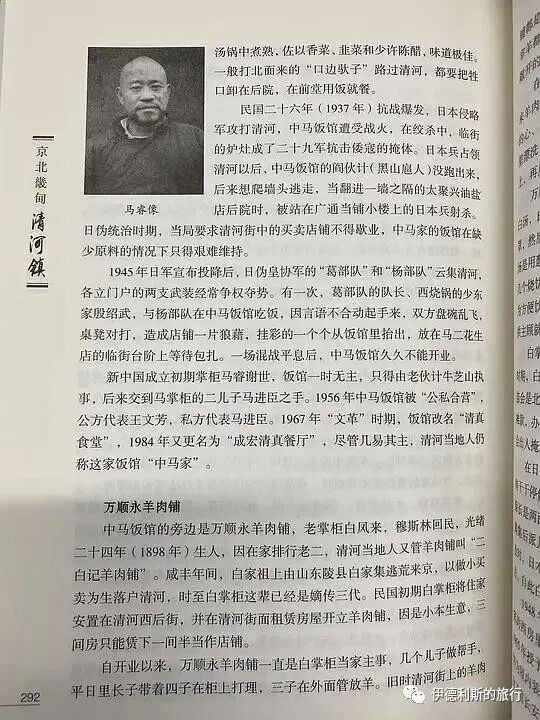
Zhongma Restaurant
During the Republic of China era, the largest halal restaurant in Qinghe was called Zhongma Restaurant, and it was very famous in the northern Beijing area.
The old owner of Zhongma Restaurant was known as Ma Ershun. His ancestral home was Dezhou, Shandong. During the Boxer Rebellion, the Ma family fought with broadswords, earning them the nickname "Broadsword Ma." After the Boxer Rebellion failed, the Ma family fled from the Four Women Mosque (Sinvsi) in Dezhou to Qinghe to escape the war. After arriving in Qinghe, the Ma family first walked the streets carrying shoulder poles to sell sesame flatbreads (shaobing) and steamed buns (baozi), later growing from traveling merchants into stall vendors.
Ma Ershun's third son, Ma Rui, lived in the middle of Qinghe Street and was known as "Zhongma." He started out running a small eatery, then bought property to open the Zhongma Restaurant, which had over 20 rooms with a shop in the front and living quarters in the back. Zhongma Restaurant served snacks like lamb and mung bean noodles (yangrou ludou zamian), sesame flatbread (shaobing), and lamb buns (yangrou baozi), along with simple seasonal stir-fried dishes. Because the food was affordable and suited local tastes, the restaurant became very famous.
The lamb and mung bean noodles at Zhongma Restaurant are made by boiling the noodles in a lamb broth pot, then topping them with cilantro, chives, and a splash of aged vinegar for a great taste. Caravan teams passing through Qinghe on their way to the capital from Juyong Pass would unload their pack animals in the back courtyard and eat in the front hall.
After the 1950s, Zhongma Restaurant passed to Ma Rui's son, Ma Jinchen. It joined a public-private partnership in 1956, was renamed the Halal Canteen in 1967, and became Chenghong Halal Restaurant in 1984, though locals still call it 'Zhongma's Place'.
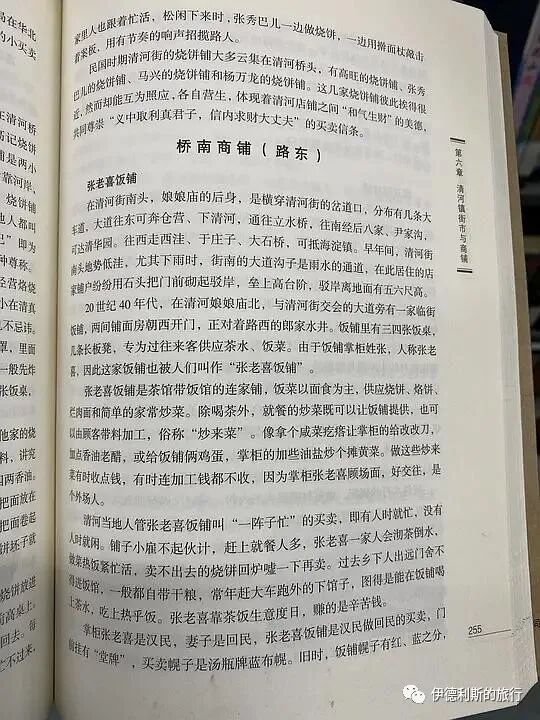
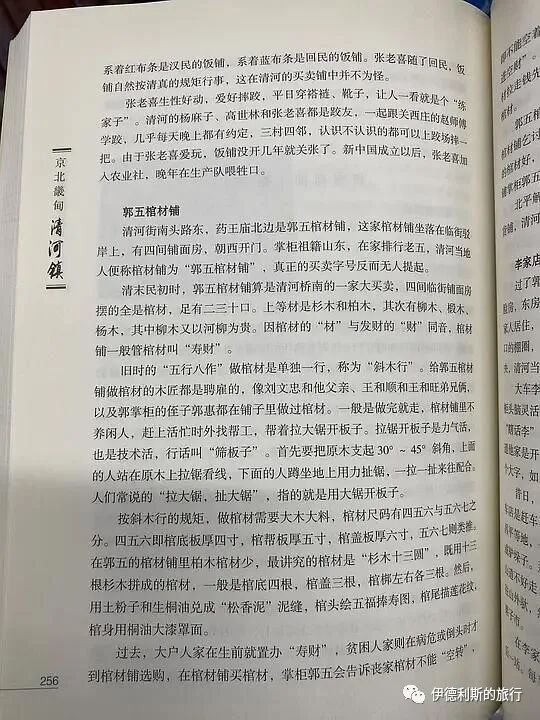
Zhang Laoxi Eatery
In the 1940s, there was a Zhang Laoxi Eatery on the east side of the road at the south end of Qinghe Street. Zhang Laoxi was Han Chinese and his wife was a Hui Muslim, so the eatery was run by a Han person serving halal food, with a blue cloth water pitcher (tangping) sign hanging in front. In the past, food stalls with red cloth strips tied to their signs were Han Chinese eateries, while those with blue cloth strips were Hui Muslim eateries. It was not unusual in Qinghe to find eateries like Zhang Laoxi's that followed Hui Muslim customs and sold halal food.
Zhang Laoxi's eatery had three or four tables and a few long benches, serving tea and meals to travelers, including sesame flatbread (shaobing), griddle-cooked flatbread (laobing), stewed meat noodles (lanroumian), and simple home-style stir-fried dishes. Customers could also bring their own ingredients for the shop to cook, which was commonly called "stir-frying brought-in food" (chao laicai). For example, if you gave the owner two eggs and some salt, he would stir-fry a plate of scrambled eggs (tuanhuangcai) for you. Sometimes he charged a small fee for these dishes, and sometimes he didn't charge at all, because Zhang Laoxi cared about his reputation, enjoyed socializing, and was a very outgoing person.
Zhang Laoxi loved wrestling. He usually wore a wrestling vest (dalian) and boots, and he would wrestle at the wrestling ring almost every night. Because of his love for wrestling, his eatery closed down after only a few years. In the 1950s, Zhang Laoxi joined an agricultural cooperative and spent his later years feeding livestock for the production team.
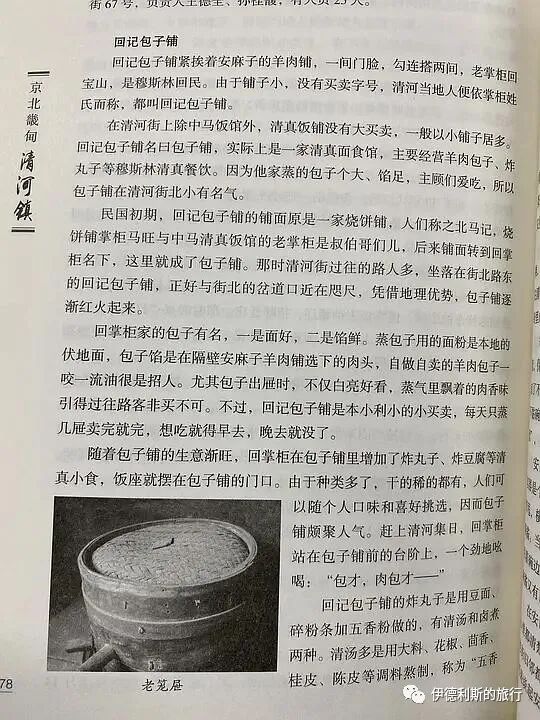
Hui's Steamed Bun Shop (Hui Ji Baozi Pu)
The old owner of Hui's Steamed Bun Shop is named Hui Baoshan. In the early years of the Republic of China, this place was originally the North Ma's Sesame Flatbread Shop (Beima Ji Shaobing Pu). The owner, Ma Wang, was a close friend of the old owner of the Central Ma's Halal Restaurant, and the shop only later passed to owner Hui.
Hui's Steamed Bun Shop specializes in lamb steamed buns (yangrou baozi) and fried meatballs (zha wanzi). Customers love them because the buns are large and full of filling. The flour used for the steamed buns is local summer-harvested wheat (fudimian), and the lamb filling comes from the meat cuts at An Mazi's Lamb Shop across the street. Every bite is juicy and oily. When the buns come out of the steamer, they are bright white, look great, and smell like savory meat.
As the business grew, the owner added snacks like fried meatballs and fried tofu (zha doufu). He serves both dry and liquid dishes, with dining tables set up right at the entrance. On market days, owner Hui stands on the steps and keeps calling out, "Buns, meat buns—"
Hui's fried meatballs are made with bean flour, crushed vermicelli, and five-spice powder. They are served in two ways: in clear soup or in a savory braised sauce (luzhu). Clear broth (qingtang) is made by simmering star anise, Sichuan peppercorns, fennel, cinnamon, and dried tangerine peel. When serving, add a little sesame paste, fermented bean curd sauce, rice vinegar, chopped cilantro, and a drizzle of chili oil. Braised stew (luzhu) is thickened with lamb bone broth (yanggutang) and served with a garlic and vinegar sauce. When selling meatball soup (wanzi tang), vendors usually add a few fried tofu puffs (doufupao) on the side.
After the public-private partnership reform in 1956, the Hui Muslim steamed bun shop (Huiji baozipu) closed down.
An Si's millet porridge stall (miancha tan).
An Si, whose real name was An Quan, was a Hui Muslim from Qinghe. His millet porridge stall was set up right in front of the Hui Muslim steamed bun shop. An Si sold both millet porridge and cold mung bean jelly with pickled vegetables (suancai liangfen). He set up his stall early every morning and kept the pot of porridge warm on the stove while he called out to customers. Millet porridge (miancha) is made by boiling broomcorn millet flour and foxtail millet flour. The sesame paste is kept in an iron can with holes in the lid. When pouring it, he would swing and flick his wrist to create a pattern of three horizontal and two vertical lines, then finish it with a sprinkle of sesame salt. If you want a double portion, they pour on another layer of sesame paste.
Making millet porridge (miancha) takes real skill. It needs the right thickness so the bowl stays clean and doesn't get sticky after you finish. In the past, people didn't use spoons or chopsticks for millet porridge. You held the base of the bowl and sipped from the edge. You weren't supposed to stir the porridge and sesame paste together. When you finished, you should see streaks of sesame paste left behind, ensuring every sip had both the porridge and the paste.
After the public-private partnership policy in 1956, the An Si millet porridge stall closed down.
Zhang Xiuba'er Sesame Flatbread Shop
The Zhang Xiuba'er Sesame Flatbread Shop on the west wing of the south side of Qinghe Bridge is just across the street from the sesame flatbread shop run by the Gao family, who are Hui Muslims. The owner, Zhang Wenxiu, was Han Chinese, but he worked in halal shops since he was a boy. He always made Hui Muslim snacks like sesame flatbread (shaobing), fried meatballs (zha wanzi), fried tofu (zha doufu), and millet porridge. His food was clean, so the Hui Muslims on Qinghe Street didn't mind eating there. Locals called him Zhang Xiuba'er out of respect, using the term 'Baba,' which is Persian for an elder.
Outside Zhang Xiuba'er's shop stood two high tables with glass covers, holding baked sesame flatbreads, bowls, chopsticks, and plates. Next to the high table are a flat griddle (bingdang) and a deep fryer. Usually, they fry food first, then bake the flatbreads. There are two dining tables inside the house. They sell food in front of the door and serve meals inside. To make the sesame flatbread (shaobing), you need ten jin of white flour, one jin of fermented dough, one jin of sesame paste, and four liang of sesame oil. First, let the prepared dough rest for a while. Then, place it on a board, knead it thoroughly, and roll it into a thin sheet. Sprinkle on Sichuan pepper salt, brush with sesame oil and sesame paste, roll the dough up, and cut it into small portions. Finally, round them out, roll them thin, and press a layer of sesame seeds onto the surface. Once the flatbread dough is ready, place it on the griddle to cook until it is ninety percent done. Use tongs to put it into the oven. When it is finished, stack the golden-brown flatbreads on the high table, and they are ready to eat.
Two Ding Family Mutton Shops.
One is located at the northeast end of Qinghe Bridge. The owner is Ding Guo'an. His ancestors came from Shandong, and his family has lived in Qinghe for six generations. Because Ding Guo'an is the youngest in his family, people call him Ding Laoba'er, so the business is also known as Ding Laoba'er Mutton Shop.
Ding Laoba'er's lamb shop sits at the end of Qinghe Bridge. A plaque with Arabic calligraphy (du'er) hangs by the door. Inside, a lamb display table (yangrou chuangzi) faces the entrance, where a row of brass hooks holds a whole skinned lamb. Behind the lamb display table is a dry well used to keep the meat fresh during hot weather. When customers arrive, Ding Laoba'er asks how they plan to cook the meat before he starts cutting. Sometimes he even tells them how to stew or stir-fry it.
Besides raw meat, Ding Laoba'er sells cooked items like spiced lamb (jiang yangrou), roasted lamb (shao yangrou), lamb head meat, and lamb offal (yangzasui). His five-spice roasted lamb is the best of them all. He adds cloves, amomum (sharen), cardamom, angelica dahurica (baizhi), and cinnamon to his stew, along with a secret family recipe. When frying, he uses a mix of half sesame oil and half peanut oil. When autumn arrives, people like to build up their strength for the winter. Passersby on Qinghe Street come to try Ding Laoba'er's five-spice roasted lamb, and on busy days, he sells a whole lamb.
In 1956, Ding Laoba'er joined a cooperative group, and his lamb shop closed down.
On the east side of the north end of Qinghe Street, there was another lamb shop called Ding's, run by brothers Ding Guoying and Ding Guohong. Outside Ding's Lamb Shop hangs a sign with Arabic scripture (dua) and a Chinese halal sign. Ding Guoying usually sells meat at the front counter, while Ding Guohong prepares cooked food in the back. The Ding brothers usually go to Shahe or Nankou in Changping to buy stock, picking up over a dozen sheep at a time. They have a sheep pen on the west side of the iron gate shop, known as Ding's Sheep Pen. They keep the sheep there and ask the mosque imam (shifu) to slaughter them when needed.
In the 1930s, the lamb shop passed to Ding Guohong's son, Ding Zhenzhi, until the shop closed and the sign was taken down in the 1950s.
Wanshunyong Lamb Shop
Next to the north side of Zhongma Restaurant is Wanshunyong Lamb Shop. The old owner, Bai Fenglai, was originally from Baijiaji in Ling County, Shandong. His ancestors fled famine and moved to Beijing during the Xianfeng era, settling in Qinghe to make a living through small trade. Bai is the third generation to run the business. In the early years of the Republic of China, Bai rented a storefront on Qinghe Street to open his lamb shop. Because he was the second child in his family, locals also called it the Second Bai Lamb Shop.
Because the shop was small, Bai had the mosque imam (shifu) slaughter the sheep right at the shop entrance. People said Bai ran an open business, calling it a "big bright platter" (daliangpan). When winter arrived, Bai made his own lamb offal soup (yangza baitang). He cleaned the sheep's heart, liver, lungs, stomach, and intestines, blanched them in a pot, rinsed them in cold water, and hung them to dry. Then, he boiled them in a soup pot, moved them to a bamboo steamer (longti), poured hot soup from the pot over them to rinse off the floating fat, and arranged them on a copper platter. When a passerby wants a drink, Shopkeeper Bai grabs some chopped lamb offal (yangza), puts it in a bowl, and dips it into a pot of hot broth inside. When he scoops it back into the bowl, he adds white broth, salt water, cilantro, aged vinegar, and chili paste. People who cannot afford a restaurant can buy a few sesame flatbreads (shaobing) at Zhong Majia, then come to Shopkeeper Bai for a bowl of offal white broth. You can ask for more broth after you finish the first bowl. Shopkeeper Bai built an earthen heated bed (kang) in his lamb shop, with a small table on it for customers to use while eating.
During the Japanese puppet regime, the lamb shop had to close because it could not pay the various heavy taxes.
Gao's Inn
Shopkeeper Gao is a Hui Muslim whose ancestors were from Shandong, and his family has lived in Qinghe for a long time. Gao's Inn hosts people who drive sheep from outside the Great Wall into the city, cart drivers, street peddlers, and fishermen who bring wooden boats by horse cart from Baiyangdian to Qinghe during the annual fishing season.
The guest rooms at Gao's Inn have large shared beds (datongpu) facing each other. Besides the large bed, there is a stove at the end of the bed where guests can burn firewood to boil water or heat up food. Sometimes guests would buy a pound of mixed-flour noodles (zamiantiao) on the street and ask Manager Gao to add some oil and salt to cook them. When it was cold in winter, guests at Gao's Inn could use the firewood for free. After the public-private partnership reform in 1956, Gao's Inn ceased to exist.
The small shops facing the street in front of Gao's Inn were all family businesses run by the Hui Muslim brothers of the Gao family.
Inside the small door to the north of Gao's Inn was Gao Tong's lamb shop. He set up a soup pot, cleaned the lamb heads and bones bought from Madian, boiled them in the pot, and sold the lamb head meat and lamb offal (yangzasui) at a very cheap price. Locals call this lamb head meat 'scraped bone meat' (guagurou), and the large pieces are called 'monkey heads' (houtou), which can be stir-fried with green onions. Besides selling at his door, he also carried a wicker basket with a wooden lid to sell his goods along the street every night.
Next to Gao Tong's mutton shop was Gao Lu's grocery store, named Dequanyong. It mainly sold dried fruits and small household goods like sugar-coated hawthorn balls (tangqiu) and sour jujube powder (suanzaomian). In winter, they sold hawthorn berries (shanlihong) and frozen persimmons (dongshizi). In summer, they sold watermelons. Before the Lunar New Year, they sold malt sugar (guandongtang) and firecrackers. Sometimes, they would ride a bike to Xinjiekou or Huguosi in the city to pick up popsicles to sell. The shop stayed in business until the public-private partnership era.
North of the grocery store was Gao Wang's sesame flatbread shop, also known as Gao's Sesame Flatbread Shop (Gaoji Shaobing Pu). Every morning, Gao Wang started baking sesame flatbread (shaobing), making baked wheat cakes (huoshao), and frying dough fritters (youbing), selling them as he made them. Gao Wang baked a set number of flatbreads each day and closed the shop once he finished using the fermented dough prepared the day before. During the Japanese puppet regime, the authorities enforced a security strengthening campaign in North China. The Gao family's street-front shops were torn down, and the family's small business at the end of Qinghe Bridge struggled to survive from then on.
Image description view all
Summary: Beijing Qinghe Muslim History: Old Halal Life in an Ancient Town is presented here as a firsthand travel account in clear English, beginning with this scene: During the National Day holiday, I read a book at the Capital Library called "Qinghe Town in the Northern Capital Region," which covers the history and folk customs of the ancient town of Qinghe in Beijing's Haidian. The account keeps its focus on Qinghe Beijing, Beijing Muslim History, Halal Life while preserving the names, places, food, and historical details from the Chinese source.
During the National Day holiday, I read a book at the Capital Library called "Qinghe Town in the Northern Capital Region," which covers the history and folk customs of the ancient town of Qinghe in Beijing's Haidian District. A very precious part of the book records the halal shops on Qinghe Street from the Qing Dynasty to the Republic of China era. These include the Zhongma Restaurant, famous for its lamb and mung bean noodles; a restaurant opened by a Muslim convert named Zhang Laoxi; the Huiji Steamed Bun Shop, which made lamb steamed buns (baozi) and bean flour meatball soup; the An Si Tea Stall, which served millet porridge with sesame paste (miancha) and cold mung bean starch jelly (liangfen); and a sesame flatbread (shaobing) shop run by a Han Chinese man named Zhang Xiuba'er who had made halal snacks since he was a child. The content is very rich, and I will share it with you below.
Zhongma Restaurant
During the Republic of China era, the largest halal restaurant in Qinghe was called Zhongma Restaurant, and it was very famous in the northern Beijing area.
The old owner of Zhongma Restaurant was known as Ma Ershun. His ancestral home was Dezhou, Shandong. During the Boxer Rebellion, the Ma family fought with broadswords, earning them the nickname "Broadsword Ma." After the Boxer Rebellion failed, the Ma family fled from the Four Women Mosque (Sinvsi) in Dezhou to Qinghe to escape the war. After arriving in Qinghe, the Ma family first walked the streets carrying shoulder poles to sell sesame flatbreads (shaobing) and steamed buns (baozi), later growing from traveling merchants into stall vendors.
Ma Ershun's third son, Ma Rui, lived in the middle of Qinghe Street and was known as "Zhongma." He started out running a small eatery, then bought property to open the Zhongma Restaurant, which had over 20 rooms with a shop in the front and living quarters in the back. Zhongma Restaurant served snacks like lamb and mung bean noodles (yangrou ludou zamian), sesame flatbread (shaobing), and lamb buns (yangrou baozi), along with simple seasonal stir-fried dishes. Because the food was affordable and suited local tastes, the restaurant became very famous.
The lamb and mung bean noodles at Zhongma Restaurant are made by boiling the noodles in a lamb broth pot, then topping them with cilantro, chives, and a splash of aged vinegar for a great taste. Caravan teams passing through Qinghe on their way to the capital from Juyong Pass would unload their pack animals in the back courtyard and eat in the front hall.
After the 1950s, Zhongma Restaurant passed to Ma Rui's son, Ma Jinchen. It joined a public-private partnership in 1956, was renamed the Halal Canteen in 1967, and became Chenghong Halal Restaurant in 1984, though locals still call it 'Zhongma's Place'.
Zhang Laoxi Eatery
In the 1940s, there was a Zhang Laoxi Eatery on the east side of the road at the south end of Qinghe Street. Zhang Laoxi was Han Chinese and his wife was a Hui Muslim, so the eatery was run by a Han person serving halal food, with a blue cloth water pitcher (tangping) sign hanging in front. In the past, food stalls with red cloth strips tied to their signs were Han Chinese eateries, while those with blue cloth strips were Hui Muslim eateries. It was not unusual in Qinghe to find eateries like Zhang Laoxi's that followed Hui Muslim customs and sold halal food.
Zhang Laoxi's eatery had three or four tables and a few long benches, serving tea and meals to travelers, including sesame flatbread (shaobing), griddle-cooked flatbread (laobing), stewed meat noodles (lanroumian), and simple home-style stir-fried dishes. Customers could also bring their own ingredients for the shop to cook, which was commonly called "stir-frying brought-in food" (chao laicai). For example, if you gave the owner two eggs and some salt, he would stir-fry a plate of scrambled eggs (tuanhuangcai) for you. Sometimes he charged a small fee for these dishes, and sometimes he didn't charge at all, because Zhang Laoxi cared about his reputation, enjoyed socializing, and was a very outgoing person.
Zhang Laoxi loved wrestling. He usually wore a wrestling vest (dalian) and boots, and he would wrestle at the wrestling ring almost every night. Because of his love for wrestling, his eatery closed down after only a few years. In the 1950s, Zhang Laoxi joined an agricultural cooperative and spent his later years feeding livestock for the production team.
Hui's Steamed Bun Shop (Hui Ji Baozi Pu)
The old owner of Hui's Steamed Bun Shop is named Hui Baoshan. In the early years of the Republic of China, this place was originally the North Ma's Sesame Flatbread Shop (Beima Ji Shaobing Pu). The owner, Ma Wang, was a close friend of the old owner of the Central Ma's Halal Restaurant, and the shop only later passed to owner Hui.
Hui's Steamed Bun Shop specializes in lamb steamed buns (yangrou baozi) and fried meatballs (zha wanzi). Customers love them because the buns are large and full of filling. The flour used for the steamed buns is local summer-harvested wheat (fudimian), and the lamb filling comes from the meat cuts at An Mazi's Lamb Shop across the street. Every bite is juicy and oily. When the buns come out of the steamer, they are bright white, look great, and smell like savory meat.
As the business grew, the owner added snacks like fried meatballs and fried tofu (zha doufu). He serves both dry and liquid dishes, with dining tables set up right at the entrance. On market days, owner Hui stands on the steps and keeps calling out, "Buns, meat buns—"
Hui's fried meatballs are made with bean flour, crushed vermicelli, and five-spice powder. They are served in two ways: in clear soup or in a savory braised sauce (luzhu). Clear broth (qingtang) is made by simmering star anise, Sichuan peppercorns, fennel, cinnamon, and dried tangerine peel. When serving, add a little sesame paste, fermented bean curd sauce, rice vinegar, chopped cilantro, and a drizzle of chili oil. Braised stew (luzhu) is thickened with lamb bone broth (yanggutang) and served with a garlic and vinegar sauce. When selling meatball soup (wanzi tang), vendors usually add a few fried tofu puffs (doufupao) on the side.
After the public-private partnership reform in 1956, the Hui Muslim steamed bun shop (Huiji baozipu) closed down.
An Si's millet porridge stall (miancha tan).
An Si, whose real name was An Quan, was a Hui Muslim from Qinghe. His millet porridge stall was set up right in front of the Hui Muslim steamed bun shop. An Si sold both millet porridge and cold mung bean jelly with pickled vegetables (suancai liangfen). He set up his stall early every morning and kept the pot of porridge warm on the stove while he called out to customers. Millet porridge (miancha) is made by boiling broomcorn millet flour and foxtail millet flour. The sesame paste is kept in an iron can with holes in the lid. When pouring it, he would swing and flick his wrist to create a pattern of three horizontal and two vertical lines, then finish it with a sprinkle of sesame salt. If you want a double portion, they pour on another layer of sesame paste.
Making millet porridge (miancha) takes real skill. It needs the right thickness so the bowl stays clean and doesn't get sticky after you finish. In the past, people didn't use spoons or chopsticks for millet porridge. You held the base of the bowl and sipped from the edge. You weren't supposed to stir the porridge and sesame paste together. When you finished, you should see streaks of sesame paste left behind, ensuring every sip had both the porridge and the paste.
After the public-private partnership policy in 1956, the An Si millet porridge stall closed down.
Zhang Xiuba'er Sesame Flatbread Shop
The Zhang Xiuba'er Sesame Flatbread Shop on the west wing of the south side of Qinghe Bridge is just across the street from the sesame flatbread shop run by the Gao family, who are Hui Muslims. The owner, Zhang Wenxiu, was Han Chinese, but he worked in halal shops since he was a boy. He always made Hui Muslim snacks like sesame flatbread (shaobing), fried meatballs (zha wanzi), fried tofu (zha doufu), and millet porridge. His food was clean, so the Hui Muslims on Qinghe Street didn't mind eating there. Locals called him Zhang Xiuba'er out of respect, using the term 'Baba,' which is Persian for an elder.
Outside Zhang Xiuba'er's shop stood two high tables with glass covers, holding baked sesame flatbreads, bowls, chopsticks, and plates. Next to the high table are a flat griddle (bingdang) and a deep fryer. Usually, they fry food first, then bake the flatbreads. There are two dining tables inside the house. They sell food in front of the door and serve meals inside. To make the sesame flatbread (shaobing), you need ten jin of white flour, one jin of fermented dough, one jin of sesame paste, and four liang of sesame oil. First, let the prepared dough rest for a while. Then, place it on a board, knead it thoroughly, and roll it into a thin sheet. Sprinkle on Sichuan pepper salt, brush with sesame oil and sesame paste, roll the dough up, and cut it into small portions. Finally, round them out, roll them thin, and press a layer of sesame seeds onto the surface. Once the flatbread dough is ready, place it on the griddle to cook until it is ninety percent done. Use tongs to put it into the oven. When it is finished, stack the golden-brown flatbreads on the high table, and they are ready to eat.
Two Ding Family Mutton Shops.
One is located at the northeast end of Qinghe Bridge. The owner is Ding Guo'an. His ancestors came from Shandong, and his family has lived in Qinghe for six generations. Because Ding Guo'an is the youngest in his family, people call him Ding Laoba'er, so the business is also known as Ding Laoba'er Mutton Shop.
Ding Laoba'er's lamb shop sits at the end of Qinghe Bridge. A plaque with Arabic calligraphy (du'er) hangs by the door. Inside, a lamb display table (yangrou chuangzi) faces the entrance, where a row of brass hooks holds a whole skinned lamb. Behind the lamb display table is a dry well used to keep the meat fresh during hot weather. When customers arrive, Ding Laoba'er asks how they plan to cook the meat before he starts cutting. Sometimes he even tells them how to stew or stir-fry it.
Besides raw meat, Ding Laoba'er sells cooked items like spiced lamb (jiang yangrou), roasted lamb (shao yangrou), lamb head meat, and lamb offal (yangzasui). His five-spice roasted lamb is the best of them all. He adds cloves, amomum (sharen), cardamom, angelica dahurica (baizhi), and cinnamon to his stew, along with a secret family recipe. When frying, he uses a mix of half sesame oil and half peanut oil. When autumn arrives, people like to build up their strength for the winter. Passersby on Qinghe Street come to try Ding Laoba'er's five-spice roasted lamb, and on busy days, he sells a whole lamb.
In 1956, Ding Laoba'er joined a cooperative group, and his lamb shop closed down.
On the east side of the north end of Qinghe Street, there was another lamb shop called Ding's, run by brothers Ding Guoying and Ding Guohong. Outside Ding's Lamb Shop hangs a sign with Arabic scripture (dua) and a Chinese halal sign. Ding Guoying usually sells meat at the front counter, while Ding Guohong prepares cooked food in the back. The Ding brothers usually go to Shahe or Nankou in Changping to buy stock, picking up over a dozen sheep at a time. They have a sheep pen on the west side of the iron gate shop, known as Ding's Sheep Pen. They keep the sheep there and ask the mosque imam (shifu) to slaughter them when needed.
In the 1930s, the lamb shop passed to Ding Guohong's son, Ding Zhenzhi, until the shop closed and the sign was taken down in the 1950s.
Wanshunyong Lamb Shop
Next to the north side of Zhongma Restaurant is Wanshunyong Lamb Shop. The old owner, Bai Fenglai, was originally from Baijiaji in Ling County, Shandong. His ancestors fled famine and moved to Beijing during the Xianfeng era, settling in Qinghe to make a living through small trade. Bai is the third generation to run the business. In the early years of the Republic of China, Bai rented a storefront on Qinghe Street to open his lamb shop. Because he was the second child in his family, locals also called it the Second Bai Lamb Shop.
Because the shop was small, Bai had the mosque imam (shifu) slaughter the sheep right at the shop entrance. People said Bai ran an open business, calling it a "big bright platter" (daliangpan). When winter arrived, Bai made his own lamb offal soup (yangza baitang). He cleaned the sheep's heart, liver, lungs, stomach, and intestines, blanched them in a pot, rinsed them in cold water, and hung them to dry. Then, he boiled them in a soup pot, moved them to a bamboo steamer (longti), poured hot soup from the pot over them to rinse off the floating fat, and arranged them on a copper platter. When a passerby wants a drink, Shopkeeper Bai grabs some chopped lamb offal (yangza), puts it in a bowl, and dips it into a pot of hot broth inside. When he scoops it back into the bowl, he adds white broth, salt water, cilantro, aged vinegar, and chili paste. People who cannot afford a restaurant can buy a few sesame flatbreads (shaobing) at Zhong Majia, then come to Shopkeeper Bai for a bowl of offal white broth. You can ask for more broth after you finish the first bowl. Shopkeeper Bai built an earthen heated bed (kang) in his lamb shop, with a small table on it for customers to use while eating.
During the Japanese puppet regime, the lamb shop had to close because it could not pay the various heavy taxes.
Gao's Inn
Shopkeeper Gao is a Hui Muslim whose ancestors were from Shandong, and his family has lived in Qinghe for a long time. Gao's Inn hosts people who drive sheep from outside the Great Wall into the city, cart drivers, street peddlers, and fishermen who bring wooden boats by horse cart from Baiyangdian to Qinghe during the annual fishing season.
The guest rooms at Gao's Inn have large shared beds (datongpu) facing each other. Besides the large bed, there is a stove at the end of the bed where guests can burn firewood to boil water or heat up food. Sometimes guests would buy a pound of mixed-flour noodles (zamiantiao) on the street and ask Manager Gao to add some oil and salt to cook them. When it was cold in winter, guests at Gao's Inn could use the firewood for free. After the public-private partnership reform in 1956, Gao's Inn ceased to exist.
The small shops facing the street in front of Gao's Inn were all family businesses run by the Hui Muslim brothers of the Gao family.
Inside the small door to the north of Gao's Inn was Gao Tong's lamb shop. He set up a soup pot, cleaned the lamb heads and bones bought from Madian, boiled them in the pot, and sold the lamb head meat and lamb offal (yangzasui) at a very cheap price. Locals call this lamb head meat 'scraped bone meat' (guagurou), and the large pieces are called 'monkey heads' (houtou), which can be stir-fried with green onions. Besides selling at his door, he also carried a wicker basket with a wooden lid to sell his goods along the street every night.
Next to Gao Tong's mutton shop was Gao Lu's grocery store, named Dequanyong. It mainly sold dried fruits and small household goods like sugar-coated hawthorn balls (tangqiu) and sour jujube powder (suanzaomian). In winter, they sold hawthorn berries (shanlihong) and frozen persimmons (dongshizi). In summer, they sold watermelons. Before the Lunar New Year, they sold malt sugar (guandongtang) and firecrackers. Sometimes, they would ride a bike to Xinjiekou or Huguosi in the city to pick up popsicles to sell. The shop stayed in business until the public-private partnership era.
North of the grocery store was Gao Wang's sesame flatbread shop, also known as Gao's Sesame Flatbread Shop (Gaoji Shaobing Pu). Every morning, Gao Wang started baking sesame flatbread (shaobing), making baked wheat cakes (huoshao), and frying dough fritters (youbing), selling them as he made them. Gao Wang baked a set number of flatbreads each day and closed the shop once he finished using the fermented dough prepared the day before. During the Japanese puppet regime, the authorities enforced a security strengthening campaign in North China. The Gao family's street-front shops were torn down, and the family's small business at the end of Qinghe Bridge struggled to survive from then on.
Image description view all
Reposted from the web
Summary: Beijing Qinghe Muslim History: Old Halal Life in an Ancient Town is presented here as a firsthand travel account in clear English, beginning with this scene: During the National Day holiday, I read a book at the Capital Library called "Qinghe Town in the Northern Capital Region," which covers the history and folk customs of the ancient town of Qinghe in Beijing's Haidian. The account keeps its focus on Qinghe Beijing, Beijing Muslim History, Halal Life while preserving the names, places, food, and historical details from the Chinese source.
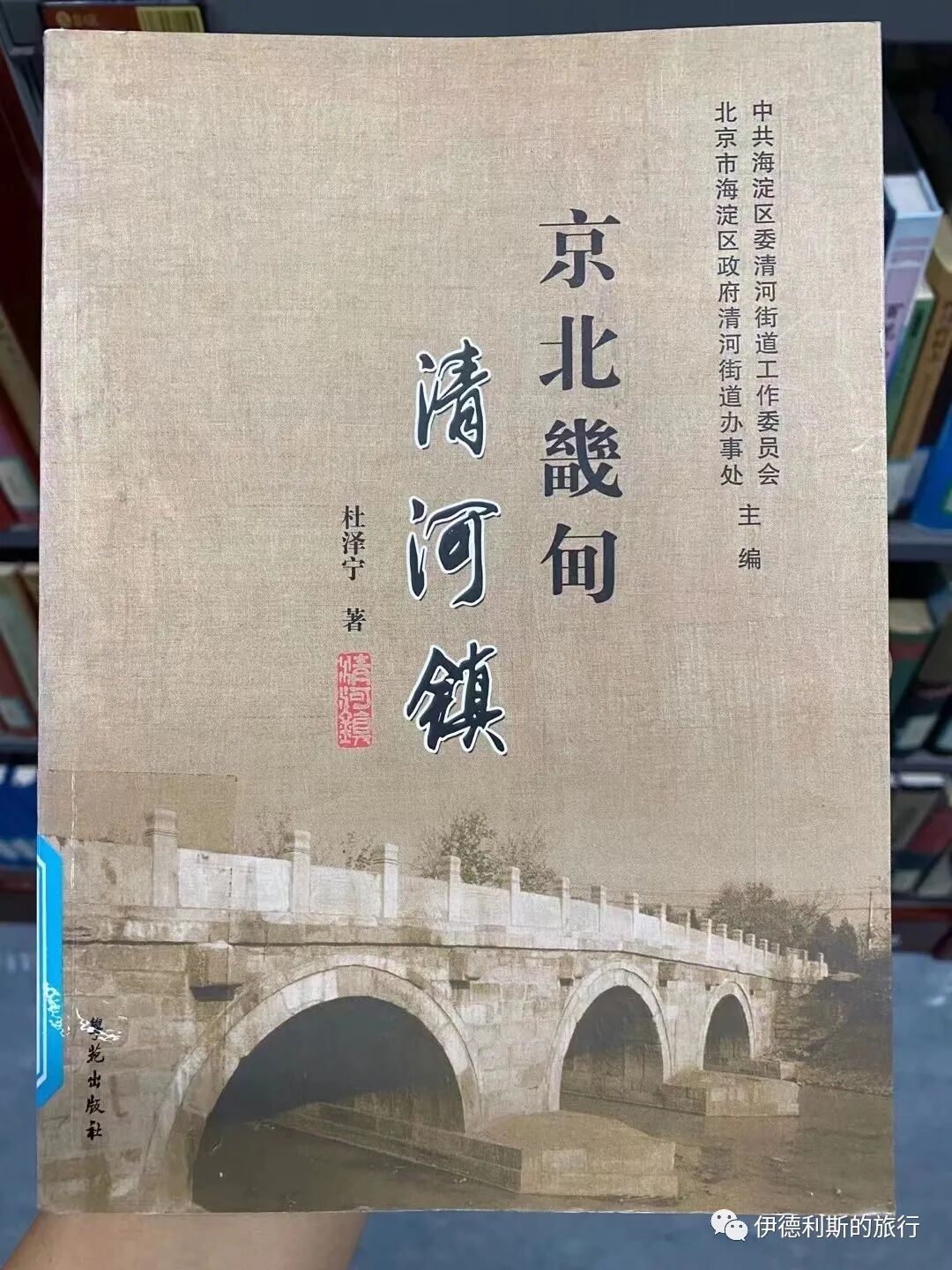
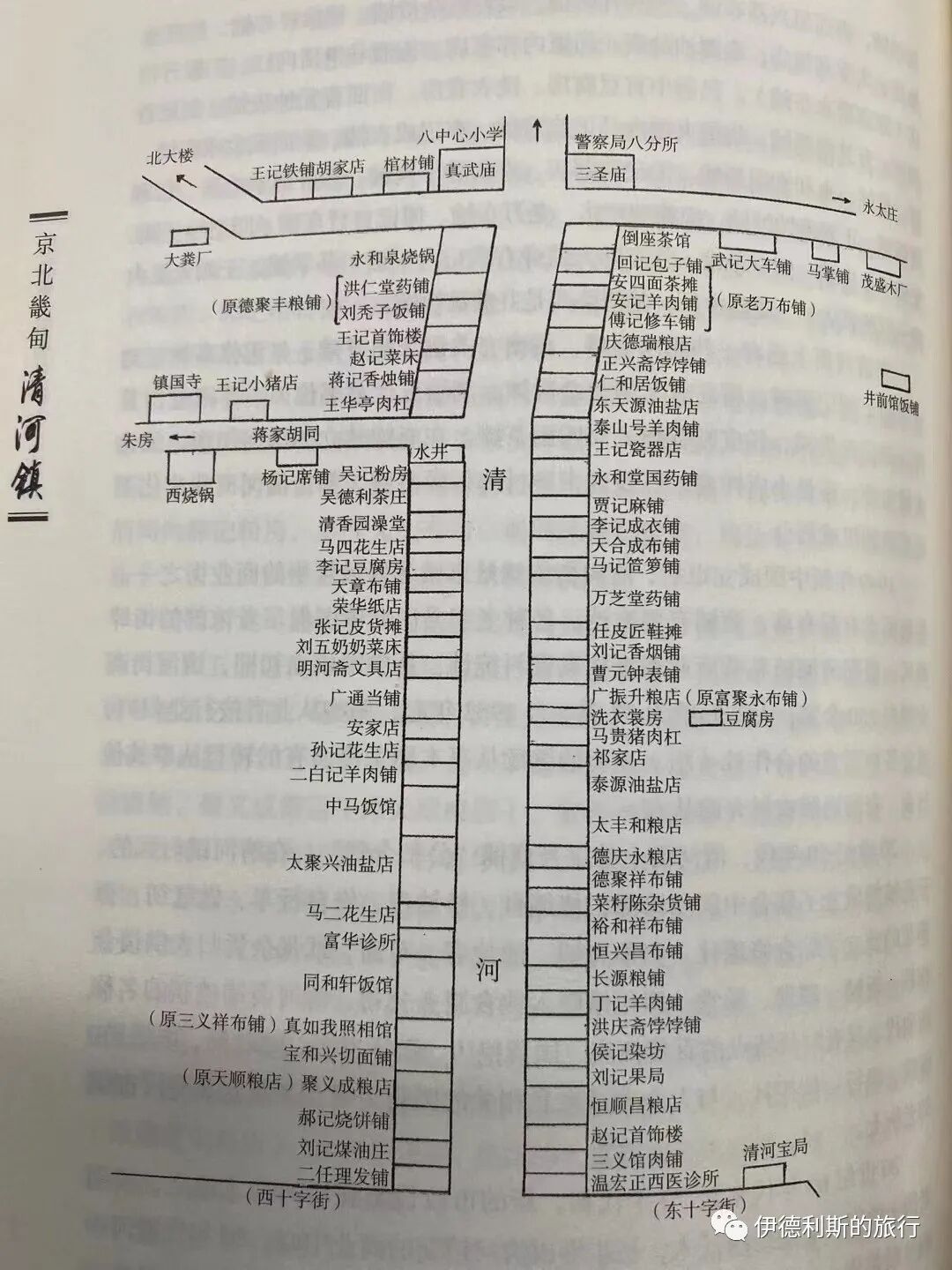
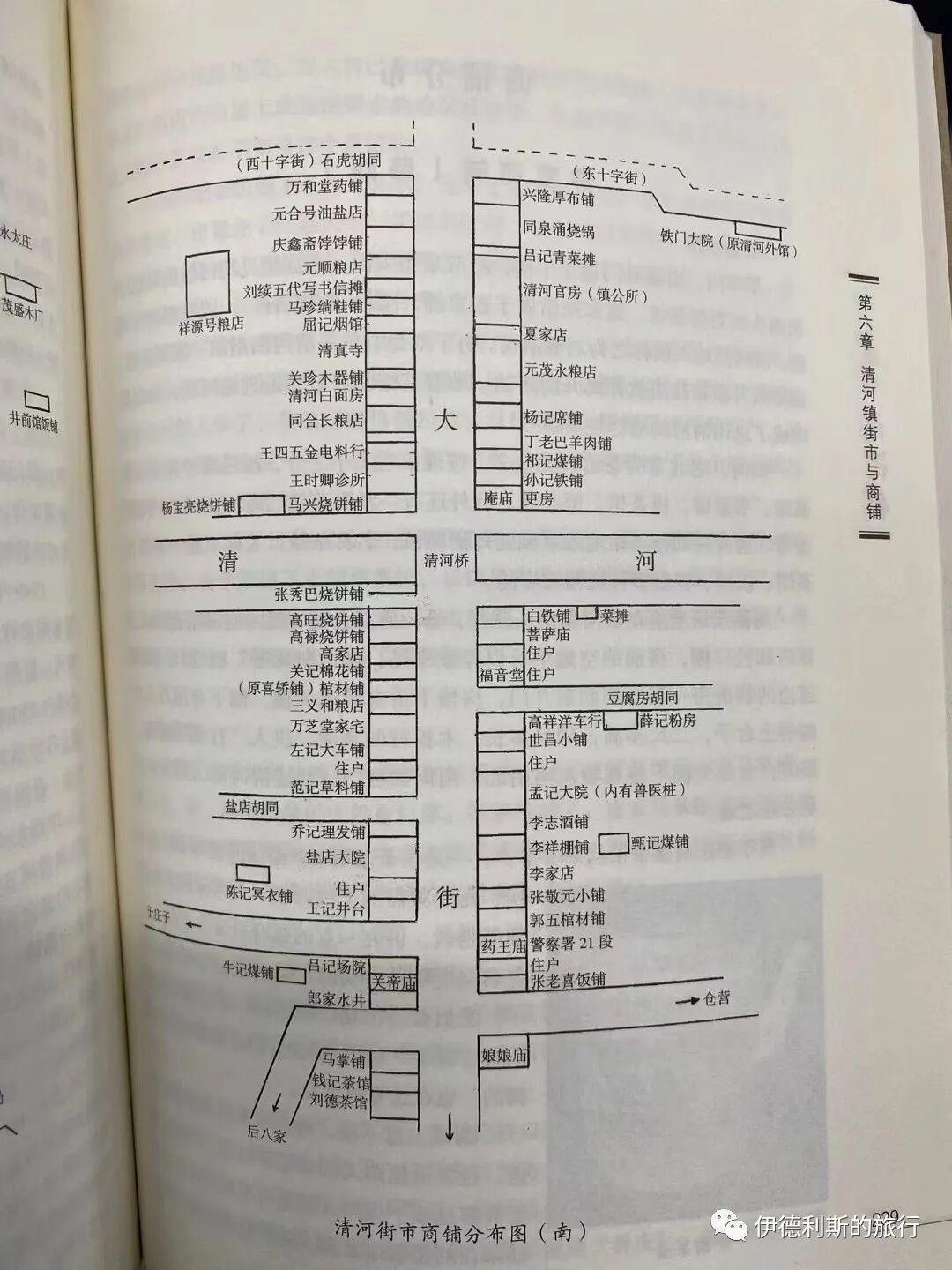
During the National Day holiday, I read a book at the Capital Library called "Qinghe Town in the Northern Capital Region," which covers the history and folk customs of the ancient town of Qinghe in Beijing's Haidian District. A very precious part of the book records the halal shops on Qinghe Street from the Qing Dynasty to the Republic of China era. These include the Zhongma Restaurant, famous for its lamb and mung bean noodles; a restaurant opened by a Muslim convert named Zhang Laoxi; the Huiji Steamed Bun Shop, which made lamb steamed buns (baozi) and bean flour meatball soup; the An Si Tea Stall, which served millet porridge with sesame paste (miancha) and cold mung bean starch jelly (liangfen); and a sesame flatbread (shaobing) shop run by a Han Chinese man named Zhang Xiuba'er who had made halal snacks since he was a child. The content is very rich, and I will share it with you below.
Zhongma Restaurant
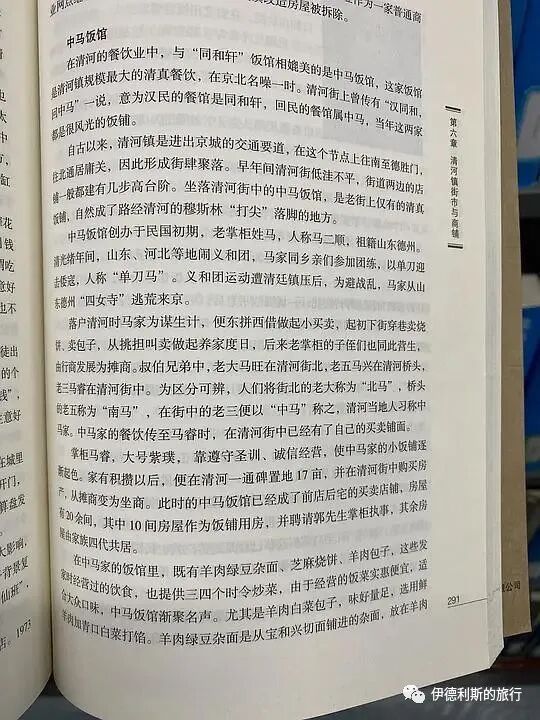
During the Republic of China era, the largest halal restaurant in Qinghe was called Zhongma Restaurant, and it was very famous in the northern Beijing area.
The old owner of Zhongma Restaurant was known as Ma Ershun. His ancestral home was Dezhou, Shandong. During the Boxer Rebellion, the Ma family fought with broadswords, earning them the nickname "Broadsword Ma." After the Boxer Rebellion failed, the Ma family fled from the Four Women Mosque (Sinvsi) in Dezhou to Qinghe to escape the war. After arriving in Qinghe, the Ma family first walked the streets carrying shoulder poles to sell sesame flatbreads (shaobing) and steamed buns (baozi), later growing from traveling merchants into stall vendors.
Ma Ershun's third son, Ma Rui, lived in the middle of Qinghe Street and was known as "Zhongma." He started out running a small eatery, then bought property to open the Zhongma Restaurant, which had over 20 rooms with a shop in the front and living quarters in the back. Zhongma Restaurant served snacks like lamb and mung bean noodles (yangrou ludou zamian), sesame flatbread (shaobing), and lamb buns (yangrou baozi), along with simple seasonal stir-fried dishes. Because the food was affordable and suited local tastes, the restaurant became very famous.
The lamb and mung bean noodles at Zhongma Restaurant are made by boiling the noodles in a lamb broth pot, then topping them with cilantro, chives, and a splash of aged vinegar for a great taste. Caravan teams passing through Qinghe on their way to the capital from Juyong Pass would unload their pack animals in the back courtyard and eat in the front hall.
After the 1950s, Zhongma Restaurant passed to Ma Rui's son, Ma Jinchen. It joined a public-private partnership in 1956, was renamed the Halal Canteen in 1967, and became Chenghong Halal Restaurant in 1984, though locals still call it 'Zhongma's Place'.
Zhang Laoxi Eatery
In the 1940s, there was a Zhang Laoxi Eatery on the east side of the road at the south end of Qinghe Street. Zhang Laoxi was Han Chinese and his wife was a Hui Muslim, so the eatery was run by a Han person serving halal food, with a blue cloth water pitcher (tangping) sign hanging in front. In the past, food stalls with red cloth strips tied to their signs were Han Chinese eateries, while those with blue cloth strips were Hui Muslim eateries. It was not unusual in Qinghe to find eateries like Zhang Laoxi's that followed Hui Muslim customs and sold halal food.
Zhang Laoxi's eatery had three or four tables and a few long benches, serving tea and meals to travelers, including sesame flatbread (shaobing), griddle-cooked flatbread (laobing), stewed meat noodles (lanroumian), and simple home-style stir-fried dishes. Customers could also bring their own ingredients for the shop to cook, which was commonly called "stir-frying brought-in food" (chao laicai). For example, if you gave the owner two eggs and some salt, he would stir-fry a plate of scrambled eggs (tuanhuangcai) for you. Sometimes he charged a small fee for these dishes, and sometimes he didn't charge at all, because Zhang Laoxi cared about his reputation, enjoyed socializing, and was a very outgoing person.
Zhang Laoxi loved wrestling. He usually wore a wrestling vest (dalian) and boots, and he would wrestle at the wrestling ring almost every night. Because of his love for wrestling, his eatery closed down after only a few years. In the 1950s, Zhang Laoxi joined an agricultural cooperative and spent his later years feeding livestock for the production team.
Hui's Steamed Bun Shop (Hui Ji Baozi Pu)
The old owner of Hui's Steamed Bun Shop is named Hui Baoshan. In the early years of the Republic of China, this place was originally the North Ma's Sesame Flatbread Shop (Beima Ji Shaobing Pu). The owner, Ma Wang, was a close friend of the old owner of the Central Ma's Halal Restaurant, and the shop only later passed to owner Hui.
Hui's Steamed Bun Shop specializes in lamb steamed buns (yangrou baozi) and fried meatballs (zha wanzi). Customers love them because the buns are large and full of filling. The flour used for the steamed buns is local summer-harvested wheat (fudimian), and the lamb filling comes from the meat cuts at An Mazi's Lamb Shop across the street. Every bite is juicy and oily. When the buns come out of the steamer, they are bright white, look great, and smell like savory meat.
As the business grew, the owner added snacks like fried meatballs and fried tofu (zha doufu). He serves both dry and liquid dishes, with dining tables set up right at the entrance. On market days, owner Hui stands on the steps and keeps calling out, "Buns, meat buns—"
Hui's fried meatballs are made with bean flour, crushed vermicelli, and five-spice powder. They are served in two ways: in clear soup or in a savory braised sauce (luzhu). Clear broth (qingtang) is made by simmering star anise, Sichuan peppercorns, fennel, cinnamon, and dried tangerine peel. When serving, add a little sesame paste, fermented bean curd sauce, rice vinegar, chopped cilantro, and a drizzle of chili oil. Braised stew (luzhu) is thickened with lamb bone broth (yanggutang) and served with a garlic and vinegar sauce. When selling meatball soup (wanzi tang), vendors usually add a few fried tofu puffs (doufupao) on the side.
After the public-private partnership reform in 1956, the Hui Muslim steamed bun shop (Huiji baozipu) closed down.
An Si's millet porridge stall (miancha tan).
An Si, whose real name was An Quan, was a Hui Muslim from Qinghe. His millet porridge stall was set up right in front of the Hui Muslim steamed bun shop. An Si sold both millet porridge and cold mung bean jelly with pickled vegetables (suancai liangfen). He set up his stall early every morning and kept the pot of porridge warm on the stove while he called out to customers. Millet porridge (miancha) is made by boiling broomcorn millet flour and foxtail millet flour. The sesame paste is kept in an iron can with holes in the lid. When pouring it, he would swing and flick his wrist to create a pattern of three horizontal and two vertical lines, then finish it with a sprinkle of sesame salt. If you want a double portion, they pour on another layer of sesame paste.
Making millet porridge (miancha) takes real skill. It needs the right thickness so the bowl stays clean and doesn't get sticky after you finish. In the past, people didn't use spoons or chopsticks for millet porridge. You held the base of the bowl and sipped from the edge. You weren't supposed to stir the porridge and sesame paste together. When you finished, you should see streaks of sesame paste left behind, ensuring every sip had both the porridge and the paste.
After the public-private partnership policy in 1956, the An Si millet porridge stall closed down.
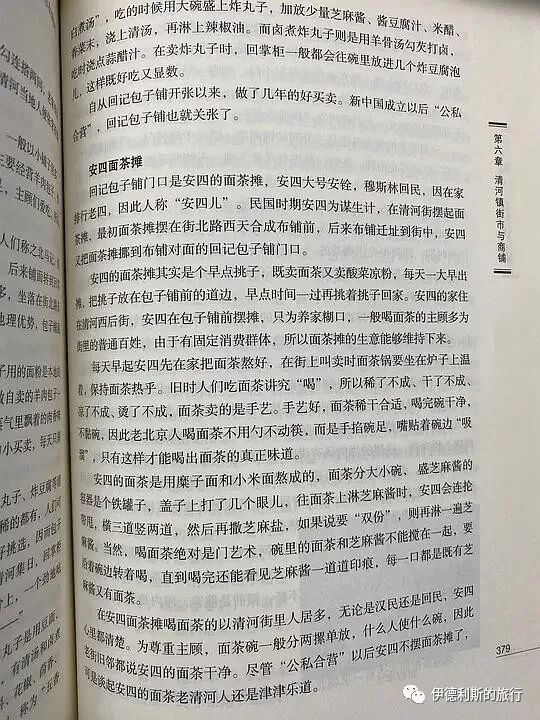
Zhang Xiuba'er Sesame Flatbread Shop
The Zhang Xiuba'er Sesame Flatbread Shop on the west wing of the south side of Qinghe Bridge is just across the street from the sesame flatbread shop run by the Gao family, who are Hui Muslims. The owner, Zhang Wenxiu, was Han Chinese, but he worked in halal shops since he was a boy. He always made Hui Muslim snacks like sesame flatbread (shaobing), fried meatballs (zha wanzi), fried tofu (zha doufu), and millet porridge. His food was clean, so the Hui Muslims on Qinghe Street didn't mind eating there. Locals called him Zhang Xiuba'er out of respect, using the term 'Baba,' which is Persian for an elder.
Outside Zhang Xiuba'er's shop stood two high tables with glass covers, holding baked sesame flatbreads, bowls, chopsticks, and plates. Next to the high table are a flat griddle (bingdang) and a deep fryer. Usually, they fry food first, then bake the flatbreads. There are two dining tables inside the house. They sell food in front of the door and serve meals inside. To make the sesame flatbread (shaobing), you need ten jin of white flour, one jin of fermented dough, one jin of sesame paste, and four liang of sesame oil. First, let the prepared dough rest for a while. Then, place it on a board, knead it thoroughly, and roll it into a thin sheet. Sprinkle on Sichuan pepper salt, brush with sesame oil and sesame paste, roll the dough up, and cut it into small portions. Finally, round them out, roll them thin, and press a layer of sesame seeds onto the surface. Once the flatbread dough is ready, place it on the griddle to cook until it is ninety percent done. Use tongs to put it into the oven. When it is finished, stack the golden-brown flatbreads on the high table, and they are ready to eat.
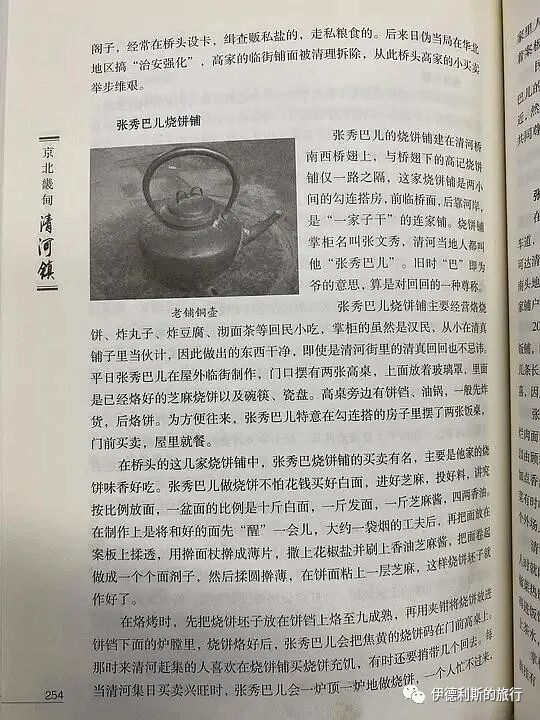
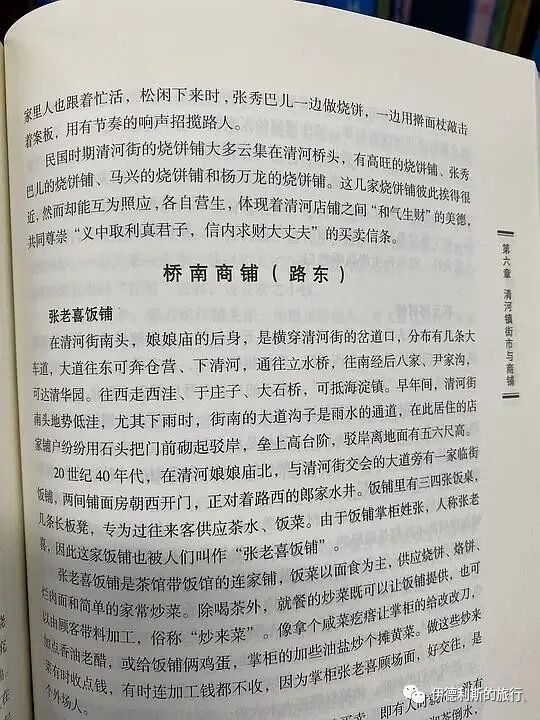
Two Ding Family Mutton Shops.
One is located at the northeast end of Qinghe Bridge. The owner is Ding Guo'an. His ancestors came from Shandong, and his family has lived in Qinghe for six generations. Because Ding Guo'an is the youngest in his family, people call him Ding Laoba'er, so the business is also known as Ding Laoba'er Mutton Shop.
Ding Laoba'er's lamb shop sits at the end of Qinghe Bridge. A plaque with Arabic calligraphy (du'er) hangs by the door. Inside, a lamb display table (yangrou chuangzi) faces the entrance, where a row of brass hooks holds a whole skinned lamb. Behind the lamb display table is a dry well used to keep the meat fresh during hot weather. When customers arrive, Ding Laoba'er asks how they plan to cook the meat before he starts cutting. Sometimes he even tells them how to stew or stir-fry it.
Besides raw meat, Ding Laoba'er sells cooked items like spiced lamb (jiang yangrou), roasted lamb (shao yangrou), lamb head meat, and lamb offal (yangzasui). His five-spice roasted lamb is the best of them all. He adds cloves, amomum (sharen), cardamom, angelica dahurica (baizhi), and cinnamon to his stew, along with a secret family recipe. When frying, he uses a mix of half sesame oil and half peanut oil. When autumn arrives, people like to build up their strength for the winter. Passersby on Qinghe Street come to try Ding Laoba'er's five-spice roasted lamb, and on busy days, he sells a whole lamb.
In 1956, Ding Laoba'er joined a cooperative group, and his lamb shop closed down.
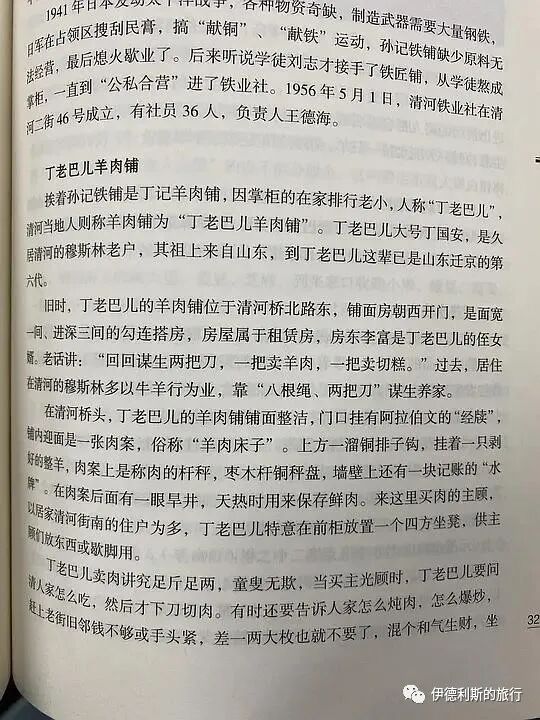
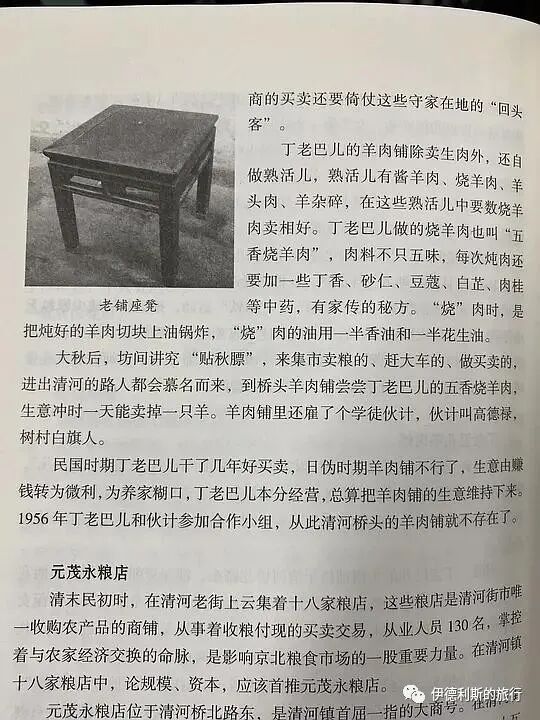
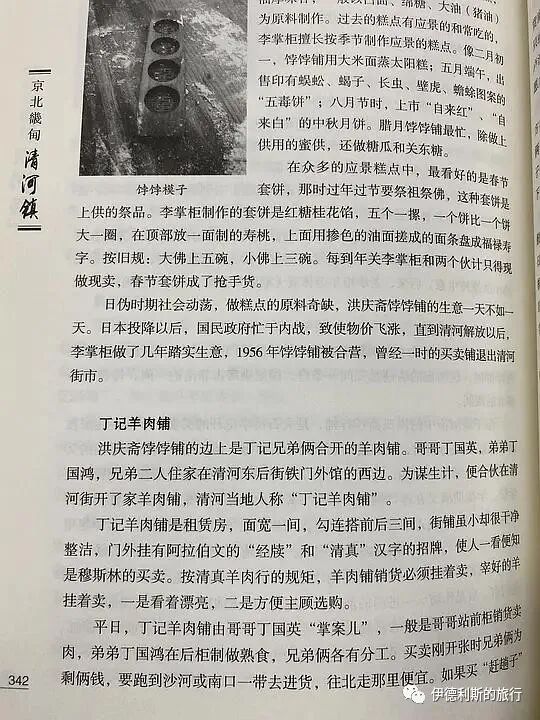
On the east side of the north end of Qinghe Street, there was another lamb shop called Ding's, run by brothers Ding Guoying and Ding Guohong. Outside Ding's Lamb Shop hangs a sign with Arabic scripture (dua) and a Chinese halal sign. Ding Guoying usually sells meat at the front counter, while Ding Guohong prepares cooked food in the back. The Ding brothers usually go to Shahe or Nankou in Changping to buy stock, picking up over a dozen sheep at a time. They have a sheep pen on the west side of the iron gate shop, known as Ding's Sheep Pen. They keep the sheep there and ask the mosque imam (shifu) to slaughter them when needed.
In the 1930s, the lamb shop passed to Ding Guohong's son, Ding Zhenzhi, until the shop closed and the sign was taken down in the 1950s.
Wanshunyong Lamb Shop
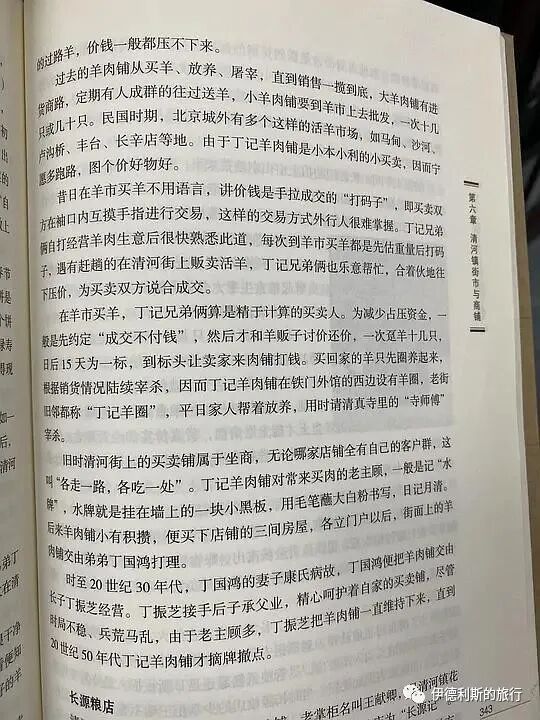
Next to the north side of Zhongma Restaurant is Wanshunyong Lamb Shop. The old owner, Bai Fenglai, was originally from Baijiaji in Ling County, Shandong. His ancestors fled famine and moved to Beijing during the Xianfeng era, settling in Qinghe to make a living through small trade. Bai is the third generation to run the business. In the early years of the Republic of China, Bai rented a storefront on Qinghe Street to open his lamb shop. Because he was the second child in his family, locals also called it the Second Bai Lamb Shop.
Because the shop was small, Bai had the mosque imam (shifu) slaughter the sheep right at the shop entrance. People said Bai ran an open business, calling it a "big bright platter" (daliangpan). When winter arrived, Bai made his own lamb offal soup (yangza baitang). He cleaned the sheep's heart, liver, lungs, stomach, and intestines, blanched them in a pot, rinsed them in cold water, and hung them to dry. Then, he boiled them in a soup pot, moved them to a bamboo steamer (longti), poured hot soup from the pot over them to rinse off the floating fat, and arranged them on a copper platter. When a passerby wants a drink, Shopkeeper Bai grabs some chopped lamb offal (yangza), puts it in a bowl, and dips it into a pot of hot broth inside. When he scoops it back into the bowl, he adds white broth, salt water, cilantro, aged vinegar, and chili paste. People who cannot afford a restaurant can buy a few sesame flatbreads (shaobing) at Zhong Majia, then come to Shopkeeper Bai for a bowl of offal white broth. You can ask for more broth after you finish the first bowl. Shopkeeper Bai built an earthen heated bed (kang) in his lamb shop, with a small table on it for customers to use while eating.
During the Japanese puppet regime, the lamb shop had to close because it could not pay the various heavy taxes.
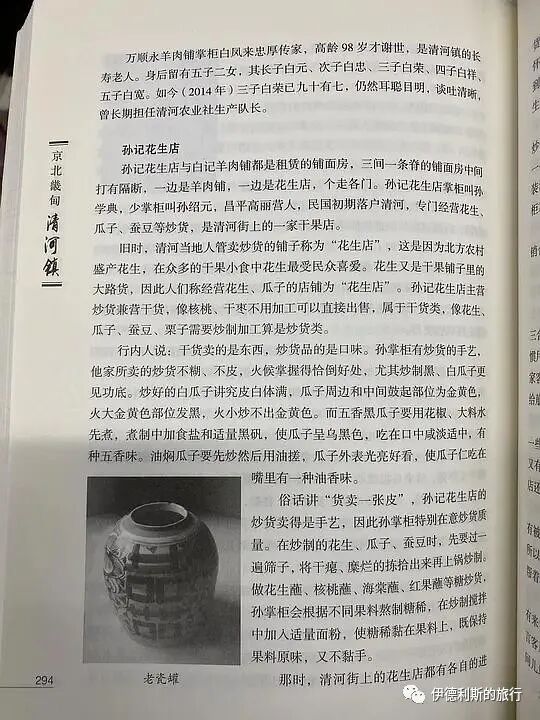
Gao's Inn
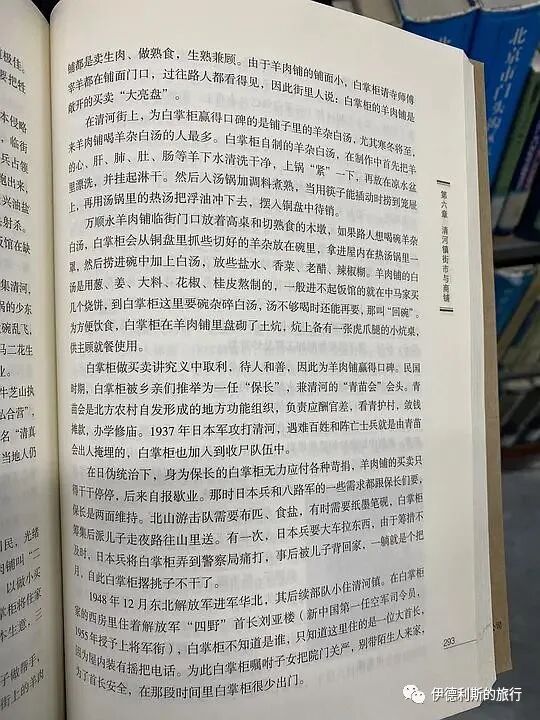
Shopkeeper Gao is a Hui Muslim whose ancestors were from Shandong, and his family has lived in Qinghe for a long time. Gao's Inn hosts people who drive sheep from outside the Great Wall into the city, cart drivers, street peddlers, and fishermen who bring wooden boats by horse cart from Baiyangdian to Qinghe during the annual fishing season.
The guest rooms at Gao's Inn have large shared beds (datongpu) facing each other. Besides the large bed, there is a stove at the end of the bed where guests can burn firewood to boil water or heat up food. Sometimes guests would buy a pound of mixed-flour noodles (zamiantiao) on the street and ask Manager Gao to add some oil and salt to cook them. When it was cold in winter, guests at Gao's Inn could use the firewood for free. After the public-private partnership reform in 1956, Gao's Inn ceased to exist.
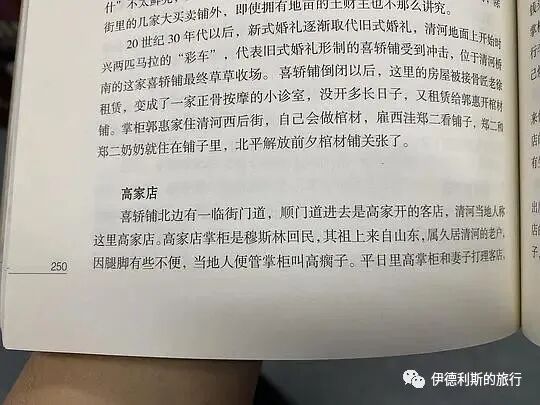
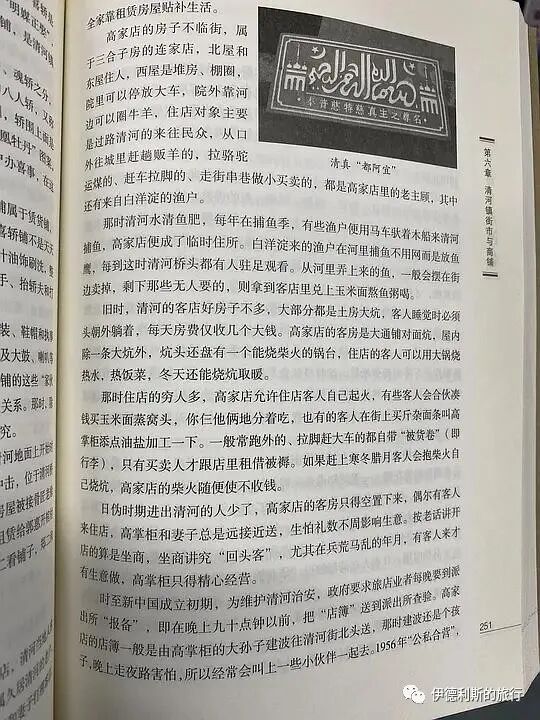
The small shops facing the street in front of Gao's Inn were all family businesses run by the Hui Muslim brothers of the Gao family.
Inside the small door to the north of Gao's Inn was Gao Tong's lamb shop. He set up a soup pot, cleaned the lamb heads and bones bought from Madian, boiled them in the pot, and sold the lamb head meat and lamb offal (yangzasui) at a very cheap price. Locals call this lamb head meat 'scraped bone meat' (guagurou), and the large pieces are called 'monkey heads' (houtou), which can be stir-fried with green onions. Besides selling at his door, he also carried a wicker basket with a wooden lid to sell his goods along the street every night.
Next to Gao Tong's mutton shop was Gao Lu's grocery store, named Dequanyong. It mainly sold dried fruits and small household goods like sugar-coated hawthorn balls (tangqiu) and sour jujube powder (suanzaomian). In winter, they sold hawthorn berries (shanlihong) and frozen persimmons (dongshizi). In summer, they sold watermelons. Before the Lunar New Year, they sold malt sugar (guandongtang) and firecrackers. Sometimes, they would ride a bike to Xinjiekou or Huguosi in the city to pick up popsicles to sell. The shop stayed in business until the public-private partnership era.
North of the grocery store was Gao Wang's sesame flatbread shop, also known as Gao's Sesame Flatbread Shop (Gaoji Shaobing Pu). Every morning, Gao Wang started baking sesame flatbread (shaobing), making baked wheat cakes (huoshao), and frying dough fritters (youbing), selling them as he made them. Gao Wang baked a set number of flatbreads each day and closed the shop once he finished using the fermented dough prepared the day before. During the Japanese puppet regime, the authorities enforced a security strengthening campaign in North China. The Gao family's street-front shops were torn down, and the family's small business at the end of Qinghe Bridge struggled to survive from then on.
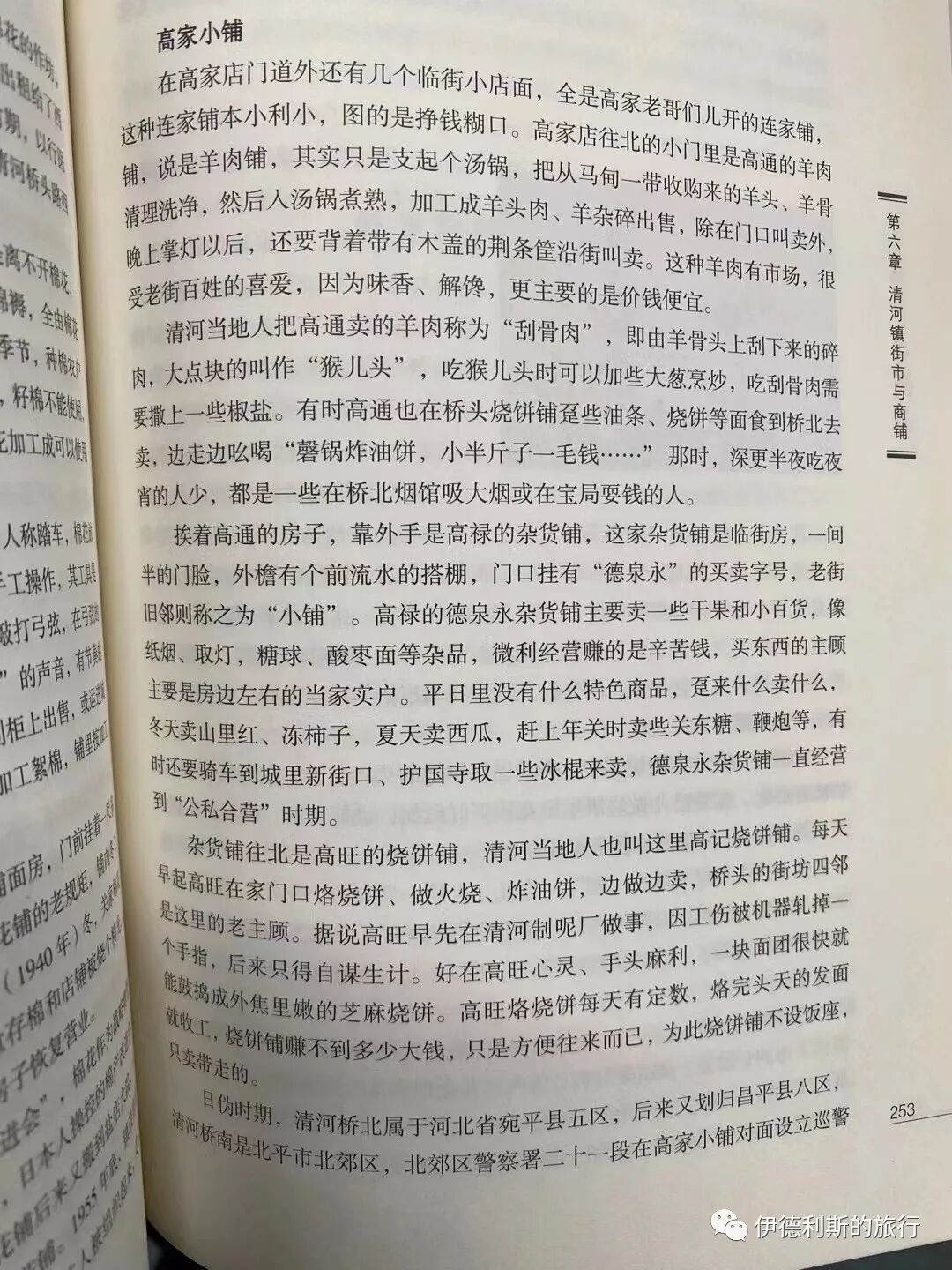
Image description
Summary: Beijing Qinghe Muslim History: Old Halal Life in an Ancient Town is presented here as a firsthand travel account in clear English, beginning with this scene: During the National Day holiday, I read a book at the Capital Library called "Qinghe Town in the Northern Capital Region," which covers the history and folk customs of the ancient town of Qinghe in Beijing's Haidian. The account keeps its focus on Qinghe Beijing, Beijing Muslim History, Halal Life while preserving the names, places, food, and historical details from the Chinese source.
During the National Day holiday, I read a book at the Capital Library called "Qinghe Town in the Northern Capital Region," which covers the history and folk customs of the ancient town of Qinghe in Beijing's Haidian District. A very precious part of the book records the halal shops on Qinghe Street from the Qing Dynasty to the Republic of China era. These include the Zhongma Restaurant, famous for its lamb and mung bean noodles; a restaurant opened by a Muslim convert named Zhang Laoxi; the Huiji Steamed Bun Shop, which made lamb steamed buns (baozi) and bean flour meatball soup; the An Si Tea Stall, which served millet porridge with sesame paste (miancha) and cold mung bean starch jelly (liangfen); and a sesame flatbread (shaobing) shop run by a Han Chinese man named Zhang Xiuba'er who had made halal snacks since he was a child. The content is very rich, and I will share it with you below.
Zhongma Restaurant
During the Republic of China era, the largest halal restaurant in Qinghe was called Zhongma Restaurant, and it was very famous in the northern Beijing area.
The old owner of Zhongma Restaurant was known as Ma Ershun. His ancestral home was Dezhou, Shandong. During the Boxer Rebellion, the Ma family fought with broadswords, earning them the nickname "Broadsword Ma." After the Boxer Rebellion failed, the Ma family fled from the Four Women Mosque (Sinvsi) in Dezhou to Qinghe to escape the war. After arriving in Qinghe, the Ma family first walked the streets carrying shoulder poles to sell sesame flatbreads (shaobing) and steamed buns (baozi), later growing from traveling merchants into stall vendors.
Ma Ershun's third son, Ma Rui, lived in the middle of Qinghe Street and was known as "Zhongma." He started out running a small eatery, then bought property to open the Zhongma Restaurant, which had over 20 rooms with a shop in the front and living quarters in the back. Zhongma Restaurant served snacks like lamb and mung bean noodles (yangrou ludou zamian), sesame flatbread (shaobing), and lamb buns (yangrou baozi), along with simple seasonal stir-fried dishes. Because the food was affordable and suited local tastes, the restaurant became very famous.
The lamb and mung bean noodles at Zhongma Restaurant are made by boiling the noodles in a lamb broth pot, then topping them with cilantro, chives, and a splash of aged vinegar for a great taste. Caravan teams passing through Qinghe on their way to the capital from Juyong Pass would unload their pack animals in the back courtyard and eat in the front hall.
After the 1950s, Zhongma Restaurant passed to Ma Rui's son, Ma Jinchen. It joined a public-private partnership in 1956, was renamed the Halal Canteen in 1967, and became Chenghong Halal Restaurant in 1984, though locals still call it 'Zhongma's Place'.
Zhang Laoxi Eatery
In the 1940s, there was a Zhang Laoxi Eatery on the east side of the road at the south end of Qinghe Street. Zhang Laoxi was Han Chinese and his wife was a Hui Muslim, so the eatery was run by a Han person serving halal food, with a blue cloth water pitcher (tangping) sign hanging in front. In the past, food stalls with red cloth strips tied to their signs were Han Chinese eateries, while those with blue cloth strips were Hui Muslim eateries. It was not unusual in Qinghe to find eateries like Zhang Laoxi's that followed Hui Muslim customs and sold halal food.
Zhang Laoxi's eatery had three or four tables and a few long benches, serving tea and meals to travelers, including sesame flatbread (shaobing), griddle-cooked flatbread (laobing), stewed meat noodles (lanroumian), and simple home-style stir-fried dishes. Customers could also bring their own ingredients for the shop to cook, which was commonly called "stir-frying brought-in food" (chao laicai). For example, if you gave the owner two eggs and some salt, he would stir-fry a plate of scrambled eggs (tuanhuangcai) for you. Sometimes he charged a small fee for these dishes, and sometimes he didn't charge at all, because Zhang Laoxi cared about his reputation, enjoyed socializing, and was a very outgoing person.
Zhang Laoxi loved wrestling. He usually wore a wrestling vest (dalian) and boots, and he would wrestle at the wrestling ring almost every night. Because of his love for wrestling, his eatery closed down after only a few years. In the 1950s, Zhang Laoxi joined an agricultural cooperative and spent his later years feeding livestock for the production team.
Hui's Steamed Bun Shop (Hui Ji Baozi Pu)
The old owner of Hui's Steamed Bun Shop is named Hui Baoshan. In the early years of the Republic of China, this place was originally the North Ma's Sesame Flatbread Shop (Beima Ji Shaobing Pu). The owner, Ma Wang, was a close friend of the old owner of the Central Ma's Halal Restaurant, and the shop only later passed to owner Hui.
Hui's Steamed Bun Shop specializes in lamb steamed buns (yangrou baozi) and fried meatballs (zha wanzi). Customers love them because the buns are large and full of filling. The flour used for the steamed buns is local summer-harvested wheat (fudimian), and the lamb filling comes from the meat cuts at An Mazi's Lamb Shop across the street. Every bite is juicy and oily. When the buns come out of the steamer, they are bright white, look great, and smell like savory meat.
As the business grew, the owner added snacks like fried meatballs and fried tofu (zha doufu). He serves both dry and liquid dishes, with dining tables set up right at the entrance. On market days, owner Hui stands on the steps and keeps calling out, "Buns, meat buns—"
Hui's fried meatballs are made with bean flour, crushed vermicelli, and five-spice powder. They are served in two ways: in clear soup or in a savory braised sauce (luzhu). Clear broth (qingtang) is made by simmering star anise, Sichuan peppercorns, fennel, cinnamon, and dried tangerine peel. When serving, add a little sesame paste, fermented bean curd sauce, rice vinegar, chopped cilantro, and a drizzle of chili oil. Braised stew (luzhu) is thickened with lamb bone broth (yanggutang) and served with a garlic and vinegar sauce. When selling meatball soup (wanzi tang), vendors usually add a few fried tofu puffs (doufupao) on the side.
After the public-private partnership reform in 1956, the Hui Muslim steamed bun shop (Huiji baozipu) closed down.
An Si's millet porridge stall (miancha tan).
An Si, whose real name was An Quan, was a Hui Muslim from Qinghe. His millet porridge stall was set up right in front of the Hui Muslim steamed bun shop. An Si sold both millet porridge and cold mung bean jelly with pickled vegetables (suancai liangfen). He set up his stall early every morning and kept the pot of porridge warm on the stove while he called out to customers. Millet porridge (miancha) is made by boiling broomcorn millet flour and foxtail millet flour. The sesame paste is kept in an iron can with holes in the lid. When pouring it, he would swing and flick his wrist to create a pattern of three horizontal and two vertical lines, then finish it with a sprinkle of sesame salt. If you want a double portion, they pour on another layer of sesame paste.
Making millet porridge (miancha) takes real skill. It needs the right thickness so the bowl stays clean and doesn't get sticky after you finish. In the past, people didn't use spoons or chopsticks for millet porridge. You held the base of the bowl and sipped from the edge. You weren't supposed to stir the porridge and sesame paste together. When you finished, you should see streaks of sesame paste left behind, ensuring every sip had both the porridge and the paste.
After the public-private partnership policy in 1956, the An Si millet porridge stall closed down.
Zhang Xiuba'er Sesame Flatbread Shop
The Zhang Xiuba'er Sesame Flatbread Shop on the west wing of the south side of Qinghe Bridge is just across the street from the sesame flatbread shop run by the Gao family, who are Hui Muslims. The owner, Zhang Wenxiu, was Han Chinese, but he worked in halal shops since he was a boy. He always made Hui Muslim snacks like sesame flatbread (shaobing), fried meatballs (zha wanzi), fried tofu (zha doufu), and millet porridge. His food was clean, so the Hui Muslims on Qinghe Street didn't mind eating there. Locals called him Zhang Xiuba'er out of respect, using the term 'Baba,' which is Persian for an elder.
Outside Zhang Xiuba'er's shop stood two high tables with glass covers, holding baked sesame flatbreads, bowls, chopsticks, and plates. Next to the high table are a flat griddle (bingdang) and a deep fryer. Usually, they fry food first, then bake the flatbreads. There are two dining tables inside the house. They sell food in front of the door and serve meals inside. To make the sesame flatbread (shaobing), you need ten jin of white flour, one jin of fermented dough, one jin of sesame paste, and four liang of sesame oil. First, let the prepared dough rest for a while. Then, place it on a board, knead it thoroughly, and roll it into a thin sheet. Sprinkle on Sichuan pepper salt, brush with sesame oil and sesame paste, roll the dough up, and cut it into small portions. Finally, round them out, roll them thin, and press a layer of sesame seeds onto the surface. Once the flatbread dough is ready, place it on the griddle to cook until it is ninety percent done. Use tongs to put it into the oven. When it is finished, stack the golden-brown flatbreads on the high table, and they are ready to eat.
Two Ding Family Mutton Shops.
One is located at the northeast end of Qinghe Bridge. The owner is Ding Guo'an. His ancestors came from Shandong, and his family has lived in Qinghe for six generations. Because Ding Guo'an is the youngest in his family, people call him Ding Laoba'er, so the business is also known as Ding Laoba'er Mutton Shop.
Ding Laoba'er's lamb shop sits at the end of Qinghe Bridge. A plaque with Arabic calligraphy (du'er) hangs by the door. Inside, a lamb display table (yangrou chuangzi) faces the entrance, where a row of brass hooks holds a whole skinned lamb. Behind the lamb display table is a dry well used to keep the meat fresh during hot weather. When customers arrive, Ding Laoba'er asks how they plan to cook the meat before he starts cutting. Sometimes he even tells them how to stew or stir-fry it.
Besides raw meat, Ding Laoba'er sells cooked items like spiced lamb (jiang yangrou), roasted lamb (shao yangrou), lamb head meat, and lamb offal (yangzasui). His five-spice roasted lamb is the best of them all. He adds cloves, amomum (sharen), cardamom, angelica dahurica (baizhi), and cinnamon to his stew, along with a secret family recipe. When frying, he uses a mix of half sesame oil and half peanut oil. When autumn arrives, people like to build up their strength for the winter. Passersby on Qinghe Street come to try Ding Laoba'er's five-spice roasted lamb, and on busy days, he sells a whole lamb.
In 1956, Ding Laoba'er joined a cooperative group, and his lamb shop closed down.
On the east side of the north end of Qinghe Street, there was another lamb shop called Ding's, run by brothers Ding Guoying and Ding Guohong. Outside Ding's Lamb Shop hangs a sign with Arabic scripture (dua) and a Chinese halal sign. Ding Guoying usually sells meat at the front counter, while Ding Guohong prepares cooked food in the back. The Ding brothers usually go to Shahe or Nankou in Changping to buy stock, picking up over a dozen sheep at a time. They have a sheep pen on the west side of the iron gate shop, known as Ding's Sheep Pen. They keep the sheep there and ask the mosque imam (shifu) to slaughter them when needed.
In the 1930s, the lamb shop passed to Ding Guohong's son, Ding Zhenzhi, until the shop closed and the sign was taken down in the 1950s.
Wanshunyong Lamb Shop
Next to the north side of Zhongma Restaurant is Wanshunyong Lamb Shop. The old owner, Bai Fenglai, was originally from Baijiaji in Ling County, Shandong. His ancestors fled famine and moved to Beijing during the Xianfeng era, settling in Qinghe to make a living through small trade. Bai is the third generation to run the business. In the early years of the Republic of China, Bai rented a storefront on Qinghe Street to open his lamb shop. Because he was the second child in his family, locals also called it the Second Bai Lamb Shop.
Because the shop was small, Bai had the mosque imam (shifu) slaughter the sheep right at the shop entrance. People said Bai ran an open business, calling it a "big bright platter" (daliangpan). When winter arrived, Bai made his own lamb offal soup (yangza baitang). He cleaned the sheep's heart, liver, lungs, stomach, and intestines, blanched them in a pot, rinsed them in cold water, and hung them to dry. Then, he boiled them in a soup pot, moved them to a bamboo steamer (longti), poured hot soup from the pot over them to rinse off the floating fat, and arranged them on a copper platter. When a passerby wants a drink, Shopkeeper Bai grabs some chopped lamb offal (yangza), puts it in a bowl, and dips it into a pot of hot broth inside. When he scoops it back into the bowl, he adds white broth, salt water, cilantro, aged vinegar, and chili paste. People who cannot afford a restaurant can buy a few sesame flatbreads (shaobing) at Zhong Majia, then come to Shopkeeper Bai for a bowl of offal white broth. You can ask for more broth after you finish the first bowl. Shopkeeper Bai built an earthen heated bed (kang) in his lamb shop, with a small table on it for customers to use while eating.
During the Japanese puppet regime, the lamb shop had to close because it could not pay the various heavy taxes.
Gao's Inn
Shopkeeper Gao is a Hui Muslim whose ancestors were from Shandong, and his family has lived in Qinghe for a long time. Gao's Inn hosts people who drive sheep from outside the Great Wall into the city, cart drivers, street peddlers, and fishermen who bring wooden boats by horse cart from Baiyangdian to Qinghe during the annual fishing season.
The guest rooms at Gao's Inn have large shared beds (datongpu) facing each other. Besides the large bed, there is a stove at the end of the bed where guests can burn firewood to boil water or heat up food. Sometimes guests would buy a pound of mixed-flour noodles (zamiantiao) on the street and ask Manager Gao to add some oil and salt to cook them. When it was cold in winter, guests at Gao's Inn could use the firewood for free. After the public-private partnership reform in 1956, Gao's Inn ceased to exist.
The small shops facing the street in front of Gao's Inn were all family businesses run by the Hui Muslim brothers of the Gao family.
Inside the small door to the north of Gao's Inn was Gao Tong's lamb shop. He set up a soup pot, cleaned the lamb heads and bones bought from Madian, boiled them in the pot, and sold the lamb head meat and lamb offal (yangzasui) at a very cheap price. Locals call this lamb head meat 'scraped bone meat' (guagurou), and the large pieces are called 'monkey heads' (houtou), which can be stir-fried with green onions. Besides selling at his door, he also carried a wicker basket with a wooden lid to sell his goods along the street every night.
Next to Gao Tong's mutton shop was Gao Lu's grocery store, named Dequanyong. It mainly sold dried fruits and small household goods like sugar-coated hawthorn balls (tangqiu) and sour jujube powder (suanzaomian). In winter, they sold hawthorn berries (shanlihong) and frozen persimmons (dongshizi). In summer, they sold watermelons. Before the Lunar New Year, they sold malt sugar (guandongtang) and firecrackers. Sometimes, they would ride a bike to Xinjiekou or Huguosi in the city to pick up popsicles to sell. The shop stayed in business until the public-private partnership era.
North of the grocery store was Gao Wang's sesame flatbread shop, also known as Gao's Sesame Flatbread Shop (Gaoji Shaobing Pu). Every morning, Gao Wang started baking sesame flatbread (shaobing), making baked wheat cakes (huoshao), and frying dough fritters (youbing), selling them as he made them. Gao Wang baked a set number of flatbreads each day and closed the shop once he finished using the fermented dough prepared the day before. During the Japanese puppet regime, the authorities enforced a security strengthening campaign in North China. The Gao family's street-front shops were torn down, and the family's small business at the end of Qinghe Bridge struggled to survive from then on.
Image description
Beijing Qinghe Muslim History: Old Halal Life in an Ancient Town
Articles • ali2007fr posted the article • 0 comments • 175 views • 2026-05-18 08:38
Reposted from the web
Summary: Beijing Qinghe Muslim History: Old Halal Life in an Ancient Town is presented here as a firsthand travel account in clear English, beginning with this scene: During the National Day holiday, I read a book at the Capital Library called "Qinghe Town in the Northern Capital Region," which covers the history and folk customs of the ancient town of Qinghe in Beijing's Haidian. The account keeps its focus on Qinghe Beijing, Beijing Muslim History, Halal Life while preserving the names, places, food, and historical details from the Chinese source.
During the National Day holiday, I read a book at the Capital Library called "Qinghe Town in the Northern Capital Region," which covers the history and folk customs of the ancient town of Qinghe in Beijing's Haidian District. A very precious part of the book records the halal shops on Qinghe Street from the Qing Dynasty to the Republic of China era. These include the Zhongma Restaurant, famous for its lamb and mung bean noodles; a restaurant opened by a Muslim convert named Zhang Laoxi; the Huiji Steamed Bun Shop, which made lamb steamed buns (baozi) and bean flour meatball soup; the An Si Tea Stall, which served millet porridge with sesame paste (miancha) and cold mung bean starch jelly (liangfen); and a sesame flatbread (shaobing) shop run by a Han Chinese man named Zhang Xiuba'er who had made halal snacks since he was a child. The content is very rich, and I will share it with you below.
Zhongma Restaurant
During the Republic of China era, the largest halal restaurant in Qinghe was called Zhongma Restaurant, and it was very famous in the northern Beijing area.
The old owner of Zhongma Restaurant was known as Ma Ershun. His ancestral home was Dezhou, Shandong. During the Boxer Rebellion, the Ma family fought with broadswords, earning them the nickname "Broadsword Ma." After the Boxer Rebellion failed, the Ma family fled from the Four Women Mosque (Sinvsi) in Dezhou to Qinghe to escape the war. After arriving in Qinghe, the Ma family first walked the streets carrying shoulder poles to sell sesame flatbreads (shaobing) and steamed buns (baozi), later growing from traveling merchants into stall vendors.
Ma Ershun's third son, Ma Rui, lived in the middle of Qinghe Street and was known as "Zhongma." He started out running a small eatery, then bought property to open the Zhongma Restaurant, which had over 20 rooms with a shop in the front and living quarters in the back. Zhongma Restaurant served snacks like lamb and mung bean noodles (yangrou ludou zamian), sesame flatbread (shaobing), and lamb buns (yangrou baozi), along with simple seasonal stir-fried dishes. Because the food was affordable and suited local tastes, the restaurant became very famous.
The lamb and mung bean noodles at Zhongma Restaurant are made by boiling the noodles in a lamb broth pot, then topping them with cilantro, chives, and a splash of aged vinegar for a great taste. Caravan teams passing through Qinghe on their way to the capital from Juyong Pass would unload their pack animals in the back courtyard and eat in the front hall.
After the 1950s, Zhongma Restaurant passed to Ma Rui's son, Ma Jinchen. It joined a public-private partnership in 1956, was renamed the Halal Canteen in 1967, and became Chenghong Halal Restaurant in 1984, though locals still call it 'Zhongma's Place'.
Zhang Laoxi Eatery
In the 1940s, there was a Zhang Laoxi Eatery on the east side of the road at the south end of Qinghe Street. Zhang Laoxi was Han Chinese and his wife was a Hui Muslim, so the eatery was run by a Han person serving halal food, with a blue cloth water pitcher (tangping) sign hanging in front. In the past, food stalls with red cloth strips tied to their signs were Han Chinese eateries, while those with blue cloth strips were Hui Muslim eateries. It was not unusual in Qinghe to find eateries like Zhang Laoxi's that followed Hui Muslim customs and sold halal food.
Zhang Laoxi's eatery had three or four tables and a few long benches, serving tea and meals to travelers, including sesame flatbread (shaobing), griddle-cooked flatbread (laobing), stewed meat noodles (lanroumian), and simple home-style stir-fried dishes. Customers could also bring their own ingredients for the shop to cook, which was commonly called "stir-frying brought-in food" (chao laicai). For example, if you gave the owner two eggs and some salt, he would stir-fry a plate of scrambled eggs (tuanhuangcai) for you. Sometimes he charged a small fee for these dishes, and sometimes he didn't charge at all, because Zhang Laoxi cared about his reputation, enjoyed socializing, and was a very outgoing person.
Zhang Laoxi loved wrestling. He usually wore a wrestling vest (dalian) and boots, and he would wrestle at the wrestling ring almost every night. Because of his love for wrestling, his eatery closed down after only a few years. In the 1950s, Zhang Laoxi joined an agricultural cooperative and spent his later years feeding livestock for the production team.
Hui's Steamed Bun Shop (Hui Ji Baozi Pu)
The old owner of Hui's Steamed Bun Shop is named Hui Baoshan. In the early years of the Republic of China, this place was originally the North Ma's Sesame Flatbread Shop (Beima Ji Shaobing Pu). The owner, Ma Wang, was a close friend of the old owner of the Central Ma's Halal Restaurant, and the shop only later passed to owner Hui.
Hui's Steamed Bun Shop specializes in lamb steamed buns (yangrou baozi) and fried meatballs (zha wanzi). Customers love them because the buns are large and full of filling. The flour used for the steamed buns is local summer-harvested wheat (fudimian), and the lamb filling comes from the meat cuts at An Mazi's Lamb Shop across the street. Every bite is juicy and oily. When the buns come out of the steamer, they are bright white, look great, and smell like savory meat.
As the business grew, the owner added snacks like fried meatballs and fried tofu (zha doufu). He serves both dry and liquid dishes, with dining tables set up right at the entrance. On market days, owner Hui stands on the steps and keeps calling out, "Buns, meat buns—"
Hui's fried meatballs are made with bean flour, crushed vermicelli, and five-spice powder. They are served in two ways: in clear soup or in a savory braised sauce (luzhu). Clear broth (qingtang) is made by simmering star anise, Sichuan peppercorns, fennel, cinnamon, and dried tangerine peel. When serving, add a little sesame paste, fermented bean curd sauce, rice vinegar, chopped cilantro, and a drizzle of chili oil. Braised stew (luzhu) is thickened with lamb bone broth (yanggutang) and served with a garlic and vinegar sauce. When selling meatball soup (wanzi tang), vendors usually add a few fried tofu puffs (doufupao) on the side.
After the public-private partnership reform in 1956, the Hui Muslim steamed bun shop (Huiji baozipu) closed down.
An Si's millet porridge stall (miancha tan).
An Si, whose real name was An Quan, was a Hui Muslim from Qinghe. His millet porridge stall was set up right in front of the Hui Muslim steamed bun shop. An Si sold both millet porridge and cold mung bean jelly with pickled vegetables (suancai liangfen). He set up his stall early every morning and kept the pot of porridge warm on the stove while he called out to customers. Millet porridge (miancha) is made by boiling broomcorn millet flour and foxtail millet flour. The sesame paste is kept in an iron can with holes in the lid. When pouring it, he would swing and flick his wrist to create a pattern of three horizontal and two vertical lines, then finish it with a sprinkle of sesame salt. If you want a double portion, they pour on another layer of sesame paste.
Making millet porridge (miancha) takes real skill. It needs the right thickness so the bowl stays clean and doesn't get sticky after you finish. In the past, people didn't use spoons or chopsticks for millet porridge. You held the base of the bowl and sipped from the edge. You weren't supposed to stir the porridge and sesame paste together. When you finished, you should see streaks of sesame paste left behind, ensuring every sip had both the porridge and the paste.
After the public-private partnership policy in 1956, the An Si millet porridge stall closed down.
Zhang Xiuba'er Sesame Flatbread Shop
The Zhang Xiuba'er Sesame Flatbread Shop on the west wing of the south side of Qinghe Bridge is just across the street from the sesame flatbread shop run by the Gao family, who are Hui Muslims. The owner, Zhang Wenxiu, was Han Chinese, but he worked in halal shops since he was a boy. He always made Hui Muslim snacks like sesame flatbread (shaobing), fried meatballs (zha wanzi), fried tofu (zha doufu), and millet porridge. His food was clean, so the Hui Muslims on Qinghe Street didn't mind eating there. Locals called him Zhang Xiuba'er out of respect, using the term 'Baba,' which is Persian for an elder.
Outside Zhang Xiuba'er's shop stood two high tables with glass covers, holding baked sesame flatbreads, bowls, chopsticks, and plates. Next to the high table are a flat griddle (bingdang) and a deep fryer. Usually, they fry food first, then bake the flatbreads. There are two dining tables inside the house. They sell food in front of the door and serve meals inside. To make the sesame flatbread (shaobing), you need ten jin of white flour, one jin of fermented dough, one jin of sesame paste, and four liang of sesame oil. First, let the prepared dough rest for a while. Then, place it on a board, knead it thoroughly, and roll it into a thin sheet. Sprinkle on Sichuan pepper salt, brush with sesame oil and sesame paste, roll the dough up, and cut it into small portions. Finally, round them out, roll them thin, and press a layer of sesame seeds onto the surface. Once the flatbread dough is ready, place it on the griddle to cook until it is ninety percent done. Use tongs to put it into the oven. When it is finished, stack the golden-brown flatbreads on the high table, and they are ready to eat.
Two Ding Family Mutton Shops.
One is located at the northeast end of Qinghe Bridge. The owner is Ding Guo'an. His ancestors came from Shandong, and his family has lived in Qinghe for six generations. Because Ding Guo'an is the youngest in his family, people call him Ding Laoba'er, so the business is also known as Ding Laoba'er Mutton Shop.
Ding Laoba'er's lamb shop sits at the end of Qinghe Bridge. A plaque with Arabic calligraphy (du'er) hangs by the door. Inside, a lamb display table (yangrou chuangzi) faces the entrance, where a row of brass hooks holds a whole skinned lamb. Behind the lamb display table is a dry well used to keep the meat fresh during hot weather. When customers arrive, Ding Laoba'er asks how they plan to cook the meat before he starts cutting. Sometimes he even tells them how to stew or stir-fry it.
Besides raw meat, Ding Laoba'er sells cooked items like spiced lamb (jiang yangrou), roasted lamb (shao yangrou), lamb head meat, and lamb offal (yangzasui). His five-spice roasted lamb is the best of them all. He adds cloves, amomum (sharen), cardamom, angelica dahurica (baizhi), and cinnamon to his stew, along with a secret family recipe. When frying, he uses a mix of half sesame oil and half peanut oil. When autumn arrives, people like to build up their strength for the winter. Passersby on Qinghe Street come to try Ding Laoba'er's five-spice roasted lamb, and on busy days, he sells a whole lamb.
In 1956, Ding Laoba'er joined a cooperative group, and his lamb shop closed down.
On the east side of the north end of Qinghe Street, there was another lamb shop called Ding's, run by brothers Ding Guoying and Ding Guohong. Outside Ding's Lamb Shop hangs a sign with Arabic scripture (dua) and a Chinese halal sign. Ding Guoying usually sells meat at the front counter, while Ding Guohong prepares cooked food in the back. The Ding brothers usually go to Shahe or Nankou in Changping to buy stock, picking up over a dozen sheep at a time. They have a sheep pen on the west side of the iron gate shop, known as Ding's Sheep Pen. They keep the sheep there and ask the mosque imam (shifu) to slaughter them when needed.
In the 1930s, the lamb shop passed to Ding Guohong's son, Ding Zhenzhi, until the shop closed and the sign was taken down in the 1950s.
Wanshunyong Lamb Shop
Next to the north side of Zhongma Restaurant is Wanshunyong Lamb Shop. The old owner, Bai Fenglai, was originally from Baijiaji in Ling County, Shandong. His ancestors fled famine and moved to Beijing during the Xianfeng era, settling in Qinghe to make a living through small trade. Bai is the third generation to run the business. In the early years of the Republic of China, Bai rented a storefront on Qinghe Street to open his lamb shop. Because he was the second child in his family, locals also called it the Second Bai Lamb Shop.
Because the shop was small, Bai had the mosque imam (shifu) slaughter the sheep right at the shop entrance. People said Bai ran an open business, calling it a "big bright platter" (daliangpan). When winter arrived, Bai made his own lamb offal soup (yangza baitang). He cleaned the sheep's heart, liver, lungs, stomach, and intestines, blanched them in a pot, rinsed them in cold water, and hung them to dry. Then, he boiled them in a soup pot, moved them to a bamboo steamer (longti), poured hot soup from the pot over them to rinse off the floating fat, and arranged them on a copper platter. When a passerby wants a drink, Shopkeeper Bai grabs some chopped lamb offal (yangza), puts it in a bowl, and dips it into a pot of hot broth inside. When he scoops it back into the bowl, he adds white broth, salt water, cilantro, aged vinegar, and chili paste. People who cannot afford a restaurant can buy a few sesame flatbreads (shaobing) at Zhong Majia, then come to Shopkeeper Bai for a bowl of offal white broth. You can ask for more broth after you finish the first bowl. Shopkeeper Bai built an earthen heated bed (kang) in his lamb shop, with a small table on it for customers to use while eating.
During the Japanese puppet regime, the lamb shop had to close because it could not pay the various heavy taxes.
Gao's Inn
Shopkeeper Gao is a Hui Muslim whose ancestors were from Shandong, and his family has lived in Qinghe for a long time. Gao's Inn hosts people who drive sheep from outside the Great Wall into the city, cart drivers, street peddlers, and fishermen who bring wooden boats by horse cart from Baiyangdian to Qinghe during the annual fishing season.
The guest rooms at Gao's Inn have large shared beds (datongpu) facing each other. Besides the large bed, there is a stove at the end of the bed where guests can burn firewood to boil water or heat up food. Sometimes guests would buy a pound of mixed-flour noodles (zamiantiao) on the street and ask Manager Gao to add some oil and salt to cook them. When it was cold in winter, guests at Gao's Inn could use the firewood for free. After the public-private partnership reform in 1956, Gao's Inn ceased to exist.
The small shops facing the street in front of Gao's Inn were all family businesses run by the Hui Muslim brothers of the Gao family.
Inside the small door to the north of Gao's Inn was Gao Tong's lamb shop. He set up a soup pot, cleaned the lamb heads and bones bought from Madian, boiled them in the pot, and sold the lamb head meat and lamb offal (yangzasui) at a very cheap price. Locals call this lamb head meat 'scraped bone meat' (guagurou), and the large pieces are called 'monkey heads' (houtou), which can be stir-fried with green onions. Besides selling at his door, he also carried a wicker basket with a wooden lid to sell his goods along the street every night.
Next to Gao Tong's mutton shop was Gao Lu's grocery store, named Dequanyong. It mainly sold dried fruits and small household goods like sugar-coated hawthorn balls (tangqiu) and sour jujube powder (suanzaomian). In winter, they sold hawthorn berries (shanlihong) and frozen persimmons (dongshizi). In summer, they sold watermelons. Before the Lunar New Year, they sold malt sugar (guandongtang) and firecrackers. Sometimes, they would ride a bike to Xinjiekou or Huguosi in the city to pick up popsicles to sell. The shop stayed in business until the public-private partnership era.
North of the grocery store was Gao Wang's sesame flatbread shop, also known as Gao's Sesame Flatbread Shop (Gaoji Shaobing Pu). Every morning, Gao Wang started baking sesame flatbread (shaobing), making baked wheat cakes (huoshao), and frying dough fritters (youbing), selling them as he made them. Gao Wang baked a set number of flatbreads each day and closed the shop once he finished using the fermented dough prepared the day before. During the Japanese puppet regime, the authorities enforced a security strengthening campaign in North China. The Gao family's street-front shops were torn down, and the family's small business at the end of Qinghe Bridge struggled to survive from then on.
Image description view all
Summary: Beijing Qinghe Muslim History: Old Halal Life in an Ancient Town is presented here as a firsthand travel account in clear English, beginning with this scene: During the National Day holiday, I read a book at the Capital Library called "Qinghe Town in the Northern Capital Region," which covers the history and folk customs of the ancient town of Qinghe in Beijing's Haidian. The account keeps its focus on Qinghe Beijing, Beijing Muslim History, Halal Life while preserving the names, places, food, and historical details from the Chinese source.
During the National Day holiday, I read a book at the Capital Library called "Qinghe Town in the Northern Capital Region," which covers the history and folk customs of the ancient town of Qinghe in Beijing's Haidian District. A very precious part of the book records the halal shops on Qinghe Street from the Qing Dynasty to the Republic of China era. These include the Zhongma Restaurant, famous for its lamb and mung bean noodles; a restaurant opened by a Muslim convert named Zhang Laoxi; the Huiji Steamed Bun Shop, which made lamb steamed buns (baozi) and bean flour meatball soup; the An Si Tea Stall, which served millet porridge with sesame paste (miancha) and cold mung bean starch jelly (liangfen); and a sesame flatbread (shaobing) shop run by a Han Chinese man named Zhang Xiuba'er who had made halal snacks since he was a child. The content is very rich, and I will share it with you below.
Zhongma Restaurant
During the Republic of China era, the largest halal restaurant in Qinghe was called Zhongma Restaurant, and it was very famous in the northern Beijing area.
The old owner of Zhongma Restaurant was known as Ma Ershun. His ancestral home was Dezhou, Shandong. During the Boxer Rebellion, the Ma family fought with broadswords, earning them the nickname "Broadsword Ma." After the Boxer Rebellion failed, the Ma family fled from the Four Women Mosque (Sinvsi) in Dezhou to Qinghe to escape the war. After arriving in Qinghe, the Ma family first walked the streets carrying shoulder poles to sell sesame flatbreads (shaobing) and steamed buns (baozi), later growing from traveling merchants into stall vendors.
Ma Ershun's third son, Ma Rui, lived in the middle of Qinghe Street and was known as "Zhongma." He started out running a small eatery, then bought property to open the Zhongma Restaurant, which had over 20 rooms with a shop in the front and living quarters in the back. Zhongma Restaurant served snacks like lamb and mung bean noodles (yangrou ludou zamian), sesame flatbread (shaobing), and lamb buns (yangrou baozi), along with simple seasonal stir-fried dishes. Because the food was affordable and suited local tastes, the restaurant became very famous.
The lamb and mung bean noodles at Zhongma Restaurant are made by boiling the noodles in a lamb broth pot, then topping them with cilantro, chives, and a splash of aged vinegar for a great taste. Caravan teams passing through Qinghe on their way to the capital from Juyong Pass would unload their pack animals in the back courtyard and eat in the front hall.
After the 1950s, Zhongma Restaurant passed to Ma Rui's son, Ma Jinchen. It joined a public-private partnership in 1956, was renamed the Halal Canteen in 1967, and became Chenghong Halal Restaurant in 1984, though locals still call it 'Zhongma's Place'.
Zhang Laoxi Eatery
In the 1940s, there was a Zhang Laoxi Eatery on the east side of the road at the south end of Qinghe Street. Zhang Laoxi was Han Chinese and his wife was a Hui Muslim, so the eatery was run by a Han person serving halal food, with a blue cloth water pitcher (tangping) sign hanging in front. In the past, food stalls with red cloth strips tied to their signs were Han Chinese eateries, while those with blue cloth strips were Hui Muslim eateries. It was not unusual in Qinghe to find eateries like Zhang Laoxi's that followed Hui Muslim customs and sold halal food.
Zhang Laoxi's eatery had three or four tables and a few long benches, serving tea and meals to travelers, including sesame flatbread (shaobing), griddle-cooked flatbread (laobing), stewed meat noodles (lanroumian), and simple home-style stir-fried dishes. Customers could also bring their own ingredients for the shop to cook, which was commonly called "stir-frying brought-in food" (chao laicai). For example, if you gave the owner two eggs and some salt, he would stir-fry a plate of scrambled eggs (tuanhuangcai) for you. Sometimes he charged a small fee for these dishes, and sometimes he didn't charge at all, because Zhang Laoxi cared about his reputation, enjoyed socializing, and was a very outgoing person.
Zhang Laoxi loved wrestling. He usually wore a wrestling vest (dalian) and boots, and he would wrestle at the wrestling ring almost every night. Because of his love for wrestling, his eatery closed down after only a few years. In the 1950s, Zhang Laoxi joined an agricultural cooperative and spent his later years feeding livestock for the production team.
Hui's Steamed Bun Shop (Hui Ji Baozi Pu)
The old owner of Hui's Steamed Bun Shop is named Hui Baoshan. In the early years of the Republic of China, this place was originally the North Ma's Sesame Flatbread Shop (Beima Ji Shaobing Pu). The owner, Ma Wang, was a close friend of the old owner of the Central Ma's Halal Restaurant, and the shop only later passed to owner Hui.
Hui's Steamed Bun Shop specializes in lamb steamed buns (yangrou baozi) and fried meatballs (zha wanzi). Customers love them because the buns are large and full of filling. The flour used for the steamed buns is local summer-harvested wheat (fudimian), and the lamb filling comes from the meat cuts at An Mazi's Lamb Shop across the street. Every bite is juicy and oily. When the buns come out of the steamer, they are bright white, look great, and smell like savory meat.
As the business grew, the owner added snacks like fried meatballs and fried tofu (zha doufu). He serves both dry and liquid dishes, with dining tables set up right at the entrance. On market days, owner Hui stands on the steps and keeps calling out, "Buns, meat buns—"
Hui's fried meatballs are made with bean flour, crushed vermicelli, and five-spice powder. They are served in two ways: in clear soup or in a savory braised sauce (luzhu). Clear broth (qingtang) is made by simmering star anise, Sichuan peppercorns, fennel, cinnamon, and dried tangerine peel. When serving, add a little sesame paste, fermented bean curd sauce, rice vinegar, chopped cilantro, and a drizzle of chili oil. Braised stew (luzhu) is thickened with lamb bone broth (yanggutang) and served with a garlic and vinegar sauce. When selling meatball soup (wanzi tang), vendors usually add a few fried tofu puffs (doufupao) on the side.
After the public-private partnership reform in 1956, the Hui Muslim steamed bun shop (Huiji baozipu) closed down.
An Si's millet porridge stall (miancha tan).
An Si, whose real name was An Quan, was a Hui Muslim from Qinghe. His millet porridge stall was set up right in front of the Hui Muslim steamed bun shop. An Si sold both millet porridge and cold mung bean jelly with pickled vegetables (suancai liangfen). He set up his stall early every morning and kept the pot of porridge warm on the stove while he called out to customers. Millet porridge (miancha) is made by boiling broomcorn millet flour and foxtail millet flour. The sesame paste is kept in an iron can with holes in the lid. When pouring it, he would swing and flick his wrist to create a pattern of three horizontal and two vertical lines, then finish it with a sprinkle of sesame salt. If you want a double portion, they pour on another layer of sesame paste.
Making millet porridge (miancha) takes real skill. It needs the right thickness so the bowl stays clean and doesn't get sticky after you finish. In the past, people didn't use spoons or chopsticks for millet porridge. You held the base of the bowl and sipped from the edge. You weren't supposed to stir the porridge and sesame paste together. When you finished, you should see streaks of sesame paste left behind, ensuring every sip had both the porridge and the paste.
After the public-private partnership policy in 1956, the An Si millet porridge stall closed down.
Zhang Xiuba'er Sesame Flatbread Shop
The Zhang Xiuba'er Sesame Flatbread Shop on the west wing of the south side of Qinghe Bridge is just across the street from the sesame flatbread shop run by the Gao family, who are Hui Muslims. The owner, Zhang Wenxiu, was Han Chinese, but he worked in halal shops since he was a boy. He always made Hui Muslim snacks like sesame flatbread (shaobing), fried meatballs (zha wanzi), fried tofu (zha doufu), and millet porridge. His food was clean, so the Hui Muslims on Qinghe Street didn't mind eating there. Locals called him Zhang Xiuba'er out of respect, using the term 'Baba,' which is Persian for an elder.
Outside Zhang Xiuba'er's shop stood two high tables with glass covers, holding baked sesame flatbreads, bowls, chopsticks, and plates. Next to the high table are a flat griddle (bingdang) and a deep fryer. Usually, they fry food first, then bake the flatbreads. There are two dining tables inside the house. They sell food in front of the door and serve meals inside. To make the sesame flatbread (shaobing), you need ten jin of white flour, one jin of fermented dough, one jin of sesame paste, and four liang of sesame oil. First, let the prepared dough rest for a while. Then, place it on a board, knead it thoroughly, and roll it into a thin sheet. Sprinkle on Sichuan pepper salt, brush with sesame oil and sesame paste, roll the dough up, and cut it into small portions. Finally, round them out, roll them thin, and press a layer of sesame seeds onto the surface. Once the flatbread dough is ready, place it on the griddle to cook until it is ninety percent done. Use tongs to put it into the oven. When it is finished, stack the golden-brown flatbreads on the high table, and they are ready to eat.
Two Ding Family Mutton Shops.
One is located at the northeast end of Qinghe Bridge. The owner is Ding Guo'an. His ancestors came from Shandong, and his family has lived in Qinghe for six generations. Because Ding Guo'an is the youngest in his family, people call him Ding Laoba'er, so the business is also known as Ding Laoba'er Mutton Shop.
Ding Laoba'er's lamb shop sits at the end of Qinghe Bridge. A plaque with Arabic calligraphy (du'er) hangs by the door. Inside, a lamb display table (yangrou chuangzi) faces the entrance, where a row of brass hooks holds a whole skinned lamb. Behind the lamb display table is a dry well used to keep the meat fresh during hot weather. When customers arrive, Ding Laoba'er asks how they plan to cook the meat before he starts cutting. Sometimes he even tells them how to stew or stir-fry it.
Besides raw meat, Ding Laoba'er sells cooked items like spiced lamb (jiang yangrou), roasted lamb (shao yangrou), lamb head meat, and lamb offal (yangzasui). His five-spice roasted lamb is the best of them all. He adds cloves, amomum (sharen), cardamom, angelica dahurica (baizhi), and cinnamon to his stew, along with a secret family recipe. When frying, he uses a mix of half sesame oil and half peanut oil. When autumn arrives, people like to build up their strength for the winter. Passersby on Qinghe Street come to try Ding Laoba'er's five-spice roasted lamb, and on busy days, he sells a whole lamb.
In 1956, Ding Laoba'er joined a cooperative group, and his lamb shop closed down.
On the east side of the north end of Qinghe Street, there was another lamb shop called Ding's, run by brothers Ding Guoying and Ding Guohong. Outside Ding's Lamb Shop hangs a sign with Arabic scripture (dua) and a Chinese halal sign. Ding Guoying usually sells meat at the front counter, while Ding Guohong prepares cooked food in the back. The Ding brothers usually go to Shahe or Nankou in Changping to buy stock, picking up over a dozen sheep at a time. They have a sheep pen on the west side of the iron gate shop, known as Ding's Sheep Pen. They keep the sheep there and ask the mosque imam (shifu) to slaughter them when needed.
In the 1930s, the lamb shop passed to Ding Guohong's son, Ding Zhenzhi, until the shop closed and the sign was taken down in the 1950s.
Wanshunyong Lamb Shop
Next to the north side of Zhongma Restaurant is Wanshunyong Lamb Shop. The old owner, Bai Fenglai, was originally from Baijiaji in Ling County, Shandong. His ancestors fled famine and moved to Beijing during the Xianfeng era, settling in Qinghe to make a living through small trade. Bai is the third generation to run the business. In the early years of the Republic of China, Bai rented a storefront on Qinghe Street to open his lamb shop. Because he was the second child in his family, locals also called it the Second Bai Lamb Shop.
Because the shop was small, Bai had the mosque imam (shifu) slaughter the sheep right at the shop entrance. People said Bai ran an open business, calling it a "big bright platter" (daliangpan). When winter arrived, Bai made his own lamb offal soup (yangza baitang). He cleaned the sheep's heart, liver, lungs, stomach, and intestines, blanched them in a pot, rinsed them in cold water, and hung them to dry. Then, he boiled them in a soup pot, moved them to a bamboo steamer (longti), poured hot soup from the pot over them to rinse off the floating fat, and arranged them on a copper platter. When a passerby wants a drink, Shopkeeper Bai grabs some chopped lamb offal (yangza), puts it in a bowl, and dips it into a pot of hot broth inside. When he scoops it back into the bowl, he adds white broth, salt water, cilantro, aged vinegar, and chili paste. People who cannot afford a restaurant can buy a few sesame flatbreads (shaobing) at Zhong Majia, then come to Shopkeeper Bai for a bowl of offal white broth. You can ask for more broth after you finish the first bowl. Shopkeeper Bai built an earthen heated bed (kang) in his lamb shop, with a small table on it for customers to use while eating.
During the Japanese puppet regime, the lamb shop had to close because it could not pay the various heavy taxes.
Gao's Inn
Shopkeeper Gao is a Hui Muslim whose ancestors were from Shandong, and his family has lived in Qinghe for a long time. Gao's Inn hosts people who drive sheep from outside the Great Wall into the city, cart drivers, street peddlers, and fishermen who bring wooden boats by horse cart from Baiyangdian to Qinghe during the annual fishing season.
The guest rooms at Gao's Inn have large shared beds (datongpu) facing each other. Besides the large bed, there is a stove at the end of the bed where guests can burn firewood to boil water or heat up food. Sometimes guests would buy a pound of mixed-flour noodles (zamiantiao) on the street and ask Manager Gao to add some oil and salt to cook them. When it was cold in winter, guests at Gao's Inn could use the firewood for free. After the public-private partnership reform in 1956, Gao's Inn ceased to exist.
The small shops facing the street in front of Gao's Inn were all family businesses run by the Hui Muslim brothers of the Gao family.
Inside the small door to the north of Gao's Inn was Gao Tong's lamb shop. He set up a soup pot, cleaned the lamb heads and bones bought from Madian, boiled them in the pot, and sold the lamb head meat and lamb offal (yangzasui) at a very cheap price. Locals call this lamb head meat 'scraped bone meat' (guagurou), and the large pieces are called 'monkey heads' (houtou), which can be stir-fried with green onions. Besides selling at his door, he also carried a wicker basket with a wooden lid to sell his goods along the street every night.
Next to Gao Tong's mutton shop was Gao Lu's grocery store, named Dequanyong. It mainly sold dried fruits and small household goods like sugar-coated hawthorn balls (tangqiu) and sour jujube powder (suanzaomian). In winter, they sold hawthorn berries (shanlihong) and frozen persimmons (dongshizi). In summer, they sold watermelons. Before the Lunar New Year, they sold malt sugar (guandongtang) and firecrackers. Sometimes, they would ride a bike to Xinjiekou or Huguosi in the city to pick up popsicles to sell. The shop stayed in business until the public-private partnership era.
North of the grocery store was Gao Wang's sesame flatbread shop, also known as Gao's Sesame Flatbread Shop (Gaoji Shaobing Pu). Every morning, Gao Wang started baking sesame flatbread (shaobing), making baked wheat cakes (huoshao), and frying dough fritters (youbing), selling them as he made them. Gao Wang baked a set number of flatbreads each day and closed the shop once he finished using the fermented dough prepared the day before. During the Japanese puppet regime, the authorities enforced a security strengthening campaign in North China. The Gao family's street-front shops were torn down, and the family's small business at the end of Qinghe Bridge struggled to survive from then on.
Image description view all
Reposted from the web
Summary: Beijing Qinghe Muslim History: Old Halal Life in an Ancient Town is presented here as a firsthand travel account in clear English, beginning with this scene: During the National Day holiday, I read a book at the Capital Library called "Qinghe Town in the Northern Capital Region," which covers the history and folk customs of the ancient town of Qinghe in Beijing's Haidian. The account keeps its focus on Qinghe Beijing, Beijing Muslim History, Halal Life while preserving the names, places, food, and historical details from the Chinese source.
During the National Day holiday, I read a book at the Capital Library called "Qinghe Town in the Northern Capital Region," which covers the history and folk customs of the ancient town of Qinghe in Beijing's Haidian District. A very precious part of the book records the halal shops on Qinghe Street from the Qing Dynasty to the Republic of China era. These include the Zhongma Restaurant, famous for its lamb and mung bean noodles; a restaurant opened by a Muslim convert named Zhang Laoxi; the Huiji Steamed Bun Shop, which made lamb steamed buns (baozi) and bean flour meatball soup; the An Si Tea Stall, which served millet porridge with sesame paste (miancha) and cold mung bean starch jelly (liangfen); and a sesame flatbread (shaobing) shop run by a Han Chinese man named Zhang Xiuba'er who had made halal snacks since he was a child. The content is very rich, and I will share it with you below.
Zhongma Restaurant
During the Republic of China era, the largest halal restaurant in Qinghe was called Zhongma Restaurant, and it was very famous in the northern Beijing area.
The old owner of Zhongma Restaurant was known as Ma Ershun. His ancestral home was Dezhou, Shandong. During the Boxer Rebellion, the Ma family fought with broadswords, earning them the nickname "Broadsword Ma." After the Boxer Rebellion failed, the Ma family fled from the Four Women Mosque (Sinvsi) in Dezhou to Qinghe to escape the war. After arriving in Qinghe, the Ma family first walked the streets carrying shoulder poles to sell sesame flatbreads (shaobing) and steamed buns (baozi), later growing from traveling merchants into stall vendors.
Ma Ershun's third son, Ma Rui, lived in the middle of Qinghe Street and was known as "Zhongma." He started out running a small eatery, then bought property to open the Zhongma Restaurant, which had over 20 rooms with a shop in the front and living quarters in the back. Zhongma Restaurant served snacks like lamb and mung bean noodles (yangrou ludou zamian), sesame flatbread (shaobing), and lamb buns (yangrou baozi), along with simple seasonal stir-fried dishes. Because the food was affordable and suited local tastes, the restaurant became very famous.
The lamb and mung bean noodles at Zhongma Restaurant are made by boiling the noodles in a lamb broth pot, then topping them with cilantro, chives, and a splash of aged vinegar for a great taste. Caravan teams passing through Qinghe on their way to the capital from Juyong Pass would unload their pack animals in the back courtyard and eat in the front hall.
After the 1950s, Zhongma Restaurant passed to Ma Rui's son, Ma Jinchen. It joined a public-private partnership in 1956, was renamed the Halal Canteen in 1967, and became Chenghong Halal Restaurant in 1984, though locals still call it 'Zhongma's Place'.
Zhang Laoxi Eatery
In the 1940s, there was a Zhang Laoxi Eatery on the east side of the road at the south end of Qinghe Street. Zhang Laoxi was Han Chinese and his wife was a Hui Muslim, so the eatery was run by a Han person serving halal food, with a blue cloth water pitcher (tangping) sign hanging in front. In the past, food stalls with red cloth strips tied to their signs were Han Chinese eateries, while those with blue cloth strips were Hui Muslim eateries. It was not unusual in Qinghe to find eateries like Zhang Laoxi's that followed Hui Muslim customs and sold halal food.
Zhang Laoxi's eatery had three or four tables and a few long benches, serving tea and meals to travelers, including sesame flatbread (shaobing), griddle-cooked flatbread (laobing), stewed meat noodles (lanroumian), and simple home-style stir-fried dishes. Customers could also bring their own ingredients for the shop to cook, which was commonly called "stir-frying brought-in food" (chao laicai). For example, if you gave the owner two eggs and some salt, he would stir-fry a plate of scrambled eggs (tuanhuangcai) for you. Sometimes he charged a small fee for these dishes, and sometimes he didn't charge at all, because Zhang Laoxi cared about his reputation, enjoyed socializing, and was a very outgoing person.
Zhang Laoxi loved wrestling. He usually wore a wrestling vest (dalian) and boots, and he would wrestle at the wrestling ring almost every night. Because of his love for wrestling, his eatery closed down after only a few years. In the 1950s, Zhang Laoxi joined an agricultural cooperative and spent his later years feeding livestock for the production team.
Hui's Steamed Bun Shop (Hui Ji Baozi Pu)
The old owner of Hui's Steamed Bun Shop is named Hui Baoshan. In the early years of the Republic of China, this place was originally the North Ma's Sesame Flatbread Shop (Beima Ji Shaobing Pu). The owner, Ma Wang, was a close friend of the old owner of the Central Ma's Halal Restaurant, and the shop only later passed to owner Hui.
Hui's Steamed Bun Shop specializes in lamb steamed buns (yangrou baozi) and fried meatballs (zha wanzi). Customers love them because the buns are large and full of filling. The flour used for the steamed buns is local summer-harvested wheat (fudimian), and the lamb filling comes from the meat cuts at An Mazi's Lamb Shop across the street. Every bite is juicy and oily. When the buns come out of the steamer, they are bright white, look great, and smell like savory meat.
As the business grew, the owner added snacks like fried meatballs and fried tofu (zha doufu). He serves both dry and liquid dishes, with dining tables set up right at the entrance. On market days, owner Hui stands on the steps and keeps calling out, "Buns, meat buns—"
Hui's fried meatballs are made with bean flour, crushed vermicelli, and five-spice powder. They are served in two ways: in clear soup or in a savory braised sauce (luzhu). Clear broth (qingtang) is made by simmering star anise, Sichuan peppercorns, fennel, cinnamon, and dried tangerine peel. When serving, add a little sesame paste, fermented bean curd sauce, rice vinegar, chopped cilantro, and a drizzle of chili oil. Braised stew (luzhu) is thickened with lamb bone broth (yanggutang) and served with a garlic and vinegar sauce. When selling meatball soup (wanzi tang), vendors usually add a few fried tofu puffs (doufupao) on the side.
After the public-private partnership reform in 1956, the Hui Muslim steamed bun shop (Huiji baozipu) closed down.
An Si's millet porridge stall (miancha tan).
An Si, whose real name was An Quan, was a Hui Muslim from Qinghe. His millet porridge stall was set up right in front of the Hui Muslim steamed bun shop. An Si sold both millet porridge and cold mung bean jelly with pickled vegetables (suancai liangfen). He set up his stall early every morning and kept the pot of porridge warm on the stove while he called out to customers. Millet porridge (miancha) is made by boiling broomcorn millet flour and foxtail millet flour. The sesame paste is kept in an iron can with holes in the lid. When pouring it, he would swing and flick his wrist to create a pattern of three horizontal and two vertical lines, then finish it with a sprinkle of sesame salt. If you want a double portion, they pour on another layer of sesame paste.
Making millet porridge (miancha) takes real skill. It needs the right thickness so the bowl stays clean and doesn't get sticky after you finish. In the past, people didn't use spoons or chopsticks for millet porridge. You held the base of the bowl and sipped from the edge. You weren't supposed to stir the porridge and sesame paste together. When you finished, you should see streaks of sesame paste left behind, ensuring every sip had both the porridge and the paste.
After the public-private partnership policy in 1956, the An Si millet porridge stall closed down.
Zhang Xiuba'er Sesame Flatbread Shop
The Zhang Xiuba'er Sesame Flatbread Shop on the west wing of the south side of Qinghe Bridge is just across the street from the sesame flatbread shop run by the Gao family, who are Hui Muslims. The owner, Zhang Wenxiu, was Han Chinese, but he worked in halal shops since he was a boy. He always made Hui Muslim snacks like sesame flatbread (shaobing), fried meatballs (zha wanzi), fried tofu (zha doufu), and millet porridge. His food was clean, so the Hui Muslims on Qinghe Street didn't mind eating there. Locals called him Zhang Xiuba'er out of respect, using the term 'Baba,' which is Persian for an elder.
Outside Zhang Xiuba'er's shop stood two high tables with glass covers, holding baked sesame flatbreads, bowls, chopsticks, and plates. Next to the high table are a flat griddle (bingdang) and a deep fryer. Usually, they fry food first, then bake the flatbreads. There are two dining tables inside the house. They sell food in front of the door and serve meals inside. To make the sesame flatbread (shaobing), you need ten jin of white flour, one jin of fermented dough, one jin of sesame paste, and four liang of sesame oil. First, let the prepared dough rest for a while. Then, place it on a board, knead it thoroughly, and roll it into a thin sheet. Sprinkle on Sichuan pepper salt, brush with sesame oil and sesame paste, roll the dough up, and cut it into small portions. Finally, round them out, roll them thin, and press a layer of sesame seeds onto the surface. Once the flatbread dough is ready, place it on the griddle to cook until it is ninety percent done. Use tongs to put it into the oven. When it is finished, stack the golden-brown flatbreads on the high table, and they are ready to eat.
Two Ding Family Mutton Shops.
One is located at the northeast end of Qinghe Bridge. The owner is Ding Guo'an. His ancestors came from Shandong, and his family has lived in Qinghe for six generations. Because Ding Guo'an is the youngest in his family, people call him Ding Laoba'er, so the business is also known as Ding Laoba'er Mutton Shop.
Ding Laoba'er's lamb shop sits at the end of Qinghe Bridge. A plaque with Arabic calligraphy (du'er) hangs by the door. Inside, a lamb display table (yangrou chuangzi) faces the entrance, where a row of brass hooks holds a whole skinned lamb. Behind the lamb display table is a dry well used to keep the meat fresh during hot weather. When customers arrive, Ding Laoba'er asks how they plan to cook the meat before he starts cutting. Sometimes he even tells them how to stew or stir-fry it.
Besides raw meat, Ding Laoba'er sells cooked items like spiced lamb (jiang yangrou), roasted lamb (shao yangrou), lamb head meat, and lamb offal (yangzasui). His five-spice roasted lamb is the best of them all. He adds cloves, amomum (sharen), cardamom, angelica dahurica (baizhi), and cinnamon to his stew, along with a secret family recipe. When frying, he uses a mix of half sesame oil and half peanut oil. When autumn arrives, people like to build up their strength for the winter. Passersby on Qinghe Street come to try Ding Laoba'er's five-spice roasted lamb, and on busy days, he sells a whole lamb.
In 1956, Ding Laoba'er joined a cooperative group, and his lamb shop closed down.
On the east side of the north end of Qinghe Street, there was another lamb shop called Ding's, run by brothers Ding Guoying and Ding Guohong. Outside Ding's Lamb Shop hangs a sign with Arabic scripture (dua) and a Chinese halal sign. Ding Guoying usually sells meat at the front counter, while Ding Guohong prepares cooked food in the back. The Ding brothers usually go to Shahe or Nankou in Changping to buy stock, picking up over a dozen sheep at a time. They have a sheep pen on the west side of the iron gate shop, known as Ding's Sheep Pen. They keep the sheep there and ask the mosque imam (shifu) to slaughter them when needed.
In the 1930s, the lamb shop passed to Ding Guohong's son, Ding Zhenzhi, until the shop closed and the sign was taken down in the 1950s.
Wanshunyong Lamb Shop
Next to the north side of Zhongma Restaurant is Wanshunyong Lamb Shop. The old owner, Bai Fenglai, was originally from Baijiaji in Ling County, Shandong. His ancestors fled famine and moved to Beijing during the Xianfeng era, settling in Qinghe to make a living through small trade. Bai is the third generation to run the business. In the early years of the Republic of China, Bai rented a storefront on Qinghe Street to open his lamb shop. Because he was the second child in his family, locals also called it the Second Bai Lamb Shop.
Because the shop was small, Bai had the mosque imam (shifu) slaughter the sheep right at the shop entrance. People said Bai ran an open business, calling it a "big bright platter" (daliangpan). When winter arrived, Bai made his own lamb offal soup (yangza baitang). He cleaned the sheep's heart, liver, lungs, stomach, and intestines, blanched them in a pot, rinsed them in cold water, and hung them to dry. Then, he boiled them in a soup pot, moved them to a bamboo steamer (longti), poured hot soup from the pot over them to rinse off the floating fat, and arranged them on a copper platter. When a passerby wants a drink, Shopkeeper Bai grabs some chopped lamb offal (yangza), puts it in a bowl, and dips it into a pot of hot broth inside. When he scoops it back into the bowl, he adds white broth, salt water, cilantro, aged vinegar, and chili paste. People who cannot afford a restaurant can buy a few sesame flatbreads (shaobing) at Zhong Majia, then come to Shopkeeper Bai for a bowl of offal white broth. You can ask for more broth after you finish the first bowl. Shopkeeper Bai built an earthen heated bed (kang) in his lamb shop, with a small table on it for customers to use while eating.
During the Japanese puppet regime, the lamb shop had to close because it could not pay the various heavy taxes.
Gao's Inn
Shopkeeper Gao is a Hui Muslim whose ancestors were from Shandong, and his family has lived in Qinghe for a long time. Gao's Inn hosts people who drive sheep from outside the Great Wall into the city, cart drivers, street peddlers, and fishermen who bring wooden boats by horse cart from Baiyangdian to Qinghe during the annual fishing season.
The guest rooms at Gao's Inn have large shared beds (datongpu) facing each other. Besides the large bed, there is a stove at the end of the bed where guests can burn firewood to boil water or heat up food. Sometimes guests would buy a pound of mixed-flour noodles (zamiantiao) on the street and ask Manager Gao to add some oil and salt to cook them. When it was cold in winter, guests at Gao's Inn could use the firewood for free. After the public-private partnership reform in 1956, Gao's Inn ceased to exist.
The small shops facing the street in front of Gao's Inn were all family businesses run by the Hui Muslim brothers of the Gao family.
Inside the small door to the north of Gao's Inn was Gao Tong's lamb shop. He set up a soup pot, cleaned the lamb heads and bones bought from Madian, boiled them in the pot, and sold the lamb head meat and lamb offal (yangzasui) at a very cheap price. Locals call this lamb head meat 'scraped bone meat' (guagurou), and the large pieces are called 'monkey heads' (houtou), which can be stir-fried with green onions. Besides selling at his door, he also carried a wicker basket with a wooden lid to sell his goods along the street every night.
Next to Gao Tong's mutton shop was Gao Lu's grocery store, named Dequanyong. It mainly sold dried fruits and small household goods like sugar-coated hawthorn balls (tangqiu) and sour jujube powder (suanzaomian). In winter, they sold hawthorn berries (shanlihong) and frozen persimmons (dongshizi). In summer, they sold watermelons. Before the Lunar New Year, they sold malt sugar (guandongtang) and firecrackers. Sometimes, they would ride a bike to Xinjiekou or Huguosi in the city to pick up popsicles to sell. The shop stayed in business until the public-private partnership era.
North of the grocery store was Gao Wang's sesame flatbread shop, also known as Gao's Sesame Flatbread Shop (Gaoji Shaobing Pu). Every morning, Gao Wang started baking sesame flatbread (shaobing), making baked wheat cakes (huoshao), and frying dough fritters (youbing), selling them as he made them. Gao Wang baked a set number of flatbreads each day and closed the shop once he finished using the fermented dough prepared the day before. During the Japanese puppet regime, the authorities enforced a security strengthening campaign in North China. The Gao family's street-front shops were torn down, and the family's small business at the end of Qinghe Bridge struggled to survive from then on.
Image description
Summary: Beijing Qinghe Muslim History: Old Halal Life in an Ancient Town is presented here as a firsthand travel account in clear English, beginning with this scene: During the National Day holiday, I read a book at the Capital Library called "Qinghe Town in the Northern Capital Region," which covers the history and folk customs of the ancient town of Qinghe in Beijing's Haidian. The account keeps its focus on Qinghe Beijing, Beijing Muslim History, Halal Life while preserving the names, places, food, and historical details from the Chinese source.
During the National Day holiday, I read a book at the Capital Library called "Qinghe Town in the Northern Capital Region," which covers the history and folk customs of the ancient town of Qinghe in Beijing's Haidian District. A very precious part of the book records the halal shops on Qinghe Street from the Qing Dynasty to the Republic of China era. These include the Zhongma Restaurant, famous for its lamb and mung bean noodles; a restaurant opened by a Muslim convert named Zhang Laoxi; the Huiji Steamed Bun Shop, which made lamb steamed buns (baozi) and bean flour meatball soup; the An Si Tea Stall, which served millet porridge with sesame paste (miancha) and cold mung bean starch jelly (liangfen); and a sesame flatbread (shaobing) shop run by a Han Chinese man named Zhang Xiuba'er who had made halal snacks since he was a child. The content is very rich, and I will share it with you below.
Zhongma Restaurant
During the Republic of China era, the largest halal restaurant in Qinghe was called Zhongma Restaurant, and it was very famous in the northern Beijing area.
The old owner of Zhongma Restaurant was known as Ma Ershun. His ancestral home was Dezhou, Shandong. During the Boxer Rebellion, the Ma family fought with broadswords, earning them the nickname "Broadsword Ma." After the Boxer Rebellion failed, the Ma family fled from the Four Women Mosque (Sinvsi) in Dezhou to Qinghe to escape the war. After arriving in Qinghe, the Ma family first walked the streets carrying shoulder poles to sell sesame flatbreads (shaobing) and steamed buns (baozi), later growing from traveling merchants into stall vendors.
Ma Ershun's third son, Ma Rui, lived in the middle of Qinghe Street and was known as "Zhongma." He started out running a small eatery, then bought property to open the Zhongma Restaurant, which had over 20 rooms with a shop in the front and living quarters in the back. Zhongma Restaurant served snacks like lamb and mung bean noodles (yangrou ludou zamian), sesame flatbread (shaobing), and lamb buns (yangrou baozi), along with simple seasonal stir-fried dishes. Because the food was affordable and suited local tastes, the restaurant became very famous.
The lamb and mung bean noodles at Zhongma Restaurant are made by boiling the noodles in a lamb broth pot, then topping them with cilantro, chives, and a splash of aged vinegar for a great taste. Caravan teams passing through Qinghe on their way to the capital from Juyong Pass would unload their pack animals in the back courtyard and eat in the front hall.
After the 1950s, Zhongma Restaurant passed to Ma Rui's son, Ma Jinchen. It joined a public-private partnership in 1956, was renamed the Halal Canteen in 1967, and became Chenghong Halal Restaurant in 1984, though locals still call it 'Zhongma's Place'.
Zhang Laoxi Eatery
In the 1940s, there was a Zhang Laoxi Eatery on the east side of the road at the south end of Qinghe Street. Zhang Laoxi was Han Chinese and his wife was a Hui Muslim, so the eatery was run by a Han person serving halal food, with a blue cloth water pitcher (tangping) sign hanging in front. In the past, food stalls with red cloth strips tied to their signs were Han Chinese eateries, while those with blue cloth strips were Hui Muslim eateries. It was not unusual in Qinghe to find eateries like Zhang Laoxi's that followed Hui Muslim customs and sold halal food.
Zhang Laoxi's eatery had three or four tables and a few long benches, serving tea and meals to travelers, including sesame flatbread (shaobing), griddle-cooked flatbread (laobing), stewed meat noodles (lanroumian), and simple home-style stir-fried dishes. Customers could also bring their own ingredients for the shop to cook, which was commonly called "stir-frying brought-in food" (chao laicai). For example, if you gave the owner two eggs and some salt, he would stir-fry a plate of scrambled eggs (tuanhuangcai) for you. Sometimes he charged a small fee for these dishes, and sometimes he didn't charge at all, because Zhang Laoxi cared about his reputation, enjoyed socializing, and was a very outgoing person.
Zhang Laoxi loved wrestling. He usually wore a wrestling vest (dalian) and boots, and he would wrestle at the wrestling ring almost every night. Because of his love for wrestling, his eatery closed down after only a few years. In the 1950s, Zhang Laoxi joined an agricultural cooperative and spent his later years feeding livestock for the production team.
Hui's Steamed Bun Shop (Hui Ji Baozi Pu)
The old owner of Hui's Steamed Bun Shop is named Hui Baoshan. In the early years of the Republic of China, this place was originally the North Ma's Sesame Flatbread Shop (Beima Ji Shaobing Pu). The owner, Ma Wang, was a close friend of the old owner of the Central Ma's Halal Restaurant, and the shop only later passed to owner Hui.
Hui's Steamed Bun Shop specializes in lamb steamed buns (yangrou baozi) and fried meatballs (zha wanzi). Customers love them because the buns are large and full of filling. The flour used for the steamed buns is local summer-harvested wheat (fudimian), and the lamb filling comes from the meat cuts at An Mazi's Lamb Shop across the street. Every bite is juicy and oily. When the buns come out of the steamer, they are bright white, look great, and smell like savory meat.
As the business grew, the owner added snacks like fried meatballs and fried tofu (zha doufu). He serves both dry and liquid dishes, with dining tables set up right at the entrance. On market days, owner Hui stands on the steps and keeps calling out, "Buns, meat buns—"
Hui's fried meatballs are made with bean flour, crushed vermicelli, and five-spice powder. They are served in two ways: in clear soup or in a savory braised sauce (luzhu). Clear broth (qingtang) is made by simmering star anise, Sichuan peppercorns, fennel, cinnamon, and dried tangerine peel. When serving, add a little sesame paste, fermented bean curd sauce, rice vinegar, chopped cilantro, and a drizzle of chili oil. Braised stew (luzhu) is thickened with lamb bone broth (yanggutang) and served with a garlic and vinegar sauce. When selling meatball soup (wanzi tang), vendors usually add a few fried tofu puffs (doufupao) on the side.
After the public-private partnership reform in 1956, the Hui Muslim steamed bun shop (Huiji baozipu) closed down.
An Si's millet porridge stall (miancha tan).
An Si, whose real name was An Quan, was a Hui Muslim from Qinghe. His millet porridge stall was set up right in front of the Hui Muslim steamed bun shop. An Si sold both millet porridge and cold mung bean jelly with pickled vegetables (suancai liangfen). He set up his stall early every morning and kept the pot of porridge warm on the stove while he called out to customers. Millet porridge (miancha) is made by boiling broomcorn millet flour and foxtail millet flour. The sesame paste is kept in an iron can with holes in the lid. When pouring it, he would swing and flick his wrist to create a pattern of three horizontal and two vertical lines, then finish it with a sprinkle of sesame salt. If you want a double portion, they pour on another layer of sesame paste.
Making millet porridge (miancha) takes real skill. It needs the right thickness so the bowl stays clean and doesn't get sticky after you finish. In the past, people didn't use spoons or chopsticks for millet porridge. You held the base of the bowl and sipped from the edge. You weren't supposed to stir the porridge and sesame paste together. When you finished, you should see streaks of sesame paste left behind, ensuring every sip had both the porridge and the paste.
After the public-private partnership policy in 1956, the An Si millet porridge stall closed down.
Zhang Xiuba'er Sesame Flatbread Shop
The Zhang Xiuba'er Sesame Flatbread Shop on the west wing of the south side of Qinghe Bridge is just across the street from the sesame flatbread shop run by the Gao family, who are Hui Muslims. The owner, Zhang Wenxiu, was Han Chinese, but he worked in halal shops since he was a boy. He always made Hui Muslim snacks like sesame flatbread (shaobing), fried meatballs (zha wanzi), fried tofu (zha doufu), and millet porridge. His food was clean, so the Hui Muslims on Qinghe Street didn't mind eating there. Locals called him Zhang Xiuba'er out of respect, using the term 'Baba,' which is Persian for an elder.
Outside Zhang Xiuba'er's shop stood two high tables with glass covers, holding baked sesame flatbreads, bowls, chopsticks, and plates. Next to the high table are a flat griddle (bingdang) and a deep fryer. Usually, they fry food first, then bake the flatbreads. There are two dining tables inside the house. They sell food in front of the door and serve meals inside. To make the sesame flatbread (shaobing), you need ten jin of white flour, one jin of fermented dough, one jin of sesame paste, and four liang of sesame oil. First, let the prepared dough rest for a while. Then, place it on a board, knead it thoroughly, and roll it into a thin sheet. Sprinkle on Sichuan pepper salt, brush with sesame oil and sesame paste, roll the dough up, and cut it into small portions. Finally, round them out, roll them thin, and press a layer of sesame seeds onto the surface. Once the flatbread dough is ready, place it on the griddle to cook until it is ninety percent done. Use tongs to put it into the oven. When it is finished, stack the golden-brown flatbreads on the high table, and they are ready to eat.
Two Ding Family Mutton Shops.
One is located at the northeast end of Qinghe Bridge. The owner is Ding Guo'an. His ancestors came from Shandong, and his family has lived in Qinghe for six generations. Because Ding Guo'an is the youngest in his family, people call him Ding Laoba'er, so the business is also known as Ding Laoba'er Mutton Shop.
Ding Laoba'er's lamb shop sits at the end of Qinghe Bridge. A plaque with Arabic calligraphy (du'er) hangs by the door. Inside, a lamb display table (yangrou chuangzi) faces the entrance, where a row of brass hooks holds a whole skinned lamb. Behind the lamb display table is a dry well used to keep the meat fresh during hot weather. When customers arrive, Ding Laoba'er asks how they plan to cook the meat before he starts cutting. Sometimes he even tells them how to stew or stir-fry it.
Besides raw meat, Ding Laoba'er sells cooked items like spiced lamb (jiang yangrou), roasted lamb (shao yangrou), lamb head meat, and lamb offal (yangzasui). His five-spice roasted lamb is the best of them all. He adds cloves, amomum (sharen), cardamom, angelica dahurica (baizhi), and cinnamon to his stew, along with a secret family recipe. When frying, he uses a mix of half sesame oil and half peanut oil. When autumn arrives, people like to build up their strength for the winter. Passersby on Qinghe Street come to try Ding Laoba'er's five-spice roasted lamb, and on busy days, he sells a whole lamb.
In 1956, Ding Laoba'er joined a cooperative group, and his lamb shop closed down.
On the east side of the north end of Qinghe Street, there was another lamb shop called Ding's, run by brothers Ding Guoying and Ding Guohong. Outside Ding's Lamb Shop hangs a sign with Arabic scripture (dua) and a Chinese halal sign. Ding Guoying usually sells meat at the front counter, while Ding Guohong prepares cooked food in the back. The Ding brothers usually go to Shahe or Nankou in Changping to buy stock, picking up over a dozen sheep at a time. They have a sheep pen on the west side of the iron gate shop, known as Ding's Sheep Pen. They keep the sheep there and ask the mosque imam (shifu) to slaughter them when needed.
In the 1930s, the lamb shop passed to Ding Guohong's son, Ding Zhenzhi, until the shop closed and the sign was taken down in the 1950s.
Wanshunyong Lamb Shop
Next to the north side of Zhongma Restaurant is Wanshunyong Lamb Shop. The old owner, Bai Fenglai, was originally from Baijiaji in Ling County, Shandong. His ancestors fled famine and moved to Beijing during the Xianfeng era, settling in Qinghe to make a living through small trade. Bai is the third generation to run the business. In the early years of the Republic of China, Bai rented a storefront on Qinghe Street to open his lamb shop. Because he was the second child in his family, locals also called it the Second Bai Lamb Shop.
Because the shop was small, Bai had the mosque imam (shifu) slaughter the sheep right at the shop entrance. People said Bai ran an open business, calling it a "big bright platter" (daliangpan). When winter arrived, Bai made his own lamb offal soup (yangza baitang). He cleaned the sheep's heart, liver, lungs, stomach, and intestines, blanched them in a pot, rinsed them in cold water, and hung them to dry. Then, he boiled them in a soup pot, moved them to a bamboo steamer (longti), poured hot soup from the pot over them to rinse off the floating fat, and arranged them on a copper platter. When a passerby wants a drink, Shopkeeper Bai grabs some chopped lamb offal (yangza), puts it in a bowl, and dips it into a pot of hot broth inside. When he scoops it back into the bowl, he adds white broth, salt water, cilantro, aged vinegar, and chili paste. People who cannot afford a restaurant can buy a few sesame flatbreads (shaobing) at Zhong Majia, then come to Shopkeeper Bai for a bowl of offal white broth. You can ask for more broth after you finish the first bowl. Shopkeeper Bai built an earthen heated bed (kang) in his lamb shop, with a small table on it for customers to use while eating.
During the Japanese puppet regime, the lamb shop had to close because it could not pay the various heavy taxes.
Gao's Inn
Shopkeeper Gao is a Hui Muslim whose ancestors were from Shandong, and his family has lived in Qinghe for a long time. Gao's Inn hosts people who drive sheep from outside the Great Wall into the city, cart drivers, street peddlers, and fishermen who bring wooden boats by horse cart from Baiyangdian to Qinghe during the annual fishing season.
The guest rooms at Gao's Inn have large shared beds (datongpu) facing each other. Besides the large bed, there is a stove at the end of the bed where guests can burn firewood to boil water or heat up food. Sometimes guests would buy a pound of mixed-flour noodles (zamiantiao) on the street and ask Manager Gao to add some oil and salt to cook them. When it was cold in winter, guests at Gao's Inn could use the firewood for free. After the public-private partnership reform in 1956, Gao's Inn ceased to exist.
The small shops facing the street in front of Gao's Inn were all family businesses run by the Hui Muslim brothers of the Gao family.
Inside the small door to the north of Gao's Inn was Gao Tong's lamb shop. He set up a soup pot, cleaned the lamb heads and bones bought from Madian, boiled them in the pot, and sold the lamb head meat and lamb offal (yangzasui) at a very cheap price. Locals call this lamb head meat 'scraped bone meat' (guagurou), and the large pieces are called 'monkey heads' (houtou), which can be stir-fried with green onions. Besides selling at his door, he also carried a wicker basket with a wooden lid to sell his goods along the street every night.
Next to Gao Tong's mutton shop was Gao Lu's grocery store, named Dequanyong. It mainly sold dried fruits and small household goods like sugar-coated hawthorn balls (tangqiu) and sour jujube powder (suanzaomian). In winter, they sold hawthorn berries (shanlihong) and frozen persimmons (dongshizi). In summer, they sold watermelons. Before the Lunar New Year, they sold malt sugar (guandongtang) and firecrackers. Sometimes, they would ride a bike to Xinjiekou or Huguosi in the city to pick up popsicles to sell. The shop stayed in business until the public-private partnership era.
North of the grocery store was Gao Wang's sesame flatbread shop, also known as Gao's Sesame Flatbread Shop (Gaoji Shaobing Pu). Every morning, Gao Wang started baking sesame flatbread (shaobing), making baked wheat cakes (huoshao), and frying dough fritters (youbing), selling them as he made them. Gao Wang baked a set number of flatbreads each day and closed the shop once he finished using the fermented dough prepared the day before. During the Japanese puppet regime, the authorities enforced a security strengthening campaign in North China. The Gao family's street-front shops were torn down, and the family's small business at the end of Qinghe Bridge struggled to survive from then on.
Image description