

Qutb Minar
Halal Travel Guide: Delhi — Qutb Minar, Mosques and Muslim History
Articles • ali2007fr posted the article • 0 comments • 151 views • 2026-05-17 10:56
Reposted from the web
Summary: Delhi — Qutb Minar, Mosques and Muslim History is presented here as a firsthand travel account in clear English, beginning with this scene: In the Indian epic Prithviraj Raso, Anangpal Tomar, the founder of the Tomar Dynasty, built Delhi's first city, Lal Kot, in 736 AD. The account keeps its focus on Delhi Travel, Qutb Minar, Muslim Heritage while preserving the names, places, food, and historical details from the Chinese source.
Contents
1. Delhi in the Hindu Era
2. Entering the Islamic Age
1. Ghurid Dynasty
2. Muhammad of Ghor conquers Delhi
3. Qutb rules Delhi
3. The first mosque in Delhi
1. Hindu and Jain architectural components
2. Iron Pillar of Delhi
3. The Qutb Minar reaching into the clouds
4. Iltutmish expands the mosque
1. Mamluk Dynasty of the Delhi Sultanate
2. Iltutmish takes over as Sultan
3. Territorial expansion
4. Expansion of the Qutb Mosque
5. Tomb of Iltutmish
5. Alauddin Khalji expands the mosque again
1. Khalji Dynasty of the Delhi Sultanate
2. Alauddin Khalji launches a coup
3. Accumulating wealth
4. Expanding the mosque
5. Alai Minar
6. Tomb of Alauddin Khalji
6. Mughal Dynasty architecture at the Qutb Mosque
1. Tomb of Imam Zamin
2. Late Mughal Dynasty mosque
3. Mughal Dynasty era gate
1. Delhi in the Hindu Era
In the Indian epic Prithviraj Raso, Anangpal Tomar, the founder of the Tomar Dynasty, built Delhi's first city, Lal Kot, in 736 AD. However, the history in this epic is not reliable, and some modern research suggests Lal Kot was more likely built in the mid-11th century. At that time, the city of Lal Kot had a perimeter of 3.6 kilometers and was home to about five or six thousand residents.
In 1160 (some say 1180), the Chauhan (Chahamanas) Dynasty from Rajasthan defeated the Tomar Dynasty, occupied Lal Kot, and expanded it into Qila Rai Pithora. The new city was four times larger than the original, with a perimeter reaching 8 kilometers, but later generations still tended to call the city Lal Kot.
The Chauhan Dynasty was later classified as one of the Rajput dynasties, although the identity of Rajput did not exist at that time. The term Rajput comes from the Sanskrit "raja-putra," meaning "son of a king." These tribes later became a group within the Kshatriya caste and linked their origins to myths and legends.
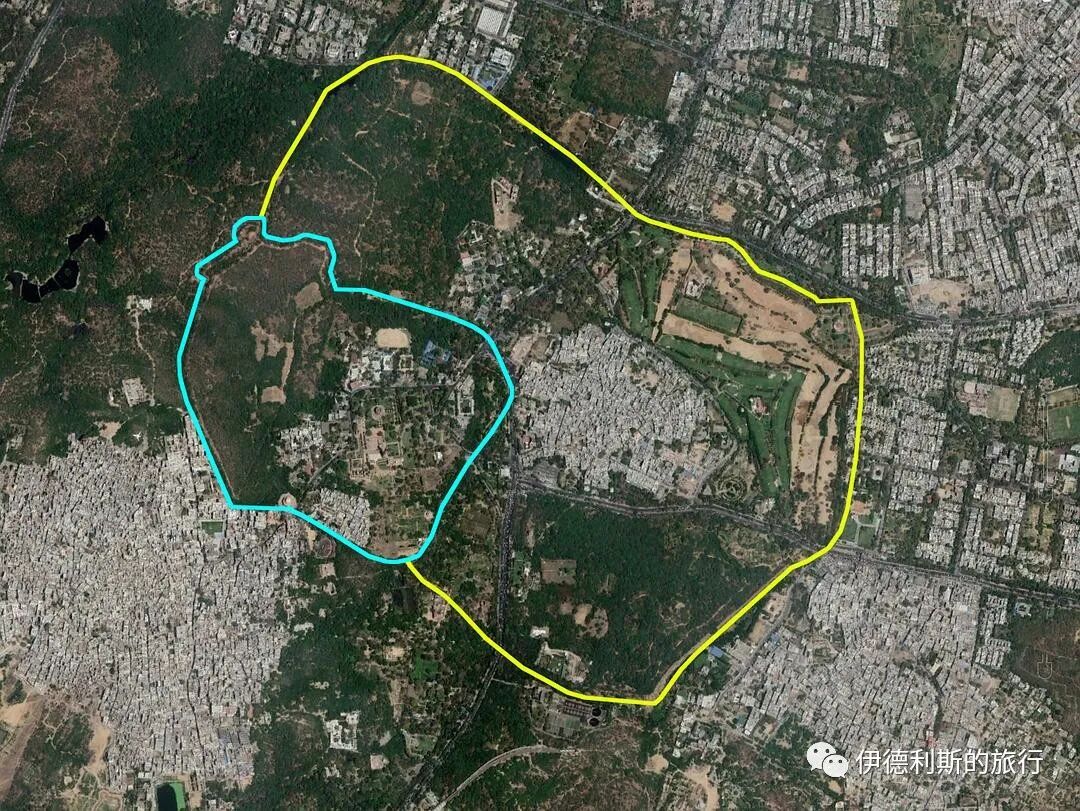
In the image below, the blue part is the city of Lal Kot, and the yellow part is the city of Qila Rai Pithora.
2. Entering the Islamic Age
In 1193, the Ghurid Dynasty defeated the Chauhan Dynasty and occupied the city of Lal Kot in Delhi, marking Delhi's entry into the Islamic age.
1. Ghurid Dynasty
The Ghurid Dynasty appeared in eastern Iran and the Afghanistan region starting in the 9th century. Whether the rulers were Pashtun or Tajik is still a matter of debate. In 1011, the Ghurid dynasty was conquered by the Persianized Turkic Muslim Ghaznavid dynasty, shifting from Buddhism to Islam.
In 1163, Ghiyath ad-Din Muhammad became the Sultan of the Ghurid dynasty. He and his brother, Mu'izz ad-Din Muhammad Ghori, launched a series of wars, attacking from Afghanistan all the way into northwestern India. In 1186, the two brothers captured the ancient city of Lahore in Punjab and took the last Ghaznavid Sultan, Khusrau Malik, prisoner, marking the end of the Ghaznavid dynasty.
2. Muhammad of Ghor conquers Delhi
In 1192, Muhammad Ghori led a large army to fight a decisive battle against the Rajput forces of the Chauhan dynasty. Exaggerated accounts claim that Muhammad Ghori brought 120,000 fully armed soldiers, while the Rajput army consisted of 300,000 cavalry and infantry, plus 3,000 elephants. Muhammad Ghori launched a surprise attack on the Rajput army before dawn, capturing and executing Prithviraj III.
In 1193, Muhammad Ghori conquered the city of Lal Kot in Delhi, then returned to Iran to deal with threats on his western border. Before leaving, he appointed General Qutb al-Din Aibak as the governor of northern India.
3. Qutb rules Delhi
Qutb al-Din Aibak was born into a Turkic family and was sold into slavery in Persia during his childhood. After his master died, he was sold again by the master's son, eventually becoming a slave to Muhammad Ghori. Qutb al-Din Aibak was highly valued by Muhammad Ghori, who appointed him as a military commander, and he later became a general of the Ghurid dynasty.
Starting in the 9th century, as the Arab Caliphate fractured, many Islamic rulers began using Turkic military slaves from Central Asia. These Turkic slave soldiers who converted to Islam were usually called Mamluk, a word meaning 'owned' in Arabic. Many Turkic Mamluks used their superior military skills to become generals and even rulers.
After becoming governor, Qutb al-Din Aibak used Delhi as his headquarters to gradually conquer all the Rajput dynasties in northern and central India, becoming the de facto ruler of northern India.
3. The first mosque in Delhi
After capturing Delhi in 1193, Qutb al-Din Aibak began building the first mosque on the ruins of the city of Lal Kot.
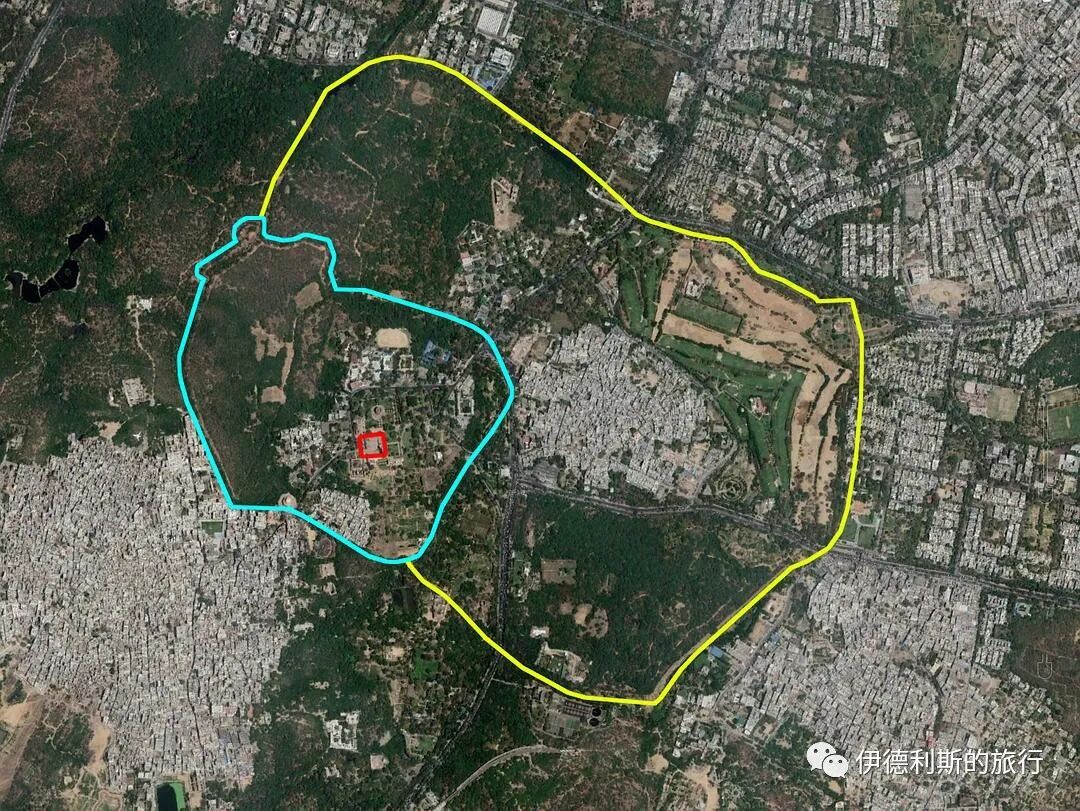
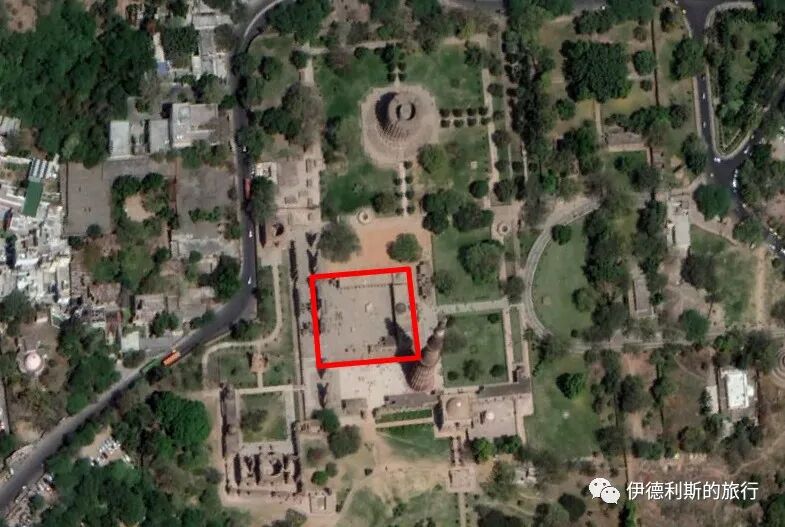
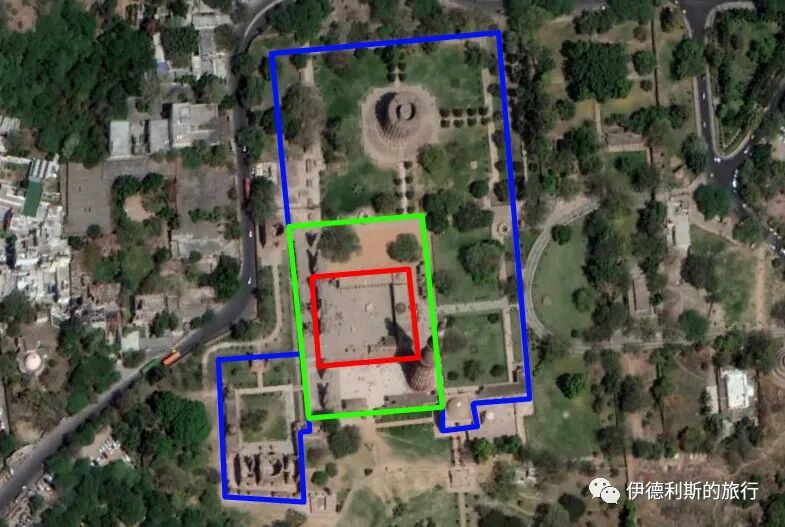
The red sections in the two images below show the location of the mosque built by Qutb al-Din Aibak.
1. Hindu and Jain architectural components
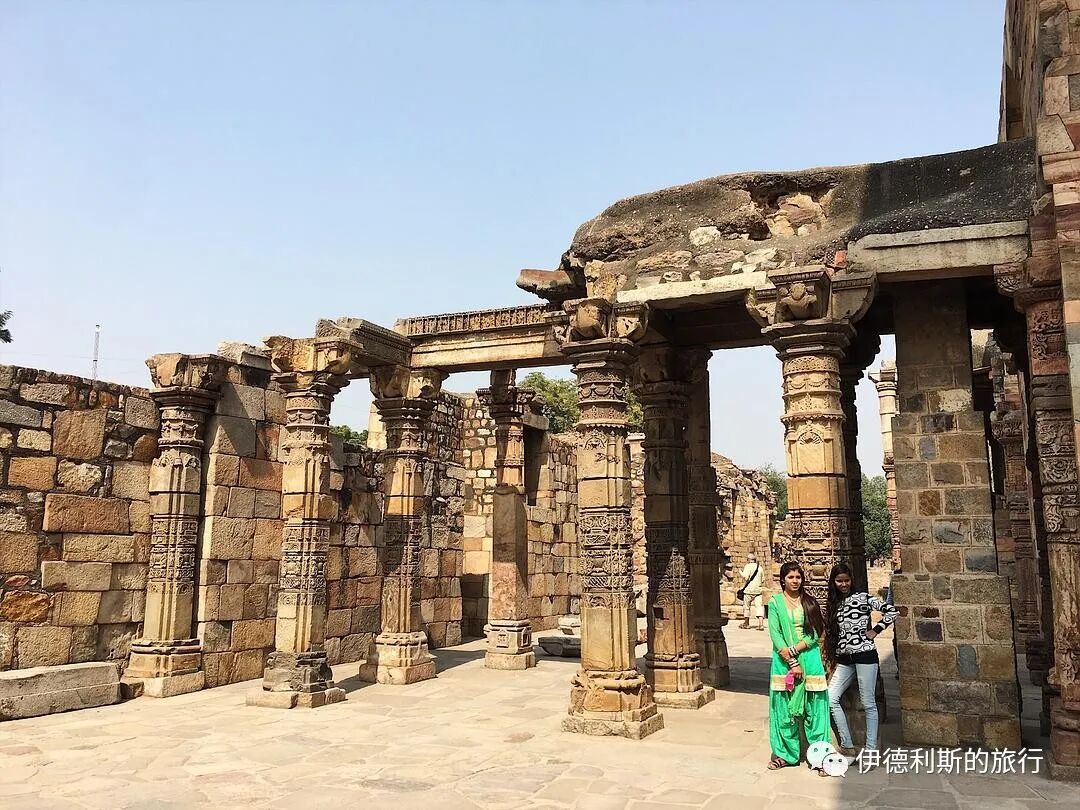
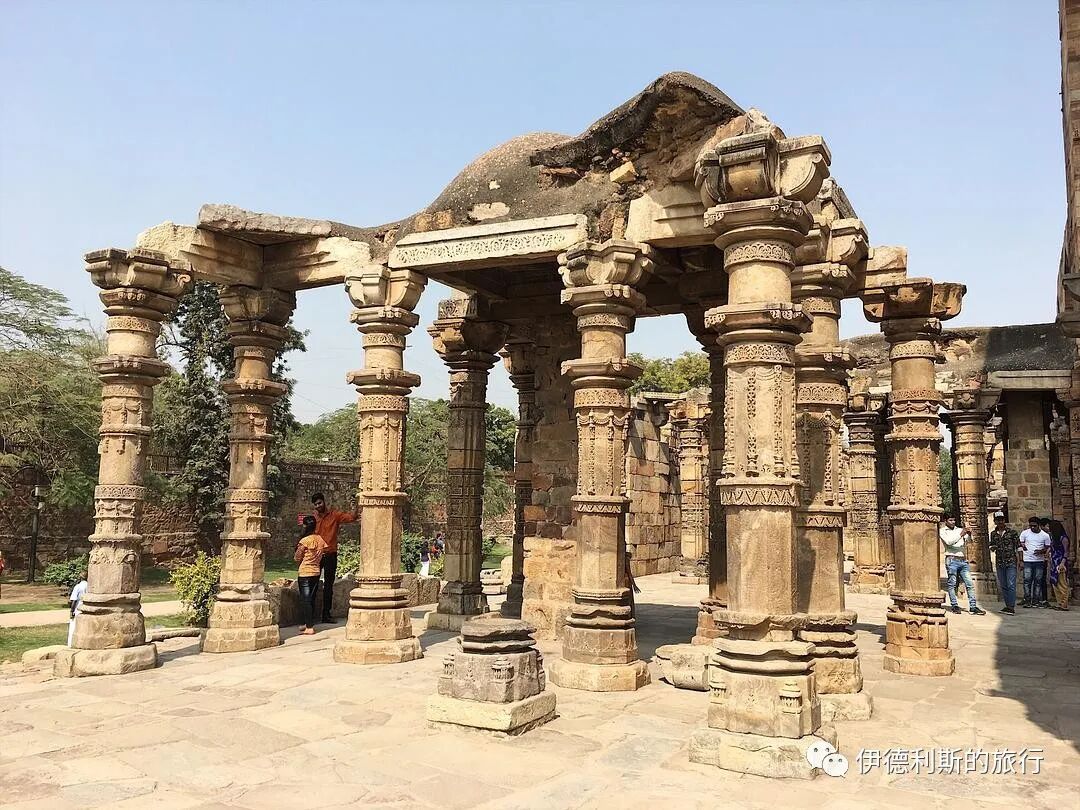
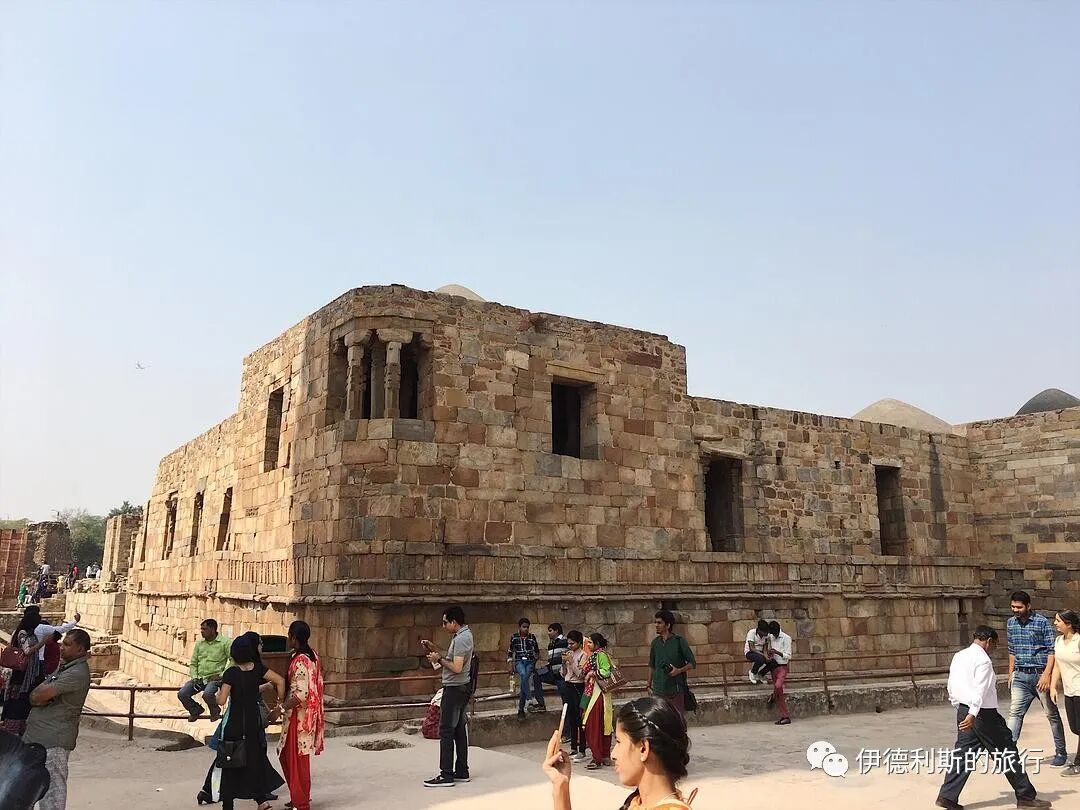
The Qutb mosque is known to later generations as the Quwwat-ul-Islam mosque and is one of the oldest surviving mosques in India. According to a Persian inscription on the mosque's east gate, the mosque was built after tearing down 27 Hindu and Jain temples from the Tomar and Chauhan dynasties. Because of this, many of the mosque's building components are original pieces from those Hindu and Jain temples.
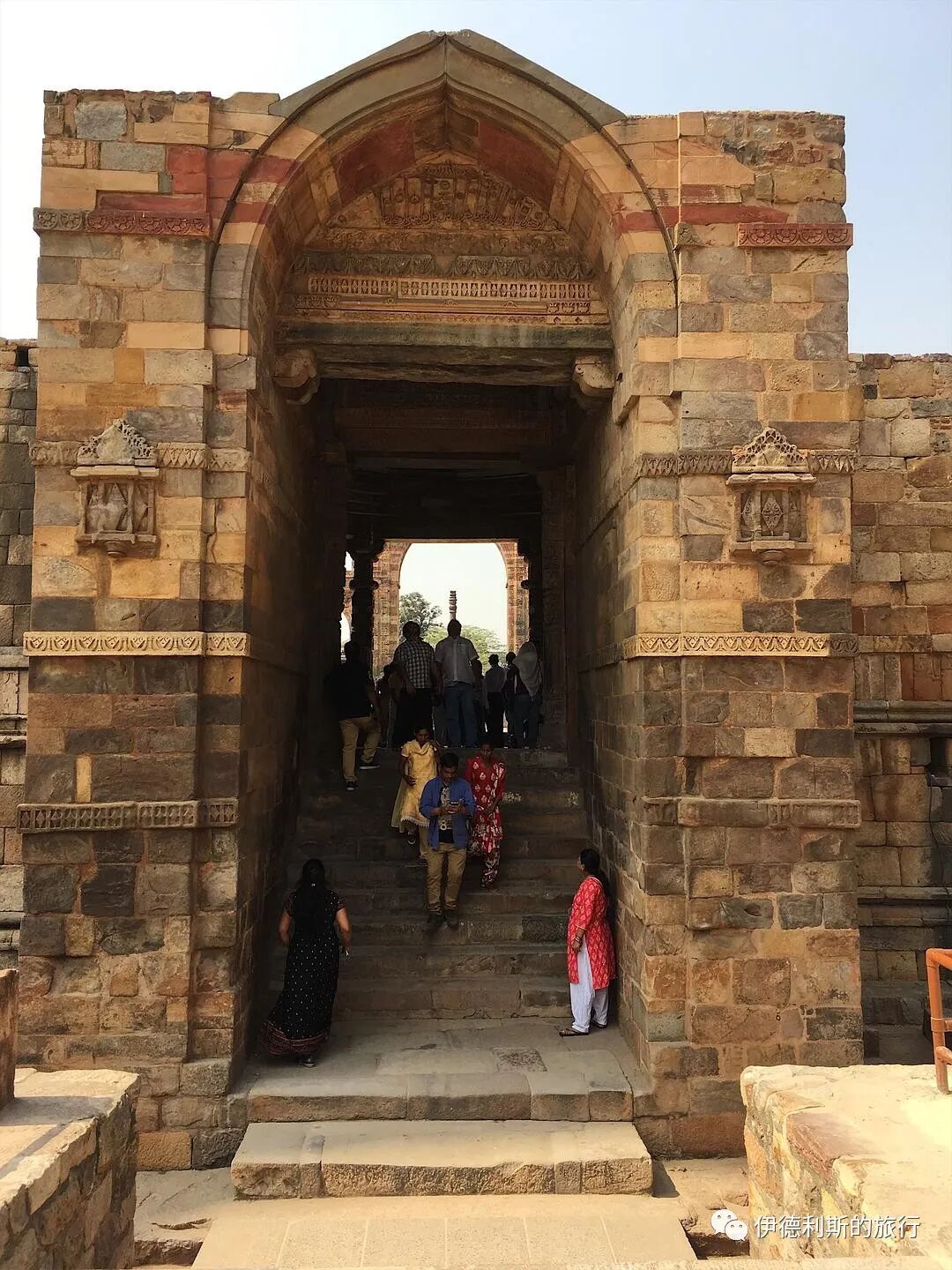
The mosque gate.
The dome likely came from the construction of a Hindu or Jain temple.
The cloister inside the mosque.
The arch in front of the prayer hall.
The prayer hall has already collapsed.
The well-preserved east wall of the mosque.
2. Iron Pillar of Delhi
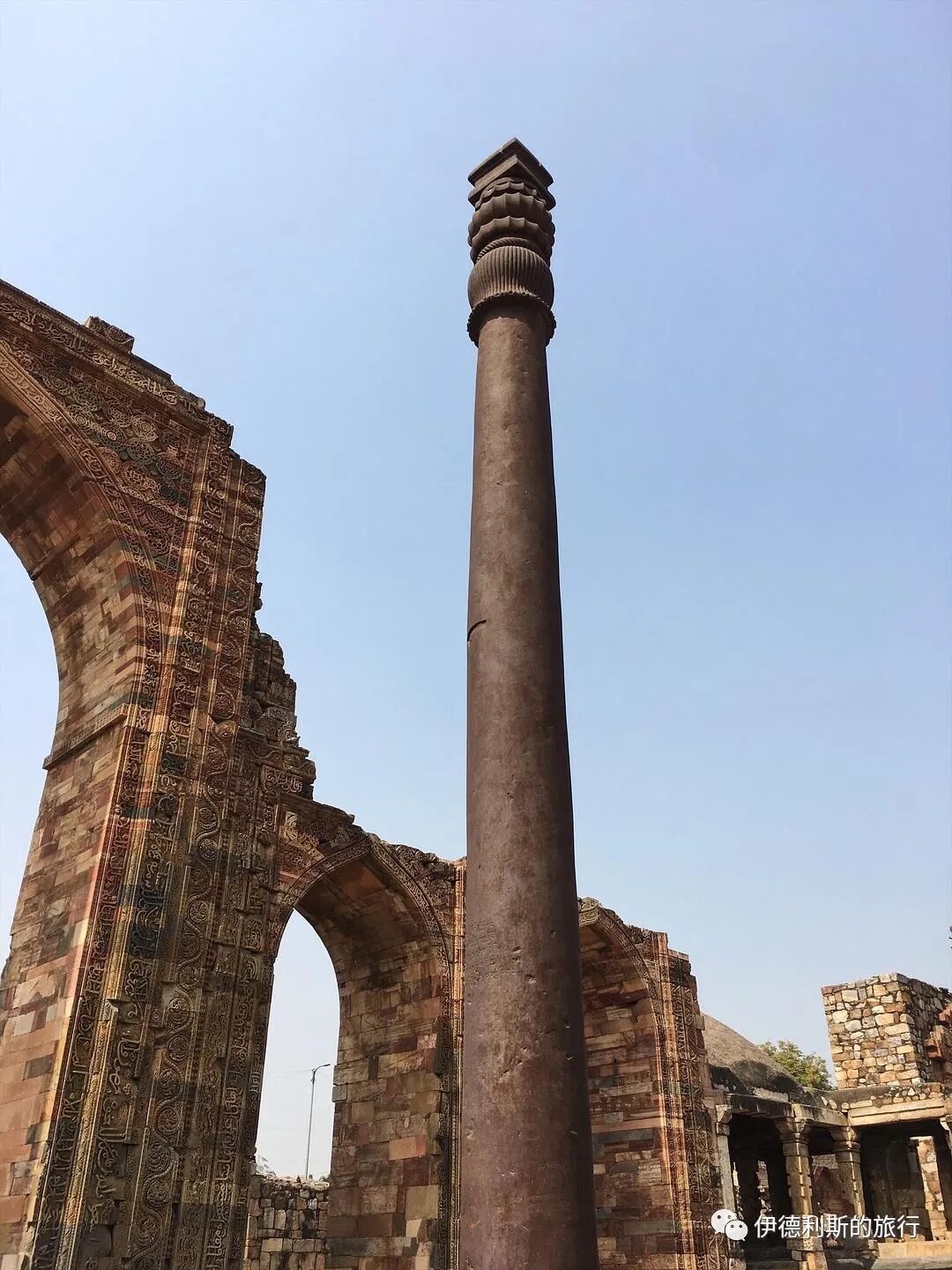
The famous Iron Pillar of Delhi stands in the center of the mosque courtyard. The pillar was cast between the 3rd and 4th centuries, and the time it was moved to the mosque is still debated. The oldest Sanskrit inscription on the iron pillar is from a king named Chandra. The most common view is that this king was Chandragupta II, who ruled the Gupta Empire from 380 to 415. This period was the peak of the Gupta Empire and is considered the 'Golden Age' of ancient India, when architecture and sculpture reached their height.
The high corrosion resistance of this iron pillar has attracted great interest from scientists and archaeologists, and it is considered a the highest level of ancient Indian iron-smelting technology. The pillar's corrosion resistance is believed to come from its high phosphorus content and Delhi's alternating wet and dry climate, which allowed a protective passivation film to form on the pillar.
3. The Qutb Minar reaching into the clouds
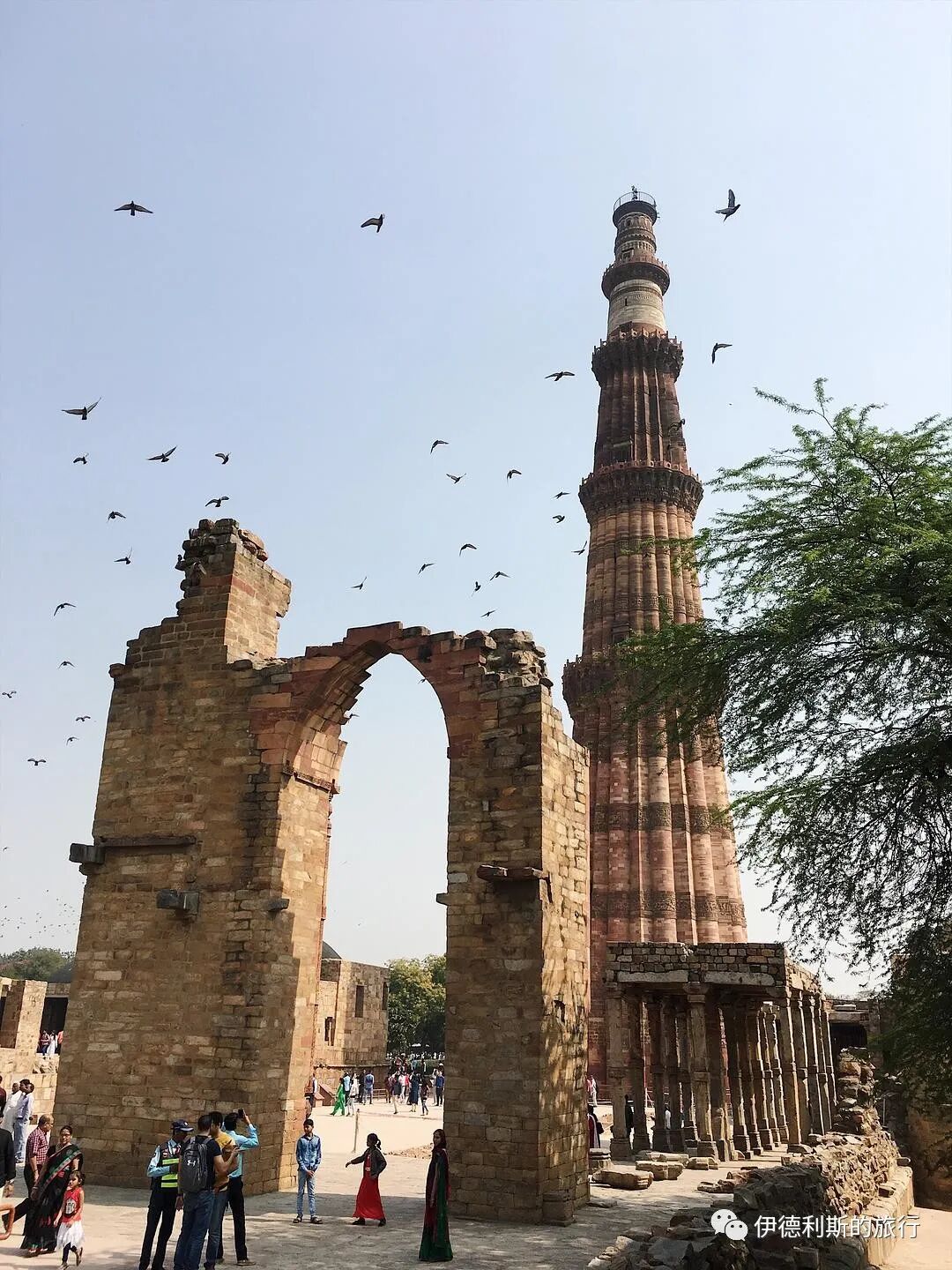
The most striking part of the Qutb mosque is the Qutb Minar, which later generations hailed as the tallest minaret in the ancient Islamic world.
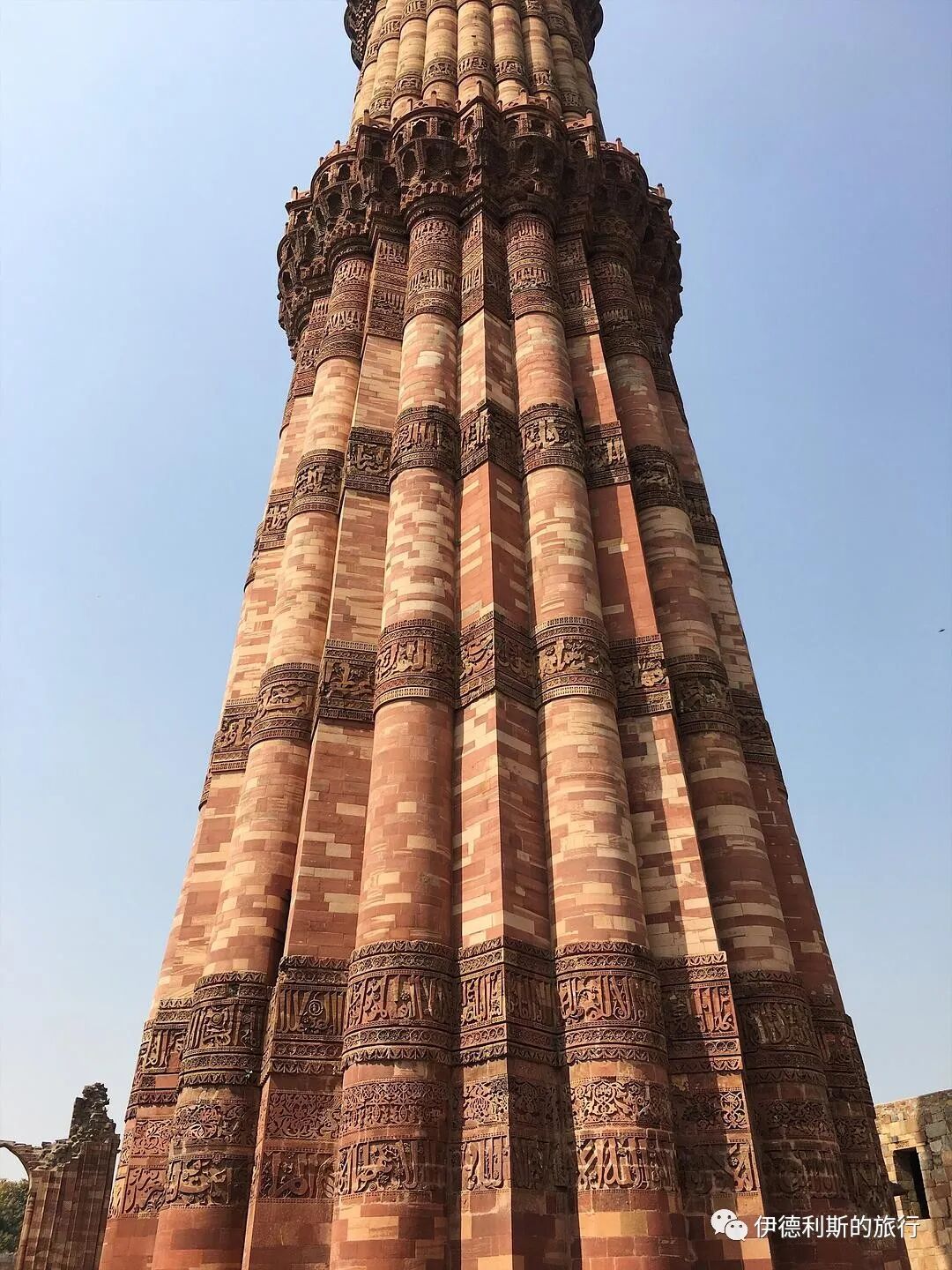
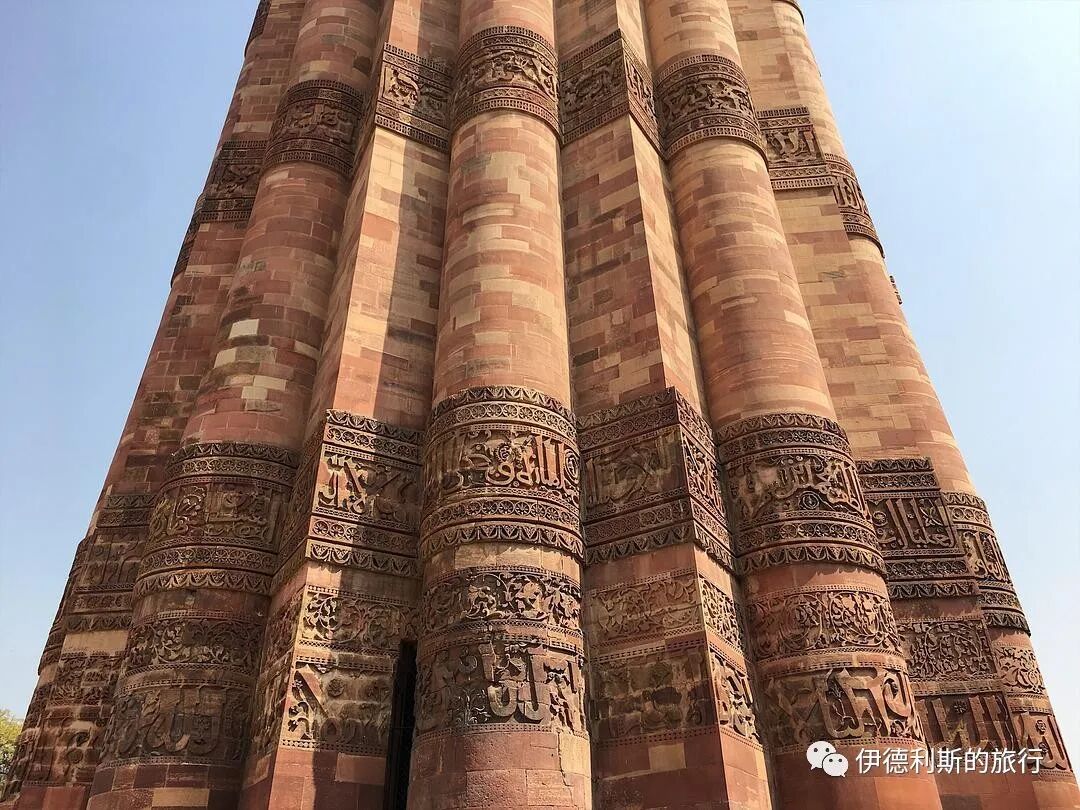
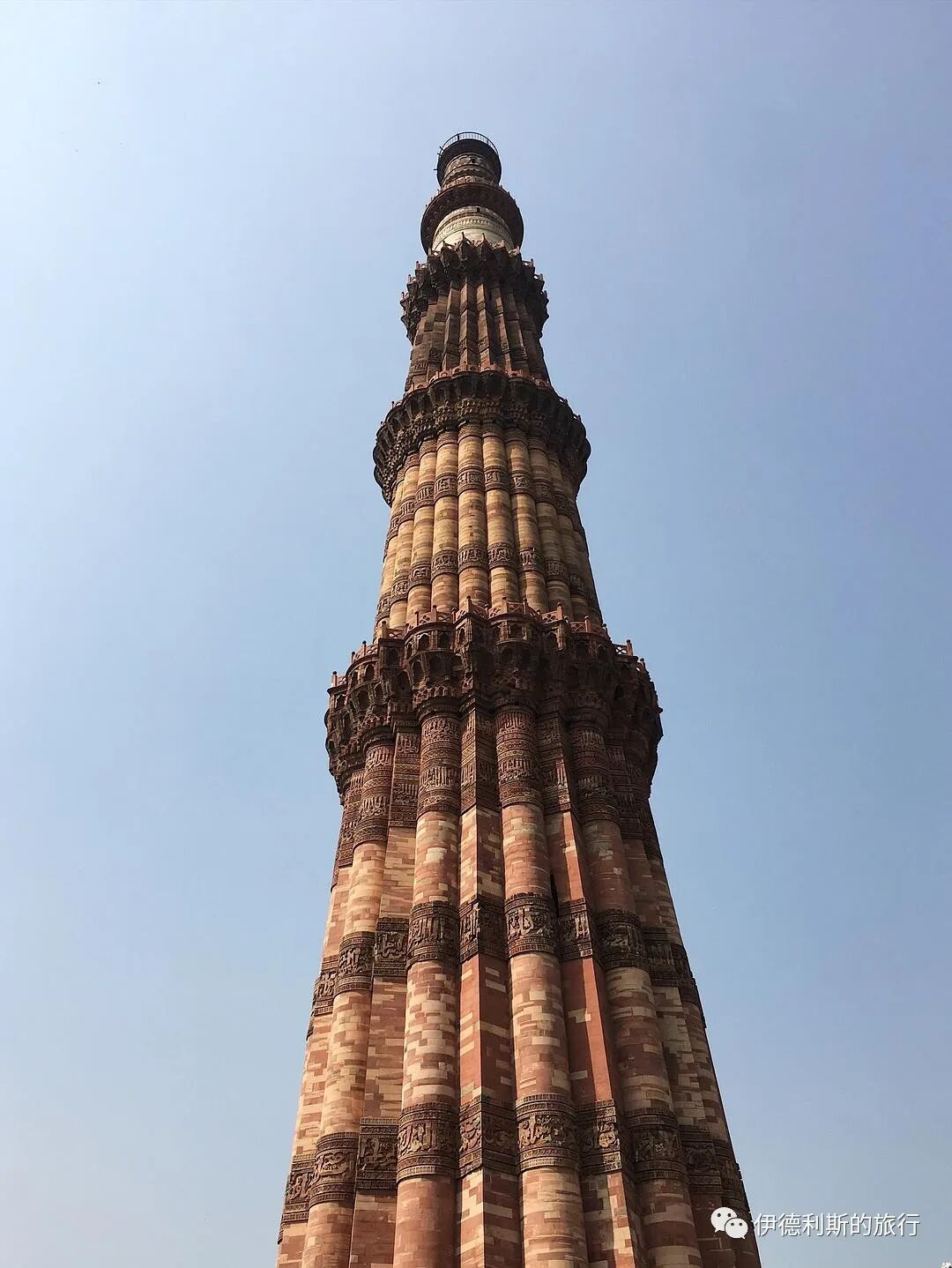
The Qutb Minar is located outside the southeast side of the mosque courtyard. It is built of red sandstone, follows the style of Iranian minarets, and its patterns were influenced by the famous Minaret of Jam in contemporary Afghanistan. The tower is 72.5 meters high and divided into 5 levels. Each level has a protruding balcony, and there are 379 spiral stairs inside.
The first level of the Qutb Minar was built under the personal supervision of Qutb al-Din Aibak himself, so it contains many praises for Muhammad Ghori. The top three levels were finished in 1220 by his son-in-law Shams ud-Din Iltutmish (who I will introduce in detail later), and the style is basically the same as the Qutb period. The Qutb Minar from this period is made of red sandstone and carved with Kufic script.
In 1369, lightning destroyed the top of the Qutb Minar, and the Sultan of the Delhi Sultanate, Firoz Shah Tughlaq, rebuilt two more levels on top. The two new levels include marble, and you can now see a clear difference in architectural style between the bottom three levels and the top two.
4. Iltutmish expands the mosque
1. Mamluk Dynasty of the Delhi Sultanate
In 1202, Muhammad Ghori became the Sultan of the Ghurid dynasty after his brother passed away. In 1206, Muhammad Ghori handed over all affairs in India to Qutb and set off from India to return to Afghanistan. On March 15, while his carriage was traveling through Punjab, Pakistan, Muhammad Ghori was assassinated.
Muhammad Ghori had no children, so he treated his Mamluk slaves like his own sons during his lifetime. After he died, the country split into several parts, and Qutb established his own sultanate with Lahore as the capital. Because this sultanate later made Delhi its capital for nearly 300 years, later generations called it the Delhi Sultanate. Also, because Qutb was a Mamluk slave, the first dynasty of the Delhi Sultanate is known to later generations as the Mamluk Dynasty or the Slave Dynasty.
In 1210, Qutb died in an accident. The Delhi Sultanate did not have a fixed rule for succession. After Qutb died, the Turkic nobles in Lahore elected Aram Shah to succeed as Sultan. But Aram Shah was not good at governing the country, so a group of forty nobles called Chihalgani soon betrayed him and elected Shams ud-Din Iltutmish to succeed as Sultan.
In 1211, Iltutmish defeated Aram Shah on the plains near Delhi and seized the throne.
2. Iltutmish takes over as Sultan
Iltutmish came from the Turkic Ilbari tribe and was sold as a Mamluk slave during his childhood. He was first taken to the slave market in the ancient Central Asian city of Bukhara, then transferred to the Ghurid dynasty and bought by Muhammad Ghori's court.
Iltutmish quickly gained the appreciation of Muhammad Ghori and became his personal attendant. Qutb, who was the governor of Lahore at the time, also took a liking to Iltutmish, so he bought him from Muhammad Ghori in Delhi for a high price.
Iltutmish was also deeply appreciated by Qutb; he married Qutb's daughter and was entrusted by Qutb with the governorship of several important regions. After Qutb died in 1210, he defeated the successor Aram Shah in 1211 and became the third Sultan of the Mamluk Dynasty of the Delhi Sultanate.
3. Territorial expansion
At the beginning of his reign, Iltutmish consolidated the territory around Delhi through a series of wars. In 1214, Iltutmish officially moved the capital to the city of Lal Kot in Delhi.
In 1221, the Mongol army under Genghis Khan arrived at the banks of the Indus River. Iltutmish did not want a direct conflict with the Mongols, so he turned eastward and conquered the Bengal region.
The upheaval caused by the Mongol invasion of Central Asia led a large number of Turkic officers to come to India, so Iltutmish recruited a powerful army and conquered Sindh and Multan in 1228.
In 1228, Iltutmish received recognition from the Caliph of the Abbasid Caliphate and was granted a robe and gifts by the Caliph, which gave the Delhi Sultanate legitimacy in the Islamic world.
4. Expansion of the Qutb Mosque
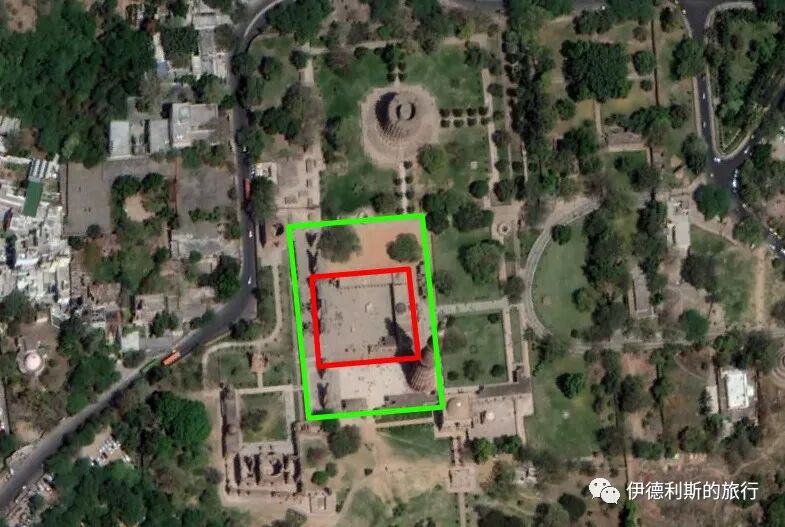
In 1225, as the political situation stabilized, Iltutmish began to expand the Qutb Mosque, and the expanded part is also called the Iltutmish Mosque.
The green part in the picture below shows the scope of the mosque expansion by Iltutmish.
During Iltutmish's expansion, Muslim craftsmen replaced the Hindu craftsmen of the Qutb era, and they no longer used components from the original temples, so the architectural style of this period is more Islamic than the Qutb period.
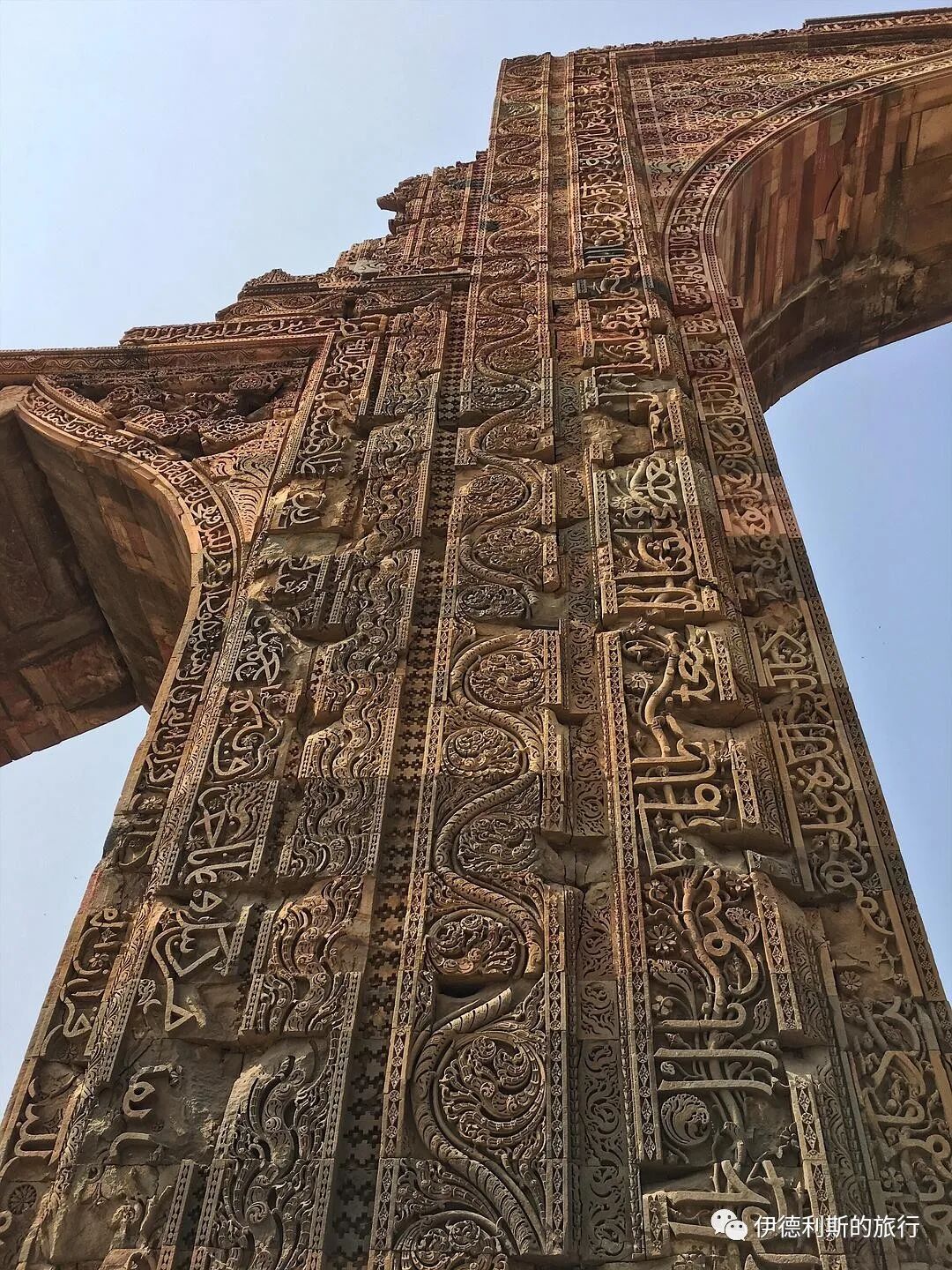
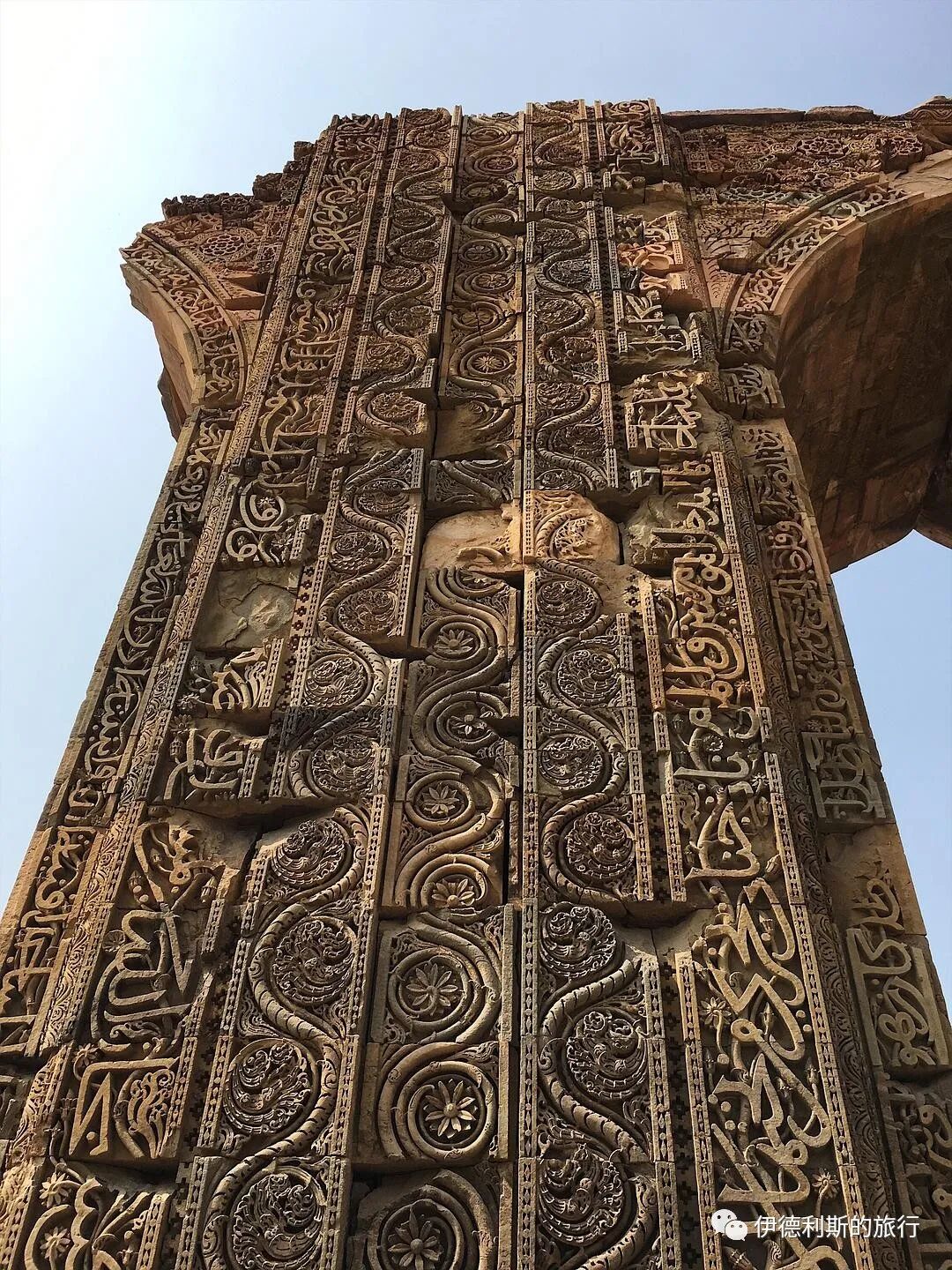
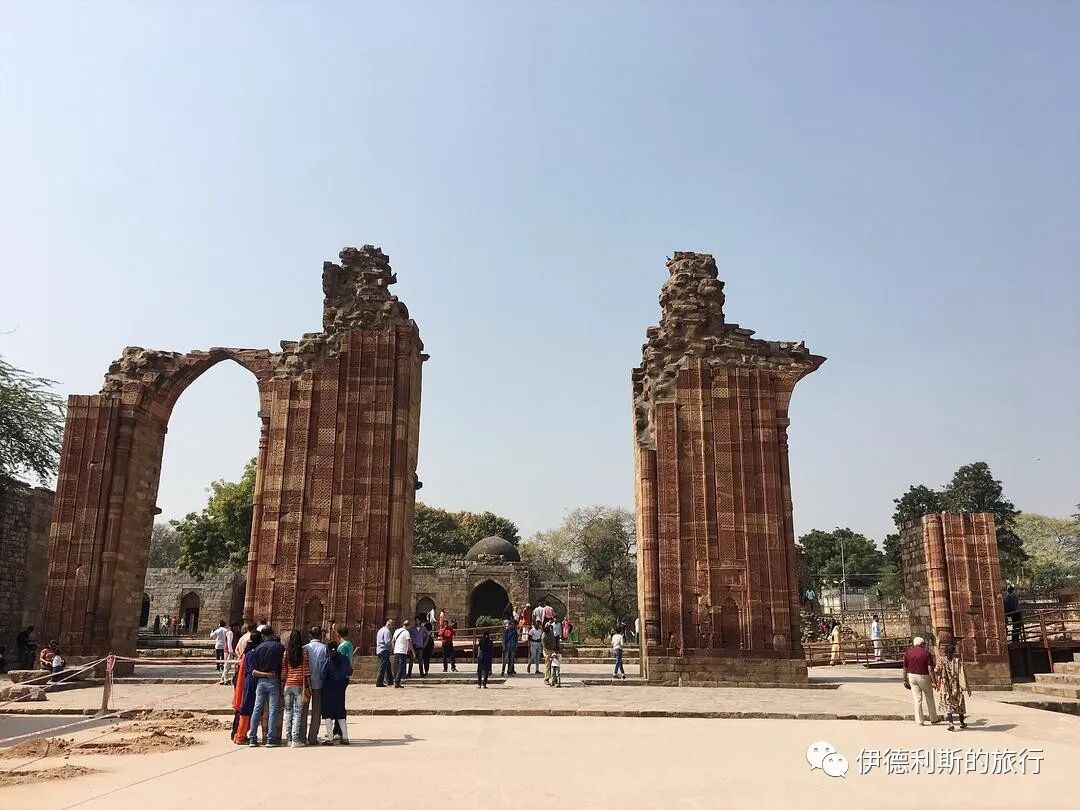
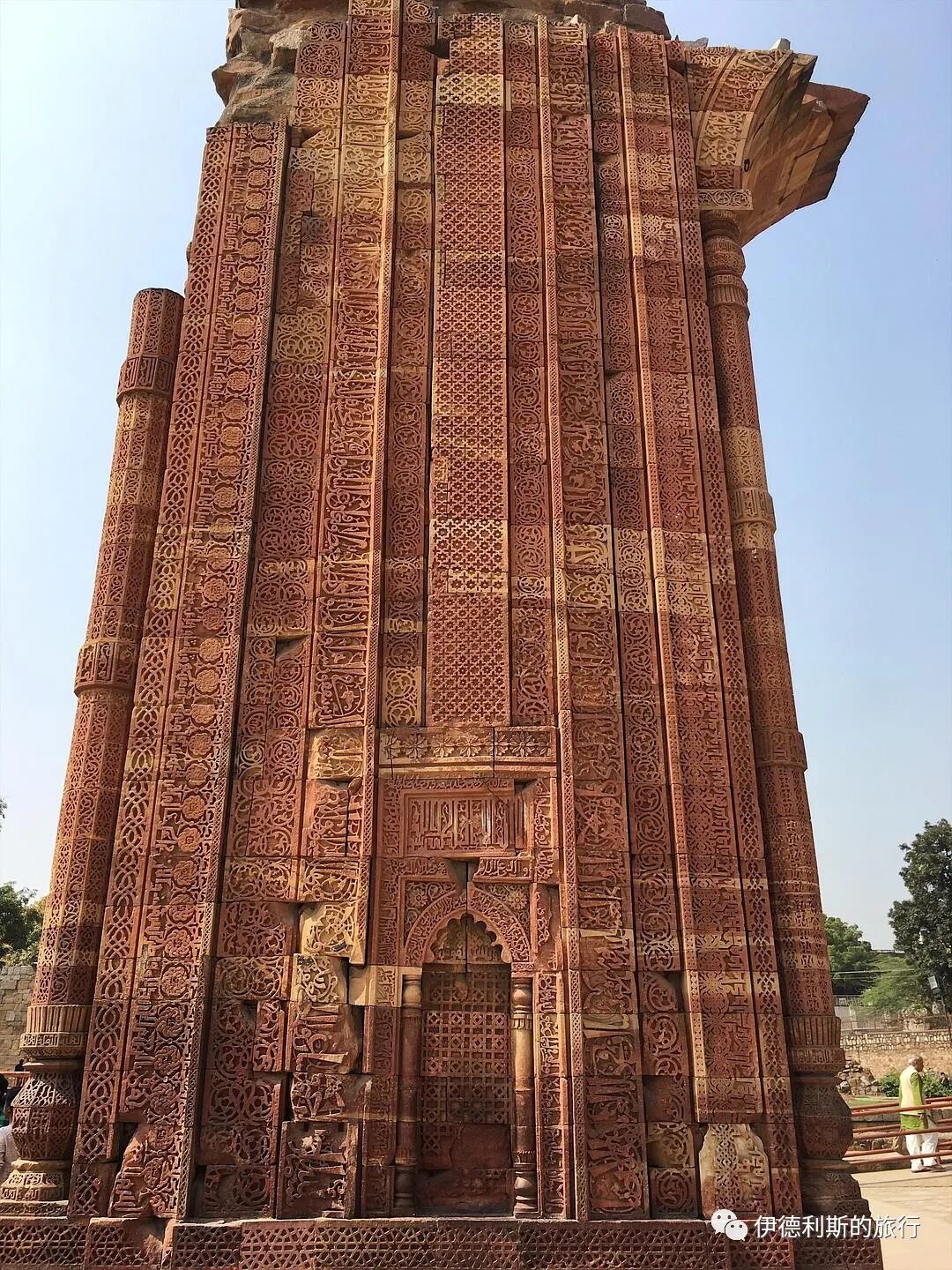
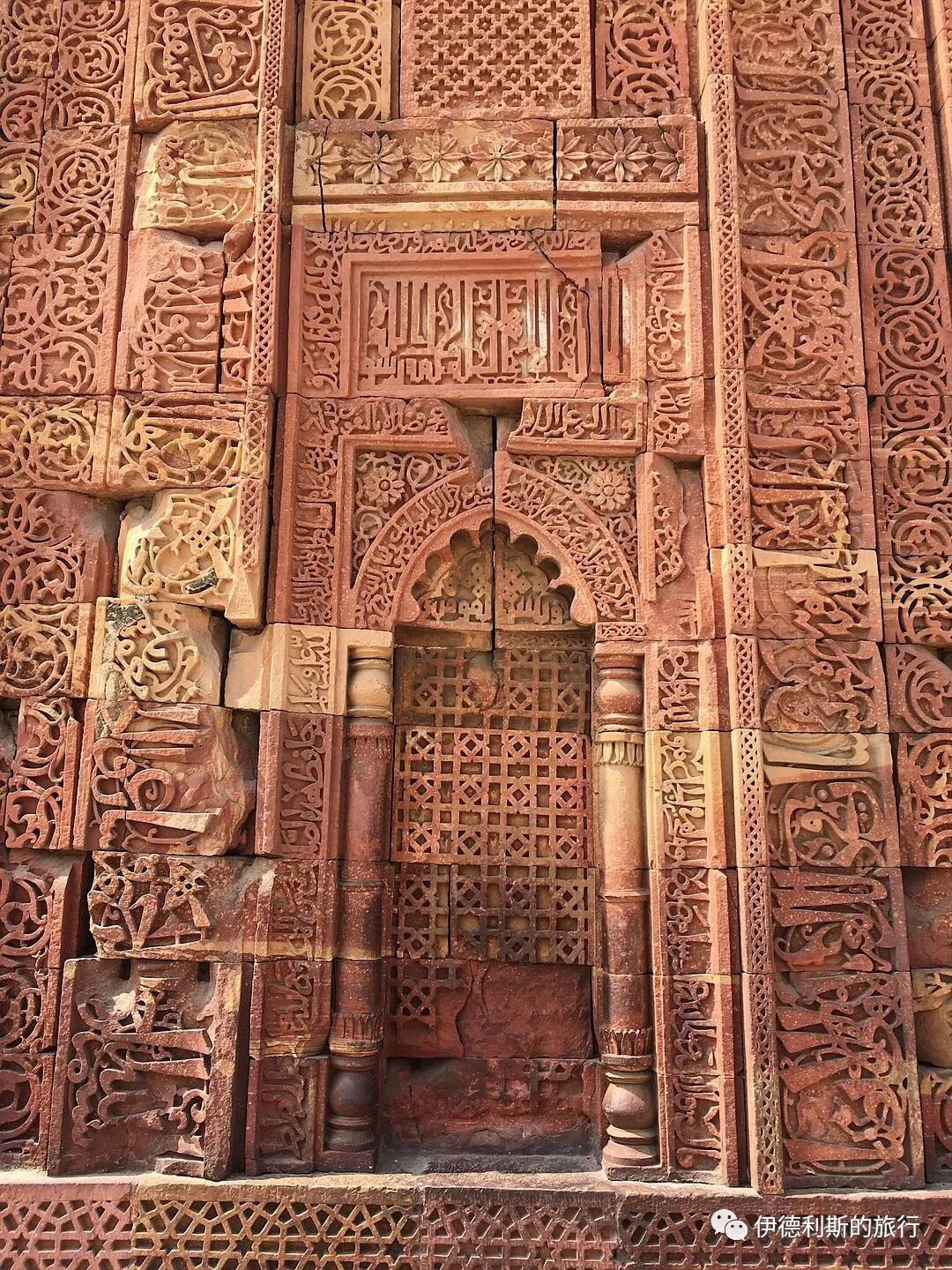
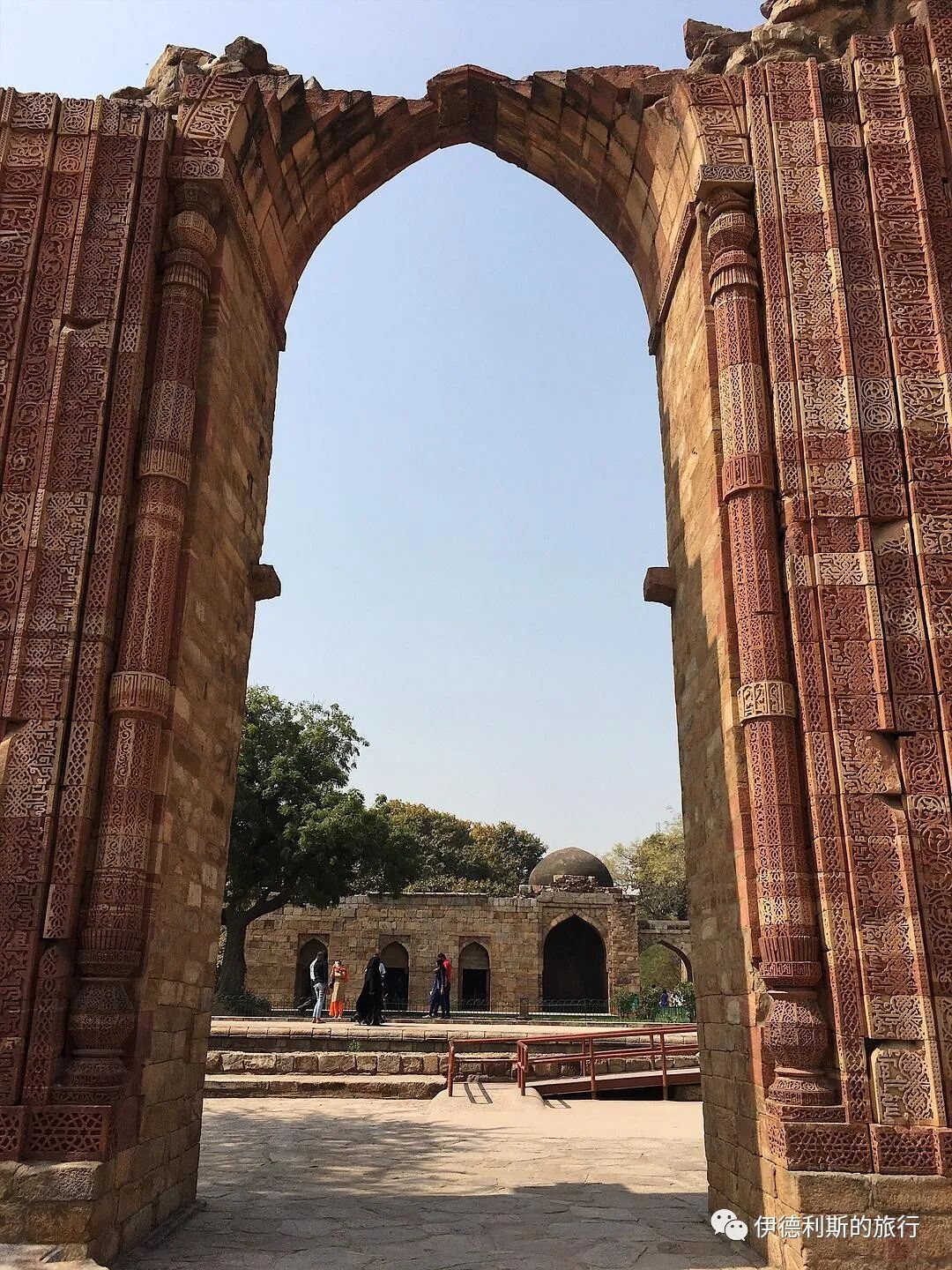
The best-preserved part of Iltutmish's expansion is the beautifully carved archway.
Behind the archway, in the lower right corner, is the south cloister of the Iltutmish expansion.
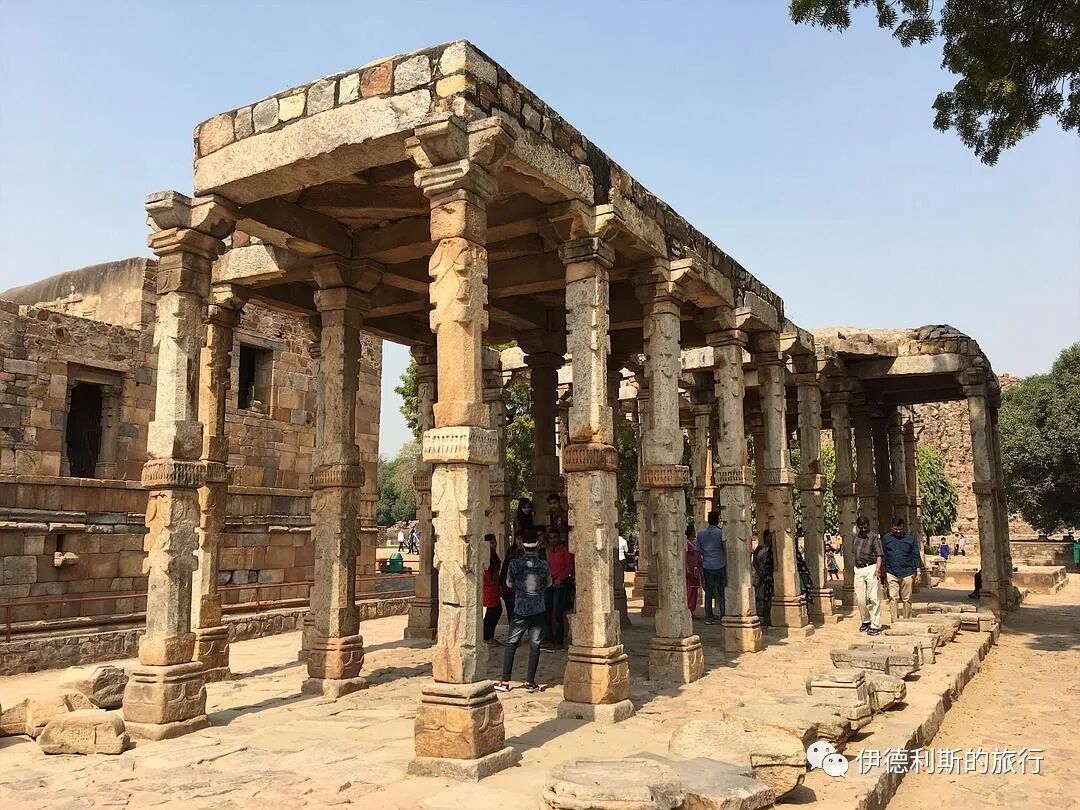
The east cloister is visibly simpler than the cloister built by Qutb.
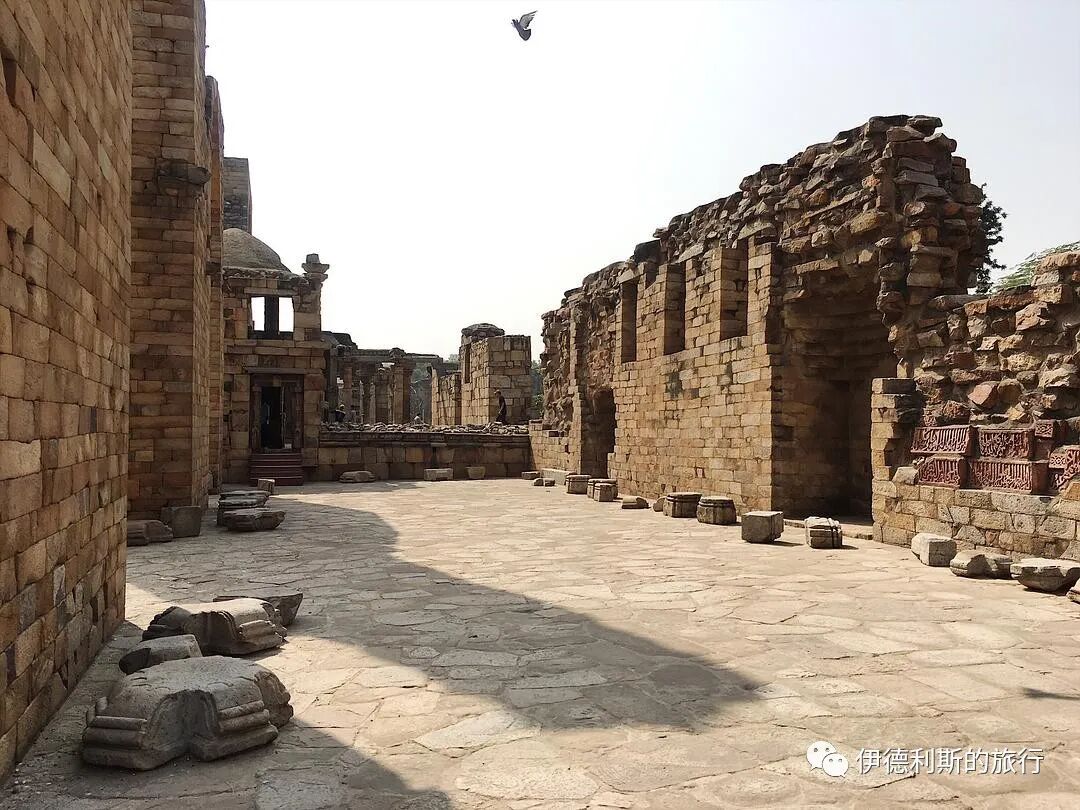
The west colonnade has already collapsed.
5. Tomb of Iltutmish
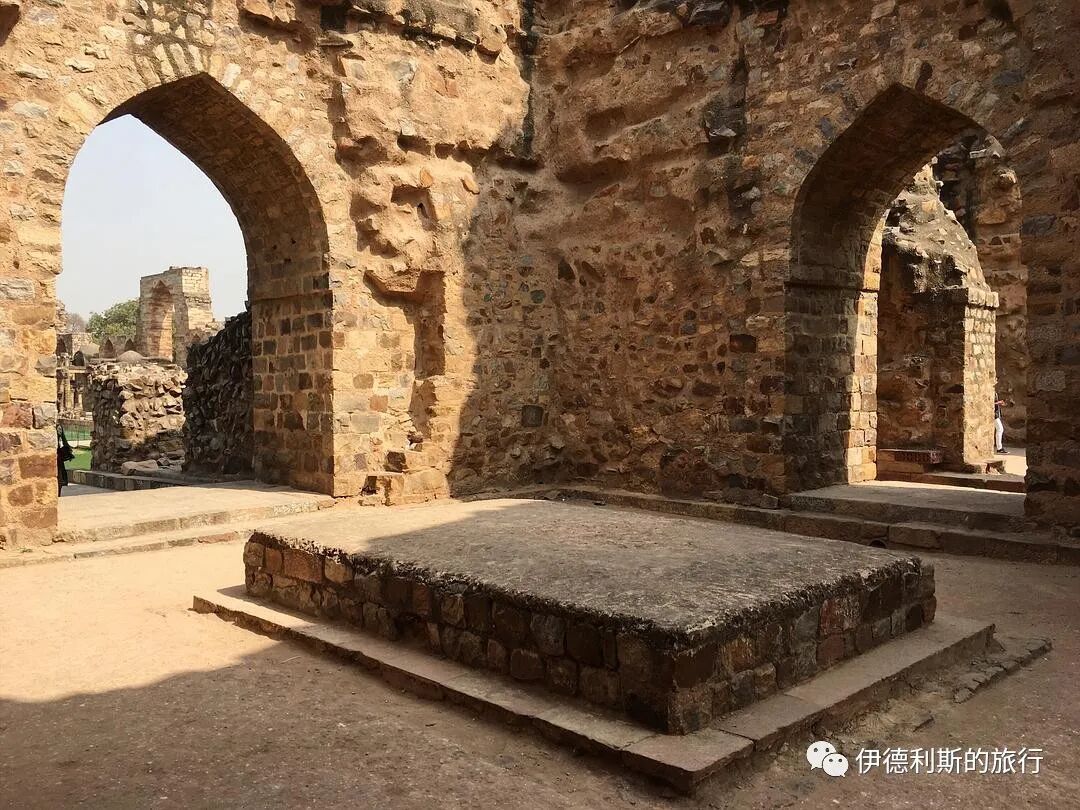
Iltutmish passed away in 1236. In 1235, the year before he died, he built his own tomb next to the Qutb Mosque.
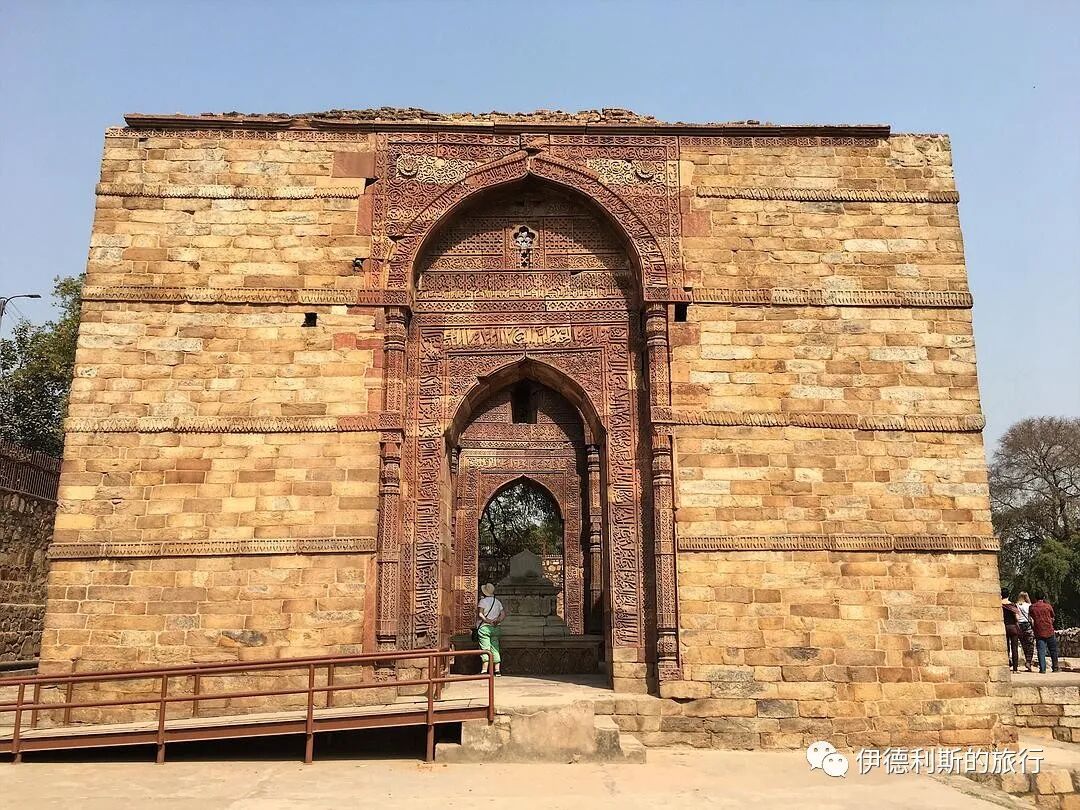
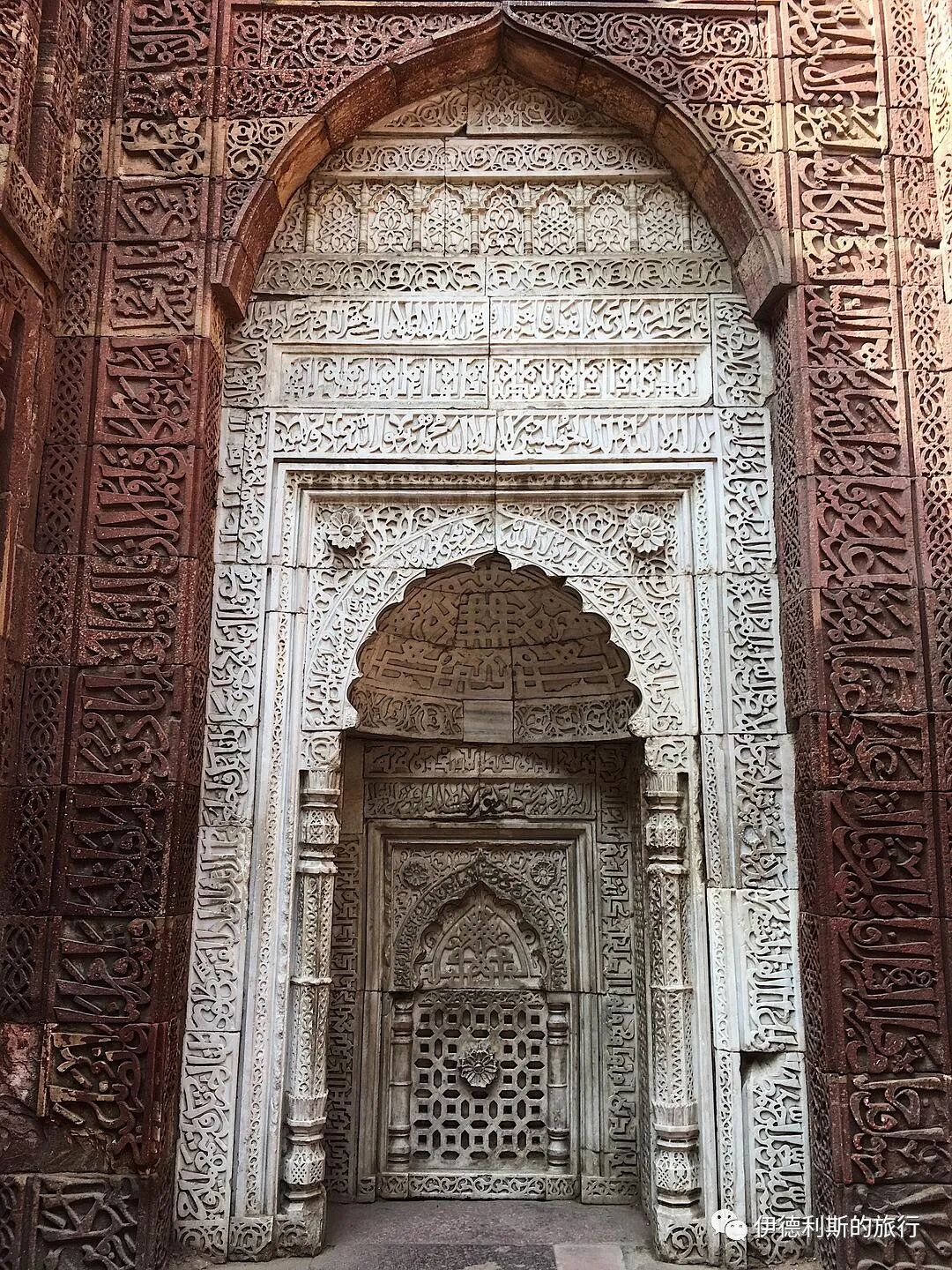
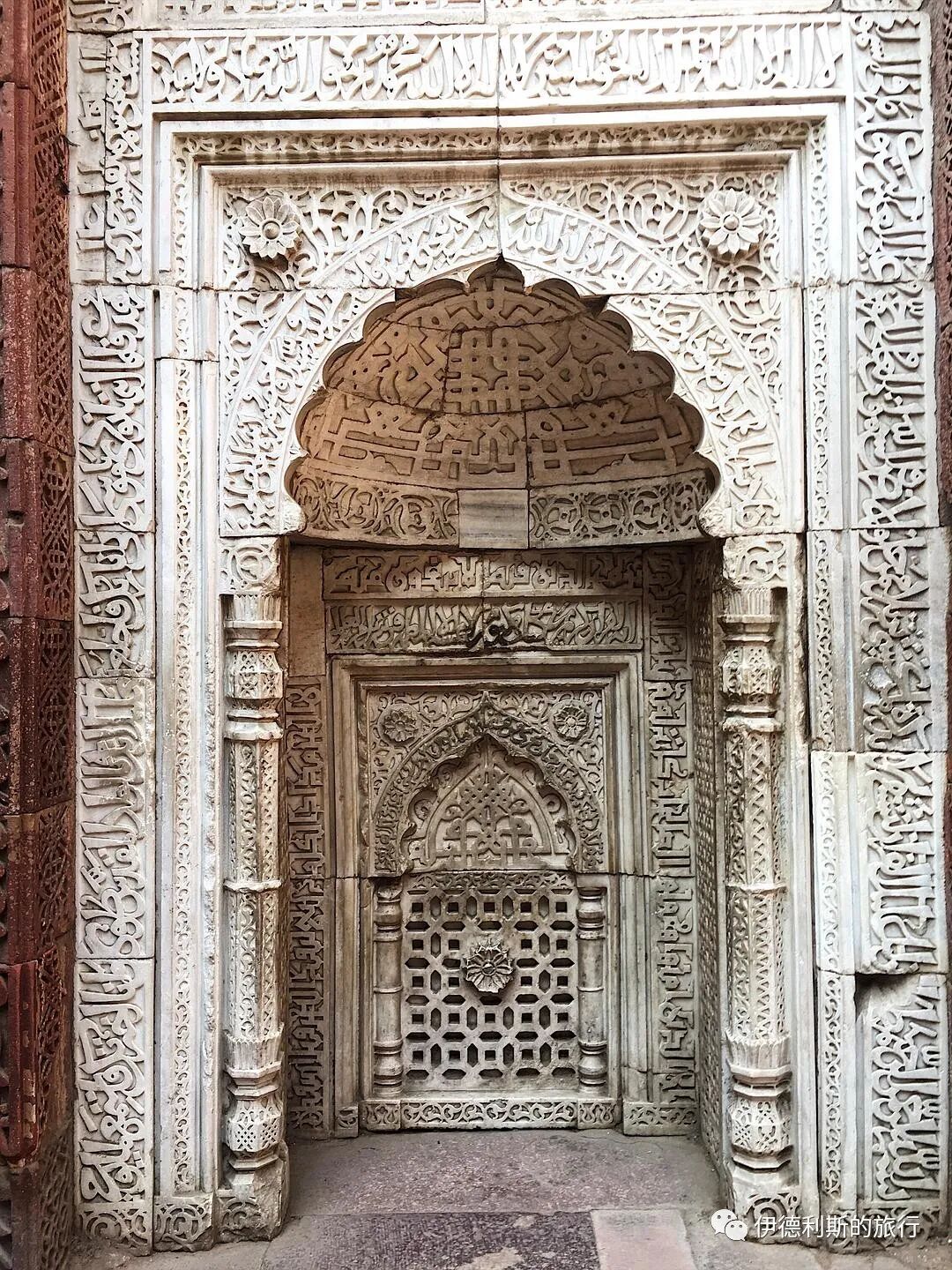
The stone carvings on the walls are very ornate, featuring bells, tassels, lotus flowers, and diamond emblems, all of which are elements from Hinduism.
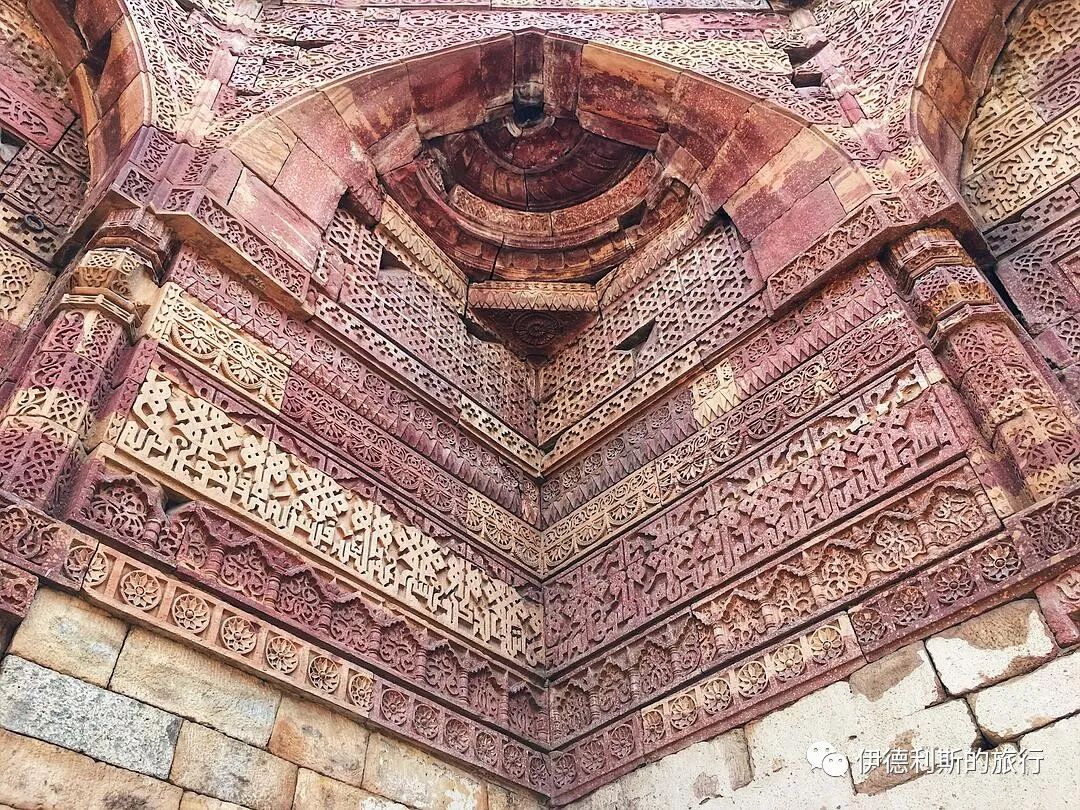
The structure at the corner of the tomb's ceiling is called a squinch, which is used to connect the walls to the dome. The earliest squinches appeared in the Sassanid Empire of Persia and were later used in Islamic architecture, becoming most common in Iran.
The squinches in the Tomb of Iltutmish indicate that there was once a dome on top of the tomb, but it later collapsed.
The ornate mihrab on the west side.
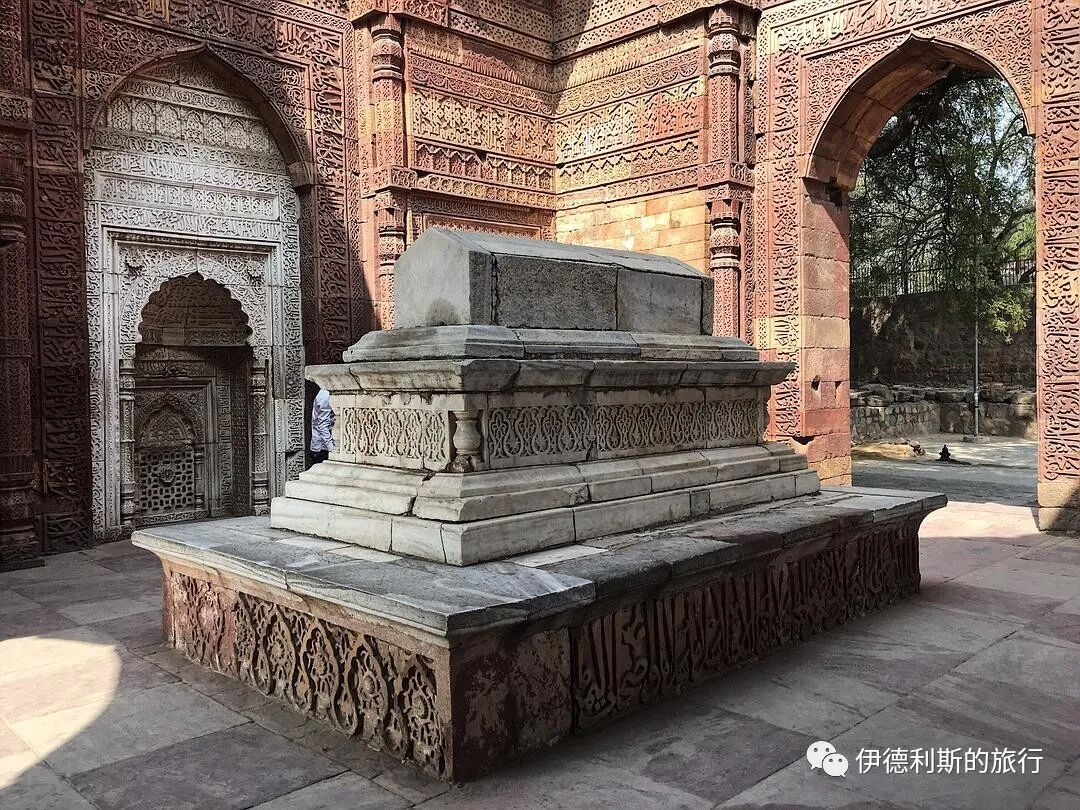
The tombstone in the center is made of white marble.
The actual grave of Iltutmish is not inside this building. In 1914, Gordon Sanderson of the Archaeological Survey of India (ASI) excavated the real burial chamber 20 steps north of the Tomb of Iltutmish.
5. Alauddin Khalji expands the mosque again
In 1310, Sultan Alauddin Khalji of the Khalji dynasty of the Delhi Sultanate expanded the Qutb Mosque for the third time.
1. Khalji Dynasty of the Delhi Sultanate
The Khaljis were a Turkic people who had lived among the Pashtun tribes in Afghanistan for over 200 years. By the time they arrived in Delhi in the 13th century, their customs had become Pashtunized, leading the Turkic nobility in India to even regard them as Afghans.
The Khaljis came to Delhi to serve the Sultan during the reign of Ghiyas ud din Balban, the ninth sultan of the Mamluk dynasty of the Delhi Sultanate (1266–1287). During Balban's era, the Delhi Sultanate stabilized after being on the verge of collapse, with its territory covering most of northern India.
After Balban died in 1287, his young successor became addicted to wine and women, and the Turkic nobility fell into factional fighting. In 1290, the military officer Jalal ud din Firuz Khalji launched a coup to overthrow the Mamluk dynasty, founding the second dynasty of the Delhi Sultanate—the Khalji dynasty.
2. Alauddin Khalji launches a coup
Firuz Khalji was already 70 years old when he took the throne. He was recognized as a gentle and humble monarch, but because he was not considered a Turk, Turkic nobles always tried to overthrow him.
Firuz pardoned one person after another who tried to overthrow him, but he eventually died at the hands of his nephew and son-in-law, Alauddin Khalji. Alauddin's original name was Ali Gurshasp. His father was Firuz's eldest brother, but he died early, so Alauddin was raised by Firuz. Firuz not only raised his nephew but also married his daughter to him.
After Firuz became Sultan, Alauddin's wife suddenly became a princess and began to act very arrogantly, wanting to dominate Alauddin. Her mother also indulged her daughter's arrogant behavior, so Alauddin had a very poor relationship with both his wife and his mother-in-law.
In 1291, Alauddin became the new governor of Kara. In Kara, people who had previously wanted to overthrow Firuz began to incite Alauddin to overthrow his uncle. Combined with his miserable marriage, he began to resolve to get rid of Firuz.
After five years of raising funds and hiring an army, in 1296, Alauddin led an army of 8,000 cavalry to loot Devagiri, the capital of the Yadava dynasty in southern India, and obtained a massive amount of wealth. When Firuz heard the news, he was very happy and set out from Delhi, intending to meet Alauddin on the way to see the spoils, but Alauddin took a detour and returned directly to Kara. One of Firuz's subordinates suggested that the Sultan go to intercept Alauddin, but Firuz believed that Alauddin would bring the wealth to Delhi, so he returned to Delhi instead.
In Delhi, Alauddin's younger brother Almas Beg assured his uncle of Alauddin's loyalty and begged him to pardon Alauddin's mistakes, saying that Alauddin would likely commit suicide out of guilt. Firuz, who cared for his nephew, immediately sent someone to Kara with a letter of pardon and promised to travel to Kara afterward.
During Ramadan in 1296, Firuz led a large army to Kara to meet Alauddin. He ordered his commanders to lead the main army directly to Kara, while he crossed the Ganges River with 1,000 soldiers. As they neared Kara, Alauddin sent his brother Almas to meet his uncle and persuade him to come alone, saying that otherwise, Alauddin would commit suicide out of fear.
When he arrived at Kara, Alauddin threw himself at Firuz's feet. Firuz caressed Alauddin, kissed his cheek, and scolded him for doubting his uncle's affection for him. At that moment, Alauddin signaled his subordinate Muhammad Salim, who swung his sword at Firuz. After being struck by the first blow, Firuz struggled to run toward the boat, but Muhammad swung a second time, and Firuz was finally killed. Alauddin immediately put on the crown and declared himself the new Sultan.
Alauddin then started moving toward Delhi, recruiting as many soldiers as he could along the way. Meanwhile in Delhi, Firoz's widow named her young son Qadr Khan as the new Sultan. This made the eldest son, Arkali Khan, who was the governor of Multan, furious, and he refused to help his mother defend against Alauddin's army.
In October 1296, Alauddin reached Delhi, defeated his mother-in-law's army, and took the city. On October 21, Alauddin officially became the Sultan of the Khalji dynasty of the Delhi Sultanate.
3. Accumulating wealth
During his first year on the throne, Alauddin used generous gifts to secure his power while balancing the influence of various nobles, which quickly brought stability to Delhi. By his second year, Alauddin began arresting and killing the nobles who had served Firoz. He seized their property to gain massive wealth and replaced the old nobles with new ones loyal to him.
Starting in 1297, Alauddin defended against the Mongol armies of the Chagatai Khanate while constantly conquering Hindu kingdoms in the south. In 1306, Alauddin defeated the last Mongol army sent by the Chagatai Khan, Duwa. After that, he began regular raids into Mongol territory in Afghanistan.
Alauddin's conquest of southern India was also very successful. In 1311, Alauddin sent an army to the Pandyan dynasty at the southern tip of the Indian peninsula. They seized a huge amount of treasure, elephants, and horses, which was considered the greatest haul of wealth since Muslims first occupied Delhi.
Besides looting the Hindu kingdoms, Alauddin carried out a series of economic reforms. Regarding land, he collected land taxes directly from Hindu rural areas without using any middlemen. Regarding income, he hired many accountants in the court and gave heavy punishments for bribery. Regarding markets, Alauddin used market inspectors and spies to strictly control the prices of goods. He also built state-owned grain warehouses and banned farmers and merchants from storing grain privately. By strictly controlling market prices, he was able to maintain a massive army while paying his soldiers lower wages.
4. Expanding the mosque
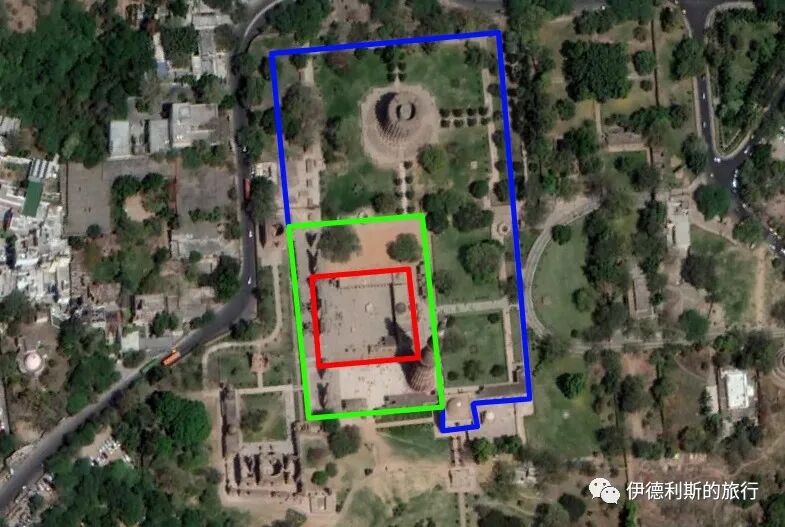
After accumulating great wealth, Alauddin began expanding the Qutb Mosque in 1310. The new mosque was much larger than the one expanded by Iltutmish.
The blue section in the image below shows the area of Alauddin's mosque expansion.
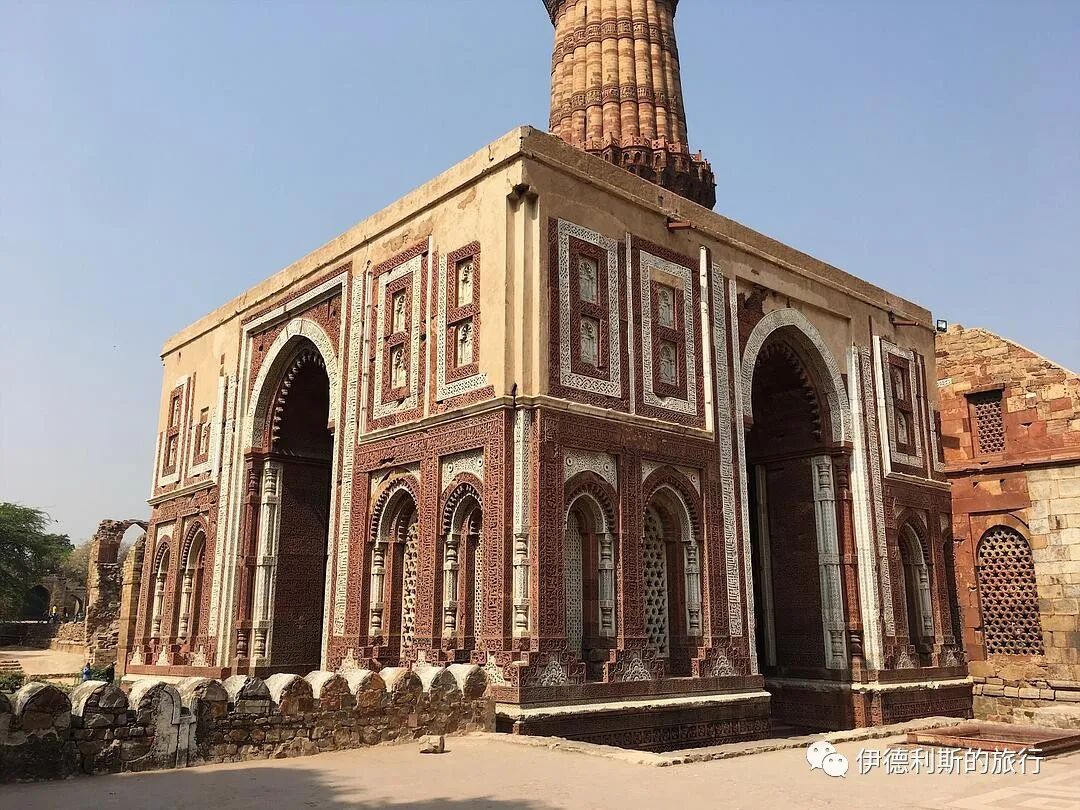
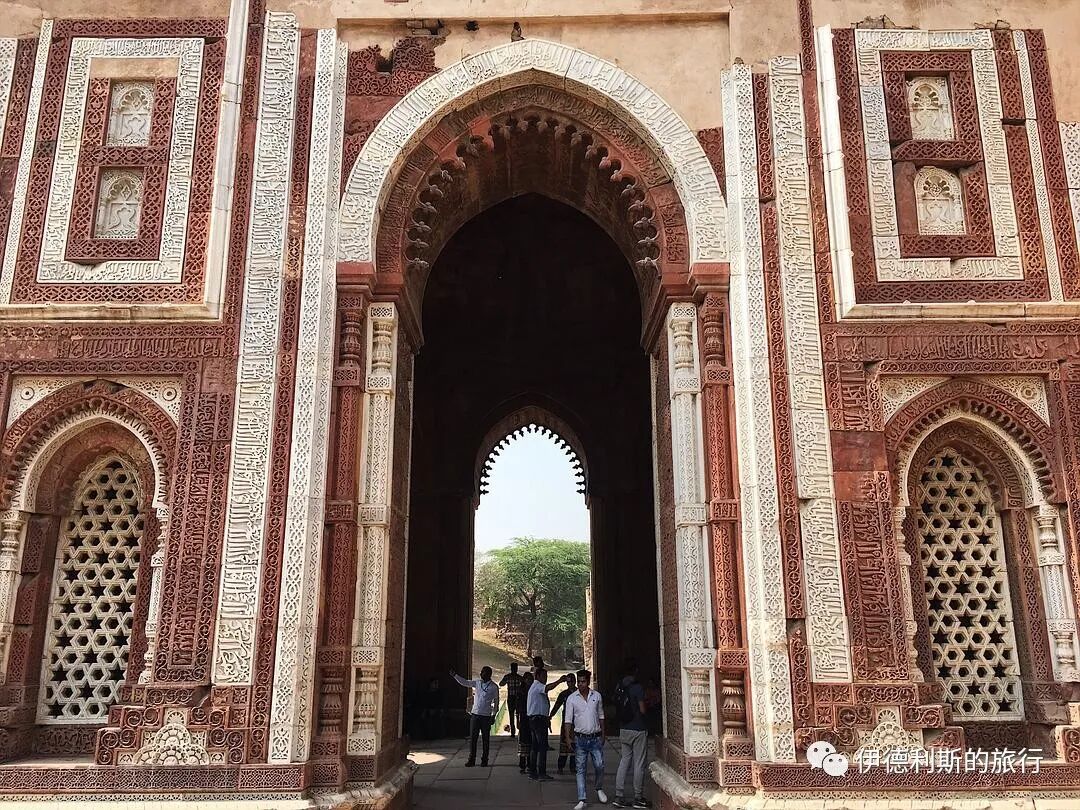
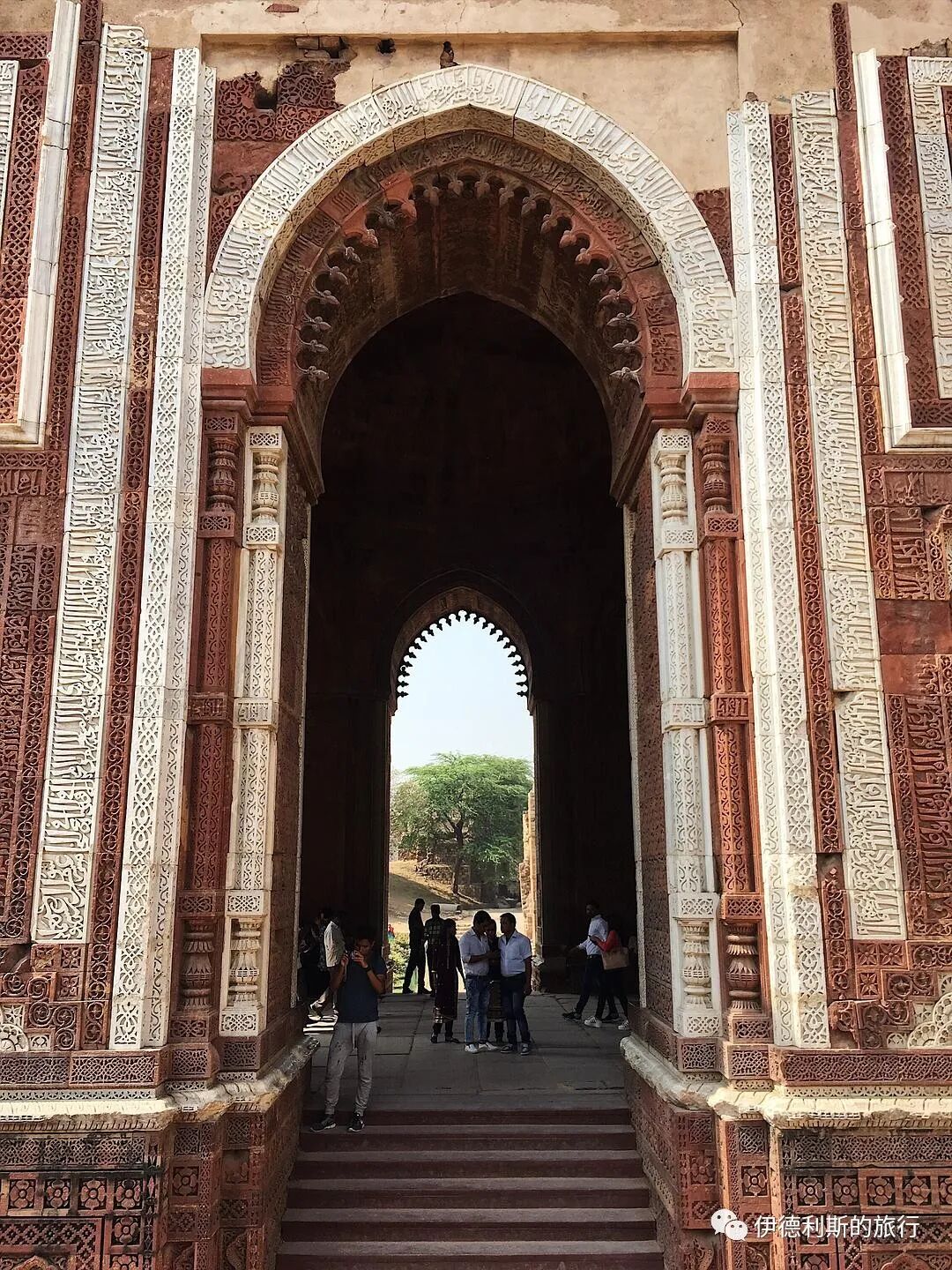
The most famous part of Alauddin's mosque expansion that still stands today is the southern gate, later called the Alai Darwaza. This building uses red sandstone and white marble inlaid with beautiful Naskh (a style of Arabic calligraphy) script. The geometric, openwork marble window screens show the high skill of the Turkic craftsmen.
This building is also known as the first structure in India built strictly according to Islamic architectural principles. During the Mamluk dynasty, the domes and arches were not strictly Islamic in form and were called false domes and false arches. This building is considered the first in India to use true Islamic domes and arches, though the patterns on the building are still full of Hindu elements.
5. Alai Minar
After doubling the size of the Qutb Mosque, Alauddin Khalji began building the Alai Minar, which was planned to be twice as tall as the Qutb Minar. However, the project was abandoned after the first level reached 24.5 meters. Today, only a huge core of rubble and stone remains of the tower.
6. Tomb of Alauddin Khalji
In his final years, Alauddin grew to distrust his officers and only favored the eunuch slave general Malik Kafur. Some scholars believe Alauddin and Kafur had a homosexual relationship, but others think their bond was not sexual.
In 1315, Alauddin became seriously ill. He appointed Kafur as the regent (Na'ib), giving him actual power. Kafur convinced Alauddin to purge many capable ministers and kept outsiders from seeing him during his final days.
As Alauddin lay dying, Kafur gathered all the important officials at his bedside to announce that Alauddin's 6-year-old son, Shihabuddin Omar, was the new heir and that he himself was the regent. According to the 14th-century Indian chronicler Abdul Malik Isami, Alauddin said nothing while in bed, and his silence was taken as consent.
Alauddin died on the night of January 4, 1316. Kafur buried him in the tomb already built in the southwest corner of the Qutb Mosque. According to the 14th-century historian Ziauddin Barani, it was Kafur who killed Alauddin.
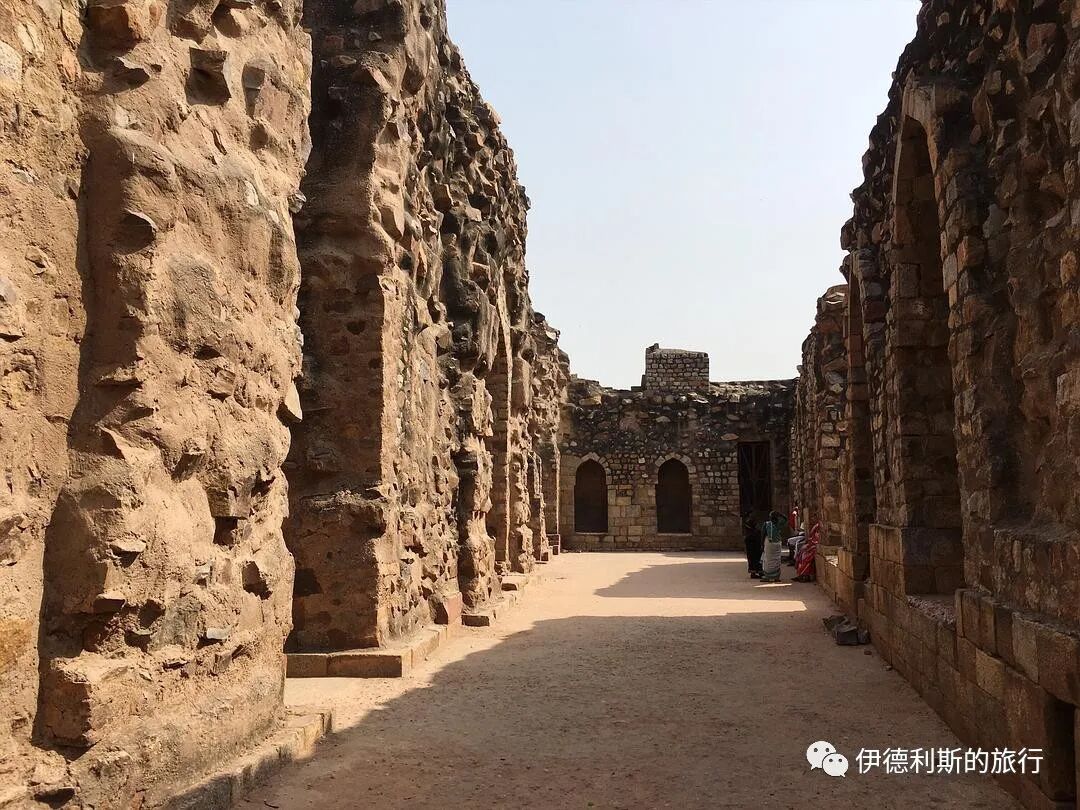
Alauddin's tomb is connected to the madrasa (Islamic school) he built during his lifetime. This is also the first building in India where an Islamic madrasa and a tomb are connected. The madrasa is well-preserved today, but the tomb is badly damaged and has lost its dome.
Madrasa
Dome
A tomb with a completely collapsed roof.
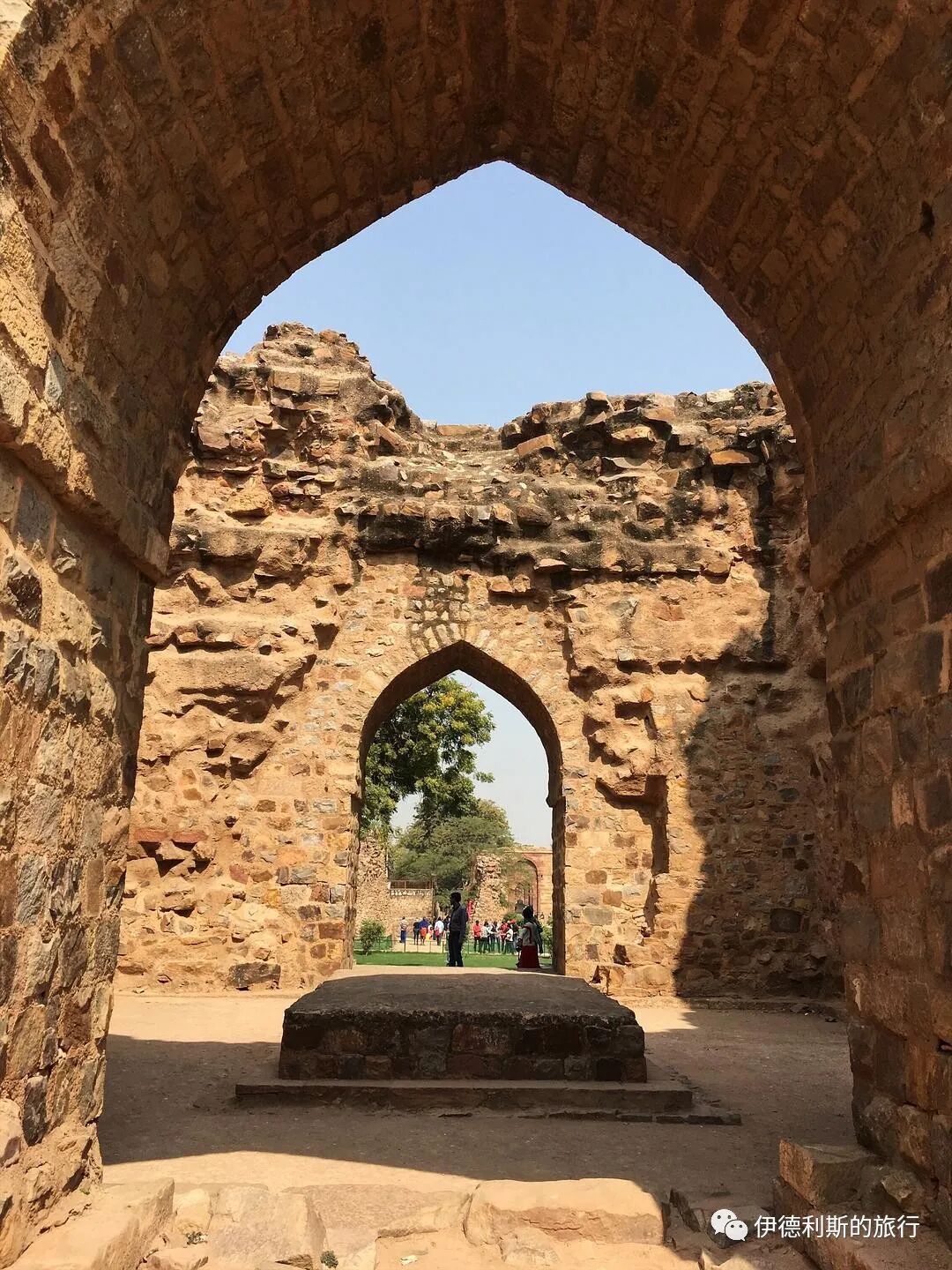
The room in the middle is likely where Alauddin is buried.
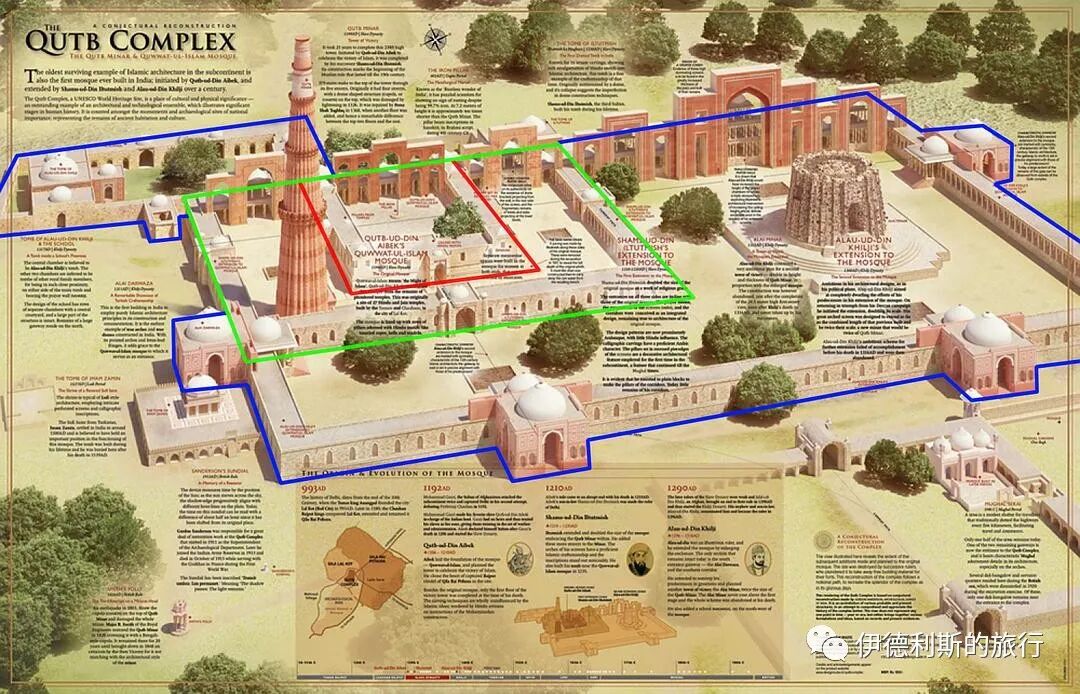
The image below shows a satellite view and a reconstruction of the Qutb Mosque. The red circle marks the mosque built by Qutb in 1193, the green circle marks the expansion by Iltutmish in 1225, and the blue circle marks the expansion by Alauddin in 1310. The Alauddin tomb and madrasa are inside the blue circle at the southwest corner.
Reconstruction image link: https://visual.ly/community/in ... mplex
6. Mughal Dynasty architecture at the Qutb Mosque
1. Tomb of Imam Zamin
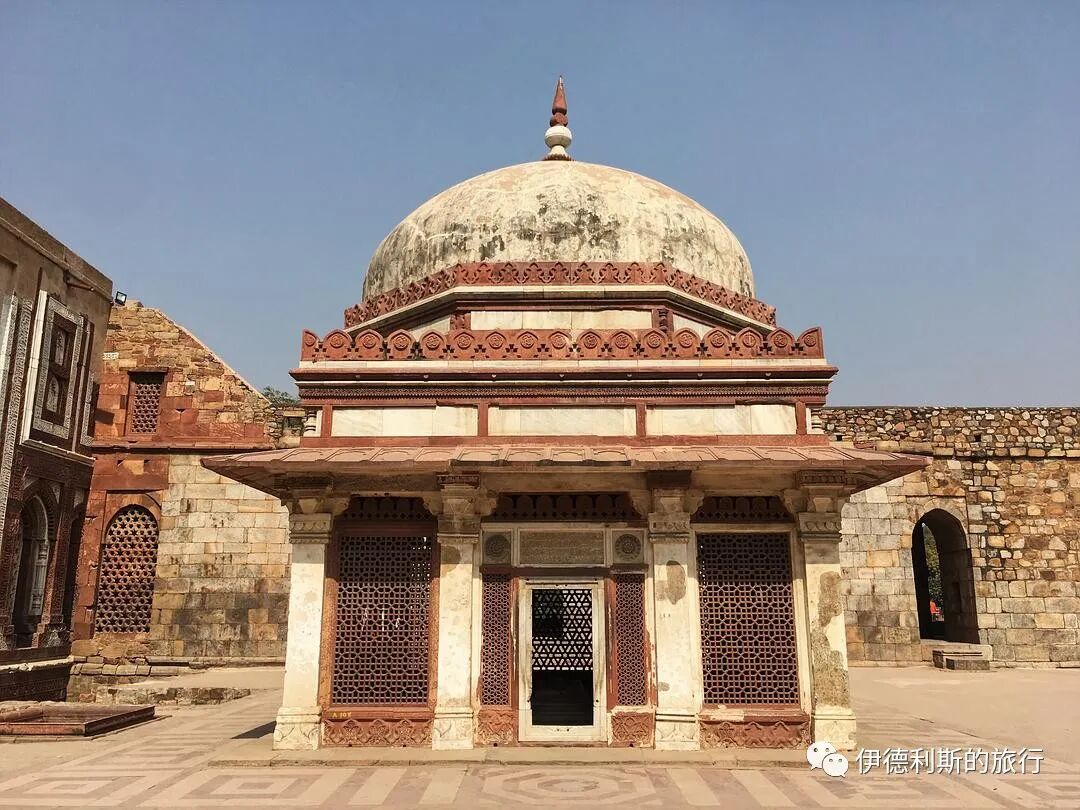
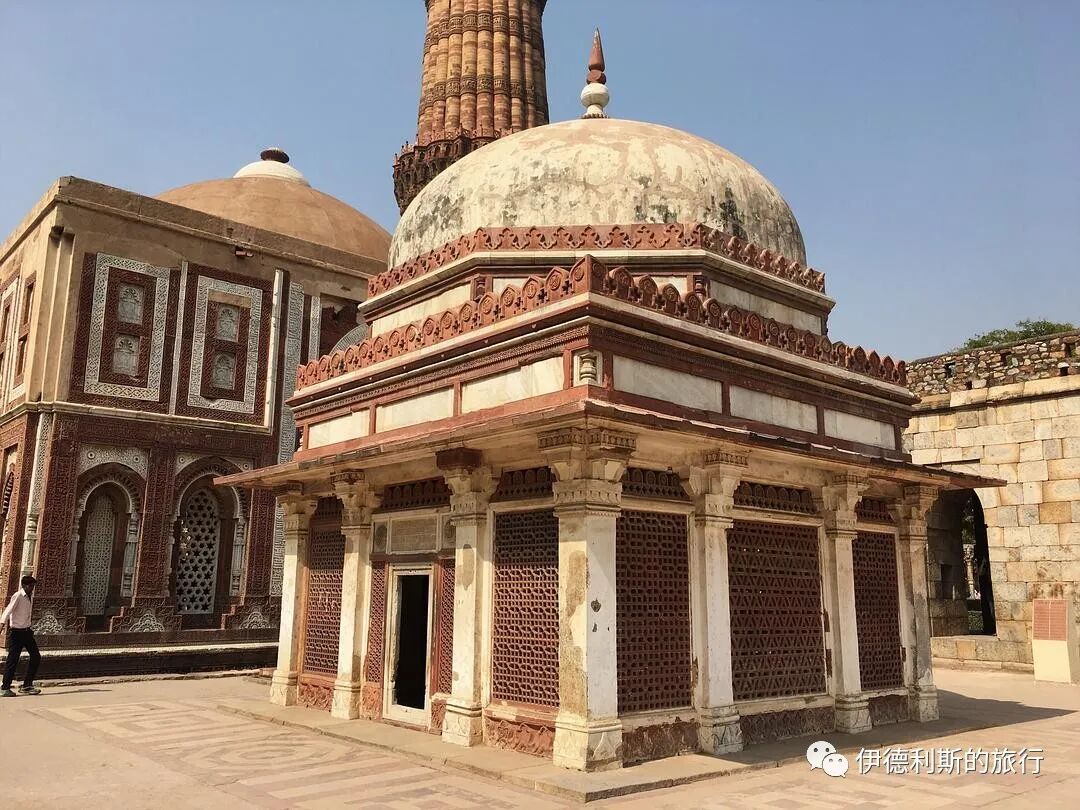
Next to the south gate, Alai Darwaza, is the tomb of Imam Zamin, built in 1539. Not much is known about this imam's life, but he was likely an imam at the Qutb Mosque.
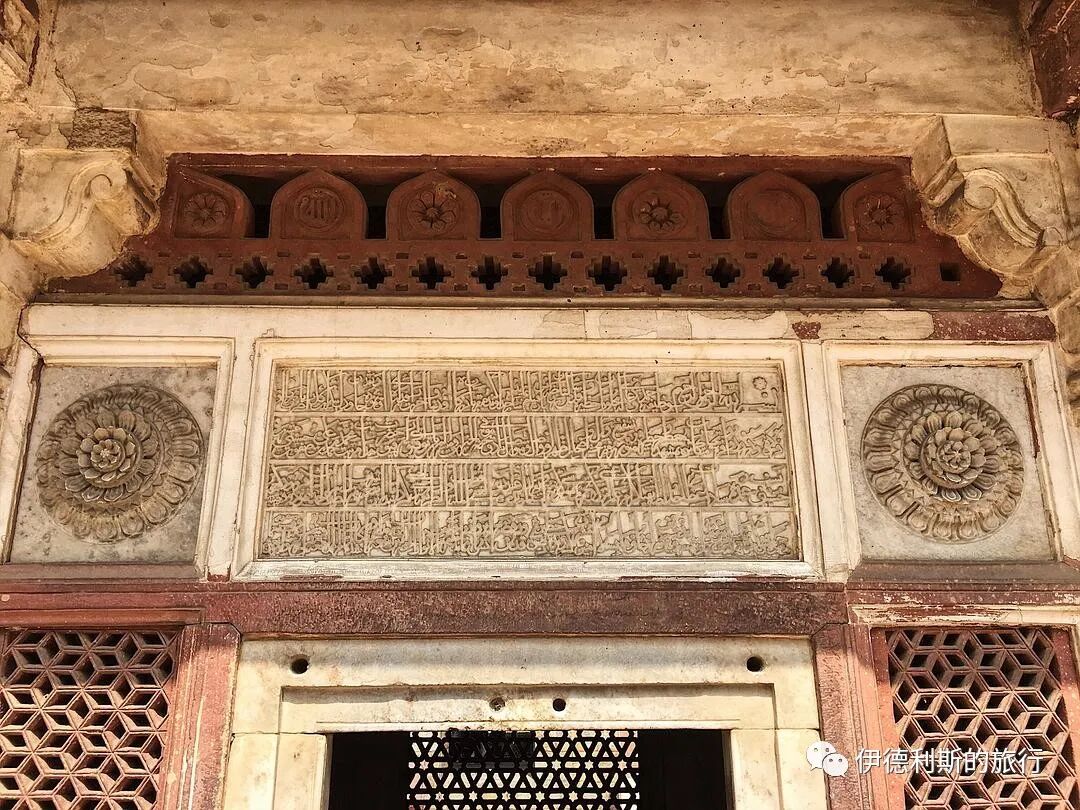
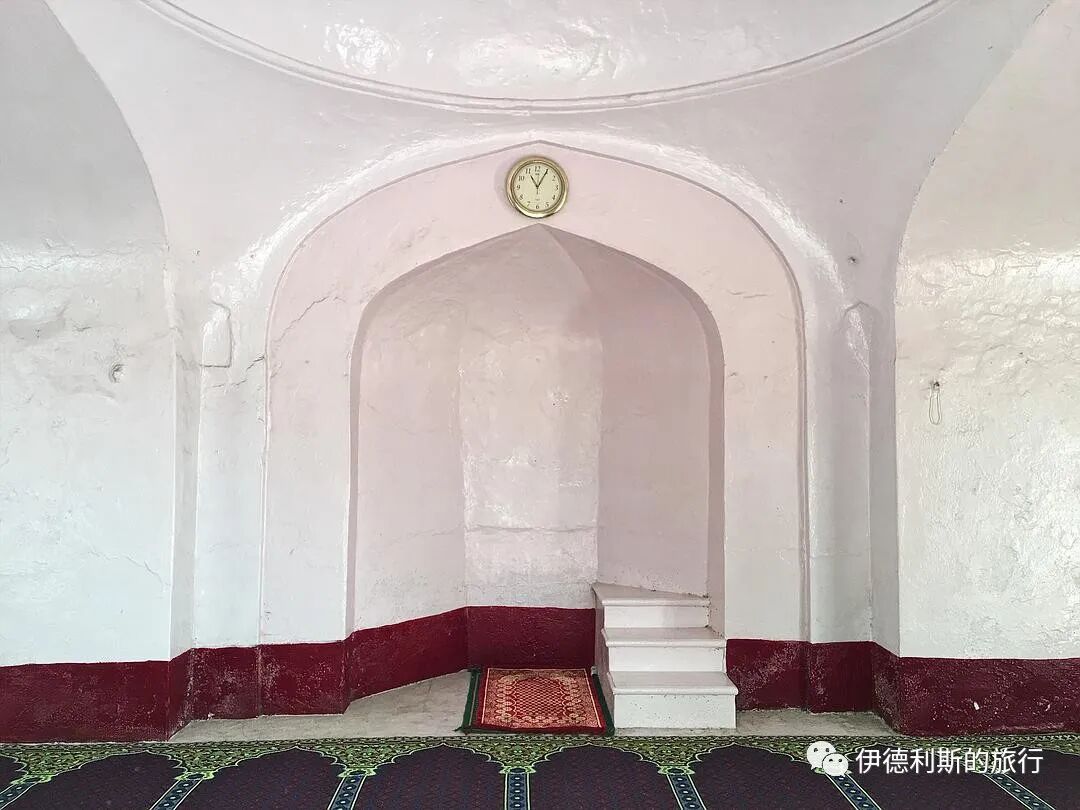
Door lintel.
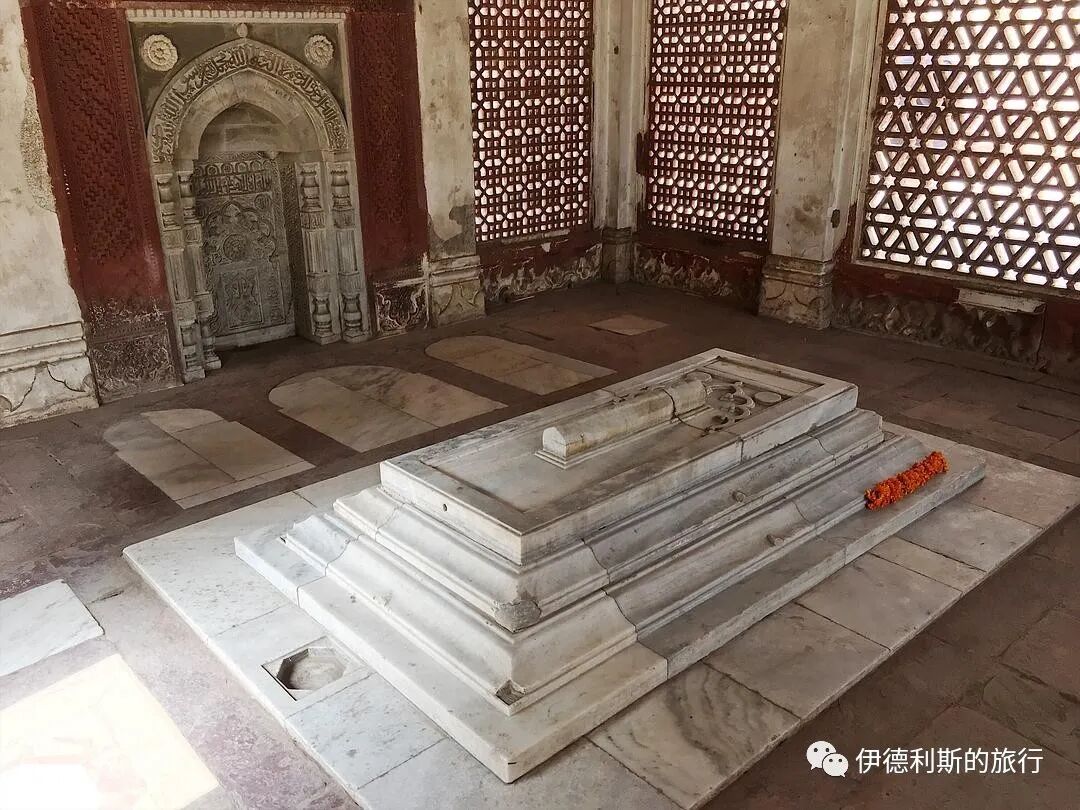
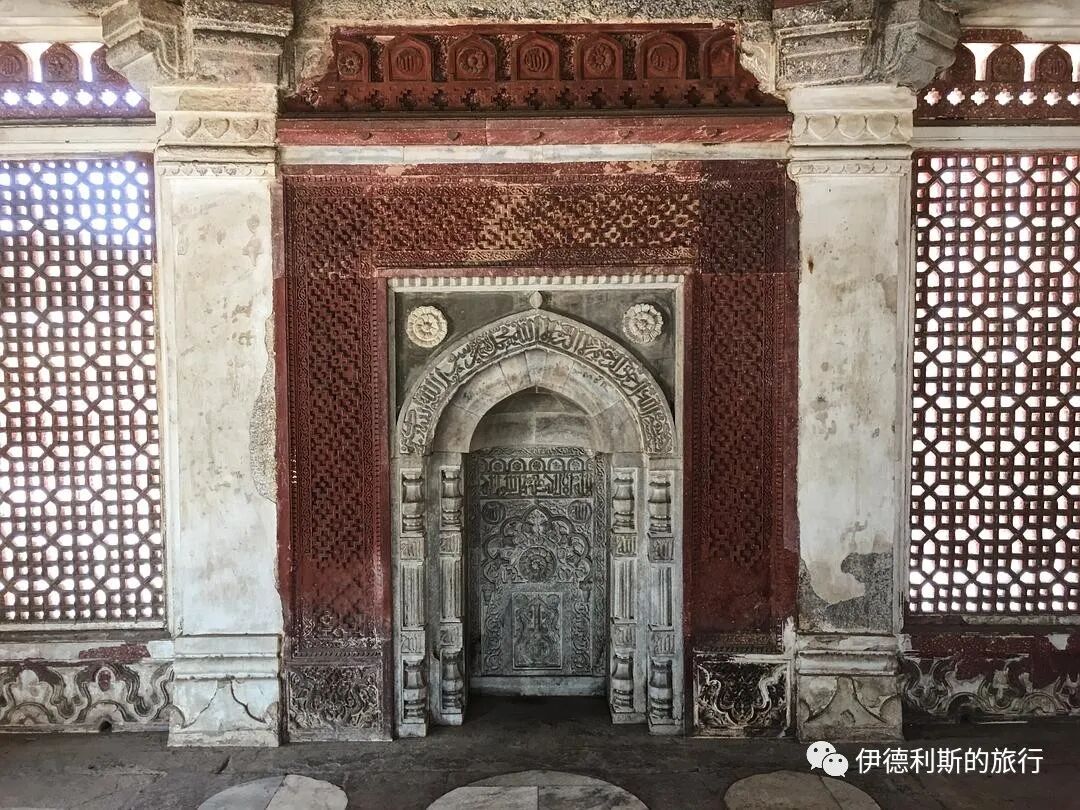
The mihrab on the west side.
2. Late Mughal Dynasty mosque
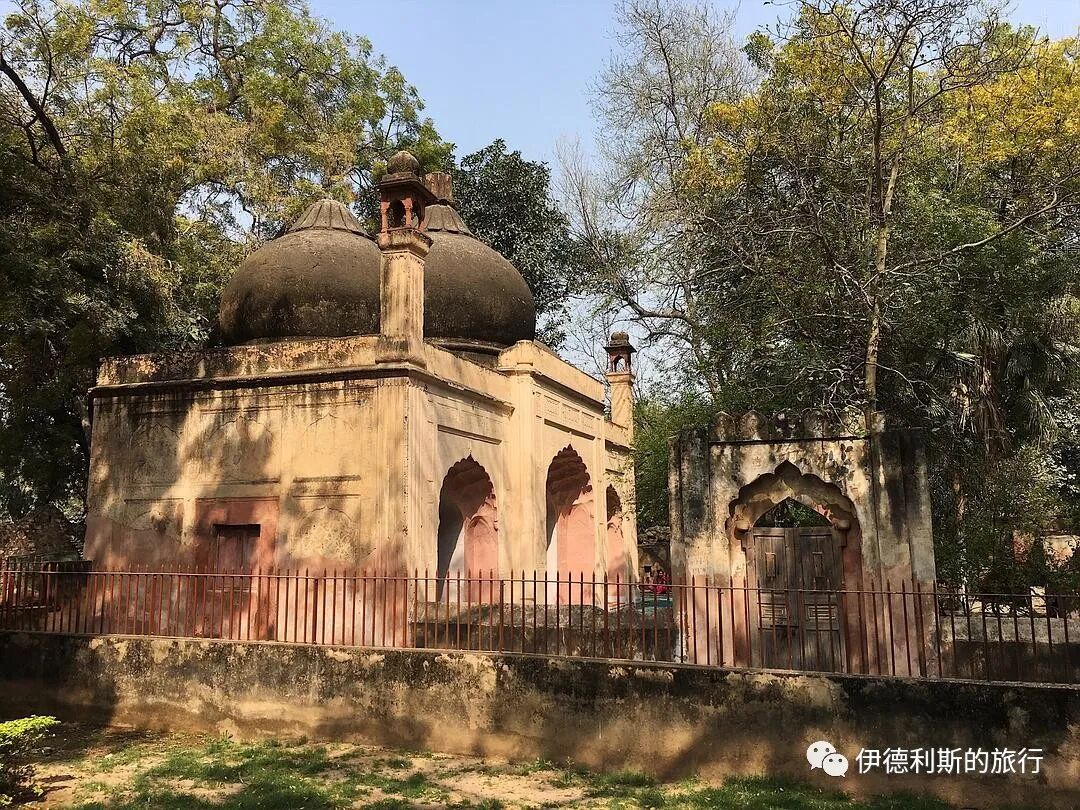
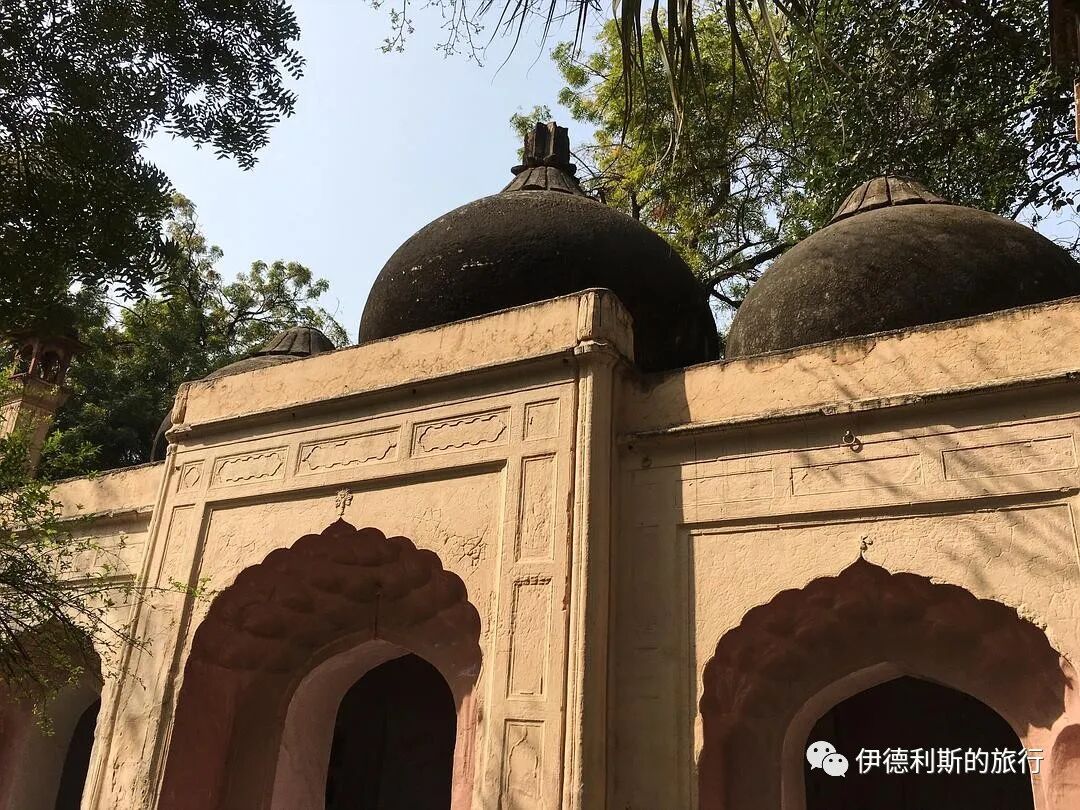
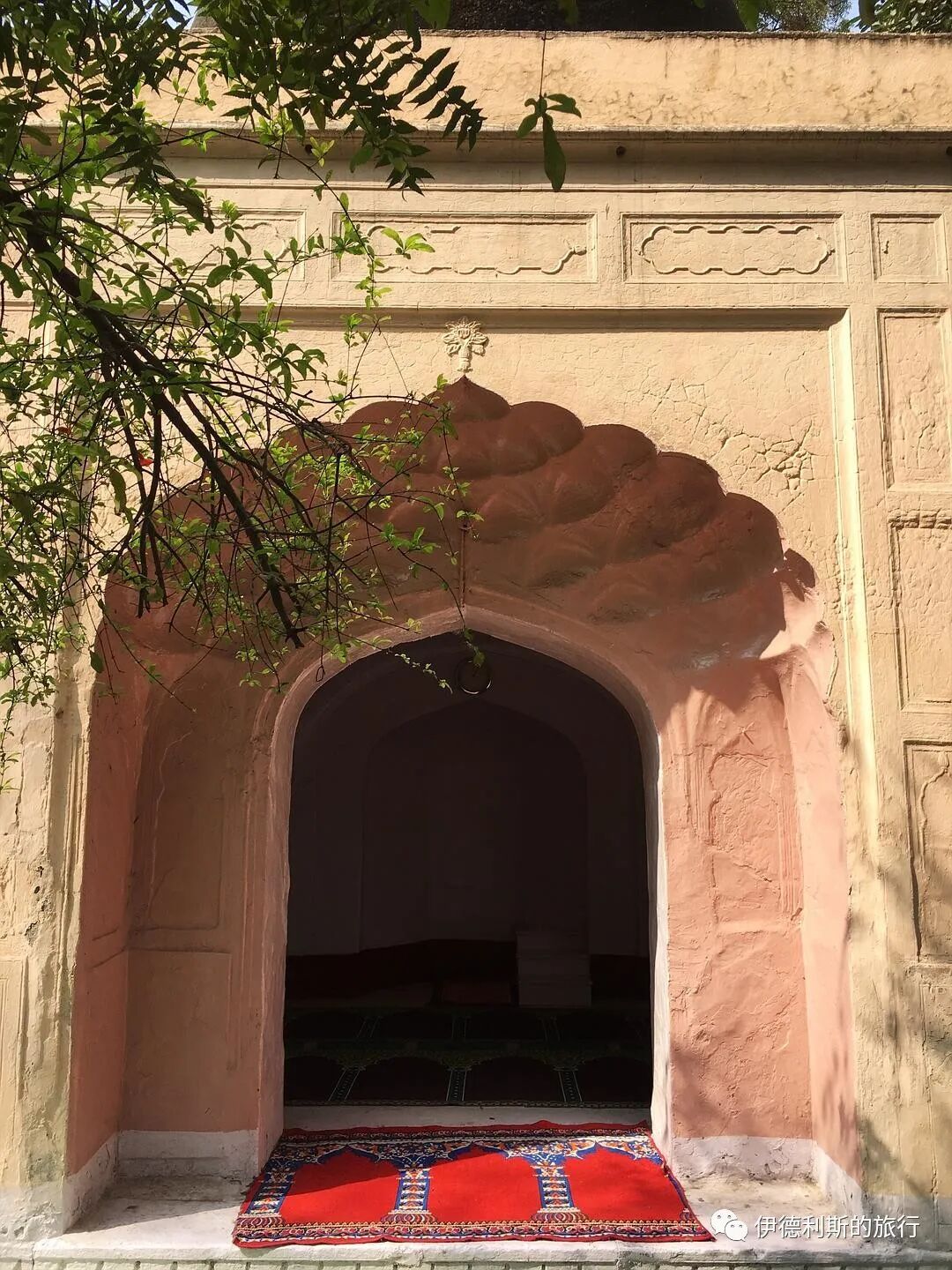
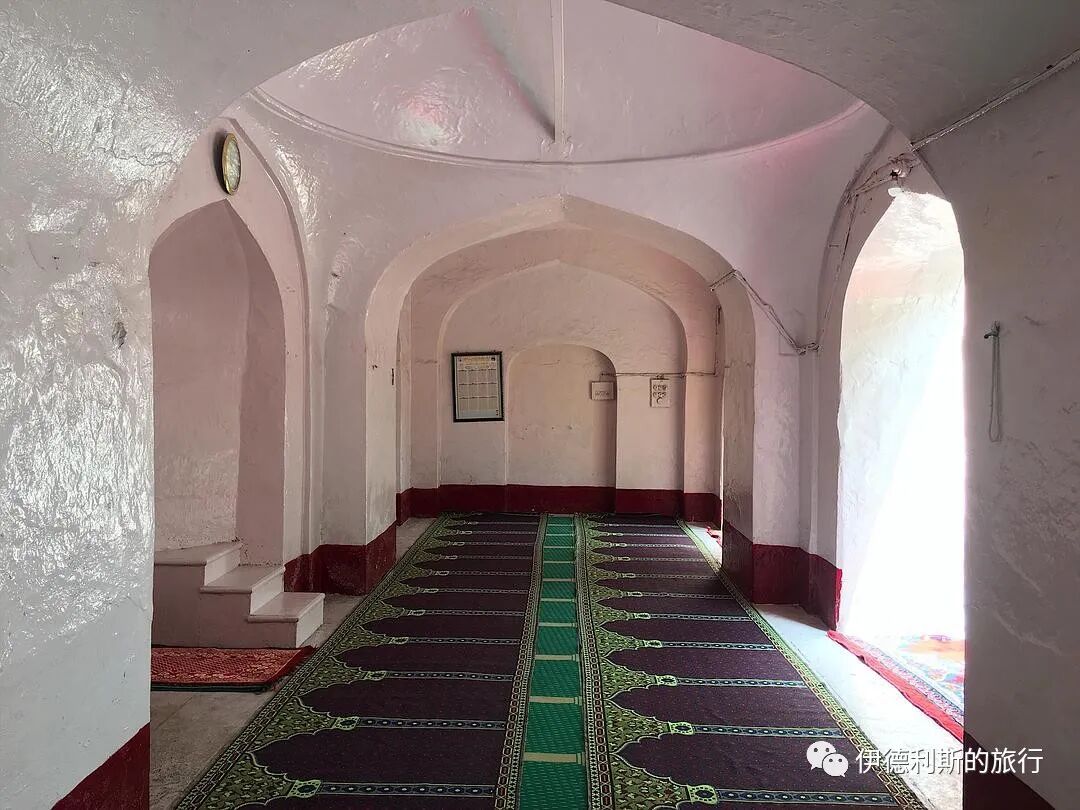
This is a small mosque built during the late Mughal Empire, located northeast of the Qutb Mosque.
Prayer hall.
The mihrab on the west side.
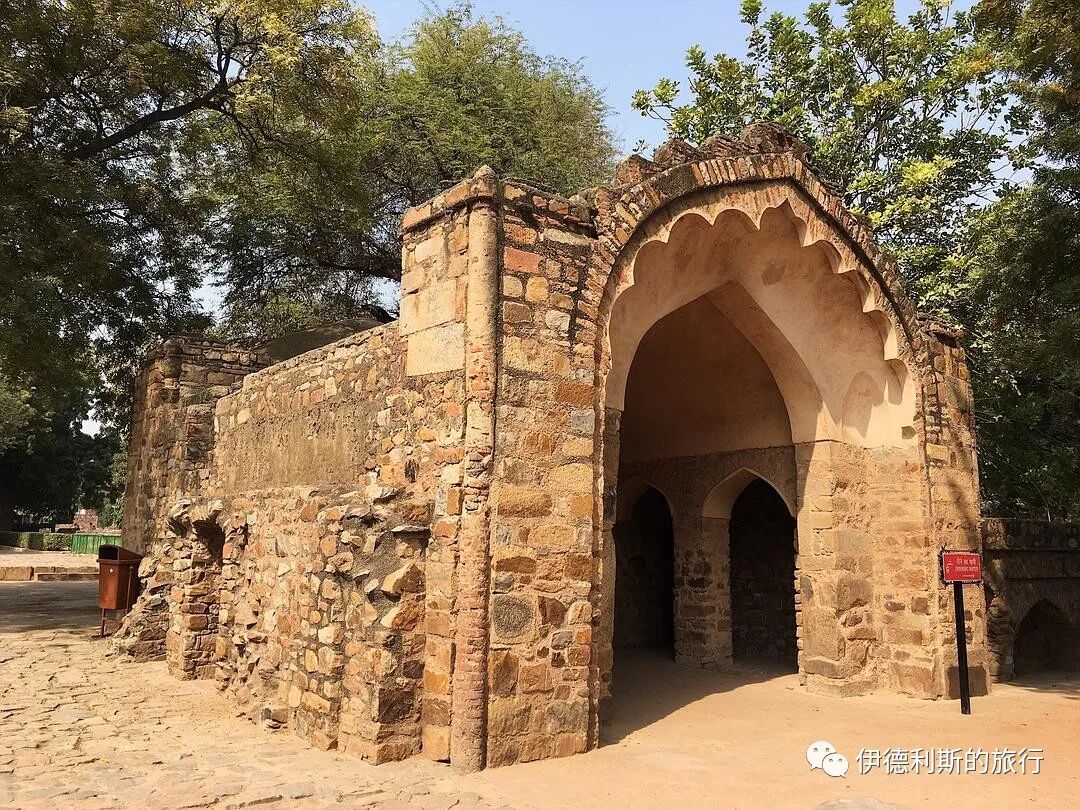
3. Mughal Dynasty era gate
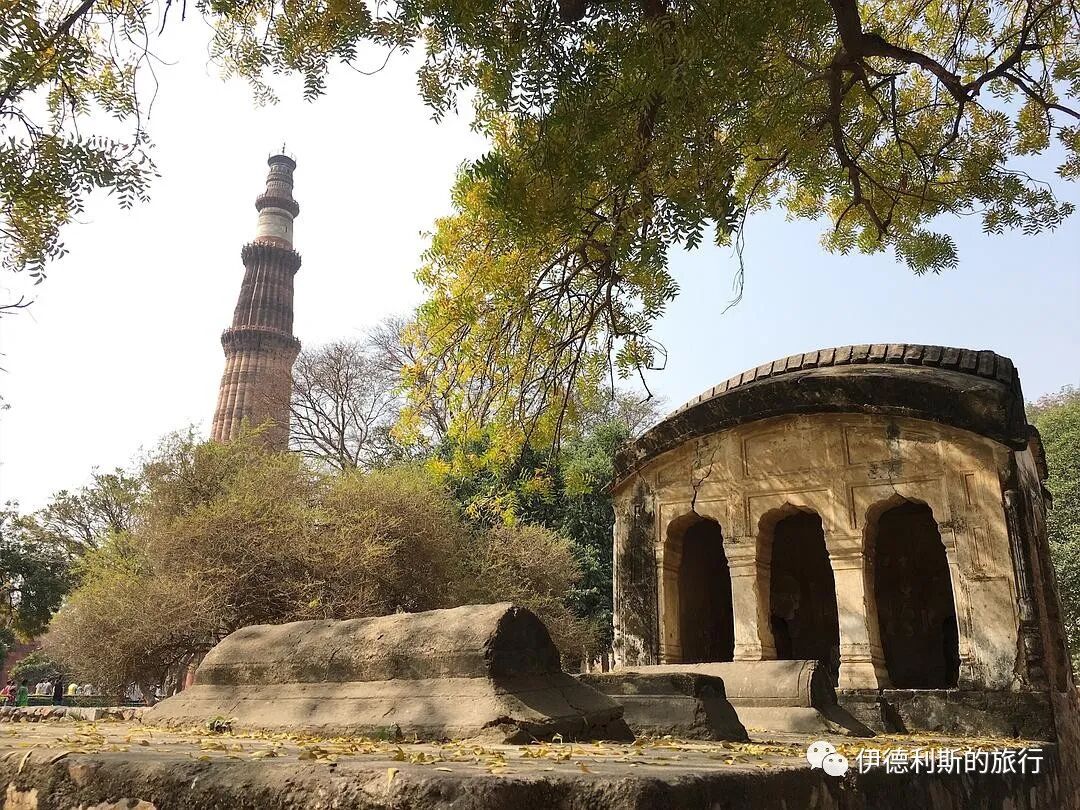
There are also some Mughal-era tombs scattered around the mosque. view all
Summary: Delhi — Qutb Minar, Mosques and Muslim History is presented here as a firsthand travel account in clear English, beginning with this scene: In the Indian epic Prithviraj Raso, Anangpal Tomar, the founder of the Tomar Dynasty, built Delhi's first city, Lal Kot, in 736 AD. The account keeps its focus on Delhi Travel, Qutb Minar, Muslim Heritage while preserving the names, places, food, and historical details from the Chinese source.
Contents
1. Delhi in the Hindu Era
2. Entering the Islamic Age
1. Ghurid Dynasty
2. Muhammad of Ghor conquers Delhi
3. Qutb rules Delhi
3. The first mosque in Delhi
1. Hindu and Jain architectural components
2. Iron Pillar of Delhi
3. The Qutb Minar reaching into the clouds
4. Iltutmish expands the mosque
1. Mamluk Dynasty of the Delhi Sultanate
2. Iltutmish takes over as Sultan
3. Territorial expansion
4. Expansion of the Qutb Mosque
5. Tomb of Iltutmish
5. Alauddin Khalji expands the mosque again
1. Khalji Dynasty of the Delhi Sultanate
2. Alauddin Khalji launches a coup
3. Accumulating wealth
4. Expanding the mosque
5. Alai Minar
6. Tomb of Alauddin Khalji
6. Mughal Dynasty architecture at the Qutb Mosque
1. Tomb of Imam Zamin
2. Late Mughal Dynasty mosque
3. Mughal Dynasty era gate
1. Delhi in the Hindu Era
In the Indian epic Prithviraj Raso, Anangpal Tomar, the founder of the Tomar Dynasty, built Delhi's first city, Lal Kot, in 736 AD. However, the history in this epic is not reliable, and some modern research suggests Lal Kot was more likely built in the mid-11th century. At that time, the city of Lal Kot had a perimeter of 3.6 kilometers and was home to about five or six thousand residents.
In 1160 (some say 1180), the Chauhan (Chahamanas) Dynasty from Rajasthan defeated the Tomar Dynasty, occupied Lal Kot, and expanded it into Qila Rai Pithora. The new city was four times larger than the original, with a perimeter reaching 8 kilometers, but later generations still tended to call the city Lal Kot.
The Chauhan Dynasty was later classified as one of the Rajput dynasties, although the identity of Rajput did not exist at that time. The term Rajput comes from the Sanskrit "raja-putra," meaning "son of a king." These tribes later became a group within the Kshatriya caste and linked their origins to myths and legends.
In the image below, the blue part is the city of Lal Kot, and the yellow part is the city of Qila Rai Pithora.
2. Entering the Islamic Age
In 1193, the Ghurid Dynasty defeated the Chauhan Dynasty and occupied the city of Lal Kot in Delhi, marking Delhi's entry into the Islamic age.
1. Ghurid Dynasty
The Ghurid Dynasty appeared in eastern Iran and the Afghanistan region starting in the 9th century. Whether the rulers were Pashtun or Tajik is still a matter of debate. In 1011, the Ghurid dynasty was conquered by the Persianized Turkic Muslim Ghaznavid dynasty, shifting from Buddhism to Islam.
In 1163, Ghiyath ad-Din Muhammad became the Sultan of the Ghurid dynasty. He and his brother, Mu'izz ad-Din Muhammad Ghori, launched a series of wars, attacking from Afghanistan all the way into northwestern India. In 1186, the two brothers captured the ancient city of Lahore in Punjab and took the last Ghaznavid Sultan, Khusrau Malik, prisoner, marking the end of the Ghaznavid dynasty.
2. Muhammad of Ghor conquers Delhi
In 1192, Muhammad Ghori led a large army to fight a decisive battle against the Rajput forces of the Chauhan dynasty. Exaggerated accounts claim that Muhammad Ghori brought 120,000 fully armed soldiers, while the Rajput army consisted of 300,000 cavalry and infantry, plus 3,000 elephants. Muhammad Ghori launched a surprise attack on the Rajput army before dawn, capturing and executing Prithviraj III.
In 1193, Muhammad Ghori conquered the city of Lal Kot in Delhi, then returned to Iran to deal with threats on his western border. Before leaving, he appointed General Qutb al-Din Aibak as the governor of northern India.
3. Qutb rules Delhi
Qutb al-Din Aibak was born into a Turkic family and was sold into slavery in Persia during his childhood. After his master died, he was sold again by the master's son, eventually becoming a slave to Muhammad Ghori. Qutb al-Din Aibak was highly valued by Muhammad Ghori, who appointed him as a military commander, and he later became a general of the Ghurid dynasty.
Starting in the 9th century, as the Arab Caliphate fractured, many Islamic rulers began using Turkic military slaves from Central Asia. These Turkic slave soldiers who converted to Islam were usually called Mamluk, a word meaning 'owned' in Arabic. Many Turkic Mamluks used their superior military skills to become generals and even rulers.
After becoming governor, Qutb al-Din Aibak used Delhi as his headquarters to gradually conquer all the Rajput dynasties in northern and central India, becoming the de facto ruler of northern India.
3. The first mosque in Delhi
After capturing Delhi in 1193, Qutb al-Din Aibak began building the first mosque on the ruins of the city of Lal Kot.
The red sections in the two images below show the location of the mosque built by Qutb al-Din Aibak.
1. Hindu and Jain architectural components
The Qutb mosque is known to later generations as the Quwwat-ul-Islam mosque and is one of the oldest surviving mosques in India. According to a Persian inscription on the mosque's east gate, the mosque was built after tearing down 27 Hindu and Jain temples from the Tomar and Chauhan dynasties. Because of this, many of the mosque's building components are original pieces from those Hindu and Jain temples.
The mosque gate.
The dome likely came from the construction of a Hindu or Jain temple.
The cloister inside the mosque.
The arch in front of the prayer hall.
The prayer hall has already collapsed.
The well-preserved east wall of the mosque.
2. Iron Pillar of Delhi
The famous Iron Pillar of Delhi stands in the center of the mosque courtyard. The pillar was cast between the 3rd and 4th centuries, and the time it was moved to the mosque is still debated. The oldest Sanskrit inscription on the iron pillar is from a king named Chandra. The most common view is that this king was Chandragupta II, who ruled the Gupta Empire from 380 to 415. This period was the peak of the Gupta Empire and is considered the 'Golden Age' of ancient India, when architecture and sculpture reached their height.
The high corrosion resistance of this iron pillar has attracted great interest from scientists and archaeologists, and it is considered a the highest level of ancient Indian iron-smelting technology. The pillar's corrosion resistance is believed to come from its high phosphorus content and Delhi's alternating wet and dry climate, which allowed a protective passivation film to form on the pillar.
3. The Qutb Minar reaching into the clouds
The most striking part of the Qutb mosque is the Qutb Minar, which later generations hailed as the tallest minaret in the ancient Islamic world.
The Qutb Minar is located outside the southeast side of the mosque courtyard. It is built of red sandstone, follows the style of Iranian minarets, and its patterns were influenced by the famous Minaret of Jam in contemporary Afghanistan. The tower is 72.5 meters high and divided into 5 levels. Each level has a protruding balcony, and there are 379 spiral stairs inside.
The first level of the Qutb Minar was built under the personal supervision of Qutb al-Din Aibak himself, so it contains many praises for Muhammad Ghori. The top three levels were finished in 1220 by his son-in-law Shams ud-Din Iltutmish (who I will introduce in detail later), and the style is basically the same as the Qutb period. The Qutb Minar from this period is made of red sandstone and carved with Kufic script.
In 1369, lightning destroyed the top of the Qutb Minar, and the Sultan of the Delhi Sultanate, Firoz Shah Tughlaq, rebuilt two more levels on top. The two new levels include marble, and you can now see a clear difference in architectural style between the bottom three levels and the top two.
4. Iltutmish expands the mosque
1. Mamluk Dynasty of the Delhi Sultanate
In 1202, Muhammad Ghori became the Sultan of the Ghurid dynasty after his brother passed away. In 1206, Muhammad Ghori handed over all affairs in India to Qutb and set off from India to return to Afghanistan. On March 15, while his carriage was traveling through Punjab, Pakistan, Muhammad Ghori was assassinated.
Muhammad Ghori had no children, so he treated his Mamluk slaves like his own sons during his lifetime. After he died, the country split into several parts, and Qutb established his own sultanate with Lahore as the capital. Because this sultanate later made Delhi its capital for nearly 300 years, later generations called it the Delhi Sultanate. Also, because Qutb was a Mamluk slave, the first dynasty of the Delhi Sultanate is known to later generations as the Mamluk Dynasty or the Slave Dynasty.
In 1210, Qutb died in an accident. The Delhi Sultanate did not have a fixed rule for succession. After Qutb died, the Turkic nobles in Lahore elected Aram Shah to succeed as Sultan. But Aram Shah was not good at governing the country, so a group of forty nobles called Chihalgani soon betrayed him and elected Shams ud-Din Iltutmish to succeed as Sultan.
In 1211, Iltutmish defeated Aram Shah on the plains near Delhi and seized the throne.
2. Iltutmish takes over as Sultan
Iltutmish came from the Turkic Ilbari tribe and was sold as a Mamluk slave during his childhood. He was first taken to the slave market in the ancient Central Asian city of Bukhara, then transferred to the Ghurid dynasty and bought by Muhammad Ghori's court.
Iltutmish quickly gained the appreciation of Muhammad Ghori and became his personal attendant. Qutb, who was the governor of Lahore at the time, also took a liking to Iltutmish, so he bought him from Muhammad Ghori in Delhi for a high price.
Iltutmish was also deeply appreciated by Qutb; he married Qutb's daughter and was entrusted by Qutb with the governorship of several important regions. After Qutb died in 1210, he defeated the successor Aram Shah in 1211 and became the third Sultan of the Mamluk Dynasty of the Delhi Sultanate.
3. Territorial expansion
At the beginning of his reign, Iltutmish consolidated the territory around Delhi through a series of wars. In 1214, Iltutmish officially moved the capital to the city of Lal Kot in Delhi.
In 1221, the Mongol army under Genghis Khan arrived at the banks of the Indus River. Iltutmish did not want a direct conflict with the Mongols, so he turned eastward and conquered the Bengal region.
The upheaval caused by the Mongol invasion of Central Asia led a large number of Turkic officers to come to India, so Iltutmish recruited a powerful army and conquered Sindh and Multan in 1228.
In 1228, Iltutmish received recognition from the Caliph of the Abbasid Caliphate and was granted a robe and gifts by the Caliph, which gave the Delhi Sultanate legitimacy in the Islamic world.
4. Expansion of the Qutb Mosque
In 1225, as the political situation stabilized, Iltutmish began to expand the Qutb Mosque, and the expanded part is also called the Iltutmish Mosque.
The green part in the picture below shows the scope of the mosque expansion by Iltutmish.
During Iltutmish's expansion, Muslim craftsmen replaced the Hindu craftsmen of the Qutb era, and they no longer used components from the original temples, so the architectural style of this period is more Islamic than the Qutb period.
The best-preserved part of Iltutmish's expansion is the beautifully carved archway.
Behind the archway, in the lower right corner, is the south cloister of the Iltutmish expansion.
The east cloister is visibly simpler than the cloister built by Qutb.
The west colonnade has already collapsed.
5. Tomb of Iltutmish
Iltutmish passed away in 1236. In 1235, the year before he died, he built his own tomb next to the Qutb Mosque.
The stone carvings on the walls are very ornate, featuring bells, tassels, lotus flowers, and diamond emblems, all of which are elements from Hinduism.
The structure at the corner of the tomb's ceiling is called a squinch, which is used to connect the walls to the dome. The earliest squinches appeared in the Sassanid Empire of Persia and were later used in Islamic architecture, becoming most common in Iran.
The squinches in the Tomb of Iltutmish indicate that there was once a dome on top of the tomb, but it later collapsed.
The ornate mihrab on the west side.
The tombstone in the center is made of white marble.
The actual grave of Iltutmish is not inside this building. In 1914, Gordon Sanderson of the Archaeological Survey of India (ASI) excavated the real burial chamber 20 steps north of the Tomb of Iltutmish.
5. Alauddin Khalji expands the mosque again
In 1310, Sultan Alauddin Khalji of the Khalji dynasty of the Delhi Sultanate expanded the Qutb Mosque for the third time.
1. Khalji Dynasty of the Delhi Sultanate
The Khaljis were a Turkic people who had lived among the Pashtun tribes in Afghanistan for over 200 years. By the time they arrived in Delhi in the 13th century, their customs had become Pashtunized, leading the Turkic nobility in India to even regard them as Afghans.
The Khaljis came to Delhi to serve the Sultan during the reign of Ghiyas ud din Balban, the ninth sultan of the Mamluk dynasty of the Delhi Sultanate (1266–1287). During Balban's era, the Delhi Sultanate stabilized after being on the verge of collapse, with its territory covering most of northern India.
After Balban died in 1287, his young successor became addicted to wine and women, and the Turkic nobility fell into factional fighting. In 1290, the military officer Jalal ud din Firuz Khalji launched a coup to overthrow the Mamluk dynasty, founding the second dynasty of the Delhi Sultanate—the Khalji dynasty.
2. Alauddin Khalji launches a coup
Firuz Khalji was already 70 years old when he took the throne. He was recognized as a gentle and humble monarch, but because he was not considered a Turk, Turkic nobles always tried to overthrow him.
Firuz pardoned one person after another who tried to overthrow him, but he eventually died at the hands of his nephew and son-in-law, Alauddin Khalji. Alauddin's original name was Ali Gurshasp. His father was Firuz's eldest brother, but he died early, so Alauddin was raised by Firuz. Firuz not only raised his nephew but also married his daughter to him.
After Firuz became Sultan, Alauddin's wife suddenly became a princess and began to act very arrogantly, wanting to dominate Alauddin. Her mother also indulged her daughter's arrogant behavior, so Alauddin had a very poor relationship with both his wife and his mother-in-law.
In 1291, Alauddin became the new governor of Kara. In Kara, people who had previously wanted to overthrow Firuz began to incite Alauddin to overthrow his uncle. Combined with his miserable marriage, he began to resolve to get rid of Firuz.
After five years of raising funds and hiring an army, in 1296, Alauddin led an army of 8,000 cavalry to loot Devagiri, the capital of the Yadava dynasty in southern India, and obtained a massive amount of wealth. When Firuz heard the news, he was very happy and set out from Delhi, intending to meet Alauddin on the way to see the spoils, but Alauddin took a detour and returned directly to Kara. One of Firuz's subordinates suggested that the Sultan go to intercept Alauddin, but Firuz believed that Alauddin would bring the wealth to Delhi, so he returned to Delhi instead.
In Delhi, Alauddin's younger brother Almas Beg assured his uncle of Alauddin's loyalty and begged him to pardon Alauddin's mistakes, saying that Alauddin would likely commit suicide out of guilt. Firuz, who cared for his nephew, immediately sent someone to Kara with a letter of pardon and promised to travel to Kara afterward.
During Ramadan in 1296, Firuz led a large army to Kara to meet Alauddin. He ordered his commanders to lead the main army directly to Kara, while he crossed the Ganges River with 1,000 soldiers. As they neared Kara, Alauddin sent his brother Almas to meet his uncle and persuade him to come alone, saying that otherwise, Alauddin would commit suicide out of fear.
When he arrived at Kara, Alauddin threw himself at Firuz's feet. Firuz caressed Alauddin, kissed his cheek, and scolded him for doubting his uncle's affection for him. At that moment, Alauddin signaled his subordinate Muhammad Salim, who swung his sword at Firuz. After being struck by the first blow, Firuz struggled to run toward the boat, but Muhammad swung a second time, and Firuz was finally killed. Alauddin immediately put on the crown and declared himself the new Sultan.
Alauddin then started moving toward Delhi, recruiting as many soldiers as he could along the way. Meanwhile in Delhi, Firoz's widow named her young son Qadr Khan as the new Sultan. This made the eldest son, Arkali Khan, who was the governor of Multan, furious, and he refused to help his mother defend against Alauddin's army.
In October 1296, Alauddin reached Delhi, defeated his mother-in-law's army, and took the city. On October 21, Alauddin officially became the Sultan of the Khalji dynasty of the Delhi Sultanate.
3. Accumulating wealth
During his first year on the throne, Alauddin used generous gifts to secure his power while balancing the influence of various nobles, which quickly brought stability to Delhi. By his second year, Alauddin began arresting and killing the nobles who had served Firoz. He seized their property to gain massive wealth and replaced the old nobles with new ones loyal to him.
Starting in 1297, Alauddin defended against the Mongol armies of the Chagatai Khanate while constantly conquering Hindu kingdoms in the south. In 1306, Alauddin defeated the last Mongol army sent by the Chagatai Khan, Duwa. After that, he began regular raids into Mongol territory in Afghanistan.
Alauddin's conquest of southern India was also very successful. In 1311, Alauddin sent an army to the Pandyan dynasty at the southern tip of the Indian peninsula. They seized a huge amount of treasure, elephants, and horses, which was considered the greatest haul of wealth since Muslims first occupied Delhi.
Besides looting the Hindu kingdoms, Alauddin carried out a series of economic reforms. Regarding land, he collected land taxes directly from Hindu rural areas without using any middlemen. Regarding income, he hired many accountants in the court and gave heavy punishments for bribery. Regarding markets, Alauddin used market inspectors and spies to strictly control the prices of goods. He also built state-owned grain warehouses and banned farmers and merchants from storing grain privately. By strictly controlling market prices, he was able to maintain a massive army while paying his soldiers lower wages.
4. Expanding the mosque
After accumulating great wealth, Alauddin began expanding the Qutb Mosque in 1310. The new mosque was much larger than the one expanded by Iltutmish.
The blue section in the image below shows the area of Alauddin's mosque expansion.
The most famous part of Alauddin's mosque expansion that still stands today is the southern gate, later called the Alai Darwaza. This building uses red sandstone and white marble inlaid with beautiful Naskh (a style of Arabic calligraphy) script. The geometric, openwork marble window screens show the high skill of the Turkic craftsmen.
This building is also known as the first structure in India built strictly according to Islamic architectural principles. During the Mamluk dynasty, the domes and arches were not strictly Islamic in form and were called false domes and false arches. This building is considered the first in India to use true Islamic domes and arches, though the patterns on the building are still full of Hindu elements.
5. Alai Minar
After doubling the size of the Qutb Mosque, Alauddin Khalji began building the Alai Minar, which was planned to be twice as tall as the Qutb Minar. However, the project was abandoned after the first level reached 24.5 meters. Today, only a huge core of rubble and stone remains of the tower.
6. Tomb of Alauddin Khalji
In his final years, Alauddin grew to distrust his officers and only favored the eunuch slave general Malik Kafur. Some scholars believe Alauddin and Kafur had a homosexual relationship, but others think their bond was not sexual.
In 1315, Alauddin became seriously ill. He appointed Kafur as the regent (Na'ib), giving him actual power. Kafur convinced Alauddin to purge many capable ministers and kept outsiders from seeing him during his final days.
As Alauddin lay dying, Kafur gathered all the important officials at his bedside to announce that Alauddin's 6-year-old son, Shihabuddin Omar, was the new heir and that he himself was the regent. According to the 14th-century Indian chronicler Abdul Malik Isami, Alauddin said nothing while in bed, and his silence was taken as consent.
Alauddin died on the night of January 4, 1316. Kafur buried him in the tomb already built in the southwest corner of the Qutb Mosque. According to the 14th-century historian Ziauddin Barani, it was Kafur who killed Alauddin.
Alauddin's tomb is connected to the madrasa (Islamic school) he built during his lifetime. This is also the first building in India where an Islamic madrasa and a tomb are connected. The madrasa is well-preserved today, but the tomb is badly damaged and has lost its dome.
Madrasa
Dome
A tomb with a completely collapsed roof.
The room in the middle is likely where Alauddin is buried.
The image below shows a satellite view and a reconstruction of the Qutb Mosque. The red circle marks the mosque built by Qutb in 1193, the green circle marks the expansion by Iltutmish in 1225, and the blue circle marks the expansion by Alauddin in 1310. The Alauddin tomb and madrasa are inside the blue circle at the southwest corner.
Reconstruction image link: https://visual.ly/community/in ... mplex
6. Mughal Dynasty architecture at the Qutb Mosque
1. Tomb of Imam Zamin
Next to the south gate, Alai Darwaza, is the tomb of Imam Zamin, built in 1539. Not much is known about this imam's life, but he was likely an imam at the Qutb Mosque.
Door lintel.
The mihrab on the west side.
2. Late Mughal Dynasty mosque
This is a small mosque built during the late Mughal Empire, located northeast of the Qutb Mosque.
Prayer hall.
The mihrab on the west side.
3. Mughal Dynasty era gate
There are also some Mughal-era tombs scattered around the mosque. view all
Reposted from the web
Summary: Delhi — Qutb Minar, Mosques and Muslim History is presented here as a firsthand travel account in clear English, beginning with this scene: In the Indian epic Prithviraj Raso, Anangpal Tomar, the founder of the Tomar Dynasty, built Delhi's first city, Lal Kot, in 736 AD. The account keeps its focus on Delhi Travel, Qutb Minar, Muslim Heritage while preserving the names, places, food, and historical details from the Chinese source.
Contents
1. Delhi in the Hindu Era
2. Entering the Islamic Age
1. Ghurid Dynasty
2. Muhammad of Ghor conquers Delhi
3. Qutb rules Delhi
3. The first mosque in Delhi
1. Hindu and Jain architectural components
2. Iron Pillar of Delhi
3. The Qutb Minar reaching into the clouds
4. Iltutmish expands the mosque
1. Mamluk Dynasty of the Delhi Sultanate
2. Iltutmish takes over as Sultan
3. Territorial expansion
4. Expansion of the Qutb Mosque
5. Tomb of Iltutmish
5. Alauddin Khalji expands the mosque again
1. Khalji Dynasty of the Delhi Sultanate
2. Alauddin Khalji launches a coup
3. Accumulating wealth
4. Expanding the mosque
5. Alai Minar
6. Tomb of Alauddin Khalji
6. Mughal Dynasty architecture at the Qutb Mosque
1. Tomb of Imam Zamin
2. Late Mughal Dynasty mosque
3. Mughal Dynasty era gate
1. Delhi in the Hindu Era
In the Indian epic Prithviraj Raso, Anangpal Tomar, the founder of the Tomar Dynasty, built Delhi's first city, Lal Kot, in 736 AD. However, the history in this epic is not reliable, and some modern research suggests Lal Kot was more likely built in the mid-11th century. At that time, the city of Lal Kot had a perimeter of 3.6 kilometers and was home to about five or six thousand residents.
In 1160 (some say 1180), the Chauhan (Chahamanas) Dynasty from Rajasthan defeated the Tomar Dynasty, occupied Lal Kot, and expanded it into Qila Rai Pithora. The new city was four times larger than the original, with a perimeter reaching 8 kilometers, but later generations still tended to call the city Lal Kot.
The Chauhan Dynasty was later classified as one of the Rajput dynasties, although the identity of Rajput did not exist at that time. The term Rajput comes from the Sanskrit "raja-putra," meaning "son of a king." These tribes later became a group within the Kshatriya caste and linked their origins to myths and legends.
In the image below, the blue part is the city of Lal Kot, and the yellow part is the city of Qila Rai Pithora.
2. Entering the Islamic Age
In 1193, the Ghurid Dynasty defeated the Chauhan Dynasty and occupied the city of Lal Kot in Delhi, marking Delhi's entry into the Islamic age.
1. Ghurid Dynasty
The Ghurid Dynasty appeared in eastern Iran and the Afghanistan region starting in the 9th century. Whether the rulers were Pashtun or Tajik is still a matter of debate. In 1011, the Ghurid dynasty was conquered by the Persianized Turkic Muslim Ghaznavid dynasty, shifting from Buddhism to Islam.
In 1163, Ghiyath ad-Din Muhammad became the Sultan of the Ghurid dynasty. He and his brother, Mu'izz ad-Din Muhammad Ghori, launched a series of wars, attacking from Afghanistan all the way into northwestern India. In 1186, the two brothers captured the ancient city of Lahore in Punjab and took the last Ghaznavid Sultan, Khusrau Malik, prisoner, marking the end of the Ghaznavid dynasty.
2. Muhammad of Ghor conquers Delhi
In 1192, Muhammad Ghori led a large army to fight a decisive battle against the Rajput forces of the Chauhan dynasty. Exaggerated accounts claim that Muhammad Ghori brought 120,000 fully armed soldiers, while the Rajput army consisted of 300,000 cavalry and infantry, plus 3,000 elephants. Muhammad Ghori launched a surprise attack on the Rajput army before dawn, capturing and executing Prithviraj III.
In 1193, Muhammad Ghori conquered the city of Lal Kot in Delhi, then returned to Iran to deal with threats on his western border. Before leaving, he appointed General Qutb al-Din Aibak as the governor of northern India.
3. Qutb rules Delhi
Qutb al-Din Aibak was born into a Turkic family and was sold into slavery in Persia during his childhood. After his master died, he was sold again by the master's son, eventually becoming a slave to Muhammad Ghori. Qutb al-Din Aibak was highly valued by Muhammad Ghori, who appointed him as a military commander, and he later became a general of the Ghurid dynasty.
Starting in the 9th century, as the Arab Caliphate fractured, many Islamic rulers began using Turkic military slaves from Central Asia. These Turkic slave soldiers who converted to Islam were usually called Mamluk, a word meaning 'owned' in Arabic. Many Turkic Mamluks used their superior military skills to become generals and even rulers.
After becoming governor, Qutb al-Din Aibak used Delhi as his headquarters to gradually conquer all the Rajput dynasties in northern and central India, becoming the de facto ruler of northern India.
3. The first mosque in Delhi
After capturing Delhi in 1193, Qutb al-Din Aibak began building the first mosque on the ruins of the city of Lal Kot.
The red sections in the two images below show the location of the mosque built by Qutb al-Din Aibak.
1. Hindu and Jain architectural components
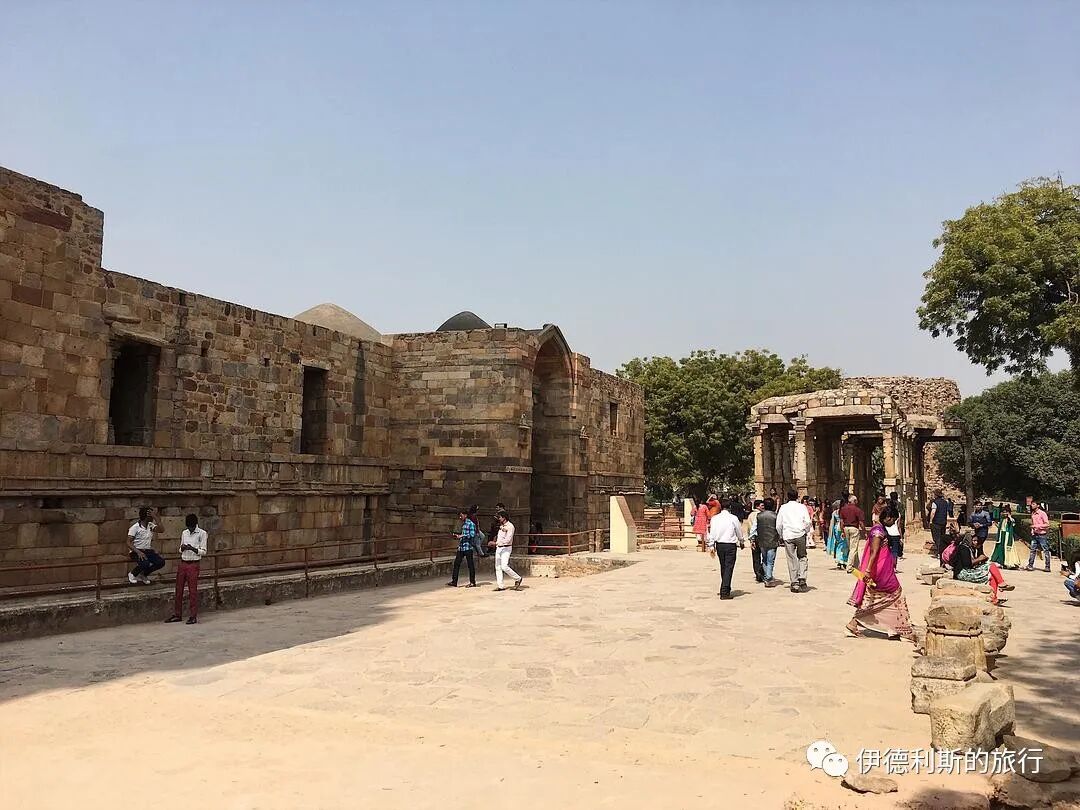
The Qutb mosque is known to later generations as the Quwwat-ul-Islam mosque and is one of the oldest surviving mosques in India. According to a Persian inscription on the mosque's east gate, the mosque was built after tearing down 27 Hindu and Jain temples from the Tomar and Chauhan dynasties. Because of this, many of the mosque's building components are original pieces from those Hindu and Jain temples.
The mosque gate.
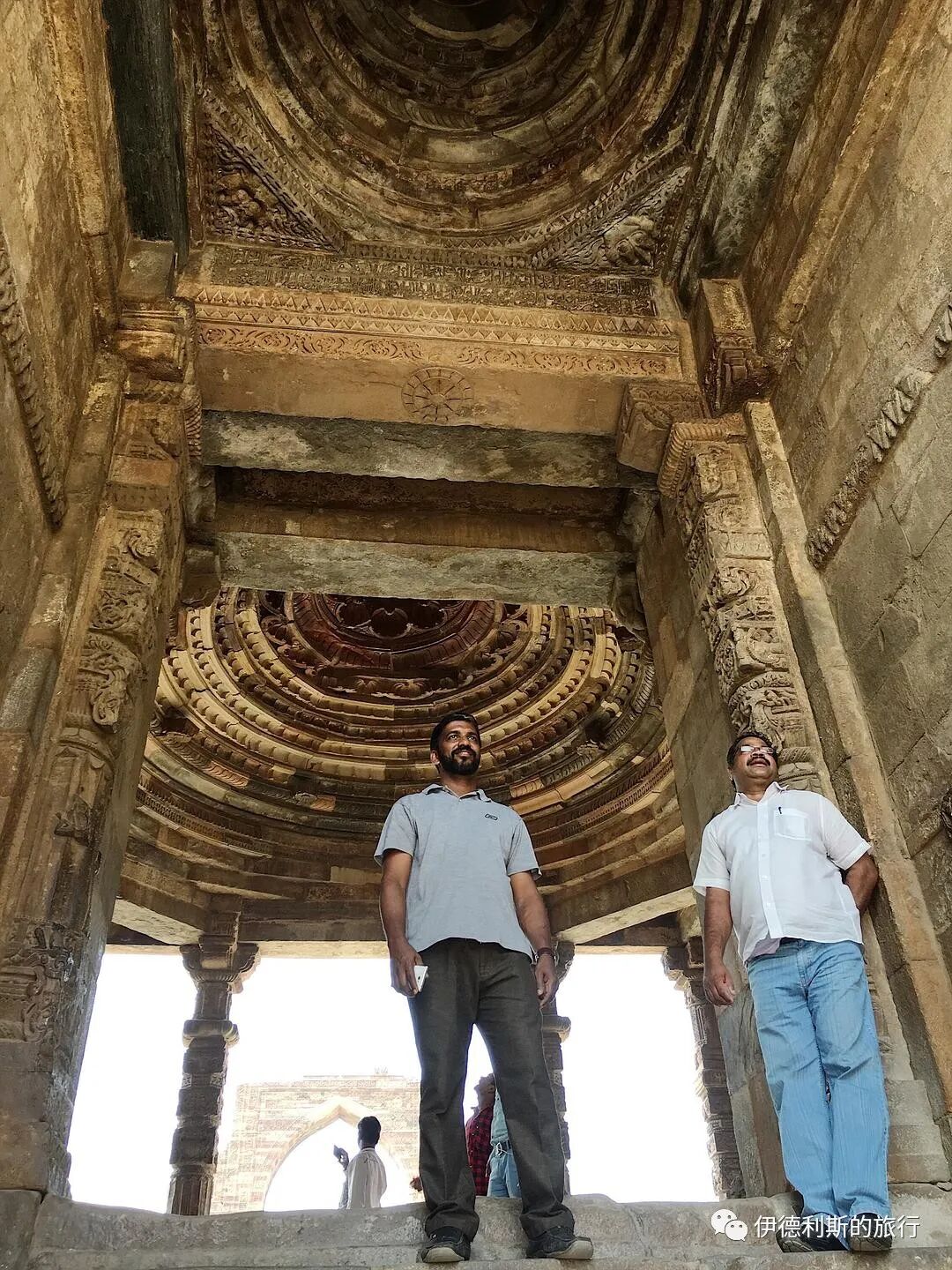
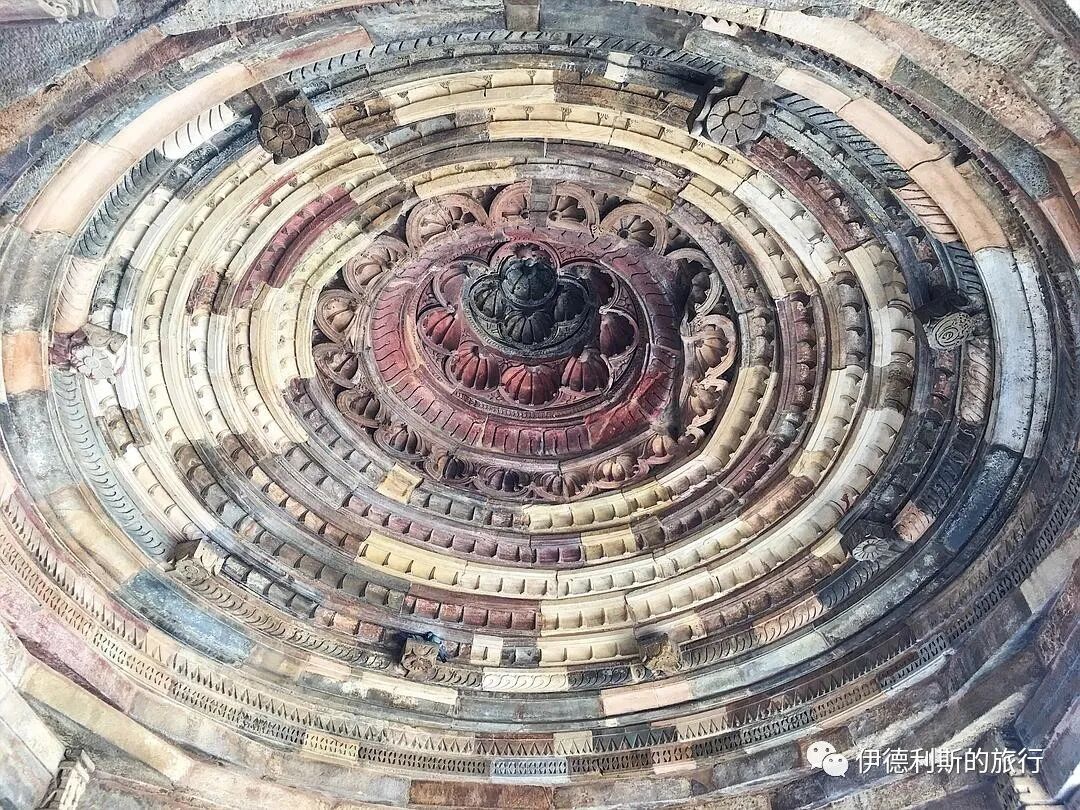
The dome likely came from the construction of a Hindu or Jain temple.
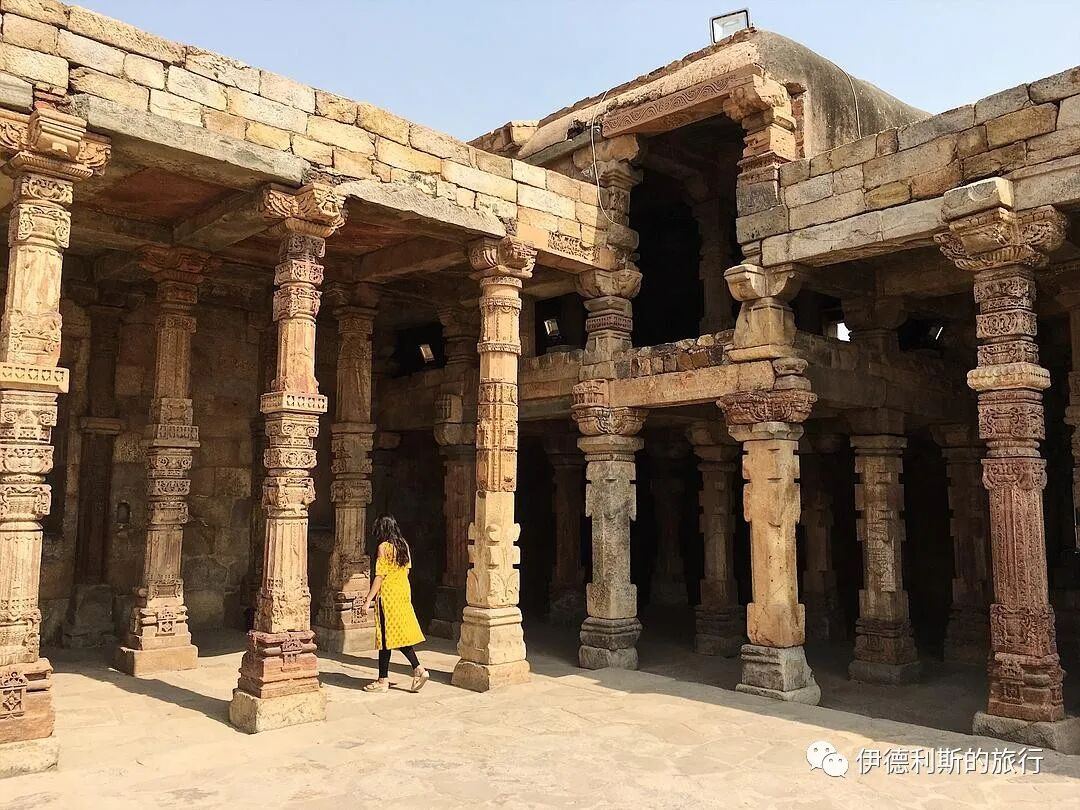
The cloister inside the mosque.
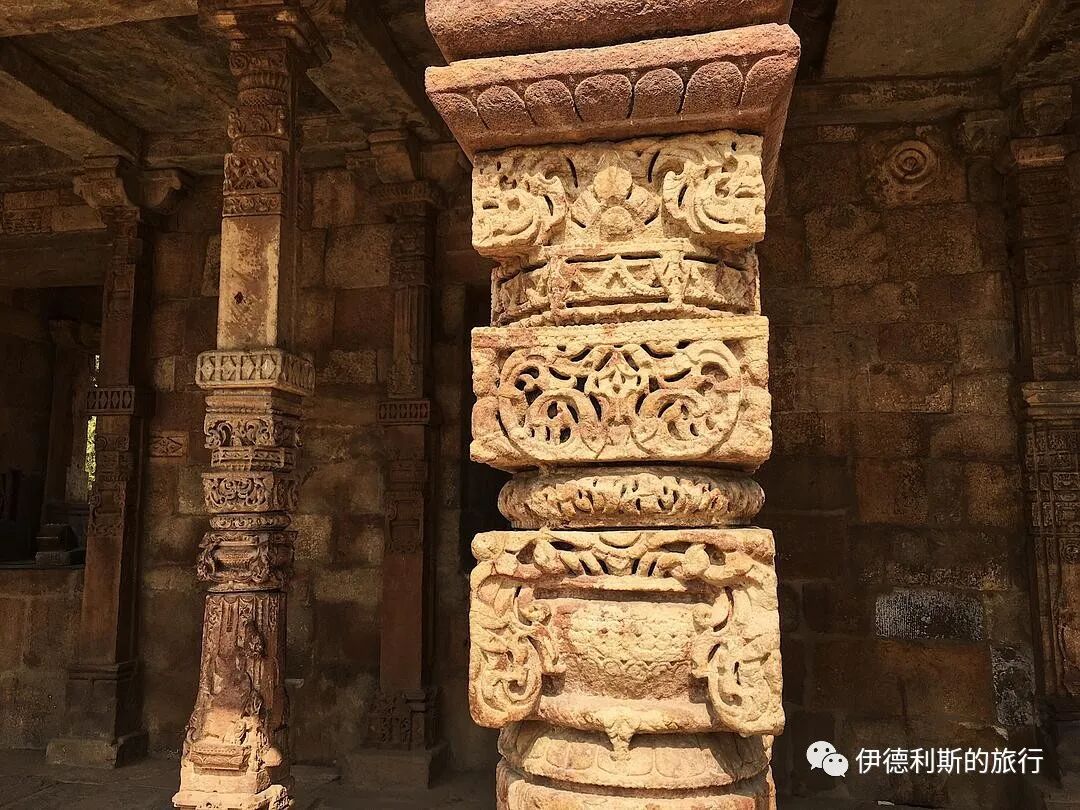
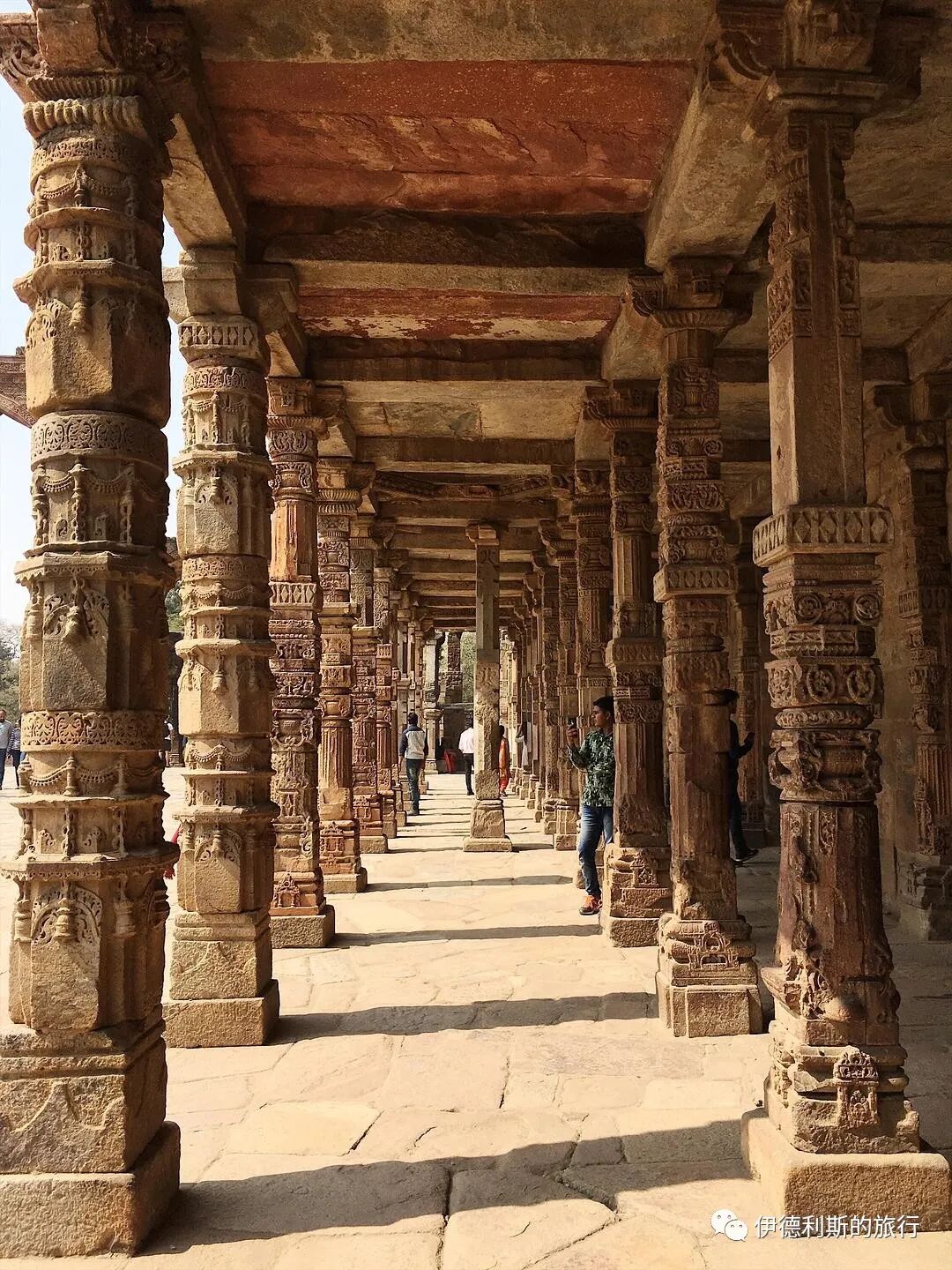
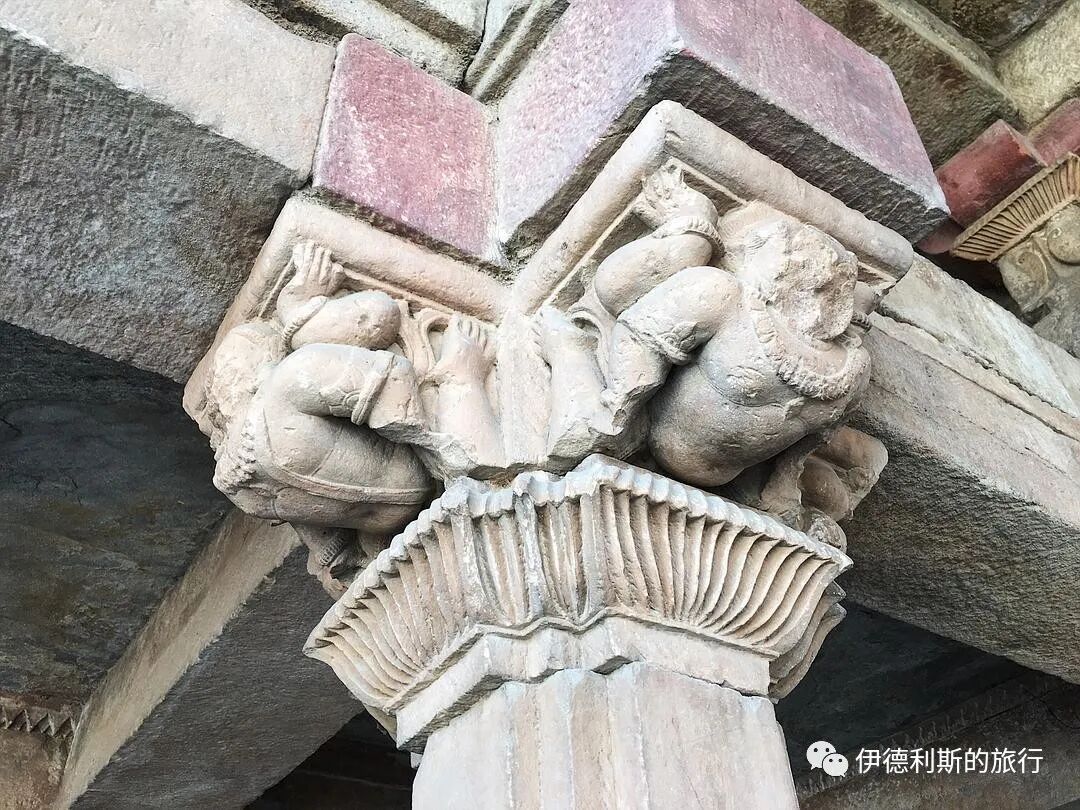
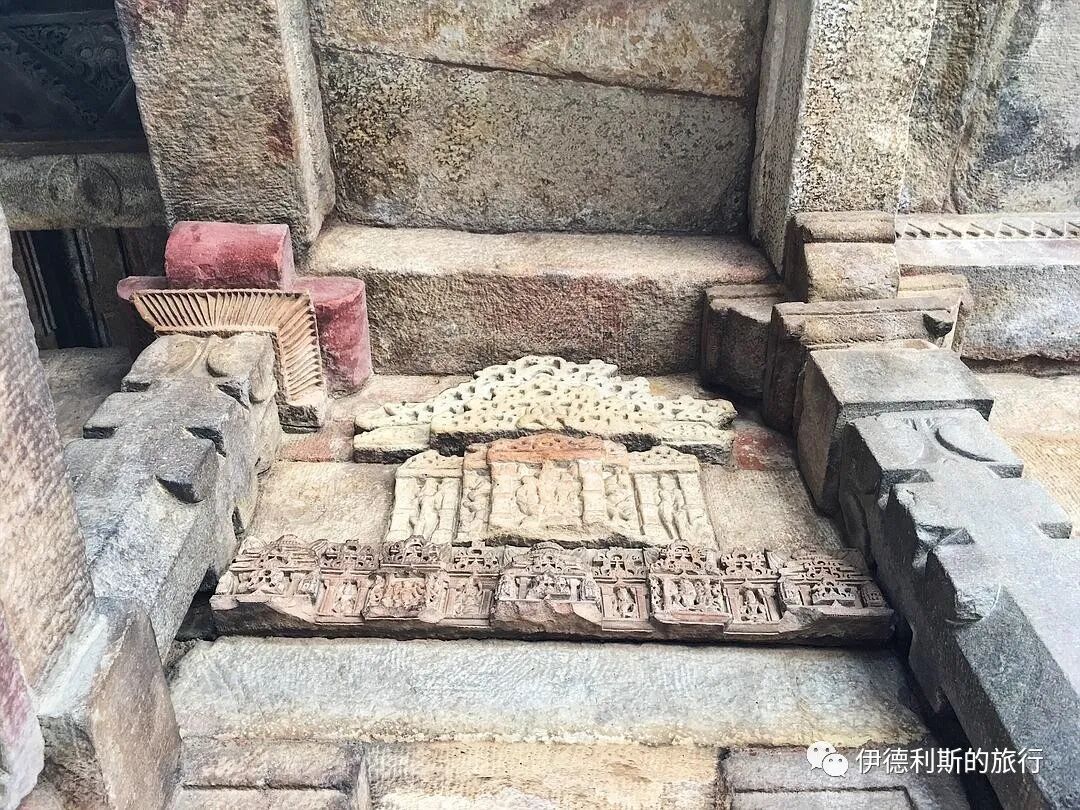
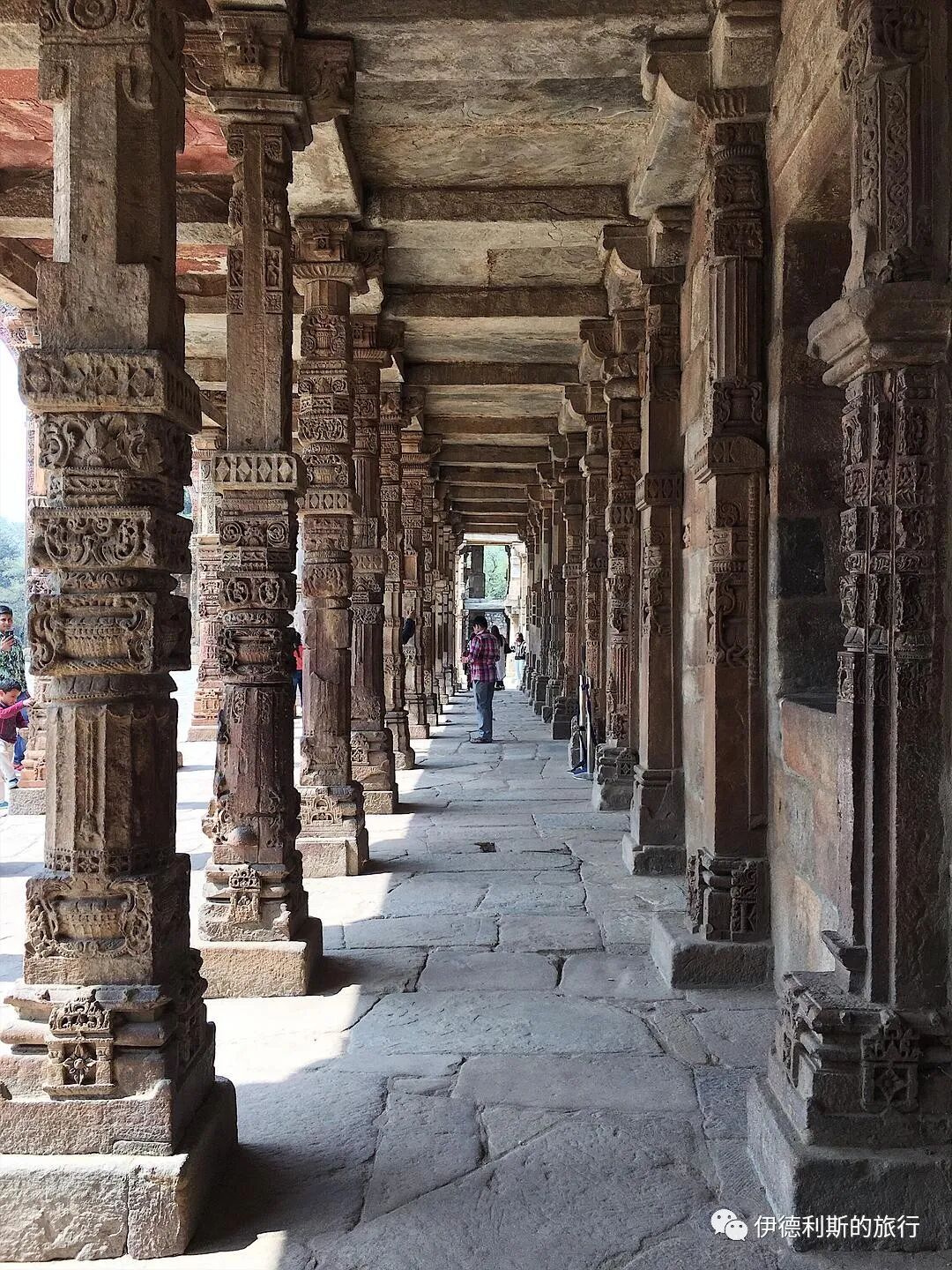
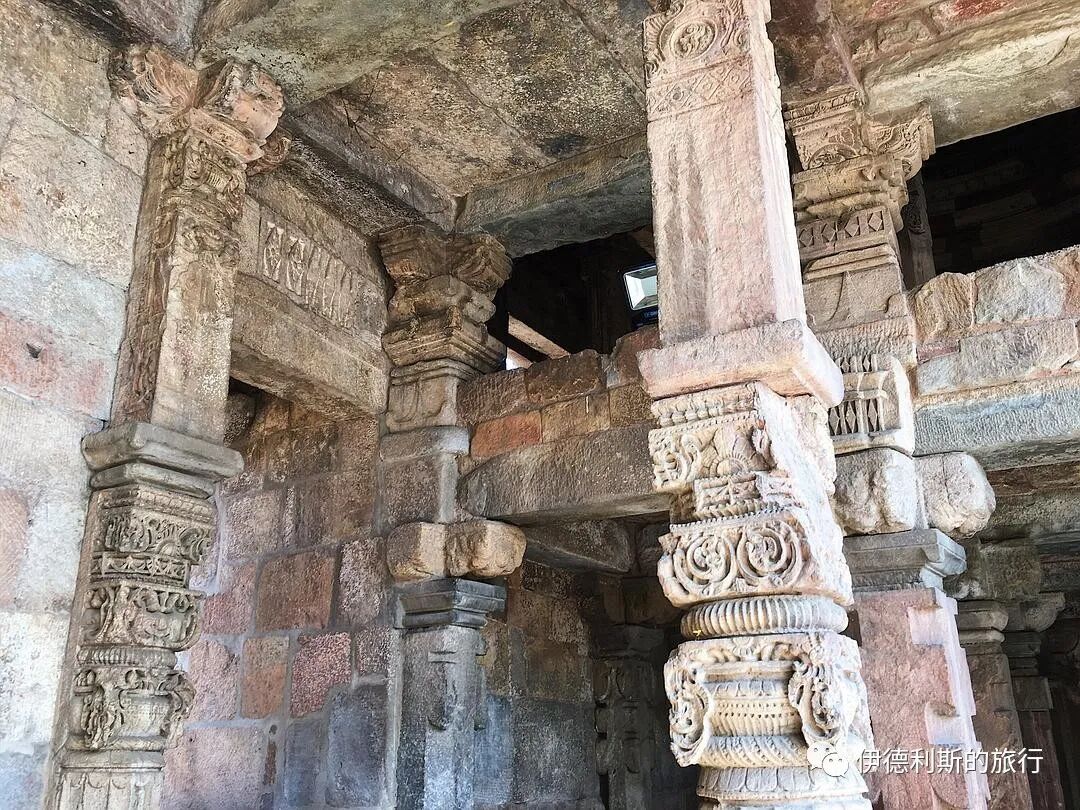
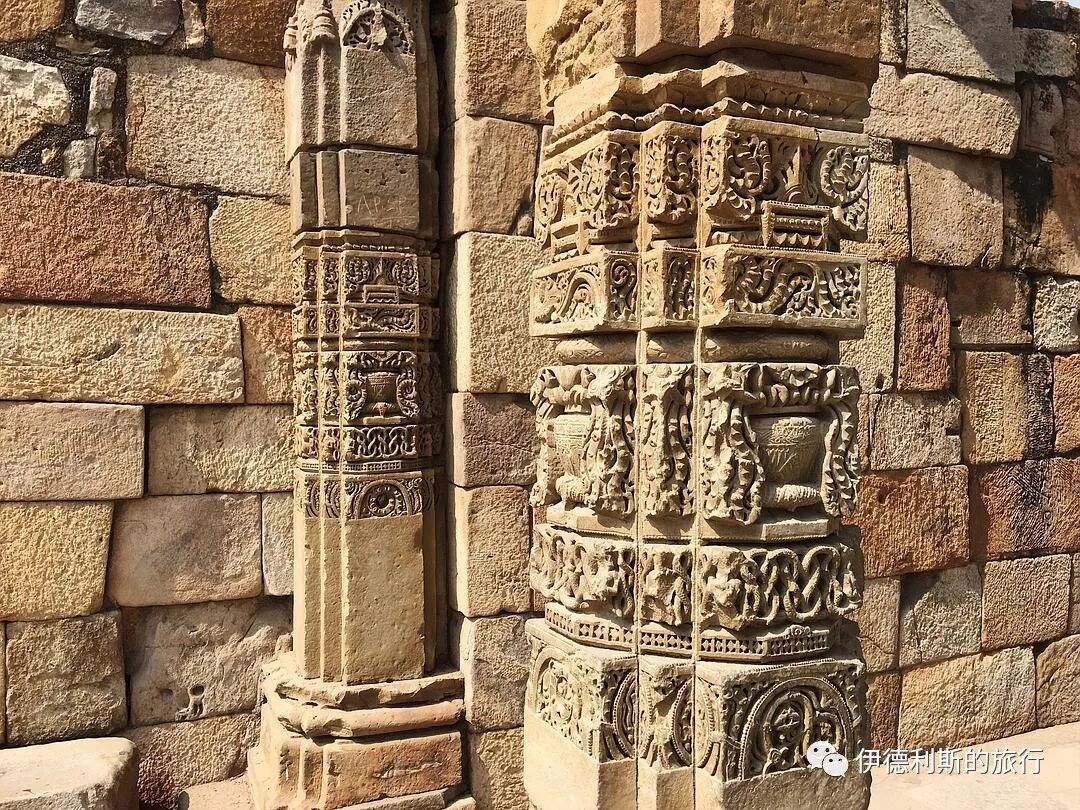
The arch in front of the prayer hall.
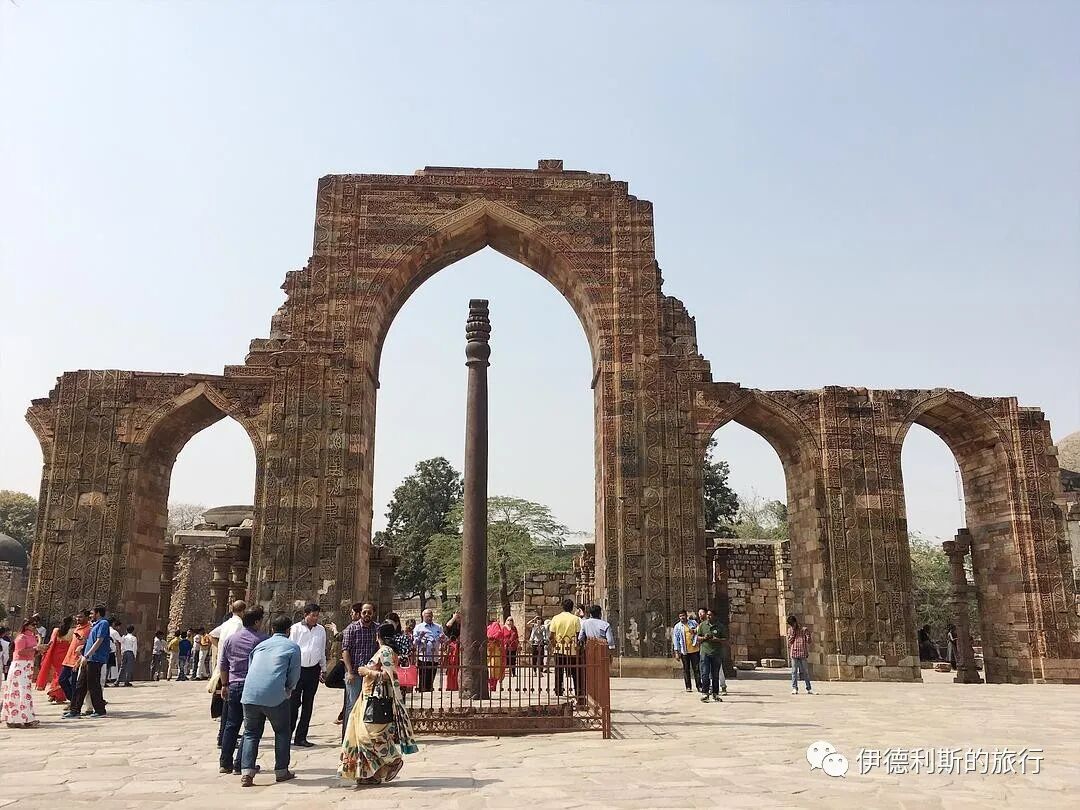
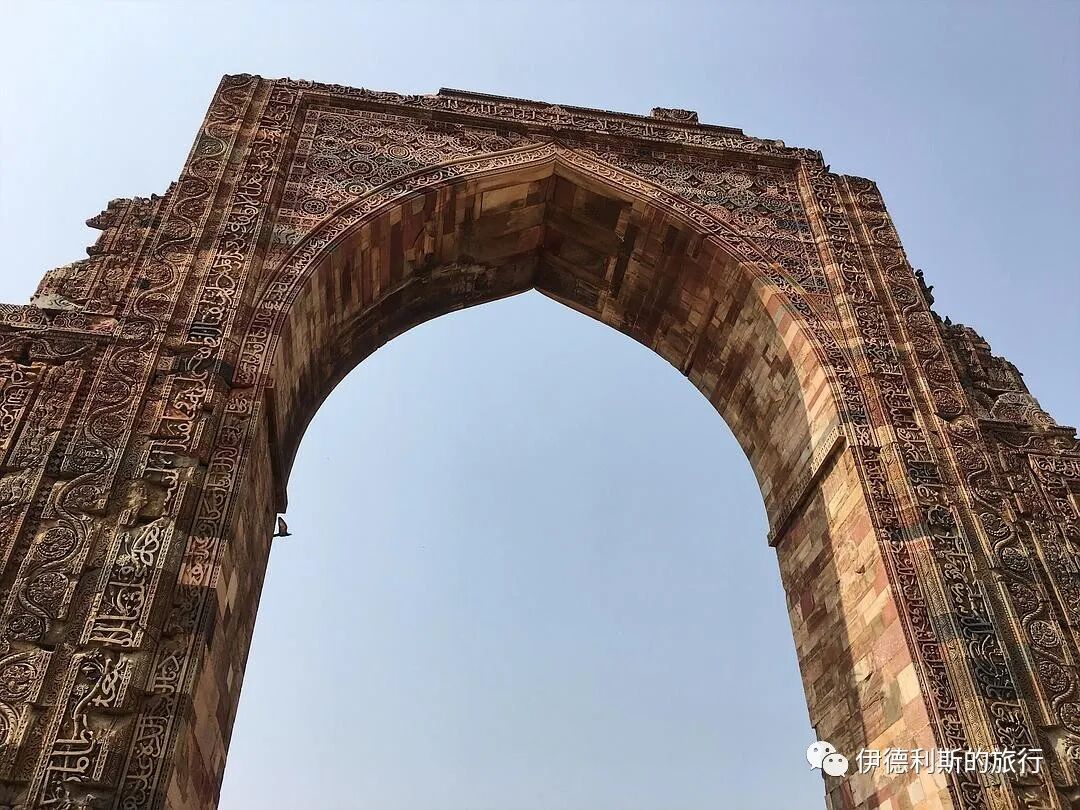
The prayer hall has already collapsed.
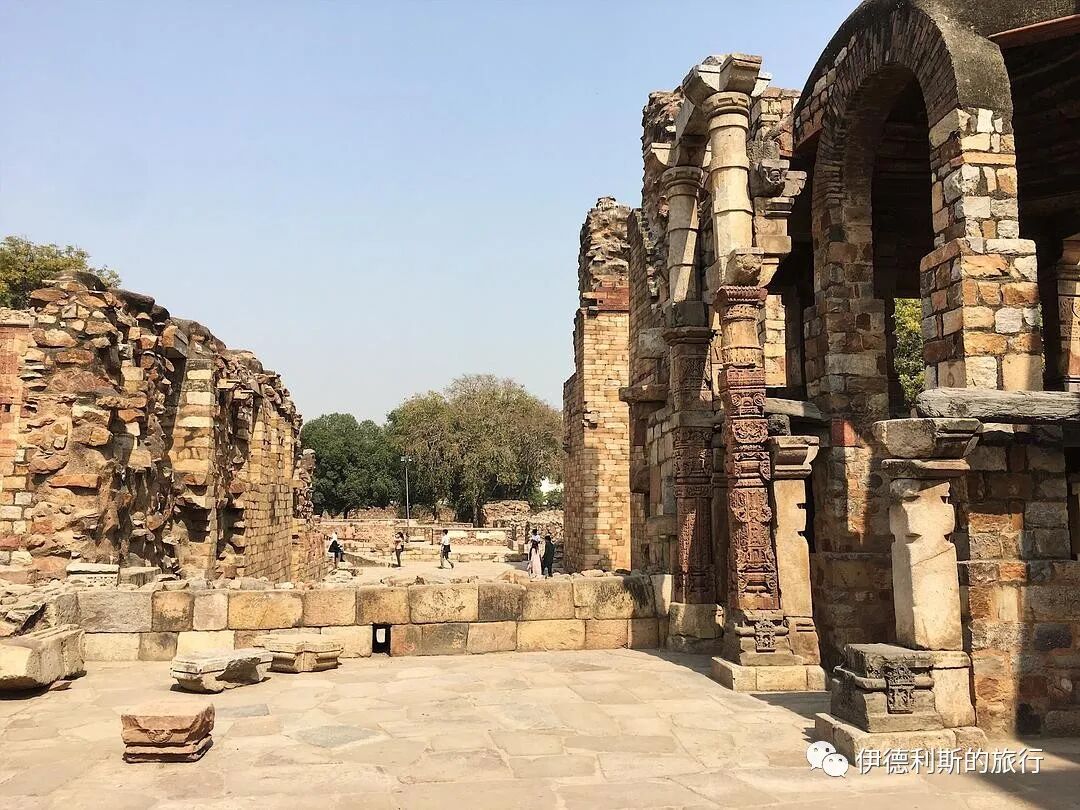
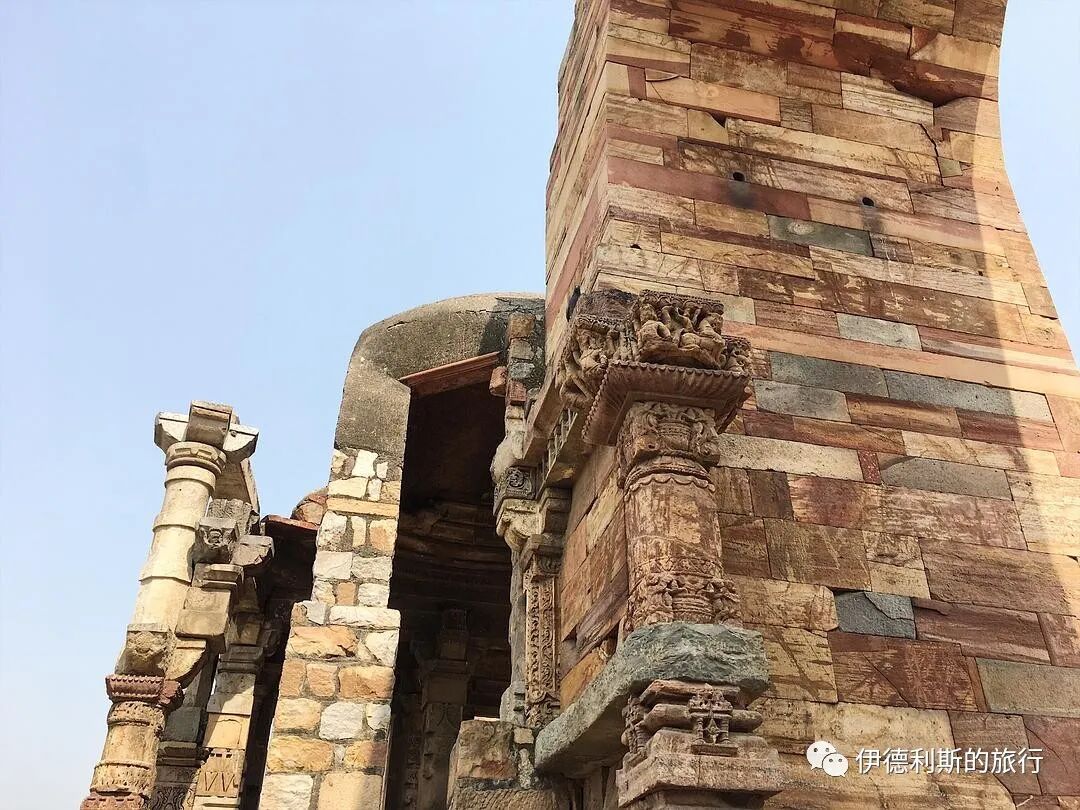
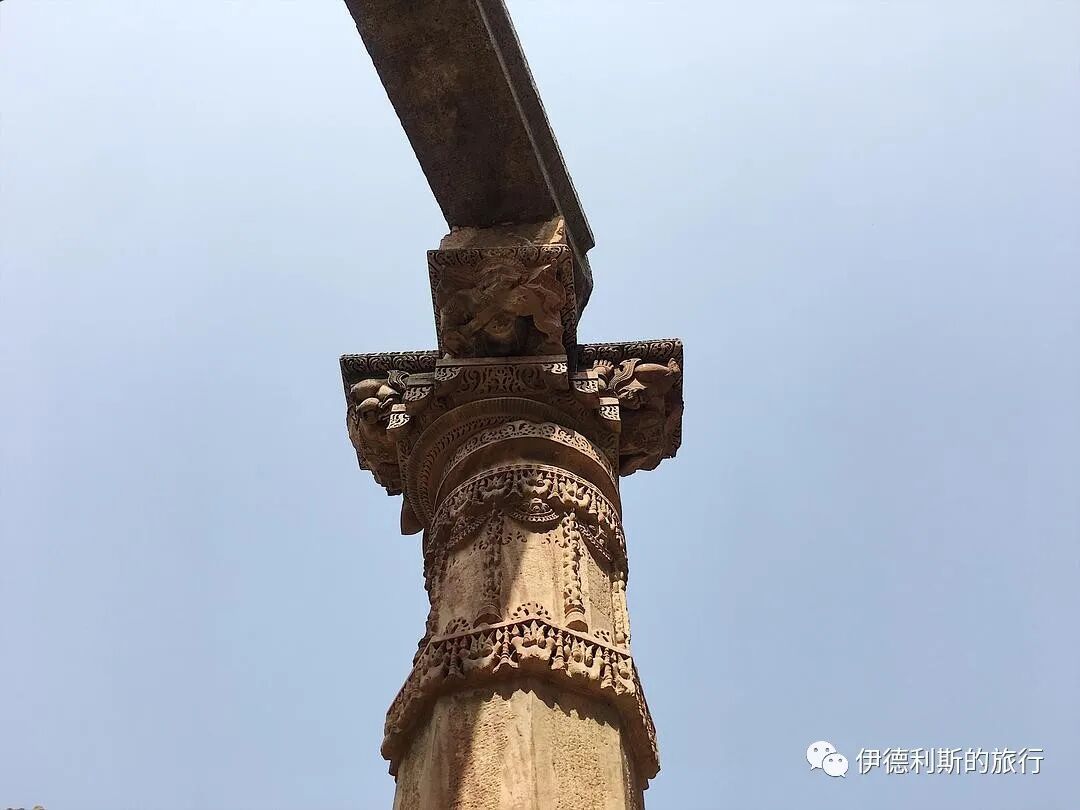
The well-preserved east wall of the mosque.
2. Iron Pillar of Delhi
The famous Iron Pillar of Delhi stands in the center of the mosque courtyard. The pillar was cast between the 3rd and 4th centuries, and the time it was moved to the mosque is still debated. The oldest Sanskrit inscription on the iron pillar is from a king named Chandra. The most common view is that this king was Chandragupta II, who ruled the Gupta Empire from 380 to 415. This period was the peak of the Gupta Empire and is considered the 'Golden Age' of ancient India, when architecture and sculpture reached their height.
The high corrosion resistance of this iron pillar has attracted great interest from scientists and archaeologists, and it is considered a the highest level of ancient Indian iron-smelting technology. The pillar's corrosion resistance is believed to come from its high phosphorus content and Delhi's alternating wet and dry climate, which allowed a protective passivation film to form on the pillar.
3. The Qutb Minar reaching into the clouds
The most striking part of the Qutb mosque is the Qutb Minar, which later generations hailed as the tallest minaret in the ancient Islamic world.
The Qutb Minar is located outside the southeast side of the mosque courtyard. It is built of red sandstone, follows the style of Iranian minarets, and its patterns were influenced by the famous Minaret of Jam in contemporary Afghanistan. The tower is 72.5 meters high and divided into 5 levels. Each level has a protruding balcony, and there are 379 spiral stairs inside.
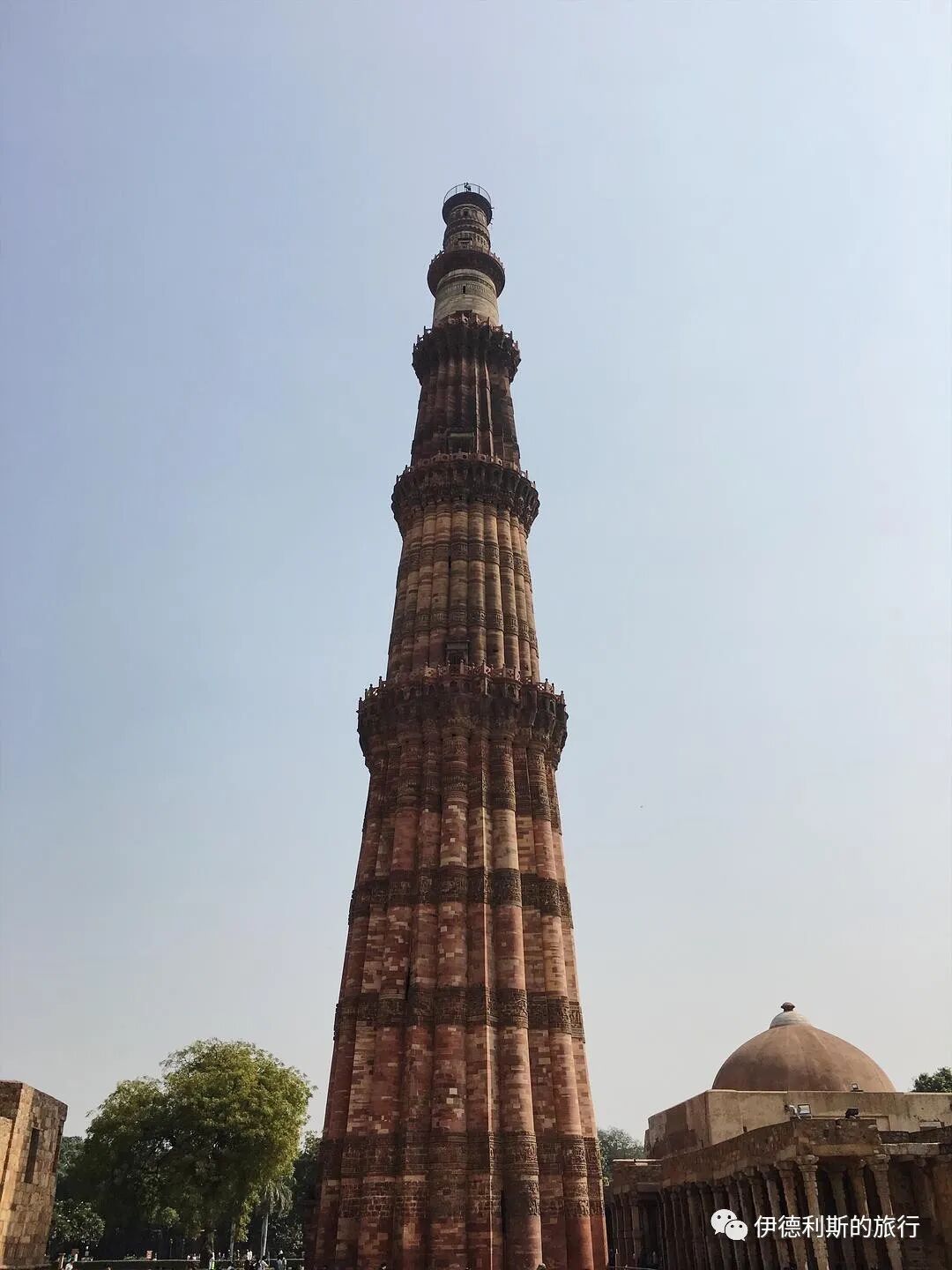
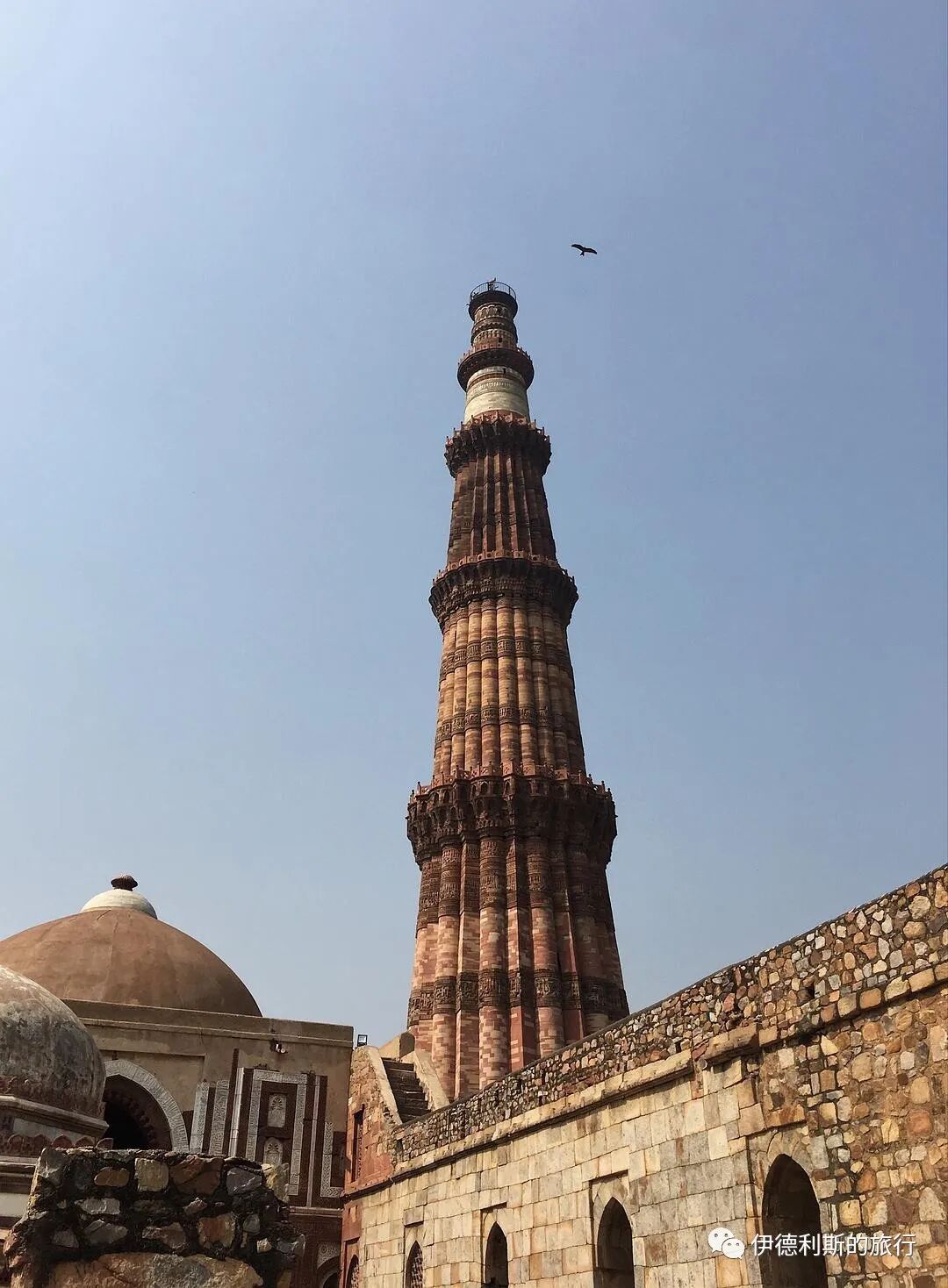
The first level of the Qutb Minar was built under the personal supervision of Qutb al-Din Aibak himself, so it contains many praises for Muhammad Ghori. The top three levels were finished in 1220 by his son-in-law Shams ud-Din Iltutmish (who I will introduce in detail later), and the style is basically the same as the Qutb period. The Qutb Minar from this period is made of red sandstone and carved with Kufic script.
In 1369, lightning destroyed the top of the Qutb Minar, and the Sultan of the Delhi Sultanate, Firoz Shah Tughlaq, rebuilt two more levels on top. The two new levels include marble, and you can now see a clear difference in architectural style between the bottom three levels and the top two.
4. Iltutmish expands the mosque
1. Mamluk Dynasty of the Delhi Sultanate
In 1202, Muhammad Ghori became the Sultan of the Ghurid dynasty after his brother passed away. In 1206, Muhammad Ghori handed over all affairs in India to Qutb and set off from India to return to Afghanistan. On March 15, while his carriage was traveling through Punjab, Pakistan, Muhammad Ghori was assassinated.
Muhammad Ghori had no children, so he treated his Mamluk slaves like his own sons during his lifetime. After he died, the country split into several parts, and Qutb established his own sultanate with Lahore as the capital. Because this sultanate later made Delhi its capital for nearly 300 years, later generations called it the Delhi Sultanate. Also, because Qutb was a Mamluk slave, the first dynasty of the Delhi Sultanate is known to later generations as the Mamluk Dynasty or the Slave Dynasty.
In 1210, Qutb died in an accident. The Delhi Sultanate did not have a fixed rule for succession. After Qutb died, the Turkic nobles in Lahore elected Aram Shah to succeed as Sultan. But Aram Shah was not good at governing the country, so a group of forty nobles called Chihalgani soon betrayed him and elected Shams ud-Din Iltutmish to succeed as Sultan.
In 1211, Iltutmish defeated Aram Shah on the plains near Delhi and seized the throne.
2. Iltutmish takes over as Sultan
Iltutmish came from the Turkic Ilbari tribe and was sold as a Mamluk slave during his childhood. He was first taken to the slave market in the ancient Central Asian city of Bukhara, then transferred to the Ghurid dynasty and bought by Muhammad Ghori's court.
Iltutmish quickly gained the appreciation of Muhammad Ghori and became his personal attendant. Qutb, who was the governor of Lahore at the time, also took a liking to Iltutmish, so he bought him from Muhammad Ghori in Delhi for a high price.
Iltutmish was also deeply appreciated by Qutb; he married Qutb's daughter and was entrusted by Qutb with the governorship of several important regions. After Qutb died in 1210, he defeated the successor Aram Shah in 1211 and became the third Sultan of the Mamluk Dynasty of the Delhi Sultanate.
3. Territorial expansion
At the beginning of his reign, Iltutmish consolidated the territory around Delhi through a series of wars. In 1214, Iltutmish officially moved the capital to the city of Lal Kot in Delhi.
In 1221, the Mongol army under Genghis Khan arrived at the banks of the Indus River. Iltutmish did not want a direct conflict with the Mongols, so he turned eastward and conquered the Bengal region.
The upheaval caused by the Mongol invasion of Central Asia led a large number of Turkic officers to come to India, so Iltutmish recruited a powerful army and conquered Sindh and Multan in 1228.
In 1228, Iltutmish received recognition from the Caliph of the Abbasid Caliphate and was granted a robe and gifts by the Caliph, which gave the Delhi Sultanate legitimacy in the Islamic world.
4. Expansion of the Qutb Mosque
In 1225, as the political situation stabilized, Iltutmish began to expand the Qutb Mosque, and the expanded part is also called the Iltutmish Mosque.
The green part in the picture below shows the scope of the mosque expansion by Iltutmish.
During Iltutmish's expansion, Muslim craftsmen replaced the Hindu craftsmen of the Qutb era, and they no longer used components from the original temples, so the architectural style of this period is more Islamic than the Qutb period.
The best-preserved part of Iltutmish's expansion is the beautifully carved archway.
Behind the archway, in the lower right corner, is the south cloister of the Iltutmish expansion.
The east cloister is visibly simpler than the cloister built by Qutb.
The west colonnade has already collapsed.
5. Tomb of Iltutmish
Iltutmish passed away in 1236. In 1235, the year before he died, he built his own tomb next to the Qutb Mosque.
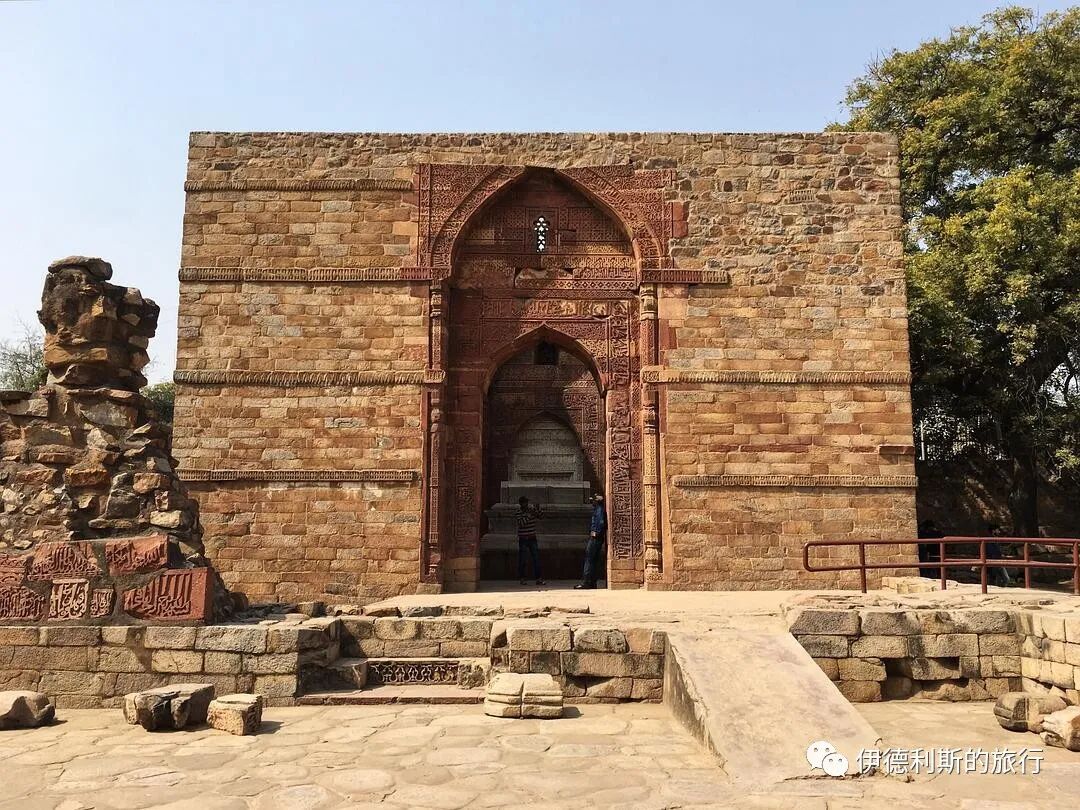
The stone carvings on the walls are very ornate, featuring bells, tassels, lotus flowers, and diamond emblems, all of which are elements from Hinduism.
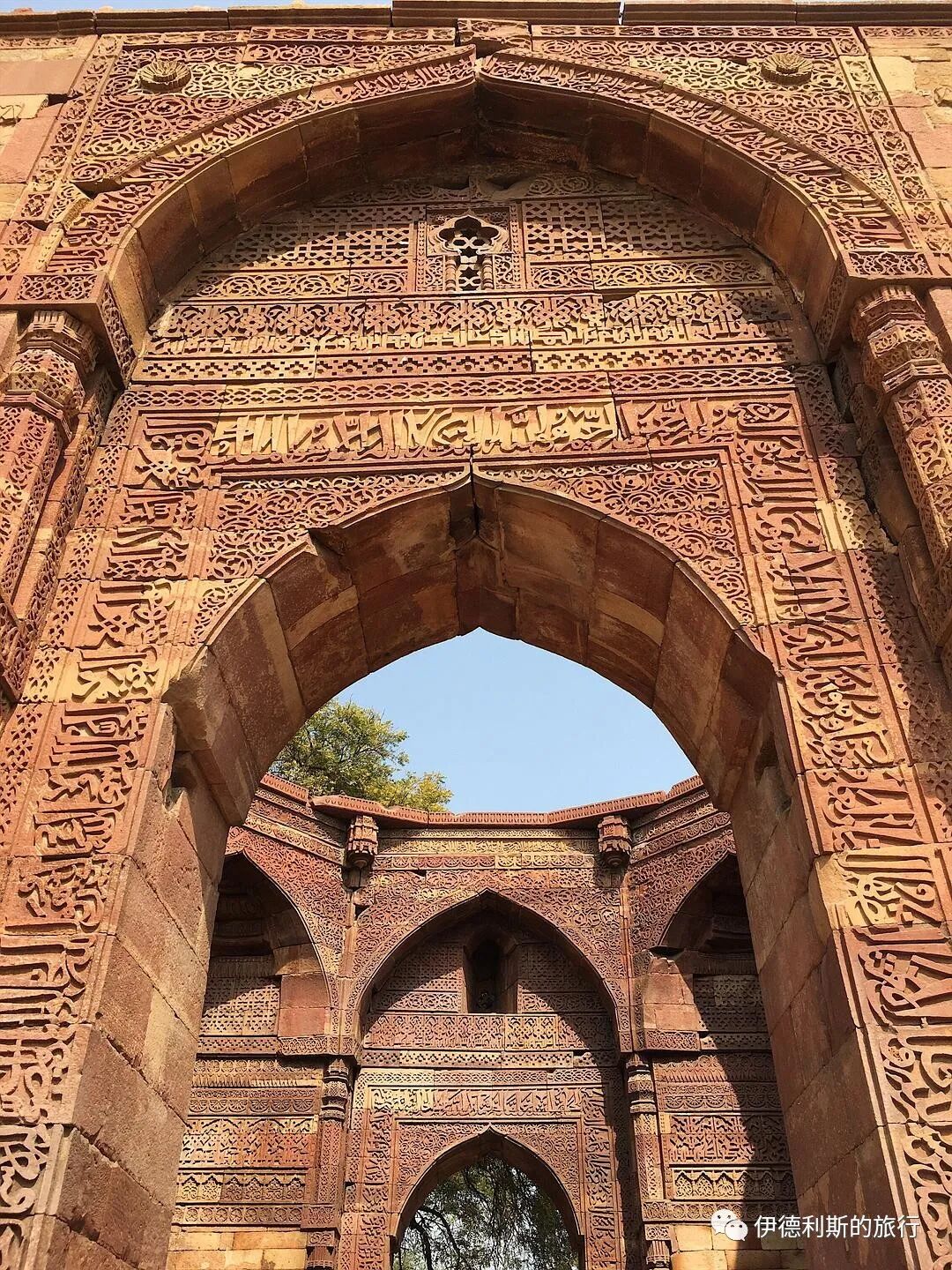
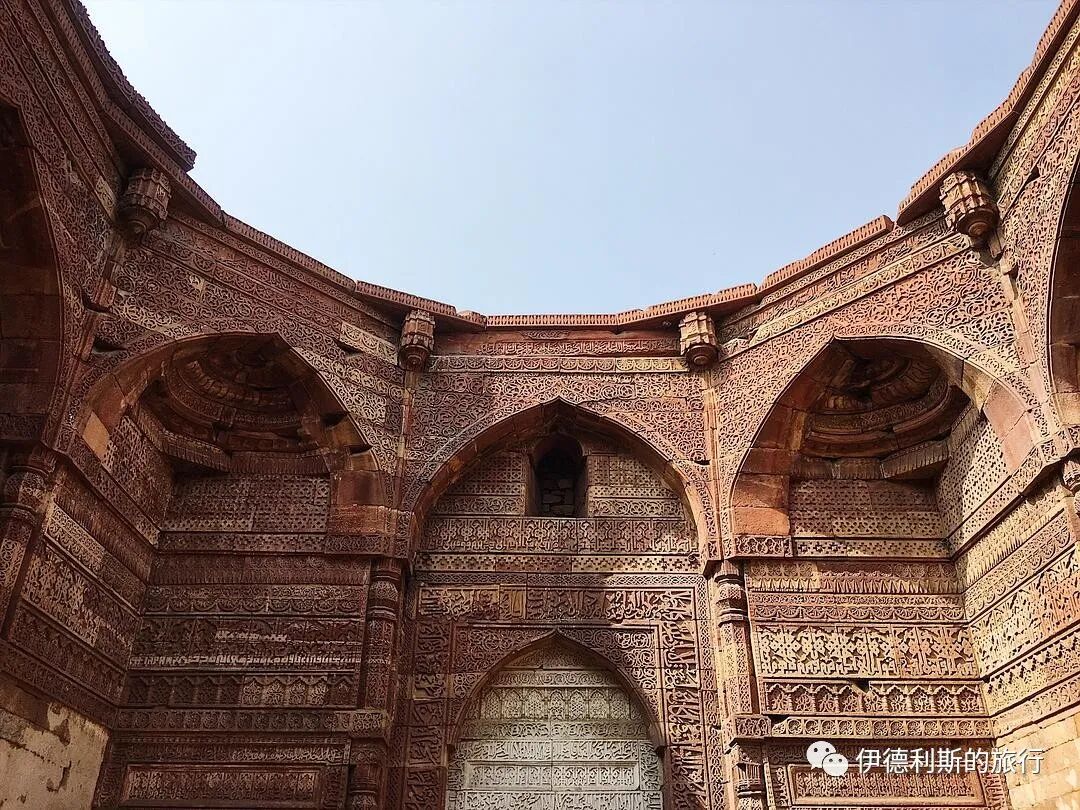
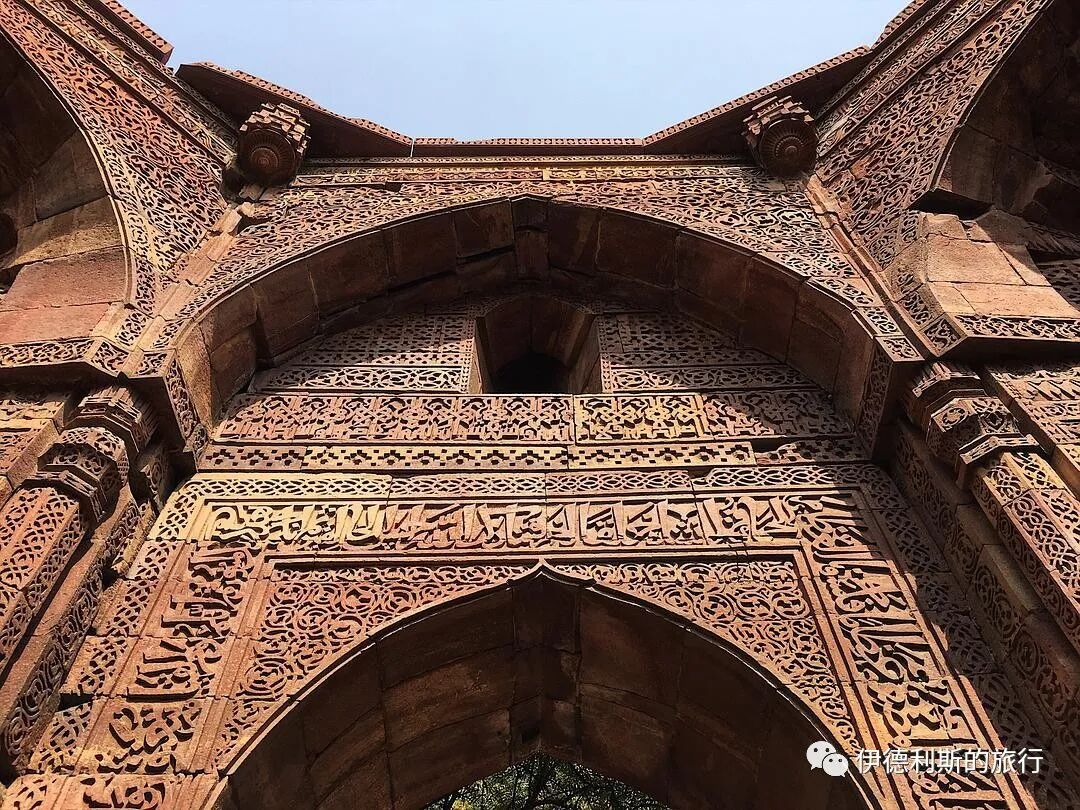
The structure at the corner of the tomb's ceiling is called a squinch, which is used to connect the walls to the dome. The earliest squinches appeared in the Sassanid Empire of Persia and were later used in Islamic architecture, becoming most common in Iran.
The squinches in the Tomb of Iltutmish indicate that there was once a dome on top of the tomb, but it later collapsed.
The ornate mihrab on the west side.
The tombstone in the center is made of white marble.
The actual grave of Iltutmish is not inside this building. In 1914, Gordon Sanderson of the Archaeological Survey of India (ASI) excavated the real burial chamber 20 steps north of the Tomb of Iltutmish.
5. Alauddin Khalji expands the mosque again
In 1310, Sultan Alauddin Khalji of the Khalji dynasty of the Delhi Sultanate expanded the Qutb Mosque for the third time.
1. Khalji Dynasty of the Delhi Sultanate
The Khaljis were a Turkic people who had lived among the Pashtun tribes in Afghanistan for over 200 years. By the time they arrived in Delhi in the 13th century, their customs had become Pashtunized, leading the Turkic nobility in India to even regard them as Afghans.
The Khaljis came to Delhi to serve the Sultan during the reign of Ghiyas ud din Balban, the ninth sultan of the Mamluk dynasty of the Delhi Sultanate (1266–1287). During Balban's era, the Delhi Sultanate stabilized after being on the verge of collapse, with its territory covering most of northern India.
After Balban died in 1287, his young successor became addicted to wine and women, and the Turkic nobility fell into factional fighting. In 1290, the military officer Jalal ud din Firuz Khalji launched a coup to overthrow the Mamluk dynasty, founding the second dynasty of the Delhi Sultanate—the Khalji dynasty.
2. Alauddin Khalji launches a coup
Firuz Khalji was already 70 years old when he took the throne. He was recognized as a gentle and humble monarch, but because he was not considered a Turk, Turkic nobles always tried to overthrow him.
Firuz pardoned one person after another who tried to overthrow him, but he eventually died at the hands of his nephew and son-in-law, Alauddin Khalji. Alauddin's original name was Ali Gurshasp. His father was Firuz's eldest brother, but he died early, so Alauddin was raised by Firuz. Firuz not only raised his nephew but also married his daughter to him.
After Firuz became Sultan, Alauddin's wife suddenly became a princess and began to act very arrogantly, wanting to dominate Alauddin. Her mother also indulged her daughter's arrogant behavior, so Alauddin had a very poor relationship with both his wife and his mother-in-law.
In 1291, Alauddin became the new governor of Kara. In Kara, people who had previously wanted to overthrow Firuz began to incite Alauddin to overthrow his uncle. Combined with his miserable marriage, he began to resolve to get rid of Firuz.
After five years of raising funds and hiring an army, in 1296, Alauddin led an army of 8,000 cavalry to loot Devagiri, the capital of the Yadava dynasty in southern India, and obtained a massive amount of wealth. When Firuz heard the news, he was very happy and set out from Delhi, intending to meet Alauddin on the way to see the spoils, but Alauddin took a detour and returned directly to Kara. One of Firuz's subordinates suggested that the Sultan go to intercept Alauddin, but Firuz believed that Alauddin would bring the wealth to Delhi, so he returned to Delhi instead.
In Delhi, Alauddin's younger brother Almas Beg assured his uncle of Alauddin's loyalty and begged him to pardon Alauddin's mistakes, saying that Alauddin would likely commit suicide out of guilt. Firuz, who cared for his nephew, immediately sent someone to Kara with a letter of pardon and promised to travel to Kara afterward.
During Ramadan in 1296, Firuz led a large army to Kara to meet Alauddin. He ordered his commanders to lead the main army directly to Kara, while he crossed the Ganges River with 1,000 soldiers. As they neared Kara, Alauddin sent his brother Almas to meet his uncle and persuade him to come alone, saying that otherwise, Alauddin would commit suicide out of fear.
When he arrived at Kara, Alauddin threw himself at Firuz's feet. Firuz caressed Alauddin, kissed his cheek, and scolded him for doubting his uncle's affection for him. At that moment, Alauddin signaled his subordinate Muhammad Salim, who swung his sword at Firuz. After being struck by the first blow, Firuz struggled to run toward the boat, but Muhammad swung a second time, and Firuz was finally killed. Alauddin immediately put on the crown and declared himself the new Sultan.
Alauddin then started moving toward Delhi, recruiting as many soldiers as he could along the way. Meanwhile in Delhi, Firoz's widow named her young son Qadr Khan as the new Sultan. This made the eldest son, Arkali Khan, who was the governor of Multan, furious, and he refused to help his mother defend against Alauddin's army.
In October 1296, Alauddin reached Delhi, defeated his mother-in-law's army, and took the city. On October 21, Alauddin officially became the Sultan of the Khalji dynasty of the Delhi Sultanate.
3. Accumulating wealth
During his first year on the throne, Alauddin used generous gifts to secure his power while balancing the influence of various nobles, which quickly brought stability to Delhi. By his second year, Alauddin began arresting and killing the nobles who had served Firoz. He seized their property to gain massive wealth and replaced the old nobles with new ones loyal to him.
Starting in 1297, Alauddin defended against the Mongol armies of the Chagatai Khanate while constantly conquering Hindu kingdoms in the south. In 1306, Alauddin defeated the last Mongol army sent by the Chagatai Khan, Duwa. After that, he began regular raids into Mongol territory in Afghanistan.
Alauddin's conquest of southern India was also very successful. In 1311, Alauddin sent an army to the Pandyan dynasty at the southern tip of the Indian peninsula. They seized a huge amount of treasure, elephants, and horses, which was considered the greatest haul of wealth since Muslims first occupied Delhi.
Besides looting the Hindu kingdoms, Alauddin carried out a series of economic reforms. Regarding land, he collected land taxes directly from Hindu rural areas without using any middlemen. Regarding income, he hired many accountants in the court and gave heavy punishments for bribery. Regarding markets, Alauddin used market inspectors and spies to strictly control the prices of goods. He also built state-owned grain warehouses and banned farmers and merchants from storing grain privately. By strictly controlling market prices, he was able to maintain a massive army while paying his soldiers lower wages.
4. Expanding the mosque
After accumulating great wealth, Alauddin began expanding the Qutb Mosque in 1310. The new mosque was much larger than the one expanded by Iltutmish.
The blue section in the image below shows the area of Alauddin's mosque expansion.
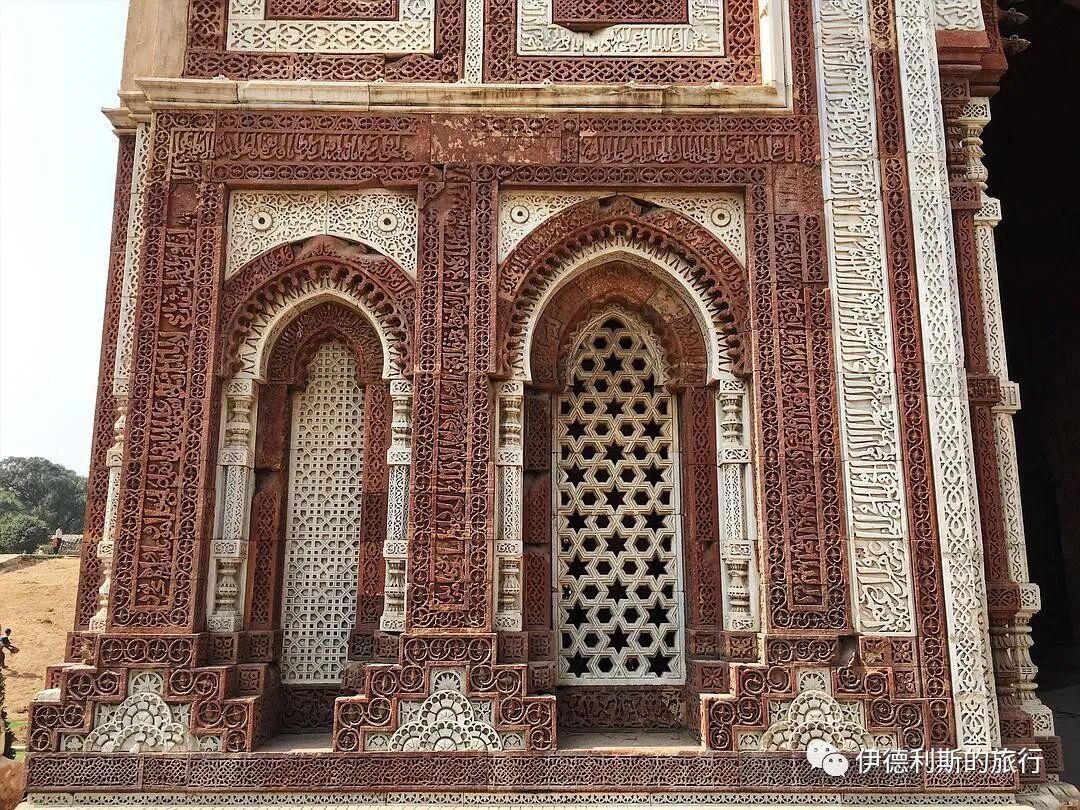
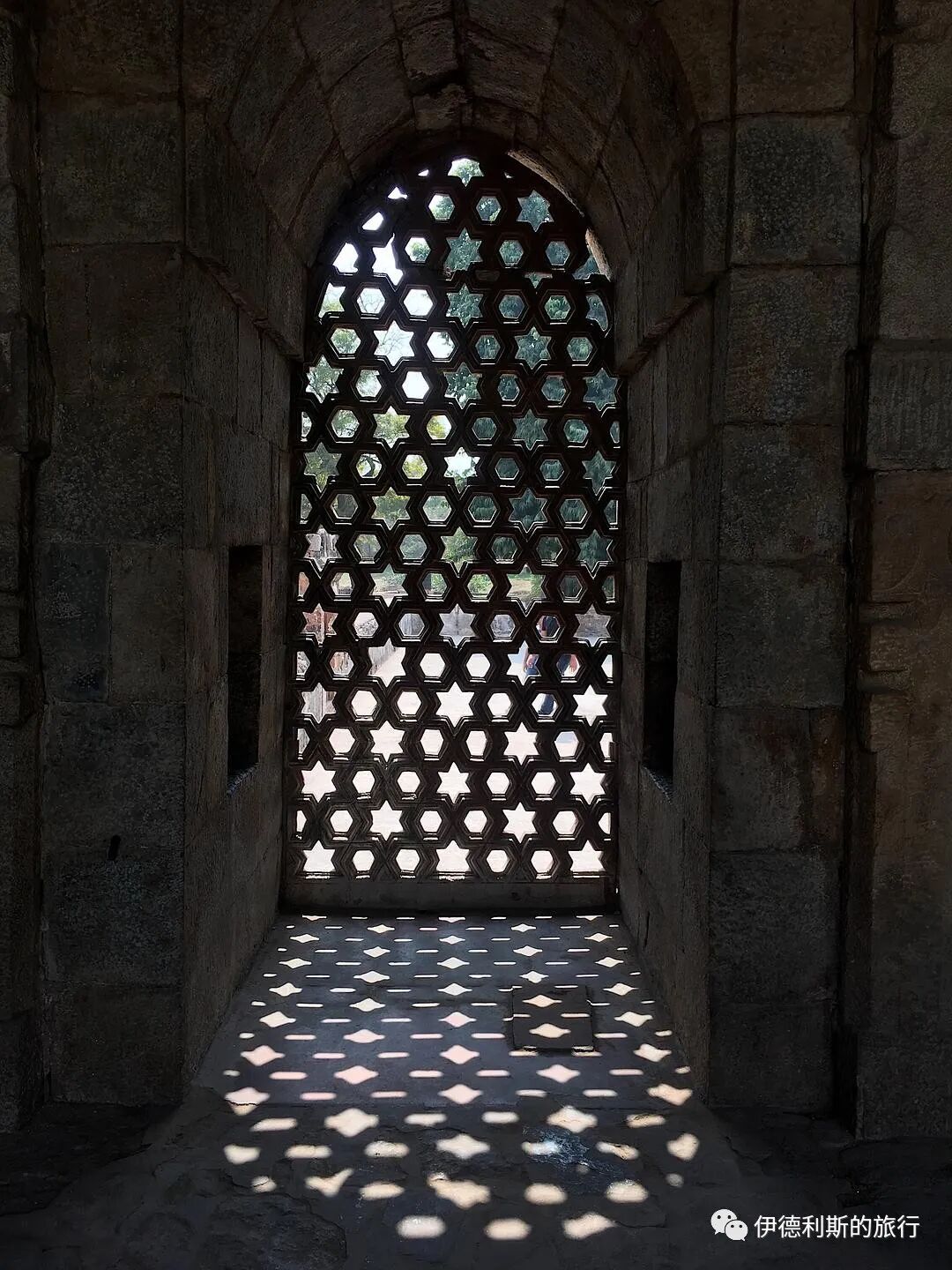
The most famous part of Alauddin's mosque expansion that still stands today is the southern gate, later called the Alai Darwaza. This building uses red sandstone and white marble inlaid with beautiful Naskh (a style of Arabic calligraphy) script. The geometric, openwork marble window screens show the high skill of the Turkic craftsmen.
This building is also known as the first structure in India built strictly according to Islamic architectural principles. During the Mamluk dynasty, the domes and arches were not strictly Islamic in form and were called false domes and false arches. This building is considered the first in India to use true Islamic domes and arches, though the patterns on the building are still full of Hindu elements.
5. Alai Minar
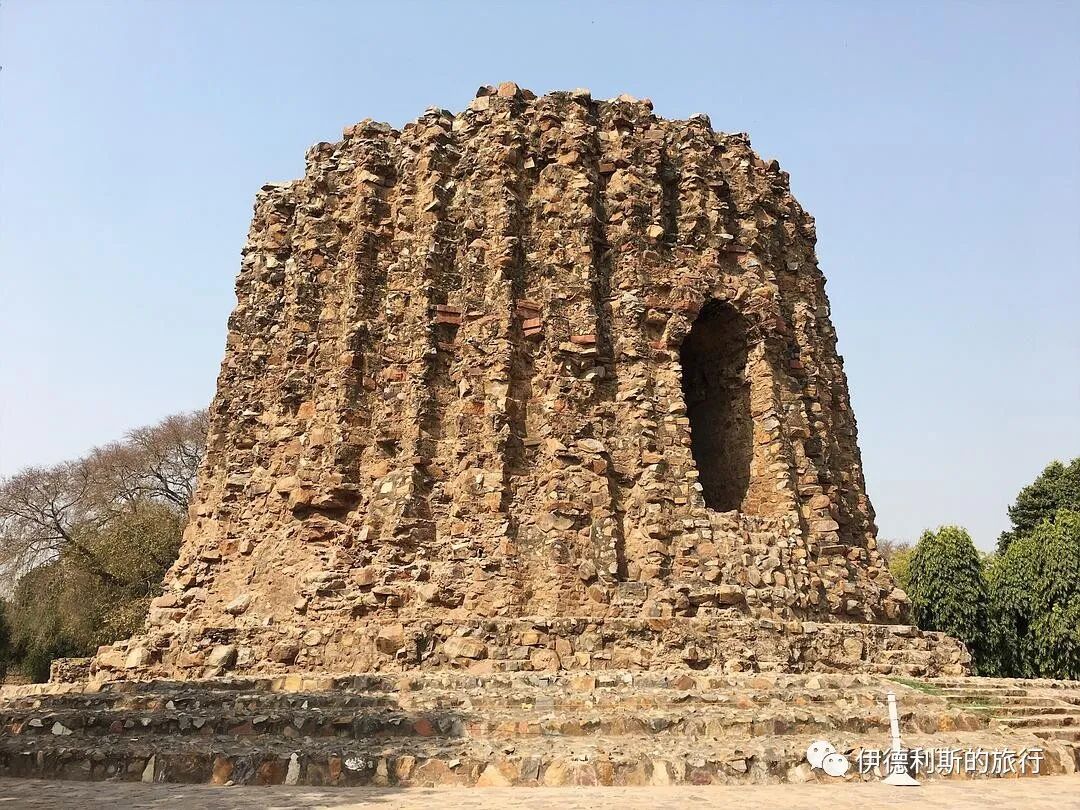
After doubling the size of the Qutb Mosque, Alauddin Khalji began building the Alai Minar, which was planned to be twice as tall as the Qutb Minar. However, the project was abandoned after the first level reached 24.5 meters. Today, only a huge core of rubble and stone remains of the tower.
6. Tomb of Alauddin Khalji
In his final years, Alauddin grew to distrust his officers and only favored the eunuch slave general Malik Kafur. Some scholars believe Alauddin and Kafur had a homosexual relationship, but others think their bond was not sexual.
In 1315, Alauddin became seriously ill. He appointed Kafur as the regent (Na'ib), giving him actual power. Kafur convinced Alauddin to purge many capable ministers and kept outsiders from seeing him during his final days.
As Alauddin lay dying, Kafur gathered all the important officials at his bedside to announce that Alauddin's 6-year-old son, Shihabuddin Omar, was the new heir and that he himself was the regent. According to the 14th-century Indian chronicler Abdul Malik Isami, Alauddin said nothing while in bed, and his silence was taken as consent.
Alauddin died on the night of January 4, 1316. Kafur buried him in the tomb already built in the southwest corner of the Qutb Mosque. According to the 14th-century historian Ziauddin Barani, it was Kafur who killed Alauddin.
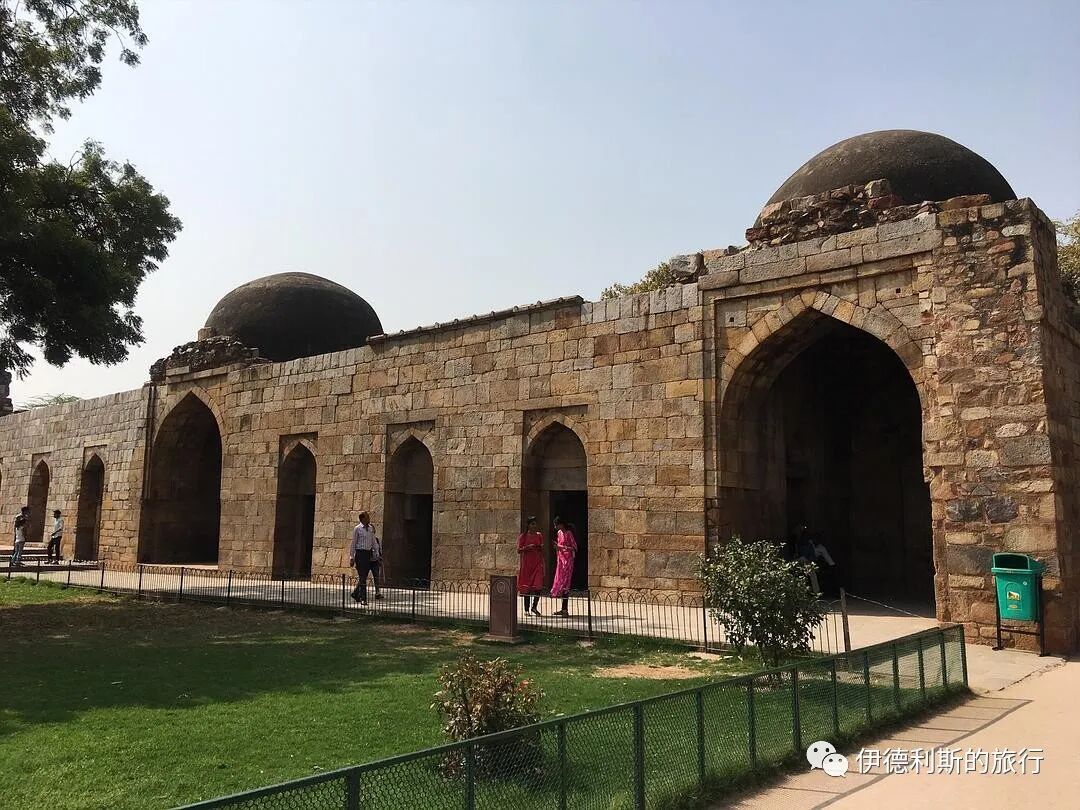
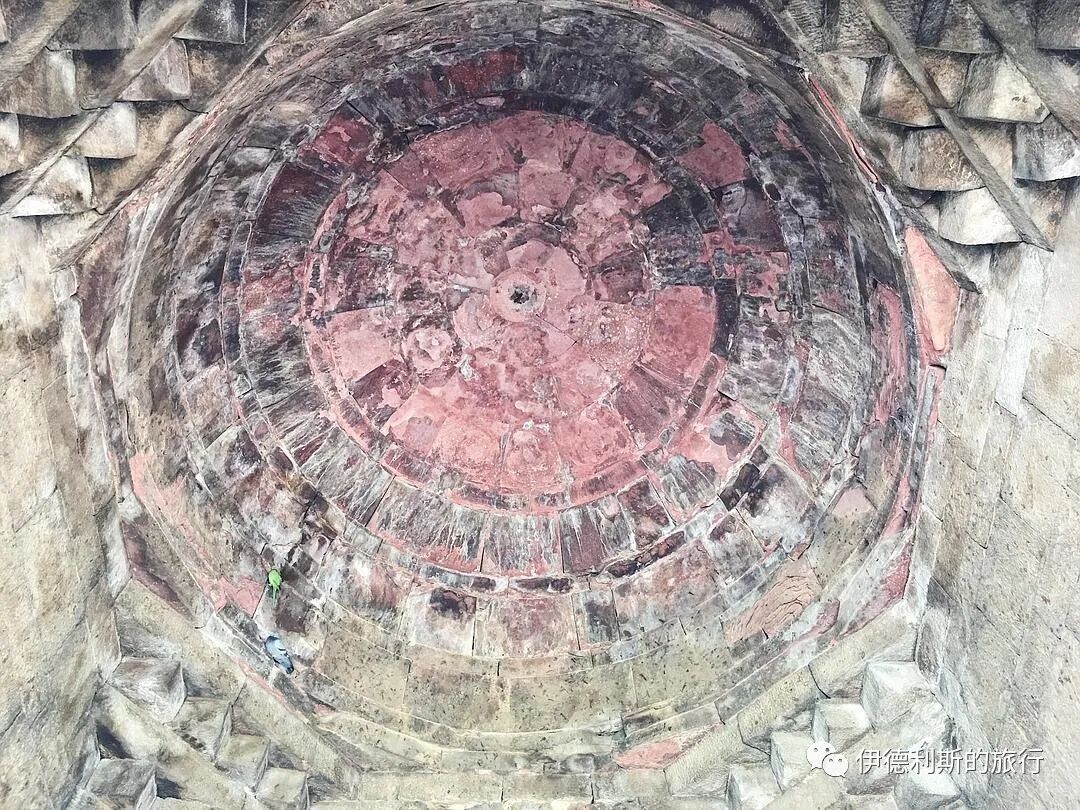
Alauddin's tomb is connected to the madrasa (Islamic school) he built during his lifetime. This is also the first building in India where an Islamic madrasa and a tomb are connected. The madrasa is well-preserved today, but the tomb is badly damaged and has lost its dome.
Madrasa
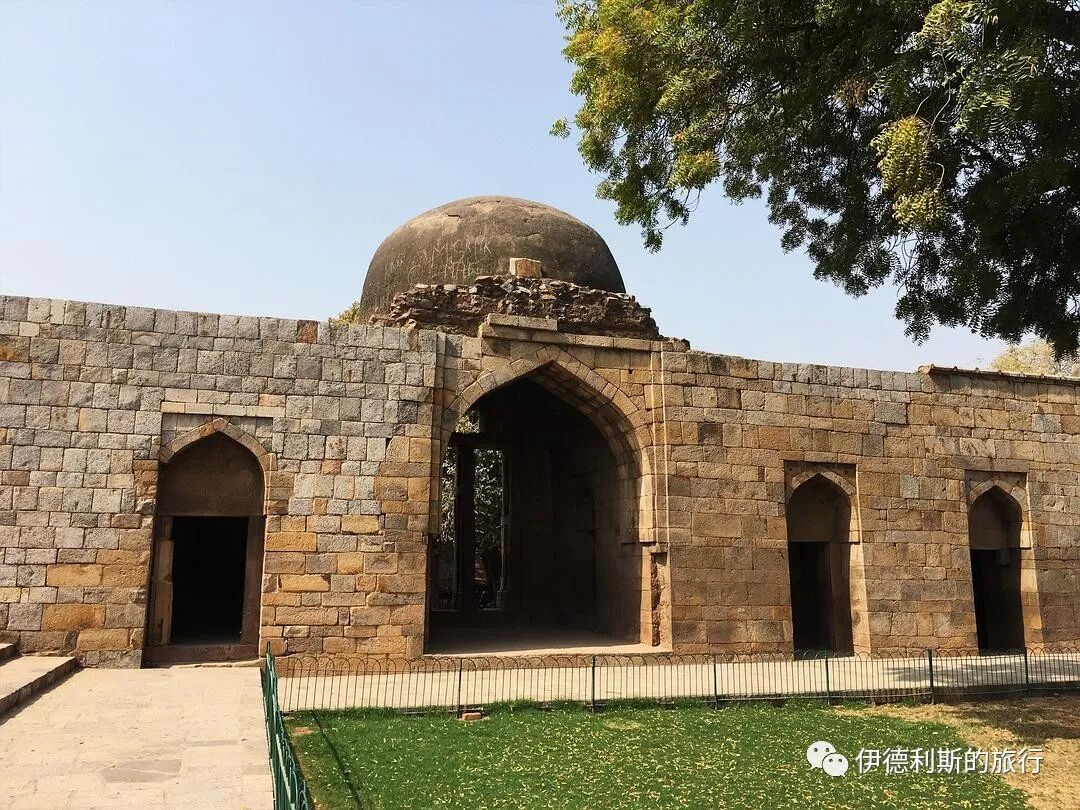
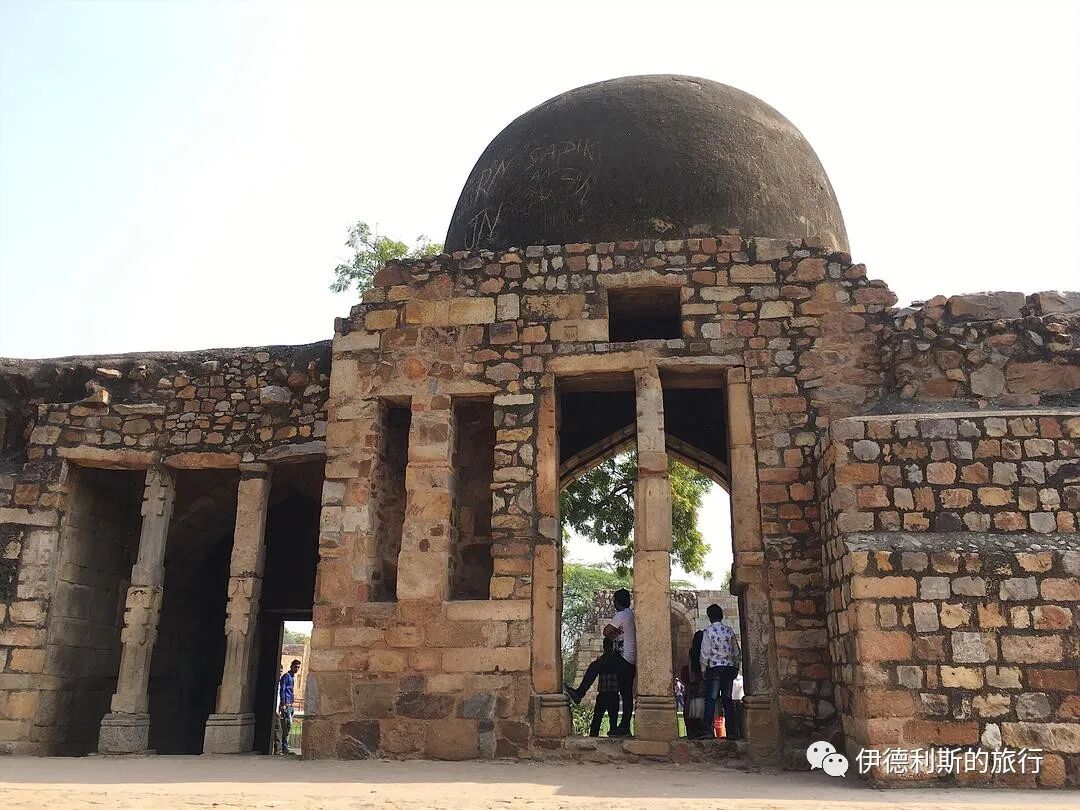
Dome
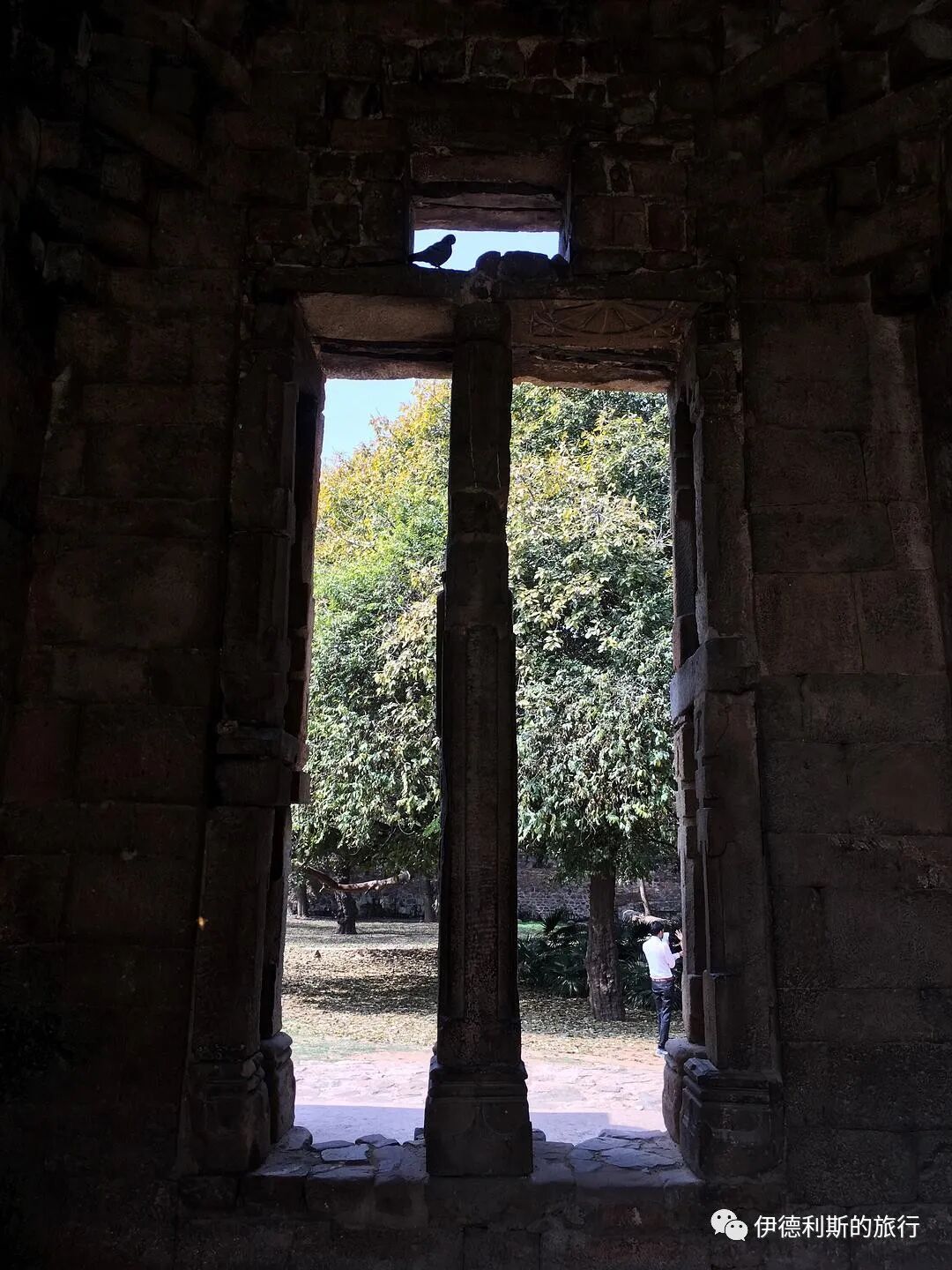
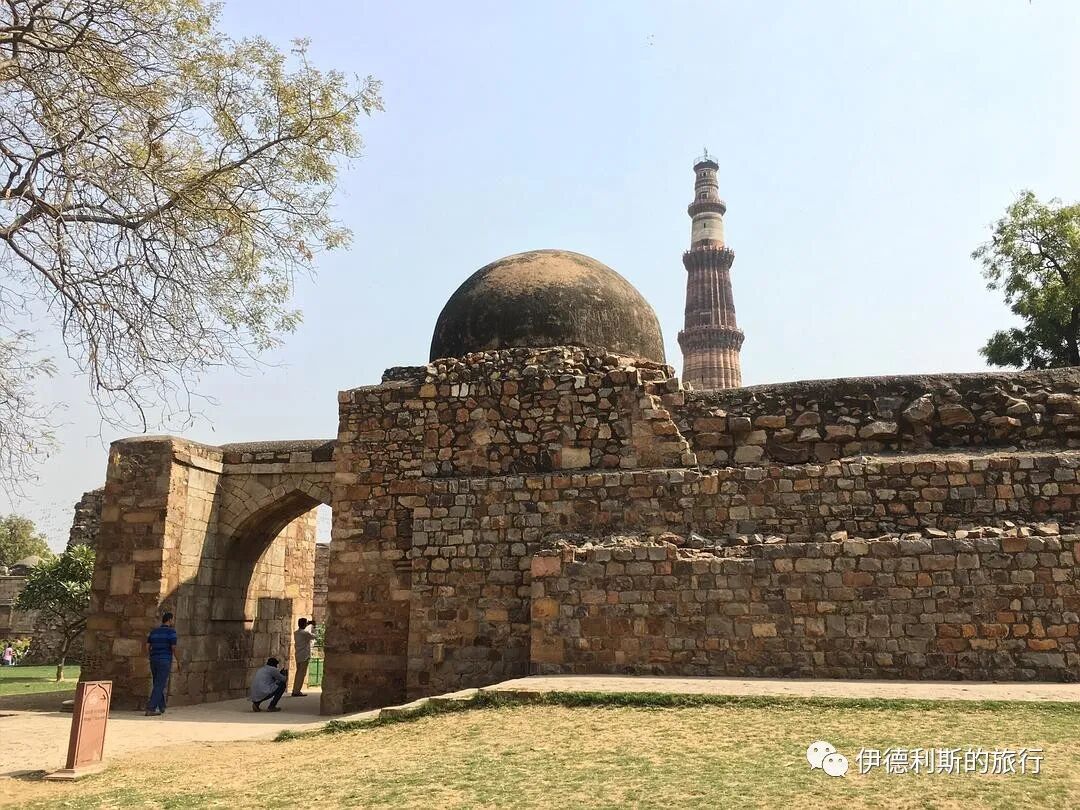
A tomb with a completely collapsed roof.
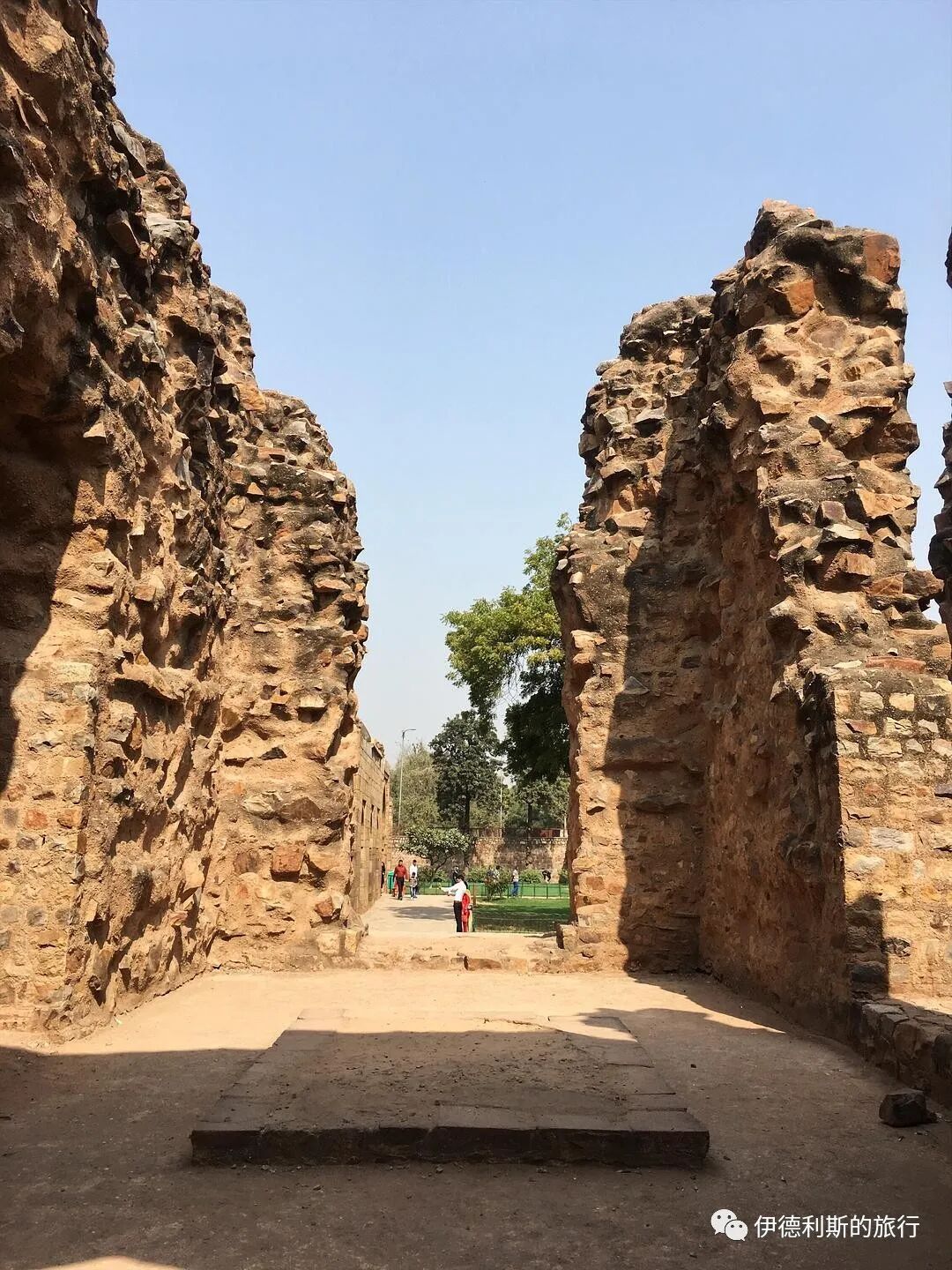
The room in the middle is likely where Alauddin is buried.
The image below shows a satellite view and a reconstruction of the Qutb Mosque. The red circle marks the mosque built by Qutb in 1193, the green circle marks the expansion by Iltutmish in 1225, and the blue circle marks the expansion by Alauddin in 1310. The Alauddin tomb and madrasa are inside the blue circle at the southwest corner.
Reconstruction image link: https://visual.ly/community/in ... mplex
6. Mughal Dynasty architecture at the Qutb Mosque
1. Tomb of Imam Zamin
Next to the south gate, Alai Darwaza, is the tomb of Imam Zamin, built in 1539. Not much is known about this imam's life, but he was likely an imam at the Qutb Mosque.
Door lintel.
The mihrab on the west side.
2. Late Mughal Dynasty mosque
This is a small mosque built during the late Mughal Empire, located northeast of the Qutb Mosque.
Prayer hall.
The mihrab on the west side.
3. Mughal Dynasty era gate
There are also some Mughal-era tombs scattered around the mosque.
Summary: Delhi — Qutb Minar, Mosques and Muslim History is presented here as a firsthand travel account in clear English, beginning with this scene: In the Indian epic Prithviraj Raso, Anangpal Tomar, the founder of the Tomar Dynasty, built Delhi's first city, Lal Kot, in 736 AD. The account keeps its focus on Delhi Travel, Qutb Minar, Muslim Heritage while preserving the names, places, food, and historical details from the Chinese source.
Contents
1. Delhi in the Hindu Era
2. Entering the Islamic Age
1. Ghurid Dynasty
2. Muhammad of Ghor conquers Delhi
3. Qutb rules Delhi
3. The first mosque in Delhi
1. Hindu and Jain architectural components
2. Iron Pillar of Delhi
3. The Qutb Minar reaching into the clouds
4. Iltutmish expands the mosque
1. Mamluk Dynasty of the Delhi Sultanate
2. Iltutmish takes over as Sultan
3. Territorial expansion
4. Expansion of the Qutb Mosque
5. Tomb of Iltutmish
5. Alauddin Khalji expands the mosque again
1. Khalji Dynasty of the Delhi Sultanate
2. Alauddin Khalji launches a coup
3. Accumulating wealth
4. Expanding the mosque
5. Alai Minar
6. Tomb of Alauddin Khalji
6. Mughal Dynasty architecture at the Qutb Mosque
1. Tomb of Imam Zamin
2. Late Mughal Dynasty mosque
3. Mughal Dynasty era gate
1. Delhi in the Hindu Era
In the Indian epic Prithviraj Raso, Anangpal Tomar, the founder of the Tomar Dynasty, built Delhi's first city, Lal Kot, in 736 AD. However, the history in this epic is not reliable, and some modern research suggests Lal Kot was more likely built in the mid-11th century. At that time, the city of Lal Kot had a perimeter of 3.6 kilometers and was home to about five or six thousand residents.
In 1160 (some say 1180), the Chauhan (Chahamanas) Dynasty from Rajasthan defeated the Tomar Dynasty, occupied Lal Kot, and expanded it into Qila Rai Pithora. The new city was four times larger than the original, with a perimeter reaching 8 kilometers, but later generations still tended to call the city Lal Kot.
The Chauhan Dynasty was later classified as one of the Rajput dynasties, although the identity of Rajput did not exist at that time. The term Rajput comes from the Sanskrit "raja-putra," meaning "son of a king." These tribes later became a group within the Kshatriya caste and linked their origins to myths and legends.
In the image below, the blue part is the city of Lal Kot, and the yellow part is the city of Qila Rai Pithora.
2. Entering the Islamic Age
In 1193, the Ghurid Dynasty defeated the Chauhan Dynasty and occupied the city of Lal Kot in Delhi, marking Delhi's entry into the Islamic age.
1. Ghurid Dynasty
The Ghurid Dynasty appeared in eastern Iran and the Afghanistan region starting in the 9th century. Whether the rulers were Pashtun or Tajik is still a matter of debate. In 1011, the Ghurid dynasty was conquered by the Persianized Turkic Muslim Ghaznavid dynasty, shifting from Buddhism to Islam.
In 1163, Ghiyath ad-Din Muhammad became the Sultan of the Ghurid dynasty. He and his brother, Mu'izz ad-Din Muhammad Ghori, launched a series of wars, attacking from Afghanistan all the way into northwestern India. In 1186, the two brothers captured the ancient city of Lahore in Punjab and took the last Ghaznavid Sultan, Khusrau Malik, prisoner, marking the end of the Ghaznavid dynasty.
2. Muhammad of Ghor conquers Delhi
In 1192, Muhammad Ghori led a large army to fight a decisive battle against the Rajput forces of the Chauhan dynasty. Exaggerated accounts claim that Muhammad Ghori brought 120,000 fully armed soldiers, while the Rajput army consisted of 300,000 cavalry and infantry, plus 3,000 elephants. Muhammad Ghori launched a surprise attack on the Rajput army before dawn, capturing and executing Prithviraj III.
In 1193, Muhammad Ghori conquered the city of Lal Kot in Delhi, then returned to Iran to deal with threats on his western border. Before leaving, he appointed General Qutb al-Din Aibak as the governor of northern India.
3. Qutb rules Delhi
Qutb al-Din Aibak was born into a Turkic family and was sold into slavery in Persia during his childhood. After his master died, he was sold again by the master's son, eventually becoming a slave to Muhammad Ghori. Qutb al-Din Aibak was highly valued by Muhammad Ghori, who appointed him as a military commander, and he later became a general of the Ghurid dynasty.
Starting in the 9th century, as the Arab Caliphate fractured, many Islamic rulers began using Turkic military slaves from Central Asia. These Turkic slave soldiers who converted to Islam were usually called Mamluk, a word meaning 'owned' in Arabic. Many Turkic Mamluks used their superior military skills to become generals and even rulers.
After becoming governor, Qutb al-Din Aibak used Delhi as his headquarters to gradually conquer all the Rajput dynasties in northern and central India, becoming the de facto ruler of northern India.
3. The first mosque in Delhi
After capturing Delhi in 1193, Qutb al-Din Aibak began building the first mosque on the ruins of the city of Lal Kot.
The red sections in the two images below show the location of the mosque built by Qutb al-Din Aibak.
1. Hindu and Jain architectural components
The Qutb mosque is known to later generations as the Quwwat-ul-Islam mosque and is one of the oldest surviving mosques in India. According to a Persian inscription on the mosque's east gate, the mosque was built after tearing down 27 Hindu and Jain temples from the Tomar and Chauhan dynasties. Because of this, many of the mosque's building components are original pieces from those Hindu and Jain temples.
The mosque gate.
The dome likely came from the construction of a Hindu or Jain temple.
The cloister inside the mosque.
The arch in front of the prayer hall.
The prayer hall has already collapsed.
The well-preserved east wall of the mosque.
2. Iron Pillar of Delhi
The famous Iron Pillar of Delhi stands in the center of the mosque courtyard. The pillar was cast between the 3rd and 4th centuries, and the time it was moved to the mosque is still debated. The oldest Sanskrit inscription on the iron pillar is from a king named Chandra. The most common view is that this king was Chandragupta II, who ruled the Gupta Empire from 380 to 415. This period was the peak of the Gupta Empire and is considered the 'Golden Age' of ancient India, when architecture and sculpture reached their height.
The high corrosion resistance of this iron pillar has attracted great interest from scientists and archaeologists, and it is considered a the highest level of ancient Indian iron-smelting technology. The pillar's corrosion resistance is believed to come from its high phosphorus content and Delhi's alternating wet and dry climate, which allowed a protective passivation film to form on the pillar.
3. The Qutb Minar reaching into the clouds
The most striking part of the Qutb mosque is the Qutb Minar, which later generations hailed as the tallest minaret in the ancient Islamic world.
The Qutb Minar is located outside the southeast side of the mosque courtyard. It is built of red sandstone, follows the style of Iranian minarets, and its patterns were influenced by the famous Minaret of Jam in contemporary Afghanistan. The tower is 72.5 meters high and divided into 5 levels. Each level has a protruding balcony, and there are 379 spiral stairs inside.
The first level of the Qutb Minar was built under the personal supervision of Qutb al-Din Aibak himself, so it contains many praises for Muhammad Ghori. The top three levels were finished in 1220 by his son-in-law Shams ud-Din Iltutmish (who I will introduce in detail later), and the style is basically the same as the Qutb period. The Qutb Minar from this period is made of red sandstone and carved with Kufic script.
In 1369, lightning destroyed the top of the Qutb Minar, and the Sultan of the Delhi Sultanate, Firoz Shah Tughlaq, rebuilt two more levels on top. The two new levels include marble, and you can now see a clear difference in architectural style between the bottom three levels and the top two.
4. Iltutmish expands the mosque
1. Mamluk Dynasty of the Delhi Sultanate
In 1202, Muhammad Ghori became the Sultan of the Ghurid dynasty after his brother passed away. In 1206, Muhammad Ghori handed over all affairs in India to Qutb and set off from India to return to Afghanistan. On March 15, while his carriage was traveling through Punjab, Pakistan, Muhammad Ghori was assassinated.
Muhammad Ghori had no children, so he treated his Mamluk slaves like his own sons during his lifetime. After he died, the country split into several parts, and Qutb established his own sultanate with Lahore as the capital. Because this sultanate later made Delhi its capital for nearly 300 years, later generations called it the Delhi Sultanate. Also, because Qutb was a Mamluk slave, the first dynasty of the Delhi Sultanate is known to later generations as the Mamluk Dynasty or the Slave Dynasty.
In 1210, Qutb died in an accident. The Delhi Sultanate did not have a fixed rule for succession. After Qutb died, the Turkic nobles in Lahore elected Aram Shah to succeed as Sultan. But Aram Shah was not good at governing the country, so a group of forty nobles called Chihalgani soon betrayed him and elected Shams ud-Din Iltutmish to succeed as Sultan.
In 1211, Iltutmish defeated Aram Shah on the plains near Delhi and seized the throne.
2. Iltutmish takes over as Sultan
Iltutmish came from the Turkic Ilbari tribe and was sold as a Mamluk slave during his childhood. He was first taken to the slave market in the ancient Central Asian city of Bukhara, then transferred to the Ghurid dynasty and bought by Muhammad Ghori's court.
Iltutmish quickly gained the appreciation of Muhammad Ghori and became his personal attendant. Qutb, who was the governor of Lahore at the time, also took a liking to Iltutmish, so he bought him from Muhammad Ghori in Delhi for a high price.
Iltutmish was also deeply appreciated by Qutb; he married Qutb's daughter and was entrusted by Qutb with the governorship of several important regions. After Qutb died in 1210, he defeated the successor Aram Shah in 1211 and became the third Sultan of the Mamluk Dynasty of the Delhi Sultanate.
3. Territorial expansion
At the beginning of his reign, Iltutmish consolidated the territory around Delhi through a series of wars. In 1214, Iltutmish officially moved the capital to the city of Lal Kot in Delhi.
In 1221, the Mongol army under Genghis Khan arrived at the banks of the Indus River. Iltutmish did not want a direct conflict with the Mongols, so he turned eastward and conquered the Bengal region.
The upheaval caused by the Mongol invasion of Central Asia led a large number of Turkic officers to come to India, so Iltutmish recruited a powerful army and conquered Sindh and Multan in 1228.
In 1228, Iltutmish received recognition from the Caliph of the Abbasid Caliphate and was granted a robe and gifts by the Caliph, which gave the Delhi Sultanate legitimacy in the Islamic world.
4. Expansion of the Qutb Mosque
In 1225, as the political situation stabilized, Iltutmish began to expand the Qutb Mosque, and the expanded part is also called the Iltutmish Mosque.
The green part in the picture below shows the scope of the mosque expansion by Iltutmish.
During Iltutmish's expansion, Muslim craftsmen replaced the Hindu craftsmen of the Qutb era, and they no longer used components from the original temples, so the architectural style of this period is more Islamic than the Qutb period.
The best-preserved part of Iltutmish's expansion is the beautifully carved archway.
Behind the archway, in the lower right corner, is the south cloister of the Iltutmish expansion.
The east cloister is visibly simpler than the cloister built by Qutb.
The west colonnade has already collapsed.
5. Tomb of Iltutmish
Iltutmish passed away in 1236. In 1235, the year before he died, he built his own tomb next to the Qutb Mosque.
The stone carvings on the walls are very ornate, featuring bells, tassels, lotus flowers, and diamond emblems, all of which are elements from Hinduism.
The structure at the corner of the tomb's ceiling is called a squinch, which is used to connect the walls to the dome. The earliest squinches appeared in the Sassanid Empire of Persia and were later used in Islamic architecture, becoming most common in Iran.
The squinches in the Tomb of Iltutmish indicate that there was once a dome on top of the tomb, but it later collapsed.
The ornate mihrab on the west side.
The tombstone in the center is made of white marble.
The actual grave of Iltutmish is not inside this building. In 1914, Gordon Sanderson of the Archaeological Survey of India (ASI) excavated the real burial chamber 20 steps north of the Tomb of Iltutmish.
5. Alauddin Khalji expands the mosque again
In 1310, Sultan Alauddin Khalji of the Khalji dynasty of the Delhi Sultanate expanded the Qutb Mosque for the third time.
1. Khalji Dynasty of the Delhi Sultanate
The Khaljis were a Turkic people who had lived among the Pashtun tribes in Afghanistan for over 200 years. By the time they arrived in Delhi in the 13th century, their customs had become Pashtunized, leading the Turkic nobility in India to even regard them as Afghans.
The Khaljis came to Delhi to serve the Sultan during the reign of Ghiyas ud din Balban, the ninth sultan of the Mamluk dynasty of the Delhi Sultanate (1266–1287). During Balban's era, the Delhi Sultanate stabilized after being on the verge of collapse, with its territory covering most of northern India.
After Balban died in 1287, his young successor became addicted to wine and women, and the Turkic nobility fell into factional fighting. In 1290, the military officer Jalal ud din Firuz Khalji launched a coup to overthrow the Mamluk dynasty, founding the second dynasty of the Delhi Sultanate—the Khalji dynasty.
2. Alauddin Khalji launches a coup
Firuz Khalji was already 70 years old when he took the throne. He was recognized as a gentle and humble monarch, but because he was not considered a Turk, Turkic nobles always tried to overthrow him.
Firuz pardoned one person after another who tried to overthrow him, but he eventually died at the hands of his nephew and son-in-law, Alauddin Khalji. Alauddin's original name was Ali Gurshasp. His father was Firuz's eldest brother, but he died early, so Alauddin was raised by Firuz. Firuz not only raised his nephew but also married his daughter to him.
After Firuz became Sultan, Alauddin's wife suddenly became a princess and began to act very arrogantly, wanting to dominate Alauddin. Her mother also indulged her daughter's arrogant behavior, so Alauddin had a very poor relationship with both his wife and his mother-in-law.
In 1291, Alauddin became the new governor of Kara. In Kara, people who had previously wanted to overthrow Firuz began to incite Alauddin to overthrow his uncle. Combined with his miserable marriage, he began to resolve to get rid of Firuz.
After five years of raising funds and hiring an army, in 1296, Alauddin led an army of 8,000 cavalry to loot Devagiri, the capital of the Yadava dynasty in southern India, and obtained a massive amount of wealth. When Firuz heard the news, he was very happy and set out from Delhi, intending to meet Alauddin on the way to see the spoils, but Alauddin took a detour and returned directly to Kara. One of Firuz's subordinates suggested that the Sultan go to intercept Alauddin, but Firuz believed that Alauddin would bring the wealth to Delhi, so he returned to Delhi instead.
In Delhi, Alauddin's younger brother Almas Beg assured his uncle of Alauddin's loyalty and begged him to pardon Alauddin's mistakes, saying that Alauddin would likely commit suicide out of guilt. Firuz, who cared for his nephew, immediately sent someone to Kara with a letter of pardon and promised to travel to Kara afterward.
During Ramadan in 1296, Firuz led a large army to Kara to meet Alauddin. He ordered his commanders to lead the main army directly to Kara, while he crossed the Ganges River with 1,000 soldiers. As they neared Kara, Alauddin sent his brother Almas to meet his uncle and persuade him to come alone, saying that otherwise, Alauddin would commit suicide out of fear.
When he arrived at Kara, Alauddin threw himself at Firuz's feet. Firuz caressed Alauddin, kissed his cheek, and scolded him for doubting his uncle's affection for him. At that moment, Alauddin signaled his subordinate Muhammad Salim, who swung his sword at Firuz. After being struck by the first blow, Firuz struggled to run toward the boat, but Muhammad swung a second time, and Firuz was finally killed. Alauddin immediately put on the crown and declared himself the new Sultan.
Alauddin then started moving toward Delhi, recruiting as many soldiers as he could along the way. Meanwhile in Delhi, Firoz's widow named her young son Qadr Khan as the new Sultan. This made the eldest son, Arkali Khan, who was the governor of Multan, furious, and he refused to help his mother defend against Alauddin's army.
In October 1296, Alauddin reached Delhi, defeated his mother-in-law's army, and took the city. On October 21, Alauddin officially became the Sultan of the Khalji dynasty of the Delhi Sultanate.
3. Accumulating wealth
During his first year on the throne, Alauddin used generous gifts to secure his power while balancing the influence of various nobles, which quickly brought stability to Delhi. By his second year, Alauddin began arresting and killing the nobles who had served Firoz. He seized their property to gain massive wealth and replaced the old nobles with new ones loyal to him.
Starting in 1297, Alauddin defended against the Mongol armies of the Chagatai Khanate while constantly conquering Hindu kingdoms in the south. In 1306, Alauddin defeated the last Mongol army sent by the Chagatai Khan, Duwa. After that, he began regular raids into Mongol territory in Afghanistan.
Alauddin's conquest of southern India was also very successful. In 1311, Alauddin sent an army to the Pandyan dynasty at the southern tip of the Indian peninsula. They seized a huge amount of treasure, elephants, and horses, which was considered the greatest haul of wealth since Muslims first occupied Delhi.
Besides looting the Hindu kingdoms, Alauddin carried out a series of economic reforms. Regarding land, he collected land taxes directly from Hindu rural areas without using any middlemen. Regarding income, he hired many accountants in the court and gave heavy punishments for bribery. Regarding markets, Alauddin used market inspectors and spies to strictly control the prices of goods. He also built state-owned grain warehouses and banned farmers and merchants from storing grain privately. By strictly controlling market prices, he was able to maintain a massive army while paying his soldiers lower wages.
4. Expanding the mosque
After accumulating great wealth, Alauddin began expanding the Qutb Mosque in 1310. The new mosque was much larger than the one expanded by Iltutmish.
The blue section in the image below shows the area of Alauddin's mosque expansion.
The most famous part of Alauddin's mosque expansion that still stands today is the southern gate, later called the Alai Darwaza. This building uses red sandstone and white marble inlaid with beautiful Naskh (a style of Arabic calligraphy) script. The geometric, openwork marble window screens show the high skill of the Turkic craftsmen.
This building is also known as the first structure in India built strictly according to Islamic architectural principles. During the Mamluk dynasty, the domes and arches were not strictly Islamic in form and were called false domes and false arches. This building is considered the first in India to use true Islamic domes and arches, though the patterns on the building are still full of Hindu elements.
5. Alai Minar
After doubling the size of the Qutb Mosque, Alauddin Khalji began building the Alai Minar, which was planned to be twice as tall as the Qutb Minar. However, the project was abandoned after the first level reached 24.5 meters. Today, only a huge core of rubble and stone remains of the tower.
6. Tomb of Alauddin Khalji
In his final years, Alauddin grew to distrust his officers and only favored the eunuch slave general Malik Kafur. Some scholars believe Alauddin and Kafur had a homosexual relationship, but others think their bond was not sexual.
In 1315, Alauddin became seriously ill. He appointed Kafur as the regent (Na'ib), giving him actual power. Kafur convinced Alauddin to purge many capable ministers and kept outsiders from seeing him during his final days.
As Alauddin lay dying, Kafur gathered all the important officials at his bedside to announce that Alauddin's 6-year-old son, Shihabuddin Omar, was the new heir and that he himself was the regent. According to the 14th-century Indian chronicler Abdul Malik Isami, Alauddin said nothing while in bed, and his silence was taken as consent.
Alauddin died on the night of January 4, 1316. Kafur buried him in the tomb already built in the southwest corner of the Qutb Mosque. According to the 14th-century historian Ziauddin Barani, it was Kafur who killed Alauddin.
Alauddin's tomb is connected to the madrasa (Islamic school) he built during his lifetime. This is also the first building in India where an Islamic madrasa and a tomb are connected. The madrasa is well-preserved today, but the tomb is badly damaged and has lost its dome.
Madrasa
Dome
A tomb with a completely collapsed roof.
The room in the middle is likely where Alauddin is buried.
The image below shows a satellite view and a reconstruction of the Qutb Mosque. The red circle marks the mosque built by Qutb in 1193, the green circle marks the expansion by Iltutmish in 1225, and the blue circle marks the expansion by Alauddin in 1310. The Alauddin tomb and madrasa are inside the blue circle at the southwest corner.
Reconstruction image link: https://visual.ly/community/in ... mplex
6. Mughal Dynasty architecture at the Qutb Mosque
1. Tomb of Imam Zamin
Next to the south gate, Alai Darwaza, is the tomb of Imam Zamin, built in 1539. Not much is known about this imam's life, but he was likely an imam at the Qutb Mosque.
Door lintel.
The mihrab on the west side.
2. Late Mughal Dynasty mosque
This is a small mosque built during the late Mughal Empire, located northeast of the Qutb Mosque.
Prayer hall.
The mihrab on the west side.
3. Mughal Dynasty era gate
There are also some Mughal-era tombs scattered around the mosque.
Halal Travel Guide: Delhi — Qutb Minar, Mosques and Muslim History
Articles • ali2007fr posted the article • 0 comments • 151 views • 2026-05-17 10:56
Reposted from the web
Summary: Delhi — Qutb Minar, Mosques and Muslim History is presented here as a firsthand travel account in clear English, beginning with this scene: In the Indian epic Prithviraj Raso, Anangpal Tomar, the founder of the Tomar Dynasty, built Delhi's first city, Lal Kot, in 736 AD. The account keeps its focus on Delhi Travel, Qutb Minar, Muslim Heritage while preserving the names, places, food, and historical details from the Chinese source.
Contents
1. Delhi in the Hindu Era
2. Entering the Islamic Age
1. Ghurid Dynasty
2. Muhammad of Ghor conquers Delhi
3. Qutb rules Delhi
3. The first mosque in Delhi
1. Hindu and Jain architectural components
2. Iron Pillar of Delhi
3. The Qutb Minar reaching into the clouds
4. Iltutmish expands the mosque
1. Mamluk Dynasty of the Delhi Sultanate
2. Iltutmish takes over as Sultan
3. Territorial expansion
4. Expansion of the Qutb Mosque
5. Tomb of Iltutmish
5. Alauddin Khalji expands the mosque again
1. Khalji Dynasty of the Delhi Sultanate
2. Alauddin Khalji launches a coup
3. Accumulating wealth
4. Expanding the mosque
5. Alai Minar
6. Tomb of Alauddin Khalji
6. Mughal Dynasty architecture at the Qutb Mosque
1. Tomb of Imam Zamin
2. Late Mughal Dynasty mosque
3. Mughal Dynasty era gate
1. Delhi in the Hindu Era
In the Indian epic Prithviraj Raso, Anangpal Tomar, the founder of the Tomar Dynasty, built Delhi's first city, Lal Kot, in 736 AD. However, the history in this epic is not reliable, and some modern research suggests Lal Kot was more likely built in the mid-11th century. At that time, the city of Lal Kot had a perimeter of 3.6 kilometers and was home to about five or six thousand residents.
In 1160 (some say 1180), the Chauhan (Chahamanas) Dynasty from Rajasthan defeated the Tomar Dynasty, occupied Lal Kot, and expanded it into Qila Rai Pithora. The new city was four times larger than the original, with a perimeter reaching 8 kilometers, but later generations still tended to call the city Lal Kot.
The Chauhan Dynasty was later classified as one of the Rajput dynasties, although the identity of Rajput did not exist at that time. The term Rajput comes from the Sanskrit "raja-putra," meaning "son of a king." These tribes later became a group within the Kshatriya caste and linked their origins to myths and legends.
In the image below, the blue part is the city of Lal Kot, and the yellow part is the city of Qila Rai Pithora.
2. Entering the Islamic Age
In 1193, the Ghurid Dynasty defeated the Chauhan Dynasty and occupied the city of Lal Kot in Delhi, marking Delhi's entry into the Islamic age.
1. Ghurid Dynasty
The Ghurid Dynasty appeared in eastern Iran and the Afghanistan region starting in the 9th century. Whether the rulers were Pashtun or Tajik is still a matter of debate. In 1011, the Ghurid dynasty was conquered by the Persianized Turkic Muslim Ghaznavid dynasty, shifting from Buddhism to Islam.
In 1163, Ghiyath ad-Din Muhammad became the Sultan of the Ghurid dynasty. He and his brother, Mu'izz ad-Din Muhammad Ghori, launched a series of wars, attacking from Afghanistan all the way into northwestern India. In 1186, the two brothers captured the ancient city of Lahore in Punjab and took the last Ghaznavid Sultan, Khusrau Malik, prisoner, marking the end of the Ghaznavid dynasty.
2. Muhammad of Ghor conquers Delhi
In 1192, Muhammad Ghori led a large army to fight a decisive battle against the Rajput forces of the Chauhan dynasty. Exaggerated accounts claim that Muhammad Ghori brought 120,000 fully armed soldiers, while the Rajput army consisted of 300,000 cavalry and infantry, plus 3,000 elephants. Muhammad Ghori launched a surprise attack on the Rajput army before dawn, capturing and executing Prithviraj III.
In 1193, Muhammad Ghori conquered the city of Lal Kot in Delhi, then returned to Iran to deal with threats on his western border. Before leaving, he appointed General Qutb al-Din Aibak as the governor of northern India.
3. Qutb rules Delhi
Qutb al-Din Aibak was born into a Turkic family and was sold into slavery in Persia during his childhood. After his master died, he was sold again by the master's son, eventually becoming a slave to Muhammad Ghori. Qutb al-Din Aibak was highly valued by Muhammad Ghori, who appointed him as a military commander, and he later became a general of the Ghurid dynasty.
Starting in the 9th century, as the Arab Caliphate fractured, many Islamic rulers began using Turkic military slaves from Central Asia. These Turkic slave soldiers who converted to Islam were usually called Mamluk, a word meaning 'owned' in Arabic. Many Turkic Mamluks used their superior military skills to become generals and even rulers.
After becoming governor, Qutb al-Din Aibak used Delhi as his headquarters to gradually conquer all the Rajput dynasties in northern and central India, becoming the de facto ruler of northern India.
3. The first mosque in Delhi
After capturing Delhi in 1193, Qutb al-Din Aibak began building the first mosque on the ruins of the city of Lal Kot.
The red sections in the two images below show the location of the mosque built by Qutb al-Din Aibak.
1. Hindu and Jain architectural components
The Qutb mosque is known to later generations as the Quwwat-ul-Islam mosque and is one of the oldest surviving mosques in India. According to a Persian inscription on the mosque's east gate, the mosque was built after tearing down 27 Hindu and Jain temples from the Tomar and Chauhan dynasties. Because of this, many of the mosque's building components are original pieces from those Hindu and Jain temples.
The mosque gate.
The dome likely came from the construction of a Hindu or Jain temple.
The cloister inside the mosque.
The arch in front of the prayer hall.
The prayer hall has already collapsed.
The well-preserved east wall of the mosque.
2. Iron Pillar of Delhi
The famous Iron Pillar of Delhi stands in the center of the mosque courtyard. The pillar was cast between the 3rd and 4th centuries, and the time it was moved to the mosque is still debated. The oldest Sanskrit inscription on the iron pillar is from a king named Chandra. The most common view is that this king was Chandragupta II, who ruled the Gupta Empire from 380 to 415. This period was the peak of the Gupta Empire and is considered the 'Golden Age' of ancient India, when architecture and sculpture reached their height.
The high corrosion resistance of this iron pillar has attracted great interest from scientists and archaeologists, and it is considered a the highest level of ancient Indian iron-smelting technology. The pillar's corrosion resistance is believed to come from its high phosphorus content and Delhi's alternating wet and dry climate, which allowed a protective passivation film to form on the pillar.
3. The Qutb Minar reaching into the clouds
The most striking part of the Qutb mosque is the Qutb Minar, which later generations hailed as the tallest minaret in the ancient Islamic world.
The Qutb Minar is located outside the southeast side of the mosque courtyard. It is built of red sandstone, follows the style of Iranian minarets, and its patterns were influenced by the famous Minaret of Jam in contemporary Afghanistan. The tower is 72.5 meters high and divided into 5 levels. Each level has a protruding balcony, and there are 379 spiral stairs inside.
The first level of the Qutb Minar was built under the personal supervision of Qutb al-Din Aibak himself, so it contains many praises for Muhammad Ghori. The top three levels were finished in 1220 by his son-in-law Shams ud-Din Iltutmish (who I will introduce in detail later), and the style is basically the same as the Qutb period. The Qutb Minar from this period is made of red sandstone and carved with Kufic script.
In 1369, lightning destroyed the top of the Qutb Minar, and the Sultan of the Delhi Sultanate, Firoz Shah Tughlaq, rebuilt two more levels on top. The two new levels include marble, and you can now see a clear difference in architectural style between the bottom three levels and the top two.
4. Iltutmish expands the mosque
1. Mamluk Dynasty of the Delhi Sultanate
In 1202, Muhammad Ghori became the Sultan of the Ghurid dynasty after his brother passed away. In 1206, Muhammad Ghori handed over all affairs in India to Qutb and set off from India to return to Afghanistan. On March 15, while his carriage was traveling through Punjab, Pakistan, Muhammad Ghori was assassinated.
Muhammad Ghori had no children, so he treated his Mamluk slaves like his own sons during his lifetime. After he died, the country split into several parts, and Qutb established his own sultanate with Lahore as the capital. Because this sultanate later made Delhi its capital for nearly 300 years, later generations called it the Delhi Sultanate. Also, because Qutb was a Mamluk slave, the first dynasty of the Delhi Sultanate is known to later generations as the Mamluk Dynasty or the Slave Dynasty.
In 1210, Qutb died in an accident. The Delhi Sultanate did not have a fixed rule for succession. After Qutb died, the Turkic nobles in Lahore elected Aram Shah to succeed as Sultan. But Aram Shah was not good at governing the country, so a group of forty nobles called Chihalgani soon betrayed him and elected Shams ud-Din Iltutmish to succeed as Sultan.
In 1211, Iltutmish defeated Aram Shah on the plains near Delhi and seized the throne.
2. Iltutmish takes over as Sultan
Iltutmish came from the Turkic Ilbari tribe and was sold as a Mamluk slave during his childhood. He was first taken to the slave market in the ancient Central Asian city of Bukhara, then transferred to the Ghurid dynasty and bought by Muhammad Ghori's court.
Iltutmish quickly gained the appreciation of Muhammad Ghori and became his personal attendant. Qutb, who was the governor of Lahore at the time, also took a liking to Iltutmish, so he bought him from Muhammad Ghori in Delhi for a high price.
Iltutmish was also deeply appreciated by Qutb; he married Qutb's daughter and was entrusted by Qutb with the governorship of several important regions. After Qutb died in 1210, he defeated the successor Aram Shah in 1211 and became the third Sultan of the Mamluk Dynasty of the Delhi Sultanate.
3. Territorial expansion
At the beginning of his reign, Iltutmish consolidated the territory around Delhi through a series of wars. In 1214, Iltutmish officially moved the capital to the city of Lal Kot in Delhi.
In 1221, the Mongol army under Genghis Khan arrived at the banks of the Indus River. Iltutmish did not want a direct conflict with the Mongols, so he turned eastward and conquered the Bengal region.
The upheaval caused by the Mongol invasion of Central Asia led a large number of Turkic officers to come to India, so Iltutmish recruited a powerful army and conquered Sindh and Multan in 1228.
In 1228, Iltutmish received recognition from the Caliph of the Abbasid Caliphate and was granted a robe and gifts by the Caliph, which gave the Delhi Sultanate legitimacy in the Islamic world.
4. Expansion of the Qutb Mosque
In 1225, as the political situation stabilized, Iltutmish began to expand the Qutb Mosque, and the expanded part is also called the Iltutmish Mosque.
The green part in the picture below shows the scope of the mosque expansion by Iltutmish.
During Iltutmish's expansion, Muslim craftsmen replaced the Hindu craftsmen of the Qutb era, and they no longer used components from the original temples, so the architectural style of this period is more Islamic than the Qutb period.
The best-preserved part of Iltutmish's expansion is the beautifully carved archway.
Behind the archway, in the lower right corner, is the south cloister of the Iltutmish expansion.
The east cloister is visibly simpler than the cloister built by Qutb.
The west colonnade has already collapsed.
5. Tomb of Iltutmish
Iltutmish passed away in 1236. In 1235, the year before he died, he built his own tomb next to the Qutb Mosque.
The stone carvings on the walls are very ornate, featuring bells, tassels, lotus flowers, and diamond emblems, all of which are elements from Hinduism.
The structure at the corner of the tomb's ceiling is called a squinch, which is used to connect the walls to the dome. The earliest squinches appeared in the Sassanid Empire of Persia and were later used in Islamic architecture, becoming most common in Iran.
The squinches in the Tomb of Iltutmish indicate that there was once a dome on top of the tomb, but it later collapsed.
The ornate mihrab on the west side.
The tombstone in the center is made of white marble.
The actual grave of Iltutmish is not inside this building. In 1914, Gordon Sanderson of the Archaeological Survey of India (ASI) excavated the real burial chamber 20 steps north of the Tomb of Iltutmish.
5. Alauddin Khalji expands the mosque again
In 1310, Sultan Alauddin Khalji of the Khalji dynasty of the Delhi Sultanate expanded the Qutb Mosque for the third time.
1. Khalji Dynasty of the Delhi Sultanate
The Khaljis were a Turkic people who had lived among the Pashtun tribes in Afghanistan for over 200 years. By the time they arrived in Delhi in the 13th century, their customs had become Pashtunized, leading the Turkic nobility in India to even regard them as Afghans.
The Khaljis came to Delhi to serve the Sultan during the reign of Ghiyas ud din Balban, the ninth sultan of the Mamluk dynasty of the Delhi Sultanate (1266–1287). During Balban's era, the Delhi Sultanate stabilized after being on the verge of collapse, with its territory covering most of northern India.
After Balban died in 1287, his young successor became addicted to wine and women, and the Turkic nobility fell into factional fighting. In 1290, the military officer Jalal ud din Firuz Khalji launched a coup to overthrow the Mamluk dynasty, founding the second dynasty of the Delhi Sultanate—the Khalji dynasty.
2. Alauddin Khalji launches a coup
Firuz Khalji was already 70 years old when he took the throne. He was recognized as a gentle and humble monarch, but because he was not considered a Turk, Turkic nobles always tried to overthrow him.
Firuz pardoned one person after another who tried to overthrow him, but he eventually died at the hands of his nephew and son-in-law, Alauddin Khalji. Alauddin's original name was Ali Gurshasp. His father was Firuz's eldest brother, but he died early, so Alauddin was raised by Firuz. Firuz not only raised his nephew but also married his daughter to him.
After Firuz became Sultan, Alauddin's wife suddenly became a princess and began to act very arrogantly, wanting to dominate Alauddin. Her mother also indulged her daughter's arrogant behavior, so Alauddin had a very poor relationship with both his wife and his mother-in-law.
In 1291, Alauddin became the new governor of Kara. In Kara, people who had previously wanted to overthrow Firuz began to incite Alauddin to overthrow his uncle. Combined with his miserable marriage, he began to resolve to get rid of Firuz.
After five years of raising funds and hiring an army, in 1296, Alauddin led an army of 8,000 cavalry to loot Devagiri, the capital of the Yadava dynasty in southern India, and obtained a massive amount of wealth. When Firuz heard the news, he was very happy and set out from Delhi, intending to meet Alauddin on the way to see the spoils, but Alauddin took a detour and returned directly to Kara. One of Firuz's subordinates suggested that the Sultan go to intercept Alauddin, but Firuz believed that Alauddin would bring the wealth to Delhi, so he returned to Delhi instead.
In Delhi, Alauddin's younger brother Almas Beg assured his uncle of Alauddin's loyalty and begged him to pardon Alauddin's mistakes, saying that Alauddin would likely commit suicide out of guilt. Firuz, who cared for his nephew, immediately sent someone to Kara with a letter of pardon and promised to travel to Kara afterward.
During Ramadan in 1296, Firuz led a large army to Kara to meet Alauddin. He ordered his commanders to lead the main army directly to Kara, while he crossed the Ganges River with 1,000 soldiers. As they neared Kara, Alauddin sent his brother Almas to meet his uncle and persuade him to come alone, saying that otherwise, Alauddin would commit suicide out of fear.
When he arrived at Kara, Alauddin threw himself at Firuz's feet. Firuz caressed Alauddin, kissed his cheek, and scolded him for doubting his uncle's affection for him. At that moment, Alauddin signaled his subordinate Muhammad Salim, who swung his sword at Firuz. After being struck by the first blow, Firuz struggled to run toward the boat, but Muhammad swung a second time, and Firuz was finally killed. Alauddin immediately put on the crown and declared himself the new Sultan.
Alauddin then started moving toward Delhi, recruiting as many soldiers as he could along the way. Meanwhile in Delhi, Firoz's widow named her young son Qadr Khan as the new Sultan. This made the eldest son, Arkali Khan, who was the governor of Multan, furious, and he refused to help his mother defend against Alauddin's army.
In October 1296, Alauddin reached Delhi, defeated his mother-in-law's army, and took the city. On October 21, Alauddin officially became the Sultan of the Khalji dynasty of the Delhi Sultanate.
3. Accumulating wealth
During his first year on the throne, Alauddin used generous gifts to secure his power while balancing the influence of various nobles, which quickly brought stability to Delhi. By his second year, Alauddin began arresting and killing the nobles who had served Firoz. He seized their property to gain massive wealth and replaced the old nobles with new ones loyal to him.
Starting in 1297, Alauddin defended against the Mongol armies of the Chagatai Khanate while constantly conquering Hindu kingdoms in the south. In 1306, Alauddin defeated the last Mongol army sent by the Chagatai Khan, Duwa. After that, he began regular raids into Mongol territory in Afghanistan.
Alauddin's conquest of southern India was also very successful. In 1311, Alauddin sent an army to the Pandyan dynasty at the southern tip of the Indian peninsula. They seized a huge amount of treasure, elephants, and horses, which was considered the greatest haul of wealth since Muslims first occupied Delhi.
Besides looting the Hindu kingdoms, Alauddin carried out a series of economic reforms. Regarding land, he collected land taxes directly from Hindu rural areas without using any middlemen. Regarding income, he hired many accountants in the court and gave heavy punishments for bribery. Regarding markets, Alauddin used market inspectors and spies to strictly control the prices of goods. He also built state-owned grain warehouses and banned farmers and merchants from storing grain privately. By strictly controlling market prices, he was able to maintain a massive army while paying his soldiers lower wages.
4. Expanding the mosque
After accumulating great wealth, Alauddin began expanding the Qutb Mosque in 1310. The new mosque was much larger than the one expanded by Iltutmish.
The blue section in the image below shows the area of Alauddin's mosque expansion.
The most famous part of Alauddin's mosque expansion that still stands today is the southern gate, later called the Alai Darwaza. This building uses red sandstone and white marble inlaid with beautiful Naskh (a style of Arabic calligraphy) script. The geometric, openwork marble window screens show the high skill of the Turkic craftsmen.
This building is also known as the first structure in India built strictly according to Islamic architectural principles. During the Mamluk dynasty, the domes and arches were not strictly Islamic in form and were called false domes and false arches. This building is considered the first in India to use true Islamic domes and arches, though the patterns on the building are still full of Hindu elements.
5. Alai Minar
After doubling the size of the Qutb Mosque, Alauddin Khalji began building the Alai Minar, which was planned to be twice as tall as the Qutb Minar. However, the project was abandoned after the first level reached 24.5 meters. Today, only a huge core of rubble and stone remains of the tower.
6. Tomb of Alauddin Khalji
In his final years, Alauddin grew to distrust his officers and only favored the eunuch slave general Malik Kafur. Some scholars believe Alauddin and Kafur had a homosexual relationship, but others think their bond was not sexual.
In 1315, Alauddin became seriously ill. He appointed Kafur as the regent (Na'ib), giving him actual power. Kafur convinced Alauddin to purge many capable ministers and kept outsiders from seeing him during his final days.
As Alauddin lay dying, Kafur gathered all the important officials at his bedside to announce that Alauddin's 6-year-old son, Shihabuddin Omar, was the new heir and that he himself was the regent. According to the 14th-century Indian chronicler Abdul Malik Isami, Alauddin said nothing while in bed, and his silence was taken as consent.
Alauddin died on the night of January 4, 1316. Kafur buried him in the tomb already built in the southwest corner of the Qutb Mosque. According to the 14th-century historian Ziauddin Barani, it was Kafur who killed Alauddin.
Alauddin's tomb is connected to the madrasa (Islamic school) he built during his lifetime. This is also the first building in India where an Islamic madrasa and a tomb are connected. The madrasa is well-preserved today, but the tomb is badly damaged and has lost its dome.
Madrasa
Dome
A tomb with a completely collapsed roof.
The room in the middle is likely where Alauddin is buried.
The image below shows a satellite view and a reconstruction of the Qutb Mosque. The red circle marks the mosque built by Qutb in 1193, the green circle marks the expansion by Iltutmish in 1225, and the blue circle marks the expansion by Alauddin in 1310. The Alauddin tomb and madrasa are inside the blue circle at the southwest corner.
Reconstruction image link: https://visual.ly/community/in ... mplex
6. Mughal Dynasty architecture at the Qutb Mosque
1. Tomb of Imam Zamin
Next to the south gate, Alai Darwaza, is the tomb of Imam Zamin, built in 1539. Not much is known about this imam's life, but he was likely an imam at the Qutb Mosque.
Door lintel.
The mihrab on the west side.
2. Late Mughal Dynasty mosque
This is a small mosque built during the late Mughal Empire, located northeast of the Qutb Mosque.
Prayer hall.
The mihrab on the west side.
3. Mughal Dynasty era gate
There are also some Mughal-era tombs scattered around the mosque. view all
Summary: Delhi — Qutb Minar, Mosques and Muslim History is presented here as a firsthand travel account in clear English, beginning with this scene: In the Indian epic Prithviraj Raso, Anangpal Tomar, the founder of the Tomar Dynasty, built Delhi's first city, Lal Kot, in 736 AD. The account keeps its focus on Delhi Travel, Qutb Minar, Muslim Heritage while preserving the names, places, food, and historical details from the Chinese source.
Contents
1. Delhi in the Hindu Era
2. Entering the Islamic Age
1. Ghurid Dynasty
2. Muhammad of Ghor conquers Delhi
3. Qutb rules Delhi
3. The first mosque in Delhi
1. Hindu and Jain architectural components
2. Iron Pillar of Delhi
3. The Qutb Minar reaching into the clouds
4. Iltutmish expands the mosque
1. Mamluk Dynasty of the Delhi Sultanate
2. Iltutmish takes over as Sultan
3. Territorial expansion
4. Expansion of the Qutb Mosque
5. Tomb of Iltutmish
5. Alauddin Khalji expands the mosque again
1. Khalji Dynasty of the Delhi Sultanate
2. Alauddin Khalji launches a coup
3. Accumulating wealth
4. Expanding the mosque
5. Alai Minar
6. Tomb of Alauddin Khalji
6. Mughal Dynasty architecture at the Qutb Mosque
1. Tomb of Imam Zamin
2. Late Mughal Dynasty mosque
3. Mughal Dynasty era gate
1. Delhi in the Hindu Era
In the Indian epic Prithviraj Raso, Anangpal Tomar, the founder of the Tomar Dynasty, built Delhi's first city, Lal Kot, in 736 AD. However, the history in this epic is not reliable, and some modern research suggests Lal Kot was more likely built in the mid-11th century. At that time, the city of Lal Kot had a perimeter of 3.6 kilometers and was home to about five or six thousand residents.
In 1160 (some say 1180), the Chauhan (Chahamanas) Dynasty from Rajasthan defeated the Tomar Dynasty, occupied Lal Kot, and expanded it into Qila Rai Pithora. The new city was four times larger than the original, with a perimeter reaching 8 kilometers, but later generations still tended to call the city Lal Kot.
The Chauhan Dynasty was later classified as one of the Rajput dynasties, although the identity of Rajput did not exist at that time. The term Rajput comes from the Sanskrit "raja-putra," meaning "son of a king." These tribes later became a group within the Kshatriya caste and linked their origins to myths and legends.
In the image below, the blue part is the city of Lal Kot, and the yellow part is the city of Qila Rai Pithora.
2. Entering the Islamic Age
In 1193, the Ghurid Dynasty defeated the Chauhan Dynasty and occupied the city of Lal Kot in Delhi, marking Delhi's entry into the Islamic age.
1. Ghurid Dynasty
The Ghurid Dynasty appeared in eastern Iran and the Afghanistan region starting in the 9th century. Whether the rulers were Pashtun or Tajik is still a matter of debate. In 1011, the Ghurid dynasty was conquered by the Persianized Turkic Muslim Ghaznavid dynasty, shifting from Buddhism to Islam.
In 1163, Ghiyath ad-Din Muhammad became the Sultan of the Ghurid dynasty. He and his brother, Mu'izz ad-Din Muhammad Ghori, launched a series of wars, attacking from Afghanistan all the way into northwestern India. In 1186, the two brothers captured the ancient city of Lahore in Punjab and took the last Ghaznavid Sultan, Khusrau Malik, prisoner, marking the end of the Ghaznavid dynasty.
2. Muhammad of Ghor conquers Delhi
In 1192, Muhammad Ghori led a large army to fight a decisive battle against the Rajput forces of the Chauhan dynasty. Exaggerated accounts claim that Muhammad Ghori brought 120,000 fully armed soldiers, while the Rajput army consisted of 300,000 cavalry and infantry, plus 3,000 elephants. Muhammad Ghori launched a surprise attack on the Rajput army before dawn, capturing and executing Prithviraj III.
In 1193, Muhammad Ghori conquered the city of Lal Kot in Delhi, then returned to Iran to deal with threats on his western border. Before leaving, he appointed General Qutb al-Din Aibak as the governor of northern India.
3. Qutb rules Delhi
Qutb al-Din Aibak was born into a Turkic family and was sold into slavery in Persia during his childhood. After his master died, he was sold again by the master's son, eventually becoming a slave to Muhammad Ghori. Qutb al-Din Aibak was highly valued by Muhammad Ghori, who appointed him as a military commander, and he later became a general of the Ghurid dynasty.
Starting in the 9th century, as the Arab Caliphate fractured, many Islamic rulers began using Turkic military slaves from Central Asia. These Turkic slave soldiers who converted to Islam were usually called Mamluk, a word meaning 'owned' in Arabic. Many Turkic Mamluks used their superior military skills to become generals and even rulers.
After becoming governor, Qutb al-Din Aibak used Delhi as his headquarters to gradually conquer all the Rajput dynasties in northern and central India, becoming the de facto ruler of northern India.
3. The first mosque in Delhi
After capturing Delhi in 1193, Qutb al-Din Aibak began building the first mosque on the ruins of the city of Lal Kot.
The red sections in the two images below show the location of the mosque built by Qutb al-Din Aibak.
1. Hindu and Jain architectural components
The Qutb mosque is known to later generations as the Quwwat-ul-Islam mosque and is one of the oldest surviving mosques in India. According to a Persian inscription on the mosque's east gate, the mosque was built after tearing down 27 Hindu and Jain temples from the Tomar and Chauhan dynasties. Because of this, many of the mosque's building components are original pieces from those Hindu and Jain temples.
The mosque gate.
The dome likely came from the construction of a Hindu or Jain temple.
The cloister inside the mosque.
The arch in front of the prayer hall.
The prayer hall has already collapsed.
The well-preserved east wall of the mosque.
2. Iron Pillar of Delhi
The famous Iron Pillar of Delhi stands in the center of the mosque courtyard. The pillar was cast between the 3rd and 4th centuries, and the time it was moved to the mosque is still debated. The oldest Sanskrit inscription on the iron pillar is from a king named Chandra. The most common view is that this king was Chandragupta II, who ruled the Gupta Empire from 380 to 415. This period was the peak of the Gupta Empire and is considered the 'Golden Age' of ancient India, when architecture and sculpture reached their height.
The high corrosion resistance of this iron pillar has attracted great interest from scientists and archaeologists, and it is considered a the highest level of ancient Indian iron-smelting technology. The pillar's corrosion resistance is believed to come from its high phosphorus content and Delhi's alternating wet and dry climate, which allowed a protective passivation film to form on the pillar.
3. The Qutb Minar reaching into the clouds
The most striking part of the Qutb mosque is the Qutb Minar, which later generations hailed as the tallest minaret in the ancient Islamic world.
The Qutb Minar is located outside the southeast side of the mosque courtyard. It is built of red sandstone, follows the style of Iranian minarets, and its patterns were influenced by the famous Minaret of Jam in contemporary Afghanistan. The tower is 72.5 meters high and divided into 5 levels. Each level has a protruding balcony, and there are 379 spiral stairs inside.
The first level of the Qutb Minar was built under the personal supervision of Qutb al-Din Aibak himself, so it contains many praises for Muhammad Ghori. The top three levels were finished in 1220 by his son-in-law Shams ud-Din Iltutmish (who I will introduce in detail later), and the style is basically the same as the Qutb period. The Qutb Minar from this period is made of red sandstone and carved with Kufic script.
In 1369, lightning destroyed the top of the Qutb Minar, and the Sultan of the Delhi Sultanate, Firoz Shah Tughlaq, rebuilt two more levels on top. The two new levels include marble, and you can now see a clear difference in architectural style between the bottom three levels and the top two.
4. Iltutmish expands the mosque
1. Mamluk Dynasty of the Delhi Sultanate
In 1202, Muhammad Ghori became the Sultan of the Ghurid dynasty after his brother passed away. In 1206, Muhammad Ghori handed over all affairs in India to Qutb and set off from India to return to Afghanistan. On March 15, while his carriage was traveling through Punjab, Pakistan, Muhammad Ghori was assassinated.
Muhammad Ghori had no children, so he treated his Mamluk slaves like his own sons during his lifetime. After he died, the country split into several parts, and Qutb established his own sultanate with Lahore as the capital. Because this sultanate later made Delhi its capital for nearly 300 years, later generations called it the Delhi Sultanate. Also, because Qutb was a Mamluk slave, the first dynasty of the Delhi Sultanate is known to later generations as the Mamluk Dynasty or the Slave Dynasty.
In 1210, Qutb died in an accident. The Delhi Sultanate did not have a fixed rule for succession. After Qutb died, the Turkic nobles in Lahore elected Aram Shah to succeed as Sultan. But Aram Shah was not good at governing the country, so a group of forty nobles called Chihalgani soon betrayed him and elected Shams ud-Din Iltutmish to succeed as Sultan.
In 1211, Iltutmish defeated Aram Shah on the plains near Delhi and seized the throne.
2. Iltutmish takes over as Sultan
Iltutmish came from the Turkic Ilbari tribe and was sold as a Mamluk slave during his childhood. He was first taken to the slave market in the ancient Central Asian city of Bukhara, then transferred to the Ghurid dynasty and bought by Muhammad Ghori's court.
Iltutmish quickly gained the appreciation of Muhammad Ghori and became his personal attendant. Qutb, who was the governor of Lahore at the time, also took a liking to Iltutmish, so he bought him from Muhammad Ghori in Delhi for a high price.
Iltutmish was also deeply appreciated by Qutb; he married Qutb's daughter and was entrusted by Qutb with the governorship of several important regions. After Qutb died in 1210, he defeated the successor Aram Shah in 1211 and became the third Sultan of the Mamluk Dynasty of the Delhi Sultanate.
3. Territorial expansion
At the beginning of his reign, Iltutmish consolidated the territory around Delhi through a series of wars. In 1214, Iltutmish officially moved the capital to the city of Lal Kot in Delhi.
In 1221, the Mongol army under Genghis Khan arrived at the banks of the Indus River. Iltutmish did not want a direct conflict with the Mongols, so he turned eastward and conquered the Bengal region.
The upheaval caused by the Mongol invasion of Central Asia led a large number of Turkic officers to come to India, so Iltutmish recruited a powerful army and conquered Sindh and Multan in 1228.
In 1228, Iltutmish received recognition from the Caliph of the Abbasid Caliphate and was granted a robe and gifts by the Caliph, which gave the Delhi Sultanate legitimacy in the Islamic world.
4. Expansion of the Qutb Mosque
In 1225, as the political situation stabilized, Iltutmish began to expand the Qutb Mosque, and the expanded part is also called the Iltutmish Mosque.
The green part in the picture below shows the scope of the mosque expansion by Iltutmish.
During Iltutmish's expansion, Muslim craftsmen replaced the Hindu craftsmen of the Qutb era, and they no longer used components from the original temples, so the architectural style of this period is more Islamic than the Qutb period.
The best-preserved part of Iltutmish's expansion is the beautifully carved archway.
Behind the archway, in the lower right corner, is the south cloister of the Iltutmish expansion.
The east cloister is visibly simpler than the cloister built by Qutb.
The west colonnade has already collapsed.
5. Tomb of Iltutmish
Iltutmish passed away in 1236. In 1235, the year before he died, he built his own tomb next to the Qutb Mosque.
The stone carvings on the walls are very ornate, featuring bells, tassels, lotus flowers, and diamond emblems, all of which are elements from Hinduism.
The structure at the corner of the tomb's ceiling is called a squinch, which is used to connect the walls to the dome. The earliest squinches appeared in the Sassanid Empire of Persia and were later used in Islamic architecture, becoming most common in Iran.
The squinches in the Tomb of Iltutmish indicate that there was once a dome on top of the tomb, but it later collapsed.
The ornate mihrab on the west side.
The tombstone in the center is made of white marble.
The actual grave of Iltutmish is not inside this building. In 1914, Gordon Sanderson of the Archaeological Survey of India (ASI) excavated the real burial chamber 20 steps north of the Tomb of Iltutmish.
5. Alauddin Khalji expands the mosque again
In 1310, Sultan Alauddin Khalji of the Khalji dynasty of the Delhi Sultanate expanded the Qutb Mosque for the third time.
1. Khalji Dynasty of the Delhi Sultanate
The Khaljis were a Turkic people who had lived among the Pashtun tribes in Afghanistan for over 200 years. By the time they arrived in Delhi in the 13th century, their customs had become Pashtunized, leading the Turkic nobility in India to even regard them as Afghans.
The Khaljis came to Delhi to serve the Sultan during the reign of Ghiyas ud din Balban, the ninth sultan of the Mamluk dynasty of the Delhi Sultanate (1266–1287). During Balban's era, the Delhi Sultanate stabilized after being on the verge of collapse, with its territory covering most of northern India.
After Balban died in 1287, his young successor became addicted to wine and women, and the Turkic nobility fell into factional fighting. In 1290, the military officer Jalal ud din Firuz Khalji launched a coup to overthrow the Mamluk dynasty, founding the second dynasty of the Delhi Sultanate—the Khalji dynasty.
2. Alauddin Khalji launches a coup
Firuz Khalji was already 70 years old when he took the throne. He was recognized as a gentle and humble monarch, but because he was not considered a Turk, Turkic nobles always tried to overthrow him.
Firuz pardoned one person after another who tried to overthrow him, but he eventually died at the hands of his nephew and son-in-law, Alauddin Khalji. Alauddin's original name was Ali Gurshasp. His father was Firuz's eldest brother, but he died early, so Alauddin was raised by Firuz. Firuz not only raised his nephew but also married his daughter to him.
After Firuz became Sultan, Alauddin's wife suddenly became a princess and began to act very arrogantly, wanting to dominate Alauddin. Her mother also indulged her daughter's arrogant behavior, so Alauddin had a very poor relationship with both his wife and his mother-in-law.
In 1291, Alauddin became the new governor of Kara. In Kara, people who had previously wanted to overthrow Firuz began to incite Alauddin to overthrow his uncle. Combined with his miserable marriage, he began to resolve to get rid of Firuz.
After five years of raising funds and hiring an army, in 1296, Alauddin led an army of 8,000 cavalry to loot Devagiri, the capital of the Yadava dynasty in southern India, and obtained a massive amount of wealth. When Firuz heard the news, he was very happy and set out from Delhi, intending to meet Alauddin on the way to see the spoils, but Alauddin took a detour and returned directly to Kara. One of Firuz's subordinates suggested that the Sultan go to intercept Alauddin, but Firuz believed that Alauddin would bring the wealth to Delhi, so he returned to Delhi instead.
In Delhi, Alauddin's younger brother Almas Beg assured his uncle of Alauddin's loyalty and begged him to pardon Alauddin's mistakes, saying that Alauddin would likely commit suicide out of guilt. Firuz, who cared for his nephew, immediately sent someone to Kara with a letter of pardon and promised to travel to Kara afterward.
During Ramadan in 1296, Firuz led a large army to Kara to meet Alauddin. He ordered his commanders to lead the main army directly to Kara, while he crossed the Ganges River with 1,000 soldiers. As they neared Kara, Alauddin sent his brother Almas to meet his uncle and persuade him to come alone, saying that otherwise, Alauddin would commit suicide out of fear.
When he arrived at Kara, Alauddin threw himself at Firuz's feet. Firuz caressed Alauddin, kissed his cheek, and scolded him for doubting his uncle's affection for him. At that moment, Alauddin signaled his subordinate Muhammad Salim, who swung his sword at Firuz. After being struck by the first blow, Firuz struggled to run toward the boat, but Muhammad swung a second time, and Firuz was finally killed. Alauddin immediately put on the crown and declared himself the new Sultan.
Alauddin then started moving toward Delhi, recruiting as many soldiers as he could along the way. Meanwhile in Delhi, Firoz's widow named her young son Qadr Khan as the new Sultan. This made the eldest son, Arkali Khan, who was the governor of Multan, furious, and he refused to help his mother defend against Alauddin's army.
In October 1296, Alauddin reached Delhi, defeated his mother-in-law's army, and took the city. On October 21, Alauddin officially became the Sultan of the Khalji dynasty of the Delhi Sultanate.
3. Accumulating wealth
During his first year on the throne, Alauddin used generous gifts to secure his power while balancing the influence of various nobles, which quickly brought stability to Delhi. By his second year, Alauddin began arresting and killing the nobles who had served Firoz. He seized their property to gain massive wealth and replaced the old nobles with new ones loyal to him.
Starting in 1297, Alauddin defended against the Mongol armies of the Chagatai Khanate while constantly conquering Hindu kingdoms in the south. In 1306, Alauddin defeated the last Mongol army sent by the Chagatai Khan, Duwa. After that, he began regular raids into Mongol territory in Afghanistan.
Alauddin's conquest of southern India was also very successful. In 1311, Alauddin sent an army to the Pandyan dynasty at the southern tip of the Indian peninsula. They seized a huge amount of treasure, elephants, and horses, which was considered the greatest haul of wealth since Muslims first occupied Delhi.
Besides looting the Hindu kingdoms, Alauddin carried out a series of economic reforms. Regarding land, he collected land taxes directly from Hindu rural areas without using any middlemen. Regarding income, he hired many accountants in the court and gave heavy punishments for bribery. Regarding markets, Alauddin used market inspectors and spies to strictly control the prices of goods. He also built state-owned grain warehouses and banned farmers and merchants from storing grain privately. By strictly controlling market prices, he was able to maintain a massive army while paying his soldiers lower wages.
4. Expanding the mosque
After accumulating great wealth, Alauddin began expanding the Qutb Mosque in 1310. The new mosque was much larger than the one expanded by Iltutmish.
The blue section in the image below shows the area of Alauddin's mosque expansion.
The most famous part of Alauddin's mosque expansion that still stands today is the southern gate, later called the Alai Darwaza. This building uses red sandstone and white marble inlaid with beautiful Naskh (a style of Arabic calligraphy) script. The geometric, openwork marble window screens show the high skill of the Turkic craftsmen.
This building is also known as the first structure in India built strictly according to Islamic architectural principles. During the Mamluk dynasty, the domes and arches were not strictly Islamic in form and were called false domes and false arches. This building is considered the first in India to use true Islamic domes and arches, though the patterns on the building are still full of Hindu elements.
5. Alai Minar
After doubling the size of the Qutb Mosque, Alauddin Khalji began building the Alai Minar, which was planned to be twice as tall as the Qutb Minar. However, the project was abandoned after the first level reached 24.5 meters. Today, only a huge core of rubble and stone remains of the tower.
6. Tomb of Alauddin Khalji
In his final years, Alauddin grew to distrust his officers and only favored the eunuch slave general Malik Kafur. Some scholars believe Alauddin and Kafur had a homosexual relationship, but others think their bond was not sexual.
In 1315, Alauddin became seriously ill. He appointed Kafur as the regent (Na'ib), giving him actual power. Kafur convinced Alauddin to purge many capable ministers and kept outsiders from seeing him during his final days.
As Alauddin lay dying, Kafur gathered all the important officials at his bedside to announce that Alauddin's 6-year-old son, Shihabuddin Omar, was the new heir and that he himself was the regent. According to the 14th-century Indian chronicler Abdul Malik Isami, Alauddin said nothing while in bed, and his silence was taken as consent.
Alauddin died on the night of January 4, 1316. Kafur buried him in the tomb already built in the southwest corner of the Qutb Mosque. According to the 14th-century historian Ziauddin Barani, it was Kafur who killed Alauddin.
Alauddin's tomb is connected to the madrasa (Islamic school) he built during his lifetime. This is also the first building in India where an Islamic madrasa and a tomb are connected. The madrasa is well-preserved today, but the tomb is badly damaged and has lost its dome.
Madrasa
Dome
A tomb with a completely collapsed roof.
The room in the middle is likely where Alauddin is buried.
The image below shows a satellite view and a reconstruction of the Qutb Mosque. The red circle marks the mosque built by Qutb in 1193, the green circle marks the expansion by Iltutmish in 1225, and the blue circle marks the expansion by Alauddin in 1310. The Alauddin tomb and madrasa are inside the blue circle at the southwest corner.
Reconstruction image link: https://visual.ly/community/in ... mplex
6. Mughal Dynasty architecture at the Qutb Mosque
1. Tomb of Imam Zamin
Next to the south gate, Alai Darwaza, is the tomb of Imam Zamin, built in 1539. Not much is known about this imam's life, but he was likely an imam at the Qutb Mosque.
Door lintel.
The mihrab on the west side.
2. Late Mughal Dynasty mosque
This is a small mosque built during the late Mughal Empire, located northeast of the Qutb Mosque.
Prayer hall.
The mihrab on the west side.
3. Mughal Dynasty era gate
There are also some Mughal-era tombs scattered around the mosque. view all
Reposted from the web
Summary: Delhi — Qutb Minar, Mosques and Muslim History is presented here as a firsthand travel account in clear English, beginning with this scene: In the Indian epic Prithviraj Raso, Anangpal Tomar, the founder of the Tomar Dynasty, built Delhi's first city, Lal Kot, in 736 AD. The account keeps its focus on Delhi Travel, Qutb Minar, Muslim Heritage while preserving the names, places, food, and historical details from the Chinese source.
Contents
1. Delhi in the Hindu Era
2. Entering the Islamic Age
1. Ghurid Dynasty
2. Muhammad of Ghor conquers Delhi
3. Qutb rules Delhi
3. The first mosque in Delhi
1. Hindu and Jain architectural components
2. Iron Pillar of Delhi
3. The Qutb Minar reaching into the clouds
4. Iltutmish expands the mosque
1. Mamluk Dynasty of the Delhi Sultanate
2. Iltutmish takes over as Sultan
3. Territorial expansion
4. Expansion of the Qutb Mosque
5. Tomb of Iltutmish
5. Alauddin Khalji expands the mosque again
1. Khalji Dynasty of the Delhi Sultanate
2. Alauddin Khalji launches a coup
3. Accumulating wealth
4. Expanding the mosque
5. Alai Minar
6. Tomb of Alauddin Khalji
6. Mughal Dynasty architecture at the Qutb Mosque
1. Tomb of Imam Zamin
2. Late Mughal Dynasty mosque
3. Mughal Dynasty era gate
1. Delhi in the Hindu Era
In the Indian epic Prithviraj Raso, Anangpal Tomar, the founder of the Tomar Dynasty, built Delhi's first city, Lal Kot, in 736 AD. However, the history in this epic is not reliable, and some modern research suggests Lal Kot was more likely built in the mid-11th century. At that time, the city of Lal Kot had a perimeter of 3.6 kilometers and was home to about five or six thousand residents.
In 1160 (some say 1180), the Chauhan (Chahamanas) Dynasty from Rajasthan defeated the Tomar Dynasty, occupied Lal Kot, and expanded it into Qila Rai Pithora. The new city was four times larger than the original, with a perimeter reaching 8 kilometers, but later generations still tended to call the city Lal Kot.
The Chauhan Dynasty was later classified as one of the Rajput dynasties, although the identity of Rajput did not exist at that time. The term Rajput comes from the Sanskrit "raja-putra," meaning "son of a king." These tribes later became a group within the Kshatriya caste and linked their origins to myths and legends.
In the image below, the blue part is the city of Lal Kot, and the yellow part is the city of Qila Rai Pithora.
2. Entering the Islamic Age
In 1193, the Ghurid Dynasty defeated the Chauhan Dynasty and occupied the city of Lal Kot in Delhi, marking Delhi's entry into the Islamic age.
1. Ghurid Dynasty
The Ghurid Dynasty appeared in eastern Iran and the Afghanistan region starting in the 9th century. Whether the rulers were Pashtun or Tajik is still a matter of debate. In 1011, the Ghurid dynasty was conquered by the Persianized Turkic Muslim Ghaznavid dynasty, shifting from Buddhism to Islam.
In 1163, Ghiyath ad-Din Muhammad became the Sultan of the Ghurid dynasty. He and his brother, Mu'izz ad-Din Muhammad Ghori, launched a series of wars, attacking from Afghanistan all the way into northwestern India. In 1186, the two brothers captured the ancient city of Lahore in Punjab and took the last Ghaznavid Sultan, Khusrau Malik, prisoner, marking the end of the Ghaznavid dynasty.
2. Muhammad of Ghor conquers Delhi
In 1192, Muhammad Ghori led a large army to fight a decisive battle against the Rajput forces of the Chauhan dynasty. Exaggerated accounts claim that Muhammad Ghori brought 120,000 fully armed soldiers, while the Rajput army consisted of 300,000 cavalry and infantry, plus 3,000 elephants. Muhammad Ghori launched a surprise attack on the Rajput army before dawn, capturing and executing Prithviraj III.
In 1193, Muhammad Ghori conquered the city of Lal Kot in Delhi, then returned to Iran to deal with threats on his western border. Before leaving, he appointed General Qutb al-Din Aibak as the governor of northern India.
3. Qutb rules Delhi
Qutb al-Din Aibak was born into a Turkic family and was sold into slavery in Persia during his childhood. After his master died, he was sold again by the master's son, eventually becoming a slave to Muhammad Ghori. Qutb al-Din Aibak was highly valued by Muhammad Ghori, who appointed him as a military commander, and he later became a general of the Ghurid dynasty.
Starting in the 9th century, as the Arab Caliphate fractured, many Islamic rulers began using Turkic military slaves from Central Asia. These Turkic slave soldiers who converted to Islam were usually called Mamluk, a word meaning 'owned' in Arabic. Many Turkic Mamluks used their superior military skills to become generals and even rulers.
After becoming governor, Qutb al-Din Aibak used Delhi as his headquarters to gradually conquer all the Rajput dynasties in northern and central India, becoming the de facto ruler of northern India.
3. The first mosque in Delhi
After capturing Delhi in 1193, Qutb al-Din Aibak began building the first mosque on the ruins of the city of Lal Kot.
The red sections in the two images below show the location of the mosque built by Qutb al-Din Aibak.
1. Hindu and Jain architectural components
The Qutb mosque is known to later generations as the Quwwat-ul-Islam mosque and is one of the oldest surviving mosques in India. According to a Persian inscription on the mosque's east gate, the mosque was built after tearing down 27 Hindu and Jain temples from the Tomar and Chauhan dynasties. Because of this, many of the mosque's building components are original pieces from those Hindu and Jain temples.
The mosque gate.
The dome likely came from the construction of a Hindu or Jain temple.
The cloister inside the mosque.
The arch in front of the prayer hall.
The prayer hall has already collapsed.
The well-preserved east wall of the mosque.
2. Iron Pillar of Delhi
The famous Iron Pillar of Delhi stands in the center of the mosque courtyard. The pillar was cast between the 3rd and 4th centuries, and the time it was moved to the mosque is still debated. The oldest Sanskrit inscription on the iron pillar is from a king named Chandra. The most common view is that this king was Chandragupta II, who ruled the Gupta Empire from 380 to 415. This period was the peak of the Gupta Empire and is considered the 'Golden Age' of ancient India, when architecture and sculpture reached their height.
The high corrosion resistance of this iron pillar has attracted great interest from scientists and archaeologists, and it is considered a the highest level of ancient Indian iron-smelting technology. The pillar's corrosion resistance is believed to come from its high phosphorus content and Delhi's alternating wet and dry climate, which allowed a protective passivation film to form on the pillar.
3. The Qutb Minar reaching into the clouds
The most striking part of the Qutb mosque is the Qutb Minar, which later generations hailed as the tallest minaret in the ancient Islamic world.
The Qutb Minar is located outside the southeast side of the mosque courtyard. It is built of red sandstone, follows the style of Iranian minarets, and its patterns were influenced by the famous Minaret of Jam in contemporary Afghanistan. The tower is 72.5 meters high and divided into 5 levels. Each level has a protruding balcony, and there are 379 spiral stairs inside.
The first level of the Qutb Minar was built under the personal supervision of Qutb al-Din Aibak himself, so it contains many praises for Muhammad Ghori. The top three levels were finished in 1220 by his son-in-law Shams ud-Din Iltutmish (who I will introduce in detail later), and the style is basically the same as the Qutb period. The Qutb Minar from this period is made of red sandstone and carved with Kufic script.
In 1369, lightning destroyed the top of the Qutb Minar, and the Sultan of the Delhi Sultanate, Firoz Shah Tughlaq, rebuilt two more levels on top. The two new levels include marble, and you can now see a clear difference in architectural style between the bottom three levels and the top two.
4. Iltutmish expands the mosque
1. Mamluk Dynasty of the Delhi Sultanate
In 1202, Muhammad Ghori became the Sultan of the Ghurid dynasty after his brother passed away. In 1206, Muhammad Ghori handed over all affairs in India to Qutb and set off from India to return to Afghanistan. On March 15, while his carriage was traveling through Punjab, Pakistan, Muhammad Ghori was assassinated.
Muhammad Ghori had no children, so he treated his Mamluk slaves like his own sons during his lifetime. After he died, the country split into several parts, and Qutb established his own sultanate with Lahore as the capital. Because this sultanate later made Delhi its capital for nearly 300 years, later generations called it the Delhi Sultanate. Also, because Qutb was a Mamluk slave, the first dynasty of the Delhi Sultanate is known to later generations as the Mamluk Dynasty or the Slave Dynasty.
In 1210, Qutb died in an accident. The Delhi Sultanate did not have a fixed rule for succession. After Qutb died, the Turkic nobles in Lahore elected Aram Shah to succeed as Sultan. But Aram Shah was not good at governing the country, so a group of forty nobles called Chihalgani soon betrayed him and elected Shams ud-Din Iltutmish to succeed as Sultan.
In 1211, Iltutmish defeated Aram Shah on the plains near Delhi and seized the throne.
2. Iltutmish takes over as Sultan
Iltutmish came from the Turkic Ilbari tribe and was sold as a Mamluk slave during his childhood. He was first taken to the slave market in the ancient Central Asian city of Bukhara, then transferred to the Ghurid dynasty and bought by Muhammad Ghori's court.
Iltutmish quickly gained the appreciation of Muhammad Ghori and became his personal attendant. Qutb, who was the governor of Lahore at the time, also took a liking to Iltutmish, so he bought him from Muhammad Ghori in Delhi for a high price.
Iltutmish was also deeply appreciated by Qutb; he married Qutb's daughter and was entrusted by Qutb with the governorship of several important regions. After Qutb died in 1210, he defeated the successor Aram Shah in 1211 and became the third Sultan of the Mamluk Dynasty of the Delhi Sultanate.
3. Territorial expansion
At the beginning of his reign, Iltutmish consolidated the territory around Delhi through a series of wars. In 1214, Iltutmish officially moved the capital to the city of Lal Kot in Delhi.
In 1221, the Mongol army under Genghis Khan arrived at the banks of the Indus River. Iltutmish did not want a direct conflict with the Mongols, so he turned eastward and conquered the Bengal region.
The upheaval caused by the Mongol invasion of Central Asia led a large number of Turkic officers to come to India, so Iltutmish recruited a powerful army and conquered Sindh and Multan in 1228.
In 1228, Iltutmish received recognition from the Caliph of the Abbasid Caliphate and was granted a robe and gifts by the Caliph, which gave the Delhi Sultanate legitimacy in the Islamic world.
4. Expansion of the Qutb Mosque
In 1225, as the political situation stabilized, Iltutmish began to expand the Qutb Mosque, and the expanded part is also called the Iltutmish Mosque.
The green part in the picture below shows the scope of the mosque expansion by Iltutmish.
During Iltutmish's expansion, Muslim craftsmen replaced the Hindu craftsmen of the Qutb era, and they no longer used components from the original temples, so the architectural style of this period is more Islamic than the Qutb period.
The best-preserved part of Iltutmish's expansion is the beautifully carved archway.
Behind the archway, in the lower right corner, is the south cloister of the Iltutmish expansion.
The east cloister is visibly simpler than the cloister built by Qutb.
The west colonnade has already collapsed.
5. Tomb of Iltutmish
Iltutmish passed away in 1236. In 1235, the year before he died, he built his own tomb next to the Qutb Mosque.
The stone carvings on the walls are very ornate, featuring bells, tassels, lotus flowers, and diamond emblems, all of which are elements from Hinduism.
The structure at the corner of the tomb's ceiling is called a squinch, which is used to connect the walls to the dome. The earliest squinches appeared in the Sassanid Empire of Persia and were later used in Islamic architecture, becoming most common in Iran.
The squinches in the Tomb of Iltutmish indicate that there was once a dome on top of the tomb, but it later collapsed.
The ornate mihrab on the west side.
The tombstone in the center is made of white marble.
The actual grave of Iltutmish is not inside this building. In 1914, Gordon Sanderson of the Archaeological Survey of India (ASI) excavated the real burial chamber 20 steps north of the Tomb of Iltutmish.
5. Alauddin Khalji expands the mosque again
In 1310, Sultan Alauddin Khalji of the Khalji dynasty of the Delhi Sultanate expanded the Qutb Mosque for the third time.
1. Khalji Dynasty of the Delhi Sultanate
The Khaljis were a Turkic people who had lived among the Pashtun tribes in Afghanistan for over 200 years. By the time they arrived in Delhi in the 13th century, their customs had become Pashtunized, leading the Turkic nobility in India to even regard them as Afghans.
The Khaljis came to Delhi to serve the Sultan during the reign of Ghiyas ud din Balban, the ninth sultan of the Mamluk dynasty of the Delhi Sultanate (1266–1287). During Balban's era, the Delhi Sultanate stabilized after being on the verge of collapse, with its territory covering most of northern India.
After Balban died in 1287, his young successor became addicted to wine and women, and the Turkic nobility fell into factional fighting. In 1290, the military officer Jalal ud din Firuz Khalji launched a coup to overthrow the Mamluk dynasty, founding the second dynasty of the Delhi Sultanate—the Khalji dynasty.
2. Alauddin Khalji launches a coup
Firuz Khalji was already 70 years old when he took the throne. He was recognized as a gentle and humble monarch, but because he was not considered a Turk, Turkic nobles always tried to overthrow him.
Firuz pardoned one person after another who tried to overthrow him, but he eventually died at the hands of his nephew and son-in-law, Alauddin Khalji. Alauddin's original name was Ali Gurshasp. His father was Firuz's eldest brother, but he died early, so Alauddin was raised by Firuz. Firuz not only raised his nephew but also married his daughter to him.
After Firuz became Sultan, Alauddin's wife suddenly became a princess and began to act very arrogantly, wanting to dominate Alauddin. Her mother also indulged her daughter's arrogant behavior, so Alauddin had a very poor relationship with both his wife and his mother-in-law.
In 1291, Alauddin became the new governor of Kara. In Kara, people who had previously wanted to overthrow Firuz began to incite Alauddin to overthrow his uncle. Combined with his miserable marriage, he began to resolve to get rid of Firuz.
After five years of raising funds and hiring an army, in 1296, Alauddin led an army of 8,000 cavalry to loot Devagiri, the capital of the Yadava dynasty in southern India, and obtained a massive amount of wealth. When Firuz heard the news, he was very happy and set out from Delhi, intending to meet Alauddin on the way to see the spoils, but Alauddin took a detour and returned directly to Kara. One of Firuz's subordinates suggested that the Sultan go to intercept Alauddin, but Firuz believed that Alauddin would bring the wealth to Delhi, so he returned to Delhi instead.
In Delhi, Alauddin's younger brother Almas Beg assured his uncle of Alauddin's loyalty and begged him to pardon Alauddin's mistakes, saying that Alauddin would likely commit suicide out of guilt. Firuz, who cared for his nephew, immediately sent someone to Kara with a letter of pardon and promised to travel to Kara afterward.
During Ramadan in 1296, Firuz led a large army to Kara to meet Alauddin. He ordered his commanders to lead the main army directly to Kara, while he crossed the Ganges River with 1,000 soldiers. As they neared Kara, Alauddin sent his brother Almas to meet his uncle and persuade him to come alone, saying that otherwise, Alauddin would commit suicide out of fear.
When he arrived at Kara, Alauddin threw himself at Firuz's feet. Firuz caressed Alauddin, kissed his cheek, and scolded him for doubting his uncle's affection for him. At that moment, Alauddin signaled his subordinate Muhammad Salim, who swung his sword at Firuz. After being struck by the first blow, Firuz struggled to run toward the boat, but Muhammad swung a second time, and Firuz was finally killed. Alauddin immediately put on the crown and declared himself the new Sultan.
Alauddin then started moving toward Delhi, recruiting as many soldiers as he could along the way. Meanwhile in Delhi, Firoz's widow named her young son Qadr Khan as the new Sultan. This made the eldest son, Arkali Khan, who was the governor of Multan, furious, and he refused to help his mother defend against Alauddin's army.
In October 1296, Alauddin reached Delhi, defeated his mother-in-law's army, and took the city. On October 21, Alauddin officially became the Sultan of the Khalji dynasty of the Delhi Sultanate.
3. Accumulating wealth
During his first year on the throne, Alauddin used generous gifts to secure his power while balancing the influence of various nobles, which quickly brought stability to Delhi. By his second year, Alauddin began arresting and killing the nobles who had served Firoz. He seized their property to gain massive wealth and replaced the old nobles with new ones loyal to him.
Starting in 1297, Alauddin defended against the Mongol armies of the Chagatai Khanate while constantly conquering Hindu kingdoms in the south. In 1306, Alauddin defeated the last Mongol army sent by the Chagatai Khan, Duwa. After that, he began regular raids into Mongol territory in Afghanistan.
Alauddin's conquest of southern India was also very successful. In 1311, Alauddin sent an army to the Pandyan dynasty at the southern tip of the Indian peninsula. They seized a huge amount of treasure, elephants, and horses, which was considered the greatest haul of wealth since Muslims first occupied Delhi.
Besides looting the Hindu kingdoms, Alauddin carried out a series of economic reforms. Regarding land, he collected land taxes directly from Hindu rural areas without using any middlemen. Regarding income, he hired many accountants in the court and gave heavy punishments for bribery. Regarding markets, Alauddin used market inspectors and spies to strictly control the prices of goods. He also built state-owned grain warehouses and banned farmers and merchants from storing grain privately. By strictly controlling market prices, he was able to maintain a massive army while paying his soldiers lower wages.
4. Expanding the mosque
After accumulating great wealth, Alauddin began expanding the Qutb Mosque in 1310. The new mosque was much larger than the one expanded by Iltutmish.
The blue section in the image below shows the area of Alauddin's mosque expansion.
The most famous part of Alauddin's mosque expansion that still stands today is the southern gate, later called the Alai Darwaza. This building uses red sandstone and white marble inlaid with beautiful Naskh (a style of Arabic calligraphy) script. The geometric, openwork marble window screens show the high skill of the Turkic craftsmen.
This building is also known as the first structure in India built strictly according to Islamic architectural principles. During the Mamluk dynasty, the domes and arches were not strictly Islamic in form and were called false domes and false arches. This building is considered the first in India to use true Islamic domes and arches, though the patterns on the building are still full of Hindu elements.
5. Alai Minar
After doubling the size of the Qutb Mosque, Alauddin Khalji began building the Alai Minar, which was planned to be twice as tall as the Qutb Minar. However, the project was abandoned after the first level reached 24.5 meters. Today, only a huge core of rubble and stone remains of the tower.
6. Tomb of Alauddin Khalji
In his final years, Alauddin grew to distrust his officers and only favored the eunuch slave general Malik Kafur. Some scholars believe Alauddin and Kafur had a homosexual relationship, but others think their bond was not sexual.
In 1315, Alauddin became seriously ill. He appointed Kafur as the regent (Na'ib), giving him actual power. Kafur convinced Alauddin to purge many capable ministers and kept outsiders from seeing him during his final days.
As Alauddin lay dying, Kafur gathered all the important officials at his bedside to announce that Alauddin's 6-year-old son, Shihabuddin Omar, was the new heir and that he himself was the regent. According to the 14th-century Indian chronicler Abdul Malik Isami, Alauddin said nothing while in bed, and his silence was taken as consent.
Alauddin died on the night of January 4, 1316. Kafur buried him in the tomb already built in the southwest corner of the Qutb Mosque. According to the 14th-century historian Ziauddin Barani, it was Kafur who killed Alauddin.
Alauddin's tomb is connected to the madrasa (Islamic school) he built during his lifetime. This is also the first building in India where an Islamic madrasa and a tomb are connected. The madrasa is well-preserved today, but the tomb is badly damaged and has lost its dome.
Madrasa
Dome
A tomb with a completely collapsed roof.
The room in the middle is likely where Alauddin is buried.
The image below shows a satellite view and a reconstruction of the Qutb Mosque. The red circle marks the mosque built by Qutb in 1193, the green circle marks the expansion by Iltutmish in 1225, and the blue circle marks the expansion by Alauddin in 1310. The Alauddin tomb and madrasa are inside the blue circle at the southwest corner.
Reconstruction image link: https://visual.ly/community/in ... mplex
6. Mughal Dynasty architecture at the Qutb Mosque
1. Tomb of Imam Zamin
Next to the south gate, Alai Darwaza, is the tomb of Imam Zamin, built in 1539. Not much is known about this imam's life, but he was likely an imam at the Qutb Mosque.
Door lintel.
The mihrab on the west side.
2. Late Mughal Dynasty mosque
This is a small mosque built during the late Mughal Empire, located northeast of the Qutb Mosque.
Prayer hall.
The mihrab on the west side.
3. Mughal Dynasty era gate
There are also some Mughal-era tombs scattered around the mosque.
Summary: Delhi — Qutb Minar, Mosques and Muslim History is presented here as a firsthand travel account in clear English, beginning with this scene: In the Indian epic Prithviraj Raso, Anangpal Tomar, the founder of the Tomar Dynasty, built Delhi's first city, Lal Kot, in 736 AD. The account keeps its focus on Delhi Travel, Qutb Minar, Muslim Heritage while preserving the names, places, food, and historical details from the Chinese source.
Contents
1. Delhi in the Hindu Era
2. Entering the Islamic Age
1. Ghurid Dynasty
2. Muhammad of Ghor conquers Delhi
3. Qutb rules Delhi
3. The first mosque in Delhi
1. Hindu and Jain architectural components
2. Iron Pillar of Delhi
3. The Qutb Minar reaching into the clouds
4. Iltutmish expands the mosque
1. Mamluk Dynasty of the Delhi Sultanate
2. Iltutmish takes over as Sultan
3. Territorial expansion
4. Expansion of the Qutb Mosque
5. Tomb of Iltutmish
5. Alauddin Khalji expands the mosque again
1. Khalji Dynasty of the Delhi Sultanate
2. Alauddin Khalji launches a coup
3. Accumulating wealth
4. Expanding the mosque
5. Alai Minar
6. Tomb of Alauddin Khalji
6. Mughal Dynasty architecture at the Qutb Mosque
1. Tomb of Imam Zamin
2. Late Mughal Dynasty mosque
3. Mughal Dynasty era gate
1. Delhi in the Hindu Era
In the Indian epic Prithviraj Raso, Anangpal Tomar, the founder of the Tomar Dynasty, built Delhi's first city, Lal Kot, in 736 AD. However, the history in this epic is not reliable, and some modern research suggests Lal Kot was more likely built in the mid-11th century. At that time, the city of Lal Kot had a perimeter of 3.6 kilometers and was home to about five or six thousand residents.
In 1160 (some say 1180), the Chauhan (Chahamanas) Dynasty from Rajasthan defeated the Tomar Dynasty, occupied Lal Kot, and expanded it into Qila Rai Pithora. The new city was four times larger than the original, with a perimeter reaching 8 kilometers, but later generations still tended to call the city Lal Kot.
The Chauhan Dynasty was later classified as one of the Rajput dynasties, although the identity of Rajput did not exist at that time. The term Rajput comes from the Sanskrit "raja-putra," meaning "son of a king." These tribes later became a group within the Kshatriya caste and linked their origins to myths and legends.
In the image below, the blue part is the city of Lal Kot, and the yellow part is the city of Qila Rai Pithora.
2. Entering the Islamic Age
In 1193, the Ghurid Dynasty defeated the Chauhan Dynasty and occupied the city of Lal Kot in Delhi, marking Delhi's entry into the Islamic age.
1. Ghurid Dynasty
The Ghurid Dynasty appeared in eastern Iran and the Afghanistan region starting in the 9th century. Whether the rulers were Pashtun or Tajik is still a matter of debate. In 1011, the Ghurid dynasty was conquered by the Persianized Turkic Muslim Ghaznavid dynasty, shifting from Buddhism to Islam.
In 1163, Ghiyath ad-Din Muhammad became the Sultan of the Ghurid dynasty. He and his brother, Mu'izz ad-Din Muhammad Ghori, launched a series of wars, attacking from Afghanistan all the way into northwestern India. In 1186, the two brothers captured the ancient city of Lahore in Punjab and took the last Ghaznavid Sultan, Khusrau Malik, prisoner, marking the end of the Ghaznavid dynasty.
2. Muhammad of Ghor conquers Delhi
In 1192, Muhammad Ghori led a large army to fight a decisive battle against the Rajput forces of the Chauhan dynasty. Exaggerated accounts claim that Muhammad Ghori brought 120,000 fully armed soldiers, while the Rajput army consisted of 300,000 cavalry and infantry, plus 3,000 elephants. Muhammad Ghori launched a surprise attack on the Rajput army before dawn, capturing and executing Prithviraj III.
In 1193, Muhammad Ghori conquered the city of Lal Kot in Delhi, then returned to Iran to deal with threats on his western border. Before leaving, he appointed General Qutb al-Din Aibak as the governor of northern India.
3. Qutb rules Delhi
Qutb al-Din Aibak was born into a Turkic family and was sold into slavery in Persia during his childhood. After his master died, he was sold again by the master's son, eventually becoming a slave to Muhammad Ghori. Qutb al-Din Aibak was highly valued by Muhammad Ghori, who appointed him as a military commander, and he later became a general of the Ghurid dynasty.
Starting in the 9th century, as the Arab Caliphate fractured, many Islamic rulers began using Turkic military slaves from Central Asia. These Turkic slave soldiers who converted to Islam were usually called Mamluk, a word meaning 'owned' in Arabic. Many Turkic Mamluks used their superior military skills to become generals and even rulers.
After becoming governor, Qutb al-Din Aibak used Delhi as his headquarters to gradually conquer all the Rajput dynasties in northern and central India, becoming the de facto ruler of northern India.
3. The first mosque in Delhi
After capturing Delhi in 1193, Qutb al-Din Aibak began building the first mosque on the ruins of the city of Lal Kot.
The red sections in the two images below show the location of the mosque built by Qutb al-Din Aibak.
1. Hindu and Jain architectural components
The Qutb mosque is known to later generations as the Quwwat-ul-Islam mosque and is one of the oldest surviving mosques in India. According to a Persian inscription on the mosque's east gate, the mosque was built after tearing down 27 Hindu and Jain temples from the Tomar and Chauhan dynasties. Because of this, many of the mosque's building components are original pieces from those Hindu and Jain temples.
The mosque gate.
The dome likely came from the construction of a Hindu or Jain temple.
The cloister inside the mosque.
The arch in front of the prayer hall.
The prayer hall has already collapsed.
The well-preserved east wall of the mosque.
2. Iron Pillar of Delhi
The famous Iron Pillar of Delhi stands in the center of the mosque courtyard. The pillar was cast between the 3rd and 4th centuries, and the time it was moved to the mosque is still debated. The oldest Sanskrit inscription on the iron pillar is from a king named Chandra. The most common view is that this king was Chandragupta II, who ruled the Gupta Empire from 380 to 415. This period was the peak of the Gupta Empire and is considered the 'Golden Age' of ancient India, when architecture and sculpture reached their height.
The high corrosion resistance of this iron pillar has attracted great interest from scientists and archaeologists, and it is considered a the highest level of ancient Indian iron-smelting technology. The pillar's corrosion resistance is believed to come from its high phosphorus content and Delhi's alternating wet and dry climate, which allowed a protective passivation film to form on the pillar.
3. The Qutb Minar reaching into the clouds
The most striking part of the Qutb mosque is the Qutb Minar, which later generations hailed as the tallest minaret in the ancient Islamic world.
The Qutb Minar is located outside the southeast side of the mosque courtyard. It is built of red sandstone, follows the style of Iranian minarets, and its patterns were influenced by the famous Minaret of Jam in contemporary Afghanistan. The tower is 72.5 meters high and divided into 5 levels. Each level has a protruding balcony, and there are 379 spiral stairs inside.
The first level of the Qutb Minar was built under the personal supervision of Qutb al-Din Aibak himself, so it contains many praises for Muhammad Ghori. The top three levels were finished in 1220 by his son-in-law Shams ud-Din Iltutmish (who I will introduce in detail later), and the style is basically the same as the Qutb period. The Qutb Minar from this period is made of red sandstone and carved with Kufic script.
In 1369, lightning destroyed the top of the Qutb Minar, and the Sultan of the Delhi Sultanate, Firoz Shah Tughlaq, rebuilt two more levels on top. The two new levels include marble, and you can now see a clear difference in architectural style between the bottom three levels and the top two.
4. Iltutmish expands the mosque
1. Mamluk Dynasty of the Delhi Sultanate
In 1202, Muhammad Ghori became the Sultan of the Ghurid dynasty after his brother passed away. In 1206, Muhammad Ghori handed over all affairs in India to Qutb and set off from India to return to Afghanistan. On March 15, while his carriage was traveling through Punjab, Pakistan, Muhammad Ghori was assassinated.
Muhammad Ghori had no children, so he treated his Mamluk slaves like his own sons during his lifetime. After he died, the country split into several parts, and Qutb established his own sultanate with Lahore as the capital. Because this sultanate later made Delhi its capital for nearly 300 years, later generations called it the Delhi Sultanate. Also, because Qutb was a Mamluk slave, the first dynasty of the Delhi Sultanate is known to later generations as the Mamluk Dynasty or the Slave Dynasty.
In 1210, Qutb died in an accident. The Delhi Sultanate did not have a fixed rule for succession. After Qutb died, the Turkic nobles in Lahore elected Aram Shah to succeed as Sultan. But Aram Shah was not good at governing the country, so a group of forty nobles called Chihalgani soon betrayed him and elected Shams ud-Din Iltutmish to succeed as Sultan.
In 1211, Iltutmish defeated Aram Shah on the plains near Delhi and seized the throne.
2. Iltutmish takes over as Sultan
Iltutmish came from the Turkic Ilbari tribe and was sold as a Mamluk slave during his childhood. He was first taken to the slave market in the ancient Central Asian city of Bukhara, then transferred to the Ghurid dynasty and bought by Muhammad Ghori's court.
Iltutmish quickly gained the appreciation of Muhammad Ghori and became his personal attendant. Qutb, who was the governor of Lahore at the time, also took a liking to Iltutmish, so he bought him from Muhammad Ghori in Delhi for a high price.
Iltutmish was also deeply appreciated by Qutb; he married Qutb's daughter and was entrusted by Qutb with the governorship of several important regions. After Qutb died in 1210, he defeated the successor Aram Shah in 1211 and became the third Sultan of the Mamluk Dynasty of the Delhi Sultanate.
3. Territorial expansion
At the beginning of his reign, Iltutmish consolidated the territory around Delhi through a series of wars. In 1214, Iltutmish officially moved the capital to the city of Lal Kot in Delhi.
In 1221, the Mongol army under Genghis Khan arrived at the banks of the Indus River. Iltutmish did not want a direct conflict with the Mongols, so he turned eastward and conquered the Bengal region.
The upheaval caused by the Mongol invasion of Central Asia led a large number of Turkic officers to come to India, so Iltutmish recruited a powerful army and conquered Sindh and Multan in 1228.
In 1228, Iltutmish received recognition from the Caliph of the Abbasid Caliphate and was granted a robe and gifts by the Caliph, which gave the Delhi Sultanate legitimacy in the Islamic world.
4. Expansion of the Qutb Mosque
In 1225, as the political situation stabilized, Iltutmish began to expand the Qutb Mosque, and the expanded part is also called the Iltutmish Mosque.
The green part in the picture below shows the scope of the mosque expansion by Iltutmish.
During Iltutmish's expansion, Muslim craftsmen replaced the Hindu craftsmen of the Qutb era, and they no longer used components from the original temples, so the architectural style of this period is more Islamic than the Qutb period.
The best-preserved part of Iltutmish's expansion is the beautifully carved archway.
Behind the archway, in the lower right corner, is the south cloister of the Iltutmish expansion.
The east cloister is visibly simpler than the cloister built by Qutb.
The west colonnade has already collapsed.
5. Tomb of Iltutmish
Iltutmish passed away in 1236. In 1235, the year before he died, he built his own tomb next to the Qutb Mosque.
The stone carvings on the walls are very ornate, featuring bells, tassels, lotus flowers, and diamond emblems, all of which are elements from Hinduism.
The structure at the corner of the tomb's ceiling is called a squinch, which is used to connect the walls to the dome. The earliest squinches appeared in the Sassanid Empire of Persia and were later used in Islamic architecture, becoming most common in Iran.
The squinches in the Tomb of Iltutmish indicate that there was once a dome on top of the tomb, but it later collapsed.
The ornate mihrab on the west side.
The tombstone in the center is made of white marble.
The actual grave of Iltutmish is not inside this building. In 1914, Gordon Sanderson of the Archaeological Survey of India (ASI) excavated the real burial chamber 20 steps north of the Tomb of Iltutmish.
5. Alauddin Khalji expands the mosque again
In 1310, Sultan Alauddin Khalji of the Khalji dynasty of the Delhi Sultanate expanded the Qutb Mosque for the third time.
1. Khalji Dynasty of the Delhi Sultanate
The Khaljis were a Turkic people who had lived among the Pashtun tribes in Afghanistan for over 200 years. By the time they arrived in Delhi in the 13th century, their customs had become Pashtunized, leading the Turkic nobility in India to even regard them as Afghans.
The Khaljis came to Delhi to serve the Sultan during the reign of Ghiyas ud din Balban, the ninth sultan of the Mamluk dynasty of the Delhi Sultanate (1266–1287). During Balban's era, the Delhi Sultanate stabilized after being on the verge of collapse, with its territory covering most of northern India.
After Balban died in 1287, his young successor became addicted to wine and women, and the Turkic nobility fell into factional fighting. In 1290, the military officer Jalal ud din Firuz Khalji launched a coup to overthrow the Mamluk dynasty, founding the second dynasty of the Delhi Sultanate—the Khalji dynasty.
2. Alauddin Khalji launches a coup
Firuz Khalji was already 70 years old when he took the throne. He was recognized as a gentle and humble monarch, but because he was not considered a Turk, Turkic nobles always tried to overthrow him.
Firuz pardoned one person after another who tried to overthrow him, but he eventually died at the hands of his nephew and son-in-law, Alauddin Khalji. Alauddin's original name was Ali Gurshasp. His father was Firuz's eldest brother, but he died early, so Alauddin was raised by Firuz. Firuz not only raised his nephew but also married his daughter to him.
After Firuz became Sultan, Alauddin's wife suddenly became a princess and began to act very arrogantly, wanting to dominate Alauddin. Her mother also indulged her daughter's arrogant behavior, so Alauddin had a very poor relationship with both his wife and his mother-in-law.
In 1291, Alauddin became the new governor of Kara. In Kara, people who had previously wanted to overthrow Firuz began to incite Alauddin to overthrow his uncle. Combined with his miserable marriage, he began to resolve to get rid of Firuz.
After five years of raising funds and hiring an army, in 1296, Alauddin led an army of 8,000 cavalry to loot Devagiri, the capital of the Yadava dynasty in southern India, and obtained a massive amount of wealth. When Firuz heard the news, he was very happy and set out from Delhi, intending to meet Alauddin on the way to see the spoils, but Alauddin took a detour and returned directly to Kara. One of Firuz's subordinates suggested that the Sultan go to intercept Alauddin, but Firuz believed that Alauddin would bring the wealth to Delhi, so he returned to Delhi instead.
In Delhi, Alauddin's younger brother Almas Beg assured his uncle of Alauddin's loyalty and begged him to pardon Alauddin's mistakes, saying that Alauddin would likely commit suicide out of guilt. Firuz, who cared for his nephew, immediately sent someone to Kara with a letter of pardon and promised to travel to Kara afterward.
During Ramadan in 1296, Firuz led a large army to Kara to meet Alauddin. He ordered his commanders to lead the main army directly to Kara, while he crossed the Ganges River with 1,000 soldiers. As they neared Kara, Alauddin sent his brother Almas to meet his uncle and persuade him to come alone, saying that otherwise, Alauddin would commit suicide out of fear.
When he arrived at Kara, Alauddin threw himself at Firuz's feet. Firuz caressed Alauddin, kissed his cheek, and scolded him for doubting his uncle's affection for him. At that moment, Alauddin signaled his subordinate Muhammad Salim, who swung his sword at Firuz. After being struck by the first blow, Firuz struggled to run toward the boat, but Muhammad swung a second time, and Firuz was finally killed. Alauddin immediately put on the crown and declared himself the new Sultan.
Alauddin then started moving toward Delhi, recruiting as many soldiers as he could along the way. Meanwhile in Delhi, Firoz's widow named her young son Qadr Khan as the new Sultan. This made the eldest son, Arkali Khan, who was the governor of Multan, furious, and he refused to help his mother defend against Alauddin's army.
In October 1296, Alauddin reached Delhi, defeated his mother-in-law's army, and took the city. On October 21, Alauddin officially became the Sultan of the Khalji dynasty of the Delhi Sultanate.
3. Accumulating wealth
During his first year on the throne, Alauddin used generous gifts to secure his power while balancing the influence of various nobles, which quickly brought stability to Delhi. By his second year, Alauddin began arresting and killing the nobles who had served Firoz. He seized their property to gain massive wealth and replaced the old nobles with new ones loyal to him.
Starting in 1297, Alauddin defended against the Mongol armies of the Chagatai Khanate while constantly conquering Hindu kingdoms in the south. In 1306, Alauddin defeated the last Mongol army sent by the Chagatai Khan, Duwa. After that, he began regular raids into Mongol territory in Afghanistan.
Alauddin's conquest of southern India was also very successful. In 1311, Alauddin sent an army to the Pandyan dynasty at the southern tip of the Indian peninsula. They seized a huge amount of treasure, elephants, and horses, which was considered the greatest haul of wealth since Muslims first occupied Delhi.
Besides looting the Hindu kingdoms, Alauddin carried out a series of economic reforms. Regarding land, he collected land taxes directly from Hindu rural areas without using any middlemen. Regarding income, he hired many accountants in the court and gave heavy punishments for bribery. Regarding markets, Alauddin used market inspectors and spies to strictly control the prices of goods. He also built state-owned grain warehouses and banned farmers and merchants from storing grain privately. By strictly controlling market prices, he was able to maintain a massive army while paying his soldiers lower wages.
4. Expanding the mosque
After accumulating great wealth, Alauddin began expanding the Qutb Mosque in 1310. The new mosque was much larger than the one expanded by Iltutmish.
The blue section in the image below shows the area of Alauddin's mosque expansion.
The most famous part of Alauddin's mosque expansion that still stands today is the southern gate, later called the Alai Darwaza. This building uses red sandstone and white marble inlaid with beautiful Naskh (a style of Arabic calligraphy) script. The geometric, openwork marble window screens show the high skill of the Turkic craftsmen.
This building is also known as the first structure in India built strictly according to Islamic architectural principles. During the Mamluk dynasty, the domes and arches were not strictly Islamic in form and were called false domes and false arches. This building is considered the first in India to use true Islamic domes and arches, though the patterns on the building are still full of Hindu elements.
5. Alai Minar
After doubling the size of the Qutb Mosque, Alauddin Khalji began building the Alai Minar, which was planned to be twice as tall as the Qutb Minar. However, the project was abandoned after the first level reached 24.5 meters. Today, only a huge core of rubble and stone remains of the tower.
6. Tomb of Alauddin Khalji
In his final years, Alauddin grew to distrust his officers and only favored the eunuch slave general Malik Kafur. Some scholars believe Alauddin and Kafur had a homosexual relationship, but others think their bond was not sexual.
In 1315, Alauddin became seriously ill. He appointed Kafur as the regent (Na'ib), giving him actual power. Kafur convinced Alauddin to purge many capable ministers and kept outsiders from seeing him during his final days.
As Alauddin lay dying, Kafur gathered all the important officials at his bedside to announce that Alauddin's 6-year-old son, Shihabuddin Omar, was the new heir and that he himself was the regent. According to the 14th-century Indian chronicler Abdul Malik Isami, Alauddin said nothing while in bed, and his silence was taken as consent.
Alauddin died on the night of January 4, 1316. Kafur buried him in the tomb already built in the southwest corner of the Qutb Mosque. According to the 14th-century historian Ziauddin Barani, it was Kafur who killed Alauddin.
Alauddin's tomb is connected to the madrasa (Islamic school) he built during his lifetime. This is also the first building in India where an Islamic madrasa and a tomb are connected. The madrasa is well-preserved today, but the tomb is badly damaged and has lost its dome.
Madrasa
Dome
A tomb with a completely collapsed roof.
The room in the middle is likely where Alauddin is buried.
The image below shows a satellite view and a reconstruction of the Qutb Mosque. The red circle marks the mosque built by Qutb in 1193, the green circle marks the expansion by Iltutmish in 1225, and the blue circle marks the expansion by Alauddin in 1310. The Alauddin tomb and madrasa are inside the blue circle at the southwest corner.
Reconstruction image link: https://visual.ly/community/in ... mplex
6. Mughal Dynasty architecture at the Qutb Mosque
1. Tomb of Imam Zamin
Next to the south gate, Alai Darwaza, is the tomb of Imam Zamin, built in 1539. Not much is known about this imam's life, but he was likely an imam at the Qutb Mosque.
Door lintel.
The mihrab on the west side.
2. Late Mughal Dynasty mosque
This is a small mosque built during the late Mughal Empire, located northeast of the Qutb Mosque.
Prayer hall.
The mihrab on the west side.
3. Mughal Dynasty era gate
There are also some Mughal-era tombs scattered around the mosque.