

Riba Debate
Muslim Knowledge Guide China: Is Riba the Same as Interest in Islamic Finance or Is There No Consensus
Articles • yusuf908 posted the article • 0 comments • 160 views • 2026-05-24 00:17
Summary: This Muslim knowledge guide translates and reviews Dr. Mohammad Omar Farooq's discussion of whether riba is the same as interest, why Islamic finance scholars disagree, and why the article argues that there is no true consensus equating all interest with riba.
This is one of a series of articles where I translate foreign scholars' questions about so-called Islamic finance. I will share more works from time to time. These articles show that scholars have never reached a consensus on whether interest is the same as usury. The discussions are deep and thought-provoking.
This is a repost of an old article. The original was deleted, so I have edited the content.: The Riba-Interest Equivalence: Is there a consensus?
Author: Dr. Mohammad Omar Farooq is an associate professor of economics and finance at the University of Bahrain and teaches in the Islamic banking department. He served as the director of the Islamic finance center at the Bahrain Institute of Banking and Finance. Before that, he lived in the United States for 20 years, worked as a postdoctoral researcher at the University of California, Berkeley, and taught at Upper Iowa University. He is also a member of the technical working group for the Accounting and Auditing Organization for Islamic Financial Institutions (AAOIFI).
Main text:
One academic view defines usury as any profit made without a transfer of value. This includes not only interest but also transactions involving speculation, capital gains, monopolies, hoarding, and rent-free land.
Islamic banking is different from traditional interest-based banking. It is based on the Islamic claim that interest is forbidden. Of course, usury is clearly and indisputably forbidden.
There is absolutely no dispute regarding certain types of forbidden usury. Since this article does not need to explain every relevant Islamic term in detail, I will note here that interest is classified as either Riba al-nasia (interest on deferred payments) or Riba al-fadl (interest related to the exchange of goods, especially in barter trade). The latter was added mainly based on the Hadith.
In modern jurisprudence, the scope of Riba has expanded to include all forms of interest, such as high or low rates, nominal or real, and simple or compound. Riba al-fadl has also been extended to more than six types of goods based on qiyas (analogical deduction).
However, Ibn Abbas, a main companion of the Prophet and an early Islamic jurist, along with a few other companions like Usama ibn Zayd, Abdullah ibn Masud, Urwa ibn al-Zubayr, and Zayd ibn Arqam, believed the only illegal riba was riba al-jahiliyyah, which is a form of riba an-nasia [Saleh, p. 27]. The orthodox position popular today is the opposite of this record.
What is usury and what is its scope? Are interest and usury exactly the same, or is one stricter? Another word is riba. Is bank interest specifically usury? Traditional texts from the same school of thought equate riba with interest in general [Ahmed, p. 28], using the two terms interchangeably. When explaining why usury is forbidden, the literature addresses the reasons for forbidding interest, assuming the two are exactly the same.
Advocates of the Islamic banking and finance movement often claim there is a consensus that usury is the same as interest. In this article, we examine the truth and validity of this claim. In other words, the subject of this article is not whether interest is forbidden, but whether a consensus exists that usury is equal to interest.
Consensus—is the claim that interest equals usury true?
The question of whether interest is usury is important beyond just academic discussion or debate. In fact, there is a tendency to claim the debate is already over, or that there is no room for further argument. Here are some examples.
The general consensus among scholars is clearly that there is no difference between riba and interest. [Muhammad Arif]
Islamic law does not allow usury, and economists now generally believe that riba is not limited to usury but also includes interest. [Chiara Segrado, "Islamic Microfinance and Socially Responsible Investments", August 2005]
The famous scholar Dr. Yusuf al-Qaradawi believes the issue of banning interest is settled. He says there is no rule that allows any reformer to reinterpret it or find an excuse to claim otherwise. He points out that this is a matter that has passed the test of consensus among the Ummah, both today and in the past. [Syed Tanveer Ahmed. Attempts to defend interest are in vain,]
Jurists and economic experts agree that interest is the same as what is called usury in Islamic law, and it is strongly condemned. [Mabid Ali al-Jarhi and Munawar Iqbal. Islamic Banking: Answers to Some Common Questions, Islamic Development Bank, Occasional Paper No. 4, 2001.
Historically, all schools of thought have consistently recognized that riba and interest are the same. Based on this consensus, the Islamic Fiqh Academy of the Organization of Islamic Cooperation (OIC) recently issued a ruling in its Resolution No. 10 (10/2) supporting the historical consensus on the prohibition of interest. [Iqbal and Molyneux, page 9; IFC/2000]
Riba (usury), or bank interest if you prefer, is forbidden by the texts of the Quran and Sunnah. This is the conclusion reached by all jurists. [Nyazee, page 1]
Scholars established an academic consensus that both types of riba are not allowed, which ended any debate. [Zuhayli, Abdulkader Thomas, page 29]
The ban on riba al-nasia basically means Islamic law does not allow a predetermined positive return on a loan as a reward for waiting. In this sense, according to the consensus of all jurists, usury has the same meaning and significance as the modern concept of interest. It makes no difference whether a loan is for personal consumption or business purposes, or whether the loan is provided or accepted by a commercial bank.
Discussions about economics and finance are full of this kind of pious and absolutist language. However, the reality is not like this, and claiming a consensus exists is a common practice among scholars. The concept of consensus or unanimous agreement can only be viewed from a factual level, regardless of whether this consensus exists or has existed. The use of the word consensus itself inspires awe in believers because, according to the principles of jurisprudence, the concept of consensus carries the idea of religious infallibility and is therefore binding; opposing it might lead to being cast out by the orthodox.
While a detailed explanation of the concept of consensus in legal discourse is not the focus of this article and cannot be covered here, the question of whether there is a consensus on equating usury with interest—which would mean Islam forbids interest—requires a basic understanding of consensus. On one hand, ordinary Muslims easily misunderstand these issues and get misled. On the other hand, if we do not recognize and address the reality of the nature and problems of the concept of consensus from the start, then other pious scholars or even experts might distort these issues. To fully explain the doctrine of consensus, I encourage readers to read my book, Towards Our Reformation: From Legalism to Value-Oriented Law and Jurisprudence, published by the International Institute of Islamic Thought in 2011, specifically the chapter titled The Doctrine of Consensus: Is There a Consensus? This chapter covers the doctrine of consensus.
When it comes to consensus, people run into doctrinal problems right from the start. There is no consensus on the definition of consensus. Some define it as the consensus of the companions of the Prophet. Others define it as the consensus of scholars. Still others define it as the consensus of the entire world. Some believe consensus is reached through active participation, while others think silence in the face of any dissenting voice is acceptable. While some think consensus is binding on contemporary people, others believe that once a consensus is achieved, it is inviolable and binding forever.
By the 3rd and 4th centuries of the Hijri calendar, several orthodox schools of thought emerged, and each school had a broad consensus within itself. However, the existence of multiple schools of jurisprudence is not evidence of consensus, but rather evidence of a lack of consensus.
If you flip through The Hedaya (translated by Charles Hamilton, Darul Ishaat, Karachi, 1989), one of the main texts of Hanafi law, you can pick almost any topic at random. You can then see if the three elders of the Hanafi school—Imam Abu Hanifa and his two students, Imam Abu Yusuf and Imam Muhammad—agree on most of the issues covered in the book. The reality is that no matter which definition you choose—the consensus of the companions, the scholars, or the entire Ummah—there are not actually many topics or issues where a consensus exists.
This is not to suggest or assert that consensus has not played a vital role in history, or that it has no role at all. Instead, this is to help people clearly realize that one neither needs nor should claim the sanctity of a concept when that concept simply does not have such recognized sanctity. as explained in the chapter on consensus [Farooq, 2010], except for a few broad and basic issues, there is almost nothing that can reach a consensus. Therefore, one needs to be cautious when accepting any claim that there is a consensus on something.
In fact, it is reported that Imam Hanbali, the founder of one of the four orthodox schools, made a cautionary assertion: Anyone who claims there is a consensus is a liar.
The position that this interest is riba is a general, orthodox stance. However, any claim of consensus regarding the equivalence of riba and interest should be treated with great caution. This is especially true because even the orthodox position cannot clarify any workable and agreed-upon definition of usury.
This may surprise many people, but as a prominent contemporary Pakistani orthodox jurist and scholar wrote: Despite the rampant activities in Islamic banking and finance, and despite the general agreement on the prohibition of usury, there is no agreement on the exact meaning of usury. For example, the Supreme Court of Pakistan issued a questionnaire in 1992, and the very first question was: What is the meaning of riba?
One would have thought that the Islamic Fiqh Academy or other religious groups would have formulated a definition for guidance, especially for investors. Although the academy's rulings are not binding on anyone and are only suggestions, a definition could have been refined through discussion for the benefit of all to suit modern transactions. A clear statement on the meaning of riba in the form of a definition would be very helpful, even for banks, especially Western banks. Unfortunately, no such definition was formulated. [Nyazee, 2000, p. 2]
Nyazee explained further: this might sound like an exaggeration, but it is not. Many scholars today insist that riba is not what we call interest in modern terms. However, most modern scholars insist that interest is forbidden. Even these scholars are not entirely sure which transactions riba covers. This uncertainty comes from the ambiguity surrounding riba and its rules.
Just as voices advocating for Islamic banking and finance grow stronger, other voices have existed in the past that challenge the relevance and overall Islamic nature of these institutions and their operations. Although only a few legal experts have provided fatwas (religious decrees), the literature on Islamic economics and finance has so far been unconvincing. It has failed to successfully clear up the doubts about the equivalence of so-called interest and usury, or perhaps not enough voices have been heard. [I'lam al-Muwaqqi'in, Part 2, page 179.]
This may be the only area in Sharia or law that involves risks worth hundreds of billions of dollars. many Sharia experts can accumulate significant worldly wealth. [See Owen Matthews, "How the West Runs Islamic Banking," Newsweek (October 31, 2005)]
While the orthodox position on the evolution of riba is not necessarily tainted by secular considerations, contemporary Islamic banking and finance (IBF) discourse does note the "debate over 'selling fatwas'... 'fatwa wars' and so on" [Warde, page 227].
The classical orthodox position centers on riba, while modern, contemporary discourse centers not only on riba but also on "riba-interest." Contemporary Sharia experts have little to say about the political tyranny or the concentration of wealth among the patrons of the IBF movement.
Different positions on riba and interest
Ibn Abbas [passed away in 687 AH]. Abdullah ibn Abbas was the cousin of the Prophet and was born two years before the Hijri calendar (622 AD). He is better known for his vast knowledge of traditions than for the controversial political role he played after the Prophet died.
Ibn Abbas and some of the Prophet's companions—Usama ibn Zayd, Abdullah ibn Masud, Urwa ibn Zubayr, Zayd ibn Arqam, and leading Meccan scholars—believed the only illegal riba was riba al-jahiliyyah (usury of the pre-Islamic period of ignorance).
The lender would ask the borrower on the due date: 'Will you pay back the debt or increase the debt?' The increased interest was usually achieved by charging accrued interest on interest that had already been calculated when the loan agreement was made. In contrast, riba al-Nasaiah and riba al-Fadl were considered legal according to the six items specified in famous hadith: gold, silver, wheat, barley, dates, and salt.
This liberal interpretation of riba relies on a hadith narrated by Ibn Abbas himself, which in his view had replaced the previous hadith. The authenticity of this final hadith about usury is generally not established, but it is interpreted in contradictory ways. It essentially says: 'There is no usury except for nasiah (nasiah is understood here as the usury of the pre-Islamic period of ignorance).' Opponents of Ibn Abbas's interpretation of this hadith argue that it places more emphasis on riba al-nasi'a rather than replacing the previous hadith. [Salih, pp. 26-27]
To better understand the position of Ibn Abbas, it is important to understand that if his position is true—and we have no reason to believe it is less authentic than other hadith or accounts about usury—then all views equating usury with interest cannot stand. This hadith can be found in Sahih al-Bukhari, Kitab al-Buyu, #2178. According to the position of Ibn Abbas reported in this hadith, there is no riba except for transactions involving deferred payments. Therefore, this position of Ibn Abbas denies the other form of riba al-Fadl. Schools of thought representing orthodox views believe all forms of interest or unreasonable deferred payments are forbidden. This general stance contradicts the position held by Ibn Abbas. Essentially, the account from Ibn Abbas suggests that only riba al-jahiliyyah, or pre-Islamic usury, is illegal. (Sahih, p. 27)
If only riba al-jahiliyyah is considered forbidden, then when a borrower cannot pay back a debt in full, the prohibition only applies if the principal amount increases or multiplies in an exploitative environment. In other words, a total ban on interest cannot be inferred from the ban on riba al-jahiliyyah, which is also called forbidden usury in the Quran. This is why the position of Ibn Abbas and other companions of the Prophet, who did not consider riba al-fadl to be forbidden, is so important. Riba al-fadl established a broader ban on riba, claiming to include all interest or specified excesses. As Nyazee reflects:
Definitions given by early jurists are now considered by many scholars to be unsuitable for modern transactions. In fact, most scholars limit this definition to the area of riba al-fadl as they understand it. [Nyazee, 2000, p. 2, fn.#7]
Given the ambiguity in the definition and understanding of usury, the position of Ibn Abbas rejecting the ban on riba al-fadl is a thorn in the side of the orthodox view. Therefore, there is a tendency to dismiss his claim by saying he changed his mind later, or by arguing he only meant to emphasize the presence of riba in transactions involving deferred payments. Fazlur Rahman discusses the position of Ibn Abbas in detail in his article "Riba and Interest" [Rahman 1964] and exposes the fallacies of those who try to explain away the variant position of Ibn Abbas. See also Farooq, 2007a.
Usama ibn Zayd:
Regarding the same hadith from Ibn Abbas mentioned above, another companion of the Prophet, Usama, also held the same view. Further discussion on this point can be found in an article by Dr. Raquib uz Zaman, "Monetary and Fiscal Policies of the State: Claims and Reality" [Zaman, 1988]. The implications of this view are the same as those of Ibn Abbas discussed above. [See Abdullah Saeed, p. 30]
Zayd ibn Arqam:
The riba prohibited by the Quran is known as riba al-Duyun, riba al-Jahili, or riba al-Nasiah. Some followers of the Prophet believed this was the only prohibited usury. They relied on a statement attributed to Ibn Abbas after Usama ibn Zayd, which means: "There is no usury except in Nasiah." [Saleh, op. cit.]
This argument also reflects the views of Zayd ibn Arqam, Bara ibn Azib, and Ibn Zubayr among the companions of the Prophet. [Dr. Engku Rabiah Adawiya Engku Ali, "riba and its Prohibition in Islam," International Islamic University Malaysia].
This view means the same thing as the opinion of Ibn Abbas discussed above. See also Saleh, pages 26-27.
It is reported that Bara ibn Azib held the same view on usury as the companions mentioned above. [Saleh, pages 26-27; Ingu Ali]
It is reported that Urwa ibn al-Zubayr held the same view on usury as the companions mentioned above. [Saleh, pages 26-27; Ingu Ali]
It is reported that Abdullah ibn Masud held the same view on usury as the companions mentioned above. [Saleh, pages 26-27] Dawud ibn Ali [passed away in 270 AH]
Dawud ibn Ali is better known as the founder of the Zahiri school. An article titled Zahirism by Dr. Omar Farrukh explains the Zahiri view on usury in detail.
The issue of usury: Usury is forbidden. However, a tradition regarding it creates difficulty. Related to this, the Prophet Muhammad said: '(You may) exchange gold for gold, silver for silver, wheat for wheat, barley for barley, dates for dates, and salt for salt, only in equal amounts and on the spot.'
For all other goods, you can trade as you wish, provided the barter happens on the spot. Early jurists concluded from this tradition that no quantity of any good should be bartered for a larger amount of the same good; otherwise, the surplus taken would be usury. However, if you exchange a certain amount of forged gold for a larger amount of unrefined gold, the surplus is a gain, or better yet, a wage for craftsmanship. they believed the six goods mentioned by the Prophet were only examples; therefore, exchanging copper, coffee, leather, apples, or wool for a larger amount of those same goods was also considered a form of usury by analogy. On the other hand, Dawud ibn Ali believed the Prophet Muhammad named those goods intentionally. If he had intended to extend the list, nothing would have stopped him from doing so. Therefore, if a person exchanges a certain amount of goods, such as iron, corn, apples, or pepper, for a larger amount of the same goods, the surplus is not usury, but a gain. [Farrukh, undated]
According to al-Zahiri, the forbidden usury in riba al-Fadl (barter exchange) only applies to the six goods specified by the Prophet in the hadith. Because the Zahiri school rejects analogical reasoning, it refuses to extend usury to other goods. This contradicts the IBF movement's stance of broadly banning all forms of excess (usury), including interest. Dawud al-Zahiri was very controversial, and many orthodox scholars were highly critical of him. However, later on, Imam Ibn Hazm also accepted Zahirism and became a more important symbol of the school than al-Zahiri himself. Ibn Hazm also took the same position as al-Zahiri. In other words, according to Zahirism, the scope of the prohibition is much more limited or narrow than the traditionally expanded prohibition.
Imam Ahmad ibn Hanbal [passed away in 273 AH]:
Even among classical scholars, there is a lot of room for disagreement regarding the definition and interpretation of usury. Imam Ahmad is considered the founder of one of the orthodox schools of jurisprudence. His position is that only riba al-jahiliyyah is illegal usury.
The Quran strongly condemns usury, but other than contrasting usury with charity and mentioning excessive doubling, it barely explains the meaning of the word. Commentators describe a pre-Islamic practice of delaying payment for a debtor in exchange for an increase in the principal (riba al-jahiliyyah). Because this practice was recorded as already existing at the time of revelation, it is a specific example of what is forbidden. Therefore, Ibn Hanbal, the founder of the Hanbali school, declared that this practice—paying or increasing interest—is the only form of usury and is undoubtedly forbidden. [Vogel and Hayes, pp. 72-73, citing Ibn Qayyim al-Jawziyya, died 1350, I'lam al-muwaqqa'in 'ala rabb 'alamin, edited by Taha 'Abd al-Ra'uf Sa'd, Beirut: Dar al-Jil, 1973, 2:153-4]
Some argue that even if the validity of analogy as a source of law is accepted, extending the prohibition beyond the six commodities might violate one of the conditions for a valid analogy. The fifth condition for a valid analogy is that the legal wording of the original case must not be changed once the causal relationship is determined. The reason is that, in both letter and spirit, the textual prohibition takes precedence over analogy. Analogy is invalid when there is a textual law. Likewise, it is invalid if the legal wording of the original case is changed...[For example]... the Prophet only permitted the killing of five specific types of reptiles within the holy sanctuary. The analogy of these reptiles cannot be extended to other animals because the causal relationship changes the text's wording. Consequently, the number of animals exempted by the Prophet would exceed five. Therefore, this cannot be allowed. [Hassan, 1986, p. 23]
Once again, the argument for a total and general ban on interest goes against this position, as long as pre-Islamic interest (riba al-Jahiliyyah) is illegal.
Ibn Qudamah [passed away 1223 AD]:
He is a famous scholar of the Hanbali school. He believes that when a loan involves items that are neither weighed nor measured, the creditor should get back the original value. Although this view only applies to items that are not weighed or measured, it influenced the later, more general view of Imam Ibn Taymiyyah discussed below.
"If the borrowed item is neither weighed nor measured, one may choose to ask for an equivalent to be returned on the day of repayment, or ask for the value of the item on the day it was borrowed." Ibn Qudamah argues that for items without measurement or weight, there can be no equivalent, so the debtor must return to the creditor the value of the item when it first existed, which is the value at the time the loan contract was made. [W. M. Ballantyne, Commercial Law in the Arab Middle East: The Gulf States (London: Lloyds of London Press, 1986), pp. 125-6; *refer to Al-Mughni, Vol. 4, pp. 357-8]
Imam Ibn Taymiyyah [passed away 1328 AD]:
Imam Ibn Taymiyyah needs almost no introduction, and his views build further upon those of Ibn Qudamah. He explains that a lender should be able to recover the original value or its inflation-adjusted value, which relates to the difference between nominal and real value. From his perspective, it follows that there cannot be a total ban on interest. This means that nominal interest, which only covers the inflation premium, would not be forbidden. In this case, you cannot say interest is forbidden, but positive real interest is. Ibn Taymiya, an independent Hanbali scholar whose views are often supported by legal modernists, argued that a lender should recover the original value.
There is reason to believe Ibn Taymiya's view should be adopted because the lender is not involved in the trade and does not make a real profit from it. If he cannot cover losses caused by inflation, he will be even less willing to provide interest-free loans. [W. M. Ballantyne, Commercial Law in the Arab Middle East: The Gulf States (London: Lloyd's of London Press, 1986), pp. 125-6]
Ebusuud Efendi, Mufti of Istanbul from 1545 to 1574 AD:
Perhaps the oldest statement of this kind was made by Ebusuud Efendi, the Mufti of Istanbul between 1545 and 1574 AD, who held the title of Sheikh ul-Islam toward the end of his term. Ebusuud defended this practice of collecting interest, especially for charitable foundations (waqf), arguing it was a practical necessity. As expected, this minority view, while endorsed by the Ottoman Sultan Suleiman, was rejected by most scholars in the Arab world who continued to support interest-free loans and traditional partnership financing. Because of this, European banking models were not widely adopted in the Islamic world until the 18th century. [el-Gamal, 2000; online, page 2]
Sir Syed Ahmad Khan [1817-1898 CE]:
Sir Syed Ahmad Khan was a reformist leader of the Aligarh Movement in India and the founder of Aligarh Muslim University. The confusing issue of banning usury or any transaction involving usury was solved by translating the word 'riba' as usury and distinguishing it from the Western concept of interest. This was the line of thinking adopted in India by Sir Syed Ahmad Khan and others in his school of thought, such as Nazir Ahmad and Syed Tufail Ahmad Manglori. Some Egyptian scholars (ulama), such as Tawfik Affendi and Sh. Islamil Khalil, along with modernists in Turkey, expressed the same view. [Fazlur Rahman Gunnauri, pages 24-25]
"... His focus on social cohesion, social progress, and social justice influenced his resistance to the standard prohibition of usury (interest) held by scholars until then. He asserted that this ban should only apply to the debts of poor people who borrowed money out of necessity. It should not apply to those who contribute to public interest by constantly expanding commercial activities. [Charles Tripp, Islam and the Moral Economy: The Challenge of Capitalism [Cambridge University Press, 2006, page 26, citing J. M. S. Baljon, The Reforms and Religious Ideas of Sir Syed Ahmad Khan (Lahore, 1970), pages 34-49] Muhammad Abduh [1849-1905] and Muhammad Rashid Rida [1865-1935]
Muhammad Rashid Rida:
It is claimed that according to the Grand Mufti of Egypt Muhammad Abduh (who passed away in 1905) and his disciple Muhammad Rashid Rida, what was forbidden was the form used during the Age of Ignorance. Nabil Saleh summarizes the views of Abduh and Rida by stating that, according to them, the first increase on a regular loan is lawful, but if a decision is made at the due date to postpone it for a further increase, this is forbidden. This view is clearly based on reports in the commentary of Tabari regarding how usury was practiced in the pre-Islamic period. These scholars did not explicitly and openly suggest that interest is acceptable without any restrictions. [Saeed, p. 43; For similar observations, see also Saleh, p. 28; El-Gamal: 'Rashid Rida on Usury']. Abdullah Saeed discusses the following based on Muhammad Rashid Rida (who passed away in 1935), a prominent scholar and disciple of Shaikh Muhammad Abduh.
'... Among the authentic hadith attributed to the Prophet regarding usury, there is one that seems to mention the terms loan (qard) or debt (dayn).' The fact that no loan or debt is mentioned in hadith related to usury led a minority of jurists to argue that the usury actually forbidden refers to certain forms of sales mentioned in the hadith literature. [Cited from Rida, al-Riba wa al-Mu'amalat fil al-Islam, Cairo: Maktabat al-Qahira, 1959, p. 11] Abduh's views are primarily known through the works of his disciple Rida. Their views did not receive any blanket approval. The reality is the opposite. In this context, they did not agree with any simple equation between riba and interest, and they even approved of certain forms of interest.
Whatever Abduh's exact intentions were, his ambivalence about equating all forms of interest with usury echoes the ongoing reassessment of the limits of legality in a changing environment. [Tripp, ibid., p. 127]
Ulama (scholars) from India and Mecca [1920s AD]:
Some scholars believe that only consumer loans fall under the prohibition of usury, because borrowers may be at a disadvantage for various reasons and are vulnerable to injustice and exploitation. This position and the basic argument may be questionable, but in this paper, each different position is not studied in detail. Instead, the facts being presented contradict the claims of a consensus regarding the equivalence of riba and interest.
Sheikh Muhammad Abu Zayd (1930):
He was a sheikh from Damanhur, Egypt. He earned the anger of the orthodox for his book 'Al-hidaya 'irfan fi tafsir al-Qur'an bil-Qur'an'. In 1930, Abu Zayd tried to use independent legal reasoning (ijtihad) to explain current riba practices, insisting that only excessively high interest is illegal. [Jansen, J. J. G., The Interpretation of the Modern Egypt, Leiden, E. J. Brill, 1980, p. 89, mentioned by Jay Smith in January 1996,
Dr. Marouf al-Daoualibi:
In the 1930s, Syrian scholar Marouf al-Daoualibi suggested that the Quran only forbids interest on consumer loans, not interest on investment loans. In the 1940s, Egyptian jurist Sanhuri argued that only compound interest should be forbidden.
Shaikh Mohammad Abd Allah Draz was a member of the Grand Ulema institution and a professor at Al-Azhar University in Cairo. Shaikh Draz earned his doctorate at the Sorbonne University. [Saleh, p. 29] mentions that his position contradicts the idea that usury is the same as interest. His position was mentioned in an appeal to the Supreme Court of Pakistan, which opposed treating all interest in the country as part of Sharia.
Zaidan Abu Karim Hassan:
[Saleh, p. 29] mentions this scholar's different position in his book. Abdullah Yusuf Ali [passed away in 1953]
Abdullah Yusuf Ali is perhaps the author of the most popular English translation of the Quran. Instead of equating riba with usury, he distinguishes between them, writing in footnote #324 of The Holy Qur'an: Text, Translation and Commentary [Tahrike Tarsile Qur'an, 2nd edition, 1988]:
Usury is condemned and forbidden in the strongest terms, and there is no doubt about this prohibition. When we talk about the definition of usury, there is room for disagreement. According to Ibn Kathir, Hazrat Umar found this matter difficult because the Messenger left this world before the details of the issue were fully resolved. This was one of three issues he hoped to receive more revelation about from the Messenger, with the other two being the Caliphate (Khilafat) and the inheritance of distant relatives (Kalalat). Our scholars (ulama), both ancient and modern, have written a great deal of literature on usury. I agree with their views on the main principles, but I differ from them on the definition of usury. Because this topic is very controversial, I will not discuss it in this commentary, but will address it elsewhere at an appropriate time. The definition I accept is: unfair profit earned from loans of gold and silver, and from necessities like wheat, barley, dates, and salt (based on the list mentioned by the Prophet himself), rather than through legitimate trade. My definition includes various forms of profiteering, but it does not include economic credit, which is a product of modern banking and finance.
Muhammad Asad [1900-1992]:
Muhammad Asad, the famous author of The Message of the Quran, does not equate interest with usury, but rather equates riba with usury. His commentary on this matter explains:
This is the earliest mention of the word and concept of usury in the chronology of the Quranic revelations. In a general linguistic sense, the term means an increase or addition of something beyond its original size or amount. In technical terms, it refers to an illegal increase of money or goods lent by one person or group to another person or group at interest. Considering the economic conditions of their time or earlier, most early jurists linked this illegal increase to profits gained through any form of interest-bearing loan, regardless of the interest rate or economic motive involved. In summary, as shown by the vast legal literature on this subject, scholars have not been able to reach an absolute consensus on the definition of usury that would cover all possible legal situations and address all emergencies in changing economic environments.
In the words of Ibn Kathir, the subject of usury is one of the most difficult subjects for many scholars (ahl al-ilm). It should be remembered that the passages legally condemning and prohibiting usury (2:275-281) were the last revelations received by the Prophet, who passed away a few days later (see the note on 2:281). Therefore, the companions did not have the chance to ask him about the implications of the prohibition for Islamic law, to the point that it is reliably narrated that Umar ibn al-Khattab said: The last thing revealed was the passage about usury; Lo, the Prophet passed away without explaining its meaning to us (Ibn Hanbal, on the authority of Said ibn al-Musayyab). However, the harsh condemnation of usury and those who consume it—especially when viewed against the backdrop of human economic experience in the following centuries—clearly shows its nature and its social and moral impact. Roughly speaking, the condemnation of usury refers to profits gained through interest-bearing loans that involve the exploitation of the economically weak by the strong and resourceful. This exploitation is characterized by the lender retaining full ownership of the loan capital and having no legal concern for the purpose of the loan, maintaining a contractually guaranteed profit regardless of any losses the borrower might suffer from the transaction or how the borrower uses the money. Considering this definition, we realize that the question of which types of financial transactions fall into the category of usury is, in the final analysis, a moral issue closely related to the socio-economic motives behind the relationship between the borrower and the lender. From a purely economic view, this is about how both sides can fairly share profits and risks in a loan deal. It is impossible to answer this dual question in a rigid, once-and-for-all way. Our answers must change as human society and technology develop, which also changes our economic environment. While the condemnation of the concept and practice of usury is clear and final, every generation faces the challenge of giving this term new dimensions and economic meanings. For lack of a better word, this term might be interpreted as usury.
Professor Fazlur Rahman [passed away in 1988]:
Fazlur Rahman (1911-88) was perhaps the most learned of the major thinkers in the second half of the twentieth century, both in classical and Western philosophical and theological discourse. He came from a Punjabi family immersed in traditional learning. He then went on to study modern critical thinking at Oxford University under H. A. R. Gibb and Van Der Bergh. Overall, he was a dedicated teacher and research scholar, especially innovative in his Avicenna studies, and held positions at Durham, McGill in Montreal, and the University of California. From 1969 until his death, he served as a professor at the University of Chicago. [M. Yahya Birt, Information on Fazlur Rahman, 1996] As one of the most prominent scholars of the last century, his work on riba and interest is essential reading. He challenged the traditional position that equates usury with interest. [Rahman, 1964]
Allamah Iqbal Ahmad Khan Suhail:
Allamah Suhail studied under famous Indian scholars like Allamah Shibli Nomani. His book written in the 1930s, "What is Usury?" only recently became available in English. This is a must-read for anyone wanting to understand the challenges of equating usury with interest. He uses classical sources to show how traditional, orthodox views on equating usury with interest are simplistic and wrong, and how Quranic verses and relevant hadith about usury are misunderstood and misused.
Maulana Sa'id was the Grand Mufti of Darul Uloom (Waqf) in Deoband. Following general Hanafi Fiqh, and specifically the Deobandi tradition, he believed that interest-based transactions are conditionally allowed in non-Muslim countries, especially charging interest to non-Muslims. In a fatwa regarding bank interest and insurance, Maulana Sa'id argued:
"...there is no doubt that giving one rupee to a non-Muslim and taking back two rupees from him with his consent is correct, because this [excess amount] is not usury." (Suhail, page 192)
In fact, this is the consistent position of Deoband and its leaders and scholars. The meaning of this position is that it does not align with any total ban on usury, let alone interest.
Maulana Abul Kalam Azad:
Maulana Abul Kalam Azad (1888-1958) is a famous figure in modern Indian history. He is also a famous scholar. I have not yet confirmed his views directly from his own writings. However, his views are mentioned in testimony given during the Pakistan Supreme Court hearings on the issue of banning interest.
To support the argument that charging interest on bank loans does not violate Sharia, the lawyer mentioned Maulana Abul Kalam Azad. Chief Justice Sheikh Riaz pointed out that Maulana Azad's Quranic commentary (tafseer) is incomplete and only covers 17 sections. The lawyer replied that this made no difference to him because the commentary on the Chapter of the Cow (Surah Al-Baqarah) he wanted to mention is complete. He said that the application of the verse is limited to the poor class and does not apply to all transactions.
Sheikh Mahmoud Shaltut:
Sheikh Mahmoud Shaltut (1893-1963) was a prominent Egyptian scholar. From 1958 to 1963, he was also an imam at Al-Azhar University in Egypt. Dr. Fathi Osman mentions the following on page 919 of his book.
Muhammad Abduh, the prominent Egyptian mufti, believed that interest paid by post offices on savings there was halal. This view was later supported by former Grand Imam of Al-Azhar Mahmud Shaltut [who passed away in 1962]. he allowed interest on national bonds if economic development and personal or public interest required issuing them [al-Fatawa, Issue 8, Cairo: 1975, pp. 351-355]. Shaltut also agreed in advance to any fixed-interest transactions offered by the state, state-affiliated institutions, or any agency connected to the state, assuming there was no exploitation by any party in those cases.
Dr. Said Ashmawi, an Egyptian religious reformer and former chief justice:
Ashmawi's argument is interesting. He points out that in the early days, usury led to the enslavement of debtors, such as debtors being sold as slaves by the Prophet according to the hadith. For the interpretation and dating of this hadith, which stands in opposition to later laws, see Irene Schneider, Kinderverkauf und Schuldknechtschaft (Stuttgart, 1999), p. 74ff., which is a response to H. Mozki, “Der Prophet und die Schuldner,” Der Islam 77 (2000), p. 1ff. [Book review of Schari'a und Moderne: Diskussionen über Schwangerschaftsabbruch, Versicherung und Zinsen, by Rüdiger Lohlker. (Abhandlungen für die Kunde des Morgenlandes) 156 pages, bibliography. Stuttgart, Germany: Deutsche Morgenländische Gesellschaft, 1996. (Thesis) ISBN: 3-515065-822; Reviewer, Adam Sabra, University of Michigan, note #1]
Shaykh Muhammad Sayyid Tantawi was the highest-ranking scholar and cleric at Al-Azhar and the Grand Mufti of Egypt.
A more extreme and recent example is the view of Egyptian Mufti Shaykh Muhammad Sayyid Tantawi. In 1989, he declared that interest from certain government investments based on interest was not forbidden usury. He argued that the earnings were little different from sharing in the profits of the government's use of funds, or that bank deposit contracts were new. By doing this, he joined a small group of famous religious figures who issued fatwas declaring clear interest-based practices to be permissible. This fatwa caused a storm of controversy. Almost all traditional religious scholars opposed it, while secular modernizers praised it warmly. Later, he went even further, saying that interest-bearing bank deposits were completely lawful, especially compared to accounts that imposed unfavorable conditions on customers. He suggested that the law should change the legal terms used for bank interest and bank accounts to clarify that they were free from the stain of usury. [Vogel and Hayes, page 46]
Although he was a traditional and orthodox scholar in every way, his position was met with harsh and flat rejection by other scholars. However, this is an illustrative case for those who think, argue, or claim that only heretical or deviant scholars or intellectuals could possibly hold a different position challenging the equivalence of interest to usury. Yet, as Mahmoud Jamal pointed out, the basis for this fatwa goes back at least a century. The basis for this fatwa is at least a century old.
Abd al-Wahhab Khallaf [1888-1956]:
Dr. Abd al-Wahhab Khallaf was a famous scholar and jurist from Al-Azhar. Principles of Islamic Jurisprudence (Usul al-Fiqh) was one of his main fields, and he made valuable academic contributions in these areas. Sheikh Tantawi drew on some important opinions from Dr. Abdul Wahab Khallaf when he formulated the aforementioned religious ruling (fatwa).
Tantawi (2001, p. 131) quotes word-for-word similar statements from Khallaf (pp. 94-104), Al-Khafif (pp. 165-204), and others (pp. 204-211), saying: 'In this era of corruption, dishonesty, and greed, not fixing the profit (as a percentage of capital) will leave the principal at the mercy of the investment fund's agent, whether it is a bank or another institution.' [Quoted from Mahmoud El Gamal's introduction, available on the La Riba Bank website]
Sheikh Nasr Farid Wasil, Tantawi's successor as the Grand Mufti of Egypt:
Sheikh Nasr Farid Wasil echoed his predecessor, Sheikh Tantawi, in 1997 by simply stating that the controversy over bank interest should end because 'there is no such thing as an Islamic bank and a non-Islamic bank.' [Tripp, ibid., p. 130]
'I will give you a final and decisive ruling (fatwa)... as long as the bank invests the money in permissible venues, then the transaction is permissible.' Otherwise, it is forbidden... there is no such thing as an Islamic or non-Islamic bank. Therefore, let us stop this controversy over bank interest.' [Al-Ittihad (UAE), August 22, 1997]
Dr. Fathi Osman:
Dr. Fathi Osman is a famous scholar. He has taught at famous universities in the Middle East, Asia, and the West. In his highly praised work, Dr. Osman responds to Muhammad Asad's views on this issue and adds the following commentary on verses 275-281 of al-Baqarah:
The verses above deal with illegal riba, followed by other verses involving loan contracts between people. Usury, or riba in Arabic, was mentioned earlier. Riba can include any illegal increase on the principal if that increase is unfair and therefore harmful to individuals and society. As Ibn Kathir noted in his commentary on verse 2:275, and as other commentators and jurists have noted, riba is one of the most difficult subjects in law. This is because the verses prohibiting riba, along with what the Prophet said about riba during his Farewell Pilgrimage sermon, appeared in the final days of the Prophet's life. Therefore, according to a manuscript by Ibn Hanbal, the companions did not have the chance to ask him about this matter, and even Caliph Umar expressed a wish that the Prophet could have provided some explanation. Generally, riba relates to loans that involve exploiting the economically weak: the borrower might only be using the money to meet basic living needs. Even if he or she uses the loan for investment, the interest they receive might be less than what the lender gets in any case, or the borrower might lose everything. In his commentary on the above verses, Muhammad Asad correctly points out: "...we recognize that the question of which types of financial transactions fall into the category of riba is closely related to socio-economic motives." The motives mentioned here are the motives for lending and borrowing, which, beyond the genuine agreement of the borrower and lender, relate to mutual gains and losses and the circumstances upon which fair interest in a transaction is based. So, this is a question of how both sides fairly share the profits and risks of a loan deal. Our answer must change as things change. These changes might happen in the situation of the parties involved, the society, or the economy.
What Muhammad Asad clarified is vital. Usury is not the name of a specific physical object. It is a transaction between two or more people that can only be understood within its historical and social context. Explaining usury as an increase or addition does not explain the issue, because any legal profit is also an increase. Linking the word increase to a loan might not be convincing enough. You must consider the situation of the society and the traders, because a loan might provide mutual benefit or social usefulness. Therefore, the socio-economic background is necessary to define socio-economic practices and to clarify the harm and injustice in a transaction that provides a legal basis for prohibition. The scriptures about usury are few, and the Prophet passed away before detailing answers to questions about it. In his Farewell Sermon, he mentioned usury only in the context of loans between Arabs before the time of ignorance (al-jahiliyyah), which emphasizes the historical and social context of this transaction.
Some modern jurists ignore historical development and socio-economic differences and changes. They tend to treat the word interest used in modern transactions, such as banking, insurance, and mortgages, as if it were the exact synonym for usury. This ignores the modern development of banking and insurance businesses and independent institutions. It leads to a separation between financing and financial investment on one side, and production, whether agricultural, industrial, or commercial, on the other. Also, the time factor has become vital in modern transactions. Revolutionary changes in transport and communication have had a huge impact on the circulation of money, the flow and availability of cash, and therefore the demand for credit.
Transactions made by phone, fax, or computer have sped up, which increases the risk factor. The modern global village we live in has developed mass production and mass marketing, which require huge capital. An Australian company might have businesses in Malaysia or Pakistan and might rely on financing from American or European banks. This creates a need for specialized institutions to handle financing and provide financial services that differ from the long-term or medium-term operations and risks of agricultural, industrial, or commercial businesses. These financial institutions benefit a wide range of shareholders, depositors, and borrowers, and they are usually not owned by individuals. Legal protections can therefore prevent monopolies and various forms of fraud and exploitation. The central bank has a supervisory and controlling role over financial activities and financial institutions. Also, money no longer exists in the form of gold or silver, so it cannot keep its value stable. Over time, fluctuations in currency value and inflation in commodity prices affect the purchasing power of money. All these qualitative changes in the contemporary world economy must be considered deeply to accurately determine the nature and role of interest.
The famous Egyptian jurist and professor of Islamic law at Cairo University, Abdel-Wahab Khallaf (who returned to Allah in January 1956), cited late Hanafi sources in his distinguished book Ilm Usul al-Fiqh (first edition, 1942). This source allows borrowing if the borrower is in need, and the loan can be repaid with an extra amount (page 210). 12th edition, Kuwait, 1978. here that, in general, even if there is a clear and explicit prohibition against something, Allah allows an individual to do it in cases of necessity (for example, 2:173; 5:3; 6:119, 145). 16:115], he allows society to do the same in cases of common need [for example, see Khallaf, 'Ilm Usul al-Fiqh, pp. 208-210; al-Juwayni, Imam ul-Haramayn Abdul-Malik, Ghiyath al-Umam, edited by Fu'ad Abdel Mun'im, Mustafa Hilmi, Cairo: no date, p. 345])
Dr. Ibrahim Shihata [1937-2001]:
Dr. Shihata was a legal scholar who served as General Counsel of the World Bank and Secretary-General of the International Centre for Settlement of Investment Disputes. "There is no doubt that usury is prohibited by the two main sources of law—the Quran and Sunnah. However, neither of these sources defines the scope of this prohibition. A rational interpretation of these sources suggests that as an exception to the general rule of freedom of contract, this prohibition should be interpreted strictly according to its underlying rationale, which is to help transactions rather than complicate them. Therefore, prohibited usury can cover cases of clear enrichment in trade and loan operations without justification, to ensure the fairness of these transactions and protect weaker parties from unfair exploitation and excessive uncertainty. [Some comments on the issue of usury and the challenges faced by 'Islamic banking']
Dr. Syed Nawab Haider Naqvi:
Dr. Naqvi is a leading economist in Pakistan and holds a PhD from Princeton University. From 1979 to 1995, he served as the Director of the Pakistan Institute of Development Economics in Islamabad. He also wrote Ethics and Economics: An Islamic Synthesis [UK: Islamic Foundation, 1981]. He is very cautious about equating interest with usury, especially when trying to abolish interest while keeping the capitalist system mostly intact. He is also unwilling to take a clear stand on the issue of banning interest. Because of this, he hedges his observations by saying, "if [interest] is identified as usury." In the article Banking: An Assessment, he writes:
Banking theory is caught between two related logical statements: (i) usury is equivalent to all modern interest-based financial transactions, including bank interest; (i) usury is equivalent to all modern interest-based financial transactions; (i) usury is equivalent to all modern interest-based financial transactions; (i) usury is equivalent to all modern interest-based financial transactions; (ii) profit-based banking—more accurately, a banking system proposed according to general profit and loss sharing (PLS) principles, without any guaranteed support for bank deposits or bank advance returns—is superior to capitalist interest-based banking. These two assertions, although (wrongly) viewed by most thinkers as absolute truths not limited by space and time, do raise difficult theoretical and empirical questions, and there are no simple answers. As for the first assertion—that bank interest is usury and therefore forbidden, while profit is allowed—the root of the difficulty is that in a capitalist system, interest and profit are inseparable; in fact, the two are connected like Siamese twins. The mainstream view among secular economists is that average interest rates are determined by the same set of forces that determine the rate of profit on capital invested in production, independent of monetary variables (Panica, 1991). Changes in the rate of profit are caused by changes in interest rates, speculative trading, and productivity (Pindyck, 1988). Therefore, separating the twins requires a complex surgical operation on the economic structure.
in a world without a surplus of capital, the possibility of zero interest rates is flatly denied, because it is hard to imagine people having enough savings to drive the net productivity of capital down to zero. However, this does not mean we should not abolish bank interest if it is considered usury, but we should clearly realize that once interest is permanently abolished as a source of income in a capitalist economy, we simply do not know what the results of this step will be. In the same article, Naqvi also asserts: "Contrary to popular concepts, risk and uncertainty do not necessarily constitute the characteristics of interest that are illegal in Islamic law, which is the meaning of usury." echoing those who believe exploitation and injustice are the focus of scholars and experts, Naqvi wrote: "Economists have widely pointed out that the reason for prohibiting usury ('illat al-hukm) is not just the mathematical formula used to calculate it itself;" Instead, it is its so-called adverse effect on the distribution of income and wealth.
Professor Salim Rashid:
Professor Rashid holds a Ph. D. in economics from Yale University. Currently, he is a professor of economics at the University of Illinois at Urbana-Champaign. In an unpublished, privately circulated paper titled 'The Value of Time and Risk in Islamic Economics' (1983), he explains his questions regarding the equivalence of riba and interest, and why denying the 'time value of money' from an Islamic perspective leads to anomalies and makes economics inefficient from an economic standpoint. He wrote: "If Islam truly does not allow any time discrimination regarding economic value, then the Islamic system must be economically inefficient." This is not the case.
Dr. Imad-ad-Deen Ahmad:
He is an American scholar and the president of the Minaret of Freedom Institute. His views are explained in an article titled: "riba and interest: Definitions and Implications."
Dr. Abdulaziz Sachedina:
Dr. Sachedina is a professor of religious studies at the University of Virginia. His views are explained in an article titled: "The Problem of Usury in Faith and Law."
Dr. Omar Afzal:
Dr. Afzal earned a doctorate in linguistics from Cornell University, is an alumnus of Aligarh University, and holds an Alim degree (Islamic and Arabic studies) from IHIS Rampur. He is a distinguished linguist who is fluent in many languages from the Middle East, South Asia, and Europe. He has expertise in Islamic law, Islamic history, contemporary Islamic movements, the Islamic calendar, and modern Islamic thought. He worked at Cornell University for twenty-six years. He guided several research projects and earned his doctorate and master's degrees. He is a prolific writer, an editor of The Message, and a member of the law faculty. He also served as the chairman of the Center for Research and Communication and the Committee for Crescent Observation International.
In an article titled "Riba: Interest, Usury or Both?", he wrote: "[It] is an attempt to open a debate on 'interest'—a term well-known in modern monetary transactions and legalistic views." Modern banking is largely based on the traditional interpretation of "usury," which does not distinguish between "usury" and "interest." It is also an undeniable fact that modern financial institutions like banks and insurance companies must be corrected to reduce fraud and provide better service. However, any Islamic solution must also be judged by similar standards of "justice" and social responsibility.
Banking is a new phenomenon, and so is interest, which is different from usury. Over the past few decades, it has become an essential part of normal human life. Even those who call interest usury have bank accounts, write checks, use credit cards, and take out loans to buy homes. All Muslim countries, including those that are officially Islamic states, actively participate in interest-based banking. Islamic scholars (ulama) should sit down with economists and experts in finance and development to find ways to align the intentions of Allah with the needs of modern economy and development.
Dr. M. Raquib uz Zaman:
Dr. Zaman served as the Charles A. Dana Professor of Finance and International Business and as chair of the Department of Business Administration at Ithaca College in New York. He has published many academic works in the fields of Islamic economics, finance, and banking. Please visit his webpage for a complete list. Several of his articles are available on the learning resources page. "In Islamic law, there is no preliminary evidence to prove that all interest is usury. So-called Islamic banks are neither Islamic banks nor commercial banks in the true sense. Islamic fiscal policy is more like a lofty slogan than a practical policy tool for today's governments to adopt." [Monetary and Fiscal Policies of Islamic Countries: Claims and Reality]
Dr. Hormoz Movassaghi:
Dr. Movassaghi is a professor and associate dean at the School of Business at Ithaca College (New York). He has co-authored many research works on Islamic finance and banking with Dr. M. Raquib uz Zaman (mentioned above).
Dr. Abdullah Saeed:
Dr. Sayyid is a professor of Arab and Islamic studies for the Sultan of Oman and the director of the Centre for Contemporary Islamic Studies at the University of Melbourne. From a critical perspective, his book, Islamic Banking and Interest: A Study of the Prohibition of Riba and its Contemporary Interpretation, is a must-read.
Dr. Mahmoud El-Gamal:
Dr. El-Gamal is the chair of the Islamic economics, finance, and management department at Rice University, and a professor of economics and statistics. He has published many academic works in this field. He also maintains an active blog. He is known for emphasizing the mutual benefits of organizing Islamic financial institutions, which is not the case at present. Therefore, we discard overly simplistic and incorrect assertions that Islamic finance is 'interest-free' or that it denies the 'time value of money'. [El-Gamal, "The Economic Wisdom of the Prohibition of Riba", Thomas, p. 123]
While Dr. El-Gamal does assert that "...no one can correctly deny that interest on loans is the prohibited riba an-nasiah," he also challenges the simplistic and general equation of riba and interest. "Not all interest is prohibited riba,... [and] not all riba is interest."
Dr. Muhammad Shawqi al-Fanjari:
Dr. al-Fanjari once taught economics at Al-Azhar University in Egypt. He wrote a book titled The Essence of Economic Policy in the Importance of Islamic Economics, which is available online. Like any Muslim, he views usury as forbidden. However, when discussing public interest or common interest, he wrote that interest changes depending on the situation. He acknowledged, without criticism, the views of some scholars who avoid making a blanket statement between riba and interest.
What is considered beneficial in one situation might not be considered beneficial in another. Imam al-Shatibi said on this matter: We believe most things we call good or bad are relative, not absolute. Things are good or harmful in one situation but not in another, and for one person but not for someone else. They are that way at a specific time, but not at another time.
Perhaps this is why some scholars believe interest from savings accounts, government bonds, and investment certificates is not usury (see Sheltout 1969 303, and Khallaf and Abou Zahra 1951).
Dr. Rasul Shams:
Hamburg Institute of International Economics: Religion can promote the development of science, but it is not meant to establish different branches of science. We cannot find any basis to prove that Islamic economics is a science based on the prohibition of interest. ["A Critical Assessment of Islamic Economics", Hamburg Institute of International Economics, 2004]
Professor Emeritus, Department of Economics, University of Alberta, Canada:
Professor Noorzoy distinguishes between nominal terms and real terms. Although he seems to genuinely consider excessive behavior, distinguishing between real interest and nominal interest does not align with the traditional position held by schools of Islamic law, which maintain that any indexation based on inflation is singular. "Traditional interpretations of riba laws show that when usury is converted into average interest, the loan principal is not allowed to 'increase'. However, is this 'increase' measured in real value or nominal value, and therefore, should a real interest rate or a nominal interest rate be applied to the loan? The interpretation of 'increase' in laws involving usury includes both nominal and real forms. According to usury of delay (riba al-nasi'ah), 'increase' refers to the nominal measure of the loan principal. However, according to usury of surplus (riba al-fadl), growth is measured by real value because the law refers to non-monetized barter transactions, where any change in value is measured in real terms. ["Islamic Law on Usury (Interest) and Its Economic Implications"]
Dr. Mohammad Fadel:
Dr. Fadel is an assistant professor of law at the University of Toronto. He holds a doctorate in Near Eastern Languages and Civilizations from the University of Chicago. In a conference discussion on page 7 of Volume 1, Issue 2 of the International Journal of Islamic Financial Services, Dr. Fadel explained his position on the equivalence of riba and interest. The type of usury that applies to credit sales is called usury of delay (riba nasi'a). Nasi'a means delay. The same structure applies here as well. Credit sales are not restricted by the rules of usury of delay (riba nasi'a) unless there is evidence that the traded goods have been marked for special regulation. However, the reason for prohibiting this type of usury is solely the delay in exchange (nasi'a), not the difference between the cash price and the credit price. To give another example, selling a car for a cash price of $10,000 or a credit price of $12,000 to be paid over 5 years is not prohibited under the rules of usury of delay (riba nasi'a): according to the jurists (fuqaha'), goods simply have two different prices, a cash price and a credit price. This transaction does not involve usury because the buyer is taking on a debt, rather than increasing the value of an existing debt in exchange for more time to pay it back. Therefore, it also does not involve pre-Islamic usury (riba al-jahiliyya). However, according to economists, the price difference is a function of the time value of money, which is interest. Therefore, the words riba and interest are not synonyms, and we should stop confusing them. Some usury is interest, but not all of it. For example, trading one pound of high-quality dates for two pounds of lower-quality dates does not involve the time value of money at all, yet it is described as usury. Similarly, some interest is usury, but not all of it. If I owe a bank 100 dollars and agree to delay payment by increasing the debt I owe in exchange for the debt, this is both interest and usury. However, if I buy a car on credit, I will pay interest, but I will not be paying usury.
Dr. Muhammad, also known as Abu Yusuf Khalil Correnti, studied in Saudi Arabia, Syria, and Yemen according to the religious beliefs of Sunni, Shia, and Zaydi followers, specializing in law. He earned his doctorate in Islamic law (sharia) from McGill University. His academic works include books on eschatology, faith, and practice, as well as translations of religious literature by other scholars. He is currently a professor of religious studies at San Diego State University. In answering a question put to him, he wrote: Let us not consume usury many times over (3:130). This statement exists because, according to the mufassir, when a person borrowed money in the pre-Islamic period and promised to repay it within a year, they were asked to pay the amount due at the end of that period. If they could not pay, they would extend the time for another year, but the amount owed would double. Da'f means doubling (3:130). If they could not pay at the end of the second year, the amount owed would double again, which meant that in many cases, the amortized amount would become several times higher than the original loan amount. This practice is called riba, which translates to usury in modern terms.
In my view, many scholars, experts, and professionals in Islamic finance do not believe that riba and interest are the same thing. For example, read the book Islamic Finance in the Global Economy by Ibrahim Warde (Edinburgh University Press, 2000) and see if you can determine his personal stance on whether riba equals interest view all
Summary: This Muslim knowledge guide translates and reviews Dr. Mohammad Omar Farooq's discussion of whether riba is the same as interest, why Islamic finance scholars disagree, and why the article argues that there is no true consensus equating all interest with riba.
This is one of a series of articles where I translate foreign scholars' questions about so-called Islamic finance. I will share more works from time to time. These articles show that scholars have never reached a consensus on whether interest is the same as usury. The discussions are deep and thought-provoking.
This is a repost of an old article. The original was deleted, so I have edited the content.: The Riba-Interest Equivalence: Is there a consensus?
Author: Dr. Mohammad Omar Farooq is an associate professor of economics and finance at the University of Bahrain and teaches in the Islamic banking department. He served as the director of the Islamic finance center at the Bahrain Institute of Banking and Finance. Before that, he lived in the United States for 20 years, worked as a postdoctoral researcher at the University of California, Berkeley, and taught at Upper Iowa University. He is also a member of the technical working group for the Accounting and Auditing Organization for Islamic Financial Institutions (AAOIFI).
Main text:
One academic view defines usury as any profit made without a transfer of value. This includes not only interest but also transactions involving speculation, capital gains, monopolies, hoarding, and rent-free land.
Islamic banking is different from traditional interest-based banking. It is based on the Islamic claim that interest is forbidden. Of course, usury is clearly and indisputably forbidden.
There is absolutely no dispute regarding certain types of forbidden usury. Since this article does not need to explain every relevant Islamic term in detail, I will note here that interest is classified as either Riba al-nasia (interest on deferred payments) or Riba al-fadl (interest related to the exchange of goods, especially in barter trade). The latter was added mainly based on the Hadith.
In modern jurisprudence, the scope of Riba has expanded to include all forms of interest, such as high or low rates, nominal or real, and simple or compound. Riba al-fadl has also been extended to more than six types of goods based on qiyas (analogical deduction).
However, Ibn Abbas, a main companion of the Prophet and an early Islamic jurist, along with a few other companions like Usama ibn Zayd, Abdullah ibn Masud, Urwa ibn al-Zubayr, and Zayd ibn Arqam, believed the only illegal riba was riba al-jahiliyyah, which is a form of riba an-nasia [Saleh, p. 27]. The orthodox position popular today is the opposite of this record.
What is usury and what is its scope? Are interest and usury exactly the same, or is one stricter? Another word is riba. Is bank interest specifically usury? Traditional texts from the same school of thought equate riba with interest in general [Ahmed, p. 28], using the two terms interchangeably. When explaining why usury is forbidden, the literature addresses the reasons for forbidding interest, assuming the two are exactly the same.
Advocates of the Islamic banking and finance movement often claim there is a consensus that usury is the same as interest. In this article, we examine the truth and validity of this claim. In other words, the subject of this article is not whether interest is forbidden, but whether a consensus exists that usury is equal to interest.
Consensus—is the claim that interest equals usury true?
The question of whether interest is usury is important beyond just academic discussion or debate. In fact, there is a tendency to claim the debate is already over, or that there is no room for further argument. Here are some examples.
The general consensus among scholars is clearly that there is no difference between riba and interest. [Muhammad Arif]
Islamic law does not allow usury, and economists now generally believe that riba is not limited to usury but also includes interest. [Chiara Segrado, "Islamic Microfinance and Socially Responsible Investments", August 2005]
The famous scholar Dr. Yusuf al-Qaradawi believes the issue of banning interest is settled. He says there is no rule that allows any reformer to reinterpret it or find an excuse to claim otherwise. He points out that this is a matter that has passed the test of consensus among the Ummah, both today and in the past. [Syed Tanveer Ahmed. Attempts to defend interest are in vain,]
Jurists and economic experts agree that interest is the same as what is called usury in Islamic law, and it is strongly condemned. [Mabid Ali al-Jarhi and Munawar Iqbal. Islamic Banking: Answers to Some Common Questions, Islamic Development Bank, Occasional Paper No. 4, 2001.
Historically, all schools of thought have consistently recognized that riba and interest are the same. Based on this consensus, the Islamic Fiqh Academy of the Organization of Islamic Cooperation (OIC) recently issued a ruling in its Resolution No. 10 (10/2) supporting the historical consensus on the prohibition of interest. [Iqbal and Molyneux, page 9; IFC/2000]
Riba (usury), or bank interest if you prefer, is forbidden by the texts of the Quran and Sunnah. This is the conclusion reached by all jurists. [Nyazee, page 1]
Scholars established an academic consensus that both types of riba are not allowed, which ended any debate. [Zuhayli, Abdulkader Thomas, page 29]
The ban on riba al-nasia basically means Islamic law does not allow a predetermined positive return on a loan as a reward for waiting. In this sense, according to the consensus of all jurists, usury has the same meaning and significance as the modern concept of interest. It makes no difference whether a loan is for personal consumption or business purposes, or whether the loan is provided or accepted by a commercial bank.
Discussions about economics and finance are full of this kind of pious and absolutist language. However, the reality is not like this, and claiming a consensus exists is a common practice among scholars. The concept of consensus or unanimous agreement can only be viewed from a factual level, regardless of whether this consensus exists or has existed. The use of the word consensus itself inspires awe in believers because, according to the principles of jurisprudence, the concept of consensus carries the idea of religious infallibility and is therefore binding; opposing it might lead to being cast out by the orthodox.
While a detailed explanation of the concept of consensus in legal discourse is not the focus of this article and cannot be covered here, the question of whether there is a consensus on equating usury with interest—which would mean Islam forbids interest—requires a basic understanding of consensus. On one hand, ordinary Muslims easily misunderstand these issues and get misled. On the other hand, if we do not recognize and address the reality of the nature and problems of the concept of consensus from the start, then other pious scholars or even experts might distort these issues. To fully explain the doctrine of consensus, I encourage readers to read my book, Towards Our Reformation: From Legalism to Value-Oriented Law and Jurisprudence, published by the International Institute of Islamic Thought in 2011, specifically the chapter titled The Doctrine of Consensus: Is There a Consensus? This chapter covers the doctrine of consensus.
When it comes to consensus, people run into doctrinal problems right from the start. There is no consensus on the definition of consensus. Some define it as the consensus of the companions of the Prophet. Others define it as the consensus of scholars. Still others define it as the consensus of the entire world. Some believe consensus is reached through active participation, while others think silence in the face of any dissenting voice is acceptable. While some think consensus is binding on contemporary people, others believe that once a consensus is achieved, it is inviolable and binding forever.
By the 3rd and 4th centuries of the Hijri calendar, several orthodox schools of thought emerged, and each school had a broad consensus within itself. However, the existence of multiple schools of jurisprudence is not evidence of consensus, but rather evidence of a lack of consensus.
If you flip through The Hedaya (translated by Charles Hamilton, Darul Ishaat, Karachi, 1989), one of the main texts of Hanafi law, you can pick almost any topic at random. You can then see if the three elders of the Hanafi school—Imam Abu Hanifa and his two students, Imam Abu Yusuf and Imam Muhammad—agree on most of the issues covered in the book. The reality is that no matter which definition you choose—the consensus of the companions, the scholars, or the entire Ummah—there are not actually many topics or issues where a consensus exists.
This is not to suggest or assert that consensus has not played a vital role in history, or that it has no role at all. Instead, this is to help people clearly realize that one neither needs nor should claim the sanctity of a concept when that concept simply does not have such recognized sanctity. as explained in the chapter on consensus [Farooq, 2010], except for a few broad and basic issues, there is almost nothing that can reach a consensus. Therefore, one needs to be cautious when accepting any claim that there is a consensus on something.
In fact, it is reported that Imam Hanbali, the founder of one of the four orthodox schools, made a cautionary assertion: Anyone who claims there is a consensus is a liar.
The position that this interest is riba is a general, orthodox stance. However, any claim of consensus regarding the equivalence of riba and interest should be treated with great caution. This is especially true because even the orthodox position cannot clarify any workable and agreed-upon definition of usury.
This may surprise many people, but as a prominent contemporary Pakistani orthodox jurist and scholar wrote: Despite the rampant activities in Islamic banking and finance, and despite the general agreement on the prohibition of usury, there is no agreement on the exact meaning of usury. For example, the Supreme Court of Pakistan issued a questionnaire in 1992, and the very first question was: What is the meaning of riba?
One would have thought that the Islamic Fiqh Academy or other religious groups would have formulated a definition for guidance, especially for investors. Although the academy's rulings are not binding on anyone and are only suggestions, a definition could have been refined through discussion for the benefit of all to suit modern transactions. A clear statement on the meaning of riba in the form of a definition would be very helpful, even for banks, especially Western banks. Unfortunately, no such definition was formulated. [Nyazee, 2000, p. 2]
Nyazee explained further: this might sound like an exaggeration, but it is not. Many scholars today insist that riba is not what we call interest in modern terms. However, most modern scholars insist that interest is forbidden. Even these scholars are not entirely sure which transactions riba covers. This uncertainty comes from the ambiguity surrounding riba and its rules.
Just as voices advocating for Islamic banking and finance grow stronger, other voices have existed in the past that challenge the relevance and overall Islamic nature of these institutions and their operations. Although only a few legal experts have provided fatwas (religious decrees), the literature on Islamic economics and finance has so far been unconvincing. It has failed to successfully clear up the doubts about the equivalence of so-called interest and usury, or perhaps not enough voices have been heard. [I'lam al-Muwaqqi'in, Part 2, page 179.]
This may be the only area in Sharia or law that involves risks worth hundreds of billions of dollars. many Sharia experts can accumulate significant worldly wealth. [See Owen Matthews, "How the West Runs Islamic Banking," Newsweek (October 31, 2005)]
While the orthodox position on the evolution of riba is not necessarily tainted by secular considerations, contemporary Islamic banking and finance (IBF) discourse does note the "debate over 'selling fatwas'... 'fatwa wars' and so on" [Warde, page 227].
The classical orthodox position centers on riba, while modern, contemporary discourse centers not only on riba but also on "riba-interest." Contemporary Sharia experts have little to say about the political tyranny or the concentration of wealth among the patrons of the IBF movement.
Different positions on riba and interest
Ibn Abbas [passed away in 687 AH]. Abdullah ibn Abbas was the cousin of the Prophet and was born two years before the Hijri calendar (622 AD). He is better known for his vast knowledge of traditions than for the controversial political role he played after the Prophet died.
Ibn Abbas and some of the Prophet's companions—Usama ibn Zayd, Abdullah ibn Masud, Urwa ibn Zubayr, Zayd ibn Arqam, and leading Meccan scholars—believed the only illegal riba was riba al-jahiliyyah (usury of the pre-Islamic period of ignorance).
The lender would ask the borrower on the due date: 'Will you pay back the debt or increase the debt?' The increased interest was usually achieved by charging accrued interest on interest that had already been calculated when the loan agreement was made. In contrast, riba al-Nasaiah and riba al-Fadl were considered legal according to the six items specified in famous hadith: gold, silver, wheat, barley, dates, and salt.
This liberal interpretation of riba relies on a hadith narrated by Ibn Abbas himself, which in his view had replaced the previous hadith. The authenticity of this final hadith about usury is generally not established, but it is interpreted in contradictory ways. It essentially says: 'There is no usury except for nasiah (nasiah is understood here as the usury of the pre-Islamic period of ignorance).' Opponents of Ibn Abbas's interpretation of this hadith argue that it places more emphasis on riba al-nasi'a rather than replacing the previous hadith. [Salih, pp. 26-27]
To better understand the position of Ibn Abbas, it is important to understand that if his position is true—and we have no reason to believe it is less authentic than other hadith or accounts about usury—then all views equating usury with interest cannot stand. This hadith can be found in Sahih al-Bukhari, Kitab al-Buyu, #2178. According to the position of Ibn Abbas reported in this hadith, there is no riba except for transactions involving deferred payments. Therefore, this position of Ibn Abbas denies the other form of riba al-Fadl. Schools of thought representing orthodox views believe all forms of interest or unreasonable deferred payments are forbidden. This general stance contradicts the position held by Ibn Abbas. Essentially, the account from Ibn Abbas suggests that only riba al-jahiliyyah, or pre-Islamic usury, is illegal. (Sahih, p. 27)
If only riba al-jahiliyyah is considered forbidden, then when a borrower cannot pay back a debt in full, the prohibition only applies if the principal amount increases or multiplies in an exploitative environment. In other words, a total ban on interest cannot be inferred from the ban on riba al-jahiliyyah, which is also called forbidden usury in the Quran. This is why the position of Ibn Abbas and other companions of the Prophet, who did not consider riba al-fadl to be forbidden, is so important. Riba al-fadl established a broader ban on riba, claiming to include all interest or specified excesses. As Nyazee reflects:
Definitions given by early jurists are now considered by many scholars to be unsuitable for modern transactions. In fact, most scholars limit this definition to the area of riba al-fadl as they understand it. [Nyazee, 2000, p. 2, fn.#7]
Given the ambiguity in the definition and understanding of usury, the position of Ibn Abbas rejecting the ban on riba al-fadl is a thorn in the side of the orthodox view. Therefore, there is a tendency to dismiss his claim by saying he changed his mind later, or by arguing he only meant to emphasize the presence of riba in transactions involving deferred payments. Fazlur Rahman discusses the position of Ibn Abbas in detail in his article "Riba and Interest" [Rahman 1964] and exposes the fallacies of those who try to explain away the variant position of Ibn Abbas. See also Farooq, 2007a.
Usama ibn Zayd:
Regarding the same hadith from Ibn Abbas mentioned above, another companion of the Prophet, Usama, also held the same view. Further discussion on this point can be found in an article by Dr. Raquib uz Zaman, "Monetary and Fiscal Policies of the State: Claims and Reality" [Zaman, 1988]. The implications of this view are the same as those of Ibn Abbas discussed above. [See Abdullah Saeed, p. 30]
Zayd ibn Arqam:
The riba prohibited by the Quran is known as riba al-Duyun, riba al-Jahili, or riba al-Nasiah. Some followers of the Prophet believed this was the only prohibited usury. They relied on a statement attributed to Ibn Abbas after Usama ibn Zayd, which means: "There is no usury except in Nasiah." [Saleh, op. cit.]
This argument also reflects the views of Zayd ibn Arqam, Bara ibn Azib, and Ibn Zubayr among the companions of the Prophet. [Dr. Engku Rabiah Adawiya Engku Ali, "riba and its Prohibition in Islam," International Islamic University Malaysia].
This view means the same thing as the opinion of Ibn Abbas discussed above. See also Saleh, pages 26-27.
It is reported that Bara ibn Azib held the same view on usury as the companions mentioned above. [Saleh, pages 26-27; Ingu Ali]
It is reported that Urwa ibn al-Zubayr held the same view on usury as the companions mentioned above. [Saleh, pages 26-27; Ingu Ali]
It is reported that Abdullah ibn Masud held the same view on usury as the companions mentioned above. [Saleh, pages 26-27] Dawud ibn Ali [passed away in 270 AH]
Dawud ibn Ali is better known as the founder of the Zahiri school. An article titled Zahirism by Dr. Omar Farrukh explains the Zahiri view on usury in detail.
The issue of usury: Usury is forbidden. However, a tradition regarding it creates difficulty. Related to this, the Prophet Muhammad said: '(You may) exchange gold for gold, silver for silver, wheat for wheat, barley for barley, dates for dates, and salt for salt, only in equal amounts and on the spot.'
For all other goods, you can trade as you wish, provided the barter happens on the spot. Early jurists concluded from this tradition that no quantity of any good should be bartered for a larger amount of the same good; otherwise, the surplus taken would be usury. However, if you exchange a certain amount of forged gold for a larger amount of unrefined gold, the surplus is a gain, or better yet, a wage for craftsmanship. they believed the six goods mentioned by the Prophet were only examples; therefore, exchanging copper, coffee, leather, apples, or wool for a larger amount of those same goods was also considered a form of usury by analogy. On the other hand, Dawud ibn Ali believed the Prophet Muhammad named those goods intentionally. If he had intended to extend the list, nothing would have stopped him from doing so. Therefore, if a person exchanges a certain amount of goods, such as iron, corn, apples, or pepper, for a larger amount of the same goods, the surplus is not usury, but a gain. [Farrukh, undated]
According to al-Zahiri, the forbidden usury in riba al-Fadl (barter exchange) only applies to the six goods specified by the Prophet in the hadith. Because the Zahiri school rejects analogical reasoning, it refuses to extend usury to other goods. This contradicts the IBF movement's stance of broadly banning all forms of excess (usury), including interest. Dawud al-Zahiri was very controversial, and many orthodox scholars were highly critical of him. However, later on, Imam Ibn Hazm also accepted Zahirism and became a more important symbol of the school than al-Zahiri himself. Ibn Hazm also took the same position as al-Zahiri. In other words, according to Zahirism, the scope of the prohibition is much more limited or narrow than the traditionally expanded prohibition.
Imam Ahmad ibn Hanbal [passed away in 273 AH]:
Even among classical scholars, there is a lot of room for disagreement regarding the definition and interpretation of usury. Imam Ahmad is considered the founder of one of the orthodox schools of jurisprudence. His position is that only riba al-jahiliyyah is illegal usury.
The Quran strongly condemns usury, but other than contrasting usury with charity and mentioning excessive doubling, it barely explains the meaning of the word. Commentators describe a pre-Islamic practice of delaying payment for a debtor in exchange for an increase in the principal (riba al-jahiliyyah). Because this practice was recorded as already existing at the time of revelation, it is a specific example of what is forbidden. Therefore, Ibn Hanbal, the founder of the Hanbali school, declared that this practice—paying or increasing interest—is the only form of usury and is undoubtedly forbidden. [Vogel and Hayes, pp. 72-73, citing Ibn Qayyim al-Jawziyya, died 1350, I'lam al-muwaqqa'in 'ala rabb 'alamin, edited by Taha 'Abd al-Ra'uf Sa'd, Beirut: Dar al-Jil, 1973, 2:153-4]
Some argue that even if the validity of analogy as a source of law is accepted, extending the prohibition beyond the six commodities might violate one of the conditions for a valid analogy. The fifth condition for a valid analogy is that the legal wording of the original case must not be changed once the causal relationship is determined. The reason is that, in both letter and spirit, the textual prohibition takes precedence over analogy. Analogy is invalid when there is a textual law. Likewise, it is invalid if the legal wording of the original case is changed...[For example]... the Prophet only permitted the killing of five specific types of reptiles within the holy sanctuary. The analogy of these reptiles cannot be extended to other animals because the causal relationship changes the text's wording. Consequently, the number of animals exempted by the Prophet would exceed five. Therefore, this cannot be allowed. [Hassan, 1986, p. 23]
Once again, the argument for a total and general ban on interest goes against this position, as long as pre-Islamic interest (riba al-Jahiliyyah) is illegal.
Ibn Qudamah [passed away 1223 AD]:
He is a famous scholar of the Hanbali school. He believes that when a loan involves items that are neither weighed nor measured, the creditor should get back the original value. Although this view only applies to items that are not weighed or measured, it influenced the later, more general view of Imam Ibn Taymiyyah discussed below.
"If the borrowed item is neither weighed nor measured, one may choose to ask for an equivalent to be returned on the day of repayment, or ask for the value of the item on the day it was borrowed." Ibn Qudamah argues that for items without measurement or weight, there can be no equivalent, so the debtor must return to the creditor the value of the item when it first existed, which is the value at the time the loan contract was made. [W. M. Ballantyne, Commercial Law in the Arab Middle East: The Gulf States (London: Lloyds of London Press, 1986), pp. 125-6; *refer to Al-Mughni, Vol. 4, pp. 357-8]
Imam Ibn Taymiyyah [passed away 1328 AD]:
Imam Ibn Taymiyyah needs almost no introduction, and his views build further upon those of Ibn Qudamah. He explains that a lender should be able to recover the original value or its inflation-adjusted value, which relates to the difference between nominal and real value. From his perspective, it follows that there cannot be a total ban on interest. This means that nominal interest, which only covers the inflation premium, would not be forbidden. In this case, you cannot say interest is forbidden, but positive real interest is. Ibn Taymiya, an independent Hanbali scholar whose views are often supported by legal modernists, argued that a lender should recover the original value.
There is reason to believe Ibn Taymiya's view should be adopted because the lender is not involved in the trade and does not make a real profit from it. If he cannot cover losses caused by inflation, he will be even less willing to provide interest-free loans. [W. M. Ballantyne, Commercial Law in the Arab Middle East: The Gulf States (London: Lloyd's of London Press, 1986), pp. 125-6]
Ebusuud Efendi, Mufti of Istanbul from 1545 to 1574 AD:
Perhaps the oldest statement of this kind was made by Ebusuud Efendi, the Mufti of Istanbul between 1545 and 1574 AD, who held the title of Sheikh ul-Islam toward the end of his term. Ebusuud defended this practice of collecting interest, especially for charitable foundations (waqf), arguing it was a practical necessity. As expected, this minority view, while endorsed by the Ottoman Sultan Suleiman, was rejected by most scholars in the Arab world who continued to support interest-free loans and traditional partnership financing. Because of this, European banking models were not widely adopted in the Islamic world until the 18th century. [el-Gamal, 2000; online, page 2]
Sir Syed Ahmad Khan [1817-1898 CE]:
Sir Syed Ahmad Khan was a reformist leader of the Aligarh Movement in India and the founder of Aligarh Muslim University. The confusing issue of banning usury or any transaction involving usury was solved by translating the word 'riba' as usury and distinguishing it from the Western concept of interest. This was the line of thinking adopted in India by Sir Syed Ahmad Khan and others in his school of thought, such as Nazir Ahmad and Syed Tufail Ahmad Manglori. Some Egyptian scholars (ulama), such as Tawfik Affendi and Sh. Islamil Khalil, along with modernists in Turkey, expressed the same view. [Fazlur Rahman Gunnauri, pages 24-25]
"... His focus on social cohesion, social progress, and social justice influenced his resistance to the standard prohibition of usury (interest) held by scholars until then. He asserted that this ban should only apply to the debts of poor people who borrowed money out of necessity. It should not apply to those who contribute to public interest by constantly expanding commercial activities. [Charles Tripp, Islam and the Moral Economy: The Challenge of Capitalism [Cambridge University Press, 2006, page 26, citing J. M. S. Baljon, The Reforms and Religious Ideas of Sir Syed Ahmad Khan (Lahore, 1970), pages 34-49] Muhammad Abduh [1849-1905] and Muhammad Rashid Rida [1865-1935]
Muhammad Rashid Rida:
It is claimed that according to the Grand Mufti of Egypt Muhammad Abduh (who passed away in 1905) and his disciple Muhammad Rashid Rida, what was forbidden was the form used during the Age of Ignorance. Nabil Saleh summarizes the views of Abduh and Rida by stating that, according to them, the first increase on a regular loan is lawful, but if a decision is made at the due date to postpone it for a further increase, this is forbidden. This view is clearly based on reports in the commentary of Tabari regarding how usury was practiced in the pre-Islamic period. These scholars did not explicitly and openly suggest that interest is acceptable without any restrictions. [Saeed, p. 43; For similar observations, see also Saleh, p. 28; El-Gamal: 'Rashid Rida on Usury']. Abdullah Saeed discusses the following based on Muhammad Rashid Rida (who passed away in 1935), a prominent scholar and disciple of Shaikh Muhammad Abduh.
'... Among the authentic hadith attributed to the Prophet regarding usury, there is one that seems to mention the terms loan (qard) or debt (dayn).' The fact that no loan or debt is mentioned in hadith related to usury led a minority of jurists to argue that the usury actually forbidden refers to certain forms of sales mentioned in the hadith literature. [Cited from Rida, al-Riba wa al-Mu'amalat fil al-Islam, Cairo: Maktabat al-Qahira, 1959, p. 11] Abduh's views are primarily known through the works of his disciple Rida. Their views did not receive any blanket approval. The reality is the opposite. In this context, they did not agree with any simple equation between riba and interest, and they even approved of certain forms of interest.
Whatever Abduh's exact intentions were, his ambivalence about equating all forms of interest with usury echoes the ongoing reassessment of the limits of legality in a changing environment. [Tripp, ibid., p. 127]
Ulama (scholars) from India and Mecca [1920s AD]:
Some scholars believe that only consumer loans fall under the prohibition of usury, because borrowers may be at a disadvantage for various reasons and are vulnerable to injustice and exploitation. This position and the basic argument may be questionable, but in this paper, each different position is not studied in detail. Instead, the facts being presented contradict the claims of a consensus regarding the equivalence of riba and interest.
Sheikh Muhammad Abu Zayd (1930):
He was a sheikh from Damanhur, Egypt. He earned the anger of the orthodox for his book 'Al-hidaya 'irfan fi tafsir al-Qur'an bil-Qur'an'. In 1930, Abu Zayd tried to use independent legal reasoning (ijtihad) to explain current riba practices, insisting that only excessively high interest is illegal. [Jansen, J. J. G., The Interpretation of the Modern Egypt, Leiden, E. J. Brill, 1980, p. 89, mentioned by Jay Smith in January 1996,
Dr. Marouf al-Daoualibi:
In the 1930s, Syrian scholar Marouf al-Daoualibi suggested that the Quran only forbids interest on consumer loans, not interest on investment loans. In the 1940s, Egyptian jurist Sanhuri argued that only compound interest should be forbidden.
Shaikh Mohammad Abd Allah Draz was a member of the Grand Ulema institution and a professor at Al-Azhar University in Cairo. Shaikh Draz earned his doctorate at the Sorbonne University. [Saleh, p. 29] mentions that his position contradicts the idea that usury is the same as interest. His position was mentioned in an appeal to the Supreme Court of Pakistan, which opposed treating all interest in the country as part of Sharia.
Zaidan Abu Karim Hassan:
[Saleh, p. 29] mentions this scholar's different position in his book. Abdullah Yusuf Ali [passed away in 1953]
Abdullah Yusuf Ali is perhaps the author of the most popular English translation of the Quran. Instead of equating riba with usury, he distinguishes between them, writing in footnote #324 of The Holy Qur'an: Text, Translation and Commentary [Tahrike Tarsile Qur'an, 2nd edition, 1988]:
Usury is condemned and forbidden in the strongest terms, and there is no doubt about this prohibition. When we talk about the definition of usury, there is room for disagreement. According to Ibn Kathir, Hazrat Umar found this matter difficult because the Messenger left this world before the details of the issue were fully resolved. This was one of three issues he hoped to receive more revelation about from the Messenger, with the other two being the Caliphate (Khilafat) and the inheritance of distant relatives (Kalalat). Our scholars (ulama), both ancient and modern, have written a great deal of literature on usury. I agree with their views on the main principles, but I differ from them on the definition of usury. Because this topic is very controversial, I will not discuss it in this commentary, but will address it elsewhere at an appropriate time. The definition I accept is: unfair profit earned from loans of gold and silver, and from necessities like wheat, barley, dates, and salt (based on the list mentioned by the Prophet himself), rather than through legitimate trade. My definition includes various forms of profiteering, but it does not include economic credit, which is a product of modern banking and finance.
Muhammad Asad [1900-1992]:
Muhammad Asad, the famous author of The Message of the Quran, does not equate interest with usury, but rather equates riba with usury. His commentary on this matter explains:
This is the earliest mention of the word and concept of usury in the chronology of the Quranic revelations. In a general linguistic sense, the term means an increase or addition of something beyond its original size or amount. In technical terms, it refers to an illegal increase of money or goods lent by one person or group to another person or group at interest. Considering the economic conditions of their time or earlier, most early jurists linked this illegal increase to profits gained through any form of interest-bearing loan, regardless of the interest rate or economic motive involved. In summary, as shown by the vast legal literature on this subject, scholars have not been able to reach an absolute consensus on the definition of usury that would cover all possible legal situations and address all emergencies in changing economic environments.
In the words of Ibn Kathir, the subject of usury is one of the most difficult subjects for many scholars (ahl al-ilm). It should be remembered that the passages legally condemning and prohibiting usury (2:275-281) were the last revelations received by the Prophet, who passed away a few days later (see the note on 2:281). Therefore, the companions did not have the chance to ask him about the implications of the prohibition for Islamic law, to the point that it is reliably narrated that Umar ibn al-Khattab said: The last thing revealed was the passage about usury; Lo, the Prophet passed away without explaining its meaning to us (Ibn Hanbal, on the authority of Said ibn al-Musayyab). However, the harsh condemnation of usury and those who consume it—especially when viewed against the backdrop of human economic experience in the following centuries—clearly shows its nature and its social and moral impact. Roughly speaking, the condemnation of usury refers to profits gained through interest-bearing loans that involve the exploitation of the economically weak by the strong and resourceful. This exploitation is characterized by the lender retaining full ownership of the loan capital and having no legal concern for the purpose of the loan, maintaining a contractually guaranteed profit regardless of any losses the borrower might suffer from the transaction or how the borrower uses the money. Considering this definition, we realize that the question of which types of financial transactions fall into the category of usury is, in the final analysis, a moral issue closely related to the socio-economic motives behind the relationship between the borrower and the lender. From a purely economic view, this is about how both sides can fairly share profits and risks in a loan deal. It is impossible to answer this dual question in a rigid, once-and-for-all way. Our answers must change as human society and technology develop, which also changes our economic environment. While the condemnation of the concept and practice of usury is clear and final, every generation faces the challenge of giving this term new dimensions and economic meanings. For lack of a better word, this term might be interpreted as usury.
Professor Fazlur Rahman [passed away in 1988]:
Fazlur Rahman (1911-88) was perhaps the most learned of the major thinkers in the second half of the twentieth century, both in classical and Western philosophical and theological discourse. He came from a Punjabi family immersed in traditional learning. He then went on to study modern critical thinking at Oxford University under H. A. R. Gibb and Van Der Bergh. Overall, he was a dedicated teacher and research scholar, especially innovative in his Avicenna studies, and held positions at Durham, McGill in Montreal, and the University of California. From 1969 until his death, he served as a professor at the University of Chicago. [M. Yahya Birt, Information on Fazlur Rahman, 1996] As one of the most prominent scholars of the last century, his work on riba and interest is essential reading. He challenged the traditional position that equates usury with interest. [Rahman, 1964]
Allamah Iqbal Ahmad Khan Suhail:
Allamah Suhail studied under famous Indian scholars like Allamah Shibli Nomani. His book written in the 1930s, "What is Usury?" only recently became available in English. This is a must-read for anyone wanting to understand the challenges of equating usury with interest. He uses classical sources to show how traditional, orthodox views on equating usury with interest are simplistic and wrong, and how Quranic verses and relevant hadith about usury are misunderstood and misused.
Maulana Sa'id was the Grand Mufti of Darul Uloom (Waqf) in Deoband. Following general Hanafi Fiqh, and specifically the Deobandi tradition, he believed that interest-based transactions are conditionally allowed in non-Muslim countries, especially charging interest to non-Muslims. In a fatwa regarding bank interest and insurance, Maulana Sa'id argued:
"...there is no doubt that giving one rupee to a non-Muslim and taking back two rupees from him with his consent is correct, because this [excess amount] is not usury." (Suhail, page 192)
In fact, this is the consistent position of Deoband and its leaders and scholars. The meaning of this position is that it does not align with any total ban on usury, let alone interest.
Maulana Abul Kalam Azad:
Maulana Abul Kalam Azad (1888-1958) is a famous figure in modern Indian history. He is also a famous scholar. I have not yet confirmed his views directly from his own writings. However, his views are mentioned in testimony given during the Pakistan Supreme Court hearings on the issue of banning interest.
To support the argument that charging interest on bank loans does not violate Sharia, the lawyer mentioned Maulana Abul Kalam Azad. Chief Justice Sheikh Riaz pointed out that Maulana Azad's Quranic commentary (tafseer) is incomplete and only covers 17 sections. The lawyer replied that this made no difference to him because the commentary on the Chapter of the Cow (Surah Al-Baqarah) he wanted to mention is complete. He said that the application of the verse is limited to the poor class and does not apply to all transactions.
Sheikh Mahmoud Shaltut:
Sheikh Mahmoud Shaltut (1893-1963) was a prominent Egyptian scholar. From 1958 to 1963, he was also an imam at Al-Azhar University in Egypt. Dr. Fathi Osman mentions the following on page 919 of his book.
Muhammad Abduh, the prominent Egyptian mufti, believed that interest paid by post offices on savings there was halal. This view was later supported by former Grand Imam of Al-Azhar Mahmud Shaltut [who passed away in 1962]. he allowed interest on national bonds if economic development and personal or public interest required issuing them [al-Fatawa, Issue 8, Cairo: 1975, pp. 351-355]. Shaltut also agreed in advance to any fixed-interest transactions offered by the state, state-affiliated institutions, or any agency connected to the state, assuming there was no exploitation by any party in those cases.
Dr. Said Ashmawi, an Egyptian religious reformer and former chief justice:
Ashmawi's argument is interesting. He points out that in the early days, usury led to the enslavement of debtors, such as debtors being sold as slaves by the Prophet according to the hadith. For the interpretation and dating of this hadith, which stands in opposition to later laws, see Irene Schneider, Kinderverkauf und Schuldknechtschaft (Stuttgart, 1999), p. 74ff., which is a response to H. Mozki, “Der Prophet und die Schuldner,” Der Islam 77 (2000), p. 1ff. [Book review of Schari'a und Moderne: Diskussionen über Schwangerschaftsabbruch, Versicherung und Zinsen, by Rüdiger Lohlker. (Abhandlungen für die Kunde des Morgenlandes) 156 pages, bibliography. Stuttgart, Germany: Deutsche Morgenländische Gesellschaft, 1996. (Thesis) ISBN: 3-515065-822; Reviewer, Adam Sabra, University of Michigan, note #1]
Shaykh Muhammad Sayyid Tantawi was the highest-ranking scholar and cleric at Al-Azhar and the Grand Mufti of Egypt.
A more extreme and recent example is the view of Egyptian Mufti Shaykh Muhammad Sayyid Tantawi. In 1989, he declared that interest from certain government investments based on interest was not forbidden usury. He argued that the earnings were little different from sharing in the profits of the government's use of funds, or that bank deposit contracts were new. By doing this, he joined a small group of famous religious figures who issued fatwas declaring clear interest-based practices to be permissible. This fatwa caused a storm of controversy. Almost all traditional religious scholars opposed it, while secular modernizers praised it warmly. Later, he went even further, saying that interest-bearing bank deposits were completely lawful, especially compared to accounts that imposed unfavorable conditions on customers. He suggested that the law should change the legal terms used for bank interest and bank accounts to clarify that they were free from the stain of usury. [Vogel and Hayes, page 46]
Although he was a traditional and orthodox scholar in every way, his position was met with harsh and flat rejection by other scholars. However, this is an illustrative case for those who think, argue, or claim that only heretical or deviant scholars or intellectuals could possibly hold a different position challenging the equivalence of interest to usury. Yet, as Mahmoud Jamal pointed out, the basis for this fatwa goes back at least a century. The basis for this fatwa is at least a century old.
Abd al-Wahhab Khallaf [1888-1956]:
Dr. Abd al-Wahhab Khallaf was a famous scholar and jurist from Al-Azhar. Principles of Islamic Jurisprudence (Usul al-Fiqh) was one of his main fields, and he made valuable academic contributions in these areas. Sheikh Tantawi drew on some important opinions from Dr. Abdul Wahab Khallaf when he formulated the aforementioned religious ruling (fatwa).
Tantawi (2001, p. 131) quotes word-for-word similar statements from Khallaf (pp. 94-104), Al-Khafif (pp. 165-204), and others (pp. 204-211), saying: 'In this era of corruption, dishonesty, and greed, not fixing the profit (as a percentage of capital) will leave the principal at the mercy of the investment fund's agent, whether it is a bank or another institution.' [Quoted from Mahmoud El Gamal's introduction, available on the La Riba Bank website]
Sheikh Nasr Farid Wasil, Tantawi's successor as the Grand Mufti of Egypt:
Sheikh Nasr Farid Wasil echoed his predecessor, Sheikh Tantawi, in 1997 by simply stating that the controversy over bank interest should end because 'there is no such thing as an Islamic bank and a non-Islamic bank.' [Tripp, ibid., p. 130]
'I will give you a final and decisive ruling (fatwa)... as long as the bank invests the money in permissible venues, then the transaction is permissible.' Otherwise, it is forbidden... there is no such thing as an Islamic or non-Islamic bank. Therefore, let us stop this controversy over bank interest.' [Al-Ittihad (UAE), August 22, 1997]
Dr. Fathi Osman:
Dr. Fathi Osman is a famous scholar. He has taught at famous universities in the Middle East, Asia, and the West. In his highly praised work, Dr. Osman responds to Muhammad Asad's views on this issue and adds the following commentary on verses 275-281 of al-Baqarah:
The verses above deal with illegal riba, followed by other verses involving loan contracts between people. Usury, or riba in Arabic, was mentioned earlier. Riba can include any illegal increase on the principal if that increase is unfair and therefore harmful to individuals and society. As Ibn Kathir noted in his commentary on verse 2:275, and as other commentators and jurists have noted, riba is one of the most difficult subjects in law. This is because the verses prohibiting riba, along with what the Prophet said about riba during his Farewell Pilgrimage sermon, appeared in the final days of the Prophet's life. Therefore, according to a manuscript by Ibn Hanbal, the companions did not have the chance to ask him about this matter, and even Caliph Umar expressed a wish that the Prophet could have provided some explanation. Generally, riba relates to loans that involve exploiting the economically weak: the borrower might only be using the money to meet basic living needs. Even if he or she uses the loan for investment, the interest they receive might be less than what the lender gets in any case, or the borrower might lose everything. In his commentary on the above verses, Muhammad Asad correctly points out: "...we recognize that the question of which types of financial transactions fall into the category of riba is closely related to socio-economic motives." The motives mentioned here are the motives for lending and borrowing, which, beyond the genuine agreement of the borrower and lender, relate to mutual gains and losses and the circumstances upon which fair interest in a transaction is based. So, this is a question of how both sides fairly share the profits and risks of a loan deal. Our answer must change as things change. These changes might happen in the situation of the parties involved, the society, or the economy.
What Muhammad Asad clarified is vital. Usury is not the name of a specific physical object. It is a transaction between two or more people that can only be understood within its historical and social context. Explaining usury as an increase or addition does not explain the issue, because any legal profit is also an increase. Linking the word increase to a loan might not be convincing enough. You must consider the situation of the society and the traders, because a loan might provide mutual benefit or social usefulness. Therefore, the socio-economic background is necessary to define socio-economic practices and to clarify the harm and injustice in a transaction that provides a legal basis for prohibition. The scriptures about usury are few, and the Prophet passed away before detailing answers to questions about it. In his Farewell Sermon, he mentioned usury only in the context of loans between Arabs before the time of ignorance (al-jahiliyyah), which emphasizes the historical and social context of this transaction.
Some modern jurists ignore historical development and socio-economic differences and changes. They tend to treat the word interest used in modern transactions, such as banking, insurance, and mortgages, as if it were the exact synonym for usury. This ignores the modern development of banking and insurance businesses and independent institutions. It leads to a separation between financing and financial investment on one side, and production, whether agricultural, industrial, or commercial, on the other. Also, the time factor has become vital in modern transactions. Revolutionary changes in transport and communication have had a huge impact on the circulation of money, the flow and availability of cash, and therefore the demand for credit.
Transactions made by phone, fax, or computer have sped up, which increases the risk factor. The modern global village we live in has developed mass production and mass marketing, which require huge capital. An Australian company might have businesses in Malaysia or Pakistan and might rely on financing from American or European banks. This creates a need for specialized institutions to handle financing and provide financial services that differ from the long-term or medium-term operations and risks of agricultural, industrial, or commercial businesses. These financial institutions benefit a wide range of shareholders, depositors, and borrowers, and they are usually not owned by individuals. Legal protections can therefore prevent monopolies and various forms of fraud and exploitation. The central bank has a supervisory and controlling role over financial activities and financial institutions. Also, money no longer exists in the form of gold or silver, so it cannot keep its value stable. Over time, fluctuations in currency value and inflation in commodity prices affect the purchasing power of money. All these qualitative changes in the contemporary world economy must be considered deeply to accurately determine the nature and role of interest.
The famous Egyptian jurist and professor of Islamic law at Cairo University, Abdel-Wahab Khallaf (who returned to Allah in January 1956), cited late Hanafi sources in his distinguished book Ilm Usul al-Fiqh (first edition, 1942). This source allows borrowing if the borrower is in need, and the loan can be repaid with an extra amount (page 210). 12th edition, Kuwait, 1978. here that, in general, even if there is a clear and explicit prohibition against something, Allah allows an individual to do it in cases of necessity (for example, 2:173; 5:3; 6:119, 145). 16:115], he allows society to do the same in cases of common need [for example, see Khallaf, 'Ilm Usul al-Fiqh, pp. 208-210; al-Juwayni, Imam ul-Haramayn Abdul-Malik, Ghiyath al-Umam, edited by Fu'ad Abdel Mun'im, Mustafa Hilmi, Cairo: no date, p. 345])
Dr. Ibrahim Shihata [1937-2001]:
Dr. Shihata was a legal scholar who served as General Counsel of the World Bank and Secretary-General of the International Centre for Settlement of Investment Disputes. "There is no doubt that usury is prohibited by the two main sources of law—the Quran and Sunnah. However, neither of these sources defines the scope of this prohibition. A rational interpretation of these sources suggests that as an exception to the general rule of freedom of contract, this prohibition should be interpreted strictly according to its underlying rationale, which is to help transactions rather than complicate them. Therefore, prohibited usury can cover cases of clear enrichment in trade and loan operations without justification, to ensure the fairness of these transactions and protect weaker parties from unfair exploitation and excessive uncertainty. [Some comments on the issue of usury and the challenges faced by 'Islamic banking']
Dr. Syed Nawab Haider Naqvi:
Dr. Naqvi is a leading economist in Pakistan and holds a PhD from Princeton University. From 1979 to 1995, he served as the Director of the Pakistan Institute of Development Economics in Islamabad. He also wrote Ethics and Economics: An Islamic Synthesis [UK: Islamic Foundation, 1981]. He is very cautious about equating interest with usury, especially when trying to abolish interest while keeping the capitalist system mostly intact. He is also unwilling to take a clear stand on the issue of banning interest. Because of this, he hedges his observations by saying, "if [interest] is identified as usury." In the article Banking: An Assessment, he writes:
Banking theory is caught between two related logical statements: (i) usury is equivalent to all modern interest-based financial transactions, including bank interest; (i) usury is equivalent to all modern interest-based financial transactions; (i) usury is equivalent to all modern interest-based financial transactions; (i) usury is equivalent to all modern interest-based financial transactions; (ii) profit-based banking—more accurately, a banking system proposed according to general profit and loss sharing (PLS) principles, without any guaranteed support for bank deposits or bank advance returns—is superior to capitalist interest-based banking. These two assertions, although (wrongly) viewed by most thinkers as absolute truths not limited by space and time, do raise difficult theoretical and empirical questions, and there are no simple answers. As for the first assertion—that bank interest is usury and therefore forbidden, while profit is allowed—the root of the difficulty is that in a capitalist system, interest and profit are inseparable; in fact, the two are connected like Siamese twins. The mainstream view among secular economists is that average interest rates are determined by the same set of forces that determine the rate of profit on capital invested in production, independent of monetary variables (Panica, 1991). Changes in the rate of profit are caused by changes in interest rates, speculative trading, and productivity (Pindyck, 1988). Therefore, separating the twins requires a complex surgical operation on the economic structure.
in a world without a surplus of capital, the possibility of zero interest rates is flatly denied, because it is hard to imagine people having enough savings to drive the net productivity of capital down to zero. However, this does not mean we should not abolish bank interest if it is considered usury, but we should clearly realize that once interest is permanently abolished as a source of income in a capitalist economy, we simply do not know what the results of this step will be. In the same article, Naqvi also asserts: "Contrary to popular concepts, risk and uncertainty do not necessarily constitute the characteristics of interest that are illegal in Islamic law, which is the meaning of usury." echoing those who believe exploitation and injustice are the focus of scholars and experts, Naqvi wrote: "Economists have widely pointed out that the reason for prohibiting usury ('illat al-hukm) is not just the mathematical formula used to calculate it itself;" Instead, it is its so-called adverse effect on the distribution of income and wealth.
Professor Salim Rashid:
Professor Rashid holds a Ph. D. in economics from Yale University. Currently, he is a professor of economics at the University of Illinois at Urbana-Champaign. In an unpublished, privately circulated paper titled 'The Value of Time and Risk in Islamic Economics' (1983), he explains his questions regarding the equivalence of riba and interest, and why denying the 'time value of money' from an Islamic perspective leads to anomalies and makes economics inefficient from an economic standpoint. He wrote: "If Islam truly does not allow any time discrimination regarding economic value, then the Islamic system must be economically inefficient." This is not the case.
Dr. Imad-ad-Deen Ahmad:
He is an American scholar and the president of the Minaret of Freedom Institute. His views are explained in an article titled: "riba and interest: Definitions and Implications."
Dr. Abdulaziz Sachedina:
Dr. Sachedina is a professor of religious studies at the University of Virginia. His views are explained in an article titled: "The Problem of Usury in Faith and Law."
Dr. Omar Afzal:
Dr. Afzal earned a doctorate in linguistics from Cornell University, is an alumnus of Aligarh University, and holds an Alim degree (Islamic and Arabic studies) from IHIS Rampur. He is a distinguished linguist who is fluent in many languages from the Middle East, South Asia, and Europe. He has expertise in Islamic law, Islamic history, contemporary Islamic movements, the Islamic calendar, and modern Islamic thought. He worked at Cornell University for twenty-six years. He guided several research projects and earned his doctorate and master's degrees. He is a prolific writer, an editor of The Message, and a member of the law faculty. He also served as the chairman of the Center for Research and Communication and the Committee for Crescent Observation International.
In an article titled "Riba: Interest, Usury or Both?", he wrote: "[It] is an attempt to open a debate on 'interest'—a term well-known in modern monetary transactions and legalistic views." Modern banking is largely based on the traditional interpretation of "usury," which does not distinguish between "usury" and "interest." It is also an undeniable fact that modern financial institutions like banks and insurance companies must be corrected to reduce fraud and provide better service. However, any Islamic solution must also be judged by similar standards of "justice" and social responsibility.
Banking is a new phenomenon, and so is interest, which is different from usury. Over the past few decades, it has become an essential part of normal human life. Even those who call interest usury have bank accounts, write checks, use credit cards, and take out loans to buy homes. All Muslim countries, including those that are officially Islamic states, actively participate in interest-based banking. Islamic scholars (ulama) should sit down with economists and experts in finance and development to find ways to align the intentions of Allah with the needs of modern economy and development.
Dr. M. Raquib uz Zaman:
Dr. Zaman served as the Charles A. Dana Professor of Finance and International Business and as chair of the Department of Business Administration at Ithaca College in New York. He has published many academic works in the fields of Islamic economics, finance, and banking. Please visit his webpage for a complete list. Several of his articles are available on the learning resources page. "In Islamic law, there is no preliminary evidence to prove that all interest is usury. So-called Islamic banks are neither Islamic banks nor commercial banks in the true sense. Islamic fiscal policy is more like a lofty slogan than a practical policy tool for today's governments to adopt." [Monetary and Fiscal Policies of Islamic Countries: Claims and Reality]
Dr. Hormoz Movassaghi:
Dr. Movassaghi is a professor and associate dean at the School of Business at Ithaca College (New York). He has co-authored many research works on Islamic finance and banking with Dr. M. Raquib uz Zaman (mentioned above).
Dr. Abdullah Saeed:
Dr. Sayyid is a professor of Arab and Islamic studies for the Sultan of Oman and the director of the Centre for Contemporary Islamic Studies at the University of Melbourne. From a critical perspective, his book, Islamic Banking and Interest: A Study of the Prohibition of Riba and its Contemporary Interpretation, is a must-read.
Dr. Mahmoud El-Gamal:
Dr. El-Gamal is the chair of the Islamic economics, finance, and management department at Rice University, and a professor of economics and statistics. He has published many academic works in this field. He also maintains an active blog. He is known for emphasizing the mutual benefits of organizing Islamic financial institutions, which is not the case at present. Therefore, we discard overly simplistic and incorrect assertions that Islamic finance is 'interest-free' or that it denies the 'time value of money'. [El-Gamal, "The Economic Wisdom of the Prohibition of Riba", Thomas, p. 123]
While Dr. El-Gamal does assert that "...no one can correctly deny that interest on loans is the prohibited riba an-nasiah," he also challenges the simplistic and general equation of riba and interest. "Not all interest is prohibited riba,... [and] not all riba is interest."
Dr. Muhammad Shawqi al-Fanjari:
Dr. al-Fanjari once taught economics at Al-Azhar University in Egypt. He wrote a book titled The Essence of Economic Policy in the Importance of Islamic Economics, which is available online. Like any Muslim, he views usury as forbidden. However, when discussing public interest or common interest, he wrote that interest changes depending on the situation. He acknowledged, without criticism, the views of some scholars who avoid making a blanket statement between riba and interest.
What is considered beneficial in one situation might not be considered beneficial in another. Imam al-Shatibi said on this matter: We believe most things we call good or bad are relative, not absolute. Things are good or harmful in one situation but not in another, and for one person but not for someone else. They are that way at a specific time, but not at another time.
Perhaps this is why some scholars believe interest from savings accounts, government bonds, and investment certificates is not usury (see Sheltout 1969 303, and Khallaf and Abou Zahra 1951).
Dr. Rasul Shams:
Hamburg Institute of International Economics: Religion can promote the development of science, but it is not meant to establish different branches of science. We cannot find any basis to prove that Islamic economics is a science based on the prohibition of interest. ["A Critical Assessment of Islamic Economics", Hamburg Institute of International Economics, 2004]
Professor Emeritus, Department of Economics, University of Alberta, Canada:
Professor Noorzoy distinguishes between nominal terms and real terms. Although he seems to genuinely consider excessive behavior, distinguishing between real interest and nominal interest does not align with the traditional position held by schools of Islamic law, which maintain that any indexation based on inflation is singular. "Traditional interpretations of riba laws show that when usury is converted into average interest, the loan principal is not allowed to 'increase'. However, is this 'increase' measured in real value or nominal value, and therefore, should a real interest rate or a nominal interest rate be applied to the loan? The interpretation of 'increase' in laws involving usury includes both nominal and real forms. According to usury of delay (riba al-nasi'ah), 'increase' refers to the nominal measure of the loan principal. However, according to usury of surplus (riba al-fadl), growth is measured by real value because the law refers to non-monetized barter transactions, where any change in value is measured in real terms. ["Islamic Law on Usury (Interest) and Its Economic Implications"]
Dr. Mohammad Fadel:
Dr. Fadel is an assistant professor of law at the University of Toronto. He holds a doctorate in Near Eastern Languages and Civilizations from the University of Chicago. In a conference discussion on page 7 of Volume 1, Issue 2 of the International Journal of Islamic Financial Services, Dr. Fadel explained his position on the equivalence of riba and interest. The type of usury that applies to credit sales is called usury of delay (riba nasi'a). Nasi'a means delay. The same structure applies here as well. Credit sales are not restricted by the rules of usury of delay (riba nasi'a) unless there is evidence that the traded goods have been marked for special regulation. However, the reason for prohibiting this type of usury is solely the delay in exchange (nasi'a), not the difference between the cash price and the credit price. To give another example, selling a car for a cash price of $10,000 or a credit price of $12,000 to be paid over 5 years is not prohibited under the rules of usury of delay (riba nasi'a): according to the jurists (fuqaha'), goods simply have two different prices, a cash price and a credit price. This transaction does not involve usury because the buyer is taking on a debt, rather than increasing the value of an existing debt in exchange for more time to pay it back. Therefore, it also does not involve pre-Islamic usury (riba al-jahiliyya). However, according to economists, the price difference is a function of the time value of money, which is interest. Therefore, the words riba and interest are not synonyms, and we should stop confusing them. Some usury is interest, but not all of it. For example, trading one pound of high-quality dates for two pounds of lower-quality dates does not involve the time value of money at all, yet it is described as usury. Similarly, some interest is usury, but not all of it. If I owe a bank 100 dollars and agree to delay payment by increasing the debt I owe in exchange for the debt, this is both interest and usury. However, if I buy a car on credit, I will pay interest, but I will not be paying usury.
Dr. Muhammad, also known as Abu Yusuf Khalil Correnti, studied in Saudi Arabia, Syria, and Yemen according to the religious beliefs of Sunni, Shia, and Zaydi followers, specializing in law. He earned his doctorate in Islamic law (sharia) from McGill University. His academic works include books on eschatology, faith, and practice, as well as translations of religious literature by other scholars. He is currently a professor of religious studies at San Diego State University. In answering a question put to him, he wrote: Let us not consume usury many times over (3:130). This statement exists because, according to the mufassir, when a person borrowed money in the pre-Islamic period and promised to repay it within a year, they were asked to pay the amount due at the end of that period. If they could not pay, they would extend the time for another year, but the amount owed would double. Da'f means doubling (3:130). If they could not pay at the end of the second year, the amount owed would double again, which meant that in many cases, the amortized amount would become several times higher than the original loan amount. This practice is called riba, which translates to usury in modern terms.
In my view, many scholars, experts, and professionals in Islamic finance do not believe that riba and interest are the same thing. For example, read the book Islamic Finance in the Global Economy by Ibrahim Warde (Edinburgh University Press, 2000) and see if you can determine his personal stance on whether riba equals interest
Muslim Knowledge Guide Malaysia: Islamic Banking, Riba, Murabaha and Halal Finance Debate
Articles • yusuf908 posted the article • 0 comments • 169 views • 2026-05-24 00:17
Summary: This Muslim knowledge guide revisits a paper on Islamic banking, focusing on Islamic subsidiaries of conventional banks in Malaysia, Sharia compliance, profit maximization, murabaha, riba, manager incentives, banking structure, and whether Islamic banks are truly Islamic in practice.
This is another article I translated that critiques Islamic finance. The previous ones got a good response and made many readers think. If you read those, you will see that the contradictions and struggles of so-called Islamic finance were already discussed by scholars decades ago. Solutions exist, but we know very little about them. This has a lot to do with the stance of the people who control the narrative.
Original title: HOW ‘ISLAMIC’ IS ISLAMIC BANKING? A REVISIT
Authors: Eliza Nor, Anwar Allah Pitchi, and Muhammad Usman. It was originally published in the International Journal of Accounting, Finance and Business. All three are from the Universiti Sains Malaysia, and the paper was published in 2020.
Main text: Literature widely suggests that Islamic banks and conventional banks do not differ much in terms of regulation, operational expectations, operational dynamics, and organizational structure (Asutay, 2007; Siddiqi, 1999). Considering this argument, this paper tries to discuss these issues by focusing specifically on the Islamic subsidiaries of conventional banks in Malaysia. The establishment of Islamic subsidiaries by conventional parent banks has raised many unresolved questions.
Based on an extensive review of theoretical and empirical literature related to Islamic banking and Islamic economics, this study identifies three major challenges facing Islamic banks. These challenges may cause the implementation of Sharia to be limited to a minimum scope.
The first challenge is the different goals between the conventional parent bank and its Islamic subsidiary. The main goal of a conventional parent bank is profit maximization (maximizing shareholder wealth), while the main goal of an Islamic subsidiary (in theory) is to comply with Sharia regulations (profit maximization is only secondary). Managers who are supposed to execute and follow Sharia rulings still need to follow instructions from the senior management of the conventional parent bank.
The second challenge is the profit-maximization motive of Islamic banks. Since an Islamic subsidiary is a subset of a traditional parent bank, its goals must align with those of the parent company.
Finally, if managers lack a deep background in Sharia law, their background can become an obstacle during the Sharia compliance process.
Islamic finance and banking started nearly forty years ago. Even today, despite many ways for Sharia scholars and practitioners to discuss ongoing issues, many unresolved questions and controversies remain around the industry, along with new problems that emerge alongside the development of Islamic banking and finance. One main reason why issues remain unresolved is that there is no clear distinction between Islamic banks and traditional banks, as both systems coexist in the same economy. Although Islamic finance was founded back in the time of the Prophet Muhammad, it has developed much more slowly than traditional finance. Traditional banking and finance have been accepted and practiced by most countries in the world for centuries, so the development of Islamic finance is to some extent benchmarked against traditional banking. In countries like Malaysia where Islamic banks exist, coexistence with traditional banks is almost unavoidable because these banks were originally established as traditional banks. Islamic banking windows were opened to meet the growing public demand and interest in Islamic banking products.
The successful implementation of the Islamic banking system in the Middle East encouraged local consortiums to establish Islamic banking in Malaysia. Therefore, in 1983, Malaysia enacted the Islamic Banking Act and established the first full-fledged Islamic bank, Bank Islam Malaysia. In 1999, the second Islamic bank, Bank Muamalat, was established. To this day, these are the only full-fledged local Islamic banks in Malaysia. Other local Islamic banks operate as subsidiaries of traditional parent companies, including Affin Islamic Bank Berhad; Alliance Islamic Bank Berhad; AmBank Islamic Berhad; CIMB Islamic Bank Berhad; Maybank Islamic Berhad, Public Islamic Bank Berhad; and RHB Islamic Bank Berhad.
In 1993, the Central Bank of Malaysia (Bank Negara Malaysia) gave traditional banks the option to open Islamic windows. These windows offered customers banking products that follow Sharia law through their existing traditional branches. As a result, 21 Islamic banking windows were set up by their traditional bank parent companies. In 2002, the Central Bank of Malaysia allowed traditional banks to open Islamic subsidiaries to replace their existing Islamic windows. These subsidiaries are governed by the Islamic Banking Act of 1983 (Mohamed Ariff, 2017).
Over time, issues related to Islamic banking operations have grown because of conflicts between Sharia goals and commercial goals. The former is built around Islamic concepts, while the latter is built on a capitalist economy. The task of Sharia scholars is to ensure that Islamic banks follow the goals of Sharia law. On the other hand, managers are the people responsible for carrying out Sharia rulings. At the same time, managers also have a duty to meet the business goals set by the board of directors. Because of this, managers are stuck in the middle between reaching Sharia goals and business goals. This conflict can lead to Islamic banks failing to follow Sharia. Beyond the differences between business goals and Sharia goals, the backgrounds of managers and staff also play a big role in making sure Islamic banks follow Sharia.
Since Islamic banking and finance began, the issues and challenges facing the industry have been widely debated by scholars, professionals, and regulators around the world. Many documents discuss how Islamic banking products are similar to traditional banking products (for example, see Dusuki & Abozaid (2007); Kuran (2004); Siddiqi (2006); Yousef (2004)). On the other hand, issues regarding Islamic banking operations have received very little attention in the literature. Some argue that there is not much difference between Islamic banks and traditional banks when it comes to regulation, operational expectations, operational dynamics, and organizational structure (Asutay, 2007); Siddiqi, 1999). To fill this gap in the literature, this article focuses on the operations of Islamic subsidiaries of conventional banks based on a newly developed conceptual framework.
There are two reasons for choosing Islamic subsidiaries of conventional banks. First, setting up Islamic subsidiaries by conventional banks has become a popular practice not only in Malaysia but also worldwide. Since the birth of Islamic finance nearly forty years ago, Islamic banking has become a profitable business. Many conventional banks have tried to seize this opportunity by establishing their own Islamic subsidiaries. As mentioned above, most Islamic banks in Malaysia exist as subsidiaries of conventional banks. Second, issues and controversies surrounding Islamic subsidiaries are expected to be more severe compared to established Islamic banks, because the former are under the control of non-Islamic conventional banks. On the other hand, for established Islamic banks, issues or conflicts related to Sharia may be less obvious because these banks exist independently and their decision-making processes are not influenced by a conventional parent bank.
Islamic Economics and Capitalist Economics
Before discussing issues related to Islamic banking, it is important to emphasize the differences between capitalist economics and Islamic economics, because Islamic economics and finance are only a small part of the larger capitalist economy.
Therefore, the influence of the former on Islamic economic and financial activities is almost inevitable, as the entire world is governed by capitalist economics. The difference between the two is only clear in theory. In reality, daily activities in both Muslim and non-Muslim countries are influenced by the capitalist economy.
The capitalist economy is built on a neoclassical framework that focuses on individual self-maximization while ignoring the maximization of social welfare (Asutay, 2007, p. 168). This approach contradicts the teachings of Islamic economics, which emphasize a balance between self-interest and social welfare.
Muhammad Zahid (2015) argues that the Muslim world has become a supporter of interest (riba) and secularism, which is the separation of daily life, activities, and education from religion. Muslims have also consistently supported the fiat currency and fractional reserve systems introduced by the Western world, which resulted from the fall of the Ottoman Caliphate in Turkey in 1923, the rise of the Western world, and the spread of secular ideologies.
The differences between capitalist economics and Islamic economics are obvious; the former emphasizes individualism, while the latter focuses on the welfare of both the individual and the entire society. Islamic economics also considers life in the afterlife, whereas capitalist economics only focuses on worldly life.
Similarities between Islamic banks and traditional banks: Islamic banks have two main goals: profitability and social objectives. However, profitability should not be the only goal, because Islamic banks must meet the social objectives set by the goals of Islamic law (Maqasid al Shariah), which is the fair distribution and circulation of wealth. Wealth circulation means that funds in society should flow from the rich (surplus sector) to the poor (deficit sector). Warde (2000, pp. 174-175) summarizes the functions and roles of Islamic banks in society as follows (based on the Islamic Banking Handbook, Vol. 6, p. 293):
(1) Broad social and economic benefits: Investment policies must focus on these sectors: agriculture, housing, and health services.
(2) Create job opportunities, focusing on promising economic sectors like agriculture, manufacturing, and technology-intensive activities.
(3) Promote and encourage entrepreneurship: Banks must prioritize small businesses through profit and loss sharing (PLS) mechanisms like mudarabah and musharakah.
(4) Promote social justice, equality, and poverty alleviation.
(5) Regional distribution of investments: (a) Direct funds to areas that lack investment. (b) Invest savings primarily in areas where savings were mobilized, so that people benefit from their own savings.
Based on the functions and roles of Islamic banks mentioned above, it is clear that Islamic banks should provide financing to entrepreneurs starting new businesses in sectors that use new technologies, such as information technology, biotechnology, and nanotechnology. However, these entrepreneurs may lack experience and a track record because their businesses are small and new. They may need a lot of capital to expand, so they might seek funding from Islamic banks. However, due to the nature of these businesses, these entrepreneurs may lack the collateral to offer banks. Entrepreneurs with new businesses, lacking a track record and collateral, are likely to be excluded from getting financing because their businesses are risky and have a high chance of failure. Therefore, their applications might be rejected. This leads to the problem of financial discrimination by Islamic banks. According to Asutay (2007, p. 177), financial discrimination in personal banking has become a major issue. When comparing debt financing in both types of banking, entrepreneurs rejected by traditional banks may receive the same treatment from Islamic banks.
In theory, Islamic banks should provide equity-based financing, such as profit-sharing partnership (mudarabah) and joint venture (musharakah) (M&M). Both mudarabah and musharakah are based on profit and loss sharing (PLS), where both the financier and the entrepreneur share profits and losses according to a pre-agreed ratio. These types of financing are suitable for entrepreneurs with new businesses. However, in practice, Islamic banks have been avoiding M&M financing. Evidence provided by Aggarwal and Yousef (2000), Iqbal and Molyneux (2005), Hasan (2007), and Nagaoke (2007) shows that Islamic banks rarely provide long-term financing to entrepreneurs seeking funds. Asutay (2007) argues that equity financing contributes more to economic growth than debt financing because the former is long-term. The fact that Islamic banks avoid equity financing suggests they are not particularly interested in economic development and social welfare. Islamic banks are more interested in providing financing with fixed returns, such as cost-plus financing (murabaha), deferred payment sale (bay bithaman ajil), and leasing (ijarah), rather than offering PLS-type products.
On the other hand, Islamic banks often operate in ways that mimic traditional banks, where (1) both avoid providing financing to entrepreneurs with risky businesses, and (2) both rely heavily on debt financing to ensure fixed returns (Warde, 2000, p. 22). Therefore, the goal of reaching deep into rural areas to serve them has not been achieved. Most evidence highlights that Islamic banks prefer to invest in short-term commercial deals rather than the manufacturing or agricultural sectors (Warde, 2000, p. 175). As Asutay (2007) and Warde (2000) point out, the main sectors Islamic banks should focus on are agriculture, manufacturing, and technology-intensive industries. Traditional banks are built on a fractional reserve system, which expands the money supply by multiplying loans. In this system, commercial banks use excess reserves from money deposited by savers to make a profit by charging interest to borrowers (for example, see Mishkin, 2016). This system goes against Islamic teachings because the profit comes from riba, and the bank uses other people's money—the money of the savers—to earn that profit.
Islamic banks, just like traditional banks, create money through debt financing (Zaman, 2020). The effects caused by credit expansion in traditional banks and Islamic banks are almost the same. This credit expansion can be linked to artificial scarcity (due to greed and self-interest), trade distortions (due to wealth accumulation, inflation, and the financialization of capital), and inherent boom-and-bust cycles (business cycles); ecological destruction (deforestation) and wealth polarization (wealth concentrated in the hands of a few); income inequality. Because of the nature of the money supply, as global debt increases, the business interests served by that debt allow the rich to become even wealthier. Over the past decade, more and more wealth has been concentrated in the hands of fewer and fewer people (Jha, 2013, pp. 356-359). Sabirzyanov and Hashim (2015) argue that Islamic banking and finance create bubble economies through debt financing under a fractional reserve system. Like traditional banks, Islamic banks support the expansion of the money supply, which leads to economic inflation. Even though price levels rise, the GDP growth rate does not change because the actual production in the economy likely stays the same.
Empirical evidence supports the argument that there is no major difference between Islamic banks and traditional banks. Chong and Liu (2009) empirically studied the differences between Islamic and traditional banks and found that Islamic banks do not differ much from traditional banking operations. In terms of assets in the Islamic banking industry, only a small portion of financing is based on profit and loss sharing (PLS) principles. In Malaysia, the vast majority of Islamic bank financing is still based on non-PLS models allowed by Sharia, but these ignore the spirit of prohibiting usury. Their research shows that in practice, Islamic deposits are not interest-free. One possible explanation for why Islamic deposits are not interest-free is that depositors' funds are mainly invested in non-PLS financing in practice. Due to increased competition from the traditional banking industry, the return rates on Islamic deposit accounts are linked to the return rates of traditional bank deposits. They concluded that the Islamic banking practiced in Malaysia today is similar to traditional banking, so the benefits of Islamic banking only exist in theory.
In Pakistan, research has also been conducted on the similarities between Islamic banks and traditional banks. Hanif (2016) chose five contracts or products to analyze: deposits, cost-plus financing (Murabaha), leasing (Ijarah), diminishing partnership (Reducing Musharaka), and Islamic bonds (Sukuk). The results show that even though these financial contracts look at legal forms, their economic substance matches traditional banking more closely. The study found that despite philosophical differences, the financial results of the Islamic finance system match traditional banking. This happens mainly because pricing is linked to the interbank offered rate (Islamic Bank OR), which ignores market mechanisms or the actual price of goods and services provided. Some also argue that putting Sharia-based financial contracts into practice is more demanding than what the contracts themselves require. Islamic banks prefer Sharia-compliant financial contracts because they are similar to traditional financial products (Hanif, 2018). A recent study on how customers perceive Islamic banks in Malaysia found that most people surveyed do not think Islamic banking is fully compliant with Sharia. This shows how important it is to implement a profit-and-loss sharing (PLS) system in the current financial setup. The results also show there is not much difference between Islamic banks and traditional banks, as both focus on efficiency and keeping their current services running (Rahmi, Azma, Obad, Zaim, and Rahman, 2020).
Evidence shows that Islamic banks currently fail to meet all the requirements set by the El Hawary four-part classification (El Hawary, Grais, and Iqbal, 2004: 5): (1) risk sharing (financial deals must reflect a balanced risk and reward distribution for everyone involved); (2) materiality (financial deals must be linked, directly or indirectly, to real economic transactions); (3) no exploitation (financial deals should not lead to any party involved being exploited); (4) no funding for sinful activities (such as producing alcoholic drinks). Therefore, the argument that Islamic banks offer a different alternative to traditional financing is not supported, because there is no real difference between Islamic banks and traditional banks (Khan, 2010). If Islamic banks do not operate much differently from traditional banks in reality, they will fail to reach their original goals of promoting social justice and equality or reducing poverty if they do not direct funds to the people who need them.
In terms of financing, Islamic banks limit their social role to zakat and other charitable activities like religious endowments (waqaf) and voluntary charity (sadaqah), which overlooks economic development and social justice. Even though the Islamic banking industry has been growing worldwide, the lives of Muslim people have not improved much. From the early days, it was clear that Islamic banks should not be driven by profit maximization, but should instead provide socio-economic benefits to their communities (Warde, 2000, p. 153). In practice, Islamic banks tend to make profit maximization their main goal, which is the same as the goal of traditional banks. In theory, the purpose and foundation for establishing Islamic financial institutions are completely different from those of traditional financial institutions. Islamic banks should follow the goals of Islamic law (maqasid al-shariah) regarding the protection of wealth. According to Islamic law rulings, five dimensions of public welfare (maslahah) must be protected in Muslim society: faith, life, intellect, prosperity, and property (Khairul Mukminin, 2018).
Laldin and Furqani (2012:4) define the goals of Islamic law (maqasid al-shariah) as follows: '...as a way of life, Islam forms standards, guidelines, values, and directions based on divine revelation (wahi) to be applied in daily life to solve human problems and guide the direction of human life.' The principles of goals (maqasid) and public welfare (maslahah) cannot and must not contradict the Quran and the Hadith, as both are the core of all other principles and rules. However, in the current situation, the interpretation of public welfare (maslahah) comes only from practical methods and reasoning, rather than from the Quran and the Hadith. Therefore, some international financial institutions manipulate the interpretation of public welfare (maslahah) and goals (maqasid) to justify their actions and norms (Sabirzyanov and Hashim, 2015). When it comes to mal (wealth), the main goal of Sharia is the legal protection of funds. How funds should be invested is only a secondary goal. However, Islamic banks put profit maximization first. Despite various profitable investments, Islamic banks should prioritize protecting the wealth of depositors instead of investing just to get higher profits. Islamic banks are advised not to engage in normal profit-seeking or maximize their funding sources as financial gains. Some also argue that Islamic banks pay less attention to the overall well-being of society (Khairul Mukminin, 2019). A critical study on the performance of international financial institutions shows a gap between the reality of these institutions and the goals of Islamic economics. Instead of bringing benefits to society, the Islamic banking and finance industry has achieved high profit margins (Sabirzyanov and Hashim, 2015).
From the perspective of Sharia, regarding interests, the rights of Allah must be given supreme status, and human rights will come after all other commitments are fulfilled. In the long run, Islamic banks can protect the value of wealth and other higher values by upholding Sharia, so they should put protection first, followed by establishment and cultivation (Khairul Mukminin, 2018).
Sharia compliance
In the case of Islamic financial transactions, all deals must follow and comply with Islamic law and business transaction rules. Sources of Islamic law include the Quran and Sunnah, along with secondary sources like ijma' and qiyas (Engku Rabiah Adawiah, 2013). The concept of Shariah compliance is often misunderstood as just meeting the minimum legal requirements set by Islamic jurisprudence. Instead, Shariah compliance means growing Islamic finance within the spirit and value system of Islam, and achieving the ideals and goals of Shariah in the financial sector (Laldin and Furqani, 2013a). Maqasid al Shariah is seen as a grand framework that provides guidelines and direction to ensure maslahah (benefit) is achieved and mafsadah (harm) is prevented in all financial contracts (Laldin and Furqani, 2012).
For branch managers, achieving both profit maximization and Shariah compliance is not easy, because in Malaysia, both Islamic and conventional products are offered at the same branch. When this happens, it is clear that there is a mix of lawful and unlawful practices. Although some banks separate the branches that offer Islamic products from those offering conventional ones, it is still questionable whether their daily operations follow Islamic rules. This is not a major issue because the products they offer are Shariah-compliant; it is a micro-level issue. Islamic banks have focused on Shariah-compliant products since they started, rather than products based on Shariah, so the problem is whether daily practices follow Shariah. In other words, do the daily operations of Islamic subsidiaries follow Shariah? In reality, achieving Shariah compliance at a macro level is much harder than at a micro level.
The idea of wealth circulation is a macro goal of Shariah, while the ideas of fair and transparent financial practices relate to the micro goals of Shariah regarding transaction tools and mechanisms. As mentioned before, the role of Islamic banks is to move wealth from the rich (surplus sector) to the poor or those in society who need funds (deficit sector), so that effective wealth circulation can be achieved in society. However, if Islamic banks do not practice what they should and instead act like conventional banks, this goal is hard to reach. If Islamic banks are not much different from conventional banks, the main goal of setting up Islamic banks will remain just a theory.
Islamic Banking: Theory and Reality
In theory, Islamic banking is a subset of the Islamic economic system, aimed at achieving a just, fair, and balanced society, which is written in Sharia (for example, see Ahmed, 1972; Chapra, 1985, 2000; and Siddiqi, 1981). The ban on interest, gambling, and excessive risk is meant to create a fair playing field to protect social interests and promote social harmony (Dusuki and Bouheraoua, 2011).
However, in reality, Islamic banks are a subset of conventional parent banks, and those parent banks are a subset of the capitalist economic system. This conceptual framework was developed based on the arguments presented in the previous sections. This is common in Malaysia and Pakistan, where Islamic banks are often subsidiaries of conventional parent banks. Both the conventional parent bank and the Islamic subsidiary are part (subsets) of the capitalist economy. The CEO, chairman, and board of directors of the conventional parent bank are the parties who may influence the decisions of the CEO, chairman, and board of directors of the Islamic subsidiary. Sharia board members provide advice on Sharia issues and may communicate directly with the boards of Islamic subsidiaries. On the other hand, the Sharia committee may not have direct contact with the general managers and branch managers of Islamic subsidiaries. Because they act as advisors to the boards of Islamic subsidiaries, Sharia board members may not have authority in the decision-making process. Managers may have more power than the Sharia committee during the decision-making process (for example, see Ullah et al. (2016)).
Challenges in implementing Sharia in Islamic banks. The main motivation for choosing Islamic banks is to avoid interest and follow Sharia (Bley and Kuehn, 2004; Haque et al., 2009; Hanif et al., 2012). However, following Sharia has been one of the biggest obstacles for Islamic banks. This section discusses the challenges of implementing Sharia. The main challenges include a lack of understanding among staff and managers of Islamic banks regarding the primary goals of establishing these banks. Customers are willing to pay high prices for products and services that follow Sharia, which helps the high profitability of Islamic banking (Lee and Ullah, 2008, 2011). However, achieving Sharia goals has become one of the biggest challenges for Islamic banks. Ullah (2014) found that Islamic banks in Bangladesh do not follow Sharia well, especially in investment activities, where there are serious Sharia violations. This happens because of a lack of knowledge and seriousness about following Sharia, a lack of proper care in Sharia audits, and a lack of skill and experience among members of Sharia supervisory boards.
Islamic banks face tough competition from traditional banks when creating new products. A simple solution is to rely on a loose interpretation of Sharia, which helps Islamic banks compete faster in profitable markets. The difficult way is to improve management and introduce different products based on profit and loss sharing (PLS) (Warde, 2000, p. 153). The literature shows that many Islamic banks choose the first solution. Because of this, Sharia compliance, which is the pillar of Islamic banking, has to take a backseat.
The main challenges Islamic banks face in following Sharia include: (1) the different goals of Islamic subsidiaries and their traditional parent banks; (2) the goal of Islamic banks to maximize profit; (3) the role of branch managers.
Different goals between Islamic subsidiaries and their parent companies
As Adam Smith proposed in his book The Wealth of Nations, business goals are based on a capitalist economy. Under a capitalist system, individuals are not limited by profit and are allowed to pursue their own interests. Built on Adam Smith's capitalist economy, a company's main goal is to maximize profit and increase market share. In other words, the main goal of a company is to maximize the wealth of the shareholders who contribute to the company and expect to make a profit from their investment. Shareholders appoint managers, who act as agents, to ensure the company's daily operations align with its goals.
The goals of traditional banks align with the economic theory proposed by Friedman (1970). As Friedman (1970) pointed out, company executives or managers are hired by the business owners and have a direct responsibility to those owners, who are their employers. They have a responsibility to run the business to maximize the company's profit while following the basic rules of society, whether required by law or ethics. According to Friedman's (1970) theory, the main goal of a traditional bank's parent company is to maximize shareholder wealth.
On the other hand, the main goal of establishing an Islamic bank is to follow the rules of Sharia, provide benefits to society as a whole (Warde, 2000), and protect the public interest (achieving maslahah). In other words, Islamic banks are built on a religious foundation, and making a profit is only a secondary goal for them. The business side of an Islamic bank works hand-in-hand with religion and the core content of Sharia (Engku Rabiah Adawiah, 2013). Therefore, there are different goals between a traditional parent bank and its Islamic subsidiary.
In an Islamic bank, the goals of the managers and the Sharia board are expected to be the same. In other words, the main goal for both sides is to meet the requirements set out in the Sharia amendment. However, evidence from experience shows this is not the case. For example, in a 2016 study by Ullah and others, these areas were used to check if managers and the Sharia board had the same goals: social welfare, ethical investment, fairness and justice, charity, solidarity, profiteering, secured investment, and traditional mutual benefit. Based on interviews, they found that managers only placed a moderate amount of importance on social welfare, fairness and justice, charity, and solidarity. On the other hand, the Sharia board places high importance on these areas because their main goal is to earn the pleasure of Allah. Regarding profits, managers believe maximizing profit is the main reason for starting an Islamic bank, and they are willing to sacrifice fairness and justice to get high returns. For secured investment, managers prefer financial tools that are convenient, safe, and offer a fixed return. Managers do not like profit-sharing tools like mudarabah and musharakah because these tools are risky and make investment returns uncertain. To compete with traditional banks, managers at Islamic banks choose to offer products similar to those of traditional banks to meet customer needs. Sharia scholars say that managers even ask them to find ways to make all traditional products comply with Sharia. Since managers have more power in decision-making than Sharia scholars, the managers use several pressure tactics to get the scholars to accept the lowest level of Sharia compliance in matters related to Sharia.
For subsidiaries of traditional parent banks, the boards of the Islamic subsidiaries are not independent because they must follow instructions set by the board of the traditional parent bank (see Figure 1). Then, these instructions are passed to the branch managers of the Islamic subsidiary. At the same time, branch managers must follow Sharia rulings passed by Sharia authorities and upheld by the Islamic subsidiary's Sharia board. As mentioned, the parent bank and the Islamic subsidiary have different goals because the former is based on a capitalist economy, which is non-Islamic, while the latter is based on Sharia. To make sure the goals of the parent bank and the Islamic subsidiary align, the Islamic subsidiary only achieves the minimum level of Sharia compliance.
If the parent bank is a conventional bank and the subsidiary is an Islamic bank, how can competition between the two types of banks be achieved when the Islamic bank is just a subsidiary of a conventional parent company? Of course, these subsidiaries do not compete with their parent banks. Instead of competing with or being different from conventional banks, Islamic banks end up imitating the products and practices of conventional banks. This goes against what Dusuki and Abdullah (2014) argued, which is that Islamic banks should compete with conventional banks. Therefore, Islamic banks must realign their goals with the goals of Sharia.
The main challenge for conventional banks transitioning to Islamic banks is the goal of profit maximization while complying with Sharia principles (Shafii, Shahimi, and Said, 2016). Some argue that the operations of Islamic banks are similar to those of conventional banks, except that the former must follow Sharia rulings (Haniff, 2011; 2014). In the current context, Islamic finance tries to gain profitability and efficiency from traditional finance by changing its external structure. Making these changes without altering any substance is not enough, because the goals of the capitalist system are still maintained. For example, current Islamic finance products are modified from traditional counterparts to meet Islamic law requirements (Laldin & Furqani, 2013b, pp. 32-33).
According to Al-Atyat (2007) and Al-Atyat and Hakeem (2010), as cited by Ahmed and Hussainey (2015), the main reason for switching from traditional banking to Islamic banking is to use the profitability of Islamic banks. Many studies prove that Islamic banks are more profitable than traditional banks (for example, see the research by Khediri, Charfeddine, and Youssef (2015), and Ramlan and Adnan (2016)). This also relates to the motivation of managers entering the Islamic banking industry to use the industry's profitability, rather than achieving Sharia goals from the overall business model (Ullah et al., 2016). A study on Islamic banking practices shows that wealth maximization, Sharia rulings (fatwa), the competitive environment, and minimal risk management approaches in the Islamic banking industry push Islamic banks to adopt debt-based financing. Islamic banks defend their practices by adopting Sharia rulings from Sharia scholars to make them comply with Sharia, but they are not based on Sharia. The study concludes that the policies and practices of Islamic banks have deviated from Islamic banking theory and Islamic principles. The focus of Islamic banks has always been on profit maximization rather than social welfare (Ahmed, Akhtar, Ahmed, and Aziz, 2017).
Al-Omar and Iqbal (1999) raised questions about the authenticity of large multinational banks operating in the Islamic banking industry. Their participation in the Islamic banking industry is purely a business activity to use the profitability of Islamic banking operations. Another worrying issue is whether traditional banks strictly follow Sharia regulations and comply with the rules of the Islamic banking industry. Some people think the main factors affecting the shift from traditional banks to Islamic banks are risk and profitability (Al-Alani and Yaacob, 2012).
As previous studies cited by Shafii, Shahimi, and Saaid (2016) show, an environment where Islamic banks operate alongside traditional banks does not fully support Islamic banks in following Sharia principles, because these banks are based on traditional economic systems (for example, see the study by Al-Oqool (2011); Al-Atyat (2007); Al-Martan (2005); Al-Omar & Iqbal (1999); and al-Rabiaa (1989)).
Research in the literature highlights many challenges and obstacles to successfully converting traditional banks to an Islamic banking model. Most studies (for example, Alani & Yaacob, 2012; Al-Oqool, 2011; Al-Atyat, 2007; Al-Martan, 1999) prove that human resources, regulations and legislation, Sharia compliance, and Islamic banking products are the main obstacles affecting the shift of central banking institutions to Islamic banking.
The role of managers
According to Azid, Asutay, and Burki (2007), company managers have two main duties. These are (1) maximizing profit for shareholders and (2) protecting the interests of stakeholders. Stakeholders include not only employees, customers, and suppliers, but also society and the environment. The second role aligns with the goals of Sharia (maqasid), where activities should benefit the entire Ummah, covering human life and well-being. Since Islamic banks often operate as subsidiaries of larger conventional entities, managers are caught between following instructions from top management or the board, and following Sharia rulings passed by the Sharia board, which is a primary requirement for an Islamic entity. In an Islamic subsidiary of a conventional bank, the branch manager is responsible for carrying out instructions set by the board. At the same time, he or she must also follow Sharia rulings passed by the Sharia board. The parent conventional bank aims for profit maximization, which fits a capitalist economic system, while the Islamic subsidiary aims to achieve Sharia goals. This puts the manager in the middle of these two objectives. Because the Islamic bank is just a subsidiary of a conventional parent bank, the goals of both entities must align. Therefore, the goal must be profit maximization.
Another major issue is the background of the managers themselves. Literature widely suggests that managers in Islamic banks lack Sharia knowledge and exposure because they often come from conventional backgrounds. If people who should follow Sharia rules do not clearly understand Sharia principles, then carrying out Sharia rulings will be difficult.
Conclusion and suggestions
The Islamic banking and finance industry started nearly forty years ago. However, many issues remain unsolved today, and new problems keep appearing alongside the growth of Islamic finance. One main reason why issues remain unresolved is that there is no clear distinction between Islamic banks and traditional banks, as both systems coexist in the same economy. Even though Malaysia is known as a center for Islamic banking and finance, there are only two full-fledged Islamic banks; Bank Islam and Bank Muammalat. All other Islamic banks are just Islamic subsidiaries of large conventional banks.
Setting up Islamic subsidiaries for conventional parent banks has caused many unsolved problems. This is likely because the conventional parent banks and their Islamic subsidiaries have different goals. The main goal of a conventional parent bank is to maximize profit for shareholders, while the main goal of an Islamic subsidiary is to follow Sharia rules, with profit being only a secondary goal. Managers who should carry out and follow Sharia rulings still have to follow orders from the top management at the conventional parent bank. The Islamic subsidiary and the traditional parent bank operate out of the same branch. Staff members who work for the traditional parent company also have to handle duties for the Islamic subsidiary. In this situation, conflicts of interest are almost impossible to avoid.
Since most Islamic banks in Malaysia are subsidiaries of traditional banks, and staff often face conflicts of interest between traditional and Islamic banking tasks, the best solution may be to train staff and managers to deeply understand Islamic banking and Islamic teachings. This knowledge helps staff realize why it is important to keep Islamic and traditional banking tasks separate, as there should be a clear distinction between the two.
In short, following Sharia at a minimum level is not enough to truly fulfill Sharia. To reach the goals of Islamic banking, the Islamic spirit of sincerity and honesty should be rooted in the hearts of the managers and staff. If managers and staff have a strong Islamic spirit and always aim for maximum Sharia compliance, then the goals of Islamic banking—such as social justice, poverty relief, and preventing exploitation—can finally be achieved. view all
Summary: This Muslim knowledge guide revisits a paper on Islamic banking, focusing on Islamic subsidiaries of conventional banks in Malaysia, Sharia compliance, profit maximization, murabaha, riba, manager incentives, banking structure, and whether Islamic banks are truly Islamic in practice.
This is another article I translated that critiques Islamic finance. The previous ones got a good response and made many readers think. If you read those, you will see that the contradictions and struggles of so-called Islamic finance were already discussed by scholars decades ago. Solutions exist, but we know very little about them. This has a lot to do with the stance of the people who control the narrative.

Original title: HOW ‘ISLAMIC’ IS ISLAMIC BANKING? A REVISIT
Authors: Eliza Nor, Anwar Allah Pitchi, and Muhammad Usman. It was originally published in the International Journal of Accounting, Finance and Business. All three are from the Universiti Sains Malaysia, and the paper was published in 2020.
Main text: Literature widely suggests that Islamic banks and conventional banks do not differ much in terms of regulation, operational expectations, operational dynamics, and organizational structure (Asutay, 2007; Siddiqi, 1999). Considering this argument, this paper tries to discuss these issues by focusing specifically on the Islamic subsidiaries of conventional banks in Malaysia. The establishment of Islamic subsidiaries by conventional parent banks has raised many unresolved questions.
Based on an extensive review of theoretical and empirical literature related to Islamic banking and Islamic economics, this study identifies three major challenges facing Islamic banks. These challenges may cause the implementation of Sharia to be limited to a minimum scope.
The first challenge is the different goals between the conventional parent bank and its Islamic subsidiary. The main goal of a conventional parent bank is profit maximization (maximizing shareholder wealth), while the main goal of an Islamic subsidiary (in theory) is to comply with Sharia regulations (profit maximization is only secondary). Managers who are supposed to execute and follow Sharia rulings still need to follow instructions from the senior management of the conventional parent bank.
The second challenge is the profit-maximization motive of Islamic banks. Since an Islamic subsidiary is a subset of a traditional parent bank, its goals must align with those of the parent company.
Finally, if managers lack a deep background in Sharia law, their background can become an obstacle during the Sharia compliance process.
Islamic finance and banking started nearly forty years ago. Even today, despite many ways for Sharia scholars and practitioners to discuss ongoing issues, many unresolved questions and controversies remain around the industry, along with new problems that emerge alongside the development of Islamic banking and finance. One main reason why issues remain unresolved is that there is no clear distinction between Islamic banks and traditional banks, as both systems coexist in the same economy. Although Islamic finance was founded back in the time of the Prophet Muhammad, it has developed much more slowly than traditional finance. Traditional banking and finance have been accepted and practiced by most countries in the world for centuries, so the development of Islamic finance is to some extent benchmarked against traditional banking. In countries like Malaysia where Islamic banks exist, coexistence with traditional banks is almost unavoidable because these banks were originally established as traditional banks. Islamic banking windows were opened to meet the growing public demand and interest in Islamic banking products.
The successful implementation of the Islamic banking system in the Middle East encouraged local consortiums to establish Islamic banking in Malaysia. Therefore, in 1983, Malaysia enacted the Islamic Banking Act and established the first full-fledged Islamic bank, Bank Islam Malaysia. In 1999, the second Islamic bank, Bank Muamalat, was established. To this day, these are the only full-fledged local Islamic banks in Malaysia. Other local Islamic banks operate as subsidiaries of traditional parent companies, including Affin Islamic Bank Berhad; Alliance Islamic Bank Berhad; AmBank Islamic Berhad; CIMB Islamic Bank Berhad; Maybank Islamic Berhad, Public Islamic Bank Berhad; and RHB Islamic Bank Berhad.
In 1993, the Central Bank of Malaysia (Bank Negara Malaysia) gave traditional banks the option to open Islamic windows. These windows offered customers banking products that follow Sharia law through their existing traditional branches. As a result, 21 Islamic banking windows were set up by their traditional bank parent companies. In 2002, the Central Bank of Malaysia allowed traditional banks to open Islamic subsidiaries to replace their existing Islamic windows. These subsidiaries are governed by the Islamic Banking Act of 1983 (Mohamed Ariff, 2017).
Over time, issues related to Islamic banking operations have grown because of conflicts between Sharia goals and commercial goals. The former is built around Islamic concepts, while the latter is built on a capitalist economy. The task of Sharia scholars is to ensure that Islamic banks follow the goals of Sharia law. On the other hand, managers are the people responsible for carrying out Sharia rulings. At the same time, managers also have a duty to meet the business goals set by the board of directors. Because of this, managers are stuck in the middle between reaching Sharia goals and business goals. This conflict can lead to Islamic banks failing to follow Sharia. Beyond the differences between business goals and Sharia goals, the backgrounds of managers and staff also play a big role in making sure Islamic banks follow Sharia.
Since Islamic banking and finance began, the issues and challenges facing the industry have been widely debated by scholars, professionals, and regulators around the world. Many documents discuss how Islamic banking products are similar to traditional banking products (for example, see Dusuki & Abozaid (2007); Kuran (2004); Siddiqi (2006); Yousef (2004)). On the other hand, issues regarding Islamic banking operations have received very little attention in the literature. Some argue that there is not much difference between Islamic banks and traditional banks when it comes to regulation, operational expectations, operational dynamics, and organizational structure (Asutay, 2007); Siddiqi, 1999). To fill this gap in the literature, this article focuses on the operations of Islamic subsidiaries of conventional banks based on a newly developed conceptual framework.
There are two reasons for choosing Islamic subsidiaries of conventional banks. First, setting up Islamic subsidiaries by conventional banks has become a popular practice not only in Malaysia but also worldwide. Since the birth of Islamic finance nearly forty years ago, Islamic banking has become a profitable business. Many conventional banks have tried to seize this opportunity by establishing their own Islamic subsidiaries. As mentioned above, most Islamic banks in Malaysia exist as subsidiaries of conventional banks. Second, issues and controversies surrounding Islamic subsidiaries are expected to be more severe compared to established Islamic banks, because the former are under the control of non-Islamic conventional banks. On the other hand, for established Islamic banks, issues or conflicts related to Sharia may be less obvious because these banks exist independently and their decision-making processes are not influenced by a conventional parent bank.
Islamic Economics and Capitalist Economics
Before discussing issues related to Islamic banking, it is important to emphasize the differences between capitalist economics and Islamic economics, because Islamic economics and finance are only a small part of the larger capitalist economy.
Therefore, the influence of the former on Islamic economic and financial activities is almost inevitable, as the entire world is governed by capitalist economics. The difference between the two is only clear in theory. In reality, daily activities in both Muslim and non-Muslim countries are influenced by the capitalist economy.
The capitalist economy is built on a neoclassical framework that focuses on individual self-maximization while ignoring the maximization of social welfare (Asutay, 2007, p. 168). This approach contradicts the teachings of Islamic economics, which emphasize a balance between self-interest and social welfare.
Muhammad Zahid (2015) argues that the Muslim world has become a supporter of interest (riba) and secularism, which is the separation of daily life, activities, and education from religion. Muslims have also consistently supported the fiat currency and fractional reserve systems introduced by the Western world, which resulted from the fall of the Ottoman Caliphate in Turkey in 1923, the rise of the Western world, and the spread of secular ideologies.
The differences between capitalist economics and Islamic economics are obvious; the former emphasizes individualism, while the latter focuses on the welfare of both the individual and the entire society. Islamic economics also considers life in the afterlife, whereas capitalist economics only focuses on worldly life.
Similarities between Islamic banks and traditional banks: Islamic banks have two main goals: profitability and social objectives. However, profitability should not be the only goal, because Islamic banks must meet the social objectives set by the goals of Islamic law (Maqasid al Shariah), which is the fair distribution and circulation of wealth. Wealth circulation means that funds in society should flow from the rich (surplus sector) to the poor (deficit sector). Warde (2000, pp. 174-175) summarizes the functions and roles of Islamic banks in society as follows (based on the Islamic Banking Handbook, Vol. 6, p. 293):
(1) Broad social and economic benefits: Investment policies must focus on these sectors: agriculture, housing, and health services.
(2) Create job opportunities, focusing on promising economic sectors like agriculture, manufacturing, and technology-intensive activities.
(3) Promote and encourage entrepreneurship: Banks must prioritize small businesses through profit and loss sharing (PLS) mechanisms like mudarabah and musharakah.
(4) Promote social justice, equality, and poverty alleviation.
(5) Regional distribution of investments: (a) Direct funds to areas that lack investment. (b) Invest savings primarily in areas where savings were mobilized, so that people benefit from their own savings.
Based on the functions and roles of Islamic banks mentioned above, it is clear that Islamic banks should provide financing to entrepreneurs starting new businesses in sectors that use new technologies, such as information technology, biotechnology, and nanotechnology. However, these entrepreneurs may lack experience and a track record because their businesses are small and new. They may need a lot of capital to expand, so they might seek funding from Islamic banks. However, due to the nature of these businesses, these entrepreneurs may lack the collateral to offer banks. Entrepreneurs with new businesses, lacking a track record and collateral, are likely to be excluded from getting financing because their businesses are risky and have a high chance of failure. Therefore, their applications might be rejected. This leads to the problem of financial discrimination by Islamic banks. According to Asutay (2007, p. 177), financial discrimination in personal banking has become a major issue. When comparing debt financing in both types of banking, entrepreneurs rejected by traditional banks may receive the same treatment from Islamic banks.
In theory, Islamic banks should provide equity-based financing, such as profit-sharing partnership (mudarabah) and joint venture (musharakah) (M&M). Both mudarabah and musharakah are based on profit and loss sharing (PLS), where both the financier and the entrepreneur share profits and losses according to a pre-agreed ratio. These types of financing are suitable for entrepreneurs with new businesses. However, in practice, Islamic banks have been avoiding M&M financing. Evidence provided by Aggarwal and Yousef (2000), Iqbal and Molyneux (2005), Hasan (2007), and Nagaoke (2007) shows that Islamic banks rarely provide long-term financing to entrepreneurs seeking funds. Asutay (2007) argues that equity financing contributes more to economic growth than debt financing because the former is long-term. The fact that Islamic banks avoid equity financing suggests they are not particularly interested in economic development and social welfare. Islamic banks are more interested in providing financing with fixed returns, such as cost-plus financing (murabaha), deferred payment sale (bay bithaman ajil), and leasing (ijarah), rather than offering PLS-type products.
On the other hand, Islamic banks often operate in ways that mimic traditional banks, where (1) both avoid providing financing to entrepreneurs with risky businesses, and (2) both rely heavily on debt financing to ensure fixed returns (Warde, 2000, p. 22). Therefore, the goal of reaching deep into rural areas to serve them has not been achieved. Most evidence highlights that Islamic banks prefer to invest in short-term commercial deals rather than the manufacturing or agricultural sectors (Warde, 2000, p. 175). As Asutay (2007) and Warde (2000) point out, the main sectors Islamic banks should focus on are agriculture, manufacturing, and technology-intensive industries. Traditional banks are built on a fractional reserve system, which expands the money supply by multiplying loans. In this system, commercial banks use excess reserves from money deposited by savers to make a profit by charging interest to borrowers (for example, see Mishkin, 2016). This system goes against Islamic teachings because the profit comes from riba, and the bank uses other people's money—the money of the savers—to earn that profit.
Islamic banks, just like traditional banks, create money through debt financing (Zaman, 2020). The effects caused by credit expansion in traditional banks and Islamic banks are almost the same. This credit expansion can be linked to artificial scarcity (due to greed and self-interest), trade distortions (due to wealth accumulation, inflation, and the financialization of capital), and inherent boom-and-bust cycles (business cycles); ecological destruction (deforestation) and wealth polarization (wealth concentrated in the hands of a few); income inequality. Because of the nature of the money supply, as global debt increases, the business interests served by that debt allow the rich to become even wealthier. Over the past decade, more and more wealth has been concentrated in the hands of fewer and fewer people (Jha, 2013, pp. 356-359). Sabirzyanov and Hashim (2015) argue that Islamic banking and finance create bubble economies through debt financing under a fractional reserve system. Like traditional banks, Islamic banks support the expansion of the money supply, which leads to economic inflation. Even though price levels rise, the GDP growth rate does not change because the actual production in the economy likely stays the same.
Empirical evidence supports the argument that there is no major difference between Islamic banks and traditional banks. Chong and Liu (2009) empirically studied the differences between Islamic and traditional banks and found that Islamic banks do not differ much from traditional banking operations. In terms of assets in the Islamic banking industry, only a small portion of financing is based on profit and loss sharing (PLS) principles. In Malaysia, the vast majority of Islamic bank financing is still based on non-PLS models allowed by Sharia, but these ignore the spirit of prohibiting usury. Their research shows that in practice, Islamic deposits are not interest-free. One possible explanation for why Islamic deposits are not interest-free is that depositors' funds are mainly invested in non-PLS financing in practice. Due to increased competition from the traditional banking industry, the return rates on Islamic deposit accounts are linked to the return rates of traditional bank deposits. They concluded that the Islamic banking practiced in Malaysia today is similar to traditional banking, so the benefits of Islamic banking only exist in theory.
In Pakistan, research has also been conducted on the similarities between Islamic banks and traditional banks. Hanif (2016) chose five contracts or products to analyze: deposits, cost-plus financing (Murabaha), leasing (Ijarah), diminishing partnership (Reducing Musharaka), and Islamic bonds (Sukuk). The results show that even though these financial contracts look at legal forms, their economic substance matches traditional banking more closely. The study found that despite philosophical differences, the financial results of the Islamic finance system match traditional banking. This happens mainly because pricing is linked to the interbank offered rate (Islamic Bank OR), which ignores market mechanisms or the actual price of goods and services provided. Some also argue that putting Sharia-based financial contracts into practice is more demanding than what the contracts themselves require. Islamic banks prefer Sharia-compliant financial contracts because they are similar to traditional financial products (Hanif, 2018). A recent study on how customers perceive Islamic banks in Malaysia found that most people surveyed do not think Islamic banking is fully compliant with Sharia. This shows how important it is to implement a profit-and-loss sharing (PLS) system in the current financial setup. The results also show there is not much difference between Islamic banks and traditional banks, as both focus on efficiency and keeping their current services running (Rahmi, Azma, Obad, Zaim, and Rahman, 2020).
Evidence shows that Islamic banks currently fail to meet all the requirements set by the El Hawary four-part classification (El Hawary, Grais, and Iqbal, 2004: 5): (1) risk sharing (financial deals must reflect a balanced risk and reward distribution for everyone involved); (2) materiality (financial deals must be linked, directly or indirectly, to real economic transactions); (3) no exploitation (financial deals should not lead to any party involved being exploited); (4) no funding for sinful activities (such as producing alcoholic drinks). Therefore, the argument that Islamic banks offer a different alternative to traditional financing is not supported, because there is no real difference between Islamic banks and traditional banks (Khan, 2010). If Islamic banks do not operate much differently from traditional banks in reality, they will fail to reach their original goals of promoting social justice and equality or reducing poverty if they do not direct funds to the people who need them.
In terms of financing, Islamic banks limit their social role to zakat and other charitable activities like religious endowments (waqaf) and voluntary charity (sadaqah), which overlooks economic development and social justice. Even though the Islamic banking industry has been growing worldwide, the lives of Muslim people have not improved much. From the early days, it was clear that Islamic banks should not be driven by profit maximization, but should instead provide socio-economic benefits to their communities (Warde, 2000, p. 153). In practice, Islamic banks tend to make profit maximization their main goal, which is the same as the goal of traditional banks. In theory, the purpose and foundation for establishing Islamic financial institutions are completely different from those of traditional financial institutions. Islamic banks should follow the goals of Islamic law (maqasid al-shariah) regarding the protection of wealth. According to Islamic law rulings, five dimensions of public welfare (maslahah) must be protected in Muslim society: faith, life, intellect, prosperity, and property (Khairul Mukminin, 2018).
Laldin and Furqani (2012:4) define the goals of Islamic law (maqasid al-shariah) as follows: '...as a way of life, Islam forms standards, guidelines, values, and directions based on divine revelation (wahi) to be applied in daily life to solve human problems and guide the direction of human life.' The principles of goals (maqasid) and public welfare (maslahah) cannot and must not contradict the Quran and the Hadith, as both are the core of all other principles and rules. However, in the current situation, the interpretation of public welfare (maslahah) comes only from practical methods and reasoning, rather than from the Quran and the Hadith. Therefore, some international financial institutions manipulate the interpretation of public welfare (maslahah) and goals (maqasid) to justify their actions and norms (Sabirzyanov and Hashim, 2015). When it comes to mal (wealth), the main goal of Sharia is the legal protection of funds. How funds should be invested is only a secondary goal. However, Islamic banks put profit maximization first. Despite various profitable investments, Islamic banks should prioritize protecting the wealth of depositors instead of investing just to get higher profits. Islamic banks are advised not to engage in normal profit-seeking or maximize their funding sources as financial gains. Some also argue that Islamic banks pay less attention to the overall well-being of society (Khairul Mukminin, 2019). A critical study on the performance of international financial institutions shows a gap between the reality of these institutions and the goals of Islamic economics. Instead of bringing benefits to society, the Islamic banking and finance industry has achieved high profit margins (Sabirzyanov and Hashim, 2015).
From the perspective of Sharia, regarding interests, the rights of Allah must be given supreme status, and human rights will come after all other commitments are fulfilled. In the long run, Islamic banks can protect the value of wealth and other higher values by upholding Sharia, so they should put protection first, followed by establishment and cultivation (Khairul Mukminin, 2018).
Sharia compliance
In the case of Islamic financial transactions, all deals must follow and comply with Islamic law and business transaction rules. Sources of Islamic law include the Quran and Sunnah, along with secondary sources like ijma' and qiyas (Engku Rabiah Adawiah, 2013). The concept of Shariah compliance is often misunderstood as just meeting the minimum legal requirements set by Islamic jurisprudence. Instead, Shariah compliance means growing Islamic finance within the spirit and value system of Islam, and achieving the ideals and goals of Shariah in the financial sector (Laldin and Furqani, 2013a). Maqasid al Shariah is seen as a grand framework that provides guidelines and direction to ensure maslahah (benefit) is achieved and mafsadah (harm) is prevented in all financial contracts (Laldin and Furqani, 2012).
For branch managers, achieving both profit maximization and Shariah compliance is not easy, because in Malaysia, both Islamic and conventional products are offered at the same branch. When this happens, it is clear that there is a mix of lawful and unlawful practices. Although some banks separate the branches that offer Islamic products from those offering conventional ones, it is still questionable whether their daily operations follow Islamic rules. This is not a major issue because the products they offer are Shariah-compliant; it is a micro-level issue. Islamic banks have focused on Shariah-compliant products since they started, rather than products based on Shariah, so the problem is whether daily practices follow Shariah. In other words, do the daily operations of Islamic subsidiaries follow Shariah? In reality, achieving Shariah compliance at a macro level is much harder than at a micro level.
The idea of wealth circulation is a macro goal of Shariah, while the ideas of fair and transparent financial practices relate to the micro goals of Shariah regarding transaction tools and mechanisms. As mentioned before, the role of Islamic banks is to move wealth from the rich (surplus sector) to the poor or those in society who need funds (deficit sector), so that effective wealth circulation can be achieved in society. However, if Islamic banks do not practice what they should and instead act like conventional banks, this goal is hard to reach. If Islamic banks are not much different from conventional banks, the main goal of setting up Islamic banks will remain just a theory.
Islamic Banking: Theory and Reality
In theory, Islamic banking is a subset of the Islamic economic system, aimed at achieving a just, fair, and balanced society, which is written in Sharia (for example, see Ahmed, 1972; Chapra, 1985, 2000; and Siddiqi, 1981). The ban on interest, gambling, and excessive risk is meant to create a fair playing field to protect social interests and promote social harmony (Dusuki and Bouheraoua, 2011).
However, in reality, Islamic banks are a subset of conventional parent banks, and those parent banks are a subset of the capitalist economic system. This conceptual framework was developed based on the arguments presented in the previous sections. This is common in Malaysia and Pakistan, where Islamic banks are often subsidiaries of conventional parent banks. Both the conventional parent bank and the Islamic subsidiary are part (subsets) of the capitalist economy. The CEO, chairman, and board of directors of the conventional parent bank are the parties who may influence the decisions of the CEO, chairman, and board of directors of the Islamic subsidiary. Sharia board members provide advice on Sharia issues and may communicate directly with the boards of Islamic subsidiaries. On the other hand, the Sharia committee may not have direct contact with the general managers and branch managers of Islamic subsidiaries. Because they act as advisors to the boards of Islamic subsidiaries, Sharia board members may not have authority in the decision-making process. Managers may have more power than the Sharia committee during the decision-making process (for example, see Ullah et al. (2016)).
Challenges in implementing Sharia in Islamic banks. The main motivation for choosing Islamic banks is to avoid interest and follow Sharia (Bley and Kuehn, 2004; Haque et al., 2009; Hanif et al., 2012). However, following Sharia has been one of the biggest obstacles for Islamic banks. This section discusses the challenges of implementing Sharia. The main challenges include a lack of understanding among staff and managers of Islamic banks regarding the primary goals of establishing these banks. Customers are willing to pay high prices for products and services that follow Sharia, which helps the high profitability of Islamic banking (Lee and Ullah, 2008, 2011). However, achieving Sharia goals has become one of the biggest challenges for Islamic banks. Ullah (2014) found that Islamic banks in Bangladesh do not follow Sharia well, especially in investment activities, where there are serious Sharia violations. This happens because of a lack of knowledge and seriousness about following Sharia, a lack of proper care in Sharia audits, and a lack of skill and experience among members of Sharia supervisory boards.
Islamic banks face tough competition from traditional banks when creating new products. A simple solution is to rely on a loose interpretation of Sharia, which helps Islamic banks compete faster in profitable markets. The difficult way is to improve management and introduce different products based on profit and loss sharing (PLS) (Warde, 2000, p. 153). The literature shows that many Islamic banks choose the first solution. Because of this, Sharia compliance, which is the pillar of Islamic banking, has to take a backseat.
The main challenges Islamic banks face in following Sharia include: (1) the different goals of Islamic subsidiaries and their traditional parent banks; (2) the goal of Islamic banks to maximize profit; (3) the role of branch managers.
Different goals between Islamic subsidiaries and their parent companies
As Adam Smith proposed in his book The Wealth of Nations, business goals are based on a capitalist economy. Under a capitalist system, individuals are not limited by profit and are allowed to pursue their own interests. Built on Adam Smith's capitalist economy, a company's main goal is to maximize profit and increase market share. In other words, the main goal of a company is to maximize the wealth of the shareholders who contribute to the company and expect to make a profit from their investment. Shareholders appoint managers, who act as agents, to ensure the company's daily operations align with its goals.
The goals of traditional banks align with the economic theory proposed by Friedman (1970). As Friedman (1970) pointed out, company executives or managers are hired by the business owners and have a direct responsibility to those owners, who are their employers. They have a responsibility to run the business to maximize the company's profit while following the basic rules of society, whether required by law or ethics. According to Friedman's (1970) theory, the main goal of a traditional bank's parent company is to maximize shareholder wealth.
On the other hand, the main goal of establishing an Islamic bank is to follow the rules of Sharia, provide benefits to society as a whole (Warde, 2000), and protect the public interest (achieving maslahah). In other words, Islamic banks are built on a religious foundation, and making a profit is only a secondary goal for them. The business side of an Islamic bank works hand-in-hand with religion and the core content of Sharia (Engku Rabiah Adawiah, 2013). Therefore, there are different goals between a traditional parent bank and its Islamic subsidiary.
In an Islamic bank, the goals of the managers and the Sharia board are expected to be the same. In other words, the main goal for both sides is to meet the requirements set out in the Sharia amendment. However, evidence from experience shows this is not the case. For example, in a 2016 study by Ullah and others, these areas were used to check if managers and the Sharia board had the same goals: social welfare, ethical investment, fairness and justice, charity, solidarity, profiteering, secured investment, and traditional mutual benefit. Based on interviews, they found that managers only placed a moderate amount of importance on social welfare, fairness and justice, charity, and solidarity. On the other hand, the Sharia board places high importance on these areas because their main goal is to earn the pleasure of Allah. Regarding profits, managers believe maximizing profit is the main reason for starting an Islamic bank, and they are willing to sacrifice fairness and justice to get high returns. For secured investment, managers prefer financial tools that are convenient, safe, and offer a fixed return. Managers do not like profit-sharing tools like mudarabah and musharakah because these tools are risky and make investment returns uncertain. To compete with traditional banks, managers at Islamic banks choose to offer products similar to those of traditional banks to meet customer needs. Sharia scholars say that managers even ask them to find ways to make all traditional products comply with Sharia. Since managers have more power in decision-making than Sharia scholars, the managers use several pressure tactics to get the scholars to accept the lowest level of Sharia compliance in matters related to Sharia.
For subsidiaries of traditional parent banks, the boards of the Islamic subsidiaries are not independent because they must follow instructions set by the board of the traditional parent bank (see Figure 1). Then, these instructions are passed to the branch managers of the Islamic subsidiary. At the same time, branch managers must follow Sharia rulings passed by Sharia authorities and upheld by the Islamic subsidiary's Sharia board. As mentioned, the parent bank and the Islamic subsidiary have different goals because the former is based on a capitalist economy, which is non-Islamic, while the latter is based on Sharia. To make sure the goals of the parent bank and the Islamic subsidiary align, the Islamic subsidiary only achieves the minimum level of Sharia compliance.
If the parent bank is a conventional bank and the subsidiary is an Islamic bank, how can competition between the two types of banks be achieved when the Islamic bank is just a subsidiary of a conventional parent company? Of course, these subsidiaries do not compete with their parent banks. Instead of competing with or being different from conventional banks, Islamic banks end up imitating the products and practices of conventional banks. This goes against what Dusuki and Abdullah (2014) argued, which is that Islamic banks should compete with conventional banks. Therefore, Islamic banks must realign their goals with the goals of Sharia.
The main challenge for conventional banks transitioning to Islamic banks is the goal of profit maximization while complying with Sharia principles (Shafii, Shahimi, and Said, 2016). Some argue that the operations of Islamic banks are similar to those of conventional banks, except that the former must follow Sharia rulings (Haniff, 2011; 2014). In the current context, Islamic finance tries to gain profitability and efficiency from traditional finance by changing its external structure. Making these changes without altering any substance is not enough, because the goals of the capitalist system are still maintained. For example, current Islamic finance products are modified from traditional counterparts to meet Islamic law requirements (Laldin & Furqani, 2013b, pp. 32-33).
According to Al-Atyat (2007) and Al-Atyat and Hakeem (2010), as cited by Ahmed and Hussainey (2015), the main reason for switching from traditional banking to Islamic banking is to use the profitability of Islamic banks. Many studies prove that Islamic banks are more profitable than traditional banks (for example, see the research by Khediri, Charfeddine, and Youssef (2015), and Ramlan and Adnan (2016)). This also relates to the motivation of managers entering the Islamic banking industry to use the industry's profitability, rather than achieving Sharia goals from the overall business model (Ullah et al., 2016). A study on Islamic banking practices shows that wealth maximization, Sharia rulings (fatwa), the competitive environment, and minimal risk management approaches in the Islamic banking industry push Islamic banks to adopt debt-based financing. Islamic banks defend their practices by adopting Sharia rulings from Sharia scholars to make them comply with Sharia, but they are not based on Sharia. The study concludes that the policies and practices of Islamic banks have deviated from Islamic banking theory and Islamic principles. The focus of Islamic banks has always been on profit maximization rather than social welfare (Ahmed, Akhtar, Ahmed, and Aziz, 2017).
Al-Omar and Iqbal (1999) raised questions about the authenticity of large multinational banks operating in the Islamic banking industry. Their participation in the Islamic banking industry is purely a business activity to use the profitability of Islamic banking operations. Another worrying issue is whether traditional banks strictly follow Sharia regulations and comply with the rules of the Islamic banking industry. Some people think the main factors affecting the shift from traditional banks to Islamic banks are risk and profitability (Al-Alani and Yaacob, 2012).
As previous studies cited by Shafii, Shahimi, and Saaid (2016) show, an environment where Islamic banks operate alongside traditional banks does not fully support Islamic banks in following Sharia principles, because these banks are based on traditional economic systems (for example, see the study by Al-Oqool (2011); Al-Atyat (2007); Al-Martan (2005); Al-Omar & Iqbal (1999); and al-Rabiaa (1989)).
Research in the literature highlights many challenges and obstacles to successfully converting traditional banks to an Islamic banking model. Most studies (for example, Alani & Yaacob, 2012; Al-Oqool, 2011; Al-Atyat, 2007; Al-Martan, 1999) prove that human resources, regulations and legislation, Sharia compliance, and Islamic banking products are the main obstacles affecting the shift of central banking institutions to Islamic banking.
The role of managers
According to Azid, Asutay, and Burki (2007), company managers have two main duties. These are (1) maximizing profit for shareholders and (2) protecting the interests of stakeholders. Stakeholders include not only employees, customers, and suppliers, but also society and the environment. The second role aligns with the goals of Sharia (maqasid), where activities should benefit the entire Ummah, covering human life and well-being. Since Islamic banks often operate as subsidiaries of larger conventional entities, managers are caught between following instructions from top management or the board, and following Sharia rulings passed by the Sharia board, which is a primary requirement for an Islamic entity. In an Islamic subsidiary of a conventional bank, the branch manager is responsible for carrying out instructions set by the board. At the same time, he or she must also follow Sharia rulings passed by the Sharia board. The parent conventional bank aims for profit maximization, which fits a capitalist economic system, while the Islamic subsidiary aims to achieve Sharia goals. This puts the manager in the middle of these two objectives. Because the Islamic bank is just a subsidiary of a conventional parent bank, the goals of both entities must align. Therefore, the goal must be profit maximization.
Another major issue is the background of the managers themselves. Literature widely suggests that managers in Islamic banks lack Sharia knowledge and exposure because they often come from conventional backgrounds. If people who should follow Sharia rules do not clearly understand Sharia principles, then carrying out Sharia rulings will be difficult.
Conclusion and suggestions
The Islamic banking and finance industry started nearly forty years ago. However, many issues remain unsolved today, and new problems keep appearing alongside the growth of Islamic finance. One main reason why issues remain unresolved is that there is no clear distinction between Islamic banks and traditional banks, as both systems coexist in the same economy. Even though Malaysia is known as a center for Islamic banking and finance, there are only two full-fledged Islamic banks; Bank Islam and Bank Muammalat. All other Islamic banks are just Islamic subsidiaries of large conventional banks.
Setting up Islamic subsidiaries for conventional parent banks has caused many unsolved problems. This is likely because the conventional parent banks and their Islamic subsidiaries have different goals. The main goal of a conventional parent bank is to maximize profit for shareholders, while the main goal of an Islamic subsidiary is to follow Sharia rules, with profit being only a secondary goal. Managers who should carry out and follow Sharia rulings still have to follow orders from the top management at the conventional parent bank. The Islamic subsidiary and the traditional parent bank operate out of the same branch. Staff members who work for the traditional parent company also have to handle duties for the Islamic subsidiary. In this situation, conflicts of interest are almost impossible to avoid.
Since most Islamic banks in Malaysia are subsidiaries of traditional banks, and staff often face conflicts of interest between traditional and Islamic banking tasks, the best solution may be to train staff and managers to deeply understand Islamic banking and Islamic teachings. This knowledge helps staff realize why it is important to keep Islamic and traditional banking tasks separate, as there should be a clear distinction between the two.
In short, following Sharia at a minimum level is not enough to truly fulfill Sharia. To reach the goals of Islamic banking, the Islamic spirit of sincerity and honesty should be rooted in the hearts of the managers and staff. If managers and staff have a strong Islamic spirit and always aim for maximum Sharia compliance, then the goals of Islamic banking—such as social justice, poverty relief, and preventing exploitation—can finally be achieved.
Muslim Knowledge Guide China: Is Riba the Same as Interest in Islamic Finance or Is There No Consensus
Articles • yusuf908 posted the article • 0 comments • 167 views • 2026-05-23 21:09
Summary: This Muslim knowledge guide translates and reviews Dr. Mohammad Omar Farooq's discussion of whether riba is the same as interest, why Islamic finance scholars disagree, and why the article argues that there is no true consensus equating all interest with riba.
This is one of a series of articles where I translate foreign scholars' questions about so-called Islamic finance. I will share more works from time to time. These articles show that scholars have never reached a consensus on whether interest is the same as usury. The discussions are deep and thought-provoking.
This is a repost of an old article. The original was deleted, so I have edited the content.: The Riba-Interest Equivalence: Is there a consensus?
Author: Dr. Mohammad Omar Farooq is an associate professor of economics and finance at the University of Bahrain and teaches in the Islamic banking department. He served as the director of the Islamic finance center at the Bahrain Institute of Banking and Finance. Before that, he lived in the United States for 20 years, worked as a postdoctoral researcher at the University of California, Berkeley, and taught at Upper Iowa University. He is also a member of the technical working group for the Accounting and Auditing Organization for Islamic Financial Institutions (AAOIFI).
Main text:
One academic view defines usury as any profit made without a transfer of value. This includes not only interest but also transactions involving speculation, capital gains, monopolies, hoarding, and rent-free land.
Islamic banking is different from traditional interest-based banking. It is based on the Islamic claim that interest is forbidden. Of course, usury is clearly and indisputably forbidden.
There is absolutely no dispute regarding certain types of forbidden usury. Since this article does not need to explain every relevant Islamic term in detail, I will note here that interest is classified as either Riba al-nasia (interest on deferred payments) or Riba al-fadl (interest related to the exchange of goods, especially in barter trade). The latter was added mainly based on the Hadith.
In modern jurisprudence, the scope of Riba has expanded to include all forms of interest, such as high or low rates, nominal or real, and simple or compound. Riba al-fadl has also been extended to more than six types of goods based on qiyas (analogical deduction).
However, Ibn Abbas, a main companion of the Prophet and an early Islamic jurist, along with a few other companions like Usama ibn Zayd, Abdullah ibn Masud, Urwa ibn al-Zubayr, and Zayd ibn Arqam, believed the only illegal riba was riba al-jahiliyyah, which is a form of riba an-nasia [Saleh, p. 27]. The orthodox position popular today is the opposite of this record.
What is usury and what is its scope? Are interest and usury exactly the same, or is one stricter? Another word is riba. Is bank interest specifically usury? Traditional texts from the same school of thought equate riba with interest in general [Ahmed, p. 28], using the two terms interchangeably. When explaining why usury is forbidden, the literature addresses the reasons for forbidding interest, assuming the two are exactly the same.
Advocates of the Islamic banking and finance movement often claim there is a consensus that usury is the same as interest. In this article, we examine the truth and validity of this claim. In other words, the subject of this article is not whether interest is forbidden, but whether a consensus exists that usury is equal to interest.
Consensus—is the claim that interest equals usury true?
The question of whether interest is usury is important beyond just academic discussion or debate. In fact, there is a tendency to claim the debate is already over, or that there is no room for further argument. Here are some examples.
The general consensus among scholars is clearly that there is no difference between riba and interest. [Muhammad Arif]
Islamic law does not allow usury, and economists now generally believe that riba is not limited to usury but also includes interest. [Chiara Segrado, "Islamic Microfinance and Socially Responsible Investments", August 2005]
The famous scholar Dr. Yusuf al-Qaradawi believes the issue of banning interest is settled. He says there is no rule that allows any reformer to reinterpret it or find an excuse to claim otherwise. He points out that this is a matter that has passed the test of consensus among the Ummah, both today and in the past. [Syed Tanveer Ahmed. Attempts to defend interest are in vain,]
Jurists and economic experts agree that interest is the same as what is called usury in Islamic law, and it is strongly condemned. [Mabid Ali al-Jarhi and Munawar Iqbal. Islamic Banking: Answers to Some Common Questions, Islamic Development Bank, Occasional Paper No. 4, 2001.
Historically, all schools of thought have consistently recognized that riba and interest are the same. Based on this consensus, the Islamic Fiqh Academy of the Organization of Islamic Cooperation (OIC) recently issued a ruling in its Resolution No. 10 (10/2) supporting the historical consensus on the prohibition of interest. [Iqbal and Molyneux, page 9; IFC/2000]
Riba (usury), or bank interest if you prefer, is forbidden by the texts of the Quran and Sunnah. This is the conclusion reached by all jurists. [Nyazee, page 1]
Scholars established an academic consensus that both types of riba are not allowed, which ended any debate. [Zuhayli, Abdulkader Thomas, page 29]
The ban on riba al-nasia basically means Islamic law does not allow a predetermined positive return on a loan as a reward for waiting. In this sense, according to the consensus of all jurists, usury has the same meaning and significance as the modern concept of interest. It makes no difference whether a loan is for personal consumption or business purposes, or whether the loan is provided or accepted by a commercial bank.
Discussions about economics and finance are full of this kind of pious and absolutist language. However, the reality is not like this, and claiming a consensus exists is a common practice among scholars. The concept of consensus or unanimous agreement can only be viewed from a factual level, regardless of whether this consensus exists or has existed. The use of the word consensus itself inspires awe in believers because, according to the principles of jurisprudence, the concept of consensus carries the idea of religious infallibility and is therefore binding; opposing it might lead to being cast out by the orthodox.
While a detailed explanation of the concept of consensus in legal discourse is not the focus of this article and cannot be covered here, the question of whether there is a consensus on equating usury with interest—which would mean Islam forbids interest—requires a basic understanding of consensus. On one hand, ordinary Muslims easily misunderstand these issues and get misled. On the other hand, if we do not recognize and address the reality of the nature and problems of the concept of consensus from the start, then other pious scholars or even experts might distort these issues. To fully explain the doctrine of consensus, I encourage readers to read my book, Towards Our Reformation: From Legalism to Value-Oriented Law and Jurisprudence, published by the International Institute of Islamic Thought in 2011, specifically the chapter titled The Doctrine of Consensus: Is There a Consensus? This chapter covers the doctrine of consensus.
When it comes to consensus, people run into doctrinal problems right from the start. There is no consensus on the definition of consensus. Some define it as the consensus of the companions of the Prophet. Others define it as the consensus of scholars. Still others define it as the consensus of the entire world. Some believe consensus is reached through active participation, while others think silence in the face of any dissenting voice is acceptable. While some think consensus is binding on contemporary people, others believe that once a consensus is achieved, it is inviolable and binding forever.
By the 3rd and 4th centuries of the Hijri calendar, several orthodox schools of thought emerged, and each school had a broad consensus within itself. However, the existence of multiple schools of jurisprudence is not evidence of consensus, but rather evidence of a lack of consensus.
If you flip through The Hedaya (translated by Charles Hamilton, Darul Ishaat, Karachi, 1989), one of the main texts of Hanafi law, you can pick almost any topic at random. You can then see if the three elders of the Hanafi school—Imam Abu Hanifa and his two students, Imam Abu Yusuf and Imam Muhammad—agree on most of the issues covered in the book. The reality is that no matter which definition you choose—the consensus of the companions, the scholars, or the entire Ummah—there are not actually many topics or issues where a consensus exists.
This is not to suggest or assert that consensus has not played a vital role in history, or that it has no role at all. Instead, this is to help people clearly realize that one neither needs nor should claim the sanctity of a concept when that concept simply does not have such recognized sanctity. as explained in the chapter on consensus [Farooq, 2010], except for a few broad and basic issues, there is almost nothing that can reach a consensus. Therefore, one needs to be cautious when accepting any claim that there is a consensus on something.
In fact, it is reported that Imam Hanbali, the founder of one of the four orthodox schools, made a cautionary assertion: Anyone who claims there is a consensus is a liar.
The position that this interest is riba is a general, orthodox stance. However, any claim of consensus regarding the equivalence of riba and interest should be treated with great caution. This is especially true because even the orthodox position cannot clarify any workable and agreed-upon definition of usury.
This may surprise many people, but as a prominent contemporary Pakistani orthodox jurist and scholar wrote: Despite the rampant activities in Islamic banking and finance, and despite the general agreement on the prohibition of usury, there is no agreement on the exact meaning of usury. For example, the Supreme Court of Pakistan issued a questionnaire in 1992, and the very first question was: What is the meaning of riba?
One would have thought that the Islamic Fiqh Academy or other religious groups would have formulated a definition for guidance, especially for investors. Although the academy's rulings are not binding on anyone and are only suggestions, a definition could have been refined through discussion for the benefit of all to suit modern transactions. A clear statement on the meaning of riba in the form of a definition would be very helpful, even for banks, especially Western banks. Unfortunately, no such definition was formulated. [Nyazee, 2000, p. 2]
Nyazee explained further: this might sound like an exaggeration, but it is not. Many scholars today insist that riba is not what we call interest in modern terms. However, most modern scholars insist that interest is forbidden. Even these scholars are not entirely sure which transactions riba covers. This uncertainty comes from the ambiguity surrounding riba and its rules.
Just as voices advocating for Islamic banking and finance grow stronger, other voices have existed in the past that challenge the relevance and overall Islamic nature of these institutions and their operations. Although only a few legal experts have provided fatwas (religious decrees), the literature on Islamic economics and finance has so far been unconvincing. It has failed to successfully clear up the doubts about the equivalence of so-called interest and usury, or perhaps not enough voices have been heard. [I'lam al-Muwaqqi'in, Part 2, page 179.]
This may be the only area in Sharia or law that involves risks worth hundreds of billions of dollars. many Sharia experts can accumulate significant worldly wealth. [See Owen Matthews, "How the West Runs Islamic Banking," Newsweek (October 31, 2005)]
While the orthodox position on the evolution of riba is not necessarily tainted by secular considerations, contemporary Islamic banking and finance (IBF) discourse does note the "debate over 'selling fatwas'... 'fatwa wars' and so on" [Warde, page 227].
The classical orthodox position centers on riba, while modern, contemporary discourse centers not only on riba but also on "riba-interest." Contemporary Sharia experts have little to say about the political tyranny or the concentration of wealth among the patrons of the IBF movement.
Different positions on riba and interest
Ibn Abbas [passed away in 687 AH]. Abdullah ibn Abbas was the cousin of the Prophet and was born two years before the Hijri calendar (622 AD). He is better known for his vast knowledge of traditions than for the controversial political role he played after the Prophet died.
Ibn Abbas and some of the Prophet's companions—Usama ibn Zayd, Abdullah ibn Masud, Urwa ibn Zubayr, Zayd ibn Arqam, and leading Meccan scholars—believed the only illegal riba was riba al-jahiliyyah (usury of the pre-Islamic period of ignorance).
The lender would ask the borrower on the due date: 'Will you pay back the debt or increase the debt?' The increased interest was usually achieved by charging accrued interest on interest that had already been calculated when the loan agreement was made. In contrast, riba al-Nasaiah and riba al-Fadl were considered legal according to the six items specified in famous hadith: gold, silver, wheat, barley, dates, and salt.
This liberal interpretation of riba relies on a hadith narrated by Ibn Abbas himself, which in his view had replaced the previous hadith. The authenticity of this final hadith about usury is generally not established, but it is interpreted in contradictory ways. It essentially says: 'There is no usury except for nasiah (nasiah is understood here as the usury of the pre-Islamic period of ignorance).' Opponents of Ibn Abbas's interpretation of this hadith argue that it places more emphasis on riba al-nasi'a rather than replacing the previous hadith. [Salih, pp. 26-27]
To better understand the position of Ibn Abbas, it is important to understand that if his position is true—and we have no reason to believe it is less authentic than other hadith or accounts about usury—then all views equating usury with interest cannot stand. This hadith can be found in Sahih al-Bukhari, Kitab al-Buyu, #2178. According to the position of Ibn Abbas reported in this hadith, there is no riba except for transactions involving deferred payments. Therefore, this position of Ibn Abbas denies the other form of riba al-Fadl. Schools of thought representing orthodox views believe all forms of interest or unreasonable deferred payments are forbidden. This general stance contradicts the position held by Ibn Abbas. Essentially, the account from Ibn Abbas suggests that only riba al-jahiliyyah, or pre-Islamic usury, is illegal. (Sahih, p. 27)
If only riba al-jahiliyyah is considered forbidden, then when a borrower cannot pay back a debt in full, the prohibition only applies if the principal amount increases or multiplies in an exploitative environment. In other words, a total ban on interest cannot be inferred from the ban on riba al-jahiliyyah, which is also called forbidden usury in the Quran. This is why the position of Ibn Abbas and other companions of the Prophet, who did not consider riba al-fadl to be forbidden, is so important. Riba al-fadl established a broader ban on riba, claiming to include all interest or specified excesses. As Nyazee reflects:
Definitions given by early jurists are now considered by many scholars to be unsuitable for modern transactions. In fact, most scholars limit this definition to the area of riba al-fadl as they understand it. [Nyazee, 2000, p. 2, fn.#7]
Given the ambiguity in the definition and understanding of usury, the position of Ibn Abbas rejecting the ban on riba al-fadl is a thorn in the side of the orthodox view. Therefore, there is a tendency to dismiss his claim by saying he changed his mind later, or by arguing he only meant to emphasize the presence of riba in transactions involving deferred payments. Fazlur Rahman discusses the position of Ibn Abbas in detail in his article "Riba and Interest" [Rahman 1964] and exposes the fallacies of those who try to explain away the variant position of Ibn Abbas. See also Farooq, 2007a.
Usama ibn Zayd:
Regarding the same hadith from Ibn Abbas mentioned above, another companion of the Prophet, Usama, also held the same view. Further discussion on this point can be found in an article by Dr. Raquib uz Zaman, "Monetary and Fiscal Policies of the State: Claims and Reality" [Zaman, 1988]. The implications of this view are the same as those of Ibn Abbas discussed above. [See Abdullah Saeed, p. 30]
Zayd ibn Arqam:
The riba prohibited by the Quran is known as riba al-Duyun, riba al-Jahili, or riba al-Nasiah. Some followers of the Prophet believed this was the only prohibited usury. They relied on a statement attributed to Ibn Abbas after Usama ibn Zayd, which means: "There is no usury except in Nasiah." [Saleh, op. cit.]
This argument also reflects the views of Zayd ibn Arqam, Bara ibn Azib, and Ibn Zubayr among the companions of the Prophet. [Dr. Engku Rabiah Adawiya Engku Ali, "riba and its Prohibition in Islam," International Islamic University Malaysia].
This view means the same thing as the opinion of Ibn Abbas discussed above. See also Saleh, pages 26-27.
It is reported that Bara ibn Azib held the same view on usury as the companions mentioned above. [Saleh, pages 26-27; Ingu Ali]
It is reported that Urwa ibn al-Zubayr held the same view on usury as the companions mentioned above. [Saleh, pages 26-27; Ingu Ali]
It is reported that Abdullah ibn Masud held the same view on usury as the companions mentioned above. [Saleh, pages 26-27] Dawud ibn Ali [passed away in 270 AH]
Dawud ibn Ali is better known as the founder of the Zahiri school. An article titled Zahirism by Dr. Omar Farrukh explains the Zahiri view on usury in detail.
The issue of usury: Usury is forbidden. However, a tradition regarding it creates difficulty. Related to this, the Prophet Muhammad said: '(You may) exchange gold for gold, silver for silver, wheat for wheat, barley for barley, dates for dates, and salt for salt, only in equal amounts and on the spot.'
For all other goods, you can trade as you wish, provided the barter happens on the spot. Early jurists concluded from this tradition that no quantity of any good should be bartered for a larger amount of the same good; otherwise, the surplus taken would be usury. However, if you exchange a certain amount of forged gold for a larger amount of unrefined gold, the surplus is a gain, or better yet, a wage for craftsmanship. they believed the six goods mentioned by the Prophet were only examples; therefore, exchanging copper, coffee, leather, apples, or wool for a larger amount of those same goods was also considered a form of usury by analogy. On the other hand, Dawud ibn Ali believed the Prophet Muhammad named those goods intentionally. If he had intended to extend the list, nothing would have stopped him from doing so. Therefore, if a person exchanges a certain amount of goods, such as iron, corn, apples, or pepper, for a larger amount of the same goods, the surplus is not usury, but a gain. [Farrukh, undated]
According to al-Zahiri, the forbidden usury in riba al-Fadl (barter exchange) only applies to the six goods specified by the Prophet in the hadith. Because the Zahiri school rejects analogical reasoning, it refuses to extend usury to other goods. This contradicts the IBF movement's stance of broadly banning all forms of excess (usury), including interest. Dawud al-Zahiri was very controversial, and many orthodox scholars were highly critical of him. However, later on, Imam Ibn Hazm also accepted Zahirism and became a more important symbol of the school than al-Zahiri himself. Ibn Hazm also took the same position as al-Zahiri. In other words, according to Zahirism, the scope of the prohibition is much more limited or narrow than the traditionally expanded prohibition.
Imam Ahmad ibn Hanbal [passed away in 273 AH]:
Even among classical scholars, there is a lot of room for disagreement regarding the definition and interpretation of usury. Imam Ahmad is considered the founder of one of the orthodox schools of jurisprudence. His position is that only riba al-jahiliyyah is illegal usury.
The Quran strongly condemns usury, but other than contrasting usury with charity and mentioning excessive doubling, it barely explains the meaning of the word. Commentators describe a pre-Islamic practice of delaying payment for a debtor in exchange for an increase in the principal (riba al-jahiliyyah). Because this practice was recorded as already existing at the time of revelation, it is a specific example of what is forbidden. Therefore, Ibn Hanbal, the founder of the Hanbali school, declared that this practice—paying or increasing interest—is the only form of usury and is undoubtedly forbidden. [Vogel and Hayes, pp. 72-73, citing Ibn Qayyim al-Jawziyya, died 1350, I'lam al-muwaqqa'in 'ala rabb 'alamin, edited by Taha 'Abd al-Ra'uf Sa'd, Beirut: Dar al-Jil, 1973, 2:153-4]
Some argue that even if the validity of analogy as a source of law is accepted, extending the prohibition beyond the six commodities might violate one of the conditions for a valid analogy. The fifth condition for a valid analogy is that the legal wording of the original case must not be changed once the causal relationship is determined. The reason is that, in both letter and spirit, the textual prohibition takes precedence over analogy. Analogy is invalid when there is a textual law. Likewise, it is invalid if the legal wording of the original case is changed...[For example]... the Prophet only permitted the killing of five specific types of reptiles within the holy sanctuary. The analogy of these reptiles cannot be extended to other animals because the causal relationship changes the text's wording. Consequently, the number of animals exempted by the Prophet would exceed five. Therefore, this cannot be allowed. [Hassan, 1986, p. 23]
Once again, the argument for a total and general ban on interest goes against this position, as long as pre-Islamic interest (riba al-Jahiliyyah) is illegal.
Ibn Qudamah [passed away 1223 AD]:
He is a famous scholar of the Hanbali school. He believes that when a loan involves items that are neither weighed nor measured, the creditor should get back the original value. Although this view only applies to items that are not weighed or measured, it influenced the later, more general view of Imam Ibn Taymiyyah discussed below.
"If the borrowed item is neither weighed nor measured, one may choose to ask for an equivalent to be returned on the day of repayment, or ask for the value of the item on the day it was borrowed." Ibn Qudamah argues that for items without measurement or weight, there can be no equivalent, so the debtor must return to the creditor the value of the item when it first existed, which is the value at the time the loan contract was made. [W. M. Ballantyne, Commercial Law in the Arab Middle East: The Gulf States (London: Lloyds of London Press, 1986), pp. 125-6; *refer to Al-Mughni, Vol. 4, pp. 357-8]
Imam Ibn Taymiyyah [passed away 1328 AD]:
Imam Ibn Taymiyyah needs almost no introduction, and his views build further upon those of Ibn Qudamah. He explains that a lender should be able to recover the original value or its inflation-adjusted value, which relates to the difference between nominal and real value. From his perspective, it follows that there cannot be a total ban on interest. This means that nominal interest, which only covers the inflation premium, would not be forbidden. In this case, you cannot say interest is forbidden, but positive real interest is. Ibn Taymiya, an independent Hanbali scholar whose views are often supported by legal modernists, argued that a lender should recover the original value.
There is reason to believe Ibn Taymiya's view should be adopted because the lender is not involved in the trade and does not make a real profit from it. If he cannot cover losses caused by inflation, he will be even less willing to provide interest-free loans. [W. M. Ballantyne, Commercial Law in the Arab Middle East: The Gulf States (London: Lloyd's of London Press, 1986), pp. 125-6]
Ebusuud Efendi, Mufti of Istanbul from 1545 to 1574 AD:
Perhaps the oldest statement of this kind was made by Ebusuud Efendi, the Mufti of Istanbul between 1545 and 1574 AD, who held the title of Sheikh ul-Islam toward the end of his term. Ebusuud defended this practice of collecting interest, especially for charitable foundations (waqf), arguing it was a practical necessity. As expected, this minority view, while endorsed by the Ottoman Sultan Suleiman, was rejected by most scholars in the Arab world who continued to support interest-free loans and traditional partnership financing. Because of this, European banking models were not widely adopted in the Islamic world until the 18th century. [el-Gamal, 2000; online, page 2]
Sir Syed Ahmad Khan [1817-1898 CE]:
Sir Syed Ahmad Khan was a reformist leader of the Aligarh Movement in India and the founder of Aligarh Muslim University. The confusing issue of banning usury or any transaction involving usury was solved by translating the word 'riba' as usury and distinguishing it from the Western concept of interest. This was the line of thinking adopted in India by Sir Syed Ahmad Khan and others in his school of thought, such as Nazir Ahmad and Syed Tufail Ahmad Manglori. Some Egyptian scholars (ulama), such as Tawfik Affendi and Sh. Islamil Khalil, along with modernists in Turkey, expressed the same view. [Fazlur Rahman Gunnauri, pages 24-25]
"... His focus on social cohesion, social progress, and social justice influenced his resistance to the standard prohibition of usury (interest) held by scholars until then. He asserted that this ban should only apply to the debts of poor people who borrowed money out of necessity. It should not apply to those who contribute to public interest by constantly expanding commercial activities. [Charles Tripp, Islam and the Moral Economy: The Challenge of Capitalism [Cambridge University Press, 2006, page 26, citing J. M. S. Baljon, The Reforms and Religious Ideas of Sir Syed Ahmad Khan (Lahore, 1970), pages 34-49] Muhammad Abduh [1849-1905] and Muhammad Rashid Rida [1865-1935]
Muhammad Rashid Rida:
It is claimed that according to the Grand Mufti of Egypt Muhammad Abduh (who passed away in 1905) and his disciple Muhammad Rashid Rida, what was forbidden was the form used during the Age of Ignorance. Nabil Saleh summarizes the views of Abduh and Rida by stating that, according to them, the first increase on a regular loan is lawful, but if a decision is made at the due date to postpone it for a further increase, this is forbidden. This view is clearly based on reports in the commentary of Tabari regarding how usury was practiced in the pre-Islamic period. These scholars did not explicitly and openly suggest that interest is acceptable without any restrictions. [Saeed, p. 43; For similar observations, see also Saleh, p. 28; El-Gamal: 'Rashid Rida on Usury']. Abdullah Saeed discusses the following based on Muhammad Rashid Rida (who passed away in 1935), a prominent scholar and disciple of Shaikh Muhammad Abduh.
'... Among the authentic hadith attributed to the Prophet regarding usury, there is one that seems to mention the terms loan (qard) or debt (dayn).' The fact that no loan or debt is mentioned in hadith related to usury led a minority of jurists to argue that the usury actually forbidden refers to certain forms of sales mentioned in the hadith literature. [Cited from Rida, al-Riba wa al-Mu'amalat fil al-Islam, Cairo: Maktabat al-Qahira, 1959, p. 11] Abduh's views are primarily known through the works of his disciple Rida. Their views did not receive any blanket approval. The reality is the opposite. In this context, they did not agree with any simple equation between riba and interest, and they even approved of certain forms of interest.
Whatever Abduh's exact intentions were, his ambivalence about equating all forms of interest with usury echoes the ongoing reassessment of the limits of legality in a changing environment. [Tripp, ibid., p. 127]
Ulama (scholars) from India and Mecca [1920s AD]:
Some scholars believe that only consumer loans fall under the prohibition of usury, because borrowers may be at a disadvantage for various reasons and are vulnerable to injustice and exploitation. This position and the basic argument may be questionable, but in this paper, each different position is not studied in detail. Instead, the facts being presented contradict the claims of a consensus regarding the equivalence of riba and interest.
Sheikh Muhammad Abu Zayd (1930):
He was a sheikh from Damanhur, Egypt. He earned the anger of the orthodox for his book 'Al-hidaya 'irfan fi tafsir al-Qur'an bil-Qur'an'. In 1930, Abu Zayd tried to use independent legal reasoning (ijtihad) to explain current riba practices, insisting that only excessively high interest is illegal. [Jansen, J. J. G., The Interpretation of the Modern Egypt, Leiden, E. J. Brill, 1980, p. 89, mentioned by Jay Smith in January 1996,
Dr. Marouf al-Daoualibi:
In the 1930s, Syrian scholar Marouf al-Daoualibi suggested that the Quran only forbids interest on consumer loans, not interest on investment loans. In the 1940s, Egyptian jurist Sanhuri argued that only compound interest should be forbidden.
Shaikh Mohammad Abd Allah Draz was a member of the Grand Ulema institution and a professor at Al-Azhar University in Cairo. Shaikh Draz earned his doctorate at the Sorbonne University. [Saleh, p. 29] mentions that his position contradicts the idea that usury is the same as interest. His position was mentioned in an appeal to the Supreme Court of Pakistan, which opposed treating all interest in the country as part of Sharia.
Zaidan Abu Karim Hassan:
[Saleh, p. 29] mentions this scholar's different position in his book. Abdullah Yusuf Ali [passed away in 1953]
Abdullah Yusuf Ali is perhaps the author of the most popular English translation of the Quran. Instead of equating riba with usury, he distinguishes between them, writing in footnote #324 of The Holy Qur'an: Text, Translation and Commentary [Tahrike Tarsile Qur'an, 2nd edition, 1988]:
Usury is condemned and forbidden in the strongest terms, and there is no doubt about this prohibition. When we talk about the definition of usury, there is room for disagreement. According to Ibn Kathir, Hazrat Umar found this matter difficult because the Messenger left this world before the details of the issue were fully resolved. This was one of three issues he hoped to receive more revelation about from the Messenger, with the other two being the Caliphate (Khilafat) and the inheritance of distant relatives (Kalalat). Our scholars (ulama), both ancient and modern, have written a great deal of literature on usury. I agree with their views on the main principles, but I differ from them on the definition of usury. Because this topic is very controversial, I will not discuss it in this commentary, but will address it elsewhere at an appropriate time. The definition I accept is: unfair profit earned from loans of gold and silver, and from necessities like wheat, barley, dates, and salt (based on the list mentioned by the Prophet himself), rather than through legitimate trade. My definition includes various forms of profiteering, but it does not include economic credit, which is a product of modern banking and finance.
Muhammad Asad [1900-1992]:
Muhammad Asad, the famous author of The Message of the Quran, does not equate interest with usury, but rather equates riba with usury. His commentary on this matter explains:
This is the earliest mention of the word and concept of usury in the chronology of the Quranic revelations. In a general linguistic sense, the term means an increase or addition of something beyond its original size or amount. In technical terms, it refers to an illegal increase of money or goods lent by one person or group to another person or group at interest. Considering the economic conditions of their time or earlier, most early jurists linked this illegal increase to profits gained through any form of interest-bearing loan, regardless of the interest rate or economic motive involved. In summary, as shown by the vast legal literature on this subject, scholars have not been able to reach an absolute consensus on the definition of usury that would cover all possible legal situations and address all emergencies in changing economic environments.
In the words of Ibn Kathir, the subject of usury is one of the most difficult subjects for many scholars (ahl al-ilm). It should be remembered that the passages legally condemning and prohibiting usury (2:275-281) were the last revelations received by the Prophet, who passed away a few days later (see the note on 2:281). Therefore, the companions did not have the chance to ask him about the implications of the prohibition for Islamic law, to the point that it is reliably narrated that Umar ibn al-Khattab said: The last thing revealed was the passage about usury; Lo, the Prophet passed away without explaining its meaning to us (Ibn Hanbal, on the authority of Said ibn al-Musayyab). However, the harsh condemnation of usury and those who consume it—especially when viewed against the backdrop of human economic experience in the following centuries—clearly shows its nature and its social and moral impact. Roughly speaking, the condemnation of usury refers to profits gained through interest-bearing loans that involve the exploitation of the economically weak by the strong and resourceful. This exploitation is characterized by the lender retaining full ownership of the loan capital and having no legal concern for the purpose of the loan, maintaining a contractually guaranteed profit regardless of any losses the borrower might suffer from the transaction or how the borrower uses the money. Considering this definition, we realize that the question of which types of financial transactions fall into the category of usury is, in the final analysis, a moral issue closely related to the socio-economic motives behind the relationship between the borrower and the lender. From a purely economic view, this is about how both sides can fairly share profits and risks in a loan deal. It is impossible to answer this dual question in a rigid, once-and-for-all way. Our answers must change as human society and technology develop, which also changes our economic environment. While the condemnation of the concept and practice of usury is clear and final, every generation faces the challenge of giving this term new dimensions and economic meanings. For lack of a better word, this term might be interpreted as usury.
Professor Fazlur Rahman [passed away in 1988]:
Fazlur Rahman (1911-88) was perhaps the most learned of the major thinkers in the second half of the twentieth century, both in classical and Western philosophical and theological discourse. He came from a Punjabi family immersed in traditional learning. He then went on to study modern critical thinking at Oxford University under H. A. R. Gibb and Van Der Bergh. Overall, he was a dedicated teacher and research scholar, especially innovative in his Avicenna studies, and held positions at Durham, McGill in Montreal, and the University of California. From 1969 until his death, he served as a professor at the University of Chicago. [M. Yahya Birt, Information on Fazlur Rahman, 1996] As one of the most prominent scholars of the last century, his work on riba and interest is essential reading. He challenged the traditional position that equates usury with interest. [Rahman, 1964]
Allamah Iqbal Ahmad Khan Suhail:
Allamah Suhail studied under famous Indian scholars like Allamah Shibli Nomani. His book written in the 1930s, "What is Usury?" only recently became available in English. This is a must-read for anyone wanting to understand the challenges of equating usury with interest. He uses classical sources to show how traditional, orthodox views on equating usury with interest are simplistic and wrong, and how Quranic verses and relevant hadith about usury are misunderstood and misused.
Maulana Sa'id was the Grand Mufti of Darul Uloom (Waqf) in Deoband. Following general Hanafi Fiqh, and specifically the Deobandi tradition, he believed that interest-based transactions are conditionally allowed in non-Muslim countries, especially charging interest to non-Muslims. In a fatwa regarding bank interest and insurance, Maulana Sa'id argued:
"...there is no doubt that giving one rupee to a non-Muslim and taking back two rupees from him with his consent is correct, because this [excess amount] is not usury." (Suhail, page 192)
In fact, this is the consistent position of Deoband and its leaders and scholars. The meaning of this position is that it does not align with any total ban on usury, let alone interest.
Maulana Abul Kalam Azad:
Maulana Abul Kalam Azad (1888-1958) is a famous figure in modern Indian history. He is also a famous scholar. I have not yet confirmed his views directly from his own writings. However, his views are mentioned in testimony given during the Pakistan Supreme Court hearings on the issue of banning interest.
To support the argument that charging interest on bank loans does not violate Sharia, the lawyer mentioned Maulana Abul Kalam Azad. Chief Justice Sheikh Riaz pointed out that Maulana Azad's Quranic commentary (tafseer) is incomplete and only covers 17 sections. The lawyer replied that this made no difference to him because the commentary on the Chapter of the Cow (Surah Al-Baqarah) he wanted to mention is complete. He said that the application of the verse is limited to the poor class and does not apply to all transactions.
Sheikh Mahmoud Shaltut:
Sheikh Mahmoud Shaltut (1893-1963) was a prominent Egyptian scholar. From 1958 to 1963, he was also an imam at Al-Azhar University in Egypt. Dr. Fathi Osman mentions the following on page 919 of his book.
Muhammad Abduh, the prominent Egyptian mufti, believed that interest paid by post offices on savings there was halal. This view was later supported by former Grand Imam of Al-Azhar Mahmud Shaltut [who passed away in 1962]. he allowed interest on national bonds if economic development and personal or public interest required issuing them [al-Fatawa, Issue 8, Cairo: 1975, pp. 351-355]. Shaltut also agreed in advance to any fixed-interest transactions offered by the state, state-affiliated institutions, or any agency connected to the state, assuming there was no exploitation by any party in those cases.
Dr. Said Ashmawi, an Egyptian religious reformer and former chief justice:
Ashmawi's argument is interesting. He points out that in the early days, usury led to the enslavement of debtors, such as debtors being sold as slaves by the Prophet according to the hadith. For the interpretation and dating of this hadith, which stands in opposition to later laws, see Irene Schneider, Kinderverkauf und Schuldknechtschaft (Stuttgart, 1999), p. 74ff., which is a response to H. Mozki, “Der Prophet und die Schuldner,” Der Islam 77 (2000), p. 1ff. [Book review of Schari'a und Moderne: Diskussionen über Schwangerschaftsabbruch, Versicherung und Zinsen, by Rüdiger Lohlker. (Abhandlungen für die Kunde des Morgenlandes) 156 pages, bibliography. Stuttgart, Germany: Deutsche Morgenländische Gesellschaft, 1996. (Thesis) ISBN: 3-515065-822; Reviewer, Adam Sabra, University of Michigan, note #1]
Shaykh Muhammad Sayyid Tantawi was the highest-ranking scholar and cleric at Al-Azhar and the Grand Mufti of Egypt.
A more extreme and recent example is the view of Egyptian Mufti Shaykh Muhammad Sayyid Tantawi. In 1989, he declared that interest from certain government investments based on interest was not forbidden usury. He argued that the earnings were little different from sharing in the profits of the government's use of funds, or that bank deposit contracts were new. By doing this, he joined a small group of famous religious figures who issued fatwas declaring clear interest-based practices to be permissible. This fatwa caused a storm of controversy. Almost all traditional religious scholars opposed it, while secular modernizers praised it warmly. Later, he went even further, saying that interest-bearing bank deposits were completely lawful, especially compared to accounts that imposed unfavorable conditions on customers. He suggested that the law should change the legal terms used for bank interest and bank accounts to clarify that they were free from the stain of usury. [Vogel and Hayes, page 46]
Although he was a traditional and orthodox scholar in every way, his position was met with harsh and flat rejection by other scholars. However, this is an illustrative case for those who think, argue, or claim that only heretical or deviant scholars or intellectuals could possibly hold a different position challenging the equivalence of interest to usury. Yet, as Mahmoud Jamal pointed out, the basis for this fatwa goes back at least a century. The basis for this fatwa is at least a century old.
Abd al-Wahhab Khallaf [1888-1956]:
Dr. Abd al-Wahhab Khallaf was a famous scholar and jurist from Al-Azhar. Principles of Islamic Jurisprudence (Usul al-Fiqh) was one of his main fields, and he made valuable academic contributions in these areas. Sheikh Tantawi drew on some important opinions from Dr. Abdul Wahab Khallaf when he formulated the aforementioned religious ruling (fatwa).
Tantawi (2001, p. 131) quotes word-for-word similar statements from Khallaf (pp. 94-104), Al-Khafif (pp. 165-204), and others (pp. 204-211), saying: 'In this era of corruption, dishonesty, and greed, not fixing the profit (as a percentage of capital) will leave the principal at the mercy of the investment fund's agent, whether it is a bank or another institution.' [Quoted from Mahmoud El Gamal's introduction, available on the La Riba Bank website]
Sheikh Nasr Farid Wasil, Tantawi's successor as the Grand Mufti of Egypt:
Sheikh Nasr Farid Wasil echoed his predecessor, Sheikh Tantawi, in 1997 by simply stating that the controversy over bank interest should end because 'there is no such thing as an Islamic bank and a non-Islamic bank.' [Tripp, ibid., p. 130]
'I will give you a final and decisive ruling (fatwa)... as long as the bank invests the money in permissible venues, then the transaction is permissible.' Otherwise, it is forbidden... there is no such thing as an Islamic or non-Islamic bank. Therefore, let us stop this controversy over bank interest.' [Al-Ittihad (UAE), August 22, 1997]
Dr. Fathi Osman:
Dr. Fathi Osman is a famous scholar. He has taught at famous universities in the Middle East, Asia, and the West. In his highly praised work, Dr. Osman responds to Muhammad Asad's views on this issue and adds the following commentary on verses 275-281 of al-Baqarah:
The verses above deal with illegal riba, followed by other verses involving loan contracts between people. Usury, or riba in Arabic, was mentioned earlier. Riba can include any illegal increase on the principal if that increase is unfair and therefore harmful to individuals and society. As Ibn Kathir noted in his commentary on verse 2:275, and as other commentators and jurists have noted, riba is one of the most difficult subjects in law. This is because the verses prohibiting riba, along with what the Prophet said about riba during his Farewell Pilgrimage sermon, appeared in the final days of the Prophet's life. Therefore, according to a manuscript by Ibn Hanbal, the companions did not have the chance to ask him about this matter, and even Caliph Umar expressed a wish that the Prophet could have provided some explanation. Generally, riba relates to loans that involve exploiting the economically weak: the borrower might only be using the money to meet basic living needs. Even if he or she uses the loan for investment, the interest they receive might be less than what the lender gets in any case, or the borrower might lose everything. In his commentary on the above verses, Muhammad Asad correctly points out: "...we recognize that the question of which types of financial transactions fall into the category of riba is closely related to socio-economic motives." The motives mentioned here are the motives for lending and borrowing, which, beyond the genuine agreement of the borrower and lender, relate to mutual gains and losses and the circumstances upon which fair interest in a transaction is based. So, this is a question of how both sides fairly share the profits and risks of a loan deal. Our answer must change as things change. These changes might happen in the situation of the parties involved, the society, or the economy.
What Muhammad Asad clarified is vital. Usury is not the name of a specific physical object. It is a transaction between two or more people that can only be understood within its historical and social context. Explaining usury as an increase or addition does not explain the issue, because any legal profit is also an increase. Linking the word increase to a loan might not be convincing enough. You must consider the situation of the society and the traders, because a loan might provide mutual benefit or social usefulness. Therefore, the socio-economic background is necessary to define socio-economic practices and to clarify the harm and injustice in a transaction that provides a legal basis for prohibition. The scriptures about usury are few, and the Prophet passed away before detailing answers to questions about it. In his Farewell Sermon, he mentioned usury only in the context of loans between Arabs before the time of ignorance (al-jahiliyyah), which emphasizes the historical and social context of this transaction.
Some modern jurists ignore historical development and socio-economic differences and changes. They tend to treat the word interest used in modern transactions, such as banking, insurance, and mortgages, as if it were the exact synonym for usury. This ignores the modern development of banking and insurance businesses and independent institutions. It leads to a separation between financing and financial investment on one side, and production, whether agricultural, industrial, or commercial, on the other. Also, the time factor has become vital in modern transactions. Revolutionary changes in transport and communication have had a huge impact on the circulation of money, the flow and availability of cash, and therefore the demand for credit.
Transactions made by phone, fax, or computer have sped up, which increases the risk factor. The modern global village we live in has developed mass production and mass marketing, which require huge capital. An Australian company might have businesses in Malaysia or Pakistan and might rely on financing from American or European banks. This creates a need for specialized institutions to handle financing and provide financial services that differ from the long-term or medium-term operations and risks of agricultural, industrial, or commercial businesses. These financial institutions benefit a wide range of shareholders, depositors, and borrowers, and they are usually not owned by individuals. Legal protections can therefore prevent monopolies and various forms of fraud and exploitation. The central bank has a supervisory and controlling role over financial activities and financial institutions. Also, money no longer exists in the form of gold or silver, so it cannot keep its value stable. Over time, fluctuations in currency value and inflation in commodity prices affect the purchasing power of money. All these qualitative changes in the contemporary world economy must be considered deeply to accurately determine the nature and role of interest.
The famous Egyptian jurist and professor of Islamic law at Cairo University, Abdel-Wahab Khallaf (who returned to Allah in January 1956), cited late Hanafi sources in his distinguished book Ilm Usul al-Fiqh (first edition, 1942). This source allows borrowing if the borrower is in need, and the loan can be repaid with an extra amount (page 210). 12th edition, Kuwait, 1978. here that, in general, even if there is a clear and explicit prohibition against something, Allah allows an individual to do it in cases of necessity (for example, 2:173; 5:3; 6:119, 145). 16:115], he allows society to do the same in cases of common need [for example, see Khallaf, 'Ilm Usul al-Fiqh, pp. 208-210; al-Juwayni, Imam ul-Haramayn Abdul-Malik, Ghiyath al-Umam, edited by Fu'ad Abdel Mun'im, Mustafa Hilmi, Cairo: no date, p. 345])
Dr. Ibrahim Shihata [1937-2001]:
Dr. Shihata was a legal scholar who served as General Counsel of the World Bank and Secretary-General of the International Centre for Settlement of Investment Disputes. "There is no doubt that usury is prohibited by the two main sources of law—the Quran and Sunnah. However, neither of these sources defines the scope of this prohibition. A rational interpretation of these sources suggests that as an exception to the general rule of freedom of contract, this prohibition should be interpreted strictly according to its underlying rationale, which is to help transactions rather than complicate them. Therefore, prohibited usury can cover cases of clear enrichment in trade and loan operations without justification, to ensure the fairness of these transactions and protect weaker parties from unfair exploitation and excessive uncertainty. [Some comments on the issue of usury and the challenges faced by 'Islamic banking']
Dr. Syed Nawab Haider Naqvi:
Dr. Naqvi is a leading economist in Pakistan and holds a PhD from Princeton University. From 1979 to 1995, he served as the Director of the Pakistan Institute of Development Economics in Islamabad. He also wrote Ethics and Economics: An Islamic Synthesis [UK: Islamic Foundation, 1981]. He is very cautious about equating interest with usury, especially when trying to abolish interest while keeping the capitalist system mostly intact. He is also unwilling to take a clear stand on the issue of banning interest. Because of this, he hedges his observations by saying, "if [interest] is identified as usury." In the article Banking: An Assessment, he writes:
Banking theory is caught between two related logical statements: (i) usury is equivalent to all modern interest-based financial transactions, including bank interest; (i) usury is equivalent to all modern interest-based financial transactions; (i) usury is equivalent to all modern interest-based financial transactions; (i) usury is equivalent to all modern interest-based financial transactions; (ii) profit-based banking—more accurately, a banking system proposed according to general profit and loss sharing (PLS) principles, without any guaranteed support for bank deposits or bank advance returns—is superior to capitalist interest-based banking. These two assertions, although (wrongly) viewed by most thinkers as absolute truths not limited by space and time, do raise difficult theoretical and empirical questions, and there are no simple answers. As for the first assertion—that bank interest is usury and therefore forbidden, while profit is allowed—the root of the difficulty is that in a capitalist system, interest and profit are inseparable; in fact, the two are connected like Siamese twins. The mainstream view among secular economists is that average interest rates are determined by the same set of forces that determine the rate of profit on capital invested in production, independent of monetary variables (Panica, 1991). Changes in the rate of profit are caused by changes in interest rates, speculative trading, and productivity (Pindyck, 1988). Therefore, separating the twins requires a complex surgical operation on the economic structure.
in a world without a surplus of capital, the possibility of zero interest rates is flatly denied, because it is hard to imagine people having enough savings to drive the net productivity of capital down to zero. However, this does not mean we should not abolish bank interest if it is considered usury, but we should clearly realize that once interest is permanently abolished as a source of income in a capitalist economy, we simply do not know what the results of this step will be. In the same article, Naqvi also asserts: "Contrary to popular concepts, risk and uncertainty do not necessarily constitute the characteristics of interest that are illegal in Islamic law, which is the meaning of usury." echoing those who believe exploitation and injustice are the focus of scholars and experts, Naqvi wrote: "Economists have widely pointed out that the reason for prohibiting usury ('illat al-hukm) is not just the mathematical formula used to calculate it itself;" Instead, it is its so-called adverse effect on the distribution of income and wealth.
Professor Salim Rashid:
Professor Rashid holds a Ph. D. in economics from Yale University. Currently, he is a professor of economics at the University of Illinois at Urbana-Champaign. In an unpublished, privately circulated paper titled 'The Value of Time and Risk in Islamic Economics' (1983), he explains his questions regarding the equivalence of riba and interest, and why denying the 'time value of money' from an Islamic perspective leads to anomalies and makes economics inefficient from an economic standpoint. He wrote: "If Islam truly does not allow any time discrimination regarding economic value, then the Islamic system must be economically inefficient." This is not the case.
Dr. Imad-ad-Deen Ahmad:
He is an American scholar and the president of the Minaret of Freedom Institute. His views are explained in an article titled: "riba and interest: Definitions and Implications."
Dr. Abdulaziz Sachedina:
Dr. Sachedina is a professor of religious studies at the University of Virginia. His views are explained in an article titled: "The Problem of Usury in Faith and Law."
Dr. Omar Afzal:
Dr. Afzal earned a doctorate in linguistics from Cornell University, is an alumnus of Aligarh University, and holds an Alim degree (Islamic and Arabic studies) from IHIS Rampur. He is a distinguished linguist who is fluent in many languages from the Middle East, South Asia, and Europe. He has expertise in Islamic law, Islamic history, contemporary Islamic movements, the Islamic calendar, and modern Islamic thought. He worked at Cornell University for twenty-six years. He guided several research projects and earned his doctorate and master's degrees. He is a prolific writer, an editor of The Message, and a member of the law faculty. He also served as the chairman of the Center for Research and Communication and the Committee for Crescent Observation International.
In an article titled "Riba: Interest, Usury or Both?", he wrote: "[It] is an attempt to open a debate on 'interest'—a term well-known in modern monetary transactions and legalistic views." Modern banking is largely based on the traditional interpretation of "usury," which does not distinguish between "usury" and "interest." It is also an undeniable fact that modern financial institutions like banks and insurance companies must be corrected to reduce fraud and provide better service. However, any Islamic solution must also be judged by similar standards of "justice" and social responsibility.
Banking is a new phenomenon, and so is interest, which is different from usury. Over the past few decades, it has become an essential part of normal human life. Even those who call interest usury have bank accounts, write checks, use credit cards, and take out loans to buy homes. All Muslim countries, including those that are officially Islamic states, actively participate in interest-based banking. Islamic scholars (ulama) should sit down with economists and experts in finance and development to find ways to align the intentions of Allah with the needs of modern economy and development.
Dr. M. Raquib uz Zaman:
Dr. Zaman served as the Charles A. Dana Professor of Finance and International Business and as chair of the Department of Business Administration at Ithaca College in New York. He has published many academic works in the fields of Islamic economics, finance, and banking. Please visit his webpage for a complete list. Several of his articles are available on the learning resources page. "In Islamic law, there is no preliminary evidence to prove that all interest is usury. So-called Islamic banks are neither Islamic banks nor commercial banks in the true sense. Islamic fiscal policy is more like a lofty slogan than a practical policy tool for today's governments to adopt." [Monetary and Fiscal Policies of Islamic Countries: Claims and Reality]
Dr. Hormoz Movassaghi:
Dr. Movassaghi is a professor and associate dean at the School of Business at Ithaca College (New York). He has co-authored many research works on Islamic finance and banking with Dr. M. Raquib uz Zaman (mentioned above).
Dr. Abdullah Saeed:
Dr. Sayyid is a professor of Arab and Islamic studies for the Sultan of Oman and the director of the Centre for Contemporary Islamic Studies at the University of Melbourne. From a critical perspective, his book, Islamic Banking and Interest: A Study of the Prohibition of Riba and its Contemporary Interpretation, is a must-read.
Dr. Mahmoud El-Gamal:
Dr. El-Gamal is the chair of the Islamic economics, finance, and management department at Rice University, and a professor of economics and statistics. He has published many academic works in this field. He also maintains an active blog. He is known for emphasizing the mutual benefits of organizing Islamic financial institutions, which is not the case at present. Therefore, we discard overly simplistic and incorrect assertions that Islamic finance is 'interest-free' or that it denies the 'time value of money'. [El-Gamal, "The Economic Wisdom of the Prohibition of Riba", Thomas, p. 123]
While Dr. El-Gamal does assert that "...no one can correctly deny that interest on loans is the prohibited riba an-nasiah," he also challenges the simplistic and general equation of riba and interest. "Not all interest is prohibited riba,... [and] not all riba is interest."
Dr. Muhammad Shawqi al-Fanjari:
Dr. al-Fanjari once taught economics at Al-Azhar University in Egypt. He wrote a book titled The Essence of Economic Policy in the Importance of Islamic Economics, which is available online. Like any Muslim, he views usury as forbidden. However, when discussing public interest or common interest, he wrote that interest changes depending on the situation. He acknowledged, without criticism, the views of some scholars who avoid making a blanket statement between riba and interest.
What is considered beneficial in one situation might not be considered beneficial in another. Imam al-Shatibi said on this matter: We believe most things we call good or bad are relative, not absolute. Things are good or harmful in one situation but not in another, and for one person but not for someone else. They are that way at a specific time, but not at another time.
Perhaps this is why some scholars believe interest from savings accounts, government bonds, and investment certificates is not usury (see Sheltout 1969 303, and Khallaf and Abou Zahra 1951).
Dr. Rasul Shams:
Hamburg Institute of International Economics: Religion can promote the development of science, but it is not meant to establish different branches of science. We cannot find any basis to prove that Islamic economics is a science based on the prohibition of interest. ["A Critical Assessment of Islamic Economics", Hamburg Institute of International Economics, 2004]
Professor Emeritus, Department of Economics, University of Alberta, Canada:
Professor Noorzoy distinguishes between nominal terms and real terms. Although he seems to genuinely consider excessive behavior, distinguishing between real interest and nominal interest does not align with the traditional position held by schools of Islamic law, which maintain that any indexation based on inflation is singular. "Traditional interpretations of riba laws show that when usury is converted into average interest, the loan principal is not allowed to 'increase'. However, is this 'increase' measured in real value or nominal value, and therefore, should a real interest rate or a nominal interest rate be applied to the loan? The interpretation of 'increase' in laws involving usury includes both nominal and real forms. According to usury of delay (riba al-nasi'ah), 'increase' refers to the nominal measure of the loan principal. However, according to usury of surplus (riba al-fadl), growth is measured by real value because the law refers to non-monetized barter transactions, where any change in value is measured in real terms. ["Islamic Law on Usury (Interest) and Its Economic Implications"]
Dr. Mohammad Fadel:
Dr. Fadel is an assistant professor of law at the University of Toronto. He holds a doctorate in Near Eastern Languages and Civilizations from the University of Chicago. In a conference discussion on page 7 of Volume 1, Issue 2 of the International Journal of Islamic Financial Services, Dr. Fadel explained his position on the equivalence of riba and interest. The type of usury that applies to credit sales is called usury of delay (riba nasi'a). Nasi'a means delay. The same structure applies here as well. Credit sales are not restricted by the rules of usury of delay (riba nasi'a) unless there is evidence that the traded goods have been marked for special regulation. However, the reason for prohibiting this type of usury is solely the delay in exchange (nasi'a), not the difference between the cash price and the credit price. To give another example, selling a car for a cash price of $10,000 or a credit price of $12,000 to be paid over 5 years is not prohibited under the rules of usury of delay (riba nasi'a): according to the jurists (fuqaha'), goods simply have two different prices, a cash price and a credit price. This transaction does not involve usury because the buyer is taking on a debt, rather than increasing the value of an existing debt in exchange for more time to pay it back. Therefore, it also does not involve pre-Islamic usury (riba al-jahiliyya). However, according to economists, the price difference is a function of the time value of money, which is interest. Therefore, the words riba and interest are not synonyms, and we should stop confusing them. Some usury is interest, but not all of it. For example, trading one pound of high-quality dates for two pounds of lower-quality dates does not involve the time value of money at all, yet it is described as usury. Similarly, some interest is usury, but not all of it. If I owe a bank 100 dollars and agree to delay payment by increasing the debt I owe in exchange for the debt, this is both interest and usury. However, if I buy a car on credit, I will pay interest, but I will not be paying usury.
Dr. Muhammad, also known as Abu Yusuf Khalil Correnti, studied in Saudi Arabia, Syria, and Yemen according to the religious beliefs of Sunni, Shia, and Zaydi followers, specializing in law. He earned his doctorate in Islamic law (sharia) from McGill University. His academic works include books on eschatology, faith, and practice, as well as translations of religious literature by other scholars. He is currently a professor of religious studies at San Diego State University. In answering a question put to him, he wrote: Let us not consume usury many times over (3:130). This statement exists because, according to the mufassir, when a person borrowed money in the pre-Islamic period and promised to repay it within a year, they were asked to pay the amount due at the end of that period. If they could not pay, they would extend the time for another year, but the amount owed would double. Da'f means doubling (3:130). If they could not pay at the end of the second year, the amount owed would double again, which meant that in many cases, the amortized amount would become several times higher than the original loan amount. This practice is called riba, which translates to usury in modern terms.
In my view, many scholars, experts, and professionals in Islamic finance do not believe that riba and interest are the same thing. For example, read the book Islamic Finance in the Global Economy by Ibrahim Warde (Edinburgh University Press, 2000) and see if you can determine his personal stance on whether riba equals interest view all
Summary: This Muslim knowledge guide translates and reviews Dr. Mohammad Omar Farooq's discussion of whether riba is the same as interest, why Islamic finance scholars disagree, and why the article argues that there is no true consensus equating all interest with riba.
This is one of a series of articles where I translate foreign scholars' questions about so-called Islamic finance. I will share more works from time to time. These articles show that scholars have never reached a consensus on whether interest is the same as usury. The discussions are deep and thought-provoking.
This is a repost of an old article. The original was deleted, so I have edited the content.: The Riba-Interest Equivalence: Is there a consensus?
Author: Dr. Mohammad Omar Farooq is an associate professor of economics and finance at the University of Bahrain and teaches in the Islamic banking department. He served as the director of the Islamic finance center at the Bahrain Institute of Banking and Finance. Before that, he lived in the United States for 20 years, worked as a postdoctoral researcher at the University of California, Berkeley, and taught at Upper Iowa University. He is also a member of the technical working group for the Accounting and Auditing Organization for Islamic Financial Institutions (AAOIFI).
Main text:
One academic view defines usury as any profit made without a transfer of value. This includes not only interest but also transactions involving speculation, capital gains, monopolies, hoarding, and rent-free land.
Islamic banking is different from traditional interest-based banking. It is based on the Islamic claim that interest is forbidden. Of course, usury is clearly and indisputably forbidden.
There is absolutely no dispute regarding certain types of forbidden usury. Since this article does not need to explain every relevant Islamic term in detail, I will note here that interest is classified as either Riba al-nasia (interest on deferred payments) or Riba al-fadl (interest related to the exchange of goods, especially in barter trade). The latter was added mainly based on the Hadith.
In modern jurisprudence, the scope of Riba has expanded to include all forms of interest, such as high or low rates, nominal or real, and simple or compound. Riba al-fadl has also been extended to more than six types of goods based on qiyas (analogical deduction).
However, Ibn Abbas, a main companion of the Prophet and an early Islamic jurist, along with a few other companions like Usama ibn Zayd, Abdullah ibn Masud, Urwa ibn al-Zubayr, and Zayd ibn Arqam, believed the only illegal riba was riba al-jahiliyyah, which is a form of riba an-nasia [Saleh, p. 27]. The orthodox position popular today is the opposite of this record.
What is usury and what is its scope? Are interest and usury exactly the same, or is one stricter? Another word is riba. Is bank interest specifically usury? Traditional texts from the same school of thought equate riba with interest in general [Ahmed, p. 28], using the two terms interchangeably. When explaining why usury is forbidden, the literature addresses the reasons for forbidding interest, assuming the two are exactly the same.
Advocates of the Islamic banking and finance movement often claim there is a consensus that usury is the same as interest. In this article, we examine the truth and validity of this claim. In other words, the subject of this article is not whether interest is forbidden, but whether a consensus exists that usury is equal to interest.
Consensus—is the claim that interest equals usury true?
The question of whether interest is usury is important beyond just academic discussion or debate. In fact, there is a tendency to claim the debate is already over, or that there is no room for further argument. Here are some examples.
The general consensus among scholars is clearly that there is no difference between riba and interest. [Muhammad Arif]
Islamic law does not allow usury, and economists now generally believe that riba is not limited to usury but also includes interest. [Chiara Segrado, "Islamic Microfinance and Socially Responsible Investments", August 2005]
The famous scholar Dr. Yusuf al-Qaradawi believes the issue of banning interest is settled. He says there is no rule that allows any reformer to reinterpret it or find an excuse to claim otherwise. He points out that this is a matter that has passed the test of consensus among the Ummah, both today and in the past. [Syed Tanveer Ahmed. Attempts to defend interest are in vain,]
Jurists and economic experts agree that interest is the same as what is called usury in Islamic law, and it is strongly condemned. [Mabid Ali al-Jarhi and Munawar Iqbal. Islamic Banking: Answers to Some Common Questions, Islamic Development Bank, Occasional Paper No. 4, 2001.
Historically, all schools of thought have consistently recognized that riba and interest are the same. Based on this consensus, the Islamic Fiqh Academy of the Organization of Islamic Cooperation (OIC) recently issued a ruling in its Resolution No. 10 (10/2) supporting the historical consensus on the prohibition of interest. [Iqbal and Molyneux, page 9; IFC/2000]
Riba (usury), or bank interest if you prefer, is forbidden by the texts of the Quran and Sunnah. This is the conclusion reached by all jurists. [Nyazee, page 1]
Scholars established an academic consensus that both types of riba are not allowed, which ended any debate. [Zuhayli, Abdulkader Thomas, page 29]
The ban on riba al-nasia basically means Islamic law does not allow a predetermined positive return on a loan as a reward for waiting. In this sense, according to the consensus of all jurists, usury has the same meaning and significance as the modern concept of interest. It makes no difference whether a loan is for personal consumption or business purposes, or whether the loan is provided or accepted by a commercial bank.
Discussions about economics and finance are full of this kind of pious and absolutist language. However, the reality is not like this, and claiming a consensus exists is a common practice among scholars. The concept of consensus or unanimous agreement can only be viewed from a factual level, regardless of whether this consensus exists or has existed. The use of the word consensus itself inspires awe in believers because, according to the principles of jurisprudence, the concept of consensus carries the idea of religious infallibility and is therefore binding; opposing it might lead to being cast out by the orthodox.
While a detailed explanation of the concept of consensus in legal discourse is not the focus of this article and cannot be covered here, the question of whether there is a consensus on equating usury with interest—which would mean Islam forbids interest—requires a basic understanding of consensus. On one hand, ordinary Muslims easily misunderstand these issues and get misled. On the other hand, if we do not recognize and address the reality of the nature and problems of the concept of consensus from the start, then other pious scholars or even experts might distort these issues. To fully explain the doctrine of consensus, I encourage readers to read my book, Towards Our Reformation: From Legalism to Value-Oriented Law and Jurisprudence, published by the International Institute of Islamic Thought in 2011, specifically the chapter titled The Doctrine of Consensus: Is There a Consensus? This chapter covers the doctrine of consensus.
When it comes to consensus, people run into doctrinal problems right from the start. There is no consensus on the definition of consensus. Some define it as the consensus of the companions of the Prophet. Others define it as the consensus of scholars. Still others define it as the consensus of the entire world. Some believe consensus is reached through active participation, while others think silence in the face of any dissenting voice is acceptable. While some think consensus is binding on contemporary people, others believe that once a consensus is achieved, it is inviolable and binding forever.
By the 3rd and 4th centuries of the Hijri calendar, several orthodox schools of thought emerged, and each school had a broad consensus within itself. However, the existence of multiple schools of jurisprudence is not evidence of consensus, but rather evidence of a lack of consensus.
If you flip through The Hedaya (translated by Charles Hamilton, Darul Ishaat, Karachi, 1989), one of the main texts of Hanafi law, you can pick almost any topic at random. You can then see if the three elders of the Hanafi school—Imam Abu Hanifa and his two students, Imam Abu Yusuf and Imam Muhammad—agree on most of the issues covered in the book. The reality is that no matter which definition you choose—the consensus of the companions, the scholars, or the entire Ummah—there are not actually many topics or issues where a consensus exists.
This is not to suggest or assert that consensus has not played a vital role in history, or that it has no role at all. Instead, this is to help people clearly realize that one neither needs nor should claim the sanctity of a concept when that concept simply does not have such recognized sanctity. as explained in the chapter on consensus [Farooq, 2010], except for a few broad and basic issues, there is almost nothing that can reach a consensus. Therefore, one needs to be cautious when accepting any claim that there is a consensus on something.
In fact, it is reported that Imam Hanbali, the founder of one of the four orthodox schools, made a cautionary assertion: Anyone who claims there is a consensus is a liar.
The position that this interest is riba is a general, orthodox stance. However, any claim of consensus regarding the equivalence of riba and interest should be treated with great caution. This is especially true because even the orthodox position cannot clarify any workable and agreed-upon definition of usury.
This may surprise many people, but as a prominent contemporary Pakistani orthodox jurist and scholar wrote: Despite the rampant activities in Islamic banking and finance, and despite the general agreement on the prohibition of usury, there is no agreement on the exact meaning of usury. For example, the Supreme Court of Pakistan issued a questionnaire in 1992, and the very first question was: What is the meaning of riba?
One would have thought that the Islamic Fiqh Academy or other religious groups would have formulated a definition for guidance, especially for investors. Although the academy's rulings are not binding on anyone and are only suggestions, a definition could have been refined through discussion for the benefit of all to suit modern transactions. A clear statement on the meaning of riba in the form of a definition would be very helpful, even for banks, especially Western banks. Unfortunately, no such definition was formulated. [Nyazee, 2000, p. 2]
Nyazee explained further: this might sound like an exaggeration, but it is not. Many scholars today insist that riba is not what we call interest in modern terms. However, most modern scholars insist that interest is forbidden. Even these scholars are not entirely sure which transactions riba covers. This uncertainty comes from the ambiguity surrounding riba and its rules.
Just as voices advocating for Islamic banking and finance grow stronger, other voices have existed in the past that challenge the relevance and overall Islamic nature of these institutions and their operations. Although only a few legal experts have provided fatwas (religious decrees), the literature on Islamic economics and finance has so far been unconvincing. It has failed to successfully clear up the doubts about the equivalence of so-called interest and usury, or perhaps not enough voices have been heard. [I'lam al-Muwaqqi'in, Part 2, page 179.]
This may be the only area in Sharia or law that involves risks worth hundreds of billions of dollars. many Sharia experts can accumulate significant worldly wealth. [See Owen Matthews, "How the West Runs Islamic Banking," Newsweek (October 31, 2005)]
While the orthodox position on the evolution of riba is not necessarily tainted by secular considerations, contemporary Islamic banking and finance (IBF) discourse does note the "debate over 'selling fatwas'... 'fatwa wars' and so on" [Warde, page 227].
The classical orthodox position centers on riba, while modern, contemporary discourse centers not only on riba but also on "riba-interest." Contemporary Sharia experts have little to say about the political tyranny or the concentration of wealth among the patrons of the IBF movement.
Different positions on riba and interest
Ibn Abbas [passed away in 687 AH]. Abdullah ibn Abbas was the cousin of the Prophet and was born two years before the Hijri calendar (622 AD). He is better known for his vast knowledge of traditions than for the controversial political role he played after the Prophet died.
Ibn Abbas and some of the Prophet's companions—Usama ibn Zayd, Abdullah ibn Masud, Urwa ibn Zubayr, Zayd ibn Arqam, and leading Meccan scholars—believed the only illegal riba was riba al-jahiliyyah (usury of the pre-Islamic period of ignorance).
The lender would ask the borrower on the due date: 'Will you pay back the debt or increase the debt?' The increased interest was usually achieved by charging accrued interest on interest that had already been calculated when the loan agreement was made. In contrast, riba al-Nasaiah and riba al-Fadl were considered legal according to the six items specified in famous hadith: gold, silver, wheat, barley, dates, and salt.
This liberal interpretation of riba relies on a hadith narrated by Ibn Abbas himself, which in his view had replaced the previous hadith. The authenticity of this final hadith about usury is generally not established, but it is interpreted in contradictory ways. It essentially says: 'There is no usury except for nasiah (nasiah is understood here as the usury of the pre-Islamic period of ignorance).' Opponents of Ibn Abbas's interpretation of this hadith argue that it places more emphasis on riba al-nasi'a rather than replacing the previous hadith. [Salih, pp. 26-27]
To better understand the position of Ibn Abbas, it is important to understand that if his position is true—and we have no reason to believe it is less authentic than other hadith or accounts about usury—then all views equating usury with interest cannot stand. This hadith can be found in Sahih al-Bukhari, Kitab al-Buyu, #2178. According to the position of Ibn Abbas reported in this hadith, there is no riba except for transactions involving deferred payments. Therefore, this position of Ibn Abbas denies the other form of riba al-Fadl. Schools of thought representing orthodox views believe all forms of interest or unreasonable deferred payments are forbidden. This general stance contradicts the position held by Ibn Abbas. Essentially, the account from Ibn Abbas suggests that only riba al-jahiliyyah, or pre-Islamic usury, is illegal. (Sahih, p. 27)
If only riba al-jahiliyyah is considered forbidden, then when a borrower cannot pay back a debt in full, the prohibition only applies if the principal amount increases or multiplies in an exploitative environment. In other words, a total ban on interest cannot be inferred from the ban on riba al-jahiliyyah, which is also called forbidden usury in the Quran. This is why the position of Ibn Abbas and other companions of the Prophet, who did not consider riba al-fadl to be forbidden, is so important. Riba al-fadl established a broader ban on riba, claiming to include all interest or specified excesses. As Nyazee reflects:
Definitions given by early jurists are now considered by many scholars to be unsuitable for modern transactions. In fact, most scholars limit this definition to the area of riba al-fadl as they understand it. [Nyazee, 2000, p. 2, fn.#7]
Given the ambiguity in the definition and understanding of usury, the position of Ibn Abbas rejecting the ban on riba al-fadl is a thorn in the side of the orthodox view. Therefore, there is a tendency to dismiss his claim by saying he changed his mind later, or by arguing he only meant to emphasize the presence of riba in transactions involving deferred payments. Fazlur Rahman discusses the position of Ibn Abbas in detail in his article "Riba and Interest" [Rahman 1964] and exposes the fallacies of those who try to explain away the variant position of Ibn Abbas. See also Farooq, 2007a.
Usama ibn Zayd:
Regarding the same hadith from Ibn Abbas mentioned above, another companion of the Prophet, Usama, also held the same view. Further discussion on this point can be found in an article by Dr. Raquib uz Zaman, "Monetary and Fiscal Policies of the State: Claims and Reality" [Zaman, 1988]. The implications of this view are the same as those of Ibn Abbas discussed above. [See Abdullah Saeed, p. 30]
Zayd ibn Arqam:
The riba prohibited by the Quran is known as riba al-Duyun, riba al-Jahili, or riba al-Nasiah. Some followers of the Prophet believed this was the only prohibited usury. They relied on a statement attributed to Ibn Abbas after Usama ibn Zayd, which means: "There is no usury except in Nasiah." [Saleh, op. cit.]
This argument also reflects the views of Zayd ibn Arqam, Bara ibn Azib, and Ibn Zubayr among the companions of the Prophet. [Dr. Engku Rabiah Adawiya Engku Ali, "riba and its Prohibition in Islam," International Islamic University Malaysia].
This view means the same thing as the opinion of Ibn Abbas discussed above. See also Saleh, pages 26-27.
It is reported that Bara ibn Azib held the same view on usury as the companions mentioned above. [Saleh, pages 26-27; Ingu Ali]
It is reported that Urwa ibn al-Zubayr held the same view on usury as the companions mentioned above. [Saleh, pages 26-27; Ingu Ali]
It is reported that Abdullah ibn Masud held the same view on usury as the companions mentioned above. [Saleh, pages 26-27] Dawud ibn Ali [passed away in 270 AH]
Dawud ibn Ali is better known as the founder of the Zahiri school. An article titled Zahirism by Dr. Omar Farrukh explains the Zahiri view on usury in detail.
The issue of usury: Usury is forbidden. However, a tradition regarding it creates difficulty. Related to this, the Prophet Muhammad said: '(You may) exchange gold for gold, silver for silver, wheat for wheat, barley for barley, dates for dates, and salt for salt, only in equal amounts and on the spot.'
For all other goods, you can trade as you wish, provided the barter happens on the spot. Early jurists concluded from this tradition that no quantity of any good should be bartered for a larger amount of the same good; otherwise, the surplus taken would be usury. However, if you exchange a certain amount of forged gold for a larger amount of unrefined gold, the surplus is a gain, or better yet, a wage for craftsmanship. they believed the six goods mentioned by the Prophet were only examples; therefore, exchanging copper, coffee, leather, apples, or wool for a larger amount of those same goods was also considered a form of usury by analogy. On the other hand, Dawud ibn Ali believed the Prophet Muhammad named those goods intentionally. If he had intended to extend the list, nothing would have stopped him from doing so. Therefore, if a person exchanges a certain amount of goods, such as iron, corn, apples, or pepper, for a larger amount of the same goods, the surplus is not usury, but a gain. [Farrukh, undated]
According to al-Zahiri, the forbidden usury in riba al-Fadl (barter exchange) only applies to the six goods specified by the Prophet in the hadith. Because the Zahiri school rejects analogical reasoning, it refuses to extend usury to other goods. This contradicts the IBF movement's stance of broadly banning all forms of excess (usury), including interest. Dawud al-Zahiri was very controversial, and many orthodox scholars were highly critical of him. However, later on, Imam Ibn Hazm also accepted Zahirism and became a more important symbol of the school than al-Zahiri himself. Ibn Hazm also took the same position as al-Zahiri. In other words, according to Zahirism, the scope of the prohibition is much more limited or narrow than the traditionally expanded prohibition.
Imam Ahmad ibn Hanbal [passed away in 273 AH]:
Even among classical scholars, there is a lot of room for disagreement regarding the definition and interpretation of usury. Imam Ahmad is considered the founder of one of the orthodox schools of jurisprudence. His position is that only riba al-jahiliyyah is illegal usury.
The Quran strongly condemns usury, but other than contrasting usury with charity and mentioning excessive doubling, it barely explains the meaning of the word. Commentators describe a pre-Islamic practice of delaying payment for a debtor in exchange for an increase in the principal (riba al-jahiliyyah). Because this practice was recorded as already existing at the time of revelation, it is a specific example of what is forbidden. Therefore, Ibn Hanbal, the founder of the Hanbali school, declared that this practice—paying or increasing interest—is the only form of usury and is undoubtedly forbidden. [Vogel and Hayes, pp. 72-73, citing Ibn Qayyim al-Jawziyya, died 1350, I'lam al-muwaqqa'in 'ala rabb 'alamin, edited by Taha 'Abd al-Ra'uf Sa'd, Beirut: Dar al-Jil, 1973, 2:153-4]
Some argue that even if the validity of analogy as a source of law is accepted, extending the prohibition beyond the six commodities might violate one of the conditions for a valid analogy. The fifth condition for a valid analogy is that the legal wording of the original case must not be changed once the causal relationship is determined. The reason is that, in both letter and spirit, the textual prohibition takes precedence over analogy. Analogy is invalid when there is a textual law. Likewise, it is invalid if the legal wording of the original case is changed...[For example]... the Prophet only permitted the killing of five specific types of reptiles within the holy sanctuary. The analogy of these reptiles cannot be extended to other animals because the causal relationship changes the text's wording. Consequently, the number of animals exempted by the Prophet would exceed five. Therefore, this cannot be allowed. [Hassan, 1986, p. 23]
Once again, the argument for a total and general ban on interest goes against this position, as long as pre-Islamic interest (riba al-Jahiliyyah) is illegal.
Ibn Qudamah [passed away 1223 AD]:
He is a famous scholar of the Hanbali school. He believes that when a loan involves items that are neither weighed nor measured, the creditor should get back the original value. Although this view only applies to items that are not weighed or measured, it influenced the later, more general view of Imam Ibn Taymiyyah discussed below.
"If the borrowed item is neither weighed nor measured, one may choose to ask for an equivalent to be returned on the day of repayment, or ask for the value of the item on the day it was borrowed." Ibn Qudamah argues that for items without measurement or weight, there can be no equivalent, so the debtor must return to the creditor the value of the item when it first existed, which is the value at the time the loan contract was made. [W. M. Ballantyne, Commercial Law in the Arab Middle East: The Gulf States (London: Lloyds of London Press, 1986), pp. 125-6; *refer to Al-Mughni, Vol. 4, pp. 357-8]
Imam Ibn Taymiyyah [passed away 1328 AD]:
Imam Ibn Taymiyyah needs almost no introduction, and his views build further upon those of Ibn Qudamah. He explains that a lender should be able to recover the original value or its inflation-adjusted value, which relates to the difference between nominal and real value. From his perspective, it follows that there cannot be a total ban on interest. This means that nominal interest, which only covers the inflation premium, would not be forbidden. In this case, you cannot say interest is forbidden, but positive real interest is. Ibn Taymiya, an independent Hanbali scholar whose views are often supported by legal modernists, argued that a lender should recover the original value.
There is reason to believe Ibn Taymiya's view should be adopted because the lender is not involved in the trade and does not make a real profit from it. If he cannot cover losses caused by inflation, he will be even less willing to provide interest-free loans. [W. M. Ballantyne, Commercial Law in the Arab Middle East: The Gulf States (London: Lloyd's of London Press, 1986), pp. 125-6]
Ebusuud Efendi, Mufti of Istanbul from 1545 to 1574 AD:
Perhaps the oldest statement of this kind was made by Ebusuud Efendi, the Mufti of Istanbul between 1545 and 1574 AD, who held the title of Sheikh ul-Islam toward the end of his term. Ebusuud defended this practice of collecting interest, especially for charitable foundations (waqf), arguing it was a practical necessity. As expected, this minority view, while endorsed by the Ottoman Sultan Suleiman, was rejected by most scholars in the Arab world who continued to support interest-free loans and traditional partnership financing. Because of this, European banking models were not widely adopted in the Islamic world until the 18th century. [el-Gamal, 2000; online, page 2]
Sir Syed Ahmad Khan [1817-1898 CE]:
Sir Syed Ahmad Khan was a reformist leader of the Aligarh Movement in India and the founder of Aligarh Muslim University. The confusing issue of banning usury or any transaction involving usury was solved by translating the word 'riba' as usury and distinguishing it from the Western concept of interest. This was the line of thinking adopted in India by Sir Syed Ahmad Khan and others in his school of thought, such as Nazir Ahmad and Syed Tufail Ahmad Manglori. Some Egyptian scholars (ulama), such as Tawfik Affendi and Sh. Islamil Khalil, along with modernists in Turkey, expressed the same view. [Fazlur Rahman Gunnauri, pages 24-25]
"... His focus on social cohesion, social progress, and social justice influenced his resistance to the standard prohibition of usury (interest) held by scholars until then. He asserted that this ban should only apply to the debts of poor people who borrowed money out of necessity. It should not apply to those who contribute to public interest by constantly expanding commercial activities. [Charles Tripp, Islam and the Moral Economy: The Challenge of Capitalism [Cambridge University Press, 2006, page 26, citing J. M. S. Baljon, The Reforms and Religious Ideas of Sir Syed Ahmad Khan (Lahore, 1970), pages 34-49] Muhammad Abduh [1849-1905] and Muhammad Rashid Rida [1865-1935]
Muhammad Rashid Rida:
It is claimed that according to the Grand Mufti of Egypt Muhammad Abduh (who passed away in 1905) and his disciple Muhammad Rashid Rida, what was forbidden was the form used during the Age of Ignorance. Nabil Saleh summarizes the views of Abduh and Rida by stating that, according to them, the first increase on a regular loan is lawful, but if a decision is made at the due date to postpone it for a further increase, this is forbidden. This view is clearly based on reports in the commentary of Tabari regarding how usury was practiced in the pre-Islamic period. These scholars did not explicitly and openly suggest that interest is acceptable without any restrictions. [Saeed, p. 43; For similar observations, see also Saleh, p. 28; El-Gamal: 'Rashid Rida on Usury']. Abdullah Saeed discusses the following based on Muhammad Rashid Rida (who passed away in 1935), a prominent scholar and disciple of Shaikh Muhammad Abduh.
'... Among the authentic hadith attributed to the Prophet regarding usury, there is one that seems to mention the terms loan (qard) or debt (dayn).' The fact that no loan or debt is mentioned in hadith related to usury led a minority of jurists to argue that the usury actually forbidden refers to certain forms of sales mentioned in the hadith literature. [Cited from Rida, al-Riba wa al-Mu'amalat fil al-Islam, Cairo: Maktabat al-Qahira, 1959, p. 11] Abduh's views are primarily known through the works of his disciple Rida. Their views did not receive any blanket approval. The reality is the opposite. In this context, they did not agree with any simple equation between riba and interest, and they even approved of certain forms of interest.
Whatever Abduh's exact intentions were, his ambivalence about equating all forms of interest with usury echoes the ongoing reassessment of the limits of legality in a changing environment. [Tripp, ibid., p. 127]
Ulama (scholars) from India and Mecca [1920s AD]:
Some scholars believe that only consumer loans fall under the prohibition of usury, because borrowers may be at a disadvantage for various reasons and are vulnerable to injustice and exploitation. This position and the basic argument may be questionable, but in this paper, each different position is not studied in detail. Instead, the facts being presented contradict the claims of a consensus regarding the equivalence of riba and interest.
Sheikh Muhammad Abu Zayd (1930):
He was a sheikh from Damanhur, Egypt. He earned the anger of the orthodox for his book 'Al-hidaya 'irfan fi tafsir al-Qur'an bil-Qur'an'. In 1930, Abu Zayd tried to use independent legal reasoning (ijtihad) to explain current riba practices, insisting that only excessively high interest is illegal. [Jansen, J. J. G., The Interpretation of the Modern Egypt, Leiden, E. J. Brill, 1980, p. 89, mentioned by Jay Smith in January 1996,
Dr. Marouf al-Daoualibi:
In the 1930s, Syrian scholar Marouf al-Daoualibi suggested that the Quran only forbids interest on consumer loans, not interest on investment loans. In the 1940s, Egyptian jurist Sanhuri argued that only compound interest should be forbidden.
Shaikh Mohammad Abd Allah Draz was a member of the Grand Ulema institution and a professor at Al-Azhar University in Cairo. Shaikh Draz earned his doctorate at the Sorbonne University. [Saleh, p. 29] mentions that his position contradicts the idea that usury is the same as interest. His position was mentioned in an appeal to the Supreme Court of Pakistan, which opposed treating all interest in the country as part of Sharia.
Zaidan Abu Karim Hassan:
[Saleh, p. 29] mentions this scholar's different position in his book. Abdullah Yusuf Ali [passed away in 1953]
Abdullah Yusuf Ali is perhaps the author of the most popular English translation of the Quran. Instead of equating riba with usury, he distinguishes between them, writing in footnote #324 of The Holy Qur'an: Text, Translation and Commentary [Tahrike Tarsile Qur'an, 2nd edition, 1988]:
Usury is condemned and forbidden in the strongest terms, and there is no doubt about this prohibition. When we talk about the definition of usury, there is room for disagreement. According to Ibn Kathir, Hazrat Umar found this matter difficult because the Messenger left this world before the details of the issue were fully resolved. This was one of three issues he hoped to receive more revelation about from the Messenger, with the other two being the Caliphate (Khilafat) and the inheritance of distant relatives (Kalalat). Our scholars (ulama), both ancient and modern, have written a great deal of literature on usury. I agree with their views on the main principles, but I differ from them on the definition of usury. Because this topic is very controversial, I will not discuss it in this commentary, but will address it elsewhere at an appropriate time. The definition I accept is: unfair profit earned from loans of gold and silver, and from necessities like wheat, barley, dates, and salt (based on the list mentioned by the Prophet himself), rather than through legitimate trade. My definition includes various forms of profiteering, but it does not include economic credit, which is a product of modern banking and finance.
Muhammad Asad [1900-1992]:
Muhammad Asad, the famous author of The Message of the Quran, does not equate interest with usury, but rather equates riba with usury. His commentary on this matter explains:
This is the earliest mention of the word and concept of usury in the chronology of the Quranic revelations. In a general linguistic sense, the term means an increase or addition of something beyond its original size or amount. In technical terms, it refers to an illegal increase of money or goods lent by one person or group to another person or group at interest. Considering the economic conditions of their time or earlier, most early jurists linked this illegal increase to profits gained through any form of interest-bearing loan, regardless of the interest rate or economic motive involved. In summary, as shown by the vast legal literature on this subject, scholars have not been able to reach an absolute consensus on the definition of usury that would cover all possible legal situations and address all emergencies in changing economic environments.
In the words of Ibn Kathir, the subject of usury is one of the most difficult subjects for many scholars (ahl al-ilm). It should be remembered that the passages legally condemning and prohibiting usury (2:275-281) were the last revelations received by the Prophet, who passed away a few days later (see the note on 2:281). Therefore, the companions did not have the chance to ask him about the implications of the prohibition for Islamic law, to the point that it is reliably narrated that Umar ibn al-Khattab said: The last thing revealed was the passage about usury; Lo, the Prophet passed away without explaining its meaning to us (Ibn Hanbal, on the authority of Said ibn al-Musayyab). However, the harsh condemnation of usury and those who consume it—especially when viewed against the backdrop of human economic experience in the following centuries—clearly shows its nature and its social and moral impact. Roughly speaking, the condemnation of usury refers to profits gained through interest-bearing loans that involve the exploitation of the economically weak by the strong and resourceful. This exploitation is characterized by the lender retaining full ownership of the loan capital and having no legal concern for the purpose of the loan, maintaining a contractually guaranteed profit regardless of any losses the borrower might suffer from the transaction or how the borrower uses the money. Considering this definition, we realize that the question of which types of financial transactions fall into the category of usury is, in the final analysis, a moral issue closely related to the socio-economic motives behind the relationship between the borrower and the lender. From a purely economic view, this is about how both sides can fairly share profits and risks in a loan deal. It is impossible to answer this dual question in a rigid, once-and-for-all way. Our answers must change as human society and technology develop, which also changes our economic environment. While the condemnation of the concept and practice of usury is clear and final, every generation faces the challenge of giving this term new dimensions and economic meanings. For lack of a better word, this term might be interpreted as usury.
Professor Fazlur Rahman [passed away in 1988]:
Fazlur Rahman (1911-88) was perhaps the most learned of the major thinkers in the second half of the twentieth century, both in classical and Western philosophical and theological discourse. He came from a Punjabi family immersed in traditional learning. He then went on to study modern critical thinking at Oxford University under H. A. R. Gibb and Van Der Bergh. Overall, he was a dedicated teacher and research scholar, especially innovative in his Avicenna studies, and held positions at Durham, McGill in Montreal, and the University of California. From 1969 until his death, he served as a professor at the University of Chicago. [M. Yahya Birt, Information on Fazlur Rahman, 1996] As one of the most prominent scholars of the last century, his work on riba and interest is essential reading. He challenged the traditional position that equates usury with interest. [Rahman, 1964]
Allamah Iqbal Ahmad Khan Suhail:
Allamah Suhail studied under famous Indian scholars like Allamah Shibli Nomani. His book written in the 1930s, "What is Usury?" only recently became available in English. This is a must-read for anyone wanting to understand the challenges of equating usury with interest. He uses classical sources to show how traditional, orthodox views on equating usury with interest are simplistic and wrong, and how Quranic verses and relevant hadith about usury are misunderstood and misused.
Maulana Sa'id was the Grand Mufti of Darul Uloom (Waqf) in Deoband. Following general Hanafi Fiqh, and specifically the Deobandi tradition, he believed that interest-based transactions are conditionally allowed in non-Muslim countries, especially charging interest to non-Muslims. In a fatwa regarding bank interest and insurance, Maulana Sa'id argued:
"...there is no doubt that giving one rupee to a non-Muslim and taking back two rupees from him with his consent is correct, because this [excess amount] is not usury." (Suhail, page 192)
In fact, this is the consistent position of Deoband and its leaders and scholars. The meaning of this position is that it does not align with any total ban on usury, let alone interest.
Maulana Abul Kalam Azad:
Maulana Abul Kalam Azad (1888-1958) is a famous figure in modern Indian history. He is also a famous scholar. I have not yet confirmed his views directly from his own writings. However, his views are mentioned in testimony given during the Pakistan Supreme Court hearings on the issue of banning interest.
To support the argument that charging interest on bank loans does not violate Sharia, the lawyer mentioned Maulana Abul Kalam Azad. Chief Justice Sheikh Riaz pointed out that Maulana Azad's Quranic commentary (tafseer) is incomplete and only covers 17 sections. The lawyer replied that this made no difference to him because the commentary on the Chapter of the Cow (Surah Al-Baqarah) he wanted to mention is complete. He said that the application of the verse is limited to the poor class and does not apply to all transactions.
Sheikh Mahmoud Shaltut:
Sheikh Mahmoud Shaltut (1893-1963) was a prominent Egyptian scholar. From 1958 to 1963, he was also an imam at Al-Azhar University in Egypt. Dr. Fathi Osman mentions the following on page 919 of his book.
Muhammad Abduh, the prominent Egyptian mufti, believed that interest paid by post offices on savings there was halal. This view was later supported by former Grand Imam of Al-Azhar Mahmud Shaltut [who passed away in 1962]. he allowed interest on national bonds if economic development and personal or public interest required issuing them [al-Fatawa, Issue 8, Cairo: 1975, pp. 351-355]. Shaltut also agreed in advance to any fixed-interest transactions offered by the state, state-affiliated institutions, or any agency connected to the state, assuming there was no exploitation by any party in those cases.
Dr. Said Ashmawi, an Egyptian religious reformer and former chief justice:
Ashmawi's argument is interesting. He points out that in the early days, usury led to the enslavement of debtors, such as debtors being sold as slaves by the Prophet according to the hadith. For the interpretation and dating of this hadith, which stands in opposition to later laws, see Irene Schneider, Kinderverkauf und Schuldknechtschaft (Stuttgart, 1999), p. 74ff., which is a response to H. Mozki, “Der Prophet und die Schuldner,” Der Islam 77 (2000), p. 1ff. [Book review of Schari'a und Moderne: Diskussionen über Schwangerschaftsabbruch, Versicherung und Zinsen, by Rüdiger Lohlker. (Abhandlungen für die Kunde des Morgenlandes) 156 pages, bibliography. Stuttgart, Germany: Deutsche Morgenländische Gesellschaft, 1996. (Thesis) ISBN: 3-515065-822; Reviewer, Adam Sabra, University of Michigan, note #1]
Shaykh Muhammad Sayyid Tantawi was the highest-ranking scholar and cleric at Al-Azhar and the Grand Mufti of Egypt.
A more extreme and recent example is the view of Egyptian Mufti Shaykh Muhammad Sayyid Tantawi. In 1989, he declared that interest from certain government investments based on interest was not forbidden usury. He argued that the earnings were little different from sharing in the profits of the government's use of funds, or that bank deposit contracts were new. By doing this, he joined a small group of famous religious figures who issued fatwas declaring clear interest-based practices to be permissible. This fatwa caused a storm of controversy. Almost all traditional religious scholars opposed it, while secular modernizers praised it warmly. Later, he went even further, saying that interest-bearing bank deposits were completely lawful, especially compared to accounts that imposed unfavorable conditions on customers. He suggested that the law should change the legal terms used for bank interest and bank accounts to clarify that they were free from the stain of usury. [Vogel and Hayes, page 46]
Although he was a traditional and orthodox scholar in every way, his position was met with harsh and flat rejection by other scholars. However, this is an illustrative case for those who think, argue, or claim that only heretical or deviant scholars or intellectuals could possibly hold a different position challenging the equivalence of interest to usury. Yet, as Mahmoud Jamal pointed out, the basis for this fatwa goes back at least a century. The basis for this fatwa is at least a century old.
Abd al-Wahhab Khallaf [1888-1956]:
Dr. Abd al-Wahhab Khallaf was a famous scholar and jurist from Al-Azhar. Principles of Islamic Jurisprudence (Usul al-Fiqh) was one of his main fields, and he made valuable academic contributions in these areas. Sheikh Tantawi drew on some important opinions from Dr. Abdul Wahab Khallaf when he formulated the aforementioned religious ruling (fatwa).
Tantawi (2001, p. 131) quotes word-for-word similar statements from Khallaf (pp. 94-104), Al-Khafif (pp. 165-204), and others (pp. 204-211), saying: 'In this era of corruption, dishonesty, and greed, not fixing the profit (as a percentage of capital) will leave the principal at the mercy of the investment fund's agent, whether it is a bank or another institution.' [Quoted from Mahmoud El Gamal's introduction, available on the La Riba Bank website]
Sheikh Nasr Farid Wasil, Tantawi's successor as the Grand Mufti of Egypt:
Sheikh Nasr Farid Wasil echoed his predecessor, Sheikh Tantawi, in 1997 by simply stating that the controversy over bank interest should end because 'there is no such thing as an Islamic bank and a non-Islamic bank.' [Tripp, ibid., p. 130]
'I will give you a final and decisive ruling (fatwa)... as long as the bank invests the money in permissible venues, then the transaction is permissible.' Otherwise, it is forbidden... there is no such thing as an Islamic or non-Islamic bank. Therefore, let us stop this controversy over bank interest.' [Al-Ittihad (UAE), August 22, 1997]
Dr. Fathi Osman:
Dr. Fathi Osman is a famous scholar. He has taught at famous universities in the Middle East, Asia, and the West. In his highly praised work, Dr. Osman responds to Muhammad Asad's views on this issue and adds the following commentary on verses 275-281 of al-Baqarah:
The verses above deal with illegal riba, followed by other verses involving loan contracts between people. Usury, or riba in Arabic, was mentioned earlier. Riba can include any illegal increase on the principal if that increase is unfair and therefore harmful to individuals and society. As Ibn Kathir noted in his commentary on verse 2:275, and as other commentators and jurists have noted, riba is one of the most difficult subjects in law. This is because the verses prohibiting riba, along with what the Prophet said about riba during his Farewell Pilgrimage sermon, appeared in the final days of the Prophet's life. Therefore, according to a manuscript by Ibn Hanbal, the companions did not have the chance to ask him about this matter, and even Caliph Umar expressed a wish that the Prophet could have provided some explanation. Generally, riba relates to loans that involve exploiting the economically weak: the borrower might only be using the money to meet basic living needs. Even if he or she uses the loan for investment, the interest they receive might be less than what the lender gets in any case, or the borrower might lose everything. In his commentary on the above verses, Muhammad Asad correctly points out: "...we recognize that the question of which types of financial transactions fall into the category of riba is closely related to socio-economic motives." The motives mentioned here are the motives for lending and borrowing, which, beyond the genuine agreement of the borrower and lender, relate to mutual gains and losses and the circumstances upon which fair interest in a transaction is based. So, this is a question of how both sides fairly share the profits and risks of a loan deal. Our answer must change as things change. These changes might happen in the situation of the parties involved, the society, or the economy.
What Muhammad Asad clarified is vital. Usury is not the name of a specific physical object. It is a transaction between two or more people that can only be understood within its historical and social context. Explaining usury as an increase or addition does not explain the issue, because any legal profit is also an increase. Linking the word increase to a loan might not be convincing enough. You must consider the situation of the society and the traders, because a loan might provide mutual benefit or social usefulness. Therefore, the socio-economic background is necessary to define socio-economic practices and to clarify the harm and injustice in a transaction that provides a legal basis for prohibition. The scriptures about usury are few, and the Prophet passed away before detailing answers to questions about it. In his Farewell Sermon, he mentioned usury only in the context of loans between Arabs before the time of ignorance (al-jahiliyyah), which emphasizes the historical and social context of this transaction.
Some modern jurists ignore historical development and socio-economic differences and changes. They tend to treat the word interest used in modern transactions, such as banking, insurance, and mortgages, as if it were the exact synonym for usury. This ignores the modern development of banking and insurance businesses and independent institutions. It leads to a separation between financing and financial investment on one side, and production, whether agricultural, industrial, or commercial, on the other. Also, the time factor has become vital in modern transactions. Revolutionary changes in transport and communication have had a huge impact on the circulation of money, the flow and availability of cash, and therefore the demand for credit.
Transactions made by phone, fax, or computer have sped up, which increases the risk factor. The modern global village we live in has developed mass production and mass marketing, which require huge capital. An Australian company might have businesses in Malaysia or Pakistan and might rely on financing from American or European banks. This creates a need for specialized institutions to handle financing and provide financial services that differ from the long-term or medium-term operations and risks of agricultural, industrial, or commercial businesses. These financial institutions benefit a wide range of shareholders, depositors, and borrowers, and they are usually not owned by individuals. Legal protections can therefore prevent monopolies and various forms of fraud and exploitation. The central bank has a supervisory and controlling role over financial activities and financial institutions. Also, money no longer exists in the form of gold or silver, so it cannot keep its value stable. Over time, fluctuations in currency value and inflation in commodity prices affect the purchasing power of money. All these qualitative changes in the contemporary world economy must be considered deeply to accurately determine the nature and role of interest.
The famous Egyptian jurist and professor of Islamic law at Cairo University, Abdel-Wahab Khallaf (who returned to Allah in January 1956), cited late Hanafi sources in his distinguished book Ilm Usul al-Fiqh (first edition, 1942). This source allows borrowing if the borrower is in need, and the loan can be repaid with an extra amount (page 210). 12th edition, Kuwait, 1978. here that, in general, even if there is a clear and explicit prohibition against something, Allah allows an individual to do it in cases of necessity (for example, 2:173; 5:3; 6:119, 145). 16:115], he allows society to do the same in cases of common need [for example, see Khallaf, 'Ilm Usul al-Fiqh, pp. 208-210; al-Juwayni, Imam ul-Haramayn Abdul-Malik, Ghiyath al-Umam, edited by Fu'ad Abdel Mun'im, Mustafa Hilmi, Cairo: no date, p. 345])
Dr. Ibrahim Shihata [1937-2001]:
Dr. Shihata was a legal scholar who served as General Counsel of the World Bank and Secretary-General of the International Centre for Settlement of Investment Disputes. "There is no doubt that usury is prohibited by the two main sources of law—the Quran and Sunnah. However, neither of these sources defines the scope of this prohibition. A rational interpretation of these sources suggests that as an exception to the general rule of freedom of contract, this prohibition should be interpreted strictly according to its underlying rationale, which is to help transactions rather than complicate them. Therefore, prohibited usury can cover cases of clear enrichment in trade and loan operations without justification, to ensure the fairness of these transactions and protect weaker parties from unfair exploitation and excessive uncertainty. [Some comments on the issue of usury and the challenges faced by 'Islamic banking']
Dr. Syed Nawab Haider Naqvi:
Dr. Naqvi is a leading economist in Pakistan and holds a PhD from Princeton University. From 1979 to 1995, he served as the Director of the Pakistan Institute of Development Economics in Islamabad. He also wrote Ethics and Economics: An Islamic Synthesis [UK: Islamic Foundation, 1981]. He is very cautious about equating interest with usury, especially when trying to abolish interest while keeping the capitalist system mostly intact. He is also unwilling to take a clear stand on the issue of banning interest. Because of this, he hedges his observations by saying, "if [interest] is identified as usury." In the article Banking: An Assessment, he writes:
Banking theory is caught between two related logical statements: (i) usury is equivalent to all modern interest-based financial transactions, including bank interest; (i) usury is equivalent to all modern interest-based financial transactions; (i) usury is equivalent to all modern interest-based financial transactions; (i) usury is equivalent to all modern interest-based financial transactions; (ii) profit-based banking—more accurately, a banking system proposed according to general profit and loss sharing (PLS) principles, without any guaranteed support for bank deposits or bank advance returns—is superior to capitalist interest-based banking. These two assertions, although (wrongly) viewed by most thinkers as absolute truths not limited by space and time, do raise difficult theoretical and empirical questions, and there are no simple answers. As for the first assertion—that bank interest is usury and therefore forbidden, while profit is allowed—the root of the difficulty is that in a capitalist system, interest and profit are inseparable; in fact, the two are connected like Siamese twins. The mainstream view among secular economists is that average interest rates are determined by the same set of forces that determine the rate of profit on capital invested in production, independent of monetary variables (Panica, 1991). Changes in the rate of profit are caused by changes in interest rates, speculative trading, and productivity (Pindyck, 1988). Therefore, separating the twins requires a complex surgical operation on the economic structure.
in a world without a surplus of capital, the possibility of zero interest rates is flatly denied, because it is hard to imagine people having enough savings to drive the net productivity of capital down to zero. However, this does not mean we should not abolish bank interest if it is considered usury, but we should clearly realize that once interest is permanently abolished as a source of income in a capitalist economy, we simply do not know what the results of this step will be. In the same article, Naqvi also asserts: "Contrary to popular concepts, risk and uncertainty do not necessarily constitute the characteristics of interest that are illegal in Islamic law, which is the meaning of usury." echoing those who believe exploitation and injustice are the focus of scholars and experts, Naqvi wrote: "Economists have widely pointed out that the reason for prohibiting usury ('illat al-hukm) is not just the mathematical formula used to calculate it itself;" Instead, it is its so-called adverse effect on the distribution of income and wealth.
Professor Salim Rashid:
Professor Rashid holds a Ph. D. in economics from Yale University. Currently, he is a professor of economics at the University of Illinois at Urbana-Champaign. In an unpublished, privately circulated paper titled 'The Value of Time and Risk in Islamic Economics' (1983), he explains his questions regarding the equivalence of riba and interest, and why denying the 'time value of money' from an Islamic perspective leads to anomalies and makes economics inefficient from an economic standpoint. He wrote: "If Islam truly does not allow any time discrimination regarding economic value, then the Islamic system must be economically inefficient." This is not the case.
Dr. Imad-ad-Deen Ahmad:
He is an American scholar and the president of the Minaret of Freedom Institute. His views are explained in an article titled: "riba and interest: Definitions and Implications."
Dr. Abdulaziz Sachedina:
Dr. Sachedina is a professor of religious studies at the University of Virginia. His views are explained in an article titled: "The Problem of Usury in Faith and Law."
Dr. Omar Afzal:
Dr. Afzal earned a doctorate in linguistics from Cornell University, is an alumnus of Aligarh University, and holds an Alim degree (Islamic and Arabic studies) from IHIS Rampur. He is a distinguished linguist who is fluent in many languages from the Middle East, South Asia, and Europe. He has expertise in Islamic law, Islamic history, contemporary Islamic movements, the Islamic calendar, and modern Islamic thought. He worked at Cornell University for twenty-six years. He guided several research projects and earned his doctorate and master's degrees. He is a prolific writer, an editor of The Message, and a member of the law faculty. He also served as the chairman of the Center for Research and Communication and the Committee for Crescent Observation International.
In an article titled "Riba: Interest, Usury or Both?", he wrote: "[It] is an attempt to open a debate on 'interest'—a term well-known in modern monetary transactions and legalistic views." Modern banking is largely based on the traditional interpretation of "usury," which does not distinguish between "usury" and "interest." It is also an undeniable fact that modern financial institutions like banks and insurance companies must be corrected to reduce fraud and provide better service. However, any Islamic solution must also be judged by similar standards of "justice" and social responsibility.
Banking is a new phenomenon, and so is interest, which is different from usury. Over the past few decades, it has become an essential part of normal human life. Even those who call interest usury have bank accounts, write checks, use credit cards, and take out loans to buy homes. All Muslim countries, including those that are officially Islamic states, actively participate in interest-based banking. Islamic scholars (ulama) should sit down with economists and experts in finance and development to find ways to align the intentions of Allah with the needs of modern economy and development.
Dr. M. Raquib uz Zaman:
Dr. Zaman served as the Charles A. Dana Professor of Finance and International Business and as chair of the Department of Business Administration at Ithaca College in New York. He has published many academic works in the fields of Islamic economics, finance, and banking. Please visit his webpage for a complete list. Several of his articles are available on the learning resources page. "In Islamic law, there is no preliminary evidence to prove that all interest is usury. So-called Islamic banks are neither Islamic banks nor commercial banks in the true sense. Islamic fiscal policy is more like a lofty slogan than a practical policy tool for today's governments to adopt." [Monetary and Fiscal Policies of Islamic Countries: Claims and Reality]
Dr. Hormoz Movassaghi:
Dr. Movassaghi is a professor and associate dean at the School of Business at Ithaca College (New York). He has co-authored many research works on Islamic finance and banking with Dr. M. Raquib uz Zaman (mentioned above).
Dr. Abdullah Saeed:
Dr. Sayyid is a professor of Arab and Islamic studies for the Sultan of Oman and the director of the Centre for Contemporary Islamic Studies at the University of Melbourne. From a critical perspective, his book, Islamic Banking and Interest: A Study of the Prohibition of Riba and its Contemporary Interpretation, is a must-read.
Dr. Mahmoud El-Gamal:
Dr. El-Gamal is the chair of the Islamic economics, finance, and management department at Rice University, and a professor of economics and statistics. He has published many academic works in this field. He also maintains an active blog. He is known for emphasizing the mutual benefits of organizing Islamic financial institutions, which is not the case at present. Therefore, we discard overly simplistic and incorrect assertions that Islamic finance is 'interest-free' or that it denies the 'time value of money'. [El-Gamal, "The Economic Wisdom of the Prohibition of Riba", Thomas, p. 123]
While Dr. El-Gamal does assert that "...no one can correctly deny that interest on loans is the prohibited riba an-nasiah," he also challenges the simplistic and general equation of riba and interest. "Not all interest is prohibited riba,... [and] not all riba is interest."
Dr. Muhammad Shawqi al-Fanjari:
Dr. al-Fanjari once taught economics at Al-Azhar University in Egypt. He wrote a book titled The Essence of Economic Policy in the Importance of Islamic Economics, which is available online. Like any Muslim, he views usury as forbidden. However, when discussing public interest or common interest, he wrote that interest changes depending on the situation. He acknowledged, without criticism, the views of some scholars who avoid making a blanket statement between riba and interest.
What is considered beneficial in one situation might not be considered beneficial in another. Imam al-Shatibi said on this matter: We believe most things we call good or bad are relative, not absolute. Things are good or harmful in one situation but not in another, and for one person but not for someone else. They are that way at a specific time, but not at another time.
Perhaps this is why some scholars believe interest from savings accounts, government bonds, and investment certificates is not usury (see Sheltout 1969 303, and Khallaf and Abou Zahra 1951).
Dr. Rasul Shams:
Hamburg Institute of International Economics: Religion can promote the development of science, but it is not meant to establish different branches of science. We cannot find any basis to prove that Islamic economics is a science based on the prohibition of interest. ["A Critical Assessment of Islamic Economics", Hamburg Institute of International Economics, 2004]
Professor Emeritus, Department of Economics, University of Alberta, Canada:
Professor Noorzoy distinguishes between nominal terms and real terms. Although he seems to genuinely consider excessive behavior, distinguishing between real interest and nominal interest does not align with the traditional position held by schools of Islamic law, which maintain that any indexation based on inflation is singular. "Traditional interpretations of riba laws show that when usury is converted into average interest, the loan principal is not allowed to 'increase'. However, is this 'increase' measured in real value or nominal value, and therefore, should a real interest rate or a nominal interest rate be applied to the loan? The interpretation of 'increase' in laws involving usury includes both nominal and real forms. According to usury of delay (riba al-nasi'ah), 'increase' refers to the nominal measure of the loan principal. However, according to usury of surplus (riba al-fadl), growth is measured by real value because the law refers to non-monetized barter transactions, where any change in value is measured in real terms. ["Islamic Law on Usury (Interest) and Its Economic Implications"]
Dr. Mohammad Fadel:
Dr. Fadel is an assistant professor of law at the University of Toronto. He holds a doctorate in Near Eastern Languages and Civilizations from the University of Chicago. In a conference discussion on page 7 of Volume 1, Issue 2 of the International Journal of Islamic Financial Services, Dr. Fadel explained his position on the equivalence of riba and interest. The type of usury that applies to credit sales is called usury of delay (riba nasi'a). Nasi'a means delay. The same structure applies here as well. Credit sales are not restricted by the rules of usury of delay (riba nasi'a) unless there is evidence that the traded goods have been marked for special regulation. However, the reason for prohibiting this type of usury is solely the delay in exchange (nasi'a), not the difference between the cash price and the credit price. To give another example, selling a car for a cash price of $10,000 or a credit price of $12,000 to be paid over 5 years is not prohibited under the rules of usury of delay (riba nasi'a): according to the jurists (fuqaha'), goods simply have two different prices, a cash price and a credit price. This transaction does not involve usury because the buyer is taking on a debt, rather than increasing the value of an existing debt in exchange for more time to pay it back. Therefore, it also does not involve pre-Islamic usury (riba al-jahiliyya). However, according to economists, the price difference is a function of the time value of money, which is interest. Therefore, the words riba and interest are not synonyms, and we should stop confusing them. Some usury is interest, but not all of it. For example, trading one pound of high-quality dates for two pounds of lower-quality dates does not involve the time value of money at all, yet it is described as usury. Similarly, some interest is usury, but not all of it. If I owe a bank 100 dollars and agree to delay payment by increasing the debt I owe in exchange for the debt, this is both interest and usury. However, if I buy a car on credit, I will pay interest, but I will not be paying usury.
Dr. Muhammad, also known as Abu Yusuf Khalil Correnti, studied in Saudi Arabia, Syria, and Yemen according to the religious beliefs of Sunni, Shia, and Zaydi followers, specializing in law. He earned his doctorate in Islamic law (sharia) from McGill University. His academic works include books on eschatology, faith, and practice, as well as translations of religious literature by other scholars. He is currently a professor of religious studies at San Diego State University. In answering a question put to him, he wrote: Let us not consume usury many times over (3:130). This statement exists because, according to the mufassir, when a person borrowed money in the pre-Islamic period and promised to repay it within a year, they were asked to pay the amount due at the end of that period. If they could not pay, they would extend the time for another year, but the amount owed would double. Da'f means doubling (3:130). If they could not pay at the end of the second year, the amount owed would double again, which meant that in many cases, the amortized amount would become several times higher than the original loan amount. This practice is called riba, which translates to usury in modern terms.
In my view, many scholars, experts, and professionals in Islamic finance do not believe that riba and interest are the same thing. For example, read the book Islamic Finance in the Global Economy by Ibrahim Warde (Edinburgh University Press, 2000) and see if you can determine his personal stance on whether riba equals interest
Muslim Knowledge Guide China: Riba, Interest, Gharar and the Economics of Sharia Arbitrage
Articles • yusuf908 posted the article • 0 comments • 270 views • 2026-05-23 08:43
Summary: This Muslim knowledge guide excerpts Mahmoud A. El-Gamal's work on Islamic finance, explaining the economic substance of riba and interest, gharar, Sharia arbitrage, rent-seeking, and why form-based finance can miss the deeper goals of Islamic law.
This article is an excerpt from the third chapter of Professor El-Gamal's book, Islamic Finance: Law, Economics, and Practice. The author, Mahmoud A. El-Gamal, is a professor of economics and statistics at Rice University, where he serves as the Chair in Islamic Economics, Finance, and Management. Before joining Rice University in 1998, he was an associate professor of economics at the University of Wisconsin-Madison and an assistant professor of economics at the California Institute of Technology and the University of Rochester. He also worked in the Middle Eastern Department of the International Monetary Fund from 1995 to 1996 and became the first Scholar-in-Residence on Islamic Finance at the U.S. Department of the Treasury in 2004. He has published extensively in the fields of econometrics, finance, experimental economics, and Islamic law and finance.
Professor El-Gamal's economic expertise helps us clarify the dilemmas facing interest-free finance today and provides solutions for how to move forward. Professor El-Gamal's book offers unique insights. His understanding of riba (usury) and gharar (uncertainty) differs from traditional academic views. He has boldly pointed out that the essence of modern Islamic finance is rent-seeking sharia arbitrage. Rent-seeking refers to non-productive profit-seeking activities where one monopolizes social resources or maintains a monopoly position to gain monopoly profits, known as economic rent, without engaging in production. This behavior, similar to corruption and bribery, is even more alarming than so-called interest.
Islamic finance is an industry driven by prohibitions. In this regard, the invalidity of contracts that lead to these prohibitions can almost always be attributed to two factors: riba and gharar. As we showed in the first chapter, mainstream contemporary legal and economic analysts believe that such regulations, which prohibit financial transactions voluntarily entered into by both parties, are paternalistic and lead to efficiency losses. Islamic finance always prefers formal correctness, a characteristic that does almost nothing to refute such sharia prohibitions.
Participants in the industry, especially those who are not believers themselves, respect Muslim religious precepts in their operations and design financial solutions to circumvent various prohibitions based on the opinions of jurists. This attitude encourages Islamic finance to focus more on form than substance. Lawyers and bankers hesitate to question the solutions provided by jurists, viewing them only as inefficient hurdles to transactions they believe are otherwise forbidden. To properly understand today's Islamic finance practices, this chapter covers the economic substance that we believe these prohibitions aim to achieve. In later chapters, we will compare the economic substance of these prohibitions with pre-modern contract conditions in more detail, contrasting the form-oriented approach of contemporary Islamic finance with the substance-oriented approach of classical jurisprudence.
Bounded rationality and paternalism
For alcohol and gambling, the classic solution is to avoid them entirely, as these activities are not necessities. In contrast, credit and risk transfer are at the heart of finance. Without them, the economic system cannot function properly. In this case, the solution under Sharia is to restrict how credit and risk are transferred by prohibiting interest (riba) and uncertainty (gharar). In this chapter, I will argue that in the financial sector, the prohibited interest is essentially credit trading, and the prohibited uncertainty is risk trading. These were meant to be traded as independent commodities.
In other words, Sharia uses these two prohibitions to allow for the transfer of credit and risk to an appropriate degree, helping to achieve economic goals. As many financial market observers and practitioners confirm, credit and risk trading, perfected through derivative securities, are as dangerous as a double-edged sword. Although these tools can be used wisely to reduce risk and improve welfare, they can also easily tempt otherwise cautious people into destructive gambling. While financial regulators try to limit the scope of credit and risk trading to prevent systemic collapse, the purpose of Sharia's prohibitions is also to protect individuals from their own greed and short-sightedness.
What should be prohibited? Balancing benefits and risks
The goal of balancing economic freedom—allowing more contracts to boost economic activity—against the risk of abuse if too much freedom is given, is clear from the fact that some contracts involving interest or uncertainty are permitted in classical and legal literature. Take the example of advance forward sales (salam), which contain a great deal of uncertainty because the item being sold usually does not exist when the contract is signed. However, this uncertainty is considered minor compared to the potential benefits of using salam to provide financing for agriculture and other activities. Therefore, based on this benefit, it overrides the conclusion that a contract is invalid due to uncertainty, a point that can be reached simply through analogical reasoning. Similarly, credit sales can easily be seen as a vehicle for interest. As shown in the previous chapter, in both cases, the benefits of allowing the production of non-existent goods through salam and the consumption of future income through credit sales outweigh the potential dangers of abuse. Thus, despite various negative factors, these contracts are permitted.
The discussion in Chapter Two regarding various legal views on buy-back sales (ina) reflects a legal cost-benefit analysis. Clearly, not all spot sales or credit sales can be prohibited, as that would lead to economic collapse. On one hand, legal experts agree that it is unreasonable to prohibit buy-back sales if the second transaction is stipulated in the first. On the other hand, if the two transactions are executed through separate contracts, some legal experts prohibit this practice to prevent abuse—a means of preventing legal evasion in Maliki jurisprudence—while others, such as Shafi'i, who limits legal reasoning to analogy, consider this practice valid. In Islamic finance, legal experts might be asked to verify each contract separately without needing to explain the entire financial structure it will be used for.
This example is truly essential for understanding our upcoming discussion on contemporary jurisprudence and finance. By definition, almost all new financial transactions and the variations considered by Islamic bank Sharia boards are complex enough to generate multiple legal opinions based on principles like analogy, preventing abuse, and benefit analysis.
Differences in opinion allow Islamic finance providers to practice price discrimination by segmenting the market based on how conservative a believer's faith is, which helps them extract more Islamic finance arbitrage profits from more conservative believers.
The prohibition of interest (riba).
The word "riba" has a three-letter past-tense root from the Arabic verb "raba," which means "to increase." Therefore, jurists usually define the prohibited "riba" as "trading the same type of goods in different quantities, where the added portion is not reasonable compensation." Clearly, the literal meaning of the term, which covers all types of increases, is not what is prohibited. Because of this, many jurists have analyzed the legal meaning of prohibited "riba" for hundreds of years. Although most contemporary jurists deny any uncertainty in the legal definition of prohibited "riba," two research works by Rida (1986) clearly show that the definitions used by pre-modern and contemporary jurists have gone far beyond their original scope.
In this regard, the distinction between legal compensation and prohibited usury is the most fundamental feature of Islamic finance as an industry guided by prohibitions. However, the distinction defined by contemporary jurists is mainly achieved by adopting pre-modern forms rather than by ensuring mechanisms for fair contract pricing. Understanding the religious ban on usury and its modern interpretations is essential for understanding today's Islamic finance industry and any possible alternative Islamic structures. We are now starting an economic analysis of the classic religious texts and traditional legal studies regarding usury. We first look at the classic religious texts.
Classic literature on riba
All scholars agree there are two main types of riba, and scholars from the Shafi'i school have further refined the second type. The first type is called riba al-nasia.
The worst form of this riba is called riba al-jahiliyya (practiced in the Arab region before the founding of Islam). The Quran strictly forbids it, so much so that Imam Malik once called it the strictest prohibition in Islam.
The first mention of riba in the Quran was in Mecca, where it only advised people not to collect riba but did not explicitly forbid it [30:39].
The first verses about riba revealed in Medina only banned the riba practiced in the Arab region before Islam, which meant charging interest on interest-free loans or credit sales when they were due, and then calculating compound interest on later due dates. Therefore, the Quran describes the principal that a debtor should repay as "doubled and multiplied riba" [3:130]. In the final verses of the Quran, the ban on riba was expanded to clearly forbid all forms of riba. In the verses that follow [2:275-9], believers are ordered to give up all remaining interest (likely referring to the form of interest defined in [3:130]).
The main categories of riba in Islamic law.
Most jurists extended the strict pre-Islamic ban on usury found in the Quran to all forms of interest-bearing loans, grouping them under the term riba al-nasia.
They offered three reasons for this ban: (1) people might take advantage of poor debtors who urgently need to borrow money or goods; (2) currency trading might lead to fluctuations in currency value and uncertainty; (3) exchanging food for more food in the future could cause shortages in the spot market (likely because many merchants would hoard food, hoping to sell it at a higher price later! ).
None of these explanations seem very convincing. After all, a loan shark could just as easily exploit a debtor in urgent need of cash by selling them a house worth $100 for a deferred payment of $1,000, without violating the rules of usury envisioned by the jurists. The second explanation also seems weak from an economic perspective. The relative prices of goods can fluctuate due to changes in supply and demand, regardless of whether interest-based credit is available. Finally, the logic regarding food is clearly flawed: traders only prefer deferred transactions when the terms of trade exceed their time preference, and vice versa. In reality, this is how the implicit interest rate is determined in equilibrium based on the time preferences of market participants. if credit transactions for food could cause the problems mentioned by classical jurists, then selling deferred food claims for immediate cash, or selling food for a deferred cash price, would cause the same issues. Yet, jurists consider both of these transactions permissible, even though they implicitly compensate for the time value of money. In fact, jurists from all major schools declare that time has a share in price. They accept the legality of seeking compensation for the value of time in credit and forward sales (salam), including the sale of all goods, such as food.
The second type of riba recognized by jurists is called riba al-fadl (excess riba). It forbids trading goods of the same kind and category in different quantities. This is based on a valid hadith of the Prophet: Gold for gold, silver for silver, copper for copper, grain for grain, dried fruit for dried fruit, and fresh fruit for fresh fruit must be exchanged in equal amounts, and one may not trade more for less. Gold for gold, silver for silver, wheat for wheat, barley for barley, dates for dates, and salt for salt must be exchanged in equal amounts, hand-to-hand. Any increase is riba. Jurists outside the Zahiri school agree that these six goods are only examples. Hanafi jurists extend the prohibition to all fungible goods measured by weight or volume, while Shafi'i and Maliki jurists limit it to monetary goods like gold and silver, and storable food.
When we discuss currency exchange (saraf), we will explore the hadith of the Prophet specifically regarding spot and deferred trades of gold for gold, silver for silver, and gold for silver. These hadith clearly forbid a common method used by Medici bankers to get around the early Catholic Church's ban on interest, which was to include interest rates in exchange rates.
Riba is not interest.
Reports indicate that some famous early companions of the Prophet, including the prominent jurist Abdullah ibn Abbas, believed that riba involving a time factor was absolutely forbidden. Usama ibn Zayd ibn al-Arqam, Ibn Jubayr, and others ruled that the only clearly forbidden riba was the one involving a time factor (riba al-nasi'ah), even citing a hadith of the Prophet to support this view: Riba only exists in deferred payment. Later reports from Jabir show that this hadith referred to trades between different goods, such as gold for silver or wheat for barley, and that Ibn Abbas later changed his view to join the majority opinion that forbids riba al-fadl.
Jurists list two reasons for banning riba al-fadl, which involves time-based factors: (1) Trading different amounts of the same item in a spot transaction easily mixes with credit sales, creating the same effect as riba al-nasi'ah. This is deferred interest (so interest premiums are banned to prevent legal loopholes), and (2) these trades contain excessive uncertainty (avoidable risk and uncertainty), because both sides do not know if the trade will help or harm them. Ibn Rushd based his core analysis on this latter explanation for banning interest, which we will detail below. Including interest premiums in the general category of banned interest is very important for understanding the economic substance of these bans. However, most contemporary jurists and Islamic finance scholars want to avoid discussing this topic, precisely to keep wrongly linking 'interest' and 'usury' one-to-one in their rhetoric. In reality, equating these two terms is highly inappropriate.
First, even the most conservative contemporary jurists do not consider all forms of interest that economists and regulators talk about to be banned interest. Just look at interest-free Islamic finance methods like cost-plus credit sales. Cost-plus financing (murabaha) and leasing (ijara) show that these financing models are not 'interest-free'. In fact, U.S. Truth in Lending regulations require Islamic and traditional financial institutions to report the implied interest rates they charge customers in these financing arrangements. Therefore, Islamic finance's own practices show that certain forms of interest (such as in credit sales and leasing) should not be seen as banned 'interest'. Instead, banning 'interest' (riba) clearly shows that there are banned forms of 'interest' (illegal exchange gains) that do not involve interest. As some Hanafi jurists point out, the Prophet's tradition about the six commodities cited in the previous section sets two conditions: immediate exchange and equal value. So, if you trade one ounce of gold today for one ounce of gold to be delivered next year, it is still considered riba (usury) because it breaks the rule of immediate exchange, even if the interest rate is zero. These Hanafi jurists reason that one ounce of gold today is clearly worth more than one ounce of gold a year from now, which acknowledges the time value of money. Therefore, no one would ever trade one ounce of gold today for one ounce of gold next year unless they were getting some other return that was not disclosed in the sales contract. Whatever that extra benefit might be, they argue it constitutes riba. Our later analysis of the ban on riba—from the perspective of ensuring economic efficiency and fair trade—applies the same general principles to any other interest rate to explain the ban on zero interest: how do we know that zero interest is the fair rate for trading gold today for gold in a year?
The economic essence of the ban on riba
In his pioneering work on comparative jurisprudence, the Maliki jurist, judge, and philosopher Ibn Rushd (also known as Averroes, died 595 AH/1198 AD) adopted the Hanafi approach of extending the rules of riba from the tradition of the six commodities to all fungible goods, based on this economic analysis:
It follows that the goal of the riba prohibited by law is to eliminate the excessive injustice it causes. In this regard, fairness in certain transactions is achieved through equality. Since it is difficult to achieve equal exchange between different types of items, we use money to measure their value. Therefore, for goods that cannot be measured by weight or volume, fairness can be ensured through the ratio of their value. The ratio of the quantity exchanged should be decided by the value ratio of the different goods being traded. For example, if someone trades a horse for clothes, and the horse is worth fifty, the clothes should also be worth fifty. If each piece of clothing is worth five, then the horse should be traded for ten pieces of clothing. For interchangeable goods measured by volume or weight, fairness requires equality because they are relatively uniform and have similar utility. Since people who own these goods do not need to trade them for the same type, fairness is achieved through equal volume or weight because their utility is very similar.
Ibn Rushd clarified the conditions for exchange: the ratio of the quantity traded should be decided by the price ratio, which should equal the ratio of marginal utility. This restriction never became part of the rules prohibiting usury because monitoring the market price of all goods is a very tedious task. Therefore, the prohibition of usury only applies to the direct exchange of interchangeable goods. As Ibn Rushd suggested, if there is a significant difference in quality, people avoid directly trading low-quality goods for high-quality goods of the same kind. Many hadith clearly support achieving fairness through equality when trading uniform goods and explain alternatives to avoid direct barter when the quality of goods differs. In this regard, Buraydah and Abu Hurayrah reported that a man working in Khaybar brought the Prophet some high-quality dates. The Prophet asked if all the dates in Khaybar were like this one, and the man replied that they traded two or three portions of lower-quality dates for one portion of higher-quality dates. The Prophet told him angrily not to do this again, but instead to sell the lower-quality dates and use the money to buy the higher-quality ones.
Achieving fairness and efficiency through market-based pricing.
Sell the first type of date at the highest market price and buy the other at the lowest market price to ensure the trade follows the ratio set by market prices. Naturally, traders will only trade at this ratio if they value the marginal units differently. Considering the law of diminishing marginal utility, where a buyer's valuation of each successive unit of a date type drops, trading stops when the ratio of marginal utility equals the ratio of market prices. This achieves (Pareto) efficiency in exchange, as noted by contemporary neoclassical economic theory. The ban on this type of interest (riba al-fadl) acts as a mechanism that encourages people to gather information on market conditions and set trade terms based on market prices. This protects individuals from unfair trades and improves overall exchange efficiency. Keep in mind that any trade ratio deviating from the market price ratio will necessarily disadvantage one party. Both fairness and efficiency require following this method of using market pricing to determine trade ratios. It is not difficult to extend this logic to exchanges over time, such as credit sales, leasing, or other transactions. In the context of credit sales and lease-to-own financing, the ban on interest is essentially aimed at ensuring fairness in the exchange. These transactions require that credit be issued at an appropriate rate. In this regard, conventional finance plays a very important role for contemporary Islamic finance by setting market interest rates for various borrowers based on their credit status and the security of their collateral.
It is quite appropriate here to benchmark the implied interest rates in Islamic credit sales and lease-purchase transactions against conventional interest rates. In practice, for example, if the market interest rate for a specific borrower and specific collateral is 6%, but the rate requested by the customer is lower than 6%, then this interest rate difference is equivalent to implied interest. However, if a customer and a financier agree to a credit sale transaction with an implied interest rate of 10%, some would argue that this clearly violates the spirit of Islamic law prohibiting usury, even if it uses sales-based methods to bypass ancient forms of prohibition. In this regard, Al-Misri (2004) argues that it is better for Islamic banks to stop calling the markup in their credit sales "profit" and instead list it as "interest," because the former may have no cap, while the latter is restricted by various contemporary anti-usury laws that protect people in need of credit from predatory lenders.
Islamic Finance: A Re-examination of Form and Substance
So, why do we need Islamic finance? Why should we go to the trouble of having an Islamic bank buy a property first and then sell it to the customer on credit, if the actual goal could be achieved more directly through a secured loan transaction? These questions must be answered in two steps: the first step is to recognize that if individuals are left to their own devices, they may over-borrow. Following religious law can act as a constraint. It serves as an effective pre-commitment mechanism to ensure that individuals do not abuse the availability of credit to their own detriment.
The second step is to recognize that religious adherence has historically been ensured through the observance of form, both in the realms of ritual and transaction. In this regard, classical jurists did their best to develop contract forms and their conditions to reflect the spirit of the law as much as possible. Contemporary jurists find it safest to work within the framework of formal and informal methods of Islamic jurisprudence when helping Muslims follow the spirit of the law. As we saw in previous chapters, Islamic jurisprudence is actually a common law system, even though it wears the cloak of canon law, and it focuses on precedent and analogy. Therefore, the contemporary process of adapting classical contract forms to modern needs will inevitably create temporary inefficiencies.
This inefficiency is only tolerable if we ensure that the spirit of the law that birthed these adopted forms is protected. Otherwise, it would be shameful to simply copy or adapt inefficient historical forms and waste the substance of Islamic law. Ideally, contemporary jurists should develop a modern jurisprudence within the context of current legal and regulatory frameworks that incorporates the substance of pre-modern law. This ideal might be achievable in the long run, but it seems impossible in the short term. In this regard, early jurists had the luxury of adopting Roman or other legal forms to seek efficiency. However, later jurists had to work under the heavy burden of sacred history, including an unrealistic worship of the so-called eternal wisdom of their predecessors.
Therefore, practical solutions for Islam in the short to medium term may gradually abandon pre-modern forms.
Regarding multiple paternalistic parties, we discussed the generally paternalistic nature of prohibitions earlier in this chapter. Let us look at the ban on interest (riba). It aims to protect people from too much debt and stops unfair payments or charges when someone borrows money or delays a payment. Some might argue that secular regulators also try, perhaps in a paternalistic way, to stop people from borrowing too much or falling victim to unfair, predatory loans. However, regulators care most about the health of the whole financial system. They only care about the financial health of specific individuals as a secondary concern. Because of this, regulators might allow deals that are risky for a few people. They weigh the well-being of specific groups against the well-being of the whole system, such as economic growth, which is their main job. Bankers also try to prevent too much debt. They give out loans based on how much debt a person has compared to their income and other standards. But bankers and loan officers work for financial institutions. These institutions do not care about the financial health of the system or the individual; they care most about their own profits. So, as long as the expected repayment rate is high enough to make a profit, they usually let many customers borrow too much.
Human time inconsistency and pre-commitment solutions
The limits set by regulators and financial professionals need extra protection for individuals to keep them safe from their own irrational behavior. Religious law can play this role. In this area, psychology and behavioral economics research show that humans are irrational when it comes to time preferences. Pre-commitment mechanisms, including those based on religion, can protect them from this. For example, most people would rather have 100 dollars today than 105 dollars in a year. But they would rather have 105 dollars in twenty years than 100 dollars in nineteen years. These and other time preference anomalies show that people act with dynamic inconsistency when it comes to saving, spending, and borrowing.
This study concludes that people often discount the near future, like one year from now, much more heavily than they discount the distant future, such as between the nineteenth and twentieth years. So, in the previous example, a 5% interest rate seems low for the current year, but it feels high enough for some arbitrary year in the future.
People with this time preference will choose to borrow $100 today, while sincerely planning to save money and pay back the loan in the future. However, when that future arrives, the value of spending now feels much higher than the value of spending later, so the person borrows even more money, dreaming that they will save enough later to pay off both loans. The cycle of debt never ends. Some of these people might see their income grow quickly, which eventually allows them to pay off their debt without needing to increase their savings rate. Many other debtors, however, get stuck in the debt cycle and eventually have to declare personal bankruptcy, which has become a small-scale epidemic in some Western societies.
Good loans and bad loans
Someone might ask why banks give out bad loans that lead to bankruptcy. The answer is that loans are rarely bad at the start. When the economy is doing well, many borrowers see their income grow, and banks have an incentive to keep lending to them because the number of defaults and bankruptcies is too low to hurt their profits. For example, in 1990s Asia, borrowed money was sometimes put into real estate and other assets that were rising in value quickly, which made loans backed by those overvalued assets look less risky than they really were. As the economy worsens and asset bubbles burst, too many of these loans could go bad at once, threatening the financial system. Regulators set limits to make sure bank operations do not threaten the whole system, though this approach is often reactive and fails to prevent later banking crises. In contrast, religious law aims to protect everyone by making sure individuals do not borrow too much. For example, imagine a Muslim client wants to buy a property through lease financing. If the real estate market is in a speculative bubble, this should become clear by comparing the rent the client pays to the Islamic bank—which is set based on mortgage market rates—with the actual market rent for the property. If mortgage payments are too high compared to rent, it usually shows a bubble exists. This shows the client is about to borrow too much money relative to the long-term value of the property used as collateral. Linking the rate to market rental rates should stop individuals from borrowing too much to buy the property. In this process, the client also ensures the implied interest rate is based on the market time value of the property serving as security for the debt.
If these factors are ignored, the Islamic bank just turns the client into a house slave or bankrupts them, while still following the classic contract forms in an Islamic way. This would be a shameful abuse of religion and finance. Even though we accept the necessary inefficiency of Islamic finance in following classic contract forms, ensuring the substance of Islamic law is followed is just as important, if not more so, because pre-modern jurists tried to embed that substance into those classic forms.
Side notes on loans in Islamic law.
We see here that the traditional ban on interest rate spreads in finance under Islamic law refers to the split-sale of credit, where it is hard to link interest rates to the market.
In this regard, the simplest form of split-credit sales is an interest-bearing loan. In fact, if a loan is seen as an exchangeable financial contract, meaning the repayment is seen as compensation for the amount lent, then even an interest-free loan would be considered forbidden riba (interest). Al-Qarafi argued in Al-Furuq, a legal theory book dedicated to explaining jurisprudential distinctions, that loans are not bound by riba rules because they are charitable in nature. From a religious perspective, the person providing the loan does not seek repayment as compensation, but treats the time value of the money or the benefit of the property lent as a charitable donation. Therefore, the companions of the Prophet and early jurists said they preferred to lend a coin and lend it out again after it was returned, rather than just giving it away as a charitable donation. A good loan has a direct charitable nature because the debt is forgiven if a poor debtor cannot pay it back. On the other hand, a poor borrower keeps their dignity by potentially paying back the principal, compared to someone who clearly accepts a charitable donation.
Even when the loan is repaid, the lender earns religious praise for sacrificing the time value of their property and proves they are willing to sacrifice the property itself if necessary. Therefore, Islamic jurisprudence excludes loans from the financial sector to keep their good, charitable nature. This is because all financial goals that can be achieved through commercial loans can be achieved just as well, or even better, through other forms of mutual contracts like sales or leases. view all
Summary: This Muslim knowledge guide excerpts Mahmoud A. El-Gamal's work on Islamic finance, explaining the economic substance of riba and interest, gharar, Sharia arbitrage, rent-seeking, and why form-based finance can miss the deeper goals of Islamic law.
This article is an excerpt from the third chapter of Professor El-Gamal's book, Islamic Finance: Law, Economics, and Practice. The author, Mahmoud A. El-Gamal, is a professor of economics and statistics at Rice University, where he serves as the Chair in Islamic Economics, Finance, and Management. Before joining Rice University in 1998, he was an associate professor of economics at the University of Wisconsin-Madison and an assistant professor of economics at the California Institute of Technology and the University of Rochester. He also worked in the Middle Eastern Department of the International Monetary Fund from 1995 to 1996 and became the first Scholar-in-Residence on Islamic Finance at the U.S. Department of the Treasury in 2004. He has published extensively in the fields of econometrics, finance, experimental economics, and Islamic law and finance.
Professor El-Gamal's economic expertise helps us clarify the dilemmas facing interest-free finance today and provides solutions for how to move forward. Professor El-Gamal's book offers unique insights. His understanding of riba (usury) and gharar (uncertainty) differs from traditional academic views. He has boldly pointed out that the essence of modern Islamic finance is rent-seeking sharia arbitrage. Rent-seeking refers to non-productive profit-seeking activities where one monopolizes social resources or maintains a monopoly position to gain monopoly profits, known as economic rent, without engaging in production. This behavior, similar to corruption and bribery, is even more alarming than so-called interest.
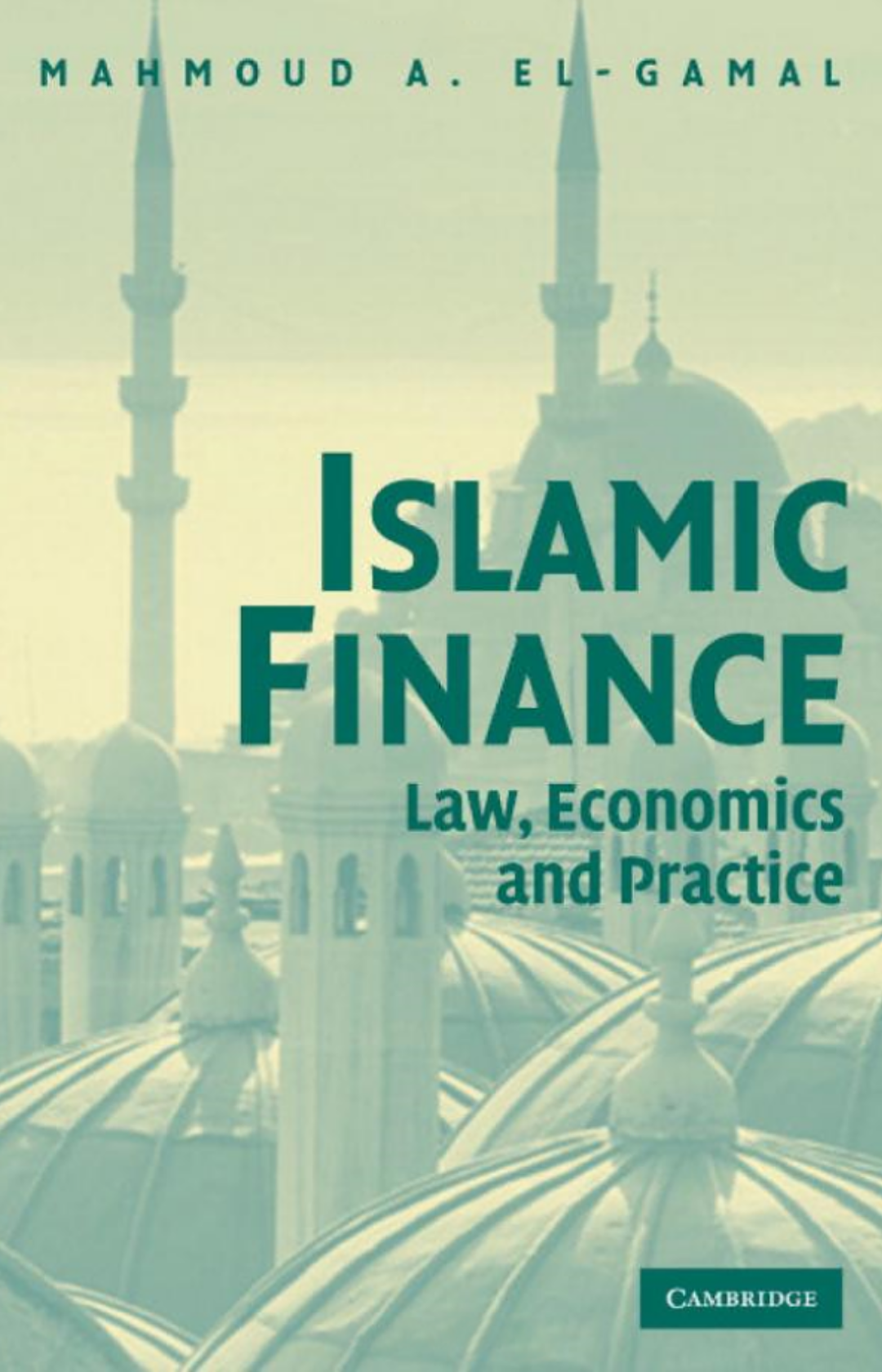
Islamic finance is an industry driven by prohibitions. In this regard, the invalidity of contracts that lead to these prohibitions can almost always be attributed to two factors: riba and gharar. As we showed in the first chapter, mainstream contemporary legal and economic analysts believe that such regulations, which prohibit financial transactions voluntarily entered into by both parties, are paternalistic and lead to efficiency losses. Islamic finance always prefers formal correctness, a characteristic that does almost nothing to refute such sharia prohibitions.
Participants in the industry, especially those who are not believers themselves, respect Muslim religious precepts in their operations and design financial solutions to circumvent various prohibitions based on the opinions of jurists. This attitude encourages Islamic finance to focus more on form than substance. Lawyers and bankers hesitate to question the solutions provided by jurists, viewing them only as inefficient hurdles to transactions they believe are otherwise forbidden. To properly understand today's Islamic finance practices, this chapter covers the economic substance that we believe these prohibitions aim to achieve. In later chapters, we will compare the economic substance of these prohibitions with pre-modern contract conditions in more detail, contrasting the form-oriented approach of contemporary Islamic finance with the substance-oriented approach of classical jurisprudence.
Bounded rationality and paternalism
For alcohol and gambling, the classic solution is to avoid them entirely, as these activities are not necessities. In contrast, credit and risk transfer are at the heart of finance. Without them, the economic system cannot function properly. In this case, the solution under Sharia is to restrict how credit and risk are transferred by prohibiting interest (riba) and uncertainty (gharar). In this chapter, I will argue that in the financial sector, the prohibited interest is essentially credit trading, and the prohibited uncertainty is risk trading. These were meant to be traded as independent commodities.
In other words, Sharia uses these two prohibitions to allow for the transfer of credit and risk to an appropriate degree, helping to achieve economic goals. As many financial market observers and practitioners confirm, credit and risk trading, perfected through derivative securities, are as dangerous as a double-edged sword. Although these tools can be used wisely to reduce risk and improve welfare, they can also easily tempt otherwise cautious people into destructive gambling. While financial regulators try to limit the scope of credit and risk trading to prevent systemic collapse, the purpose of Sharia's prohibitions is also to protect individuals from their own greed and short-sightedness.
What should be prohibited? Balancing benefits and risks
The goal of balancing economic freedom—allowing more contracts to boost economic activity—against the risk of abuse if too much freedom is given, is clear from the fact that some contracts involving interest or uncertainty are permitted in classical and legal literature. Take the example of advance forward sales (salam), which contain a great deal of uncertainty because the item being sold usually does not exist when the contract is signed. However, this uncertainty is considered minor compared to the potential benefits of using salam to provide financing for agriculture and other activities. Therefore, based on this benefit, it overrides the conclusion that a contract is invalid due to uncertainty, a point that can be reached simply through analogical reasoning. Similarly, credit sales can easily be seen as a vehicle for interest. As shown in the previous chapter, in both cases, the benefits of allowing the production of non-existent goods through salam and the consumption of future income through credit sales outweigh the potential dangers of abuse. Thus, despite various negative factors, these contracts are permitted.
The discussion in Chapter Two regarding various legal views on buy-back sales (ina) reflects a legal cost-benefit analysis. Clearly, not all spot sales or credit sales can be prohibited, as that would lead to economic collapse. On one hand, legal experts agree that it is unreasonable to prohibit buy-back sales if the second transaction is stipulated in the first. On the other hand, if the two transactions are executed through separate contracts, some legal experts prohibit this practice to prevent abuse—a means of preventing legal evasion in Maliki jurisprudence—while others, such as Shafi'i, who limits legal reasoning to analogy, consider this practice valid. In Islamic finance, legal experts might be asked to verify each contract separately without needing to explain the entire financial structure it will be used for.
This example is truly essential for understanding our upcoming discussion on contemporary jurisprudence and finance. By definition, almost all new financial transactions and the variations considered by Islamic bank Sharia boards are complex enough to generate multiple legal opinions based on principles like analogy, preventing abuse, and benefit analysis.
Differences in opinion allow Islamic finance providers to practice price discrimination by segmenting the market based on how conservative a believer's faith is, which helps them extract more Islamic finance arbitrage profits from more conservative believers.
The prohibition of interest (riba).
The word "riba" has a three-letter past-tense root from the Arabic verb "raba," which means "to increase." Therefore, jurists usually define the prohibited "riba" as "trading the same type of goods in different quantities, where the added portion is not reasonable compensation." Clearly, the literal meaning of the term, which covers all types of increases, is not what is prohibited. Because of this, many jurists have analyzed the legal meaning of prohibited "riba" for hundreds of years. Although most contemporary jurists deny any uncertainty in the legal definition of prohibited "riba," two research works by Rida (1986) clearly show that the definitions used by pre-modern and contemporary jurists have gone far beyond their original scope.
In this regard, the distinction between legal compensation and prohibited usury is the most fundamental feature of Islamic finance as an industry guided by prohibitions. However, the distinction defined by contemporary jurists is mainly achieved by adopting pre-modern forms rather than by ensuring mechanisms for fair contract pricing. Understanding the religious ban on usury and its modern interpretations is essential for understanding today's Islamic finance industry and any possible alternative Islamic structures. We are now starting an economic analysis of the classic religious texts and traditional legal studies regarding usury. We first look at the classic religious texts.
Classic literature on riba
All scholars agree there are two main types of riba, and scholars from the Shafi'i school have further refined the second type. The first type is called riba al-nasia.
The worst form of this riba is called riba al-jahiliyya (practiced in the Arab region before the founding of Islam). The Quran strictly forbids it, so much so that Imam Malik once called it the strictest prohibition in Islam.
The first mention of riba in the Quran was in Mecca, where it only advised people not to collect riba but did not explicitly forbid it [30:39].
The first verses about riba revealed in Medina only banned the riba practiced in the Arab region before Islam, which meant charging interest on interest-free loans or credit sales when they were due, and then calculating compound interest on later due dates. Therefore, the Quran describes the principal that a debtor should repay as "doubled and multiplied riba" [3:130]. In the final verses of the Quran, the ban on riba was expanded to clearly forbid all forms of riba. In the verses that follow [2:275-9], believers are ordered to give up all remaining interest (likely referring to the form of interest defined in [3:130]).
The main categories of riba in Islamic law.
Most jurists extended the strict pre-Islamic ban on usury found in the Quran to all forms of interest-bearing loans, grouping them under the term riba al-nasia.
They offered three reasons for this ban: (1) people might take advantage of poor debtors who urgently need to borrow money or goods; (2) currency trading might lead to fluctuations in currency value and uncertainty; (3) exchanging food for more food in the future could cause shortages in the spot market (likely because many merchants would hoard food, hoping to sell it at a higher price later! ).
None of these explanations seem very convincing. After all, a loan shark could just as easily exploit a debtor in urgent need of cash by selling them a house worth $100 for a deferred payment of $1,000, without violating the rules of usury envisioned by the jurists. The second explanation also seems weak from an economic perspective. The relative prices of goods can fluctuate due to changes in supply and demand, regardless of whether interest-based credit is available. Finally, the logic regarding food is clearly flawed: traders only prefer deferred transactions when the terms of trade exceed their time preference, and vice versa. In reality, this is how the implicit interest rate is determined in equilibrium based on the time preferences of market participants. if credit transactions for food could cause the problems mentioned by classical jurists, then selling deferred food claims for immediate cash, or selling food for a deferred cash price, would cause the same issues. Yet, jurists consider both of these transactions permissible, even though they implicitly compensate for the time value of money. In fact, jurists from all major schools declare that time has a share in price. They accept the legality of seeking compensation for the value of time in credit and forward sales (salam), including the sale of all goods, such as food.
The second type of riba recognized by jurists is called riba al-fadl (excess riba). It forbids trading goods of the same kind and category in different quantities. This is based on a valid hadith of the Prophet: Gold for gold, silver for silver, copper for copper, grain for grain, dried fruit for dried fruit, and fresh fruit for fresh fruit must be exchanged in equal amounts, and one may not trade more for less. Gold for gold, silver for silver, wheat for wheat, barley for barley, dates for dates, and salt for salt must be exchanged in equal amounts, hand-to-hand. Any increase is riba. Jurists outside the Zahiri school agree that these six goods are only examples. Hanafi jurists extend the prohibition to all fungible goods measured by weight or volume, while Shafi'i and Maliki jurists limit it to monetary goods like gold and silver, and storable food.
When we discuss currency exchange (saraf), we will explore the hadith of the Prophet specifically regarding spot and deferred trades of gold for gold, silver for silver, and gold for silver. These hadith clearly forbid a common method used by Medici bankers to get around the early Catholic Church's ban on interest, which was to include interest rates in exchange rates.
Riba is not interest.
Reports indicate that some famous early companions of the Prophet, including the prominent jurist Abdullah ibn Abbas, believed that riba involving a time factor was absolutely forbidden. Usama ibn Zayd ibn al-Arqam, Ibn Jubayr, and others ruled that the only clearly forbidden riba was the one involving a time factor (riba al-nasi'ah), even citing a hadith of the Prophet to support this view: Riba only exists in deferred payment. Later reports from Jabir show that this hadith referred to trades between different goods, such as gold for silver or wheat for barley, and that Ibn Abbas later changed his view to join the majority opinion that forbids riba al-fadl.
Jurists list two reasons for banning riba al-fadl, which involves time-based factors: (1) Trading different amounts of the same item in a spot transaction easily mixes with credit sales, creating the same effect as riba al-nasi'ah. This is deferred interest (so interest premiums are banned to prevent legal loopholes), and (2) these trades contain excessive uncertainty (avoidable risk and uncertainty), because both sides do not know if the trade will help or harm them. Ibn Rushd based his core analysis on this latter explanation for banning interest, which we will detail below. Including interest premiums in the general category of banned interest is very important for understanding the economic substance of these bans. However, most contemporary jurists and Islamic finance scholars want to avoid discussing this topic, precisely to keep wrongly linking 'interest' and 'usury' one-to-one in their rhetoric. In reality, equating these two terms is highly inappropriate.
First, even the most conservative contemporary jurists do not consider all forms of interest that economists and regulators talk about to be banned interest. Just look at interest-free Islamic finance methods like cost-plus credit sales. Cost-plus financing (murabaha) and leasing (ijara) show that these financing models are not 'interest-free'. In fact, U.S. Truth in Lending regulations require Islamic and traditional financial institutions to report the implied interest rates they charge customers in these financing arrangements. Therefore, Islamic finance's own practices show that certain forms of interest (such as in credit sales and leasing) should not be seen as banned 'interest'. Instead, banning 'interest' (riba) clearly shows that there are banned forms of 'interest' (illegal exchange gains) that do not involve interest. As some Hanafi jurists point out, the Prophet's tradition about the six commodities cited in the previous section sets two conditions: immediate exchange and equal value. So, if you trade one ounce of gold today for one ounce of gold to be delivered next year, it is still considered riba (usury) because it breaks the rule of immediate exchange, even if the interest rate is zero. These Hanafi jurists reason that one ounce of gold today is clearly worth more than one ounce of gold a year from now, which acknowledges the time value of money. Therefore, no one would ever trade one ounce of gold today for one ounce of gold next year unless they were getting some other return that was not disclosed in the sales contract. Whatever that extra benefit might be, they argue it constitutes riba. Our later analysis of the ban on riba—from the perspective of ensuring economic efficiency and fair trade—applies the same general principles to any other interest rate to explain the ban on zero interest: how do we know that zero interest is the fair rate for trading gold today for gold in a year?
The economic essence of the ban on riba
In his pioneering work on comparative jurisprudence, the Maliki jurist, judge, and philosopher Ibn Rushd (also known as Averroes, died 595 AH/1198 AD) adopted the Hanafi approach of extending the rules of riba from the tradition of the six commodities to all fungible goods, based on this economic analysis:
It follows that the goal of the riba prohibited by law is to eliminate the excessive injustice it causes. In this regard, fairness in certain transactions is achieved through equality. Since it is difficult to achieve equal exchange between different types of items, we use money to measure their value. Therefore, for goods that cannot be measured by weight or volume, fairness can be ensured through the ratio of their value. The ratio of the quantity exchanged should be decided by the value ratio of the different goods being traded. For example, if someone trades a horse for clothes, and the horse is worth fifty, the clothes should also be worth fifty. If each piece of clothing is worth five, then the horse should be traded for ten pieces of clothing. For interchangeable goods measured by volume or weight, fairness requires equality because they are relatively uniform and have similar utility. Since people who own these goods do not need to trade them for the same type, fairness is achieved through equal volume or weight because their utility is very similar.
Ibn Rushd clarified the conditions for exchange: the ratio of the quantity traded should be decided by the price ratio, which should equal the ratio of marginal utility. This restriction never became part of the rules prohibiting usury because monitoring the market price of all goods is a very tedious task. Therefore, the prohibition of usury only applies to the direct exchange of interchangeable goods. As Ibn Rushd suggested, if there is a significant difference in quality, people avoid directly trading low-quality goods for high-quality goods of the same kind. Many hadith clearly support achieving fairness through equality when trading uniform goods and explain alternatives to avoid direct barter when the quality of goods differs. In this regard, Buraydah and Abu Hurayrah reported that a man working in Khaybar brought the Prophet some high-quality dates. The Prophet asked if all the dates in Khaybar were like this one, and the man replied that they traded two or three portions of lower-quality dates for one portion of higher-quality dates. The Prophet told him angrily not to do this again, but instead to sell the lower-quality dates and use the money to buy the higher-quality ones.
Achieving fairness and efficiency through market-based pricing.
Sell the first type of date at the highest market price and buy the other at the lowest market price to ensure the trade follows the ratio set by market prices. Naturally, traders will only trade at this ratio if they value the marginal units differently. Considering the law of diminishing marginal utility, where a buyer's valuation of each successive unit of a date type drops, trading stops when the ratio of marginal utility equals the ratio of market prices. This achieves (Pareto) efficiency in exchange, as noted by contemporary neoclassical economic theory. The ban on this type of interest (riba al-fadl) acts as a mechanism that encourages people to gather information on market conditions and set trade terms based on market prices. This protects individuals from unfair trades and improves overall exchange efficiency. Keep in mind that any trade ratio deviating from the market price ratio will necessarily disadvantage one party. Both fairness and efficiency require following this method of using market pricing to determine trade ratios. It is not difficult to extend this logic to exchanges over time, such as credit sales, leasing, or other transactions. In the context of credit sales and lease-to-own financing, the ban on interest is essentially aimed at ensuring fairness in the exchange. These transactions require that credit be issued at an appropriate rate. In this regard, conventional finance plays a very important role for contemporary Islamic finance by setting market interest rates for various borrowers based on their credit status and the security of their collateral.
It is quite appropriate here to benchmark the implied interest rates in Islamic credit sales and lease-purchase transactions against conventional interest rates. In practice, for example, if the market interest rate for a specific borrower and specific collateral is 6%, but the rate requested by the customer is lower than 6%, then this interest rate difference is equivalent to implied interest. However, if a customer and a financier agree to a credit sale transaction with an implied interest rate of 10%, some would argue that this clearly violates the spirit of Islamic law prohibiting usury, even if it uses sales-based methods to bypass ancient forms of prohibition. In this regard, Al-Misri (2004) argues that it is better for Islamic banks to stop calling the markup in their credit sales "profit" and instead list it as "interest," because the former may have no cap, while the latter is restricted by various contemporary anti-usury laws that protect people in need of credit from predatory lenders.
Islamic Finance: A Re-examination of Form and Substance
So, why do we need Islamic finance? Why should we go to the trouble of having an Islamic bank buy a property first and then sell it to the customer on credit, if the actual goal could be achieved more directly through a secured loan transaction? These questions must be answered in two steps: the first step is to recognize that if individuals are left to their own devices, they may over-borrow. Following religious law can act as a constraint. It serves as an effective pre-commitment mechanism to ensure that individuals do not abuse the availability of credit to their own detriment.
The second step is to recognize that religious adherence has historically been ensured through the observance of form, both in the realms of ritual and transaction. In this regard, classical jurists did their best to develop contract forms and their conditions to reflect the spirit of the law as much as possible. Contemporary jurists find it safest to work within the framework of formal and informal methods of Islamic jurisprudence when helping Muslims follow the spirit of the law. As we saw in previous chapters, Islamic jurisprudence is actually a common law system, even though it wears the cloak of canon law, and it focuses on precedent and analogy. Therefore, the contemporary process of adapting classical contract forms to modern needs will inevitably create temporary inefficiencies.
This inefficiency is only tolerable if we ensure that the spirit of the law that birthed these adopted forms is protected. Otherwise, it would be shameful to simply copy or adapt inefficient historical forms and waste the substance of Islamic law. Ideally, contemporary jurists should develop a modern jurisprudence within the context of current legal and regulatory frameworks that incorporates the substance of pre-modern law. This ideal might be achievable in the long run, but it seems impossible in the short term. In this regard, early jurists had the luxury of adopting Roman or other legal forms to seek efficiency. However, later jurists had to work under the heavy burden of sacred history, including an unrealistic worship of the so-called eternal wisdom of their predecessors.
Therefore, practical solutions for Islam in the short to medium term may gradually abandon pre-modern forms.
Regarding multiple paternalistic parties, we discussed the generally paternalistic nature of prohibitions earlier in this chapter. Let us look at the ban on interest (riba). It aims to protect people from too much debt and stops unfair payments or charges when someone borrows money or delays a payment. Some might argue that secular regulators also try, perhaps in a paternalistic way, to stop people from borrowing too much or falling victim to unfair, predatory loans. However, regulators care most about the health of the whole financial system. They only care about the financial health of specific individuals as a secondary concern. Because of this, regulators might allow deals that are risky for a few people. They weigh the well-being of specific groups against the well-being of the whole system, such as economic growth, which is their main job. Bankers also try to prevent too much debt. They give out loans based on how much debt a person has compared to their income and other standards. But bankers and loan officers work for financial institutions. These institutions do not care about the financial health of the system or the individual; they care most about their own profits. So, as long as the expected repayment rate is high enough to make a profit, they usually let many customers borrow too much.
Human time inconsistency and pre-commitment solutions
The limits set by regulators and financial professionals need extra protection for individuals to keep them safe from their own irrational behavior. Religious law can play this role. In this area, psychology and behavioral economics research show that humans are irrational when it comes to time preferences. Pre-commitment mechanisms, including those based on religion, can protect them from this. For example, most people would rather have 100 dollars today than 105 dollars in a year. But they would rather have 105 dollars in twenty years than 100 dollars in nineteen years. These and other time preference anomalies show that people act with dynamic inconsistency when it comes to saving, spending, and borrowing.
This study concludes that people often discount the near future, like one year from now, much more heavily than they discount the distant future, such as between the nineteenth and twentieth years. So, in the previous example, a 5% interest rate seems low for the current year, but it feels high enough for some arbitrary year in the future.
People with this time preference will choose to borrow $100 today, while sincerely planning to save money and pay back the loan in the future. However, when that future arrives, the value of spending now feels much higher than the value of spending later, so the person borrows even more money, dreaming that they will save enough later to pay off both loans. The cycle of debt never ends. Some of these people might see their income grow quickly, which eventually allows them to pay off their debt without needing to increase their savings rate. Many other debtors, however, get stuck in the debt cycle and eventually have to declare personal bankruptcy, which has become a small-scale epidemic in some Western societies.
Good loans and bad loans
Someone might ask why banks give out bad loans that lead to bankruptcy. The answer is that loans are rarely bad at the start. When the economy is doing well, many borrowers see their income grow, and banks have an incentive to keep lending to them because the number of defaults and bankruptcies is too low to hurt their profits. For example, in 1990s Asia, borrowed money was sometimes put into real estate and other assets that were rising in value quickly, which made loans backed by those overvalued assets look less risky than they really were. As the economy worsens and asset bubbles burst, too many of these loans could go bad at once, threatening the financial system. Regulators set limits to make sure bank operations do not threaten the whole system, though this approach is often reactive and fails to prevent later banking crises. In contrast, religious law aims to protect everyone by making sure individuals do not borrow too much. For example, imagine a Muslim client wants to buy a property through lease financing. If the real estate market is in a speculative bubble, this should become clear by comparing the rent the client pays to the Islamic bank—which is set based on mortgage market rates—with the actual market rent for the property. If mortgage payments are too high compared to rent, it usually shows a bubble exists. This shows the client is about to borrow too much money relative to the long-term value of the property used as collateral. Linking the rate to market rental rates should stop individuals from borrowing too much to buy the property. In this process, the client also ensures the implied interest rate is based on the market time value of the property serving as security for the debt.
If these factors are ignored, the Islamic bank just turns the client into a house slave or bankrupts them, while still following the classic contract forms in an Islamic way. This would be a shameful abuse of religion and finance. Even though we accept the necessary inefficiency of Islamic finance in following classic contract forms, ensuring the substance of Islamic law is followed is just as important, if not more so, because pre-modern jurists tried to embed that substance into those classic forms.
Side notes on loans in Islamic law.
We see here that the traditional ban on interest rate spreads in finance under Islamic law refers to the split-sale of credit, where it is hard to link interest rates to the market.
In this regard, the simplest form of split-credit sales is an interest-bearing loan. In fact, if a loan is seen as an exchangeable financial contract, meaning the repayment is seen as compensation for the amount lent, then even an interest-free loan would be considered forbidden riba (interest). Al-Qarafi argued in Al-Furuq, a legal theory book dedicated to explaining jurisprudential distinctions, that loans are not bound by riba rules because they are charitable in nature. From a religious perspective, the person providing the loan does not seek repayment as compensation, but treats the time value of the money or the benefit of the property lent as a charitable donation. Therefore, the companions of the Prophet and early jurists said they preferred to lend a coin and lend it out again after it was returned, rather than just giving it away as a charitable donation. A good loan has a direct charitable nature because the debt is forgiven if a poor debtor cannot pay it back. On the other hand, a poor borrower keeps their dignity by potentially paying back the principal, compared to someone who clearly accepts a charitable donation.
Even when the loan is repaid, the lender earns religious praise for sacrificing the time value of their property and proves they are willing to sacrifice the property itself if necessary. Therefore, Islamic jurisprudence excludes loans from the financial sector to keep their good, charitable nature. This is because all financial goals that can be achieved through commercial loans can be achieved just as well, or even better, through other forms of mutual contracts like sales or leases.
Muslim Knowledge Guide Abu Dhabi: Is Bitcoin Halal, Riba-Free Money and Islamic Finance Debate
Articles • yusuf908 posted the article • 0 comments • 221 views • 2026-05-23 06:09
Summary: This Muslim knowledge guide discusses whether Bitcoin can be halal, drawing on an Abu Dhabi Bitcoin conference, hadith about spot exchange, fiat money, Islamic banking, riba, debt, fractional reserve banking, and the debate over Bitcoin as money.
Bitcoin could be the most Islamic form of money ever invented, according to a conference in Abu Dhabi.
Speakers argued that Islam allows anything considered money to be exchanged at spot value, which applies to Bitcoin.
According to the group, Muslim scholars who oppose Bitcoin say money must have intrinsic value and be exchanged equally to be lawful, citing a hadith from the Prophet Muhammad:
Ubadah ibn al-Samit reported: The Messenger of Allah (peace and blessings of Allah be upon him) said: Gold for gold, like for like; Silver for silver, like for like; Barley for barley, wheat for wheat; Dates for dates; Salt for salt. They must be equal in weight and exchanged hand-to-hand. Whoever gives more or asks for more has engaged in usury (riba). If you exchange gold for silver, or wheat for barley, you may vary the amounts, but the exchange must be hand-to-hand and immediate, not on credit. (Sahih) (See Sahih Muslim, Sunan Abi Dawud).
People often misunderstand this hadith, thinking these are the only types of currency allowed, said Harris Irfan, CEO of Cordoba Capital, while speaking at the Bitcoin MENA conference.
In fact, it says that things considered money should be traded at spot value, rather than at a so-called future value.
Economist, author, and Bitcoin supporter Saifedean Ammous agreed that the hadith does not necessarily mean literal equivalent exchange, but refers to spot trading—final cash settlement or a trade where both parties agree on the value at the time of exchange.
On the other hand, some speakers said that regularly issued cash is built entirely on the process of riba, but people do not consider it religiously forbidden because it was once the only means of currency exchange.
Islam forbids selling the time value of money. Most people just take this for granted and think it is an outdated aspect of Islam because we cannot live without fiat currency in the modern world, Amos said.
Fiat currency is created when new loans are issued. This means money must go through an interest-bearing process to exist. But this is something most people do not think about because it is so common around us, and the harm of not using it is much more serious, he added.
Another expert said the concept of Islamic banking itself does not completely reject money injected with interest.
Ivan said: What we are doing is just reverse engineering traditional debt and fractional reserve banking based on fiat currency. Every time an Islamic bank signs a financing contract with a client, it is creating new money in exactly the same way that regular banks create money.
He said some Islamic scholars believe Bitcoin is haram because it has no government backing and no intrinsic value. But actually, nothing has intrinsic value. Value is subjective, and we can assign value to things, he added.
He further explained: There was a time when oil was a negative asset. You had to pay people to take it off your land so you could build houses on it. Now it is very valuable, but nothing has changed inside the oil; it is still a liquid substance.
He added that there is no room for disagreement regarding ownership with Bitcoin, unlike fiat currency, where bankers double-spend funds by providing the same money to both lenders and borrowers.
Ivan stated that many people claim Bitcoin is very volatile, yet fiat currency is more volatile, and banks act like gatekeepers of people's funds.
Individuals may also face complications when withdrawing large amounts of money from banks or trying to transfer funds to high-risk areas.
The only way I can send money to Gaza now to buy medicine and local aid is through Bitcoin. Every time I try to send money through normal banking channels, it gets blocked somehow. This is why Bitcoin is a more real currency than anything else in our world right now, Ivan said.
History has many examples of scholars who took the easy way out and labeled new innovations as illegal.
Ammous said one example is when the internet first appeared and was initially considered illegal. In the past, some people even thought photography was forbidden in religion, but as time passed, these inventions became more common, negative views disappeared, and they became widely accepted.
The Muslim world is missing out on the Bitcoin revolution, he said.
How much people benefit from Bitcoin depends heavily on when they start buying it.
Ten years ago, 1 dollar could buy 100,000 satoshis, but today, 1 dollar can only buy 1,000 satoshis, so the user experience is completely different depending on when you start.
For 10 years, I have heard people issue fatwas saying Bitcoin is illegal, but what will happen if we are still here in another 10 years? The price of Bitcoin will go up 100 times, and people who want to get into Bitcoin today will get 1% of the units they could have bought 10 years ago. view all
Summary: This Muslim knowledge guide discusses whether Bitcoin can be halal, drawing on an Abu Dhabi Bitcoin conference, hadith about spot exchange, fiat money, Islamic banking, riba, debt, fractional reserve banking, and the debate over Bitcoin as money.

Bitcoin could be the most Islamic form of money ever invented, according to a conference in Abu Dhabi.
Speakers argued that Islam allows anything considered money to be exchanged at spot value, which applies to Bitcoin.
According to the group, Muslim scholars who oppose Bitcoin say money must have intrinsic value and be exchanged equally to be lawful, citing a hadith from the Prophet Muhammad:
Ubadah ibn al-Samit reported: The Messenger of Allah (peace and blessings of Allah be upon him) said: Gold for gold, like for like; Silver for silver, like for like; Barley for barley, wheat for wheat; Dates for dates; Salt for salt. They must be equal in weight and exchanged hand-to-hand. Whoever gives more or asks for more has engaged in usury (riba). If you exchange gold for silver, or wheat for barley, you may vary the amounts, but the exchange must be hand-to-hand and immediate, not on credit. (Sahih) (See Sahih Muslim, Sunan Abi Dawud).
People often misunderstand this hadith, thinking these are the only types of currency allowed, said Harris Irfan, CEO of Cordoba Capital, while speaking at the Bitcoin MENA conference.
In fact, it says that things considered money should be traded at spot value, rather than at a so-called future value.
Economist, author, and Bitcoin supporter Saifedean Ammous agreed that the hadith does not necessarily mean literal equivalent exchange, but refers to spot trading—final cash settlement or a trade where both parties agree on the value at the time of exchange.
On the other hand, some speakers said that regularly issued cash is built entirely on the process of riba, but people do not consider it religiously forbidden because it was once the only means of currency exchange.
Islam forbids selling the time value of money. Most people just take this for granted and think it is an outdated aspect of Islam because we cannot live without fiat currency in the modern world, Amos said.
Fiat currency is created when new loans are issued. This means money must go through an interest-bearing process to exist. But this is something most people do not think about because it is so common around us, and the harm of not using it is much more serious, he added.
Another expert said the concept of Islamic banking itself does not completely reject money injected with interest.
Ivan said: What we are doing is just reverse engineering traditional debt and fractional reserve banking based on fiat currency. Every time an Islamic bank signs a financing contract with a client, it is creating new money in exactly the same way that regular banks create money.
He said some Islamic scholars believe Bitcoin is haram because it has no government backing and no intrinsic value. But actually, nothing has intrinsic value. Value is subjective, and we can assign value to things, he added.
He further explained: There was a time when oil was a negative asset. You had to pay people to take it off your land so you could build houses on it. Now it is very valuable, but nothing has changed inside the oil; it is still a liquid substance.
He added that there is no room for disagreement regarding ownership with Bitcoin, unlike fiat currency, where bankers double-spend funds by providing the same money to both lenders and borrowers.
Ivan stated that many people claim Bitcoin is very volatile, yet fiat currency is more volatile, and banks act like gatekeepers of people's funds.
Individuals may also face complications when withdrawing large amounts of money from banks or trying to transfer funds to high-risk areas.
The only way I can send money to Gaza now to buy medicine and local aid is through Bitcoin. Every time I try to send money through normal banking channels, it gets blocked somehow. This is why Bitcoin is a more real currency than anything else in our world right now, Ivan said.
History has many examples of scholars who took the easy way out and labeled new innovations as illegal.
Ammous said one example is when the internet first appeared and was initially considered illegal. In the past, some people even thought photography was forbidden in religion, but as time passed, these inventions became more common, negative views disappeared, and they became widely accepted.
The Muslim world is missing out on the Bitcoin revolution, he said.
How much people benefit from Bitcoin depends heavily on when they start buying it.
Ten years ago, 1 dollar could buy 100,000 satoshis, but today, 1 dollar can only buy 1,000 satoshis, so the user experience is completely different depending on when you start.
For 10 years, I have heard people issue fatwas saying Bitcoin is illegal, but what will happen if we are still here in another 10 years? The price of Bitcoin will go up 100 times, and people who want to get into Bitcoin today will get 1% of the units they could have bought 10 years ago.
Muslim Knowledge Guide Egypt: Ali Gomaa Fatwa on Pork, Alcohol, Riba and Gambling Trade
Articles • yusuf908 posted the article • 0 comments • 295 views • 2026-05-23 06:09
Summary: This Muslim knowledge guide explains a controversial fatwa by Egypt's former Grand Mufti Ali Gomaa, covering work involving pork and alcohol in non-Muslim countries, riba, gambling, dar al-harb, classical references, and why the debate remains sensitive.
Ali Gomaa
Ali Gomaa (1952-present) is 73 years old this year. He served as the 18th Grand Mufti of Egypt (2003-2013). He holds a bachelor's and master's degree in commerce from Ain Shams University in Cairo, and he also earned a bachelor's, master's, and doctoral degree in Islamic law from Al-Azhar University. Ali Gomaa once served as a professor in the Department of Islamic and Arabic Studies and as the head of the Department of Jurisprudence at Al-Azhar University. His supporters are mainly from the middle class, including entrepreneurs, teachers, bankers, and engineers.
In this fatwa response, a European Muslim asked if he was allowed to work in a shop that sells alcohol and pork because he could not find any other job. In the fatwa, Gomaa repeatedly mentioned the concepts of the "land of war" (dar al-harb) and "people of the war zone." His response not only answered the questioner's query but also extended to other issues like interest and gambling.
Another basis Ali Gomaa proposed is that Mecca during the pre-Islamic period of ignorance (jahiliyyah) was not yet a Muslim city. The Prophet allowed his uncle Abbas to practice usury, and except for the year of the Farewell Pilgrimage, the Prophet did not forbid him from practicing usury. The text also mentions that Abu Bakr made a bet with a disbeliever (kafir) in Mecca that the Romans would defeat the Persians, and Mecca at that time was a land of war.
The controversial point of this fatwa is not the initial answer about whether a Muslim can work in a shop with alcohol and pork when no better job is available. The controversy lies in the use of the terms "land of war" and "people of the war zone," which some consider too dangerous. Some people believe that Western countries should not be called a "land of war." For details on the rebuttal articles, please see the article "ON THE FATWA OF THE EGYPTIAN MUFTI THAT"
ALLOWS SELLING ALCOHOL OUTSIDE THE LAND
OF ISLAM."
I do not want to focus this article on the controversy of this fatwa. It is normal to have controversy, and no viewpoint is absolutely free of it. I just want to introduce some of the ideas of the scholar Ali Gomaa for the reader's reference.
Needless to say, the book mentioned above cannot be bought in China. This book is specifically written by Ali Gomaa to criticize radicals. The viewpoints in the book are well-reasoned and cite classical sources, serving as a powerful intellectual weapon against those simple-minded and ignorant half-baked radicals.
Although Ali Gomaa follows the Shafi'i school of thought, he believes that one does not have to follow one specific school of law for every issue, but can freely choose the legal opinions of any jurist. This is a correct statement. Because of this, ordinary believers do not have a specific school of law; their school of law is simply the one followed by their mufti. Imam Nawawi said: 'There is evidence that ordinary believers do not need to follow one school of legal rulings for every issue, but should consult a mufti or someone well-versed in the faith, provided they do not look for loopholes.'
Ali Gomaa calls himself a liberal Muslim. He opposes female genital mutilation, supports gender equality, and believes women have the right to become president.
Ali Gomaa believes that wearing a headscarf is a mandatory duty (fard), but that women who do not wear one commit a minor sin, not a major one. Missing namaz is a major sin, and compared to the obligation of namaz, the sin of not wearing a headscarf is minor. He believes the face veil is not mandatory and even opposes women wearing it in areas where it is not the custom, as he thinks it looks like seeking fame and will lead to gossip.
As a Sufi, Ali Gomaa allows namaz in mosques that contain graves, which we know as a gongbei. He opposes the destruction of the graves of righteous predecessors and believes visiting them is fine. He also believes one can seek blessings from the relics of the Prophet and the righteous, and he allows the celebration of the Prophet's birthday.
Learning more about the views of foreign scholars helps broaden our horizons. At the very least, it gives us more ways to think about issues we take for granted, such as the work of Hui Muslims who are delivery drivers, flight attendants, or domestic workers, so we are not so judgmental and can have a broader perspective. view all
Summary: This Muslim knowledge guide explains a controversial fatwa by Egypt's former Grand Mufti Ali Gomaa, covering work involving pork and alcohol in non-Muslim countries, riba, gambling, dar al-harb, classical references, and why the debate remains sensitive.

Ali Gomaa
Ali Gomaa (1952-present) is 73 years old this year. He served as the 18th Grand Mufti of Egypt (2003-2013). He holds a bachelor's and master's degree in commerce from Ain Shams University in Cairo, and he also earned a bachelor's, master's, and doctoral degree in Islamic law from Al-Azhar University. Ali Gomaa once served as a professor in the Department of Islamic and Arabic Studies and as the head of the Department of Jurisprudence at Al-Azhar University. His supporters are mainly from the middle class, including entrepreneurs, teachers, bankers, and engineers.
In this fatwa response, a European Muslim asked if he was allowed to work in a shop that sells alcohol and pork because he could not find any other job. In the fatwa, Gomaa repeatedly mentioned the concepts of the "land of war" (dar al-harb) and "people of the war zone." His response not only answered the questioner's query but also extended to other issues like interest and gambling.
Another basis Ali Gomaa proposed is that Mecca during the pre-Islamic period of ignorance (jahiliyyah) was not yet a Muslim city. The Prophet allowed his uncle Abbas to practice usury, and except for the year of the Farewell Pilgrimage, the Prophet did not forbid him from practicing usury. The text also mentions that Abu Bakr made a bet with a disbeliever (kafir) in Mecca that the Romans would defeat the Persians, and Mecca at that time was a land of war.
The controversial point of this fatwa is not the initial answer about whether a Muslim can work in a shop with alcohol and pork when no better job is available. The controversy lies in the use of the terms "land of war" and "people of the war zone," which some consider too dangerous. Some people believe that Western countries should not be called a "land of war." For details on the rebuttal articles, please see the article "ON THE FATWA OF THE EGYPTIAN MUFTI THAT"
ALLOWS SELLING ALCOHOL OUTSIDE THE LAND
OF ISLAM."
I do not want to focus this article on the controversy of this fatwa. It is normal to have controversy, and no viewpoint is absolutely free of it. I just want to introduce some of the ideas of the scholar Ali Gomaa for the reader's reference.

Needless to say, the book mentioned above cannot be bought in China. This book is specifically written by Ali Gomaa to criticize radicals. The viewpoints in the book are well-reasoned and cite classical sources, serving as a powerful intellectual weapon against those simple-minded and ignorant half-baked radicals.
Although Ali Gomaa follows the Shafi'i school of thought, he believes that one does not have to follow one specific school of law for every issue, but can freely choose the legal opinions of any jurist. This is a correct statement. Because of this, ordinary believers do not have a specific school of law; their school of law is simply the one followed by their mufti. Imam Nawawi said: 'There is evidence that ordinary believers do not need to follow one school of legal rulings for every issue, but should consult a mufti or someone well-versed in the faith, provided they do not look for loopholes.'
Ali Gomaa calls himself a liberal Muslim. He opposes female genital mutilation, supports gender equality, and believes women have the right to become president.
Ali Gomaa believes that wearing a headscarf is a mandatory duty (fard), but that women who do not wear one commit a minor sin, not a major one. Missing namaz is a major sin, and compared to the obligation of namaz, the sin of not wearing a headscarf is minor. He believes the face veil is not mandatory and even opposes women wearing it in areas where it is not the custom, as he thinks it looks like seeking fame and will lead to gossip.
As a Sufi, Ali Gomaa allows namaz in mosques that contain graves, which we know as a gongbei. He opposes the destruction of the graves of righteous predecessors and believes visiting them is fine. He also believes one can seek blessings from the relics of the Prophet and the righteous, and he allows the celebration of the Prophet's birthday.
Learning more about the views of foreign scholars helps broaden our horizons. At the very least, it gives us more ways to think about issues we take for granted, such as the work of Hui Muslims who are delivery drivers, flight attendants, or domestic workers, so we are not so judgmental and can have a broader perspective.
Muslim Knowledge Guide China: Interest-Free Banking, Islamic Finance and Service Fee Debate
Articles • yusuf908 posted the article • 0 comments • 246 views • 2026-05-23 06:09
Summary: This Muslim knowledge guide reviews an interest-free banking book, compares service fees with riba, discusses Islamic finance, dividend insurance, IUL, gold investment, mutual aid systems, and the practical challenge of building an interest-free bank in modern society.
This book is a formal publication available on Taobao. While its main goal is to explain the interest-free financial system proposed by the authors, they are honest enough to mention that such a system does not yet exist in today's society. However, perhaps because the book has two authors, it feels inconsistent throughout. Here are some of my reading notes.
Author 1, Muhammad Muin-ud-Din Khan, graduated from Aligarh Muslim University with a Bachelor of Laws and a Master of Arts. He currently lives in Aligarh and works on Islamic law research.
Author 2, M. H. Syed, is a feature writer for the United Times of India and the Times of India. He holds a Master of Arts, a Master of Philosophy, and a PhD in political science, and he focuses mainly on political research with a wide range of interests.
In the second chapter, when citing examples from Christianity, the authors criticize the way Christians confuse service fees with interest:
With the support of Christian churches, the practice of using service fees to replace interest developed further. At first, following the precedents of ancient Babylonian and ancient Greek temples, they provided interest-free loans. Soon, people found it necessary to charge a small fee for services. Lending institutions that charged service fees were called Montes Pietatis. Before long, these institutions were no different from savings banks. They paid small amounts of interest on deposits and charged high interest on advances, which shows that replacing the concept of interest with this idea is very unreliable. Important concepts that evolved under Christian influence, such as tripartite contracts and perpetual annuities, are also much the same as interest.
However, in the second half of the book, the author proposes an interest-free bank and acknowledges the necessity of service fees. As my previous articles have noted, critics of Islamic finance point out that charging service fees in an interest-free bank is just a way to legalize interest in disguise.
The author also imagines an interest-free bank as a financial institution that protects the principal but offers uncertain returns. This confused me because such institutions already exist. In China, these are called dividend-paying insurance (fenhongxing baoxian), and in the United States, they are called Indexed Universal Life (IUL) insurance. Both types protect the principal but have uncertain future returns. Dividend insurance dates back to the Equitable Life Assurance Society in the UK in 1776, and IUL insurance began in the US in the 1990s.
The author honestly describes the current situation where both Jews and Muslims find themselves helpless regarding the issue of interest:
The role of the Jews: The first interest-free bank, the Egibi Bank, was opened by Jews in ancient Babylon in 700 BC. This bank used a method where borrowers pledged productive assets, such as houses, land, horses, or slaves, to the bank in exchange for interest-free loans. Although the concept of profit and loss sharing was refined, the lack of productive assets limited its application. For example, profit and loss sharing cannot solve the problem of making installment prices equal to cash prices, nor can it solve the issue of cashing bills of exchange without deducting a discount. According to the famous Jewish scholar Maimonides, Jews also faced the difficult problem of how to cash bills of exchange. They solved it by declaring that discounts did not count as interest. This means that even financial geniuses like the Jews could not find a proper way to eliminate interest.
The role of Muslims: Muslims have not found a substitute for interest. Their reliance on partnerships is no different from the profit and loss sharing mechanism created by Hammurabi or the pre-Islamic mudarabah system—neither can be widely applied in most economic practices. They tried hard to find reward-based funding and invented various disguised terms as the basis for Pakistani banking operations, such as fair trade or perfect trade, but these functioned much like interest. It is no wonder why the London-based weekly The Economist calls it an Islamic-style lie. Post-revolutionary Iran, like some other countries that claim to have introduced Islamic banking systems, is playing the same game of pretense. Dr. El-Naggar conducted a small-scale innovative experiment in Egypt by founding the Mit Ghamr Savings Bank based on profit and loss sharing, hoping to attract small savings and support small-scale productive investments. However, its scope of application is very limited, and it requires subsidies to continue operating; if the subsidies stop, the bank would have to close.
Practice has proven that forcibly suppressing interest rates does not work. The lesson we learned from medieval European usury laws is that forcibly suppressing or lowering interest rates only leads to the emergence of a black market for high-interest loans. We have only one choice, which is to find something that can replace interest without having the exploitative nature of interest. Many existing views stem from the profit and loss sharing mechanism in the Code of Hammurabi, and Jews, Christians, and Muslims have all applied this view in turn, but they have all found its feasibility to be limited. So far, a view that can avoid this flaw has not yet been born.
The author is also very clear that none of the Islamic banks operating in the world today are based on interest-free principles:
Any investment bank operating in an Islamic country can advance funds to solvent enterprises on the basis of mudarabah or partnership. However, if the funds are not yet due, no bank will cash them out at their face value. The tragedy is that even though everyone acknowledges the Islamic ban on interest, not a single Muslim bank operates on an interest-free basis. In fact, no one knows how to implement the ban on interest, and when the government puts on pressure, they just find excuses and pretexts to brush it off. However, the Islamic ban on interest is unlikely to end like previous religious policies, because government pressure will not weaken; it will only get stronger.
Both authors are Indian, but they use Pakistan as their research subject. The book also introduces the attitudes of some Pakistani officials toward interest:
In 1981, an international monetary and fiscal conference was held in Islamabad, the capital of Pakistan, and Islamic economists were the main participants. They proposed renaming interest, which was equivalent to abolishing it. The worst part was that everyone agreed to this arrangement without reservation, because it was the best suggestion they could come up with so far.
The late Auditor General of Pakistan set a good example for us. He spent most of his retirement trying to legalize the interest on his welfare fund savings, wanting to prove that Islam does not ban interest, and he even wrote a book to explain this view.
The authors used these two examples critically, but I read the opposite meaning from them. This also echoes Mohammad Omar Farooq's question: Is it a consensus that usury is the same as interest? This article, titled 'Is Interest the Same as Riba Mentioned in the Quran?', shows that there is still no consensus on this issue. view all
Summary: This Muslim knowledge guide reviews an interest-free banking book, compares service fees with riba, discusses Islamic finance, dividend insurance, IUL, gold investment, mutual aid systems, and the practical challenge of building an interest-free bank in modern society.
This book is a formal publication available on Taobao. While its main goal is to explain the interest-free financial system proposed by the authors, they are honest enough to mention that such a system does not yet exist in today's society. However, perhaps because the book has two authors, it feels inconsistent throughout. Here are some of my reading notes.
Author 1, Muhammad Muin-ud-Din Khan, graduated from Aligarh Muslim University with a Bachelor of Laws and a Master of Arts. He currently lives in Aligarh and works on Islamic law research.
Author 2, M. H. Syed, is a feature writer for the United Times of India and the Times of India. He holds a Master of Arts, a Master of Philosophy, and a PhD in political science, and he focuses mainly on political research with a wide range of interests.
In the second chapter, when citing examples from Christianity, the authors criticize the way Christians confuse service fees with interest:
With the support of Christian churches, the practice of using service fees to replace interest developed further. At first, following the precedents of ancient Babylonian and ancient Greek temples, they provided interest-free loans. Soon, people found it necessary to charge a small fee for services. Lending institutions that charged service fees were called Montes Pietatis. Before long, these institutions were no different from savings banks. They paid small amounts of interest on deposits and charged high interest on advances, which shows that replacing the concept of interest with this idea is very unreliable. Important concepts that evolved under Christian influence, such as tripartite contracts and perpetual annuities, are also much the same as interest.
However, in the second half of the book, the author proposes an interest-free bank and acknowledges the necessity of service fees. As my previous articles have noted, critics of Islamic finance point out that charging service fees in an interest-free bank is just a way to legalize interest in disguise.
The author also imagines an interest-free bank as a financial institution that protects the principal but offers uncertain returns. This confused me because such institutions already exist. In China, these are called dividend-paying insurance (fenhongxing baoxian), and in the United States, they are called Indexed Universal Life (IUL) insurance. Both types protect the principal but have uncertain future returns. Dividend insurance dates back to the Equitable Life Assurance Society in the UK in 1776, and IUL insurance began in the US in the 1990s.
The author honestly describes the current situation where both Jews and Muslims find themselves helpless regarding the issue of interest:
The role of the Jews: The first interest-free bank, the Egibi Bank, was opened by Jews in ancient Babylon in 700 BC. This bank used a method where borrowers pledged productive assets, such as houses, land, horses, or slaves, to the bank in exchange for interest-free loans. Although the concept of profit and loss sharing was refined, the lack of productive assets limited its application. For example, profit and loss sharing cannot solve the problem of making installment prices equal to cash prices, nor can it solve the issue of cashing bills of exchange without deducting a discount. According to the famous Jewish scholar Maimonides, Jews also faced the difficult problem of how to cash bills of exchange. They solved it by declaring that discounts did not count as interest. This means that even financial geniuses like the Jews could not find a proper way to eliminate interest.
The role of Muslims: Muslims have not found a substitute for interest. Their reliance on partnerships is no different from the profit and loss sharing mechanism created by Hammurabi or the pre-Islamic mudarabah system—neither can be widely applied in most economic practices. They tried hard to find reward-based funding and invented various disguised terms as the basis for Pakistani banking operations, such as fair trade or perfect trade, but these functioned much like interest. It is no wonder why the London-based weekly The Economist calls it an Islamic-style lie. Post-revolutionary Iran, like some other countries that claim to have introduced Islamic banking systems, is playing the same game of pretense. Dr. El-Naggar conducted a small-scale innovative experiment in Egypt by founding the Mit Ghamr Savings Bank based on profit and loss sharing, hoping to attract small savings and support small-scale productive investments. However, its scope of application is very limited, and it requires subsidies to continue operating; if the subsidies stop, the bank would have to close.
Practice has proven that forcibly suppressing interest rates does not work. The lesson we learned from medieval European usury laws is that forcibly suppressing or lowering interest rates only leads to the emergence of a black market for high-interest loans. We have only one choice, which is to find something that can replace interest without having the exploitative nature of interest. Many existing views stem from the profit and loss sharing mechanism in the Code of Hammurabi, and Jews, Christians, and Muslims have all applied this view in turn, but they have all found its feasibility to be limited. So far, a view that can avoid this flaw has not yet been born.
The author is also very clear that none of the Islamic banks operating in the world today are based on interest-free principles:
Any investment bank operating in an Islamic country can advance funds to solvent enterprises on the basis of mudarabah or partnership. However, if the funds are not yet due, no bank will cash them out at their face value. The tragedy is that even though everyone acknowledges the Islamic ban on interest, not a single Muslim bank operates on an interest-free basis. In fact, no one knows how to implement the ban on interest, and when the government puts on pressure, they just find excuses and pretexts to brush it off. However, the Islamic ban on interest is unlikely to end like previous religious policies, because government pressure will not weaken; it will only get stronger.
Both authors are Indian, but they use Pakistan as their research subject. The book also introduces the attitudes of some Pakistani officials toward interest:
In 1981, an international monetary and fiscal conference was held in Islamabad, the capital of Pakistan, and Islamic economists were the main participants. They proposed renaming interest, which was equivalent to abolishing it. The worst part was that everyone agreed to this arrangement without reservation, because it was the best suggestion they could come up with so far.
The late Auditor General of Pakistan set a good example for us. He spent most of his retirement trying to legalize the interest on his welfare fund savings, wanting to prove that Islam does not ban interest, and he even wrote a book to explain this view.
The authors used these two examples critically, but I read the opposite meaning from them. This also echoes Mohammad Omar Farooq's question: Is it a consensus that usury is the same as interest? This article, titled 'Is Interest the Same as Riba Mentioned in the Quran?', shows that there is still no consensus on this issue.
Muslim Knowledge Guide Malaysia: Islamic Banking, Riba, Murabaha and Halal Finance Debate
Articles • yusuf908 posted the article • 0 comments • 210 views • 2026-05-23 03:09
Summary: This Muslim knowledge guide revisits a paper on Islamic banking, focusing on Islamic subsidiaries of conventional banks in Malaysia, Sharia compliance, profit maximization, murabaha, riba, manager incentives, banking structure, and whether Islamic banks are truly Islamic in practice.
This is another article I translated that critiques Islamic finance. The previous ones got a good response and made many readers think. If you read those, you will see that the contradictions and struggles of so-called Islamic finance were already discussed by scholars decades ago. Solutions exist, but we know very little about them. This has a lot to do with the stance of the people who control the narrative.
Original title: HOW ‘ISLAMIC’ IS ISLAMIC BANKING? A REVISIT
Authors: Eliza Nor, Anwar Allah Pitchi, and Muhammad Usman. It was originally published in the International Journal of Accounting, Finance and Business. All three are from the Universiti Sains Malaysia, and the paper was published in 2020.
Main text: Literature widely suggests that Islamic banks and conventional banks do not differ much in terms of regulation, operational expectations, operational dynamics, and organizational structure (Asutay, 2007; Siddiqi, 1999). Considering this argument, this paper tries to discuss these issues by focusing specifically on the Islamic subsidiaries of conventional banks in Malaysia. The establishment of Islamic subsidiaries by conventional parent banks has raised many unresolved questions.
Based on an extensive review of theoretical and empirical literature related to Islamic banking and Islamic economics, this study identifies three major challenges facing Islamic banks. These challenges may cause the implementation of Sharia to be limited to a minimum scope.
The first challenge is the different goals between the conventional parent bank and its Islamic subsidiary. The main goal of a conventional parent bank is profit maximization (maximizing shareholder wealth), while the main goal of an Islamic subsidiary (in theory) is to comply with Sharia regulations (profit maximization is only secondary). Managers who are supposed to execute and follow Sharia rulings still need to follow instructions from the senior management of the conventional parent bank.
The second challenge is the profit-maximization motive of Islamic banks. Since an Islamic subsidiary is a subset of a traditional parent bank, its goals must align with those of the parent company.
Finally, if managers lack a deep background in Sharia law, their background can become an obstacle during the Sharia compliance process.
Islamic finance and banking started nearly forty years ago. Even today, despite many ways for Sharia scholars and practitioners to discuss ongoing issues, many unresolved questions and controversies remain around the industry, along with new problems that emerge alongside the development of Islamic banking and finance. One main reason why issues remain unresolved is that there is no clear distinction between Islamic banks and traditional banks, as both systems coexist in the same economy. Although Islamic finance was founded back in the time of the Prophet Muhammad, it has developed much more slowly than traditional finance. Traditional banking and finance have been accepted and practiced by most countries in the world for centuries, so the development of Islamic finance is to some extent benchmarked against traditional banking. In countries like Malaysia where Islamic banks exist, coexistence with traditional banks is almost unavoidable because these banks were originally established as traditional banks. Islamic banking windows were opened to meet the growing public demand and interest in Islamic banking products.
The successful implementation of the Islamic banking system in the Middle East encouraged local consortiums to establish Islamic banking in Malaysia. Therefore, in 1983, Malaysia enacted the Islamic Banking Act and established the first full-fledged Islamic bank, Bank Islam Malaysia. In 1999, the second Islamic bank, Bank Muamalat, was established. To this day, these are the only full-fledged local Islamic banks in Malaysia. Other local Islamic banks operate as subsidiaries of traditional parent companies, including Affin Islamic Bank Berhad; Alliance Islamic Bank Berhad; AmBank Islamic Berhad; CIMB Islamic Bank Berhad; Maybank Islamic Berhad, Public Islamic Bank Berhad; and RHB Islamic Bank Berhad.
In 1993, the Central Bank of Malaysia (Bank Negara Malaysia) gave traditional banks the option to open Islamic windows. These windows offered customers banking products that follow Sharia law through their existing traditional branches. As a result, 21 Islamic banking windows were set up by their traditional bank parent companies. In 2002, the Central Bank of Malaysia allowed traditional banks to open Islamic subsidiaries to replace their existing Islamic windows. These subsidiaries are governed by the Islamic Banking Act of 1983 (Mohamed Ariff, 2017).
Over time, issues related to Islamic banking operations have grown because of conflicts between Sharia goals and commercial goals. The former is built around Islamic concepts, while the latter is built on a capitalist economy. The task of Sharia scholars is to ensure that Islamic banks follow the goals of Sharia law. On the other hand, managers are the people responsible for carrying out Sharia rulings. At the same time, managers also have a duty to meet the business goals set by the board of directors. Because of this, managers are stuck in the middle between reaching Sharia goals and business goals. This conflict can lead to Islamic banks failing to follow Sharia. Beyond the differences between business goals and Sharia goals, the backgrounds of managers and staff also play a big role in making sure Islamic banks follow Sharia.
Since Islamic banking and finance began, the issues and challenges facing the industry have been widely debated by scholars, professionals, and regulators around the world. Many documents discuss how Islamic banking products are similar to traditional banking products (for example, see Dusuki & Abozaid (2007); Kuran (2004); Siddiqi (2006); Yousef (2004)). On the other hand, issues regarding Islamic banking operations have received very little attention in the literature. Some argue that there is not much difference between Islamic banks and traditional banks when it comes to regulation, operational expectations, operational dynamics, and organizational structure (Asutay, 2007); Siddiqi, 1999). To fill this gap in the literature, this article focuses on the operations of Islamic subsidiaries of conventional banks based on a newly developed conceptual framework.
There are two reasons for choosing Islamic subsidiaries of conventional banks. First, setting up Islamic subsidiaries by conventional banks has become a popular practice not only in Malaysia but also worldwide. Since the birth of Islamic finance nearly forty years ago, Islamic banking has become a profitable business. Many conventional banks have tried to seize this opportunity by establishing their own Islamic subsidiaries. As mentioned above, most Islamic banks in Malaysia exist as subsidiaries of conventional banks. Second, issues and controversies surrounding Islamic subsidiaries are expected to be more severe compared to established Islamic banks, because the former are under the control of non-Islamic conventional banks. On the other hand, for established Islamic banks, issues or conflicts related to Sharia may be less obvious because these banks exist independently and their decision-making processes are not influenced by a conventional parent bank.
Islamic Economics and Capitalist Economics
Before discussing issues related to Islamic banking, it is important to emphasize the differences between capitalist economics and Islamic economics, because Islamic economics and finance are only a small part of the larger capitalist economy.
Therefore, the influence of the former on Islamic economic and financial activities is almost inevitable, as the entire world is governed by capitalist economics. The difference between the two is only clear in theory. In reality, daily activities in both Muslim and non-Muslim countries are influenced by the capitalist economy.
The capitalist economy is built on a neoclassical framework that focuses on individual self-maximization while ignoring the maximization of social welfare (Asutay, 2007, p. 168). This approach contradicts the teachings of Islamic economics, which emphasize a balance between self-interest and social welfare.
Muhammad Zahid (2015) argues that the Muslim world has become a supporter of interest (riba) and secularism, which is the separation of daily life, activities, and education from religion. Muslims have also consistently supported the fiat currency and fractional reserve systems introduced by the Western world, which resulted from the fall of the Ottoman Caliphate in Turkey in 1923, the rise of the Western world, and the spread of secular ideologies.
The differences between capitalist economics and Islamic economics are obvious; the former emphasizes individualism, while the latter focuses on the welfare of both the individual and the entire society. Islamic economics also considers life in the afterlife, whereas capitalist economics only focuses on worldly life.
Similarities between Islamic banks and traditional banks: Islamic banks have two main goals: profitability and social objectives. However, profitability should not be the only goal, because Islamic banks must meet the social objectives set by the goals of Islamic law (Maqasid al Shariah), which is the fair distribution and circulation of wealth. Wealth circulation means that funds in society should flow from the rich (surplus sector) to the poor (deficit sector). Warde (2000, pp. 174-175) summarizes the functions and roles of Islamic banks in society as follows (based on the Islamic Banking Handbook, Vol. 6, p. 293):
(1) Broad social and economic benefits: Investment policies must focus on these sectors: agriculture, housing, and health services.
(2) Create job opportunities, focusing on promising economic sectors like agriculture, manufacturing, and technology-intensive activities.
(3) Promote and encourage entrepreneurship: Banks must prioritize small businesses through profit and loss sharing (PLS) mechanisms like mudarabah and musharakah.
(4) Promote social justice, equality, and poverty alleviation.
(5) Regional distribution of investments: (a) Direct funds to areas that lack investment. (b) Invest savings primarily in areas where savings were mobilized, so that people benefit from their own savings.
Based on the functions and roles of Islamic banks mentioned above, it is clear that Islamic banks should provide financing to entrepreneurs starting new businesses in sectors that use new technologies, such as information technology, biotechnology, and nanotechnology. However, these entrepreneurs may lack experience and a track record because their businesses are small and new. They may need a lot of capital to expand, so they might seek funding from Islamic banks. However, due to the nature of these businesses, these entrepreneurs may lack the collateral to offer banks. Entrepreneurs with new businesses, lacking a track record and collateral, are likely to be excluded from getting financing because their businesses are risky and have a high chance of failure. Therefore, their applications might be rejected. This leads to the problem of financial discrimination by Islamic banks. According to Asutay (2007, p. 177), financial discrimination in personal banking has become a major issue. When comparing debt financing in both types of banking, entrepreneurs rejected by traditional banks may receive the same treatment from Islamic banks.
In theory, Islamic banks should provide equity-based financing, such as profit-sharing partnership (mudarabah) and joint venture (musharakah) (M&M). Both mudarabah and musharakah are based on profit and loss sharing (PLS), where both the financier and the entrepreneur share profits and losses according to a pre-agreed ratio. These types of financing are suitable for entrepreneurs with new businesses. However, in practice, Islamic banks have been avoiding M&M financing. Evidence provided by Aggarwal and Yousef (2000), Iqbal and Molyneux (2005), Hasan (2007), and Nagaoke (2007) shows that Islamic banks rarely provide long-term financing to entrepreneurs seeking funds. Asutay (2007) argues that equity financing contributes more to economic growth than debt financing because the former is long-term. The fact that Islamic banks avoid equity financing suggests they are not particularly interested in economic development and social welfare. Islamic banks are more interested in providing financing with fixed returns, such as cost-plus financing (murabaha), deferred payment sale (bay bithaman ajil), and leasing (ijarah), rather than offering PLS-type products.
On the other hand, Islamic banks often operate in ways that mimic traditional banks, where (1) both avoid providing financing to entrepreneurs with risky businesses, and (2) both rely heavily on debt financing to ensure fixed returns (Warde, 2000, p. 22). Therefore, the goal of reaching deep into rural areas to serve them has not been achieved. Most evidence highlights that Islamic banks prefer to invest in short-term commercial deals rather than the manufacturing or agricultural sectors (Warde, 2000, p. 175). As Asutay (2007) and Warde (2000) point out, the main sectors Islamic banks should focus on are agriculture, manufacturing, and technology-intensive industries. Traditional banks are built on a fractional reserve system, which expands the money supply by multiplying loans. In this system, commercial banks use excess reserves from money deposited by savers to make a profit by charging interest to borrowers (for example, see Mishkin, 2016). This system goes against Islamic teachings because the profit comes from riba, and the bank uses other people's money—the money of the savers—to earn that profit.
Islamic banks, just like traditional banks, create money through debt financing (Zaman, 2020). The effects caused by credit expansion in traditional banks and Islamic banks are almost the same. This credit expansion can be linked to artificial scarcity (due to greed and self-interest), trade distortions (due to wealth accumulation, inflation, and the financialization of capital), and inherent boom-and-bust cycles (business cycles); ecological destruction (deforestation) and wealth polarization (wealth concentrated in the hands of a few); income inequality. Because of the nature of the money supply, as global debt increases, the business interests served by that debt allow the rich to become even wealthier. Over the past decade, more and more wealth has been concentrated in the hands of fewer and fewer people (Jha, 2013, pp. 356-359). Sabirzyanov and Hashim (2015) argue that Islamic banking and finance create bubble economies through debt financing under a fractional reserve system. Like traditional banks, Islamic banks support the expansion of the money supply, which leads to economic inflation. Even though price levels rise, the GDP growth rate does not change because the actual production in the economy likely stays the same.
Empirical evidence supports the argument that there is no major difference between Islamic banks and traditional banks. Chong and Liu (2009) empirically studied the differences between Islamic and traditional banks and found that Islamic banks do not differ much from traditional banking operations. In terms of assets in the Islamic banking industry, only a small portion of financing is based on profit and loss sharing (PLS) principles. In Malaysia, the vast majority of Islamic bank financing is still based on non-PLS models allowed by Sharia, but these ignore the spirit of prohibiting usury. Their research shows that in practice, Islamic deposits are not interest-free. One possible explanation for why Islamic deposits are not interest-free is that depositors' funds are mainly invested in non-PLS financing in practice. Due to increased competition from the traditional banking industry, the return rates on Islamic deposit accounts are linked to the return rates of traditional bank deposits. They concluded that the Islamic banking practiced in Malaysia today is similar to traditional banking, so the benefits of Islamic banking only exist in theory.
In Pakistan, research has also been conducted on the similarities between Islamic banks and traditional banks. Hanif (2016) chose five contracts or products to analyze: deposits, cost-plus financing (Murabaha), leasing (Ijarah), diminishing partnership (Reducing Musharaka), and Islamic bonds (Sukuk). The results show that even though these financial contracts look at legal forms, their economic substance matches traditional banking more closely. The study found that despite philosophical differences, the financial results of the Islamic finance system match traditional banking. This happens mainly because pricing is linked to the interbank offered rate (Islamic Bank OR), which ignores market mechanisms or the actual price of goods and services provided. Some also argue that putting Sharia-based financial contracts into practice is more demanding than what the contracts themselves require. Islamic banks prefer Sharia-compliant financial contracts because they are similar to traditional financial products (Hanif, 2018). A recent study on how customers perceive Islamic banks in Malaysia found that most people surveyed do not think Islamic banking is fully compliant with Sharia. This shows how important it is to implement a profit-and-loss sharing (PLS) system in the current financial setup. The results also show there is not much difference between Islamic banks and traditional banks, as both focus on efficiency and keeping their current services running (Rahmi, Azma, Obad, Zaim, and Rahman, 2020).
Evidence shows that Islamic banks currently fail to meet all the requirements set by the El Hawary four-part classification (El Hawary, Grais, and Iqbal, 2004: 5): (1) risk sharing (financial deals must reflect a balanced risk and reward distribution for everyone involved); (2) materiality (financial deals must be linked, directly or indirectly, to real economic transactions); (3) no exploitation (financial deals should not lead to any party involved being exploited); (4) no funding for sinful activities (such as producing alcoholic drinks). Therefore, the argument that Islamic banks offer a different alternative to traditional financing is not supported, because there is no real difference between Islamic banks and traditional banks (Khan, 2010). If Islamic banks do not operate much differently from traditional banks in reality, they will fail to reach their original goals of promoting social justice and equality or reducing poverty if they do not direct funds to the people who need them.
In terms of financing, Islamic banks limit their social role to zakat and other charitable activities like religious endowments (waqaf) and voluntary charity (sadaqah), which overlooks economic development and social justice. Even though the Islamic banking industry has been growing worldwide, the lives of Muslim people have not improved much. From the early days, it was clear that Islamic banks should not be driven by profit maximization, but should instead provide socio-economic benefits to their communities (Warde, 2000, p. 153). In practice, Islamic banks tend to make profit maximization their main goal, which is the same as the goal of traditional banks. In theory, the purpose and foundation for establishing Islamic financial institutions are completely different from those of traditional financial institutions. Islamic banks should follow the goals of Islamic law (maqasid al-shariah) regarding the protection of wealth. According to Islamic law rulings, five dimensions of public welfare (maslahah) must be protected in Muslim society: faith, life, intellect, prosperity, and property (Khairul Mukminin, 2018).
Laldin and Furqani (2012:4) define the goals of Islamic law (maqasid al-shariah) as follows: '...as a way of life, Islam forms standards, guidelines, values, and directions based on divine revelation (wahi) to be applied in daily life to solve human problems and guide the direction of human life.' The principles of goals (maqasid) and public welfare (maslahah) cannot and must not contradict the Quran and the Hadith, as both are the core of all other principles and rules. However, in the current situation, the interpretation of public welfare (maslahah) comes only from practical methods and reasoning, rather than from the Quran and the Hadith. Therefore, some international financial institutions manipulate the interpretation of public welfare (maslahah) and goals (maqasid) to justify their actions and norms (Sabirzyanov and Hashim, 2015). When it comes to mal (wealth), the main goal of Sharia is the legal protection of funds. How funds should be invested is only a secondary goal. However, Islamic banks put profit maximization first. Despite various profitable investments, Islamic banks should prioritize protecting the wealth of depositors instead of investing just to get higher profits. Islamic banks are advised not to engage in normal profit-seeking or maximize their funding sources as financial gains. Some also argue that Islamic banks pay less attention to the overall well-being of society (Khairul Mukminin, 2019). A critical study on the performance of international financial institutions shows a gap between the reality of these institutions and the goals of Islamic economics. Instead of bringing benefits to society, the Islamic banking and finance industry has achieved high profit margins (Sabirzyanov and Hashim, 2015).
From the perspective of Sharia, regarding interests, the rights of Allah must be given supreme status, and human rights will come after all other commitments are fulfilled. In the long run, Islamic banks can protect the value of wealth and other higher values by upholding Sharia, so they should put protection first, followed by establishment and cultivation (Khairul Mukminin, 2018).
Sharia compliance
In the case of Islamic financial transactions, all deals must follow and comply with Islamic law and business transaction rules. Sources of Islamic law include the Quran and Sunnah, along with secondary sources like ijma' and qiyas (Engku Rabiah Adawiah, 2013). The concept of Shariah compliance is often misunderstood as just meeting the minimum legal requirements set by Islamic jurisprudence. Instead, Shariah compliance means growing Islamic finance within the spirit and value system of Islam, and achieving the ideals and goals of Shariah in the financial sector (Laldin and Furqani, 2013a). Maqasid al Shariah is seen as a grand framework that provides guidelines and direction to ensure maslahah (benefit) is achieved and mafsadah (harm) is prevented in all financial contracts (Laldin and Furqani, 2012).
For branch managers, achieving both profit maximization and Shariah compliance is not easy, because in Malaysia, both Islamic and conventional products are offered at the same branch. When this happens, it is clear that there is a mix of lawful and unlawful practices. Although some banks separate the branches that offer Islamic products from those offering conventional ones, it is still questionable whether their daily operations follow Islamic rules. This is not a major issue because the products they offer are Shariah-compliant; it is a micro-level issue. Islamic banks have focused on Shariah-compliant products since they started, rather than products based on Shariah, so the problem is whether daily practices follow Shariah. In other words, do the daily operations of Islamic subsidiaries follow Shariah? In reality, achieving Shariah compliance at a macro level is much harder than at a micro level.
The idea of wealth circulation is a macro goal of Shariah, while the ideas of fair and transparent financial practices relate to the micro goals of Shariah regarding transaction tools and mechanisms. As mentioned before, the role of Islamic banks is to move wealth from the rich (surplus sector) to the poor or those in society who need funds (deficit sector), so that effective wealth circulation can be achieved in society. However, if Islamic banks do not practice what they should and instead act like conventional banks, this goal is hard to reach. If Islamic banks are not much different from conventional banks, the main goal of setting up Islamic banks will remain just a theory.
Islamic Banking: Theory and Reality
In theory, Islamic banking is a subset of the Islamic economic system, aimed at achieving a just, fair, and balanced society, which is written in Sharia (for example, see Ahmed, 1972; Chapra, 1985, 2000; and Siddiqi, 1981). The ban on interest, gambling, and excessive risk is meant to create a fair playing field to protect social interests and promote social harmony (Dusuki and Bouheraoua, 2011).
However, in reality, Islamic banks are a subset of conventional parent banks, and those parent banks are a subset of the capitalist economic system. This conceptual framework was developed based on the arguments presented in the previous sections. This is common in Malaysia and Pakistan, where Islamic banks are often subsidiaries of conventional parent banks. Both the conventional parent bank and the Islamic subsidiary are part (subsets) of the capitalist economy. The CEO, chairman, and board of directors of the conventional parent bank are the parties who may influence the decisions of the CEO, chairman, and board of directors of the Islamic subsidiary. Sharia board members provide advice on Sharia issues and may communicate directly with the boards of Islamic subsidiaries. On the other hand, the Sharia committee may not have direct contact with the general managers and branch managers of Islamic subsidiaries. Because they act as advisors to the boards of Islamic subsidiaries, Sharia board members may not have authority in the decision-making process. Managers may have more power than the Sharia committee during the decision-making process (for example, see Ullah et al. (2016)).
Challenges in implementing Sharia in Islamic banks. The main motivation for choosing Islamic banks is to avoid interest and follow Sharia (Bley and Kuehn, 2004; Haque et al., 2009; Hanif et al., 2012). However, following Sharia has been one of the biggest obstacles for Islamic banks. This section discusses the challenges of implementing Sharia. The main challenges include a lack of understanding among staff and managers of Islamic banks regarding the primary goals of establishing these banks. Customers are willing to pay high prices for products and services that follow Sharia, which helps the high profitability of Islamic banking (Lee and Ullah, 2008, 2011). However, achieving Sharia goals has become one of the biggest challenges for Islamic banks. Ullah (2014) found that Islamic banks in Bangladesh do not follow Sharia well, especially in investment activities, where there are serious Sharia violations. This happens because of a lack of knowledge and seriousness about following Sharia, a lack of proper care in Sharia audits, and a lack of skill and experience among members of Sharia supervisory boards.
Islamic banks face tough competition from traditional banks when creating new products. A simple solution is to rely on a loose interpretation of Sharia, which helps Islamic banks compete faster in profitable markets. The difficult way is to improve management and introduce different products based on profit and loss sharing (PLS) (Warde, 2000, p. 153). The literature shows that many Islamic banks choose the first solution. Because of this, Sharia compliance, which is the pillar of Islamic banking, has to take a backseat.
The main challenges Islamic banks face in following Sharia include: (1) the different goals of Islamic subsidiaries and their traditional parent banks; (2) the goal of Islamic banks to maximize profit; (3) the role of branch managers.
Different goals between Islamic subsidiaries and their parent companies
As Adam Smith proposed in his book The Wealth of Nations, business goals are based on a capitalist economy. Under a capitalist system, individuals are not limited by profit and are allowed to pursue their own interests. Built on Adam Smith's capitalist economy, a company's main goal is to maximize profit and increase market share. In other words, the main goal of a company is to maximize the wealth of the shareholders who contribute to the company and expect to make a profit from their investment. Shareholders appoint managers, who act as agents, to ensure the company's daily operations align with its goals.
The goals of traditional banks align with the economic theory proposed by Friedman (1970). As Friedman (1970) pointed out, company executives or managers are hired by the business owners and have a direct responsibility to those owners, who are their employers. They have a responsibility to run the business to maximize the company's profit while following the basic rules of society, whether required by law or ethics. According to Friedman's (1970) theory, the main goal of a traditional bank's parent company is to maximize shareholder wealth.
On the other hand, the main goal of establishing an Islamic bank is to follow the rules of Sharia, provide benefits to society as a whole (Warde, 2000), and protect the public interest (achieving maslahah). In other words, Islamic banks are built on a religious foundation, and making a profit is only a secondary goal for them. The business side of an Islamic bank works hand-in-hand with religion and the core content of Sharia (Engku Rabiah Adawiah, 2013). Therefore, there are different goals between a traditional parent bank and its Islamic subsidiary.
In an Islamic bank, the goals of the managers and the Sharia board are expected to be the same. In other words, the main goal for both sides is to meet the requirements set out in the Sharia amendment. However, evidence from experience shows this is not the case. For example, in a 2016 study by Ullah and others, these areas were used to check if managers and the Sharia board had the same goals: social welfare, ethical investment, fairness and justice, charity, solidarity, profiteering, secured investment, and traditional mutual benefit. Based on interviews, they found that managers only placed a moderate amount of importance on social welfare, fairness and justice, charity, and solidarity. On the other hand, the Sharia board places high importance on these areas because their main goal is to earn the pleasure of Allah. Regarding profits, managers believe maximizing profit is the main reason for starting an Islamic bank, and they are willing to sacrifice fairness and justice to get high returns. For secured investment, managers prefer financial tools that are convenient, safe, and offer a fixed return. Managers do not like profit-sharing tools like mudarabah and musharakah because these tools are risky and make investment returns uncertain. To compete with traditional banks, managers at Islamic banks choose to offer products similar to those of traditional banks to meet customer needs. Sharia scholars say that managers even ask them to find ways to make all traditional products comply with Sharia. Since managers have more power in decision-making than Sharia scholars, the managers use several pressure tactics to get the scholars to accept the lowest level of Sharia compliance in matters related to Sharia.
For subsidiaries of traditional parent banks, the boards of the Islamic subsidiaries are not independent because they must follow instructions set by the board of the traditional parent bank (see Figure 1). Then, these instructions are passed to the branch managers of the Islamic subsidiary. At the same time, branch managers must follow Sharia rulings passed by Sharia authorities and upheld by the Islamic subsidiary's Sharia board. As mentioned, the parent bank and the Islamic subsidiary have different goals because the former is based on a capitalist economy, which is non-Islamic, while the latter is based on Sharia. To make sure the goals of the parent bank and the Islamic subsidiary align, the Islamic subsidiary only achieves the minimum level of Sharia compliance.
If the parent bank is a conventional bank and the subsidiary is an Islamic bank, how can competition between the two types of banks be achieved when the Islamic bank is just a subsidiary of a conventional parent company? Of course, these subsidiaries do not compete with their parent banks. Instead of competing with or being different from conventional banks, Islamic banks end up imitating the products and practices of conventional banks. This goes against what Dusuki and Abdullah (2014) argued, which is that Islamic banks should compete with conventional banks. Therefore, Islamic banks must realign their goals with the goals of Sharia.
The main challenge for conventional banks transitioning to Islamic banks is the goal of profit maximization while complying with Sharia principles (Shafii, Shahimi, and Said, 2016). Some argue that the operations of Islamic banks are similar to those of conventional banks, except that the former must follow Sharia rulings (Haniff, 2011; 2014). In the current context, Islamic finance tries to gain profitability and efficiency from traditional finance by changing its external structure. Making these changes without altering any substance is not enough, because the goals of the capitalist system are still maintained. For example, current Islamic finance products are modified from traditional counterparts to meet Islamic law requirements (Laldin & Furqani, 2013b, pp. 32-33).
According to Al-Atyat (2007) and Al-Atyat and Hakeem (2010), as cited by Ahmed and Hussainey (2015), the main reason for switching from traditional banking to Islamic banking is to use the profitability of Islamic banks. Many studies prove that Islamic banks are more profitable than traditional banks (for example, see the research by Khediri, Charfeddine, and Youssef (2015), and Ramlan and Adnan (2016)). This also relates to the motivation of managers entering the Islamic banking industry to use the industry's profitability, rather than achieving Sharia goals from the overall business model (Ullah et al., 2016). A study on Islamic banking practices shows that wealth maximization, Sharia rulings (fatwa), the competitive environment, and minimal risk management approaches in the Islamic banking industry push Islamic banks to adopt debt-based financing. Islamic banks defend their practices by adopting Sharia rulings from Sharia scholars to make them comply with Sharia, but they are not based on Sharia. The study concludes that the policies and practices of Islamic banks have deviated from Islamic banking theory and Islamic principles. The focus of Islamic banks has always been on profit maximization rather than social welfare (Ahmed, Akhtar, Ahmed, and Aziz, 2017).
Al-Omar and Iqbal (1999) raised questions about the authenticity of large multinational banks operating in the Islamic banking industry. Their participation in the Islamic banking industry is purely a business activity to use the profitability of Islamic banking operations. Another worrying issue is whether traditional banks strictly follow Sharia regulations and comply with the rules of the Islamic banking industry. Some people think the main factors affecting the shift from traditional banks to Islamic banks are risk and profitability (Al-Alani and Yaacob, 2012).
As previous studies cited by Shafii, Shahimi, and Saaid (2016) show, an environment where Islamic banks operate alongside traditional banks does not fully support Islamic banks in following Sharia principles, because these banks are based on traditional economic systems (for example, see the study by Al-Oqool (2011); Al-Atyat (2007); Al-Martan (2005); Al-Omar & Iqbal (1999); and al-Rabiaa (1989)).
Research in the literature highlights many challenges and obstacles to successfully converting traditional banks to an Islamic banking model. Most studies (for example, Alani & Yaacob, 2012; Al-Oqool, 2011; Al-Atyat, 2007; Al-Martan, 1999) prove that human resources, regulations and legislation, Sharia compliance, and Islamic banking products are the main obstacles affecting the shift of central banking institutions to Islamic banking.
The role of managers
According to Azid, Asutay, and Burki (2007), company managers have two main duties. These are (1) maximizing profit for shareholders and (2) protecting the interests of stakeholders. Stakeholders include not only employees, customers, and suppliers, but also society and the environment. The second role aligns with the goals of Sharia (maqasid), where activities should benefit the entire Ummah, covering human life and well-being. Since Islamic banks often operate as subsidiaries of larger conventional entities, managers are caught between following instructions from top management or the board, and following Sharia rulings passed by the Sharia board, which is a primary requirement for an Islamic entity. In an Islamic subsidiary of a conventional bank, the branch manager is responsible for carrying out instructions set by the board. At the same time, he or she must also follow Sharia rulings passed by the Sharia board. The parent conventional bank aims for profit maximization, which fits a capitalist economic system, while the Islamic subsidiary aims to achieve Sharia goals. This puts the manager in the middle of these two objectives. Because the Islamic bank is just a subsidiary of a conventional parent bank, the goals of both entities must align. Therefore, the goal must be profit maximization.
Another major issue is the background of the managers themselves. Literature widely suggests that managers in Islamic banks lack Sharia knowledge and exposure because they often come from conventional backgrounds. If people who should follow Sharia rules do not clearly understand Sharia principles, then carrying out Sharia rulings will be difficult.
Conclusion and suggestions
The Islamic banking and finance industry started nearly forty years ago. However, many issues remain unsolved today, and new problems keep appearing alongside the growth of Islamic finance. One main reason why issues remain unresolved is that there is no clear distinction between Islamic banks and traditional banks, as both systems coexist in the same economy. Even though Malaysia is known as a center for Islamic banking and finance, there are only two full-fledged Islamic banks; Bank Islam and Bank Muammalat. All other Islamic banks are just Islamic subsidiaries of large conventional banks.
Setting up Islamic subsidiaries for conventional parent banks has caused many unsolved problems. This is likely because the conventional parent banks and their Islamic subsidiaries have different goals. The main goal of a conventional parent bank is to maximize profit for shareholders, while the main goal of an Islamic subsidiary is to follow Sharia rules, with profit being only a secondary goal. Managers who should carry out and follow Sharia rulings still have to follow orders from the top management at the conventional parent bank. The Islamic subsidiary and the traditional parent bank operate out of the same branch. Staff members who work for the traditional parent company also have to handle duties for the Islamic subsidiary. In this situation, conflicts of interest are almost impossible to avoid.
Since most Islamic banks in Malaysia are subsidiaries of traditional banks, and staff often face conflicts of interest between traditional and Islamic banking tasks, the best solution may be to train staff and managers to deeply understand Islamic banking and Islamic teachings. This knowledge helps staff realize why it is important to keep Islamic and traditional banking tasks separate, as there should be a clear distinction between the two.
In short, following Sharia at a minimum level is not enough to truly fulfill Sharia. To reach the goals of Islamic banking, the Islamic spirit of sincerity and honesty should be rooted in the hearts of the managers and staff. If managers and staff have a strong Islamic spirit and always aim for maximum Sharia compliance, then the goals of Islamic banking—such as social justice, poverty relief, and preventing exploitation—can finally be achieved. view all
Summary: This Muslim knowledge guide revisits a paper on Islamic banking, focusing on Islamic subsidiaries of conventional banks in Malaysia, Sharia compliance, profit maximization, murabaha, riba, manager incentives, banking structure, and whether Islamic banks are truly Islamic in practice.
This is another article I translated that critiques Islamic finance. The previous ones got a good response and made many readers think. If you read those, you will see that the contradictions and struggles of so-called Islamic finance were already discussed by scholars decades ago. Solutions exist, but we know very little about them. This has a lot to do with the stance of the people who control the narrative.
Original title: HOW ‘ISLAMIC’ IS ISLAMIC BANKING? A REVISIT
Authors: Eliza Nor, Anwar Allah Pitchi, and Muhammad Usman. It was originally published in the International Journal of Accounting, Finance and Business. All three are from the Universiti Sains Malaysia, and the paper was published in 2020.
Main text: Literature widely suggests that Islamic banks and conventional banks do not differ much in terms of regulation, operational expectations, operational dynamics, and organizational structure (Asutay, 2007; Siddiqi, 1999). Considering this argument, this paper tries to discuss these issues by focusing specifically on the Islamic subsidiaries of conventional banks in Malaysia. The establishment of Islamic subsidiaries by conventional parent banks has raised many unresolved questions.
Based on an extensive review of theoretical and empirical literature related to Islamic banking and Islamic economics, this study identifies three major challenges facing Islamic banks. These challenges may cause the implementation of Sharia to be limited to a minimum scope.
The first challenge is the different goals between the conventional parent bank and its Islamic subsidiary. The main goal of a conventional parent bank is profit maximization (maximizing shareholder wealth), while the main goal of an Islamic subsidiary (in theory) is to comply with Sharia regulations (profit maximization is only secondary). Managers who are supposed to execute and follow Sharia rulings still need to follow instructions from the senior management of the conventional parent bank.
The second challenge is the profit-maximization motive of Islamic banks. Since an Islamic subsidiary is a subset of a traditional parent bank, its goals must align with those of the parent company.
Finally, if managers lack a deep background in Sharia law, their background can become an obstacle during the Sharia compliance process.
Islamic finance and banking started nearly forty years ago. Even today, despite many ways for Sharia scholars and practitioners to discuss ongoing issues, many unresolved questions and controversies remain around the industry, along with new problems that emerge alongside the development of Islamic banking and finance. One main reason why issues remain unresolved is that there is no clear distinction between Islamic banks and traditional banks, as both systems coexist in the same economy. Although Islamic finance was founded back in the time of the Prophet Muhammad, it has developed much more slowly than traditional finance. Traditional banking and finance have been accepted and practiced by most countries in the world for centuries, so the development of Islamic finance is to some extent benchmarked against traditional banking. In countries like Malaysia where Islamic banks exist, coexistence with traditional banks is almost unavoidable because these banks were originally established as traditional banks. Islamic banking windows were opened to meet the growing public demand and interest in Islamic banking products.
The successful implementation of the Islamic banking system in the Middle East encouraged local consortiums to establish Islamic banking in Malaysia. Therefore, in 1983, Malaysia enacted the Islamic Banking Act and established the first full-fledged Islamic bank, Bank Islam Malaysia. In 1999, the second Islamic bank, Bank Muamalat, was established. To this day, these are the only full-fledged local Islamic banks in Malaysia. Other local Islamic banks operate as subsidiaries of traditional parent companies, including Affin Islamic Bank Berhad; Alliance Islamic Bank Berhad; AmBank Islamic Berhad; CIMB Islamic Bank Berhad; Maybank Islamic Berhad, Public Islamic Bank Berhad; and RHB Islamic Bank Berhad.
In 1993, the Central Bank of Malaysia (Bank Negara Malaysia) gave traditional banks the option to open Islamic windows. These windows offered customers banking products that follow Sharia law through their existing traditional branches. As a result, 21 Islamic banking windows were set up by their traditional bank parent companies. In 2002, the Central Bank of Malaysia allowed traditional banks to open Islamic subsidiaries to replace their existing Islamic windows. These subsidiaries are governed by the Islamic Banking Act of 1983 (Mohamed Ariff, 2017).
Over time, issues related to Islamic banking operations have grown because of conflicts between Sharia goals and commercial goals. The former is built around Islamic concepts, while the latter is built on a capitalist economy. The task of Sharia scholars is to ensure that Islamic banks follow the goals of Sharia law. On the other hand, managers are the people responsible for carrying out Sharia rulings. At the same time, managers also have a duty to meet the business goals set by the board of directors. Because of this, managers are stuck in the middle between reaching Sharia goals and business goals. This conflict can lead to Islamic banks failing to follow Sharia. Beyond the differences between business goals and Sharia goals, the backgrounds of managers and staff also play a big role in making sure Islamic banks follow Sharia.
Since Islamic banking and finance began, the issues and challenges facing the industry have been widely debated by scholars, professionals, and regulators around the world. Many documents discuss how Islamic banking products are similar to traditional banking products (for example, see Dusuki & Abozaid (2007); Kuran (2004); Siddiqi (2006); Yousef (2004)). On the other hand, issues regarding Islamic banking operations have received very little attention in the literature. Some argue that there is not much difference between Islamic banks and traditional banks when it comes to regulation, operational expectations, operational dynamics, and organizational structure (Asutay, 2007); Siddiqi, 1999). To fill this gap in the literature, this article focuses on the operations of Islamic subsidiaries of conventional banks based on a newly developed conceptual framework.
There are two reasons for choosing Islamic subsidiaries of conventional banks. First, setting up Islamic subsidiaries by conventional banks has become a popular practice not only in Malaysia but also worldwide. Since the birth of Islamic finance nearly forty years ago, Islamic banking has become a profitable business. Many conventional banks have tried to seize this opportunity by establishing their own Islamic subsidiaries. As mentioned above, most Islamic banks in Malaysia exist as subsidiaries of conventional banks. Second, issues and controversies surrounding Islamic subsidiaries are expected to be more severe compared to established Islamic banks, because the former are under the control of non-Islamic conventional banks. On the other hand, for established Islamic banks, issues or conflicts related to Sharia may be less obvious because these banks exist independently and their decision-making processes are not influenced by a conventional parent bank.
Islamic Economics and Capitalist Economics
Before discussing issues related to Islamic banking, it is important to emphasize the differences between capitalist economics and Islamic economics, because Islamic economics and finance are only a small part of the larger capitalist economy.
Therefore, the influence of the former on Islamic economic and financial activities is almost inevitable, as the entire world is governed by capitalist economics. The difference between the two is only clear in theory. In reality, daily activities in both Muslim and non-Muslim countries are influenced by the capitalist economy.
The capitalist economy is built on a neoclassical framework that focuses on individual self-maximization while ignoring the maximization of social welfare (Asutay, 2007, p. 168). This approach contradicts the teachings of Islamic economics, which emphasize a balance between self-interest and social welfare.
Muhammad Zahid (2015) argues that the Muslim world has become a supporter of interest (riba) and secularism, which is the separation of daily life, activities, and education from religion. Muslims have also consistently supported the fiat currency and fractional reserve systems introduced by the Western world, which resulted from the fall of the Ottoman Caliphate in Turkey in 1923, the rise of the Western world, and the spread of secular ideologies.
The differences between capitalist economics and Islamic economics are obvious; the former emphasizes individualism, while the latter focuses on the welfare of both the individual and the entire society. Islamic economics also considers life in the afterlife, whereas capitalist economics only focuses on worldly life.
Similarities between Islamic banks and traditional banks: Islamic banks have two main goals: profitability and social objectives. However, profitability should not be the only goal, because Islamic banks must meet the social objectives set by the goals of Islamic law (Maqasid al Shariah), which is the fair distribution and circulation of wealth. Wealth circulation means that funds in society should flow from the rich (surplus sector) to the poor (deficit sector). Warde (2000, pp. 174-175) summarizes the functions and roles of Islamic banks in society as follows (based on the Islamic Banking Handbook, Vol. 6, p. 293):
(1) Broad social and economic benefits: Investment policies must focus on these sectors: agriculture, housing, and health services.
(2) Create job opportunities, focusing on promising economic sectors like agriculture, manufacturing, and technology-intensive activities.
(3) Promote and encourage entrepreneurship: Banks must prioritize small businesses through profit and loss sharing (PLS) mechanisms like mudarabah and musharakah.
(4) Promote social justice, equality, and poverty alleviation.
(5) Regional distribution of investments: (a) Direct funds to areas that lack investment. (b) Invest savings primarily in areas where savings were mobilized, so that people benefit from their own savings.
Based on the functions and roles of Islamic banks mentioned above, it is clear that Islamic banks should provide financing to entrepreneurs starting new businesses in sectors that use new technologies, such as information technology, biotechnology, and nanotechnology. However, these entrepreneurs may lack experience and a track record because their businesses are small and new. They may need a lot of capital to expand, so they might seek funding from Islamic banks. However, due to the nature of these businesses, these entrepreneurs may lack the collateral to offer banks. Entrepreneurs with new businesses, lacking a track record and collateral, are likely to be excluded from getting financing because their businesses are risky and have a high chance of failure. Therefore, their applications might be rejected. This leads to the problem of financial discrimination by Islamic banks. According to Asutay (2007, p. 177), financial discrimination in personal banking has become a major issue. When comparing debt financing in both types of banking, entrepreneurs rejected by traditional banks may receive the same treatment from Islamic banks.
In theory, Islamic banks should provide equity-based financing, such as profit-sharing partnership (mudarabah) and joint venture (musharakah) (M&M). Both mudarabah and musharakah are based on profit and loss sharing (PLS), where both the financier and the entrepreneur share profits and losses according to a pre-agreed ratio. These types of financing are suitable for entrepreneurs with new businesses. However, in practice, Islamic banks have been avoiding M&M financing. Evidence provided by Aggarwal and Yousef (2000), Iqbal and Molyneux (2005), Hasan (2007), and Nagaoke (2007) shows that Islamic banks rarely provide long-term financing to entrepreneurs seeking funds. Asutay (2007) argues that equity financing contributes more to economic growth than debt financing because the former is long-term. The fact that Islamic banks avoid equity financing suggests they are not particularly interested in economic development and social welfare. Islamic banks are more interested in providing financing with fixed returns, such as cost-plus financing (murabaha), deferred payment sale (bay bithaman ajil), and leasing (ijarah), rather than offering PLS-type products.
On the other hand, Islamic banks often operate in ways that mimic traditional banks, where (1) both avoid providing financing to entrepreneurs with risky businesses, and (2) both rely heavily on debt financing to ensure fixed returns (Warde, 2000, p. 22). Therefore, the goal of reaching deep into rural areas to serve them has not been achieved. Most evidence highlights that Islamic banks prefer to invest in short-term commercial deals rather than the manufacturing or agricultural sectors (Warde, 2000, p. 175). As Asutay (2007) and Warde (2000) point out, the main sectors Islamic banks should focus on are agriculture, manufacturing, and technology-intensive industries. Traditional banks are built on a fractional reserve system, which expands the money supply by multiplying loans. In this system, commercial banks use excess reserves from money deposited by savers to make a profit by charging interest to borrowers (for example, see Mishkin, 2016). This system goes against Islamic teachings because the profit comes from riba, and the bank uses other people's money—the money of the savers—to earn that profit.
Islamic banks, just like traditional banks, create money through debt financing (Zaman, 2020). The effects caused by credit expansion in traditional banks and Islamic banks are almost the same. This credit expansion can be linked to artificial scarcity (due to greed and self-interest), trade distortions (due to wealth accumulation, inflation, and the financialization of capital), and inherent boom-and-bust cycles (business cycles); ecological destruction (deforestation) and wealth polarization (wealth concentrated in the hands of a few); income inequality. Because of the nature of the money supply, as global debt increases, the business interests served by that debt allow the rich to become even wealthier. Over the past decade, more and more wealth has been concentrated in the hands of fewer and fewer people (Jha, 2013, pp. 356-359). Sabirzyanov and Hashim (2015) argue that Islamic banking and finance create bubble economies through debt financing under a fractional reserve system. Like traditional banks, Islamic banks support the expansion of the money supply, which leads to economic inflation. Even though price levels rise, the GDP growth rate does not change because the actual production in the economy likely stays the same.
Empirical evidence supports the argument that there is no major difference between Islamic banks and traditional banks. Chong and Liu (2009) empirically studied the differences between Islamic and traditional banks and found that Islamic banks do not differ much from traditional banking operations. In terms of assets in the Islamic banking industry, only a small portion of financing is based on profit and loss sharing (PLS) principles. In Malaysia, the vast majority of Islamic bank financing is still based on non-PLS models allowed by Sharia, but these ignore the spirit of prohibiting usury. Their research shows that in practice, Islamic deposits are not interest-free. One possible explanation for why Islamic deposits are not interest-free is that depositors' funds are mainly invested in non-PLS financing in practice. Due to increased competition from the traditional banking industry, the return rates on Islamic deposit accounts are linked to the return rates of traditional bank deposits. They concluded that the Islamic banking practiced in Malaysia today is similar to traditional banking, so the benefits of Islamic banking only exist in theory.
In Pakistan, research has also been conducted on the similarities between Islamic banks and traditional banks. Hanif (2016) chose five contracts or products to analyze: deposits, cost-plus financing (Murabaha), leasing (Ijarah), diminishing partnership (Reducing Musharaka), and Islamic bonds (Sukuk). The results show that even though these financial contracts look at legal forms, their economic substance matches traditional banking more closely. The study found that despite philosophical differences, the financial results of the Islamic finance system match traditional banking. This happens mainly because pricing is linked to the interbank offered rate (Islamic Bank OR), which ignores market mechanisms or the actual price of goods and services provided. Some also argue that putting Sharia-based financial contracts into practice is more demanding than what the contracts themselves require. Islamic banks prefer Sharia-compliant financial contracts because they are similar to traditional financial products (Hanif, 2018). A recent study on how customers perceive Islamic banks in Malaysia found that most people surveyed do not think Islamic banking is fully compliant with Sharia. This shows how important it is to implement a profit-and-loss sharing (PLS) system in the current financial setup. The results also show there is not much difference between Islamic banks and traditional banks, as both focus on efficiency and keeping their current services running (Rahmi, Azma, Obad, Zaim, and Rahman, 2020).
Evidence shows that Islamic banks currently fail to meet all the requirements set by the El Hawary four-part classification (El Hawary, Grais, and Iqbal, 2004: 5): (1) risk sharing (financial deals must reflect a balanced risk and reward distribution for everyone involved); (2) materiality (financial deals must be linked, directly or indirectly, to real economic transactions); (3) no exploitation (financial deals should not lead to any party involved being exploited); (4) no funding for sinful activities (such as producing alcoholic drinks). Therefore, the argument that Islamic banks offer a different alternative to traditional financing is not supported, because there is no real difference between Islamic banks and traditional banks (Khan, 2010). If Islamic banks do not operate much differently from traditional banks in reality, they will fail to reach their original goals of promoting social justice and equality or reducing poverty if they do not direct funds to the people who need them.
In terms of financing, Islamic banks limit their social role to zakat and other charitable activities like religious endowments (waqaf) and voluntary charity (sadaqah), which overlooks economic development and social justice. Even though the Islamic banking industry has been growing worldwide, the lives of Muslim people have not improved much. From the early days, it was clear that Islamic banks should not be driven by profit maximization, but should instead provide socio-economic benefits to their communities (Warde, 2000, p. 153). In practice, Islamic banks tend to make profit maximization their main goal, which is the same as the goal of traditional banks. In theory, the purpose and foundation for establishing Islamic financial institutions are completely different from those of traditional financial institutions. Islamic banks should follow the goals of Islamic law (maqasid al-shariah) regarding the protection of wealth. According to Islamic law rulings, five dimensions of public welfare (maslahah) must be protected in Muslim society: faith, life, intellect, prosperity, and property (Khairul Mukminin, 2018).
Laldin and Furqani (2012:4) define the goals of Islamic law (maqasid al-shariah) as follows: '...as a way of life, Islam forms standards, guidelines, values, and directions based on divine revelation (wahi) to be applied in daily life to solve human problems and guide the direction of human life.' The principles of goals (maqasid) and public welfare (maslahah) cannot and must not contradict the Quran and the Hadith, as both are the core of all other principles and rules. However, in the current situation, the interpretation of public welfare (maslahah) comes only from practical methods and reasoning, rather than from the Quran and the Hadith. Therefore, some international financial institutions manipulate the interpretation of public welfare (maslahah) and goals (maqasid) to justify their actions and norms (Sabirzyanov and Hashim, 2015). When it comes to mal (wealth), the main goal of Sharia is the legal protection of funds. How funds should be invested is only a secondary goal. However, Islamic banks put profit maximization first. Despite various profitable investments, Islamic banks should prioritize protecting the wealth of depositors instead of investing just to get higher profits. Islamic banks are advised not to engage in normal profit-seeking or maximize their funding sources as financial gains. Some also argue that Islamic banks pay less attention to the overall well-being of society (Khairul Mukminin, 2019). A critical study on the performance of international financial institutions shows a gap between the reality of these institutions and the goals of Islamic economics. Instead of bringing benefits to society, the Islamic banking and finance industry has achieved high profit margins (Sabirzyanov and Hashim, 2015).
From the perspective of Sharia, regarding interests, the rights of Allah must be given supreme status, and human rights will come after all other commitments are fulfilled. In the long run, Islamic banks can protect the value of wealth and other higher values by upholding Sharia, so they should put protection first, followed by establishment and cultivation (Khairul Mukminin, 2018).
Sharia compliance
In the case of Islamic financial transactions, all deals must follow and comply with Islamic law and business transaction rules. Sources of Islamic law include the Quran and Sunnah, along with secondary sources like ijma' and qiyas (Engku Rabiah Adawiah, 2013). The concept of Shariah compliance is often misunderstood as just meeting the minimum legal requirements set by Islamic jurisprudence. Instead, Shariah compliance means growing Islamic finance within the spirit and value system of Islam, and achieving the ideals and goals of Shariah in the financial sector (Laldin and Furqani, 2013a). Maqasid al Shariah is seen as a grand framework that provides guidelines and direction to ensure maslahah (benefit) is achieved and mafsadah (harm) is prevented in all financial contracts (Laldin and Furqani, 2012).
For branch managers, achieving both profit maximization and Shariah compliance is not easy, because in Malaysia, both Islamic and conventional products are offered at the same branch. When this happens, it is clear that there is a mix of lawful and unlawful practices. Although some banks separate the branches that offer Islamic products from those offering conventional ones, it is still questionable whether their daily operations follow Islamic rules. This is not a major issue because the products they offer are Shariah-compliant; it is a micro-level issue. Islamic banks have focused on Shariah-compliant products since they started, rather than products based on Shariah, so the problem is whether daily practices follow Shariah. In other words, do the daily operations of Islamic subsidiaries follow Shariah? In reality, achieving Shariah compliance at a macro level is much harder than at a micro level.
The idea of wealth circulation is a macro goal of Shariah, while the ideas of fair and transparent financial practices relate to the micro goals of Shariah regarding transaction tools and mechanisms. As mentioned before, the role of Islamic banks is to move wealth from the rich (surplus sector) to the poor or those in society who need funds (deficit sector), so that effective wealth circulation can be achieved in society. However, if Islamic banks do not practice what they should and instead act like conventional banks, this goal is hard to reach. If Islamic banks are not much different from conventional banks, the main goal of setting up Islamic banks will remain just a theory.
Islamic Banking: Theory and Reality
In theory, Islamic banking is a subset of the Islamic economic system, aimed at achieving a just, fair, and balanced society, which is written in Sharia (for example, see Ahmed, 1972; Chapra, 1985, 2000; and Siddiqi, 1981). The ban on interest, gambling, and excessive risk is meant to create a fair playing field to protect social interests and promote social harmony (Dusuki and Bouheraoua, 2011).
However, in reality, Islamic banks are a subset of conventional parent banks, and those parent banks are a subset of the capitalist economic system. This conceptual framework was developed based on the arguments presented in the previous sections. This is common in Malaysia and Pakistan, where Islamic banks are often subsidiaries of conventional parent banks. Both the conventional parent bank and the Islamic subsidiary are part (subsets) of the capitalist economy. The CEO, chairman, and board of directors of the conventional parent bank are the parties who may influence the decisions of the CEO, chairman, and board of directors of the Islamic subsidiary. Sharia board members provide advice on Sharia issues and may communicate directly with the boards of Islamic subsidiaries. On the other hand, the Sharia committee may not have direct contact with the general managers and branch managers of Islamic subsidiaries. Because they act as advisors to the boards of Islamic subsidiaries, Sharia board members may not have authority in the decision-making process. Managers may have more power than the Sharia committee during the decision-making process (for example, see Ullah et al. (2016)).
Challenges in implementing Sharia in Islamic banks. The main motivation for choosing Islamic banks is to avoid interest and follow Sharia (Bley and Kuehn, 2004; Haque et al., 2009; Hanif et al., 2012). However, following Sharia has been one of the biggest obstacles for Islamic banks. This section discusses the challenges of implementing Sharia. The main challenges include a lack of understanding among staff and managers of Islamic banks regarding the primary goals of establishing these banks. Customers are willing to pay high prices for products and services that follow Sharia, which helps the high profitability of Islamic banking (Lee and Ullah, 2008, 2011). However, achieving Sharia goals has become one of the biggest challenges for Islamic banks. Ullah (2014) found that Islamic banks in Bangladesh do not follow Sharia well, especially in investment activities, where there are serious Sharia violations. This happens because of a lack of knowledge and seriousness about following Sharia, a lack of proper care in Sharia audits, and a lack of skill and experience among members of Sharia supervisory boards.
Islamic banks face tough competition from traditional banks when creating new products. A simple solution is to rely on a loose interpretation of Sharia, which helps Islamic banks compete faster in profitable markets. The difficult way is to improve management and introduce different products based on profit and loss sharing (PLS) (Warde, 2000, p. 153). The literature shows that many Islamic banks choose the first solution. Because of this, Sharia compliance, which is the pillar of Islamic banking, has to take a backseat.
The main challenges Islamic banks face in following Sharia include: (1) the different goals of Islamic subsidiaries and their traditional parent banks; (2) the goal of Islamic banks to maximize profit; (3) the role of branch managers.
Different goals between Islamic subsidiaries and their parent companies
As Adam Smith proposed in his book The Wealth of Nations, business goals are based on a capitalist economy. Under a capitalist system, individuals are not limited by profit and are allowed to pursue their own interests. Built on Adam Smith's capitalist economy, a company's main goal is to maximize profit and increase market share. In other words, the main goal of a company is to maximize the wealth of the shareholders who contribute to the company and expect to make a profit from their investment. Shareholders appoint managers, who act as agents, to ensure the company's daily operations align with its goals.
The goals of traditional banks align with the economic theory proposed by Friedman (1970). As Friedman (1970) pointed out, company executives or managers are hired by the business owners and have a direct responsibility to those owners, who are their employers. They have a responsibility to run the business to maximize the company's profit while following the basic rules of society, whether required by law or ethics. According to Friedman's (1970) theory, the main goal of a traditional bank's parent company is to maximize shareholder wealth.
On the other hand, the main goal of establishing an Islamic bank is to follow the rules of Sharia, provide benefits to society as a whole (Warde, 2000), and protect the public interest (achieving maslahah). In other words, Islamic banks are built on a religious foundation, and making a profit is only a secondary goal for them. The business side of an Islamic bank works hand-in-hand with religion and the core content of Sharia (Engku Rabiah Adawiah, 2013). Therefore, there are different goals between a traditional parent bank and its Islamic subsidiary.
In an Islamic bank, the goals of the managers and the Sharia board are expected to be the same. In other words, the main goal for both sides is to meet the requirements set out in the Sharia amendment. However, evidence from experience shows this is not the case. For example, in a 2016 study by Ullah and others, these areas were used to check if managers and the Sharia board had the same goals: social welfare, ethical investment, fairness and justice, charity, solidarity, profiteering, secured investment, and traditional mutual benefit. Based on interviews, they found that managers only placed a moderate amount of importance on social welfare, fairness and justice, charity, and solidarity. On the other hand, the Sharia board places high importance on these areas because their main goal is to earn the pleasure of Allah. Regarding profits, managers believe maximizing profit is the main reason for starting an Islamic bank, and they are willing to sacrifice fairness and justice to get high returns. For secured investment, managers prefer financial tools that are convenient, safe, and offer a fixed return. Managers do not like profit-sharing tools like mudarabah and musharakah because these tools are risky and make investment returns uncertain. To compete with traditional banks, managers at Islamic banks choose to offer products similar to those of traditional banks to meet customer needs. Sharia scholars say that managers even ask them to find ways to make all traditional products comply with Sharia. Since managers have more power in decision-making than Sharia scholars, the managers use several pressure tactics to get the scholars to accept the lowest level of Sharia compliance in matters related to Sharia.
For subsidiaries of traditional parent banks, the boards of the Islamic subsidiaries are not independent because they must follow instructions set by the board of the traditional parent bank (see Figure 1). Then, these instructions are passed to the branch managers of the Islamic subsidiary. At the same time, branch managers must follow Sharia rulings passed by Sharia authorities and upheld by the Islamic subsidiary's Sharia board. As mentioned, the parent bank and the Islamic subsidiary have different goals because the former is based on a capitalist economy, which is non-Islamic, while the latter is based on Sharia. To make sure the goals of the parent bank and the Islamic subsidiary align, the Islamic subsidiary only achieves the minimum level of Sharia compliance.
If the parent bank is a conventional bank and the subsidiary is an Islamic bank, how can competition between the two types of banks be achieved when the Islamic bank is just a subsidiary of a conventional parent company? Of course, these subsidiaries do not compete with their parent banks. Instead of competing with or being different from conventional banks, Islamic banks end up imitating the products and practices of conventional banks. This goes against what Dusuki and Abdullah (2014) argued, which is that Islamic banks should compete with conventional banks. Therefore, Islamic banks must realign their goals with the goals of Sharia.
The main challenge for conventional banks transitioning to Islamic banks is the goal of profit maximization while complying with Sharia principles (Shafii, Shahimi, and Said, 2016). Some argue that the operations of Islamic banks are similar to those of conventional banks, except that the former must follow Sharia rulings (Haniff, 2011; 2014). In the current context, Islamic finance tries to gain profitability and efficiency from traditional finance by changing its external structure. Making these changes without altering any substance is not enough, because the goals of the capitalist system are still maintained. For example, current Islamic finance products are modified from traditional counterparts to meet Islamic law requirements (Laldin & Furqani, 2013b, pp. 32-33).
According to Al-Atyat (2007) and Al-Atyat and Hakeem (2010), as cited by Ahmed and Hussainey (2015), the main reason for switching from traditional banking to Islamic banking is to use the profitability of Islamic banks. Many studies prove that Islamic banks are more profitable than traditional banks (for example, see the research by Khediri, Charfeddine, and Youssef (2015), and Ramlan and Adnan (2016)). This also relates to the motivation of managers entering the Islamic banking industry to use the industry's profitability, rather than achieving Sharia goals from the overall business model (Ullah et al., 2016). A study on Islamic banking practices shows that wealth maximization, Sharia rulings (fatwa), the competitive environment, and minimal risk management approaches in the Islamic banking industry push Islamic banks to adopt debt-based financing. Islamic banks defend their practices by adopting Sharia rulings from Sharia scholars to make them comply with Sharia, but they are not based on Sharia. The study concludes that the policies and practices of Islamic banks have deviated from Islamic banking theory and Islamic principles. The focus of Islamic banks has always been on profit maximization rather than social welfare (Ahmed, Akhtar, Ahmed, and Aziz, 2017).
Al-Omar and Iqbal (1999) raised questions about the authenticity of large multinational banks operating in the Islamic banking industry. Their participation in the Islamic banking industry is purely a business activity to use the profitability of Islamic banking operations. Another worrying issue is whether traditional banks strictly follow Sharia regulations and comply with the rules of the Islamic banking industry. Some people think the main factors affecting the shift from traditional banks to Islamic banks are risk and profitability (Al-Alani and Yaacob, 2012).
As previous studies cited by Shafii, Shahimi, and Saaid (2016) show, an environment where Islamic banks operate alongside traditional banks does not fully support Islamic banks in following Sharia principles, because these banks are based on traditional economic systems (for example, see the study by Al-Oqool (2011); Al-Atyat (2007); Al-Martan (2005); Al-Omar & Iqbal (1999); and al-Rabiaa (1989)).
Research in the literature highlights many challenges and obstacles to successfully converting traditional banks to an Islamic banking model. Most studies (for example, Alani & Yaacob, 2012; Al-Oqool, 2011; Al-Atyat, 2007; Al-Martan, 1999) prove that human resources, regulations and legislation, Sharia compliance, and Islamic banking products are the main obstacles affecting the shift of central banking institutions to Islamic banking.
The role of managers
According to Azid, Asutay, and Burki (2007), company managers have two main duties. These are (1) maximizing profit for shareholders and (2) protecting the interests of stakeholders. Stakeholders include not only employees, customers, and suppliers, but also society and the environment. The second role aligns with the goals of Sharia (maqasid), where activities should benefit the entire Ummah, covering human life and well-being. Since Islamic banks often operate as subsidiaries of larger conventional entities, managers are caught between following instructions from top management or the board, and following Sharia rulings passed by the Sharia board, which is a primary requirement for an Islamic entity. In an Islamic subsidiary of a conventional bank, the branch manager is responsible for carrying out instructions set by the board. At the same time, he or she must also follow Sharia rulings passed by the Sharia board. The parent conventional bank aims for profit maximization, which fits a capitalist economic system, while the Islamic subsidiary aims to achieve Sharia goals. This puts the manager in the middle of these two objectives. Because the Islamic bank is just a subsidiary of a conventional parent bank, the goals of both entities must align. Therefore, the goal must be profit maximization.
Another major issue is the background of the managers themselves. Literature widely suggests that managers in Islamic banks lack Sharia knowledge and exposure because they often come from conventional backgrounds. If people who should follow Sharia rules do not clearly understand Sharia principles, then carrying out Sharia rulings will be difficult.
Conclusion and suggestions
The Islamic banking and finance industry started nearly forty years ago. However, many issues remain unsolved today, and new problems keep appearing alongside the growth of Islamic finance. One main reason why issues remain unresolved is that there is no clear distinction between Islamic banks and traditional banks, as both systems coexist in the same economy. Even though Malaysia is known as a center for Islamic banking and finance, there are only two full-fledged Islamic banks; Bank Islam and Bank Muammalat. All other Islamic banks are just Islamic subsidiaries of large conventional banks.
Setting up Islamic subsidiaries for conventional parent banks has caused many unsolved problems. This is likely because the conventional parent banks and their Islamic subsidiaries have different goals. The main goal of a conventional parent bank is to maximize profit for shareholders, while the main goal of an Islamic subsidiary is to follow Sharia rules, with profit being only a secondary goal. Managers who should carry out and follow Sharia rulings still have to follow orders from the top management at the conventional parent bank. The Islamic subsidiary and the traditional parent bank operate out of the same branch. Staff members who work for the traditional parent company also have to handle duties for the Islamic subsidiary. In this situation, conflicts of interest are almost impossible to avoid.
Since most Islamic banks in Malaysia are subsidiaries of traditional banks, and staff often face conflicts of interest between traditional and Islamic banking tasks, the best solution may be to train staff and managers to deeply understand Islamic banking and Islamic teachings. This knowledge helps staff realize why it is important to keep Islamic and traditional banking tasks separate, as there should be a clear distinction between the two.
In short, following Sharia at a minimum level is not enough to truly fulfill Sharia. To reach the goals of Islamic banking, the Islamic spirit of sincerity and honesty should be rooted in the hearts of the managers and staff. If managers and staff have a strong Islamic spirit and always aim for maximum Sharia compliance, then the goals of Islamic banking—such as social justice, poverty relief, and preventing exploitation—can finally be achieved.
Muslim Knowledge Guide Al-Azhar: Bank Interest, Riba Fatwa and Islamic Finance Debate
Articles • yusuf908 posted the article • 0 comments • 284 views • 2026-05-23 02:38
Summary: This Muslim knowledge guide translates and explains Mahmoud A. El-Gamal's discussion of an Al-Azhar fatwa on bank interest, fixed investment profits, riba, mudaraba, jurist disagreement, historical context, and whether bank returns can be treated as lawful investment income.
I posted a screenshot of a book written by Imam Chen Yufeng on my social media. At the end of the book, Imam Chen shares a personal experience regarding interest. He mentions that issue 168 of the Al-Azhar Journal once ruled bank interest as lawful. A friend later found the original source of this fatwa, along with a commentary article explaining the background of the ruling, titled
“The recent Azhar fatwā:Its logic, and historical background”
I will not post the link here, so please search for it yourself. The original text is in English and includes the Arabic version. I have translated the article below for your reference, as it complements the post I shared earlier.
You cannot buy Imam Chen's book, and there is no digital version, so please stop asking me how to purchase it.
“The recent Azhar fatwā:Its logic, and historical background”
Author: Mahmoud A. El-Gamal
Rice University, USA
Author's Preface:
I am not a jurist, but an academic researcher. Therefore, I am not qualified to endorse or reject this fatwa. The purpose of this article is only to explain and summarize the ruling. To explain what this fatwa says? It says nothing. How scholars view it and the logic behind it.
What does this religious ruling (fatwa) say?
It is perfectly fine to deposit your money in a bank and appoint the bank as your agent for investments in exchange for an agreed-upon profit. Neither the Quran nor the Hadith forbids this kind of deal where profit or payment is set in advance, as long as both sides agree to it.
There is no doubt that both sides agreeing to a set profit beforehand is allowed under Islamic law. It also makes logical sense so that each party knows exactly what their share will be.
As everyone knows, a bank only sets these profits or returns for clients after carefully studying global and local markets, economic conditions, the specifics of each deal, the type of investment, and the average expected profit.
This set profit rate can go up or down over time. For example, an investment project might start with a 4% return, grow to over 15%, and then recently drop back to near 10%.
The people who set these rates and manage their changes must follow government rules. Setting a fixed number in advance—especially in these times when honesty is rare—benefits both the investors and the bank.
Investors benefit from stable profit rates, which helps them plan their lives. Bank managers benefit from performance incentives, which push them to work harder to maximize profits and keep the bank profitable even after paying the investors their set returns. What if the bank loses money during that time? How can it set a profit rate in advance? The answer is that a bank might lose money on one investment but make a profit on many others, which covers the loss.
In short: it is allowed for someone to invest money through an institution into a bank or other financial firm with a pre-set profit. There is nothing suspicious about it. This type of transaction is judged by its benefits and is not considered associating partners with Allah (shirk). Therefore, investing money in a bank with a pre-agreed profit or return is allowed and causes no harm. Allah knows best.
What does this religious ruling (fatwa) not say?
Please note that this fatwa does not explicitly state that all bank interest is halal.
Dr. Tantawi has clearly stated elsewhere that interest on bank deposits is riba, and interest on bank loans is also riba. (See Mucamalat al-Bunuk..., 2001, pp. 139-142)
There are three points of contention here.
First, are funds held for business operations considered deposits?
Second, are funds borrowed for business operations considered loans?
Third, is it forbidden to pre-determine the profit for one party in an investment activity?
There is little disagreement regarding deposits.
There is substantial disagreement regarding loans:
Abdullah Al-Najjar explains Dr. Tantawi's position as follows:
Funds given to a bank cannot be seen as a form of loan because the bank has no need, and only those in need apply for loans. Anas ibn Malik reported that the Prophet said: 'On the night of the Ascension, I saw written on the gate of Paradise: Charity is rewarded tenfold, and a loan is rewarded eighteenfold.' I said: 'O Jibril!' Why is borrowing more expensive than giving charity? The angel Jibril said: 'Because a beggar asks when they still have something, but a borrower only asks when they are in urgent need.' — Sunan Ibn Majah
Therefore, if a transaction is not a loan, bank customers must be seen as investors who intend to seek profit from the bank (the bank announces the return rate they pay, and customers choose the bank they prefer).
Jurists believe that once deposit funds are used, they are promised, and because holding a guarantee (like a loan) is more reliable than holding a trust (like a deposit), the deposit contract becomes a loan, and any increase is forbidden interest (riba).
the 'preset profit' in profit-sharing (mudaraba) is the core of what this Islamic law forbids.
Al-Qaradawi and many others believe that the hadith regarding sharecropping (muzara'ah) provides the basis for the prohibition. The Sharia committee mentioned the claim of 'consensus' put forward by Ibn Qudamah in Al-Mughni and confirmed that this 'consensus' is as binding as the classical texts.
The 14th session of the Fiqh Academy, January 2003, Decision #133 (7/14), pages 20-24.
Religious law and secular law describe the relationship between a depositor and a bank as a loan relationship, not an agency relationship. In contrast, an investment agency is where an agent invests funds on behalf of a principal in exchange for a fixed wage or a share of the profits. In this regard, religious scholars have a consensus that the principal owns the investment funds and therefore has the right to receive investment gains and is responsible for losses, while the agent has the right to receive a fixed wage under the conditions set by the agency. Therefore, a traditional bank is not an investment agent for the depositor. The bank receives funds from the depositor and uses them, thereby guaranteeing said funds and making them a loan. In this regard, the loan must be repaid at face value without any increase.
For centuries, jurists from all schools have agreed that you cannot pre-set investment profits in any partnership, whether as a fixed amount or a percentage of the capital. This ruling is based on the idea that pre-setting profits guarantees the principal, which goes against the nature of a partnership where you must share both profits and losses. This consensus is well-established and has no reported disagreements. In this regard, Ibn Qudamah wrote in Al-Mughni (Volume 3, page 34): All scholars agree that if one or both parties set a known amount of profit, the partnership (qirad or mudaraba) becomes invalid. The consensus of religious scholars is itself a legal proof.
Pre-specifying profits
Dr. Tantawi and his supporters rejected the loan issue and held a long discussion on the problem of pre-set profits. Dr. Tantawi cited Abdul-Wahhab Khallaf and Dr. Ali Al-Khafif to support his view that it is inappropriate to limit investment institutions to traditional mudaraba, which has profit sharing but no specific profit amount.
The main argument for fixed profits
Tantawi (2001, page 131) quoted Khallaf (pages 94-104), Al-Khafif (pages 165-204), and others (pages 204-211) word for word, saying: In this era of corruption, dishonesty, and greed, not fixing profits as a percentage of capital would leave the principal at the mercy of the agents managing the investment funds, whether they are banks or other institutions.
Therefore, he and earlier scholars turned to the well-known issue of moral hazard, which is unrelated to profit distribution.
Second, once the loan or deposit argument is rejected, the remaining issue is how to handle the consensus theory in Al-Mughni and the hadith it is based on.
Is the claim of consensus accepted? Is it binding?
Does this decision have a basis in the Quran and Sunnah, or can it be overturned?
If a partnership is considered flawed because the profit margin is predetermined, does this make it forbidden interest (riba), or is it a permitted lease (ijara), such as whether a mutually agreed upon (though uncertain) wage payment is legal?
Hadith on tenant farming.
Hanzalah ibn Qays narrated: I asked Rafi ibn Khadij about renting land for gold and silver. Rafi replied: 'There is no harm in this. In the time of the Prophet, people rented land for the crops and straw that grew along the waterways. Sometimes there was a harvest, and sometimes there was none. People rented land this way, so the Prophet forbade it. As for rent that is fixed and guaranteed, there is no harm.'
— Sunan Ibn Majah
This hadith shows that it is forbidden to pre-arrange any geography, time, or quantity for land rented to tenant farmers. Jurists concluded that because of uncertainty, predetermined compensation for either party is not allowed. This ruling on tenant farming applies to other partnerships, including profit-sharing partnerships (mudaraba). Therefore, Ibn Qudamah believed that jurists reached a consensus that it is not allowed to pre-specify profits in a mudaraba.
Dr. Abdullah Al-Najjar wrote a detailed discussion on this hadith and the conclusions drawn from it. He argued that the prohibition does not stem from the condition of pre-specifying profit itself, but from the uncertainty (gharar) that could lead to disputes (citing the narrative and analysis in Al-Shawkani's Nayl Al-Awtar). On the other hand, he argued that this type of partnership is essentially an employment contract with an unknown reward, and is therefore full of uncertainty. However, a consensus ruling actually permits this contract (including profit sharing) despite the uncertainty (as Ibn Qudamah stated). Therefore, this type of partnership belongs to a category of contracts where uncertainty (including that caused by pre-specifying profit) is ignored, as long as it does not lead to legal disputes.
Dr. Al-Najjar presented many other arguments based on the analysis of Al-Shawkani and Ibn Qudamah. He said: This might be Rafi's own non-binding conclusion; it might be limited to specific types of tenant farming; Zayd ibn Thabit disagreed with this hadith, claiming it related to a specific incident where one person killed another (recorded by Abu Dawud); the hadith narrated by Ibn Umar suggests that renting land is permitted (recorded by Bukhari), which challenges the hadith; other companions of the Prophet, including Ibn Abbas and others, disagreed with Rafi's view. Ibn Qudamah said that some of Rafi's narrations differ from the consensus of the companions and must therefore be discarded.
At the Al-Azhar conference, Dr. Muhammad Rif'at Uthman presented a counter-argument. According to Al-Nawawi, the hadith does not forbid renting land for a fixed rent (which was the focus of previous arguments), but it does forbid pre-specifying profits.
Most jurists believe that a profit-sharing partnership (mudāraba) that is known to be flawed or invalid from the start is not allowed. Dr. Tantāwī focuses on the consensus view that when a mudāraba is considered flawed, such as when an investor's profit is specified in advance, the contract becomes an employment contract ('ijara). Under this, the entrepreneur or worker is entitled to a market wage, as noted by ibn al-Humām in Fath Al-Qadīr and Al-Shaficī in 'um. He summarizes this (2001, p. 133):
Therefore, we say that a bank investing for a pre-specified profit becomes an employee of the investor. The investor accepts the amount the bank gives them as their profit, and any excess profit, whatever it may be, is treated as the bank's wage. Thus, this type of transaction is free of interest (Ribā). In short, we cannot find any canonical text or convincing analogy that forbids specifying profit in advance as long as both parties agree.
Quotes from early jurists
Dr. Tantāwī (2001, p. 95) quotes Dr. Khallāf, who in turn quotes Muhammad Abduh's 1906 article in Manār (#9, p. 332): When a person gives their money to another for investment and receives a known profit, this does not constitute clearly forbidden Ribā, regardless of the pre-specified profit rate. This is because legal rules that disagree on forbidding pre-specified profit do not constitute the clear type of Ribā that ruins families. This type of transaction is beneficial to both the investor and the entrepreneur. In contrast, Ribā for the borrower is only due to need and is not their fault, while for the lender, Ribā leads to greed and a hardened heart. These two types of transactions cannot have the same legal status (hukm).
Dr. Khallāf, in Liwā' 'Islām (1951, #4 (11)), continues (quoted in the same, pp. 95-6): There is no evidence that profit cannot be specified in advance. Just as profit can be shared between two parties, the profit for one party can also be specified in advance. Such a condition might not align with the views of jurists, but it does not contradict any canonical text in the Quran or Sunnah.
Core argument
Dr. Khallaf summarizes the basis for the current Al-Azhar ruling as follows: The only objection to this type of transaction is the validity of mudāraba, which requires that profit must be set as a percentage share rather than a specific capital amount or percentage. My response to this objection is as follows: First, there is no evidence for this condition in the Quran or the Sunnah. We live in a very dishonest time now, and if we do not set a fixed profit for the investor, his partner will swallow up his wealth.
Second, if a mudāraba is considered flawed because it violates one of its conditions, the entrepreneur becomes an employee, and what he takes is considered a wage. There is no difference in calling it mudāraba or 'ijāra: it is a valid transaction that benefits the investor who cannot invest funds directly and benefits the entrepreneur who receives the funds. Therefore, this is a transaction that benefits both parties without harming either side or anyone else, and banning such a beneficial transaction will harm the Ummah.
Key points
Recent academic journals from Al-Azhar do allow certain types of bank interest to be used as investment profit.
This fatwa is at least a century old.
Most jurists oppose this fatwa.
A minority have questioned the authenticity, authority, and applicability of the hadith regarding sharecroppers.
A minority have questioned the logic of prohibiting the pre-specification of profit.
Can we still claim that a consensus exists?
If this issue is controversial, should we proceed with caution? Should we follow the view of the majority? view all
Summary: This Muslim knowledge guide translates and explains Mahmoud A. El-Gamal's discussion of an Al-Azhar fatwa on bank interest, fixed investment profits, riba, mudaraba, jurist disagreement, historical context, and whether bank returns can be treated as lawful investment income.
I posted a screenshot of a book written by Imam Chen Yufeng on my social media. At the end of the book, Imam Chen shares a personal experience regarding interest. He mentions that issue 168 of the Al-Azhar Journal once ruled bank interest as lawful. A friend later found the original source of this fatwa, along with a commentary article explaining the background of the ruling, titled
“The recent Azhar fatwā:Its logic, and historical background”
I will not post the link here, so please search for it yourself. The original text is in English and includes the Arabic version. I have translated the article below for your reference, as it complements the post I shared earlier.
You cannot buy Imam Chen's book, and there is no digital version, so please stop asking me how to purchase it.

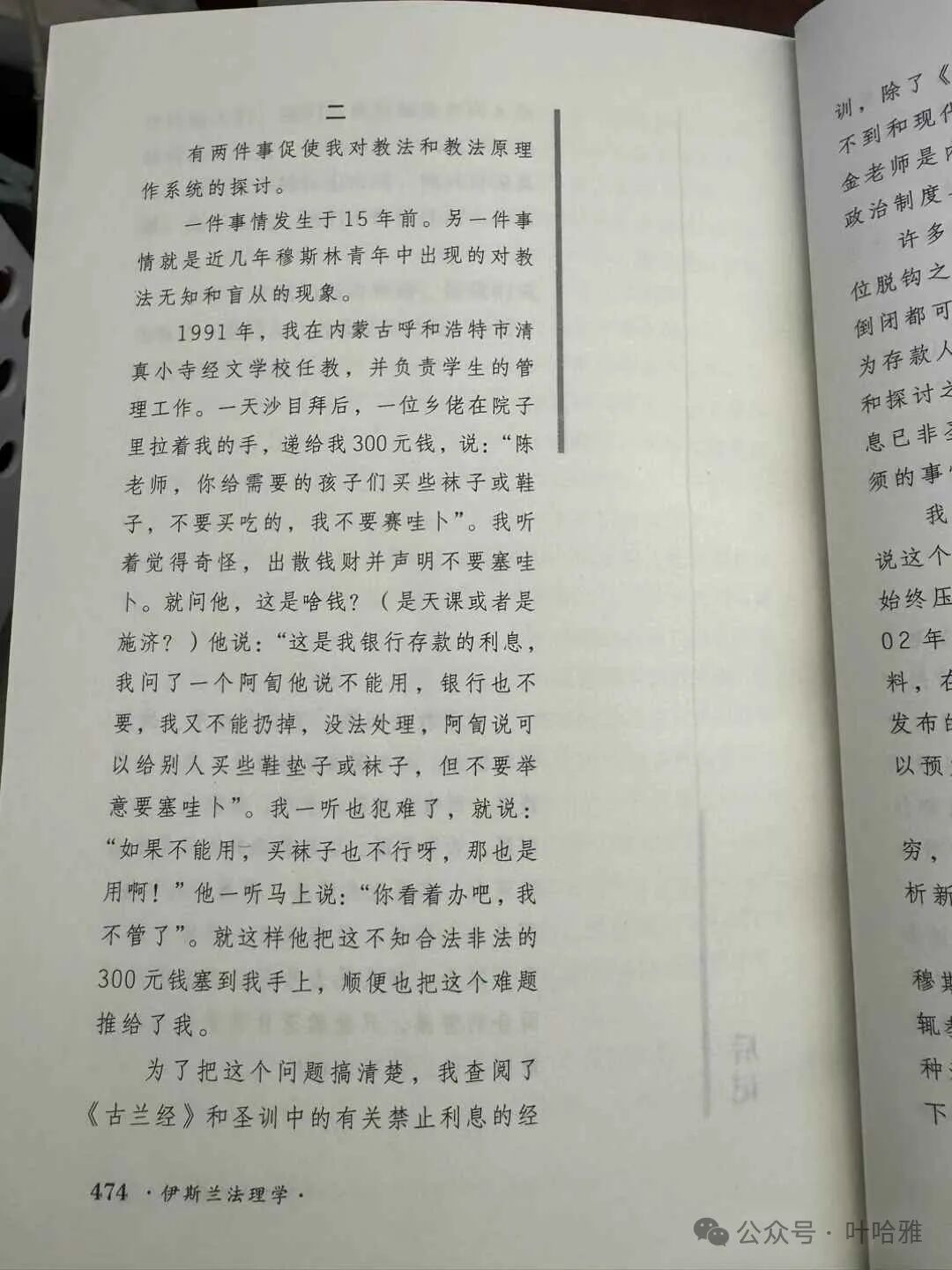

“The recent Azhar fatwā:Its logic, and historical background”
Author: Mahmoud A. El-Gamal
Rice University, USA
Author's Preface:
I am not a jurist, but an academic researcher. Therefore, I am not qualified to endorse or reject this fatwa. The purpose of this article is only to explain and summarize the ruling. To explain what this fatwa says? It says nothing. How scholars view it and the logic behind it.
What does this religious ruling (fatwa) say?
It is perfectly fine to deposit your money in a bank and appoint the bank as your agent for investments in exchange for an agreed-upon profit. Neither the Quran nor the Hadith forbids this kind of deal where profit or payment is set in advance, as long as both sides agree to it.
There is no doubt that both sides agreeing to a set profit beforehand is allowed under Islamic law. It also makes logical sense so that each party knows exactly what their share will be.
As everyone knows, a bank only sets these profits or returns for clients after carefully studying global and local markets, economic conditions, the specifics of each deal, the type of investment, and the average expected profit.
This set profit rate can go up or down over time. For example, an investment project might start with a 4% return, grow to over 15%, and then recently drop back to near 10%.
The people who set these rates and manage their changes must follow government rules. Setting a fixed number in advance—especially in these times when honesty is rare—benefits both the investors and the bank.
Investors benefit from stable profit rates, which helps them plan their lives. Bank managers benefit from performance incentives, which push them to work harder to maximize profits and keep the bank profitable even after paying the investors their set returns. What if the bank loses money during that time? How can it set a profit rate in advance? The answer is that a bank might lose money on one investment but make a profit on many others, which covers the loss.
In short: it is allowed for someone to invest money through an institution into a bank or other financial firm with a pre-set profit. There is nothing suspicious about it. This type of transaction is judged by its benefits and is not considered associating partners with Allah (shirk). Therefore, investing money in a bank with a pre-agreed profit or return is allowed and causes no harm. Allah knows best.
What does this religious ruling (fatwa) not say?
Please note that this fatwa does not explicitly state that all bank interest is halal.
Dr. Tantawi has clearly stated elsewhere that interest on bank deposits is riba, and interest on bank loans is also riba. (See Mucamalat al-Bunuk..., 2001, pp. 139-142)
There are three points of contention here.
First, are funds held for business operations considered deposits?
Second, are funds borrowed for business operations considered loans?
Third, is it forbidden to pre-determine the profit for one party in an investment activity?
There is little disagreement regarding deposits.
There is substantial disagreement regarding loans:
Abdullah Al-Najjar explains Dr. Tantawi's position as follows:
Funds given to a bank cannot be seen as a form of loan because the bank has no need, and only those in need apply for loans. Anas ibn Malik reported that the Prophet said: 'On the night of the Ascension, I saw written on the gate of Paradise: Charity is rewarded tenfold, and a loan is rewarded eighteenfold.' I said: 'O Jibril!' Why is borrowing more expensive than giving charity? The angel Jibril said: 'Because a beggar asks when they still have something, but a borrower only asks when they are in urgent need.' — Sunan Ibn Majah
Therefore, if a transaction is not a loan, bank customers must be seen as investors who intend to seek profit from the bank (the bank announces the return rate they pay, and customers choose the bank they prefer).
Jurists believe that once deposit funds are used, they are promised, and because holding a guarantee (like a loan) is more reliable than holding a trust (like a deposit), the deposit contract becomes a loan, and any increase is forbidden interest (riba).
the 'preset profit' in profit-sharing (mudaraba) is the core of what this Islamic law forbids.
Al-Qaradawi and many others believe that the hadith regarding sharecropping (muzara'ah) provides the basis for the prohibition. The Sharia committee mentioned the claim of 'consensus' put forward by Ibn Qudamah in Al-Mughni and confirmed that this 'consensus' is as binding as the classical texts.
The 14th session of the Fiqh Academy, January 2003, Decision #133 (7/14), pages 20-24.
Religious law and secular law describe the relationship between a depositor and a bank as a loan relationship, not an agency relationship. In contrast, an investment agency is where an agent invests funds on behalf of a principal in exchange for a fixed wage or a share of the profits. In this regard, religious scholars have a consensus that the principal owns the investment funds and therefore has the right to receive investment gains and is responsible for losses, while the agent has the right to receive a fixed wage under the conditions set by the agency. Therefore, a traditional bank is not an investment agent for the depositor. The bank receives funds from the depositor and uses them, thereby guaranteeing said funds and making them a loan. In this regard, the loan must be repaid at face value without any increase.
For centuries, jurists from all schools have agreed that you cannot pre-set investment profits in any partnership, whether as a fixed amount or a percentage of the capital. This ruling is based on the idea that pre-setting profits guarantees the principal, which goes against the nature of a partnership where you must share both profits and losses. This consensus is well-established and has no reported disagreements. In this regard, Ibn Qudamah wrote in Al-Mughni (Volume 3, page 34): All scholars agree that if one or both parties set a known amount of profit, the partnership (qirad or mudaraba) becomes invalid. The consensus of religious scholars is itself a legal proof.
Pre-specifying profits
Dr. Tantawi and his supporters rejected the loan issue and held a long discussion on the problem of pre-set profits. Dr. Tantawi cited Abdul-Wahhab Khallaf and Dr. Ali Al-Khafif to support his view that it is inappropriate to limit investment institutions to traditional mudaraba, which has profit sharing but no specific profit amount.
The main argument for fixed profits
Tantawi (2001, page 131) quoted Khallaf (pages 94-104), Al-Khafif (pages 165-204), and others (pages 204-211) word for word, saying: In this era of corruption, dishonesty, and greed, not fixing profits as a percentage of capital would leave the principal at the mercy of the agents managing the investment funds, whether they are banks or other institutions.
Therefore, he and earlier scholars turned to the well-known issue of moral hazard, which is unrelated to profit distribution.
Second, once the loan or deposit argument is rejected, the remaining issue is how to handle the consensus theory in Al-Mughni and the hadith it is based on.
Is the claim of consensus accepted? Is it binding?
Does this decision have a basis in the Quran and Sunnah, or can it be overturned?
If a partnership is considered flawed because the profit margin is predetermined, does this make it forbidden interest (riba), or is it a permitted lease (ijara), such as whether a mutually agreed upon (though uncertain) wage payment is legal?
Hadith on tenant farming.
Hanzalah ibn Qays narrated: I asked Rafi ibn Khadij about renting land for gold and silver. Rafi replied: 'There is no harm in this. In the time of the Prophet, people rented land for the crops and straw that grew along the waterways. Sometimes there was a harvest, and sometimes there was none. People rented land this way, so the Prophet forbade it. As for rent that is fixed and guaranteed, there is no harm.'
— Sunan Ibn Majah
This hadith shows that it is forbidden to pre-arrange any geography, time, or quantity for land rented to tenant farmers. Jurists concluded that because of uncertainty, predetermined compensation for either party is not allowed. This ruling on tenant farming applies to other partnerships, including profit-sharing partnerships (mudaraba). Therefore, Ibn Qudamah believed that jurists reached a consensus that it is not allowed to pre-specify profits in a mudaraba.
Dr. Abdullah Al-Najjar wrote a detailed discussion on this hadith and the conclusions drawn from it. He argued that the prohibition does not stem from the condition of pre-specifying profit itself, but from the uncertainty (gharar) that could lead to disputes (citing the narrative and analysis in Al-Shawkani's Nayl Al-Awtar). On the other hand, he argued that this type of partnership is essentially an employment contract with an unknown reward, and is therefore full of uncertainty. However, a consensus ruling actually permits this contract (including profit sharing) despite the uncertainty (as Ibn Qudamah stated). Therefore, this type of partnership belongs to a category of contracts where uncertainty (including that caused by pre-specifying profit) is ignored, as long as it does not lead to legal disputes.
Dr. Al-Najjar presented many other arguments based on the analysis of Al-Shawkani and Ibn Qudamah. He said: This might be Rafi's own non-binding conclusion; it might be limited to specific types of tenant farming; Zayd ibn Thabit disagreed with this hadith, claiming it related to a specific incident where one person killed another (recorded by Abu Dawud); the hadith narrated by Ibn Umar suggests that renting land is permitted (recorded by Bukhari), which challenges the hadith; other companions of the Prophet, including Ibn Abbas and others, disagreed with Rafi's view. Ibn Qudamah said that some of Rafi's narrations differ from the consensus of the companions and must therefore be discarded.
At the Al-Azhar conference, Dr. Muhammad Rif'at Uthman presented a counter-argument. According to Al-Nawawi, the hadith does not forbid renting land for a fixed rent (which was the focus of previous arguments), but it does forbid pre-specifying profits.
Most jurists believe that a profit-sharing partnership (mudāraba) that is known to be flawed or invalid from the start is not allowed. Dr. Tantāwī focuses on the consensus view that when a mudāraba is considered flawed, such as when an investor's profit is specified in advance, the contract becomes an employment contract ('ijara). Under this, the entrepreneur or worker is entitled to a market wage, as noted by ibn al-Humām in Fath Al-Qadīr and Al-Shaficī in 'um. He summarizes this (2001, p. 133):
Therefore, we say that a bank investing for a pre-specified profit becomes an employee of the investor. The investor accepts the amount the bank gives them as their profit, and any excess profit, whatever it may be, is treated as the bank's wage. Thus, this type of transaction is free of interest (Ribā). In short, we cannot find any canonical text or convincing analogy that forbids specifying profit in advance as long as both parties agree.
Quotes from early jurists
Dr. Tantāwī (2001, p. 95) quotes Dr. Khallāf, who in turn quotes Muhammad Abduh's 1906 article in Manār (#9, p. 332): When a person gives their money to another for investment and receives a known profit, this does not constitute clearly forbidden Ribā, regardless of the pre-specified profit rate. This is because legal rules that disagree on forbidding pre-specified profit do not constitute the clear type of Ribā that ruins families. This type of transaction is beneficial to both the investor and the entrepreneur. In contrast, Ribā for the borrower is only due to need and is not their fault, while for the lender, Ribā leads to greed and a hardened heart. These two types of transactions cannot have the same legal status (hukm).
Dr. Khallāf, in Liwā' 'Islām (1951, #4 (11)), continues (quoted in the same, pp. 95-6): There is no evidence that profit cannot be specified in advance. Just as profit can be shared between two parties, the profit for one party can also be specified in advance. Such a condition might not align with the views of jurists, but it does not contradict any canonical text in the Quran or Sunnah.
Core argument
Dr. Khallaf summarizes the basis for the current Al-Azhar ruling as follows: The only objection to this type of transaction is the validity of mudāraba, which requires that profit must be set as a percentage share rather than a specific capital amount or percentage. My response to this objection is as follows: First, there is no evidence for this condition in the Quran or the Sunnah. We live in a very dishonest time now, and if we do not set a fixed profit for the investor, his partner will swallow up his wealth.
Second, if a mudāraba is considered flawed because it violates one of its conditions, the entrepreneur becomes an employee, and what he takes is considered a wage. There is no difference in calling it mudāraba or 'ijāra: it is a valid transaction that benefits the investor who cannot invest funds directly and benefits the entrepreneur who receives the funds. Therefore, this is a transaction that benefits both parties without harming either side or anyone else, and banning such a beneficial transaction will harm the Ummah.
Key points
Recent academic journals from Al-Azhar do allow certain types of bank interest to be used as investment profit.
This fatwa is at least a century old.
Most jurists oppose this fatwa.
A minority have questioned the authenticity, authority, and applicability of the hadith regarding sharecroppers.
A minority have questioned the logic of prohibiting the pre-specification of profit.
Can we still claim that a consensus exists?
If this issue is controversial, should we proceed with caution? Should we follow the view of the majority?
Muslim Knowledge Guide China: Islamic Finance Critique, Riba Debate and Banking Ethics
Articles • yusuf908 posted the article • 0 comments • 227 views • 2026-05-23 01:19
Summary: This Muslim knowledge guide presents a critical look at Islamic finance, including Sharia compliance, profit-and-loss sharing, murabaha, interest benchmarks, social justice concerns, scholar critiques, banking practice, and the gap between ideal Islamic finance and real-world banking.
This article is a collection and compilation of critiques on Islamic finance. The content mainly comes from the English Wikipedia entry 'Challenges in Islamic finance' and various scholars' blogs. The skepticism from these foreign scholars shows that so-called 'Islamic finance' is not as competitive as we imagine. It has many problems and perhaps should not even be promoted under the name 'Islamic'.
The challenge facing Islamic finance is the difficulty of providing modern financial services without violating Sharia law. The development of the Islamic banking and finance industry centers on avoiding interest, which is seen as an unjust and exploitative gain in trade or business.
Most Islamic banking customers come from the Gulf and developed countries in the Muslim world. Challenges include the fact that interest rate benchmarks have been used to set Islamic 'profit' rates, so the 'net returns are not substantially different from interest-based transactions'. In essence, Islamic banking is 'nothing more than a matter of changing contracts...'.
Religiously, Islamic finance prefers a profit and loss sharing (PLS) model. However, this causes problems, including the need to wait for investment projects to generate earnings before profits can be distributed, which increases risk and complexity for financial service providers.
The Islamic finance industry has been praised for developing a 'theory' into an industry worth about 2 trillion US dollars. It has attracted banking users who could not use traditional banking services for religious reasons, drawn non-Muslim bankers into the field, and (according to other supporters) introduced a more stable and lower-risk form of financing.
However, the industry is also criticized for ignoring its 'basic philosophy' and moving in the wrong direction for decades, leading both outsiders and ordinary Muslims to question it. First, it abandoned the original financing method advocated by its promoters—risk-sharing financing—in favor of fixed-markup purchase financing (especially murabaha). It then distorted the rules of fixed-markup murabaha to effectively provide traditional cash interest loans like conventional interest rates, but disguised them with 'word games' while bearing 'higher costs and greater risks'.
Other issues and complaints raised include that the industry has made no effort to help small vendors and the poor. How to deal with the problem of inflation; Delayed payments; A lack of currency and interest rate hedging; Or a lack of short-term cash deposit accounts that follow Sharia law; Most Islamic banking businesses are owned by non-Muslims;
In a series of interviews with Pakistani banking professionals (traditional and Islamic bankers, Sharia banking advisors, business people using finance, and management consultants) in 2008 and 2010, economist Faisal Khan noted that many Islamic bankers expressed 'skepticism' about the differences, or lack thereof, between traditional and Islamic banking products. He also noted a lack of external Sharia compliance audit requirements for Islamic banks in Pakistan, and that Sharia boards lacked awareness of their banks failing to follow Sharia-compliant practices or were unable to stop them. However, this did not stop devout people from using the banks (one person explained that if his Islamic bank was not truly following Sharia, 'the punishment is on their heads, not mine!'); I have done what I can do.
An estimate of customer preferences in the Pakistani banking industry (provided by a Pakistani banker) is that about 10% of customers are 'strictly traditional banking customers,' 20% are strictly Sharia-compliant banking customers, and 70% prefer Sharia-compliant banking but will use traditional banking if the 'price difference is significant.' A survey of Islamic and traditional banking customers found that Islamic banking customers were more observant (attending Hajj, performing namaz, keeping a beard, etc.), but they also had higher savings account balances than traditional banking customers, were older, better educated, traveled abroad more, and tended to open a second account at a traditional bank. Another study using 'official data' reported to the State Bank of Pakistan found that for lenders who received both Islamic (murabaha) financing and traditional loans, the default rate for traditional loans was more than twice that of the others. If the vote share of religious political parties increases, borrowers are 'less likely to default during Ramadan and in large cities, which suggests that religion—whether through personal piety or network effects—may play a role in determining loan defaults.'
As of 2016, the key challenges facing the Islamic finance industry, including Islamic bonds (sukuk), according to the 2015/16 State of the Global Islamic Economy Report and International Monetary Fund data, include:
Public awareness and understanding of Islamic financial products and services are low, which keeps people from using them.
There is a need to improve regulatory clarity and coordination, strengthen cooperation between Islamic and traditional financial standard-setters, and further improve regulatory tools. This is to address the complex financial products and company structures in some countries where regulatory frameworks fail to handle risks specific to the industry.
There is a scarcity of monetary policy tools that follow halal rules and a lack of understanding of monetary transmission mechanisms.
Underdeveloped safety nets and resolution frameworks. A lack of a complete Islamic deposit insurance system, where insurance premiums cannot be invested in halal assets, or a lack of a halal lender of last resort.
Regulators do not always have the ability or the will to ensure compliance with Islamic law.
Imitating traditional finance.
Some supporters of Islamic banking, such as Taqi Usmani, D. M. Qureshi, Saleh Abdullah Kamel, and Harris Irfan, and skeptics like Muhammad Akram Khan, Mohammad Omar Farooq, Feisal Khan, Mahmoud El-Gamal, and Timur Kuran, have studied the differences between Islamic and traditional banks and expressed regret over their similarities.
Taqi Usmani argues that Islamic banking has completely ignored its basic philosophy. First, it ignores the risk-sharing model (musharaka) between the financier and the user of funds, preferring fixed markup models like cost-plus financing (murabahah) and leasing (ijarah), which theoretically should only be used when risk-sharing is impractical. Second, it ignores the rules of cost-plus financing (murabahah) and leasing (ijarah) themselves. For example, it uses murabahah financing to borrow cash without even buying any goods in the process, or uses leasing (ijarah) where the lessor does not take responsibility for ownership or provide the lessee with any rights of use.
Interest rate benchmarks are used to set Islamic profit rates, so the net result is not substantially different from interest-based transactions. Ignoring these basic principles weakens the influence of Islamic banking among non-Muslims and especially the general public. Usmani believes the public now has the impression that Islamic banking is just a matter of swapping documents.
In March 2009, Usmani declared that 85% of Islamic bonds (sukuk) were non-Islamic. At the time, Usmani was the chairman of the Sharia board for the Accounting and Auditing Organization for Islamic Financial Institutions (AAOIFI), which sets standards for the global Islamic banking industry. Others, such as Hassan Heikal, have also criticized the authenticity of Islamic bonds.
Another pioneer of the Islamic banking industry, DM Qureshi, told a questioner at a 2005 Islamic banking conference, 'With all due respect, today's Islamic banking is a labeling industry.' Everything traditional is just given a new label, and then you call it Islamic.
Mohammad Najatuallah Siddiqui also criticized the trend of copying traditional interest-based financial tools and making minor changes to terms and phrases, such as using sukuk for bonds or tawarruq for loans. He said this trend gives Islamic finance a bad reputation. One Islamic bank, Lariba, even issued a fatwa from its Sharia board, which included famous Sheikh Yusuf al-Qaradawi, stating: 'We have reached a consensus that there is no objection to using the word interest to replace profit or rate of return.' Siddiqui stated that practitioners of Islamic finance are eager to prove in theory that their finance is different from traditional finance, but in reality:
They are busy finding ways to make them similar. Starting around the 1980s, Sharia advisors mainly focused on designing alternatives to financial products that were already familiar to the market while trying to keep them compliant with Sharia.
A Muslim banker at Deutsche Bank, Harris Irfan, wrote about how he felt when selling Islamic banking products that did not truly comply with Sharia. He complained that he felt like a fraud, suffering from incoherent pietism and cognitive dissonance while trying to fit a square peg into a round hole.
Muhammad Akram Khan, a senior expert in Islamic economics, criticized Islamic banks for claiming to build their business on something other than interest while designing a series of tricks and ruses to hide interest.
Mahmoud Amin El-Gamal and Mohammad Fadel complained that Islamic banks charge fees that are too high. Fadel described the foundation of the industry as charging fees to create financial products that seem to meet the formal requirements of Islamic law while keeping all the economic features of traditional products.
El-Gamal described modern Islamic finance as Sharia arbitrage, which means taking advantage of price differences between Islamic and traditional markets because devout Muslims are willing to pay extra for financing they believe follows Sharia. In this system, a bank's Sharia board earns fees by finding a suitable classical Arabic name for an Islamic-style product and using that name to justify the Islamic brand and make it seem more credible.
According to Sayyid Tahir:
There is no evidence that the arrangements of Islamic banks are based on any kind of Sharia foundation. For example, the formulas for legal liquidity requirements, capital adequacy, and risk management standards in Islamic banks are the same as those in interest-based banks.
According to AW Duskuki and Abdelazeem Abozaid, the only difference investigators might find between Islamic finance and traditional finance is
in technical details and legal form, but the substance is the same. In fact, Islamic bankers use the same financial calculations as other bankers to figure out the present and future value of investments. Therefore, in the end, skeptical Muslims and other critical outsiders will find that Islamic banks actually charge interest, just under a different name like commission or profit.
Saleh Abdullah Kamel, the 1997 winner of the IDB Islamic Banking Prize, has a different view. He pointed out that the industry only has most of the features of traditional banking.
The investment models favored by Islamic banks have turned into a mix of loans and investments. This hybrid model has most of the features of interest-based loans and the flaws of the Western capitalist system. It does not highlight the features of Islamic investment based on risk-sharing and actual investment. It does not recognize the guarantee of capital and its returns.
Another criticism of mimicking traditional banking (raised by Mahmoud El-Gamal) is that imitating the 'past returns and past trends' of traditional finance, such as seeking to be the first bank to offer an 'Islamic hedge fund,' can bring huge initial profit margins. This is because the imitator is a 'first mover' in the Islamic finance industry and has 'access to monopoly markets and free indirect publicity.' This tempts other banks to try to follow suit, but long-term returns are often limited.
Skeptics of the industry have offered several explanations for why they believe the industry has failed to provide a real alternative to traditional banking. According to MO Farooq, Sharia boards face pressure, and it is indeed difficult to review the institutions that pay their salaries, which is a modern version of the medieval 'court ulama'.
Feisal Khan argues that Islamic banking is caught in a 'vicious cycle' where traditional piety conflicts with feasibility. Inspired by the Islamic revival movement, a large number of pious Muslims seek to finance, invest, and save in ways that do not use interest and 'standard debt contracts'. Efforts to provide interest-free alternatives that truly comply with Sharia—'participatory' or 'profit and loss sharing' financing—have failed because, in most cases, information asymmetry between the financier and the recipient makes this financing model unprofitable. Large banks are unwilling to let this obstacle stop them from profiting from the vast market of pious Muslims, so they look for 'scholars willing to certify traditional instruments as Sharia-compliant' and give more business to the most helpful scholars. The result is a 'fairly wide' range of financial products and services that 'closely' mimic traditional products and services but come with Sharia certification, which adds extra transaction costs.
Another explanation given by Farooq, citing Muhammad Nejatullah Siddiqi, is the shortage of Sharia experts. Generally speaking, these experts have not received enough training in the intent or purpose of Islamic law, so they cannot evaluate the pros and cons of certain financial products. They also lack training in economics and cannot analyze the consequences of using complex financial transactions like tawarruq, which allows lenders to provide cash to borrowers in a way that complies with Islamic law but is more complex and costly than traditional loans.
Timur Kuran argues that the importance of the Islamic economic foundation in Islamic banking is that it is primarily a tool to reaffirm the primacy of Islam, and only secondarily a tool for radical economic change.
The promises and challenges of profit and risk sharing.
According to a 2006 paper by Suliman Hamdan Albalawi, at least in Saudi Arabia and Egypt, Islamic banks no longer use profit and loss sharing (PLS) techniques as a core principle, and Malaysia has also seen a decline.
A study on the most commonly used Islamic finance models found that PLS financing in major Islamic banks dropped from 17.34% in 1994-1996 to just 6.34% of total financing in 2000-2006. In the sample, debt-based contracts or debt-like instruments were more popular. During the 2004-2006 period, 54.42% of financing was based on murabaha, 16.31% on ijara, and 5.60% on salam and istisna. Another survey of the largest Islamic banks released in 2010 found that the use of PLS ranged between 0.5% and 21.6%.
Authors Humayon A. Dar and J. R. Presley explain why PLS tools, where the financier provides capital and partnership financing, have dropped to a negligible percentage, including:
Bank clients have a strong incentive to report less profit than they actually earn, because the higher the declared profit, the more money the client must pay to the financing bank. This puts banks at a disadvantage when using PLS compared to using fixed-income models.
Property rights are not clearly defined in most Muslim countries, which makes it hard to share profits and losses.
Islamic banks compete with traditional banks that have deep roots and hundreds of years of experience. Islamic banks are still unsure about their own policies and practices, so they avoid taking on risks they cannot predict.
Profit and Loss Sharing (PLS) is often not suitable or possible for things like short-term resource needs, working capital, or non-profit projects in education and health.
In some countries, interest is treated as a business expense and is tax-free, but profit is taxed as income. Because of this, business clients who get funding through PLS pay higher taxes than those who take out loans and pay interest.
At least as of 2001, there was no secondary market for Islamic financial products based on PLS.
As a form of PLS, profit-sharing partnership (mudaraba) gives bank shareholders limited control and leads to an unbalanced governance structure. Shareholders want a consistent and complementary control system, but profit-sharing partnership (mudaraba) financing lacks this.
The industry has not been able to get customers to accept the periodic losses (the L in PLS) that come with investments. The profit-sharing partnership (mudarabah) feature, where bank clients and investors share in the bank's losses, is thought to make Islamic financial institutions more stable than traditional banks. In its 2015 paper, Islamic Finance: Opportunities, Challenges, and Policy Options, the International Monetary Fund listed ensuring that profit-sharing investment accounts (PSIA), also known as profit-sharing partnership (mudarabah) accounts, are handled in a way that keeps the financial system stable as a major regulatory challenge. Supporters like Taqi Usmani argue that normal trade activities naturally lead to occasional losses. They believe that expecting stable returns without any risk of loss is an unnatural product of capitalist banking, caused by separating finance from normal trade. Over decades of development, Islamic banking has faced bad debts and even major financial difficulties, such as the significant corruption scandal at the Dubai Islamic Bank in 1998.
However, at least up until 2004, no Islamic bank had passed bad debts on to its depositors. No Islamic bank reduced the value of depositor accounts when writing down the value of bad assets for fear of losing those depositors.
Beyond the disadvantages for lenders, critic Feisal Khan argues that the widespread use of profit and loss sharing (PLS) could cause serious damage to the economy. He points out that if banks held direct equity in every business as required by profit-sharing contracts (mudarabah) and partnership contracts (musharakah), credit would shrink. Central banks would then be unable to use standard credit expansion methods, such as buying bonds or commercial paper, to prevent the liquidity crises that occur in modern economies. While purists like Usmani are correct that cost-plus financing (murabahah) and other fixed-income tools—which have already pushed out PLS—are essentially just another name for traditional banking, banning them in favor of more authentic profit and loss sharing might leave central banks unable to prevent economic contraction and extreme unemployment.
Besides ignoring profit and loss sharing in favor of cost-plus financing (murabahah), the industry is accused of failing to follow Islamic law rules for murabahah. It often fails to buy or sell the actual goods or inventory that are a key condition for compliance. Banks do this when they want to lend cash rather than fund a purchase, even though it adds extra costs without serving any other purpose. In 2008, Arabianbusiness.com complained that sometimes there were no goods at all, only cash flowing between banks, brokers, and borrowers. Often, the goods have nothing to do with the borrower's business, and there are not even enough existing goods in the world to account for all the transactions taking place. Two other researchers reported that billions of dollars in synthetic murabahah transactions have taken place in London over the years, with many people doubting whether the banks actually owned the deposits or even the underlying assets.
Early supporters of Islamic banking called for setting up different accounts for different types of deposits so that earnings could be distributed to each type. Critic Muhammad Akram Khan argues that, in reality, Islamic financial institutions pool all types of deposits together.
Critics complain that banks following Sharia rules often just take the word of the bank or the borrower that they are following compliance rules, without doing real audits to check if it is true. An observer (L. Al Nasser) complained that when dealing with peers in the industry, Sharia authorities show too much trust in their subjects. He said Sharia audits are needed to reach transparency and make sure institutions keep their promises to customers. Also, when doing outside Sharia audits, many auditors often complain about the high number of violations they see but cannot discuss because the records they check have been tampered with.
Illegal gains
Even though Islamic banks forbid charging interest, their profit margins are usually based on interest rates. Islamic banker Harris Irfan says there is no doubt that benchmarks like LIBOR are still necessary for Islamic banks, and most scholars accept this no matter how imperfect the solution seems. However, Muhammad Akram Khan wrote that following the traditional bank benchmark LIBOR goes against the original purpose of designing and offering Islamic financial products.
Skeptics also complain that the returns on Islamic bank accounts are very close to those of traditional banks, even though their different mechanisms should theoretically lead to different numbers. A 2014 study using the latest econometrics techniques looked at the long-term relationship between time deposit rates at traditional banks and participation banks (Islamic banks) in Turkey. It found that the time deposit rates of three out of four participation banks were significantly cointegrated with those of traditional banks, and the causal relationship between Islamic bank yields and traditional banks was permanent. Skeptics believe this closeness shows that Islamic banks manipulate their yields. These banks are often smaller and have weaker foundations, and they feel the need to reassure customers about their financial competitiveness and stability.
Liquidity issues
The Islamic banking and finance industry lacks a way to earn returns on money that is parked short-term while waiting for investment, which puts these banks at a disadvantage compared to traditional banks.
Banks and financial institutions must balance liquidity—the ability to quickly turn assets into cash or cash equivalents in an emergency without a big loss when depositors need it—with competitive rates of return on funds. Traditional banks use the interbank lending market to borrow money for liquidity needs and invest for any period, including very short terms, to boost their earnings. Calculating the return for any period is simple: just multiply the loan term by the interest rate.
However, the profit and loss sharing (PLS) model preferred in Islamic finance means profits can only be shared after the invested project is finished. Since you cannot determine profit or loss in the short term, money deposited for a short time does not earn any return. Islamic financial institutions cannot use traditional interbank lending markets for short-term borrowing.
Because there are few or not enough Islamic money market investment tools, as of 2002, the liquidity—or money without returns—held by Islamic banks was on average 40% higher than that of traditional banks. The Islamic Financial Services Board found that the daily volume of interbank transactions between Islamic financial institutions, between Islamic and traditional banks, and between Islamic financial institutions and central banks is very low compared to traditional money markets. While Muslim countries like Bahrain, Iran, Malaysia, and Sudan have started developing Islamic money markets and issuing securitized documents based on profit-sharing partnership (musharakah), profit-sharing investment (mudarabah), and leasing (ijarah), as of at least 2013, the lack of a proper and effective secondary market means these securities are much smaller in number than those in traditional capital markets.
Regarding non-PLS, or debt-based contracts, one study found that the business model of Islamic banks is changing over time and moving toward taking on more liquidity risk.
To solve the problem of money held for liquidity or lack of investment opportunities not earning a return, many Islamic financial institutions, such as the Islamic Development Bank and Faisal Islamic Bank of Egypt, openly earn interest from their excess funds, which are usually invested in safer debt-like or overseas debt instruments. Sharia experts do not forbid this practice, but instead provide the necessary religious rulings (fatwa) to comply with Sharia based on the rule of necessity (darurah). Researchers Frank Vogel and Frank Hayes write:
Islamic finance and banking scholars cite necessity to allow exceptions and relax rules. They issued fatwas allowing Islamic banks to deposit funds into interest-bearing accounts, especially abroad, because these banks have no other investments during periods of necessity. However, they usually attach conditions to such fatwas, such as requiring that illegal earnings be used for religious charitable purposes like charity, training, or research.
Lack of social responsibility
According to Islamic teachings, Islamic banks should adopt new financing policies and explore new investment channels to encourage development and improve the living standards of small-scale traders, but Taqi Usmani complains that few Islamic banks and financial institutions focus on this. Islamic scholar Mohammad Hashim Kamali regrets that Islamic banks focus on short-term financing, which mainly focuses on financing already produced goods rather than creating or increasing production capital or focusing on facilities like factories and infrastructure.
Muhammad Akram Khan also complains that in the process of merging with traditional banking, Islamic bank product development mimics traditional banking instead of building a different type of banking consistent with fair and equal income distribution and ethical investment models.
Another scholar, Mahmoud El-Gamal, also regrets that Islamic banks value form over substance and suggests rebranding Islamic finance to emphasize issues like community banking, microfinance, and socially responsible investment.
Criticisms from other unorthodox economists are even more intense.
Muhammad O. Farooq questions the basic premise of Islamic banking, arguing that it focuses on abolishing all interest at the expense of the big picture of pursuing overall economic justice, and cites the Quran's warning against the concentration of wealth:
Whatever Allah has restored to His Messenger from the people of the towns is for Allah and for the Messenger, and for the near relatives and the orphans and the needy and the wayfarer, so that it will not be a perpetual distribution among the rich from among you...
He questioned if greed and profit are bigger causes of exploitation than loan interest. He believes that in a competitive and regulated market, loan interest might not actually count as interest.
The Islamic banking and finance movement has adapted to political tyranny. It is supported by a small, wealthy class of rentiers in the Muslim world and is increasingly manipulated by global financial giants. Because of this, it is easily limited to just talking about opposing exploitation, and it might even unintentionally become a tool for exploitation itself. The real world is full of exploitation, such as child exploitation, sexual exploitation, and labor exploitation. Interest might only be a small part of global exploitation. However, supporters of Islamic economics and finance remain obsessed with interest.
He used the profit motive of the East India Company as an example. Before 1858, the company colonized and ruled India at the expense of the Muslim Mughal Empire, and its shares were equity rather than debt instruments. He found it curious that although books promoting Islamic banking and finance often claim that loan interest exploits the poor and Muslims, there is almost no empirical or focused research on exploitation or injustice within Islamic economics. For example, Farooq complained that in two important bibliographies on orthodox Islamic economics, there was not a single citation about exploitation or injustice. These were 'Muslim Economic Thought: A Survey of Contemporary Literature,' which had 700 entries under 51 subcategories across 115 pages, and 'Islamic Economics: Annotated Sources in English and Urdu' by Muhammad Akram Khan.
Timur Kuran complained that Islamic banks in Egypt and other Muslim countries follow Western banking practices and do little to help economic development or job creation. However, they do not follow the practices of Western venture capitalists, who have funded the global high-tech industry. Since the operating principles of venture capital are the same as profit and loss sharing, even though venture capital does not avoid haram (forbidden) products, using venture capital could bring huge benefits to Egypt and other poor Muslim countries seeking economic development.
Lack of uniformity in Sharia.
Most Islamic banks have their own Sharia boards to rule on bank policies. Researchers Frank Vogel and Frank Hayes believe the four schools of Sunni Islamic law (Madhhab) do not agree on Islamic banking practices. They apply Islamic teachings to business and finance in different ways. There are disagreements on specific points of religious law both between the four schools and within them. Also, Sharia boards sometimes change their minds and overturn previous decisions.
Ibrahim Warde asks if boards just rubber-stamp the banks that pay their salaries. Munawar Iqbal and Philip Molyneux say that disagreements between boards about what counts as Sharia-compliant can cause trouble, because customers might doubt if a bank is truly following the rules. If Islamic banks are not seen as truly Islamic, they will quickly lose most of their market.
Late payments and defaults.
In traditional finance, late payments or loan defaults are discouraged by interest that keeps adding up. Muhammad Akran Khan says that controlling and managing late accounts has become a thorny problem in Islamic finance. Although many suggestions have been made to fix the problem of overdue loans in Islamic banks, Ibrahim Warde says:
Islamic banks face serious issues with late payments, not to mention outright defaults, because some people use every legal and religious trick to delay. In most Islamic countries, various forms of fines and late fees have been set up, but they have been banned or found impossible to enforce. Late fees, in particular, have been treated the same as interest. Therefore, debtors know they can pay Islamic banks last because there is no cost for doing so.
Warde also complained:
Many business people who borrowed large amounts of money for a long time took advantage of the shift to Islamic finance. They paid back only the principal and wiped out the accumulated interest. Given the double-digit inflation over the years, this was usually a tiny amount.
How to deal with inflation
Inflation is also a problem for financing. Islamic banks do not copy traditional banks; they actually provide loans without interest or any other fees. Whether and how to compensate lenders for money that loses value due to inflation is a problem that "troubles" Islamic scholars. If lenders lose money by giving loans, businesses will not be able to get financing. Suggestions include indexing loans to inflation, which many scholars oppose because they think it is a form of interest and encourages inflation. Other ideas include measuring loans by commodities like gold, or doing more research to find an answer.
The influence of non-Muslims
Almost all, if not all, customers of Islamic banking and finance are Muslims. But most financial institutions that provide Islamic banking services are Western and owned by non-Muslims. Supporters of Islamic banking believe that the interest Western banks have in Islamic banking is proof of strong and growing market demand, and therefore an "achievement of the Islamic movement."
However, critics complain that these banks lack a deep commitment to the faith of Islamic banking, which means:
The Muslims hired at these institutions have almost no input into actual management. This leads the Muslim public to sometimes have well-founded doubts about how seriously these institutions follow Sharia law. A traditional Malaysian bank offering Islamic investment funds was found to have invested most of these funds in the gambling industry. The managers running these funds are not Muslim.
The interest from traditional banks does not show that Islamic banking is growing stronger. Instead, it shows how similar Islamic and traditional banks are, so the latter can enter the Islamic banking sector without making any real changes to their business. El-Gamal doubts whether the interest of large non-Muslim banks in Islamic finance comes from the profitability of Islamic financial business.
When the market hits a downturn, these banks are more likely to exit the industry. Harris Irfan believes that non-Muslim banks like Deutsche Bank lack an ideological commitment to Islamic banking, which has led and will continue to lead them to exit the industry when the market hits a downturn. In early 2011, during the bursting of the real estate bubble, Deutsche Bank did not keep a single dedicated Islamic structurer or salesperson. Islamic finance has become a luxury that banks cannot afford. Perhaps partly because of this, in February 2011, the Central Bank of Qatar ordered traditional lenders to close their Islamic operations in the country by the end of the year. The central bank insisted that it was too much for traditional banks to follow alternative capital adequacy rules for Islamic finance, and it was hard to supervise and monitor the Islamic and traditional operations of commercial banks because depositors' funds would get mixed together.
Stability/Risk
Opinions differ on whether Islamic banking is more stable and carries less risk than traditional banking.
Supporters, such as Bank Negara Malaysia Governor Zeti Akhtar Aziz, believe that Islamic financial institutions are more stable than traditional banks because they forbid speculation and, in theory, the two main types of Islamic bank accounts—current accounts and profit-sharing accounts (mudarabah)—pose less risk to the bank.
In a current account, customers do not earn any return, and there is theoretically no risk of loss because the bank does not invest the funds in the account.
In a profit-sharing investment account (mudaraba), an Islamic bank faces less risk from loan defaults because it shares this risk with the depositors. If a borrower cannot repay some or all of the money the bank lent them, the amount distributed to depositors decreases by the same amount. In a traditional bank, depositors receive fixed interest payments regardless of whether the bank's income drops due to loan defaults.
Critics complain that this stability comes at the cost of the stability of the account balances for depositors or partners—a term Islamic banks often use instead of customers or depositors—who face risks that those in traditional banks do not. a critic named Mahmoud A. El-Gamal argues:
In these institutions, investment account holders have neither the protection of creditors in an Islamic financial institution nor the protection of equity holders represented on the institution's board. This introduces many other well-documented risk factors to the institution.
On the other hand, Habib Ahmed wrote shortly after the 2009 financial crisis that the practice of Islamic finance has gradually moved closer to traditional finance, which exposes it to the same dangers of instability.
When looking at the practice of Islamic finance and its operating environment, one can find trends similar to those that led to the current crisis. Recently, stock and real estate markets in the Gulf region have also experienced speculative events. Finally, the Islamic finance industry has grown rapidly with the innovation of complex financial products that comply with Sharia law. The risks of these new Islamic financial products are complex because these tools involve multiple types of risk.
In any case, several Islamic banks have failed over the decades. In 1988, the Islamic investment company Ar-Ryan collapsed, causing thousands of small investors to lose their savings. Later, an anonymous donor from a Gulf country covered their losses. This was a heavy blow to Islamic finance at the time. In 1998, the management of Bank al Taqwa collapsed. Its annual report stated that depositors and shareholders lost more than 23% of their principal. It was later discovered that management violated bank rules by investing more than 60% of the bank's assets into a single project.
Turkey's Ihlas Finance House closed in 2001 due to liquidity problems and financial distress. Faisal Islamic Bank also ran into difficulties and closed its operations in the UK for regulatory reasons. According to The Economist magazine, the 2009 Dubai debt crisis showed that Islamic bonds could help inflate debt to unsustainable levels.
Economic recession
According to a 2010 survey by the International Monetary Fund, Islamic banks showed stronger resilience on average than conventional banks during the 2007 to 2008 financial crisis, but they faced greater losses when the crisis hit the real economy.
At the start of the 2007-2009 Great Recession, Islamic banks were unscathed. One supporter of Islamic banking wrote that the collapse of major Wall Street institutions, especially Lehman Brothers, should encourage economists worldwide to look at Islamic banking and finance as an alternative model. However, the impact of the financial recession gradually shifted to the real sector, affecting the Islamic banking industry. According to Ibrahim Warde, this shows that Islamic finance is not a panacea, and a faith-based system is not automatically immune to the unpredictability of the financial system.
Concentrated ownership
Munawar Iqbal and Philip Molyneux believe that concentrated ownership is another danger to the stability of the Islamic banking and finance industry. They wrote:
Three or four families own a large portion of the industry's shares. If anything happens to these families, or if the next generation of these families changes their priorities, this concentration of ownership could lead to serious financial instability and potentially cause the industry to collapse. Similarly, the experience of national-level trials is mostly based on the initiatives of non-elected rulers.
Macroeconomic risks
Harris Irafan warns that the macroeconomic risks of Islamic banking create a multi-billion dollar ticking time bomb of unhedged currency and interest rates. The difficulty, complexity, and cost of hedging these currencies and interest rates in a proper Islamic way are so high that as of 2015, the Islamic Development Bank was losing cash rapidly, as if it were funding a war. Without relying on conventional markets, it simply cannot consistently exchange dollars for euros or vice versa. Regional Islamic banks in the Middle East and Malaysia do not have trained professionals to understand and negotiate Sharia-compliant treasury swaps, nor are they willing to hire consultants with experience in this area.
High costs and low efficiency
Mohamed El-Gamal believes that because Islamic financial products mimic traditional ones but operate under Sharia rules, they require extra fees for jurists and lawyers, plus costs for multiple sales, special purpose vehicles, and ownership documentation. There are also costs linked to the special structures Islamic banks use for late payment penalties. Because of this, their financing costs are often higher than traditional products, while account returns are often lower.
El-Gamal also argues that another reason for the inefficiency and higher costs of Islamic banking, and why it always lags behind new financial products in the traditional industry, is the reliance on classical nominal contracts like cost-plus financing (murabaha) and leasing (ijara). These contracts follow classical texts written during a time when financial markets were very limited. They cannot untangle various risks, whereas modern financial markets and institutions like money markets, capital markets, and options markets are designed specifically to do that. On the other hand, improving the efficiency of these contracts or products alienates pious customers who believe they should follow classical forms.
In a major part of the financial market—home buying—Islamic finance could not compete with traditional finance in countries like the UK, Canada, and the US as of 2002 in the UK and 2009 in North America. According to Humayon Dar, the monthly payments for Sharia-compliant leasing contracts used by the Islamic investment banking division of Ahli United Bank in the UK were much higher than equivalent traditional mortgages. According to Hans Visser, the cost of Islamic home financing in Canada was 100 to 300 basis points higher than traditional financing, and 40 to 100 basis points higher in the United States. Visser believes Islamic loan financing costs more because Islamic loans have higher risk weights compared to traditional mortgages under international standards for minimum bank capital requirements set by Basel I and Basel II. In some cases, the Islamic profit rate is the same as a traditional mortgage rate, but the closing costs are several hundred dollars higher.
Reports by M. Kabir Hassan in 2005 and 2006 show that Islamic banks dominated by cost-plus financing (murabaha) are not very efficient. The banks studied had an average cost efficiency of 74% and an average profit efficiency of 84%. Although Islamic banks are less efficient at controlling costs, they are generally more efficient at generating profits. A later report on efficiency indicators like cost, allocation, technology, pure technology, and scale noted that, on average, the efficiency of the Islamic banking industry is relatively low compared to traditional banks in other parts of the world.
Other studies found that the efficiency of Islamic banks is, on average, slightly lower than traditional banks in non-Muslim majority regions, measured by bank revenue minus the profits paid to depositors.
This includes studies of Malaysian banks from 1997 to 2003 and Turkish Islamic banks between 1999 and 2001.
In contrast, a multi-country study covering a similar period from 1999 to 2005 found no significant difference in overall efficiency, according to a 2008 study that measured the cost, revenue, and profit efficiency of 43 Islamic banks and 37 traditional banks across 21 countries.
Common explanations for the flaws in the Islamic banking industry from the Islamic finance movement, as noted by M. O. Farooq, are:
Industry problems and challenges are part of a learning curve that will be solved over time.
Unless the industry operates within an Islamic society and environment, it will be hindered by non-Islamic influences and cannot operate according to its true nature.
While the truth of the second explanation cannot be verified until a complete Islamic society is established, Feisal Khan points out regarding the first defense that the industry has shown little evidence of progress since that argument was first made in 1993. That year, critic Timur Kuran highlighted problems in the industry, noting that Islamic banks are basically similar to traditional banks in practice, marginalizing equity-based, risk-sharing models while embracing short-term products and debt-like instruments, while supporter Ausaf Ahmad defended the industry by saying it was in the early stages of transitioning from traditional banking.
Seventeen years later, Islamic finance supporter Ibrahim Warde lamented that murabaha and similar sales products have not disappeared but have grown significantly, and today they make up the bulk of most Islamic banking business.
Most critics of Islamic banking call for more orthodoxy, doubling down on efforts to strictly enforce Sharia law. Some people, like M. O. Farooq and M. A. Khan, blame the industry's problems on treating loan interest as forbidden interest (riba) and the impracticality of trying to enforce that ban.
Finally, I am borrowing an article written by Talha Ahmed Iftikhar on his blog:
Not long ago, my friend wanted to buy furniture from a company that advertised that customers could use interest-free loans for up to 6 months provided by several banks to purchase their products. He decided to get this loan from an Islamic bank to stay compliant with Sharia, but he was shocked when the bank told him his invoice would increase by 30% because it included a profit margin. Then, the deal would be converted into a credit sale contract, and the amount would be paid back in installments over 6 months.
I asked the CEO how an Islamic bank could charge a 30% profit to someone who did not have the money to pay the full amount at once. Isn't this the strong exploiting the weak? Is this the same as the riba or usury that is condemned? His answer left me very confused: "We charge the same fees as the market." For those in need, we have a charity department. They call it a transaction. I left the meeting right away.
Murabaha is not a form of trade, but a banking product designed to trick Muslims into interest-based debt traps. Using it as an Islamic financing model must stop immediately, or at the very least, banks should be banned from using Islam to sell this product. Usury, or riba, is at the heart of an unfair economic system where the strong get stronger at the expense of the weak. Top officials at Islamic banks admit that this product hides the same interest rates used by other banks, which clearly shows these products will never help achieve social justice. view all
Summary: This Muslim knowledge guide presents a critical look at Islamic finance, including Sharia compliance, profit-and-loss sharing, murabaha, interest benchmarks, social justice concerns, scholar critiques, banking practice, and the gap between ideal Islamic finance and real-world banking.
This article is a collection and compilation of critiques on Islamic finance. The content mainly comes from the English Wikipedia entry 'Challenges in Islamic finance' and various scholars' blogs. The skepticism from these foreign scholars shows that so-called 'Islamic finance' is not as competitive as we imagine. It has many problems and perhaps should not even be promoted under the name 'Islamic'.

The challenge facing Islamic finance is the difficulty of providing modern financial services without violating Sharia law. The development of the Islamic banking and finance industry centers on avoiding interest, which is seen as an unjust and exploitative gain in trade or business.
Most Islamic banking customers come from the Gulf and developed countries in the Muslim world. Challenges include the fact that interest rate benchmarks have been used to set Islamic 'profit' rates, so the 'net returns are not substantially different from interest-based transactions'. In essence, Islamic banking is 'nothing more than a matter of changing contracts...'.
Religiously, Islamic finance prefers a profit and loss sharing (PLS) model. However, this causes problems, including the need to wait for investment projects to generate earnings before profits can be distributed, which increases risk and complexity for financial service providers.
The Islamic finance industry has been praised for developing a 'theory' into an industry worth about 2 trillion US dollars. It has attracted banking users who could not use traditional banking services for religious reasons, drawn non-Muslim bankers into the field, and (according to other supporters) introduced a more stable and lower-risk form of financing.
However, the industry is also criticized for ignoring its 'basic philosophy' and moving in the wrong direction for decades, leading both outsiders and ordinary Muslims to question it. First, it abandoned the original financing method advocated by its promoters—risk-sharing financing—in favor of fixed-markup purchase financing (especially murabaha). It then distorted the rules of fixed-markup murabaha to effectively provide traditional cash interest loans like conventional interest rates, but disguised them with 'word games' while bearing 'higher costs and greater risks'.
Other issues and complaints raised include that the industry has made no effort to help small vendors and the poor. How to deal with the problem of inflation; Delayed payments; A lack of currency and interest rate hedging; Or a lack of short-term cash deposit accounts that follow Sharia law; Most Islamic banking businesses are owned by non-Muslims;
In a series of interviews with Pakistani banking professionals (traditional and Islamic bankers, Sharia banking advisors, business people using finance, and management consultants) in 2008 and 2010, economist Faisal Khan noted that many Islamic bankers expressed 'skepticism' about the differences, or lack thereof, between traditional and Islamic banking products. He also noted a lack of external Sharia compliance audit requirements for Islamic banks in Pakistan, and that Sharia boards lacked awareness of their banks failing to follow Sharia-compliant practices or were unable to stop them. However, this did not stop devout people from using the banks (one person explained that if his Islamic bank was not truly following Sharia, 'the punishment is on their heads, not mine!'); I have done what I can do.
An estimate of customer preferences in the Pakistani banking industry (provided by a Pakistani banker) is that about 10% of customers are 'strictly traditional banking customers,' 20% are strictly Sharia-compliant banking customers, and 70% prefer Sharia-compliant banking but will use traditional banking if the 'price difference is significant.' A survey of Islamic and traditional banking customers found that Islamic banking customers were more observant (attending Hajj, performing namaz, keeping a beard, etc.), but they also had higher savings account balances than traditional banking customers, were older, better educated, traveled abroad more, and tended to open a second account at a traditional bank. Another study using 'official data' reported to the State Bank of Pakistan found that for lenders who received both Islamic (murabaha) financing and traditional loans, the default rate for traditional loans was more than twice that of the others. If the vote share of religious political parties increases, borrowers are 'less likely to default during Ramadan and in large cities, which suggests that religion—whether through personal piety or network effects—may play a role in determining loan defaults.'
As of 2016, the key challenges facing the Islamic finance industry, including Islamic bonds (sukuk), according to the 2015/16 State of the Global Islamic Economy Report and International Monetary Fund data, include:
Public awareness and understanding of Islamic financial products and services are low, which keeps people from using them.
There is a need to improve regulatory clarity and coordination, strengthen cooperation between Islamic and traditional financial standard-setters, and further improve regulatory tools. This is to address the complex financial products and company structures in some countries where regulatory frameworks fail to handle risks specific to the industry.
There is a scarcity of monetary policy tools that follow halal rules and a lack of understanding of monetary transmission mechanisms.
Underdeveloped safety nets and resolution frameworks. A lack of a complete Islamic deposit insurance system, where insurance premiums cannot be invested in halal assets, or a lack of a halal lender of last resort.
Regulators do not always have the ability or the will to ensure compliance with Islamic law.
Imitating traditional finance.
Some supporters of Islamic banking, such as Taqi Usmani, D. M. Qureshi, Saleh Abdullah Kamel, and Harris Irfan, and skeptics like Muhammad Akram Khan, Mohammad Omar Farooq, Feisal Khan, Mahmoud El-Gamal, and Timur Kuran, have studied the differences between Islamic and traditional banks and expressed regret over their similarities.
Taqi Usmani argues that Islamic banking has completely ignored its basic philosophy. First, it ignores the risk-sharing model (musharaka) between the financier and the user of funds, preferring fixed markup models like cost-plus financing (murabahah) and leasing (ijarah), which theoretically should only be used when risk-sharing is impractical. Second, it ignores the rules of cost-plus financing (murabahah) and leasing (ijarah) themselves. For example, it uses murabahah financing to borrow cash without even buying any goods in the process, or uses leasing (ijarah) where the lessor does not take responsibility for ownership or provide the lessee with any rights of use.
Interest rate benchmarks are used to set Islamic profit rates, so the net result is not substantially different from interest-based transactions. Ignoring these basic principles weakens the influence of Islamic banking among non-Muslims and especially the general public. Usmani believes the public now has the impression that Islamic banking is just a matter of swapping documents.
In March 2009, Usmani declared that 85% of Islamic bonds (sukuk) were non-Islamic. At the time, Usmani was the chairman of the Sharia board for the Accounting and Auditing Organization for Islamic Financial Institutions (AAOIFI), which sets standards for the global Islamic banking industry. Others, such as Hassan Heikal, have also criticized the authenticity of Islamic bonds.
Another pioneer of the Islamic banking industry, DM Qureshi, told a questioner at a 2005 Islamic banking conference, 'With all due respect, today's Islamic banking is a labeling industry.' Everything traditional is just given a new label, and then you call it Islamic.
Mohammad Najatuallah Siddiqui also criticized the trend of copying traditional interest-based financial tools and making minor changes to terms and phrases, such as using sukuk for bonds or tawarruq for loans. He said this trend gives Islamic finance a bad reputation. One Islamic bank, Lariba, even issued a fatwa from its Sharia board, which included famous Sheikh Yusuf al-Qaradawi, stating: 'We have reached a consensus that there is no objection to using the word interest to replace profit or rate of return.' Siddiqui stated that practitioners of Islamic finance are eager to prove in theory that their finance is different from traditional finance, but in reality:
They are busy finding ways to make them similar. Starting around the 1980s, Sharia advisors mainly focused on designing alternatives to financial products that were already familiar to the market while trying to keep them compliant with Sharia.
A Muslim banker at Deutsche Bank, Harris Irfan, wrote about how he felt when selling Islamic banking products that did not truly comply with Sharia. He complained that he felt like a fraud, suffering from incoherent pietism and cognitive dissonance while trying to fit a square peg into a round hole.
Muhammad Akram Khan, a senior expert in Islamic economics, criticized Islamic banks for claiming to build their business on something other than interest while designing a series of tricks and ruses to hide interest.
Mahmoud Amin El-Gamal and Mohammad Fadel complained that Islamic banks charge fees that are too high. Fadel described the foundation of the industry as charging fees to create financial products that seem to meet the formal requirements of Islamic law while keeping all the economic features of traditional products.
El-Gamal described modern Islamic finance as Sharia arbitrage, which means taking advantage of price differences between Islamic and traditional markets because devout Muslims are willing to pay extra for financing they believe follows Sharia. In this system, a bank's Sharia board earns fees by finding a suitable classical Arabic name for an Islamic-style product and using that name to justify the Islamic brand and make it seem more credible.
According to Sayyid Tahir:
There is no evidence that the arrangements of Islamic banks are based on any kind of Sharia foundation. For example, the formulas for legal liquidity requirements, capital adequacy, and risk management standards in Islamic banks are the same as those in interest-based banks.
According to AW Duskuki and Abdelazeem Abozaid, the only difference investigators might find between Islamic finance and traditional finance is
in technical details and legal form, but the substance is the same. In fact, Islamic bankers use the same financial calculations as other bankers to figure out the present and future value of investments. Therefore, in the end, skeptical Muslims and other critical outsiders will find that Islamic banks actually charge interest, just under a different name like commission or profit.
Saleh Abdullah Kamel, the 1997 winner of the IDB Islamic Banking Prize, has a different view. He pointed out that the industry only has most of the features of traditional banking.
The investment models favored by Islamic banks have turned into a mix of loans and investments. This hybrid model has most of the features of interest-based loans and the flaws of the Western capitalist system. It does not highlight the features of Islamic investment based on risk-sharing and actual investment. It does not recognize the guarantee of capital and its returns.
Another criticism of mimicking traditional banking (raised by Mahmoud El-Gamal) is that imitating the 'past returns and past trends' of traditional finance, such as seeking to be the first bank to offer an 'Islamic hedge fund,' can bring huge initial profit margins. This is because the imitator is a 'first mover' in the Islamic finance industry and has 'access to monopoly markets and free indirect publicity.' This tempts other banks to try to follow suit, but long-term returns are often limited.
Skeptics of the industry have offered several explanations for why they believe the industry has failed to provide a real alternative to traditional banking. According to MO Farooq, Sharia boards face pressure, and it is indeed difficult to review the institutions that pay their salaries, which is a modern version of the medieval 'court ulama'.
Feisal Khan argues that Islamic banking is caught in a 'vicious cycle' where traditional piety conflicts with feasibility. Inspired by the Islamic revival movement, a large number of pious Muslims seek to finance, invest, and save in ways that do not use interest and 'standard debt contracts'. Efforts to provide interest-free alternatives that truly comply with Sharia—'participatory' or 'profit and loss sharing' financing—have failed because, in most cases, information asymmetry between the financier and the recipient makes this financing model unprofitable. Large banks are unwilling to let this obstacle stop them from profiting from the vast market of pious Muslims, so they look for 'scholars willing to certify traditional instruments as Sharia-compliant' and give more business to the most helpful scholars. The result is a 'fairly wide' range of financial products and services that 'closely' mimic traditional products and services but come with Sharia certification, which adds extra transaction costs.
Another explanation given by Farooq, citing Muhammad Nejatullah Siddiqi, is the shortage of Sharia experts. Generally speaking, these experts have not received enough training in the intent or purpose of Islamic law, so they cannot evaluate the pros and cons of certain financial products. They also lack training in economics and cannot analyze the consequences of using complex financial transactions like tawarruq, which allows lenders to provide cash to borrowers in a way that complies with Islamic law but is more complex and costly than traditional loans.
Timur Kuran argues that the importance of the Islamic economic foundation in Islamic banking is that it is primarily a tool to reaffirm the primacy of Islam, and only secondarily a tool for radical economic change.
The promises and challenges of profit and risk sharing.
According to a 2006 paper by Suliman Hamdan Albalawi, at least in Saudi Arabia and Egypt, Islamic banks no longer use profit and loss sharing (PLS) techniques as a core principle, and Malaysia has also seen a decline.
A study on the most commonly used Islamic finance models found that PLS financing in major Islamic banks dropped from 17.34% in 1994-1996 to just 6.34% of total financing in 2000-2006. In the sample, debt-based contracts or debt-like instruments were more popular. During the 2004-2006 period, 54.42% of financing was based on murabaha, 16.31% on ijara, and 5.60% on salam and istisna. Another survey of the largest Islamic banks released in 2010 found that the use of PLS ranged between 0.5% and 21.6%.
Authors Humayon A. Dar and J. R. Presley explain why PLS tools, where the financier provides capital and partnership financing, have dropped to a negligible percentage, including:
Bank clients have a strong incentive to report less profit than they actually earn, because the higher the declared profit, the more money the client must pay to the financing bank. This puts banks at a disadvantage when using PLS compared to using fixed-income models.
Property rights are not clearly defined in most Muslim countries, which makes it hard to share profits and losses.
Islamic banks compete with traditional banks that have deep roots and hundreds of years of experience. Islamic banks are still unsure about their own policies and practices, so they avoid taking on risks they cannot predict.
Profit and Loss Sharing (PLS) is often not suitable or possible for things like short-term resource needs, working capital, or non-profit projects in education and health.
In some countries, interest is treated as a business expense and is tax-free, but profit is taxed as income. Because of this, business clients who get funding through PLS pay higher taxes than those who take out loans and pay interest.
At least as of 2001, there was no secondary market for Islamic financial products based on PLS.
As a form of PLS, profit-sharing partnership (mudaraba) gives bank shareholders limited control and leads to an unbalanced governance structure. Shareholders want a consistent and complementary control system, but profit-sharing partnership (mudaraba) financing lacks this.
The industry has not been able to get customers to accept the periodic losses (the L in PLS) that come with investments. The profit-sharing partnership (mudarabah) feature, where bank clients and investors share in the bank's losses, is thought to make Islamic financial institutions more stable than traditional banks. In its 2015 paper, Islamic Finance: Opportunities, Challenges, and Policy Options, the International Monetary Fund listed ensuring that profit-sharing investment accounts (PSIA), also known as profit-sharing partnership (mudarabah) accounts, are handled in a way that keeps the financial system stable as a major regulatory challenge. Supporters like Taqi Usmani argue that normal trade activities naturally lead to occasional losses. They believe that expecting stable returns without any risk of loss is an unnatural product of capitalist banking, caused by separating finance from normal trade. Over decades of development, Islamic banking has faced bad debts and even major financial difficulties, such as the significant corruption scandal at the Dubai Islamic Bank in 1998.
However, at least up until 2004, no Islamic bank had passed bad debts on to its depositors. No Islamic bank reduced the value of depositor accounts when writing down the value of bad assets for fear of losing those depositors.
Beyond the disadvantages for lenders, critic Feisal Khan argues that the widespread use of profit and loss sharing (PLS) could cause serious damage to the economy. He points out that if banks held direct equity in every business as required by profit-sharing contracts (mudarabah) and partnership contracts (musharakah), credit would shrink. Central banks would then be unable to use standard credit expansion methods, such as buying bonds or commercial paper, to prevent the liquidity crises that occur in modern economies. While purists like Usmani are correct that cost-plus financing (murabahah) and other fixed-income tools—which have already pushed out PLS—are essentially just another name for traditional banking, banning them in favor of more authentic profit and loss sharing might leave central banks unable to prevent economic contraction and extreme unemployment.
Besides ignoring profit and loss sharing in favor of cost-plus financing (murabahah), the industry is accused of failing to follow Islamic law rules for murabahah. It often fails to buy or sell the actual goods or inventory that are a key condition for compliance. Banks do this when they want to lend cash rather than fund a purchase, even though it adds extra costs without serving any other purpose. In 2008, Arabianbusiness.com complained that sometimes there were no goods at all, only cash flowing between banks, brokers, and borrowers. Often, the goods have nothing to do with the borrower's business, and there are not even enough existing goods in the world to account for all the transactions taking place. Two other researchers reported that billions of dollars in synthetic murabahah transactions have taken place in London over the years, with many people doubting whether the banks actually owned the deposits or even the underlying assets.
Early supporters of Islamic banking called for setting up different accounts for different types of deposits so that earnings could be distributed to each type. Critic Muhammad Akram Khan argues that, in reality, Islamic financial institutions pool all types of deposits together.
Critics complain that banks following Sharia rules often just take the word of the bank or the borrower that they are following compliance rules, without doing real audits to check if it is true. An observer (L. Al Nasser) complained that when dealing with peers in the industry, Sharia authorities show too much trust in their subjects. He said Sharia audits are needed to reach transparency and make sure institutions keep their promises to customers. Also, when doing outside Sharia audits, many auditors often complain about the high number of violations they see but cannot discuss because the records they check have been tampered with.
Illegal gains
Even though Islamic banks forbid charging interest, their profit margins are usually based on interest rates. Islamic banker Harris Irfan says there is no doubt that benchmarks like LIBOR are still necessary for Islamic banks, and most scholars accept this no matter how imperfect the solution seems. However, Muhammad Akram Khan wrote that following the traditional bank benchmark LIBOR goes against the original purpose of designing and offering Islamic financial products.
Skeptics also complain that the returns on Islamic bank accounts are very close to those of traditional banks, even though their different mechanisms should theoretically lead to different numbers. A 2014 study using the latest econometrics techniques looked at the long-term relationship between time deposit rates at traditional banks and participation banks (Islamic banks) in Turkey. It found that the time deposit rates of three out of four participation banks were significantly cointegrated with those of traditional banks, and the causal relationship between Islamic bank yields and traditional banks was permanent. Skeptics believe this closeness shows that Islamic banks manipulate their yields. These banks are often smaller and have weaker foundations, and they feel the need to reassure customers about their financial competitiveness and stability.
Liquidity issues
The Islamic banking and finance industry lacks a way to earn returns on money that is parked short-term while waiting for investment, which puts these banks at a disadvantage compared to traditional banks.
Banks and financial institutions must balance liquidity—the ability to quickly turn assets into cash or cash equivalents in an emergency without a big loss when depositors need it—with competitive rates of return on funds. Traditional banks use the interbank lending market to borrow money for liquidity needs and invest for any period, including very short terms, to boost their earnings. Calculating the return for any period is simple: just multiply the loan term by the interest rate.
However, the profit and loss sharing (PLS) model preferred in Islamic finance means profits can only be shared after the invested project is finished. Since you cannot determine profit or loss in the short term, money deposited for a short time does not earn any return. Islamic financial institutions cannot use traditional interbank lending markets for short-term borrowing.
Because there are few or not enough Islamic money market investment tools, as of 2002, the liquidity—or money without returns—held by Islamic banks was on average 40% higher than that of traditional banks. The Islamic Financial Services Board found that the daily volume of interbank transactions between Islamic financial institutions, between Islamic and traditional banks, and between Islamic financial institutions and central banks is very low compared to traditional money markets. While Muslim countries like Bahrain, Iran, Malaysia, and Sudan have started developing Islamic money markets and issuing securitized documents based on profit-sharing partnership (musharakah), profit-sharing investment (mudarabah), and leasing (ijarah), as of at least 2013, the lack of a proper and effective secondary market means these securities are much smaller in number than those in traditional capital markets.
Regarding non-PLS, or debt-based contracts, one study found that the business model of Islamic banks is changing over time and moving toward taking on more liquidity risk.
To solve the problem of money held for liquidity or lack of investment opportunities not earning a return, many Islamic financial institutions, such as the Islamic Development Bank and Faisal Islamic Bank of Egypt, openly earn interest from their excess funds, which are usually invested in safer debt-like or overseas debt instruments. Sharia experts do not forbid this practice, but instead provide the necessary religious rulings (fatwa) to comply with Sharia based on the rule of necessity (darurah). Researchers Frank Vogel and Frank Hayes write:
Islamic finance and banking scholars cite necessity to allow exceptions and relax rules. They issued fatwas allowing Islamic banks to deposit funds into interest-bearing accounts, especially abroad, because these banks have no other investments during periods of necessity. However, they usually attach conditions to such fatwas, such as requiring that illegal earnings be used for religious charitable purposes like charity, training, or research.
Lack of social responsibility
According to Islamic teachings, Islamic banks should adopt new financing policies and explore new investment channels to encourage development and improve the living standards of small-scale traders, but Taqi Usmani complains that few Islamic banks and financial institutions focus on this. Islamic scholar Mohammad Hashim Kamali regrets that Islamic banks focus on short-term financing, which mainly focuses on financing already produced goods rather than creating or increasing production capital or focusing on facilities like factories and infrastructure.
Muhammad Akram Khan also complains that in the process of merging with traditional banking, Islamic bank product development mimics traditional banking instead of building a different type of banking consistent with fair and equal income distribution and ethical investment models.
Another scholar, Mahmoud El-Gamal, also regrets that Islamic banks value form over substance and suggests rebranding Islamic finance to emphasize issues like community banking, microfinance, and socially responsible investment.
Criticisms from other unorthodox economists are even more intense.
Muhammad O. Farooq questions the basic premise of Islamic banking, arguing that it focuses on abolishing all interest at the expense of the big picture of pursuing overall economic justice, and cites the Quran's warning against the concentration of wealth:
Whatever Allah has restored to His Messenger from the people of the towns is for Allah and for the Messenger, and for the near relatives and the orphans and the needy and the wayfarer, so that it will not be a perpetual distribution among the rich from among you...
He questioned if greed and profit are bigger causes of exploitation than loan interest. He believes that in a competitive and regulated market, loan interest might not actually count as interest.
The Islamic banking and finance movement has adapted to political tyranny. It is supported by a small, wealthy class of rentiers in the Muslim world and is increasingly manipulated by global financial giants. Because of this, it is easily limited to just talking about opposing exploitation, and it might even unintentionally become a tool for exploitation itself. The real world is full of exploitation, such as child exploitation, sexual exploitation, and labor exploitation. Interest might only be a small part of global exploitation. However, supporters of Islamic economics and finance remain obsessed with interest.
He used the profit motive of the East India Company as an example. Before 1858, the company colonized and ruled India at the expense of the Muslim Mughal Empire, and its shares were equity rather than debt instruments. He found it curious that although books promoting Islamic banking and finance often claim that loan interest exploits the poor and Muslims, there is almost no empirical or focused research on exploitation or injustice within Islamic economics. For example, Farooq complained that in two important bibliographies on orthodox Islamic economics, there was not a single citation about exploitation or injustice. These were 'Muslim Economic Thought: A Survey of Contemporary Literature,' which had 700 entries under 51 subcategories across 115 pages, and 'Islamic Economics: Annotated Sources in English and Urdu' by Muhammad Akram Khan.
Timur Kuran complained that Islamic banks in Egypt and other Muslim countries follow Western banking practices and do little to help economic development or job creation. However, they do not follow the practices of Western venture capitalists, who have funded the global high-tech industry. Since the operating principles of venture capital are the same as profit and loss sharing, even though venture capital does not avoid haram (forbidden) products, using venture capital could bring huge benefits to Egypt and other poor Muslim countries seeking economic development.
Lack of uniformity in Sharia.
Most Islamic banks have their own Sharia boards to rule on bank policies. Researchers Frank Vogel and Frank Hayes believe the four schools of Sunni Islamic law (Madhhab) do not agree on Islamic banking practices. They apply Islamic teachings to business and finance in different ways. There are disagreements on specific points of religious law both between the four schools and within them. Also, Sharia boards sometimes change their minds and overturn previous decisions.
Ibrahim Warde asks if boards just rubber-stamp the banks that pay their salaries. Munawar Iqbal and Philip Molyneux say that disagreements between boards about what counts as Sharia-compliant can cause trouble, because customers might doubt if a bank is truly following the rules. If Islamic banks are not seen as truly Islamic, they will quickly lose most of their market.
Late payments and defaults.
In traditional finance, late payments or loan defaults are discouraged by interest that keeps adding up. Muhammad Akran Khan says that controlling and managing late accounts has become a thorny problem in Islamic finance. Although many suggestions have been made to fix the problem of overdue loans in Islamic banks, Ibrahim Warde says:
Islamic banks face serious issues with late payments, not to mention outright defaults, because some people use every legal and religious trick to delay. In most Islamic countries, various forms of fines and late fees have been set up, but they have been banned or found impossible to enforce. Late fees, in particular, have been treated the same as interest. Therefore, debtors know they can pay Islamic banks last because there is no cost for doing so.
Warde also complained:
Many business people who borrowed large amounts of money for a long time took advantage of the shift to Islamic finance. They paid back only the principal and wiped out the accumulated interest. Given the double-digit inflation over the years, this was usually a tiny amount.
How to deal with inflation
Inflation is also a problem for financing. Islamic banks do not copy traditional banks; they actually provide loans without interest or any other fees. Whether and how to compensate lenders for money that loses value due to inflation is a problem that "troubles" Islamic scholars. If lenders lose money by giving loans, businesses will not be able to get financing. Suggestions include indexing loans to inflation, which many scholars oppose because they think it is a form of interest and encourages inflation. Other ideas include measuring loans by commodities like gold, or doing more research to find an answer.
The influence of non-Muslims
Almost all, if not all, customers of Islamic banking and finance are Muslims. But most financial institutions that provide Islamic banking services are Western and owned by non-Muslims. Supporters of Islamic banking believe that the interest Western banks have in Islamic banking is proof of strong and growing market demand, and therefore an "achievement of the Islamic movement."
However, critics complain that these banks lack a deep commitment to the faith of Islamic banking, which means:
The Muslims hired at these institutions have almost no input into actual management. This leads the Muslim public to sometimes have well-founded doubts about how seriously these institutions follow Sharia law. A traditional Malaysian bank offering Islamic investment funds was found to have invested most of these funds in the gambling industry. The managers running these funds are not Muslim.
The interest from traditional banks does not show that Islamic banking is growing stronger. Instead, it shows how similar Islamic and traditional banks are, so the latter can enter the Islamic banking sector without making any real changes to their business. El-Gamal doubts whether the interest of large non-Muslim banks in Islamic finance comes from the profitability of Islamic financial business.
When the market hits a downturn, these banks are more likely to exit the industry. Harris Irfan believes that non-Muslim banks like Deutsche Bank lack an ideological commitment to Islamic banking, which has led and will continue to lead them to exit the industry when the market hits a downturn. In early 2011, during the bursting of the real estate bubble, Deutsche Bank did not keep a single dedicated Islamic structurer or salesperson. Islamic finance has become a luxury that banks cannot afford. Perhaps partly because of this, in February 2011, the Central Bank of Qatar ordered traditional lenders to close their Islamic operations in the country by the end of the year. The central bank insisted that it was too much for traditional banks to follow alternative capital adequacy rules for Islamic finance, and it was hard to supervise and monitor the Islamic and traditional operations of commercial banks because depositors' funds would get mixed together.
Stability/Risk
Opinions differ on whether Islamic banking is more stable and carries less risk than traditional banking.
Supporters, such as Bank Negara Malaysia Governor Zeti Akhtar Aziz, believe that Islamic financial institutions are more stable than traditional banks because they forbid speculation and, in theory, the two main types of Islamic bank accounts—current accounts and profit-sharing accounts (mudarabah)—pose less risk to the bank.
In a current account, customers do not earn any return, and there is theoretically no risk of loss because the bank does not invest the funds in the account.
In a profit-sharing investment account (mudaraba), an Islamic bank faces less risk from loan defaults because it shares this risk with the depositors. If a borrower cannot repay some or all of the money the bank lent them, the amount distributed to depositors decreases by the same amount. In a traditional bank, depositors receive fixed interest payments regardless of whether the bank's income drops due to loan defaults.
Critics complain that this stability comes at the cost of the stability of the account balances for depositors or partners—a term Islamic banks often use instead of customers or depositors—who face risks that those in traditional banks do not. a critic named Mahmoud A. El-Gamal argues:
In these institutions, investment account holders have neither the protection of creditors in an Islamic financial institution nor the protection of equity holders represented on the institution's board. This introduces many other well-documented risk factors to the institution.
On the other hand, Habib Ahmed wrote shortly after the 2009 financial crisis that the practice of Islamic finance has gradually moved closer to traditional finance, which exposes it to the same dangers of instability.
When looking at the practice of Islamic finance and its operating environment, one can find trends similar to those that led to the current crisis. Recently, stock and real estate markets in the Gulf region have also experienced speculative events. Finally, the Islamic finance industry has grown rapidly with the innovation of complex financial products that comply with Sharia law. The risks of these new Islamic financial products are complex because these tools involve multiple types of risk.
In any case, several Islamic banks have failed over the decades. In 1988, the Islamic investment company Ar-Ryan collapsed, causing thousands of small investors to lose their savings. Later, an anonymous donor from a Gulf country covered their losses. This was a heavy blow to Islamic finance at the time. In 1998, the management of Bank al Taqwa collapsed. Its annual report stated that depositors and shareholders lost more than 23% of their principal. It was later discovered that management violated bank rules by investing more than 60% of the bank's assets into a single project.
Turkey's Ihlas Finance House closed in 2001 due to liquidity problems and financial distress. Faisal Islamic Bank also ran into difficulties and closed its operations in the UK for regulatory reasons. According to The Economist magazine, the 2009 Dubai debt crisis showed that Islamic bonds could help inflate debt to unsustainable levels.
Economic recession
According to a 2010 survey by the International Monetary Fund, Islamic banks showed stronger resilience on average than conventional banks during the 2007 to 2008 financial crisis, but they faced greater losses when the crisis hit the real economy.
At the start of the 2007-2009 Great Recession, Islamic banks were unscathed. One supporter of Islamic banking wrote that the collapse of major Wall Street institutions, especially Lehman Brothers, should encourage economists worldwide to look at Islamic banking and finance as an alternative model. However, the impact of the financial recession gradually shifted to the real sector, affecting the Islamic banking industry. According to Ibrahim Warde, this shows that Islamic finance is not a panacea, and a faith-based system is not automatically immune to the unpredictability of the financial system.
Concentrated ownership
Munawar Iqbal and Philip Molyneux believe that concentrated ownership is another danger to the stability of the Islamic banking and finance industry. They wrote:
Three or four families own a large portion of the industry's shares. If anything happens to these families, or if the next generation of these families changes their priorities, this concentration of ownership could lead to serious financial instability and potentially cause the industry to collapse. Similarly, the experience of national-level trials is mostly based on the initiatives of non-elected rulers.
Macroeconomic risks
Harris Irafan warns that the macroeconomic risks of Islamic banking create a multi-billion dollar ticking time bomb of unhedged currency and interest rates. The difficulty, complexity, and cost of hedging these currencies and interest rates in a proper Islamic way are so high that as of 2015, the Islamic Development Bank was losing cash rapidly, as if it were funding a war. Without relying on conventional markets, it simply cannot consistently exchange dollars for euros or vice versa. Regional Islamic banks in the Middle East and Malaysia do not have trained professionals to understand and negotiate Sharia-compliant treasury swaps, nor are they willing to hire consultants with experience in this area.
High costs and low efficiency
Mohamed El-Gamal believes that because Islamic financial products mimic traditional ones but operate under Sharia rules, they require extra fees for jurists and lawyers, plus costs for multiple sales, special purpose vehicles, and ownership documentation. There are also costs linked to the special structures Islamic banks use for late payment penalties. Because of this, their financing costs are often higher than traditional products, while account returns are often lower.
El-Gamal also argues that another reason for the inefficiency and higher costs of Islamic banking, and why it always lags behind new financial products in the traditional industry, is the reliance on classical nominal contracts like cost-plus financing (murabaha) and leasing (ijara). These contracts follow classical texts written during a time when financial markets were very limited. They cannot untangle various risks, whereas modern financial markets and institutions like money markets, capital markets, and options markets are designed specifically to do that. On the other hand, improving the efficiency of these contracts or products alienates pious customers who believe they should follow classical forms.
In a major part of the financial market—home buying—Islamic finance could not compete with traditional finance in countries like the UK, Canada, and the US as of 2002 in the UK and 2009 in North America. According to Humayon Dar, the monthly payments for Sharia-compliant leasing contracts used by the Islamic investment banking division of Ahli United Bank in the UK were much higher than equivalent traditional mortgages. According to Hans Visser, the cost of Islamic home financing in Canada was 100 to 300 basis points higher than traditional financing, and 40 to 100 basis points higher in the United States. Visser believes Islamic loan financing costs more because Islamic loans have higher risk weights compared to traditional mortgages under international standards for minimum bank capital requirements set by Basel I and Basel II. In some cases, the Islamic profit rate is the same as a traditional mortgage rate, but the closing costs are several hundred dollars higher.
Reports by M. Kabir Hassan in 2005 and 2006 show that Islamic banks dominated by cost-plus financing (murabaha) are not very efficient. The banks studied had an average cost efficiency of 74% and an average profit efficiency of 84%. Although Islamic banks are less efficient at controlling costs, they are generally more efficient at generating profits. A later report on efficiency indicators like cost, allocation, technology, pure technology, and scale noted that, on average, the efficiency of the Islamic banking industry is relatively low compared to traditional banks in other parts of the world.
Other studies found that the efficiency of Islamic banks is, on average, slightly lower than traditional banks in non-Muslim majority regions, measured by bank revenue minus the profits paid to depositors.
This includes studies of Malaysian banks from 1997 to 2003 and Turkish Islamic banks between 1999 and 2001.
In contrast, a multi-country study covering a similar period from 1999 to 2005 found no significant difference in overall efficiency, according to a 2008 study that measured the cost, revenue, and profit efficiency of 43 Islamic banks and 37 traditional banks across 21 countries.
Common explanations for the flaws in the Islamic banking industry from the Islamic finance movement, as noted by M. O. Farooq, are:
Industry problems and challenges are part of a learning curve that will be solved over time.
Unless the industry operates within an Islamic society and environment, it will be hindered by non-Islamic influences and cannot operate according to its true nature.
While the truth of the second explanation cannot be verified until a complete Islamic society is established, Feisal Khan points out regarding the first defense that the industry has shown little evidence of progress since that argument was first made in 1993. That year, critic Timur Kuran highlighted problems in the industry, noting that Islamic banks are basically similar to traditional banks in practice, marginalizing equity-based, risk-sharing models while embracing short-term products and debt-like instruments, while supporter Ausaf Ahmad defended the industry by saying it was in the early stages of transitioning from traditional banking.
Seventeen years later, Islamic finance supporter Ibrahim Warde lamented that murabaha and similar sales products have not disappeared but have grown significantly, and today they make up the bulk of most Islamic banking business.
Most critics of Islamic banking call for more orthodoxy, doubling down on efforts to strictly enforce Sharia law. Some people, like M. O. Farooq and M. A. Khan, blame the industry's problems on treating loan interest as forbidden interest (riba) and the impracticality of trying to enforce that ban.
Finally, I am borrowing an article written by Talha Ahmed Iftikhar on his blog:
Not long ago, my friend wanted to buy furniture from a company that advertised that customers could use interest-free loans for up to 6 months provided by several banks to purchase their products. He decided to get this loan from an Islamic bank to stay compliant with Sharia, but he was shocked when the bank told him his invoice would increase by 30% because it included a profit margin. Then, the deal would be converted into a credit sale contract, and the amount would be paid back in installments over 6 months.
I asked the CEO how an Islamic bank could charge a 30% profit to someone who did not have the money to pay the full amount at once. Isn't this the strong exploiting the weak? Is this the same as the riba or usury that is condemned? His answer left me very confused: "We charge the same fees as the market." For those in need, we have a charity department. They call it a transaction. I left the meeting right away.
Murabaha is not a form of trade, but a banking product designed to trick Muslims into interest-based debt traps. Using it as an Islamic financing model must stop immediately, or at the very least, banks should be banned from using Islam to sell this product. Usury, or riba, is at the heart of an unfair economic system where the strong get stronger at the expense of the weak. Top officials at Islamic banks admit that this product hides the same interest rates used by other banks, which clearly shows these products will never help achieve social justice.
Muslim Knowledge Guide China: Loan Interest, Riba and Christian-Islamic Finance Ethics
Articles • yusuf908 posted the article • 0 comments • 244 views • 2026-05-23 01:19
Summary: This Muslim knowledge guide compares Christian and Islamic debates over charging interest on loans, covering biblical arguments, church history, loan types, riba, bank interest, Muslim scholar opinions, and the wider question of finance ethics in daily life.
This article has two parts. The first part covers how Christian scholars view interest, and the second part covers how Muslim scholars view it. You will find that both religions have similar diverse conclusions on interest, but their followers took different paths. This depends on which clergy members have more influence.
Original Title
Is It Wrong to Charge Interest on a Loan?
Author: Kevin DeYoung, Professor of Systematic Theology at Reformed Theological Seminary and Senior Pastor at Christ Covenant Church.
Last week, I posted some content from the Westminster Larger Catechism related to economics. In a place where the doctrine forbids usury, I added a note about loan-sharks. This drew sharp criticism from commentators:
Kevin, you know very well that usury in the Bible and 17th-century church doctrine was not defined as loan-sharks. It was defined as charging any interest rate greater than zero. You are free to think the Bible is outdated and wrong on this point. But please have the courage to stand up and say you think the Bible is wrong. Do not redefine words in the Bible to mean something they do not, just so you can claim you believe in the Bible when you actually do not accept it.
These words are powerful. This gentleman claims that the Westminster clergy opposed charging any form of interest under any circumstances, and he insists that I am wrong and the Bible is wrong.
I removed the notes because I could see that the points I tried to make in parentheses should not be taken as the correct interpretation. My views need a more substantial explanation.
What is at stake here?
Before we discuss the accusation that interest is not biblical, let us first understand everything at stake in this discussion. We might think that making money from interest is a unique profession for bankers, Wall Street people, and other seemingly super-rich bad guys.
But charging interest on loans is what your credit card company does.
It is what the big stores do when you buy a refrigerator.
It is what car companies do when they let you drive a new car off the lot with almost no down payment.
It is what your mortgage company does to make home ownership possible. It is how the government issues student loans, and essentially, it is what you do when you deposit money into a bank or buy government bonds.
You let others use your money because they promise to keep it safe and return it to you with interest.
None of this proves that charging interest is allowed by religious law, but it does mean that people who use the Bible to oppose interest should be ready to oppose and give up almost every part of the modern economy.
A brief history of usury
For most of church history, Christians have opposed charging interest on most loans. This makes sense when you consider the Bible's prohibitions.
According to Leviticus (25:37), you must not lend your money to your brother. Exodus (22:25) states that if you lend money to any poor person among you, you cannot act like a moneylender toward him, nor can you charge him interest.
Deuteronomy (23:20) says the same thing about loans within the Israelite community, but it includes an important warning: you may charge interest to a foreigner. We can understand why charging interest was often opposed.
But it would be wrong to think the church always opposed interest on every type of loan. Usury has always been considered a sin, but not all interest-bearing loans were seen as usury. There is a long history of defining usury as loans for survival rather than loans for capital. Loans in the Old Testament were for those who were destitute and poor, which is the clear context for the passages mentioned above in Exodus and Leviticus. When someone in a covenant community hits rock bottom, the best approach is to give them what they need, followed by a loan. One thing you cannot do is give them an interest-bearing loan. This situation calls for charity, as it is not an opportunity to make money at the expense of someone else's misfortune.
However, loans made as business or investment risks have historically been viewed as a different type of loan. In his book Banking, Justice, and the Common Good, Samuel Gregg examines the history of usury and the church: 'It seems no one seriously objected to people lending money to others.' There is even quite a bit of evidence showing that clergy provided a form of 'banking service' to their peers. To be sure, throughout most of Christendom, the church forbade Christians from charging interest, which is why banking became a business dominated by Jewish people. They were permitted to charge interest on loans (Deuteronomy 23:20). Consequently, Jewish people were often accused of being 'moneylenders,' and their unique role in the financial industry became a contributing factor to centuries of antisemitism.
However, over time, Christians became more careful in how they defined usury. The Fifth Council of the Lateran (1512-17) defined usury as 'nothing other than gain or profit acquired from the use of a thing that is essentially barren, without labor, cost, or risk.'
This means that if a lender provides money with labor, cost, and risk involved, they can charge interest without committing the sin of usury. Similarly, Calvin also spoke about acceptable and unacceptable usury. Making money off the poor is one thing, but if we must do business with the rich, usury is allowed. He believes that besides the principal, high interest should be paid to the creditor to make up for his losses. In short, reason does not lead us to admit that all usury should be condemned without exception (Commentary on Exodus).
Similarly, Ursinus points out in his Commentary on the Heidelberg Catechism that all fair contracts, including paying rent, fair compensation for any loss, partnerships, and purchases, are exempt from being called usury. In other words, not every kind of interest is usury. Some are, and some are not. It depends on whether the loan helps the borrower or is most likely to harm them. Ursinus wrote that there are many questions about usury, and we can judge them based on the rule set by Christ: do to others what you would have them do to you.
Given this history of the Christian church, especially the Reformed churches, it is unlikely that Westminster Theological Seminary would condemn every type of interest-bearing loan. What has been condemned—and will continue to be—is predatory lending. There is no doubt that some people in the financial industry have committed sins in their lending practices, and just because we cannot say every loan is usury does not mean that nothing is usury. For example, in many poorer communities, you will find institutions that charge astronomical interest rates to provide people with cash advances. Given the risks involved, are these higher interest rates reasonable? Or is this exactly the usury that Christians have always condemned—squeezing the last penny from the poor and driving them into bankruptcy? In the book The Ascent of Money, Niall Ferguson argues that the early days of banking were made up of such usurers, which is why I used the phrase in parentheses last week.
Conclusion
For most of human history, charging interest on loans has been controversial, as Jay Richards explains:
By modern standards, almost everyone was poor, and only a very few rich people had money to lend. So, any loan would involve a rich person lending to their poor neighbors, who might be their relatives, to meet basic needs like food. People hid their extra money away, so while a person might have the right to ask for their money back, charging a poor person a fee for the temporary use of money that would otherwise just gather dust seems immoral. Charging huge interest rates that cannot be repaid only makes things worse, because it takes advantage of a person's misfortune and ignorance. Therefore, given the historical context and the belief that money should not be valued above all else, banning usury makes sense. (Money, Greed, and Allah, page 140).
So, has the church changed its view on usury? No, but its definition has become more precise. Usury is not charging interest on a loan to offset the risk of the loan and the cost of giving up other uses for the money; it is unfairly charging fees on a loan by taking advantage of someone when they are in trouble. Considering the context of Old Testament provisions, this seems like a fair distinction.
I do not believe the Bible or the Westminster Confession forbids charging any interest under any circumstances. This is not the universal position of the church. Instead, it teaches that it is wrong to charge interest based on the issuance of a loan, rather than as a basis for providing fair compensation based on factors related to the loan. Bad banks, bad lenders, and bad loans still exist, but neither the Bible nor church tradition requires us to think that banks, lenders, and loans are bad simply because they are banks, lenders, and loans.
The following are the views of Muslim scholars, taken from the book Islamic Finance and Banking System:
Saleh argues that interest-related activities occurred while the Prophet was still in Mecca, at a time when there were very few Jews there. most Jews in Medina at that time were engaged in agriculture rather than commerce, and those who engaged in interest-based transactions were among the Emigrants (Muhajirun) and the Helpers (Ansar). O you who believe! Do not consume interest, doubled and multiplied, but fear Allah that you may succeed. (3:130) The prohibition above was revealed during the Battle of Uhud. The funds for the Battle of Uhud were raised through interest. Abdullah ibn Salam said that interest practices were widespread in Medina, and this happened after the Prophet passed away.
Shaltut (1974) argued that the Quran only forbids excessive interest. To him, it is the 'doubled and multiplied interest' that Allah condemns. The term for interest (riba) that existed before the founding of Islam did not mean turning 100 into 200, but referred to the different ages of camels.
Syeikh Muhammad Abduh was the Mufti of Egypt. In the December 1903 issue of Al-Manar magazine, he published a statement: 'Prescribed usury is not allowed under any circumstances. However, the post office does not view the funds it collects from people as loans for profit. Under the principle of safekeeping, these funds can be used.' (Homoud, 1985, p.122)
Jawish (1908) suggested that the interest mentioned in the Quran refers to interest on delayed payments that has multiplied, not interest on loans.
Redha (1929) believed that a person could borrow 100 dollars and sign a check for 120 dollars, and this practice is absolutely not interest. Interest arising from deferred payment only occurs when the due date of a debt is extended.
Maruf Dawalibi believed that reasonable interest rates should be allowed for production loans. Scholar Syeikh Abdul Jalil Isa also supported this view. At the 1951 International Congress of Comparative Law in Paris, Dawalibi said: 'The forbidden usury refers to usury on consumer loans, not production loans. Usurers exploit the needs of the poor in the former and make them poorer by imposing excessive usury on them.' Now that economic systems are established and many companies have been formed, most loans are issued for production rather than consumption. As civilization develops, it is necessary to consider how these legal provisions should be improved. (Homoud 1985 p.120)
Syeikh Tantawi published a fatwa in the newspaper Al-Ahram stating that interest from investment certificates issued by the National Bank of Egypt (Al-Ahli Bank) is not illegal.
Syeikh Tantawi issued two more legal rulings in November 1989 and 1991, declaring that bank interest is permissible under Islamic law. (Al-Zuhayli, 2003)
In a 2004 study on Indonesian views toward interest, Antonio surveyed 45 influential scholars. Among them, 24 believed that interest paid or charged by banks is not illegal. They argued that interest is only forbidden if it harms the recipient, and only excessive interest should be called usury. Scholars who supported the legality of interest included Ibrahim Hosen, former Indonesian President Abdurrahman Wahid, and Hasan Basri.
These are the views of Muslim scholars who support the legality of interest. In contrast, opposition to interest is represented by Al-Azhar University. At its second annual conference in 1965, the university resolved that any form of interest is illegal. Given the poor state of Egyptian society in modern times and my own observations while visiting Al-Azhar, the Egyptian people have not gained a better life because of the university's presence. In fact, their lives have become harder. Therefore, any statement issued by Al-Azhar holds no authority for me and is for reference only.
We often say the root of the modern Islamic world's backwardness is that we do not follow the teachings of the Quran, but it is worth thinking deeply about exactly where we went wrong. Banks play a decisive role in the development of modern civilization, and where there are banks, there is interest. You cannot imagine someone living in society today without using a commercial bank. Even Islamic banks, which claim not to charge interest on loans, collect fees from borrowers under other names. Otherwise, why would a bank lend you money for free? Even those internet preachers who talk big about how one can live in this world without touching interest still need to use commercial bank accounts to receive donations from their followers.
I found some inspiration while looking into Christian views on lotteries and gambling. Christianity clearly opposes gambling, but they have a different explanation for lotteries, which work on similar principles. The Nanjing Union Theological Seminary believes that lotteries with a public welfare nature are acceptable, while gambling-like lotteries such as the Mark Six (liuhecai) should not be bought. It depends on the motivation and the consequences. However, some Islamic scholars take a one-size-fits-all approach to the same issue. They not only forbid any lottery behavior similar to gambling but even ban games like chess because they suspect gambling. This makes me worry about our future.
Although I do not believe Islam restricts the development of civilization, we must admit that some outdated rulings keep some people in a backward position. On the surface, some rulings seem like minor details, but in reality, they deprive people of the ability to think. If you do not allow people to try and fail, you cannot have innovation.
Finally, I have a question I would like to sincerely ask the scholars: Have you ever thought about whether the zakat, where Muslims give one-fortieth (2.5%) of their surplus wealth every year, counts as interest demanded by Allah from the believers? view all
Summary: This Muslim knowledge guide compares Christian and Islamic debates over charging interest on loans, covering biblical arguments, church history, loan types, riba, bank interest, Muslim scholar opinions, and the wider question of finance ethics in daily life.
This article has two parts. The first part covers how Christian scholars view interest, and the second part covers how Muslim scholars view it. You will find that both religions have similar diverse conclusions on interest, but their followers took different paths. This depends on which clergy members have more influence.
Original Title
Is It Wrong to Charge Interest on a Loan?
Author: Kevin DeYoung, Professor of Systematic Theology at Reformed Theological Seminary and Senior Pastor at Christ Covenant Church.
Last week, I posted some content from the Westminster Larger Catechism related to economics. In a place where the doctrine forbids usury, I added a note about loan-sharks. This drew sharp criticism from commentators:
Kevin, you know very well that usury in the Bible and 17th-century church doctrine was not defined as loan-sharks. It was defined as charging any interest rate greater than zero. You are free to think the Bible is outdated and wrong on this point. But please have the courage to stand up and say you think the Bible is wrong. Do not redefine words in the Bible to mean something they do not, just so you can claim you believe in the Bible when you actually do not accept it.
These words are powerful. This gentleman claims that the Westminster clergy opposed charging any form of interest under any circumstances, and he insists that I am wrong and the Bible is wrong.
I removed the notes because I could see that the points I tried to make in parentheses should not be taken as the correct interpretation. My views need a more substantial explanation.
What is at stake here?
Before we discuss the accusation that interest is not biblical, let us first understand everything at stake in this discussion. We might think that making money from interest is a unique profession for bankers, Wall Street people, and other seemingly super-rich bad guys.
But charging interest on loans is what your credit card company does.
It is what the big stores do when you buy a refrigerator.
It is what car companies do when they let you drive a new car off the lot with almost no down payment.
It is what your mortgage company does to make home ownership possible. It is how the government issues student loans, and essentially, it is what you do when you deposit money into a bank or buy government bonds.
You let others use your money because they promise to keep it safe and return it to you with interest.
None of this proves that charging interest is allowed by religious law, but it does mean that people who use the Bible to oppose interest should be ready to oppose and give up almost every part of the modern economy.
A brief history of usury
For most of church history, Christians have opposed charging interest on most loans. This makes sense when you consider the Bible's prohibitions.
According to Leviticus (25:37), you must not lend your money to your brother. Exodus (22:25) states that if you lend money to any poor person among you, you cannot act like a moneylender toward him, nor can you charge him interest.
Deuteronomy (23:20) says the same thing about loans within the Israelite community, but it includes an important warning: you may charge interest to a foreigner. We can understand why charging interest was often opposed.
But it would be wrong to think the church always opposed interest on every type of loan. Usury has always been considered a sin, but not all interest-bearing loans were seen as usury. There is a long history of defining usury as loans for survival rather than loans for capital. Loans in the Old Testament were for those who were destitute and poor, which is the clear context for the passages mentioned above in Exodus and Leviticus. When someone in a covenant community hits rock bottom, the best approach is to give them what they need, followed by a loan. One thing you cannot do is give them an interest-bearing loan. This situation calls for charity, as it is not an opportunity to make money at the expense of someone else's misfortune.
However, loans made as business or investment risks have historically been viewed as a different type of loan. In his book Banking, Justice, and the Common Good, Samuel Gregg examines the history of usury and the church: 'It seems no one seriously objected to people lending money to others.' There is even quite a bit of evidence showing that clergy provided a form of 'banking service' to their peers. To be sure, throughout most of Christendom, the church forbade Christians from charging interest, which is why banking became a business dominated by Jewish people. They were permitted to charge interest on loans (Deuteronomy 23:20). Consequently, Jewish people were often accused of being 'moneylenders,' and their unique role in the financial industry became a contributing factor to centuries of antisemitism.
However, over time, Christians became more careful in how they defined usury. The Fifth Council of the Lateran (1512-17) defined usury as 'nothing other than gain or profit acquired from the use of a thing that is essentially barren, without labor, cost, or risk.'
This means that if a lender provides money with labor, cost, and risk involved, they can charge interest without committing the sin of usury. Similarly, Calvin also spoke about acceptable and unacceptable usury. Making money off the poor is one thing, but if we must do business with the rich, usury is allowed. He believes that besides the principal, high interest should be paid to the creditor to make up for his losses. In short, reason does not lead us to admit that all usury should be condemned without exception (Commentary on Exodus).
Similarly, Ursinus points out in his Commentary on the Heidelberg Catechism that all fair contracts, including paying rent, fair compensation for any loss, partnerships, and purchases, are exempt from being called usury. In other words, not every kind of interest is usury. Some are, and some are not. It depends on whether the loan helps the borrower or is most likely to harm them. Ursinus wrote that there are many questions about usury, and we can judge them based on the rule set by Christ: do to others what you would have them do to you.
Given this history of the Christian church, especially the Reformed churches, it is unlikely that Westminster Theological Seminary would condemn every type of interest-bearing loan. What has been condemned—and will continue to be—is predatory lending. There is no doubt that some people in the financial industry have committed sins in their lending practices, and just because we cannot say every loan is usury does not mean that nothing is usury. For example, in many poorer communities, you will find institutions that charge astronomical interest rates to provide people with cash advances. Given the risks involved, are these higher interest rates reasonable? Or is this exactly the usury that Christians have always condemned—squeezing the last penny from the poor and driving them into bankruptcy? In the book The Ascent of Money, Niall Ferguson argues that the early days of banking were made up of such usurers, which is why I used the phrase in parentheses last week.
Conclusion
For most of human history, charging interest on loans has been controversial, as Jay Richards explains:
By modern standards, almost everyone was poor, and only a very few rich people had money to lend. So, any loan would involve a rich person lending to their poor neighbors, who might be their relatives, to meet basic needs like food. People hid their extra money away, so while a person might have the right to ask for their money back, charging a poor person a fee for the temporary use of money that would otherwise just gather dust seems immoral. Charging huge interest rates that cannot be repaid only makes things worse, because it takes advantage of a person's misfortune and ignorance. Therefore, given the historical context and the belief that money should not be valued above all else, banning usury makes sense. (Money, Greed, and Allah, page 140).
So, has the church changed its view on usury? No, but its definition has become more precise. Usury is not charging interest on a loan to offset the risk of the loan and the cost of giving up other uses for the money; it is unfairly charging fees on a loan by taking advantage of someone when they are in trouble. Considering the context of Old Testament provisions, this seems like a fair distinction.
I do not believe the Bible or the Westminster Confession forbids charging any interest under any circumstances. This is not the universal position of the church. Instead, it teaches that it is wrong to charge interest based on the issuance of a loan, rather than as a basis for providing fair compensation based on factors related to the loan. Bad banks, bad lenders, and bad loans still exist, but neither the Bible nor church tradition requires us to think that banks, lenders, and loans are bad simply because they are banks, lenders, and loans.
The following are the views of Muslim scholars, taken from the book Islamic Finance and Banking System:
Saleh argues that interest-related activities occurred while the Prophet was still in Mecca, at a time when there were very few Jews there. most Jews in Medina at that time were engaged in agriculture rather than commerce, and those who engaged in interest-based transactions were among the Emigrants (Muhajirun) and the Helpers (Ansar). O you who believe! Do not consume interest, doubled and multiplied, but fear Allah that you may succeed. (3:130) The prohibition above was revealed during the Battle of Uhud. The funds for the Battle of Uhud were raised through interest. Abdullah ibn Salam said that interest practices were widespread in Medina, and this happened after the Prophet passed away.
Shaltut (1974) argued that the Quran only forbids excessive interest. To him, it is the 'doubled and multiplied interest' that Allah condemns. The term for interest (riba) that existed before the founding of Islam did not mean turning 100 into 200, but referred to the different ages of camels.
Syeikh Muhammad Abduh was the Mufti of Egypt. In the December 1903 issue of Al-Manar magazine, he published a statement: 'Prescribed usury is not allowed under any circumstances. However, the post office does not view the funds it collects from people as loans for profit. Under the principle of safekeeping, these funds can be used.' (Homoud, 1985, p.122)
Jawish (1908) suggested that the interest mentioned in the Quran refers to interest on delayed payments that has multiplied, not interest on loans.
Redha (1929) believed that a person could borrow 100 dollars and sign a check for 120 dollars, and this practice is absolutely not interest. Interest arising from deferred payment only occurs when the due date of a debt is extended.
Maruf Dawalibi believed that reasonable interest rates should be allowed for production loans. Scholar Syeikh Abdul Jalil Isa also supported this view. At the 1951 International Congress of Comparative Law in Paris, Dawalibi said: 'The forbidden usury refers to usury on consumer loans, not production loans. Usurers exploit the needs of the poor in the former and make them poorer by imposing excessive usury on them.' Now that economic systems are established and many companies have been formed, most loans are issued for production rather than consumption. As civilization develops, it is necessary to consider how these legal provisions should be improved. (Homoud 1985 p.120)
Syeikh Tantawi published a fatwa in the newspaper Al-Ahram stating that interest from investment certificates issued by the National Bank of Egypt (Al-Ahli Bank) is not illegal.
Syeikh Tantawi issued two more legal rulings in November 1989 and 1991, declaring that bank interest is permissible under Islamic law. (Al-Zuhayli, 2003)
In a 2004 study on Indonesian views toward interest, Antonio surveyed 45 influential scholars. Among them, 24 believed that interest paid or charged by banks is not illegal. They argued that interest is only forbidden if it harms the recipient, and only excessive interest should be called usury. Scholars who supported the legality of interest included Ibrahim Hosen, former Indonesian President Abdurrahman Wahid, and Hasan Basri.
These are the views of Muslim scholars who support the legality of interest. In contrast, opposition to interest is represented by Al-Azhar University. At its second annual conference in 1965, the university resolved that any form of interest is illegal. Given the poor state of Egyptian society in modern times and my own observations while visiting Al-Azhar, the Egyptian people have not gained a better life because of the university's presence. In fact, their lives have become harder. Therefore, any statement issued by Al-Azhar holds no authority for me and is for reference only.
We often say the root of the modern Islamic world's backwardness is that we do not follow the teachings of the Quran, but it is worth thinking deeply about exactly where we went wrong. Banks play a decisive role in the development of modern civilization, and where there are banks, there is interest. You cannot imagine someone living in society today without using a commercial bank. Even Islamic banks, which claim not to charge interest on loans, collect fees from borrowers under other names. Otherwise, why would a bank lend you money for free? Even those internet preachers who talk big about how one can live in this world without touching interest still need to use commercial bank accounts to receive donations from their followers.
I found some inspiration while looking into Christian views on lotteries and gambling. Christianity clearly opposes gambling, but they have a different explanation for lotteries, which work on similar principles. The Nanjing Union Theological Seminary believes that lotteries with a public welfare nature are acceptable, while gambling-like lotteries such as the Mark Six (liuhecai) should not be bought. It depends on the motivation and the consequences. However, some Islamic scholars take a one-size-fits-all approach to the same issue. They not only forbid any lottery behavior similar to gambling but even ban games like chess because they suspect gambling. This makes me worry about our future.
Although I do not believe Islam restricts the development of civilization, we must admit that some outdated rulings keep some people in a backward position. On the surface, some rulings seem like minor details, but in reality, they deprive people of the ability to think. If you do not allow people to try and fail, you cannot have innovation.
Finally, I have a question I would like to sincerely ask the scholars: Have you ever thought about whether the zakat, where Muslims give one-fortieth (2.5%) of their surplus wealth every year, counts as interest demanded by Allah from the believers?
Muslim Knowledge Guide China: Is Riba the Same as Interest in Islamic Finance or Is There No Consensus
Articles • yusuf908 posted the article • 0 comments • 160 views • 2026-05-24 00:17
Summary: This Muslim knowledge guide translates and reviews Dr. Mohammad Omar Farooq's discussion of whether riba is the same as interest, why Islamic finance scholars disagree, and why the article argues that there is no true consensus equating all interest with riba.
This is one of a series of articles where I translate foreign scholars' questions about so-called Islamic finance. I will share more works from time to time. These articles show that scholars have never reached a consensus on whether interest is the same as usury. The discussions are deep and thought-provoking.
This is a repost of an old article. The original was deleted, so I have edited the content.: The Riba-Interest Equivalence: Is there a consensus?
Author: Dr. Mohammad Omar Farooq is an associate professor of economics and finance at the University of Bahrain and teaches in the Islamic banking department. He served as the director of the Islamic finance center at the Bahrain Institute of Banking and Finance. Before that, he lived in the United States for 20 years, worked as a postdoctoral researcher at the University of California, Berkeley, and taught at Upper Iowa University. He is also a member of the technical working group for the Accounting and Auditing Organization for Islamic Financial Institutions (AAOIFI).
Main text:
One academic view defines usury as any profit made without a transfer of value. This includes not only interest but also transactions involving speculation, capital gains, monopolies, hoarding, and rent-free land.
Islamic banking is different from traditional interest-based banking. It is based on the Islamic claim that interest is forbidden. Of course, usury is clearly and indisputably forbidden.
There is absolutely no dispute regarding certain types of forbidden usury. Since this article does not need to explain every relevant Islamic term in detail, I will note here that interest is classified as either Riba al-nasia (interest on deferred payments) or Riba al-fadl (interest related to the exchange of goods, especially in barter trade). The latter was added mainly based on the Hadith.
In modern jurisprudence, the scope of Riba has expanded to include all forms of interest, such as high or low rates, nominal or real, and simple or compound. Riba al-fadl has also been extended to more than six types of goods based on qiyas (analogical deduction).
However, Ibn Abbas, a main companion of the Prophet and an early Islamic jurist, along with a few other companions like Usama ibn Zayd, Abdullah ibn Masud, Urwa ibn al-Zubayr, and Zayd ibn Arqam, believed the only illegal riba was riba al-jahiliyyah, which is a form of riba an-nasia [Saleh, p. 27]. The orthodox position popular today is the opposite of this record.
What is usury and what is its scope? Are interest and usury exactly the same, or is one stricter? Another word is riba. Is bank interest specifically usury? Traditional texts from the same school of thought equate riba with interest in general [Ahmed, p. 28], using the two terms interchangeably. When explaining why usury is forbidden, the literature addresses the reasons for forbidding interest, assuming the two are exactly the same.
Advocates of the Islamic banking and finance movement often claim there is a consensus that usury is the same as interest. In this article, we examine the truth and validity of this claim. In other words, the subject of this article is not whether interest is forbidden, but whether a consensus exists that usury is equal to interest.
Consensus—is the claim that interest equals usury true?
The question of whether interest is usury is important beyond just academic discussion or debate. In fact, there is a tendency to claim the debate is already over, or that there is no room for further argument. Here are some examples.
The general consensus among scholars is clearly that there is no difference between riba and interest. [Muhammad Arif]
Islamic law does not allow usury, and economists now generally believe that riba is not limited to usury but also includes interest. [Chiara Segrado, "Islamic Microfinance and Socially Responsible Investments", August 2005]
The famous scholar Dr. Yusuf al-Qaradawi believes the issue of banning interest is settled. He says there is no rule that allows any reformer to reinterpret it or find an excuse to claim otherwise. He points out that this is a matter that has passed the test of consensus among the Ummah, both today and in the past. [Syed Tanveer Ahmed. Attempts to defend interest are in vain,]
Jurists and economic experts agree that interest is the same as what is called usury in Islamic law, and it is strongly condemned. [Mabid Ali al-Jarhi and Munawar Iqbal. Islamic Banking: Answers to Some Common Questions, Islamic Development Bank, Occasional Paper No. 4, 2001.
Historically, all schools of thought have consistently recognized that riba and interest are the same. Based on this consensus, the Islamic Fiqh Academy of the Organization of Islamic Cooperation (OIC) recently issued a ruling in its Resolution No. 10 (10/2) supporting the historical consensus on the prohibition of interest. [Iqbal and Molyneux, page 9; IFC/2000]
Riba (usury), or bank interest if you prefer, is forbidden by the texts of the Quran and Sunnah. This is the conclusion reached by all jurists. [Nyazee, page 1]
Scholars established an academic consensus that both types of riba are not allowed, which ended any debate. [Zuhayli, Abdulkader Thomas, page 29]
The ban on riba al-nasia basically means Islamic law does not allow a predetermined positive return on a loan as a reward for waiting. In this sense, according to the consensus of all jurists, usury has the same meaning and significance as the modern concept of interest. It makes no difference whether a loan is for personal consumption or business purposes, or whether the loan is provided or accepted by a commercial bank.
Discussions about economics and finance are full of this kind of pious and absolutist language. However, the reality is not like this, and claiming a consensus exists is a common practice among scholars. The concept of consensus or unanimous agreement can only be viewed from a factual level, regardless of whether this consensus exists or has existed. The use of the word consensus itself inspires awe in believers because, according to the principles of jurisprudence, the concept of consensus carries the idea of religious infallibility and is therefore binding; opposing it might lead to being cast out by the orthodox.
While a detailed explanation of the concept of consensus in legal discourse is not the focus of this article and cannot be covered here, the question of whether there is a consensus on equating usury with interest—which would mean Islam forbids interest—requires a basic understanding of consensus. On one hand, ordinary Muslims easily misunderstand these issues and get misled. On the other hand, if we do not recognize and address the reality of the nature and problems of the concept of consensus from the start, then other pious scholars or even experts might distort these issues. To fully explain the doctrine of consensus, I encourage readers to read my book, Towards Our Reformation: From Legalism to Value-Oriented Law and Jurisprudence, published by the International Institute of Islamic Thought in 2011, specifically the chapter titled The Doctrine of Consensus: Is There a Consensus? This chapter covers the doctrine of consensus.
When it comes to consensus, people run into doctrinal problems right from the start. There is no consensus on the definition of consensus. Some define it as the consensus of the companions of the Prophet. Others define it as the consensus of scholars. Still others define it as the consensus of the entire world. Some believe consensus is reached through active participation, while others think silence in the face of any dissenting voice is acceptable. While some think consensus is binding on contemporary people, others believe that once a consensus is achieved, it is inviolable and binding forever.
By the 3rd and 4th centuries of the Hijri calendar, several orthodox schools of thought emerged, and each school had a broad consensus within itself. However, the existence of multiple schools of jurisprudence is not evidence of consensus, but rather evidence of a lack of consensus.
If you flip through The Hedaya (translated by Charles Hamilton, Darul Ishaat, Karachi, 1989), one of the main texts of Hanafi law, you can pick almost any topic at random. You can then see if the three elders of the Hanafi school—Imam Abu Hanifa and his two students, Imam Abu Yusuf and Imam Muhammad—agree on most of the issues covered in the book. The reality is that no matter which definition you choose—the consensus of the companions, the scholars, or the entire Ummah—there are not actually many topics or issues where a consensus exists.
This is not to suggest or assert that consensus has not played a vital role in history, or that it has no role at all. Instead, this is to help people clearly realize that one neither needs nor should claim the sanctity of a concept when that concept simply does not have such recognized sanctity. as explained in the chapter on consensus [Farooq, 2010], except for a few broad and basic issues, there is almost nothing that can reach a consensus. Therefore, one needs to be cautious when accepting any claim that there is a consensus on something.
In fact, it is reported that Imam Hanbali, the founder of one of the four orthodox schools, made a cautionary assertion: Anyone who claims there is a consensus is a liar.
The position that this interest is riba is a general, orthodox stance. However, any claim of consensus regarding the equivalence of riba and interest should be treated with great caution. This is especially true because even the orthodox position cannot clarify any workable and agreed-upon definition of usury.
This may surprise many people, but as a prominent contemporary Pakistani orthodox jurist and scholar wrote: Despite the rampant activities in Islamic banking and finance, and despite the general agreement on the prohibition of usury, there is no agreement on the exact meaning of usury. For example, the Supreme Court of Pakistan issued a questionnaire in 1992, and the very first question was: What is the meaning of riba?
One would have thought that the Islamic Fiqh Academy or other religious groups would have formulated a definition for guidance, especially for investors. Although the academy's rulings are not binding on anyone and are only suggestions, a definition could have been refined through discussion for the benefit of all to suit modern transactions. A clear statement on the meaning of riba in the form of a definition would be very helpful, even for banks, especially Western banks. Unfortunately, no such definition was formulated. [Nyazee, 2000, p. 2]
Nyazee explained further: this might sound like an exaggeration, but it is not. Many scholars today insist that riba is not what we call interest in modern terms. However, most modern scholars insist that interest is forbidden. Even these scholars are not entirely sure which transactions riba covers. This uncertainty comes from the ambiguity surrounding riba and its rules.
Just as voices advocating for Islamic banking and finance grow stronger, other voices have existed in the past that challenge the relevance and overall Islamic nature of these institutions and their operations. Although only a few legal experts have provided fatwas (religious decrees), the literature on Islamic economics and finance has so far been unconvincing. It has failed to successfully clear up the doubts about the equivalence of so-called interest and usury, or perhaps not enough voices have been heard. [I'lam al-Muwaqqi'in, Part 2, page 179.]
This may be the only area in Sharia or law that involves risks worth hundreds of billions of dollars. many Sharia experts can accumulate significant worldly wealth. [See Owen Matthews, "How the West Runs Islamic Banking," Newsweek (October 31, 2005)]
While the orthodox position on the evolution of riba is not necessarily tainted by secular considerations, contemporary Islamic banking and finance (IBF) discourse does note the "debate over 'selling fatwas'... 'fatwa wars' and so on" [Warde, page 227].
The classical orthodox position centers on riba, while modern, contemporary discourse centers not only on riba but also on "riba-interest." Contemporary Sharia experts have little to say about the political tyranny or the concentration of wealth among the patrons of the IBF movement.
Different positions on riba and interest
Ibn Abbas [passed away in 687 AH]. Abdullah ibn Abbas was the cousin of the Prophet and was born two years before the Hijri calendar (622 AD). He is better known for his vast knowledge of traditions than for the controversial political role he played after the Prophet died.
Ibn Abbas and some of the Prophet's companions—Usama ibn Zayd, Abdullah ibn Masud, Urwa ibn Zubayr, Zayd ibn Arqam, and leading Meccan scholars—believed the only illegal riba was riba al-jahiliyyah (usury of the pre-Islamic period of ignorance).
The lender would ask the borrower on the due date: 'Will you pay back the debt or increase the debt?' The increased interest was usually achieved by charging accrued interest on interest that had already been calculated when the loan agreement was made. In contrast, riba al-Nasaiah and riba al-Fadl were considered legal according to the six items specified in famous hadith: gold, silver, wheat, barley, dates, and salt.
This liberal interpretation of riba relies on a hadith narrated by Ibn Abbas himself, which in his view had replaced the previous hadith. The authenticity of this final hadith about usury is generally not established, but it is interpreted in contradictory ways. It essentially says: 'There is no usury except for nasiah (nasiah is understood here as the usury of the pre-Islamic period of ignorance).' Opponents of Ibn Abbas's interpretation of this hadith argue that it places more emphasis on riba al-nasi'a rather than replacing the previous hadith. [Salih, pp. 26-27]
To better understand the position of Ibn Abbas, it is important to understand that if his position is true—and we have no reason to believe it is less authentic than other hadith or accounts about usury—then all views equating usury with interest cannot stand. This hadith can be found in Sahih al-Bukhari, Kitab al-Buyu, #2178. According to the position of Ibn Abbas reported in this hadith, there is no riba except for transactions involving deferred payments. Therefore, this position of Ibn Abbas denies the other form of riba al-Fadl. Schools of thought representing orthodox views believe all forms of interest or unreasonable deferred payments are forbidden. This general stance contradicts the position held by Ibn Abbas. Essentially, the account from Ibn Abbas suggests that only riba al-jahiliyyah, or pre-Islamic usury, is illegal. (Sahih, p. 27)
If only riba al-jahiliyyah is considered forbidden, then when a borrower cannot pay back a debt in full, the prohibition only applies if the principal amount increases or multiplies in an exploitative environment. In other words, a total ban on interest cannot be inferred from the ban on riba al-jahiliyyah, which is also called forbidden usury in the Quran. This is why the position of Ibn Abbas and other companions of the Prophet, who did not consider riba al-fadl to be forbidden, is so important. Riba al-fadl established a broader ban on riba, claiming to include all interest or specified excesses. As Nyazee reflects:
Definitions given by early jurists are now considered by many scholars to be unsuitable for modern transactions. In fact, most scholars limit this definition to the area of riba al-fadl as they understand it. [Nyazee, 2000, p. 2, fn.#7]
Given the ambiguity in the definition and understanding of usury, the position of Ibn Abbas rejecting the ban on riba al-fadl is a thorn in the side of the orthodox view. Therefore, there is a tendency to dismiss his claim by saying he changed his mind later, or by arguing he only meant to emphasize the presence of riba in transactions involving deferred payments. Fazlur Rahman discusses the position of Ibn Abbas in detail in his article "Riba and Interest" [Rahman 1964] and exposes the fallacies of those who try to explain away the variant position of Ibn Abbas. See also Farooq, 2007a.
Usama ibn Zayd:
Regarding the same hadith from Ibn Abbas mentioned above, another companion of the Prophet, Usama, also held the same view. Further discussion on this point can be found in an article by Dr. Raquib uz Zaman, "Monetary and Fiscal Policies of the State: Claims and Reality" [Zaman, 1988]. The implications of this view are the same as those of Ibn Abbas discussed above. [See Abdullah Saeed, p. 30]
Zayd ibn Arqam:
The riba prohibited by the Quran is known as riba al-Duyun, riba al-Jahili, or riba al-Nasiah. Some followers of the Prophet believed this was the only prohibited usury. They relied on a statement attributed to Ibn Abbas after Usama ibn Zayd, which means: "There is no usury except in Nasiah." [Saleh, op. cit.]
This argument also reflects the views of Zayd ibn Arqam, Bara ibn Azib, and Ibn Zubayr among the companions of the Prophet. [Dr. Engku Rabiah Adawiya Engku Ali, "riba and its Prohibition in Islam," International Islamic University Malaysia].
This view means the same thing as the opinion of Ibn Abbas discussed above. See also Saleh, pages 26-27.
It is reported that Bara ibn Azib held the same view on usury as the companions mentioned above. [Saleh, pages 26-27; Ingu Ali]
It is reported that Urwa ibn al-Zubayr held the same view on usury as the companions mentioned above. [Saleh, pages 26-27; Ingu Ali]
It is reported that Abdullah ibn Masud held the same view on usury as the companions mentioned above. [Saleh, pages 26-27] Dawud ibn Ali [passed away in 270 AH]
Dawud ibn Ali is better known as the founder of the Zahiri school. An article titled Zahirism by Dr. Omar Farrukh explains the Zahiri view on usury in detail.
The issue of usury: Usury is forbidden. However, a tradition regarding it creates difficulty. Related to this, the Prophet Muhammad said: '(You may) exchange gold for gold, silver for silver, wheat for wheat, barley for barley, dates for dates, and salt for salt, only in equal amounts and on the spot.'
For all other goods, you can trade as you wish, provided the barter happens on the spot. Early jurists concluded from this tradition that no quantity of any good should be bartered for a larger amount of the same good; otherwise, the surplus taken would be usury. However, if you exchange a certain amount of forged gold for a larger amount of unrefined gold, the surplus is a gain, or better yet, a wage for craftsmanship. they believed the six goods mentioned by the Prophet were only examples; therefore, exchanging copper, coffee, leather, apples, or wool for a larger amount of those same goods was also considered a form of usury by analogy. On the other hand, Dawud ibn Ali believed the Prophet Muhammad named those goods intentionally. If he had intended to extend the list, nothing would have stopped him from doing so. Therefore, if a person exchanges a certain amount of goods, such as iron, corn, apples, or pepper, for a larger amount of the same goods, the surplus is not usury, but a gain. [Farrukh, undated]
According to al-Zahiri, the forbidden usury in riba al-Fadl (barter exchange) only applies to the six goods specified by the Prophet in the hadith. Because the Zahiri school rejects analogical reasoning, it refuses to extend usury to other goods. This contradicts the IBF movement's stance of broadly banning all forms of excess (usury), including interest. Dawud al-Zahiri was very controversial, and many orthodox scholars were highly critical of him. However, later on, Imam Ibn Hazm also accepted Zahirism and became a more important symbol of the school than al-Zahiri himself. Ibn Hazm also took the same position as al-Zahiri. In other words, according to Zahirism, the scope of the prohibition is much more limited or narrow than the traditionally expanded prohibition.
Imam Ahmad ibn Hanbal [passed away in 273 AH]:
Even among classical scholars, there is a lot of room for disagreement regarding the definition and interpretation of usury. Imam Ahmad is considered the founder of one of the orthodox schools of jurisprudence. His position is that only riba al-jahiliyyah is illegal usury.
The Quran strongly condemns usury, but other than contrasting usury with charity and mentioning excessive doubling, it barely explains the meaning of the word. Commentators describe a pre-Islamic practice of delaying payment for a debtor in exchange for an increase in the principal (riba al-jahiliyyah). Because this practice was recorded as already existing at the time of revelation, it is a specific example of what is forbidden. Therefore, Ibn Hanbal, the founder of the Hanbali school, declared that this practice—paying or increasing interest—is the only form of usury and is undoubtedly forbidden. [Vogel and Hayes, pp. 72-73, citing Ibn Qayyim al-Jawziyya, died 1350, I'lam al-muwaqqa'in 'ala rabb 'alamin, edited by Taha 'Abd al-Ra'uf Sa'd, Beirut: Dar al-Jil, 1973, 2:153-4]
Some argue that even if the validity of analogy as a source of law is accepted, extending the prohibition beyond the six commodities might violate one of the conditions for a valid analogy. The fifth condition for a valid analogy is that the legal wording of the original case must not be changed once the causal relationship is determined. The reason is that, in both letter and spirit, the textual prohibition takes precedence over analogy. Analogy is invalid when there is a textual law. Likewise, it is invalid if the legal wording of the original case is changed...[For example]... the Prophet only permitted the killing of five specific types of reptiles within the holy sanctuary. The analogy of these reptiles cannot be extended to other animals because the causal relationship changes the text's wording. Consequently, the number of animals exempted by the Prophet would exceed five. Therefore, this cannot be allowed. [Hassan, 1986, p. 23]
Once again, the argument for a total and general ban on interest goes against this position, as long as pre-Islamic interest (riba al-Jahiliyyah) is illegal.
Ibn Qudamah [passed away 1223 AD]:
He is a famous scholar of the Hanbali school. He believes that when a loan involves items that are neither weighed nor measured, the creditor should get back the original value. Although this view only applies to items that are not weighed or measured, it influenced the later, more general view of Imam Ibn Taymiyyah discussed below.
"If the borrowed item is neither weighed nor measured, one may choose to ask for an equivalent to be returned on the day of repayment, or ask for the value of the item on the day it was borrowed." Ibn Qudamah argues that for items without measurement or weight, there can be no equivalent, so the debtor must return to the creditor the value of the item when it first existed, which is the value at the time the loan contract was made. [W. M. Ballantyne, Commercial Law in the Arab Middle East: The Gulf States (London: Lloyds of London Press, 1986), pp. 125-6; *refer to Al-Mughni, Vol. 4, pp. 357-8]
Imam Ibn Taymiyyah [passed away 1328 AD]:
Imam Ibn Taymiyyah needs almost no introduction, and his views build further upon those of Ibn Qudamah. He explains that a lender should be able to recover the original value or its inflation-adjusted value, which relates to the difference between nominal and real value. From his perspective, it follows that there cannot be a total ban on interest. This means that nominal interest, which only covers the inflation premium, would not be forbidden. In this case, you cannot say interest is forbidden, but positive real interest is. Ibn Taymiya, an independent Hanbali scholar whose views are often supported by legal modernists, argued that a lender should recover the original value.
There is reason to believe Ibn Taymiya's view should be adopted because the lender is not involved in the trade and does not make a real profit from it. If he cannot cover losses caused by inflation, he will be even less willing to provide interest-free loans. [W. M. Ballantyne, Commercial Law in the Arab Middle East: The Gulf States (London: Lloyd's of London Press, 1986), pp. 125-6]
Ebusuud Efendi, Mufti of Istanbul from 1545 to 1574 AD:
Perhaps the oldest statement of this kind was made by Ebusuud Efendi, the Mufti of Istanbul between 1545 and 1574 AD, who held the title of Sheikh ul-Islam toward the end of his term. Ebusuud defended this practice of collecting interest, especially for charitable foundations (waqf), arguing it was a practical necessity. As expected, this minority view, while endorsed by the Ottoman Sultan Suleiman, was rejected by most scholars in the Arab world who continued to support interest-free loans and traditional partnership financing. Because of this, European banking models were not widely adopted in the Islamic world until the 18th century. [el-Gamal, 2000; online, page 2]
Sir Syed Ahmad Khan [1817-1898 CE]:
Sir Syed Ahmad Khan was a reformist leader of the Aligarh Movement in India and the founder of Aligarh Muslim University. The confusing issue of banning usury or any transaction involving usury was solved by translating the word 'riba' as usury and distinguishing it from the Western concept of interest. This was the line of thinking adopted in India by Sir Syed Ahmad Khan and others in his school of thought, such as Nazir Ahmad and Syed Tufail Ahmad Manglori. Some Egyptian scholars (ulama), such as Tawfik Affendi and Sh. Islamil Khalil, along with modernists in Turkey, expressed the same view. [Fazlur Rahman Gunnauri, pages 24-25]
"... His focus on social cohesion, social progress, and social justice influenced his resistance to the standard prohibition of usury (interest) held by scholars until then. He asserted that this ban should only apply to the debts of poor people who borrowed money out of necessity. It should not apply to those who contribute to public interest by constantly expanding commercial activities. [Charles Tripp, Islam and the Moral Economy: The Challenge of Capitalism [Cambridge University Press, 2006, page 26, citing J. M. S. Baljon, The Reforms and Religious Ideas of Sir Syed Ahmad Khan (Lahore, 1970), pages 34-49] Muhammad Abduh [1849-1905] and Muhammad Rashid Rida [1865-1935]
Muhammad Rashid Rida:
It is claimed that according to the Grand Mufti of Egypt Muhammad Abduh (who passed away in 1905) and his disciple Muhammad Rashid Rida, what was forbidden was the form used during the Age of Ignorance. Nabil Saleh summarizes the views of Abduh and Rida by stating that, according to them, the first increase on a regular loan is lawful, but if a decision is made at the due date to postpone it for a further increase, this is forbidden. This view is clearly based on reports in the commentary of Tabari regarding how usury was practiced in the pre-Islamic period. These scholars did not explicitly and openly suggest that interest is acceptable without any restrictions. [Saeed, p. 43; For similar observations, see also Saleh, p. 28; El-Gamal: 'Rashid Rida on Usury']. Abdullah Saeed discusses the following based on Muhammad Rashid Rida (who passed away in 1935), a prominent scholar and disciple of Shaikh Muhammad Abduh.
'... Among the authentic hadith attributed to the Prophet regarding usury, there is one that seems to mention the terms loan (qard) or debt (dayn).' The fact that no loan or debt is mentioned in hadith related to usury led a minority of jurists to argue that the usury actually forbidden refers to certain forms of sales mentioned in the hadith literature. [Cited from Rida, al-Riba wa al-Mu'amalat fil al-Islam, Cairo: Maktabat al-Qahira, 1959, p. 11] Abduh's views are primarily known through the works of his disciple Rida. Their views did not receive any blanket approval. The reality is the opposite. In this context, they did not agree with any simple equation between riba and interest, and they even approved of certain forms of interest.
Whatever Abduh's exact intentions were, his ambivalence about equating all forms of interest with usury echoes the ongoing reassessment of the limits of legality in a changing environment. [Tripp, ibid., p. 127]
Ulama (scholars) from India and Mecca [1920s AD]:
Some scholars believe that only consumer loans fall under the prohibition of usury, because borrowers may be at a disadvantage for various reasons and are vulnerable to injustice and exploitation. This position and the basic argument may be questionable, but in this paper, each different position is not studied in detail. Instead, the facts being presented contradict the claims of a consensus regarding the equivalence of riba and interest.
Sheikh Muhammad Abu Zayd (1930):
He was a sheikh from Damanhur, Egypt. He earned the anger of the orthodox for his book 'Al-hidaya 'irfan fi tafsir al-Qur'an bil-Qur'an'. In 1930, Abu Zayd tried to use independent legal reasoning (ijtihad) to explain current riba practices, insisting that only excessively high interest is illegal. [Jansen, J. J. G., The Interpretation of the Modern Egypt, Leiden, E. J. Brill, 1980, p. 89, mentioned by Jay Smith in January 1996,
Dr. Marouf al-Daoualibi:
In the 1930s, Syrian scholar Marouf al-Daoualibi suggested that the Quran only forbids interest on consumer loans, not interest on investment loans. In the 1940s, Egyptian jurist Sanhuri argued that only compound interest should be forbidden.
Shaikh Mohammad Abd Allah Draz was a member of the Grand Ulema institution and a professor at Al-Azhar University in Cairo. Shaikh Draz earned his doctorate at the Sorbonne University. [Saleh, p. 29] mentions that his position contradicts the idea that usury is the same as interest. His position was mentioned in an appeal to the Supreme Court of Pakistan, which opposed treating all interest in the country as part of Sharia.
Zaidan Abu Karim Hassan:
[Saleh, p. 29] mentions this scholar's different position in his book. Abdullah Yusuf Ali [passed away in 1953]
Abdullah Yusuf Ali is perhaps the author of the most popular English translation of the Quran. Instead of equating riba with usury, he distinguishes between them, writing in footnote #324 of The Holy Qur'an: Text, Translation and Commentary [Tahrike Tarsile Qur'an, 2nd edition, 1988]:
Usury is condemned and forbidden in the strongest terms, and there is no doubt about this prohibition. When we talk about the definition of usury, there is room for disagreement. According to Ibn Kathir, Hazrat Umar found this matter difficult because the Messenger left this world before the details of the issue were fully resolved. This was one of three issues he hoped to receive more revelation about from the Messenger, with the other two being the Caliphate (Khilafat) and the inheritance of distant relatives (Kalalat). Our scholars (ulama), both ancient and modern, have written a great deal of literature on usury. I agree with their views on the main principles, but I differ from them on the definition of usury. Because this topic is very controversial, I will not discuss it in this commentary, but will address it elsewhere at an appropriate time. The definition I accept is: unfair profit earned from loans of gold and silver, and from necessities like wheat, barley, dates, and salt (based on the list mentioned by the Prophet himself), rather than through legitimate trade. My definition includes various forms of profiteering, but it does not include economic credit, which is a product of modern banking and finance.
Muhammad Asad [1900-1992]:
Muhammad Asad, the famous author of The Message of the Quran, does not equate interest with usury, but rather equates riba with usury. His commentary on this matter explains:
This is the earliest mention of the word and concept of usury in the chronology of the Quranic revelations. In a general linguistic sense, the term means an increase or addition of something beyond its original size or amount. In technical terms, it refers to an illegal increase of money or goods lent by one person or group to another person or group at interest. Considering the economic conditions of their time or earlier, most early jurists linked this illegal increase to profits gained through any form of interest-bearing loan, regardless of the interest rate or economic motive involved. In summary, as shown by the vast legal literature on this subject, scholars have not been able to reach an absolute consensus on the definition of usury that would cover all possible legal situations and address all emergencies in changing economic environments.
In the words of Ibn Kathir, the subject of usury is one of the most difficult subjects for many scholars (ahl al-ilm). It should be remembered that the passages legally condemning and prohibiting usury (2:275-281) were the last revelations received by the Prophet, who passed away a few days later (see the note on 2:281). Therefore, the companions did not have the chance to ask him about the implications of the prohibition for Islamic law, to the point that it is reliably narrated that Umar ibn al-Khattab said: The last thing revealed was the passage about usury; Lo, the Prophet passed away without explaining its meaning to us (Ibn Hanbal, on the authority of Said ibn al-Musayyab). However, the harsh condemnation of usury and those who consume it—especially when viewed against the backdrop of human economic experience in the following centuries—clearly shows its nature and its social and moral impact. Roughly speaking, the condemnation of usury refers to profits gained through interest-bearing loans that involve the exploitation of the economically weak by the strong and resourceful. This exploitation is characterized by the lender retaining full ownership of the loan capital and having no legal concern for the purpose of the loan, maintaining a contractually guaranteed profit regardless of any losses the borrower might suffer from the transaction or how the borrower uses the money. Considering this definition, we realize that the question of which types of financial transactions fall into the category of usury is, in the final analysis, a moral issue closely related to the socio-economic motives behind the relationship between the borrower and the lender. From a purely economic view, this is about how both sides can fairly share profits and risks in a loan deal. It is impossible to answer this dual question in a rigid, once-and-for-all way. Our answers must change as human society and technology develop, which also changes our economic environment. While the condemnation of the concept and practice of usury is clear and final, every generation faces the challenge of giving this term new dimensions and economic meanings. For lack of a better word, this term might be interpreted as usury.
Professor Fazlur Rahman [passed away in 1988]:
Fazlur Rahman (1911-88) was perhaps the most learned of the major thinkers in the second half of the twentieth century, both in classical and Western philosophical and theological discourse. He came from a Punjabi family immersed in traditional learning. He then went on to study modern critical thinking at Oxford University under H. A. R. Gibb and Van Der Bergh. Overall, he was a dedicated teacher and research scholar, especially innovative in his Avicenna studies, and held positions at Durham, McGill in Montreal, and the University of California. From 1969 until his death, he served as a professor at the University of Chicago. [M. Yahya Birt, Information on Fazlur Rahman, 1996] As one of the most prominent scholars of the last century, his work on riba and interest is essential reading. He challenged the traditional position that equates usury with interest. [Rahman, 1964]
Allamah Iqbal Ahmad Khan Suhail:
Allamah Suhail studied under famous Indian scholars like Allamah Shibli Nomani. His book written in the 1930s, "What is Usury?" only recently became available in English. This is a must-read for anyone wanting to understand the challenges of equating usury with interest. He uses classical sources to show how traditional, orthodox views on equating usury with interest are simplistic and wrong, and how Quranic verses and relevant hadith about usury are misunderstood and misused.
Maulana Sa'id was the Grand Mufti of Darul Uloom (Waqf) in Deoband. Following general Hanafi Fiqh, and specifically the Deobandi tradition, he believed that interest-based transactions are conditionally allowed in non-Muslim countries, especially charging interest to non-Muslims. In a fatwa regarding bank interest and insurance, Maulana Sa'id argued:
"...there is no doubt that giving one rupee to a non-Muslim and taking back two rupees from him with his consent is correct, because this [excess amount] is not usury." (Suhail, page 192)
In fact, this is the consistent position of Deoband and its leaders and scholars. The meaning of this position is that it does not align with any total ban on usury, let alone interest.
Maulana Abul Kalam Azad:
Maulana Abul Kalam Azad (1888-1958) is a famous figure in modern Indian history. He is also a famous scholar. I have not yet confirmed his views directly from his own writings. However, his views are mentioned in testimony given during the Pakistan Supreme Court hearings on the issue of banning interest.
To support the argument that charging interest on bank loans does not violate Sharia, the lawyer mentioned Maulana Abul Kalam Azad. Chief Justice Sheikh Riaz pointed out that Maulana Azad's Quranic commentary (tafseer) is incomplete and only covers 17 sections. The lawyer replied that this made no difference to him because the commentary on the Chapter of the Cow (Surah Al-Baqarah) he wanted to mention is complete. He said that the application of the verse is limited to the poor class and does not apply to all transactions.
Sheikh Mahmoud Shaltut:
Sheikh Mahmoud Shaltut (1893-1963) was a prominent Egyptian scholar. From 1958 to 1963, he was also an imam at Al-Azhar University in Egypt. Dr. Fathi Osman mentions the following on page 919 of his book.
Muhammad Abduh, the prominent Egyptian mufti, believed that interest paid by post offices on savings there was halal. This view was later supported by former Grand Imam of Al-Azhar Mahmud Shaltut [who passed away in 1962]. he allowed interest on national bonds if economic development and personal or public interest required issuing them [al-Fatawa, Issue 8, Cairo: 1975, pp. 351-355]. Shaltut also agreed in advance to any fixed-interest transactions offered by the state, state-affiliated institutions, or any agency connected to the state, assuming there was no exploitation by any party in those cases.
Dr. Said Ashmawi, an Egyptian religious reformer and former chief justice:
Ashmawi's argument is interesting. He points out that in the early days, usury led to the enslavement of debtors, such as debtors being sold as slaves by the Prophet according to the hadith. For the interpretation and dating of this hadith, which stands in opposition to later laws, see Irene Schneider, Kinderverkauf und Schuldknechtschaft (Stuttgart, 1999), p. 74ff., which is a response to H. Mozki, “Der Prophet und die Schuldner,” Der Islam 77 (2000), p. 1ff. [Book review of Schari'a und Moderne: Diskussionen über Schwangerschaftsabbruch, Versicherung und Zinsen, by Rüdiger Lohlker. (Abhandlungen für die Kunde des Morgenlandes) 156 pages, bibliography. Stuttgart, Germany: Deutsche Morgenländische Gesellschaft, 1996. (Thesis) ISBN: 3-515065-822; Reviewer, Adam Sabra, University of Michigan, note #1]
Shaykh Muhammad Sayyid Tantawi was the highest-ranking scholar and cleric at Al-Azhar and the Grand Mufti of Egypt.
A more extreme and recent example is the view of Egyptian Mufti Shaykh Muhammad Sayyid Tantawi. In 1989, he declared that interest from certain government investments based on interest was not forbidden usury. He argued that the earnings were little different from sharing in the profits of the government's use of funds, or that bank deposit contracts were new. By doing this, he joined a small group of famous religious figures who issued fatwas declaring clear interest-based practices to be permissible. This fatwa caused a storm of controversy. Almost all traditional religious scholars opposed it, while secular modernizers praised it warmly. Later, he went even further, saying that interest-bearing bank deposits were completely lawful, especially compared to accounts that imposed unfavorable conditions on customers. He suggested that the law should change the legal terms used for bank interest and bank accounts to clarify that they were free from the stain of usury. [Vogel and Hayes, page 46]
Although he was a traditional and orthodox scholar in every way, his position was met with harsh and flat rejection by other scholars. However, this is an illustrative case for those who think, argue, or claim that only heretical or deviant scholars or intellectuals could possibly hold a different position challenging the equivalence of interest to usury. Yet, as Mahmoud Jamal pointed out, the basis for this fatwa goes back at least a century. The basis for this fatwa is at least a century old.
Abd al-Wahhab Khallaf [1888-1956]:
Dr. Abd al-Wahhab Khallaf was a famous scholar and jurist from Al-Azhar. Principles of Islamic Jurisprudence (Usul al-Fiqh) was one of his main fields, and he made valuable academic contributions in these areas. Sheikh Tantawi drew on some important opinions from Dr. Abdul Wahab Khallaf when he formulated the aforementioned religious ruling (fatwa).
Tantawi (2001, p. 131) quotes word-for-word similar statements from Khallaf (pp. 94-104), Al-Khafif (pp. 165-204), and others (pp. 204-211), saying: 'In this era of corruption, dishonesty, and greed, not fixing the profit (as a percentage of capital) will leave the principal at the mercy of the investment fund's agent, whether it is a bank or another institution.' [Quoted from Mahmoud El Gamal's introduction, available on the La Riba Bank website]
Sheikh Nasr Farid Wasil, Tantawi's successor as the Grand Mufti of Egypt:
Sheikh Nasr Farid Wasil echoed his predecessor, Sheikh Tantawi, in 1997 by simply stating that the controversy over bank interest should end because 'there is no such thing as an Islamic bank and a non-Islamic bank.' [Tripp, ibid., p. 130]
'I will give you a final and decisive ruling (fatwa)... as long as the bank invests the money in permissible venues, then the transaction is permissible.' Otherwise, it is forbidden... there is no such thing as an Islamic or non-Islamic bank. Therefore, let us stop this controversy over bank interest.' [Al-Ittihad (UAE), August 22, 1997]
Dr. Fathi Osman:
Dr. Fathi Osman is a famous scholar. He has taught at famous universities in the Middle East, Asia, and the West. In his highly praised work, Dr. Osman responds to Muhammad Asad's views on this issue and adds the following commentary on verses 275-281 of al-Baqarah:
The verses above deal with illegal riba, followed by other verses involving loan contracts between people. Usury, or riba in Arabic, was mentioned earlier. Riba can include any illegal increase on the principal if that increase is unfair and therefore harmful to individuals and society. As Ibn Kathir noted in his commentary on verse 2:275, and as other commentators and jurists have noted, riba is one of the most difficult subjects in law. This is because the verses prohibiting riba, along with what the Prophet said about riba during his Farewell Pilgrimage sermon, appeared in the final days of the Prophet's life. Therefore, according to a manuscript by Ibn Hanbal, the companions did not have the chance to ask him about this matter, and even Caliph Umar expressed a wish that the Prophet could have provided some explanation. Generally, riba relates to loans that involve exploiting the economically weak: the borrower might only be using the money to meet basic living needs. Even if he or she uses the loan for investment, the interest they receive might be less than what the lender gets in any case, or the borrower might lose everything. In his commentary on the above verses, Muhammad Asad correctly points out: "...we recognize that the question of which types of financial transactions fall into the category of riba is closely related to socio-economic motives." The motives mentioned here are the motives for lending and borrowing, which, beyond the genuine agreement of the borrower and lender, relate to mutual gains and losses and the circumstances upon which fair interest in a transaction is based. So, this is a question of how both sides fairly share the profits and risks of a loan deal. Our answer must change as things change. These changes might happen in the situation of the parties involved, the society, or the economy.
What Muhammad Asad clarified is vital. Usury is not the name of a specific physical object. It is a transaction between two or more people that can only be understood within its historical and social context. Explaining usury as an increase or addition does not explain the issue, because any legal profit is also an increase. Linking the word increase to a loan might not be convincing enough. You must consider the situation of the society and the traders, because a loan might provide mutual benefit or social usefulness. Therefore, the socio-economic background is necessary to define socio-economic practices and to clarify the harm and injustice in a transaction that provides a legal basis for prohibition. The scriptures about usury are few, and the Prophet passed away before detailing answers to questions about it. In his Farewell Sermon, he mentioned usury only in the context of loans between Arabs before the time of ignorance (al-jahiliyyah), which emphasizes the historical and social context of this transaction.
Some modern jurists ignore historical development and socio-economic differences and changes. They tend to treat the word interest used in modern transactions, such as banking, insurance, and mortgages, as if it were the exact synonym for usury. This ignores the modern development of banking and insurance businesses and independent institutions. It leads to a separation between financing and financial investment on one side, and production, whether agricultural, industrial, or commercial, on the other. Also, the time factor has become vital in modern transactions. Revolutionary changes in transport and communication have had a huge impact on the circulation of money, the flow and availability of cash, and therefore the demand for credit.
Transactions made by phone, fax, or computer have sped up, which increases the risk factor. The modern global village we live in has developed mass production and mass marketing, which require huge capital. An Australian company might have businesses in Malaysia or Pakistan and might rely on financing from American or European banks. This creates a need for specialized institutions to handle financing and provide financial services that differ from the long-term or medium-term operations and risks of agricultural, industrial, or commercial businesses. These financial institutions benefit a wide range of shareholders, depositors, and borrowers, and they are usually not owned by individuals. Legal protections can therefore prevent monopolies and various forms of fraud and exploitation. The central bank has a supervisory and controlling role over financial activities and financial institutions. Also, money no longer exists in the form of gold or silver, so it cannot keep its value stable. Over time, fluctuations in currency value and inflation in commodity prices affect the purchasing power of money. All these qualitative changes in the contemporary world economy must be considered deeply to accurately determine the nature and role of interest.
The famous Egyptian jurist and professor of Islamic law at Cairo University, Abdel-Wahab Khallaf (who returned to Allah in January 1956), cited late Hanafi sources in his distinguished book Ilm Usul al-Fiqh (first edition, 1942). This source allows borrowing if the borrower is in need, and the loan can be repaid with an extra amount (page 210). 12th edition, Kuwait, 1978. here that, in general, even if there is a clear and explicit prohibition against something, Allah allows an individual to do it in cases of necessity (for example, 2:173; 5:3; 6:119, 145). 16:115], he allows society to do the same in cases of common need [for example, see Khallaf, 'Ilm Usul al-Fiqh, pp. 208-210; al-Juwayni, Imam ul-Haramayn Abdul-Malik, Ghiyath al-Umam, edited by Fu'ad Abdel Mun'im, Mustafa Hilmi, Cairo: no date, p. 345])
Dr. Ibrahim Shihata [1937-2001]:
Dr. Shihata was a legal scholar who served as General Counsel of the World Bank and Secretary-General of the International Centre for Settlement of Investment Disputes. "There is no doubt that usury is prohibited by the two main sources of law—the Quran and Sunnah. However, neither of these sources defines the scope of this prohibition. A rational interpretation of these sources suggests that as an exception to the general rule of freedom of contract, this prohibition should be interpreted strictly according to its underlying rationale, which is to help transactions rather than complicate them. Therefore, prohibited usury can cover cases of clear enrichment in trade and loan operations without justification, to ensure the fairness of these transactions and protect weaker parties from unfair exploitation and excessive uncertainty. [Some comments on the issue of usury and the challenges faced by 'Islamic banking']
Dr. Syed Nawab Haider Naqvi:
Dr. Naqvi is a leading economist in Pakistan and holds a PhD from Princeton University. From 1979 to 1995, he served as the Director of the Pakistan Institute of Development Economics in Islamabad. He also wrote Ethics and Economics: An Islamic Synthesis [UK: Islamic Foundation, 1981]. He is very cautious about equating interest with usury, especially when trying to abolish interest while keeping the capitalist system mostly intact. He is also unwilling to take a clear stand on the issue of banning interest. Because of this, he hedges his observations by saying, "if [interest] is identified as usury." In the article Banking: An Assessment, he writes:
Banking theory is caught between two related logical statements: (i) usury is equivalent to all modern interest-based financial transactions, including bank interest; (i) usury is equivalent to all modern interest-based financial transactions; (i) usury is equivalent to all modern interest-based financial transactions; (i) usury is equivalent to all modern interest-based financial transactions; (ii) profit-based banking—more accurately, a banking system proposed according to general profit and loss sharing (PLS) principles, without any guaranteed support for bank deposits or bank advance returns—is superior to capitalist interest-based banking. These two assertions, although (wrongly) viewed by most thinkers as absolute truths not limited by space and time, do raise difficult theoretical and empirical questions, and there are no simple answers. As for the first assertion—that bank interest is usury and therefore forbidden, while profit is allowed—the root of the difficulty is that in a capitalist system, interest and profit are inseparable; in fact, the two are connected like Siamese twins. The mainstream view among secular economists is that average interest rates are determined by the same set of forces that determine the rate of profit on capital invested in production, independent of monetary variables (Panica, 1991). Changes in the rate of profit are caused by changes in interest rates, speculative trading, and productivity (Pindyck, 1988). Therefore, separating the twins requires a complex surgical operation on the economic structure.
in a world without a surplus of capital, the possibility of zero interest rates is flatly denied, because it is hard to imagine people having enough savings to drive the net productivity of capital down to zero. However, this does not mean we should not abolish bank interest if it is considered usury, but we should clearly realize that once interest is permanently abolished as a source of income in a capitalist economy, we simply do not know what the results of this step will be. In the same article, Naqvi also asserts: "Contrary to popular concepts, risk and uncertainty do not necessarily constitute the characteristics of interest that are illegal in Islamic law, which is the meaning of usury." echoing those who believe exploitation and injustice are the focus of scholars and experts, Naqvi wrote: "Economists have widely pointed out that the reason for prohibiting usury ('illat al-hukm) is not just the mathematical formula used to calculate it itself;" Instead, it is its so-called adverse effect on the distribution of income and wealth.
Professor Salim Rashid:
Professor Rashid holds a Ph. D. in economics from Yale University. Currently, he is a professor of economics at the University of Illinois at Urbana-Champaign. In an unpublished, privately circulated paper titled 'The Value of Time and Risk in Islamic Economics' (1983), he explains his questions regarding the equivalence of riba and interest, and why denying the 'time value of money' from an Islamic perspective leads to anomalies and makes economics inefficient from an economic standpoint. He wrote: "If Islam truly does not allow any time discrimination regarding economic value, then the Islamic system must be economically inefficient." This is not the case.
Dr. Imad-ad-Deen Ahmad:
He is an American scholar and the president of the Minaret of Freedom Institute. His views are explained in an article titled: "riba and interest: Definitions and Implications."
Dr. Abdulaziz Sachedina:
Dr. Sachedina is a professor of religious studies at the University of Virginia. His views are explained in an article titled: "The Problem of Usury in Faith and Law."
Dr. Omar Afzal:
Dr. Afzal earned a doctorate in linguistics from Cornell University, is an alumnus of Aligarh University, and holds an Alim degree (Islamic and Arabic studies) from IHIS Rampur. He is a distinguished linguist who is fluent in many languages from the Middle East, South Asia, and Europe. He has expertise in Islamic law, Islamic history, contemporary Islamic movements, the Islamic calendar, and modern Islamic thought. He worked at Cornell University for twenty-six years. He guided several research projects and earned his doctorate and master's degrees. He is a prolific writer, an editor of The Message, and a member of the law faculty. He also served as the chairman of the Center for Research and Communication and the Committee for Crescent Observation International.
In an article titled "Riba: Interest, Usury or Both?", he wrote: "[It] is an attempt to open a debate on 'interest'—a term well-known in modern monetary transactions and legalistic views." Modern banking is largely based on the traditional interpretation of "usury," which does not distinguish between "usury" and "interest." It is also an undeniable fact that modern financial institutions like banks and insurance companies must be corrected to reduce fraud and provide better service. However, any Islamic solution must also be judged by similar standards of "justice" and social responsibility.
Banking is a new phenomenon, and so is interest, which is different from usury. Over the past few decades, it has become an essential part of normal human life. Even those who call interest usury have bank accounts, write checks, use credit cards, and take out loans to buy homes. All Muslim countries, including those that are officially Islamic states, actively participate in interest-based banking. Islamic scholars (ulama) should sit down with economists and experts in finance and development to find ways to align the intentions of Allah with the needs of modern economy and development.
Dr. M. Raquib uz Zaman:
Dr. Zaman served as the Charles A. Dana Professor of Finance and International Business and as chair of the Department of Business Administration at Ithaca College in New York. He has published many academic works in the fields of Islamic economics, finance, and banking. Please visit his webpage for a complete list. Several of his articles are available on the learning resources page. "In Islamic law, there is no preliminary evidence to prove that all interest is usury. So-called Islamic banks are neither Islamic banks nor commercial banks in the true sense. Islamic fiscal policy is more like a lofty slogan than a practical policy tool for today's governments to adopt." [Monetary and Fiscal Policies of Islamic Countries: Claims and Reality]
Dr. Hormoz Movassaghi:
Dr. Movassaghi is a professor and associate dean at the School of Business at Ithaca College (New York). He has co-authored many research works on Islamic finance and banking with Dr. M. Raquib uz Zaman (mentioned above).
Dr. Abdullah Saeed:
Dr. Sayyid is a professor of Arab and Islamic studies for the Sultan of Oman and the director of the Centre for Contemporary Islamic Studies at the University of Melbourne. From a critical perspective, his book, Islamic Banking and Interest: A Study of the Prohibition of Riba and its Contemporary Interpretation, is a must-read.
Dr. Mahmoud El-Gamal:
Dr. El-Gamal is the chair of the Islamic economics, finance, and management department at Rice University, and a professor of economics and statistics. He has published many academic works in this field. He also maintains an active blog. He is known for emphasizing the mutual benefits of organizing Islamic financial institutions, which is not the case at present. Therefore, we discard overly simplistic and incorrect assertions that Islamic finance is 'interest-free' or that it denies the 'time value of money'. [El-Gamal, "The Economic Wisdom of the Prohibition of Riba", Thomas, p. 123]
While Dr. El-Gamal does assert that "...no one can correctly deny that interest on loans is the prohibited riba an-nasiah," he also challenges the simplistic and general equation of riba and interest. "Not all interest is prohibited riba,... [and] not all riba is interest."
Dr. Muhammad Shawqi al-Fanjari:
Dr. al-Fanjari once taught economics at Al-Azhar University in Egypt. He wrote a book titled The Essence of Economic Policy in the Importance of Islamic Economics, which is available online. Like any Muslim, he views usury as forbidden. However, when discussing public interest or common interest, he wrote that interest changes depending on the situation. He acknowledged, without criticism, the views of some scholars who avoid making a blanket statement between riba and interest.
What is considered beneficial in one situation might not be considered beneficial in another. Imam al-Shatibi said on this matter: We believe most things we call good or bad are relative, not absolute. Things are good or harmful in one situation but not in another, and for one person but not for someone else. They are that way at a specific time, but not at another time.
Perhaps this is why some scholars believe interest from savings accounts, government bonds, and investment certificates is not usury (see Sheltout 1969 303, and Khallaf and Abou Zahra 1951).
Dr. Rasul Shams:
Hamburg Institute of International Economics: Religion can promote the development of science, but it is not meant to establish different branches of science. We cannot find any basis to prove that Islamic economics is a science based on the prohibition of interest. ["A Critical Assessment of Islamic Economics", Hamburg Institute of International Economics, 2004]
Professor Emeritus, Department of Economics, University of Alberta, Canada:
Professor Noorzoy distinguishes between nominal terms and real terms. Although he seems to genuinely consider excessive behavior, distinguishing between real interest and nominal interest does not align with the traditional position held by schools of Islamic law, which maintain that any indexation based on inflation is singular. "Traditional interpretations of riba laws show that when usury is converted into average interest, the loan principal is not allowed to 'increase'. However, is this 'increase' measured in real value or nominal value, and therefore, should a real interest rate or a nominal interest rate be applied to the loan? The interpretation of 'increase' in laws involving usury includes both nominal and real forms. According to usury of delay (riba al-nasi'ah), 'increase' refers to the nominal measure of the loan principal. However, according to usury of surplus (riba al-fadl), growth is measured by real value because the law refers to non-monetized barter transactions, where any change in value is measured in real terms. ["Islamic Law on Usury (Interest) and Its Economic Implications"]
Dr. Mohammad Fadel:
Dr. Fadel is an assistant professor of law at the University of Toronto. He holds a doctorate in Near Eastern Languages and Civilizations from the University of Chicago. In a conference discussion on page 7 of Volume 1, Issue 2 of the International Journal of Islamic Financial Services, Dr. Fadel explained his position on the equivalence of riba and interest. The type of usury that applies to credit sales is called usury of delay (riba nasi'a). Nasi'a means delay. The same structure applies here as well. Credit sales are not restricted by the rules of usury of delay (riba nasi'a) unless there is evidence that the traded goods have been marked for special regulation. However, the reason for prohibiting this type of usury is solely the delay in exchange (nasi'a), not the difference between the cash price and the credit price. To give another example, selling a car for a cash price of $10,000 or a credit price of $12,000 to be paid over 5 years is not prohibited under the rules of usury of delay (riba nasi'a): according to the jurists (fuqaha'), goods simply have two different prices, a cash price and a credit price. This transaction does not involve usury because the buyer is taking on a debt, rather than increasing the value of an existing debt in exchange for more time to pay it back. Therefore, it also does not involve pre-Islamic usury (riba al-jahiliyya). However, according to economists, the price difference is a function of the time value of money, which is interest. Therefore, the words riba and interest are not synonyms, and we should stop confusing them. Some usury is interest, but not all of it. For example, trading one pound of high-quality dates for two pounds of lower-quality dates does not involve the time value of money at all, yet it is described as usury. Similarly, some interest is usury, but not all of it. If I owe a bank 100 dollars and agree to delay payment by increasing the debt I owe in exchange for the debt, this is both interest and usury. However, if I buy a car on credit, I will pay interest, but I will not be paying usury.
Dr. Muhammad, also known as Abu Yusuf Khalil Correnti, studied in Saudi Arabia, Syria, and Yemen according to the religious beliefs of Sunni, Shia, and Zaydi followers, specializing in law. He earned his doctorate in Islamic law (sharia) from McGill University. His academic works include books on eschatology, faith, and practice, as well as translations of religious literature by other scholars. He is currently a professor of religious studies at San Diego State University. In answering a question put to him, he wrote: Let us not consume usury many times over (3:130). This statement exists because, according to the mufassir, when a person borrowed money in the pre-Islamic period and promised to repay it within a year, they were asked to pay the amount due at the end of that period. If they could not pay, they would extend the time for another year, but the amount owed would double. Da'f means doubling (3:130). If they could not pay at the end of the second year, the amount owed would double again, which meant that in many cases, the amortized amount would become several times higher than the original loan amount. This practice is called riba, which translates to usury in modern terms.
In my view, many scholars, experts, and professionals in Islamic finance do not believe that riba and interest are the same thing. For example, read the book Islamic Finance in the Global Economy by Ibrahim Warde (Edinburgh University Press, 2000) and see if you can determine his personal stance on whether riba equals interest view all
Summary: This Muslim knowledge guide translates and reviews Dr. Mohammad Omar Farooq's discussion of whether riba is the same as interest, why Islamic finance scholars disagree, and why the article argues that there is no true consensus equating all interest with riba.
This is one of a series of articles where I translate foreign scholars' questions about so-called Islamic finance. I will share more works from time to time. These articles show that scholars have never reached a consensus on whether interest is the same as usury. The discussions are deep and thought-provoking.
This is a repost of an old article. The original was deleted, so I have edited the content.: The Riba-Interest Equivalence: Is there a consensus?
Author: Dr. Mohammad Omar Farooq is an associate professor of economics and finance at the University of Bahrain and teaches in the Islamic banking department. He served as the director of the Islamic finance center at the Bahrain Institute of Banking and Finance. Before that, he lived in the United States for 20 years, worked as a postdoctoral researcher at the University of California, Berkeley, and taught at Upper Iowa University. He is also a member of the technical working group for the Accounting and Auditing Organization for Islamic Financial Institutions (AAOIFI).
Main text:
One academic view defines usury as any profit made without a transfer of value. This includes not only interest but also transactions involving speculation, capital gains, monopolies, hoarding, and rent-free land.
Islamic banking is different from traditional interest-based banking. It is based on the Islamic claim that interest is forbidden. Of course, usury is clearly and indisputably forbidden.
There is absolutely no dispute regarding certain types of forbidden usury. Since this article does not need to explain every relevant Islamic term in detail, I will note here that interest is classified as either Riba al-nasia (interest on deferred payments) or Riba al-fadl (interest related to the exchange of goods, especially in barter trade). The latter was added mainly based on the Hadith.
In modern jurisprudence, the scope of Riba has expanded to include all forms of interest, such as high or low rates, nominal or real, and simple or compound. Riba al-fadl has also been extended to more than six types of goods based on qiyas (analogical deduction).
However, Ibn Abbas, a main companion of the Prophet and an early Islamic jurist, along with a few other companions like Usama ibn Zayd, Abdullah ibn Masud, Urwa ibn al-Zubayr, and Zayd ibn Arqam, believed the only illegal riba was riba al-jahiliyyah, which is a form of riba an-nasia [Saleh, p. 27]. The orthodox position popular today is the opposite of this record.
What is usury and what is its scope? Are interest and usury exactly the same, or is one stricter? Another word is riba. Is bank interest specifically usury? Traditional texts from the same school of thought equate riba with interest in general [Ahmed, p. 28], using the two terms interchangeably. When explaining why usury is forbidden, the literature addresses the reasons for forbidding interest, assuming the two are exactly the same.
Advocates of the Islamic banking and finance movement often claim there is a consensus that usury is the same as interest. In this article, we examine the truth and validity of this claim. In other words, the subject of this article is not whether interest is forbidden, but whether a consensus exists that usury is equal to interest.
Consensus—is the claim that interest equals usury true?
The question of whether interest is usury is important beyond just academic discussion or debate. In fact, there is a tendency to claim the debate is already over, or that there is no room for further argument. Here are some examples.
The general consensus among scholars is clearly that there is no difference between riba and interest. [Muhammad Arif]
Islamic law does not allow usury, and economists now generally believe that riba is not limited to usury but also includes interest. [Chiara Segrado, "Islamic Microfinance and Socially Responsible Investments", August 2005]
The famous scholar Dr. Yusuf al-Qaradawi believes the issue of banning interest is settled. He says there is no rule that allows any reformer to reinterpret it or find an excuse to claim otherwise. He points out that this is a matter that has passed the test of consensus among the Ummah, both today and in the past. [Syed Tanveer Ahmed. Attempts to defend interest are in vain,]
Jurists and economic experts agree that interest is the same as what is called usury in Islamic law, and it is strongly condemned. [Mabid Ali al-Jarhi and Munawar Iqbal. Islamic Banking: Answers to Some Common Questions, Islamic Development Bank, Occasional Paper No. 4, 2001.
Historically, all schools of thought have consistently recognized that riba and interest are the same. Based on this consensus, the Islamic Fiqh Academy of the Organization of Islamic Cooperation (OIC) recently issued a ruling in its Resolution No. 10 (10/2) supporting the historical consensus on the prohibition of interest. [Iqbal and Molyneux, page 9; IFC/2000]
Riba (usury), or bank interest if you prefer, is forbidden by the texts of the Quran and Sunnah. This is the conclusion reached by all jurists. [Nyazee, page 1]
Scholars established an academic consensus that both types of riba are not allowed, which ended any debate. [Zuhayli, Abdulkader Thomas, page 29]
The ban on riba al-nasia basically means Islamic law does not allow a predetermined positive return on a loan as a reward for waiting. In this sense, according to the consensus of all jurists, usury has the same meaning and significance as the modern concept of interest. It makes no difference whether a loan is for personal consumption or business purposes, or whether the loan is provided or accepted by a commercial bank.
Discussions about economics and finance are full of this kind of pious and absolutist language. However, the reality is not like this, and claiming a consensus exists is a common practice among scholars. The concept of consensus or unanimous agreement can only be viewed from a factual level, regardless of whether this consensus exists or has existed. The use of the word consensus itself inspires awe in believers because, according to the principles of jurisprudence, the concept of consensus carries the idea of religious infallibility and is therefore binding; opposing it might lead to being cast out by the orthodox.
While a detailed explanation of the concept of consensus in legal discourse is not the focus of this article and cannot be covered here, the question of whether there is a consensus on equating usury with interest—which would mean Islam forbids interest—requires a basic understanding of consensus. On one hand, ordinary Muslims easily misunderstand these issues and get misled. On the other hand, if we do not recognize and address the reality of the nature and problems of the concept of consensus from the start, then other pious scholars or even experts might distort these issues. To fully explain the doctrine of consensus, I encourage readers to read my book, Towards Our Reformation: From Legalism to Value-Oriented Law and Jurisprudence, published by the International Institute of Islamic Thought in 2011, specifically the chapter titled The Doctrine of Consensus: Is There a Consensus? This chapter covers the doctrine of consensus.
When it comes to consensus, people run into doctrinal problems right from the start. There is no consensus on the definition of consensus. Some define it as the consensus of the companions of the Prophet. Others define it as the consensus of scholars. Still others define it as the consensus of the entire world. Some believe consensus is reached through active participation, while others think silence in the face of any dissenting voice is acceptable. While some think consensus is binding on contemporary people, others believe that once a consensus is achieved, it is inviolable and binding forever.
By the 3rd and 4th centuries of the Hijri calendar, several orthodox schools of thought emerged, and each school had a broad consensus within itself. However, the existence of multiple schools of jurisprudence is not evidence of consensus, but rather evidence of a lack of consensus.
If you flip through The Hedaya (translated by Charles Hamilton, Darul Ishaat, Karachi, 1989), one of the main texts of Hanafi law, you can pick almost any topic at random. You can then see if the three elders of the Hanafi school—Imam Abu Hanifa and his two students, Imam Abu Yusuf and Imam Muhammad—agree on most of the issues covered in the book. The reality is that no matter which definition you choose—the consensus of the companions, the scholars, or the entire Ummah—there are not actually many topics or issues where a consensus exists.
This is not to suggest or assert that consensus has not played a vital role in history, or that it has no role at all. Instead, this is to help people clearly realize that one neither needs nor should claim the sanctity of a concept when that concept simply does not have such recognized sanctity. as explained in the chapter on consensus [Farooq, 2010], except for a few broad and basic issues, there is almost nothing that can reach a consensus. Therefore, one needs to be cautious when accepting any claim that there is a consensus on something.
In fact, it is reported that Imam Hanbali, the founder of one of the four orthodox schools, made a cautionary assertion: Anyone who claims there is a consensus is a liar.
The position that this interest is riba is a general, orthodox stance. However, any claim of consensus regarding the equivalence of riba and interest should be treated with great caution. This is especially true because even the orthodox position cannot clarify any workable and agreed-upon definition of usury.
This may surprise many people, but as a prominent contemporary Pakistani orthodox jurist and scholar wrote: Despite the rampant activities in Islamic banking and finance, and despite the general agreement on the prohibition of usury, there is no agreement on the exact meaning of usury. For example, the Supreme Court of Pakistan issued a questionnaire in 1992, and the very first question was: What is the meaning of riba?
One would have thought that the Islamic Fiqh Academy or other religious groups would have formulated a definition for guidance, especially for investors. Although the academy's rulings are not binding on anyone and are only suggestions, a definition could have been refined through discussion for the benefit of all to suit modern transactions. A clear statement on the meaning of riba in the form of a definition would be very helpful, even for banks, especially Western banks. Unfortunately, no such definition was formulated. [Nyazee, 2000, p. 2]
Nyazee explained further: this might sound like an exaggeration, but it is not. Many scholars today insist that riba is not what we call interest in modern terms. However, most modern scholars insist that interest is forbidden. Even these scholars are not entirely sure which transactions riba covers. This uncertainty comes from the ambiguity surrounding riba and its rules.
Just as voices advocating for Islamic banking and finance grow stronger, other voices have existed in the past that challenge the relevance and overall Islamic nature of these institutions and their operations. Although only a few legal experts have provided fatwas (religious decrees), the literature on Islamic economics and finance has so far been unconvincing. It has failed to successfully clear up the doubts about the equivalence of so-called interest and usury, or perhaps not enough voices have been heard. [I'lam al-Muwaqqi'in, Part 2, page 179.]
This may be the only area in Sharia or law that involves risks worth hundreds of billions of dollars. many Sharia experts can accumulate significant worldly wealth. [See Owen Matthews, "How the West Runs Islamic Banking," Newsweek (October 31, 2005)]
While the orthodox position on the evolution of riba is not necessarily tainted by secular considerations, contemporary Islamic banking and finance (IBF) discourse does note the "debate over 'selling fatwas'... 'fatwa wars' and so on" [Warde, page 227].
The classical orthodox position centers on riba, while modern, contemporary discourse centers not only on riba but also on "riba-interest." Contemporary Sharia experts have little to say about the political tyranny or the concentration of wealth among the patrons of the IBF movement.
Different positions on riba and interest
Ibn Abbas [passed away in 687 AH]. Abdullah ibn Abbas was the cousin of the Prophet and was born two years before the Hijri calendar (622 AD). He is better known for his vast knowledge of traditions than for the controversial political role he played after the Prophet died.
Ibn Abbas and some of the Prophet's companions—Usama ibn Zayd, Abdullah ibn Masud, Urwa ibn Zubayr, Zayd ibn Arqam, and leading Meccan scholars—believed the only illegal riba was riba al-jahiliyyah (usury of the pre-Islamic period of ignorance).
The lender would ask the borrower on the due date: 'Will you pay back the debt or increase the debt?' The increased interest was usually achieved by charging accrued interest on interest that had already been calculated when the loan agreement was made. In contrast, riba al-Nasaiah and riba al-Fadl were considered legal according to the six items specified in famous hadith: gold, silver, wheat, barley, dates, and salt.
This liberal interpretation of riba relies on a hadith narrated by Ibn Abbas himself, which in his view had replaced the previous hadith. The authenticity of this final hadith about usury is generally not established, but it is interpreted in contradictory ways. It essentially says: 'There is no usury except for nasiah (nasiah is understood here as the usury of the pre-Islamic period of ignorance).' Opponents of Ibn Abbas's interpretation of this hadith argue that it places more emphasis on riba al-nasi'a rather than replacing the previous hadith. [Salih, pp. 26-27]
To better understand the position of Ibn Abbas, it is important to understand that if his position is true—and we have no reason to believe it is less authentic than other hadith or accounts about usury—then all views equating usury with interest cannot stand. This hadith can be found in Sahih al-Bukhari, Kitab al-Buyu, #2178. According to the position of Ibn Abbas reported in this hadith, there is no riba except for transactions involving deferred payments. Therefore, this position of Ibn Abbas denies the other form of riba al-Fadl. Schools of thought representing orthodox views believe all forms of interest or unreasonable deferred payments are forbidden. This general stance contradicts the position held by Ibn Abbas. Essentially, the account from Ibn Abbas suggests that only riba al-jahiliyyah, or pre-Islamic usury, is illegal. (Sahih, p. 27)
If only riba al-jahiliyyah is considered forbidden, then when a borrower cannot pay back a debt in full, the prohibition only applies if the principal amount increases or multiplies in an exploitative environment. In other words, a total ban on interest cannot be inferred from the ban on riba al-jahiliyyah, which is also called forbidden usury in the Quran. This is why the position of Ibn Abbas and other companions of the Prophet, who did not consider riba al-fadl to be forbidden, is so important. Riba al-fadl established a broader ban on riba, claiming to include all interest or specified excesses. As Nyazee reflects:
Definitions given by early jurists are now considered by many scholars to be unsuitable for modern transactions. In fact, most scholars limit this definition to the area of riba al-fadl as they understand it. [Nyazee, 2000, p. 2, fn.#7]
Given the ambiguity in the definition and understanding of usury, the position of Ibn Abbas rejecting the ban on riba al-fadl is a thorn in the side of the orthodox view. Therefore, there is a tendency to dismiss his claim by saying he changed his mind later, or by arguing he only meant to emphasize the presence of riba in transactions involving deferred payments. Fazlur Rahman discusses the position of Ibn Abbas in detail in his article "Riba and Interest" [Rahman 1964] and exposes the fallacies of those who try to explain away the variant position of Ibn Abbas. See also Farooq, 2007a.
Usama ibn Zayd:
Regarding the same hadith from Ibn Abbas mentioned above, another companion of the Prophet, Usama, also held the same view. Further discussion on this point can be found in an article by Dr. Raquib uz Zaman, "Monetary and Fiscal Policies of the State: Claims and Reality" [Zaman, 1988]. The implications of this view are the same as those of Ibn Abbas discussed above. [See Abdullah Saeed, p. 30]
Zayd ibn Arqam:
The riba prohibited by the Quran is known as riba al-Duyun, riba al-Jahili, or riba al-Nasiah. Some followers of the Prophet believed this was the only prohibited usury. They relied on a statement attributed to Ibn Abbas after Usama ibn Zayd, which means: "There is no usury except in Nasiah." [Saleh, op. cit.]
This argument also reflects the views of Zayd ibn Arqam, Bara ibn Azib, and Ibn Zubayr among the companions of the Prophet. [Dr. Engku Rabiah Adawiya Engku Ali, "riba and its Prohibition in Islam," International Islamic University Malaysia].
This view means the same thing as the opinion of Ibn Abbas discussed above. See also Saleh, pages 26-27.
It is reported that Bara ibn Azib held the same view on usury as the companions mentioned above. [Saleh, pages 26-27; Ingu Ali]
It is reported that Urwa ibn al-Zubayr held the same view on usury as the companions mentioned above. [Saleh, pages 26-27; Ingu Ali]
It is reported that Abdullah ibn Masud held the same view on usury as the companions mentioned above. [Saleh, pages 26-27] Dawud ibn Ali [passed away in 270 AH]
Dawud ibn Ali is better known as the founder of the Zahiri school. An article titled Zahirism by Dr. Omar Farrukh explains the Zahiri view on usury in detail.
The issue of usury: Usury is forbidden. However, a tradition regarding it creates difficulty. Related to this, the Prophet Muhammad said: '(You may) exchange gold for gold, silver for silver, wheat for wheat, barley for barley, dates for dates, and salt for salt, only in equal amounts and on the spot.'
For all other goods, you can trade as you wish, provided the barter happens on the spot. Early jurists concluded from this tradition that no quantity of any good should be bartered for a larger amount of the same good; otherwise, the surplus taken would be usury. However, if you exchange a certain amount of forged gold for a larger amount of unrefined gold, the surplus is a gain, or better yet, a wage for craftsmanship. they believed the six goods mentioned by the Prophet were only examples; therefore, exchanging copper, coffee, leather, apples, or wool for a larger amount of those same goods was also considered a form of usury by analogy. On the other hand, Dawud ibn Ali believed the Prophet Muhammad named those goods intentionally. If he had intended to extend the list, nothing would have stopped him from doing so. Therefore, if a person exchanges a certain amount of goods, such as iron, corn, apples, or pepper, for a larger amount of the same goods, the surplus is not usury, but a gain. [Farrukh, undated]
According to al-Zahiri, the forbidden usury in riba al-Fadl (barter exchange) only applies to the six goods specified by the Prophet in the hadith. Because the Zahiri school rejects analogical reasoning, it refuses to extend usury to other goods. This contradicts the IBF movement's stance of broadly banning all forms of excess (usury), including interest. Dawud al-Zahiri was very controversial, and many orthodox scholars were highly critical of him. However, later on, Imam Ibn Hazm also accepted Zahirism and became a more important symbol of the school than al-Zahiri himself. Ibn Hazm also took the same position as al-Zahiri. In other words, according to Zahirism, the scope of the prohibition is much more limited or narrow than the traditionally expanded prohibition.
Imam Ahmad ibn Hanbal [passed away in 273 AH]:
Even among classical scholars, there is a lot of room for disagreement regarding the definition and interpretation of usury. Imam Ahmad is considered the founder of one of the orthodox schools of jurisprudence. His position is that only riba al-jahiliyyah is illegal usury.
The Quran strongly condemns usury, but other than contrasting usury with charity and mentioning excessive doubling, it barely explains the meaning of the word. Commentators describe a pre-Islamic practice of delaying payment for a debtor in exchange for an increase in the principal (riba al-jahiliyyah). Because this practice was recorded as already existing at the time of revelation, it is a specific example of what is forbidden. Therefore, Ibn Hanbal, the founder of the Hanbali school, declared that this practice—paying or increasing interest—is the only form of usury and is undoubtedly forbidden. [Vogel and Hayes, pp. 72-73, citing Ibn Qayyim al-Jawziyya, died 1350, I'lam al-muwaqqa'in 'ala rabb 'alamin, edited by Taha 'Abd al-Ra'uf Sa'd, Beirut: Dar al-Jil, 1973, 2:153-4]
Some argue that even if the validity of analogy as a source of law is accepted, extending the prohibition beyond the six commodities might violate one of the conditions for a valid analogy. The fifth condition for a valid analogy is that the legal wording of the original case must not be changed once the causal relationship is determined. The reason is that, in both letter and spirit, the textual prohibition takes precedence over analogy. Analogy is invalid when there is a textual law. Likewise, it is invalid if the legal wording of the original case is changed...[For example]... the Prophet only permitted the killing of five specific types of reptiles within the holy sanctuary. The analogy of these reptiles cannot be extended to other animals because the causal relationship changes the text's wording. Consequently, the number of animals exempted by the Prophet would exceed five. Therefore, this cannot be allowed. [Hassan, 1986, p. 23]
Once again, the argument for a total and general ban on interest goes against this position, as long as pre-Islamic interest (riba al-Jahiliyyah) is illegal.
Ibn Qudamah [passed away 1223 AD]:
He is a famous scholar of the Hanbali school. He believes that when a loan involves items that are neither weighed nor measured, the creditor should get back the original value. Although this view only applies to items that are not weighed or measured, it influenced the later, more general view of Imam Ibn Taymiyyah discussed below.
"If the borrowed item is neither weighed nor measured, one may choose to ask for an equivalent to be returned on the day of repayment, or ask for the value of the item on the day it was borrowed." Ibn Qudamah argues that for items without measurement or weight, there can be no equivalent, so the debtor must return to the creditor the value of the item when it first existed, which is the value at the time the loan contract was made. [W. M. Ballantyne, Commercial Law in the Arab Middle East: The Gulf States (London: Lloyds of London Press, 1986), pp. 125-6; *refer to Al-Mughni, Vol. 4, pp. 357-8]
Imam Ibn Taymiyyah [passed away 1328 AD]:
Imam Ibn Taymiyyah needs almost no introduction, and his views build further upon those of Ibn Qudamah. He explains that a lender should be able to recover the original value or its inflation-adjusted value, which relates to the difference between nominal and real value. From his perspective, it follows that there cannot be a total ban on interest. This means that nominal interest, which only covers the inflation premium, would not be forbidden. In this case, you cannot say interest is forbidden, but positive real interest is. Ibn Taymiya, an independent Hanbali scholar whose views are often supported by legal modernists, argued that a lender should recover the original value.
There is reason to believe Ibn Taymiya's view should be adopted because the lender is not involved in the trade and does not make a real profit from it. If he cannot cover losses caused by inflation, he will be even less willing to provide interest-free loans. [W. M. Ballantyne, Commercial Law in the Arab Middle East: The Gulf States (London: Lloyd's of London Press, 1986), pp. 125-6]
Ebusuud Efendi, Mufti of Istanbul from 1545 to 1574 AD:
Perhaps the oldest statement of this kind was made by Ebusuud Efendi, the Mufti of Istanbul between 1545 and 1574 AD, who held the title of Sheikh ul-Islam toward the end of his term. Ebusuud defended this practice of collecting interest, especially for charitable foundations (waqf), arguing it was a practical necessity. As expected, this minority view, while endorsed by the Ottoman Sultan Suleiman, was rejected by most scholars in the Arab world who continued to support interest-free loans and traditional partnership financing. Because of this, European banking models were not widely adopted in the Islamic world until the 18th century. [el-Gamal, 2000; online, page 2]
Sir Syed Ahmad Khan [1817-1898 CE]:
Sir Syed Ahmad Khan was a reformist leader of the Aligarh Movement in India and the founder of Aligarh Muslim University. The confusing issue of banning usury or any transaction involving usury was solved by translating the word 'riba' as usury and distinguishing it from the Western concept of interest. This was the line of thinking adopted in India by Sir Syed Ahmad Khan and others in his school of thought, such as Nazir Ahmad and Syed Tufail Ahmad Manglori. Some Egyptian scholars (ulama), such as Tawfik Affendi and Sh. Islamil Khalil, along with modernists in Turkey, expressed the same view. [Fazlur Rahman Gunnauri, pages 24-25]
"... His focus on social cohesion, social progress, and social justice influenced his resistance to the standard prohibition of usury (interest) held by scholars until then. He asserted that this ban should only apply to the debts of poor people who borrowed money out of necessity. It should not apply to those who contribute to public interest by constantly expanding commercial activities. [Charles Tripp, Islam and the Moral Economy: The Challenge of Capitalism [Cambridge University Press, 2006, page 26, citing J. M. S. Baljon, The Reforms and Religious Ideas of Sir Syed Ahmad Khan (Lahore, 1970), pages 34-49] Muhammad Abduh [1849-1905] and Muhammad Rashid Rida [1865-1935]
Muhammad Rashid Rida:
It is claimed that according to the Grand Mufti of Egypt Muhammad Abduh (who passed away in 1905) and his disciple Muhammad Rashid Rida, what was forbidden was the form used during the Age of Ignorance. Nabil Saleh summarizes the views of Abduh and Rida by stating that, according to them, the first increase on a regular loan is lawful, but if a decision is made at the due date to postpone it for a further increase, this is forbidden. This view is clearly based on reports in the commentary of Tabari regarding how usury was practiced in the pre-Islamic period. These scholars did not explicitly and openly suggest that interest is acceptable without any restrictions. [Saeed, p. 43; For similar observations, see also Saleh, p. 28; El-Gamal: 'Rashid Rida on Usury']. Abdullah Saeed discusses the following based on Muhammad Rashid Rida (who passed away in 1935), a prominent scholar and disciple of Shaikh Muhammad Abduh.
'... Among the authentic hadith attributed to the Prophet regarding usury, there is one that seems to mention the terms loan (qard) or debt (dayn).' The fact that no loan or debt is mentioned in hadith related to usury led a minority of jurists to argue that the usury actually forbidden refers to certain forms of sales mentioned in the hadith literature. [Cited from Rida, al-Riba wa al-Mu'amalat fil al-Islam, Cairo: Maktabat al-Qahira, 1959, p. 11] Abduh's views are primarily known through the works of his disciple Rida. Their views did not receive any blanket approval. The reality is the opposite. In this context, they did not agree with any simple equation between riba and interest, and they even approved of certain forms of interest.
Whatever Abduh's exact intentions were, his ambivalence about equating all forms of interest with usury echoes the ongoing reassessment of the limits of legality in a changing environment. [Tripp, ibid., p. 127]
Ulama (scholars) from India and Mecca [1920s AD]:
Some scholars believe that only consumer loans fall under the prohibition of usury, because borrowers may be at a disadvantage for various reasons and are vulnerable to injustice and exploitation. This position and the basic argument may be questionable, but in this paper, each different position is not studied in detail. Instead, the facts being presented contradict the claims of a consensus regarding the equivalence of riba and interest.
Sheikh Muhammad Abu Zayd (1930):
He was a sheikh from Damanhur, Egypt. He earned the anger of the orthodox for his book 'Al-hidaya 'irfan fi tafsir al-Qur'an bil-Qur'an'. In 1930, Abu Zayd tried to use independent legal reasoning (ijtihad) to explain current riba practices, insisting that only excessively high interest is illegal. [Jansen, J. J. G., The Interpretation of the Modern Egypt, Leiden, E. J. Brill, 1980, p. 89, mentioned by Jay Smith in January 1996,
Dr. Marouf al-Daoualibi:
In the 1930s, Syrian scholar Marouf al-Daoualibi suggested that the Quran only forbids interest on consumer loans, not interest on investment loans. In the 1940s, Egyptian jurist Sanhuri argued that only compound interest should be forbidden.
Shaikh Mohammad Abd Allah Draz was a member of the Grand Ulema institution and a professor at Al-Azhar University in Cairo. Shaikh Draz earned his doctorate at the Sorbonne University. [Saleh, p. 29] mentions that his position contradicts the idea that usury is the same as interest. His position was mentioned in an appeal to the Supreme Court of Pakistan, which opposed treating all interest in the country as part of Sharia.
Zaidan Abu Karim Hassan:
[Saleh, p. 29] mentions this scholar's different position in his book. Abdullah Yusuf Ali [passed away in 1953]
Abdullah Yusuf Ali is perhaps the author of the most popular English translation of the Quran. Instead of equating riba with usury, he distinguishes between them, writing in footnote #324 of The Holy Qur'an: Text, Translation and Commentary [Tahrike Tarsile Qur'an, 2nd edition, 1988]:
Usury is condemned and forbidden in the strongest terms, and there is no doubt about this prohibition. When we talk about the definition of usury, there is room for disagreement. According to Ibn Kathir, Hazrat Umar found this matter difficult because the Messenger left this world before the details of the issue were fully resolved. This was one of three issues he hoped to receive more revelation about from the Messenger, with the other two being the Caliphate (Khilafat) and the inheritance of distant relatives (Kalalat). Our scholars (ulama), both ancient and modern, have written a great deal of literature on usury. I agree with their views on the main principles, but I differ from them on the definition of usury. Because this topic is very controversial, I will not discuss it in this commentary, but will address it elsewhere at an appropriate time. The definition I accept is: unfair profit earned from loans of gold and silver, and from necessities like wheat, barley, dates, and salt (based on the list mentioned by the Prophet himself), rather than through legitimate trade. My definition includes various forms of profiteering, but it does not include economic credit, which is a product of modern banking and finance.
Muhammad Asad [1900-1992]:
Muhammad Asad, the famous author of The Message of the Quran, does not equate interest with usury, but rather equates riba with usury. His commentary on this matter explains:
This is the earliest mention of the word and concept of usury in the chronology of the Quranic revelations. In a general linguistic sense, the term means an increase or addition of something beyond its original size or amount. In technical terms, it refers to an illegal increase of money or goods lent by one person or group to another person or group at interest. Considering the economic conditions of their time or earlier, most early jurists linked this illegal increase to profits gained through any form of interest-bearing loan, regardless of the interest rate or economic motive involved. In summary, as shown by the vast legal literature on this subject, scholars have not been able to reach an absolute consensus on the definition of usury that would cover all possible legal situations and address all emergencies in changing economic environments.
In the words of Ibn Kathir, the subject of usury is one of the most difficult subjects for many scholars (ahl al-ilm). It should be remembered that the passages legally condemning and prohibiting usury (2:275-281) were the last revelations received by the Prophet, who passed away a few days later (see the note on 2:281). Therefore, the companions did not have the chance to ask him about the implications of the prohibition for Islamic law, to the point that it is reliably narrated that Umar ibn al-Khattab said: The last thing revealed was the passage about usury; Lo, the Prophet passed away without explaining its meaning to us (Ibn Hanbal, on the authority of Said ibn al-Musayyab). However, the harsh condemnation of usury and those who consume it—especially when viewed against the backdrop of human economic experience in the following centuries—clearly shows its nature and its social and moral impact. Roughly speaking, the condemnation of usury refers to profits gained through interest-bearing loans that involve the exploitation of the economically weak by the strong and resourceful. This exploitation is characterized by the lender retaining full ownership of the loan capital and having no legal concern for the purpose of the loan, maintaining a contractually guaranteed profit regardless of any losses the borrower might suffer from the transaction or how the borrower uses the money. Considering this definition, we realize that the question of which types of financial transactions fall into the category of usury is, in the final analysis, a moral issue closely related to the socio-economic motives behind the relationship between the borrower and the lender. From a purely economic view, this is about how both sides can fairly share profits and risks in a loan deal. It is impossible to answer this dual question in a rigid, once-and-for-all way. Our answers must change as human society and technology develop, which also changes our economic environment. While the condemnation of the concept and practice of usury is clear and final, every generation faces the challenge of giving this term new dimensions and economic meanings. For lack of a better word, this term might be interpreted as usury.
Professor Fazlur Rahman [passed away in 1988]:
Fazlur Rahman (1911-88) was perhaps the most learned of the major thinkers in the second half of the twentieth century, both in classical and Western philosophical and theological discourse. He came from a Punjabi family immersed in traditional learning. He then went on to study modern critical thinking at Oxford University under H. A. R. Gibb and Van Der Bergh. Overall, he was a dedicated teacher and research scholar, especially innovative in his Avicenna studies, and held positions at Durham, McGill in Montreal, and the University of California. From 1969 until his death, he served as a professor at the University of Chicago. [M. Yahya Birt, Information on Fazlur Rahman, 1996] As one of the most prominent scholars of the last century, his work on riba and interest is essential reading. He challenged the traditional position that equates usury with interest. [Rahman, 1964]
Allamah Iqbal Ahmad Khan Suhail:
Allamah Suhail studied under famous Indian scholars like Allamah Shibli Nomani. His book written in the 1930s, "What is Usury?" only recently became available in English. This is a must-read for anyone wanting to understand the challenges of equating usury with interest. He uses classical sources to show how traditional, orthodox views on equating usury with interest are simplistic and wrong, and how Quranic verses and relevant hadith about usury are misunderstood and misused.
Maulana Sa'id was the Grand Mufti of Darul Uloom (Waqf) in Deoband. Following general Hanafi Fiqh, and specifically the Deobandi tradition, he believed that interest-based transactions are conditionally allowed in non-Muslim countries, especially charging interest to non-Muslims. In a fatwa regarding bank interest and insurance, Maulana Sa'id argued:
"...there is no doubt that giving one rupee to a non-Muslim and taking back two rupees from him with his consent is correct, because this [excess amount] is not usury." (Suhail, page 192)
In fact, this is the consistent position of Deoband and its leaders and scholars. The meaning of this position is that it does not align with any total ban on usury, let alone interest.
Maulana Abul Kalam Azad:
Maulana Abul Kalam Azad (1888-1958) is a famous figure in modern Indian history. He is also a famous scholar. I have not yet confirmed his views directly from his own writings. However, his views are mentioned in testimony given during the Pakistan Supreme Court hearings on the issue of banning interest.
To support the argument that charging interest on bank loans does not violate Sharia, the lawyer mentioned Maulana Abul Kalam Azad. Chief Justice Sheikh Riaz pointed out that Maulana Azad's Quranic commentary (tafseer) is incomplete and only covers 17 sections. The lawyer replied that this made no difference to him because the commentary on the Chapter of the Cow (Surah Al-Baqarah) he wanted to mention is complete. He said that the application of the verse is limited to the poor class and does not apply to all transactions.
Sheikh Mahmoud Shaltut:
Sheikh Mahmoud Shaltut (1893-1963) was a prominent Egyptian scholar. From 1958 to 1963, he was also an imam at Al-Azhar University in Egypt. Dr. Fathi Osman mentions the following on page 919 of his book.
Muhammad Abduh, the prominent Egyptian mufti, believed that interest paid by post offices on savings there was halal. This view was later supported by former Grand Imam of Al-Azhar Mahmud Shaltut [who passed away in 1962]. he allowed interest on national bonds if economic development and personal or public interest required issuing them [al-Fatawa, Issue 8, Cairo: 1975, pp. 351-355]. Shaltut also agreed in advance to any fixed-interest transactions offered by the state, state-affiliated institutions, or any agency connected to the state, assuming there was no exploitation by any party in those cases.
Dr. Said Ashmawi, an Egyptian religious reformer and former chief justice:
Ashmawi's argument is interesting. He points out that in the early days, usury led to the enslavement of debtors, such as debtors being sold as slaves by the Prophet according to the hadith. For the interpretation and dating of this hadith, which stands in opposition to later laws, see Irene Schneider, Kinderverkauf und Schuldknechtschaft (Stuttgart, 1999), p. 74ff., which is a response to H. Mozki, “Der Prophet und die Schuldner,” Der Islam 77 (2000), p. 1ff. [Book review of Schari'a und Moderne: Diskussionen über Schwangerschaftsabbruch, Versicherung und Zinsen, by Rüdiger Lohlker. (Abhandlungen für die Kunde des Morgenlandes) 156 pages, bibliography. Stuttgart, Germany: Deutsche Morgenländische Gesellschaft, 1996. (Thesis) ISBN: 3-515065-822; Reviewer, Adam Sabra, University of Michigan, note #1]
Shaykh Muhammad Sayyid Tantawi was the highest-ranking scholar and cleric at Al-Azhar and the Grand Mufti of Egypt.
A more extreme and recent example is the view of Egyptian Mufti Shaykh Muhammad Sayyid Tantawi. In 1989, he declared that interest from certain government investments based on interest was not forbidden usury. He argued that the earnings were little different from sharing in the profits of the government's use of funds, or that bank deposit contracts were new. By doing this, he joined a small group of famous religious figures who issued fatwas declaring clear interest-based practices to be permissible. This fatwa caused a storm of controversy. Almost all traditional religious scholars opposed it, while secular modernizers praised it warmly. Later, he went even further, saying that interest-bearing bank deposits were completely lawful, especially compared to accounts that imposed unfavorable conditions on customers. He suggested that the law should change the legal terms used for bank interest and bank accounts to clarify that they were free from the stain of usury. [Vogel and Hayes, page 46]
Although he was a traditional and orthodox scholar in every way, his position was met with harsh and flat rejection by other scholars. However, this is an illustrative case for those who think, argue, or claim that only heretical or deviant scholars or intellectuals could possibly hold a different position challenging the equivalence of interest to usury. Yet, as Mahmoud Jamal pointed out, the basis for this fatwa goes back at least a century. The basis for this fatwa is at least a century old.
Abd al-Wahhab Khallaf [1888-1956]:
Dr. Abd al-Wahhab Khallaf was a famous scholar and jurist from Al-Azhar. Principles of Islamic Jurisprudence (Usul al-Fiqh) was one of his main fields, and he made valuable academic contributions in these areas. Sheikh Tantawi drew on some important opinions from Dr. Abdul Wahab Khallaf when he formulated the aforementioned religious ruling (fatwa).
Tantawi (2001, p. 131) quotes word-for-word similar statements from Khallaf (pp. 94-104), Al-Khafif (pp. 165-204), and others (pp. 204-211), saying: 'In this era of corruption, dishonesty, and greed, not fixing the profit (as a percentage of capital) will leave the principal at the mercy of the investment fund's agent, whether it is a bank or another institution.' [Quoted from Mahmoud El Gamal's introduction, available on the La Riba Bank website]
Sheikh Nasr Farid Wasil, Tantawi's successor as the Grand Mufti of Egypt:
Sheikh Nasr Farid Wasil echoed his predecessor, Sheikh Tantawi, in 1997 by simply stating that the controversy over bank interest should end because 'there is no such thing as an Islamic bank and a non-Islamic bank.' [Tripp, ibid., p. 130]
'I will give you a final and decisive ruling (fatwa)... as long as the bank invests the money in permissible venues, then the transaction is permissible.' Otherwise, it is forbidden... there is no such thing as an Islamic or non-Islamic bank. Therefore, let us stop this controversy over bank interest.' [Al-Ittihad (UAE), August 22, 1997]
Dr. Fathi Osman:
Dr. Fathi Osman is a famous scholar. He has taught at famous universities in the Middle East, Asia, and the West. In his highly praised work, Dr. Osman responds to Muhammad Asad's views on this issue and adds the following commentary on verses 275-281 of al-Baqarah:
The verses above deal with illegal riba, followed by other verses involving loan contracts between people. Usury, or riba in Arabic, was mentioned earlier. Riba can include any illegal increase on the principal if that increase is unfair and therefore harmful to individuals and society. As Ibn Kathir noted in his commentary on verse 2:275, and as other commentators and jurists have noted, riba is one of the most difficult subjects in law. This is because the verses prohibiting riba, along with what the Prophet said about riba during his Farewell Pilgrimage sermon, appeared in the final days of the Prophet's life. Therefore, according to a manuscript by Ibn Hanbal, the companions did not have the chance to ask him about this matter, and even Caliph Umar expressed a wish that the Prophet could have provided some explanation. Generally, riba relates to loans that involve exploiting the economically weak: the borrower might only be using the money to meet basic living needs. Even if he or she uses the loan for investment, the interest they receive might be less than what the lender gets in any case, or the borrower might lose everything. In his commentary on the above verses, Muhammad Asad correctly points out: "...we recognize that the question of which types of financial transactions fall into the category of riba is closely related to socio-economic motives." The motives mentioned here are the motives for lending and borrowing, which, beyond the genuine agreement of the borrower and lender, relate to mutual gains and losses and the circumstances upon which fair interest in a transaction is based. So, this is a question of how both sides fairly share the profits and risks of a loan deal. Our answer must change as things change. These changes might happen in the situation of the parties involved, the society, or the economy.
What Muhammad Asad clarified is vital. Usury is not the name of a specific physical object. It is a transaction between two or more people that can only be understood within its historical and social context. Explaining usury as an increase or addition does not explain the issue, because any legal profit is also an increase. Linking the word increase to a loan might not be convincing enough. You must consider the situation of the society and the traders, because a loan might provide mutual benefit or social usefulness. Therefore, the socio-economic background is necessary to define socio-economic practices and to clarify the harm and injustice in a transaction that provides a legal basis for prohibition. The scriptures about usury are few, and the Prophet passed away before detailing answers to questions about it. In his Farewell Sermon, he mentioned usury only in the context of loans between Arabs before the time of ignorance (al-jahiliyyah), which emphasizes the historical and social context of this transaction.
Some modern jurists ignore historical development and socio-economic differences and changes. They tend to treat the word interest used in modern transactions, such as banking, insurance, and mortgages, as if it were the exact synonym for usury. This ignores the modern development of banking and insurance businesses and independent institutions. It leads to a separation between financing and financial investment on one side, and production, whether agricultural, industrial, or commercial, on the other. Also, the time factor has become vital in modern transactions. Revolutionary changes in transport and communication have had a huge impact on the circulation of money, the flow and availability of cash, and therefore the demand for credit.
Transactions made by phone, fax, or computer have sped up, which increases the risk factor. The modern global village we live in has developed mass production and mass marketing, which require huge capital. An Australian company might have businesses in Malaysia or Pakistan and might rely on financing from American or European banks. This creates a need for specialized institutions to handle financing and provide financial services that differ from the long-term or medium-term operations and risks of agricultural, industrial, or commercial businesses. These financial institutions benefit a wide range of shareholders, depositors, and borrowers, and they are usually not owned by individuals. Legal protections can therefore prevent monopolies and various forms of fraud and exploitation. The central bank has a supervisory and controlling role over financial activities and financial institutions. Also, money no longer exists in the form of gold or silver, so it cannot keep its value stable. Over time, fluctuations in currency value and inflation in commodity prices affect the purchasing power of money. All these qualitative changes in the contemporary world economy must be considered deeply to accurately determine the nature and role of interest.
The famous Egyptian jurist and professor of Islamic law at Cairo University, Abdel-Wahab Khallaf (who returned to Allah in January 1956), cited late Hanafi sources in his distinguished book Ilm Usul al-Fiqh (first edition, 1942). This source allows borrowing if the borrower is in need, and the loan can be repaid with an extra amount (page 210). 12th edition, Kuwait, 1978. here that, in general, even if there is a clear and explicit prohibition against something, Allah allows an individual to do it in cases of necessity (for example, 2:173; 5:3; 6:119, 145). 16:115], he allows society to do the same in cases of common need [for example, see Khallaf, 'Ilm Usul al-Fiqh, pp. 208-210; al-Juwayni, Imam ul-Haramayn Abdul-Malik, Ghiyath al-Umam, edited by Fu'ad Abdel Mun'im, Mustafa Hilmi, Cairo: no date, p. 345])
Dr. Ibrahim Shihata [1937-2001]:
Dr. Shihata was a legal scholar who served as General Counsel of the World Bank and Secretary-General of the International Centre for Settlement of Investment Disputes. "There is no doubt that usury is prohibited by the two main sources of law—the Quran and Sunnah. However, neither of these sources defines the scope of this prohibition. A rational interpretation of these sources suggests that as an exception to the general rule of freedom of contract, this prohibition should be interpreted strictly according to its underlying rationale, which is to help transactions rather than complicate them. Therefore, prohibited usury can cover cases of clear enrichment in trade and loan operations without justification, to ensure the fairness of these transactions and protect weaker parties from unfair exploitation and excessive uncertainty. [Some comments on the issue of usury and the challenges faced by 'Islamic banking']
Dr. Syed Nawab Haider Naqvi:
Dr. Naqvi is a leading economist in Pakistan and holds a PhD from Princeton University. From 1979 to 1995, he served as the Director of the Pakistan Institute of Development Economics in Islamabad. He also wrote Ethics and Economics: An Islamic Synthesis [UK: Islamic Foundation, 1981]. He is very cautious about equating interest with usury, especially when trying to abolish interest while keeping the capitalist system mostly intact. He is also unwilling to take a clear stand on the issue of banning interest. Because of this, he hedges his observations by saying, "if [interest] is identified as usury." In the article Banking: An Assessment, he writes:
Banking theory is caught between two related logical statements: (i) usury is equivalent to all modern interest-based financial transactions, including bank interest; (i) usury is equivalent to all modern interest-based financial transactions; (i) usury is equivalent to all modern interest-based financial transactions; (i) usury is equivalent to all modern interest-based financial transactions; (ii) profit-based banking—more accurately, a banking system proposed according to general profit and loss sharing (PLS) principles, without any guaranteed support for bank deposits or bank advance returns—is superior to capitalist interest-based banking. These two assertions, although (wrongly) viewed by most thinkers as absolute truths not limited by space and time, do raise difficult theoretical and empirical questions, and there are no simple answers. As for the first assertion—that bank interest is usury and therefore forbidden, while profit is allowed—the root of the difficulty is that in a capitalist system, interest and profit are inseparable; in fact, the two are connected like Siamese twins. The mainstream view among secular economists is that average interest rates are determined by the same set of forces that determine the rate of profit on capital invested in production, independent of monetary variables (Panica, 1991). Changes in the rate of profit are caused by changes in interest rates, speculative trading, and productivity (Pindyck, 1988). Therefore, separating the twins requires a complex surgical operation on the economic structure.
in a world without a surplus of capital, the possibility of zero interest rates is flatly denied, because it is hard to imagine people having enough savings to drive the net productivity of capital down to zero. However, this does not mean we should not abolish bank interest if it is considered usury, but we should clearly realize that once interest is permanently abolished as a source of income in a capitalist economy, we simply do not know what the results of this step will be. In the same article, Naqvi also asserts: "Contrary to popular concepts, risk and uncertainty do not necessarily constitute the characteristics of interest that are illegal in Islamic law, which is the meaning of usury." echoing those who believe exploitation and injustice are the focus of scholars and experts, Naqvi wrote: "Economists have widely pointed out that the reason for prohibiting usury ('illat al-hukm) is not just the mathematical formula used to calculate it itself;" Instead, it is its so-called adverse effect on the distribution of income and wealth.
Professor Salim Rashid:
Professor Rashid holds a Ph. D. in economics from Yale University. Currently, he is a professor of economics at the University of Illinois at Urbana-Champaign. In an unpublished, privately circulated paper titled 'The Value of Time and Risk in Islamic Economics' (1983), he explains his questions regarding the equivalence of riba and interest, and why denying the 'time value of money' from an Islamic perspective leads to anomalies and makes economics inefficient from an economic standpoint. He wrote: "If Islam truly does not allow any time discrimination regarding economic value, then the Islamic system must be economically inefficient." This is not the case.
Dr. Imad-ad-Deen Ahmad:
He is an American scholar and the president of the Minaret of Freedom Institute. His views are explained in an article titled: "riba and interest: Definitions and Implications."
Dr. Abdulaziz Sachedina:
Dr. Sachedina is a professor of religious studies at the University of Virginia. His views are explained in an article titled: "The Problem of Usury in Faith and Law."
Dr. Omar Afzal:
Dr. Afzal earned a doctorate in linguistics from Cornell University, is an alumnus of Aligarh University, and holds an Alim degree (Islamic and Arabic studies) from IHIS Rampur. He is a distinguished linguist who is fluent in many languages from the Middle East, South Asia, and Europe. He has expertise in Islamic law, Islamic history, contemporary Islamic movements, the Islamic calendar, and modern Islamic thought. He worked at Cornell University for twenty-six years. He guided several research projects and earned his doctorate and master's degrees. He is a prolific writer, an editor of The Message, and a member of the law faculty. He also served as the chairman of the Center for Research and Communication and the Committee for Crescent Observation International.
In an article titled "Riba: Interest, Usury or Both?", he wrote: "[It] is an attempt to open a debate on 'interest'—a term well-known in modern monetary transactions and legalistic views." Modern banking is largely based on the traditional interpretation of "usury," which does not distinguish between "usury" and "interest." It is also an undeniable fact that modern financial institutions like banks and insurance companies must be corrected to reduce fraud and provide better service. However, any Islamic solution must also be judged by similar standards of "justice" and social responsibility.
Banking is a new phenomenon, and so is interest, which is different from usury. Over the past few decades, it has become an essential part of normal human life. Even those who call interest usury have bank accounts, write checks, use credit cards, and take out loans to buy homes. All Muslim countries, including those that are officially Islamic states, actively participate in interest-based banking. Islamic scholars (ulama) should sit down with economists and experts in finance and development to find ways to align the intentions of Allah with the needs of modern economy and development.
Dr. M. Raquib uz Zaman:
Dr. Zaman served as the Charles A. Dana Professor of Finance and International Business and as chair of the Department of Business Administration at Ithaca College in New York. He has published many academic works in the fields of Islamic economics, finance, and banking. Please visit his webpage for a complete list. Several of his articles are available on the learning resources page. "In Islamic law, there is no preliminary evidence to prove that all interest is usury. So-called Islamic banks are neither Islamic banks nor commercial banks in the true sense. Islamic fiscal policy is more like a lofty slogan than a practical policy tool for today's governments to adopt." [Monetary and Fiscal Policies of Islamic Countries: Claims and Reality]
Dr. Hormoz Movassaghi:
Dr. Movassaghi is a professor and associate dean at the School of Business at Ithaca College (New York). He has co-authored many research works on Islamic finance and banking with Dr. M. Raquib uz Zaman (mentioned above).
Dr. Abdullah Saeed:
Dr. Sayyid is a professor of Arab and Islamic studies for the Sultan of Oman and the director of the Centre for Contemporary Islamic Studies at the University of Melbourne. From a critical perspective, his book, Islamic Banking and Interest: A Study of the Prohibition of Riba and its Contemporary Interpretation, is a must-read.
Dr. Mahmoud El-Gamal:
Dr. El-Gamal is the chair of the Islamic economics, finance, and management department at Rice University, and a professor of economics and statistics. He has published many academic works in this field. He also maintains an active blog. He is known for emphasizing the mutual benefits of organizing Islamic financial institutions, which is not the case at present. Therefore, we discard overly simplistic and incorrect assertions that Islamic finance is 'interest-free' or that it denies the 'time value of money'. [El-Gamal, "The Economic Wisdom of the Prohibition of Riba", Thomas, p. 123]
While Dr. El-Gamal does assert that "...no one can correctly deny that interest on loans is the prohibited riba an-nasiah," he also challenges the simplistic and general equation of riba and interest. "Not all interest is prohibited riba,... [and] not all riba is interest."
Dr. Muhammad Shawqi al-Fanjari:
Dr. al-Fanjari once taught economics at Al-Azhar University in Egypt. He wrote a book titled The Essence of Economic Policy in the Importance of Islamic Economics, which is available online. Like any Muslim, he views usury as forbidden. However, when discussing public interest or common interest, he wrote that interest changes depending on the situation. He acknowledged, without criticism, the views of some scholars who avoid making a blanket statement between riba and interest.
What is considered beneficial in one situation might not be considered beneficial in another. Imam al-Shatibi said on this matter: We believe most things we call good or bad are relative, not absolute. Things are good or harmful in one situation but not in another, and for one person but not for someone else. They are that way at a specific time, but not at another time.
Perhaps this is why some scholars believe interest from savings accounts, government bonds, and investment certificates is not usury (see Sheltout 1969 303, and Khallaf and Abou Zahra 1951).
Dr. Rasul Shams:
Hamburg Institute of International Economics: Religion can promote the development of science, but it is not meant to establish different branches of science. We cannot find any basis to prove that Islamic economics is a science based on the prohibition of interest. ["A Critical Assessment of Islamic Economics", Hamburg Institute of International Economics, 2004]
Professor Emeritus, Department of Economics, University of Alberta, Canada:
Professor Noorzoy distinguishes between nominal terms and real terms. Although he seems to genuinely consider excessive behavior, distinguishing between real interest and nominal interest does not align with the traditional position held by schools of Islamic law, which maintain that any indexation based on inflation is singular. "Traditional interpretations of riba laws show that when usury is converted into average interest, the loan principal is not allowed to 'increase'. However, is this 'increase' measured in real value or nominal value, and therefore, should a real interest rate or a nominal interest rate be applied to the loan? The interpretation of 'increase' in laws involving usury includes both nominal and real forms. According to usury of delay (riba al-nasi'ah), 'increase' refers to the nominal measure of the loan principal. However, according to usury of surplus (riba al-fadl), growth is measured by real value because the law refers to non-monetized barter transactions, where any change in value is measured in real terms. ["Islamic Law on Usury (Interest) and Its Economic Implications"]
Dr. Mohammad Fadel:
Dr. Fadel is an assistant professor of law at the University of Toronto. He holds a doctorate in Near Eastern Languages and Civilizations from the University of Chicago. In a conference discussion on page 7 of Volume 1, Issue 2 of the International Journal of Islamic Financial Services, Dr. Fadel explained his position on the equivalence of riba and interest. The type of usury that applies to credit sales is called usury of delay (riba nasi'a). Nasi'a means delay. The same structure applies here as well. Credit sales are not restricted by the rules of usury of delay (riba nasi'a) unless there is evidence that the traded goods have been marked for special regulation. However, the reason for prohibiting this type of usury is solely the delay in exchange (nasi'a), not the difference between the cash price and the credit price. To give another example, selling a car for a cash price of $10,000 or a credit price of $12,000 to be paid over 5 years is not prohibited under the rules of usury of delay (riba nasi'a): according to the jurists (fuqaha'), goods simply have two different prices, a cash price and a credit price. This transaction does not involve usury because the buyer is taking on a debt, rather than increasing the value of an existing debt in exchange for more time to pay it back. Therefore, it also does not involve pre-Islamic usury (riba al-jahiliyya). However, according to economists, the price difference is a function of the time value of money, which is interest. Therefore, the words riba and interest are not synonyms, and we should stop confusing them. Some usury is interest, but not all of it. For example, trading one pound of high-quality dates for two pounds of lower-quality dates does not involve the time value of money at all, yet it is described as usury. Similarly, some interest is usury, but not all of it. If I owe a bank 100 dollars and agree to delay payment by increasing the debt I owe in exchange for the debt, this is both interest and usury. However, if I buy a car on credit, I will pay interest, but I will not be paying usury.
Dr. Muhammad, also known as Abu Yusuf Khalil Correnti, studied in Saudi Arabia, Syria, and Yemen according to the religious beliefs of Sunni, Shia, and Zaydi followers, specializing in law. He earned his doctorate in Islamic law (sharia) from McGill University. His academic works include books on eschatology, faith, and practice, as well as translations of religious literature by other scholars. He is currently a professor of religious studies at San Diego State University. In answering a question put to him, he wrote: Let us not consume usury many times over (3:130). This statement exists because, according to the mufassir, when a person borrowed money in the pre-Islamic period and promised to repay it within a year, they were asked to pay the amount due at the end of that period. If they could not pay, they would extend the time for another year, but the amount owed would double. Da'f means doubling (3:130). If they could not pay at the end of the second year, the amount owed would double again, which meant that in many cases, the amortized amount would become several times higher than the original loan amount. This practice is called riba, which translates to usury in modern terms.
In my view, many scholars, experts, and professionals in Islamic finance do not believe that riba and interest are the same thing. For example, read the book Islamic Finance in the Global Economy by Ibrahim Warde (Edinburgh University Press, 2000) and see if you can determine his personal stance on whether riba equals interest
Muslim Knowledge Guide Malaysia: Islamic Banking, Riba, Murabaha and Halal Finance Debate
Articles • yusuf908 posted the article • 0 comments • 169 views • 2026-05-24 00:17
Summary: This Muslim knowledge guide revisits a paper on Islamic banking, focusing on Islamic subsidiaries of conventional banks in Malaysia, Sharia compliance, profit maximization, murabaha, riba, manager incentives, banking structure, and whether Islamic banks are truly Islamic in practice.
This is another article I translated that critiques Islamic finance. The previous ones got a good response and made many readers think. If you read those, you will see that the contradictions and struggles of so-called Islamic finance were already discussed by scholars decades ago. Solutions exist, but we know very little about them. This has a lot to do with the stance of the people who control the narrative.
Original title: HOW ‘ISLAMIC’ IS ISLAMIC BANKING? A REVISIT
Authors: Eliza Nor, Anwar Allah Pitchi, and Muhammad Usman. It was originally published in the International Journal of Accounting, Finance and Business. All three are from the Universiti Sains Malaysia, and the paper was published in 2020.
Main text: Literature widely suggests that Islamic banks and conventional banks do not differ much in terms of regulation, operational expectations, operational dynamics, and organizational structure (Asutay, 2007; Siddiqi, 1999). Considering this argument, this paper tries to discuss these issues by focusing specifically on the Islamic subsidiaries of conventional banks in Malaysia. The establishment of Islamic subsidiaries by conventional parent banks has raised many unresolved questions.
Based on an extensive review of theoretical and empirical literature related to Islamic banking and Islamic economics, this study identifies three major challenges facing Islamic banks. These challenges may cause the implementation of Sharia to be limited to a minimum scope.
The first challenge is the different goals between the conventional parent bank and its Islamic subsidiary. The main goal of a conventional parent bank is profit maximization (maximizing shareholder wealth), while the main goal of an Islamic subsidiary (in theory) is to comply with Sharia regulations (profit maximization is only secondary). Managers who are supposed to execute and follow Sharia rulings still need to follow instructions from the senior management of the conventional parent bank.
The second challenge is the profit-maximization motive of Islamic banks. Since an Islamic subsidiary is a subset of a traditional parent bank, its goals must align with those of the parent company.
Finally, if managers lack a deep background in Sharia law, their background can become an obstacle during the Sharia compliance process.
Islamic finance and banking started nearly forty years ago. Even today, despite many ways for Sharia scholars and practitioners to discuss ongoing issues, many unresolved questions and controversies remain around the industry, along with new problems that emerge alongside the development of Islamic banking and finance. One main reason why issues remain unresolved is that there is no clear distinction between Islamic banks and traditional banks, as both systems coexist in the same economy. Although Islamic finance was founded back in the time of the Prophet Muhammad, it has developed much more slowly than traditional finance. Traditional banking and finance have been accepted and practiced by most countries in the world for centuries, so the development of Islamic finance is to some extent benchmarked against traditional banking. In countries like Malaysia where Islamic banks exist, coexistence with traditional banks is almost unavoidable because these banks were originally established as traditional banks. Islamic banking windows were opened to meet the growing public demand and interest in Islamic banking products.
The successful implementation of the Islamic banking system in the Middle East encouraged local consortiums to establish Islamic banking in Malaysia. Therefore, in 1983, Malaysia enacted the Islamic Banking Act and established the first full-fledged Islamic bank, Bank Islam Malaysia. In 1999, the second Islamic bank, Bank Muamalat, was established. To this day, these are the only full-fledged local Islamic banks in Malaysia. Other local Islamic banks operate as subsidiaries of traditional parent companies, including Affin Islamic Bank Berhad; Alliance Islamic Bank Berhad; AmBank Islamic Berhad; CIMB Islamic Bank Berhad; Maybank Islamic Berhad, Public Islamic Bank Berhad; and RHB Islamic Bank Berhad.
In 1993, the Central Bank of Malaysia (Bank Negara Malaysia) gave traditional banks the option to open Islamic windows. These windows offered customers banking products that follow Sharia law through their existing traditional branches. As a result, 21 Islamic banking windows were set up by their traditional bank parent companies. In 2002, the Central Bank of Malaysia allowed traditional banks to open Islamic subsidiaries to replace their existing Islamic windows. These subsidiaries are governed by the Islamic Banking Act of 1983 (Mohamed Ariff, 2017).
Over time, issues related to Islamic banking operations have grown because of conflicts between Sharia goals and commercial goals. The former is built around Islamic concepts, while the latter is built on a capitalist economy. The task of Sharia scholars is to ensure that Islamic banks follow the goals of Sharia law. On the other hand, managers are the people responsible for carrying out Sharia rulings. At the same time, managers also have a duty to meet the business goals set by the board of directors. Because of this, managers are stuck in the middle between reaching Sharia goals and business goals. This conflict can lead to Islamic banks failing to follow Sharia. Beyond the differences between business goals and Sharia goals, the backgrounds of managers and staff also play a big role in making sure Islamic banks follow Sharia.
Since Islamic banking and finance began, the issues and challenges facing the industry have been widely debated by scholars, professionals, and regulators around the world. Many documents discuss how Islamic banking products are similar to traditional banking products (for example, see Dusuki & Abozaid (2007); Kuran (2004); Siddiqi (2006); Yousef (2004)). On the other hand, issues regarding Islamic banking operations have received very little attention in the literature. Some argue that there is not much difference between Islamic banks and traditional banks when it comes to regulation, operational expectations, operational dynamics, and organizational structure (Asutay, 2007); Siddiqi, 1999). To fill this gap in the literature, this article focuses on the operations of Islamic subsidiaries of conventional banks based on a newly developed conceptual framework.
There are two reasons for choosing Islamic subsidiaries of conventional banks. First, setting up Islamic subsidiaries by conventional banks has become a popular practice not only in Malaysia but also worldwide. Since the birth of Islamic finance nearly forty years ago, Islamic banking has become a profitable business. Many conventional banks have tried to seize this opportunity by establishing their own Islamic subsidiaries. As mentioned above, most Islamic banks in Malaysia exist as subsidiaries of conventional banks. Second, issues and controversies surrounding Islamic subsidiaries are expected to be more severe compared to established Islamic banks, because the former are under the control of non-Islamic conventional banks. On the other hand, for established Islamic banks, issues or conflicts related to Sharia may be less obvious because these banks exist independently and their decision-making processes are not influenced by a conventional parent bank.
Islamic Economics and Capitalist Economics
Before discussing issues related to Islamic banking, it is important to emphasize the differences between capitalist economics and Islamic economics, because Islamic economics and finance are only a small part of the larger capitalist economy.
Therefore, the influence of the former on Islamic economic and financial activities is almost inevitable, as the entire world is governed by capitalist economics. The difference between the two is only clear in theory. In reality, daily activities in both Muslim and non-Muslim countries are influenced by the capitalist economy.
The capitalist economy is built on a neoclassical framework that focuses on individual self-maximization while ignoring the maximization of social welfare (Asutay, 2007, p. 168). This approach contradicts the teachings of Islamic economics, which emphasize a balance between self-interest and social welfare.
Muhammad Zahid (2015) argues that the Muslim world has become a supporter of interest (riba) and secularism, which is the separation of daily life, activities, and education from religion. Muslims have also consistently supported the fiat currency and fractional reserve systems introduced by the Western world, which resulted from the fall of the Ottoman Caliphate in Turkey in 1923, the rise of the Western world, and the spread of secular ideologies.
The differences between capitalist economics and Islamic economics are obvious; the former emphasizes individualism, while the latter focuses on the welfare of both the individual and the entire society. Islamic economics also considers life in the afterlife, whereas capitalist economics only focuses on worldly life.
Similarities between Islamic banks and traditional banks: Islamic banks have two main goals: profitability and social objectives. However, profitability should not be the only goal, because Islamic banks must meet the social objectives set by the goals of Islamic law (Maqasid al Shariah), which is the fair distribution and circulation of wealth. Wealth circulation means that funds in society should flow from the rich (surplus sector) to the poor (deficit sector). Warde (2000, pp. 174-175) summarizes the functions and roles of Islamic banks in society as follows (based on the Islamic Banking Handbook, Vol. 6, p. 293):
(1) Broad social and economic benefits: Investment policies must focus on these sectors: agriculture, housing, and health services.
(2) Create job opportunities, focusing on promising economic sectors like agriculture, manufacturing, and technology-intensive activities.
(3) Promote and encourage entrepreneurship: Banks must prioritize small businesses through profit and loss sharing (PLS) mechanisms like mudarabah and musharakah.
(4) Promote social justice, equality, and poverty alleviation.
(5) Regional distribution of investments: (a) Direct funds to areas that lack investment. (b) Invest savings primarily in areas where savings were mobilized, so that people benefit from their own savings.
Based on the functions and roles of Islamic banks mentioned above, it is clear that Islamic banks should provide financing to entrepreneurs starting new businesses in sectors that use new technologies, such as information technology, biotechnology, and nanotechnology. However, these entrepreneurs may lack experience and a track record because their businesses are small and new. They may need a lot of capital to expand, so they might seek funding from Islamic banks. However, due to the nature of these businesses, these entrepreneurs may lack the collateral to offer banks. Entrepreneurs with new businesses, lacking a track record and collateral, are likely to be excluded from getting financing because their businesses are risky and have a high chance of failure. Therefore, their applications might be rejected. This leads to the problem of financial discrimination by Islamic banks. According to Asutay (2007, p. 177), financial discrimination in personal banking has become a major issue. When comparing debt financing in both types of banking, entrepreneurs rejected by traditional banks may receive the same treatment from Islamic banks.
In theory, Islamic banks should provide equity-based financing, such as profit-sharing partnership (mudarabah) and joint venture (musharakah) (M&M). Both mudarabah and musharakah are based on profit and loss sharing (PLS), where both the financier and the entrepreneur share profits and losses according to a pre-agreed ratio. These types of financing are suitable for entrepreneurs with new businesses. However, in practice, Islamic banks have been avoiding M&M financing. Evidence provided by Aggarwal and Yousef (2000), Iqbal and Molyneux (2005), Hasan (2007), and Nagaoke (2007) shows that Islamic banks rarely provide long-term financing to entrepreneurs seeking funds. Asutay (2007) argues that equity financing contributes more to economic growth than debt financing because the former is long-term. The fact that Islamic banks avoid equity financing suggests they are not particularly interested in economic development and social welfare. Islamic banks are more interested in providing financing with fixed returns, such as cost-plus financing (murabaha), deferred payment sale (bay bithaman ajil), and leasing (ijarah), rather than offering PLS-type products.
On the other hand, Islamic banks often operate in ways that mimic traditional banks, where (1) both avoid providing financing to entrepreneurs with risky businesses, and (2) both rely heavily on debt financing to ensure fixed returns (Warde, 2000, p. 22). Therefore, the goal of reaching deep into rural areas to serve them has not been achieved. Most evidence highlights that Islamic banks prefer to invest in short-term commercial deals rather than the manufacturing or agricultural sectors (Warde, 2000, p. 175). As Asutay (2007) and Warde (2000) point out, the main sectors Islamic banks should focus on are agriculture, manufacturing, and technology-intensive industries. Traditional banks are built on a fractional reserve system, which expands the money supply by multiplying loans. In this system, commercial banks use excess reserves from money deposited by savers to make a profit by charging interest to borrowers (for example, see Mishkin, 2016). This system goes against Islamic teachings because the profit comes from riba, and the bank uses other people's money—the money of the savers—to earn that profit.
Islamic banks, just like traditional banks, create money through debt financing (Zaman, 2020). The effects caused by credit expansion in traditional banks and Islamic banks are almost the same. This credit expansion can be linked to artificial scarcity (due to greed and self-interest), trade distortions (due to wealth accumulation, inflation, and the financialization of capital), and inherent boom-and-bust cycles (business cycles); ecological destruction (deforestation) and wealth polarization (wealth concentrated in the hands of a few); income inequality. Because of the nature of the money supply, as global debt increases, the business interests served by that debt allow the rich to become even wealthier. Over the past decade, more and more wealth has been concentrated in the hands of fewer and fewer people (Jha, 2013, pp. 356-359). Sabirzyanov and Hashim (2015) argue that Islamic banking and finance create bubble economies through debt financing under a fractional reserve system. Like traditional banks, Islamic banks support the expansion of the money supply, which leads to economic inflation. Even though price levels rise, the GDP growth rate does not change because the actual production in the economy likely stays the same.
Empirical evidence supports the argument that there is no major difference between Islamic banks and traditional banks. Chong and Liu (2009) empirically studied the differences between Islamic and traditional banks and found that Islamic banks do not differ much from traditional banking operations. In terms of assets in the Islamic banking industry, only a small portion of financing is based on profit and loss sharing (PLS) principles. In Malaysia, the vast majority of Islamic bank financing is still based on non-PLS models allowed by Sharia, but these ignore the spirit of prohibiting usury. Their research shows that in practice, Islamic deposits are not interest-free. One possible explanation for why Islamic deposits are not interest-free is that depositors' funds are mainly invested in non-PLS financing in practice. Due to increased competition from the traditional banking industry, the return rates on Islamic deposit accounts are linked to the return rates of traditional bank deposits. They concluded that the Islamic banking practiced in Malaysia today is similar to traditional banking, so the benefits of Islamic banking only exist in theory.
In Pakistan, research has also been conducted on the similarities between Islamic banks and traditional banks. Hanif (2016) chose five contracts or products to analyze: deposits, cost-plus financing (Murabaha), leasing (Ijarah), diminishing partnership (Reducing Musharaka), and Islamic bonds (Sukuk). The results show that even though these financial contracts look at legal forms, their economic substance matches traditional banking more closely. The study found that despite philosophical differences, the financial results of the Islamic finance system match traditional banking. This happens mainly because pricing is linked to the interbank offered rate (Islamic Bank OR), which ignores market mechanisms or the actual price of goods and services provided. Some also argue that putting Sharia-based financial contracts into practice is more demanding than what the contracts themselves require. Islamic banks prefer Sharia-compliant financial contracts because they are similar to traditional financial products (Hanif, 2018). A recent study on how customers perceive Islamic banks in Malaysia found that most people surveyed do not think Islamic banking is fully compliant with Sharia. This shows how important it is to implement a profit-and-loss sharing (PLS) system in the current financial setup. The results also show there is not much difference between Islamic banks and traditional banks, as both focus on efficiency and keeping their current services running (Rahmi, Azma, Obad, Zaim, and Rahman, 2020).
Evidence shows that Islamic banks currently fail to meet all the requirements set by the El Hawary four-part classification (El Hawary, Grais, and Iqbal, 2004: 5): (1) risk sharing (financial deals must reflect a balanced risk and reward distribution for everyone involved); (2) materiality (financial deals must be linked, directly or indirectly, to real economic transactions); (3) no exploitation (financial deals should not lead to any party involved being exploited); (4) no funding for sinful activities (such as producing alcoholic drinks). Therefore, the argument that Islamic banks offer a different alternative to traditional financing is not supported, because there is no real difference between Islamic banks and traditional banks (Khan, 2010). If Islamic banks do not operate much differently from traditional banks in reality, they will fail to reach their original goals of promoting social justice and equality or reducing poverty if they do not direct funds to the people who need them.
In terms of financing, Islamic banks limit their social role to zakat and other charitable activities like religious endowments (waqaf) and voluntary charity (sadaqah), which overlooks economic development and social justice. Even though the Islamic banking industry has been growing worldwide, the lives of Muslim people have not improved much. From the early days, it was clear that Islamic banks should not be driven by profit maximization, but should instead provide socio-economic benefits to their communities (Warde, 2000, p. 153). In practice, Islamic banks tend to make profit maximization their main goal, which is the same as the goal of traditional banks. In theory, the purpose and foundation for establishing Islamic financial institutions are completely different from those of traditional financial institutions. Islamic banks should follow the goals of Islamic law (maqasid al-shariah) regarding the protection of wealth. According to Islamic law rulings, five dimensions of public welfare (maslahah) must be protected in Muslim society: faith, life, intellect, prosperity, and property (Khairul Mukminin, 2018).
Laldin and Furqani (2012:4) define the goals of Islamic law (maqasid al-shariah) as follows: '...as a way of life, Islam forms standards, guidelines, values, and directions based on divine revelation (wahi) to be applied in daily life to solve human problems and guide the direction of human life.' The principles of goals (maqasid) and public welfare (maslahah) cannot and must not contradict the Quran and the Hadith, as both are the core of all other principles and rules. However, in the current situation, the interpretation of public welfare (maslahah) comes only from practical methods and reasoning, rather than from the Quran and the Hadith. Therefore, some international financial institutions manipulate the interpretation of public welfare (maslahah) and goals (maqasid) to justify their actions and norms (Sabirzyanov and Hashim, 2015). When it comes to mal (wealth), the main goal of Sharia is the legal protection of funds. How funds should be invested is only a secondary goal. However, Islamic banks put profit maximization first. Despite various profitable investments, Islamic banks should prioritize protecting the wealth of depositors instead of investing just to get higher profits. Islamic banks are advised not to engage in normal profit-seeking or maximize their funding sources as financial gains. Some also argue that Islamic banks pay less attention to the overall well-being of society (Khairul Mukminin, 2019). A critical study on the performance of international financial institutions shows a gap between the reality of these institutions and the goals of Islamic economics. Instead of bringing benefits to society, the Islamic banking and finance industry has achieved high profit margins (Sabirzyanov and Hashim, 2015).
From the perspective of Sharia, regarding interests, the rights of Allah must be given supreme status, and human rights will come after all other commitments are fulfilled. In the long run, Islamic banks can protect the value of wealth and other higher values by upholding Sharia, so they should put protection first, followed by establishment and cultivation (Khairul Mukminin, 2018).
Sharia compliance
In the case of Islamic financial transactions, all deals must follow and comply with Islamic law and business transaction rules. Sources of Islamic law include the Quran and Sunnah, along with secondary sources like ijma' and qiyas (Engku Rabiah Adawiah, 2013). The concept of Shariah compliance is often misunderstood as just meeting the minimum legal requirements set by Islamic jurisprudence. Instead, Shariah compliance means growing Islamic finance within the spirit and value system of Islam, and achieving the ideals and goals of Shariah in the financial sector (Laldin and Furqani, 2013a). Maqasid al Shariah is seen as a grand framework that provides guidelines and direction to ensure maslahah (benefit) is achieved and mafsadah (harm) is prevented in all financial contracts (Laldin and Furqani, 2012).
For branch managers, achieving both profit maximization and Shariah compliance is not easy, because in Malaysia, both Islamic and conventional products are offered at the same branch. When this happens, it is clear that there is a mix of lawful and unlawful practices. Although some banks separate the branches that offer Islamic products from those offering conventional ones, it is still questionable whether their daily operations follow Islamic rules. This is not a major issue because the products they offer are Shariah-compliant; it is a micro-level issue. Islamic banks have focused on Shariah-compliant products since they started, rather than products based on Shariah, so the problem is whether daily practices follow Shariah. In other words, do the daily operations of Islamic subsidiaries follow Shariah? In reality, achieving Shariah compliance at a macro level is much harder than at a micro level.
The idea of wealth circulation is a macro goal of Shariah, while the ideas of fair and transparent financial practices relate to the micro goals of Shariah regarding transaction tools and mechanisms. As mentioned before, the role of Islamic banks is to move wealth from the rich (surplus sector) to the poor or those in society who need funds (deficit sector), so that effective wealth circulation can be achieved in society. However, if Islamic banks do not practice what they should and instead act like conventional banks, this goal is hard to reach. If Islamic banks are not much different from conventional banks, the main goal of setting up Islamic banks will remain just a theory.
Islamic Banking: Theory and Reality
In theory, Islamic banking is a subset of the Islamic economic system, aimed at achieving a just, fair, and balanced society, which is written in Sharia (for example, see Ahmed, 1972; Chapra, 1985, 2000; and Siddiqi, 1981). The ban on interest, gambling, and excessive risk is meant to create a fair playing field to protect social interests and promote social harmony (Dusuki and Bouheraoua, 2011).
However, in reality, Islamic banks are a subset of conventional parent banks, and those parent banks are a subset of the capitalist economic system. This conceptual framework was developed based on the arguments presented in the previous sections. This is common in Malaysia and Pakistan, where Islamic banks are often subsidiaries of conventional parent banks. Both the conventional parent bank and the Islamic subsidiary are part (subsets) of the capitalist economy. The CEO, chairman, and board of directors of the conventional parent bank are the parties who may influence the decisions of the CEO, chairman, and board of directors of the Islamic subsidiary. Sharia board members provide advice on Sharia issues and may communicate directly with the boards of Islamic subsidiaries. On the other hand, the Sharia committee may not have direct contact with the general managers and branch managers of Islamic subsidiaries. Because they act as advisors to the boards of Islamic subsidiaries, Sharia board members may not have authority in the decision-making process. Managers may have more power than the Sharia committee during the decision-making process (for example, see Ullah et al. (2016)).
Challenges in implementing Sharia in Islamic banks. The main motivation for choosing Islamic banks is to avoid interest and follow Sharia (Bley and Kuehn, 2004; Haque et al., 2009; Hanif et al., 2012). However, following Sharia has been one of the biggest obstacles for Islamic banks. This section discusses the challenges of implementing Sharia. The main challenges include a lack of understanding among staff and managers of Islamic banks regarding the primary goals of establishing these banks. Customers are willing to pay high prices for products and services that follow Sharia, which helps the high profitability of Islamic banking (Lee and Ullah, 2008, 2011). However, achieving Sharia goals has become one of the biggest challenges for Islamic banks. Ullah (2014) found that Islamic banks in Bangladesh do not follow Sharia well, especially in investment activities, where there are serious Sharia violations. This happens because of a lack of knowledge and seriousness about following Sharia, a lack of proper care in Sharia audits, and a lack of skill and experience among members of Sharia supervisory boards.
Islamic banks face tough competition from traditional banks when creating new products. A simple solution is to rely on a loose interpretation of Sharia, which helps Islamic banks compete faster in profitable markets. The difficult way is to improve management and introduce different products based on profit and loss sharing (PLS) (Warde, 2000, p. 153). The literature shows that many Islamic banks choose the first solution. Because of this, Sharia compliance, which is the pillar of Islamic banking, has to take a backseat.
The main challenges Islamic banks face in following Sharia include: (1) the different goals of Islamic subsidiaries and their traditional parent banks; (2) the goal of Islamic banks to maximize profit; (3) the role of branch managers.
Different goals between Islamic subsidiaries and their parent companies
As Adam Smith proposed in his book The Wealth of Nations, business goals are based on a capitalist economy. Under a capitalist system, individuals are not limited by profit and are allowed to pursue their own interests. Built on Adam Smith's capitalist economy, a company's main goal is to maximize profit and increase market share. In other words, the main goal of a company is to maximize the wealth of the shareholders who contribute to the company and expect to make a profit from their investment. Shareholders appoint managers, who act as agents, to ensure the company's daily operations align with its goals.
The goals of traditional banks align with the economic theory proposed by Friedman (1970). As Friedman (1970) pointed out, company executives or managers are hired by the business owners and have a direct responsibility to those owners, who are their employers. They have a responsibility to run the business to maximize the company's profit while following the basic rules of society, whether required by law or ethics. According to Friedman's (1970) theory, the main goal of a traditional bank's parent company is to maximize shareholder wealth.
On the other hand, the main goal of establishing an Islamic bank is to follow the rules of Sharia, provide benefits to society as a whole (Warde, 2000), and protect the public interest (achieving maslahah). In other words, Islamic banks are built on a religious foundation, and making a profit is only a secondary goal for them. The business side of an Islamic bank works hand-in-hand with religion and the core content of Sharia (Engku Rabiah Adawiah, 2013). Therefore, there are different goals between a traditional parent bank and its Islamic subsidiary.
In an Islamic bank, the goals of the managers and the Sharia board are expected to be the same. In other words, the main goal for both sides is to meet the requirements set out in the Sharia amendment. However, evidence from experience shows this is not the case. For example, in a 2016 study by Ullah and others, these areas were used to check if managers and the Sharia board had the same goals: social welfare, ethical investment, fairness and justice, charity, solidarity, profiteering, secured investment, and traditional mutual benefit. Based on interviews, they found that managers only placed a moderate amount of importance on social welfare, fairness and justice, charity, and solidarity. On the other hand, the Sharia board places high importance on these areas because their main goal is to earn the pleasure of Allah. Regarding profits, managers believe maximizing profit is the main reason for starting an Islamic bank, and they are willing to sacrifice fairness and justice to get high returns. For secured investment, managers prefer financial tools that are convenient, safe, and offer a fixed return. Managers do not like profit-sharing tools like mudarabah and musharakah because these tools are risky and make investment returns uncertain. To compete with traditional banks, managers at Islamic banks choose to offer products similar to those of traditional banks to meet customer needs. Sharia scholars say that managers even ask them to find ways to make all traditional products comply with Sharia. Since managers have more power in decision-making than Sharia scholars, the managers use several pressure tactics to get the scholars to accept the lowest level of Sharia compliance in matters related to Sharia.
For subsidiaries of traditional parent banks, the boards of the Islamic subsidiaries are not independent because they must follow instructions set by the board of the traditional parent bank (see Figure 1). Then, these instructions are passed to the branch managers of the Islamic subsidiary. At the same time, branch managers must follow Sharia rulings passed by Sharia authorities and upheld by the Islamic subsidiary's Sharia board. As mentioned, the parent bank and the Islamic subsidiary have different goals because the former is based on a capitalist economy, which is non-Islamic, while the latter is based on Sharia. To make sure the goals of the parent bank and the Islamic subsidiary align, the Islamic subsidiary only achieves the minimum level of Sharia compliance.
If the parent bank is a conventional bank and the subsidiary is an Islamic bank, how can competition between the two types of banks be achieved when the Islamic bank is just a subsidiary of a conventional parent company? Of course, these subsidiaries do not compete with their parent banks. Instead of competing with or being different from conventional banks, Islamic banks end up imitating the products and practices of conventional banks. This goes against what Dusuki and Abdullah (2014) argued, which is that Islamic banks should compete with conventional banks. Therefore, Islamic banks must realign their goals with the goals of Sharia.
The main challenge for conventional banks transitioning to Islamic banks is the goal of profit maximization while complying with Sharia principles (Shafii, Shahimi, and Said, 2016). Some argue that the operations of Islamic banks are similar to those of conventional banks, except that the former must follow Sharia rulings (Haniff, 2011; 2014). In the current context, Islamic finance tries to gain profitability and efficiency from traditional finance by changing its external structure. Making these changes without altering any substance is not enough, because the goals of the capitalist system are still maintained. For example, current Islamic finance products are modified from traditional counterparts to meet Islamic law requirements (Laldin & Furqani, 2013b, pp. 32-33).
According to Al-Atyat (2007) and Al-Atyat and Hakeem (2010), as cited by Ahmed and Hussainey (2015), the main reason for switching from traditional banking to Islamic banking is to use the profitability of Islamic banks. Many studies prove that Islamic banks are more profitable than traditional banks (for example, see the research by Khediri, Charfeddine, and Youssef (2015), and Ramlan and Adnan (2016)). This also relates to the motivation of managers entering the Islamic banking industry to use the industry's profitability, rather than achieving Sharia goals from the overall business model (Ullah et al., 2016). A study on Islamic banking practices shows that wealth maximization, Sharia rulings (fatwa), the competitive environment, and minimal risk management approaches in the Islamic banking industry push Islamic banks to adopt debt-based financing. Islamic banks defend their practices by adopting Sharia rulings from Sharia scholars to make them comply with Sharia, but they are not based on Sharia. The study concludes that the policies and practices of Islamic banks have deviated from Islamic banking theory and Islamic principles. The focus of Islamic banks has always been on profit maximization rather than social welfare (Ahmed, Akhtar, Ahmed, and Aziz, 2017).
Al-Omar and Iqbal (1999) raised questions about the authenticity of large multinational banks operating in the Islamic banking industry. Their participation in the Islamic banking industry is purely a business activity to use the profitability of Islamic banking operations. Another worrying issue is whether traditional banks strictly follow Sharia regulations and comply with the rules of the Islamic banking industry. Some people think the main factors affecting the shift from traditional banks to Islamic banks are risk and profitability (Al-Alani and Yaacob, 2012).
As previous studies cited by Shafii, Shahimi, and Saaid (2016) show, an environment where Islamic banks operate alongside traditional banks does not fully support Islamic banks in following Sharia principles, because these banks are based on traditional economic systems (for example, see the study by Al-Oqool (2011); Al-Atyat (2007); Al-Martan (2005); Al-Omar & Iqbal (1999); and al-Rabiaa (1989)).
Research in the literature highlights many challenges and obstacles to successfully converting traditional banks to an Islamic banking model. Most studies (for example, Alani & Yaacob, 2012; Al-Oqool, 2011; Al-Atyat, 2007; Al-Martan, 1999) prove that human resources, regulations and legislation, Sharia compliance, and Islamic banking products are the main obstacles affecting the shift of central banking institutions to Islamic banking.
The role of managers
According to Azid, Asutay, and Burki (2007), company managers have two main duties. These are (1) maximizing profit for shareholders and (2) protecting the interests of stakeholders. Stakeholders include not only employees, customers, and suppliers, but also society and the environment. The second role aligns with the goals of Sharia (maqasid), where activities should benefit the entire Ummah, covering human life and well-being. Since Islamic banks often operate as subsidiaries of larger conventional entities, managers are caught between following instructions from top management or the board, and following Sharia rulings passed by the Sharia board, which is a primary requirement for an Islamic entity. In an Islamic subsidiary of a conventional bank, the branch manager is responsible for carrying out instructions set by the board. At the same time, he or she must also follow Sharia rulings passed by the Sharia board. The parent conventional bank aims for profit maximization, which fits a capitalist economic system, while the Islamic subsidiary aims to achieve Sharia goals. This puts the manager in the middle of these two objectives. Because the Islamic bank is just a subsidiary of a conventional parent bank, the goals of both entities must align. Therefore, the goal must be profit maximization.
Another major issue is the background of the managers themselves. Literature widely suggests that managers in Islamic banks lack Sharia knowledge and exposure because they often come from conventional backgrounds. If people who should follow Sharia rules do not clearly understand Sharia principles, then carrying out Sharia rulings will be difficult.
Conclusion and suggestions
The Islamic banking and finance industry started nearly forty years ago. However, many issues remain unsolved today, and new problems keep appearing alongside the growth of Islamic finance. One main reason why issues remain unresolved is that there is no clear distinction between Islamic banks and traditional banks, as both systems coexist in the same economy. Even though Malaysia is known as a center for Islamic banking and finance, there are only two full-fledged Islamic banks; Bank Islam and Bank Muammalat. All other Islamic banks are just Islamic subsidiaries of large conventional banks.
Setting up Islamic subsidiaries for conventional parent banks has caused many unsolved problems. This is likely because the conventional parent banks and their Islamic subsidiaries have different goals. The main goal of a conventional parent bank is to maximize profit for shareholders, while the main goal of an Islamic subsidiary is to follow Sharia rules, with profit being only a secondary goal. Managers who should carry out and follow Sharia rulings still have to follow orders from the top management at the conventional parent bank. The Islamic subsidiary and the traditional parent bank operate out of the same branch. Staff members who work for the traditional parent company also have to handle duties for the Islamic subsidiary. In this situation, conflicts of interest are almost impossible to avoid.
Since most Islamic banks in Malaysia are subsidiaries of traditional banks, and staff often face conflicts of interest between traditional and Islamic banking tasks, the best solution may be to train staff and managers to deeply understand Islamic banking and Islamic teachings. This knowledge helps staff realize why it is important to keep Islamic and traditional banking tasks separate, as there should be a clear distinction between the two.
In short, following Sharia at a minimum level is not enough to truly fulfill Sharia. To reach the goals of Islamic banking, the Islamic spirit of sincerity and honesty should be rooted in the hearts of the managers and staff. If managers and staff have a strong Islamic spirit and always aim for maximum Sharia compliance, then the goals of Islamic banking—such as social justice, poverty relief, and preventing exploitation—can finally be achieved. view all
Summary: This Muslim knowledge guide revisits a paper on Islamic banking, focusing on Islamic subsidiaries of conventional banks in Malaysia, Sharia compliance, profit maximization, murabaha, riba, manager incentives, banking structure, and whether Islamic banks are truly Islamic in practice.
This is another article I translated that critiques Islamic finance. The previous ones got a good response and made many readers think. If you read those, you will see that the contradictions and struggles of so-called Islamic finance were already discussed by scholars decades ago. Solutions exist, but we know very little about them. This has a lot to do with the stance of the people who control the narrative.
Original title: HOW ‘ISLAMIC’ IS ISLAMIC BANKING? A REVISIT
Authors: Eliza Nor, Anwar Allah Pitchi, and Muhammad Usman. It was originally published in the International Journal of Accounting, Finance and Business. All three are from the Universiti Sains Malaysia, and the paper was published in 2020.
Main text: Literature widely suggests that Islamic banks and conventional banks do not differ much in terms of regulation, operational expectations, operational dynamics, and organizational structure (Asutay, 2007; Siddiqi, 1999). Considering this argument, this paper tries to discuss these issues by focusing specifically on the Islamic subsidiaries of conventional banks in Malaysia. The establishment of Islamic subsidiaries by conventional parent banks has raised many unresolved questions.
Based on an extensive review of theoretical and empirical literature related to Islamic banking and Islamic economics, this study identifies three major challenges facing Islamic banks. These challenges may cause the implementation of Sharia to be limited to a minimum scope.
The first challenge is the different goals between the conventional parent bank and its Islamic subsidiary. The main goal of a conventional parent bank is profit maximization (maximizing shareholder wealth), while the main goal of an Islamic subsidiary (in theory) is to comply with Sharia regulations (profit maximization is only secondary). Managers who are supposed to execute and follow Sharia rulings still need to follow instructions from the senior management of the conventional parent bank.
The second challenge is the profit-maximization motive of Islamic banks. Since an Islamic subsidiary is a subset of a traditional parent bank, its goals must align with those of the parent company.
Finally, if managers lack a deep background in Sharia law, their background can become an obstacle during the Sharia compliance process.
Islamic finance and banking started nearly forty years ago. Even today, despite many ways for Sharia scholars and practitioners to discuss ongoing issues, many unresolved questions and controversies remain around the industry, along with new problems that emerge alongside the development of Islamic banking and finance. One main reason why issues remain unresolved is that there is no clear distinction between Islamic banks and traditional banks, as both systems coexist in the same economy. Although Islamic finance was founded back in the time of the Prophet Muhammad, it has developed much more slowly than traditional finance. Traditional banking and finance have been accepted and practiced by most countries in the world for centuries, so the development of Islamic finance is to some extent benchmarked against traditional banking. In countries like Malaysia where Islamic banks exist, coexistence with traditional banks is almost unavoidable because these banks were originally established as traditional banks. Islamic banking windows were opened to meet the growing public demand and interest in Islamic banking products.
The successful implementation of the Islamic banking system in the Middle East encouraged local consortiums to establish Islamic banking in Malaysia. Therefore, in 1983, Malaysia enacted the Islamic Banking Act and established the first full-fledged Islamic bank, Bank Islam Malaysia. In 1999, the second Islamic bank, Bank Muamalat, was established. To this day, these are the only full-fledged local Islamic banks in Malaysia. Other local Islamic banks operate as subsidiaries of traditional parent companies, including Affin Islamic Bank Berhad; Alliance Islamic Bank Berhad; AmBank Islamic Berhad; CIMB Islamic Bank Berhad; Maybank Islamic Berhad, Public Islamic Bank Berhad; and RHB Islamic Bank Berhad.
In 1993, the Central Bank of Malaysia (Bank Negara Malaysia) gave traditional banks the option to open Islamic windows. These windows offered customers banking products that follow Sharia law through their existing traditional branches. As a result, 21 Islamic banking windows were set up by their traditional bank parent companies. In 2002, the Central Bank of Malaysia allowed traditional banks to open Islamic subsidiaries to replace their existing Islamic windows. These subsidiaries are governed by the Islamic Banking Act of 1983 (Mohamed Ariff, 2017).
Over time, issues related to Islamic banking operations have grown because of conflicts between Sharia goals and commercial goals. The former is built around Islamic concepts, while the latter is built on a capitalist economy. The task of Sharia scholars is to ensure that Islamic banks follow the goals of Sharia law. On the other hand, managers are the people responsible for carrying out Sharia rulings. At the same time, managers also have a duty to meet the business goals set by the board of directors. Because of this, managers are stuck in the middle between reaching Sharia goals and business goals. This conflict can lead to Islamic banks failing to follow Sharia. Beyond the differences between business goals and Sharia goals, the backgrounds of managers and staff also play a big role in making sure Islamic banks follow Sharia.
Since Islamic banking and finance began, the issues and challenges facing the industry have been widely debated by scholars, professionals, and regulators around the world. Many documents discuss how Islamic banking products are similar to traditional banking products (for example, see Dusuki & Abozaid (2007); Kuran (2004); Siddiqi (2006); Yousef (2004)). On the other hand, issues regarding Islamic banking operations have received very little attention in the literature. Some argue that there is not much difference between Islamic banks and traditional banks when it comes to regulation, operational expectations, operational dynamics, and organizational structure (Asutay, 2007); Siddiqi, 1999). To fill this gap in the literature, this article focuses on the operations of Islamic subsidiaries of conventional banks based on a newly developed conceptual framework.
There are two reasons for choosing Islamic subsidiaries of conventional banks. First, setting up Islamic subsidiaries by conventional banks has become a popular practice not only in Malaysia but also worldwide. Since the birth of Islamic finance nearly forty years ago, Islamic banking has become a profitable business. Many conventional banks have tried to seize this opportunity by establishing their own Islamic subsidiaries. As mentioned above, most Islamic banks in Malaysia exist as subsidiaries of conventional banks. Second, issues and controversies surrounding Islamic subsidiaries are expected to be more severe compared to established Islamic banks, because the former are under the control of non-Islamic conventional banks. On the other hand, for established Islamic banks, issues or conflicts related to Sharia may be less obvious because these banks exist independently and their decision-making processes are not influenced by a conventional parent bank.
Islamic Economics and Capitalist Economics
Before discussing issues related to Islamic banking, it is important to emphasize the differences between capitalist economics and Islamic economics, because Islamic economics and finance are only a small part of the larger capitalist economy.
Therefore, the influence of the former on Islamic economic and financial activities is almost inevitable, as the entire world is governed by capitalist economics. The difference between the two is only clear in theory. In reality, daily activities in both Muslim and non-Muslim countries are influenced by the capitalist economy.
The capitalist economy is built on a neoclassical framework that focuses on individual self-maximization while ignoring the maximization of social welfare (Asutay, 2007, p. 168). This approach contradicts the teachings of Islamic economics, which emphasize a balance between self-interest and social welfare.
Muhammad Zahid (2015) argues that the Muslim world has become a supporter of interest (riba) and secularism, which is the separation of daily life, activities, and education from religion. Muslims have also consistently supported the fiat currency and fractional reserve systems introduced by the Western world, which resulted from the fall of the Ottoman Caliphate in Turkey in 1923, the rise of the Western world, and the spread of secular ideologies.
The differences between capitalist economics and Islamic economics are obvious; the former emphasizes individualism, while the latter focuses on the welfare of both the individual and the entire society. Islamic economics also considers life in the afterlife, whereas capitalist economics only focuses on worldly life.
Similarities between Islamic banks and traditional banks: Islamic banks have two main goals: profitability and social objectives. However, profitability should not be the only goal, because Islamic banks must meet the social objectives set by the goals of Islamic law (Maqasid al Shariah), which is the fair distribution and circulation of wealth. Wealth circulation means that funds in society should flow from the rich (surplus sector) to the poor (deficit sector). Warde (2000, pp. 174-175) summarizes the functions and roles of Islamic banks in society as follows (based on the Islamic Banking Handbook, Vol. 6, p. 293):
(1) Broad social and economic benefits: Investment policies must focus on these sectors: agriculture, housing, and health services.
(2) Create job opportunities, focusing on promising economic sectors like agriculture, manufacturing, and technology-intensive activities.
(3) Promote and encourage entrepreneurship: Banks must prioritize small businesses through profit and loss sharing (PLS) mechanisms like mudarabah and musharakah.
(4) Promote social justice, equality, and poverty alleviation.
(5) Regional distribution of investments: (a) Direct funds to areas that lack investment. (b) Invest savings primarily in areas where savings were mobilized, so that people benefit from their own savings.
Based on the functions and roles of Islamic banks mentioned above, it is clear that Islamic banks should provide financing to entrepreneurs starting new businesses in sectors that use new technologies, such as information technology, biotechnology, and nanotechnology. However, these entrepreneurs may lack experience and a track record because their businesses are small and new. They may need a lot of capital to expand, so they might seek funding from Islamic banks. However, due to the nature of these businesses, these entrepreneurs may lack the collateral to offer banks. Entrepreneurs with new businesses, lacking a track record and collateral, are likely to be excluded from getting financing because their businesses are risky and have a high chance of failure. Therefore, their applications might be rejected. This leads to the problem of financial discrimination by Islamic banks. According to Asutay (2007, p. 177), financial discrimination in personal banking has become a major issue. When comparing debt financing in both types of banking, entrepreneurs rejected by traditional banks may receive the same treatment from Islamic banks.
In theory, Islamic banks should provide equity-based financing, such as profit-sharing partnership (mudarabah) and joint venture (musharakah) (M&M). Both mudarabah and musharakah are based on profit and loss sharing (PLS), where both the financier and the entrepreneur share profits and losses according to a pre-agreed ratio. These types of financing are suitable for entrepreneurs with new businesses. However, in practice, Islamic banks have been avoiding M&M financing. Evidence provided by Aggarwal and Yousef (2000), Iqbal and Molyneux (2005), Hasan (2007), and Nagaoke (2007) shows that Islamic banks rarely provide long-term financing to entrepreneurs seeking funds. Asutay (2007) argues that equity financing contributes more to economic growth than debt financing because the former is long-term. The fact that Islamic banks avoid equity financing suggests they are not particularly interested in economic development and social welfare. Islamic banks are more interested in providing financing with fixed returns, such as cost-plus financing (murabaha), deferred payment sale (bay bithaman ajil), and leasing (ijarah), rather than offering PLS-type products.
On the other hand, Islamic banks often operate in ways that mimic traditional banks, where (1) both avoid providing financing to entrepreneurs with risky businesses, and (2) both rely heavily on debt financing to ensure fixed returns (Warde, 2000, p. 22). Therefore, the goal of reaching deep into rural areas to serve them has not been achieved. Most evidence highlights that Islamic banks prefer to invest in short-term commercial deals rather than the manufacturing or agricultural sectors (Warde, 2000, p. 175). As Asutay (2007) and Warde (2000) point out, the main sectors Islamic banks should focus on are agriculture, manufacturing, and technology-intensive industries. Traditional banks are built on a fractional reserve system, which expands the money supply by multiplying loans. In this system, commercial banks use excess reserves from money deposited by savers to make a profit by charging interest to borrowers (for example, see Mishkin, 2016). This system goes against Islamic teachings because the profit comes from riba, and the bank uses other people's money—the money of the savers—to earn that profit.
Islamic banks, just like traditional banks, create money through debt financing (Zaman, 2020). The effects caused by credit expansion in traditional banks and Islamic banks are almost the same. This credit expansion can be linked to artificial scarcity (due to greed and self-interest), trade distortions (due to wealth accumulation, inflation, and the financialization of capital), and inherent boom-and-bust cycles (business cycles); ecological destruction (deforestation) and wealth polarization (wealth concentrated in the hands of a few); income inequality. Because of the nature of the money supply, as global debt increases, the business interests served by that debt allow the rich to become even wealthier. Over the past decade, more and more wealth has been concentrated in the hands of fewer and fewer people (Jha, 2013, pp. 356-359). Sabirzyanov and Hashim (2015) argue that Islamic banking and finance create bubble economies through debt financing under a fractional reserve system. Like traditional banks, Islamic banks support the expansion of the money supply, which leads to economic inflation. Even though price levels rise, the GDP growth rate does not change because the actual production in the economy likely stays the same.
Empirical evidence supports the argument that there is no major difference between Islamic banks and traditional banks. Chong and Liu (2009) empirically studied the differences between Islamic and traditional banks and found that Islamic banks do not differ much from traditional banking operations. In terms of assets in the Islamic banking industry, only a small portion of financing is based on profit and loss sharing (PLS) principles. In Malaysia, the vast majority of Islamic bank financing is still based on non-PLS models allowed by Sharia, but these ignore the spirit of prohibiting usury. Their research shows that in practice, Islamic deposits are not interest-free. One possible explanation for why Islamic deposits are not interest-free is that depositors' funds are mainly invested in non-PLS financing in practice. Due to increased competition from the traditional banking industry, the return rates on Islamic deposit accounts are linked to the return rates of traditional bank deposits. They concluded that the Islamic banking practiced in Malaysia today is similar to traditional banking, so the benefits of Islamic banking only exist in theory.
In Pakistan, research has also been conducted on the similarities between Islamic banks and traditional banks. Hanif (2016) chose five contracts or products to analyze: deposits, cost-plus financing (Murabaha), leasing (Ijarah), diminishing partnership (Reducing Musharaka), and Islamic bonds (Sukuk). The results show that even though these financial contracts look at legal forms, their economic substance matches traditional banking more closely. The study found that despite philosophical differences, the financial results of the Islamic finance system match traditional banking. This happens mainly because pricing is linked to the interbank offered rate (Islamic Bank OR), which ignores market mechanisms or the actual price of goods and services provided. Some also argue that putting Sharia-based financial contracts into practice is more demanding than what the contracts themselves require. Islamic banks prefer Sharia-compliant financial contracts because they are similar to traditional financial products (Hanif, 2018). A recent study on how customers perceive Islamic banks in Malaysia found that most people surveyed do not think Islamic banking is fully compliant with Sharia. This shows how important it is to implement a profit-and-loss sharing (PLS) system in the current financial setup. The results also show there is not much difference between Islamic banks and traditional banks, as both focus on efficiency and keeping their current services running (Rahmi, Azma, Obad, Zaim, and Rahman, 2020).
Evidence shows that Islamic banks currently fail to meet all the requirements set by the El Hawary four-part classification (El Hawary, Grais, and Iqbal, 2004: 5): (1) risk sharing (financial deals must reflect a balanced risk and reward distribution for everyone involved); (2) materiality (financial deals must be linked, directly or indirectly, to real economic transactions); (3) no exploitation (financial deals should not lead to any party involved being exploited); (4) no funding for sinful activities (such as producing alcoholic drinks). Therefore, the argument that Islamic banks offer a different alternative to traditional financing is not supported, because there is no real difference between Islamic banks and traditional banks (Khan, 2010). If Islamic banks do not operate much differently from traditional banks in reality, they will fail to reach their original goals of promoting social justice and equality or reducing poverty if they do not direct funds to the people who need them.
In terms of financing, Islamic banks limit their social role to zakat and other charitable activities like religious endowments (waqaf) and voluntary charity (sadaqah), which overlooks economic development and social justice. Even though the Islamic banking industry has been growing worldwide, the lives of Muslim people have not improved much. From the early days, it was clear that Islamic banks should not be driven by profit maximization, but should instead provide socio-economic benefits to their communities (Warde, 2000, p. 153). In practice, Islamic banks tend to make profit maximization their main goal, which is the same as the goal of traditional banks. In theory, the purpose and foundation for establishing Islamic financial institutions are completely different from those of traditional financial institutions. Islamic banks should follow the goals of Islamic law (maqasid al-shariah) regarding the protection of wealth. According to Islamic law rulings, five dimensions of public welfare (maslahah) must be protected in Muslim society: faith, life, intellect, prosperity, and property (Khairul Mukminin, 2018).
Laldin and Furqani (2012:4) define the goals of Islamic law (maqasid al-shariah) as follows: '...as a way of life, Islam forms standards, guidelines, values, and directions based on divine revelation (wahi) to be applied in daily life to solve human problems and guide the direction of human life.' The principles of goals (maqasid) and public welfare (maslahah) cannot and must not contradict the Quran and the Hadith, as both are the core of all other principles and rules. However, in the current situation, the interpretation of public welfare (maslahah) comes only from practical methods and reasoning, rather than from the Quran and the Hadith. Therefore, some international financial institutions manipulate the interpretation of public welfare (maslahah) and goals (maqasid) to justify their actions and norms (Sabirzyanov and Hashim, 2015). When it comes to mal (wealth), the main goal of Sharia is the legal protection of funds. How funds should be invested is only a secondary goal. However, Islamic banks put profit maximization first. Despite various profitable investments, Islamic banks should prioritize protecting the wealth of depositors instead of investing just to get higher profits. Islamic banks are advised not to engage in normal profit-seeking or maximize their funding sources as financial gains. Some also argue that Islamic banks pay less attention to the overall well-being of society (Khairul Mukminin, 2019). A critical study on the performance of international financial institutions shows a gap between the reality of these institutions and the goals of Islamic economics. Instead of bringing benefits to society, the Islamic banking and finance industry has achieved high profit margins (Sabirzyanov and Hashim, 2015).
From the perspective of Sharia, regarding interests, the rights of Allah must be given supreme status, and human rights will come after all other commitments are fulfilled. In the long run, Islamic banks can protect the value of wealth and other higher values by upholding Sharia, so they should put protection first, followed by establishment and cultivation (Khairul Mukminin, 2018).
Sharia compliance
In the case of Islamic financial transactions, all deals must follow and comply with Islamic law and business transaction rules. Sources of Islamic law include the Quran and Sunnah, along with secondary sources like ijma' and qiyas (Engku Rabiah Adawiah, 2013). The concept of Shariah compliance is often misunderstood as just meeting the minimum legal requirements set by Islamic jurisprudence. Instead, Shariah compliance means growing Islamic finance within the spirit and value system of Islam, and achieving the ideals and goals of Shariah in the financial sector (Laldin and Furqani, 2013a). Maqasid al Shariah is seen as a grand framework that provides guidelines and direction to ensure maslahah (benefit) is achieved and mafsadah (harm) is prevented in all financial contracts (Laldin and Furqani, 2012).
For branch managers, achieving both profit maximization and Shariah compliance is not easy, because in Malaysia, both Islamic and conventional products are offered at the same branch. When this happens, it is clear that there is a mix of lawful and unlawful practices. Although some banks separate the branches that offer Islamic products from those offering conventional ones, it is still questionable whether their daily operations follow Islamic rules. This is not a major issue because the products they offer are Shariah-compliant; it is a micro-level issue. Islamic banks have focused on Shariah-compliant products since they started, rather than products based on Shariah, so the problem is whether daily practices follow Shariah. In other words, do the daily operations of Islamic subsidiaries follow Shariah? In reality, achieving Shariah compliance at a macro level is much harder than at a micro level.
The idea of wealth circulation is a macro goal of Shariah, while the ideas of fair and transparent financial practices relate to the micro goals of Shariah regarding transaction tools and mechanisms. As mentioned before, the role of Islamic banks is to move wealth from the rich (surplus sector) to the poor or those in society who need funds (deficit sector), so that effective wealth circulation can be achieved in society. However, if Islamic banks do not practice what they should and instead act like conventional banks, this goal is hard to reach. If Islamic banks are not much different from conventional banks, the main goal of setting up Islamic banks will remain just a theory.
Islamic Banking: Theory and Reality
In theory, Islamic banking is a subset of the Islamic economic system, aimed at achieving a just, fair, and balanced society, which is written in Sharia (for example, see Ahmed, 1972; Chapra, 1985, 2000; and Siddiqi, 1981). The ban on interest, gambling, and excessive risk is meant to create a fair playing field to protect social interests and promote social harmony (Dusuki and Bouheraoua, 2011).
However, in reality, Islamic banks are a subset of conventional parent banks, and those parent banks are a subset of the capitalist economic system. This conceptual framework was developed based on the arguments presented in the previous sections. This is common in Malaysia and Pakistan, where Islamic banks are often subsidiaries of conventional parent banks. Both the conventional parent bank and the Islamic subsidiary are part (subsets) of the capitalist economy. The CEO, chairman, and board of directors of the conventional parent bank are the parties who may influence the decisions of the CEO, chairman, and board of directors of the Islamic subsidiary. Sharia board members provide advice on Sharia issues and may communicate directly with the boards of Islamic subsidiaries. On the other hand, the Sharia committee may not have direct contact with the general managers and branch managers of Islamic subsidiaries. Because they act as advisors to the boards of Islamic subsidiaries, Sharia board members may not have authority in the decision-making process. Managers may have more power than the Sharia committee during the decision-making process (for example, see Ullah et al. (2016)).
Challenges in implementing Sharia in Islamic banks. The main motivation for choosing Islamic banks is to avoid interest and follow Sharia (Bley and Kuehn, 2004; Haque et al., 2009; Hanif et al., 2012). However, following Sharia has been one of the biggest obstacles for Islamic banks. This section discusses the challenges of implementing Sharia. The main challenges include a lack of understanding among staff and managers of Islamic banks regarding the primary goals of establishing these banks. Customers are willing to pay high prices for products and services that follow Sharia, which helps the high profitability of Islamic banking (Lee and Ullah, 2008, 2011). However, achieving Sharia goals has become one of the biggest challenges for Islamic banks. Ullah (2014) found that Islamic banks in Bangladesh do not follow Sharia well, especially in investment activities, where there are serious Sharia violations. This happens because of a lack of knowledge and seriousness about following Sharia, a lack of proper care in Sharia audits, and a lack of skill and experience among members of Sharia supervisory boards.
Islamic banks face tough competition from traditional banks when creating new products. A simple solution is to rely on a loose interpretation of Sharia, which helps Islamic banks compete faster in profitable markets. The difficult way is to improve management and introduce different products based on profit and loss sharing (PLS) (Warde, 2000, p. 153). The literature shows that many Islamic banks choose the first solution. Because of this, Sharia compliance, which is the pillar of Islamic banking, has to take a backseat.
The main challenges Islamic banks face in following Sharia include: (1) the different goals of Islamic subsidiaries and their traditional parent banks; (2) the goal of Islamic banks to maximize profit; (3) the role of branch managers.
Different goals between Islamic subsidiaries and their parent companies
As Adam Smith proposed in his book The Wealth of Nations, business goals are based on a capitalist economy. Under a capitalist system, individuals are not limited by profit and are allowed to pursue their own interests. Built on Adam Smith's capitalist economy, a company's main goal is to maximize profit and increase market share. In other words, the main goal of a company is to maximize the wealth of the shareholders who contribute to the company and expect to make a profit from their investment. Shareholders appoint managers, who act as agents, to ensure the company's daily operations align with its goals.
The goals of traditional banks align with the economic theory proposed by Friedman (1970). As Friedman (1970) pointed out, company executives or managers are hired by the business owners and have a direct responsibility to those owners, who are their employers. They have a responsibility to run the business to maximize the company's profit while following the basic rules of society, whether required by law or ethics. According to Friedman's (1970) theory, the main goal of a traditional bank's parent company is to maximize shareholder wealth.
On the other hand, the main goal of establishing an Islamic bank is to follow the rules of Sharia, provide benefits to society as a whole (Warde, 2000), and protect the public interest (achieving maslahah). In other words, Islamic banks are built on a religious foundation, and making a profit is only a secondary goal for them. The business side of an Islamic bank works hand-in-hand with religion and the core content of Sharia (Engku Rabiah Adawiah, 2013). Therefore, there are different goals between a traditional parent bank and its Islamic subsidiary.
In an Islamic bank, the goals of the managers and the Sharia board are expected to be the same. In other words, the main goal for both sides is to meet the requirements set out in the Sharia amendment. However, evidence from experience shows this is not the case. For example, in a 2016 study by Ullah and others, these areas were used to check if managers and the Sharia board had the same goals: social welfare, ethical investment, fairness and justice, charity, solidarity, profiteering, secured investment, and traditional mutual benefit. Based on interviews, they found that managers only placed a moderate amount of importance on social welfare, fairness and justice, charity, and solidarity. On the other hand, the Sharia board places high importance on these areas because their main goal is to earn the pleasure of Allah. Regarding profits, managers believe maximizing profit is the main reason for starting an Islamic bank, and they are willing to sacrifice fairness and justice to get high returns. For secured investment, managers prefer financial tools that are convenient, safe, and offer a fixed return. Managers do not like profit-sharing tools like mudarabah and musharakah because these tools are risky and make investment returns uncertain. To compete with traditional banks, managers at Islamic banks choose to offer products similar to those of traditional banks to meet customer needs. Sharia scholars say that managers even ask them to find ways to make all traditional products comply with Sharia. Since managers have more power in decision-making than Sharia scholars, the managers use several pressure tactics to get the scholars to accept the lowest level of Sharia compliance in matters related to Sharia.
For subsidiaries of traditional parent banks, the boards of the Islamic subsidiaries are not independent because they must follow instructions set by the board of the traditional parent bank (see Figure 1). Then, these instructions are passed to the branch managers of the Islamic subsidiary. At the same time, branch managers must follow Sharia rulings passed by Sharia authorities and upheld by the Islamic subsidiary's Sharia board. As mentioned, the parent bank and the Islamic subsidiary have different goals because the former is based on a capitalist economy, which is non-Islamic, while the latter is based on Sharia. To make sure the goals of the parent bank and the Islamic subsidiary align, the Islamic subsidiary only achieves the minimum level of Sharia compliance.
If the parent bank is a conventional bank and the subsidiary is an Islamic bank, how can competition between the two types of banks be achieved when the Islamic bank is just a subsidiary of a conventional parent company? Of course, these subsidiaries do not compete with their parent banks. Instead of competing with or being different from conventional banks, Islamic banks end up imitating the products and practices of conventional banks. This goes against what Dusuki and Abdullah (2014) argued, which is that Islamic banks should compete with conventional banks. Therefore, Islamic banks must realign their goals with the goals of Sharia.
The main challenge for conventional banks transitioning to Islamic banks is the goal of profit maximization while complying with Sharia principles (Shafii, Shahimi, and Said, 2016). Some argue that the operations of Islamic banks are similar to those of conventional banks, except that the former must follow Sharia rulings (Haniff, 2011; 2014). In the current context, Islamic finance tries to gain profitability and efficiency from traditional finance by changing its external structure. Making these changes without altering any substance is not enough, because the goals of the capitalist system are still maintained. For example, current Islamic finance products are modified from traditional counterparts to meet Islamic law requirements (Laldin & Furqani, 2013b, pp. 32-33).
According to Al-Atyat (2007) and Al-Atyat and Hakeem (2010), as cited by Ahmed and Hussainey (2015), the main reason for switching from traditional banking to Islamic banking is to use the profitability of Islamic banks. Many studies prove that Islamic banks are more profitable than traditional banks (for example, see the research by Khediri, Charfeddine, and Youssef (2015), and Ramlan and Adnan (2016)). This also relates to the motivation of managers entering the Islamic banking industry to use the industry's profitability, rather than achieving Sharia goals from the overall business model (Ullah et al., 2016). A study on Islamic banking practices shows that wealth maximization, Sharia rulings (fatwa), the competitive environment, and minimal risk management approaches in the Islamic banking industry push Islamic banks to adopt debt-based financing. Islamic banks defend their practices by adopting Sharia rulings from Sharia scholars to make them comply with Sharia, but they are not based on Sharia. The study concludes that the policies and practices of Islamic banks have deviated from Islamic banking theory and Islamic principles. The focus of Islamic banks has always been on profit maximization rather than social welfare (Ahmed, Akhtar, Ahmed, and Aziz, 2017).
Al-Omar and Iqbal (1999) raised questions about the authenticity of large multinational banks operating in the Islamic banking industry. Their participation in the Islamic banking industry is purely a business activity to use the profitability of Islamic banking operations. Another worrying issue is whether traditional banks strictly follow Sharia regulations and comply with the rules of the Islamic banking industry. Some people think the main factors affecting the shift from traditional banks to Islamic banks are risk and profitability (Al-Alani and Yaacob, 2012).
As previous studies cited by Shafii, Shahimi, and Saaid (2016) show, an environment where Islamic banks operate alongside traditional banks does not fully support Islamic banks in following Sharia principles, because these banks are based on traditional economic systems (for example, see the study by Al-Oqool (2011); Al-Atyat (2007); Al-Martan (2005); Al-Omar & Iqbal (1999); and al-Rabiaa (1989)).
Research in the literature highlights many challenges and obstacles to successfully converting traditional banks to an Islamic banking model. Most studies (for example, Alani & Yaacob, 2012; Al-Oqool, 2011; Al-Atyat, 2007; Al-Martan, 1999) prove that human resources, regulations and legislation, Sharia compliance, and Islamic banking products are the main obstacles affecting the shift of central banking institutions to Islamic banking.
The role of managers
According to Azid, Asutay, and Burki (2007), company managers have two main duties. These are (1) maximizing profit for shareholders and (2) protecting the interests of stakeholders. Stakeholders include not only employees, customers, and suppliers, but also society and the environment. The second role aligns with the goals of Sharia (maqasid), where activities should benefit the entire Ummah, covering human life and well-being. Since Islamic banks often operate as subsidiaries of larger conventional entities, managers are caught between following instructions from top management or the board, and following Sharia rulings passed by the Sharia board, which is a primary requirement for an Islamic entity. In an Islamic subsidiary of a conventional bank, the branch manager is responsible for carrying out instructions set by the board. At the same time, he or she must also follow Sharia rulings passed by the Sharia board. The parent conventional bank aims for profit maximization, which fits a capitalist economic system, while the Islamic subsidiary aims to achieve Sharia goals. This puts the manager in the middle of these two objectives. Because the Islamic bank is just a subsidiary of a conventional parent bank, the goals of both entities must align. Therefore, the goal must be profit maximization.
Another major issue is the background of the managers themselves. Literature widely suggests that managers in Islamic banks lack Sharia knowledge and exposure because they often come from conventional backgrounds. If people who should follow Sharia rules do not clearly understand Sharia principles, then carrying out Sharia rulings will be difficult.
Conclusion and suggestions
The Islamic banking and finance industry started nearly forty years ago. However, many issues remain unsolved today, and new problems keep appearing alongside the growth of Islamic finance. One main reason why issues remain unresolved is that there is no clear distinction between Islamic banks and traditional banks, as both systems coexist in the same economy. Even though Malaysia is known as a center for Islamic banking and finance, there are only two full-fledged Islamic banks; Bank Islam and Bank Muammalat. All other Islamic banks are just Islamic subsidiaries of large conventional banks.
Setting up Islamic subsidiaries for conventional parent banks has caused many unsolved problems. This is likely because the conventional parent banks and their Islamic subsidiaries have different goals. The main goal of a conventional parent bank is to maximize profit for shareholders, while the main goal of an Islamic subsidiary is to follow Sharia rules, with profit being only a secondary goal. Managers who should carry out and follow Sharia rulings still have to follow orders from the top management at the conventional parent bank. The Islamic subsidiary and the traditional parent bank operate out of the same branch. Staff members who work for the traditional parent company also have to handle duties for the Islamic subsidiary. In this situation, conflicts of interest are almost impossible to avoid.
Since most Islamic banks in Malaysia are subsidiaries of traditional banks, and staff often face conflicts of interest between traditional and Islamic banking tasks, the best solution may be to train staff and managers to deeply understand Islamic banking and Islamic teachings. This knowledge helps staff realize why it is important to keep Islamic and traditional banking tasks separate, as there should be a clear distinction between the two.
In short, following Sharia at a minimum level is not enough to truly fulfill Sharia. To reach the goals of Islamic banking, the Islamic spirit of sincerity and honesty should be rooted in the hearts of the managers and staff. If managers and staff have a strong Islamic spirit and always aim for maximum Sharia compliance, then the goals of Islamic banking—such as social justice, poverty relief, and preventing exploitation—can finally be achieved.
Muslim Knowledge Guide China: Is Riba the Same as Interest in Islamic Finance or Is There No Consensus
Articles • yusuf908 posted the article • 0 comments • 167 views • 2026-05-23 21:09
Summary: This Muslim knowledge guide translates and reviews Dr. Mohammad Omar Farooq's discussion of whether riba is the same as interest, why Islamic finance scholars disagree, and why the article argues that there is no true consensus equating all interest with riba.
This is one of a series of articles where I translate foreign scholars' questions about so-called Islamic finance. I will share more works from time to time. These articles show that scholars have never reached a consensus on whether interest is the same as usury. The discussions are deep and thought-provoking.
This is a repost of an old article. The original was deleted, so I have edited the content.: The Riba-Interest Equivalence: Is there a consensus?
Author: Dr. Mohammad Omar Farooq is an associate professor of economics and finance at the University of Bahrain and teaches in the Islamic banking department. He served as the director of the Islamic finance center at the Bahrain Institute of Banking and Finance. Before that, he lived in the United States for 20 years, worked as a postdoctoral researcher at the University of California, Berkeley, and taught at Upper Iowa University. He is also a member of the technical working group for the Accounting and Auditing Organization for Islamic Financial Institutions (AAOIFI).
Main text:
One academic view defines usury as any profit made without a transfer of value. This includes not only interest but also transactions involving speculation, capital gains, monopolies, hoarding, and rent-free land.
Islamic banking is different from traditional interest-based banking. It is based on the Islamic claim that interest is forbidden. Of course, usury is clearly and indisputably forbidden.
There is absolutely no dispute regarding certain types of forbidden usury. Since this article does not need to explain every relevant Islamic term in detail, I will note here that interest is classified as either Riba al-nasia (interest on deferred payments) or Riba al-fadl (interest related to the exchange of goods, especially in barter trade). The latter was added mainly based on the Hadith.
In modern jurisprudence, the scope of Riba has expanded to include all forms of interest, such as high or low rates, nominal or real, and simple or compound. Riba al-fadl has also been extended to more than six types of goods based on qiyas (analogical deduction).
However, Ibn Abbas, a main companion of the Prophet and an early Islamic jurist, along with a few other companions like Usama ibn Zayd, Abdullah ibn Masud, Urwa ibn al-Zubayr, and Zayd ibn Arqam, believed the only illegal riba was riba al-jahiliyyah, which is a form of riba an-nasia [Saleh, p. 27]. The orthodox position popular today is the opposite of this record.
What is usury and what is its scope? Are interest and usury exactly the same, or is one stricter? Another word is riba. Is bank interest specifically usury? Traditional texts from the same school of thought equate riba with interest in general [Ahmed, p. 28], using the two terms interchangeably. When explaining why usury is forbidden, the literature addresses the reasons for forbidding interest, assuming the two are exactly the same.
Advocates of the Islamic banking and finance movement often claim there is a consensus that usury is the same as interest. In this article, we examine the truth and validity of this claim. In other words, the subject of this article is not whether interest is forbidden, but whether a consensus exists that usury is equal to interest.
Consensus—is the claim that interest equals usury true?
The question of whether interest is usury is important beyond just academic discussion or debate. In fact, there is a tendency to claim the debate is already over, or that there is no room for further argument. Here are some examples.
The general consensus among scholars is clearly that there is no difference between riba and interest. [Muhammad Arif]
Islamic law does not allow usury, and economists now generally believe that riba is not limited to usury but also includes interest. [Chiara Segrado, "Islamic Microfinance and Socially Responsible Investments", August 2005]
The famous scholar Dr. Yusuf al-Qaradawi believes the issue of banning interest is settled. He says there is no rule that allows any reformer to reinterpret it or find an excuse to claim otherwise. He points out that this is a matter that has passed the test of consensus among the Ummah, both today and in the past. [Syed Tanveer Ahmed. Attempts to defend interest are in vain,]
Jurists and economic experts agree that interest is the same as what is called usury in Islamic law, and it is strongly condemned. [Mabid Ali al-Jarhi and Munawar Iqbal. Islamic Banking: Answers to Some Common Questions, Islamic Development Bank, Occasional Paper No. 4, 2001.
Historically, all schools of thought have consistently recognized that riba and interest are the same. Based on this consensus, the Islamic Fiqh Academy of the Organization of Islamic Cooperation (OIC) recently issued a ruling in its Resolution No. 10 (10/2) supporting the historical consensus on the prohibition of interest. [Iqbal and Molyneux, page 9; IFC/2000]
Riba (usury), or bank interest if you prefer, is forbidden by the texts of the Quran and Sunnah. This is the conclusion reached by all jurists. [Nyazee, page 1]
Scholars established an academic consensus that both types of riba are not allowed, which ended any debate. [Zuhayli, Abdulkader Thomas, page 29]
The ban on riba al-nasia basically means Islamic law does not allow a predetermined positive return on a loan as a reward for waiting. In this sense, according to the consensus of all jurists, usury has the same meaning and significance as the modern concept of interest. It makes no difference whether a loan is for personal consumption or business purposes, or whether the loan is provided or accepted by a commercial bank.
Discussions about economics and finance are full of this kind of pious and absolutist language. However, the reality is not like this, and claiming a consensus exists is a common practice among scholars. The concept of consensus or unanimous agreement can only be viewed from a factual level, regardless of whether this consensus exists or has existed. The use of the word consensus itself inspires awe in believers because, according to the principles of jurisprudence, the concept of consensus carries the idea of religious infallibility and is therefore binding; opposing it might lead to being cast out by the orthodox.
While a detailed explanation of the concept of consensus in legal discourse is not the focus of this article and cannot be covered here, the question of whether there is a consensus on equating usury with interest—which would mean Islam forbids interest—requires a basic understanding of consensus. On one hand, ordinary Muslims easily misunderstand these issues and get misled. On the other hand, if we do not recognize and address the reality of the nature and problems of the concept of consensus from the start, then other pious scholars or even experts might distort these issues. To fully explain the doctrine of consensus, I encourage readers to read my book, Towards Our Reformation: From Legalism to Value-Oriented Law and Jurisprudence, published by the International Institute of Islamic Thought in 2011, specifically the chapter titled The Doctrine of Consensus: Is There a Consensus? This chapter covers the doctrine of consensus.
When it comes to consensus, people run into doctrinal problems right from the start. There is no consensus on the definition of consensus. Some define it as the consensus of the companions of the Prophet. Others define it as the consensus of scholars. Still others define it as the consensus of the entire world. Some believe consensus is reached through active participation, while others think silence in the face of any dissenting voice is acceptable. While some think consensus is binding on contemporary people, others believe that once a consensus is achieved, it is inviolable and binding forever.
By the 3rd and 4th centuries of the Hijri calendar, several orthodox schools of thought emerged, and each school had a broad consensus within itself. However, the existence of multiple schools of jurisprudence is not evidence of consensus, but rather evidence of a lack of consensus.
If you flip through The Hedaya (translated by Charles Hamilton, Darul Ishaat, Karachi, 1989), one of the main texts of Hanafi law, you can pick almost any topic at random. You can then see if the three elders of the Hanafi school—Imam Abu Hanifa and his two students, Imam Abu Yusuf and Imam Muhammad—agree on most of the issues covered in the book. The reality is that no matter which definition you choose—the consensus of the companions, the scholars, or the entire Ummah—there are not actually many topics or issues where a consensus exists.
This is not to suggest or assert that consensus has not played a vital role in history, or that it has no role at all. Instead, this is to help people clearly realize that one neither needs nor should claim the sanctity of a concept when that concept simply does not have such recognized sanctity. as explained in the chapter on consensus [Farooq, 2010], except for a few broad and basic issues, there is almost nothing that can reach a consensus. Therefore, one needs to be cautious when accepting any claim that there is a consensus on something.
In fact, it is reported that Imam Hanbali, the founder of one of the four orthodox schools, made a cautionary assertion: Anyone who claims there is a consensus is a liar.
The position that this interest is riba is a general, orthodox stance. However, any claim of consensus regarding the equivalence of riba and interest should be treated with great caution. This is especially true because even the orthodox position cannot clarify any workable and agreed-upon definition of usury.
This may surprise many people, but as a prominent contemporary Pakistani orthodox jurist and scholar wrote: Despite the rampant activities in Islamic banking and finance, and despite the general agreement on the prohibition of usury, there is no agreement on the exact meaning of usury. For example, the Supreme Court of Pakistan issued a questionnaire in 1992, and the very first question was: What is the meaning of riba?
One would have thought that the Islamic Fiqh Academy or other religious groups would have formulated a definition for guidance, especially for investors. Although the academy's rulings are not binding on anyone and are only suggestions, a definition could have been refined through discussion for the benefit of all to suit modern transactions. A clear statement on the meaning of riba in the form of a definition would be very helpful, even for banks, especially Western banks. Unfortunately, no such definition was formulated. [Nyazee, 2000, p. 2]
Nyazee explained further: this might sound like an exaggeration, but it is not. Many scholars today insist that riba is not what we call interest in modern terms. However, most modern scholars insist that interest is forbidden. Even these scholars are not entirely sure which transactions riba covers. This uncertainty comes from the ambiguity surrounding riba and its rules.
Just as voices advocating for Islamic banking and finance grow stronger, other voices have existed in the past that challenge the relevance and overall Islamic nature of these institutions and their operations. Although only a few legal experts have provided fatwas (religious decrees), the literature on Islamic economics and finance has so far been unconvincing. It has failed to successfully clear up the doubts about the equivalence of so-called interest and usury, or perhaps not enough voices have been heard. [I'lam al-Muwaqqi'in, Part 2, page 179.]
This may be the only area in Sharia or law that involves risks worth hundreds of billions of dollars. many Sharia experts can accumulate significant worldly wealth. [See Owen Matthews, "How the West Runs Islamic Banking," Newsweek (October 31, 2005)]
While the orthodox position on the evolution of riba is not necessarily tainted by secular considerations, contemporary Islamic banking and finance (IBF) discourse does note the "debate over 'selling fatwas'... 'fatwa wars' and so on" [Warde, page 227].
The classical orthodox position centers on riba, while modern, contemporary discourse centers not only on riba but also on "riba-interest." Contemporary Sharia experts have little to say about the political tyranny or the concentration of wealth among the patrons of the IBF movement.
Different positions on riba and interest
Ibn Abbas [passed away in 687 AH]. Abdullah ibn Abbas was the cousin of the Prophet and was born two years before the Hijri calendar (622 AD). He is better known for his vast knowledge of traditions than for the controversial political role he played after the Prophet died.
Ibn Abbas and some of the Prophet's companions—Usama ibn Zayd, Abdullah ibn Masud, Urwa ibn Zubayr, Zayd ibn Arqam, and leading Meccan scholars—believed the only illegal riba was riba al-jahiliyyah (usury of the pre-Islamic period of ignorance).
The lender would ask the borrower on the due date: 'Will you pay back the debt or increase the debt?' The increased interest was usually achieved by charging accrued interest on interest that had already been calculated when the loan agreement was made. In contrast, riba al-Nasaiah and riba al-Fadl were considered legal according to the six items specified in famous hadith: gold, silver, wheat, barley, dates, and salt.
This liberal interpretation of riba relies on a hadith narrated by Ibn Abbas himself, which in his view had replaced the previous hadith. The authenticity of this final hadith about usury is generally not established, but it is interpreted in contradictory ways. It essentially says: 'There is no usury except for nasiah (nasiah is understood here as the usury of the pre-Islamic period of ignorance).' Opponents of Ibn Abbas's interpretation of this hadith argue that it places more emphasis on riba al-nasi'a rather than replacing the previous hadith. [Salih, pp. 26-27]
To better understand the position of Ibn Abbas, it is important to understand that if his position is true—and we have no reason to believe it is less authentic than other hadith or accounts about usury—then all views equating usury with interest cannot stand. This hadith can be found in Sahih al-Bukhari, Kitab al-Buyu, #2178. According to the position of Ibn Abbas reported in this hadith, there is no riba except for transactions involving deferred payments. Therefore, this position of Ibn Abbas denies the other form of riba al-Fadl. Schools of thought representing orthodox views believe all forms of interest or unreasonable deferred payments are forbidden. This general stance contradicts the position held by Ibn Abbas. Essentially, the account from Ibn Abbas suggests that only riba al-jahiliyyah, or pre-Islamic usury, is illegal. (Sahih, p. 27)
If only riba al-jahiliyyah is considered forbidden, then when a borrower cannot pay back a debt in full, the prohibition only applies if the principal amount increases or multiplies in an exploitative environment. In other words, a total ban on interest cannot be inferred from the ban on riba al-jahiliyyah, which is also called forbidden usury in the Quran. This is why the position of Ibn Abbas and other companions of the Prophet, who did not consider riba al-fadl to be forbidden, is so important. Riba al-fadl established a broader ban on riba, claiming to include all interest or specified excesses. As Nyazee reflects:
Definitions given by early jurists are now considered by many scholars to be unsuitable for modern transactions. In fact, most scholars limit this definition to the area of riba al-fadl as they understand it. [Nyazee, 2000, p. 2, fn.#7]
Given the ambiguity in the definition and understanding of usury, the position of Ibn Abbas rejecting the ban on riba al-fadl is a thorn in the side of the orthodox view. Therefore, there is a tendency to dismiss his claim by saying he changed his mind later, or by arguing he only meant to emphasize the presence of riba in transactions involving deferred payments. Fazlur Rahman discusses the position of Ibn Abbas in detail in his article "Riba and Interest" [Rahman 1964] and exposes the fallacies of those who try to explain away the variant position of Ibn Abbas. See also Farooq, 2007a.
Usama ibn Zayd:
Regarding the same hadith from Ibn Abbas mentioned above, another companion of the Prophet, Usama, also held the same view. Further discussion on this point can be found in an article by Dr. Raquib uz Zaman, "Monetary and Fiscal Policies of the State: Claims and Reality" [Zaman, 1988]. The implications of this view are the same as those of Ibn Abbas discussed above. [See Abdullah Saeed, p. 30]
Zayd ibn Arqam:
The riba prohibited by the Quran is known as riba al-Duyun, riba al-Jahili, or riba al-Nasiah. Some followers of the Prophet believed this was the only prohibited usury. They relied on a statement attributed to Ibn Abbas after Usama ibn Zayd, which means: "There is no usury except in Nasiah." [Saleh, op. cit.]
This argument also reflects the views of Zayd ibn Arqam, Bara ibn Azib, and Ibn Zubayr among the companions of the Prophet. [Dr. Engku Rabiah Adawiya Engku Ali, "riba and its Prohibition in Islam," International Islamic University Malaysia].
This view means the same thing as the opinion of Ibn Abbas discussed above. See also Saleh, pages 26-27.
It is reported that Bara ibn Azib held the same view on usury as the companions mentioned above. [Saleh, pages 26-27; Ingu Ali]
It is reported that Urwa ibn al-Zubayr held the same view on usury as the companions mentioned above. [Saleh, pages 26-27; Ingu Ali]
It is reported that Abdullah ibn Masud held the same view on usury as the companions mentioned above. [Saleh, pages 26-27] Dawud ibn Ali [passed away in 270 AH]
Dawud ibn Ali is better known as the founder of the Zahiri school. An article titled Zahirism by Dr. Omar Farrukh explains the Zahiri view on usury in detail.
The issue of usury: Usury is forbidden. However, a tradition regarding it creates difficulty. Related to this, the Prophet Muhammad said: '(You may) exchange gold for gold, silver for silver, wheat for wheat, barley for barley, dates for dates, and salt for salt, only in equal amounts and on the spot.'
For all other goods, you can trade as you wish, provided the barter happens on the spot. Early jurists concluded from this tradition that no quantity of any good should be bartered for a larger amount of the same good; otherwise, the surplus taken would be usury. However, if you exchange a certain amount of forged gold for a larger amount of unrefined gold, the surplus is a gain, or better yet, a wage for craftsmanship. they believed the six goods mentioned by the Prophet were only examples; therefore, exchanging copper, coffee, leather, apples, or wool for a larger amount of those same goods was also considered a form of usury by analogy. On the other hand, Dawud ibn Ali believed the Prophet Muhammad named those goods intentionally. If he had intended to extend the list, nothing would have stopped him from doing so. Therefore, if a person exchanges a certain amount of goods, such as iron, corn, apples, or pepper, for a larger amount of the same goods, the surplus is not usury, but a gain. [Farrukh, undated]
According to al-Zahiri, the forbidden usury in riba al-Fadl (barter exchange) only applies to the six goods specified by the Prophet in the hadith. Because the Zahiri school rejects analogical reasoning, it refuses to extend usury to other goods. This contradicts the IBF movement's stance of broadly banning all forms of excess (usury), including interest. Dawud al-Zahiri was very controversial, and many orthodox scholars were highly critical of him. However, later on, Imam Ibn Hazm also accepted Zahirism and became a more important symbol of the school than al-Zahiri himself. Ibn Hazm also took the same position as al-Zahiri. In other words, according to Zahirism, the scope of the prohibition is much more limited or narrow than the traditionally expanded prohibition.
Imam Ahmad ibn Hanbal [passed away in 273 AH]:
Even among classical scholars, there is a lot of room for disagreement regarding the definition and interpretation of usury. Imam Ahmad is considered the founder of one of the orthodox schools of jurisprudence. His position is that only riba al-jahiliyyah is illegal usury.
The Quran strongly condemns usury, but other than contrasting usury with charity and mentioning excessive doubling, it barely explains the meaning of the word. Commentators describe a pre-Islamic practice of delaying payment for a debtor in exchange for an increase in the principal (riba al-jahiliyyah). Because this practice was recorded as already existing at the time of revelation, it is a specific example of what is forbidden. Therefore, Ibn Hanbal, the founder of the Hanbali school, declared that this practice—paying or increasing interest—is the only form of usury and is undoubtedly forbidden. [Vogel and Hayes, pp. 72-73, citing Ibn Qayyim al-Jawziyya, died 1350, I'lam al-muwaqqa'in 'ala rabb 'alamin, edited by Taha 'Abd al-Ra'uf Sa'd, Beirut: Dar al-Jil, 1973, 2:153-4]
Some argue that even if the validity of analogy as a source of law is accepted, extending the prohibition beyond the six commodities might violate one of the conditions for a valid analogy. The fifth condition for a valid analogy is that the legal wording of the original case must not be changed once the causal relationship is determined. The reason is that, in both letter and spirit, the textual prohibition takes precedence over analogy. Analogy is invalid when there is a textual law. Likewise, it is invalid if the legal wording of the original case is changed...[For example]... the Prophet only permitted the killing of five specific types of reptiles within the holy sanctuary. The analogy of these reptiles cannot be extended to other animals because the causal relationship changes the text's wording. Consequently, the number of animals exempted by the Prophet would exceed five. Therefore, this cannot be allowed. [Hassan, 1986, p. 23]
Once again, the argument for a total and general ban on interest goes against this position, as long as pre-Islamic interest (riba al-Jahiliyyah) is illegal.
Ibn Qudamah [passed away 1223 AD]:
He is a famous scholar of the Hanbali school. He believes that when a loan involves items that are neither weighed nor measured, the creditor should get back the original value. Although this view only applies to items that are not weighed or measured, it influenced the later, more general view of Imam Ibn Taymiyyah discussed below.
"If the borrowed item is neither weighed nor measured, one may choose to ask for an equivalent to be returned on the day of repayment, or ask for the value of the item on the day it was borrowed." Ibn Qudamah argues that for items without measurement or weight, there can be no equivalent, so the debtor must return to the creditor the value of the item when it first existed, which is the value at the time the loan contract was made. [W. M. Ballantyne, Commercial Law in the Arab Middle East: The Gulf States (London: Lloyds of London Press, 1986), pp. 125-6; *refer to Al-Mughni, Vol. 4, pp. 357-8]
Imam Ibn Taymiyyah [passed away 1328 AD]:
Imam Ibn Taymiyyah needs almost no introduction, and his views build further upon those of Ibn Qudamah. He explains that a lender should be able to recover the original value or its inflation-adjusted value, which relates to the difference between nominal and real value. From his perspective, it follows that there cannot be a total ban on interest. This means that nominal interest, which only covers the inflation premium, would not be forbidden. In this case, you cannot say interest is forbidden, but positive real interest is. Ibn Taymiya, an independent Hanbali scholar whose views are often supported by legal modernists, argued that a lender should recover the original value.
There is reason to believe Ibn Taymiya's view should be adopted because the lender is not involved in the trade and does not make a real profit from it. If he cannot cover losses caused by inflation, he will be even less willing to provide interest-free loans. [W. M. Ballantyne, Commercial Law in the Arab Middle East: The Gulf States (London: Lloyd's of London Press, 1986), pp. 125-6]
Ebusuud Efendi, Mufti of Istanbul from 1545 to 1574 AD:
Perhaps the oldest statement of this kind was made by Ebusuud Efendi, the Mufti of Istanbul between 1545 and 1574 AD, who held the title of Sheikh ul-Islam toward the end of his term. Ebusuud defended this practice of collecting interest, especially for charitable foundations (waqf), arguing it was a practical necessity. As expected, this minority view, while endorsed by the Ottoman Sultan Suleiman, was rejected by most scholars in the Arab world who continued to support interest-free loans and traditional partnership financing. Because of this, European banking models were not widely adopted in the Islamic world until the 18th century. [el-Gamal, 2000; online, page 2]
Sir Syed Ahmad Khan [1817-1898 CE]:
Sir Syed Ahmad Khan was a reformist leader of the Aligarh Movement in India and the founder of Aligarh Muslim University. The confusing issue of banning usury or any transaction involving usury was solved by translating the word 'riba' as usury and distinguishing it from the Western concept of interest. This was the line of thinking adopted in India by Sir Syed Ahmad Khan and others in his school of thought, such as Nazir Ahmad and Syed Tufail Ahmad Manglori. Some Egyptian scholars (ulama), such as Tawfik Affendi and Sh. Islamil Khalil, along with modernists in Turkey, expressed the same view. [Fazlur Rahman Gunnauri, pages 24-25]
"... His focus on social cohesion, social progress, and social justice influenced his resistance to the standard prohibition of usury (interest) held by scholars until then. He asserted that this ban should only apply to the debts of poor people who borrowed money out of necessity. It should not apply to those who contribute to public interest by constantly expanding commercial activities. [Charles Tripp, Islam and the Moral Economy: The Challenge of Capitalism [Cambridge University Press, 2006, page 26, citing J. M. S. Baljon, The Reforms and Religious Ideas of Sir Syed Ahmad Khan (Lahore, 1970), pages 34-49] Muhammad Abduh [1849-1905] and Muhammad Rashid Rida [1865-1935]
Muhammad Rashid Rida:
It is claimed that according to the Grand Mufti of Egypt Muhammad Abduh (who passed away in 1905) and his disciple Muhammad Rashid Rida, what was forbidden was the form used during the Age of Ignorance. Nabil Saleh summarizes the views of Abduh and Rida by stating that, according to them, the first increase on a regular loan is lawful, but if a decision is made at the due date to postpone it for a further increase, this is forbidden. This view is clearly based on reports in the commentary of Tabari regarding how usury was practiced in the pre-Islamic period. These scholars did not explicitly and openly suggest that interest is acceptable without any restrictions. [Saeed, p. 43; For similar observations, see also Saleh, p. 28; El-Gamal: 'Rashid Rida on Usury']. Abdullah Saeed discusses the following based on Muhammad Rashid Rida (who passed away in 1935), a prominent scholar and disciple of Shaikh Muhammad Abduh.
'... Among the authentic hadith attributed to the Prophet regarding usury, there is one that seems to mention the terms loan (qard) or debt (dayn).' The fact that no loan or debt is mentioned in hadith related to usury led a minority of jurists to argue that the usury actually forbidden refers to certain forms of sales mentioned in the hadith literature. [Cited from Rida, al-Riba wa al-Mu'amalat fil al-Islam, Cairo: Maktabat al-Qahira, 1959, p. 11] Abduh's views are primarily known through the works of his disciple Rida. Their views did not receive any blanket approval. The reality is the opposite. In this context, they did not agree with any simple equation between riba and interest, and they even approved of certain forms of interest.
Whatever Abduh's exact intentions were, his ambivalence about equating all forms of interest with usury echoes the ongoing reassessment of the limits of legality in a changing environment. [Tripp, ibid., p. 127]
Ulama (scholars) from India and Mecca [1920s AD]:
Some scholars believe that only consumer loans fall under the prohibition of usury, because borrowers may be at a disadvantage for various reasons and are vulnerable to injustice and exploitation. This position and the basic argument may be questionable, but in this paper, each different position is not studied in detail. Instead, the facts being presented contradict the claims of a consensus regarding the equivalence of riba and interest.
Sheikh Muhammad Abu Zayd (1930):
He was a sheikh from Damanhur, Egypt. He earned the anger of the orthodox for his book 'Al-hidaya 'irfan fi tafsir al-Qur'an bil-Qur'an'. In 1930, Abu Zayd tried to use independent legal reasoning (ijtihad) to explain current riba practices, insisting that only excessively high interest is illegal. [Jansen, J. J. G., The Interpretation of the Modern Egypt, Leiden, E. J. Brill, 1980, p. 89, mentioned by Jay Smith in January 1996,
Dr. Marouf al-Daoualibi:
In the 1930s, Syrian scholar Marouf al-Daoualibi suggested that the Quran only forbids interest on consumer loans, not interest on investment loans. In the 1940s, Egyptian jurist Sanhuri argued that only compound interest should be forbidden.
Shaikh Mohammad Abd Allah Draz was a member of the Grand Ulema institution and a professor at Al-Azhar University in Cairo. Shaikh Draz earned his doctorate at the Sorbonne University. [Saleh, p. 29] mentions that his position contradicts the idea that usury is the same as interest. His position was mentioned in an appeal to the Supreme Court of Pakistan, which opposed treating all interest in the country as part of Sharia.
Zaidan Abu Karim Hassan:
[Saleh, p. 29] mentions this scholar's different position in his book. Abdullah Yusuf Ali [passed away in 1953]
Abdullah Yusuf Ali is perhaps the author of the most popular English translation of the Quran. Instead of equating riba with usury, he distinguishes between them, writing in footnote #324 of The Holy Qur'an: Text, Translation and Commentary [Tahrike Tarsile Qur'an, 2nd edition, 1988]:
Usury is condemned and forbidden in the strongest terms, and there is no doubt about this prohibition. When we talk about the definition of usury, there is room for disagreement. According to Ibn Kathir, Hazrat Umar found this matter difficult because the Messenger left this world before the details of the issue were fully resolved. This was one of three issues he hoped to receive more revelation about from the Messenger, with the other two being the Caliphate (Khilafat) and the inheritance of distant relatives (Kalalat). Our scholars (ulama), both ancient and modern, have written a great deal of literature on usury. I agree with their views on the main principles, but I differ from them on the definition of usury. Because this topic is very controversial, I will not discuss it in this commentary, but will address it elsewhere at an appropriate time. The definition I accept is: unfair profit earned from loans of gold and silver, and from necessities like wheat, barley, dates, and salt (based on the list mentioned by the Prophet himself), rather than through legitimate trade. My definition includes various forms of profiteering, but it does not include economic credit, which is a product of modern banking and finance.
Muhammad Asad [1900-1992]:
Muhammad Asad, the famous author of The Message of the Quran, does not equate interest with usury, but rather equates riba with usury. His commentary on this matter explains:
This is the earliest mention of the word and concept of usury in the chronology of the Quranic revelations. In a general linguistic sense, the term means an increase or addition of something beyond its original size or amount. In technical terms, it refers to an illegal increase of money or goods lent by one person or group to another person or group at interest. Considering the economic conditions of their time or earlier, most early jurists linked this illegal increase to profits gained through any form of interest-bearing loan, regardless of the interest rate or economic motive involved. In summary, as shown by the vast legal literature on this subject, scholars have not been able to reach an absolute consensus on the definition of usury that would cover all possible legal situations and address all emergencies in changing economic environments.
In the words of Ibn Kathir, the subject of usury is one of the most difficult subjects for many scholars (ahl al-ilm). It should be remembered that the passages legally condemning and prohibiting usury (2:275-281) were the last revelations received by the Prophet, who passed away a few days later (see the note on 2:281). Therefore, the companions did not have the chance to ask him about the implications of the prohibition for Islamic law, to the point that it is reliably narrated that Umar ibn al-Khattab said: The last thing revealed was the passage about usury; Lo, the Prophet passed away without explaining its meaning to us (Ibn Hanbal, on the authority of Said ibn al-Musayyab). However, the harsh condemnation of usury and those who consume it—especially when viewed against the backdrop of human economic experience in the following centuries—clearly shows its nature and its social and moral impact. Roughly speaking, the condemnation of usury refers to profits gained through interest-bearing loans that involve the exploitation of the economically weak by the strong and resourceful. This exploitation is characterized by the lender retaining full ownership of the loan capital and having no legal concern for the purpose of the loan, maintaining a contractually guaranteed profit regardless of any losses the borrower might suffer from the transaction or how the borrower uses the money. Considering this definition, we realize that the question of which types of financial transactions fall into the category of usury is, in the final analysis, a moral issue closely related to the socio-economic motives behind the relationship between the borrower and the lender. From a purely economic view, this is about how both sides can fairly share profits and risks in a loan deal. It is impossible to answer this dual question in a rigid, once-and-for-all way. Our answers must change as human society and technology develop, which also changes our economic environment. While the condemnation of the concept and practice of usury is clear and final, every generation faces the challenge of giving this term new dimensions and economic meanings. For lack of a better word, this term might be interpreted as usury.
Professor Fazlur Rahman [passed away in 1988]:
Fazlur Rahman (1911-88) was perhaps the most learned of the major thinkers in the second half of the twentieth century, both in classical and Western philosophical and theological discourse. He came from a Punjabi family immersed in traditional learning. He then went on to study modern critical thinking at Oxford University under H. A. R. Gibb and Van Der Bergh. Overall, he was a dedicated teacher and research scholar, especially innovative in his Avicenna studies, and held positions at Durham, McGill in Montreal, and the University of California. From 1969 until his death, he served as a professor at the University of Chicago. [M. Yahya Birt, Information on Fazlur Rahman, 1996] As one of the most prominent scholars of the last century, his work on riba and interest is essential reading. He challenged the traditional position that equates usury with interest. [Rahman, 1964]
Allamah Iqbal Ahmad Khan Suhail:
Allamah Suhail studied under famous Indian scholars like Allamah Shibli Nomani. His book written in the 1930s, "What is Usury?" only recently became available in English. This is a must-read for anyone wanting to understand the challenges of equating usury with interest. He uses classical sources to show how traditional, orthodox views on equating usury with interest are simplistic and wrong, and how Quranic verses and relevant hadith about usury are misunderstood and misused.
Maulana Sa'id was the Grand Mufti of Darul Uloom (Waqf) in Deoband. Following general Hanafi Fiqh, and specifically the Deobandi tradition, he believed that interest-based transactions are conditionally allowed in non-Muslim countries, especially charging interest to non-Muslims. In a fatwa regarding bank interest and insurance, Maulana Sa'id argued:
"...there is no doubt that giving one rupee to a non-Muslim and taking back two rupees from him with his consent is correct, because this [excess amount] is not usury." (Suhail, page 192)
In fact, this is the consistent position of Deoband and its leaders and scholars. The meaning of this position is that it does not align with any total ban on usury, let alone interest.
Maulana Abul Kalam Azad:
Maulana Abul Kalam Azad (1888-1958) is a famous figure in modern Indian history. He is also a famous scholar. I have not yet confirmed his views directly from his own writings. However, his views are mentioned in testimony given during the Pakistan Supreme Court hearings on the issue of banning interest.
To support the argument that charging interest on bank loans does not violate Sharia, the lawyer mentioned Maulana Abul Kalam Azad. Chief Justice Sheikh Riaz pointed out that Maulana Azad's Quranic commentary (tafseer) is incomplete and only covers 17 sections. The lawyer replied that this made no difference to him because the commentary on the Chapter of the Cow (Surah Al-Baqarah) he wanted to mention is complete. He said that the application of the verse is limited to the poor class and does not apply to all transactions.
Sheikh Mahmoud Shaltut:
Sheikh Mahmoud Shaltut (1893-1963) was a prominent Egyptian scholar. From 1958 to 1963, he was also an imam at Al-Azhar University in Egypt. Dr. Fathi Osman mentions the following on page 919 of his book.
Muhammad Abduh, the prominent Egyptian mufti, believed that interest paid by post offices on savings there was halal. This view was later supported by former Grand Imam of Al-Azhar Mahmud Shaltut [who passed away in 1962]. he allowed interest on national bonds if economic development and personal or public interest required issuing them [al-Fatawa, Issue 8, Cairo: 1975, pp. 351-355]. Shaltut also agreed in advance to any fixed-interest transactions offered by the state, state-affiliated institutions, or any agency connected to the state, assuming there was no exploitation by any party in those cases.
Dr. Said Ashmawi, an Egyptian religious reformer and former chief justice:
Ashmawi's argument is interesting. He points out that in the early days, usury led to the enslavement of debtors, such as debtors being sold as slaves by the Prophet according to the hadith. For the interpretation and dating of this hadith, which stands in opposition to later laws, see Irene Schneider, Kinderverkauf und Schuldknechtschaft (Stuttgart, 1999), p. 74ff., which is a response to H. Mozki, “Der Prophet und die Schuldner,” Der Islam 77 (2000), p. 1ff. [Book review of Schari'a und Moderne: Diskussionen über Schwangerschaftsabbruch, Versicherung und Zinsen, by Rüdiger Lohlker. (Abhandlungen für die Kunde des Morgenlandes) 156 pages, bibliography. Stuttgart, Germany: Deutsche Morgenländische Gesellschaft, 1996. (Thesis) ISBN: 3-515065-822; Reviewer, Adam Sabra, University of Michigan, note #1]
Shaykh Muhammad Sayyid Tantawi was the highest-ranking scholar and cleric at Al-Azhar and the Grand Mufti of Egypt.
A more extreme and recent example is the view of Egyptian Mufti Shaykh Muhammad Sayyid Tantawi. In 1989, he declared that interest from certain government investments based on interest was not forbidden usury. He argued that the earnings were little different from sharing in the profits of the government's use of funds, or that bank deposit contracts were new. By doing this, he joined a small group of famous religious figures who issued fatwas declaring clear interest-based practices to be permissible. This fatwa caused a storm of controversy. Almost all traditional religious scholars opposed it, while secular modernizers praised it warmly. Later, he went even further, saying that interest-bearing bank deposits were completely lawful, especially compared to accounts that imposed unfavorable conditions on customers. He suggested that the law should change the legal terms used for bank interest and bank accounts to clarify that they were free from the stain of usury. [Vogel and Hayes, page 46]
Although he was a traditional and orthodox scholar in every way, his position was met with harsh and flat rejection by other scholars. However, this is an illustrative case for those who think, argue, or claim that only heretical or deviant scholars or intellectuals could possibly hold a different position challenging the equivalence of interest to usury. Yet, as Mahmoud Jamal pointed out, the basis for this fatwa goes back at least a century. The basis for this fatwa is at least a century old.
Abd al-Wahhab Khallaf [1888-1956]:
Dr. Abd al-Wahhab Khallaf was a famous scholar and jurist from Al-Azhar. Principles of Islamic Jurisprudence (Usul al-Fiqh) was one of his main fields, and he made valuable academic contributions in these areas. Sheikh Tantawi drew on some important opinions from Dr. Abdul Wahab Khallaf when he formulated the aforementioned religious ruling (fatwa).
Tantawi (2001, p. 131) quotes word-for-word similar statements from Khallaf (pp. 94-104), Al-Khafif (pp. 165-204), and others (pp. 204-211), saying: 'In this era of corruption, dishonesty, and greed, not fixing the profit (as a percentage of capital) will leave the principal at the mercy of the investment fund's agent, whether it is a bank or another institution.' [Quoted from Mahmoud El Gamal's introduction, available on the La Riba Bank website]
Sheikh Nasr Farid Wasil, Tantawi's successor as the Grand Mufti of Egypt:
Sheikh Nasr Farid Wasil echoed his predecessor, Sheikh Tantawi, in 1997 by simply stating that the controversy over bank interest should end because 'there is no such thing as an Islamic bank and a non-Islamic bank.' [Tripp, ibid., p. 130]
'I will give you a final and decisive ruling (fatwa)... as long as the bank invests the money in permissible venues, then the transaction is permissible.' Otherwise, it is forbidden... there is no such thing as an Islamic or non-Islamic bank. Therefore, let us stop this controversy over bank interest.' [Al-Ittihad (UAE), August 22, 1997]
Dr. Fathi Osman:
Dr. Fathi Osman is a famous scholar. He has taught at famous universities in the Middle East, Asia, and the West. In his highly praised work, Dr. Osman responds to Muhammad Asad's views on this issue and adds the following commentary on verses 275-281 of al-Baqarah:
The verses above deal with illegal riba, followed by other verses involving loan contracts between people. Usury, or riba in Arabic, was mentioned earlier. Riba can include any illegal increase on the principal if that increase is unfair and therefore harmful to individuals and society. As Ibn Kathir noted in his commentary on verse 2:275, and as other commentators and jurists have noted, riba is one of the most difficult subjects in law. This is because the verses prohibiting riba, along with what the Prophet said about riba during his Farewell Pilgrimage sermon, appeared in the final days of the Prophet's life. Therefore, according to a manuscript by Ibn Hanbal, the companions did not have the chance to ask him about this matter, and even Caliph Umar expressed a wish that the Prophet could have provided some explanation. Generally, riba relates to loans that involve exploiting the economically weak: the borrower might only be using the money to meet basic living needs. Even if he or she uses the loan for investment, the interest they receive might be less than what the lender gets in any case, or the borrower might lose everything. In his commentary on the above verses, Muhammad Asad correctly points out: "...we recognize that the question of which types of financial transactions fall into the category of riba is closely related to socio-economic motives." The motives mentioned here are the motives for lending and borrowing, which, beyond the genuine agreement of the borrower and lender, relate to mutual gains and losses and the circumstances upon which fair interest in a transaction is based. So, this is a question of how both sides fairly share the profits and risks of a loan deal. Our answer must change as things change. These changes might happen in the situation of the parties involved, the society, or the economy.
What Muhammad Asad clarified is vital. Usury is not the name of a specific physical object. It is a transaction between two or more people that can only be understood within its historical and social context. Explaining usury as an increase or addition does not explain the issue, because any legal profit is also an increase. Linking the word increase to a loan might not be convincing enough. You must consider the situation of the society and the traders, because a loan might provide mutual benefit or social usefulness. Therefore, the socio-economic background is necessary to define socio-economic practices and to clarify the harm and injustice in a transaction that provides a legal basis for prohibition. The scriptures about usury are few, and the Prophet passed away before detailing answers to questions about it. In his Farewell Sermon, he mentioned usury only in the context of loans between Arabs before the time of ignorance (al-jahiliyyah), which emphasizes the historical and social context of this transaction.
Some modern jurists ignore historical development and socio-economic differences and changes. They tend to treat the word interest used in modern transactions, such as banking, insurance, and mortgages, as if it were the exact synonym for usury. This ignores the modern development of banking and insurance businesses and independent institutions. It leads to a separation between financing and financial investment on one side, and production, whether agricultural, industrial, or commercial, on the other. Also, the time factor has become vital in modern transactions. Revolutionary changes in transport and communication have had a huge impact on the circulation of money, the flow and availability of cash, and therefore the demand for credit.
Transactions made by phone, fax, or computer have sped up, which increases the risk factor. The modern global village we live in has developed mass production and mass marketing, which require huge capital. An Australian company might have businesses in Malaysia or Pakistan and might rely on financing from American or European banks. This creates a need for specialized institutions to handle financing and provide financial services that differ from the long-term or medium-term operations and risks of agricultural, industrial, or commercial businesses. These financial institutions benefit a wide range of shareholders, depositors, and borrowers, and they are usually not owned by individuals. Legal protections can therefore prevent monopolies and various forms of fraud and exploitation. The central bank has a supervisory and controlling role over financial activities and financial institutions. Also, money no longer exists in the form of gold or silver, so it cannot keep its value stable. Over time, fluctuations in currency value and inflation in commodity prices affect the purchasing power of money. All these qualitative changes in the contemporary world economy must be considered deeply to accurately determine the nature and role of interest.
The famous Egyptian jurist and professor of Islamic law at Cairo University, Abdel-Wahab Khallaf (who returned to Allah in January 1956), cited late Hanafi sources in his distinguished book Ilm Usul al-Fiqh (first edition, 1942). This source allows borrowing if the borrower is in need, and the loan can be repaid with an extra amount (page 210). 12th edition, Kuwait, 1978. here that, in general, even if there is a clear and explicit prohibition against something, Allah allows an individual to do it in cases of necessity (for example, 2:173; 5:3; 6:119, 145). 16:115], he allows society to do the same in cases of common need [for example, see Khallaf, 'Ilm Usul al-Fiqh, pp. 208-210; al-Juwayni, Imam ul-Haramayn Abdul-Malik, Ghiyath al-Umam, edited by Fu'ad Abdel Mun'im, Mustafa Hilmi, Cairo: no date, p. 345])
Dr. Ibrahim Shihata [1937-2001]:
Dr. Shihata was a legal scholar who served as General Counsel of the World Bank and Secretary-General of the International Centre for Settlement of Investment Disputes. "There is no doubt that usury is prohibited by the two main sources of law—the Quran and Sunnah. However, neither of these sources defines the scope of this prohibition. A rational interpretation of these sources suggests that as an exception to the general rule of freedom of contract, this prohibition should be interpreted strictly according to its underlying rationale, which is to help transactions rather than complicate them. Therefore, prohibited usury can cover cases of clear enrichment in trade and loan operations without justification, to ensure the fairness of these transactions and protect weaker parties from unfair exploitation and excessive uncertainty. [Some comments on the issue of usury and the challenges faced by 'Islamic banking']
Dr. Syed Nawab Haider Naqvi:
Dr. Naqvi is a leading economist in Pakistan and holds a PhD from Princeton University. From 1979 to 1995, he served as the Director of the Pakistan Institute of Development Economics in Islamabad. He also wrote Ethics and Economics: An Islamic Synthesis [UK: Islamic Foundation, 1981]. He is very cautious about equating interest with usury, especially when trying to abolish interest while keeping the capitalist system mostly intact. He is also unwilling to take a clear stand on the issue of banning interest. Because of this, he hedges his observations by saying, "if [interest] is identified as usury." In the article Banking: An Assessment, he writes:
Banking theory is caught between two related logical statements: (i) usury is equivalent to all modern interest-based financial transactions, including bank interest; (i) usury is equivalent to all modern interest-based financial transactions; (i) usury is equivalent to all modern interest-based financial transactions; (i) usury is equivalent to all modern interest-based financial transactions; (ii) profit-based banking—more accurately, a banking system proposed according to general profit and loss sharing (PLS) principles, without any guaranteed support for bank deposits or bank advance returns—is superior to capitalist interest-based banking. These two assertions, although (wrongly) viewed by most thinkers as absolute truths not limited by space and time, do raise difficult theoretical and empirical questions, and there are no simple answers. As for the first assertion—that bank interest is usury and therefore forbidden, while profit is allowed—the root of the difficulty is that in a capitalist system, interest and profit are inseparable; in fact, the two are connected like Siamese twins. The mainstream view among secular economists is that average interest rates are determined by the same set of forces that determine the rate of profit on capital invested in production, independent of monetary variables (Panica, 1991). Changes in the rate of profit are caused by changes in interest rates, speculative trading, and productivity (Pindyck, 1988). Therefore, separating the twins requires a complex surgical operation on the economic structure.
in a world without a surplus of capital, the possibility of zero interest rates is flatly denied, because it is hard to imagine people having enough savings to drive the net productivity of capital down to zero. However, this does not mean we should not abolish bank interest if it is considered usury, but we should clearly realize that once interest is permanently abolished as a source of income in a capitalist economy, we simply do not know what the results of this step will be. In the same article, Naqvi also asserts: "Contrary to popular concepts, risk and uncertainty do not necessarily constitute the characteristics of interest that are illegal in Islamic law, which is the meaning of usury." echoing those who believe exploitation and injustice are the focus of scholars and experts, Naqvi wrote: "Economists have widely pointed out that the reason for prohibiting usury ('illat al-hukm) is not just the mathematical formula used to calculate it itself;" Instead, it is its so-called adverse effect on the distribution of income and wealth.
Professor Salim Rashid:
Professor Rashid holds a Ph. D. in economics from Yale University. Currently, he is a professor of economics at the University of Illinois at Urbana-Champaign. In an unpublished, privately circulated paper titled 'The Value of Time and Risk in Islamic Economics' (1983), he explains his questions regarding the equivalence of riba and interest, and why denying the 'time value of money' from an Islamic perspective leads to anomalies and makes economics inefficient from an economic standpoint. He wrote: "If Islam truly does not allow any time discrimination regarding economic value, then the Islamic system must be economically inefficient." This is not the case.
Dr. Imad-ad-Deen Ahmad:
He is an American scholar and the president of the Minaret of Freedom Institute. His views are explained in an article titled: "riba and interest: Definitions and Implications."
Dr. Abdulaziz Sachedina:
Dr. Sachedina is a professor of religious studies at the University of Virginia. His views are explained in an article titled: "The Problem of Usury in Faith and Law."
Dr. Omar Afzal:
Dr. Afzal earned a doctorate in linguistics from Cornell University, is an alumnus of Aligarh University, and holds an Alim degree (Islamic and Arabic studies) from IHIS Rampur. He is a distinguished linguist who is fluent in many languages from the Middle East, South Asia, and Europe. He has expertise in Islamic law, Islamic history, contemporary Islamic movements, the Islamic calendar, and modern Islamic thought. He worked at Cornell University for twenty-six years. He guided several research projects and earned his doctorate and master's degrees. He is a prolific writer, an editor of The Message, and a member of the law faculty. He also served as the chairman of the Center for Research and Communication and the Committee for Crescent Observation International.
In an article titled "Riba: Interest, Usury or Both?", he wrote: "[It] is an attempt to open a debate on 'interest'—a term well-known in modern monetary transactions and legalistic views." Modern banking is largely based on the traditional interpretation of "usury," which does not distinguish between "usury" and "interest." It is also an undeniable fact that modern financial institutions like banks and insurance companies must be corrected to reduce fraud and provide better service. However, any Islamic solution must also be judged by similar standards of "justice" and social responsibility.
Banking is a new phenomenon, and so is interest, which is different from usury. Over the past few decades, it has become an essential part of normal human life. Even those who call interest usury have bank accounts, write checks, use credit cards, and take out loans to buy homes. All Muslim countries, including those that are officially Islamic states, actively participate in interest-based banking. Islamic scholars (ulama) should sit down with economists and experts in finance and development to find ways to align the intentions of Allah with the needs of modern economy and development.
Dr. M. Raquib uz Zaman:
Dr. Zaman served as the Charles A. Dana Professor of Finance and International Business and as chair of the Department of Business Administration at Ithaca College in New York. He has published many academic works in the fields of Islamic economics, finance, and banking. Please visit his webpage for a complete list. Several of his articles are available on the learning resources page. "In Islamic law, there is no preliminary evidence to prove that all interest is usury. So-called Islamic banks are neither Islamic banks nor commercial banks in the true sense. Islamic fiscal policy is more like a lofty slogan than a practical policy tool for today's governments to adopt." [Monetary and Fiscal Policies of Islamic Countries: Claims and Reality]
Dr. Hormoz Movassaghi:
Dr. Movassaghi is a professor and associate dean at the School of Business at Ithaca College (New York). He has co-authored many research works on Islamic finance and banking with Dr. M. Raquib uz Zaman (mentioned above).
Dr. Abdullah Saeed:
Dr. Sayyid is a professor of Arab and Islamic studies for the Sultan of Oman and the director of the Centre for Contemporary Islamic Studies at the University of Melbourne. From a critical perspective, his book, Islamic Banking and Interest: A Study of the Prohibition of Riba and its Contemporary Interpretation, is a must-read.
Dr. Mahmoud El-Gamal:
Dr. El-Gamal is the chair of the Islamic economics, finance, and management department at Rice University, and a professor of economics and statistics. He has published many academic works in this field. He also maintains an active blog. He is known for emphasizing the mutual benefits of organizing Islamic financial institutions, which is not the case at present. Therefore, we discard overly simplistic and incorrect assertions that Islamic finance is 'interest-free' or that it denies the 'time value of money'. [El-Gamal, "The Economic Wisdom of the Prohibition of Riba", Thomas, p. 123]
While Dr. El-Gamal does assert that "...no one can correctly deny that interest on loans is the prohibited riba an-nasiah," he also challenges the simplistic and general equation of riba and interest. "Not all interest is prohibited riba,... [and] not all riba is interest."
Dr. Muhammad Shawqi al-Fanjari:
Dr. al-Fanjari once taught economics at Al-Azhar University in Egypt. He wrote a book titled The Essence of Economic Policy in the Importance of Islamic Economics, which is available online. Like any Muslim, he views usury as forbidden. However, when discussing public interest or common interest, he wrote that interest changes depending on the situation. He acknowledged, without criticism, the views of some scholars who avoid making a blanket statement between riba and interest.
What is considered beneficial in one situation might not be considered beneficial in another. Imam al-Shatibi said on this matter: We believe most things we call good or bad are relative, not absolute. Things are good or harmful in one situation but not in another, and for one person but not for someone else. They are that way at a specific time, but not at another time.
Perhaps this is why some scholars believe interest from savings accounts, government bonds, and investment certificates is not usury (see Sheltout 1969 303, and Khallaf and Abou Zahra 1951).
Dr. Rasul Shams:
Hamburg Institute of International Economics: Religion can promote the development of science, but it is not meant to establish different branches of science. We cannot find any basis to prove that Islamic economics is a science based on the prohibition of interest. ["A Critical Assessment of Islamic Economics", Hamburg Institute of International Economics, 2004]
Professor Emeritus, Department of Economics, University of Alberta, Canada:
Professor Noorzoy distinguishes between nominal terms and real terms. Although he seems to genuinely consider excessive behavior, distinguishing between real interest and nominal interest does not align with the traditional position held by schools of Islamic law, which maintain that any indexation based on inflation is singular. "Traditional interpretations of riba laws show that when usury is converted into average interest, the loan principal is not allowed to 'increase'. However, is this 'increase' measured in real value or nominal value, and therefore, should a real interest rate or a nominal interest rate be applied to the loan? The interpretation of 'increase' in laws involving usury includes both nominal and real forms. According to usury of delay (riba al-nasi'ah), 'increase' refers to the nominal measure of the loan principal. However, according to usury of surplus (riba al-fadl), growth is measured by real value because the law refers to non-monetized barter transactions, where any change in value is measured in real terms. ["Islamic Law on Usury (Interest) and Its Economic Implications"]
Dr. Mohammad Fadel:
Dr. Fadel is an assistant professor of law at the University of Toronto. He holds a doctorate in Near Eastern Languages and Civilizations from the University of Chicago. In a conference discussion on page 7 of Volume 1, Issue 2 of the International Journal of Islamic Financial Services, Dr. Fadel explained his position on the equivalence of riba and interest. The type of usury that applies to credit sales is called usury of delay (riba nasi'a). Nasi'a means delay. The same structure applies here as well. Credit sales are not restricted by the rules of usury of delay (riba nasi'a) unless there is evidence that the traded goods have been marked for special regulation. However, the reason for prohibiting this type of usury is solely the delay in exchange (nasi'a), not the difference between the cash price and the credit price. To give another example, selling a car for a cash price of $10,000 or a credit price of $12,000 to be paid over 5 years is not prohibited under the rules of usury of delay (riba nasi'a): according to the jurists (fuqaha'), goods simply have two different prices, a cash price and a credit price. This transaction does not involve usury because the buyer is taking on a debt, rather than increasing the value of an existing debt in exchange for more time to pay it back. Therefore, it also does not involve pre-Islamic usury (riba al-jahiliyya). However, according to economists, the price difference is a function of the time value of money, which is interest. Therefore, the words riba and interest are not synonyms, and we should stop confusing them. Some usury is interest, but not all of it. For example, trading one pound of high-quality dates for two pounds of lower-quality dates does not involve the time value of money at all, yet it is described as usury. Similarly, some interest is usury, but not all of it. If I owe a bank 100 dollars and agree to delay payment by increasing the debt I owe in exchange for the debt, this is both interest and usury. However, if I buy a car on credit, I will pay interest, but I will not be paying usury.
Dr. Muhammad, also known as Abu Yusuf Khalil Correnti, studied in Saudi Arabia, Syria, and Yemen according to the religious beliefs of Sunni, Shia, and Zaydi followers, specializing in law. He earned his doctorate in Islamic law (sharia) from McGill University. His academic works include books on eschatology, faith, and practice, as well as translations of religious literature by other scholars. He is currently a professor of religious studies at San Diego State University. In answering a question put to him, he wrote: Let us not consume usury many times over (3:130). This statement exists because, according to the mufassir, when a person borrowed money in the pre-Islamic period and promised to repay it within a year, they were asked to pay the amount due at the end of that period. If they could not pay, they would extend the time for another year, but the amount owed would double. Da'f means doubling (3:130). If they could not pay at the end of the second year, the amount owed would double again, which meant that in many cases, the amortized amount would become several times higher than the original loan amount. This practice is called riba, which translates to usury in modern terms.
In my view, many scholars, experts, and professionals in Islamic finance do not believe that riba and interest are the same thing. For example, read the book Islamic Finance in the Global Economy by Ibrahim Warde (Edinburgh University Press, 2000) and see if you can determine his personal stance on whether riba equals interest view all
Summary: This Muslim knowledge guide translates and reviews Dr. Mohammad Omar Farooq's discussion of whether riba is the same as interest, why Islamic finance scholars disagree, and why the article argues that there is no true consensus equating all interest with riba.
This is one of a series of articles where I translate foreign scholars' questions about so-called Islamic finance. I will share more works from time to time. These articles show that scholars have never reached a consensus on whether interest is the same as usury. The discussions are deep and thought-provoking.
This is a repost of an old article. The original was deleted, so I have edited the content.: The Riba-Interest Equivalence: Is there a consensus?
Author: Dr. Mohammad Omar Farooq is an associate professor of economics and finance at the University of Bahrain and teaches in the Islamic banking department. He served as the director of the Islamic finance center at the Bahrain Institute of Banking and Finance. Before that, he lived in the United States for 20 years, worked as a postdoctoral researcher at the University of California, Berkeley, and taught at Upper Iowa University. He is also a member of the technical working group for the Accounting and Auditing Organization for Islamic Financial Institutions (AAOIFI).
Main text:
One academic view defines usury as any profit made without a transfer of value. This includes not only interest but also transactions involving speculation, capital gains, monopolies, hoarding, and rent-free land.
Islamic banking is different from traditional interest-based banking. It is based on the Islamic claim that interest is forbidden. Of course, usury is clearly and indisputably forbidden.
There is absolutely no dispute regarding certain types of forbidden usury. Since this article does not need to explain every relevant Islamic term in detail, I will note here that interest is classified as either Riba al-nasia (interest on deferred payments) or Riba al-fadl (interest related to the exchange of goods, especially in barter trade). The latter was added mainly based on the Hadith.
In modern jurisprudence, the scope of Riba has expanded to include all forms of interest, such as high or low rates, nominal or real, and simple or compound. Riba al-fadl has also been extended to more than six types of goods based on qiyas (analogical deduction).
However, Ibn Abbas, a main companion of the Prophet and an early Islamic jurist, along with a few other companions like Usama ibn Zayd, Abdullah ibn Masud, Urwa ibn al-Zubayr, and Zayd ibn Arqam, believed the only illegal riba was riba al-jahiliyyah, which is a form of riba an-nasia [Saleh, p. 27]. The orthodox position popular today is the opposite of this record.
What is usury and what is its scope? Are interest and usury exactly the same, or is one stricter? Another word is riba. Is bank interest specifically usury? Traditional texts from the same school of thought equate riba with interest in general [Ahmed, p. 28], using the two terms interchangeably. When explaining why usury is forbidden, the literature addresses the reasons for forbidding interest, assuming the two are exactly the same.
Advocates of the Islamic banking and finance movement often claim there is a consensus that usury is the same as interest. In this article, we examine the truth and validity of this claim. In other words, the subject of this article is not whether interest is forbidden, but whether a consensus exists that usury is equal to interest.
Consensus—is the claim that interest equals usury true?
The question of whether interest is usury is important beyond just academic discussion or debate. In fact, there is a tendency to claim the debate is already over, or that there is no room for further argument. Here are some examples.
The general consensus among scholars is clearly that there is no difference between riba and interest. [Muhammad Arif]
Islamic law does not allow usury, and economists now generally believe that riba is not limited to usury but also includes interest. [Chiara Segrado, "Islamic Microfinance and Socially Responsible Investments", August 2005]
The famous scholar Dr. Yusuf al-Qaradawi believes the issue of banning interest is settled. He says there is no rule that allows any reformer to reinterpret it or find an excuse to claim otherwise. He points out that this is a matter that has passed the test of consensus among the Ummah, both today and in the past. [Syed Tanveer Ahmed. Attempts to defend interest are in vain,]
Jurists and economic experts agree that interest is the same as what is called usury in Islamic law, and it is strongly condemned. [Mabid Ali al-Jarhi and Munawar Iqbal. Islamic Banking: Answers to Some Common Questions, Islamic Development Bank, Occasional Paper No. 4, 2001.
Historically, all schools of thought have consistently recognized that riba and interest are the same. Based on this consensus, the Islamic Fiqh Academy of the Organization of Islamic Cooperation (OIC) recently issued a ruling in its Resolution No. 10 (10/2) supporting the historical consensus on the prohibition of interest. [Iqbal and Molyneux, page 9; IFC/2000]
Riba (usury), or bank interest if you prefer, is forbidden by the texts of the Quran and Sunnah. This is the conclusion reached by all jurists. [Nyazee, page 1]
Scholars established an academic consensus that both types of riba are not allowed, which ended any debate. [Zuhayli, Abdulkader Thomas, page 29]
The ban on riba al-nasia basically means Islamic law does not allow a predetermined positive return on a loan as a reward for waiting. In this sense, according to the consensus of all jurists, usury has the same meaning and significance as the modern concept of interest. It makes no difference whether a loan is for personal consumption or business purposes, or whether the loan is provided or accepted by a commercial bank.
Discussions about economics and finance are full of this kind of pious and absolutist language. However, the reality is not like this, and claiming a consensus exists is a common practice among scholars. The concept of consensus or unanimous agreement can only be viewed from a factual level, regardless of whether this consensus exists or has existed. The use of the word consensus itself inspires awe in believers because, according to the principles of jurisprudence, the concept of consensus carries the idea of religious infallibility and is therefore binding; opposing it might lead to being cast out by the orthodox.
While a detailed explanation of the concept of consensus in legal discourse is not the focus of this article and cannot be covered here, the question of whether there is a consensus on equating usury with interest—which would mean Islam forbids interest—requires a basic understanding of consensus. On one hand, ordinary Muslims easily misunderstand these issues and get misled. On the other hand, if we do not recognize and address the reality of the nature and problems of the concept of consensus from the start, then other pious scholars or even experts might distort these issues. To fully explain the doctrine of consensus, I encourage readers to read my book, Towards Our Reformation: From Legalism to Value-Oriented Law and Jurisprudence, published by the International Institute of Islamic Thought in 2011, specifically the chapter titled The Doctrine of Consensus: Is There a Consensus? This chapter covers the doctrine of consensus.
When it comes to consensus, people run into doctrinal problems right from the start. There is no consensus on the definition of consensus. Some define it as the consensus of the companions of the Prophet. Others define it as the consensus of scholars. Still others define it as the consensus of the entire world. Some believe consensus is reached through active participation, while others think silence in the face of any dissenting voice is acceptable. While some think consensus is binding on contemporary people, others believe that once a consensus is achieved, it is inviolable and binding forever.
By the 3rd and 4th centuries of the Hijri calendar, several orthodox schools of thought emerged, and each school had a broad consensus within itself. However, the existence of multiple schools of jurisprudence is not evidence of consensus, but rather evidence of a lack of consensus.
If you flip through The Hedaya (translated by Charles Hamilton, Darul Ishaat, Karachi, 1989), one of the main texts of Hanafi law, you can pick almost any topic at random. You can then see if the three elders of the Hanafi school—Imam Abu Hanifa and his two students, Imam Abu Yusuf and Imam Muhammad—agree on most of the issues covered in the book. The reality is that no matter which definition you choose—the consensus of the companions, the scholars, or the entire Ummah—there are not actually many topics or issues where a consensus exists.
This is not to suggest or assert that consensus has not played a vital role in history, or that it has no role at all. Instead, this is to help people clearly realize that one neither needs nor should claim the sanctity of a concept when that concept simply does not have such recognized sanctity. as explained in the chapter on consensus [Farooq, 2010], except for a few broad and basic issues, there is almost nothing that can reach a consensus. Therefore, one needs to be cautious when accepting any claim that there is a consensus on something.
In fact, it is reported that Imam Hanbali, the founder of one of the four orthodox schools, made a cautionary assertion: Anyone who claims there is a consensus is a liar.
The position that this interest is riba is a general, orthodox stance. However, any claim of consensus regarding the equivalence of riba and interest should be treated with great caution. This is especially true because even the orthodox position cannot clarify any workable and agreed-upon definition of usury.
This may surprise many people, but as a prominent contemporary Pakistani orthodox jurist and scholar wrote: Despite the rampant activities in Islamic banking and finance, and despite the general agreement on the prohibition of usury, there is no agreement on the exact meaning of usury. For example, the Supreme Court of Pakistan issued a questionnaire in 1992, and the very first question was: What is the meaning of riba?
One would have thought that the Islamic Fiqh Academy or other religious groups would have formulated a definition for guidance, especially for investors. Although the academy's rulings are not binding on anyone and are only suggestions, a definition could have been refined through discussion for the benefit of all to suit modern transactions. A clear statement on the meaning of riba in the form of a definition would be very helpful, even for banks, especially Western banks. Unfortunately, no such definition was formulated. [Nyazee, 2000, p. 2]
Nyazee explained further: this might sound like an exaggeration, but it is not. Many scholars today insist that riba is not what we call interest in modern terms. However, most modern scholars insist that interest is forbidden. Even these scholars are not entirely sure which transactions riba covers. This uncertainty comes from the ambiguity surrounding riba and its rules.
Just as voices advocating for Islamic banking and finance grow stronger, other voices have existed in the past that challenge the relevance and overall Islamic nature of these institutions and their operations. Although only a few legal experts have provided fatwas (religious decrees), the literature on Islamic economics and finance has so far been unconvincing. It has failed to successfully clear up the doubts about the equivalence of so-called interest and usury, or perhaps not enough voices have been heard. [I'lam al-Muwaqqi'in, Part 2, page 179.]
This may be the only area in Sharia or law that involves risks worth hundreds of billions of dollars. many Sharia experts can accumulate significant worldly wealth. [See Owen Matthews, "How the West Runs Islamic Banking," Newsweek (October 31, 2005)]
While the orthodox position on the evolution of riba is not necessarily tainted by secular considerations, contemporary Islamic banking and finance (IBF) discourse does note the "debate over 'selling fatwas'... 'fatwa wars' and so on" [Warde, page 227].
The classical orthodox position centers on riba, while modern, contemporary discourse centers not only on riba but also on "riba-interest." Contemporary Sharia experts have little to say about the political tyranny or the concentration of wealth among the patrons of the IBF movement.
Different positions on riba and interest
Ibn Abbas [passed away in 687 AH]. Abdullah ibn Abbas was the cousin of the Prophet and was born two years before the Hijri calendar (622 AD). He is better known for his vast knowledge of traditions than for the controversial political role he played after the Prophet died.
Ibn Abbas and some of the Prophet's companions—Usama ibn Zayd, Abdullah ibn Masud, Urwa ibn Zubayr, Zayd ibn Arqam, and leading Meccan scholars—believed the only illegal riba was riba al-jahiliyyah (usury of the pre-Islamic period of ignorance).
The lender would ask the borrower on the due date: 'Will you pay back the debt or increase the debt?' The increased interest was usually achieved by charging accrued interest on interest that had already been calculated when the loan agreement was made. In contrast, riba al-Nasaiah and riba al-Fadl were considered legal according to the six items specified in famous hadith: gold, silver, wheat, barley, dates, and salt.
This liberal interpretation of riba relies on a hadith narrated by Ibn Abbas himself, which in his view had replaced the previous hadith. The authenticity of this final hadith about usury is generally not established, but it is interpreted in contradictory ways. It essentially says: 'There is no usury except for nasiah (nasiah is understood here as the usury of the pre-Islamic period of ignorance).' Opponents of Ibn Abbas's interpretation of this hadith argue that it places more emphasis on riba al-nasi'a rather than replacing the previous hadith. [Salih, pp. 26-27]
To better understand the position of Ibn Abbas, it is important to understand that if his position is true—and we have no reason to believe it is less authentic than other hadith or accounts about usury—then all views equating usury with interest cannot stand. This hadith can be found in Sahih al-Bukhari, Kitab al-Buyu, #2178. According to the position of Ibn Abbas reported in this hadith, there is no riba except for transactions involving deferred payments. Therefore, this position of Ibn Abbas denies the other form of riba al-Fadl. Schools of thought representing orthodox views believe all forms of interest or unreasonable deferred payments are forbidden. This general stance contradicts the position held by Ibn Abbas. Essentially, the account from Ibn Abbas suggests that only riba al-jahiliyyah, or pre-Islamic usury, is illegal. (Sahih, p. 27)
If only riba al-jahiliyyah is considered forbidden, then when a borrower cannot pay back a debt in full, the prohibition only applies if the principal amount increases or multiplies in an exploitative environment. In other words, a total ban on interest cannot be inferred from the ban on riba al-jahiliyyah, which is also called forbidden usury in the Quran. This is why the position of Ibn Abbas and other companions of the Prophet, who did not consider riba al-fadl to be forbidden, is so important. Riba al-fadl established a broader ban on riba, claiming to include all interest or specified excesses. As Nyazee reflects:
Definitions given by early jurists are now considered by many scholars to be unsuitable for modern transactions. In fact, most scholars limit this definition to the area of riba al-fadl as they understand it. [Nyazee, 2000, p. 2, fn.#7]
Given the ambiguity in the definition and understanding of usury, the position of Ibn Abbas rejecting the ban on riba al-fadl is a thorn in the side of the orthodox view. Therefore, there is a tendency to dismiss his claim by saying he changed his mind later, or by arguing he only meant to emphasize the presence of riba in transactions involving deferred payments. Fazlur Rahman discusses the position of Ibn Abbas in detail in his article "Riba and Interest" [Rahman 1964] and exposes the fallacies of those who try to explain away the variant position of Ibn Abbas. See also Farooq, 2007a.
Usama ibn Zayd:
Regarding the same hadith from Ibn Abbas mentioned above, another companion of the Prophet, Usama, also held the same view. Further discussion on this point can be found in an article by Dr. Raquib uz Zaman, "Monetary and Fiscal Policies of the State: Claims and Reality" [Zaman, 1988]. The implications of this view are the same as those of Ibn Abbas discussed above. [See Abdullah Saeed, p. 30]
Zayd ibn Arqam:
The riba prohibited by the Quran is known as riba al-Duyun, riba al-Jahili, or riba al-Nasiah. Some followers of the Prophet believed this was the only prohibited usury. They relied on a statement attributed to Ibn Abbas after Usama ibn Zayd, which means: "There is no usury except in Nasiah." [Saleh, op. cit.]
This argument also reflects the views of Zayd ibn Arqam, Bara ibn Azib, and Ibn Zubayr among the companions of the Prophet. [Dr. Engku Rabiah Adawiya Engku Ali, "riba and its Prohibition in Islam," International Islamic University Malaysia].
This view means the same thing as the opinion of Ibn Abbas discussed above. See also Saleh, pages 26-27.
It is reported that Bara ibn Azib held the same view on usury as the companions mentioned above. [Saleh, pages 26-27; Ingu Ali]
It is reported that Urwa ibn al-Zubayr held the same view on usury as the companions mentioned above. [Saleh, pages 26-27; Ingu Ali]
It is reported that Abdullah ibn Masud held the same view on usury as the companions mentioned above. [Saleh, pages 26-27] Dawud ibn Ali [passed away in 270 AH]
Dawud ibn Ali is better known as the founder of the Zahiri school. An article titled Zahirism by Dr. Omar Farrukh explains the Zahiri view on usury in detail.
The issue of usury: Usury is forbidden. However, a tradition regarding it creates difficulty. Related to this, the Prophet Muhammad said: '(You may) exchange gold for gold, silver for silver, wheat for wheat, barley for barley, dates for dates, and salt for salt, only in equal amounts and on the spot.'
For all other goods, you can trade as you wish, provided the barter happens on the spot. Early jurists concluded from this tradition that no quantity of any good should be bartered for a larger amount of the same good; otherwise, the surplus taken would be usury. However, if you exchange a certain amount of forged gold for a larger amount of unrefined gold, the surplus is a gain, or better yet, a wage for craftsmanship. they believed the six goods mentioned by the Prophet were only examples; therefore, exchanging copper, coffee, leather, apples, or wool for a larger amount of those same goods was also considered a form of usury by analogy. On the other hand, Dawud ibn Ali believed the Prophet Muhammad named those goods intentionally. If he had intended to extend the list, nothing would have stopped him from doing so. Therefore, if a person exchanges a certain amount of goods, such as iron, corn, apples, or pepper, for a larger amount of the same goods, the surplus is not usury, but a gain. [Farrukh, undated]
According to al-Zahiri, the forbidden usury in riba al-Fadl (barter exchange) only applies to the six goods specified by the Prophet in the hadith. Because the Zahiri school rejects analogical reasoning, it refuses to extend usury to other goods. This contradicts the IBF movement's stance of broadly banning all forms of excess (usury), including interest. Dawud al-Zahiri was very controversial, and many orthodox scholars were highly critical of him. However, later on, Imam Ibn Hazm also accepted Zahirism and became a more important symbol of the school than al-Zahiri himself. Ibn Hazm also took the same position as al-Zahiri. In other words, according to Zahirism, the scope of the prohibition is much more limited or narrow than the traditionally expanded prohibition.
Imam Ahmad ibn Hanbal [passed away in 273 AH]:
Even among classical scholars, there is a lot of room for disagreement regarding the definition and interpretation of usury. Imam Ahmad is considered the founder of one of the orthodox schools of jurisprudence. His position is that only riba al-jahiliyyah is illegal usury.
The Quran strongly condemns usury, but other than contrasting usury with charity and mentioning excessive doubling, it barely explains the meaning of the word. Commentators describe a pre-Islamic practice of delaying payment for a debtor in exchange for an increase in the principal (riba al-jahiliyyah). Because this practice was recorded as already existing at the time of revelation, it is a specific example of what is forbidden. Therefore, Ibn Hanbal, the founder of the Hanbali school, declared that this practice—paying or increasing interest—is the only form of usury and is undoubtedly forbidden. [Vogel and Hayes, pp. 72-73, citing Ibn Qayyim al-Jawziyya, died 1350, I'lam al-muwaqqa'in 'ala rabb 'alamin, edited by Taha 'Abd al-Ra'uf Sa'd, Beirut: Dar al-Jil, 1973, 2:153-4]
Some argue that even if the validity of analogy as a source of law is accepted, extending the prohibition beyond the six commodities might violate one of the conditions for a valid analogy. The fifth condition for a valid analogy is that the legal wording of the original case must not be changed once the causal relationship is determined. The reason is that, in both letter and spirit, the textual prohibition takes precedence over analogy. Analogy is invalid when there is a textual law. Likewise, it is invalid if the legal wording of the original case is changed...[For example]... the Prophet only permitted the killing of five specific types of reptiles within the holy sanctuary. The analogy of these reptiles cannot be extended to other animals because the causal relationship changes the text's wording. Consequently, the number of animals exempted by the Prophet would exceed five. Therefore, this cannot be allowed. [Hassan, 1986, p. 23]
Once again, the argument for a total and general ban on interest goes against this position, as long as pre-Islamic interest (riba al-Jahiliyyah) is illegal.
Ibn Qudamah [passed away 1223 AD]:
He is a famous scholar of the Hanbali school. He believes that when a loan involves items that are neither weighed nor measured, the creditor should get back the original value. Although this view only applies to items that are not weighed or measured, it influenced the later, more general view of Imam Ibn Taymiyyah discussed below.
"If the borrowed item is neither weighed nor measured, one may choose to ask for an equivalent to be returned on the day of repayment, or ask for the value of the item on the day it was borrowed." Ibn Qudamah argues that for items without measurement or weight, there can be no equivalent, so the debtor must return to the creditor the value of the item when it first existed, which is the value at the time the loan contract was made. [W. M. Ballantyne, Commercial Law in the Arab Middle East: The Gulf States (London: Lloyds of London Press, 1986), pp. 125-6; *refer to Al-Mughni, Vol. 4, pp. 357-8]
Imam Ibn Taymiyyah [passed away 1328 AD]:
Imam Ibn Taymiyyah needs almost no introduction, and his views build further upon those of Ibn Qudamah. He explains that a lender should be able to recover the original value or its inflation-adjusted value, which relates to the difference between nominal and real value. From his perspective, it follows that there cannot be a total ban on interest. This means that nominal interest, which only covers the inflation premium, would not be forbidden. In this case, you cannot say interest is forbidden, but positive real interest is. Ibn Taymiya, an independent Hanbali scholar whose views are often supported by legal modernists, argued that a lender should recover the original value.
There is reason to believe Ibn Taymiya's view should be adopted because the lender is not involved in the trade and does not make a real profit from it. If he cannot cover losses caused by inflation, he will be even less willing to provide interest-free loans. [W. M. Ballantyne, Commercial Law in the Arab Middle East: The Gulf States (London: Lloyd's of London Press, 1986), pp. 125-6]
Ebusuud Efendi, Mufti of Istanbul from 1545 to 1574 AD:
Perhaps the oldest statement of this kind was made by Ebusuud Efendi, the Mufti of Istanbul between 1545 and 1574 AD, who held the title of Sheikh ul-Islam toward the end of his term. Ebusuud defended this practice of collecting interest, especially for charitable foundations (waqf), arguing it was a practical necessity. As expected, this minority view, while endorsed by the Ottoman Sultan Suleiman, was rejected by most scholars in the Arab world who continued to support interest-free loans and traditional partnership financing. Because of this, European banking models were not widely adopted in the Islamic world until the 18th century. [el-Gamal, 2000; online, page 2]
Sir Syed Ahmad Khan [1817-1898 CE]:
Sir Syed Ahmad Khan was a reformist leader of the Aligarh Movement in India and the founder of Aligarh Muslim University. The confusing issue of banning usury or any transaction involving usury was solved by translating the word 'riba' as usury and distinguishing it from the Western concept of interest. This was the line of thinking adopted in India by Sir Syed Ahmad Khan and others in his school of thought, such as Nazir Ahmad and Syed Tufail Ahmad Manglori. Some Egyptian scholars (ulama), such as Tawfik Affendi and Sh. Islamil Khalil, along with modernists in Turkey, expressed the same view. [Fazlur Rahman Gunnauri, pages 24-25]
"... His focus on social cohesion, social progress, and social justice influenced his resistance to the standard prohibition of usury (interest) held by scholars until then. He asserted that this ban should only apply to the debts of poor people who borrowed money out of necessity. It should not apply to those who contribute to public interest by constantly expanding commercial activities. [Charles Tripp, Islam and the Moral Economy: The Challenge of Capitalism [Cambridge University Press, 2006, page 26, citing J. M. S. Baljon, The Reforms and Religious Ideas of Sir Syed Ahmad Khan (Lahore, 1970), pages 34-49] Muhammad Abduh [1849-1905] and Muhammad Rashid Rida [1865-1935]
Muhammad Rashid Rida:
It is claimed that according to the Grand Mufti of Egypt Muhammad Abduh (who passed away in 1905) and his disciple Muhammad Rashid Rida, what was forbidden was the form used during the Age of Ignorance. Nabil Saleh summarizes the views of Abduh and Rida by stating that, according to them, the first increase on a regular loan is lawful, but if a decision is made at the due date to postpone it for a further increase, this is forbidden. This view is clearly based on reports in the commentary of Tabari regarding how usury was practiced in the pre-Islamic period. These scholars did not explicitly and openly suggest that interest is acceptable without any restrictions. [Saeed, p. 43; For similar observations, see also Saleh, p. 28; El-Gamal: 'Rashid Rida on Usury']. Abdullah Saeed discusses the following based on Muhammad Rashid Rida (who passed away in 1935), a prominent scholar and disciple of Shaikh Muhammad Abduh.
'... Among the authentic hadith attributed to the Prophet regarding usury, there is one that seems to mention the terms loan (qard) or debt (dayn).' The fact that no loan or debt is mentioned in hadith related to usury led a minority of jurists to argue that the usury actually forbidden refers to certain forms of sales mentioned in the hadith literature. [Cited from Rida, al-Riba wa al-Mu'amalat fil al-Islam, Cairo: Maktabat al-Qahira, 1959, p. 11] Abduh's views are primarily known through the works of his disciple Rida. Their views did not receive any blanket approval. The reality is the opposite. In this context, they did not agree with any simple equation between riba and interest, and they even approved of certain forms of interest.
Whatever Abduh's exact intentions were, his ambivalence about equating all forms of interest with usury echoes the ongoing reassessment of the limits of legality in a changing environment. [Tripp, ibid., p. 127]
Ulama (scholars) from India and Mecca [1920s AD]:
Some scholars believe that only consumer loans fall under the prohibition of usury, because borrowers may be at a disadvantage for various reasons and are vulnerable to injustice and exploitation. This position and the basic argument may be questionable, but in this paper, each different position is not studied in detail. Instead, the facts being presented contradict the claims of a consensus regarding the equivalence of riba and interest.
Sheikh Muhammad Abu Zayd (1930):
He was a sheikh from Damanhur, Egypt. He earned the anger of the orthodox for his book 'Al-hidaya 'irfan fi tafsir al-Qur'an bil-Qur'an'. In 1930, Abu Zayd tried to use independent legal reasoning (ijtihad) to explain current riba practices, insisting that only excessively high interest is illegal. [Jansen, J. J. G., The Interpretation of the Modern Egypt, Leiden, E. J. Brill, 1980, p. 89, mentioned by Jay Smith in January 1996,
Dr. Marouf al-Daoualibi:
In the 1930s, Syrian scholar Marouf al-Daoualibi suggested that the Quran only forbids interest on consumer loans, not interest on investment loans. In the 1940s, Egyptian jurist Sanhuri argued that only compound interest should be forbidden.
Shaikh Mohammad Abd Allah Draz was a member of the Grand Ulema institution and a professor at Al-Azhar University in Cairo. Shaikh Draz earned his doctorate at the Sorbonne University. [Saleh, p. 29] mentions that his position contradicts the idea that usury is the same as interest. His position was mentioned in an appeal to the Supreme Court of Pakistan, which opposed treating all interest in the country as part of Sharia.
Zaidan Abu Karim Hassan:
[Saleh, p. 29] mentions this scholar's different position in his book. Abdullah Yusuf Ali [passed away in 1953]
Abdullah Yusuf Ali is perhaps the author of the most popular English translation of the Quran. Instead of equating riba with usury, he distinguishes between them, writing in footnote #324 of The Holy Qur'an: Text, Translation and Commentary [Tahrike Tarsile Qur'an, 2nd edition, 1988]:
Usury is condemned and forbidden in the strongest terms, and there is no doubt about this prohibition. When we talk about the definition of usury, there is room for disagreement. According to Ibn Kathir, Hazrat Umar found this matter difficult because the Messenger left this world before the details of the issue were fully resolved. This was one of three issues he hoped to receive more revelation about from the Messenger, with the other two being the Caliphate (Khilafat) and the inheritance of distant relatives (Kalalat). Our scholars (ulama), both ancient and modern, have written a great deal of literature on usury. I agree with their views on the main principles, but I differ from them on the definition of usury. Because this topic is very controversial, I will not discuss it in this commentary, but will address it elsewhere at an appropriate time. The definition I accept is: unfair profit earned from loans of gold and silver, and from necessities like wheat, barley, dates, and salt (based on the list mentioned by the Prophet himself), rather than through legitimate trade. My definition includes various forms of profiteering, but it does not include economic credit, which is a product of modern banking and finance.
Muhammad Asad [1900-1992]:
Muhammad Asad, the famous author of The Message of the Quran, does not equate interest with usury, but rather equates riba with usury. His commentary on this matter explains:
This is the earliest mention of the word and concept of usury in the chronology of the Quranic revelations. In a general linguistic sense, the term means an increase or addition of something beyond its original size or amount. In technical terms, it refers to an illegal increase of money or goods lent by one person or group to another person or group at interest. Considering the economic conditions of their time or earlier, most early jurists linked this illegal increase to profits gained through any form of interest-bearing loan, regardless of the interest rate or economic motive involved. In summary, as shown by the vast legal literature on this subject, scholars have not been able to reach an absolute consensus on the definition of usury that would cover all possible legal situations and address all emergencies in changing economic environments.
In the words of Ibn Kathir, the subject of usury is one of the most difficult subjects for many scholars (ahl al-ilm). It should be remembered that the passages legally condemning and prohibiting usury (2:275-281) were the last revelations received by the Prophet, who passed away a few days later (see the note on 2:281). Therefore, the companions did not have the chance to ask him about the implications of the prohibition for Islamic law, to the point that it is reliably narrated that Umar ibn al-Khattab said: The last thing revealed was the passage about usury; Lo, the Prophet passed away without explaining its meaning to us (Ibn Hanbal, on the authority of Said ibn al-Musayyab). However, the harsh condemnation of usury and those who consume it—especially when viewed against the backdrop of human economic experience in the following centuries—clearly shows its nature and its social and moral impact. Roughly speaking, the condemnation of usury refers to profits gained through interest-bearing loans that involve the exploitation of the economically weak by the strong and resourceful. This exploitation is characterized by the lender retaining full ownership of the loan capital and having no legal concern for the purpose of the loan, maintaining a contractually guaranteed profit regardless of any losses the borrower might suffer from the transaction or how the borrower uses the money. Considering this definition, we realize that the question of which types of financial transactions fall into the category of usury is, in the final analysis, a moral issue closely related to the socio-economic motives behind the relationship between the borrower and the lender. From a purely economic view, this is about how both sides can fairly share profits and risks in a loan deal. It is impossible to answer this dual question in a rigid, once-and-for-all way. Our answers must change as human society and technology develop, which also changes our economic environment. While the condemnation of the concept and practice of usury is clear and final, every generation faces the challenge of giving this term new dimensions and economic meanings. For lack of a better word, this term might be interpreted as usury.
Professor Fazlur Rahman [passed away in 1988]:
Fazlur Rahman (1911-88) was perhaps the most learned of the major thinkers in the second half of the twentieth century, both in classical and Western philosophical and theological discourse. He came from a Punjabi family immersed in traditional learning. He then went on to study modern critical thinking at Oxford University under H. A. R. Gibb and Van Der Bergh. Overall, he was a dedicated teacher and research scholar, especially innovative in his Avicenna studies, and held positions at Durham, McGill in Montreal, and the University of California. From 1969 until his death, he served as a professor at the University of Chicago. [M. Yahya Birt, Information on Fazlur Rahman, 1996] As one of the most prominent scholars of the last century, his work on riba and interest is essential reading. He challenged the traditional position that equates usury with interest. [Rahman, 1964]
Allamah Iqbal Ahmad Khan Suhail:
Allamah Suhail studied under famous Indian scholars like Allamah Shibli Nomani. His book written in the 1930s, "What is Usury?" only recently became available in English. This is a must-read for anyone wanting to understand the challenges of equating usury with interest. He uses classical sources to show how traditional, orthodox views on equating usury with interest are simplistic and wrong, and how Quranic verses and relevant hadith about usury are misunderstood and misused.
Maulana Sa'id was the Grand Mufti of Darul Uloom (Waqf) in Deoband. Following general Hanafi Fiqh, and specifically the Deobandi tradition, he believed that interest-based transactions are conditionally allowed in non-Muslim countries, especially charging interest to non-Muslims. In a fatwa regarding bank interest and insurance, Maulana Sa'id argued:
"...there is no doubt that giving one rupee to a non-Muslim and taking back two rupees from him with his consent is correct, because this [excess amount] is not usury." (Suhail, page 192)
In fact, this is the consistent position of Deoband and its leaders and scholars. The meaning of this position is that it does not align with any total ban on usury, let alone interest.
Maulana Abul Kalam Azad:
Maulana Abul Kalam Azad (1888-1958) is a famous figure in modern Indian history. He is also a famous scholar. I have not yet confirmed his views directly from his own writings. However, his views are mentioned in testimony given during the Pakistan Supreme Court hearings on the issue of banning interest.
To support the argument that charging interest on bank loans does not violate Sharia, the lawyer mentioned Maulana Abul Kalam Azad. Chief Justice Sheikh Riaz pointed out that Maulana Azad's Quranic commentary (tafseer) is incomplete and only covers 17 sections. The lawyer replied that this made no difference to him because the commentary on the Chapter of the Cow (Surah Al-Baqarah) he wanted to mention is complete. He said that the application of the verse is limited to the poor class and does not apply to all transactions.
Sheikh Mahmoud Shaltut:
Sheikh Mahmoud Shaltut (1893-1963) was a prominent Egyptian scholar. From 1958 to 1963, he was also an imam at Al-Azhar University in Egypt. Dr. Fathi Osman mentions the following on page 919 of his book.
Muhammad Abduh, the prominent Egyptian mufti, believed that interest paid by post offices on savings there was halal. This view was later supported by former Grand Imam of Al-Azhar Mahmud Shaltut [who passed away in 1962]. he allowed interest on national bonds if economic development and personal or public interest required issuing them [al-Fatawa, Issue 8, Cairo: 1975, pp. 351-355]. Shaltut also agreed in advance to any fixed-interest transactions offered by the state, state-affiliated institutions, or any agency connected to the state, assuming there was no exploitation by any party in those cases.
Dr. Said Ashmawi, an Egyptian religious reformer and former chief justice:
Ashmawi's argument is interesting. He points out that in the early days, usury led to the enslavement of debtors, such as debtors being sold as slaves by the Prophet according to the hadith. For the interpretation and dating of this hadith, which stands in opposition to later laws, see Irene Schneider, Kinderverkauf und Schuldknechtschaft (Stuttgart, 1999), p. 74ff., which is a response to H. Mozki, “Der Prophet und die Schuldner,” Der Islam 77 (2000), p. 1ff. [Book review of Schari'a und Moderne: Diskussionen über Schwangerschaftsabbruch, Versicherung und Zinsen, by Rüdiger Lohlker. (Abhandlungen für die Kunde des Morgenlandes) 156 pages, bibliography. Stuttgart, Germany: Deutsche Morgenländische Gesellschaft, 1996. (Thesis) ISBN: 3-515065-822; Reviewer, Adam Sabra, University of Michigan, note #1]
Shaykh Muhammad Sayyid Tantawi was the highest-ranking scholar and cleric at Al-Azhar and the Grand Mufti of Egypt.
A more extreme and recent example is the view of Egyptian Mufti Shaykh Muhammad Sayyid Tantawi. In 1989, he declared that interest from certain government investments based on interest was not forbidden usury. He argued that the earnings were little different from sharing in the profits of the government's use of funds, or that bank deposit contracts were new. By doing this, he joined a small group of famous religious figures who issued fatwas declaring clear interest-based practices to be permissible. This fatwa caused a storm of controversy. Almost all traditional religious scholars opposed it, while secular modernizers praised it warmly. Later, he went even further, saying that interest-bearing bank deposits were completely lawful, especially compared to accounts that imposed unfavorable conditions on customers. He suggested that the law should change the legal terms used for bank interest and bank accounts to clarify that they were free from the stain of usury. [Vogel and Hayes, page 46]
Although he was a traditional and orthodox scholar in every way, his position was met with harsh and flat rejection by other scholars. However, this is an illustrative case for those who think, argue, or claim that only heretical or deviant scholars or intellectuals could possibly hold a different position challenging the equivalence of interest to usury. Yet, as Mahmoud Jamal pointed out, the basis for this fatwa goes back at least a century. The basis for this fatwa is at least a century old.
Abd al-Wahhab Khallaf [1888-1956]:
Dr. Abd al-Wahhab Khallaf was a famous scholar and jurist from Al-Azhar. Principles of Islamic Jurisprudence (Usul al-Fiqh) was one of his main fields, and he made valuable academic contributions in these areas. Sheikh Tantawi drew on some important opinions from Dr. Abdul Wahab Khallaf when he formulated the aforementioned religious ruling (fatwa).
Tantawi (2001, p. 131) quotes word-for-word similar statements from Khallaf (pp. 94-104), Al-Khafif (pp. 165-204), and others (pp. 204-211), saying: 'In this era of corruption, dishonesty, and greed, not fixing the profit (as a percentage of capital) will leave the principal at the mercy of the investment fund's agent, whether it is a bank or another institution.' [Quoted from Mahmoud El Gamal's introduction, available on the La Riba Bank website]
Sheikh Nasr Farid Wasil, Tantawi's successor as the Grand Mufti of Egypt:
Sheikh Nasr Farid Wasil echoed his predecessor, Sheikh Tantawi, in 1997 by simply stating that the controversy over bank interest should end because 'there is no such thing as an Islamic bank and a non-Islamic bank.' [Tripp, ibid., p. 130]
'I will give you a final and decisive ruling (fatwa)... as long as the bank invests the money in permissible venues, then the transaction is permissible.' Otherwise, it is forbidden... there is no such thing as an Islamic or non-Islamic bank. Therefore, let us stop this controversy over bank interest.' [Al-Ittihad (UAE), August 22, 1997]
Dr. Fathi Osman:
Dr. Fathi Osman is a famous scholar. He has taught at famous universities in the Middle East, Asia, and the West. In his highly praised work, Dr. Osman responds to Muhammad Asad's views on this issue and adds the following commentary on verses 275-281 of al-Baqarah:
The verses above deal with illegal riba, followed by other verses involving loan contracts between people. Usury, or riba in Arabic, was mentioned earlier. Riba can include any illegal increase on the principal if that increase is unfair and therefore harmful to individuals and society. As Ibn Kathir noted in his commentary on verse 2:275, and as other commentators and jurists have noted, riba is one of the most difficult subjects in law. This is because the verses prohibiting riba, along with what the Prophet said about riba during his Farewell Pilgrimage sermon, appeared in the final days of the Prophet's life. Therefore, according to a manuscript by Ibn Hanbal, the companions did not have the chance to ask him about this matter, and even Caliph Umar expressed a wish that the Prophet could have provided some explanation. Generally, riba relates to loans that involve exploiting the economically weak: the borrower might only be using the money to meet basic living needs. Even if he or she uses the loan for investment, the interest they receive might be less than what the lender gets in any case, or the borrower might lose everything. In his commentary on the above verses, Muhammad Asad correctly points out: "...we recognize that the question of which types of financial transactions fall into the category of riba is closely related to socio-economic motives." The motives mentioned here are the motives for lending and borrowing, which, beyond the genuine agreement of the borrower and lender, relate to mutual gains and losses and the circumstances upon which fair interest in a transaction is based. So, this is a question of how both sides fairly share the profits and risks of a loan deal. Our answer must change as things change. These changes might happen in the situation of the parties involved, the society, or the economy.
What Muhammad Asad clarified is vital. Usury is not the name of a specific physical object. It is a transaction between two or more people that can only be understood within its historical and social context. Explaining usury as an increase or addition does not explain the issue, because any legal profit is also an increase. Linking the word increase to a loan might not be convincing enough. You must consider the situation of the society and the traders, because a loan might provide mutual benefit or social usefulness. Therefore, the socio-economic background is necessary to define socio-economic practices and to clarify the harm and injustice in a transaction that provides a legal basis for prohibition. The scriptures about usury are few, and the Prophet passed away before detailing answers to questions about it. In his Farewell Sermon, he mentioned usury only in the context of loans between Arabs before the time of ignorance (al-jahiliyyah), which emphasizes the historical and social context of this transaction.
Some modern jurists ignore historical development and socio-economic differences and changes. They tend to treat the word interest used in modern transactions, such as banking, insurance, and mortgages, as if it were the exact synonym for usury. This ignores the modern development of banking and insurance businesses and independent institutions. It leads to a separation between financing and financial investment on one side, and production, whether agricultural, industrial, or commercial, on the other. Also, the time factor has become vital in modern transactions. Revolutionary changes in transport and communication have had a huge impact on the circulation of money, the flow and availability of cash, and therefore the demand for credit.
Transactions made by phone, fax, or computer have sped up, which increases the risk factor. The modern global village we live in has developed mass production and mass marketing, which require huge capital. An Australian company might have businesses in Malaysia or Pakistan and might rely on financing from American or European banks. This creates a need for specialized institutions to handle financing and provide financial services that differ from the long-term or medium-term operations and risks of agricultural, industrial, or commercial businesses. These financial institutions benefit a wide range of shareholders, depositors, and borrowers, and they are usually not owned by individuals. Legal protections can therefore prevent monopolies and various forms of fraud and exploitation. The central bank has a supervisory and controlling role over financial activities and financial institutions. Also, money no longer exists in the form of gold or silver, so it cannot keep its value stable. Over time, fluctuations in currency value and inflation in commodity prices affect the purchasing power of money. All these qualitative changes in the contemporary world economy must be considered deeply to accurately determine the nature and role of interest.
The famous Egyptian jurist and professor of Islamic law at Cairo University, Abdel-Wahab Khallaf (who returned to Allah in January 1956), cited late Hanafi sources in his distinguished book Ilm Usul al-Fiqh (first edition, 1942). This source allows borrowing if the borrower is in need, and the loan can be repaid with an extra amount (page 210). 12th edition, Kuwait, 1978. here that, in general, even if there is a clear and explicit prohibition against something, Allah allows an individual to do it in cases of necessity (for example, 2:173; 5:3; 6:119, 145). 16:115], he allows society to do the same in cases of common need [for example, see Khallaf, 'Ilm Usul al-Fiqh, pp. 208-210; al-Juwayni, Imam ul-Haramayn Abdul-Malik, Ghiyath al-Umam, edited by Fu'ad Abdel Mun'im, Mustafa Hilmi, Cairo: no date, p. 345])
Dr. Ibrahim Shihata [1937-2001]:
Dr. Shihata was a legal scholar who served as General Counsel of the World Bank and Secretary-General of the International Centre for Settlement of Investment Disputes. "There is no doubt that usury is prohibited by the two main sources of law—the Quran and Sunnah. However, neither of these sources defines the scope of this prohibition. A rational interpretation of these sources suggests that as an exception to the general rule of freedom of contract, this prohibition should be interpreted strictly according to its underlying rationale, which is to help transactions rather than complicate them. Therefore, prohibited usury can cover cases of clear enrichment in trade and loan operations without justification, to ensure the fairness of these transactions and protect weaker parties from unfair exploitation and excessive uncertainty. [Some comments on the issue of usury and the challenges faced by 'Islamic banking']
Dr. Syed Nawab Haider Naqvi:
Dr. Naqvi is a leading economist in Pakistan and holds a PhD from Princeton University. From 1979 to 1995, he served as the Director of the Pakistan Institute of Development Economics in Islamabad. He also wrote Ethics and Economics: An Islamic Synthesis [UK: Islamic Foundation, 1981]. He is very cautious about equating interest with usury, especially when trying to abolish interest while keeping the capitalist system mostly intact. He is also unwilling to take a clear stand on the issue of banning interest. Because of this, he hedges his observations by saying, "if [interest] is identified as usury." In the article Banking: An Assessment, he writes:
Banking theory is caught between two related logical statements: (i) usury is equivalent to all modern interest-based financial transactions, including bank interest; (i) usury is equivalent to all modern interest-based financial transactions; (i) usury is equivalent to all modern interest-based financial transactions; (i) usury is equivalent to all modern interest-based financial transactions; (ii) profit-based banking—more accurately, a banking system proposed according to general profit and loss sharing (PLS) principles, without any guaranteed support for bank deposits or bank advance returns—is superior to capitalist interest-based banking. These two assertions, although (wrongly) viewed by most thinkers as absolute truths not limited by space and time, do raise difficult theoretical and empirical questions, and there are no simple answers. As for the first assertion—that bank interest is usury and therefore forbidden, while profit is allowed—the root of the difficulty is that in a capitalist system, interest and profit are inseparable; in fact, the two are connected like Siamese twins. The mainstream view among secular economists is that average interest rates are determined by the same set of forces that determine the rate of profit on capital invested in production, independent of monetary variables (Panica, 1991). Changes in the rate of profit are caused by changes in interest rates, speculative trading, and productivity (Pindyck, 1988). Therefore, separating the twins requires a complex surgical operation on the economic structure.
in a world without a surplus of capital, the possibility of zero interest rates is flatly denied, because it is hard to imagine people having enough savings to drive the net productivity of capital down to zero. However, this does not mean we should not abolish bank interest if it is considered usury, but we should clearly realize that once interest is permanently abolished as a source of income in a capitalist economy, we simply do not know what the results of this step will be. In the same article, Naqvi also asserts: "Contrary to popular concepts, risk and uncertainty do not necessarily constitute the characteristics of interest that are illegal in Islamic law, which is the meaning of usury." echoing those who believe exploitation and injustice are the focus of scholars and experts, Naqvi wrote: "Economists have widely pointed out that the reason for prohibiting usury ('illat al-hukm) is not just the mathematical formula used to calculate it itself;" Instead, it is its so-called adverse effect on the distribution of income and wealth.
Professor Salim Rashid:
Professor Rashid holds a Ph. D. in economics from Yale University. Currently, he is a professor of economics at the University of Illinois at Urbana-Champaign. In an unpublished, privately circulated paper titled 'The Value of Time and Risk in Islamic Economics' (1983), he explains his questions regarding the equivalence of riba and interest, and why denying the 'time value of money' from an Islamic perspective leads to anomalies and makes economics inefficient from an economic standpoint. He wrote: "If Islam truly does not allow any time discrimination regarding economic value, then the Islamic system must be economically inefficient." This is not the case.
Dr. Imad-ad-Deen Ahmad:
He is an American scholar and the president of the Minaret of Freedom Institute. His views are explained in an article titled: "riba and interest: Definitions and Implications."
Dr. Abdulaziz Sachedina:
Dr. Sachedina is a professor of religious studies at the University of Virginia. His views are explained in an article titled: "The Problem of Usury in Faith and Law."
Dr. Omar Afzal:
Dr. Afzal earned a doctorate in linguistics from Cornell University, is an alumnus of Aligarh University, and holds an Alim degree (Islamic and Arabic studies) from IHIS Rampur. He is a distinguished linguist who is fluent in many languages from the Middle East, South Asia, and Europe. He has expertise in Islamic law, Islamic history, contemporary Islamic movements, the Islamic calendar, and modern Islamic thought. He worked at Cornell University for twenty-six years. He guided several research projects and earned his doctorate and master's degrees. He is a prolific writer, an editor of The Message, and a member of the law faculty. He also served as the chairman of the Center for Research and Communication and the Committee for Crescent Observation International.
In an article titled "Riba: Interest, Usury or Both?", he wrote: "[It] is an attempt to open a debate on 'interest'—a term well-known in modern monetary transactions and legalistic views." Modern banking is largely based on the traditional interpretation of "usury," which does not distinguish between "usury" and "interest." It is also an undeniable fact that modern financial institutions like banks and insurance companies must be corrected to reduce fraud and provide better service. However, any Islamic solution must also be judged by similar standards of "justice" and social responsibility.
Banking is a new phenomenon, and so is interest, which is different from usury. Over the past few decades, it has become an essential part of normal human life. Even those who call interest usury have bank accounts, write checks, use credit cards, and take out loans to buy homes. All Muslim countries, including those that are officially Islamic states, actively participate in interest-based banking. Islamic scholars (ulama) should sit down with economists and experts in finance and development to find ways to align the intentions of Allah with the needs of modern economy and development.
Dr. M. Raquib uz Zaman:
Dr. Zaman served as the Charles A. Dana Professor of Finance and International Business and as chair of the Department of Business Administration at Ithaca College in New York. He has published many academic works in the fields of Islamic economics, finance, and banking. Please visit his webpage for a complete list. Several of his articles are available on the learning resources page. "In Islamic law, there is no preliminary evidence to prove that all interest is usury. So-called Islamic banks are neither Islamic banks nor commercial banks in the true sense. Islamic fiscal policy is more like a lofty slogan than a practical policy tool for today's governments to adopt." [Monetary and Fiscal Policies of Islamic Countries: Claims and Reality]
Dr. Hormoz Movassaghi:
Dr. Movassaghi is a professor and associate dean at the School of Business at Ithaca College (New York). He has co-authored many research works on Islamic finance and banking with Dr. M. Raquib uz Zaman (mentioned above).
Dr. Abdullah Saeed:
Dr. Sayyid is a professor of Arab and Islamic studies for the Sultan of Oman and the director of the Centre for Contemporary Islamic Studies at the University of Melbourne. From a critical perspective, his book, Islamic Banking and Interest: A Study of the Prohibition of Riba and its Contemporary Interpretation, is a must-read.
Dr. Mahmoud El-Gamal:
Dr. El-Gamal is the chair of the Islamic economics, finance, and management department at Rice University, and a professor of economics and statistics. He has published many academic works in this field. He also maintains an active blog. He is known for emphasizing the mutual benefits of organizing Islamic financial institutions, which is not the case at present. Therefore, we discard overly simplistic and incorrect assertions that Islamic finance is 'interest-free' or that it denies the 'time value of money'. [El-Gamal, "The Economic Wisdom of the Prohibition of Riba", Thomas, p. 123]
While Dr. El-Gamal does assert that "...no one can correctly deny that interest on loans is the prohibited riba an-nasiah," he also challenges the simplistic and general equation of riba and interest. "Not all interest is prohibited riba,... [and] not all riba is interest."
Dr. Muhammad Shawqi al-Fanjari:
Dr. al-Fanjari once taught economics at Al-Azhar University in Egypt. He wrote a book titled The Essence of Economic Policy in the Importance of Islamic Economics, which is available online. Like any Muslim, he views usury as forbidden. However, when discussing public interest or common interest, he wrote that interest changes depending on the situation. He acknowledged, without criticism, the views of some scholars who avoid making a blanket statement between riba and interest.
What is considered beneficial in one situation might not be considered beneficial in another. Imam al-Shatibi said on this matter: We believe most things we call good or bad are relative, not absolute. Things are good or harmful in one situation but not in another, and for one person but not for someone else. They are that way at a specific time, but not at another time.
Perhaps this is why some scholars believe interest from savings accounts, government bonds, and investment certificates is not usury (see Sheltout 1969 303, and Khallaf and Abou Zahra 1951).
Dr. Rasul Shams:
Hamburg Institute of International Economics: Religion can promote the development of science, but it is not meant to establish different branches of science. We cannot find any basis to prove that Islamic economics is a science based on the prohibition of interest. ["A Critical Assessment of Islamic Economics", Hamburg Institute of International Economics, 2004]
Professor Emeritus, Department of Economics, University of Alberta, Canada:
Professor Noorzoy distinguishes between nominal terms and real terms. Although he seems to genuinely consider excessive behavior, distinguishing between real interest and nominal interest does not align with the traditional position held by schools of Islamic law, which maintain that any indexation based on inflation is singular. "Traditional interpretations of riba laws show that when usury is converted into average interest, the loan principal is not allowed to 'increase'. However, is this 'increase' measured in real value or nominal value, and therefore, should a real interest rate or a nominal interest rate be applied to the loan? The interpretation of 'increase' in laws involving usury includes both nominal and real forms. According to usury of delay (riba al-nasi'ah), 'increase' refers to the nominal measure of the loan principal. However, according to usury of surplus (riba al-fadl), growth is measured by real value because the law refers to non-monetized barter transactions, where any change in value is measured in real terms. ["Islamic Law on Usury (Interest) and Its Economic Implications"]
Dr. Mohammad Fadel:
Dr. Fadel is an assistant professor of law at the University of Toronto. He holds a doctorate in Near Eastern Languages and Civilizations from the University of Chicago. In a conference discussion on page 7 of Volume 1, Issue 2 of the International Journal of Islamic Financial Services, Dr. Fadel explained his position on the equivalence of riba and interest. The type of usury that applies to credit sales is called usury of delay (riba nasi'a). Nasi'a means delay. The same structure applies here as well. Credit sales are not restricted by the rules of usury of delay (riba nasi'a) unless there is evidence that the traded goods have been marked for special regulation. However, the reason for prohibiting this type of usury is solely the delay in exchange (nasi'a), not the difference between the cash price and the credit price. To give another example, selling a car for a cash price of $10,000 or a credit price of $12,000 to be paid over 5 years is not prohibited under the rules of usury of delay (riba nasi'a): according to the jurists (fuqaha'), goods simply have two different prices, a cash price and a credit price. This transaction does not involve usury because the buyer is taking on a debt, rather than increasing the value of an existing debt in exchange for more time to pay it back. Therefore, it also does not involve pre-Islamic usury (riba al-jahiliyya). However, according to economists, the price difference is a function of the time value of money, which is interest. Therefore, the words riba and interest are not synonyms, and we should stop confusing them. Some usury is interest, but not all of it. For example, trading one pound of high-quality dates for two pounds of lower-quality dates does not involve the time value of money at all, yet it is described as usury. Similarly, some interest is usury, but not all of it. If I owe a bank 100 dollars and agree to delay payment by increasing the debt I owe in exchange for the debt, this is both interest and usury. However, if I buy a car on credit, I will pay interest, but I will not be paying usury.
Dr. Muhammad, also known as Abu Yusuf Khalil Correnti, studied in Saudi Arabia, Syria, and Yemen according to the religious beliefs of Sunni, Shia, and Zaydi followers, specializing in law. He earned his doctorate in Islamic law (sharia) from McGill University. His academic works include books on eschatology, faith, and practice, as well as translations of religious literature by other scholars. He is currently a professor of religious studies at San Diego State University. In answering a question put to him, he wrote: Let us not consume usury many times over (3:130). This statement exists because, according to the mufassir, when a person borrowed money in the pre-Islamic period and promised to repay it within a year, they were asked to pay the amount due at the end of that period. If they could not pay, they would extend the time for another year, but the amount owed would double. Da'f means doubling (3:130). If they could not pay at the end of the second year, the amount owed would double again, which meant that in many cases, the amortized amount would become several times higher than the original loan amount. This practice is called riba, which translates to usury in modern terms.
In my view, many scholars, experts, and professionals in Islamic finance do not believe that riba and interest are the same thing. For example, read the book Islamic Finance in the Global Economy by Ibrahim Warde (Edinburgh University Press, 2000) and see if you can determine his personal stance on whether riba equals interest
Muslim Knowledge Guide China: Riba, Interest, Gharar and the Economics of Sharia Arbitrage
Articles • yusuf908 posted the article • 0 comments • 270 views • 2026-05-23 08:43
Summary: This Muslim knowledge guide excerpts Mahmoud A. El-Gamal's work on Islamic finance, explaining the economic substance of riba and interest, gharar, Sharia arbitrage, rent-seeking, and why form-based finance can miss the deeper goals of Islamic law.
This article is an excerpt from the third chapter of Professor El-Gamal's book, Islamic Finance: Law, Economics, and Practice. The author, Mahmoud A. El-Gamal, is a professor of economics and statistics at Rice University, where he serves as the Chair in Islamic Economics, Finance, and Management. Before joining Rice University in 1998, he was an associate professor of economics at the University of Wisconsin-Madison and an assistant professor of economics at the California Institute of Technology and the University of Rochester. He also worked in the Middle Eastern Department of the International Monetary Fund from 1995 to 1996 and became the first Scholar-in-Residence on Islamic Finance at the U.S. Department of the Treasury in 2004. He has published extensively in the fields of econometrics, finance, experimental economics, and Islamic law and finance.
Professor El-Gamal's economic expertise helps us clarify the dilemmas facing interest-free finance today and provides solutions for how to move forward. Professor El-Gamal's book offers unique insights. His understanding of riba (usury) and gharar (uncertainty) differs from traditional academic views. He has boldly pointed out that the essence of modern Islamic finance is rent-seeking sharia arbitrage. Rent-seeking refers to non-productive profit-seeking activities where one monopolizes social resources or maintains a monopoly position to gain monopoly profits, known as economic rent, without engaging in production. This behavior, similar to corruption and bribery, is even more alarming than so-called interest.
Islamic finance is an industry driven by prohibitions. In this regard, the invalidity of contracts that lead to these prohibitions can almost always be attributed to two factors: riba and gharar. As we showed in the first chapter, mainstream contemporary legal and economic analysts believe that such regulations, which prohibit financial transactions voluntarily entered into by both parties, are paternalistic and lead to efficiency losses. Islamic finance always prefers formal correctness, a characteristic that does almost nothing to refute such sharia prohibitions.
Participants in the industry, especially those who are not believers themselves, respect Muslim religious precepts in their operations and design financial solutions to circumvent various prohibitions based on the opinions of jurists. This attitude encourages Islamic finance to focus more on form than substance. Lawyers and bankers hesitate to question the solutions provided by jurists, viewing them only as inefficient hurdles to transactions they believe are otherwise forbidden. To properly understand today's Islamic finance practices, this chapter covers the economic substance that we believe these prohibitions aim to achieve. In later chapters, we will compare the economic substance of these prohibitions with pre-modern contract conditions in more detail, contrasting the form-oriented approach of contemporary Islamic finance with the substance-oriented approach of classical jurisprudence.
Bounded rationality and paternalism
For alcohol and gambling, the classic solution is to avoid them entirely, as these activities are not necessities. In contrast, credit and risk transfer are at the heart of finance. Without them, the economic system cannot function properly. In this case, the solution under Sharia is to restrict how credit and risk are transferred by prohibiting interest (riba) and uncertainty (gharar). In this chapter, I will argue that in the financial sector, the prohibited interest is essentially credit trading, and the prohibited uncertainty is risk trading. These were meant to be traded as independent commodities.
In other words, Sharia uses these two prohibitions to allow for the transfer of credit and risk to an appropriate degree, helping to achieve economic goals. As many financial market observers and practitioners confirm, credit and risk trading, perfected through derivative securities, are as dangerous as a double-edged sword. Although these tools can be used wisely to reduce risk and improve welfare, they can also easily tempt otherwise cautious people into destructive gambling. While financial regulators try to limit the scope of credit and risk trading to prevent systemic collapse, the purpose of Sharia's prohibitions is also to protect individuals from their own greed and short-sightedness.
What should be prohibited? Balancing benefits and risks
The goal of balancing economic freedom—allowing more contracts to boost economic activity—against the risk of abuse if too much freedom is given, is clear from the fact that some contracts involving interest or uncertainty are permitted in classical and legal literature. Take the example of advance forward sales (salam), which contain a great deal of uncertainty because the item being sold usually does not exist when the contract is signed. However, this uncertainty is considered minor compared to the potential benefits of using salam to provide financing for agriculture and other activities. Therefore, based on this benefit, it overrides the conclusion that a contract is invalid due to uncertainty, a point that can be reached simply through analogical reasoning. Similarly, credit sales can easily be seen as a vehicle for interest. As shown in the previous chapter, in both cases, the benefits of allowing the production of non-existent goods through salam and the consumption of future income through credit sales outweigh the potential dangers of abuse. Thus, despite various negative factors, these contracts are permitted.
The discussion in Chapter Two regarding various legal views on buy-back sales (ina) reflects a legal cost-benefit analysis. Clearly, not all spot sales or credit sales can be prohibited, as that would lead to economic collapse. On one hand, legal experts agree that it is unreasonable to prohibit buy-back sales if the second transaction is stipulated in the first. On the other hand, if the two transactions are executed through separate contracts, some legal experts prohibit this practice to prevent abuse—a means of preventing legal evasion in Maliki jurisprudence—while others, such as Shafi'i, who limits legal reasoning to analogy, consider this practice valid. In Islamic finance, legal experts might be asked to verify each contract separately without needing to explain the entire financial structure it will be used for.
This example is truly essential for understanding our upcoming discussion on contemporary jurisprudence and finance. By definition, almost all new financial transactions and the variations considered by Islamic bank Sharia boards are complex enough to generate multiple legal opinions based on principles like analogy, preventing abuse, and benefit analysis.
Differences in opinion allow Islamic finance providers to practice price discrimination by segmenting the market based on how conservative a believer's faith is, which helps them extract more Islamic finance arbitrage profits from more conservative believers.
The prohibition of interest (riba).
The word "riba" has a three-letter past-tense root from the Arabic verb "raba," which means "to increase." Therefore, jurists usually define the prohibited "riba" as "trading the same type of goods in different quantities, where the added portion is not reasonable compensation." Clearly, the literal meaning of the term, which covers all types of increases, is not what is prohibited. Because of this, many jurists have analyzed the legal meaning of prohibited "riba" for hundreds of years. Although most contemporary jurists deny any uncertainty in the legal definition of prohibited "riba," two research works by Rida (1986) clearly show that the definitions used by pre-modern and contemporary jurists have gone far beyond their original scope.
In this regard, the distinction between legal compensation and prohibited usury is the most fundamental feature of Islamic finance as an industry guided by prohibitions. However, the distinction defined by contemporary jurists is mainly achieved by adopting pre-modern forms rather than by ensuring mechanisms for fair contract pricing. Understanding the religious ban on usury and its modern interpretations is essential for understanding today's Islamic finance industry and any possible alternative Islamic structures. We are now starting an economic analysis of the classic religious texts and traditional legal studies regarding usury. We first look at the classic religious texts.
Classic literature on riba
All scholars agree there are two main types of riba, and scholars from the Shafi'i school have further refined the second type. The first type is called riba al-nasia.
The worst form of this riba is called riba al-jahiliyya (practiced in the Arab region before the founding of Islam). The Quran strictly forbids it, so much so that Imam Malik once called it the strictest prohibition in Islam.
The first mention of riba in the Quran was in Mecca, where it only advised people not to collect riba but did not explicitly forbid it [30:39].
The first verses about riba revealed in Medina only banned the riba practiced in the Arab region before Islam, which meant charging interest on interest-free loans or credit sales when they were due, and then calculating compound interest on later due dates. Therefore, the Quran describes the principal that a debtor should repay as "doubled and multiplied riba" [3:130]. In the final verses of the Quran, the ban on riba was expanded to clearly forbid all forms of riba. In the verses that follow [2:275-9], believers are ordered to give up all remaining interest (likely referring to the form of interest defined in [3:130]).
The main categories of riba in Islamic law.
Most jurists extended the strict pre-Islamic ban on usury found in the Quran to all forms of interest-bearing loans, grouping them under the term riba al-nasia.
They offered three reasons for this ban: (1) people might take advantage of poor debtors who urgently need to borrow money or goods; (2) currency trading might lead to fluctuations in currency value and uncertainty; (3) exchanging food for more food in the future could cause shortages in the spot market (likely because many merchants would hoard food, hoping to sell it at a higher price later! ).
None of these explanations seem very convincing. After all, a loan shark could just as easily exploit a debtor in urgent need of cash by selling them a house worth $100 for a deferred payment of $1,000, without violating the rules of usury envisioned by the jurists. The second explanation also seems weak from an economic perspective. The relative prices of goods can fluctuate due to changes in supply and demand, regardless of whether interest-based credit is available. Finally, the logic regarding food is clearly flawed: traders only prefer deferred transactions when the terms of trade exceed their time preference, and vice versa. In reality, this is how the implicit interest rate is determined in equilibrium based on the time preferences of market participants. if credit transactions for food could cause the problems mentioned by classical jurists, then selling deferred food claims for immediate cash, or selling food for a deferred cash price, would cause the same issues. Yet, jurists consider both of these transactions permissible, even though they implicitly compensate for the time value of money. In fact, jurists from all major schools declare that time has a share in price. They accept the legality of seeking compensation for the value of time in credit and forward sales (salam), including the sale of all goods, such as food.
The second type of riba recognized by jurists is called riba al-fadl (excess riba). It forbids trading goods of the same kind and category in different quantities. This is based on a valid hadith of the Prophet: Gold for gold, silver for silver, copper for copper, grain for grain, dried fruit for dried fruit, and fresh fruit for fresh fruit must be exchanged in equal amounts, and one may not trade more for less. Gold for gold, silver for silver, wheat for wheat, barley for barley, dates for dates, and salt for salt must be exchanged in equal amounts, hand-to-hand. Any increase is riba. Jurists outside the Zahiri school agree that these six goods are only examples. Hanafi jurists extend the prohibition to all fungible goods measured by weight or volume, while Shafi'i and Maliki jurists limit it to monetary goods like gold and silver, and storable food.
When we discuss currency exchange (saraf), we will explore the hadith of the Prophet specifically regarding spot and deferred trades of gold for gold, silver for silver, and gold for silver. These hadith clearly forbid a common method used by Medici bankers to get around the early Catholic Church's ban on interest, which was to include interest rates in exchange rates.
Riba is not interest.
Reports indicate that some famous early companions of the Prophet, including the prominent jurist Abdullah ibn Abbas, believed that riba involving a time factor was absolutely forbidden. Usama ibn Zayd ibn al-Arqam, Ibn Jubayr, and others ruled that the only clearly forbidden riba was the one involving a time factor (riba al-nasi'ah), even citing a hadith of the Prophet to support this view: Riba only exists in deferred payment. Later reports from Jabir show that this hadith referred to trades between different goods, such as gold for silver or wheat for barley, and that Ibn Abbas later changed his view to join the majority opinion that forbids riba al-fadl.
Jurists list two reasons for banning riba al-fadl, which involves time-based factors: (1) Trading different amounts of the same item in a spot transaction easily mixes with credit sales, creating the same effect as riba al-nasi'ah. This is deferred interest (so interest premiums are banned to prevent legal loopholes), and (2) these trades contain excessive uncertainty (avoidable risk and uncertainty), because both sides do not know if the trade will help or harm them. Ibn Rushd based his core analysis on this latter explanation for banning interest, which we will detail below. Including interest premiums in the general category of banned interest is very important for understanding the economic substance of these bans. However, most contemporary jurists and Islamic finance scholars want to avoid discussing this topic, precisely to keep wrongly linking 'interest' and 'usury' one-to-one in their rhetoric. In reality, equating these two terms is highly inappropriate.
First, even the most conservative contemporary jurists do not consider all forms of interest that economists and regulators talk about to be banned interest. Just look at interest-free Islamic finance methods like cost-plus credit sales. Cost-plus financing (murabaha) and leasing (ijara) show that these financing models are not 'interest-free'. In fact, U.S. Truth in Lending regulations require Islamic and traditional financial institutions to report the implied interest rates they charge customers in these financing arrangements. Therefore, Islamic finance's own practices show that certain forms of interest (such as in credit sales and leasing) should not be seen as banned 'interest'. Instead, banning 'interest' (riba) clearly shows that there are banned forms of 'interest' (illegal exchange gains) that do not involve interest. As some Hanafi jurists point out, the Prophet's tradition about the six commodities cited in the previous section sets two conditions: immediate exchange and equal value. So, if you trade one ounce of gold today for one ounce of gold to be delivered next year, it is still considered riba (usury) because it breaks the rule of immediate exchange, even if the interest rate is zero. These Hanafi jurists reason that one ounce of gold today is clearly worth more than one ounce of gold a year from now, which acknowledges the time value of money. Therefore, no one would ever trade one ounce of gold today for one ounce of gold next year unless they were getting some other return that was not disclosed in the sales contract. Whatever that extra benefit might be, they argue it constitutes riba. Our later analysis of the ban on riba—from the perspective of ensuring economic efficiency and fair trade—applies the same general principles to any other interest rate to explain the ban on zero interest: how do we know that zero interest is the fair rate for trading gold today for gold in a year?
The economic essence of the ban on riba
In his pioneering work on comparative jurisprudence, the Maliki jurist, judge, and philosopher Ibn Rushd (also known as Averroes, died 595 AH/1198 AD) adopted the Hanafi approach of extending the rules of riba from the tradition of the six commodities to all fungible goods, based on this economic analysis:
It follows that the goal of the riba prohibited by law is to eliminate the excessive injustice it causes. In this regard, fairness in certain transactions is achieved through equality. Since it is difficult to achieve equal exchange between different types of items, we use money to measure their value. Therefore, for goods that cannot be measured by weight or volume, fairness can be ensured through the ratio of their value. The ratio of the quantity exchanged should be decided by the value ratio of the different goods being traded. For example, if someone trades a horse for clothes, and the horse is worth fifty, the clothes should also be worth fifty. If each piece of clothing is worth five, then the horse should be traded for ten pieces of clothing. For interchangeable goods measured by volume or weight, fairness requires equality because they are relatively uniform and have similar utility. Since people who own these goods do not need to trade them for the same type, fairness is achieved through equal volume or weight because their utility is very similar.
Ibn Rushd clarified the conditions for exchange: the ratio of the quantity traded should be decided by the price ratio, which should equal the ratio of marginal utility. This restriction never became part of the rules prohibiting usury because monitoring the market price of all goods is a very tedious task. Therefore, the prohibition of usury only applies to the direct exchange of interchangeable goods. As Ibn Rushd suggested, if there is a significant difference in quality, people avoid directly trading low-quality goods for high-quality goods of the same kind. Many hadith clearly support achieving fairness through equality when trading uniform goods and explain alternatives to avoid direct barter when the quality of goods differs. In this regard, Buraydah and Abu Hurayrah reported that a man working in Khaybar brought the Prophet some high-quality dates. The Prophet asked if all the dates in Khaybar were like this one, and the man replied that they traded two or three portions of lower-quality dates for one portion of higher-quality dates. The Prophet told him angrily not to do this again, but instead to sell the lower-quality dates and use the money to buy the higher-quality ones.
Achieving fairness and efficiency through market-based pricing.
Sell the first type of date at the highest market price and buy the other at the lowest market price to ensure the trade follows the ratio set by market prices. Naturally, traders will only trade at this ratio if they value the marginal units differently. Considering the law of diminishing marginal utility, where a buyer's valuation of each successive unit of a date type drops, trading stops when the ratio of marginal utility equals the ratio of market prices. This achieves (Pareto) efficiency in exchange, as noted by contemporary neoclassical economic theory. The ban on this type of interest (riba al-fadl) acts as a mechanism that encourages people to gather information on market conditions and set trade terms based on market prices. This protects individuals from unfair trades and improves overall exchange efficiency. Keep in mind that any trade ratio deviating from the market price ratio will necessarily disadvantage one party. Both fairness and efficiency require following this method of using market pricing to determine trade ratios. It is not difficult to extend this logic to exchanges over time, such as credit sales, leasing, or other transactions. In the context of credit sales and lease-to-own financing, the ban on interest is essentially aimed at ensuring fairness in the exchange. These transactions require that credit be issued at an appropriate rate. In this regard, conventional finance plays a very important role for contemporary Islamic finance by setting market interest rates for various borrowers based on their credit status and the security of their collateral.
It is quite appropriate here to benchmark the implied interest rates in Islamic credit sales and lease-purchase transactions against conventional interest rates. In practice, for example, if the market interest rate for a specific borrower and specific collateral is 6%, but the rate requested by the customer is lower than 6%, then this interest rate difference is equivalent to implied interest. However, if a customer and a financier agree to a credit sale transaction with an implied interest rate of 10%, some would argue that this clearly violates the spirit of Islamic law prohibiting usury, even if it uses sales-based methods to bypass ancient forms of prohibition. In this regard, Al-Misri (2004) argues that it is better for Islamic banks to stop calling the markup in their credit sales "profit" and instead list it as "interest," because the former may have no cap, while the latter is restricted by various contemporary anti-usury laws that protect people in need of credit from predatory lenders.
Islamic Finance: A Re-examination of Form and Substance
So, why do we need Islamic finance? Why should we go to the trouble of having an Islamic bank buy a property first and then sell it to the customer on credit, if the actual goal could be achieved more directly through a secured loan transaction? These questions must be answered in two steps: the first step is to recognize that if individuals are left to their own devices, they may over-borrow. Following religious law can act as a constraint. It serves as an effective pre-commitment mechanism to ensure that individuals do not abuse the availability of credit to their own detriment.
The second step is to recognize that religious adherence has historically been ensured through the observance of form, both in the realms of ritual and transaction. In this regard, classical jurists did their best to develop contract forms and their conditions to reflect the spirit of the law as much as possible. Contemporary jurists find it safest to work within the framework of formal and informal methods of Islamic jurisprudence when helping Muslims follow the spirit of the law. As we saw in previous chapters, Islamic jurisprudence is actually a common law system, even though it wears the cloak of canon law, and it focuses on precedent and analogy. Therefore, the contemporary process of adapting classical contract forms to modern needs will inevitably create temporary inefficiencies.
This inefficiency is only tolerable if we ensure that the spirit of the law that birthed these adopted forms is protected. Otherwise, it would be shameful to simply copy or adapt inefficient historical forms and waste the substance of Islamic law. Ideally, contemporary jurists should develop a modern jurisprudence within the context of current legal and regulatory frameworks that incorporates the substance of pre-modern law. This ideal might be achievable in the long run, but it seems impossible in the short term. In this regard, early jurists had the luxury of adopting Roman or other legal forms to seek efficiency. However, later jurists had to work under the heavy burden of sacred history, including an unrealistic worship of the so-called eternal wisdom of their predecessors.
Therefore, practical solutions for Islam in the short to medium term may gradually abandon pre-modern forms.
Regarding multiple paternalistic parties, we discussed the generally paternalistic nature of prohibitions earlier in this chapter. Let us look at the ban on interest (riba). It aims to protect people from too much debt and stops unfair payments or charges when someone borrows money or delays a payment. Some might argue that secular regulators also try, perhaps in a paternalistic way, to stop people from borrowing too much or falling victim to unfair, predatory loans. However, regulators care most about the health of the whole financial system. They only care about the financial health of specific individuals as a secondary concern. Because of this, regulators might allow deals that are risky for a few people. They weigh the well-being of specific groups against the well-being of the whole system, such as economic growth, which is their main job. Bankers also try to prevent too much debt. They give out loans based on how much debt a person has compared to their income and other standards. But bankers and loan officers work for financial institutions. These institutions do not care about the financial health of the system or the individual; they care most about their own profits. So, as long as the expected repayment rate is high enough to make a profit, they usually let many customers borrow too much.
Human time inconsistency and pre-commitment solutions
The limits set by regulators and financial professionals need extra protection for individuals to keep them safe from their own irrational behavior. Religious law can play this role. In this area, psychology and behavioral economics research show that humans are irrational when it comes to time preferences. Pre-commitment mechanisms, including those based on religion, can protect them from this. For example, most people would rather have 100 dollars today than 105 dollars in a year. But they would rather have 105 dollars in twenty years than 100 dollars in nineteen years. These and other time preference anomalies show that people act with dynamic inconsistency when it comes to saving, spending, and borrowing.
This study concludes that people often discount the near future, like one year from now, much more heavily than they discount the distant future, such as between the nineteenth and twentieth years. So, in the previous example, a 5% interest rate seems low for the current year, but it feels high enough for some arbitrary year in the future.
People with this time preference will choose to borrow $100 today, while sincerely planning to save money and pay back the loan in the future. However, when that future arrives, the value of spending now feels much higher than the value of spending later, so the person borrows even more money, dreaming that they will save enough later to pay off both loans. The cycle of debt never ends. Some of these people might see their income grow quickly, which eventually allows them to pay off their debt without needing to increase their savings rate. Many other debtors, however, get stuck in the debt cycle and eventually have to declare personal bankruptcy, which has become a small-scale epidemic in some Western societies.
Good loans and bad loans
Someone might ask why banks give out bad loans that lead to bankruptcy. The answer is that loans are rarely bad at the start. When the economy is doing well, many borrowers see their income grow, and banks have an incentive to keep lending to them because the number of defaults and bankruptcies is too low to hurt their profits. For example, in 1990s Asia, borrowed money was sometimes put into real estate and other assets that were rising in value quickly, which made loans backed by those overvalued assets look less risky than they really were. As the economy worsens and asset bubbles burst, too many of these loans could go bad at once, threatening the financial system. Regulators set limits to make sure bank operations do not threaten the whole system, though this approach is often reactive and fails to prevent later banking crises. In contrast, religious law aims to protect everyone by making sure individuals do not borrow too much. For example, imagine a Muslim client wants to buy a property through lease financing. If the real estate market is in a speculative bubble, this should become clear by comparing the rent the client pays to the Islamic bank—which is set based on mortgage market rates—with the actual market rent for the property. If mortgage payments are too high compared to rent, it usually shows a bubble exists. This shows the client is about to borrow too much money relative to the long-term value of the property used as collateral. Linking the rate to market rental rates should stop individuals from borrowing too much to buy the property. In this process, the client also ensures the implied interest rate is based on the market time value of the property serving as security for the debt.
If these factors are ignored, the Islamic bank just turns the client into a house slave or bankrupts them, while still following the classic contract forms in an Islamic way. This would be a shameful abuse of religion and finance. Even though we accept the necessary inefficiency of Islamic finance in following classic contract forms, ensuring the substance of Islamic law is followed is just as important, if not more so, because pre-modern jurists tried to embed that substance into those classic forms.
Side notes on loans in Islamic law.
We see here that the traditional ban on interest rate spreads in finance under Islamic law refers to the split-sale of credit, where it is hard to link interest rates to the market.
In this regard, the simplest form of split-credit sales is an interest-bearing loan. In fact, if a loan is seen as an exchangeable financial contract, meaning the repayment is seen as compensation for the amount lent, then even an interest-free loan would be considered forbidden riba (interest). Al-Qarafi argued in Al-Furuq, a legal theory book dedicated to explaining jurisprudential distinctions, that loans are not bound by riba rules because they are charitable in nature. From a religious perspective, the person providing the loan does not seek repayment as compensation, but treats the time value of the money or the benefit of the property lent as a charitable donation. Therefore, the companions of the Prophet and early jurists said they preferred to lend a coin and lend it out again after it was returned, rather than just giving it away as a charitable donation. A good loan has a direct charitable nature because the debt is forgiven if a poor debtor cannot pay it back. On the other hand, a poor borrower keeps their dignity by potentially paying back the principal, compared to someone who clearly accepts a charitable donation.
Even when the loan is repaid, the lender earns religious praise for sacrificing the time value of their property and proves they are willing to sacrifice the property itself if necessary. Therefore, Islamic jurisprudence excludes loans from the financial sector to keep their good, charitable nature. This is because all financial goals that can be achieved through commercial loans can be achieved just as well, or even better, through other forms of mutual contracts like sales or leases. view all
Summary: This Muslim knowledge guide excerpts Mahmoud A. El-Gamal's work on Islamic finance, explaining the economic substance of riba and interest, gharar, Sharia arbitrage, rent-seeking, and why form-based finance can miss the deeper goals of Islamic law.
This article is an excerpt from the third chapter of Professor El-Gamal's book, Islamic Finance: Law, Economics, and Practice. The author, Mahmoud A. El-Gamal, is a professor of economics and statistics at Rice University, where he serves as the Chair in Islamic Economics, Finance, and Management. Before joining Rice University in 1998, he was an associate professor of economics at the University of Wisconsin-Madison and an assistant professor of economics at the California Institute of Technology and the University of Rochester. He also worked in the Middle Eastern Department of the International Monetary Fund from 1995 to 1996 and became the first Scholar-in-Residence on Islamic Finance at the U.S. Department of the Treasury in 2004. He has published extensively in the fields of econometrics, finance, experimental economics, and Islamic law and finance.
Professor El-Gamal's economic expertise helps us clarify the dilemmas facing interest-free finance today and provides solutions for how to move forward. Professor El-Gamal's book offers unique insights. His understanding of riba (usury) and gharar (uncertainty) differs from traditional academic views. He has boldly pointed out that the essence of modern Islamic finance is rent-seeking sharia arbitrage. Rent-seeking refers to non-productive profit-seeking activities where one monopolizes social resources or maintains a monopoly position to gain monopoly profits, known as economic rent, without engaging in production. This behavior, similar to corruption and bribery, is even more alarming than so-called interest.
Islamic finance is an industry driven by prohibitions. In this regard, the invalidity of contracts that lead to these prohibitions can almost always be attributed to two factors: riba and gharar. As we showed in the first chapter, mainstream contemporary legal and economic analysts believe that such regulations, which prohibit financial transactions voluntarily entered into by both parties, are paternalistic and lead to efficiency losses. Islamic finance always prefers formal correctness, a characteristic that does almost nothing to refute such sharia prohibitions.
Participants in the industry, especially those who are not believers themselves, respect Muslim religious precepts in their operations and design financial solutions to circumvent various prohibitions based on the opinions of jurists. This attitude encourages Islamic finance to focus more on form than substance. Lawyers and bankers hesitate to question the solutions provided by jurists, viewing them only as inefficient hurdles to transactions they believe are otherwise forbidden. To properly understand today's Islamic finance practices, this chapter covers the economic substance that we believe these prohibitions aim to achieve. In later chapters, we will compare the economic substance of these prohibitions with pre-modern contract conditions in more detail, contrasting the form-oriented approach of contemporary Islamic finance with the substance-oriented approach of classical jurisprudence.
Bounded rationality and paternalism
For alcohol and gambling, the classic solution is to avoid them entirely, as these activities are not necessities. In contrast, credit and risk transfer are at the heart of finance. Without them, the economic system cannot function properly. In this case, the solution under Sharia is to restrict how credit and risk are transferred by prohibiting interest (riba) and uncertainty (gharar). In this chapter, I will argue that in the financial sector, the prohibited interest is essentially credit trading, and the prohibited uncertainty is risk trading. These were meant to be traded as independent commodities.
In other words, Sharia uses these two prohibitions to allow for the transfer of credit and risk to an appropriate degree, helping to achieve economic goals. As many financial market observers and practitioners confirm, credit and risk trading, perfected through derivative securities, are as dangerous as a double-edged sword. Although these tools can be used wisely to reduce risk and improve welfare, they can also easily tempt otherwise cautious people into destructive gambling. While financial regulators try to limit the scope of credit and risk trading to prevent systemic collapse, the purpose of Sharia's prohibitions is also to protect individuals from their own greed and short-sightedness.
What should be prohibited? Balancing benefits and risks
The goal of balancing economic freedom—allowing more contracts to boost economic activity—against the risk of abuse if too much freedom is given, is clear from the fact that some contracts involving interest or uncertainty are permitted in classical and legal literature. Take the example of advance forward sales (salam), which contain a great deal of uncertainty because the item being sold usually does not exist when the contract is signed. However, this uncertainty is considered minor compared to the potential benefits of using salam to provide financing for agriculture and other activities. Therefore, based on this benefit, it overrides the conclusion that a contract is invalid due to uncertainty, a point that can be reached simply through analogical reasoning. Similarly, credit sales can easily be seen as a vehicle for interest. As shown in the previous chapter, in both cases, the benefits of allowing the production of non-existent goods through salam and the consumption of future income through credit sales outweigh the potential dangers of abuse. Thus, despite various negative factors, these contracts are permitted.
The discussion in Chapter Two regarding various legal views on buy-back sales (ina) reflects a legal cost-benefit analysis. Clearly, not all spot sales or credit sales can be prohibited, as that would lead to economic collapse. On one hand, legal experts agree that it is unreasonable to prohibit buy-back sales if the second transaction is stipulated in the first. On the other hand, if the two transactions are executed through separate contracts, some legal experts prohibit this practice to prevent abuse—a means of preventing legal evasion in Maliki jurisprudence—while others, such as Shafi'i, who limits legal reasoning to analogy, consider this practice valid. In Islamic finance, legal experts might be asked to verify each contract separately without needing to explain the entire financial structure it will be used for.
This example is truly essential for understanding our upcoming discussion on contemporary jurisprudence and finance. By definition, almost all new financial transactions and the variations considered by Islamic bank Sharia boards are complex enough to generate multiple legal opinions based on principles like analogy, preventing abuse, and benefit analysis.
Differences in opinion allow Islamic finance providers to practice price discrimination by segmenting the market based on how conservative a believer's faith is, which helps them extract more Islamic finance arbitrage profits from more conservative believers.
The prohibition of interest (riba).
The word "riba" has a three-letter past-tense root from the Arabic verb "raba," which means "to increase." Therefore, jurists usually define the prohibited "riba" as "trading the same type of goods in different quantities, where the added portion is not reasonable compensation." Clearly, the literal meaning of the term, which covers all types of increases, is not what is prohibited. Because of this, many jurists have analyzed the legal meaning of prohibited "riba" for hundreds of years. Although most contemporary jurists deny any uncertainty in the legal definition of prohibited "riba," two research works by Rida (1986) clearly show that the definitions used by pre-modern and contemporary jurists have gone far beyond their original scope.
In this regard, the distinction between legal compensation and prohibited usury is the most fundamental feature of Islamic finance as an industry guided by prohibitions. However, the distinction defined by contemporary jurists is mainly achieved by adopting pre-modern forms rather than by ensuring mechanisms for fair contract pricing. Understanding the religious ban on usury and its modern interpretations is essential for understanding today's Islamic finance industry and any possible alternative Islamic structures. We are now starting an economic analysis of the classic religious texts and traditional legal studies regarding usury. We first look at the classic religious texts.
Classic literature on riba
All scholars agree there are two main types of riba, and scholars from the Shafi'i school have further refined the second type. The first type is called riba al-nasia.
The worst form of this riba is called riba al-jahiliyya (practiced in the Arab region before the founding of Islam). The Quran strictly forbids it, so much so that Imam Malik once called it the strictest prohibition in Islam.
The first mention of riba in the Quran was in Mecca, where it only advised people not to collect riba but did not explicitly forbid it [30:39].
The first verses about riba revealed in Medina only banned the riba practiced in the Arab region before Islam, which meant charging interest on interest-free loans or credit sales when they were due, and then calculating compound interest on later due dates. Therefore, the Quran describes the principal that a debtor should repay as "doubled and multiplied riba" [3:130]. In the final verses of the Quran, the ban on riba was expanded to clearly forbid all forms of riba. In the verses that follow [2:275-9], believers are ordered to give up all remaining interest (likely referring to the form of interest defined in [3:130]).
The main categories of riba in Islamic law.
Most jurists extended the strict pre-Islamic ban on usury found in the Quran to all forms of interest-bearing loans, grouping them under the term riba al-nasia.
They offered three reasons for this ban: (1) people might take advantage of poor debtors who urgently need to borrow money or goods; (2) currency trading might lead to fluctuations in currency value and uncertainty; (3) exchanging food for more food in the future could cause shortages in the spot market (likely because many merchants would hoard food, hoping to sell it at a higher price later! ).
None of these explanations seem very convincing. After all, a loan shark could just as easily exploit a debtor in urgent need of cash by selling them a house worth $100 for a deferred payment of $1,000, without violating the rules of usury envisioned by the jurists. The second explanation also seems weak from an economic perspective. The relative prices of goods can fluctuate due to changes in supply and demand, regardless of whether interest-based credit is available. Finally, the logic regarding food is clearly flawed: traders only prefer deferred transactions when the terms of trade exceed their time preference, and vice versa. In reality, this is how the implicit interest rate is determined in equilibrium based on the time preferences of market participants. if credit transactions for food could cause the problems mentioned by classical jurists, then selling deferred food claims for immediate cash, or selling food for a deferred cash price, would cause the same issues. Yet, jurists consider both of these transactions permissible, even though they implicitly compensate for the time value of money. In fact, jurists from all major schools declare that time has a share in price. They accept the legality of seeking compensation for the value of time in credit and forward sales (salam), including the sale of all goods, such as food.
The second type of riba recognized by jurists is called riba al-fadl (excess riba). It forbids trading goods of the same kind and category in different quantities. This is based on a valid hadith of the Prophet: Gold for gold, silver for silver, copper for copper, grain for grain, dried fruit for dried fruit, and fresh fruit for fresh fruit must be exchanged in equal amounts, and one may not trade more for less. Gold for gold, silver for silver, wheat for wheat, barley for barley, dates for dates, and salt for salt must be exchanged in equal amounts, hand-to-hand. Any increase is riba. Jurists outside the Zahiri school agree that these six goods are only examples. Hanafi jurists extend the prohibition to all fungible goods measured by weight or volume, while Shafi'i and Maliki jurists limit it to monetary goods like gold and silver, and storable food.
When we discuss currency exchange (saraf), we will explore the hadith of the Prophet specifically regarding spot and deferred trades of gold for gold, silver for silver, and gold for silver. These hadith clearly forbid a common method used by Medici bankers to get around the early Catholic Church's ban on interest, which was to include interest rates in exchange rates.
Riba is not interest.
Reports indicate that some famous early companions of the Prophet, including the prominent jurist Abdullah ibn Abbas, believed that riba involving a time factor was absolutely forbidden. Usama ibn Zayd ibn al-Arqam, Ibn Jubayr, and others ruled that the only clearly forbidden riba was the one involving a time factor (riba al-nasi'ah), even citing a hadith of the Prophet to support this view: Riba only exists in deferred payment. Later reports from Jabir show that this hadith referred to trades between different goods, such as gold for silver or wheat for barley, and that Ibn Abbas later changed his view to join the majority opinion that forbids riba al-fadl.
Jurists list two reasons for banning riba al-fadl, which involves time-based factors: (1) Trading different amounts of the same item in a spot transaction easily mixes with credit sales, creating the same effect as riba al-nasi'ah. This is deferred interest (so interest premiums are banned to prevent legal loopholes), and (2) these trades contain excessive uncertainty (avoidable risk and uncertainty), because both sides do not know if the trade will help or harm them. Ibn Rushd based his core analysis on this latter explanation for banning interest, which we will detail below. Including interest premiums in the general category of banned interest is very important for understanding the economic substance of these bans. However, most contemporary jurists and Islamic finance scholars want to avoid discussing this topic, precisely to keep wrongly linking 'interest' and 'usury' one-to-one in their rhetoric. In reality, equating these two terms is highly inappropriate.
First, even the most conservative contemporary jurists do not consider all forms of interest that economists and regulators talk about to be banned interest. Just look at interest-free Islamic finance methods like cost-plus credit sales. Cost-plus financing (murabaha) and leasing (ijara) show that these financing models are not 'interest-free'. In fact, U.S. Truth in Lending regulations require Islamic and traditional financial institutions to report the implied interest rates they charge customers in these financing arrangements. Therefore, Islamic finance's own practices show that certain forms of interest (such as in credit sales and leasing) should not be seen as banned 'interest'. Instead, banning 'interest' (riba) clearly shows that there are banned forms of 'interest' (illegal exchange gains) that do not involve interest. As some Hanafi jurists point out, the Prophet's tradition about the six commodities cited in the previous section sets two conditions: immediate exchange and equal value. So, if you trade one ounce of gold today for one ounce of gold to be delivered next year, it is still considered riba (usury) because it breaks the rule of immediate exchange, even if the interest rate is zero. These Hanafi jurists reason that one ounce of gold today is clearly worth more than one ounce of gold a year from now, which acknowledges the time value of money. Therefore, no one would ever trade one ounce of gold today for one ounce of gold next year unless they were getting some other return that was not disclosed in the sales contract. Whatever that extra benefit might be, they argue it constitutes riba. Our later analysis of the ban on riba—from the perspective of ensuring economic efficiency and fair trade—applies the same general principles to any other interest rate to explain the ban on zero interest: how do we know that zero interest is the fair rate for trading gold today for gold in a year?
The economic essence of the ban on riba
In his pioneering work on comparative jurisprudence, the Maliki jurist, judge, and philosopher Ibn Rushd (also known as Averroes, died 595 AH/1198 AD) adopted the Hanafi approach of extending the rules of riba from the tradition of the six commodities to all fungible goods, based on this economic analysis:
It follows that the goal of the riba prohibited by law is to eliminate the excessive injustice it causes. In this regard, fairness in certain transactions is achieved through equality. Since it is difficult to achieve equal exchange between different types of items, we use money to measure their value. Therefore, for goods that cannot be measured by weight or volume, fairness can be ensured through the ratio of their value. The ratio of the quantity exchanged should be decided by the value ratio of the different goods being traded. For example, if someone trades a horse for clothes, and the horse is worth fifty, the clothes should also be worth fifty. If each piece of clothing is worth five, then the horse should be traded for ten pieces of clothing. For interchangeable goods measured by volume or weight, fairness requires equality because they are relatively uniform and have similar utility. Since people who own these goods do not need to trade them for the same type, fairness is achieved through equal volume or weight because their utility is very similar.
Ibn Rushd clarified the conditions for exchange: the ratio of the quantity traded should be decided by the price ratio, which should equal the ratio of marginal utility. This restriction never became part of the rules prohibiting usury because monitoring the market price of all goods is a very tedious task. Therefore, the prohibition of usury only applies to the direct exchange of interchangeable goods. As Ibn Rushd suggested, if there is a significant difference in quality, people avoid directly trading low-quality goods for high-quality goods of the same kind. Many hadith clearly support achieving fairness through equality when trading uniform goods and explain alternatives to avoid direct barter when the quality of goods differs. In this regard, Buraydah and Abu Hurayrah reported that a man working in Khaybar brought the Prophet some high-quality dates. The Prophet asked if all the dates in Khaybar were like this one, and the man replied that they traded two or three portions of lower-quality dates for one portion of higher-quality dates. The Prophet told him angrily not to do this again, but instead to sell the lower-quality dates and use the money to buy the higher-quality ones.
Achieving fairness and efficiency through market-based pricing.
Sell the first type of date at the highest market price and buy the other at the lowest market price to ensure the trade follows the ratio set by market prices. Naturally, traders will only trade at this ratio if they value the marginal units differently. Considering the law of diminishing marginal utility, where a buyer's valuation of each successive unit of a date type drops, trading stops when the ratio of marginal utility equals the ratio of market prices. This achieves (Pareto) efficiency in exchange, as noted by contemporary neoclassical economic theory. The ban on this type of interest (riba al-fadl) acts as a mechanism that encourages people to gather information on market conditions and set trade terms based on market prices. This protects individuals from unfair trades and improves overall exchange efficiency. Keep in mind that any trade ratio deviating from the market price ratio will necessarily disadvantage one party. Both fairness and efficiency require following this method of using market pricing to determine trade ratios. It is not difficult to extend this logic to exchanges over time, such as credit sales, leasing, or other transactions. In the context of credit sales and lease-to-own financing, the ban on interest is essentially aimed at ensuring fairness in the exchange. These transactions require that credit be issued at an appropriate rate. In this regard, conventional finance plays a very important role for contemporary Islamic finance by setting market interest rates for various borrowers based on their credit status and the security of their collateral.
It is quite appropriate here to benchmark the implied interest rates in Islamic credit sales and lease-purchase transactions against conventional interest rates. In practice, for example, if the market interest rate for a specific borrower and specific collateral is 6%, but the rate requested by the customer is lower than 6%, then this interest rate difference is equivalent to implied interest. However, if a customer and a financier agree to a credit sale transaction with an implied interest rate of 10%, some would argue that this clearly violates the spirit of Islamic law prohibiting usury, even if it uses sales-based methods to bypass ancient forms of prohibition. In this regard, Al-Misri (2004) argues that it is better for Islamic banks to stop calling the markup in their credit sales "profit" and instead list it as "interest," because the former may have no cap, while the latter is restricted by various contemporary anti-usury laws that protect people in need of credit from predatory lenders.
Islamic Finance: A Re-examination of Form and Substance
So, why do we need Islamic finance? Why should we go to the trouble of having an Islamic bank buy a property first and then sell it to the customer on credit, if the actual goal could be achieved more directly through a secured loan transaction? These questions must be answered in two steps: the first step is to recognize that if individuals are left to their own devices, they may over-borrow. Following religious law can act as a constraint. It serves as an effective pre-commitment mechanism to ensure that individuals do not abuse the availability of credit to their own detriment.
The second step is to recognize that religious adherence has historically been ensured through the observance of form, both in the realms of ritual and transaction. In this regard, classical jurists did their best to develop contract forms and their conditions to reflect the spirit of the law as much as possible. Contemporary jurists find it safest to work within the framework of formal and informal methods of Islamic jurisprudence when helping Muslims follow the spirit of the law. As we saw in previous chapters, Islamic jurisprudence is actually a common law system, even though it wears the cloak of canon law, and it focuses on precedent and analogy. Therefore, the contemporary process of adapting classical contract forms to modern needs will inevitably create temporary inefficiencies.
This inefficiency is only tolerable if we ensure that the spirit of the law that birthed these adopted forms is protected. Otherwise, it would be shameful to simply copy or adapt inefficient historical forms and waste the substance of Islamic law. Ideally, contemporary jurists should develop a modern jurisprudence within the context of current legal and regulatory frameworks that incorporates the substance of pre-modern law. This ideal might be achievable in the long run, but it seems impossible in the short term. In this regard, early jurists had the luxury of adopting Roman or other legal forms to seek efficiency. However, later jurists had to work under the heavy burden of sacred history, including an unrealistic worship of the so-called eternal wisdom of their predecessors.
Therefore, practical solutions for Islam in the short to medium term may gradually abandon pre-modern forms.
Regarding multiple paternalistic parties, we discussed the generally paternalistic nature of prohibitions earlier in this chapter. Let us look at the ban on interest (riba). It aims to protect people from too much debt and stops unfair payments or charges when someone borrows money or delays a payment. Some might argue that secular regulators also try, perhaps in a paternalistic way, to stop people from borrowing too much or falling victim to unfair, predatory loans. However, regulators care most about the health of the whole financial system. They only care about the financial health of specific individuals as a secondary concern. Because of this, regulators might allow deals that are risky for a few people. They weigh the well-being of specific groups against the well-being of the whole system, such as economic growth, which is their main job. Bankers also try to prevent too much debt. They give out loans based on how much debt a person has compared to their income and other standards. But bankers and loan officers work for financial institutions. These institutions do not care about the financial health of the system or the individual; they care most about their own profits. So, as long as the expected repayment rate is high enough to make a profit, they usually let many customers borrow too much.
Human time inconsistency and pre-commitment solutions
The limits set by regulators and financial professionals need extra protection for individuals to keep them safe from their own irrational behavior. Religious law can play this role. In this area, psychology and behavioral economics research show that humans are irrational when it comes to time preferences. Pre-commitment mechanisms, including those based on religion, can protect them from this. For example, most people would rather have 100 dollars today than 105 dollars in a year. But they would rather have 105 dollars in twenty years than 100 dollars in nineteen years. These and other time preference anomalies show that people act with dynamic inconsistency when it comes to saving, spending, and borrowing.
This study concludes that people often discount the near future, like one year from now, much more heavily than they discount the distant future, such as between the nineteenth and twentieth years. So, in the previous example, a 5% interest rate seems low for the current year, but it feels high enough for some arbitrary year in the future.
People with this time preference will choose to borrow $100 today, while sincerely planning to save money and pay back the loan in the future. However, when that future arrives, the value of spending now feels much higher than the value of spending later, so the person borrows even more money, dreaming that they will save enough later to pay off both loans. The cycle of debt never ends. Some of these people might see their income grow quickly, which eventually allows them to pay off their debt without needing to increase their savings rate. Many other debtors, however, get stuck in the debt cycle and eventually have to declare personal bankruptcy, which has become a small-scale epidemic in some Western societies.
Good loans and bad loans
Someone might ask why banks give out bad loans that lead to bankruptcy. The answer is that loans are rarely bad at the start. When the economy is doing well, many borrowers see their income grow, and banks have an incentive to keep lending to them because the number of defaults and bankruptcies is too low to hurt their profits. For example, in 1990s Asia, borrowed money was sometimes put into real estate and other assets that were rising in value quickly, which made loans backed by those overvalued assets look less risky than they really were. As the economy worsens and asset bubbles burst, too many of these loans could go bad at once, threatening the financial system. Regulators set limits to make sure bank operations do not threaten the whole system, though this approach is often reactive and fails to prevent later banking crises. In contrast, religious law aims to protect everyone by making sure individuals do not borrow too much. For example, imagine a Muslim client wants to buy a property through lease financing. If the real estate market is in a speculative bubble, this should become clear by comparing the rent the client pays to the Islamic bank—which is set based on mortgage market rates—with the actual market rent for the property. If mortgage payments are too high compared to rent, it usually shows a bubble exists. This shows the client is about to borrow too much money relative to the long-term value of the property used as collateral. Linking the rate to market rental rates should stop individuals from borrowing too much to buy the property. In this process, the client also ensures the implied interest rate is based on the market time value of the property serving as security for the debt.
If these factors are ignored, the Islamic bank just turns the client into a house slave or bankrupts them, while still following the classic contract forms in an Islamic way. This would be a shameful abuse of religion and finance. Even though we accept the necessary inefficiency of Islamic finance in following classic contract forms, ensuring the substance of Islamic law is followed is just as important, if not more so, because pre-modern jurists tried to embed that substance into those classic forms.
Side notes on loans in Islamic law.
We see here that the traditional ban on interest rate spreads in finance under Islamic law refers to the split-sale of credit, where it is hard to link interest rates to the market.
In this regard, the simplest form of split-credit sales is an interest-bearing loan. In fact, if a loan is seen as an exchangeable financial contract, meaning the repayment is seen as compensation for the amount lent, then even an interest-free loan would be considered forbidden riba (interest). Al-Qarafi argued in Al-Furuq, a legal theory book dedicated to explaining jurisprudential distinctions, that loans are not bound by riba rules because they are charitable in nature. From a religious perspective, the person providing the loan does not seek repayment as compensation, but treats the time value of the money or the benefit of the property lent as a charitable donation. Therefore, the companions of the Prophet and early jurists said they preferred to lend a coin and lend it out again after it was returned, rather than just giving it away as a charitable donation. A good loan has a direct charitable nature because the debt is forgiven if a poor debtor cannot pay it back. On the other hand, a poor borrower keeps their dignity by potentially paying back the principal, compared to someone who clearly accepts a charitable donation.
Even when the loan is repaid, the lender earns religious praise for sacrificing the time value of their property and proves they are willing to sacrifice the property itself if necessary. Therefore, Islamic jurisprudence excludes loans from the financial sector to keep their good, charitable nature. This is because all financial goals that can be achieved through commercial loans can be achieved just as well, or even better, through other forms of mutual contracts like sales or leases.
Muslim Knowledge Guide Abu Dhabi: Is Bitcoin Halal, Riba-Free Money and Islamic Finance Debate
Articles • yusuf908 posted the article • 0 comments • 221 views • 2026-05-23 06:09
Summary: This Muslim knowledge guide discusses whether Bitcoin can be halal, drawing on an Abu Dhabi Bitcoin conference, hadith about spot exchange, fiat money, Islamic banking, riba, debt, fractional reserve banking, and the debate over Bitcoin as money.
Bitcoin could be the most Islamic form of money ever invented, according to a conference in Abu Dhabi.
Speakers argued that Islam allows anything considered money to be exchanged at spot value, which applies to Bitcoin.
According to the group, Muslim scholars who oppose Bitcoin say money must have intrinsic value and be exchanged equally to be lawful, citing a hadith from the Prophet Muhammad:
Ubadah ibn al-Samit reported: The Messenger of Allah (peace and blessings of Allah be upon him) said: Gold for gold, like for like; Silver for silver, like for like; Barley for barley, wheat for wheat; Dates for dates; Salt for salt. They must be equal in weight and exchanged hand-to-hand. Whoever gives more or asks for more has engaged in usury (riba). If you exchange gold for silver, or wheat for barley, you may vary the amounts, but the exchange must be hand-to-hand and immediate, not on credit. (Sahih) (See Sahih Muslim, Sunan Abi Dawud).
People often misunderstand this hadith, thinking these are the only types of currency allowed, said Harris Irfan, CEO of Cordoba Capital, while speaking at the Bitcoin MENA conference.
In fact, it says that things considered money should be traded at spot value, rather than at a so-called future value.
Economist, author, and Bitcoin supporter Saifedean Ammous agreed that the hadith does not necessarily mean literal equivalent exchange, but refers to spot trading—final cash settlement or a trade where both parties agree on the value at the time of exchange.
On the other hand, some speakers said that regularly issued cash is built entirely on the process of riba, but people do not consider it religiously forbidden because it was once the only means of currency exchange.
Islam forbids selling the time value of money. Most people just take this for granted and think it is an outdated aspect of Islam because we cannot live without fiat currency in the modern world, Amos said.
Fiat currency is created when new loans are issued. This means money must go through an interest-bearing process to exist. But this is something most people do not think about because it is so common around us, and the harm of not using it is much more serious, he added.
Another expert said the concept of Islamic banking itself does not completely reject money injected with interest.
Ivan said: What we are doing is just reverse engineering traditional debt and fractional reserve banking based on fiat currency. Every time an Islamic bank signs a financing contract with a client, it is creating new money in exactly the same way that regular banks create money.
He said some Islamic scholars believe Bitcoin is haram because it has no government backing and no intrinsic value. But actually, nothing has intrinsic value. Value is subjective, and we can assign value to things, he added.
He further explained: There was a time when oil was a negative asset. You had to pay people to take it off your land so you could build houses on it. Now it is very valuable, but nothing has changed inside the oil; it is still a liquid substance.
He added that there is no room for disagreement regarding ownership with Bitcoin, unlike fiat currency, where bankers double-spend funds by providing the same money to both lenders and borrowers.
Ivan stated that many people claim Bitcoin is very volatile, yet fiat currency is more volatile, and banks act like gatekeepers of people's funds.
Individuals may also face complications when withdrawing large amounts of money from banks or trying to transfer funds to high-risk areas.
The only way I can send money to Gaza now to buy medicine and local aid is through Bitcoin. Every time I try to send money through normal banking channels, it gets blocked somehow. This is why Bitcoin is a more real currency than anything else in our world right now, Ivan said.
History has many examples of scholars who took the easy way out and labeled new innovations as illegal.
Ammous said one example is when the internet first appeared and was initially considered illegal. In the past, some people even thought photography was forbidden in religion, but as time passed, these inventions became more common, negative views disappeared, and they became widely accepted.
The Muslim world is missing out on the Bitcoin revolution, he said.
How much people benefit from Bitcoin depends heavily on when they start buying it.
Ten years ago, 1 dollar could buy 100,000 satoshis, but today, 1 dollar can only buy 1,000 satoshis, so the user experience is completely different depending on when you start.
For 10 years, I have heard people issue fatwas saying Bitcoin is illegal, but what will happen if we are still here in another 10 years? The price of Bitcoin will go up 100 times, and people who want to get into Bitcoin today will get 1% of the units they could have bought 10 years ago. view all
Summary: This Muslim knowledge guide discusses whether Bitcoin can be halal, drawing on an Abu Dhabi Bitcoin conference, hadith about spot exchange, fiat money, Islamic banking, riba, debt, fractional reserve banking, and the debate over Bitcoin as money.
Bitcoin could be the most Islamic form of money ever invented, according to a conference in Abu Dhabi.
Speakers argued that Islam allows anything considered money to be exchanged at spot value, which applies to Bitcoin.
According to the group, Muslim scholars who oppose Bitcoin say money must have intrinsic value and be exchanged equally to be lawful, citing a hadith from the Prophet Muhammad:
Ubadah ibn al-Samit reported: The Messenger of Allah (peace and blessings of Allah be upon him) said: Gold for gold, like for like; Silver for silver, like for like; Barley for barley, wheat for wheat; Dates for dates; Salt for salt. They must be equal in weight and exchanged hand-to-hand. Whoever gives more or asks for more has engaged in usury (riba). If you exchange gold for silver, or wheat for barley, you may vary the amounts, but the exchange must be hand-to-hand and immediate, not on credit. (Sahih) (See Sahih Muslim, Sunan Abi Dawud).
People often misunderstand this hadith, thinking these are the only types of currency allowed, said Harris Irfan, CEO of Cordoba Capital, while speaking at the Bitcoin MENA conference.
In fact, it says that things considered money should be traded at spot value, rather than at a so-called future value.
Economist, author, and Bitcoin supporter Saifedean Ammous agreed that the hadith does not necessarily mean literal equivalent exchange, but refers to spot trading—final cash settlement or a trade where both parties agree on the value at the time of exchange.
On the other hand, some speakers said that regularly issued cash is built entirely on the process of riba, but people do not consider it religiously forbidden because it was once the only means of currency exchange.
Islam forbids selling the time value of money. Most people just take this for granted and think it is an outdated aspect of Islam because we cannot live without fiat currency in the modern world, Amos said.
Fiat currency is created when new loans are issued. This means money must go through an interest-bearing process to exist. But this is something most people do not think about because it is so common around us, and the harm of not using it is much more serious, he added.
Another expert said the concept of Islamic banking itself does not completely reject money injected with interest.
Ivan said: What we are doing is just reverse engineering traditional debt and fractional reserve banking based on fiat currency. Every time an Islamic bank signs a financing contract with a client, it is creating new money in exactly the same way that regular banks create money.
He said some Islamic scholars believe Bitcoin is haram because it has no government backing and no intrinsic value. But actually, nothing has intrinsic value. Value is subjective, and we can assign value to things, he added.
He further explained: There was a time when oil was a negative asset. You had to pay people to take it off your land so you could build houses on it. Now it is very valuable, but nothing has changed inside the oil; it is still a liquid substance.
He added that there is no room for disagreement regarding ownership with Bitcoin, unlike fiat currency, where bankers double-spend funds by providing the same money to both lenders and borrowers.
Ivan stated that many people claim Bitcoin is very volatile, yet fiat currency is more volatile, and banks act like gatekeepers of people's funds.
Individuals may also face complications when withdrawing large amounts of money from banks or trying to transfer funds to high-risk areas.
The only way I can send money to Gaza now to buy medicine and local aid is through Bitcoin. Every time I try to send money through normal banking channels, it gets blocked somehow. This is why Bitcoin is a more real currency than anything else in our world right now, Ivan said.
History has many examples of scholars who took the easy way out and labeled new innovations as illegal.
Ammous said one example is when the internet first appeared and was initially considered illegal. In the past, some people even thought photography was forbidden in religion, but as time passed, these inventions became more common, negative views disappeared, and they became widely accepted.
The Muslim world is missing out on the Bitcoin revolution, he said.
How much people benefit from Bitcoin depends heavily on when they start buying it.
Ten years ago, 1 dollar could buy 100,000 satoshis, but today, 1 dollar can only buy 1,000 satoshis, so the user experience is completely different depending on when you start.
For 10 years, I have heard people issue fatwas saying Bitcoin is illegal, but what will happen if we are still here in another 10 years? The price of Bitcoin will go up 100 times, and people who want to get into Bitcoin today will get 1% of the units they could have bought 10 years ago.
Muslim Knowledge Guide Egypt: Ali Gomaa Fatwa on Pork, Alcohol, Riba and Gambling Trade
Articles • yusuf908 posted the article • 0 comments • 295 views • 2026-05-23 06:09
Summary: This Muslim knowledge guide explains a controversial fatwa by Egypt's former Grand Mufti Ali Gomaa, covering work involving pork and alcohol in non-Muslim countries, riba, gambling, dar al-harb, classical references, and why the debate remains sensitive.
Ali Gomaa
Ali Gomaa (1952-present) is 73 years old this year. He served as the 18th Grand Mufti of Egypt (2003-2013). He holds a bachelor's and master's degree in commerce from Ain Shams University in Cairo, and he also earned a bachelor's, master's, and doctoral degree in Islamic law from Al-Azhar University. Ali Gomaa once served as a professor in the Department of Islamic and Arabic Studies and as the head of the Department of Jurisprudence at Al-Azhar University. His supporters are mainly from the middle class, including entrepreneurs, teachers, bankers, and engineers.
In this fatwa response, a European Muslim asked if he was allowed to work in a shop that sells alcohol and pork because he could not find any other job. In the fatwa, Gomaa repeatedly mentioned the concepts of the "land of war" (dar al-harb) and "people of the war zone." His response not only answered the questioner's query but also extended to other issues like interest and gambling.
Another basis Ali Gomaa proposed is that Mecca during the pre-Islamic period of ignorance (jahiliyyah) was not yet a Muslim city. The Prophet allowed his uncle Abbas to practice usury, and except for the year of the Farewell Pilgrimage, the Prophet did not forbid him from practicing usury. The text also mentions that Abu Bakr made a bet with a disbeliever (kafir) in Mecca that the Romans would defeat the Persians, and Mecca at that time was a land of war.
The controversial point of this fatwa is not the initial answer about whether a Muslim can work in a shop with alcohol and pork when no better job is available. The controversy lies in the use of the terms "land of war" and "people of the war zone," which some consider too dangerous. Some people believe that Western countries should not be called a "land of war." For details on the rebuttal articles, please see the article "ON THE FATWA OF THE EGYPTIAN MUFTI THAT"
ALLOWS SELLING ALCOHOL OUTSIDE THE LAND
OF ISLAM."
I do not want to focus this article on the controversy of this fatwa. It is normal to have controversy, and no viewpoint is absolutely free of it. I just want to introduce some of the ideas of the scholar Ali Gomaa for the reader's reference.
Needless to say, the book mentioned above cannot be bought in China. This book is specifically written by Ali Gomaa to criticize radicals. The viewpoints in the book are well-reasoned and cite classical sources, serving as a powerful intellectual weapon against those simple-minded and ignorant half-baked radicals.
Although Ali Gomaa follows the Shafi'i school of thought, he believes that one does not have to follow one specific school of law for every issue, but can freely choose the legal opinions of any jurist. This is a correct statement. Because of this, ordinary believers do not have a specific school of law; their school of law is simply the one followed by their mufti. Imam Nawawi said: 'There is evidence that ordinary believers do not need to follow one school of legal rulings for every issue, but should consult a mufti or someone well-versed in the faith, provided they do not look for loopholes.'
Ali Gomaa calls himself a liberal Muslim. He opposes female genital mutilation, supports gender equality, and believes women have the right to become president.
Ali Gomaa believes that wearing a headscarf is a mandatory duty (fard), but that women who do not wear one commit a minor sin, not a major one. Missing namaz is a major sin, and compared to the obligation of namaz, the sin of not wearing a headscarf is minor. He believes the face veil is not mandatory and even opposes women wearing it in areas where it is not the custom, as he thinks it looks like seeking fame and will lead to gossip.
As a Sufi, Ali Gomaa allows namaz in mosques that contain graves, which we know as a gongbei. He opposes the destruction of the graves of righteous predecessors and believes visiting them is fine. He also believes one can seek blessings from the relics of the Prophet and the righteous, and he allows the celebration of the Prophet's birthday.
Learning more about the views of foreign scholars helps broaden our horizons. At the very least, it gives us more ways to think about issues we take for granted, such as the work of Hui Muslims who are delivery drivers, flight attendants, or domestic workers, so we are not so judgmental and can have a broader perspective. view all
Summary: This Muslim knowledge guide explains a controversial fatwa by Egypt's former Grand Mufti Ali Gomaa, covering work involving pork and alcohol in non-Muslim countries, riba, gambling, dar al-harb, classical references, and why the debate remains sensitive.
Ali Gomaa
Ali Gomaa (1952-present) is 73 years old this year. He served as the 18th Grand Mufti of Egypt (2003-2013). He holds a bachelor's and master's degree in commerce from Ain Shams University in Cairo, and he also earned a bachelor's, master's, and doctoral degree in Islamic law from Al-Azhar University. Ali Gomaa once served as a professor in the Department of Islamic and Arabic Studies and as the head of the Department of Jurisprudence at Al-Azhar University. His supporters are mainly from the middle class, including entrepreneurs, teachers, bankers, and engineers.
In this fatwa response, a European Muslim asked if he was allowed to work in a shop that sells alcohol and pork because he could not find any other job. In the fatwa, Gomaa repeatedly mentioned the concepts of the "land of war" (dar al-harb) and "people of the war zone." His response not only answered the questioner's query but also extended to other issues like interest and gambling.
Another basis Ali Gomaa proposed is that Mecca during the pre-Islamic period of ignorance (jahiliyyah) was not yet a Muslim city. The Prophet allowed his uncle Abbas to practice usury, and except for the year of the Farewell Pilgrimage, the Prophet did not forbid him from practicing usury. The text also mentions that Abu Bakr made a bet with a disbeliever (kafir) in Mecca that the Romans would defeat the Persians, and Mecca at that time was a land of war.
The controversial point of this fatwa is not the initial answer about whether a Muslim can work in a shop with alcohol and pork when no better job is available. The controversy lies in the use of the terms "land of war" and "people of the war zone," which some consider too dangerous. Some people believe that Western countries should not be called a "land of war." For details on the rebuttal articles, please see the article "ON THE FATWA OF THE EGYPTIAN MUFTI THAT"
ALLOWS SELLING ALCOHOL OUTSIDE THE LAND
OF ISLAM."
I do not want to focus this article on the controversy of this fatwa. It is normal to have controversy, and no viewpoint is absolutely free of it. I just want to introduce some of the ideas of the scholar Ali Gomaa for the reader's reference.
Needless to say, the book mentioned above cannot be bought in China. This book is specifically written by Ali Gomaa to criticize radicals. The viewpoints in the book are well-reasoned and cite classical sources, serving as a powerful intellectual weapon against those simple-minded and ignorant half-baked radicals.
Although Ali Gomaa follows the Shafi'i school of thought, he believes that one does not have to follow one specific school of law for every issue, but can freely choose the legal opinions of any jurist. This is a correct statement. Because of this, ordinary believers do not have a specific school of law; their school of law is simply the one followed by their mufti. Imam Nawawi said: 'There is evidence that ordinary believers do not need to follow one school of legal rulings for every issue, but should consult a mufti or someone well-versed in the faith, provided they do not look for loopholes.'
Ali Gomaa calls himself a liberal Muslim. He opposes female genital mutilation, supports gender equality, and believes women have the right to become president.
Ali Gomaa believes that wearing a headscarf is a mandatory duty (fard), but that women who do not wear one commit a minor sin, not a major one. Missing namaz is a major sin, and compared to the obligation of namaz, the sin of not wearing a headscarf is minor. He believes the face veil is not mandatory and even opposes women wearing it in areas where it is not the custom, as he thinks it looks like seeking fame and will lead to gossip.
As a Sufi, Ali Gomaa allows namaz in mosques that contain graves, which we know as a gongbei. He opposes the destruction of the graves of righteous predecessors and believes visiting them is fine. He also believes one can seek blessings from the relics of the Prophet and the righteous, and he allows the celebration of the Prophet's birthday.
Learning more about the views of foreign scholars helps broaden our horizons. At the very least, it gives us more ways to think about issues we take for granted, such as the work of Hui Muslims who are delivery drivers, flight attendants, or domestic workers, so we are not so judgmental and can have a broader perspective.
Muslim Knowledge Guide China: Interest-Free Banking, Islamic Finance and Service Fee Debate
Articles • yusuf908 posted the article • 0 comments • 246 views • 2026-05-23 06:09
Summary: This Muslim knowledge guide reviews an interest-free banking book, compares service fees with riba, discusses Islamic finance, dividend insurance, IUL, gold investment, mutual aid systems, and the practical challenge of building an interest-free bank in modern society.
This book is a formal publication available on Taobao. While its main goal is to explain the interest-free financial system proposed by the authors, they are honest enough to mention that such a system does not yet exist in today's society. However, perhaps because the book has two authors, it feels inconsistent throughout. Here are some of my reading notes.
Author 1, Muhammad Muin-ud-Din Khan, graduated from Aligarh Muslim University with a Bachelor of Laws and a Master of Arts. He currently lives in Aligarh and works on Islamic law research.
Author 2, M. H. Syed, is a feature writer for the United Times of India and the Times of India. He holds a Master of Arts, a Master of Philosophy, and a PhD in political science, and he focuses mainly on political research with a wide range of interests.
In the second chapter, when citing examples from Christianity, the authors criticize the way Christians confuse service fees with interest:
With the support of Christian churches, the practice of using service fees to replace interest developed further. At first, following the precedents of ancient Babylonian and ancient Greek temples, they provided interest-free loans. Soon, people found it necessary to charge a small fee for services. Lending institutions that charged service fees were called Montes Pietatis. Before long, these institutions were no different from savings banks. They paid small amounts of interest on deposits and charged high interest on advances, which shows that replacing the concept of interest with this idea is very unreliable. Important concepts that evolved under Christian influence, such as tripartite contracts and perpetual annuities, are also much the same as interest.
However, in the second half of the book, the author proposes an interest-free bank and acknowledges the necessity of service fees. As my previous articles have noted, critics of Islamic finance point out that charging service fees in an interest-free bank is just a way to legalize interest in disguise.
The author also imagines an interest-free bank as a financial institution that protects the principal but offers uncertain returns. This confused me because such institutions already exist. In China, these are called dividend-paying insurance (fenhongxing baoxian), and in the United States, they are called Indexed Universal Life (IUL) insurance. Both types protect the principal but have uncertain future returns. Dividend insurance dates back to the Equitable Life Assurance Society in the UK in 1776, and IUL insurance began in the US in the 1990s.
The author honestly describes the current situation where both Jews and Muslims find themselves helpless regarding the issue of interest:
The role of the Jews: The first interest-free bank, the Egibi Bank, was opened by Jews in ancient Babylon in 700 BC. This bank used a method where borrowers pledged productive assets, such as houses, land, horses, or slaves, to the bank in exchange for interest-free loans. Although the concept of profit and loss sharing was refined, the lack of productive assets limited its application. For example, profit and loss sharing cannot solve the problem of making installment prices equal to cash prices, nor can it solve the issue of cashing bills of exchange without deducting a discount. According to the famous Jewish scholar Maimonides, Jews also faced the difficult problem of how to cash bills of exchange. They solved it by declaring that discounts did not count as interest. This means that even financial geniuses like the Jews could not find a proper way to eliminate interest.
The role of Muslims: Muslims have not found a substitute for interest. Their reliance on partnerships is no different from the profit and loss sharing mechanism created by Hammurabi or the pre-Islamic mudarabah system—neither can be widely applied in most economic practices. They tried hard to find reward-based funding and invented various disguised terms as the basis for Pakistani banking operations, such as fair trade or perfect trade, but these functioned much like interest. It is no wonder why the London-based weekly The Economist calls it an Islamic-style lie. Post-revolutionary Iran, like some other countries that claim to have introduced Islamic banking systems, is playing the same game of pretense. Dr. El-Naggar conducted a small-scale innovative experiment in Egypt by founding the Mit Ghamr Savings Bank based on profit and loss sharing, hoping to attract small savings and support small-scale productive investments. However, its scope of application is very limited, and it requires subsidies to continue operating; if the subsidies stop, the bank would have to close.
Practice has proven that forcibly suppressing interest rates does not work. The lesson we learned from medieval European usury laws is that forcibly suppressing or lowering interest rates only leads to the emergence of a black market for high-interest loans. We have only one choice, which is to find something that can replace interest without having the exploitative nature of interest. Many existing views stem from the profit and loss sharing mechanism in the Code of Hammurabi, and Jews, Christians, and Muslims have all applied this view in turn, but they have all found its feasibility to be limited. So far, a view that can avoid this flaw has not yet been born.
The author is also very clear that none of the Islamic banks operating in the world today are based on interest-free principles:
Any investment bank operating in an Islamic country can advance funds to solvent enterprises on the basis of mudarabah or partnership. However, if the funds are not yet due, no bank will cash them out at their face value. The tragedy is that even though everyone acknowledges the Islamic ban on interest, not a single Muslim bank operates on an interest-free basis. In fact, no one knows how to implement the ban on interest, and when the government puts on pressure, they just find excuses and pretexts to brush it off. However, the Islamic ban on interest is unlikely to end like previous religious policies, because government pressure will not weaken; it will only get stronger.
Both authors are Indian, but they use Pakistan as their research subject. The book also introduces the attitudes of some Pakistani officials toward interest:
In 1981, an international monetary and fiscal conference was held in Islamabad, the capital of Pakistan, and Islamic economists were the main participants. They proposed renaming interest, which was equivalent to abolishing it. The worst part was that everyone agreed to this arrangement without reservation, because it was the best suggestion they could come up with so far.
The late Auditor General of Pakistan set a good example for us. He spent most of his retirement trying to legalize the interest on his welfare fund savings, wanting to prove that Islam does not ban interest, and he even wrote a book to explain this view.
The authors used these two examples critically, but I read the opposite meaning from them. This also echoes Mohammad Omar Farooq's question: Is it a consensus that usury is the same as interest? This article, titled 'Is Interest the Same as Riba Mentioned in the Quran?', shows that there is still no consensus on this issue. view all
Summary: This Muslim knowledge guide reviews an interest-free banking book, compares service fees with riba, discusses Islamic finance, dividend insurance, IUL, gold investment, mutual aid systems, and the practical challenge of building an interest-free bank in modern society.
This book is a formal publication available on Taobao. While its main goal is to explain the interest-free financial system proposed by the authors, they are honest enough to mention that such a system does not yet exist in today's society. However, perhaps because the book has two authors, it feels inconsistent throughout. Here are some of my reading notes.
Author 1, Muhammad Muin-ud-Din Khan, graduated from Aligarh Muslim University with a Bachelor of Laws and a Master of Arts. He currently lives in Aligarh and works on Islamic law research.
Author 2, M. H. Syed, is a feature writer for the United Times of India and the Times of India. He holds a Master of Arts, a Master of Philosophy, and a PhD in political science, and he focuses mainly on political research with a wide range of interests.
In the second chapter, when citing examples from Christianity, the authors criticize the way Christians confuse service fees with interest:
With the support of Christian churches, the practice of using service fees to replace interest developed further. At first, following the precedents of ancient Babylonian and ancient Greek temples, they provided interest-free loans. Soon, people found it necessary to charge a small fee for services. Lending institutions that charged service fees were called Montes Pietatis. Before long, these institutions were no different from savings banks. They paid small amounts of interest on deposits and charged high interest on advances, which shows that replacing the concept of interest with this idea is very unreliable. Important concepts that evolved under Christian influence, such as tripartite contracts and perpetual annuities, are also much the same as interest.
However, in the second half of the book, the author proposes an interest-free bank and acknowledges the necessity of service fees. As my previous articles have noted, critics of Islamic finance point out that charging service fees in an interest-free bank is just a way to legalize interest in disguise.
The author also imagines an interest-free bank as a financial institution that protects the principal but offers uncertain returns. This confused me because such institutions already exist. In China, these are called dividend-paying insurance (fenhongxing baoxian), and in the United States, they are called Indexed Universal Life (IUL) insurance. Both types protect the principal but have uncertain future returns. Dividend insurance dates back to the Equitable Life Assurance Society in the UK in 1776, and IUL insurance began in the US in the 1990s.
The author honestly describes the current situation where both Jews and Muslims find themselves helpless regarding the issue of interest:
The role of the Jews: The first interest-free bank, the Egibi Bank, was opened by Jews in ancient Babylon in 700 BC. This bank used a method where borrowers pledged productive assets, such as houses, land, horses, or slaves, to the bank in exchange for interest-free loans. Although the concept of profit and loss sharing was refined, the lack of productive assets limited its application. For example, profit and loss sharing cannot solve the problem of making installment prices equal to cash prices, nor can it solve the issue of cashing bills of exchange without deducting a discount. According to the famous Jewish scholar Maimonides, Jews also faced the difficult problem of how to cash bills of exchange. They solved it by declaring that discounts did not count as interest. This means that even financial geniuses like the Jews could not find a proper way to eliminate interest.
The role of Muslims: Muslims have not found a substitute for interest. Their reliance on partnerships is no different from the profit and loss sharing mechanism created by Hammurabi or the pre-Islamic mudarabah system—neither can be widely applied in most economic practices. They tried hard to find reward-based funding and invented various disguised terms as the basis for Pakistani banking operations, such as fair trade or perfect trade, but these functioned much like interest. It is no wonder why the London-based weekly The Economist calls it an Islamic-style lie. Post-revolutionary Iran, like some other countries that claim to have introduced Islamic banking systems, is playing the same game of pretense. Dr. El-Naggar conducted a small-scale innovative experiment in Egypt by founding the Mit Ghamr Savings Bank based on profit and loss sharing, hoping to attract small savings and support small-scale productive investments. However, its scope of application is very limited, and it requires subsidies to continue operating; if the subsidies stop, the bank would have to close.
Practice has proven that forcibly suppressing interest rates does not work. The lesson we learned from medieval European usury laws is that forcibly suppressing or lowering interest rates only leads to the emergence of a black market for high-interest loans. We have only one choice, which is to find something that can replace interest without having the exploitative nature of interest. Many existing views stem from the profit and loss sharing mechanism in the Code of Hammurabi, and Jews, Christians, and Muslims have all applied this view in turn, but they have all found its feasibility to be limited. So far, a view that can avoid this flaw has not yet been born.
The author is also very clear that none of the Islamic banks operating in the world today are based on interest-free principles:
Any investment bank operating in an Islamic country can advance funds to solvent enterprises on the basis of mudarabah or partnership. However, if the funds are not yet due, no bank will cash them out at their face value. The tragedy is that even though everyone acknowledges the Islamic ban on interest, not a single Muslim bank operates on an interest-free basis. In fact, no one knows how to implement the ban on interest, and when the government puts on pressure, they just find excuses and pretexts to brush it off. However, the Islamic ban on interest is unlikely to end like previous religious policies, because government pressure will not weaken; it will only get stronger.
Both authors are Indian, but they use Pakistan as their research subject. The book also introduces the attitudes of some Pakistani officials toward interest:
In 1981, an international monetary and fiscal conference was held in Islamabad, the capital of Pakistan, and Islamic economists were the main participants. They proposed renaming interest, which was equivalent to abolishing it. The worst part was that everyone agreed to this arrangement without reservation, because it was the best suggestion they could come up with so far.
The late Auditor General of Pakistan set a good example for us. He spent most of his retirement trying to legalize the interest on his welfare fund savings, wanting to prove that Islam does not ban interest, and he even wrote a book to explain this view.
The authors used these two examples critically, but I read the opposite meaning from them. This also echoes Mohammad Omar Farooq's question: Is it a consensus that usury is the same as interest? This article, titled 'Is Interest the Same as Riba Mentioned in the Quran?', shows that there is still no consensus on this issue.
Muslim Knowledge Guide Malaysia: Islamic Banking, Riba, Murabaha and Halal Finance Debate
Articles • yusuf908 posted the article • 0 comments • 210 views • 2026-05-23 03:09
Summary: This Muslim knowledge guide revisits a paper on Islamic banking, focusing on Islamic subsidiaries of conventional banks in Malaysia, Sharia compliance, profit maximization, murabaha, riba, manager incentives, banking structure, and whether Islamic banks are truly Islamic in practice.
This is another article I translated that critiques Islamic finance. The previous ones got a good response and made many readers think. If you read those, you will see that the contradictions and struggles of so-called Islamic finance were already discussed by scholars decades ago. Solutions exist, but we know very little about them. This has a lot to do with the stance of the people who control the narrative.
Original title: HOW ‘ISLAMIC’ IS ISLAMIC BANKING? A REVISIT
Authors: Eliza Nor, Anwar Allah Pitchi, and Muhammad Usman. It was originally published in the International Journal of Accounting, Finance and Business. All three are from the Universiti Sains Malaysia, and the paper was published in 2020.
Main text: Literature widely suggests that Islamic banks and conventional banks do not differ much in terms of regulation, operational expectations, operational dynamics, and organizational structure (Asutay, 2007; Siddiqi, 1999). Considering this argument, this paper tries to discuss these issues by focusing specifically on the Islamic subsidiaries of conventional banks in Malaysia. The establishment of Islamic subsidiaries by conventional parent banks has raised many unresolved questions.
Based on an extensive review of theoretical and empirical literature related to Islamic banking and Islamic economics, this study identifies three major challenges facing Islamic banks. These challenges may cause the implementation of Sharia to be limited to a minimum scope.
The first challenge is the different goals between the conventional parent bank and its Islamic subsidiary. The main goal of a conventional parent bank is profit maximization (maximizing shareholder wealth), while the main goal of an Islamic subsidiary (in theory) is to comply with Sharia regulations (profit maximization is only secondary). Managers who are supposed to execute and follow Sharia rulings still need to follow instructions from the senior management of the conventional parent bank.
The second challenge is the profit-maximization motive of Islamic banks. Since an Islamic subsidiary is a subset of a traditional parent bank, its goals must align with those of the parent company.
Finally, if managers lack a deep background in Sharia law, their background can become an obstacle during the Sharia compliance process.
Islamic finance and banking started nearly forty years ago. Even today, despite many ways for Sharia scholars and practitioners to discuss ongoing issues, many unresolved questions and controversies remain around the industry, along with new problems that emerge alongside the development of Islamic banking and finance. One main reason why issues remain unresolved is that there is no clear distinction between Islamic banks and traditional banks, as both systems coexist in the same economy. Although Islamic finance was founded back in the time of the Prophet Muhammad, it has developed much more slowly than traditional finance. Traditional banking and finance have been accepted and practiced by most countries in the world for centuries, so the development of Islamic finance is to some extent benchmarked against traditional banking. In countries like Malaysia where Islamic banks exist, coexistence with traditional banks is almost unavoidable because these banks were originally established as traditional banks. Islamic banking windows were opened to meet the growing public demand and interest in Islamic banking products.
The successful implementation of the Islamic banking system in the Middle East encouraged local consortiums to establish Islamic banking in Malaysia. Therefore, in 1983, Malaysia enacted the Islamic Banking Act and established the first full-fledged Islamic bank, Bank Islam Malaysia. In 1999, the second Islamic bank, Bank Muamalat, was established. To this day, these are the only full-fledged local Islamic banks in Malaysia. Other local Islamic banks operate as subsidiaries of traditional parent companies, including Affin Islamic Bank Berhad; Alliance Islamic Bank Berhad; AmBank Islamic Berhad; CIMB Islamic Bank Berhad; Maybank Islamic Berhad, Public Islamic Bank Berhad; and RHB Islamic Bank Berhad.
In 1993, the Central Bank of Malaysia (Bank Negara Malaysia) gave traditional banks the option to open Islamic windows. These windows offered customers banking products that follow Sharia law through their existing traditional branches. As a result, 21 Islamic banking windows were set up by their traditional bank parent companies. In 2002, the Central Bank of Malaysia allowed traditional banks to open Islamic subsidiaries to replace their existing Islamic windows. These subsidiaries are governed by the Islamic Banking Act of 1983 (Mohamed Ariff, 2017).
Over time, issues related to Islamic banking operations have grown because of conflicts between Sharia goals and commercial goals. The former is built around Islamic concepts, while the latter is built on a capitalist economy. The task of Sharia scholars is to ensure that Islamic banks follow the goals of Sharia law. On the other hand, managers are the people responsible for carrying out Sharia rulings. At the same time, managers also have a duty to meet the business goals set by the board of directors. Because of this, managers are stuck in the middle between reaching Sharia goals and business goals. This conflict can lead to Islamic banks failing to follow Sharia. Beyond the differences between business goals and Sharia goals, the backgrounds of managers and staff also play a big role in making sure Islamic banks follow Sharia.
Since Islamic banking and finance began, the issues and challenges facing the industry have been widely debated by scholars, professionals, and regulators around the world. Many documents discuss how Islamic banking products are similar to traditional banking products (for example, see Dusuki & Abozaid (2007); Kuran (2004); Siddiqi (2006); Yousef (2004)). On the other hand, issues regarding Islamic banking operations have received very little attention in the literature. Some argue that there is not much difference between Islamic banks and traditional banks when it comes to regulation, operational expectations, operational dynamics, and organizational structure (Asutay, 2007); Siddiqi, 1999). To fill this gap in the literature, this article focuses on the operations of Islamic subsidiaries of conventional banks based on a newly developed conceptual framework.
There are two reasons for choosing Islamic subsidiaries of conventional banks. First, setting up Islamic subsidiaries by conventional banks has become a popular practice not only in Malaysia but also worldwide. Since the birth of Islamic finance nearly forty years ago, Islamic banking has become a profitable business. Many conventional banks have tried to seize this opportunity by establishing their own Islamic subsidiaries. As mentioned above, most Islamic banks in Malaysia exist as subsidiaries of conventional banks. Second, issues and controversies surrounding Islamic subsidiaries are expected to be more severe compared to established Islamic banks, because the former are under the control of non-Islamic conventional banks. On the other hand, for established Islamic banks, issues or conflicts related to Sharia may be less obvious because these banks exist independently and their decision-making processes are not influenced by a conventional parent bank.
Islamic Economics and Capitalist Economics
Before discussing issues related to Islamic banking, it is important to emphasize the differences between capitalist economics and Islamic economics, because Islamic economics and finance are only a small part of the larger capitalist economy.
Therefore, the influence of the former on Islamic economic and financial activities is almost inevitable, as the entire world is governed by capitalist economics. The difference between the two is only clear in theory. In reality, daily activities in both Muslim and non-Muslim countries are influenced by the capitalist economy.
The capitalist economy is built on a neoclassical framework that focuses on individual self-maximization while ignoring the maximization of social welfare (Asutay, 2007, p. 168). This approach contradicts the teachings of Islamic economics, which emphasize a balance between self-interest and social welfare.
Muhammad Zahid (2015) argues that the Muslim world has become a supporter of interest (riba) and secularism, which is the separation of daily life, activities, and education from religion. Muslims have also consistently supported the fiat currency and fractional reserve systems introduced by the Western world, which resulted from the fall of the Ottoman Caliphate in Turkey in 1923, the rise of the Western world, and the spread of secular ideologies.
The differences between capitalist economics and Islamic economics are obvious; the former emphasizes individualism, while the latter focuses on the welfare of both the individual and the entire society. Islamic economics also considers life in the afterlife, whereas capitalist economics only focuses on worldly life.
Similarities between Islamic banks and traditional banks: Islamic banks have two main goals: profitability and social objectives. However, profitability should not be the only goal, because Islamic banks must meet the social objectives set by the goals of Islamic law (Maqasid al Shariah), which is the fair distribution and circulation of wealth. Wealth circulation means that funds in society should flow from the rich (surplus sector) to the poor (deficit sector). Warde (2000, pp. 174-175) summarizes the functions and roles of Islamic banks in society as follows (based on the Islamic Banking Handbook, Vol. 6, p. 293):
(1) Broad social and economic benefits: Investment policies must focus on these sectors: agriculture, housing, and health services.
(2) Create job opportunities, focusing on promising economic sectors like agriculture, manufacturing, and technology-intensive activities.
(3) Promote and encourage entrepreneurship: Banks must prioritize small businesses through profit and loss sharing (PLS) mechanisms like mudarabah and musharakah.
(4) Promote social justice, equality, and poverty alleviation.
(5) Regional distribution of investments: (a) Direct funds to areas that lack investment. (b) Invest savings primarily in areas where savings were mobilized, so that people benefit from their own savings.
Based on the functions and roles of Islamic banks mentioned above, it is clear that Islamic banks should provide financing to entrepreneurs starting new businesses in sectors that use new technologies, such as information technology, biotechnology, and nanotechnology. However, these entrepreneurs may lack experience and a track record because their businesses are small and new. They may need a lot of capital to expand, so they might seek funding from Islamic banks. However, due to the nature of these businesses, these entrepreneurs may lack the collateral to offer banks. Entrepreneurs with new businesses, lacking a track record and collateral, are likely to be excluded from getting financing because their businesses are risky and have a high chance of failure. Therefore, their applications might be rejected. This leads to the problem of financial discrimination by Islamic banks. According to Asutay (2007, p. 177), financial discrimination in personal banking has become a major issue. When comparing debt financing in both types of banking, entrepreneurs rejected by traditional banks may receive the same treatment from Islamic banks.
In theory, Islamic banks should provide equity-based financing, such as profit-sharing partnership (mudarabah) and joint venture (musharakah) (M&M). Both mudarabah and musharakah are based on profit and loss sharing (PLS), where both the financier and the entrepreneur share profits and losses according to a pre-agreed ratio. These types of financing are suitable for entrepreneurs with new businesses. However, in practice, Islamic banks have been avoiding M&M financing. Evidence provided by Aggarwal and Yousef (2000), Iqbal and Molyneux (2005), Hasan (2007), and Nagaoke (2007) shows that Islamic banks rarely provide long-term financing to entrepreneurs seeking funds. Asutay (2007) argues that equity financing contributes more to economic growth than debt financing because the former is long-term. The fact that Islamic banks avoid equity financing suggests they are not particularly interested in economic development and social welfare. Islamic banks are more interested in providing financing with fixed returns, such as cost-plus financing (murabaha), deferred payment sale (bay bithaman ajil), and leasing (ijarah), rather than offering PLS-type products.
On the other hand, Islamic banks often operate in ways that mimic traditional banks, where (1) both avoid providing financing to entrepreneurs with risky businesses, and (2) both rely heavily on debt financing to ensure fixed returns (Warde, 2000, p. 22). Therefore, the goal of reaching deep into rural areas to serve them has not been achieved. Most evidence highlights that Islamic banks prefer to invest in short-term commercial deals rather than the manufacturing or agricultural sectors (Warde, 2000, p. 175). As Asutay (2007) and Warde (2000) point out, the main sectors Islamic banks should focus on are agriculture, manufacturing, and technology-intensive industries. Traditional banks are built on a fractional reserve system, which expands the money supply by multiplying loans. In this system, commercial banks use excess reserves from money deposited by savers to make a profit by charging interest to borrowers (for example, see Mishkin, 2016). This system goes against Islamic teachings because the profit comes from riba, and the bank uses other people's money—the money of the savers—to earn that profit.
Islamic banks, just like traditional banks, create money through debt financing (Zaman, 2020). The effects caused by credit expansion in traditional banks and Islamic banks are almost the same. This credit expansion can be linked to artificial scarcity (due to greed and self-interest), trade distortions (due to wealth accumulation, inflation, and the financialization of capital), and inherent boom-and-bust cycles (business cycles); ecological destruction (deforestation) and wealth polarization (wealth concentrated in the hands of a few); income inequality. Because of the nature of the money supply, as global debt increases, the business interests served by that debt allow the rich to become even wealthier. Over the past decade, more and more wealth has been concentrated in the hands of fewer and fewer people (Jha, 2013, pp. 356-359). Sabirzyanov and Hashim (2015) argue that Islamic banking and finance create bubble economies through debt financing under a fractional reserve system. Like traditional banks, Islamic banks support the expansion of the money supply, which leads to economic inflation. Even though price levels rise, the GDP growth rate does not change because the actual production in the economy likely stays the same.
Empirical evidence supports the argument that there is no major difference between Islamic banks and traditional banks. Chong and Liu (2009) empirically studied the differences between Islamic and traditional banks and found that Islamic banks do not differ much from traditional banking operations. In terms of assets in the Islamic banking industry, only a small portion of financing is based on profit and loss sharing (PLS) principles. In Malaysia, the vast majority of Islamic bank financing is still based on non-PLS models allowed by Sharia, but these ignore the spirit of prohibiting usury. Their research shows that in practice, Islamic deposits are not interest-free. One possible explanation for why Islamic deposits are not interest-free is that depositors' funds are mainly invested in non-PLS financing in practice. Due to increased competition from the traditional banking industry, the return rates on Islamic deposit accounts are linked to the return rates of traditional bank deposits. They concluded that the Islamic banking practiced in Malaysia today is similar to traditional banking, so the benefits of Islamic banking only exist in theory.
In Pakistan, research has also been conducted on the similarities between Islamic banks and traditional banks. Hanif (2016) chose five contracts or products to analyze: deposits, cost-plus financing (Murabaha), leasing (Ijarah), diminishing partnership (Reducing Musharaka), and Islamic bonds (Sukuk). The results show that even though these financial contracts look at legal forms, their economic substance matches traditional banking more closely. The study found that despite philosophical differences, the financial results of the Islamic finance system match traditional banking. This happens mainly because pricing is linked to the interbank offered rate (Islamic Bank OR), which ignores market mechanisms or the actual price of goods and services provided. Some also argue that putting Sharia-based financial contracts into practice is more demanding than what the contracts themselves require. Islamic banks prefer Sharia-compliant financial contracts because they are similar to traditional financial products (Hanif, 2018). A recent study on how customers perceive Islamic banks in Malaysia found that most people surveyed do not think Islamic banking is fully compliant with Sharia. This shows how important it is to implement a profit-and-loss sharing (PLS) system in the current financial setup. The results also show there is not much difference between Islamic banks and traditional banks, as both focus on efficiency and keeping their current services running (Rahmi, Azma, Obad, Zaim, and Rahman, 2020).
Evidence shows that Islamic banks currently fail to meet all the requirements set by the El Hawary four-part classification (El Hawary, Grais, and Iqbal, 2004: 5): (1) risk sharing (financial deals must reflect a balanced risk and reward distribution for everyone involved); (2) materiality (financial deals must be linked, directly or indirectly, to real economic transactions); (3) no exploitation (financial deals should not lead to any party involved being exploited); (4) no funding for sinful activities (such as producing alcoholic drinks). Therefore, the argument that Islamic banks offer a different alternative to traditional financing is not supported, because there is no real difference between Islamic banks and traditional banks (Khan, 2010). If Islamic banks do not operate much differently from traditional banks in reality, they will fail to reach their original goals of promoting social justice and equality or reducing poverty if they do not direct funds to the people who need them.
In terms of financing, Islamic banks limit their social role to zakat and other charitable activities like religious endowments (waqaf) and voluntary charity (sadaqah), which overlooks economic development and social justice. Even though the Islamic banking industry has been growing worldwide, the lives of Muslim people have not improved much. From the early days, it was clear that Islamic banks should not be driven by profit maximization, but should instead provide socio-economic benefits to their communities (Warde, 2000, p. 153). In practice, Islamic banks tend to make profit maximization their main goal, which is the same as the goal of traditional banks. In theory, the purpose and foundation for establishing Islamic financial institutions are completely different from those of traditional financial institutions. Islamic banks should follow the goals of Islamic law (maqasid al-shariah) regarding the protection of wealth. According to Islamic law rulings, five dimensions of public welfare (maslahah) must be protected in Muslim society: faith, life, intellect, prosperity, and property (Khairul Mukminin, 2018).
Laldin and Furqani (2012:4) define the goals of Islamic law (maqasid al-shariah) as follows: '...as a way of life, Islam forms standards, guidelines, values, and directions based on divine revelation (wahi) to be applied in daily life to solve human problems and guide the direction of human life.' The principles of goals (maqasid) and public welfare (maslahah) cannot and must not contradict the Quran and the Hadith, as both are the core of all other principles and rules. However, in the current situation, the interpretation of public welfare (maslahah) comes only from practical methods and reasoning, rather than from the Quran and the Hadith. Therefore, some international financial institutions manipulate the interpretation of public welfare (maslahah) and goals (maqasid) to justify their actions and norms (Sabirzyanov and Hashim, 2015). When it comes to mal (wealth), the main goal of Sharia is the legal protection of funds. How funds should be invested is only a secondary goal. However, Islamic banks put profit maximization first. Despite various profitable investments, Islamic banks should prioritize protecting the wealth of depositors instead of investing just to get higher profits. Islamic banks are advised not to engage in normal profit-seeking or maximize their funding sources as financial gains. Some also argue that Islamic banks pay less attention to the overall well-being of society (Khairul Mukminin, 2019). A critical study on the performance of international financial institutions shows a gap between the reality of these institutions and the goals of Islamic economics. Instead of bringing benefits to society, the Islamic banking and finance industry has achieved high profit margins (Sabirzyanov and Hashim, 2015).
From the perspective of Sharia, regarding interests, the rights of Allah must be given supreme status, and human rights will come after all other commitments are fulfilled. In the long run, Islamic banks can protect the value of wealth and other higher values by upholding Sharia, so they should put protection first, followed by establishment and cultivation (Khairul Mukminin, 2018).
Sharia compliance
In the case of Islamic financial transactions, all deals must follow and comply with Islamic law and business transaction rules. Sources of Islamic law include the Quran and Sunnah, along with secondary sources like ijma' and qiyas (Engku Rabiah Adawiah, 2013). The concept of Shariah compliance is often misunderstood as just meeting the minimum legal requirements set by Islamic jurisprudence. Instead, Shariah compliance means growing Islamic finance within the spirit and value system of Islam, and achieving the ideals and goals of Shariah in the financial sector (Laldin and Furqani, 2013a). Maqasid al Shariah is seen as a grand framework that provides guidelines and direction to ensure maslahah (benefit) is achieved and mafsadah (harm) is prevented in all financial contracts (Laldin and Furqani, 2012).
For branch managers, achieving both profit maximization and Shariah compliance is not easy, because in Malaysia, both Islamic and conventional products are offered at the same branch. When this happens, it is clear that there is a mix of lawful and unlawful practices. Although some banks separate the branches that offer Islamic products from those offering conventional ones, it is still questionable whether their daily operations follow Islamic rules. This is not a major issue because the products they offer are Shariah-compliant; it is a micro-level issue. Islamic banks have focused on Shariah-compliant products since they started, rather than products based on Shariah, so the problem is whether daily practices follow Shariah. In other words, do the daily operations of Islamic subsidiaries follow Shariah? In reality, achieving Shariah compliance at a macro level is much harder than at a micro level.
The idea of wealth circulation is a macro goal of Shariah, while the ideas of fair and transparent financial practices relate to the micro goals of Shariah regarding transaction tools and mechanisms. As mentioned before, the role of Islamic banks is to move wealth from the rich (surplus sector) to the poor or those in society who need funds (deficit sector), so that effective wealth circulation can be achieved in society. However, if Islamic banks do not practice what they should and instead act like conventional banks, this goal is hard to reach. If Islamic banks are not much different from conventional banks, the main goal of setting up Islamic banks will remain just a theory.
Islamic Banking: Theory and Reality
In theory, Islamic banking is a subset of the Islamic economic system, aimed at achieving a just, fair, and balanced society, which is written in Sharia (for example, see Ahmed, 1972; Chapra, 1985, 2000; and Siddiqi, 1981). The ban on interest, gambling, and excessive risk is meant to create a fair playing field to protect social interests and promote social harmony (Dusuki and Bouheraoua, 2011).
However, in reality, Islamic banks are a subset of conventional parent banks, and those parent banks are a subset of the capitalist economic system. This conceptual framework was developed based on the arguments presented in the previous sections. This is common in Malaysia and Pakistan, where Islamic banks are often subsidiaries of conventional parent banks. Both the conventional parent bank and the Islamic subsidiary are part (subsets) of the capitalist economy. The CEO, chairman, and board of directors of the conventional parent bank are the parties who may influence the decisions of the CEO, chairman, and board of directors of the Islamic subsidiary. Sharia board members provide advice on Sharia issues and may communicate directly with the boards of Islamic subsidiaries. On the other hand, the Sharia committee may not have direct contact with the general managers and branch managers of Islamic subsidiaries. Because they act as advisors to the boards of Islamic subsidiaries, Sharia board members may not have authority in the decision-making process. Managers may have more power than the Sharia committee during the decision-making process (for example, see Ullah et al. (2016)).
Challenges in implementing Sharia in Islamic banks. The main motivation for choosing Islamic banks is to avoid interest and follow Sharia (Bley and Kuehn, 2004; Haque et al., 2009; Hanif et al., 2012). However, following Sharia has been one of the biggest obstacles for Islamic banks. This section discusses the challenges of implementing Sharia. The main challenges include a lack of understanding among staff and managers of Islamic banks regarding the primary goals of establishing these banks. Customers are willing to pay high prices for products and services that follow Sharia, which helps the high profitability of Islamic banking (Lee and Ullah, 2008, 2011). However, achieving Sharia goals has become one of the biggest challenges for Islamic banks. Ullah (2014) found that Islamic banks in Bangladesh do not follow Sharia well, especially in investment activities, where there are serious Sharia violations. This happens because of a lack of knowledge and seriousness about following Sharia, a lack of proper care in Sharia audits, and a lack of skill and experience among members of Sharia supervisory boards.
Islamic banks face tough competition from traditional banks when creating new products. A simple solution is to rely on a loose interpretation of Sharia, which helps Islamic banks compete faster in profitable markets. The difficult way is to improve management and introduce different products based on profit and loss sharing (PLS) (Warde, 2000, p. 153). The literature shows that many Islamic banks choose the first solution. Because of this, Sharia compliance, which is the pillar of Islamic banking, has to take a backseat.
The main challenges Islamic banks face in following Sharia include: (1) the different goals of Islamic subsidiaries and their traditional parent banks; (2) the goal of Islamic banks to maximize profit; (3) the role of branch managers.
Different goals between Islamic subsidiaries and their parent companies
As Adam Smith proposed in his book The Wealth of Nations, business goals are based on a capitalist economy. Under a capitalist system, individuals are not limited by profit and are allowed to pursue their own interests. Built on Adam Smith's capitalist economy, a company's main goal is to maximize profit and increase market share. In other words, the main goal of a company is to maximize the wealth of the shareholders who contribute to the company and expect to make a profit from their investment. Shareholders appoint managers, who act as agents, to ensure the company's daily operations align with its goals.
The goals of traditional banks align with the economic theory proposed by Friedman (1970). As Friedman (1970) pointed out, company executives or managers are hired by the business owners and have a direct responsibility to those owners, who are their employers. They have a responsibility to run the business to maximize the company's profit while following the basic rules of society, whether required by law or ethics. According to Friedman's (1970) theory, the main goal of a traditional bank's parent company is to maximize shareholder wealth.
On the other hand, the main goal of establishing an Islamic bank is to follow the rules of Sharia, provide benefits to society as a whole (Warde, 2000), and protect the public interest (achieving maslahah). In other words, Islamic banks are built on a religious foundation, and making a profit is only a secondary goal for them. The business side of an Islamic bank works hand-in-hand with religion and the core content of Sharia (Engku Rabiah Adawiah, 2013). Therefore, there are different goals between a traditional parent bank and its Islamic subsidiary.
In an Islamic bank, the goals of the managers and the Sharia board are expected to be the same. In other words, the main goal for both sides is to meet the requirements set out in the Sharia amendment. However, evidence from experience shows this is not the case. For example, in a 2016 study by Ullah and others, these areas were used to check if managers and the Sharia board had the same goals: social welfare, ethical investment, fairness and justice, charity, solidarity, profiteering, secured investment, and traditional mutual benefit. Based on interviews, they found that managers only placed a moderate amount of importance on social welfare, fairness and justice, charity, and solidarity. On the other hand, the Sharia board places high importance on these areas because their main goal is to earn the pleasure of Allah. Regarding profits, managers believe maximizing profit is the main reason for starting an Islamic bank, and they are willing to sacrifice fairness and justice to get high returns. For secured investment, managers prefer financial tools that are convenient, safe, and offer a fixed return. Managers do not like profit-sharing tools like mudarabah and musharakah because these tools are risky and make investment returns uncertain. To compete with traditional banks, managers at Islamic banks choose to offer products similar to those of traditional banks to meet customer needs. Sharia scholars say that managers even ask them to find ways to make all traditional products comply with Sharia. Since managers have more power in decision-making than Sharia scholars, the managers use several pressure tactics to get the scholars to accept the lowest level of Sharia compliance in matters related to Sharia.
For subsidiaries of traditional parent banks, the boards of the Islamic subsidiaries are not independent because they must follow instructions set by the board of the traditional parent bank (see Figure 1). Then, these instructions are passed to the branch managers of the Islamic subsidiary. At the same time, branch managers must follow Sharia rulings passed by Sharia authorities and upheld by the Islamic subsidiary's Sharia board. As mentioned, the parent bank and the Islamic subsidiary have different goals because the former is based on a capitalist economy, which is non-Islamic, while the latter is based on Sharia. To make sure the goals of the parent bank and the Islamic subsidiary align, the Islamic subsidiary only achieves the minimum level of Sharia compliance.
If the parent bank is a conventional bank and the subsidiary is an Islamic bank, how can competition between the two types of banks be achieved when the Islamic bank is just a subsidiary of a conventional parent company? Of course, these subsidiaries do not compete with their parent banks. Instead of competing with or being different from conventional banks, Islamic banks end up imitating the products and practices of conventional banks. This goes against what Dusuki and Abdullah (2014) argued, which is that Islamic banks should compete with conventional banks. Therefore, Islamic banks must realign their goals with the goals of Sharia.
The main challenge for conventional banks transitioning to Islamic banks is the goal of profit maximization while complying with Sharia principles (Shafii, Shahimi, and Said, 2016). Some argue that the operations of Islamic banks are similar to those of conventional banks, except that the former must follow Sharia rulings (Haniff, 2011; 2014). In the current context, Islamic finance tries to gain profitability and efficiency from traditional finance by changing its external structure. Making these changes without altering any substance is not enough, because the goals of the capitalist system are still maintained. For example, current Islamic finance products are modified from traditional counterparts to meet Islamic law requirements (Laldin & Furqani, 2013b, pp. 32-33).
According to Al-Atyat (2007) and Al-Atyat and Hakeem (2010), as cited by Ahmed and Hussainey (2015), the main reason for switching from traditional banking to Islamic banking is to use the profitability of Islamic banks. Many studies prove that Islamic banks are more profitable than traditional banks (for example, see the research by Khediri, Charfeddine, and Youssef (2015), and Ramlan and Adnan (2016)). This also relates to the motivation of managers entering the Islamic banking industry to use the industry's profitability, rather than achieving Sharia goals from the overall business model (Ullah et al., 2016). A study on Islamic banking practices shows that wealth maximization, Sharia rulings (fatwa), the competitive environment, and minimal risk management approaches in the Islamic banking industry push Islamic banks to adopt debt-based financing. Islamic banks defend their practices by adopting Sharia rulings from Sharia scholars to make them comply with Sharia, but they are not based on Sharia. The study concludes that the policies and practices of Islamic banks have deviated from Islamic banking theory and Islamic principles. The focus of Islamic banks has always been on profit maximization rather than social welfare (Ahmed, Akhtar, Ahmed, and Aziz, 2017).
Al-Omar and Iqbal (1999) raised questions about the authenticity of large multinational banks operating in the Islamic banking industry. Their participation in the Islamic banking industry is purely a business activity to use the profitability of Islamic banking operations. Another worrying issue is whether traditional banks strictly follow Sharia regulations and comply with the rules of the Islamic banking industry. Some people think the main factors affecting the shift from traditional banks to Islamic banks are risk and profitability (Al-Alani and Yaacob, 2012).
As previous studies cited by Shafii, Shahimi, and Saaid (2016) show, an environment where Islamic banks operate alongside traditional banks does not fully support Islamic banks in following Sharia principles, because these banks are based on traditional economic systems (for example, see the study by Al-Oqool (2011); Al-Atyat (2007); Al-Martan (2005); Al-Omar & Iqbal (1999); and al-Rabiaa (1989)).
Research in the literature highlights many challenges and obstacles to successfully converting traditional banks to an Islamic banking model. Most studies (for example, Alani & Yaacob, 2012; Al-Oqool, 2011; Al-Atyat, 2007; Al-Martan, 1999) prove that human resources, regulations and legislation, Sharia compliance, and Islamic banking products are the main obstacles affecting the shift of central banking institutions to Islamic banking.
The role of managers
According to Azid, Asutay, and Burki (2007), company managers have two main duties. These are (1) maximizing profit for shareholders and (2) protecting the interests of stakeholders. Stakeholders include not only employees, customers, and suppliers, but also society and the environment. The second role aligns with the goals of Sharia (maqasid), where activities should benefit the entire Ummah, covering human life and well-being. Since Islamic banks often operate as subsidiaries of larger conventional entities, managers are caught between following instructions from top management or the board, and following Sharia rulings passed by the Sharia board, which is a primary requirement for an Islamic entity. In an Islamic subsidiary of a conventional bank, the branch manager is responsible for carrying out instructions set by the board. At the same time, he or she must also follow Sharia rulings passed by the Sharia board. The parent conventional bank aims for profit maximization, which fits a capitalist economic system, while the Islamic subsidiary aims to achieve Sharia goals. This puts the manager in the middle of these two objectives. Because the Islamic bank is just a subsidiary of a conventional parent bank, the goals of both entities must align. Therefore, the goal must be profit maximization.
Another major issue is the background of the managers themselves. Literature widely suggests that managers in Islamic banks lack Sharia knowledge and exposure because they often come from conventional backgrounds. If people who should follow Sharia rules do not clearly understand Sharia principles, then carrying out Sharia rulings will be difficult.
Conclusion and suggestions
The Islamic banking and finance industry started nearly forty years ago. However, many issues remain unsolved today, and new problems keep appearing alongside the growth of Islamic finance. One main reason why issues remain unresolved is that there is no clear distinction between Islamic banks and traditional banks, as both systems coexist in the same economy. Even though Malaysia is known as a center for Islamic banking and finance, there are only two full-fledged Islamic banks; Bank Islam and Bank Muammalat. All other Islamic banks are just Islamic subsidiaries of large conventional banks.
Setting up Islamic subsidiaries for conventional parent banks has caused many unsolved problems. This is likely because the conventional parent banks and their Islamic subsidiaries have different goals. The main goal of a conventional parent bank is to maximize profit for shareholders, while the main goal of an Islamic subsidiary is to follow Sharia rules, with profit being only a secondary goal. Managers who should carry out and follow Sharia rulings still have to follow orders from the top management at the conventional parent bank. The Islamic subsidiary and the traditional parent bank operate out of the same branch. Staff members who work for the traditional parent company also have to handle duties for the Islamic subsidiary. In this situation, conflicts of interest are almost impossible to avoid.
Since most Islamic banks in Malaysia are subsidiaries of traditional banks, and staff often face conflicts of interest between traditional and Islamic banking tasks, the best solution may be to train staff and managers to deeply understand Islamic banking and Islamic teachings. This knowledge helps staff realize why it is important to keep Islamic and traditional banking tasks separate, as there should be a clear distinction between the two.
In short, following Sharia at a minimum level is not enough to truly fulfill Sharia. To reach the goals of Islamic banking, the Islamic spirit of sincerity and honesty should be rooted in the hearts of the managers and staff. If managers and staff have a strong Islamic spirit and always aim for maximum Sharia compliance, then the goals of Islamic banking—such as social justice, poverty relief, and preventing exploitation—can finally be achieved. view all
Summary: This Muslim knowledge guide revisits a paper on Islamic banking, focusing on Islamic subsidiaries of conventional banks in Malaysia, Sharia compliance, profit maximization, murabaha, riba, manager incentives, banking structure, and whether Islamic banks are truly Islamic in practice.
This is another article I translated that critiques Islamic finance. The previous ones got a good response and made many readers think. If you read those, you will see that the contradictions and struggles of so-called Islamic finance were already discussed by scholars decades ago. Solutions exist, but we know very little about them. This has a lot to do with the stance of the people who control the narrative.
Original title: HOW ‘ISLAMIC’ IS ISLAMIC BANKING? A REVISIT
Authors: Eliza Nor, Anwar Allah Pitchi, and Muhammad Usman. It was originally published in the International Journal of Accounting, Finance and Business. All three are from the Universiti Sains Malaysia, and the paper was published in 2020.
Main text: Literature widely suggests that Islamic banks and conventional banks do not differ much in terms of regulation, operational expectations, operational dynamics, and organizational structure (Asutay, 2007; Siddiqi, 1999). Considering this argument, this paper tries to discuss these issues by focusing specifically on the Islamic subsidiaries of conventional banks in Malaysia. The establishment of Islamic subsidiaries by conventional parent banks has raised many unresolved questions.
Based on an extensive review of theoretical and empirical literature related to Islamic banking and Islamic economics, this study identifies three major challenges facing Islamic banks. These challenges may cause the implementation of Sharia to be limited to a minimum scope.
The first challenge is the different goals between the conventional parent bank and its Islamic subsidiary. The main goal of a conventional parent bank is profit maximization (maximizing shareholder wealth), while the main goal of an Islamic subsidiary (in theory) is to comply with Sharia regulations (profit maximization is only secondary). Managers who are supposed to execute and follow Sharia rulings still need to follow instructions from the senior management of the conventional parent bank.
The second challenge is the profit-maximization motive of Islamic banks. Since an Islamic subsidiary is a subset of a traditional parent bank, its goals must align with those of the parent company.
Finally, if managers lack a deep background in Sharia law, their background can become an obstacle during the Sharia compliance process.
Islamic finance and banking started nearly forty years ago. Even today, despite many ways for Sharia scholars and practitioners to discuss ongoing issues, many unresolved questions and controversies remain around the industry, along with new problems that emerge alongside the development of Islamic banking and finance. One main reason why issues remain unresolved is that there is no clear distinction between Islamic banks and traditional banks, as both systems coexist in the same economy. Although Islamic finance was founded back in the time of the Prophet Muhammad, it has developed much more slowly than traditional finance. Traditional banking and finance have been accepted and practiced by most countries in the world for centuries, so the development of Islamic finance is to some extent benchmarked against traditional banking. In countries like Malaysia where Islamic banks exist, coexistence with traditional banks is almost unavoidable because these banks were originally established as traditional banks. Islamic banking windows were opened to meet the growing public demand and interest in Islamic banking products.
The successful implementation of the Islamic banking system in the Middle East encouraged local consortiums to establish Islamic banking in Malaysia. Therefore, in 1983, Malaysia enacted the Islamic Banking Act and established the first full-fledged Islamic bank, Bank Islam Malaysia. In 1999, the second Islamic bank, Bank Muamalat, was established. To this day, these are the only full-fledged local Islamic banks in Malaysia. Other local Islamic banks operate as subsidiaries of traditional parent companies, including Affin Islamic Bank Berhad; Alliance Islamic Bank Berhad; AmBank Islamic Berhad; CIMB Islamic Bank Berhad; Maybank Islamic Berhad, Public Islamic Bank Berhad; and RHB Islamic Bank Berhad.
In 1993, the Central Bank of Malaysia (Bank Negara Malaysia) gave traditional banks the option to open Islamic windows. These windows offered customers banking products that follow Sharia law through their existing traditional branches. As a result, 21 Islamic banking windows were set up by their traditional bank parent companies. In 2002, the Central Bank of Malaysia allowed traditional banks to open Islamic subsidiaries to replace their existing Islamic windows. These subsidiaries are governed by the Islamic Banking Act of 1983 (Mohamed Ariff, 2017).
Over time, issues related to Islamic banking operations have grown because of conflicts between Sharia goals and commercial goals. The former is built around Islamic concepts, while the latter is built on a capitalist economy. The task of Sharia scholars is to ensure that Islamic banks follow the goals of Sharia law. On the other hand, managers are the people responsible for carrying out Sharia rulings. At the same time, managers also have a duty to meet the business goals set by the board of directors. Because of this, managers are stuck in the middle between reaching Sharia goals and business goals. This conflict can lead to Islamic banks failing to follow Sharia. Beyond the differences between business goals and Sharia goals, the backgrounds of managers and staff also play a big role in making sure Islamic banks follow Sharia.
Since Islamic banking and finance began, the issues and challenges facing the industry have been widely debated by scholars, professionals, and regulators around the world. Many documents discuss how Islamic banking products are similar to traditional banking products (for example, see Dusuki & Abozaid (2007); Kuran (2004); Siddiqi (2006); Yousef (2004)). On the other hand, issues regarding Islamic banking operations have received very little attention in the literature. Some argue that there is not much difference between Islamic banks and traditional banks when it comes to regulation, operational expectations, operational dynamics, and organizational structure (Asutay, 2007); Siddiqi, 1999). To fill this gap in the literature, this article focuses on the operations of Islamic subsidiaries of conventional banks based on a newly developed conceptual framework.
There are two reasons for choosing Islamic subsidiaries of conventional banks. First, setting up Islamic subsidiaries by conventional banks has become a popular practice not only in Malaysia but also worldwide. Since the birth of Islamic finance nearly forty years ago, Islamic banking has become a profitable business. Many conventional banks have tried to seize this opportunity by establishing their own Islamic subsidiaries. As mentioned above, most Islamic banks in Malaysia exist as subsidiaries of conventional banks. Second, issues and controversies surrounding Islamic subsidiaries are expected to be more severe compared to established Islamic banks, because the former are under the control of non-Islamic conventional banks. On the other hand, for established Islamic banks, issues or conflicts related to Sharia may be less obvious because these banks exist independently and their decision-making processes are not influenced by a conventional parent bank.
Islamic Economics and Capitalist Economics
Before discussing issues related to Islamic banking, it is important to emphasize the differences between capitalist economics and Islamic economics, because Islamic economics and finance are only a small part of the larger capitalist economy.
Therefore, the influence of the former on Islamic economic and financial activities is almost inevitable, as the entire world is governed by capitalist economics. The difference between the two is only clear in theory. In reality, daily activities in both Muslim and non-Muslim countries are influenced by the capitalist economy.
The capitalist economy is built on a neoclassical framework that focuses on individual self-maximization while ignoring the maximization of social welfare (Asutay, 2007, p. 168). This approach contradicts the teachings of Islamic economics, which emphasize a balance between self-interest and social welfare.
Muhammad Zahid (2015) argues that the Muslim world has become a supporter of interest (riba) and secularism, which is the separation of daily life, activities, and education from religion. Muslims have also consistently supported the fiat currency and fractional reserve systems introduced by the Western world, which resulted from the fall of the Ottoman Caliphate in Turkey in 1923, the rise of the Western world, and the spread of secular ideologies.
The differences between capitalist economics and Islamic economics are obvious; the former emphasizes individualism, while the latter focuses on the welfare of both the individual and the entire society. Islamic economics also considers life in the afterlife, whereas capitalist economics only focuses on worldly life.
Similarities between Islamic banks and traditional banks: Islamic banks have two main goals: profitability and social objectives. However, profitability should not be the only goal, because Islamic banks must meet the social objectives set by the goals of Islamic law (Maqasid al Shariah), which is the fair distribution and circulation of wealth. Wealth circulation means that funds in society should flow from the rich (surplus sector) to the poor (deficit sector). Warde (2000, pp. 174-175) summarizes the functions and roles of Islamic banks in society as follows (based on the Islamic Banking Handbook, Vol. 6, p. 293):
(1) Broad social and economic benefits: Investment policies must focus on these sectors: agriculture, housing, and health services.
(2) Create job opportunities, focusing on promising economic sectors like agriculture, manufacturing, and technology-intensive activities.
(3) Promote and encourage entrepreneurship: Banks must prioritize small businesses through profit and loss sharing (PLS) mechanisms like mudarabah and musharakah.
(4) Promote social justice, equality, and poverty alleviation.
(5) Regional distribution of investments: (a) Direct funds to areas that lack investment. (b) Invest savings primarily in areas where savings were mobilized, so that people benefit from their own savings.
Based on the functions and roles of Islamic banks mentioned above, it is clear that Islamic banks should provide financing to entrepreneurs starting new businesses in sectors that use new technologies, such as information technology, biotechnology, and nanotechnology. However, these entrepreneurs may lack experience and a track record because their businesses are small and new. They may need a lot of capital to expand, so they might seek funding from Islamic banks. However, due to the nature of these businesses, these entrepreneurs may lack the collateral to offer banks. Entrepreneurs with new businesses, lacking a track record and collateral, are likely to be excluded from getting financing because their businesses are risky and have a high chance of failure. Therefore, their applications might be rejected. This leads to the problem of financial discrimination by Islamic banks. According to Asutay (2007, p. 177), financial discrimination in personal banking has become a major issue. When comparing debt financing in both types of banking, entrepreneurs rejected by traditional banks may receive the same treatment from Islamic banks.
In theory, Islamic banks should provide equity-based financing, such as profit-sharing partnership (mudarabah) and joint venture (musharakah) (M&M). Both mudarabah and musharakah are based on profit and loss sharing (PLS), where both the financier and the entrepreneur share profits and losses according to a pre-agreed ratio. These types of financing are suitable for entrepreneurs with new businesses. However, in practice, Islamic banks have been avoiding M&M financing. Evidence provided by Aggarwal and Yousef (2000), Iqbal and Molyneux (2005), Hasan (2007), and Nagaoke (2007) shows that Islamic banks rarely provide long-term financing to entrepreneurs seeking funds. Asutay (2007) argues that equity financing contributes more to economic growth than debt financing because the former is long-term. The fact that Islamic banks avoid equity financing suggests they are not particularly interested in economic development and social welfare. Islamic banks are more interested in providing financing with fixed returns, such as cost-plus financing (murabaha), deferred payment sale (bay bithaman ajil), and leasing (ijarah), rather than offering PLS-type products.
On the other hand, Islamic banks often operate in ways that mimic traditional banks, where (1) both avoid providing financing to entrepreneurs with risky businesses, and (2) both rely heavily on debt financing to ensure fixed returns (Warde, 2000, p. 22). Therefore, the goal of reaching deep into rural areas to serve them has not been achieved. Most evidence highlights that Islamic banks prefer to invest in short-term commercial deals rather than the manufacturing or agricultural sectors (Warde, 2000, p. 175). As Asutay (2007) and Warde (2000) point out, the main sectors Islamic banks should focus on are agriculture, manufacturing, and technology-intensive industries. Traditional banks are built on a fractional reserve system, which expands the money supply by multiplying loans. In this system, commercial banks use excess reserves from money deposited by savers to make a profit by charging interest to borrowers (for example, see Mishkin, 2016). This system goes against Islamic teachings because the profit comes from riba, and the bank uses other people's money—the money of the savers—to earn that profit.
Islamic banks, just like traditional banks, create money through debt financing (Zaman, 2020). The effects caused by credit expansion in traditional banks and Islamic banks are almost the same. This credit expansion can be linked to artificial scarcity (due to greed and self-interest), trade distortions (due to wealth accumulation, inflation, and the financialization of capital), and inherent boom-and-bust cycles (business cycles); ecological destruction (deforestation) and wealth polarization (wealth concentrated in the hands of a few); income inequality. Because of the nature of the money supply, as global debt increases, the business interests served by that debt allow the rich to become even wealthier. Over the past decade, more and more wealth has been concentrated in the hands of fewer and fewer people (Jha, 2013, pp. 356-359). Sabirzyanov and Hashim (2015) argue that Islamic banking and finance create bubble economies through debt financing under a fractional reserve system. Like traditional banks, Islamic banks support the expansion of the money supply, which leads to economic inflation. Even though price levels rise, the GDP growth rate does not change because the actual production in the economy likely stays the same.
Empirical evidence supports the argument that there is no major difference between Islamic banks and traditional banks. Chong and Liu (2009) empirically studied the differences between Islamic and traditional banks and found that Islamic banks do not differ much from traditional banking operations. In terms of assets in the Islamic banking industry, only a small portion of financing is based on profit and loss sharing (PLS) principles. In Malaysia, the vast majority of Islamic bank financing is still based on non-PLS models allowed by Sharia, but these ignore the spirit of prohibiting usury. Their research shows that in practice, Islamic deposits are not interest-free. One possible explanation for why Islamic deposits are not interest-free is that depositors' funds are mainly invested in non-PLS financing in practice. Due to increased competition from the traditional banking industry, the return rates on Islamic deposit accounts are linked to the return rates of traditional bank deposits. They concluded that the Islamic banking practiced in Malaysia today is similar to traditional banking, so the benefits of Islamic banking only exist in theory.
In Pakistan, research has also been conducted on the similarities between Islamic banks and traditional banks. Hanif (2016) chose five contracts or products to analyze: deposits, cost-plus financing (Murabaha), leasing (Ijarah), diminishing partnership (Reducing Musharaka), and Islamic bonds (Sukuk). The results show that even though these financial contracts look at legal forms, their economic substance matches traditional banking more closely. The study found that despite philosophical differences, the financial results of the Islamic finance system match traditional banking. This happens mainly because pricing is linked to the interbank offered rate (Islamic Bank OR), which ignores market mechanisms or the actual price of goods and services provided. Some also argue that putting Sharia-based financial contracts into practice is more demanding than what the contracts themselves require. Islamic banks prefer Sharia-compliant financial contracts because they are similar to traditional financial products (Hanif, 2018). A recent study on how customers perceive Islamic banks in Malaysia found that most people surveyed do not think Islamic banking is fully compliant with Sharia. This shows how important it is to implement a profit-and-loss sharing (PLS) system in the current financial setup. The results also show there is not much difference between Islamic banks and traditional banks, as both focus on efficiency and keeping their current services running (Rahmi, Azma, Obad, Zaim, and Rahman, 2020).
Evidence shows that Islamic banks currently fail to meet all the requirements set by the El Hawary four-part classification (El Hawary, Grais, and Iqbal, 2004: 5): (1) risk sharing (financial deals must reflect a balanced risk and reward distribution for everyone involved); (2) materiality (financial deals must be linked, directly or indirectly, to real economic transactions); (3) no exploitation (financial deals should not lead to any party involved being exploited); (4) no funding for sinful activities (such as producing alcoholic drinks). Therefore, the argument that Islamic banks offer a different alternative to traditional financing is not supported, because there is no real difference between Islamic banks and traditional banks (Khan, 2010). If Islamic banks do not operate much differently from traditional banks in reality, they will fail to reach their original goals of promoting social justice and equality or reducing poverty if they do not direct funds to the people who need them.
In terms of financing, Islamic banks limit their social role to zakat and other charitable activities like religious endowments (waqaf) and voluntary charity (sadaqah), which overlooks economic development and social justice. Even though the Islamic banking industry has been growing worldwide, the lives of Muslim people have not improved much. From the early days, it was clear that Islamic banks should not be driven by profit maximization, but should instead provide socio-economic benefits to their communities (Warde, 2000, p. 153). In practice, Islamic banks tend to make profit maximization their main goal, which is the same as the goal of traditional banks. In theory, the purpose and foundation for establishing Islamic financial institutions are completely different from those of traditional financial institutions. Islamic banks should follow the goals of Islamic law (maqasid al-shariah) regarding the protection of wealth. According to Islamic law rulings, five dimensions of public welfare (maslahah) must be protected in Muslim society: faith, life, intellect, prosperity, and property (Khairul Mukminin, 2018).
Laldin and Furqani (2012:4) define the goals of Islamic law (maqasid al-shariah) as follows: '...as a way of life, Islam forms standards, guidelines, values, and directions based on divine revelation (wahi) to be applied in daily life to solve human problems and guide the direction of human life.' The principles of goals (maqasid) and public welfare (maslahah) cannot and must not contradict the Quran and the Hadith, as both are the core of all other principles and rules. However, in the current situation, the interpretation of public welfare (maslahah) comes only from practical methods and reasoning, rather than from the Quran and the Hadith. Therefore, some international financial institutions manipulate the interpretation of public welfare (maslahah) and goals (maqasid) to justify their actions and norms (Sabirzyanov and Hashim, 2015). When it comes to mal (wealth), the main goal of Sharia is the legal protection of funds. How funds should be invested is only a secondary goal. However, Islamic banks put profit maximization first. Despite various profitable investments, Islamic banks should prioritize protecting the wealth of depositors instead of investing just to get higher profits. Islamic banks are advised not to engage in normal profit-seeking or maximize their funding sources as financial gains. Some also argue that Islamic banks pay less attention to the overall well-being of society (Khairul Mukminin, 2019). A critical study on the performance of international financial institutions shows a gap between the reality of these institutions and the goals of Islamic economics. Instead of bringing benefits to society, the Islamic banking and finance industry has achieved high profit margins (Sabirzyanov and Hashim, 2015).
From the perspective of Sharia, regarding interests, the rights of Allah must be given supreme status, and human rights will come after all other commitments are fulfilled. In the long run, Islamic banks can protect the value of wealth and other higher values by upholding Sharia, so they should put protection first, followed by establishment and cultivation (Khairul Mukminin, 2018).
Sharia compliance
In the case of Islamic financial transactions, all deals must follow and comply with Islamic law and business transaction rules. Sources of Islamic law include the Quran and Sunnah, along with secondary sources like ijma' and qiyas (Engku Rabiah Adawiah, 2013). The concept of Shariah compliance is often misunderstood as just meeting the minimum legal requirements set by Islamic jurisprudence. Instead, Shariah compliance means growing Islamic finance within the spirit and value system of Islam, and achieving the ideals and goals of Shariah in the financial sector (Laldin and Furqani, 2013a). Maqasid al Shariah is seen as a grand framework that provides guidelines and direction to ensure maslahah (benefit) is achieved and mafsadah (harm) is prevented in all financial contracts (Laldin and Furqani, 2012).
For branch managers, achieving both profit maximization and Shariah compliance is not easy, because in Malaysia, both Islamic and conventional products are offered at the same branch. When this happens, it is clear that there is a mix of lawful and unlawful practices. Although some banks separate the branches that offer Islamic products from those offering conventional ones, it is still questionable whether their daily operations follow Islamic rules. This is not a major issue because the products they offer are Shariah-compliant; it is a micro-level issue. Islamic banks have focused on Shariah-compliant products since they started, rather than products based on Shariah, so the problem is whether daily practices follow Shariah. In other words, do the daily operations of Islamic subsidiaries follow Shariah? In reality, achieving Shariah compliance at a macro level is much harder than at a micro level.
The idea of wealth circulation is a macro goal of Shariah, while the ideas of fair and transparent financial practices relate to the micro goals of Shariah regarding transaction tools and mechanisms. As mentioned before, the role of Islamic banks is to move wealth from the rich (surplus sector) to the poor or those in society who need funds (deficit sector), so that effective wealth circulation can be achieved in society. However, if Islamic banks do not practice what they should and instead act like conventional banks, this goal is hard to reach. If Islamic banks are not much different from conventional banks, the main goal of setting up Islamic banks will remain just a theory.
Islamic Banking: Theory and Reality
In theory, Islamic banking is a subset of the Islamic economic system, aimed at achieving a just, fair, and balanced society, which is written in Sharia (for example, see Ahmed, 1972; Chapra, 1985, 2000; and Siddiqi, 1981). The ban on interest, gambling, and excessive risk is meant to create a fair playing field to protect social interests and promote social harmony (Dusuki and Bouheraoua, 2011).
However, in reality, Islamic banks are a subset of conventional parent banks, and those parent banks are a subset of the capitalist economic system. This conceptual framework was developed based on the arguments presented in the previous sections. This is common in Malaysia and Pakistan, where Islamic banks are often subsidiaries of conventional parent banks. Both the conventional parent bank and the Islamic subsidiary are part (subsets) of the capitalist economy. The CEO, chairman, and board of directors of the conventional parent bank are the parties who may influence the decisions of the CEO, chairman, and board of directors of the Islamic subsidiary. Sharia board members provide advice on Sharia issues and may communicate directly with the boards of Islamic subsidiaries. On the other hand, the Sharia committee may not have direct contact with the general managers and branch managers of Islamic subsidiaries. Because they act as advisors to the boards of Islamic subsidiaries, Sharia board members may not have authority in the decision-making process. Managers may have more power than the Sharia committee during the decision-making process (for example, see Ullah et al. (2016)).
Challenges in implementing Sharia in Islamic banks. The main motivation for choosing Islamic banks is to avoid interest and follow Sharia (Bley and Kuehn, 2004; Haque et al., 2009; Hanif et al., 2012). However, following Sharia has been one of the biggest obstacles for Islamic banks. This section discusses the challenges of implementing Sharia. The main challenges include a lack of understanding among staff and managers of Islamic banks regarding the primary goals of establishing these banks. Customers are willing to pay high prices for products and services that follow Sharia, which helps the high profitability of Islamic banking (Lee and Ullah, 2008, 2011). However, achieving Sharia goals has become one of the biggest challenges for Islamic banks. Ullah (2014) found that Islamic banks in Bangladesh do not follow Sharia well, especially in investment activities, where there are serious Sharia violations. This happens because of a lack of knowledge and seriousness about following Sharia, a lack of proper care in Sharia audits, and a lack of skill and experience among members of Sharia supervisory boards.
Islamic banks face tough competition from traditional banks when creating new products. A simple solution is to rely on a loose interpretation of Sharia, which helps Islamic banks compete faster in profitable markets. The difficult way is to improve management and introduce different products based on profit and loss sharing (PLS) (Warde, 2000, p. 153). The literature shows that many Islamic banks choose the first solution. Because of this, Sharia compliance, which is the pillar of Islamic banking, has to take a backseat.
The main challenges Islamic banks face in following Sharia include: (1) the different goals of Islamic subsidiaries and their traditional parent banks; (2) the goal of Islamic banks to maximize profit; (3) the role of branch managers.
Different goals between Islamic subsidiaries and their parent companies
As Adam Smith proposed in his book The Wealth of Nations, business goals are based on a capitalist economy. Under a capitalist system, individuals are not limited by profit and are allowed to pursue their own interests. Built on Adam Smith's capitalist economy, a company's main goal is to maximize profit and increase market share. In other words, the main goal of a company is to maximize the wealth of the shareholders who contribute to the company and expect to make a profit from their investment. Shareholders appoint managers, who act as agents, to ensure the company's daily operations align with its goals.
The goals of traditional banks align with the economic theory proposed by Friedman (1970). As Friedman (1970) pointed out, company executives or managers are hired by the business owners and have a direct responsibility to those owners, who are their employers. They have a responsibility to run the business to maximize the company's profit while following the basic rules of society, whether required by law or ethics. According to Friedman's (1970) theory, the main goal of a traditional bank's parent company is to maximize shareholder wealth.
On the other hand, the main goal of establishing an Islamic bank is to follow the rules of Sharia, provide benefits to society as a whole (Warde, 2000), and protect the public interest (achieving maslahah). In other words, Islamic banks are built on a religious foundation, and making a profit is only a secondary goal for them. The business side of an Islamic bank works hand-in-hand with religion and the core content of Sharia (Engku Rabiah Adawiah, 2013). Therefore, there are different goals between a traditional parent bank and its Islamic subsidiary.
In an Islamic bank, the goals of the managers and the Sharia board are expected to be the same. In other words, the main goal for both sides is to meet the requirements set out in the Sharia amendment. However, evidence from experience shows this is not the case. For example, in a 2016 study by Ullah and others, these areas were used to check if managers and the Sharia board had the same goals: social welfare, ethical investment, fairness and justice, charity, solidarity, profiteering, secured investment, and traditional mutual benefit. Based on interviews, they found that managers only placed a moderate amount of importance on social welfare, fairness and justice, charity, and solidarity. On the other hand, the Sharia board places high importance on these areas because their main goal is to earn the pleasure of Allah. Regarding profits, managers believe maximizing profit is the main reason for starting an Islamic bank, and they are willing to sacrifice fairness and justice to get high returns. For secured investment, managers prefer financial tools that are convenient, safe, and offer a fixed return. Managers do not like profit-sharing tools like mudarabah and musharakah because these tools are risky and make investment returns uncertain. To compete with traditional banks, managers at Islamic banks choose to offer products similar to those of traditional banks to meet customer needs. Sharia scholars say that managers even ask them to find ways to make all traditional products comply with Sharia. Since managers have more power in decision-making than Sharia scholars, the managers use several pressure tactics to get the scholars to accept the lowest level of Sharia compliance in matters related to Sharia.
For subsidiaries of traditional parent banks, the boards of the Islamic subsidiaries are not independent because they must follow instructions set by the board of the traditional parent bank (see Figure 1). Then, these instructions are passed to the branch managers of the Islamic subsidiary. At the same time, branch managers must follow Sharia rulings passed by Sharia authorities and upheld by the Islamic subsidiary's Sharia board. As mentioned, the parent bank and the Islamic subsidiary have different goals because the former is based on a capitalist economy, which is non-Islamic, while the latter is based on Sharia. To make sure the goals of the parent bank and the Islamic subsidiary align, the Islamic subsidiary only achieves the minimum level of Sharia compliance.
If the parent bank is a conventional bank and the subsidiary is an Islamic bank, how can competition between the two types of banks be achieved when the Islamic bank is just a subsidiary of a conventional parent company? Of course, these subsidiaries do not compete with their parent banks. Instead of competing with or being different from conventional banks, Islamic banks end up imitating the products and practices of conventional banks. This goes against what Dusuki and Abdullah (2014) argued, which is that Islamic banks should compete with conventional banks. Therefore, Islamic banks must realign their goals with the goals of Sharia.
The main challenge for conventional banks transitioning to Islamic banks is the goal of profit maximization while complying with Sharia principles (Shafii, Shahimi, and Said, 2016). Some argue that the operations of Islamic banks are similar to those of conventional banks, except that the former must follow Sharia rulings (Haniff, 2011; 2014). In the current context, Islamic finance tries to gain profitability and efficiency from traditional finance by changing its external structure. Making these changes without altering any substance is not enough, because the goals of the capitalist system are still maintained. For example, current Islamic finance products are modified from traditional counterparts to meet Islamic law requirements (Laldin & Furqani, 2013b, pp. 32-33).
According to Al-Atyat (2007) and Al-Atyat and Hakeem (2010), as cited by Ahmed and Hussainey (2015), the main reason for switching from traditional banking to Islamic banking is to use the profitability of Islamic banks. Many studies prove that Islamic banks are more profitable than traditional banks (for example, see the research by Khediri, Charfeddine, and Youssef (2015), and Ramlan and Adnan (2016)). This also relates to the motivation of managers entering the Islamic banking industry to use the industry's profitability, rather than achieving Sharia goals from the overall business model (Ullah et al., 2016). A study on Islamic banking practices shows that wealth maximization, Sharia rulings (fatwa), the competitive environment, and minimal risk management approaches in the Islamic banking industry push Islamic banks to adopt debt-based financing. Islamic banks defend their practices by adopting Sharia rulings from Sharia scholars to make them comply with Sharia, but they are not based on Sharia. The study concludes that the policies and practices of Islamic banks have deviated from Islamic banking theory and Islamic principles. The focus of Islamic banks has always been on profit maximization rather than social welfare (Ahmed, Akhtar, Ahmed, and Aziz, 2017).
Al-Omar and Iqbal (1999) raised questions about the authenticity of large multinational banks operating in the Islamic banking industry. Their participation in the Islamic banking industry is purely a business activity to use the profitability of Islamic banking operations. Another worrying issue is whether traditional banks strictly follow Sharia regulations and comply with the rules of the Islamic banking industry. Some people think the main factors affecting the shift from traditional banks to Islamic banks are risk and profitability (Al-Alani and Yaacob, 2012).
As previous studies cited by Shafii, Shahimi, and Saaid (2016) show, an environment where Islamic banks operate alongside traditional banks does not fully support Islamic banks in following Sharia principles, because these banks are based on traditional economic systems (for example, see the study by Al-Oqool (2011); Al-Atyat (2007); Al-Martan (2005); Al-Omar & Iqbal (1999); and al-Rabiaa (1989)).
Research in the literature highlights many challenges and obstacles to successfully converting traditional banks to an Islamic banking model. Most studies (for example, Alani & Yaacob, 2012; Al-Oqool, 2011; Al-Atyat, 2007; Al-Martan, 1999) prove that human resources, regulations and legislation, Sharia compliance, and Islamic banking products are the main obstacles affecting the shift of central banking institutions to Islamic banking.
The role of managers
According to Azid, Asutay, and Burki (2007), company managers have two main duties. These are (1) maximizing profit for shareholders and (2) protecting the interests of stakeholders. Stakeholders include not only employees, customers, and suppliers, but also society and the environment. The second role aligns with the goals of Sharia (maqasid), where activities should benefit the entire Ummah, covering human life and well-being. Since Islamic banks often operate as subsidiaries of larger conventional entities, managers are caught between following instructions from top management or the board, and following Sharia rulings passed by the Sharia board, which is a primary requirement for an Islamic entity. In an Islamic subsidiary of a conventional bank, the branch manager is responsible for carrying out instructions set by the board. At the same time, he or she must also follow Sharia rulings passed by the Sharia board. The parent conventional bank aims for profit maximization, which fits a capitalist economic system, while the Islamic subsidiary aims to achieve Sharia goals. This puts the manager in the middle of these two objectives. Because the Islamic bank is just a subsidiary of a conventional parent bank, the goals of both entities must align. Therefore, the goal must be profit maximization.
Another major issue is the background of the managers themselves. Literature widely suggests that managers in Islamic banks lack Sharia knowledge and exposure because they often come from conventional backgrounds. If people who should follow Sharia rules do not clearly understand Sharia principles, then carrying out Sharia rulings will be difficult.
Conclusion and suggestions
The Islamic banking and finance industry started nearly forty years ago. However, many issues remain unsolved today, and new problems keep appearing alongside the growth of Islamic finance. One main reason why issues remain unresolved is that there is no clear distinction between Islamic banks and traditional banks, as both systems coexist in the same economy. Even though Malaysia is known as a center for Islamic banking and finance, there are only two full-fledged Islamic banks; Bank Islam and Bank Muammalat. All other Islamic banks are just Islamic subsidiaries of large conventional banks.
Setting up Islamic subsidiaries for conventional parent banks has caused many unsolved problems. This is likely because the conventional parent banks and their Islamic subsidiaries have different goals. The main goal of a conventional parent bank is to maximize profit for shareholders, while the main goal of an Islamic subsidiary is to follow Sharia rules, with profit being only a secondary goal. Managers who should carry out and follow Sharia rulings still have to follow orders from the top management at the conventional parent bank. The Islamic subsidiary and the traditional parent bank operate out of the same branch. Staff members who work for the traditional parent company also have to handle duties for the Islamic subsidiary. In this situation, conflicts of interest are almost impossible to avoid.
Since most Islamic banks in Malaysia are subsidiaries of traditional banks, and staff often face conflicts of interest between traditional and Islamic banking tasks, the best solution may be to train staff and managers to deeply understand Islamic banking and Islamic teachings. This knowledge helps staff realize why it is important to keep Islamic and traditional banking tasks separate, as there should be a clear distinction between the two.
In short, following Sharia at a minimum level is not enough to truly fulfill Sharia. To reach the goals of Islamic banking, the Islamic spirit of sincerity and honesty should be rooted in the hearts of the managers and staff. If managers and staff have a strong Islamic spirit and always aim for maximum Sharia compliance, then the goals of Islamic banking—such as social justice, poverty relief, and preventing exploitation—can finally be achieved.
Muslim Knowledge Guide Al-Azhar: Bank Interest, Riba Fatwa and Islamic Finance Debate
Articles • yusuf908 posted the article • 0 comments • 284 views • 2026-05-23 02:38
Summary: This Muslim knowledge guide translates and explains Mahmoud A. El-Gamal's discussion of an Al-Azhar fatwa on bank interest, fixed investment profits, riba, mudaraba, jurist disagreement, historical context, and whether bank returns can be treated as lawful investment income.
I posted a screenshot of a book written by Imam Chen Yufeng on my social media. At the end of the book, Imam Chen shares a personal experience regarding interest. He mentions that issue 168 of the Al-Azhar Journal once ruled bank interest as lawful. A friend later found the original source of this fatwa, along with a commentary article explaining the background of the ruling, titled
“The recent Azhar fatwā:Its logic, and historical background”
I will not post the link here, so please search for it yourself. The original text is in English and includes the Arabic version. I have translated the article below for your reference, as it complements the post I shared earlier.
You cannot buy Imam Chen's book, and there is no digital version, so please stop asking me how to purchase it.
“The recent Azhar fatwā:Its logic, and historical background”
Author: Mahmoud A. El-Gamal
Rice University, USA
Author's Preface:
I am not a jurist, but an academic researcher. Therefore, I am not qualified to endorse or reject this fatwa. The purpose of this article is only to explain and summarize the ruling. To explain what this fatwa says? It says nothing. How scholars view it and the logic behind it.
What does this religious ruling (fatwa) say?
It is perfectly fine to deposit your money in a bank and appoint the bank as your agent for investments in exchange for an agreed-upon profit. Neither the Quran nor the Hadith forbids this kind of deal where profit or payment is set in advance, as long as both sides agree to it.
There is no doubt that both sides agreeing to a set profit beforehand is allowed under Islamic law. It also makes logical sense so that each party knows exactly what their share will be.
As everyone knows, a bank only sets these profits or returns for clients after carefully studying global and local markets, economic conditions, the specifics of each deal, the type of investment, and the average expected profit.
This set profit rate can go up or down over time. For example, an investment project might start with a 4% return, grow to over 15%, and then recently drop back to near 10%.
The people who set these rates and manage their changes must follow government rules. Setting a fixed number in advance—especially in these times when honesty is rare—benefits both the investors and the bank.
Investors benefit from stable profit rates, which helps them plan their lives. Bank managers benefit from performance incentives, which push them to work harder to maximize profits and keep the bank profitable even after paying the investors their set returns. What if the bank loses money during that time? How can it set a profit rate in advance? The answer is that a bank might lose money on one investment but make a profit on many others, which covers the loss.
In short: it is allowed for someone to invest money through an institution into a bank or other financial firm with a pre-set profit. There is nothing suspicious about it. This type of transaction is judged by its benefits and is not considered associating partners with Allah (shirk). Therefore, investing money in a bank with a pre-agreed profit or return is allowed and causes no harm. Allah knows best.
What does this religious ruling (fatwa) not say?
Please note that this fatwa does not explicitly state that all bank interest is halal.
Dr. Tantawi has clearly stated elsewhere that interest on bank deposits is riba, and interest on bank loans is also riba. (See Mucamalat al-Bunuk..., 2001, pp. 139-142)
There are three points of contention here.
First, are funds held for business operations considered deposits?
Second, are funds borrowed for business operations considered loans?
Third, is it forbidden to pre-determine the profit for one party in an investment activity?
There is little disagreement regarding deposits.
There is substantial disagreement regarding loans:
Abdullah Al-Najjar explains Dr. Tantawi's position as follows:
Funds given to a bank cannot be seen as a form of loan because the bank has no need, and only those in need apply for loans. Anas ibn Malik reported that the Prophet said: 'On the night of the Ascension, I saw written on the gate of Paradise: Charity is rewarded tenfold, and a loan is rewarded eighteenfold.' I said: 'O Jibril!' Why is borrowing more expensive than giving charity? The angel Jibril said: 'Because a beggar asks when they still have something, but a borrower only asks when they are in urgent need.' — Sunan Ibn Majah
Therefore, if a transaction is not a loan, bank customers must be seen as investors who intend to seek profit from the bank (the bank announces the return rate they pay, and customers choose the bank they prefer).
Jurists believe that once deposit funds are used, they are promised, and because holding a guarantee (like a loan) is more reliable than holding a trust (like a deposit), the deposit contract becomes a loan, and any increase is forbidden interest (riba).
the 'preset profit' in profit-sharing (mudaraba) is the core of what this Islamic law forbids.
Al-Qaradawi and many others believe that the hadith regarding sharecropping (muzara'ah) provides the basis for the prohibition. The Sharia committee mentioned the claim of 'consensus' put forward by Ibn Qudamah in Al-Mughni and confirmed that this 'consensus' is as binding as the classical texts.
The 14th session of the Fiqh Academy, January 2003, Decision #133 (7/14), pages 20-24.
Religious law and secular law describe the relationship between a depositor and a bank as a loan relationship, not an agency relationship. In contrast, an investment agency is where an agent invests funds on behalf of a principal in exchange for a fixed wage or a share of the profits. In this regard, religious scholars have a consensus that the principal owns the investment funds and therefore has the right to receive investment gains and is responsible for losses, while the agent has the right to receive a fixed wage under the conditions set by the agency. Therefore, a traditional bank is not an investment agent for the depositor. The bank receives funds from the depositor and uses them, thereby guaranteeing said funds and making them a loan. In this regard, the loan must be repaid at face value without any increase.
For centuries, jurists from all schools have agreed that you cannot pre-set investment profits in any partnership, whether as a fixed amount or a percentage of the capital. This ruling is based on the idea that pre-setting profits guarantees the principal, which goes against the nature of a partnership where you must share both profits and losses. This consensus is well-established and has no reported disagreements. In this regard, Ibn Qudamah wrote in Al-Mughni (Volume 3, page 34): All scholars agree that if one or both parties set a known amount of profit, the partnership (qirad or mudaraba) becomes invalid. The consensus of religious scholars is itself a legal proof.
Pre-specifying profits
Dr. Tantawi and his supporters rejected the loan issue and held a long discussion on the problem of pre-set profits. Dr. Tantawi cited Abdul-Wahhab Khallaf and Dr. Ali Al-Khafif to support his view that it is inappropriate to limit investment institutions to traditional mudaraba, which has profit sharing but no specific profit amount.
The main argument for fixed profits
Tantawi (2001, page 131) quoted Khallaf (pages 94-104), Al-Khafif (pages 165-204), and others (pages 204-211) word for word, saying: In this era of corruption, dishonesty, and greed, not fixing profits as a percentage of capital would leave the principal at the mercy of the agents managing the investment funds, whether they are banks or other institutions.
Therefore, he and earlier scholars turned to the well-known issue of moral hazard, which is unrelated to profit distribution.
Second, once the loan or deposit argument is rejected, the remaining issue is how to handle the consensus theory in Al-Mughni and the hadith it is based on.
Is the claim of consensus accepted? Is it binding?
Does this decision have a basis in the Quran and Sunnah, or can it be overturned?
If a partnership is considered flawed because the profit margin is predetermined, does this make it forbidden interest (riba), or is it a permitted lease (ijara), such as whether a mutually agreed upon (though uncertain) wage payment is legal?
Hadith on tenant farming.
Hanzalah ibn Qays narrated: I asked Rafi ibn Khadij about renting land for gold and silver. Rafi replied: 'There is no harm in this. In the time of the Prophet, people rented land for the crops and straw that grew along the waterways. Sometimes there was a harvest, and sometimes there was none. People rented land this way, so the Prophet forbade it. As for rent that is fixed and guaranteed, there is no harm.'
— Sunan Ibn Majah
This hadith shows that it is forbidden to pre-arrange any geography, time, or quantity for land rented to tenant farmers. Jurists concluded that because of uncertainty, predetermined compensation for either party is not allowed. This ruling on tenant farming applies to other partnerships, including profit-sharing partnerships (mudaraba). Therefore, Ibn Qudamah believed that jurists reached a consensus that it is not allowed to pre-specify profits in a mudaraba.
Dr. Abdullah Al-Najjar wrote a detailed discussion on this hadith and the conclusions drawn from it. He argued that the prohibition does not stem from the condition of pre-specifying profit itself, but from the uncertainty (gharar) that could lead to disputes (citing the narrative and analysis in Al-Shawkani's Nayl Al-Awtar). On the other hand, he argued that this type of partnership is essentially an employment contract with an unknown reward, and is therefore full of uncertainty. However, a consensus ruling actually permits this contract (including profit sharing) despite the uncertainty (as Ibn Qudamah stated). Therefore, this type of partnership belongs to a category of contracts where uncertainty (including that caused by pre-specifying profit) is ignored, as long as it does not lead to legal disputes.
Dr. Al-Najjar presented many other arguments based on the analysis of Al-Shawkani and Ibn Qudamah. He said: This might be Rafi's own non-binding conclusion; it might be limited to specific types of tenant farming; Zayd ibn Thabit disagreed with this hadith, claiming it related to a specific incident where one person killed another (recorded by Abu Dawud); the hadith narrated by Ibn Umar suggests that renting land is permitted (recorded by Bukhari), which challenges the hadith; other companions of the Prophet, including Ibn Abbas and others, disagreed with Rafi's view. Ibn Qudamah said that some of Rafi's narrations differ from the consensus of the companions and must therefore be discarded.
At the Al-Azhar conference, Dr. Muhammad Rif'at Uthman presented a counter-argument. According to Al-Nawawi, the hadith does not forbid renting land for a fixed rent (which was the focus of previous arguments), but it does forbid pre-specifying profits.
Most jurists believe that a profit-sharing partnership (mudāraba) that is known to be flawed or invalid from the start is not allowed. Dr. Tantāwī focuses on the consensus view that when a mudāraba is considered flawed, such as when an investor's profit is specified in advance, the contract becomes an employment contract ('ijara). Under this, the entrepreneur or worker is entitled to a market wage, as noted by ibn al-Humām in Fath Al-Qadīr and Al-Shaficī in 'um. He summarizes this (2001, p. 133):
Therefore, we say that a bank investing for a pre-specified profit becomes an employee of the investor. The investor accepts the amount the bank gives them as their profit, and any excess profit, whatever it may be, is treated as the bank's wage. Thus, this type of transaction is free of interest (Ribā). In short, we cannot find any canonical text or convincing analogy that forbids specifying profit in advance as long as both parties agree.
Quotes from early jurists
Dr. Tantāwī (2001, p. 95) quotes Dr. Khallāf, who in turn quotes Muhammad Abduh's 1906 article in Manār (#9, p. 332): When a person gives their money to another for investment and receives a known profit, this does not constitute clearly forbidden Ribā, regardless of the pre-specified profit rate. This is because legal rules that disagree on forbidding pre-specified profit do not constitute the clear type of Ribā that ruins families. This type of transaction is beneficial to both the investor and the entrepreneur. In contrast, Ribā for the borrower is only due to need and is not their fault, while for the lender, Ribā leads to greed and a hardened heart. These two types of transactions cannot have the same legal status (hukm).
Dr. Khallāf, in Liwā' 'Islām (1951, #4 (11)), continues (quoted in the same, pp. 95-6): There is no evidence that profit cannot be specified in advance. Just as profit can be shared between two parties, the profit for one party can also be specified in advance. Such a condition might not align with the views of jurists, but it does not contradict any canonical text in the Quran or Sunnah.
Core argument
Dr. Khallaf summarizes the basis for the current Al-Azhar ruling as follows: The only objection to this type of transaction is the validity of mudāraba, which requires that profit must be set as a percentage share rather than a specific capital amount or percentage. My response to this objection is as follows: First, there is no evidence for this condition in the Quran or the Sunnah. We live in a very dishonest time now, and if we do not set a fixed profit for the investor, his partner will swallow up his wealth.
Second, if a mudāraba is considered flawed because it violates one of its conditions, the entrepreneur becomes an employee, and what he takes is considered a wage. There is no difference in calling it mudāraba or 'ijāra: it is a valid transaction that benefits the investor who cannot invest funds directly and benefits the entrepreneur who receives the funds. Therefore, this is a transaction that benefits both parties without harming either side or anyone else, and banning such a beneficial transaction will harm the Ummah.
Key points
Recent academic journals from Al-Azhar do allow certain types of bank interest to be used as investment profit.
This fatwa is at least a century old.
Most jurists oppose this fatwa.
A minority have questioned the authenticity, authority, and applicability of the hadith regarding sharecroppers.
A minority have questioned the logic of prohibiting the pre-specification of profit.
Can we still claim that a consensus exists?
If this issue is controversial, should we proceed with caution? Should we follow the view of the majority? view all
Summary: This Muslim knowledge guide translates and explains Mahmoud A. El-Gamal's discussion of an Al-Azhar fatwa on bank interest, fixed investment profits, riba, mudaraba, jurist disagreement, historical context, and whether bank returns can be treated as lawful investment income.
I posted a screenshot of a book written by Imam Chen Yufeng on my social media. At the end of the book, Imam Chen shares a personal experience regarding interest. He mentions that issue 168 of the Al-Azhar Journal once ruled bank interest as lawful. A friend later found the original source of this fatwa, along with a commentary article explaining the background of the ruling, titled
“The recent Azhar fatwā:Its logic, and historical background”
I will not post the link here, so please search for it yourself. The original text is in English and includes the Arabic version. I have translated the article below for your reference, as it complements the post I shared earlier.
You cannot buy Imam Chen's book, and there is no digital version, so please stop asking me how to purchase it.
“The recent Azhar fatwā:Its logic, and historical background”
Author: Mahmoud A. El-Gamal
Rice University, USA
Author's Preface:
I am not a jurist, but an academic researcher. Therefore, I am not qualified to endorse or reject this fatwa. The purpose of this article is only to explain and summarize the ruling. To explain what this fatwa says? It says nothing. How scholars view it and the logic behind it.
What does this religious ruling (fatwa) say?
It is perfectly fine to deposit your money in a bank and appoint the bank as your agent for investments in exchange for an agreed-upon profit. Neither the Quran nor the Hadith forbids this kind of deal where profit or payment is set in advance, as long as both sides agree to it.
There is no doubt that both sides agreeing to a set profit beforehand is allowed under Islamic law. It also makes logical sense so that each party knows exactly what their share will be.
As everyone knows, a bank only sets these profits or returns for clients after carefully studying global and local markets, economic conditions, the specifics of each deal, the type of investment, and the average expected profit.
This set profit rate can go up or down over time. For example, an investment project might start with a 4% return, grow to over 15%, and then recently drop back to near 10%.
The people who set these rates and manage their changes must follow government rules. Setting a fixed number in advance—especially in these times when honesty is rare—benefits both the investors and the bank.
Investors benefit from stable profit rates, which helps them plan their lives. Bank managers benefit from performance incentives, which push them to work harder to maximize profits and keep the bank profitable even after paying the investors their set returns. What if the bank loses money during that time? How can it set a profit rate in advance? The answer is that a bank might lose money on one investment but make a profit on many others, which covers the loss.
In short: it is allowed for someone to invest money through an institution into a bank or other financial firm with a pre-set profit. There is nothing suspicious about it. This type of transaction is judged by its benefits and is not considered associating partners with Allah (shirk). Therefore, investing money in a bank with a pre-agreed profit or return is allowed and causes no harm. Allah knows best.
What does this religious ruling (fatwa) not say?
Please note that this fatwa does not explicitly state that all bank interest is halal.
Dr. Tantawi has clearly stated elsewhere that interest on bank deposits is riba, and interest on bank loans is also riba. (See Mucamalat al-Bunuk..., 2001, pp. 139-142)
There are three points of contention here.
First, are funds held for business operations considered deposits?
Second, are funds borrowed for business operations considered loans?
Third, is it forbidden to pre-determine the profit for one party in an investment activity?
There is little disagreement regarding deposits.
There is substantial disagreement regarding loans:
Abdullah Al-Najjar explains Dr. Tantawi's position as follows:
Funds given to a bank cannot be seen as a form of loan because the bank has no need, and only those in need apply for loans. Anas ibn Malik reported that the Prophet said: 'On the night of the Ascension, I saw written on the gate of Paradise: Charity is rewarded tenfold, and a loan is rewarded eighteenfold.' I said: 'O Jibril!' Why is borrowing more expensive than giving charity? The angel Jibril said: 'Because a beggar asks when they still have something, but a borrower only asks when they are in urgent need.' — Sunan Ibn Majah
Therefore, if a transaction is not a loan, bank customers must be seen as investors who intend to seek profit from the bank (the bank announces the return rate they pay, and customers choose the bank they prefer).
Jurists believe that once deposit funds are used, they are promised, and because holding a guarantee (like a loan) is more reliable than holding a trust (like a deposit), the deposit contract becomes a loan, and any increase is forbidden interest (riba).
the 'preset profit' in profit-sharing (mudaraba) is the core of what this Islamic law forbids.
Al-Qaradawi and many others believe that the hadith regarding sharecropping (muzara'ah) provides the basis for the prohibition. The Sharia committee mentioned the claim of 'consensus' put forward by Ibn Qudamah in Al-Mughni and confirmed that this 'consensus' is as binding as the classical texts.
The 14th session of the Fiqh Academy, January 2003, Decision #133 (7/14), pages 20-24.
Religious law and secular law describe the relationship between a depositor and a bank as a loan relationship, not an agency relationship. In contrast, an investment agency is where an agent invests funds on behalf of a principal in exchange for a fixed wage or a share of the profits. In this regard, religious scholars have a consensus that the principal owns the investment funds and therefore has the right to receive investment gains and is responsible for losses, while the agent has the right to receive a fixed wage under the conditions set by the agency. Therefore, a traditional bank is not an investment agent for the depositor. The bank receives funds from the depositor and uses them, thereby guaranteeing said funds and making them a loan. In this regard, the loan must be repaid at face value without any increase.
For centuries, jurists from all schools have agreed that you cannot pre-set investment profits in any partnership, whether as a fixed amount or a percentage of the capital. This ruling is based on the idea that pre-setting profits guarantees the principal, which goes against the nature of a partnership where you must share both profits and losses. This consensus is well-established and has no reported disagreements. In this regard, Ibn Qudamah wrote in Al-Mughni (Volume 3, page 34): All scholars agree that if one or both parties set a known amount of profit, the partnership (qirad or mudaraba) becomes invalid. The consensus of religious scholars is itself a legal proof.
Pre-specifying profits
Dr. Tantawi and his supporters rejected the loan issue and held a long discussion on the problem of pre-set profits. Dr. Tantawi cited Abdul-Wahhab Khallaf and Dr. Ali Al-Khafif to support his view that it is inappropriate to limit investment institutions to traditional mudaraba, which has profit sharing but no specific profit amount.
The main argument for fixed profits
Tantawi (2001, page 131) quoted Khallaf (pages 94-104), Al-Khafif (pages 165-204), and others (pages 204-211) word for word, saying: In this era of corruption, dishonesty, and greed, not fixing profits as a percentage of capital would leave the principal at the mercy of the agents managing the investment funds, whether they are banks or other institutions.
Therefore, he and earlier scholars turned to the well-known issue of moral hazard, which is unrelated to profit distribution.
Second, once the loan or deposit argument is rejected, the remaining issue is how to handle the consensus theory in Al-Mughni and the hadith it is based on.
Is the claim of consensus accepted? Is it binding?
Does this decision have a basis in the Quran and Sunnah, or can it be overturned?
If a partnership is considered flawed because the profit margin is predetermined, does this make it forbidden interest (riba), or is it a permitted lease (ijara), such as whether a mutually agreed upon (though uncertain) wage payment is legal?
Hadith on tenant farming.
Hanzalah ibn Qays narrated: I asked Rafi ibn Khadij about renting land for gold and silver. Rafi replied: 'There is no harm in this. In the time of the Prophet, people rented land for the crops and straw that grew along the waterways. Sometimes there was a harvest, and sometimes there was none. People rented land this way, so the Prophet forbade it. As for rent that is fixed and guaranteed, there is no harm.'
— Sunan Ibn Majah
This hadith shows that it is forbidden to pre-arrange any geography, time, or quantity for land rented to tenant farmers. Jurists concluded that because of uncertainty, predetermined compensation for either party is not allowed. This ruling on tenant farming applies to other partnerships, including profit-sharing partnerships (mudaraba). Therefore, Ibn Qudamah believed that jurists reached a consensus that it is not allowed to pre-specify profits in a mudaraba.
Dr. Abdullah Al-Najjar wrote a detailed discussion on this hadith and the conclusions drawn from it. He argued that the prohibition does not stem from the condition of pre-specifying profit itself, but from the uncertainty (gharar) that could lead to disputes (citing the narrative and analysis in Al-Shawkani's Nayl Al-Awtar). On the other hand, he argued that this type of partnership is essentially an employment contract with an unknown reward, and is therefore full of uncertainty. However, a consensus ruling actually permits this contract (including profit sharing) despite the uncertainty (as Ibn Qudamah stated). Therefore, this type of partnership belongs to a category of contracts where uncertainty (including that caused by pre-specifying profit) is ignored, as long as it does not lead to legal disputes.
Dr. Al-Najjar presented many other arguments based on the analysis of Al-Shawkani and Ibn Qudamah. He said: This might be Rafi's own non-binding conclusion; it might be limited to specific types of tenant farming; Zayd ibn Thabit disagreed with this hadith, claiming it related to a specific incident where one person killed another (recorded by Abu Dawud); the hadith narrated by Ibn Umar suggests that renting land is permitted (recorded by Bukhari), which challenges the hadith; other companions of the Prophet, including Ibn Abbas and others, disagreed with Rafi's view. Ibn Qudamah said that some of Rafi's narrations differ from the consensus of the companions and must therefore be discarded.
At the Al-Azhar conference, Dr. Muhammad Rif'at Uthman presented a counter-argument. According to Al-Nawawi, the hadith does not forbid renting land for a fixed rent (which was the focus of previous arguments), but it does forbid pre-specifying profits.
Most jurists believe that a profit-sharing partnership (mudāraba) that is known to be flawed or invalid from the start is not allowed. Dr. Tantāwī focuses on the consensus view that when a mudāraba is considered flawed, such as when an investor's profit is specified in advance, the contract becomes an employment contract ('ijara). Under this, the entrepreneur or worker is entitled to a market wage, as noted by ibn al-Humām in Fath Al-Qadīr and Al-Shaficī in 'um. He summarizes this (2001, p. 133):
Therefore, we say that a bank investing for a pre-specified profit becomes an employee of the investor. The investor accepts the amount the bank gives them as their profit, and any excess profit, whatever it may be, is treated as the bank's wage. Thus, this type of transaction is free of interest (Ribā). In short, we cannot find any canonical text or convincing analogy that forbids specifying profit in advance as long as both parties agree.
Quotes from early jurists
Dr. Tantāwī (2001, p. 95) quotes Dr. Khallāf, who in turn quotes Muhammad Abduh's 1906 article in Manār (#9, p. 332): When a person gives their money to another for investment and receives a known profit, this does not constitute clearly forbidden Ribā, regardless of the pre-specified profit rate. This is because legal rules that disagree on forbidding pre-specified profit do not constitute the clear type of Ribā that ruins families. This type of transaction is beneficial to both the investor and the entrepreneur. In contrast, Ribā for the borrower is only due to need and is not their fault, while for the lender, Ribā leads to greed and a hardened heart. These two types of transactions cannot have the same legal status (hukm).
Dr. Khallāf, in Liwā' 'Islām (1951, #4 (11)), continues (quoted in the same, pp. 95-6): There is no evidence that profit cannot be specified in advance. Just as profit can be shared between two parties, the profit for one party can also be specified in advance. Such a condition might not align with the views of jurists, but it does not contradict any canonical text in the Quran or Sunnah.
Core argument
Dr. Khallaf summarizes the basis for the current Al-Azhar ruling as follows: The only objection to this type of transaction is the validity of mudāraba, which requires that profit must be set as a percentage share rather than a specific capital amount or percentage. My response to this objection is as follows: First, there is no evidence for this condition in the Quran or the Sunnah. We live in a very dishonest time now, and if we do not set a fixed profit for the investor, his partner will swallow up his wealth.
Second, if a mudāraba is considered flawed because it violates one of its conditions, the entrepreneur becomes an employee, and what he takes is considered a wage. There is no difference in calling it mudāraba or 'ijāra: it is a valid transaction that benefits the investor who cannot invest funds directly and benefits the entrepreneur who receives the funds. Therefore, this is a transaction that benefits both parties without harming either side or anyone else, and banning such a beneficial transaction will harm the Ummah.
Key points
Recent academic journals from Al-Azhar do allow certain types of bank interest to be used as investment profit.
This fatwa is at least a century old.
Most jurists oppose this fatwa.
A minority have questioned the authenticity, authority, and applicability of the hadith regarding sharecroppers.
A minority have questioned the logic of prohibiting the pre-specification of profit.
Can we still claim that a consensus exists?
If this issue is controversial, should we proceed with caution? Should we follow the view of the majority?
Muslim Knowledge Guide China: Islamic Finance Critique, Riba Debate and Banking Ethics
Articles • yusuf908 posted the article • 0 comments • 227 views • 2026-05-23 01:19
Summary: This Muslim knowledge guide presents a critical look at Islamic finance, including Sharia compliance, profit-and-loss sharing, murabaha, interest benchmarks, social justice concerns, scholar critiques, banking practice, and the gap between ideal Islamic finance and real-world banking.
This article is a collection and compilation of critiques on Islamic finance. The content mainly comes from the English Wikipedia entry 'Challenges in Islamic finance' and various scholars' blogs. The skepticism from these foreign scholars shows that so-called 'Islamic finance' is not as competitive as we imagine. It has many problems and perhaps should not even be promoted under the name 'Islamic'.
The challenge facing Islamic finance is the difficulty of providing modern financial services without violating Sharia law. The development of the Islamic banking and finance industry centers on avoiding interest, which is seen as an unjust and exploitative gain in trade or business.
Most Islamic banking customers come from the Gulf and developed countries in the Muslim world. Challenges include the fact that interest rate benchmarks have been used to set Islamic 'profit' rates, so the 'net returns are not substantially different from interest-based transactions'. In essence, Islamic banking is 'nothing more than a matter of changing contracts...'.
Religiously, Islamic finance prefers a profit and loss sharing (PLS) model. However, this causes problems, including the need to wait for investment projects to generate earnings before profits can be distributed, which increases risk and complexity for financial service providers.
The Islamic finance industry has been praised for developing a 'theory' into an industry worth about 2 trillion US dollars. It has attracted banking users who could not use traditional banking services for religious reasons, drawn non-Muslim bankers into the field, and (according to other supporters) introduced a more stable and lower-risk form of financing.
However, the industry is also criticized for ignoring its 'basic philosophy' and moving in the wrong direction for decades, leading both outsiders and ordinary Muslims to question it. First, it abandoned the original financing method advocated by its promoters—risk-sharing financing—in favor of fixed-markup purchase financing (especially murabaha). It then distorted the rules of fixed-markup murabaha to effectively provide traditional cash interest loans like conventional interest rates, but disguised them with 'word games' while bearing 'higher costs and greater risks'.
Other issues and complaints raised include that the industry has made no effort to help small vendors and the poor. How to deal with the problem of inflation; Delayed payments; A lack of currency and interest rate hedging; Or a lack of short-term cash deposit accounts that follow Sharia law; Most Islamic banking businesses are owned by non-Muslims;
In a series of interviews with Pakistani banking professionals (traditional and Islamic bankers, Sharia banking advisors, business people using finance, and management consultants) in 2008 and 2010, economist Faisal Khan noted that many Islamic bankers expressed 'skepticism' about the differences, or lack thereof, between traditional and Islamic banking products. He also noted a lack of external Sharia compliance audit requirements for Islamic banks in Pakistan, and that Sharia boards lacked awareness of their banks failing to follow Sharia-compliant practices or were unable to stop them. However, this did not stop devout people from using the banks (one person explained that if his Islamic bank was not truly following Sharia, 'the punishment is on their heads, not mine!'); I have done what I can do.
An estimate of customer preferences in the Pakistani banking industry (provided by a Pakistani banker) is that about 10% of customers are 'strictly traditional banking customers,' 20% are strictly Sharia-compliant banking customers, and 70% prefer Sharia-compliant banking but will use traditional banking if the 'price difference is significant.' A survey of Islamic and traditional banking customers found that Islamic banking customers were more observant (attending Hajj, performing namaz, keeping a beard, etc.), but they also had higher savings account balances than traditional banking customers, were older, better educated, traveled abroad more, and tended to open a second account at a traditional bank. Another study using 'official data' reported to the State Bank of Pakistan found that for lenders who received both Islamic (murabaha) financing and traditional loans, the default rate for traditional loans was more than twice that of the others. If the vote share of religious political parties increases, borrowers are 'less likely to default during Ramadan and in large cities, which suggests that religion—whether through personal piety or network effects—may play a role in determining loan defaults.'
As of 2016, the key challenges facing the Islamic finance industry, including Islamic bonds (sukuk), according to the 2015/16 State of the Global Islamic Economy Report and International Monetary Fund data, include:
Public awareness and understanding of Islamic financial products and services are low, which keeps people from using them.
There is a need to improve regulatory clarity and coordination, strengthen cooperation between Islamic and traditional financial standard-setters, and further improve regulatory tools. This is to address the complex financial products and company structures in some countries where regulatory frameworks fail to handle risks specific to the industry.
There is a scarcity of monetary policy tools that follow halal rules and a lack of understanding of monetary transmission mechanisms.
Underdeveloped safety nets and resolution frameworks. A lack of a complete Islamic deposit insurance system, where insurance premiums cannot be invested in halal assets, or a lack of a halal lender of last resort.
Regulators do not always have the ability or the will to ensure compliance with Islamic law.
Imitating traditional finance.
Some supporters of Islamic banking, such as Taqi Usmani, D. M. Qureshi, Saleh Abdullah Kamel, and Harris Irfan, and skeptics like Muhammad Akram Khan, Mohammad Omar Farooq, Feisal Khan, Mahmoud El-Gamal, and Timur Kuran, have studied the differences between Islamic and traditional banks and expressed regret over their similarities.
Taqi Usmani argues that Islamic banking has completely ignored its basic philosophy. First, it ignores the risk-sharing model (musharaka) between the financier and the user of funds, preferring fixed markup models like cost-plus financing (murabahah) and leasing (ijarah), which theoretically should only be used when risk-sharing is impractical. Second, it ignores the rules of cost-plus financing (murabahah) and leasing (ijarah) themselves. For example, it uses murabahah financing to borrow cash without even buying any goods in the process, or uses leasing (ijarah) where the lessor does not take responsibility for ownership or provide the lessee with any rights of use.
Interest rate benchmarks are used to set Islamic profit rates, so the net result is not substantially different from interest-based transactions. Ignoring these basic principles weakens the influence of Islamic banking among non-Muslims and especially the general public. Usmani believes the public now has the impression that Islamic banking is just a matter of swapping documents.
In March 2009, Usmani declared that 85% of Islamic bonds (sukuk) were non-Islamic. At the time, Usmani was the chairman of the Sharia board for the Accounting and Auditing Organization for Islamic Financial Institutions (AAOIFI), which sets standards for the global Islamic banking industry. Others, such as Hassan Heikal, have also criticized the authenticity of Islamic bonds.
Another pioneer of the Islamic banking industry, DM Qureshi, told a questioner at a 2005 Islamic banking conference, 'With all due respect, today's Islamic banking is a labeling industry.' Everything traditional is just given a new label, and then you call it Islamic.
Mohammad Najatuallah Siddiqui also criticized the trend of copying traditional interest-based financial tools and making minor changes to terms and phrases, such as using sukuk for bonds or tawarruq for loans. He said this trend gives Islamic finance a bad reputation. One Islamic bank, Lariba, even issued a fatwa from its Sharia board, which included famous Sheikh Yusuf al-Qaradawi, stating: 'We have reached a consensus that there is no objection to using the word interest to replace profit or rate of return.' Siddiqui stated that practitioners of Islamic finance are eager to prove in theory that their finance is different from traditional finance, but in reality:
They are busy finding ways to make them similar. Starting around the 1980s, Sharia advisors mainly focused on designing alternatives to financial products that were already familiar to the market while trying to keep them compliant with Sharia.
A Muslim banker at Deutsche Bank, Harris Irfan, wrote about how he felt when selling Islamic banking products that did not truly comply with Sharia. He complained that he felt like a fraud, suffering from incoherent pietism and cognitive dissonance while trying to fit a square peg into a round hole.
Muhammad Akram Khan, a senior expert in Islamic economics, criticized Islamic banks for claiming to build their business on something other than interest while designing a series of tricks and ruses to hide interest.
Mahmoud Amin El-Gamal and Mohammad Fadel complained that Islamic banks charge fees that are too high. Fadel described the foundation of the industry as charging fees to create financial products that seem to meet the formal requirements of Islamic law while keeping all the economic features of traditional products.
El-Gamal described modern Islamic finance as Sharia arbitrage, which means taking advantage of price differences between Islamic and traditional markets because devout Muslims are willing to pay extra for financing they believe follows Sharia. In this system, a bank's Sharia board earns fees by finding a suitable classical Arabic name for an Islamic-style product and using that name to justify the Islamic brand and make it seem more credible.
According to Sayyid Tahir:
There is no evidence that the arrangements of Islamic banks are based on any kind of Sharia foundation. For example, the formulas for legal liquidity requirements, capital adequacy, and risk management standards in Islamic banks are the same as those in interest-based banks.
According to AW Duskuki and Abdelazeem Abozaid, the only difference investigators might find between Islamic finance and traditional finance is
in technical details and legal form, but the substance is the same. In fact, Islamic bankers use the same financial calculations as other bankers to figure out the present and future value of investments. Therefore, in the end, skeptical Muslims and other critical outsiders will find that Islamic banks actually charge interest, just under a different name like commission or profit.
Saleh Abdullah Kamel, the 1997 winner of the IDB Islamic Banking Prize, has a different view. He pointed out that the industry only has most of the features of traditional banking.
The investment models favored by Islamic banks have turned into a mix of loans and investments. This hybrid model has most of the features of interest-based loans and the flaws of the Western capitalist system. It does not highlight the features of Islamic investment based on risk-sharing and actual investment. It does not recognize the guarantee of capital and its returns.
Another criticism of mimicking traditional banking (raised by Mahmoud El-Gamal) is that imitating the 'past returns and past trends' of traditional finance, such as seeking to be the first bank to offer an 'Islamic hedge fund,' can bring huge initial profit margins. This is because the imitator is a 'first mover' in the Islamic finance industry and has 'access to monopoly markets and free indirect publicity.' This tempts other banks to try to follow suit, but long-term returns are often limited.
Skeptics of the industry have offered several explanations for why they believe the industry has failed to provide a real alternative to traditional banking. According to MO Farooq, Sharia boards face pressure, and it is indeed difficult to review the institutions that pay their salaries, which is a modern version of the medieval 'court ulama'.
Feisal Khan argues that Islamic banking is caught in a 'vicious cycle' where traditional piety conflicts with feasibility. Inspired by the Islamic revival movement, a large number of pious Muslims seek to finance, invest, and save in ways that do not use interest and 'standard debt contracts'. Efforts to provide interest-free alternatives that truly comply with Sharia—'participatory' or 'profit and loss sharing' financing—have failed because, in most cases, information asymmetry between the financier and the recipient makes this financing model unprofitable. Large banks are unwilling to let this obstacle stop them from profiting from the vast market of pious Muslims, so they look for 'scholars willing to certify traditional instruments as Sharia-compliant' and give more business to the most helpful scholars. The result is a 'fairly wide' range of financial products and services that 'closely' mimic traditional products and services but come with Sharia certification, which adds extra transaction costs.
Another explanation given by Farooq, citing Muhammad Nejatullah Siddiqi, is the shortage of Sharia experts. Generally speaking, these experts have not received enough training in the intent or purpose of Islamic law, so they cannot evaluate the pros and cons of certain financial products. They also lack training in economics and cannot analyze the consequences of using complex financial transactions like tawarruq, which allows lenders to provide cash to borrowers in a way that complies with Islamic law but is more complex and costly than traditional loans.
Timur Kuran argues that the importance of the Islamic economic foundation in Islamic banking is that it is primarily a tool to reaffirm the primacy of Islam, and only secondarily a tool for radical economic change.
The promises and challenges of profit and risk sharing.
According to a 2006 paper by Suliman Hamdan Albalawi, at least in Saudi Arabia and Egypt, Islamic banks no longer use profit and loss sharing (PLS) techniques as a core principle, and Malaysia has also seen a decline.
A study on the most commonly used Islamic finance models found that PLS financing in major Islamic banks dropped from 17.34% in 1994-1996 to just 6.34% of total financing in 2000-2006. In the sample, debt-based contracts or debt-like instruments were more popular. During the 2004-2006 period, 54.42% of financing was based on murabaha, 16.31% on ijara, and 5.60% on salam and istisna. Another survey of the largest Islamic banks released in 2010 found that the use of PLS ranged between 0.5% and 21.6%.
Authors Humayon A. Dar and J. R. Presley explain why PLS tools, where the financier provides capital and partnership financing, have dropped to a negligible percentage, including:
Bank clients have a strong incentive to report less profit than they actually earn, because the higher the declared profit, the more money the client must pay to the financing bank. This puts banks at a disadvantage when using PLS compared to using fixed-income models.
Property rights are not clearly defined in most Muslim countries, which makes it hard to share profits and losses.
Islamic banks compete with traditional banks that have deep roots and hundreds of years of experience. Islamic banks are still unsure about their own policies and practices, so they avoid taking on risks they cannot predict.
Profit and Loss Sharing (PLS) is often not suitable or possible for things like short-term resource needs, working capital, or non-profit projects in education and health.
In some countries, interest is treated as a business expense and is tax-free, but profit is taxed as income. Because of this, business clients who get funding through PLS pay higher taxes than those who take out loans and pay interest.
At least as of 2001, there was no secondary market for Islamic financial products based on PLS.
As a form of PLS, profit-sharing partnership (mudaraba) gives bank shareholders limited control and leads to an unbalanced governance structure. Shareholders want a consistent and complementary control system, but profit-sharing partnership (mudaraba) financing lacks this.
The industry has not been able to get customers to accept the periodic losses (the L in PLS) that come with investments. The profit-sharing partnership (mudarabah) feature, where bank clients and investors share in the bank's losses, is thought to make Islamic financial institutions more stable than traditional banks. In its 2015 paper, Islamic Finance: Opportunities, Challenges, and Policy Options, the International Monetary Fund listed ensuring that profit-sharing investment accounts (PSIA), also known as profit-sharing partnership (mudarabah) accounts, are handled in a way that keeps the financial system stable as a major regulatory challenge. Supporters like Taqi Usmani argue that normal trade activities naturally lead to occasional losses. They believe that expecting stable returns without any risk of loss is an unnatural product of capitalist banking, caused by separating finance from normal trade. Over decades of development, Islamic banking has faced bad debts and even major financial difficulties, such as the significant corruption scandal at the Dubai Islamic Bank in 1998.
However, at least up until 2004, no Islamic bank had passed bad debts on to its depositors. No Islamic bank reduced the value of depositor accounts when writing down the value of bad assets for fear of losing those depositors.
Beyond the disadvantages for lenders, critic Feisal Khan argues that the widespread use of profit and loss sharing (PLS) could cause serious damage to the economy. He points out that if banks held direct equity in every business as required by profit-sharing contracts (mudarabah) and partnership contracts (musharakah), credit would shrink. Central banks would then be unable to use standard credit expansion methods, such as buying bonds or commercial paper, to prevent the liquidity crises that occur in modern economies. While purists like Usmani are correct that cost-plus financing (murabahah) and other fixed-income tools—which have already pushed out PLS—are essentially just another name for traditional banking, banning them in favor of more authentic profit and loss sharing might leave central banks unable to prevent economic contraction and extreme unemployment.
Besides ignoring profit and loss sharing in favor of cost-plus financing (murabahah), the industry is accused of failing to follow Islamic law rules for murabahah. It often fails to buy or sell the actual goods or inventory that are a key condition for compliance. Banks do this when they want to lend cash rather than fund a purchase, even though it adds extra costs without serving any other purpose. In 2008, Arabianbusiness.com complained that sometimes there were no goods at all, only cash flowing between banks, brokers, and borrowers. Often, the goods have nothing to do with the borrower's business, and there are not even enough existing goods in the world to account for all the transactions taking place. Two other researchers reported that billions of dollars in synthetic murabahah transactions have taken place in London over the years, with many people doubting whether the banks actually owned the deposits or even the underlying assets.
Early supporters of Islamic banking called for setting up different accounts for different types of deposits so that earnings could be distributed to each type. Critic Muhammad Akram Khan argues that, in reality, Islamic financial institutions pool all types of deposits together.
Critics complain that banks following Sharia rules often just take the word of the bank or the borrower that they are following compliance rules, without doing real audits to check if it is true. An observer (L. Al Nasser) complained that when dealing with peers in the industry, Sharia authorities show too much trust in their subjects. He said Sharia audits are needed to reach transparency and make sure institutions keep their promises to customers. Also, when doing outside Sharia audits, many auditors often complain about the high number of violations they see but cannot discuss because the records they check have been tampered with.
Illegal gains
Even though Islamic banks forbid charging interest, their profit margins are usually based on interest rates. Islamic banker Harris Irfan says there is no doubt that benchmarks like LIBOR are still necessary for Islamic banks, and most scholars accept this no matter how imperfect the solution seems. However, Muhammad Akram Khan wrote that following the traditional bank benchmark LIBOR goes against the original purpose of designing and offering Islamic financial products.
Skeptics also complain that the returns on Islamic bank accounts are very close to those of traditional banks, even though their different mechanisms should theoretically lead to different numbers. A 2014 study using the latest econometrics techniques looked at the long-term relationship between time deposit rates at traditional banks and participation banks (Islamic banks) in Turkey. It found that the time deposit rates of three out of four participation banks were significantly cointegrated with those of traditional banks, and the causal relationship between Islamic bank yields and traditional banks was permanent. Skeptics believe this closeness shows that Islamic banks manipulate their yields. These banks are often smaller and have weaker foundations, and they feel the need to reassure customers about their financial competitiveness and stability.
Liquidity issues
The Islamic banking and finance industry lacks a way to earn returns on money that is parked short-term while waiting for investment, which puts these banks at a disadvantage compared to traditional banks.
Banks and financial institutions must balance liquidity—the ability to quickly turn assets into cash or cash equivalents in an emergency without a big loss when depositors need it—with competitive rates of return on funds. Traditional banks use the interbank lending market to borrow money for liquidity needs and invest for any period, including very short terms, to boost their earnings. Calculating the return for any period is simple: just multiply the loan term by the interest rate.
However, the profit and loss sharing (PLS) model preferred in Islamic finance means profits can only be shared after the invested project is finished. Since you cannot determine profit or loss in the short term, money deposited for a short time does not earn any return. Islamic financial institutions cannot use traditional interbank lending markets for short-term borrowing.
Because there are few or not enough Islamic money market investment tools, as of 2002, the liquidity—or money without returns—held by Islamic banks was on average 40% higher than that of traditional banks. The Islamic Financial Services Board found that the daily volume of interbank transactions between Islamic financial institutions, between Islamic and traditional banks, and between Islamic financial institutions and central banks is very low compared to traditional money markets. While Muslim countries like Bahrain, Iran, Malaysia, and Sudan have started developing Islamic money markets and issuing securitized documents based on profit-sharing partnership (musharakah), profit-sharing investment (mudarabah), and leasing (ijarah), as of at least 2013, the lack of a proper and effective secondary market means these securities are much smaller in number than those in traditional capital markets.
Regarding non-PLS, or debt-based contracts, one study found that the business model of Islamic banks is changing over time and moving toward taking on more liquidity risk.
To solve the problem of money held for liquidity or lack of investment opportunities not earning a return, many Islamic financial institutions, such as the Islamic Development Bank and Faisal Islamic Bank of Egypt, openly earn interest from their excess funds, which are usually invested in safer debt-like or overseas debt instruments. Sharia experts do not forbid this practice, but instead provide the necessary religious rulings (fatwa) to comply with Sharia based on the rule of necessity (darurah). Researchers Frank Vogel and Frank Hayes write:
Islamic finance and banking scholars cite necessity to allow exceptions and relax rules. They issued fatwas allowing Islamic banks to deposit funds into interest-bearing accounts, especially abroad, because these banks have no other investments during periods of necessity. However, they usually attach conditions to such fatwas, such as requiring that illegal earnings be used for religious charitable purposes like charity, training, or research.
Lack of social responsibility
According to Islamic teachings, Islamic banks should adopt new financing policies and explore new investment channels to encourage development and improve the living standards of small-scale traders, but Taqi Usmani complains that few Islamic banks and financial institutions focus on this. Islamic scholar Mohammad Hashim Kamali regrets that Islamic banks focus on short-term financing, which mainly focuses on financing already produced goods rather than creating or increasing production capital or focusing on facilities like factories and infrastructure.
Muhammad Akram Khan also complains that in the process of merging with traditional banking, Islamic bank product development mimics traditional banking instead of building a different type of banking consistent with fair and equal income distribution and ethical investment models.
Another scholar, Mahmoud El-Gamal, also regrets that Islamic banks value form over substance and suggests rebranding Islamic finance to emphasize issues like community banking, microfinance, and socially responsible investment.
Criticisms from other unorthodox economists are even more intense.
Muhammad O. Farooq questions the basic premise of Islamic banking, arguing that it focuses on abolishing all interest at the expense of the big picture of pursuing overall economic justice, and cites the Quran's warning against the concentration of wealth:
Whatever Allah has restored to His Messenger from the people of the towns is for Allah and for the Messenger, and for the near relatives and the orphans and the needy and the wayfarer, so that it will not be a perpetual distribution among the rich from among you...
He questioned if greed and profit are bigger causes of exploitation than loan interest. He believes that in a competitive and regulated market, loan interest might not actually count as interest.
The Islamic banking and finance movement has adapted to political tyranny. It is supported by a small, wealthy class of rentiers in the Muslim world and is increasingly manipulated by global financial giants. Because of this, it is easily limited to just talking about opposing exploitation, and it might even unintentionally become a tool for exploitation itself. The real world is full of exploitation, such as child exploitation, sexual exploitation, and labor exploitation. Interest might only be a small part of global exploitation. However, supporters of Islamic economics and finance remain obsessed with interest.
He used the profit motive of the East India Company as an example. Before 1858, the company colonized and ruled India at the expense of the Muslim Mughal Empire, and its shares were equity rather than debt instruments. He found it curious that although books promoting Islamic banking and finance often claim that loan interest exploits the poor and Muslims, there is almost no empirical or focused research on exploitation or injustice within Islamic economics. For example, Farooq complained that in two important bibliographies on orthodox Islamic economics, there was not a single citation about exploitation or injustice. These were 'Muslim Economic Thought: A Survey of Contemporary Literature,' which had 700 entries under 51 subcategories across 115 pages, and 'Islamic Economics: Annotated Sources in English and Urdu' by Muhammad Akram Khan.
Timur Kuran complained that Islamic banks in Egypt and other Muslim countries follow Western banking practices and do little to help economic development or job creation. However, they do not follow the practices of Western venture capitalists, who have funded the global high-tech industry. Since the operating principles of venture capital are the same as profit and loss sharing, even though venture capital does not avoid haram (forbidden) products, using venture capital could bring huge benefits to Egypt and other poor Muslim countries seeking economic development.
Lack of uniformity in Sharia.
Most Islamic banks have their own Sharia boards to rule on bank policies. Researchers Frank Vogel and Frank Hayes believe the four schools of Sunni Islamic law (Madhhab) do not agree on Islamic banking practices. They apply Islamic teachings to business and finance in different ways. There are disagreements on specific points of religious law both between the four schools and within them. Also, Sharia boards sometimes change their minds and overturn previous decisions.
Ibrahim Warde asks if boards just rubber-stamp the banks that pay their salaries. Munawar Iqbal and Philip Molyneux say that disagreements between boards about what counts as Sharia-compliant can cause trouble, because customers might doubt if a bank is truly following the rules. If Islamic banks are not seen as truly Islamic, they will quickly lose most of their market.
Late payments and defaults.
In traditional finance, late payments or loan defaults are discouraged by interest that keeps adding up. Muhammad Akran Khan says that controlling and managing late accounts has become a thorny problem in Islamic finance. Although many suggestions have been made to fix the problem of overdue loans in Islamic banks, Ibrahim Warde says:
Islamic banks face serious issues with late payments, not to mention outright defaults, because some people use every legal and religious trick to delay. In most Islamic countries, various forms of fines and late fees have been set up, but they have been banned or found impossible to enforce. Late fees, in particular, have been treated the same as interest. Therefore, debtors know they can pay Islamic banks last because there is no cost for doing so.
Warde also complained:
Many business people who borrowed large amounts of money for a long time took advantage of the shift to Islamic finance. They paid back only the principal and wiped out the accumulated interest. Given the double-digit inflation over the years, this was usually a tiny amount.
How to deal with inflation
Inflation is also a problem for financing. Islamic banks do not copy traditional banks; they actually provide loans without interest or any other fees. Whether and how to compensate lenders for money that loses value due to inflation is a problem that "troubles" Islamic scholars. If lenders lose money by giving loans, businesses will not be able to get financing. Suggestions include indexing loans to inflation, which many scholars oppose because they think it is a form of interest and encourages inflation. Other ideas include measuring loans by commodities like gold, or doing more research to find an answer.
The influence of non-Muslims
Almost all, if not all, customers of Islamic banking and finance are Muslims. But most financial institutions that provide Islamic banking services are Western and owned by non-Muslims. Supporters of Islamic banking believe that the interest Western banks have in Islamic banking is proof of strong and growing market demand, and therefore an "achievement of the Islamic movement."
However, critics complain that these banks lack a deep commitment to the faith of Islamic banking, which means:
The Muslims hired at these institutions have almost no input into actual management. This leads the Muslim public to sometimes have well-founded doubts about how seriously these institutions follow Sharia law. A traditional Malaysian bank offering Islamic investment funds was found to have invested most of these funds in the gambling industry. The managers running these funds are not Muslim.
The interest from traditional banks does not show that Islamic banking is growing stronger. Instead, it shows how similar Islamic and traditional banks are, so the latter can enter the Islamic banking sector without making any real changes to their business. El-Gamal doubts whether the interest of large non-Muslim banks in Islamic finance comes from the profitability of Islamic financial business.
When the market hits a downturn, these banks are more likely to exit the industry. Harris Irfan believes that non-Muslim banks like Deutsche Bank lack an ideological commitment to Islamic banking, which has led and will continue to lead them to exit the industry when the market hits a downturn. In early 2011, during the bursting of the real estate bubble, Deutsche Bank did not keep a single dedicated Islamic structurer or salesperson. Islamic finance has become a luxury that banks cannot afford. Perhaps partly because of this, in February 2011, the Central Bank of Qatar ordered traditional lenders to close their Islamic operations in the country by the end of the year. The central bank insisted that it was too much for traditional banks to follow alternative capital adequacy rules for Islamic finance, and it was hard to supervise and monitor the Islamic and traditional operations of commercial banks because depositors' funds would get mixed together.
Stability/Risk
Opinions differ on whether Islamic banking is more stable and carries less risk than traditional banking.
Supporters, such as Bank Negara Malaysia Governor Zeti Akhtar Aziz, believe that Islamic financial institutions are more stable than traditional banks because they forbid speculation and, in theory, the two main types of Islamic bank accounts—current accounts and profit-sharing accounts (mudarabah)—pose less risk to the bank.
In a current account, customers do not earn any return, and there is theoretically no risk of loss because the bank does not invest the funds in the account.
In a profit-sharing investment account (mudaraba), an Islamic bank faces less risk from loan defaults because it shares this risk with the depositors. If a borrower cannot repay some or all of the money the bank lent them, the amount distributed to depositors decreases by the same amount. In a traditional bank, depositors receive fixed interest payments regardless of whether the bank's income drops due to loan defaults.
Critics complain that this stability comes at the cost of the stability of the account balances for depositors or partners—a term Islamic banks often use instead of customers or depositors—who face risks that those in traditional banks do not. a critic named Mahmoud A. El-Gamal argues:
In these institutions, investment account holders have neither the protection of creditors in an Islamic financial institution nor the protection of equity holders represented on the institution's board. This introduces many other well-documented risk factors to the institution.
On the other hand, Habib Ahmed wrote shortly after the 2009 financial crisis that the practice of Islamic finance has gradually moved closer to traditional finance, which exposes it to the same dangers of instability.
When looking at the practice of Islamic finance and its operating environment, one can find trends similar to those that led to the current crisis. Recently, stock and real estate markets in the Gulf region have also experienced speculative events. Finally, the Islamic finance industry has grown rapidly with the innovation of complex financial products that comply with Sharia law. The risks of these new Islamic financial products are complex because these tools involve multiple types of risk.
In any case, several Islamic banks have failed over the decades. In 1988, the Islamic investment company Ar-Ryan collapsed, causing thousands of small investors to lose their savings. Later, an anonymous donor from a Gulf country covered their losses. This was a heavy blow to Islamic finance at the time. In 1998, the management of Bank al Taqwa collapsed. Its annual report stated that depositors and shareholders lost more than 23% of their principal. It was later discovered that management violated bank rules by investing more than 60% of the bank's assets into a single project.
Turkey's Ihlas Finance House closed in 2001 due to liquidity problems and financial distress. Faisal Islamic Bank also ran into difficulties and closed its operations in the UK for regulatory reasons. According to The Economist magazine, the 2009 Dubai debt crisis showed that Islamic bonds could help inflate debt to unsustainable levels.
Economic recession
According to a 2010 survey by the International Monetary Fund, Islamic banks showed stronger resilience on average than conventional banks during the 2007 to 2008 financial crisis, but they faced greater losses when the crisis hit the real economy.
At the start of the 2007-2009 Great Recession, Islamic banks were unscathed. One supporter of Islamic banking wrote that the collapse of major Wall Street institutions, especially Lehman Brothers, should encourage economists worldwide to look at Islamic banking and finance as an alternative model. However, the impact of the financial recession gradually shifted to the real sector, affecting the Islamic banking industry. According to Ibrahim Warde, this shows that Islamic finance is not a panacea, and a faith-based system is not automatically immune to the unpredictability of the financial system.
Concentrated ownership
Munawar Iqbal and Philip Molyneux believe that concentrated ownership is another danger to the stability of the Islamic banking and finance industry. They wrote:
Three or four families own a large portion of the industry's shares. If anything happens to these families, or if the next generation of these families changes their priorities, this concentration of ownership could lead to serious financial instability and potentially cause the industry to collapse. Similarly, the experience of national-level trials is mostly based on the initiatives of non-elected rulers.
Macroeconomic risks
Harris Irafan warns that the macroeconomic risks of Islamic banking create a multi-billion dollar ticking time bomb of unhedged currency and interest rates. The difficulty, complexity, and cost of hedging these currencies and interest rates in a proper Islamic way are so high that as of 2015, the Islamic Development Bank was losing cash rapidly, as if it were funding a war. Without relying on conventional markets, it simply cannot consistently exchange dollars for euros or vice versa. Regional Islamic banks in the Middle East and Malaysia do not have trained professionals to understand and negotiate Sharia-compliant treasury swaps, nor are they willing to hire consultants with experience in this area.
High costs and low efficiency
Mohamed El-Gamal believes that because Islamic financial products mimic traditional ones but operate under Sharia rules, they require extra fees for jurists and lawyers, plus costs for multiple sales, special purpose vehicles, and ownership documentation. There are also costs linked to the special structures Islamic banks use for late payment penalties. Because of this, their financing costs are often higher than traditional products, while account returns are often lower.
El-Gamal also argues that another reason for the inefficiency and higher costs of Islamic banking, and why it always lags behind new financial products in the traditional industry, is the reliance on classical nominal contracts like cost-plus financing (murabaha) and leasing (ijara). These contracts follow classical texts written during a time when financial markets were very limited. They cannot untangle various risks, whereas modern financial markets and institutions like money markets, capital markets, and options markets are designed specifically to do that. On the other hand, improving the efficiency of these contracts or products alienates pious customers who believe they should follow classical forms.
In a major part of the financial market—home buying—Islamic finance could not compete with traditional finance in countries like the UK, Canada, and the US as of 2002 in the UK and 2009 in North America. According to Humayon Dar, the monthly payments for Sharia-compliant leasing contracts used by the Islamic investment banking division of Ahli United Bank in the UK were much higher than equivalent traditional mortgages. According to Hans Visser, the cost of Islamic home financing in Canada was 100 to 300 basis points higher than traditional financing, and 40 to 100 basis points higher in the United States. Visser believes Islamic loan financing costs more because Islamic loans have higher risk weights compared to traditional mortgages under international standards for minimum bank capital requirements set by Basel I and Basel II. In some cases, the Islamic profit rate is the same as a traditional mortgage rate, but the closing costs are several hundred dollars higher.
Reports by M. Kabir Hassan in 2005 and 2006 show that Islamic banks dominated by cost-plus financing (murabaha) are not very efficient. The banks studied had an average cost efficiency of 74% and an average profit efficiency of 84%. Although Islamic banks are less efficient at controlling costs, they are generally more efficient at generating profits. A later report on efficiency indicators like cost, allocation, technology, pure technology, and scale noted that, on average, the efficiency of the Islamic banking industry is relatively low compared to traditional banks in other parts of the world.
Other studies found that the efficiency of Islamic banks is, on average, slightly lower than traditional banks in non-Muslim majority regions, measured by bank revenue minus the profits paid to depositors.
This includes studies of Malaysian banks from 1997 to 2003 and Turkish Islamic banks between 1999 and 2001.
In contrast, a multi-country study covering a similar period from 1999 to 2005 found no significant difference in overall efficiency, according to a 2008 study that measured the cost, revenue, and profit efficiency of 43 Islamic banks and 37 traditional banks across 21 countries.
Common explanations for the flaws in the Islamic banking industry from the Islamic finance movement, as noted by M. O. Farooq, are:
Industry problems and challenges are part of a learning curve that will be solved over time.
Unless the industry operates within an Islamic society and environment, it will be hindered by non-Islamic influences and cannot operate according to its true nature.
While the truth of the second explanation cannot be verified until a complete Islamic society is established, Feisal Khan points out regarding the first defense that the industry has shown little evidence of progress since that argument was first made in 1993. That year, critic Timur Kuran highlighted problems in the industry, noting that Islamic banks are basically similar to traditional banks in practice, marginalizing equity-based, risk-sharing models while embracing short-term products and debt-like instruments, while supporter Ausaf Ahmad defended the industry by saying it was in the early stages of transitioning from traditional banking.
Seventeen years later, Islamic finance supporter Ibrahim Warde lamented that murabaha and similar sales products have not disappeared but have grown significantly, and today they make up the bulk of most Islamic banking business.
Most critics of Islamic banking call for more orthodoxy, doubling down on efforts to strictly enforce Sharia law. Some people, like M. O. Farooq and M. A. Khan, blame the industry's problems on treating loan interest as forbidden interest (riba) and the impracticality of trying to enforce that ban.
Finally, I am borrowing an article written by Talha Ahmed Iftikhar on his blog:
Not long ago, my friend wanted to buy furniture from a company that advertised that customers could use interest-free loans for up to 6 months provided by several banks to purchase their products. He decided to get this loan from an Islamic bank to stay compliant with Sharia, but he was shocked when the bank told him his invoice would increase by 30% because it included a profit margin. Then, the deal would be converted into a credit sale contract, and the amount would be paid back in installments over 6 months.
I asked the CEO how an Islamic bank could charge a 30% profit to someone who did not have the money to pay the full amount at once. Isn't this the strong exploiting the weak? Is this the same as the riba or usury that is condemned? His answer left me very confused: "We charge the same fees as the market." For those in need, we have a charity department. They call it a transaction. I left the meeting right away.
Murabaha is not a form of trade, but a banking product designed to trick Muslims into interest-based debt traps. Using it as an Islamic financing model must stop immediately, or at the very least, banks should be banned from using Islam to sell this product. Usury, or riba, is at the heart of an unfair economic system where the strong get stronger at the expense of the weak. Top officials at Islamic banks admit that this product hides the same interest rates used by other banks, which clearly shows these products will never help achieve social justice. view all
Summary: This Muslim knowledge guide presents a critical look at Islamic finance, including Sharia compliance, profit-and-loss sharing, murabaha, interest benchmarks, social justice concerns, scholar critiques, banking practice, and the gap between ideal Islamic finance and real-world banking.
This article is a collection and compilation of critiques on Islamic finance. The content mainly comes from the English Wikipedia entry 'Challenges in Islamic finance' and various scholars' blogs. The skepticism from these foreign scholars shows that so-called 'Islamic finance' is not as competitive as we imagine. It has many problems and perhaps should not even be promoted under the name 'Islamic'.
The challenge facing Islamic finance is the difficulty of providing modern financial services without violating Sharia law. The development of the Islamic banking and finance industry centers on avoiding interest, which is seen as an unjust and exploitative gain in trade or business.
Most Islamic banking customers come from the Gulf and developed countries in the Muslim world. Challenges include the fact that interest rate benchmarks have been used to set Islamic 'profit' rates, so the 'net returns are not substantially different from interest-based transactions'. In essence, Islamic banking is 'nothing more than a matter of changing contracts...'.
Religiously, Islamic finance prefers a profit and loss sharing (PLS) model. However, this causes problems, including the need to wait for investment projects to generate earnings before profits can be distributed, which increases risk and complexity for financial service providers.
The Islamic finance industry has been praised for developing a 'theory' into an industry worth about 2 trillion US dollars. It has attracted banking users who could not use traditional banking services for religious reasons, drawn non-Muslim bankers into the field, and (according to other supporters) introduced a more stable and lower-risk form of financing.
However, the industry is also criticized for ignoring its 'basic philosophy' and moving in the wrong direction for decades, leading both outsiders and ordinary Muslims to question it. First, it abandoned the original financing method advocated by its promoters—risk-sharing financing—in favor of fixed-markup purchase financing (especially murabaha). It then distorted the rules of fixed-markup murabaha to effectively provide traditional cash interest loans like conventional interest rates, but disguised them with 'word games' while bearing 'higher costs and greater risks'.
Other issues and complaints raised include that the industry has made no effort to help small vendors and the poor. How to deal with the problem of inflation; Delayed payments; A lack of currency and interest rate hedging; Or a lack of short-term cash deposit accounts that follow Sharia law; Most Islamic banking businesses are owned by non-Muslims;
In a series of interviews with Pakistani banking professionals (traditional and Islamic bankers, Sharia banking advisors, business people using finance, and management consultants) in 2008 and 2010, economist Faisal Khan noted that many Islamic bankers expressed 'skepticism' about the differences, or lack thereof, between traditional and Islamic banking products. He also noted a lack of external Sharia compliance audit requirements for Islamic banks in Pakistan, and that Sharia boards lacked awareness of their banks failing to follow Sharia-compliant practices or were unable to stop them. However, this did not stop devout people from using the banks (one person explained that if his Islamic bank was not truly following Sharia, 'the punishment is on their heads, not mine!'); I have done what I can do.
An estimate of customer preferences in the Pakistani banking industry (provided by a Pakistani banker) is that about 10% of customers are 'strictly traditional banking customers,' 20% are strictly Sharia-compliant banking customers, and 70% prefer Sharia-compliant banking but will use traditional banking if the 'price difference is significant.' A survey of Islamic and traditional banking customers found that Islamic banking customers were more observant (attending Hajj, performing namaz, keeping a beard, etc.), but they also had higher savings account balances than traditional banking customers, were older, better educated, traveled abroad more, and tended to open a second account at a traditional bank. Another study using 'official data' reported to the State Bank of Pakistan found that for lenders who received both Islamic (murabaha) financing and traditional loans, the default rate for traditional loans was more than twice that of the others. If the vote share of religious political parties increases, borrowers are 'less likely to default during Ramadan and in large cities, which suggests that religion—whether through personal piety or network effects—may play a role in determining loan defaults.'
As of 2016, the key challenges facing the Islamic finance industry, including Islamic bonds (sukuk), according to the 2015/16 State of the Global Islamic Economy Report and International Monetary Fund data, include:
Public awareness and understanding of Islamic financial products and services are low, which keeps people from using them.
There is a need to improve regulatory clarity and coordination, strengthen cooperation between Islamic and traditional financial standard-setters, and further improve regulatory tools. This is to address the complex financial products and company structures in some countries where regulatory frameworks fail to handle risks specific to the industry.
There is a scarcity of monetary policy tools that follow halal rules and a lack of understanding of monetary transmission mechanisms.
Underdeveloped safety nets and resolution frameworks. A lack of a complete Islamic deposit insurance system, where insurance premiums cannot be invested in halal assets, or a lack of a halal lender of last resort.
Regulators do not always have the ability or the will to ensure compliance with Islamic law.
Imitating traditional finance.
Some supporters of Islamic banking, such as Taqi Usmani, D. M. Qureshi, Saleh Abdullah Kamel, and Harris Irfan, and skeptics like Muhammad Akram Khan, Mohammad Omar Farooq, Feisal Khan, Mahmoud El-Gamal, and Timur Kuran, have studied the differences between Islamic and traditional banks and expressed regret over their similarities.
Taqi Usmani argues that Islamic banking has completely ignored its basic philosophy. First, it ignores the risk-sharing model (musharaka) between the financier and the user of funds, preferring fixed markup models like cost-plus financing (murabahah) and leasing (ijarah), which theoretically should only be used when risk-sharing is impractical. Second, it ignores the rules of cost-plus financing (murabahah) and leasing (ijarah) themselves. For example, it uses murabahah financing to borrow cash without even buying any goods in the process, or uses leasing (ijarah) where the lessor does not take responsibility for ownership or provide the lessee with any rights of use.
Interest rate benchmarks are used to set Islamic profit rates, so the net result is not substantially different from interest-based transactions. Ignoring these basic principles weakens the influence of Islamic banking among non-Muslims and especially the general public. Usmani believes the public now has the impression that Islamic banking is just a matter of swapping documents.
In March 2009, Usmani declared that 85% of Islamic bonds (sukuk) were non-Islamic. At the time, Usmani was the chairman of the Sharia board for the Accounting and Auditing Organization for Islamic Financial Institutions (AAOIFI), which sets standards for the global Islamic banking industry. Others, such as Hassan Heikal, have also criticized the authenticity of Islamic bonds.
Another pioneer of the Islamic banking industry, DM Qureshi, told a questioner at a 2005 Islamic banking conference, 'With all due respect, today's Islamic banking is a labeling industry.' Everything traditional is just given a new label, and then you call it Islamic.
Mohammad Najatuallah Siddiqui also criticized the trend of copying traditional interest-based financial tools and making minor changes to terms and phrases, such as using sukuk for bonds or tawarruq for loans. He said this trend gives Islamic finance a bad reputation. One Islamic bank, Lariba, even issued a fatwa from its Sharia board, which included famous Sheikh Yusuf al-Qaradawi, stating: 'We have reached a consensus that there is no objection to using the word interest to replace profit or rate of return.' Siddiqui stated that practitioners of Islamic finance are eager to prove in theory that their finance is different from traditional finance, but in reality:
They are busy finding ways to make them similar. Starting around the 1980s, Sharia advisors mainly focused on designing alternatives to financial products that were already familiar to the market while trying to keep them compliant with Sharia.
A Muslim banker at Deutsche Bank, Harris Irfan, wrote about how he felt when selling Islamic banking products that did not truly comply with Sharia. He complained that he felt like a fraud, suffering from incoherent pietism and cognitive dissonance while trying to fit a square peg into a round hole.
Muhammad Akram Khan, a senior expert in Islamic economics, criticized Islamic banks for claiming to build their business on something other than interest while designing a series of tricks and ruses to hide interest.
Mahmoud Amin El-Gamal and Mohammad Fadel complained that Islamic banks charge fees that are too high. Fadel described the foundation of the industry as charging fees to create financial products that seem to meet the formal requirements of Islamic law while keeping all the economic features of traditional products.
El-Gamal described modern Islamic finance as Sharia arbitrage, which means taking advantage of price differences between Islamic and traditional markets because devout Muslims are willing to pay extra for financing they believe follows Sharia. In this system, a bank's Sharia board earns fees by finding a suitable classical Arabic name for an Islamic-style product and using that name to justify the Islamic brand and make it seem more credible.
According to Sayyid Tahir:
There is no evidence that the arrangements of Islamic banks are based on any kind of Sharia foundation. For example, the formulas for legal liquidity requirements, capital adequacy, and risk management standards in Islamic banks are the same as those in interest-based banks.
According to AW Duskuki and Abdelazeem Abozaid, the only difference investigators might find between Islamic finance and traditional finance is
in technical details and legal form, but the substance is the same. In fact, Islamic bankers use the same financial calculations as other bankers to figure out the present and future value of investments. Therefore, in the end, skeptical Muslims and other critical outsiders will find that Islamic banks actually charge interest, just under a different name like commission or profit.
Saleh Abdullah Kamel, the 1997 winner of the IDB Islamic Banking Prize, has a different view. He pointed out that the industry only has most of the features of traditional banking.
The investment models favored by Islamic banks have turned into a mix of loans and investments. This hybrid model has most of the features of interest-based loans and the flaws of the Western capitalist system. It does not highlight the features of Islamic investment based on risk-sharing and actual investment. It does not recognize the guarantee of capital and its returns.
Another criticism of mimicking traditional banking (raised by Mahmoud El-Gamal) is that imitating the 'past returns and past trends' of traditional finance, such as seeking to be the first bank to offer an 'Islamic hedge fund,' can bring huge initial profit margins. This is because the imitator is a 'first mover' in the Islamic finance industry and has 'access to monopoly markets and free indirect publicity.' This tempts other banks to try to follow suit, but long-term returns are often limited.
Skeptics of the industry have offered several explanations for why they believe the industry has failed to provide a real alternative to traditional banking. According to MO Farooq, Sharia boards face pressure, and it is indeed difficult to review the institutions that pay their salaries, which is a modern version of the medieval 'court ulama'.
Feisal Khan argues that Islamic banking is caught in a 'vicious cycle' where traditional piety conflicts with feasibility. Inspired by the Islamic revival movement, a large number of pious Muslims seek to finance, invest, and save in ways that do not use interest and 'standard debt contracts'. Efforts to provide interest-free alternatives that truly comply with Sharia—'participatory' or 'profit and loss sharing' financing—have failed because, in most cases, information asymmetry between the financier and the recipient makes this financing model unprofitable. Large banks are unwilling to let this obstacle stop them from profiting from the vast market of pious Muslims, so they look for 'scholars willing to certify traditional instruments as Sharia-compliant' and give more business to the most helpful scholars. The result is a 'fairly wide' range of financial products and services that 'closely' mimic traditional products and services but come with Sharia certification, which adds extra transaction costs.
Another explanation given by Farooq, citing Muhammad Nejatullah Siddiqi, is the shortage of Sharia experts. Generally speaking, these experts have not received enough training in the intent or purpose of Islamic law, so they cannot evaluate the pros and cons of certain financial products. They also lack training in economics and cannot analyze the consequences of using complex financial transactions like tawarruq, which allows lenders to provide cash to borrowers in a way that complies with Islamic law but is more complex and costly than traditional loans.
Timur Kuran argues that the importance of the Islamic economic foundation in Islamic banking is that it is primarily a tool to reaffirm the primacy of Islam, and only secondarily a tool for radical economic change.
The promises and challenges of profit and risk sharing.
According to a 2006 paper by Suliman Hamdan Albalawi, at least in Saudi Arabia and Egypt, Islamic banks no longer use profit and loss sharing (PLS) techniques as a core principle, and Malaysia has also seen a decline.
A study on the most commonly used Islamic finance models found that PLS financing in major Islamic banks dropped from 17.34% in 1994-1996 to just 6.34% of total financing in 2000-2006. In the sample, debt-based contracts or debt-like instruments were more popular. During the 2004-2006 period, 54.42% of financing was based on murabaha, 16.31% on ijara, and 5.60% on salam and istisna. Another survey of the largest Islamic banks released in 2010 found that the use of PLS ranged between 0.5% and 21.6%.
Authors Humayon A. Dar and J. R. Presley explain why PLS tools, where the financier provides capital and partnership financing, have dropped to a negligible percentage, including:
Bank clients have a strong incentive to report less profit than they actually earn, because the higher the declared profit, the more money the client must pay to the financing bank. This puts banks at a disadvantage when using PLS compared to using fixed-income models.
Property rights are not clearly defined in most Muslim countries, which makes it hard to share profits and losses.
Islamic banks compete with traditional banks that have deep roots and hundreds of years of experience. Islamic banks are still unsure about their own policies and practices, so they avoid taking on risks they cannot predict.
Profit and Loss Sharing (PLS) is often not suitable or possible for things like short-term resource needs, working capital, or non-profit projects in education and health.
In some countries, interest is treated as a business expense and is tax-free, but profit is taxed as income. Because of this, business clients who get funding through PLS pay higher taxes than those who take out loans and pay interest.
At least as of 2001, there was no secondary market for Islamic financial products based on PLS.
As a form of PLS, profit-sharing partnership (mudaraba) gives bank shareholders limited control and leads to an unbalanced governance structure. Shareholders want a consistent and complementary control system, but profit-sharing partnership (mudaraba) financing lacks this.
The industry has not been able to get customers to accept the periodic losses (the L in PLS) that come with investments. The profit-sharing partnership (mudarabah) feature, where bank clients and investors share in the bank's losses, is thought to make Islamic financial institutions more stable than traditional banks. In its 2015 paper, Islamic Finance: Opportunities, Challenges, and Policy Options, the International Monetary Fund listed ensuring that profit-sharing investment accounts (PSIA), also known as profit-sharing partnership (mudarabah) accounts, are handled in a way that keeps the financial system stable as a major regulatory challenge. Supporters like Taqi Usmani argue that normal trade activities naturally lead to occasional losses. They believe that expecting stable returns without any risk of loss is an unnatural product of capitalist banking, caused by separating finance from normal trade. Over decades of development, Islamic banking has faced bad debts and even major financial difficulties, such as the significant corruption scandal at the Dubai Islamic Bank in 1998.
However, at least up until 2004, no Islamic bank had passed bad debts on to its depositors. No Islamic bank reduced the value of depositor accounts when writing down the value of bad assets for fear of losing those depositors.
Beyond the disadvantages for lenders, critic Feisal Khan argues that the widespread use of profit and loss sharing (PLS) could cause serious damage to the economy. He points out that if banks held direct equity in every business as required by profit-sharing contracts (mudarabah) and partnership contracts (musharakah), credit would shrink. Central banks would then be unable to use standard credit expansion methods, such as buying bonds or commercial paper, to prevent the liquidity crises that occur in modern economies. While purists like Usmani are correct that cost-plus financing (murabahah) and other fixed-income tools—which have already pushed out PLS—are essentially just another name for traditional banking, banning them in favor of more authentic profit and loss sharing might leave central banks unable to prevent economic contraction and extreme unemployment.
Besides ignoring profit and loss sharing in favor of cost-plus financing (murabahah), the industry is accused of failing to follow Islamic law rules for murabahah. It often fails to buy or sell the actual goods or inventory that are a key condition for compliance. Banks do this when they want to lend cash rather than fund a purchase, even though it adds extra costs without serving any other purpose. In 2008, Arabianbusiness.com complained that sometimes there were no goods at all, only cash flowing between banks, brokers, and borrowers. Often, the goods have nothing to do with the borrower's business, and there are not even enough existing goods in the world to account for all the transactions taking place. Two other researchers reported that billions of dollars in synthetic murabahah transactions have taken place in London over the years, with many people doubting whether the banks actually owned the deposits or even the underlying assets.
Early supporters of Islamic banking called for setting up different accounts for different types of deposits so that earnings could be distributed to each type. Critic Muhammad Akram Khan argues that, in reality, Islamic financial institutions pool all types of deposits together.
Critics complain that banks following Sharia rules often just take the word of the bank or the borrower that they are following compliance rules, without doing real audits to check if it is true. An observer (L. Al Nasser) complained that when dealing with peers in the industry, Sharia authorities show too much trust in their subjects. He said Sharia audits are needed to reach transparency and make sure institutions keep their promises to customers. Also, when doing outside Sharia audits, many auditors often complain about the high number of violations they see but cannot discuss because the records they check have been tampered with.
Illegal gains
Even though Islamic banks forbid charging interest, their profit margins are usually based on interest rates. Islamic banker Harris Irfan says there is no doubt that benchmarks like LIBOR are still necessary for Islamic banks, and most scholars accept this no matter how imperfect the solution seems. However, Muhammad Akram Khan wrote that following the traditional bank benchmark LIBOR goes against the original purpose of designing and offering Islamic financial products.
Skeptics also complain that the returns on Islamic bank accounts are very close to those of traditional banks, even though their different mechanisms should theoretically lead to different numbers. A 2014 study using the latest econometrics techniques looked at the long-term relationship between time deposit rates at traditional banks and participation banks (Islamic banks) in Turkey. It found that the time deposit rates of three out of four participation banks were significantly cointegrated with those of traditional banks, and the causal relationship between Islamic bank yields and traditional banks was permanent. Skeptics believe this closeness shows that Islamic banks manipulate their yields. These banks are often smaller and have weaker foundations, and they feel the need to reassure customers about their financial competitiveness and stability.
Liquidity issues
The Islamic banking and finance industry lacks a way to earn returns on money that is parked short-term while waiting for investment, which puts these banks at a disadvantage compared to traditional banks.
Banks and financial institutions must balance liquidity—the ability to quickly turn assets into cash or cash equivalents in an emergency without a big loss when depositors need it—with competitive rates of return on funds. Traditional banks use the interbank lending market to borrow money for liquidity needs and invest for any period, including very short terms, to boost their earnings. Calculating the return for any period is simple: just multiply the loan term by the interest rate.
However, the profit and loss sharing (PLS) model preferred in Islamic finance means profits can only be shared after the invested project is finished. Since you cannot determine profit or loss in the short term, money deposited for a short time does not earn any return. Islamic financial institutions cannot use traditional interbank lending markets for short-term borrowing.
Because there are few or not enough Islamic money market investment tools, as of 2002, the liquidity—or money without returns—held by Islamic banks was on average 40% higher than that of traditional banks. The Islamic Financial Services Board found that the daily volume of interbank transactions between Islamic financial institutions, between Islamic and traditional banks, and between Islamic financial institutions and central banks is very low compared to traditional money markets. While Muslim countries like Bahrain, Iran, Malaysia, and Sudan have started developing Islamic money markets and issuing securitized documents based on profit-sharing partnership (musharakah), profit-sharing investment (mudarabah), and leasing (ijarah), as of at least 2013, the lack of a proper and effective secondary market means these securities are much smaller in number than those in traditional capital markets.
Regarding non-PLS, or debt-based contracts, one study found that the business model of Islamic banks is changing over time and moving toward taking on more liquidity risk.
To solve the problem of money held for liquidity or lack of investment opportunities not earning a return, many Islamic financial institutions, such as the Islamic Development Bank and Faisal Islamic Bank of Egypt, openly earn interest from their excess funds, which are usually invested in safer debt-like or overseas debt instruments. Sharia experts do not forbid this practice, but instead provide the necessary religious rulings (fatwa) to comply with Sharia based on the rule of necessity (darurah). Researchers Frank Vogel and Frank Hayes write:
Islamic finance and banking scholars cite necessity to allow exceptions and relax rules. They issued fatwas allowing Islamic banks to deposit funds into interest-bearing accounts, especially abroad, because these banks have no other investments during periods of necessity. However, they usually attach conditions to such fatwas, such as requiring that illegal earnings be used for religious charitable purposes like charity, training, or research.
Lack of social responsibility
According to Islamic teachings, Islamic banks should adopt new financing policies and explore new investment channels to encourage development and improve the living standards of small-scale traders, but Taqi Usmani complains that few Islamic banks and financial institutions focus on this. Islamic scholar Mohammad Hashim Kamali regrets that Islamic banks focus on short-term financing, which mainly focuses on financing already produced goods rather than creating or increasing production capital or focusing on facilities like factories and infrastructure.
Muhammad Akram Khan also complains that in the process of merging with traditional banking, Islamic bank product development mimics traditional banking instead of building a different type of banking consistent with fair and equal income distribution and ethical investment models.
Another scholar, Mahmoud El-Gamal, also regrets that Islamic banks value form over substance and suggests rebranding Islamic finance to emphasize issues like community banking, microfinance, and socially responsible investment.
Criticisms from other unorthodox economists are even more intense.
Muhammad O. Farooq questions the basic premise of Islamic banking, arguing that it focuses on abolishing all interest at the expense of the big picture of pursuing overall economic justice, and cites the Quran's warning against the concentration of wealth:
Whatever Allah has restored to His Messenger from the people of the towns is for Allah and for the Messenger, and for the near relatives and the orphans and the needy and the wayfarer, so that it will not be a perpetual distribution among the rich from among you...
He questioned if greed and profit are bigger causes of exploitation than loan interest. He believes that in a competitive and regulated market, loan interest might not actually count as interest.
The Islamic banking and finance movement has adapted to political tyranny. It is supported by a small, wealthy class of rentiers in the Muslim world and is increasingly manipulated by global financial giants. Because of this, it is easily limited to just talking about opposing exploitation, and it might even unintentionally become a tool for exploitation itself. The real world is full of exploitation, such as child exploitation, sexual exploitation, and labor exploitation. Interest might only be a small part of global exploitation. However, supporters of Islamic economics and finance remain obsessed with interest.
He used the profit motive of the East India Company as an example. Before 1858, the company colonized and ruled India at the expense of the Muslim Mughal Empire, and its shares were equity rather than debt instruments. He found it curious that although books promoting Islamic banking and finance often claim that loan interest exploits the poor and Muslims, there is almost no empirical or focused research on exploitation or injustice within Islamic economics. For example, Farooq complained that in two important bibliographies on orthodox Islamic economics, there was not a single citation about exploitation or injustice. These were 'Muslim Economic Thought: A Survey of Contemporary Literature,' which had 700 entries under 51 subcategories across 115 pages, and 'Islamic Economics: Annotated Sources in English and Urdu' by Muhammad Akram Khan.
Timur Kuran complained that Islamic banks in Egypt and other Muslim countries follow Western banking practices and do little to help economic development or job creation. However, they do not follow the practices of Western venture capitalists, who have funded the global high-tech industry. Since the operating principles of venture capital are the same as profit and loss sharing, even though venture capital does not avoid haram (forbidden) products, using venture capital could bring huge benefits to Egypt and other poor Muslim countries seeking economic development.
Lack of uniformity in Sharia.
Most Islamic banks have their own Sharia boards to rule on bank policies. Researchers Frank Vogel and Frank Hayes believe the four schools of Sunni Islamic law (Madhhab) do not agree on Islamic banking practices. They apply Islamic teachings to business and finance in different ways. There are disagreements on specific points of religious law both between the four schools and within them. Also, Sharia boards sometimes change their minds and overturn previous decisions.
Ibrahim Warde asks if boards just rubber-stamp the banks that pay their salaries. Munawar Iqbal and Philip Molyneux say that disagreements between boards about what counts as Sharia-compliant can cause trouble, because customers might doubt if a bank is truly following the rules. If Islamic banks are not seen as truly Islamic, they will quickly lose most of their market.
Late payments and defaults.
In traditional finance, late payments or loan defaults are discouraged by interest that keeps adding up. Muhammad Akran Khan says that controlling and managing late accounts has become a thorny problem in Islamic finance. Although many suggestions have been made to fix the problem of overdue loans in Islamic banks, Ibrahim Warde says:
Islamic banks face serious issues with late payments, not to mention outright defaults, because some people use every legal and religious trick to delay. In most Islamic countries, various forms of fines and late fees have been set up, but they have been banned or found impossible to enforce. Late fees, in particular, have been treated the same as interest. Therefore, debtors know they can pay Islamic banks last because there is no cost for doing so.
Warde also complained:
Many business people who borrowed large amounts of money for a long time took advantage of the shift to Islamic finance. They paid back only the principal and wiped out the accumulated interest. Given the double-digit inflation over the years, this was usually a tiny amount.
How to deal with inflation
Inflation is also a problem for financing. Islamic banks do not copy traditional banks; they actually provide loans without interest or any other fees. Whether and how to compensate lenders for money that loses value due to inflation is a problem that "troubles" Islamic scholars. If lenders lose money by giving loans, businesses will not be able to get financing. Suggestions include indexing loans to inflation, which many scholars oppose because they think it is a form of interest and encourages inflation. Other ideas include measuring loans by commodities like gold, or doing more research to find an answer.
The influence of non-Muslims
Almost all, if not all, customers of Islamic banking and finance are Muslims. But most financial institutions that provide Islamic banking services are Western and owned by non-Muslims. Supporters of Islamic banking believe that the interest Western banks have in Islamic banking is proof of strong and growing market demand, and therefore an "achievement of the Islamic movement."
However, critics complain that these banks lack a deep commitment to the faith of Islamic banking, which means:
The Muslims hired at these institutions have almost no input into actual management. This leads the Muslim public to sometimes have well-founded doubts about how seriously these institutions follow Sharia law. A traditional Malaysian bank offering Islamic investment funds was found to have invested most of these funds in the gambling industry. The managers running these funds are not Muslim.
The interest from traditional banks does not show that Islamic banking is growing stronger. Instead, it shows how similar Islamic and traditional banks are, so the latter can enter the Islamic banking sector without making any real changes to their business. El-Gamal doubts whether the interest of large non-Muslim banks in Islamic finance comes from the profitability of Islamic financial business.
When the market hits a downturn, these banks are more likely to exit the industry. Harris Irfan believes that non-Muslim banks like Deutsche Bank lack an ideological commitment to Islamic banking, which has led and will continue to lead them to exit the industry when the market hits a downturn. In early 2011, during the bursting of the real estate bubble, Deutsche Bank did not keep a single dedicated Islamic structurer or salesperson. Islamic finance has become a luxury that banks cannot afford. Perhaps partly because of this, in February 2011, the Central Bank of Qatar ordered traditional lenders to close their Islamic operations in the country by the end of the year. The central bank insisted that it was too much for traditional banks to follow alternative capital adequacy rules for Islamic finance, and it was hard to supervise and monitor the Islamic and traditional operations of commercial banks because depositors' funds would get mixed together.
Stability/Risk
Opinions differ on whether Islamic banking is more stable and carries less risk than traditional banking.
Supporters, such as Bank Negara Malaysia Governor Zeti Akhtar Aziz, believe that Islamic financial institutions are more stable than traditional banks because they forbid speculation and, in theory, the two main types of Islamic bank accounts—current accounts and profit-sharing accounts (mudarabah)—pose less risk to the bank.
In a current account, customers do not earn any return, and there is theoretically no risk of loss because the bank does not invest the funds in the account.
In a profit-sharing investment account (mudaraba), an Islamic bank faces less risk from loan defaults because it shares this risk with the depositors. If a borrower cannot repay some or all of the money the bank lent them, the amount distributed to depositors decreases by the same amount. In a traditional bank, depositors receive fixed interest payments regardless of whether the bank's income drops due to loan defaults.
Critics complain that this stability comes at the cost of the stability of the account balances for depositors or partners—a term Islamic banks often use instead of customers or depositors—who face risks that those in traditional banks do not. a critic named Mahmoud A. El-Gamal argues:
In these institutions, investment account holders have neither the protection of creditors in an Islamic financial institution nor the protection of equity holders represented on the institution's board. This introduces many other well-documented risk factors to the institution.
On the other hand, Habib Ahmed wrote shortly after the 2009 financial crisis that the practice of Islamic finance has gradually moved closer to traditional finance, which exposes it to the same dangers of instability.
When looking at the practice of Islamic finance and its operating environment, one can find trends similar to those that led to the current crisis. Recently, stock and real estate markets in the Gulf region have also experienced speculative events. Finally, the Islamic finance industry has grown rapidly with the innovation of complex financial products that comply with Sharia law. The risks of these new Islamic financial products are complex because these tools involve multiple types of risk.
In any case, several Islamic banks have failed over the decades. In 1988, the Islamic investment company Ar-Ryan collapsed, causing thousands of small investors to lose their savings. Later, an anonymous donor from a Gulf country covered their losses. This was a heavy blow to Islamic finance at the time. In 1998, the management of Bank al Taqwa collapsed. Its annual report stated that depositors and shareholders lost more than 23% of their principal. It was later discovered that management violated bank rules by investing more than 60% of the bank's assets into a single project.
Turkey's Ihlas Finance House closed in 2001 due to liquidity problems and financial distress. Faisal Islamic Bank also ran into difficulties and closed its operations in the UK for regulatory reasons. According to The Economist magazine, the 2009 Dubai debt crisis showed that Islamic bonds could help inflate debt to unsustainable levels.
Economic recession
According to a 2010 survey by the International Monetary Fund, Islamic banks showed stronger resilience on average than conventional banks during the 2007 to 2008 financial crisis, but they faced greater losses when the crisis hit the real economy.
At the start of the 2007-2009 Great Recession, Islamic banks were unscathed. One supporter of Islamic banking wrote that the collapse of major Wall Street institutions, especially Lehman Brothers, should encourage economists worldwide to look at Islamic banking and finance as an alternative model. However, the impact of the financial recession gradually shifted to the real sector, affecting the Islamic banking industry. According to Ibrahim Warde, this shows that Islamic finance is not a panacea, and a faith-based system is not automatically immune to the unpredictability of the financial system.
Concentrated ownership
Munawar Iqbal and Philip Molyneux believe that concentrated ownership is another danger to the stability of the Islamic banking and finance industry. They wrote:
Three or four families own a large portion of the industry's shares. If anything happens to these families, or if the next generation of these families changes their priorities, this concentration of ownership could lead to serious financial instability and potentially cause the industry to collapse. Similarly, the experience of national-level trials is mostly based on the initiatives of non-elected rulers.
Macroeconomic risks
Harris Irafan warns that the macroeconomic risks of Islamic banking create a multi-billion dollar ticking time bomb of unhedged currency and interest rates. The difficulty, complexity, and cost of hedging these currencies and interest rates in a proper Islamic way are so high that as of 2015, the Islamic Development Bank was losing cash rapidly, as if it were funding a war. Without relying on conventional markets, it simply cannot consistently exchange dollars for euros or vice versa. Regional Islamic banks in the Middle East and Malaysia do not have trained professionals to understand and negotiate Sharia-compliant treasury swaps, nor are they willing to hire consultants with experience in this area.
High costs and low efficiency
Mohamed El-Gamal believes that because Islamic financial products mimic traditional ones but operate under Sharia rules, they require extra fees for jurists and lawyers, plus costs for multiple sales, special purpose vehicles, and ownership documentation. There are also costs linked to the special structures Islamic banks use for late payment penalties. Because of this, their financing costs are often higher than traditional products, while account returns are often lower.
El-Gamal also argues that another reason for the inefficiency and higher costs of Islamic banking, and why it always lags behind new financial products in the traditional industry, is the reliance on classical nominal contracts like cost-plus financing (murabaha) and leasing (ijara). These contracts follow classical texts written during a time when financial markets were very limited. They cannot untangle various risks, whereas modern financial markets and institutions like money markets, capital markets, and options markets are designed specifically to do that. On the other hand, improving the efficiency of these contracts or products alienates pious customers who believe they should follow classical forms.
In a major part of the financial market—home buying—Islamic finance could not compete with traditional finance in countries like the UK, Canada, and the US as of 2002 in the UK and 2009 in North America. According to Humayon Dar, the monthly payments for Sharia-compliant leasing contracts used by the Islamic investment banking division of Ahli United Bank in the UK were much higher than equivalent traditional mortgages. According to Hans Visser, the cost of Islamic home financing in Canada was 100 to 300 basis points higher than traditional financing, and 40 to 100 basis points higher in the United States. Visser believes Islamic loan financing costs more because Islamic loans have higher risk weights compared to traditional mortgages under international standards for minimum bank capital requirements set by Basel I and Basel II. In some cases, the Islamic profit rate is the same as a traditional mortgage rate, but the closing costs are several hundred dollars higher.
Reports by M. Kabir Hassan in 2005 and 2006 show that Islamic banks dominated by cost-plus financing (murabaha) are not very efficient. The banks studied had an average cost efficiency of 74% and an average profit efficiency of 84%. Although Islamic banks are less efficient at controlling costs, they are generally more efficient at generating profits. A later report on efficiency indicators like cost, allocation, technology, pure technology, and scale noted that, on average, the efficiency of the Islamic banking industry is relatively low compared to traditional banks in other parts of the world.
Other studies found that the efficiency of Islamic banks is, on average, slightly lower than traditional banks in non-Muslim majority regions, measured by bank revenue minus the profits paid to depositors.
This includes studies of Malaysian banks from 1997 to 2003 and Turkish Islamic banks between 1999 and 2001.
In contrast, a multi-country study covering a similar period from 1999 to 2005 found no significant difference in overall efficiency, according to a 2008 study that measured the cost, revenue, and profit efficiency of 43 Islamic banks and 37 traditional banks across 21 countries.
Common explanations for the flaws in the Islamic banking industry from the Islamic finance movement, as noted by M. O. Farooq, are:
Industry problems and challenges are part of a learning curve that will be solved over time.
Unless the industry operates within an Islamic society and environment, it will be hindered by non-Islamic influences and cannot operate according to its true nature.
While the truth of the second explanation cannot be verified until a complete Islamic society is established, Feisal Khan points out regarding the first defense that the industry has shown little evidence of progress since that argument was first made in 1993. That year, critic Timur Kuran highlighted problems in the industry, noting that Islamic banks are basically similar to traditional banks in practice, marginalizing equity-based, risk-sharing models while embracing short-term products and debt-like instruments, while supporter Ausaf Ahmad defended the industry by saying it was in the early stages of transitioning from traditional banking.
Seventeen years later, Islamic finance supporter Ibrahim Warde lamented that murabaha and similar sales products have not disappeared but have grown significantly, and today they make up the bulk of most Islamic banking business.
Most critics of Islamic banking call for more orthodoxy, doubling down on efforts to strictly enforce Sharia law. Some people, like M. O. Farooq and M. A. Khan, blame the industry's problems on treating loan interest as forbidden interest (riba) and the impracticality of trying to enforce that ban.
Finally, I am borrowing an article written by Talha Ahmed Iftikhar on his blog:
Not long ago, my friend wanted to buy furniture from a company that advertised that customers could use interest-free loans for up to 6 months provided by several banks to purchase their products. He decided to get this loan from an Islamic bank to stay compliant with Sharia, but he was shocked when the bank told him his invoice would increase by 30% because it included a profit margin. Then, the deal would be converted into a credit sale contract, and the amount would be paid back in installments over 6 months.
I asked the CEO how an Islamic bank could charge a 30% profit to someone who did not have the money to pay the full amount at once. Isn't this the strong exploiting the weak? Is this the same as the riba or usury that is condemned? His answer left me very confused: "We charge the same fees as the market." For those in need, we have a charity department. They call it a transaction. I left the meeting right away.
Murabaha is not a form of trade, but a banking product designed to trick Muslims into interest-based debt traps. Using it as an Islamic financing model must stop immediately, or at the very least, banks should be banned from using Islam to sell this product. Usury, or riba, is at the heart of an unfair economic system where the strong get stronger at the expense of the weak. Top officials at Islamic banks admit that this product hides the same interest rates used by other banks, which clearly shows these products will never help achieve social justice.
Muslim Knowledge Guide China: Loan Interest, Riba and Christian-Islamic Finance Ethics
Articles • yusuf908 posted the article • 0 comments • 244 views • 2026-05-23 01:19
Summary: This Muslim knowledge guide compares Christian and Islamic debates over charging interest on loans, covering biblical arguments, church history, loan types, riba, bank interest, Muslim scholar opinions, and the wider question of finance ethics in daily life.
This article has two parts. The first part covers how Christian scholars view interest, and the second part covers how Muslim scholars view it. You will find that both religions have similar diverse conclusions on interest, but their followers took different paths. This depends on which clergy members have more influence.
Original Title
Is It Wrong to Charge Interest on a Loan?
Author: Kevin DeYoung, Professor of Systematic Theology at Reformed Theological Seminary and Senior Pastor at Christ Covenant Church.
Last week, I posted some content from the Westminster Larger Catechism related to economics. In a place where the doctrine forbids usury, I added a note about loan-sharks. This drew sharp criticism from commentators:
Kevin, you know very well that usury in the Bible and 17th-century church doctrine was not defined as loan-sharks. It was defined as charging any interest rate greater than zero. You are free to think the Bible is outdated and wrong on this point. But please have the courage to stand up and say you think the Bible is wrong. Do not redefine words in the Bible to mean something they do not, just so you can claim you believe in the Bible when you actually do not accept it.
These words are powerful. This gentleman claims that the Westminster clergy opposed charging any form of interest under any circumstances, and he insists that I am wrong and the Bible is wrong.
I removed the notes because I could see that the points I tried to make in parentheses should not be taken as the correct interpretation. My views need a more substantial explanation.
What is at stake here?
Before we discuss the accusation that interest is not biblical, let us first understand everything at stake in this discussion. We might think that making money from interest is a unique profession for bankers, Wall Street people, and other seemingly super-rich bad guys.
But charging interest on loans is what your credit card company does.
It is what the big stores do when you buy a refrigerator.
It is what car companies do when they let you drive a new car off the lot with almost no down payment.
It is what your mortgage company does to make home ownership possible. It is how the government issues student loans, and essentially, it is what you do when you deposit money into a bank or buy government bonds.
You let others use your money because they promise to keep it safe and return it to you with interest.
None of this proves that charging interest is allowed by religious law, but it does mean that people who use the Bible to oppose interest should be ready to oppose and give up almost every part of the modern economy.
A brief history of usury
For most of church history, Christians have opposed charging interest on most loans. This makes sense when you consider the Bible's prohibitions.
According to Leviticus (25:37), you must not lend your money to your brother. Exodus (22:25) states that if you lend money to any poor person among you, you cannot act like a moneylender toward him, nor can you charge him interest.
Deuteronomy (23:20) says the same thing about loans within the Israelite community, but it includes an important warning: you may charge interest to a foreigner. We can understand why charging interest was often opposed.
But it would be wrong to think the church always opposed interest on every type of loan. Usury has always been considered a sin, but not all interest-bearing loans were seen as usury. There is a long history of defining usury as loans for survival rather than loans for capital. Loans in the Old Testament were for those who were destitute and poor, which is the clear context for the passages mentioned above in Exodus and Leviticus. When someone in a covenant community hits rock bottom, the best approach is to give them what they need, followed by a loan. One thing you cannot do is give them an interest-bearing loan. This situation calls for charity, as it is not an opportunity to make money at the expense of someone else's misfortune.
However, loans made as business or investment risks have historically been viewed as a different type of loan. In his book Banking, Justice, and the Common Good, Samuel Gregg examines the history of usury and the church: 'It seems no one seriously objected to people lending money to others.' There is even quite a bit of evidence showing that clergy provided a form of 'banking service' to their peers. To be sure, throughout most of Christendom, the church forbade Christians from charging interest, which is why banking became a business dominated by Jewish people. They were permitted to charge interest on loans (Deuteronomy 23:20). Consequently, Jewish people were often accused of being 'moneylenders,' and their unique role in the financial industry became a contributing factor to centuries of antisemitism.
However, over time, Christians became more careful in how they defined usury. The Fifth Council of the Lateran (1512-17) defined usury as 'nothing other than gain or profit acquired from the use of a thing that is essentially barren, without labor, cost, or risk.'
This means that if a lender provides money with labor, cost, and risk involved, they can charge interest without committing the sin of usury. Similarly, Calvin also spoke about acceptable and unacceptable usury. Making money off the poor is one thing, but if we must do business with the rich, usury is allowed. He believes that besides the principal, high interest should be paid to the creditor to make up for his losses. In short, reason does not lead us to admit that all usury should be condemned without exception (Commentary on Exodus).
Similarly, Ursinus points out in his Commentary on the Heidelberg Catechism that all fair contracts, including paying rent, fair compensation for any loss, partnerships, and purchases, are exempt from being called usury. In other words, not every kind of interest is usury. Some are, and some are not. It depends on whether the loan helps the borrower or is most likely to harm them. Ursinus wrote that there are many questions about usury, and we can judge them based on the rule set by Christ: do to others what you would have them do to you.
Given this history of the Christian church, especially the Reformed churches, it is unlikely that Westminster Theological Seminary would condemn every type of interest-bearing loan. What has been condemned—and will continue to be—is predatory lending. There is no doubt that some people in the financial industry have committed sins in their lending practices, and just because we cannot say every loan is usury does not mean that nothing is usury. For example, in many poorer communities, you will find institutions that charge astronomical interest rates to provide people with cash advances. Given the risks involved, are these higher interest rates reasonable? Or is this exactly the usury that Christians have always condemned—squeezing the last penny from the poor and driving them into bankruptcy? In the book The Ascent of Money, Niall Ferguson argues that the early days of banking were made up of such usurers, which is why I used the phrase in parentheses last week.
Conclusion
For most of human history, charging interest on loans has been controversial, as Jay Richards explains:
By modern standards, almost everyone was poor, and only a very few rich people had money to lend. So, any loan would involve a rich person lending to their poor neighbors, who might be their relatives, to meet basic needs like food. People hid their extra money away, so while a person might have the right to ask for their money back, charging a poor person a fee for the temporary use of money that would otherwise just gather dust seems immoral. Charging huge interest rates that cannot be repaid only makes things worse, because it takes advantage of a person's misfortune and ignorance. Therefore, given the historical context and the belief that money should not be valued above all else, banning usury makes sense. (Money, Greed, and Allah, page 140).
So, has the church changed its view on usury? No, but its definition has become more precise. Usury is not charging interest on a loan to offset the risk of the loan and the cost of giving up other uses for the money; it is unfairly charging fees on a loan by taking advantage of someone when they are in trouble. Considering the context of Old Testament provisions, this seems like a fair distinction.
I do not believe the Bible or the Westminster Confession forbids charging any interest under any circumstances. This is not the universal position of the church. Instead, it teaches that it is wrong to charge interest based on the issuance of a loan, rather than as a basis for providing fair compensation based on factors related to the loan. Bad banks, bad lenders, and bad loans still exist, but neither the Bible nor church tradition requires us to think that banks, lenders, and loans are bad simply because they are banks, lenders, and loans.
The following are the views of Muslim scholars, taken from the book Islamic Finance and Banking System:
Saleh argues that interest-related activities occurred while the Prophet was still in Mecca, at a time when there were very few Jews there. most Jews in Medina at that time were engaged in agriculture rather than commerce, and those who engaged in interest-based transactions were among the Emigrants (Muhajirun) and the Helpers (Ansar). O you who believe! Do not consume interest, doubled and multiplied, but fear Allah that you may succeed. (3:130) The prohibition above was revealed during the Battle of Uhud. The funds for the Battle of Uhud were raised through interest. Abdullah ibn Salam said that interest practices were widespread in Medina, and this happened after the Prophet passed away.
Shaltut (1974) argued that the Quran only forbids excessive interest. To him, it is the 'doubled and multiplied interest' that Allah condemns. The term for interest (riba) that existed before the founding of Islam did not mean turning 100 into 200, but referred to the different ages of camels.
Syeikh Muhammad Abduh was the Mufti of Egypt. In the December 1903 issue of Al-Manar magazine, he published a statement: 'Prescribed usury is not allowed under any circumstances. However, the post office does not view the funds it collects from people as loans for profit. Under the principle of safekeeping, these funds can be used.' (Homoud, 1985, p.122)
Jawish (1908) suggested that the interest mentioned in the Quran refers to interest on delayed payments that has multiplied, not interest on loans.
Redha (1929) believed that a person could borrow 100 dollars and sign a check for 120 dollars, and this practice is absolutely not interest. Interest arising from deferred payment only occurs when the due date of a debt is extended.
Maruf Dawalibi believed that reasonable interest rates should be allowed for production loans. Scholar Syeikh Abdul Jalil Isa also supported this view. At the 1951 International Congress of Comparative Law in Paris, Dawalibi said: 'The forbidden usury refers to usury on consumer loans, not production loans. Usurers exploit the needs of the poor in the former and make them poorer by imposing excessive usury on them.' Now that economic systems are established and many companies have been formed, most loans are issued for production rather than consumption. As civilization develops, it is necessary to consider how these legal provisions should be improved. (Homoud 1985 p.120)
Syeikh Tantawi published a fatwa in the newspaper Al-Ahram stating that interest from investment certificates issued by the National Bank of Egypt (Al-Ahli Bank) is not illegal.
Syeikh Tantawi issued two more legal rulings in November 1989 and 1991, declaring that bank interest is permissible under Islamic law. (Al-Zuhayli, 2003)
In a 2004 study on Indonesian views toward interest, Antonio surveyed 45 influential scholars. Among them, 24 believed that interest paid or charged by banks is not illegal. They argued that interest is only forbidden if it harms the recipient, and only excessive interest should be called usury. Scholars who supported the legality of interest included Ibrahim Hosen, former Indonesian President Abdurrahman Wahid, and Hasan Basri.
These are the views of Muslim scholars who support the legality of interest. In contrast, opposition to interest is represented by Al-Azhar University. At its second annual conference in 1965, the university resolved that any form of interest is illegal. Given the poor state of Egyptian society in modern times and my own observations while visiting Al-Azhar, the Egyptian people have not gained a better life because of the university's presence. In fact, their lives have become harder. Therefore, any statement issued by Al-Azhar holds no authority for me and is for reference only.
We often say the root of the modern Islamic world's backwardness is that we do not follow the teachings of the Quran, but it is worth thinking deeply about exactly where we went wrong. Banks play a decisive role in the development of modern civilization, and where there are banks, there is interest. You cannot imagine someone living in society today without using a commercial bank. Even Islamic banks, which claim not to charge interest on loans, collect fees from borrowers under other names. Otherwise, why would a bank lend you money for free? Even those internet preachers who talk big about how one can live in this world without touching interest still need to use commercial bank accounts to receive donations from their followers.
I found some inspiration while looking into Christian views on lotteries and gambling. Christianity clearly opposes gambling, but they have a different explanation for lotteries, which work on similar principles. The Nanjing Union Theological Seminary believes that lotteries with a public welfare nature are acceptable, while gambling-like lotteries such as the Mark Six (liuhecai) should not be bought. It depends on the motivation and the consequences. However, some Islamic scholars take a one-size-fits-all approach to the same issue. They not only forbid any lottery behavior similar to gambling but even ban games like chess because they suspect gambling. This makes me worry about our future.
Although I do not believe Islam restricts the development of civilization, we must admit that some outdated rulings keep some people in a backward position. On the surface, some rulings seem like minor details, but in reality, they deprive people of the ability to think. If you do not allow people to try and fail, you cannot have innovation.
Finally, I have a question I would like to sincerely ask the scholars: Have you ever thought about whether the zakat, where Muslims give one-fortieth (2.5%) of their surplus wealth every year, counts as interest demanded by Allah from the believers? view all
Summary: This Muslim knowledge guide compares Christian and Islamic debates over charging interest on loans, covering biblical arguments, church history, loan types, riba, bank interest, Muslim scholar opinions, and the wider question of finance ethics in daily life.
This article has two parts. The first part covers how Christian scholars view interest, and the second part covers how Muslim scholars view it. You will find that both religions have similar diverse conclusions on interest, but their followers took different paths. This depends on which clergy members have more influence.
Original Title
Is It Wrong to Charge Interest on a Loan?
Author: Kevin DeYoung, Professor of Systematic Theology at Reformed Theological Seminary and Senior Pastor at Christ Covenant Church.
Last week, I posted some content from the Westminster Larger Catechism related to economics. In a place where the doctrine forbids usury, I added a note about loan-sharks. This drew sharp criticism from commentators:
Kevin, you know very well that usury in the Bible and 17th-century church doctrine was not defined as loan-sharks. It was defined as charging any interest rate greater than zero. You are free to think the Bible is outdated and wrong on this point. But please have the courage to stand up and say you think the Bible is wrong. Do not redefine words in the Bible to mean something they do not, just so you can claim you believe in the Bible when you actually do not accept it.
These words are powerful. This gentleman claims that the Westminster clergy opposed charging any form of interest under any circumstances, and he insists that I am wrong and the Bible is wrong.
I removed the notes because I could see that the points I tried to make in parentheses should not be taken as the correct interpretation. My views need a more substantial explanation.
What is at stake here?
Before we discuss the accusation that interest is not biblical, let us first understand everything at stake in this discussion. We might think that making money from interest is a unique profession for bankers, Wall Street people, and other seemingly super-rich bad guys.
But charging interest on loans is what your credit card company does.
It is what the big stores do when you buy a refrigerator.
It is what car companies do when they let you drive a new car off the lot with almost no down payment.
It is what your mortgage company does to make home ownership possible. It is how the government issues student loans, and essentially, it is what you do when you deposit money into a bank or buy government bonds.
You let others use your money because they promise to keep it safe and return it to you with interest.
None of this proves that charging interest is allowed by religious law, but it does mean that people who use the Bible to oppose interest should be ready to oppose and give up almost every part of the modern economy.
A brief history of usury
For most of church history, Christians have opposed charging interest on most loans. This makes sense when you consider the Bible's prohibitions.
According to Leviticus (25:37), you must not lend your money to your brother. Exodus (22:25) states that if you lend money to any poor person among you, you cannot act like a moneylender toward him, nor can you charge him interest.
Deuteronomy (23:20) says the same thing about loans within the Israelite community, but it includes an important warning: you may charge interest to a foreigner. We can understand why charging interest was often opposed.
But it would be wrong to think the church always opposed interest on every type of loan. Usury has always been considered a sin, but not all interest-bearing loans were seen as usury. There is a long history of defining usury as loans for survival rather than loans for capital. Loans in the Old Testament were for those who were destitute and poor, which is the clear context for the passages mentioned above in Exodus and Leviticus. When someone in a covenant community hits rock bottom, the best approach is to give them what they need, followed by a loan. One thing you cannot do is give them an interest-bearing loan. This situation calls for charity, as it is not an opportunity to make money at the expense of someone else's misfortune.
However, loans made as business or investment risks have historically been viewed as a different type of loan. In his book Banking, Justice, and the Common Good, Samuel Gregg examines the history of usury and the church: 'It seems no one seriously objected to people lending money to others.' There is even quite a bit of evidence showing that clergy provided a form of 'banking service' to their peers. To be sure, throughout most of Christendom, the church forbade Christians from charging interest, which is why banking became a business dominated by Jewish people. They were permitted to charge interest on loans (Deuteronomy 23:20). Consequently, Jewish people were often accused of being 'moneylenders,' and their unique role in the financial industry became a contributing factor to centuries of antisemitism.
However, over time, Christians became more careful in how they defined usury. The Fifth Council of the Lateran (1512-17) defined usury as 'nothing other than gain or profit acquired from the use of a thing that is essentially barren, without labor, cost, or risk.'
This means that if a lender provides money with labor, cost, and risk involved, they can charge interest without committing the sin of usury. Similarly, Calvin also spoke about acceptable and unacceptable usury. Making money off the poor is one thing, but if we must do business with the rich, usury is allowed. He believes that besides the principal, high interest should be paid to the creditor to make up for his losses. In short, reason does not lead us to admit that all usury should be condemned without exception (Commentary on Exodus).
Similarly, Ursinus points out in his Commentary on the Heidelberg Catechism that all fair contracts, including paying rent, fair compensation for any loss, partnerships, and purchases, are exempt from being called usury. In other words, not every kind of interest is usury. Some are, and some are not. It depends on whether the loan helps the borrower or is most likely to harm them. Ursinus wrote that there are many questions about usury, and we can judge them based on the rule set by Christ: do to others what you would have them do to you.
Given this history of the Christian church, especially the Reformed churches, it is unlikely that Westminster Theological Seminary would condemn every type of interest-bearing loan. What has been condemned—and will continue to be—is predatory lending. There is no doubt that some people in the financial industry have committed sins in their lending practices, and just because we cannot say every loan is usury does not mean that nothing is usury. For example, in many poorer communities, you will find institutions that charge astronomical interest rates to provide people with cash advances. Given the risks involved, are these higher interest rates reasonable? Or is this exactly the usury that Christians have always condemned—squeezing the last penny from the poor and driving them into bankruptcy? In the book The Ascent of Money, Niall Ferguson argues that the early days of banking were made up of such usurers, which is why I used the phrase in parentheses last week.
Conclusion
For most of human history, charging interest on loans has been controversial, as Jay Richards explains:
By modern standards, almost everyone was poor, and only a very few rich people had money to lend. So, any loan would involve a rich person lending to their poor neighbors, who might be their relatives, to meet basic needs like food. People hid their extra money away, so while a person might have the right to ask for their money back, charging a poor person a fee for the temporary use of money that would otherwise just gather dust seems immoral. Charging huge interest rates that cannot be repaid only makes things worse, because it takes advantage of a person's misfortune and ignorance. Therefore, given the historical context and the belief that money should not be valued above all else, banning usury makes sense. (Money, Greed, and Allah, page 140).
So, has the church changed its view on usury? No, but its definition has become more precise. Usury is not charging interest on a loan to offset the risk of the loan and the cost of giving up other uses for the money; it is unfairly charging fees on a loan by taking advantage of someone when they are in trouble. Considering the context of Old Testament provisions, this seems like a fair distinction.
I do not believe the Bible or the Westminster Confession forbids charging any interest under any circumstances. This is not the universal position of the church. Instead, it teaches that it is wrong to charge interest based on the issuance of a loan, rather than as a basis for providing fair compensation based on factors related to the loan. Bad banks, bad lenders, and bad loans still exist, but neither the Bible nor church tradition requires us to think that banks, lenders, and loans are bad simply because they are banks, lenders, and loans.
The following are the views of Muslim scholars, taken from the book Islamic Finance and Banking System:
Saleh argues that interest-related activities occurred while the Prophet was still in Mecca, at a time when there were very few Jews there. most Jews in Medina at that time were engaged in agriculture rather than commerce, and those who engaged in interest-based transactions were among the Emigrants (Muhajirun) and the Helpers (Ansar). O you who believe! Do not consume interest, doubled and multiplied, but fear Allah that you may succeed. (3:130) The prohibition above was revealed during the Battle of Uhud. The funds for the Battle of Uhud were raised through interest. Abdullah ibn Salam said that interest practices were widespread in Medina, and this happened after the Prophet passed away.
Shaltut (1974) argued that the Quran only forbids excessive interest. To him, it is the 'doubled and multiplied interest' that Allah condemns. The term for interest (riba) that existed before the founding of Islam did not mean turning 100 into 200, but referred to the different ages of camels.
Syeikh Muhammad Abduh was the Mufti of Egypt. In the December 1903 issue of Al-Manar magazine, he published a statement: 'Prescribed usury is not allowed under any circumstances. However, the post office does not view the funds it collects from people as loans for profit. Under the principle of safekeeping, these funds can be used.' (Homoud, 1985, p.122)
Jawish (1908) suggested that the interest mentioned in the Quran refers to interest on delayed payments that has multiplied, not interest on loans.
Redha (1929) believed that a person could borrow 100 dollars and sign a check for 120 dollars, and this practice is absolutely not interest. Interest arising from deferred payment only occurs when the due date of a debt is extended.
Maruf Dawalibi believed that reasonable interest rates should be allowed for production loans. Scholar Syeikh Abdul Jalil Isa also supported this view. At the 1951 International Congress of Comparative Law in Paris, Dawalibi said: 'The forbidden usury refers to usury on consumer loans, not production loans. Usurers exploit the needs of the poor in the former and make them poorer by imposing excessive usury on them.' Now that economic systems are established and many companies have been formed, most loans are issued for production rather than consumption. As civilization develops, it is necessary to consider how these legal provisions should be improved. (Homoud 1985 p.120)
Syeikh Tantawi published a fatwa in the newspaper Al-Ahram stating that interest from investment certificates issued by the National Bank of Egypt (Al-Ahli Bank) is not illegal.
Syeikh Tantawi issued two more legal rulings in November 1989 and 1991, declaring that bank interest is permissible under Islamic law. (Al-Zuhayli, 2003)
In a 2004 study on Indonesian views toward interest, Antonio surveyed 45 influential scholars. Among them, 24 believed that interest paid or charged by banks is not illegal. They argued that interest is only forbidden if it harms the recipient, and only excessive interest should be called usury. Scholars who supported the legality of interest included Ibrahim Hosen, former Indonesian President Abdurrahman Wahid, and Hasan Basri.
These are the views of Muslim scholars who support the legality of interest. In contrast, opposition to interest is represented by Al-Azhar University. At its second annual conference in 1965, the university resolved that any form of interest is illegal. Given the poor state of Egyptian society in modern times and my own observations while visiting Al-Azhar, the Egyptian people have not gained a better life because of the university's presence. In fact, their lives have become harder. Therefore, any statement issued by Al-Azhar holds no authority for me and is for reference only.
We often say the root of the modern Islamic world's backwardness is that we do not follow the teachings of the Quran, but it is worth thinking deeply about exactly where we went wrong. Banks play a decisive role in the development of modern civilization, and where there are banks, there is interest. You cannot imagine someone living in society today without using a commercial bank. Even Islamic banks, which claim not to charge interest on loans, collect fees from borrowers under other names. Otherwise, why would a bank lend you money for free? Even those internet preachers who talk big about how one can live in this world without touching interest still need to use commercial bank accounts to receive donations from their followers.
I found some inspiration while looking into Christian views on lotteries and gambling. Christianity clearly opposes gambling, but they have a different explanation for lotteries, which work on similar principles. The Nanjing Union Theological Seminary believes that lotteries with a public welfare nature are acceptable, while gambling-like lotteries such as the Mark Six (liuhecai) should not be bought. It depends on the motivation and the consequences. However, some Islamic scholars take a one-size-fits-all approach to the same issue. They not only forbid any lottery behavior similar to gambling but even ban games like chess because they suspect gambling. This makes me worry about our future.
Although I do not believe Islam restricts the development of civilization, we must admit that some outdated rulings keep some people in a backward position. On the surface, some rulings seem like minor details, but in reality, they deprive people of the ability to think. If you do not allow people to try and fail, you cannot have innovation.
Finally, I have a question I would like to sincerely ask the scholars: Have you ever thought about whether the zakat, where Muslims give one-fortieth (2.5%) of their surplus wealth every year, counts as interest demanded by Allah from the believers?