

Sultan Mosque
Muslim Travel Guide Singapore: Sultan Mosque, Kampong Glam Landmark and Historic Prayer Hall
Articles • Hasan09 posted the article • 0 comments • 319 views • 2026-05-24 01:46
Reposted from the web
Summary: This Singapore Muslim travel guide revisits Sultan Mosque, one of the city's best-known mosque landmarks. It keeps the author's update note, mosque visit details, and historic prayer-hall context from the original article.
I have posted about this place before, but this is an update to my previous content.
In Chinese, both the African country Sudan (which has a flag that looks like Palestine's) and the Islamic royal title Sultan are transliterated using the same two characters, 'Sudan'.
Although Sudan is a Muslim-majority country, Sudan and sultan are actually two different words. Would it be better to use a different character for the latter when transliterating?
The Sultan in Sultan Mosque has no direct connection to the country of Sudan thousands of miles away; this Sultan refers to the Sultan of Johor, whose name was Tengku Hussein.
In 1819, British colonial official Stamford Raffles landed in Singapore and signed a treaty with the local ruler Temenggong Abdul Rahman and Sultan Hussein of Johor. In exchange for an annual payment and the allocation of the Kampong Glam area, the British were granted permission to establish a base on the island.
Following this, a large number of Muslims from the Malay Archipelago moved here to follow the Sultan and the Temenggong. Between 1824 and 1826, Sultan Tengku Hussein built a mosque within the palace grounds with funding from the British. As Singapore became a center for Islamic commerce and culture, the old mosque gradually became too small to meet the needs of the community.
In 1924, the authorities approved the reconstruction of the mosque on the original site, and the new building was completed in 1928. Sultan Mosque has remained largely unchanged since then and was designated a Singapore national monument in 1975.
When I visited this mosque, I found they had set visiting hours for tourists and even seemed to have people there to explain things. I didn't follow the tourist route, though. I went straight to the ablution room (wudu room) and then into the prayer hall.
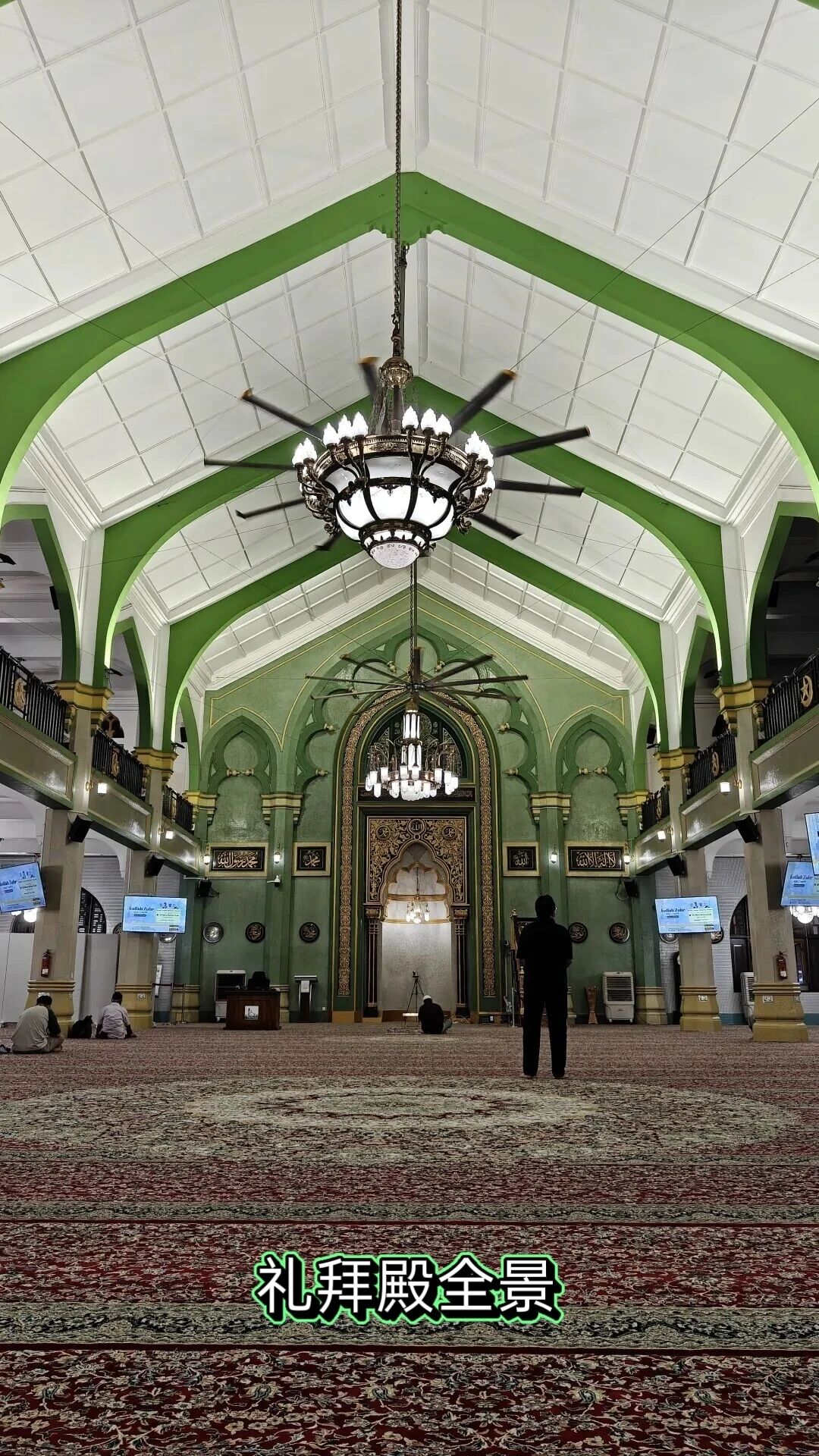
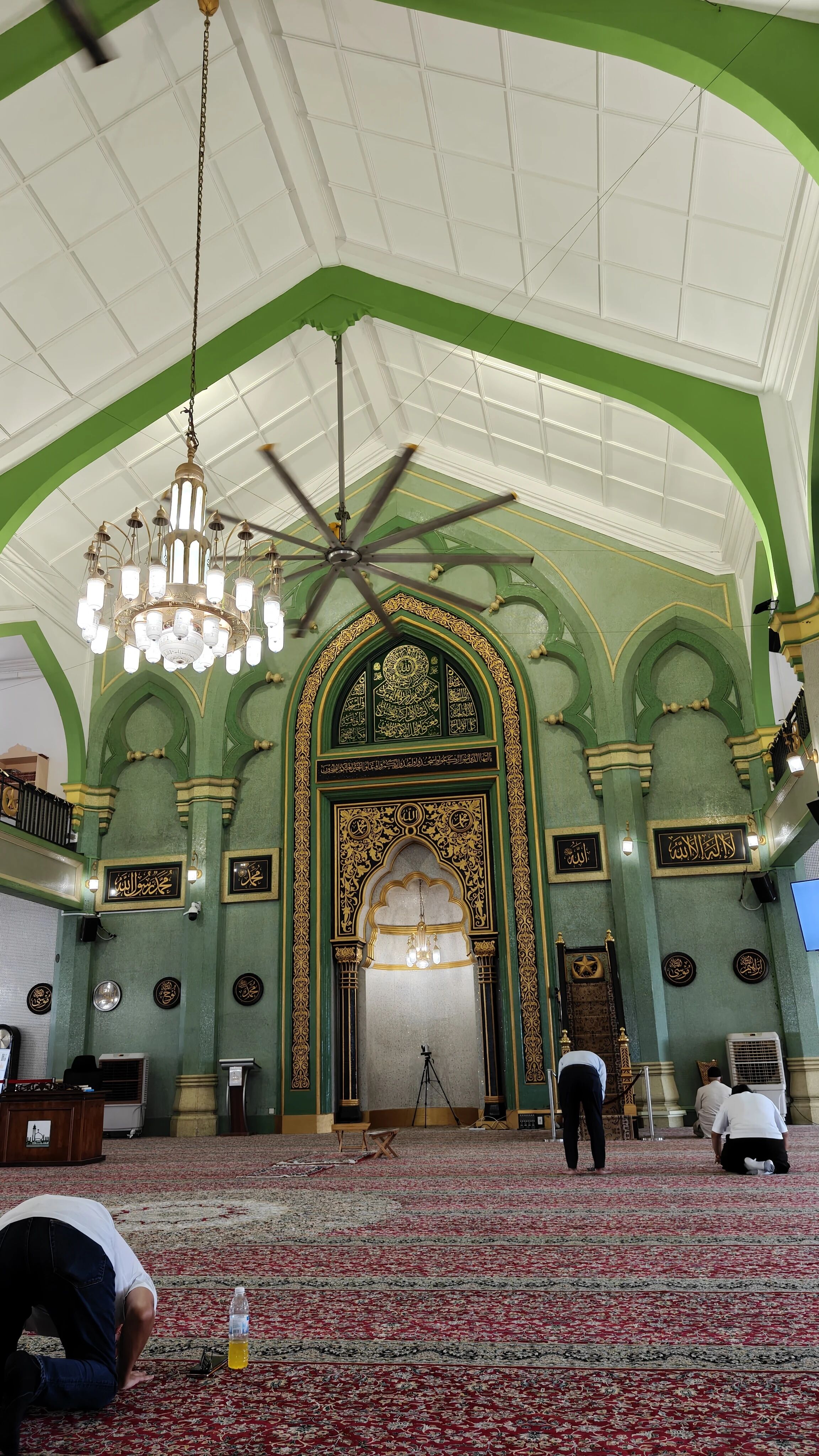
The prayer hall has a high ceiling, which makes sense for a tropical area to help with cooling. It is different from our hometown in the Northwest, where buildings need to keep the cold out. I feel like the mosques in the Northwest usually have very cramped, low ceilings.
I also noticed this place is clearly well-funded. There is a row of LCD TVs playing lectures and announcements for upcoming public events on a loop. Big fans were blowing hard, but they only pushed around hot air. It was already the end of the year, yet it was still so hot.
I actually saw another mosque in Singapore called the Temenggong Mosque, which is connected to the person who founded this one. I didn't have time to visit it, though. I will take you all to see it next time I am in Singapore. view all
Summary: This Singapore Muslim travel guide revisits Sultan Mosque, one of the city's best-known mosque landmarks. It keeps the author's update note, mosque visit details, and historic prayer-hall context from the original article.
I have posted about this place before, but this is an update to my previous content.
In Chinese, both the African country Sudan (which has a flag that looks like Palestine's) and the Islamic royal title Sultan are transliterated using the same two characters, 'Sudan'.
Although Sudan is a Muslim-majority country, Sudan and sultan are actually two different words. Would it be better to use a different character for the latter when transliterating?
The Sultan in Sultan Mosque has no direct connection to the country of Sudan thousands of miles away; this Sultan refers to the Sultan of Johor, whose name was Tengku Hussein.
In 1819, British colonial official Stamford Raffles landed in Singapore and signed a treaty with the local ruler Temenggong Abdul Rahman and Sultan Hussein of Johor. In exchange for an annual payment and the allocation of the Kampong Glam area, the British were granted permission to establish a base on the island.
Following this, a large number of Muslims from the Malay Archipelago moved here to follow the Sultan and the Temenggong. Between 1824 and 1826, Sultan Tengku Hussein built a mosque within the palace grounds with funding from the British. As Singapore became a center for Islamic commerce and culture, the old mosque gradually became too small to meet the needs of the community.
In 1924, the authorities approved the reconstruction of the mosque on the original site, and the new building was completed in 1928. Sultan Mosque has remained largely unchanged since then and was designated a Singapore national monument in 1975.
When I visited this mosque, I found they had set visiting hours for tourists and even seemed to have people there to explain things. I didn't follow the tourist route, though. I went straight to the ablution room (wudu room) and then into the prayer hall.
The prayer hall has a high ceiling, which makes sense for a tropical area to help with cooling. It is different from our hometown in the Northwest, where buildings need to keep the cold out. I feel like the mosques in the Northwest usually have very cramped, low ceilings.
I also noticed this place is clearly well-funded. There is a row of LCD TVs playing lectures and announcements for upcoming public events on a loop. Big fans were blowing hard, but they only pushed around hot air. It was already the end of the year, yet it was still so hot.
I actually saw another mosque in Singapore called the Temenggong Mosque, which is connected to the person who founded this one. I didn't have time to visit it, though. I will take you all to see it next time I am in Singapore. view all
Reposted from the web
Summary: This Singapore Muslim travel guide revisits Sultan Mosque, one of the city's best-known mosque landmarks. It keeps the author's update note, mosque visit details, and historic prayer-hall context from the original article.
I have posted about this place before, but this is an update to my previous content.
In Chinese, both the African country Sudan (which has a flag that looks like Palestine's) and the Islamic royal title Sultan are transliterated using the same two characters, 'Sudan'.
Although Sudan is a Muslim-majority country, Sudan and sultan are actually two different words. Would it be better to use a different character for the latter when transliterating?
The Sultan in Sultan Mosque has no direct connection to the country of Sudan thousands of miles away; this Sultan refers to the Sultan of Johor, whose name was Tengku Hussein.
In 1819, British colonial official Stamford Raffles landed in Singapore and signed a treaty with the local ruler Temenggong Abdul Rahman and Sultan Hussein of Johor. In exchange for an annual payment and the allocation of the Kampong Glam area, the British were granted permission to establish a base on the island.
Following this, a large number of Muslims from the Malay Archipelago moved here to follow the Sultan and the Temenggong. Between 1824 and 1826, Sultan Tengku Hussein built a mosque within the palace grounds with funding from the British. As Singapore became a center for Islamic commerce and culture, the old mosque gradually became too small to meet the needs of the community.
In 1924, the authorities approved the reconstruction of the mosque on the original site, and the new building was completed in 1928. Sultan Mosque has remained largely unchanged since then and was designated a Singapore national monument in 1975.
When I visited this mosque, I found they had set visiting hours for tourists and even seemed to have people there to explain things. I didn't follow the tourist route, though. I went straight to the ablution room (wudu room) and then into the prayer hall.
The prayer hall has a high ceiling, which makes sense for a tropical area to help with cooling. It is different from our hometown in the Northwest, where buildings need to keep the cold out. I feel like the mosques in the Northwest usually have very cramped, low ceilings.
I also noticed this place is clearly well-funded. There is a row of LCD TVs playing lectures and announcements for upcoming public events on a loop. Big fans were blowing hard, but they only pushed around hot air. It was already the end of the year, yet it was still so hot.
I actually saw another mosque in Singapore called the Temenggong Mosque, which is connected to the person who founded this one. I didn't have time to visit it, though. I will take you all to see it next time I am in Singapore.
Summary: This Singapore Muslim travel guide revisits Sultan Mosque, one of the city's best-known mosque landmarks. It keeps the author's update note, mosque visit details, and historic prayer-hall context from the original article.
I have posted about this place before, but this is an update to my previous content.
In Chinese, both the African country Sudan (which has a flag that looks like Palestine's) and the Islamic royal title Sultan are transliterated using the same two characters, 'Sudan'.
Although Sudan is a Muslim-majority country, Sudan and sultan are actually two different words. Would it be better to use a different character for the latter when transliterating?
The Sultan in Sultan Mosque has no direct connection to the country of Sudan thousands of miles away; this Sultan refers to the Sultan of Johor, whose name was Tengku Hussein.
In 1819, British colonial official Stamford Raffles landed in Singapore and signed a treaty with the local ruler Temenggong Abdul Rahman and Sultan Hussein of Johor. In exchange for an annual payment and the allocation of the Kampong Glam area, the British were granted permission to establish a base on the island.
Following this, a large number of Muslims from the Malay Archipelago moved here to follow the Sultan and the Temenggong. Between 1824 and 1826, Sultan Tengku Hussein built a mosque within the palace grounds with funding from the British. As Singapore became a center for Islamic commerce and culture, the old mosque gradually became too small to meet the needs of the community.
In 1924, the authorities approved the reconstruction of the mosque on the original site, and the new building was completed in 1928. Sultan Mosque has remained largely unchanged since then and was designated a Singapore national monument in 1975.
When I visited this mosque, I found they had set visiting hours for tourists and even seemed to have people there to explain things. I didn't follow the tourist route, though. I went straight to the ablution room (wudu room) and then into the prayer hall.
The prayer hall has a high ceiling, which makes sense for a tropical area to help with cooling. It is different from our hometown in the Northwest, where buildings need to keep the cold out. I feel like the mosques in the Northwest usually have very cramped, low ceilings.
I also noticed this place is clearly well-funded. There is a row of LCD TVs playing lectures and announcements for upcoming public events on a loop. Big fans were blowing hard, but they only pushed around hot air. It was already the end of the year, yet it was still so hot.
I actually saw another mosque in Singapore called the Temenggong Mosque, which is connected to the person who founded this one. I didn't have time to visit it, though. I will take you all to see it next time I am in Singapore.
Muslim Travel Guide Singapore: Sultan Mosque, Kampong Glam, Prayer Hall and Muslim Heritage
Articles • yusuf908 posted the article • 0 comments • 228 views • 2026-05-23 22:23
Reposted from the web
Summary: This Singapore Muslim travel guide visits Sultan Mosque around Arab Street and Kampong Glam, covering the golden domes, Turkish halal restaurants nearby, the prayer hall, mihrab design, prayer time screens, humility reminders, and visible signs of daily worship.
The Sultan Mosque is a symbol of Singapore's multiculturalism, and this mosque is indispensable in tourist brochures. So I went here on the first day I landed in Singapore.
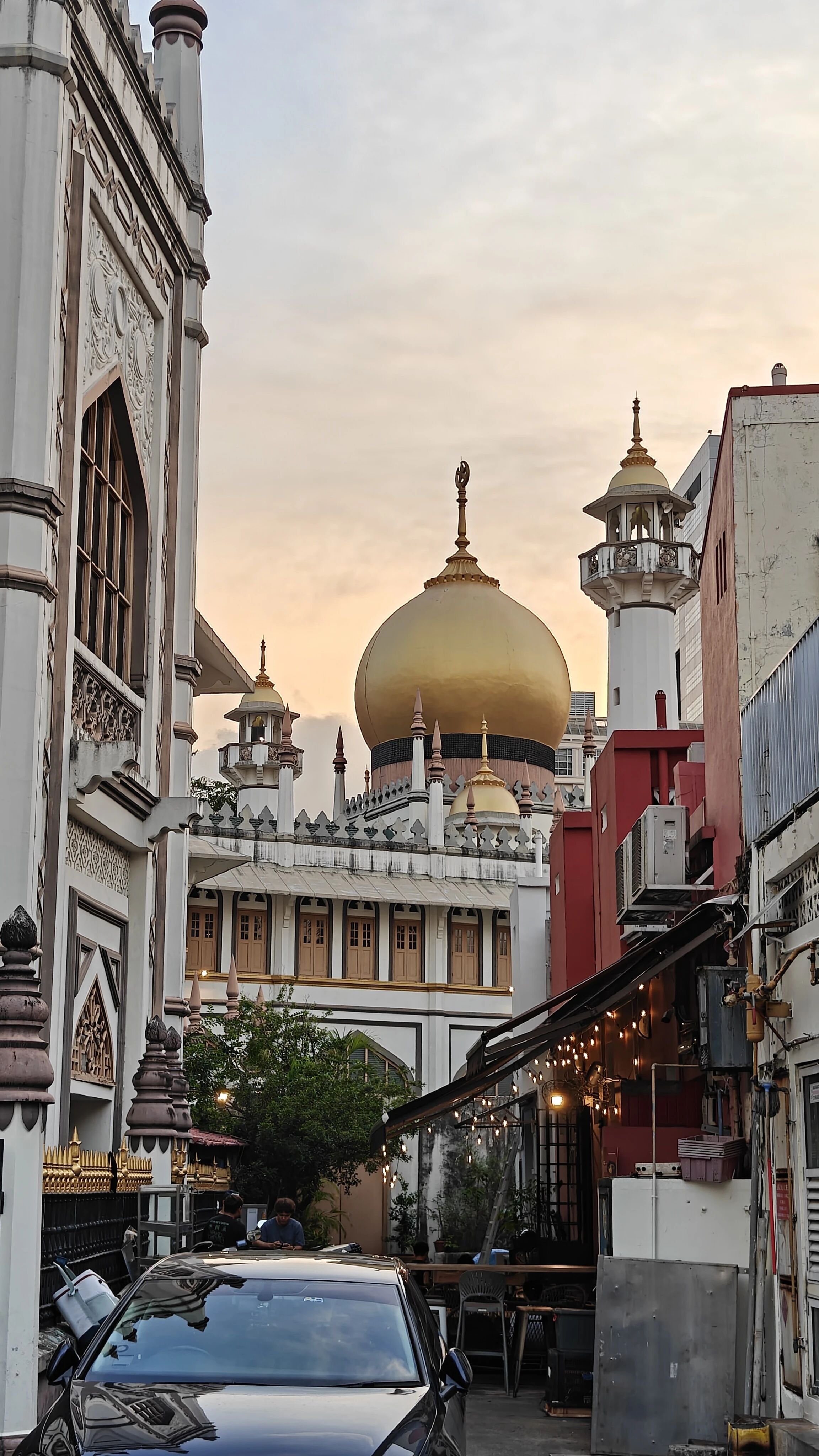
From the main road, you can see that the Sultan Mosque actually has two exaggeratedly large golden domes (Picture 4), one in front of the other and about the same size. There is a minaret on the left and right of the two large domes, a total of four.
Before I came here, I thought there was only one dome, because it couldn’t be clearly seen from the photos in the travel guide. Seeing it in person really matters.
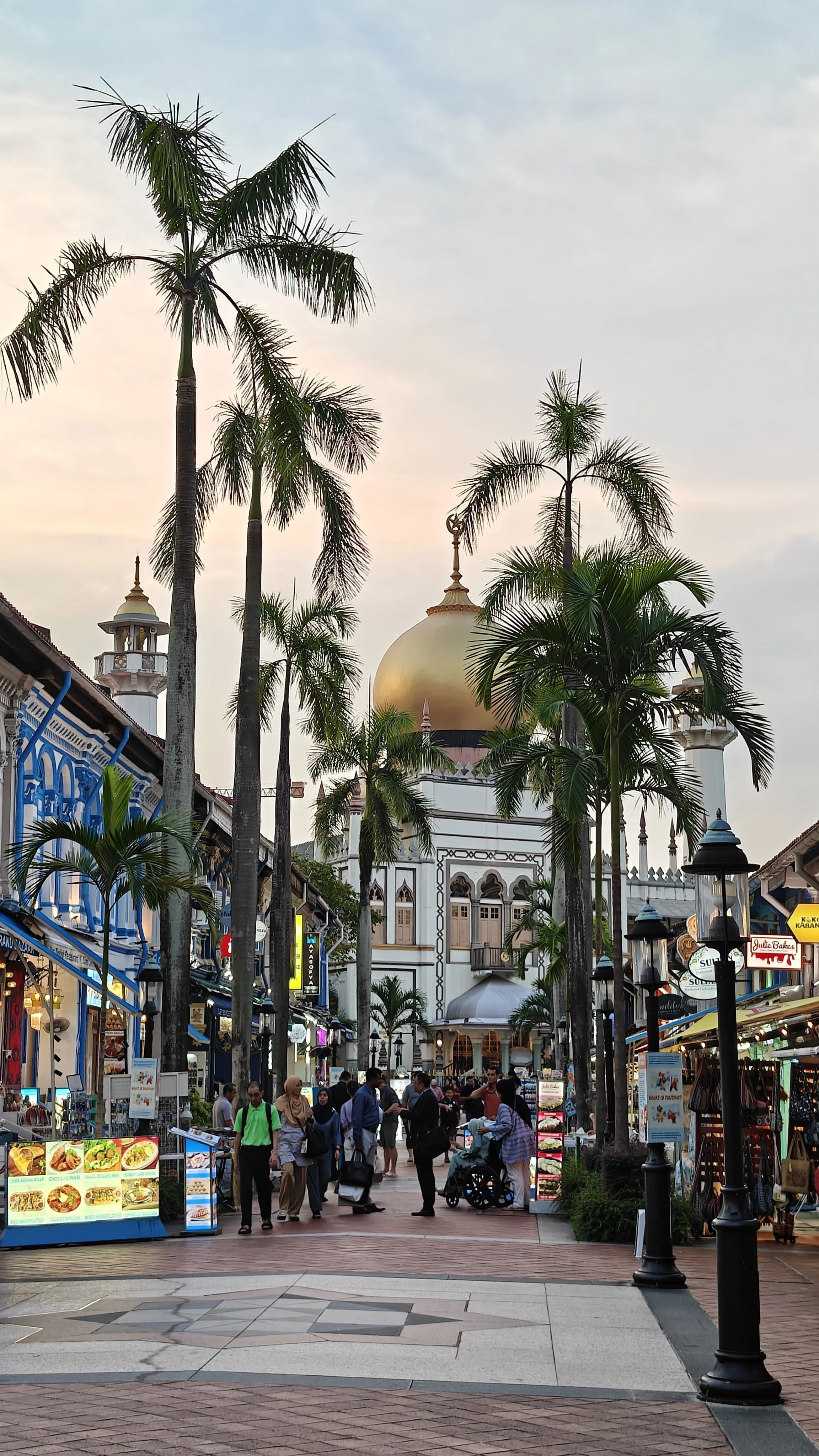
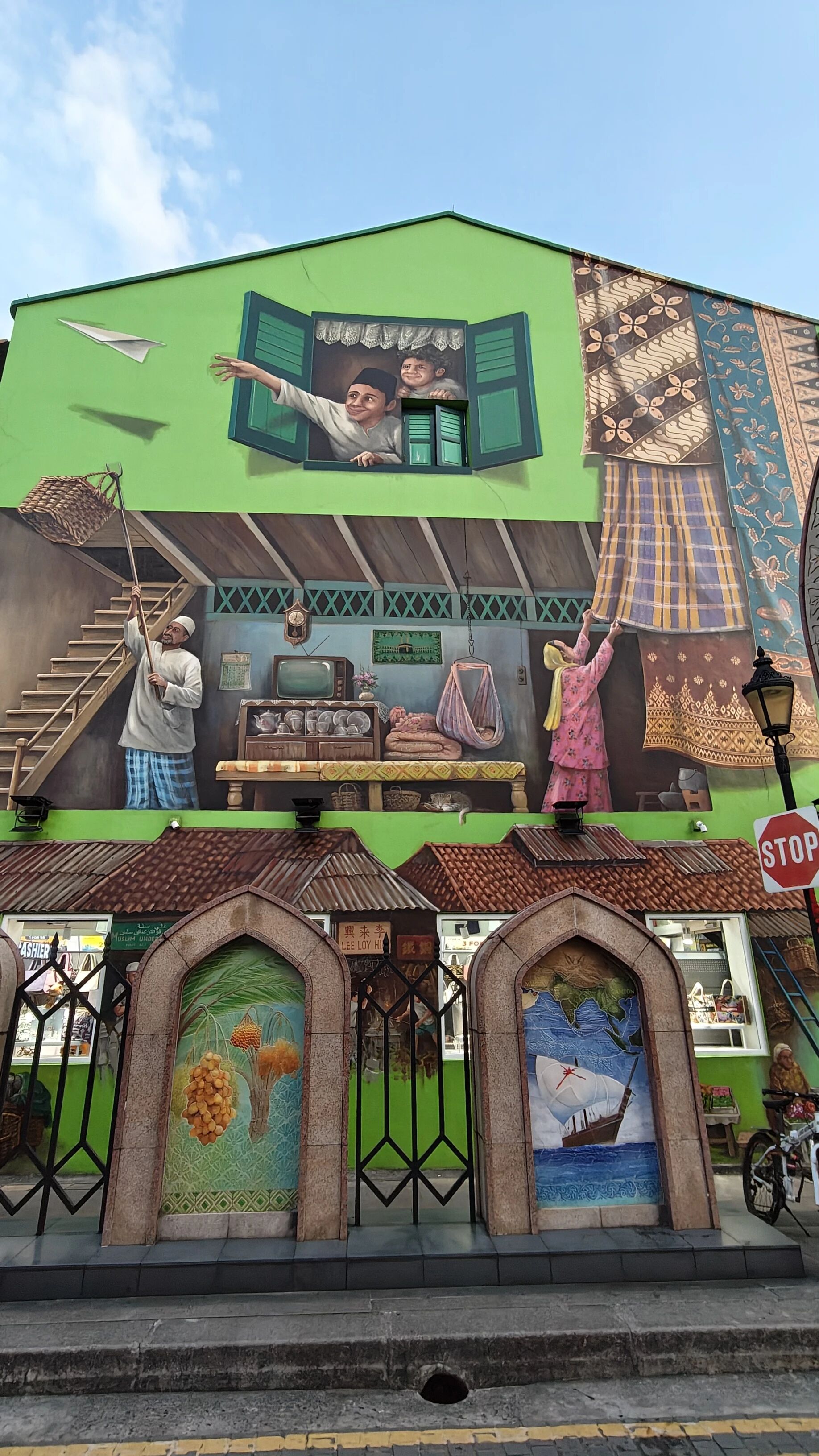
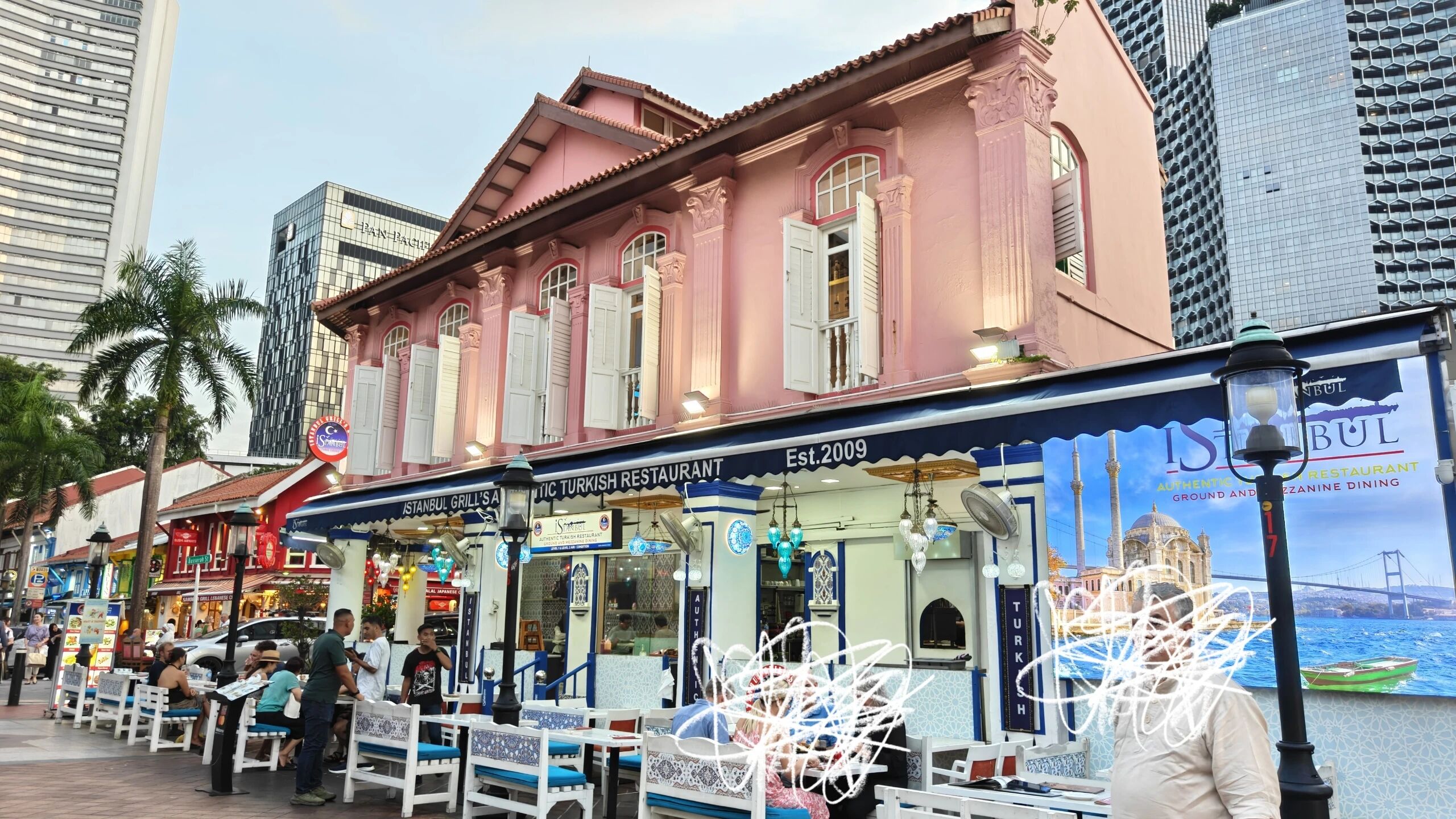
The entrance to the mosque (Picture 6) is not on the side of the road, but in a pedestrian street called Arab Street. There are murals depicting Malay family life at the entrance (Picture 7). There are many Turkish halal restaurants on the street (Picture 8), as well as souvenir shops. You can buy a refrigerator magnet with two Singapore dollars (10 yuan).
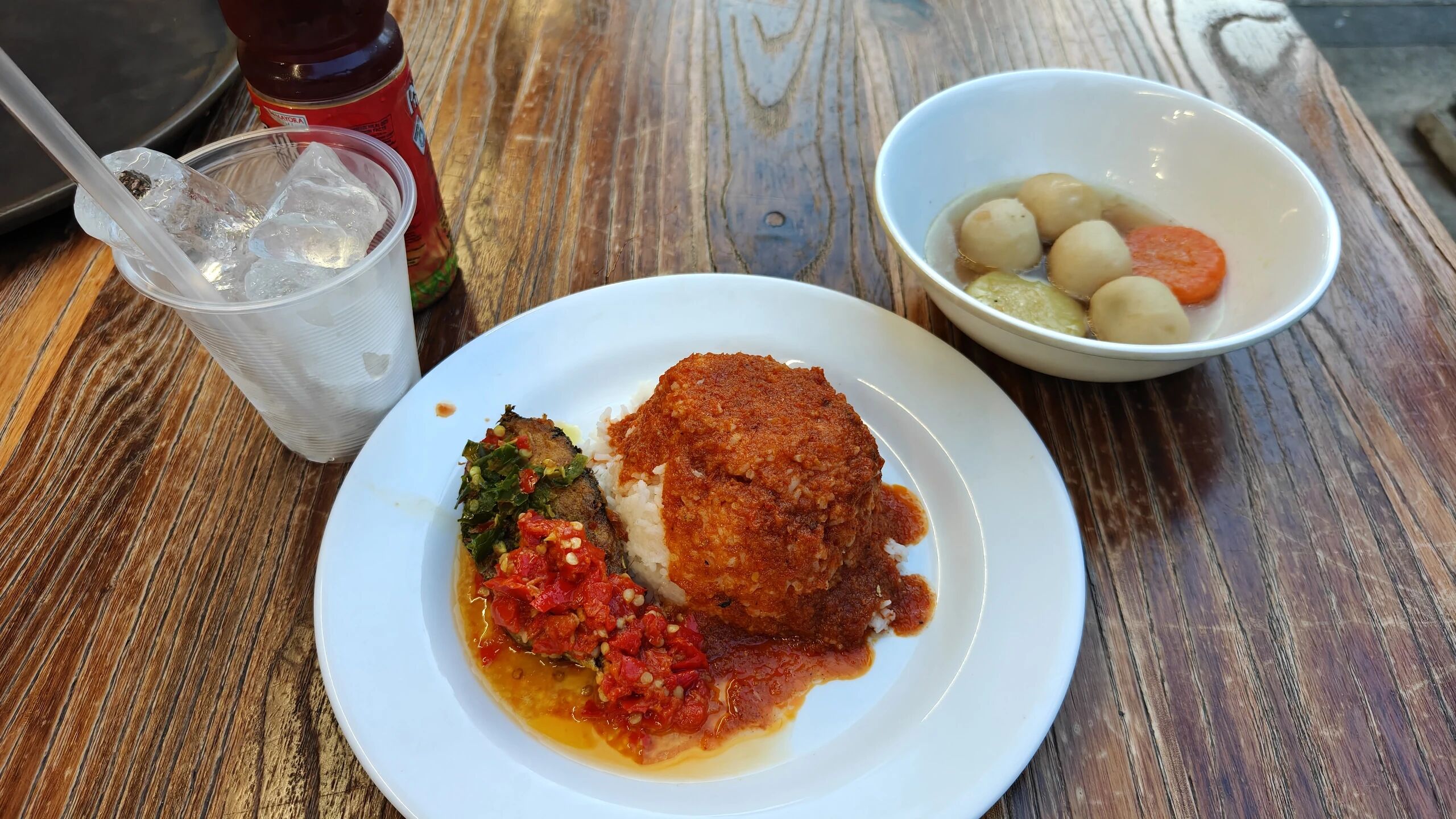
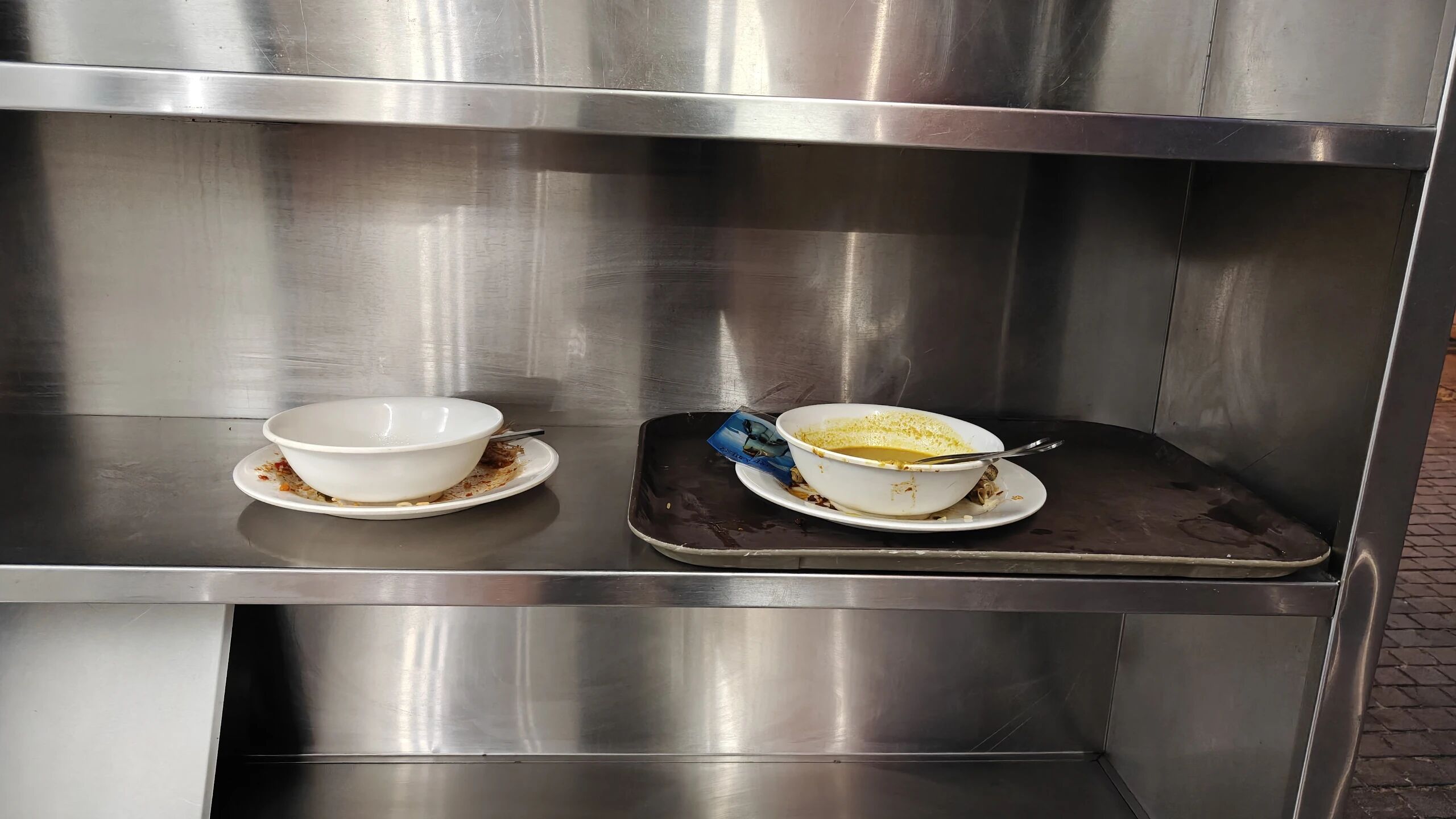
As dusk approached, I found an Indonesian restaurant and ordered a portion of fish balls, a piece of fish, a portion of rice, and a bottle of herbal tea, which cost about fifty yuan in total (Picture 9). In Singapore, you have to put away your tableware and put it in the designated area after eating (Picture 10).
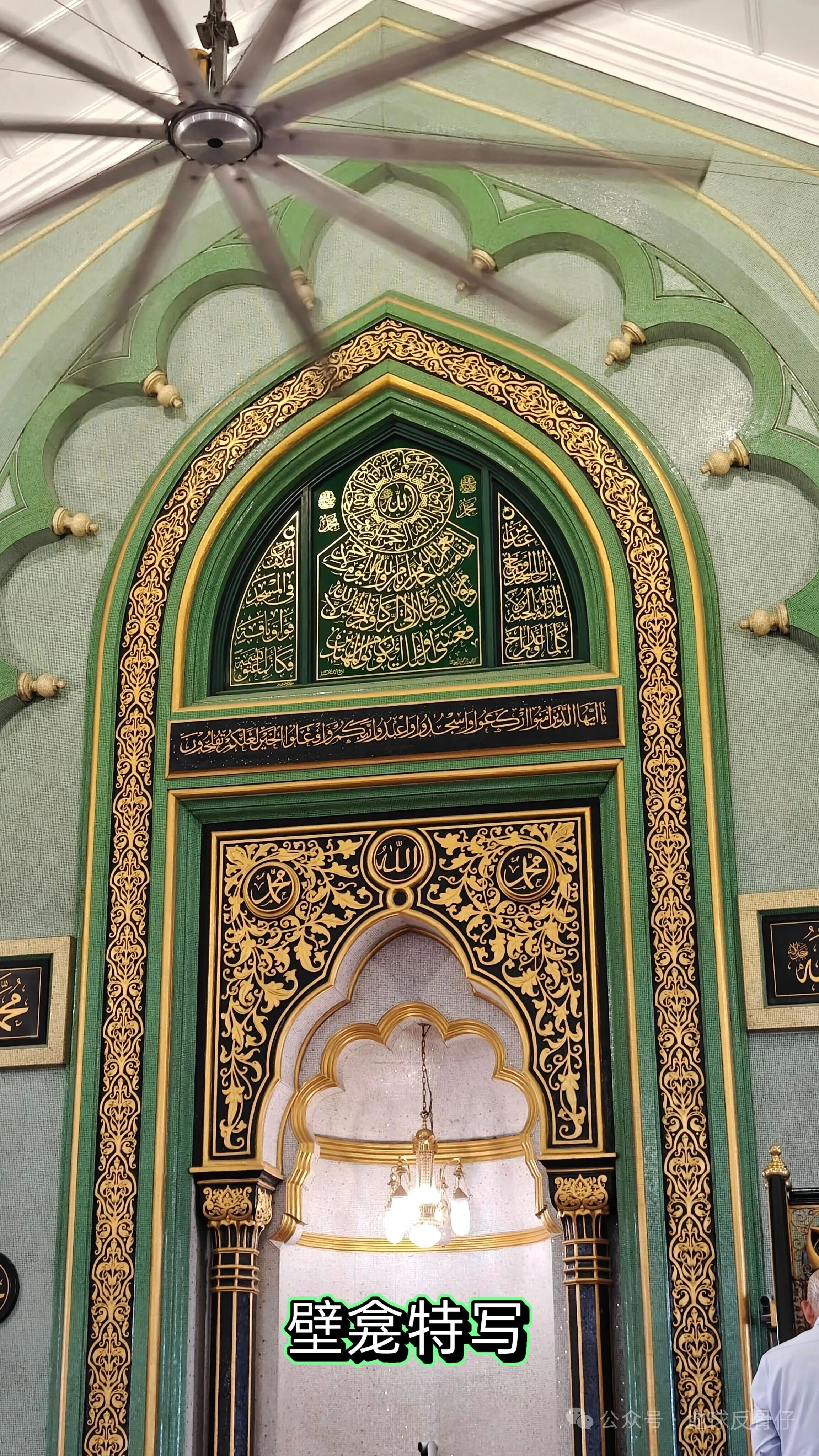
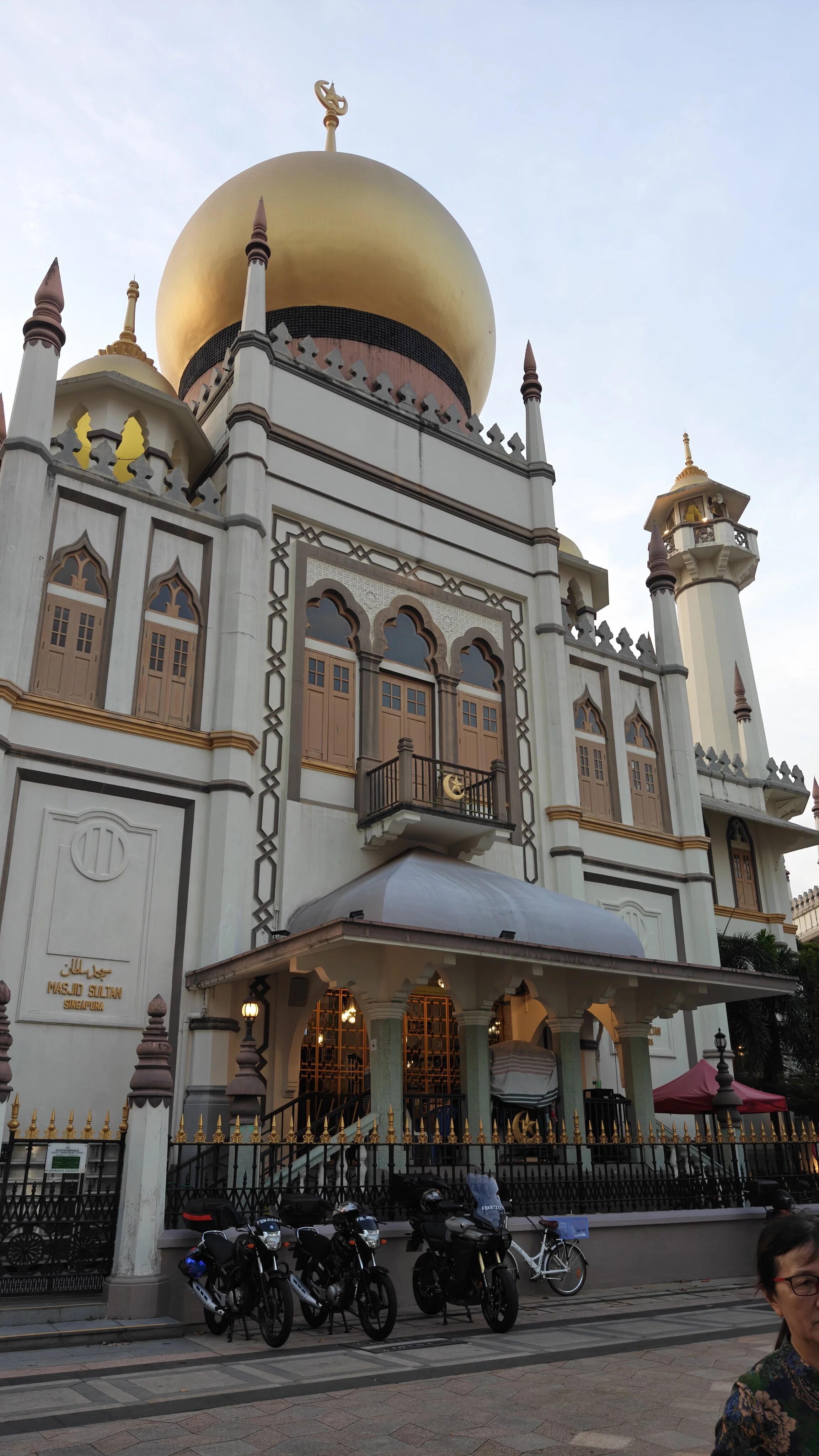
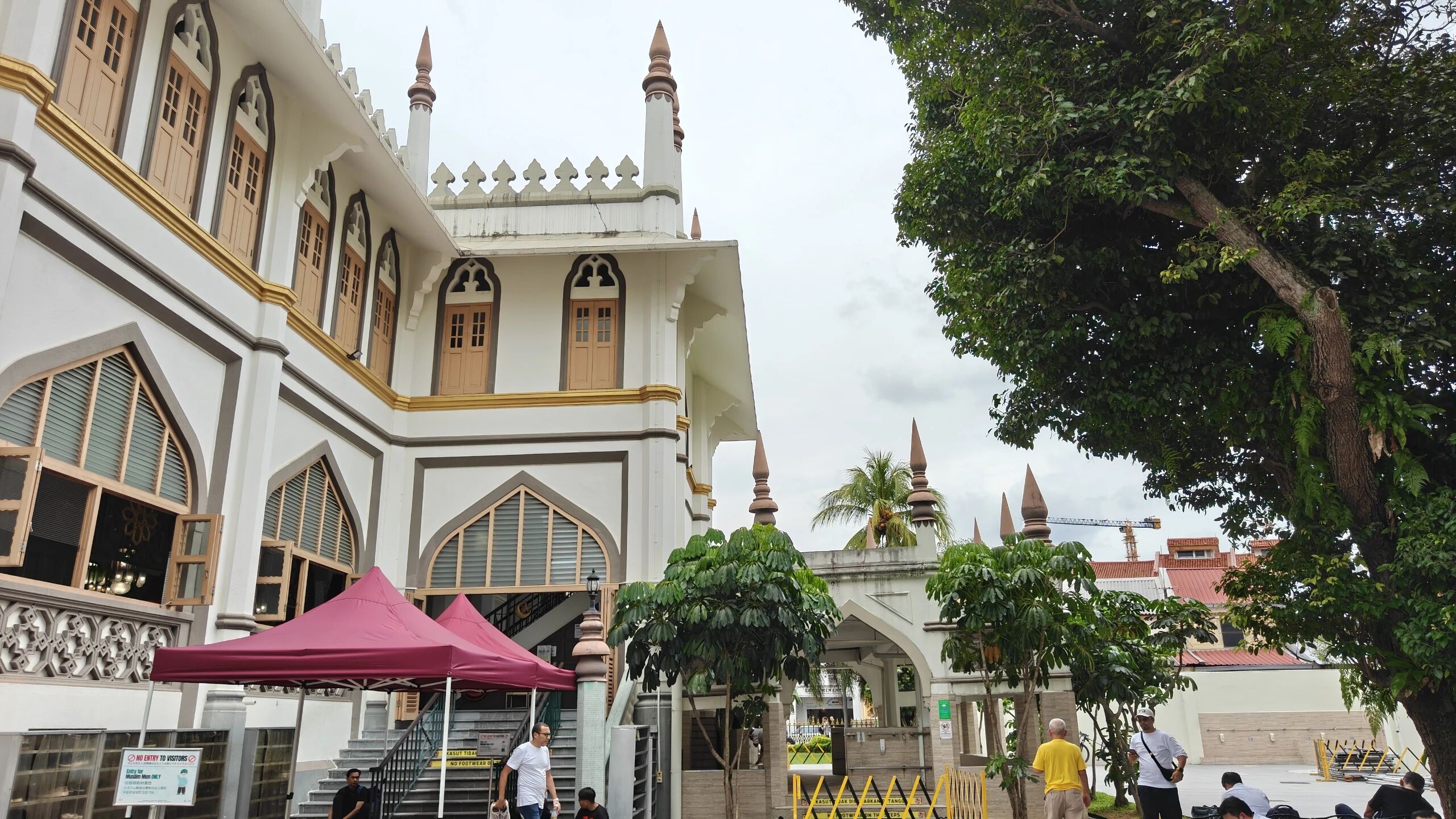
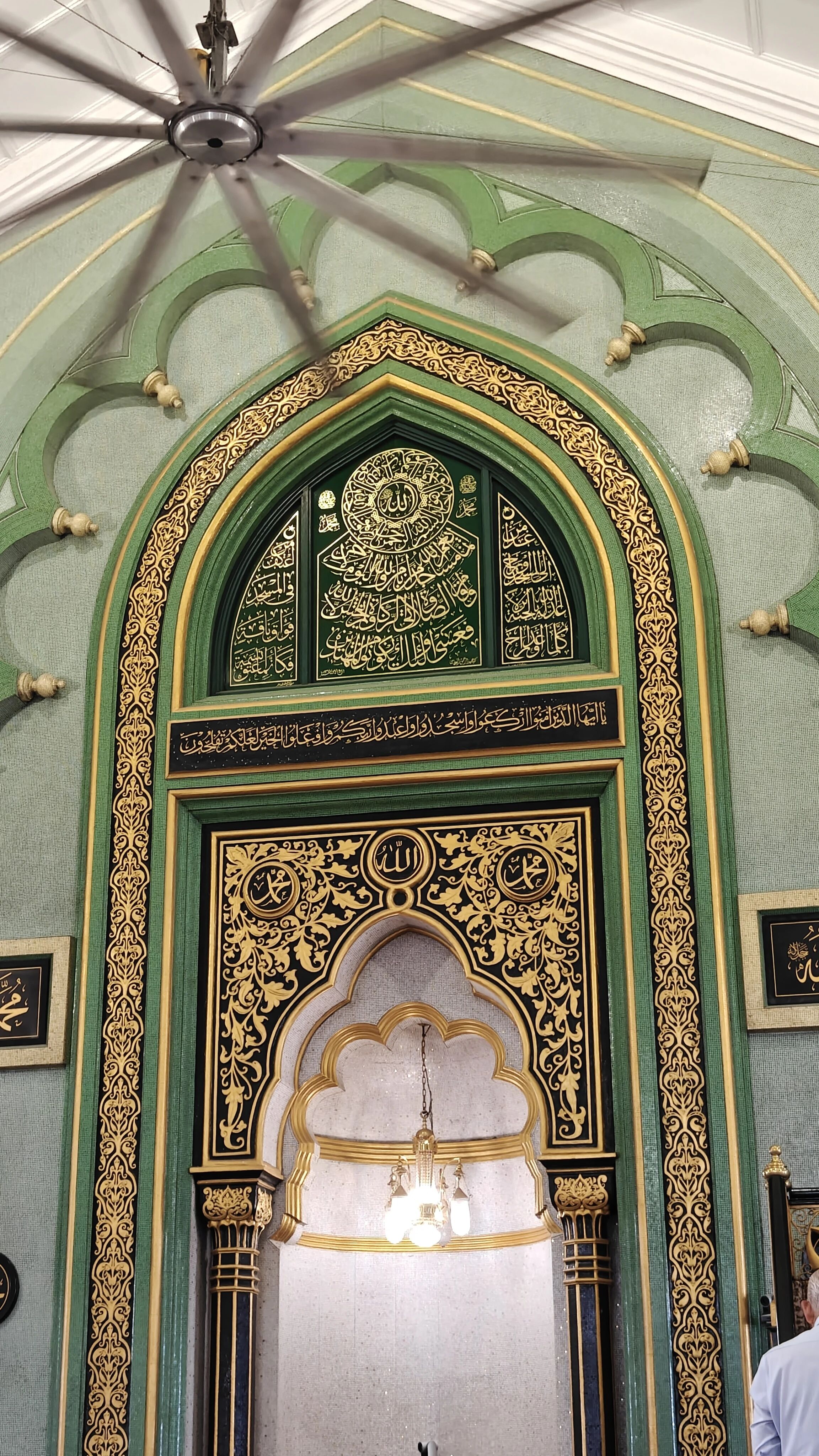
Picture 11 shows the front of the mosque, which is very similar to the back. When entering the prayer hall, you have to enter from the right side. The interior of the prayer hall is quite large and the ceiling is very good. The mihrab niche is also decorated with Malay-style mosaic and leaf patterns, which looks very distinctive (Figures 13 and 14).
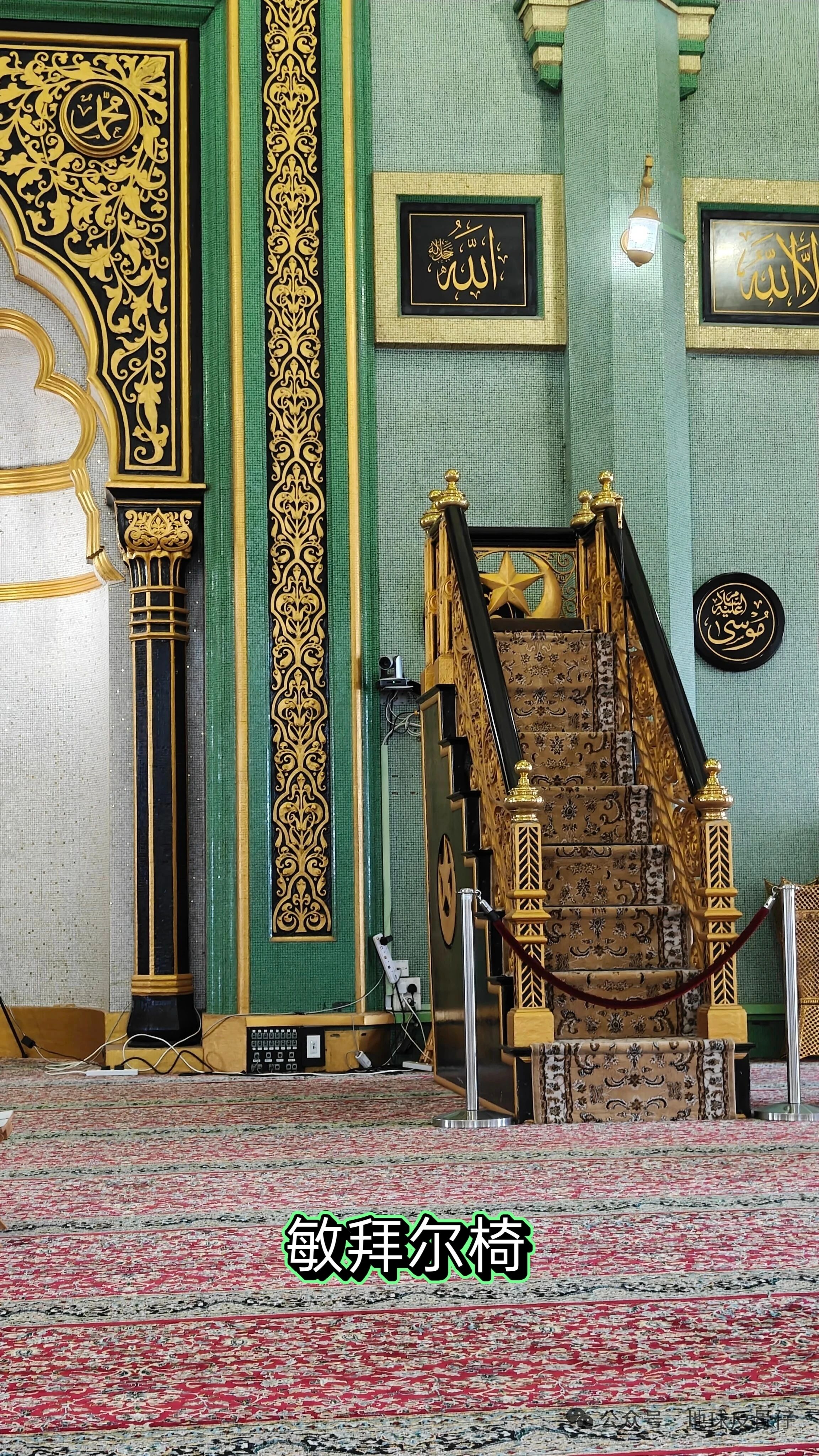
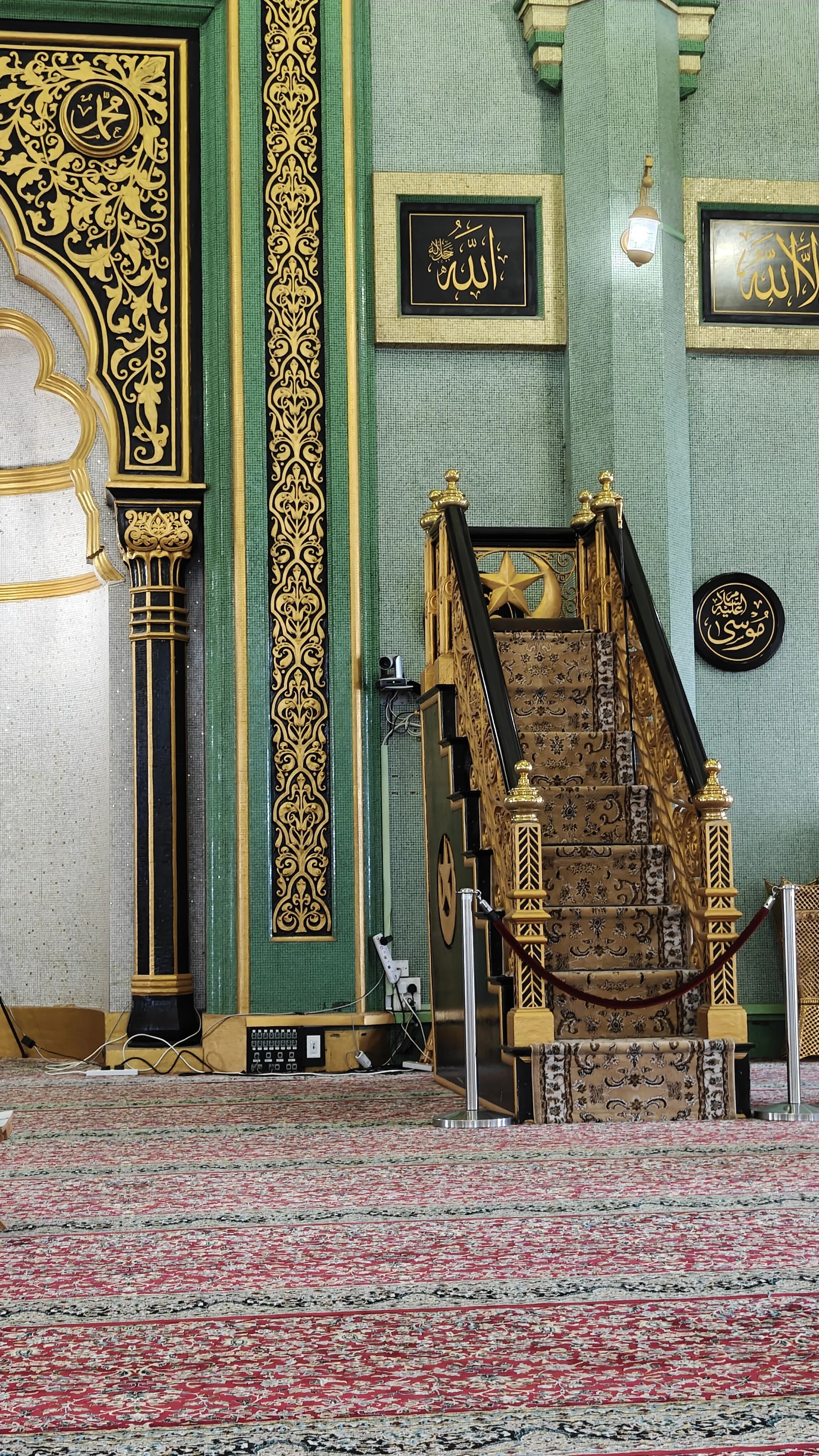
The shape of minbar is relatively simple (Picture 15).
There is also a prayer space on the second floor (Figures 16 and 17).
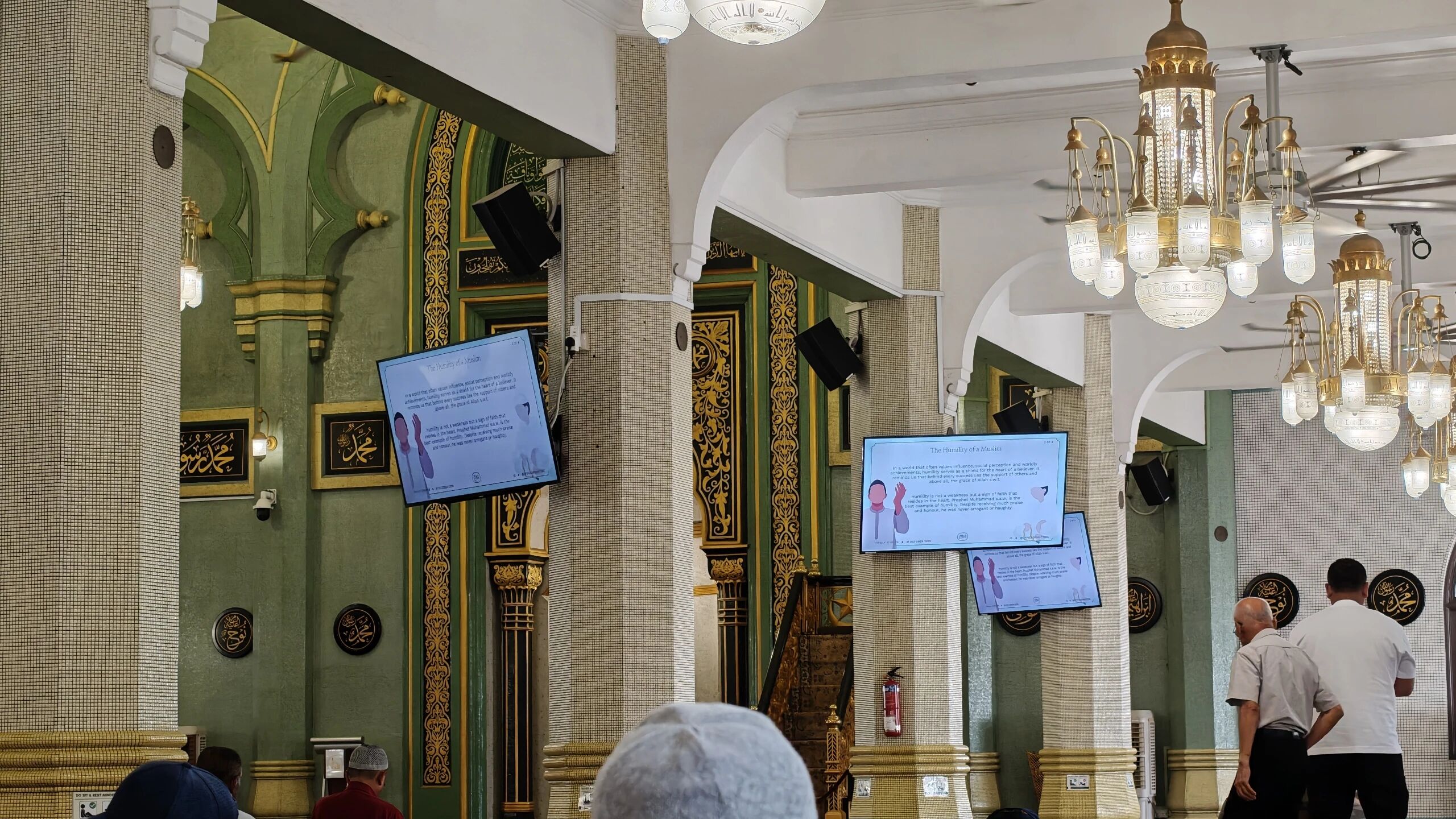
In Singapore's prayer halls, you can often see a display screen, which loops through some notices, recent activities, prayer times, etc. (Figures 18 and 19). The English notices in Picture 19 explain the importance of humility in faith and advocate that believers should be humble.
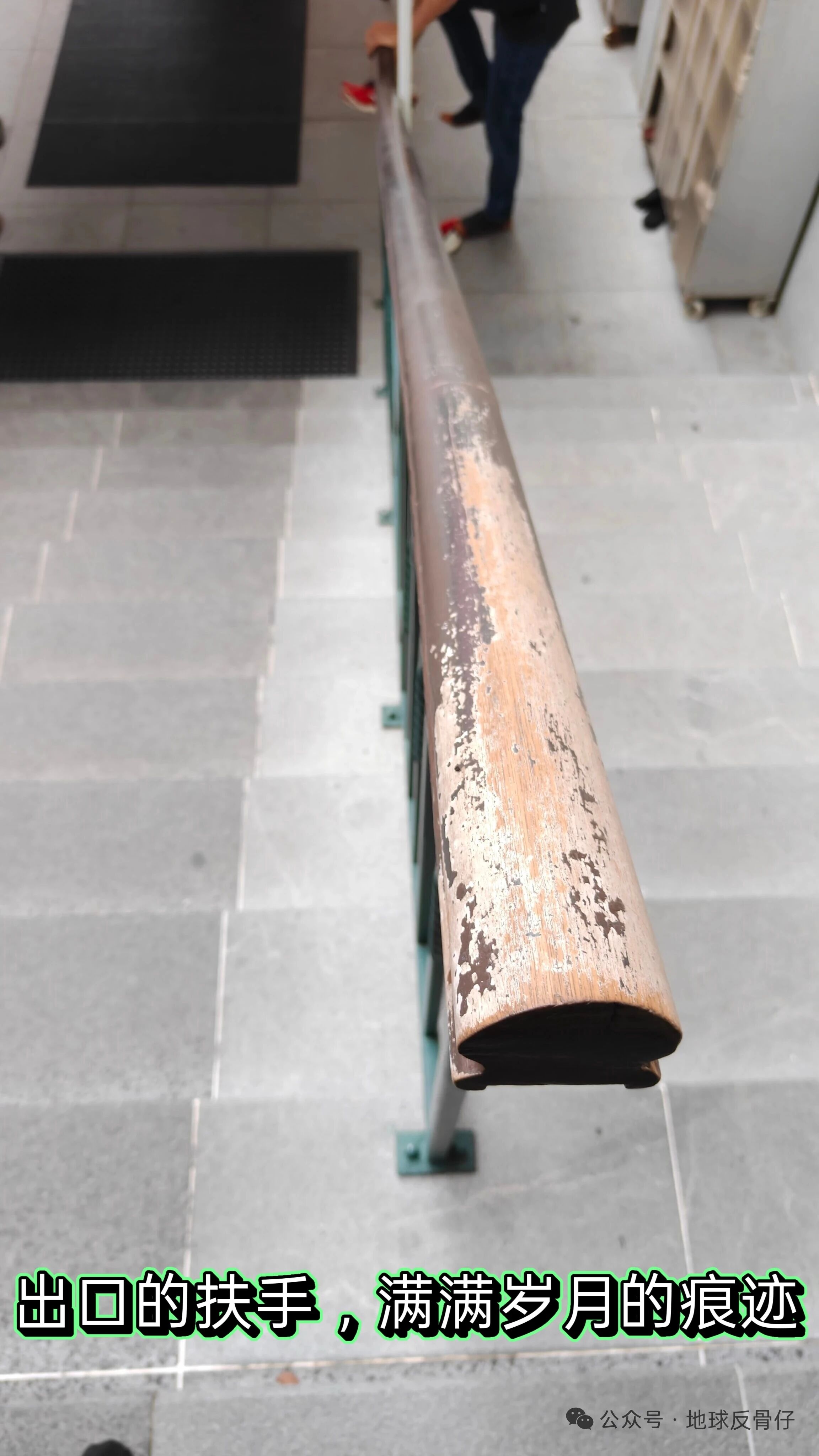
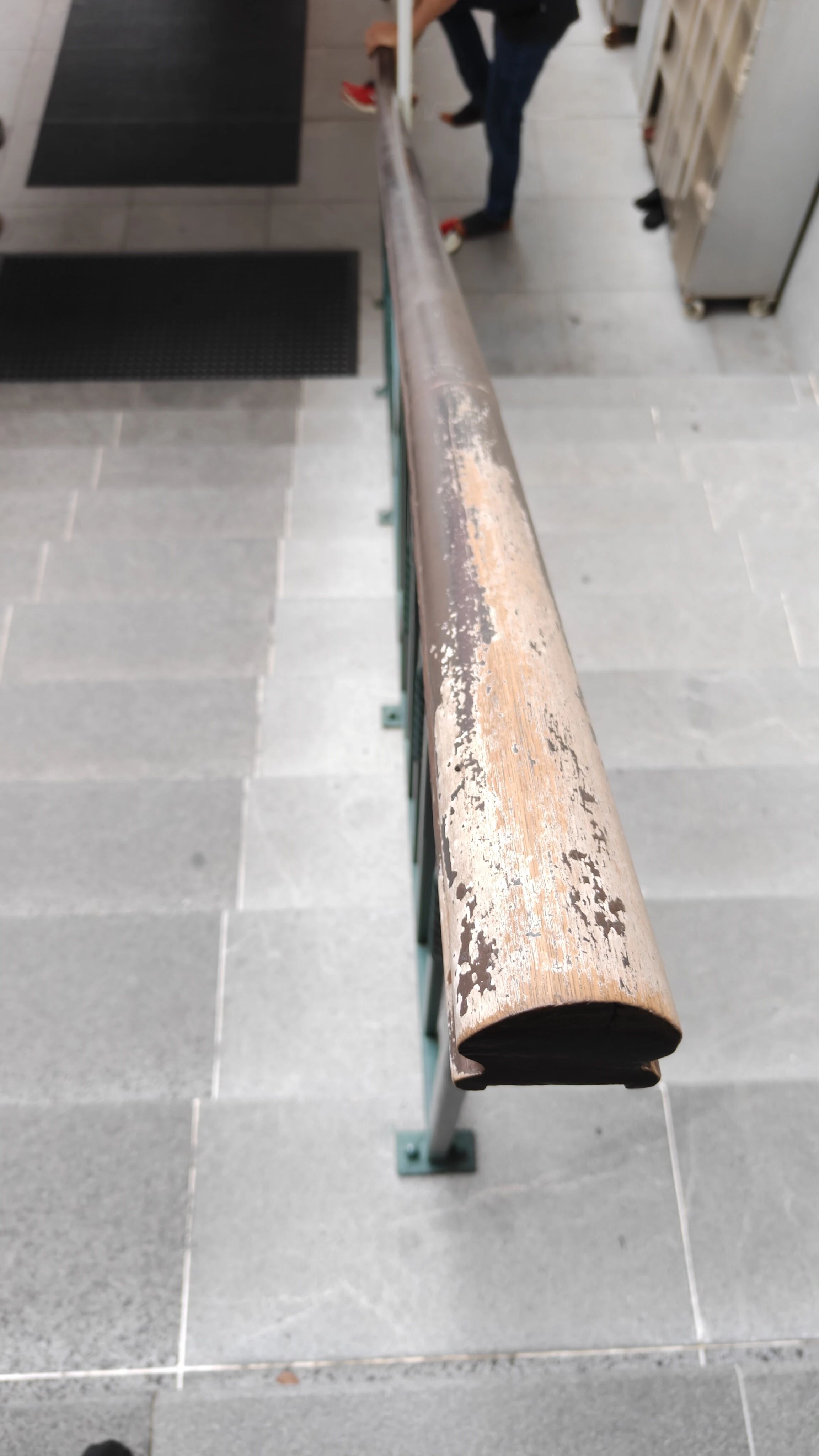
When I left the prayer hall, I noticed that the paint on the handrail on the right hand side had been worn down by worshippers (Picture 20). view all
Summary: This Singapore Muslim travel guide visits Sultan Mosque around Arab Street and Kampong Glam, covering the golden domes, Turkish halal restaurants nearby, the prayer hall, mihrab design, prayer time screens, humility reminders, and visible signs of daily worship.
The Sultan Mosque is a symbol of Singapore's multiculturalism, and this mosque is indispensable in tourist brochures. So I went here on the first day I landed in Singapore.
From the main road, you can see that the Sultan Mosque actually has two exaggeratedly large golden domes (Picture 4), one in front of the other and about the same size. There is a minaret on the left and right of the two large domes, a total of four.
Before I came here, I thought there was only one dome, because it couldn’t be clearly seen from the photos in the travel guide. Seeing it in person really matters.
The entrance to the mosque (Picture 6) is not on the side of the road, but in a pedestrian street called Arab Street. There are murals depicting Malay family life at the entrance (Picture 7). There are many Turkish halal restaurants on the street (Picture 8), as well as souvenir shops. You can buy a refrigerator magnet with two Singapore dollars (10 yuan).
As dusk approached, I found an Indonesian restaurant and ordered a portion of fish balls, a piece of fish, a portion of rice, and a bottle of herbal tea, which cost about fifty yuan in total (Picture 9). In Singapore, you have to put away your tableware and put it in the designated area after eating (Picture 10).
Picture 11 shows the front of the mosque, which is very similar to the back. When entering the prayer hall, you have to enter from the right side. The interior of the prayer hall is quite large and the ceiling is very good. The mihrab niche is also decorated with Malay-style mosaic and leaf patterns, which looks very distinctive (Figures 13 and 14).
The shape of minbar is relatively simple (Picture 15).
There is also a prayer space on the second floor (Figures 16 and 17).
In Singapore's prayer halls, you can often see a display screen, which loops through some notices, recent activities, prayer times, etc. (Figures 18 and 19). The English notices in Picture 19 explain the importance of humility in faith and advocate that believers should be humble.
When I left the prayer hall, I noticed that the paint on the handrail on the right hand side had been worn down by worshippers (Picture 20). view all
Reposted from the web
Summary: This Singapore Muslim travel guide visits Sultan Mosque around Arab Street and Kampong Glam, covering the golden domes, Turkish halal restaurants nearby, the prayer hall, mihrab design, prayer time screens, humility reminders, and visible signs of daily worship.
The Sultan Mosque is a symbol of Singapore's multiculturalism, and this mosque is indispensable in tourist brochures. So I went here on the first day I landed in Singapore.
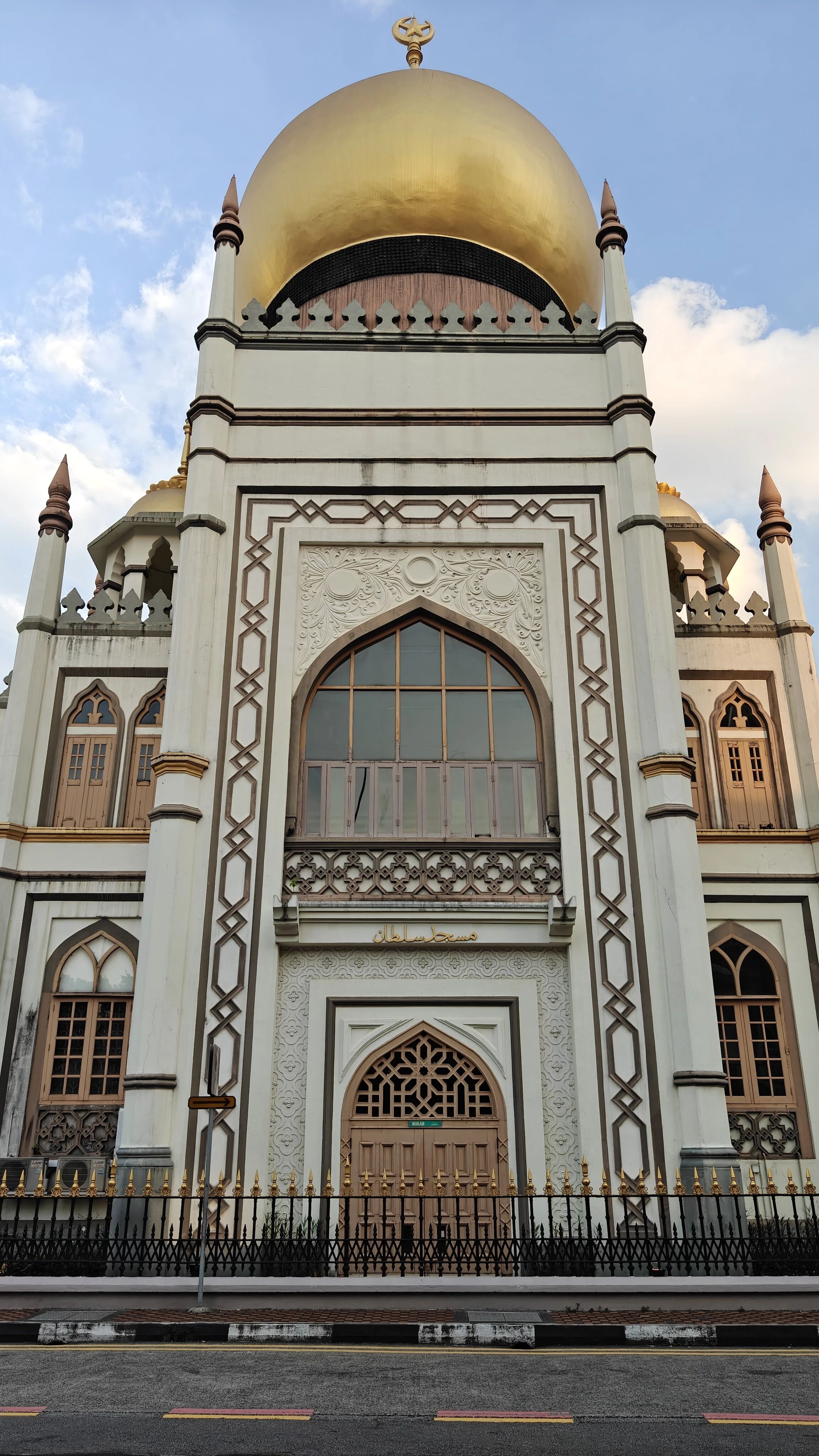
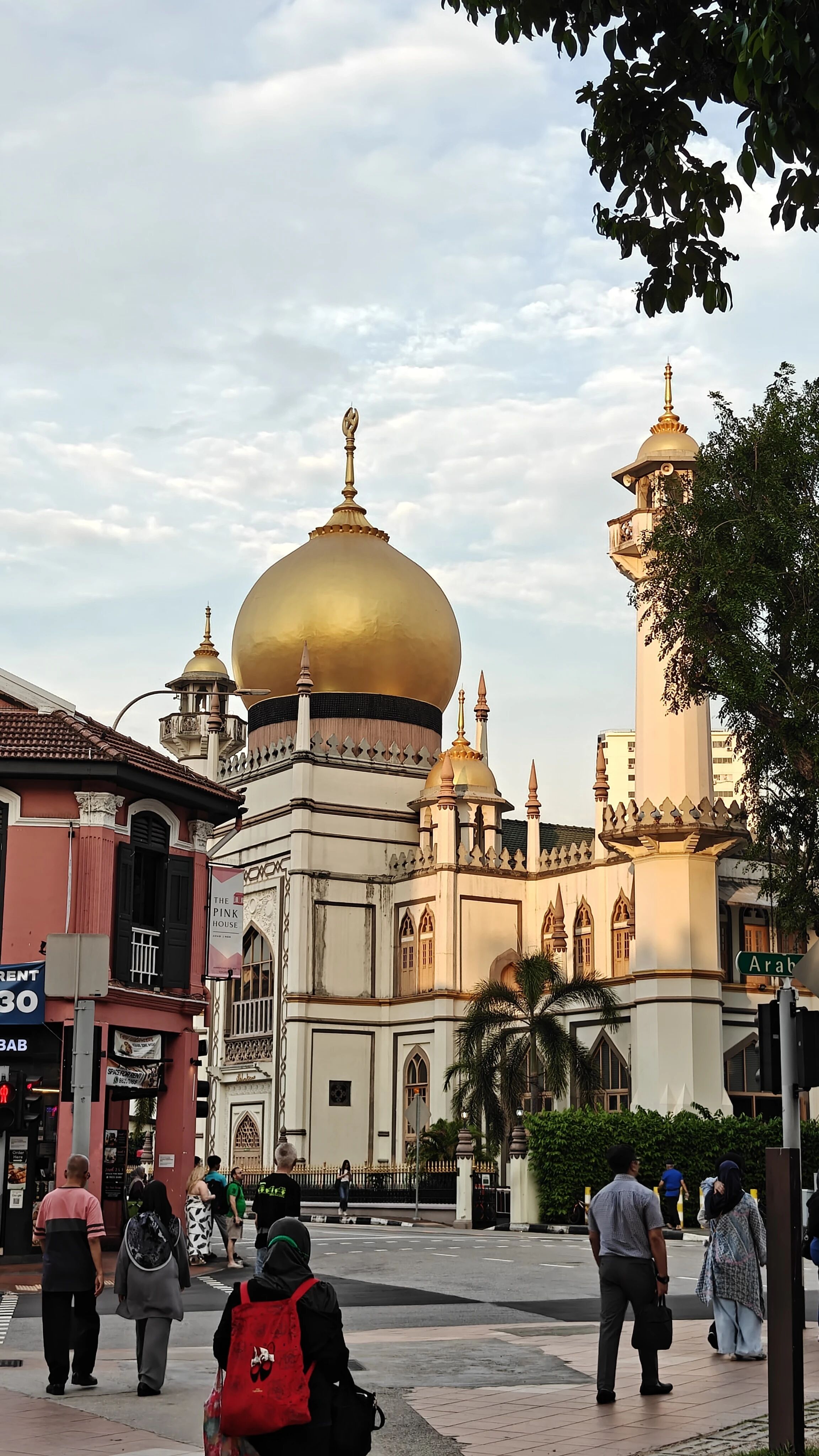
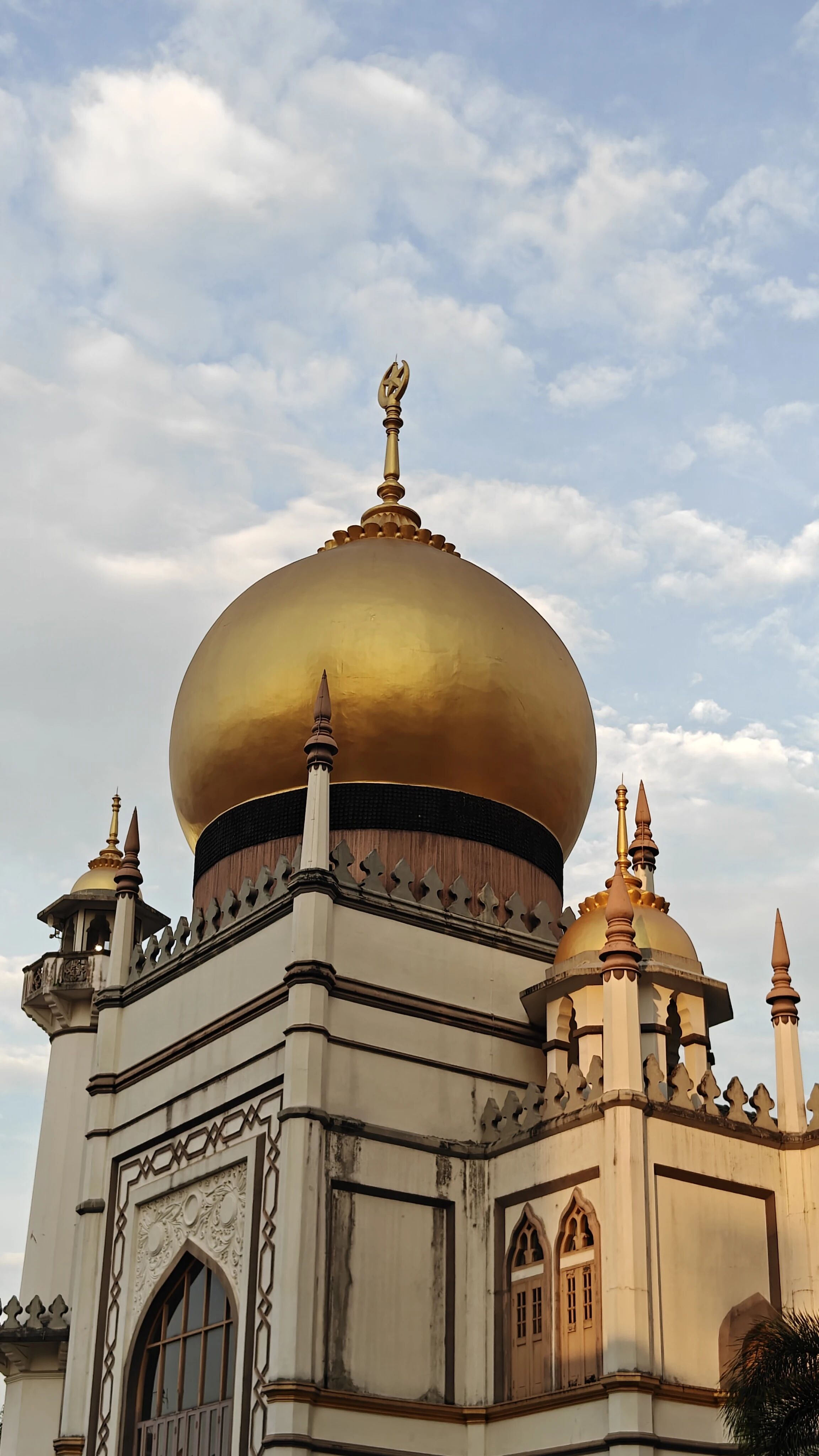
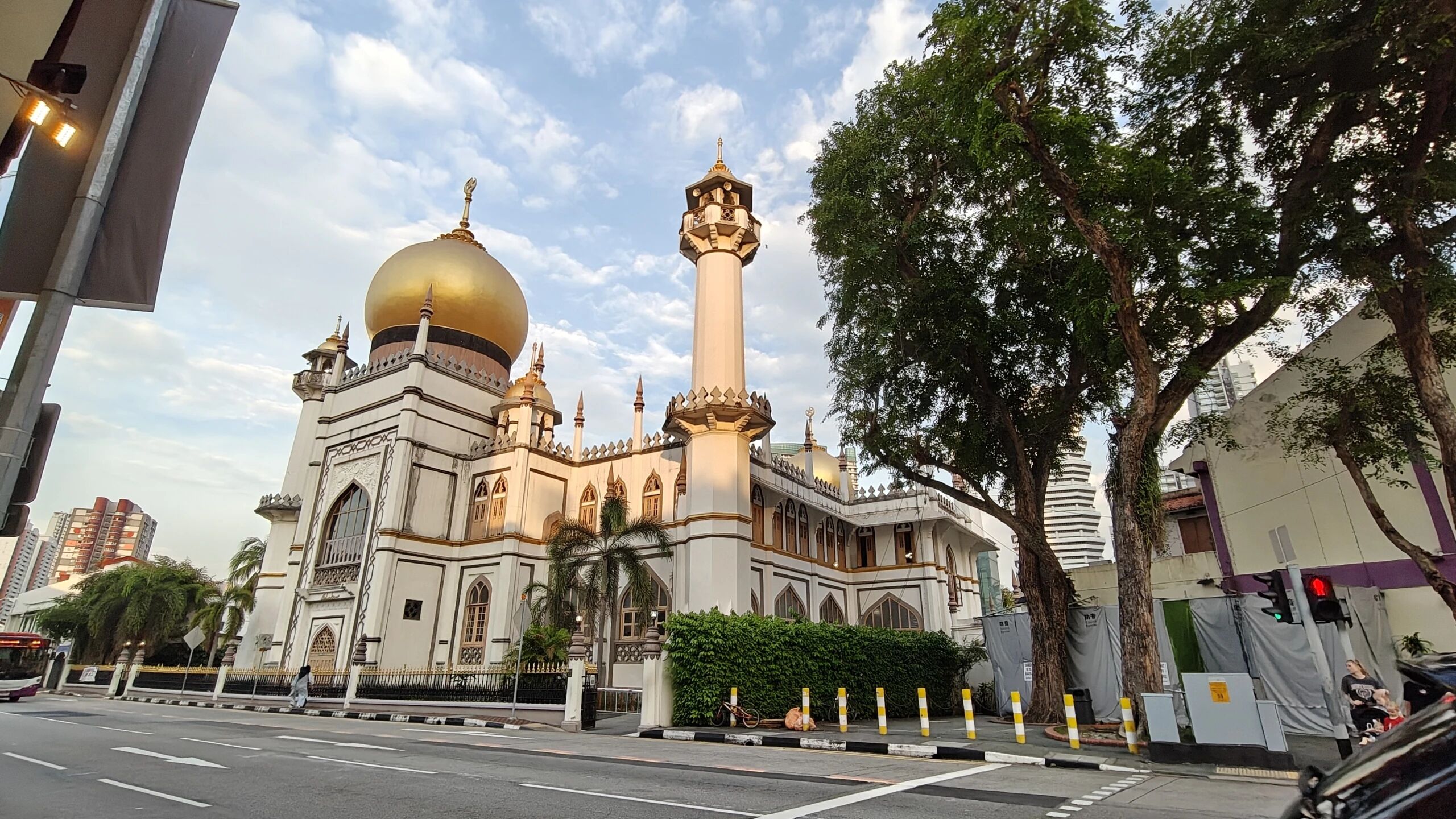
From the main road, you can see that the Sultan Mosque actually has two exaggeratedly large golden domes (Picture 4), one in front of the other and about the same size. There is a minaret on the left and right of the two large domes, a total of four.
Before I came here, I thought there was only one dome, because it couldn’t be clearly seen from the photos in the travel guide. Seeing it in person really matters.
The entrance to the mosque (Picture 6) is not on the side of the road, but in a pedestrian street called Arab Street. There are murals depicting Malay family life at the entrance (Picture 7). There are many Turkish halal restaurants on the street (Picture 8), as well as souvenir shops. You can buy a refrigerator magnet with two Singapore dollars (10 yuan).
As dusk approached, I found an Indonesian restaurant and ordered a portion of fish balls, a piece of fish, a portion of rice, and a bottle of herbal tea, which cost about fifty yuan in total (Picture 9). In Singapore, you have to put away your tableware and put it in the designated area after eating (Picture 10).
Picture 11 shows the front of the mosque, which is very similar to the back. When entering the prayer hall, you have to enter from the right side. The interior of the prayer hall is quite large and the ceiling is very good. The mihrab niche is also decorated with Malay-style mosaic and leaf patterns, which looks very distinctive (Figures 13 and 14).
The shape of minbar is relatively simple (Picture 15).
There is also a prayer space on the second floor (Figures 16 and 17).
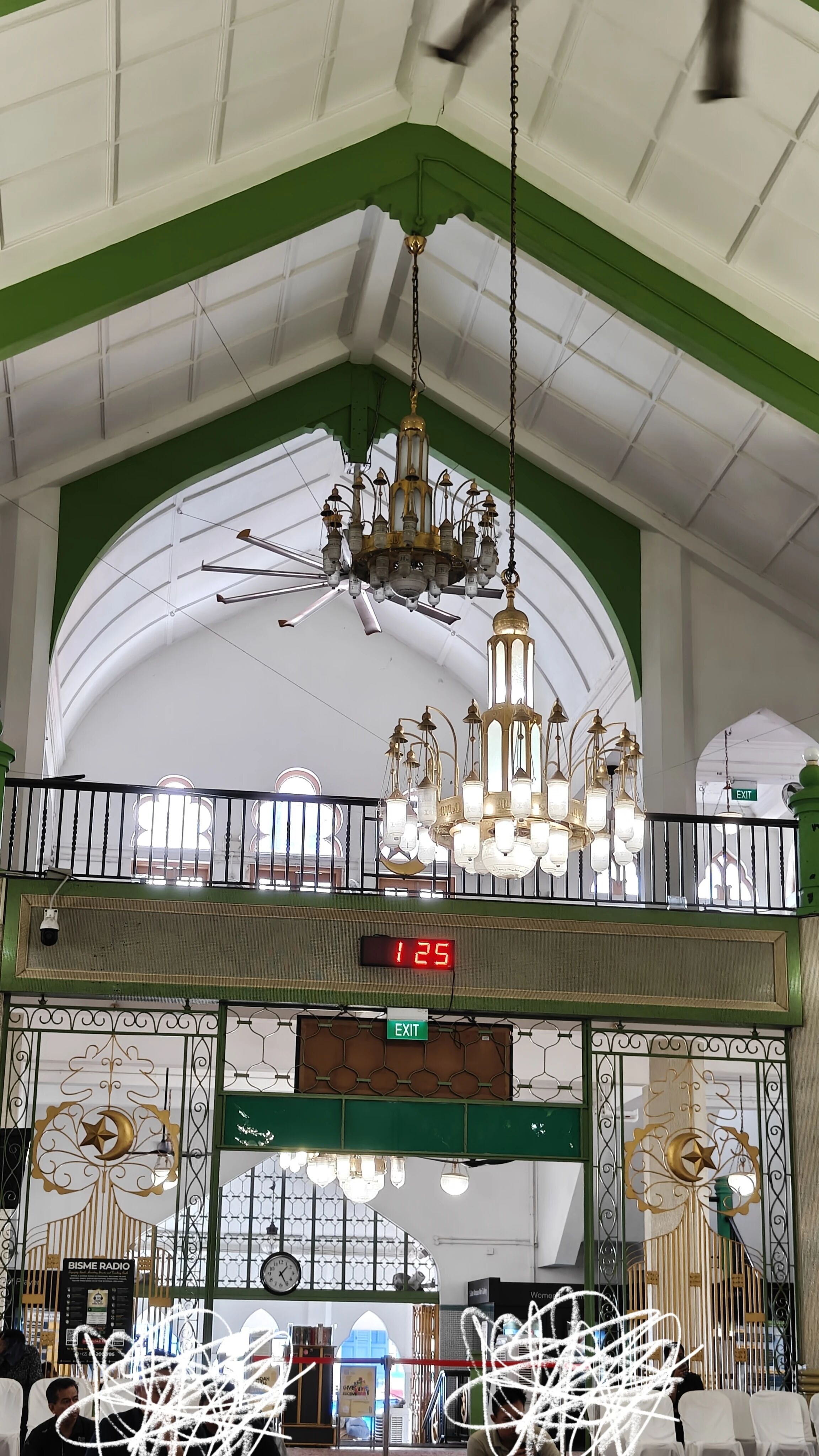
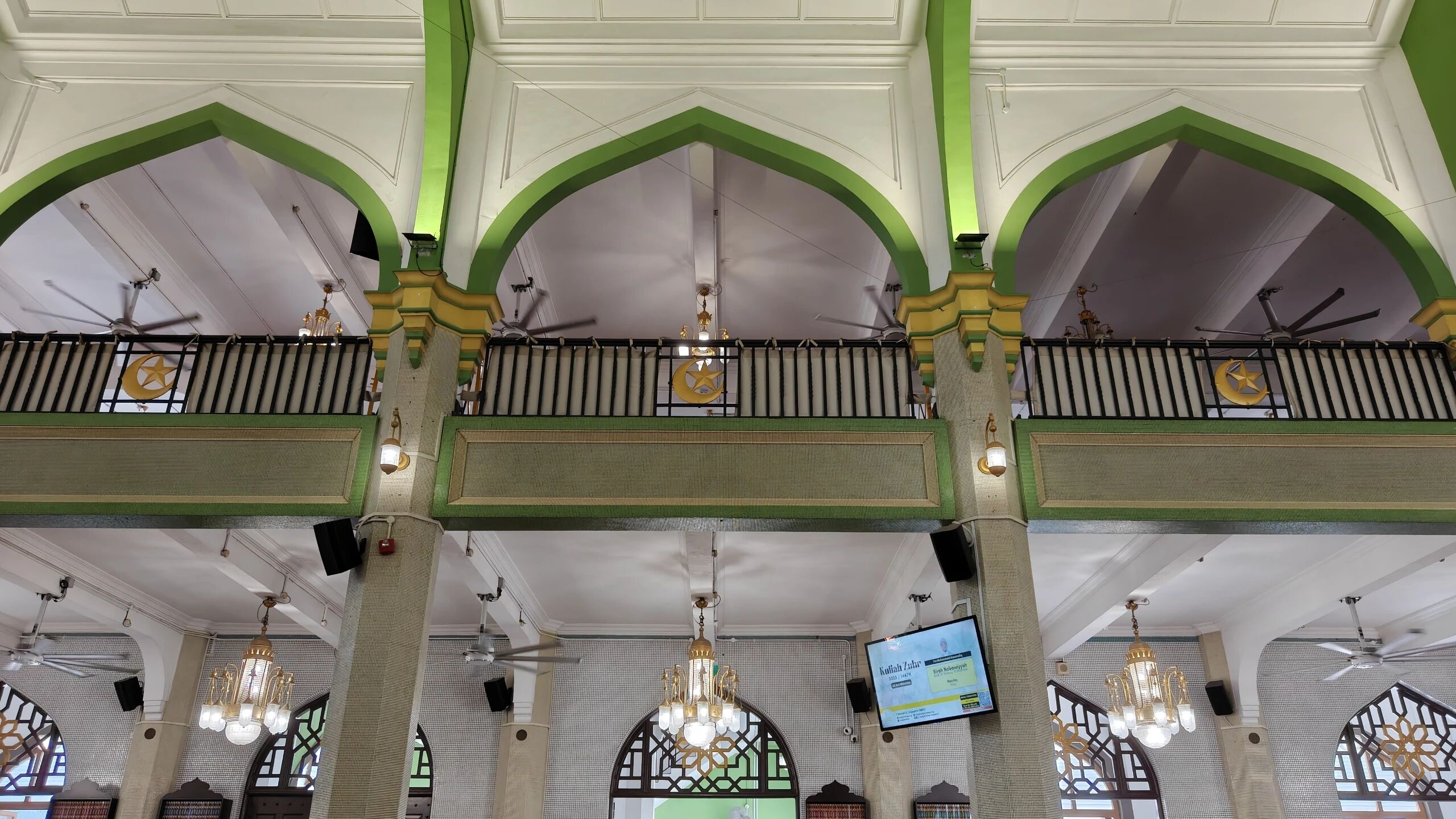
In Singapore's prayer halls, you can often see a display screen, which loops through some notices, recent activities, prayer times, etc. (Figures 18 and 19). The English notices in Picture 19 explain the importance of humility in faith and advocate that believers should be humble.
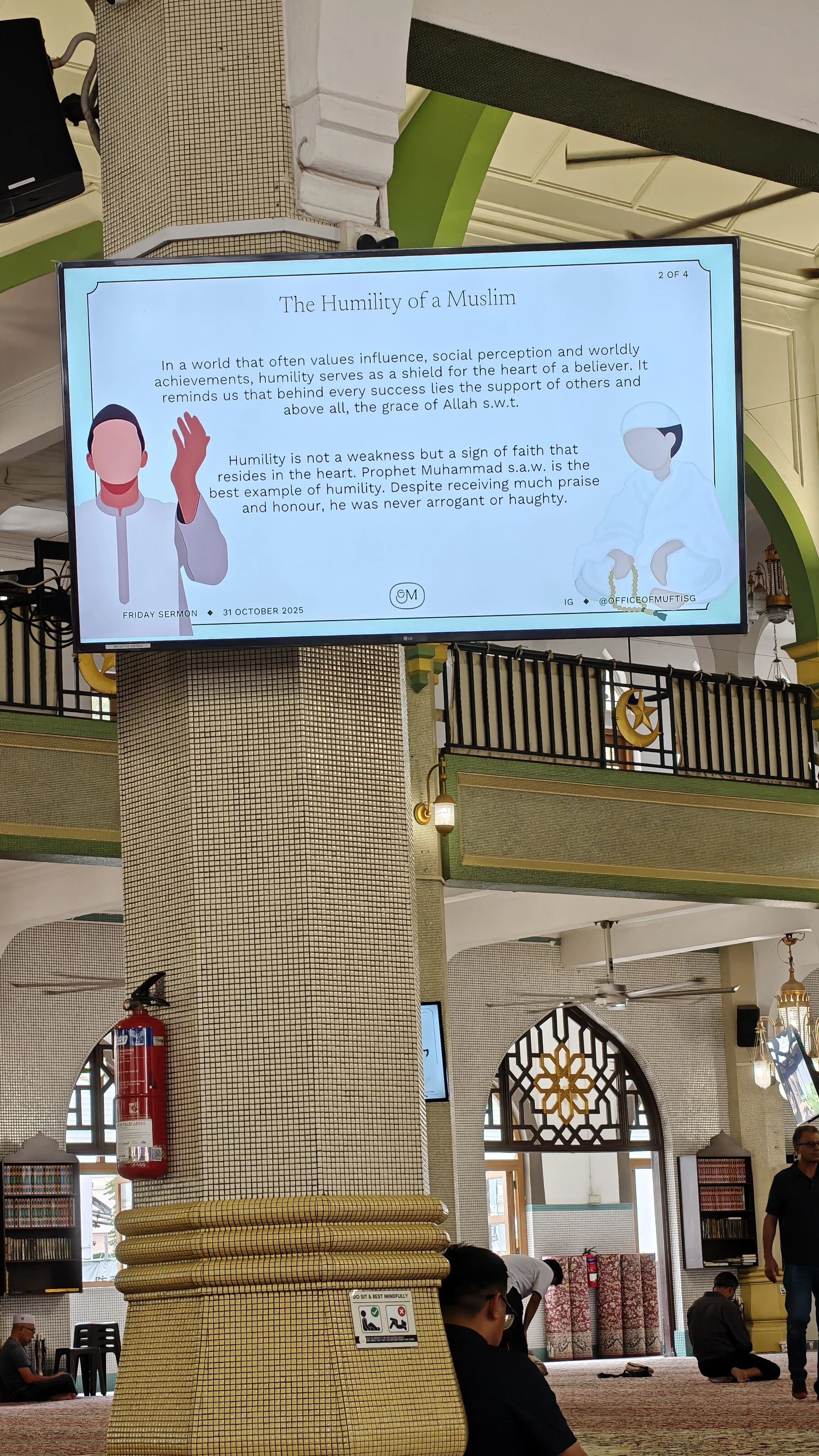
When I left the prayer hall, I noticed that the paint on the handrail on the right hand side had been worn down by worshippers (Picture 20).
Summary: This Singapore Muslim travel guide visits Sultan Mosque around Arab Street and Kampong Glam, covering the golden domes, Turkish halal restaurants nearby, the prayer hall, mihrab design, prayer time screens, humility reminders, and visible signs of daily worship.
The Sultan Mosque is a symbol of Singapore's multiculturalism, and this mosque is indispensable in tourist brochures. So I went here on the first day I landed in Singapore.
From the main road, you can see that the Sultan Mosque actually has two exaggeratedly large golden domes (Picture 4), one in front of the other and about the same size. There is a minaret on the left and right of the two large domes, a total of four.
Before I came here, I thought there was only one dome, because it couldn’t be clearly seen from the photos in the travel guide. Seeing it in person really matters.
The entrance to the mosque (Picture 6) is not on the side of the road, but in a pedestrian street called Arab Street. There are murals depicting Malay family life at the entrance (Picture 7). There are many Turkish halal restaurants on the street (Picture 8), as well as souvenir shops. You can buy a refrigerator magnet with two Singapore dollars (10 yuan).
As dusk approached, I found an Indonesian restaurant and ordered a portion of fish balls, a piece of fish, a portion of rice, and a bottle of herbal tea, which cost about fifty yuan in total (Picture 9). In Singapore, you have to put away your tableware and put it in the designated area after eating (Picture 10).
Picture 11 shows the front of the mosque, which is very similar to the back. When entering the prayer hall, you have to enter from the right side. The interior of the prayer hall is quite large and the ceiling is very good. The mihrab niche is also decorated with Malay-style mosaic and leaf patterns, which looks very distinctive (Figures 13 and 14).
The shape of minbar is relatively simple (Picture 15).
There is also a prayer space on the second floor (Figures 16 and 17).
In Singapore's prayer halls, you can often see a display screen, which loops through some notices, recent activities, prayer times, etc. (Figures 18 and 19). The English notices in Picture 19 explain the importance of humility in faith and advocate that believers should be humble.
When I left the prayer hall, I noticed that the paint on the handrail on the right hand side had been worn down by worshippers (Picture 20).
Muslim Travel Guide Singapore: Sultan Mosque, Kampong Glam Landmark and Historic Prayer Hall
Articles • Hasan09 posted the article • 0 comments • 319 views • 2026-05-24 01:46
Reposted from the web
Summary: This Singapore Muslim travel guide revisits Sultan Mosque, one of the city's best-known mosque landmarks. It keeps the author's update note, mosque visit details, and historic prayer-hall context from the original article.
I have posted about this place before, but this is an update to my previous content.
In Chinese, both the African country Sudan (which has a flag that looks like Palestine's) and the Islamic royal title Sultan are transliterated using the same two characters, 'Sudan'.
Although Sudan is a Muslim-majority country, Sudan and sultan are actually two different words. Would it be better to use a different character for the latter when transliterating?
The Sultan in Sultan Mosque has no direct connection to the country of Sudan thousands of miles away; this Sultan refers to the Sultan of Johor, whose name was Tengku Hussein.
In 1819, British colonial official Stamford Raffles landed in Singapore and signed a treaty with the local ruler Temenggong Abdul Rahman and Sultan Hussein of Johor. In exchange for an annual payment and the allocation of the Kampong Glam area, the British were granted permission to establish a base on the island.
Following this, a large number of Muslims from the Malay Archipelago moved here to follow the Sultan and the Temenggong. Between 1824 and 1826, Sultan Tengku Hussein built a mosque within the palace grounds with funding from the British. As Singapore became a center for Islamic commerce and culture, the old mosque gradually became too small to meet the needs of the community.
In 1924, the authorities approved the reconstruction of the mosque on the original site, and the new building was completed in 1928. Sultan Mosque has remained largely unchanged since then and was designated a Singapore national monument in 1975.
When I visited this mosque, I found they had set visiting hours for tourists and even seemed to have people there to explain things. I didn't follow the tourist route, though. I went straight to the ablution room (wudu room) and then into the prayer hall.
The prayer hall has a high ceiling, which makes sense for a tropical area to help with cooling. It is different from our hometown in the Northwest, where buildings need to keep the cold out. I feel like the mosques in the Northwest usually have very cramped, low ceilings.
I also noticed this place is clearly well-funded. There is a row of LCD TVs playing lectures and announcements for upcoming public events on a loop. Big fans were blowing hard, but they only pushed around hot air. It was already the end of the year, yet it was still so hot.
I actually saw another mosque in Singapore called the Temenggong Mosque, which is connected to the person who founded this one. I didn't have time to visit it, though. I will take you all to see it next time I am in Singapore. view all
Summary: This Singapore Muslim travel guide revisits Sultan Mosque, one of the city's best-known mosque landmarks. It keeps the author's update note, mosque visit details, and historic prayer-hall context from the original article.
I have posted about this place before, but this is an update to my previous content.
In Chinese, both the African country Sudan (which has a flag that looks like Palestine's) and the Islamic royal title Sultan are transliterated using the same two characters, 'Sudan'.
Although Sudan is a Muslim-majority country, Sudan and sultan are actually two different words. Would it be better to use a different character for the latter when transliterating?
The Sultan in Sultan Mosque has no direct connection to the country of Sudan thousands of miles away; this Sultan refers to the Sultan of Johor, whose name was Tengku Hussein.
In 1819, British colonial official Stamford Raffles landed in Singapore and signed a treaty with the local ruler Temenggong Abdul Rahman and Sultan Hussein of Johor. In exchange for an annual payment and the allocation of the Kampong Glam area, the British were granted permission to establish a base on the island.
Following this, a large number of Muslims from the Malay Archipelago moved here to follow the Sultan and the Temenggong. Between 1824 and 1826, Sultan Tengku Hussein built a mosque within the palace grounds with funding from the British. As Singapore became a center for Islamic commerce and culture, the old mosque gradually became too small to meet the needs of the community.
In 1924, the authorities approved the reconstruction of the mosque on the original site, and the new building was completed in 1928. Sultan Mosque has remained largely unchanged since then and was designated a Singapore national monument in 1975.
When I visited this mosque, I found they had set visiting hours for tourists and even seemed to have people there to explain things. I didn't follow the tourist route, though. I went straight to the ablution room (wudu room) and then into the prayer hall.
The prayer hall has a high ceiling, which makes sense for a tropical area to help with cooling. It is different from our hometown in the Northwest, where buildings need to keep the cold out. I feel like the mosques in the Northwest usually have very cramped, low ceilings.
I also noticed this place is clearly well-funded. There is a row of LCD TVs playing lectures and announcements for upcoming public events on a loop. Big fans were blowing hard, but they only pushed around hot air. It was already the end of the year, yet it was still so hot.
I actually saw another mosque in Singapore called the Temenggong Mosque, which is connected to the person who founded this one. I didn't have time to visit it, though. I will take you all to see it next time I am in Singapore. view all
Reposted from the web
Summary: This Singapore Muslim travel guide revisits Sultan Mosque, one of the city's best-known mosque landmarks. It keeps the author's update note, mosque visit details, and historic prayer-hall context from the original article.
I have posted about this place before, but this is an update to my previous content.
In Chinese, both the African country Sudan (which has a flag that looks like Palestine's) and the Islamic royal title Sultan are transliterated using the same two characters, 'Sudan'.
Although Sudan is a Muslim-majority country, Sudan and sultan are actually two different words. Would it be better to use a different character for the latter when transliterating?
The Sultan in Sultan Mosque has no direct connection to the country of Sudan thousands of miles away; this Sultan refers to the Sultan of Johor, whose name was Tengku Hussein.
In 1819, British colonial official Stamford Raffles landed in Singapore and signed a treaty with the local ruler Temenggong Abdul Rahman and Sultan Hussein of Johor. In exchange for an annual payment and the allocation of the Kampong Glam area, the British were granted permission to establish a base on the island.
Following this, a large number of Muslims from the Malay Archipelago moved here to follow the Sultan and the Temenggong. Between 1824 and 1826, Sultan Tengku Hussein built a mosque within the palace grounds with funding from the British. As Singapore became a center for Islamic commerce and culture, the old mosque gradually became too small to meet the needs of the community.
In 1924, the authorities approved the reconstruction of the mosque on the original site, and the new building was completed in 1928. Sultan Mosque has remained largely unchanged since then and was designated a Singapore national monument in 1975.
When I visited this mosque, I found they had set visiting hours for tourists and even seemed to have people there to explain things. I didn't follow the tourist route, though. I went straight to the ablution room (wudu room) and then into the prayer hall.
The prayer hall has a high ceiling, which makes sense for a tropical area to help with cooling. It is different from our hometown in the Northwest, where buildings need to keep the cold out. I feel like the mosques in the Northwest usually have very cramped, low ceilings.
I also noticed this place is clearly well-funded. There is a row of LCD TVs playing lectures and announcements for upcoming public events on a loop. Big fans were blowing hard, but they only pushed around hot air. It was already the end of the year, yet it was still so hot.
I actually saw another mosque in Singapore called the Temenggong Mosque, which is connected to the person who founded this one. I didn't have time to visit it, though. I will take you all to see it next time I am in Singapore.
Summary: This Singapore Muslim travel guide revisits Sultan Mosque, one of the city's best-known mosque landmarks. It keeps the author's update note, mosque visit details, and historic prayer-hall context from the original article.
I have posted about this place before, but this is an update to my previous content.
In Chinese, both the African country Sudan (which has a flag that looks like Palestine's) and the Islamic royal title Sultan are transliterated using the same two characters, 'Sudan'.
Although Sudan is a Muslim-majority country, Sudan and sultan are actually two different words. Would it be better to use a different character for the latter when transliterating?
The Sultan in Sultan Mosque has no direct connection to the country of Sudan thousands of miles away; this Sultan refers to the Sultan of Johor, whose name was Tengku Hussein.
In 1819, British colonial official Stamford Raffles landed in Singapore and signed a treaty with the local ruler Temenggong Abdul Rahman and Sultan Hussein of Johor. In exchange for an annual payment and the allocation of the Kampong Glam area, the British were granted permission to establish a base on the island.
Following this, a large number of Muslims from the Malay Archipelago moved here to follow the Sultan and the Temenggong. Between 1824 and 1826, Sultan Tengku Hussein built a mosque within the palace grounds with funding from the British. As Singapore became a center for Islamic commerce and culture, the old mosque gradually became too small to meet the needs of the community.
In 1924, the authorities approved the reconstruction of the mosque on the original site, and the new building was completed in 1928. Sultan Mosque has remained largely unchanged since then and was designated a Singapore national monument in 1975.
When I visited this mosque, I found they had set visiting hours for tourists and even seemed to have people there to explain things. I didn't follow the tourist route, though. I went straight to the ablution room (wudu room) and then into the prayer hall.
The prayer hall has a high ceiling, which makes sense for a tropical area to help with cooling. It is different from our hometown in the Northwest, where buildings need to keep the cold out. I feel like the mosques in the Northwest usually have very cramped, low ceilings.
I also noticed this place is clearly well-funded. There is a row of LCD TVs playing lectures and announcements for upcoming public events on a loop. Big fans were blowing hard, but they only pushed around hot air. It was already the end of the year, yet it was still so hot.
I actually saw another mosque in Singapore called the Temenggong Mosque, which is connected to the person who founded this one. I didn't have time to visit it, though. I will take you all to see it next time I am in Singapore.
Muslim Travel Guide Singapore: Sultan Mosque, Kampong Glam, Prayer Hall and Muslim Heritage
Articles • yusuf908 posted the article • 0 comments • 228 views • 2026-05-23 22:23
Reposted from the web
Summary: This Singapore Muslim travel guide visits Sultan Mosque around Arab Street and Kampong Glam, covering the golden domes, Turkish halal restaurants nearby, the prayer hall, mihrab design, prayer time screens, humility reminders, and visible signs of daily worship.
The Sultan Mosque is a symbol of Singapore's multiculturalism, and this mosque is indispensable in tourist brochures. So I went here on the first day I landed in Singapore.
From the main road, you can see that the Sultan Mosque actually has two exaggeratedly large golden domes (Picture 4), one in front of the other and about the same size. There is a minaret on the left and right of the two large domes, a total of four.
Before I came here, I thought there was only one dome, because it couldn’t be clearly seen from the photos in the travel guide. Seeing it in person really matters.
The entrance to the mosque (Picture 6) is not on the side of the road, but in a pedestrian street called Arab Street. There are murals depicting Malay family life at the entrance (Picture 7). There are many Turkish halal restaurants on the street (Picture 8), as well as souvenir shops. You can buy a refrigerator magnet with two Singapore dollars (10 yuan).
As dusk approached, I found an Indonesian restaurant and ordered a portion of fish balls, a piece of fish, a portion of rice, and a bottle of herbal tea, which cost about fifty yuan in total (Picture 9). In Singapore, you have to put away your tableware and put it in the designated area after eating (Picture 10).
Picture 11 shows the front of the mosque, which is very similar to the back. When entering the prayer hall, you have to enter from the right side. The interior of the prayer hall is quite large and the ceiling is very good. The mihrab niche is also decorated with Malay-style mosaic and leaf patterns, which looks very distinctive (Figures 13 and 14).
The shape of minbar is relatively simple (Picture 15).
There is also a prayer space on the second floor (Figures 16 and 17).
In Singapore's prayer halls, you can often see a display screen, which loops through some notices, recent activities, prayer times, etc. (Figures 18 and 19). The English notices in Picture 19 explain the importance of humility in faith and advocate that believers should be humble.
When I left the prayer hall, I noticed that the paint on the handrail on the right hand side had been worn down by worshippers (Picture 20). view all
Summary: This Singapore Muslim travel guide visits Sultan Mosque around Arab Street and Kampong Glam, covering the golden domes, Turkish halal restaurants nearby, the prayer hall, mihrab design, prayer time screens, humility reminders, and visible signs of daily worship.
The Sultan Mosque is a symbol of Singapore's multiculturalism, and this mosque is indispensable in tourist brochures. So I went here on the first day I landed in Singapore.
From the main road, you can see that the Sultan Mosque actually has two exaggeratedly large golden domes (Picture 4), one in front of the other and about the same size. There is a minaret on the left and right of the two large domes, a total of four.
Before I came here, I thought there was only one dome, because it couldn’t be clearly seen from the photos in the travel guide. Seeing it in person really matters.
The entrance to the mosque (Picture 6) is not on the side of the road, but in a pedestrian street called Arab Street. There are murals depicting Malay family life at the entrance (Picture 7). There are many Turkish halal restaurants on the street (Picture 8), as well as souvenir shops. You can buy a refrigerator magnet with two Singapore dollars (10 yuan).
As dusk approached, I found an Indonesian restaurant and ordered a portion of fish balls, a piece of fish, a portion of rice, and a bottle of herbal tea, which cost about fifty yuan in total (Picture 9). In Singapore, you have to put away your tableware and put it in the designated area after eating (Picture 10).
Picture 11 shows the front of the mosque, which is very similar to the back. When entering the prayer hall, you have to enter from the right side. The interior of the prayer hall is quite large and the ceiling is very good. The mihrab niche is also decorated with Malay-style mosaic and leaf patterns, which looks very distinctive (Figures 13 and 14).
The shape of minbar is relatively simple (Picture 15).
There is also a prayer space on the second floor (Figures 16 and 17).
In Singapore's prayer halls, you can often see a display screen, which loops through some notices, recent activities, prayer times, etc. (Figures 18 and 19). The English notices in Picture 19 explain the importance of humility in faith and advocate that believers should be humble.
When I left the prayer hall, I noticed that the paint on the handrail on the right hand side had been worn down by worshippers (Picture 20). view all
Reposted from the web
Summary: This Singapore Muslim travel guide visits Sultan Mosque around Arab Street and Kampong Glam, covering the golden domes, Turkish halal restaurants nearby, the prayer hall, mihrab design, prayer time screens, humility reminders, and visible signs of daily worship.
The Sultan Mosque is a symbol of Singapore's multiculturalism, and this mosque is indispensable in tourist brochures. So I went here on the first day I landed in Singapore.
From the main road, you can see that the Sultan Mosque actually has two exaggeratedly large golden domes (Picture 4), one in front of the other and about the same size. There is a minaret on the left and right of the two large domes, a total of four.
Before I came here, I thought there was only one dome, because it couldn’t be clearly seen from the photos in the travel guide. Seeing it in person really matters.
The entrance to the mosque (Picture 6) is not on the side of the road, but in a pedestrian street called Arab Street. There are murals depicting Malay family life at the entrance (Picture 7). There are many Turkish halal restaurants on the street (Picture 8), as well as souvenir shops. You can buy a refrigerator magnet with two Singapore dollars (10 yuan).
As dusk approached, I found an Indonesian restaurant and ordered a portion of fish balls, a piece of fish, a portion of rice, and a bottle of herbal tea, which cost about fifty yuan in total (Picture 9). In Singapore, you have to put away your tableware and put it in the designated area after eating (Picture 10).
Picture 11 shows the front of the mosque, which is very similar to the back. When entering the prayer hall, you have to enter from the right side. The interior of the prayer hall is quite large and the ceiling is very good. The mihrab niche is also decorated with Malay-style mosaic and leaf patterns, which looks very distinctive (Figures 13 and 14).
The shape of minbar is relatively simple (Picture 15).
There is also a prayer space on the second floor (Figures 16 and 17).
In Singapore's prayer halls, you can often see a display screen, which loops through some notices, recent activities, prayer times, etc. (Figures 18 and 19). The English notices in Picture 19 explain the importance of humility in faith and advocate that believers should be humble.
When I left the prayer hall, I noticed that the paint on the handrail on the right hand side had been worn down by worshippers (Picture 20).
Summary: This Singapore Muslim travel guide visits Sultan Mosque around Arab Street and Kampong Glam, covering the golden domes, Turkish halal restaurants nearby, the prayer hall, mihrab design, prayer time screens, humility reminders, and visible signs of daily worship.
The Sultan Mosque is a symbol of Singapore's multiculturalism, and this mosque is indispensable in tourist brochures. So I went here on the first day I landed in Singapore.
From the main road, you can see that the Sultan Mosque actually has two exaggeratedly large golden domes (Picture 4), one in front of the other and about the same size. There is a minaret on the left and right of the two large domes, a total of four.
Before I came here, I thought there was only one dome, because it couldn’t be clearly seen from the photos in the travel guide. Seeing it in person really matters.
The entrance to the mosque (Picture 6) is not on the side of the road, but in a pedestrian street called Arab Street. There are murals depicting Malay family life at the entrance (Picture 7). There are many Turkish halal restaurants on the street (Picture 8), as well as souvenir shops. You can buy a refrigerator magnet with two Singapore dollars (10 yuan).
As dusk approached, I found an Indonesian restaurant and ordered a portion of fish balls, a piece of fish, a portion of rice, and a bottle of herbal tea, which cost about fifty yuan in total (Picture 9). In Singapore, you have to put away your tableware and put it in the designated area after eating (Picture 10).
Picture 11 shows the front of the mosque, which is very similar to the back. When entering the prayer hall, you have to enter from the right side. The interior of the prayer hall is quite large and the ceiling is very good. The mihrab niche is also decorated with Malay-style mosaic and leaf patterns, which looks very distinctive (Figures 13 and 14).
The shape of minbar is relatively simple (Picture 15).
There is also a prayer space on the second floor (Figures 16 and 17).
In Singapore's prayer halls, you can often see a display screen, which loops through some notices, recent activities, prayer times, etc. (Figures 18 and 19). The English notices in Picture 19 explain the importance of humility in faith and advocate that believers should be humble.
When I left the prayer hall, I noticed that the paint on the handrail on the right hand side had been worn down by worshippers (Picture 20).