

Sultanate History
Muslim Travel Guide Indonesia Banten: Sultanate Mosques, Coastal City and Islamic Heritage
Articles • yusuf908 posted the article • 0 comments • 170 views • 2026-05-23 23:06
Reposted from the web
Summary: Muslim Travel Guide Indonesia Banten: Sultanate Mosques, Coastal City and Islamic Heritage is presented here as a clear Muslim travel account, beginning with this scene: Banten is located at the westernmost tip of Java Island, facing Sumatra across the Sunda Strait. The account keeps its focus on Banten Mosques, Indonesia Muslim Travel, Sultanate History while preserving the names, places, food, and historical details from the Chinese source.
Banten is located at the westernmost tip of Java Island, facing Sumatra across the Sunda Strait. The local Bantenese people are a branch of the Sundanese. In the 16th century, the Banten Sultanate rose to become a powerful maritime trading nation in western Java, controlling the pepper trade in Southeast Asia. The Banten Sultanate reached its peak in the 17th century and had intense conflicts with the Dutch East India Company. After the 18th century, the Banten Sultanate gradually came under the control of the Dutch East India Company and was finally annexed into the Dutch East Indies in the 19th century.
Today, the ancient city of Banten still retains many ruins, and the Great Mosque of Banten (Masjid Agung Banten), built in the 16th century, remains a famous religious site. two palaces of the Banten Sultanate, a Dutch fortress, and several tombs of the Banten Sultans have been preserved. Due to time constraints, I could not visit all the historical sites this time, but I still hope to share the ruins of the Banten Sultanate that I saw with everyone.
Table of Contents
1. Traveling to the Ancient City of Banten
2. The Establishment of the Banten Sultanate
3. The Port City of Banten
4. Surosowan Palace—Sultan's Residence: 1552
5. Great Mosque of Banten: 1566
6. Banten Bazaar
7. Speelwijk Castle—Dutch Fortress: 1682
8. Kaibon Palace—Residence of the Last Queen Mother: Early 19th Century
1. Traveling to the Ancient City of Banten
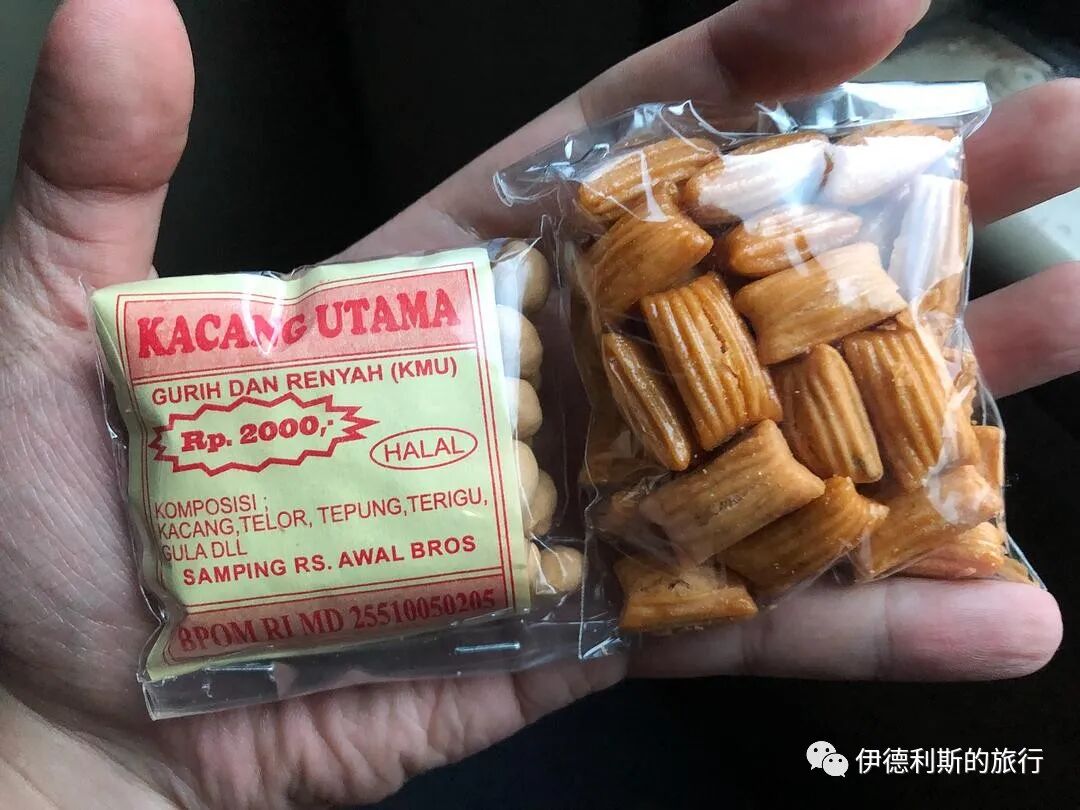
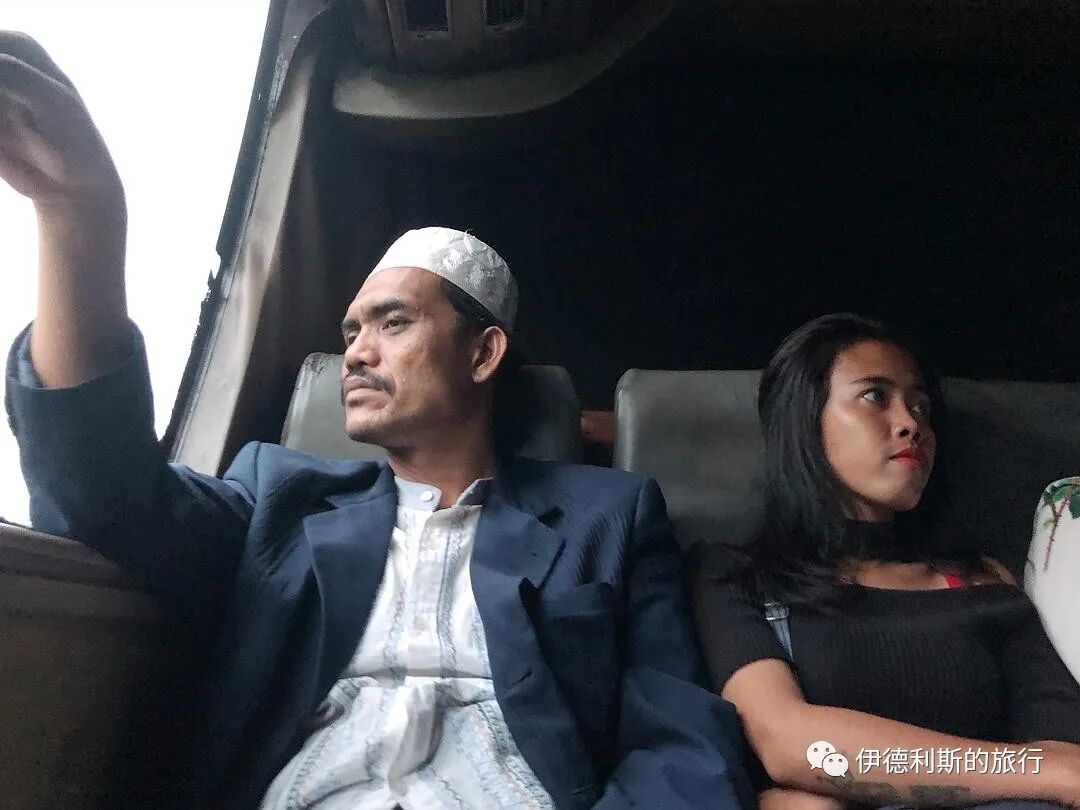
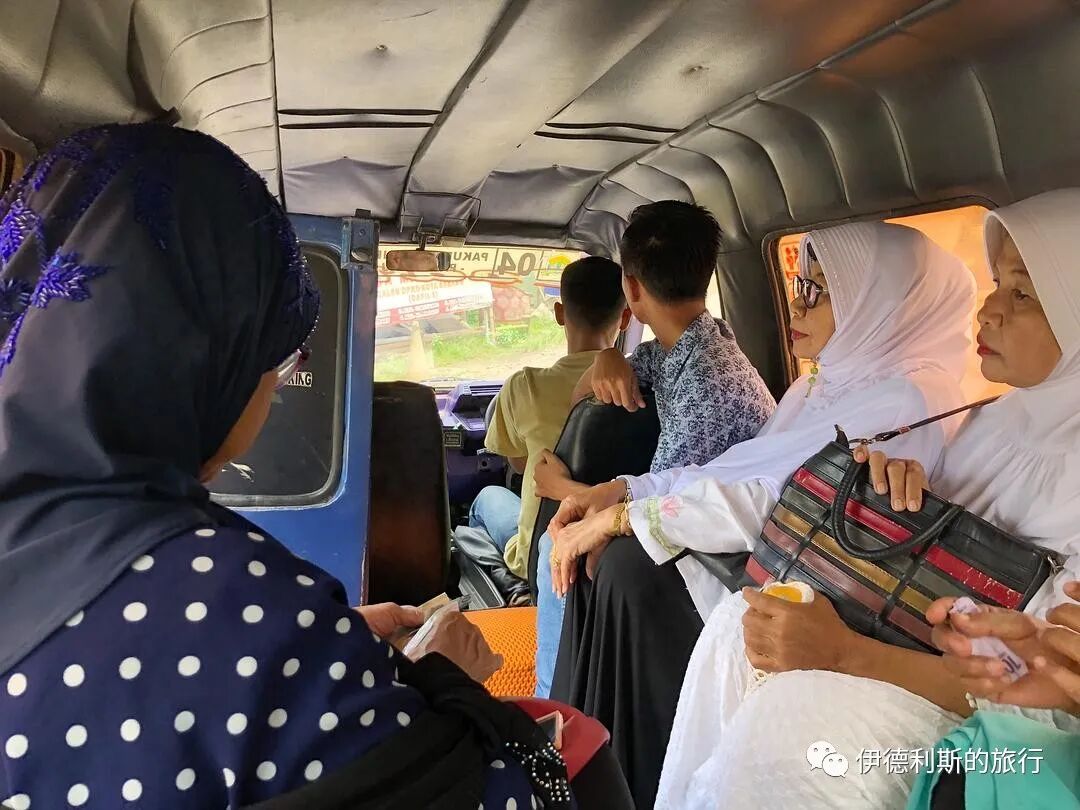
The ancient city of Banten is located west of Jakarta, and it takes an hour and a half to drive there under normal traffic conditions. There are buses from Kalideres bus station in western Jakarta to the city of Serang, where Banten is located. Once you arrive at the station, just ask people for "Serang" and they will point you in the right direction. The bus I took picked up passengers along the way before getting on the highway, so it took three hours to reach Serang. Friends who want to go, please make sure to allow extra time. It was very interesting that before getting on the highway, vendors kept getting on the bus to sell various things, including fruits, snacks, ballpoint pens, electronic watches, and so on. There were also several groups of singers, making it feel like a moving bazaar.
After getting on the bus, be sure to tell the driver or conductor that you are going to the Great Mosque of Banten, which is Masjid Agung Banten. Note that the pronunciation of Banten is "Banden." Then the driver will drop you off at the intersection before entering Serang city. From there, you can take a minibus or call a Grab to the ancient city of Banten.
2. The Establishment of the Banten Sultanate
After the 15th century, the Hindu-Buddhist Majapahit empire declined and the Islamic Malacca Sultanate rose. Many Muslim merchants from Arabia and India settled on the north coast of Java, marking a new chapter in Javanese history.
Between the 15th and 16th centuries, many Sufi Muslims arrived in Java to spread the faith, with the Nine Saints (Wali Songo) being the most famous. Among the Nine Saints, Sunan Gunung Jati was the only one who used military force to spread Islam.
Sunan Gunung Jati was born Syarif Hidayatullah. His father came from the Hashim family in Egypt, the same family as the Prophet Muhammad, and his mother was a princess from the Hindu Sunda Kingdom in western Java. Although his grandfather was a Hindu king, Sunan Gunung Jati's mother and his uncle, Prince Walangsungsang, both converted to Islam.
In 1470, after spending years studying Islamic knowledge in places like Mecca and Baghdad in the Middle East, Sunan Gunung Jati returned to Java to help his uncle rule the port town of Cirebon in West Java. In 1479, Sunan Gunung Jati took over from his uncle to rule Cirebon, established the Cirebon Sultanate, and officially declared independence from the Sunda Kingdom in 1482.
Shortly before Sunan Gunung Jati established the Cirebon Sultanate, the Muslim port town of Demak in Central Java had already gained independence from the Majapahit Kingdom in 1475. These two Javanese Muslim states, which relied on maritime trade, joined forces and posed a major threat to the existing Hindu Sunda Kingdom. The Sunda Kingdom then went to Malacca to seek help from the Portuguese. In 1522, the Portuguese officially formed an alliance with the Sunda Kingdom to control the local pepper trade.
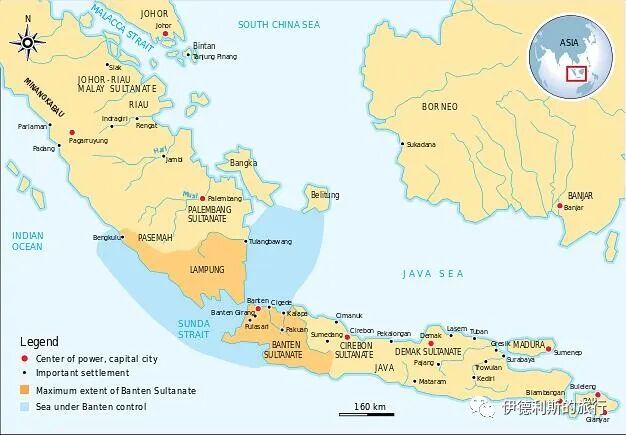
However, after the alliance was formed, the Portuguese failed to send troops to help in time. The joint Cirebon-Demak forces took the opportunity to capture Sunda Kalapa, an important port of the Sunda Kingdom, and renamed it Jakarta. After that, the Sunda Kingdom fought a five-year war alone against the Cirebon-Demak coalition. In 1527, the Sultan of Cirebon, Sunan Gunung Jati, sent his son Hasanudin to join the Demak Sultanate and capture Banten, another important port of the Sunda Kingdom. Sunan Gunung Jati then appointed his son as the Sultan of Banten. In 1552, the Banten Sultanate broke away from the Cirebon Sultanate and became an independent state.
The territory of the Banten Sultanate, drawn by Gunawan Kartapranata.
3. The Port City of Banten
Shortly after becoming the Sultan of Banten, Hasanudin began building a new port city at the mouth of the Banten River. By the mid-16th century, Banten had become an important port that could rival Malacca.
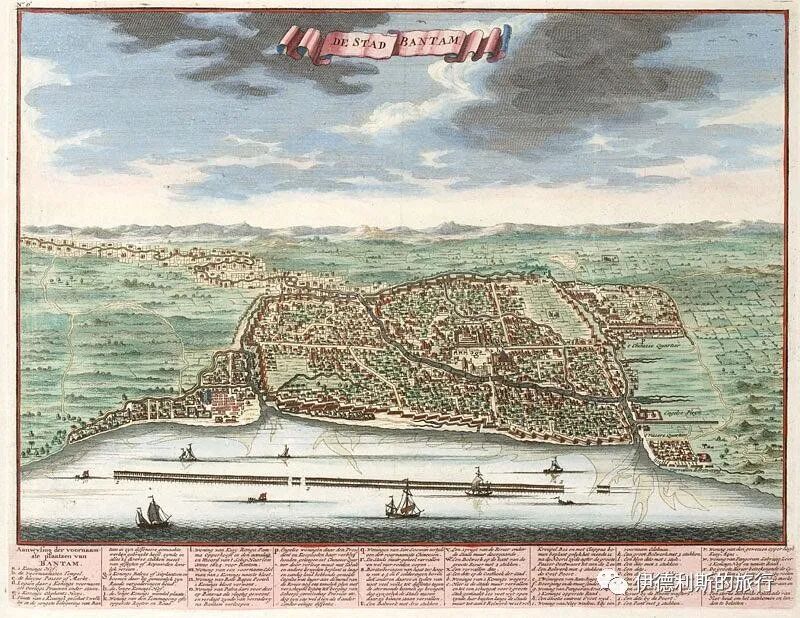
According to the Portuguese historian João de Barros, the city of Banten was located in the middle of the harbor, and a clear river ran through the city, allowing ships to sail into the town center. Inside the city, there was a brick fortress with a two-story wooden defensive structure. The city center had a square that served as a market in the morning and was used for military or artistic activities at noon. On the south side of the square was the Sultan's palace, known as the Surosowan Palace, with a tall building next to it used by the Sultan to receive his subjects. On the west side of the square was the Great Mosque, which is today's Great Mosque of Banten.
At that time, only local residents were allowed to live in the city. Foreigners lived near the harbor in the north, with foreign Muslims in the northeast and non-Muslim foreigners in the northwest.
In the late 16th century, the Banten Sultanate controlled the pepper trade in the Lampung region at the southern tip of Sumatra. It traded closely with Portugal, the Netherlands, Britain, France, and Denmark, becoming a major international trade hub in Southeast Asia. With help from the British, the Danes, and the Chinese, the Banten Sultanate traded with Persia, India, Siam, Vietnam, the Philippines, China, and Japan.
Banten City in 1724, drawn by François Valentijn.
4. Surosowan Palace—Sultan's Residence: 1552
Surosowan Palace was built in 1552 by the Banten Sultan Maulana Hasanuddin and later served as the residence for successive sultans. A Dutchman designed the palace, which is why it features the corner bastion structure of a Dutch fort.
In 1808, to defend against a British invasion of Java, the Dutch ordered the construction of the Great Post Road across the island. They also ordered the Banten Sultan to move his capital and provide labor to build a port for the Dutch fleet. The Sultan refused, so the Dutch destroyed Surosowan Palace and imprisoned the entire royal family. After the British invaded Java in 1813, they forced the last Sultan to abdicate, marking the end of the Banten Sultanate. After the Anglo-Dutch Treaty of 1814 was signed, Britain returned the Banten region to the Dutch, and Banten was officially incorporated into the Dutch East Indies.
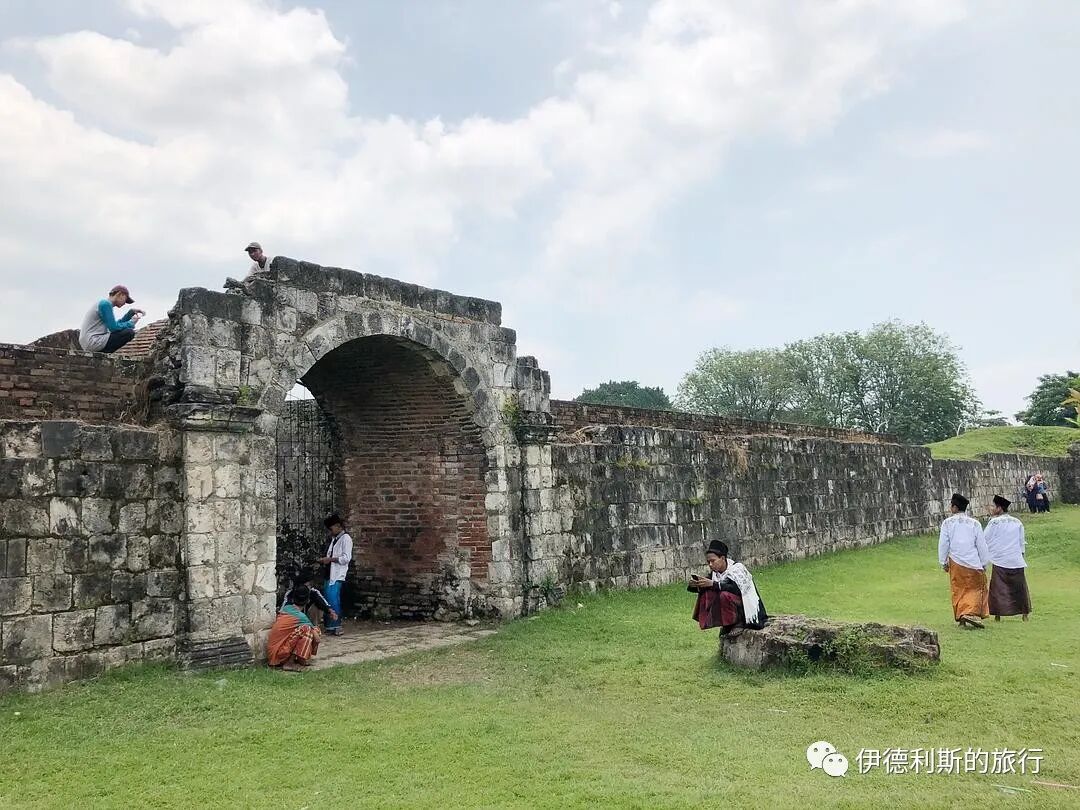
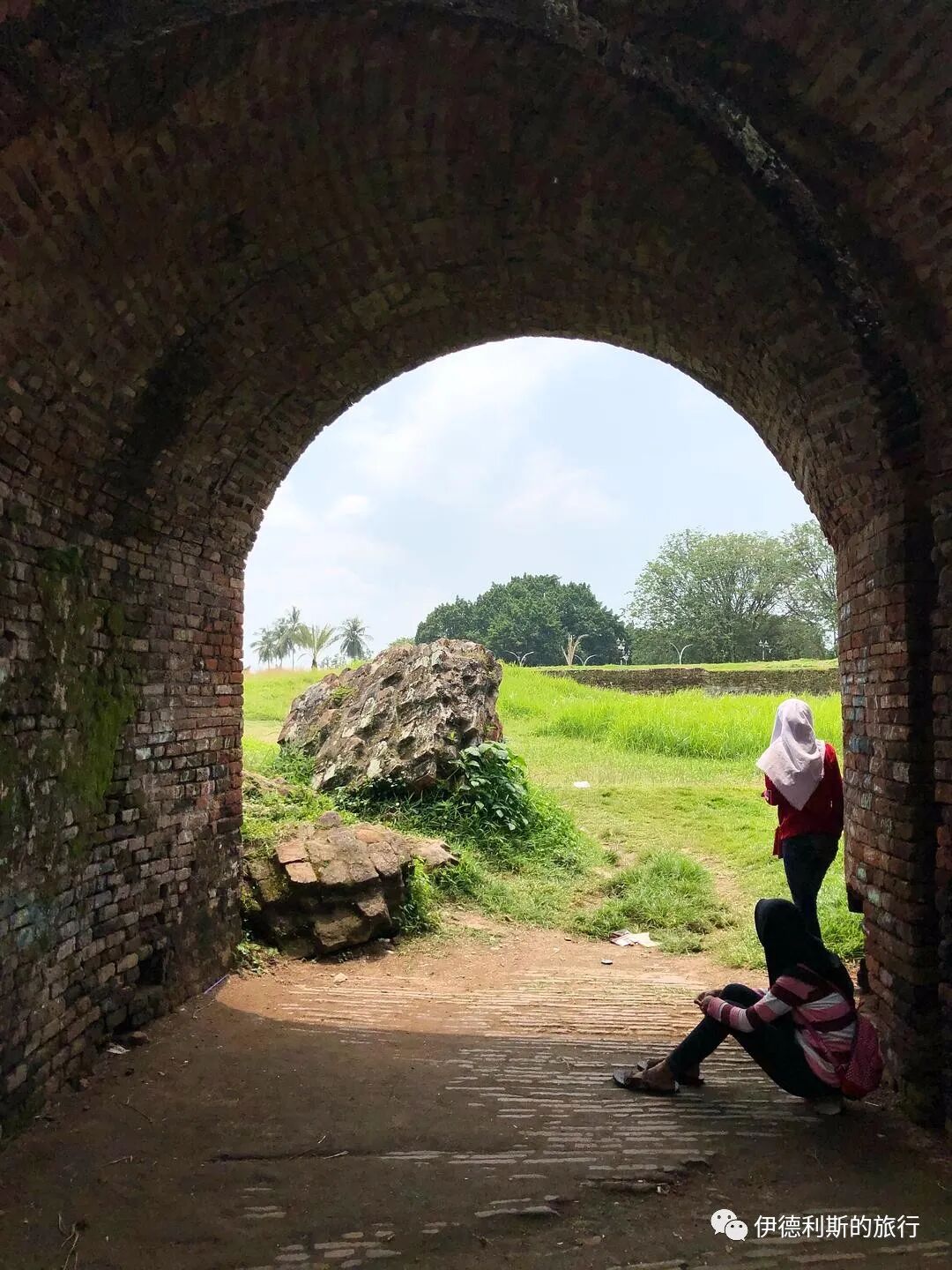
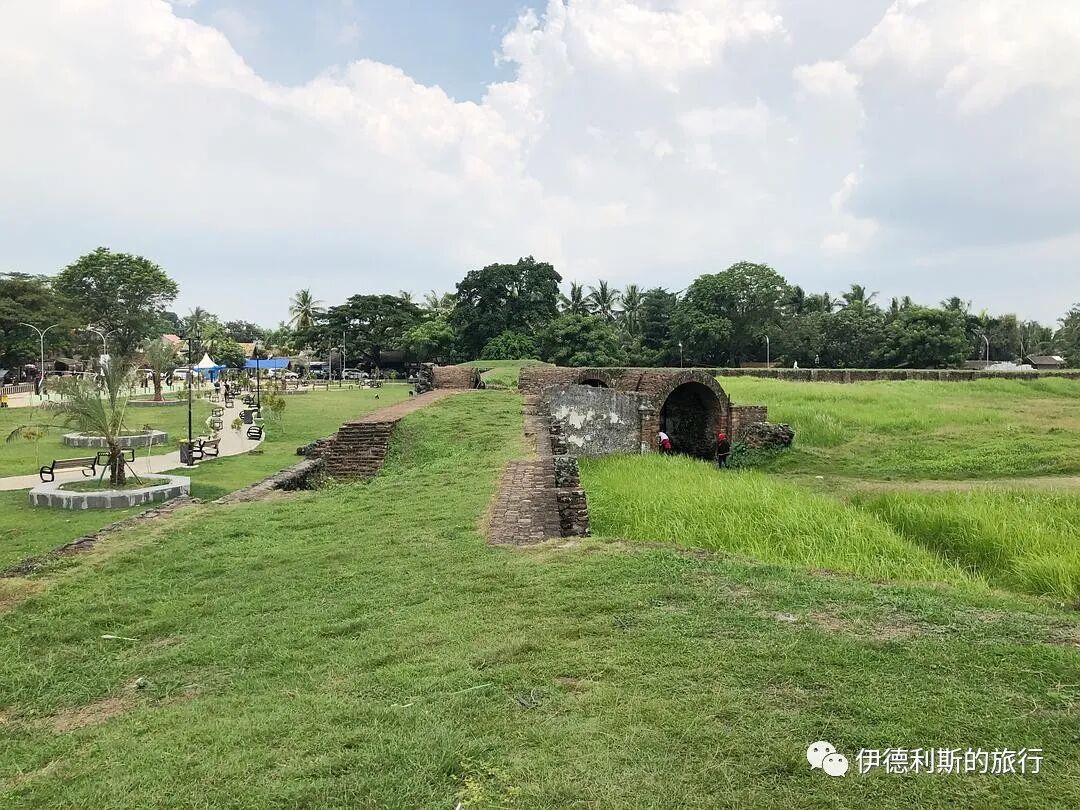
Today, the ruins of Surosowan Palace include two-meter-high walls made of red stone and coral. The most prominent site inside is the princess's bathing pool, which looks similar to the existing pools at the Sultan's palace in Yogyakarta.
5. Great Mosque of Banten: 1566
The Great Mosque of Banten (Masjid Agung Banten) is a famous Javanese-style mosque, built in 1566 by order of Sultan Maulana Hasanuddin. The women's hall (Pawestren) was added in the 1580s. In 1632, a Chinese man named Cek-ban-cut designed and built the minaret (bangker), and in the 17th century, a Dutch convert to Islam named Hendrik Lucaasz Cardeel designed and built the religious school (tiyamah).
As a typical Javanese-style mosque, the Great Mosque of Banten has a large porch-style shelter (serambi) in front of the main prayer hall. Inside the main hall, four main wooden pillars (saka guru) support a five-tiered roof. The top three tiers look more like a Chinese Buddhist pagoda than a traditional Javanese roof. Historical records suggest the original roof only had three tiers, and the top two were likely added between the 18th and 19th centuries. The mosque's minaret is 24 meters high with a base diameter of 10 meters, blending Mughal style with the local Javanese Hindu/Buddhist mosque (Candi) style.
The Great Mosque of Banten, drawn by Josias Cornelis Rappard in the 1880s.
Right next to the mosque is the family cemetery of the Banten Sultanate. The first Sultan, Maulana Hasanuddin (reigned 1552–1570), the sixth Sultan, Ageng Tirtayasa (reigned 1651–1683), and the seventh Sultan, Abu Nashar Abdul Qahar (reigned 1683–1687), are all buried there.
The reign of the sixth Sultan, Ageng Tirtayasa, from 1651 to 1682, is known as the golden age of the Banten Sultanate. During this time, the Banten Sultanate built a powerful navy with the help of European shipyards and attracted many Europeans to work in Banten. To ensure safe travel, the Banten Sultanate sent a fleet in 1661 to conquer the Tanjungpura Kingdom in western Kalimantan, attempting to break the blockade by the Dutch East India Company (VOC).
6. Banten Bazaar
As a holy site, the Great Mosque of Banten attracts a constant stream of Muslims every day, and a very lively bazaar has formed around it. At the bazaar, I drank an iced beverage called Es Campur made with coconut milk, red sugar syrup, coconut meat, and fruit jelly, and I also had some simple street-style boiled noodles (Mie Rebus). The bazaar is full of people selling sapodilla (Manilkara zapota), which is sweet and delicious. Sapodilla is native to the Caribbean in Central America. It was brought to the Philippines by Spanish colonists and later widely planted across Southeast Asia, where it is called sawo in Indonesia.
I bought two hats at the Banten bazaar. One of them is the black velvet cap (peci), which is the most common type in Indonesia. The peci is also called a songkok (Songkok). Indonesian and Malay Muslim men usually wear this hat for important ceremonies like weddings, funerals, or Eid al-Fitr. The word peci likely comes from the Dutch word petje, which means small hat.
The peci may have originated from the felt fez hat promoted by the Ottoman Empire starting in 1826. It soon spread to the Indonesian and Malay regions, gradually taking on the form of the modern songkok. Many Indonesian nationalist activists wore the songkok in the early 20th century, with Indonesia's first president, Sukarno, being the most famous among them. After Sukarno made the peci part of the official Indonesian presidential attire, black velvet became the most common style of peci in Indonesia.
The second hat is made of woven bamboo. Besides the round one I bought, there are also boat-shaped ones similar to the songkok, which feel perfect for summer.
Another hat shop.
7. Speelwijk Castle—Dutch Fortress: 1682
Speelwijk Castle is a fortress built by the Dutch East India Company on the northwest coast of Banten. It was first built in 1682 and expanded twice, in 1685 and 1731. This castle was mainly used to control the activities of the Banten Sultanate and to protect Dutch merchant ships from pirate attacks.
Starting in the 16th century, the Dutch began competing with Portugal and England for the pepper trade in Java. In 1602, the Dutch established the famous Dutch East India Company, and the following year they set up a permanent trading post in Banten. In 1619, the Dutch East India Company captured Jakarta, which was controlled by the Banten Sultanate, and renamed it Batavia to serve as their headquarters. By the late 17th century, the Dutch East India Company had become the world's wealthiest private company and had completely defeated the Portuguese on Java.
In 1680, the Dutch East India Company incited a civil war within the Banten Sultanate, took the opportunity to drive British merchants out of Banten, and gained a monopoly on the surrounding pepper trade. After 1682, the Banten Sultanate gradually came under the control of the Dutch East India Company, and even the succession of the Sultan required approval from the company. Speelwijk Castle is the best witness to this historical period. After 1752, the Banten Sultanate officially became a vassal state of the Dutch East India Company.
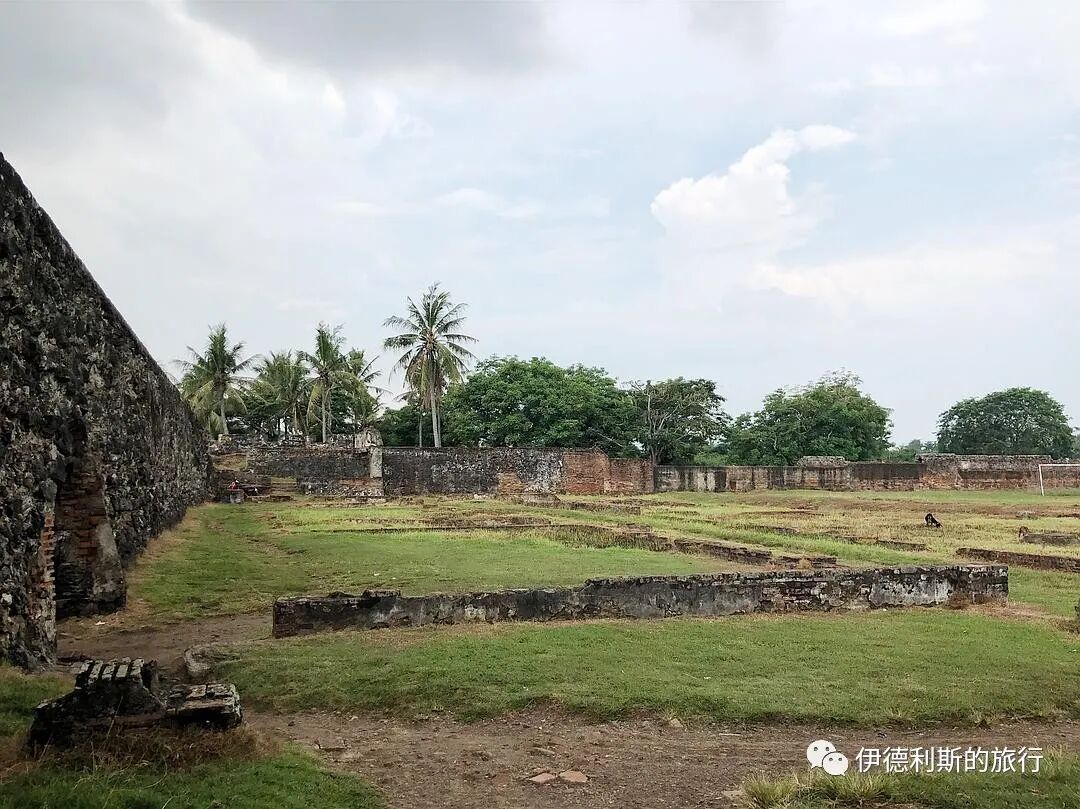
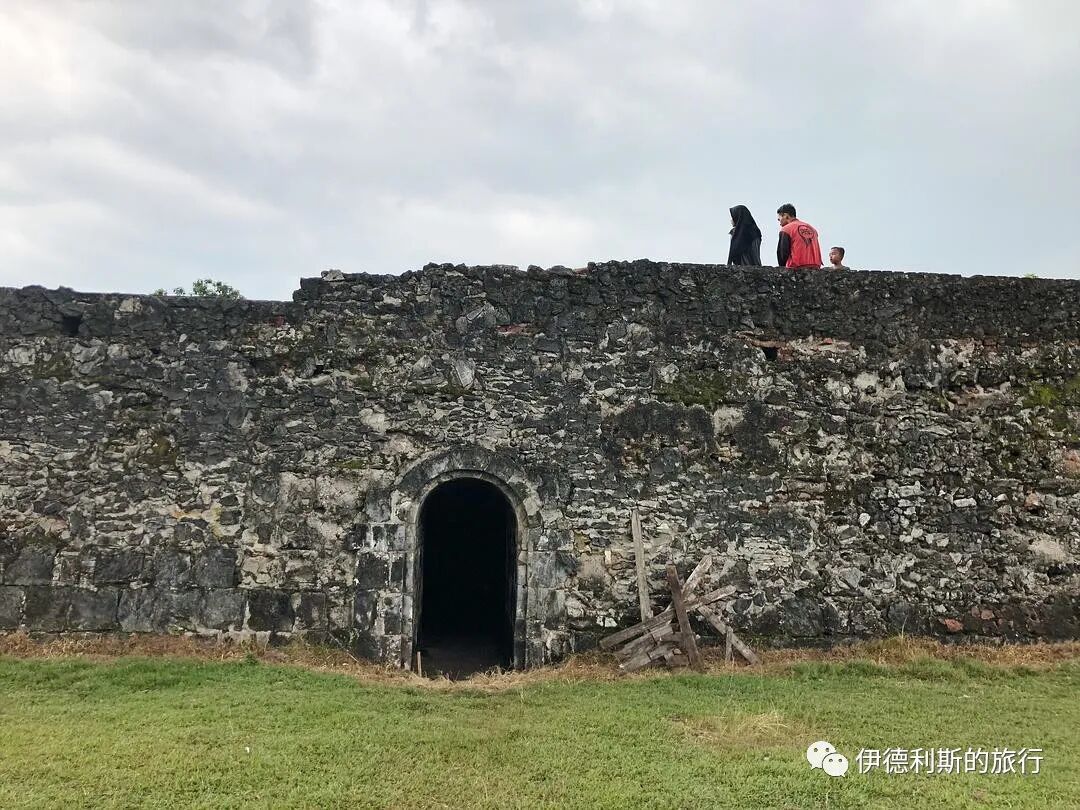
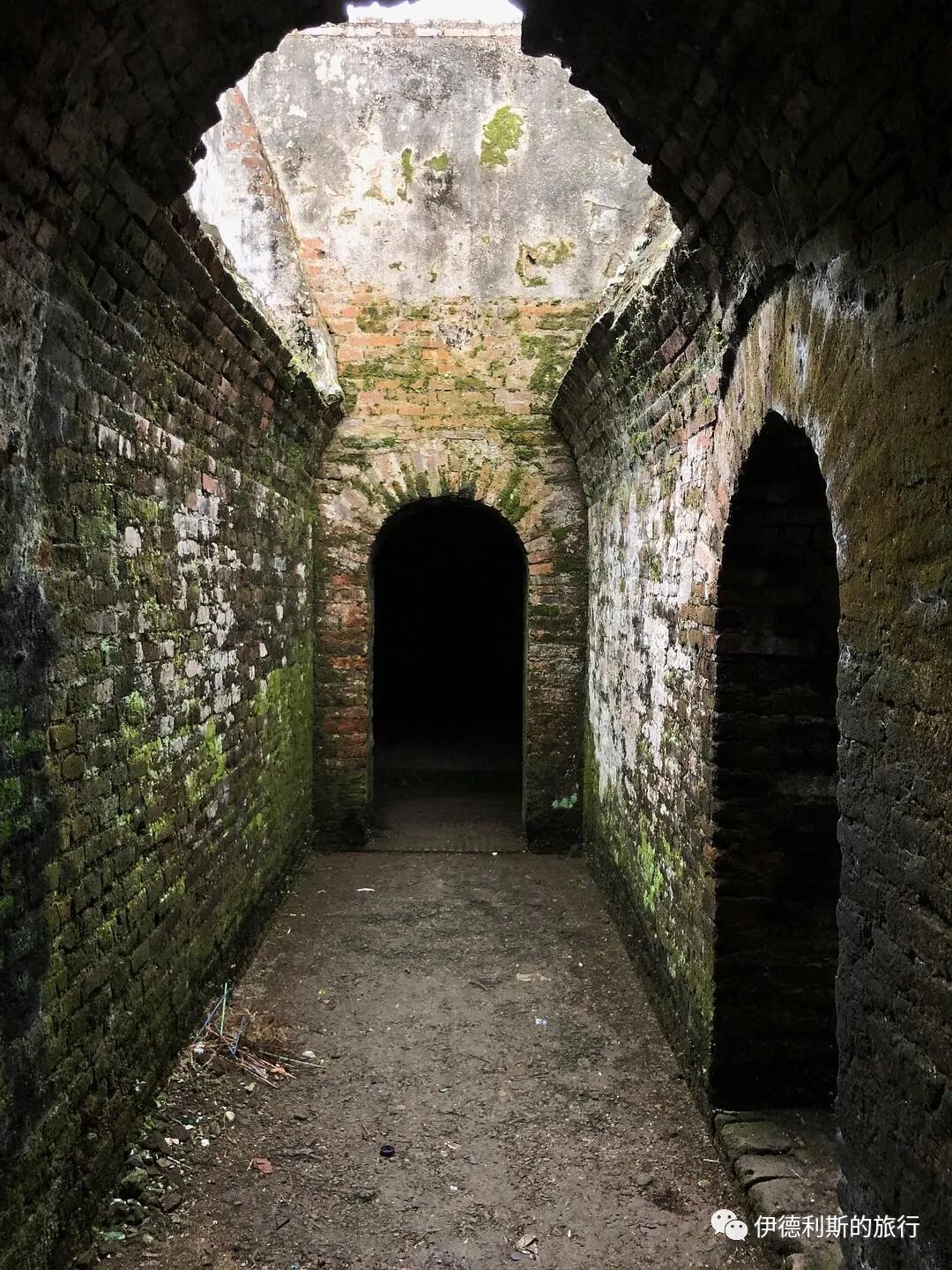
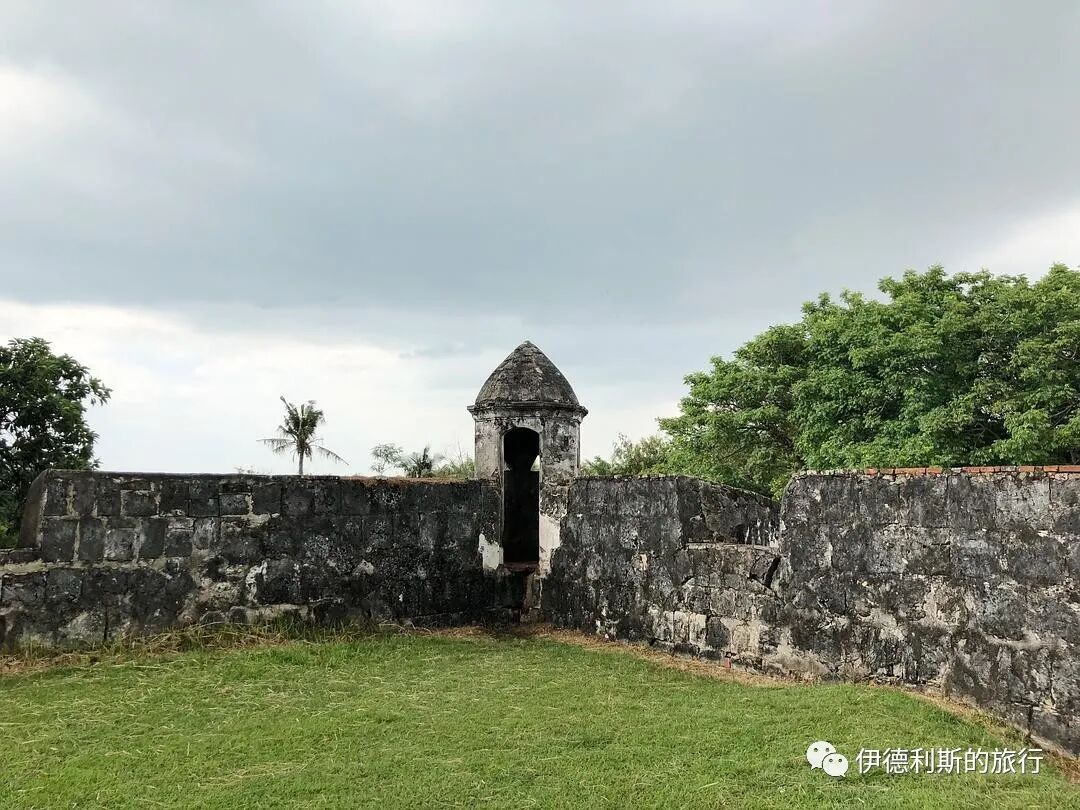
Speelwijk Castle was eventually abandoned due to a plague in 1811. Today, there are many Dutch graves in front of the castle, including those of castle officer Hugo Pieter Faure, who died in 1763, and the castle tax collector and purchaser Kopman en Fiscaal Deserbezeting, who died in 1769.
Old photo of the Dutch cemetery
8. Kaibon Palace—Residence of the Last Queen Mother: Early 19th Century
Kaibon Palace was the last building constructed by the Banten Sultanate. Built in the early 19th century, it served as the palace for Ratu Aisyah, the mother of the final sultan, Muhamad Syafiuddin.
After the British invaded Java in 1813, they ordered the final Banten sultan, Muhamad Syafiuddin, to abdicate, marking the end of the Banten Sultanate. After the Anglo-Dutch Treaty of 1814 was signed, Britain returned the Banten region to the Dutch, and Banten was officially incorporated into the Dutch East Indies. In 1832, the Dutch destroyed Kaibon Palace, leaving it in complete ruins.
The palace still preserves its traditional Javanese Paduraksa-style gate. The Paduraksa gate originated from the ancient Hindu Gopuram gate. It was widely used in ancient Javanese Hindu and Buddhist temples from the 8th to 9th centuries and was later adopted by Islamic sultanates for their mosques, palaces, and cemeteries after the 15th century.
Part of the palace still retains the Queen Mother's bedroom, which featured a cooling system powered by flowing water.
Photographed by Georg Friedrich Johannes between 1915 and 1926
Photographed in 1933 view all
Summary: Muslim Travel Guide Indonesia Banten: Sultanate Mosques, Coastal City and Islamic Heritage is presented here as a clear Muslim travel account, beginning with this scene: Banten is located at the westernmost tip of Java Island, facing Sumatra across the Sunda Strait. The account keeps its focus on Banten Mosques, Indonesia Muslim Travel, Sultanate History while preserving the names, places, food, and historical details from the Chinese source.
Banten is located at the westernmost tip of Java Island, facing Sumatra across the Sunda Strait. The local Bantenese people are a branch of the Sundanese. In the 16th century, the Banten Sultanate rose to become a powerful maritime trading nation in western Java, controlling the pepper trade in Southeast Asia. The Banten Sultanate reached its peak in the 17th century and had intense conflicts with the Dutch East India Company. After the 18th century, the Banten Sultanate gradually came under the control of the Dutch East India Company and was finally annexed into the Dutch East Indies in the 19th century.
Today, the ancient city of Banten still retains many ruins, and the Great Mosque of Banten (Masjid Agung Banten), built in the 16th century, remains a famous religious site. two palaces of the Banten Sultanate, a Dutch fortress, and several tombs of the Banten Sultans have been preserved. Due to time constraints, I could not visit all the historical sites this time, but I still hope to share the ruins of the Banten Sultanate that I saw with everyone.
Table of Contents
1. Traveling to the Ancient City of Banten
2. The Establishment of the Banten Sultanate
3. The Port City of Banten
4. Surosowan Palace—Sultan's Residence: 1552
5. Great Mosque of Banten: 1566
6. Banten Bazaar
7. Speelwijk Castle—Dutch Fortress: 1682
8. Kaibon Palace—Residence of the Last Queen Mother: Early 19th Century
1. Traveling to the Ancient City of Banten
The ancient city of Banten is located west of Jakarta, and it takes an hour and a half to drive there under normal traffic conditions. There are buses from Kalideres bus station in western Jakarta to the city of Serang, where Banten is located. Once you arrive at the station, just ask people for "Serang" and they will point you in the right direction. The bus I took picked up passengers along the way before getting on the highway, so it took three hours to reach Serang. Friends who want to go, please make sure to allow extra time. It was very interesting that before getting on the highway, vendors kept getting on the bus to sell various things, including fruits, snacks, ballpoint pens, electronic watches, and so on. There were also several groups of singers, making it feel like a moving bazaar.
After getting on the bus, be sure to tell the driver or conductor that you are going to the Great Mosque of Banten, which is Masjid Agung Banten. Note that the pronunciation of Banten is "Banden." Then the driver will drop you off at the intersection before entering Serang city. From there, you can take a minibus or call a Grab to the ancient city of Banten.
2. The Establishment of the Banten Sultanate
After the 15th century, the Hindu-Buddhist Majapahit empire declined and the Islamic Malacca Sultanate rose. Many Muslim merchants from Arabia and India settled on the north coast of Java, marking a new chapter in Javanese history.
Between the 15th and 16th centuries, many Sufi Muslims arrived in Java to spread the faith, with the Nine Saints (Wali Songo) being the most famous. Among the Nine Saints, Sunan Gunung Jati was the only one who used military force to spread Islam.
Sunan Gunung Jati was born Syarif Hidayatullah. His father came from the Hashim family in Egypt, the same family as the Prophet Muhammad, and his mother was a princess from the Hindu Sunda Kingdom in western Java. Although his grandfather was a Hindu king, Sunan Gunung Jati's mother and his uncle, Prince Walangsungsang, both converted to Islam.
In 1470, after spending years studying Islamic knowledge in places like Mecca and Baghdad in the Middle East, Sunan Gunung Jati returned to Java to help his uncle rule the port town of Cirebon in West Java. In 1479, Sunan Gunung Jati took over from his uncle to rule Cirebon, established the Cirebon Sultanate, and officially declared independence from the Sunda Kingdom in 1482.
Shortly before Sunan Gunung Jati established the Cirebon Sultanate, the Muslim port town of Demak in Central Java had already gained independence from the Majapahit Kingdom in 1475. These two Javanese Muslim states, which relied on maritime trade, joined forces and posed a major threat to the existing Hindu Sunda Kingdom. The Sunda Kingdom then went to Malacca to seek help from the Portuguese. In 1522, the Portuguese officially formed an alliance with the Sunda Kingdom to control the local pepper trade.
However, after the alliance was formed, the Portuguese failed to send troops to help in time. The joint Cirebon-Demak forces took the opportunity to capture Sunda Kalapa, an important port of the Sunda Kingdom, and renamed it Jakarta. After that, the Sunda Kingdom fought a five-year war alone against the Cirebon-Demak coalition. In 1527, the Sultan of Cirebon, Sunan Gunung Jati, sent his son Hasanudin to join the Demak Sultanate and capture Banten, another important port of the Sunda Kingdom. Sunan Gunung Jati then appointed his son as the Sultan of Banten. In 1552, the Banten Sultanate broke away from the Cirebon Sultanate and became an independent state.
The territory of the Banten Sultanate, drawn by Gunawan Kartapranata.
3. The Port City of Banten
Shortly after becoming the Sultan of Banten, Hasanudin began building a new port city at the mouth of the Banten River. By the mid-16th century, Banten had become an important port that could rival Malacca.
According to the Portuguese historian João de Barros, the city of Banten was located in the middle of the harbor, and a clear river ran through the city, allowing ships to sail into the town center. Inside the city, there was a brick fortress with a two-story wooden defensive structure. The city center had a square that served as a market in the morning and was used for military or artistic activities at noon. On the south side of the square was the Sultan's palace, known as the Surosowan Palace, with a tall building next to it used by the Sultan to receive his subjects. On the west side of the square was the Great Mosque, which is today's Great Mosque of Banten.
At that time, only local residents were allowed to live in the city. Foreigners lived near the harbor in the north, with foreign Muslims in the northeast and non-Muslim foreigners in the northwest.
In the late 16th century, the Banten Sultanate controlled the pepper trade in the Lampung region at the southern tip of Sumatra. It traded closely with Portugal, the Netherlands, Britain, France, and Denmark, becoming a major international trade hub in Southeast Asia. With help from the British, the Danes, and the Chinese, the Banten Sultanate traded with Persia, India, Siam, Vietnam, the Philippines, China, and Japan.
Banten City in 1724, drawn by François Valentijn.
4. Surosowan Palace—Sultan's Residence: 1552
Surosowan Palace was built in 1552 by the Banten Sultan Maulana Hasanuddin and later served as the residence for successive sultans. A Dutchman designed the palace, which is why it features the corner bastion structure of a Dutch fort.
In 1808, to defend against a British invasion of Java, the Dutch ordered the construction of the Great Post Road across the island. They also ordered the Banten Sultan to move his capital and provide labor to build a port for the Dutch fleet. The Sultan refused, so the Dutch destroyed Surosowan Palace and imprisoned the entire royal family. After the British invaded Java in 1813, they forced the last Sultan to abdicate, marking the end of the Banten Sultanate. After the Anglo-Dutch Treaty of 1814 was signed, Britain returned the Banten region to the Dutch, and Banten was officially incorporated into the Dutch East Indies.
Today, the ruins of Surosowan Palace include two-meter-high walls made of red stone and coral. The most prominent site inside is the princess's bathing pool, which looks similar to the existing pools at the Sultan's palace in Yogyakarta.
5. Great Mosque of Banten: 1566
The Great Mosque of Banten (Masjid Agung Banten) is a famous Javanese-style mosque, built in 1566 by order of Sultan Maulana Hasanuddin. The women's hall (Pawestren) was added in the 1580s. In 1632, a Chinese man named Cek-ban-cut designed and built the minaret (bangker), and in the 17th century, a Dutch convert to Islam named Hendrik Lucaasz Cardeel designed and built the religious school (tiyamah).
As a typical Javanese-style mosque, the Great Mosque of Banten has a large porch-style shelter (serambi) in front of the main prayer hall. Inside the main hall, four main wooden pillars (saka guru) support a five-tiered roof. The top three tiers look more like a Chinese Buddhist pagoda than a traditional Javanese roof. Historical records suggest the original roof only had three tiers, and the top two were likely added between the 18th and 19th centuries. The mosque's minaret is 24 meters high with a base diameter of 10 meters, blending Mughal style with the local Javanese Hindu/Buddhist mosque (Candi) style.
The Great Mosque of Banten, drawn by Josias Cornelis Rappard in the 1880s.
Right next to the mosque is the family cemetery of the Banten Sultanate. The first Sultan, Maulana Hasanuddin (reigned 1552–1570), the sixth Sultan, Ageng Tirtayasa (reigned 1651–1683), and the seventh Sultan, Abu Nashar Abdul Qahar (reigned 1683–1687), are all buried there.
The reign of the sixth Sultan, Ageng Tirtayasa, from 1651 to 1682, is known as the golden age of the Banten Sultanate. During this time, the Banten Sultanate built a powerful navy with the help of European shipyards and attracted many Europeans to work in Banten. To ensure safe travel, the Banten Sultanate sent a fleet in 1661 to conquer the Tanjungpura Kingdom in western Kalimantan, attempting to break the blockade by the Dutch East India Company (VOC).
6. Banten Bazaar
As a holy site, the Great Mosque of Banten attracts a constant stream of Muslims every day, and a very lively bazaar has formed around it. At the bazaar, I drank an iced beverage called Es Campur made with coconut milk, red sugar syrup, coconut meat, and fruit jelly, and I also had some simple street-style boiled noodles (Mie Rebus). The bazaar is full of people selling sapodilla (Manilkara zapota), which is sweet and delicious. Sapodilla is native to the Caribbean in Central America. It was brought to the Philippines by Spanish colonists and later widely planted across Southeast Asia, where it is called sawo in Indonesia.
I bought two hats at the Banten bazaar. One of them is the black velvet cap (peci), which is the most common type in Indonesia. The peci is also called a songkok (Songkok). Indonesian and Malay Muslim men usually wear this hat for important ceremonies like weddings, funerals, or Eid al-Fitr. The word peci likely comes from the Dutch word petje, which means small hat.
The peci may have originated from the felt fez hat promoted by the Ottoman Empire starting in 1826. It soon spread to the Indonesian and Malay regions, gradually taking on the form of the modern songkok. Many Indonesian nationalist activists wore the songkok in the early 20th century, with Indonesia's first president, Sukarno, being the most famous among them. After Sukarno made the peci part of the official Indonesian presidential attire, black velvet became the most common style of peci in Indonesia.
The second hat is made of woven bamboo. Besides the round one I bought, there are also boat-shaped ones similar to the songkok, which feel perfect for summer.
Another hat shop.
7. Speelwijk Castle—Dutch Fortress: 1682
Speelwijk Castle is a fortress built by the Dutch East India Company on the northwest coast of Banten. It was first built in 1682 and expanded twice, in 1685 and 1731. This castle was mainly used to control the activities of the Banten Sultanate and to protect Dutch merchant ships from pirate attacks.
Starting in the 16th century, the Dutch began competing with Portugal and England for the pepper trade in Java. In 1602, the Dutch established the famous Dutch East India Company, and the following year they set up a permanent trading post in Banten. In 1619, the Dutch East India Company captured Jakarta, which was controlled by the Banten Sultanate, and renamed it Batavia to serve as their headquarters. By the late 17th century, the Dutch East India Company had become the world's wealthiest private company and had completely defeated the Portuguese on Java.
In 1680, the Dutch East India Company incited a civil war within the Banten Sultanate, took the opportunity to drive British merchants out of Banten, and gained a monopoly on the surrounding pepper trade. After 1682, the Banten Sultanate gradually came under the control of the Dutch East India Company, and even the succession of the Sultan required approval from the company. Speelwijk Castle is the best witness to this historical period. After 1752, the Banten Sultanate officially became a vassal state of the Dutch East India Company.
Speelwijk Castle was eventually abandoned due to a plague in 1811. Today, there are many Dutch graves in front of the castle, including those of castle officer Hugo Pieter Faure, who died in 1763, and the castle tax collector and purchaser Kopman en Fiscaal Deserbezeting, who died in 1769.
Old photo of the Dutch cemetery
8. Kaibon Palace—Residence of the Last Queen Mother: Early 19th Century
Kaibon Palace was the last building constructed by the Banten Sultanate. Built in the early 19th century, it served as the palace for Ratu Aisyah, the mother of the final sultan, Muhamad Syafiuddin.
After the British invaded Java in 1813, they ordered the final Banten sultan, Muhamad Syafiuddin, to abdicate, marking the end of the Banten Sultanate. After the Anglo-Dutch Treaty of 1814 was signed, Britain returned the Banten region to the Dutch, and Banten was officially incorporated into the Dutch East Indies. In 1832, the Dutch destroyed Kaibon Palace, leaving it in complete ruins.
The palace still preserves its traditional Javanese Paduraksa-style gate. The Paduraksa gate originated from the ancient Hindu Gopuram gate. It was widely used in ancient Javanese Hindu and Buddhist temples from the 8th to 9th centuries and was later adopted by Islamic sultanates for their mosques, palaces, and cemeteries after the 15th century.
Part of the palace still retains the Queen Mother's bedroom, which featured a cooling system powered by flowing water.
Photographed by Georg Friedrich Johannes between 1915 and 1926
Photographed in 1933 view all
Reposted from the web
Summary: Muslim Travel Guide Indonesia Banten: Sultanate Mosques, Coastal City and Islamic Heritage is presented here as a clear Muslim travel account, beginning with this scene: Banten is located at the westernmost tip of Java Island, facing Sumatra across the Sunda Strait. The account keeps its focus on Banten Mosques, Indonesia Muslim Travel, Sultanate History while preserving the names, places, food, and historical details from the Chinese source.
Banten is located at the westernmost tip of Java Island, facing Sumatra across the Sunda Strait. The local Bantenese people are a branch of the Sundanese. In the 16th century, the Banten Sultanate rose to become a powerful maritime trading nation in western Java, controlling the pepper trade in Southeast Asia. The Banten Sultanate reached its peak in the 17th century and had intense conflicts with the Dutch East India Company. After the 18th century, the Banten Sultanate gradually came under the control of the Dutch East India Company and was finally annexed into the Dutch East Indies in the 19th century.
Today, the ancient city of Banten still retains many ruins, and the Great Mosque of Banten (Masjid Agung Banten), built in the 16th century, remains a famous religious site. two palaces of the Banten Sultanate, a Dutch fortress, and several tombs of the Banten Sultans have been preserved. Due to time constraints, I could not visit all the historical sites this time, but I still hope to share the ruins of the Banten Sultanate that I saw with everyone.
Table of Contents
1. Traveling to the Ancient City of Banten
2. The Establishment of the Banten Sultanate
3. The Port City of Banten
4. Surosowan Palace—Sultan's Residence: 1552
5. Great Mosque of Banten: 1566
6. Banten Bazaar
7. Speelwijk Castle—Dutch Fortress: 1682
8. Kaibon Palace—Residence of the Last Queen Mother: Early 19th Century
1. Traveling to the Ancient City of Banten
The ancient city of Banten is located west of Jakarta, and it takes an hour and a half to drive there under normal traffic conditions. There are buses from Kalideres bus station in western Jakarta to the city of Serang, where Banten is located. Once you arrive at the station, just ask people for "Serang" and they will point you in the right direction. The bus I took picked up passengers along the way before getting on the highway, so it took three hours to reach Serang. Friends who want to go, please make sure to allow extra time. It was very interesting that before getting on the highway, vendors kept getting on the bus to sell various things, including fruits, snacks, ballpoint pens, electronic watches, and so on. There were also several groups of singers, making it feel like a moving bazaar.
After getting on the bus, be sure to tell the driver or conductor that you are going to the Great Mosque of Banten, which is Masjid Agung Banten. Note that the pronunciation of Banten is "Banden." Then the driver will drop you off at the intersection before entering Serang city. From there, you can take a minibus or call a Grab to the ancient city of Banten.



2. The Establishment of the Banten Sultanate
After the 15th century, the Hindu-Buddhist Majapahit empire declined and the Islamic Malacca Sultanate rose. Many Muslim merchants from Arabia and India settled on the north coast of Java, marking a new chapter in Javanese history.
Between the 15th and 16th centuries, many Sufi Muslims arrived in Java to spread the faith, with the Nine Saints (Wali Songo) being the most famous. Among the Nine Saints, Sunan Gunung Jati was the only one who used military force to spread Islam.
Sunan Gunung Jati was born Syarif Hidayatullah. His father came from the Hashim family in Egypt, the same family as the Prophet Muhammad, and his mother was a princess from the Hindu Sunda Kingdom in western Java. Although his grandfather was a Hindu king, Sunan Gunung Jati's mother and his uncle, Prince Walangsungsang, both converted to Islam.
In 1470, after spending years studying Islamic knowledge in places like Mecca and Baghdad in the Middle East, Sunan Gunung Jati returned to Java to help his uncle rule the port town of Cirebon in West Java. In 1479, Sunan Gunung Jati took over from his uncle to rule Cirebon, established the Cirebon Sultanate, and officially declared independence from the Sunda Kingdom in 1482.
Shortly before Sunan Gunung Jati established the Cirebon Sultanate, the Muslim port town of Demak in Central Java had already gained independence from the Majapahit Kingdom in 1475. These two Javanese Muslim states, which relied on maritime trade, joined forces and posed a major threat to the existing Hindu Sunda Kingdom. The Sunda Kingdom then went to Malacca to seek help from the Portuguese. In 1522, the Portuguese officially formed an alliance with the Sunda Kingdom to control the local pepper trade.
However, after the alliance was formed, the Portuguese failed to send troops to help in time. The joint Cirebon-Demak forces took the opportunity to capture Sunda Kalapa, an important port of the Sunda Kingdom, and renamed it Jakarta. After that, the Sunda Kingdom fought a five-year war alone against the Cirebon-Demak coalition. In 1527, the Sultan of Cirebon, Sunan Gunung Jati, sent his son Hasanudin to join the Demak Sultanate and capture Banten, another important port of the Sunda Kingdom. Sunan Gunung Jati then appointed his son as the Sultan of Banten. In 1552, the Banten Sultanate broke away from the Cirebon Sultanate and became an independent state.
The territory of the Banten Sultanate, drawn by Gunawan Kartapranata.
3. The Port City of Banten
Shortly after becoming the Sultan of Banten, Hasanudin began building a new port city at the mouth of the Banten River. By the mid-16th century, Banten had become an important port that could rival Malacca.
According to the Portuguese historian João de Barros, the city of Banten was located in the middle of the harbor, and a clear river ran through the city, allowing ships to sail into the town center. Inside the city, there was a brick fortress with a two-story wooden defensive structure. The city center had a square that served as a market in the morning and was used for military or artistic activities at noon. On the south side of the square was the Sultan's palace, known as the Surosowan Palace, with a tall building next to it used by the Sultan to receive his subjects. On the west side of the square was the Great Mosque, which is today's Great Mosque of Banten.
At that time, only local residents were allowed to live in the city. Foreigners lived near the harbor in the north, with foreign Muslims in the northeast and non-Muslim foreigners in the northwest.
In the late 16th century, the Banten Sultanate controlled the pepper trade in the Lampung region at the southern tip of Sumatra. It traded closely with Portugal, the Netherlands, Britain, France, and Denmark, becoming a major international trade hub in Southeast Asia. With help from the British, the Danes, and the Chinese, the Banten Sultanate traded with Persia, India, Siam, Vietnam, the Philippines, China, and Japan.
Banten City in 1724, drawn by François Valentijn.
4. Surosowan Palace—Sultan's Residence: 1552
Surosowan Palace was built in 1552 by the Banten Sultan Maulana Hasanuddin and later served as the residence for successive sultans. A Dutchman designed the palace, which is why it features the corner bastion structure of a Dutch fort.
In 1808, to defend against a British invasion of Java, the Dutch ordered the construction of the Great Post Road across the island. They also ordered the Banten Sultan to move his capital and provide labor to build a port for the Dutch fleet. The Sultan refused, so the Dutch destroyed Surosowan Palace and imprisoned the entire royal family. After the British invaded Java in 1813, they forced the last Sultan to abdicate, marking the end of the Banten Sultanate. After the Anglo-Dutch Treaty of 1814 was signed, Britain returned the Banten region to the Dutch, and Banten was officially incorporated into the Dutch East Indies.
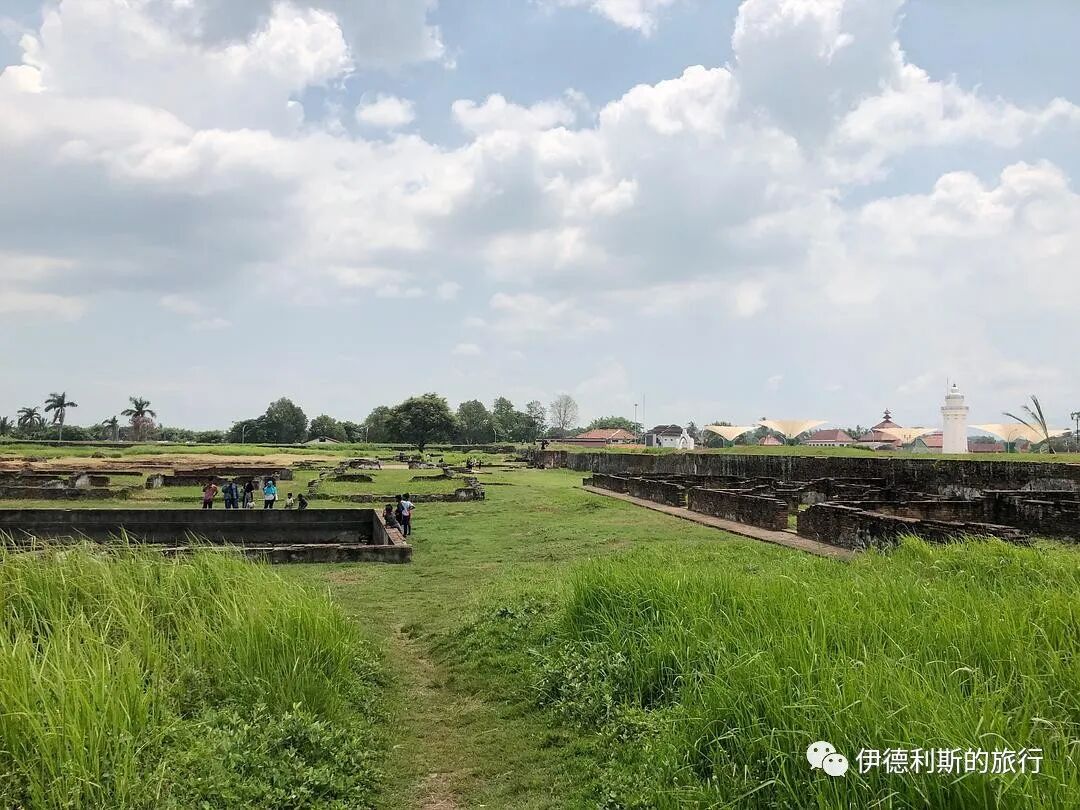
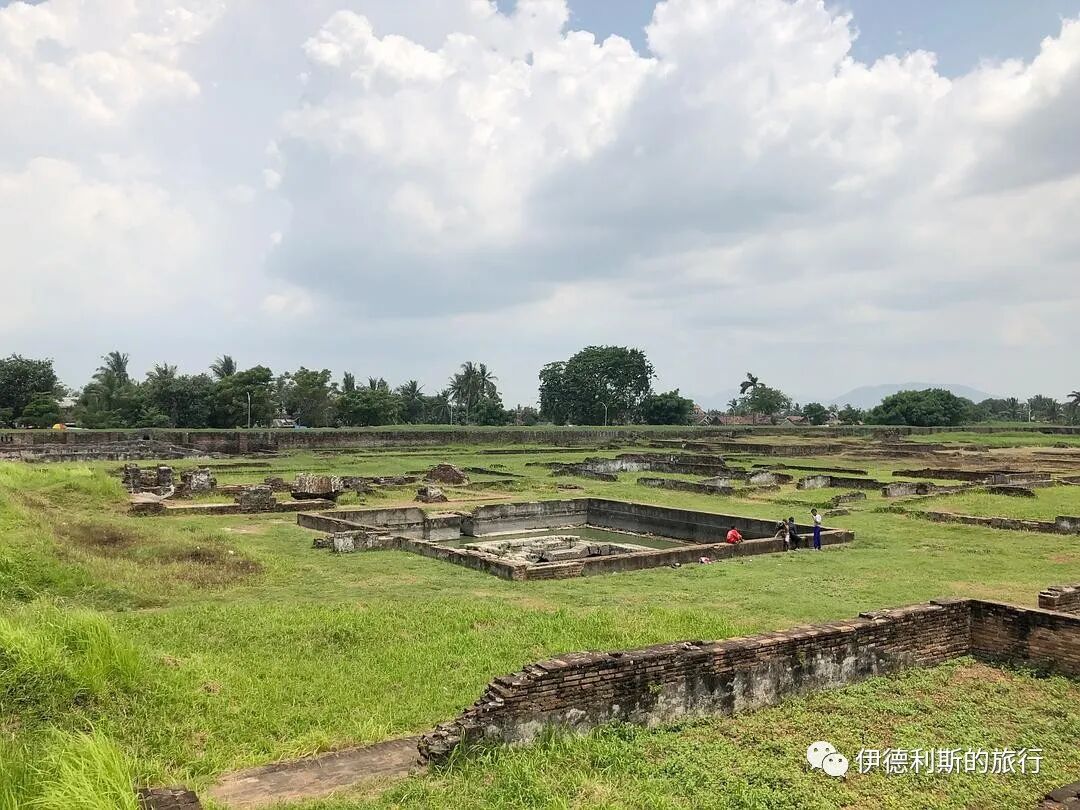
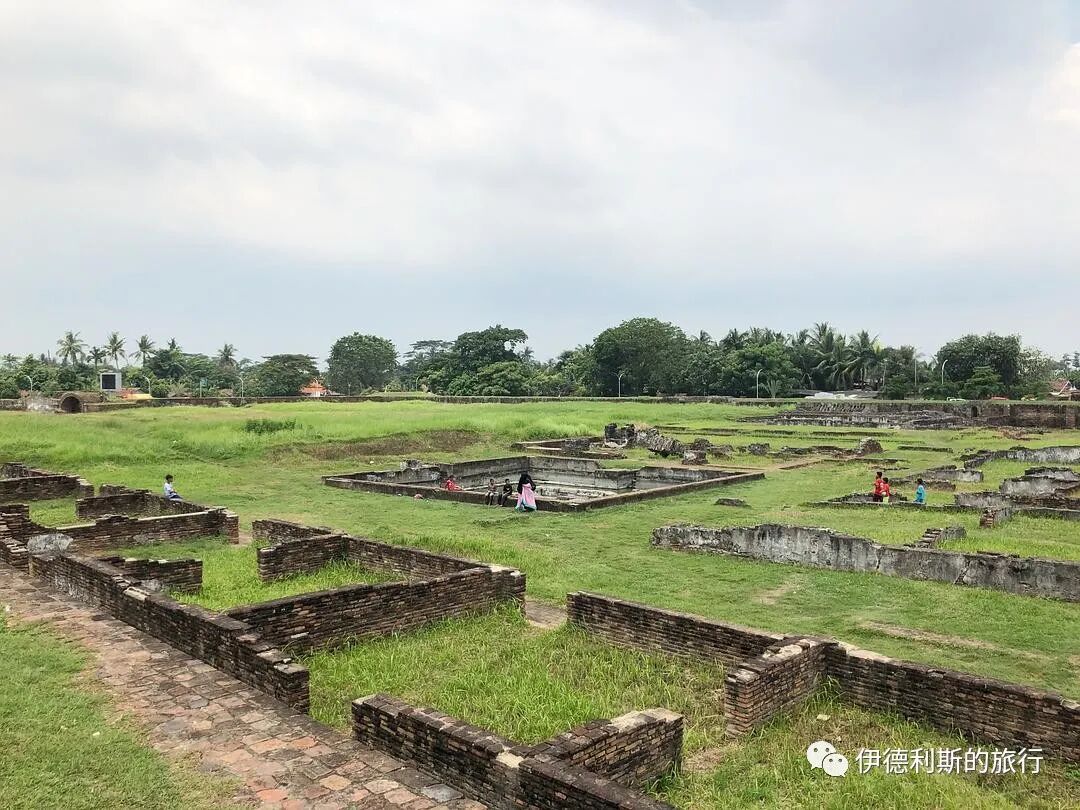
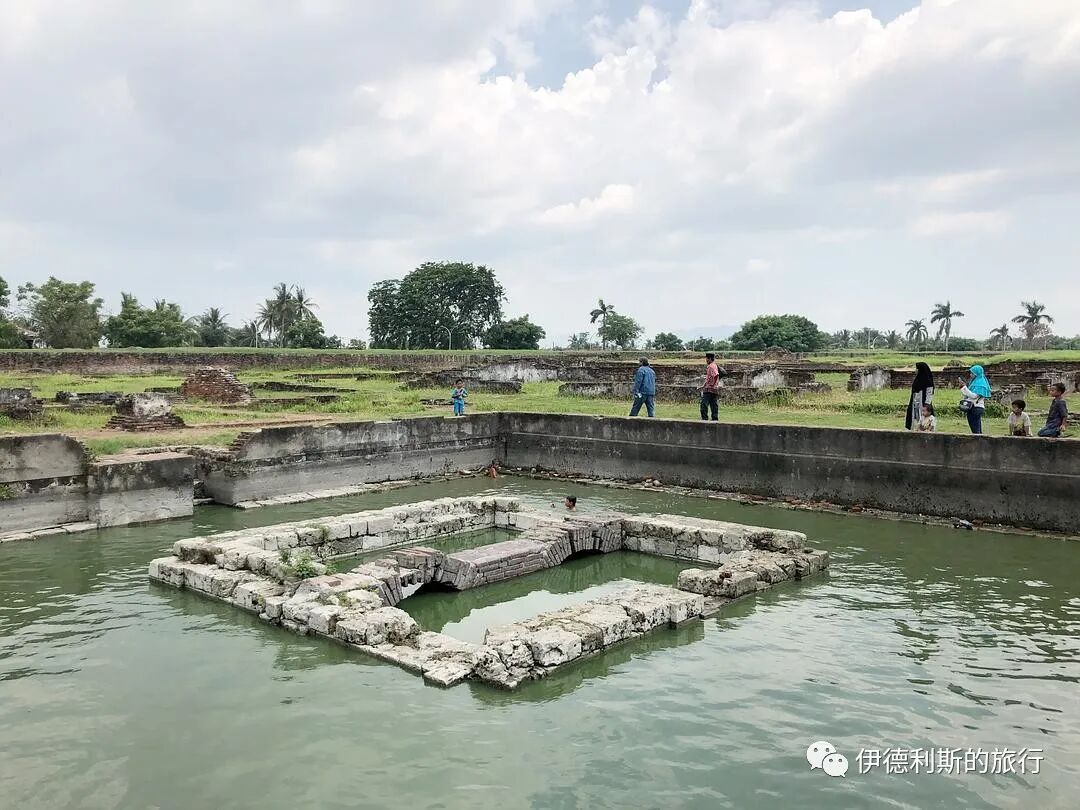
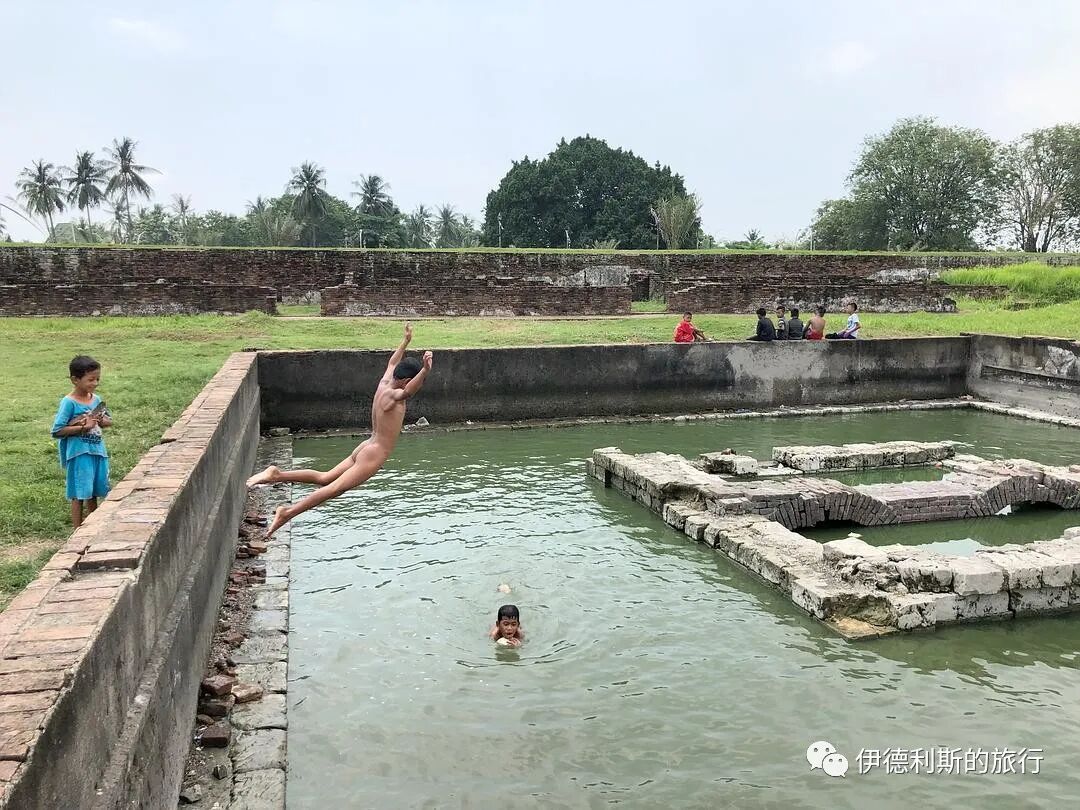
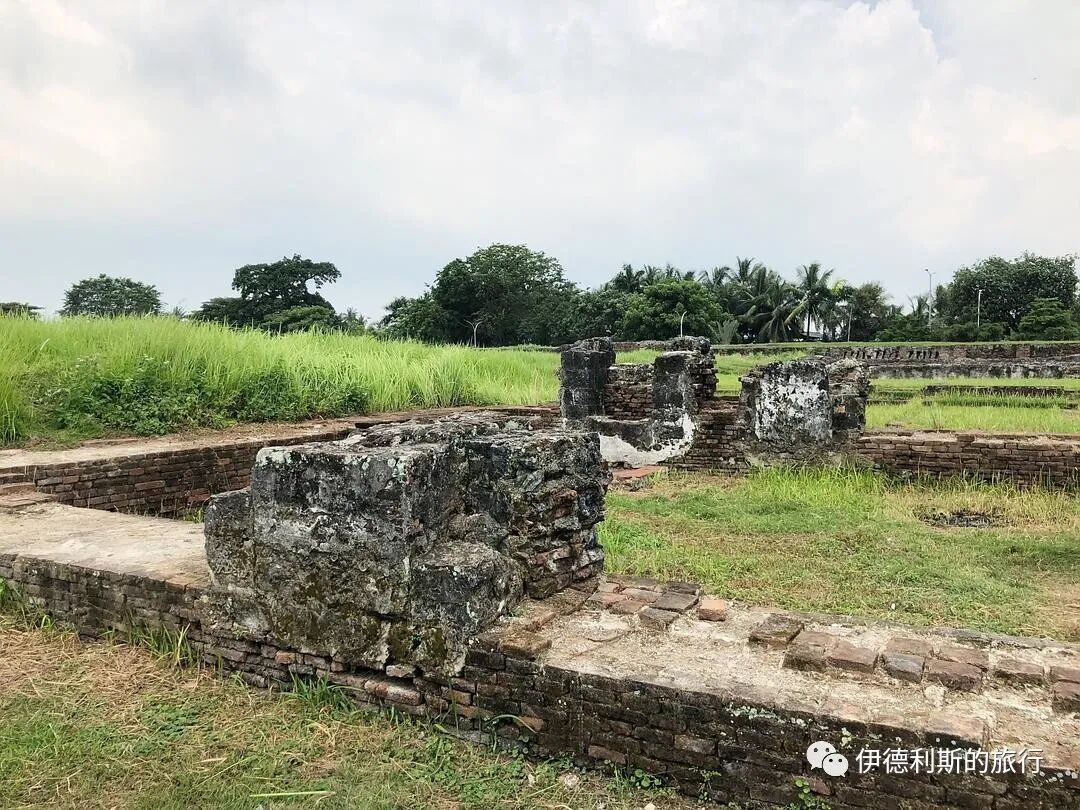
Today, the ruins of Surosowan Palace include two-meter-high walls made of red stone and coral. The most prominent site inside is the princess's bathing pool, which looks similar to the existing pools at the Sultan's palace in Yogyakarta.
5. Great Mosque of Banten: 1566
The Great Mosque of Banten (Masjid Agung Banten) is a famous Javanese-style mosque, built in 1566 by order of Sultan Maulana Hasanuddin. The women's hall (Pawestren) was added in the 1580s. In 1632, a Chinese man named Cek-ban-cut designed and built the minaret (bangker), and in the 17th century, a Dutch convert to Islam named Hendrik Lucaasz Cardeel designed and built the religious school (tiyamah).
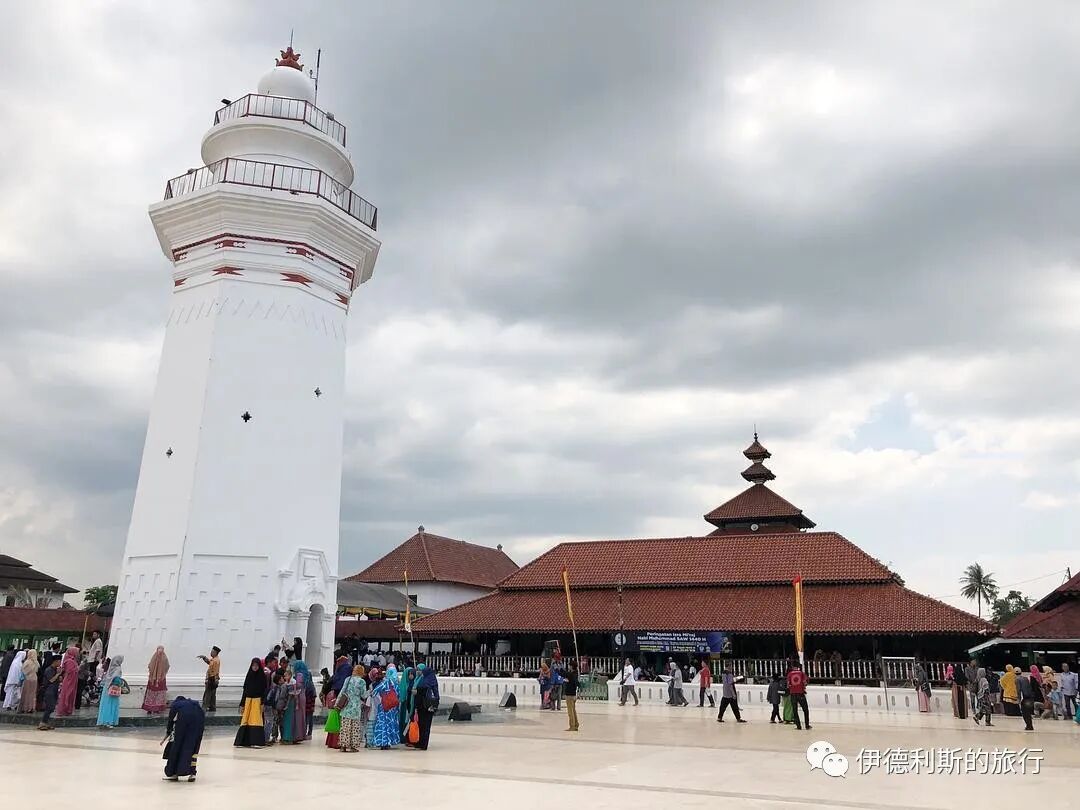
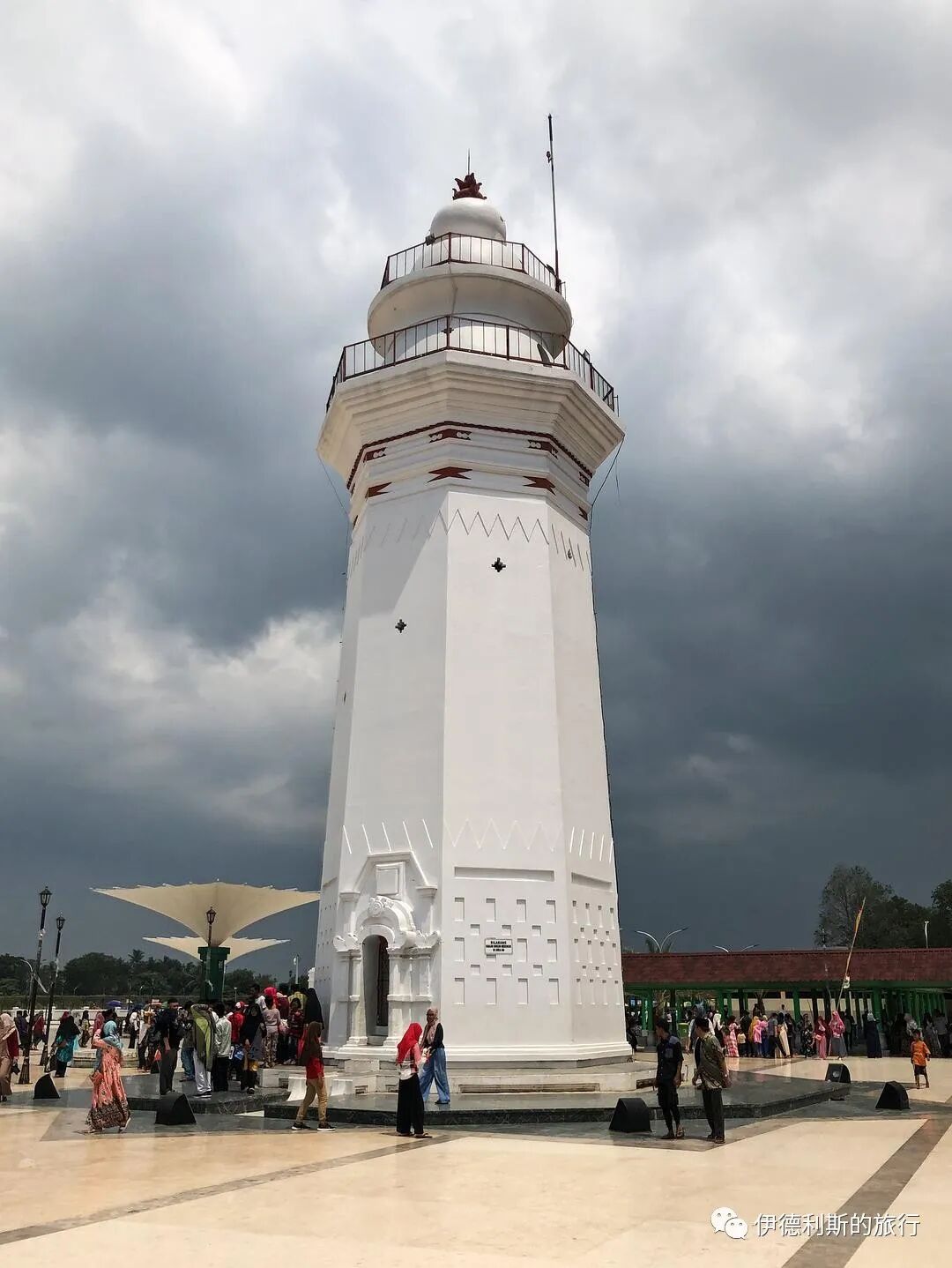
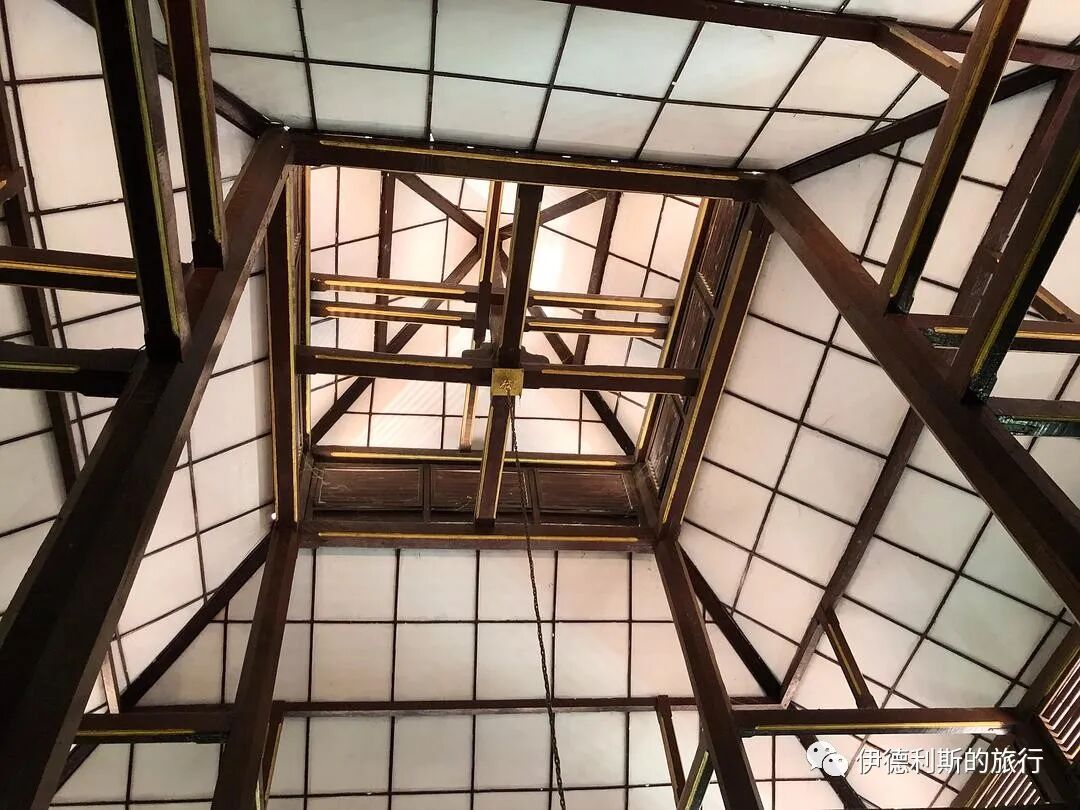
As a typical Javanese-style mosque, the Great Mosque of Banten has a large porch-style shelter (serambi) in front of the main prayer hall. Inside the main hall, four main wooden pillars (saka guru) support a five-tiered roof. The top three tiers look more like a Chinese Buddhist pagoda than a traditional Javanese roof. Historical records suggest the original roof only had three tiers, and the top two were likely added between the 18th and 19th centuries. The mosque's minaret is 24 meters high with a base diameter of 10 meters, blending Mughal style with the local Javanese Hindu/Buddhist mosque (Candi) style.
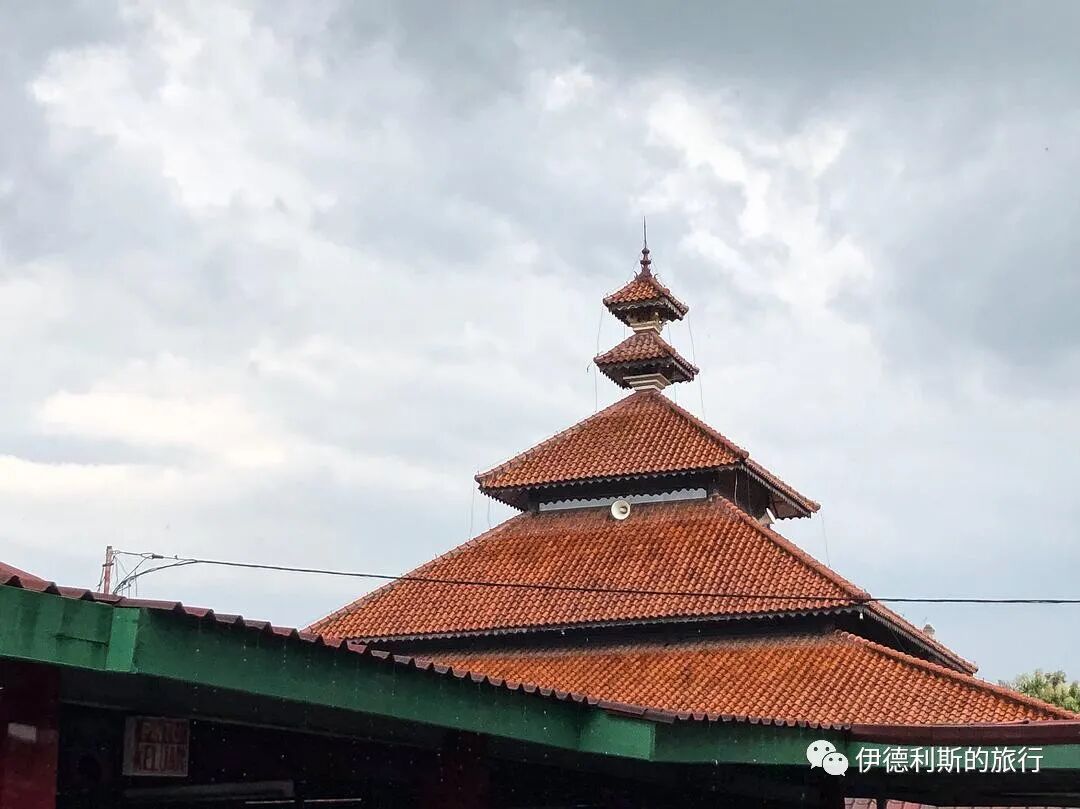
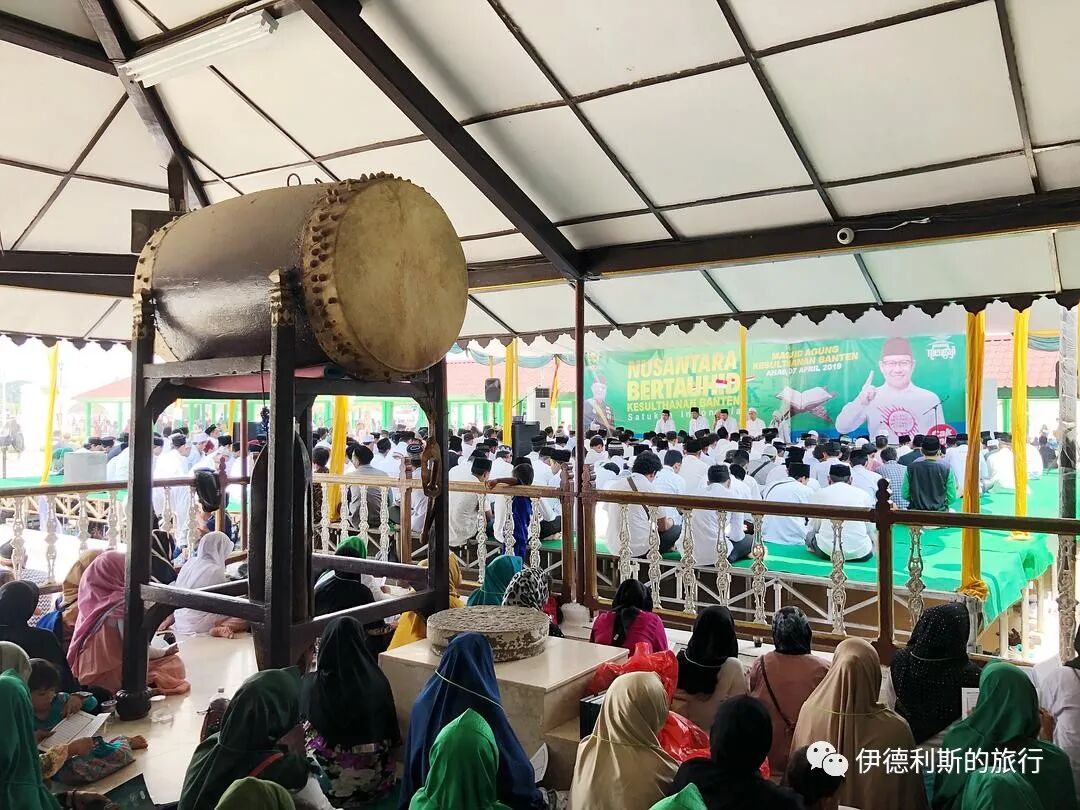
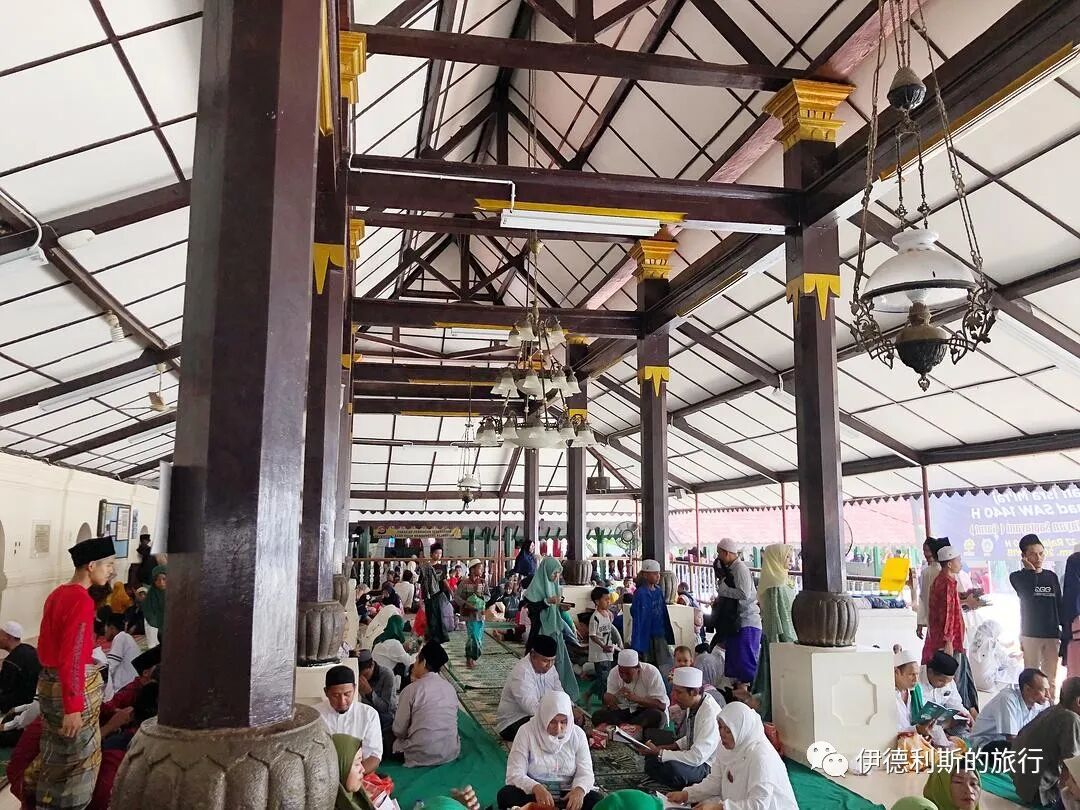
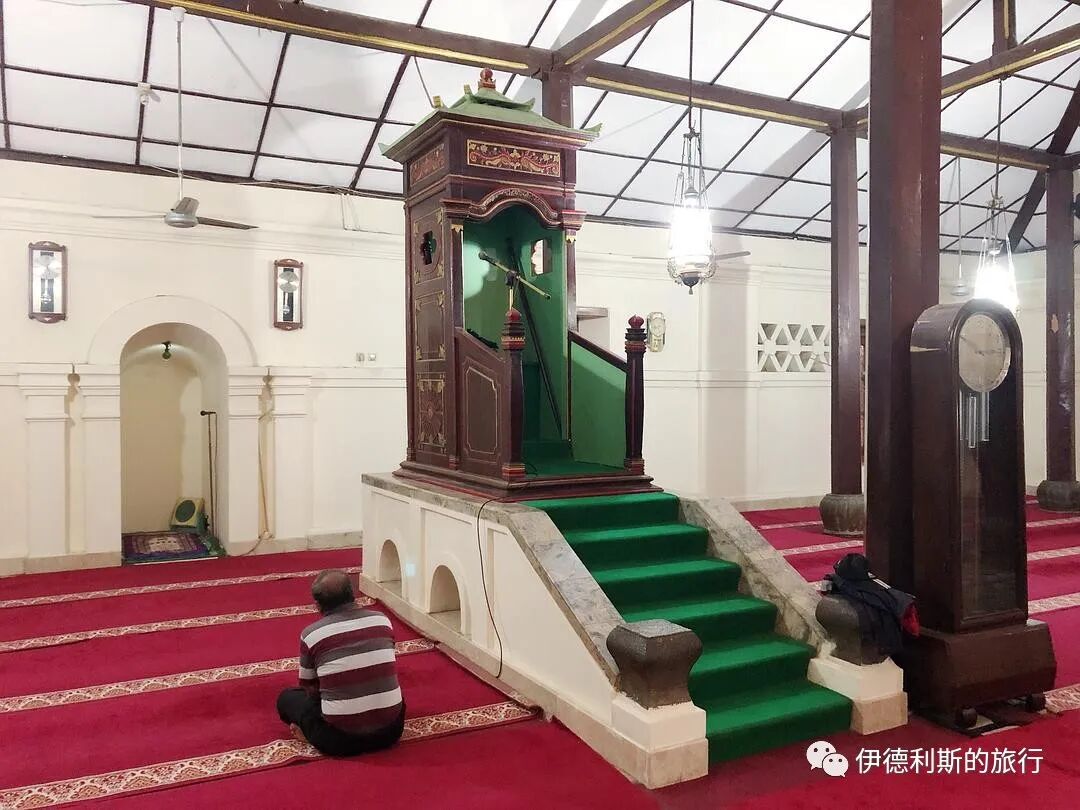
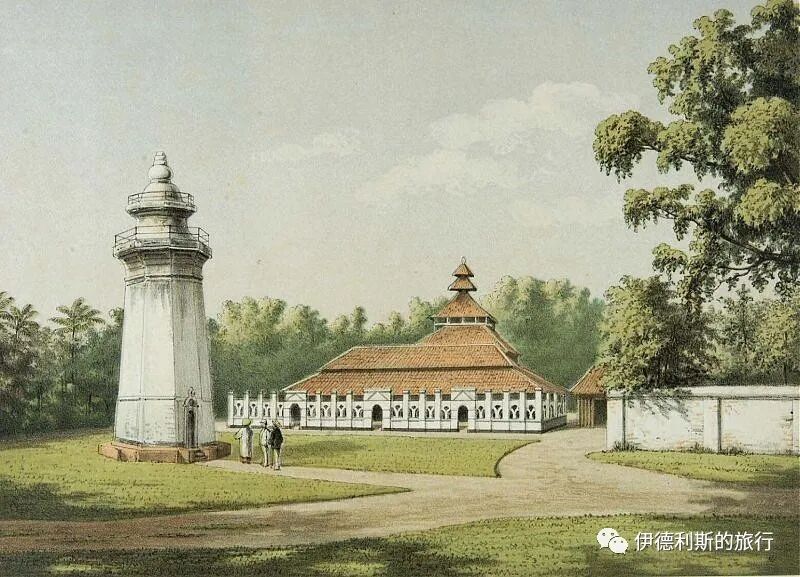
The Great Mosque of Banten, drawn by Josias Cornelis Rappard in the 1880s.
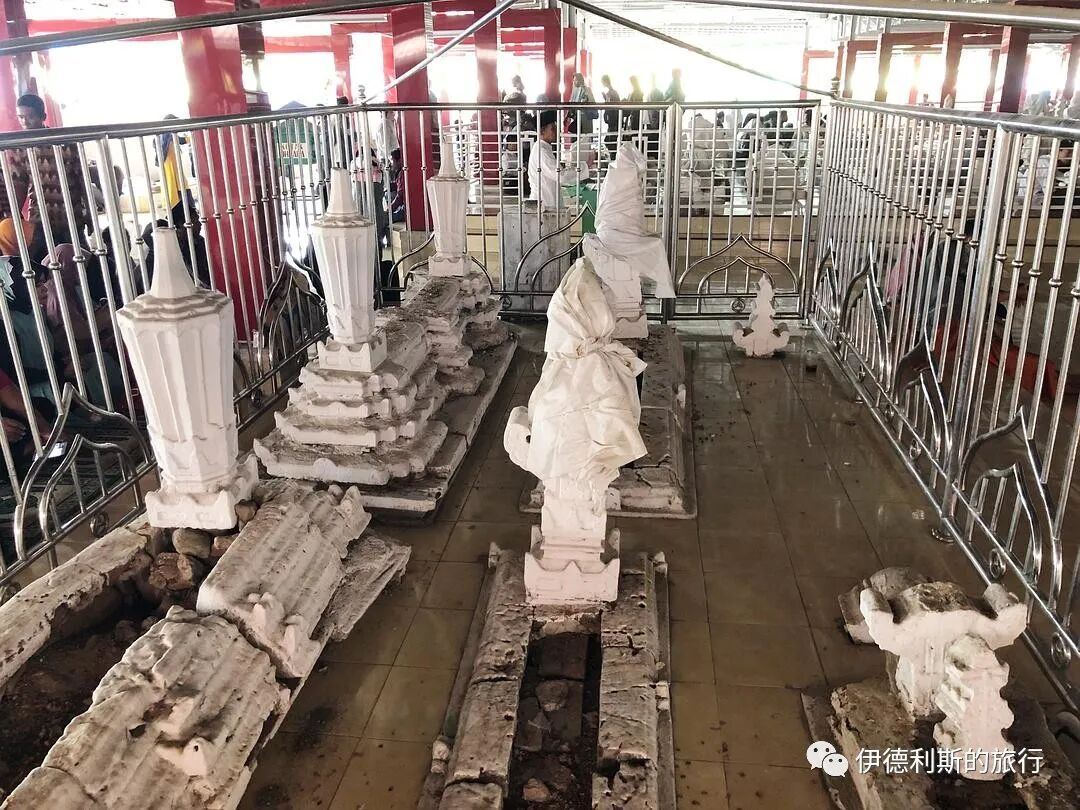
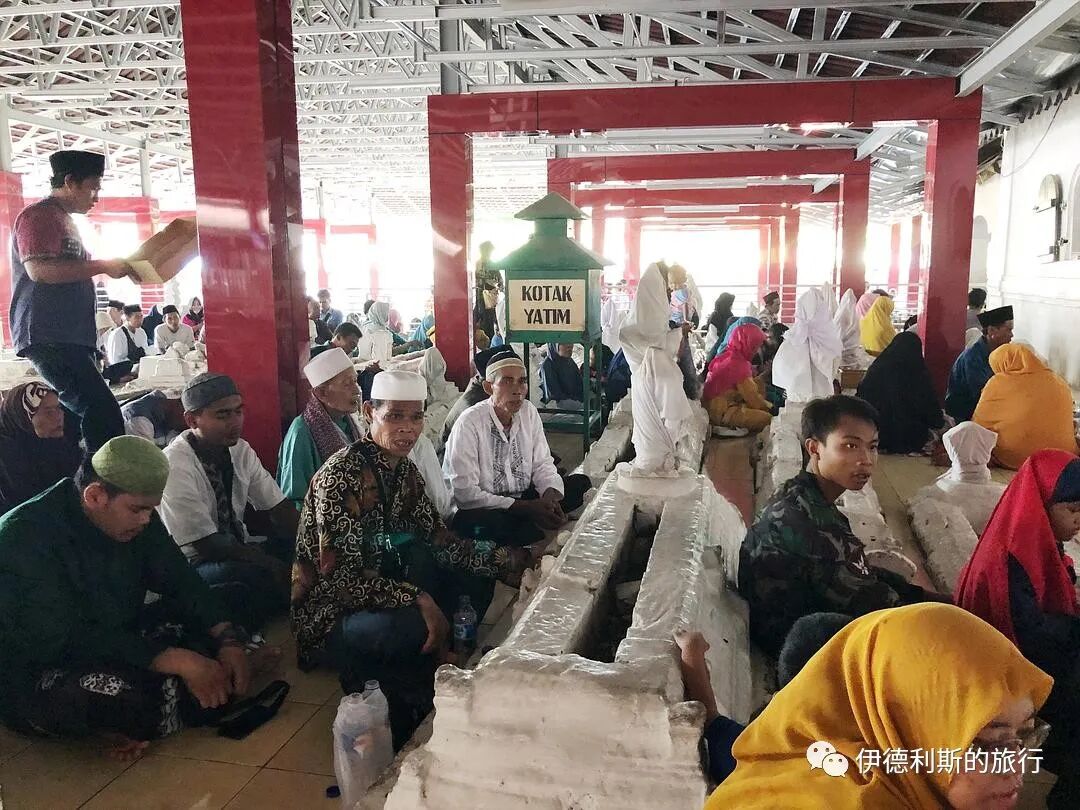
Right next to the mosque is the family cemetery of the Banten Sultanate. The first Sultan, Maulana Hasanuddin (reigned 1552–1570), the sixth Sultan, Ageng Tirtayasa (reigned 1651–1683), and the seventh Sultan, Abu Nashar Abdul Qahar (reigned 1683–1687), are all buried there.
The reign of the sixth Sultan, Ageng Tirtayasa, from 1651 to 1682, is known as the golden age of the Banten Sultanate. During this time, the Banten Sultanate built a powerful navy with the help of European shipyards and attracted many Europeans to work in Banten. To ensure safe travel, the Banten Sultanate sent a fleet in 1661 to conquer the Tanjungpura Kingdom in western Kalimantan, attempting to break the blockade by the Dutch East India Company (VOC).
6. Banten Bazaar
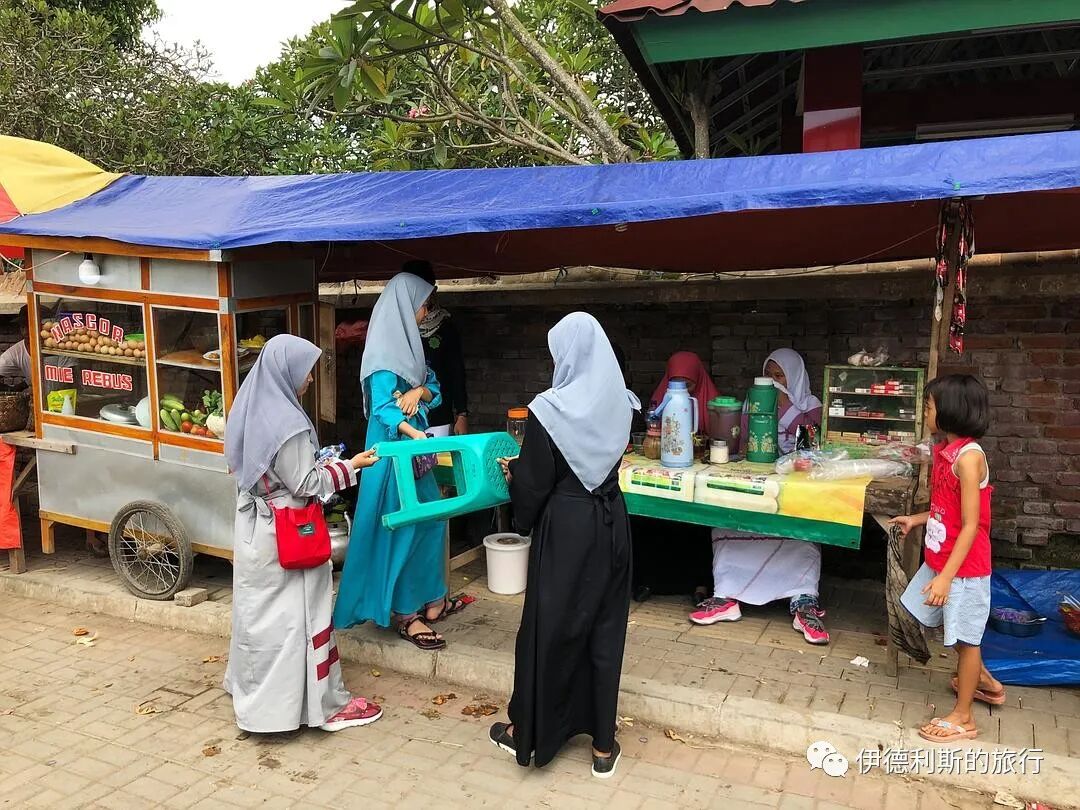
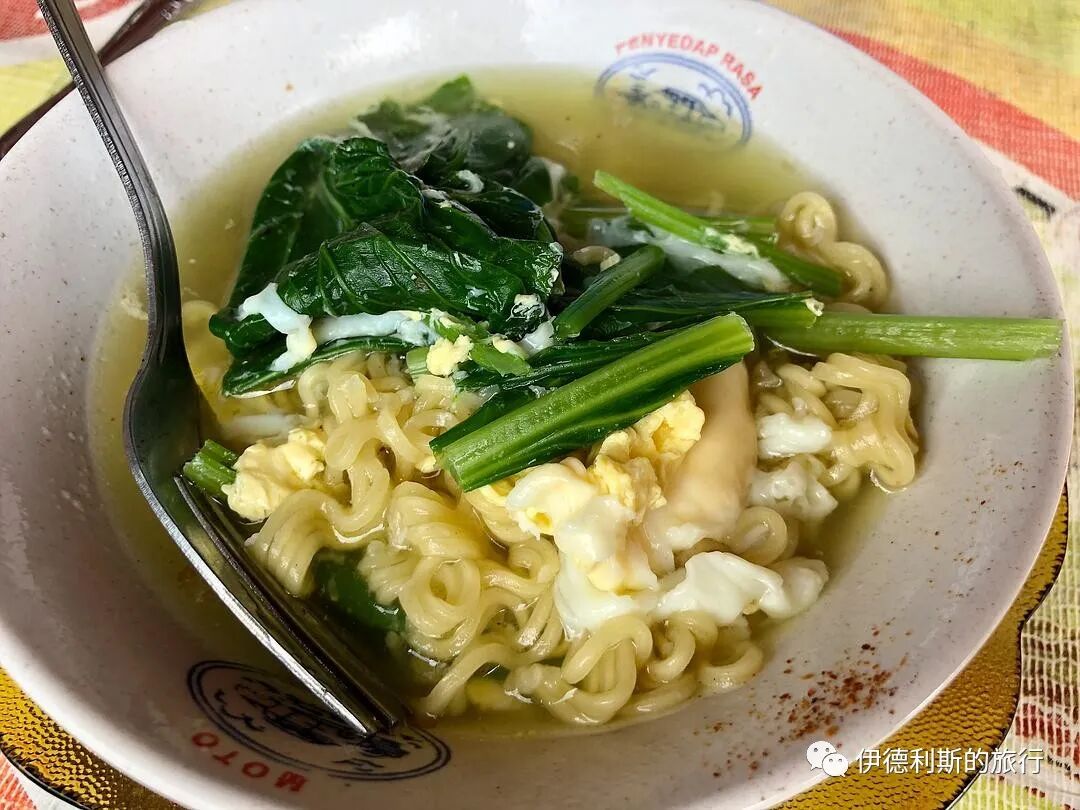
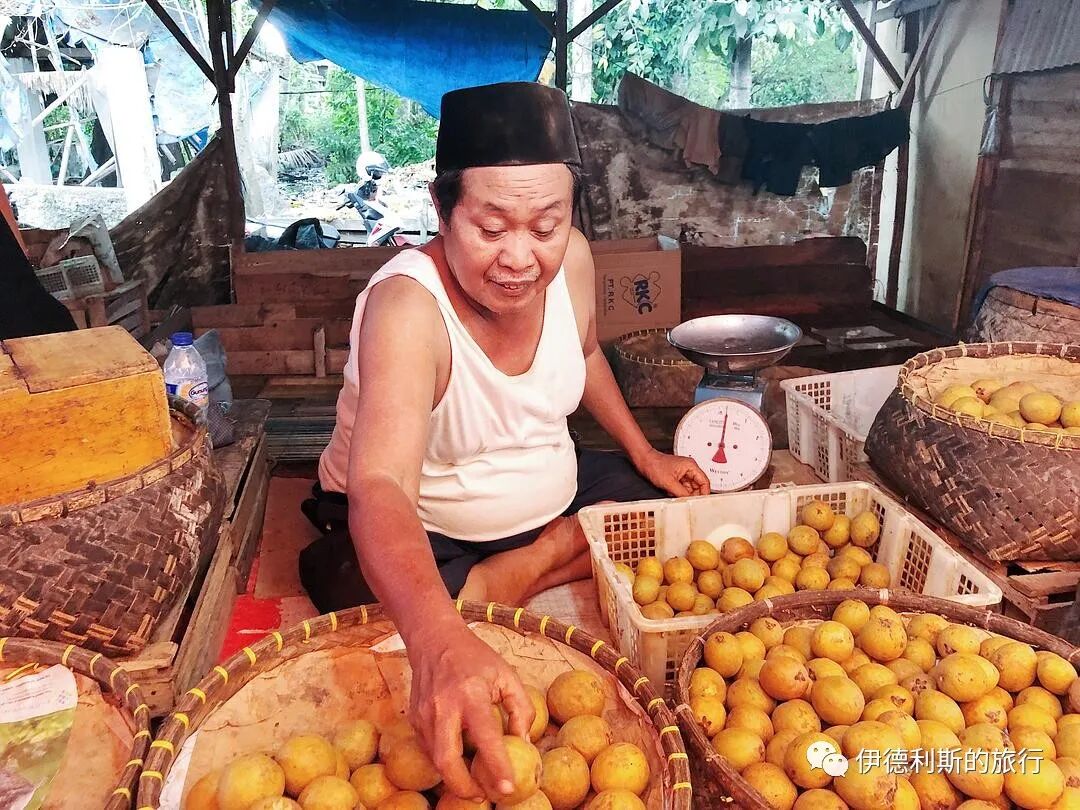
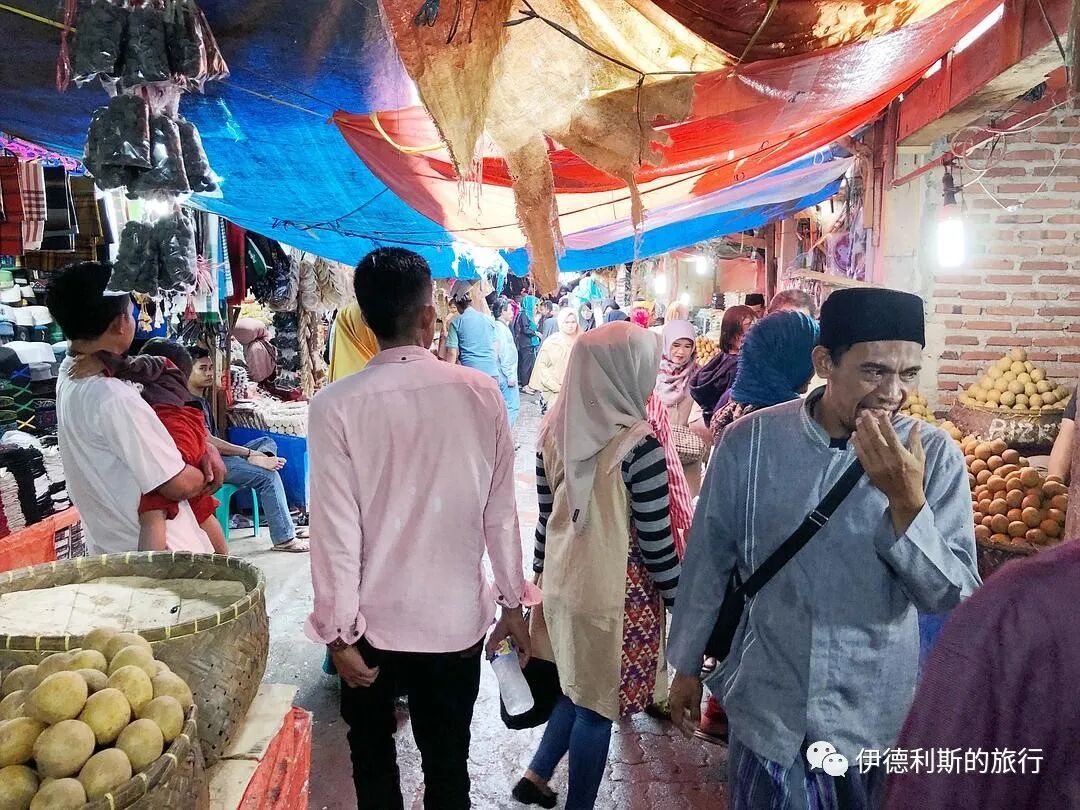
As a holy site, the Great Mosque of Banten attracts a constant stream of Muslims every day, and a very lively bazaar has formed around it. At the bazaar, I drank an iced beverage called Es Campur made with coconut milk, red sugar syrup, coconut meat, and fruit jelly, and I also had some simple street-style boiled noodles (Mie Rebus). The bazaar is full of people selling sapodilla (Manilkara zapota), which is sweet and delicious. Sapodilla is native to the Caribbean in Central America. It was brought to the Philippines by Spanish colonists and later widely planted across Southeast Asia, where it is called sawo in Indonesia.
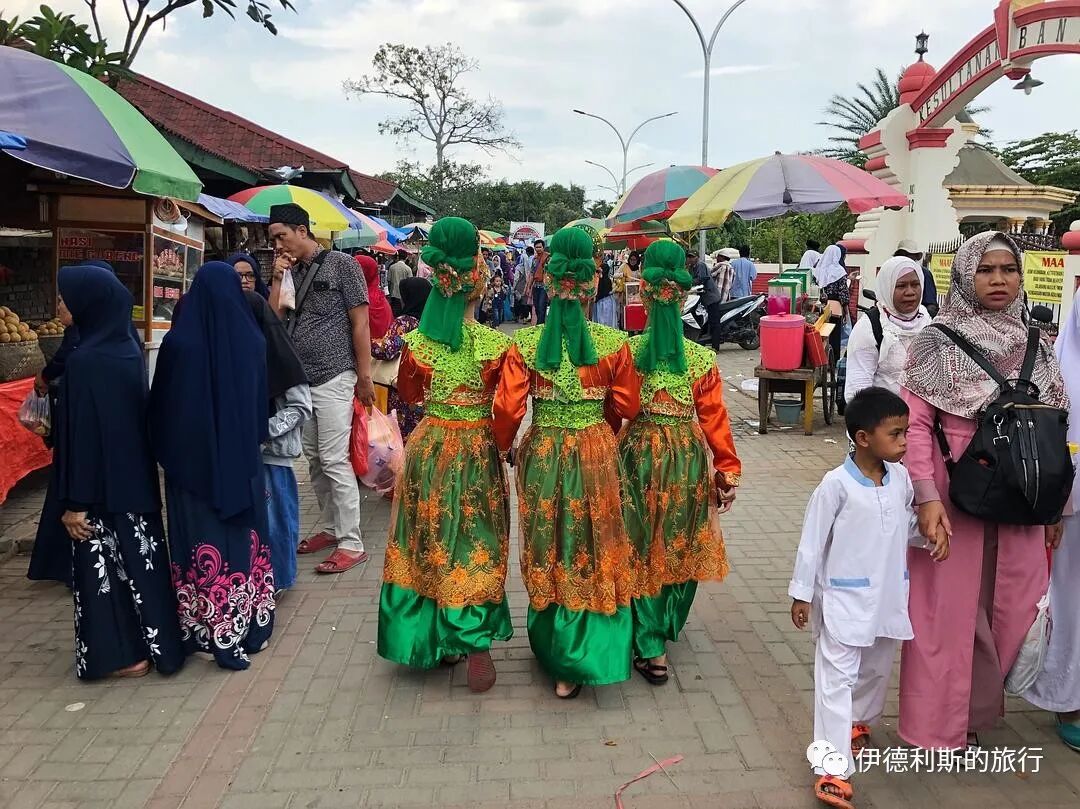
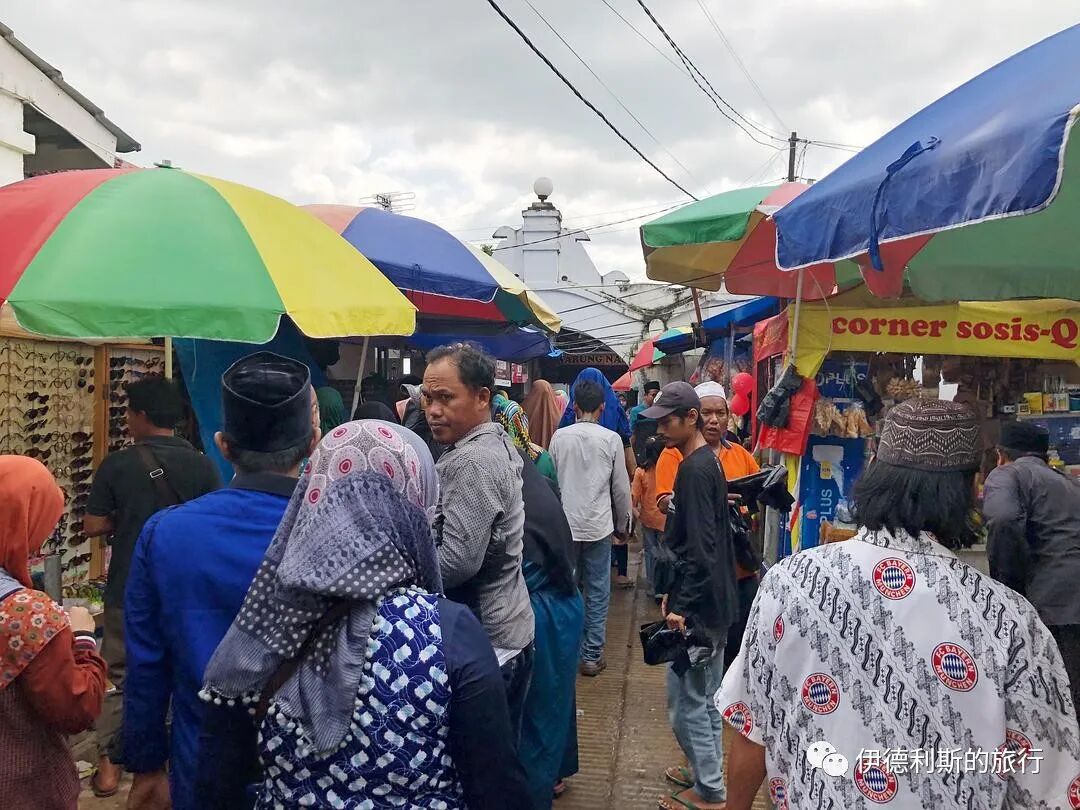
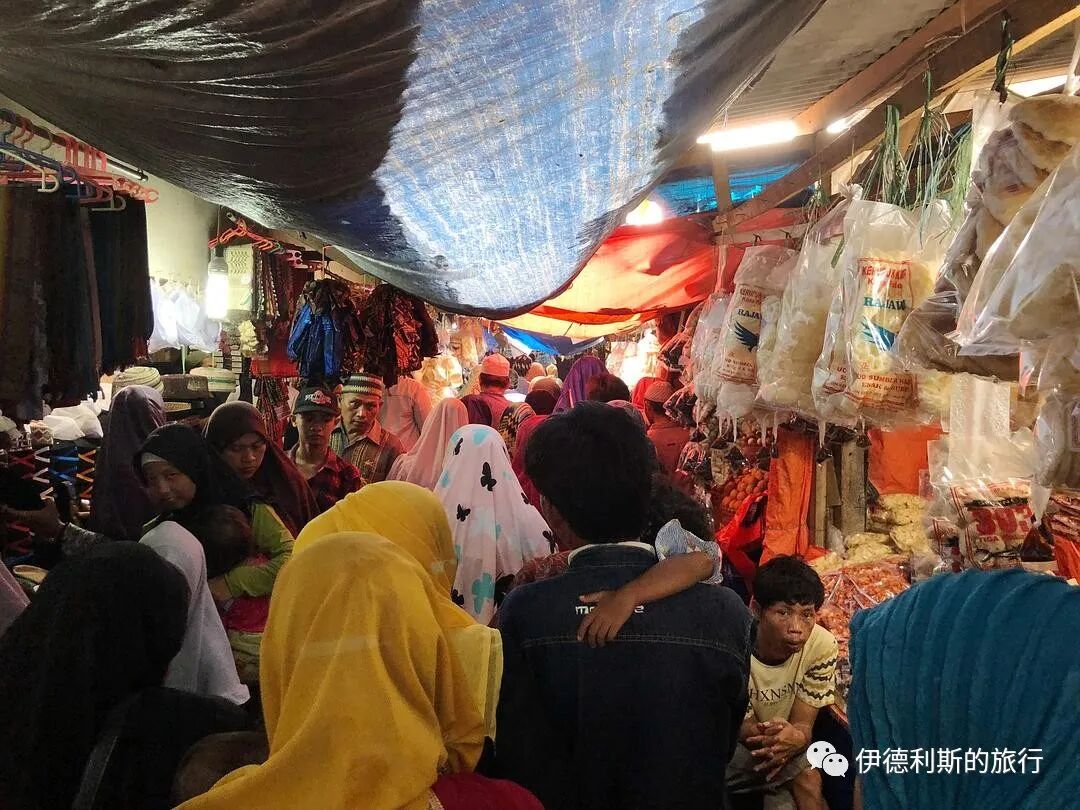



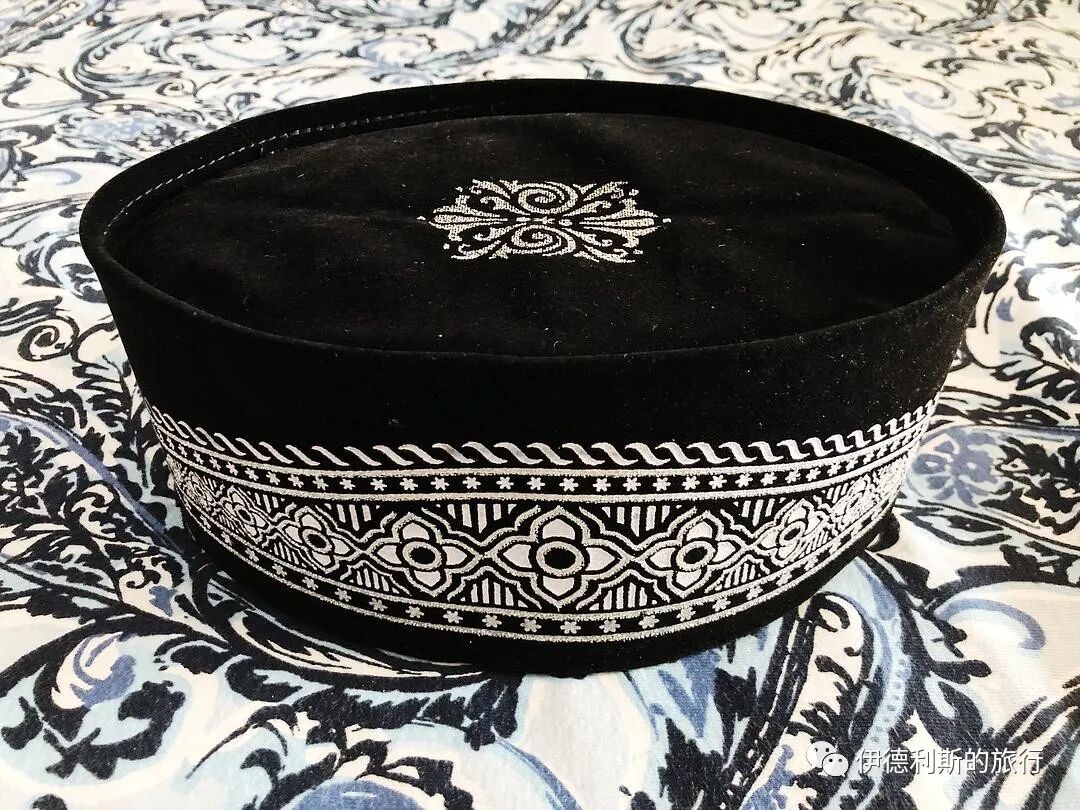
I bought two hats at the Banten bazaar. One of them is the black velvet cap (peci), which is the most common type in Indonesia. The peci is also called a songkok (Songkok). Indonesian and Malay Muslim men usually wear this hat for important ceremonies like weddings, funerals, or Eid al-Fitr. The word peci likely comes from the Dutch word petje, which means small hat.
The peci may have originated from the felt fez hat promoted by the Ottoman Empire starting in 1826. It soon spread to the Indonesian and Malay regions, gradually taking on the form of the modern songkok. Many Indonesian nationalist activists wore the songkok in the early 20th century, with Indonesia's first president, Sukarno, being the most famous among them. After Sukarno made the peci part of the official Indonesian presidential attire, black velvet became the most common style of peci in Indonesia.
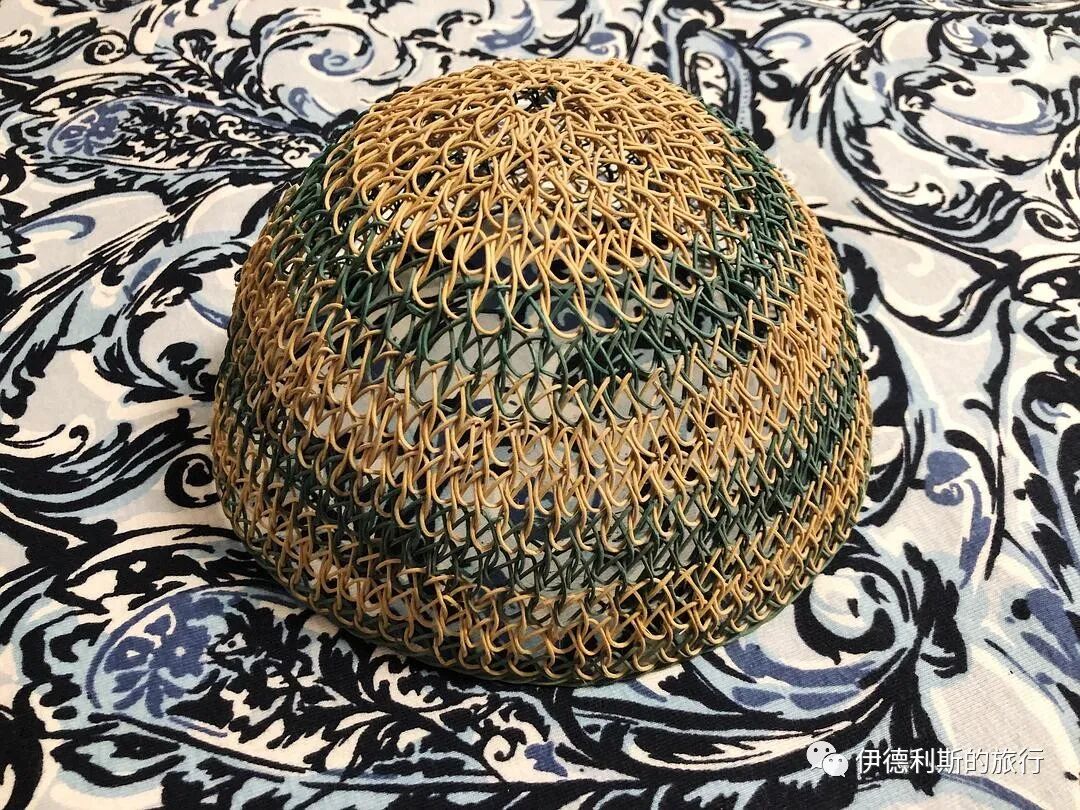
The second hat is made of woven bamboo. Besides the round one I bought, there are also boat-shaped ones similar to the songkok, which feel perfect for summer.
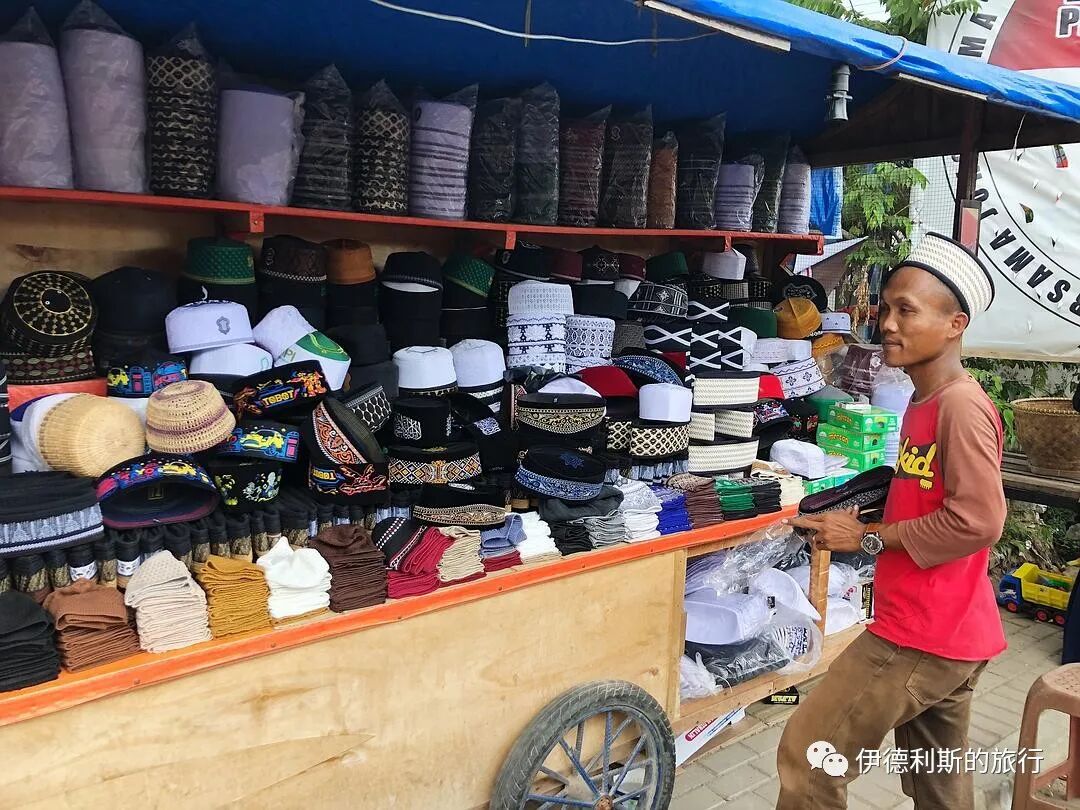
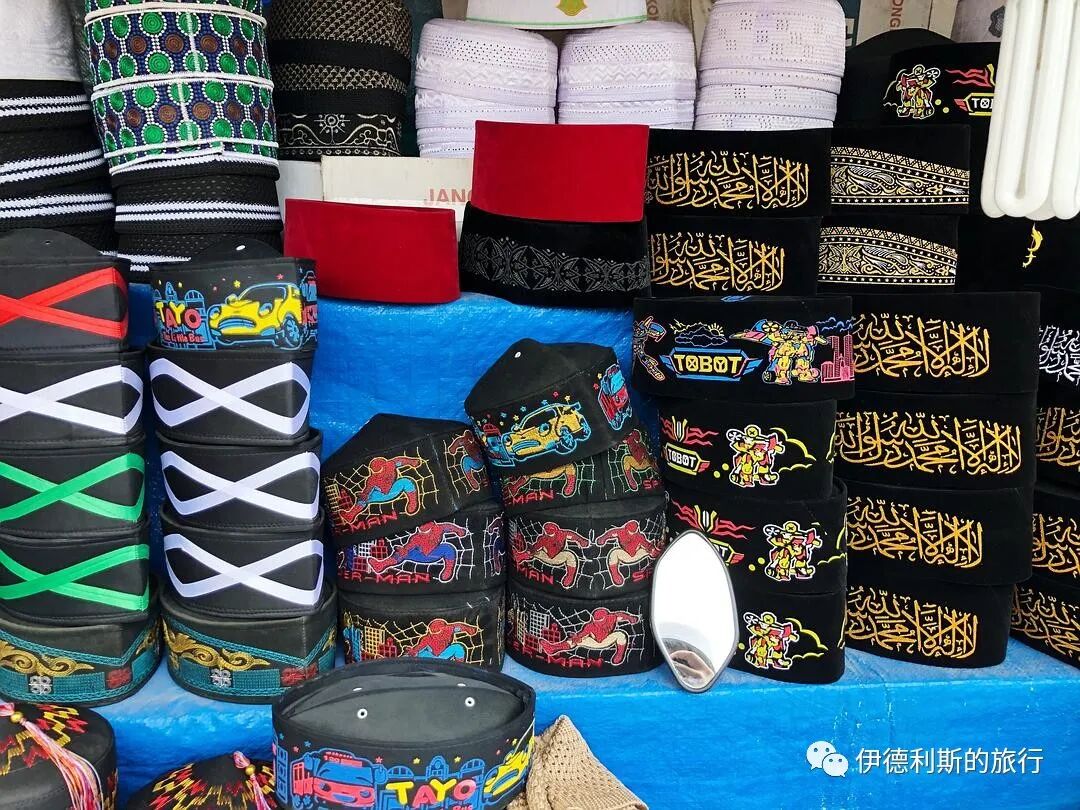
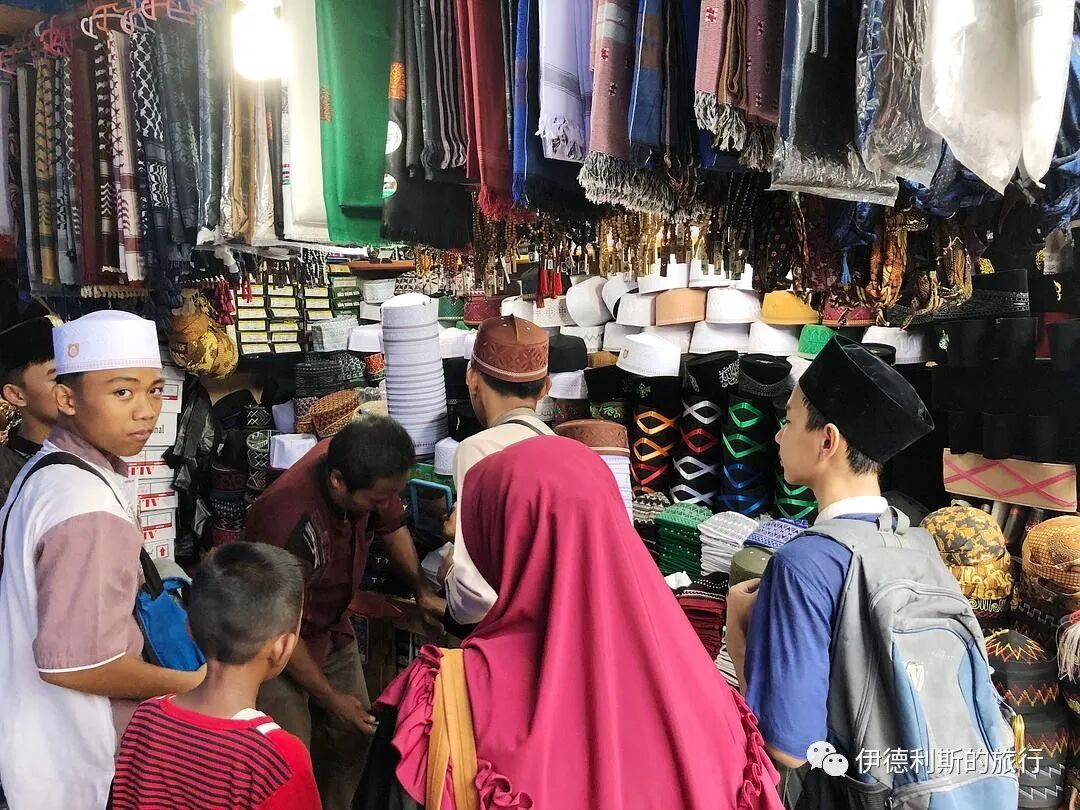
Another hat shop.
7. Speelwijk Castle—Dutch Fortress: 1682
Speelwijk Castle is a fortress built by the Dutch East India Company on the northwest coast of Banten. It was first built in 1682 and expanded twice, in 1685 and 1731. This castle was mainly used to control the activities of the Banten Sultanate and to protect Dutch merchant ships from pirate attacks.
Starting in the 16th century, the Dutch began competing with Portugal and England for the pepper trade in Java. In 1602, the Dutch established the famous Dutch East India Company, and the following year they set up a permanent trading post in Banten. In 1619, the Dutch East India Company captured Jakarta, which was controlled by the Banten Sultanate, and renamed it Batavia to serve as their headquarters. By the late 17th century, the Dutch East India Company had become the world's wealthiest private company and had completely defeated the Portuguese on Java.
In 1680, the Dutch East India Company incited a civil war within the Banten Sultanate, took the opportunity to drive British merchants out of Banten, and gained a monopoly on the surrounding pepper trade. After 1682, the Banten Sultanate gradually came under the control of the Dutch East India Company, and even the succession of the Sultan required approval from the company. Speelwijk Castle is the best witness to this historical period. After 1752, the Banten Sultanate officially became a vassal state of the Dutch East India Company.
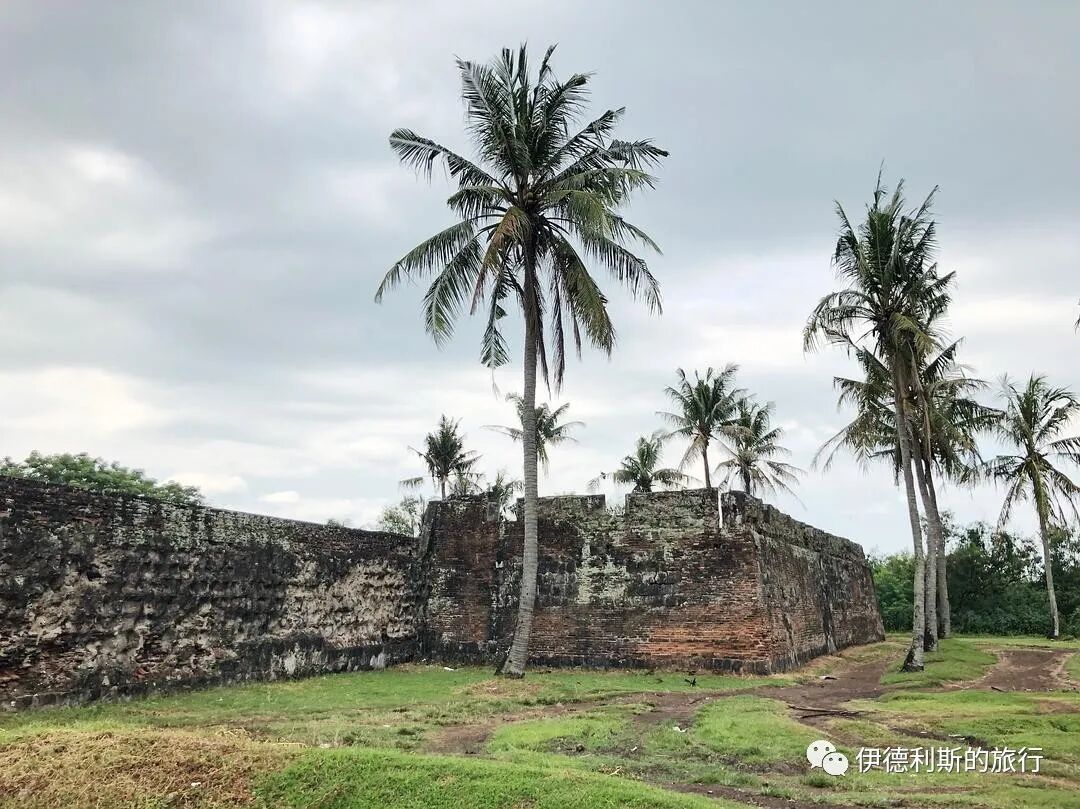
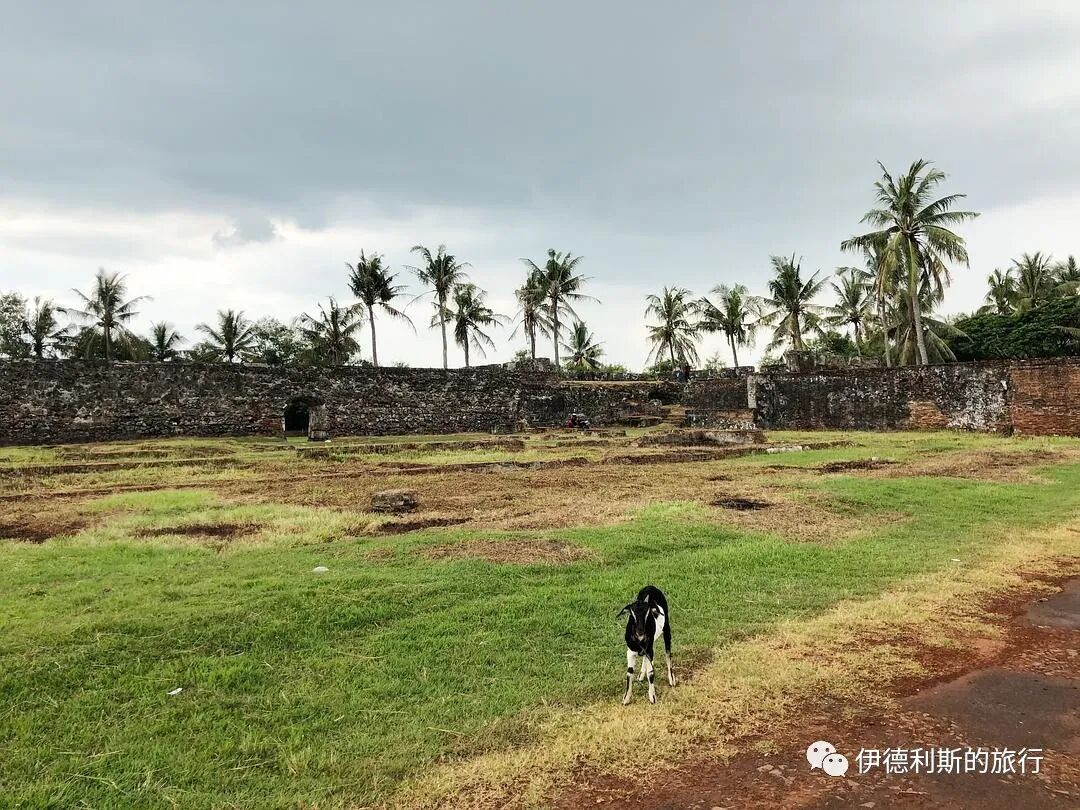
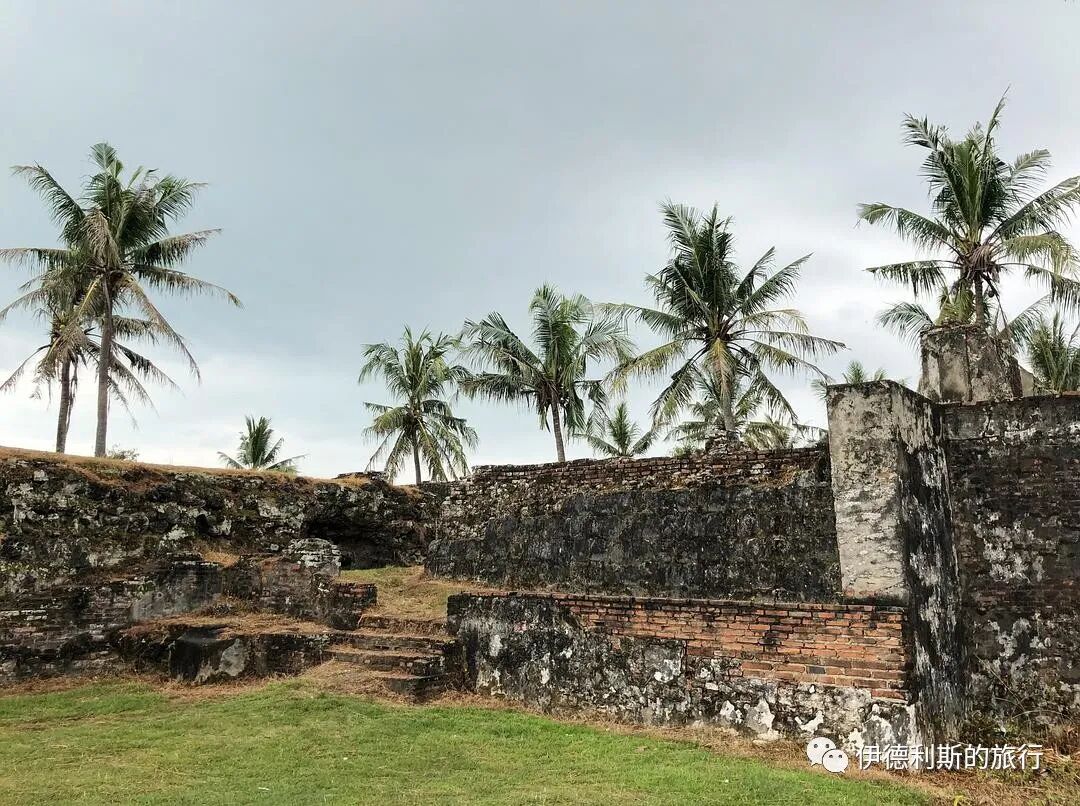
Speelwijk Castle was eventually abandoned due to a plague in 1811. Today, there are many Dutch graves in front of the castle, including those of castle officer Hugo Pieter Faure, who died in 1763, and the castle tax collector and purchaser Kopman en Fiscaal Deserbezeting, who died in 1769.
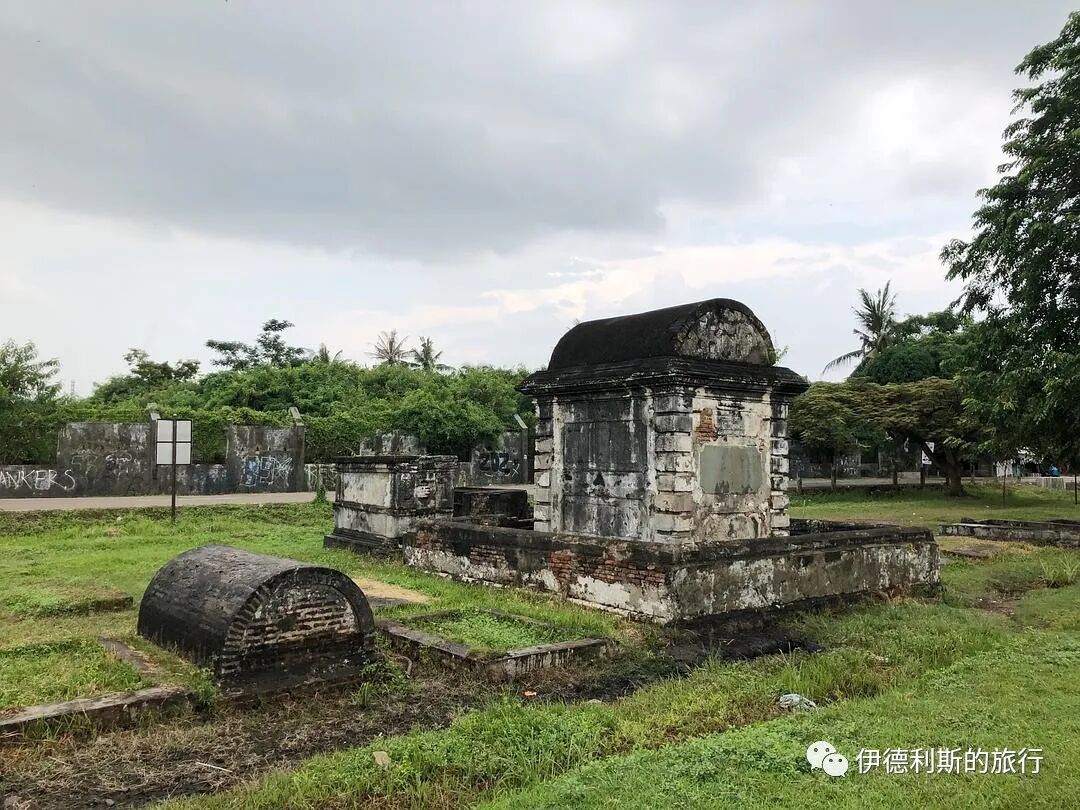
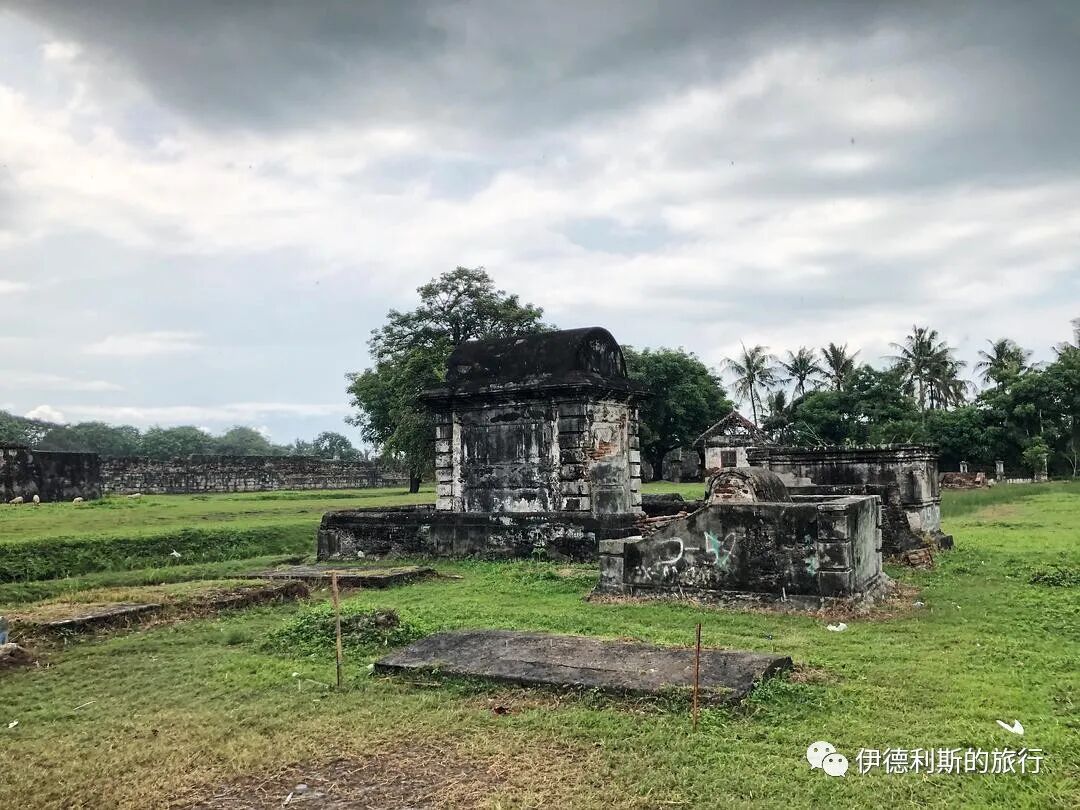
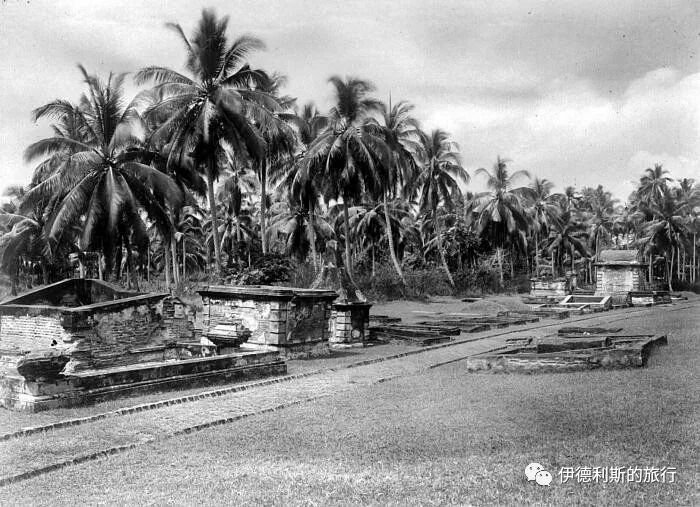
Old photo of the Dutch cemetery
8. Kaibon Palace—Residence of the Last Queen Mother: Early 19th Century
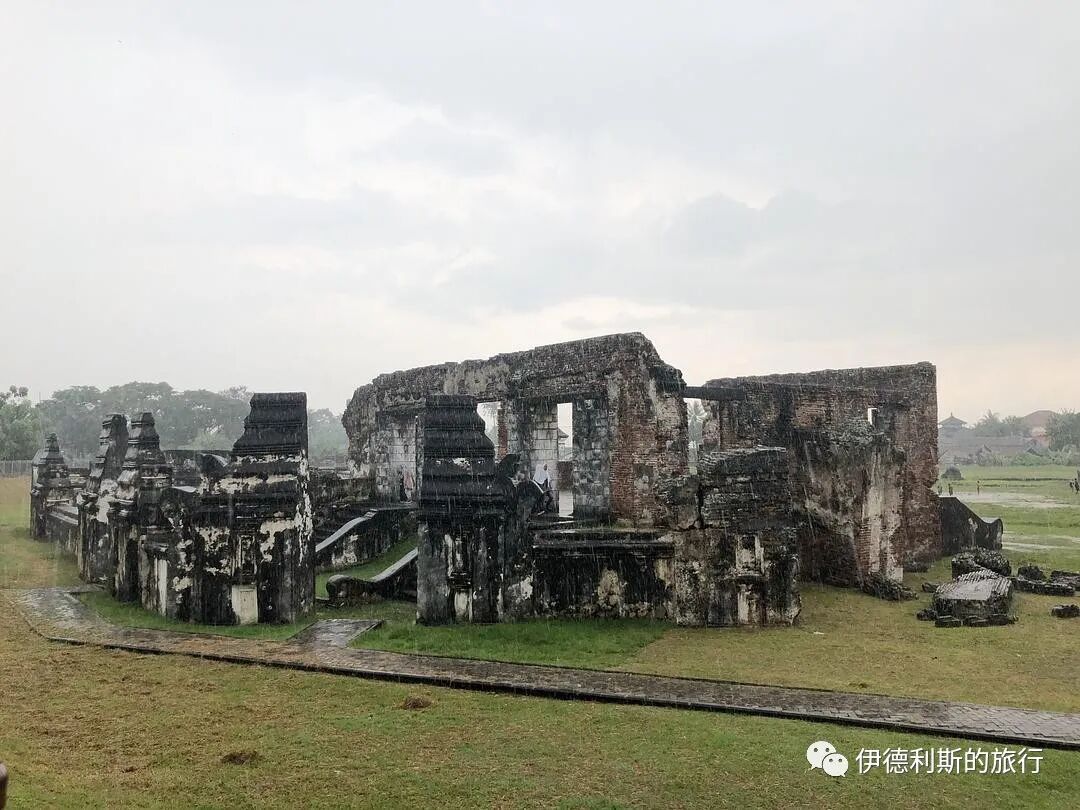
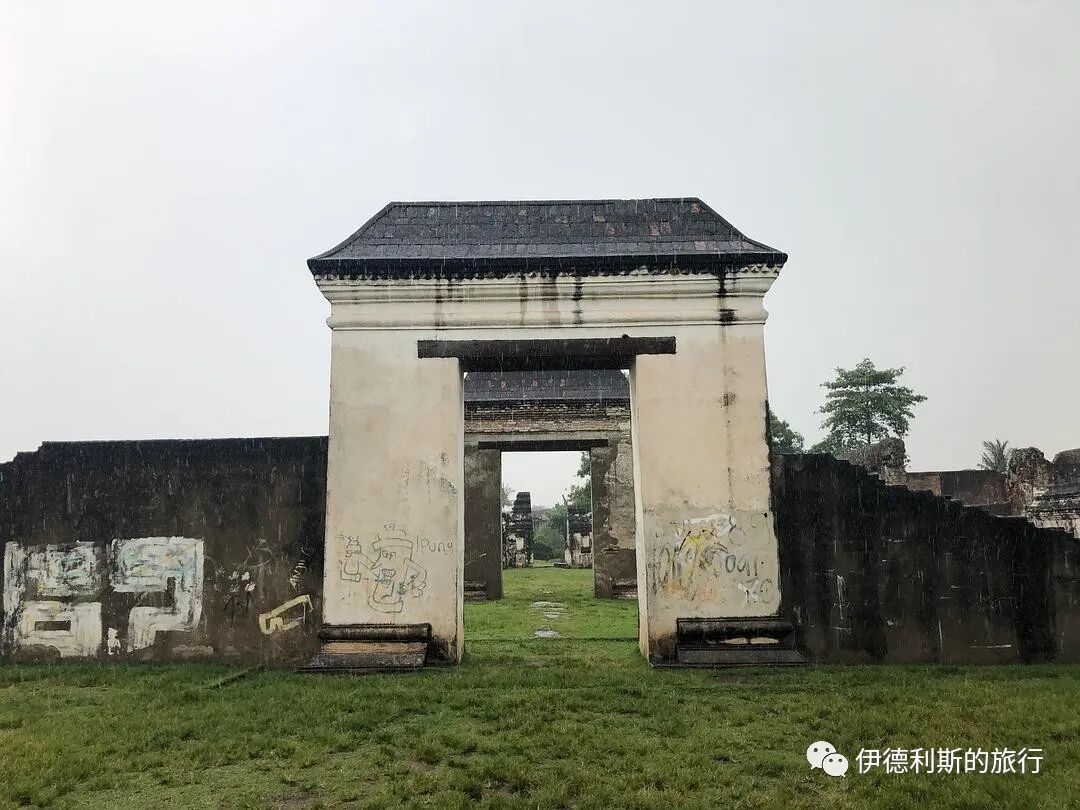
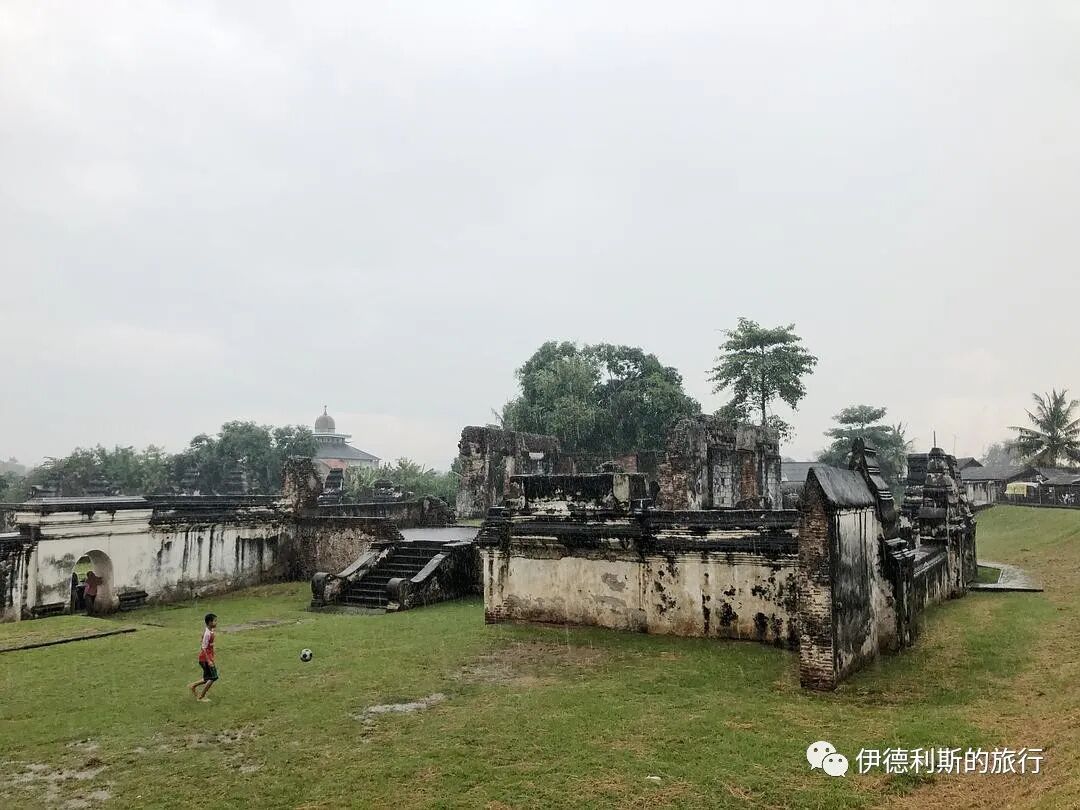
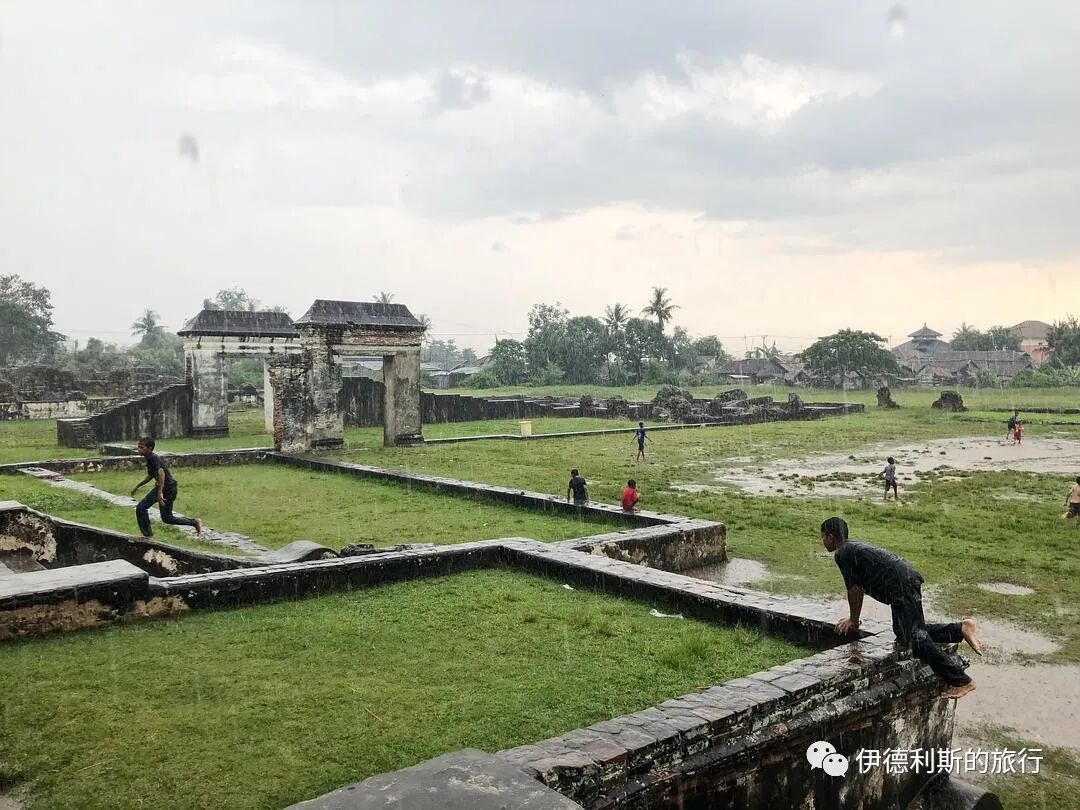
Kaibon Palace was the last building constructed by the Banten Sultanate. Built in the early 19th century, it served as the palace for Ratu Aisyah, the mother of the final sultan, Muhamad Syafiuddin.
After the British invaded Java in 1813, they ordered the final Banten sultan, Muhamad Syafiuddin, to abdicate, marking the end of the Banten Sultanate. After the Anglo-Dutch Treaty of 1814 was signed, Britain returned the Banten region to the Dutch, and Banten was officially incorporated into the Dutch East Indies. In 1832, the Dutch destroyed Kaibon Palace, leaving it in complete ruins.
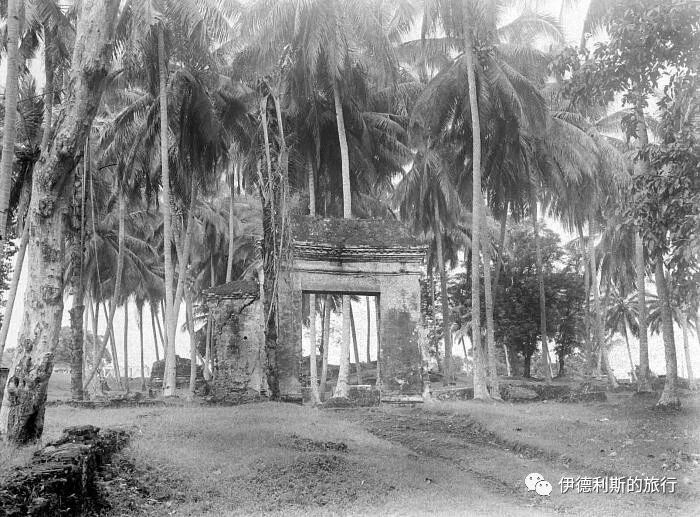
The palace still preserves its traditional Javanese Paduraksa-style gate. The Paduraksa gate originated from the ancient Hindu Gopuram gate. It was widely used in ancient Javanese Hindu and Buddhist temples from the 8th to 9th centuries and was later adopted by Islamic sultanates for their mosques, palaces, and cemeteries after the 15th century.
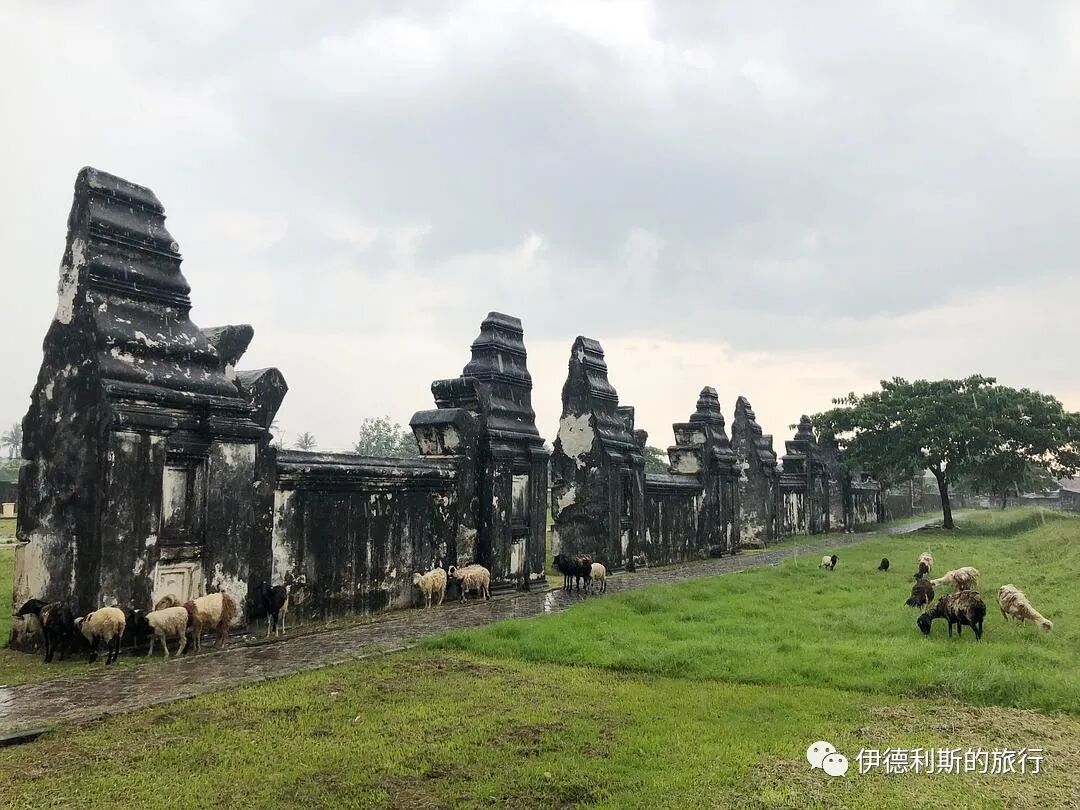
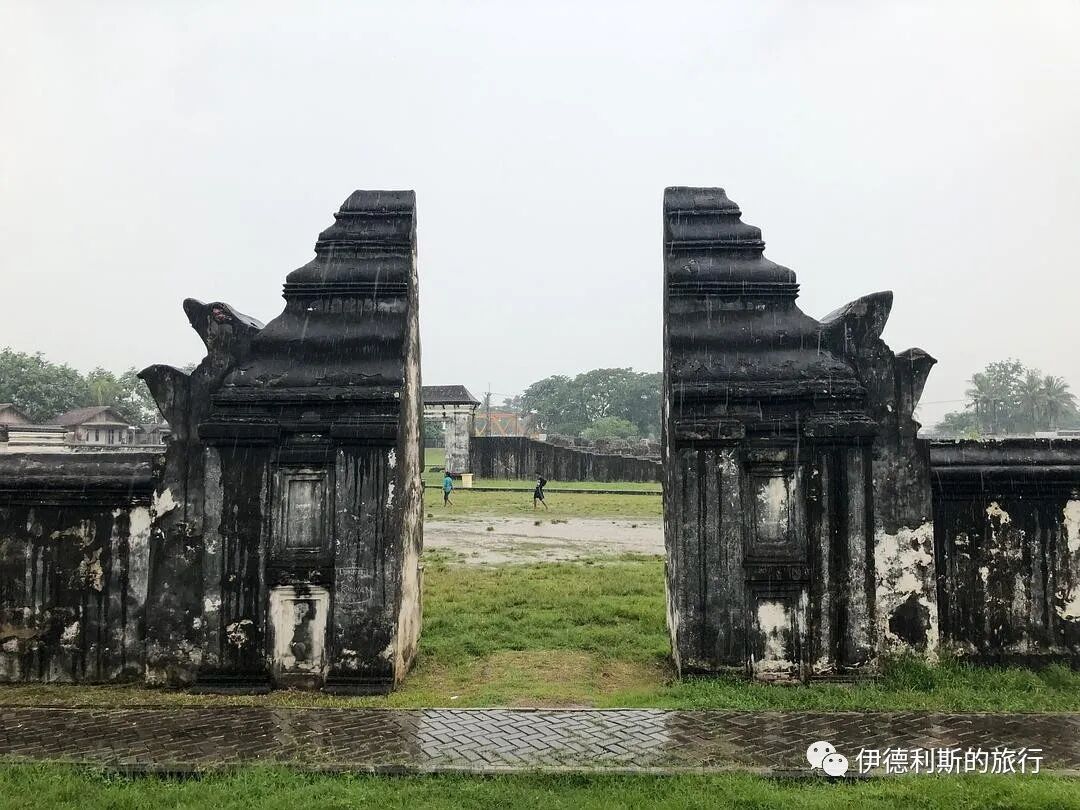
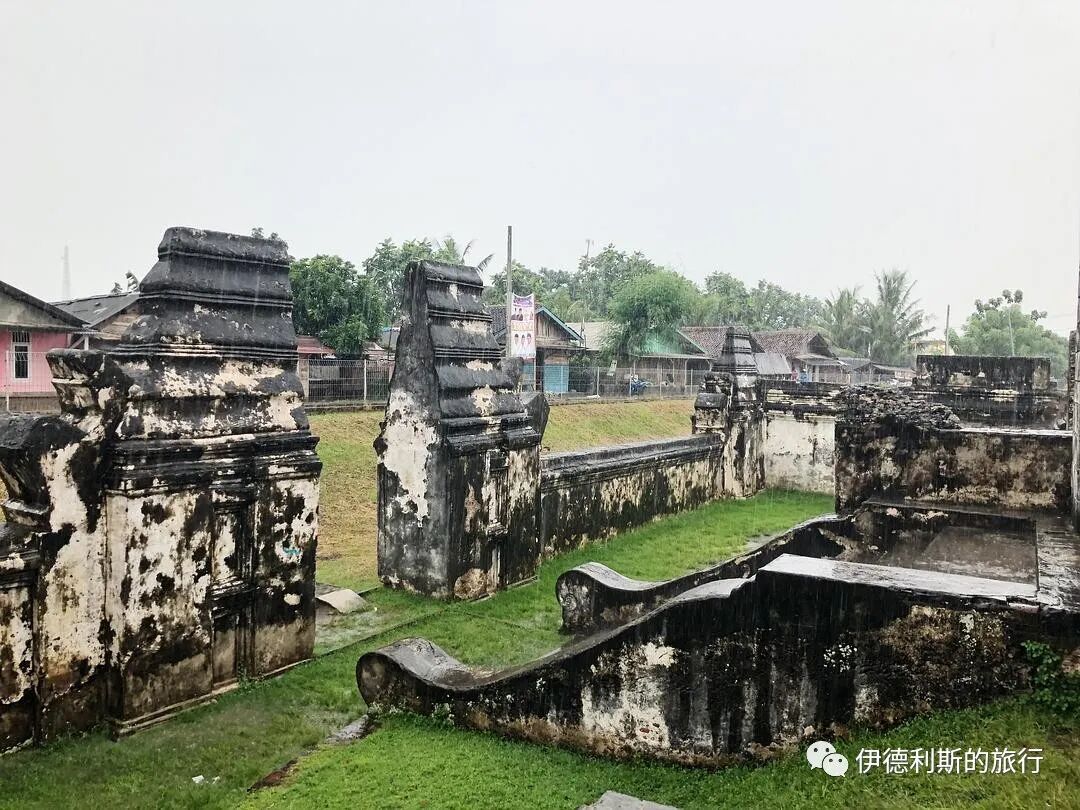
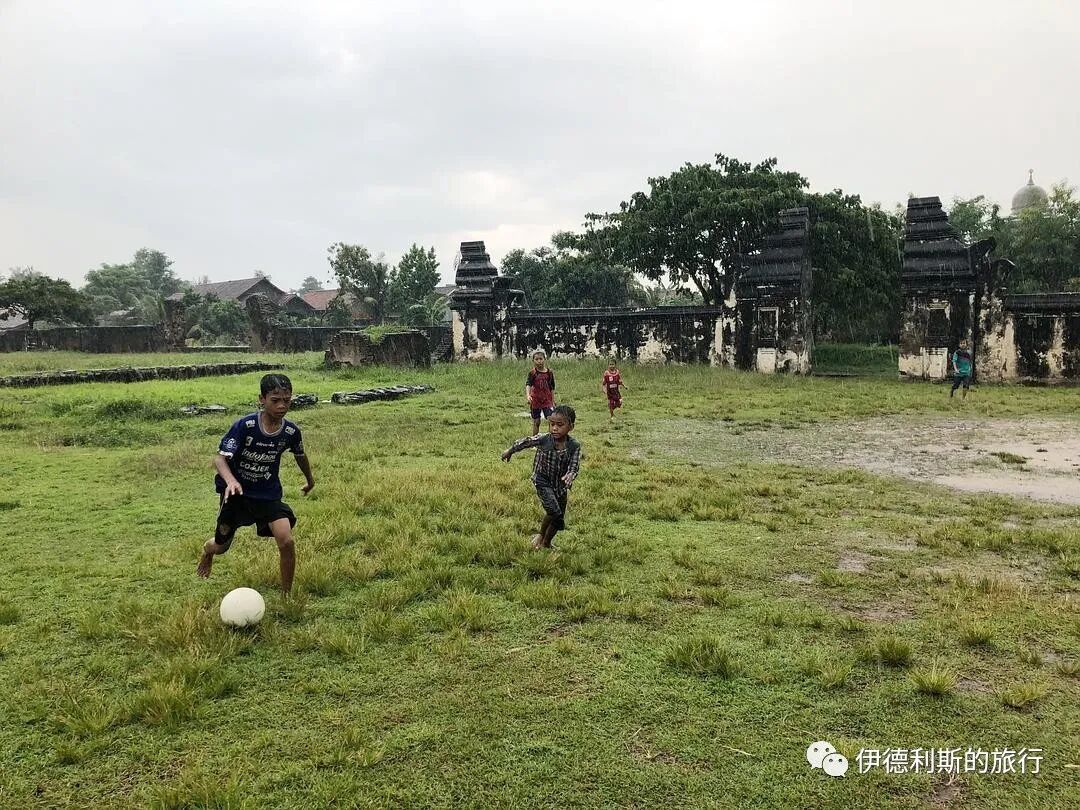
Part of the palace still retains the Queen Mother's bedroom, which featured a cooling system powered by flowing water.
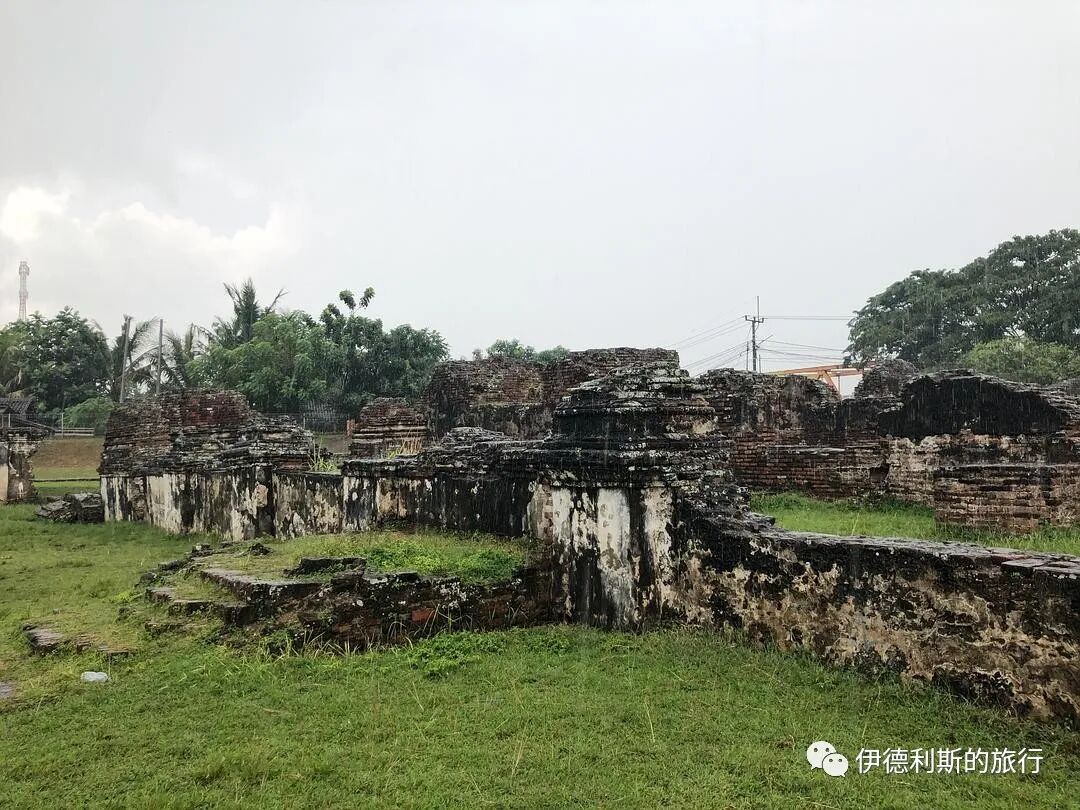
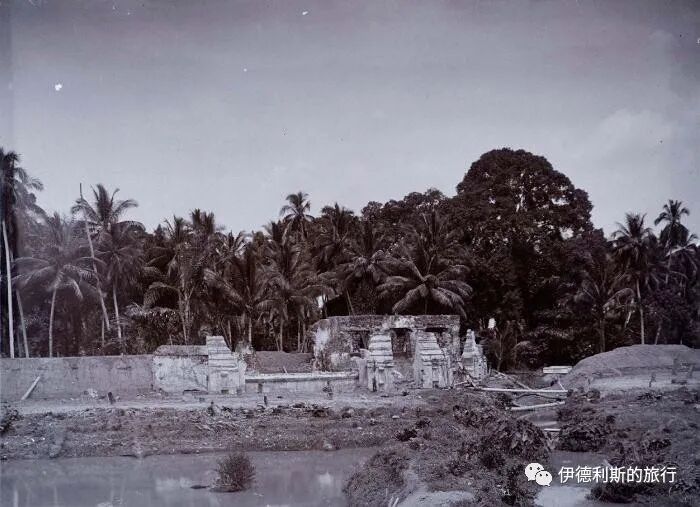
Photographed by Georg Friedrich Johannes between 1915 and 1926
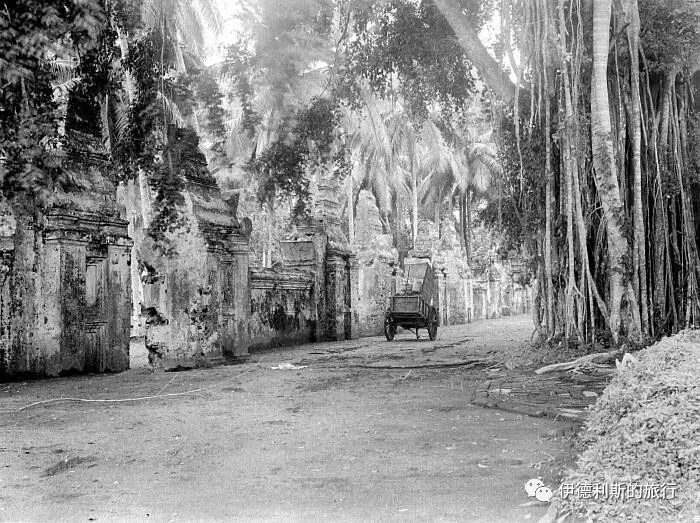
Photographed in 1933
Summary: Muslim Travel Guide Indonesia Banten: Sultanate Mosques, Coastal City and Islamic Heritage is presented here as a clear Muslim travel account, beginning with this scene: Banten is located at the westernmost tip of Java Island, facing Sumatra across the Sunda Strait. The account keeps its focus on Banten Mosques, Indonesia Muslim Travel, Sultanate History while preserving the names, places, food, and historical details from the Chinese source.
Banten is located at the westernmost tip of Java Island, facing Sumatra across the Sunda Strait. The local Bantenese people are a branch of the Sundanese. In the 16th century, the Banten Sultanate rose to become a powerful maritime trading nation in western Java, controlling the pepper trade in Southeast Asia. The Banten Sultanate reached its peak in the 17th century and had intense conflicts with the Dutch East India Company. After the 18th century, the Banten Sultanate gradually came under the control of the Dutch East India Company and was finally annexed into the Dutch East Indies in the 19th century.
Today, the ancient city of Banten still retains many ruins, and the Great Mosque of Banten (Masjid Agung Banten), built in the 16th century, remains a famous religious site. two palaces of the Banten Sultanate, a Dutch fortress, and several tombs of the Banten Sultans have been preserved. Due to time constraints, I could not visit all the historical sites this time, but I still hope to share the ruins of the Banten Sultanate that I saw with everyone.
Table of Contents
1. Traveling to the Ancient City of Banten
2. The Establishment of the Banten Sultanate
3. The Port City of Banten
4. Surosowan Palace—Sultan's Residence: 1552
5. Great Mosque of Banten: 1566
6. Banten Bazaar
7. Speelwijk Castle—Dutch Fortress: 1682
8. Kaibon Palace—Residence of the Last Queen Mother: Early 19th Century
1. Traveling to the Ancient City of Banten
The ancient city of Banten is located west of Jakarta, and it takes an hour and a half to drive there under normal traffic conditions. There are buses from Kalideres bus station in western Jakarta to the city of Serang, where Banten is located. Once you arrive at the station, just ask people for "Serang" and they will point you in the right direction. The bus I took picked up passengers along the way before getting on the highway, so it took three hours to reach Serang. Friends who want to go, please make sure to allow extra time. It was very interesting that before getting on the highway, vendors kept getting on the bus to sell various things, including fruits, snacks, ballpoint pens, electronic watches, and so on. There were also several groups of singers, making it feel like a moving bazaar.
After getting on the bus, be sure to tell the driver or conductor that you are going to the Great Mosque of Banten, which is Masjid Agung Banten. Note that the pronunciation of Banten is "Banden." Then the driver will drop you off at the intersection before entering Serang city. From there, you can take a minibus or call a Grab to the ancient city of Banten.
2. The Establishment of the Banten Sultanate
After the 15th century, the Hindu-Buddhist Majapahit empire declined and the Islamic Malacca Sultanate rose. Many Muslim merchants from Arabia and India settled on the north coast of Java, marking a new chapter in Javanese history.
Between the 15th and 16th centuries, many Sufi Muslims arrived in Java to spread the faith, with the Nine Saints (Wali Songo) being the most famous. Among the Nine Saints, Sunan Gunung Jati was the only one who used military force to spread Islam.
Sunan Gunung Jati was born Syarif Hidayatullah. His father came from the Hashim family in Egypt, the same family as the Prophet Muhammad, and his mother was a princess from the Hindu Sunda Kingdom in western Java. Although his grandfather was a Hindu king, Sunan Gunung Jati's mother and his uncle, Prince Walangsungsang, both converted to Islam.
In 1470, after spending years studying Islamic knowledge in places like Mecca and Baghdad in the Middle East, Sunan Gunung Jati returned to Java to help his uncle rule the port town of Cirebon in West Java. In 1479, Sunan Gunung Jati took over from his uncle to rule Cirebon, established the Cirebon Sultanate, and officially declared independence from the Sunda Kingdom in 1482.
Shortly before Sunan Gunung Jati established the Cirebon Sultanate, the Muslim port town of Demak in Central Java had already gained independence from the Majapahit Kingdom in 1475. These two Javanese Muslim states, which relied on maritime trade, joined forces and posed a major threat to the existing Hindu Sunda Kingdom. The Sunda Kingdom then went to Malacca to seek help from the Portuguese. In 1522, the Portuguese officially formed an alliance with the Sunda Kingdom to control the local pepper trade.
However, after the alliance was formed, the Portuguese failed to send troops to help in time. The joint Cirebon-Demak forces took the opportunity to capture Sunda Kalapa, an important port of the Sunda Kingdom, and renamed it Jakarta. After that, the Sunda Kingdom fought a five-year war alone against the Cirebon-Demak coalition. In 1527, the Sultan of Cirebon, Sunan Gunung Jati, sent his son Hasanudin to join the Demak Sultanate and capture Banten, another important port of the Sunda Kingdom. Sunan Gunung Jati then appointed his son as the Sultan of Banten. In 1552, the Banten Sultanate broke away from the Cirebon Sultanate and became an independent state.
The territory of the Banten Sultanate, drawn by Gunawan Kartapranata.
3. The Port City of Banten
Shortly after becoming the Sultan of Banten, Hasanudin began building a new port city at the mouth of the Banten River. By the mid-16th century, Banten had become an important port that could rival Malacca.
According to the Portuguese historian João de Barros, the city of Banten was located in the middle of the harbor, and a clear river ran through the city, allowing ships to sail into the town center. Inside the city, there was a brick fortress with a two-story wooden defensive structure. The city center had a square that served as a market in the morning and was used for military or artistic activities at noon. On the south side of the square was the Sultan's palace, known as the Surosowan Palace, with a tall building next to it used by the Sultan to receive his subjects. On the west side of the square was the Great Mosque, which is today's Great Mosque of Banten.
At that time, only local residents were allowed to live in the city. Foreigners lived near the harbor in the north, with foreign Muslims in the northeast and non-Muslim foreigners in the northwest.
In the late 16th century, the Banten Sultanate controlled the pepper trade in the Lampung region at the southern tip of Sumatra. It traded closely with Portugal, the Netherlands, Britain, France, and Denmark, becoming a major international trade hub in Southeast Asia. With help from the British, the Danes, and the Chinese, the Banten Sultanate traded with Persia, India, Siam, Vietnam, the Philippines, China, and Japan.
Banten City in 1724, drawn by François Valentijn.
4. Surosowan Palace—Sultan's Residence: 1552
Surosowan Palace was built in 1552 by the Banten Sultan Maulana Hasanuddin and later served as the residence for successive sultans. A Dutchman designed the palace, which is why it features the corner bastion structure of a Dutch fort.
In 1808, to defend against a British invasion of Java, the Dutch ordered the construction of the Great Post Road across the island. They also ordered the Banten Sultan to move his capital and provide labor to build a port for the Dutch fleet. The Sultan refused, so the Dutch destroyed Surosowan Palace and imprisoned the entire royal family. After the British invaded Java in 1813, they forced the last Sultan to abdicate, marking the end of the Banten Sultanate. After the Anglo-Dutch Treaty of 1814 was signed, Britain returned the Banten region to the Dutch, and Banten was officially incorporated into the Dutch East Indies.
Today, the ruins of Surosowan Palace include two-meter-high walls made of red stone and coral. The most prominent site inside is the princess's bathing pool, which looks similar to the existing pools at the Sultan's palace in Yogyakarta.
5. Great Mosque of Banten: 1566
The Great Mosque of Banten (Masjid Agung Banten) is a famous Javanese-style mosque, built in 1566 by order of Sultan Maulana Hasanuddin. The women's hall (Pawestren) was added in the 1580s. In 1632, a Chinese man named Cek-ban-cut designed and built the minaret (bangker), and in the 17th century, a Dutch convert to Islam named Hendrik Lucaasz Cardeel designed and built the religious school (tiyamah).
As a typical Javanese-style mosque, the Great Mosque of Banten has a large porch-style shelter (serambi) in front of the main prayer hall. Inside the main hall, four main wooden pillars (saka guru) support a five-tiered roof. The top three tiers look more like a Chinese Buddhist pagoda than a traditional Javanese roof. Historical records suggest the original roof only had three tiers, and the top two were likely added between the 18th and 19th centuries. The mosque's minaret is 24 meters high with a base diameter of 10 meters, blending Mughal style with the local Javanese Hindu/Buddhist mosque (Candi) style.
The Great Mosque of Banten, drawn by Josias Cornelis Rappard in the 1880s.
Right next to the mosque is the family cemetery of the Banten Sultanate. The first Sultan, Maulana Hasanuddin (reigned 1552–1570), the sixth Sultan, Ageng Tirtayasa (reigned 1651–1683), and the seventh Sultan, Abu Nashar Abdul Qahar (reigned 1683–1687), are all buried there.
The reign of the sixth Sultan, Ageng Tirtayasa, from 1651 to 1682, is known as the golden age of the Banten Sultanate. During this time, the Banten Sultanate built a powerful navy with the help of European shipyards and attracted many Europeans to work in Banten. To ensure safe travel, the Banten Sultanate sent a fleet in 1661 to conquer the Tanjungpura Kingdom in western Kalimantan, attempting to break the blockade by the Dutch East India Company (VOC).
6. Banten Bazaar
As a holy site, the Great Mosque of Banten attracts a constant stream of Muslims every day, and a very lively bazaar has formed around it. At the bazaar, I drank an iced beverage called Es Campur made with coconut milk, red sugar syrup, coconut meat, and fruit jelly, and I also had some simple street-style boiled noodles (Mie Rebus). The bazaar is full of people selling sapodilla (Manilkara zapota), which is sweet and delicious. Sapodilla is native to the Caribbean in Central America. It was brought to the Philippines by Spanish colonists and later widely planted across Southeast Asia, where it is called sawo in Indonesia.
I bought two hats at the Banten bazaar. One of them is the black velvet cap (peci), which is the most common type in Indonesia. The peci is also called a songkok (Songkok). Indonesian and Malay Muslim men usually wear this hat for important ceremonies like weddings, funerals, or Eid al-Fitr. The word peci likely comes from the Dutch word petje, which means small hat.
The peci may have originated from the felt fez hat promoted by the Ottoman Empire starting in 1826. It soon spread to the Indonesian and Malay regions, gradually taking on the form of the modern songkok. Many Indonesian nationalist activists wore the songkok in the early 20th century, with Indonesia's first president, Sukarno, being the most famous among them. After Sukarno made the peci part of the official Indonesian presidential attire, black velvet became the most common style of peci in Indonesia.
The second hat is made of woven bamboo. Besides the round one I bought, there are also boat-shaped ones similar to the songkok, which feel perfect for summer.
Another hat shop.
7. Speelwijk Castle—Dutch Fortress: 1682
Speelwijk Castle is a fortress built by the Dutch East India Company on the northwest coast of Banten. It was first built in 1682 and expanded twice, in 1685 and 1731. This castle was mainly used to control the activities of the Banten Sultanate and to protect Dutch merchant ships from pirate attacks.
Starting in the 16th century, the Dutch began competing with Portugal and England for the pepper trade in Java. In 1602, the Dutch established the famous Dutch East India Company, and the following year they set up a permanent trading post in Banten. In 1619, the Dutch East India Company captured Jakarta, which was controlled by the Banten Sultanate, and renamed it Batavia to serve as their headquarters. By the late 17th century, the Dutch East India Company had become the world's wealthiest private company and had completely defeated the Portuguese on Java.
In 1680, the Dutch East India Company incited a civil war within the Banten Sultanate, took the opportunity to drive British merchants out of Banten, and gained a monopoly on the surrounding pepper trade. After 1682, the Banten Sultanate gradually came under the control of the Dutch East India Company, and even the succession of the Sultan required approval from the company. Speelwijk Castle is the best witness to this historical period. After 1752, the Banten Sultanate officially became a vassal state of the Dutch East India Company.
Speelwijk Castle was eventually abandoned due to a plague in 1811. Today, there are many Dutch graves in front of the castle, including those of castle officer Hugo Pieter Faure, who died in 1763, and the castle tax collector and purchaser Kopman en Fiscaal Deserbezeting, who died in 1769.
Old photo of the Dutch cemetery
8. Kaibon Palace—Residence of the Last Queen Mother: Early 19th Century
Kaibon Palace was the last building constructed by the Banten Sultanate. Built in the early 19th century, it served as the palace for Ratu Aisyah, the mother of the final sultan, Muhamad Syafiuddin.
After the British invaded Java in 1813, they ordered the final Banten sultan, Muhamad Syafiuddin, to abdicate, marking the end of the Banten Sultanate. After the Anglo-Dutch Treaty of 1814 was signed, Britain returned the Banten region to the Dutch, and Banten was officially incorporated into the Dutch East Indies. In 1832, the Dutch destroyed Kaibon Palace, leaving it in complete ruins.
The palace still preserves its traditional Javanese Paduraksa-style gate. The Paduraksa gate originated from the ancient Hindu Gopuram gate. It was widely used in ancient Javanese Hindu and Buddhist temples from the 8th to 9th centuries and was later adopted by Islamic sultanates for their mosques, palaces, and cemeteries after the 15th century.
Part of the palace still retains the Queen Mother's bedroom, which featured a cooling system powered by flowing water.
Photographed by Georg Friedrich Johannes between 1915 and 1926
Photographed in 1933
Halal Food Guide: Yogyakarta — Javanese Dishes, Markets and Muslim Food
Articles • ali2007fr posted the article • 0 comments • 153 views • 2026-05-18 07:38
Reposted from the web
Summary: Halal Food Guide: Yogyakarta — Javanese Dishes, Markets and Muslim Food is presented here as a firsthand travel account in clear English, beginning with this scene: Yogyakarta is an ancient cultural city in central Java that is still ruled by a sultan today. The account keeps its focus on Yogyakarta, Java Islam, Sultanate History while preserving the names, places, food, and historical details from the Chinese source.
Yogyakarta is an ancient cultural city in central Java that is still ruled by a sultan today. Beyond traditional Javanese architecture, gamelan music, and wayang shadow puppetry, Yogyakarta also has many local Javanese foods that I want to share with you.
1. Drinks
In the muggy tropical heat, drinking a cold street drink feels really good.
Es Dawet Ayu is a specialty iced drink from Central Java that comes from the small town of Banjarnegara. Its main ingredients are rice flour, glutinous rice flour, coconut milk, palm sugar syrup, and grass jelly.
Coconut water
Freshly squeezed dragon fruit juice; the juice selection in Java is truly rich.
Sekoteng is a Javanese ginger-flavored hot drink that includes peanuts, bread slices, and rice balls. Hot drinks are relatively rare in Java, but it feels like the ginger helps remove dampness.
Freshly squeezed lemon juice
2. Snacks
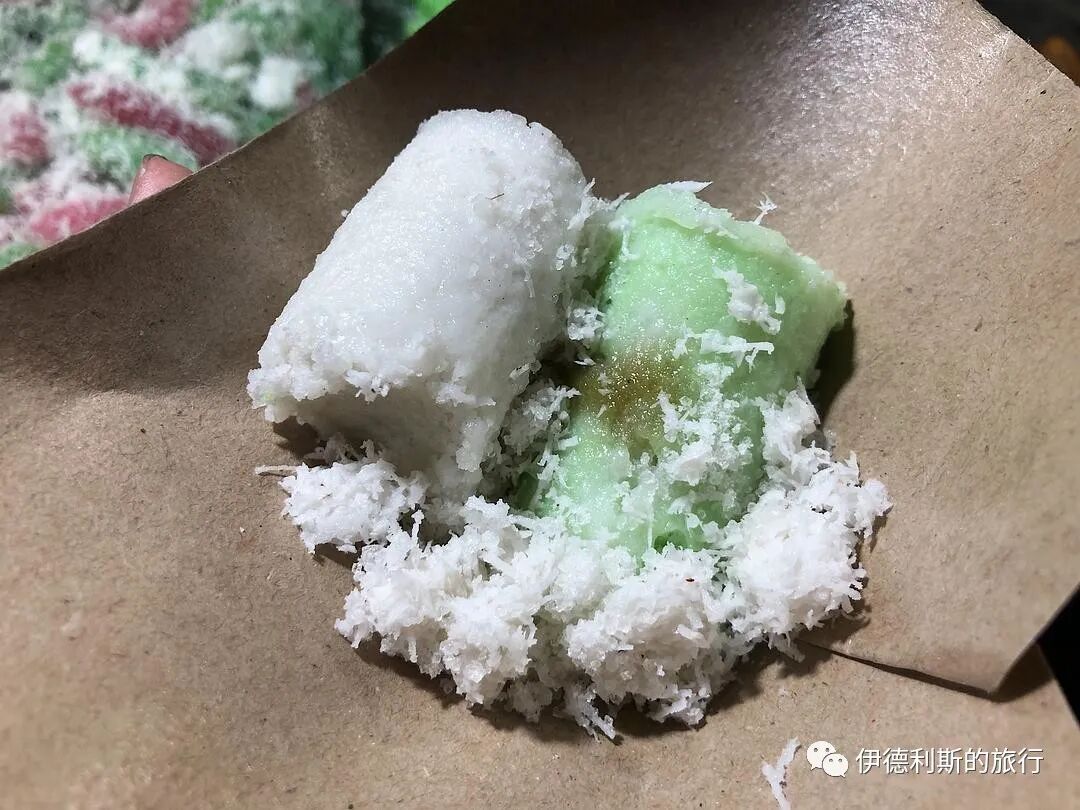
Putu Bumbung is a pastry made by mixing glutinous rice flour with pandan leaf juice and palm sugar, then steaming it in bamboo tubes. You eat it with shredded coconut.
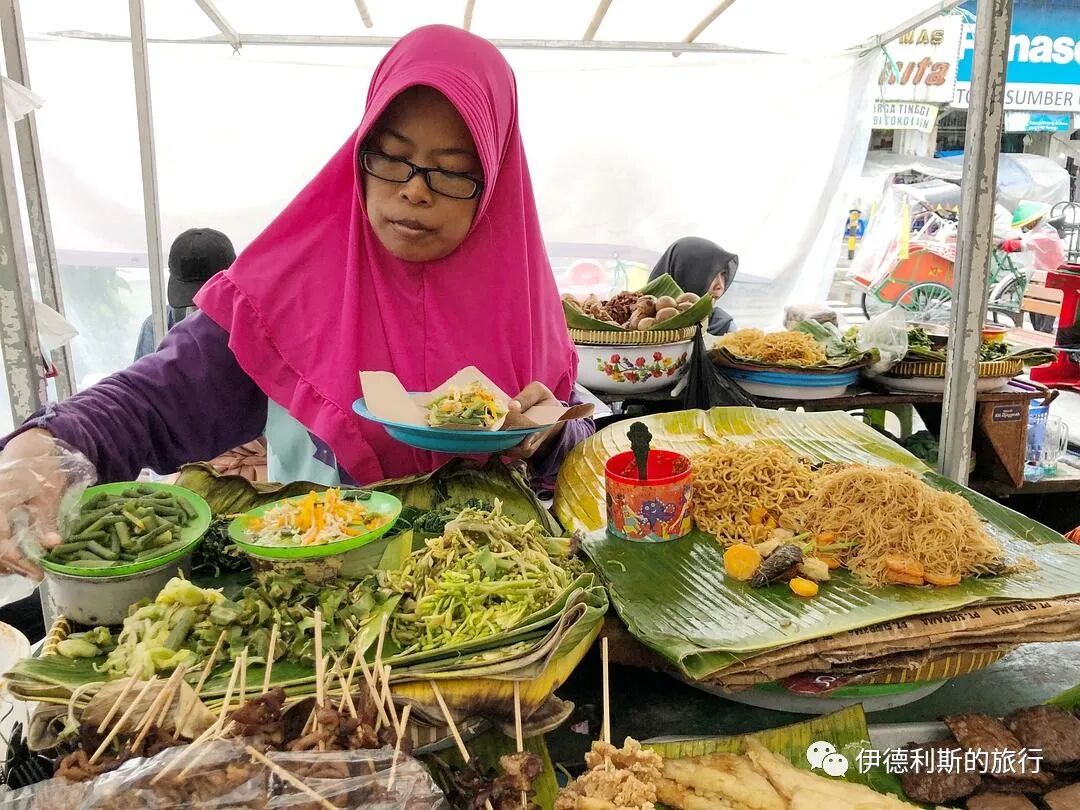
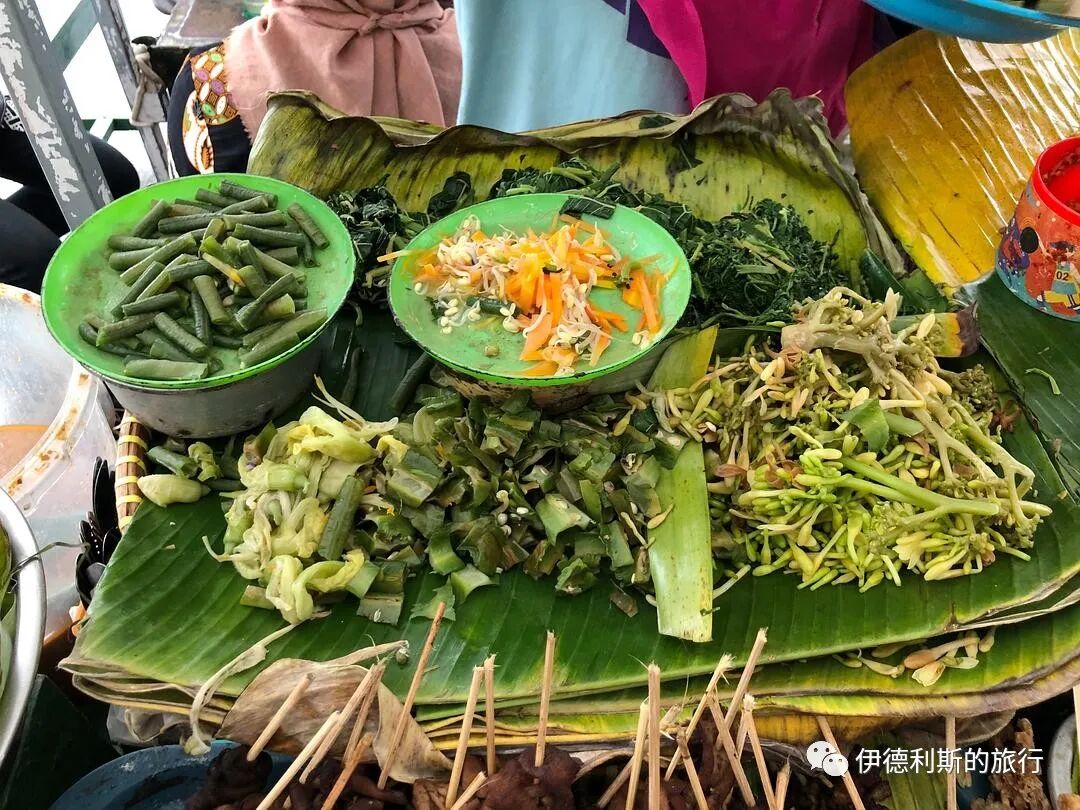
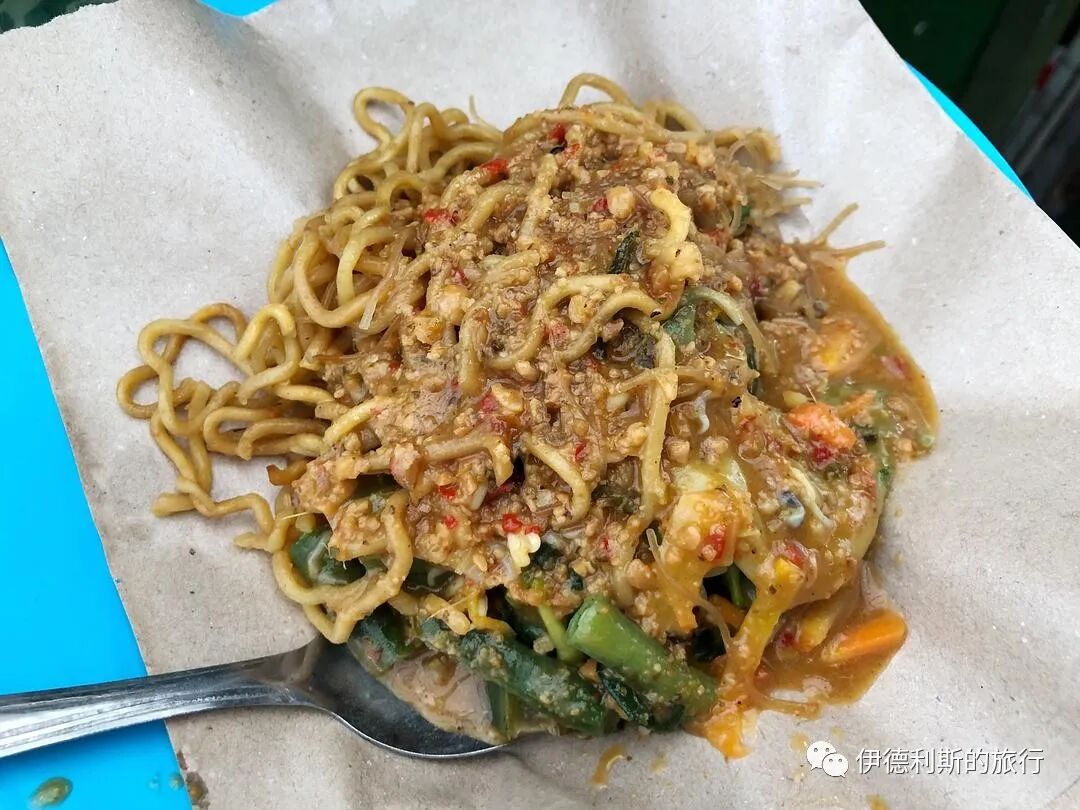
Pecel is a Javanese salad that usually includes spinach, amaranth, bean sprouts, water spinach, yardlong beans, cucumber, cassava leaves, and lemon basil. The sauce contains peanut butter, crushed peanuts, salt, palm sugar, tamarind juice, chili, galangal, kaffir lime leaves, and garlic. Pecel originated in Java and was later brought to Malaysia and Suriname by Javanese people.
3. Restaurants
Lesehan is a Javanese style of dining where you sit cross-legged on the floor. The Malioboro night market in Yogyakarta is the birthplace of this dining style. I ate the Yogyakarta specialty, Gudeg rice with chicken. Gudeg is made by stewing unripe jackfruit, palm sugar, and coconut milk for several hours. The ingredients include shallots, ginger, garlic, coriander seeds, bay leaves, and teak leaves.
At a small shop specializing in fish cakes, I ordered the fish cake omelet (Lenggang) and fish cake noodles (Mie Laksan). The fish cakes were stuffed with tofu.
I ate meatball soup (Bakso) and grilled chicken skin (Thaichan Kulit Ayam) at a shop.
I had fried fish with Indonesian chili sauce (sambal) at this shop, and it was super spicy!
The breakfast at my hotel in Yogyakarta had a great variety of food.
On the left are Indonesian rice cakes (klepon), topped with shredded coconut and served on a banana leaf. Klepon is made from a mix of glutinous rice flour, palm sugar, and juice from pandan or dracaena leaves. On the right are Indonesian snacks (kue), known in Java as market snacks (jajan pasar), which play an important role in traditional Javanese ceremonies.
In the bottom right is eggplant with chili sauce (balado), a spicy sauce that comes from the island of Sumatra. In the bottom left is lemon basil chicken (ayam kemangi).
4. Royal Sultan Cuisine
Located next to the Yogyakarta Sultan's Palace, nDalem Joyokusuman was the home of Prince Gusti Haryo Haji Joyokusumo and is now open as a cultural center and restaurant. I ate Nasi Blawong and Telo ijo here. Nasi Blawong is a specialty dish of the Yogyakarta Sultan. It was once only served at the Sultan's birthday banquets, and the reddish Blawong rice used in it is considered sacred. Telo ijo is a cassava cake drizzled with pandan coconut milk.
nDalem Joyokusuman was built in 1916 during the reign of the eighth Sultan of Yogyakarta, Hamengkubuwono VIII, and has been home to members of the Sultan's family ever since. The Peringgitan is the inner hall behind the main living room. It is where the prince's family spent their time and houses the valuable gifts the prince received.
The Sentong Kiwo was originally a guest room and now serves as an exhibition hall.
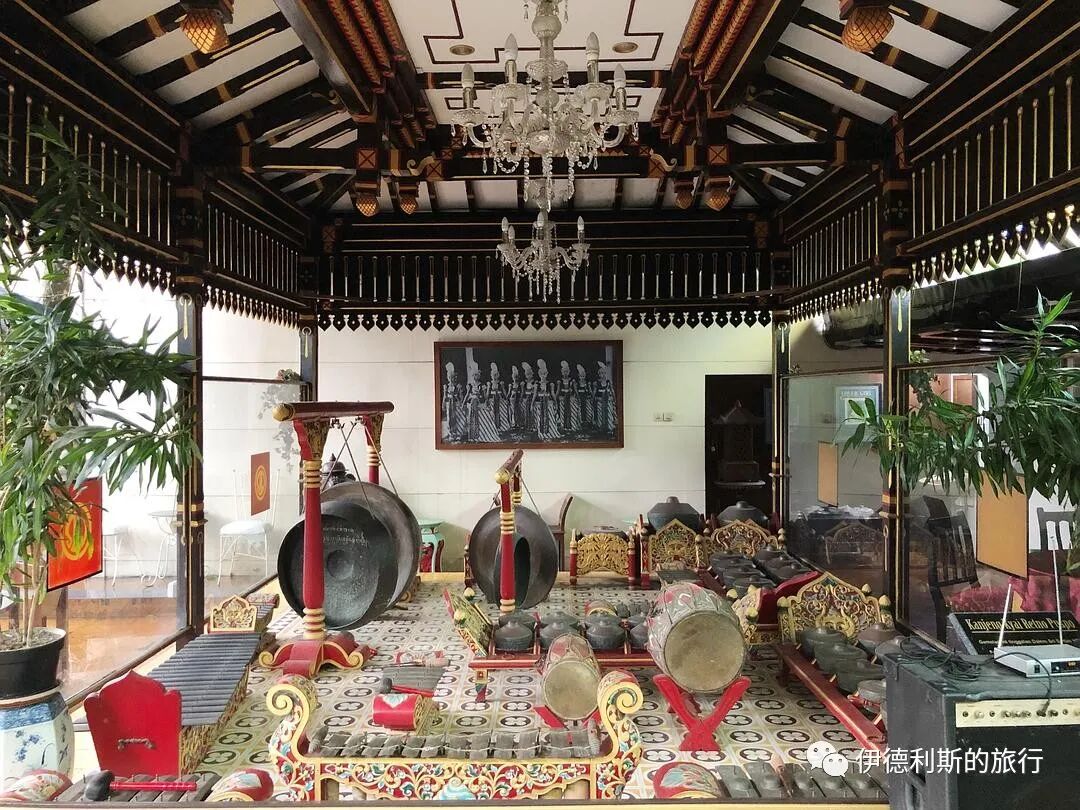
The area in the courtyard where gamelan music is performed.
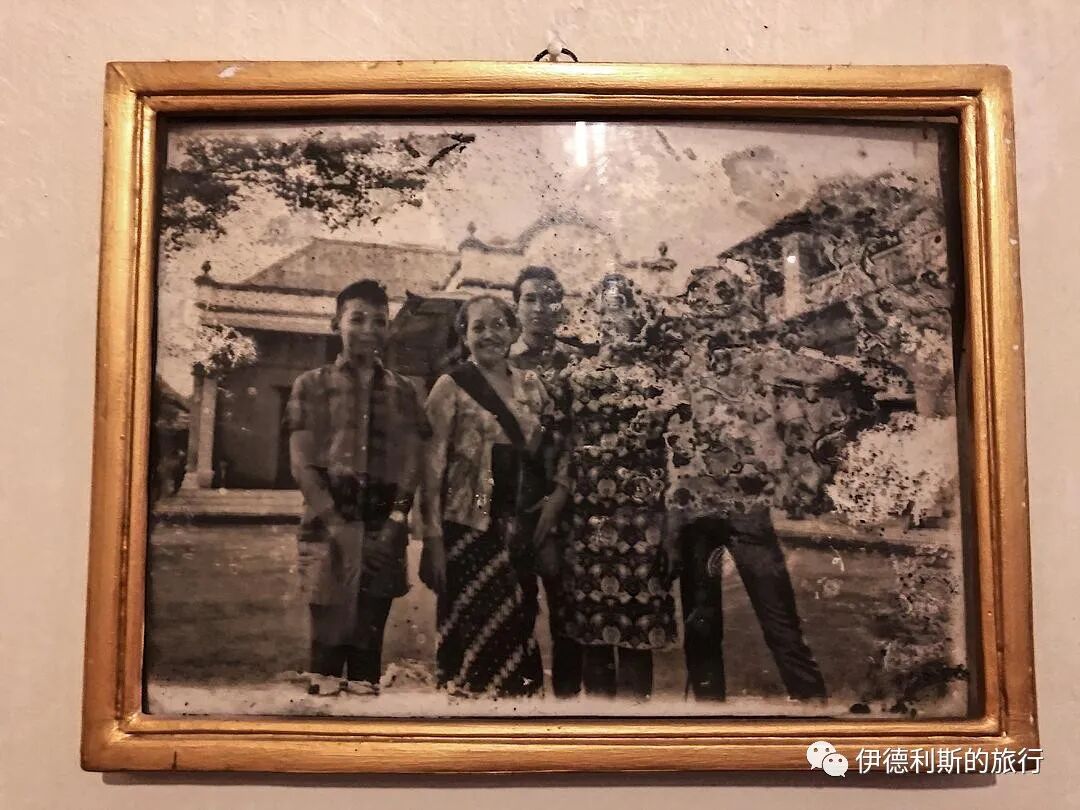
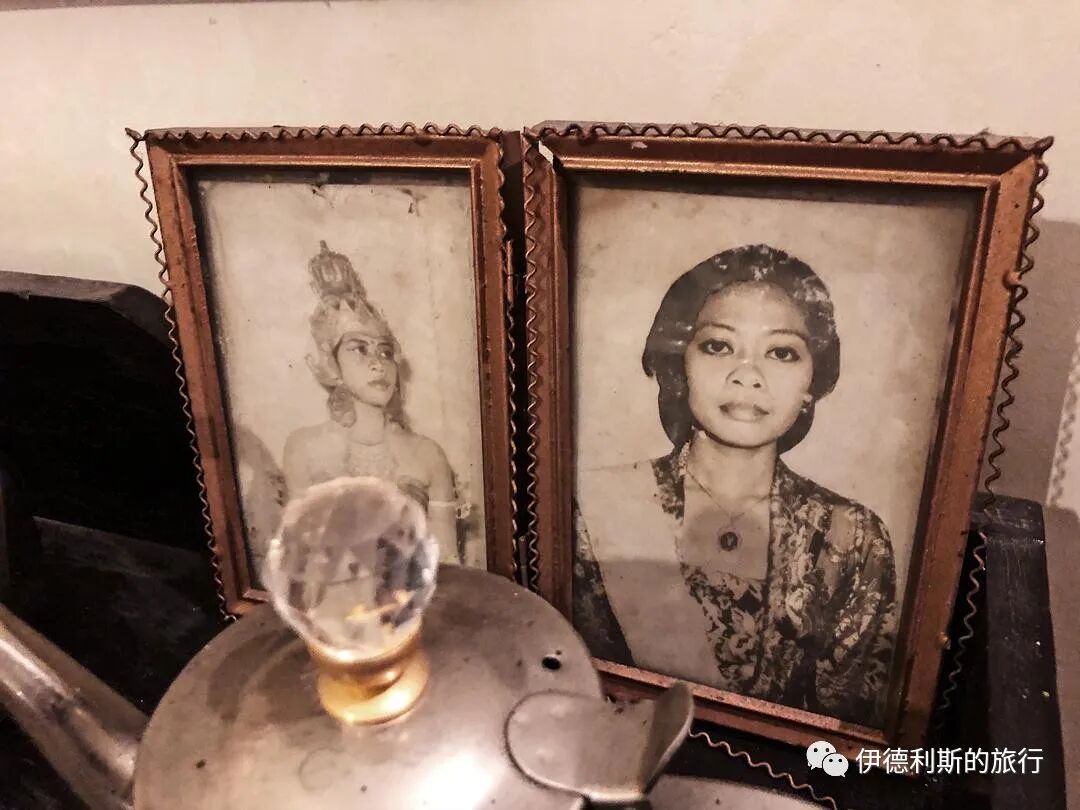
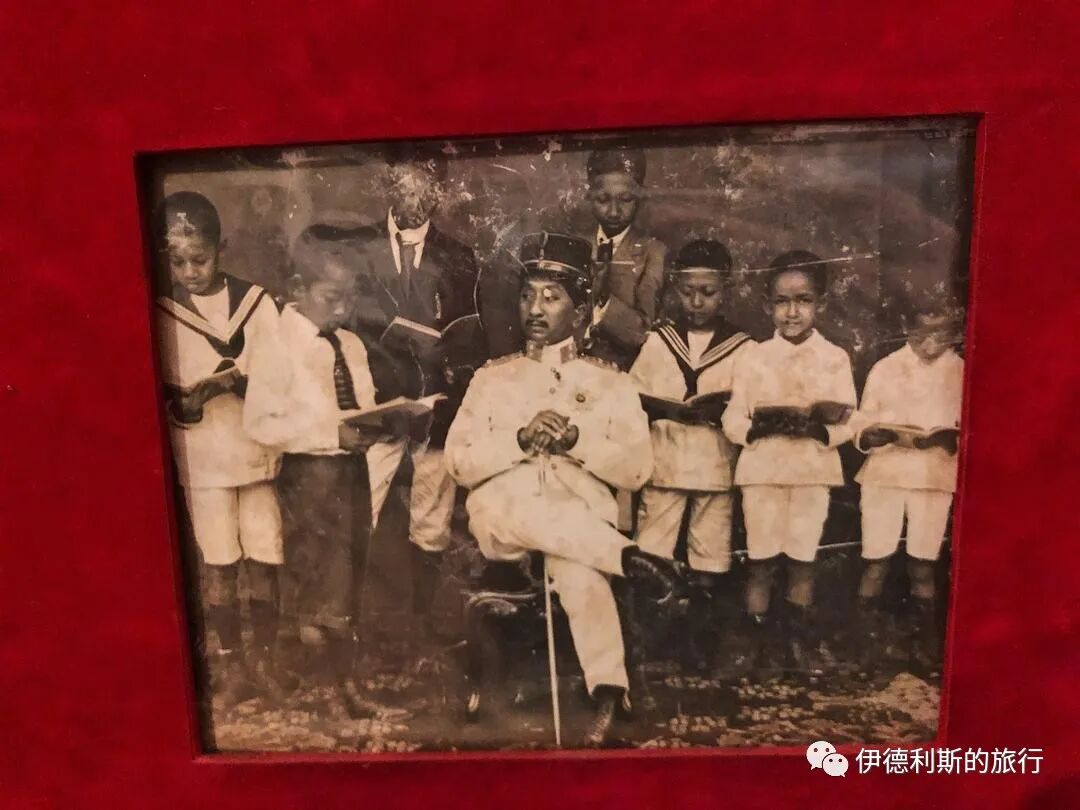
Photos of the prince's family when they were young. view all
Summary: Halal Food Guide: Yogyakarta — Javanese Dishes, Markets and Muslim Food is presented here as a firsthand travel account in clear English, beginning with this scene: Yogyakarta is an ancient cultural city in central Java that is still ruled by a sultan today. The account keeps its focus on Yogyakarta, Java Islam, Sultanate History while preserving the names, places, food, and historical details from the Chinese source.
Yogyakarta is an ancient cultural city in central Java that is still ruled by a sultan today. Beyond traditional Javanese architecture, gamelan music, and wayang shadow puppetry, Yogyakarta also has many local Javanese foods that I want to share with you.
1. Drinks
In the muggy tropical heat, drinking a cold street drink feels really good.
Es Dawet Ayu is a specialty iced drink from Central Java that comes from the small town of Banjarnegara. Its main ingredients are rice flour, glutinous rice flour, coconut milk, palm sugar syrup, and grass jelly.
Coconut water
Freshly squeezed dragon fruit juice; the juice selection in Java is truly rich.
Sekoteng is a Javanese ginger-flavored hot drink that includes peanuts, bread slices, and rice balls. Hot drinks are relatively rare in Java, but it feels like the ginger helps remove dampness.
Freshly squeezed lemon juice
2. Snacks
Putu Bumbung is a pastry made by mixing glutinous rice flour with pandan leaf juice and palm sugar, then steaming it in bamboo tubes. You eat it with shredded coconut.
Pecel is a Javanese salad that usually includes spinach, amaranth, bean sprouts, water spinach, yardlong beans, cucumber, cassava leaves, and lemon basil. The sauce contains peanut butter, crushed peanuts, salt, palm sugar, tamarind juice, chili, galangal, kaffir lime leaves, and garlic. Pecel originated in Java and was later brought to Malaysia and Suriname by Javanese people.
3. Restaurants
Lesehan is a Javanese style of dining where you sit cross-legged on the floor. The Malioboro night market in Yogyakarta is the birthplace of this dining style. I ate the Yogyakarta specialty, Gudeg rice with chicken. Gudeg is made by stewing unripe jackfruit, palm sugar, and coconut milk for several hours. The ingredients include shallots, ginger, garlic, coriander seeds, bay leaves, and teak leaves.
At a small shop specializing in fish cakes, I ordered the fish cake omelet (Lenggang) and fish cake noodles (Mie Laksan). The fish cakes were stuffed with tofu.
I ate meatball soup (Bakso) and grilled chicken skin (Thaichan Kulit Ayam) at a shop.
I had fried fish with Indonesian chili sauce (sambal) at this shop, and it was super spicy!
The breakfast at my hotel in Yogyakarta had a great variety of food.
On the left are Indonesian rice cakes (klepon), topped with shredded coconut and served on a banana leaf. Klepon is made from a mix of glutinous rice flour, palm sugar, and juice from pandan or dracaena leaves. On the right are Indonesian snacks (kue), known in Java as market snacks (jajan pasar), which play an important role in traditional Javanese ceremonies.
In the bottom right is eggplant with chili sauce (balado), a spicy sauce that comes from the island of Sumatra. In the bottom left is lemon basil chicken (ayam kemangi).
4. Royal Sultan Cuisine
Located next to the Yogyakarta Sultan's Palace, nDalem Joyokusuman was the home of Prince Gusti Haryo Haji Joyokusumo and is now open as a cultural center and restaurant. I ate Nasi Blawong and Telo ijo here. Nasi Blawong is a specialty dish of the Yogyakarta Sultan. It was once only served at the Sultan's birthday banquets, and the reddish Blawong rice used in it is considered sacred. Telo ijo is a cassava cake drizzled with pandan coconut milk.
nDalem Joyokusuman was built in 1916 during the reign of the eighth Sultan of Yogyakarta, Hamengkubuwono VIII, and has been home to members of the Sultan's family ever since. The Peringgitan is the inner hall behind the main living room. It is where the prince's family spent their time and houses the valuable gifts the prince received.
The Sentong Kiwo was originally a guest room and now serves as an exhibition hall.
The area in the courtyard where gamelan music is performed.
Photos of the prince's family when they were young. view all
Reposted from the web
Summary: Halal Food Guide: Yogyakarta — Javanese Dishes, Markets and Muslim Food is presented here as a firsthand travel account in clear English, beginning with this scene: Yogyakarta is an ancient cultural city in central Java that is still ruled by a sultan today. The account keeps its focus on Yogyakarta, Java Islam, Sultanate History while preserving the names, places, food, and historical details from the Chinese source.
Yogyakarta is an ancient cultural city in central Java that is still ruled by a sultan today. Beyond traditional Javanese architecture, gamelan music, and wayang shadow puppetry, Yogyakarta also has many local Javanese foods that I want to share with you.
1. Drinks
In the muggy tropical heat, drinking a cold street drink feels really good.
Es Dawet Ayu is a specialty iced drink from Central Java that comes from the small town of Banjarnegara. Its main ingredients are rice flour, glutinous rice flour, coconut milk, palm sugar syrup, and grass jelly.
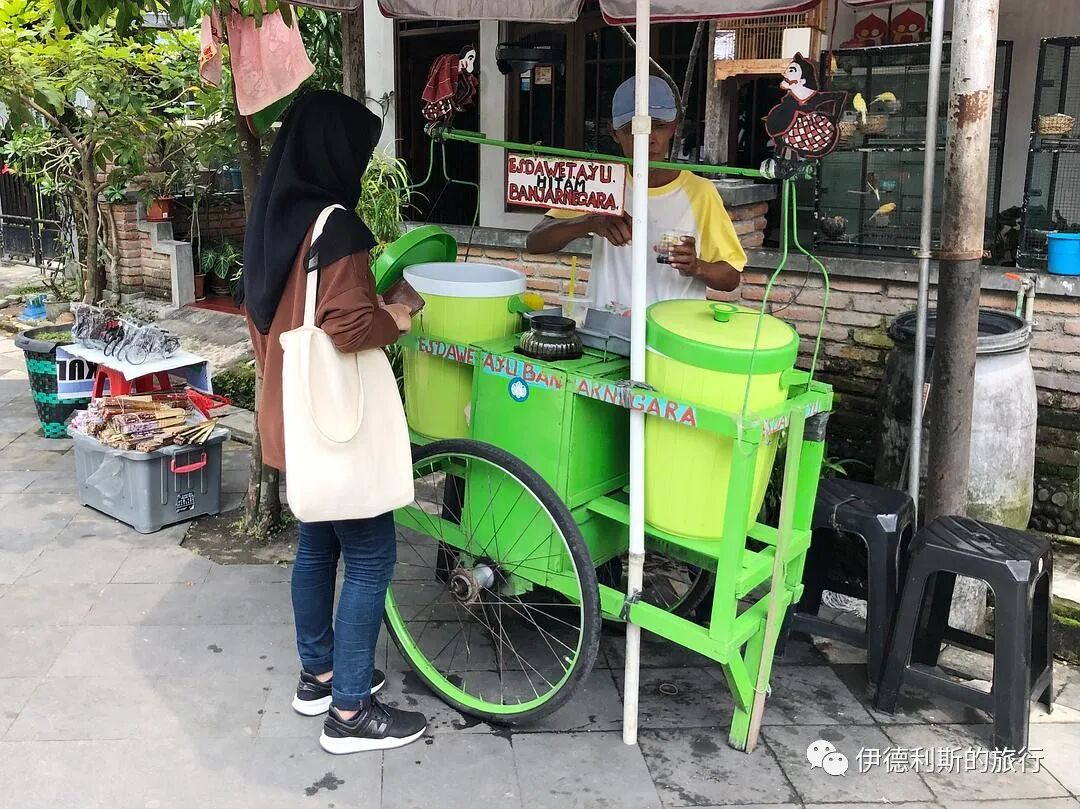
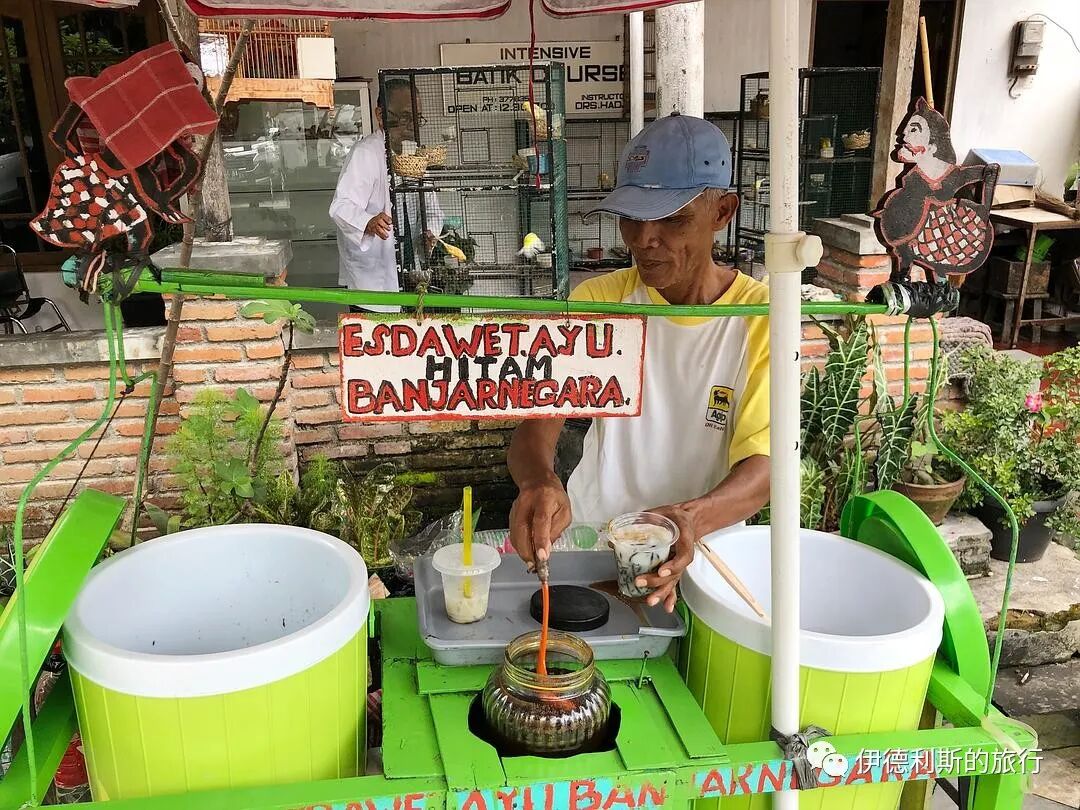
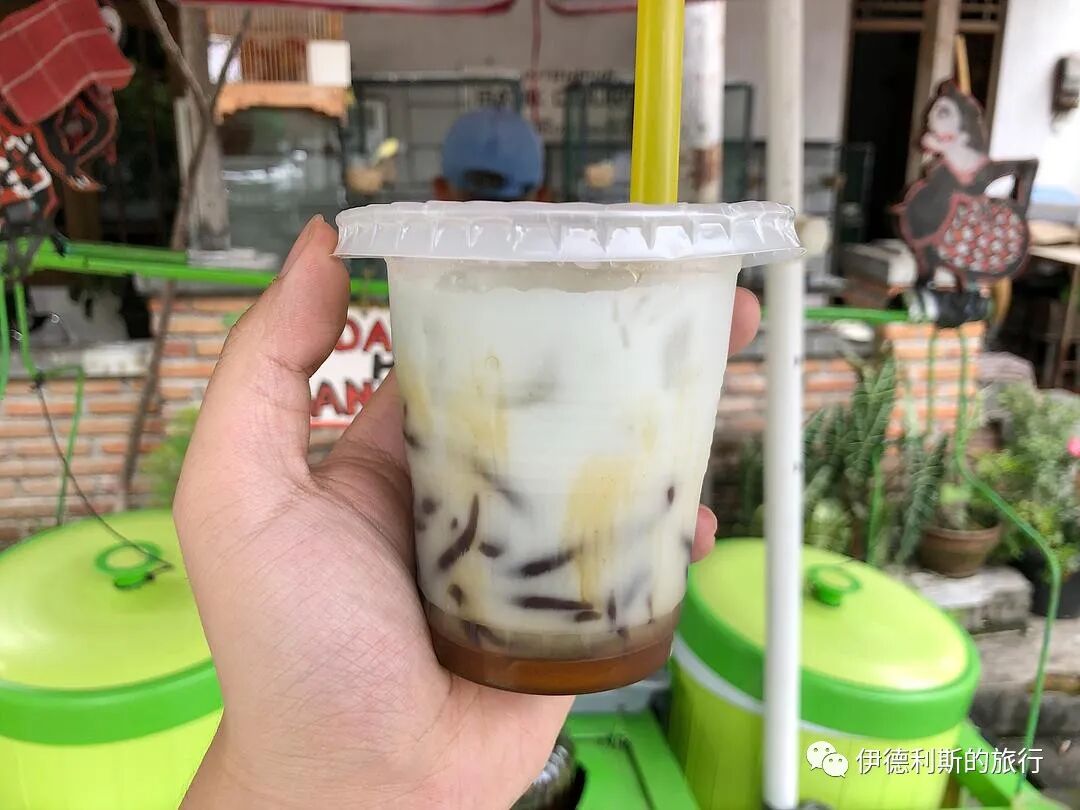
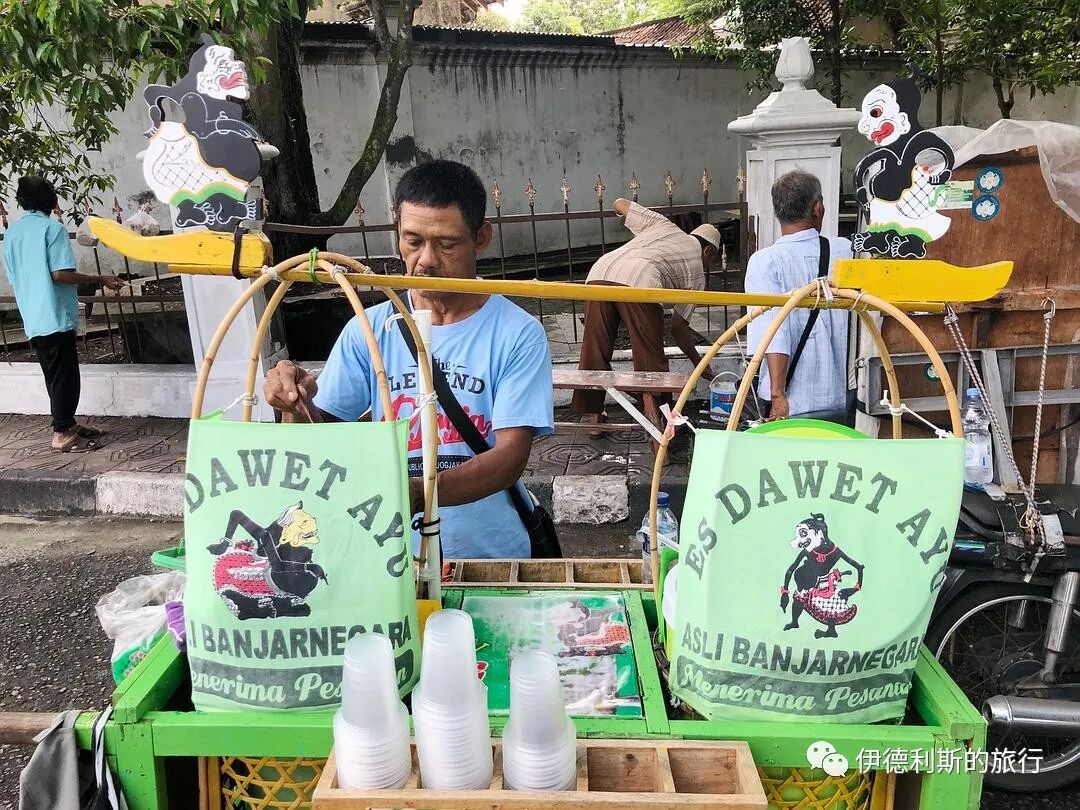
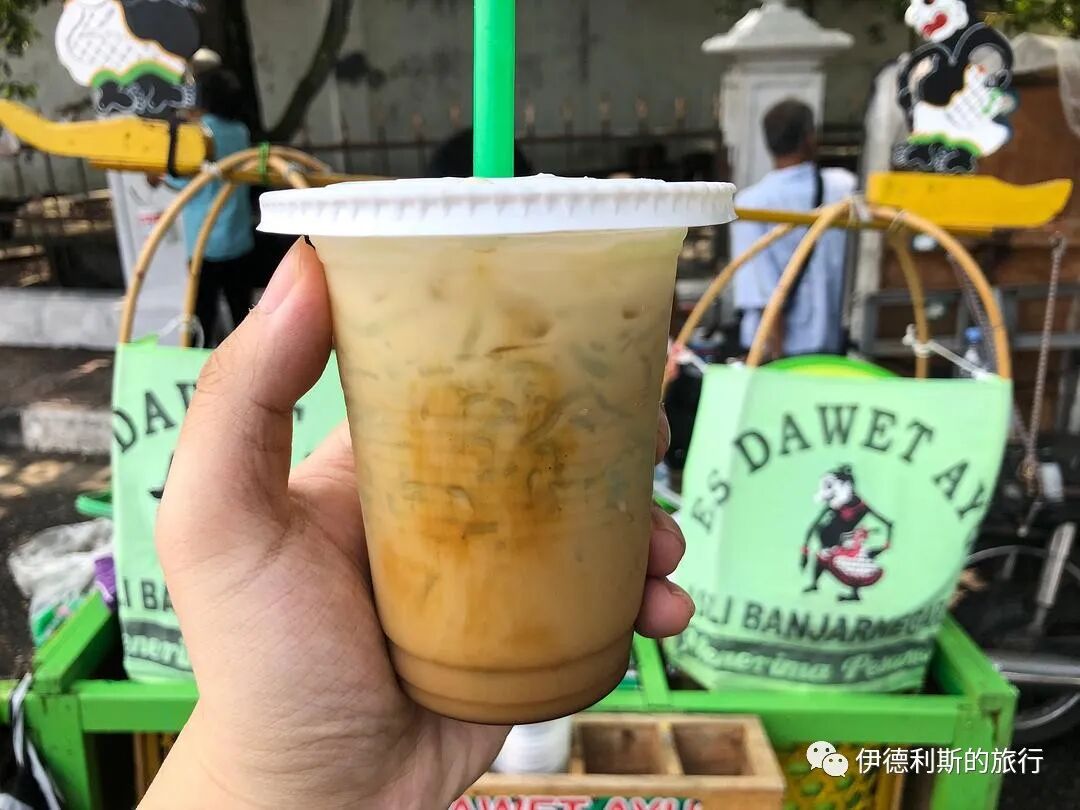
Coconut water
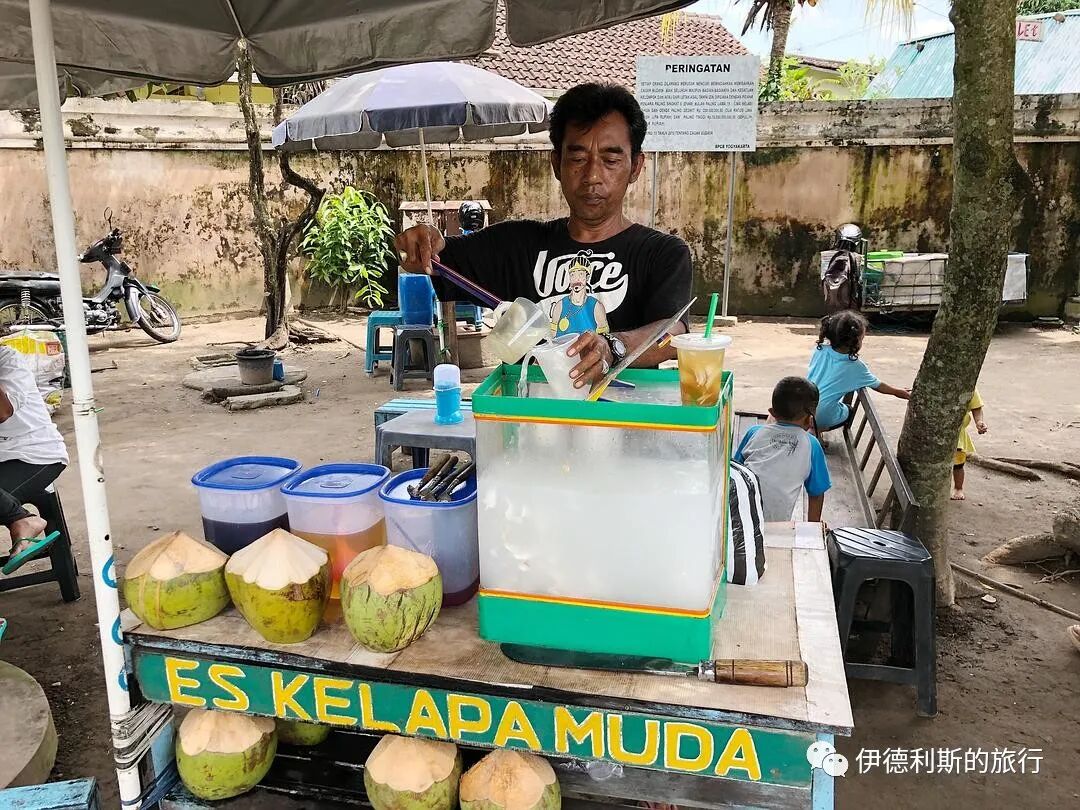
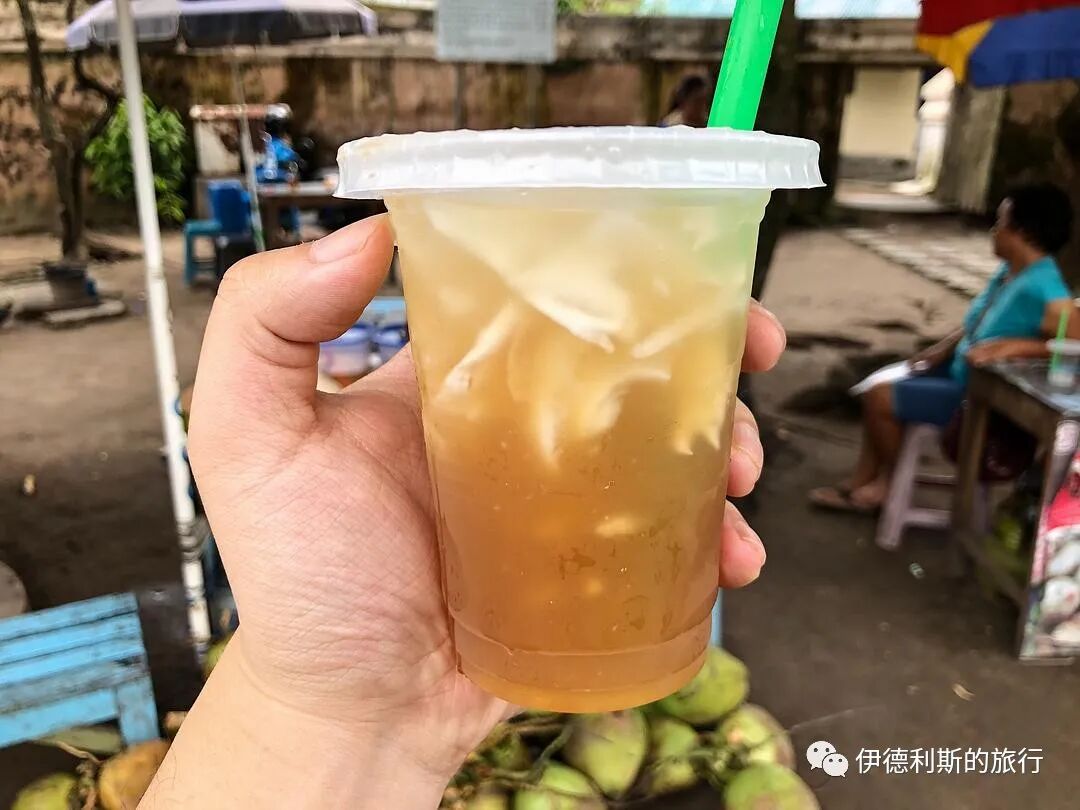
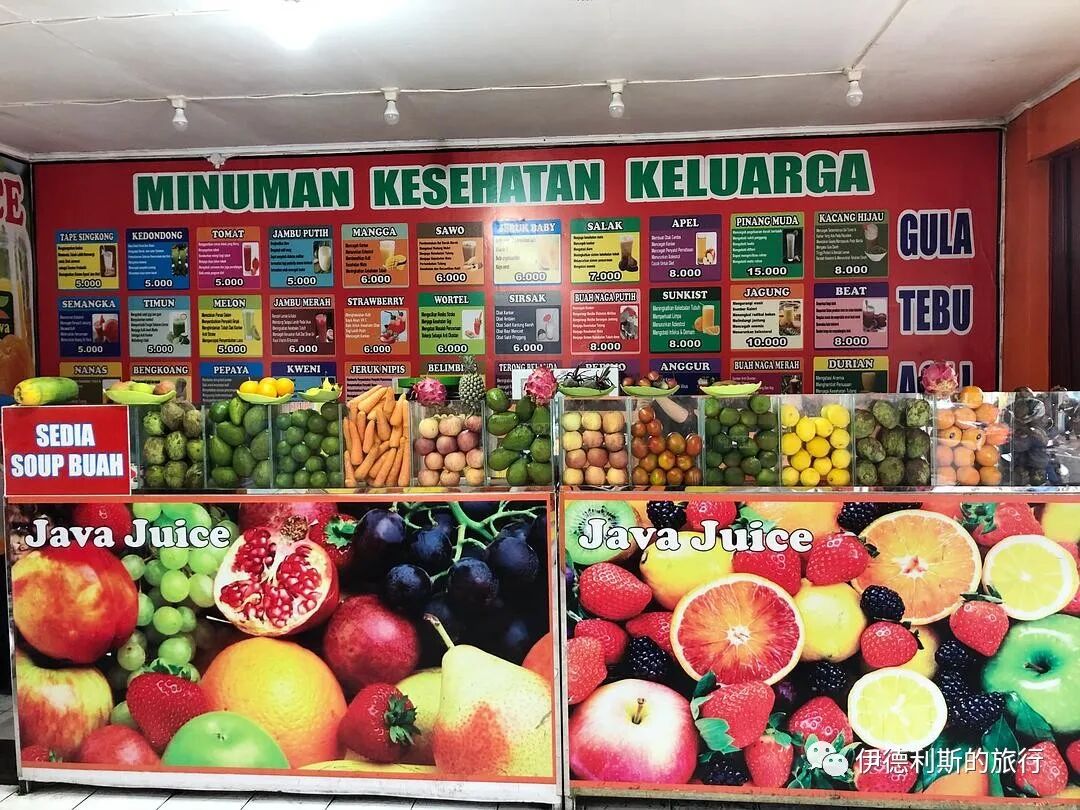
Freshly squeezed dragon fruit juice; the juice selection in Java is truly rich.

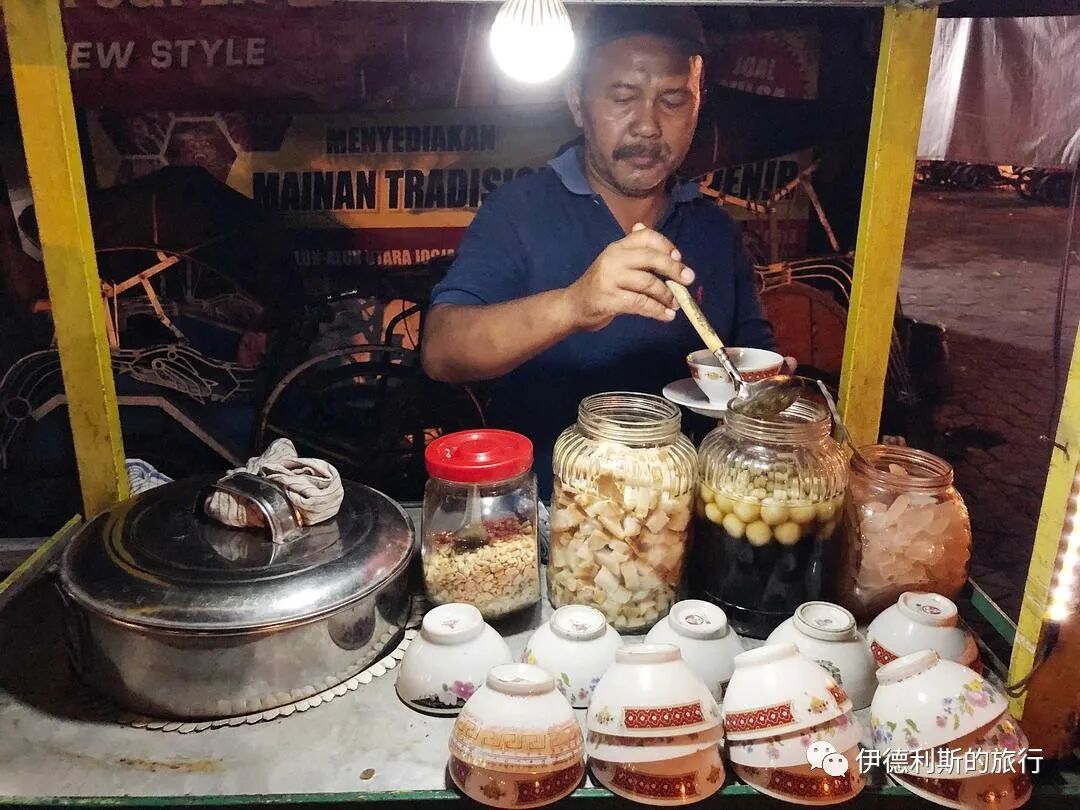
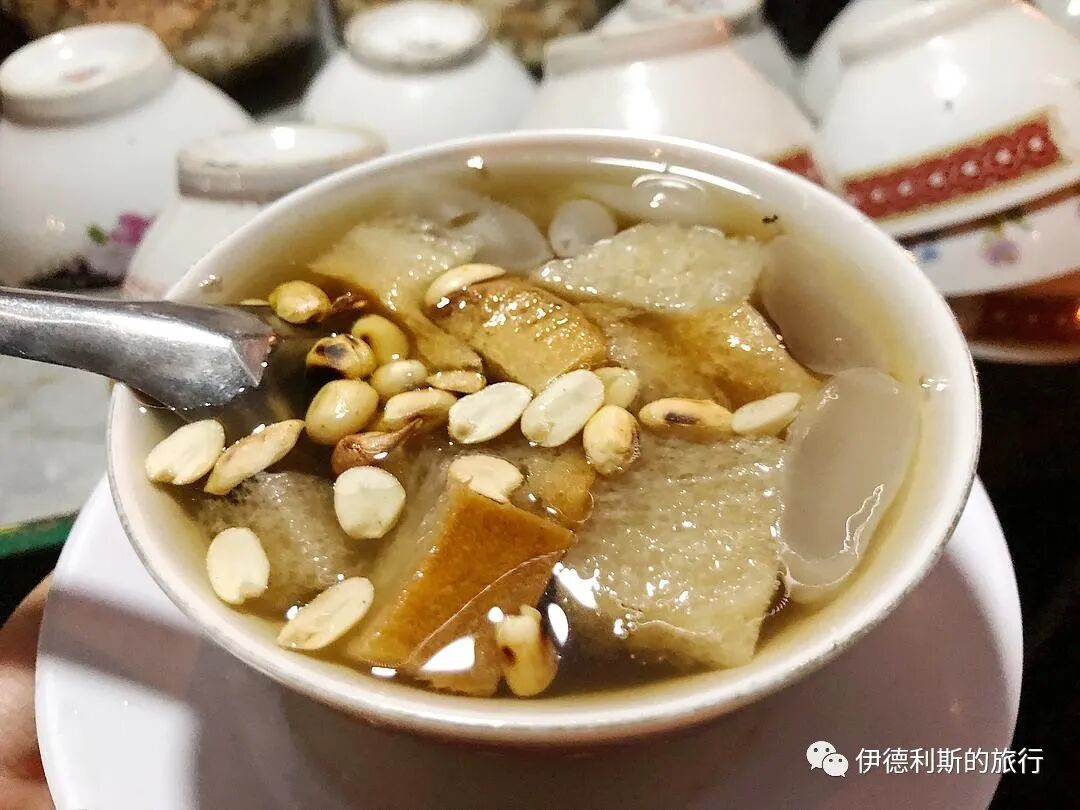
Sekoteng is a Javanese ginger-flavored hot drink that includes peanuts, bread slices, and rice balls. Hot drinks are relatively rare in Java, but it feels like the ginger helps remove dampness.
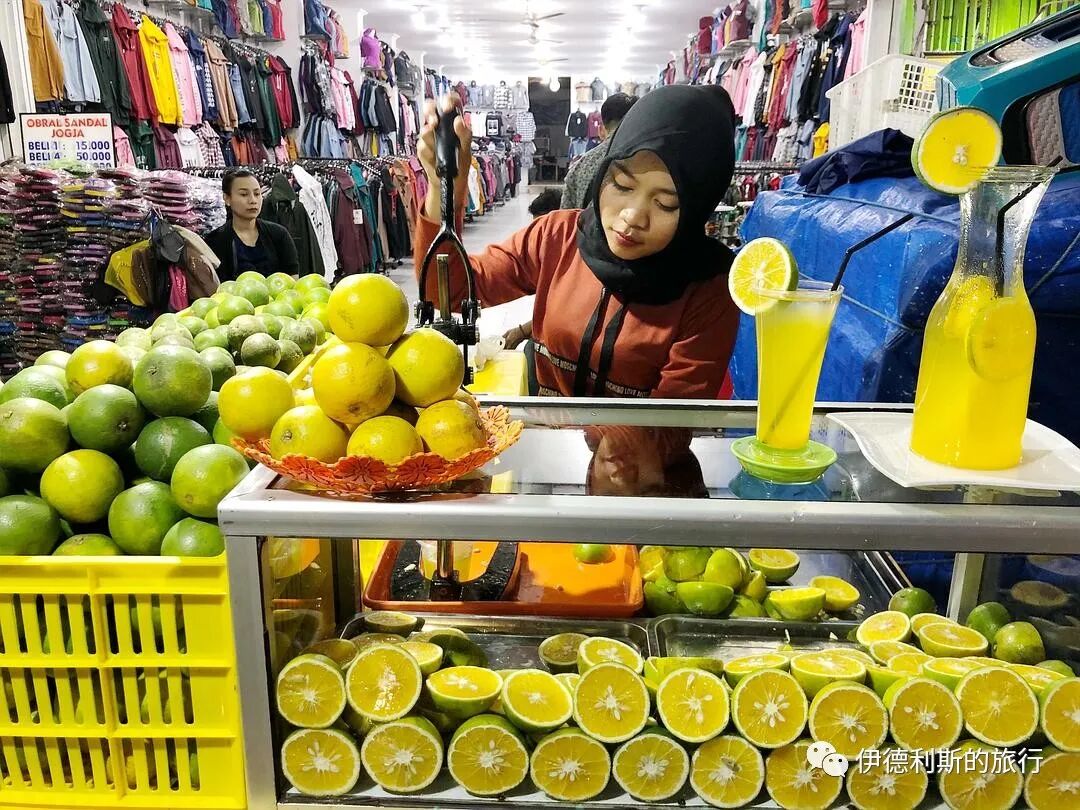
Freshly squeezed lemon juice

2. Snacks
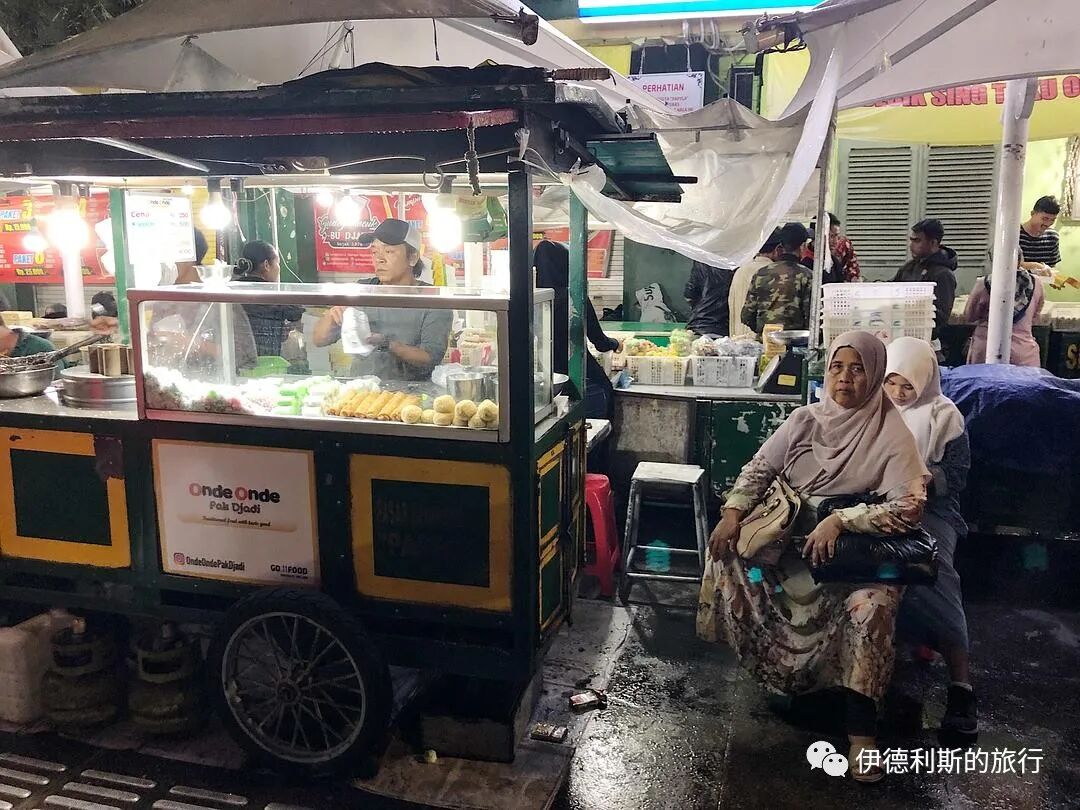
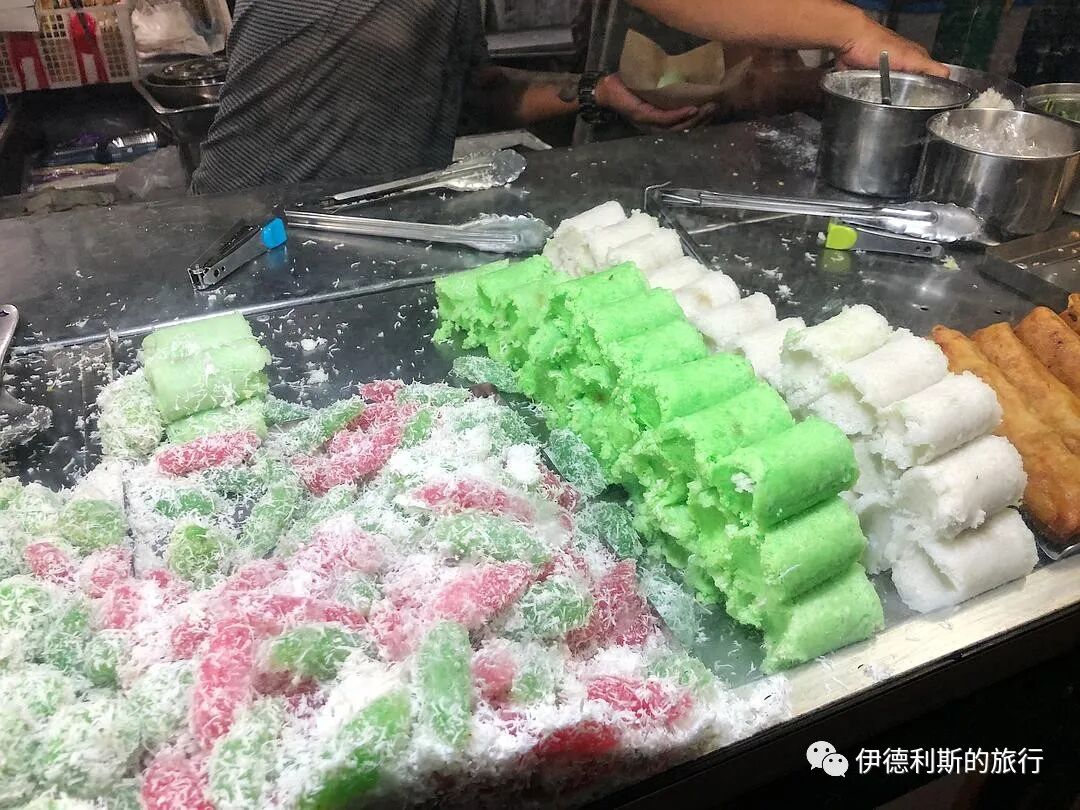
Putu Bumbung is a pastry made by mixing glutinous rice flour with pandan leaf juice and palm sugar, then steaming it in bamboo tubes. You eat it with shredded coconut.
Pecel is a Javanese salad that usually includes spinach, amaranth, bean sprouts, water spinach, yardlong beans, cucumber, cassava leaves, and lemon basil. The sauce contains peanut butter, crushed peanuts, salt, palm sugar, tamarind juice, chili, galangal, kaffir lime leaves, and garlic. Pecel originated in Java and was later brought to Malaysia and Suriname by Javanese people.
3. Restaurants
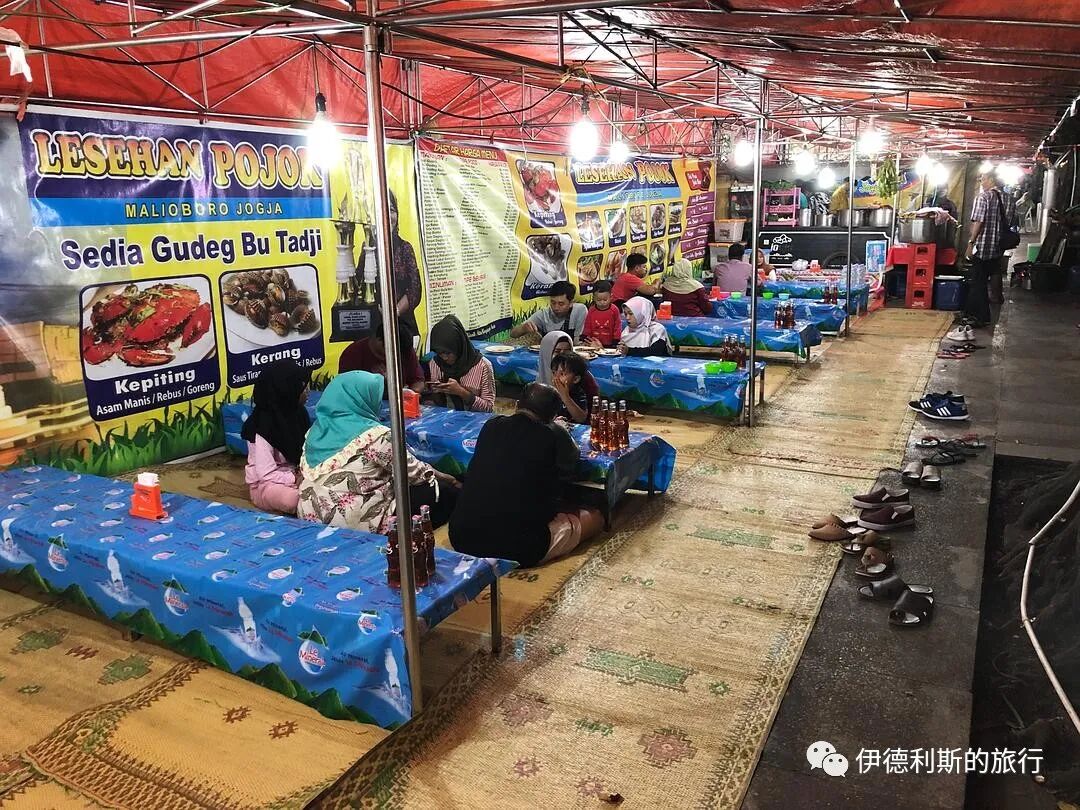
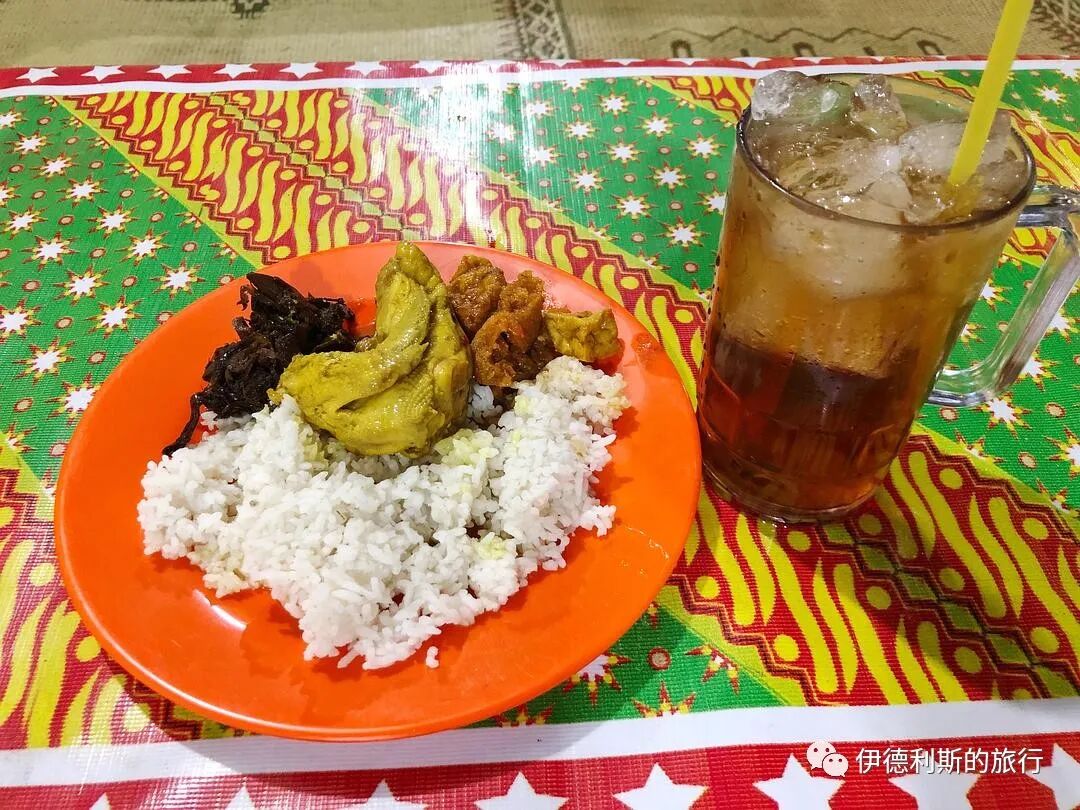
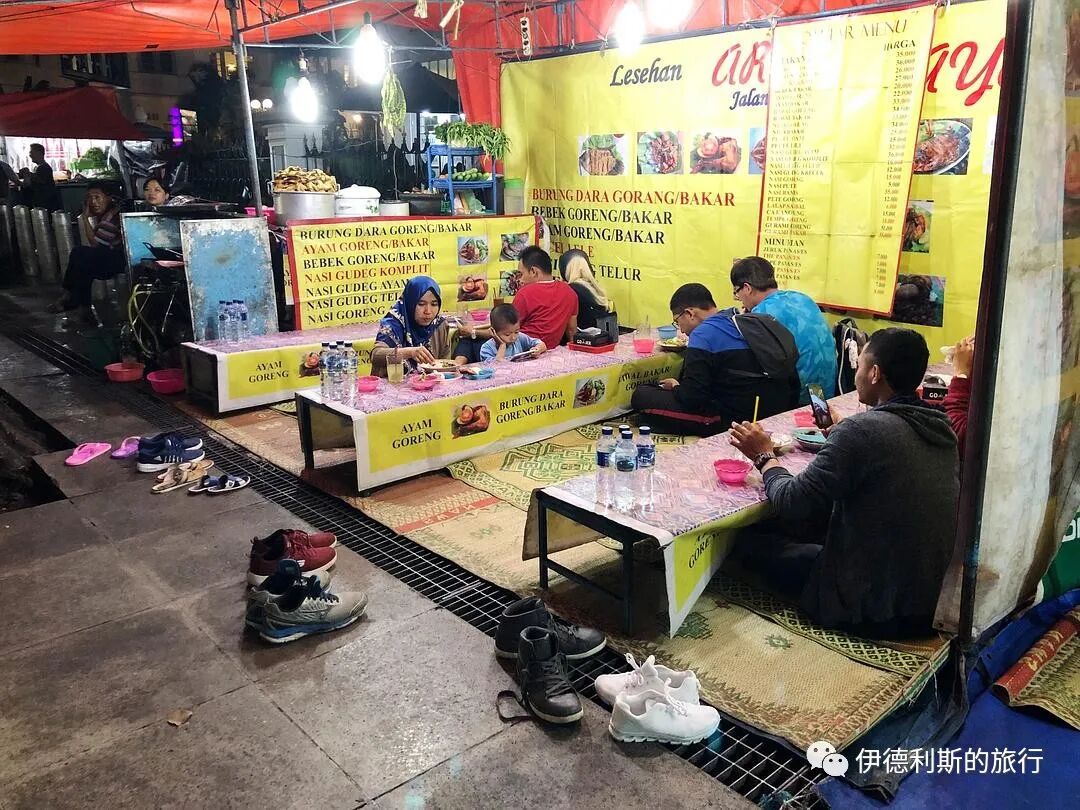
Lesehan is a Javanese style of dining where you sit cross-legged on the floor. The Malioboro night market in Yogyakarta is the birthplace of this dining style. I ate the Yogyakarta specialty, Gudeg rice with chicken. Gudeg is made by stewing unripe jackfruit, palm sugar, and coconut milk for several hours. The ingredients include shallots, ginger, garlic, coriander seeds, bay leaves, and teak leaves.
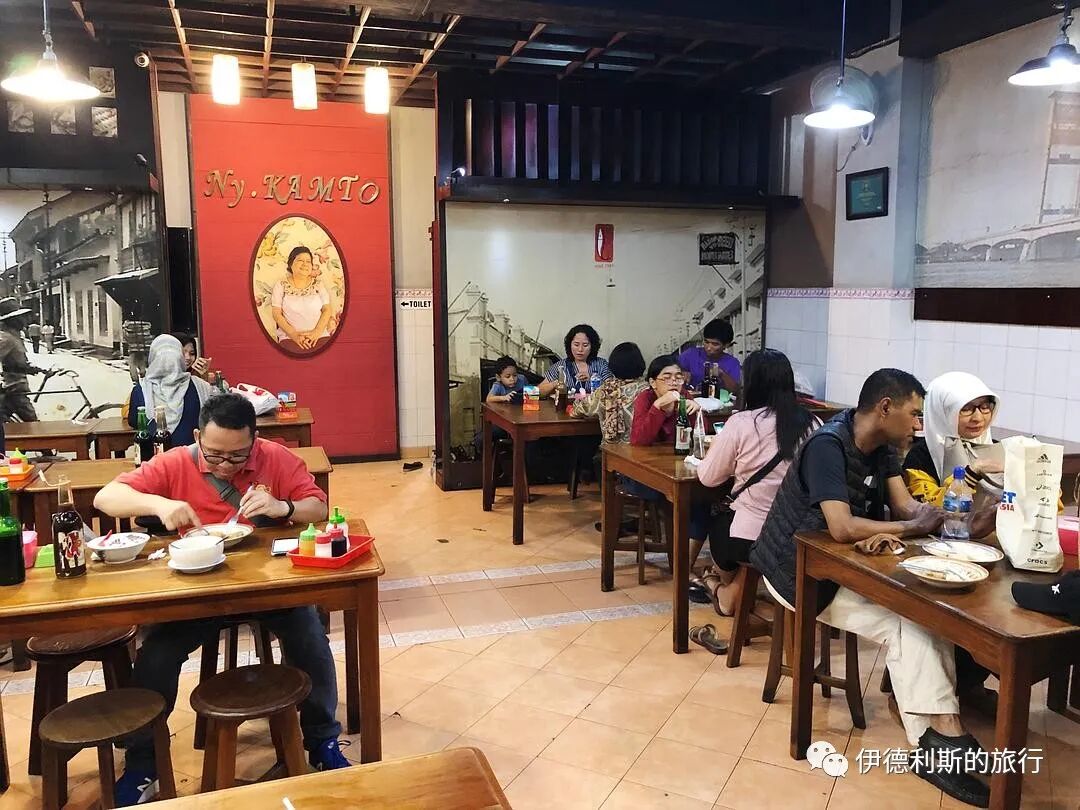
At a small shop specializing in fish cakes, I ordered the fish cake omelet (Lenggang) and fish cake noodles (Mie Laksan). The fish cakes were stuffed with tofu.

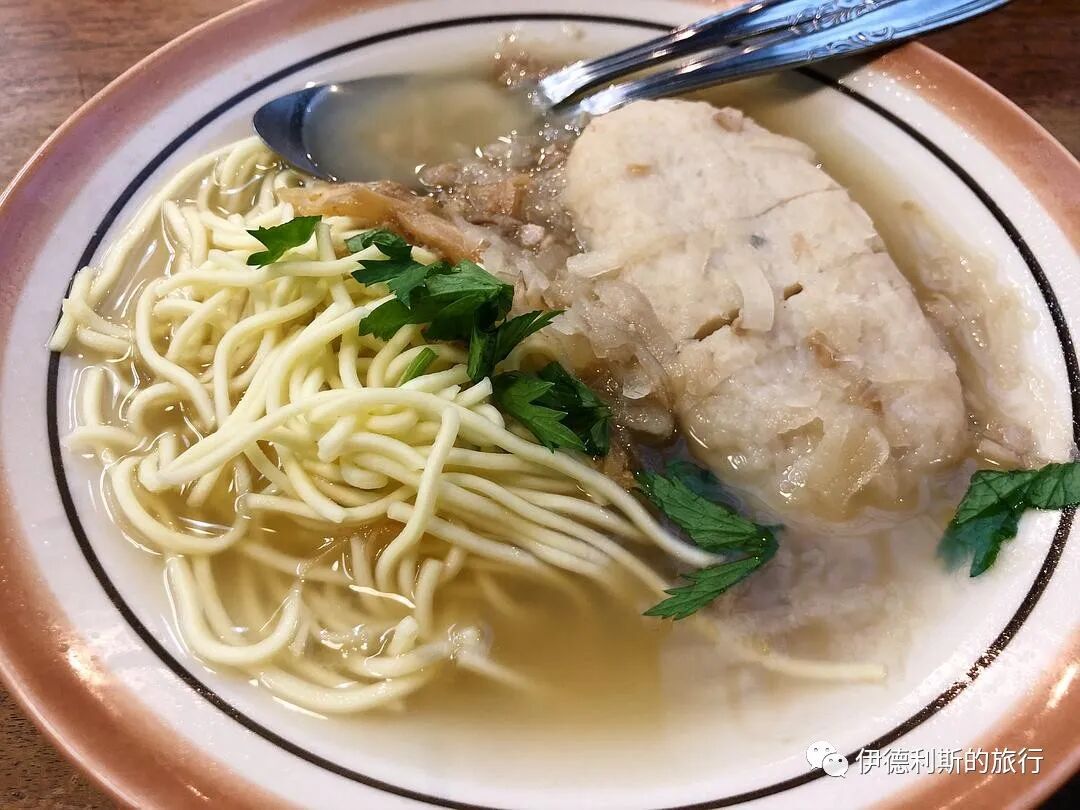
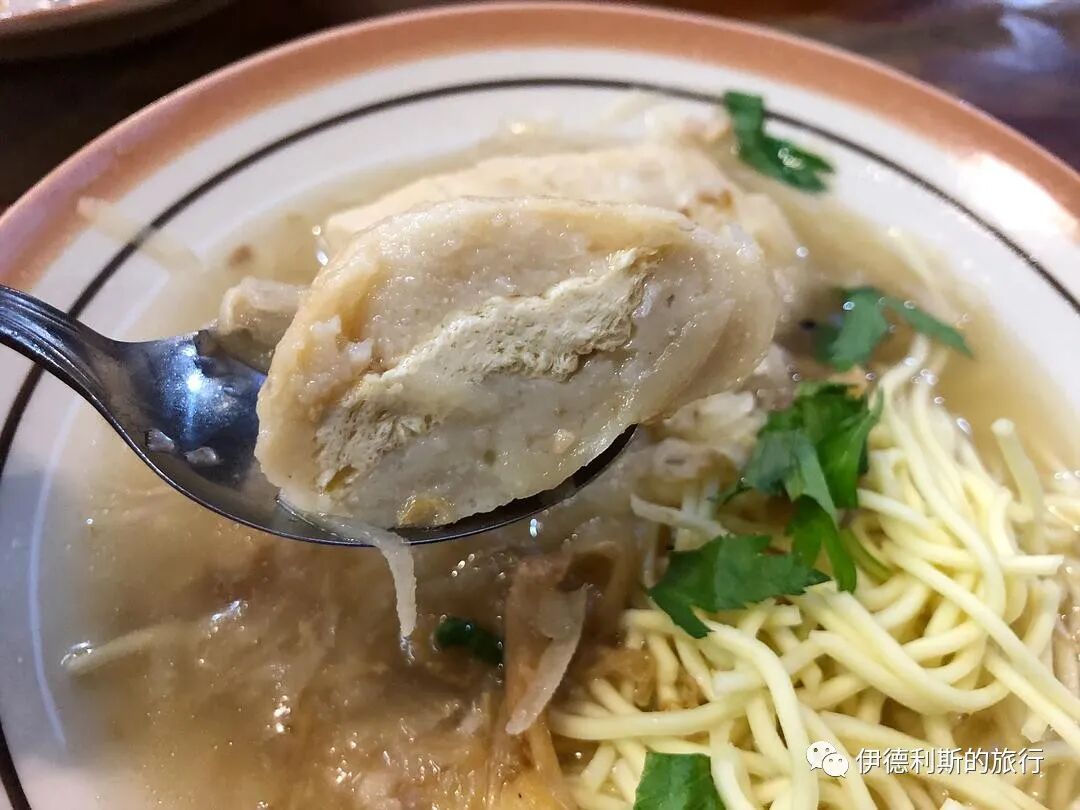
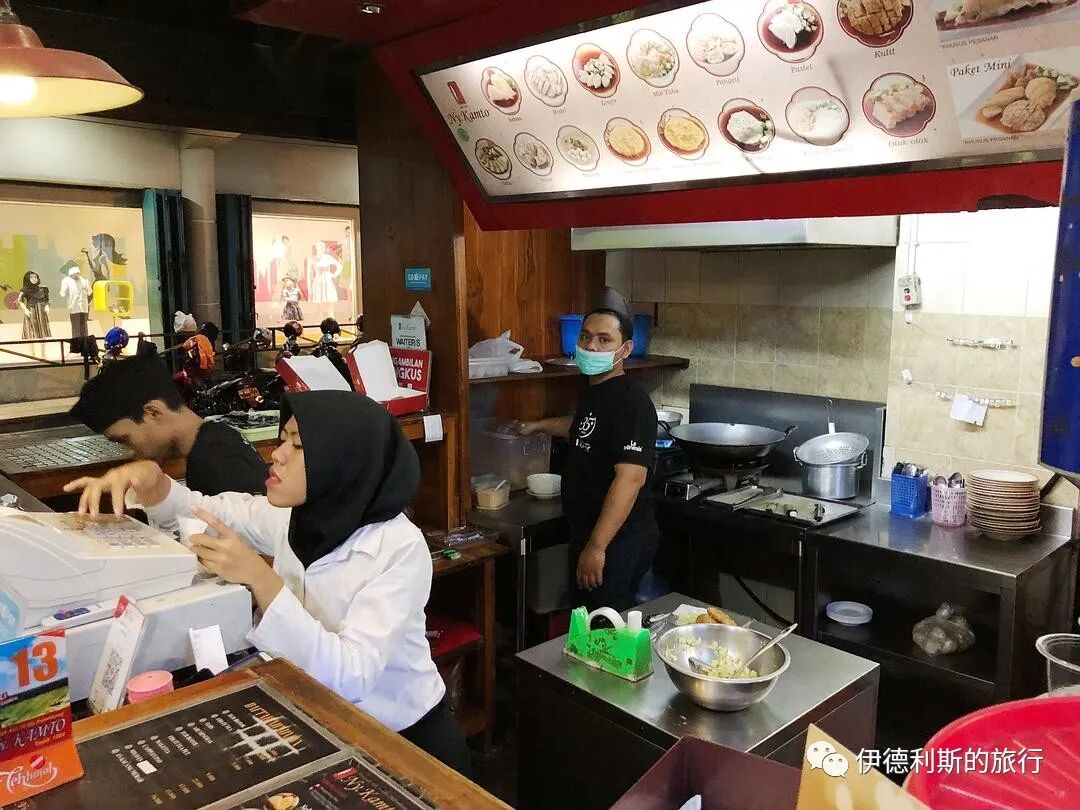
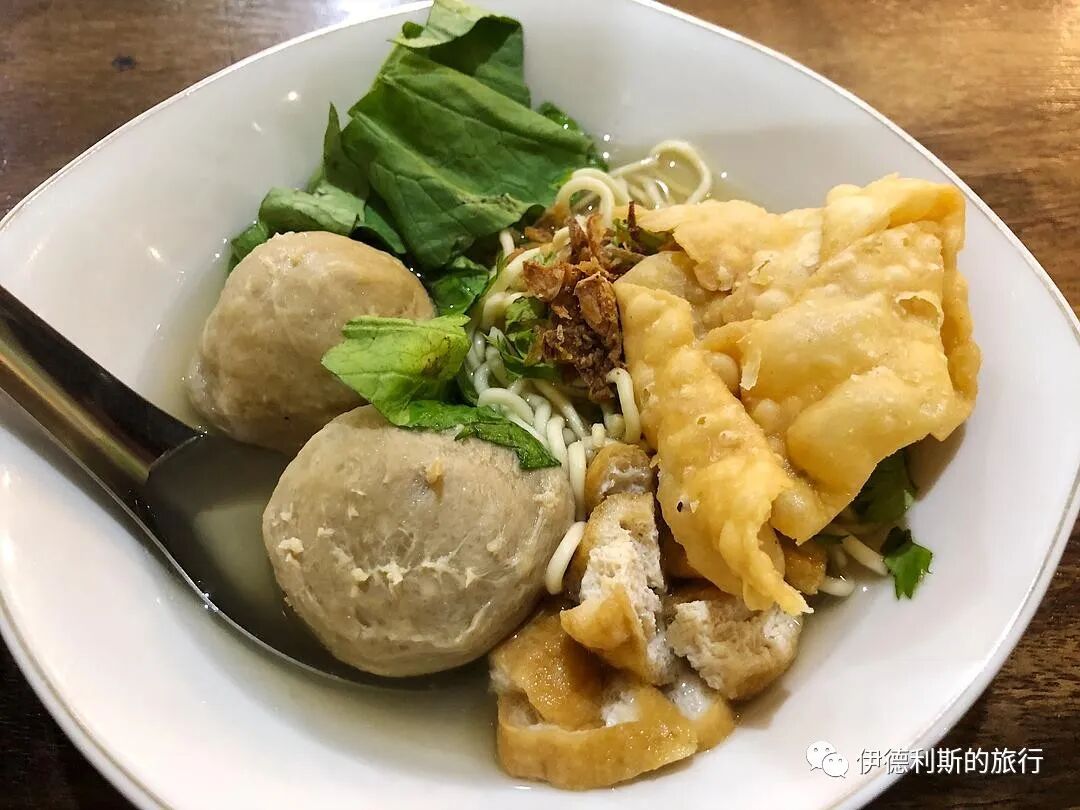
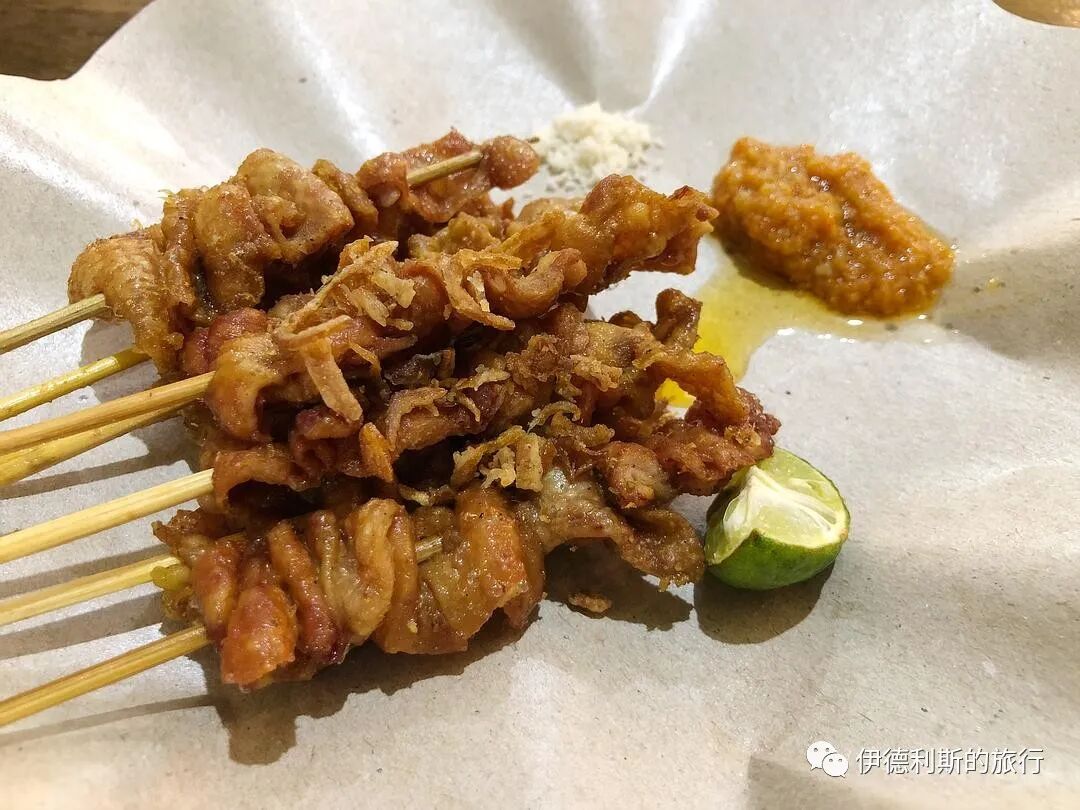
I ate meatball soup (Bakso) and grilled chicken skin (Thaichan Kulit Ayam) at a shop.
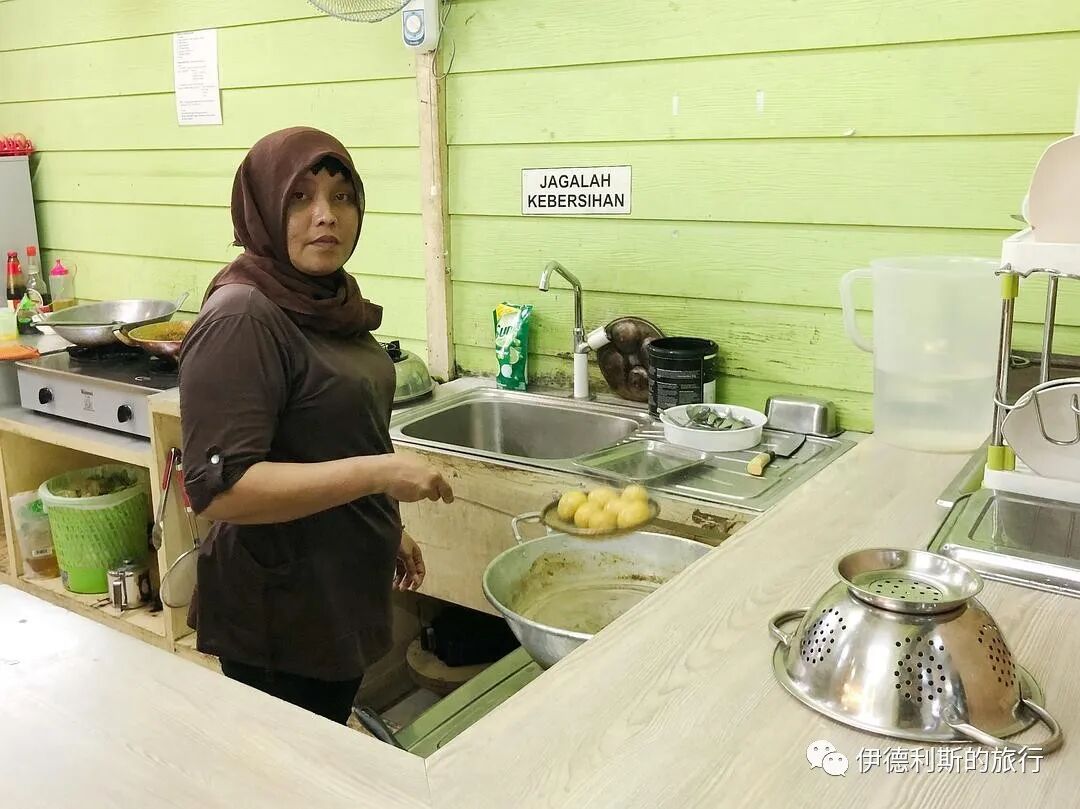
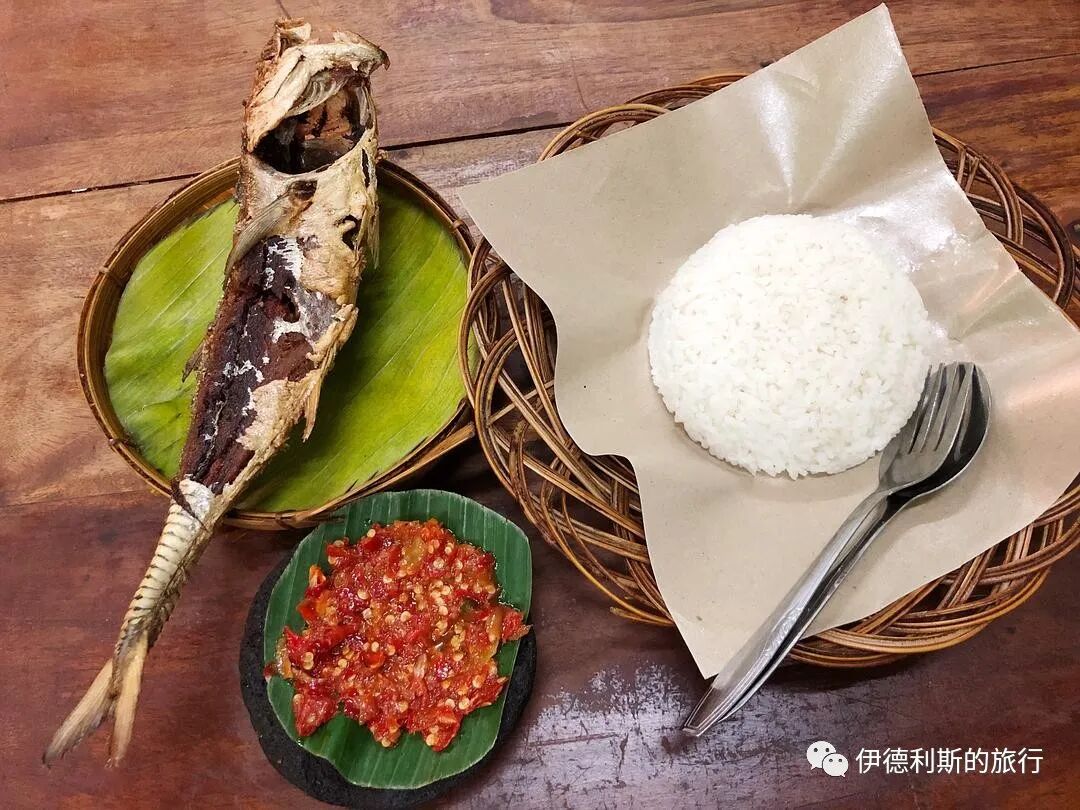
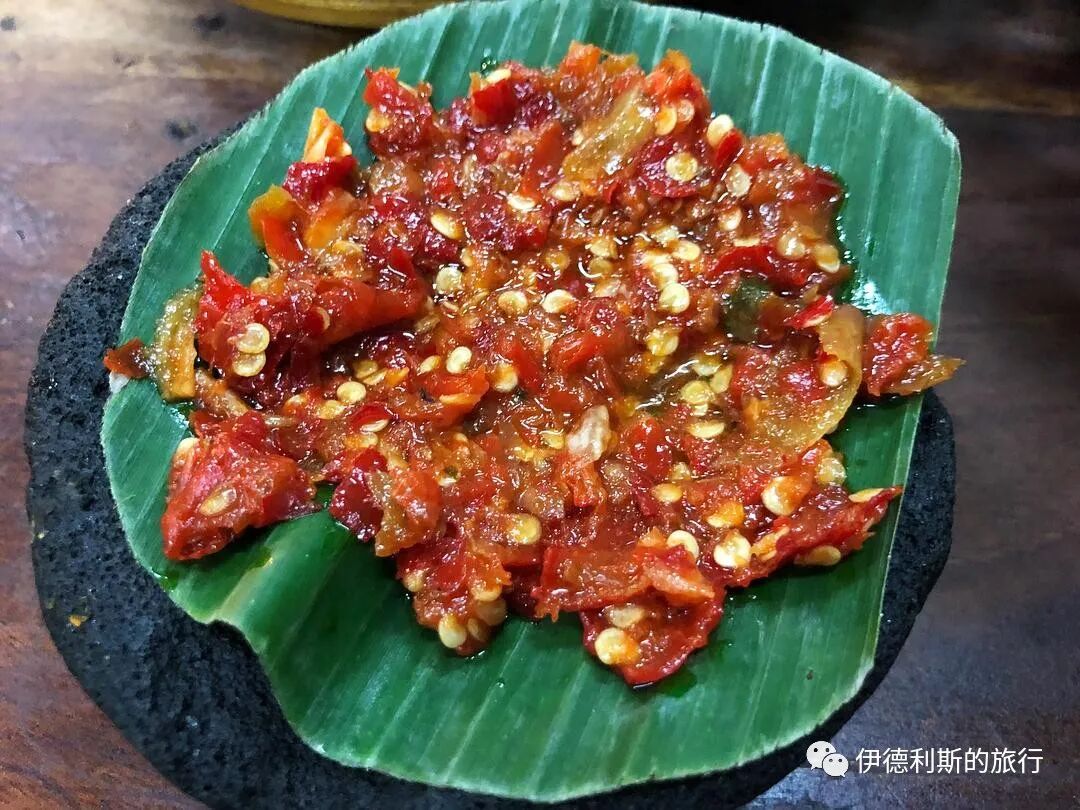
I had fried fish with Indonesian chili sauce (sambal) at this shop, and it was super spicy!
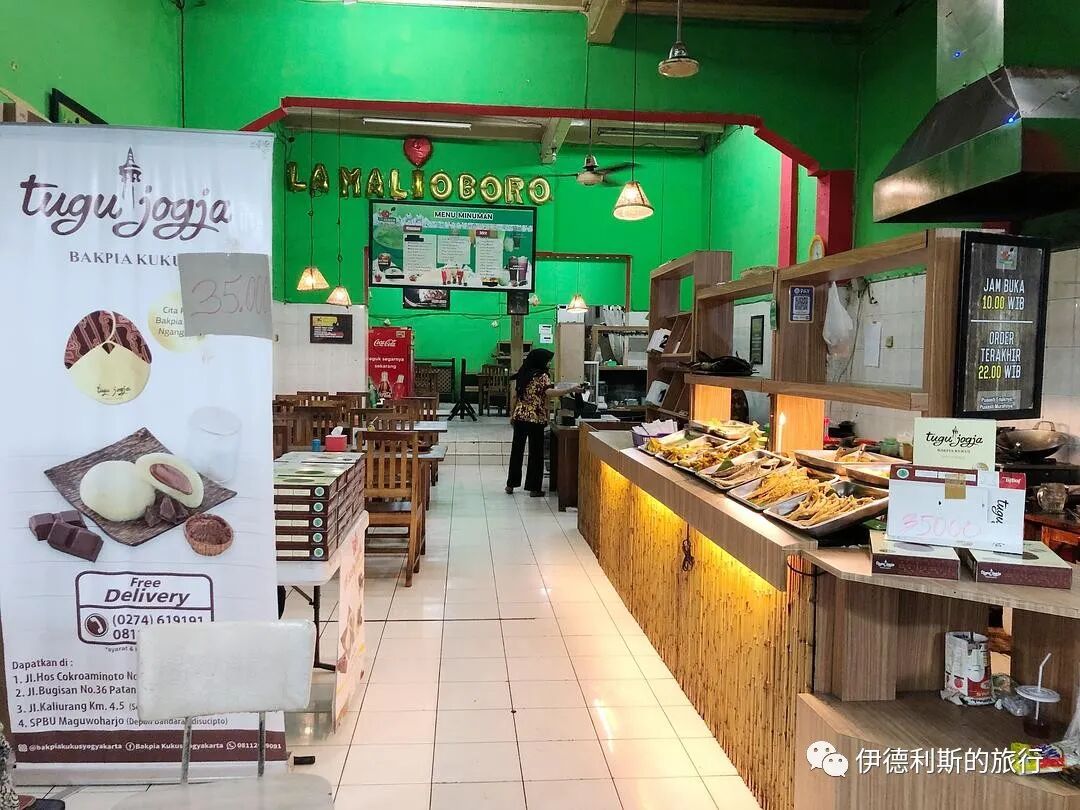
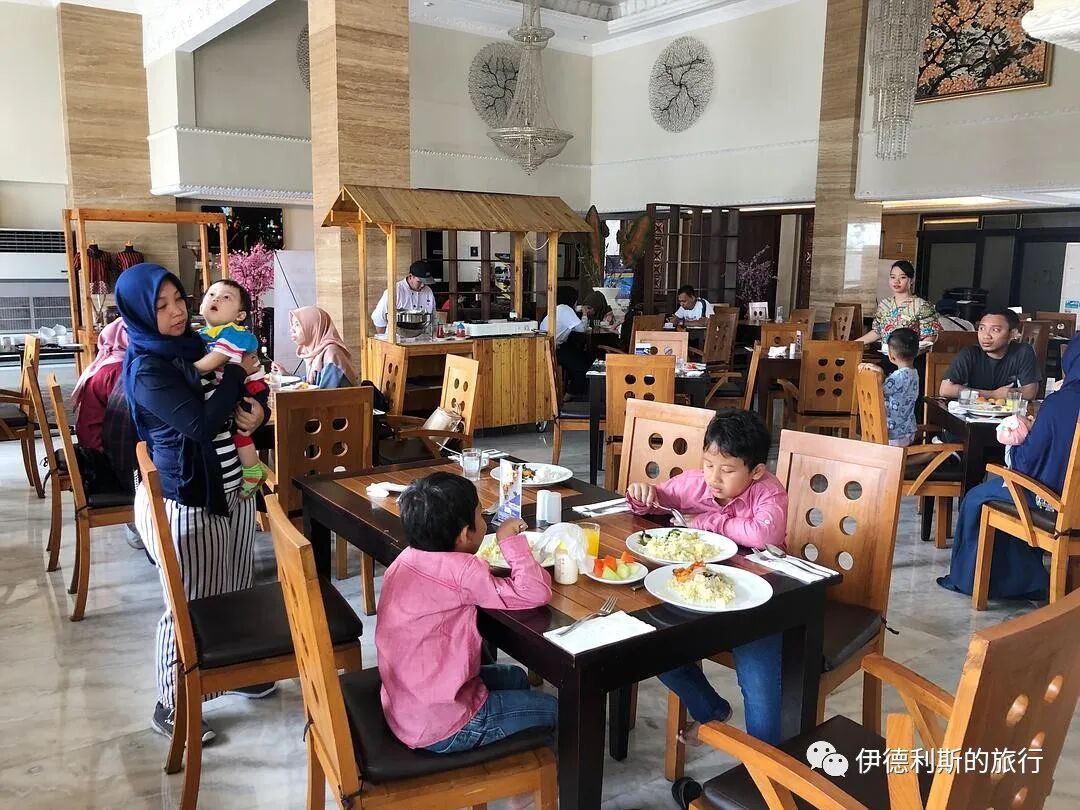
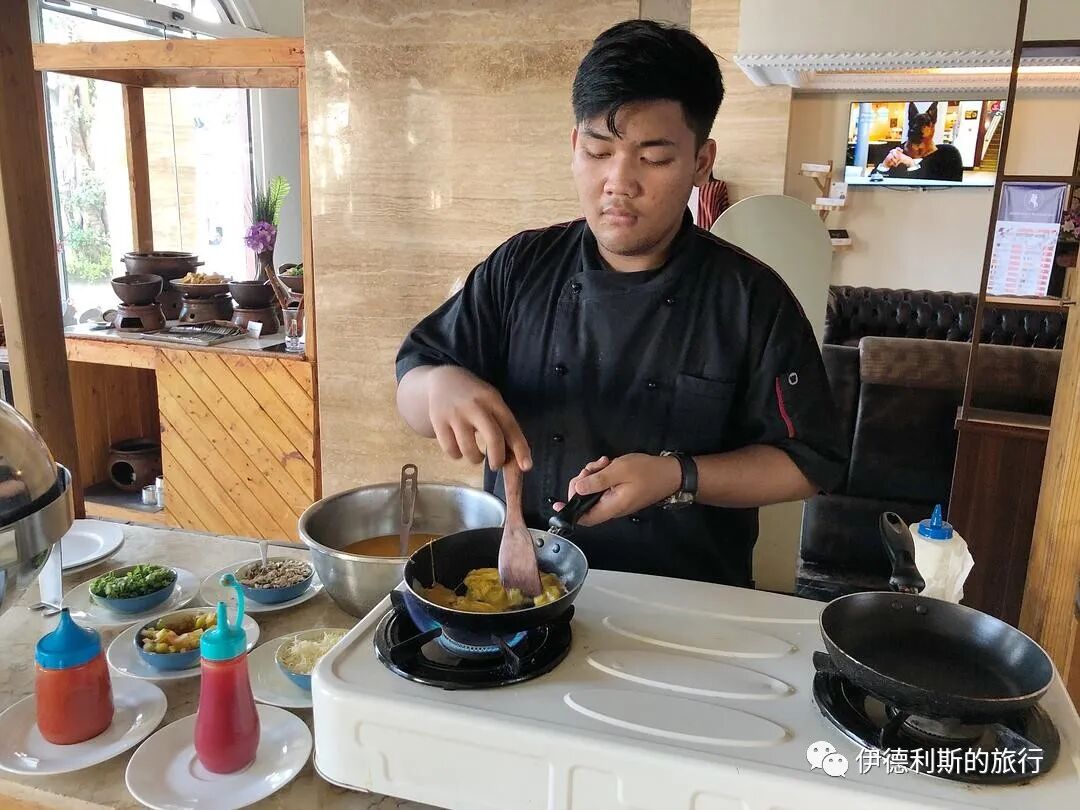
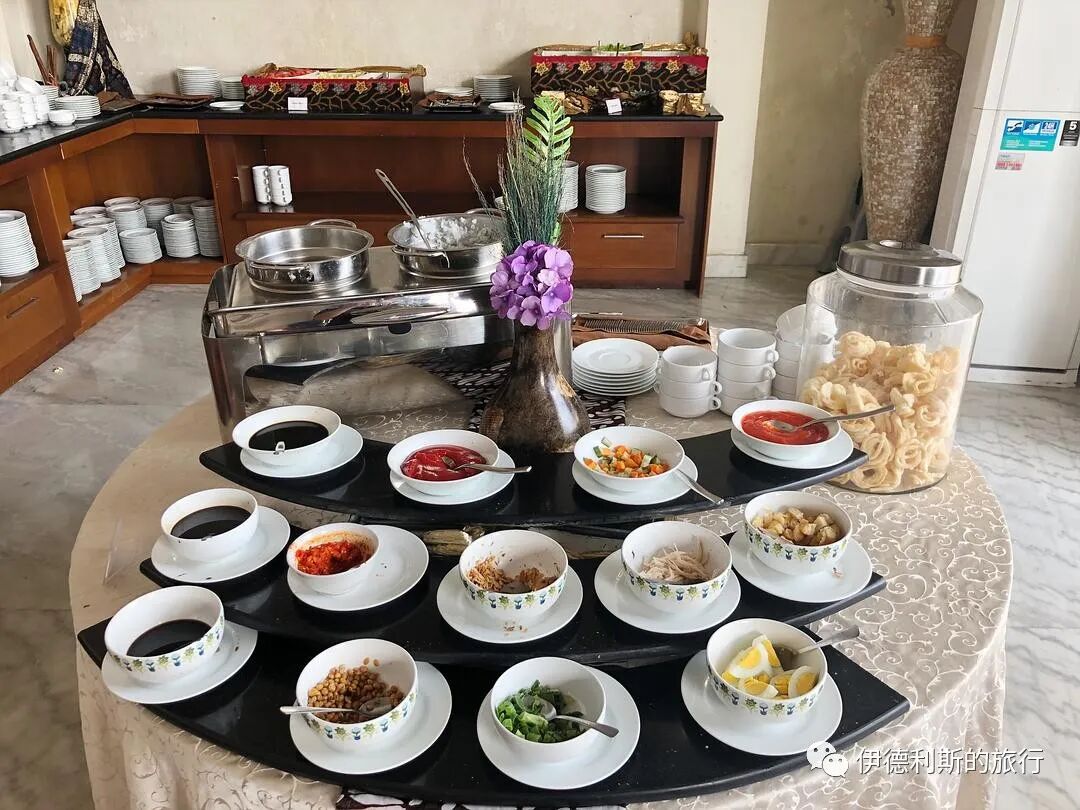
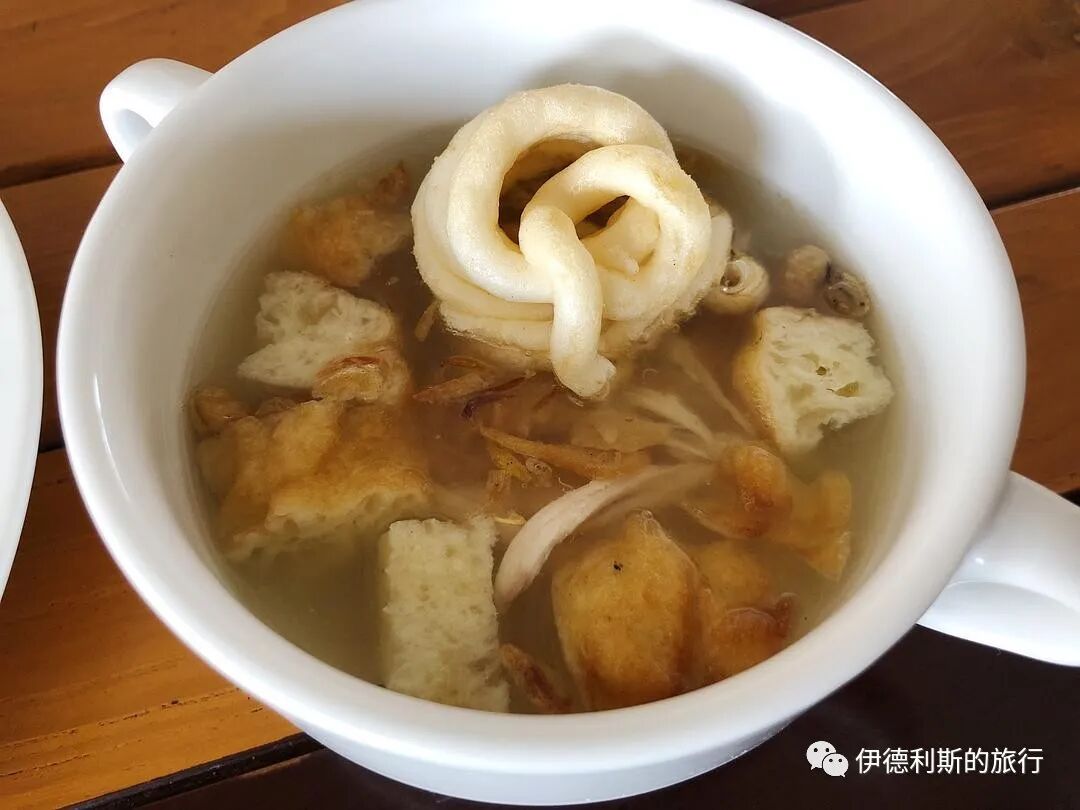
The breakfast at my hotel in Yogyakarta had a great variety of food.

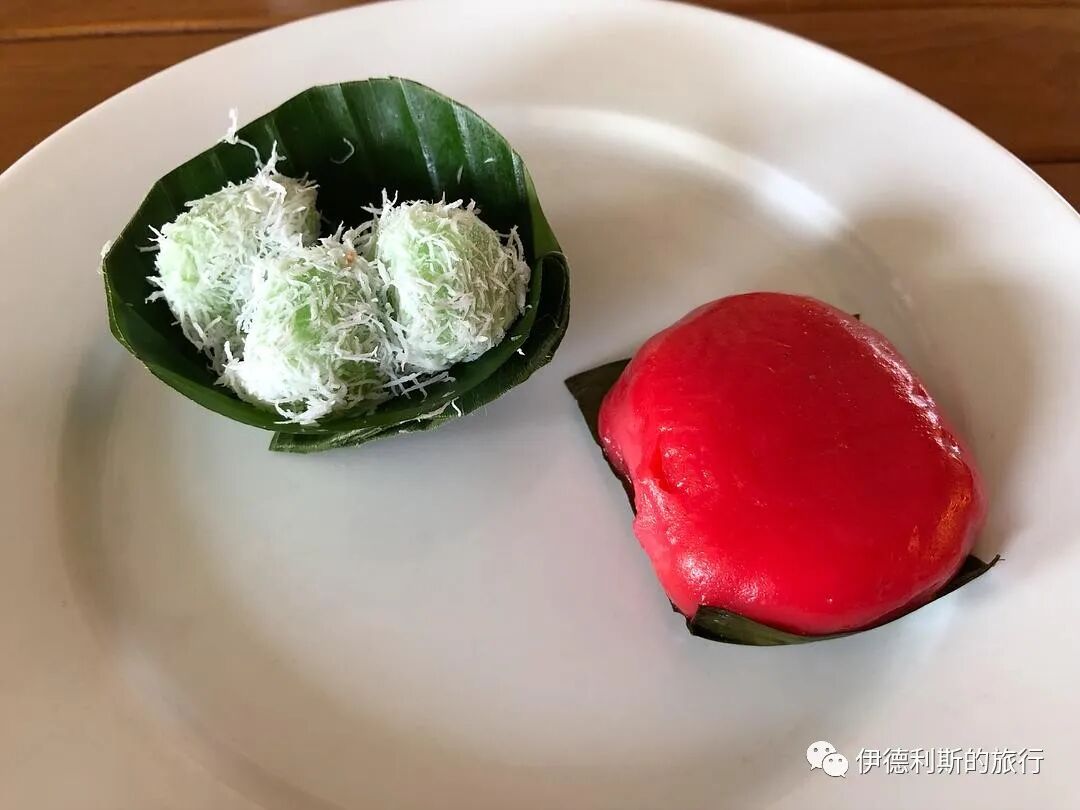
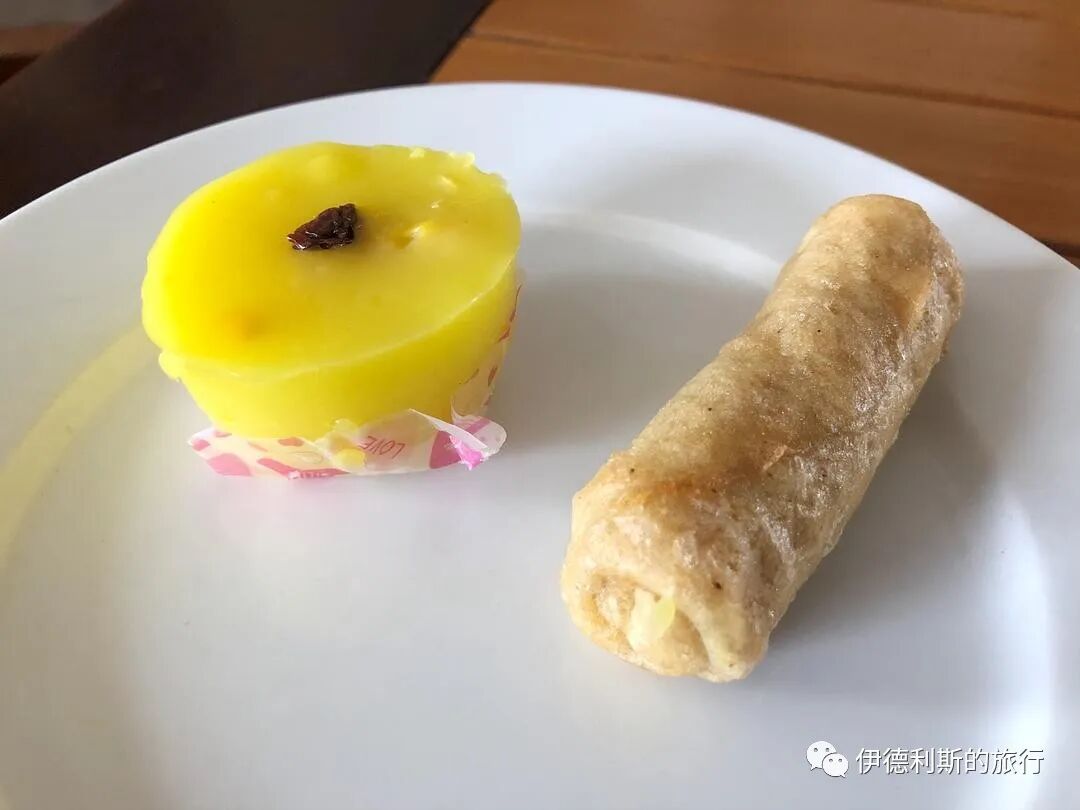
On the left are Indonesian rice cakes (klepon), topped with shredded coconut and served on a banana leaf. Klepon is made from a mix of glutinous rice flour, palm sugar, and juice from pandan or dracaena leaves. On the right are Indonesian snacks (kue), known in Java as market snacks (jajan pasar), which play an important role in traditional Javanese ceremonies.
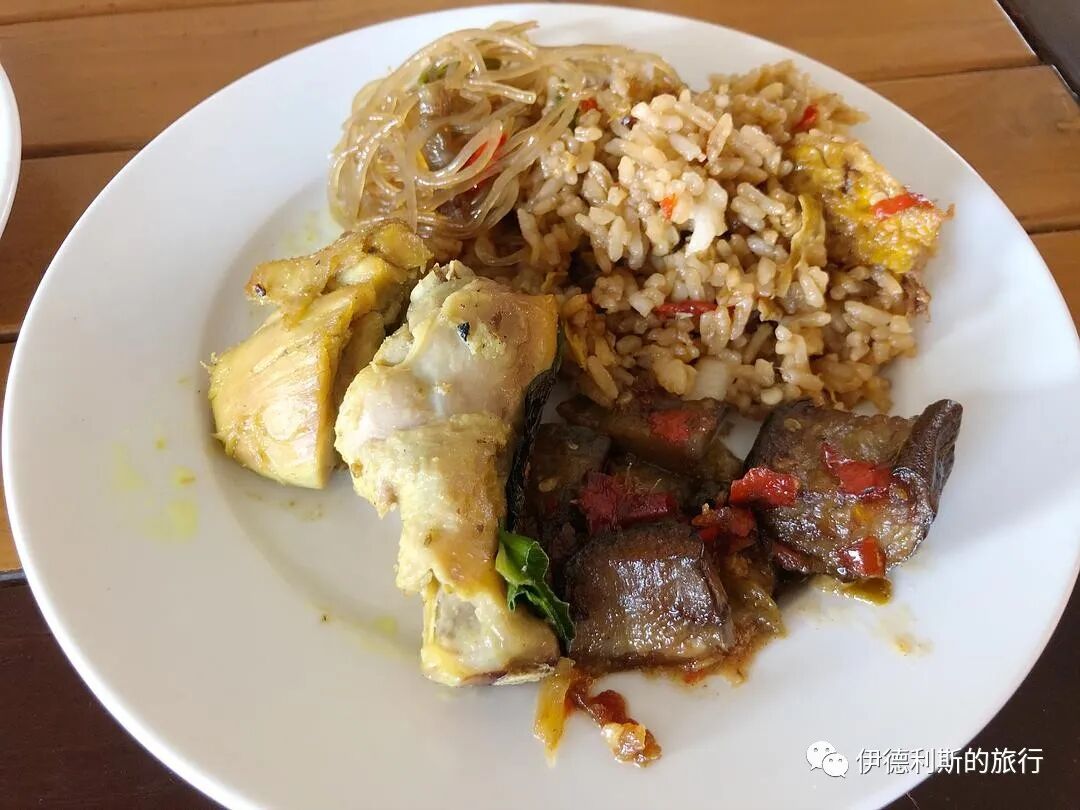
In the bottom right is eggplant with chili sauce (balado), a spicy sauce that comes from the island of Sumatra. In the bottom left is lemon basil chicken (ayam kemangi).
4. Royal Sultan Cuisine
Located next to the Yogyakarta Sultan's Palace, nDalem Joyokusuman was the home of Prince Gusti Haryo Haji Joyokusumo and is now open as a cultural center and restaurant. I ate Nasi Blawong and Telo ijo here. Nasi Blawong is a specialty dish of the Yogyakarta Sultan. It was once only served at the Sultan's birthday banquets, and the reddish Blawong rice used in it is considered sacred. Telo ijo is a cassava cake drizzled with pandan coconut milk.
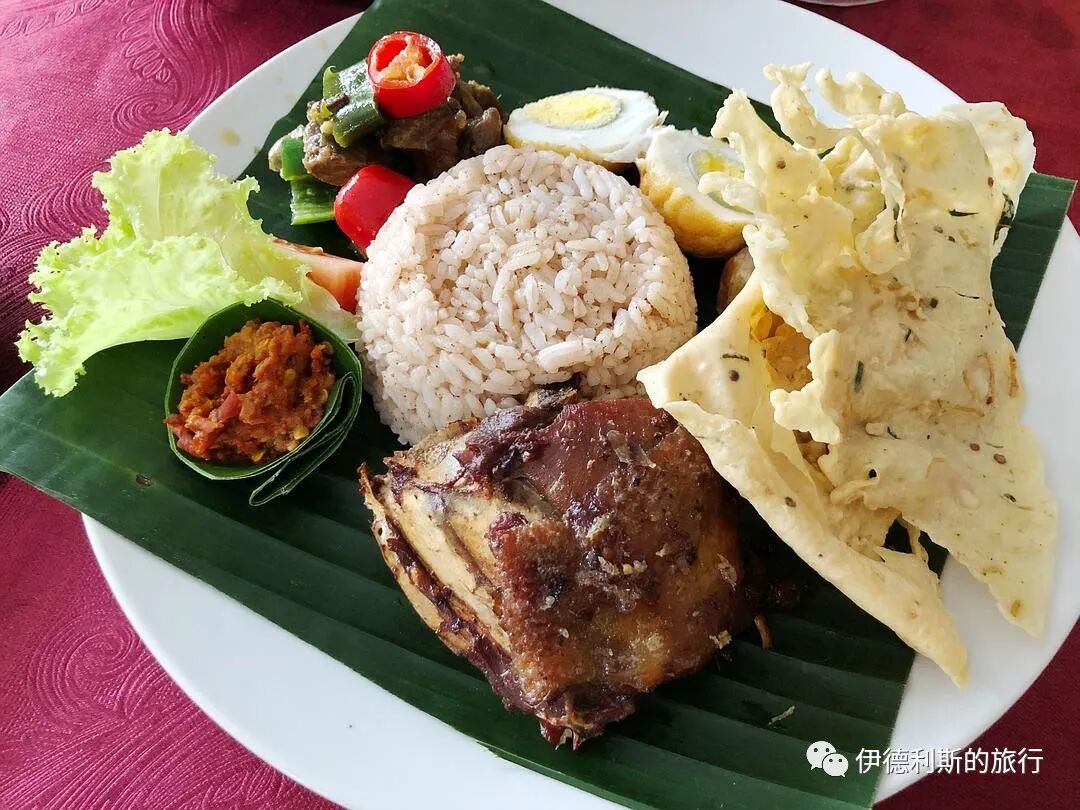
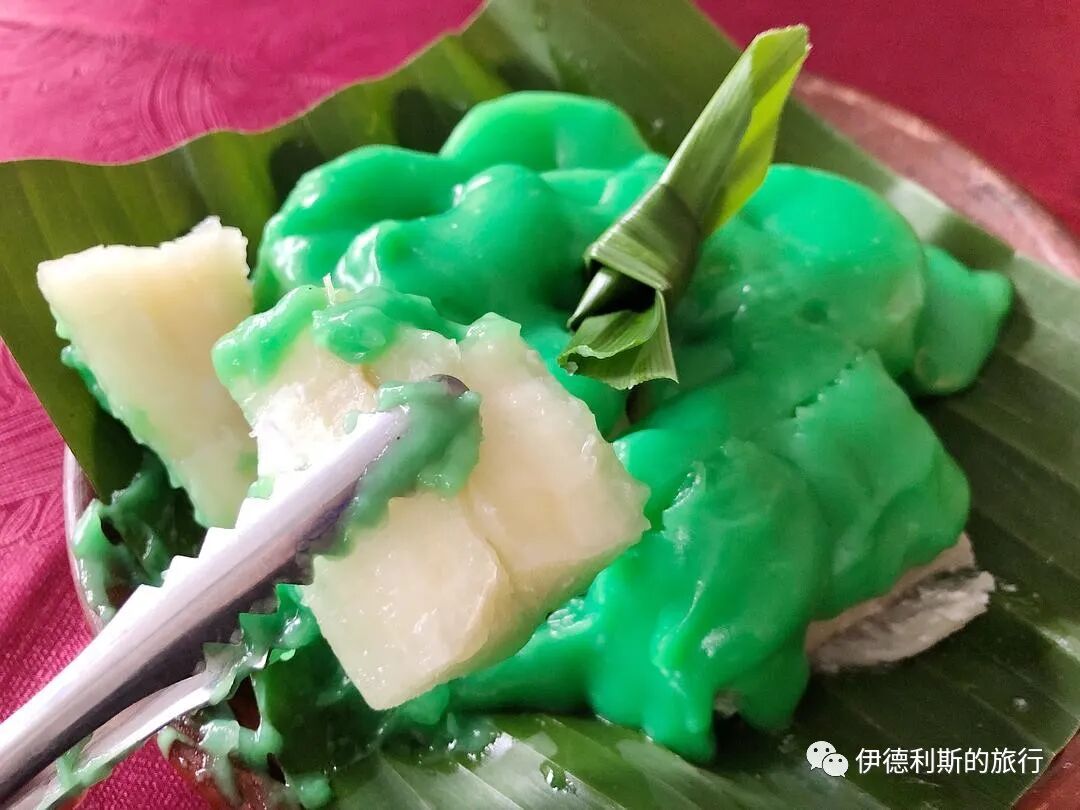
nDalem Joyokusuman was built in 1916 during the reign of the eighth Sultan of Yogyakarta, Hamengkubuwono VIII, and has been home to members of the Sultan's family ever since. The Peringgitan is the inner hall behind the main living room. It is where the prince's family spent their time and houses the valuable gifts the prince received.
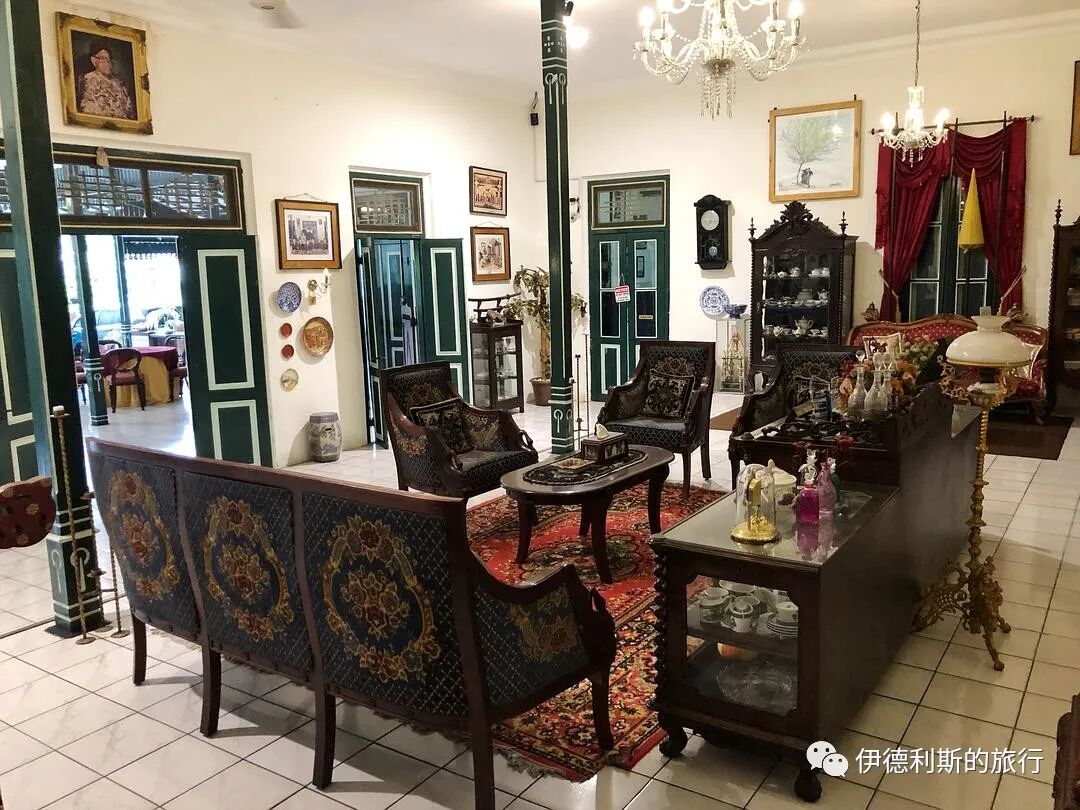
The Sentong Kiwo was originally a guest room and now serves as an exhibition hall.
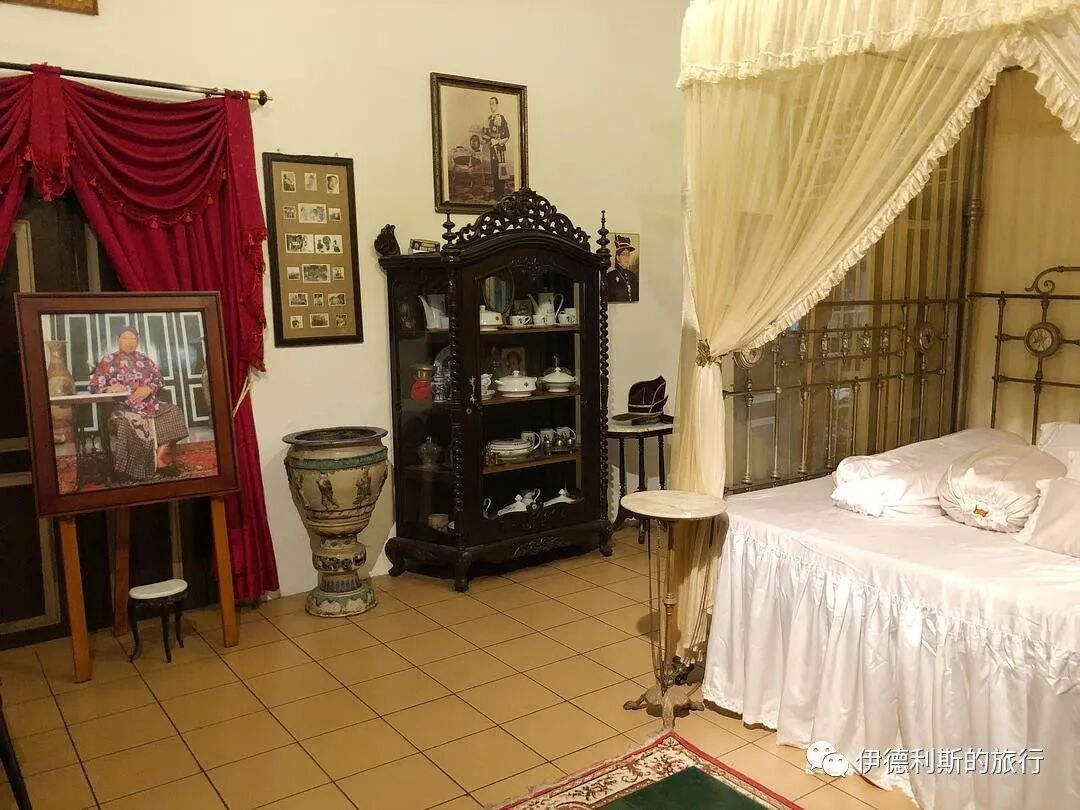
The area in the courtyard where gamelan music is performed.
Photos of the prince's family when they were young.
Summary: Halal Food Guide: Yogyakarta — Javanese Dishes, Markets and Muslim Food is presented here as a firsthand travel account in clear English, beginning with this scene: Yogyakarta is an ancient cultural city in central Java that is still ruled by a sultan today. The account keeps its focus on Yogyakarta, Java Islam, Sultanate History while preserving the names, places, food, and historical details from the Chinese source.
Yogyakarta is an ancient cultural city in central Java that is still ruled by a sultan today. Beyond traditional Javanese architecture, gamelan music, and wayang shadow puppetry, Yogyakarta also has many local Javanese foods that I want to share with you.
1. Drinks
In the muggy tropical heat, drinking a cold street drink feels really good.
Es Dawet Ayu is a specialty iced drink from Central Java that comes from the small town of Banjarnegara. Its main ingredients are rice flour, glutinous rice flour, coconut milk, palm sugar syrup, and grass jelly.
Coconut water
Freshly squeezed dragon fruit juice; the juice selection in Java is truly rich.
Sekoteng is a Javanese ginger-flavored hot drink that includes peanuts, bread slices, and rice balls. Hot drinks are relatively rare in Java, but it feels like the ginger helps remove dampness.
Freshly squeezed lemon juice
2. Snacks
Putu Bumbung is a pastry made by mixing glutinous rice flour with pandan leaf juice and palm sugar, then steaming it in bamboo tubes. You eat it with shredded coconut.
Pecel is a Javanese salad that usually includes spinach, amaranth, bean sprouts, water spinach, yardlong beans, cucumber, cassava leaves, and lemon basil. The sauce contains peanut butter, crushed peanuts, salt, palm sugar, tamarind juice, chili, galangal, kaffir lime leaves, and garlic. Pecel originated in Java and was later brought to Malaysia and Suriname by Javanese people.
3. Restaurants
Lesehan is a Javanese style of dining where you sit cross-legged on the floor. The Malioboro night market in Yogyakarta is the birthplace of this dining style. I ate the Yogyakarta specialty, Gudeg rice with chicken. Gudeg is made by stewing unripe jackfruit, palm sugar, and coconut milk for several hours. The ingredients include shallots, ginger, garlic, coriander seeds, bay leaves, and teak leaves.
At a small shop specializing in fish cakes, I ordered the fish cake omelet (Lenggang) and fish cake noodles (Mie Laksan). The fish cakes were stuffed with tofu.
I ate meatball soup (Bakso) and grilled chicken skin (Thaichan Kulit Ayam) at a shop.
I had fried fish with Indonesian chili sauce (sambal) at this shop, and it was super spicy!
The breakfast at my hotel in Yogyakarta had a great variety of food.
On the left are Indonesian rice cakes (klepon), topped with shredded coconut and served on a banana leaf. Klepon is made from a mix of glutinous rice flour, palm sugar, and juice from pandan or dracaena leaves. On the right are Indonesian snacks (kue), known in Java as market snacks (jajan pasar), which play an important role in traditional Javanese ceremonies.
In the bottom right is eggplant with chili sauce (balado), a spicy sauce that comes from the island of Sumatra. In the bottom left is lemon basil chicken (ayam kemangi).
4. Royal Sultan Cuisine
Located next to the Yogyakarta Sultan's Palace, nDalem Joyokusuman was the home of Prince Gusti Haryo Haji Joyokusumo and is now open as a cultural center and restaurant. I ate Nasi Blawong and Telo ijo here. Nasi Blawong is a specialty dish of the Yogyakarta Sultan. It was once only served at the Sultan's birthday banquets, and the reddish Blawong rice used in it is considered sacred. Telo ijo is a cassava cake drizzled with pandan coconut milk.
nDalem Joyokusuman was built in 1916 during the reign of the eighth Sultan of Yogyakarta, Hamengkubuwono VIII, and has been home to members of the Sultan's family ever since. The Peringgitan is the inner hall behind the main living room. It is where the prince's family spent their time and houses the valuable gifts the prince received.
The Sentong Kiwo was originally a guest room and now serves as an exhibition hall.
The area in the courtyard where gamelan music is performed.
Photos of the prince's family when they were young.
Halal Travel Guide: Delhi — Sultanate Palaces and Muslim History
Articles • ali2007fr posted the article • 0 comments • 150 views • 2026-05-17 12:22
Reposted from the web
Summary: Delhi — Sultanate Palaces and Muslim History is presented here as a firsthand travel account in clear English, beginning with this scene: In our last post, The Third City of Delhi—Indestructible Beautiful Ruins, we discussed how Ghiyath al-Din Tughluq founded the Tughlaq dynasty, the third dynasty of the Delhi Sultanate, in 1320. The account keeps its focus on Delhi Travel, Sultanate History, Muslim Heritage while preserving the names, places, food, and historical details from the Chinese source.
In our last post, The Third City of Delhi—Indestructible Beautiful Ruins, we discussed how Ghiyath al-Din Tughluq founded the Tughlaq dynasty, the third dynasty of the Delhi Sultanate, in 1320. In February 1325, Ghiyath al-Din died when a pavilion collapsed on him while he was returning to Delhi from Bengal. His son, Sultan Muhammad bin Tughluq, succeeded him, and he is the main character of this post.
Table of Contents
1. The Founding of Jahanpanah
2. The Mysterious Sultan's Palace
1. Upper Platform: Khalji Dynasty
2. Single-story Hall: Khalji Dynasty
3. Octagonal Tower: Early Tughlaq Dynasty
4. Lower Platform: Late Tughlaq Dynasty
5. Cemetery and Religious Site: Lodi Dynasty
6. Circular Dome: Lodi Dynasty
3. Begampur Mosque
4. Khirki Mosque
5. Kalusarai Mosque
1. The Founding of Jahanpanah
Between 1326 and 1327, to prevent invasion by the Mongol army, Muhammad bin Tughluq connected Delhi's first city, Lal Kot, and its second city, Siri, with walls to create the fourth city of Delhi, Jahanpanah.
For information on Lal Kot and Siri, please see my previous two posts: The First City of Delhi—Minarets Reaching the Clouds and The Second City of Delhi—Turkic Fortress Against the Mongol Army.
The term Jahanpanah consists of two Persian words: Jahan means world, and panah means refuge, shelter, or sanctuary.
Muhammad bin Tughluq did not just expand the capital; he also greatly expanded the territory of the Delhi Sultanate. In the image below, dark green shows the territory in 1320, and light green shows the territory in 1330.
The famous Moroccan traveler Ibn Battuta lived in Delhi between 1333 and 1341. Based on his travelogues, we can infer that at the time, Lal Kot was the city center, Siri was a military camp, and Jahanpanah in the middle was the palace area. Ibn Battuta said the Tughlaq Sultan originally wanted to build a super-city connecting Delhi's existing Lal Kot, Siri, and the third city, Tughlaqabad, but he did not carry it out due to limited funds.
The following is from The Travels of Ibn Battuta (Complete Translation).
The maps and hand-drawn illustrations scanned for this diary are all from the book Delhi—A Thousand Years of Building, which is an excellent resource on the history of Delhi.
Map of Jahanpanah:
From the book Delhi—A Thousand Years of Building
Shortly after Jahanpanah was completed, Muhammad bin Tughluq suddenly decided to move the capital to the Deccan Plateau in the south and established a new capital called Daulatabad.
Muhammad bin Tughluq forced the population of Delhi to migrate on a large scale, and those who refused were killed. However, the move failed because Daulatabad lacked enough drinking water due to drought, and Muhammad bin Tughluq eventually moved back to Delhi. Although this relocation failed, it significantly influenced history because many Muslims who moved to the Deccan region did not return to Delhi, leading to a large increase in the Muslim population in central and southern India.
2. The Mysterious Sultan's Palace
Within the ruins of Jahanpanah, there is a huge building site called Bijaya Mandal, which means Victory Platform in Hindi. Bijaya Mandal may be the most puzzling historical building in Delhi. On one hand, we know very little about secular architecture from the Delhi Sultanate period, and on the other, the building changed significantly across different eras.
Much evidence suggests this was likely the palace site of Sultan Muhammad bin Tughluq, but without systematic archaeological excavation, we still cannot be certain about the functions of the existing structures.
Ibn Battuta did not describe the Sultan's palace in much detail. He only mentioned that people had to pass through three gates to reach a palace called bazar suntun, which means thousand pillars. He said these wooden pillars were painted and supported a beautifully carved wooden roof.
It is hard to imagine the appearance of this hall because most buildings preserved from this period are mosques, tombs, and madrasas, with almost no secular buildings remaining. Based on Ibn Battuta's description, this hall likely had long colonnades and a flat roof. One question remains: how did they keep a wooden flat roof waterproof? Regarding the interior of the hall, we only know it had exquisite carvings and the walls were likely decorated with paintings, which were probably removed later during the iconoclastic movement of Firuz Shah Tughlaq (reigned 1351–1388).
Archaeological digs show this building was used for a very long time. Historical records mention that both Sultan Alauddin Khalji (reigned 1296-1316) and Sultan Muhammad bin Tughlaq (reigned 1325-1351) had a palace called bazar suntun. Although Ibn Battuta wrote that Alauddin Khalji’s palace was in the city of Siri, these two palaces are likely the same place, and they are probably Bijaya Mandal.
The stone hall at Bijaya Mandal likely dates back to the time of Alauddin Khalji, while the tower next to it was almost certainly built by Muhammad bin Tughlaq. Archaeological findings show these buildings were still in use after the time of Firoz Shah Tughlaq (1351-1388). In the early 16th century, during the Lodi dynasty (1451-1526), the site was used by a Sufi sheikh named Sheikh Hasan Tahir.
1. Upper Platform: Khalji Dynasty
From the book Delhi—A Thousand Years of Building
The oldest part of this complex is likely the upper platform, which may have been built by Alauddin Khalji (reigned 1296-1316). You can see damaged, sloping retaining walls on the west, east, and south sides of the platform. There are two levels of arched basements visible from the east end of the platform, and a similar structure exists on the west end. The main building likely stood in the middle of the slightly raised area of the platform.
A view from the lower platform looking up at the upper platform, the single-story hall, and the octagonal tower.
2. Single-story Hall: Khalji Dynasty
On top of the platform sits a single-story hall, and above that is an octagonal tower. The hall was also likely built during the time of Alauddin Khalji. There are remains of a balcony in front of the hall, and the bases of the pillars are still there. You can walk from the pillars into the main room, where the roof is held up by stone columns. Behind the first row of stone columns are two large pits half a meter deep. In the early 20th century, the Archaeological Survey of India found many items here, including ivory, porcelain, glass necklaces, pearls, red coral, rubies, and coins dating from 1296 to 1390. This place was likely a treasure storage room at the time.
The hall seems to have had entrances on all four sides, but they were likely blocked when Muhammad bin Tughlaq built the heavy platform under the octagonal tower. The first entrance on the north wall next to the platform also seems to have been changed. Different foundation remains show there was once another room on the edge of the platform on the north side of the hall.
Below is the upper platform, and above is the single-story hall.
Looking down at the upper platform from the roof of the single-story hall.
3. Octagonal Tower: Early Tughlaq Dynasty
From the book Delhi—A Thousand Years of Building
The octagonal tower above the single-story hall was reportedly built by Muhammad bin Tughlaq (reigned 1325-1351). A slope followed by shallow, wide steps leads to the base of the octagonal tower. There is much evidence that the octagonal tower once extended further to the north. The three doors with quartzite frames and the narrow stairs leading to the roof were added later during the late Tughlaq dynasty.
Inside the octagonal tower is a symmetrical, cross-shaped room with the same openings on each side. In the middle of summer, the inside of the tower stays cooler and catches a breeze.
On the roof of the tower, there are two well-preserved sockets. One still has a groove around the edge, which suggests it likely held something on top. Besides these two sockets, there are actually traces of sockets on every level of the stairs. Based on the depth of these sockets, they likely held heavy, tall pillars. It is thought that there might have once been a pavilion (baradari) on top of the tower. There is also a row of small sockets along the edge of the roof, which may have held smaller upright posts.
We can guess that this tower was likely a viewing platform for Sultan Muhammad bin Tughlaq, but the biggest question is how the Sultan got up there, as his fancy clothes would have been hard to wear through the narrow stairs that exist today. It is very likely there was another staircase at the time, although Indian palaces usually did not have fancy stairs and kept them inside thick walls.
The narrow stairs leading to the octagonal tower.
The octagonal tower.
Inside the octagonal tower.
4. Lower Platform: Late Tughlaq Dynasty
From the book Delhi—A Thousand Years of Building
You can go down from the upper platform to a larger lower platform. There are retaining walls on the east and west sides of the lower platform. The buildings on the lower platform date to two periods: the wall foundations are made of large quartzite, while the upper parts feature masonry typical of the Tughlaq dynasty. Archaeological excavations in the 1920s uncovered stone pillar bases on the lower platform, some of which are still visible in the southwest corner today. On the other side of the platform, near the crumbling east retaining wall, you can still see delicate plaster flooring. These ruins may all be part of the palace Ibn Battuta called the bazar sutun.
There is a tall retaining wall between the two platforms, featuring a series of vertical slots that were likely used to hold wooden pillars or decorations. Except for the ramp on the east side of the upper platform, there is no other way to connect the two platforms. The wooden pillars in the lower vertical slots may have supported a higher floor, forming the Sultan's palace along with the stone hall on the south side. Another theory is that the lower platform was the Sultan's palace and the upper platform was his sleeping quarters, which is why the two levels are separate.
Wall foundations of the lower platform.
Wall foundations of the lower platform.
5. Cemetery and Religious Site: Lodi Dynasty
About halfway across the platform, the ground level rises significantly, which likely marks the general area of the palace. Far from the palace is a small cemetery where Sheikh Hasan Tahir and his descendants are buried. This sheikh lived during the Lodi dynasty (1451–1526) and died in 1503. It is said he lived in Bijay Mandal for a long time.
There is an arcade-style building at the very edge of the outer platform of the cemetery. On the north side of the building, there are remains of a long arcade wall, with pillars and arches in the Lodi dynasty style. There are also two sturdy towers, with black plaster coatings on top that reflect the Tughlaq dynasty style. It is believed that this may have been a khanqah (a place for Sufi gatherings) built by Sheikh Hasan Tahir.
Looking out at the lower platform and the sheikh's tomb from the single-story hall.
6. Circular Dome: Lodi Dynasty
Next to Bijaya Mandal is a building with a circular dome, thought to have been built in the 15th century. The purpose of this building remains unknown, and its structure is quite unique: it has two openings on each of the north, south, and west sides, while the east side is sealed. Foundation evidence shows there was once another building on the west side of this structure.
3. Begampur Mosque
Begampur Mosque is the most important mosque in the city of Jahanpanah and the most representative mosque of the Tughlaq dynasty of the Delhi Sultanate still standing today; it is said to have been designed by the Iranian architect Zahir al-Din al-Jayush.
There are two theories about when the mosque was built: one suggests it is one of the seven mosques built by Khan-i-Jahan Maqbul, the wazir (prime minister) of Sultan Firuz Shah Tughlaq (reigned 1351–1388), while the other suggests it was built when Muhammad bin Tughlaq died in 1351.
In 1921, the Archaeological Survey of India cleared out the residents living inside the mosque, giving it the appearance it has today.
Begampur Mosque is magnificent, with a spacious courtyard surrounded by arcades. There is a circular domed building in the center of each of the four sides; the east, north, and west ones are gates, and the largest one on the west side is the main prayer hall.
The mosque is very simple, with only a few carvings inside the main prayer hall. These stone carvings and the dome were once covered in shimmering white plaster, but most of it has fallen off and turned black.
The gate.
Looking inside from the gate.
Inside the gate.
The corridor on the northeast side.
Southwest corridor
Courtyard
Overlook
North gate
South gate
The corridor on the north side of the main prayer hall has collapsed.
Main prayer hall
Mihrab
Main prayer hall dome
Minimal decoration
4. Khirki Mosque
Khirki Mosque is another important mosque from the Tughlaq dynasty besides Begumpur Mosque, but its design is very different from Begumpur Mosque. This mosque is undoubtedly one of the seven mosques built by the prime minister Khan-i-Jahan Maqbul, and it was likely built in the 1370s.
Khirki Mosque sits much higher than the ground, and a trench has now formed around it. The mosque has a large gate on the north, east, and south sides, each with small minarets on top, and there is a large minaret at each of the four corners of the mosque.
From the book Delhi—A Thousand Years of Building
Mosque facade
From the book Delhi—A Thousand Years of Building
The gate.
The biggest feature of Khirki Mosque is that its roof is almost completely covered, with only four small square courtyards, which is very rare in the Delhi Sultanate. Because there are only four small open-air courtyards, the mosque cannot be fully lit even during the day, and it is darkest in front of the mihrab in the prayer hall.
The structure made of square pillars and circular domes gives this mosque a strong sense of geometric beauty. I arrived at dusk, and even though it was very dark, I was still stunned.
Courtyard
Mihrab
Collapsed dome in the northeast corner
Corner tower
5. Kalusarai Mosque
Kalusarai Mosque is one of the seven mosques built by the aforementioned prime minister Khan-i-Jahan Maqbul. It is currently badly damaged and several families live inside, so the door was locked when I went and I could not enter. This mosque has a more complex structure than the other six mosques built by Khan-i-Jahan Maqbul, but it is still in the typical Tughlaq dynasty style. view all
Summary: Delhi — Sultanate Palaces and Muslim History is presented here as a firsthand travel account in clear English, beginning with this scene: In our last post, The Third City of Delhi—Indestructible Beautiful Ruins, we discussed how Ghiyath al-Din Tughluq founded the Tughlaq dynasty, the third dynasty of the Delhi Sultanate, in 1320. The account keeps its focus on Delhi Travel, Sultanate History, Muslim Heritage while preserving the names, places, food, and historical details from the Chinese source.
In our last post, The Third City of Delhi—Indestructible Beautiful Ruins, we discussed how Ghiyath al-Din Tughluq founded the Tughlaq dynasty, the third dynasty of the Delhi Sultanate, in 1320. In February 1325, Ghiyath al-Din died when a pavilion collapsed on him while he was returning to Delhi from Bengal. His son, Sultan Muhammad bin Tughluq, succeeded him, and he is the main character of this post.
Table of Contents
1. The Founding of Jahanpanah
2. The Mysterious Sultan's Palace
1. Upper Platform: Khalji Dynasty
2. Single-story Hall: Khalji Dynasty
3. Octagonal Tower: Early Tughlaq Dynasty
4. Lower Platform: Late Tughlaq Dynasty
5. Cemetery and Religious Site: Lodi Dynasty
6. Circular Dome: Lodi Dynasty
3. Begampur Mosque
4. Khirki Mosque
5. Kalusarai Mosque
1. The Founding of Jahanpanah
Between 1326 and 1327, to prevent invasion by the Mongol army, Muhammad bin Tughluq connected Delhi's first city, Lal Kot, and its second city, Siri, with walls to create the fourth city of Delhi, Jahanpanah.
For information on Lal Kot and Siri, please see my previous two posts: The First City of Delhi—Minarets Reaching the Clouds and The Second City of Delhi—Turkic Fortress Against the Mongol Army.
The term Jahanpanah consists of two Persian words: Jahan means world, and panah means refuge, shelter, or sanctuary.
Muhammad bin Tughluq did not just expand the capital; he also greatly expanded the territory of the Delhi Sultanate. In the image below, dark green shows the territory in 1320, and light green shows the territory in 1330.
The famous Moroccan traveler Ibn Battuta lived in Delhi between 1333 and 1341. Based on his travelogues, we can infer that at the time, Lal Kot was the city center, Siri was a military camp, and Jahanpanah in the middle was the palace area. Ibn Battuta said the Tughlaq Sultan originally wanted to build a super-city connecting Delhi's existing Lal Kot, Siri, and the third city, Tughlaqabad, but he did not carry it out due to limited funds.
The following is from The Travels of Ibn Battuta (Complete Translation).
The maps and hand-drawn illustrations scanned for this diary are all from the book Delhi—A Thousand Years of Building, which is an excellent resource on the history of Delhi.
Map of Jahanpanah:
From the book Delhi—A Thousand Years of Building
Shortly after Jahanpanah was completed, Muhammad bin Tughluq suddenly decided to move the capital to the Deccan Plateau in the south and established a new capital called Daulatabad.
Muhammad bin Tughluq forced the population of Delhi to migrate on a large scale, and those who refused were killed. However, the move failed because Daulatabad lacked enough drinking water due to drought, and Muhammad bin Tughluq eventually moved back to Delhi. Although this relocation failed, it significantly influenced history because many Muslims who moved to the Deccan region did not return to Delhi, leading to a large increase in the Muslim population in central and southern India.
2. The Mysterious Sultan's Palace
Within the ruins of Jahanpanah, there is a huge building site called Bijaya Mandal, which means Victory Platform in Hindi. Bijaya Mandal may be the most puzzling historical building in Delhi. On one hand, we know very little about secular architecture from the Delhi Sultanate period, and on the other, the building changed significantly across different eras.
Much evidence suggests this was likely the palace site of Sultan Muhammad bin Tughluq, but without systematic archaeological excavation, we still cannot be certain about the functions of the existing structures.
Ibn Battuta did not describe the Sultan's palace in much detail. He only mentioned that people had to pass through three gates to reach a palace called bazar suntun, which means thousand pillars. He said these wooden pillars were painted and supported a beautifully carved wooden roof.
It is hard to imagine the appearance of this hall because most buildings preserved from this period are mosques, tombs, and madrasas, with almost no secular buildings remaining. Based on Ibn Battuta's description, this hall likely had long colonnades and a flat roof. One question remains: how did they keep a wooden flat roof waterproof? Regarding the interior of the hall, we only know it had exquisite carvings and the walls were likely decorated with paintings, which were probably removed later during the iconoclastic movement of Firuz Shah Tughlaq (reigned 1351–1388).
Archaeological digs show this building was used for a very long time. Historical records mention that both Sultan Alauddin Khalji (reigned 1296-1316) and Sultan Muhammad bin Tughlaq (reigned 1325-1351) had a palace called bazar suntun. Although Ibn Battuta wrote that Alauddin Khalji’s palace was in the city of Siri, these two palaces are likely the same place, and they are probably Bijaya Mandal.
The stone hall at Bijaya Mandal likely dates back to the time of Alauddin Khalji, while the tower next to it was almost certainly built by Muhammad bin Tughlaq. Archaeological findings show these buildings were still in use after the time of Firoz Shah Tughlaq (1351-1388). In the early 16th century, during the Lodi dynasty (1451-1526), the site was used by a Sufi sheikh named Sheikh Hasan Tahir.
1. Upper Platform: Khalji Dynasty
From the book Delhi—A Thousand Years of Building
The oldest part of this complex is likely the upper platform, which may have been built by Alauddin Khalji (reigned 1296-1316). You can see damaged, sloping retaining walls on the west, east, and south sides of the platform. There are two levels of arched basements visible from the east end of the platform, and a similar structure exists on the west end. The main building likely stood in the middle of the slightly raised area of the platform.
A view from the lower platform looking up at the upper platform, the single-story hall, and the octagonal tower.
2. Single-story Hall: Khalji Dynasty
On top of the platform sits a single-story hall, and above that is an octagonal tower. The hall was also likely built during the time of Alauddin Khalji. There are remains of a balcony in front of the hall, and the bases of the pillars are still there. You can walk from the pillars into the main room, where the roof is held up by stone columns. Behind the first row of stone columns are two large pits half a meter deep. In the early 20th century, the Archaeological Survey of India found many items here, including ivory, porcelain, glass necklaces, pearls, red coral, rubies, and coins dating from 1296 to 1390. This place was likely a treasure storage room at the time.
The hall seems to have had entrances on all four sides, but they were likely blocked when Muhammad bin Tughlaq built the heavy platform under the octagonal tower. The first entrance on the north wall next to the platform also seems to have been changed. Different foundation remains show there was once another room on the edge of the platform on the north side of the hall.
Below is the upper platform, and above is the single-story hall.
Looking down at the upper platform from the roof of the single-story hall.
3. Octagonal Tower: Early Tughlaq Dynasty
From the book Delhi—A Thousand Years of Building
The octagonal tower above the single-story hall was reportedly built by Muhammad bin Tughlaq (reigned 1325-1351). A slope followed by shallow, wide steps leads to the base of the octagonal tower. There is much evidence that the octagonal tower once extended further to the north. The three doors with quartzite frames and the narrow stairs leading to the roof were added later during the late Tughlaq dynasty.
Inside the octagonal tower is a symmetrical, cross-shaped room with the same openings on each side. In the middle of summer, the inside of the tower stays cooler and catches a breeze.
On the roof of the tower, there are two well-preserved sockets. One still has a groove around the edge, which suggests it likely held something on top. Besides these two sockets, there are actually traces of sockets on every level of the stairs. Based on the depth of these sockets, they likely held heavy, tall pillars. It is thought that there might have once been a pavilion (baradari) on top of the tower. There is also a row of small sockets along the edge of the roof, which may have held smaller upright posts.
We can guess that this tower was likely a viewing platform for Sultan Muhammad bin Tughlaq, but the biggest question is how the Sultan got up there, as his fancy clothes would have been hard to wear through the narrow stairs that exist today. It is very likely there was another staircase at the time, although Indian palaces usually did not have fancy stairs and kept them inside thick walls.
The narrow stairs leading to the octagonal tower.
The octagonal tower.
Inside the octagonal tower.
4. Lower Platform: Late Tughlaq Dynasty
From the book Delhi—A Thousand Years of Building
You can go down from the upper platform to a larger lower platform. There are retaining walls on the east and west sides of the lower platform. The buildings on the lower platform date to two periods: the wall foundations are made of large quartzite, while the upper parts feature masonry typical of the Tughlaq dynasty. Archaeological excavations in the 1920s uncovered stone pillar bases on the lower platform, some of which are still visible in the southwest corner today. On the other side of the platform, near the crumbling east retaining wall, you can still see delicate plaster flooring. These ruins may all be part of the palace Ibn Battuta called the bazar sutun.
There is a tall retaining wall between the two platforms, featuring a series of vertical slots that were likely used to hold wooden pillars or decorations. Except for the ramp on the east side of the upper platform, there is no other way to connect the two platforms. The wooden pillars in the lower vertical slots may have supported a higher floor, forming the Sultan's palace along with the stone hall on the south side. Another theory is that the lower platform was the Sultan's palace and the upper platform was his sleeping quarters, which is why the two levels are separate.
Wall foundations of the lower platform.
Wall foundations of the lower platform.
5. Cemetery and Religious Site: Lodi Dynasty
About halfway across the platform, the ground level rises significantly, which likely marks the general area of the palace. Far from the palace is a small cemetery where Sheikh Hasan Tahir and his descendants are buried. This sheikh lived during the Lodi dynasty (1451–1526) and died in 1503. It is said he lived in Bijay Mandal for a long time.
There is an arcade-style building at the very edge of the outer platform of the cemetery. On the north side of the building, there are remains of a long arcade wall, with pillars and arches in the Lodi dynasty style. There are also two sturdy towers, with black plaster coatings on top that reflect the Tughlaq dynasty style. It is believed that this may have been a khanqah (a place for Sufi gatherings) built by Sheikh Hasan Tahir.
Looking out at the lower platform and the sheikh's tomb from the single-story hall.
6. Circular Dome: Lodi Dynasty
Next to Bijaya Mandal is a building with a circular dome, thought to have been built in the 15th century. The purpose of this building remains unknown, and its structure is quite unique: it has two openings on each of the north, south, and west sides, while the east side is sealed. Foundation evidence shows there was once another building on the west side of this structure.
3. Begampur Mosque
Begampur Mosque is the most important mosque in the city of Jahanpanah and the most representative mosque of the Tughlaq dynasty of the Delhi Sultanate still standing today; it is said to have been designed by the Iranian architect Zahir al-Din al-Jayush.
There are two theories about when the mosque was built: one suggests it is one of the seven mosques built by Khan-i-Jahan Maqbul, the wazir (prime minister) of Sultan Firuz Shah Tughlaq (reigned 1351–1388), while the other suggests it was built when Muhammad bin Tughlaq died in 1351.
In 1921, the Archaeological Survey of India cleared out the residents living inside the mosque, giving it the appearance it has today.
Begampur Mosque is magnificent, with a spacious courtyard surrounded by arcades. There is a circular domed building in the center of each of the four sides; the east, north, and west ones are gates, and the largest one on the west side is the main prayer hall.
The mosque is very simple, with only a few carvings inside the main prayer hall. These stone carvings and the dome were once covered in shimmering white plaster, but most of it has fallen off and turned black.
The gate.
Looking inside from the gate.
Inside the gate.
The corridor on the northeast side.
Southwest corridor
Courtyard
Overlook
North gate
South gate
The corridor on the north side of the main prayer hall has collapsed.
Main prayer hall
Mihrab
Main prayer hall dome
Minimal decoration
4. Khirki Mosque
Khirki Mosque is another important mosque from the Tughlaq dynasty besides Begumpur Mosque, but its design is very different from Begumpur Mosque. This mosque is undoubtedly one of the seven mosques built by the prime minister Khan-i-Jahan Maqbul, and it was likely built in the 1370s.
Khirki Mosque sits much higher than the ground, and a trench has now formed around it. The mosque has a large gate on the north, east, and south sides, each with small minarets on top, and there is a large minaret at each of the four corners of the mosque.
From the book Delhi—A Thousand Years of Building
Mosque facade
From the book Delhi—A Thousand Years of Building
The gate.
The biggest feature of Khirki Mosque is that its roof is almost completely covered, with only four small square courtyards, which is very rare in the Delhi Sultanate. Because there are only four small open-air courtyards, the mosque cannot be fully lit even during the day, and it is darkest in front of the mihrab in the prayer hall.
The structure made of square pillars and circular domes gives this mosque a strong sense of geometric beauty. I arrived at dusk, and even though it was very dark, I was still stunned.
Courtyard
Mihrab
Collapsed dome in the northeast corner
Corner tower
5. Kalusarai Mosque
Kalusarai Mosque is one of the seven mosques built by the aforementioned prime minister Khan-i-Jahan Maqbul. It is currently badly damaged and several families live inside, so the door was locked when I went and I could not enter. This mosque has a more complex structure than the other six mosques built by Khan-i-Jahan Maqbul, but it is still in the typical Tughlaq dynasty style. view all
Reposted from the web
Summary: Delhi — Sultanate Palaces and Muslim History is presented here as a firsthand travel account in clear English, beginning with this scene: In our last post, The Third City of Delhi—Indestructible Beautiful Ruins, we discussed how Ghiyath al-Din Tughluq founded the Tughlaq dynasty, the third dynasty of the Delhi Sultanate, in 1320. The account keeps its focus on Delhi Travel, Sultanate History, Muslim Heritage while preserving the names, places, food, and historical details from the Chinese source.
In our last post, The Third City of Delhi—Indestructible Beautiful Ruins, we discussed how Ghiyath al-Din Tughluq founded the Tughlaq dynasty, the third dynasty of the Delhi Sultanate, in 1320. In February 1325, Ghiyath al-Din died when a pavilion collapsed on him while he was returning to Delhi from Bengal. His son, Sultan Muhammad bin Tughluq, succeeded him, and he is the main character of this post.
Table of Contents
1. The Founding of Jahanpanah
2. The Mysterious Sultan's Palace
1. Upper Platform: Khalji Dynasty
2. Single-story Hall: Khalji Dynasty
3. Octagonal Tower: Early Tughlaq Dynasty
4. Lower Platform: Late Tughlaq Dynasty
5. Cemetery and Religious Site: Lodi Dynasty
6. Circular Dome: Lodi Dynasty
3. Begampur Mosque
4. Khirki Mosque
5. Kalusarai Mosque
1. The Founding of Jahanpanah
Between 1326 and 1327, to prevent invasion by the Mongol army, Muhammad bin Tughluq connected Delhi's first city, Lal Kot, and its second city, Siri, with walls to create the fourth city of Delhi, Jahanpanah.
For information on Lal Kot and Siri, please see my previous two posts: The First City of Delhi—Minarets Reaching the Clouds and The Second City of Delhi—Turkic Fortress Against the Mongol Army.
The term Jahanpanah consists of two Persian words: Jahan means world, and panah means refuge, shelter, or sanctuary.
Muhammad bin Tughluq did not just expand the capital; he also greatly expanded the territory of the Delhi Sultanate. In the image below, dark green shows the territory in 1320, and light green shows the territory in 1330.
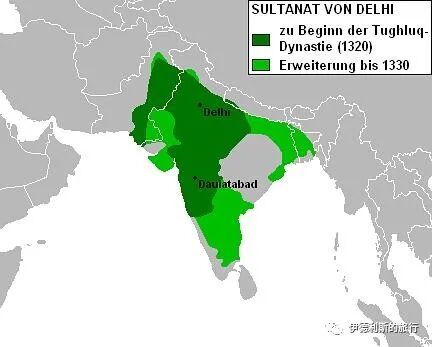
The famous Moroccan traveler Ibn Battuta lived in Delhi between 1333 and 1341. Based on his travelogues, we can infer that at the time, Lal Kot was the city center, Siri was a military camp, and Jahanpanah in the middle was the palace area. Ibn Battuta said the Tughlaq Sultan originally wanted to build a super-city connecting Delhi's existing Lal Kot, Siri, and the third city, Tughlaqabad, but he did not carry it out due to limited funds.
The following is from The Travels of Ibn Battuta (Complete Translation).

The maps and hand-drawn illustrations scanned for this diary are all from the book Delhi—A Thousand Years of Building, which is an excellent resource on the history of Delhi.
Map of Jahanpanah:
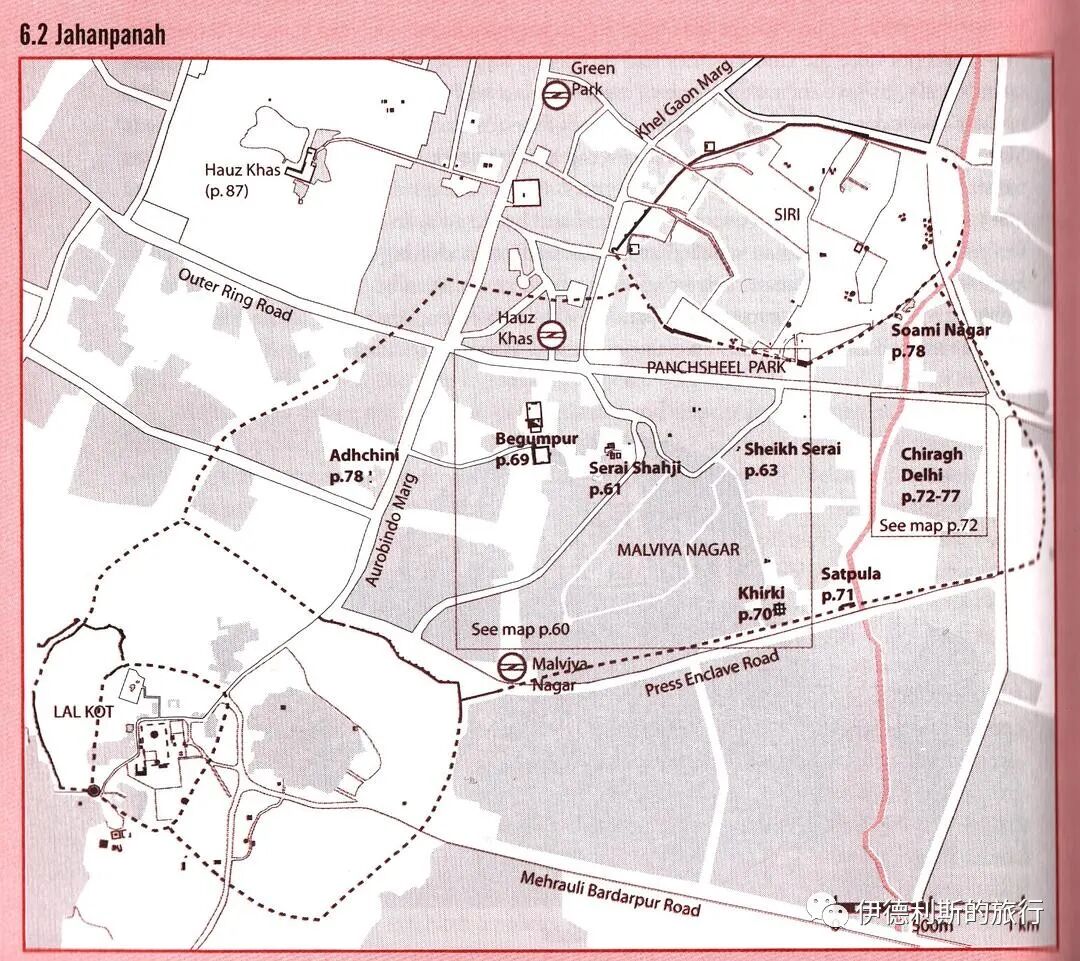
From the book Delhi—A Thousand Years of Building
Shortly after Jahanpanah was completed, Muhammad bin Tughluq suddenly decided to move the capital to the Deccan Plateau in the south and established a new capital called Daulatabad.
Muhammad bin Tughluq forced the population of Delhi to migrate on a large scale, and those who refused were killed. However, the move failed because Daulatabad lacked enough drinking water due to drought, and Muhammad bin Tughluq eventually moved back to Delhi. Although this relocation failed, it significantly influenced history because many Muslims who moved to the Deccan region did not return to Delhi, leading to a large increase in the Muslim population in central and southern India.
2. The Mysterious Sultan's Palace
Within the ruins of Jahanpanah, there is a huge building site called Bijaya Mandal, which means Victory Platform in Hindi. Bijaya Mandal may be the most puzzling historical building in Delhi. On one hand, we know very little about secular architecture from the Delhi Sultanate period, and on the other, the building changed significantly across different eras.
Much evidence suggests this was likely the palace site of Sultan Muhammad bin Tughluq, but without systematic archaeological excavation, we still cannot be certain about the functions of the existing structures.
Ibn Battuta did not describe the Sultan's palace in much detail. He only mentioned that people had to pass through three gates to reach a palace called bazar suntun, which means thousand pillars. He said these wooden pillars were painted and supported a beautifully carved wooden roof.
It is hard to imagine the appearance of this hall because most buildings preserved from this period are mosques, tombs, and madrasas, with almost no secular buildings remaining. Based on Ibn Battuta's description, this hall likely had long colonnades and a flat roof. One question remains: how did they keep a wooden flat roof waterproof? Regarding the interior of the hall, we only know it had exquisite carvings and the walls were likely decorated with paintings, which were probably removed later during the iconoclastic movement of Firuz Shah Tughlaq (reigned 1351–1388).
Archaeological digs show this building was used for a very long time. Historical records mention that both Sultan Alauddin Khalji (reigned 1296-1316) and Sultan Muhammad bin Tughlaq (reigned 1325-1351) had a palace called bazar suntun. Although Ibn Battuta wrote that Alauddin Khalji’s palace was in the city of Siri, these two palaces are likely the same place, and they are probably Bijaya Mandal.
The stone hall at Bijaya Mandal likely dates back to the time of Alauddin Khalji, while the tower next to it was almost certainly built by Muhammad bin Tughlaq. Archaeological findings show these buildings were still in use after the time of Firoz Shah Tughlaq (1351-1388). In the early 16th century, during the Lodi dynasty (1451-1526), the site was used by a Sufi sheikh named Sheikh Hasan Tahir.
1. Upper Platform: Khalji Dynasty
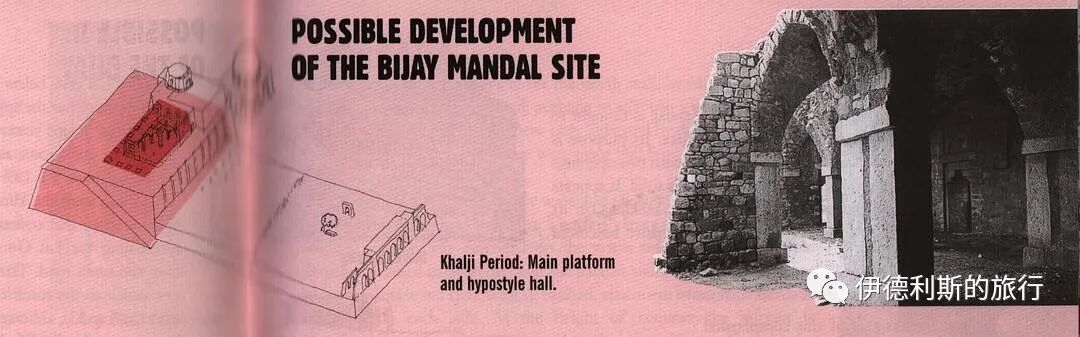
From the book Delhi—A Thousand Years of Building
The oldest part of this complex is likely the upper platform, which may have been built by Alauddin Khalji (reigned 1296-1316). You can see damaged, sloping retaining walls on the west, east, and south sides of the platform. There are two levels of arched basements visible from the east end of the platform, and a similar structure exists on the west end. The main building likely stood in the middle of the slightly raised area of the platform.
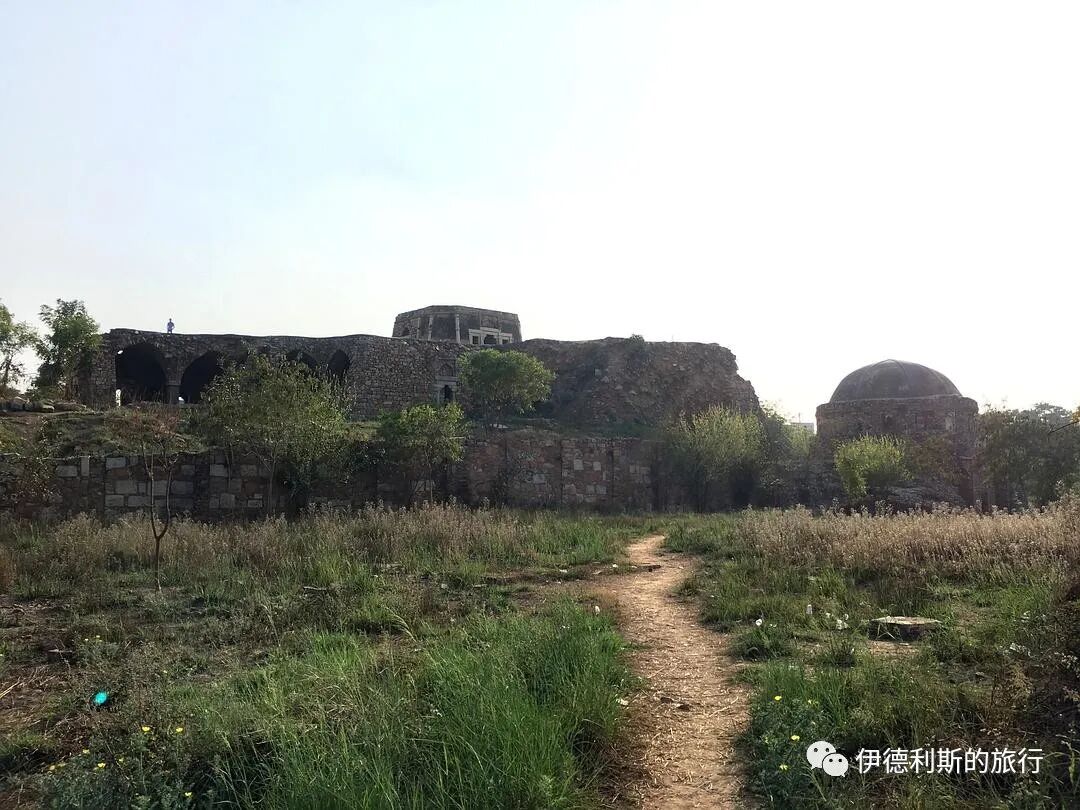
A view from the lower platform looking up at the upper platform, the single-story hall, and the octagonal tower.
2. Single-story Hall: Khalji Dynasty
On top of the platform sits a single-story hall, and above that is an octagonal tower. The hall was also likely built during the time of Alauddin Khalji. There are remains of a balcony in front of the hall, and the bases of the pillars are still there. You can walk from the pillars into the main room, where the roof is held up by stone columns. Behind the first row of stone columns are two large pits half a meter deep. In the early 20th century, the Archaeological Survey of India found many items here, including ivory, porcelain, glass necklaces, pearls, red coral, rubies, and coins dating from 1296 to 1390. This place was likely a treasure storage room at the time.
The hall seems to have had entrances on all four sides, but they were likely blocked when Muhammad bin Tughlaq built the heavy platform under the octagonal tower. The first entrance on the north wall next to the platform also seems to have been changed. Different foundation remains show there was once another room on the edge of the platform on the north side of the hall.
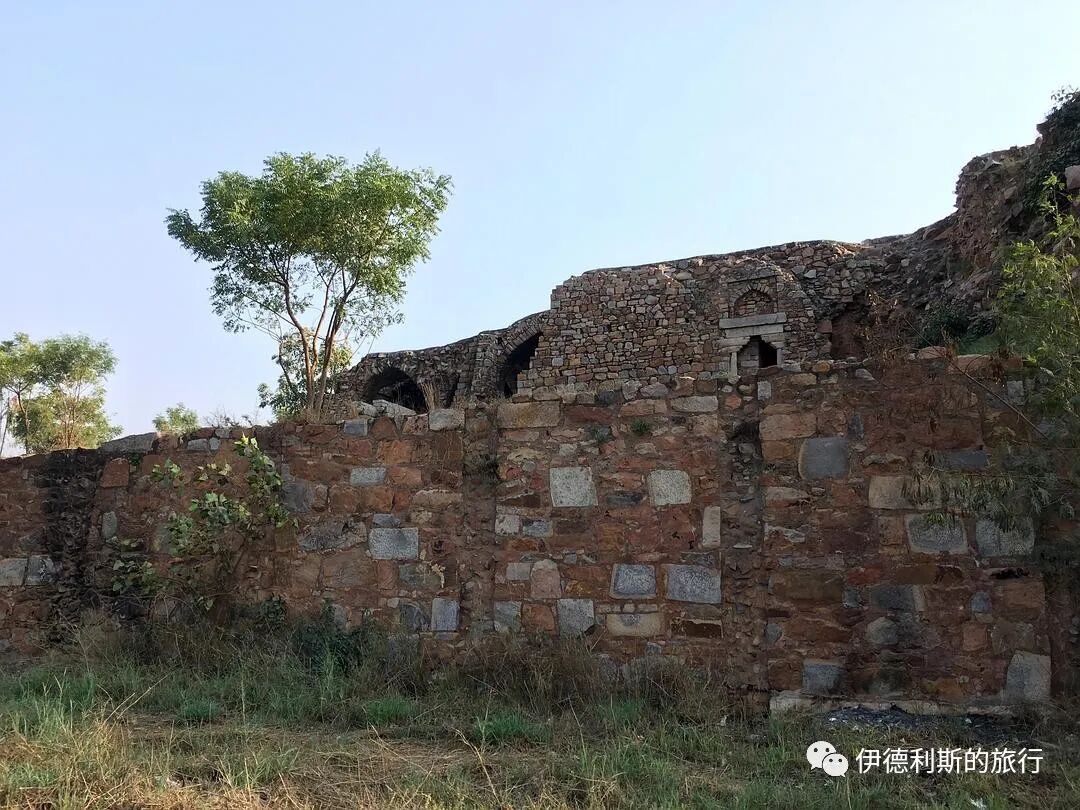
Below is the upper platform, and above is the single-story hall.
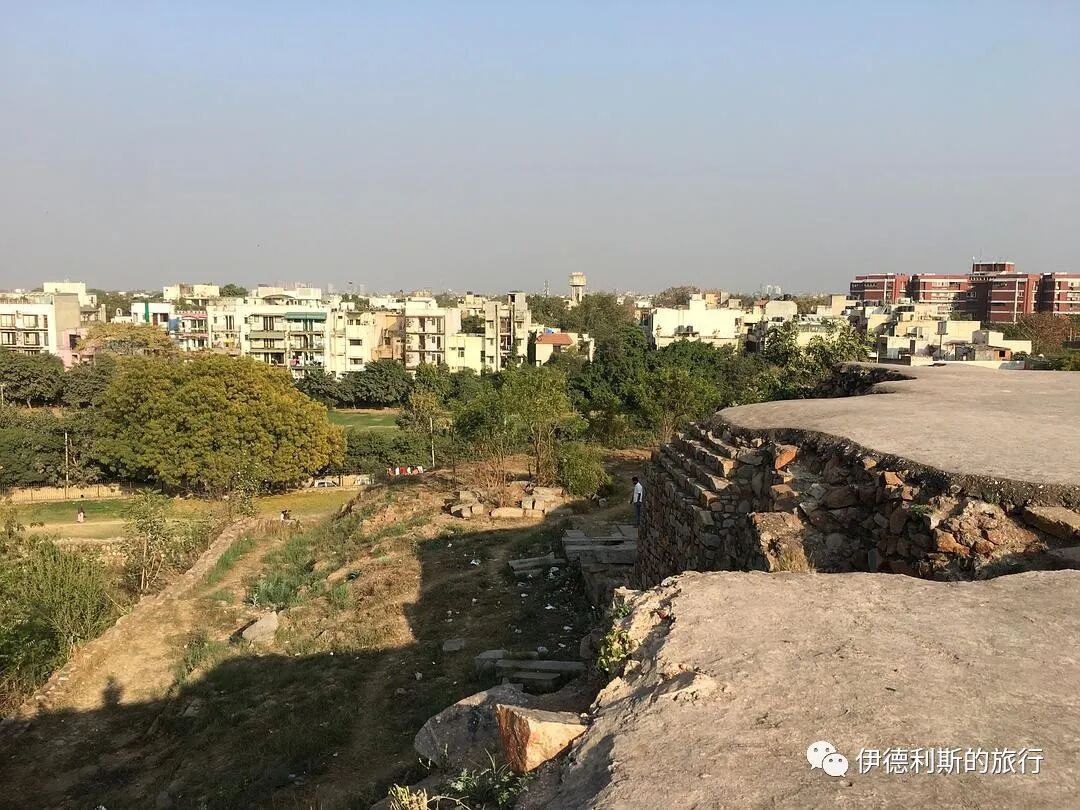
Looking down at the upper platform from the roof of the single-story hall.
3. Octagonal Tower: Early Tughlaq Dynasty
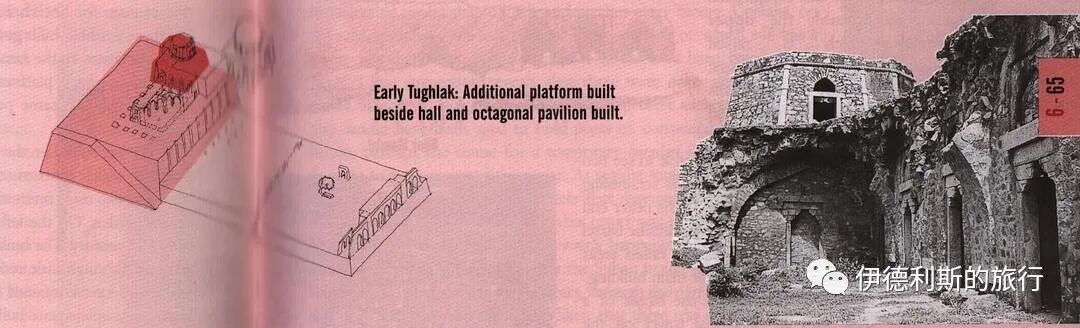
From the book Delhi—A Thousand Years of Building
The octagonal tower above the single-story hall was reportedly built by Muhammad bin Tughlaq (reigned 1325-1351). A slope followed by shallow, wide steps leads to the base of the octagonal tower. There is much evidence that the octagonal tower once extended further to the north. The three doors with quartzite frames and the narrow stairs leading to the roof were added later during the late Tughlaq dynasty.
Inside the octagonal tower is a symmetrical, cross-shaped room with the same openings on each side. In the middle of summer, the inside of the tower stays cooler and catches a breeze.
On the roof of the tower, there are two well-preserved sockets. One still has a groove around the edge, which suggests it likely held something on top. Besides these two sockets, there are actually traces of sockets on every level of the stairs. Based on the depth of these sockets, they likely held heavy, tall pillars. It is thought that there might have once been a pavilion (baradari) on top of the tower. There is also a row of small sockets along the edge of the roof, which may have held smaller upright posts.
We can guess that this tower was likely a viewing platform for Sultan Muhammad bin Tughlaq, but the biggest question is how the Sultan got up there, as his fancy clothes would have been hard to wear through the narrow stairs that exist today. It is very likely there was another staircase at the time, although Indian palaces usually did not have fancy stairs and kept them inside thick walls.
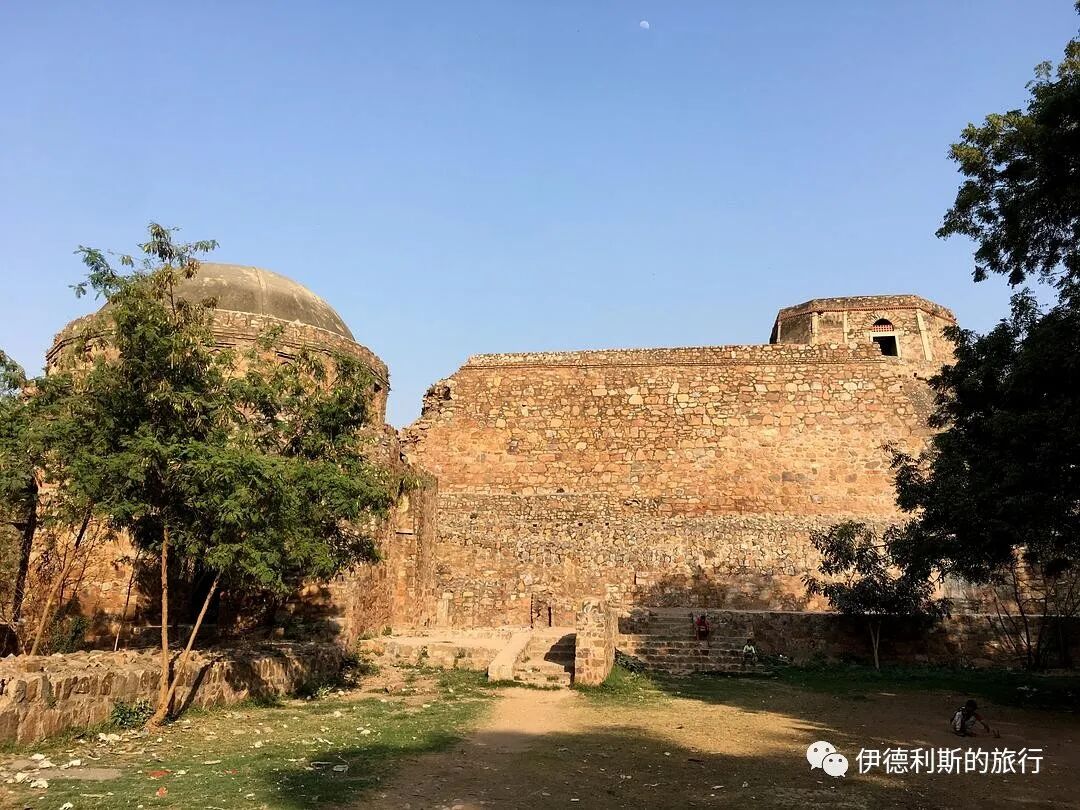
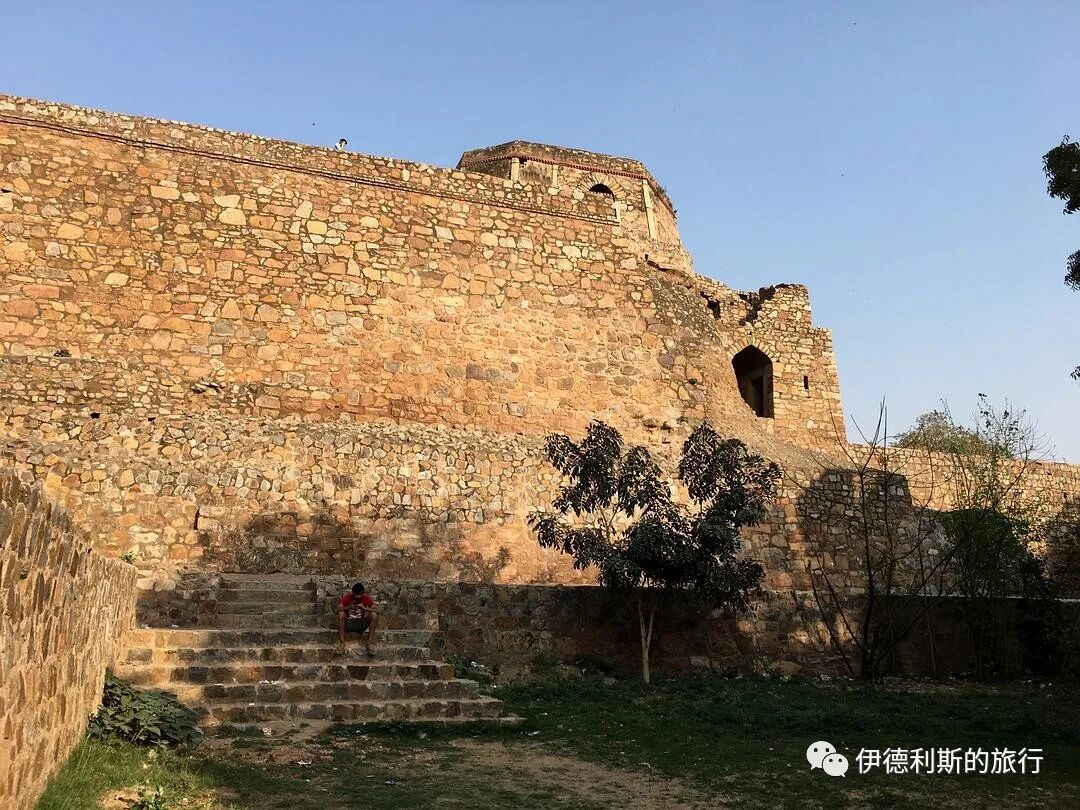
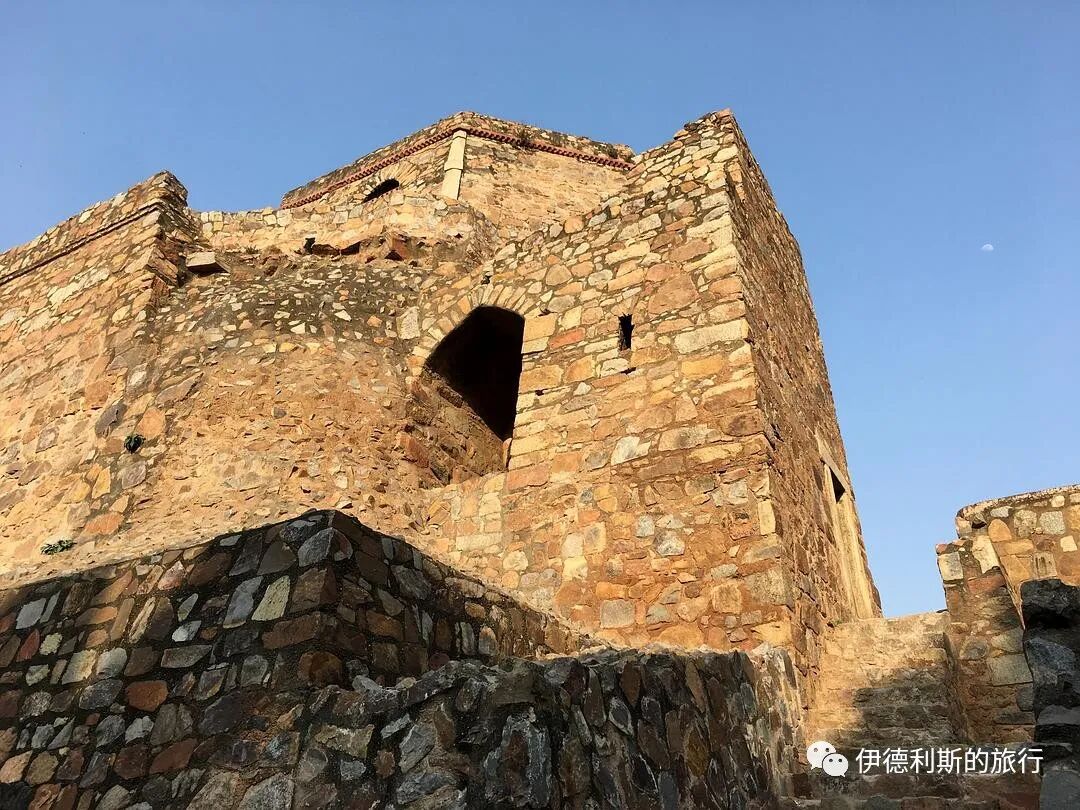
The narrow stairs leading to the octagonal tower.
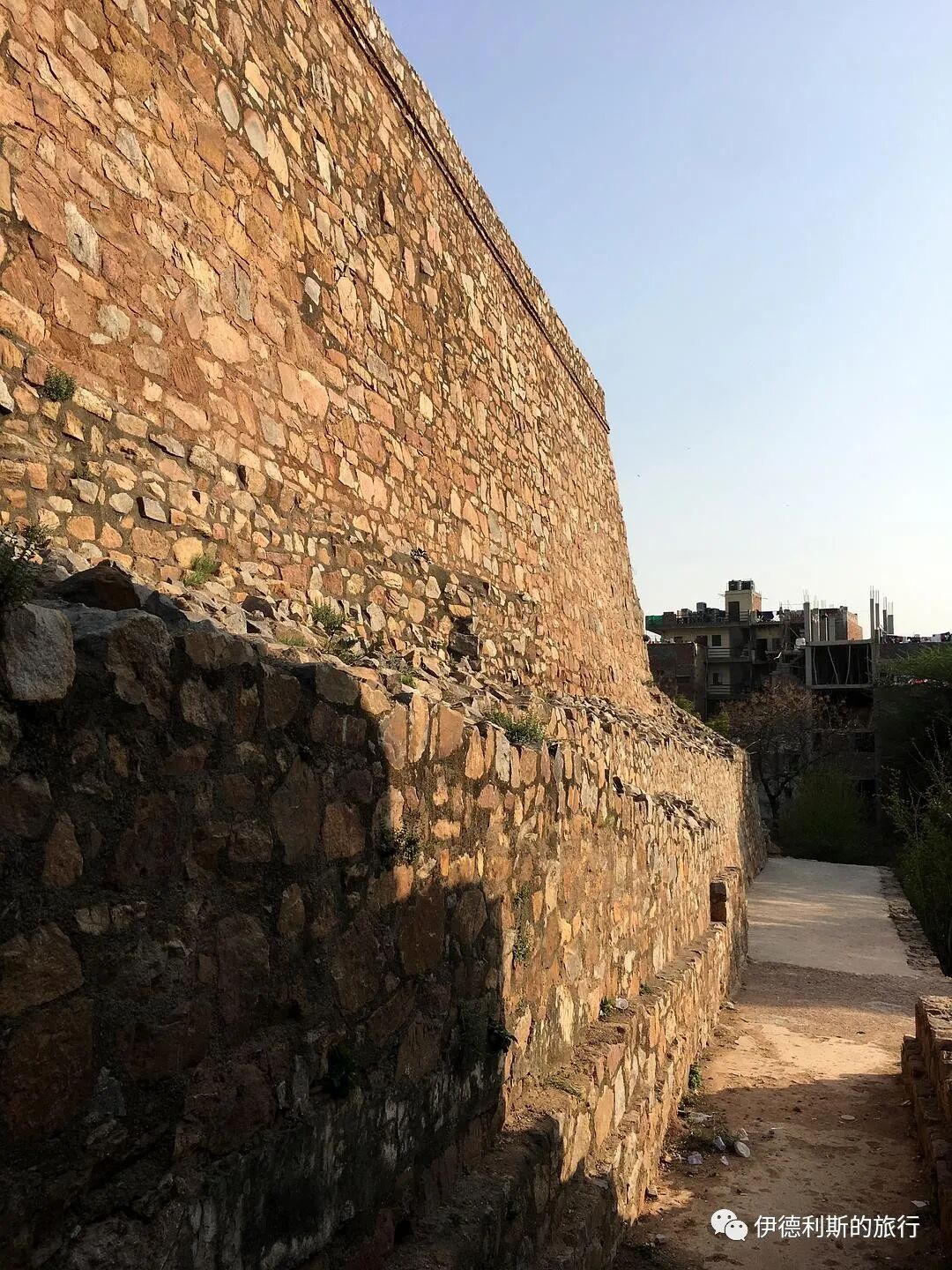
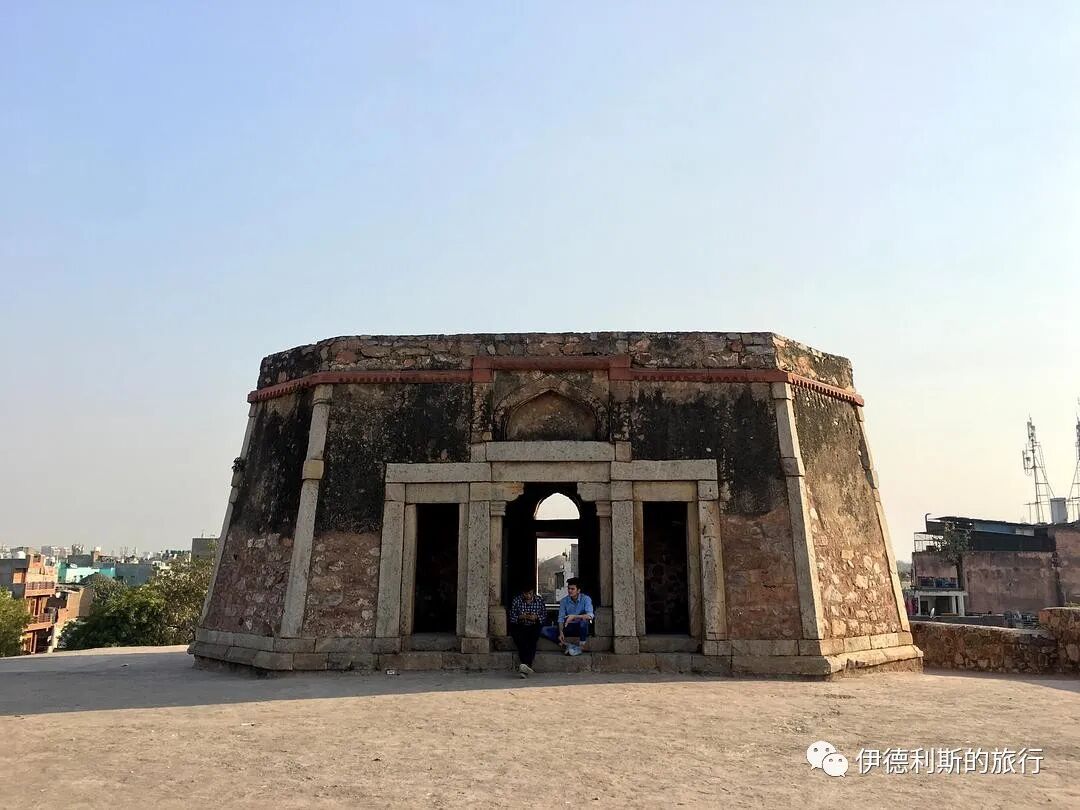
The octagonal tower.
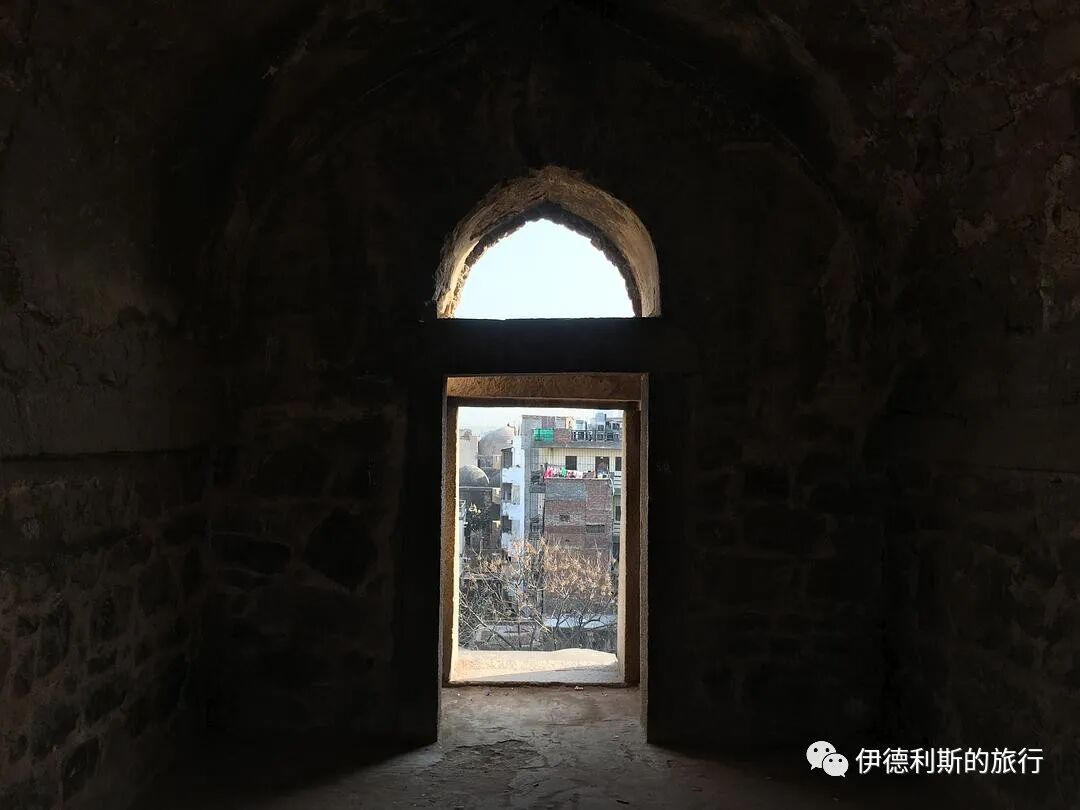
Inside the octagonal tower.
4. Lower Platform: Late Tughlaq Dynasty
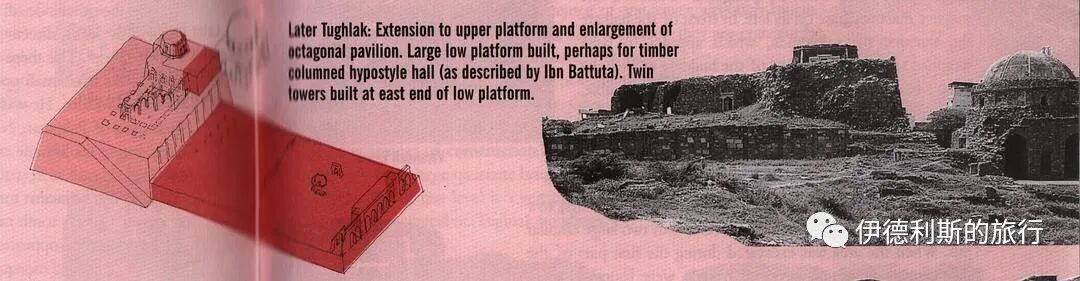
From the book Delhi—A Thousand Years of Building
You can go down from the upper platform to a larger lower platform. There are retaining walls on the east and west sides of the lower platform. The buildings on the lower platform date to two periods: the wall foundations are made of large quartzite, while the upper parts feature masonry typical of the Tughlaq dynasty. Archaeological excavations in the 1920s uncovered stone pillar bases on the lower platform, some of which are still visible in the southwest corner today. On the other side of the platform, near the crumbling east retaining wall, you can still see delicate plaster flooring. These ruins may all be part of the palace Ibn Battuta called the bazar sutun.
There is a tall retaining wall between the two platforms, featuring a series of vertical slots that were likely used to hold wooden pillars or decorations. Except for the ramp on the east side of the upper platform, there is no other way to connect the two platforms. The wooden pillars in the lower vertical slots may have supported a higher floor, forming the Sultan's palace along with the stone hall on the south side. Another theory is that the lower platform was the Sultan's palace and the upper platform was his sleeping quarters, which is why the two levels are separate.
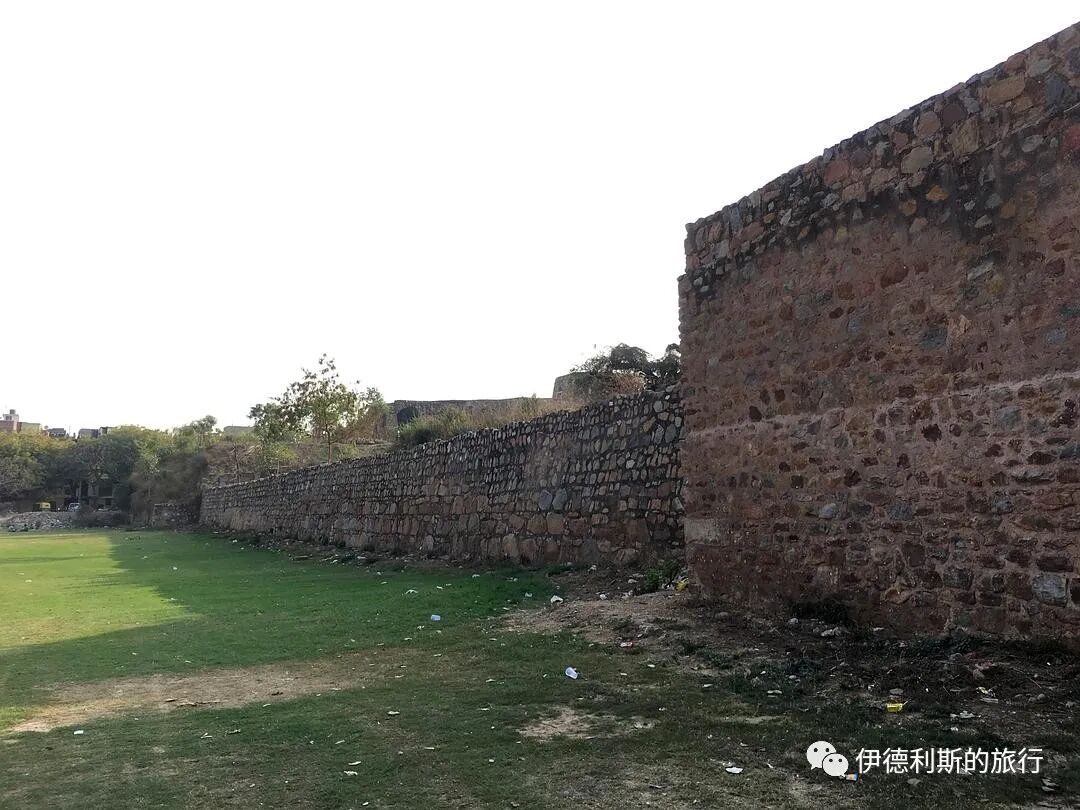
Wall foundations of the lower platform.
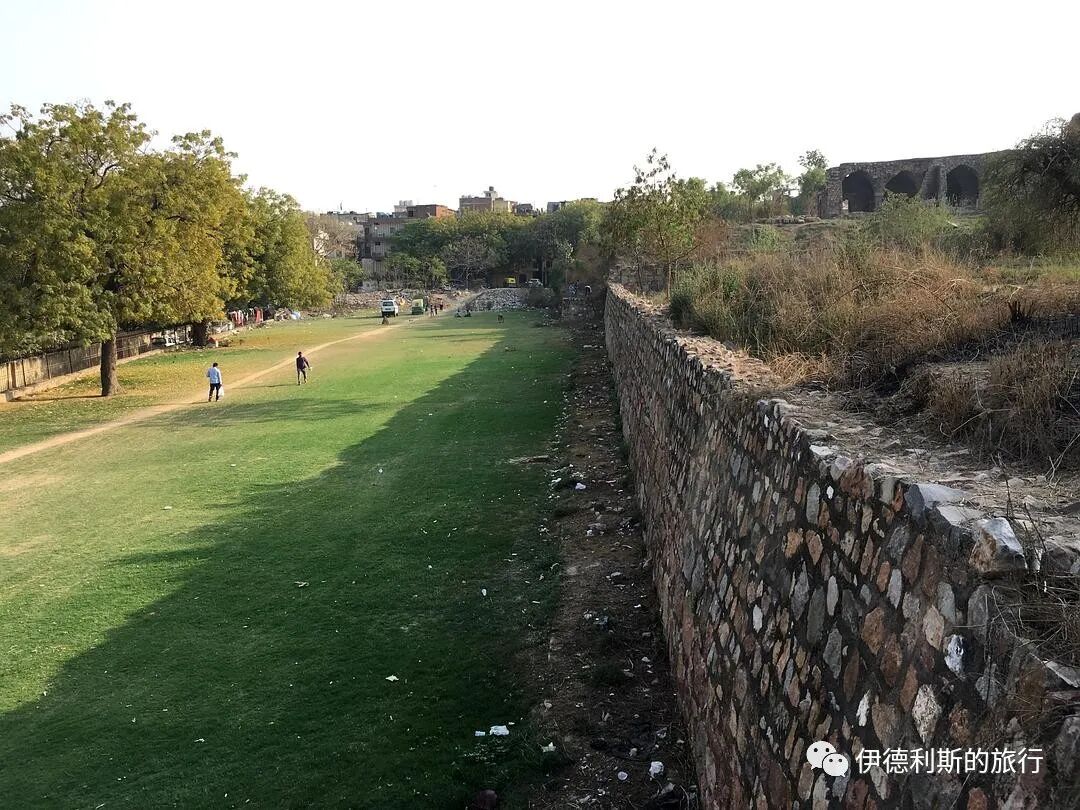
Wall foundations of the lower platform.
5. Cemetery and Religious Site: Lodi Dynasty
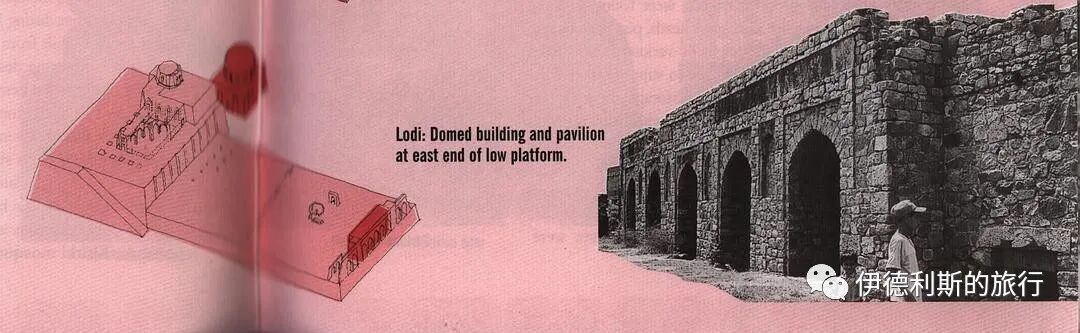
About halfway across the platform, the ground level rises significantly, which likely marks the general area of the palace. Far from the palace is a small cemetery where Sheikh Hasan Tahir and his descendants are buried. This sheikh lived during the Lodi dynasty (1451–1526) and died in 1503. It is said he lived in Bijay Mandal for a long time.
There is an arcade-style building at the very edge of the outer platform of the cemetery. On the north side of the building, there are remains of a long arcade wall, with pillars and arches in the Lodi dynasty style. There are also two sturdy towers, with black plaster coatings on top that reflect the Tughlaq dynasty style. It is believed that this may have been a khanqah (a place for Sufi gatherings) built by Sheikh Hasan Tahir.
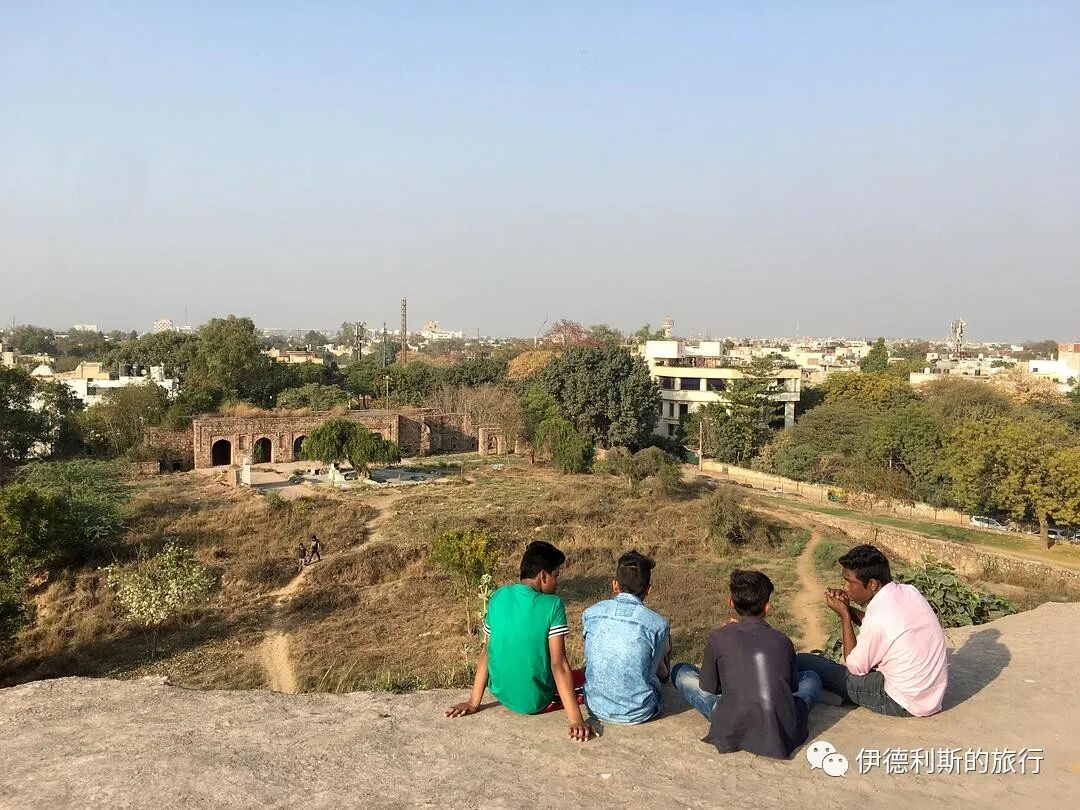
Looking out at the lower platform and the sheikh's tomb from the single-story hall.
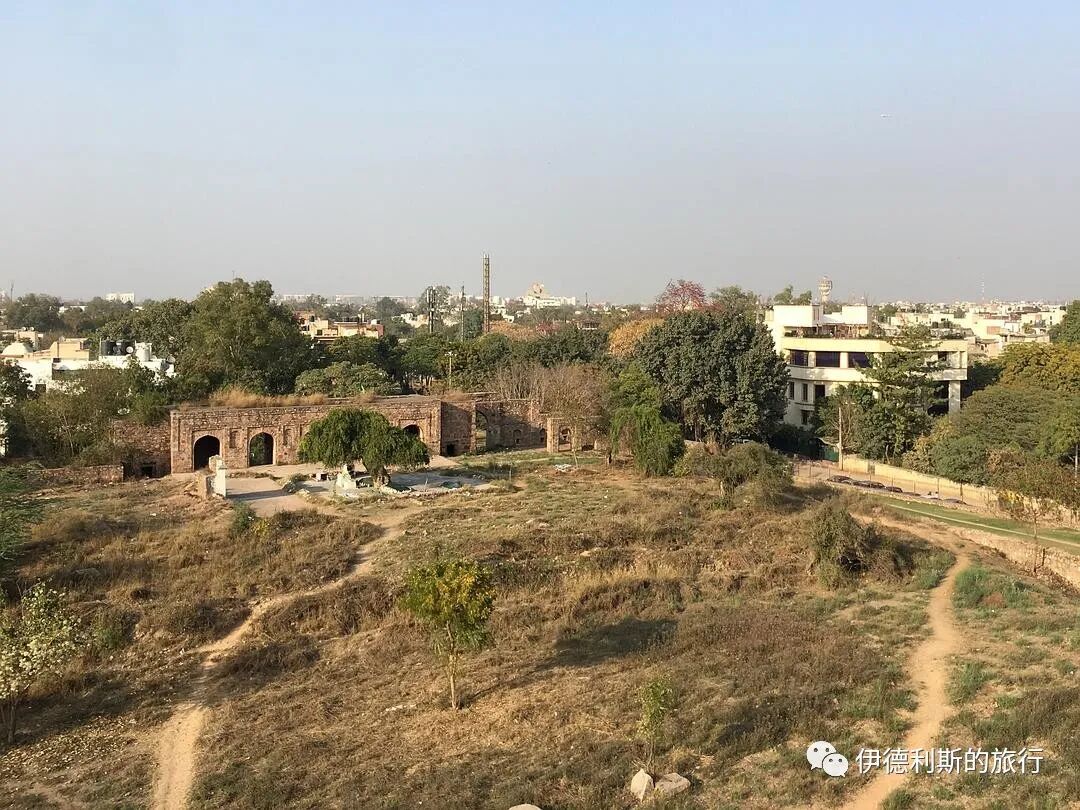
6. Circular Dome: Lodi Dynasty
Next to Bijaya Mandal is a building with a circular dome, thought to have been built in the 15th century. The purpose of this building remains unknown, and its structure is quite unique: it has two openings on each of the north, south, and west sides, while the east side is sealed. Foundation evidence shows there was once another building on the west side of this structure.
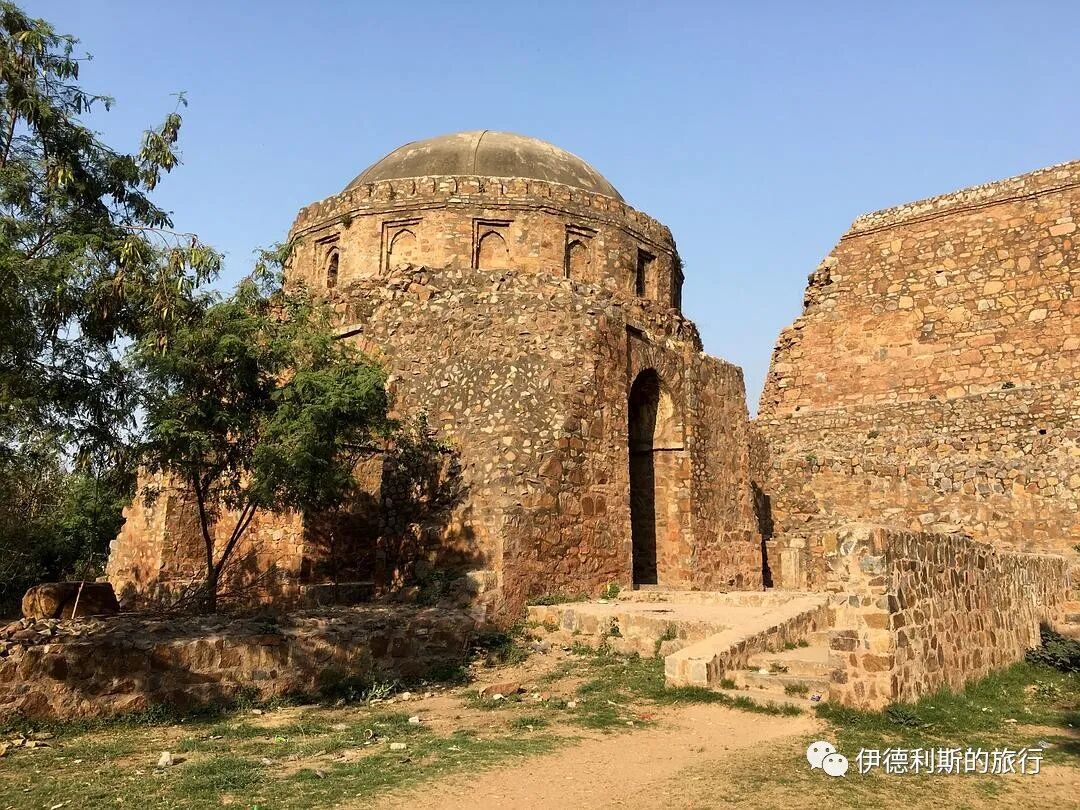
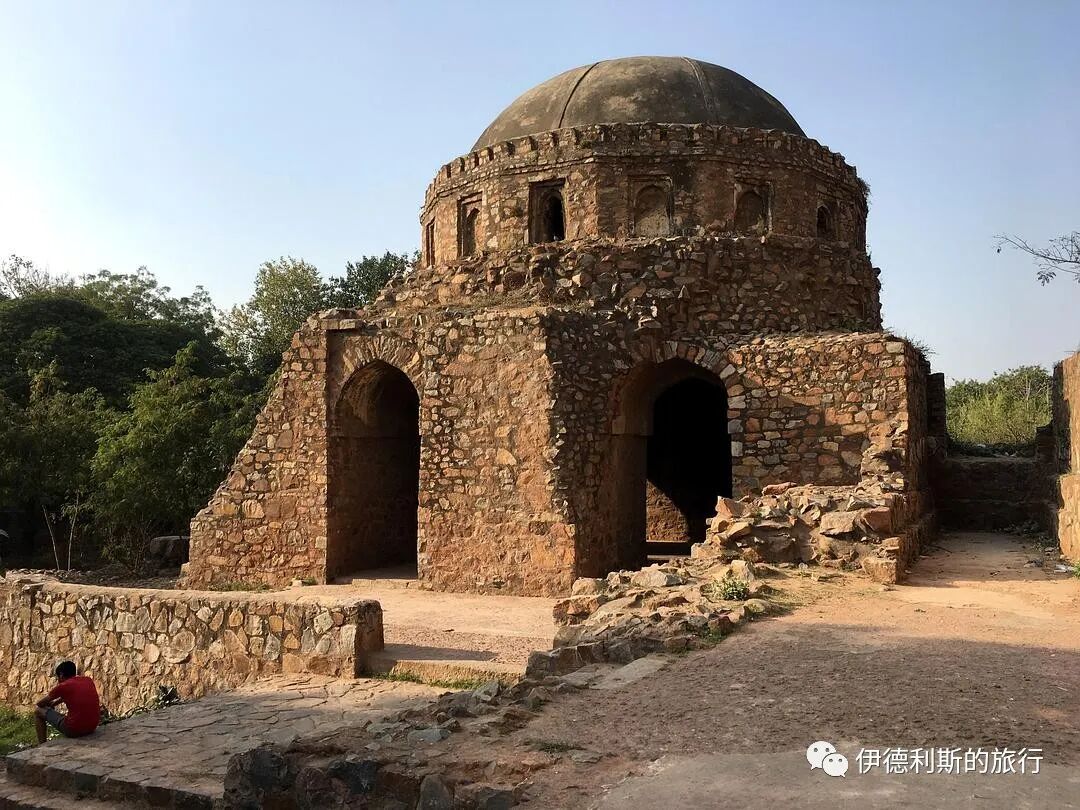
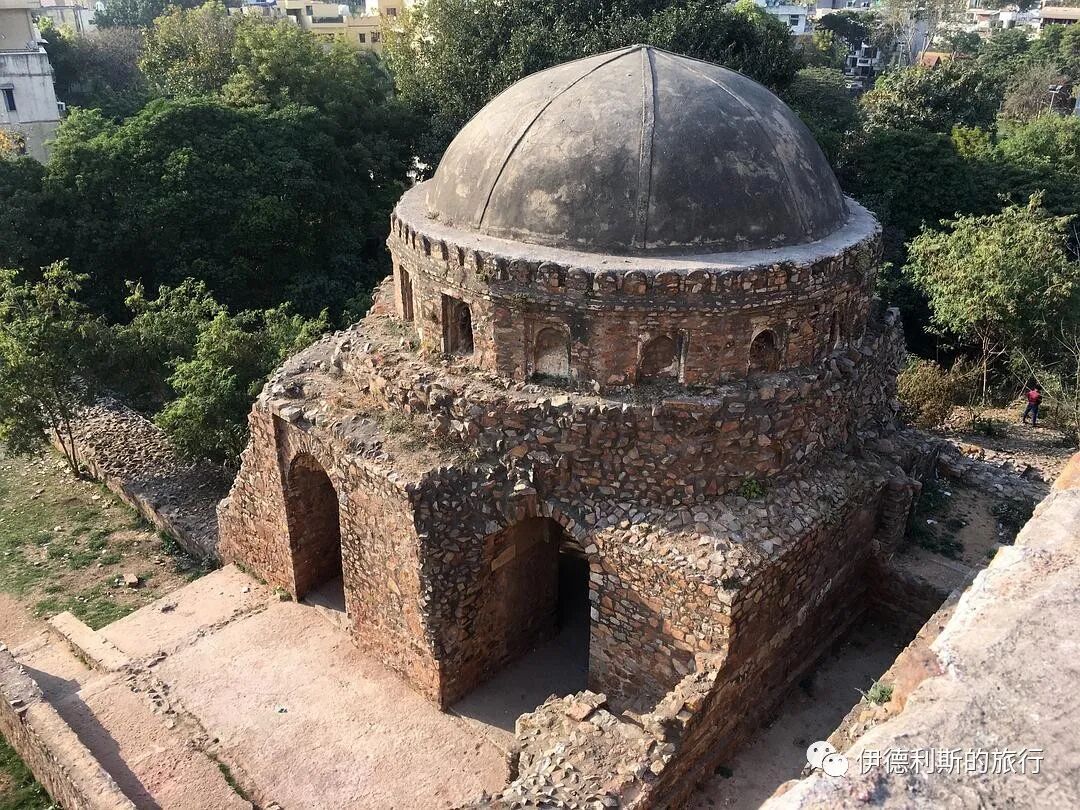
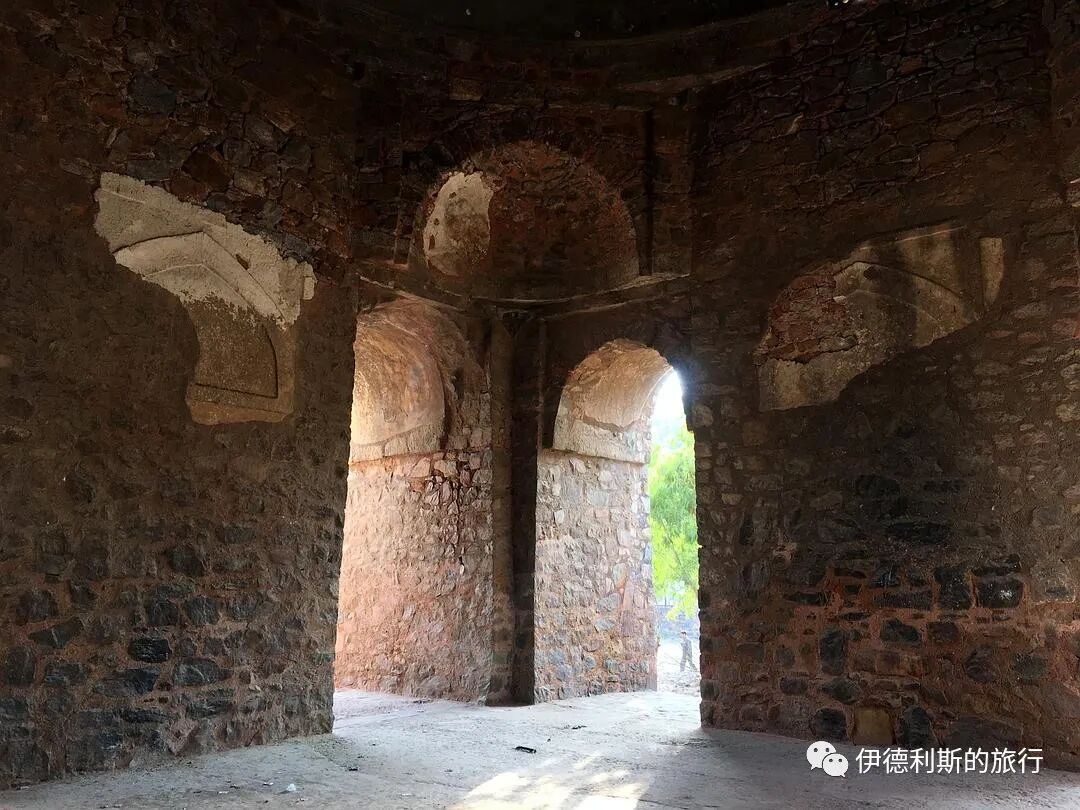
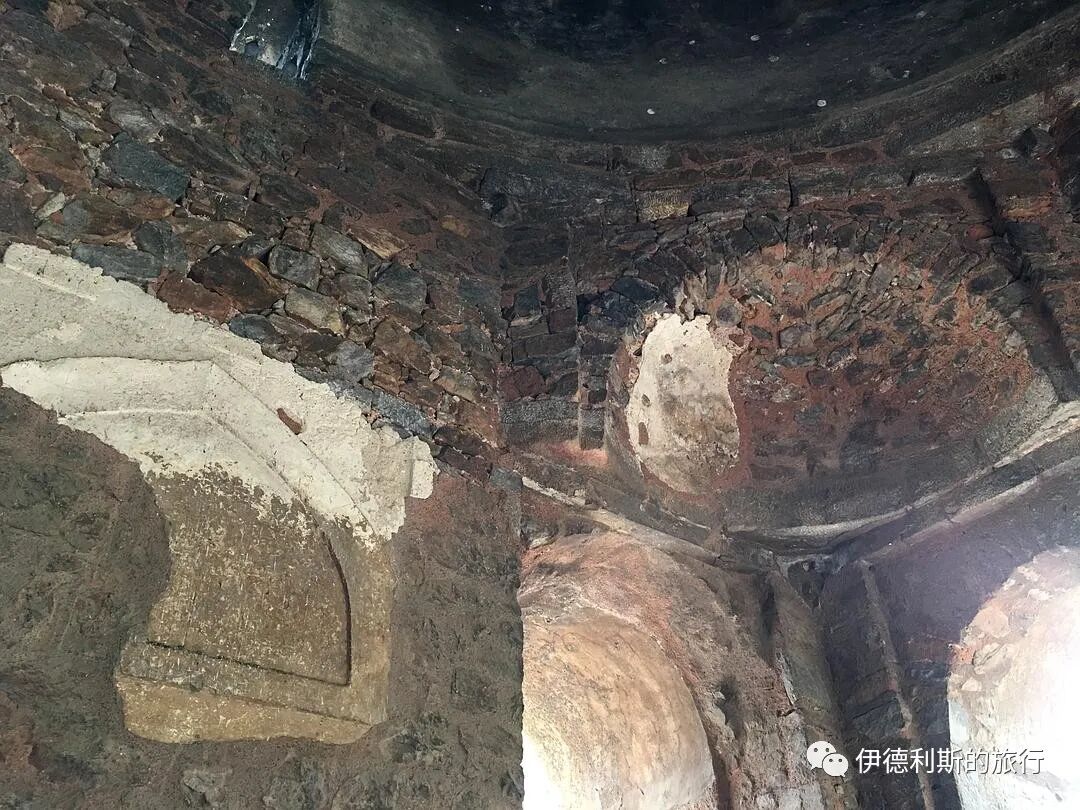
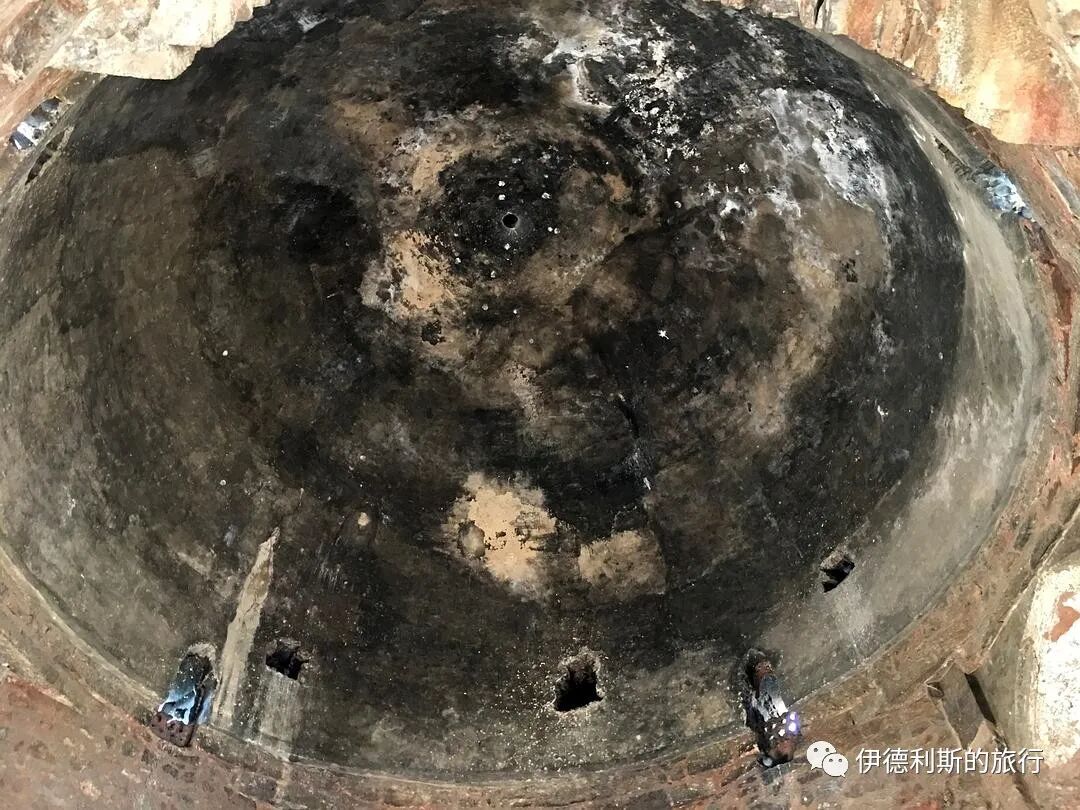
3. Begampur Mosque
Begampur Mosque is the most important mosque in the city of Jahanpanah and the most representative mosque of the Tughlaq dynasty of the Delhi Sultanate still standing today; it is said to have been designed by the Iranian architect Zahir al-Din al-Jayush.
There are two theories about when the mosque was built: one suggests it is one of the seven mosques built by Khan-i-Jahan Maqbul, the wazir (prime minister) of Sultan Firuz Shah Tughlaq (reigned 1351–1388), while the other suggests it was built when Muhammad bin Tughlaq died in 1351.
In 1921, the Archaeological Survey of India cleared out the residents living inside the mosque, giving it the appearance it has today.
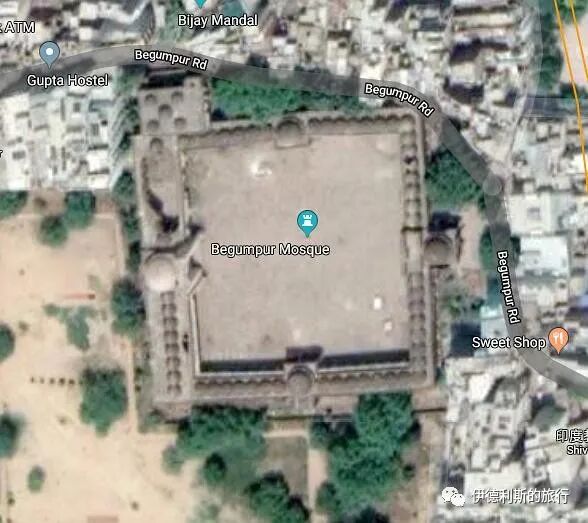
Begampur Mosque is magnificent, with a spacious courtyard surrounded by arcades. There is a circular domed building in the center of each of the four sides; the east, north, and west ones are gates, and the largest one on the west side is the main prayer hall.
The mosque is very simple, with only a few carvings inside the main prayer hall. These stone carvings and the dome were once covered in shimmering white plaster, but most of it has fallen off and turned black.
The gate.
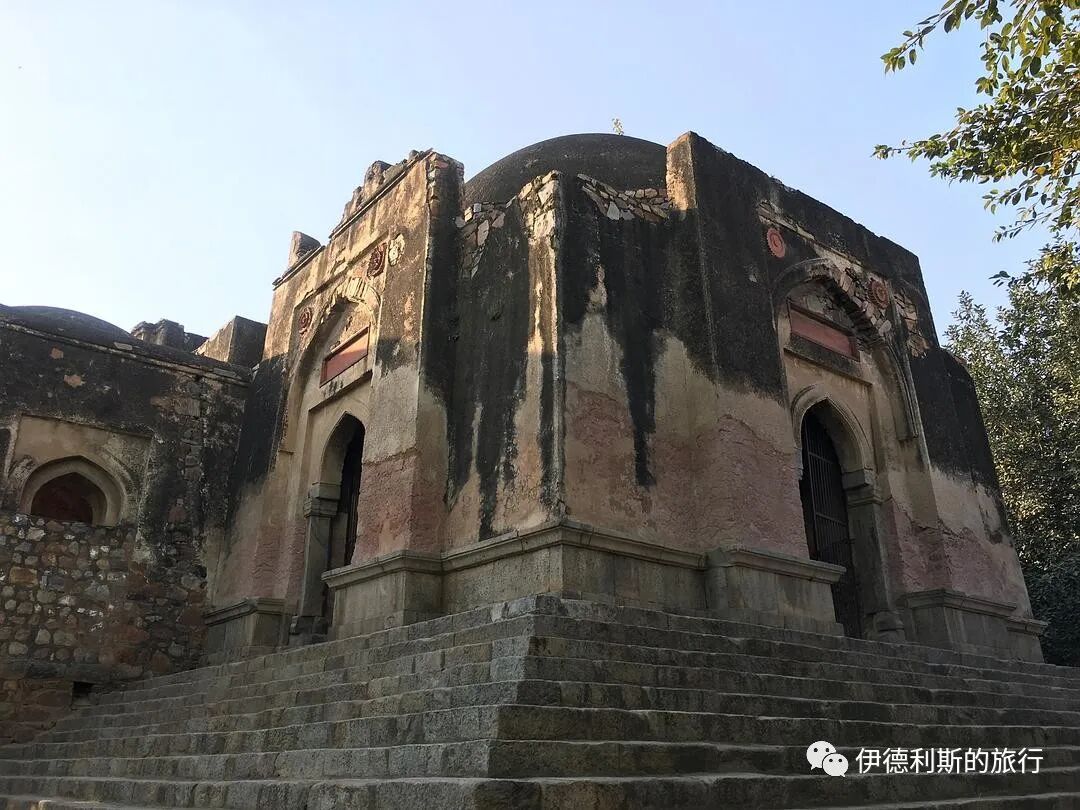
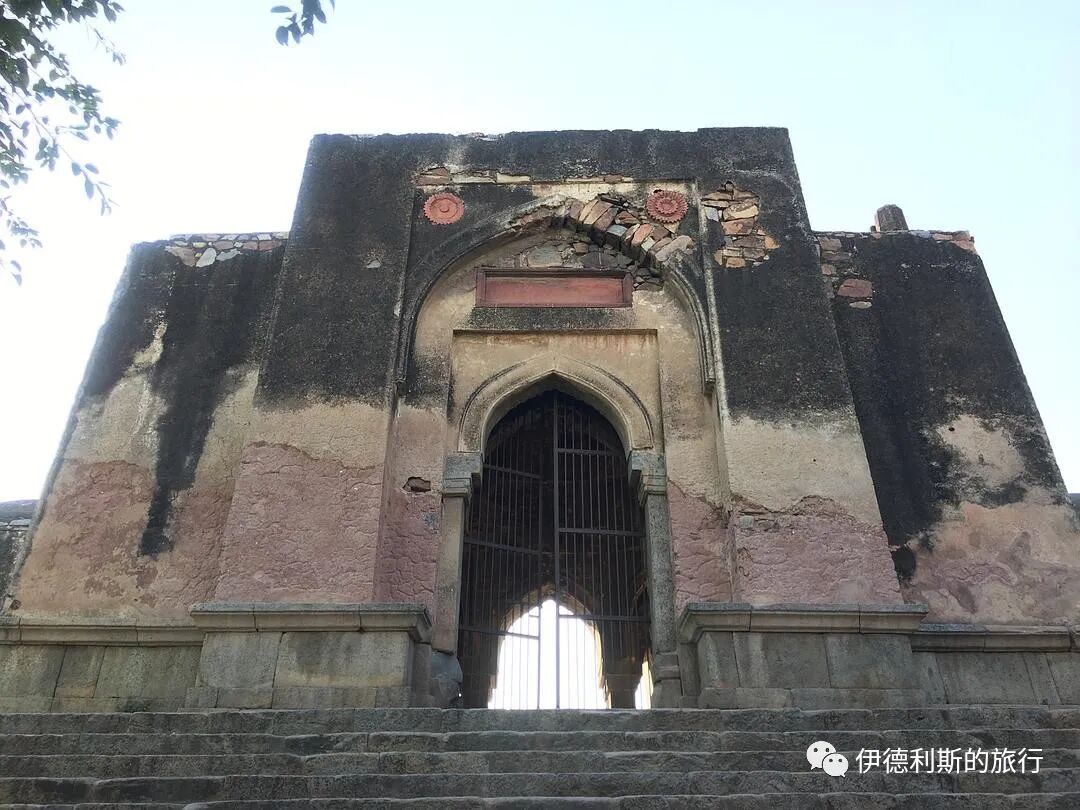
Looking inside from the gate.
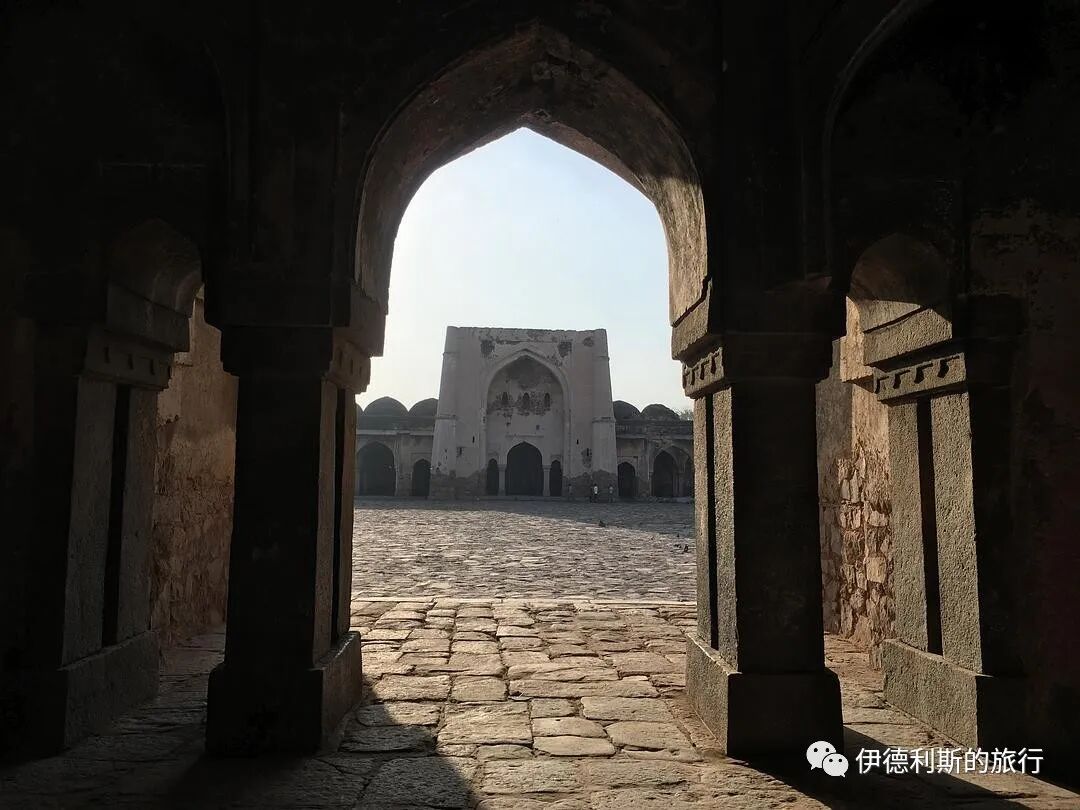
Inside the gate.
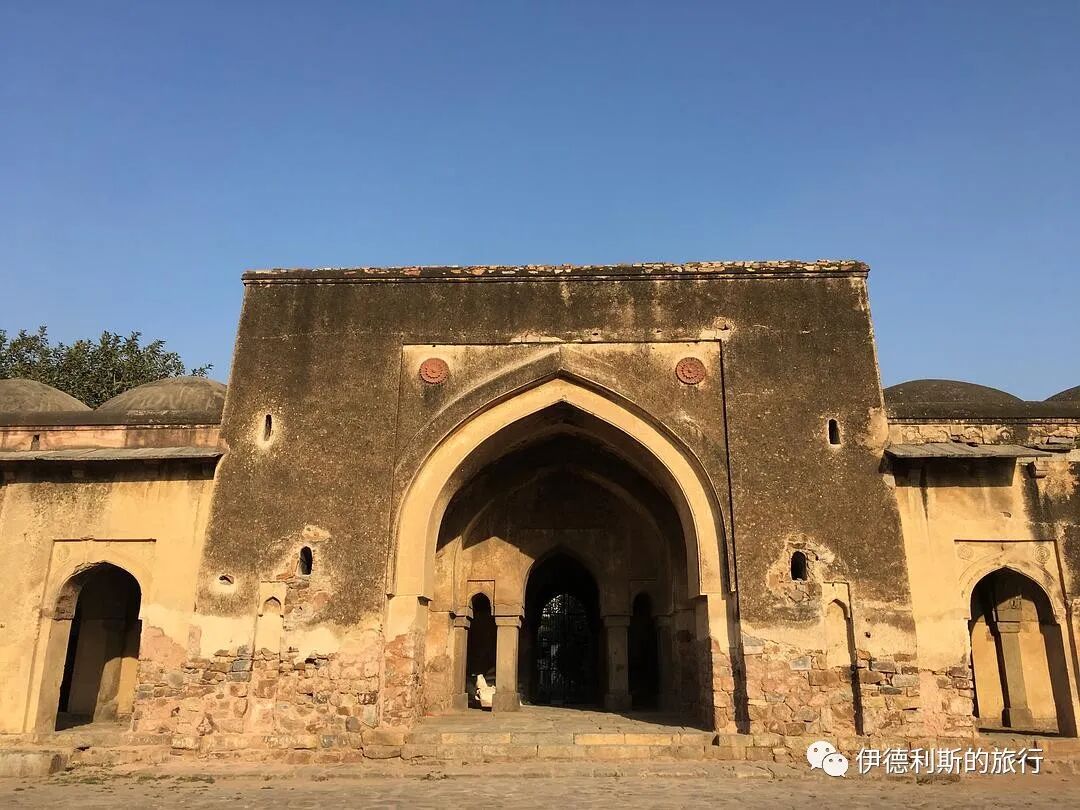
The corridor on the northeast side.
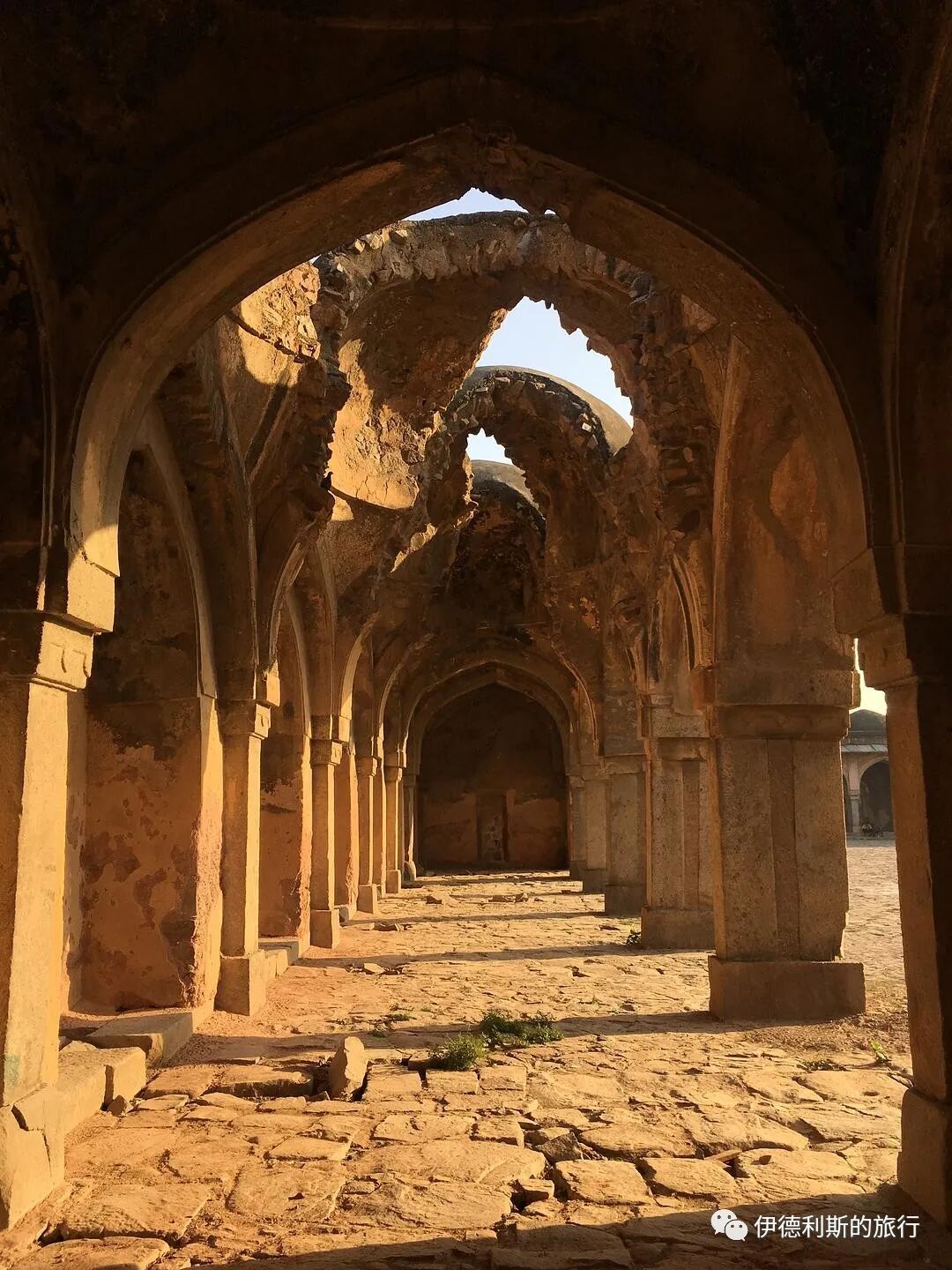
Southwest corridor
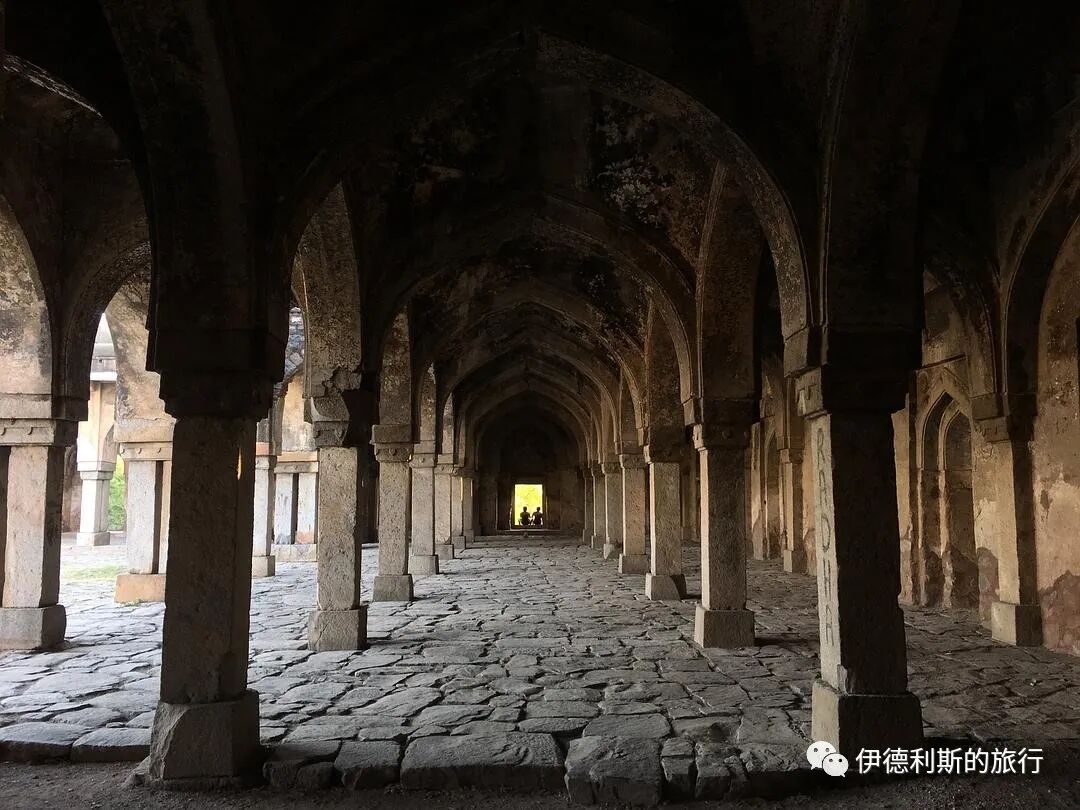
Courtyard
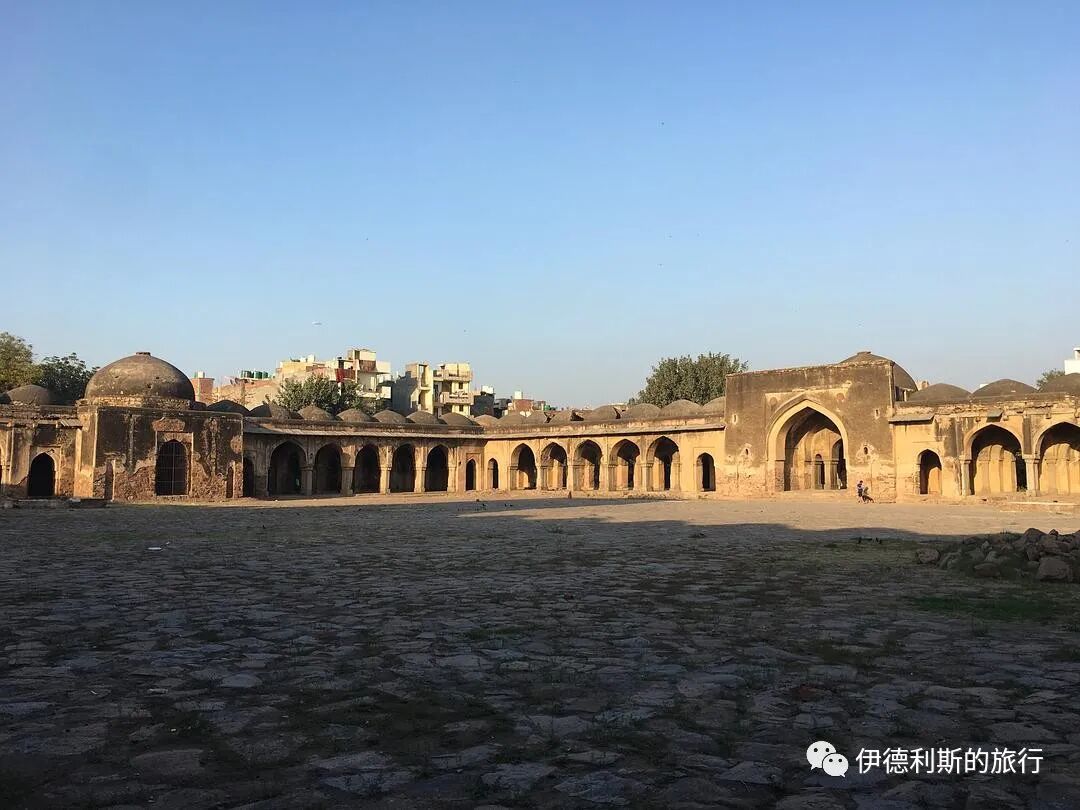
Overlook
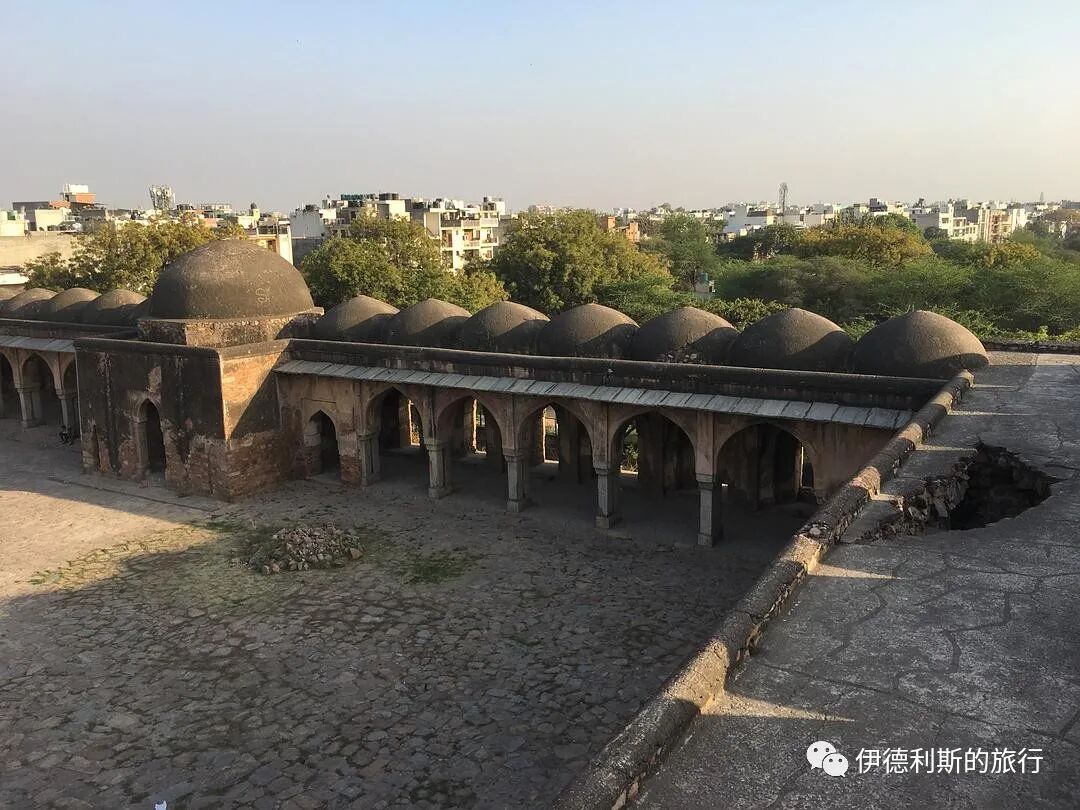
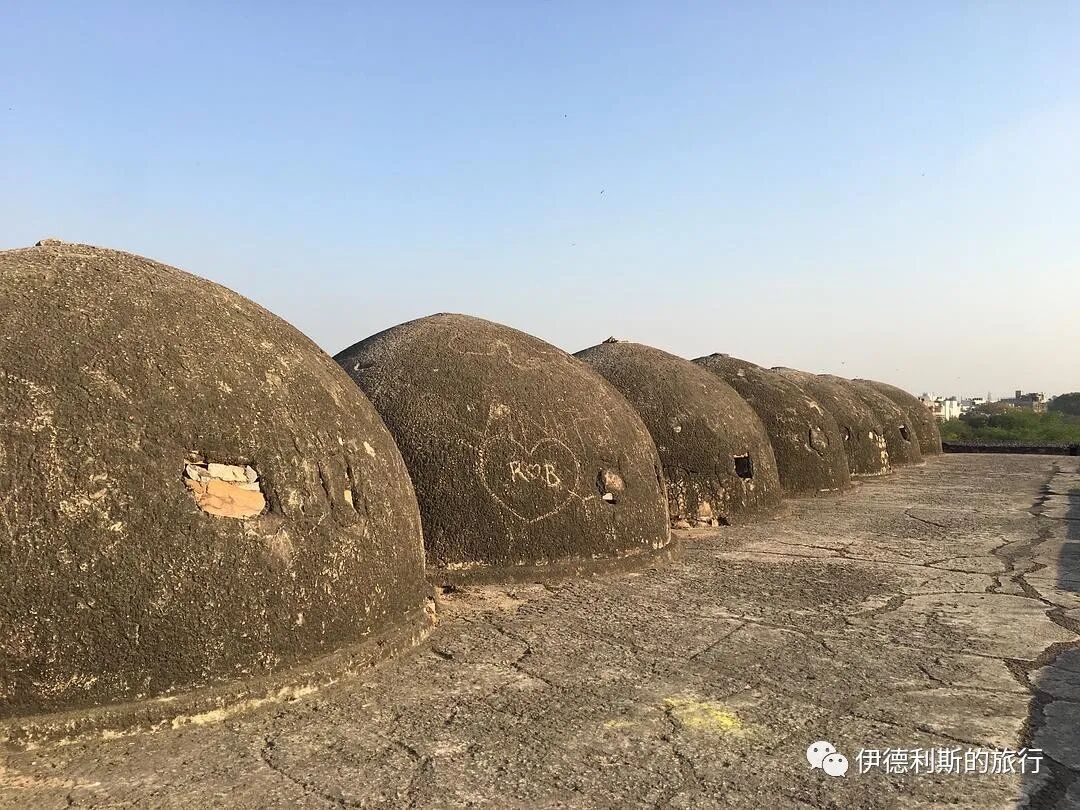
North gate
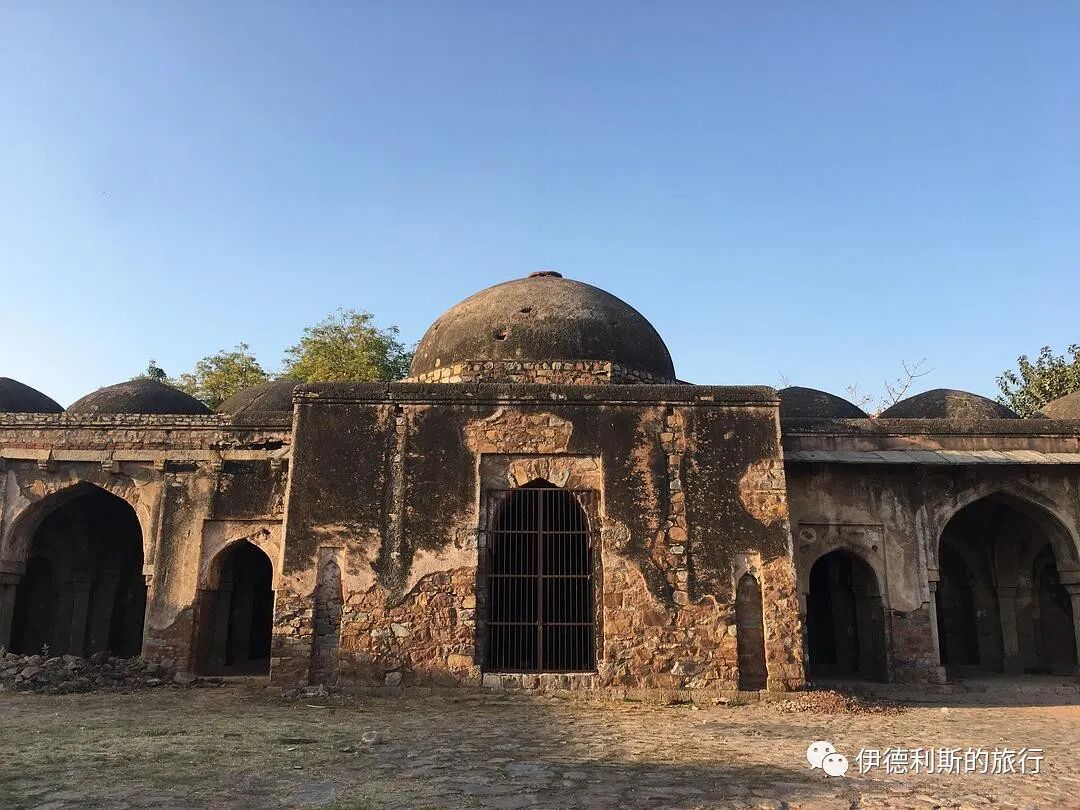
South gate
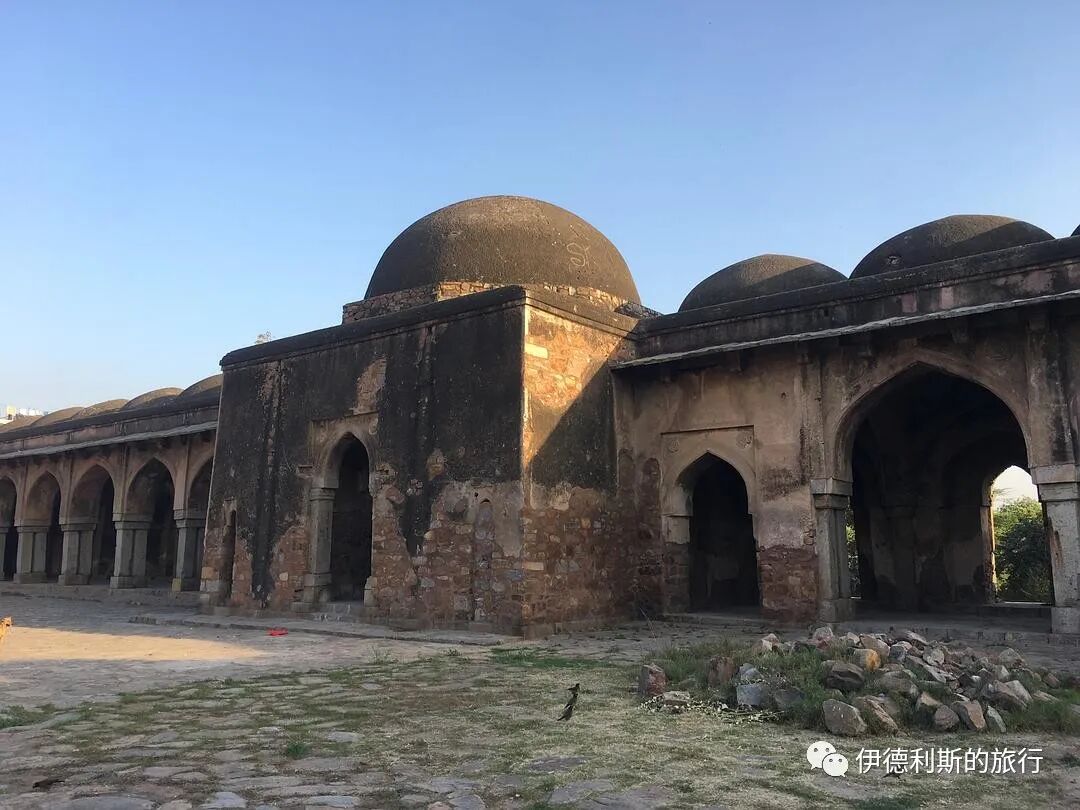
The corridor on the north side of the main prayer hall has collapsed.
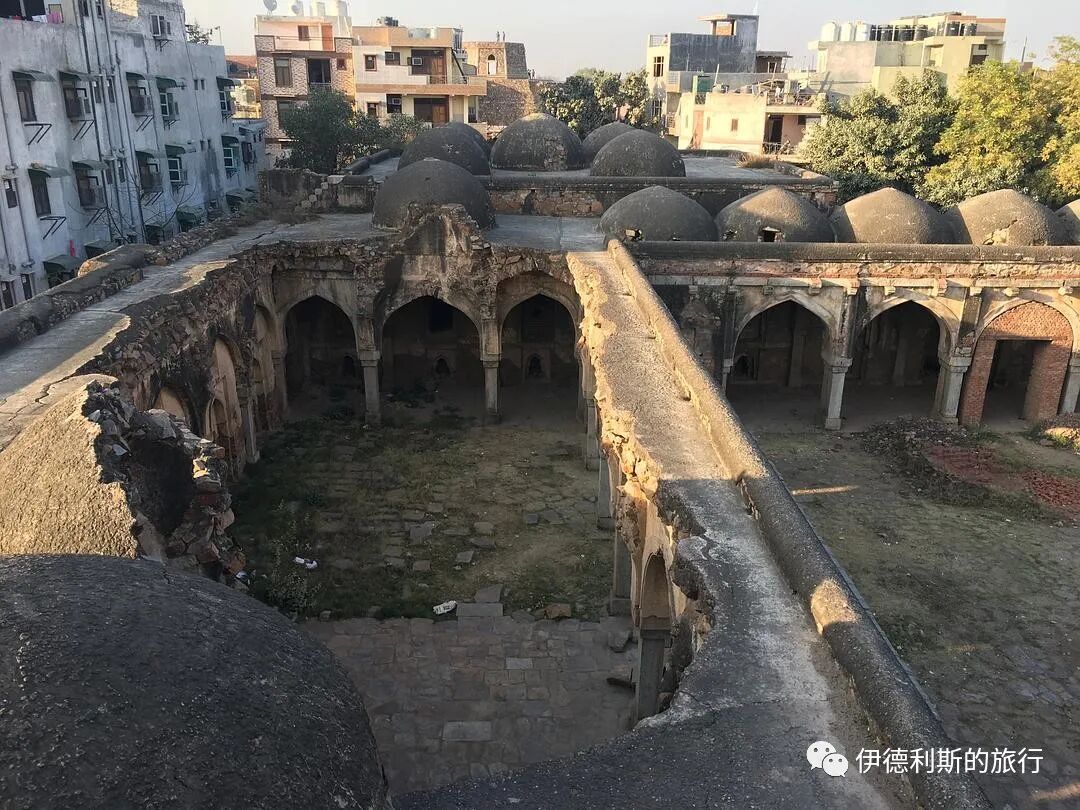
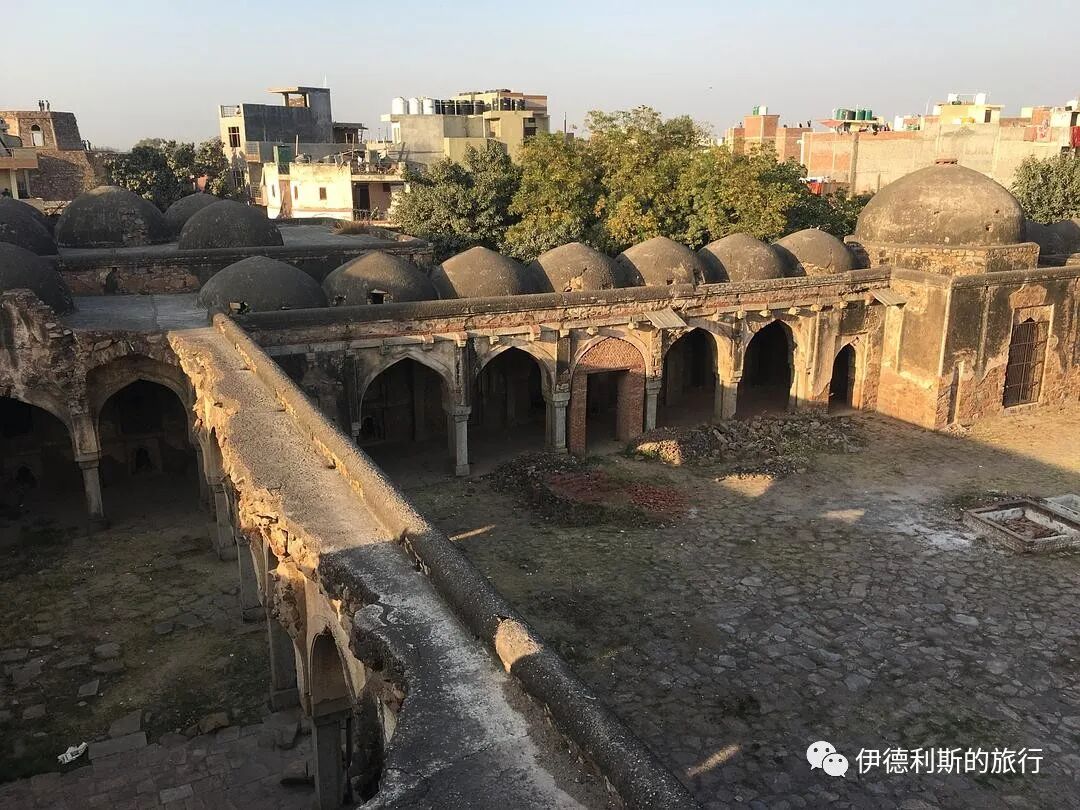
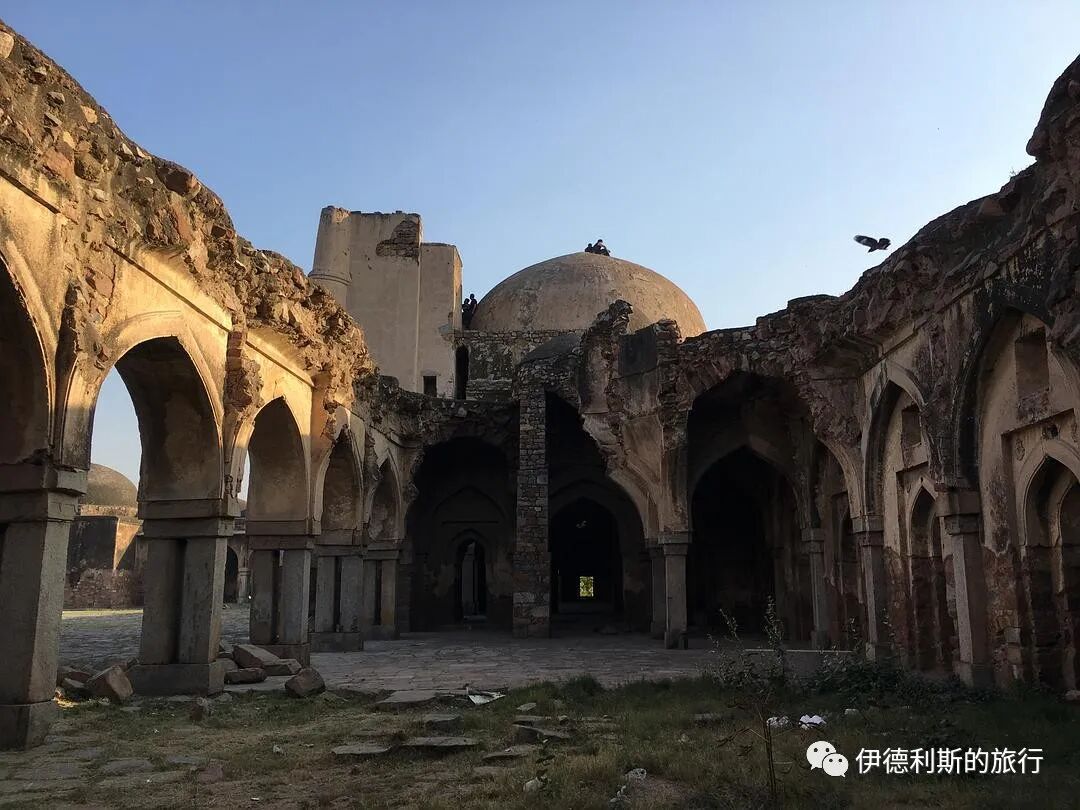
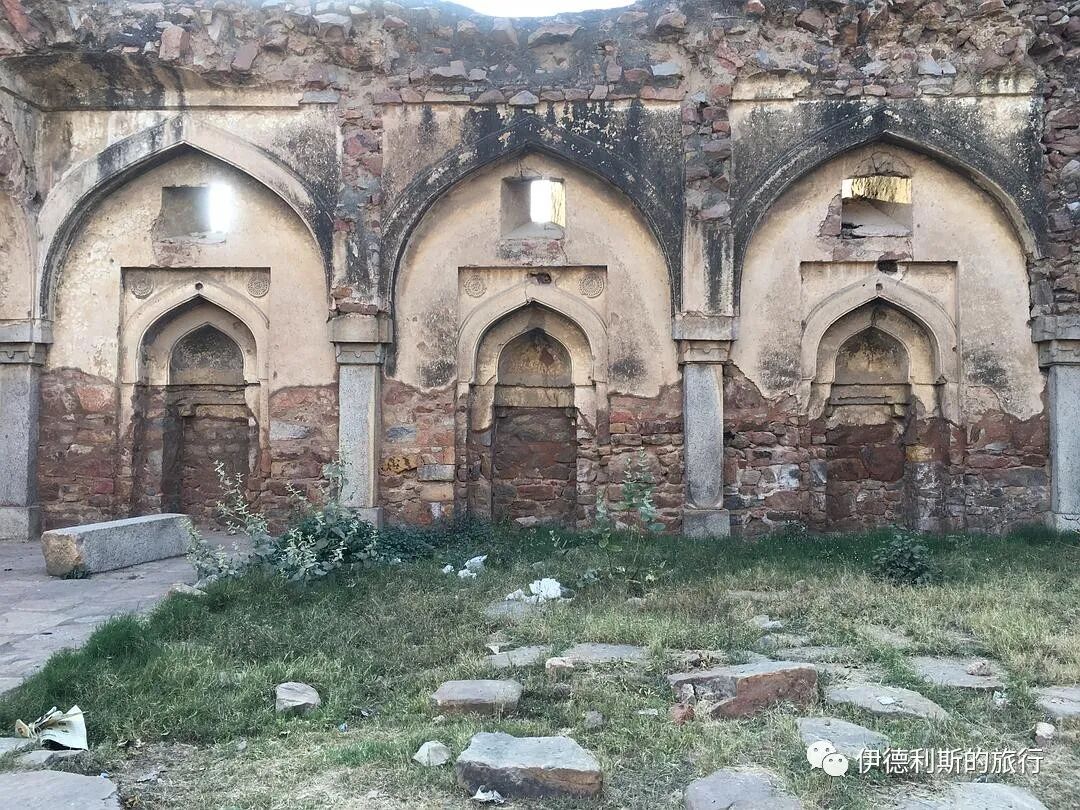
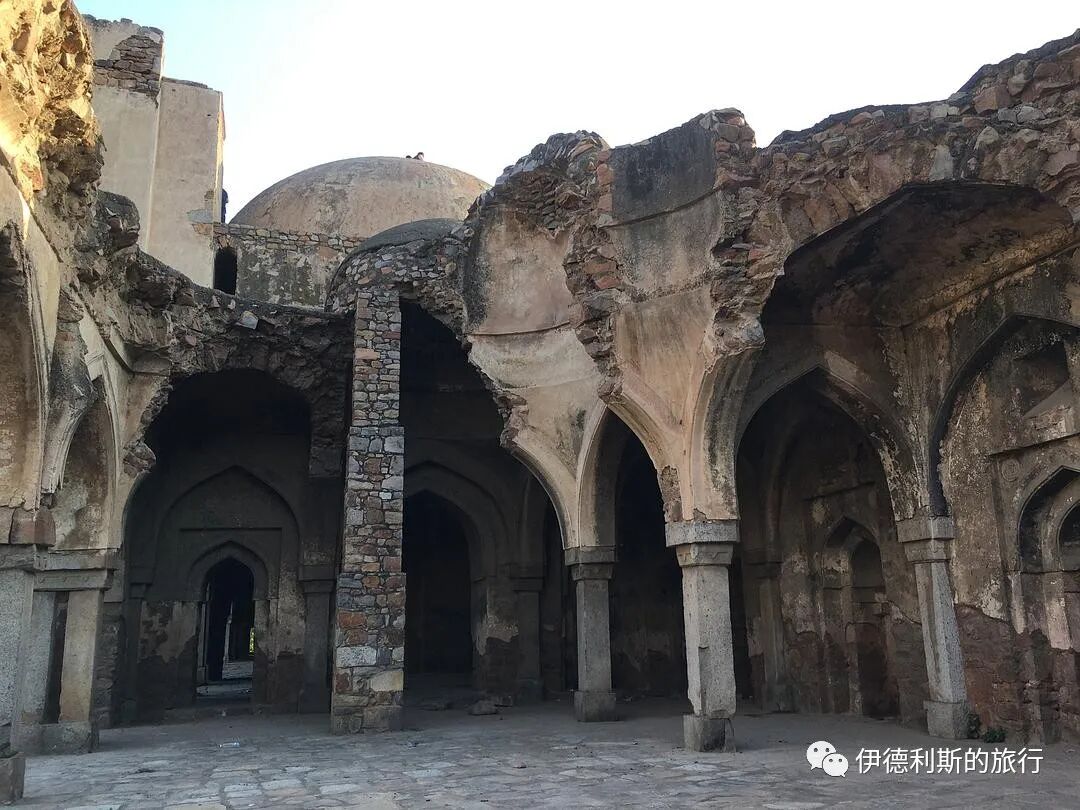
Main prayer hall
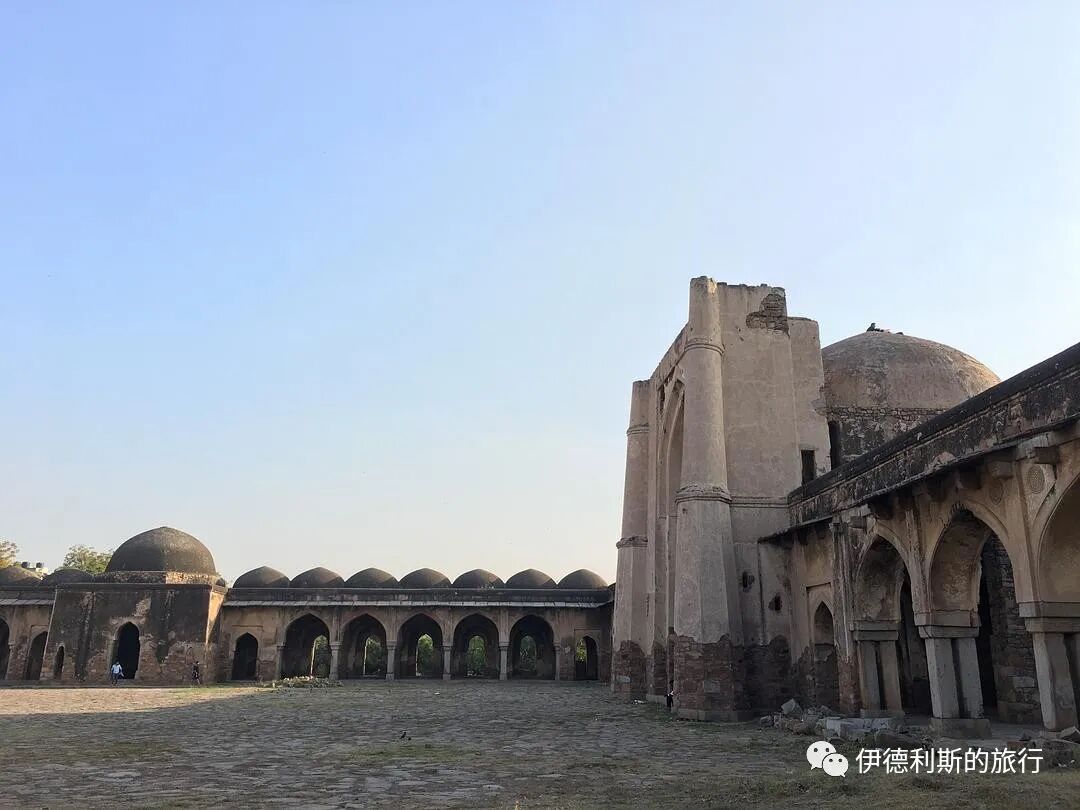
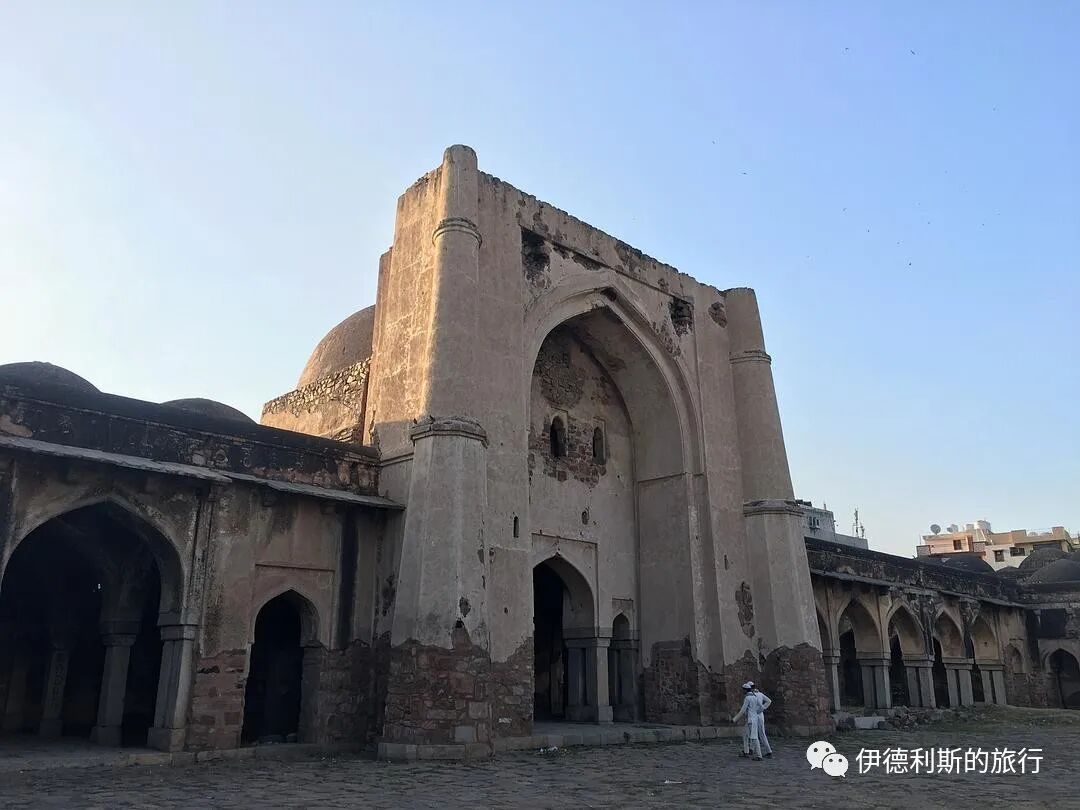
Mihrab
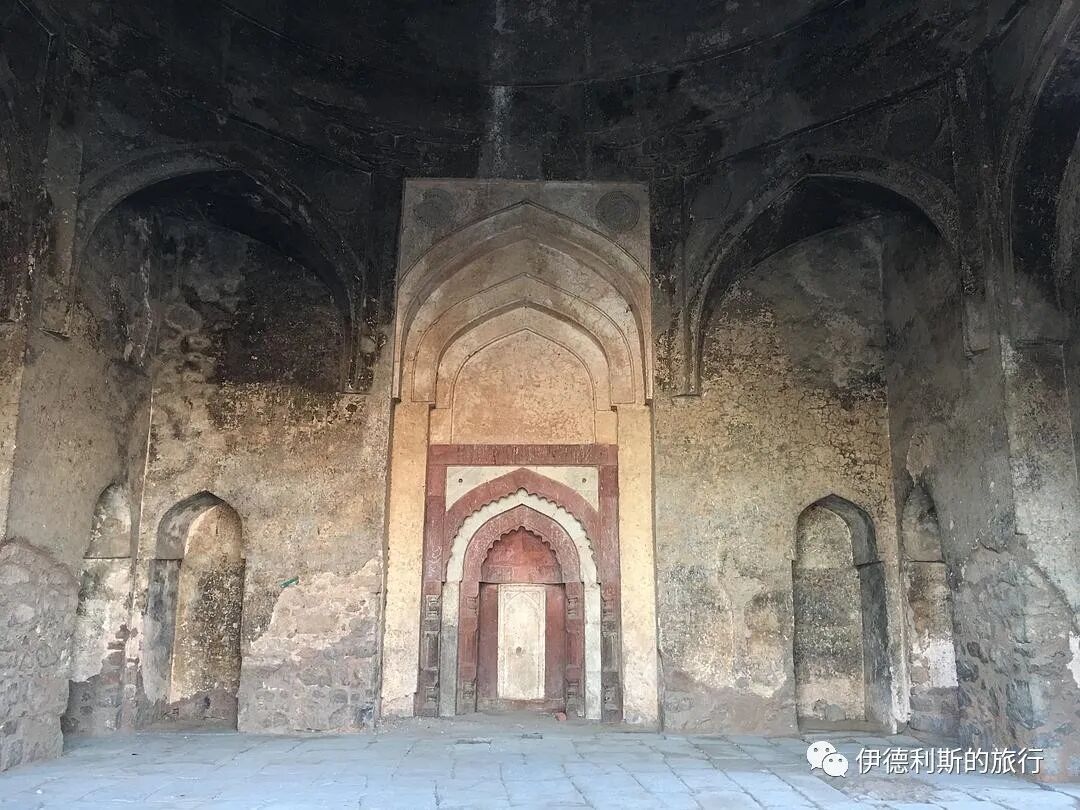
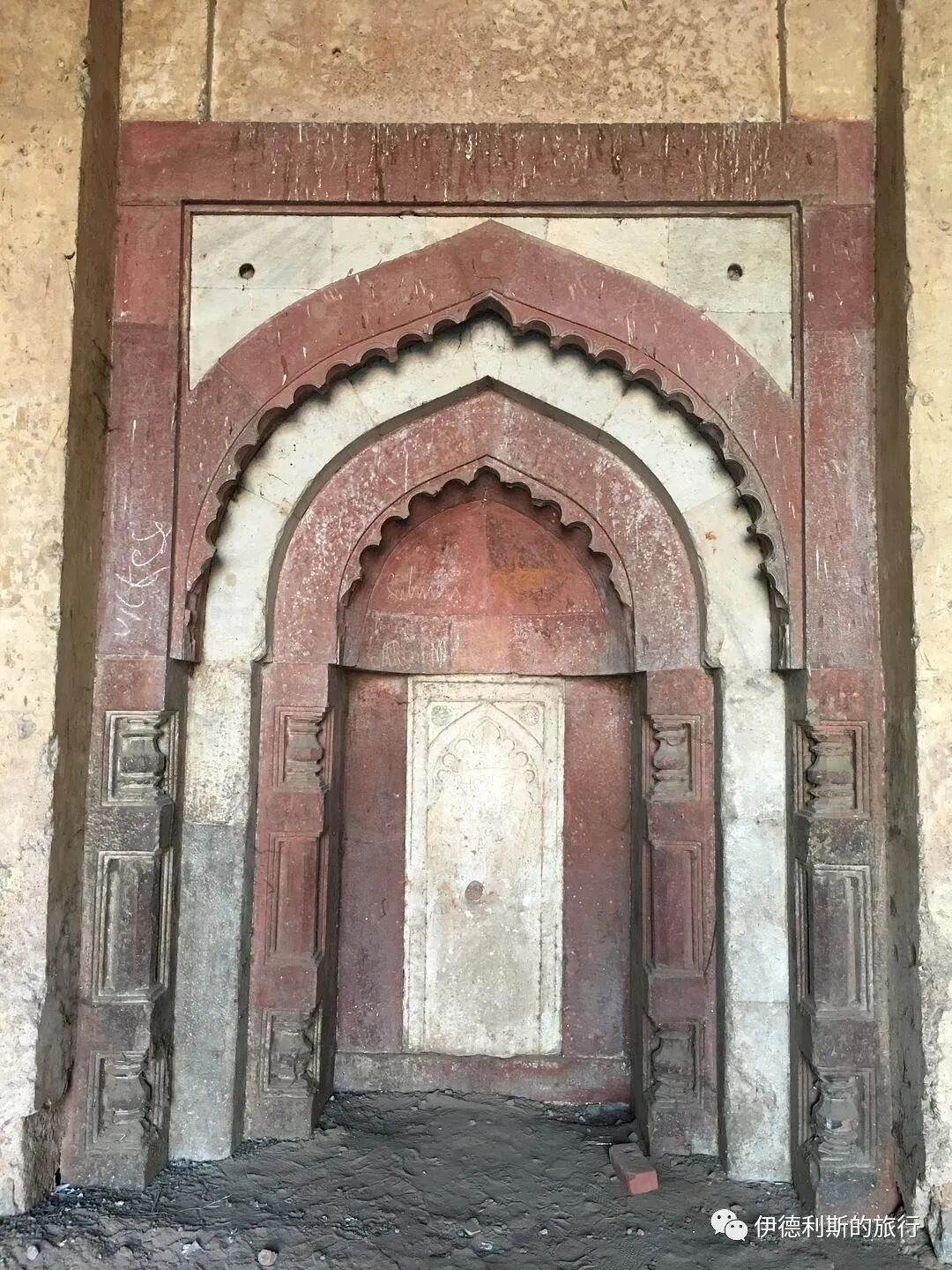
Main prayer hall dome
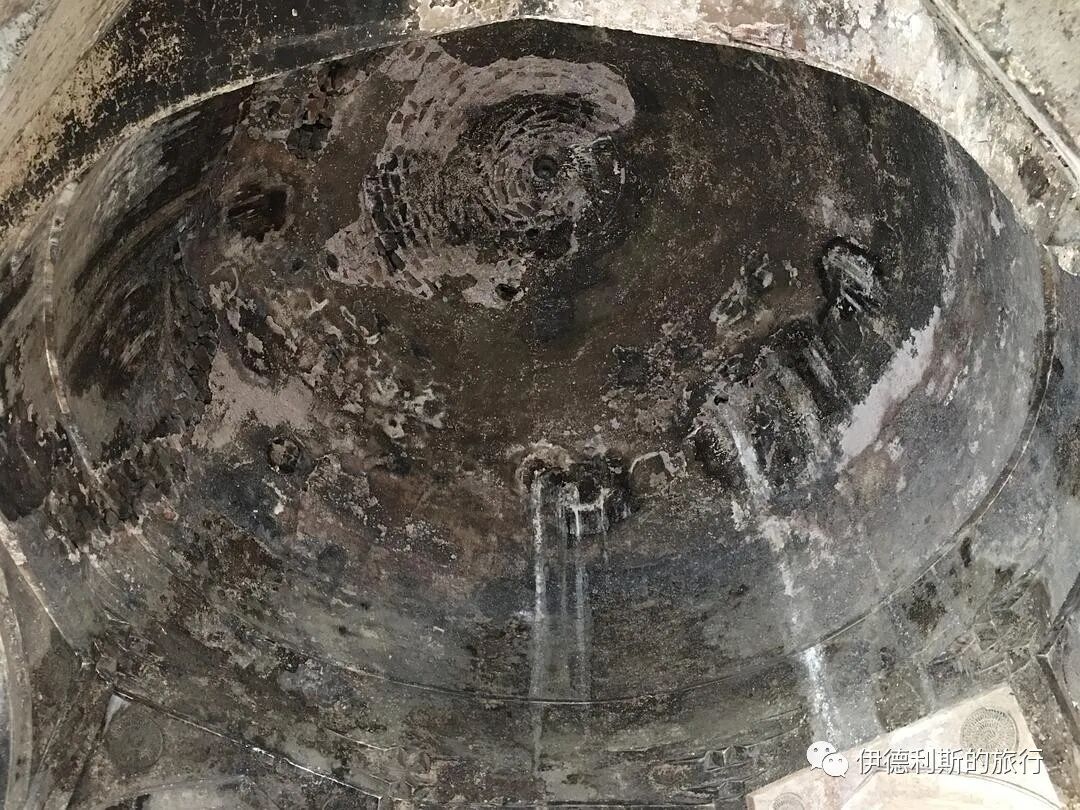
Minimal decoration
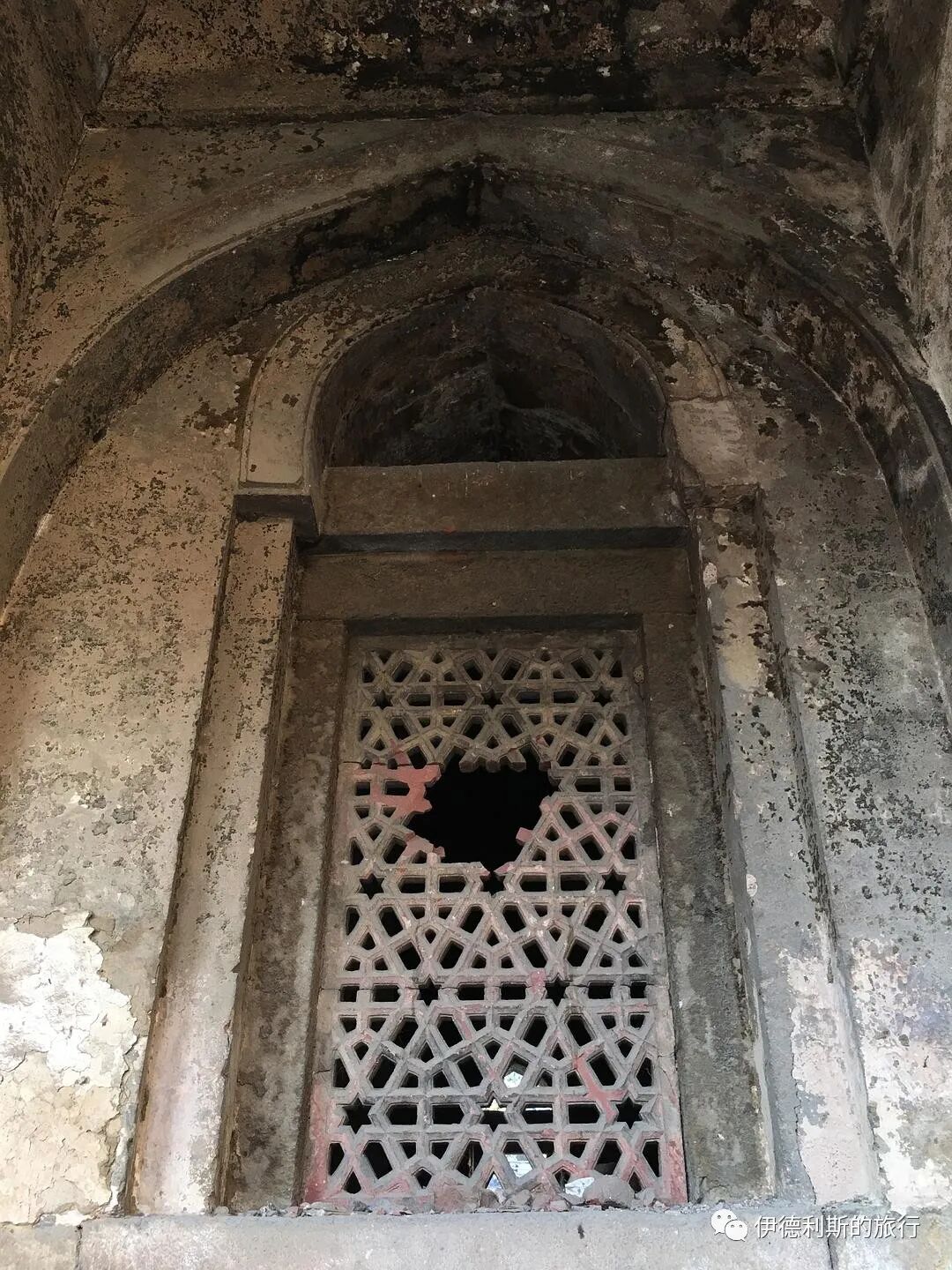
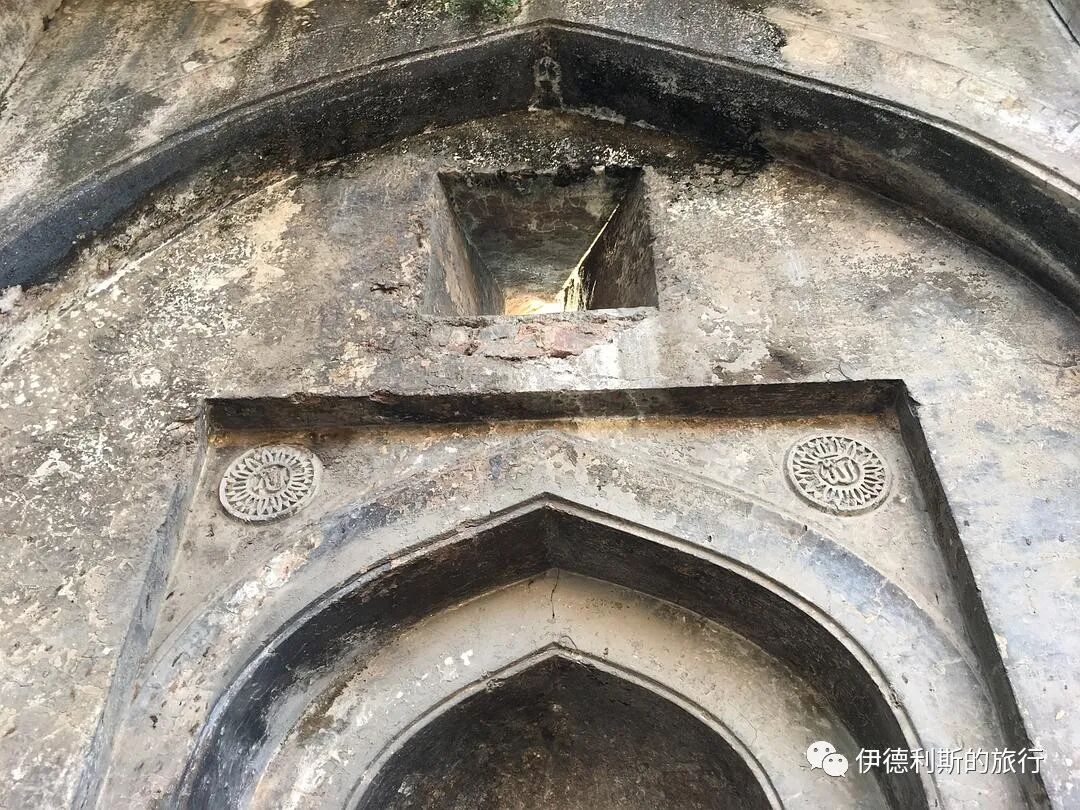
4. Khirki Mosque
Khirki Mosque is another important mosque from the Tughlaq dynasty besides Begumpur Mosque, but its design is very different from Begumpur Mosque. This mosque is undoubtedly one of the seven mosques built by the prime minister Khan-i-Jahan Maqbul, and it was likely built in the 1370s.
Khirki Mosque sits much higher than the ground, and a trench has now formed around it. The mosque has a large gate on the north, east, and south sides, each with small minarets on top, and there is a large minaret at each of the four corners of the mosque.
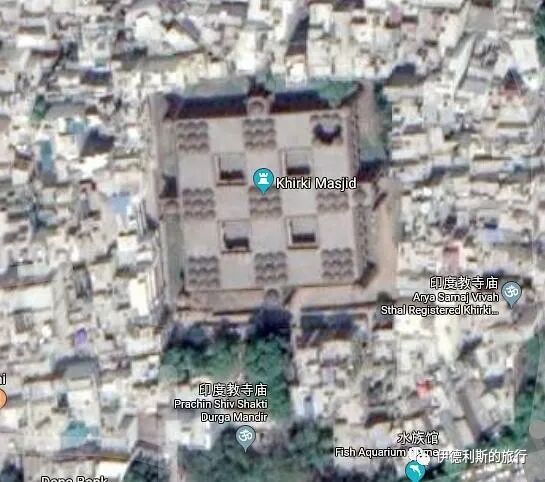
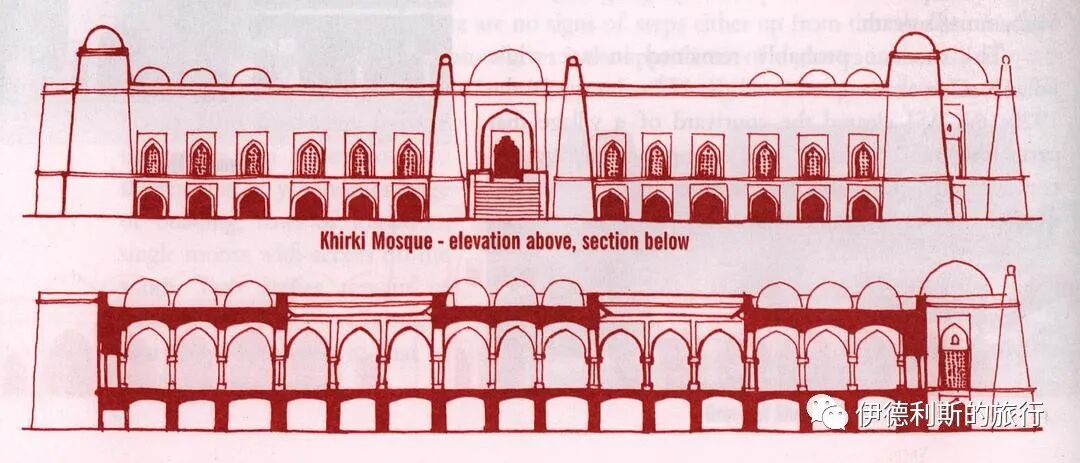
From the book Delhi—A Thousand Years of Building
Mosque facade
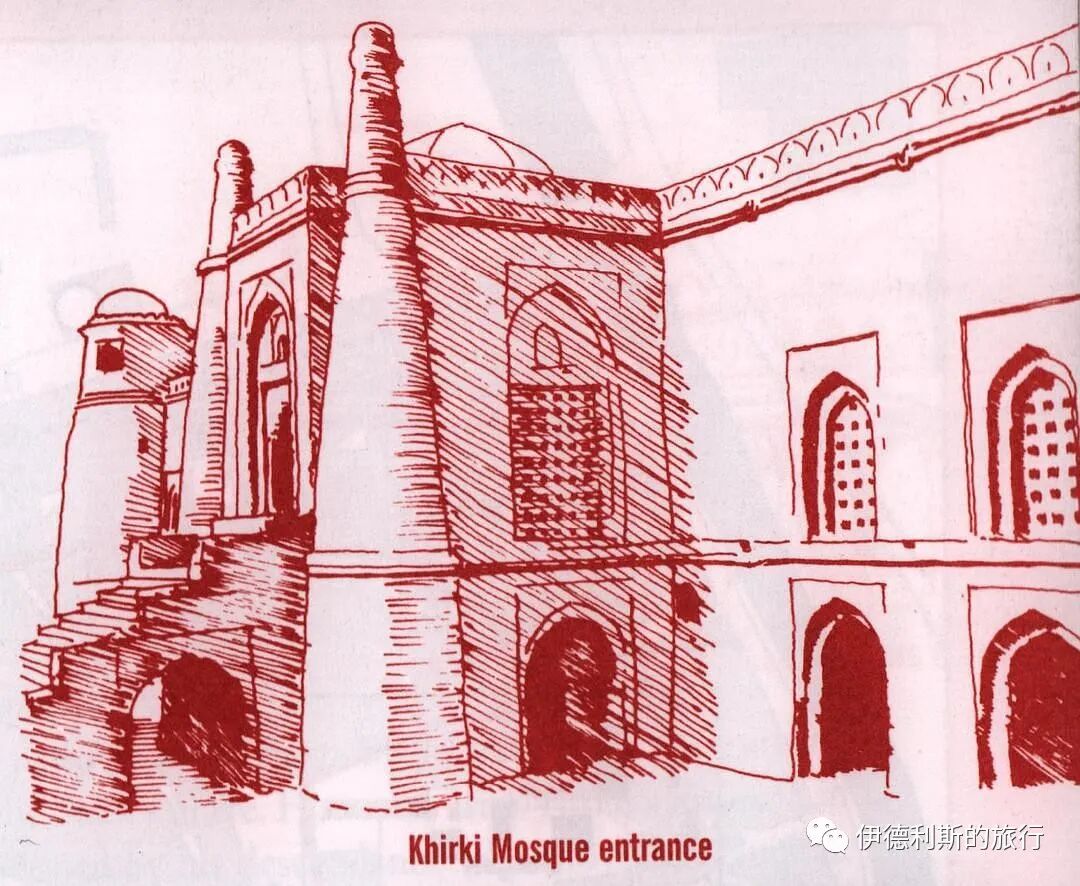
From the book Delhi—A Thousand Years of Building
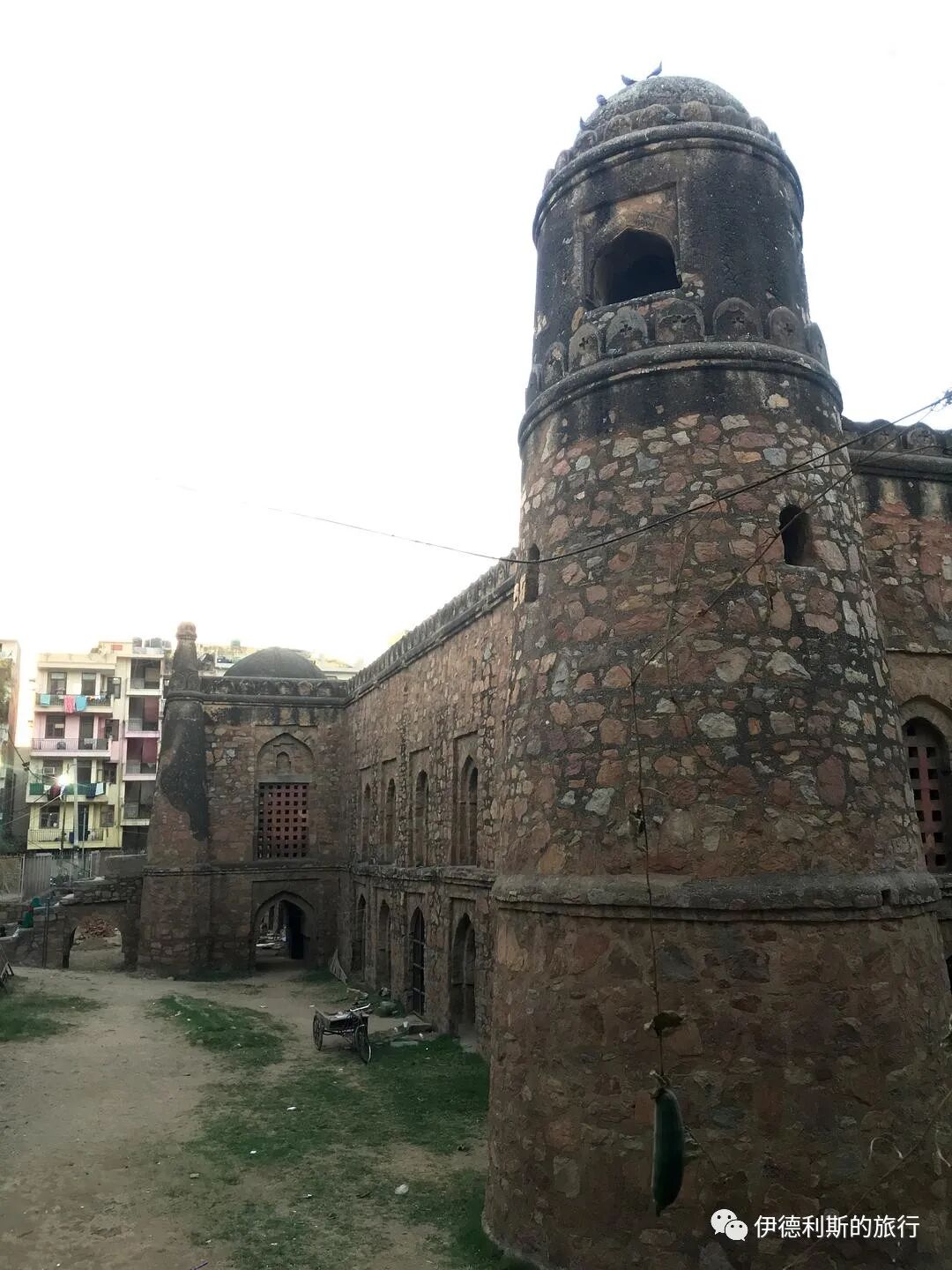
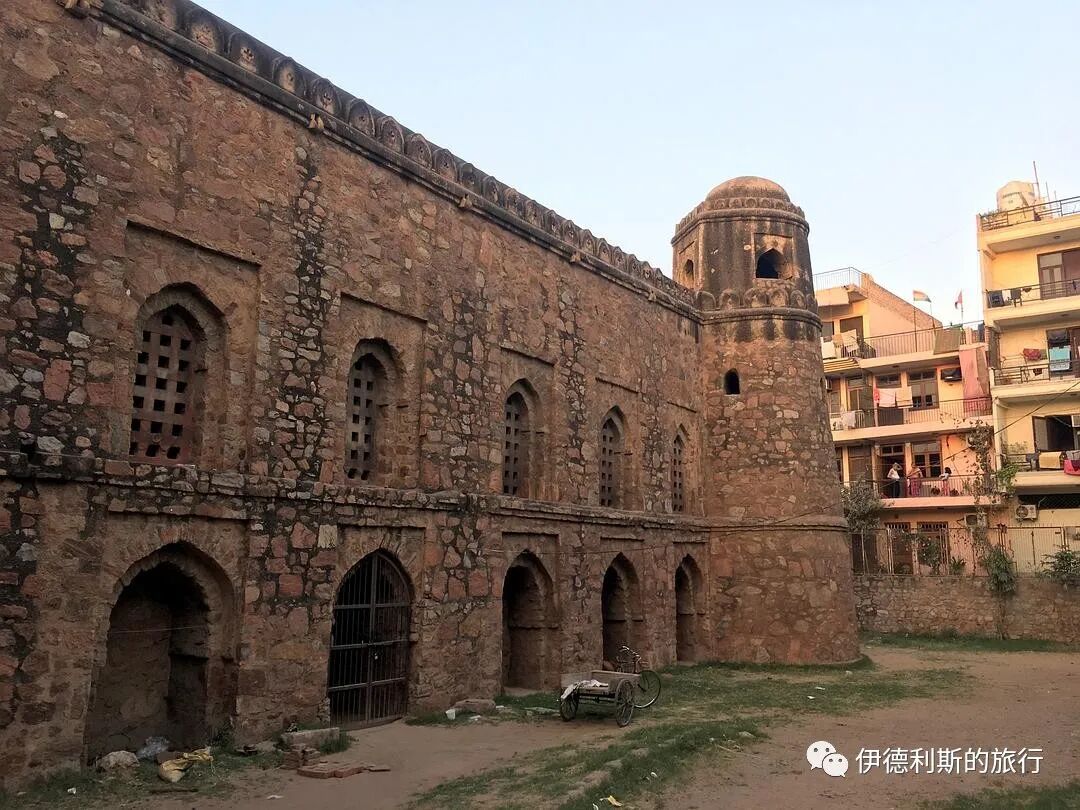
The gate.
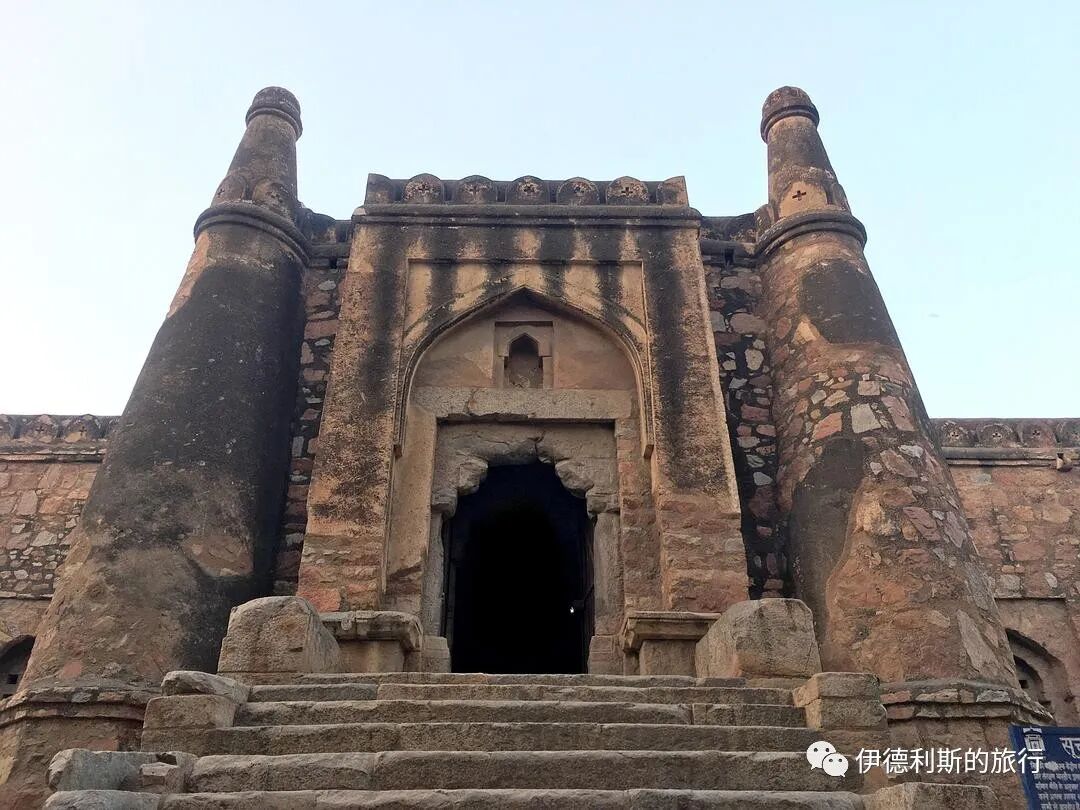
The biggest feature of Khirki Mosque is that its roof is almost completely covered, with only four small square courtyards, which is very rare in the Delhi Sultanate. Because there are only four small open-air courtyards, the mosque cannot be fully lit even during the day, and it is darkest in front of the mihrab in the prayer hall.
The structure made of square pillars and circular domes gives this mosque a strong sense of geometric beauty. I arrived at dusk, and even though it was very dark, I was still stunned.
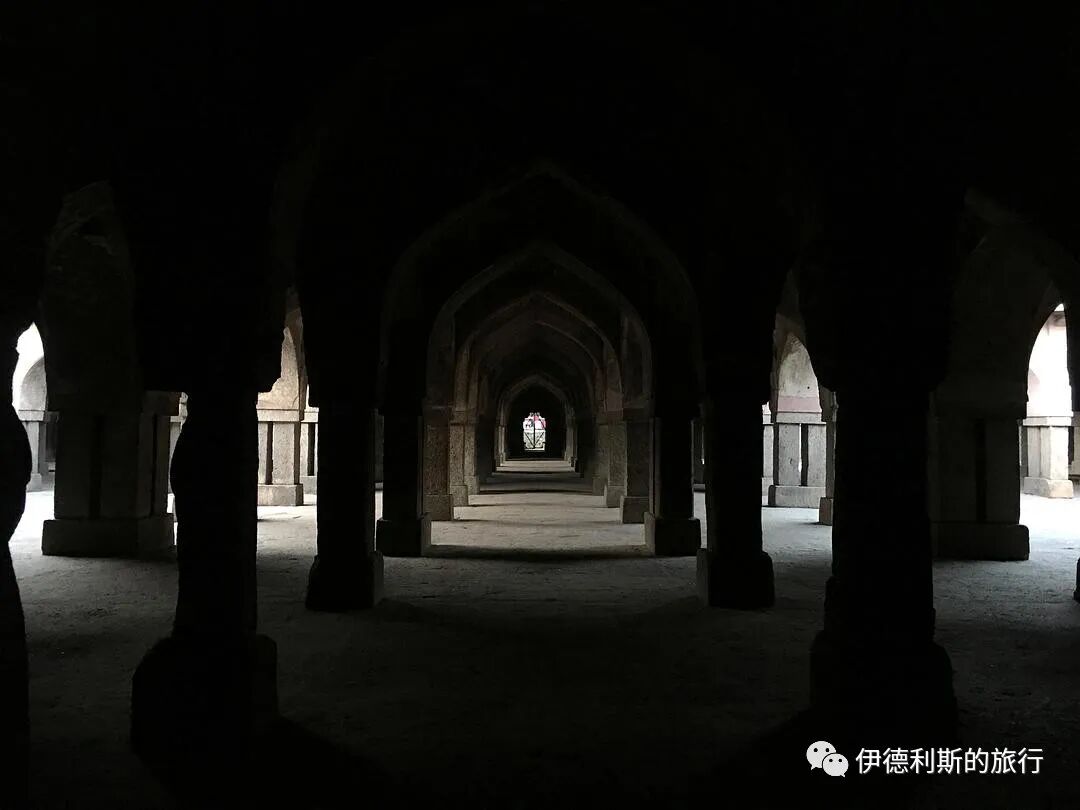
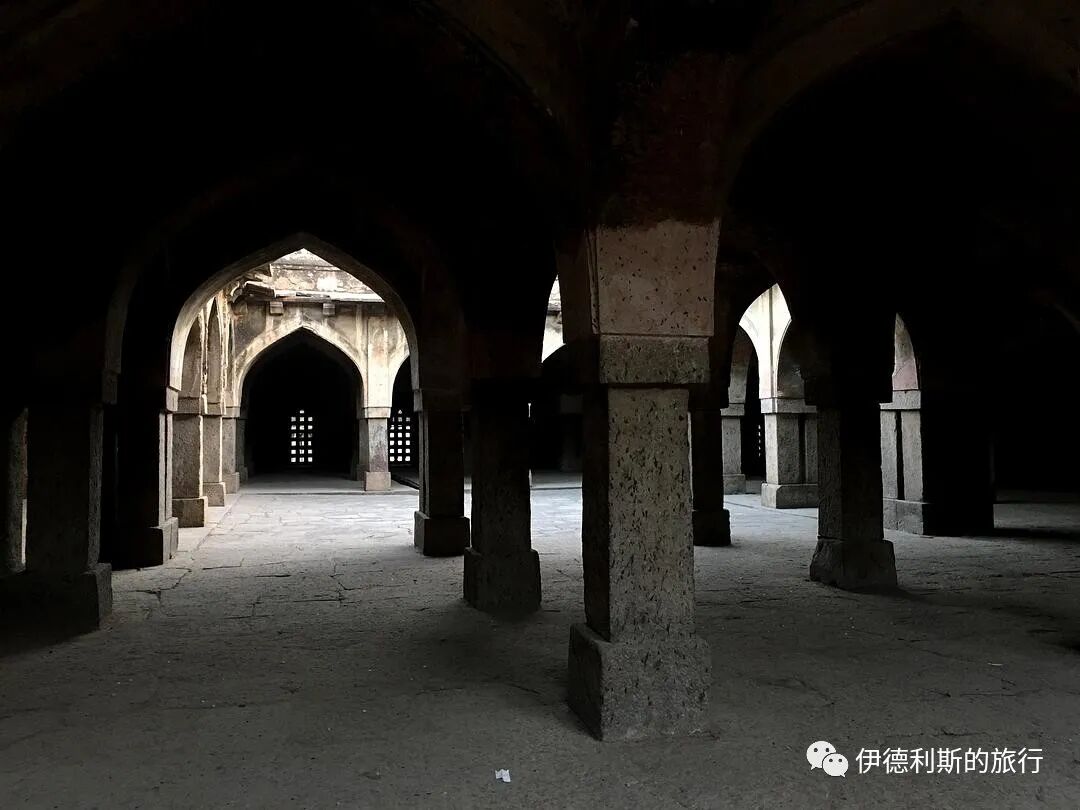
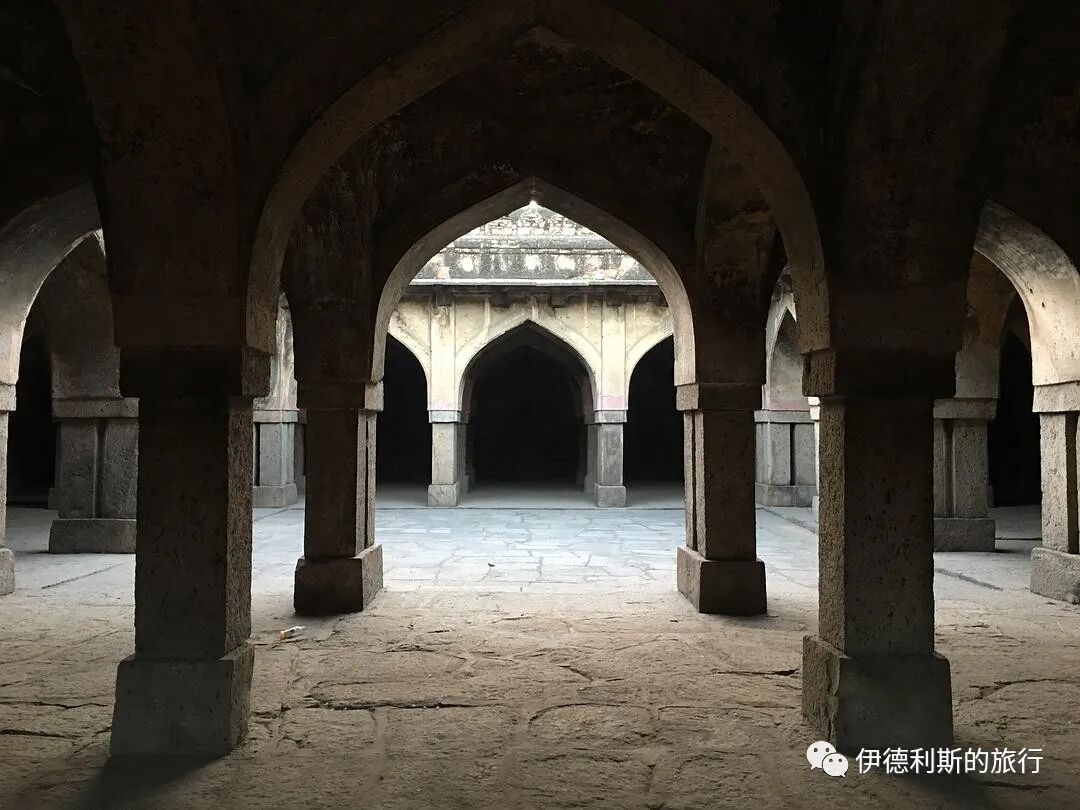
Courtyard
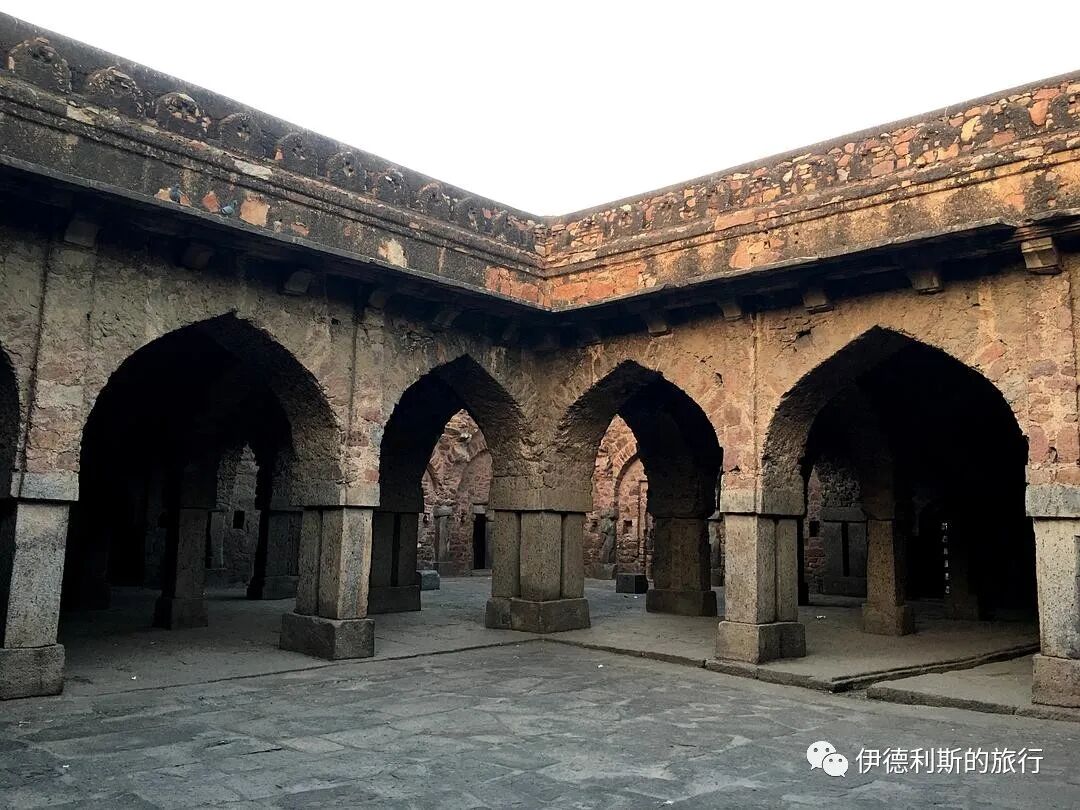
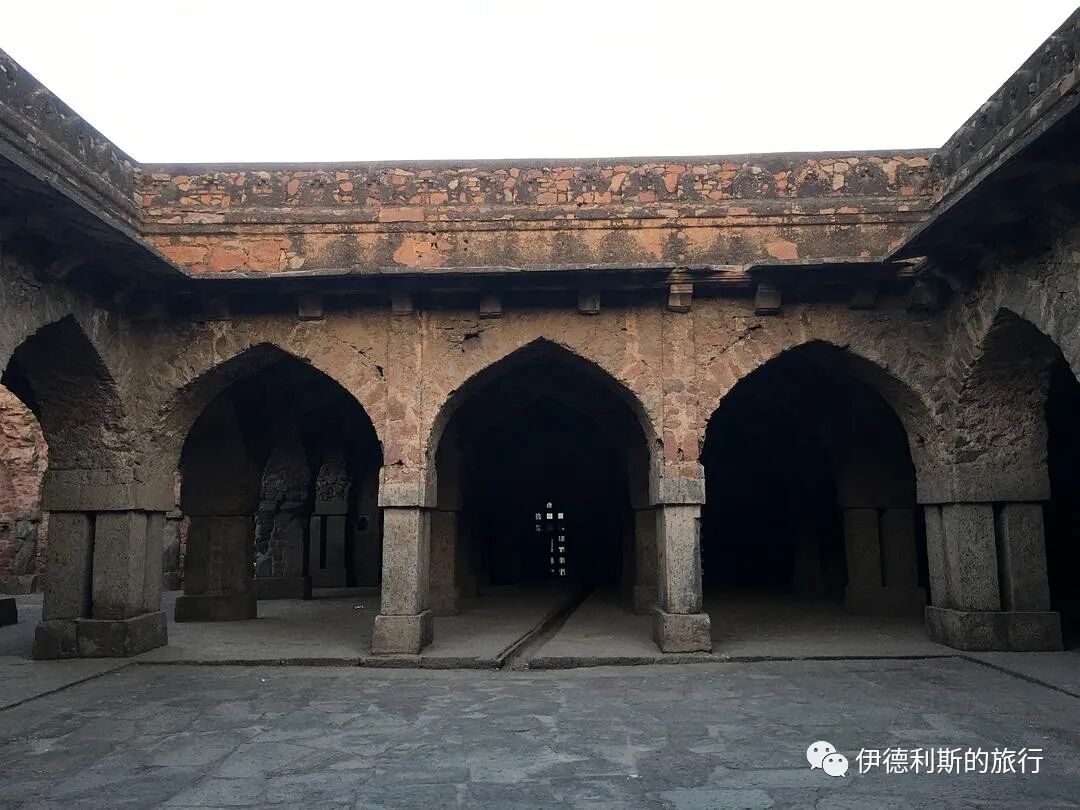
Mihrab
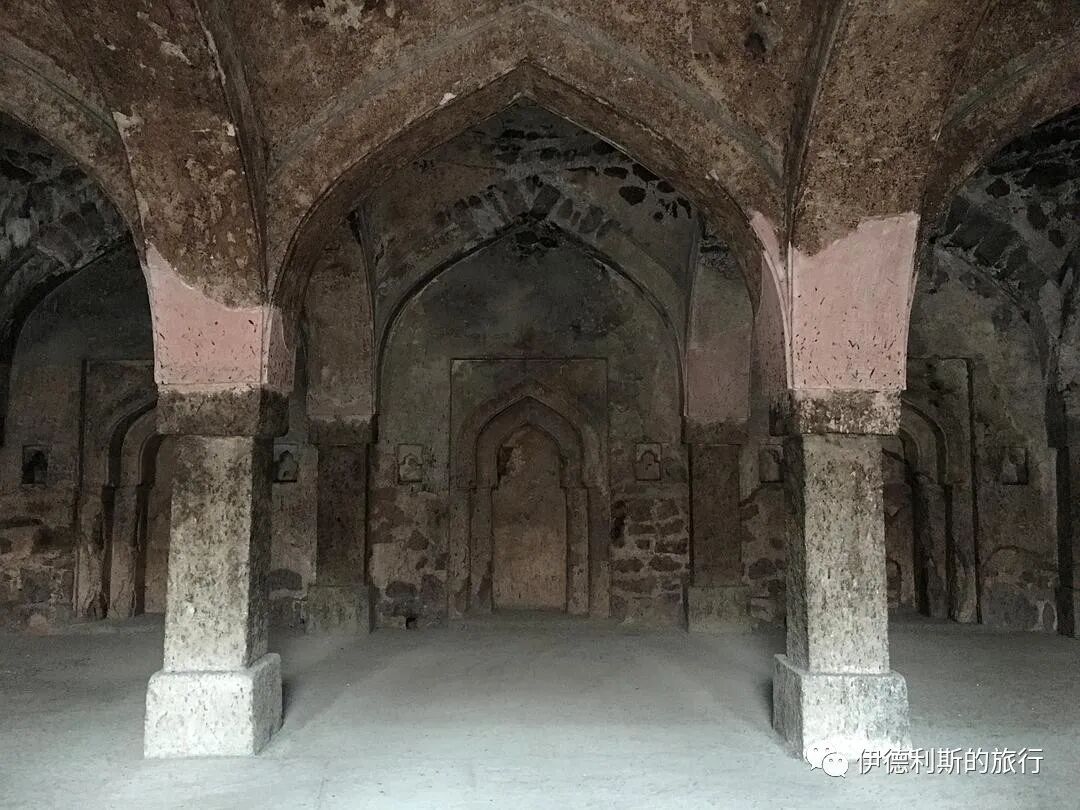
Collapsed dome in the northeast corner
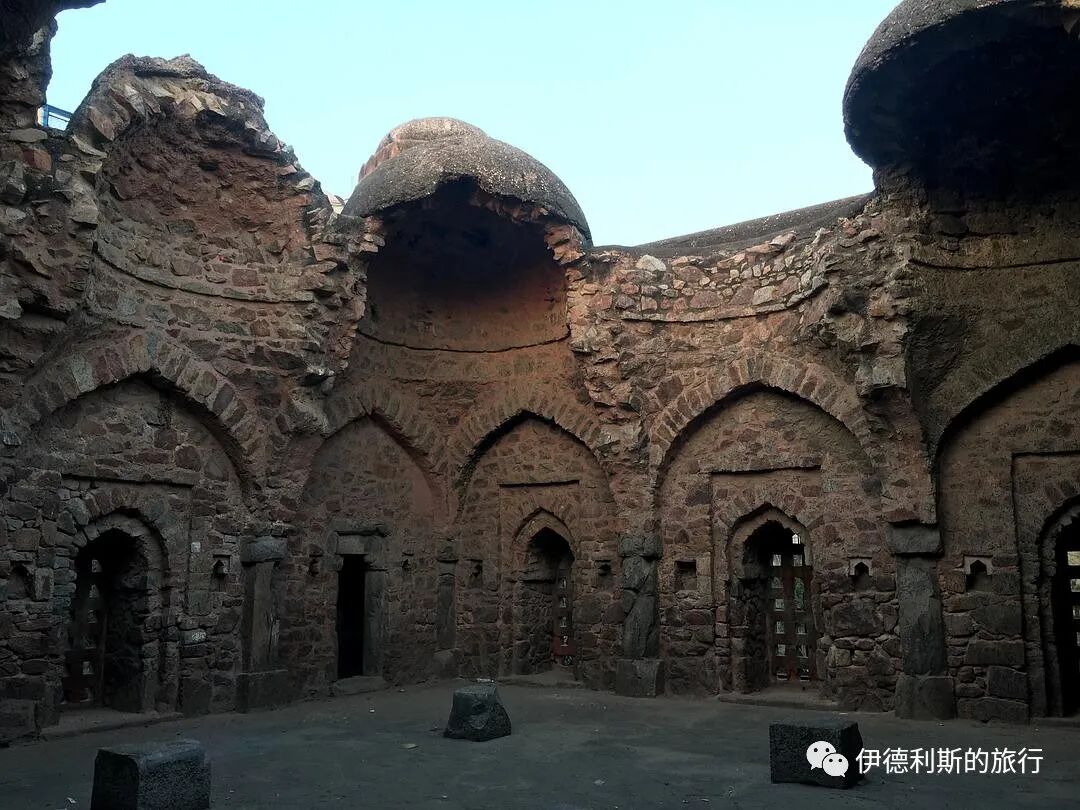
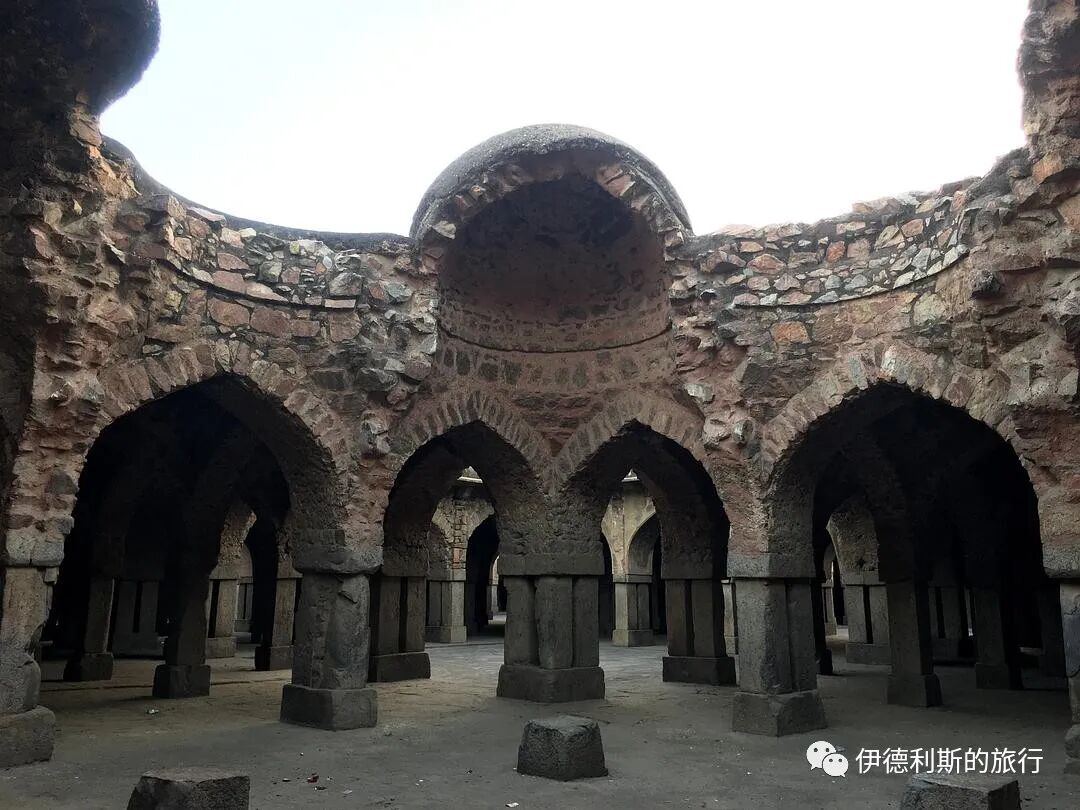
Corner tower
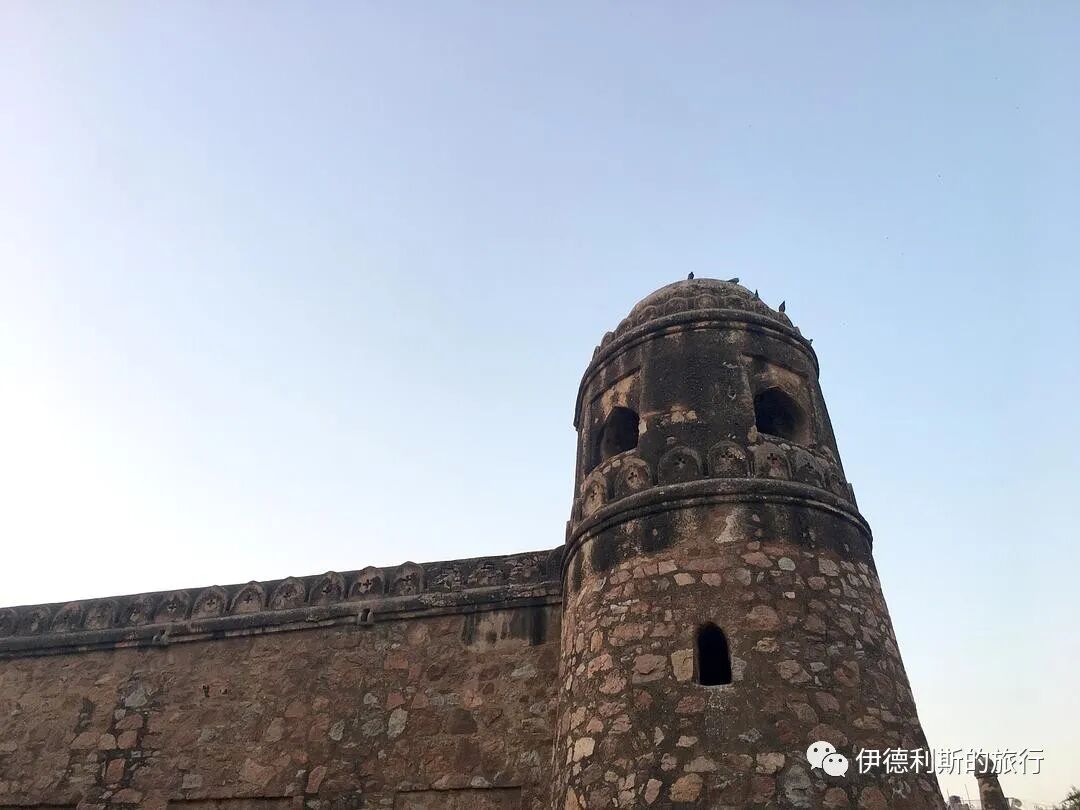
5. Kalusarai Mosque
Kalusarai Mosque is one of the seven mosques built by the aforementioned prime minister Khan-i-Jahan Maqbul. It is currently badly damaged and several families live inside, so the door was locked when I went and I could not enter. This mosque has a more complex structure than the other six mosques built by Khan-i-Jahan Maqbul, but it is still in the typical Tughlaq dynasty style.
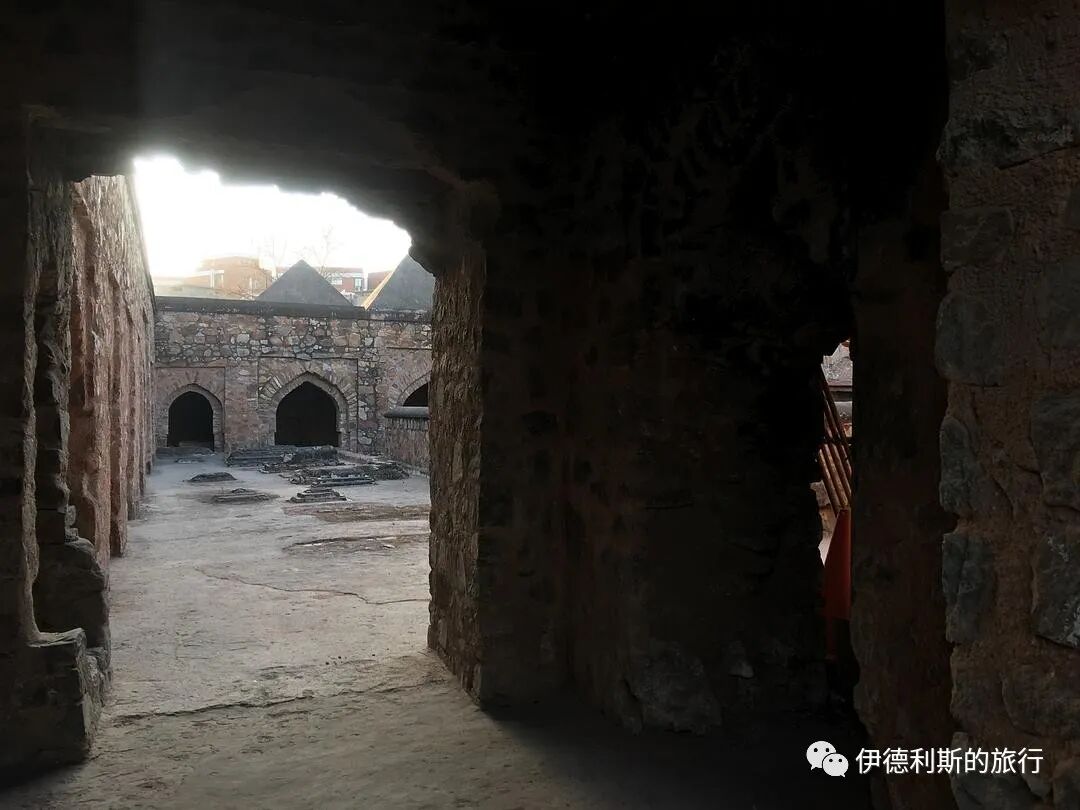
Summary: Delhi — Sultanate Palaces and Muslim History is presented here as a firsthand travel account in clear English, beginning with this scene: In our last post, The Third City of Delhi—Indestructible Beautiful Ruins, we discussed how Ghiyath al-Din Tughluq founded the Tughlaq dynasty, the third dynasty of the Delhi Sultanate, in 1320. The account keeps its focus on Delhi Travel, Sultanate History, Muslim Heritage while preserving the names, places, food, and historical details from the Chinese source.
In our last post, The Third City of Delhi—Indestructible Beautiful Ruins, we discussed how Ghiyath al-Din Tughluq founded the Tughlaq dynasty, the third dynasty of the Delhi Sultanate, in 1320. In February 1325, Ghiyath al-Din died when a pavilion collapsed on him while he was returning to Delhi from Bengal. His son, Sultan Muhammad bin Tughluq, succeeded him, and he is the main character of this post.
Table of Contents
1. The Founding of Jahanpanah
2. The Mysterious Sultan's Palace
1. Upper Platform: Khalji Dynasty
2. Single-story Hall: Khalji Dynasty
3. Octagonal Tower: Early Tughlaq Dynasty
4. Lower Platform: Late Tughlaq Dynasty
5. Cemetery and Religious Site: Lodi Dynasty
6. Circular Dome: Lodi Dynasty
3. Begampur Mosque
4. Khirki Mosque
5. Kalusarai Mosque
1. The Founding of Jahanpanah
Between 1326 and 1327, to prevent invasion by the Mongol army, Muhammad bin Tughluq connected Delhi's first city, Lal Kot, and its second city, Siri, with walls to create the fourth city of Delhi, Jahanpanah.
For information on Lal Kot and Siri, please see my previous two posts: The First City of Delhi—Minarets Reaching the Clouds and The Second City of Delhi—Turkic Fortress Against the Mongol Army.
The term Jahanpanah consists of two Persian words: Jahan means world, and panah means refuge, shelter, or sanctuary.
Muhammad bin Tughluq did not just expand the capital; he also greatly expanded the territory of the Delhi Sultanate. In the image below, dark green shows the territory in 1320, and light green shows the territory in 1330.
The famous Moroccan traveler Ibn Battuta lived in Delhi between 1333 and 1341. Based on his travelogues, we can infer that at the time, Lal Kot was the city center, Siri was a military camp, and Jahanpanah in the middle was the palace area. Ibn Battuta said the Tughlaq Sultan originally wanted to build a super-city connecting Delhi's existing Lal Kot, Siri, and the third city, Tughlaqabad, but he did not carry it out due to limited funds.
The following is from The Travels of Ibn Battuta (Complete Translation).
The maps and hand-drawn illustrations scanned for this diary are all from the book Delhi—A Thousand Years of Building, which is an excellent resource on the history of Delhi.
Map of Jahanpanah:
From the book Delhi—A Thousand Years of Building
Shortly after Jahanpanah was completed, Muhammad bin Tughluq suddenly decided to move the capital to the Deccan Plateau in the south and established a new capital called Daulatabad.
Muhammad bin Tughluq forced the population of Delhi to migrate on a large scale, and those who refused were killed. However, the move failed because Daulatabad lacked enough drinking water due to drought, and Muhammad bin Tughluq eventually moved back to Delhi. Although this relocation failed, it significantly influenced history because many Muslims who moved to the Deccan region did not return to Delhi, leading to a large increase in the Muslim population in central and southern India.
2. The Mysterious Sultan's Palace
Within the ruins of Jahanpanah, there is a huge building site called Bijaya Mandal, which means Victory Platform in Hindi. Bijaya Mandal may be the most puzzling historical building in Delhi. On one hand, we know very little about secular architecture from the Delhi Sultanate period, and on the other, the building changed significantly across different eras.
Much evidence suggests this was likely the palace site of Sultan Muhammad bin Tughluq, but without systematic archaeological excavation, we still cannot be certain about the functions of the existing structures.
Ibn Battuta did not describe the Sultan's palace in much detail. He only mentioned that people had to pass through three gates to reach a palace called bazar suntun, which means thousand pillars. He said these wooden pillars were painted and supported a beautifully carved wooden roof.
It is hard to imagine the appearance of this hall because most buildings preserved from this period are mosques, tombs, and madrasas, with almost no secular buildings remaining. Based on Ibn Battuta's description, this hall likely had long colonnades and a flat roof. One question remains: how did they keep a wooden flat roof waterproof? Regarding the interior of the hall, we only know it had exquisite carvings and the walls were likely decorated with paintings, which were probably removed later during the iconoclastic movement of Firuz Shah Tughlaq (reigned 1351–1388).
Archaeological digs show this building was used for a very long time. Historical records mention that both Sultan Alauddin Khalji (reigned 1296-1316) and Sultan Muhammad bin Tughlaq (reigned 1325-1351) had a palace called bazar suntun. Although Ibn Battuta wrote that Alauddin Khalji’s palace was in the city of Siri, these two palaces are likely the same place, and they are probably Bijaya Mandal.
The stone hall at Bijaya Mandal likely dates back to the time of Alauddin Khalji, while the tower next to it was almost certainly built by Muhammad bin Tughlaq. Archaeological findings show these buildings were still in use after the time of Firoz Shah Tughlaq (1351-1388). In the early 16th century, during the Lodi dynasty (1451-1526), the site was used by a Sufi sheikh named Sheikh Hasan Tahir.
1. Upper Platform: Khalji Dynasty
From the book Delhi—A Thousand Years of Building
The oldest part of this complex is likely the upper platform, which may have been built by Alauddin Khalji (reigned 1296-1316). You can see damaged, sloping retaining walls on the west, east, and south sides of the platform. There are two levels of arched basements visible from the east end of the platform, and a similar structure exists on the west end. The main building likely stood in the middle of the slightly raised area of the platform.
A view from the lower platform looking up at the upper platform, the single-story hall, and the octagonal tower.
2. Single-story Hall: Khalji Dynasty
On top of the platform sits a single-story hall, and above that is an octagonal tower. The hall was also likely built during the time of Alauddin Khalji. There are remains of a balcony in front of the hall, and the bases of the pillars are still there. You can walk from the pillars into the main room, where the roof is held up by stone columns. Behind the first row of stone columns are two large pits half a meter deep. In the early 20th century, the Archaeological Survey of India found many items here, including ivory, porcelain, glass necklaces, pearls, red coral, rubies, and coins dating from 1296 to 1390. This place was likely a treasure storage room at the time.
The hall seems to have had entrances on all four sides, but they were likely blocked when Muhammad bin Tughlaq built the heavy platform under the octagonal tower. The first entrance on the north wall next to the platform also seems to have been changed. Different foundation remains show there was once another room on the edge of the platform on the north side of the hall.
Below is the upper platform, and above is the single-story hall.
Looking down at the upper platform from the roof of the single-story hall.
3. Octagonal Tower: Early Tughlaq Dynasty
From the book Delhi—A Thousand Years of Building
The octagonal tower above the single-story hall was reportedly built by Muhammad bin Tughlaq (reigned 1325-1351). A slope followed by shallow, wide steps leads to the base of the octagonal tower. There is much evidence that the octagonal tower once extended further to the north. The three doors with quartzite frames and the narrow stairs leading to the roof were added later during the late Tughlaq dynasty.
Inside the octagonal tower is a symmetrical, cross-shaped room with the same openings on each side. In the middle of summer, the inside of the tower stays cooler and catches a breeze.
On the roof of the tower, there are two well-preserved sockets. One still has a groove around the edge, which suggests it likely held something on top. Besides these two sockets, there are actually traces of sockets on every level of the stairs. Based on the depth of these sockets, they likely held heavy, tall pillars. It is thought that there might have once been a pavilion (baradari) on top of the tower. There is also a row of small sockets along the edge of the roof, which may have held smaller upright posts.
We can guess that this tower was likely a viewing platform for Sultan Muhammad bin Tughlaq, but the biggest question is how the Sultan got up there, as his fancy clothes would have been hard to wear through the narrow stairs that exist today. It is very likely there was another staircase at the time, although Indian palaces usually did not have fancy stairs and kept them inside thick walls.
The narrow stairs leading to the octagonal tower.
The octagonal tower.
Inside the octagonal tower.
4. Lower Platform: Late Tughlaq Dynasty
From the book Delhi—A Thousand Years of Building
You can go down from the upper platform to a larger lower platform. There are retaining walls on the east and west sides of the lower platform. The buildings on the lower platform date to two periods: the wall foundations are made of large quartzite, while the upper parts feature masonry typical of the Tughlaq dynasty. Archaeological excavations in the 1920s uncovered stone pillar bases on the lower platform, some of which are still visible in the southwest corner today. On the other side of the platform, near the crumbling east retaining wall, you can still see delicate plaster flooring. These ruins may all be part of the palace Ibn Battuta called the bazar sutun.
There is a tall retaining wall between the two platforms, featuring a series of vertical slots that were likely used to hold wooden pillars or decorations. Except for the ramp on the east side of the upper platform, there is no other way to connect the two platforms. The wooden pillars in the lower vertical slots may have supported a higher floor, forming the Sultan's palace along with the stone hall on the south side. Another theory is that the lower platform was the Sultan's palace and the upper platform was his sleeping quarters, which is why the two levels are separate.
Wall foundations of the lower platform.
Wall foundations of the lower platform.
5. Cemetery and Religious Site: Lodi Dynasty
About halfway across the platform, the ground level rises significantly, which likely marks the general area of the palace. Far from the palace is a small cemetery where Sheikh Hasan Tahir and his descendants are buried. This sheikh lived during the Lodi dynasty (1451–1526) and died in 1503. It is said he lived in Bijay Mandal for a long time.
There is an arcade-style building at the very edge of the outer platform of the cemetery. On the north side of the building, there are remains of a long arcade wall, with pillars and arches in the Lodi dynasty style. There are also two sturdy towers, with black plaster coatings on top that reflect the Tughlaq dynasty style. It is believed that this may have been a khanqah (a place for Sufi gatherings) built by Sheikh Hasan Tahir.
Looking out at the lower platform and the sheikh's tomb from the single-story hall.
6. Circular Dome: Lodi Dynasty
Next to Bijaya Mandal is a building with a circular dome, thought to have been built in the 15th century. The purpose of this building remains unknown, and its structure is quite unique: it has two openings on each of the north, south, and west sides, while the east side is sealed. Foundation evidence shows there was once another building on the west side of this structure.
3. Begampur Mosque
Begampur Mosque is the most important mosque in the city of Jahanpanah and the most representative mosque of the Tughlaq dynasty of the Delhi Sultanate still standing today; it is said to have been designed by the Iranian architect Zahir al-Din al-Jayush.
There are two theories about when the mosque was built: one suggests it is one of the seven mosques built by Khan-i-Jahan Maqbul, the wazir (prime minister) of Sultan Firuz Shah Tughlaq (reigned 1351–1388), while the other suggests it was built when Muhammad bin Tughlaq died in 1351.
In 1921, the Archaeological Survey of India cleared out the residents living inside the mosque, giving it the appearance it has today.
Begampur Mosque is magnificent, with a spacious courtyard surrounded by arcades. There is a circular domed building in the center of each of the four sides; the east, north, and west ones are gates, and the largest one on the west side is the main prayer hall.
The mosque is very simple, with only a few carvings inside the main prayer hall. These stone carvings and the dome were once covered in shimmering white plaster, but most of it has fallen off and turned black.
The gate.
Looking inside from the gate.
Inside the gate.
The corridor on the northeast side.
Southwest corridor
Courtyard
Overlook
North gate
South gate
The corridor on the north side of the main prayer hall has collapsed.
Main prayer hall
Mihrab
Main prayer hall dome
Minimal decoration
4. Khirki Mosque
Khirki Mosque is another important mosque from the Tughlaq dynasty besides Begumpur Mosque, but its design is very different from Begumpur Mosque. This mosque is undoubtedly one of the seven mosques built by the prime minister Khan-i-Jahan Maqbul, and it was likely built in the 1370s.
Khirki Mosque sits much higher than the ground, and a trench has now formed around it. The mosque has a large gate on the north, east, and south sides, each with small minarets on top, and there is a large minaret at each of the four corners of the mosque.
From the book Delhi—A Thousand Years of Building
Mosque facade
From the book Delhi—A Thousand Years of Building
The gate.
The biggest feature of Khirki Mosque is that its roof is almost completely covered, with only four small square courtyards, which is very rare in the Delhi Sultanate. Because there are only four small open-air courtyards, the mosque cannot be fully lit even during the day, and it is darkest in front of the mihrab in the prayer hall.
The structure made of square pillars and circular domes gives this mosque a strong sense of geometric beauty. I arrived at dusk, and even though it was very dark, I was still stunned.
Courtyard
Mihrab
Collapsed dome in the northeast corner
Corner tower
5. Kalusarai Mosque
Kalusarai Mosque is one of the seven mosques built by the aforementioned prime minister Khan-i-Jahan Maqbul. It is currently badly damaged and several families live inside, so the door was locked when I went and I could not enter. This mosque has a more complex structure than the other six mosques built by Khan-i-Jahan Maqbul, but it is still in the typical Tughlaq dynasty style.
Muslim Travel Guide Indonesia Banten: Sultanate Mosques, Coastal City and Islamic Heritage
Articles • yusuf908 posted the article • 0 comments • 170 views • 2026-05-23 23:06
Reposted from the web
Summary: Muslim Travel Guide Indonesia Banten: Sultanate Mosques, Coastal City and Islamic Heritage is presented here as a clear Muslim travel account, beginning with this scene: Banten is located at the westernmost tip of Java Island, facing Sumatra across the Sunda Strait. The account keeps its focus on Banten Mosques, Indonesia Muslim Travel, Sultanate History while preserving the names, places, food, and historical details from the Chinese source.
Banten is located at the westernmost tip of Java Island, facing Sumatra across the Sunda Strait. The local Bantenese people are a branch of the Sundanese. In the 16th century, the Banten Sultanate rose to become a powerful maritime trading nation in western Java, controlling the pepper trade in Southeast Asia. The Banten Sultanate reached its peak in the 17th century and had intense conflicts with the Dutch East India Company. After the 18th century, the Banten Sultanate gradually came under the control of the Dutch East India Company and was finally annexed into the Dutch East Indies in the 19th century.
Today, the ancient city of Banten still retains many ruins, and the Great Mosque of Banten (Masjid Agung Banten), built in the 16th century, remains a famous religious site. two palaces of the Banten Sultanate, a Dutch fortress, and several tombs of the Banten Sultans have been preserved. Due to time constraints, I could not visit all the historical sites this time, but I still hope to share the ruins of the Banten Sultanate that I saw with everyone.
Table of Contents
1. Traveling to the Ancient City of Banten
2. The Establishment of the Banten Sultanate
3. The Port City of Banten
4. Surosowan Palace—Sultan's Residence: 1552
5. Great Mosque of Banten: 1566
6. Banten Bazaar
7. Speelwijk Castle—Dutch Fortress: 1682
8. Kaibon Palace—Residence of the Last Queen Mother: Early 19th Century
1. Traveling to the Ancient City of Banten
The ancient city of Banten is located west of Jakarta, and it takes an hour and a half to drive there under normal traffic conditions. There are buses from Kalideres bus station in western Jakarta to the city of Serang, where Banten is located. Once you arrive at the station, just ask people for "Serang" and they will point you in the right direction. The bus I took picked up passengers along the way before getting on the highway, so it took three hours to reach Serang. Friends who want to go, please make sure to allow extra time. It was very interesting that before getting on the highway, vendors kept getting on the bus to sell various things, including fruits, snacks, ballpoint pens, electronic watches, and so on. There were also several groups of singers, making it feel like a moving bazaar.
After getting on the bus, be sure to tell the driver or conductor that you are going to the Great Mosque of Banten, which is Masjid Agung Banten. Note that the pronunciation of Banten is "Banden." Then the driver will drop you off at the intersection before entering Serang city. From there, you can take a minibus or call a Grab to the ancient city of Banten.
2. The Establishment of the Banten Sultanate
After the 15th century, the Hindu-Buddhist Majapahit empire declined and the Islamic Malacca Sultanate rose. Many Muslim merchants from Arabia and India settled on the north coast of Java, marking a new chapter in Javanese history.
Between the 15th and 16th centuries, many Sufi Muslims arrived in Java to spread the faith, with the Nine Saints (Wali Songo) being the most famous. Among the Nine Saints, Sunan Gunung Jati was the only one who used military force to spread Islam.
Sunan Gunung Jati was born Syarif Hidayatullah. His father came from the Hashim family in Egypt, the same family as the Prophet Muhammad, and his mother was a princess from the Hindu Sunda Kingdom in western Java. Although his grandfather was a Hindu king, Sunan Gunung Jati's mother and his uncle, Prince Walangsungsang, both converted to Islam.
In 1470, after spending years studying Islamic knowledge in places like Mecca and Baghdad in the Middle East, Sunan Gunung Jati returned to Java to help his uncle rule the port town of Cirebon in West Java. In 1479, Sunan Gunung Jati took over from his uncle to rule Cirebon, established the Cirebon Sultanate, and officially declared independence from the Sunda Kingdom in 1482.
Shortly before Sunan Gunung Jati established the Cirebon Sultanate, the Muslim port town of Demak in Central Java had already gained independence from the Majapahit Kingdom in 1475. These two Javanese Muslim states, which relied on maritime trade, joined forces and posed a major threat to the existing Hindu Sunda Kingdom. The Sunda Kingdom then went to Malacca to seek help from the Portuguese. In 1522, the Portuguese officially formed an alliance with the Sunda Kingdom to control the local pepper trade.
However, after the alliance was formed, the Portuguese failed to send troops to help in time. The joint Cirebon-Demak forces took the opportunity to capture Sunda Kalapa, an important port of the Sunda Kingdom, and renamed it Jakarta. After that, the Sunda Kingdom fought a five-year war alone against the Cirebon-Demak coalition. In 1527, the Sultan of Cirebon, Sunan Gunung Jati, sent his son Hasanudin to join the Demak Sultanate and capture Banten, another important port of the Sunda Kingdom. Sunan Gunung Jati then appointed his son as the Sultan of Banten. In 1552, the Banten Sultanate broke away from the Cirebon Sultanate and became an independent state.
The territory of the Banten Sultanate, drawn by Gunawan Kartapranata.
3. The Port City of Banten
Shortly after becoming the Sultan of Banten, Hasanudin began building a new port city at the mouth of the Banten River. By the mid-16th century, Banten had become an important port that could rival Malacca.
According to the Portuguese historian João de Barros, the city of Banten was located in the middle of the harbor, and a clear river ran through the city, allowing ships to sail into the town center. Inside the city, there was a brick fortress with a two-story wooden defensive structure. The city center had a square that served as a market in the morning and was used for military or artistic activities at noon. On the south side of the square was the Sultan's palace, known as the Surosowan Palace, with a tall building next to it used by the Sultan to receive his subjects. On the west side of the square was the Great Mosque, which is today's Great Mosque of Banten.
At that time, only local residents were allowed to live in the city. Foreigners lived near the harbor in the north, with foreign Muslims in the northeast and non-Muslim foreigners in the northwest.
In the late 16th century, the Banten Sultanate controlled the pepper trade in the Lampung region at the southern tip of Sumatra. It traded closely with Portugal, the Netherlands, Britain, France, and Denmark, becoming a major international trade hub in Southeast Asia. With help from the British, the Danes, and the Chinese, the Banten Sultanate traded with Persia, India, Siam, Vietnam, the Philippines, China, and Japan.
Banten City in 1724, drawn by François Valentijn.
4. Surosowan Palace—Sultan's Residence: 1552
Surosowan Palace was built in 1552 by the Banten Sultan Maulana Hasanuddin and later served as the residence for successive sultans. A Dutchman designed the palace, which is why it features the corner bastion structure of a Dutch fort.
In 1808, to defend against a British invasion of Java, the Dutch ordered the construction of the Great Post Road across the island. They also ordered the Banten Sultan to move his capital and provide labor to build a port for the Dutch fleet. The Sultan refused, so the Dutch destroyed Surosowan Palace and imprisoned the entire royal family. After the British invaded Java in 1813, they forced the last Sultan to abdicate, marking the end of the Banten Sultanate. After the Anglo-Dutch Treaty of 1814 was signed, Britain returned the Banten region to the Dutch, and Banten was officially incorporated into the Dutch East Indies.
Today, the ruins of Surosowan Palace include two-meter-high walls made of red stone and coral. The most prominent site inside is the princess's bathing pool, which looks similar to the existing pools at the Sultan's palace in Yogyakarta.
5. Great Mosque of Banten: 1566
The Great Mosque of Banten (Masjid Agung Banten) is a famous Javanese-style mosque, built in 1566 by order of Sultan Maulana Hasanuddin. The women's hall (Pawestren) was added in the 1580s. In 1632, a Chinese man named Cek-ban-cut designed and built the minaret (bangker), and in the 17th century, a Dutch convert to Islam named Hendrik Lucaasz Cardeel designed and built the religious school (tiyamah).
As a typical Javanese-style mosque, the Great Mosque of Banten has a large porch-style shelter (serambi) in front of the main prayer hall. Inside the main hall, four main wooden pillars (saka guru) support a five-tiered roof. The top three tiers look more like a Chinese Buddhist pagoda than a traditional Javanese roof. Historical records suggest the original roof only had three tiers, and the top two were likely added between the 18th and 19th centuries. The mosque's minaret is 24 meters high with a base diameter of 10 meters, blending Mughal style with the local Javanese Hindu/Buddhist mosque (Candi) style.
The Great Mosque of Banten, drawn by Josias Cornelis Rappard in the 1880s.
Right next to the mosque is the family cemetery of the Banten Sultanate. The first Sultan, Maulana Hasanuddin (reigned 1552–1570), the sixth Sultan, Ageng Tirtayasa (reigned 1651–1683), and the seventh Sultan, Abu Nashar Abdul Qahar (reigned 1683–1687), are all buried there.
The reign of the sixth Sultan, Ageng Tirtayasa, from 1651 to 1682, is known as the golden age of the Banten Sultanate. During this time, the Banten Sultanate built a powerful navy with the help of European shipyards and attracted many Europeans to work in Banten. To ensure safe travel, the Banten Sultanate sent a fleet in 1661 to conquer the Tanjungpura Kingdom in western Kalimantan, attempting to break the blockade by the Dutch East India Company (VOC).
6. Banten Bazaar
As a holy site, the Great Mosque of Banten attracts a constant stream of Muslims every day, and a very lively bazaar has formed around it. At the bazaar, I drank an iced beverage called Es Campur made with coconut milk, red sugar syrup, coconut meat, and fruit jelly, and I also had some simple street-style boiled noodles (Mie Rebus). The bazaar is full of people selling sapodilla (Manilkara zapota), which is sweet and delicious. Sapodilla is native to the Caribbean in Central America. It was brought to the Philippines by Spanish colonists and later widely planted across Southeast Asia, where it is called sawo in Indonesia.
I bought two hats at the Banten bazaar. One of them is the black velvet cap (peci), which is the most common type in Indonesia. The peci is also called a songkok (Songkok). Indonesian and Malay Muslim men usually wear this hat for important ceremonies like weddings, funerals, or Eid al-Fitr. The word peci likely comes from the Dutch word petje, which means small hat.
The peci may have originated from the felt fez hat promoted by the Ottoman Empire starting in 1826. It soon spread to the Indonesian and Malay regions, gradually taking on the form of the modern songkok. Many Indonesian nationalist activists wore the songkok in the early 20th century, with Indonesia's first president, Sukarno, being the most famous among them. After Sukarno made the peci part of the official Indonesian presidential attire, black velvet became the most common style of peci in Indonesia.
The second hat is made of woven bamboo. Besides the round one I bought, there are also boat-shaped ones similar to the songkok, which feel perfect for summer.
Another hat shop.
7. Speelwijk Castle—Dutch Fortress: 1682
Speelwijk Castle is a fortress built by the Dutch East India Company on the northwest coast of Banten. It was first built in 1682 and expanded twice, in 1685 and 1731. This castle was mainly used to control the activities of the Banten Sultanate and to protect Dutch merchant ships from pirate attacks.
Starting in the 16th century, the Dutch began competing with Portugal and England for the pepper trade in Java. In 1602, the Dutch established the famous Dutch East India Company, and the following year they set up a permanent trading post in Banten. In 1619, the Dutch East India Company captured Jakarta, which was controlled by the Banten Sultanate, and renamed it Batavia to serve as their headquarters. By the late 17th century, the Dutch East India Company had become the world's wealthiest private company and had completely defeated the Portuguese on Java.
In 1680, the Dutch East India Company incited a civil war within the Banten Sultanate, took the opportunity to drive British merchants out of Banten, and gained a monopoly on the surrounding pepper trade. After 1682, the Banten Sultanate gradually came under the control of the Dutch East India Company, and even the succession of the Sultan required approval from the company. Speelwijk Castle is the best witness to this historical period. After 1752, the Banten Sultanate officially became a vassal state of the Dutch East India Company.
Speelwijk Castle was eventually abandoned due to a plague in 1811. Today, there are many Dutch graves in front of the castle, including those of castle officer Hugo Pieter Faure, who died in 1763, and the castle tax collector and purchaser Kopman en Fiscaal Deserbezeting, who died in 1769.
Old photo of the Dutch cemetery
8. Kaibon Palace—Residence of the Last Queen Mother: Early 19th Century
Kaibon Palace was the last building constructed by the Banten Sultanate. Built in the early 19th century, it served as the palace for Ratu Aisyah, the mother of the final sultan, Muhamad Syafiuddin.
After the British invaded Java in 1813, they ordered the final Banten sultan, Muhamad Syafiuddin, to abdicate, marking the end of the Banten Sultanate. After the Anglo-Dutch Treaty of 1814 was signed, Britain returned the Banten region to the Dutch, and Banten was officially incorporated into the Dutch East Indies. In 1832, the Dutch destroyed Kaibon Palace, leaving it in complete ruins.
The palace still preserves its traditional Javanese Paduraksa-style gate. The Paduraksa gate originated from the ancient Hindu Gopuram gate. It was widely used in ancient Javanese Hindu and Buddhist temples from the 8th to 9th centuries and was later adopted by Islamic sultanates for their mosques, palaces, and cemeteries after the 15th century.
Part of the palace still retains the Queen Mother's bedroom, which featured a cooling system powered by flowing water.
Photographed by Georg Friedrich Johannes between 1915 and 1926
Photographed in 1933 view all
Summary: Muslim Travel Guide Indonesia Banten: Sultanate Mosques, Coastal City and Islamic Heritage is presented here as a clear Muslim travel account, beginning with this scene: Banten is located at the westernmost tip of Java Island, facing Sumatra across the Sunda Strait. The account keeps its focus on Banten Mosques, Indonesia Muslim Travel, Sultanate History while preserving the names, places, food, and historical details from the Chinese source.
Banten is located at the westernmost tip of Java Island, facing Sumatra across the Sunda Strait. The local Bantenese people are a branch of the Sundanese. In the 16th century, the Banten Sultanate rose to become a powerful maritime trading nation in western Java, controlling the pepper trade in Southeast Asia. The Banten Sultanate reached its peak in the 17th century and had intense conflicts with the Dutch East India Company. After the 18th century, the Banten Sultanate gradually came under the control of the Dutch East India Company and was finally annexed into the Dutch East Indies in the 19th century.
Today, the ancient city of Banten still retains many ruins, and the Great Mosque of Banten (Masjid Agung Banten), built in the 16th century, remains a famous religious site. two palaces of the Banten Sultanate, a Dutch fortress, and several tombs of the Banten Sultans have been preserved. Due to time constraints, I could not visit all the historical sites this time, but I still hope to share the ruins of the Banten Sultanate that I saw with everyone.
Table of Contents
1. Traveling to the Ancient City of Banten
2. The Establishment of the Banten Sultanate
3. The Port City of Banten
4. Surosowan Palace—Sultan's Residence: 1552
5. Great Mosque of Banten: 1566
6. Banten Bazaar
7. Speelwijk Castle—Dutch Fortress: 1682
8. Kaibon Palace—Residence of the Last Queen Mother: Early 19th Century
1. Traveling to the Ancient City of Banten
The ancient city of Banten is located west of Jakarta, and it takes an hour and a half to drive there under normal traffic conditions. There are buses from Kalideres bus station in western Jakarta to the city of Serang, where Banten is located. Once you arrive at the station, just ask people for "Serang" and they will point you in the right direction. The bus I took picked up passengers along the way before getting on the highway, so it took three hours to reach Serang. Friends who want to go, please make sure to allow extra time. It was very interesting that before getting on the highway, vendors kept getting on the bus to sell various things, including fruits, snacks, ballpoint pens, electronic watches, and so on. There were also several groups of singers, making it feel like a moving bazaar.
After getting on the bus, be sure to tell the driver or conductor that you are going to the Great Mosque of Banten, which is Masjid Agung Banten. Note that the pronunciation of Banten is "Banden." Then the driver will drop you off at the intersection before entering Serang city. From there, you can take a minibus or call a Grab to the ancient city of Banten.
2. The Establishment of the Banten Sultanate
After the 15th century, the Hindu-Buddhist Majapahit empire declined and the Islamic Malacca Sultanate rose. Many Muslim merchants from Arabia and India settled on the north coast of Java, marking a new chapter in Javanese history.
Between the 15th and 16th centuries, many Sufi Muslims arrived in Java to spread the faith, with the Nine Saints (Wali Songo) being the most famous. Among the Nine Saints, Sunan Gunung Jati was the only one who used military force to spread Islam.
Sunan Gunung Jati was born Syarif Hidayatullah. His father came from the Hashim family in Egypt, the same family as the Prophet Muhammad, and his mother was a princess from the Hindu Sunda Kingdom in western Java. Although his grandfather was a Hindu king, Sunan Gunung Jati's mother and his uncle, Prince Walangsungsang, both converted to Islam.
In 1470, after spending years studying Islamic knowledge in places like Mecca and Baghdad in the Middle East, Sunan Gunung Jati returned to Java to help his uncle rule the port town of Cirebon in West Java. In 1479, Sunan Gunung Jati took over from his uncle to rule Cirebon, established the Cirebon Sultanate, and officially declared independence from the Sunda Kingdom in 1482.
Shortly before Sunan Gunung Jati established the Cirebon Sultanate, the Muslim port town of Demak in Central Java had already gained independence from the Majapahit Kingdom in 1475. These two Javanese Muslim states, which relied on maritime trade, joined forces and posed a major threat to the existing Hindu Sunda Kingdom. The Sunda Kingdom then went to Malacca to seek help from the Portuguese. In 1522, the Portuguese officially formed an alliance with the Sunda Kingdom to control the local pepper trade.
However, after the alliance was formed, the Portuguese failed to send troops to help in time. The joint Cirebon-Demak forces took the opportunity to capture Sunda Kalapa, an important port of the Sunda Kingdom, and renamed it Jakarta. After that, the Sunda Kingdom fought a five-year war alone against the Cirebon-Demak coalition. In 1527, the Sultan of Cirebon, Sunan Gunung Jati, sent his son Hasanudin to join the Demak Sultanate and capture Banten, another important port of the Sunda Kingdom. Sunan Gunung Jati then appointed his son as the Sultan of Banten. In 1552, the Banten Sultanate broke away from the Cirebon Sultanate and became an independent state.
The territory of the Banten Sultanate, drawn by Gunawan Kartapranata.
3. The Port City of Banten
Shortly after becoming the Sultan of Banten, Hasanudin began building a new port city at the mouth of the Banten River. By the mid-16th century, Banten had become an important port that could rival Malacca.
According to the Portuguese historian João de Barros, the city of Banten was located in the middle of the harbor, and a clear river ran through the city, allowing ships to sail into the town center. Inside the city, there was a brick fortress with a two-story wooden defensive structure. The city center had a square that served as a market in the morning and was used for military or artistic activities at noon. On the south side of the square was the Sultan's palace, known as the Surosowan Palace, with a tall building next to it used by the Sultan to receive his subjects. On the west side of the square was the Great Mosque, which is today's Great Mosque of Banten.
At that time, only local residents were allowed to live in the city. Foreigners lived near the harbor in the north, with foreign Muslims in the northeast and non-Muslim foreigners in the northwest.
In the late 16th century, the Banten Sultanate controlled the pepper trade in the Lampung region at the southern tip of Sumatra. It traded closely with Portugal, the Netherlands, Britain, France, and Denmark, becoming a major international trade hub in Southeast Asia. With help from the British, the Danes, and the Chinese, the Banten Sultanate traded with Persia, India, Siam, Vietnam, the Philippines, China, and Japan.
Banten City in 1724, drawn by François Valentijn.
4. Surosowan Palace—Sultan's Residence: 1552
Surosowan Palace was built in 1552 by the Banten Sultan Maulana Hasanuddin and later served as the residence for successive sultans. A Dutchman designed the palace, which is why it features the corner bastion structure of a Dutch fort.
In 1808, to defend against a British invasion of Java, the Dutch ordered the construction of the Great Post Road across the island. They also ordered the Banten Sultan to move his capital and provide labor to build a port for the Dutch fleet. The Sultan refused, so the Dutch destroyed Surosowan Palace and imprisoned the entire royal family. After the British invaded Java in 1813, they forced the last Sultan to abdicate, marking the end of the Banten Sultanate. After the Anglo-Dutch Treaty of 1814 was signed, Britain returned the Banten region to the Dutch, and Banten was officially incorporated into the Dutch East Indies.
Today, the ruins of Surosowan Palace include two-meter-high walls made of red stone and coral. The most prominent site inside is the princess's bathing pool, which looks similar to the existing pools at the Sultan's palace in Yogyakarta.
5. Great Mosque of Banten: 1566
The Great Mosque of Banten (Masjid Agung Banten) is a famous Javanese-style mosque, built in 1566 by order of Sultan Maulana Hasanuddin. The women's hall (Pawestren) was added in the 1580s. In 1632, a Chinese man named Cek-ban-cut designed and built the minaret (bangker), and in the 17th century, a Dutch convert to Islam named Hendrik Lucaasz Cardeel designed and built the religious school (tiyamah).
As a typical Javanese-style mosque, the Great Mosque of Banten has a large porch-style shelter (serambi) in front of the main prayer hall. Inside the main hall, four main wooden pillars (saka guru) support a five-tiered roof. The top three tiers look more like a Chinese Buddhist pagoda than a traditional Javanese roof. Historical records suggest the original roof only had three tiers, and the top two were likely added between the 18th and 19th centuries. The mosque's minaret is 24 meters high with a base diameter of 10 meters, blending Mughal style with the local Javanese Hindu/Buddhist mosque (Candi) style.
The Great Mosque of Banten, drawn by Josias Cornelis Rappard in the 1880s.
Right next to the mosque is the family cemetery of the Banten Sultanate. The first Sultan, Maulana Hasanuddin (reigned 1552–1570), the sixth Sultan, Ageng Tirtayasa (reigned 1651–1683), and the seventh Sultan, Abu Nashar Abdul Qahar (reigned 1683–1687), are all buried there.
The reign of the sixth Sultan, Ageng Tirtayasa, from 1651 to 1682, is known as the golden age of the Banten Sultanate. During this time, the Banten Sultanate built a powerful navy with the help of European shipyards and attracted many Europeans to work in Banten. To ensure safe travel, the Banten Sultanate sent a fleet in 1661 to conquer the Tanjungpura Kingdom in western Kalimantan, attempting to break the blockade by the Dutch East India Company (VOC).
6. Banten Bazaar
As a holy site, the Great Mosque of Banten attracts a constant stream of Muslims every day, and a very lively bazaar has formed around it. At the bazaar, I drank an iced beverage called Es Campur made with coconut milk, red sugar syrup, coconut meat, and fruit jelly, and I also had some simple street-style boiled noodles (Mie Rebus). The bazaar is full of people selling sapodilla (Manilkara zapota), which is sweet and delicious. Sapodilla is native to the Caribbean in Central America. It was brought to the Philippines by Spanish colonists and later widely planted across Southeast Asia, where it is called sawo in Indonesia.
I bought two hats at the Banten bazaar. One of them is the black velvet cap (peci), which is the most common type in Indonesia. The peci is also called a songkok (Songkok). Indonesian and Malay Muslim men usually wear this hat for important ceremonies like weddings, funerals, or Eid al-Fitr. The word peci likely comes from the Dutch word petje, which means small hat.
The peci may have originated from the felt fez hat promoted by the Ottoman Empire starting in 1826. It soon spread to the Indonesian and Malay regions, gradually taking on the form of the modern songkok. Many Indonesian nationalist activists wore the songkok in the early 20th century, with Indonesia's first president, Sukarno, being the most famous among them. After Sukarno made the peci part of the official Indonesian presidential attire, black velvet became the most common style of peci in Indonesia.
The second hat is made of woven bamboo. Besides the round one I bought, there are also boat-shaped ones similar to the songkok, which feel perfect for summer.
Another hat shop.
7. Speelwijk Castle—Dutch Fortress: 1682
Speelwijk Castle is a fortress built by the Dutch East India Company on the northwest coast of Banten. It was first built in 1682 and expanded twice, in 1685 and 1731. This castle was mainly used to control the activities of the Banten Sultanate and to protect Dutch merchant ships from pirate attacks.
Starting in the 16th century, the Dutch began competing with Portugal and England for the pepper trade in Java. In 1602, the Dutch established the famous Dutch East India Company, and the following year they set up a permanent trading post in Banten. In 1619, the Dutch East India Company captured Jakarta, which was controlled by the Banten Sultanate, and renamed it Batavia to serve as their headquarters. By the late 17th century, the Dutch East India Company had become the world's wealthiest private company and had completely defeated the Portuguese on Java.
In 1680, the Dutch East India Company incited a civil war within the Banten Sultanate, took the opportunity to drive British merchants out of Banten, and gained a monopoly on the surrounding pepper trade. After 1682, the Banten Sultanate gradually came under the control of the Dutch East India Company, and even the succession of the Sultan required approval from the company. Speelwijk Castle is the best witness to this historical period. After 1752, the Banten Sultanate officially became a vassal state of the Dutch East India Company.
Speelwijk Castle was eventually abandoned due to a plague in 1811. Today, there are many Dutch graves in front of the castle, including those of castle officer Hugo Pieter Faure, who died in 1763, and the castle tax collector and purchaser Kopman en Fiscaal Deserbezeting, who died in 1769.
Old photo of the Dutch cemetery
8. Kaibon Palace—Residence of the Last Queen Mother: Early 19th Century
Kaibon Palace was the last building constructed by the Banten Sultanate. Built in the early 19th century, it served as the palace for Ratu Aisyah, the mother of the final sultan, Muhamad Syafiuddin.
After the British invaded Java in 1813, they ordered the final Banten sultan, Muhamad Syafiuddin, to abdicate, marking the end of the Banten Sultanate. After the Anglo-Dutch Treaty of 1814 was signed, Britain returned the Banten region to the Dutch, and Banten was officially incorporated into the Dutch East Indies. In 1832, the Dutch destroyed Kaibon Palace, leaving it in complete ruins.
The palace still preserves its traditional Javanese Paduraksa-style gate. The Paduraksa gate originated from the ancient Hindu Gopuram gate. It was widely used in ancient Javanese Hindu and Buddhist temples from the 8th to 9th centuries and was later adopted by Islamic sultanates for their mosques, palaces, and cemeteries after the 15th century.
Part of the palace still retains the Queen Mother's bedroom, which featured a cooling system powered by flowing water.
Photographed by Georg Friedrich Johannes between 1915 and 1926
Photographed in 1933 view all
Reposted from the web
Summary: Muslim Travel Guide Indonesia Banten: Sultanate Mosques, Coastal City and Islamic Heritage is presented here as a clear Muslim travel account, beginning with this scene: Banten is located at the westernmost tip of Java Island, facing Sumatra across the Sunda Strait. The account keeps its focus on Banten Mosques, Indonesia Muslim Travel, Sultanate History while preserving the names, places, food, and historical details from the Chinese source.
Banten is located at the westernmost tip of Java Island, facing Sumatra across the Sunda Strait. The local Bantenese people are a branch of the Sundanese. In the 16th century, the Banten Sultanate rose to become a powerful maritime trading nation in western Java, controlling the pepper trade in Southeast Asia. The Banten Sultanate reached its peak in the 17th century and had intense conflicts with the Dutch East India Company. After the 18th century, the Banten Sultanate gradually came under the control of the Dutch East India Company and was finally annexed into the Dutch East Indies in the 19th century.
Today, the ancient city of Banten still retains many ruins, and the Great Mosque of Banten (Masjid Agung Banten), built in the 16th century, remains a famous religious site. two palaces of the Banten Sultanate, a Dutch fortress, and several tombs of the Banten Sultans have been preserved. Due to time constraints, I could not visit all the historical sites this time, but I still hope to share the ruins of the Banten Sultanate that I saw with everyone.
Table of Contents
1. Traveling to the Ancient City of Banten
2. The Establishment of the Banten Sultanate
3. The Port City of Banten
4. Surosowan Palace—Sultan's Residence: 1552
5. Great Mosque of Banten: 1566
6. Banten Bazaar
7. Speelwijk Castle—Dutch Fortress: 1682
8. Kaibon Palace—Residence of the Last Queen Mother: Early 19th Century
1. Traveling to the Ancient City of Banten
The ancient city of Banten is located west of Jakarta, and it takes an hour and a half to drive there under normal traffic conditions. There are buses from Kalideres bus station in western Jakarta to the city of Serang, where Banten is located. Once you arrive at the station, just ask people for "Serang" and they will point you in the right direction. The bus I took picked up passengers along the way before getting on the highway, so it took three hours to reach Serang. Friends who want to go, please make sure to allow extra time. It was very interesting that before getting on the highway, vendors kept getting on the bus to sell various things, including fruits, snacks, ballpoint pens, electronic watches, and so on. There were also several groups of singers, making it feel like a moving bazaar.
After getting on the bus, be sure to tell the driver or conductor that you are going to the Great Mosque of Banten, which is Masjid Agung Banten. Note that the pronunciation of Banten is "Banden." Then the driver will drop you off at the intersection before entering Serang city. From there, you can take a minibus or call a Grab to the ancient city of Banten.
2. The Establishment of the Banten Sultanate
After the 15th century, the Hindu-Buddhist Majapahit empire declined and the Islamic Malacca Sultanate rose. Many Muslim merchants from Arabia and India settled on the north coast of Java, marking a new chapter in Javanese history.
Between the 15th and 16th centuries, many Sufi Muslims arrived in Java to spread the faith, with the Nine Saints (Wali Songo) being the most famous. Among the Nine Saints, Sunan Gunung Jati was the only one who used military force to spread Islam.
Sunan Gunung Jati was born Syarif Hidayatullah. His father came from the Hashim family in Egypt, the same family as the Prophet Muhammad, and his mother was a princess from the Hindu Sunda Kingdom in western Java. Although his grandfather was a Hindu king, Sunan Gunung Jati's mother and his uncle, Prince Walangsungsang, both converted to Islam.
In 1470, after spending years studying Islamic knowledge in places like Mecca and Baghdad in the Middle East, Sunan Gunung Jati returned to Java to help his uncle rule the port town of Cirebon in West Java. In 1479, Sunan Gunung Jati took over from his uncle to rule Cirebon, established the Cirebon Sultanate, and officially declared independence from the Sunda Kingdom in 1482.
Shortly before Sunan Gunung Jati established the Cirebon Sultanate, the Muslim port town of Demak in Central Java had already gained independence from the Majapahit Kingdom in 1475. These two Javanese Muslim states, which relied on maritime trade, joined forces and posed a major threat to the existing Hindu Sunda Kingdom. The Sunda Kingdom then went to Malacca to seek help from the Portuguese. In 1522, the Portuguese officially formed an alliance with the Sunda Kingdom to control the local pepper trade.
However, after the alliance was formed, the Portuguese failed to send troops to help in time. The joint Cirebon-Demak forces took the opportunity to capture Sunda Kalapa, an important port of the Sunda Kingdom, and renamed it Jakarta. After that, the Sunda Kingdom fought a five-year war alone against the Cirebon-Demak coalition. In 1527, the Sultan of Cirebon, Sunan Gunung Jati, sent his son Hasanudin to join the Demak Sultanate and capture Banten, another important port of the Sunda Kingdom. Sunan Gunung Jati then appointed his son as the Sultan of Banten. In 1552, the Banten Sultanate broke away from the Cirebon Sultanate and became an independent state.
The territory of the Banten Sultanate, drawn by Gunawan Kartapranata.
3. The Port City of Banten
Shortly after becoming the Sultan of Banten, Hasanudin began building a new port city at the mouth of the Banten River. By the mid-16th century, Banten had become an important port that could rival Malacca.
According to the Portuguese historian João de Barros, the city of Banten was located in the middle of the harbor, and a clear river ran through the city, allowing ships to sail into the town center. Inside the city, there was a brick fortress with a two-story wooden defensive structure. The city center had a square that served as a market in the morning and was used for military or artistic activities at noon. On the south side of the square was the Sultan's palace, known as the Surosowan Palace, with a tall building next to it used by the Sultan to receive his subjects. On the west side of the square was the Great Mosque, which is today's Great Mosque of Banten.
At that time, only local residents were allowed to live in the city. Foreigners lived near the harbor in the north, with foreign Muslims in the northeast and non-Muslim foreigners in the northwest.
In the late 16th century, the Banten Sultanate controlled the pepper trade in the Lampung region at the southern tip of Sumatra. It traded closely with Portugal, the Netherlands, Britain, France, and Denmark, becoming a major international trade hub in Southeast Asia. With help from the British, the Danes, and the Chinese, the Banten Sultanate traded with Persia, India, Siam, Vietnam, the Philippines, China, and Japan.
Banten City in 1724, drawn by François Valentijn.
4. Surosowan Palace—Sultan's Residence: 1552
Surosowan Palace was built in 1552 by the Banten Sultan Maulana Hasanuddin and later served as the residence for successive sultans. A Dutchman designed the palace, which is why it features the corner bastion structure of a Dutch fort.
In 1808, to defend against a British invasion of Java, the Dutch ordered the construction of the Great Post Road across the island. They also ordered the Banten Sultan to move his capital and provide labor to build a port for the Dutch fleet. The Sultan refused, so the Dutch destroyed Surosowan Palace and imprisoned the entire royal family. After the British invaded Java in 1813, they forced the last Sultan to abdicate, marking the end of the Banten Sultanate. After the Anglo-Dutch Treaty of 1814 was signed, Britain returned the Banten region to the Dutch, and Banten was officially incorporated into the Dutch East Indies.
Today, the ruins of Surosowan Palace include two-meter-high walls made of red stone and coral. The most prominent site inside is the princess's bathing pool, which looks similar to the existing pools at the Sultan's palace in Yogyakarta.
5. Great Mosque of Banten: 1566
The Great Mosque of Banten (Masjid Agung Banten) is a famous Javanese-style mosque, built in 1566 by order of Sultan Maulana Hasanuddin. The women's hall (Pawestren) was added in the 1580s. In 1632, a Chinese man named Cek-ban-cut designed and built the minaret (bangker), and in the 17th century, a Dutch convert to Islam named Hendrik Lucaasz Cardeel designed and built the religious school (tiyamah).
As a typical Javanese-style mosque, the Great Mosque of Banten has a large porch-style shelter (serambi) in front of the main prayer hall. Inside the main hall, four main wooden pillars (saka guru) support a five-tiered roof. The top three tiers look more like a Chinese Buddhist pagoda than a traditional Javanese roof. Historical records suggest the original roof only had three tiers, and the top two were likely added between the 18th and 19th centuries. The mosque's minaret is 24 meters high with a base diameter of 10 meters, blending Mughal style with the local Javanese Hindu/Buddhist mosque (Candi) style.
The Great Mosque of Banten, drawn by Josias Cornelis Rappard in the 1880s.
Right next to the mosque is the family cemetery of the Banten Sultanate. The first Sultan, Maulana Hasanuddin (reigned 1552–1570), the sixth Sultan, Ageng Tirtayasa (reigned 1651–1683), and the seventh Sultan, Abu Nashar Abdul Qahar (reigned 1683–1687), are all buried there.
The reign of the sixth Sultan, Ageng Tirtayasa, from 1651 to 1682, is known as the golden age of the Banten Sultanate. During this time, the Banten Sultanate built a powerful navy with the help of European shipyards and attracted many Europeans to work in Banten. To ensure safe travel, the Banten Sultanate sent a fleet in 1661 to conquer the Tanjungpura Kingdom in western Kalimantan, attempting to break the blockade by the Dutch East India Company (VOC).
6. Banten Bazaar
As a holy site, the Great Mosque of Banten attracts a constant stream of Muslims every day, and a very lively bazaar has formed around it. At the bazaar, I drank an iced beverage called Es Campur made with coconut milk, red sugar syrup, coconut meat, and fruit jelly, and I also had some simple street-style boiled noodles (Mie Rebus). The bazaar is full of people selling sapodilla (Manilkara zapota), which is sweet and delicious. Sapodilla is native to the Caribbean in Central America. It was brought to the Philippines by Spanish colonists and later widely planted across Southeast Asia, where it is called sawo in Indonesia.
I bought two hats at the Banten bazaar. One of them is the black velvet cap (peci), which is the most common type in Indonesia. The peci is also called a songkok (Songkok). Indonesian and Malay Muslim men usually wear this hat for important ceremonies like weddings, funerals, or Eid al-Fitr. The word peci likely comes from the Dutch word petje, which means small hat.
The peci may have originated from the felt fez hat promoted by the Ottoman Empire starting in 1826. It soon spread to the Indonesian and Malay regions, gradually taking on the form of the modern songkok. Many Indonesian nationalist activists wore the songkok in the early 20th century, with Indonesia's first president, Sukarno, being the most famous among them. After Sukarno made the peci part of the official Indonesian presidential attire, black velvet became the most common style of peci in Indonesia.
The second hat is made of woven bamboo. Besides the round one I bought, there are also boat-shaped ones similar to the songkok, which feel perfect for summer.
Another hat shop.
7. Speelwijk Castle—Dutch Fortress: 1682
Speelwijk Castle is a fortress built by the Dutch East India Company on the northwest coast of Banten. It was first built in 1682 and expanded twice, in 1685 and 1731. This castle was mainly used to control the activities of the Banten Sultanate and to protect Dutch merchant ships from pirate attacks.
Starting in the 16th century, the Dutch began competing with Portugal and England for the pepper trade in Java. In 1602, the Dutch established the famous Dutch East India Company, and the following year they set up a permanent trading post in Banten. In 1619, the Dutch East India Company captured Jakarta, which was controlled by the Banten Sultanate, and renamed it Batavia to serve as their headquarters. By the late 17th century, the Dutch East India Company had become the world's wealthiest private company and had completely defeated the Portuguese on Java.
In 1680, the Dutch East India Company incited a civil war within the Banten Sultanate, took the opportunity to drive British merchants out of Banten, and gained a monopoly on the surrounding pepper trade. After 1682, the Banten Sultanate gradually came under the control of the Dutch East India Company, and even the succession of the Sultan required approval from the company. Speelwijk Castle is the best witness to this historical period. After 1752, the Banten Sultanate officially became a vassal state of the Dutch East India Company.
Speelwijk Castle was eventually abandoned due to a plague in 1811. Today, there are many Dutch graves in front of the castle, including those of castle officer Hugo Pieter Faure, who died in 1763, and the castle tax collector and purchaser Kopman en Fiscaal Deserbezeting, who died in 1769.
Old photo of the Dutch cemetery
8. Kaibon Palace—Residence of the Last Queen Mother: Early 19th Century
Kaibon Palace was the last building constructed by the Banten Sultanate. Built in the early 19th century, it served as the palace for Ratu Aisyah, the mother of the final sultan, Muhamad Syafiuddin.
After the British invaded Java in 1813, they ordered the final Banten sultan, Muhamad Syafiuddin, to abdicate, marking the end of the Banten Sultanate. After the Anglo-Dutch Treaty of 1814 was signed, Britain returned the Banten region to the Dutch, and Banten was officially incorporated into the Dutch East Indies. In 1832, the Dutch destroyed Kaibon Palace, leaving it in complete ruins.
The palace still preserves its traditional Javanese Paduraksa-style gate. The Paduraksa gate originated from the ancient Hindu Gopuram gate. It was widely used in ancient Javanese Hindu and Buddhist temples from the 8th to 9th centuries and was later adopted by Islamic sultanates for their mosques, palaces, and cemeteries after the 15th century.
Part of the palace still retains the Queen Mother's bedroom, which featured a cooling system powered by flowing water.
Photographed by Georg Friedrich Johannes between 1915 and 1926
Photographed in 1933
Summary: Muslim Travel Guide Indonesia Banten: Sultanate Mosques, Coastal City and Islamic Heritage is presented here as a clear Muslim travel account, beginning with this scene: Banten is located at the westernmost tip of Java Island, facing Sumatra across the Sunda Strait. The account keeps its focus on Banten Mosques, Indonesia Muslim Travel, Sultanate History while preserving the names, places, food, and historical details from the Chinese source.
Banten is located at the westernmost tip of Java Island, facing Sumatra across the Sunda Strait. The local Bantenese people are a branch of the Sundanese. In the 16th century, the Banten Sultanate rose to become a powerful maritime trading nation in western Java, controlling the pepper trade in Southeast Asia. The Banten Sultanate reached its peak in the 17th century and had intense conflicts with the Dutch East India Company. After the 18th century, the Banten Sultanate gradually came under the control of the Dutch East India Company and was finally annexed into the Dutch East Indies in the 19th century.
Today, the ancient city of Banten still retains many ruins, and the Great Mosque of Banten (Masjid Agung Banten), built in the 16th century, remains a famous religious site. two palaces of the Banten Sultanate, a Dutch fortress, and several tombs of the Banten Sultans have been preserved. Due to time constraints, I could not visit all the historical sites this time, but I still hope to share the ruins of the Banten Sultanate that I saw with everyone.
Table of Contents
1. Traveling to the Ancient City of Banten
2. The Establishment of the Banten Sultanate
3. The Port City of Banten
4. Surosowan Palace—Sultan's Residence: 1552
5. Great Mosque of Banten: 1566
6. Banten Bazaar
7. Speelwijk Castle—Dutch Fortress: 1682
8. Kaibon Palace—Residence of the Last Queen Mother: Early 19th Century
1. Traveling to the Ancient City of Banten
The ancient city of Banten is located west of Jakarta, and it takes an hour and a half to drive there under normal traffic conditions. There are buses from Kalideres bus station in western Jakarta to the city of Serang, where Banten is located. Once you arrive at the station, just ask people for "Serang" and they will point you in the right direction. The bus I took picked up passengers along the way before getting on the highway, so it took three hours to reach Serang. Friends who want to go, please make sure to allow extra time. It was very interesting that before getting on the highway, vendors kept getting on the bus to sell various things, including fruits, snacks, ballpoint pens, electronic watches, and so on. There were also several groups of singers, making it feel like a moving bazaar.
After getting on the bus, be sure to tell the driver or conductor that you are going to the Great Mosque of Banten, which is Masjid Agung Banten. Note that the pronunciation of Banten is "Banden." Then the driver will drop you off at the intersection before entering Serang city. From there, you can take a minibus or call a Grab to the ancient city of Banten.
2. The Establishment of the Banten Sultanate
After the 15th century, the Hindu-Buddhist Majapahit empire declined and the Islamic Malacca Sultanate rose. Many Muslim merchants from Arabia and India settled on the north coast of Java, marking a new chapter in Javanese history.
Between the 15th and 16th centuries, many Sufi Muslims arrived in Java to spread the faith, with the Nine Saints (Wali Songo) being the most famous. Among the Nine Saints, Sunan Gunung Jati was the only one who used military force to spread Islam.
Sunan Gunung Jati was born Syarif Hidayatullah. His father came from the Hashim family in Egypt, the same family as the Prophet Muhammad, and his mother was a princess from the Hindu Sunda Kingdom in western Java. Although his grandfather was a Hindu king, Sunan Gunung Jati's mother and his uncle, Prince Walangsungsang, both converted to Islam.
In 1470, after spending years studying Islamic knowledge in places like Mecca and Baghdad in the Middle East, Sunan Gunung Jati returned to Java to help his uncle rule the port town of Cirebon in West Java. In 1479, Sunan Gunung Jati took over from his uncle to rule Cirebon, established the Cirebon Sultanate, and officially declared independence from the Sunda Kingdom in 1482.
Shortly before Sunan Gunung Jati established the Cirebon Sultanate, the Muslim port town of Demak in Central Java had already gained independence from the Majapahit Kingdom in 1475. These two Javanese Muslim states, which relied on maritime trade, joined forces and posed a major threat to the existing Hindu Sunda Kingdom. The Sunda Kingdom then went to Malacca to seek help from the Portuguese. In 1522, the Portuguese officially formed an alliance with the Sunda Kingdom to control the local pepper trade.
However, after the alliance was formed, the Portuguese failed to send troops to help in time. The joint Cirebon-Demak forces took the opportunity to capture Sunda Kalapa, an important port of the Sunda Kingdom, and renamed it Jakarta. After that, the Sunda Kingdom fought a five-year war alone against the Cirebon-Demak coalition. In 1527, the Sultan of Cirebon, Sunan Gunung Jati, sent his son Hasanudin to join the Demak Sultanate and capture Banten, another important port of the Sunda Kingdom. Sunan Gunung Jati then appointed his son as the Sultan of Banten. In 1552, the Banten Sultanate broke away from the Cirebon Sultanate and became an independent state.
The territory of the Banten Sultanate, drawn by Gunawan Kartapranata.
3. The Port City of Banten
Shortly after becoming the Sultan of Banten, Hasanudin began building a new port city at the mouth of the Banten River. By the mid-16th century, Banten had become an important port that could rival Malacca.
According to the Portuguese historian João de Barros, the city of Banten was located in the middle of the harbor, and a clear river ran through the city, allowing ships to sail into the town center. Inside the city, there was a brick fortress with a two-story wooden defensive structure. The city center had a square that served as a market in the morning and was used for military or artistic activities at noon. On the south side of the square was the Sultan's palace, known as the Surosowan Palace, with a tall building next to it used by the Sultan to receive his subjects. On the west side of the square was the Great Mosque, which is today's Great Mosque of Banten.
At that time, only local residents were allowed to live in the city. Foreigners lived near the harbor in the north, with foreign Muslims in the northeast and non-Muslim foreigners in the northwest.
In the late 16th century, the Banten Sultanate controlled the pepper trade in the Lampung region at the southern tip of Sumatra. It traded closely with Portugal, the Netherlands, Britain, France, and Denmark, becoming a major international trade hub in Southeast Asia. With help from the British, the Danes, and the Chinese, the Banten Sultanate traded with Persia, India, Siam, Vietnam, the Philippines, China, and Japan.
Banten City in 1724, drawn by François Valentijn.
4. Surosowan Palace—Sultan's Residence: 1552
Surosowan Palace was built in 1552 by the Banten Sultan Maulana Hasanuddin and later served as the residence for successive sultans. A Dutchman designed the palace, which is why it features the corner bastion structure of a Dutch fort.
In 1808, to defend against a British invasion of Java, the Dutch ordered the construction of the Great Post Road across the island. They also ordered the Banten Sultan to move his capital and provide labor to build a port for the Dutch fleet. The Sultan refused, so the Dutch destroyed Surosowan Palace and imprisoned the entire royal family. After the British invaded Java in 1813, they forced the last Sultan to abdicate, marking the end of the Banten Sultanate. After the Anglo-Dutch Treaty of 1814 was signed, Britain returned the Banten region to the Dutch, and Banten was officially incorporated into the Dutch East Indies.
Today, the ruins of Surosowan Palace include two-meter-high walls made of red stone and coral. The most prominent site inside is the princess's bathing pool, which looks similar to the existing pools at the Sultan's palace in Yogyakarta.
5. Great Mosque of Banten: 1566
The Great Mosque of Banten (Masjid Agung Banten) is a famous Javanese-style mosque, built in 1566 by order of Sultan Maulana Hasanuddin. The women's hall (Pawestren) was added in the 1580s. In 1632, a Chinese man named Cek-ban-cut designed and built the minaret (bangker), and in the 17th century, a Dutch convert to Islam named Hendrik Lucaasz Cardeel designed and built the religious school (tiyamah).
As a typical Javanese-style mosque, the Great Mosque of Banten has a large porch-style shelter (serambi) in front of the main prayer hall. Inside the main hall, four main wooden pillars (saka guru) support a five-tiered roof. The top three tiers look more like a Chinese Buddhist pagoda than a traditional Javanese roof. Historical records suggest the original roof only had three tiers, and the top two were likely added between the 18th and 19th centuries. The mosque's minaret is 24 meters high with a base diameter of 10 meters, blending Mughal style with the local Javanese Hindu/Buddhist mosque (Candi) style.
The Great Mosque of Banten, drawn by Josias Cornelis Rappard in the 1880s.
Right next to the mosque is the family cemetery of the Banten Sultanate. The first Sultan, Maulana Hasanuddin (reigned 1552–1570), the sixth Sultan, Ageng Tirtayasa (reigned 1651–1683), and the seventh Sultan, Abu Nashar Abdul Qahar (reigned 1683–1687), are all buried there.
The reign of the sixth Sultan, Ageng Tirtayasa, from 1651 to 1682, is known as the golden age of the Banten Sultanate. During this time, the Banten Sultanate built a powerful navy with the help of European shipyards and attracted many Europeans to work in Banten. To ensure safe travel, the Banten Sultanate sent a fleet in 1661 to conquer the Tanjungpura Kingdom in western Kalimantan, attempting to break the blockade by the Dutch East India Company (VOC).
6. Banten Bazaar
As a holy site, the Great Mosque of Banten attracts a constant stream of Muslims every day, and a very lively bazaar has formed around it. At the bazaar, I drank an iced beverage called Es Campur made with coconut milk, red sugar syrup, coconut meat, and fruit jelly, and I also had some simple street-style boiled noodles (Mie Rebus). The bazaar is full of people selling sapodilla (Manilkara zapota), which is sweet and delicious. Sapodilla is native to the Caribbean in Central America. It was brought to the Philippines by Spanish colonists and later widely planted across Southeast Asia, where it is called sawo in Indonesia.
I bought two hats at the Banten bazaar. One of them is the black velvet cap (peci), which is the most common type in Indonesia. The peci is also called a songkok (Songkok). Indonesian and Malay Muslim men usually wear this hat for important ceremonies like weddings, funerals, or Eid al-Fitr. The word peci likely comes from the Dutch word petje, which means small hat.
The peci may have originated from the felt fez hat promoted by the Ottoman Empire starting in 1826. It soon spread to the Indonesian and Malay regions, gradually taking on the form of the modern songkok. Many Indonesian nationalist activists wore the songkok in the early 20th century, with Indonesia's first president, Sukarno, being the most famous among them. After Sukarno made the peci part of the official Indonesian presidential attire, black velvet became the most common style of peci in Indonesia.
The second hat is made of woven bamboo. Besides the round one I bought, there are also boat-shaped ones similar to the songkok, which feel perfect for summer.
Another hat shop.
7. Speelwijk Castle—Dutch Fortress: 1682
Speelwijk Castle is a fortress built by the Dutch East India Company on the northwest coast of Banten. It was first built in 1682 and expanded twice, in 1685 and 1731. This castle was mainly used to control the activities of the Banten Sultanate and to protect Dutch merchant ships from pirate attacks.
Starting in the 16th century, the Dutch began competing with Portugal and England for the pepper trade in Java. In 1602, the Dutch established the famous Dutch East India Company, and the following year they set up a permanent trading post in Banten. In 1619, the Dutch East India Company captured Jakarta, which was controlled by the Banten Sultanate, and renamed it Batavia to serve as their headquarters. By the late 17th century, the Dutch East India Company had become the world's wealthiest private company and had completely defeated the Portuguese on Java.
In 1680, the Dutch East India Company incited a civil war within the Banten Sultanate, took the opportunity to drive British merchants out of Banten, and gained a monopoly on the surrounding pepper trade. After 1682, the Banten Sultanate gradually came under the control of the Dutch East India Company, and even the succession of the Sultan required approval from the company. Speelwijk Castle is the best witness to this historical period. After 1752, the Banten Sultanate officially became a vassal state of the Dutch East India Company.
Speelwijk Castle was eventually abandoned due to a plague in 1811. Today, there are many Dutch graves in front of the castle, including those of castle officer Hugo Pieter Faure, who died in 1763, and the castle tax collector and purchaser Kopman en Fiscaal Deserbezeting, who died in 1769.
Old photo of the Dutch cemetery
8. Kaibon Palace—Residence of the Last Queen Mother: Early 19th Century
Kaibon Palace was the last building constructed by the Banten Sultanate. Built in the early 19th century, it served as the palace for Ratu Aisyah, the mother of the final sultan, Muhamad Syafiuddin.
After the British invaded Java in 1813, they ordered the final Banten sultan, Muhamad Syafiuddin, to abdicate, marking the end of the Banten Sultanate. After the Anglo-Dutch Treaty of 1814 was signed, Britain returned the Banten region to the Dutch, and Banten was officially incorporated into the Dutch East Indies. In 1832, the Dutch destroyed Kaibon Palace, leaving it in complete ruins.
The palace still preserves its traditional Javanese Paduraksa-style gate. The Paduraksa gate originated from the ancient Hindu Gopuram gate. It was widely used in ancient Javanese Hindu and Buddhist temples from the 8th to 9th centuries and was later adopted by Islamic sultanates for their mosques, palaces, and cemeteries after the 15th century.
Part of the palace still retains the Queen Mother's bedroom, which featured a cooling system powered by flowing water.
Photographed by Georg Friedrich Johannes between 1915 and 1926
Photographed in 1933
Halal Food Guide: Yogyakarta — Javanese Dishes, Markets and Muslim Food
Articles • ali2007fr posted the article • 0 comments • 153 views • 2026-05-18 07:38
Reposted from the web
Summary: Halal Food Guide: Yogyakarta — Javanese Dishes, Markets and Muslim Food is presented here as a firsthand travel account in clear English, beginning with this scene: Yogyakarta is an ancient cultural city in central Java that is still ruled by a sultan today. The account keeps its focus on Yogyakarta, Java Islam, Sultanate History while preserving the names, places, food, and historical details from the Chinese source.
Yogyakarta is an ancient cultural city in central Java that is still ruled by a sultan today. Beyond traditional Javanese architecture, gamelan music, and wayang shadow puppetry, Yogyakarta also has many local Javanese foods that I want to share with you.
1. Drinks
In the muggy tropical heat, drinking a cold street drink feels really good.
Es Dawet Ayu is a specialty iced drink from Central Java that comes from the small town of Banjarnegara. Its main ingredients are rice flour, glutinous rice flour, coconut milk, palm sugar syrup, and grass jelly.
Coconut water
Freshly squeezed dragon fruit juice; the juice selection in Java is truly rich.
Sekoteng is a Javanese ginger-flavored hot drink that includes peanuts, bread slices, and rice balls. Hot drinks are relatively rare in Java, but it feels like the ginger helps remove dampness.
Freshly squeezed lemon juice
2. Snacks
Putu Bumbung is a pastry made by mixing glutinous rice flour with pandan leaf juice and palm sugar, then steaming it in bamboo tubes. You eat it with shredded coconut.
Pecel is a Javanese salad that usually includes spinach, amaranth, bean sprouts, water spinach, yardlong beans, cucumber, cassava leaves, and lemon basil. The sauce contains peanut butter, crushed peanuts, salt, palm sugar, tamarind juice, chili, galangal, kaffir lime leaves, and garlic. Pecel originated in Java and was later brought to Malaysia and Suriname by Javanese people.
3. Restaurants
Lesehan is a Javanese style of dining where you sit cross-legged on the floor. The Malioboro night market in Yogyakarta is the birthplace of this dining style. I ate the Yogyakarta specialty, Gudeg rice with chicken. Gudeg is made by stewing unripe jackfruit, palm sugar, and coconut milk for several hours. The ingredients include shallots, ginger, garlic, coriander seeds, bay leaves, and teak leaves.
At a small shop specializing in fish cakes, I ordered the fish cake omelet (Lenggang) and fish cake noodles (Mie Laksan). The fish cakes were stuffed with tofu.
I ate meatball soup (Bakso) and grilled chicken skin (Thaichan Kulit Ayam) at a shop.
I had fried fish with Indonesian chili sauce (sambal) at this shop, and it was super spicy!
The breakfast at my hotel in Yogyakarta had a great variety of food.
On the left are Indonesian rice cakes (klepon), topped with shredded coconut and served on a banana leaf. Klepon is made from a mix of glutinous rice flour, palm sugar, and juice from pandan or dracaena leaves. On the right are Indonesian snacks (kue), known in Java as market snacks (jajan pasar), which play an important role in traditional Javanese ceremonies.
In the bottom right is eggplant with chili sauce (balado), a spicy sauce that comes from the island of Sumatra. In the bottom left is lemon basil chicken (ayam kemangi).
4. Royal Sultan Cuisine
Located next to the Yogyakarta Sultan's Palace, nDalem Joyokusuman was the home of Prince Gusti Haryo Haji Joyokusumo and is now open as a cultural center and restaurant. I ate Nasi Blawong and Telo ijo here. Nasi Blawong is a specialty dish of the Yogyakarta Sultan. It was once only served at the Sultan's birthday banquets, and the reddish Blawong rice used in it is considered sacred. Telo ijo is a cassava cake drizzled with pandan coconut milk.
nDalem Joyokusuman was built in 1916 during the reign of the eighth Sultan of Yogyakarta, Hamengkubuwono VIII, and has been home to members of the Sultan's family ever since. The Peringgitan is the inner hall behind the main living room. It is where the prince's family spent their time and houses the valuable gifts the prince received.
The Sentong Kiwo was originally a guest room and now serves as an exhibition hall.
The area in the courtyard where gamelan music is performed.
Photos of the prince's family when they were young. view all
Summary: Halal Food Guide: Yogyakarta — Javanese Dishes, Markets and Muslim Food is presented here as a firsthand travel account in clear English, beginning with this scene: Yogyakarta is an ancient cultural city in central Java that is still ruled by a sultan today. The account keeps its focus on Yogyakarta, Java Islam, Sultanate History while preserving the names, places, food, and historical details from the Chinese source.
Yogyakarta is an ancient cultural city in central Java that is still ruled by a sultan today. Beyond traditional Javanese architecture, gamelan music, and wayang shadow puppetry, Yogyakarta also has many local Javanese foods that I want to share with you.
1. Drinks
In the muggy tropical heat, drinking a cold street drink feels really good.
Es Dawet Ayu is a specialty iced drink from Central Java that comes from the small town of Banjarnegara. Its main ingredients are rice flour, glutinous rice flour, coconut milk, palm sugar syrup, and grass jelly.
Coconut water
Freshly squeezed dragon fruit juice; the juice selection in Java is truly rich.
Sekoteng is a Javanese ginger-flavored hot drink that includes peanuts, bread slices, and rice balls. Hot drinks are relatively rare in Java, but it feels like the ginger helps remove dampness.
Freshly squeezed lemon juice
2. Snacks
Putu Bumbung is a pastry made by mixing glutinous rice flour with pandan leaf juice and palm sugar, then steaming it in bamboo tubes. You eat it with shredded coconut.
Pecel is a Javanese salad that usually includes spinach, amaranth, bean sprouts, water spinach, yardlong beans, cucumber, cassava leaves, and lemon basil. The sauce contains peanut butter, crushed peanuts, salt, palm sugar, tamarind juice, chili, galangal, kaffir lime leaves, and garlic. Pecel originated in Java and was later brought to Malaysia and Suriname by Javanese people.
3. Restaurants
Lesehan is a Javanese style of dining where you sit cross-legged on the floor. The Malioboro night market in Yogyakarta is the birthplace of this dining style. I ate the Yogyakarta specialty, Gudeg rice with chicken. Gudeg is made by stewing unripe jackfruit, palm sugar, and coconut milk for several hours. The ingredients include shallots, ginger, garlic, coriander seeds, bay leaves, and teak leaves.
At a small shop specializing in fish cakes, I ordered the fish cake omelet (Lenggang) and fish cake noodles (Mie Laksan). The fish cakes were stuffed with tofu.
I ate meatball soup (Bakso) and grilled chicken skin (Thaichan Kulit Ayam) at a shop.
I had fried fish with Indonesian chili sauce (sambal) at this shop, and it was super spicy!
The breakfast at my hotel in Yogyakarta had a great variety of food.
On the left are Indonesian rice cakes (klepon), topped with shredded coconut and served on a banana leaf. Klepon is made from a mix of glutinous rice flour, palm sugar, and juice from pandan or dracaena leaves. On the right are Indonesian snacks (kue), known in Java as market snacks (jajan pasar), which play an important role in traditional Javanese ceremonies.
In the bottom right is eggplant with chili sauce (balado), a spicy sauce that comes from the island of Sumatra. In the bottom left is lemon basil chicken (ayam kemangi).
4. Royal Sultan Cuisine
Located next to the Yogyakarta Sultan's Palace, nDalem Joyokusuman was the home of Prince Gusti Haryo Haji Joyokusumo and is now open as a cultural center and restaurant. I ate Nasi Blawong and Telo ijo here. Nasi Blawong is a specialty dish of the Yogyakarta Sultan. It was once only served at the Sultan's birthday banquets, and the reddish Blawong rice used in it is considered sacred. Telo ijo is a cassava cake drizzled with pandan coconut milk.
nDalem Joyokusuman was built in 1916 during the reign of the eighth Sultan of Yogyakarta, Hamengkubuwono VIII, and has been home to members of the Sultan's family ever since. The Peringgitan is the inner hall behind the main living room. It is where the prince's family spent their time and houses the valuable gifts the prince received.
The Sentong Kiwo was originally a guest room and now serves as an exhibition hall.
The area in the courtyard where gamelan music is performed.
Photos of the prince's family when they were young. view all
Reposted from the web
Summary: Halal Food Guide: Yogyakarta — Javanese Dishes, Markets and Muslim Food is presented here as a firsthand travel account in clear English, beginning with this scene: Yogyakarta is an ancient cultural city in central Java that is still ruled by a sultan today. The account keeps its focus on Yogyakarta, Java Islam, Sultanate History while preserving the names, places, food, and historical details from the Chinese source.
Yogyakarta is an ancient cultural city in central Java that is still ruled by a sultan today. Beyond traditional Javanese architecture, gamelan music, and wayang shadow puppetry, Yogyakarta also has many local Javanese foods that I want to share with you.
1. Drinks
In the muggy tropical heat, drinking a cold street drink feels really good.
Es Dawet Ayu is a specialty iced drink from Central Java that comes from the small town of Banjarnegara. Its main ingredients are rice flour, glutinous rice flour, coconut milk, palm sugar syrup, and grass jelly.
Coconut water
Freshly squeezed dragon fruit juice; the juice selection in Java is truly rich.
Sekoteng is a Javanese ginger-flavored hot drink that includes peanuts, bread slices, and rice balls. Hot drinks are relatively rare in Java, but it feels like the ginger helps remove dampness.
Freshly squeezed lemon juice
2. Snacks
Putu Bumbung is a pastry made by mixing glutinous rice flour with pandan leaf juice and palm sugar, then steaming it in bamboo tubes. You eat it with shredded coconut.
Pecel is a Javanese salad that usually includes spinach, amaranth, bean sprouts, water spinach, yardlong beans, cucumber, cassava leaves, and lemon basil. The sauce contains peanut butter, crushed peanuts, salt, palm sugar, tamarind juice, chili, galangal, kaffir lime leaves, and garlic. Pecel originated in Java and was later brought to Malaysia and Suriname by Javanese people.
3. Restaurants
Lesehan is a Javanese style of dining where you sit cross-legged on the floor. The Malioboro night market in Yogyakarta is the birthplace of this dining style. I ate the Yogyakarta specialty, Gudeg rice with chicken. Gudeg is made by stewing unripe jackfruit, palm sugar, and coconut milk for several hours. The ingredients include shallots, ginger, garlic, coriander seeds, bay leaves, and teak leaves.
At a small shop specializing in fish cakes, I ordered the fish cake omelet (Lenggang) and fish cake noodles (Mie Laksan). The fish cakes were stuffed with tofu.
I ate meatball soup (Bakso) and grilled chicken skin (Thaichan Kulit Ayam) at a shop.
I had fried fish with Indonesian chili sauce (sambal) at this shop, and it was super spicy!
The breakfast at my hotel in Yogyakarta had a great variety of food.
On the left are Indonesian rice cakes (klepon), topped with shredded coconut and served on a banana leaf. Klepon is made from a mix of glutinous rice flour, palm sugar, and juice from pandan or dracaena leaves. On the right are Indonesian snacks (kue), known in Java as market snacks (jajan pasar), which play an important role in traditional Javanese ceremonies.
In the bottom right is eggplant with chili sauce (balado), a spicy sauce that comes from the island of Sumatra. In the bottom left is lemon basil chicken (ayam kemangi).
4. Royal Sultan Cuisine
Located next to the Yogyakarta Sultan's Palace, nDalem Joyokusuman was the home of Prince Gusti Haryo Haji Joyokusumo and is now open as a cultural center and restaurant. I ate Nasi Blawong and Telo ijo here. Nasi Blawong is a specialty dish of the Yogyakarta Sultan. It was once only served at the Sultan's birthday banquets, and the reddish Blawong rice used in it is considered sacred. Telo ijo is a cassava cake drizzled with pandan coconut milk.
nDalem Joyokusuman was built in 1916 during the reign of the eighth Sultan of Yogyakarta, Hamengkubuwono VIII, and has been home to members of the Sultan's family ever since. The Peringgitan is the inner hall behind the main living room. It is where the prince's family spent their time and houses the valuable gifts the prince received.
The Sentong Kiwo was originally a guest room and now serves as an exhibition hall.
The area in the courtyard where gamelan music is performed.
Photos of the prince's family when they were young.
Summary: Halal Food Guide: Yogyakarta — Javanese Dishes, Markets and Muslim Food is presented here as a firsthand travel account in clear English, beginning with this scene: Yogyakarta is an ancient cultural city in central Java that is still ruled by a sultan today. The account keeps its focus on Yogyakarta, Java Islam, Sultanate History while preserving the names, places, food, and historical details from the Chinese source.
Yogyakarta is an ancient cultural city in central Java that is still ruled by a sultan today. Beyond traditional Javanese architecture, gamelan music, and wayang shadow puppetry, Yogyakarta also has many local Javanese foods that I want to share with you.
1. Drinks
In the muggy tropical heat, drinking a cold street drink feels really good.
Es Dawet Ayu is a specialty iced drink from Central Java that comes from the small town of Banjarnegara. Its main ingredients are rice flour, glutinous rice flour, coconut milk, palm sugar syrup, and grass jelly.
Coconut water
Freshly squeezed dragon fruit juice; the juice selection in Java is truly rich.
Sekoteng is a Javanese ginger-flavored hot drink that includes peanuts, bread slices, and rice balls. Hot drinks are relatively rare in Java, but it feels like the ginger helps remove dampness.
Freshly squeezed lemon juice
2. Snacks
Putu Bumbung is a pastry made by mixing glutinous rice flour with pandan leaf juice and palm sugar, then steaming it in bamboo tubes. You eat it with shredded coconut.
Pecel is a Javanese salad that usually includes spinach, amaranth, bean sprouts, water spinach, yardlong beans, cucumber, cassava leaves, and lemon basil. The sauce contains peanut butter, crushed peanuts, salt, palm sugar, tamarind juice, chili, galangal, kaffir lime leaves, and garlic. Pecel originated in Java and was later brought to Malaysia and Suriname by Javanese people.
3. Restaurants
Lesehan is a Javanese style of dining where you sit cross-legged on the floor. The Malioboro night market in Yogyakarta is the birthplace of this dining style. I ate the Yogyakarta specialty, Gudeg rice with chicken. Gudeg is made by stewing unripe jackfruit, palm sugar, and coconut milk for several hours. The ingredients include shallots, ginger, garlic, coriander seeds, bay leaves, and teak leaves.
At a small shop specializing in fish cakes, I ordered the fish cake omelet (Lenggang) and fish cake noodles (Mie Laksan). The fish cakes were stuffed with tofu.
I ate meatball soup (Bakso) and grilled chicken skin (Thaichan Kulit Ayam) at a shop.
I had fried fish with Indonesian chili sauce (sambal) at this shop, and it was super spicy!
The breakfast at my hotel in Yogyakarta had a great variety of food.
On the left are Indonesian rice cakes (klepon), topped with shredded coconut and served on a banana leaf. Klepon is made from a mix of glutinous rice flour, palm sugar, and juice from pandan or dracaena leaves. On the right are Indonesian snacks (kue), known in Java as market snacks (jajan pasar), which play an important role in traditional Javanese ceremonies.
In the bottom right is eggplant with chili sauce (balado), a spicy sauce that comes from the island of Sumatra. In the bottom left is lemon basil chicken (ayam kemangi).
4. Royal Sultan Cuisine
Located next to the Yogyakarta Sultan's Palace, nDalem Joyokusuman was the home of Prince Gusti Haryo Haji Joyokusumo and is now open as a cultural center and restaurant. I ate Nasi Blawong and Telo ijo here. Nasi Blawong is a specialty dish of the Yogyakarta Sultan. It was once only served at the Sultan's birthday banquets, and the reddish Blawong rice used in it is considered sacred. Telo ijo is a cassava cake drizzled with pandan coconut milk.
nDalem Joyokusuman was built in 1916 during the reign of the eighth Sultan of Yogyakarta, Hamengkubuwono VIII, and has been home to members of the Sultan's family ever since. The Peringgitan is the inner hall behind the main living room. It is where the prince's family spent their time and houses the valuable gifts the prince received.
The Sentong Kiwo was originally a guest room and now serves as an exhibition hall.
The area in the courtyard where gamelan music is performed.
Photos of the prince's family when they were young.
Halal Travel Guide: Delhi — Sultanate Palaces and Muslim History
Articles • ali2007fr posted the article • 0 comments • 150 views • 2026-05-17 12:22
Reposted from the web
Summary: Delhi — Sultanate Palaces and Muslim History is presented here as a firsthand travel account in clear English, beginning with this scene: In our last post, The Third City of Delhi—Indestructible Beautiful Ruins, we discussed how Ghiyath al-Din Tughluq founded the Tughlaq dynasty, the third dynasty of the Delhi Sultanate, in 1320. The account keeps its focus on Delhi Travel, Sultanate History, Muslim Heritage while preserving the names, places, food, and historical details from the Chinese source.
In our last post, The Third City of Delhi—Indestructible Beautiful Ruins, we discussed how Ghiyath al-Din Tughluq founded the Tughlaq dynasty, the third dynasty of the Delhi Sultanate, in 1320. In February 1325, Ghiyath al-Din died when a pavilion collapsed on him while he was returning to Delhi from Bengal. His son, Sultan Muhammad bin Tughluq, succeeded him, and he is the main character of this post.
Table of Contents
1. The Founding of Jahanpanah
2. The Mysterious Sultan's Palace
1. Upper Platform: Khalji Dynasty
2. Single-story Hall: Khalji Dynasty
3. Octagonal Tower: Early Tughlaq Dynasty
4. Lower Platform: Late Tughlaq Dynasty
5. Cemetery and Religious Site: Lodi Dynasty
6. Circular Dome: Lodi Dynasty
3. Begampur Mosque
4. Khirki Mosque
5. Kalusarai Mosque
1. The Founding of Jahanpanah
Between 1326 and 1327, to prevent invasion by the Mongol army, Muhammad bin Tughluq connected Delhi's first city, Lal Kot, and its second city, Siri, with walls to create the fourth city of Delhi, Jahanpanah.
For information on Lal Kot and Siri, please see my previous two posts: The First City of Delhi—Minarets Reaching the Clouds and The Second City of Delhi—Turkic Fortress Against the Mongol Army.
The term Jahanpanah consists of two Persian words: Jahan means world, and panah means refuge, shelter, or sanctuary.
Muhammad bin Tughluq did not just expand the capital; he also greatly expanded the territory of the Delhi Sultanate. In the image below, dark green shows the territory in 1320, and light green shows the territory in 1330.
The famous Moroccan traveler Ibn Battuta lived in Delhi between 1333 and 1341. Based on his travelogues, we can infer that at the time, Lal Kot was the city center, Siri was a military camp, and Jahanpanah in the middle was the palace area. Ibn Battuta said the Tughlaq Sultan originally wanted to build a super-city connecting Delhi's existing Lal Kot, Siri, and the third city, Tughlaqabad, but he did not carry it out due to limited funds.
The following is from The Travels of Ibn Battuta (Complete Translation).
The maps and hand-drawn illustrations scanned for this diary are all from the book Delhi—A Thousand Years of Building, which is an excellent resource on the history of Delhi.
Map of Jahanpanah:
From the book Delhi—A Thousand Years of Building
Shortly after Jahanpanah was completed, Muhammad bin Tughluq suddenly decided to move the capital to the Deccan Plateau in the south and established a new capital called Daulatabad.
Muhammad bin Tughluq forced the population of Delhi to migrate on a large scale, and those who refused were killed. However, the move failed because Daulatabad lacked enough drinking water due to drought, and Muhammad bin Tughluq eventually moved back to Delhi. Although this relocation failed, it significantly influenced history because many Muslims who moved to the Deccan region did not return to Delhi, leading to a large increase in the Muslim population in central and southern India.
2. The Mysterious Sultan's Palace
Within the ruins of Jahanpanah, there is a huge building site called Bijaya Mandal, which means Victory Platform in Hindi. Bijaya Mandal may be the most puzzling historical building in Delhi. On one hand, we know very little about secular architecture from the Delhi Sultanate period, and on the other, the building changed significantly across different eras.
Much evidence suggests this was likely the palace site of Sultan Muhammad bin Tughluq, but without systematic archaeological excavation, we still cannot be certain about the functions of the existing structures.
Ibn Battuta did not describe the Sultan's palace in much detail. He only mentioned that people had to pass through three gates to reach a palace called bazar suntun, which means thousand pillars. He said these wooden pillars were painted and supported a beautifully carved wooden roof.
It is hard to imagine the appearance of this hall because most buildings preserved from this period are mosques, tombs, and madrasas, with almost no secular buildings remaining. Based on Ibn Battuta's description, this hall likely had long colonnades and a flat roof. One question remains: how did they keep a wooden flat roof waterproof? Regarding the interior of the hall, we only know it had exquisite carvings and the walls were likely decorated with paintings, which were probably removed later during the iconoclastic movement of Firuz Shah Tughlaq (reigned 1351–1388).
Archaeological digs show this building was used for a very long time. Historical records mention that both Sultan Alauddin Khalji (reigned 1296-1316) and Sultan Muhammad bin Tughlaq (reigned 1325-1351) had a palace called bazar suntun. Although Ibn Battuta wrote that Alauddin Khalji’s palace was in the city of Siri, these two palaces are likely the same place, and they are probably Bijaya Mandal.
The stone hall at Bijaya Mandal likely dates back to the time of Alauddin Khalji, while the tower next to it was almost certainly built by Muhammad bin Tughlaq. Archaeological findings show these buildings were still in use after the time of Firoz Shah Tughlaq (1351-1388). In the early 16th century, during the Lodi dynasty (1451-1526), the site was used by a Sufi sheikh named Sheikh Hasan Tahir.
1. Upper Platform: Khalji Dynasty
From the book Delhi—A Thousand Years of Building
The oldest part of this complex is likely the upper platform, which may have been built by Alauddin Khalji (reigned 1296-1316). You can see damaged, sloping retaining walls on the west, east, and south sides of the platform. There are two levels of arched basements visible from the east end of the platform, and a similar structure exists on the west end. The main building likely stood in the middle of the slightly raised area of the platform.
A view from the lower platform looking up at the upper platform, the single-story hall, and the octagonal tower.
2. Single-story Hall: Khalji Dynasty
On top of the platform sits a single-story hall, and above that is an octagonal tower. The hall was also likely built during the time of Alauddin Khalji. There are remains of a balcony in front of the hall, and the bases of the pillars are still there. You can walk from the pillars into the main room, where the roof is held up by stone columns. Behind the first row of stone columns are two large pits half a meter deep. In the early 20th century, the Archaeological Survey of India found many items here, including ivory, porcelain, glass necklaces, pearls, red coral, rubies, and coins dating from 1296 to 1390. This place was likely a treasure storage room at the time.
The hall seems to have had entrances on all four sides, but they were likely blocked when Muhammad bin Tughlaq built the heavy platform under the octagonal tower. The first entrance on the north wall next to the platform also seems to have been changed. Different foundation remains show there was once another room on the edge of the platform on the north side of the hall.
Below is the upper platform, and above is the single-story hall.
Looking down at the upper platform from the roof of the single-story hall.
3. Octagonal Tower: Early Tughlaq Dynasty
From the book Delhi—A Thousand Years of Building
The octagonal tower above the single-story hall was reportedly built by Muhammad bin Tughlaq (reigned 1325-1351). A slope followed by shallow, wide steps leads to the base of the octagonal tower. There is much evidence that the octagonal tower once extended further to the north. The three doors with quartzite frames and the narrow stairs leading to the roof were added later during the late Tughlaq dynasty.
Inside the octagonal tower is a symmetrical, cross-shaped room with the same openings on each side. In the middle of summer, the inside of the tower stays cooler and catches a breeze.
On the roof of the tower, there are two well-preserved sockets. One still has a groove around the edge, which suggests it likely held something on top. Besides these two sockets, there are actually traces of sockets on every level of the stairs. Based on the depth of these sockets, they likely held heavy, tall pillars. It is thought that there might have once been a pavilion (baradari) on top of the tower. There is also a row of small sockets along the edge of the roof, which may have held smaller upright posts.
We can guess that this tower was likely a viewing platform for Sultan Muhammad bin Tughlaq, but the biggest question is how the Sultan got up there, as his fancy clothes would have been hard to wear through the narrow stairs that exist today. It is very likely there was another staircase at the time, although Indian palaces usually did not have fancy stairs and kept them inside thick walls.
The narrow stairs leading to the octagonal tower.
The octagonal tower.
Inside the octagonal tower.
4. Lower Platform: Late Tughlaq Dynasty
From the book Delhi—A Thousand Years of Building
You can go down from the upper platform to a larger lower platform. There are retaining walls on the east and west sides of the lower platform. The buildings on the lower platform date to two periods: the wall foundations are made of large quartzite, while the upper parts feature masonry typical of the Tughlaq dynasty. Archaeological excavations in the 1920s uncovered stone pillar bases on the lower platform, some of which are still visible in the southwest corner today. On the other side of the platform, near the crumbling east retaining wall, you can still see delicate plaster flooring. These ruins may all be part of the palace Ibn Battuta called the bazar sutun.
There is a tall retaining wall between the two platforms, featuring a series of vertical slots that were likely used to hold wooden pillars or decorations. Except for the ramp on the east side of the upper platform, there is no other way to connect the two platforms. The wooden pillars in the lower vertical slots may have supported a higher floor, forming the Sultan's palace along with the stone hall on the south side. Another theory is that the lower platform was the Sultan's palace and the upper platform was his sleeping quarters, which is why the two levels are separate.
Wall foundations of the lower platform.
Wall foundations of the lower platform.
5. Cemetery and Religious Site: Lodi Dynasty
About halfway across the platform, the ground level rises significantly, which likely marks the general area of the palace. Far from the palace is a small cemetery where Sheikh Hasan Tahir and his descendants are buried. This sheikh lived during the Lodi dynasty (1451–1526) and died in 1503. It is said he lived in Bijay Mandal for a long time.
There is an arcade-style building at the very edge of the outer platform of the cemetery. On the north side of the building, there are remains of a long arcade wall, with pillars and arches in the Lodi dynasty style. There are also two sturdy towers, with black plaster coatings on top that reflect the Tughlaq dynasty style. It is believed that this may have been a khanqah (a place for Sufi gatherings) built by Sheikh Hasan Tahir.
Looking out at the lower platform and the sheikh's tomb from the single-story hall.
6. Circular Dome: Lodi Dynasty
Next to Bijaya Mandal is a building with a circular dome, thought to have been built in the 15th century. The purpose of this building remains unknown, and its structure is quite unique: it has two openings on each of the north, south, and west sides, while the east side is sealed. Foundation evidence shows there was once another building on the west side of this structure.
3. Begampur Mosque
Begampur Mosque is the most important mosque in the city of Jahanpanah and the most representative mosque of the Tughlaq dynasty of the Delhi Sultanate still standing today; it is said to have been designed by the Iranian architect Zahir al-Din al-Jayush.
There are two theories about when the mosque was built: one suggests it is one of the seven mosques built by Khan-i-Jahan Maqbul, the wazir (prime minister) of Sultan Firuz Shah Tughlaq (reigned 1351–1388), while the other suggests it was built when Muhammad bin Tughlaq died in 1351.
In 1921, the Archaeological Survey of India cleared out the residents living inside the mosque, giving it the appearance it has today.
Begampur Mosque is magnificent, with a spacious courtyard surrounded by arcades. There is a circular domed building in the center of each of the four sides; the east, north, and west ones are gates, and the largest one on the west side is the main prayer hall.
The mosque is very simple, with only a few carvings inside the main prayer hall. These stone carvings and the dome were once covered in shimmering white plaster, but most of it has fallen off and turned black.
The gate.
Looking inside from the gate.
Inside the gate.
The corridor on the northeast side.
Southwest corridor
Courtyard
Overlook
North gate
South gate
The corridor on the north side of the main prayer hall has collapsed.
Main prayer hall
Mihrab
Main prayer hall dome
Minimal decoration
4. Khirki Mosque
Khirki Mosque is another important mosque from the Tughlaq dynasty besides Begumpur Mosque, but its design is very different from Begumpur Mosque. This mosque is undoubtedly one of the seven mosques built by the prime minister Khan-i-Jahan Maqbul, and it was likely built in the 1370s.
Khirki Mosque sits much higher than the ground, and a trench has now formed around it. The mosque has a large gate on the north, east, and south sides, each with small minarets on top, and there is a large minaret at each of the four corners of the mosque.
From the book Delhi—A Thousand Years of Building
Mosque facade
From the book Delhi—A Thousand Years of Building
The gate.
The biggest feature of Khirki Mosque is that its roof is almost completely covered, with only four small square courtyards, which is very rare in the Delhi Sultanate. Because there are only four small open-air courtyards, the mosque cannot be fully lit even during the day, and it is darkest in front of the mihrab in the prayer hall.
The structure made of square pillars and circular domes gives this mosque a strong sense of geometric beauty. I arrived at dusk, and even though it was very dark, I was still stunned.
Courtyard
Mihrab
Collapsed dome in the northeast corner
Corner tower
5. Kalusarai Mosque
Kalusarai Mosque is one of the seven mosques built by the aforementioned prime minister Khan-i-Jahan Maqbul. It is currently badly damaged and several families live inside, so the door was locked when I went and I could not enter. This mosque has a more complex structure than the other six mosques built by Khan-i-Jahan Maqbul, but it is still in the typical Tughlaq dynasty style. view all
Summary: Delhi — Sultanate Palaces and Muslim History is presented here as a firsthand travel account in clear English, beginning with this scene: In our last post, The Third City of Delhi—Indestructible Beautiful Ruins, we discussed how Ghiyath al-Din Tughluq founded the Tughlaq dynasty, the third dynasty of the Delhi Sultanate, in 1320. The account keeps its focus on Delhi Travel, Sultanate History, Muslim Heritage while preserving the names, places, food, and historical details from the Chinese source.
In our last post, The Third City of Delhi—Indestructible Beautiful Ruins, we discussed how Ghiyath al-Din Tughluq founded the Tughlaq dynasty, the third dynasty of the Delhi Sultanate, in 1320. In February 1325, Ghiyath al-Din died when a pavilion collapsed on him while he was returning to Delhi from Bengal. His son, Sultan Muhammad bin Tughluq, succeeded him, and he is the main character of this post.
Table of Contents
1. The Founding of Jahanpanah
2. The Mysterious Sultan's Palace
1. Upper Platform: Khalji Dynasty
2. Single-story Hall: Khalji Dynasty
3. Octagonal Tower: Early Tughlaq Dynasty
4. Lower Platform: Late Tughlaq Dynasty
5. Cemetery and Religious Site: Lodi Dynasty
6. Circular Dome: Lodi Dynasty
3. Begampur Mosque
4. Khirki Mosque
5. Kalusarai Mosque
1. The Founding of Jahanpanah
Between 1326 and 1327, to prevent invasion by the Mongol army, Muhammad bin Tughluq connected Delhi's first city, Lal Kot, and its second city, Siri, with walls to create the fourth city of Delhi, Jahanpanah.
For information on Lal Kot and Siri, please see my previous two posts: The First City of Delhi—Minarets Reaching the Clouds and The Second City of Delhi—Turkic Fortress Against the Mongol Army.
The term Jahanpanah consists of two Persian words: Jahan means world, and panah means refuge, shelter, or sanctuary.
Muhammad bin Tughluq did not just expand the capital; he also greatly expanded the territory of the Delhi Sultanate. In the image below, dark green shows the territory in 1320, and light green shows the territory in 1330.
The famous Moroccan traveler Ibn Battuta lived in Delhi between 1333 and 1341. Based on his travelogues, we can infer that at the time, Lal Kot was the city center, Siri was a military camp, and Jahanpanah in the middle was the palace area. Ibn Battuta said the Tughlaq Sultan originally wanted to build a super-city connecting Delhi's existing Lal Kot, Siri, and the third city, Tughlaqabad, but he did not carry it out due to limited funds.
The following is from The Travels of Ibn Battuta (Complete Translation).
The maps and hand-drawn illustrations scanned for this diary are all from the book Delhi—A Thousand Years of Building, which is an excellent resource on the history of Delhi.
Map of Jahanpanah:
From the book Delhi—A Thousand Years of Building
Shortly after Jahanpanah was completed, Muhammad bin Tughluq suddenly decided to move the capital to the Deccan Plateau in the south and established a new capital called Daulatabad.
Muhammad bin Tughluq forced the population of Delhi to migrate on a large scale, and those who refused were killed. However, the move failed because Daulatabad lacked enough drinking water due to drought, and Muhammad bin Tughluq eventually moved back to Delhi. Although this relocation failed, it significantly influenced history because many Muslims who moved to the Deccan region did not return to Delhi, leading to a large increase in the Muslim population in central and southern India.
2. The Mysterious Sultan's Palace
Within the ruins of Jahanpanah, there is a huge building site called Bijaya Mandal, which means Victory Platform in Hindi. Bijaya Mandal may be the most puzzling historical building in Delhi. On one hand, we know very little about secular architecture from the Delhi Sultanate period, and on the other, the building changed significantly across different eras.
Much evidence suggests this was likely the palace site of Sultan Muhammad bin Tughluq, but without systematic archaeological excavation, we still cannot be certain about the functions of the existing structures.
Ibn Battuta did not describe the Sultan's palace in much detail. He only mentioned that people had to pass through three gates to reach a palace called bazar suntun, which means thousand pillars. He said these wooden pillars were painted and supported a beautifully carved wooden roof.
It is hard to imagine the appearance of this hall because most buildings preserved from this period are mosques, tombs, and madrasas, with almost no secular buildings remaining. Based on Ibn Battuta's description, this hall likely had long colonnades and a flat roof. One question remains: how did they keep a wooden flat roof waterproof? Regarding the interior of the hall, we only know it had exquisite carvings and the walls were likely decorated with paintings, which were probably removed later during the iconoclastic movement of Firuz Shah Tughlaq (reigned 1351–1388).
Archaeological digs show this building was used for a very long time. Historical records mention that both Sultan Alauddin Khalji (reigned 1296-1316) and Sultan Muhammad bin Tughlaq (reigned 1325-1351) had a palace called bazar suntun. Although Ibn Battuta wrote that Alauddin Khalji’s palace was in the city of Siri, these two palaces are likely the same place, and they are probably Bijaya Mandal.
The stone hall at Bijaya Mandal likely dates back to the time of Alauddin Khalji, while the tower next to it was almost certainly built by Muhammad bin Tughlaq. Archaeological findings show these buildings were still in use after the time of Firoz Shah Tughlaq (1351-1388). In the early 16th century, during the Lodi dynasty (1451-1526), the site was used by a Sufi sheikh named Sheikh Hasan Tahir.
1. Upper Platform: Khalji Dynasty
From the book Delhi—A Thousand Years of Building
The oldest part of this complex is likely the upper platform, which may have been built by Alauddin Khalji (reigned 1296-1316). You can see damaged, sloping retaining walls on the west, east, and south sides of the platform. There are two levels of arched basements visible from the east end of the platform, and a similar structure exists on the west end. The main building likely stood in the middle of the slightly raised area of the platform.
A view from the lower platform looking up at the upper platform, the single-story hall, and the octagonal tower.
2. Single-story Hall: Khalji Dynasty
On top of the platform sits a single-story hall, and above that is an octagonal tower. The hall was also likely built during the time of Alauddin Khalji. There are remains of a balcony in front of the hall, and the bases of the pillars are still there. You can walk from the pillars into the main room, where the roof is held up by stone columns. Behind the first row of stone columns are two large pits half a meter deep. In the early 20th century, the Archaeological Survey of India found many items here, including ivory, porcelain, glass necklaces, pearls, red coral, rubies, and coins dating from 1296 to 1390. This place was likely a treasure storage room at the time.
The hall seems to have had entrances on all four sides, but they were likely blocked when Muhammad bin Tughlaq built the heavy platform under the octagonal tower. The first entrance on the north wall next to the platform also seems to have been changed. Different foundation remains show there was once another room on the edge of the platform on the north side of the hall.
Below is the upper platform, and above is the single-story hall.
Looking down at the upper platform from the roof of the single-story hall.
3. Octagonal Tower: Early Tughlaq Dynasty
From the book Delhi—A Thousand Years of Building
The octagonal tower above the single-story hall was reportedly built by Muhammad bin Tughlaq (reigned 1325-1351). A slope followed by shallow, wide steps leads to the base of the octagonal tower. There is much evidence that the octagonal tower once extended further to the north. The three doors with quartzite frames and the narrow stairs leading to the roof were added later during the late Tughlaq dynasty.
Inside the octagonal tower is a symmetrical, cross-shaped room with the same openings on each side. In the middle of summer, the inside of the tower stays cooler and catches a breeze.
On the roof of the tower, there are two well-preserved sockets. One still has a groove around the edge, which suggests it likely held something on top. Besides these two sockets, there are actually traces of sockets on every level of the stairs. Based on the depth of these sockets, they likely held heavy, tall pillars. It is thought that there might have once been a pavilion (baradari) on top of the tower. There is also a row of small sockets along the edge of the roof, which may have held smaller upright posts.
We can guess that this tower was likely a viewing platform for Sultan Muhammad bin Tughlaq, but the biggest question is how the Sultan got up there, as his fancy clothes would have been hard to wear through the narrow stairs that exist today. It is very likely there was another staircase at the time, although Indian palaces usually did not have fancy stairs and kept them inside thick walls.
The narrow stairs leading to the octagonal tower.
The octagonal tower.
Inside the octagonal tower.
4. Lower Platform: Late Tughlaq Dynasty
From the book Delhi—A Thousand Years of Building
You can go down from the upper platform to a larger lower platform. There are retaining walls on the east and west sides of the lower platform. The buildings on the lower platform date to two periods: the wall foundations are made of large quartzite, while the upper parts feature masonry typical of the Tughlaq dynasty. Archaeological excavations in the 1920s uncovered stone pillar bases on the lower platform, some of which are still visible in the southwest corner today. On the other side of the platform, near the crumbling east retaining wall, you can still see delicate plaster flooring. These ruins may all be part of the palace Ibn Battuta called the bazar sutun.
There is a tall retaining wall between the two platforms, featuring a series of vertical slots that were likely used to hold wooden pillars or decorations. Except for the ramp on the east side of the upper platform, there is no other way to connect the two platforms. The wooden pillars in the lower vertical slots may have supported a higher floor, forming the Sultan's palace along with the stone hall on the south side. Another theory is that the lower platform was the Sultan's palace and the upper platform was his sleeping quarters, which is why the two levels are separate.
Wall foundations of the lower platform.
Wall foundations of the lower platform.
5. Cemetery and Religious Site: Lodi Dynasty
About halfway across the platform, the ground level rises significantly, which likely marks the general area of the palace. Far from the palace is a small cemetery where Sheikh Hasan Tahir and his descendants are buried. This sheikh lived during the Lodi dynasty (1451–1526) and died in 1503. It is said he lived in Bijay Mandal for a long time.
There is an arcade-style building at the very edge of the outer platform of the cemetery. On the north side of the building, there are remains of a long arcade wall, with pillars and arches in the Lodi dynasty style. There are also two sturdy towers, with black plaster coatings on top that reflect the Tughlaq dynasty style. It is believed that this may have been a khanqah (a place for Sufi gatherings) built by Sheikh Hasan Tahir.
Looking out at the lower platform and the sheikh's tomb from the single-story hall.
6. Circular Dome: Lodi Dynasty
Next to Bijaya Mandal is a building with a circular dome, thought to have been built in the 15th century. The purpose of this building remains unknown, and its structure is quite unique: it has two openings on each of the north, south, and west sides, while the east side is sealed. Foundation evidence shows there was once another building on the west side of this structure.
3. Begampur Mosque
Begampur Mosque is the most important mosque in the city of Jahanpanah and the most representative mosque of the Tughlaq dynasty of the Delhi Sultanate still standing today; it is said to have been designed by the Iranian architect Zahir al-Din al-Jayush.
There are two theories about when the mosque was built: one suggests it is one of the seven mosques built by Khan-i-Jahan Maqbul, the wazir (prime minister) of Sultan Firuz Shah Tughlaq (reigned 1351–1388), while the other suggests it was built when Muhammad bin Tughlaq died in 1351.
In 1921, the Archaeological Survey of India cleared out the residents living inside the mosque, giving it the appearance it has today.
Begampur Mosque is magnificent, with a spacious courtyard surrounded by arcades. There is a circular domed building in the center of each of the four sides; the east, north, and west ones are gates, and the largest one on the west side is the main prayer hall.
The mosque is very simple, with only a few carvings inside the main prayer hall. These stone carvings and the dome were once covered in shimmering white plaster, but most of it has fallen off and turned black.
The gate.
Looking inside from the gate.
Inside the gate.
The corridor on the northeast side.
Southwest corridor
Courtyard
Overlook
North gate
South gate
The corridor on the north side of the main prayer hall has collapsed.
Main prayer hall
Mihrab
Main prayer hall dome
Minimal decoration
4. Khirki Mosque
Khirki Mosque is another important mosque from the Tughlaq dynasty besides Begumpur Mosque, but its design is very different from Begumpur Mosque. This mosque is undoubtedly one of the seven mosques built by the prime minister Khan-i-Jahan Maqbul, and it was likely built in the 1370s.
Khirki Mosque sits much higher than the ground, and a trench has now formed around it. The mosque has a large gate on the north, east, and south sides, each with small minarets on top, and there is a large minaret at each of the four corners of the mosque.
From the book Delhi—A Thousand Years of Building
Mosque facade
From the book Delhi—A Thousand Years of Building
The gate.
The biggest feature of Khirki Mosque is that its roof is almost completely covered, with only four small square courtyards, which is very rare in the Delhi Sultanate. Because there are only four small open-air courtyards, the mosque cannot be fully lit even during the day, and it is darkest in front of the mihrab in the prayer hall.
The structure made of square pillars and circular domes gives this mosque a strong sense of geometric beauty. I arrived at dusk, and even though it was very dark, I was still stunned.
Courtyard
Mihrab
Collapsed dome in the northeast corner
Corner tower
5. Kalusarai Mosque
Kalusarai Mosque is one of the seven mosques built by the aforementioned prime minister Khan-i-Jahan Maqbul. It is currently badly damaged and several families live inside, so the door was locked when I went and I could not enter. This mosque has a more complex structure than the other six mosques built by Khan-i-Jahan Maqbul, but it is still in the typical Tughlaq dynasty style. view all
Reposted from the web
Summary: Delhi — Sultanate Palaces and Muslim History is presented here as a firsthand travel account in clear English, beginning with this scene: In our last post, The Third City of Delhi—Indestructible Beautiful Ruins, we discussed how Ghiyath al-Din Tughluq founded the Tughlaq dynasty, the third dynasty of the Delhi Sultanate, in 1320. The account keeps its focus on Delhi Travel, Sultanate History, Muslim Heritage while preserving the names, places, food, and historical details from the Chinese source.
In our last post, The Third City of Delhi—Indestructible Beautiful Ruins, we discussed how Ghiyath al-Din Tughluq founded the Tughlaq dynasty, the third dynasty of the Delhi Sultanate, in 1320. In February 1325, Ghiyath al-Din died when a pavilion collapsed on him while he was returning to Delhi from Bengal. His son, Sultan Muhammad bin Tughluq, succeeded him, and he is the main character of this post.
Table of Contents
1. The Founding of Jahanpanah
2. The Mysterious Sultan's Palace
1. Upper Platform: Khalji Dynasty
2. Single-story Hall: Khalji Dynasty
3. Octagonal Tower: Early Tughlaq Dynasty
4. Lower Platform: Late Tughlaq Dynasty
5. Cemetery and Religious Site: Lodi Dynasty
6. Circular Dome: Lodi Dynasty
3. Begampur Mosque
4. Khirki Mosque
5. Kalusarai Mosque
1. The Founding of Jahanpanah
Between 1326 and 1327, to prevent invasion by the Mongol army, Muhammad bin Tughluq connected Delhi's first city, Lal Kot, and its second city, Siri, with walls to create the fourth city of Delhi, Jahanpanah.
For information on Lal Kot and Siri, please see my previous two posts: The First City of Delhi—Minarets Reaching the Clouds and The Second City of Delhi—Turkic Fortress Against the Mongol Army.
The term Jahanpanah consists of two Persian words: Jahan means world, and panah means refuge, shelter, or sanctuary.
Muhammad bin Tughluq did not just expand the capital; he also greatly expanded the territory of the Delhi Sultanate. In the image below, dark green shows the territory in 1320, and light green shows the territory in 1330.
The famous Moroccan traveler Ibn Battuta lived in Delhi between 1333 and 1341. Based on his travelogues, we can infer that at the time, Lal Kot was the city center, Siri was a military camp, and Jahanpanah in the middle was the palace area. Ibn Battuta said the Tughlaq Sultan originally wanted to build a super-city connecting Delhi's existing Lal Kot, Siri, and the third city, Tughlaqabad, but he did not carry it out due to limited funds.
The following is from The Travels of Ibn Battuta (Complete Translation).
The maps and hand-drawn illustrations scanned for this diary are all from the book Delhi—A Thousand Years of Building, which is an excellent resource on the history of Delhi.
Map of Jahanpanah:
From the book Delhi—A Thousand Years of Building
Shortly after Jahanpanah was completed, Muhammad bin Tughluq suddenly decided to move the capital to the Deccan Plateau in the south and established a new capital called Daulatabad.
Muhammad bin Tughluq forced the population of Delhi to migrate on a large scale, and those who refused were killed. However, the move failed because Daulatabad lacked enough drinking water due to drought, and Muhammad bin Tughluq eventually moved back to Delhi. Although this relocation failed, it significantly influenced history because many Muslims who moved to the Deccan region did not return to Delhi, leading to a large increase in the Muslim population in central and southern India.
2. The Mysterious Sultan's Palace
Within the ruins of Jahanpanah, there is a huge building site called Bijaya Mandal, which means Victory Platform in Hindi. Bijaya Mandal may be the most puzzling historical building in Delhi. On one hand, we know very little about secular architecture from the Delhi Sultanate period, and on the other, the building changed significantly across different eras.
Much evidence suggests this was likely the palace site of Sultan Muhammad bin Tughluq, but without systematic archaeological excavation, we still cannot be certain about the functions of the existing structures.
Ibn Battuta did not describe the Sultan's palace in much detail. He only mentioned that people had to pass through three gates to reach a palace called bazar suntun, which means thousand pillars. He said these wooden pillars were painted and supported a beautifully carved wooden roof.
It is hard to imagine the appearance of this hall because most buildings preserved from this period are mosques, tombs, and madrasas, with almost no secular buildings remaining. Based on Ibn Battuta's description, this hall likely had long colonnades and a flat roof. One question remains: how did they keep a wooden flat roof waterproof? Regarding the interior of the hall, we only know it had exquisite carvings and the walls were likely decorated with paintings, which were probably removed later during the iconoclastic movement of Firuz Shah Tughlaq (reigned 1351–1388).
Archaeological digs show this building was used for a very long time. Historical records mention that both Sultan Alauddin Khalji (reigned 1296-1316) and Sultan Muhammad bin Tughlaq (reigned 1325-1351) had a palace called bazar suntun. Although Ibn Battuta wrote that Alauddin Khalji’s palace was in the city of Siri, these two palaces are likely the same place, and they are probably Bijaya Mandal.
The stone hall at Bijaya Mandal likely dates back to the time of Alauddin Khalji, while the tower next to it was almost certainly built by Muhammad bin Tughlaq. Archaeological findings show these buildings were still in use after the time of Firoz Shah Tughlaq (1351-1388). In the early 16th century, during the Lodi dynasty (1451-1526), the site was used by a Sufi sheikh named Sheikh Hasan Tahir.
1. Upper Platform: Khalji Dynasty
From the book Delhi—A Thousand Years of Building
The oldest part of this complex is likely the upper platform, which may have been built by Alauddin Khalji (reigned 1296-1316). You can see damaged, sloping retaining walls on the west, east, and south sides of the platform. There are two levels of arched basements visible from the east end of the platform, and a similar structure exists on the west end. The main building likely stood in the middle of the slightly raised area of the platform.
A view from the lower platform looking up at the upper platform, the single-story hall, and the octagonal tower.
2. Single-story Hall: Khalji Dynasty
On top of the platform sits a single-story hall, and above that is an octagonal tower. The hall was also likely built during the time of Alauddin Khalji. There are remains of a balcony in front of the hall, and the bases of the pillars are still there. You can walk from the pillars into the main room, where the roof is held up by stone columns. Behind the first row of stone columns are two large pits half a meter deep. In the early 20th century, the Archaeological Survey of India found many items here, including ivory, porcelain, glass necklaces, pearls, red coral, rubies, and coins dating from 1296 to 1390. This place was likely a treasure storage room at the time.
The hall seems to have had entrances on all four sides, but they were likely blocked when Muhammad bin Tughlaq built the heavy platform under the octagonal tower. The first entrance on the north wall next to the platform also seems to have been changed. Different foundation remains show there was once another room on the edge of the platform on the north side of the hall.
Below is the upper platform, and above is the single-story hall.
Looking down at the upper platform from the roof of the single-story hall.
3. Octagonal Tower: Early Tughlaq Dynasty
From the book Delhi—A Thousand Years of Building
The octagonal tower above the single-story hall was reportedly built by Muhammad bin Tughlaq (reigned 1325-1351). A slope followed by shallow, wide steps leads to the base of the octagonal tower. There is much evidence that the octagonal tower once extended further to the north. The three doors with quartzite frames and the narrow stairs leading to the roof were added later during the late Tughlaq dynasty.
Inside the octagonal tower is a symmetrical, cross-shaped room with the same openings on each side. In the middle of summer, the inside of the tower stays cooler and catches a breeze.
On the roof of the tower, there are two well-preserved sockets. One still has a groove around the edge, which suggests it likely held something on top. Besides these two sockets, there are actually traces of sockets on every level of the stairs. Based on the depth of these sockets, they likely held heavy, tall pillars. It is thought that there might have once been a pavilion (baradari) on top of the tower. There is also a row of small sockets along the edge of the roof, which may have held smaller upright posts.
We can guess that this tower was likely a viewing platform for Sultan Muhammad bin Tughlaq, but the biggest question is how the Sultan got up there, as his fancy clothes would have been hard to wear through the narrow stairs that exist today. It is very likely there was another staircase at the time, although Indian palaces usually did not have fancy stairs and kept them inside thick walls.
The narrow stairs leading to the octagonal tower.
The octagonal tower.
Inside the octagonal tower.
4. Lower Platform: Late Tughlaq Dynasty
From the book Delhi—A Thousand Years of Building
You can go down from the upper platform to a larger lower platform. There are retaining walls on the east and west sides of the lower platform. The buildings on the lower platform date to two periods: the wall foundations are made of large quartzite, while the upper parts feature masonry typical of the Tughlaq dynasty. Archaeological excavations in the 1920s uncovered stone pillar bases on the lower platform, some of which are still visible in the southwest corner today. On the other side of the platform, near the crumbling east retaining wall, you can still see delicate plaster flooring. These ruins may all be part of the palace Ibn Battuta called the bazar sutun.
There is a tall retaining wall between the two platforms, featuring a series of vertical slots that were likely used to hold wooden pillars or decorations. Except for the ramp on the east side of the upper platform, there is no other way to connect the two platforms. The wooden pillars in the lower vertical slots may have supported a higher floor, forming the Sultan's palace along with the stone hall on the south side. Another theory is that the lower platform was the Sultan's palace and the upper platform was his sleeping quarters, which is why the two levels are separate.
Wall foundations of the lower platform.
Wall foundations of the lower platform.
5. Cemetery and Religious Site: Lodi Dynasty
About halfway across the platform, the ground level rises significantly, which likely marks the general area of the palace. Far from the palace is a small cemetery where Sheikh Hasan Tahir and his descendants are buried. This sheikh lived during the Lodi dynasty (1451–1526) and died in 1503. It is said he lived in Bijay Mandal for a long time.
There is an arcade-style building at the very edge of the outer platform of the cemetery. On the north side of the building, there are remains of a long arcade wall, with pillars and arches in the Lodi dynasty style. There are also two sturdy towers, with black plaster coatings on top that reflect the Tughlaq dynasty style. It is believed that this may have been a khanqah (a place for Sufi gatherings) built by Sheikh Hasan Tahir.
Looking out at the lower platform and the sheikh's tomb from the single-story hall.
6. Circular Dome: Lodi Dynasty
Next to Bijaya Mandal is a building with a circular dome, thought to have been built in the 15th century. The purpose of this building remains unknown, and its structure is quite unique: it has two openings on each of the north, south, and west sides, while the east side is sealed. Foundation evidence shows there was once another building on the west side of this structure.
3. Begampur Mosque
Begampur Mosque is the most important mosque in the city of Jahanpanah and the most representative mosque of the Tughlaq dynasty of the Delhi Sultanate still standing today; it is said to have been designed by the Iranian architect Zahir al-Din al-Jayush.
There are two theories about when the mosque was built: one suggests it is one of the seven mosques built by Khan-i-Jahan Maqbul, the wazir (prime minister) of Sultan Firuz Shah Tughlaq (reigned 1351–1388), while the other suggests it was built when Muhammad bin Tughlaq died in 1351.
In 1921, the Archaeological Survey of India cleared out the residents living inside the mosque, giving it the appearance it has today.
Begampur Mosque is magnificent, with a spacious courtyard surrounded by arcades. There is a circular domed building in the center of each of the four sides; the east, north, and west ones are gates, and the largest one on the west side is the main prayer hall.
The mosque is very simple, with only a few carvings inside the main prayer hall. These stone carvings and the dome were once covered in shimmering white plaster, but most of it has fallen off and turned black.
The gate.
Looking inside from the gate.
Inside the gate.
The corridor on the northeast side.
Southwest corridor
Courtyard
Overlook
North gate
South gate
The corridor on the north side of the main prayer hall has collapsed.
Main prayer hall
Mihrab
Main prayer hall dome
Minimal decoration
4. Khirki Mosque
Khirki Mosque is another important mosque from the Tughlaq dynasty besides Begumpur Mosque, but its design is very different from Begumpur Mosque. This mosque is undoubtedly one of the seven mosques built by the prime minister Khan-i-Jahan Maqbul, and it was likely built in the 1370s.
Khirki Mosque sits much higher than the ground, and a trench has now formed around it. The mosque has a large gate on the north, east, and south sides, each with small minarets on top, and there is a large minaret at each of the four corners of the mosque.
From the book Delhi—A Thousand Years of Building
Mosque facade
From the book Delhi—A Thousand Years of Building
The gate.
The biggest feature of Khirki Mosque is that its roof is almost completely covered, with only four small square courtyards, which is very rare in the Delhi Sultanate. Because there are only four small open-air courtyards, the mosque cannot be fully lit even during the day, and it is darkest in front of the mihrab in the prayer hall.
The structure made of square pillars and circular domes gives this mosque a strong sense of geometric beauty. I arrived at dusk, and even though it was very dark, I was still stunned.
Courtyard
Mihrab
Collapsed dome in the northeast corner
Corner tower
5. Kalusarai Mosque
Kalusarai Mosque is one of the seven mosques built by the aforementioned prime minister Khan-i-Jahan Maqbul. It is currently badly damaged and several families live inside, so the door was locked when I went and I could not enter. This mosque has a more complex structure than the other six mosques built by Khan-i-Jahan Maqbul, but it is still in the typical Tughlaq dynasty style.
Summary: Delhi — Sultanate Palaces and Muslim History is presented here as a firsthand travel account in clear English, beginning with this scene: In our last post, The Third City of Delhi—Indestructible Beautiful Ruins, we discussed how Ghiyath al-Din Tughluq founded the Tughlaq dynasty, the third dynasty of the Delhi Sultanate, in 1320. The account keeps its focus on Delhi Travel, Sultanate History, Muslim Heritage while preserving the names, places, food, and historical details from the Chinese source.
In our last post, The Third City of Delhi—Indestructible Beautiful Ruins, we discussed how Ghiyath al-Din Tughluq founded the Tughlaq dynasty, the third dynasty of the Delhi Sultanate, in 1320. In February 1325, Ghiyath al-Din died when a pavilion collapsed on him while he was returning to Delhi from Bengal. His son, Sultan Muhammad bin Tughluq, succeeded him, and he is the main character of this post.
Table of Contents
1. The Founding of Jahanpanah
2. The Mysterious Sultan's Palace
1. Upper Platform: Khalji Dynasty
2. Single-story Hall: Khalji Dynasty
3. Octagonal Tower: Early Tughlaq Dynasty
4. Lower Platform: Late Tughlaq Dynasty
5. Cemetery and Religious Site: Lodi Dynasty
6. Circular Dome: Lodi Dynasty
3. Begampur Mosque
4. Khirki Mosque
5. Kalusarai Mosque
1. The Founding of Jahanpanah
Between 1326 and 1327, to prevent invasion by the Mongol army, Muhammad bin Tughluq connected Delhi's first city, Lal Kot, and its second city, Siri, with walls to create the fourth city of Delhi, Jahanpanah.
For information on Lal Kot and Siri, please see my previous two posts: The First City of Delhi—Minarets Reaching the Clouds and The Second City of Delhi—Turkic Fortress Against the Mongol Army.
The term Jahanpanah consists of two Persian words: Jahan means world, and panah means refuge, shelter, or sanctuary.
Muhammad bin Tughluq did not just expand the capital; he also greatly expanded the territory of the Delhi Sultanate. In the image below, dark green shows the territory in 1320, and light green shows the territory in 1330.
The famous Moroccan traveler Ibn Battuta lived in Delhi between 1333 and 1341. Based on his travelogues, we can infer that at the time, Lal Kot was the city center, Siri was a military camp, and Jahanpanah in the middle was the palace area. Ibn Battuta said the Tughlaq Sultan originally wanted to build a super-city connecting Delhi's existing Lal Kot, Siri, and the third city, Tughlaqabad, but he did not carry it out due to limited funds.
The following is from The Travels of Ibn Battuta (Complete Translation).
The maps and hand-drawn illustrations scanned for this diary are all from the book Delhi—A Thousand Years of Building, which is an excellent resource on the history of Delhi.
Map of Jahanpanah:
From the book Delhi—A Thousand Years of Building
Shortly after Jahanpanah was completed, Muhammad bin Tughluq suddenly decided to move the capital to the Deccan Plateau in the south and established a new capital called Daulatabad.
Muhammad bin Tughluq forced the population of Delhi to migrate on a large scale, and those who refused were killed. However, the move failed because Daulatabad lacked enough drinking water due to drought, and Muhammad bin Tughluq eventually moved back to Delhi. Although this relocation failed, it significantly influenced history because many Muslims who moved to the Deccan region did not return to Delhi, leading to a large increase in the Muslim population in central and southern India.
2. The Mysterious Sultan's Palace
Within the ruins of Jahanpanah, there is a huge building site called Bijaya Mandal, which means Victory Platform in Hindi. Bijaya Mandal may be the most puzzling historical building in Delhi. On one hand, we know very little about secular architecture from the Delhi Sultanate period, and on the other, the building changed significantly across different eras.
Much evidence suggests this was likely the palace site of Sultan Muhammad bin Tughluq, but without systematic archaeological excavation, we still cannot be certain about the functions of the existing structures.
Ibn Battuta did not describe the Sultan's palace in much detail. He only mentioned that people had to pass through three gates to reach a palace called bazar suntun, which means thousand pillars. He said these wooden pillars were painted and supported a beautifully carved wooden roof.
It is hard to imagine the appearance of this hall because most buildings preserved from this period are mosques, tombs, and madrasas, with almost no secular buildings remaining. Based on Ibn Battuta's description, this hall likely had long colonnades and a flat roof. One question remains: how did they keep a wooden flat roof waterproof? Regarding the interior of the hall, we only know it had exquisite carvings and the walls were likely decorated with paintings, which were probably removed later during the iconoclastic movement of Firuz Shah Tughlaq (reigned 1351–1388).
Archaeological digs show this building was used for a very long time. Historical records mention that both Sultan Alauddin Khalji (reigned 1296-1316) and Sultan Muhammad bin Tughlaq (reigned 1325-1351) had a palace called bazar suntun. Although Ibn Battuta wrote that Alauddin Khalji’s palace was in the city of Siri, these two palaces are likely the same place, and they are probably Bijaya Mandal.
The stone hall at Bijaya Mandal likely dates back to the time of Alauddin Khalji, while the tower next to it was almost certainly built by Muhammad bin Tughlaq. Archaeological findings show these buildings were still in use after the time of Firoz Shah Tughlaq (1351-1388). In the early 16th century, during the Lodi dynasty (1451-1526), the site was used by a Sufi sheikh named Sheikh Hasan Tahir.
1. Upper Platform: Khalji Dynasty
From the book Delhi—A Thousand Years of Building
The oldest part of this complex is likely the upper platform, which may have been built by Alauddin Khalji (reigned 1296-1316). You can see damaged, sloping retaining walls on the west, east, and south sides of the platform. There are two levels of arched basements visible from the east end of the platform, and a similar structure exists on the west end. The main building likely stood in the middle of the slightly raised area of the platform.
A view from the lower platform looking up at the upper platform, the single-story hall, and the octagonal tower.
2. Single-story Hall: Khalji Dynasty
On top of the platform sits a single-story hall, and above that is an octagonal tower. The hall was also likely built during the time of Alauddin Khalji. There are remains of a balcony in front of the hall, and the bases of the pillars are still there. You can walk from the pillars into the main room, where the roof is held up by stone columns. Behind the first row of stone columns are two large pits half a meter deep. In the early 20th century, the Archaeological Survey of India found many items here, including ivory, porcelain, glass necklaces, pearls, red coral, rubies, and coins dating from 1296 to 1390. This place was likely a treasure storage room at the time.
The hall seems to have had entrances on all four sides, but they were likely blocked when Muhammad bin Tughlaq built the heavy platform under the octagonal tower. The first entrance on the north wall next to the platform also seems to have been changed. Different foundation remains show there was once another room on the edge of the platform on the north side of the hall.
Below is the upper platform, and above is the single-story hall.
Looking down at the upper platform from the roof of the single-story hall.
3. Octagonal Tower: Early Tughlaq Dynasty
From the book Delhi—A Thousand Years of Building
The octagonal tower above the single-story hall was reportedly built by Muhammad bin Tughlaq (reigned 1325-1351). A slope followed by shallow, wide steps leads to the base of the octagonal tower. There is much evidence that the octagonal tower once extended further to the north. The three doors with quartzite frames and the narrow stairs leading to the roof were added later during the late Tughlaq dynasty.
Inside the octagonal tower is a symmetrical, cross-shaped room with the same openings on each side. In the middle of summer, the inside of the tower stays cooler and catches a breeze.
On the roof of the tower, there are two well-preserved sockets. One still has a groove around the edge, which suggests it likely held something on top. Besides these two sockets, there are actually traces of sockets on every level of the stairs. Based on the depth of these sockets, they likely held heavy, tall pillars. It is thought that there might have once been a pavilion (baradari) on top of the tower. There is also a row of small sockets along the edge of the roof, which may have held smaller upright posts.
We can guess that this tower was likely a viewing platform for Sultan Muhammad bin Tughlaq, but the biggest question is how the Sultan got up there, as his fancy clothes would have been hard to wear through the narrow stairs that exist today. It is very likely there was another staircase at the time, although Indian palaces usually did not have fancy stairs and kept them inside thick walls.
The narrow stairs leading to the octagonal tower.
The octagonal tower.
Inside the octagonal tower.
4. Lower Platform: Late Tughlaq Dynasty
From the book Delhi—A Thousand Years of Building
You can go down from the upper platform to a larger lower platform. There are retaining walls on the east and west sides of the lower platform. The buildings on the lower platform date to two periods: the wall foundations are made of large quartzite, while the upper parts feature masonry typical of the Tughlaq dynasty. Archaeological excavations in the 1920s uncovered stone pillar bases on the lower platform, some of which are still visible in the southwest corner today. On the other side of the platform, near the crumbling east retaining wall, you can still see delicate plaster flooring. These ruins may all be part of the palace Ibn Battuta called the bazar sutun.
There is a tall retaining wall between the two platforms, featuring a series of vertical slots that were likely used to hold wooden pillars or decorations. Except for the ramp on the east side of the upper platform, there is no other way to connect the two platforms. The wooden pillars in the lower vertical slots may have supported a higher floor, forming the Sultan's palace along with the stone hall on the south side. Another theory is that the lower platform was the Sultan's palace and the upper platform was his sleeping quarters, which is why the two levels are separate.
Wall foundations of the lower platform.
Wall foundations of the lower platform.
5. Cemetery and Religious Site: Lodi Dynasty
About halfway across the platform, the ground level rises significantly, which likely marks the general area of the palace. Far from the palace is a small cemetery where Sheikh Hasan Tahir and his descendants are buried. This sheikh lived during the Lodi dynasty (1451–1526) and died in 1503. It is said he lived in Bijay Mandal for a long time.
There is an arcade-style building at the very edge of the outer platform of the cemetery. On the north side of the building, there are remains of a long arcade wall, with pillars and arches in the Lodi dynasty style. There are also two sturdy towers, with black plaster coatings on top that reflect the Tughlaq dynasty style. It is believed that this may have been a khanqah (a place for Sufi gatherings) built by Sheikh Hasan Tahir.
Looking out at the lower platform and the sheikh's tomb from the single-story hall.
6. Circular Dome: Lodi Dynasty
Next to Bijaya Mandal is a building with a circular dome, thought to have been built in the 15th century. The purpose of this building remains unknown, and its structure is quite unique: it has two openings on each of the north, south, and west sides, while the east side is sealed. Foundation evidence shows there was once another building on the west side of this structure.
3. Begampur Mosque
Begampur Mosque is the most important mosque in the city of Jahanpanah and the most representative mosque of the Tughlaq dynasty of the Delhi Sultanate still standing today; it is said to have been designed by the Iranian architect Zahir al-Din al-Jayush.
There are two theories about when the mosque was built: one suggests it is one of the seven mosques built by Khan-i-Jahan Maqbul, the wazir (prime minister) of Sultan Firuz Shah Tughlaq (reigned 1351–1388), while the other suggests it was built when Muhammad bin Tughlaq died in 1351.
In 1921, the Archaeological Survey of India cleared out the residents living inside the mosque, giving it the appearance it has today.
Begampur Mosque is magnificent, with a spacious courtyard surrounded by arcades. There is a circular domed building in the center of each of the four sides; the east, north, and west ones are gates, and the largest one on the west side is the main prayer hall.
The mosque is very simple, with only a few carvings inside the main prayer hall. These stone carvings and the dome were once covered in shimmering white plaster, but most of it has fallen off and turned black.
The gate.
Looking inside from the gate.
Inside the gate.
The corridor on the northeast side.
Southwest corridor
Courtyard
Overlook
North gate
South gate
The corridor on the north side of the main prayer hall has collapsed.
Main prayer hall
Mihrab
Main prayer hall dome
Minimal decoration
4. Khirki Mosque
Khirki Mosque is another important mosque from the Tughlaq dynasty besides Begumpur Mosque, but its design is very different from Begumpur Mosque. This mosque is undoubtedly one of the seven mosques built by the prime minister Khan-i-Jahan Maqbul, and it was likely built in the 1370s.
Khirki Mosque sits much higher than the ground, and a trench has now formed around it. The mosque has a large gate on the north, east, and south sides, each with small minarets on top, and there is a large minaret at each of the four corners of the mosque.
From the book Delhi—A Thousand Years of Building
Mosque facade
From the book Delhi—A Thousand Years of Building
The gate.
The biggest feature of Khirki Mosque is that its roof is almost completely covered, with only four small square courtyards, which is very rare in the Delhi Sultanate. Because there are only four small open-air courtyards, the mosque cannot be fully lit even during the day, and it is darkest in front of the mihrab in the prayer hall.
The structure made of square pillars and circular domes gives this mosque a strong sense of geometric beauty. I arrived at dusk, and even though it was very dark, I was still stunned.
Courtyard
Mihrab
Collapsed dome in the northeast corner
Corner tower
5. Kalusarai Mosque
Kalusarai Mosque is one of the seven mosques built by the aforementioned prime minister Khan-i-Jahan Maqbul. It is currently badly damaged and several families live inside, so the door was locked when I went and I could not enter. This mosque has a more complex structure than the other six mosques built by Khan-i-Jahan Maqbul, but it is still in the typical Tughlaq dynasty style.