

Taiwan
Halal Food Guide: Taiwan - Halal Restaurants Across the Island
Articles • ali2007fr posted the article • 0 comments • 176 views • 2026-05-19 08:54
Reposted from the web
Summary: Halal Food Guide: Taiwan - Halal Restaurants Across the Island is presented here as a firsthand travel account in clear, natural English. The account focuses on Taiwan, Halal Food, Muslim Travel while preserving the names, places, food, photos, and historical details from the Chinese source.
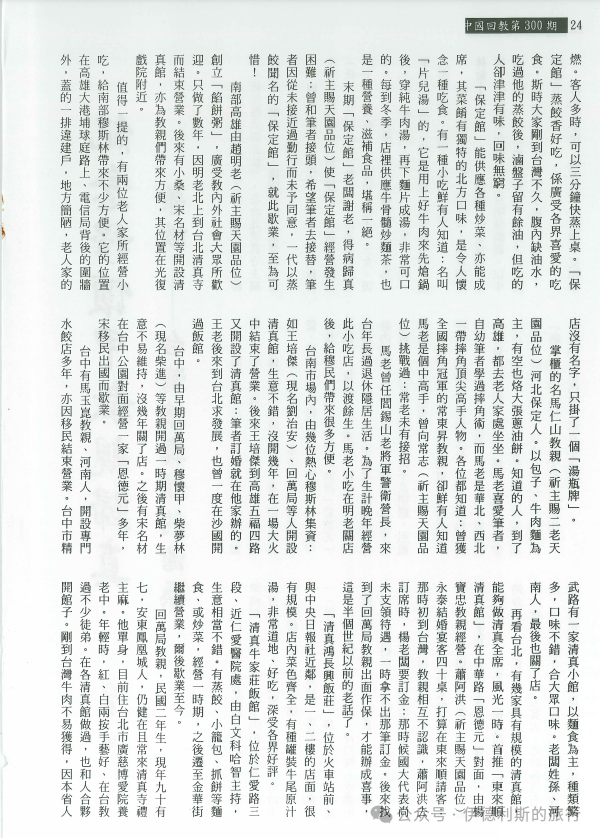
I am sharing an article from the 300th issue of China Islam magazine titled 'Remembering Brother Mu Huaijia’s Passing—Reflections on the History of Halal Restaurants in Taiwan.' Today I am transcribing the second part, which recalls various halal restaurants in Kaohsiung, Tainan, Taichung, and Taipei.
In the southern city of Kaohsiung, Elder Zhao Ming (may Allah grant him a high place in Paradise) founded the restaurant Meat Pie and Porridge (xianbing zhou), which was popular with both Muslims and the general public. It only operated for a few years before closing when Elder Ming moved north to the Taipei Mosque. Later, people like Xiao Sang and Song Mingcai opened halal restaurants near the Guangfu Theater, which provided convenience for fellow Muslims.
Two elderly people also ran a snack shop that was very helpful to Muslims in the south. It was located in Kaohsiung on Qiuting Road in Dagangpu, behind the wall of the Telecommunications Bureau. It was in a row of makeshift buildings and the place was very simple. The elderly couple’s shop had no name, just a hanging sign with a water pitcher (tangping) symbol.
The owner was a fellow Muslim named Ma Renshan (may Allah grant him a high place in Paradise), who was from Baoding, Hebei. They mainly served steamed buns (baozi) and beef noodles, and when they had time, they would also fry large scallion pancakes (cong you bing). People who know about it always stop by the old man's place when they visit Kaohsiung. Old Mr. Ma liked me because I learned wrestling as a child, and he was a top-tier wrestling master in North and Northwest China. Everyone knows Chang Dongsheng was a national wrestling champion and a fellow Muslim, but few know Old Mr. Ma was also an expert who once challenged Chang Zhi (may Allah grant him a high place in Paradise) to a match, though Chang did not accept.
Old Mr. Ma once served as a guard battalion commander for General Yan Xishan, and he lived a quiet, retired life after coming to Taiwan. In his later years, he ran this small snack shop to make a living. After Old Mr. Ming closed his shop, Old Mr. Ma's snack shop provided a lot of convenience for the local Muslims.
In the Tainan market, several enthusiastic Muslims including Wang Peijie (now known as Liu Zhi'an) and Hui Wanju pooled their money to open a halal restaurant. Business was good, but it closed after a few years due to a fire. Later, Wang Peijie opened another halal restaurant on Wufu 4th Road in Kaohsiung, and I even held my engagement party there. Wang Laohe later came to Taipei to seek opportunities and even ran a restaurant in Saudi Arabia for a time.
In Taichung, fellow Muslims like Hui Wanjuju, Mu Huaijia, and Chai Menglin (now named Chai Jin) once opened a halal restaurant, but business was hard to sustain and they closed the shop after a few years. Later, Song Mingcai ran a restaurant called Ende Yuan across from Taichung Park for many years, but it closed when Song immigrated abroad.
In Taichung, a fellow Muslim from Henan named Ma Yukun ran a specialty dumpling shop for many years, which also closed when he immigrated. There is a small halal restaurant on Jingwu Road in Taichung City that focuses on noodle dishes; they have a wide variety with good flavors that suit the general public. The owner was surnamed Sun, a man from Henan, and he eventually closed the shop as well.
Looking at Taipei, there were several large-scale halal restaurants that could serve full-course halal banquets and were quite popular for a time. The most prominent was the Donglaishun Halal Restaurant, located on Zhonghua Road across from Ende Yuan, which was run by fellow Muslim Yang Zhongbao. Xiao Ahong (may Allah grant him a high place in Paradise) planned a forty-table wedding banquet at Donglaishun. He had just arrived in Taiwan and did not know many fellow Hui Muslims yet. When he went to book the tables, the owner, Mr. Yang, asked for a deposit. Since National Assembly representatives were not yet receiving their salaries, Xiao Ahong could not pay the deposit at that time. He eventually found a fellow Hui Muslim named Hui Wanju to act as a guarantor, which allowed the wedding to go ahead. This happened half a century ago.
Hui Wanju was born in 1913 and is now ninety-seven years old. He is from Fenghuangcheng in Andong, is still alive, and often comes to the mosque for Friday namaz. He is single and currently lives at the Guangci Care Home in Taipei. When he was young, he was very skilled at catering for both weddings and funerals and trained many apprentices in Taiwan. He worked in various halal restaurants and also opened restaurants in partnership with others. When he first arrived in Taiwan, beef was hard to find because the local people did not eat beef and would not slaughter cows. Hui Wanju started slaughtering cows in the north, central, and southern parts of the island to supply beef to various halal restaurants. In his later years, he partnered with Fengji Dim Sum Shop on Jinshan South Road to make snacks. He was famous for his sesame flatbread (shaobing) and brown sugar baked rolls (huoshao), and he also supplied mooncakes during the Mid-Autumn Festival. view all
Summary: Halal Food Guide: Taiwan - Halal Restaurants Across the Island is presented here as a firsthand travel account in clear, natural English. The account focuses on Taiwan, Halal Food, Muslim Travel while preserving the names, places, food, photos, and historical details from the Chinese source.
I am sharing an article from the 300th issue of China Islam magazine titled 'Remembering Brother Mu Huaijia’s Passing—Reflections on the History of Halal Restaurants in Taiwan.' Today I am transcribing the second part, which recalls various halal restaurants in Kaohsiung, Tainan, Taichung, and Taipei.
In the southern city of Kaohsiung, Elder Zhao Ming (may Allah grant him a high place in Paradise) founded the restaurant Meat Pie and Porridge (xianbing zhou), which was popular with both Muslims and the general public. It only operated for a few years before closing when Elder Ming moved north to the Taipei Mosque. Later, people like Xiao Sang and Song Mingcai opened halal restaurants near the Guangfu Theater, which provided convenience for fellow Muslims.
Two elderly people also ran a snack shop that was very helpful to Muslims in the south. It was located in Kaohsiung on Qiuting Road in Dagangpu, behind the wall of the Telecommunications Bureau. It was in a row of makeshift buildings and the place was very simple. The elderly couple’s shop had no name, just a hanging sign with a water pitcher (tangping) symbol.
The owner was a fellow Muslim named Ma Renshan (may Allah grant him a high place in Paradise), who was from Baoding, Hebei. They mainly served steamed buns (baozi) and beef noodles, and when they had time, they would also fry large scallion pancakes (cong you bing). People who know about it always stop by the old man's place when they visit Kaohsiung. Old Mr. Ma liked me because I learned wrestling as a child, and he was a top-tier wrestling master in North and Northwest China. Everyone knows Chang Dongsheng was a national wrestling champion and a fellow Muslim, but few know Old Mr. Ma was also an expert who once challenged Chang Zhi (may Allah grant him a high place in Paradise) to a match, though Chang did not accept.
Old Mr. Ma once served as a guard battalion commander for General Yan Xishan, and he lived a quiet, retired life after coming to Taiwan. In his later years, he ran this small snack shop to make a living. After Old Mr. Ming closed his shop, Old Mr. Ma's snack shop provided a lot of convenience for the local Muslims.
In the Tainan market, several enthusiastic Muslims including Wang Peijie (now known as Liu Zhi'an) and Hui Wanju pooled their money to open a halal restaurant. Business was good, but it closed after a few years due to a fire. Later, Wang Peijie opened another halal restaurant on Wufu 4th Road in Kaohsiung, and I even held my engagement party there. Wang Laohe later came to Taipei to seek opportunities and even ran a restaurant in Saudi Arabia for a time.
In Taichung, fellow Muslims like Hui Wanjuju, Mu Huaijia, and Chai Menglin (now named Chai Jin) once opened a halal restaurant, but business was hard to sustain and they closed the shop after a few years. Later, Song Mingcai ran a restaurant called Ende Yuan across from Taichung Park for many years, but it closed when Song immigrated abroad.
In Taichung, a fellow Muslim from Henan named Ma Yukun ran a specialty dumpling shop for many years, which also closed when he immigrated. There is a small halal restaurant on Jingwu Road in Taichung City that focuses on noodle dishes; they have a wide variety with good flavors that suit the general public. The owner was surnamed Sun, a man from Henan, and he eventually closed the shop as well.
Looking at Taipei, there were several large-scale halal restaurants that could serve full-course halal banquets and were quite popular for a time. The most prominent was the Donglaishun Halal Restaurant, located on Zhonghua Road across from Ende Yuan, which was run by fellow Muslim Yang Zhongbao. Xiao Ahong (may Allah grant him a high place in Paradise) planned a forty-table wedding banquet at Donglaishun. He had just arrived in Taiwan and did not know many fellow Hui Muslims yet. When he went to book the tables, the owner, Mr. Yang, asked for a deposit. Since National Assembly representatives were not yet receiving their salaries, Xiao Ahong could not pay the deposit at that time. He eventually found a fellow Hui Muslim named Hui Wanju to act as a guarantor, which allowed the wedding to go ahead. This happened half a century ago.
Hui Wanju was born in 1913 and is now ninety-seven years old. He is from Fenghuangcheng in Andong, is still alive, and often comes to the mosque for Friday namaz. He is single and currently lives at the Guangci Care Home in Taipei. When he was young, he was very skilled at catering for both weddings and funerals and trained many apprentices in Taiwan. He worked in various halal restaurants and also opened restaurants in partnership with others. When he first arrived in Taiwan, beef was hard to find because the local people did not eat beef and would not slaughter cows. Hui Wanju started slaughtering cows in the north, central, and southern parts of the island to supply beef to various halal restaurants. In his later years, he partnered with Fengji Dim Sum Shop on Jinshan South Road to make snacks. He was famous for his sesame flatbread (shaobing) and brown sugar baked rolls (huoshao), and he also supplied mooncakes during the Mid-Autumn Festival. view all
Reposted from the web
Summary: Halal Food Guide: Taiwan - Halal Restaurants Across the Island is presented here as a firsthand travel account in clear, natural English. The account focuses on Taiwan, Halal Food, Muslim Travel while preserving the names, places, food, photos, and historical details from the Chinese source.
I am sharing an article from the 300th issue of China Islam magazine titled 'Remembering Brother Mu Huaijia’s Passing—Reflections on the History of Halal Restaurants in Taiwan.' Today I am transcribing the second part, which recalls various halal restaurants in Kaohsiung, Tainan, Taichung, and Taipei.
In the southern city of Kaohsiung, Elder Zhao Ming (may Allah grant him a high place in Paradise) founded the restaurant Meat Pie and Porridge (xianbing zhou), which was popular with both Muslims and the general public. It only operated for a few years before closing when Elder Ming moved north to the Taipei Mosque. Later, people like Xiao Sang and Song Mingcai opened halal restaurants near the Guangfu Theater, which provided convenience for fellow Muslims.
Two elderly people also ran a snack shop that was very helpful to Muslims in the south. It was located in Kaohsiung on Qiuting Road in Dagangpu, behind the wall of the Telecommunications Bureau. It was in a row of makeshift buildings and the place was very simple. The elderly couple’s shop had no name, just a hanging sign with a water pitcher (tangping) symbol.
The owner was a fellow Muslim named Ma Renshan (may Allah grant him a high place in Paradise), who was from Baoding, Hebei. They mainly served steamed buns (baozi) and beef noodles, and when they had time, they would also fry large scallion pancakes (cong you bing). People who know about it always stop by the old man's place when they visit Kaohsiung. Old Mr. Ma liked me because I learned wrestling as a child, and he was a top-tier wrestling master in North and Northwest China. Everyone knows Chang Dongsheng was a national wrestling champion and a fellow Muslim, but few know Old Mr. Ma was also an expert who once challenged Chang Zhi (may Allah grant him a high place in Paradise) to a match, though Chang did not accept.
Old Mr. Ma once served as a guard battalion commander for General Yan Xishan, and he lived a quiet, retired life after coming to Taiwan. In his later years, he ran this small snack shop to make a living. After Old Mr. Ming closed his shop, Old Mr. Ma's snack shop provided a lot of convenience for the local Muslims.
In the Tainan market, several enthusiastic Muslims including Wang Peijie (now known as Liu Zhi'an) and Hui Wanju pooled their money to open a halal restaurant. Business was good, but it closed after a few years due to a fire. Later, Wang Peijie opened another halal restaurant on Wufu 4th Road in Kaohsiung, and I even held my engagement party there. Wang Laohe later came to Taipei to seek opportunities and even ran a restaurant in Saudi Arabia for a time.
In Taichung, fellow Muslims like Hui Wanjuju, Mu Huaijia, and Chai Menglin (now named Chai Jin) once opened a halal restaurant, but business was hard to sustain and they closed the shop after a few years. Later, Song Mingcai ran a restaurant called Ende Yuan across from Taichung Park for many years, but it closed when Song immigrated abroad.
In Taichung, a fellow Muslim from Henan named Ma Yukun ran a specialty dumpling shop for many years, which also closed when he immigrated. There is a small halal restaurant on Jingwu Road in Taichung City that focuses on noodle dishes; they have a wide variety with good flavors that suit the general public. The owner was surnamed Sun, a man from Henan, and he eventually closed the shop as well.
Looking at Taipei, there were several large-scale halal restaurants that could serve full-course halal banquets and were quite popular for a time. The most prominent was the Donglaishun Halal Restaurant, located on Zhonghua Road across from Ende Yuan, which was run by fellow Muslim Yang Zhongbao. Xiao Ahong (may Allah grant him a high place in Paradise) planned a forty-table wedding banquet at Donglaishun. He had just arrived in Taiwan and did not know many fellow Hui Muslims yet. When he went to book the tables, the owner, Mr. Yang, asked for a deposit. Since National Assembly representatives were not yet receiving their salaries, Xiao Ahong could not pay the deposit at that time. He eventually found a fellow Hui Muslim named Hui Wanju to act as a guarantor, which allowed the wedding to go ahead. This happened half a century ago.
Hui Wanju was born in 1913 and is now ninety-seven years old. He is from Fenghuangcheng in Andong, is still alive, and often comes to the mosque for Friday namaz. He is single and currently lives at the Guangci Care Home in Taipei. When he was young, he was very skilled at catering for both weddings and funerals and trained many apprentices in Taiwan. He worked in various halal restaurants and also opened restaurants in partnership with others. When he first arrived in Taiwan, beef was hard to find because the local people did not eat beef and would not slaughter cows. Hui Wanju started slaughtering cows in the north, central, and southern parts of the island to supply beef to various halal restaurants. In his later years, he partnered with Fengji Dim Sum Shop on Jinshan South Road to make snacks. He was famous for his sesame flatbread (shaobing) and brown sugar baked rolls (huoshao), and he also supplied mooncakes during the Mid-Autumn Festival.
Summary: Halal Food Guide: Taiwan - Halal Restaurants Across the Island is presented here as a firsthand travel account in clear, natural English. The account focuses on Taiwan, Halal Food, Muslim Travel while preserving the names, places, food, photos, and historical details from the Chinese source.
I am sharing an article from the 300th issue of China Islam magazine titled 'Remembering Brother Mu Huaijia’s Passing—Reflections on the History of Halal Restaurants in Taiwan.' Today I am transcribing the second part, which recalls various halal restaurants in Kaohsiung, Tainan, Taichung, and Taipei.
In the southern city of Kaohsiung, Elder Zhao Ming (may Allah grant him a high place in Paradise) founded the restaurant Meat Pie and Porridge (xianbing zhou), which was popular with both Muslims and the general public. It only operated for a few years before closing when Elder Ming moved north to the Taipei Mosque. Later, people like Xiao Sang and Song Mingcai opened halal restaurants near the Guangfu Theater, which provided convenience for fellow Muslims.
Two elderly people also ran a snack shop that was very helpful to Muslims in the south. It was located in Kaohsiung on Qiuting Road in Dagangpu, behind the wall of the Telecommunications Bureau. It was in a row of makeshift buildings and the place was very simple. The elderly couple’s shop had no name, just a hanging sign with a water pitcher (tangping) symbol.
The owner was a fellow Muslim named Ma Renshan (may Allah grant him a high place in Paradise), who was from Baoding, Hebei. They mainly served steamed buns (baozi) and beef noodles, and when they had time, they would also fry large scallion pancakes (cong you bing). People who know about it always stop by the old man's place when they visit Kaohsiung. Old Mr. Ma liked me because I learned wrestling as a child, and he was a top-tier wrestling master in North and Northwest China. Everyone knows Chang Dongsheng was a national wrestling champion and a fellow Muslim, but few know Old Mr. Ma was also an expert who once challenged Chang Zhi (may Allah grant him a high place in Paradise) to a match, though Chang did not accept.
Old Mr. Ma once served as a guard battalion commander for General Yan Xishan, and he lived a quiet, retired life after coming to Taiwan. In his later years, he ran this small snack shop to make a living. After Old Mr. Ming closed his shop, Old Mr. Ma's snack shop provided a lot of convenience for the local Muslims.
In the Tainan market, several enthusiastic Muslims including Wang Peijie (now known as Liu Zhi'an) and Hui Wanju pooled their money to open a halal restaurant. Business was good, but it closed after a few years due to a fire. Later, Wang Peijie opened another halal restaurant on Wufu 4th Road in Kaohsiung, and I even held my engagement party there. Wang Laohe later came to Taipei to seek opportunities and even ran a restaurant in Saudi Arabia for a time.
In Taichung, fellow Muslims like Hui Wanjuju, Mu Huaijia, and Chai Menglin (now named Chai Jin) once opened a halal restaurant, but business was hard to sustain and they closed the shop after a few years. Later, Song Mingcai ran a restaurant called Ende Yuan across from Taichung Park for many years, but it closed when Song immigrated abroad.
In Taichung, a fellow Muslim from Henan named Ma Yukun ran a specialty dumpling shop for many years, which also closed when he immigrated. There is a small halal restaurant on Jingwu Road in Taichung City that focuses on noodle dishes; they have a wide variety with good flavors that suit the general public. The owner was surnamed Sun, a man from Henan, and he eventually closed the shop as well.
Looking at Taipei, there were several large-scale halal restaurants that could serve full-course halal banquets and were quite popular for a time. The most prominent was the Donglaishun Halal Restaurant, located on Zhonghua Road across from Ende Yuan, which was run by fellow Muslim Yang Zhongbao. Xiao Ahong (may Allah grant him a high place in Paradise) planned a forty-table wedding banquet at Donglaishun. He had just arrived in Taiwan and did not know many fellow Hui Muslims yet. When he went to book the tables, the owner, Mr. Yang, asked for a deposit. Since National Assembly representatives were not yet receiving their salaries, Xiao Ahong could not pay the deposit at that time. He eventually found a fellow Hui Muslim named Hui Wanju to act as a guarantor, which allowed the wedding to go ahead. This happened half a century ago.
Hui Wanju was born in 1913 and is now ninety-seven years old. He is from Fenghuangcheng in Andong, is still alive, and often comes to the mosque for Friday namaz. He is single and currently lives at the Guangci Care Home in Taipei. When he was young, he was very skilled at catering for both weddings and funerals and trained many apprentices in Taiwan. He worked in various halal restaurants and also opened restaurants in partnership with others. When he first arrived in Taiwan, beef was hard to find because the local people did not eat beef and would not slaughter cows. Hui Wanju started slaughtering cows in the north, central, and southern parts of the island to supply beef to various halal restaurants. In his later years, he partnered with Fengji Dim Sum Shop on Jinshan South Road to make snacks. He was famous for his sesame flatbread (shaobing) and brown sugar baked rolls (huoshao), and he also supplied mooncakes during the Mid-Autumn Festival.
Discover Taiwan through the eyes of a Muslim traveler | revealing hidden muslim communities and Allah's blessings in unexpected corners.
Articles • ahmedla posted the article • 0 comments • 1481 views • 2025-06-08 20:44
Unveiling Islam in Taiwan: A Muslim Traveler's Perspective
For the longest time, the idea of "Taiwan" and "Islam" in the American mind felt like two completely unrelated concepts. It's tough for folks to naturally picture a place there where Muslims could truly put down roots and thrive. If it even crossed their minds, it was usually imagined much like other Northeast Asian countries: a need for foreign laborers due to an aging population. These workers, often from Muslim nations, toiled in low-wage jobs within an unfamiliar culture, all while clinging to religious beliefs that locals might find "odd and out of place."
Thanks to the rapid growth of the internet over the past decade, the Hui Muslim community in mainland China has definitely gained a deeper understanding of their Taiwanese counterparts. In Shanghai, especially, there are more chances to connect with Muslim friends, relatives, or workers from the island. These interactions give us a peek behind the curtain, offering a glimpse into their lives. Taiwan's relatively open publishing industry has also allowed a wealth of Islam-related Chinese books to flow back to the mainland, building crucial bridges between East and West, and between different faiths and cultures.
Truth be told, Taiwan's modern Muslim history is far richer than most people imagine. It's a story that globalizes local Hui history, tracing their journey from the mainland, heading south into Myanmar and Thailand, and eventually finding their home in Taiwan. Their individual experiences paint a hidden yet grand picture of East Asian Islam. My trip this time was only ten days – not enough time to tell the whole enchilada, but I hope to leave a few clues for others to chew on later.
Taipei: Muslim-Friendly Amenities Galore
The Taipei Grand Mosque is certainly no longer an "isolated island" of faith, and Islamic beliefs are no longer confined within mosque walls. The Taiwanese authorities have been pushing a "Muslim-Friendly Policy" in recent years, setting up convenient facilities for Muslims in transportation hubs, universities, and major tourist spots. We're talking prayer rooms, dedicated facilities for wudu (ablution), and the like. The very first day I arrived in Taipei, I spotted clear signs for Muslim facilities in the downtown Taipei Main Station. Following the directions, it was a piece of cake to find both the restrooms and the prayer room.
Even though I didn't actually need to pray at that moment, I specifically asked a kind cleaning lady to open the wudu room door, just to see if it was the real deal or just for show. To my surprise, she was super enthusiastic, opened the door right away, and even proactively told me where the prayer room was and how to use it. In that moment, my tired body and soul immediately felt a boost – Taiwan really made a fantastic first impression. When someone extends a hand of kindness, we shouldn't just gladly accept it; we should also respond positively. If every Muslim doesn't overlook these readily available conveniences, then those who set up these facilities will also truly feel the meaning and necessity of their efforts.
Descendants of the "Lonely Army" on Myanmar Street
The very first day I landed in Taipei, even before checking into my hotel, I was in a hurry-scurry to get to the Taipei Grand Mosque, right next to Daan Forest Park. I rolled up just in time for a funeral, and honestly, seeing the family all dressed in black, lined up in two rows on the way to the wudu room, really caught me off guard. The deceased was there, waiting to be washed. I, with my luggage in tow, walked into the wudu room under their somewhat puzzled gazes. I naturally figured most of these family members weren't Muslim and probably wondered why a rushed traveler like me was heading into a washroom meant for the departed. Without a second to spare, I quickly performed wudu and headed to the main prayer hall, waiting for Dhuhr (midday prayer).
Glancing around at the people waiting for prayer, my eyes immediately landed on the "legendary" newly appointed young Imam. I went over and gave him a salam, and we agreed to chat after prayers. After we finished, we all stood for the Janazah (funeral prayer) for the deceased. Afterward, we started talking, and when the young Imam mentioned the deceased, he told me the person might be a descendant of Yunnan Hui Muslims from Myanmar, a young man from Myanmar Street, not even 30 years old. He also mentioned he was heading to "Myanmar Street" that evening to grab some food. I was all ears, quickly asking what the connection was between Myanmar Street and Muslims. To my surprise, the Imam explained that a significant part of Taiwan's Muslim community is made up of these Yunnanese Muslims, and Myanmar Street is one of their main hangouts. My aimless Taiwan trip suddenly had a bullseye: Myanmar Street.
Myanmar Street: Home to the "Lonely Army's" Descendants
Hua Xin Street, nestled in Taipei's Zhonghe District, is widely known as "Myanmar Street." It's a vibrant hub for Burmese Chinese and, crucially, a stopping point for Hui Muslims from Yunnan. These folks are descendants of what's often called the "Burma-Thailand Lonely Army," gradually settling here after the 1980s. The "Lonely Army," also known as the "Yunnan-Burma Lonely Army" or "Remnants of the KMT Army," refers to Nationalist (Kuomintang, or KMT) troops who retreated to Myanmar after the People's Republic of China was established in 1949. A significant number of Yunnanese Muslim soldiers and their families moved with them, forming a distinct Muslim community within the ranks of this "Lonely Army." Early on, a large number of these Muslim families found a base in the border regions of Myanmar's Shan and Kachin states. Another segment later migrated to northern Thailand, making their lives along the Mekong River.
For most Taiwanese, these folks are cultural and geographical "outsiders." The Imam, with a touch of melancholy, recently told me that young people aren't really into Islam anymore, and many religious practices have simply become "customs." You could see this plain as day among the young folks at the funeral. While the older aunties wore their headscarves, the younger generation opted for general funeral attire – black to show respect – looking no different from any other non-Muslim from the outside. The Initium (a Chinese digital media outlet) even published an article titled "The Outsiders" that delves into the identity struggles of a young person from Myanmar Street. These Muslim descendants grapple with a unique "Yunnan-Myanmar-Taiwan" triple cultural identity, a blend of Chinese culture, Islamic faith, and Southeast Asian influences. But they don't quite belong to Myanmar, and it seems they don't fully belong to Taiwan either. Even their Yunnan accent has become a source of discrimination. Myanmar Street is their Huifang – their Muslim quarter. For the younger generation "from the block," stepping outside this Huifang might feel like a more "fitting" integration, while holding onto your turf makes you a stubborn outsider. It’s the bitter taste of growing up in the Huicamps. Perhaps it’s not until they can truly think for themselves that they can appreciate the preciousness of what they already possess.
Despite all this, Myanmar Street remains their Huifang. Burmese signs are everywhere you look, and the names of street snacks like "Ersi" (rice noodles) and "Ganba" (dried beef) betray their Yunnan roots. Here, you can still confidently enjoy halal food that’s both Burmese and Yunnanese. The older sister running the "Yongli" snack shop told me she only arrived in Taiwan a few years ago and isn't quite used to living here. If her husband hadn't been here for decades, she never would have considered moving. Everything is just so different. Speaking in a somewhat broken Yunnan-inflected Mandarin, she warned me, "Young folks gotta be careful and protect yourselves, okay? Yesterday, a young guy died in a motorcycle accident, only in his twenties." I quickly chimed in, "I stood for the Janazah at the mosque today for the deceased. You must be talking about that very same person!"
Longgang: Another Haven for Yunnan Muslims in Taiwan
These days, Longgang, over in Taoyuan's Zhongli District, is another super important spot where Yunnan Muslims have really set down roots. Back in the 1950s, the Taiwanese government brought over the Dian-Myanmar "Lonely Army" and their families from Thailand and Myanmar, settling them all right here. To keep their faith alive and kicking, the Muslim community pooled their resources and built the Longgang Mosque. It's not just a place for salat (prayers); it's a vibrant hub where their culture and spirit come together. The fact that every single mosque in Taiwan has a Yunnanese Imam really shows just how big a deal these Yunnan descendants are within the Taiwanese Muslim community.
Lukang: Where History and Faith Whisper (Quietly)
My first footprint on the mainland Hui Muslim journey in Taiwan was in Lukang, a town absolutely bursting with incense smoke. As I made my way south from Taipei to Taichung, my Aunt Ma, who I'd been in touch with, kept bringing up taking me to Lukang. I was a bit in the dark, honestly, wondering what this little town had to do with Hui Muslims. Once I hit Taichung, Sister Shi, who picked me up with my aunt, was a local from Lukang herself. She told me she was a descendant of the famous General Shi Lang, and that Lukang was one of the very first places mainlanders settled in Taiwan. Lukang’s temples are crammed with worshipers; Sister Shi mentioned they get tens of millions of visitors every year. Walking near the old street, temples and ancestral halls are everywhere, and as Aunt Ma put it, "The idols have taken over this place."
Sister Shi, with her headscarf, definitely sticks out like a sore thumb here. But even before she embraced Islam, she wasn't part of the mainstream. She used to be a devout Christian, knew her Bible inside and out, and could debate scripture with anyone.
But the Lukang I want to talk about is a different side of it – this is where Taiwan first intersected with Hui Muslims. As early as the late Ming Dynasty, some descendants of Hui Muslims living in the Quanzhou region followed the migration waves to Taiwan, settling in what is now Lukang and Taisi. This marked the earliest recorded presence of Muslims in Taiwan. Today, Lukang is primarily home to the Chen-dai Ding and Guo families. The earliest observations of them date back to the 1920s, when scholars noted there wasn't a single trace of Islamic practice left in their lives. Their descendants even revealed that their ancestors had a strict rule: "Hide the fact that you are Muslim at all costs." Despite fully adopting Han customs, their family genealogies still record their connections to the mainland and their Muslim ancestors. The Ding clan in Lukang still knows they are descendants of the 18th generation. Some of their unique ancestral worship rituals might also hint at their special identity. For instance, the Ding family has a peculiar custom during funerals called "Guan Mao" (pouring water from the roof into a well) where the family patriarch or eldest grandson pours three cups of wine into a bowl. The Ding family's main house is a siheyuan (quadrangle courtyard), which from above forms the Chinese character "回" (Hui/return), unlike the local sanheyuan (three-sided courtyard). Plus, there are no ancestral tablets in their ancestral hall. For the Guo clan, not using pork in their ancestral worship is perhaps more direct evidence of their Muslim lineage. The Guo family also doesn't invite Taoist priests to chant scriptures; instead, they specifically invite someone familiar with Guo family customs to perform the rituals. There's even a rumor that a local temple called Bao'an Temple was originally a mosque, later converted into an ancestral hall.
Unlike the Yunnanese descendants who came to Taiwan in the 1980s, Lukang presents a much more localized form of Muslim history, and you won't find many visible signs of Islam here. There's only one small prayer spot for Indonesian migrant workers, maintained and managed by two Taiwanese converts to Islam. The converts and the deeply assimilated Hui descendants form a stark contrast. Modern Lukang is booming with traditional worship, but it's also stubbornly resistant to change. Grandpa Xue, a convert from Kaohsiung, picked up his Iman (faith) after converting and started Da'wah (religious outreach) in a park not far from the Lukang Mosque. In over ten years, he only managed to guide one person to Islam – and that person was my guide, Sister Shi.
Kaohsiung: Tracing the Footsteps of Our Elders
Kaohsiung holds a special place, as it was one of the first cities in Taiwan to establish a mosque. The early Kaohsiung Mosque was originally located at 117 Wufu 4th Road in Yancheng District – that spot is actually a Hong Kong-style tea restaurant now. Back then, the second floor had tatami mats laid out for prayer, a small space, until they eventually moved to Linsen 1st Road. Not far from this old prayer hall, there was a Beijing Halal Restaurant that was a regular hangout spot for the "people of the faith."
The owner of that halal restaurant was a man named Zhao Mingyuan from Qingzhou, Shandong. During the Republic of China era, he actually recommended Imam Wang Jingzhai to serve at the Qingzhou Mosque. Even after coming to Taiwan with the Kuomintang in '48, his heart remained devoted to the Deen (faith). He was one of the original founders, along with twelve others, who established the Kaohsiung Mosque. When I mentioned Zhao Mingyuan, a teacher named Y from Taipei told me that the Zhao clan of Qingzhou was a prominent family, a big deal in the Muslim community, and they contributed a ton to the Deen. Nowadays, the Zhao family gatherings are practically international events, with their descendants found from mainland China all the way to North America. There’s even a Chinese-American Imam named Zhao in the States who's part of that very family. But perhaps even more well-known in Taiwan is the grandson of elder Zhao Mingyuan, the famous former Imam of the Taipei Grand Mosque, Dr. Zhao Xilin. Today, the Kaohsiung Mosque has been at its current location on Jianjun Road in Lingya District since 1992. The first Imam of the new Kaohsiung Mosque, Chen Yongwu, hails from Myanmar and is still serving there today, carrying on the rich tradition of the Dian-Myanmar Muslims.
Of course, there are also some less visible Hui Muslims who quietly live in Kaohsiung, like my own grand-uncle. After being forced to retreat to Taiwan with the larger army as a wounded soldier, my grand-uncle lived alone on this land. He didn't seem to interact with these active "people of the faith." I often wondered, as a Hui Muslim from Northeast China, how he managed to make a life for himself all alone here. Following the address my dad sent me, which had been mailed from Taiwan, I went to his old place. Now, it's just a parking lot – nothing left of what it used to be.
A Mix of Sacred and Secular: Indonesian Prayer Spots
Given Taiwan's geography and terrain, the island's east coast has always been pretty off the beaten path, with very few people living there. So, finding a sizable Muslim community there is practically a pipe dream. Even so, you can still scout out some places to pray in a few cities. The thing is, these prayer spots aren't necessarily what you'd call serene or super peaceful. When I followed my map to two Indonesian prayer spots in Hualien City, the noisy surroundings honestly made me cringe a little bit.
At one of them, the first floor was a bustling restaurant, and the third floor was the prayer hall. But get this: sandwiched right in between, on the second floor, was a hidden dance hall! So, there I was, praying on the third floor, prostrating to Allah (SWT), and feeling the vibrations of the speakers and hearing the faint sounds of singing wafting up from the floor below. Subhanallah! It was a truly unique experience, a test of focus, no doubt.
At the other prayer spot in Hualien, the secular world had seeped in even more thoroughly. The prayer room was still upstairs, but the first floor was like a reception area, or maybe a community hangout. As soon as you walked in, there was a living room setup, complete with a kitchen. Indonesian folks were busy preparing meals right there for others sitting downstairs. I gave a friendly nod to the "hosts" on the first floor and headed upstairs to pray. Just when I thought this might be a quieter spot, a wave of smoke from downstairs started drifting up, making the second floor feel all hazy and ethereal – and not in a good way, if you catch my drift.
Ultimately, though, much like the laborers themselves, the Deen (faith) here is something that's been brought in from elsewhere. Beyond these two prayer spots, even finding a single halal restaurant was a tall order, almost a luxury. It truly put into perspective the challenges faced by our brothers and sisters in places where Islam isn't the dominant culture. May Allah make it easy for them.
Taichung Mosque: A Hub of Faith
Taichung is home to a pretty active Muslim community, and my main reason for coming to Taiwan this time around was to visit my Uncle and Aunt Ma, who live there. Now, Uncle Ma, bless his heart, is an engineer by trade, not some academic from an Islamic studies program. But in his free time, he dedicates himself to a word-by-word morphological and grammatical analysis of the Quran, then pays out of his own pocket to print and publish his findings online for others to learn from. Aunt Ma, for her part, is the quiet force behind the scenes, a true pillar of strength for the Taichung Mosque. They've been my gateway to understanding Taiwan's Muslim community, and getting to know them has really opened my eyes.
Culture Mosque: A Community-Driven Space
As one of only two real mosques in Taipei, the Culture Mosque doesn't have a permanent Imam. So, it's usually run by amateur Imams. There's one particular Pakistani uncle who prays there regularly; he's gotten Taiwanese citizenship through marriage and is now a bona fide Taiwanese citizen. Masha'Allah!
Food Chronicles: Beef and Its Vegetarian Buddies
Long story short, if you're on the west side of Taiwan, you won't have any trouble finding halal food. But head east, and you're pretty much out of luck. There are no more than two halal spots in Taitung, and maybe three at most in Hualien... it's a tough nut to crack if you're trying to keep things strictly halal.
Halal Bites Across the Island
Halal cuisine at Taipei Airport (A true blessing when you're traveling!)
Taiwan's chain fried chicken shops (Always a crowd-pleaser!)
Halal beef noodle soup joint in Kaohsiung (A warm bowl of goodness!)
Halal beef noodle shop in Taipei (Classic comfort food, Muslim-style!)
A halal Roujiamo (Chinese meat burger) spot (A little taste of home for many!)
Postscript: The Unfolding Journey
Taiwan really brought to mind a topic we often discuss: migration. For an individual, migration can be quite a conscious choice, a proactive step. But for an entire community, it feels like there's no escaping the gears of destiny and the call of Qadar (Divine decree), no matter where you go. The reality that descends upon a community can't be faced by constantly running away. Some might ask if Taiwan is suitable for Muslims to live in. If you consider food, clothing, and education, simply existing as a Muslim here is a huge test. Yet, you can't really tell those who've already put down roots here to find a more "Muslim-friendly" country. Looking back at them, they've constantly been on the move, and while Taiwan might not be the ideal Jannah (paradise), it has given them a chance to catch their breath. We, as humans, merely pass through this life fleetingly. It's only by accepting hardships that we can truly overcome them and face the Hereafter with peace. Finding glimmers of light – good people and good deeds – amidst the chaos was truly enough to uplift my ruh (spirit) and strengthen my iman. Alhamdulillah for all His blessings.
view all
For the longest time, the idea of "Taiwan" and "Islam" in the American mind felt like two completely unrelated concepts. It's tough for folks to naturally picture a place there where Muslims could truly put down roots and thrive. If it even crossed their minds, it was usually imagined much like other Northeast Asian countries: a need for foreign laborers due to an aging population. These workers, often from Muslim nations, toiled in low-wage jobs within an unfamiliar culture, all while clinging to religious beliefs that locals might find "odd and out of place."
Thanks to the rapid growth of the internet over the past decade, the Hui Muslim community in mainland China has definitely gained a deeper understanding of their Taiwanese counterparts. In Shanghai, especially, there are more chances to connect with Muslim friends, relatives, or workers from the island. These interactions give us a peek behind the curtain, offering a glimpse into their lives. Taiwan's relatively open publishing industry has also allowed a wealth of Islam-related Chinese books to flow back to the mainland, building crucial bridges between East and West, and between different faiths and cultures.
Truth be told, Taiwan's modern Muslim history is far richer than most people imagine. It's a story that globalizes local Hui history, tracing their journey from the mainland, heading south into Myanmar and Thailand, and eventually finding their home in Taiwan. Their individual experiences paint a hidden yet grand picture of East Asian Islam. My trip this time was only ten days – not enough time to tell the whole enchilada, but I hope to leave a few clues for others to chew on later.
Taipei: Muslim-Friendly Amenities Galore
The Taipei Grand Mosque is certainly no longer an "isolated island" of faith, and Islamic beliefs are no longer confined within mosque walls. The Taiwanese authorities have been pushing a "Muslim-Friendly Policy" in recent years, setting up convenient facilities for Muslims in transportation hubs, universities, and major tourist spots. We're talking prayer rooms, dedicated facilities for wudu (ablution), and the like. The very first day I arrived in Taipei, I spotted clear signs for Muslim facilities in the downtown Taipei Main Station. Following the directions, it was a piece of cake to find both the restrooms and the prayer room.
Even though I didn't actually need to pray at that moment, I specifically asked a kind cleaning lady to open the wudu room door, just to see if it was the real deal or just for show. To my surprise, she was super enthusiastic, opened the door right away, and even proactively told me where the prayer room was and how to use it. In that moment, my tired body and soul immediately felt a boost – Taiwan really made a fantastic first impression. When someone extends a hand of kindness, we shouldn't just gladly accept it; we should also respond positively. If every Muslim doesn't overlook these readily available conveniences, then those who set up these facilities will also truly feel the meaning and necessity of their efforts.
Descendants of the "Lonely Army" on Myanmar Street
The very first day I landed in Taipei, even before checking into my hotel, I was in a hurry-scurry to get to the Taipei Grand Mosque, right next to Daan Forest Park. I rolled up just in time for a funeral, and honestly, seeing the family all dressed in black, lined up in two rows on the way to the wudu room, really caught me off guard. The deceased was there, waiting to be washed. I, with my luggage in tow, walked into the wudu room under their somewhat puzzled gazes. I naturally figured most of these family members weren't Muslim and probably wondered why a rushed traveler like me was heading into a washroom meant for the departed. Without a second to spare, I quickly performed wudu and headed to the main prayer hall, waiting for Dhuhr (midday prayer).
Glancing around at the people waiting for prayer, my eyes immediately landed on the "legendary" newly appointed young Imam. I went over and gave him a salam, and we agreed to chat after prayers. After we finished, we all stood for the Janazah (funeral prayer) for the deceased. Afterward, we started talking, and when the young Imam mentioned the deceased, he told me the person might be a descendant of Yunnan Hui Muslims from Myanmar, a young man from Myanmar Street, not even 30 years old. He also mentioned he was heading to "Myanmar Street" that evening to grab some food. I was all ears, quickly asking what the connection was between Myanmar Street and Muslims. To my surprise, the Imam explained that a significant part of Taiwan's Muslim community is made up of these Yunnanese Muslims, and Myanmar Street is one of their main hangouts. My aimless Taiwan trip suddenly had a bullseye: Myanmar Street.
Myanmar Street: Home to the "Lonely Army's" Descendants
Hua Xin Street, nestled in Taipei's Zhonghe District, is widely known as "Myanmar Street." It's a vibrant hub for Burmese Chinese and, crucially, a stopping point for Hui Muslims from Yunnan. These folks are descendants of what's often called the "Burma-Thailand Lonely Army," gradually settling here after the 1980s. The "Lonely Army," also known as the "Yunnan-Burma Lonely Army" or "Remnants of the KMT Army," refers to Nationalist (Kuomintang, or KMT) troops who retreated to Myanmar after the People's Republic of China was established in 1949. A significant number of Yunnanese Muslim soldiers and their families moved with them, forming a distinct Muslim community within the ranks of this "Lonely Army." Early on, a large number of these Muslim families found a base in the border regions of Myanmar's Shan and Kachin states. Another segment later migrated to northern Thailand, making their lives along the Mekong River.
For most Taiwanese, these folks are cultural and geographical "outsiders." The Imam, with a touch of melancholy, recently told me that young people aren't really into Islam anymore, and many religious practices have simply become "customs." You could see this plain as day among the young folks at the funeral. While the older aunties wore their headscarves, the younger generation opted for general funeral attire – black to show respect – looking no different from any other non-Muslim from the outside. The Initium (a Chinese digital media outlet) even published an article titled "The Outsiders" that delves into the identity struggles of a young person from Myanmar Street. These Muslim descendants grapple with a unique "Yunnan-Myanmar-Taiwan" triple cultural identity, a blend of Chinese culture, Islamic faith, and Southeast Asian influences. But they don't quite belong to Myanmar, and it seems they don't fully belong to Taiwan either. Even their Yunnan accent has become a source of discrimination. Myanmar Street is their Huifang – their Muslim quarter. For the younger generation "from the block," stepping outside this Huifang might feel like a more "fitting" integration, while holding onto your turf makes you a stubborn outsider. It’s the bitter taste of growing up in the Huicamps. Perhaps it’s not until they can truly think for themselves that they can appreciate the preciousness of what they already possess.
Despite all this, Myanmar Street remains their Huifang. Burmese signs are everywhere you look, and the names of street snacks like "Ersi" (rice noodles) and "Ganba" (dried beef) betray their Yunnan roots. Here, you can still confidently enjoy halal food that’s both Burmese and Yunnanese. The older sister running the "Yongli" snack shop told me she only arrived in Taiwan a few years ago and isn't quite used to living here. If her husband hadn't been here for decades, she never would have considered moving. Everything is just so different. Speaking in a somewhat broken Yunnan-inflected Mandarin, she warned me, "Young folks gotta be careful and protect yourselves, okay? Yesterday, a young guy died in a motorcycle accident, only in his twenties." I quickly chimed in, "I stood for the Janazah at the mosque today for the deceased. You must be talking about that very same person!"
Longgang: Another Haven for Yunnan Muslims in Taiwan
These days, Longgang, over in Taoyuan's Zhongli District, is another super important spot where Yunnan Muslims have really set down roots. Back in the 1950s, the Taiwanese government brought over the Dian-Myanmar "Lonely Army" and their families from Thailand and Myanmar, settling them all right here. To keep their faith alive and kicking, the Muslim community pooled their resources and built the Longgang Mosque. It's not just a place for salat (prayers); it's a vibrant hub where their culture and spirit come together. The fact that every single mosque in Taiwan has a Yunnanese Imam really shows just how big a deal these Yunnan descendants are within the Taiwanese Muslim community.
Lukang: Where History and Faith Whisper (Quietly)
My first footprint on the mainland Hui Muslim journey in Taiwan was in Lukang, a town absolutely bursting with incense smoke. As I made my way south from Taipei to Taichung, my Aunt Ma, who I'd been in touch with, kept bringing up taking me to Lukang. I was a bit in the dark, honestly, wondering what this little town had to do with Hui Muslims. Once I hit Taichung, Sister Shi, who picked me up with my aunt, was a local from Lukang herself. She told me she was a descendant of the famous General Shi Lang, and that Lukang was one of the very first places mainlanders settled in Taiwan. Lukang’s temples are crammed with worshipers; Sister Shi mentioned they get tens of millions of visitors every year. Walking near the old street, temples and ancestral halls are everywhere, and as Aunt Ma put it, "The idols have taken over this place."
Sister Shi, with her headscarf, definitely sticks out like a sore thumb here. But even before she embraced Islam, she wasn't part of the mainstream. She used to be a devout Christian, knew her Bible inside and out, and could debate scripture with anyone.
But the Lukang I want to talk about is a different side of it – this is where Taiwan first intersected with Hui Muslims. As early as the late Ming Dynasty, some descendants of Hui Muslims living in the Quanzhou region followed the migration waves to Taiwan, settling in what is now Lukang and Taisi. This marked the earliest recorded presence of Muslims in Taiwan. Today, Lukang is primarily home to the Chen-dai Ding and Guo families. The earliest observations of them date back to the 1920s, when scholars noted there wasn't a single trace of Islamic practice left in their lives. Their descendants even revealed that their ancestors had a strict rule: "Hide the fact that you are Muslim at all costs." Despite fully adopting Han customs, their family genealogies still record their connections to the mainland and their Muslim ancestors. The Ding clan in Lukang still knows they are descendants of the 18th generation. Some of their unique ancestral worship rituals might also hint at their special identity. For instance, the Ding family has a peculiar custom during funerals called "Guan Mao" (pouring water from the roof into a well) where the family patriarch or eldest grandson pours three cups of wine into a bowl. The Ding family's main house is a siheyuan (quadrangle courtyard), which from above forms the Chinese character "回" (Hui/return), unlike the local sanheyuan (three-sided courtyard). Plus, there are no ancestral tablets in their ancestral hall. For the Guo clan, not using pork in their ancestral worship is perhaps more direct evidence of their Muslim lineage. The Guo family also doesn't invite Taoist priests to chant scriptures; instead, they specifically invite someone familiar with Guo family customs to perform the rituals. There's even a rumor that a local temple called Bao'an Temple was originally a mosque, later converted into an ancestral hall.
Unlike the Yunnanese descendants who came to Taiwan in the 1980s, Lukang presents a much more localized form of Muslim history, and you won't find many visible signs of Islam here. There's only one small prayer spot for Indonesian migrant workers, maintained and managed by two Taiwanese converts to Islam. The converts and the deeply assimilated Hui descendants form a stark contrast. Modern Lukang is booming with traditional worship, but it's also stubbornly resistant to change. Grandpa Xue, a convert from Kaohsiung, picked up his Iman (faith) after converting and started Da'wah (religious outreach) in a park not far from the Lukang Mosque. In over ten years, he only managed to guide one person to Islam – and that person was my guide, Sister Shi.
Kaohsiung: Tracing the Footsteps of Our Elders
Kaohsiung holds a special place, as it was one of the first cities in Taiwan to establish a mosque. The early Kaohsiung Mosque was originally located at 117 Wufu 4th Road in Yancheng District – that spot is actually a Hong Kong-style tea restaurant now. Back then, the second floor had tatami mats laid out for prayer, a small space, until they eventually moved to Linsen 1st Road. Not far from this old prayer hall, there was a Beijing Halal Restaurant that was a regular hangout spot for the "people of the faith."
The owner of that halal restaurant was a man named Zhao Mingyuan from Qingzhou, Shandong. During the Republic of China era, he actually recommended Imam Wang Jingzhai to serve at the Qingzhou Mosque. Even after coming to Taiwan with the Kuomintang in '48, his heart remained devoted to the Deen (faith). He was one of the original founders, along with twelve others, who established the Kaohsiung Mosque. When I mentioned Zhao Mingyuan, a teacher named Y from Taipei told me that the Zhao clan of Qingzhou was a prominent family, a big deal in the Muslim community, and they contributed a ton to the Deen. Nowadays, the Zhao family gatherings are practically international events, with their descendants found from mainland China all the way to North America. There’s even a Chinese-American Imam named Zhao in the States who's part of that very family. But perhaps even more well-known in Taiwan is the grandson of elder Zhao Mingyuan, the famous former Imam of the Taipei Grand Mosque, Dr. Zhao Xilin. Today, the Kaohsiung Mosque has been at its current location on Jianjun Road in Lingya District since 1992. The first Imam of the new Kaohsiung Mosque, Chen Yongwu, hails from Myanmar and is still serving there today, carrying on the rich tradition of the Dian-Myanmar Muslims.
Of course, there are also some less visible Hui Muslims who quietly live in Kaohsiung, like my own grand-uncle. After being forced to retreat to Taiwan with the larger army as a wounded soldier, my grand-uncle lived alone on this land. He didn't seem to interact with these active "people of the faith." I often wondered, as a Hui Muslim from Northeast China, how he managed to make a life for himself all alone here. Following the address my dad sent me, which had been mailed from Taiwan, I went to his old place. Now, it's just a parking lot – nothing left of what it used to be.
A Mix of Sacred and Secular: Indonesian Prayer Spots
Given Taiwan's geography and terrain, the island's east coast has always been pretty off the beaten path, with very few people living there. So, finding a sizable Muslim community there is practically a pipe dream. Even so, you can still scout out some places to pray in a few cities. The thing is, these prayer spots aren't necessarily what you'd call serene or super peaceful. When I followed my map to two Indonesian prayer spots in Hualien City, the noisy surroundings honestly made me cringe a little bit.
At one of them, the first floor was a bustling restaurant, and the third floor was the prayer hall. But get this: sandwiched right in between, on the second floor, was a hidden dance hall! So, there I was, praying on the third floor, prostrating to Allah (SWT), and feeling the vibrations of the speakers and hearing the faint sounds of singing wafting up from the floor below. Subhanallah! It was a truly unique experience, a test of focus, no doubt.
At the other prayer spot in Hualien, the secular world had seeped in even more thoroughly. The prayer room was still upstairs, but the first floor was like a reception area, or maybe a community hangout. As soon as you walked in, there was a living room setup, complete with a kitchen. Indonesian folks were busy preparing meals right there for others sitting downstairs. I gave a friendly nod to the "hosts" on the first floor and headed upstairs to pray. Just when I thought this might be a quieter spot, a wave of smoke from downstairs started drifting up, making the second floor feel all hazy and ethereal – and not in a good way, if you catch my drift.
Ultimately, though, much like the laborers themselves, the Deen (faith) here is something that's been brought in from elsewhere. Beyond these two prayer spots, even finding a single halal restaurant was a tall order, almost a luxury. It truly put into perspective the challenges faced by our brothers and sisters in places where Islam isn't the dominant culture. May Allah make it easy for them.
Taichung Mosque: A Hub of Faith
Taichung is home to a pretty active Muslim community, and my main reason for coming to Taiwan this time around was to visit my Uncle and Aunt Ma, who live there. Now, Uncle Ma, bless his heart, is an engineer by trade, not some academic from an Islamic studies program. But in his free time, he dedicates himself to a word-by-word morphological and grammatical analysis of the Quran, then pays out of his own pocket to print and publish his findings online for others to learn from. Aunt Ma, for her part, is the quiet force behind the scenes, a true pillar of strength for the Taichung Mosque. They've been my gateway to understanding Taiwan's Muslim community, and getting to know them has really opened my eyes.
Culture Mosque: A Community-Driven Space
As one of only two real mosques in Taipei, the Culture Mosque doesn't have a permanent Imam. So, it's usually run by amateur Imams. There's one particular Pakistani uncle who prays there regularly; he's gotten Taiwanese citizenship through marriage and is now a bona fide Taiwanese citizen. Masha'Allah!
Food Chronicles: Beef and Its Vegetarian Buddies
Long story short, if you're on the west side of Taiwan, you won't have any trouble finding halal food. But head east, and you're pretty much out of luck. There are no more than two halal spots in Taitung, and maybe three at most in Hualien... it's a tough nut to crack if you're trying to keep things strictly halal.
Halal Bites Across the Island
Halal cuisine at Taipei Airport (A true blessing when you're traveling!)
Taiwan's chain fried chicken shops (Always a crowd-pleaser!)
Halal beef noodle soup joint in Kaohsiung (A warm bowl of goodness!)
Halal beef noodle shop in Taipei (Classic comfort food, Muslim-style!)
A halal Roujiamo (Chinese meat burger) spot (A little taste of home for many!)
Postscript: The Unfolding Journey
Taiwan really brought to mind a topic we often discuss: migration. For an individual, migration can be quite a conscious choice, a proactive step. But for an entire community, it feels like there's no escaping the gears of destiny and the call of Qadar (Divine decree), no matter where you go. The reality that descends upon a community can't be faced by constantly running away. Some might ask if Taiwan is suitable for Muslims to live in. If you consider food, clothing, and education, simply existing as a Muslim here is a huge test. Yet, you can't really tell those who've already put down roots here to find a more "Muslim-friendly" country. Looking back at them, they've constantly been on the move, and while Taiwan might not be the ideal Jannah (paradise), it has given them a chance to catch their breath. We, as humans, merely pass through this life fleetingly. It's only by accepting hardships that we can truly overcome them and face the Hereafter with peace. Finding glimmers of light – good people and good deeds – amidst the chaos was truly enough to uplift my ruh (spirit) and strengthen my iman. Alhamdulillah for all His blessings.
view all
Unveiling Islam in Taiwan: A Muslim Traveler's Perspective
For the longest time, the idea of "Taiwan" and "Islam" in the American mind felt like two completely unrelated concepts. It's tough for folks to naturally picture a place there where Muslims could truly put down roots and thrive. If it even crossed their minds, it was usually imagined much like other Northeast Asian countries: a need for foreign laborers due to an aging population. These workers, often from Muslim nations, toiled in low-wage jobs within an unfamiliar culture, all while clinging to religious beliefs that locals might find "odd and out of place."
Thanks to the rapid growth of the internet over the past decade, the Hui Muslim community in mainland China has definitely gained a deeper understanding of their Taiwanese counterparts. In Shanghai, especially, there are more chances to connect with Muslim friends, relatives, or workers from the island. These interactions give us a peek behind the curtain, offering a glimpse into their lives. Taiwan's relatively open publishing industry has also allowed a wealth of Islam-related Chinese books to flow back to the mainland, building crucial bridges between East and West, and between different faiths and cultures.


Truth be told, Taiwan's modern Muslim history is far richer than most people imagine. It's a story that globalizes local Hui history, tracing their journey from the mainland, heading south into Myanmar and Thailand, and eventually finding their home in Taiwan. Their individual experiences paint a hidden yet grand picture of East Asian Islam. My trip this time was only ten days – not enough time to tell the whole enchilada, but I hope to leave a few clues for others to chew on later.
Taipei: Muslim-Friendly Amenities Galore
The Taipei Grand Mosque is certainly no longer an "isolated island" of faith, and Islamic beliefs are no longer confined within mosque walls. The Taiwanese authorities have been pushing a "Muslim-Friendly Policy" in recent years, setting up convenient facilities for Muslims in transportation hubs, universities, and major tourist spots. We're talking prayer rooms, dedicated facilities for wudu (ablution), and the like. The very first day I arrived in Taipei, I spotted clear signs for Muslim facilities in the downtown Taipei Main Station. Following the directions, it was a piece of cake to find both the restrooms and the prayer room.

Even though I didn't actually need to pray at that moment, I specifically asked a kind cleaning lady to open the wudu room door, just to see if it was the real deal or just for show. To my surprise, she was super enthusiastic, opened the door right away, and even proactively told me where the prayer room was and how to use it. In that moment, my tired body and soul immediately felt a boost – Taiwan really made a fantastic first impression. When someone extends a hand of kindness, we shouldn't just gladly accept it; we should also respond positively. If every Muslim doesn't overlook these readily available conveniences, then those who set up these facilities will also truly feel the meaning and necessity of their efforts.
Descendants of the "Lonely Army" on Myanmar Street
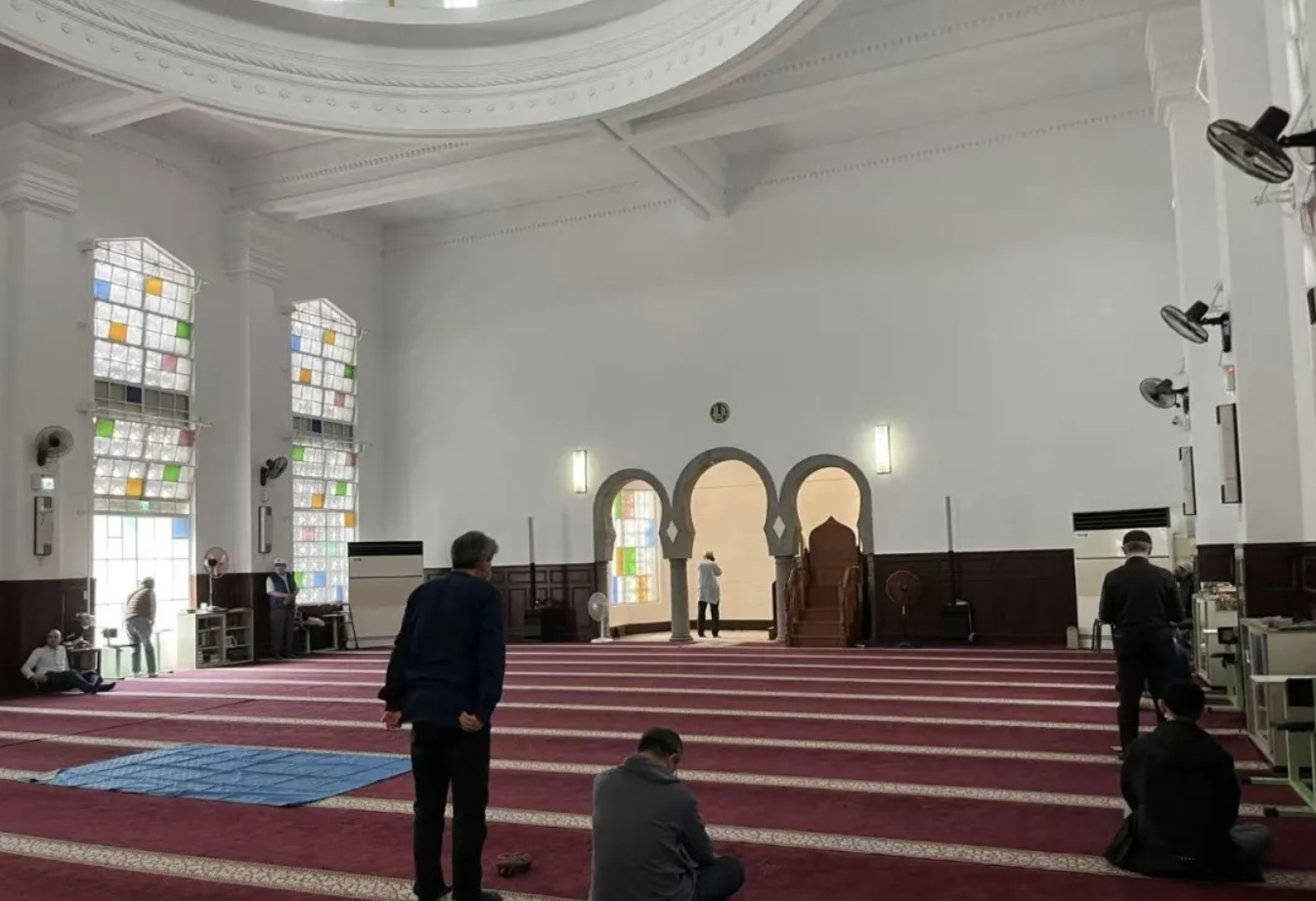
The very first day I landed in Taipei, even before checking into my hotel, I was in a hurry-scurry to get to the Taipei Grand Mosque, right next to Daan Forest Park. I rolled up just in time for a funeral, and honestly, seeing the family all dressed in black, lined up in two rows on the way to the wudu room, really caught me off guard. The deceased was there, waiting to be washed. I, with my luggage in tow, walked into the wudu room under their somewhat puzzled gazes. I naturally figured most of these family members weren't Muslim and probably wondered why a rushed traveler like me was heading into a washroom meant for the departed. Without a second to spare, I quickly performed wudu and headed to the main prayer hall, waiting for Dhuhr (midday prayer).
Glancing around at the people waiting for prayer, my eyes immediately landed on the "legendary" newly appointed young Imam. I went over and gave him a salam, and we agreed to chat after prayers. After we finished, we all stood for the Janazah (funeral prayer) for the deceased. Afterward, we started talking, and when the young Imam mentioned the deceased, he told me the person might be a descendant of Yunnan Hui Muslims from Myanmar, a young man from Myanmar Street, not even 30 years old. He also mentioned he was heading to "Myanmar Street" that evening to grab some food. I was all ears, quickly asking what the connection was between Myanmar Street and Muslims. To my surprise, the Imam explained that a significant part of Taiwan's Muslim community is made up of these Yunnanese Muslims, and Myanmar Street is one of their main hangouts. My aimless Taiwan trip suddenly had a bullseye: Myanmar Street.


Myanmar Street: Home to the "Lonely Army's" Descendants
Hua Xin Street, nestled in Taipei's Zhonghe District, is widely known as "Myanmar Street." It's a vibrant hub for Burmese Chinese and, crucially, a stopping point for Hui Muslims from Yunnan. These folks are descendants of what's often called the "Burma-Thailand Lonely Army," gradually settling here after the 1980s. The "Lonely Army," also known as the "Yunnan-Burma Lonely Army" or "Remnants of the KMT Army," refers to Nationalist (Kuomintang, or KMT) troops who retreated to Myanmar after the People's Republic of China was established in 1949. A significant number of Yunnanese Muslim soldiers and their families moved with them, forming a distinct Muslim community within the ranks of this "Lonely Army." Early on, a large number of these Muslim families found a base in the border regions of Myanmar's Shan and Kachin states. Another segment later migrated to northern Thailand, making their lives along the Mekong River.

For most Taiwanese, these folks are cultural and geographical "outsiders." The Imam, with a touch of melancholy, recently told me that young people aren't really into Islam anymore, and many religious practices have simply become "customs." You could see this plain as day among the young folks at the funeral. While the older aunties wore their headscarves, the younger generation opted for general funeral attire – black to show respect – looking no different from any other non-Muslim from the outside. The Initium (a Chinese digital media outlet) even published an article titled "The Outsiders" that delves into the identity struggles of a young person from Myanmar Street. These Muslim descendants grapple with a unique "Yunnan-Myanmar-Taiwan" triple cultural identity, a blend of Chinese culture, Islamic faith, and Southeast Asian influences. But they don't quite belong to Myanmar, and it seems they don't fully belong to Taiwan either. Even their Yunnan accent has become a source of discrimination. Myanmar Street is their Huifang – their Muslim quarter. For the younger generation "from the block," stepping outside this Huifang might feel like a more "fitting" integration, while holding onto your turf makes you a stubborn outsider. It’s the bitter taste of growing up in the Huicamps. Perhaps it’s not until they can truly think for themselves that they can appreciate the preciousness of what they already possess.


Despite all this, Myanmar Street remains their Huifang. Burmese signs are everywhere you look, and the names of street snacks like "Ersi" (rice noodles) and "Ganba" (dried beef) betray their Yunnan roots. Here, you can still confidently enjoy halal food that’s both Burmese and Yunnanese. The older sister running the "Yongli" snack shop told me she only arrived in Taiwan a few years ago and isn't quite used to living here. If her husband hadn't been here for decades, she never would have considered moving. Everything is just so different. Speaking in a somewhat broken Yunnan-inflected Mandarin, she warned me, "Young folks gotta be careful and protect yourselves, okay? Yesterday, a young guy died in a motorcycle accident, only in his twenties." I quickly chimed in, "I stood for the Janazah at the mosque today for the deceased. You must be talking about that very same person!"
Longgang: Another Haven for Yunnan Muslims in Taiwan
These days, Longgang, over in Taoyuan's Zhongli District, is another super important spot where Yunnan Muslims have really set down roots. Back in the 1950s, the Taiwanese government brought over the Dian-Myanmar "Lonely Army" and their families from Thailand and Myanmar, settling them all right here. To keep their faith alive and kicking, the Muslim community pooled their resources and built the Longgang Mosque. It's not just a place for salat (prayers); it's a vibrant hub where their culture and spirit come together. The fact that every single mosque in Taiwan has a Yunnanese Imam really shows just how big a deal these Yunnan descendants are within the Taiwanese Muslim community.


Lukang: Where History and Faith Whisper (Quietly)
My first footprint on the mainland Hui Muslim journey in Taiwan was in Lukang, a town absolutely bursting with incense smoke. As I made my way south from Taipei to Taichung, my Aunt Ma, who I'd been in touch with, kept bringing up taking me to Lukang. I was a bit in the dark, honestly, wondering what this little town had to do with Hui Muslims. Once I hit Taichung, Sister Shi, who picked me up with my aunt, was a local from Lukang herself. She told me she was a descendant of the famous General Shi Lang, and that Lukang was one of the very first places mainlanders settled in Taiwan. Lukang’s temples are crammed with worshipers; Sister Shi mentioned they get tens of millions of visitors every year. Walking near the old street, temples and ancestral halls are everywhere, and as Aunt Ma put it, "The idols have taken over this place."
Sister Shi, with her headscarf, definitely sticks out like a sore thumb here. But even before she embraced Islam, she wasn't part of the mainstream. She used to be a devout Christian, knew her Bible inside and out, and could debate scripture with anyone.
But the Lukang I want to talk about is a different side of it – this is where Taiwan first intersected with Hui Muslims. As early as the late Ming Dynasty, some descendants of Hui Muslims living in the Quanzhou region followed the migration waves to Taiwan, settling in what is now Lukang and Taisi. This marked the earliest recorded presence of Muslims in Taiwan. Today, Lukang is primarily home to the Chen-dai Ding and Guo families. The earliest observations of them date back to the 1920s, when scholars noted there wasn't a single trace of Islamic practice left in their lives. Their descendants even revealed that their ancestors had a strict rule: "Hide the fact that you are Muslim at all costs." Despite fully adopting Han customs, their family genealogies still record their connections to the mainland and their Muslim ancestors. The Ding clan in Lukang still knows they are descendants of the 18th generation. Some of their unique ancestral worship rituals might also hint at their special identity. For instance, the Ding family has a peculiar custom during funerals called "Guan Mao" (pouring water from the roof into a well) where the family patriarch or eldest grandson pours three cups of wine into a bowl. The Ding family's main house is a siheyuan (quadrangle courtyard), which from above forms the Chinese character "回" (Hui/return), unlike the local sanheyuan (three-sided courtyard). Plus, there are no ancestral tablets in their ancestral hall. For the Guo clan, not using pork in their ancestral worship is perhaps more direct evidence of their Muslim lineage. The Guo family also doesn't invite Taoist priests to chant scriptures; instead, they specifically invite someone familiar with Guo family customs to perform the rituals. There's even a rumor that a local temple called Bao'an Temple was originally a mosque, later converted into an ancestral hall.
Unlike the Yunnanese descendants who came to Taiwan in the 1980s, Lukang presents a much more localized form of Muslim history, and you won't find many visible signs of Islam here. There's only one small prayer spot for Indonesian migrant workers, maintained and managed by two Taiwanese converts to Islam. The converts and the deeply assimilated Hui descendants form a stark contrast. Modern Lukang is booming with traditional worship, but it's also stubbornly resistant to change. Grandpa Xue, a convert from Kaohsiung, picked up his Iman (faith) after converting and started Da'wah (religious outreach) in a park not far from the Lukang Mosque. In over ten years, he only managed to guide one person to Islam – and that person was my guide, Sister Shi.


Kaohsiung: Tracing the Footsteps of Our Elders
Kaohsiung holds a special place, as it was one of the first cities in Taiwan to establish a mosque. The early Kaohsiung Mosque was originally located at 117 Wufu 4th Road in Yancheng District – that spot is actually a Hong Kong-style tea restaurant now. Back then, the second floor had tatami mats laid out for prayer, a small space, until they eventually moved to Linsen 1st Road. Not far from this old prayer hall, there was a Beijing Halal Restaurant that was a regular hangout spot for the "people of the faith."
The owner of that halal restaurant was a man named Zhao Mingyuan from Qingzhou, Shandong. During the Republic of China era, he actually recommended Imam Wang Jingzhai to serve at the Qingzhou Mosque. Even after coming to Taiwan with the Kuomintang in '48, his heart remained devoted to the Deen (faith). He was one of the original founders, along with twelve others, who established the Kaohsiung Mosque. When I mentioned Zhao Mingyuan, a teacher named Y from Taipei told me that the Zhao clan of Qingzhou was a prominent family, a big deal in the Muslim community, and they contributed a ton to the Deen. Nowadays, the Zhao family gatherings are practically international events, with their descendants found from mainland China all the way to North America. There’s even a Chinese-American Imam named Zhao in the States who's part of that very family. But perhaps even more well-known in Taiwan is the grandson of elder Zhao Mingyuan, the famous former Imam of the Taipei Grand Mosque, Dr. Zhao Xilin. Today, the Kaohsiung Mosque has been at its current location on Jianjun Road in Lingya District since 1992. The first Imam of the new Kaohsiung Mosque, Chen Yongwu, hails from Myanmar and is still serving there today, carrying on the rich tradition of the Dian-Myanmar Muslims.
Of course, there are also some less visible Hui Muslims who quietly live in Kaohsiung, like my own grand-uncle. After being forced to retreat to Taiwan with the larger army as a wounded soldier, my grand-uncle lived alone on this land. He didn't seem to interact with these active "people of the faith." I often wondered, as a Hui Muslim from Northeast China, how he managed to make a life for himself all alone here. Following the address my dad sent me, which had been mailed from Taiwan, I went to his old place. Now, it's just a parking lot – nothing left of what it used to be.




A Mix of Sacred and Secular: Indonesian Prayer Spots
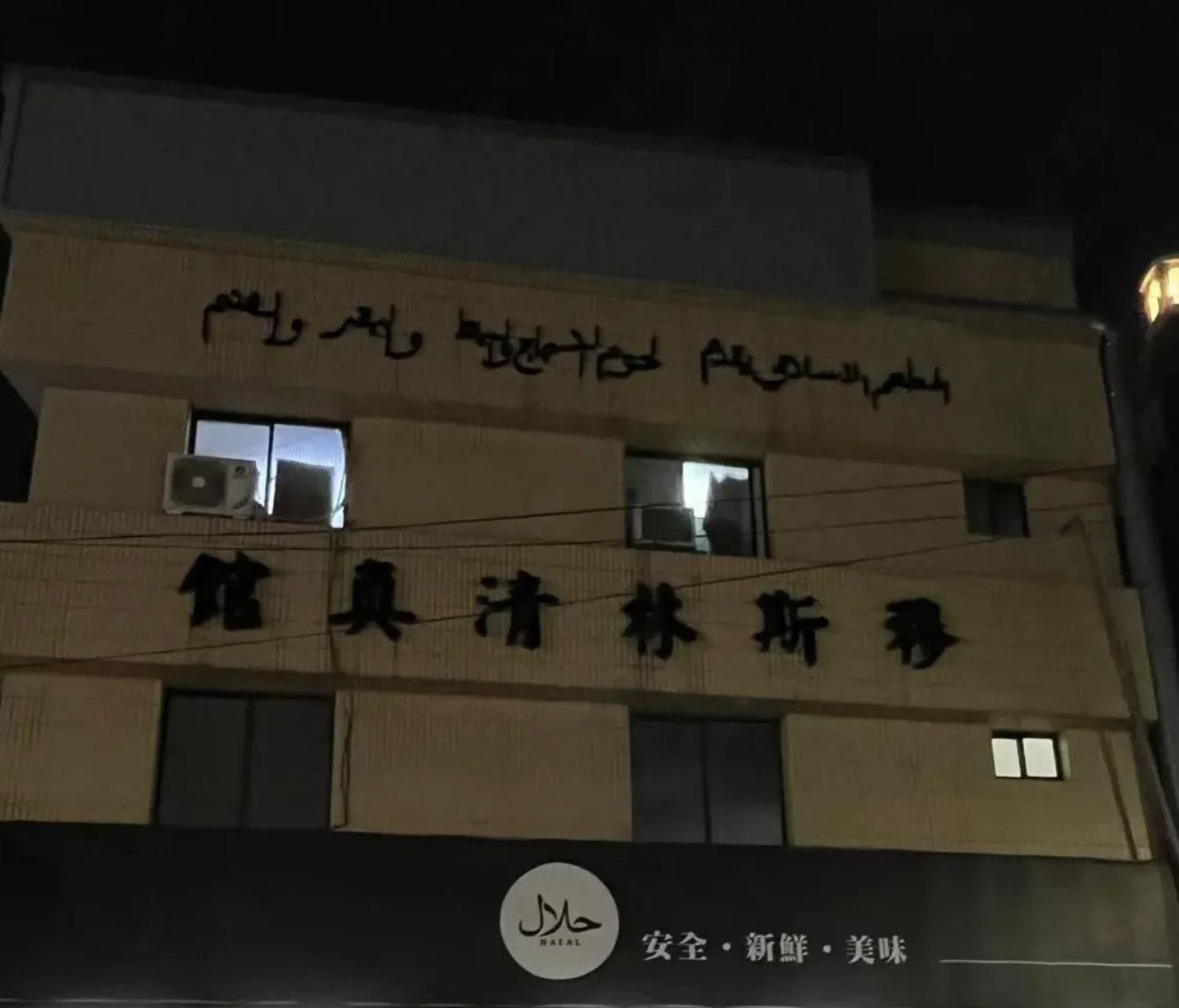
Given Taiwan's geography and terrain, the island's east coast has always been pretty off the beaten path, with very few people living there. So, finding a sizable Muslim community there is practically a pipe dream. Even so, you can still scout out some places to pray in a few cities. The thing is, these prayer spots aren't necessarily what you'd call serene or super peaceful. When I followed my map to two Indonesian prayer spots in Hualien City, the noisy surroundings honestly made me cringe a little bit.
At one of them, the first floor was a bustling restaurant, and the third floor was the prayer hall. But get this: sandwiched right in between, on the second floor, was a hidden dance hall! So, there I was, praying on the third floor, prostrating to Allah (SWT), and feeling the vibrations of the speakers and hearing the faint sounds of singing wafting up from the floor below. Subhanallah! It was a truly unique experience, a test of focus, no doubt.
At the other prayer spot in Hualien, the secular world had seeped in even more thoroughly. The prayer room was still upstairs, but the first floor was like a reception area, or maybe a community hangout. As soon as you walked in, there was a living room setup, complete with a kitchen. Indonesian folks were busy preparing meals right there for others sitting downstairs. I gave a friendly nod to the "hosts" on the first floor and headed upstairs to pray. Just when I thought this might be a quieter spot, a wave of smoke from downstairs started drifting up, making the second floor feel all hazy and ethereal – and not in a good way, if you catch my drift.
Ultimately, though, much like the laborers themselves, the Deen (faith) here is something that's been brought in from elsewhere. Beyond these two prayer spots, even finding a single halal restaurant was a tall order, almost a luxury. It truly put into perspective the challenges faced by our brothers and sisters in places where Islam isn't the dominant culture. May Allah make it easy for them.


Taichung Mosque: A Hub of Faith
Taichung is home to a pretty active Muslim community, and my main reason for coming to Taiwan this time around was to visit my Uncle and Aunt Ma, who live there. Now, Uncle Ma, bless his heart, is an engineer by trade, not some academic from an Islamic studies program. But in his free time, he dedicates himself to a word-by-word morphological and grammatical analysis of the Quran, then pays out of his own pocket to print and publish his findings online for others to learn from. Aunt Ma, for her part, is the quiet force behind the scenes, a true pillar of strength for the Taichung Mosque. They've been my gateway to understanding Taiwan's Muslim community, and getting to know them has really opened my eyes.


Culture Mosque: A Community-Driven Space
As one of only two real mosques in Taipei, the Culture Mosque doesn't have a permanent Imam. So, it's usually run by amateur Imams. There's one particular Pakistani uncle who prays there regularly; he's gotten Taiwanese citizenship through marriage and is now a bona fide Taiwanese citizen. Masha'Allah!
Food Chronicles: Beef and Its Vegetarian Buddies
Long story short, if you're on the west side of Taiwan, you won't have any trouble finding halal food. But head east, and you're pretty much out of luck. There are no more than two halal spots in Taitung, and maybe three at most in Hualien... it's a tough nut to crack if you're trying to keep things strictly halal.


Halal Bites Across the Island
Halal cuisine at Taipei Airport (A true blessing when you're traveling!)

Taiwan's chain fried chicken shops (Always a crowd-pleaser!)


Halal beef noodle soup joint in Kaohsiung (A warm bowl of goodness!)

Halal beef noodle shop in Taipei (Classic comfort food, Muslim-style!)


A halal Roujiamo (Chinese meat burger) spot (A little taste of home for many!)


Postscript: The Unfolding Journey
Taiwan really brought to mind a topic we often discuss: migration. For an individual, migration can be quite a conscious choice, a proactive step. But for an entire community, it feels like there's no escaping the gears of destiny and the call of Qadar (Divine decree), no matter where you go. The reality that descends upon a community can't be faced by constantly running away. Some might ask if Taiwan is suitable for Muslims to live in. If you consider food, clothing, and education, simply existing as a Muslim here is a huge test. Yet, you can't really tell those who've already put down roots here to find a more "Muslim-friendly" country. Looking back at them, they've constantly been on the move, and while Taiwan might not be the ideal Jannah (paradise), it has given them a chance to catch their breath. We, as humans, merely pass through this life fleetingly. It's only by accepting hardships that we can truly overcome them and face the Hereafter with peace. Finding glimmers of light – good people and good deeds – amidst the chaos was truly enough to uplift my ruh (spirit) and strengthen my iman. Alhamdulillah for all His blessings.
For the longest time, the idea of "Taiwan" and "Islam" in the American mind felt like two completely unrelated concepts. It's tough for folks to naturally picture a place there where Muslims could truly put down roots and thrive. If it even crossed their minds, it was usually imagined much like other Northeast Asian countries: a need for foreign laborers due to an aging population. These workers, often from Muslim nations, toiled in low-wage jobs within an unfamiliar culture, all while clinging to religious beliefs that locals might find "odd and out of place."
Thanks to the rapid growth of the internet over the past decade, the Hui Muslim community in mainland China has definitely gained a deeper understanding of their Taiwanese counterparts. In Shanghai, especially, there are more chances to connect with Muslim friends, relatives, or workers from the island. These interactions give us a peek behind the curtain, offering a glimpse into their lives. Taiwan's relatively open publishing industry has also allowed a wealth of Islam-related Chinese books to flow back to the mainland, building crucial bridges between East and West, and between different faiths and cultures.
Truth be told, Taiwan's modern Muslim history is far richer than most people imagine. It's a story that globalizes local Hui history, tracing their journey from the mainland, heading south into Myanmar and Thailand, and eventually finding their home in Taiwan. Their individual experiences paint a hidden yet grand picture of East Asian Islam. My trip this time was only ten days – not enough time to tell the whole enchilada, but I hope to leave a few clues for others to chew on later.
Taipei: Muslim-Friendly Amenities Galore
The Taipei Grand Mosque is certainly no longer an "isolated island" of faith, and Islamic beliefs are no longer confined within mosque walls. The Taiwanese authorities have been pushing a "Muslim-Friendly Policy" in recent years, setting up convenient facilities for Muslims in transportation hubs, universities, and major tourist spots. We're talking prayer rooms, dedicated facilities for wudu (ablution), and the like. The very first day I arrived in Taipei, I spotted clear signs for Muslim facilities in the downtown Taipei Main Station. Following the directions, it was a piece of cake to find both the restrooms and the prayer room.
Even though I didn't actually need to pray at that moment, I specifically asked a kind cleaning lady to open the wudu room door, just to see if it was the real deal or just for show. To my surprise, she was super enthusiastic, opened the door right away, and even proactively told me where the prayer room was and how to use it. In that moment, my tired body and soul immediately felt a boost – Taiwan really made a fantastic first impression. When someone extends a hand of kindness, we shouldn't just gladly accept it; we should also respond positively. If every Muslim doesn't overlook these readily available conveniences, then those who set up these facilities will also truly feel the meaning and necessity of their efforts.
Descendants of the "Lonely Army" on Myanmar Street
The very first day I landed in Taipei, even before checking into my hotel, I was in a hurry-scurry to get to the Taipei Grand Mosque, right next to Daan Forest Park. I rolled up just in time for a funeral, and honestly, seeing the family all dressed in black, lined up in two rows on the way to the wudu room, really caught me off guard. The deceased was there, waiting to be washed. I, with my luggage in tow, walked into the wudu room under their somewhat puzzled gazes. I naturally figured most of these family members weren't Muslim and probably wondered why a rushed traveler like me was heading into a washroom meant for the departed. Without a second to spare, I quickly performed wudu and headed to the main prayer hall, waiting for Dhuhr (midday prayer).
Glancing around at the people waiting for prayer, my eyes immediately landed on the "legendary" newly appointed young Imam. I went over and gave him a salam, and we agreed to chat after prayers. After we finished, we all stood for the Janazah (funeral prayer) for the deceased. Afterward, we started talking, and when the young Imam mentioned the deceased, he told me the person might be a descendant of Yunnan Hui Muslims from Myanmar, a young man from Myanmar Street, not even 30 years old. He also mentioned he was heading to "Myanmar Street" that evening to grab some food. I was all ears, quickly asking what the connection was between Myanmar Street and Muslims. To my surprise, the Imam explained that a significant part of Taiwan's Muslim community is made up of these Yunnanese Muslims, and Myanmar Street is one of their main hangouts. My aimless Taiwan trip suddenly had a bullseye: Myanmar Street.
Myanmar Street: Home to the "Lonely Army's" Descendants
Hua Xin Street, nestled in Taipei's Zhonghe District, is widely known as "Myanmar Street." It's a vibrant hub for Burmese Chinese and, crucially, a stopping point for Hui Muslims from Yunnan. These folks are descendants of what's often called the "Burma-Thailand Lonely Army," gradually settling here after the 1980s. The "Lonely Army," also known as the "Yunnan-Burma Lonely Army" or "Remnants of the KMT Army," refers to Nationalist (Kuomintang, or KMT) troops who retreated to Myanmar after the People's Republic of China was established in 1949. A significant number of Yunnanese Muslim soldiers and their families moved with them, forming a distinct Muslim community within the ranks of this "Lonely Army." Early on, a large number of these Muslim families found a base in the border regions of Myanmar's Shan and Kachin states. Another segment later migrated to northern Thailand, making their lives along the Mekong River.
For most Taiwanese, these folks are cultural and geographical "outsiders." The Imam, with a touch of melancholy, recently told me that young people aren't really into Islam anymore, and many religious practices have simply become "customs." You could see this plain as day among the young folks at the funeral. While the older aunties wore their headscarves, the younger generation opted for general funeral attire – black to show respect – looking no different from any other non-Muslim from the outside. The Initium (a Chinese digital media outlet) even published an article titled "The Outsiders" that delves into the identity struggles of a young person from Myanmar Street. These Muslim descendants grapple with a unique "Yunnan-Myanmar-Taiwan" triple cultural identity, a blend of Chinese culture, Islamic faith, and Southeast Asian influences. But they don't quite belong to Myanmar, and it seems they don't fully belong to Taiwan either. Even their Yunnan accent has become a source of discrimination. Myanmar Street is their Huifang – their Muslim quarter. For the younger generation "from the block," stepping outside this Huifang might feel like a more "fitting" integration, while holding onto your turf makes you a stubborn outsider. It’s the bitter taste of growing up in the Huicamps. Perhaps it’s not until they can truly think for themselves that they can appreciate the preciousness of what they already possess.
Despite all this, Myanmar Street remains their Huifang. Burmese signs are everywhere you look, and the names of street snacks like "Ersi" (rice noodles) and "Ganba" (dried beef) betray their Yunnan roots. Here, you can still confidently enjoy halal food that’s both Burmese and Yunnanese. The older sister running the "Yongli" snack shop told me she only arrived in Taiwan a few years ago and isn't quite used to living here. If her husband hadn't been here for decades, she never would have considered moving. Everything is just so different. Speaking in a somewhat broken Yunnan-inflected Mandarin, she warned me, "Young folks gotta be careful and protect yourselves, okay? Yesterday, a young guy died in a motorcycle accident, only in his twenties." I quickly chimed in, "I stood for the Janazah at the mosque today for the deceased. You must be talking about that very same person!"
Longgang: Another Haven for Yunnan Muslims in Taiwan
These days, Longgang, over in Taoyuan's Zhongli District, is another super important spot where Yunnan Muslims have really set down roots. Back in the 1950s, the Taiwanese government brought over the Dian-Myanmar "Lonely Army" and their families from Thailand and Myanmar, settling them all right here. To keep their faith alive and kicking, the Muslim community pooled their resources and built the Longgang Mosque. It's not just a place for salat (prayers); it's a vibrant hub where their culture and spirit come together. The fact that every single mosque in Taiwan has a Yunnanese Imam really shows just how big a deal these Yunnan descendants are within the Taiwanese Muslim community.
Lukang: Where History and Faith Whisper (Quietly)
My first footprint on the mainland Hui Muslim journey in Taiwan was in Lukang, a town absolutely bursting with incense smoke. As I made my way south from Taipei to Taichung, my Aunt Ma, who I'd been in touch with, kept bringing up taking me to Lukang. I was a bit in the dark, honestly, wondering what this little town had to do with Hui Muslims. Once I hit Taichung, Sister Shi, who picked me up with my aunt, was a local from Lukang herself. She told me she was a descendant of the famous General Shi Lang, and that Lukang was one of the very first places mainlanders settled in Taiwan. Lukang’s temples are crammed with worshipers; Sister Shi mentioned they get tens of millions of visitors every year. Walking near the old street, temples and ancestral halls are everywhere, and as Aunt Ma put it, "The idols have taken over this place."
Sister Shi, with her headscarf, definitely sticks out like a sore thumb here. But even before she embraced Islam, she wasn't part of the mainstream. She used to be a devout Christian, knew her Bible inside and out, and could debate scripture with anyone.
But the Lukang I want to talk about is a different side of it – this is where Taiwan first intersected with Hui Muslims. As early as the late Ming Dynasty, some descendants of Hui Muslims living in the Quanzhou region followed the migration waves to Taiwan, settling in what is now Lukang and Taisi. This marked the earliest recorded presence of Muslims in Taiwan. Today, Lukang is primarily home to the Chen-dai Ding and Guo families. The earliest observations of them date back to the 1920s, when scholars noted there wasn't a single trace of Islamic practice left in their lives. Their descendants even revealed that their ancestors had a strict rule: "Hide the fact that you are Muslim at all costs." Despite fully adopting Han customs, their family genealogies still record their connections to the mainland and their Muslim ancestors. The Ding clan in Lukang still knows they are descendants of the 18th generation. Some of their unique ancestral worship rituals might also hint at their special identity. For instance, the Ding family has a peculiar custom during funerals called "Guan Mao" (pouring water from the roof into a well) where the family patriarch or eldest grandson pours three cups of wine into a bowl. The Ding family's main house is a siheyuan (quadrangle courtyard), which from above forms the Chinese character "回" (Hui/return), unlike the local sanheyuan (three-sided courtyard). Plus, there are no ancestral tablets in their ancestral hall. For the Guo clan, not using pork in their ancestral worship is perhaps more direct evidence of their Muslim lineage. The Guo family also doesn't invite Taoist priests to chant scriptures; instead, they specifically invite someone familiar with Guo family customs to perform the rituals. There's even a rumor that a local temple called Bao'an Temple was originally a mosque, later converted into an ancestral hall.
Unlike the Yunnanese descendants who came to Taiwan in the 1980s, Lukang presents a much more localized form of Muslim history, and you won't find many visible signs of Islam here. There's only one small prayer spot for Indonesian migrant workers, maintained and managed by two Taiwanese converts to Islam. The converts and the deeply assimilated Hui descendants form a stark contrast. Modern Lukang is booming with traditional worship, but it's also stubbornly resistant to change. Grandpa Xue, a convert from Kaohsiung, picked up his Iman (faith) after converting and started Da'wah (religious outreach) in a park not far from the Lukang Mosque. In over ten years, he only managed to guide one person to Islam – and that person was my guide, Sister Shi.
Kaohsiung: Tracing the Footsteps of Our Elders
Kaohsiung holds a special place, as it was one of the first cities in Taiwan to establish a mosque. The early Kaohsiung Mosque was originally located at 117 Wufu 4th Road in Yancheng District – that spot is actually a Hong Kong-style tea restaurant now. Back then, the second floor had tatami mats laid out for prayer, a small space, until they eventually moved to Linsen 1st Road. Not far from this old prayer hall, there was a Beijing Halal Restaurant that was a regular hangout spot for the "people of the faith."
The owner of that halal restaurant was a man named Zhao Mingyuan from Qingzhou, Shandong. During the Republic of China era, he actually recommended Imam Wang Jingzhai to serve at the Qingzhou Mosque. Even after coming to Taiwan with the Kuomintang in '48, his heart remained devoted to the Deen (faith). He was one of the original founders, along with twelve others, who established the Kaohsiung Mosque. When I mentioned Zhao Mingyuan, a teacher named Y from Taipei told me that the Zhao clan of Qingzhou was a prominent family, a big deal in the Muslim community, and they contributed a ton to the Deen. Nowadays, the Zhao family gatherings are practically international events, with their descendants found from mainland China all the way to North America. There’s even a Chinese-American Imam named Zhao in the States who's part of that very family. But perhaps even more well-known in Taiwan is the grandson of elder Zhao Mingyuan, the famous former Imam of the Taipei Grand Mosque, Dr. Zhao Xilin. Today, the Kaohsiung Mosque has been at its current location on Jianjun Road in Lingya District since 1992. The first Imam of the new Kaohsiung Mosque, Chen Yongwu, hails from Myanmar and is still serving there today, carrying on the rich tradition of the Dian-Myanmar Muslims.
Of course, there are also some less visible Hui Muslims who quietly live in Kaohsiung, like my own grand-uncle. After being forced to retreat to Taiwan with the larger army as a wounded soldier, my grand-uncle lived alone on this land. He didn't seem to interact with these active "people of the faith." I often wondered, as a Hui Muslim from Northeast China, how he managed to make a life for himself all alone here. Following the address my dad sent me, which had been mailed from Taiwan, I went to his old place. Now, it's just a parking lot – nothing left of what it used to be.
A Mix of Sacred and Secular: Indonesian Prayer Spots
Given Taiwan's geography and terrain, the island's east coast has always been pretty off the beaten path, with very few people living there. So, finding a sizable Muslim community there is practically a pipe dream. Even so, you can still scout out some places to pray in a few cities. The thing is, these prayer spots aren't necessarily what you'd call serene or super peaceful. When I followed my map to two Indonesian prayer spots in Hualien City, the noisy surroundings honestly made me cringe a little bit.
At one of them, the first floor was a bustling restaurant, and the third floor was the prayer hall. But get this: sandwiched right in between, on the second floor, was a hidden dance hall! So, there I was, praying on the third floor, prostrating to Allah (SWT), and feeling the vibrations of the speakers and hearing the faint sounds of singing wafting up from the floor below. Subhanallah! It was a truly unique experience, a test of focus, no doubt.
At the other prayer spot in Hualien, the secular world had seeped in even more thoroughly. The prayer room was still upstairs, but the first floor was like a reception area, or maybe a community hangout. As soon as you walked in, there was a living room setup, complete with a kitchen. Indonesian folks were busy preparing meals right there for others sitting downstairs. I gave a friendly nod to the "hosts" on the first floor and headed upstairs to pray. Just when I thought this might be a quieter spot, a wave of smoke from downstairs started drifting up, making the second floor feel all hazy and ethereal – and not in a good way, if you catch my drift.
Ultimately, though, much like the laborers themselves, the Deen (faith) here is something that's been brought in from elsewhere. Beyond these two prayer spots, even finding a single halal restaurant was a tall order, almost a luxury. It truly put into perspective the challenges faced by our brothers and sisters in places where Islam isn't the dominant culture. May Allah make it easy for them.
Taichung Mosque: A Hub of Faith
Taichung is home to a pretty active Muslim community, and my main reason for coming to Taiwan this time around was to visit my Uncle and Aunt Ma, who live there. Now, Uncle Ma, bless his heart, is an engineer by trade, not some academic from an Islamic studies program. But in his free time, he dedicates himself to a word-by-word morphological and grammatical analysis of the Quran, then pays out of his own pocket to print and publish his findings online for others to learn from. Aunt Ma, for her part, is the quiet force behind the scenes, a true pillar of strength for the Taichung Mosque. They've been my gateway to understanding Taiwan's Muslim community, and getting to know them has really opened my eyes.
Culture Mosque: A Community-Driven Space
As one of only two real mosques in Taipei, the Culture Mosque doesn't have a permanent Imam. So, it's usually run by amateur Imams. There's one particular Pakistani uncle who prays there regularly; he's gotten Taiwanese citizenship through marriage and is now a bona fide Taiwanese citizen. Masha'Allah!
Food Chronicles: Beef and Its Vegetarian Buddies
Long story short, if you're on the west side of Taiwan, you won't have any trouble finding halal food. But head east, and you're pretty much out of luck. There are no more than two halal spots in Taitung, and maybe three at most in Hualien... it's a tough nut to crack if you're trying to keep things strictly halal.
Halal Bites Across the Island
Halal cuisine at Taipei Airport (A true blessing when you're traveling!)
Taiwan's chain fried chicken shops (Always a crowd-pleaser!)
Halal beef noodle soup joint in Kaohsiung (A warm bowl of goodness!)
Halal beef noodle shop in Taipei (Classic comfort food, Muslim-style!)
A halal Roujiamo (Chinese meat burger) spot (A little taste of home for many!)
Postscript: The Unfolding Journey
Taiwan really brought to mind a topic we often discuss: migration. For an individual, migration can be quite a conscious choice, a proactive step. But for an entire community, it feels like there's no escaping the gears of destiny and the call of Qadar (Divine decree), no matter where you go. The reality that descends upon a community can't be faced by constantly running away. Some might ask if Taiwan is suitable for Muslims to live in. If you consider food, clothing, and education, simply existing as a Muslim here is a huge test. Yet, you can't really tell those who've already put down roots here to find a more "Muslim-friendly" country. Looking back at them, they've constantly been on the move, and while Taiwan might not be the ideal Jannah (paradise), it has given them a chance to catch their breath. We, as humans, merely pass through this life fleetingly. It's only by accepting hardships that we can truly overcome them and face the Hereafter with peace. Finding glimmers of light – good people and good deeds – amidst the chaos was truly enough to uplift my ruh (spirit) and strengthen my iman. Alhamdulillah for all His blessings.
Halal Food Guide: Taiwan - Halal Restaurants Across the Island
Articles • ali2007fr posted the article • 0 comments • 176 views • 2026-05-19 08:54
Reposted from the web
Summary: Halal Food Guide: Taiwan - Halal Restaurants Across the Island is presented here as a firsthand travel account in clear, natural English. The account focuses on Taiwan, Halal Food, Muslim Travel while preserving the names, places, food, photos, and historical details from the Chinese source.
I am sharing an article from the 300th issue of China Islam magazine titled 'Remembering Brother Mu Huaijia’s Passing—Reflections on the History of Halal Restaurants in Taiwan.' Today I am transcribing the second part, which recalls various halal restaurants in Kaohsiung, Tainan, Taichung, and Taipei.
In the southern city of Kaohsiung, Elder Zhao Ming (may Allah grant him a high place in Paradise) founded the restaurant Meat Pie and Porridge (xianbing zhou), which was popular with both Muslims and the general public. It only operated for a few years before closing when Elder Ming moved north to the Taipei Mosque. Later, people like Xiao Sang and Song Mingcai opened halal restaurants near the Guangfu Theater, which provided convenience for fellow Muslims.
Two elderly people also ran a snack shop that was very helpful to Muslims in the south. It was located in Kaohsiung on Qiuting Road in Dagangpu, behind the wall of the Telecommunications Bureau. It was in a row of makeshift buildings and the place was very simple. The elderly couple’s shop had no name, just a hanging sign with a water pitcher (tangping) symbol.
The owner was a fellow Muslim named Ma Renshan (may Allah grant him a high place in Paradise), who was from Baoding, Hebei. They mainly served steamed buns (baozi) and beef noodles, and when they had time, they would also fry large scallion pancakes (cong you bing). People who know about it always stop by the old man's place when they visit Kaohsiung. Old Mr. Ma liked me because I learned wrestling as a child, and he was a top-tier wrestling master in North and Northwest China. Everyone knows Chang Dongsheng was a national wrestling champion and a fellow Muslim, but few know Old Mr. Ma was also an expert who once challenged Chang Zhi (may Allah grant him a high place in Paradise) to a match, though Chang did not accept.
Old Mr. Ma once served as a guard battalion commander for General Yan Xishan, and he lived a quiet, retired life after coming to Taiwan. In his later years, he ran this small snack shop to make a living. After Old Mr. Ming closed his shop, Old Mr. Ma's snack shop provided a lot of convenience for the local Muslims.
In the Tainan market, several enthusiastic Muslims including Wang Peijie (now known as Liu Zhi'an) and Hui Wanju pooled their money to open a halal restaurant. Business was good, but it closed after a few years due to a fire. Later, Wang Peijie opened another halal restaurant on Wufu 4th Road in Kaohsiung, and I even held my engagement party there. Wang Laohe later came to Taipei to seek opportunities and even ran a restaurant in Saudi Arabia for a time.
In Taichung, fellow Muslims like Hui Wanjuju, Mu Huaijia, and Chai Menglin (now named Chai Jin) once opened a halal restaurant, but business was hard to sustain and they closed the shop after a few years. Later, Song Mingcai ran a restaurant called Ende Yuan across from Taichung Park for many years, but it closed when Song immigrated abroad.
In Taichung, a fellow Muslim from Henan named Ma Yukun ran a specialty dumpling shop for many years, which also closed when he immigrated. There is a small halal restaurant on Jingwu Road in Taichung City that focuses on noodle dishes; they have a wide variety with good flavors that suit the general public. The owner was surnamed Sun, a man from Henan, and he eventually closed the shop as well.
Looking at Taipei, there were several large-scale halal restaurants that could serve full-course halal banquets and were quite popular for a time. The most prominent was the Donglaishun Halal Restaurant, located on Zhonghua Road across from Ende Yuan, which was run by fellow Muslim Yang Zhongbao. Xiao Ahong (may Allah grant him a high place in Paradise) planned a forty-table wedding banquet at Donglaishun. He had just arrived in Taiwan and did not know many fellow Hui Muslims yet. When he went to book the tables, the owner, Mr. Yang, asked for a deposit. Since National Assembly representatives were not yet receiving their salaries, Xiao Ahong could not pay the deposit at that time. He eventually found a fellow Hui Muslim named Hui Wanju to act as a guarantor, which allowed the wedding to go ahead. This happened half a century ago.
Hui Wanju was born in 1913 and is now ninety-seven years old. He is from Fenghuangcheng in Andong, is still alive, and often comes to the mosque for Friday namaz. He is single and currently lives at the Guangci Care Home in Taipei. When he was young, he was very skilled at catering for both weddings and funerals and trained many apprentices in Taiwan. He worked in various halal restaurants and also opened restaurants in partnership with others. When he first arrived in Taiwan, beef was hard to find because the local people did not eat beef and would not slaughter cows. Hui Wanju started slaughtering cows in the north, central, and southern parts of the island to supply beef to various halal restaurants. In his later years, he partnered with Fengji Dim Sum Shop on Jinshan South Road to make snacks. He was famous for his sesame flatbread (shaobing) and brown sugar baked rolls (huoshao), and he also supplied mooncakes during the Mid-Autumn Festival. view all
Summary: Halal Food Guide: Taiwan - Halal Restaurants Across the Island is presented here as a firsthand travel account in clear, natural English. The account focuses on Taiwan, Halal Food, Muslim Travel while preserving the names, places, food, photos, and historical details from the Chinese source.
I am sharing an article from the 300th issue of China Islam magazine titled 'Remembering Brother Mu Huaijia’s Passing—Reflections on the History of Halal Restaurants in Taiwan.' Today I am transcribing the second part, which recalls various halal restaurants in Kaohsiung, Tainan, Taichung, and Taipei.
In the southern city of Kaohsiung, Elder Zhao Ming (may Allah grant him a high place in Paradise) founded the restaurant Meat Pie and Porridge (xianbing zhou), which was popular with both Muslims and the general public. It only operated for a few years before closing when Elder Ming moved north to the Taipei Mosque. Later, people like Xiao Sang and Song Mingcai opened halal restaurants near the Guangfu Theater, which provided convenience for fellow Muslims.
Two elderly people also ran a snack shop that was very helpful to Muslims in the south. It was located in Kaohsiung on Qiuting Road in Dagangpu, behind the wall of the Telecommunications Bureau. It was in a row of makeshift buildings and the place was very simple. The elderly couple’s shop had no name, just a hanging sign with a water pitcher (tangping) symbol.
The owner was a fellow Muslim named Ma Renshan (may Allah grant him a high place in Paradise), who was from Baoding, Hebei. They mainly served steamed buns (baozi) and beef noodles, and when they had time, they would also fry large scallion pancakes (cong you bing). People who know about it always stop by the old man's place when they visit Kaohsiung. Old Mr. Ma liked me because I learned wrestling as a child, and he was a top-tier wrestling master in North and Northwest China. Everyone knows Chang Dongsheng was a national wrestling champion and a fellow Muslim, but few know Old Mr. Ma was also an expert who once challenged Chang Zhi (may Allah grant him a high place in Paradise) to a match, though Chang did not accept.
Old Mr. Ma once served as a guard battalion commander for General Yan Xishan, and he lived a quiet, retired life after coming to Taiwan. In his later years, he ran this small snack shop to make a living. After Old Mr. Ming closed his shop, Old Mr. Ma's snack shop provided a lot of convenience for the local Muslims.
In the Tainan market, several enthusiastic Muslims including Wang Peijie (now known as Liu Zhi'an) and Hui Wanju pooled their money to open a halal restaurant. Business was good, but it closed after a few years due to a fire. Later, Wang Peijie opened another halal restaurant on Wufu 4th Road in Kaohsiung, and I even held my engagement party there. Wang Laohe later came to Taipei to seek opportunities and even ran a restaurant in Saudi Arabia for a time.
In Taichung, fellow Muslims like Hui Wanjuju, Mu Huaijia, and Chai Menglin (now named Chai Jin) once opened a halal restaurant, but business was hard to sustain and they closed the shop after a few years. Later, Song Mingcai ran a restaurant called Ende Yuan across from Taichung Park for many years, but it closed when Song immigrated abroad.
In Taichung, a fellow Muslim from Henan named Ma Yukun ran a specialty dumpling shop for many years, which also closed when he immigrated. There is a small halal restaurant on Jingwu Road in Taichung City that focuses on noodle dishes; they have a wide variety with good flavors that suit the general public. The owner was surnamed Sun, a man from Henan, and he eventually closed the shop as well.
Looking at Taipei, there were several large-scale halal restaurants that could serve full-course halal banquets and were quite popular for a time. The most prominent was the Donglaishun Halal Restaurant, located on Zhonghua Road across from Ende Yuan, which was run by fellow Muslim Yang Zhongbao. Xiao Ahong (may Allah grant him a high place in Paradise) planned a forty-table wedding banquet at Donglaishun. He had just arrived in Taiwan and did not know many fellow Hui Muslims yet. When he went to book the tables, the owner, Mr. Yang, asked for a deposit. Since National Assembly representatives were not yet receiving their salaries, Xiao Ahong could not pay the deposit at that time. He eventually found a fellow Hui Muslim named Hui Wanju to act as a guarantor, which allowed the wedding to go ahead. This happened half a century ago.
Hui Wanju was born in 1913 and is now ninety-seven years old. He is from Fenghuangcheng in Andong, is still alive, and often comes to the mosque for Friday namaz. He is single and currently lives at the Guangci Care Home in Taipei. When he was young, he was very skilled at catering for both weddings and funerals and trained many apprentices in Taiwan. He worked in various halal restaurants and also opened restaurants in partnership with others. When he first arrived in Taiwan, beef was hard to find because the local people did not eat beef and would not slaughter cows. Hui Wanju started slaughtering cows in the north, central, and southern parts of the island to supply beef to various halal restaurants. In his later years, he partnered with Fengji Dim Sum Shop on Jinshan South Road to make snacks. He was famous for his sesame flatbread (shaobing) and brown sugar baked rolls (huoshao), and he also supplied mooncakes during the Mid-Autumn Festival. view all
Reposted from the web
Summary: Halal Food Guide: Taiwan - Halal Restaurants Across the Island is presented here as a firsthand travel account in clear, natural English. The account focuses on Taiwan, Halal Food, Muslim Travel while preserving the names, places, food, photos, and historical details from the Chinese source.
I am sharing an article from the 300th issue of China Islam magazine titled 'Remembering Brother Mu Huaijia’s Passing—Reflections on the History of Halal Restaurants in Taiwan.' Today I am transcribing the second part, which recalls various halal restaurants in Kaohsiung, Tainan, Taichung, and Taipei.
In the southern city of Kaohsiung, Elder Zhao Ming (may Allah grant him a high place in Paradise) founded the restaurant Meat Pie and Porridge (xianbing zhou), which was popular with both Muslims and the general public. It only operated for a few years before closing when Elder Ming moved north to the Taipei Mosque. Later, people like Xiao Sang and Song Mingcai opened halal restaurants near the Guangfu Theater, which provided convenience for fellow Muslims.
Two elderly people also ran a snack shop that was very helpful to Muslims in the south. It was located in Kaohsiung on Qiuting Road in Dagangpu, behind the wall of the Telecommunications Bureau. It was in a row of makeshift buildings and the place was very simple. The elderly couple’s shop had no name, just a hanging sign with a water pitcher (tangping) symbol.
The owner was a fellow Muslim named Ma Renshan (may Allah grant him a high place in Paradise), who was from Baoding, Hebei. They mainly served steamed buns (baozi) and beef noodles, and when they had time, they would also fry large scallion pancakes (cong you bing). People who know about it always stop by the old man's place when they visit Kaohsiung. Old Mr. Ma liked me because I learned wrestling as a child, and he was a top-tier wrestling master in North and Northwest China. Everyone knows Chang Dongsheng was a national wrestling champion and a fellow Muslim, but few know Old Mr. Ma was also an expert who once challenged Chang Zhi (may Allah grant him a high place in Paradise) to a match, though Chang did not accept.
Old Mr. Ma once served as a guard battalion commander for General Yan Xishan, and he lived a quiet, retired life after coming to Taiwan. In his later years, he ran this small snack shop to make a living. After Old Mr. Ming closed his shop, Old Mr. Ma's snack shop provided a lot of convenience for the local Muslims.
In the Tainan market, several enthusiastic Muslims including Wang Peijie (now known as Liu Zhi'an) and Hui Wanju pooled their money to open a halal restaurant. Business was good, but it closed after a few years due to a fire. Later, Wang Peijie opened another halal restaurant on Wufu 4th Road in Kaohsiung, and I even held my engagement party there. Wang Laohe later came to Taipei to seek opportunities and even ran a restaurant in Saudi Arabia for a time.
In Taichung, fellow Muslims like Hui Wanjuju, Mu Huaijia, and Chai Menglin (now named Chai Jin) once opened a halal restaurant, but business was hard to sustain and they closed the shop after a few years. Later, Song Mingcai ran a restaurant called Ende Yuan across from Taichung Park for many years, but it closed when Song immigrated abroad.
In Taichung, a fellow Muslim from Henan named Ma Yukun ran a specialty dumpling shop for many years, which also closed when he immigrated. There is a small halal restaurant on Jingwu Road in Taichung City that focuses on noodle dishes; they have a wide variety with good flavors that suit the general public. The owner was surnamed Sun, a man from Henan, and he eventually closed the shop as well.
Looking at Taipei, there were several large-scale halal restaurants that could serve full-course halal banquets and were quite popular for a time. The most prominent was the Donglaishun Halal Restaurant, located on Zhonghua Road across from Ende Yuan, which was run by fellow Muslim Yang Zhongbao. Xiao Ahong (may Allah grant him a high place in Paradise) planned a forty-table wedding banquet at Donglaishun. He had just arrived in Taiwan and did not know many fellow Hui Muslims yet. When he went to book the tables, the owner, Mr. Yang, asked for a deposit. Since National Assembly representatives were not yet receiving their salaries, Xiao Ahong could not pay the deposit at that time. He eventually found a fellow Hui Muslim named Hui Wanju to act as a guarantor, which allowed the wedding to go ahead. This happened half a century ago.
Hui Wanju was born in 1913 and is now ninety-seven years old. He is from Fenghuangcheng in Andong, is still alive, and often comes to the mosque for Friday namaz. He is single and currently lives at the Guangci Care Home in Taipei. When he was young, he was very skilled at catering for both weddings and funerals and trained many apprentices in Taiwan. He worked in various halal restaurants and also opened restaurants in partnership with others. When he first arrived in Taiwan, beef was hard to find because the local people did not eat beef and would not slaughter cows. Hui Wanju started slaughtering cows in the north, central, and southern parts of the island to supply beef to various halal restaurants. In his later years, he partnered with Fengji Dim Sum Shop on Jinshan South Road to make snacks. He was famous for his sesame flatbread (shaobing) and brown sugar baked rolls (huoshao), and he also supplied mooncakes during the Mid-Autumn Festival.
Summary: Halal Food Guide: Taiwan - Halal Restaurants Across the Island is presented here as a firsthand travel account in clear, natural English. The account focuses on Taiwan, Halal Food, Muslim Travel while preserving the names, places, food, photos, and historical details from the Chinese source.
I am sharing an article from the 300th issue of China Islam magazine titled 'Remembering Brother Mu Huaijia’s Passing—Reflections on the History of Halal Restaurants in Taiwan.' Today I am transcribing the second part, which recalls various halal restaurants in Kaohsiung, Tainan, Taichung, and Taipei.
In the southern city of Kaohsiung, Elder Zhao Ming (may Allah grant him a high place in Paradise) founded the restaurant Meat Pie and Porridge (xianbing zhou), which was popular with both Muslims and the general public. It only operated for a few years before closing when Elder Ming moved north to the Taipei Mosque. Later, people like Xiao Sang and Song Mingcai opened halal restaurants near the Guangfu Theater, which provided convenience for fellow Muslims.
Two elderly people also ran a snack shop that was very helpful to Muslims in the south. It was located in Kaohsiung on Qiuting Road in Dagangpu, behind the wall of the Telecommunications Bureau. It was in a row of makeshift buildings and the place was very simple. The elderly couple’s shop had no name, just a hanging sign with a water pitcher (tangping) symbol.
The owner was a fellow Muslim named Ma Renshan (may Allah grant him a high place in Paradise), who was from Baoding, Hebei. They mainly served steamed buns (baozi) and beef noodles, and when they had time, they would also fry large scallion pancakes (cong you bing). People who know about it always stop by the old man's place when they visit Kaohsiung. Old Mr. Ma liked me because I learned wrestling as a child, and he was a top-tier wrestling master in North and Northwest China. Everyone knows Chang Dongsheng was a national wrestling champion and a fellow Muslim, but few know Old Mr. Ma was also an expert who once challenged Chang Zhi (may Allah grant him a high place in Paradise) to a match, though Chang did not accept.
Old Mr. Ma once served as a guard battalion commander for General Yan Xishan, and he lived a quiet, retired life after coming to Taiwan. In his later years, he ran this small snack shop to make a living. After Old Mr. Ming closed his shop, Old Mr. Ma's snack shop provided a lot of convenience for the local Muslims.
In the Tainan market, several enthusiastic Muslims including Wang Peijie (now known as Liu Zhi'an) and Hui Wanju pooled their money to open a halal restaurant. Business was good, but it closed after a few years due to a fire. Later, Wang Peijie opened another halal restaurant on Wufu 4th Road in Kaohsiung, and I even held my engagement party there. Wang Laohe later came to Taipei to seek opportunities and even ran a restaurant in Saudi Arabia for a time.
In Taichung, fellow Muslims like Hui Wanjuju, Mu Huaijia, and Chai Menglin (now named Chai Jin) once opened a halal restaurant, but business was hard to sustain and they closed the shop after a few years. Later, Song Mingcai ran a restaurant called Ende Yuan across from Taichung Park for many years, but it closed when Song immigrated abroad.
In Taichung, a fellow Muslim from Henan named Ma Yukun ran a specialty dumpling shop for many years, which also closed when he immigrated. There is a small halal restaurant on Jingwu Road in Taichung City that focuses on noodle dishes; they have a wide variety with good flavors that suit the general public. The owner was surnamed Sun, a man from Henan, and he eventually closed the shop as well.
Looking at Taipei, there were several large-scale halal restaurants that could serve full-course halal banquets and were quite popular for a time. The most prominent was the Donglaishun Halal Restaurant, located on Zhonghua Road across from Ende Yuan, which was run by fellow Muslim Yang Zhongbao. Xiao Ahong (may Allah grant him a high place in Paradise) planned a forty-table wedding banquet at Donglaishun. He had just arrived in Taiwan and did not know many fellow Hui Muslims yet. When he went to book the tables, the owner, Mr. Yang, asked for a deposit. Since National Assembly representatives were not yet receiving their salaries, Xiao Ahong could not pay the deposit at that time. He eventually found a fellow Hui Muslim named Hui Wanju to act as a guarantor, which allowed the wedding to go ahead. This happened half a century ago.
Hui Wanju was born in 1913 and is now ninety-seven years old. He is from Fenghuangcheng in Andong, is still alive, and often comes to the mosque for Friday namaz. He is single and currently lives at the Guangci Care Home in Taipei. When he was young, he was very skilled at catering for both weddings and funerals and trained many apprentices in Taiwan. He worked in various halal restaurants and also opened restaurants in partnership with others. When he first arrived in Taiwan, beef was hard to find because the local people did not eat beef and would not slaughter cows. Hui Wanju started slaughtering cows in the north, central, and southern parts of the island to supply beef to various halal restaurants. In his later years, he partnered with Fengji Dim Sum Shop on Jinshan South Road to make snacks. He was famous for his sesame flatbread (shaobing) and brown sugar baked rolls (huoshao), and he also supplied mooncakes during the Mid-Autumn Festival.
Discover Taiwan through the eyes of a Muslim traveler | revealing hidden muslim communities and Allah's blessings in unexpected corners.
Articles • ahmedla posted the article • 0 comments • 1481 views • 2025-06-08 20:44
Unveiling Islam in Taiwan: A Muslim Traveler's Perspective
For the longest time, the idea of "Taiwan" and "Islam" in the American mind felt like two completely unrelated concepts. It's tough for folks to naturally picture a place there where Muslims could truly put down roots and thrive. If it even crossed their minds, it was usually imagined much like other Northeast Asian countries: a need for foreign laborers due to an aging population. These workers, often from Muslim nations, toiled in low-wage jobs within an unfamiliar culture, all while clinging to religious beliefs that locals might find "odd and out of place."
Thanks to the rapid growth of the internet over the past decade, the Hui Muslim community in mainland China has definitely gained a deeper understanding of their Taiwanese counterparts. In Shanghai, especially, there are more chances to connect with Muslim friends, relatives, or workers from the island. These interactions give us a peek behind the curtain, offering a glimpse into their lives. Taiwan's relatively open publishing industry has also allowed a wealth of Islam-related Chinese books to flow back to the mainland, building crucial bridges between East and West, and between different faiths and cultures.
Truth be told, Taiwan's modern Muslim history is far richer than most people imagine. It's a story that globalizes local Hui history, tracing their journey from the mainland, heading south into Myanmar and Thailand, and eventually finding their home in Taiwan. Their individual experiences paint a hidden yet grand picture of East Asian Islam. My trip this time was only ten days – not enough time to tell the whole enchilada, but I hope to leave a few clues for others to chew on later.
Taipei: Muslim-Friendly Amenities Galore
The Taipei Grand Mosque is certainly no longer an "isolated island" of faith, and Islamic beliefs are no longer confined within mosque walls. The Taiwanese authorities have been pushing a "Muslim-Friendly Policy" in recent years, setting up convenient facilities for Muslims in transportation hubs, universities, and major tourist spots. We're talking prayer rooms, dedicated facilities for wudu (ablution), and the like. The very first day I arrived in Taipei, I spotted clear signs for Muslim facilities in the downtown Taipei Main Station. Following the directions, it was a piece of cake to find both the restrooms and the prayer room.
Even though I didn't actually need to pray at that moment, I specifically asked a kind cleaning lady to open the wudu room door, just to see if it was the real deal or just for show. To my surprise, she was super enthusiastic, opened the door right away, and even proactively told me where the prayer room was and how to use it. In that moment, my tired body and soul immediately felt a boost – Taiwan really made a fantastic first impression. When someone extends a hand of kindness, we shouldn't just gladly accept it; we should also respond positively. If every Muslim doesn't overlook these readily available conveniences, then those who set up these facilities will also truly feel the meaning and necessity of their efforts.
Descendants of the "Lonely Army" on Myanmar Street
The very first day I landed in Taipei, even before checking into my hotel, I was in a hurry-scurry to get to the Taipei Grand Mosque, right next to Daan Forest Park. I rolled up just in time for a funeral, and honestly, seeing the family all dressed in black, lined up in two rows on the way to the wudu room, really caught me off guard. The deceased was there, waiting to be washed. I, with my luggage in tow, walked into the wudu room under their somewhat puzzled gazes. I naturally figured most of these family members weren't Muslim and probably wondered why a rushed traveler like me was heading into a washroom meant for the departed. Without a second to spare, I quickly performed wudu and headed to the main prayer hall, waiting for Dhuhr (midday prayer).
Glancing around at the people waiting for prayer, my eyes immediately landed on the "legendary" newly appointed young Imam. I went over and gave him a salam, and we agreed to chat after prayers. After we finished, we all stood for the Janazah (funeral prayer) for the deceased. Afterward, we started talking, and when the young Imam mentioned the deceased, he told me the person might be a descendant of Yunnan Hui Muslims from Myanmar, a young man from Myanmar Street, not even 30 years old. He also mentioned he was heading to "Myanmar Street" that evening to grab some food. I was all ears, quickly asking what the connection was between Myanmar Street and Muslims. To my surprise, the Imam explained that a significant part of Taiwan's Muslim community is made up of these Yunnanese Muslims, and Myanmar Street is one of their main hangouts. My aimless Taiwan trip suddenly had a bullseye: Myanmar Street.
Myanmar Street: Home to the "Lonely Army's" Descendants
Hua Xin Street, nestled in Taipei's Zhonghe District, is widely known as "Myanmar Street." It's a vibrant hub for Burmese Chinese and, crucially, a stopping point for Hui Muslims from Yunnan. These folks are descendants of what's often called the "Burma-Thailand Lonely Army," gradually settling here after the 1980s. The "Lonely Army," also known as the "Yunnan-Burma Lonely Army" or "Remnants of the KMT Army," refers to Nationalist (Kuomintang, or KMT) troops who retreated to Myanmar after the People's Republic of China was established in 1949. A significant number of Yunnanese Muslim soldiers and their families moved with them, forming a distinct Muslim community within the ranks of this "Lonely Army." Early on, a large number of these Muslim families found a base in the border regions of Myanmar's Shan and Kachin states. Another segment later migrated to northern Thailand, making their lives along the Mekong River.
For most Taiwanese, these folks are cultural and geographical "outsiders." The Imam, with a touch of melancholy, recently told me that young people aren't really into Islam anymore, and many religious practices have simply become "customs." You could see this plain as day among the young folks at the funeral. While the older aunties wore their headscarves, the younger generation opted for general funeral attire – black to show respect – looking no different from any other non-Muslim from the outside. The Initium (a Chinese digital media outlet) even published an article titled "The Outsiders" that delves into the identity struggles of a young person from Myanmar Street. These Muslim descendants grapple with a unique "Yunnan-Myanmar-Taiwan" triple cultural identity, a blend of Chinese culture, Islamic faith, and Southeast Asian influences. But they don't quite belong to Myanmar, and it seems they don't fully belong to Taiwan either. Even their Yunnan accent has become a source of discrimination. Myanmar Street is their Huifang – their Muslim quarter. For the younger generation "from the block," stepping outside this Huifang might feel like a more "fitting" integration, while holding onto your turf makes you a stubborn outsider. It’s the bitter taste of growing up in the Huicamps. Perhaps it’s not until they can truly think for themselves that they can appreciate the preciousness of what they already possess.
Despite all this, Myanmar Street remains their Huifang. Burmese signs are everywhere you look, and the names of street snacks like "Ersi" (rice noodles) and "Ganba" (dried beef) betray their Yunnan roots. Here, you can still confidently enjoy halal food that’s both Burmese and Yunnanese. The older sister running the "Yongli" snack shop told me she only arrived in Taiwan a few years ago and isn't quite used to living here. If her husband hadn't been here for decades, she never would have considered moving. Everything is just so different. Speaking in a somewhat broken Yunnan-inflected Mandarin, she warned me, "Young folks gotta be careful and protect yourselves, okay? Yesterday, a young guy died in a motorcycle accident, only in his twenties." I quickly chimed in, "I stood for the Janazah at the mosque today for the deceased. You must be talking about that very same person!"
Longgang: Another Haven for Yunnan Muslims in Taiwan
These days, Longgang, over in Taoyuan's Zhongli District, is another super important spot where Yunnan Muslims have really set down roots. Back in the 1950s, the Taiwanese government brought over the Dian-Myanmar "Lonely Army" and their families from Thailand and Myanmar, settling them all right here. To keep their faith alive and kicking, the Muslim community pooled their resources and built the Longgang Mosque. It's not just a place for salat (prayers); it's a vibrant hub where their culture and spirit come together. The fact that every single mosque in Taiwan has a Yunnanese Imam really shows just how big a deal these Yunnan descendants are within the Taiwanese Muslim community.
Lukang: Where History and Faith Whisper (Quietly)
My first footprint on the mainland Hui Muslim journey in Taiwan was in Lukang, a town absolutely bursting with incense smoke. As I made my way south from Taipei to Taichung, my Aunt Ma, who I'd been in touch with, kept bringing up taking me to Lukang. I was a bit in the dark, honestly, wondering what this little town had to do with Hui Muslims. Once I hit Taichung, Sister Shi, who picked me up with my aunt, was a local from Lukang herself. She told me she was a descendant of the famous General Shi Lang, and that Lukang was one of the very first places mainlanders settled in Taiwan. Lukang’s temples are crammed with worshipers; Sister Shi mentioned they get tens of millions of visitors every year. Walking near the old street, temples and ancestral halls are everywhere, and as Aunt Ma put it, "The idols have taken over this place."
Sister Shi, with her headscarf, definitely sticks out like a sore thumb here. But even before she embraced Islam, she wasn't part of the mainstream. She used to be a devout Christian, knew her Bible inside and out, and could debate scripture with anyone.
But the Lukang I want to talk about is a different side of it – this is where Taiwan first intersected with Hui Muslims. As early as the late Ming Dynasty, some descendants of Hui Muslims living in the Quanzhou region followed the migration waves to Taiwan, settling in what is now Lukang and Taisi. This marked the earliest recorded presence of Muslims in Taiwan. Today, Lukang is primarily home to the Chen-dai Ding and Guo families. The earliest observations of them date back to the 1920s, when scholars noted there wasn't a single trace of Islamic practice left in their lives. Their descendants even revealed that their ancestors had a strict rule: "Hide the fact that you are Muslim at all costs." Despite fully adopting Han customs, their family genealogies still record their connections to the mainland and their Muslim ancestors. The Ding clan in Lukang still knows they are descendants of the 18th generation. Some of their unique ancestral worship rituals might also hint at their special identity. For instance, the Ding family has a peculiar custom during funerals called "Guan Mao" (pouring water from the roof into a well) where the family patriarch or eldest grandson pours three cups of wine into a bowl. The Ding family's main house is a siheyuan (quadrangle courtyard), which from above forms the Chinese character "回" (Hui/return), unlike the local sanheyuan (three-sided courtyard). Plus, there are no ancestral tablets in their ancestral hall. For the Guo clan, not using pork in their ancestral worship is perhaps more direct evidence of their Muslim lineage. The Guo family also doesn't invite Taoist priests to chant scriptures; instead, they specifically invite someone familiar with Guo family customs to perform the rituals. There's even a rumor that a local temple called Bao'an Temple was originally a mosque, later converted into an ancestral hall.
Unlike the Yunnanese descendants who came to Taiwan in the 1980s, Lukang presents a much more localized form of Muslim history, and you won't find many visible signs of Islam here. There's only one small prayer spot for Indonesian migrant workers, maintained and managed by two Taiwanese converts to Islam. The converts and the deeply assimilated Hui descendants form a stark contrast. Modern Lukang is booming with traditional worship, but it's also stubbornly resistant to change. Grandpa Xue, a convert from Kaohsiung, picked up his Iman (faith) after converting and started Da'wah (religious outreach) in a park not far from the Lukang Mosque. In over ten years, he only managed to guide one person to Islam – and that person was my guide, Sister Shi.
Kaohsiung: Tracing the Footsteps of Our Elders
Kaohsiung holds a special place, as it was one of the first cities in Taiwan to establish a mosque. The early Kaohsiung Mosque was originally located at 117 Wufu 4th Road in Yancheng District – that spot is actually a Hong Kong-style tea restaurant now. Back then, the second floor had tatami mats laid out for prayer, a small space, until they eventually moved to Linsen 1st Road. Not far from this old prayer hall, there was a Beijing Halal Restaurant that was a regular hangout spot for the "people of the faith."
The owner of that halal restaurant was a man named Zhao Mingyuan from Qingzhou, Shandong. During the Republic of China era, he actually recommended Imam Wang Jingzhai to serve at the Qingzhou Mosque. Even after coming to Taiwan with the Kuomintang in '48, his heart remained devoted to the Deen (faith). He was one of the original founders, along with twelve others, who established the Kaohsiung Mosque. When I mentioned Zhao Mingyuan, a teacher named Y from Taipei told me that the Zhao clan of Qingzhou was a prominent family, a big deal in the Muslim community, and they contributed a ton to the Deen. Nowadays, the Zhao family gatherings are practically international events, with their descendants found from mainland China all the way to North America. There’s even a Chinese-American Imam named Zhao in the States who's part of that very family. But perhaps even more well-known in Taiwan is the grandson of elder Zhao Mingyuan, the famous former Imam of the Taipei Grand Mosque, Dr. Zhao Xilin. Today, the Kaohsiung Mosque has been at its current location on Jianjun Road in Lingya District since 1992. The first Imam of the new Kaohsiung Mosque, Chen Yongwu, hails from Myanmar and is still serving there today, carrying on the rich tradition of the Dian-Myanmar Muslims.
Of course, there are also some less visible Hui Muslims who quietly live in Kaohsiung, like my own grand-uncle. After being forced to retreat to Taiwan with the larger army as a wounded soldier, my grand-uncle lived alone on this land. He didn't seem to interact with these active "people of the faith." I often wondered, as a Hui Muslim from Northeast China, how he managed to make a life for himself all alone here. Following the address my dad sent me, which had been mailed from Taiwan, I went to his old place. Now, it's just a parking lot – nothing left of what it used to be.
A Mix of Sacred and Secular: Indonesian Prayer Spots
Given Taiwan's geography and terrain, the island's east coast has always been pretty off the beaten path, with very few people living there. So, finding a sizable Muslim community there is practically a pipe dream. Even so, you can still scout out some places to pray in a few cities. The thing is, these prayer spots aren't necessarily what you'd call serene or super peaceful. When I followed my map to two Indonesian prayer spots in Hualien City, the noisy surroundings honestly made me cringe a little bit.
At one of them, the first floor was a bustling restaurant, and the third floor was the prayer hall. But get this: sandwiched right in between, on the second floor, was a hidden dance hall! So, there I was, praying on the third floor, prostrating to Allah (SWT), and feeling the vibrations of the speakers and hearing the faint sounds of singing wafting up from the floor below. Subhanallah! It was a truly unique experience, a test of focus, no doubt.
At the other prayer spot in Hualien, the secular world had seeped in even more thoroughly. The prayer room was still upstairs, but the first floor was like a reception area, or maybe a community hangout. As soon as you walked in, there was a living room setup, complete with a kitchen. Indonesian folks were busy preparing meals right there for others sitting downstairs. I gave a friendly nod to the "hosts" on the first floor and headed upstairs to pray. Just when I thought this might be a quieter spot, a wave of smoke from downstairs started drifting up, making the second floor feel all hazy and ethereal – and not in a good way, if you catch my drift.
Ultimately, though, much like the laborers themselves, the Deen (faith) here is something that's been brought in from elsewhere. Beyond these two prayer spots, even finding a single halal restaurant was a tall order, almost a luxury. It truly put into perspective the challenges faced by our brothers and sisters in places where Islam isn't the dominant culture. May Allah make it easy for them.
Taichung Mosque: A Hub of Faith
Taichung is home to a pretty active Muslim community, and my main reason for coming to Taiwan this time around was to visit my Uncle and Aunt Ma, who live there. Now, Uncle Ma, bless his heart, is an engineer by trade, not some academic from an Islamic studies program. But in his free time, he dedicates himself to a word-by-word morphological and grammatical analysis of the Quran, then pays out of his own pocket to print and publish his findings online for others to learn from. Aunt Ma, for her part, is the quiet force behind the scenes, a true pillar of strength for the Taichung Mosque. They've been my gateway to understanding Taiwan's Muslim community, and getting to know them has really opened my eyes.
Culture Mosque: A Community-Driven Space
As one of only two real mosques in Taipei, the Culture Mosque doesn't have a permanent Imam. So, it's usually run by amateur Imams. There's one particular Pakistani uncle who prays there regularly; he's gotten Taiwanese citizenship through marriage and is now a bona fide Taiwanese citizen. Masha'Allah!
Food Chronicles: Beef and Its Vegetarian Buddies
Long story short, if you're on the west side of Taiwan, you won't have any trouble finding halal food. But head east, and you're pretty much out of luck. There are no more than two halal spots in Taitung, and maybe three at most in Hualien... it's a tough nut to crack if you're trying to keep things strictly halal.
Halal Bites Across the Island
Halal cuisine at Taipei Airport (A true blessing when you're traveling!)
Taiwan's chain fried chicken shops (Always a crowd-pleaser!)
Halal beef noodle soup joint in Kaohsiung (A warm bowl of goodness!)
Halal beef noodle shop in Taipei (Classic comfort food, Muslim-style!)
A halal Roujiamo (Chinese meat burger) spot (A little taste of home for many!)
Postscript: The Unfolding Journey
Taiwan really brought to mind a topic we often discuss: migration. For an individual, migration can be quite a conscious choice, a proactive step. But for an entire community, it feels like there's no escaping the gears of destiny and the call of Qadar (Divine decree), no matter where you go. The reality that descends upon a community can't be faced by constantly running away. Some might ask if Taiwan is suitable for Muslims to live in. If you consider food, clothing, and education, simply existing as a Muslim here is a huge test. Yet, you can't really tell those who've already put down roots here to find a more "Muslim-friendly" country. Looking back at them, they've constantly been on the move, and while Taiwan might not be the ideal Jannah (paradise), it has given them a chance to catch their breath. We, as humans, merely pass through this life fleetingly. It's only by accepting hardships that we can truly overcome them and face the Hereafter with peace. Finding glimmers of light – good people and good deeds – amidst the chaos was truly enough to uplift my ruh (spirit) and strengthen my iman. Alhamdulillah for all His blessings.
view all
For the longest time, the idea of "Taiwan" and "Islam" in the American mind felt like two completely unrelated concepts. It's tough for folks to naturally picture a place there where Muslims could truly put down roots and thrive. If it even crossed their minds, it was usually imagined much like other Northeast Asian countries: a need for foreign laborers due to an aging population. These workers, often from Muslim nations, toiled in low-wage jobs within an unfamiliar culture, all while clinging to religious beliefs that locals might find "odd and out of place."
Thanks to the rapid growth of the internet over the past decade, the Hui Muslim community in mainland China has definitely gained a deeper understanding of their Taiwanese counterparts. In Shanghai, especially, there are more chances to connect with Muslim friends, relatives, or workers from the island. These interactions give us a peek behind the curtain, offering a glimpse into their lives. Taiwan's relatively open publishing industry has also allowed a wealth of Islam-related Chinese books to flow back to the mainland, building crucial bridges between East and West, and between different faiths and cultures.
Truth be told, Taiwan's modern Muslim history is far richer than most people imagine. It's a story that globalizes local Hui history, tracing their journey from the mainland, heading south into Myanmar and Thailand, and eventually finding their home in Taiwan. Their individual experiences paint a hidden yet grand picture of East Asian Islam. My trip this time was only ten days – not enough time to tell the whole enchilada, but I hope to leave a few clues for others to chew on later.
Taipei: Muslim-Friendly Amenities Galore
The Taipei Grand Mosque is certainly no longer an "isolated island" of faith, and Islamic beliefs are no longer confined within mosque walls. The Taiwanese authorities have been pushing a "Muslim-Friendly Policy" in recent years, setting up convenient facilities for Muslims in transportation hubs, universities, and major tourist spots. We're talking prayer rooms, dedicated facilities for wudu (ablution), and the like. The very first day I arrived in Taipei, I spotted clear signs for Muslim facilities in the downtown Taipei Main Station. Following the directions, it was a piece of cake to find both the restrooms and the prayer room.
Even though I didn't actually need to pray at that moment, I specifically asked a kind cleaning lady to open the wudu room door, just to see if it was the real deal or just for show. To my surprise, she was super enthusiastic, opened the door right away, and even proactively told me where the prayer room was and how to use it. In that moment, my tired body and soul immediately felt a boost – Taiwan really made a fantastic first impression. When someone extends a hand of kindness, we shouldn't just gladly accept it; we should also respond positively. If every Muslim doesn't overlook these readily available conveniences, then those who set up these facilities will also truly feel the meaning and necessity of their efforts.
Descendants of the "Lonely Army" on Myanmar Street
The very first day I landed in Taipei, even before checking into my hotel, I was in a hurry-scurry to get to the Taipei Grand Mosque, right next to Daan Forest Park. I rolled up just in time for a funeral, and honestly, seeing the family all dressed in black, lined up in two rows on the way to the wudu room, really caught me off guard. The deceased was there, waiting to be washed. I, with my luggage in tow, walked into the wudu room under their somewhat puzzled gazes. I naturally figured most of these family members weren't Muslim and probably wondered why a rushed traveler like me was heading into a washroom meant for the departed. Without a second to spare, I quickly performed wudu and headed to the main prayer hall, waiting for Dhuhr (midday prayer).
Glancing around at the people waiting for prayer, my eyes immediately landed on the "legendary" newly appointed young Imam. I went over and gave him a salam, and we agreed to chat after prayers. After we finished, we all stood for the Janazah (funeral prayer) for the deceased. Afterward, we started talking, and when the young Imam mentioned the deceased, he told me the person might be a descendant of Yunnan Hui Muslims from Myanmar, a young man from Myanmar Street, not even 30 years old. He also mentioned he was heading to "Myanmar Street" that evening to grab some food. I was all ears, quickly asking what the connection was between Myanmar Street and Muslims. To my surprise, the Imam explained that a significant part of Taiwan's Muslim community is made up of these Yunnanese Muslims, and Myanmar Street is one of their main hangouts. My aimless Taiwan trip suddenly had a bullseye: Myanmar Street.
Myanmar Street: Home to the "Lonely Army's" Descendants
Hua Xin Street, nestled in Taipei's Zhonghe District, is widely known as "Myanmar Street." It's a vibrant hub for Burmese Chinese and, crucially, a stopping point for Hui Muslims from Yunnan. These folks are descendants of what's often called the "Burma-Thailand Lonely Army," gradually settling here after the 1980s. The "Lonely Army," also known as the "Yunnan-Burma Lonely Army" or "Remnants of the KMT Army," refers to Nationalist (Kuomintang, or KMT) troops who retreated to Myanmar after the People's Republic of China was established in 1949. A significant number of Yunnanese Muslim soldiers and their families moved with them, forming a distinct Muslim community within the ranks of this "Lonely Army." Early on, a large number of these Muslim families found a base in the border regions of Myanmar's Shan and Kachin states. Another segment later migrated to northern Thailand, making their lives along the Mekong River.
For most Taiwanese, these folks are cultural and geographical "outsiders." The Imam, with a touch of melancholy, recently told me that young people aren't really into Islam anymore, and many religious practices have simply become "customs." You could see this plain as day among the young folks at the funeral. While the older aunties wore their headscarves, the younger generation opted for general funeral attire – black to show respect – looking no different from any other non-Muslim from the outside. The Initium (a Chinese digital media outlet) even published an article titled "The Outsiders" that delves into the identity struggles of a young person from Myanmar Street. These Muslim descendants grapple with a unique "Yunnan-Myanmar-Taiwan" triple cultural identity, a blend of Chinese culture, Islamic faith, and Southeast Asian influences. But they don't quite belong to Myanmar, and it seems they don't fully belong to Taiwan either. Even their Yunnan accent has become a source of discrimination. Myanmar Street is their Huifang – their Muslim quarter. For the younger generation "from the block," stepping outside this Huifang might feel like a more "fitting" integration, while holding onto your turf makes you a stubborn outsider. It’s the bitter taste of growing up in the Huicamps. Perhaps it’s not until they can truly think for themselves that they can appreciate the preciousness of what they already possess.
Despite all this, Myanmar Street remains their Huifang. Burmese signs are everywhere you look, and the names of street snacks like "Ersi" (rice noodles) and "Ganba" (dried beef) betray their Yunnan roots. Here, you can still confidently enjoy halal food that’s both Burmese and Yunnanese. The older sister running the "Yongli" snack shop told me she only arrived in Taiwan a few years ago and isn't quite used to living here. If her husband hadn't been here for decades, she never would have considered moving. Everything is just so different. Speaking in a somewhat broken Yunnan-inflected Mandarin, she warned me, "Young folks gotta be careful and protect yourselves, okay? Yesterday, a young guy died in a motorcycle accident, only in his twenties." I quickly chimed in, "I stood for the Janazah at the mosque today for the deceased. You must be talking about that very same person!"
Longgang: Another Haven for Yunnan Muslims in Taiwan
These days, Longgang, over in Taoyuan's Zhongli District, is another super important spot where Yunnan Muslims have really set down roots. Back in the 1950s, the Taiwanese government brought over the Dian-Myanmar "Lonely Army" and their families from Thailand and Myanmar, settling them all right here. To keep their faith alive and kicking, the Muslim community pooled their resources and built the Longgang Mosque. It's not just a place for salat (prayers); it's a vibrant hub where their culture and spirit come together. The fact that every single mosque in Taiwan has a Yunnanese Imam really shows just how big a deal these Yunnan descendants are within the Taiwanese Muslim community.
Lukang: Where History and Faith Whisper (Quietly)
My first footprint on the mainland Hui Muslim journey in Taiwan was in Lukang, a town absolutely bursting with incense smoke. As I made my way south from Taipei to Taichung, my Aunt Ma, who I'd been in touch with, kept bringing up taking me to Lukang. I was a bit in the dark, honestly, wondering what this little town had to do with Hui Muslims. Once I hit Taichung, Sister Shi, who picked me up with my aunt, was a local from Lukang herself. She told me she was a descendant of the famous General Shi Lang, and that Lukang was one of the very first places mainlanders settled in Taiwan. Lukang’s temples are crammed with worshipers; Sister Shi mentioned they get tens of millions of visitors every year. Walking near the old street, temples and ancestral halls are everywhere, and as Aunt Ma put it, "The idols have taken over this place."
Sister Shi, with her headscarf, definitely sticks out like a sore thumb here. But even before she embraced Islam, she wasn't part of the mainstream. She used to be a devout Christian, knew her Bible inside and out, and could debate scripture with anyone.
But the Lukang I want to talk about is a different side of it – this is where Taiwan first intersected with Hui Muslims. As early as the late Ming Dynasty, some descendants of Hui Muslims living in the Quanzhou region followed the migration waves to Taiwan, settling in what is now Lukang and Taisi. This marked the earliest recorded presence of Muslims in Taiwan. Today, Lukang is primarily home to the Chen-dai Ding and Guo families. The earliest observations of them date back to the 1920s, when scholars noted there wasn't a single trace of Islamic practice left in their lives. Their descendants even revealed that their ancestors had a strict rule: "Hide the fact that you are Muslim at all costs." Despite fully adopting Han customs, their family genealogies still record their connections to the mainland and their Muslim ancestors. The Ding clan in Lukang still knows they are descendants of the 18th generation. Some of their unique ancestral worship rituals might also hint at their special identity. For instance, the Ding family has a peculiar custom during funerals called "Guan Mao" (pouring water from the roof into a well) where the family patriarch or eldest grandson pours three cups of wine into a bowl. The Ding family's main house is a siheyuan (quadrangle courtyard), which from above forms the Chinese character "回" (Hui/return), unlike the local sanheyuan (three-sided courtyard). Plus, there are no ancestral tablets in their ancestral hall. For the Guo clan, not using pork in their ancestral worship is perhaps more direct evidence of their Muslim lineage. The Guo family also doesn't invite Taoist priests to chant scriptures; instead, they specifically invite someone familiar with Guo family customs to perform the rituals. There's even a rumor that a local temple called Bao'an Temple was originally a mosque, later converted into an ancestral hall.
Unlike the Yunnanese descendants who came to Taiwan in the 1980s, Lukang presents a much more localized form of Muslim history, and you won't find many visible signs of Islam here. There's only one small prayer spot for Indonesian migrant workers, maintained and managed by two Taiwanese converts to Islam. The converts and the deeply assimilated Hui descendants form a stark contrast. Modern Lukang is booming with traditional worship, but it's also stubbornly resistant to change. Grandpa Xue, a convert from Kaohsiung, picked up his Iman (faith) after converting and started Da'wah (religious outreach) in a park not far from the Lukang Mosque. In over ten years, he only managed to guide one person to Islam – and that person was my guide, Sister Shi.
Kaohsiung: Tracing the Footsteps of Our Elders
Kaohsiung holds a special place, as it was one of the first cities in Taiwan to establish a mosque. The early Kaohsiung Mosque was originally located at 117 Wufu 4th Road in Yancheng District – that spot is actually a Hong Kong-style tea restaurant now. Back then, the second floor had tatami mats laid out for prayer, a small space, until they eventually moved to Linsen 1st Road. Not far from this old prayer hall, there was a Beijing Halal Restaurant that was a regular hangout spot for the "people of the faith."
The owner of that halal restaurant was a man named Zhao Mingyuan from Qingzhou, Shandong. During the Republic of China era, he actually recommended Imam Wang Jingzhai to serve at the Qingzhou Mosque. Even after coming to Taiwan with the Kuomintang in '48, his heart remained devoted to the Deen (faith). He was one of the original founders, along with twelve others, who established the Kaohsiung Mosque. When I mentioned Zhao Mingyuan, a teacher named Y from Taipei told me that the Zhao clan of Qingzhou was a prominent family, a big deal in the Muslim community, and they contributed a ton to the Deen. Nowadays, the Zhao family gatherings are practically international events, with their descendants found from mainland China all the way to North America. There’s even a Chinese-American Imam named Zhao in the States who's part of that very family. But perhaps even more well-known in Taiwan is the grandson of elder Zhao Mingyuan, the famous former Imam of the Taipei Grand Mosque, Dr. Zhao Xilin. Today, the Kaohsiung Mosque has been at its current location on Jianjun Road in Lingya District since 1992. The first Imam of the new Kaohsiung Mosque, Chen Yongwu, hails from Myanmar and is still serving there today, carrying on the rich tradition of the Dian-Myanmar Muslims.
Of course, there are also some less visible Hui Muslims who quietly live in Kaohsiung, like my own grand-uncle. After being forced to retreat to Taiwan with the larger army as a wounded soldier, my grand-uncle lived alone on this land. He didn't seem to interact with these active "people of the faith." I often wondered, as a Hui Muslim from Northeast China, how he managed to make a life for himself all alone here. Following the address my dad sent me, which had been mailed from Taiwan, I went to his old place. Now, it's just a parking lot – nothing left of what it used to be.
A Mix of Sacred and Secular: Indonesian Prayer Spots
Given Taiwan's geography and terrain, the island's east coast has always been pretty off the beaten path, with very few people living there. So, finding a sizable Muslim community there is practically a pipe dream. Even so, you can still scout out some places to pray in a few cities. The thing is, these prayer spots aren't necessarily what you'd call serene or super peaceful. When I followed my map to two Indonesian prayer spots in Hualien City, the noisy surroundings honestly made me cringe a little bit.
At one of them, the first floor was a bustling restaurant, and the third floor was the prayer hall. But get this: sandwiched right in between, on the second floor, was a hidden dance hall! So, there I was, praying on the third floor, prostrating to Allah (SWT), and feeling the vibrations of the speakers and hearing the faint sounds of singing wafting up from the floor below. Subhanallah! It was a truly unique experience, a test of focus, no doubt.
At the other prayer spot in Hualien, the secular world had seeped in even more thoroughly. The prayer room was still upstairs, but the first floor was like a reception area, or maybe a community hangout. As soon as you walked in, there was a living room setup, complete with a kitchen. Indonesian folks were busy preparing meals right there for others sitting downstairs. I gave a friendly nod to the "hosts" on the first floor and headed upstairs to pray. Just when I thought this might be a quieter spot, a wave of smoke from downstairs started drifting up, making the second floor feel all hazy and ethereal – and not in a good way, if you catch my drift.
Ultimately, though, much like the laborers themselves, the Deen (faith) here is something that's been brought in from elsewhere. Beyond these two prayer spots, even finding a single halal restaurant was a tall order, almost a luxury. It truly put into perspective the challenges faced by our brothers and sisters in places where Islam isn't the dominant culture. May Allah make it easy for them.
Taichung Mosque: A Hub of Faith
Taichung is home to a pretty active Muslim community, and my main reason for coming to Taiwan this time around was to visit my Uncle and Aunt Ma, who live there. Now, Uncle Ma, bless his heart, is an engineer by trade, not some academic from an Islamic studies program. But in his free time, he dedicates himself to a word-by-word morphological and grammatical analysis of the Quran, then pays out of his own pocket to print and publish his findings online for others to learn from. Aunt Ma, for her part, is the quiet force behind the scenes, a true pillar of strength for the Taichung Mosque. They've been my gateway to understanding Taiwan's Muslim community, and getting to know them has really opened my eyes.
Culture Mosque: A Community-Driven Space
As one of only two real mosques in Taipei, the Culture Mosque doesn't have a permanent Imam. So, it's usually run by amateur Imams. There's one particular Pakistani uncle who prays there regularly; he's gotten Taiwanese citizenship through marriage and is now a bona fide Taiwanese citizen. Masha'Allah!
Food Chronicles: Beef and Its Vegetarian Buddies
Long story short, if you're on the west side of Taiwan, you won't have any trouble finding halal food. But head east, and you're pretty much out of luck. There are no more than two halal spots in Taitung, and maybe three at most in Hualien... it's a tough nut to crack if you're trying to keep things strictly halal.
Halal Bites Across the Island
Halal cuisine at Taipei Airport (A true blessing when you're traveling!)
Taiwan's chain fried chicken shops (Always a crowd-pleaser!)
Halal beef noodle soup joint in Kaohsiung (A warm bowl of goodness!)
Halal beef noodle shop in Taipei (Classic comfort food, Muslim-style!)
A halal Roujiamo (Chinese meat burger) spot (A little taste of home for many!)
Postscript: The Unfolding Journey
Taiwan really brought to mind a topic we often discuss: migration. For an individual, migration can be quite a conscious choice, a proactive step. But for an entire community, it feels like there's no escaping the gears of destiny and the call of Qadar (Divine decree), no matter where you go. The reality that descends upon a community can't be faced by constantly running away. Some might ask if Taiwan is suitable for Muslims to live in. If you consider food, clothing, and education, simply existing as a Muslim here is a huge test. Yet, you can't really tell those who've already put down roots here to find a more "Muslim-friendly" country. Looking back at them, they've constantly been on the move, and while Taiwan might not be the ideal Jannah (paradise), it has given them a chance to catch their breath. We, as humans, merely pass through this life fleetingly. It's only by accepting hardships that we can truly overcome them and face the Hereafter with peace. Finding glimmers of light – good people and good deeds – amidst the chaos was truly enough to uplift my ruh (spirit) and strengthen my iman. Alhamdulillah for all His blessings.
view all
Unveiling Islam in Taiwan: A Muslim Traveler's Perspective
For the longest time, the idea of "Taiwan" and "Islam" in the American mind felt like two completely unrelated concepts. It's tough for folks to naturally picture a place there where Muslims could truly put down roots and thrive. If it even crossed their minds, it was usually imagined much like other Northeast Asian countries: a need for foreign laborers due to an aging population. These workers, often from Muslim nations, toiled in low-wage jobs within an unfamiliar culture, all while clinging to religious beliefs that locals might find "odd and out of place."
Thanks to the rapid growth of the internet over the past decade, the Hui Muslim community in mainland China has definitely gained a deeper understanding of their Taiwanese counterparts. In Shanghai, especially, there are more chances to connect with Muslim friends, relatives, or workers from the island. These interactions give us a peek behind the curtain, offering a glimpse into their lives. Taiwan's relatively open publishing industry has also allowed a wealth of Islam-related Chinese books to flow back to the mainland, building crucial bridges between East and West, and between different faiths and cultures.
Truth be told, Taiwan's modern Muslim history is far richer than most people imagine. It's a story that globalizes local Hui history, tracing their journey from the mainland, heading south into Myanmar and Thailand, and eventually finding their home in Taiwan. Their individual experiences paint a hidden yet grand picture of East Asian Islam. My trip this time was only ten days – not enough time to tell the whole enchilada, but I hope to leave a few clues for others to chew on later.
Taipei: Muslim-Friendly Amenities Galore
The Taipei Grand Mosque is certainly no longer an "isolated island" of faith, and Islamic beliefs are no longer confined within mosque walls. The Taiwanese authorities have been pushing a "Muslim-Friendly Policy" in recent years, setting up convenient facilities for Muslims in transportation hubs, universities, and major tourist spots. We're talking prayer rooms, dedicated facilities for wudu (ablution), and the like. The very first day I arrived in Taipei, I spotted clear signs for Muslim facilities in the downtown Taipei Main Station. Following the directions, it was a piece of cake to find both the restrooms and the prayer room.
Even though I didn't actually need to pray at that moment, I specifically asked a kind cleaning lady to open the wudu room door, just to see if it was the real deal or just for show. To my surprise, she was super enthusiastic, opened the door right away, and even proactively told me where the prayer room was and how to use it. In that moment, my tired body and soul immediately felt a boost – Taiwan really made a fantastic first impression. When someone extends a hand of kindness, we shouldn't just gladly accept it; we should also respond positively. If every Muslim doesn't overlook these readily available conveniences, then those who set up these facilities will also truly feel the meaning and necessity of their efforts.
Descendants of the "Lonely Army" on Myanmar Street
The very first day I landed in Taipei, even before checking into my hotel, I was in a hurry-scurry to get to the Taipei Grand Mosque, right next to Daan Forest Park. I rolled up just in time for a funeral, and honestly, seeing the family all dressed in black, lined up in two rows on the way to the wudu room, really caught me off guard. The deceased was there, waiting to be washed. I, with my luggage in tow, walked into the wudu room under their somewhat puzzled gazes. I naturally figured most of these family members weren't Muslim and probably wondered why a rushed traveler like me was heading into a washroom meant for the departed. Without a second to spare, I quickly performed wudu and headed to the main prayer hall, waiting for Dhuhr (midday prayer).
Glancing around at the people waiting for prayer, my eyes immediately landed on the "legendary" newly appointed young Imam. I went over and gave him a salam, and we agreed to chat after prayers. After we finished, we all stood for the Janazah (funeral prayer) for the deceased. Afterward, we started talking, and when the young Imam mentioned the deceased, he told me the person might be a descendant of Yunnan Hui Muslims from Myanmar, a young man from Myanmar Street, not even 30 years old. He also mentioned he was heading to "Myanmar Street" that evening to grab some food. I was all ears, quickly asking what the connection was between Myanmar Street and Muslims. To my surprise, the Imam explained that a significant part of Taiwan's Muslim community is made up of these Yunnanese Muslims, and Myanmar Street is one of their main hangouts. My aimless Taiwan trip suddenly had a bullseye: Myanmar Street.
Myanmar Street: Home to the "Lonely Army's" Descendants
Hua Xin Street, nestled in Taipei's Zhonghe District, is widely known as "Myanmar Street." It's a vibrant hub for Burmese Chinese and, crucially, a stopping point for Hui Muslims from Yunnan. These folks are descendants of what's often called the "Burma-Thailand Lonely Army," gradually settling here after the 1980s. The "Lonely Army," also known as the "Yunnan-Burma Lonely Army" or "Remnants of the KMT Army," refers to Nationalist (Kuomintang, or KMT) troops who retreated to Myanmar after the People's Republic of China was established in 1949. A significant number of Yunnanese Muslim soldiers and their families moved with them, forming a distinct Muslim community within the ranks of this "Lonely Army." Early on, a large number of these Muslim families found a base in the border regions of Myanmar's Shan and Kachin states. Another segment later migrated to northern Thailand, making their lives along the Mekong River.
For most Taiwanese, these folks are cultural and geographical "outsiders." The Imam, with a touch of melancholy, recently told me that young people aren't really into Islam anymore, and many religious practices have simply become "customs." You could see this plain as day among the young folks at the funeral. While the older aunties wore their headscarves, the younger generation opted for general funeral attire – black to show respect – looking no different from any other non-Muslim from the outside. The Initium (a Chinese digital media outlet) even published an article titled "The Outsiders" that delves into the identity struggles of a young person from Myanmar Street. These Muslim descendants grapple with a unique "Yunnan-Myanmar-Taiwan" triple cultural identity, a blend of Chinese culture, Islamic faith, and Southeast Asian influences. But they don't quite belong to Myanmar, and it seems they don't fully belong to Taiwan either. Even their Yunnan accent has become a source of discrimination. Myanmar Street is their Huifang – their Muslim quarter. For the younger generation "from the block," stepping outside this Huifang might feel like a more "fitting" integration, while holding onto your turf makes you a stubborn outsider. It’s the bitter taste of growing up in the Huicamps. Perhaps it’s not until they can truly think for themselves that they can appreciate the preciousness of what they already possess.
Despite all this, Myanmar Street remains their Huifang. Burmese signs are everywhere you look, and the names of street snacks like "Ersi" (rice noodles) and "Ganba" (dried beef) betray their Yunnan roots. Here, you can still confidently enjoy halal food that’s both Burmese and Yunnanese. The older sister running the "Yongli" snack shop told me she only arrived in Taiwan a few years ago and isn't quite used to living here. If her husband hadn't been here for decades, she never would have considered moving. Everything is just so different. Speaking in a somewhat broken Yunnan-inflected Mandarin, she warned me, "Young folks gotta be careful and protect yourselves, okay? Yesterday, a young guy died in a motorcycle accident, only in his twenties." I quickly chimed in, "I stood for the Janazah at the mosque today for the deceased. You must be talking about that very same person!"
Longgang: Another Haven for Yunnan Muslims in Taiwan
These days, Longgang, over in Taoyuan's Zhongli District, is another super important spot where Yunnan Muslims have really set down roots. Back in the 1950s, the Taiwanese government brought over the Dian-Myanmar "Lonely Army" and their families from Thailand and Myanmar, settling them all right here. To keep their faith alive and kicking, the Muslim community pooled their resources and built the Longgang Mosque. It's not just a place for salat (prayers); it's a vibrant hub where their culture and spirit come together. The fact that every single mosque in Taiwan has a Yunnanese Imam really shows just how big a deal these Yunnan descendants are within the Taiwanese Muslim community.
Lukang: Where History and Faith Whisper (Quietly)
My first footprint on the mainland Hui Muslim journey in Taiwan was in Lukang, a town absolutely bursting with incense smoke. As I made my way south from Taipei to Taichung, my Aunt Ma, who I'd been in touch with, kept bringing up taking me to Lukang. I was a bit in the dark, honestly, wondering what this little town had to do with Hui Muslims. Once I hit Taichung, Sister Shi, who picked me up with my aunt, was a local from Lukang herself. She told me she was a descendant of the famous General Shi Lang, and that Lukang was one of the very first places mainlanders settled in Taiwan. Lukang’s temples are crammed with worshipers; Sister Shi mentioned they get tens of millions of visitors every year. Walking near the old street, temples and ancestral halls are everywhere, and as Aunt Ma put it, "The idols have taken over this place."
Sister Shi, with her headscarf, definitely sticks out like a sore thumb here. But even before she embraced Islam, she wasn't part of the mainstream. She used to be a devout Christian, knew her Bible inside and out, and could debate scripture with anyone.
But the Lukang I want to talk about is a different side of it – this is where Taiwan first intersected with Hui Muslims. As early as the late Ming Dynasty, some descendants of Hui Muslims living in the Quanzhou region followed the migration waves to Taiwan, settling in what is now Lukang and Taisi. This marked the earliest recorded presence of Muslims in Taiwan. Today, Lukang is primarily home to the Chen-dai Ding and Guo families. The earliest observations of them date back to the 1920s, when scholars noted there wasn't a single trace of Islamic practice left in their lives. Their descendants even revealed that their ancestors had a strict rule: "Hide the fact that you are Muslim at all costs." Despite fully adopting Han customs, their family genealogies still record their connections to the mainland and their Muslim ancestors. The Ding clan in Lukang still knows they are descendants of the 18th generation. Some of their unique ancestral worship rituals might also hint at their special identity. For instance, the Ding family has a peculiar custom during funerals called "Guan Mao" (pouring water from the roof into a well) where the family patriarch or eldest grandson pours three cups of wine into a bowl. The Ding family's main house is a siheyuan (quadrangle courtyard), which from above forms the Chinese character "回" (Hui/return), unlike the local sanheyuan (three-sided courtyard). Plus, there are no ancestral tablets in their ancestral hall. For the Guo clan, not using pork in their ancestral worship is perhaps more direct evidence of their Muslim lineage. The Guo family also doesn't invite Taoist priests to chant scriptures; instead, they specifically invite someone familiar with Guo family customs to perform the rituals. There's even a rumor that a local temple called Bao'an Temple was originally a mosque, later converted into an ancestral hall.
Unlike the Yunnanese descendants who came to Taiwan in the 1980s, Lukang presents a much more localized form of Muslim history, and you won't find many visible signs of Islam here. There's only one small prayer spot for Indonesian migrant workers, maintained and managed by two Taiwanese converts to Islam. The converts and the deeply assimilated Hui descendants form a stark contrast. Modern Lukang is booming with traditional worship, but it's also stubbornly resistant to change. Grandpa Xue, a convert from Kaohsiung, picked up his Iman (faith) after converting and started Da'wah (religious outreach) in a park not far from the Lukang Mosque. In over ten years, he only managed to guide one person to Islam – and that person was my guide, Sister Shi.
Kaohsiung: Tracing the Footsteps of Our Elders
Kaohsiung holds a special place, as it was one of the first cities in Taiwan to establish a mosque. The early Kaohsiung Mosque was originally located at 117 Wufu 4th Road in Yancheng District – that spot is actually a Hong Kong-style tea restaurant now. Back then, the second floor had tatami mats laid out for prayer, a small space, until they eventually moved to Linsen 1st Road. Not far from this old prayer hall, there was a Beijing Halal Restaurant that was a regular hangout spot for the "people of the faith."
The owner of that halal restaurant was a man named Zhao Mingyuan from Qingzhou, Shandong. During the Republic of China era, he actually recommended Imam Wang Jingzhai to serve at the Qingzhou Mosque. Even after coming to Taiwan with the Kuomintang in '48, his heart remained devoted to the Deen (faith). He was one of the original founders, along with twelve others, who established the Kaohsiung Mosque. When I mentioned Zhao Mingyuan, a teacher named Y from Taipei told me that the Zhao clan of Qingzhou was a prominent family, a big deal in the Muslim community, and they contributed a ton to the Deen. Nowadays, the Zhao family gatherings are practically international events, with their descendants found from mainland China all the way to North America. There’s even a Chinese-American Imam named Zhao in the States who's part of that very family. But perhaps even more well-known in Taiwan is the grandson of elder Zhao Mingyuan, the famous former Imam of the Taipei Grand Mosque, Dr. Zhao Xilin. Today, the Kaohsiung Mosque has been at its current location on Jianjun Road in Lingya District since 1992. The first Imam of the new Kaohsiung Mosque, Chen Yongwu, hails from Myanmar and is still serving there today, carrying on the rich tradition of the Dian-Myanmar Muslims.
Of course, there are also some less visible Hui Muslims who quietly live in Kaohsiung, like my own grand-uncle. After being forced to retreat to Taiwan with the larger army as a wounded soldier, my grand-uncle lived alone on this land. He didn't seem to interact with these active "people of the faith." I often wondered, as a Hui Muslim from Northeast China, how he managed to make a life for himself all alone here. Following the address my dad sent me, which had been mailed from Taiwan, I went to his old place. Now, it's just a parking lot – nothing left of what it used to be.
A Mix of Sacred and Secular: Indonesian Prayer Spots
Given Taiwan's geography and terrain, the island's east coast has always been pretty off the beaten path, with very few people living there. So, finding a sizable Muslim community there is practically a pipe dream. Even so, you can still scout out some places to pray in a few cities. The thing is, these prayer spots aren't necessarily what you'd call serene or super peaceful. When I followed my map to two Indonesian prayer spots in Hualien City, the noisy surroundings honestly made me cringe a little bit.
At one of them, the first floor was a bustling restaurant, and the third floor was the prayer hall. But get this: sandwiched right in between, on the second floor, was a hidden dance hall! So, there I was, praying on the third floor, prostrating to Allah (SWT), and feeling the vibrations of the speakers and hearing the faint sounds of singing wafting up from the floor below. Subhanallah! It was a truly unique experience, a test of focus, no doubt.
At the other prayer spot in Hualien, the secular world had seeped in even more thoroughly. The prayer room was still upstairs, but the first floor was like a reception area, or maybe a community hangout. As soon as you walked in, there was a living room setup, complete with a kitchen. Indonesian folks were busy preparing meals right there for others sitting downstairs. I gave a friendly nod to the "hosts" on the first floor and headed upstairs to pray. Just when I thought this might be a quieter spot, a wave of smoke from downstairs started drifting up, making the second floor feel all hazy and ethereal – and not in a good way, if you catch my drift.
Ultimately, though, much like the laborers themselves, the Deen (faith) here is something that's been brought in from elsewhere. Beyond these two prayer spots, even finding a single halal restaurant was a tall order, almost a luxury. It truly put into perspective the challenges faced by our brothers and sisters in places where Islam isn't the dominant culture. May Allah make it easy for them.
Taichung Mosque: A Hub of Faith
Taichung is home to a pretty active Muslim community, and my main reason for coming to Taiwan this time around was to visit my Uncle and Aunt Ma, who live there. Now, Uncle Ma, bless his heart, is an engineer by trade, not some academic from an Islamic studies program. But in his free time, he dedicates himself to a word-by-word morphological and grammatical analysis of the Quran, then pays out of his own pocket to print and publish his findings online for others to learn from. Aunt Ma, for her part, is the quiet force behind the scenes, a true pillar of strength for the Taichung Mosque. They've been my gateway to understanding Taiwan's Muslim community, and getting to know them has really opened my eyes.
Culture Mosque: A Community-Driven Space
As one of only two real mosques in Taipei, the Culture Mosque doesn't have a permanent Imam. So, it's usually run by amateur Imams. There's one particular Pakistani uncle who prays there regularly; he's gotten Taiwanese citizenship through marriage and is now a bona fide Taiwanese citizen. Masha'Allah!
Food Chronicles: Beef and Its Vegetarian Buddies
Long story short, if you're on the west side of Taiwan, you won't have any trouble finding halal food. But head east, and you're pretty much out of luck. There are no more than two halal spots in Taitung, and maybe three at most in Hualien... it's a tough nut to crack if you're trying to keep things strictly halal.
Halal Bites Across the Island
Halal cuisine at Taipei Airport (A true blessing when you're traveling!)
Taiwan's chain fried chicken shops (Always a crowd-pleaser!)
Halal beef noodle soup joint in Kaohsiung (A warm bowl of goodness!)
Halal beef noodle shop in Taipei (Classic comfort food, Muslim-style!)
A halal Roujiamo (Chinese meat burger) spot (A little taste of home for many!)
Postscript: The Unfolding Journey
Taiwan really brought to mind a topic we often discuss: migration. For an individual, migration can be quite a conscious choice, a proactive step. But for an entire community, it feels like there's no escaping the gears of destiny and the call of Qadar (Divine decree), no matter where you go. The reality that descends upon a community can't be faced by constantly running away. Some might ask if Taiwan is suitable for Muslims to live in. If you consider food, clothing, and education, simply existing as a Muslim here is a huge test. Yet, you can't really tell those who've already put down roots here to find a more "Muslim-friendly" country. Looking back at them, they've constantly been on the move, and while Taiwan might not be the ideal Jannah (paradise), it has given them a chance to catch their breath. We, as humans, merely pass through this life fleetingly. It's only by accepting hardships that we can truly overcome them and face the Hereafter with peace. Finding glimmers of light – good people and good deeds – amidst the chaos was truly enough to uplift my ruh (spirit) and strengthen my iman. Alhamdulillah for all His blessings.
For the longest time, the idea of "Taiwan" and "Islam" in the American mind felt like two completely unrelated concepts. It's tough for folks to naturally picture a place there where Muslims could truly put down roots and thrive. If it even crossed their minds, it was usually imagined much like other Northeast Asian countries: a need for foreign laborers due to an aging population. These workers, often from Muslim nations, toiled in low-wage jobs within an unfamiliar culture, all while clinging to religious beliefs that locals might find "odd and out of place."
Thanks to the rapid growth of the internet over the past decade, the Hui Muslim community in mainland China has definitely gained a deeper understanding of their Taiwanese counterparts. In Shanghai, especially, there are more chances to connect with Muslim friends, relatives, or workers from the island. These interactions give us a peek behind the curtain, offering a glimpse into their lives. Taiwan's relatively open publishing industry has also allowed a wealth of Islam-related Chinese books to flow back to the mainland, building crucial bridges between East and West, and between different faiths and cultures.
Truth be told, Taiwan's modern Muslim history is far richer than most people imagine. It's a story that globalizes local Hui history, tracing their journey from the mainland, heading south into Myanmar and Thailand, and eventually finding their home in Taiwan. Their individual experiences paint a hidden yet grand picture of East Asian Islam. My trip this time was only ten days – not enough time to tell the whole enchilada, but I hope to leave a few clues for others to chew on later.
Taipei: Muslim-Friendly Amenities Galore
The Taipei Grand Mosque is certainly no longer an "isolated island" of faith, and Islamic beliefs are no longer confined within mosque walls. The Taiwanese authorities have been pushing a "Muslim-Friendly Policy" in recent years, setting up convenient facilities for Muslims in transportation hubs, universities, and major tourist spots. We're talking prayer rooms, dedicated facilities for wudu (ablution), and the like. The very first day I arrived in Taipei, I spotted clear signs for Muslim facilities in the downtown Taipei Main Station. Following the directions, it was a piece of cake to find both the restrooms and the prayer room.
Even though I didn't actually need to pray at that moment, I specifically asked a kind cleaning lady to open the wudu room door, just to see if it was the real deal or just for show. To my surprise, she was super enthusiastic, opened the door right away, and even proactively told me where the prayer room was and how to use it. In that moment, my tired body and soul immediately felt a boost – Taiwan really made a fantastic first impression. When someone extends a hand of kindness, we shouldn't just gladly accept it; we should also respond positively. If every Muslim doesn't overlook these readily available conveniences, then those who set up these facilities will also truly feel the meaning and necessity of their efforts.
Descendants of the "Lonely Army" on Myanmar Street
The very first day I landed in Taipei, even before checking into my hotel, I was in a hurry-scurry to get to the Taipei Grand Mosque, right next to Daan Forest Park. I rolled up just in time for a funeral, and honestly, seeing the family all dressed in black, lined up in two rows on the way to the wudu room, really caught me off guard. The deceased was there, waiting to be washed. I, with my luggage in tow, walked into the wudu room under their somewhat puzzled gazes. I naturally figured most of these family members weren't Muslim and probably wondered why a rushed traveler like me was heading into a washroom meant for the departed. Without a second to spare, I quickly performed wudu and headed to the main prayer hall, waiting for Dhuhr (midday prayer).
Glancing around at the people waiting for prayer, my eyes immediately landed on the "legendary" newly appointed young Imam. I went over and gave him a salam, and we agreed to chat after prayers. After we finished, we all stood for the Janazah (funeral prayer) for the deceased. Afterward, we started talking, and when the young Imam mentioned the deceased, he told me the person might be a descendant of Yunnan Hui Muslims from Myanmar, a young man from Myanmar Street, not even 30 years old. He also mentioned he was heading to "Myanmar Street" that evening to grab some food. I was all ears, quickly asking what the connection was between Myanmar Street and Muslims. To my surprise, the Imam explained that a significant part of Taiwan's Muslim community is made up of these Yunnanese Muslims, and Myanmar Street is one of their main hangouts. My aimless Taiwan trip suddenly had a bullseye: Myanmar Street.
Myanmar Street: Home to the "Lonely Army's" Descendants
Hua Xin Street, nestled in Taipei's Zhonghe District, is widely known as "Myanmar Street." It's a vibrant hub for Burmese Chinese and, crucially, a stopping point for Hui Muslims from Yunnan. These folks are descendants of what's often called the "Burma-Thailand Lonely Army," gradually settling here after the 1980s. The "Lonely Army," also known as the "Yunnan-Burma Lonely Army" or "Remnants of the KMT Army," refers to Nationalist (Kuomintang, or KMT) troops who retreated to Myanmar after the People's Republic of China was established in 1949. A significant number of Yunnanese Muslim soldiers and their families moved with them, forming a distinct Muslim community within the ranks of this "Lonely Army." Early on, a large number of these Muslim families found a base in the border regions of Myanmar's Shan and Kachin states. Another segment later migrated to northern Thailand, making their lives along the Mekong River.
For most Taiwanese, these folks are cultural and geographical "outsiders." The Imam, with a touch of melancholy, recently told me that young people aren't really into Islam anymore, and many religious practices have simply become "customs." You could see this plain as day among the young folks at the funeral. While the older aunties wore their headscarves, the younger generation opted for general funeral attire – black to show respect – looking no different from any other non-Muslim from the outside. The Initium (a Chinese digital media outlet) even published an article titled "The Outsiders" that delves into the identity struggles of a young person from Myanmar Street. These Muslim descendants grapple with a unique "Yunnan-Myanmar-Taiwan" triple cultural identity, a blend of Chinese culture, Islamic faith, and Southeast Asian influences. But they don't quite belong to Myanmar, and it seems they don't fully belong to Taiwan either. Even their Yunnan accent has become a source of discrimination. Myanmar Street is their Huifang – their Muslim quarter. For the younger generation "from the block," stepping outside this Huifang might feel like a more "fitting" integration, while holding onto your turf makes you a stubborn outsider. It’s the bitter taste of growing up in the Huicamps. Perhaps it’s not until they can truly think for themselves that they can appreciate the preciousness of what they already possess.
Despite all this, Myanmar Street remains their Huifang. Burmese signs are everywhere you look, and the names of street snacks like "Ersi" (rice noodles) and "Ganba" (dried beef) betray their Yunnan roots. Here, you can still confidently enjoy halal food that’s both Burmese and Yunnanese. The older sister running the "Yongli" snack shop told me she only arrived in Taiwan a few years ago and isn't quite used to living here. If her husband hadn't been here for decades, she never would have considered moving. Everything is just so different. Speaking in a somewhat broken Yunnan-inflected Mandarin, she warned me, "Young folks gotta be careful and protect yourselves, okay? Yesterday, a young guy died in a motorcycle accident, only in his twenties." I quickly chimed in, "I stood for the Janazah at the mosque today for the deceased. You must be talking about that very same person!"
Longgang: Another Haven for Yunnan Muslims in Taiwan
These days, Longgang, over in Taoyuan's Zhongli District, is another super important spot where Yunnan Muslims have really set down roots. Back in the 1950s, the Taiwanese government brought over the Dian-Myanmar "Lonely Army" and their families from Thailand and Myanmar, settling them all right here. To keep their faith alive and kicking, the Muslim community pooled their resources and built the Longgang Mosque. It's not just a place for salat (prayers); it's a vibrant hub where their culture and spirit come together. The fact that every single mosque in Taiwan has a Yunnanese Imam really shows just how big a deal these Yunnan descendants are within the Taiwanese Muslim community.
Lukang: Where History and Faith Whisper (Quietly)
My first footprint on the mainland Hui Muslim journey in Taiwan was in Lukang, a town absolutely bursting with incense smoke. As I made my way south from Taipei to Taichung, my Aunt Ma, who I'd been in touch with, kept bringing up taking me to Lukang. I was a bit in the dark, honestly, wondering what this little town had to do with Hui Muslims. Once I hit Taichung, Sister Shi, who picked me up with my aunt, was a local from Lukang herself. She told me she was a descendant of the famous General Shi Lang, and that Lukang was one of the very first places mainlanders settled in Taiwan. Lukang’s temples are crammed with worshipers; Sister Shi mentioned they get tens of millions of visitors every year. Walking near the old street, temples and ancestral halls are everywhere, and as Aunt Ma put it, "The idols have taken over this place."
Sister Shi, with her headscarf, definitely sticks out like a sore thumb here. But even before she embraced Islam, she wasn't part of the mainstream. She used to be a devout Christian, knew her Bible inside and out, and could debate scripture with anyone.
But the Lukang I want to talk about is a different side of it – this is where Taiwan first intersected with Hui Muslims. As early as the late Ming Dynasty, some descendants of Hui Muslims living in the Quanzhou region followed the migration waves to Taiwan, settling in what is now Lukang and Taisi. This marked the earliest recorded presence of Muslims in Taiwan. Today, Lukang is primarily home to the Chen-dai Ding and Guo families. The earliest observations of them date back to the 1920s, when scholars noted there wasn't a single trace of Islamic practice left in their lives. Their descendants even revealed that their ancestors had a strict rule: "Hide the fact that you are Muslim at all costs." Despite fully adopting Han customs, their family genealogies still record their connections to the mainland and their Muslim ancestors. The Ding clan in Lukang still knows they are descendants of the 18th generation. Some of their unique ancestral worship rituals might also hint at their special identity. For instance, the Ding family has a peculiar custom during funerals called "Guan Mao" (pouring water from the roof into a well) where the family patriarch or eldest grandson pours three cups of wine into a bowl. The Ding family's main house is a siheyuan (quadrangle courtyard), which from above forms the Chinese character "回" (Hui/return), unlike the local sanheyuan (three-sided courtyard). Plus, there are no ancestral tablets in their ancestral hall. For the Guo clan, not using pork in their ancestral worship is perhaps more direct evidence of their Muslim lineage. The Guo family also doesn't invite Taoist priests to chant scriptures; instead, they specifically invite someone familiar with Guo family customs to perform the rituals. There's even a rumor that a local temple called Bao'an Temple was originally a mosque, later converted into an ancestral hall.
Unlike the Yunnanese descendants who came to Taiwan in the 1980s, Lukang presents a much more localized form of Muslim history, and you won't find many visible signs of Islam here. There's only one small prayer spot for Indonesian migrant workers, maintained and managed by two Taiwanese converts to Islam. The converts and the deeply assimilated Hui descendants form a stark contrast. Modern Lukang is booming with traditional worship, but it's also stubbornly resistant to change. Grandpa Xue, a convert from Kaohsiung, picked up his Iman (faith) after converting and started Da'wah (religious outreach) in a park not far from the Lukang Mosque. In over ten years, he only managed to guide one person to Islam – and that person was my guide, Sister Shi.
Kaohsiung: Tracing the Footsteps of Our Elders
Kaohsiung holds a special place, as it was one of the first cities in Taiwan to establish a mosque. The early Kaohsiung Mosque was originally located at 117 Wufu 4th Road in Yancheng District – that spot is actually a Hong Kong-style tea restaurant now. Back then, the second floor had tatami mats laid out for prayer, a small space, until they eventually moved to Linsen 1st Road. Not far from this old prayer hall, there was a Beijing Halal Restaurant that was a regular hangout spot for the "people of the faith."
The owner of that halal restaurant was a man named Zhao Mingyuan from Qingzhou, Shandong. During the Republic of China era, he actually recommended Imam Wang Jingzhai to serve at the Qingzhou Mosque. Even after coming to Taiwan with the Kuomintang in '48, his heart remained devoted to the Deen (faith). He was one of the original founders, along with twelve others, who established the Kaohsiung Mosque. When I mentioned Zhao Mingyuan, a teacher named Y from Taipei told me that the Zhao clan of Qingzhou was a prominent family, a big deal in the Muslim community, and they contributed a ton to the Deen. Nowadays, the Zhao family gatherings are practically international events, with their descendants found from mainland China all the way to North America. There’s even a Chinese-American Imam named Zhao in the States who's part of that very family. But perhaps even more well-known in Taiwan is the grandson of elder Zhao Mingyuan, the famous former Imam of the Taipei Grand Mosque, Dr. Zhao Xilin. Today, the Kaohsiung Mosque has been at its current location on Jianjun Road in Lingya District since 1992. The first Imam of the new Kaohsiung Mosque, Chen Yongwu, hails from Myanmar and is still serving there today, carrying on the rich tradition of the Dian-Myanmar Muslims.
Of course, there are also some less visible Hui Muslims who quietly live in Kaohsiung, like my own grand-uncle. After being forced to retreat to Taiwan with the larger army as a wounded soldier, my grand-uncle lived alone on this land. He didn't seem to interact with these active "people of the faith." I often wondered, as a Hui Muslim from Northeast China, how he managed to make a life for himself all alone here. Following the address my dad sent me, which had been mailed from Taiwan, I went to his old place. Now, it's just a parking lot – nothing left of what it used to be.
A Mix of Sacred and Secular: Indonesian Prayer Spots
Given Taiwan's geography and terrain, the island's east coast has always been pretty off the beaten path, with very few people living there. So, finding a sizable Muslim community there is practically a pipe dream. Even so, you can still scout out some places to pray in a few cities. The thing is, these prayer spots aren't necessarily what you'd call serene or super peaceful. When I followed my map to two Indonesian prayer spots in Hualien City, the noisy surroundings honestly made me cringe a little bit.
At one of them, the first floor was a bustling restaurant, and the third floor was the prayer hall. But get this: sandwiched right in between, on the second floor, was a hidden dance hall! So, there I was, praying on the third floor, prostrating to Allah (SWT), and feeling the vibrations of the speakers and hearing the faint sounds of singing wafting up from the floor below. Subhanallah! It was a truly unique experience, a test of focus, no doubt.
At the other prayer spot in Hualien, the secular world had seeped in even more thoroughly. The prayer room was still upstairs, but the first floor was like a reception area, or maybe a community hangout. As soon as you walked in, there was a living room setup, complete with a kitchen. Indonesian folks were busy preparing meals right there for others sitting downstairs. I gave a friendly nod to the "hosts" on the first floor and headed upstairs to pray. Just when I thought this might be a quieter spot, a wave of smoke from downstairs started drifting up, making the second floor feel all hazy and ethereal – and not in a good way, if you catch my drift.
Ultimately, though, much like the laborers themselves, the Deen (faith) here is something that's been brought in from elsewhere. Beyond these two prayer spots, even finding a single halal restaurant was a tall order, almost a luxury. It truly put into perspective the challenges faced by our brothers and sisters in places where Islam isn't the dominant culture. May Allah make it easy for them.
Taichung Mosque: A Hub of Faith
Taichung is home to a pretty active Muslim community, and my main reason for coming to Taiwan this time around was to visit my Uncle and Aunt Ma, who live there. Now, Uncle Ma, bless his heart, is an engineer by trade, not some academic from an Islamic studies program. But in his free time, he dedicates himself to a word-by-word morphological and grammatical analysis of the Quran, then pays out of his own pocket to print and publish his findings online for others to learn from. Aunt Ma, for her part, is the quiet force behind the scenes, a true pillar of strength for the Taichung Mosque. They've been my gateway to understanding Taiwan's Muslim community, and getting to know them has really opened my eyes.
Culture Mosque: A Community-Driven Space
As one of only two real mosques in Taipei, the Culture Mosque doesn't have a permanent Imam. So, it's usually run by amateur Imams. There's one particular Pakistani uncle who prays there regularly; he's gotten Taiwanese citizenship through marriage and is now a bona fide Taiwanese citizen. Masha'Allah!
Food Chronicles: Beef and Its Vegetarian Buddies
Long story short, if you're on the west side of Taiwan, you won't have any trouble finding halal food. But head east, and you're pretty much out of luck. There are no more than two halal spots in Taitung, and maybe three at most in Hualien... it's a tough nut to crack if you're trying to keep things strictly halal.
Halal Bites Across the Island
Halal cuisine at Taipei Airport (A true blessing when you're traveling!)
Taiwan's chain fried chicken shops (Always a crowd-pleaser!)
Halal beef noodle soup joint in Kaohsiung (A warm bowl of goodness!)
Halal beef noodle shop in Taipei (Classic comfort food, Muslim-style!)
A halal Roujiamo (Chinese meat burger) spot (A little taste of home for many!)
Postscript: The Unfolding Journey
Taiwan really brought to mind a topic we often discuss: migration. For an individual, migration can be quite a conscious choice, a proactive step. But for an entire community, it feels like there's no escaping the gears of destiny and the call of Qadar (Divine decree), no matter where you go. The reality that descends upon a community can't be faced by constantly running away. Some might ask if Taiwan is suitable for Muslims to live in. If you consider food, clothing, and education, simply existing as a Muslim here is a huge test. Yet, you can't really tell those who've already put down roots here to find a more "Muslim-friendly" country. Looking back at them, they've constantly been on the move, and while Taiwan might not be the ideal Jannah (paradise), it has given them a chance to catch their breath. We, as humans, merely pass through this life fleetingly. It's only by accepting hardships that we can truly overcome them and face the Hereafter with peace. Finding glimmers of light – good people and good deeds – amidst the chaos was truly enough to uplift my ruh (spirit) and strengthen my iman. Alhamdulillah for all His blessings.