

Tokyo Mosques
Muslim Travel Guide Japan 2024: Tokyo Mosques, Halal Travel and Local Muslim Life
Articles • Hasan09 posted the article • 0 comments • 370 views • 2026-05-24 01:59
Reposted from the web
Summary: This Japan Muslim travel guide uses the author's 2024 field observations and online checks to discuss mosques, Muslims, and halal travel in Japan. It keeps the original evidence path, travel notes, and local Muslim life context.
I put this article together using what I saw with my own eyes while traveling in Japan, along with information I easily found on YouTube, Google Maps, the Google Play Store, and Google Search.
On top of that, information from domestic AI software was a big help to me.
There are a lot of pictures later on, so keep an eye on your data usage. Writing this was hard work, and I am sharing it purely out of passion, so I hope you will give it a like to encourage me.
I went to Japan in early May 2024. Before I left, I had already read several articles claiming things like "there are no Muslims in Japan" or "there are no mosques in Japan."
When I read those articles, I had big doubts about whether they were true.
Once I actually stepped onto Japanese soil, I realized those claims were very one-sided.
First, let's see if the local area is really like some videos and articles say, where there is only one mosque in all of Japan.
Just in downtown Tokyo, if you search using the keyword "mosque," a lot of red dots pop up on the map.
This is basically the distribution map of mosques in Tokyo.
Because some small prayer rooms do not show up on the map, the reality is that there are even more places to pray than what you see.
I knew there were mosques in Japan before I went, and it is not like what some articles say about there being only one or two in the whole country.
I really did not expect there to be so many.
I visited the largest one, which is right in Yoyogi.
It is not just a mosque, but also a Turkish cultural center with a small museum next door.
There is a supermarket on the first floor that specializes in halal food.
Nearby, there are also classrooms where Muslim children learn basic religious knowledge.
The interior view of Yoyogi Mosque.
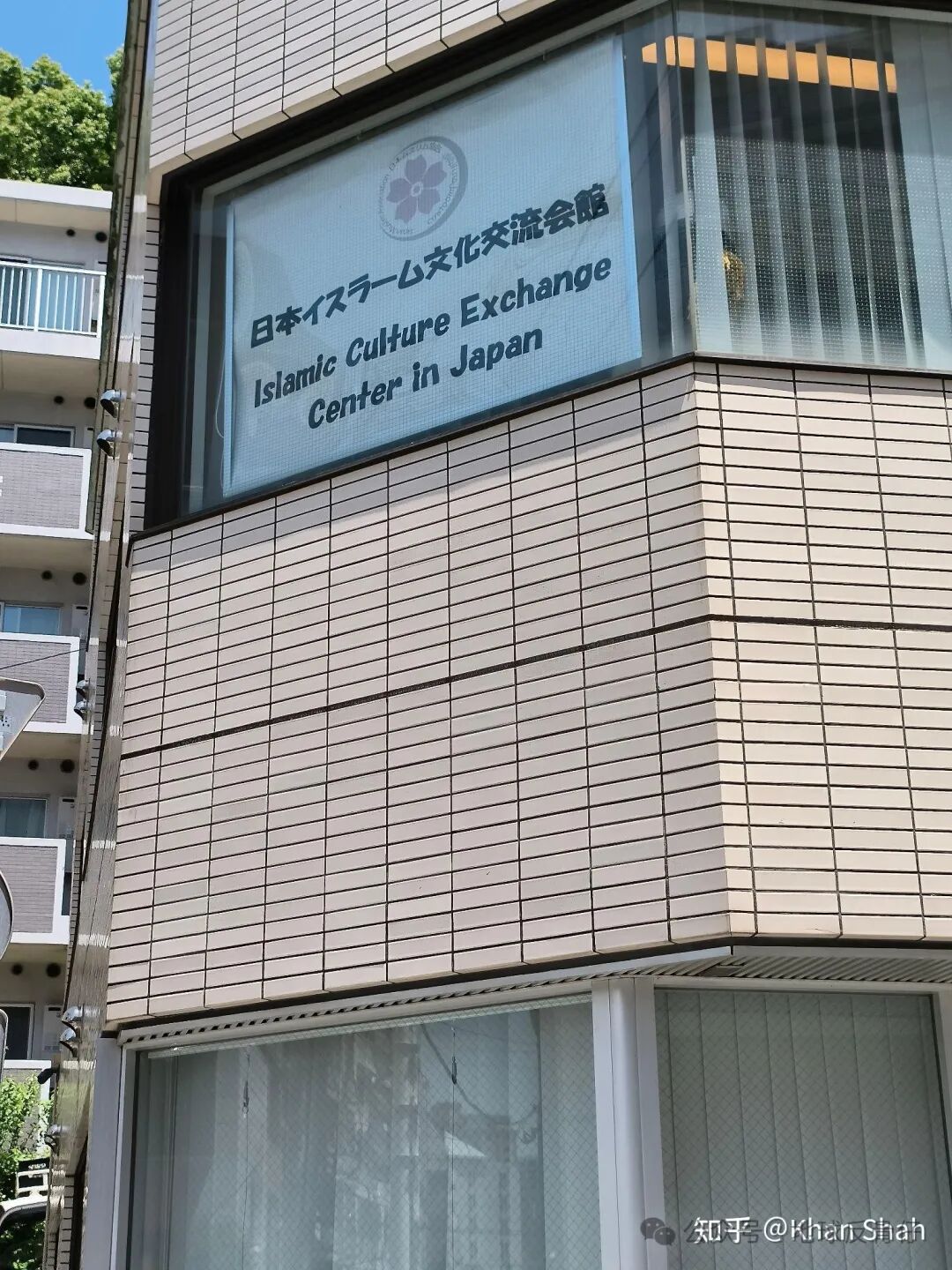
Later, I went to the Japan Islamic Cultural Center in Gotanda, which looks much simpler, as space is very expensive in a big city.
The prayer hall is upstairs, and the cafeteria is downstairs.
I remember an article I read before saying that Japan bans the sale of any Islamic books.
But on the fourth day of my trip, on the way to the Imperial Palace in Tokyo, I passed a fairly large bookstore.
I felt like going in for a look, and this was the first large or medium-sized bookstore I entered in Japan.
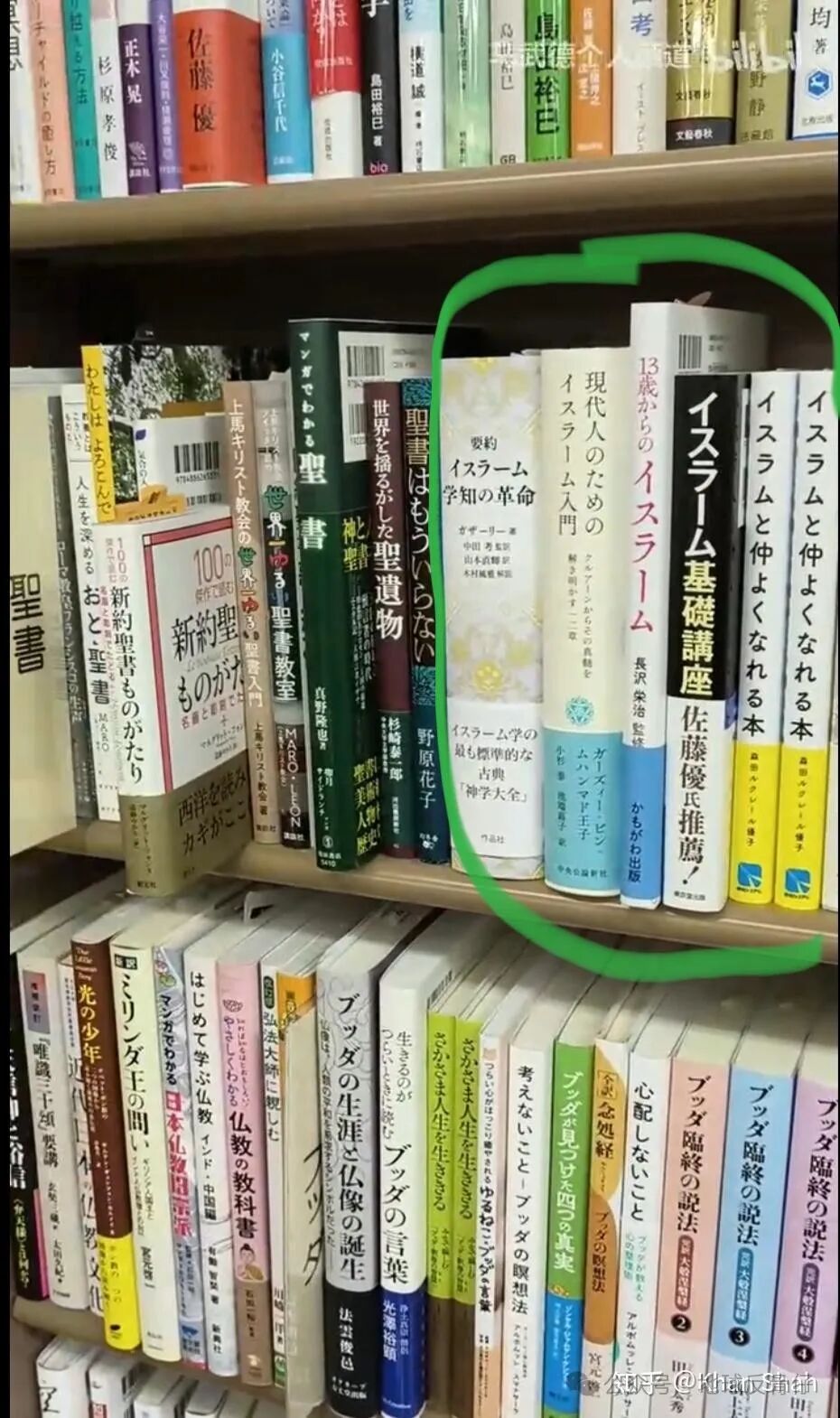
As it turned out, I saw this on the shelf for religious books:
The books marked inside the green circles are about Islam.
Of course, there are definitely more books on Buddhism by comparison.
Now let's use the internet to check if the Japanese government really stops people from learning about Islam.
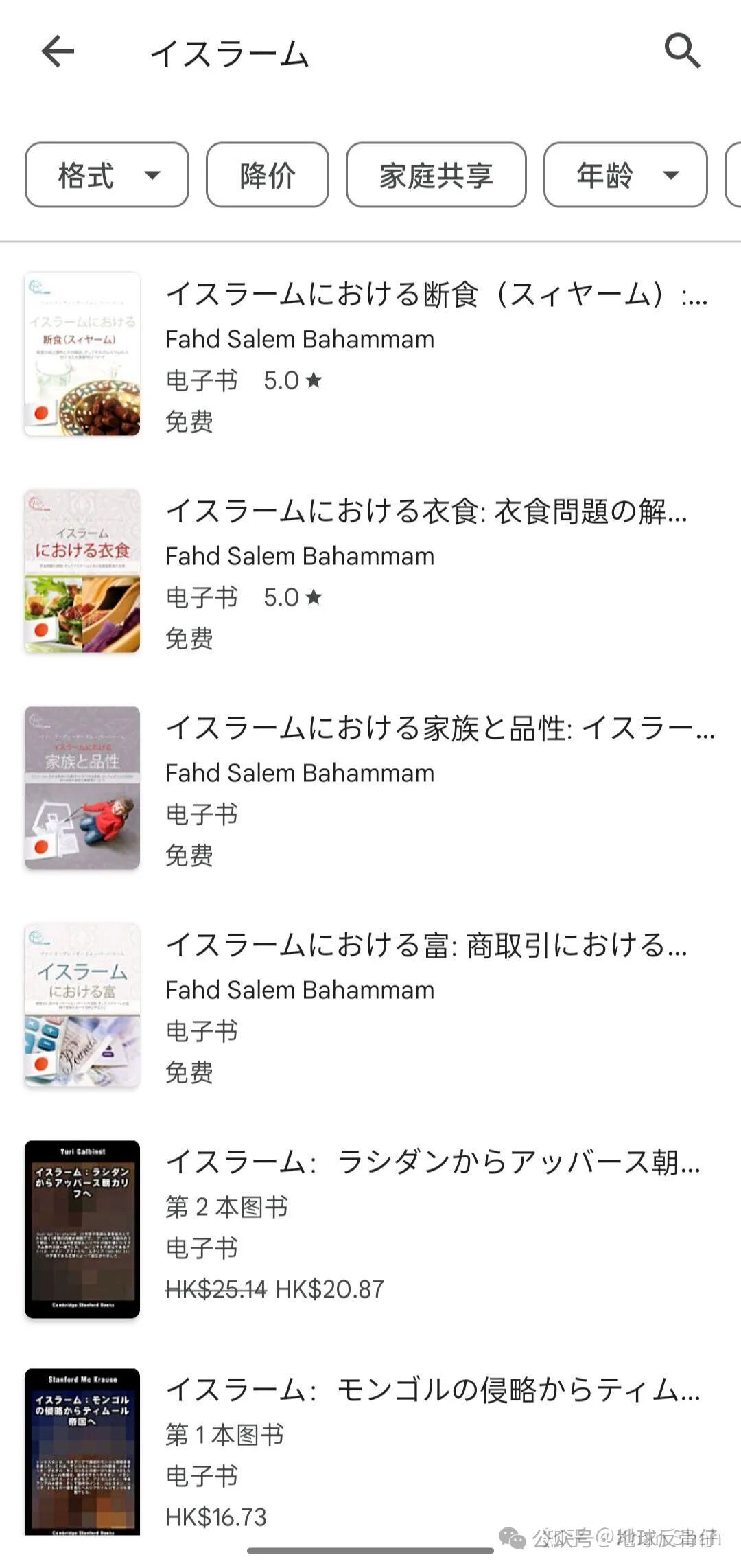
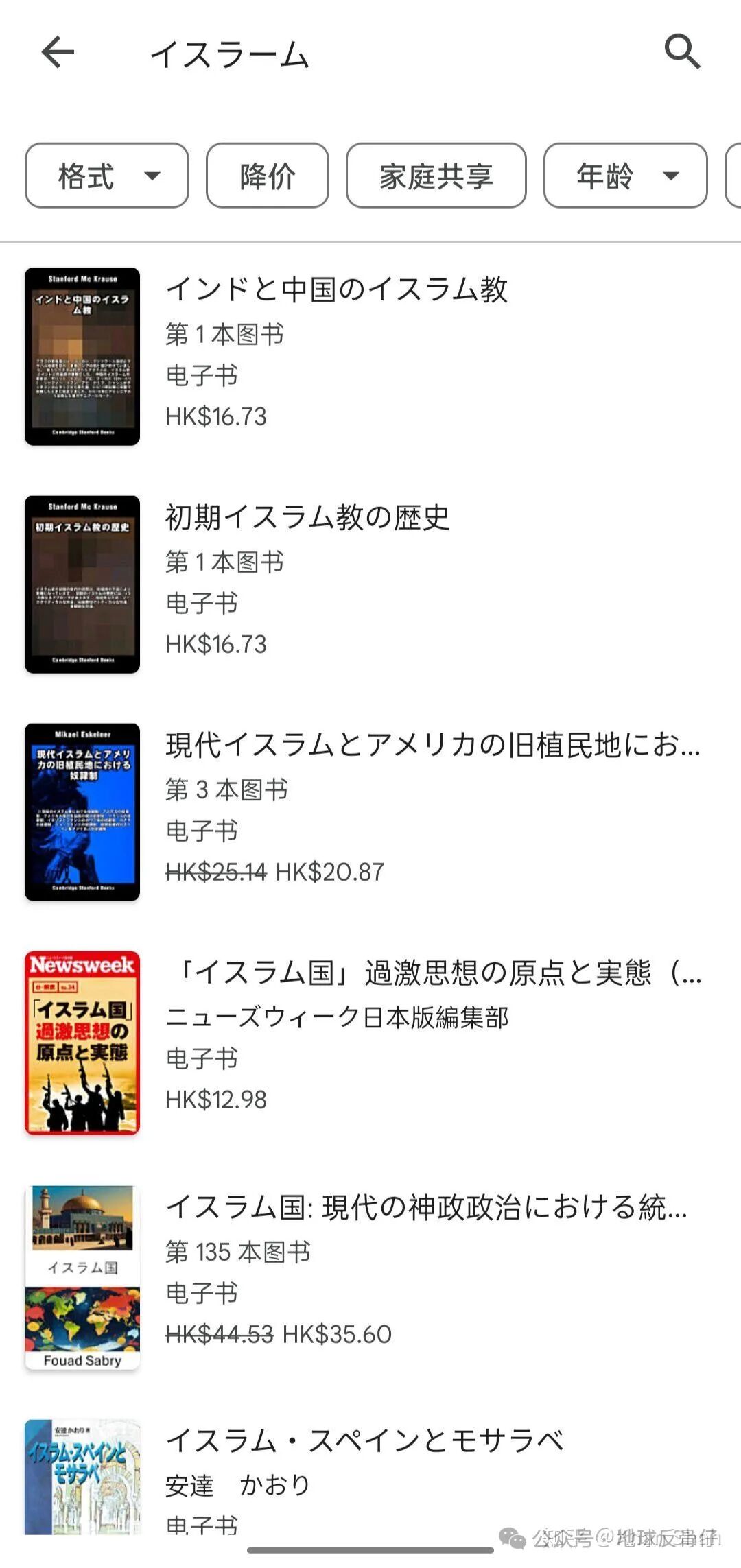
We open the Google Play Store and search using the Japanese word for Islam, "isurāmu," to see if Japanese people can read e-books on the topic.
These are all things that ordinary Japanese citizens can buy easily, and many are even free.
Don't want to read? No problem, there are videos to watch on YouTube.
There are local Japanese Muslim scholars who explain Islamic knowledge on YouTube:
After that, I set off for Shizuoka City to see Mount Fuji, where there are usually fewer Muslims in smaller cities like this.
I searched and, sure enough, there is only one mosque there.
However, the Shizuoka Mosque is quite large and has a wide open space.
If you search for "eid" (the Arabic word for festivals, specifically referring to Eid al-Fitr and Eid al-Adha) plus "Shizuoka" on YouTube, you can see videos of the Eid celebrations filmed there.
Next, I went to Osaka and Kyoto. Osaka is also a big city, so it has a few more mosques.
Back home, I only heard that Tokyo had mosques and that there was one in Kobe.
To my surprise, I found that other cities actually have quite a few mosques too.
Kyoto has fewer mosques, which makes sense since the city is full of traditional houses and Buddhist temples.
Even so, there are still mosques there.
Before heading back to China, I returned to Tokyo on a Friday.
That was when I visited the Islamic cultural exchange center I mentioned earlier.
As is the custom, the imam gives a speech on Fridays.
The imam gives his speech in Japanese first, then explains it briefly in English.
Some might worry that Imam Sato speaks difficult Japanese-style English, but honestly, it sounds quite smooth.
Why use English?
Because most of the Muslims attending namaz in Japan are foreigners.
There are foreign workers here, as well as foreign tourists like me whose Japanese isn't very good.
Are there any native Japanese Muslims?
Of course there are, but native Japanese Muslims only make up a small portion.
So if you only speak in Japanese, many people won't understand.
I met several Japanese Muslims at the time.
I stared at them, wondering: is there any difference between them and ordinary Japanese people on the street?
If you met them on the road, I bet no one would guess they are Muslims:
Except for one person from Indonesia, everyone in this photo is a native Japanese Muslim.
Finally, I went to the Yoyogi Mosque one more time.
I happened to catch a young Japanese man and woman officially converting to Islam in front of an imam.
As I mentioned before, that mosque is a Turkish cultural center funded by the Turkish government.
There is an imam who only speaks Turkish and does not speak Japanese.
He had an interpreter next to him to help pass on his message.
I watched two young people finish their conversion ceremony right there.
There was also an older imam who seemed to be fluent in both Turkish and Japanese.
He is likely the one in charge of the Friday Jumu'ah sermon at Yoyogi Mosque.
I bought a round-trip ticket, and I chose Tokyo Narita Airport as my departure point.
So, I had to go back to Narita Airport in the end.
There are two prayer rooms set up at the check-in area of Narita Airport.
These prayer rooms are not just for Muslims, but we can take a look at the facilities inside.
At the entrance, there is a place to perform wudu before prayer, with a small stool and even tissues provided.
Inside, there are movable tables, chairs, and carpets, which make it much easier for Muslims to pray.
Actually, all the information mentioned above can be verified.
Most people traveling to Japan probably would not think to visit a mosque at all.
But if you have ever stepped into a convenience store, you have surely seen many brown-skinned young men, right?
Most of them come from Bangladesh.
Bangladesh is a South Asian country and also a nation with a large population.
It has very close historical ties with India and Pakistan.
So, what is the mainstream religion in Bangladesh? I looked it up using DeepSeek:
Japan currently faces a very serious aging population problem, and the labor market is in urgent need of workers from various countries.
When it comes to hiring, they really do not have much room to be picky.
Therefore, it is unrealistic to completely shut out Muslim labor.
Moreover, Japan is a major tourism destination that welcomes a massive number of foreign visitors every year.
Turning away all Muslim tourists is clearly not possible.
The number of mosques in Japan is actually quite high now.
This is especially notable considering Japan's first mosque was not built until 1935.
In less than a hundred years, the number has grown significantly; you can count the red dots on the map yourself.
Keep in mind that the entire city of Shanghai only has seven mosques, including the Songjiang Mosque and the Jinshan Mosque.
Besides Tokyo and Osaka, Nagoya is the only other major city in Japan worth mentioning.
Let's look at the general distribution and number of mosques in Nagoya.
Now, let me show you what the mosques in Nagoya look like.
Google Maps has real-life photos where you can click the arrows to see different angles.
As you can see, this mosque is actually a converted small building of the type people build themselves in Japan.
After looking at the big cities, let's check out a more remote part of Japan—Hokkaido.
In my mind, this place is always covered in snow and has a very cold climate.
Yet even in a place like this, there are already mosques.
Let's take a look at a mosque in Sapporo, Hokkaido.
I have seen Hokkaido, the northernmost part of Japan, but what about the Ryukyu Islands, which are far south and quite a distance from the mainland?
This place used to be the Ryukyu Kingdom, and it still keeps its very distinct character today.
There are very few mosques here, but the population is small and the area is tiny anyway.
On a map, the Okinawa Islands look like just a few small dots, almost invisible.
You can compare them: the circle above shows Kyushu Island, and the oval below shows the main island of Okinawa.
One look at the comparison shows that Okinawa is really, really small.
It is such a small place, and it is much further from the Japanese mainland than Japan is from Jeju Island in South Korea.
Even so, there is still a mosque there.
That is enough about the mosque for now, so let us look at the next part:
Japan bans all Arabic language education, and Japanese educational institutions are not allowed to teach Arabic.
Is this claim reliable? Let us look into it together.
Waseda University is probably one of the most familiar Japanese universities to Chinese people.
Haruki Murakami is a graduate of this school.
This university offers courses in Middle Eastern and Islamic studies.
Here is the proof, a screenshot from their official website.
A simple translation of the English inside the red box is:
In short, students can study Arabic here during their undergraduate years.
They also have the chance to learn other Middle Eastern languages, such as Persian and Turkish.
Now we understand that Japanese universities do teach Arabic.
Let's see what other universities are doing.
Kyoto University also has a center for Islamic area studies, as shown in the image below:
Let's look at another one, Tokyo University of Foreign Studies:
This is a higher education institution that specializes in foreign languages, and it has an Arabic major.
Let's look at the official website's brief introduction to this major.
Here is a simple translation of the key points (I was too lazy to translate it myself, so I just threw it at an AI).
What about Japan's top university, the University of Tokyo (also known as Todai)?
Todai also has an Islamic studies department. Let's look at the summary:
The text in the red box basically says: To help researchers accurately understand Islamic civilization, Todai teaches them relevant languages, including Arabic.
After checking the information myself, I found that the claim that "no educational institution in Japan offers Arabic education" simply doesn't hold up.
I have also seen a claim elsewhere that Japan has no halal restaurants and that you cannot buy halal food at all.
Is that true? Let's search and see.
I searched in Tokyo again. I searched twice, and the results were slightly different each time.
I also found some restaurants on the "Japan Muslim Service Network" that you can find on Google.
I took a few screenshots, and here is a simple translation:
You can find halal versions of both international flavors and traditional Japanese cuisine.
You might be curious about what the symbol in the red circle means.
I looked it up, and it means the shop has a prayer room.
My earlier analysis was right: just searching for a mosque will make you miss many of these small prayer rooms inside shops.
So, there are likely even more places to pray than what we can see. view all
Summary: This Japan Muslim travel guide uses the author's 2024 field observations and online checks to discuss mosques, Muslims, and halal travel in Japan. It keeps the original evidence path, travel notes, and local Muslim life context.
I put this article together using what I saw with my own eyes while traveling in Japan, along with information I easily found on YouTube, Google Maps, the Google Play Store, and Google Search.
On top of that, information from domestic AI software was a big help to me.
There are a lot of pictures later on, so keep an eye on your data usage. Writing this was hard work, and I am sharing it purely out of passion, so I hope you will give it a like to encourage me.
I went to Japan in early May 2024. Before I left, I had already read several articles claiming things like "there are no Muslims in Japan" or "there are no mosques in Japan."
When I read those articles, I had big doubts about whether they were true.
Once I actually stepped onto Japanese soil, I realized those claims were very one-sided.
First, let's see if the local area is really like some videos and articles say, where there is only one mosque in all of Japan.
Just in downtown Tokyo, if you search using the keyword "mosque," a lot of red dots pop up on the map.
This is basically the distribution map of mosques in Tokyo.
Because some small prayer rooms do not show up on the map, the reality is that there are even more places to pray than what you see.
I knew there were mosques in Japan before I went, and it is not like what some articles say about there being only one or two in the whole country.
I really did not expect there to be so many.
I visited the largest one, which is right in Yoyogi.
It is not just a mosque, but also a Turkish cultural center with a small museum next door.
There is a supermarket on the first floor that specializes in halal food.
Nearby, there are also classrooms where Muslim children learn basic religious knowledge.
The interior view of Yoyogi Mosque.
Later, I went to the Japan Islamic Cultural Center in Gotanda, which looks much simpler, as space is very expensive in a big city.
The prayer hall is upstairs, and the cafeteria is downstairs.
I remember an article I read before saying that Japan bans the sale of any Islamic books.
But on the fourth day of my trip, on the way to the Imperial Palace in Tokyo, I passed a fairly large bookstore.
I felt like going in for a look, and this was the first large or medium-sized bookstore I entered in Japan.
As it turned out, I saw this on the shelf for religious books:
The books marked inside the green circles are about Islam.
Of course, there are definitely more books on Buddhism by comparison.
Now let's use the internet to check if the Japanese government really stops people from learning about Islam.
We open the Google Play Store and search using the Japanese word for Islam, "isurāmu," to see if Japanese people can read e-books on the topic.
These are all things that ordinary Japanese citizens can buy easily, and many are even free.
Don't want to read? No problem, there are videos to watch on YouTube.
There are local Japanese Muslim scholars who explain Islamic knowledge on YouTube:
After that, I set off for Shizuoka City to see Mount Fuji, where there are usually fewer Muslims in smaller cities like this.
I searched and, sure enough, there is only one mosque there.
However, the Shizuoka Mosque is quite large and has a wide open space.
If you search for "eid" (the Arabic word for festivals, specifically referring to Eid al-Fitr and Eid al-Adha) plus "Shizuoka" on YouTube, you can see videos of the Eid celebrations filmed there.
Next, I went to Osaka and Kyoto. Osaka is also a big city, so it has a few more mosques.
Back home, I only heard that Tokyo had mosques and that there was one in Kobe.
To my surprise, I found that other cities actually have quite a few mosques too.
Kyoto has fewer mosques, which makes sense since the city is full of traditional houses and Buddhist temples.
Even so, there are still mosques there.
Before heading back to China, I returned to Tokyo on a Friday.
That was when I visited the Islamic cultural exchange center I mentioned earlier.
As is the custom, the imam gives a speech on Fridays.
The imam gives his speech in Japanese first, then explains it briefly in English.
Some might worry that Imam Sato speaks difficult Japanese-style English, but honestly, it sounds quite smooth.
Why use English?
Because most of the Muslims attending namaz in Japan are foreigners.
There are foreign workers here, as well as foreign tourists like me whose Japanese isn't very good.
Are there any native Japanese Muslims?
Of course there are, but native Japanese Muslims only make up a small portion.
So if you only speak in Japanese, many people won't understand.
I met several Japanese Muslims at the time.
I stared at them, wondering: is there any difference between them and ordinary Japanese people on the street?
If you met them on the road, I bet no one would guess they are Muslims:
Except for one person from Indonesia, everyone in this photo is a native Japanese Muslim.
Finally, I went to the Yoyogi Mosque one more time.
I happened to catch a young Japanese man and woman officially converting to Islam in front of an imam.
As I mentioned before, that mosque is a Turkish cultural center funded by the Turkish government.
There is an imam who only speaks Turkish and does not speak Japanese.
He had an interpreter next to him to help pass on his message.
I watched two young people finish their conversion ceremony right there.
There was also an older imam who seemed to be fluent in both Turkish and Japanese.
He is likely the one in charge of the Friday Jumu'ah sermon at Yoyogi Mosque.
I bought a round-trip ticket, and I chose Tokyo Narita Airport as my departure point.
So, I had to go back to Narita Airport in the end.
There are two prayer rooms set up at the check-in area of Narita Airport.
These prayer rooms are not just for Muslims, but we can take a look at the facilities inside.
At the entrance, there is a place to perform wudu before prayer, with a small stool and even tissues provided.
Inside, there are movable tables, chairs, and carpets, which make it much easier for Muslims to pray.
Actually, all the information mentioned above can be verified.
Most people traveling to Japan probably would not think to visit a mosque at all.
But if you have ever stepped into a convenience store, you have surely seen many brown-skinned young men, right?
Most of them come from Bangladesh.
Bangladesh is a South Asian country and also a nation with a large population.
It has very close historical ties with India and Pakistan.
So, what is the mainstream religion in Bangladesh? I looked it up using DeepSeek:
Japan currently faces a very serious aging population problem, and the labor market is in urgent need of workers from various countries.
When it comes to hiring, they really do not have much room to be picky.
Therefore, it is unrealistic to completely shut out Muslim labor.
Moreover, Japan is a major tourism destination that welcomes a massive number of foreign visitors every year.
Turning away all Muslim tourists is clearly not possible.
The number of mosques in Japan is actually quite high now.
This is especially notable considering Japan's first mosque was not built until 1935.
In less than a hundred years, the number has grown significantly; you can count the red dots on the map yourself.
Keep in mind that the entire city of Shanghai only has seven mosques, including the Songjiang Mosque and the Jinshan Mosque.
Besides Tokyo and Osaka, Nagoya is the only other major city in Japan worth mentioning.
Let's look at the general distribution and number of mosques in Nagoya.
Now, let me show you what the mosques in Nagoya look like.
Google Maps has real-life photos where you can click the arrows to see different angles.
As you can see, this mosque is actually a converted small building of the type people build themselves in Japan.
After looking at the big cities, let's check out a more remote part of Japan—Hokkaido.
In my mind, this place is always covered in snow and has a very cold climate.
Yet even in a place like this, there are already mosques.
Let's take a look at a mosque in Sapporo, Hokkaido.
I have seen Hokkaido, the northernmost part of Japan, but what about the Ryukyu Islands, which are far south and quite a distance from the mainland?
This place used to be the Ryukyu Kingdom, and it still keeps its very distinct character today.
There are very few mosques here, but the population is small and the area is tiny anyway.
On a map, the Okinawa Islands look like just a few small dots, almost invisible.
You can compare them: the circle above shows Kyushu Island, and the oval below shows the main island of Okinawa.
One look at the comparison shows that Okinawa is really, really small.
It is such a small place, and it is much further from the Japanese mainland than Japan is from Jeju Island in South Korea.
Even so, there is still a mosque there.
That is enough about the mosque for now, so let us look at the next part:
Japan bans all Arabic language education, and Japanese educational institutions are not allowed to teach Arabic.
Is this claim reliable? Let us look into it together.
Waseda University is probably one of the most familiar Japanese universities to Chinese people.
Haruki Murakami is a graduate of this school.
This university offers courses in Middle Eastern and Islamic studies.
Here is the proof, a screenshot from their official website.
A simple translation of the English inside the red box is:
In short, students can study Arabic here during their undergraduate years.
They also have the chance to learn other Middle Eastern languages, such as Persian and Turkish.
Now we understand that Japanese universities do teach Arabic.
Let's see what other universities are doing.
Kyoto University also has a center for Islamic area studies, as shown in the image below:
Let's look at another one, Tokyo University of Foreign Studies:
This is a higher education institution that specializes in foreign languages, and it has an Arabic major.
Let's look at the official website's brief introduction to this major.
Here is a simple translation of the key points (I was too lazy to translate it myself, so I just threw it at an AI).
What about Japan's top university, the University of Tokyo (also known as Todai)?
Todai also has an Islamic studies department. Let's look at the summary:
The text in the red box basically says: To help researchers accurately understand Islamic civilization, Todai teaches them relevant languages, including Arabic.
After checking the information myself, I found that the claim that "no educational institution in Japan offers Arabic education" simply doesn't hold up.
I have also seen a claim elsewhere that Japan has no halal restaurants and that you cannot buy halal food at all.
Is that true? Let's search and see.
I searched in Tokyo again. I searched twice, and the results were slightly different each time.
I also found some restaurants on the "Japan Muslim Service Network" that you can find on Google.
I took a few screenshots, and here is a simple translation:
You can find halal versions of both international flavors and traditional Japanese cuisine.
You might be curious about what the symbol in the red circle means.
I looked it up, and it means the shop has a prayer room.
My earlier analysis was right: just searching for a mosque will make you miss many of these small prayer rooms inside shops.
So, there are likely even more places to pray than what we can see. view all
Reposted from the web
Summary: This Japan Muslim travel guide uses the author's 2024 field observations and online checks to discuss mosques, Muslims, and halal travel in Japan. It keeps the original evidence path, travel notes, and local Muslim life context.
I put this article together using what I saw with my own eyes while traveling in Japan, along with information I easily found on YouTube, Google Maps, the Google Play Store, and Google Search.
On top of that, information from domestic AI software was a big help to me.
There are a lot of pictures later on, so keep an eye on your data usage. Writing this was hard work, and I am sharing it purely out of passion, so I hope you will give it a like to encourage me.
I went to Japan in early May 2024. Before I left, I had already read several articles claiming things like "there are no Muslims in Japan" or "there are no mosques in Japan."
When I read those articles, I had big doubts about whether they were true.
Once I actually stepped onto Japanese soil, I realized those claims were very one-sided.

First, let's see if the local area is really like some videos and articles say, where there is only one mosque in all of Japan.
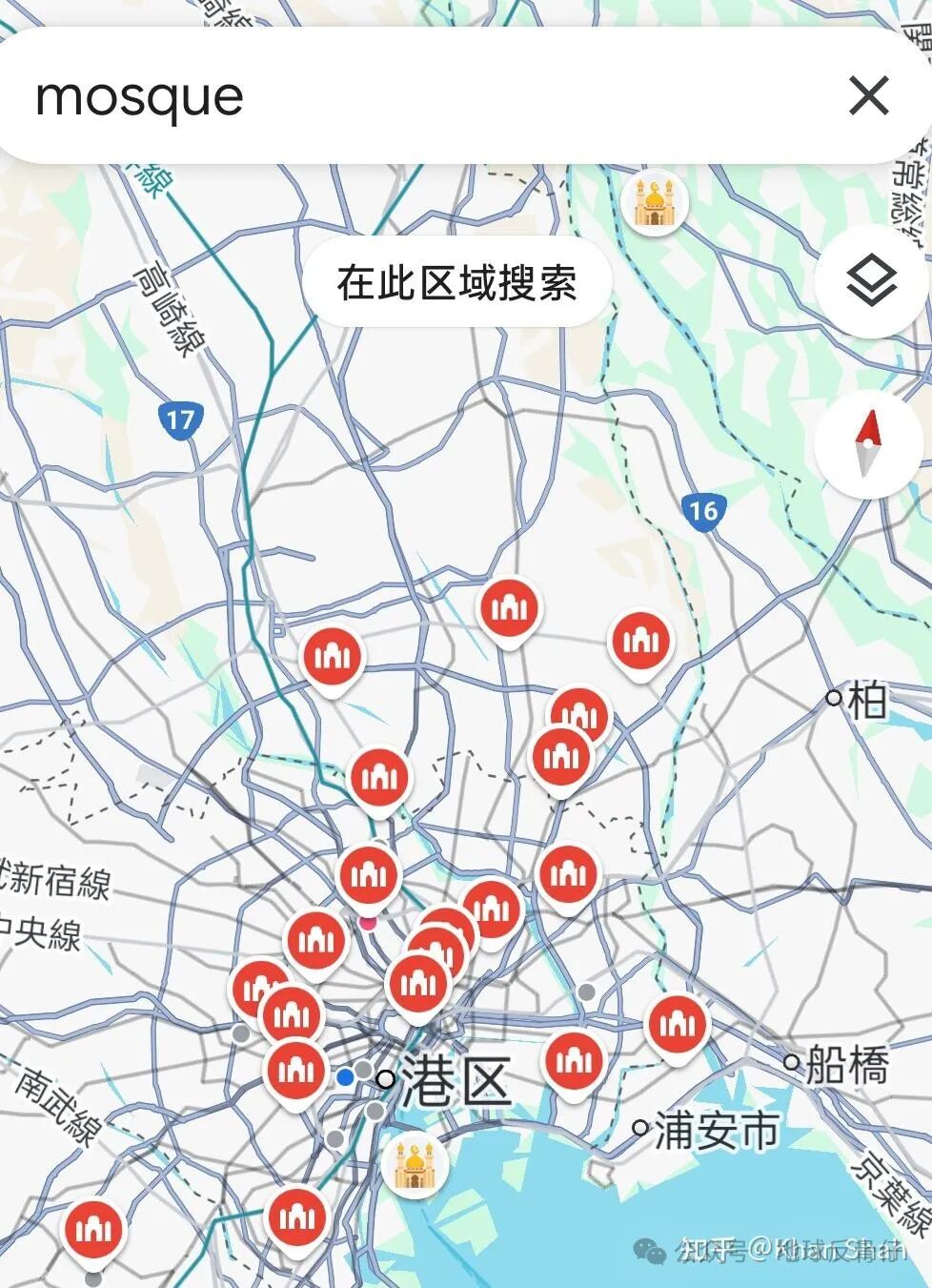
Just in downtown Tokyo, if you search using the keyword "mosque," a lot of red dots pop up on the map.
This is basically the distribution map of mosques in Tokyo.
Because some small prayer rooms do not show up on the map, the reality is that there are even more places to pray than what you see.
I knew there were mosques in Japan before I went, and it is not like what some articles say about there being only one or two in the whole country.
I really did not expect there to be so many.
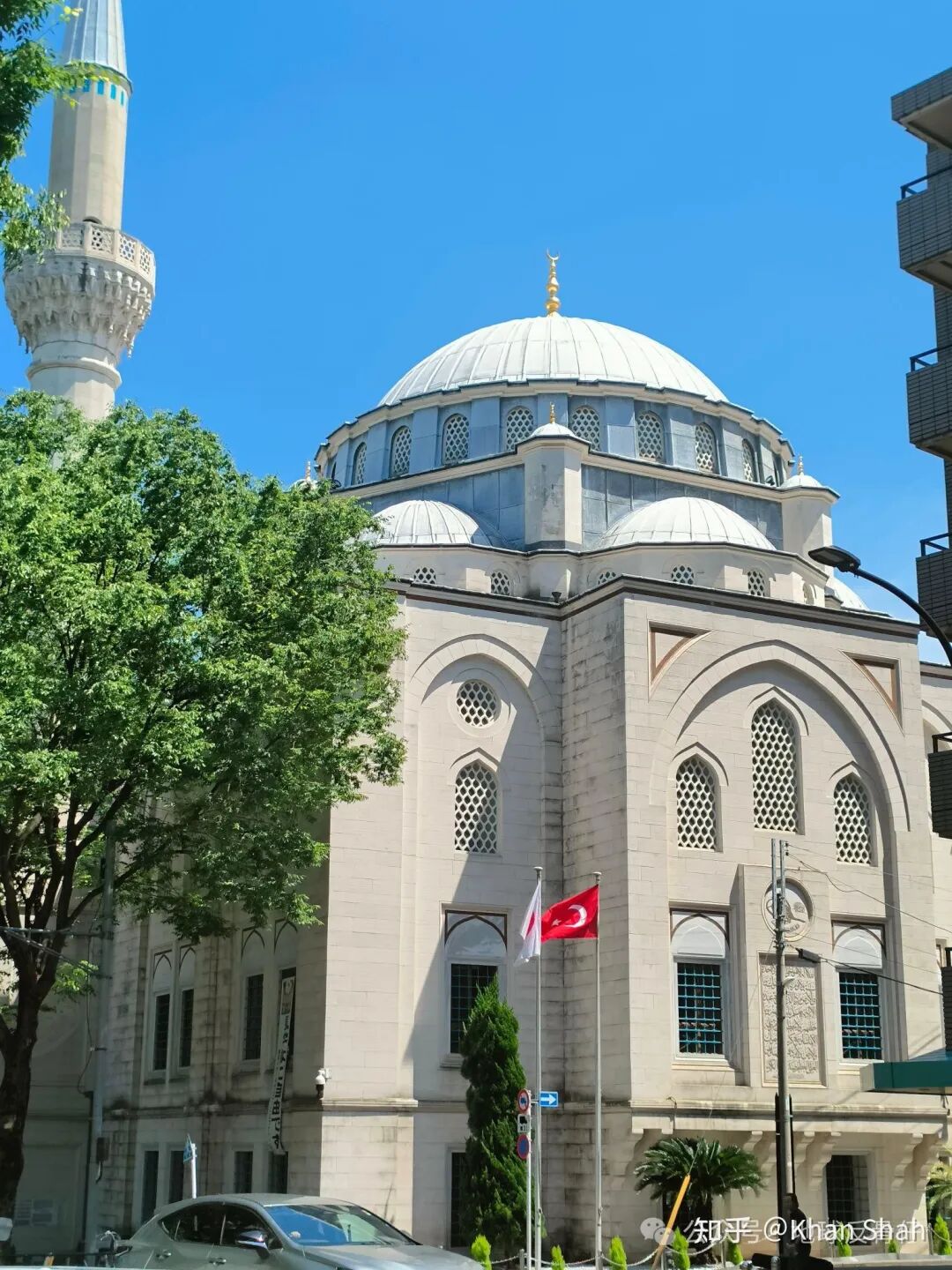
I visited the largest one, which is right in Yoyogi.
It is not just a mosque, but also a Turkish cultural center with a small museum next door.
There is a supermarket on the first floor that specializes in halal food.
Nearby, there are also classrooms where Muslim children learn basic religious knowledge.
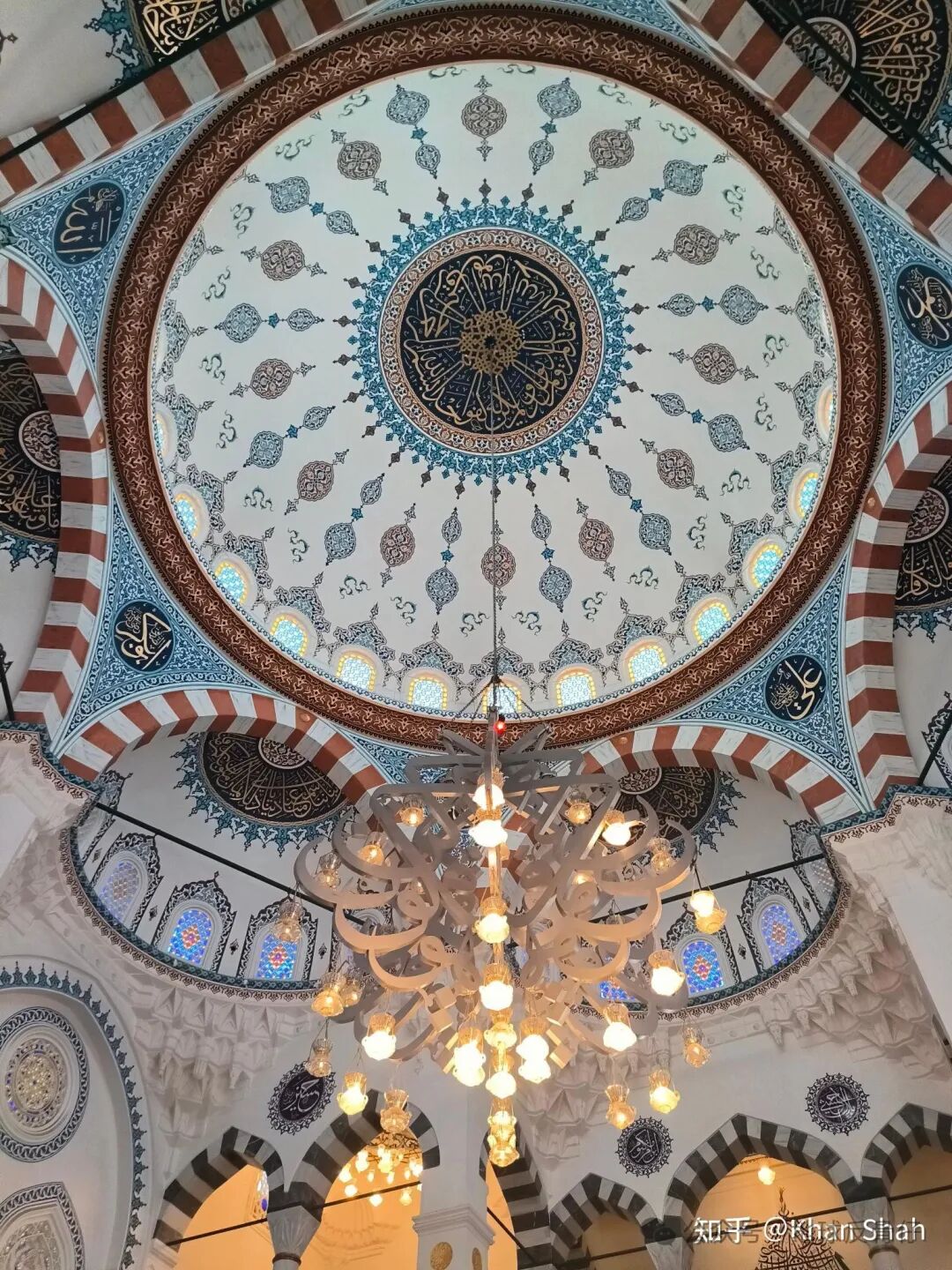
The interior view of Yoyogi Mosque.
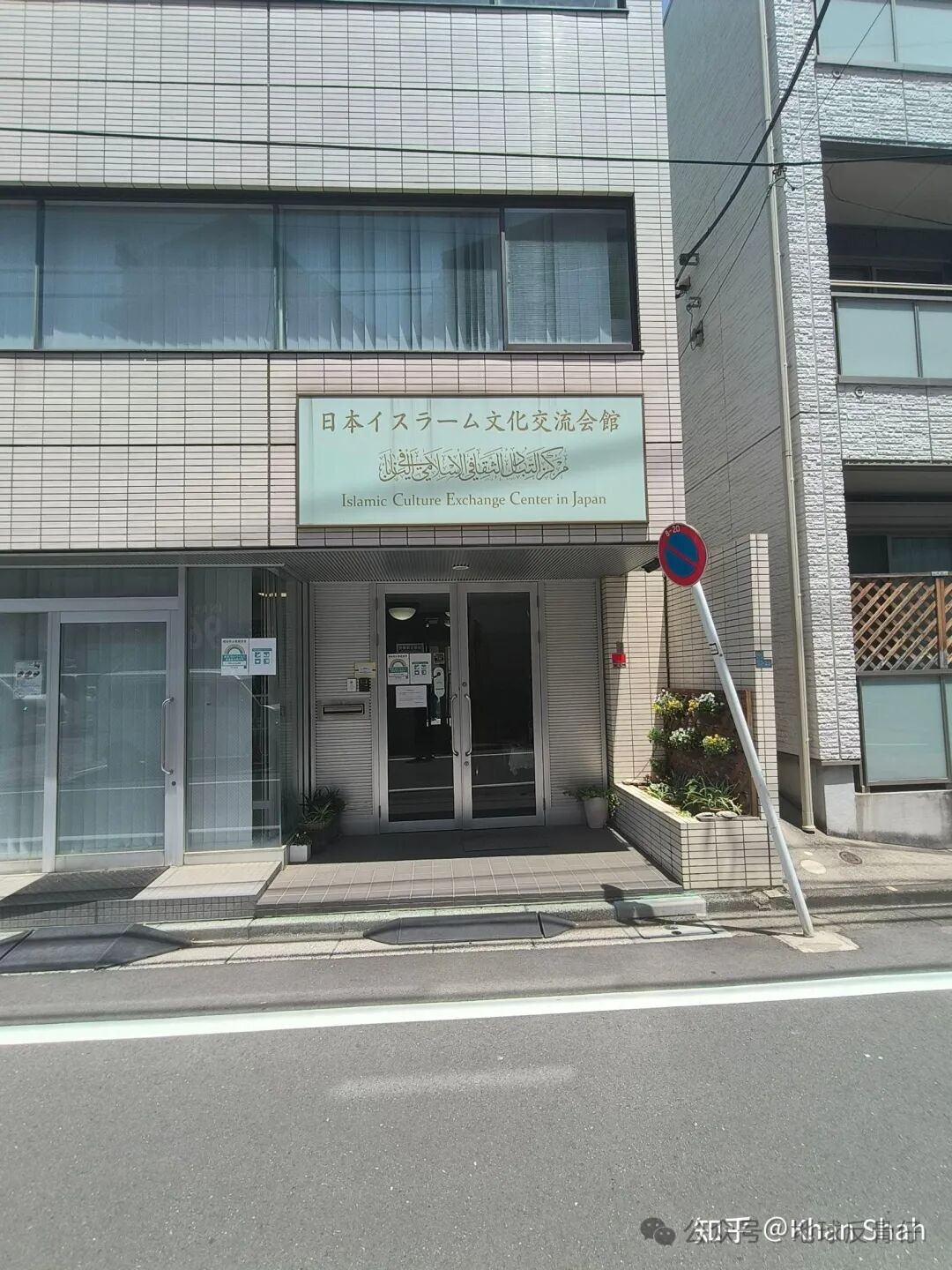
Later, I went to the Japan Islamic Cultural Center in Gotanda, which looks much simpler, as space is very expensive in a big city.
The prayer hall is upstairs, and the cafeteria is downstairs.
I remember an article I read before saying that Japan bans the sale of any Islamic books.
But on the fourth day of my trip, on the way to the Imperial Palace in Tokyo, I passed a fairly large bookstore.
I felt like going in for a look, and this was the first large or medium-sized bookstore I entered in Japan.
As it turned out, I saw this on the shelf for religious books:
The books marked inside the green circles are about Islam.
Of course, there are definitely more books on Buddhism by comparison.
Now let's use the internet to check if the Japanese government really stops people from learning about Islam.
We open the Google Play Store and search using the Japanese word for Islam, "isurāmu," to see if Japanese people can read e-books on the topic.
These are all things that ordinary Japanese citizens can buy easily, and many are even free.
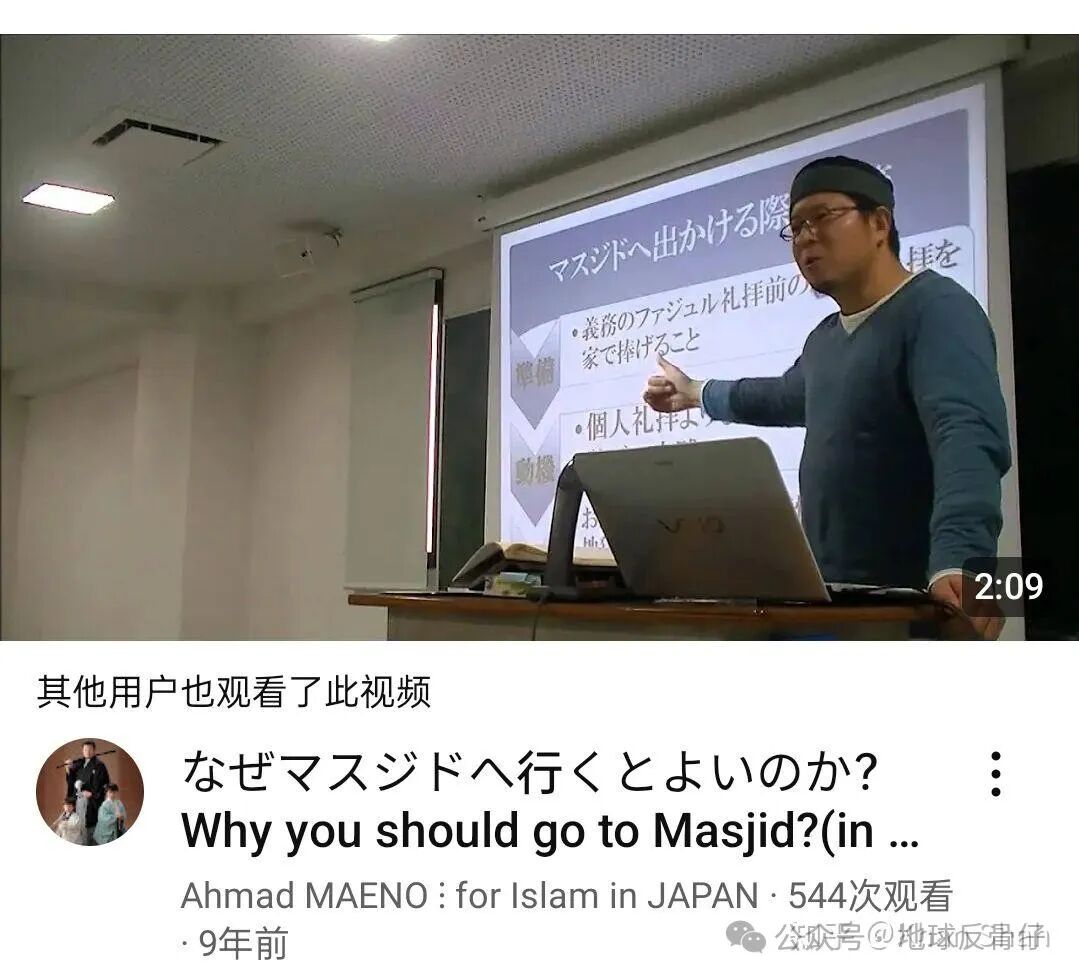
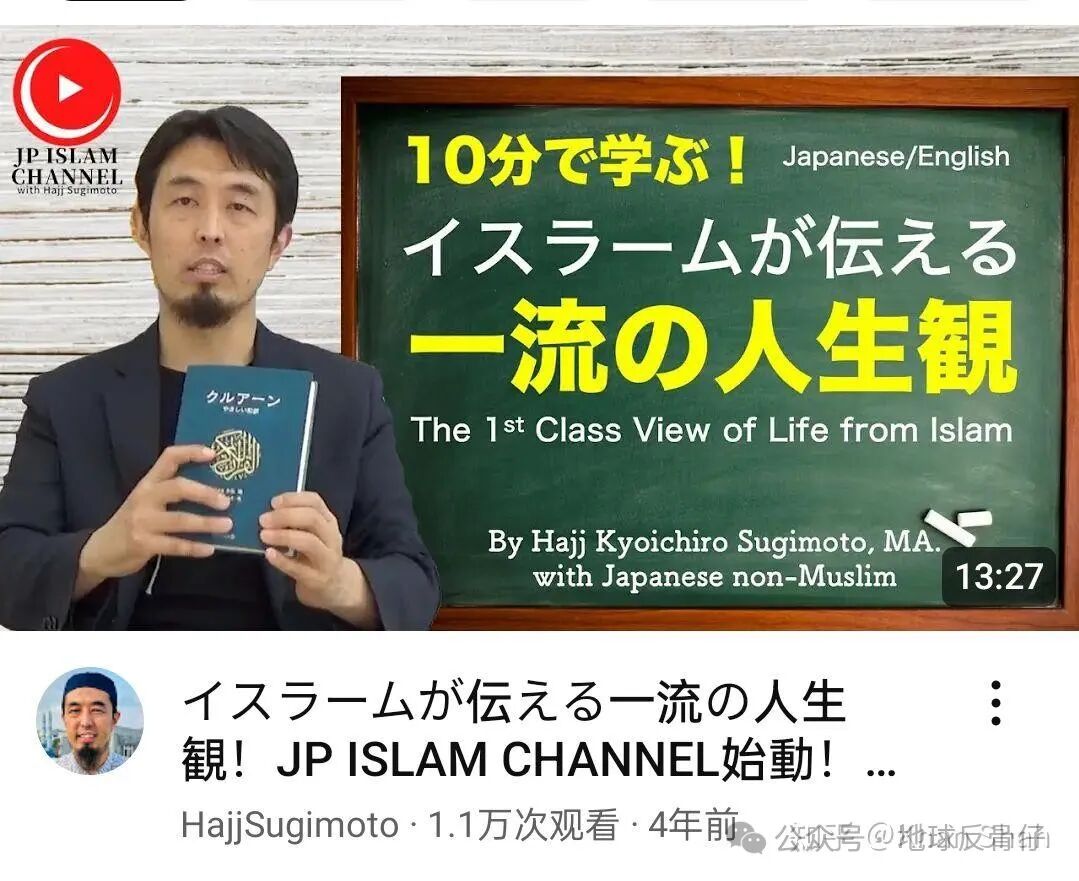
Don't want to read? No problem, there are videos to watch on YouTube.
There are local Japanese Muslim scholars who explain Islamic knowledge on YouTube:
After that, I set off for Shizuoka City to see Mount Fuji, where there are usually fewer Muslims in smaller cities like this.
I searched and, sure enough, there is only one mosque there.
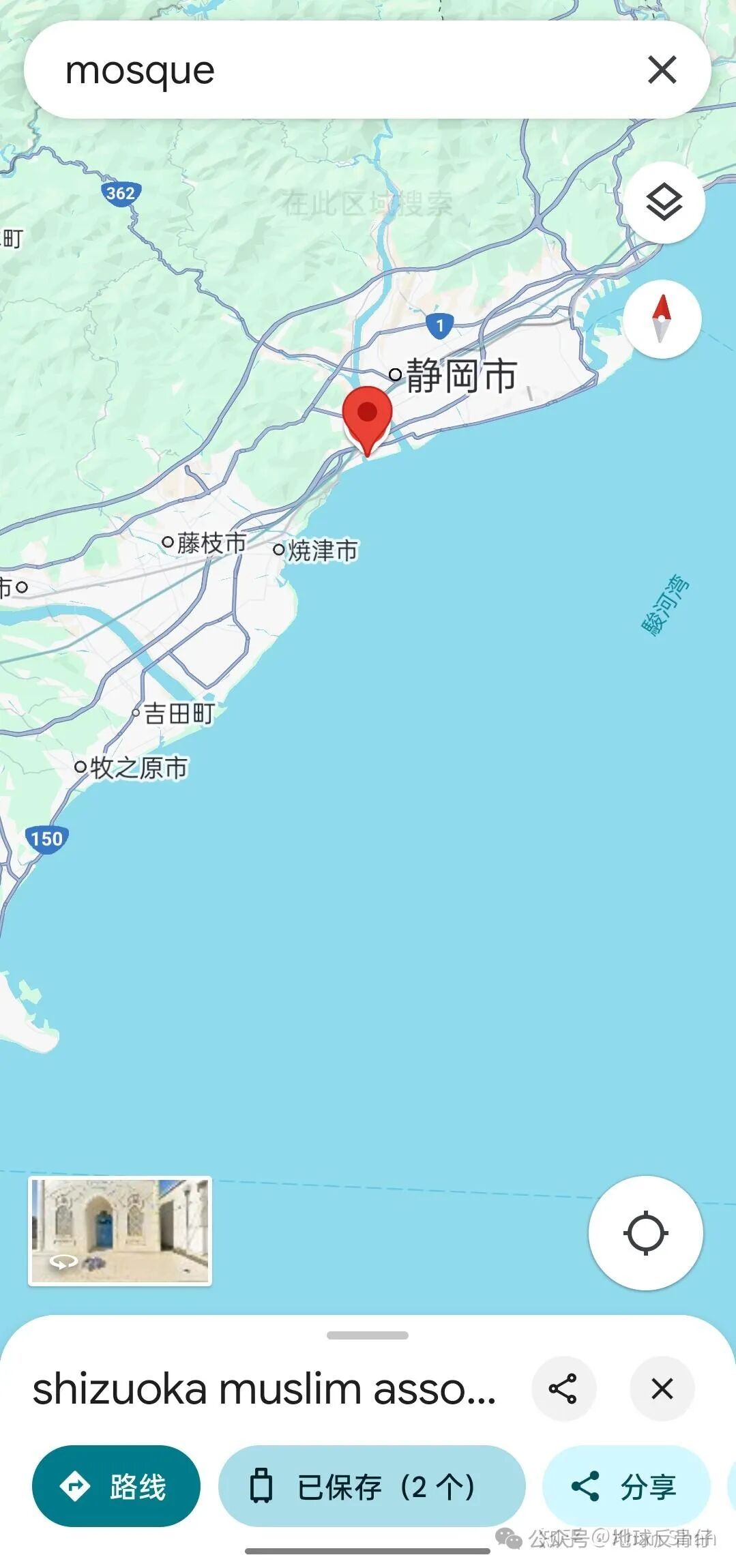
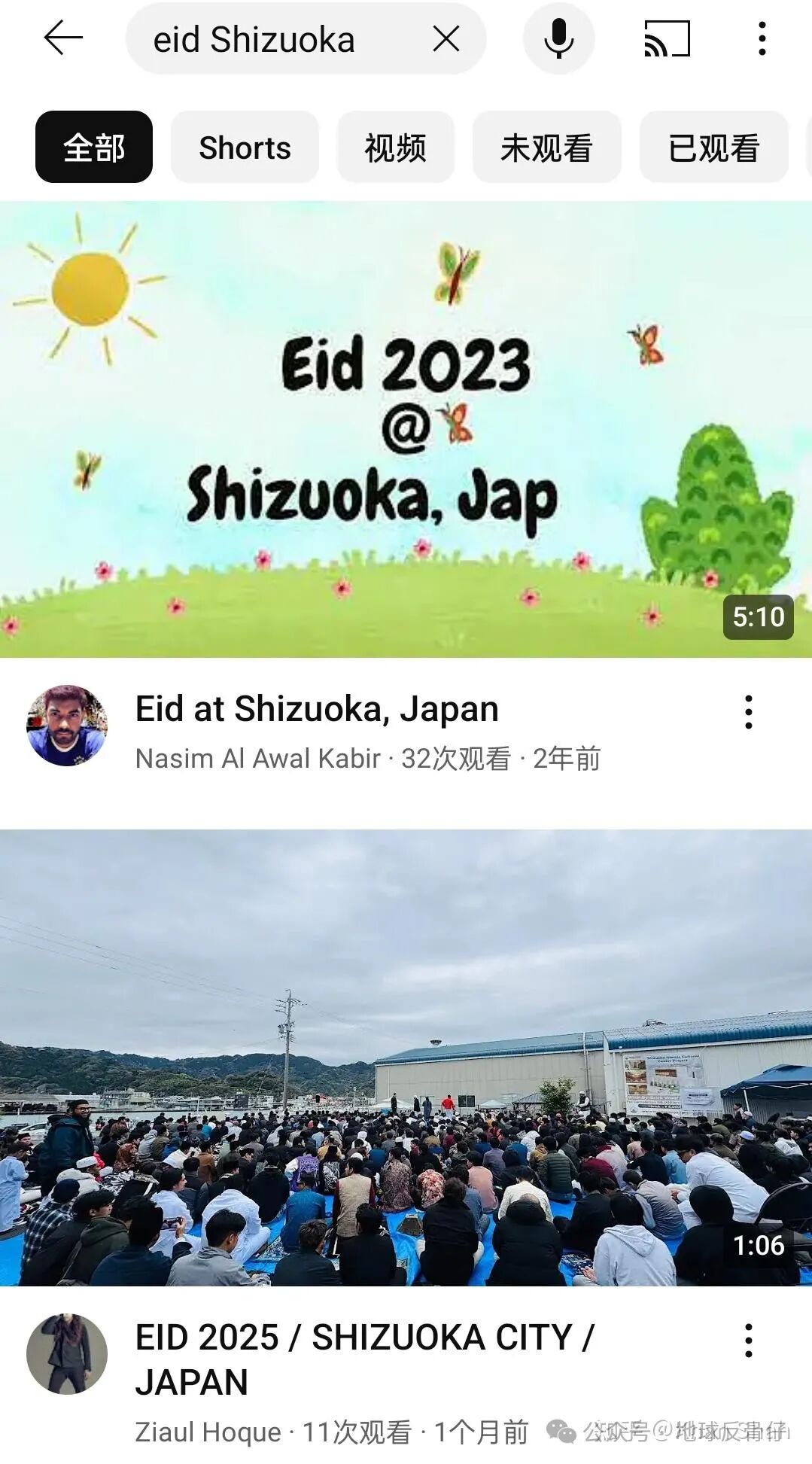
However, the Shizuoka Mosque is quite large and has a wide open space.
If you search for "eid" (the Arabic word for festivals, specifically referring to Eid al-Fitr and Eid al-Adha) plus "Shizuoka" on YouTube, you can see videos of the Eid celebrations filmed there.
Next, I went to Osaka and Kyoto. Osaka is also a big city, so it has a few more mosques.
Back home, I only heard that Tokyo had mosques and that there was one in Kobe.
To my surprise, I found that other cities actually have quite a few mosques too.
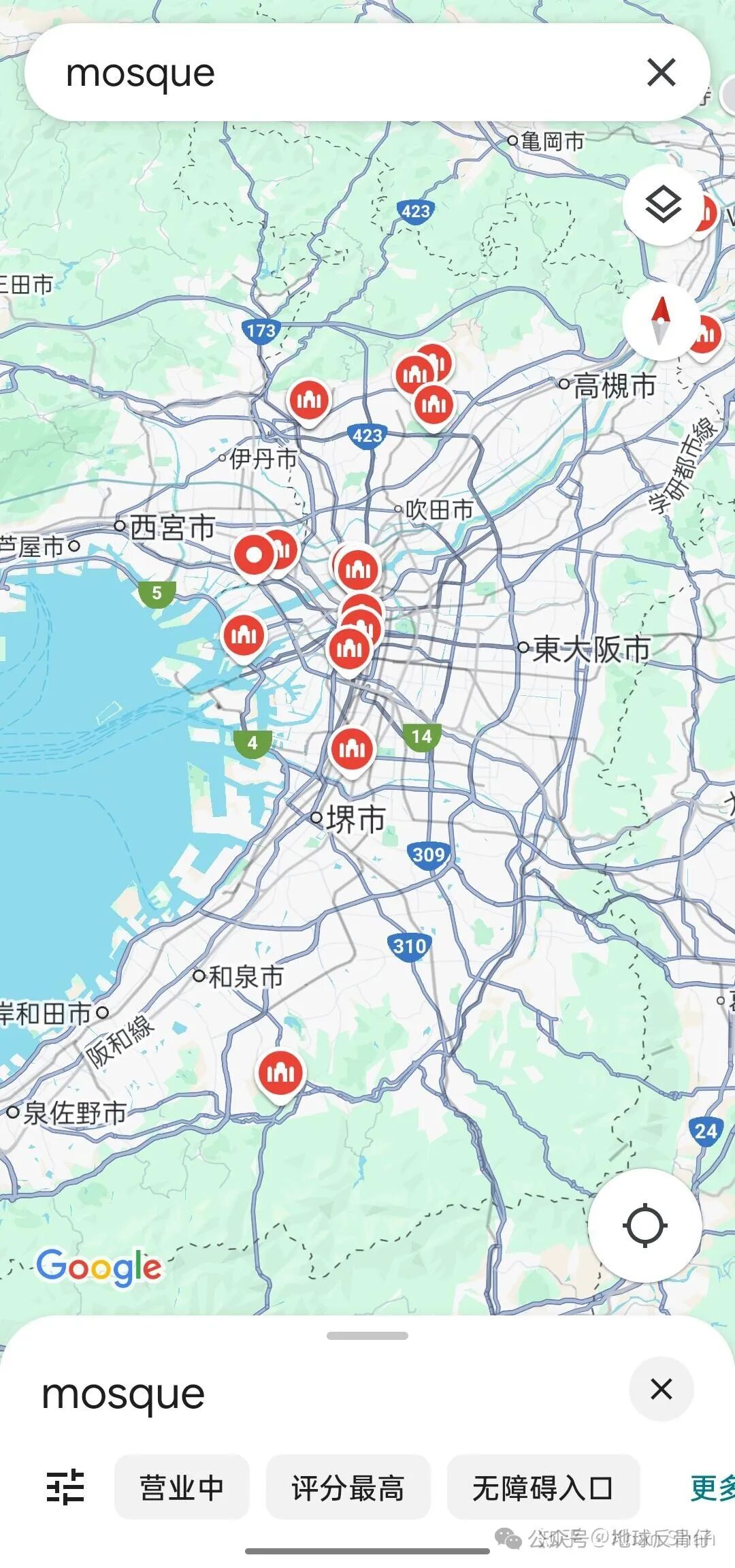
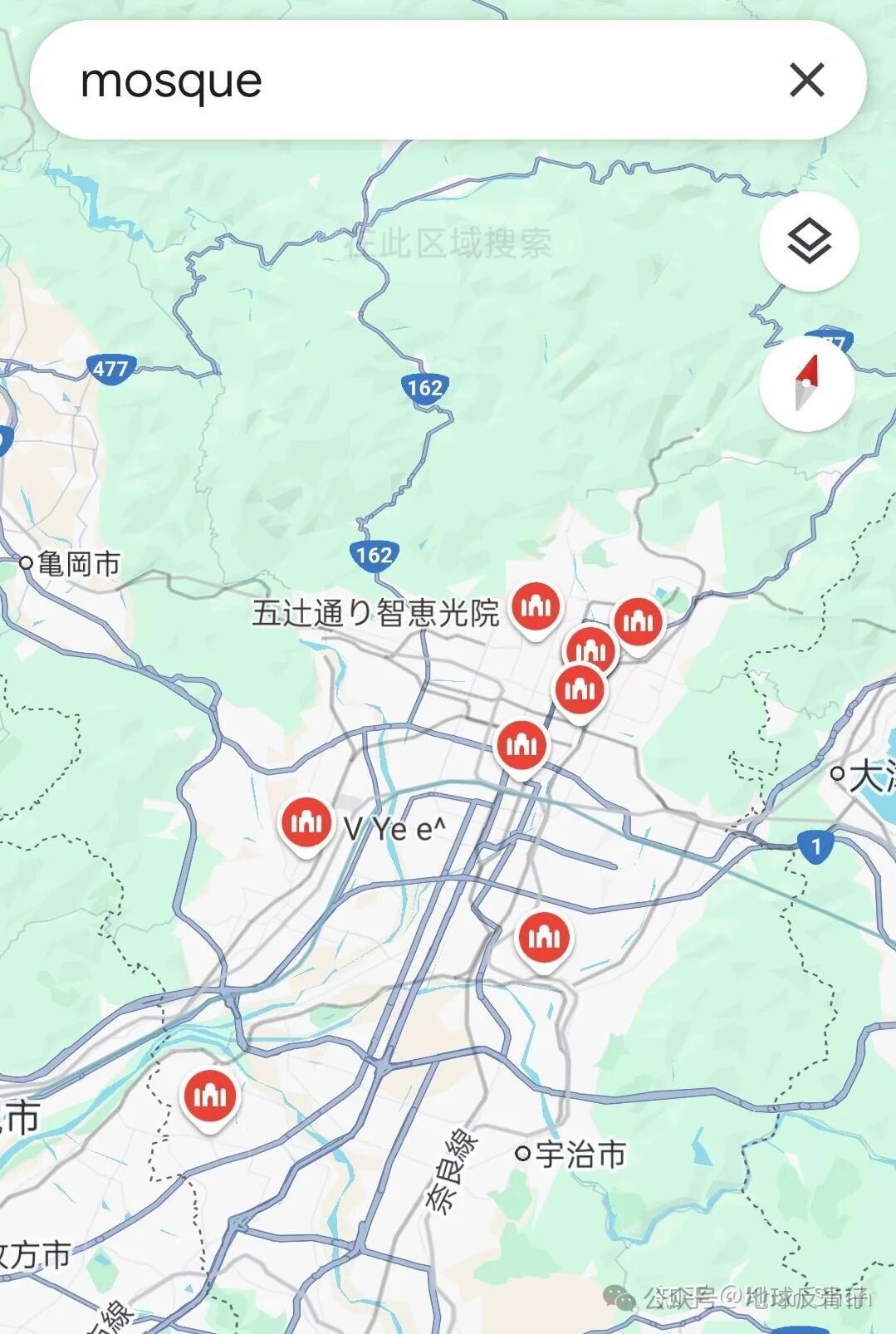
Kyoto has fewer mosques, which makes sense since the city is full of traditional houses and Buddhist temples.
Even so, there are still mosques there.
Before heading back to China, I returned to Tokyo on a Friday.
That was when I visited the Islamic cultural exchange center I mentioned earlier.
As is the custom, the imam gives a speech on Fridays.
The imam gives his speech in Japanese first, then explains it briefly in English.
Some might worry that Imam Sato speaks difficult Japanese-style English, but honestly, it sounds quite smooth.
Why use English?
Because most of the Muslims attending namaz in Japan are foreigners.
There are foreign workers here, as well as foreign tourists like me whose Japanese isn't very good.
Are there any native Japanese Muslims?
Of course there are, but native Japanese Muslims only make up a small portion.
So if you only speak in Japanese, many people won't understand.
I met several Japanese Muslims at the time.
I stared at them, wondering: is there any difference between them and ordinary Japanese people on the street?
If you met them on the road, I bet no one would guess they are Muslims:
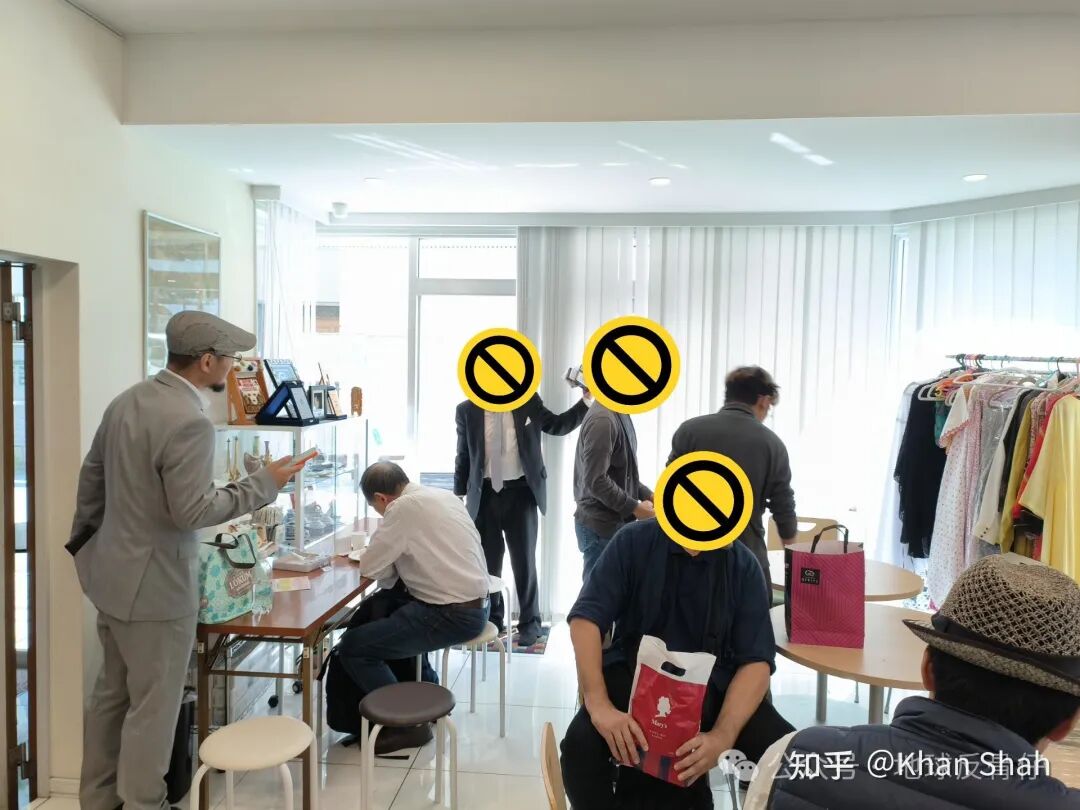
Except for one person from Indonesia, everyone in this photo is a native Japanese Muslim.
Finally, I went to the Yoyogi Mosque one more time.
I happened to catch a young Japanese man and woman officially converting to Islam in front of an imam.
As I mentioned before, that mosque is a Turkish cultural center funded by the Turkish government.
There is an imam who only speaks Turkish and does not speak Japanese.
He had an interpreter next to him to help pass on his message.
I watched two young people finish their conversion ceremony right there.
There was also an older imam who seemed to be fluent in both Turkish and Japanese.
He is likely the one in charge of the Friday Jumu'ah sermon at Yoyogi Mosque.
I bought a round-trip ticket, and I chose Tokyo Narita Airport as my departure point.
So, I had to go back to Narita Airport in the end.
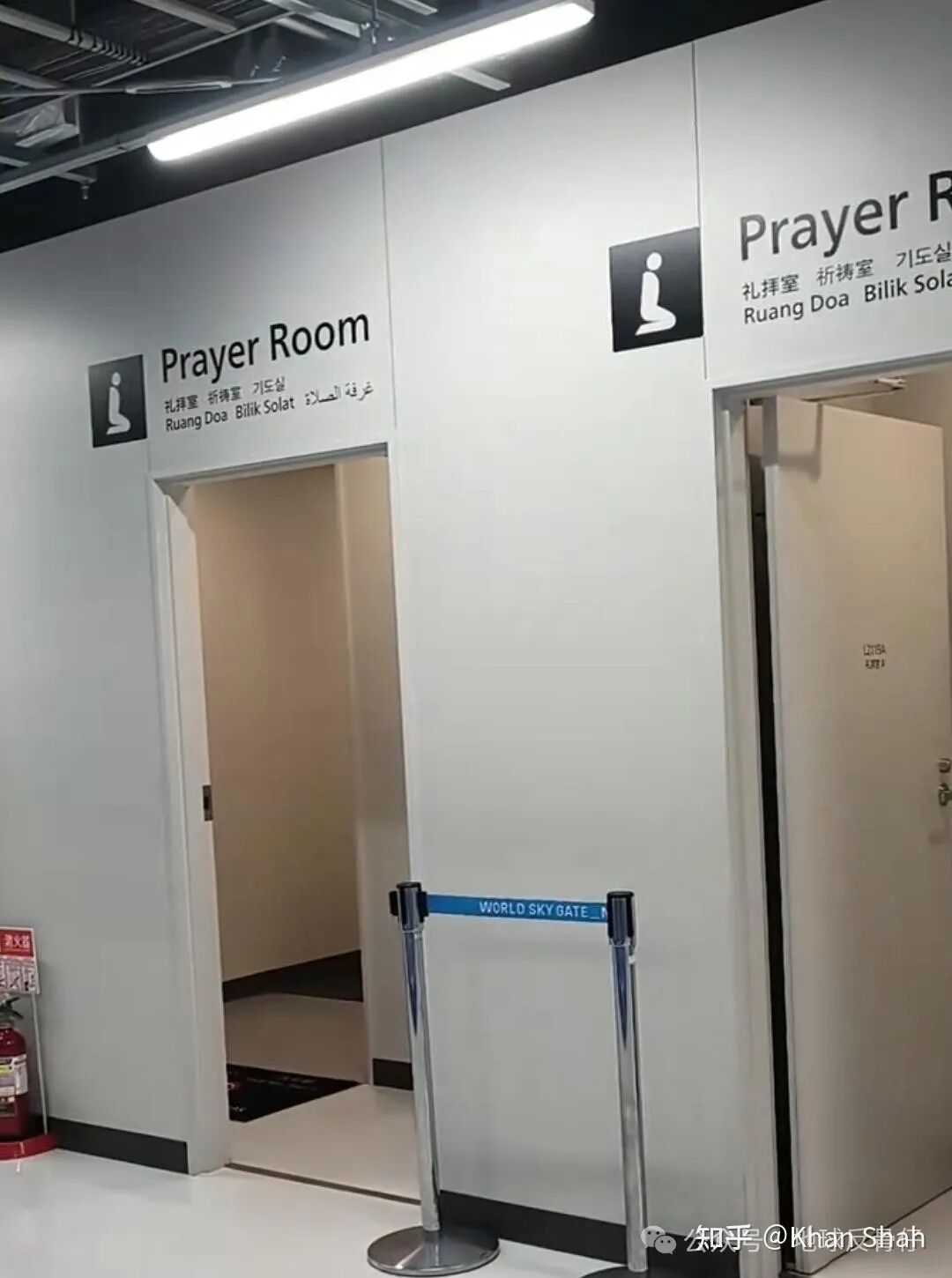
There are two prayer rooms set up at the check-in area of Narita Airport.
These prayer rooms are not just for Muslims, but we can take a look at the facilities inside.
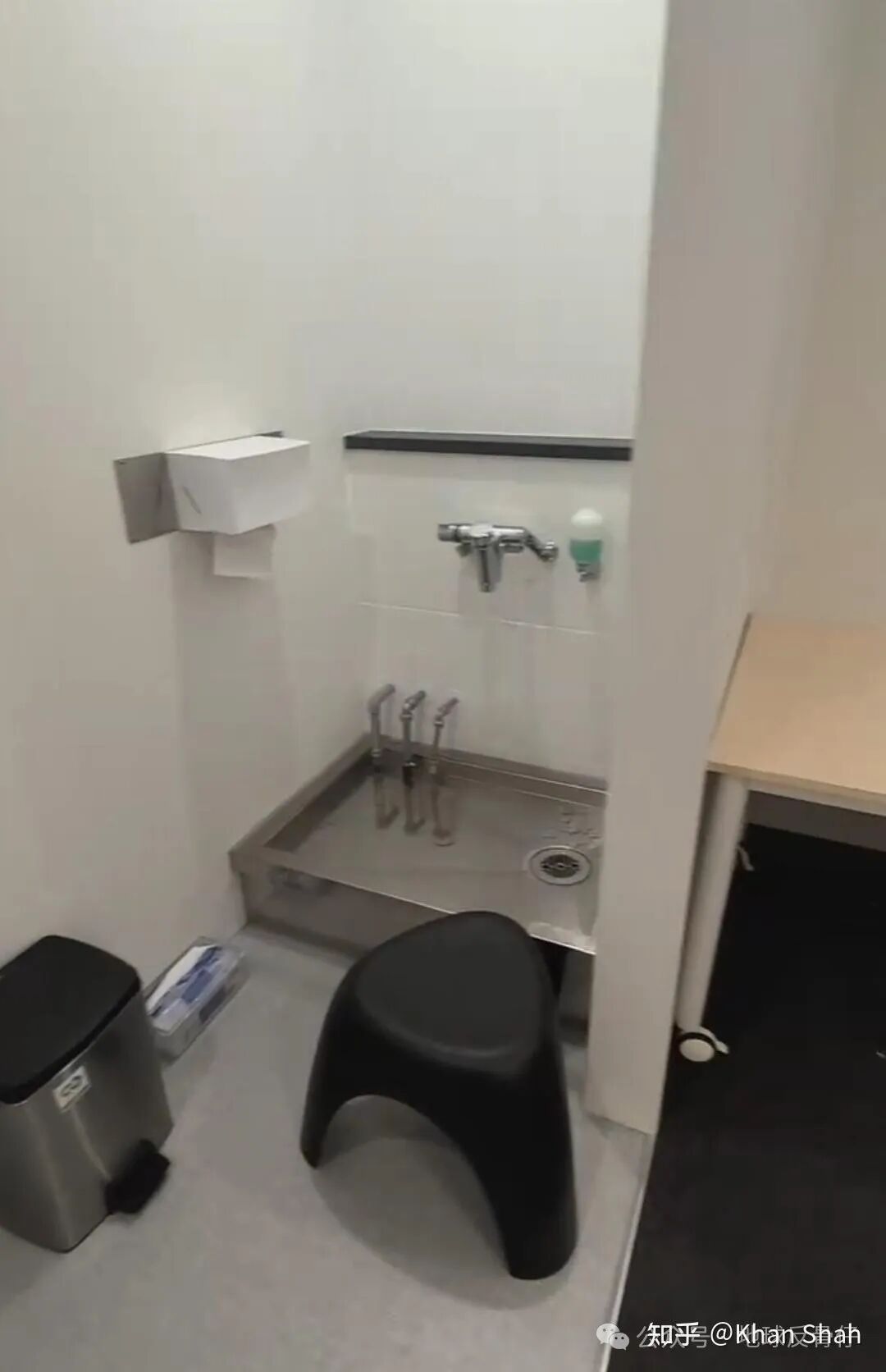
At the entrance, there is a place to perform wudu before prayer, with a small stool and even tissues provided.
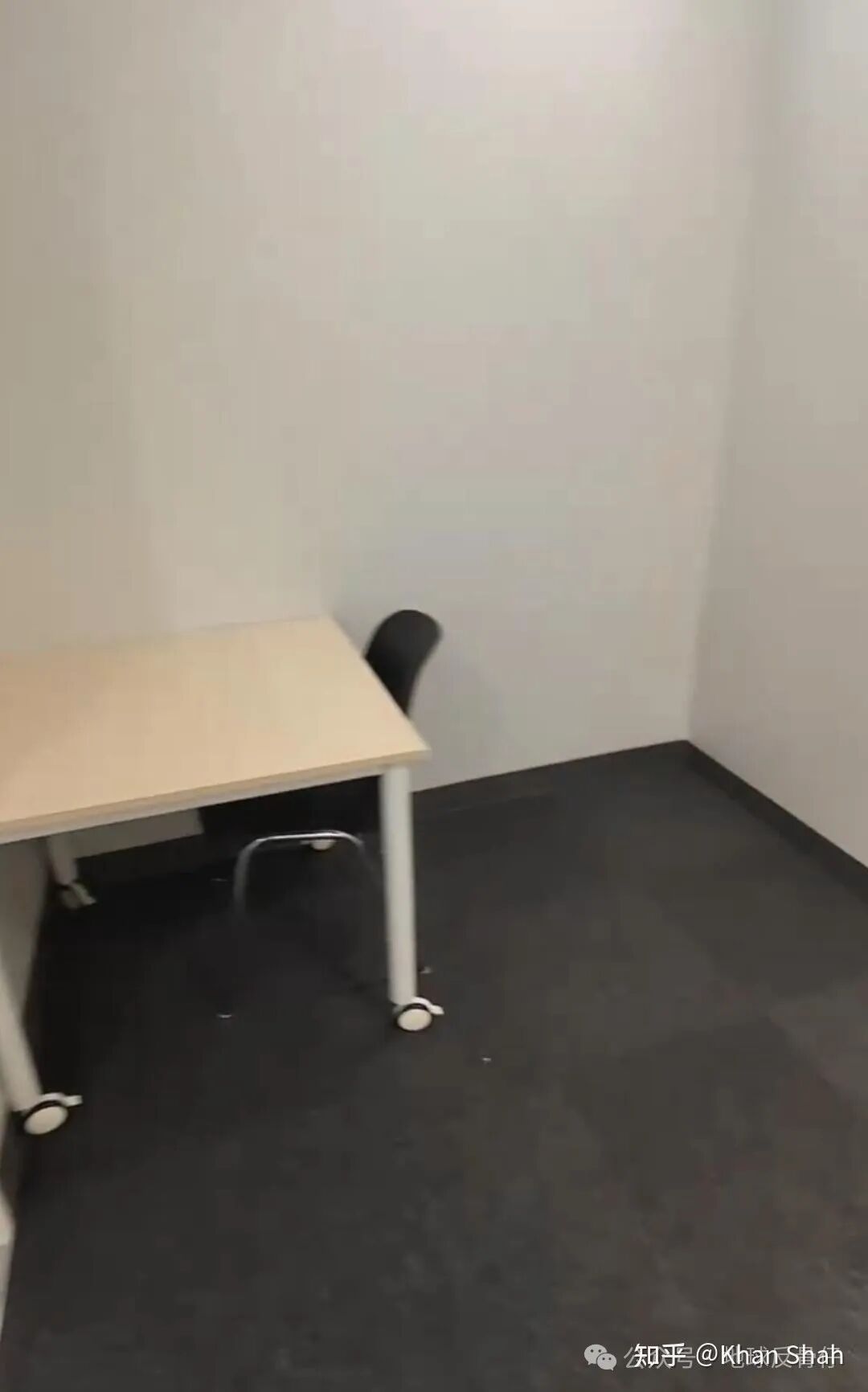
Inside, there are movable tables, chairs, and carpets, which make it much easier for Muslims to pray.
Actually, all the information mentioned above can be verified.
Most people traveling to Japan probably would not think to visit a mosque at all.
But if you have ever stepped into a convenience store, you have surely seen many brown-skinned young men, right?
Most of them come from Bangladesh.
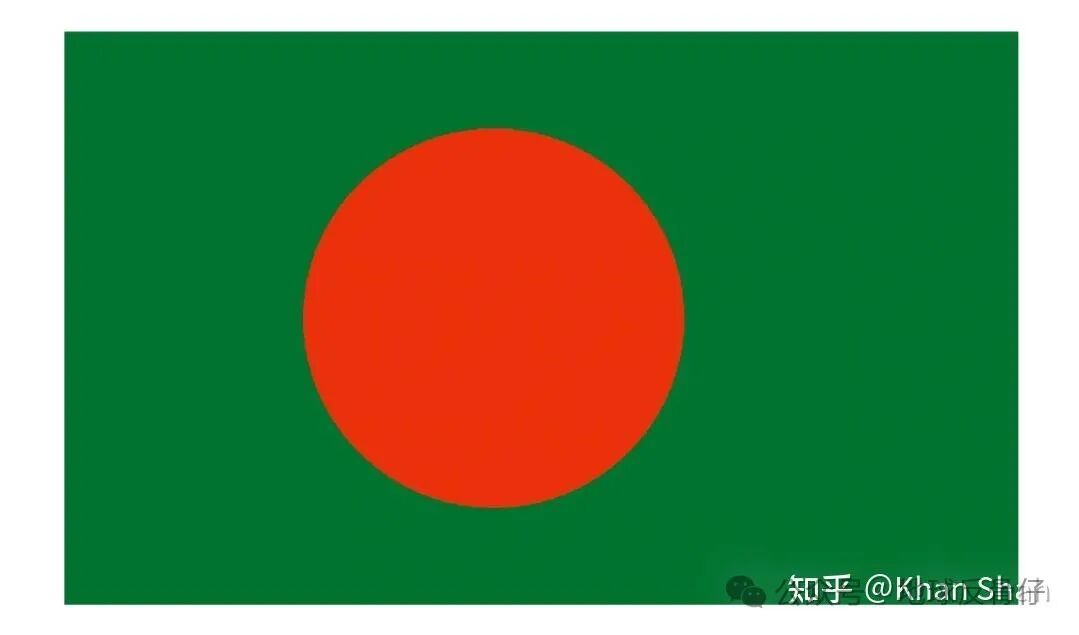
Bangladesh is a South Asian country and also a nation with a large population.
It has very close historical ties with India and Pakistan.
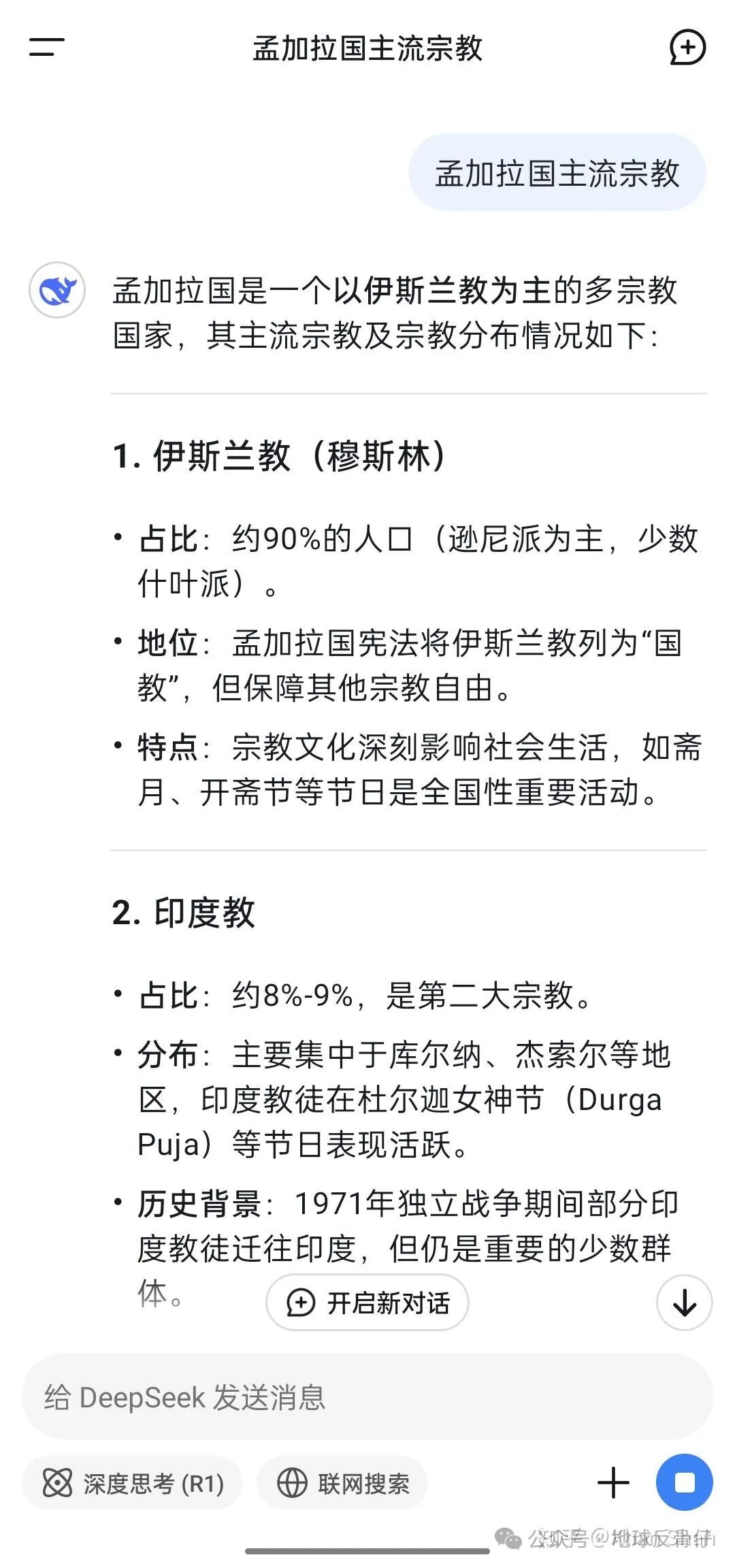
So, what is the mainstream religion in Bangladesh? I looked it up using DeepSeek:
Japan currently faces a very serious aging population problem, and the labor market is in urgent need of workers from various countries.
When it comes to hiring, they really do not have much room to be picky.
Therefore, it is unrealistic to completely shut out Muslim labor.
Moreover, Japan is a major tourism destination that welcomes a massive number of foreign visitors every year.
Turning away all Muslim tourists is clearly not possible.
The number of mosques in Japan is actually quite high now.
This is especially notable considering Japan's first mosque was not built until 1935.
In less than a hundred years, the number has grown significantly; you can count the red dots on the map yourself.
Keep in mind that the entire city of Shanghai only has seven mosques, including the Songjiang Mosque and the Jinshan Mosque.
Besides Tokyo and Osaka, Nagoya is the only other major city in Japan worth mentioning.
Let's look at the general distribution and number of mosques in Nagoya.
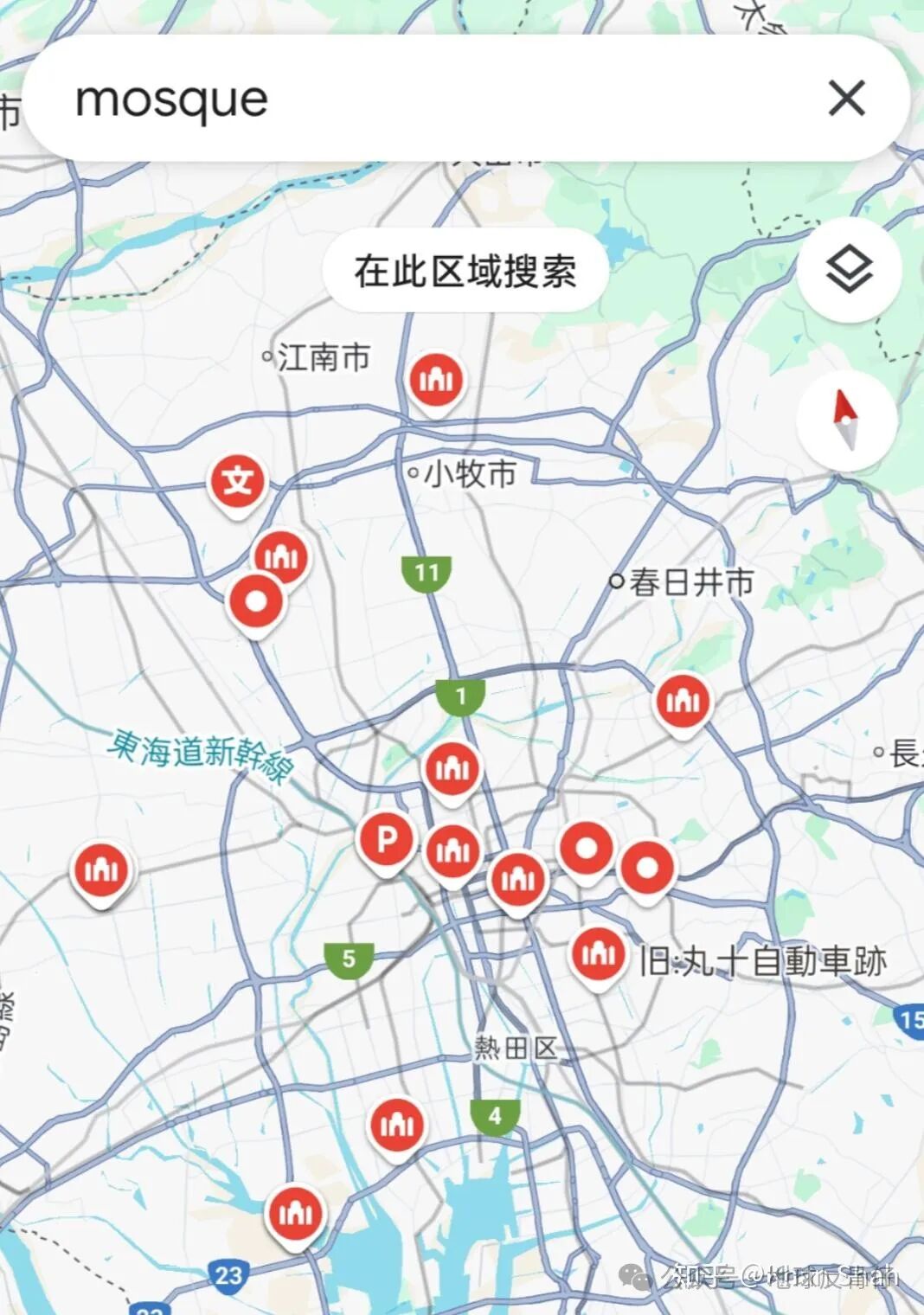
Now, let me show you what the mosques in Nagoya look like.
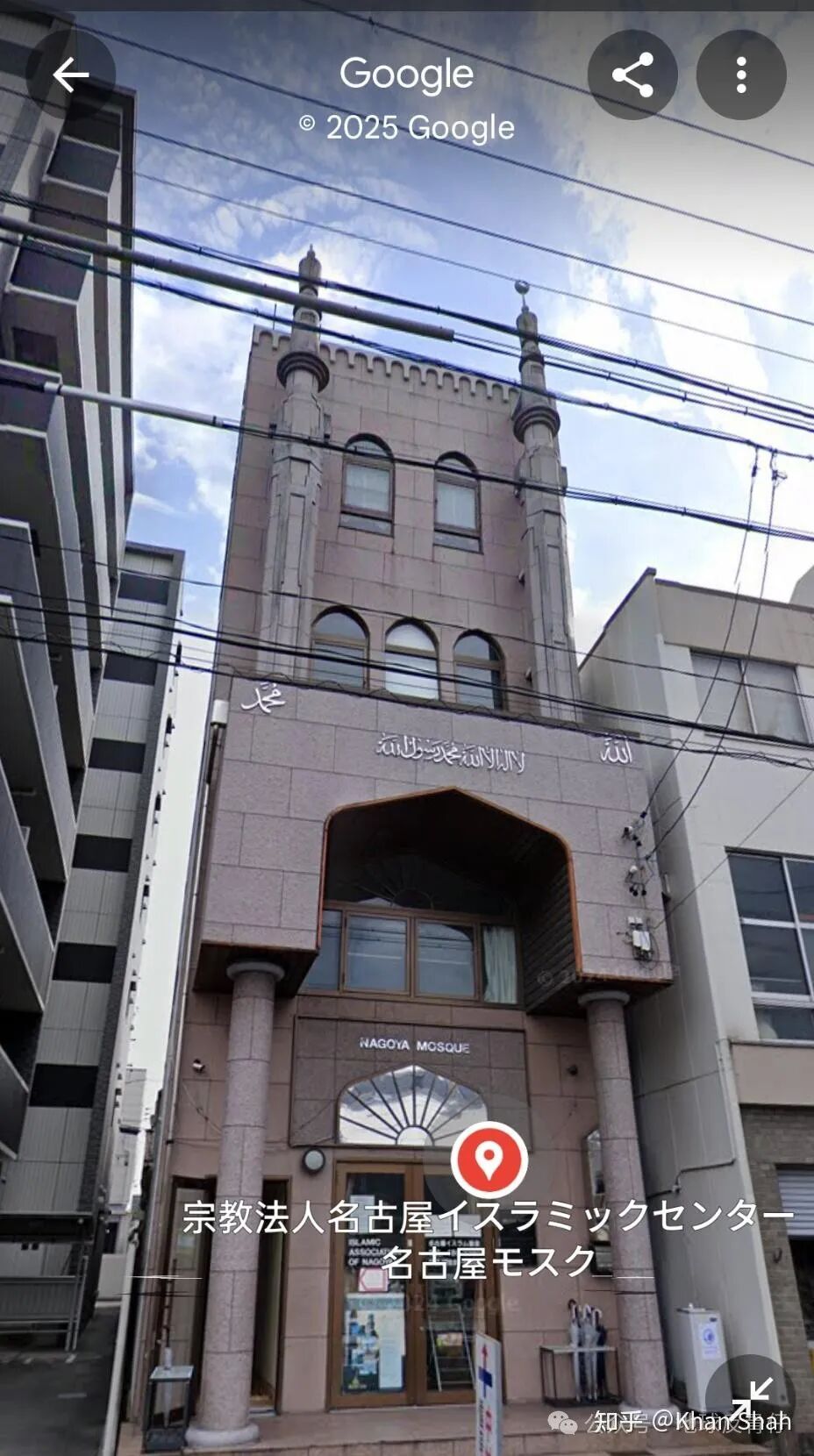
Google Maps has real-life photos where you can click the arrows to see different angles.
As you can see, this mosque is actually a converted small building of the type people build themselves in Japan.
After looking at the big cities, let's check out a more remote part of Japan—Hokkaido.
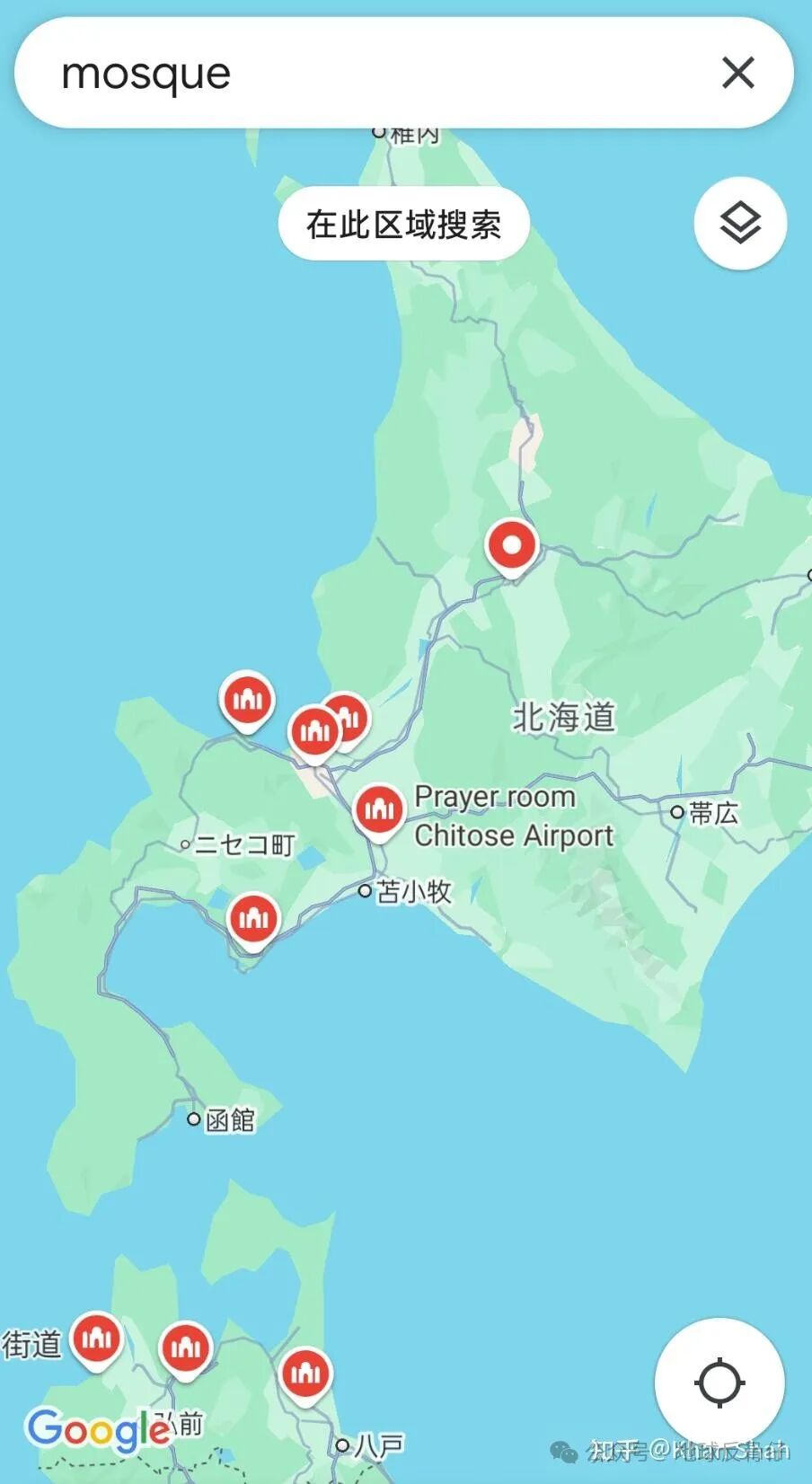
In my mind, this place is always covered in snow and has a very cold climate.
Yet even in a place like this, there are already mosques.
Let's take a look at a mosque in Sapporo, Hokkaido.
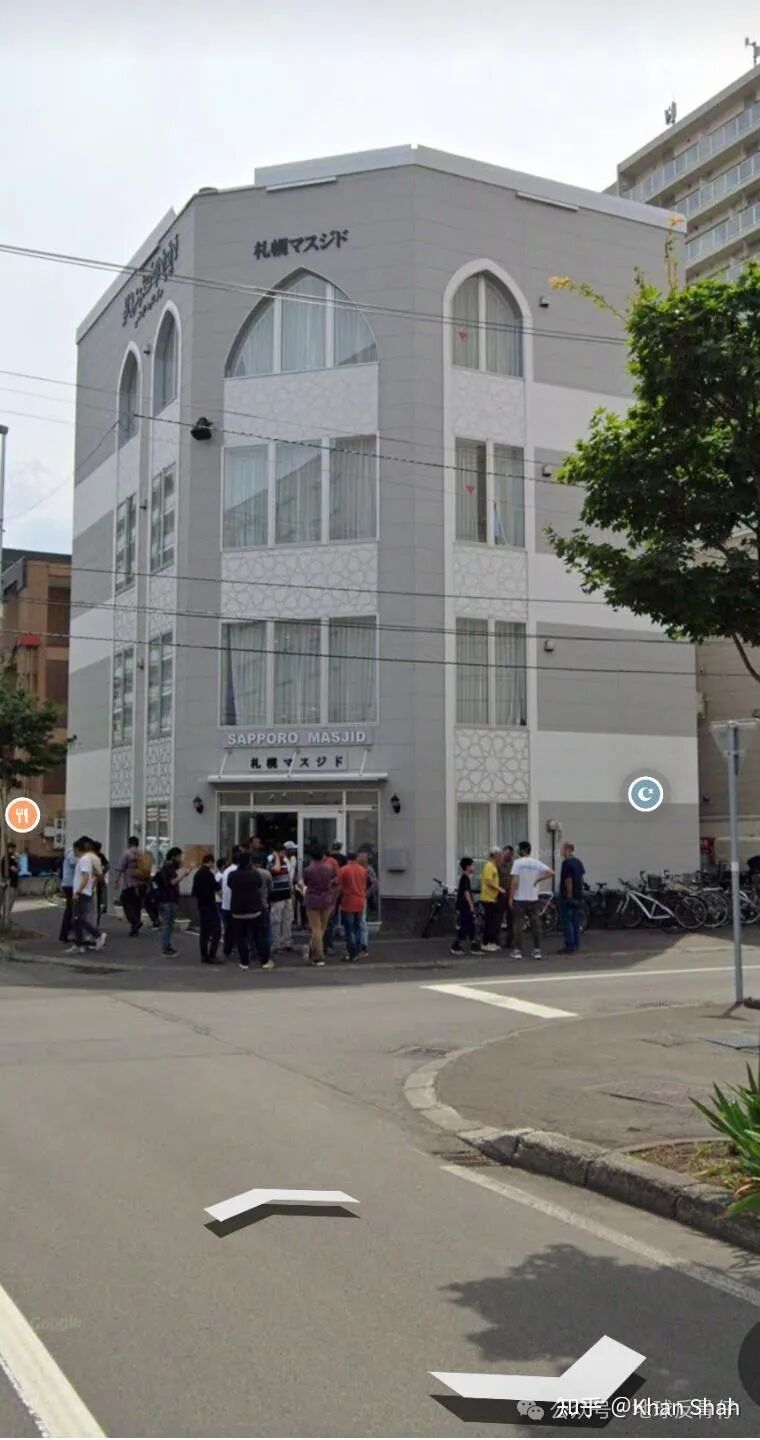
I have seen Hokkaido, the northernmost part of Japan, but what about the Ryukyu Islands, which are far south and quite a distance from the mainland?
This place used to be the Ryukyu Kingdom, and it still keeps its very distinct character today.
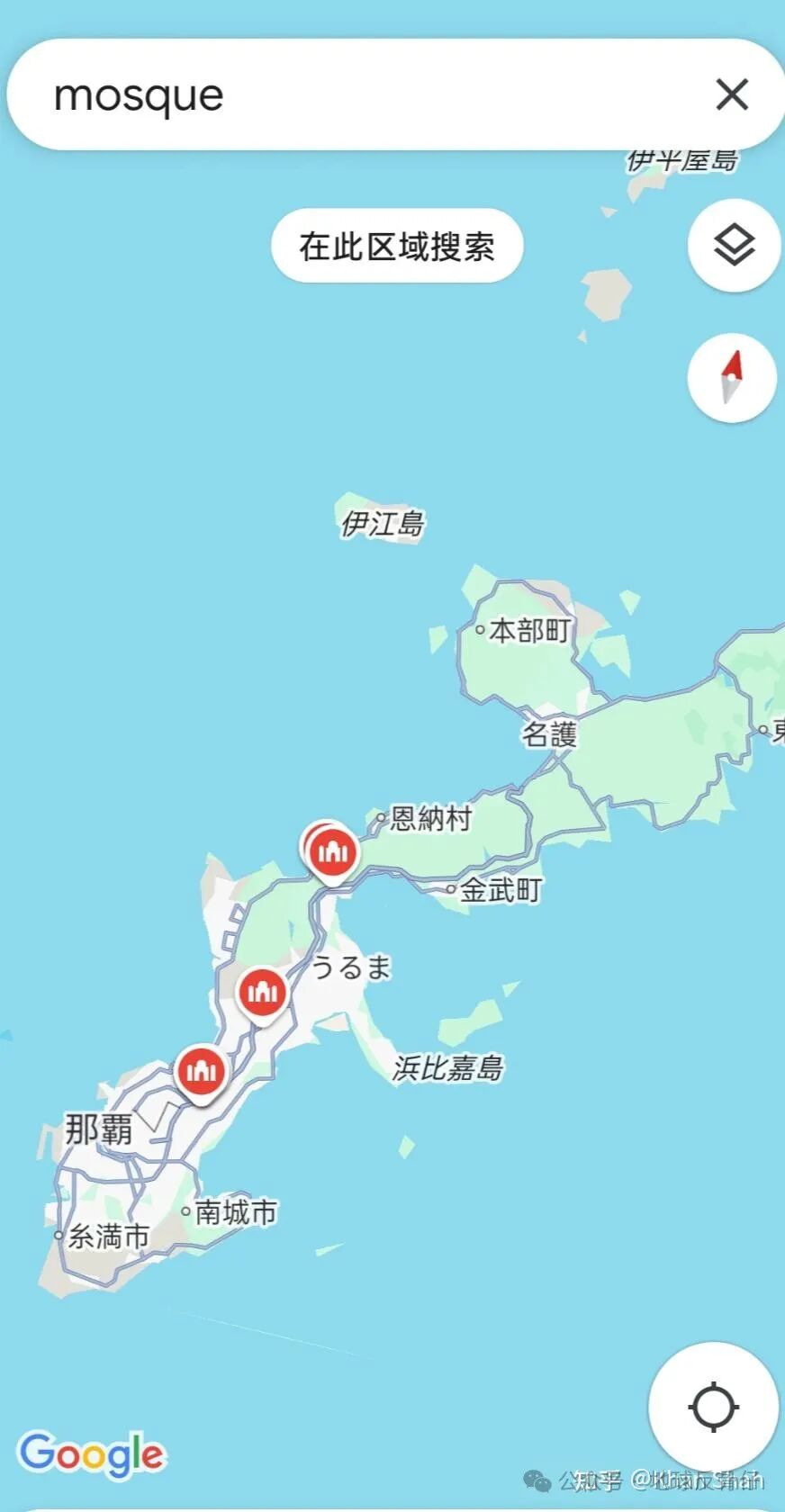
There are very few mosques here, but the population is small and the area is tiny anyway.
On a map, the Okinawa Islands look like just a few small dots, almost invisible.
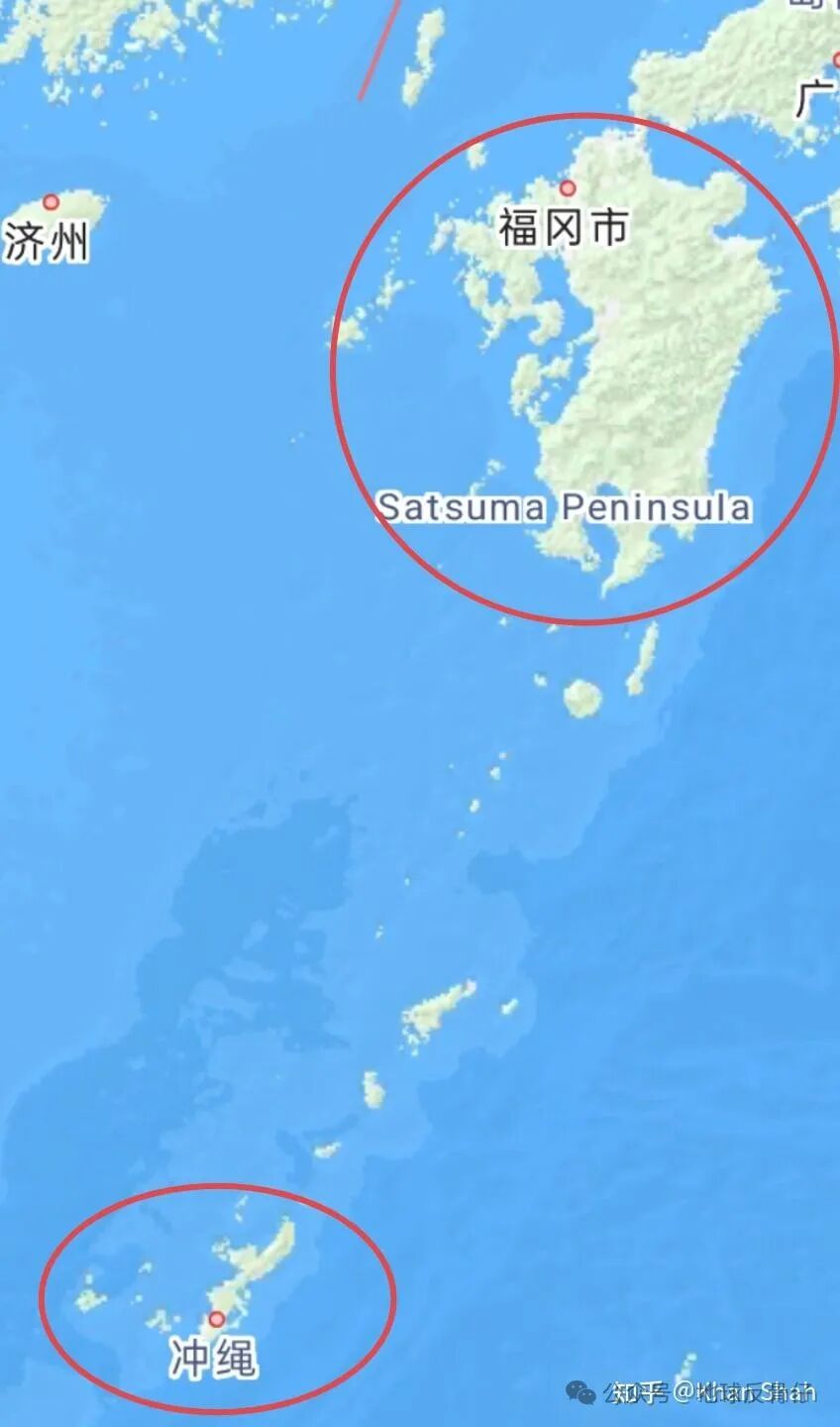
You can compare them: the circle above shows Kyushu Island, and the oval below shows the main island of Okinawa.
One look at the comparison shows that Okinawa is really, really small.
It is such a small place, and it is much further from the Japanese mainland than Japan is from Jeju Island in South Korea.
Even so, there is still a mosque there.
That is enough about the mosque for now, so let us look at the next part:
Japan bans all Arabic language education, and Japanese educational institutions are not allowed to teach Arabic.
Is this claim reliable? Let us look into it together.
Waseda University is probably one of the most familiar Japanese universities to Chinese people.
Haruki Murakami is a graduate of this school.
This university offers courses in Middle Eastern and Islamic studies.
Here is the proof, a screenshot from their official website.
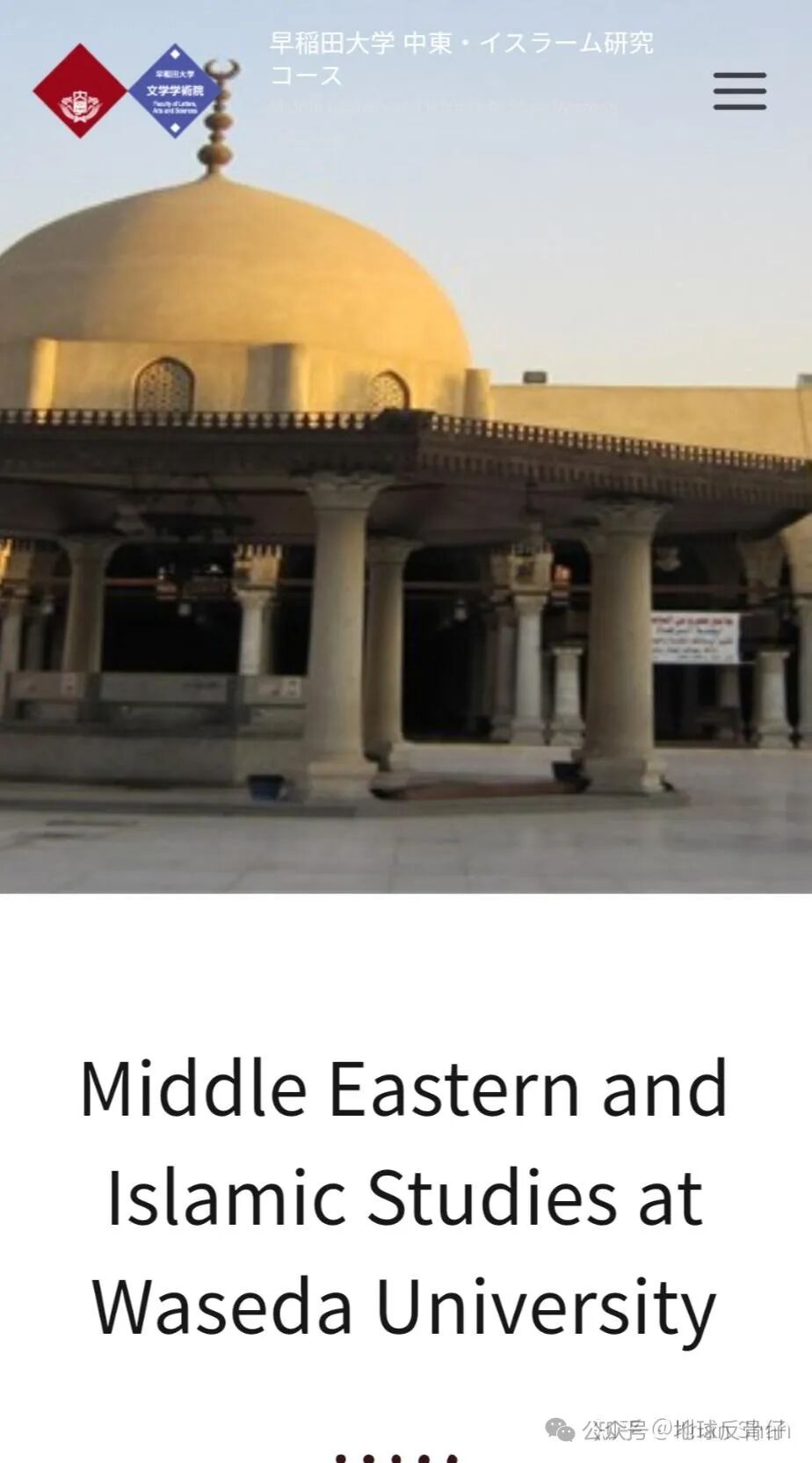
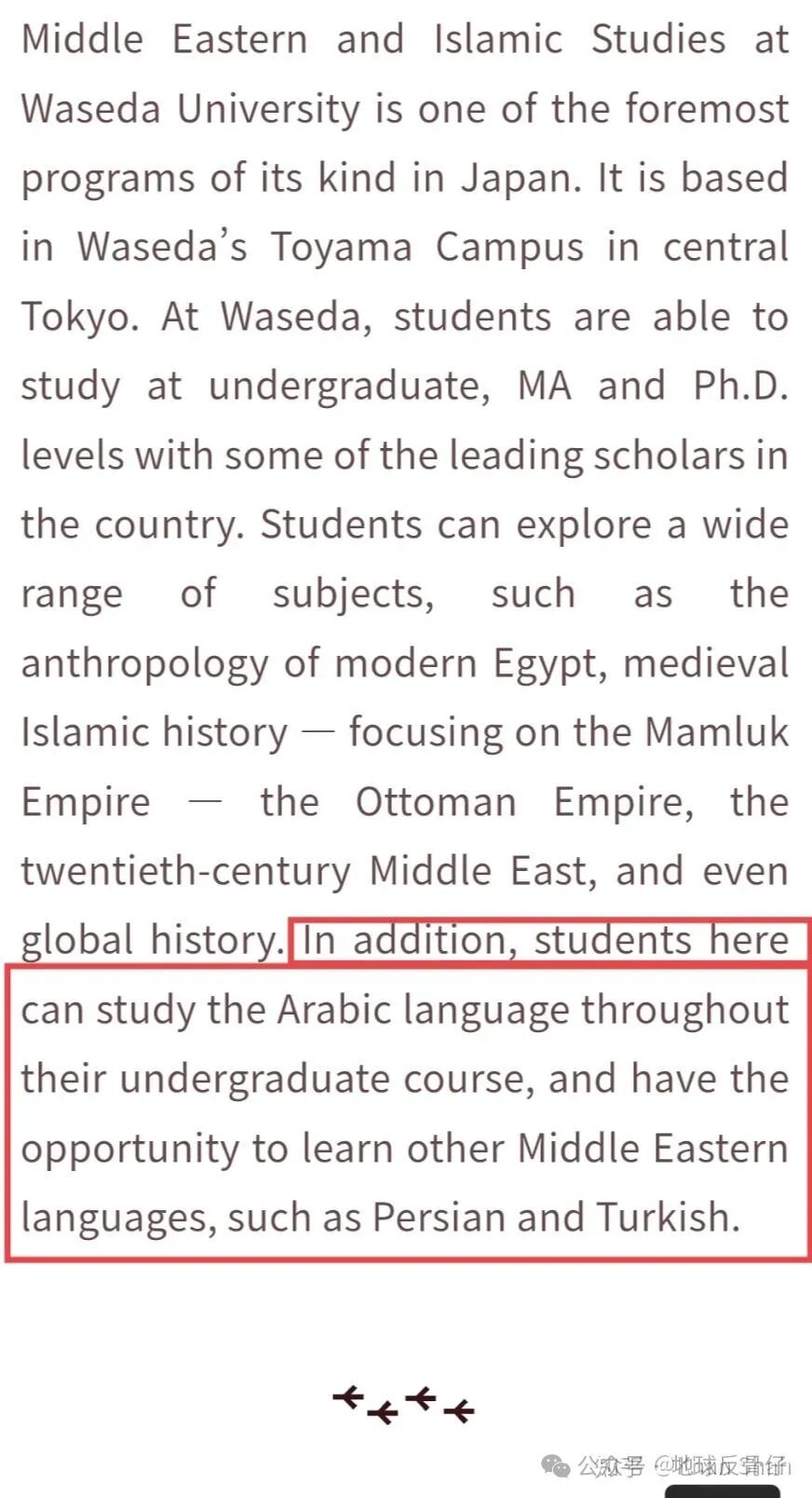
A simple translation of the English inside the red box is:
In short, students can study Arabic here during their undergraduate years.
They also have the chance to learn other Middle Eastern languages, such as Persian and Turkish.
Now we understand that Japanese universities do teach Arabic.
Let's see what other universities are doing.
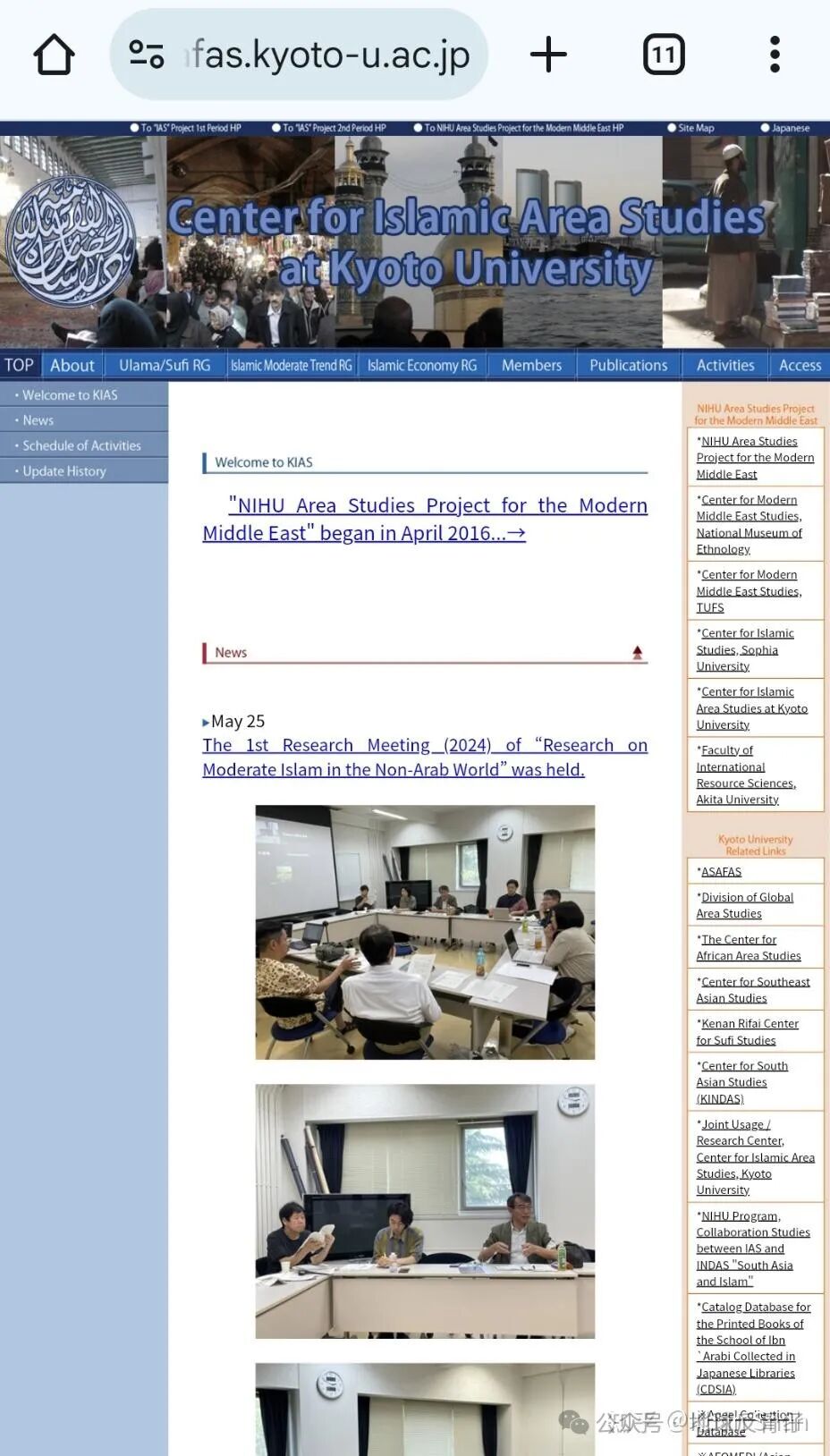
Kyoto University also has a center for Islamic area studies, as shown in the image below:
Let's look at another one, Tokyo University of Foreign Studies:
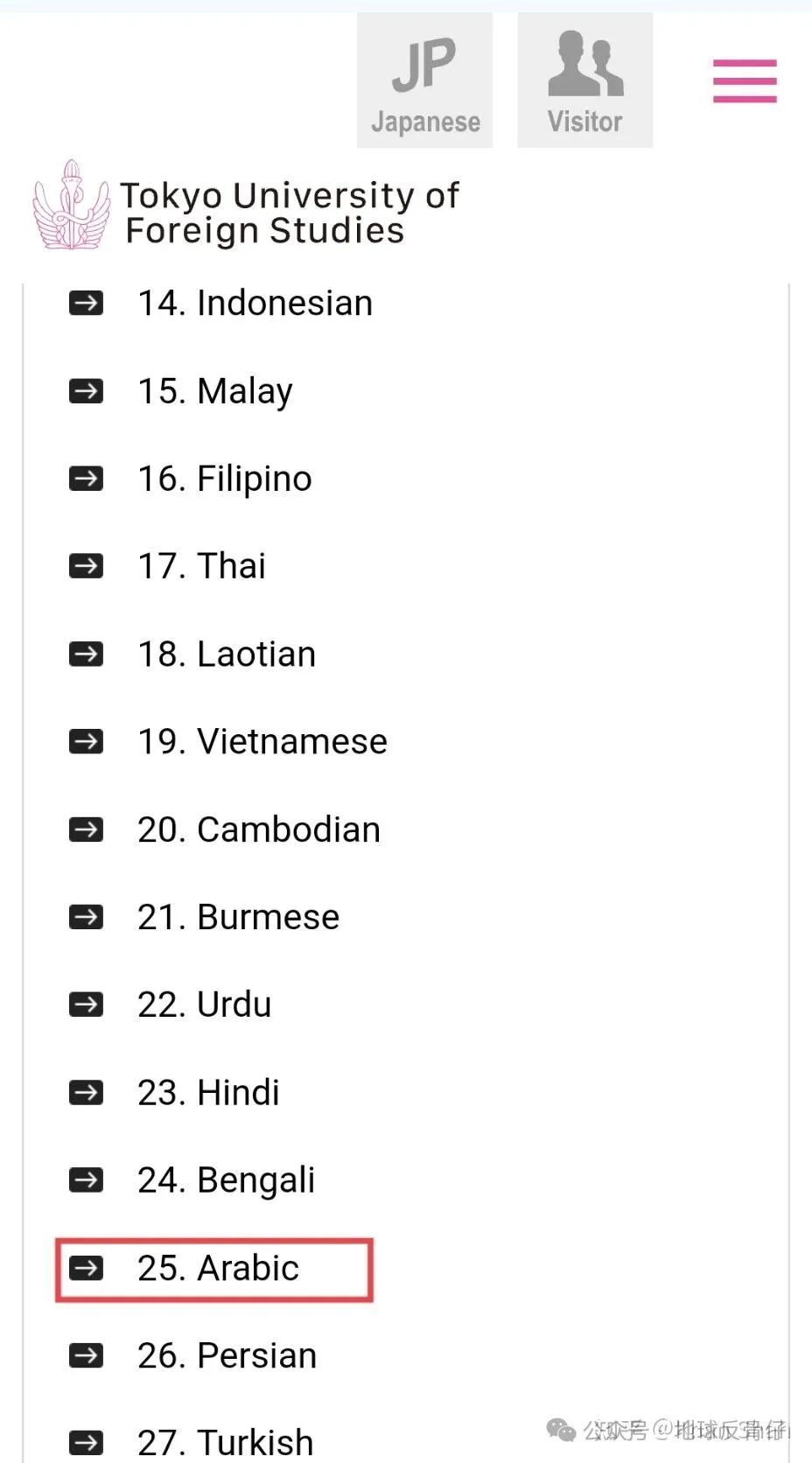
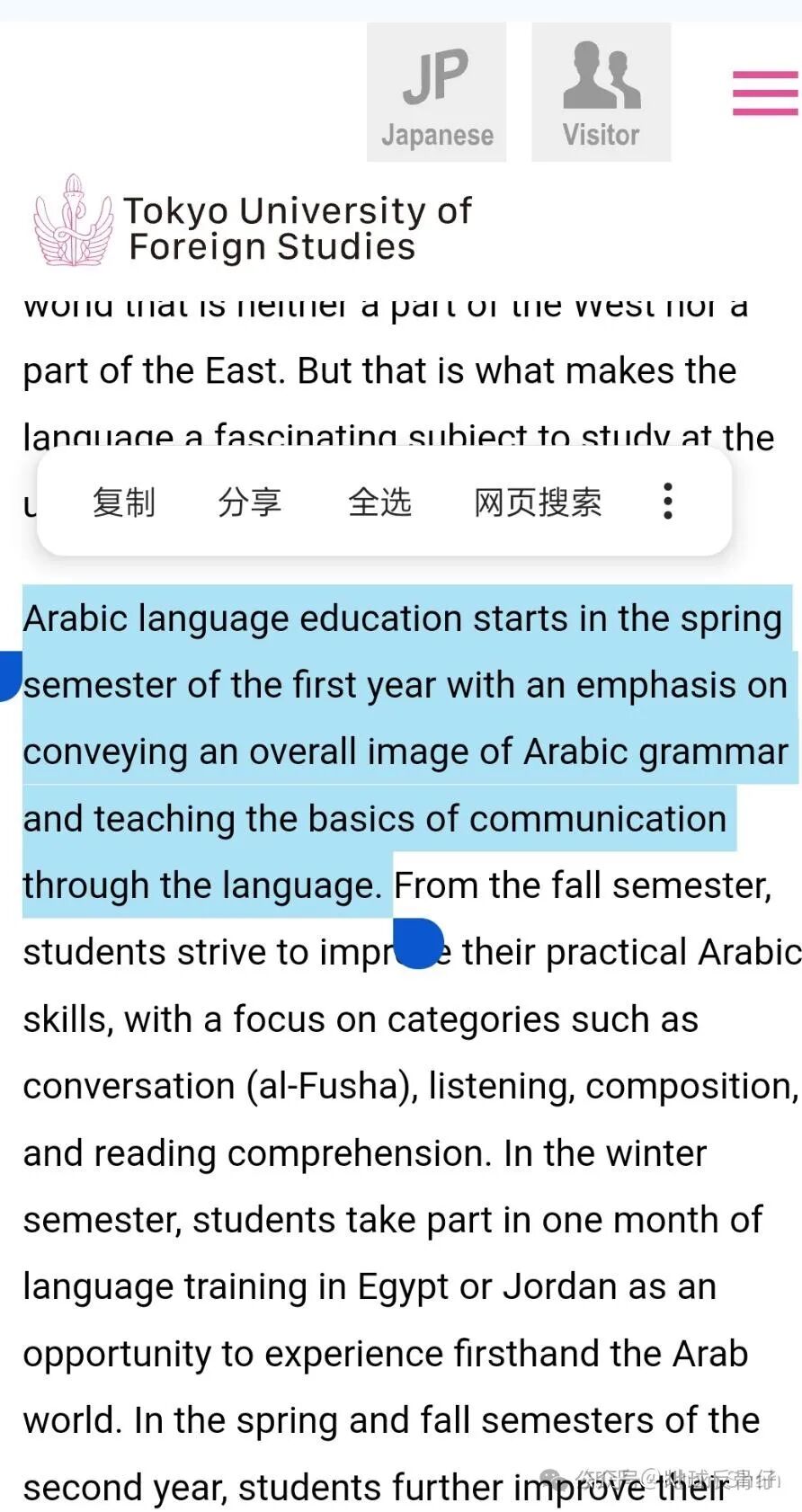
This is a higher education institution that specializes in foreign languages, and it has an Arabic major.
Let's look at the official website's brief introduction to this major.
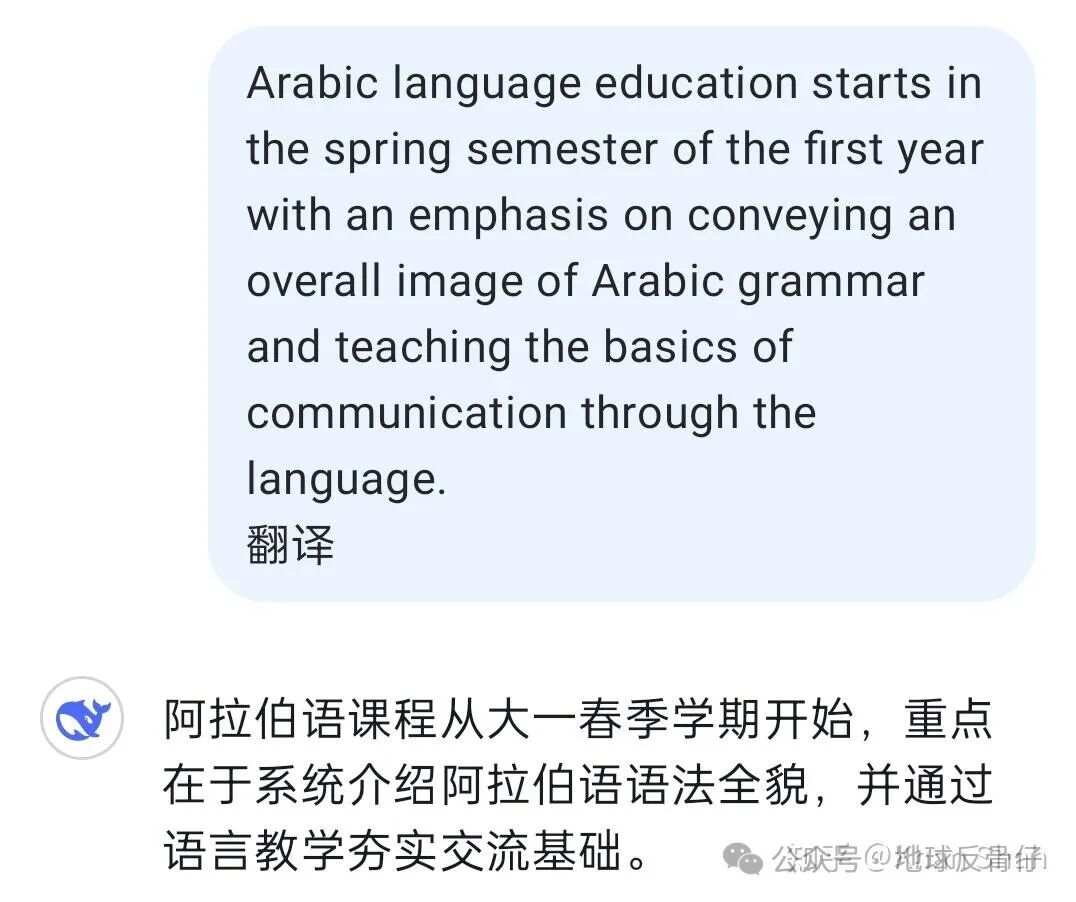
Here is a simple translation of the key points (I was too lazy to translate it myself, so I just threw it at an AI).
What about Japan's top university, the University of Tokyo (also known as Todai)?
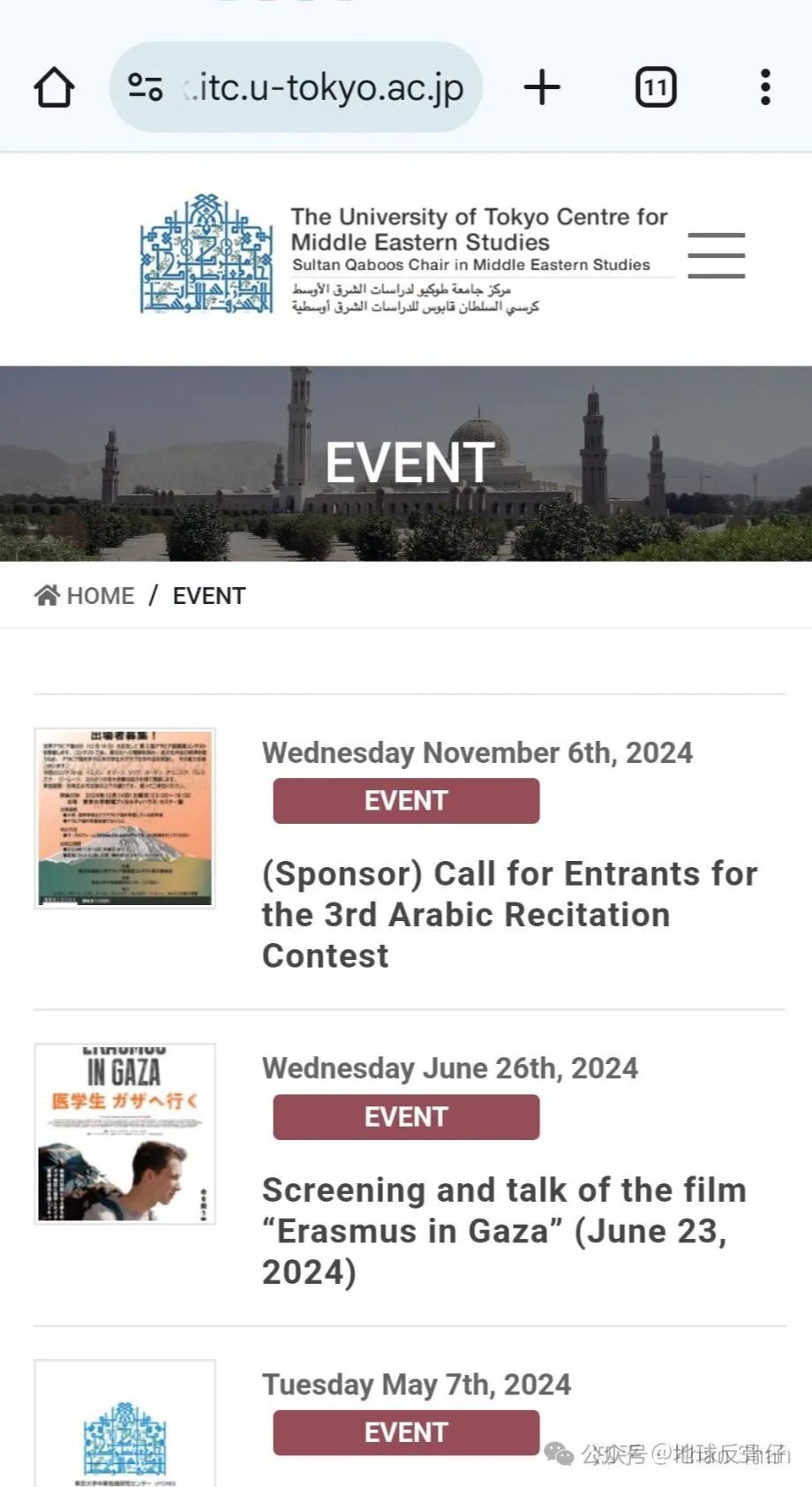
Todai also has an Islamic studies department. Let's look at the summary:
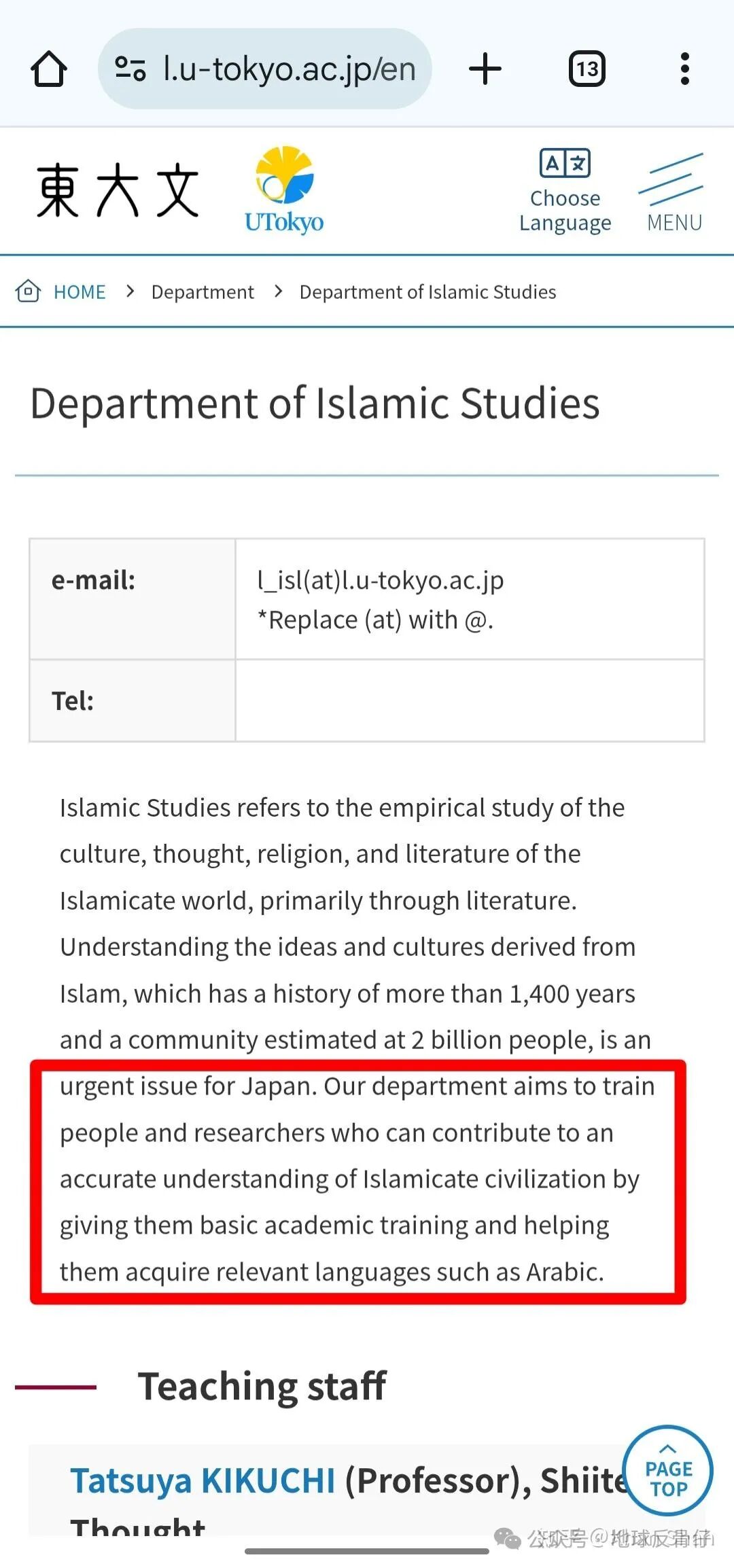
The text in the red box basically says: To help researchers accurately understand Islamic civilization, Todai teaches them relevant languages, including Arabic.
After checking the information myself, I found that the claim that "no educational institution in Japan offers Arabic education" simply doesn't hold up.
I have also seen a claim elsewhere that Japan has no halal restaurants and that you cannot buy halal food at all.
Is that true? Let's search and see.
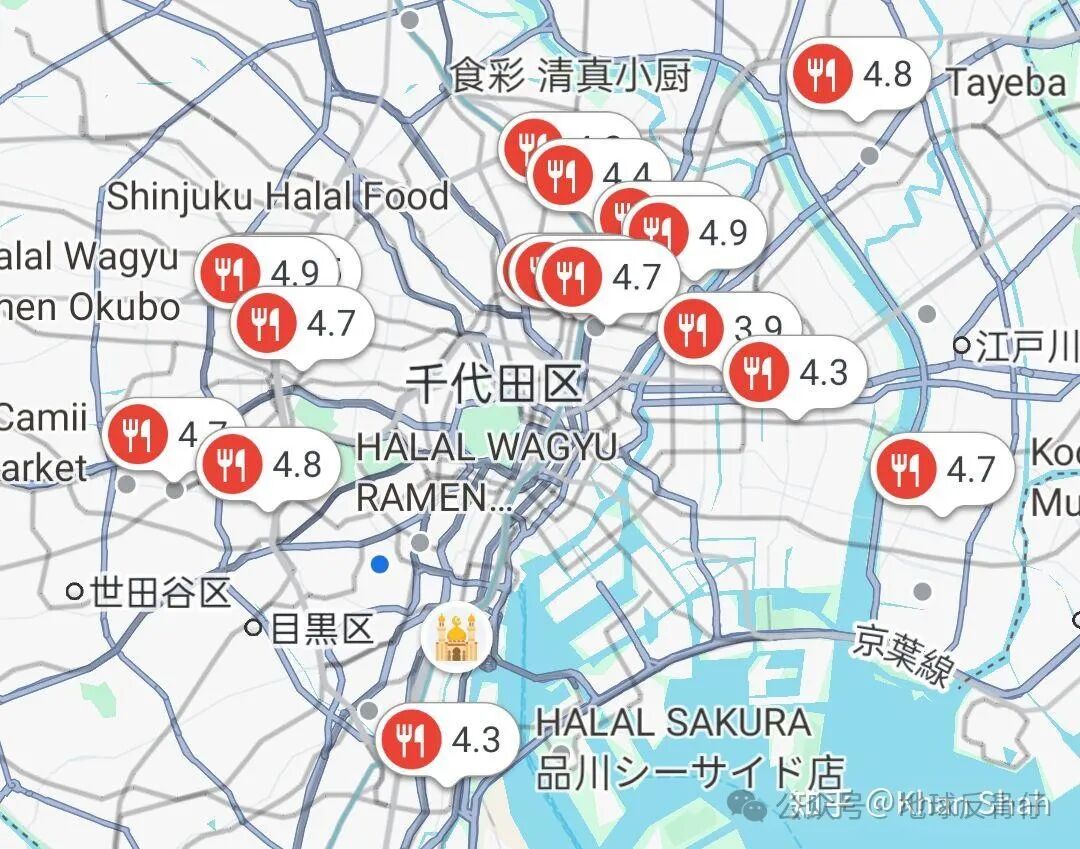
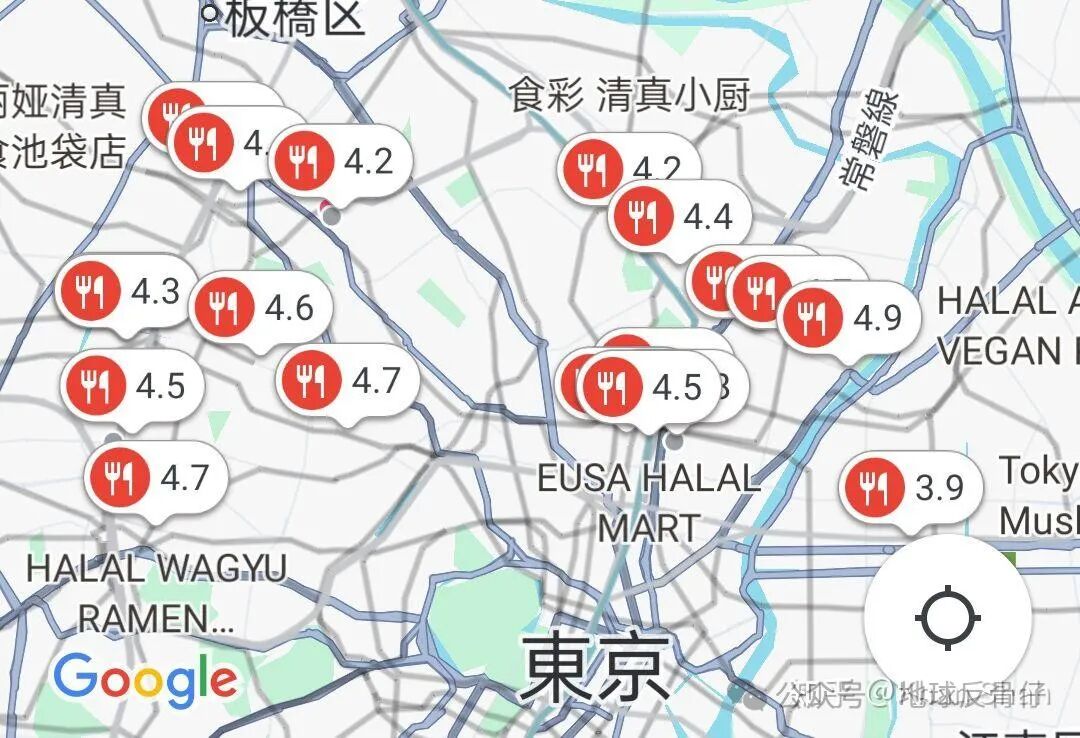
I searched in Tokyo again. I searched twice, and the results were slightly different each time.
I also found some restaurants on the "Japan Muslim Service Network" that you can find on Google.
I took a few screenshots, and here is a simple translation:
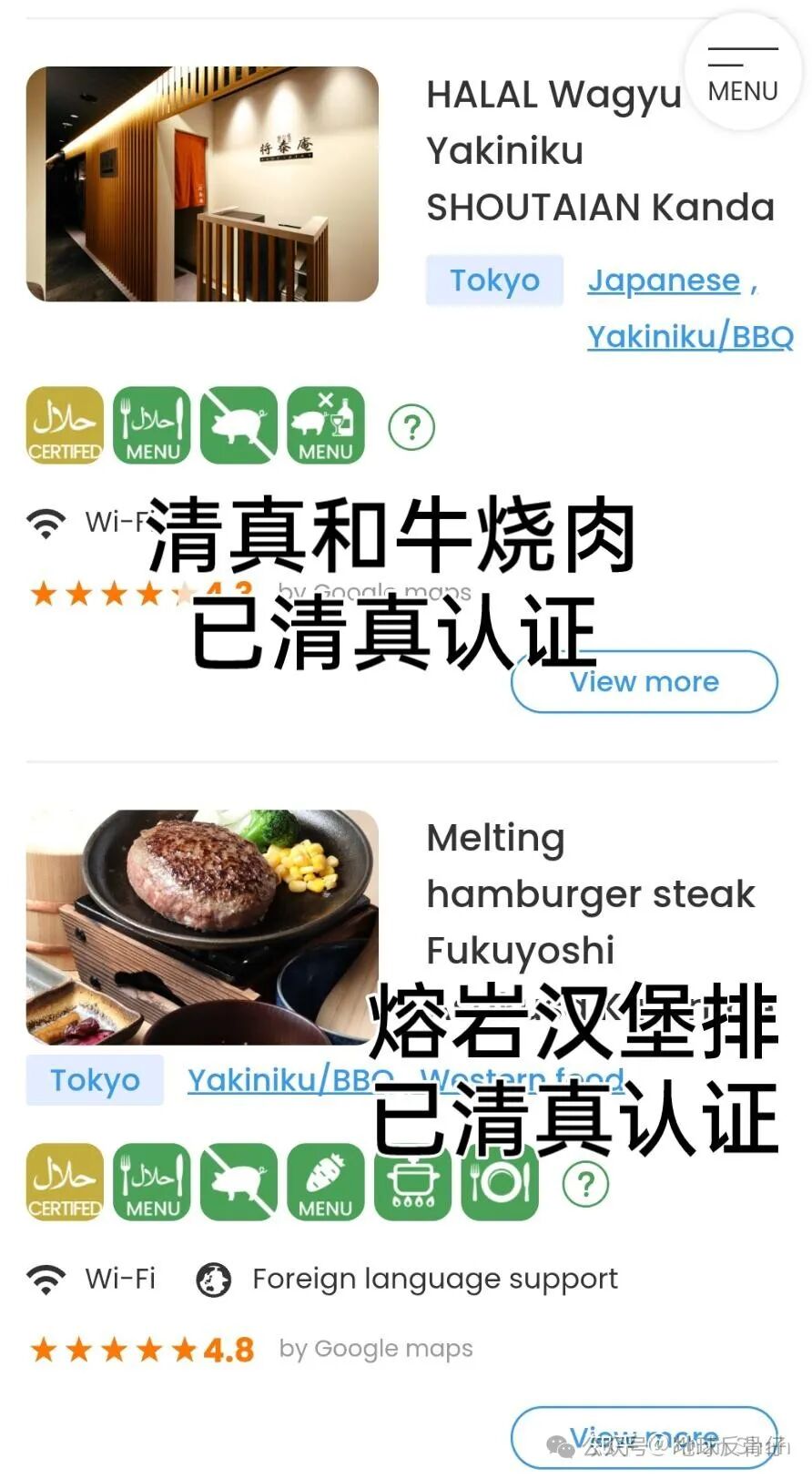
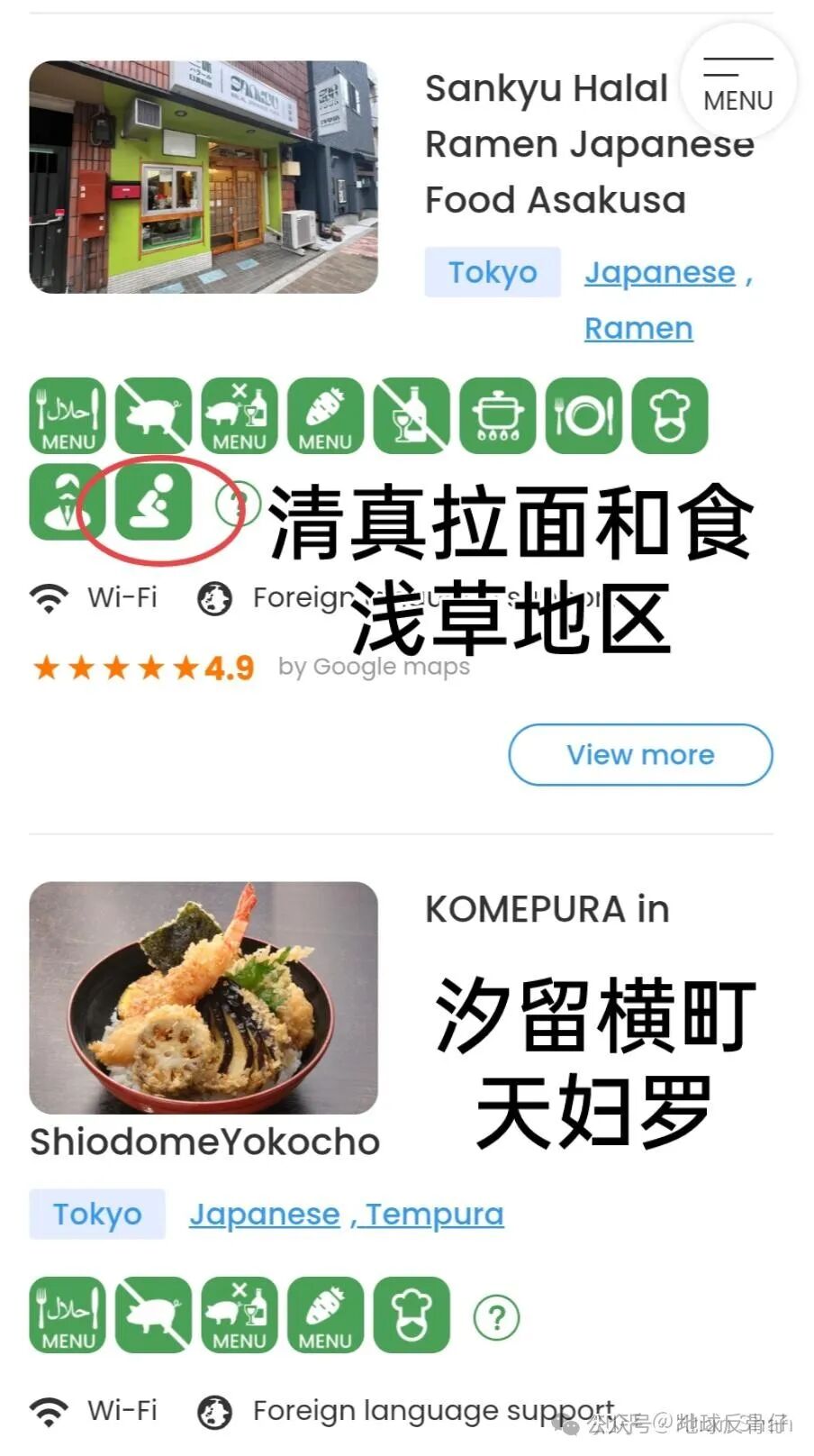
You can find halal versions of both international flavors and traditional Japanese cuisine.
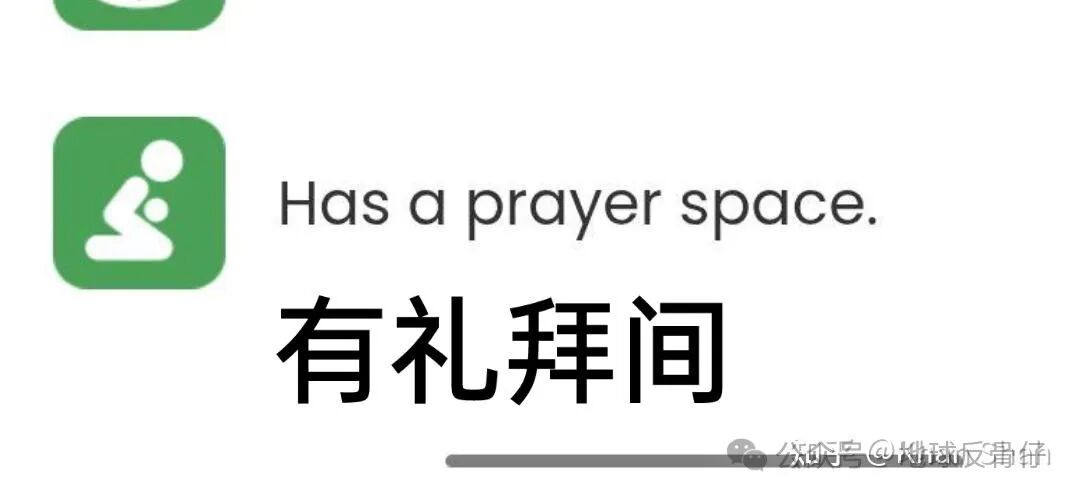
You might be curious about what the symbol in the red circle means.
I looked it up, and it means the shop has a prayer room.
My earlier analysis was right: just searching for a mosque will make you miss many of these small prayer rooms inside shops.
So, there are likely even more places to pray than what we can see.
Summary: This Japan Muslim travel guide uses the author's 2024 field observations and online checks to discuss mosques, Muslims, and halal travel in Japan. It keeps the original evidence path, travel notes, and local Muslim life context.
I put this article together using what I saw with my own eyes while traveling in Japan, along with information I easily found on YouTube, Google Maps, the Google Play Store, and Google Search.
On top of that, information from domestic AI software was a big help to me.
There are a lot of pictures later on, so keep an eye on your data usage. Writing this was hard work, and I am sharing it purely out of passion, so I hope you will give it a like to encourage me.
I went to Japan in early May 2024. Before I left, I had already read several articles claiming things like "there are no Muslims in Japan" or "there are no mosques in Japan."
When I read those articles, I had big doubts about whether they were true.
Once I actually stepped onto Japanese soil, I realized those claims were very one-sided.
First, let's see if the local area is really like some videos and articles say, where there is only one mosque in all of Japan.
Just in downtown Tokyo, if you search using the keyword "mosque," a lot of red dots pop up on the map.
This is basically the distribution map of mosques in Tokyo.
Because some small prayer rooms do not show up on the map, the reality is that there are even more places to pray than what you see.
I knew there were mosques in Japan before I went, and it is not like what some articles say about there being only one or two in the whole country.
I really did not expect there to be so many.
I visited the largest one, which is right in Yoyogi.
It is not just a mosque, but also a Turkish cultural center with a small museum next door.
There is a supermarket on the first floor that specializes in halal food.
Nearby, there are also classrooms where Muslim children learn basic religious knowledge.
The interior view of Yoyogi Mosque.
Later, I went to the Japan Islamic Cultural Center in Gotanda, which looks much simpler, as space is very expensive in a big city.
The prayer hall is upstairs, and the cafeteria is downstairs.
I remember an article I read before saying that Japan bans the sale of any Islamic books.
But on the fourth day of my trip, on the way to the Imperial Palace in Tokyo, I passed a fairly large bookstore.
I felt like going in for a look, and this was the first large or medium-sized bookstore I entered in Japan.
As it turned out, I saw this on the shelf for religious books:
The books marked inside the green circles are about Islam.
Of course, there are definitely more books on Buddhism by comparison.
Now let's use the internet to check if the Japanese government really stops people from learning about Islam.
We open the Google Play Store and search using the Japanese word for Islam, "isurāmu," to see if Japanese people can read e-books on the topic.
These are all things that ordinary Japanese citizens can buy easily, and many are even free.
Don't want to read? No problem, there are videos to watch on YouTube.
There are local Japanese Muslim scholars who explain Islamic knowledge on YouTube:
After that, I set off for Shizuoka City to see Mount Fuji, where there are usually fewer Muslims in smaller cities like this.
I searched and, sure enough, there is only one mosque there.
However, the Shizuoka Mosque is quite large and has a wide open space.
If you search for "eid" (the Arabic word for festivals, specifically referring to Eid al-Fitr and Eid al-Adha) plus "Shizuoka" on YouTube, you can see videos of the Eid celebrations filmed there.
Next, I went to Osaka and Kyoto. Osaka is also a big city, so it has a few more mosques.
Back home, I only heard that Tokyo had mosques and that there was one in Kobe.
To my surprise, I found that other cities actually have quite a few mosques too.
Kyoto has fewer mosques, which makes sense since the city is full of traditional houses and Buddhist temples.
Even so, there are still mosques there.
Before heading back to China, I returned to Tokyo on a Friday.
That was when I visited the Islamic cultural exchange center I mentioned earlier.
As is the custom, the imam gives a speech on Fridays.
The imam gives his speech in Japanese first, then explains it briefly in English.
Some might worry that Imam Sato speaks difficult Japanese-style English, but honestly, it sounds quite smooth.
Why use English?
Because most of the Muslims attending namaz in Japan are foreigners.
There are foreign workers here, as well as foreign tourists like me whose Japanese isn't very good.
Are there any native Japanese Muslims?
Of course there are, but native Japanese Muslims only make up a small portion.
So if you only speak in Japanese, many people won't understand.
I met several Japanese Muslims at the time.
I stared at them, wondering: is there any difference between them and ordinary Japanese people on the street?
If you met them on the road, I bet no one would guess they are Muslims:
Except for one person from Indonesia, everyone in this photo is a native Japanese Muslim.
Finally, I went to the Yoyogi Mosque one more time.
I happened to catch a young Japanese man and woman officially converting to Islam in front of an imam.
As I mentioned before, that mosque is a Turkish cultural center funded by the Turkish government.
There is an imam who only speaks Turkish and does not speak Japanese.
He had an interpreter next to him to help pass on his message.
I watched two young people finish their conversion ceremony right there.
There was also an older imam who seemed to be fluent in both Turkish and Japanese.
He is likely the one in charge of the Friday Jumu'ah sermon at Yoyogi Mosque.
I bought a round-trip ticket, and I chose Tokyo Narita Airport as my departure point.
So, I had to go back to Narita Airport in the end.
There are two prayer rooms set up at the check-in area of Narita Airport.
These prayer rooms are not just for Muslims, but we can take a look at the facilities inside.
At the entrance, there is a place to perform wudu before prayer, with a small stool and even tissues provided.
Inside, there are movable tables, chairs, and carpets, which make it much easier for Muslims to pray.
Actually, all the information mentioned above can be verified.
Most people traveling to Japan probably would not think to visit a mosque at all.
But if you have ever stepped into a convenience store, you have surely seen many brown-skinned young men, right?
Most of them come from Bangladesh.
Bangladesh is a South Asian country and also a nation with a large population.
It has very close historical ties with India and Pakistan.
So, what is the mainstream religion in Bangladesh? I looked it up using DeepSeek:
Japan currently faces a very serious aging population problem, and the labor market is in urgent need of workers from various countries.
When it comes to hiring, they really do not have much room to be picky.
Therefore, it is unrealistic to completely shut out Muslim labor.
Moreover, Japan is a major tourism destination that welcomes a massive number of foreign visitors every year.
Turning away all Muslim tourists is clearly not possible.
The number of mosques in Japan is actually quite high now.
This is especially notable considering Japan's first mosque was not built until 1935.
In less than a hundred years, the number has grown significantly; you can count the red dots on the map yourself.
Keep in mind that the entire city of Shanghai only has seven mosques, including the Songjiang Mosque and the Jinshan Mosque.
Besides Tokyo and Osaka, Nagoya is the only other major city in Japan worth mentioning.
Let's look at the general distribution and number of mosques in Nagoya.
Now, let me show you what the mosques in Nagoya look like.
Google Maps has real-life photos where you can click the arrows to see different angles.
As you can see, this mosque is actually a converted small building of the type people build themselves in Japan.
After looking at the big cities, let's check out a more remote part of Japan—Hokkaido.
In my mind, this place is always covered in snow and has a very cold climate.
Yet even in a place like this, there are already mosques.
Let's take a look at a mosque in Sapporo, Hokkaido.
I have seen Hokkaido, the northernmost part of Japan, but what about the Ryukyu Islands, which are far south and quite a distance from the mainland?
This place used to be the Ryukyu Kingdom, and it still keeps its very distinct character today.
There are very few mosques here, but the population is small and the area is tiny anyway.
On a map, the Okinawa Islands look like just a few small dots, almost invisible.
You can compare them: the circle above shows Kyushu Island, and the oval below shows the main island of Okinawa.
One look at the comparison shows that Okinawa is really, really small.
It is such a small place, and it is much further from the Japanese mainland than Japan is from Jeju Island in South Korea.
Even so, there is still a mosque there.
That is enough about the mosque for now, so let us look at the next part:
Japan bans all Arabic language education, and Japanese educational institutions are not allowed to teach Arabic.
Is this claim reliable? Let us look into it together.
Waseda University is probably one of the most familiar Japanese universities to Chinese people.
Haruki Murakami is a graduate of this school.
This university offers courses in Middle Eastern and Islamic studies.
Here is the proof, a screenshot from their official website.
A simple translation of the English inside the red box is:
In short, students can study Arabic here during their undergraduate years.
They also have the chance to learn other Middle Eastern languages, such as Persian and Turkish.
Now we understand that Japanese universities do teach Arabic.
Let's see what other universities are doing.
Kyoto University also has a center for Islamic area studies, as shown in the image below:
Let's look at another one, Tokyo University of Foreign Studies:
This is a higher education institution that specializes in foreign languages, and it has an Arabic major.
Let's look at the official website's brief introduction to this major.
Here is a simple translation of the key points (I was too lazy to translate it myself, so I just threw it at an AI).
What about Japan's top university, the University of Tokyo (also known as Todai)?
Todai also has an Islamic studies department. Let's look at the summary:
The text in the red box basically says: To help researchers accurately understand Islamic civilization, Todai teaches them relevant languages, including Arabic.
After checking the information myself, I found that the claim that "no educational institution in Japan offers Arabic education" simply doesn't hold up.
I have also seen a claim elsewhere that Japan has no halal restaurants and that you cannot buy halal food at all.
Is that true? Let's search and see.
I searched in Tokyo again. I searched twice, and the results were slightly different each time.
I also found some restaurants on the "Japan Muslim Service Network" that you can find on Google.
I took a few screenshots, and here is a simple translation:
You can find halal versions of both international flavors and traditional Japanese cuisine.
You might be curious about what the symbol in the red circle means.
I looked it up, and it means the shop has a prayer room.
My earlier analysis was right: just searching for a mosque will make you miss many of these small prayer rooms inside shops.
So, there are likely even more places to pray than what we can see.
Muslim Travel Guide Japan 2024: Tokyo Mosques, Halal Travel and Local Muslim Life
Articles • Hasan09 posted the article • 0 comments • 370 views • 2026-05-24 01:59
Reposted from the web
Summary: This Japan Muslim travel guide uses the author's 2024 field observations and online checks to discuss mosques, Muslims, and halal travel in Japan. It keeps the original evidence path, travel notes, and local Muslim life context.
I put this article together using what I saw with my own eyes while traveling in Japan, along with information I easily found on YouTube, Google Maps, the Google Play Store, and Google Search.
On top of that, information from domestic AI software was a big help to me.
There are a lot of pictures later on, so keep an eye on your data usage. Writing this was hard work, and I am sharing it purely out of passion, so I hope you will give it a like to encourage me.
I went to Japan in early May 2024. Before I left, I had already read several articles claiming things like "there are no Muslims in Japan" or "there are no mosques in Japan."
When I read those articles, I had big doubts about whether they were true.
Once I actually stepped onto Japanese soil, I realized those claims were very one-sided.
First, let's see if the local area is really like some videos and articles say, where there is only one mosque in all of Japan.
Just in downtown Tokyo, if you search using the keyword "mosque," a lot of red dots pop up on the map.
This is basically the distribution map of mosques in Tokyo.
Because some small prayer rooms do not show up on the map, the reality is that there are even more places to pray than what you see.
I knew there were mosques in Japan before I went, and it is not like what some articles say about there being only one or two in the whole country.
I really did not expect there to be so many.
I visited the largest one, which is right in Yoyogi.
It is not just a mosque, but also a Turkish cultural center with a small museum next door.
There is a supermarket on the first floor that specializes in halal food.
Nearby, there are also classrooms where Muslim children learn basic religious knowledge.
The interior view of Yoyogi Mosque.
Later, I went to the Japan Islamic Cultural Center in Gotanda, which looks much simpler, as space is very expensive in a big city.
The prayer hall is upstairs, and the cafeteria is downstairs.
I remember an article I read before saying that Japan bans the sale of any Islamic books.
But on the fourth day of my trip, on the way to the Imperial Palace in Tokyo, I passed a fairly large bookstore.
I felt like going in for a look, and this was the first large or medium-sized bookstore I entered in Japan.
As it turned out, I saw this on the shelf for religious books:
The books marked inside the green circles are about Islam.
Of course, there are definitely more books on Buddhism by comparison.
Now let's use the internet to check if the Japanese government really stops people from learning about Islam.
We open the Google Play Store and search using the Japanese word for Islam, "isurāmu," to see if Japanese people can read e-books on the topic.
These are all things that ordinary Japanese citizens can buy easily, and many are even free.
Don't want to read? No problem, there are videos to watch on YouTube.
There are local Japanese Muslim scholars who explain Islamic knowledge on YouTube:
After that, I set off for Shizuoka City to see Mount Fuji, where there are usually fewer Muslims in smaller cities like this.
I searched and, sure enough, there is only one mosque there.
However, the Shizuoka Mosque is quite large and has a wide open space.
If you search for "eid" (the Arabic word for festivals, specifically referring to Eid al-Fitr and Eid al-Adha) plus "Shizuoka" on YouTube, you can see videos of the Eid celebrations filmed there.
Next, I went to Osaka and Kyoto. Osaka is also a big city, so it has a few more mosques.
Back home, I only heard that Tokyo had mosques and that there was one in Kobe.
To my surprise, I found that other cities actually have quite a few mosques too.
Kyoto has fewer mosques, which makes sense since the city is full of traditional houses and Buddhist temples.
Even so, there are still mosques there.
Before heading back to China, I returned to Tokyo on a Friday.
That was when I visited the Islamic cultural exchange center I mentioned earlier.
As is the custom, the imam gives a speech on Fridays.
The imam gives his speech in Japanese first, then explains it briefly in English.
Some might worry that Imam Sato speaks difficult Japanese-style English, but honestly, it sounds quite smooth.
Why use English?
Because most of the Muslims attending namaz in Japan are foreigners.
There are foreign workers here, as well as foreign tourists like me whose Japanese isn't very good.
Are there any native Japanese Muslims?
Of course there are, but native Japanese Muslims only make up a small portion.
So if you only speak in Japanese, many people won't understand.
I met several Japanese Muslims at the time.
I stared at them, wondering: is there any difference between them and ordinary Japanese people on the street?
If you met them on the road, I bet no one would guess they are Muslims:
Except for one person from Indonesia, everyone in this photo is a native Japanese Muslim.
Finally, I went to the Yoyogi Mosque one more time.
I happened to catch a young Japanese man and woman officially converting to Islam in front of an imam.
As I mentioned before, that mosque is a Turkish cultural center funded by the Turkish government.
There is an imam who only speaks Turkish and does not speak Japanese.
He had an interpreter next to him to help pass on his message.
I watched two young people finish their conversion ceremony right there.
There was also an older imam who seemed to be fluent in both Turkish and Japanese.
He is likely the one in charge of the Friday Jumu'ah sermon at Yoyogi Mosque.
I bought a round-trip ticket, and I chose Tokyo Narita Airport as my departure point.
So, I had to go back to Narita Airport in the end.
There are two prayer rooms set up at the check-in area of Narita Airport.
These prayer rooms are not just for Muslims, but we can take a look at the facilities inside.
At the entrance, there is a place to perform wudu before prayer, with a small stool and even tissues provided.
Inside, there are movable tables, chairs, and carpets, which make it much easier for Muslims to pray.
Actually, all the information mentioned above can be verified.
Most people traveling to Japan probably would not think to visit a mosque at all.
But if you have ever stepped into a convenience store, you have surely seen many brown-skinned young men, right?
Most of them come from Bangladesh.
Bangladesh is a South Asian country and also a nation with a large population.
It has very close historical ties with India and Pakistan.
So, what is the mainstream religion in Bangladesh? I looked it up using DeepSeek:
Japan currently faces a very serious aging population problem, and the labor market is in urgent need of workers from various countries.
When it comes to hiring, they really do not have much room to be picky.
Therefore, it is unrealistic to completely shut out Muslim labor.
Moreover, Japan is a major tourism destination that welcomes a massive number of foreign visitors every year.
Turning away all Muslim tourists is clearly not possible.
The number of mosques in Japan is actually quite high now.
This is especially notable considering Japan's first mosque was not built until 1935.
In less than a hundred years, the number has grown significantly; you can count the red dots on the map yourself.
Keep in mind that the entire city of Shanghai only has seven mosques, including the Songjiang Mosque and the Jinshan Mosque.
Besides Tokyo and Osaka, Nagoya is the only other major city in Japan worth mentioning.
Let's look at the general distribution and number of mosques in Nagoya.
Now, let me show you what the mosques in Nagoya look like.
Google Maps has real-life photos where you can click the arrows to see different angles.
As you can see, this mosque is actually a converted small building of the type people build themselves in Japan.
After looking at the big cities, let's check out a more remote part of Japan—Hokkaido.
In my mind, this place is always covered in snow and has a very cold climate.
Yet even in a place like this, there are already mosques.
Let's take a look at a mosque in Sapporo, Hokkaido.
I have seen Hokkaido, the northernmost part of Japan, but what about the Ryukyu Islands, which are far south and quite a distance from the mainland?
This place used to be the Ryukyu Kingdom, and it still keeps its very distinct character today.
There are very few mosques here, but the population is small and the area is tiny anyway.
On a map, the Okinawa Islands look like just a few small dots, almost invisible.
You can compare them: the circle above shows Kyushu Island, and the oval below shows the main island of Okinawa.
One look at the comparison shows that Okinawa is really, really small.
It is such a small place, and it is much further from the Japanese mainland than Japan is from Jeju Island in South Korea.
Even so, there is still a mosque there.
That is enough about the mosque for now, so let us look at the next part:
Japan bans all Arabic language education, and Japanese educational institutions are not allowed to teach Arabic.
Is this claim reliable? Let us look into it together.
Waseda University is probably one of the most familiar Japanese universities to Chinese people.
Haruki Murakami is a graduate of this school.
This university offers courses in Middle Eastern and Islamic studies.
Here is the proof, a screenshot from their official website.
A simple translation of the English inside the red box is:
In short, students can study Arabic here during their undergraduate years.
They also have the chance to learn other Middle Eastern languages, such as Persian and Turkish.
Now we understand that Japanese universities do teach Arabic.
Let's see what other universities are doing.
Kyoto University also has a center for Islamic area studies, as shown in the image below:
Let's look at another one, Tokyo University of Foreign Studies:
This is a higher education institution that specializes in foreign languages, and it has an Arabic major.
Let's look at the official website's brief introduction to this major.
Here is a simple translation of the key points (I was too lazy to translate it myself, so I just threw it at an AI).
What about Japan's top university, the University of Tokyo (also known as Todai)?
Todai also has an Islamic studies department. Let's look at the summary:
The text in the red box basically says: To help researchers accurately understand Islamic civilization, Todai teaches them relevant languages, including Arabic.
After checking the information myself, I found that the claim that "no educational institution in Japan offers Arabic education" simply doesn't hold up.
I have also seen a claim elsewhere that Japan has no halal restaurants and that you cannot buy halal food at all.
Is that true? Let's search and see.
I searched in Tokyo again. I searched twice, and the results were slightly different each time.
I also found some restaurants on the "Japan Muslim Service Network" that you can find on Google.
I took a few screenshots, and here is a simple translation:
You can find halal versions of both international flavors and traditional Japanese cuisine.
You might be curious about what the symbol in the red circle means.
I looked it up, and it means the shop has a prayer room.
My earlier analysis was right: just searching for a mosque will make you miss many of these small prayer rooms inside shops.
So, there are likely even more places to pray than what we can see. view all
Summary: This Japan Muslim travel guide uses the author's 2024 field observations and online checks to discuss mosques, Muslims, and halal travel in Japan. It keeps the original evidence path, travel notes, and local Muslim life context.
I put this article together using what I saw with my own eyes while traveling in Japan, along with information I easily found on YouTube, Google Maps, the Google Play Store, and Google Search.
On top of that, information from domestic AI software was a big help to me.
There are a lot of pictures later on, so keep an eye on your data usage. Writing this was hard work, and I am sharing it purely out of passion, so I hope you will give it a like to encourage me.
I went to Japan in early May 2024. Before I left, I had already read several articles claiming things like "there are no Muslims in Japan" or "there are no mosques in Japan."
When I read those articles, I had big doubts about whether they were true.
Once I actually stepped onto Japanese soil, I realized those claims were very one-sided.
First, let's see if the local area is really like some videos and articles say, where there is only one mosque in all of Japan.
Just in downtown Tokyo, if you search using the keyword "mosque," a lot of red dots pop up on the map.
This is basically the distribution map of mosques in Tokyo.
Because some small prayer rooms do not show up on the map, the reality is that there are even more places to pray than what you see.
I knew there were mosques in Japan before I went, and it is not like what some articles say about there being only one or two in the whole country.
I really did not expect there to be so many.
I visited the largest one, which is right in Yoyogi.
It is not just a mosque, but also a Turkish cultural center with a small museum next door.
There is a supermarket on the first floor that specializes in halal food.
Nearby, there are also classrooms where Muslim children learn basic religious knowledge.
The interior view of Yoyogi Mosque.
Later, I went to the Japan Islamic Cultural Center in Gotanda, which looks much simpler, as space is very expensive in a big city.
The prayer hall is upstairs, and the cafeteria is downstairs.
I remember an article I read before saying that Japan bans the sale of any Islamic books.
But on the fourth day of my trip, on the way to the Imperial Palace in Tokyo, I passed a fairly large bookstore.
I felt like going in for a look, and this was the first large or medium-sized bookstore I entered in Japan.
As it turned out, I saw this on the shelf for religious books:
The books marked inside the green circles are about Islam.
Of course, there are definitely more books on Buddhism by comparison.
Now let's use the internet to check if the Japanese government really stops people from learning about Islam.
We open the Google Play Store and search using the Japanese word for Islam, "isurāmu," to see if Japanese people can read e-books on the topic.
These are all things that ordinary Japanese citizens can buy easily, and many are even free.
Don't want to read? No problem, there are videos to watch on YouTube.
There are local Japanese Muslim scholars who explain Islamic knowledge on YouTube:
After that, I set off for Shizuoka City to see Mount Fuji, where there are usually fewer Muslims in smaller cities like this.
I searched and, sure enough, there is only one mosque there.
However, the Shizuoka Mosque is quite large and has a wide open space.
If you search for "eid" (the Arabic word for festivals, specifically referring to Eid al-Fitr and Eid al-Adha) plus "Shizuoka" on YouTube, you can see videos of the Eid celebrations filmed there.
Next, I went to Osaka and Kyoto. Osaka is also a big city, so it has a few more mosques.
Back home, I only heard that Tokyo had mosques and that there was one in Kobe.
To my surprise, I found that other cities actually have quite a few mosques too.
Kyoto has fewer mosques, which makes sense since the city is full of traditional houses and Buddhist temples.
Even so, there are still mosques there.
Before heading back to China, I returned to Tokyo on a Friday.
That was when I visited the Islamic cultural exchange center I mentioned earlier.
As is the custom, the imam gives a speech on Fridays.
The imam gives his speech in Japanese first, then explains it briefly in English.
Some might worry that Imam Sato speaks difficult Japanese-style English, but honestly, it sounds quite smooth.
Why use English?
Because most of the Muslims attending namaz in Japan are foreigners.
There are foreign workers here, as well as foreign tourists like me whose Japanese isn't very good.
Are there any native Japanese Muslims?
Of course there are, but native Japanese Muslims only make up a small portion.
So if you only speak in Japanese, many people won't understand.
I met several Japanese Muslims at the time.
I stared at them, wondering: is there any difference between them and ordinary Japanese people on the street?
If you met them on the road, I bet no one would guess they are Muslims:
Except for one person from Indonesia, everyone in this photo is a native Japanese Muslim.
Finally, I went to the Yoyogi Mosque one more time.
I happened to catch a young Japanese man and woman officially converting to Islam in front of an imam.
As I mentioned before, that mosque is a Turkish cultural center funded by the Turkish government.
There is an imam who only speaks Turkish and does not speak Japanese.
He had an interpreter next to him to help pass on his message.
I watched two young people finish their conversion ceremony right there.
There was also an older imam who seemed to be fluent in both Turkish and Japanese.
He is likely the one in charge of the Friday Jumu'ah sermon at Yoyogi Mosque.
I bought a round-trip ticket, and I chose Tokyo Narita Airport as my departure point.
So, I had to go back to Narita Airport in the end.
There are two prayer rooms set up at the check-in area of Narita Airport.
These prayer rooms are not just for Muslims, but we can take a look at the facilities inside.
At the entrance, there is a place to perform wudu before prayer, with a small stool and even tissues provided.
Inside, there are movable tables, chairs, and carpets, which make it much easier for Muslims to pray.
Actually, all the information mentioned above can be verified.
Most people traveling to Japan probably would not think to visit a mosque at all.
But if you have ever stepped into a convenience store, you have surely seen many brown-skinned young men, right?
Most of them come from Bangladesh.
Bangladesh is a South Asian country and also a nation with a large population.
It has very close historical ties with India and Pakistan.
So, what is the mainstream religion in Bangladesh? I looked it up using DeepSeek:
Japan currently faces a very serious aging population problem, and the labor market is in urgent need of workers from various countries.
When it comes to hiring, they really do not have much room to be picky.
Therefore, it is unrealistic to completely shut out Muslim labor.
Moreover, Japan is a major tourism destination that welcomes a massive number of foreign visitors every year.
Turning away all Muslim tourists is clearly not possible.
The number of mosques in Japan is actually quite high now.
This is especially notable considering Japan's first mosque was not built until 1935.
In less than a hundred years, the number has grown significantly; you can count the red dots on the map yourself.
Keep in mind that the entire city of Shanghai only has seven mosques, including the Songjiang Mosque and the Jinshan Mosque.
Besides Tokyo and Osaka, Nagoya is the only other major city in Japan worth mentioning.
Let's look at the general distribution and number of mosques in Nagoya.
Now, let me show you what the mosques in Nagoya look like.
Google Maps has real-life photos where you can click the arrows to see different angles.
As you can see, this mosque is actually a converted small building of the type people build themselves in Japan.
After looking at the big cities, let's check out a more remote part of Japan—Hokkaido.
In my mind, this place is always covered in snow and has a very cold climate.
Yet even in a place like this, there are already mosques.
Let's take a look at a mosque in Sapporo, Hokkaido.
I have seen Hokkaido, the northernmost part of Japan, but what about the Ryukyu Islands, which are far south and quite a distance from the mainland?
This place used to be the Ryukyu Kingdom, and it still keeps its very distinct character today.
There are very few mosques here, but the population is small and the area is tiny anyway.
On a map, the Okinawa Islands look like just a few small dots, almost invisible.
You can compare them: the circle above shows Kyushu Island, and the oval below shows the main island of Okinawa.
One look at the comparison shows that Okinawa is really, really small.
It is such a small place, and it is much further from the Japanese mainland than Japan is from Jeju Island in South Korea.
Even so, there is still a mosque there.
That is enough about the mosque for now, so let us look at the next part:
Japan bans all Arabic language education, and Japanese educational institutions are not allowed to teach Arabic.
Is this claim reliable? Let us look into it together.
Waseda University is probably one of the most familiar Japanese universities to Chinese people.
Haruki Murakami is a graduate of this school.
This university offers courses in Middle Eastern and Islamic studies.
Here is the proof, a screenshot from their official website.
A simple translation of the English inside the red box is:
In short, students can study Arabic here during their undergraduate years.
They also have the chance to learn other Middle Eastern languages, such as Persian and Turkish.
Now we understand that Japanese universities do teach Arabic.
Let's see what other universities are doing.
Kyoto University also has a center for Islamic area studies, as shown in the image below:
Let's look at another one, Tokyo University of Foreign Studies:
This is a higher education institution that specializes in foreign languages, and it has an Arabic major.
Let's look at the official website's brief introduction to this major.
Here is a simple translation of the key points (I was too lazy to translate it myself, so I just threw it at an AI).
What about Japan's top university, the University of Tokyo (also known as Todai)?
Todai also has an Islamic studies department. Let's look at the summary:
The text in the red box basically says: To help researchers accurately understand Islamic civilization, Todai teaches them relevant languages, including Arabic.
After checking the information myself, I found that the claim that "no educational institution in Japan offers Arabic education" simply doesn't hold up.
I have also seen a claim elsewhere that Japan has no halal restaurants and that you cannot buy halal food at all.
Is that true? Let's search and see.
I searched in Tokyo again. I searched twice, and the results were slightly different each time.
I also found some restaurants on the "Japan Muslim Service Network" that you can find on Google.
I took a few screenshots, and here is a simple translation:
You can find halal versions of both international flavors and traditional Japanese cuisine.
You might be curious about what the symbol in the red circle means.
I looked it up, and it means the shop has a prayer room.
My earlier analysis was right: just searching for a mosque will make you miss many of these small prayer rooms inside shops.
So, there are likely even more places to pray than what we can see. view all
Reposted from the web
Summary: This Japan Muslim travel guide uses the author's 2024 field observations and online checks to discuss mosques, Muslims, and halal travel in Japan. It keeps the original evidence path, travel notes, and local Muslim life context.
I put this article together using what I saw with my own eyes while traveling in Japan, along with information I easily found on YouTube, Google Maps, the Google Play Store, and Google Search.
On top of that, information from domestic AI software was a big help to me.
There are a lot of pictures later on, so keep an eye on your data usage. Writing this was hard work, and I am sharing it purely out of passion, so I hope you will give it a like to encourage me.
I went to Japan in early May 2024. Before I left, I had already read several articles claiming things like "there are no Muslims in Japan" or "there are no mosques in Japan."
When I read those articles, I had big doubts about whether they were true.
Once I actually stepped onto Japanese soil, I realized those claims were very one-sided.
First, let's see if the local area is really like some videos and articles say, where there is only one mosque in all of Japan.
Just in downtown Tokyo, if you search using the keyword "mosque," a lot of red dots pop up on the map.
This is basically the distribution map of mosques in Tokyo.
Because some small prayer rooms do not show up on the map, the reality is that there are even more places to pray than what you see.
I knew there were mosques in Japan before I went, and it is not like what some articles say about there being only one or two in the whole country.
I really did not expect there to be so many.
I visited the largest one, which is right in Yoyogi.
It is not just a mosque, but also a Turkish cultural center with a small museum next door.
There is a supermarket on the first floor that specializes in halal food.
Nearby, there are also classrooms where Muslim children learn basic religious knowledge.
The interior view of Yoyogi Mosque.
Later, I went to the Japan Islamic Cultural Center in Gotanda, which looks much simpler, as space is very expensive in a big city.
The prayer hall is upstairs, and the cafeteria is downstairs.
I remember an article I read before saying that Japan bans the sale of any Islamic books.
But on the fourth day of my trip, on the way to the Imperial Palace in Tokyo, I passed a fairly large bookstore.
I felt like going in for a look, and this was the first large or medium-sized bookstore I entered in Japan.
As it turned out, I saw this on the shelf for religious books:
The books marked inside the green circles are about Islam.
Of course, there are definitely more books on Buddhism by comparison.
Now let's use the internet to check if the Japanese government really stops people from learning about Islam.
We open the Google Play Store and search using the Japanese word for Islam, "isurāmu," to see if Japanese people can read e-books on the topic.
These are all things that ordinary Japanese citizens can buy easily, and many are even free.
Don't want to read? No problem, there are videos to watch on YouTube.
There are local Japanese Muslim scholars who explain Islamic knowledge on YouTube:
After that, I set off for Shizuoka City to see Mount Fuji, where there are usually fewer Muslims in smaller cities like this.
I searched and, sure enough, there is only one mosque there.
However, the Shizuoka Mosque is quite large and has a wide open space.
If you search for "eid" (the Arabic word for festivals, specifically referring to Eid al-Fitr and Eid al-Adha) plus "Shizuoka" on YouTube, you can see videos of the Eid celebrations filmed there.
Next, I went to Osaka and Kyoto. Osaka is also a big city, so it has a few more mosques.
Back home, I only heard that Tokyo had mosques and that there was one in Kobe.
To my surprise, I found that other cities actually have quite a few mosques too.
Kyoto has fewer mosques, which makes sense since the city is full of traditional houses and Buddhist temples.
Even so, there are still mosques there.
Before heading back to China, I returned to Tokyo on a Friday.
That was when I visited the Islamic cultural exchange center I mentioned earlier.
As is the custom, the imam gives a speech on Fridays.
The imam gives his speech in Japanese first, then explains it briefly in English.
Some might worry that Imam Sato speaks difficult Japanese-style English, but honestly, it sounds quite smooth.
Why use English?
Because most of the Muslims attending namaz in Japan are foreigners.
There are foreign workers here, as well as foreign tourists like me whose Japanese isn't very good.
Are there any native Japanese Muslims?
Of course there are, but native Japanese Muslims only make up a small portion.
So if you only speak in Japanese, many people won't understand.
I met several Japanese Muslims at the time.
I stared at them, wondering: is there any difference between them and ordinary Japanese people on the street?
If you met them on the road, I bet no one would guess they are Muslims:
Except for one person from Indonesia, everyone in this photo is a native Japanese Muslim.
Finally, I went to the Yoyogi Mosque one more time.
I happened to catch a young Japanese man and woman officially converting to Islam in front of an imam.
As I mentioned before, that mosque is a Turkish cultural center funded by the Turkish government.
There is an imam who only speaks Turkish and does not speak Japanese.
He had an interpreter next to him to help pass on his message.
I watched two young people finish their conversion ceremony right there.
There was also an older imam who seemed to be fluent in both Turkish and Japanese.
He is likely the one in charge of the Friday Jumu'ah sermon at Yoyogi Mosque.
I bought a round-trip ticket, and I chose Tokyo Narita Airport as my departure point.
So, I had to go back to Narita Airport in the end.
There are two prayer rooms set up at the check-in area of Narita Airport.
These prayer rooms are not just for Muslims, but we can take a look at the facilities inside.
At the entrance, there is a place to perform wudu before prayer, with a small stool and even tissues provided.
Inside, there are movable tables, chairs, and carpets, which make it much easier for Muslims to pray.
Actually, all the information mentioned above can be verified.
Most people traveling to Japan probably would not think to visit a mosque at all.
But if you have ever stepped into a convenience store, you have surely seen many brown-skinned young men, right?
Most of them come from Bangladesh.
Bangladesh is a South Asian country and also a nation with a large population.
It has very close historical ties with India and Pakistan.
So, what is the mainstream religion in Bangladesh? I looked it up using DeepSeek:
Japan currently faces a very serious aging population problem, and the labor market is in urgent need of workers from various countries.
When it comes to hiring, they really do not have much room to be picky.
Therefore, it is unrealistic to completely shut out Muslim labor.
Moreover, Japan is a major tourism destination that welcomes a massive number of foreign visitors every year.
Turning away all Muslim tourists is clearly not possible.
The number of mosques in Japan is actually quite high now.
This is especially notable considering Japan's first mosque was not built until 1935.
In less than a hundred years, the number has grown significantly; you can count the red dots on the map yourself.
Keep in mind that the entire city of Shanghai only has seven mosques, including the Songjiang Mosque and the Jinshan Mosque.
Besides Tokyo and Osaka, Nagoya is the only other major city in Japan worth mentioning.
Let's look at the general distribution and number of mosques in Nagoya.
Now, let me show you what the mosques in Nagoya look like.
Google Maps has real-life photos where you can click the arrows to see different angles.
As you can see, this mosque is actually a converted small building of the type people build themselves in Japan.
After looking at the big cities, let's check out a more remote part of Japan—Hokkaido.
In my mind, this place is always covered in snow and has a very cold climate.
Yet even in a place like this, there are already mosques.
Let's take a look at a mosque in Sapporo, Hokkaido.
I have seen Hokkaido, the northernmost part of Japan, but what about the Ryukyu Islands, which are far south and quite a distance from the mainland?
This place used to be the Ryukyu Kingdom, and it still keeps its very distinct character today.
There are very few mosques here, but the population is small and the area is tiny anyway.
On a map, the Okinawa Islands look like just a few small dots, almost invisible.
You can compare them: the circle above shows Kyushu Island, and the oval below shows the main island of Okinawa.
One look at the comparison shows that Okinawa is really, really small.
It is such a small place, and it is much further from the Japanese mainland than Japan is from Jeju Island in South Korea.
Even so, there is still a mosque there.
That is enough about the mosque for now, so let us look at the next part:
Japan bans all Arabic language education, and Japanese educational institutions are not allowed to teach Arabic.
Is this claim reliable? Let us look into it together.
Waseda University is probably one of the most familiar Japanese universities to Chinese people.
Haruki Murakami is a graduate of this school.
This university offers courses in Middle Eastern and Islamic studies.
Here is the proof, a screenshot from their official website.
A simple translation of the English inside the red box is:
In short, students can study Arabic here during their undergraduate years.
They also have the chance to learn other Middle Eastern languages, such as Persian and Turkish.
Now we understand that Japanese universities do teach Arabic.
Let's see what other universities are doing.
Kyoto University also has a center for Islamic area studies, as shown in the image below:
Let's look at another one, Tokyo University of Foreign Studies:
This is a higher education institution that specializes in foreign languages, and it has an Arabic major.
Let's look at the official website's brief introduction to this major.
Here is a simple translation of the key points (I was too lazy to translate it myself, so I just threw it at an AI).
What about Japan's top university, the University of Tokyo (also known as Todai)?
Todai also has an Islamic studies department. Let's look at the summary:
The text in the red box basically says: To help researchers accurately understand Islamic civilization, Todai teaches them relevant languages, including Arabic.
After checking the information myself, I found that the claim that "no educational institution in Japan offers Arabic education" simply doesn't hold up.
I have also seen a claim elsewhere that Japan has no halal restaurants and that you cannot buy halal food at all.
Is that true? Let's search and see.
I searched in Tokyo again. I searched twice, and the results were slightly different each time.
I also found some restaurants on the "Japan Muslim Service Network" that you can find on Google.
I took a few screenshots, and here is a simple translation:
You can find halal versions of both international flavors and traditional Japanese cuisine.
You might be curious about what the symbol in the red circle means.
I looked it up, and it means the shop has a prayer room.
My earlier analysis was right: just searching for a mosque will make you miss many of these small prayer rooms inside shops.
So, there are likely even more places to pray than what we can see.
Summary: This Japan Muslim travel guide uses the author's 2024 field observations and online checks to discuss mosques, Muslims, and halal travel in Japan. It keeps the original evidence path, travel notes, and local Muslim life context.
I put this article together using what I saw with my own eyes while traveling in Japan, along with information I easily found on YouTube, Google Maps, the Google Play Store, and Google Search.
On top of that, information from domestic AI software was a big help to me.
There are a lot of pictures later on, so keep an eye on your data usage. Writing this was hard work, and I am sharing it purely out of passion, so I hope you will give it a like to encourage me.
I went to Japan in early May 2024. Before I left, I had already read several articles claiming things like "there are no Muslims in Japan" or "there are no mosques in Japan."
When I read those articles, I had big doubts about whether they were true.
Once I actually stepped onto Japanese soil, I realized those claims were very one-sided.
First, let's see if the local area is really like some videos and articles say, where there is only one mosque in all of Japan.
Just in downtown Tokyo, if you search using the keyword "mosque," a lot of red dots pop up on the map.
This is basically the distribution map of mosques in Tokyo.
Because some small prayer rooms do not show up on the map, the reality is that there are even more places to pray than what you see.
I knew there were mosques in Japan before I went, and it is not like what some articles say about there being only one or two in the whole country.
I really did not expect there to be so many.
I visited the largest one, which is right in Yoyogi.
It is not just a mosque, but also a Turkish cultural center with a small museum next door.
There is a supermarket on the first floor that specializes in halal food.
Nearby, there are also classrooms where Muslim children learn basic religious knowledge.
The interior view of Yoyogi Mosque.
Later, I went to the Japan Islamic Cultural Center in Gotanda, which looks much simpler, as space is very expensive in a big city.
The prayer hall is upstairs, and the cafeteria is downstairs.
I remember an article I read before saying that Japan bans the sale of any Islamic books.
But on the fourth day of my trip, on the way to the Imperial Palace in Tokyo, I passed a fairly large bookstore.
I felt like going in for a look, and this was the first large or medium-sized bookstore I entered in Japan.
As it turned out, I saw this on the shelf for religious books:
The books marked inside the green circles are about Islam.
Of course, there are definitely more books on Buddhism by comparison.
Now let's use the internet to check if the Japanese government really stops people from learning about Islam.
We open the Google Play Store and search using the Japanese word for Islam, "isurāmu," to see if Japanese people can read e-books on the topic.
These are all things that ordinary Japanese citizens can buy easily, and many are even free.
Don't want to read? No problem, there are videos to watch on YouTube.
There are local Japanese Muslim scholars who explain Islamic knowledge on YouTube:
After that, I set off for Shizuoka City to see Mount Fuji, where there are usually fewer Muslims in smaller cities like this.
I searched and, sure enough, there is only one mosque there.
However, the Shizuoka Mosque is quite large and has a wide open space.
If you search for "eid" (the Arabic word for festivals, specifically referring to Eid al-Fitr and Eid al-Adha) plus "Shizuoka" on YouTube, you can see videos of the Eid celebrations filmed there.
Next, I went to Osaka and Kyoto. Osaka is also a big city, so it has a few more mosques.
Back home, I only heard that Tokyo had mosques and that there was one in Kobe.
To my surprise, I found that other cities actually have quite a few mosques too.
Kyoto has fewer mosques, which makes sense since the city is full of traditional houses and Buddhist temples.
Even so, there are still mosques there.
Before heading back to China, I returned to Tokyo on a Friday.
That was when I visited the Islamic cultural exchange center I mentioned earlier.
As is the custom, the imam gives a speech on Fridays.
The imam gives his speech in Japanese first, then explains it briefly in English.
Some might worry that Imam Sato speaks difficult Japanese-style English, but honestly, it sounds quite smooth.
Why use English?
Because most of the Muslims attending namaz in Japan are foreigners.
There are foreign workers here, as well as foreign tourists like me whose Japanese isn't very good.
Are there any native Japanese Muslims?
Of course there are, but native Japanese Muslims only make up a small portion.
So if you only speak in Japanese, many people won't understand.
I met several Japanese Muslims at the time.
I stared at them, wondering: is there any difference between them and ordinary Japanese people on the street?
If you met them on the road, I bet no one would guess they are Muslims:
Except for one person from Indonesia, everyone in this photo is a native Japanese Muslim.
Finally, I went to the Yoyogi Mosque one more time.
I happened to catch a young Japanese man and woman officially converting to Islam in front of an imam.
As I mentioned before, that mosque is a Turkish cultural center funded by the Turkish government.
There is an imam who only speaks Turkish and does not speak Japanese.
He had an interpreter next to him to help pass on his message.
I watched two young people finish their conversion ceremony right there.
There was also an older imam who seemed to be fluent in both Turkish and Japanese.
He is likely the one in charge of the Friday Jumu'ah sermon at Yoyogi Mosque.
I bought a round-trip ticket, and I chose Tokyo Narita Airport as my departure point.
So, I had to go back to Narita Airport in the end.
There are two prayer rooms set up at the check-in area of Narita Airport.
These prayer rooms are not just for Muslims, but we can take a look at the facilities inside.
At the entrance, there is a place to perform wudu before prayer, with a small stool and even tissues provided.
Inside, there are movable tables, chairs, and carpets, which make it much easier for Muslims to pray.
Actually, all the information mentioned above can be verified.
Most people traveling to Japan probably would not think to visit a mosque at all.
But if you have ever stepped into a convenience store, you have surely seen many brown-skinned young men, right?
Most of them come from Bangladesh.
Bangladesh is a South Asian country and also a nation with a large population.
It has very close historical ties with India and Pakistan.
So, what is the mainstream religion in Bangladesh? I looked it up using DeepSeek:
Japan currently faces a very serious aging population problem, and the labor market is in urgent need of workers from various countries.
When it comes to hiring, they really do not have much room to be picky.
Therefore, it is unrealistic to completely shut out Muslim labor.
Moreover, Japan is a major tourism destination that welcomes a massive number of foreign visitors every year.
Turning away all Muslim tourists is clearly not possible.
The number of mosques in Japan is actually quite high now.
This is especially notable considering Japan's first mosque was not built until 1935.
In less than a hundred years, the number has grown significantly; you can count the red dots on the map yourself.
Keep in mind that the entire city of Shanghai only has seven mosques, including the Songjiang Mosque and the Jinshan Mosque.
Besides Tokyo and Osaka, Nagoya is the only other major city in Japan worth mentioning.
Let's look at the general distribution and number of mosques in Nagoya.
Now, let me show you what the mosques in Nagoya look like.
Google Maps has real-life photos where you can click the arrows to see different angles.
As you can see, this mosque is actually a converted small building of the type people build themselves in Japan.
After looking at the big cities, let's check out a more remote part of Japan—Hokkaido.
In my mind, this place is always covered in snow and has a very cold climate.
Yet even in a place like this, there are already mosques.
Let's take a look at a mosque in Sapporo, Hokkaido.
I have seen Hokkaido, the northernmost part of Japan, but what about the Ryukyu Islands, which are far south and quite a distance from the mainland?
This place used to be the Ryukyu Kingdom, and it still keeps its very distinct character today.
There are very few mosques here, but the population is small and the area is tiny anyway.
On a map, the Okinawa Islands look like just a few small dots, almost invisible.
You can compare them: the circle above shows Kyushu Island, and the oval below shows the main island of Okinawa.
One look at the comparison shows that Okinawa is really, really small.
It is such a small place, and it is much further from the Japanese mainland than Japan is from Jeju Island in South Korea.
Even so, there is still a mosque there.
That is enough about the mosque for now, so let us look at the next part:
Japan bans all Arabic language education, and Japanese educational institutions are not allowed to teach Arabic.
Is this claim reliable? Let us look into it together.
Waseda University is probably one of the most familiar Japanese universities to Chinese people.
Haruki Murakami is a graduate of this school.
This university offers courses in Middle Eastern and Islamic studies.
Here is the proof, a screenshot from their official website.
A simple translation of the English inside the red box is:
In short, students can study Arabic here during their undergraduate years.
They also have the chance to learn other Middle Eastern languages, such as Persian and Turkish.
Now we understand that Japanese universities do teach Arabic.
Let's see what other universities are doing.
Kyoto University also has a center for Islamic area studies, as shown in the image below:
Let's look at another one, Tokyo University of Foreign Studies:
This is a higher education institution that specializes in foreign languages, and it has an Arabic major.
Let's look at the official website's brief introduction to this major.
Here is a simple translation of the key points (I was too lazy to translate it myself, so I just threw it at an AI).
What about Japan's top university, the University of Tokyo (also known as Todai)?
Todai also has an Islamic studies department. Let's look at the summary:
The text in the red box basically says: To help researchers accurately understand Islamic civilization, Todai teaches them relevant languages, including Arabic.
After checking the information myself, I found that the claim that "no educational institution in Japan offers Arabic education" simply doesn't hold up.
I have also seen a claim elsewhere that Japan has no halal restaurants and that you cannot buy halal food at all.
Is that true? Let's search and see.
I searched in Tokyo again. I searched twice, and the results were slightly different each time.
I also found some restaurants on the "Japan Muslim Service Network" that you can find on Google.
I took a few screenshots, and here is a simple translation:
You can find halal versions of both international flavors and traditional Japanese cuisine.
You might be curious about what the symbol in the red circle means.
I looked it up, and it means the shop has a prayer room.
My earlier analysis was right: just searching for a mosque will make you miss many of these small prayer rooms inside shops.
So, there are likely even more places to pray than what we can see.