

Tughlaqabad Fort
Halal Travel Guide: Delhi — Tughlaqabad Fort, Ruins and Muslim History
Articles • ali2007fr posted the article • 0 comments • 142 views • 2026-05-17 12:22
Reposted from the web
Summary: Delhi — Tughlaqabad Fort, Ruins and Muslim History is presented here as a firsthand travel account in clear English, beginning with this scene: In my first article, The First City of Delhi: The Tower Reaching the Clouds, I wrote about the Delhi Sultanate's Mamluk dynasty building the Qutub Minar. The account keeps its focus on Delhi Travel, Tughlaqabad Fort, Muslim Heritage while preserving the names, places, food, and historical details from the Chinese source.
In my first article, The First City of Delhi: The Tower Reaching the Clouds, I wrote about the Delhi Sultanate's Mamluk dynasty building the Qutub Minar. In the second article, The Second City of Delhi: The Turkic Fortress Defending Against the Mongol Army, I covered how the Khalji dynasty built a fortress to stop the Mongols. In this article, the Delhi Sultanate enters its third era: the Tughlaq dynasty.
Table of Contents
1. The Nemesis of the Afghan Mongols
1. Ghiyath al-Din Tughluq
2. Defeating the Mongols Twice
3. Taking the Fight to the Mongols
2. The Rise of the Tughlaq Dynasty
1. The Death of Alauddin Khalji
2. The Fall of the Khalji Dynasty
3. The Founding of the Tughlaq Dynasty
3. Building the City of Tughlaqabad
1. Legends of the Fortress Construction
2. The Curse of the Sufi Saint
4. Tughlaqabad Fortress
1. City Layout
2. The City Walls
3. The Palace District
4. The Citadel Area
5. The Tomb of Ghiyath al-Din Tughluq
6. Adilabad Fort
1. The Nemesis of the Afghan Mongols
1. Ghiyath al-Din Tughluq
Ghiyath al-Din Tughluq (Ghiyath al-Din Tughluq or Ghiyasuddin Tughlaq) was originally named Ghazi Malik. The title Ghazi refers to a warrior for Islam.
Ghazi came from a humble background. His father was a slave from the Qaraunah Turkic tribe, and his mother was a Hindu. The Qaraunah were a Turkic tribe living in Afghanistan under the Mongol Empire. In 1238, the Mongols moved them to the northwest border of India to defend against the Delhi Sultanate. This tribe took part in almost every Mongol invasion of India after 1241. Many were captured by the Delhi Sultanate and became slaves, which is how Ghazi's father arrived in the Delhi Sultanate.
Ghazi was a talented military leader. During the reign of Alauddin Khalji of the Khalji dynasty, he became the military governor of Dipalpur on the northwest border of the Delhi Sultanate and began fighting the Mongols.
The location of Dipalpur
2. Defeating the Mongols Twice
In my previous article, The Second City of Delhi: The Turkic Fortress Defending Against the Mongol Army, I mentioned that Ghazi served as a general during the two attacks on the Delhi Sultanate by the Chagatai Khanate Mongol army in 1305 and 1306.
During the 1305 Mongol invasion, the 14th-century Delhi chronicler Amir Khusrau wrote that the Mongol army was defeated as miserably as a swarm of mosquitoes trying to resist a strong wind. However, historical records do not provide many details about Ghazi's specific role in that battle.
When the Mongols invaded in 1306, the commander of the Delhi Sultanate was Malik Kafur, and Ghazi served as deputy commander, leading the vanguard. After the Sultanate's main army set out, Ghazi's vanguard quickly reached the northwest border and spotted the Mongol scouts. He reported the Mongol army's position to Kafur. The Delhi Sultanate's army moved at full speed and completely crushed the Chagatai Mongol army on the banks of the Ravi River, a tributary of the Indus River. A large number of Mongols were killed or captured.
The Chor Minar, a tower of heads built during the Delhi Khalji dynasty. The 225 holes on it are said to have once held the heads of killed Mongol captives.
3. Taking the Fight to the Mongols
According to the chronicler Amir Khusrau, the crushing defeat of the Mongols in 1306 caused the Mongols in Afghanistan to fear the Delhi Sultanate. They retreated to the mountains near the famous ancient city of Ghazni in southeastern Afghanistan. In 1307, Duwa, the Khan of the Chagatai Khanate, died, and Central Asia fell into chaos. His successors were unable to organize any more large-scale invasions.
On the other hand, defeating the Mongols repeatedly gave Ghazi a huge boost in confidence. He changed the Khalji dynasty's defensive policy against the Mongols and began to actively invade the Chagatai Khanate's territory in Afghanistan. Every year, Ghazi raided important Mongol cities in Afghanistan such as Kabul, Ghazni, Kandahar, and Garmsir, and even briefly recaptured Lahore, the early capital of the Delhi Sultanate.
The chronicler Amir Khusrau wrote in his book Tughluq-Nama that Ghazi won 20 battles, mostly against the Mongols. The famous Moroccan traveler Ibn Battuta passed by a mosque in Multan in the 14th century, where a stone tablet was inscribed with the claim that Ghazi had defeated the Mongols 29 times.
In this way, Ghazi became the military commander of the Punjab region on the northwestern frontier of the Delhi Sultanate.
Afghan cities under Mongol rule that were attacked by Ghazi.
2. The Rise of the Tughlaq Dynasty
1. The Death of Alauddin Khalji
In his final years, Sultan Alauddin Khalji grew to distrust his officers and favored only the eunuch slave general Malik Kafur.
In 1315, Alauddin fell seriously ill and appointed Kafur as regent (Na'ib), giving him real power.
Alauddin died on the night of January 4, 1316. The next day, Kafur gathered all the important officials and nobles to read the will, which named Alauddin's 6-year-old son Shihabuddin as the new Sultan, with Kafur as regent.
2. The Fall of the Khalji Dynasty
Kafur was regent for only about a month, during which he constantly persecuted Alauddin's family, upsetting some of Alauddin's former armed guards (paiks). Led by Mubashshir, the guards beheaded Kafur. They released Alauddin's older son Mubarak Shah, who had been imprisoned by Kafur, and named him the new regent.
On April 14, 1316, Mubarak Shah deposed his younger brother to become the new Sultan, taking the title Qutubuddin.
Mubarak Shah was bisexual and had same-sex relationships with the brothers Hasan and Husamuddin. Hasan and Husamuddin were brought to the Delhi Sultanate court as Hindu slaves in 1305. To survive, the brothers converted to Islam and served Mubarak Shah.
The relationship between Mubarak Shah and Hasan was no secret. They hugged and kissed in public, and Mubarak Shah gave Hasan the title Khusrau Khan.
In 1320, Mubarak Shah was killed by Khusrau Khan, ending the Khalji dynasty of the Delhi Sultanate.
Siri, the capital of the Delhi Sultanate's Khalji dynasty.
3. The Founding of the Tughlaq Dynasty
After Mubarak Shah was killed by Khusrau Khan, Khusrau Khan returned to his Hindu identity, which caused great dissatisfaction among Muslim officers and nobles. These officers and nobles supported Ghazi, the Punjab military commander who held a large army, to attack Khusrau Khan.
After Alauddin died, Ghazi gained military control over the Multan and Sindh regions. After receiving invitations from the Muslim officers and nobles, he and his son Fakhr Malik gathered a large army in Multan and Sindh and marched toward Delhi.
In September 1320, Ghazi defeated Khusrau Khan west of Siri in Delhi and established the Tughlaq dynasty, the third dynasty of the Delhi Sultanate. Ghazi received the title Ghiyath al-Din Tughluq, and his son received the title Muhammad Shah Tughluq.
3. Building the City of Tughlaqabad
After establishing the Tughlaq dynasty, Ghazi began building Tughlaqabad Fort in 1321. The massive 6.5-kilometer-long city was completed in just two years.
1. Legends of the Fortress Construction
There is a famous legend about the construction of Tughlaqabad Fort. Once, while walking with the last Sultan of the Khalji dynasty, Mubarak Shah, Ghazi suggested that the Sultan build a stronger fortress in Delhi. The Sultan joked that if you ever become Sultan, you can build the fortress yourself. As it turned out, his words came true.
2. The Curse of the Sufi Saint
Ghazi dreamed of building a fortress so strong that it could withstand the fiercest attacks from the Mongol army. However, fate did not go as he wished.
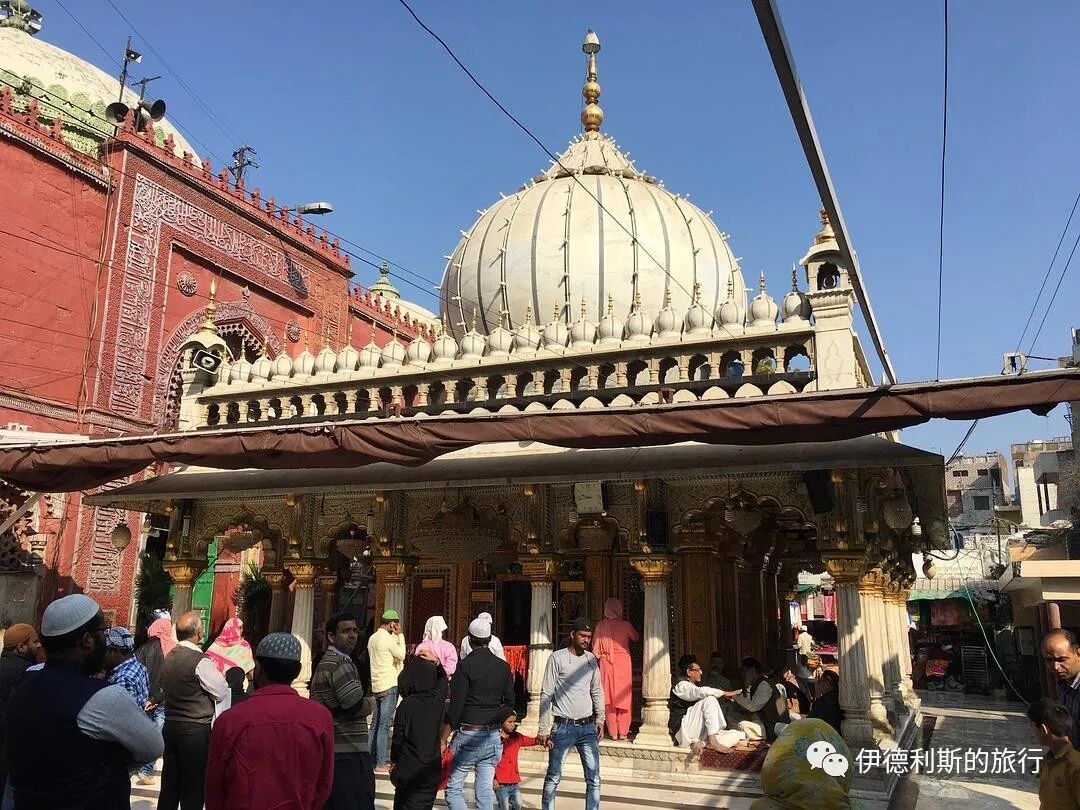
Ghazi was passionate about his fortress and ordered all laborers in Delhi to help build it. At the time, the famous Sufi saint Nizamuddin Auliya was building a water tank (baoli), and his laborers were forced to go build the fortress instead. But these people preferred to work for the saint, so they built the fortress for Ghazi during the day and the water tank for Nizamuddin at night. When Ghazi found out, he was very angry and forbade the laborers from working for Nizamuddin. Nizamuddin issued a curse: 'Ya rahey ujjar, ya basey gujjar'. It roughly means 'Either it will remain desolate, or it will be inhabited by the Gujjar people.' "
After the sultanate fell, the nomadic Gujjar people (gujjar) took over the castle, and it turned into a wilderness.
Nizamuddin Dargah in Delhi
4. Tughlaqabad Fortress
1. City Layout
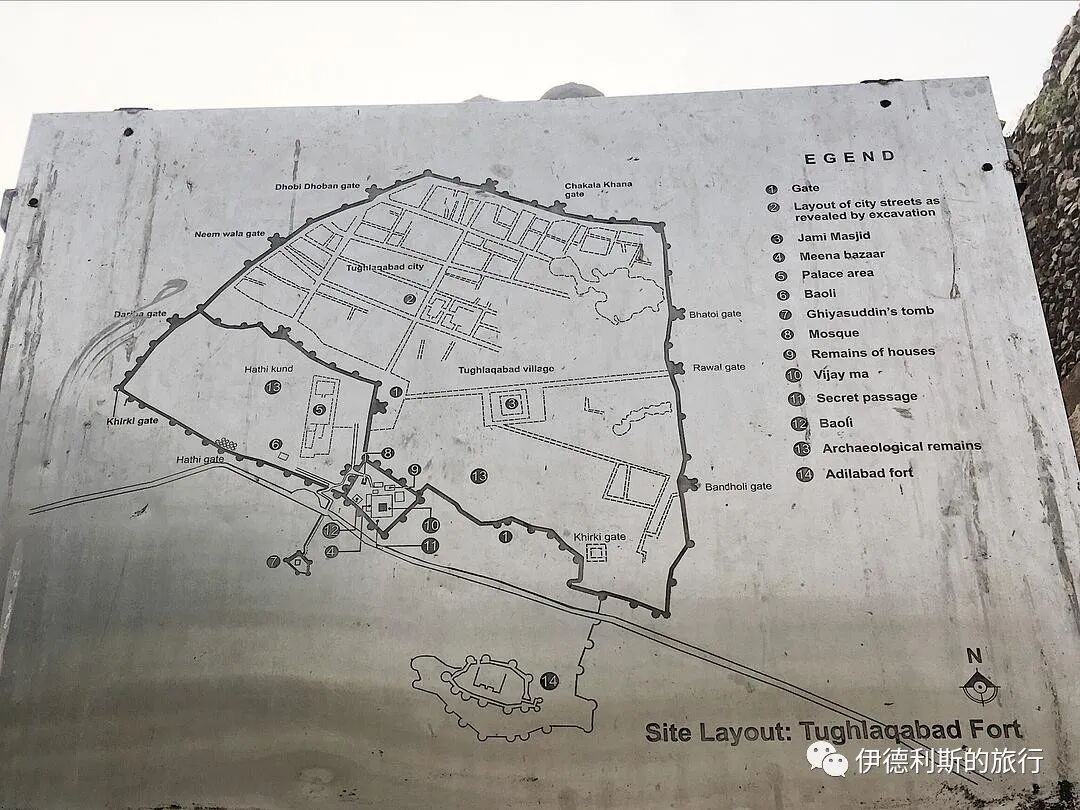
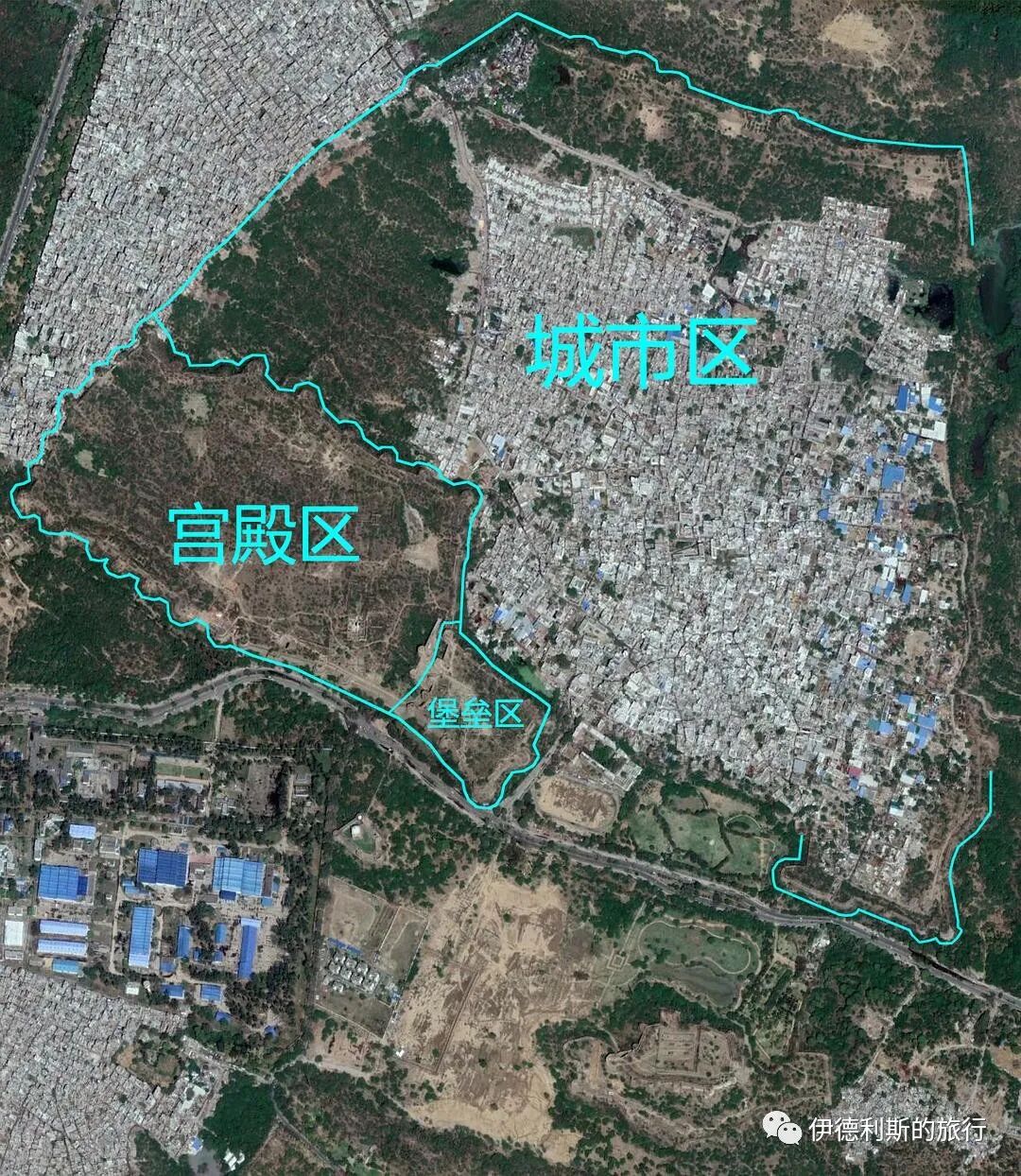
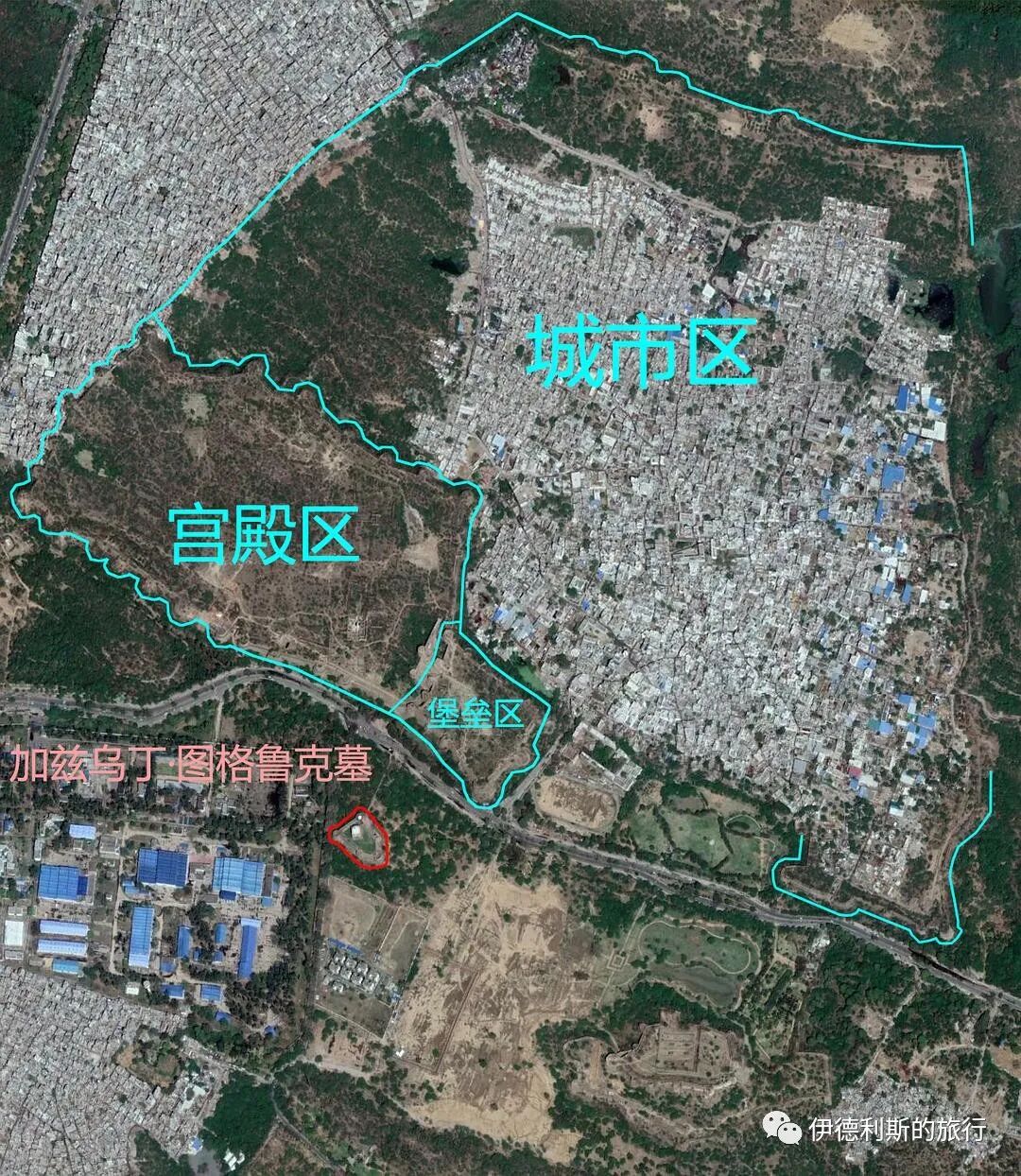
The entire city is divided into three parts:
The largest part is the residential area in the north. Old photos from the 1940s show streets and the ruins of the Friday mosque (Juma Masjid), but they are hard to recognize now.
The southwest side is the palace area, where the buildings have collapsed significantly, though there is one well-preserved water well.
The southeast side is the smallest but most interesting part, the fortress area, which has many architectural ruins like houses, storage rooms, and a mosque.
The blue line shows the existing city walls.
2. The City Walls
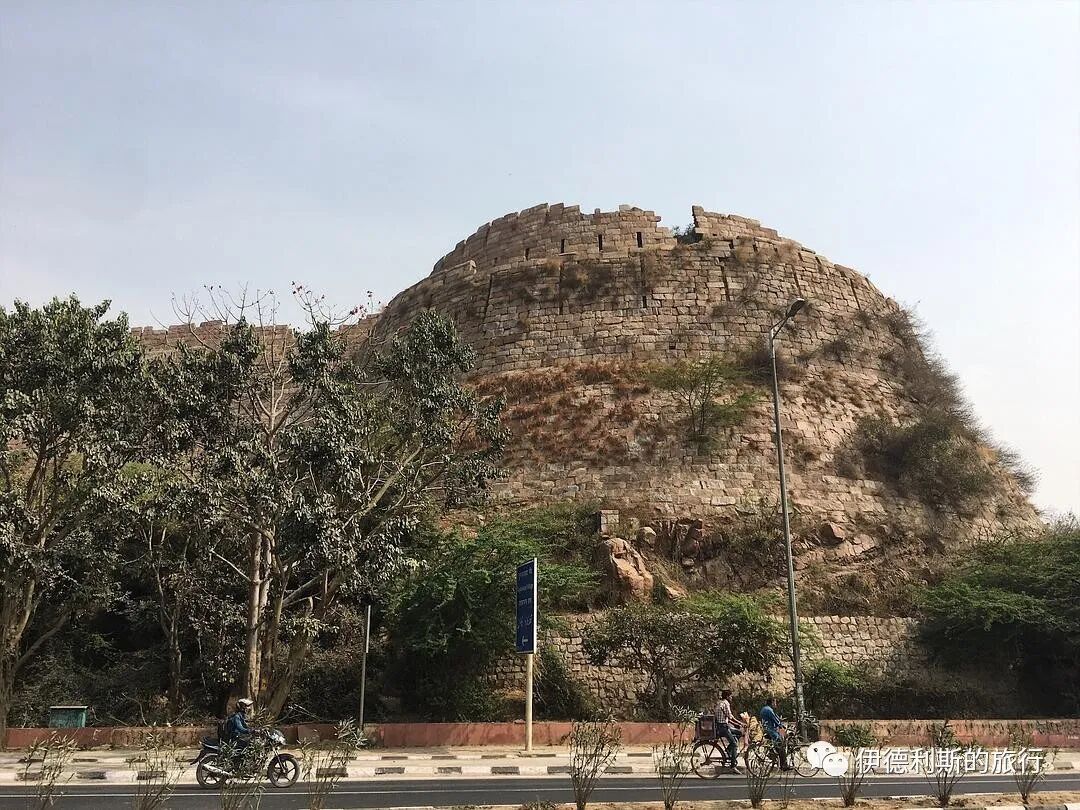
Tughlaqabad City features the sloped rubble walls typical of the Tughlaq dynasty. The walls are 10 to 15 meters high and reinforced by two-story circular bastions. The city is said to have had as many as 52 gates, but only 13 remain today.
The southeast corner tower of the fortress area wall
The south city wall
The inside of the south city wall
The picture below shows the view from the northwest corner tower of the fortress area looking toward the east wall of the palace area.
In the picture below, the lower wall is the east wall of the palace area, and the higher one is the west wall of the fortress area.
Standing on the fortress area wall looking west toward the palace area wall.
The east wall of the palace area
The west wall of the fortress area
The collapsed west gate of the fortress area
The interior of the high platform on the west wall of the fortress area
3. The Palace District
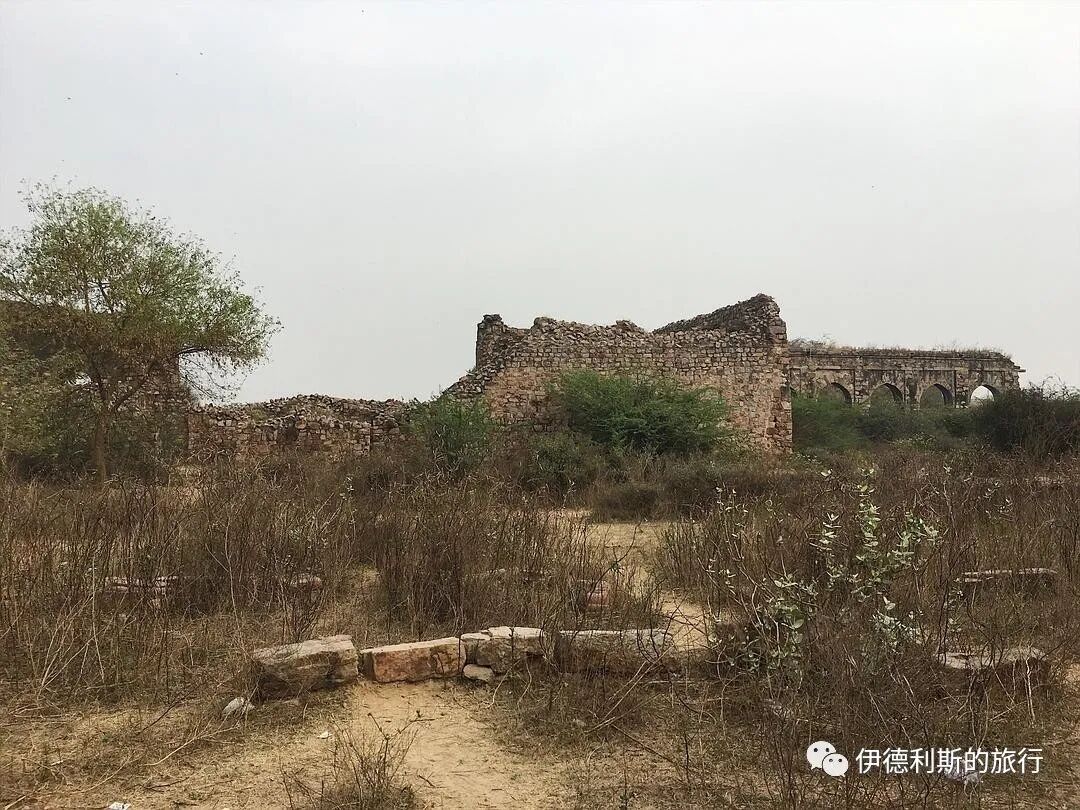
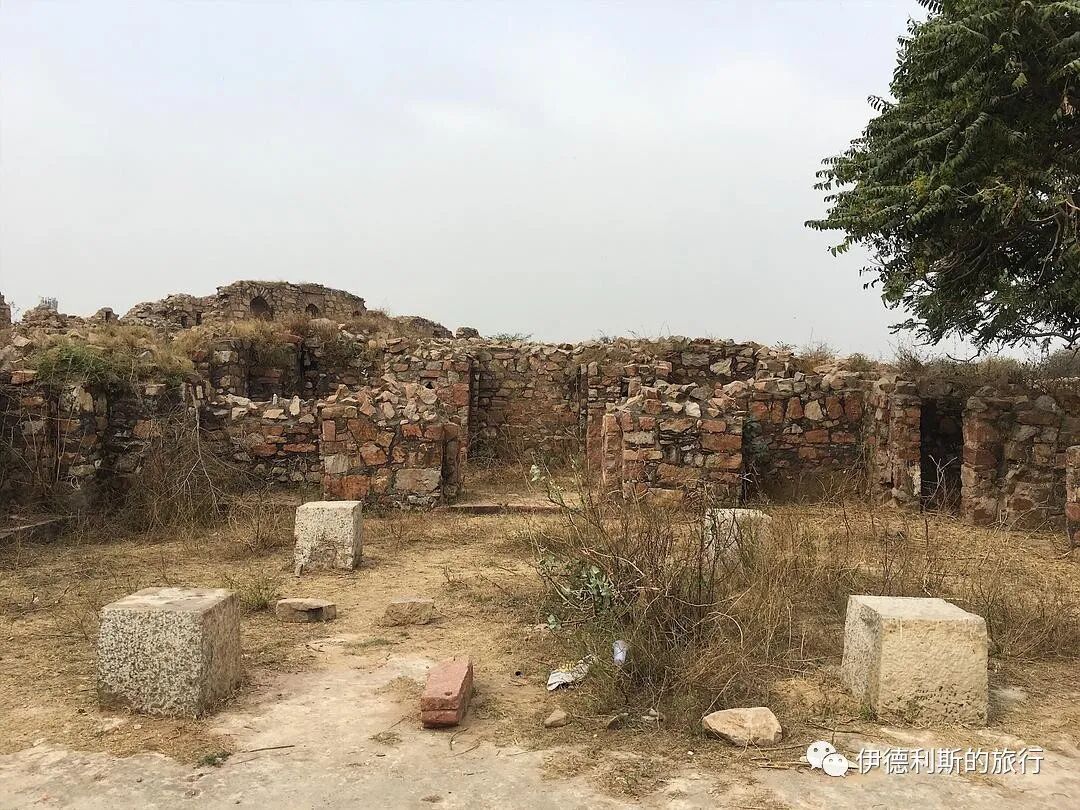
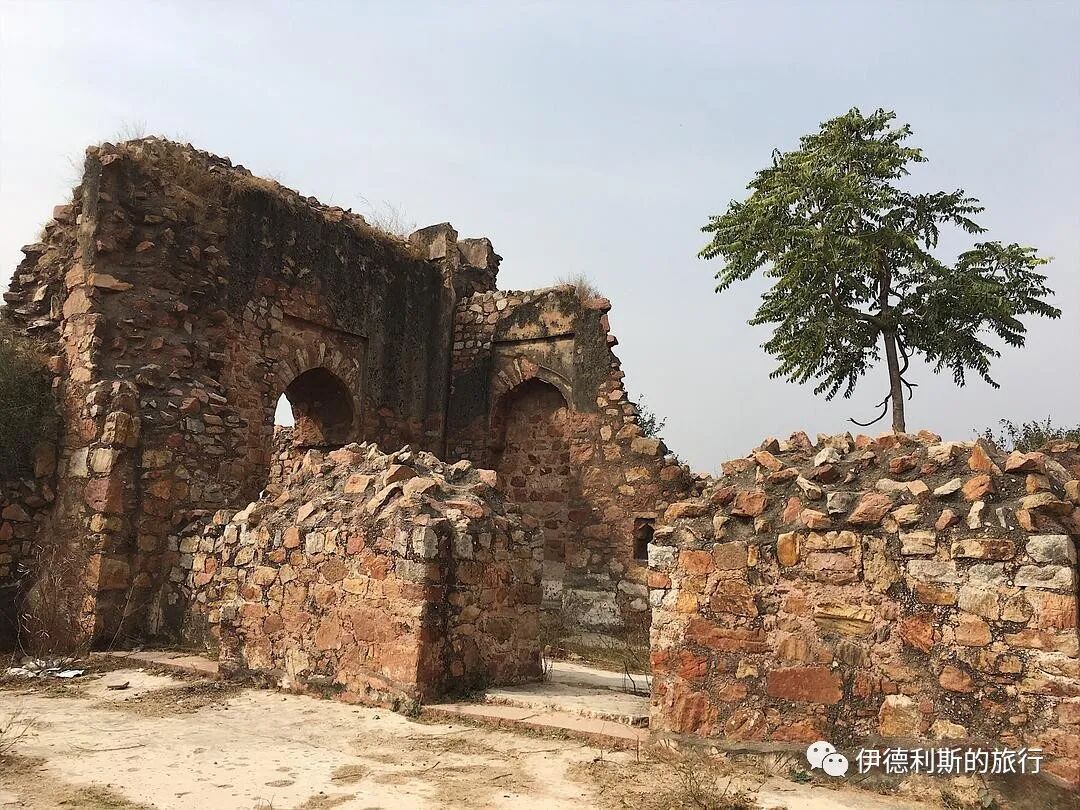
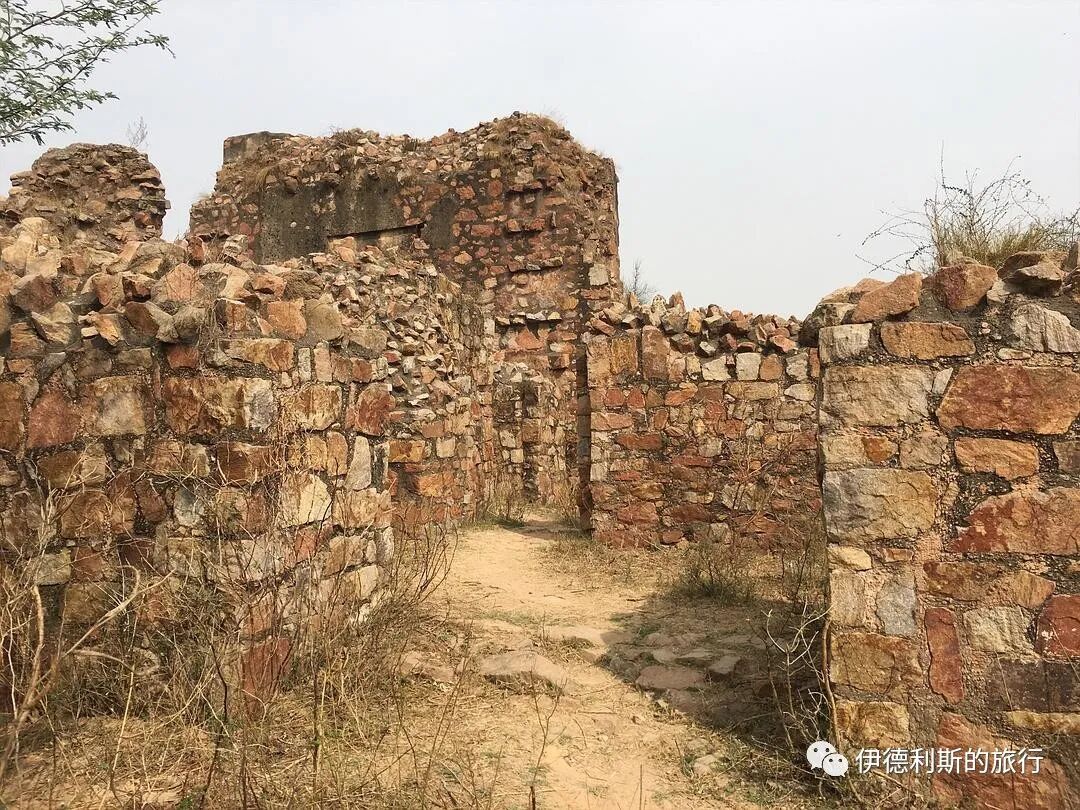
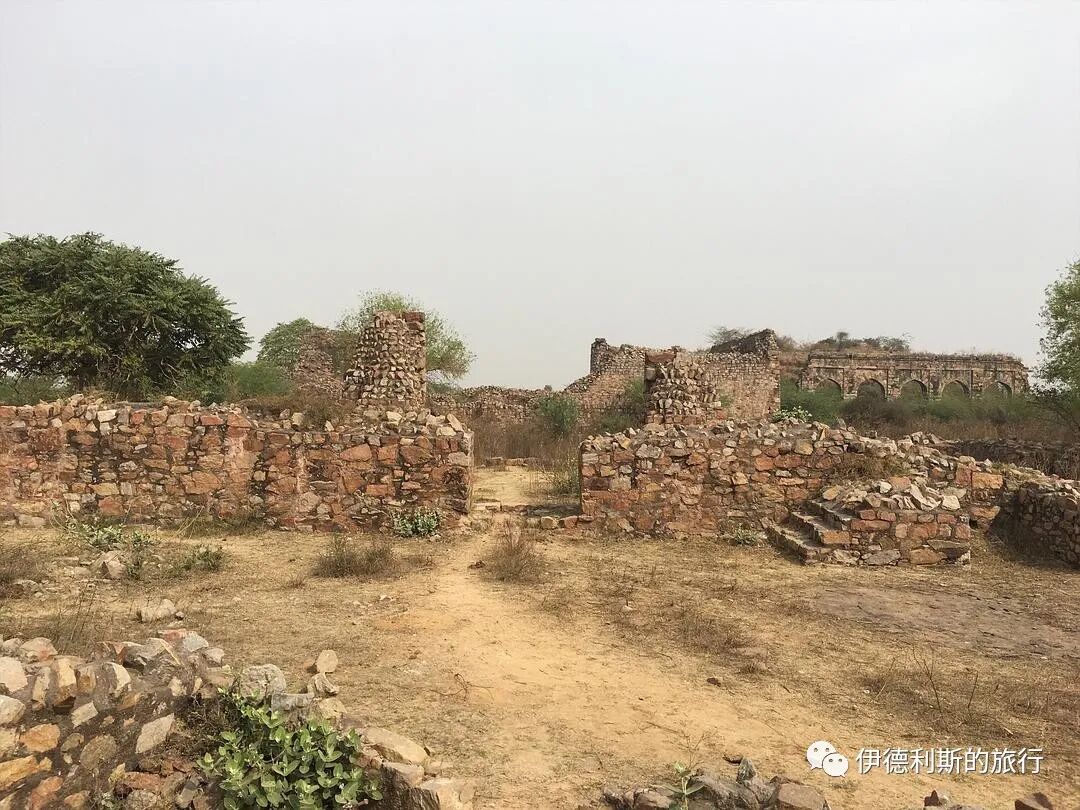
The palace ruins of Tughlaqabad City have collapsed badly, so you can only imagine their former glory.
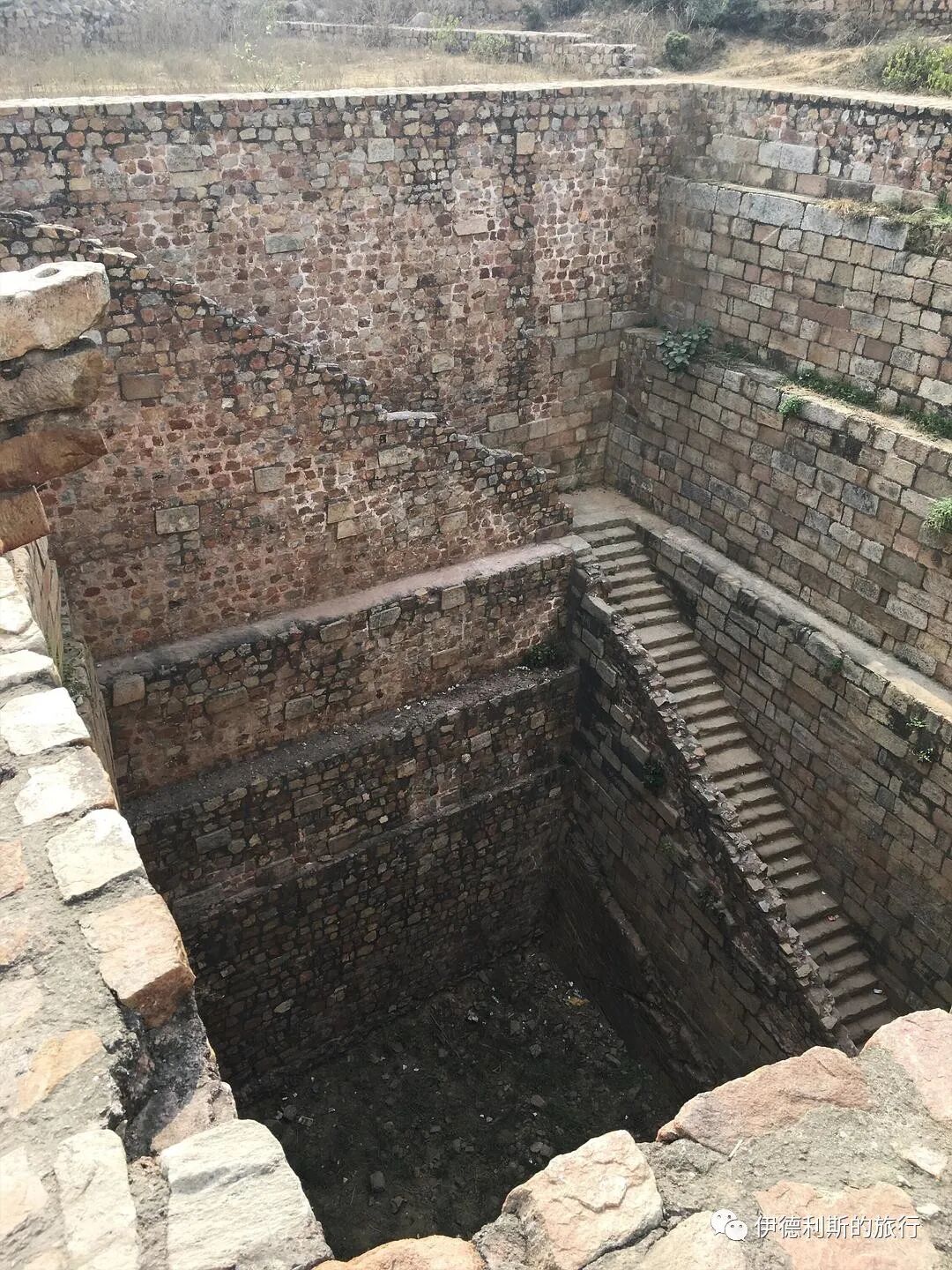
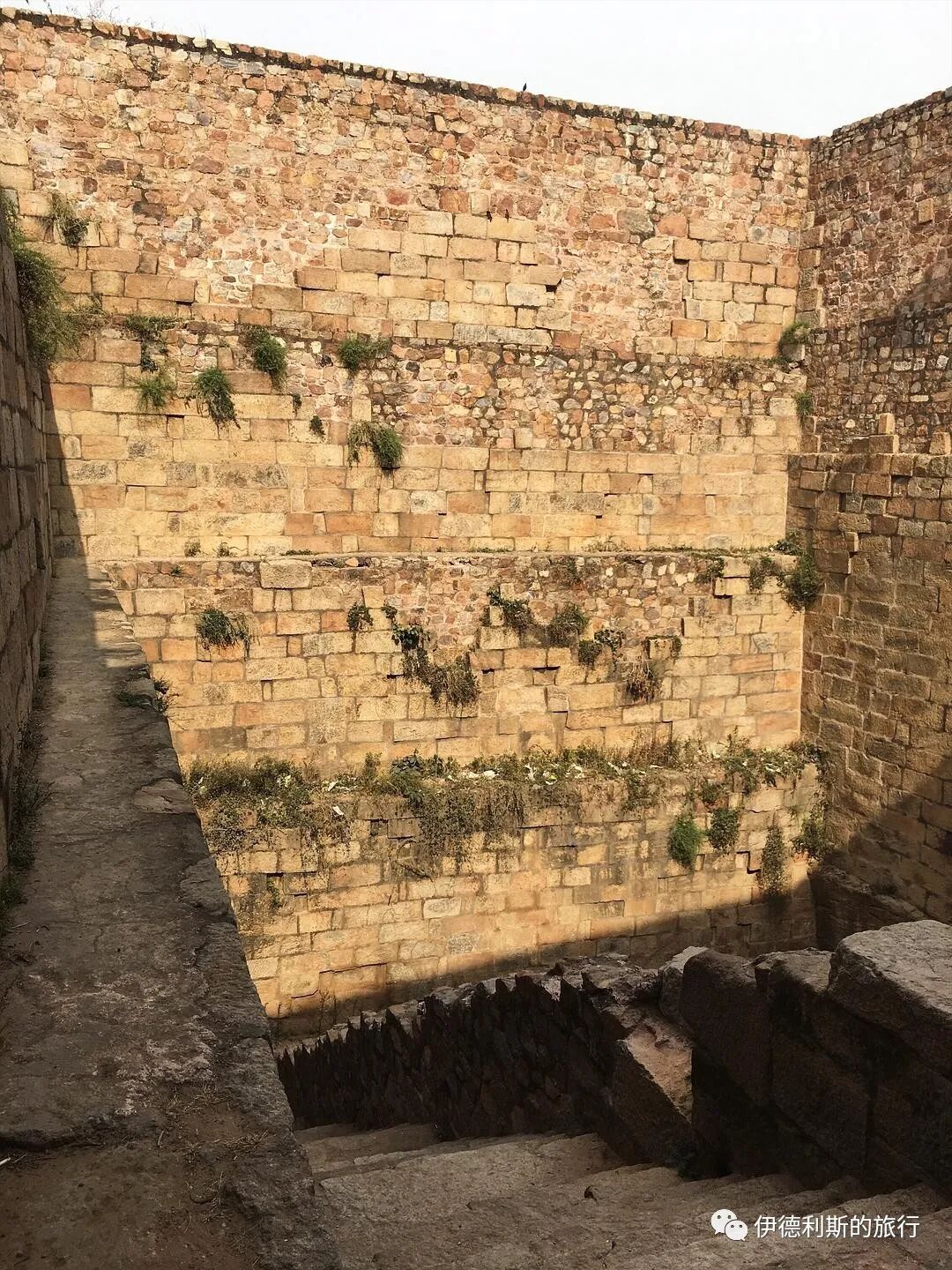
West of the palace is a water tank (baoli) that provided water for the castle.
4. The Citadel Area
The fortress area is the part of the city with the richest ruins.
Looking down at the entire fortress area:
A small mosque in the fortress area
The mihrab that indicates the direction of Mecca
The fortress area has a classic underground storage room:
The north entrance of the storage room
The south entrance of the storage room
The passage of the storage room, with individual warehouses on both sides.
There are also some residential ruins inside the fortress area.
5. The Tomb of Ghiyath al-Din Tughluq
I mentioned earlier the curse that the Sufi saint Nizamuddin placed on Ghiyas-ud-din. Another famous curse is "Hunuz Dilli dur ast". It means "Delhi is still far away." "
In 1324, Ghazi led an expedition to Bengal and succeeded. On the way back in February 1325, a wooden pavilion collapsed, crushing Ghazi and his second son, Mahmud Khan, to death. The famous 14th-century Moroccan traveler Ibn Battuta believed that his eldest son, Muhammad bin Tughluq, killed his father.
After Ghazi died, his eldest son Muhammad succeeded him as Sultan and buried Ghazi in a tomb south of the city of Tughlaqabad.
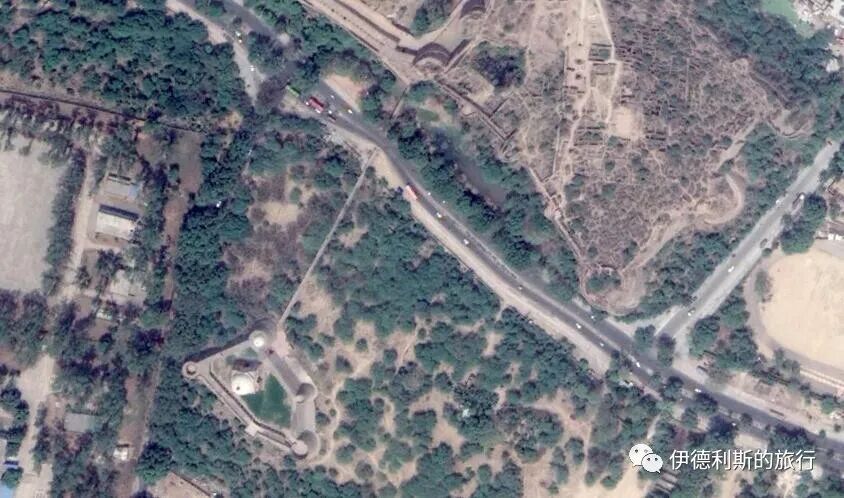
The Mausoleum of Ghiyas ud-Din Tughluq connects to the city of Tughlaqabad to the north via a causeway. This 182-meter causeway has 27 arches, and there used to be an artificial lake underneath. The lake has now been filled in to become flat land, and the middle of the causeway is split in two by a road.
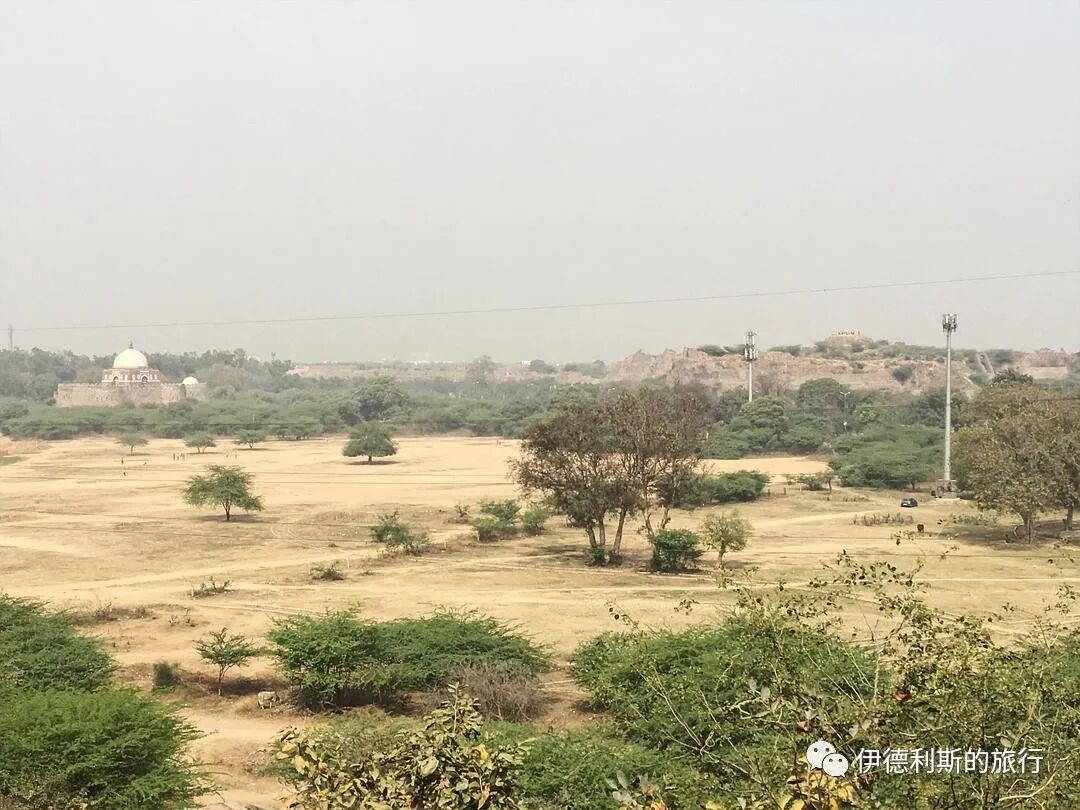
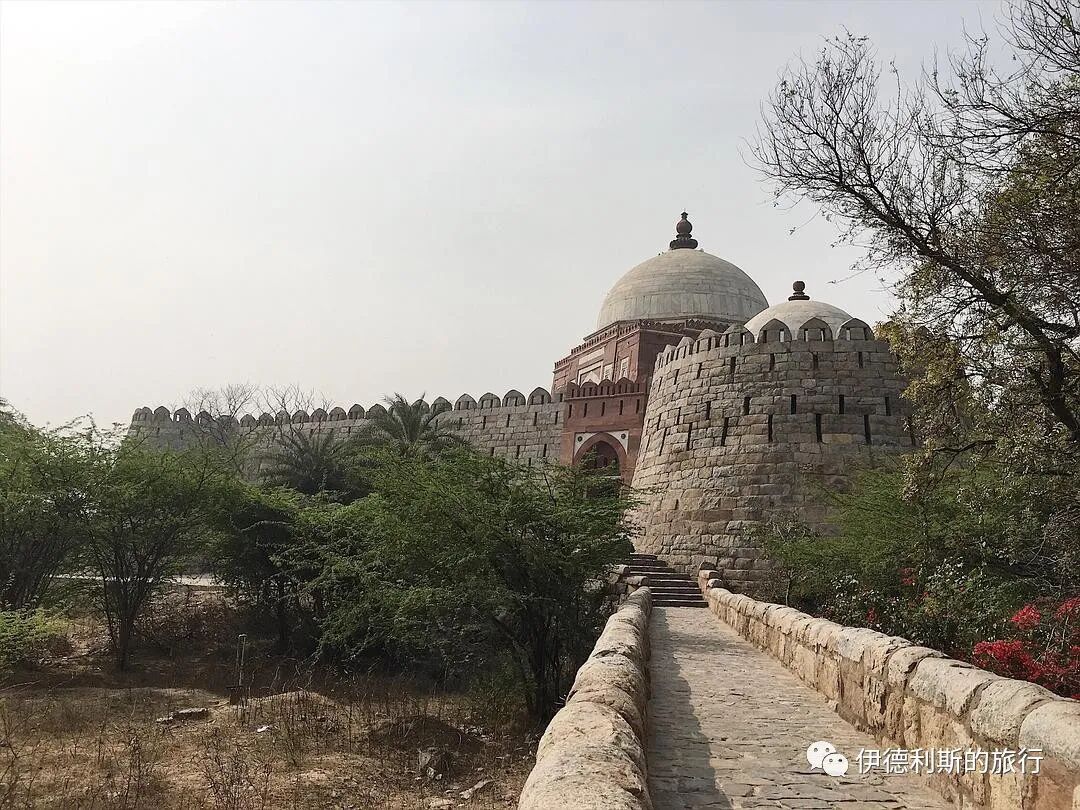
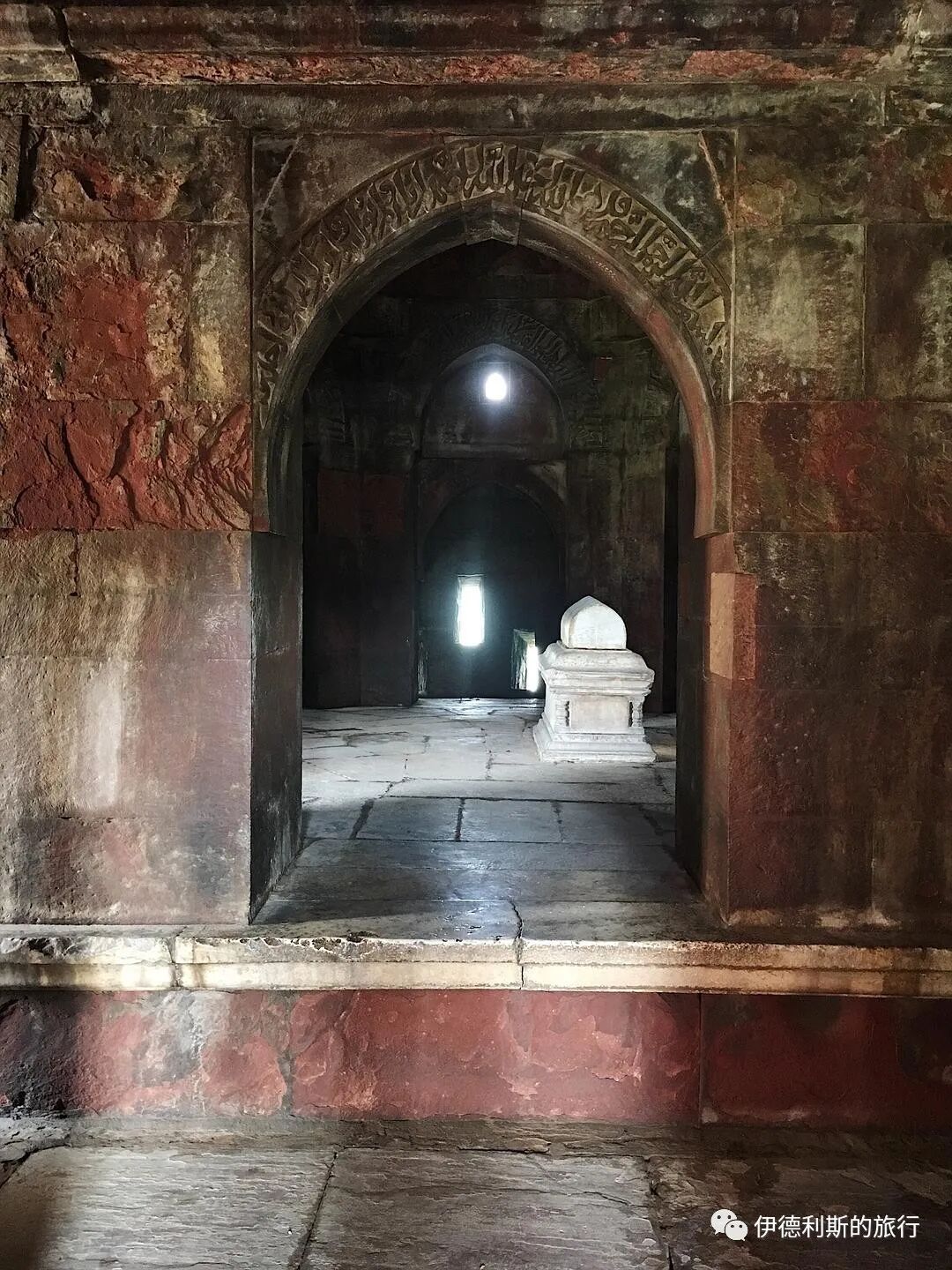
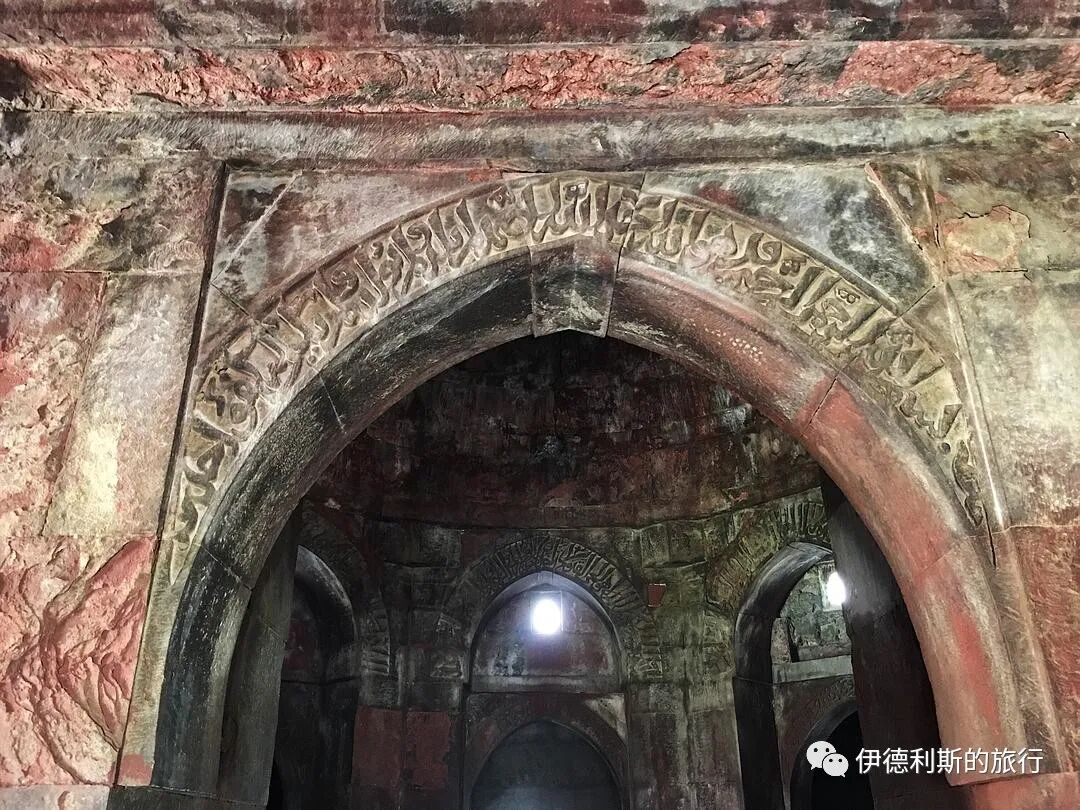
Ghazi's tomb sits atop a granite fortress. The tomb has a square dome and is built of red sandstone, inlaid with white marble slabs.
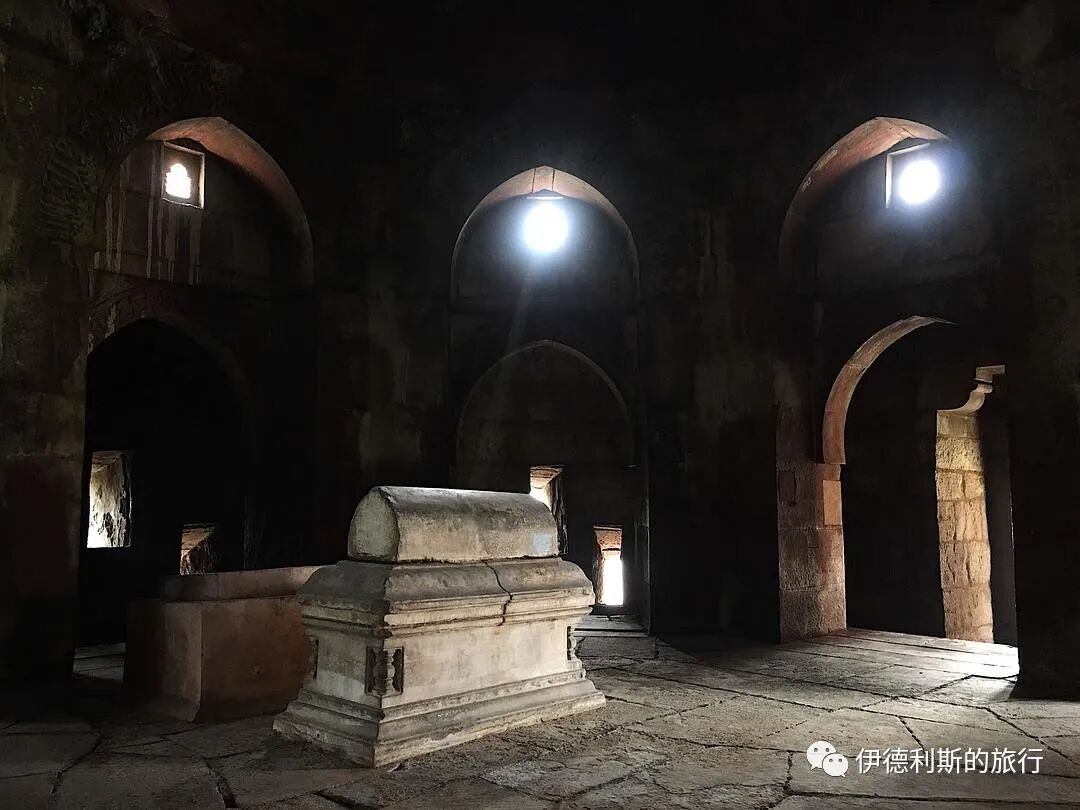
Inside the tomb are three grave markers; the middle one belongs to Ghazi himself, and the other two belong to his wife and his son Muhammad.
Dome
Fortress corridors and architectural pieces on the ground
In the northwest corner of the fortress, there is another tomb containing an octagonal burial chamber. According to the stone inscription on the south gate, this tomb belongs to Zafar Khan.
Zafar Khan was a general of the Khalji dynasty of the Delhi Sultanate, and he died in 1299 during a decisive battle between the Mongol army of the Chagatai Khanate and the Delhi Sultanate on the outskirts of Delhi.
One theory is that Zafar Khan's tomb was already built on the current site before this, and Ghazi incorporated it into the fortress when building his own tomb. Another theory is that Zafar Khan's tomb was intentionally built by Ghazi next to his own.
6. Adilabad Fort
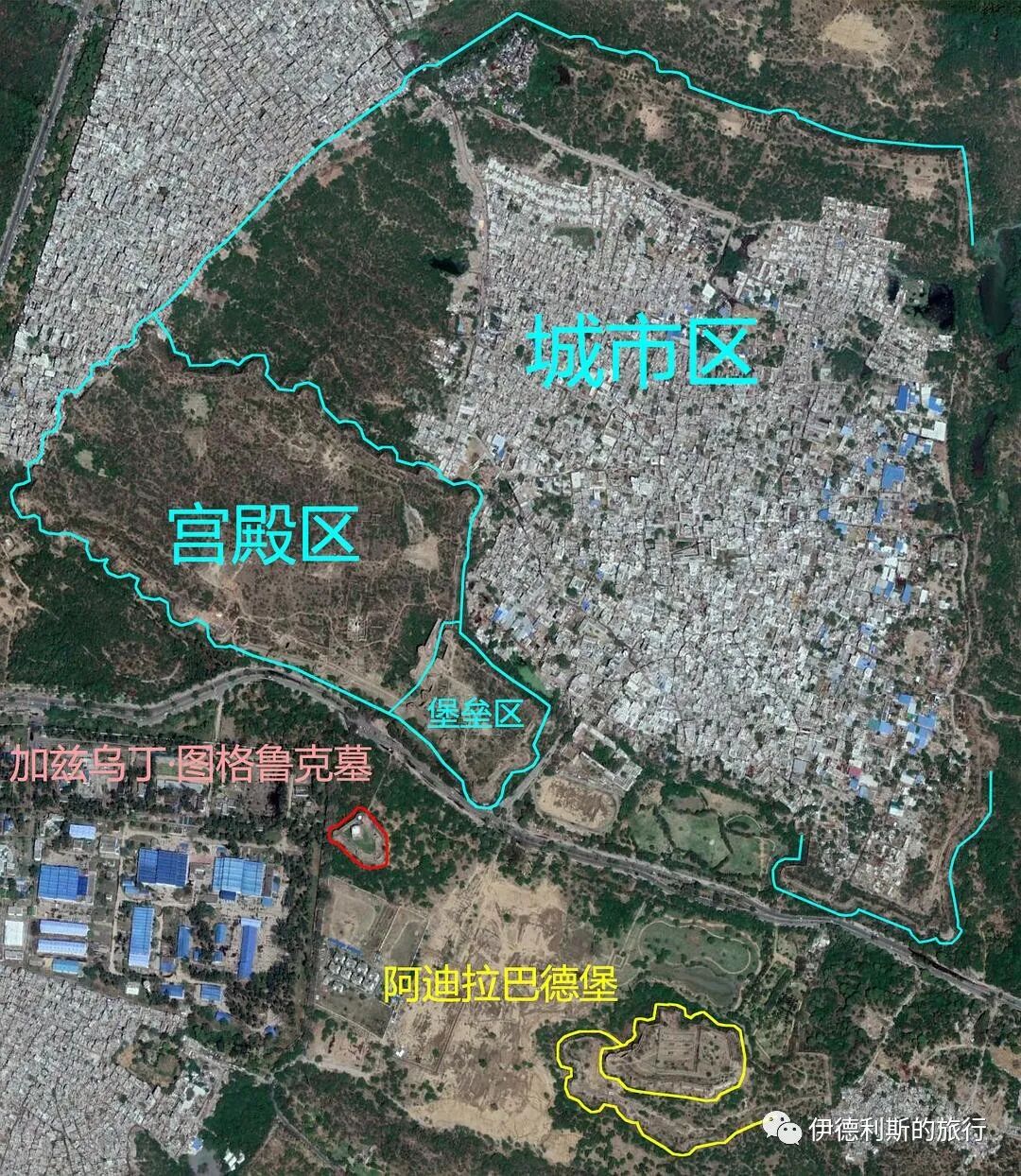
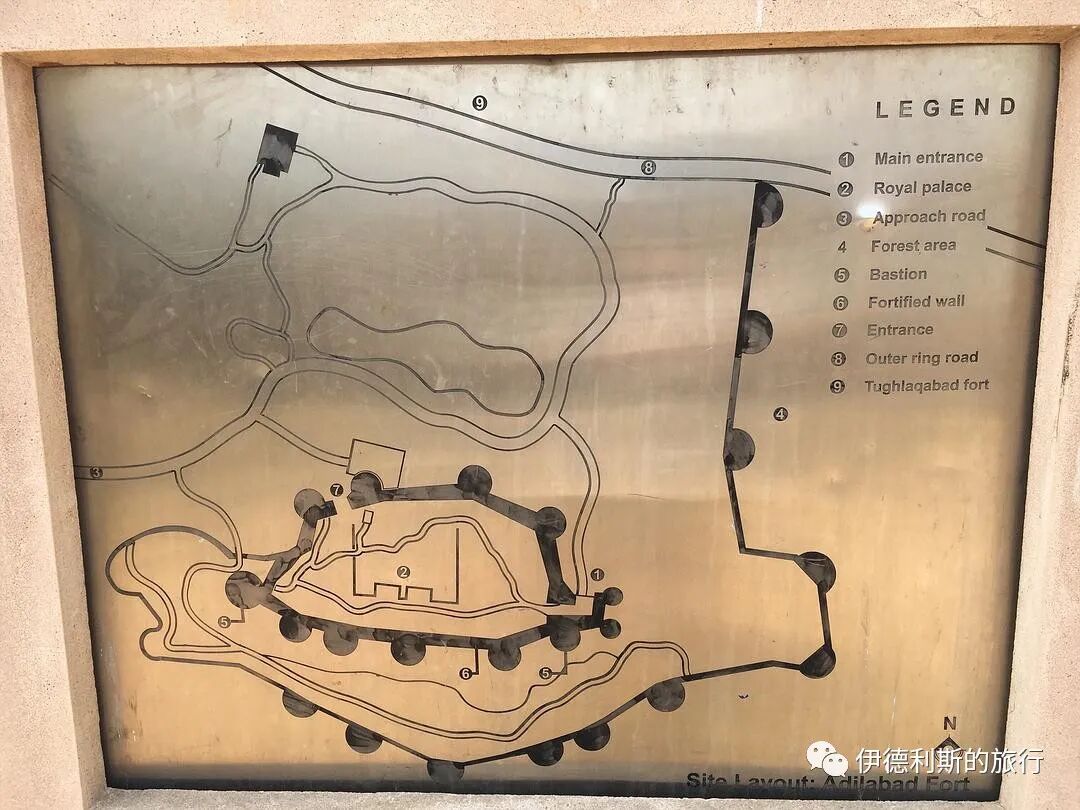
After Muhammad took the throne in 1325, he built a medium-sized castle called Adilabad fort to the southeast of Tughlaqabad.
People say Adilabad fort was connected to Tughlaqabad by a 1-kilometer-long causeway, but the causeway has now disappeared.
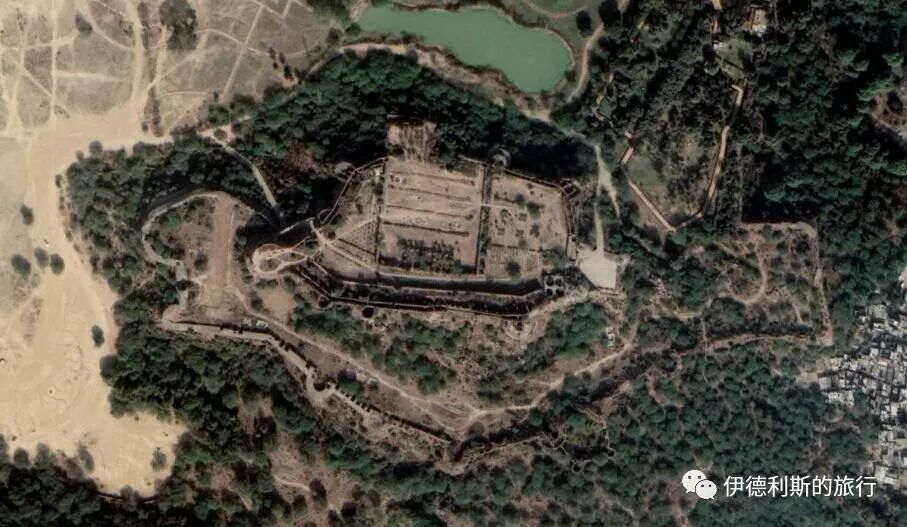
Compared to the majestic Tughlaqabad, Adilabad fort is much smaller in scale and is divided into inner and outer walls.
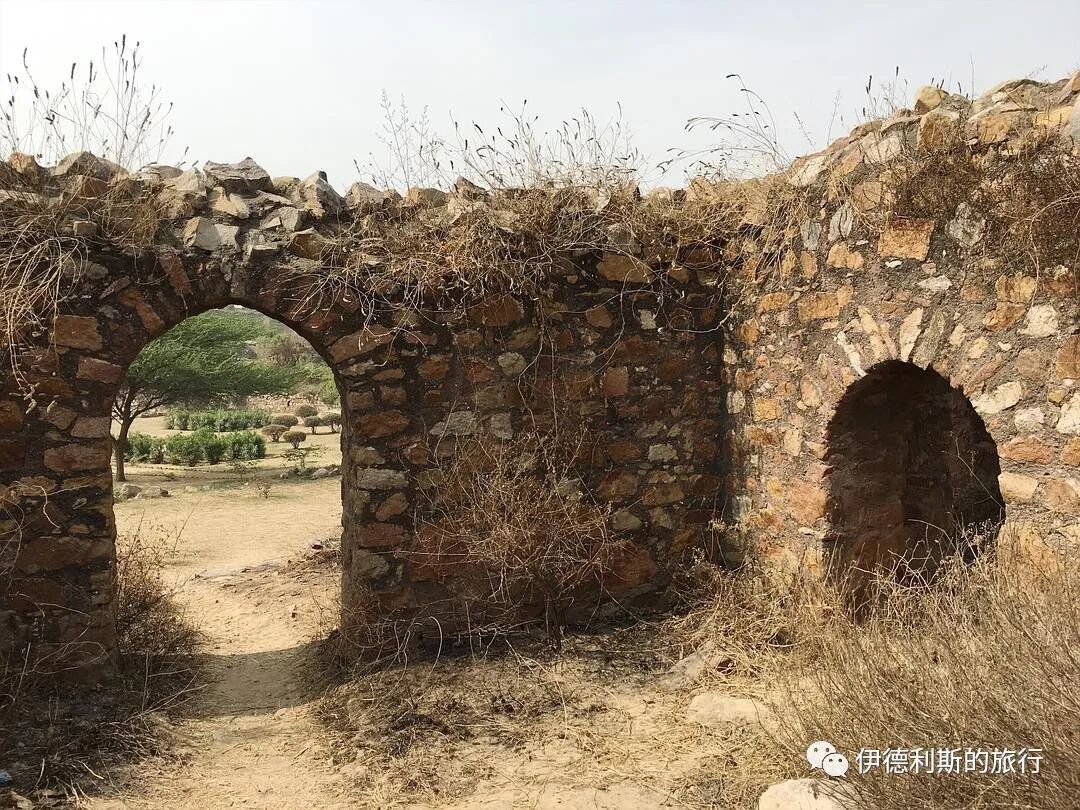
West gate
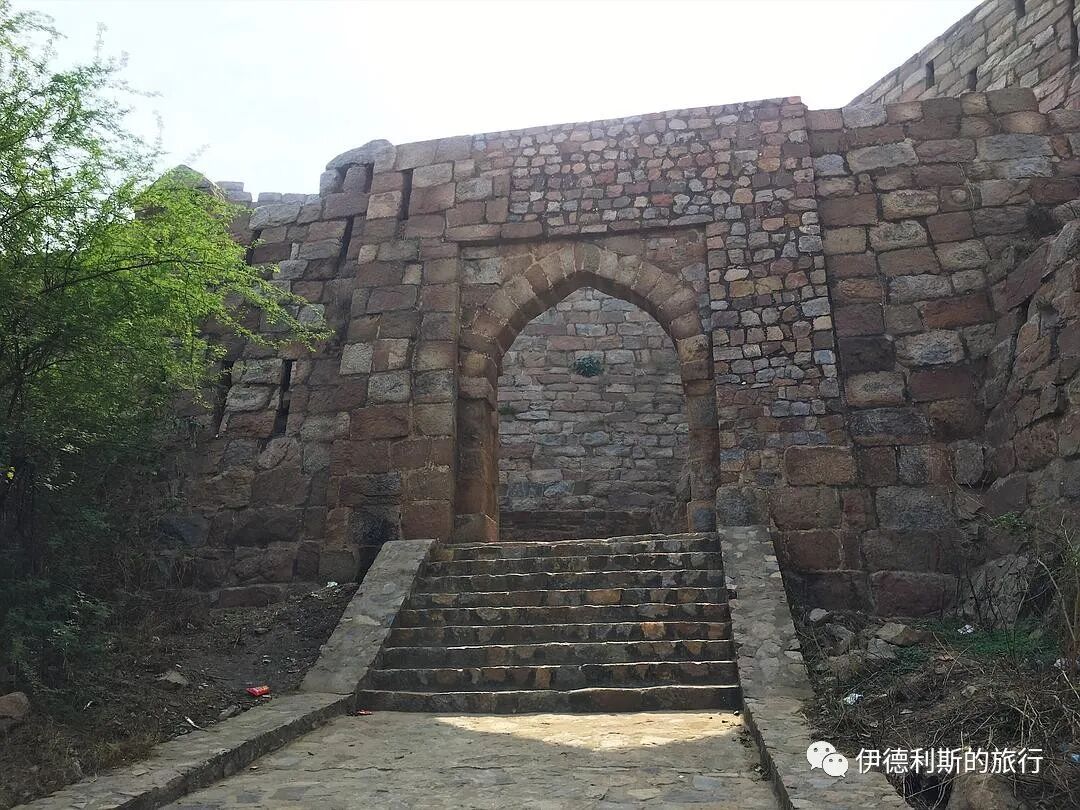
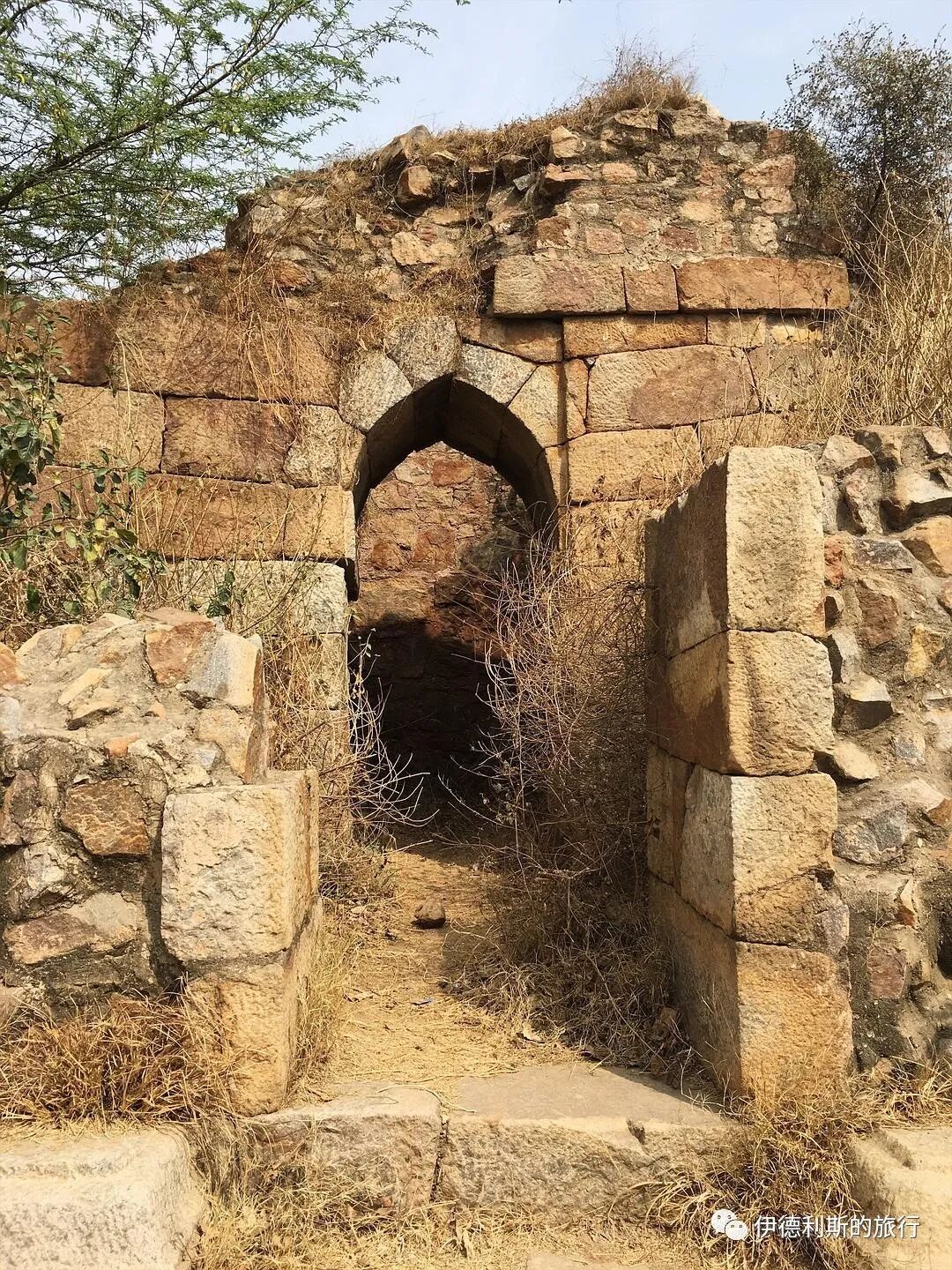
East gate, which takes a bit of effort to climb up to
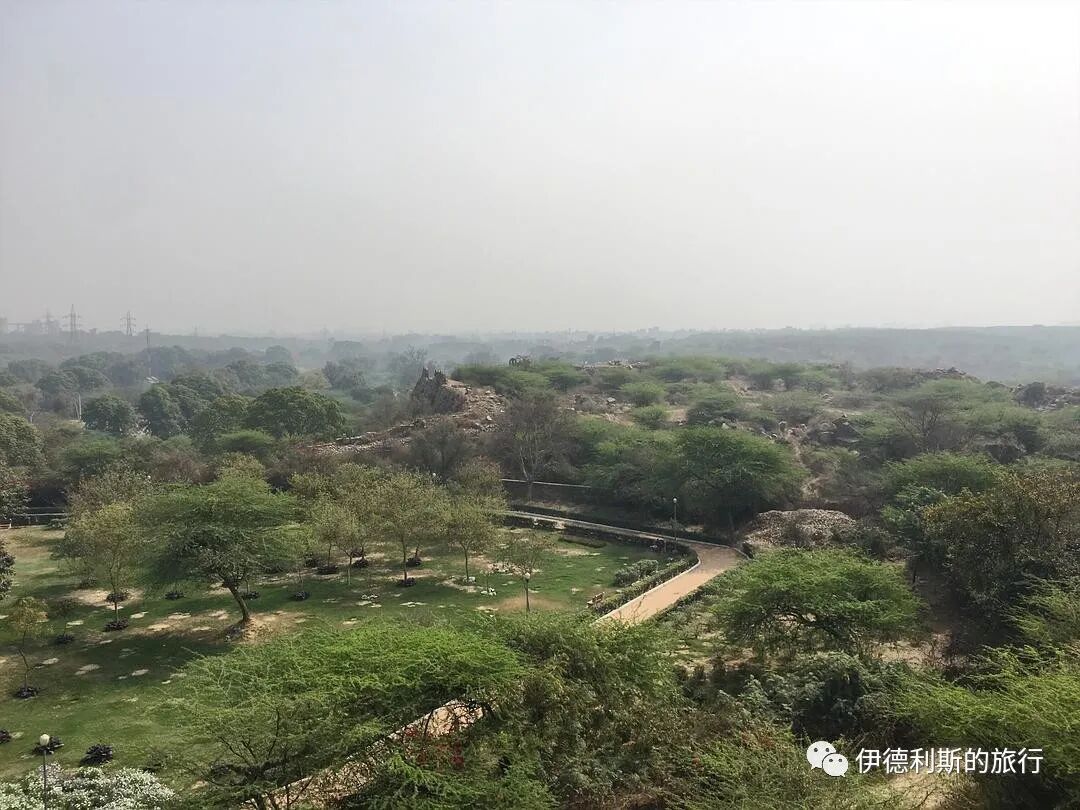
Looking down inside the city
The core area is the palace district
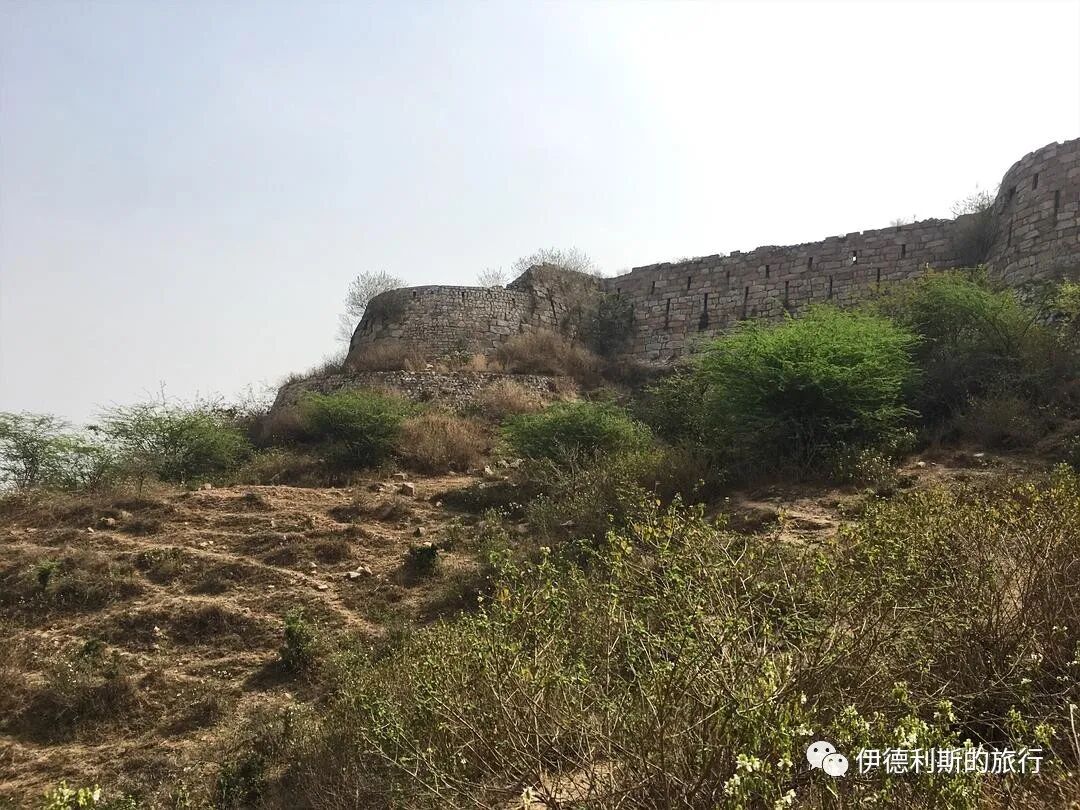
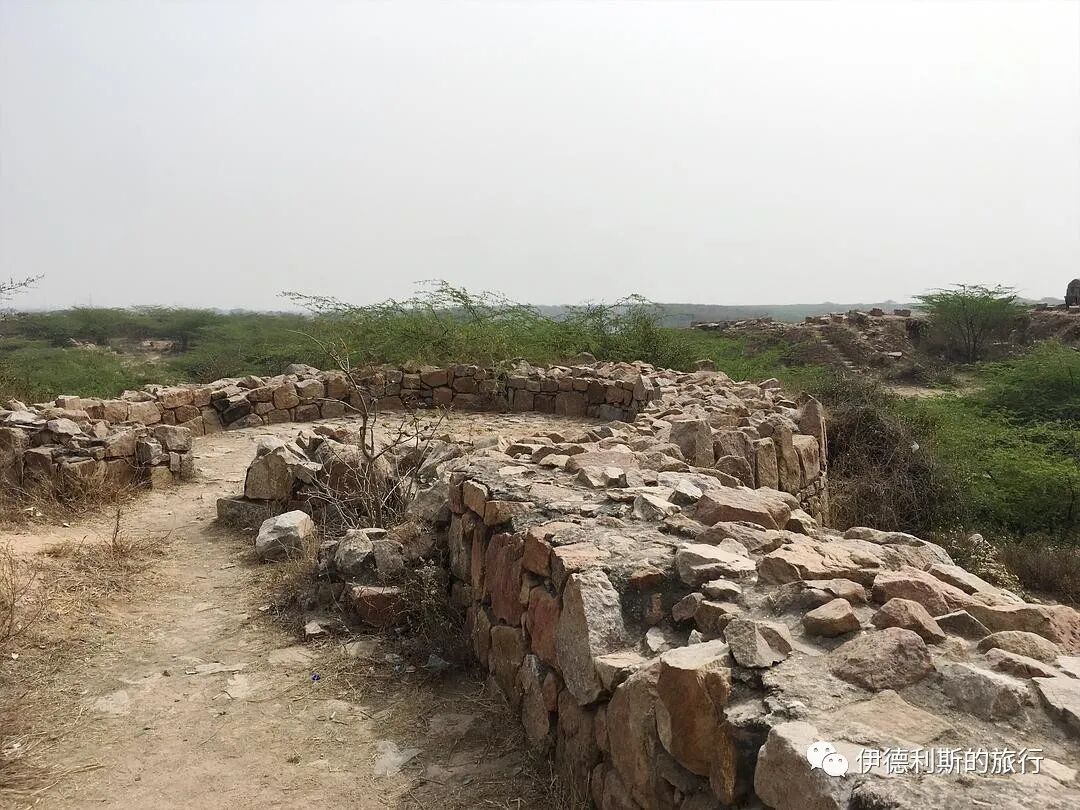
City wall
Besides the inner wall, there is also an outer wall view all
Summary: Delhi — Tughlaqabad Fort, Ruins and Muslim History is presented here as a firsthand travel account in clear English, beginning with this scene: In my first article, The First City of Delhi: The Tower Reaching the Clouds, I wrote about the Delhi Sultanate's Mamluk dynasty building the Qutub Minar. The account keeps its focus on Delhi Travel, Tughlaqabad Fort, Muslim Heritage while preserving the names, places, food, and historical details from the Chinese source.
In my first article, The First City of Delhi: The Tower Reaching the Clouds, I wrote about the Delhi Sultanate's Mamluk dynasty building the Qutub Minar. In the second article, The Second City of Delhi: The Turkic Fortress Defending Against the Mongol Army, I covered how the Khalji dynasty built a fortress to stop the Mongols. In this article, the Delhi Sultanate enters its third era: the Tughlaq dynasty.
Table of Contents
1. The Nemesis of the Afghan Mongols
1. Ghiyath al-Din Tughluq
2. Defeating the Mongols Twice
3. Taking the Fight to the Mongols
2. The Rise of the Tughlaq Dynasty
1. The Death of Alauddin Khalji
2. The Fall of the Khalji Dynasty
3. The Founding of the Tughlaq Dynasty
3. Building the City of Tughlaqabad
1. Legends of the Fortress Construction
2. The Curse of the Sufi Saint
4. Tughlaqabad Fortress
1. City Layout
2. The City Walls
3. The Palace District
4. The Citadel Area
5. The Tomb of Ghiyath al-Din Tughluq
6. Adilabad Fort
1. The Nemesis of the Afghan Mongols
1. Ghiyath al-Din Tughluq
Ghiyath al-Din Tughluq (Ghiyath al-Din Tughluq or Ghiyasuddin Tughlaq) was originally named Ghazi Malik. The title Ghazi refers to a warrior for Islam.
Ghazi came from a humble background. His father was a slave from the Qaraunah Turkic tribe, and his mother was a Hindu. The Qaraunah were a Turkic tribe living in Afghanistan under the Mongol Empire. In 1238, the Mongols moved them to the northwest border of India to defend against the Delhi Sultanate. This tribe took part in almost every Mongol invasion of India after 1241. Many were captured by the Delhi Sultanate and became slaves, which is how Ghazi's father arrived in the Delhi Sultanate.
Ghazi was a talented military leader. During the reign of Alauddin Khalji of the Khalji dynasty, he became the military governor of Dipalpur on the northwest border of the Delhi Sultanate and began fighting the Mongols.
The location of Dipalpur
2. Defeating the Mongols Twice
In my previous article, The Second City of Delhi: The Turkic Fortress Defending Against the Mongol Army, I mentioned that Ghazi served as a general during the two attacks on the Delhi Sultanate by the Chagatai Khanate Mongol army in 1305 and 1306.
During the 1305 Mongol invasion, the 14th-century Delhi chronicler Amir Khusrau wrote that the Mongol army was defeated as miserably as a swarm of mosquitoes trying to resist a strong wind. However, historical records do not provide many details about Ghazi's specific role in that battle.
When the Mongols invaded in 1306, the commander of the Delhi Sultanate was Malik Kafur, and Ghazi served as deputy commander, leading the vanguard. After the Sultanate's main army set out, Ghazi's vanguard quickly reached the northwest border and spotted the Mongol scouts. He reported the Mongol army's position to Kafur. The Delhi Sultanate's army moved at full speed and completely crushed the Chagatai Mongol army on the banks of the Ravi River, a tributary of the Indus River. A large number of Mongols were killed or captured.
The Chor Minar, a tower of heads built during the Delhi Khalji dynasty. The 225 holes on it are said to have once held the heads of killed Mongol captives.
3. Taking the Fight to the Mongols
According to the chronicler Amir Khusrau, the crushing defeat of the Mongols in 1306 caused the Mongols in Afghanistan to fear the Delhi Sultanate. They retreated to the mountains near the famous ancient city of Ghazni in southeastern Afghanistan. In 1307, Duwa, the Khan of the Chagatai Khanate, died, and Central Asia fell into chaos. His successors were unable to organize any more large-scale invasions.
On the other hand, defeating the Mongols repeatedly gave Ghazi a huge boost in confidence. He changed the Khalji dynasty's defensive policy against the Mongols and began to actively invade the Chagatai Khanate's territory in Afghanistan. Every year, Ghazi raided important Mongol cities in Afghanistan such as Kabul, Ghazni, Kandahar, and Garmsir, and even briefly recaptured Lahore, the early capital of the Delhi Sultanate.
The chronicler Amir Khusrau wrote in his book Tughluq-Nama that Ghazi won 20 battles, mostly against the Mongols. The famous Moroccan traveler Ibn Battuta passed by a mosque in Multan in the 14th century, where a stone tablet was inscribed with the claim that Ghazi had defeated the Mongols 29 times.
In this way, Ghazi became the military commander of the Punjab region on the northwestern frontier of the Delhi Sultanate.
Afghan cities under Mongol rule that were attacked by Ghazi.
2. The Rise of the Tughlaq Dynasty
1. The Death of Alauddin Khalji
In his final years, Sultan Alauddin Khalji grew to distrust his officers and favored only the eunuch slave general Malik Kafur.
In 1315, Alauddin fell seriously ill and appointed Kafur as regent (Na'ib), giving him real power.
Alauddin died on the night of January 4, 1316. The next day, Kafur gathered all the important officials and nobles to read the will, which named Alauddin's 6-year-old son Shihabuddin as the new Sultan, with Kafur as regent.
2. The Fall of the Khalji Dynasty
Kafur was regent for only about a month, during which he constantly persecuted Alauddin's family, upsetting some of Alauddin's former armed guards (paiks). Led by Mubashshir, the guards beheaded Kafur. They released Alauddin's older son Mubarak Shah, who had been imprisoned by Kafur, and named him the new regent.
On April 14, 1316, Mubarak Shah deposed his younger brother to become the new Sultan, taking the title Qutubuddin.
Mubarak Shah was bisexual and had same-sex relationships with the brothers Hasan and Husamuddin. Hasan and Husamuddin were brought to the Delhi Sultanate court as Hindu slaves in 1305. To survive, the brothers converted to Islam and served Mubarak Shah.
The relationship between Mubarak Shah and Hasan was no secret. They hugged and kissed in public, and Mubarak Shah gave Hasan the title Khusrau Khan.
In 1320, Mubarak Shah was killed by Khusrau Khan, ending the Khalji dynasty of the Delhi Sultanate.
Siri, the capital of the Delhi Sultanate's Khalji dynasty.
3. The Founding of the Tughlaq Dynasty
After Mubarak Shah was killed by Khusrau Khan, Khusrau Khan returned to his Hindu identity, which caused great dissatisfaction among Muslim officers and nobles. These officers and nobles supported Ghazi, the Punjab military commander who held a large army, to attack Khusrau Khan.
After Alauddin died, Ghazi gained military control over the Multan and Sindh regions. After receiving invitations from the Muslim officers and nobles, he and his son Fakhr Malik gathered a large army in Multan and Sindh and marched toward Delhi.
In September 1320, Ghazi defeated Khusrau Khan west of Siri in Delhi and established the Tughlaq dynasty, the third dynasty of the Delhi Sultanate. Ghazi received the title Ghiyath al-Din Tughluq, and his son received the title Muhammad Shah Tughluq.
3. Building the City of Tughlaqabad
After establishing the Tughlaq dynasty, Ghazi began building Tughlaqabad Fort in 1321. The massive 6.5-kilometer-long city was completed in just two years.
1. Legends of the Fortress Construction
There is a famous legend about the construction of Tughlaqabad Fort. Once, while walking with the last Sultan of the Khalji dynasty, Mubarak Shah, Ghazi suggested that the Sultan build a stronger fortress in Delhi. The Sultan joked that if you ever become Sultan, you can build the fortress yourself. As it turned out, his words came true.
2. The Curse of the Sufi Saint
Ghazi dreamed of building a fortress so strong that it could withstand the fiercest attacks from the Mongol army. However, fate did not go as he wished.
Ghazi was passionate about his fortress and ordered all laborers in Delhi to help build it. At the time, the famous Sufi saint Nizamuddin Auliya was building a water tank (baoli), and his laborers were forced to go build the fortress instead. But these people preferred to work for the saint, so they built the fortress for Ghazi during the day and the water tank for Nizamuddin at night. When Ghazi found out, he was very angry and forbade the laborers from working for Nizamuddin. Nizamuddin issued a curse: 'Ya rahey ujjar, ya basey gujjar'. It roughly means 'Either it will remain desolate, or it will be inhabited by the Gujjar people.' "
After the sultanate fell, the nomadic Gujjar people (gujjar) took over the castle, and it turned into a wilderness.
Nizamuddin Dargah in Delhi
4. Tughlaqabad Fortress
1. City Layout
The entire city is divided into three parts:
The largest part is the residential area in the north. Old photos from the 1940s show streets and the ruins of the Friday mosque (Juma Masjid), but they are hard to recognize now.
The southwest side is the palace area, where the buildings have collapsed significantly, though there is one well-preserved water well.
The southeast side is the smallest but most interesting part, the fortress area, which has many architectural ruins like houses, storage rooms, and a mosque.
The blue line shows the existing city walls.
2. The City Walls
Tughlaqabad City features the sloped rubble walls typical of the Tughlaq dynasty. The walls are 10 to 15 meters high and reinforced by two-story circular bastions. The city is said to have had as many as 52 gates, but only 13 remain today.
The southeast corner tower of the fortress area wall
The south city wall
The inside of the south city wall
The picture below shows the view from the northwest corner tower of the fortress area looking toward the east wall of the palace area.
In the picture below, the lower wall is the east wall of the palace area, and the higher one is the west wall of the fortress area.
Standing on the fortress area wall looking west toward the palace area wall.
The east wall of the palace area
The west wall of the fortress area
The collapsed west gate of the fortress area
The interior of the high platform on the west wall of the fortress area
3. The Palace District
The palace ruins of Tughlaqabad City have collapsed badly, so you can only imagine their former glory.
West of the palace is a water tank (baoli) that provided water for the castle.
4. The Citadel Area
The fortress area is the part of the city with the richest ruins.
Looking down at the entire fortress area:
A small mosque in the fortress area
The mihrab that indicates the direction of Mecca
The fortress area has a classic underground storage room:
The north entrance of the storage room
The south entrance of the storage room
The passage of the storage room, with individual warehouses on both sides.
There are also some residential ruins inside the fortress area.
5. The Tomb of Ghiyath al-Din Tughluq
I mentioned earlier the curse that the Sufi saint Nizamuddin placed on Ghiyas-ud-din. Another famous curse is "Hunuz Dilli dur ast". It means "Delhi is still far away." "
In 1324, Ghazi led an expedition to Bengal and succeeded. On the way back in February 1325, a wooden pavilion collapsed, crushing Ghazi and his second son, Mahmud Khan, to death. The famous 14th-century Moroccan traveler Ibn Battuta believed that his eldest son, Muhammad bin Tughluq, killed his father.
After Ghazi died, his eldest son Muhammad succeeded him as Sultan and buried Ghazi in a tomb south of the city of Tughlaqabad.
The Mausoleum of Ghiyas ud-Din Tughluq connects to the city of Tughlaqabad to the north via a causeway. This 182-meter causeway has 27 arches, and there used to be an artificial lake underneath. The lake has now been filled in to become flat land, and the middle of the causeway is split in two by a road.
Ghazi's tomb sits atop a granite fortress. The tomb has a square dome and is built of red sandstone, inlaid with white marble slabs.
Inside the tomb are three grave markers; the middle one belongs to Ghazi himself, and the other two belong to his wife and his son Muhammad.
Dome
Fortress corridors and architectural pieces on the ground
In the northwest corner of the fortress, there is another tomb containing an octagonal burial chamber. According to the stone inscription on the south gate, this tomb belongs to Zafar Khan.
Zafar Khan was a general of the Khalji dynasty of the Delhi Sultanate, and he died in 1299 during a decisive battle between the Mongol army of the Chagatai Khanate and the Delhi Sultanate on the outskirts of Delhi.
One theory is that Zafar Khan's tomb was already built on the current site before this, and Ghazi incorporated it into the fortress when building his own tomb. Another theory is that Zafar Khan's tomb was intentionally built by Ghazi next to his own.
6. Adilabad Fort
After Muhammad took the throne in 1325, he built a medium-sized castle called Adilabad fort to the southeast of Tughlaqabad.
People say Adilabad fort was connected to Tughlaqabad by a 1-kilometer-long causeway, but the causeway has now disappeared.
Compared to the majestic Tughlaqabad, Adilabad fort is much smaller in scale and is divided into inner and outer walls.
West gate
East gate, which takes a bit of effort to climb up to
Looking down inside the city
The core area is the palace district
City wall
Besides the inner wall, there is also an outer wall view all
Reposted from the web
Summary: Delhi — Tughlaqabad Fort, Ruins and Muslim History is presented here as a firsthand travel account in clear English, beginning with this scene: In my first article, The First City of Delhi: The Tower Reaching the Clouds, I wrote about the Delhi Sultanate's Mamluk dynasty building the Qutub Minar. The account keeps its focus on Delhi Travel, Tughlaqabad Fort, Muslim Heritage while preserving the names, places, food, and historical details from the Chinese source.
In my first article, The First City of Delhi: The Tower Reaching the Clouds, I wrote about the Delhi Sultanate's Mamluk dynasty building the Qutub Minar. In the second article, The Second City of Delhi: The Turkic Fortress Defending Against the Mongol Army, I covered how the Khalji dynasty built a fortress to stop the Mongols. In this article, the Delhi Sultanate enters its third era: the Tughlaq dynasty.
Table of Contents
1. The Nemesis of the Afghan Mongols
1. Ghiyath al-Din Tughluq
2. Defeating the Mongols Twice
3. Taking the Fight to the Mongols
2. The Rise of the Tughlaq Dynasty
1. The Death of Alauddin Khalji
2. The Fall of the Khalji Dynasty
3. The Founding of the Tughlaq Dynasty
3. Building the City of Tughlaqabad
1. Legends of the Fortress Construction
2. The Curse of the Sufi Saint
4. Tughlaqabad Fortress
1. City Layout
2. The City Walls
3. The Palace District
4. The Citadel Area
5. The Tomb of Ghiyath al-Din Tughluq
6. Adilabad Fort
1. The Nemesis of the Afghan Mongols
1. Ghiyath al-Din Tughluq
Ghiyath al-Din Tughluq (Ghiyath al-Din Tughluq or Ghiyasuddin Tughlaq) was originally named Ghazi Malik. The title Ghazi refers to a warrior for Islam.
Ghazi came from a humble background. His father was a slave from the Qaraunah Turkic tribe, and his mother was a Hindu. The Qaraunah were a Turkic tribe living in Afghanistan under the Mongol Empire. In 1238, the Mongols moved them to the northwest border of India to defend against the Delhi Sultanate. This tribe took part in almost every Mongol invasion of India after 1241. Many were captured by the Delhi Sultanate and became slaves, which is how Ghazi's father arrived in the Delhi Sultanate.
Ghazi was a talented military leader. During the reign of Alauddin Khalji of the Khalji dynasty, he became the military governor of Dipalpur on the northwest border of the Delhi Sultanate and began fighting the Mongols.
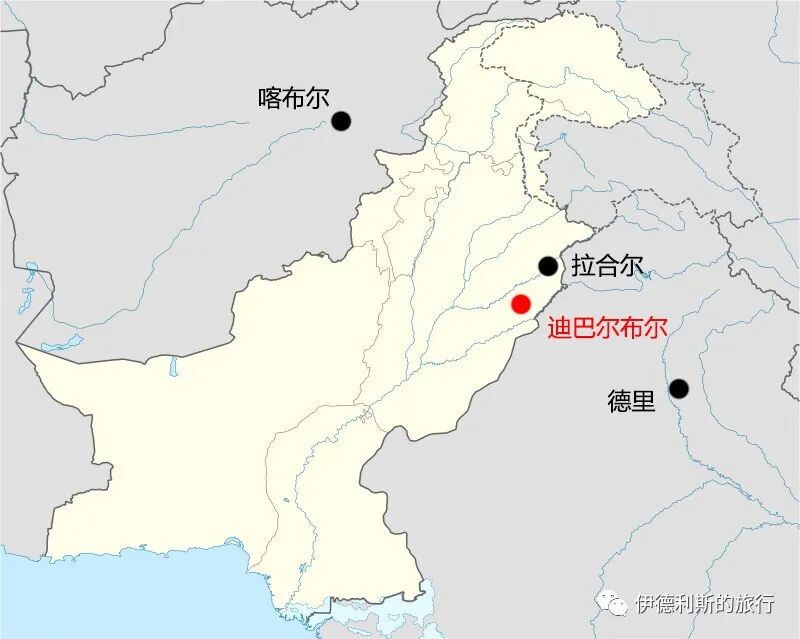
The location of Dipalpur
2. Defeating the Mongols Twice
In my previous article, The Second City of Delhi: The Turkic Fortress Defending Against the Mongol Army, I mentioned that Ghazi served as a general during the two attacks on the Delhi Sultanate by the Chagatai Khanate Mongol army in 1305 and 1306.
During the 1305 Mongol invasion, the 14th-century Delhi chronicler Amir Khusrau wrote that the Mongol army was defeated as miserably as a swarm of mosquitoes trying to resist a strong wind. However, historical records do not provide many details about Ghazi's specific role in that battle.
When the Mongols invaded in 1306, the commander of the Delhi Sultanate was Malik Kafur, and Ghazi served as deputy commander, leading the vanguard. After the Sultanate's main army set out, Ghazi's vanguard quickly reached the northwest border and spotted the Mongol scouts. He reported the Mongol army's position to Kafur. The Delhi Sultanate's army moved at full speed and completely crushed the Chagatai Mongol army on the banks of the Ravi River, a tributary of the Indus River. A large number of Mongols were killed or captured.
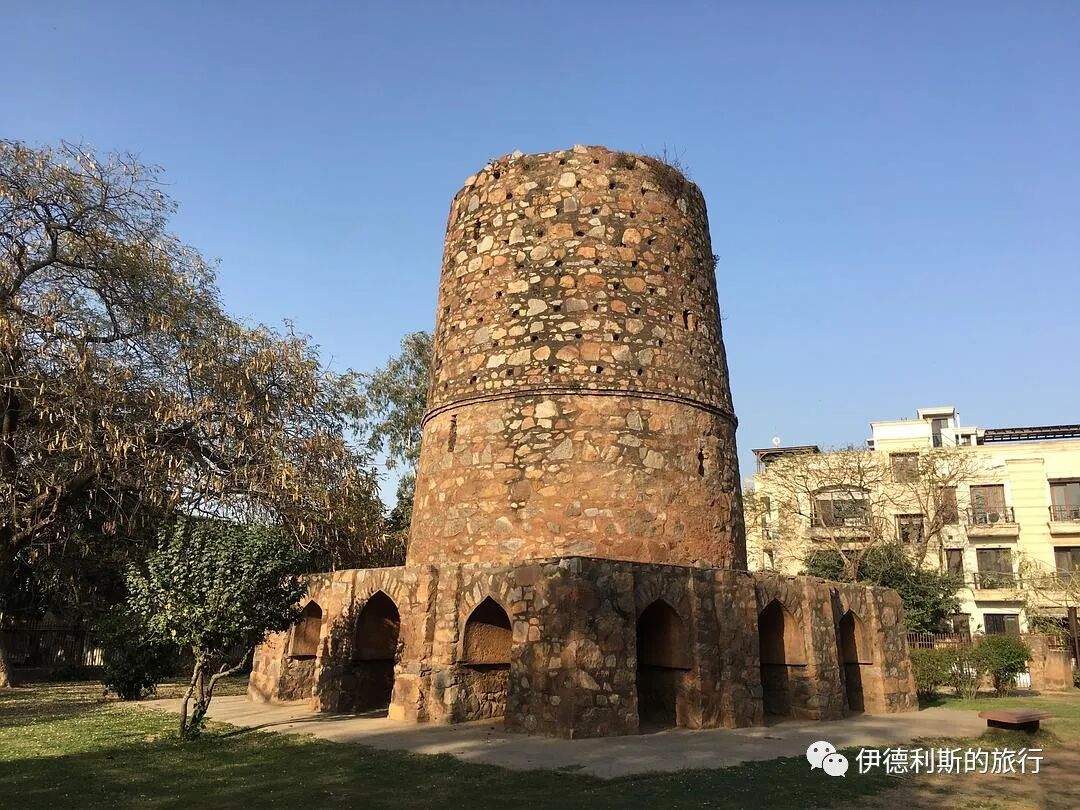
The Chor Minar, a tower of heads built during the Delhi Khalji dynasty. The 225 holes on it are said to have once held the heads of killed Mongol captives.
3. Taking the Fight to the Mongols
According to the chronicler Amir Khusrau, the crushing defeat of the Mongols in 1306 caused the Mongols in Afghanistan to fear the Delhi Sultanate. They retreated to the mountains near the famous ancient city of Ghazni in southeastern Afghanistan. In 1307, Duwa, the Khan of the Chagatai Khanate, died, and Central Asia fell into chaos. His successors were unable to organize any more large-scale invasions.
On the other hand, defeating the Mongols repeatedly gave Ghazi a huge boost in confidence. He changed the Khalji dynasty's defensive policy against the Mongols and began to actively invade the Chagatai Khanate's territory in Afghanistan. Every year, Ghazi raided important Mongol cities in Afghanistan such as Kabul, Ghazni, Kandahar, and Garmsir, and even briefly recaptured Lahore, the early capital of the Delhi Sultanate.
The chronicler Amir Khusrau wrote in his book Tughluq-Nama that Ghazi won 20 battles, mostly against the Mongols. The famous Moroccan traveler Ibn Battuta passed by a mosque in Multan in the 14th century, where a stone tablet was inscribed with the claim that Ghazi had defeated the Mongols 29 times.
In this way, Ghazi became the military commander of the Punjab region on the northwestern frontier of the Delhi Sultanate.
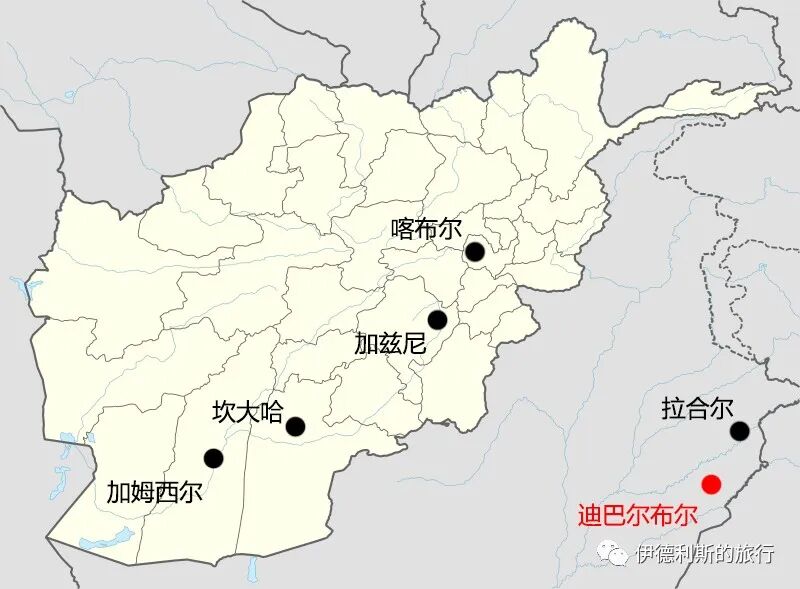
Afghan cities under Mongol rule that were attacked by Ghazi.
2. The Rise of the Tughlaq Dynasty
1. The Death of Alauddin Khalji
In his final years, Sultan Alauddin Khalji grew to distrust his officers and favored only the eunuch slave general Malik Kafur.
In 1315, Alauddin fell seriously ill and appointed Kafur as regent (Na'ib), giving him real power.
Alauddin died on the night of January 4, 1316. The next day, Kafur gathered all the important officials and nobles to read the will, which named Alauddin's 6-year-old son Shihabuddin as the new Sultan, with Kafur as regent.
2. The Fall of the Khalji Dynasty
Kafur was regent for only about a month, during which he constantly persecuted Alauddin's family, upsetting some of Alauddin's former armed guards (paiks). Led by Mubashshir, the guards beheaded Kafur. They released Alauddin's older son Mubarak Shah, who had been imprisoned by Kafur, and named him the new regent.
On April 14, 1316, Mubarak Shah deposed his younger brother to become the new Sultan, taking the title Qutubuddin.
Mubarak Shah was bisexual and had same-sex relationships with the brothers Hasan and Husamuddin. Hasan and Husamuddin were brought to the Delhi Sultanate court as Hindu slaves in 1305. To survive, the brothers converted to Islam and served Mubarak Shah.
The relationship between Mubarak Shah and Hasan was no secret. They hugged and kissed in public, and Mubarak Shah gave Hasan the title Khusrau Khan.
In 1320, Mubarak Shah was killed by Khusrau Khan, ending the Khalji dynasty of the Delhi Sultanate.
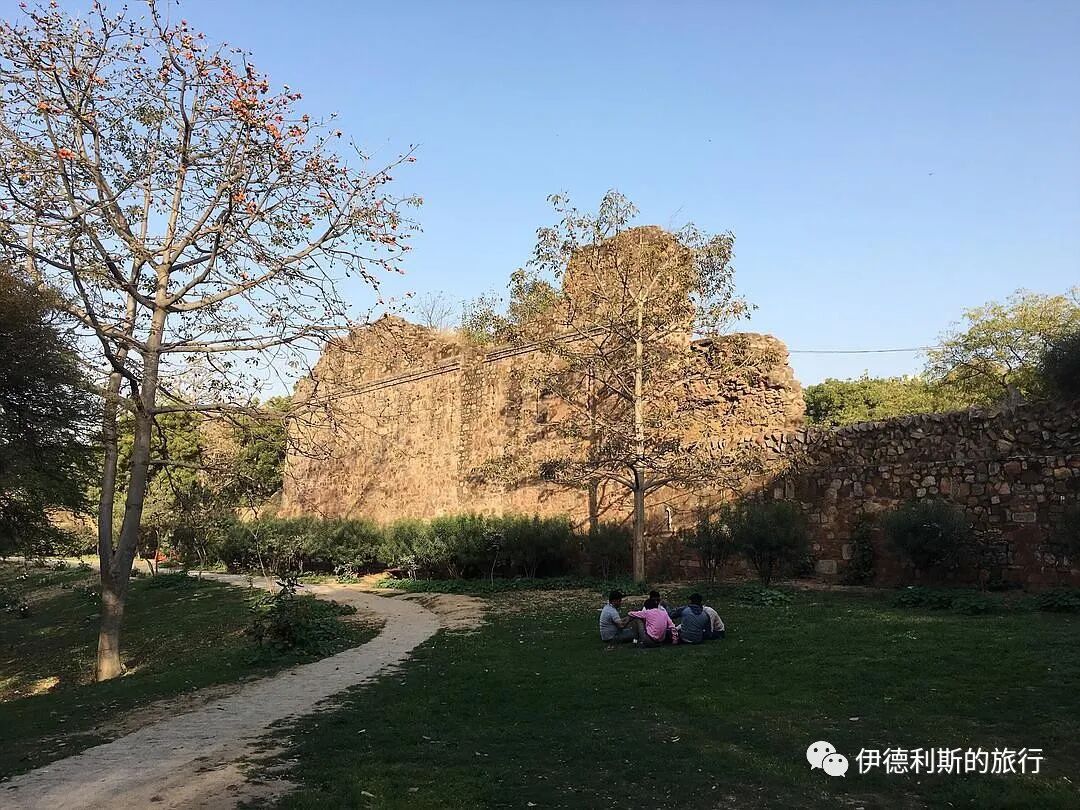
Siri, the capital of the Delhi Sultanate's Khalji dynasty.
3. The Founding of the Tughlaq Dynasty
After Mubarak Shah was killed by Khusrau Khan, Khusrau Khan returned to his Hindu identity, which caused great dissatisfaction among Muslim officers and nobles. These officers and nobles supported Ghazi, the Punjab military commander who held a large army, to attack Khusrau Khan.
After Alauddin died, Ghazi gained military control over the Multan and Sindh regions. After receiving invitations from the Muslim officers and nobles, he and his son Fakhr Malik gathered a large army in Multan and Sindh and marched toward Delhi.
In September 1320, Ghazi defeated Khusrau Khan west of Siri in Delhi and established the Tughlaq dynasty, the third dynasty of the Delhi Sultanate. Ghazi received the title Ghiyath al-Din Tughluq, and his son received the title Muhammad Shah Tughluq.
3. Building the City of Tughlaqabad
After establishing the Tughlaq dynasty, Ghazi began building Tughlaqabad Fort in 1321. The massive 6.5-kilometer-long city was completed in just two years.
1. Legends of the Fortress Construction
There is a famous legend about the construction of Tughlaqabad Fort. Once, while walking with the last Sultan of the Khalji dynasty, Mubarak Shah, Ghazi suggested that the Sultan build a stronger fortress in Delhi. The Sultan joked that if you ever become Sultan, you can build the fortress yourself. As it turned out, his words came true.
2. The Curse of the Sufi Saint
Ghazi dreamed of building a fortress so strong that it could withstand the fiercest attacks from the Mongol army. However, fate did not go as he wished.
Ghazi was passionate about his fortress and ordered all laborers in Delhi to help build it. At the time, the famous Sufi saint Nizamuddin Auliya was building a water tank (baoli), and his laborers were forced to go build the fortress instead. But these people preferred to work for the saint, so they built the fortress for Ghazi during the day and the water tank for Nizamuddin at night. When Ghazi found out, he was very angry and forbade the laborers from working for Nizamuddin. Nizamuddin issued a curse: 'Ya rahey ujjar, ya basey gujjar'. It roughly means 'Either it will remain desolate, or it will be inhabited by the Gujjar people.' "
After the sultanate fell, the nomadic Gujjar people (gujjar) took over the castle, and it turned into a wilderness.
Nizamuddin Dargah in Delhi
4. Tughlaqabad Fortress
1. City Layout
The entire city is divided into three parts:
The largest part is the residential area in the north. Old photos from the 1940s show streets and the ruins of the Friday mosque (Juma Masjid), but they are hard to recognize now.
The southwest side is the palace area, where the buildings have collapsed significantly, though there is one well-preserved water well.
The southeast side is the smallest but most interesting part, the fortress area, which has many architectural ruins like houses, storage rooms, and a mosque.
The blue line shows the existing city walls.
2. The City Walls
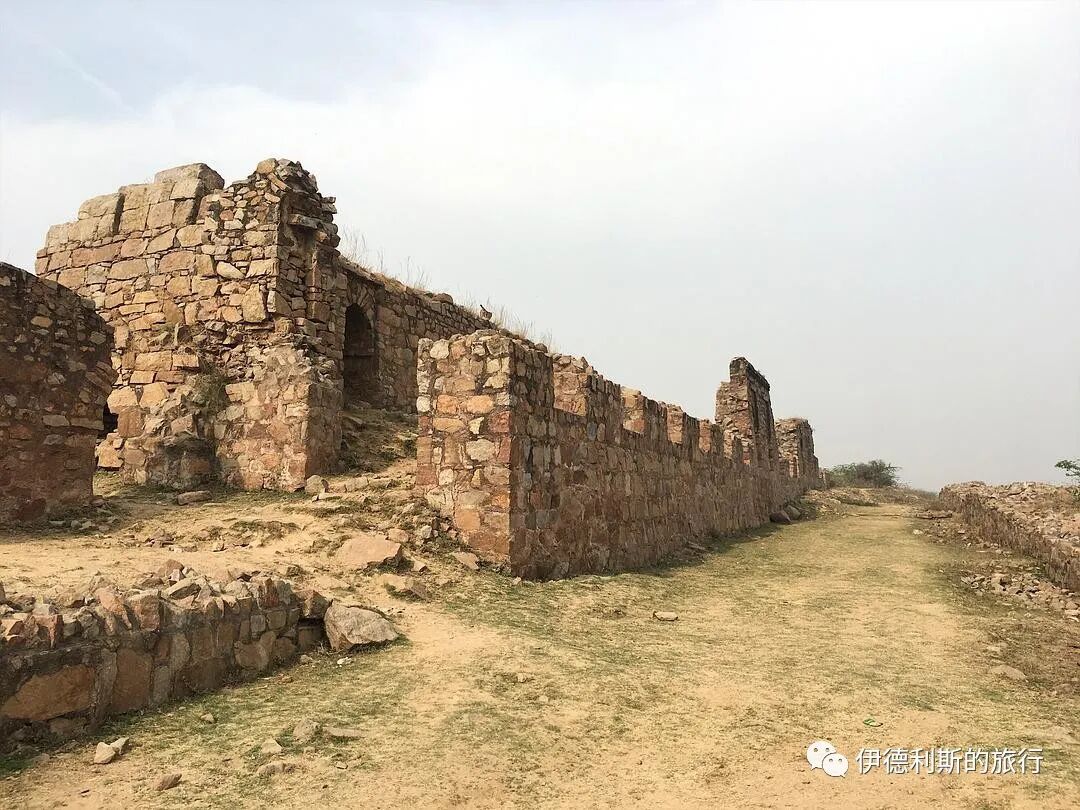
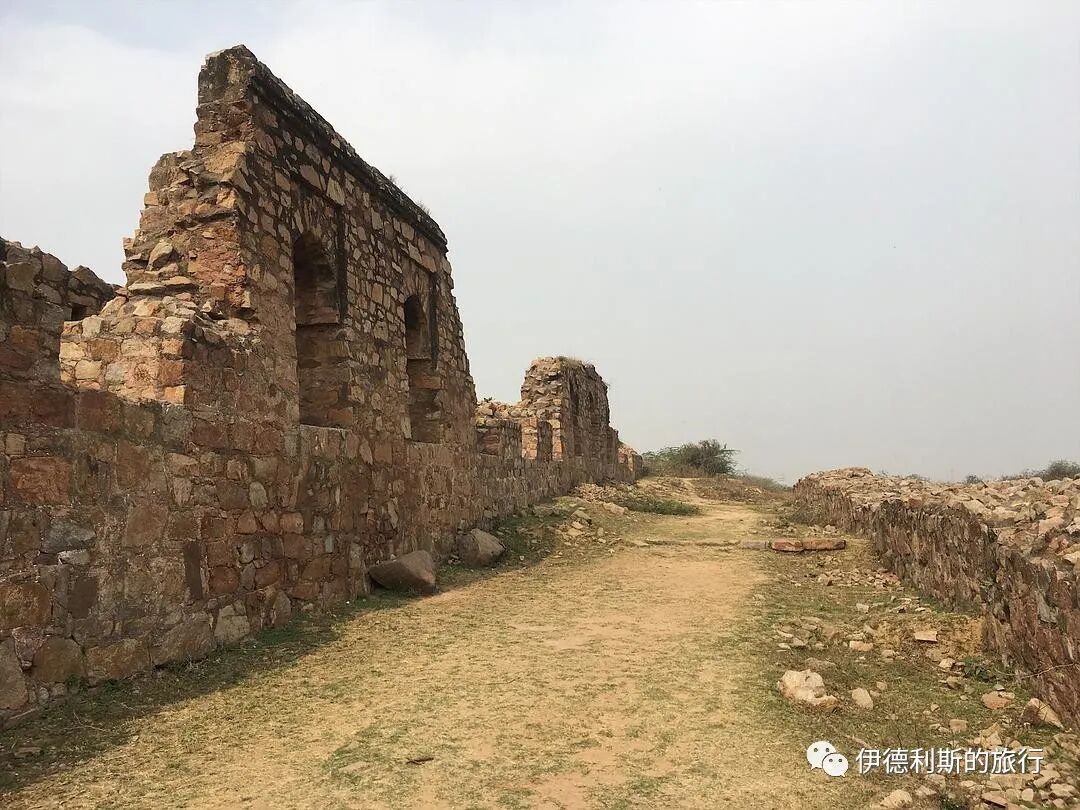
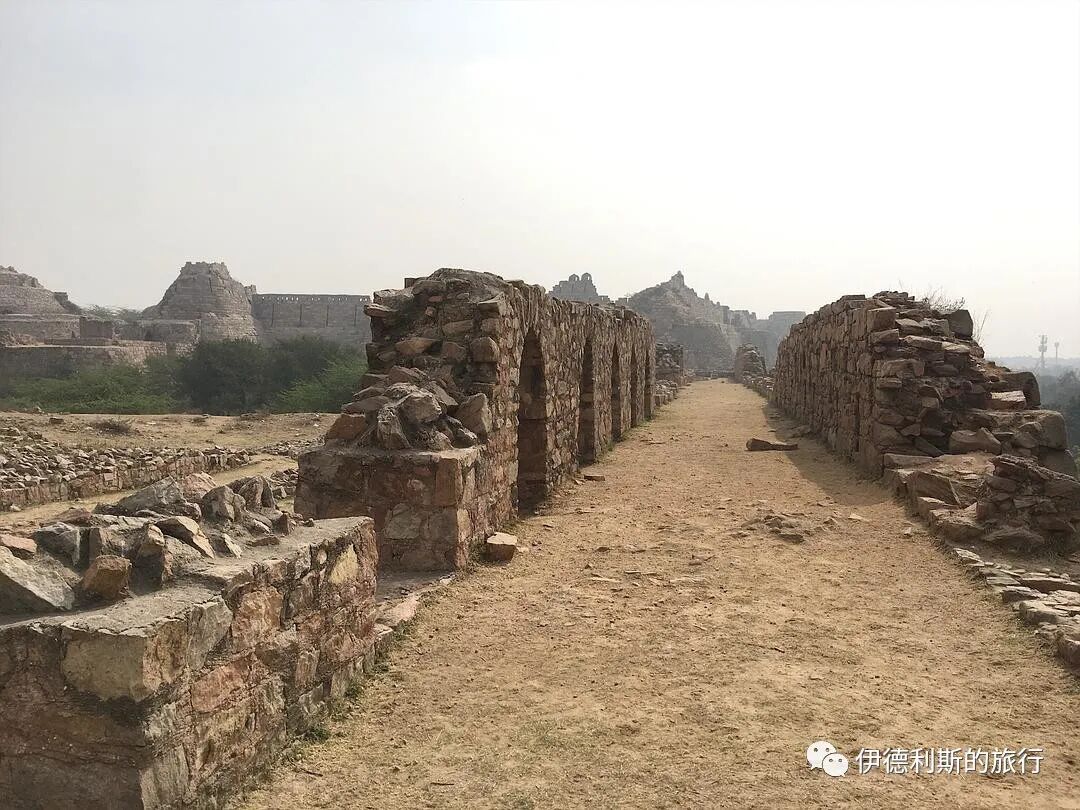
Tughlaqabad City features the sloped rubble walls typical of the Tughlaq dynasty. The walls are 10 to 15 meters high and reinforced by two-story circular bastions. The city is said to have had as many as 52 gates, but only 13 remain today.
The southeast corner tower of the fortress area wall
The south city wall
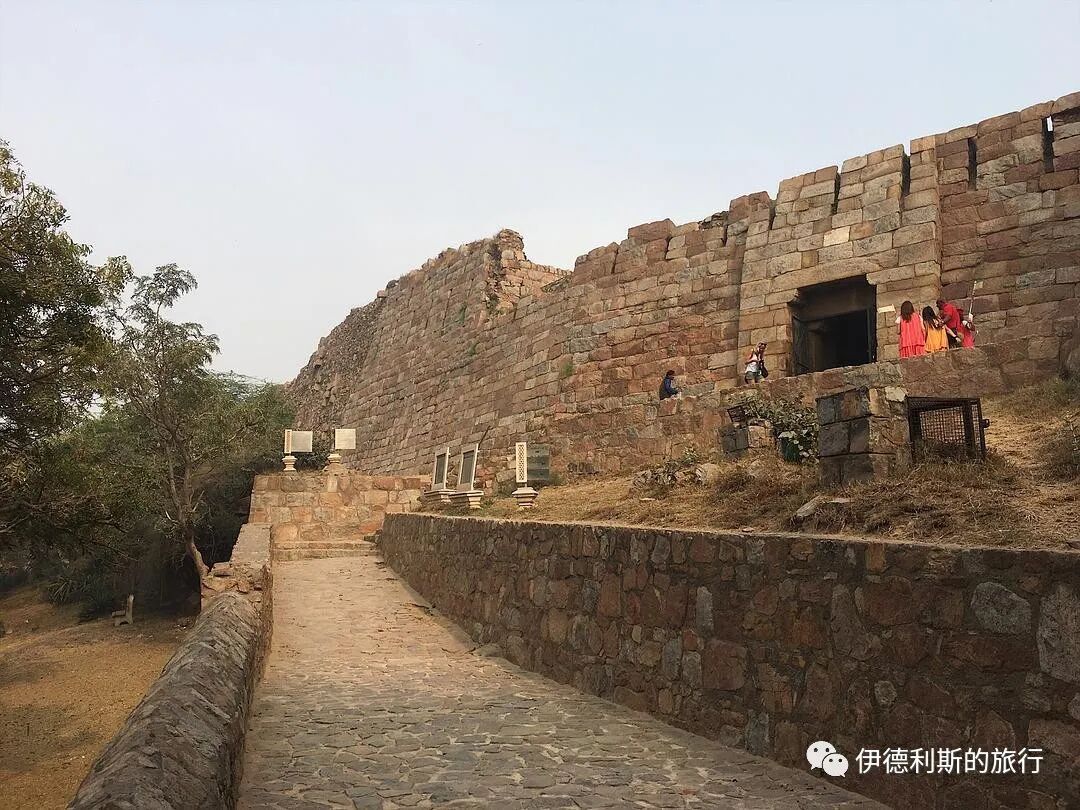
The inside of the south city wall
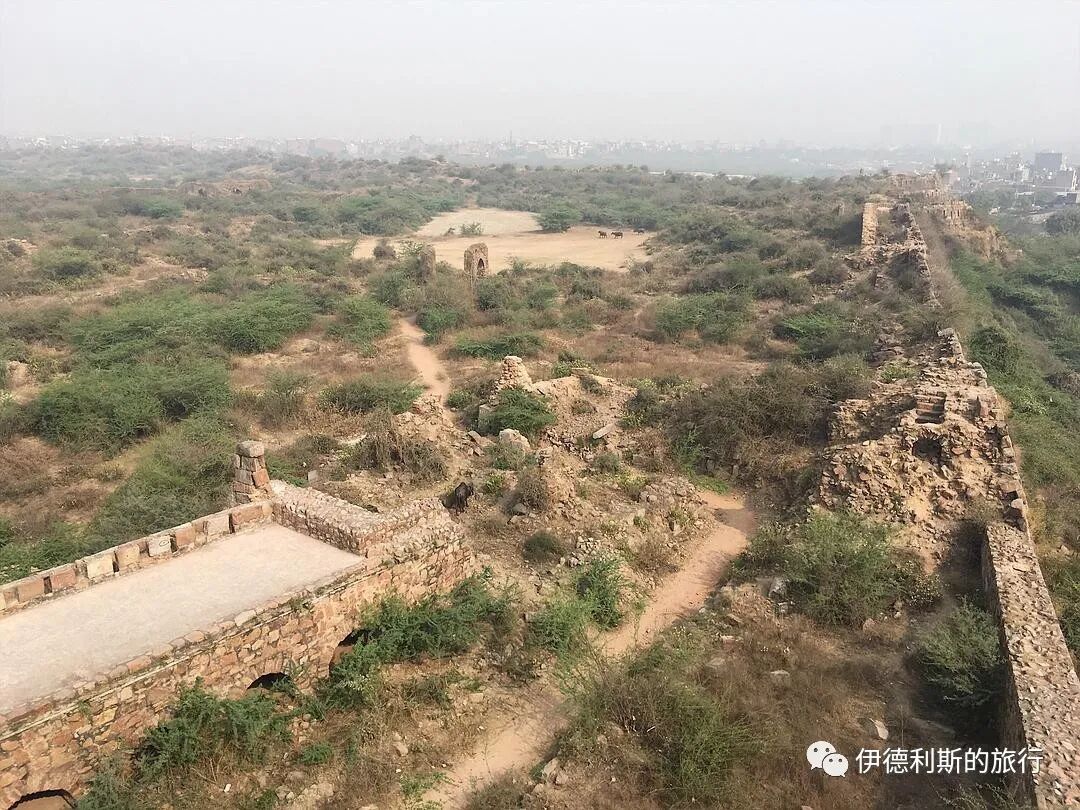
The picture below shows the view from the northwest corner tower of the fortress area looking toward the east wall of the palace area.
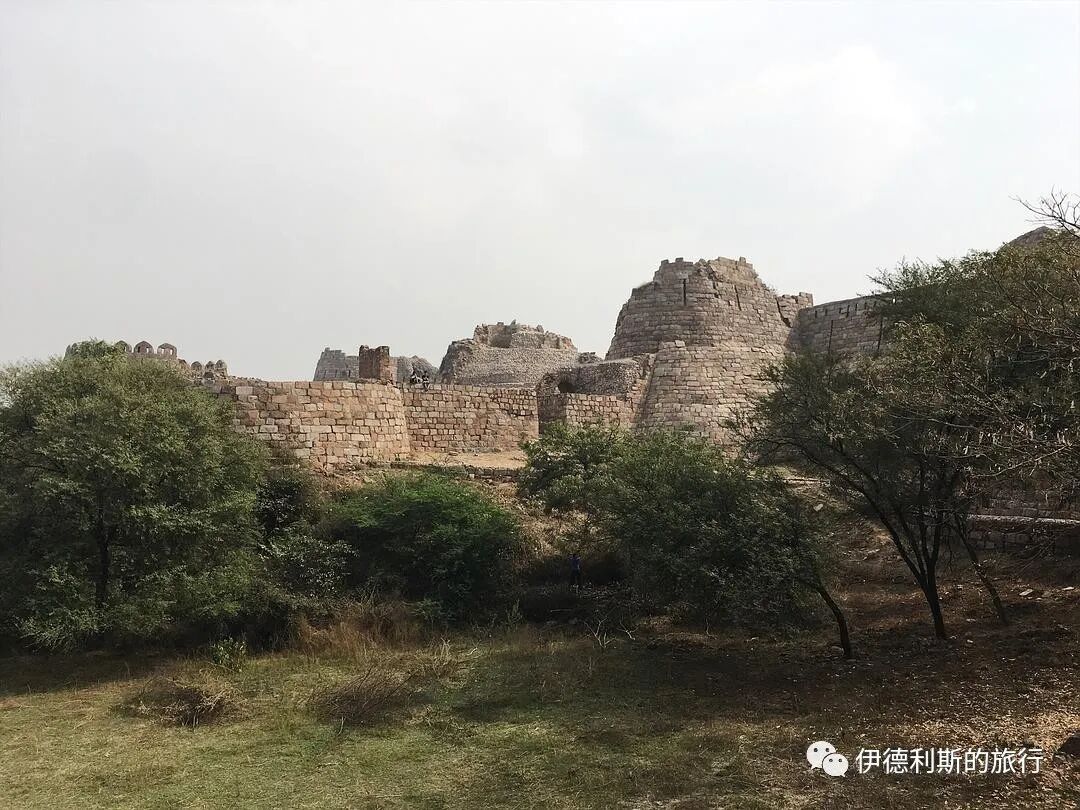
In the picture below, the lower wall is the east wall of the palace area, and the higher one is the west wall of the fortress area.
Standing on the fortress area wall looking west toward the palace area wall.
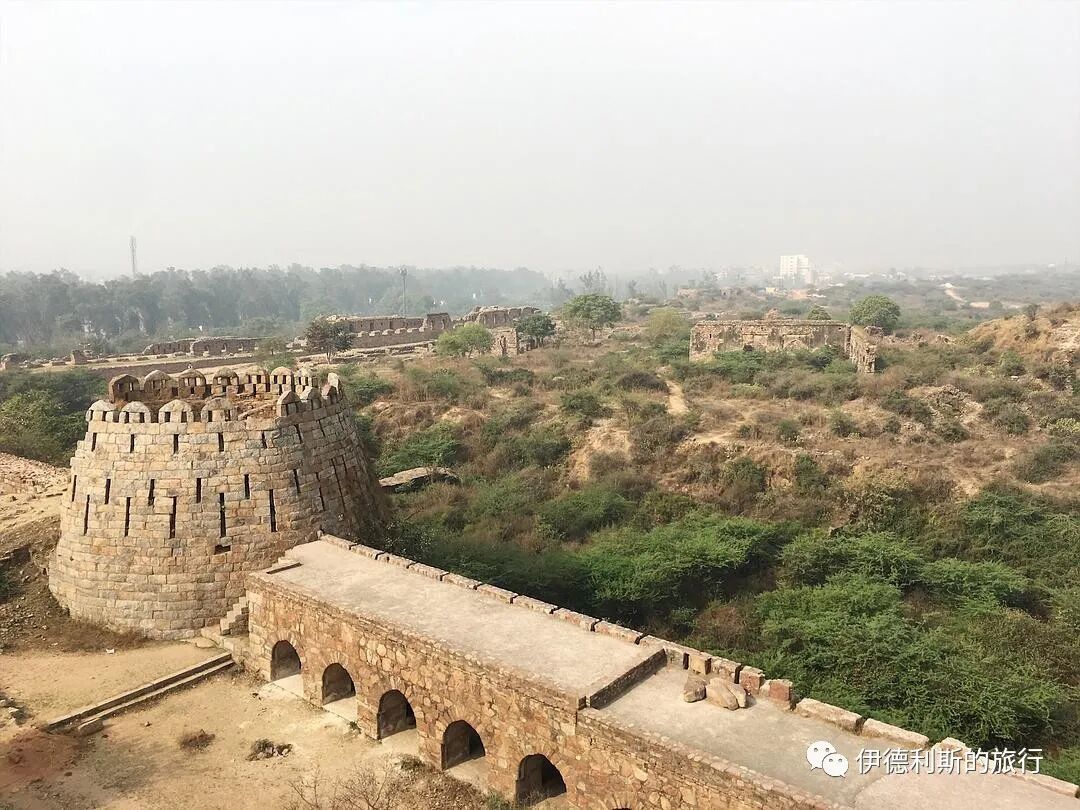
The east wall of the palace area
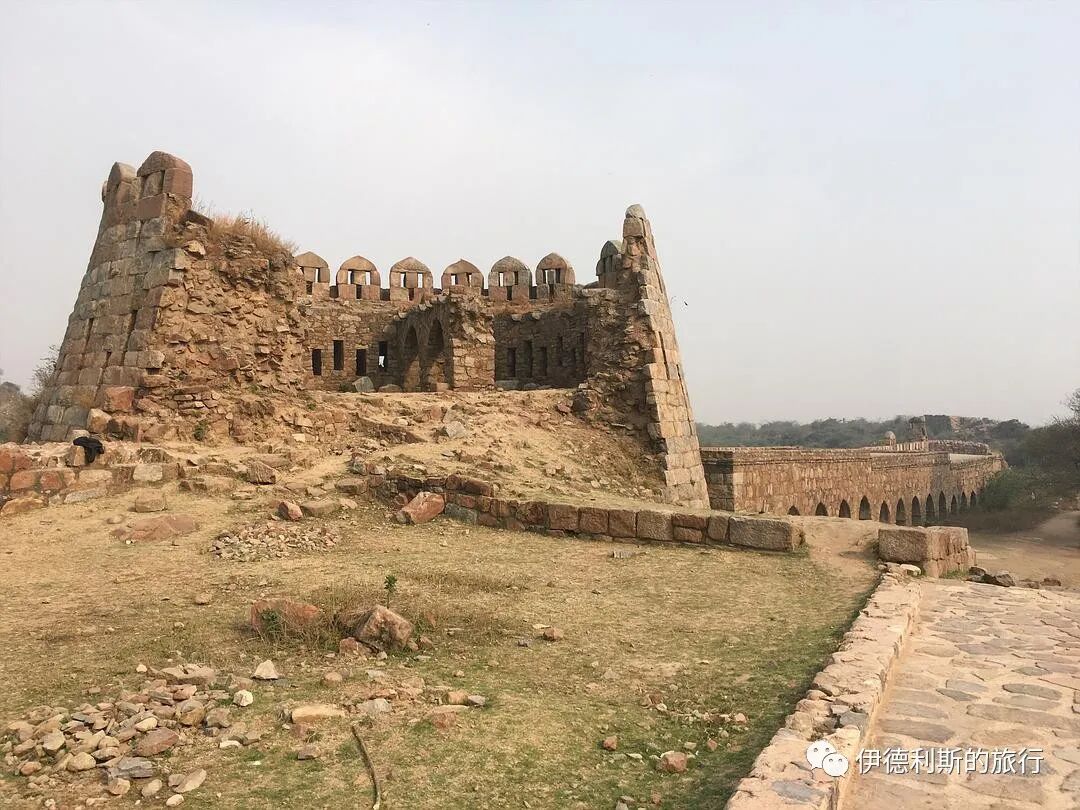
The west wall of the fortress area
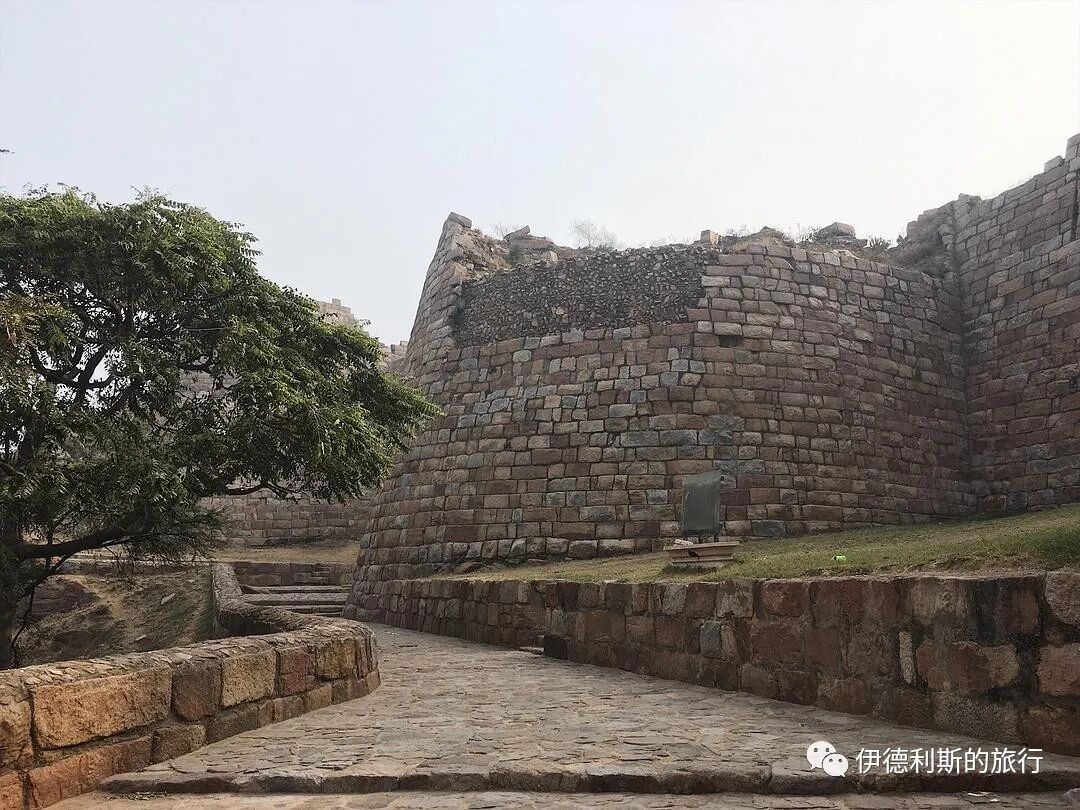
The collapsed west gate of the fortress area
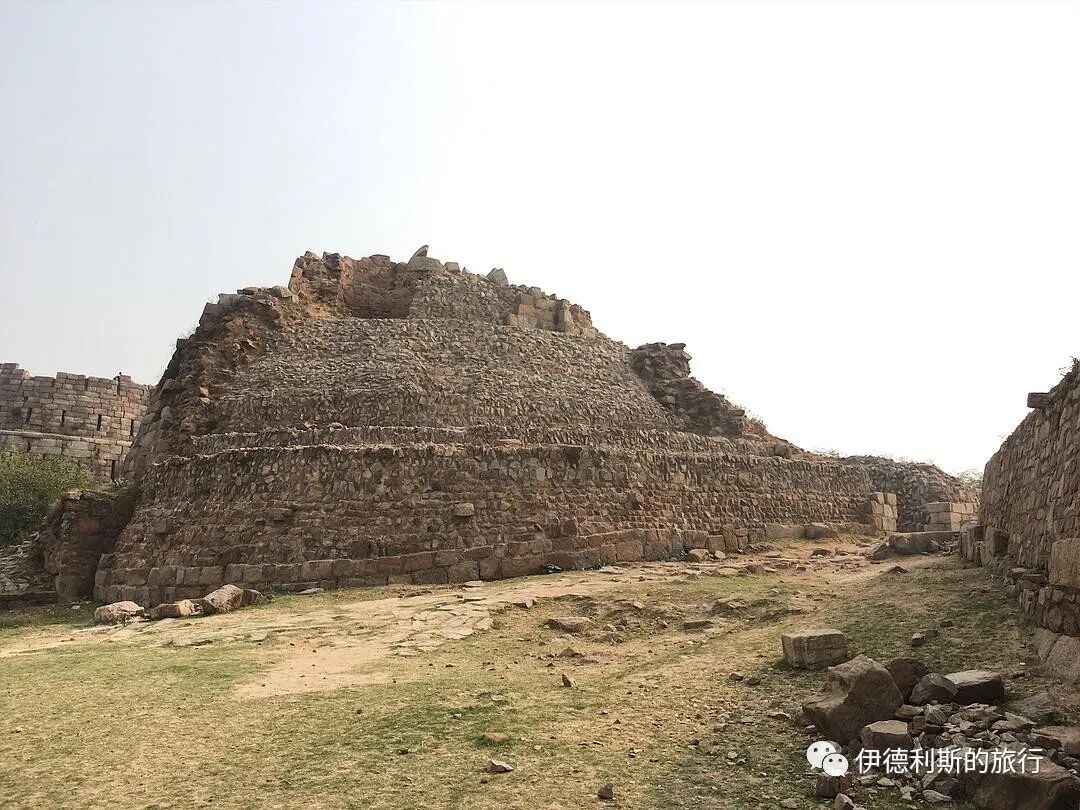
The interior of the high platform on the west wall of the fortress area
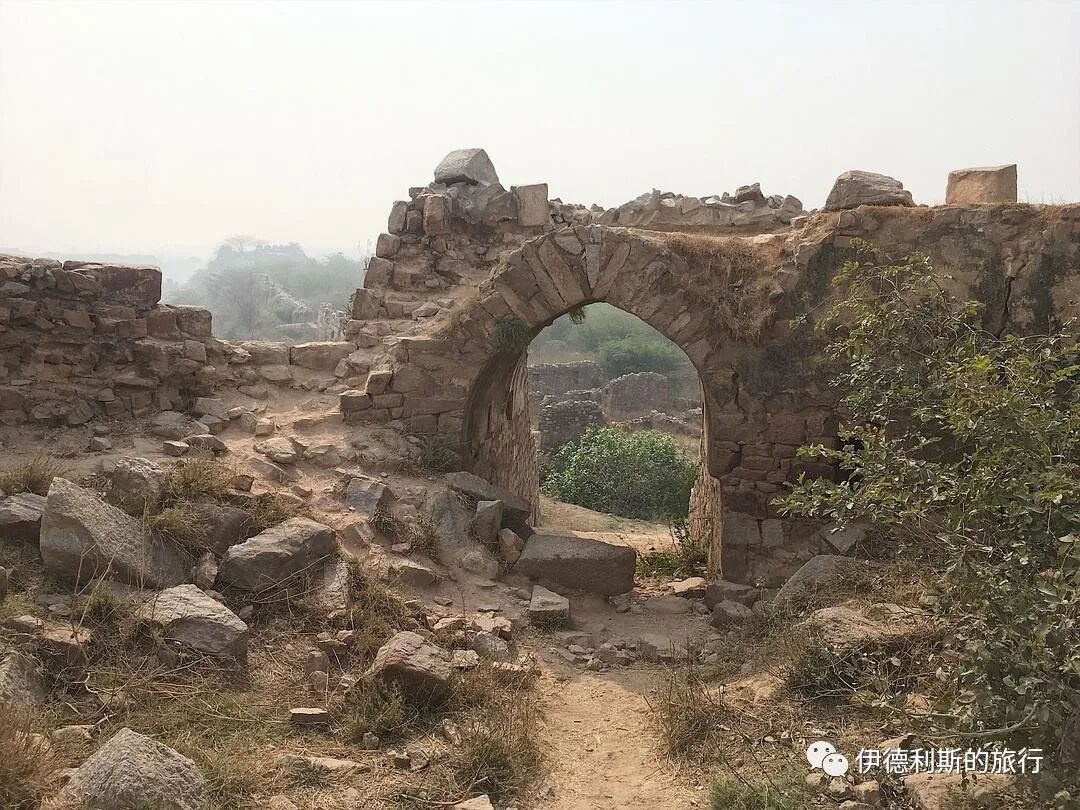
3. The Palace District
The palace ruins of Tughlaqabad City have collapsed badly, so you can only imagine their former glory.
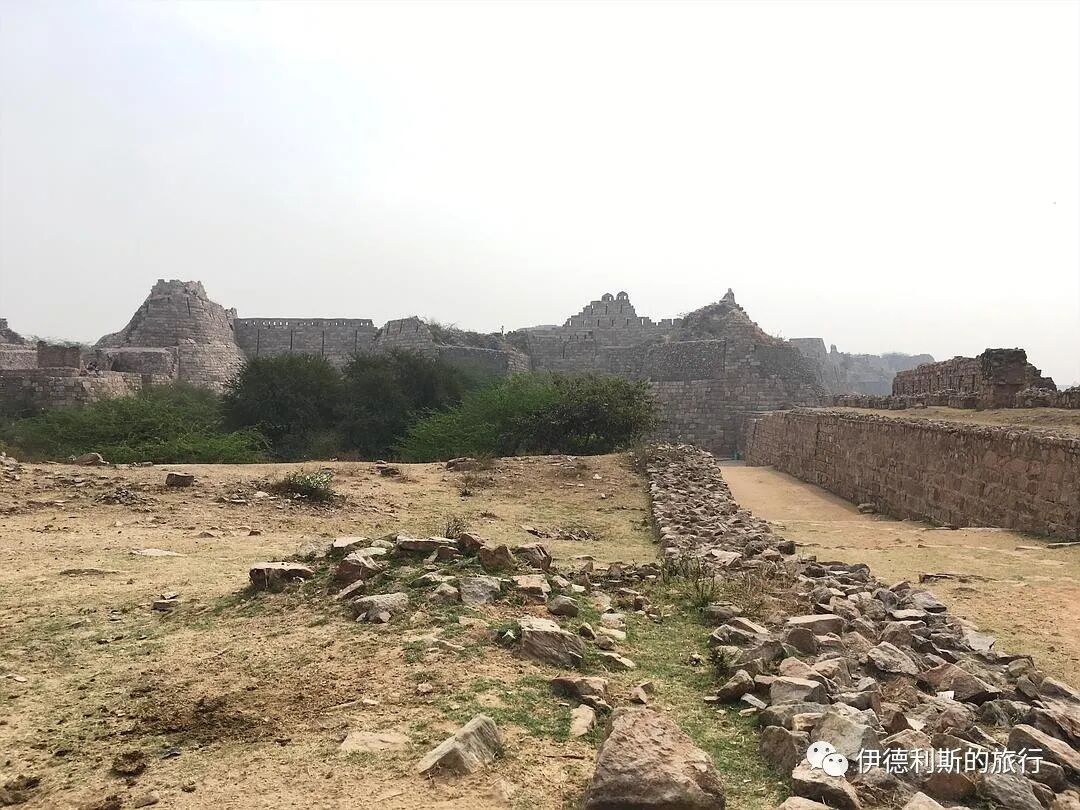
West of the palace is a water tank (baoli) that provided water for the castle.
4. The Citadel Area
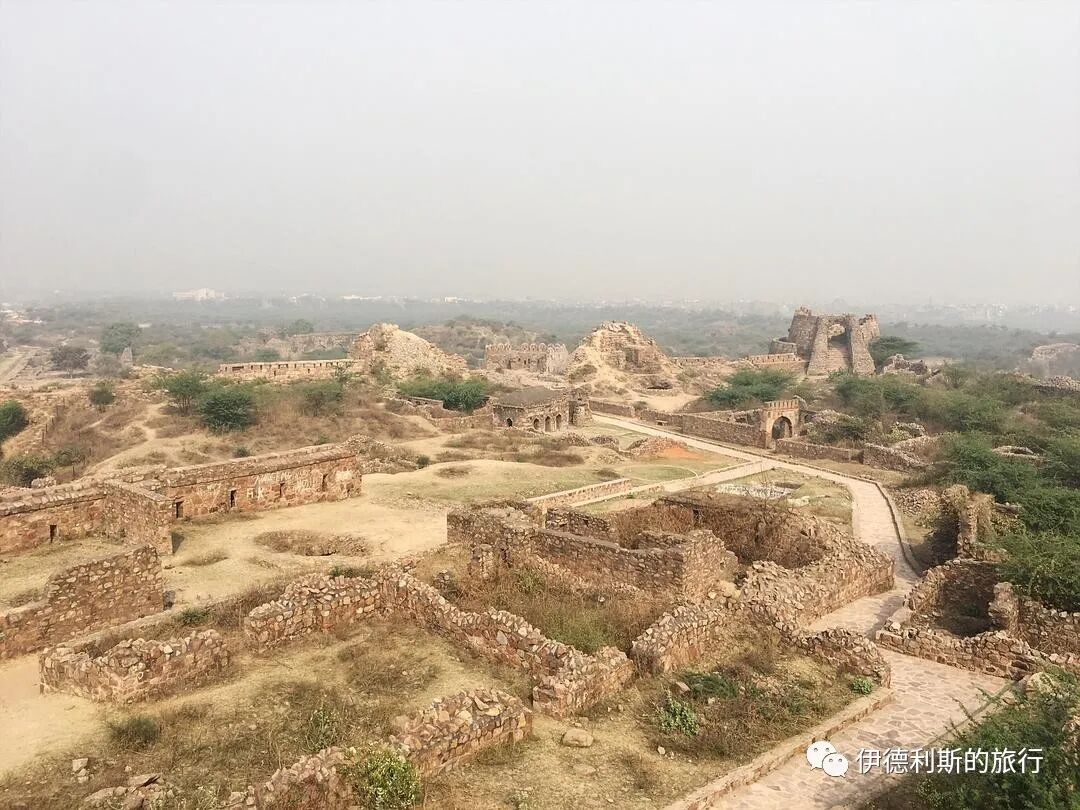
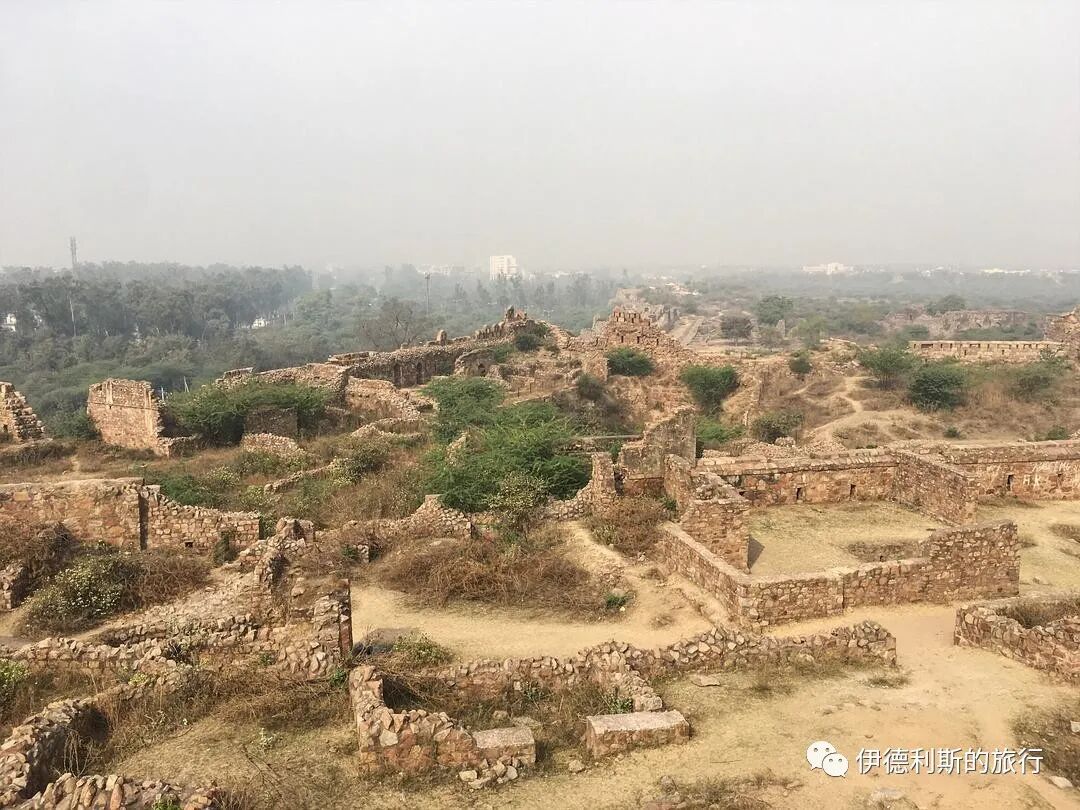
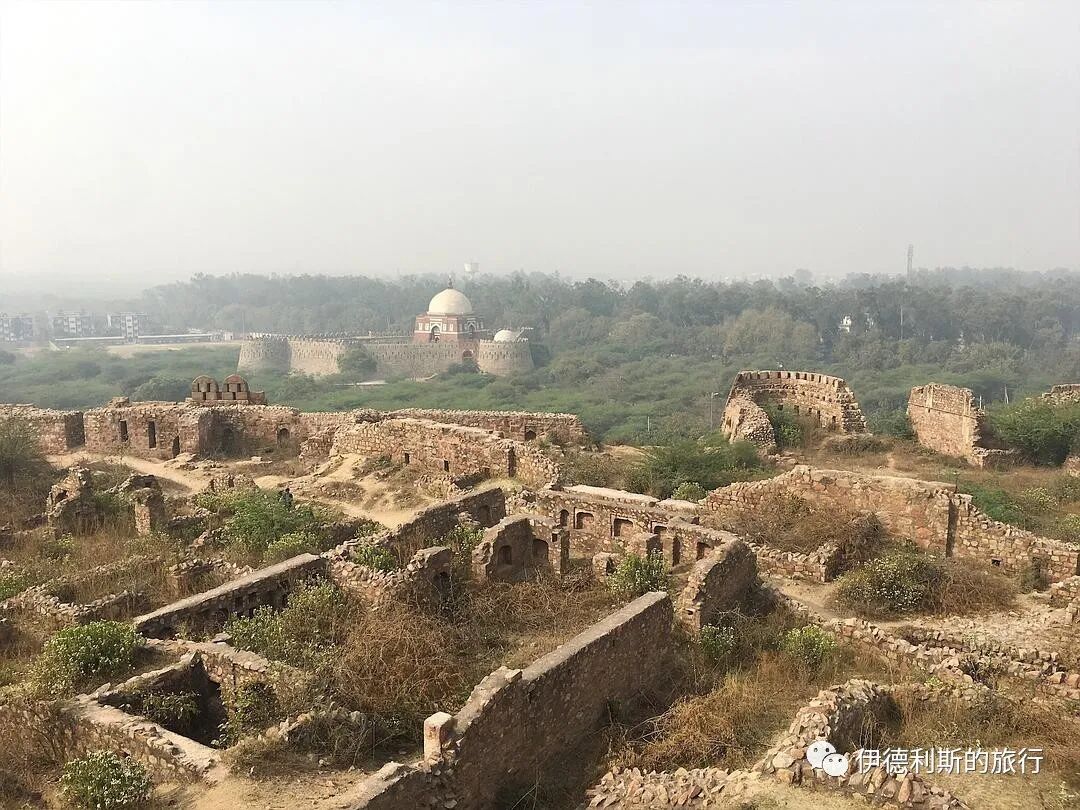
The fortress area is the part of the city with the richest ruins.
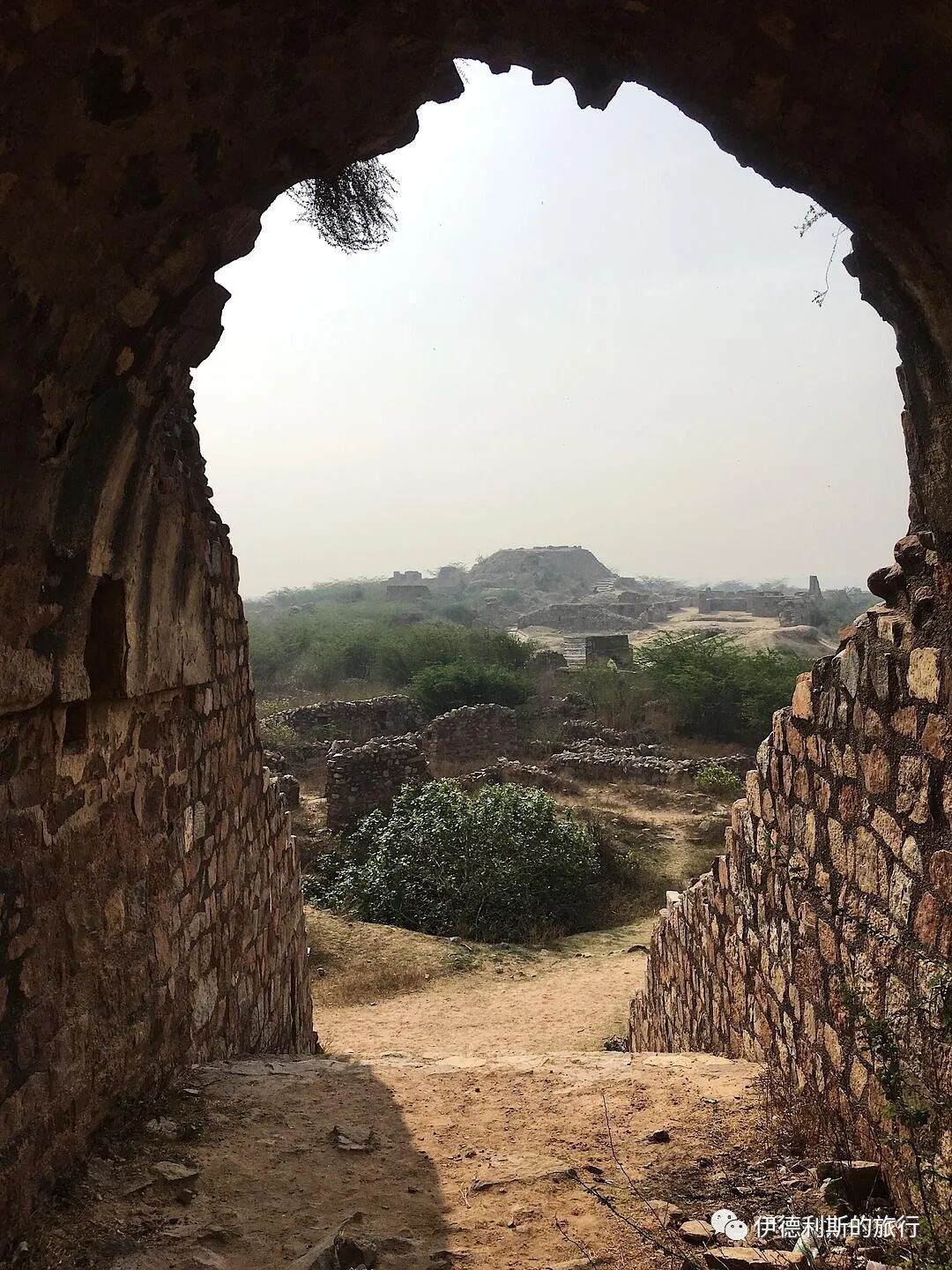
Looking down at the entire fortress area:
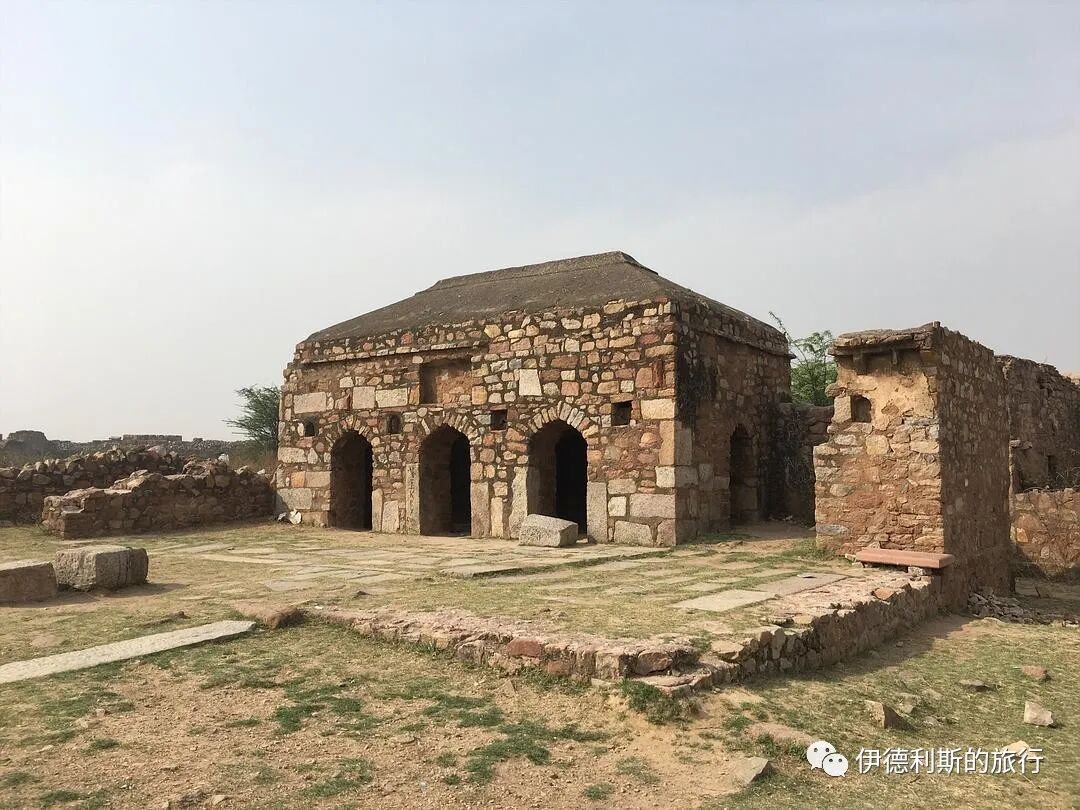
A small mosque in the fortress area
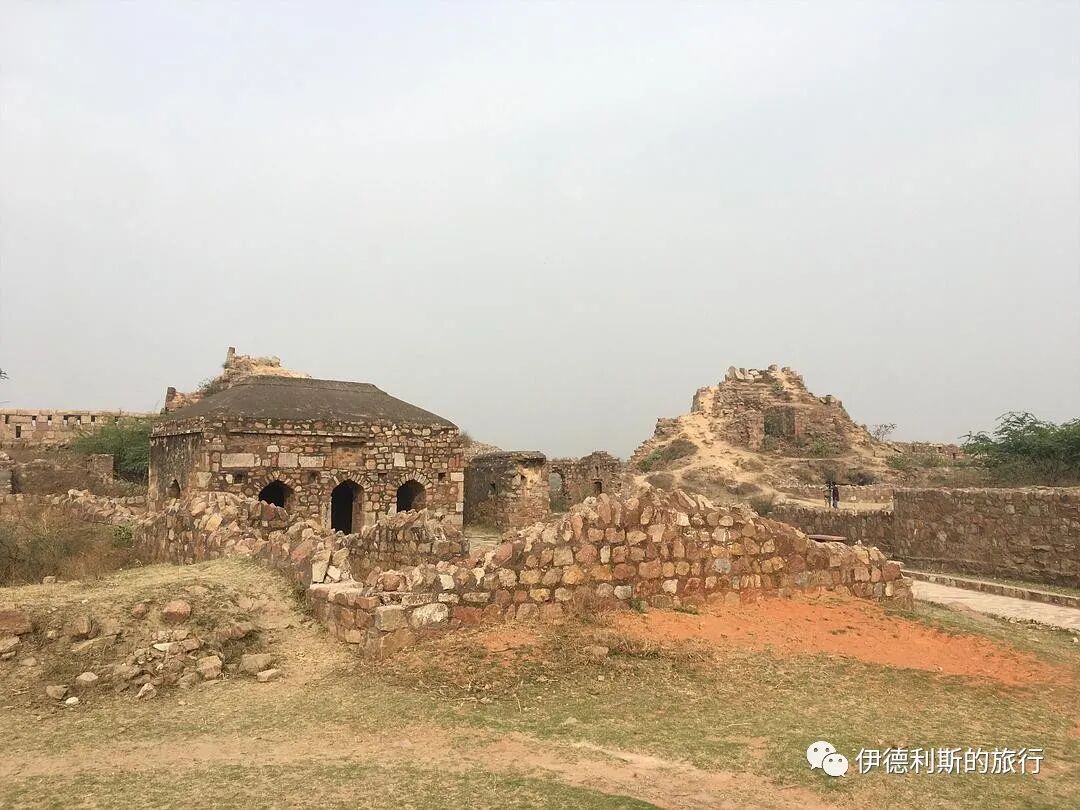
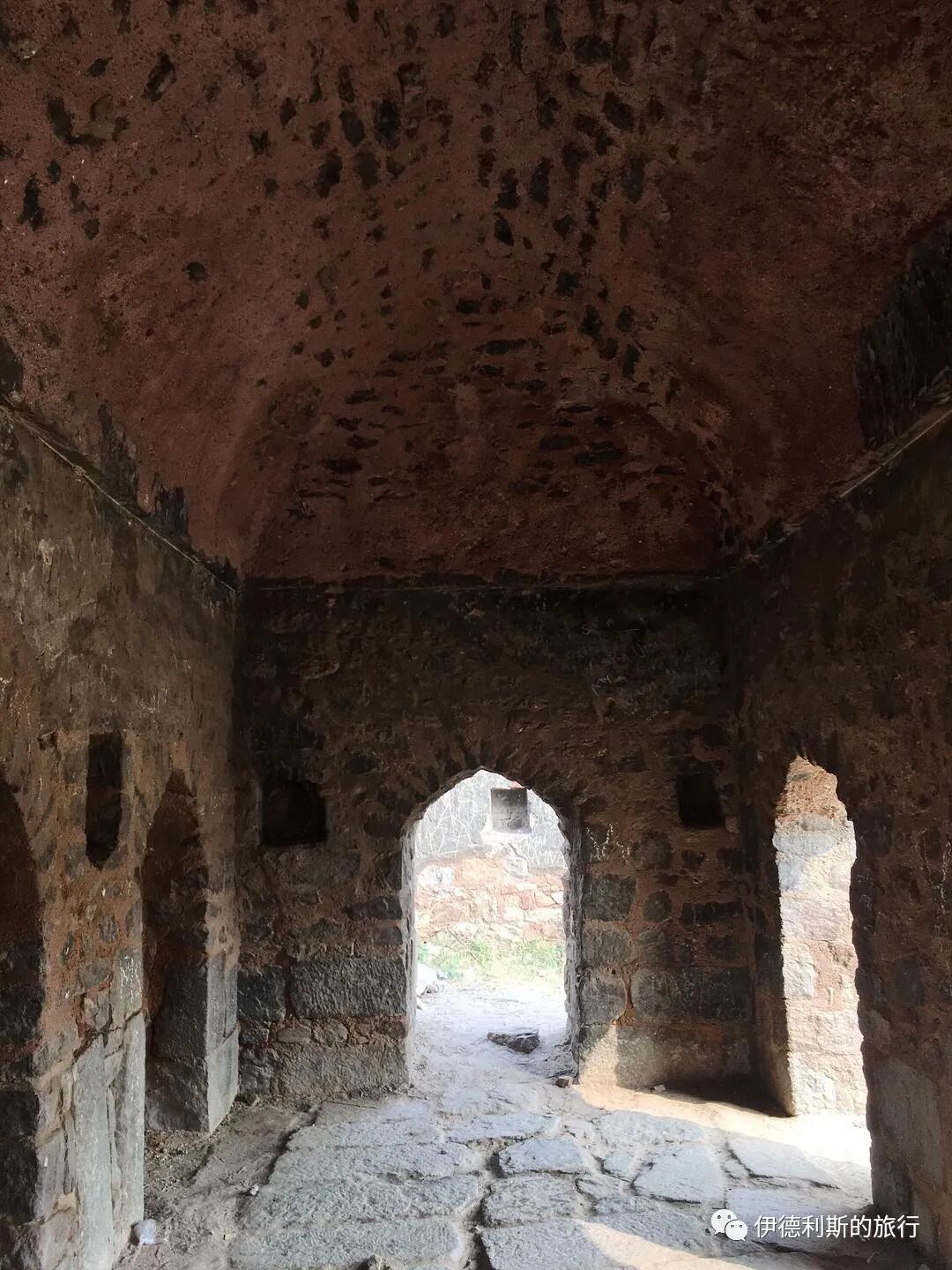
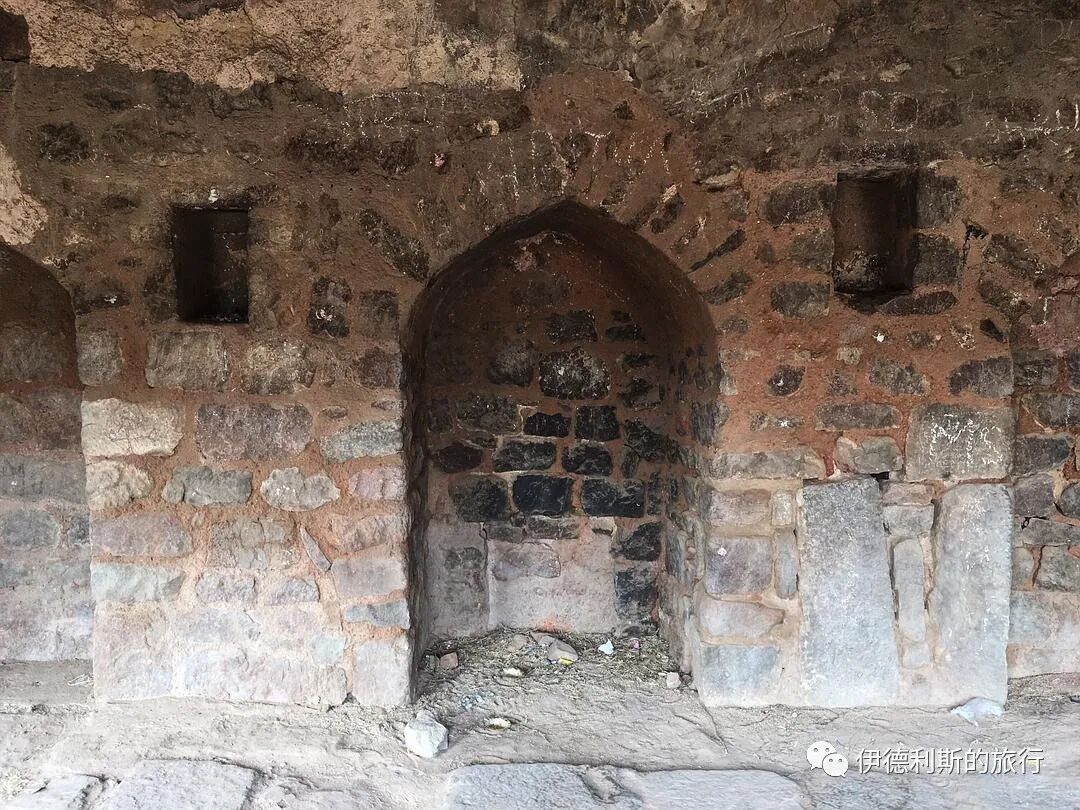
The mihrab that indicates the direction of Mecca
The fortress area has a classic underground storage room:
The north entrance of the storage room
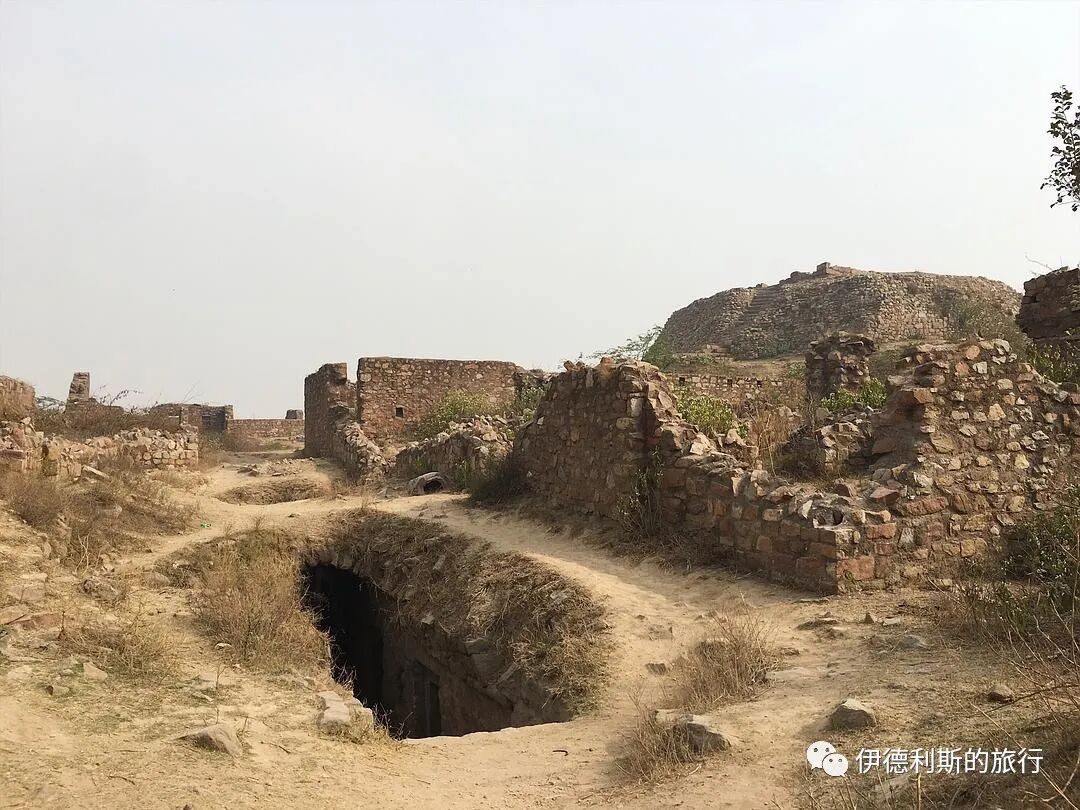
The south entrance of the storage room
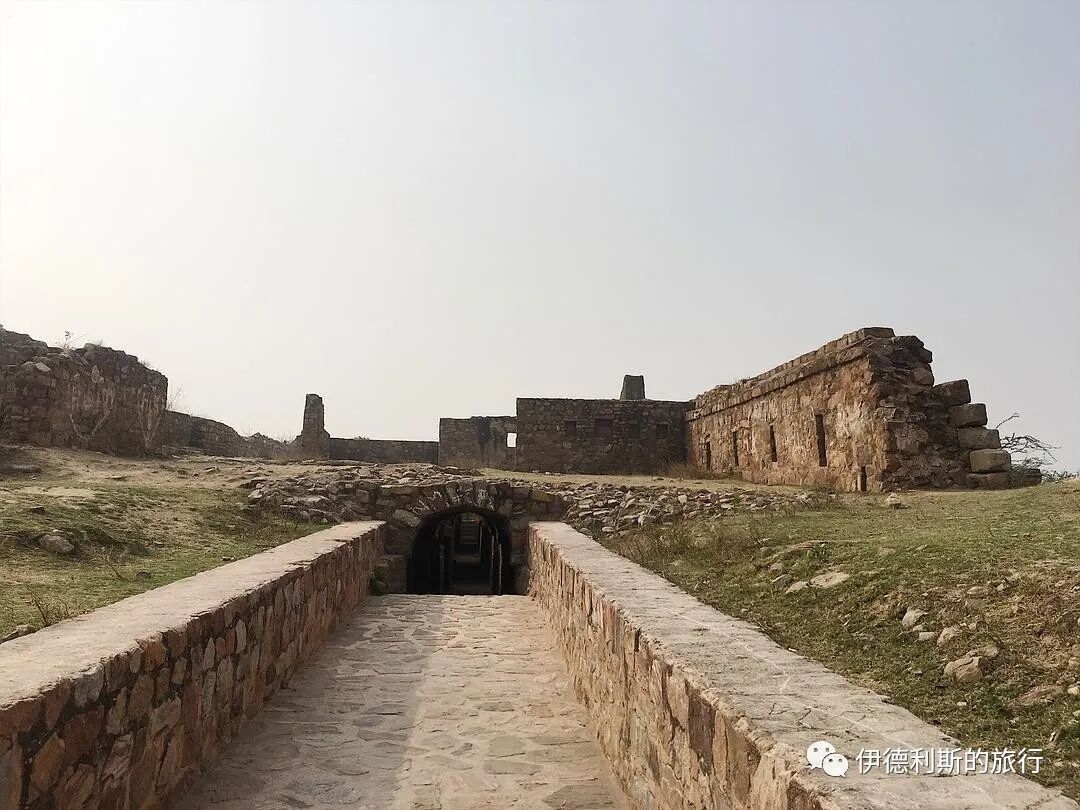
The passage of the storage room, with individual warehouses on both sides.
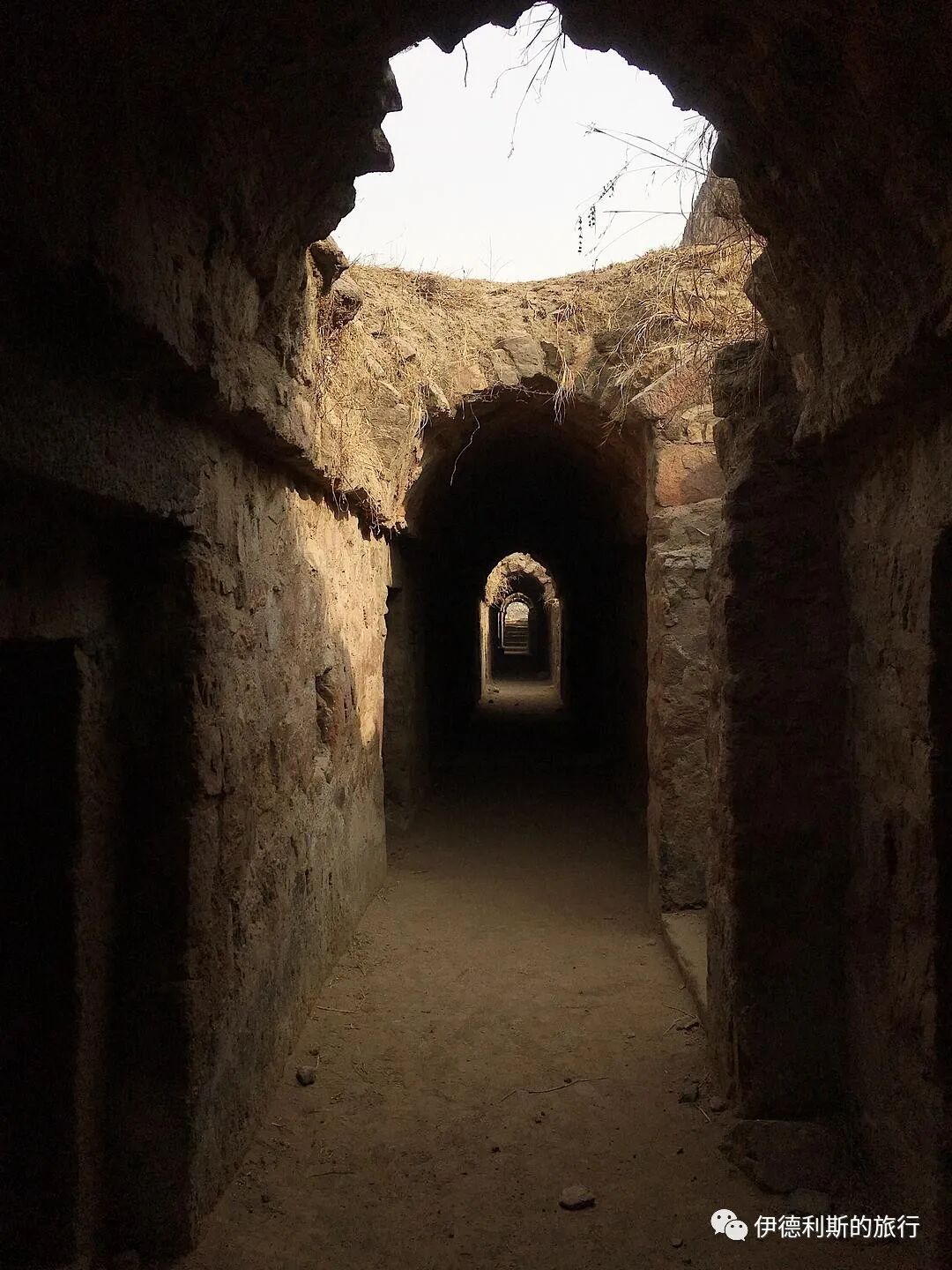
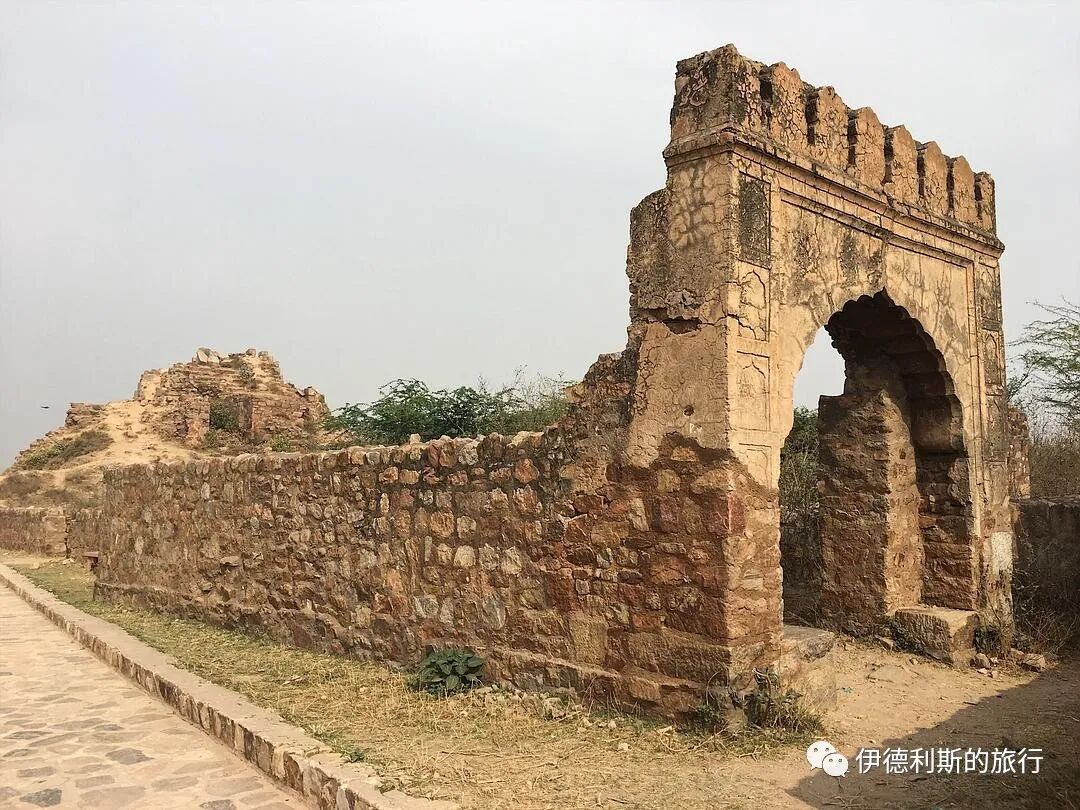
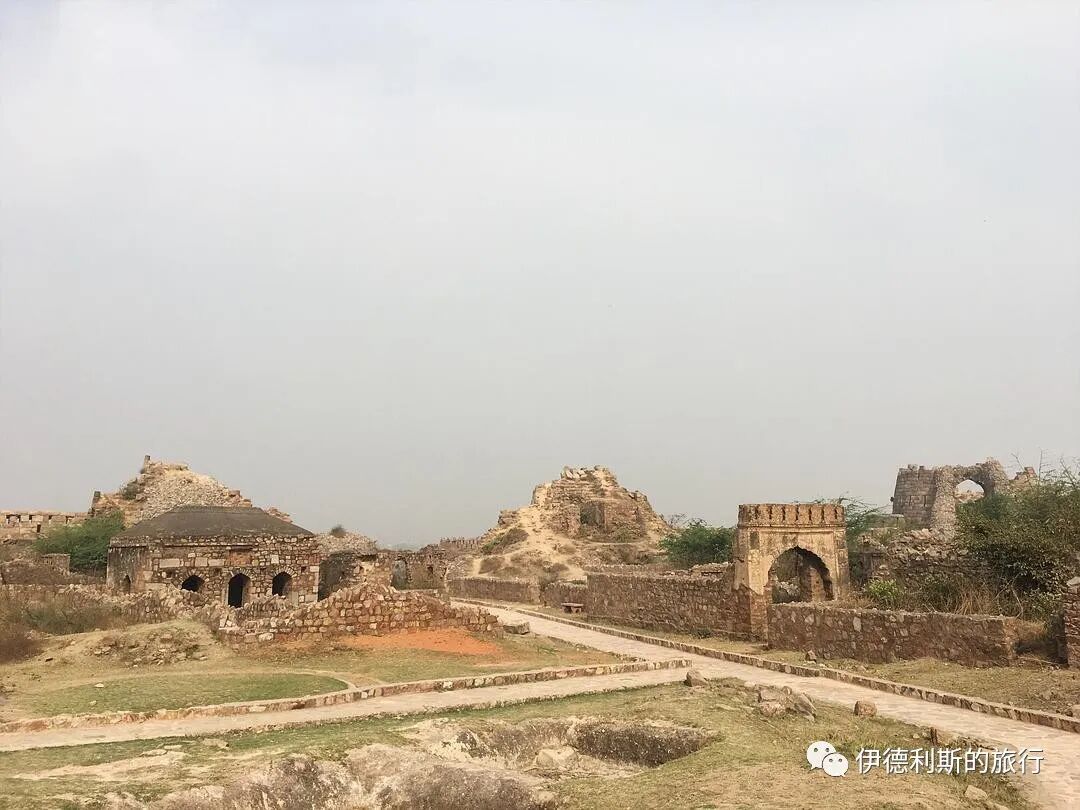
There are also some residential ruins inside the fortress area.
5. The Tomb of Ghiyath al-Din Tughluq
I mentioned earlier the curse that the Sufi saint Nizamuddin placed on Ghiyas-ud-din. Another famous curse is "Hunuz Dilli dur ast". It means "Delhi is still far away." "
In 1324, Ghazi led an expedition to Bengal and succeeded. On the way back in February 1325, a wooden pavilion collapsed, crushing Ghazi and his second son, Mahmud Khan, to death. The famous 14th-century Moroccan traveler Ibn Battuta believed that his eldest son, Muhammad bin Tughluq, killed his father.
After Ghazi died, his eldest son Muhammad succeeded him as Sultan and buried Ghazi in a tomb south of the city of Tughlaqabad.
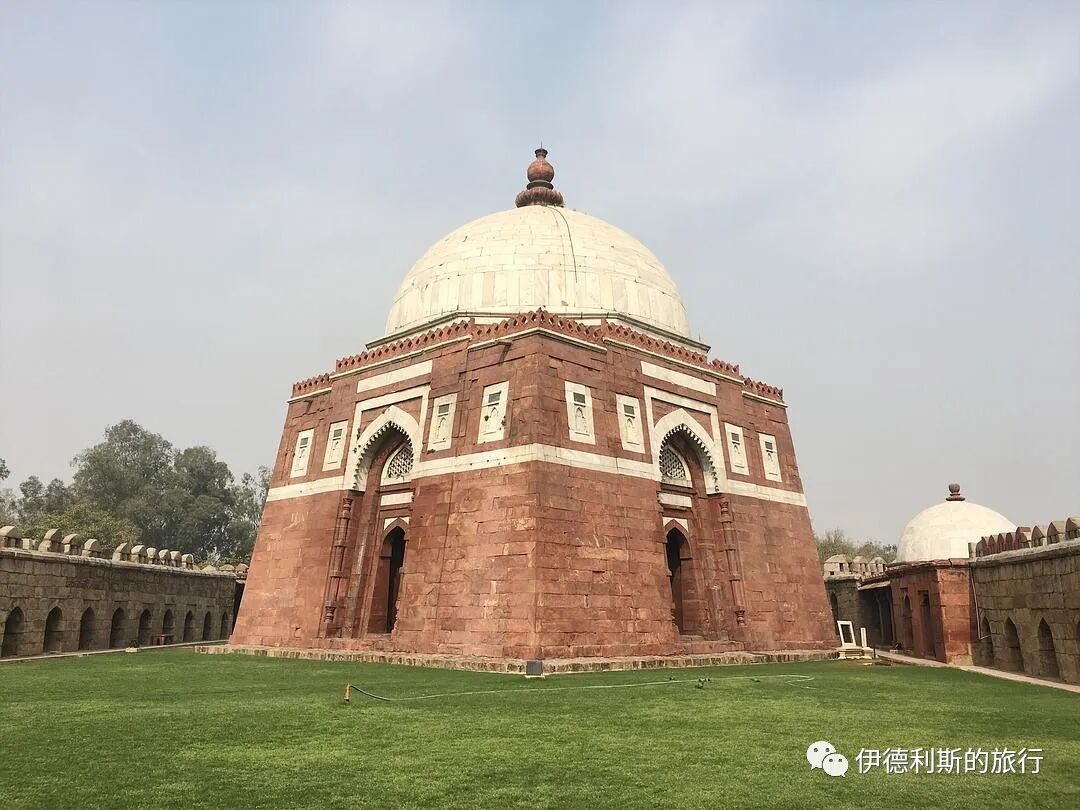
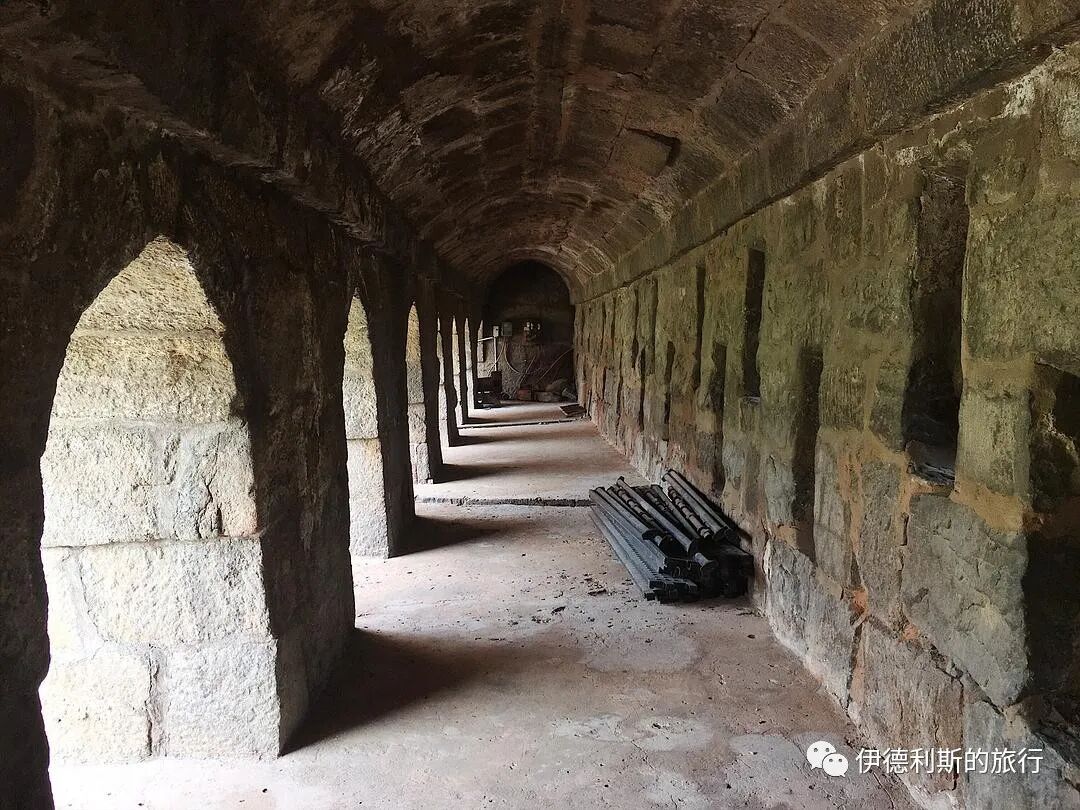
The Mausoleum of Ghiyas ud-Din Tughluq connects to the city of Tughlaqabad to the north via a causeway. This 182-meter causeway has 27 arches, and there used to be an artificial lake underneath. The lake has now been filled in to become flat land, and the middle of the causeway is split in two by a road.
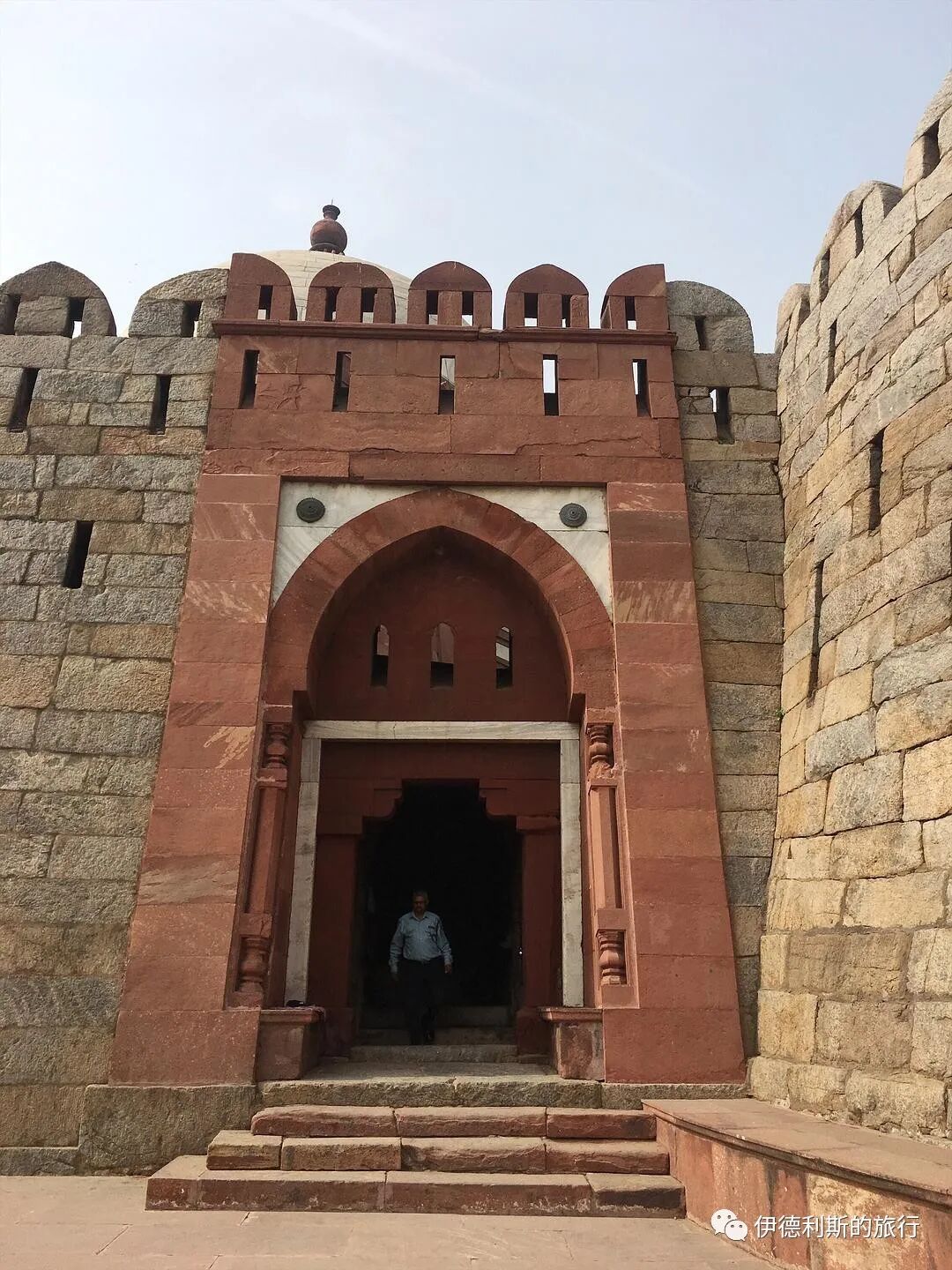
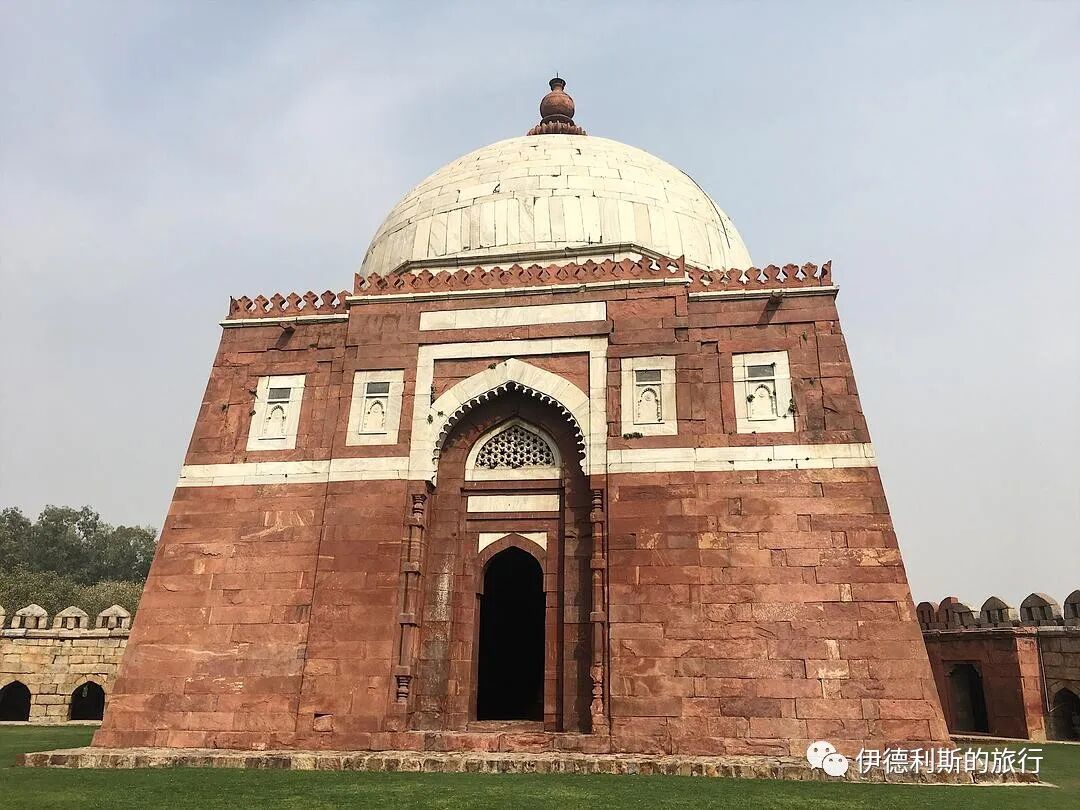
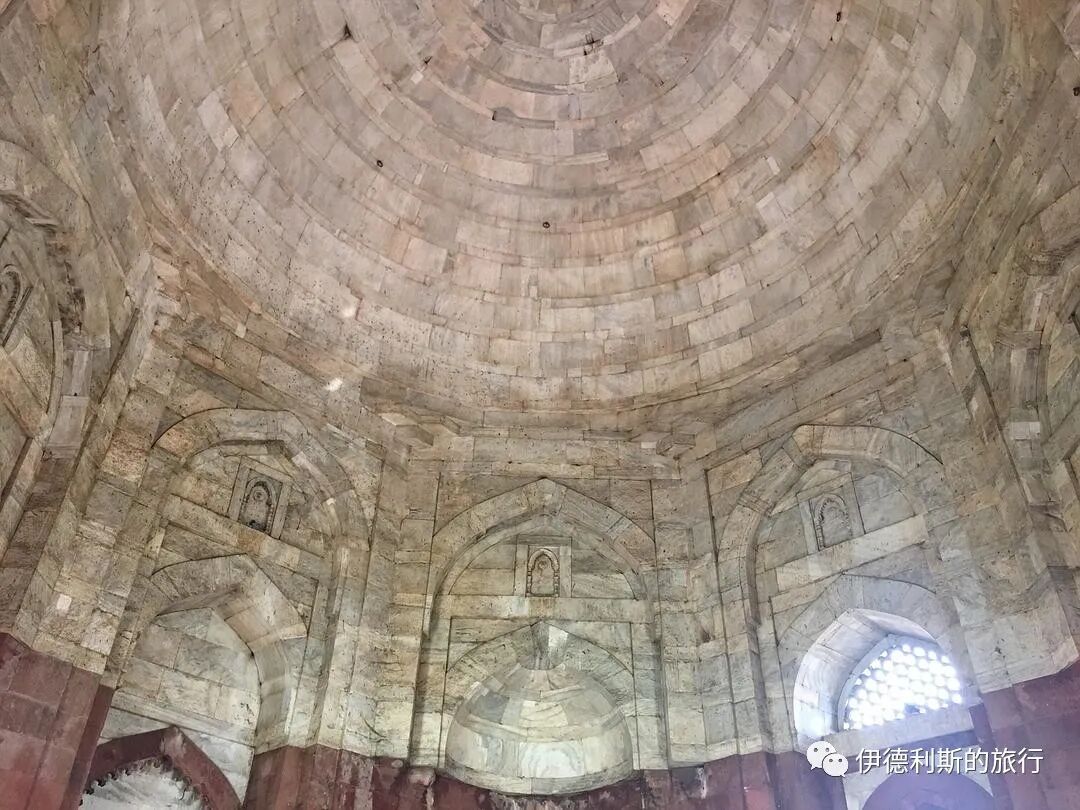
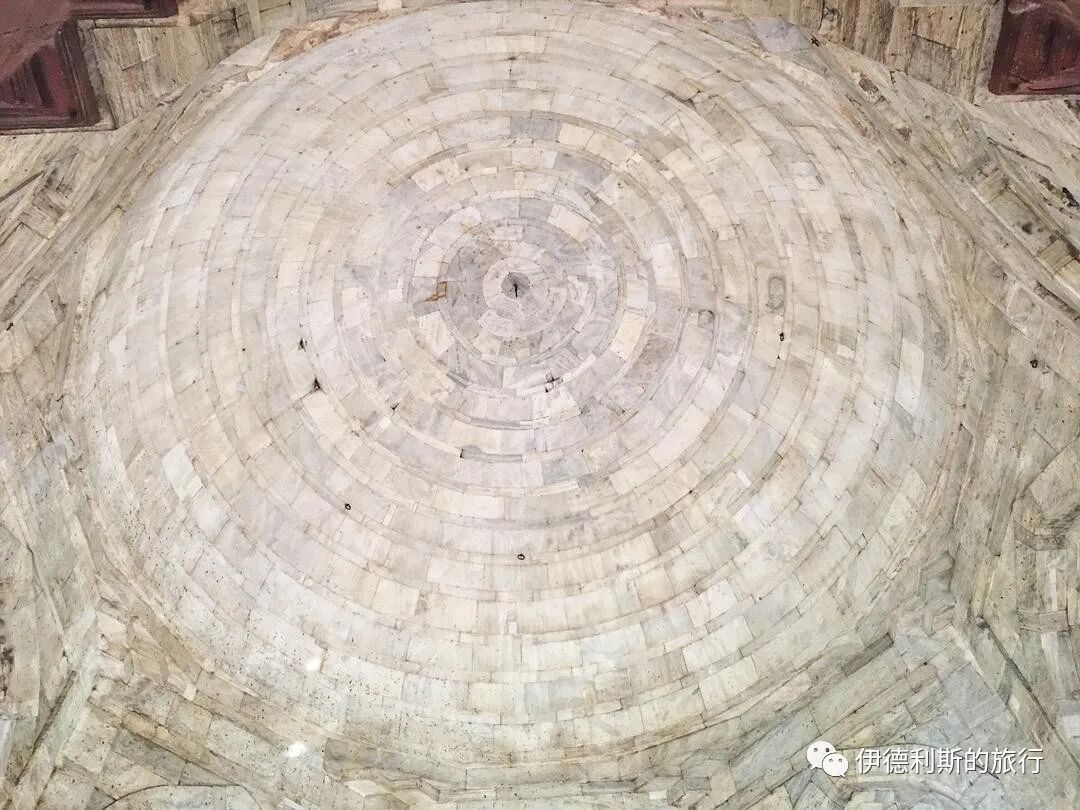
Ghazi's tomb sits atop a granite fortress. The tomb has a square dome and is built of red sandstone, inlaid with white marble slabs.
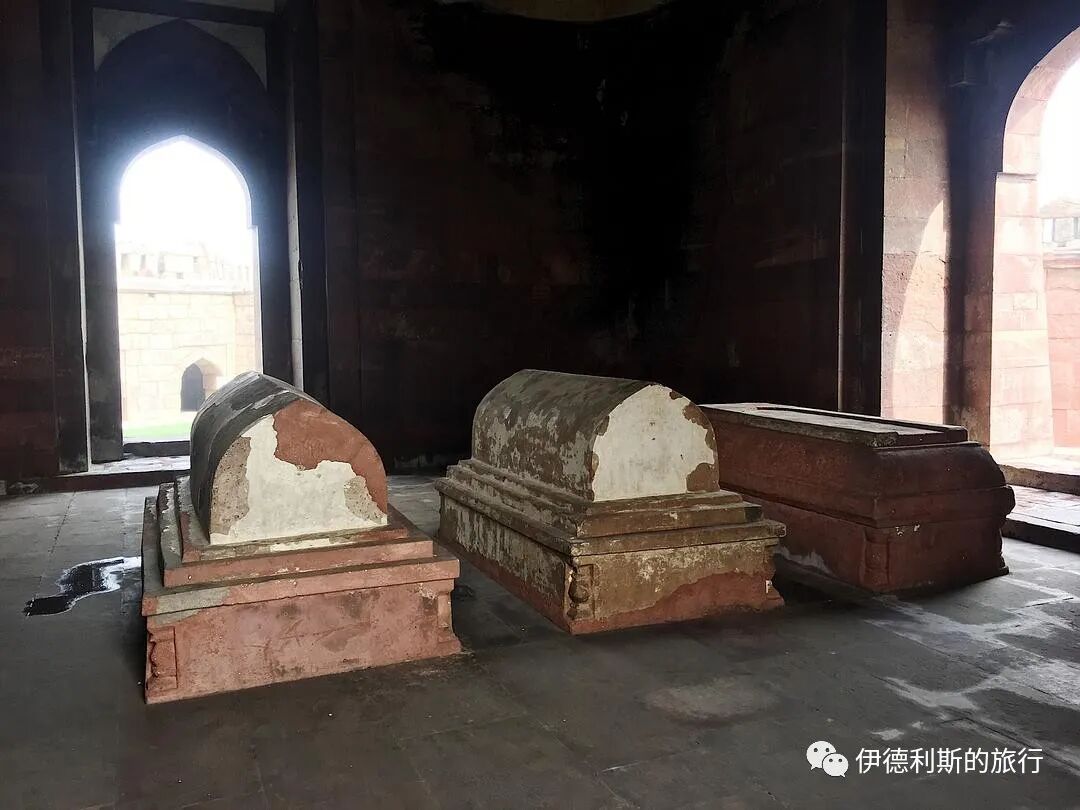
Inside the tomb are three grave markers; the middle one belongs to Ghazi himself, and the other two belong to his wife and his son Muhammad.
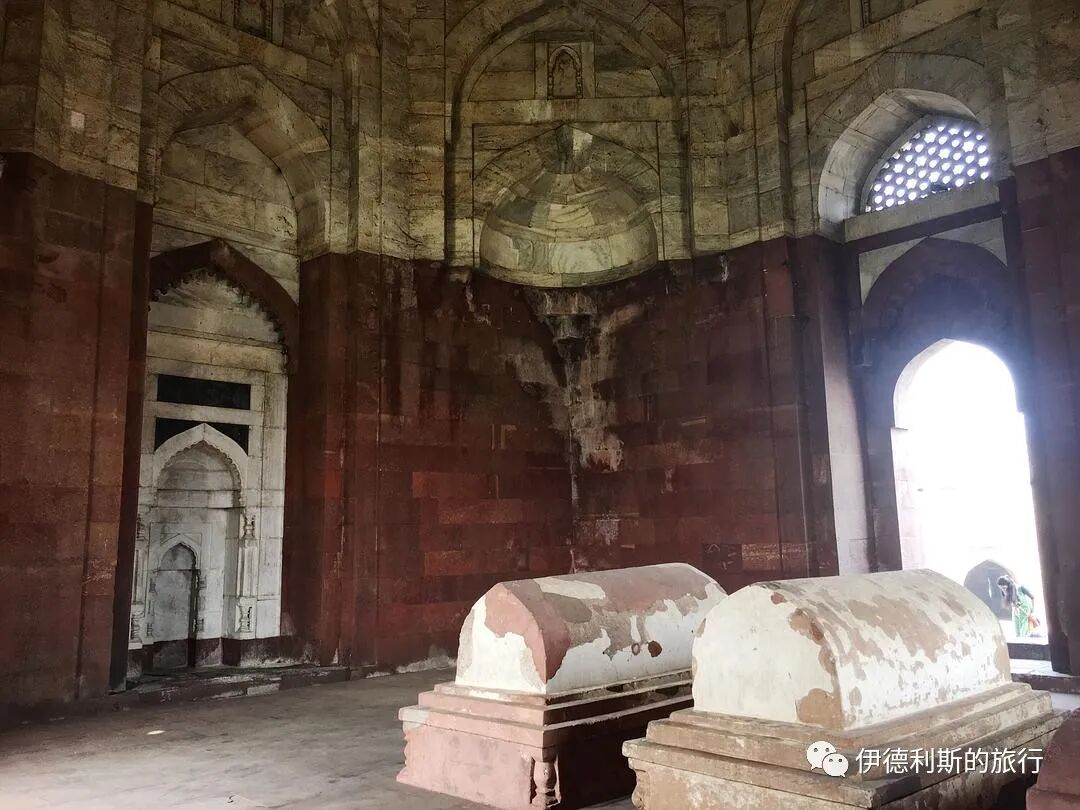
Dome
Fortress corridors and architectural pieces on the ground
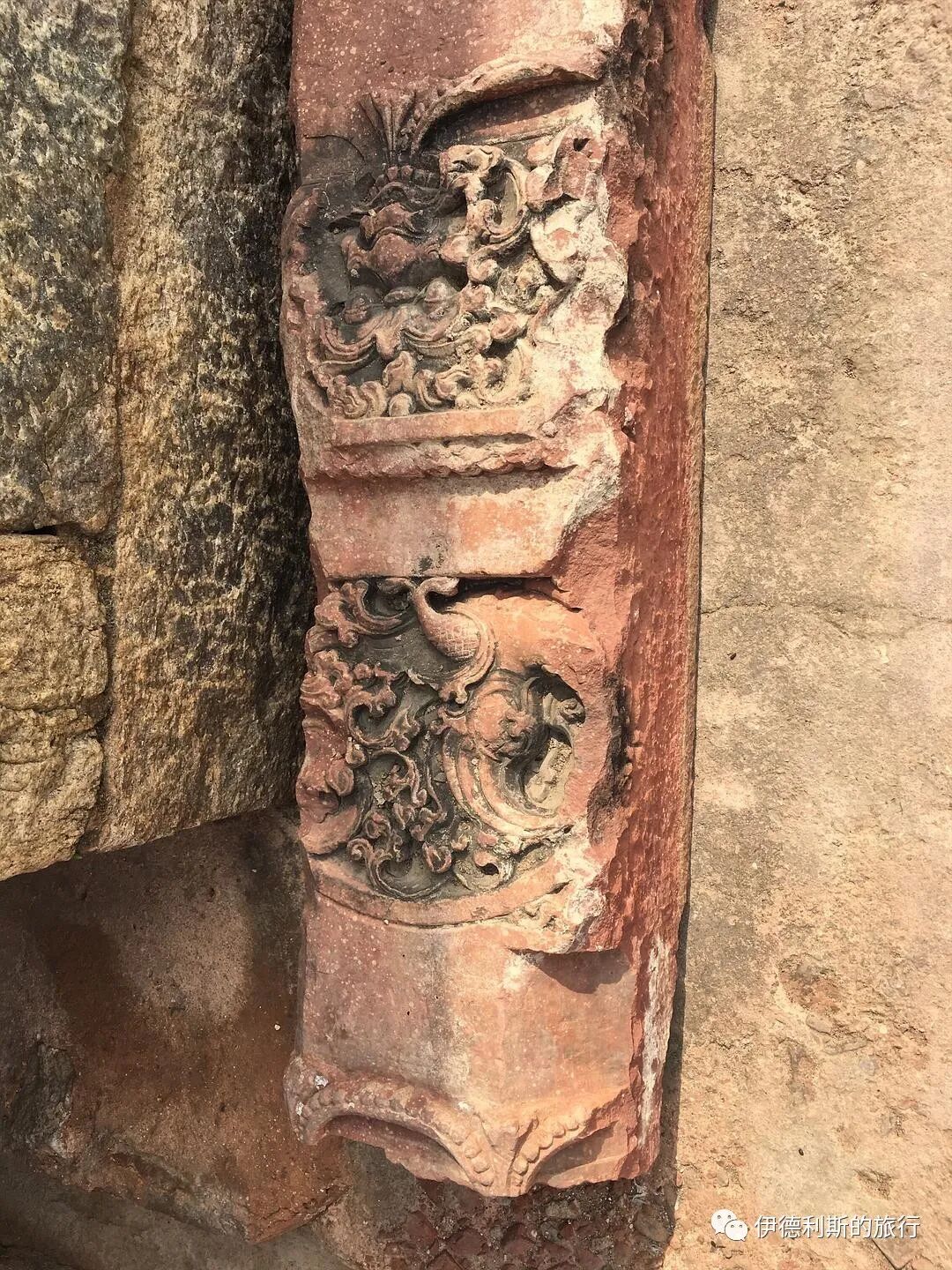
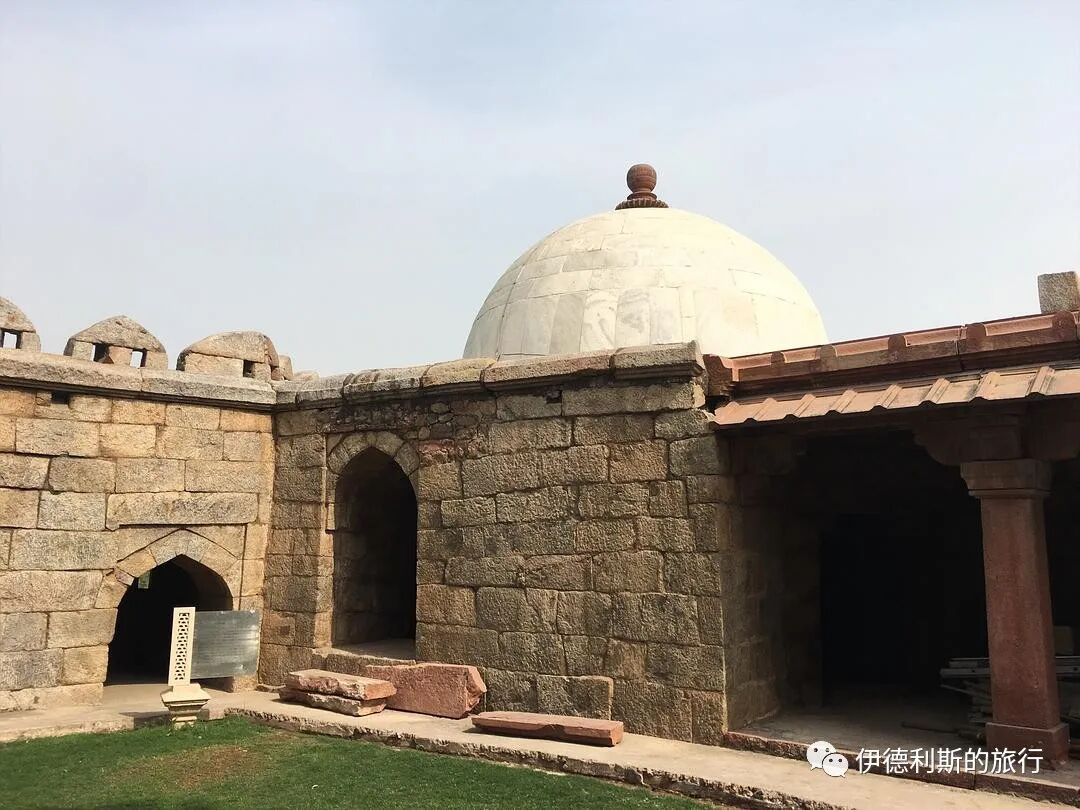
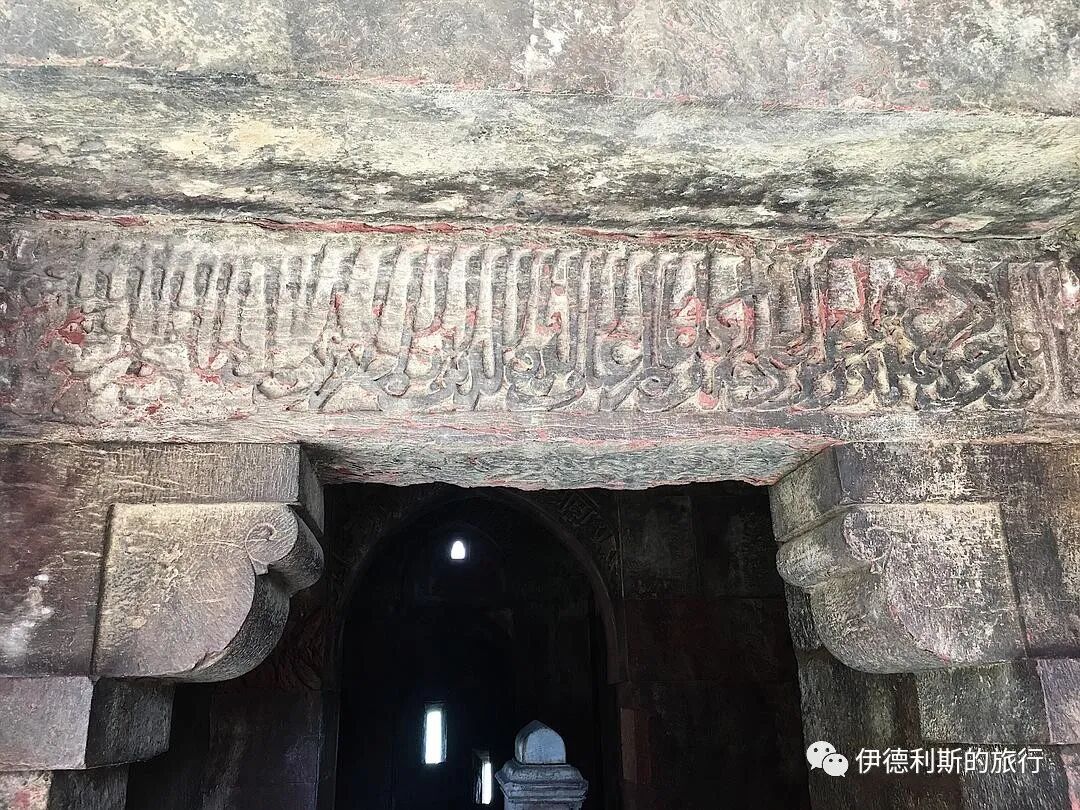
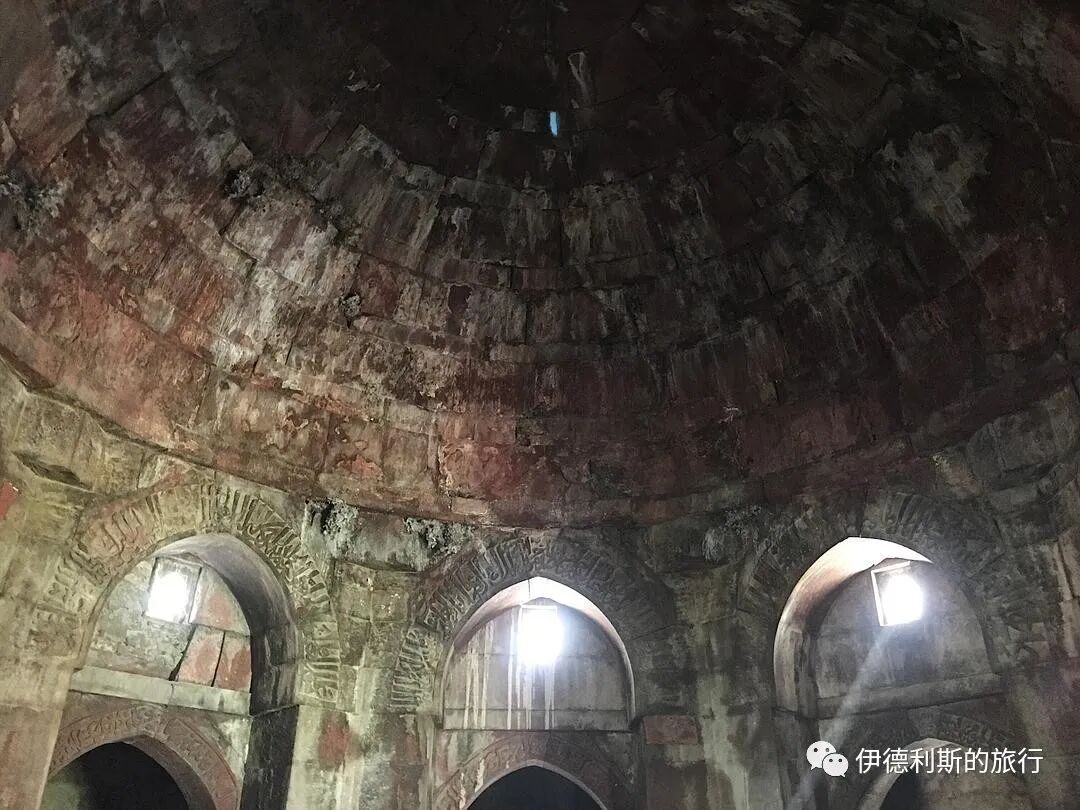
In the northwest corner of the fortress, there is another tomb containing an octagonal burial chamber. According to the stone inscription on the south gate, this tomb belongs to Zafar Khan.
Zafar Khan was a general of the Khalji dynasty of the Delhi Sultanate, and he died in 1299 during a decisive battle between the Mongol army of the Chagatai Khanate and the Delhi Sultanate on the outskirts of Delhi.
One theory is that Zafar Khan's tomb was already built on the current site before this, and Ghazi incorporated it into the fortress when building his own tomb. Another theory is that Zafar Khan's tomb was intentionally built by Ghazi next to his own.
6. Adilabad Fort
After Muhammad took the throne in 1325, he built a medium-sized castle called Adilabad fort to the southeast of Tughlaqabad.
People say Adilabad fort was connected to Tughlaqabad by a 1-kilometer-long causeway, but the causeway has now disappeared.
Compared to the majestic Tughlaqabad, Adilabad fort is much smaller in scale and is divided into inner and outer walls.
West gate
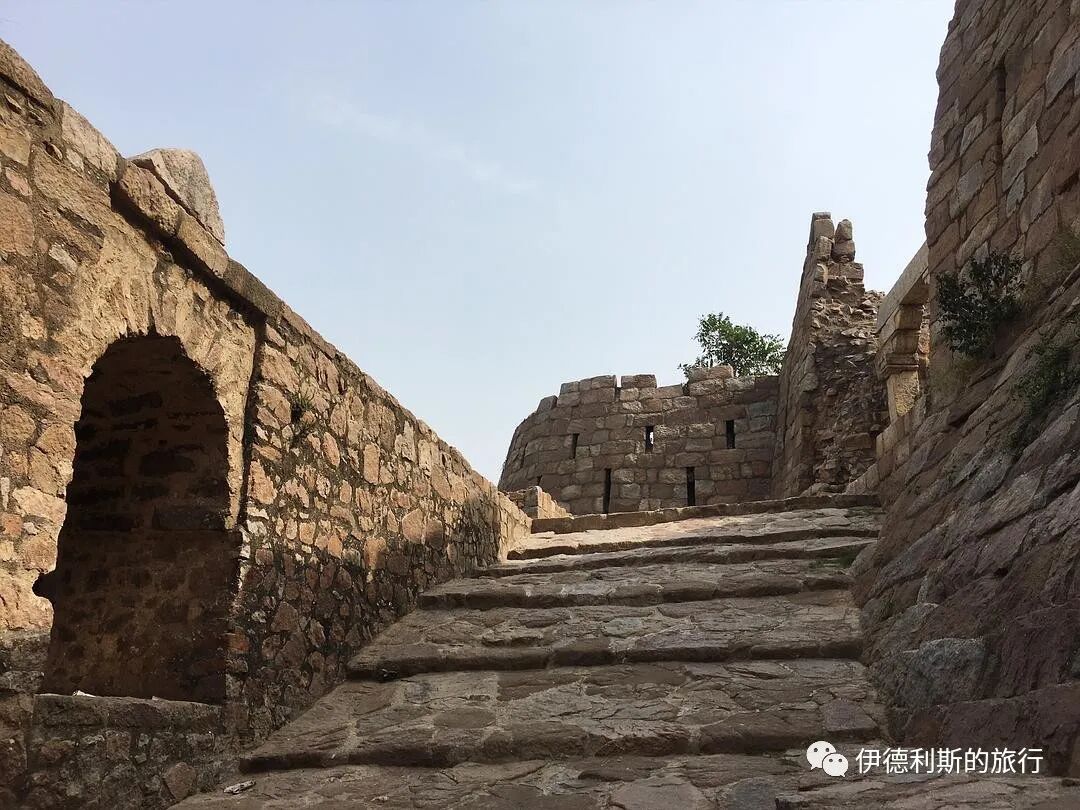
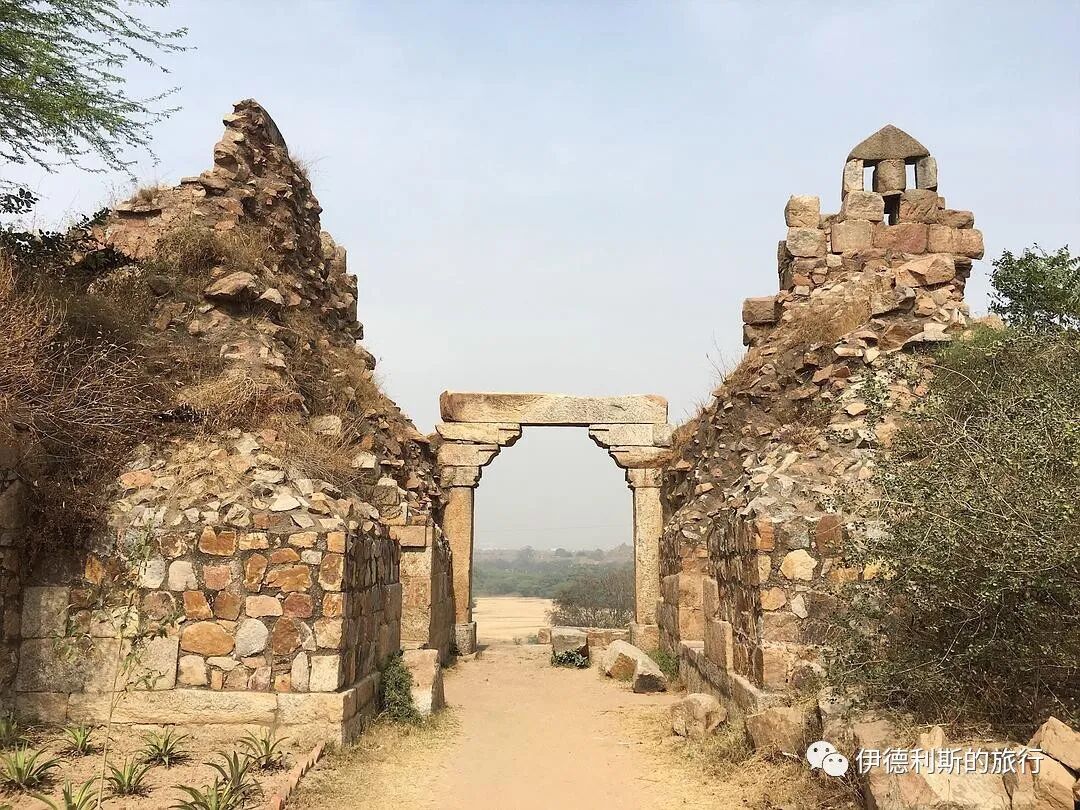
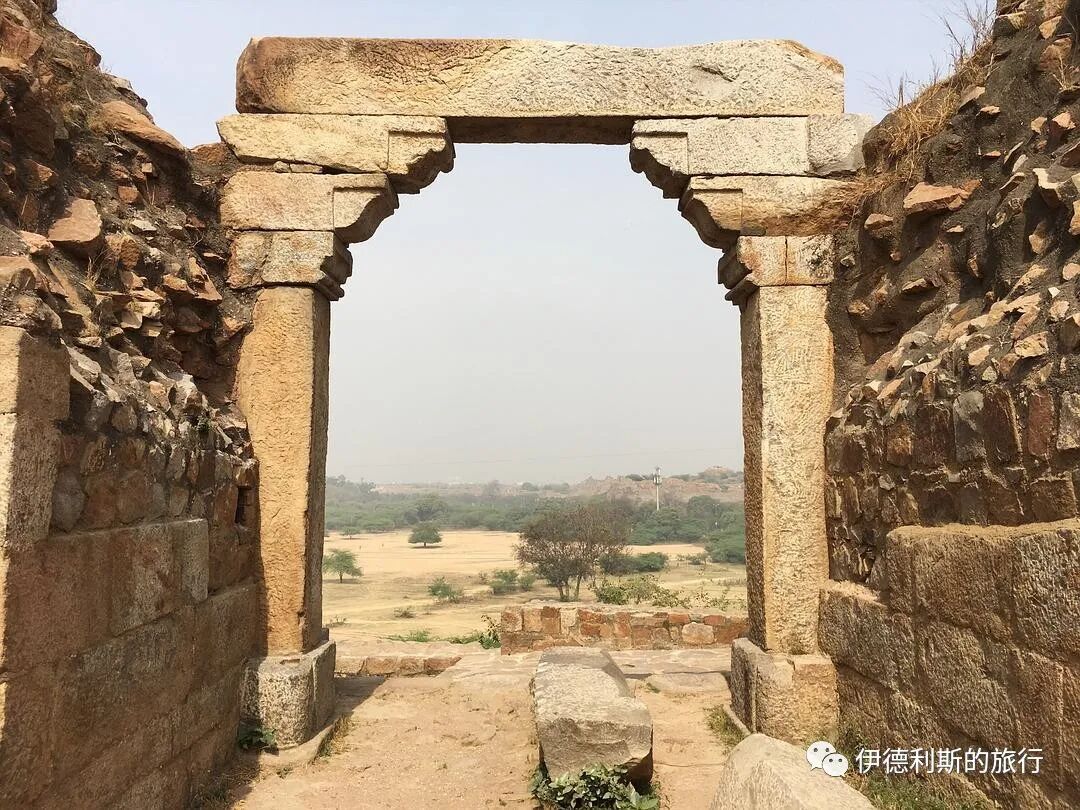
East gate, which takes a bit of effort to climb up to
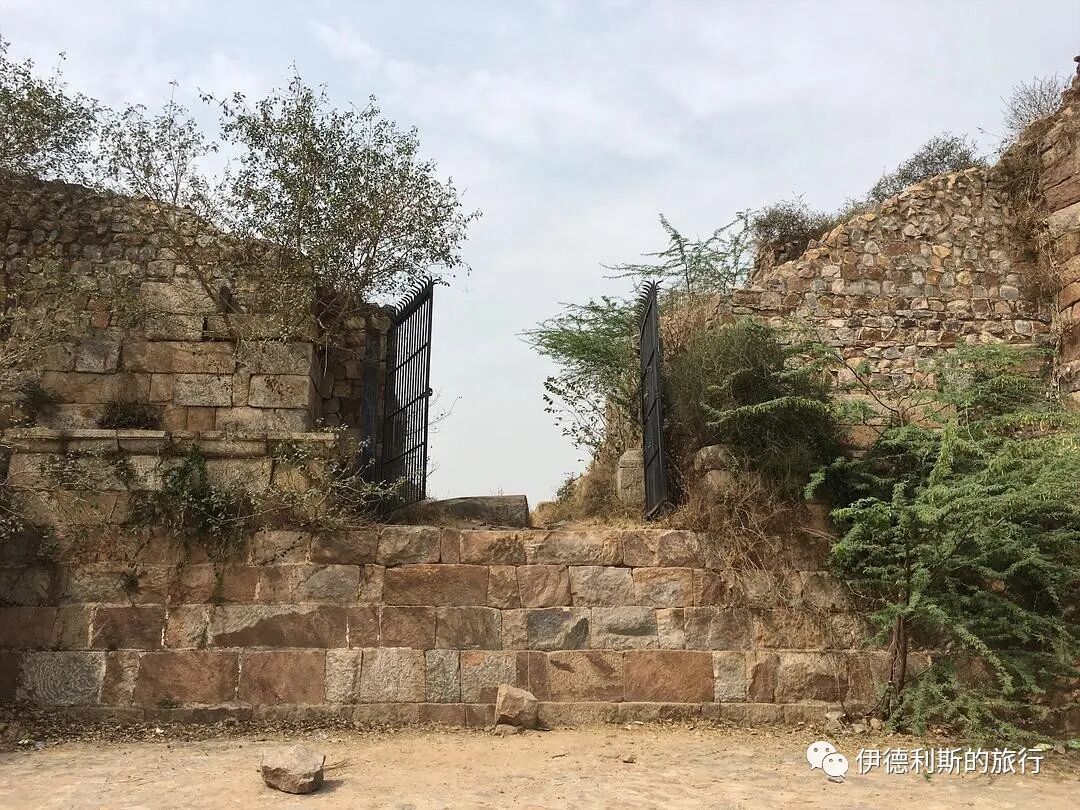
Looking down inside the city
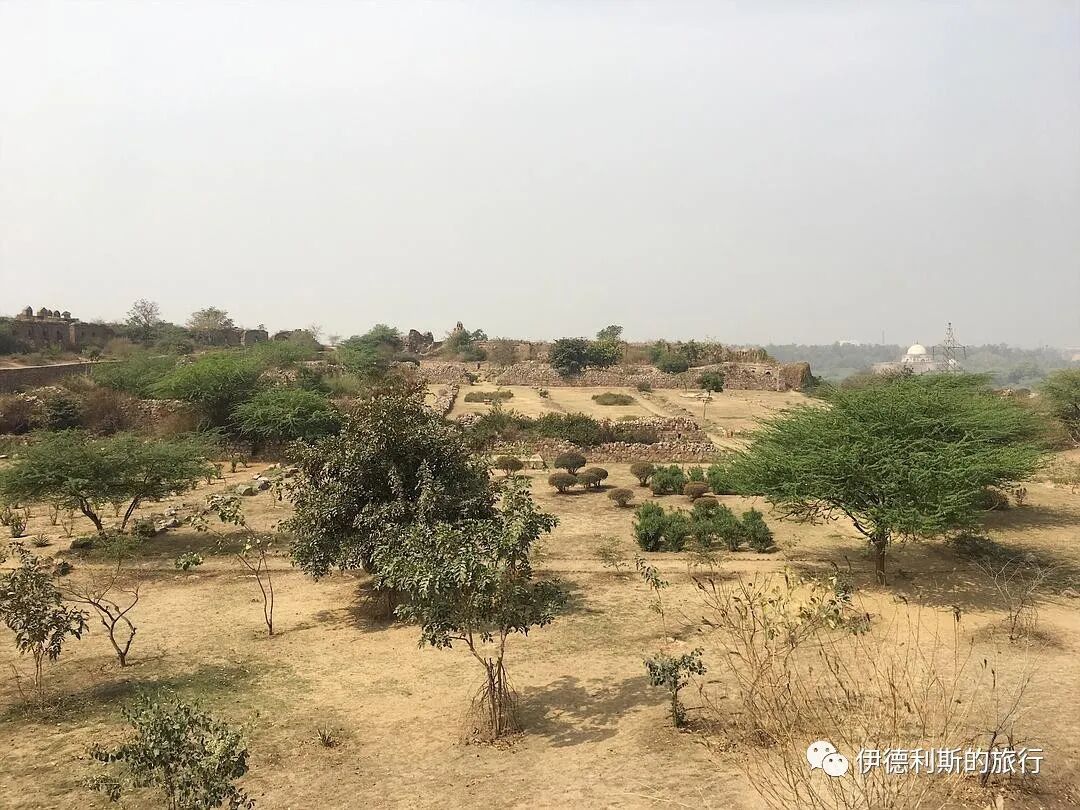
The core area is the palace district
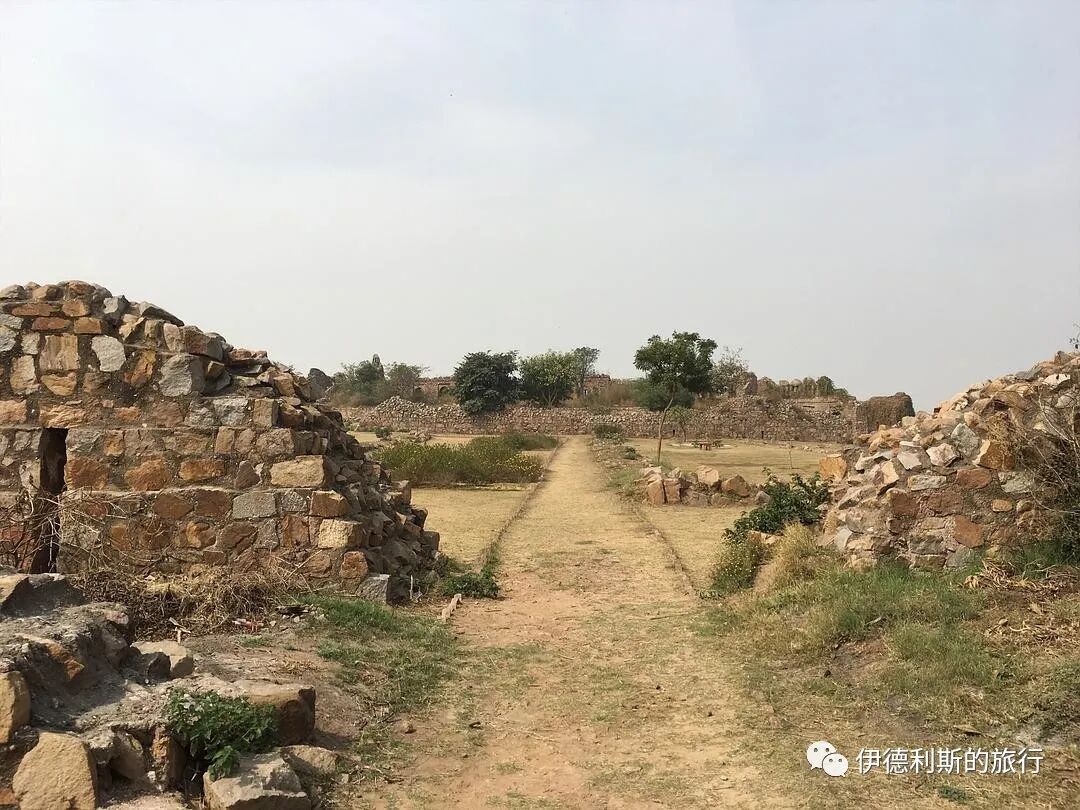
City wall
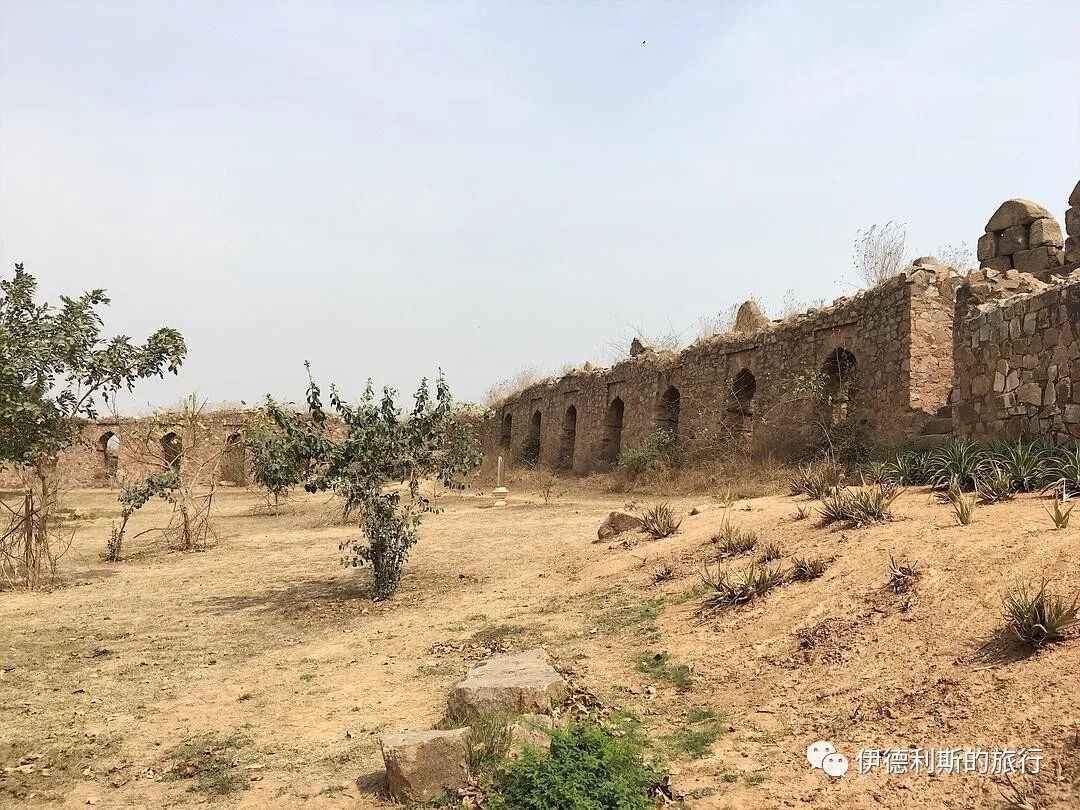
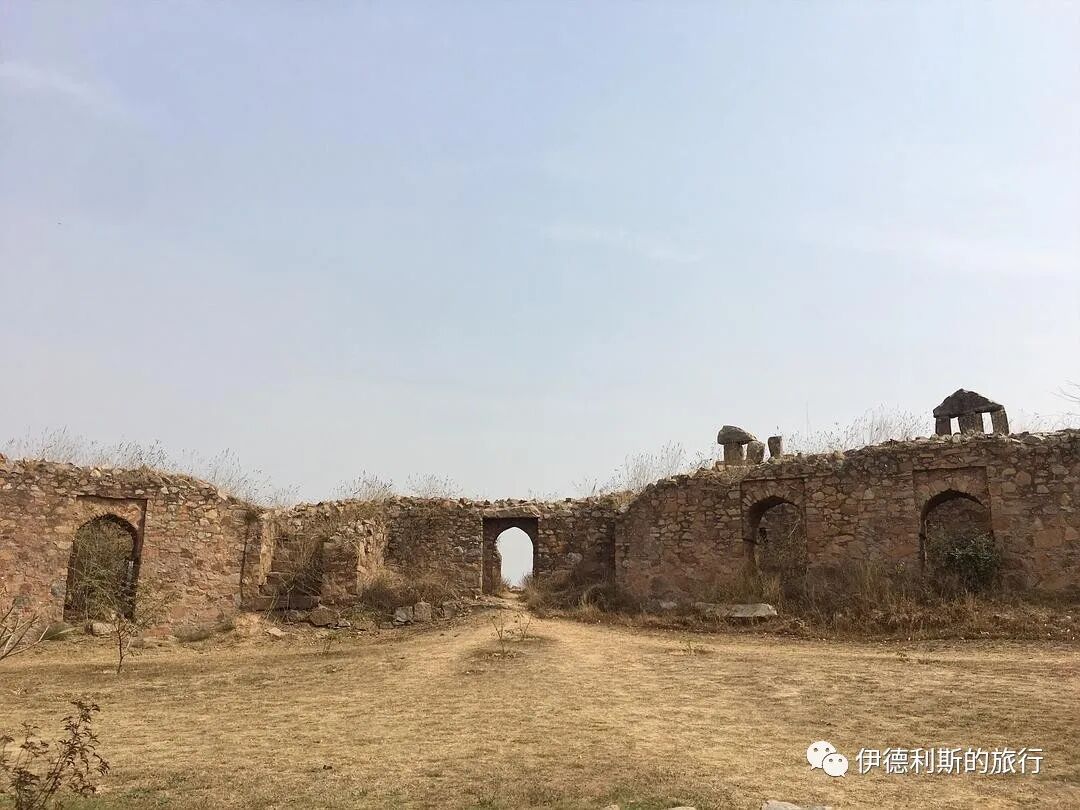
Besides the inner wall, there is also an outer wall
Summary: Delhi — Tughlaqabad Fort, Ruins and Muslim History is presented here as a firsthand travel account in clear English, beginning with this scene: In my first article, The First City of Delhi: The Tower Reaching the Clouds, I wrote about the Delhi Sultanate's Mamluk dynasty building the Qutub Minar. The account keeps its focus on Delhi Travel, Tughlaqabad Fort, Muslim Heritage while preserving the names, places, food, and historical details from the Chinese source.
In my first article, The First City of Delhi: The Tower Reaching the Clouds, I wrote about the Delhi Sultanate's Mamluk dynasty building the Qutub Minar. In the second article, The Second City of Delhi: The Turkic Fortress Defending Against the Mongol Army, I covered how the Khalji dynasty built a fortress to stop the Mongols. In this article, the Delhi Sultanate enters its third era: the Tughlaq dynasty.
Table of Contents
1. The Nemesis of the Afghan Mongols
1. Ghiyath al-Din Tughluq
2. Defeating the Mongols Twice
3. Taking the Fight to the Mongols
2. The Rise of the Tughlaq Dynasty
1. The Death of Alauddin Khalji
2. The Fall of the Khalji Dynasty
3. The Founding of the Tughlaq Dynasty
3. Building the City of Tughlaqabad
1. Legends of the Fortress Construction
2. The Curse of the Sufi Saint
4. Tughlaqabad Fortress
1. City Layout
2. The City Walls
3. The Palace District
4. The Citadel Area
5. The Tomb of Ghiyath al-Din Tughluq
6. Adilabad Fort
1. The Nemesis of the Afghan Mongols
1. Ghiyath al-Din Tughluq
Ghiyath al-Din Tughluq (Ghiyath al-Din Tughluq or Ghiyasuddin Tughlaq) was originally named Ghazi Malik. The title Ghazi refers to a warrior for Islam.
Ghazi came from a humble background. His father was a slave from the Qaraunah Turkic tribe, and his mother was a Hindu. The Qaraunah were a Turkic tribe living in Afghanistan under the Mongol Empire. In 1238, the Mongols moved them to the northwest border of India to defend against the Delhi Sultanate. This tribe took part in almost every Mongol invasion of India after 1241. Many were captured by the Delhi Sultanate and became slaves, which is how Ghazi's father arrived in the Delhi Sultanate.
Ghazi was a talented military leader. During the reign of Alauddin Khalji of the Khalji dynasty, he became the military governor of Dipalpur on the northwest border of the Delhi Sultanate and began fighting the Mongols.
The location of Dipalpur
2. Defeating the Mongols Twice
In my previous article, The Second City of Delhi: The Turkic Fortress Defending Against the Mongol Army, I mentioned that Ghazi served as a general during the two attacks on the Delhi Sultanate by the Chagatai Khanate Mongol army in 1305 and 1306.
During the 1305 Mongol invasion, the 14th-century Delhi chronicler Amir Khusrau wrote that the Mongol army was defeated as miserably as a swarm of mosquitoes trying to resist a strong wind. However, historical records do not provide many details about Ghazi's specific role in that battle.
When the Mongols invaded in 1306, the commander of the Delhi Sultanate was Malik Kafur, and Ghazi served as deputy commander, leading the vanguard. After the Sultanate's main army set out, Ghazi's vanguard quickly reached the northwest border and spotted the Mongol scouts. He reported the Mongol army's position to Kafur. The Delhi Sultanate's army moved at full speed and completely crushed the Chagatai Mongol army on the banks of the Ravi River, a tributary of the Indus River. A large number of Mongols were killed or captured.
The Chor Minar, a tower of heads built during the Delhi Khalji dynasty. The 225 holes on it are said to have once held the heads of killed Mongol captives.
3. Taking the Fight to the Mongols
According to the chronicler Amir Khusrau, the crushing defeat of the Mongols in 1306 caused the Mongols in Afghanistan to fear the Delhi Sultanate. They retreated to the mountains near the famous ancient city of Ghazni in southeastern Afghanistan. In 1307, Duwa, the Khan of the Chagatai Khanate, died, and Central Asia fell into chaos. His successors were unable to organize any more large-scale invasions.
On the other hand, defeating the Mongols repeatedly gave Ghazi a huge boost in confidence. He changed the Khalji dynasty's defensive policy against the Mongols and began to actively invade the Chagatai Khanate's territory in Afghanistan. Every year, Ghazi raided important Mongol cities in Afghanistan such as Kabul, Ghazni, Kandahar, and Garmsir, and even briefly recaptured Lahore, the early capital of the Delhi Sultanate.
The chronicler Amir Khusrau wrote in his book Tughluq-Nama that Ghazi won 20 battles, mostly against the Mongols. The famous Moroccan traveler Ibn Battuta passed by a mosque in Multan in the 14th century, where a stone tablet was inscribed with the claim that Ghazi had defeated the Mongols 29 times.
In this way, Ghazi became the military commander of the Punjab region on the northwestern frontier of the Delhi Sultanate.
Afghan cities under Mongol rule that were attacked by Ghazi.
2. The Rise of the Tughlaq Dynasty
1. The Death of Alauddin Khalji
In his final years, Sultan Alauddin Khalji grew to distrust his officers and favored only the eunuch slave general Malik Kafur.
In 1315, Alauddin fell seriously ill and appointed Kafur as regent (Na'ib), giving him real power.
Alauddin died on the night of January 4, 1316. The next day, Kafur gathered all the important officials and nobles to read the will, which named Alauddin's 6-year-old son Shihabuddin as the new Sultan, with Kafur as regent.
2. The Fall of the Khalji Dynasty
Kafur was regent for only about a month, during which he constantly persecuted Alauddin's family, upsetting some of Alauddin's former armed guards (paiks). Led by Mubashshir, the guards beheaded Kafur. They released Alauddin's older son Mubarak Shah, who had been imprisoned by Kafur, and named him the new regent.
On April 14, 1316, Mubarak Shah deposed his younger brother to become the new Sultan, taking the title Qutubuddin.
Mubarak Shah was bisexual and had same-sex relationships with the brothers Hasan and Husamuddin. Hasan and Husamuddin were brought to the Delhi Sultanate court as Hindu slaves in 1305. To survive, the brothers converted to Islam and served Mubarak Shah.
The relationship between Mubarak Shah and Hasan was no secret. They hugged and kissed in public, and Mubarak Shah gave Hasan the title Khusrau Khan.
In 1320, Mubarak Shah was killed by Khusrau Khan, ending the Khalji dynasty of the Delhi Sultanate.
Siri, the capital of the Delhi Sultanate's Khalji dynasty.
3. The Founding of the Tughlaq Dynasty
After Mubarak Shah was killed by Khusrau Khan, Khusrau Khan returned to his Hindu identity, which caused great dissatisfaction among Muslim officers and nobles. These officers and nobles supported Ghazi, the Punjab military commander who held a large army, to attack Khusrau Khan.
After Alauddin died, Ghazi gained military control over the Multan and Sindh regions. After receiving invitations from the Muslim officers and nobles, he and his son Fakhr Malik gathered a large army in Multan and Sindh and marched toward Delhi.
In September 1320, Ghazi defeated Khusrau Khan west of Siri in Delhi and established the Tughlaq dynasty, the third dynasty of the Delhi Sultanate. Ghazi received the title Ghiyath al-Din Tughluq, and his son received the title Muhammad Shah Tughluq.
3. Building the City of Tughlaqabad
After establishing the Tughlaq dynasty, Ghazi began building Tughlaqabad Fort in 1321. The massive 6.5-kilometer-long city was completed in just two years.
1. Legends of the Fortress Construction
There is a famous legend about the construction of Tughlaqabad Fort. Once, while walking with the last Sultan of the Khalji dynasty, Mubarak Shah, Ghazi suggested that the Sultan build a stronger fortress in Delhi. The Sultan joked that if you ever become Sultan, you can build the fortress yourself. As it turned out, his words came true.
2. The Curse of the Sufi Saint
Ghazi dreamed of building a fortress so strong that it could withstand the fiercest attacks from the Mongol army. However, fate did not go as he wished.
Ghazi was passionate about his fortress and ordered all laborers in Delhi to help build it. At the time, the famous Sufi saint Nizamuddin Auliya was building a water tank (baoli), and his laborers were forced to go build the fortress instead. But these people preferred to work for the saint, so they built the fortress for Ghazi during the day and the water tank for Nizamuddin at night. When Ghazi found out, he was very angry and forbade the laborers from working for Nizamuddin. Nizamuddin issued a curse: 'Ya rahey ujjar, ya basey gujjar'. It roughly means 'Either it will remain desolate, or it will be inhabited by the Gujjar people.' "
After the sultanate fell, the nomadic Gujjar people (gujjar) took over the castle, and it turned into a wilderness.
Nizamuddin Dargah in Delhi
4. Tughlaqabad Fortress
1. City Layout
The entire city is divided into three parts:
The largest part is the residential area in the north. Old photos from the 1940s show streets and the ruins of the Friday mosque (Juma Masjid), but they are hard to recognize now.
The southwest side is the palace area, where the buildings have collapsed significantly, though there is one well-preserved water well.
The southeast side is the smallest but most interesting part, the fortress area, which has many architectural ruins like houses, storage rooms, and a mosque.
The blue line shows the existing city walls.
2. The City Walls
Tughlaqabad City features the sloped rubble walls typical of the Tughlaq dynasty. The walls are 10 to 15 meters high and reinforced by two-story circular bastions. The city is said to have had as many as 52 gates, but only 13 remain today.
The southeast corner tower of the fortress area wall
The south city wall
The inside of the south city wall
The picture below shows the view from the northwest corner tower of the fortress area looking toward the east wall of the palace area.
In the picture below, the lower wall is the east wall of the palace area, and the higher one is the west wall of the fortress area.
Standing on the fortress area wall looking west toward the palace area wall.
The east wall of the palace area
The west wall of the fortress area
The collapsed west gate of the fortress area
The interior of the high platform on the west wall of the fortress area
3. The Palace District
The palace ruins of Tughlaqabad City have collapsed badly, so you can only imagine their former glory.
West of the palace is a water tank (baoli) that provided water for the castle.
4. The Citadel Area
The fortress area is the part of the city with the richest ruins.
Looking down at the entire fortress area:
A small mosque in the fortress area
The mihrab that indicates the direction of Mecca
The fortress area has a classic underground storage room:
The north entrance of the storage room
The south entrance of the storage room
The passage of the storage room, with individual warehouses on both sides.
There are also some residential ruins inside the fortress area.
5. The Tomb of Ghiyath al-Din Tughluq
I mentioned earlier the curse that the Sufi saint Nizamuddin placed on Ghiyas-ud-din. Another famous curse is "Hunuz Dilli dur ast". It means "Delhi is still far away." "
In 1324, Ghazi led an expedition to Bengal and succeeded. On the way back in February 1325, a wooden pavilion collapsed, crushing Ghazi and his second son, Mahmud Khan, to death. The famous 14th-century Moroccan traveler Ibn Battuta believed that his eldest son, Muhammad bin Tughluq, killed his father.
After Ghazi died, his eldest son Muhammad succeeded him as Sultan and buried Ghazi in a tomb south of the city of Tughlaqabad.
The Mausoleum of Ghiyas ud-Din Tughluq connects to the city of Tughlaqabad to the north via a causeway. This 182-meter causeway has 27 arches, and there used to be an artificial lake underneath. The lake has now been filled in to become flat land, and the middle of the causeway is split in two by a road.
Ghazi's tomb sits atop a granite fortress. The tomb has a square dome and is built of red sandstone, inlaid with white marble slabs.
Inside the tomb are three grave markers; the middle one belongs to Ghazi himself, and the other two belong to his wife and his son Muhammad.
Dome
Fortress corridors and architectural pieces on the ground
In the northwest corner of the fortress, there is another tomb containing an octagonal burial chamber. According to the stone inscription on the south gate, this tomb belongs to Zafar Khan.
Zafar Khan was a general of the Khalji dynasty of the Delhi Sultanate, and he died in 1299 during a decisive battle between the Mongol army of the Chagatai Khanate and the Delhi Sultanate on the outskirts of Delhi.
One theory is that Zafar Khan's tomb was already built on the current site before this, and Ghazi incorporated it into the fortress when building his own tomb. Another theory is that Zafar Khan's tomb was intentionally built by Ghazi next to his own.
6. Adilabad Fort
After Muhammad took the throne in 1325, he built a medium-sized castle called Adilabad fort to the southeast of Tughlaqabad.
People say Adilabad fort was connected to Tughlaqabad by a 1-kilometer-long causeway, but the causeway has now disappeared.
Compared to the majestic Tughlaqabad, Adilabad fort is much smaller in scale and is divided into inner and outer walls.
West gate
East gate, which takes a bit of effort to climb up to
Looking down inside the city
The core area is the palace district
City wall
Besides the inner wall, there is also an outer wall
Halal Travel Guide: Delhi — Tughlaqabad Fort, Ruins and Muslim History
Articles • ali2007fr posted the article • 0 comments • 142 views • 2026-05-17 12:22
Reposted from the web
Summary: Delhi — Tughlaqabad Fort, Ruins and Muslim History is presented here as a firsthand travel account in clear English, beginning with this scene: In my first article, The First City of Delhi: The Tower Reaching the Clouds, I wrote about the Delhi Sultanate's Mamluk dynasty building the Qutub Minar. The account keeps its focus on Delhi Travel, Tughlaqabad Fort, Muslim Heritage while preserving the names, places, food, and historical details from the Chinese source.
In my first article, The First City of Delhi: The Tower Reaching the Clouds, I wrote about the Delhi Sultanate's Mamluk dynasty building the Qutub Minar. In the second article, The Second City of Delhi: The Turkic Fortress Defending Against the Mongol Army, I covered how the Khalji dynasty built a fortress to stop the Mongols. In this article, the Delhi Sultanate enters its third era: the Tughlaq dynasty.
Table of Contents
1. The Nemesis of the Afghan Mongols
1. Ghiyath al-Din Tughluq
2. Defeating the Mongols Twice
3. Taking the Fight to the Mongols
2. The Rise of the Tughlaq Dynasty
1. The Death of Alauddin Khalji
2. The Fall of the Khalji Dynasty
3. The Founding of the Tughlaq Dynasty
3. Building the City of Tughlaqabad
1. Legends of the Fortress Construction
2. The Curse of the Sufi Saint
4. Tughlaqabad Fortress
1. City Layout
2. The City Walls
3. The Palace District
4. The Citadel Area
5. The Tomb of Ghiyath al-Din Tughluq
6. Adilabad Fort
1. The Nemesis of the Afghan Mongols
1. Ghiyath al-Din Tughluq
Ghiyath al-Din Tughluq (Ghiyath al-Din Tughluq or Ghiyasuddin Tughlaq) was originally named Ghazi Malik. The title Ghazi refers to a warrior for Islam.
Ghazi came from a humble background. His father was a slave from the Qaraunah Turkic tribe, and his mother was a Hindu. The Qaraunah were a Turkic tribe living in Afghanistan under the Mongol Empire. In 1238, the Mongols moved them to the northwest border of India to defend against the Delhi Sultanate. This tribe took part in almost every Mongol invasion of India after 1241. Many were captured by the Delhi Sultanate and became slaves, which is how Ghazi's father arrived in the Delhi Sultanate.
Ghazi was a talented military leader. During the reign of Alauddin Khalji of the Khalji dynasty, he became the military governor of Dipalpur on the northwest border of the Delhi Sultanate and began fighting the Mongols.
The location of Dipalpur
2. Defeating the Mongols Twice
In my previous article, The Second City of Delhi: The Turkic Fortress Defending Against the Mongol Army, I mentioned that Ghazi served as a general during the two attacks on the Delhi Sultanate by the Chagatai Khanate Mongol army in 1305 and 1306.
During the 1305 Mongol invasion, the 14th-century Delhi chronicler Amir Khusrau wrote that the Mongol army was defeated as miserably as a swarm of mosquitoes trying to resist a strong wind. However, historical records do not provide many details about Ghazi's specific role in that battle.
When the Mongols invaded in 1306, the commander of the Delhi Sultanate was Malik Kafur, and Ghazi served as deputy commander, leading the vanguard. After the Sultanate's main army set out, Ghazi's vanguard quickly reached the northwest border and spotted the Mongol scouts. He reported the Mongol army's position to Kafur. The Delhi Sultanate's army moved at full speed and completely crushed the Chagatai Mongol army on the banks of the Ravi River, a tributary of the Indus River. A large number of Mongols were killed or captured.
The Chor Minar, a tower of heads built during the Delhi Khalji dynasty. The 225 holes on it are said to have once held the heads of killed Mongol captives.
3. Taking the Fight to the Mongols
According to the chronicler Amir Khusrau, the crushing defeat of the Mongols in 1306 caused the Mongols in Afghanistan to fear the Delhi Sultanate. They retreated to the mountains near the famous ancient city of Ghazni in southeastern Afghanistan. In 1307, Duwa, the Khan of the Chagatai Khanate, died, and Central Asia fell into chaos. His successors were unable to organize any more large-scale invasions.
On the other hand, defeating the Mongols repeatedly gave Ghazi a huge boost in confidence. He changed the Khalji dynasty's defensive policy against the Mongols and began to actively invade the Chagatai Khanate's territory in Afghanistan. Every year, Ghazi raided important Mongol cities in Afghanistan such as Kabul, Ghazni, Kandahar, and Garmsir, and even briefly recaptured Lahore, the early capital of the Delhi Sultanate.
The chronicler Amir Khusrau wrote in his book Tughluq-Nama that Ghazi won 20 battles, mostly against the Mongols. The famous Moroccan traveler Ibn Battuta passed by a mosque in Multan in the 14th century, where a stone tablet was inscribed with the claim that Ghazi had defeated the Mongols 29 times.
In this way, Ghazi became the military commander of the Punjab region on the northwestern frontier of the Delhi Sultanate.
Afghan cities under Mongol rule that were attacked by Ghazi.
2. The Rise of the Tughlaq Dynasty
1. The Death of Alauddin Khalji
In his final years, Sultan Alauddin Khalji grew to distrust his officers and favored only the eunuch slave general Malik Kafur.
In 1315, Alauddin fell seriously ill and appointed Kafur as regent (Na'ib), giving him real power.
Alauddin died on the night of January 4, 1316. The next day, Kafur gathered all the important officials and nobles to read the will, which named Alauddin's 6-year-old son Shihabuddin as the new Sultan, with Kafur as regent.
2. The Fall of the Khalji Dynasty
Kafur was regent for only about a month, during which he constantly persecuted Alauddin's family, upsetting some of Alauddin's former armed guards (paiks). Led by Mubashshir, the guards beheaded Kafur. They released Alauddin's older son Mubarak Shah, who had been imprisoned by Kafur, and named him the new regent.
On April 14, 1316, Mubarak Shah deposed his younger brother to become the new Sultan, taking the title Qutubuddin.
Mubarak Shah was bisexual and had same-sex relationships with the brothers Hasan and Husamuddin. Hasan and Husamuddin were brought to the Delhi Sultanate court as Hindu slaves in 1305. To survive, the brothers converted to Islam and served Mubarak Shah.
The relationship between Mubarak Shah and Hasan was no secret. They hugged and kissed in public, and Mubarak Shah gave Hasan the title Khusrau Khan.
In 1320, Mubarak Shah was killed by Khusrau Khan, ending the Khalji dynasty of the Delhi Sultanate.
Siri, the capital of the Delhi Sultanate's Khalji dynasty.
3. The Founding of the Tughlaq Dynasty
After Mubarak Shah was killed by Khusrau Khan, Khusrau Khan returned to his Hindu identity, which caused great dissatisfaction among Muslim officers and nobles. These officers and nobles supported Ghazi, the Punjab military commander who held a large army, to attack Khusrau Khan.
After Alauddin died, Ghazi gained military control over the Multan and Sindh regions. After receiving invitations from the Muslim officers and nobles, he and his son Fakhr Malik gathered a large army in Multan and Sindh and marched toward Delhi.
In September 1320, Ghazi defeated Khusrau Khan west of Siri in Delhi and established the Tughlaq dynasty, the third dynasty of the Delhi Sultanate. Ghazi received the title Ghiyath al-Din Tughluq, and his son received the title Muhammad Shah Tughluq.
3. Building the City of Tughlaqabad
After establishing the Tughlaq dynasty, Ghazi began building Tughlaqabad Fort in 1321. The massive 6.5-kilometer-long city was completed in just two years.
1. Legends of the Fortress Construction
There is a famous legend about the construction of Tughlaqabad Fort. Once, while walking with the last Sultan of the Khalji dynasty, Mubarak Shah, Ghazi suggested that the Sultan build a stronger fortress in Delhi. The Sultan joked that if you ever become Sultan, you can build the fortress yourself. As it turned out, his words came true.
2. The Curse of the Sufi Saint
Ghazi dreamed of building a fortress so strong that it could withstand the fiercest attacks from the Mongol army. However, fate did not go as he wished.
Ghazi was passionate about his fortress and ordered all laborers in Delhi to help build it. At the time, the famous Sufi saint Nizamuddin Auliya was building a water tank (baoli), and his laborers were forced to go build the fortress instead. But these people preferred to work for the saint, so they built the fortress for Ghazi during the day and the water tank for Nizamuddin at night. When Ghazi found out, he was very angry and forbade the laborers from working for Nizamuddin. Nizamuddin issued a curse: 'Ya rahey ujjar, ya basey gujjar'. It roughly means 'Either it will remain desolate, or it will be inhabited by the Gujjar people.' "
After the sultanate fell, the nomadic Gujjar people (gujjar) took over the castle, and it turned into a wilderness.
Nizamuddin Dargah in Delhi
4. Tughlaqabad Fortress
1. City Layout
The entire city is divided into three parts:
The largest part is the residential area in the north. Old photos from the 1940s show streets and the ruins of the Friday mosque (Juma Masjid), but they are hard to recognize now.
The southwest side is the palace area, where the buildings have collapsed significantly, though there is one well-preserved water well.
The southeast side is the smallest but most interesting part, the fortress area, which has many architectural ruins like houses, storage rooms, and a mosque.
The blue line shows the existing city walls.
2. The City Walls
Tughlaqabad City features the sloped rubble walls typical of the Tughlaq dynasty. The walls are 10 to 15 meters high and reinforced by two-story circular bastions. The city is said to have had as many as 52 gates, but only 13 remain today.
The southeast corner tower of the fortress area wall
The south city wall
The inside of the south city wall
The picture below shows the view from the northwest corner tower of the fortress area looking toward the east wall of the palace area.
In the picture below, the lower wall is the east wall of the palace area, and the higher one is the west wall of the fortress area.
Standing on the fortress area wall looking west toward the palace area wall.
The east wall of the palace area
The west wall of the fortress area
The collapsed west gate of the fortress area
The interior of the high platform on the west wall of the fortress area
3. The Palace District
The palace ruins of Tughlaqabad City have collapsed badly, so you can only imagine their former glory.
West of the palace is a water tank (baoli) that provided water for the castle.
4. The Citadel Area
The fortress area is the part of the city with the richest ruins.
Looking down at the entire fortress area:
A small mosque in the fortress area
The mihrab that indicates the direction of Mecca
The fortress area has a classic underground storage room:
The north entrance of the storage room
The south entrance of the storage room
The passage of the storage room, with individual warehouses on both sides.
There are also some residential ruins inside the fortress area.
5. The Tomb of Ghiyath al-Din Tughluq
I mentioned earlier the curse that the Sufi saint Nizamuddin placed on Ghiyas-ud-din. Another famous curse is "Hunuz Dilli dur ast". It means "Delhi is still far away." "
In 1324, Ghazi led an expedition to Bengal and succeeded. On the way back in February 1325, a wooden pavilion collapsed, crushing Ghazi and his second son, Mahmud Khan, to death. The famous 14th-century Moroccan traveler Ibn Battuta believed that his eldest son, Muhammad bin Tughluq, killed his father.
After Ghazi died, his eldest son Muhammad succeeded him as Sultan and buried Ghazi in a tomb south of the city of Tughlaqabad.
The Mausoleum of Ghiyas ud-Din Tughluq connects to the city of Tughlaqabad to the north via a causeway. This 182-meter causeway has 27 arches, and there used to be an artificial lake underneath. The lake has now been filled in to become flat land, and the middle of the causeway is split in two by a road.
Ghazi's tomb sits atop a granite fortress. The tomb has a square dome and is built of red sandstone, inlaid with white marble slabs.
Inside the tomb are three grave markers; the middle one belongs to Ghazi himself, and the other two belong to his wife and his son Muhammad.
Dome
Fortress corridors and architectural pieces on the ground
In the northwest corner of the fortress, there is another tomb containing an octagonal burial chamber. According to the stone inscription on the south gate, this tomb belongs to Zafar Khan.
Zafar Khan was a general of the Khalji dynasty of the Delhi Sultanate, and he died in 1299 during a decisive battle between the Mongol army of the Chagatai Khanate and the Delhi Sultanate on the outskirts of Delhi.
One theory is that Zafar Khan's tomb was already built on the current site before this, and Ghazi incorporated it into the fortress when building his own tomb. Another theory is that Zafar Khan's tomb was intentionally built by Ghazi next to his own.
6. Adilabad Fort
After Muhammad took the throne in 1325, he built a medium-sized castle called Adilabad fort to the southeast of Tughlaqabad.
People say Adilabad fort was connected to Tughlaqabad by a 1-kilometer-long causeway, but the causeway has now disappeared.
Compared to the majestic Tughlaqabad, Adilabad fort is much smaller in scale and is divided into inner and outer walls.
West gate
East gate, which takes a bit of effort to climb up to
Looking down inside the city
The core area is the palace district
City wall
Besides the inner wall, there is also an outer wall view all
Summary: Delhi — Tughlaqabad Fort, Ruins and Muslim History is presented here as a firsthand travel account in clear English, beginning with this scene: In my first article, The First City of Delhi: The Tower Reaching the Clouds, I wrote about the Delhi Sultanate's Mamluk dynasty building the Qutub Minar. The account keeps its focus on Delhi Travel, Tughlaqabad Fort, Muslim Heritage while preserving the names, places, food, and historical details from the Chinese source.
In my first article, The First City of Delhi: The Tower Reaching the Clouds, I wrote about the Delhi Sultanate's Mamluk dynasty building the Qutub Minar. In the second article, The Second City of Delhi: The Turkic Fortress Defending Against the Mongol Army, I covered how the Khalji dynasty built a fortress to stop the Mongols. In this article, the Delhi Sultanate enters its third era: the Tughlaq dynasty.
Table of Contents
1. The Nemesis of the Afghan Mongols
1. Ghiyath al-Din Tughluq
2. Defeating the Mongols Twice
3. Taking the Fight to the Mongols
2. The Rise of the Tughlaq Dynasty
1. The Death of Alauddin Khalji
2. The Fall of the Khalji Dynasty
3. The Founding of the Tughlaq Dynasty
3. Building the City of Tughlaqabad
1. Legends of the Fortress Construction
2. The Curse of the Sufi Saint
4. Tughlaqabad Fortress
1. City Layout
2. The City Walls
3. The Palace District
4. The Citadel Area
5. The Tomb of Ghiyath al-Din Tughluq
6. Adilabad Fort
1. The Nemesis of the Afghan Mongols
1. Ghiyath al-Din Tughluq
Ghiyath al-Din Tughluq (Ghiyath al-Din Tughluq or Ghiyasuddin Tughlaq) was originally named Ghazi Malik. The title Ghazi refers to a warrior for Islam.
Ghazi came from a humble background. His father was a slave from the Qaraunah Turkic tribe, and his mother was a Hindu. The Qaraunah were a Turkic tribe living in Afghanistan under the Mongol Empire. In 1238, the Mongols moved them to the northwest border of India to defend against the Delhi Sultanate. This tribe took part in almost every Mongol invasion of India after 1241. Many were captured by the Delhi Sultanate and became slaves, which is how Ghazi's father arrived in the Delhi Sultanate.
Ghazi was a talented military leader. During the reign of Alauddin Khalji of the Khalji dynasty, he became the military governor of Dipalpur on the northwest border of the Delhi Sultanate and began fighting the Mongols.
The location of Dipalpur
2. Defeating the Mongols Twice
In my previous article, The Second City of Delhi: The Turkic Fortress Defending Against the Mongol Army, I mentioned that Ghazi served as a general during the two attacks on the Delhi Sultanate by the Chagatai Khanate Mongol army in 1305 and 1306.
During the 1305 Mongol invasion, the 14th-century Delhi chronicler Amir Khusrau wrote that the Mongol army was defeated as miserably as a swarm of mosquitoes trying to resist a strong wind. However, historical records do not provide many details about Ghazi's specific role in that battle.
When the Mongols invaded in 1306, the commander of the Delhi Sultanate was Malik Kafur, and Ghazi served as deputy commander, leading the vanguard. After the Sultanate's main army set out, Ghazi's vanguard quickly reached the northwest border and spotted the Mongol scouts. He reported the Mongol army's position to Kafur. The Delhi Sultanate's army moved at full speed and completely crushed the Chagatai Mongol army on the banks of the Ravi River, a tributary of the Indus River. A large number of Mongols were killed or captured.
The Chor Minar, a tower of heads built during the Delhi Khalji dynasty. The 225 holes on it are said to have once held the heads of killed Mongol captives.
3. Taking the Fight to the Mongols
According to the chronicler Amir Khusrau, the crushing defeat of the Mongols in 1306 caused the Mongols in Afghanistan to fear the Delhi Sultanate. They retreated to the mountains near the famous ancient city of Ghazni in southeastern Afghanistan. In 1307, Duwa, the Khan of the Chagatai Khanate, died, and Central Asia fell into chaos. His successors were unable to organize any more large-scale invasions.
On the other hand, defeating the Mongols repeatedly gave Ghazi a huge boost in confidence. He changed the Khalji dynasty's defensive policy against the Mongols and began to actively invade the Chagatai Khanate's territory in Afghanistan. Every year, Ghazi raided important Mongol cities in Afghanistan such as Kabul, Ghazni, Kandahar, and Garmsir, and even briefly recaptured Lahore, the early capital of the Delhi Sultanate.
The chronicler Amir Khusrau wrote in his book Tughluq-Nama that Ghazi won 20 battles, mostly against the Mongols. The famous Moroccan traveler Ibn Battuta passed by a mosque in Multan in the 14th century, where a stone tablet was inscribed with the claim that Ghazi had defeated the Mongols 29 times.
In this way, Ghazi became the military commander of the Punjab region on the northwestern frontier of the Delhi Sultanate.
Afghan cities under Mongol rule that were attacked by Ghazi.
2. The Rise of the Tughlaq Dynasty
1. The Death of Alauddin Khalji
In his final years, Sultan Alauddin Khalji grew to distrust his officers and favored only the eunuch slave general Malik Kafur.
In 1315, Alauddin fell seriously ill and appointed Kafur as regent (Na'ib), giving him real power.
Alauddin died on the night of January 4, 1316. The next day, Kafur gathered all the important officials and nobles to read the will, which named Alauddin's 6-year-old son Shihabuddin as the new Sultan, with Kafur as regent.
2. The Fall of the Khalji Dynasty
Kafur was regent for only about a month, during which he constantly persecuted Alauddin's family, upsetting some of Alauddin's former armed guards (paiks). Led by Mubashshir, the guards beheaded Kafur. They released Alauddin's older son Mubarak Shah, who had been imprisoned by Kafur, and named him the new regent.
On April 14, 1316, Mubarak Shah deposed his younger brother to become the new Sultan, taking the title Qutubuddin.
Mubarak Shah was bisexual and had same-sex relationships with the brothers Hasan and Husamuddin. Hasan and Husamuddin were brought to the Delhi Sultanate court as Hindu slaves in 1305. To survive, the brothers converted to Islam and served Mubarak Shah.
The relationship between Mubarak Shah and Hasan was no secret. They hugged and kissed in public, and Mubarak Shah gave Hasan the title Khusrau Khan.
In 1320, Mubarak Shah was killed by Khusrau Khan, ending the Khalji dynasty of the Delhi Sultanate.
Siri, the capital of the Delhi Sultanate's Khalji dynasty.
3. The Founding of the Tughlaq Dynasty
After Mubarak Shah was killed by Khusrau Khan, Khusrau Khan returned to his Hindu identity, which caused great dissatisfaction among Muslim officers and nobles. These officers and nobles supported Ghazi, the Punjab military commander who held a large army, to attack Khusrau Khan.
After Alauddin died, Ghazi gained military control over the Multan and Sindh regions. After receiving invitations from the Muslim officers and nobles, he and his son Fakhr Malik gathered a large army in Multan and Sindh and marched toward Delhi.
In September 1320, Ghazi defeated Khusrau Khan west of Siri in Delhi and established the Tughlaq dynasty, the third dynasty of the Delhi Sultanate. Ghazi received the title Ghiyath al-Din Tughluq, and his son received the title Muhammad Shah Tughluq.
3. Building the City of Tughlaqabad
After establishing the Tughlaq dynasty, Ghazi began building Tughlaqabad Fort in 1321. The massive 6.5-kilometer-long city was completed in just two years.
1. Legends of the Fortress Construction
There is a famous legend about the construction of Tughlaqabad Fort. Once, while walking with the last Sultan of the Khalji dynasty, Mubarak Shah, Ghazi suggested that the Sultan build a stronger fortress in Delhi. The Sultan joked that if you ever become Sultan, you can build the fortress yourself. As it turned out, his words came true.
2. The Curse of the Sufi Saint
Ghazi dreamed of building a fortress so strong that it could withstand the fiercest attacks from the Mongol army. However, fate did not go as he wished.
Ghazi was passionate about his fortress and ordered all laborers in Delhi to help build it. At the time, the famous Sufi saint Nizamuddin Auliya was building a water tank (baoli), and his laborers were forced to go build the fortress instead. But these people preferred to work for the saint, so they built the fortress for Ghazi during the day and the water tank for Nizamuddin at night. When Ghazi found out, he was very angry and forbade the laborers from working for Nizamuddin. Nizamuddin issued a curse: 'Ya rahey ujjar, ya basey gujjar'. It roughly means 'Either it will remain desolate, or it will be inhabited by the Gujjar people.' "
After the sultanate fell, the nomadic Gujjar people (gujjar) took over the castle, and it turned into a wilderness.
Nizamuddin Dargah in Delhi
4. Tughlaqabad Fortress
1. City Layout
The entire city is divided into three parts:
The largest part is the residential area in the north. Old photos from the 1940s show streets and the ruins of the Friday mosque (Juma Masjid), but they are hard to recognize now.
The southwest side is the palace area, where the buildings have collapsed significantly, though there is one well-preserved water well.
The southeast side is the smallest but most interesting part, the fortress area, which has many architectural ruins like houses, storage rooms, and a mosque.
The blue line shows the existing city walls.
2. The City Walls
Tughlaqabad City features the sloped rubble walls typical of the Tughlaq dynasty. The walls are 10 to 15 meters high and reinforced by two-story circular bastions. The city is said to have had as many as 52 gates, but only 13 remain today.
The southeast corner tower of the fortress area wall
The south city wall
The inside of the south city wall
The picture below shows the view from the northwest corner tower of the fortress area looking toward the east wall of the palace area.
In the picture below, the lower wall is the east wall of the palace area, and the higher one is the west wall of the fortress area.
Standing on the fortress area wall looking west toward the palace area wall.
The east wall of the palace area
The west wall of the fortress area
The collapsed west gate of the fortress area
The interior of the high platform on the west wall of the fortress area
3. The Palace District
The palace ruins of Tughlaqabad City have collapsed badly, so you can only imagine their former glory.
West of the palace is a water tank (baoli) that provided water for the castle.
4. The Citadel Area
The fortress area is the part of the city with the richest ruins.
Looking down at the entire fortress area:
A small mosque in the fortress area
The mihrab that indicates the direction of Mecca
The fortress area has a classic underground storage room:
The north entrance of the storage room
The south entrance of the storage room
The passage of the storage room, with individual warehouses on both sides.
There are also some residential ruins inside the fortress area.
5. The Tomb of Ghiyath al-Din Tughluq
I mentioned earlier the curse that the Sufi saint Nizamuddin placed on Ghiyas-ud-din. Another famous curse is "Hunuz Dilli dur ast". It means "Delhi is still far away." "
In 1324, Ghazi led an expedition to Bengal and succeeded. On the way back in February 1325, a wooden pavilion collapsed, crushing Ghazi and his second son, Mahmud Khan, to death. The famous 14th-century Moroccan traveler Ibn Battuta believed that his eldest son, Muhammad bin Tughluq, killed his father.
After Ghazi died, his eldest son Muhammad succeeded him as Sultan and buried Ghazi in a tomb south of the city of Tughlaqabad.
The Mausoleum of Ghiyas ud-Din Tughluq connects to the city of Tughlaqabad to the north via a causeway. This 182-meter causeway has 27 arches, and there used to be an artificial lake underneath. The lake has now been filled in to become flat land, and the middle of the causeway is split in two by a road.
Ghazi's tomb sits atop a granite fortress. The tomb has a square dome and is built of red sandstone, inlaid with white marble slabs.
Inside the tomb are three grave markers; the middle one belongs to Ghazi himself, and the other two belong to his wife and his son Muhammad.
Dome
Fortress corridors and architectural pieces on the ground
In the northwest corner of the fortress, there is another tomb containing an octagonal burial chamber. According to the stone inscription on the south gate, this tomb belongs to Zafar Khan.
Zafar Khan was a general of the Khalji dynasty of the Delhi Sultanate, and he died in 1299 during a decisive battle between the Mongol army of the Chagatai Khanate and the Delhi Sultanate on the outskirts of Delhi.
One theory is that Zafar Khan's tomb was already built on the current site before this, and Ghazi incorporated it into the fortress when building his own tomb. Another theory is that Zafar Khan's tomb was intentionally built by Ghazi next to his own.
6. Adilabad Fort
After Muhammad took the throne in 1325, he built a medium-sized castle called Adilabad fort to the southeast of Tughlaqabad.
People say Adilabad fort was connected to Tughlaqabad by a 1-kilometer-long causeway, but the causeway has now disappeared.
Compared to the majestic Tughlaqabad, Adilabad fort is much smaller in scale and is divided into inner and outer walls.
West gate
East gate, which takes a bit of effort to climb up to
Looking down inside the city
The core area is the palace district
City wall
Besides the inner wall, there is also an outer wall view all
Reposted from the web
Summary: Delhi — Tughlaqabad Fort, Ruins and Muslim History is presented here as a firsthand travel account in clear English, beginning with this scene: In my first article, The First City of Delhi: The Tower Reaching the Clouds, I wrote about the Delhi Sultanate's Mamluk dynasty building the Qutub Minar. The account keeps its focus on Delhi Travel, Tughlaqabad Fort, Muslim Heritage while preserving the names, places, food, and historical details from the Chinese source.
In my first article, The First City of Delhi: The Tower Reaching the Clouds, I wrote about the Delhi Sultanate's Mamluk dynasty building the Qutub Minar. In the second article, The Second City of Delhi: The Turkic Fortress Defending Against the Mongol Army, I covered how the Khalji dynasty built a fortress to stop the Mongols. In this article, the Delhi Sultanate enters its third era: the Tughlaq dynasty.
Table of Contents
1. The Nemesis of the Afghan Mongols
1. Ghiyath al-Din Tughluq
2. Defeating the Mongols Twice
3. Taking the Fight to the Mongols
2. The Rise of the Tughlaq Dynasty
1. The Death of Alauddin Khalji
2. The Fall of the Khalji Dynasty
3. The Founding of the Tughlaq Dynasty
3. Building the City of Tughlaqabad
1. Legends of the Fortress Construction
2. The Curse of the Sufi Saint
4. Tughlaqabad Fortress
1. City Layout
2. The City Walls
3. The Palace District
4. The Citadel Area
5. The Tomb of Ghiyath al-Din Tughluq
6. Adilabad Fort
1. The Nemesis of the Afghan Mongols
1. Ghiyath al-Din Tughluq
Ghiyath al-Din Tughluq (Ghiyath al-Din Tughluq or Ghiyasuddin Tughlaq) was originally named Ghazi Malik. The title Ghazi refers to a warrior for Islam.
Ghazi came from a humble background. His father was a slave from the Qaraunah Turkic tribe, and his mother was a Hindu. The Qaraunah were a Turkic tribe living in Afghanistan under the Mongol Empire. In 1238, the Mongols moved them to the northwest border of India to defend against the Delhi Sultanate. This tribe took part in almost every Mongol invasion of India after 1241. Many were captured by the Delhi Sultanate and became slaves, which is how Ghazi's father arrived in the Delhi Sultanate.
Ghazi was a talented military leader. During the reign of Alauddin Khalji of the Khalji dynasty, he became the military governor of Dipalpur on the northwest border of the Delhi Sultanate and began fighting the Mongols.
The location of Dipalpur
2. Defeating the Mongols Twice
In my previous article, The Second City of Delhi: The Turkic Fortress Defending Against the Mongol Army, I mentioned that Ghazi served as a general during the two attacks on the Delhi Sultanate by the Chagatai Khanate Mongol army in 1305 and 1306.
During the 1305 Mongol invasion, the 14th-century Delhi chronicler Amir Khusrau wrote that the Mongol army was defeated as miserably as a swarm of mosquitoes trying to resist a strong wind. However, historical records do not provide many details about Ghazi's specific role in that battle.
When the Mongols invaded in 1306, the commander of the Delhi Sultanate was Malik Kafur, and Ghazi served as deputy commander, leading the vanguard. After the Sultanate's main army set out, Ghazi's vanguard quickly reached the northwest border and spotted the Mongol scouts. He reported the Mongol army's position to Kafur. The Delhi Sultanate's army moved at full speed and completely crushed the Chagatai Mongol army on the banks of the Ravi River, a tributary of the Indus River. A large number of Mongols were killed or captured.
The Chor Minar, a tower of heads built during the Delhi Khalji dynasty. The 225 holes on it are said to have once held the heads of killed Mongol captives.
3. Taking the Fight to the Mongols
According to the chronicler Amir Khusrau, the crushing defeat of the Mongols in 1306 caused the Mongols in Afghanistan to fear the Delhi Sultanate. They retreated to the mountains near the famous ancient city of Ghazni in southeastern Afghanistan. In 1307, Duwa, the Khan of the Chagatai Khanate, died, and Central Asia fell into chaos. His successors were unable to organize any more large-scale invasions.
On the other hand, defeating the Mongols repeatedly gave Ghazi a huge boost in confidence. He changed the Khalji dynasty's defensive policy against the Mongols and began to actively invade the Chagatai Khanate's territory in Afghanistan. Every year, Ghazi raided important Mongol cities in Afghanistan such as Kabul, Ghazni, Kandahar, and Garmsir, and even briefly recaptured Lahore, the early capital of the Delhi Sultanate.
The chronicler Amir Khusrau wrote in his book Tughluq-Nama that Ghazi won 20 battles, mostly against the Mongols. The famous Moroccan traveler Ibn Battuta passed by a mosque in Multan in the 14th century, where a stone tablet was inscribed with the claim that Ghazi had defeated the Mongols 29 times.
In this way, Ghazi became the military commander of the Punjab region on the northwestern frontier of the Delhi Sultanate.
Afghan cities under Mongol rule that were attacked by Ghazi.
2. The Rise of the Tughlaq Dynasty
1. The Death of Alauddin Khalji
In his final years, Sultan Alauddin Khalji grew to distrust his officers and favored only the eunuch slave general Malik Kafur.
In 1315, Alauddin fell seriously ill and appointed Kafur as regent (Na'ib), giving him real power.
Alauddin died on the night of January 4, 1316. The next day, Kafur gathered all the important officials and nobles to read the will, which named Alauddin's 6-year-old son Shihabuddin as the new Sultan, with Kafur as regent.
2. The Fall of the Khalji Dynasty
Kafur was regent for only about a month, during which he constantly persecuted Alauddin's family, upsetting some of Alauddin's former armed guards (paiks). Led by Mubashshir, the guards beheaded Kafur. They released Alauddin's older son Mubarak Shah, who had been imprisoned by Kafur, and named him the new regent.
On April 14, 1316, Mubarak Shah deposed his younger brother to become the new Sultan, taking the title Qutubuddin.
Mubarak Shah was bisexual and had same-sex relationships with the brothers Hasan and Husamuddin. Hasan and Husamuddin were brought to the Delhi Sultanate court as Hindu slaves in 1305. To survive, the brothers converted to Islam and served Mubarak Shah.
The relationship between Mubarak Shah and Hasan was no secret. They hugged and kissed in public, and Mubarak Shah gave Hasan the title Khusrau Khan.
In 1320, Mubarak Shah was killed by Khusrau Khan, ending the Khalji dynasty of the Delhi Sultanate.
Siri, the capital of the Delhi Sultanate's Khalji dynasty.
3. The Founding of the Tughlaq Dynasty
After Mubarak Shah was killed by Khusrau Khan, Khusrau Khan returned to his Hindu identity, which caused great dissatisfaction among Muslim officers and nobles. These officers and nobles supported Ghazi, the Punjab military commander who held a large army, to attack Khusrau Khan.
After Alauddin died, Ghazi gained military control over the Multan and Sindh regions. After receiving invitations from the Muslim officers and nobles, he and his son Fakhr Malik gathered a large army in Multan and Sindh and marched toward Delhi.
In September 1320, Ghazi defeated Khusrau Khan west of Siri in Delhi and established the Tughlaq dynasty, the third dynasty of the Delhi Sultanate. Ghazi received the title Ghiyath al-Din Tughluq, and his son received the title Muhammad Shah Tughluq.
3. Building the City of Tughlaqabad
After establishing the Tughlaq dynasty, Ghazi began building Tughlaqabad Fort in 1321. The massive 6.5-kilometer-long city was completed in just two years.
1. Legends of the Fortress Construction
There is a famous legend about the construction of Tughlaqabad Fort. Once, while walking with the last Sultan of the Khalji dynasty, Mubarak Shah, Ghazi suggested that the Sultan build a stronger fortress in Delhi. The Sultan joked that if you ever become Sultan, you can build the fortress yourself. As it turned out, his words came true.
2. The Curse of the Sufi Saint
Ghazi dreamed of building a fortress so strong that it could withstand the fiercest attacks from the Mongol army. However, fate did not go as he wished.
Ghazi was passionate about his fortress and ordered all laborers in Delhi to help build it. At the time, the famous Sufi saint Nizamuddin Auliya was building a water tank (baoli), and his laborers were forced to go build the fortress instead. But these people preferred to work for the saint, so they built the fortress for Ghazi during the day and the water tank for Nizamuddin at night. When Ghazi found out, he was very angry and forbade the laborers from working for Nizamuddin. Nizamuddin issued a curse: 'Ya rahey ujjar, ya basey gujjar'. It roughly means 'Either it will remain desolate, or it will be inhabited by the Gujjar people.' "
After the sultanate fell, the nomadic Gujjar people (gujjar) took over the castle, and it turned into a wilderness.
Nizamuddin Dargah in Delhi
4. Tughlaqabad Fortress
1. City Layout
The entire city is divided into three parts:
The largest part is the residential area in the north. Old photos from the 1940s show streets and the ruins of the Friday mosque (Juma Masjid), but they are hard to recognize now.
The southwest side is the palace area, where the buildings have collapsed significantly, though there is one well-preserved water well.
The southeast side is the smallest but most interesting part, the fortress area, which has many architectural ruins like houses, storage rooms, and a mosque.
The blue line shows the existing city walls.
2. The City Walls
Tughlaqabad City features the sloped rubble walls typical of the Tughlaq dynasty. The walls are 10 to 15 meters high and reinforced by two-story circular bastions. The city is said to have had as many as 52 gates, but only 13 remain today.
The southeast corner tower of the fortress area wall
The south city wall
The inside of the south city wall
The picture below shows the view from the northwest corner tower of the fortress area looking toward the east wall of the palace area.
In the picture below, the lower wall is the east wall of the palace area, and the higher one is the west wall of the fortress area.
Standing on the fortress area wall looking west toward the palace area wall.
The east wall of the palace area
The west wall of the fortress area
The collapsed west gate of the fortress area
The interior of the high platform on the west wall of the fortress area
3. The Palace District
The palace ruins of Tughlaqabad City have collapsed badly, so you can only imagine their former glory.
West of the palace is a water tank (baoli) that provided water for the castle.
4. The Citadel Area
The fortress area is the part of the city with the richest ruins.
Looking down at the entire fortress area:
A small mosque in the fortress area
The mihrab that indicates the direction of Mecca
The fortress area has a classic underground storage room:
The north entrance of the storage room
The south entrance of the storage room
The passage of the storage room, with individual warehouses on both sides.
There are also some residential ruins inside the fortress area.
5. The Tomb of Ghiyath al-Din Tughluq
I mentioned earlier the curse that the Sufi saint Nizamuddin placed on Ghiyas-ud-din. Another famous curse is "Hunuz Dilli dur ast". It means "Delhi is still far away." "
In 1324, Ghazi led an expedition to Bengal and succeeded. On the way back in February 1325, a wooden pavilion collapsed, crushing Ghazi and his second son, Mahmud Khan, to death. The famous 14th-century Moroccan traveler Ibn Battuta believed that his eldest son, Muhammad bin Tughluq, killed his father.
After Ghazi died, his eldest son Muhammad succeeded him as Sultan and buried Ghazi in a tomb south of the city of Tughlaqabad.
The Mausoleum of Ghiyas ud-Din Tughluq connects to the city of Tughlaqabad to the north via a causeway. This 182-meter causeway has 27 arches, and there used to be an artificial lake underneath. The lake has now been filled in to become flat land, and the middle of the causeway is split in two by a road.
Ghazi's tomb sits atop a granite fortress. The tomb has a square dome and is built of red sandstone, inlaid with white marble slabs.
Inside the tomb are three grave markers; the middle one belongs to Ghazi himself, and the other two belong to his wife and his son Muhammad.
Dome
Fortress corridors and architectural pieces on the ground
In the northwest corner of the fortress, there is another tomb containing an octagonal burial chamber. According to the stone inscription on the south gate, this tomb belongs to Zafar Khan.
Zafar Khan was a general of the Khalji dynasty of the Delhi Sultanate, and he died in 1299 during a decisive battle between the Mongol army of the Chagatai Khanate and the Delhi Sultanate on the outskirts of Delhi.
One theory is that Zafar Khan's tomb was already built on the current site before this, and Ghazi incorporated it into the fortress when building his own tomb. Another theory is that Zafar Khan's tomb was intentionally built by Ghazi next to his own.
6. Adilabad Fort
After Muhammad took the throne in 1325, he built a medium-sized castle called Adilabad fort to the southeast of Tughlaqabad.
People say Adilabad fort was connected to Tughlaqabad by a 1-kilometer-long causeway, but the causeway has now disappeared.
Compared to the majestic Tughlaqabad, Adilabad fort is much smaller in scale and is divided into inner and outer walls.
West gate
East gate, which takes a bit of effort to climb up to
Looking down inside the city
The core area is the palace district
City wall
Besides the inner wall, there is also an outer wall
Summary: Delhi — Tughlaqabad Fort, Ruins and Muslim History is presented here as a firsthand travel account in clear English, beginning with this scene: In my first article, The First City of Delhi: The Tower Reaching the Clouds, I wrote about the Delhi Sultanate's Mamluk dynasty building the Qutub Minar. The account keeps its focus on Delhi Travel, Tughlaqabad Fort, Muslim Heritage while preserving the names, places, food, and historical details from the Chinese source.
In my first article, The First City of Delhi: The Tower Reaching the Clouds, I wrote about the Delhi Sultanate's Mamluk dynasty building the Qutub Minar. In the second article, The Second City of Delhi: The Turkic Fortress Defending Against the Mongol Army, I covered how the Khalji dynasty built a fortress to stop the Mongols. In this article, the Delhi Sultanate enters its third era: the Tughlaq dynasty.
Table of Contents
1. The Nemesis of the Afghan Mongols
1. Ghiyath al-Din Tughluq
2. Defeating the Mongols Twice
3. Taking the Fight to the Mongols
2. The Rise of the Tughlaq Dynasty
1. The Death of Alauddin Khalji
2. The Fall of the Khalji Dynasty
3. The Founding of the Tughlaq Dynasty
3. Building the City of Tughlaqabad
1. Legends of the Fortress Construction
2. The Curse of the Sufi Saint
4. Tughlaqabad Fortress
1. City Layout
2. The City Walls
3. The Palace District
4. The Citadel Area
5. The Tomb of Ghiyath al-Din Tughluq
6. Adilabad Fort
1. The Nemesis of the Afghan Mongols
1. Ghiyath al-Din Tughluq
Ghiyath al-Din Tughluq (Ghiyath al-Din Tughluq or Ghiyasuddin Tughlaq) was originally named Ghazi Malik. The title Ghazi refers to a warrior for Islam.
Ghazi came from a humble background. His father was a slave from the Qaraunah Turkic tribe, and his mother was a Hindu. The Qaraunah were a Turkic tribe living in Afghanistan under the Mongol Empire. In 1238, the Mongols moved them to the northwest border of India to defend against the Delhi Sultanate. This tribe took part in almost every Mongol invasion of India after 1241. Many were captured by the Delhi Sultanate and became slaves, which is how Ghazi's father arrived in the Delhi Sultanate.
Ghazi was a talented military leader. During the reign of Alauddin Khalji of the Khalji dynasty, he became the military governor of Dipalpur on the northwest border of the Delhi Sultanate and began fighting the Mongols.
The location of Dipalpur
2. Defeating the Mongols Twice
In my previous article, The Second City of Delhi: The Turkic Fortress Defending Against the Mongol Army, I mentioned that Ghazi served as a general during the two attacks on the Delhi Sultanate by the Chagatai Khanate Mongol army in 1305 and 1306.
During the 1305 Mongol invasion, the 14th-century Delhi chronicler Amir Khusrau wrote that the Mongol army was defeated as miserably as a swarm of mosquitoes trying to resist a strong wind. However, historical records do not provide many details about Ghazi's specific role in that battle.
When the Mongols invaded in 1306, the commander of the Delhi Sultanate was Malik Kafur, and Ghazi served as deputy commander, leading the vanguard. After the Sultanate's main army set out, Ghazi's vanguard quickly reached the northwest border and spotted the Mongol scouts. He reported the Mongol army's position to Kafur. The Delhi Sultanate's army moved at full speed and completely crushed the Chagatai Mongol army on the banks of the Ravi River, a tributary of the Indus River. A large number of Mongols were killed or captured.
The Chor Minar, a tower of heads built during the Delhi Khalji dynasty. The 225 holes on it are said to have once held the heads of killed Mongol captives.
3. Taking the Fight to the Mongols
According to the chronicler Amir Khusrau, the crushing defeat of the Mongols in 1306 caused the Mongols in Afghanistan to fear the Delhi Sultanate. They retreated to the mountains near the famous ancient city of Ghazni in southeastern Afghanistan. In 1307, Duwa, the Khan of the Chagatai Khanate, died, and Central Asia fell into chaos. His successors were unable to organize any more large-scale invasions.
On the other hand, defeating the Mongols repeatedly gave Ghazi a huge boost in confidence. He changed the Khalji dynasty's defensive policy against the Mongols and began to actively invade the Chagatai Khanate's territory in Afghanistan. Every year, Ghazi raided important Mongol cities in Afghanistan such as Kabul, Ghazni, Kandahar, and Garmsir, and even briefly recaptured Lahore, the early capital of the Delhi Sultanate.
The chronicler Amir Khusrau wrote in his book Tughluq-Nama that Ghazi won 20 battles, mostly against the Mongols. The famous Moroccan traveler Ibn Battuta passed by a mosque in Multan in the 14th century, where a stone tablet was inscribed with the claim that Ghazi had defeated the Mongols 29 times.
In this way, Ghazi became the military commander of the Punjab region on the northwestern frontier of the Delhi Sultanate.
Afghan cities under Mongol rule that were attacked by Ghazi.
2. The Rise of the Tughlaq Dynasty
1. The Death of Alauddin Khalji
In his final years, Sultan Alauddin Khalji grew to distrust his officers and favored only the eunuch slave general Malik Kafur.
In 1315, Alauddin fell seriously ill and appointed Kafur as regent (Na'ib), giving him real power.
Alauddin died on the night of January 4, 1316. The next day, Kafur gathered all the important officials and nobles to read the will, which named Alauddin's 6-year-old son Shihabuddin as the new Sultan, with Kafur as regent.
2. The Fall of the Khalji Dynasty
Kafur was regent for only about a month, during which he constantly persecuted Alauddin's family, upsetting some of Alauddin's former armed guards (paiks). Led by Mubashshir, the guards beheaded Kafur. They released Alauddin's older son Mubarak Shah, who had been imprisoned by Kafur, and named him the new regent.
On April 14, 1316, Mubarak Shah deposed his younger brother to become the new Sultan, taking the title Qutubuddin.
Mubarak Shah was bisexual and had same-sex relationships with the brothers Hasan and Husamuddin. Hasan and Husamuddin were brought to the Delhi Sultanate court as Hindu slaves in 1305. To survive, the brothers converted to Islam and served Mubarak Shah.
The relationship between Mubarak Shah and Hasan was no secret. They hugged and kissed in public, and Mubarak Shah gave Hasan the title Khusrau Khan.
In 1320, Mubarak Shah was killed by Khusrau Khan, ending the Khalji dynasty of the Delhi Sultanate.
Siri, the capital of the Delhi Sultanate's Khalji dynasty.
3. The Founding of the Tughlaq Dynasty
After Mubarak Shah was killed by Khusrau Khan, Khusrau Khan returned to his Hindu identity, which caused great dissatisfaction among Muslim officers and nobles. These officers and nobles supported Ghazi, the Punjab military commander who held a large army, to attack Khusrau Khan.
After Alauddin died, Ghazi gained military control over the Multan and Sindh regions. After receiving invitations from the Muslim officers and nobles, he and his son Fakhr Malik gathered a large army in Multan and Sindh and marched toward Delhi.
In September 1320, Ghazi defeated Khusrau Khan west of Siri in Delhi and established the Tughlaq dynasty, the third dynasty of the Delhi Sultanate. Ghazi received the title Ghiyath al-Din Tughluq, and his son received the title Muhammad Shah Tughluq.
3. Building the City of Tughlaqabad
After establishing the Tughlaq dynasty, Ghazi began building Tughlaqabad Fort in 1321. The massive 6.5-kilometer-long city was completed in just two years.
1. Legends of the Fortress Construction
There is a famous legend about the construction of Tughlaqabad Fort. Once, while walking with the last Sultan of the Khalji dynasty, Mubarak Shah, Ghazi suggested that the Sultan build a stronger fortress in Delhi. The Sultan joked that if you ever become Sultan, you can build the fortress yourself. As it turned out, his words came true.
2. The Curse of the Sufi Saint
Ghazi dreamed of building a fortress so strong that it could withstand the fiercest attacks from the Mongol army. However, fate did not go as he wished.
Ghazi was passionate about his fortress and ordered all laborers in Delhi to help build it. At the time, the famous Sufi saint Nizamuddin Auliya was building a water tank (baoli), and his laborers were forced to go build the fortress instead. But these people preferred to work for the saint, so they built the fortress for Ghazi during the day and the water tank for Nizamuddin at night. When Ghazi found out, he was very angry and forbade the laborers from working for Nizamuddin. Nizamuddin issued a curse: 'Ya rahey ujjar, ya basey gujjar'. It roughly means 'Either it will remain desolate, or it will be inhabited by the Gujjar people.' "
After the sultanate fell, the nomadic Gujjar people (gujjar) took over the castle, and it turned into a wilderness.
Nizamuddin Dargah in Delhi
4. Tughlaqabad Fortress
1. City Layout
The entire city is divided into three parts:
The largest part is the residential area in the north. Old photos from the 1940s show streets and the ruins of the Friday mosque (Juma Masjid), but they are hard to recognize now.
The southwest side is the palace area, where the buildings have collapsed significantly, though there is one well-preserved water well.
The southeast side is the smallest but most interesting part, the fortress area, which has many architectural ruins like houses, storage rooms, and a mosque.
The blue line shows the existing city walls.
2. The City Walls
Tughlaqabad City features the sloped rubble walls typical of the Tughlaq dynasty. The walls are 10 to 15 meters high and reinforced by two-story circular bastions. The city is said to have had as many as 52 gates, but only 13 remain today.
The southeast corner tower of the fortress area wall
The south city wall
The inside of the south city wall
The picture below shows the view from the northwest corner tower of the fortress area looking toward the east wall of the palace area.
In the picture below, the lower wall is the east wall of the palace area, and the higher one is the west wall of the fortress area.
Standing on the fortress area wall looking west toward the palace area wall.
The east wall of the palace area
The west wall of the fortress area
The collapsed west gate of the fortress area
The interior of the high platform on the west wall of the fortress area
3. The Palace District
The palace ruins of Tughlaqabad City have collapsed badly, so you can only imagine their former glory.
West of the palace is a water tank (baoli) that provided water for the castle.
4. The Citadel Area
The fortress area is the part of the city with the richest ruins.
Looking down at the entire fortress area:
A small mosque in the fortress area
The mihrab that indicates the direction of Mecca
The fortress area has a classic underground storage room:
The north entrance of the storage room
The south entrance of the storage room
The passage of the storage room, with individual warehouses on both sides.
There are also some residential ruins inside the fortress area.
5. The Tomb of Ghiyath al-Din Tughluq
I mentioned earlier the curse that the Sufi saint Nizamuddin placed on Ghiyas-ud-din. Another famous curse is "Hunuz Dilli dur ast". It means "Delhi is still far away." "
In 1324, Ghazi led an expedition to Bengal and succeeded. On the way back in February 1325, a wooden pavilion collapsed, crushing Ghazi and his second son, Mahmud Khan, to death. The famous 14th-century Moroccan traveler Ibn Battuta believed that his eldest son, Muhammad bin Tughluq, killed his father.
After Ghazi died, his eldest son Muhammad succeeded him as Sultan and buried Ghazi in a tomb south of the city of Tughlaqabad.
The Mausoleum of Ghiyas ud-Din Tughluq connects to the city of Tughlaqabad to the north via a causeway. This 182-meter causeway has 27 arches, and there used to be an artificial lake underneath. The lake has now been filled in to become flat land, and the middle of the causeway is split in two by a road.
Ghazi's tomb sits atop a granite fortress. The tomb has a square dome and is built of red sandstone, inlaid with white marble slabs.
Inside the tomb are three grave markers; the middle one belongs to Ghazi himself, and the other two belong to his wife and his son Muhammad.
Dome
Fortress corridors and architectural pieces on the ground
In the northwest corner of the fortress, there is another tomb containing an octagonal burial chamber. According to the stone inscription on the south gate, this tomb belongs to Zafar Khan.
Zafar Khan was a general of the Khalji dynasty of the Delhi Sultanate, and he died in 1299 during a decisive battle between the Mongol army of the Chagatai Khanate and the Delhi Sultanate on the outskirts of Delhi.
One theory is that Zafar Khan's tomb was already built on the current site before this, and Ghazi incorporated it into the fortress when building his own tomb. Another theory is that Zafar Khan's tomb was intentionally built by Ghazi next to his own.
6. Adilabad Fort
After Muhammad took the throne in 1325, he built a medium-sized castle called Adilabad fort to the southeast of Tughlaqabad.
People say Adilabad fort was connected to Tughlaqabad by a 1-kilometer-long causeway, but the causeway has now disappeared.
Compared to the majestic Tughlaqabad, Adilabad fort is much smaller in scale and is divided into inner and outer walls.
West gate
East gate, which takes a bit of effort to climb up to
Looking down inside the city
The core area is the palace district
City wall
Besides the inner wall, there is also an outer wall