

Turkic History
Turkic Islamization History: Kara-Khanid Dynasty and Central Asian Islamic Civilization Unveiled
Articles • Hasan09 posted the article • 0 comments • 5 views • 2 hours ago
This is a deep dive into the epic history of Turkic peoples converting to Islam, featuring 13 precious historical images and texts. From Sultan Satuk Bughra Khan of the Kara-Khanid Dynasty converting in the 10th century to the historical turning points in the Seven Rivers region and the Tarim Basin, this explores how the Turkic people and Islamic civilization shaped each other and profoundly impacted the historical landscape of Eurasia.
A must-visit spot for tourists from all over the world.
The Burana Tower is right next to Burana village, just a short walk away. The whole way, I saw endless mountains and a vast blue sky. On the road, tour buses packed with tourists kept driving past me.
When you get to the entrance, you can hear languages from all over the world. Besides Kyrgyz and Russian, there's Chinese, English, Japanese, Korean, Thai, and even Indonesian. From a distance, you can already see people all over the top of the tower.
World Heritage Site sign (photo)
This place became a UNESCO World Heritage site in 2014, being one of the 33 sites in the 'Silk Roads: the Routes Network of Chang'an-Tianshan Corridor'. These sites are spread across what is now China, Kazakhstan, and Kyrgyzstan.
From Xi'an to here, it's a distance of 5,000 kilometers. It used to take so long to travel, but now I just flew from Xi'an to Kyrgyzstan in a few hours.
Burana Tower (photo)
A past of religious diversity
This tower is actually a minaret for a mosque. It immediately reminded me of the unfinished minaret in Khiva, Uzbekistan.
Queuing to enter the tower (photo)
The patterns at the base of the tower are really beautiful, totally Islamic in aesthetic. The tower isn't high, and you can climb up via a narrow spiral staircase inside. However, it's only wide enough for one person at a time. So, I had to wait for everyone coming down to finish before it was my turn to go up.
Narrow staircase (photo)
This tower is only 21 meters high, but it's the tallest structure in this area. Looking out over the surroundings, you can see a hill, which seems to be the remains of some building. Was this once a mosque? Or a fortress? All we can do now is imagine.
Ruins (photo)
Scattered on the grassland nearby are stone statues of nomads, stones with carved patterns, and tombstones with Arabic inscriptions. These have all been collected from elsewhere to enrich this World Heritage site.
Stones (photo)
Looking north, you can see the birthplace of the famous poet Li Bai – Suyab city. That ancient city is no longer here; only ruins remain today.
Stone statue (photo)
Stone tools (photo)
Next to the Burana Tower, there's also a small museum. It displays artifacts excavated from the ruins near the Burana Tower.
Museum (photo)
I saw familiar crosses from Nestorianism. Nestorianism is a branch of Christianity.
In 431 AD, at the Council of Ephesus, Nestorius, who opposed the veneration of the Virgin Mary, was declared a heretic and eventually exiled, dying in Egypt.
However, his sect didn't disappear and continued to spread eastward, entering Persia, Central Asia, and even reaching China. Today, I can see Nestorian crosses in museums in Chang'an, Luoyang, and even Quanzhou in Fujian.
Nestorian cross (photo)
Over a thousand years ago, before Islam arrived, the Sogdians had established some towns and settlements in this area. The Sogdians believed in multiple religions, including Zoroastrianism, Buddhism, and Nestorianism, which came from the West. It's very likely they even built Nestorian churches here back then.
The first Turkic state to embrace Islam
In the 10th century, the Turkic people established the Kara-Khanid Khanate, with one of its capitals set up here at the Burana Tower, known as Balasagun city. Another capital was in Kashgar, which is modern-day Kashgar in Xinjiang.
The Kara-Khanid Khanate is something historians have slowly pieced together from legends, historical records, and artifacts. However, one thing is certain: this was the first Turkic dynasty to begin practicing Islam.
The reasons for adopting Islam are also linked to internal power struggles within the dynasty.
This khanate wasn't a centralized state; it initially had two khans, a senior and a junior one, also called Arslan Khan (Lion Khan), who resided in Balasagun city. The other junior khan was called Qara Khan (Black Khan) and was based in Taraz, in present-day Kazakhstan.
After the death of the second Great Khan of the khanate, Bazir, his brother Oğulcak Han inherited the position of Great Khan. However, Satuk, the son of Khan Bazir, wasn't content with just being a junior khan.
Arabic inscription (photo)
At this time, to the west, there was the Samanid Empire, a Muslim Persian dynasty, and the Kara-Khanids were competing with them for territory in Central Asia. The Samanid Empire also had its own internal strife; Nasr I and his brother Ismail I fought a civil war for the throne, and Nasr I ultimately lost.
It's said that Nasr I fled to the Kara-Khanid Khanate and received their protection. During this time, Satuk interacted with Nasr I and converted to Islam. Later, Satuk received assistance from Muslim forces in his civil war against his uncle, Khan Bazir, and emerged victorious.
Burana Tower (photo)
After Satuk became the supreme ruler of the khanate, he transformed the entire khanate into a Muslim state, initiating the process of Islamization for the Turkic people. It's easy to imagine that within the khanate's territory, temples of Zoroastrianism, Buddhism, or Nestorianism either ceased to exist or were converted into mosques.
The Burana Tower was built during this era and was reportedly 45 meters high when completed.
Today, the Burana Tower is one of the earliest surviving minarets in Central Asia. Next to the tower, the ruins of several Muslim mausoleums are preserved.
Mausoleum ruins (photo)
A thousand years later, the vast majority of Turkic-speaking people are Muslim, and mosques are found all over Central Asia. view all
This is a deep dive into the epic history of Turkic peoples converting to Islam, featuring 13 precious historical images and texts. From Sultan Satuk Bughra Khan of the Kara-Khanid Dynasty converting in the 10th century to the historical turning points in the Seven Rivers region and the Tarim Basin, this explores how the Turkic people and Islamic civilization shaped each other and profoundly impacted the historical landscape of Eurasia.
A must-visit spot for tourists from all over the world.
The Burana Tower is right next to Burana village, just a short walk away. The whole way, I saw endless mountains and a vast blue sky. On the road, tour buses packed with tourists kept driving past me.
When you get to the entrance, you can hear languages from all over the world. Besides Kyrgyz and Russian, there's Chinese, English, Japanese, Korean, Thai, and even Indonesian. From a distance, you can already see people all over the top of the tower.
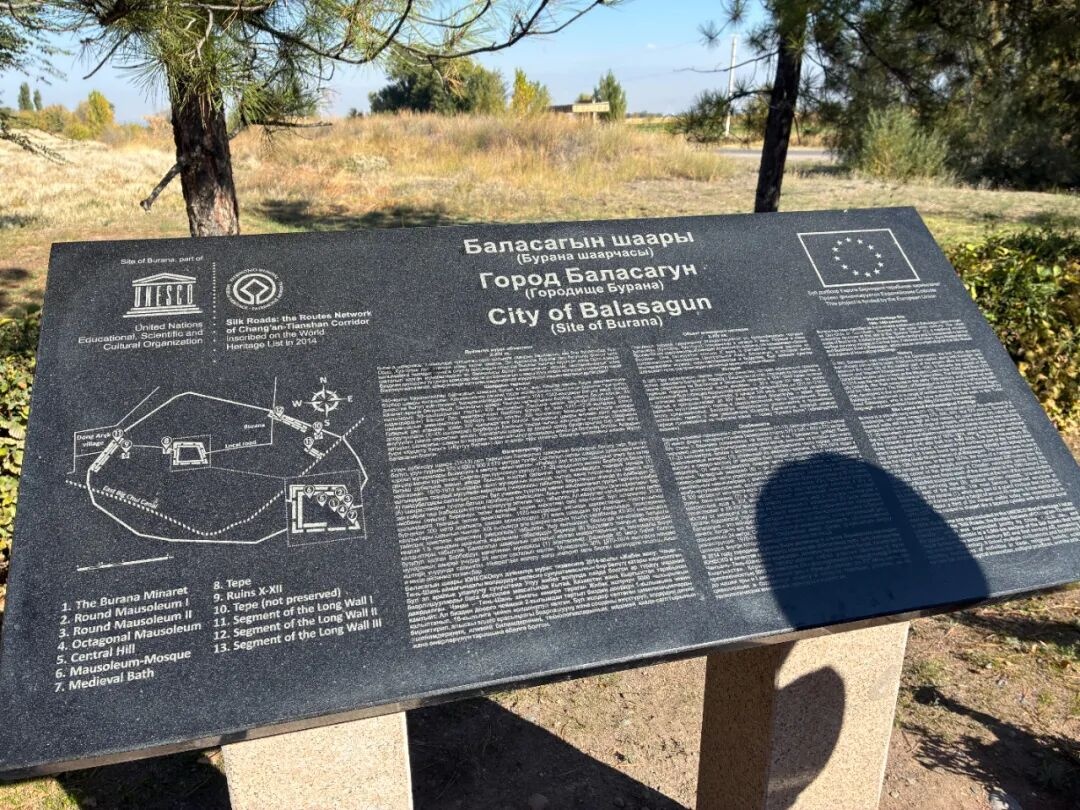
World Heritage Site sign (photo)
This place became a UNESCO World Heritage site in 2014, being one of the 33 sites in the 'Silk Roads: the Routes Network of Chang'an-Tianshan Corridor'. These sites are spread across what is now China, Kazakhstan, and Kyrgyzstan.
From Xi'an to here, it's a distance of 5,000 kilometers. It used to take so long to travel, but now I just flew from Xi'an to Kyrgyzstan in a few hours.
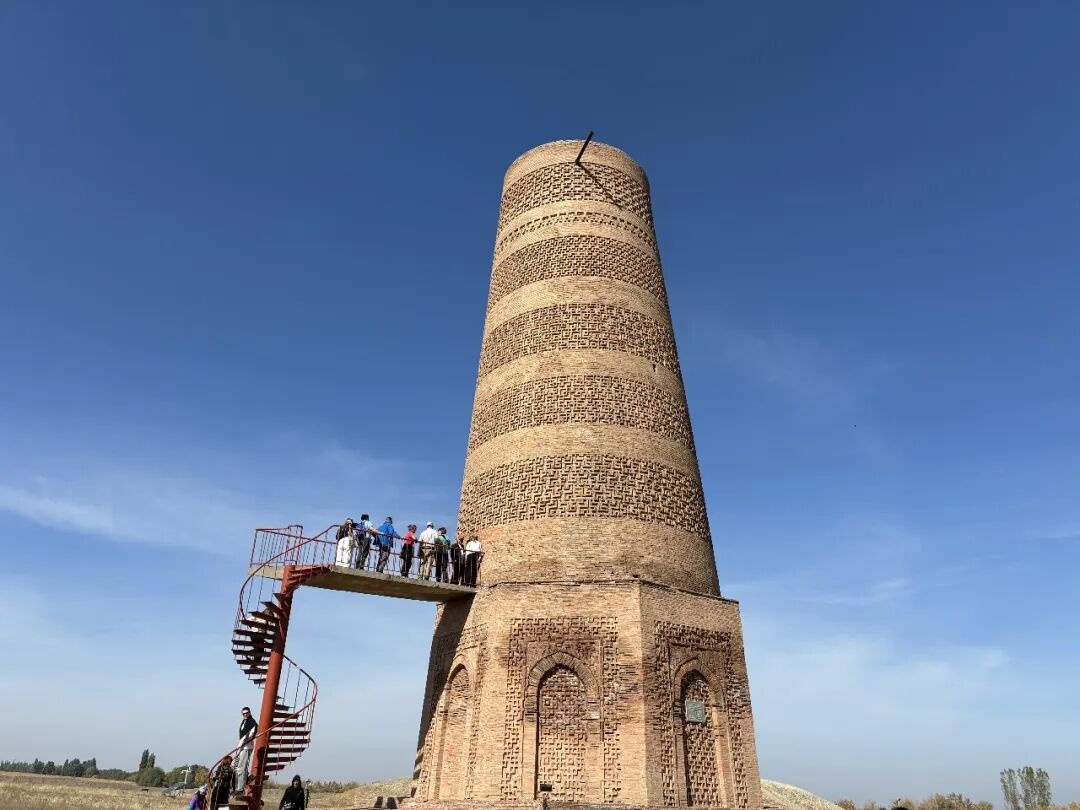
Burana Tower (photo)
A past of religious diversity
This tower is actually a minaret for a mosque. It immediately reminded me of the unfinished minaret in Khiva, Uzbekistan.
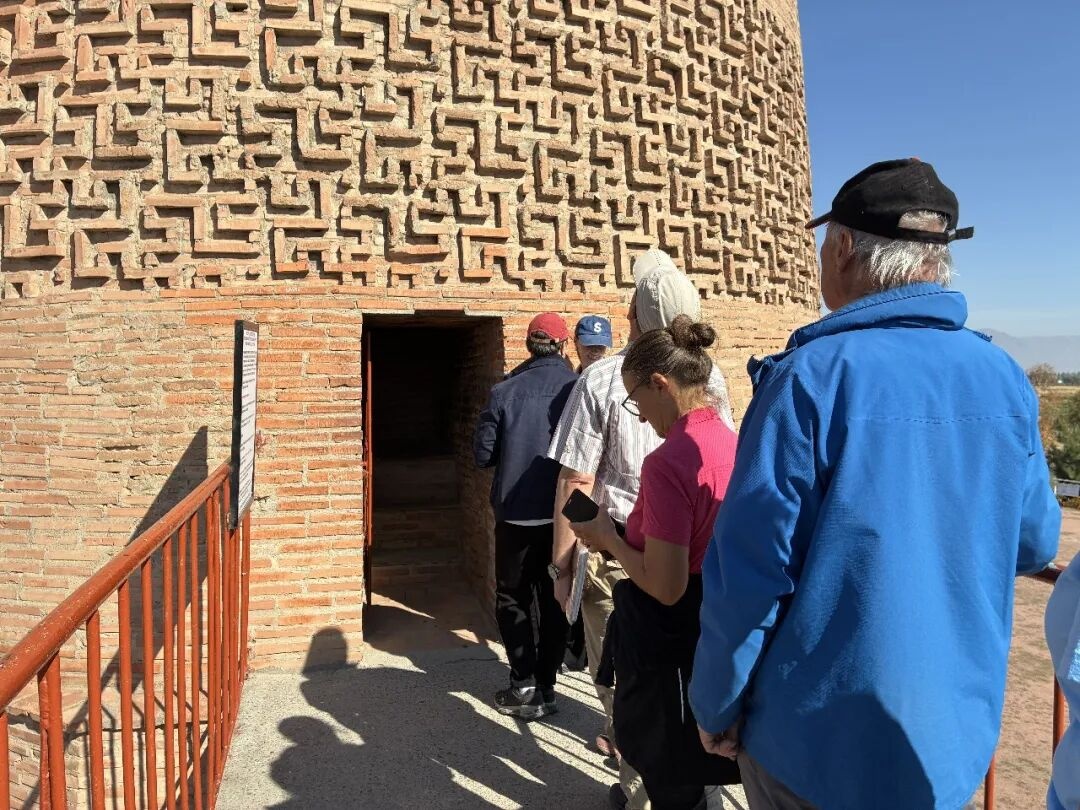
Queuing to enter the tower (photo)
The patterns at the base of the tower are really beautiful, totally Islamic in aesthetic. The tower isn't high, and you can climb up via a narrow spiral staircase inside. However, it's only wide enough for one person at a time. So, I had to wait for everyone coming down to finish before it was my turn to go up.
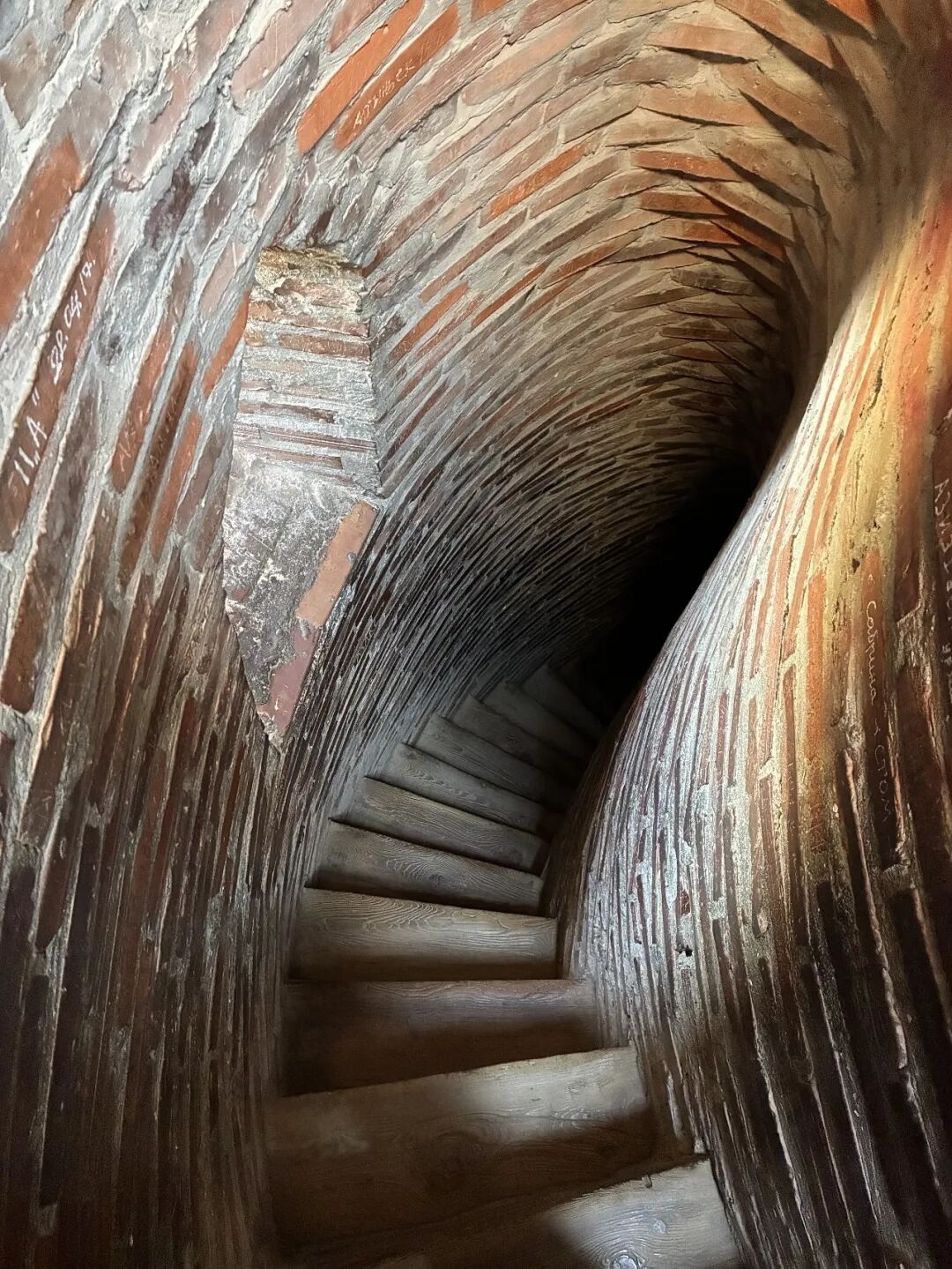
Narrow staircase (photo)
This tower is only 21 meters high, but it's the tallest structure in this area. Looking out over the surroundings, you can see a hill, which seems to be the remains of some building. Was this once a mosque? Or a fortress? All we can do now is imagine.
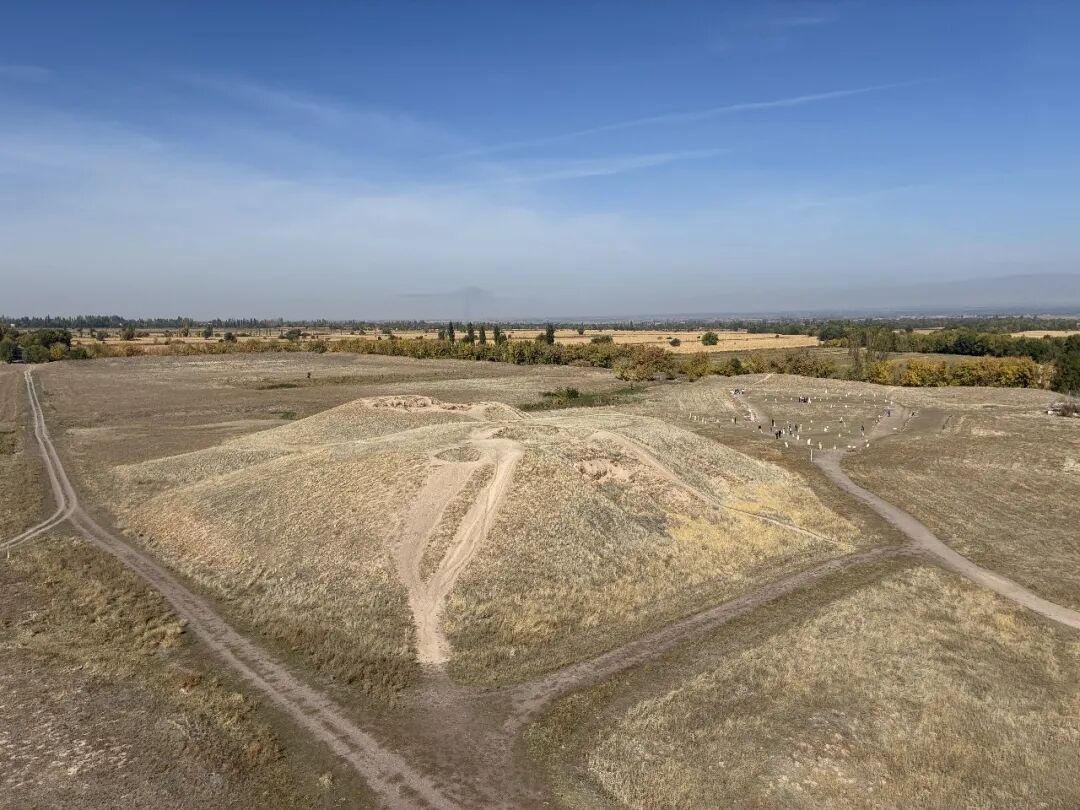
Ruins (photo)
Scattered on the grassland nearby are stone statues of nomads, stones with carved patterns, and tombstones with Arabic inscriptions. These have all been collected from elsewhere to enrich this World Heritage site.
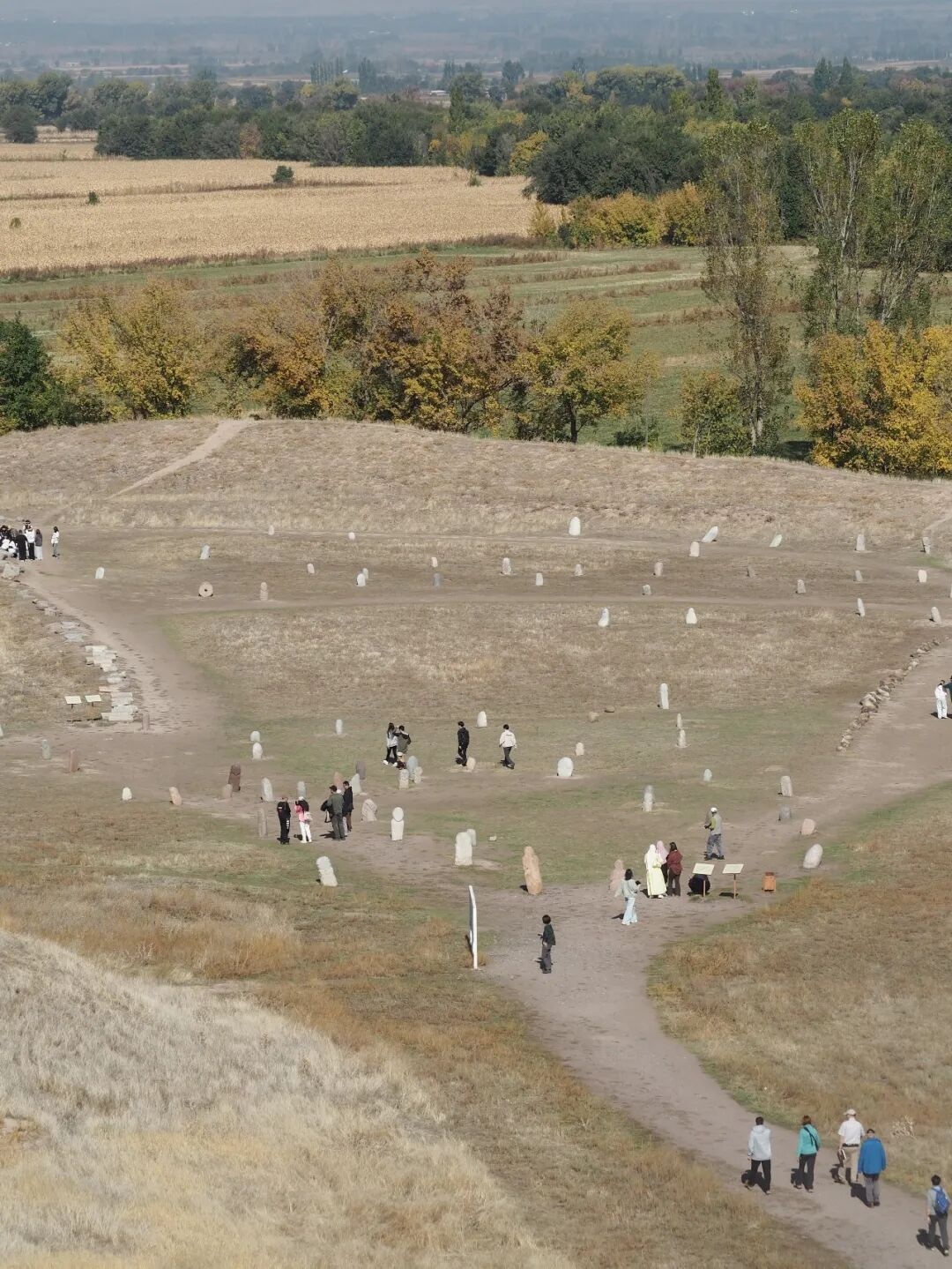
Stones (photo)
Looking north, you can see the birthplace of the famous poet Li Bai – Suyab city. That ancient city is no longer here; only ruins remain today.
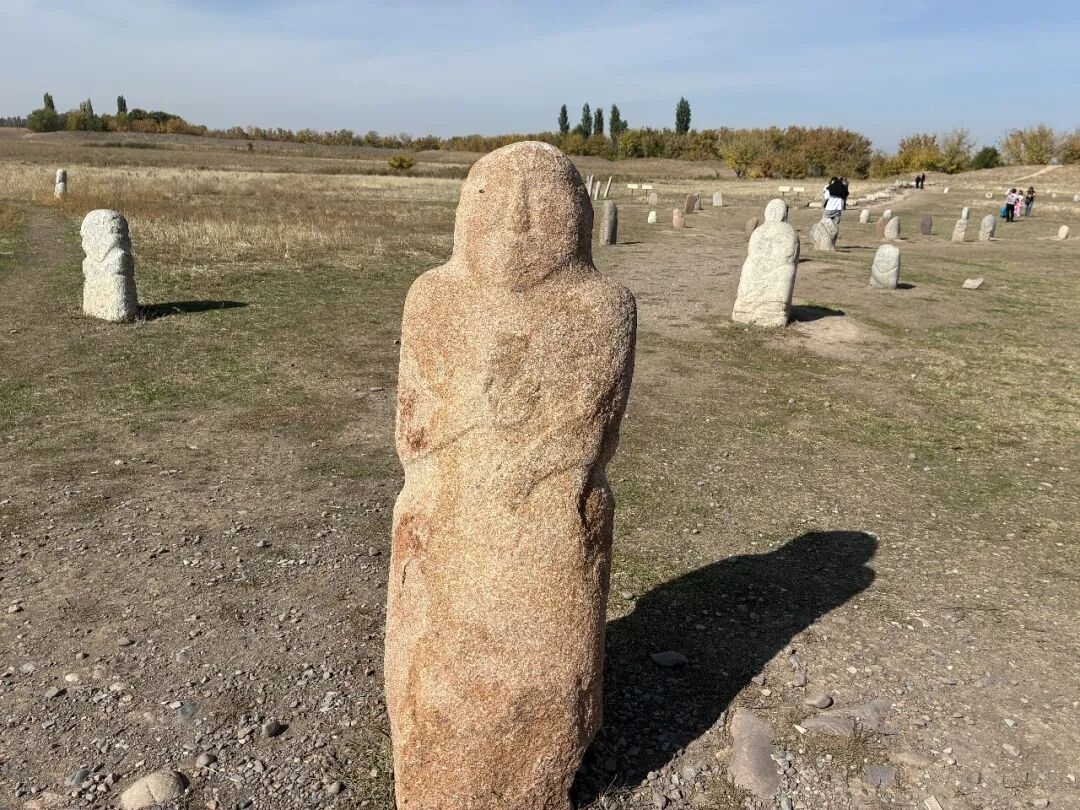
Stone statue (photo)
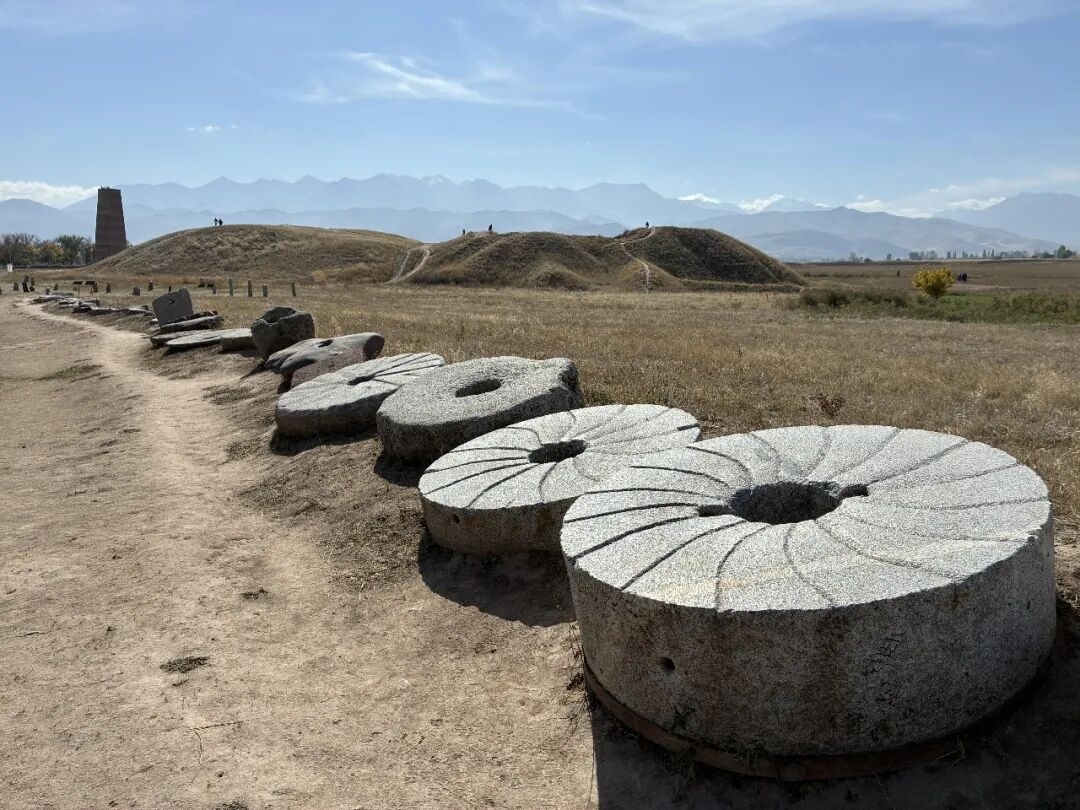
Stone tools (photo)
Next to the Burana Tower, there's also a small museum. It displays artifacts excavated from the ruins near the Burana Tower.
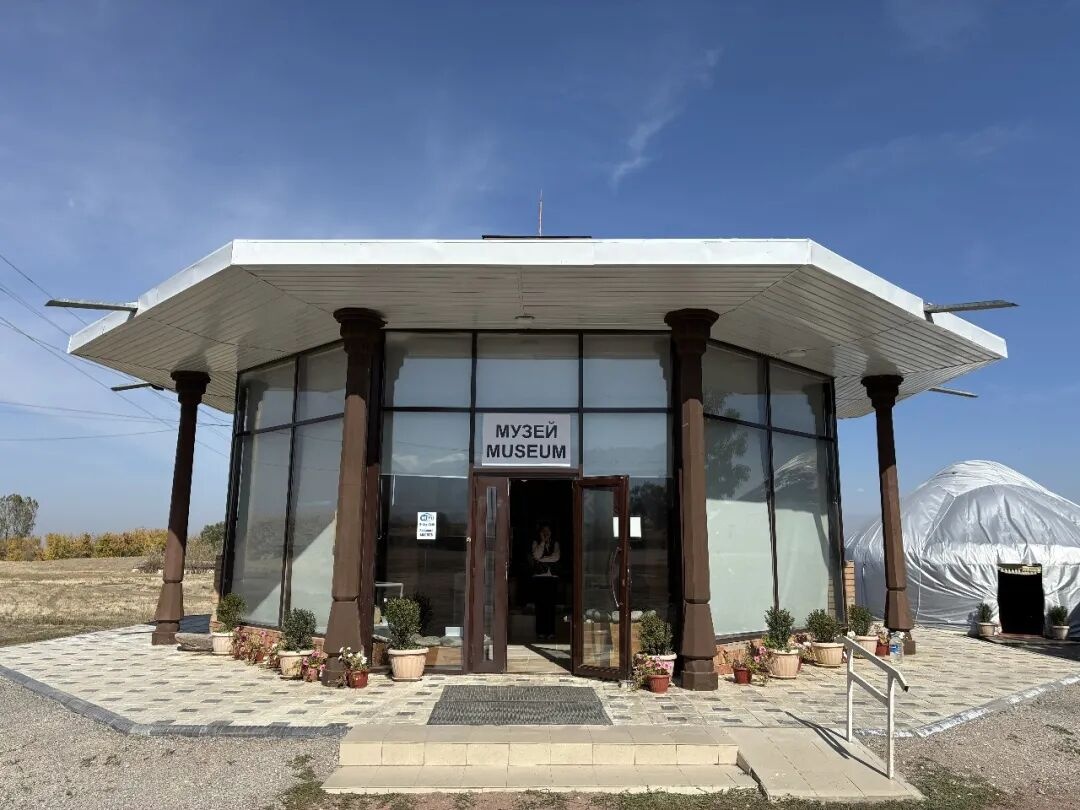
Museum (photo)
I saw familiar crosses from Nestorianism. Nestorianism is a branch of Christianity.
In 431 AD, at the Council of Ephesus, Nestorius, who opposed the veneration of the Virgin Mary, was declared a heretic and eventually exiled, dying in Egypt.
However, his sect didn't disappear and continued to spread eastward, entering Persia, Central Asia, and even reaching China. Today, I can see Nestorian crosses in museums in Chang'an, Luoyang, and even Quanzhou in Fujian.
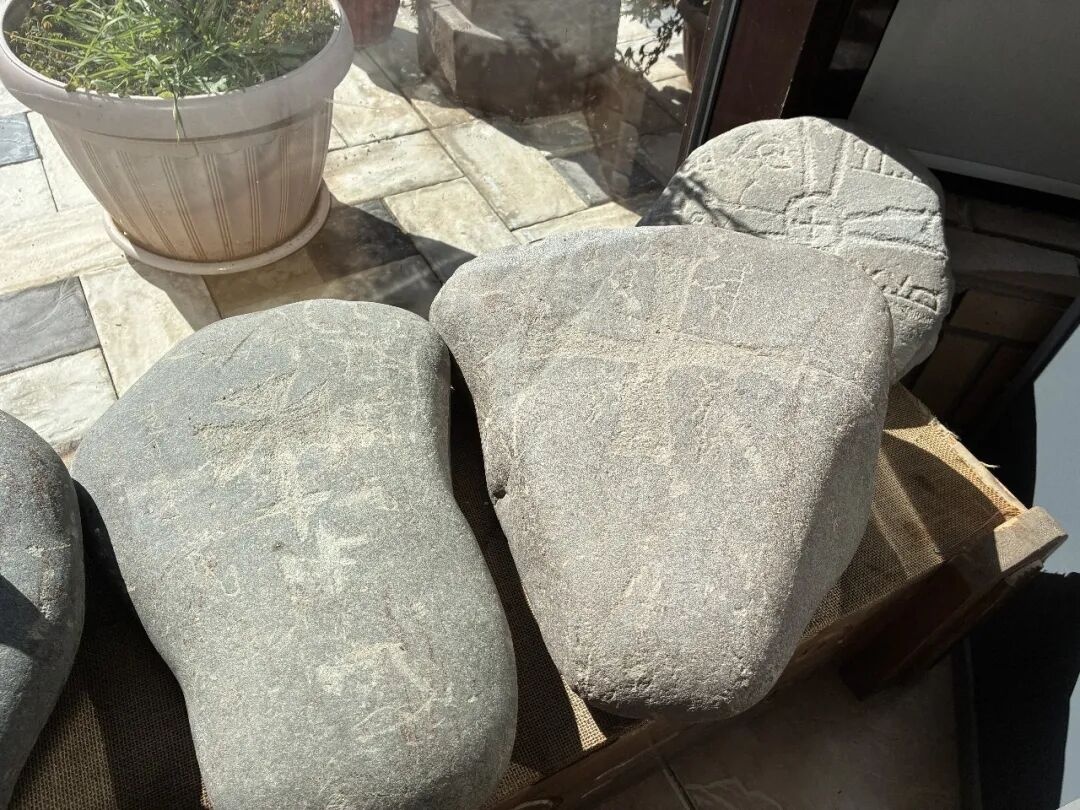
Nestorian cross (photo)
Over a thousand years ago, before Islam arrived, the Sogdians had established some towns and settlements in this area. The Sogdians believed in multiple religions, including Zoroastrianism, Buddhism, and Nestorianism, which came from the West. It's very likely they even built Nestorian churches here back then.
The first Turkic state to embrace Islam
In the 10th century, the Turkic people established the Kara-Khanid Khanate, with one of its capitals set up here at the Burana Tower, known as Balasagun city. Another capital was in Kashgar, which is modern-day Kashgar in Xinjiang.
The Kara-Khanid Khanate is something historians have slowly pieced together from legends, historical records, and artifacts. However, one thing is certain: this was the first Turkic dynasty to begin practicing Islam.
The reasons for adopting Islam are also linked to internal power struggles within the dynasty.
This khanate wasn't a centralized state; it initially had two khans, a senior and a junior one, also called Arslan Khan (Lion Khan), who resided in Balasagun city. The other junior khan was called Qara Khan (Black Khan) and was based in Taraz, in present-day Kazakhstan.
After the death of the second Great Khan of the khanate, Bazir, his brother Oğulcak Han inherited the position of Great Khan. However, Satuk, the son of Khan Bazir, wasn't content with just being a junior khan.
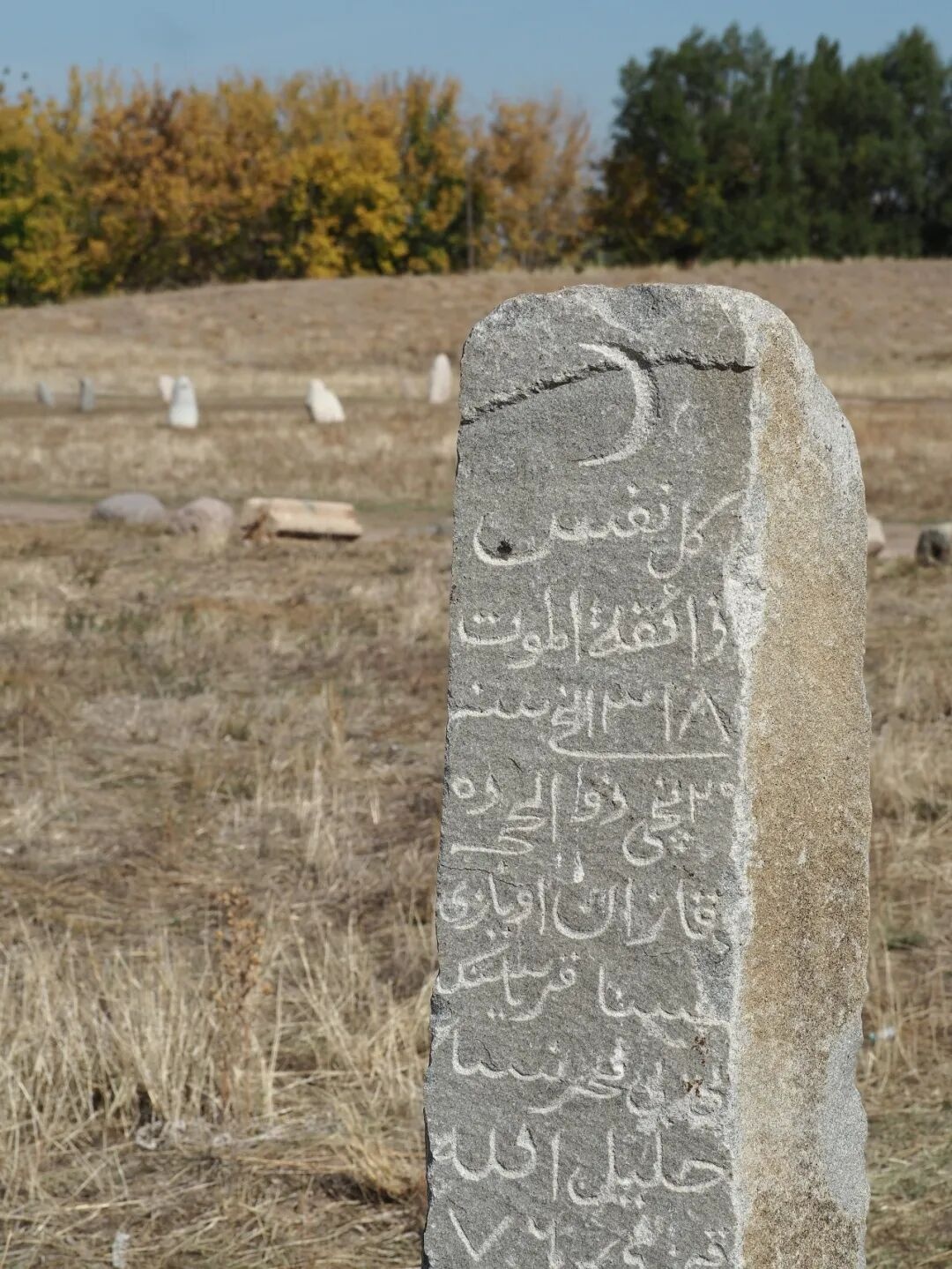
Arabic inscription (photo)
At this time, to the west, there was the Samanid Empire, a Muslim Persian dynasty, and the Kara-Khanids were competing with them for territory in Central Asia. The Samanid Empire also had its own internal strife; Nasr I and his brother Ismail I fought a civil war for the throne, and Nasr I ultimately lost.
It's said that Nasr I fled to the Kara-Khanid Khanate and received their protection. During this time, Satuk interacted with Nasr I and converted to Islam. Later, Satuk received assistance from Muslim forces in his civil war against his uncle, Khan Bazir, and emerged victorious.
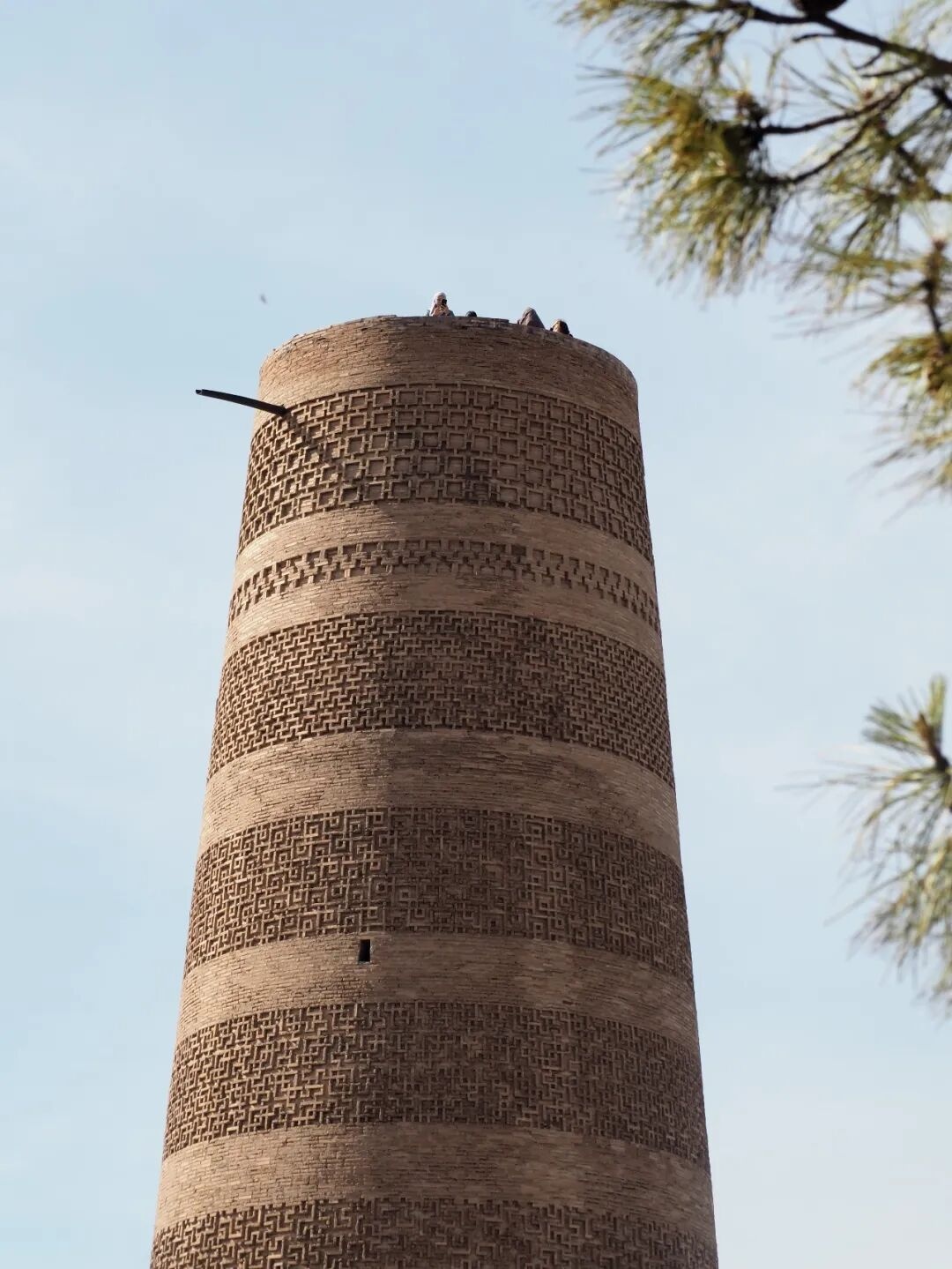
Burana Tower (photo)
After Satuk became the supreme ruler of the khanate, he transformed the entire khanate into a Muslim state, initiating the process of Islamization for the Turkic people. It's easy to imagine that within the khanate's territory, temples of Zoroastrianism, Buddhism, or Nestorianism either ceased to exist or were converted into mosques.
The Burana Tower was built during this era and was reportedly 45 meters high when completed.
Today, the Burana Tower is one of the earliest surviving minarets in Central Asia. Next to the tower, the ruins of several Muslim mausoleums are preserved.
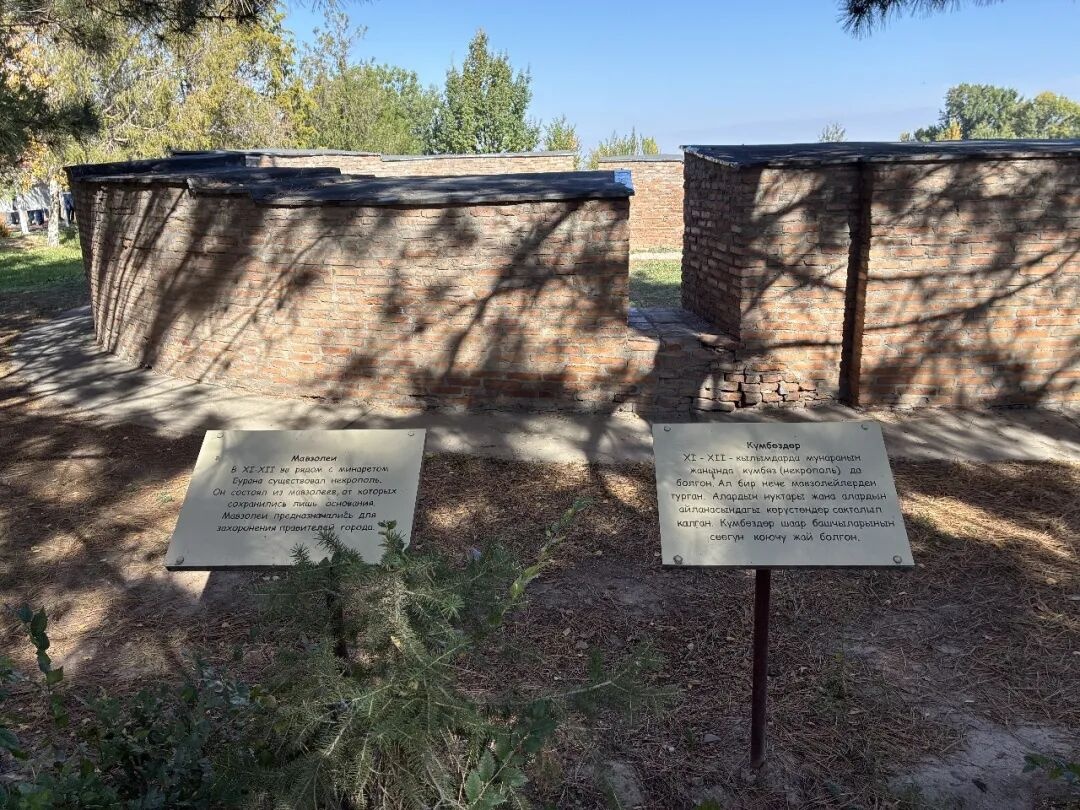
Mausoleum ruins (photo)
A thousand years later, the vast majority of Turkic-speaking people are Muslim, and mosques are found all over Central Asia.
A must-visit spot for tourists from all over the world.
The Burana Tower is right next to Burana village, just a short walk away. The whole way, I saw endless mountains and a vast blue sky. On the road, tour buses packed with tourists kept driving past me.
When you get to the entrance, you can hear languages from all over the world. Besides Kyrgyz and Russian, there's Chinese, English, Japanese, Korean, Thai, and even Indonesian. From a distance, you can already see people all over the top of the tower.
World Heritage Site sign (photo)
This place became a UNESCO World Heritage site in 2014, being one of the 33 sites in the 'Silk Roads: the Routes Network of Chang'an-Tianshan Corridor'. These sites are spread across what is now China, Kazakhstan, and Kyrgyzstan.
From Xi'an to here, it's a distance of 5,000 kilometers. It used to take so long to travel, but now I just flew from Xi'an to Kyrgyzstan in a few hours.
Burana Tower (photo)
A past of religious diversity
This tower is actually a minaret for a mosque. It immediately reminded me of the unfinished minaret in Khiva, Uzbekistan.
Queuing to enter the tower (photo)
The patterns at the base of the tower are really beautiful, totally Islamic in aesthetic. The tower isn't high, and you can climb up via a narrow spiral staircase inside. However, it's only wide enough for one person at a time. So, I had to wait for everyone coming down to finish before it was my turn to go up.
Narrow staircase (photo)
This tower is only 21 meters high, but it's the tallest structure in this area. Looking out over the surroundings, you can see a hill, which seems to be the remains of some building. Was this once a mosque? Or a fortress? All we can do now is imagine.
Ruins (photo)
Scattered on the grassland nearby are stone statues of nomads, stones with carved patterns, and tombstones with Arabic inscriptions. These have all been collected from elsewhere to enrich this World Heritage site.
Stones (photo)
Looking north, you can see the birthplace of the famous poet Li Bai – Suyab city. That ancient city is no longer here; only ruins remain today.
Stone statue (photo)
Stone tools (photo)
Next to the Burana Tower, there's also a small museum. It displays artifacts excavated from the ruins near the Burana Tower.
Museum (photo)
I saw familiar crosses from Nestorianism. Nestorianism is a branch of Christianity.
In 431 AD, at the Council of Ephesus, Nestorius, who opposed the veneration of the Virgin Mary, was declared a heretic and eventually exiled, dying in Egypt.
However, his sect didn't disappear and continued to spread eastward, entering Persia, Central Asia, and even reaching China. Today, I can see Nestorian crosses in museums in Chang'an, Luoyang, and even Quanzhou in Fujian.
Nestorian cross (photo)
Over a thousand years ago, before Islam arrived, the Sogdians had established some towns and settlements in this area. The Sogdians believed in multiple religions, including Zoroastrianism, Buddhism, and Nestorianism, which came from the West. It's very likely they even built Nestorian churches here back then.
The first Turkic state to embrace Islam
In the 10th century, the Turkic people established the Kara-Khanid Khanate, with one of its capitals set up here at the Burana Tower, known as Balasagun city. Another capital was in Kashgar, which is modern-day Kashgar in Xinjiang.
The Kara-Khanid Khanate is something historians have slowly pieced together from legends, historical records, and artifacts. However, one thing is certain: this was the first Turkic dynasty to begin practicing Islam.
The reasons for adopting Islam are also linked to internal power struggles within the dynasty.
This khanate wasn't a centralized state; it initially had two khans, a senior and a junior one, also called Arslan Khan (Lion Khan), who resided in Balasagun city. The other junior khan was called Qara Khan (Black Khan) and was based in Taraz, in present-day Kazakhstan.
After the death of the second Great Khan of the khanate, Bazir, his brother Oğulcak Han inherited the position of Great Khan. However, Satuk, the son of Khan Bazir, wasn't content with just being a junior khan.
Arabic inscription (photo)
At this time, to the west, there was the Samanid Empire, a Muslim Persian dynasty, and the Kara-Khanids were competing with them for territory in Central Asia. The Samanid Empire also had its own internal strife; Nasr I and his brother Ismail I fought a civil war for the throne, and Nasr I ultimately lost.
It's said that Nasr I fled to the Kara-Khanid Khanate and received their protection. During this time, Satuk interacted with Nasr I and converted to Islam. Later, Satuk received assistance from Muslim forces in his civil war against his uncle, Khan Bazir, and emerged victorious.
Burana Tower (photo)
After Satuk became the supreme ruler of the khanate, he transformed the entire khanate into a Muslim state, initiating the process of Islamization for the Turkic people. It's easy to imagine that within the khanate's territory, temples of Zoroastrianism, Buddhism, or Nestorianism either ceased to exist or were converted into mosques.
The Burana Tower was built during this era and was reportedly 45 meters high when completed.
Today, the Burana Tower is one of the earliest surviving minarets in Central Asia. Next to the tower, the ruins of several Muslim mausoleums are preserved.
Mausoleum ruins (photo)
A thousand years later, the vast majority of Turkic-speaking people are Muslim, and mosques are found all over Central Asia.
Turkic Islamization History: Kara-Khanid Dynasty and Central Asian Islamic Civilization Unveiled
Articles • Hasan09 posted the article • 0 comments • 5 views • 2 hours ago
This is a deep dive into the epic history of Turkic peoples converting to Islam, featuring 13 precious historical images and texts. From Sultan Satuk Bughra Khan of the Kara-Khanid Dynasty converting in the 10th century to the historical turning points in the Seven Rivers region and the Tarim Basin, this explores how the Turkic people and Islamic civilization shaped each other and profoundly impacted the historical landscape of Eurasia.
A must-visit spot for tourists from all over the world.
The Burana Tower is right next to Burana village, just a short walk away. The whole way, I saw endless mountains and a vast blue sky. On the road, tour buses packed with tourists kept driving past me.
When you get to the entrance, you can hear languages from all over the world. Besides Kyrgyz and Russian, there's Chinese, English, Japanese, Korean, Thai, and even Indonesian. From a distance, you can already see people all over the top of the tower.
World Heritage Site sign (photo)
This place became a UNESCO World Heritage site in 2014, being one of the 33 sites in the 'Silk Roads: the Routes Network of Chang'an-Tianshan Corridor'. These sites are spread across what is now China, Kazakhstan, and Kyrgyzstan.
From Xi'an to here, it's a distance of 5,000 kilometers. It used to take so long to travel, but now I just flew from Xi'an to Kyrgyzstan in a few hours.
Burana Tower (photo)
A past of religious diversity
This tower is actually a minaret for a mosque. It immediately reminded me of the unfinished minaret in Khiva, Uzbekistan.
Queuing to enter the tower (photo)
The patterns at the base of the tower are really beautiful, totally Islamic in aesthetic. The tower isn't high, and you can climb up via a narrow spiral staircase inside. However, it's only wide enough for one person at a time. So, I had to wait for everyone coming down to finish before it was my turn to go up.
Narrow staircase (photo)
This tower is only 21 meters high, but it's the tallest structure in this area. Looking out over the surroundings, you can see a hill, which seems to be the remains of some building. Was this once a mosque? Or a fortress? All we can do now is imagine.
Ruins (photo)
Scattered on the grassland nearby are stone statues of nomads, stones with carved patterns, and tombstones with Arabic inscriptions. These have all been collected from elsewhere to enrich this World Heritage site.
Stones (photo)
Looking north, you can see the birthplace of the famous poet Li Bai – Suyab city. That ancient city is no longer here; only ruins remain today.
Stone statue (photo)
Stone tools (photo)
Next to the Burana Tower, there's also a small museum. It displays artifacts excavated from the ruins near the Burana Tower.
Museum (photo)
I saw familiar crosses from Nestorianism. Nestorianism is a branch of Christianity.
In 431 AD, at the Council of Ephesus, Nestorius, who opposed the veneration of the Virgin Mary, was declared a heretic and eventually exiled, dying in Egypt.
However, his sect didn't disappear and continued to spread eastward, entering Persia, Central Asia, and even reaching China. Today, I can see Nestorian crosses in museums in Chang'an, Luoyang, and even Quanzhou in Fujian.
Nestorian cross (photo)
Over a thousand years ago, before Islam arrived, the Sogdians had established some towns and settlements in this area. The Sogdians believed in multiple religions, including Zoroastrianism, Buddhism, and Nestorianism, which came from the West. It's very likely they even built Nestorian churches here back then.
The first Turkic state to embrace Islam
In the 10th century, the Turkic people established the Kara-Khanid Khanate, with one of its capitals set up here at the Burana Tower, known as Balasagun city. Another capital was in Kashgar, which is modern-day Kashgar in Xinjiang.
The Kara-Khanid Khanate is something historians have slowly pieced together from legends, historical records, and artifacts. However, one thing is certain: this was the first Turkic dynasty to begin practicing Islam.
The reasons for adopting Islam are also linked to internal power struggles within the dynasty.
This khanate wasn't a centralized state; it initially had two khans, a senior and a junior one, also called Arslan Khan (Lion Khan), who resided in Balasagun city. The other junior khan was called Qara Khan (Black Khan) and was based in Taraz, in present-day Kazakhstan.
After the death of the second Great Khan of the khanate, Bazir, his brother Oğulcak Han inherited the position of Great Khan. However, Satuk, the son of Khan Bazir, wasn't content with just being a junior khan.
Arabic inscription (photo)
At this time, to the west, there was the Samanid Empire, a Muslim Persian dynasty, and the Kara-Khanids were competing with them for territory in Central Asia. The Samanid Empire also had its own internal strife; Nasr I and his brother Ismail I fought a civil war for the throne, and Nasr I ultimately lost.
It's said that Nasr I fled to the Kara-Khanid Khanate and received their protection. During this time, Satuk interacted with Nasr I and converted to Islam. Later, Satuk received assistance from Muslim forces in his civil war against his uncle, Khan Bazir, and emerged victorious.
Burana Tower (photo)
After Satuk became the supreme ruler of the khanate, he transformed the entire khanate into a Muslim state, initiating the process of Islamization for the Turkic people. It's easy to imagine that within the khanate's territory, temples of Zoroastrianism, Buddhism, or Nestorianism either ceased to exist or were converted into mosques.
The Burana Tower was built during this era and was reportedly 45 meters high when completed.
Today, the Burana Tower is one of the earliest surviving minarets in Central Asia. Next to the tower, the ruins of several Muslim mausoleums are preserved.
Mausoleum ruins (photo)
A thousand years later, the vast majority of Turkic-speaking people are Muslim, and mosques are found all over Central Asia. view all
A must-visit spot for tourists from all over the world.
The Burana Tower is right next to Burana village, just a short walk away. The whole way, I saw endless mountains and a vast blue sky. On the road, tour buses packed with tourists kept driving past me.
When you get to the entrance, you can hear languages from all over the world. Besides Kyrgyz and Russian, there's Chinese, English, Japanese, Korean, Thai, and even Indonesian. From a distance, you can already see people all over the top of the tower.
World Heritage Site sign (photo)
This place became a UNESCO World Heritage site in 2014, being one of the 33 sites in the 'Silk Roads: the Routes Network of Chang'an-Tianshan Corridor'. These sites are spread across what is now China, Kazakhstan, and Kyrgyzstan.
From Xi'an to here, it's a distance of 5,000 kilometers. It used to take so long to travel, but now I just flew from Xi'an to Kyrgyzstan in a few hours.
Burana Tower (photo)
A past of religious diversity
This tower is actually a minaret for a mosque. It immediately reminded me of the unfinished minaret in Khiva, Uzbekistan.
Queuing to enter the tower (photo)
The patterns at the base of the tower are really beautiful, totally Islamic in aesthetic. The tower isn't high, and you can climb up via a narrow spiral staircase inside. However, it's only wide enough for one person at a time. So, I had to wait for everyone coming down to finish before it was my turn to go up.
Narrow staircase (photo)
This tower is only 21 meters high, but it's the tallest structure in this area. Looking out over the surroundings, you can see a hill, which seems to be the remains of some building. Was this once a mosque? Or a fortress? All we can do now is imagine.
Ruins (photo)
Scattered on the grassland nearby are stone statues of nomads, stones with carved patterns, and tombstones with Arabic inscriptions. These have all been collected from elsewhere to enrich this World Heritage site.
Stones (photo)
Looking north, you can see the birthplace of the famous poet Li Bai – Suyab city. That ancient city is no longer here; only ruins remain today.
Stone statue (photo)
Stone tools (photo)
Next to the Burana Tower, there's also a small museum. It displays artifacts excavated from the ruins near the Burana Tower.
Museum (photo)
I saw familiar crosses from Nestorianism. Nestorianism is a branch of Christianity.
In 431 AD, at the Council of Ephesus, Nestorius, who opposed the veneration of the Virgin Mary, was declared a heretic and eventually exiled, dying in Egypt.
However, his sect didn't disappear and continued to spread eastward, entering Persia, Central Asia, and even reaching China. Today, I can see Nestorian crosses in museums in Chang'an, Luoyang, and even Quanzhou in Fujian.
Nestorian cross (photo)
Over a thousand years ago, before Islam arrived, the Sogdians had established some towns and settlements in this area. The Sogdians believed in multiple religions, including Zoroastrianism, Buddhism, and Nestorianism, which came from the West. It's very likely they even built Nestorian churches here back then.
The first Turkic state to embrace Islam
In the 10th century, the Turkic people established the Kara-Khanid Khanate, with one of its capitals set up here at the Burana Tower, known as Balasagun city. Another capital was in Kashgar, which is modern-day Kashgar in Xinjiang.
The Kara-Khanid Khanate is something historians have slowly pieced together from legends, historical records, and artifacts. However, one thing is certain: this was the first Turkic dynasty to begin practicing Islam.
The reasons for adopting Islam are also linked to internal power struggles within the dynasty.
This khanate wasn't a centralized state; it initially had two khans, a senior and a junior one, also called Arslan Khan (Lion Khan), who resided in Balasagun city. The other junior khan was called Qara Khan (Black Khan) and was based in Taraz, in present-day Kazakhstan.
After the death of the second Great Khan of the khanate, Bazir, his brother Oğulcak Han inherited the position of Great Khan. However, Satuk, the son of Khan Bazir, wasn't content with just being a junior khan.
Arabic inscription (photo)
At this time, to the west, there was the Samanid Empire, a Muslim Persian dynasty, and the Kara-Khanids were competing with them for territory in Central Asia. The Samanid Empire also had its own internal strife; Nasr I and his brother Ismail I fought a civil war for the throne, and Nasr I ultimately lost.
It's said that Nasr I fled to the Kara-Khanid Khanate and received their protection. During this time, Satuk interacted with Nasr I and converted to Islam. Later, Satuk received assistance from Muslim forces in his civil war against his uncle, Khan Bazir, and emerged victorious.
Burana Tower (photo)
After Satuk became the supreme ruler of the khanate, he transformed the entire khanate into a Muslim state, initiating the process of Islamization for the Turkic people. It's easy to imagine that within the khanate's territory, temples of Zoroastrianism, Buddhism, or Nestorianism either ceased to exist or were converted into mosques.
The Burana Tower was built during this era and was reportedly 45 meters high when completed.
Today, the Burana Tower is one of the earliest surviving minarets in Central Asia. Next to the tower, the ruins of several Muslim mausoleums are preserved.
Mausoleum ruins (photo)
A thousand years later, the vast majority of Turkic-speaking people are Muslim, and mosques are found all over Central Asia. view all
This is a deep dive into the epic history of Turkic peoples converting to Islam, featuring 13 precious historical images and texts. From Sultan Satuk Bughra Khan of the Kara-Khanid Dynasty converting in the 10th century to the historical turning points in the Seven Rivers region and the Tarim Basin, this explores how the Turkic people and Islamic civilization shaped each other and profoundly impacted the historical landscape of Eurasia.
A must-visit spot for tourists from all over the world.
The Burana Tower is right next to Burana village, just a short walk away. The whole way, I saw endless mountains and a vast blue sky. On the road, tour buses packed with tourists kept driving past me.
When you get to the entrance, you can hear languages from all over the world. Besides Kyrgyz and Russian, there's Chinese, English, Japanese, Korean, Thai, and even Indonesian. From a distance, you can already see people all over the top of the tower.
World Heritage Site sign (photo)
This place became a UNESCO World Heritage site in 2014, being one of the 33 sites in the 'Silk Roads: the Routes Network of Chang'an-Tianshan Corridor'. These sites are spread across what is now China, Kazakhstan, and Kyrgyzstan.
From Xi'an to here, it's a distance of 5,000 kilometers. It used to take so long to travel, but now I just flew from Xi'an to Kyrgyzstan in a few hours.
Burana Tower (photo)
A past of religious diversity
This tower is actually a minaret for a mosque. It immediately reminded me of the unfinished minaret in Khiva, Uzbekistan.
Queuing to enter the tower (photo)
The patterns at the base of the tower are really beautiful, totally Islamic in aesthetic. The tower isn't high, and you can climb up via a narrow spiral staircase inside. However, it's only wide enough for one person at a time. So, I had to wait for everyone coming down to finish before it was my turn to go up.
Narrow staircase (photo)
This tower is only 21 meters high, but it's the tallest structure in this area. Looking out over the surroundings, you can see a hill, which seems to be the remains of some building. Was this once a mosque? Or a fortress? All we can do now is imagine.
Ruins (photo)
Scattered on the grassland nearby are stone statues of nomads, stones with carved patterns, and tombstones with Arabic inscriptions. These have all been collected from elsewhere to enrich this World Heritage site.
Stones (photo)
Looking north, you can see the birthplace of the famous poet Li Bai – Suyab city. That ancient city is no longer here; only ruins remain today.
Stone statue (photo)
Stone tools (photo)
Next to the Burana Tower, there's also a small museum. It displays artifacts excavated from the ruins near the Burana Tower.
Museum (photo)
I saw familiar crosses from Nestorianism. Nestorianism is a branch of Christianity.
In 431 AD, at the Council of Ephesus, Nestorius, who opposed the veneration of the Virgin Mary, was declared a heretic and eventually exiled, dying in Egypt.
However, his sect didn't disappear and continued to spread eastward, entering Persia, Central Asia, and even reaching China. Today, I can see Nestorian crosses in museums in Chang'an, Luoyang, and even Quanzhou in Fujian.
Nestorian cross (photo)
Over a thousand years ago, before Islam arrived, the Sogdians had established some towns and settlements in this area. The Sogdians believed in multiple religions, including Zoroastrianism, Buddhism, and Nestorianism, which came from the West. It's very likely they even built Nestorian churches here back then.
The first Turkic state to embrace Islam
In the 10th century, the Turkic people established the Kara-Khanid Khanate, with one of its capitals set up here at the Burana Tower, known as Balasagun city. Another capital was in Kashgar, which is modern-day Kashgar in Xinjiang.
The Kara-Khanid Khanate is something historians have slowly pieced together from legends, historical records, and artifacts. However, one thing is certain: this was the first Turkic dynasty to begin practicing Islam.
The reasons for adopting Islam are also linked to internal power struggles within the dynasty.
This khanate wasn't a centralized state; it initially had two khans, a senior and a junior one, also called Arslan Khan (Lion Khan), who resided in Balasagun city. The other junior khan was called Qara Khan (Black Khan) and was based in Taraz, in present-day Kazakhstan.
After the death of the second Great Khan of the khanate, Bazir, his brother Oğulcak Han inherited the position of Great Khan. However, Satuk, the son of Khan Bazir, wasn't content with just being a junior khan.
Arabic inscription (photo)
At this time, to the west, there was the Samanid Empire, a Muslim Persian dynasty, and the Kara-Khanids were competing with them for territory in Central Asia. The Samanid Empire also had its own internal strife; Nasr I and his brother Ismail I fought a civil war for the throne, and Nasr I ultimately lost.
It's said that Nasr I fled to the Kara-Khanid Khanate and received their protection. During this time, Satuk interacted with Nasr I and converted to Islam. Later, Satuk received assistance from Muslim forces in his civil war against his uncle, Khan Bazir, and emerged victorious.
Burana Tower (photo)
After Satuk became the supreme ruler of the khanate, he transformed the entire khanate into a Muslim state, initiating the process of Islamization for the Turkic people. It's easy to imagine that within the khanate's territory, temples of Zoroastrianism, Buddhism, or Nestorianism either ceased to exist or were converted into mosques.
The Burana Tower was built during this era and was reportedly 45 meters high when completed.
Today, the Burana Tower is one of the earliest surviving minarets in Central Asia. Next to the tower, the ruins of several Muslim mausoleums are preserved.
Mausoleum ruins (photo)
A thousand years later, the vast majority of Turkic-speaking people are Muslim, and mosques are found all over Central Asia.