

Xi'an Travel Guide
Daxuexi Alley Mosque Xi'an: Exploring Tang Dynasty Islamic Heritage and Authentic Hui Muslim Neighborhood Street Life
Articles • Hasan09 posted the article • 0 comments • 12 views • 9 hours ago
[Internet Repost]
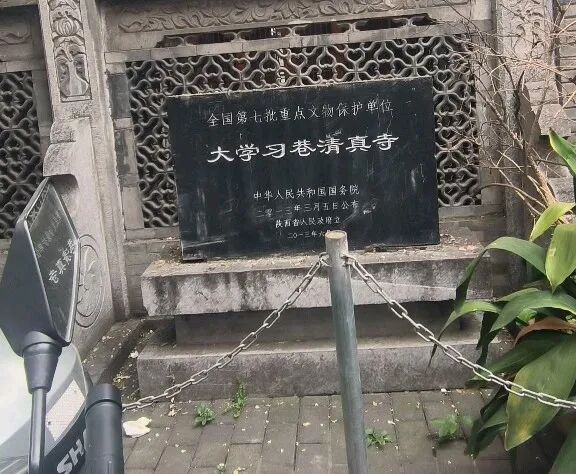
Taking the bus through the streets of Xi'an between the Bell Tower and Qiaozikou, the author visits the Daxuexi Alley Mosque, an ancient thousand-year-old temple that mirrors the Great Mosque of Huajue Alley. The article documents the strict Chinese architectural style of the mosque, the surviving Shengxin Pavilion and stele pavilions, and the vibrant, everyday street life along the way in old Xi'an.
Binging the drama Lan Xiang Ru Gu for days on end recently left my head spinning. With the show finally finished, I could finally step outside and get some fresh air.
01.
Taking advantage of the gorgeous afternoon sunshine, I decided to head out for a walk. Lately, my routine has mostly revolved around the ancient city wall. Having just visited Guangren Temple a few days ago, I followed a travel guide today to check out the mosque on Daxuexi Alley.
Before heading out, I consulted Doubao for directions as usual.
It gave me two options: first, take Line 2 and transfer to Line 6, which still required a walk of over ten minutes after exiting the station; second, take Line 2 for two stops to the Bell Tower, transfer to bus route 4 to Qiaozikou Station, and walk a shorter distance.
The thought of navigating underground transfers with up-and-down escalators, twisting long corridors, and massive crowds made me a bit nervous.
So, I decisively went with the second bus option.
Even though I picked a route, my sense of direction isn't great, and I ran into all sorts of minor mishaps along the way. First, I got turned around trying to find the bus stop near the Bell Tower and took quite a few detours; then, after getting off at Qiaozikou, I struggled to figure out which way Daxuexi Alley was and wasted a bunch of time. After wandering around and dealing with a few twists and turns, I finally found Daxuexi Alley.
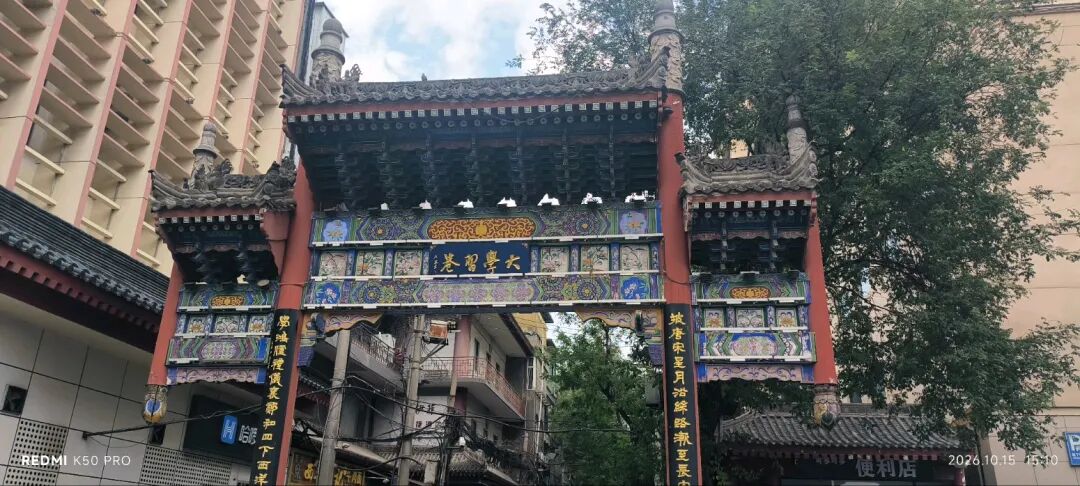
A tall archway stands at the entrance of the alley, featuring carved beams and painted pillars, though I couldn't read the couplets on either side of the gate. However, I had learned a bit beforehand about how the alley got its name.
Legend has it that during the An Lushan Rebellion, Uyghur and Western Regions troops helped Tang dynasty general Guo Ziyi retake Chang'an. After the war, over 200 military officers from the Western Regions stayed behind right here. The imperial court set up a school here to teach them the Chinese language, Central Plains rituals, and legal systems, which is why the place became known as "Xuexi (Study) Alley."
02.
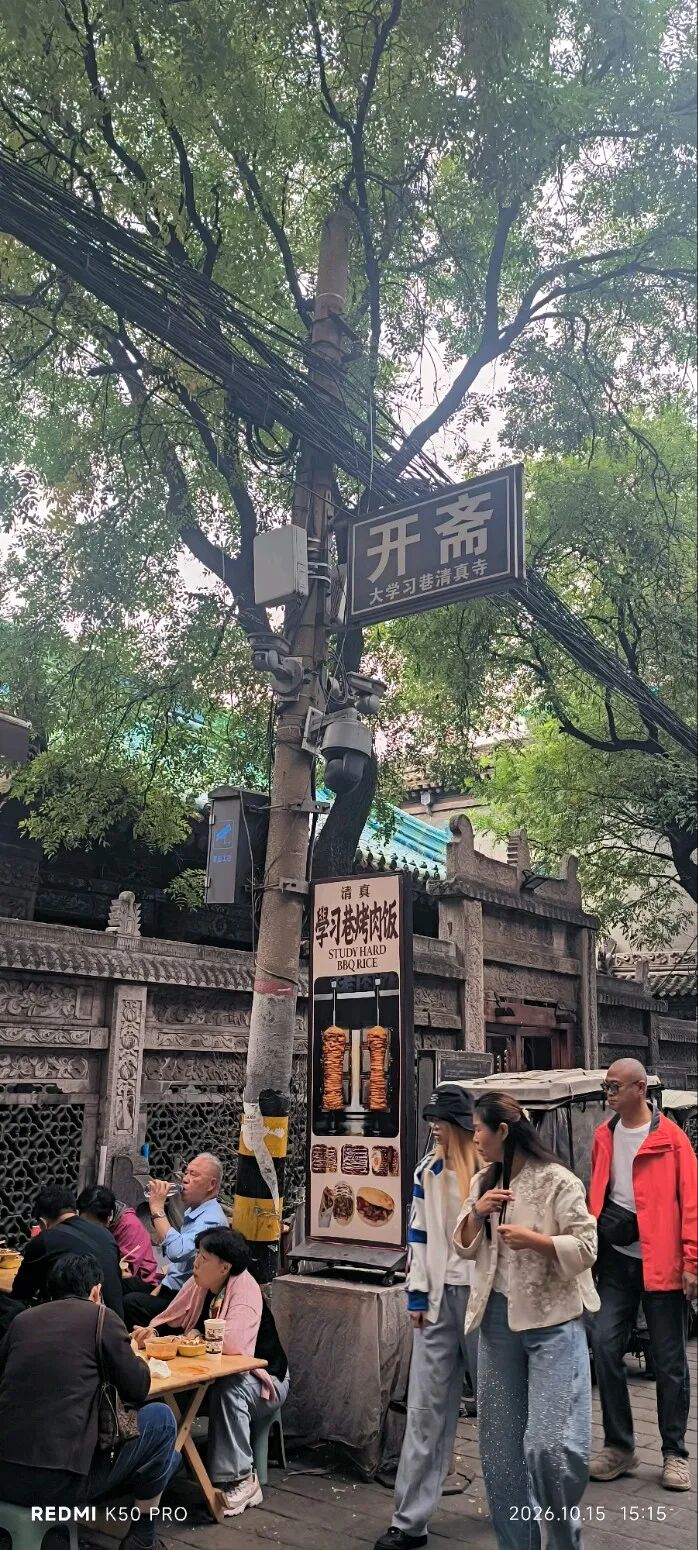
This is an authentic old alley with narrow streets. Most of the businesses on both sides are local shops, especially eateries, overflowing with a lively, everyday vibe. Walking down the alley, you frequently run into Hui Muslim women wearing hijabs and men wearing white caps, revealing that this is a Hui Muslim residential community.
Walking further down the alley, I spotted two men looking around as if searching for something. When they reached a small side door, they muttered quietly, "Why isn't it open? Are they not letting people in?"
I figured they were also visitors who had come specifically to find the mosque here. Since we shared the same goal, I tagged along behind them.
A few more meters ahead, I saw a modest courtyard entrance where Hui Muslim women wearing hijabs were walking in and out. The two men stepped up to ask if visitors were allowed inside, and after getting permission, they walked in. I quickly followed right behind them. Right behind me was a middle-aged man.
03.
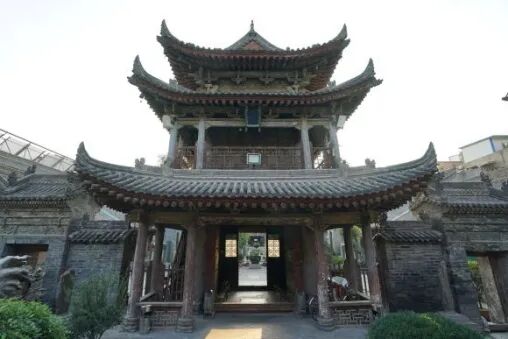
Inside the mosque grounds, there were very few tourists, making it wonderfully quiet and serene. As soon as you step through the gate, you see a three-story, four-cornered pavilion. After years of wind and sun, the once-bright paint has faded and peeled, exposing the cracked and rough wood grain. While it has lost its original colorful vibrance, it still maintains that rustic and elegant charm. This turned out to be the "Shengxin Pavilion (Pavilion of Self-Reflection)."
(Shengxin Pavilion, photo from the internet)
Sitting under the pavilion was an elderly man in his eighties, dressed in traditional Hui Muslim attire with a long beard and a white cap. A sign hung on the chair next to him read: "Entering the mosque, photography is prohibited."
The old man stopped the two men to ask where they were from. To prove their sincerity, they said they came from Northeast China and handed over their ID cards to show they were also Hui Muslims. The old man took them, looked them over, and handed them back.
For some reason, seeing Hui Muslims made me feel a bit anxious. Now, seeing this elderly man asking questions added an extra layer of nervousness. I'm not a Muslim; I was just visiting out of curiosity as an outsider, so I didn't dare say much. I slipped through the gate beside Shengxin Pavilion into the second courtyard to get away from the old man's line of sight as quickly as possible.
The middle-aged man who had followed me in took out his phone the moment he stepped into the second courtyard and secretly snapped a photo. I didn't dare do the same, terrified of getting told off. I figured taking pictures was out of the question today, so I would just have to enjoy this rustic and exquisite courtyard with my eyes and keep it in my heart.
04.
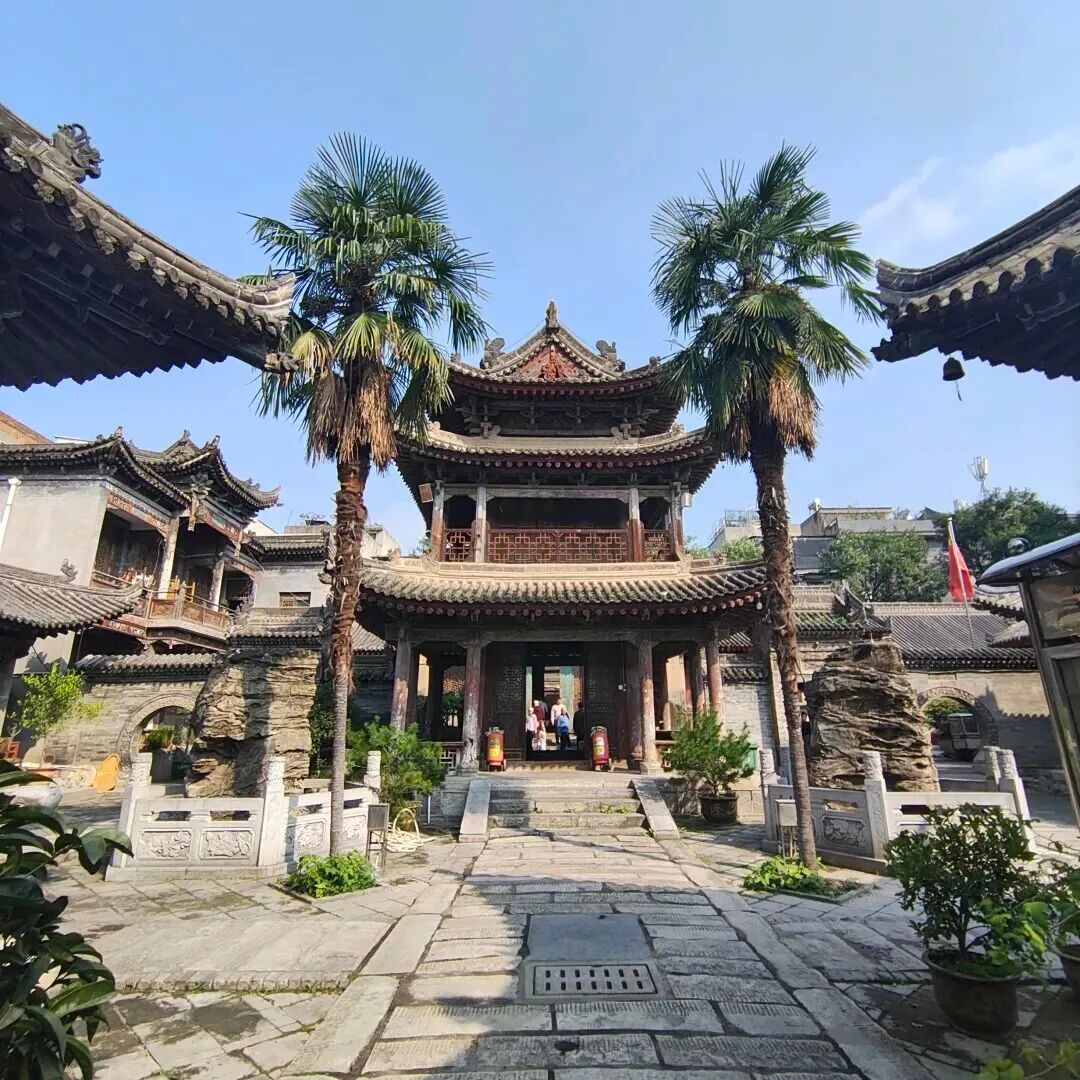
This is a classic Chinese-style courtyard with a total of three courtyards. The Shengxin Pavilion sits right on the central axis, with buildings symmetrically distributed on both sides, while the rockeries, ponds, and flower beds in the yard are scattered on either side.
Stepping into the second courtyard, you'll find tons of super old stone steles—some of the text is still barely readable, while other parts are totally faded. I did my homework beforehand, so I knew this mosque was hiding two absolute treasures inside its pavilion structures.
One of them is a stele from the Jiajing period of the Ming Dynasty titled "Record of the Restoration of Qingjing Mosque," which documents the historical reality of Zheng He's voyages to the Western Oceans. Locals usually just call it the "Zheng He Stele."
The inscription tells the fascinating story of how, during the Yongle era of the Ming Dynasty, the famous eunuch commander Zheng He was ordered on a mission to the Western Oceans. Passing through Xi'an, he looked for talent and recruited the mosque's Imam, Hasan, to tag along as a translator. After they got back, because Hasan had done a great job and his prayers at sea were answered, Zheng He petitioned the imperial court for funds and personally led the reconstruction of this mosque.
The other one is a Yuan Dynasty Arabic stele featuring the Chinese text "Record of the Enlargement of the Mosque" on the front and entirely Arabic writing on the back. These two steles—one Chinese, one Arabic, one from the Ming, and one from the Yuan—don't just track the history of this ancient mosque; they are super valuable physical pieces of evidence showing the cultural exchange and mutual learning between Chinese civilization and Islamic civilization.
From the second courtyard, you walk up some stone steps into the third courtyard. The yard is wrapped in stone railings, with a stone memorial archway on both the north and south sides. The most breathtaking thing here is the main prayer hall, which is said to hold up to 500 people for prayer.
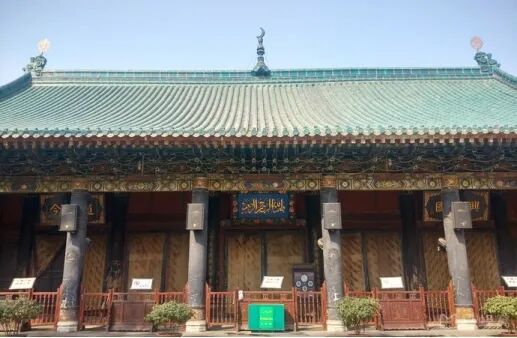
The prayer hall doors were closed to visitors, so I turned my gaze upward to the layers of peacock blue glazed tiles along the roof ridge. They were literally glowing in the sun, so gorgeous you just couldn't look away.
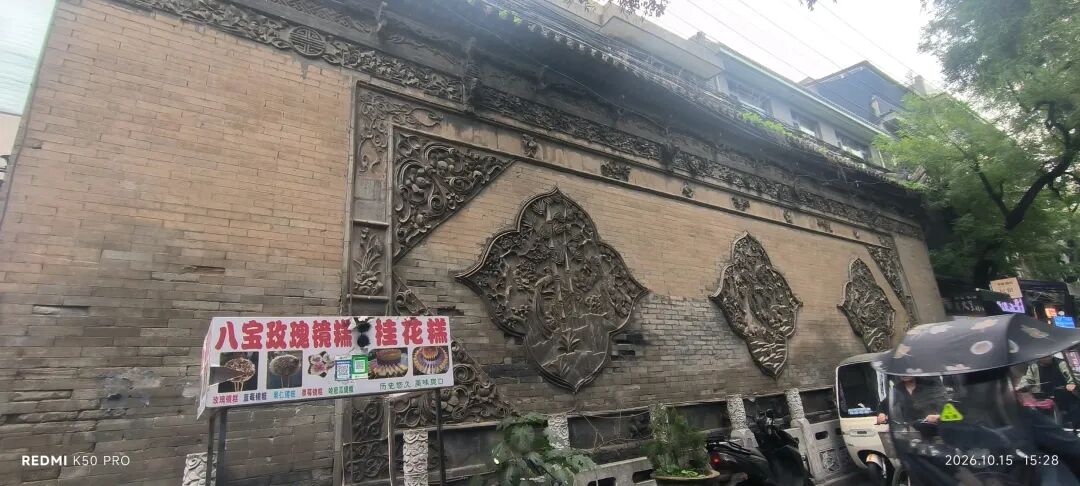
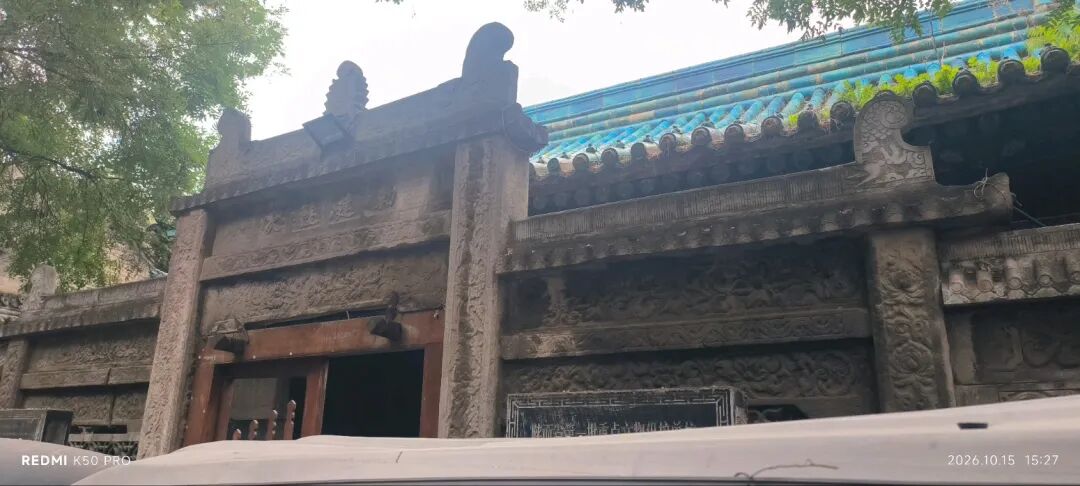
Honestly, the whole courtyard is stunning, from the doors and windows to the eaves. The wood carvings have this timeless, elegant vibe, while the brick and stone carvings are just next-level gorgeous.
(Photo source: Internet)
(The main prayer hall, photo source: Internet)
After heading out, I snapped a few quick pics of the front entrance from the outside.
Even though this visit had a few hiccups and I couldn't take photos everywhere, all those ornate painted beams, carved rafters, peacock blue glazed tiles, and the centuries-old stories carved into the steles are totally burned into my memory.
(The spirit wall directly facing the main entrance of the mosque)
(The main entrance of the mosque)
(Daxuexi Alley) view all
[Internet Repost]
Taking the bus through the streets of Xi'an between the Bell Tower and Qiaozikou, the author visits the Daxuexi Alley Mosque, an ancient thousand-year-old temple that mirrors the Great Mosque of Huajue Alley. The article documents the strict Chinese architectural style of the mosque, the surviving Shengxin Pavilion and stele pavilions, and the vibrant, everyday street life along the way in old Xi'an.
Binging the drama Lan Xiang Ru Gu for days on end recently left my head spinning. With the show finally finished, I could finally step outside and get some fresh air.
01.
Taking advantage of the gorgeous afternoon sunshine, I decided to head out for a walk. Lately, my routine has mostly revolved around the ancient city wall. Having just visited Guangren Temple a few days ago, I followed a travel guide today to check out the mosque on Daxuexi Alley.
Before heading out, I consulted Doubao for directions as usual.
It gave me two options: first, take Line 2 and transfer to Line 6, which still required a walk of over ten minutes after exiting the station; second, take Line 2 for two stops to the Bell Tower, transfer to bus route 4 to Qiaozikou Station, and walk a shorter distance.
The thought of navigating underground transfers with up-and-down escalators, twisting long corridors, and massive crowds made me a bit nervous.
So, I decisively went with the second bus option.
Even though I picked a route, my sense of direction isn't great, and I ran into all sorts of minor mishaps along the way. First, I got turned around trying to find the bus stop near the Bell Tower and took quite a few detours; then, after getting off at Qiaozikou, I struggled to figure out which way Daxuexi Alley was and wasted a bunch of time. After wandering around and dealing with a few twists and turns, I finally found Daxuexi Alley.
A tall archway stands at the entrance of the alley, featuring carved beams and painted pillars, though I couldn't read the couplets on either side of the gate. However, I had learned a bit beforehand about how the alley got its name.
Legend has it that during the An Lushan Rebellion, Uyghur and Western Regions troops helped Tang dynasty general Guo Ziyi retake Chang'an. After the war, over 200 military officers from the Western Regions stayed behind right here. The imperial court set up a school here to teach them the Chinese language, Central Plains rituals, and legal systems, which is why the place became known as "Xuexi (Study) Alley."
02.
This is an authentic old alley with narrow streets. Most of the businesses on both sides are local shops, especially eateries, overflowing with a lively, everyday vibe. Walking down the alley, you frequently run into Hui Muslim women wearing hijabs and men wearing white caps, revealing that this is a Hui Muslim residential community.
Walking further down the alley, I spotted two men looking around as if searching for something. When they reached a small side door, they muttered quietly, "Why isn't it open? Are they not letting people in?"
I figured they were also visitors who had come specifically to find the mosque here. Since we shared the same goal, I tagged along behind them.
A few more meters ahead, I saw a modest courtyard entrance where Hui Muslim women wearing hijabs were walking in and out. The two men stepped up to ask if visitors were allowed inside, and after getting permission, they walked in. I quickly followed right behind them. Right behind me was a middle-aged man.
03.
Inside the mosque grounds, there were very few tourists, making it wonderfully quiet and serene. As soon as you step through the gate, you see a three-story, four-cornered pavilion. After years of wind and sun, the once-bright paint has faded and peeled, exposing the cracked and rough wood grain. While it has lost its original colorful vibrance, it still maintains that rustic and elegant charm. This turned out to be the "Shengxin Pavilion (Pavilion of Self-Reflection)."
(Shengxin Pavilion, photo from the internet)
Sitting under the pavilion was an elderly man in his eighties, dressed in traditional Hui Muslim attire with a long beard and a white cap. A sign hung on the chair next to him read: "Entering the mosque, photography is prohibited."
The old man stopped the two men to ask where they were from. To prove their sincerity, they said they came from Northeast China and handed over their ID cards to show they were also Hui Muslims. The old man took them, looked them over, and handed them back.
For some reason, seeing Hui Muslims made me feel a bit anxious. Now, seeing this elderly man asking questions added an extra layer of nervousness. I'm not a Muslim; I was just visiting out of curiosity as an outsider, so I didn't dare say much. I slipped through the gate beside Shengxin Pavilion into the second courtyard to get away from the old man's line of sight as quickly as possible.
The middle-aged man who had followed me in took out his phone the moment he stepped into the second courtyard and secretly snapped a photo. I didn't dare do the same, terrified of getting told off. I figured taking pictures was out of the question today, so I would just have to enjoy this rustic and exquisite courtyard with my eyes and keep it in my heart.
04.
This is a classic Chinese-style courtyard with a total of three courtyards. The Shengxin Pavilion sits right on the central axis, with buildings symmetrically distributed on both sides, while the rockeries, ponds, and flower beds in the yard are scattered on either side.
Stepping into the second courtyard, you'll find tons of super old stone steles—some of the text is still barely readable, while other parts are totally faded. I did my homework beforehand, so I knew this mosque was hiding two absolute treasures inside its pavilion structures.
One of them is a stele from the Jiajing period of the Ming Dynasty titled "Record of the Restoration of Qingjing Mosque," which documents the historical reality of Zheng He's voyages to the Western Oceans. Locals usually just call it the "Zheng He Stele."
The inscription tells the fascinating story of how, during the Yongle era of the Ming Dynasty, the famous eunuch commander Zheng He was ordered on a mission to the Western Oceans. Passing through Xi'an, he looked for talent and recruited the mosque's Imam, Hasan, to tag along as a translator. After they got back, because Hasan had done a great job and his prayers at sea were answered, Zheng He petitioned the imperial court for funds and personally led the reconstruction of this mosque.
The other one is a Yuan Dynasty Arabic stele featuring the Chinese text "Record of the Enlargement of the Mosque" on the front and entirely Arabic writing on the back. These two steles—one Chinese, one Arabic, one from the Ming, and one from the Yuan—don't just track the history of this ancient mosque; they are super valuable physical pieces of evidence showing the cultural exchange and mutual learning between Chinese civilization and Islamic civilization.
From the second courtyard, you walk up some stone steps into the third courtyard. The yard is wrapped in stone railings, with a stone memorial archway on both the north and south sides. The most breathtaking thing here is the main prayer hall, which is said to hold up to 500 people for prayer.
The prayer hall doors were closed to visitors, so I turned my gaze upward to the layers of peacock blue glazed tiles along the roof ridge. They were literally glowing in the sun, so gorgeous you just couldn't look away.
Honestly, the whole courtyard is stunning, from the doors and windows to the eaves. The wood carvings have this timeless, elegant vibe, while the brick and stone carvings are just next-level gorgeous.
(Photo source: Internet)
(The main prayer hall, photo source: Internet)
After heading out, I snapped a few quick pics of the front entrance from the outside.
Even though this visit had a few hiccups and I couldn't take photos everywhere, all those ornate painted beams, carved rafters, peacock blue glazed tiles, and the centuries-old stories carved into the steles are totally burned into my memory.
(The spirit wall directly facing the main entrance of the mosque)
(The main entrance of the mosque)
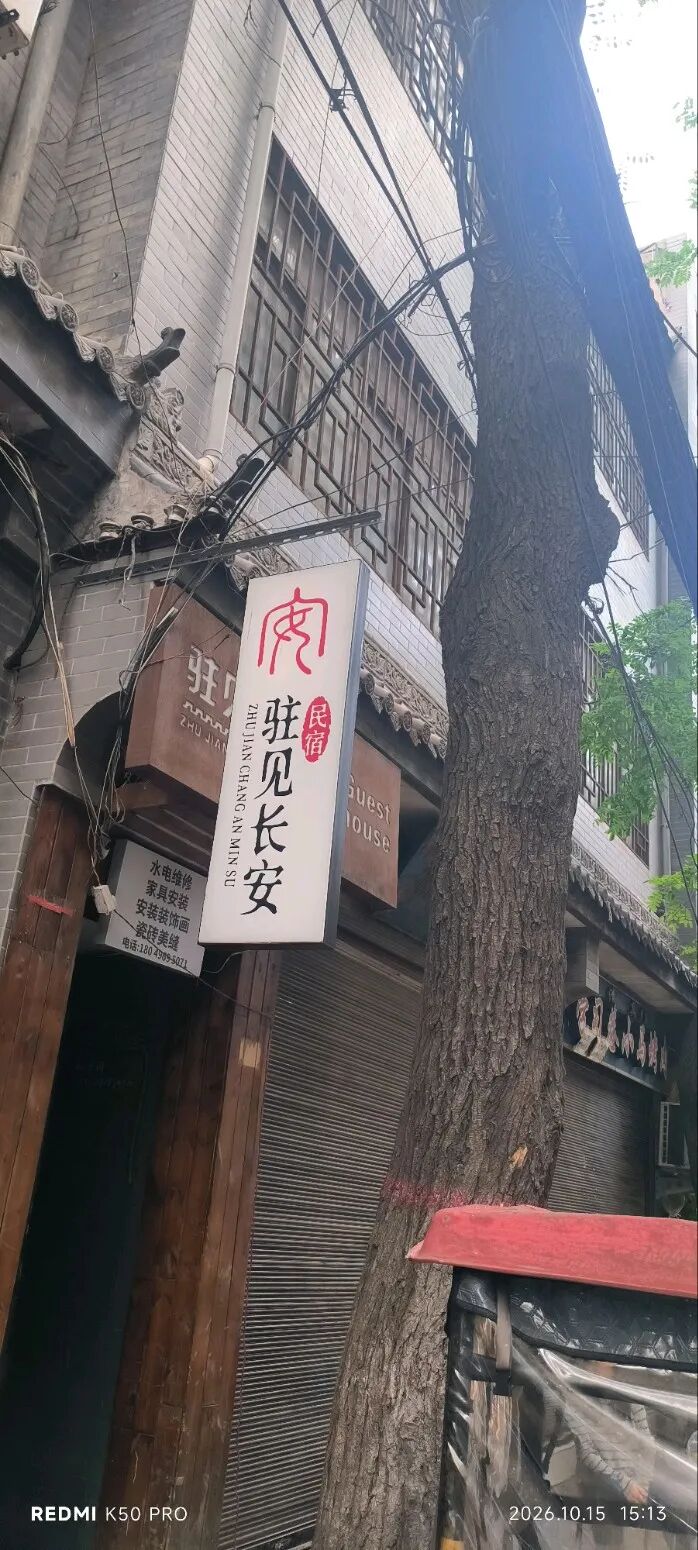

(Daxuexi Alley)
Taking the bus through the streets of Xi'an between the Bell Tower and Qiaozikou, the author visits the Daxuexi Alley Mosque, an ancient thousand-year-old temple that mirrors the Great Mosque of Huajue Alley. The article documents the strict Chinese architectural style of the mosque, the surviving Shengxin Pavilion and stele pavilions, and the vibrant, everyday street life along the way in old Xi'an.
Binging the drama Lan Xiang Ru Gu for days on end recently left my head spinning. With the show finally finished, I could finally step outside and get some fresh air.
01.
Taking advantage of the gorgeous afternoon sunshine, I decided to head out for a walk. Lately, my routine has mostly revolved around the ancient city wall. Having just visited Guangren Temple a few days ago, I followed a travel guide today to check out the mosque on Daxuexi Alley.
Before heading out, I consulted Doubao for directions as usual.
It gave me two options: first, take Line 2 and transfer to Line 6, which still required a walk of over ten minutes after exiting the station; second, take Line 2 for two stops to the Bell Tower, transfer to bus route 4 to Qiaozikou Station, and walk a shorter distance.
The thought of navigating underground transfers with up-and-down escalators, twisting long corridors, and massive crowds made me a bit nervous.
So, I decisively went with the second bus option.
Even though I picked a route, my sense of direction isn't great, and I ran into all sorts of minor mishaps along the way. First, I got turned around trying to find the bus stop near the Bell Tower and took quite a few detours; then, after getting off at Qiaozikou, I struggled to figure out which way Daxuexi Alley was and wasted a bunch of time. After wandering around and dealing with a few twists and turns, I finally found Daxuexi Alley.
A tall archway stands at the entrance of the alley, featuring carved beams and painted pillars, though I couldn't read the couplets on either side of the gate. However, I had learned a bit beforehand about how the alley got its name.
Legend has it that during the An Lushan Rebellion, Uyghur and Western Regions troops helped Tang dynasty general Guo Ziyi retake Chang'an. After the war, over 200 military officers from the Western Regions stayed behind right here. The imperial court set up a school here to teach them the Chinese language, Central Plains rituals, and legal systems, which is why the place became known as "Xuexi (Study) Alley."
02.
This is an authentic old alley with narrow streets. Most of the businesses on both sides are local shops, especially eateries, overflowing with a lively, everyday vibe. Walking down the alley, you frequently run into Hui Muslim women wearing hijabs and men wearing white caps, revealing that this is a Hui Muslim residential community.
Walking further down the alley, I spotted two men looking around as if searching for something. When they reached a small side door, they muttered quietly, "Why isn't it open? Are they not letting people in?"
I figured they were also visitors who had come specifically to find the mosque here. Since we shared the same goal, I tagged along behind them.
A few more meters ahead, I saw a modest courtyard entrance where Hui Muslim women wearing hijabs were walking in and out. The two men stepped up to ask if visitors were allowed inside, and after getting permission, they walked in. I quickly followed right behind them. Right behind me was a middle-aged man.
03.
Inside the mosque grounds, there were very few tourists, making it wonderfully quiet and serene. As soon as you step through the gate, you see a three-story, four-cornered pavilion. After years of wind and sun, the once-bright paint has faded and peeled, exposing the cracked and rough wood grain. While it has lost its original colorful vibrance, it still maintains that rustic and elegant charm. This turned out to be the "Shengxin Pavilion (Pavilion of Self-Reflection)."
(Shengxin Pavilion, photo from the internet)
Sitting under the pavilion was an elderly man in his eighties, dressed in traditional Hui Muslim attire with a long beard and a white cap. A sign hung on the chair next to him read: "Entering the mosque, photography is prohibited."
The old man stopped the two men to ask where they were from. To prove their sincerity, they said they came from Northeast China and handed over their ID cards to show they were also Hui Muslims. The old man took them, looked them over, and handed them back.
For some reason, seeing Hui Muslims made me feel a bit anxious. Now, seeing this elderly man asking questions added an extra layer of nervousness. I'm not a Muslim; I was just visiting out of curiosity as an outsider, so I didn't dare say much. I slipped through the gate beside Shengxin Pavilion into the second courtyard to get away from the old man's line of sight as quickly as possible.
The middle-aged man who had followed me in took out his phone the moment he stepped into the second courtyard and secretly snapped a photo. I didn't dare do the same, terrified of getting told off. I figured taking pictures was out of the question today, so I would just have to enjoy this rustic and exquisite courtyard with my eyes and keep it in my heart.
04.
This is a classic Chinese-style courtyard with a total of three courtyards. The Shengxin Pavilion sits right on the central axis, with buildings symmetrically distributed on both sides, while the rockeries, ponds, and flower beds in the yard are scattered on either side.
Stepping into the second courtyard, you'll find tons of super old stone steles—some of the text is still barely readable, while other parts are totally faded. I did my homework beforehand, so I knew this mosque was hiding two absolute treasures inside its pavilion structures.
One of them is a stele from the Jiajing period of the Ming Dynasty titled "Record of the Restoration of Qingjing Mosque," which documents the historical reality of Zheng He's voyages to the Western Oceans. Locals usually just call it the "Zheng He Stele."
The inscription tells the fascinating story of how, during the Yongle era of the Ming Dynasty, the famous eunuch commander Zheng He was ordered on a mission to the Western Oceans. Passing through Xi'an, he looked for talent and recruited the mosque's Imam, Hasan, to tag along as a translator. After they got back, because Hasan had done a great job and his prayers at sea were answered, Zheng He petitioned the imperial court for funds and personally led the reconstruction of this mosque.
The other one is a Yuan Dynasty Arabic stele featuring the Chinese text "Record of the Enlargement of the Mosque" on the front and entirely Arabic writing on the back. These two steles—one Chinese, one Arabic, one from the Ming, and one from the Yuan—don't just track the history of this ancient mosque; they are super valuable physical pieces of evidence showing the cultural exchange and mutual learning between Chinese civilization and Islamic civilization.
From the second courtyard, you walk up some stone steps into the third courtyard. The yard is wrapped in stone railings, with a stone memorial archway on both the north and south sides. The most breathtaking thing here is the main prayer hall, which is said to hold up to 500 people for prayer.
The prayer hall doors were closed to visitors, so I turned my gaze upward to the layers of peacock blue glazed tiles along the roof ridge. They were literally glowing in the sun, so gorgeous you just couldn't look away.
Honestly, the whole courtyard is stunning, from the doors and windows to the eaves. The wood carvings have this timeless, elegant vibe, while the brick and stone carvings are just next-level gorgeous.
(Photo source: Internet)
(The main prayer hall, photo source: Internet)
After heading out, I snapped a few quick pics of the front entrance from the outside.
Even though this visit had a few hiccups and I couldn't take photos everywhere, all those ornate painted beams, carved rafters, peacock blue glazed tiles, and the centuries-old stories carved into the steles are totally burned into my memory.
(The spirit wall directly facing the main entrance of the mosque)
(The main entrance of the mosque)
(Daxuexi Alley)
Daxuexi Alley Mosque Xi'an: Exploring Tang Dynasty Islamic Heritage and Authentic Hui Muslim Neighborhood Street Life
Articles • Hasan09 posted the article • 0 comments • 12 views • 9 hours ago
[Internet Repost]
Taking the bus through the streets of Xi'an between the Bell Tower and Qiaozikou, the author visits the Daxuexi Alley Mosque, an ancient thousand-year-old temple that mirrors the Great Mosque of Huajue Alley. The article documents the strict Chinese architectural style of the mosque, the surviving Shengxin Pavilion and stele pavilions, and the vibrant, everyday street life along the way in old Xi'an.
Binging the drama Lan Xiang Ru Gu for days on end recently left my head spinning. With the show finally finished, I could finally step outside and get some fresh air.
01.
Taking advantage of the gorgeous afternoon sunshine, I decided to head out for a walk. Lately, my routine has mostly revolved around the ancient city wall. Having just visited Guangren Temple a few days ago, I followed a travel guide today to check out the mosque on Daxuexi Alley.
Before heading out, I consulted Doubao for directions as usual.
It gave me two options: first, take Line 2 and transfer to Line 6, which still required a walk of over ten minutes after exiting the station; second, take Line 2 for two stops to the Bell Tower, transfer to bus route 4 to Qiaozikou Station, and walk a shorter distance.
The thought of navigating underground transfers with up-and-down escalators, twisting long corridors, and massive crowds made me a bit nervous.
So, I decisively went with the second bus option.
Even though I picked a route, my sense of direction isn't great, and I ran into all sorts of minor mishaps along the way. First, I got turned around trying to find the bus stop near the Bell Tower and took quite a few detours; then, after getting off at Qiaozikou, I struggled to figure out which way Daxuexi Alley was and wasted a bunch of time. After wandering around and dealing with a few twists and turns, I finally found Daxuexi Alley.
A tall archway stands at the entrance of the alley, featuring carved beams and painted pillars, though I couldn't read the couplets on either side of the gate. However, I had learned a bit beforehand about how the alley got its name.
Legend has it that during the An Lushan Rebellion, Uyghur and Western Regions troops helped Tang dynasty general Guo Ziyi retake Chang'an. After the war, over 200 military officers from the Western Regions stayed behind right here. The imperial court set up a school here to teach them the Chinese language, Central Plains rituals, and legal systems, which is why the place became known as "Xuexi (Study) Alley."
02.
This is an authentic old alley with narrow streets. Most of the businesses on both sides are local shops, especially eateries, overflowing with a lively, everyday vibe. Walking down the alley, you frequently run into Hui Muslim women wearing hijabs and men wearing white caps, revealing that this is a Hui Muslim residential community.
Walking further down the alley, I spotted two men looking around as if searching for something. When they reached a small side door, they muttered quietly, "Why isn't it open? Are they not letting people in?"
I figured they were also visitors who had come specifically to find the mosque here. Since we shared the same goal, I tagged along behind them.
A few more meters ahead, I saw a modest courtyard entrance where Hui Muslim women wearing hijabs were walking in and out. The two men stepped up to ask if visitors were allowed inside, and after getting permission, they walked in. I quickly followed right behind them. Right behind me was a middle-aged man.
03.
Inside the mosque grounds, there were very few tourists, making it wonderfully quiet and serene. As soon as you step through the gate, you see a three-story, four-cornered pavilion. After years of wind and sun, the once-bright paint has faded and peeled, exposing the cracked and rough wood grain. While it has lost its original colorful vibrance, it still maintains that rustic and elegant charm. This turned out to be the "Shengxin Pavilion (Pavilion of Self-Reflection)."
(Shengxin Pavilion, photo from the internet)
Sitting under the pavilion was an elderly man in his eighties, dressed in traditional Hui Muslim attire with a long beard and a white cap. A sign hung on the chair next to him read: "Entering the mosque, photography is prohibited."
The old man stopped the two men to ask where they were from. To prove their sincerity, they said they came from Northeast China and handed over their ID cards to show they were also Hui Muslims. The old man took them, looked them over, and handed them back.
For some reason, seeing Hui Muslims made me feel a bit anxious. Now, seeing this elderly man asking questions added an extra layer of nervousness. I'm not a Muslim; I was just visiting out of curiosity as an outsider, so I didn't dare say much. I slipped through the gate beside Shengxin Pavilion into the second courtyard to get away from the old man's line of sight as quickly as possible.
The middle-aged man who had followed me in took out his phone the moment he stepped into the second courtyard and secretly snapped a photo. I didn't dare do the same, terrified of getting told off. I figured taking pictures was out of the question today, so I would just have to enjoy this rustic and exquisite courtyard with my eyes and keep it in my heart.
04.
This is a classic Chinese-style courtyard with a total of three courtyards. The Shengxin Pavilion sits right on the central axis, with buildings symmetrically distributed on both sides, while the rockeries, ponds, and flower beds in the yard are scattered on either side.
Stepping into the second courtyard, you'll find tons of super old stone steles—some of the text is still barely readable, while other parts are totally faded. I did my homework beforehand, so I knew this mosque was hiding two absolute treasures inside its pavilion structures.
One of them is a stele from the Jiajing period of the Ming Dynasty titled "Record of the Restoration of Qingjing Mosque," which documents the historical reality of Zheng He's voyages to the Western Oceans. Locals usually just call it the "Zheng He Stele."
The inscription tells the fascinating story of how, during the Yongle era of the Ming Dynasty, the famous eunuch commander Zheng He was ordered on a mission to the Western Oceans. Passing through Xi'an, he looked for talent and recruited the mosque's Imam, Hasan, to tag along as a translator. After they got back, because Hasan had done a great job and his prayers at sea were answered, Zheng He petitioned the imperial court for funds and personally led the reconstruction of this mosque.
The other one is a Yuan Dynasty Arabic stele featuring the Chinese text "Record of the Enlargement of the Mosque" on the front and entirely Arabic writing on the back. These two steles—one Chinese, one Arabic, one from the Ming, and one from the Yuan—don't just track the history of this ancient mosque; they are super valuable physical pieces of evidence showing the cultural exchange and mutual learning between Chinese civilization and Islamic civilization.
From the second courtyard, you walk up some stone steps into the third courtyard. The yard is wrapped in stone railings, with a stone memorial archway on both the north and south sides. The most breathtaking thing here is the main prayer hall, which is said to hold up to 500 people for prayer.
The prayer hall doors were closed to visitors, so I turned my gaze upward to the layers of peacock blue glazed tiles along the roof ridge. They were literally glowing in the sun, so gorgeous you just couldn't look away.
Honestly, the whole courtyard is stunning, from the doors and windows to the eaves. The wood carvings have this timeless, elegant vibe, while the brick and stone carvings are just next-level gorgeous.
(Photo source: Internet)
(The main prayer hall, photo source: Internet)
After heading out, I snapped a few quick pics of the front entrance from the outside.
Even though this visit had a few hiccups and I couldn't take photos everywhere, all those ornate painted beams, carved rafters, peacock blue glazed tiles, and the centuries-old stories carved into the steles are totally burned into my memory.
(The spirit wall directly facing the main entrance of the mosque)
(The main entrance of the mosque)
(Daxuexi Alley) view all
Taking the bus through the streets of Xi'an between the Bell Tower and Qiaozikou, the author visits the Daxuexi Alley Mosque, an ancient thousand-year-old temple that mirrors the Great Mosque of Huajue Alley. The article documents the strict Chinese architectural style of the mosque, the surviving Shengxin Pavilion and stele pavilions, and the vibrant, everyday street life along the way in old Xi'an.
Binging the drama Lan Xiang Ru Gu for days on end recently left my head spinning. With the show finally finished, I could finally step outside and get some fresh air.
01.
Taking advantage of the gorgeous afternoon sunshine, I decided to head out for a walk. Lately, my routine has mostly revolved around the ancient city wall. Having just visited Guangren Temple a few days ago, I followed a travel guide today to check out the mosque on Daxuexi Alley.
Before heading out, I consulted Doubao for directions as usual.
It gave me two options: first, take Line 2 and transfer to Line 6, which still required a walk of over ten minutes after exiting the station; second, take Line 2 for two stops to the Bell Tower, transfer to bus route 4 to Qiaozikou Station, and walk a shorter distance.
The thought of navigating underground transfers with up-and-down escalators, twisting long corridors, and massive crowds made me a bit nervous.
So, I decisively went with the second bus option.
Even though I picked a route, my sense of direction isn't great, and I ran into all sorts of minor mishaps along the way. First, I got turned around trying to find the bus stop near the Bell Tower and took quite a few detours; then, after getting off at Qiaozikou, I struggled to figure out which way Daxuexi Alley was and wasted a bunch of time. After wandering around and dealing with a few twists and turns, I finally found Daxuexi Alley.
A tall archway stands at the entrance of the alley, featuring carved beams and painted pillars, though I couldn't read the couplets on either side of the gate. However, I had learned a bit beforehand about how the alley got its name.
Legend has it that during the An Lushan Rebellion, Uyghur and Western Regions troops helped Tang dynasty general Guo Ziyi retake Chang'an. After the war, over 200 military officers from the Western Regions stayed behind right here. The imperial court set up a school here to teach them the Chinese language, Central Plains rituals, and legal systems, which is why the place became known as "Xuexi (Study) Alley."
02.
This is an authentic old alley with narrow streets. Most of the businesses on both sides are local shops, especially eateries, overflowing with a lively, everyday vibe. Walking down the alley, you frequently run into Hui Muslim women wearing hijabs and men wearing white caps, revealing that this is a Hui Muslim residential community.
Walking further down the alley, I spotted two men looking around as if searching for something. When they reached a small side door, they muttered quietly, "Why isn't it open? Are they not letting people in?"
I figured they were also visitors who had come specifically to find the mosque here. Since we shared the same goal, I tagged along behind them.
A few more meters ahead, I saw a modest courtyard entrance where Hui Muslim women wearing hijabs were walking in and out. The two men stepped up to ask if visitors were allowed inside, and after getting permission, they walked in. I quickly followed right behind them. Right behind me was a middle-aged man.
03.
Inside the mosque grounds, there were very few tourists, making it wonderfully quiet and serene. As soon as you step through the gate, you see a three-story, four-cornered pavilion. After years of wind and sun, the once-bright paint has faded and peeled, exposing the cracked and rough wood grain. While it has lost its original colorful vibrance, it still maintains that rustic and elegant charm. This turned out to be the "Shengxin Pavilion (Pavilion of Self-Reflection)."
(Shengxin Pavilion, photo from the internet)
Sitting under the pavilion was an elderly man in his eighties, dressed in traditional Hui Muslim attire with a long beard and a white cap. A sign hung on the chair next to him read: "Entering the mosque, photography is prohibited."
The old man stopped the two men to ask where they were from. To prove their sincerity, they said they came from Northeast China and handed over their ID cards to show they were also Hui Muslims. The old man took them, looked them over, and handed them back.
For some reason, seeing Hui Muslims made me feel a bit anxious. Now, seeing this elderly man asking questions added an extra layer of nervousness. I'm not a Muslim; I was just visiting out of curiosity as an outsider, so I didn't dare say much. I slipped through the gate beside Shengxin Pavilion into the second courtyard to get away from the old man's line of sight as quickly as possible.
The middle-aged man who had followed me in took out his phone the moment he stepped into the second courtyard and secretly snapped a photo. I didn't dare do the same, terrified of getting told off. I figured taking pictures was out of the question today, so I would just have to enjoy this rustic and exquisite courtyard with my eyes and keep it in my heart.
04.
This is a classic Chinese-style courtyard with a total of three courtyards. The Shengxin Pavilion sits right on the central axis, with buildings symmetrically distributed on both sides, while the rockeries, ponds, and flower beds in the yard are scattered on either side.
Stepping into the second courtyard, you'll find tons of super old stone steles—some of the text is still barely readable, while other parts are totally faded. I did my homework beforehand, so I knew this mosque was hiding two absolute treasures inside its pavilion structures.
One of them is a stele from the Jiajing period of the Ming Dynasty titled "Record of the Restoration of Qingjing Mosque," which documents the historical reality of Zheng He's voyages to the Western Oceans. Locals usually just call it the "Zheng He Stele."
The inscription tells the fascinating story of how, during the Yongle era of the Ming Dynasty, the famous eunuch commander Zheng He was ordered on a mission to the Western Oceans. Passing through Xi'an, he looked for talent and recruited the mosque's Imam, Hasan, to tag along as a translator. After they got back, because Hasan had done a great job and his prayers at sea were answered, Zheng He petitioned the imperial court for funds and personally led the reconstruction of this mosque.
The other one is a Yuan Dynasty Arabic stele featuring the Chinese text "Record of the Enlargement of the Mosque" on the front and entirely Arabic writing on the back. These two steles—one Chinese, one Arabic, one from the Ming, and one from the Yuan—don't just track the history of this ancient mosque; they are super valuable physical pieces of evidence showing the cultural exchange and mutual learning between Chinese civilization and Islamic civilization.
From the second courtyard, you walk up some stone steps into the third courtyard. The yard is wrapped in stone railings, with a stone memorial archway on both the north and south sides. The most breathtaking thing here is the main prayer hall, which is said to hold up to 500 people for prayer.
The prayer hall doors were closed to visitors, so I turned my gaze upward to the layers of peacock blue glazed tiles along the roof ridge. They were literally glowing in the sun, so gorgeous you just couldn't look away.
Honestly, the whole courtyard is stunning, from the doors and windows to the eaves. The wood carvings have this timeless, elegant vibe, while the brick and stone carvings are just next-level gorgeous.
(Photo source: Internet)
(The main prayer hall, photo source: Internet)
After heading out, I snapped a few quick pics of the front entrance from the outside.
Even though this visit had a few hiccups and I couldn't take photos everywhere, all those ornate painted beams, carved rafters, peacock blue glazed tiles, and the centuries-old stories carved into the steles are totally burned into my memory.
(The spirit wall directly facing the main entrance of the mosque)
(The main entrance of the mosque)
(Daxuexi Alley) view all
[Internet Repost]
Taking the bus through the streets of Xi'an between the Bell Tower and Qiaozikou, the author visits the Daxuexi Alley Mosque, an ancient thousand-year-old temple that mirrors the Great Mosque of Huajue Alley. The article documents the strict Chinese architectural style of the mosque, the surviving Shengxin Pavilion and stele pavilions, and the vibrant, everyday street life along the way in old Xi'an.
Binging the drama Lan Xiang Ru Gu for days on end recently left my head spinning. With the show finally finished, I could finally step outside and get some fresh air.
01.
Taking advantage of the gorgeous afternoon sunshine, I decided to head out for a walk. Lately, my routine has mostly revolved around the ancient city wall. Having just visited Guangren Temple a few days ago, I followed a travel guide today to check out the mosque on Daxuexi Alley.
Before heading out, I consulted Doubao for directions as usual.
It gave me two options: first, take Line 2 and transfer to Line 6, which still required a walk of over ten minutes after exiting the station; second, take Line 2 for two stops to the Bell Tower, transfer to bus route 4 to Qiaozikou Station, and walk a shorter distance.
The thought of navigating underground transfers with up-and-down escalators, twisting long corridors, and massive crowds made me a bit nervous.
So, I decisively went with the second bus option.
Even though I picked a route, my sense of direction isn't great, and I ran into all sorts of minor mishaps along the way. First, I got turned around trying to find the bus stop near the Bell Tower and took quite a few detours; then, after getting off at Qiaozikou, I struggled to figure out which way Daxuexi Alley was and wasted a bunch of time. After wandering around and dealing with a few twists and turns, I finally found Daxuexi Alley.
A tall archway stands at the entrance of the alley, featuring carved beams and painted pillars, though I couldn't read the couplets on either side of the gate. However, I had learned a bit beforehand about how the alley got its name.
Legend has it that during the An Lushan Rebellion, Uyghur and Western Regions troops helped Tang dynasty general Guo Ziyi retake Chang'an. After the war, over 200 military officers from the Western Regions stayed behind right here. The imperial court set up a school here to teach them the Chinese language, Central Plains rituals, and legal systems, which is why the place became known as "Xuexi (Study) Alley."
02.
This is an authentic old alley with narrow streets. Most of the businesses on both sides are local shops, especially eateries, overflowing with a lively, everyday vibe. Walking down the alley, you frequently run into Hui Muslim women wearing hijabs and men wearing white caps, revealing that this is a Hui Muslim residential community.
Walking further down the alley, I spotted two men looking around as if searching for something. When they reached a small side door, they muttered quietly, "Why isn't it open? Are they not letting people in?"
I figured they were also visitors who had come specifically to find the mosque here. Since we shared the same goal, I tagged along behind them.
A few more meters ahead, I saw a modest courtyard entrance where Hui Muslim women wearing hijabs were walking in and out. The two men stepped up to ask if visitors were allowed inside, and after getting permission, they walked in. I quickly followed right behind them. Right behind me was a middle-aged man.
03.
Inside the mosque grounds, there were very few tourists, making it wonderfully quiet and serene. As soon as you step through the gate, you see a three-story, four-cornered pavilion. After years of wind and sun, the once-bright paint has faded and peeled, exposing the cracked and rough wood grain. While it has lost its original colorful vibrance, it still maintains that rustic and elegant charm. This turned out to be the "Shengxin Pavilion (Pavilion of Self-Reflection)."
(Shengxin Pavilion, photo from the internet)
Sitting under the pavilion was an elderly man in his eighties, dressed in traditional Hui Muslim attire with a long beard and a white cap. A sign hung on the chair next to him read: "Entering the mosque, photography is prohibited."
The old man stopped the two men to ask where they were from. To prove their sincerity, they said they came from Northeast China and handed over their ID cards to show they were also Hui Muslims. The old man took them, looked them over, and handed them back.
For some reason, seeing Hui Muslims made me feel a bit anxious. Now, seeing this elderly man asking questions added an extra layer of nervousness. I'm not a Muslim; I was just visiting out of curiosity as an outsider, so I didn't dare say much. I slipped through the gate beside Shengxin Pavilion into the second courtyard to get away from the old man's line of sight as quickly as possible.
The middle-aged man who had followed me in took out his phone the moment he stepped into the second courtyard and secretly snapped a photo. I didn't dare do the same, terrified of getting told off. I figured taking pictures was out of the question today, so I would just have to enjoy this rustic and exquisite courtyard with my eyes and keep it in my heart.
04.
This is a classic Chinese-style courtyard with a total of three courtyards. The Shengxin Pavilion sits right on the central axis, with buildings symmetrically distributed on both sides, while the rockeries, ponds, and flower beds in the yard are scattered on either side.
Stepping into the second courtyard, you'll find tons of super old stone steles—some of the text is still barely readable, while other parts are totally faded. I did my homework beforehand, so I knew this mosque was hiding two absolute treasures inside its pavilion structures.
One of them is a stele from the Jiajing period of the Ming Dynasty titled "Record of the Restoration of Qingjing Mosque," which documents the historical reality of Zheng He's voyages to the Western Oceans. Locals usually just call it the "Zheng He Stele."
The inscription tells the fascinating story of how, during the Yongle era of the Ming Dynasty, the famous eunuch commander Zheng He was ordered on a mission to the Western Oceans. Passing through Xi'an, he looked for talent and recruited the mosque's Imam, Hasan, to tag along as a translator. After they got back, because Hasan had done a great job and his prayers at sea were answered, Zheng He petitioned the imperial court for funds and personally led the reconstruction of this mosque.
The other one is a Yuan Dynasty Arabic stele featuring the Chinese text "Record of the Enlargement of the Mosque" on the front and entirely Arabic writing on the back. These two steles—one Chinese, one Arabic, one from the Ming, and one from the Yuan—don't just track the history of this ancient mosque; they are super valuable physical pieces of evidence showing the cultural exchange and mutual learning between Chinese civilization and Islamic civilization.
From the second courtyard, you walk up some stone steps into the third courtyard. The yard is wrapped in stone railings, with a stone memorial archway on both the north and south sides. The most breathtaking thing here is the main prayer hall, which is said to hold up to 500 people for prayer.
The prayer hall doors were closed to visitors, so I turned my gaze upward to the layers of peacock blue glazed tiles along the roof ridge. They were literally glowing in the sun, so gorgeous you just couldn't look away.
Honestly, the whole courtyard is stunning, from the doors and windows to the eaves. The wood carvings have this timeless, elegant vibe, while the brick and stone carvings are just next-level gorgeous.
(Photo source: Internet)
(The main prayer hall, photo source: Internet)
After heading out, I snapped a few quick pics of the front entrance from the outside.
Even though this visit had a few hiccups and I couldn't take photos everywhere, all those ornate painted beams, carved rafters, peacock blue glazed tiles, and the centuries-old stories carved into the steles are totally burned into my memory.
(The spirit wall directly facing the main entrance of the mosque)
(The main entrance of the mosque)
(Daxuexi Alley)