

Xining
Exploring Xining Dongguan Mosque: Deep Documentary on Hui Muslim Traditions and Funeral Customs in Qinghai
Articles • Hasan09 posted the article • 0 comments • 12 views • 5 hours ago
This is the eighth installment of my documentary photography series, 'The Vanishing Arch.' Returning to my hometown of Xining, Qinghai, I capture an intimate look at the solemn Jumu'ah (Friday prayer) at the historic Dongguan Mosque, the funeral processions following the Maghrib (evening) prayer, and the simple, devoted lives of the local Hui Muslims.
During the Maghrib prayer, the funeral dua (supplication) for the deceased happens first, followed by the regular prayer. As soon as the dua ends, the body is carried out through this door. The men walk with hurried steps, quickly turning the corner to reach the Iveco van waiting at the street corner. The women finally lose their composure, chasing after the procession for a few steps while sobbing, 'My dada (father), hmm... hmm...' From the tearful tone of this Xining dialect, I realize she is the daughter of the deceased.
1
Leaving the two mosques in Haidong and heading thirty kilometers west, I pass through the final tunnel of the canyon. Suddenly, the view opens up to a landscape of endless high-rises stretching for dozens of kilometers—this is Xining, the place where I grew up.
Zhang Yi drives the car directly to the alley entrance near the back gate of the Dongguan Mosque. Yu Li and I get out; he goes to look for a parking spot and doesn't come in with me.
‘That’s for the deceased,’ I say, spotting an Iveco van parked at the alley entrance. I’ve known for a long time that these vans are used to transport departed Hui Muslims to the Great Mosque for community prayers before burial.
‘What?’ Yu Li doesn’t quite catch that.
‘The deceased, the body—it’s a dead Muslim being brought to the mosque for funeral rites.’
The back gate of the Dongguan Mosque is convenient for parking and moving stretchers, and it opens up to a relatively quiet area behind the main prayer hall—the perfect setup for handling funeral arrivals. As I enter the back gate, I see twenty or thirty Hui Muslim women gathered. Most are middle-aged, their hair covered tightly, their faces solemn. Two even have tearstains on their cheeks; they are family members of the deceased. However, according to the customs of the Ikhwan (a prominent Islamic sect in China), women aren’t meant to enter the mosque grounds during this ceremony, so they stay at the gate to wait.
Once inside the mosque, I see a body covered in cloth lying on a stretcher just a few meters away. The young men, all wearing white prayer caps, stand in neat rows. Some whisper quietly, but most wait in silence for the ceremony to begin.
I quietly tell Yu Li that there’s a body on the stretcher. I lack the courage to point and stare; it feels like an intrusion on people who have just lost a loved one.
I head from the south side of the main hall to the front. The courtyard is packed with people. The Maghrib prayer is about to begin, and as always, the mosque is bustling with believers. The front plaza is crowded, and opposite it lies the Arabic-style teaching building currently under renovation. The roof ridge is finished, and the scaffolding was removed a week ago; I learned this from the WeChat moments of Jin Biao, the mosque’s assistant Imam.
One day in November, Imam Jin Biao posted a photo of the renovation of the Dongguan Mosque teaching building. In the picture, the original circular Arabic dome and two tall minarets had been removed and replaced with a Chinese-style grand roof. With the scaffolding gone, the deep grey roof tiles and matching wall decorations were now visible, giving the new building its initial form.
This was a landmark event. In 2019, the 'Sinicization' of mosques had already begun in places like Yinchuan. However, Xining, in the Hehuang Valley—the heartland of the Hui Muslims—had been slow to implement this policy. It wasn't until 2022 that the potential renovation of the Dongguan Mosque became a heated topic and a focal point of debate.
How it was modified wasn't the point; whether to modify it and when to start were the key issues. The Ikhwan is the most significant branch of Islam in China and holds immense influence. The Dongguan Mosque is their headquarters and the main mosque; Muslims across the province and the country were watching. The commencement of the Dongguan Mosque’s renovation project was of epoch-making significance.
To understand the progress of the work—or, more accurately, to know if those scaffolds blocking my shots were gone—I messaged Ma Yougui from the mosque. I explained my goal: to take two photos, one from outside the front gate and one from the prayer hall steps facing the building. A phone photo would be clear enough to show me the progress. On my journey through the Northwest, the Xiguan Mosque in Lanzhou and the Dongguan Mosque in Xining were the two most important locations; I could only set out if both were ready to be photographed.
Ma Yougui is an interesting character. I met him in August during a visit to the Dongguan Mosque, where he was in the plaza explaining the basics of Islam to passing tourists and sharing unique historical facts about the mosque. Dressed in white and speaking clearly, he was more than capable of answering the tourists' questions. I was debating whether to look for Imam Jin Biao, whom I hadn't seen in years due to the pandemic, when Ma Yougui greeted me and asked if I needed any help.
I gave him a rough idea of my background. He said he had seen me there before, which is likely true; over the last decade, I’ve visited the Dongguan Mosque dozens of times. I’ve remembered the faces of many regular worshippers, and as a human being, others remember me too—some even guessing my profession or intent by the camera gear I carry.
I remember something he said: ‘Muslims worship Allah, not a building; it doesn't matter what the building looks like.’ It was a stubbornness born of resignation—a sentiment most believers at Dongguan Mosque likely share.
I didn't find Imam Jin Biao that time, but Ma Yougui and I added each other on WeChat. I enjoy getting to know all kinds of Muslims. I want to pay attention to their lives to understand their religion, their faith, and the authentic life of their community.
In November, the photo Ma Yougui specifically took for me showed that the site was ready to be photographed. I quickly finalized my trip. Starting from Lanzhou, passing through Minhe, Linxia, Xunhua, and Hualong, I reached Haidong, and finally arrived at Xining, the last stop of the trip, making Dongguan Mosque my first destination.
However, the plaza was packed with people, making it impossible for me to shoot. I needed an empty space and time to finish my work. Rather than hesitate, I decided to ask the three middle-aged Hui Muslims chatting in front of me in the local Qinghai dialect. Their conversation was trivial, mostly killing time while waiting for the Maghrib prayer. I needed to know the exact time, as I couldn't find the mosque's prayer schedule board.
‘Aba (Father/Sir), what time does prayer start?’ I asked in the Xining dialect.
‘16:52, it's almost time,’ he answered simply. Sure enough, it was only six or seven minutes away. I decided to wait; as soon as prayer started, all the worshippers would enter the hall, and the plaza would instantly clear out.
Near the garden in front of the mosque committee office, I asked about Imam Jin Biao. An older Muslim, a staff member there, said the Imam had gone to a meeting half a month ago—he wasn't sure if it was Beijing or Shanghai—but he had been gone for quite a while.
I gave up on finding Jin Biao and didn't have time to look for Ma Yougui; prayer was about to start, and I had to get my shots.
The old-fashioned electric bell rang—the signal that prayer at the Dongguan Mosque was beginning. The Ikhwan worshippers who had been in the courtyard, on the steps, under the eaves, or by the railings just minutes ago all walked into the Chinese-style prayer hall behind me. I calmly began my work. While I was busy, Yu Li said someone was looking for me. I looked up and saw it was Ma Yougui. He must have seen me and came over to say hello. I shook his hand, and I told him, ‘I didn't see you, and I heard the Imam is away at a conference.’ He said, ‘That's not right, the Imam was here this morning; I'm not sure where he is now.’ He spoke in a rush as the prayer was about to start, so I urged him to go and join the ceremony.
I photographed the teaching building across the square, then turned toward the side and back of the prayer hall. I wanted to see the family praying for the deceased.
Through the loudspeaker came the Imam's distinct voice. I don't understand Arabic, and certainly not Persian. After what sounded like a prayer, he announced information about the deceased. I only remembered the age—63; the rest escaped me. This Imam’s Mandarin had a heavy Hezhou accent, which made it harder to follow, and combined with the multi-layered echoes of the loudspeaker, it was even harder to hear clearly.
All the believers knelt on the prayer mats, offering dua for the deceased. The Ikhwan strongly emphasizes an immediate funeral; typically, the deceased is cleaned and brought to the mosque on the day of death to await the community prayer at Dhuhr (noon) or Maghrib (evening), after which the family quickly transports the body to the cemetery for burial.
I decided not to wait for Ma Yougui, nor to find Jin Biao anymore. I wanted to photograph the family of the deceased, especially the female relatives standing at the gate who couldn't enter.
Before leaving the mosque, I took one photo in the direction of the deceased. Just one. I always have an internal block when taking these kinds of photos. I have seen people who have passed away at this spot countless times, but I rarely photograph them. I cannot face the stern faces of the Ikhwan. The 'Ten Articles of the Orchard' written when the sect was founded didn't specifically forbid mourning, but I have seen and heard rules against weeping at funerals. Even if, according to faith, a person has entered Heaven, they have still truly left their loved ones in this life. How could one not be sad? How could the right to grieve be taken away?
The women at the gate were still waiting. Some spoke in low voices, while the closer family members wore expressions of profound grief. People are the same regardless of their faith; the departure of a loved one leaves us with immense sorrow.
During the Maghrib prayer, the funeral dua for the deceased happens first, followed by the regular prayer. As soon as the dua ends, the body is carried out through this door. The men walk with hurried steps, quickly turning the corner to reach the Iveco van waiting at the street corner. The women finally lose their composure, chasing after the procession for a few steps while sobbing, 'My dada (father), hmm... hmm...' From the tearful tone of this Xining dialect, I realize she is the daughter of the deceased.
The back door of the Iveco was already wide open, and the body was quickly pushed inside. A few young men jumped into the van, while the other men climbed into several other vehicles. The driver started the engine, quickly turned the vehicle around, and sped off toward the south. In one of the trailing cars, someone tried hard to look back through the glass at the group of grieving women left at the alley entrance.
I stood on a step across from the back gate, recording it all on video. Above those steps is a shop; Zhongxia Nanguan Street is the most iconic commercial strip by the Great Mosque. It used to be mainly for vegetables, and it still is today. There are a few snack stalls at the entrance, and inside the alley, you’ll find beef and lamb shops, seafood stands, and other grocery stores. If you turn the corner, there’s a great noodle shop I filmed years ago. The ingredients here aren't just halal—they’re the freshest, additive-free options around. A local Muslim once told me that the noodle shop is where they go to 'eat our own food,' and these markets are just 'where we buy our own groceries.' There is no denying that Islam has always held a certain sense of superiority and exclusivity.
Just as I was filming the deceased being carried out, someone behind me started trying to stop me. At first, she spoke in the Qinghai dialect, kindly reminding me to stop filming. I ignored her. I’m not sure if my feigned ignorance—or perhaps my indifference—angered her, but she switched to standard Mandarin with a firm tone: 'Filming the deceased is not allowed; don't just take pictures like this.' Perhaps, at that moment, this Yihewani (a reformist Islamic school in China) woman felt that same fuzzy sense of 'this is our street.' As for her anger, I didn't even acknowledge it; I didn't give her a single glance.
I decided to leave that tense spot. It was still early, so I had time to head over to film the Shulin Lane Mosque.
Xining Dongguan Great Mosque, photographed in 2014.
Xining Dongguan Great Mosque, photographed in 2023.
The traditional Chinese-style prayer hall at the Dongguan Great Mosque, built in the 1920s.
Xining Shulin Lane Mosque, photographed in 2023.
Xining Shulin Lane Mosque, photographed in 2016.
2
Back in 2016, I shot the exterior of this mosque from several street-level angles; it was a beautiful, distinct-looking Arab-style mosque. However, when I returned this summer, I barely recognized it. Huge office buildings had been constructed on both sides, squeezing the mosque into a narrow gap. It completely lost that elegant, stand-alone silhouette it once had.
When capital and faith collide, faith appears fragile and small, while the power of capital is ultimately dominant and all-encompassing.
For this shot, I had to work hard to find the exact angle from eight years ago, matching the distant buildings and mountains. When you compare the two photos, only a small portion of the elements overlap perfectly, highlighting just how much has changed. Otherwise, you’d never guess they were taken in the same place.
The Shulin Lane Mosque belongs to the Salafiyya school, a sect that split off from the Yihewani. Locals often call them 'Santai' (three-lifting), likely because they lift their hands three times during prayer. But I rarely use that term. Years ago, I was chatting with a local Hui Muslim in Henan, and when I mentioned Xining, he scoffed and said, 'Oh, you mean the Santai people?' The tone was quite dismissive, so I’ve never used that name myself, as I know it can be disrespectful and easily misunderstood.
I finished filming the mosque from an intersection. I used to take photos from where a Confucius statue stood about 100 meters east, but now a solid office building sits right between that spot and the mosque.
After finishing, I parked the car in the underground garage of the Xinqian Plaza across the street. This is a commercial real estate project owned by the Hui people—a massive complex with over a dozen towers and the Fuqiang Lane Mosque in the center. It’s surrounded by commercial buildings.
I took the elevator to the fifth floor, which was perfect for getting a full view of the Fuqiang Lane Mosque. I had come here in August to scout locations, so I knew exactly where to go. I found a quiet spot on the southeast side that overlooked the main entrance perfectly.
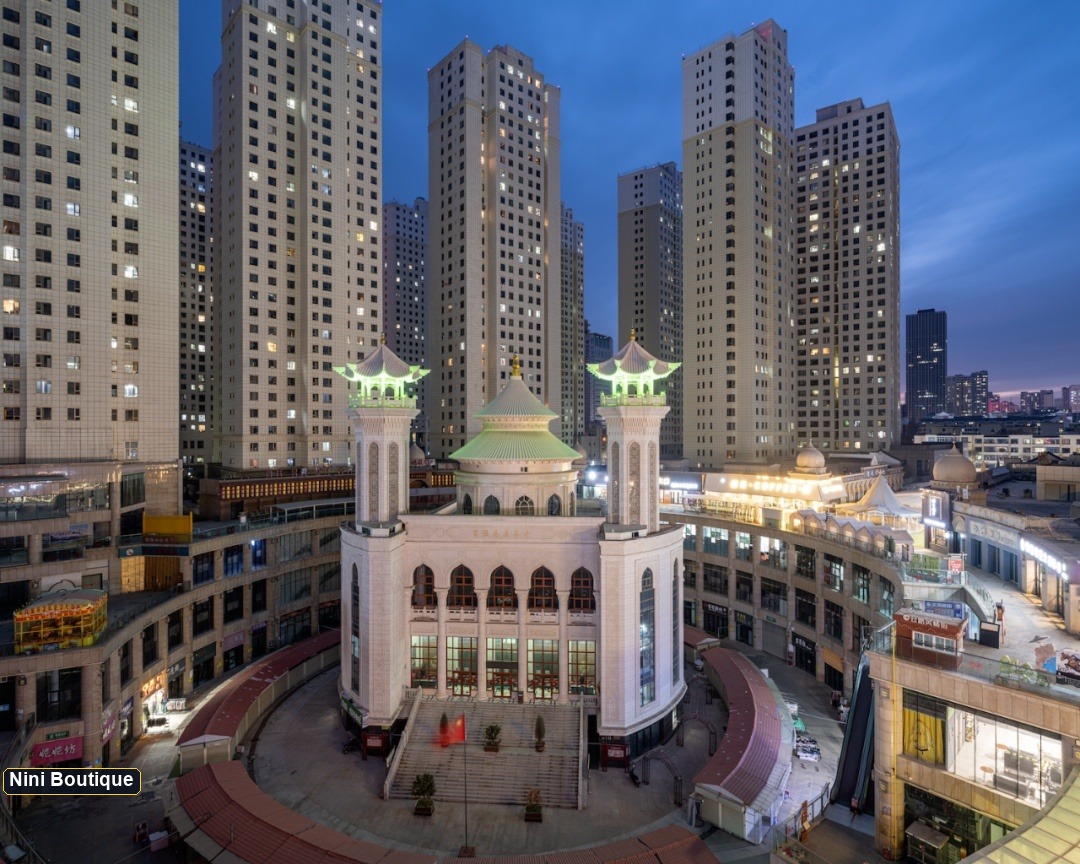
I hadn't officially filmed every iteration of this mosque. What I mean is that the current version—with its roof looking like the Temple of Heaven—is actually its third. The earliest one dates back to 2015, which was a newly built Arab-style mosque with a round, onion-shaped dome and two tall, slender minarets. Because it’s surrounded by a circular commercial district, the mosque has been rebuilt alongside the real estate projects. I captured the older version 1.0, a low, worn-down, two-story structure with a hint of Arab style that was almost swallowed by the shopping center. I have a photo of that version hanging on my wall. I just missed capturing the Arab-style 2.0 version because I was too relaxed, and now, under the policy of 'Sinicization' of mosques, version 3.0 has already been completed.
I used a 16-frame focus stacking technique with my Fuji camera to capture the mosque, then walked into the mall. Near the entrance was a casual tea house. Through the window, I saw three Muslim women—all wearing beautiful hijabs, their hair completely covered, and dressed impeccably. They looked like wealthy ladies, sitting together drinking tea from glass pots filled with rose-red and pale green infusions. They were clearly of a certain social status. I really wanted to take a proper portrait of them. I gestured through the glass, and they saw me. To make my request clearer, I walked inside and politely asked if I could take their picture. Their response wasn't just a 'no'—it was filled with disdain and a warning in their eyes.
The landlady noticed the scene and rushed over to smooth things over. This middle-aged woman was quite polished, quickly saying, 'Take a picture of me instead! I’m Hui too; I don’t mind you taking photos.'
Finally, I found a place to drink tea and rehydrate. 'Guan-guan tea' (tea brewed in small metal pots) is popular in Xining. It’s a very rustic way of drinking tea, where you have to boil the water and steep the leaves yourself in a metal pot. To me, it feels like people just pretending to be fancy—totally pointless.
I posted a photo I’d just taken of the Fuqiang Lane Mosque, and quickly got a comment from Jin Biao: 'Teacher Li, that was the place where I worked for eleven years.' Yes, Jin Biao was originally an Imam at this mosque, though we didn’t know each other back then.
By the time we were full of tea, we’d pretty much finalized our trip to Xishuangbanna. Most importantly, we managed to convince Zhang Yi to cancel his flight back to Beijing and join us instead. We’d be flying straight from Xining the day after tomorrow.
At dusk, the three of us were still searching for t-shirts for Xishuangbanna in a Xining mall. After 7:00 PM, we drove to the Tangdao shopping center in the Chengxi District. This mall didn't exist when I lived in Xining. There was a Uniqlo, so we followed the signs. The only shirt in the whole store that fit us was a white one with a pink bear. We bought three. In the mall corridor, we specifically asked a passing girl to take our picture. She didn't refuse, but seeing three grown men grinning and holding up pink-bear shirts, she definitely must have thought we were 'crazy.'
Zhang Yi’s impression of Xining was stuck on 'Mazhong Shifu' (a well-known food center). Even though it's a bit dated, it really was the hub for Xining snacks for many years. It has a bit of everything, so you can try all the local specialties in one go. That’s the advantage of Mazhong Shifu. Besides, I hadn't been there in decades.
While I was going around buying different snacks at Mazhong, Zhang Yi went to buy some beer, worried he wouldn't find any in the halal shops. Once my lamb offal, liangpi (cold skin noodles), and skewers were ready, his beers arrived at the table. We sat right next to the liangpi stall. I told him that this thick-style liangpi was what made Mazhong famous back in the day; before they had a restaurant, they just had a street stall nearby. Mazhong liangpi is legendary.
We shared a lot of bold stories all night, talking about everything from the Pamir Plateau to the Xilin Gol Grassland. A man’s best stories are always found on the road. Listening to Zhang Yi talk about motorcycling through the no-man's land on the 219 National Highway and climbing Muztagh Ata without oxygen—he’s a hardcore outdoor enthusiast, a real tough guy. It’s ironic that he’s so into photography, even though his lifestyle seems so far removed from the art.
The lady selling 'zhuamian' (hand-grabbed noodles) had already cleaned the pots, pans, and the stove, and poured out the dishwater before we finished our drinks and left Mojia Street. Yu Li hadn't been drinking, so he drove. We stayed at the Atour Hotel that night. Our rooms weren't connected and were scattered in different directions. The room was a bit chilly, and less than three minutes after checking in, Zhang Yi complained about a weird smell. The staff couldn't fix it, so they just kept smiling and eventually offered a plate of fruit to settle it.
(To be continued)
Fuqiang Lane Mosque, 2023.
Fuqiang Lane Mosque, 2014.
Rendering of the version 2.0 Fuqiang Lane Mosque (photographed from a real estate advertisement billboard).
Xining Nanguan Mosque in 2015, where Jin Biao worked.
Dongguan Great Mosque.
Dongguan Great Mosque.
Dongguan Great Mosque.
Dongguan Grand Mosque
The Dongguan Grand Mosque
Evening prayers at a restaurant near the Dongguan Grand Mosque
The Jumu'ah (Friday congregational prayer) at the Dongguan Grand Mosque
The Dongguan Grand Mosque preparing for the Jumu'ah service for the congregation
A funeral service at the Dongguan Grand Mosque view all
This is the eighth installment of my documentary photography series, 'The Vanishing Arch.' Returning to my hometown of Xining, Qinghai, I capture an intimate look at the solemn Jumu'ah (Friday prayer) at the historic Dongguan Mosque, the funeral processions following the Maghrib (evening) prayer, and the simple, devoted lives of the local Hui Muslims.
During the Maghrib prayer, the funeral dua (supplication) for the deceased happens first, followed by the regular prayer. As soon as the dua ends, the body is carried out through this door. The men walk with hurried steps, quickly turning the corner to reach the Iveco van waiting at the street corner. The women finally lose their composure, chasing after the procession for a few steps while sobbing, 'My dada (father), hmm... hmm...' From the tearful tone of this Xining dialect, I realize she is the daughter of the deceased.
1
Leaving the two mosques in Haidong and heading thirty kilometers west, I pass through the final tunnel of the canyon. Suddenly, the view opens up to a landscape of endless high-rises stretching for dozens of kilometers—this is Xining, the place where I grew up.
Zhang Yi drives the car directly to the alley entrance near the back gate of the Dongguan Mosque. Yu Li and I get out; he goes to look for a parking spot and doesn't come in with me.
‘That’s for the deceased,’ I say, spotting an Iveco van parked at the alley entrance. I’ve known for a long time that these vans are used to transport departed Hui Muslims to the Great Mosque for community prayers before burial.
‘What?’ Yu Li doesn’t quite catch that.
‘The deceased, the body—it’s a dead Muslim being brought to the mosque for funeral rites.’
The back gate of the Dongguan Mosque is convenient for parking and moving stretchers, and it opens up to a relatively quiet area behind the main prayer hall—the perfect setup for handling funeral arrivals. As I enter the back gate, I see twenty or thirty Hui Muslim women gathered. Most are middle-aged, their hair covered tightly, their faces solemn. Two even have tearstains on their cheeks; they are family members of the deceased. However, according to the customs of the Ikhwan (a prominent Islamic sect in China), women aren’t meant to enter the mosque grounds during this ceremony, so they stay at the gate to wait.
Once inside the mosque, I see a body covered in cloth lying on a stretcher just a few meters away. The young men, all wearing white prayer caps, stand in neat rows. Some whisper quietly, but most wait in silence for the ceremony to begin.
I quietly tell Yu Li that there’s a body on the stretcher. I lack the courage to point and stare; it feels like an intrusion on people who have just lost a loved one.
I head from the south side of the main hall to the front. The courtyard is packed with people. The Maghrib prayer is about to begin, and as always, the mosque is bustling with believers. The front plaza is crowded, and opposite it lies the Arabic-style teaching building currently under renovation. The roof ridge is finished, and the scaffolding was removed a week ago; I learned this from the WeChat moments of Jin Biao, the mosque’s assistant Imam.
One day in November, Imam Jin Biao posted a photo of the renovation of the Dongguan Mosque teaching building. In the picture, the original circular Arabic dome and two tall minarets had been removed and replaced with a Chinese-style grand roof. With the scaffolding gone, the deep grey roof tiles and matching wall decorations were now visible, giving the new building its initial form.
This was a landmark event. In 2019, the 'Sinicization' of mosques had already begun in places like Yinchuan. However, Xining, in the Hehuang Valley—the heartland of the Hui Muslims—had been slow to implement this policy. It wasn't until 2022 that the potential renovation of the Dongguan Mosque became a heated topic and a focal point of debate.
How it was modified wasn't the point; whether to modify it and when to start were the key issues. The Ikhwan is the most significant branch of Islam in China and holds immense influence. The Dongguan Mosque is their headquarters and the main mosque; Muslims across the province and the country were watching. The commencement of the Dongguan Mosque’s renovation project was of epoch-making significance.
To understand the progress of the work—or, more accurately, to know if those scaffolds blocking my shots were gone—I messaged Ma Yougui from the mosque. I explained my goal: to take two photos, one from outside the front gate and one from the prayer hall steps facing the building. A phone photo would be clear enough to show me the progress. On my journey through the Northwest, the Xiguan Mosque in Lanzhou and the Dongguan Mosque in Xining were the two most important locations; I could only set out if both were ready to be photographed.
Ma Yougui is an interesting character. I met him in August during a visit to the Dongguan Mosque, where he was in the plaza explaining the basics of Islam to passing tourists and sharing unique historical facts about the mosque. Dressed in white and speaking clearly, he was more than capable of answering the tourists' questions. I was debating whether to look for Imam Jin Biao, whom I hadn't seen in years due to the pandemic, when Ma Yougui greeted me and asked if I needed any help.
I gave him a rough idea of my background. He said he had seen me there before, which is likely true; over the last decade, I’ve visited the Dongguan Mosque dozens of times. I’ve remembered the faces of many regular worshippers, and as a human being, others remember me too—some even guessing my profession or intent by the camera gear I carry.
I remember something he said: ‘Muslims worship Allah, not a building; it doesn't matter what the building looks like.’ It was a stubbornness born of resignation—a sentiment most believers at Dongguan Mosque likely share.
I didn't find Imam Jin Biao that time, but Ma Yougui and I added each other on WeChat. I enjoy getting to know all kinds of Muslims. I want to pay attention to their lives to understand their religion, their faith, and the authentic life of their community.
In November, the photo Ma Yougui specifically took for me showed that the site was ready to be photographed. I quickly finalized my trip. Starting from Lanzhou, passing through Minhe, Linxia, Xunhua, and Hualong, I reached Haidong, and finally arrived at Xining, the last stop of the trip, making Dongguan Mosque my first destination.
However, the plaza was packed with people, making it impossible for me to shoot. I needed an empty space and time to finish my work. Rather than hesitate, I decided to ask the three middle-aged Hui Muslims chatting in front of me in the local Qinghai dialect. Their conversation was trivial, mostly killing time while waiting for the Maghrib prayer. I needed to know the exact time, as I couldn't find the mosque's prayer schedule board.
‘Aba (Father/Sir), what time does prayer start?’ I asked in the Xining dialect.
‘16:52, it's almost time,’ he answered simply. Sure enough, it was only six or seven minutes away. I decided to wait; as soon as prayer started, all the worshippers would enter the hall, and the plaza would instantly clear out.
Near the garden in front of the mosque committee office, I asked about Imam Jin Biao. An older Muslim, a staff member there, said the Imam had gone to a meeting half a month ago—he wasn't sure if it was Beijing or Shanghai—but he had been gone for quite a while.
I gave up on finding Jin Biao and didn't have time to look for Ma Yougui; prayer was about to start, and I had to get my shots.
The old-fashioned electric bell rang—the signal that prayer at the Dongguan Mosque was beginning. The Ikhwan worshippers who had been in the courtyard, on the steps, under the eaves, or by the railings just minutes ago all walked into the Chinese-style prayer hall behind me. I calmly began my work. While I was busy, Yu Li said someone was looking for me. I looked up and saw it was Ma Yougui. He must have seen me and came over to say hello. I shook his hand, and I told him, ‘I didn't see you, and I heard the Imam is away at a conference.’ He said, ‘That's not right, the Imam was here this morning; I'm not sure where he is now.’ He spoke in a rush as the prayer was about to start, so I urged him to go and join the ceremony.
I photographed the teaching building across the square, then turned toward the side and back of the prayer hall. I wanted to see the family praying for the deceased.
Through the loudspeaker came the Imam's distinct voice. I don't understand Arabic, and certainly not Persian. After what sounded like a prayer, he announced information about the deceased. I only remembered the age—63; the rest escaped me. This Imam’s Mandarin had a heavy Hezhou accent, which made it harder to follow, and combined with the multi-layered echoes of the loudspeaker, it was even harder to hear clearly.
All the believers knelt on the prayer mats, offering dua for the deceased. The Ikhwan strongly emphasizes an immediate funeral; typically, the deceased is cleaned and brought to the mosque on the day of death to await the community prayer at Dhuhr (noon) or Maghrib (evening), after which the family quickly transports the body to the cemetery for burial.
I decided not to wait for Ma Yougui, nor to find Jin Biao anymore. I wanted to photograph the family of the deceased, especially the female relatives standing at the gate who couldn't enter.
Before leaving the mosque, I took one photo in the direction of the deceased. Just one. I always have an internal block when taking these kinds of photos. I have seen people who have passed away at this spot countless times, but I rarely photograph them. I cannot face the stern faces of the Ikhwan. The 'Ten Articles of the Orchard' written when the sect was founded didn't specifically forbid mourning, but I have seen and heard rules against weeping at funerals. Even if, according to faith, a person has entered Heaven, they have still truly left their loved ones in this life. How could one not be sad? How could the right to grieve be taken away?
The women at the gate were still waiting. Some spoke in low voices, while the closer family members wore expressions of profound grief. People are the same regardless of their faith; the departure of a loved one leaves us with immense sorrow.
During the Maghrib prayer, the funeral dua for the deceased happens first, followed by the regular prayer. As soon as the dua ends, the body is carried out through this door. The men walk with hurried steps, quickly turning the corner to reach the Iveco van waiting at the street corner. The women finally lose their composure, chasing after the procession for a few steps while sobbing, 'My dada (father), hmm... hmm...' From the tearful tone of this Xining dialect, I realize she is the daughter of the deceased.
The back door of the Iveco was already wide open, and the body was quickly pushed inside. A few young men jumped into the van, while the other men climbed into several other vehicles. The driver started the engine, quickly turned the vehicle around, and sped off toward the south. In one of the trailing cars, someone tried hard to look back through the glass at the group of grieving women left at the alley entrance.
I stood on a step across from the back gate, recording it all on video. Above those steps is a shop; Zhongxia Nanguan Street is the most iconic commercial strip by the Great Mosque. It used to be mainly for vegetables, and it still is today. There are a few snack stalls at the entrance, and inside the alley, you’ll find beef and lamb shops, seafood stands, and other grocery stores. If you turn the corner, there’s a great noodle shop I filmed years ago. The ingredients here aren't just halal—they’re the freshest, additive-free options around. A local Muslim once told me that the noodle shop is where they go to 'eat our own food,' and these markets are just 'where we buy our own groceries.' There is no denying that Islam has always held a certain sense of superiority and exclusivity.
Just as I was filming the deceased being carried out, someone behind me started trying to stop me. At first, she spoke in the Qinghai dialect, kindly reminding me to stop filming. I ignored her. I’m not sure if my feigned ignorance—or perhaps my indifference—angered her, but she switched to standard Mandarin with a firm tone: 'Filming the deceased is not allowed; don't just take pictures like this.' Perhaps, at that moment, this Yihewani (a reformist Islamic school in China) woman felt that same fuzzy sense of 'this is our street.' As for her anger, I didn't even acknowledge it; I didn't give her a single glance.
I decided to leave that tense spot. It was still early, so I had time to head over to film the Shulin Lane Mosque.
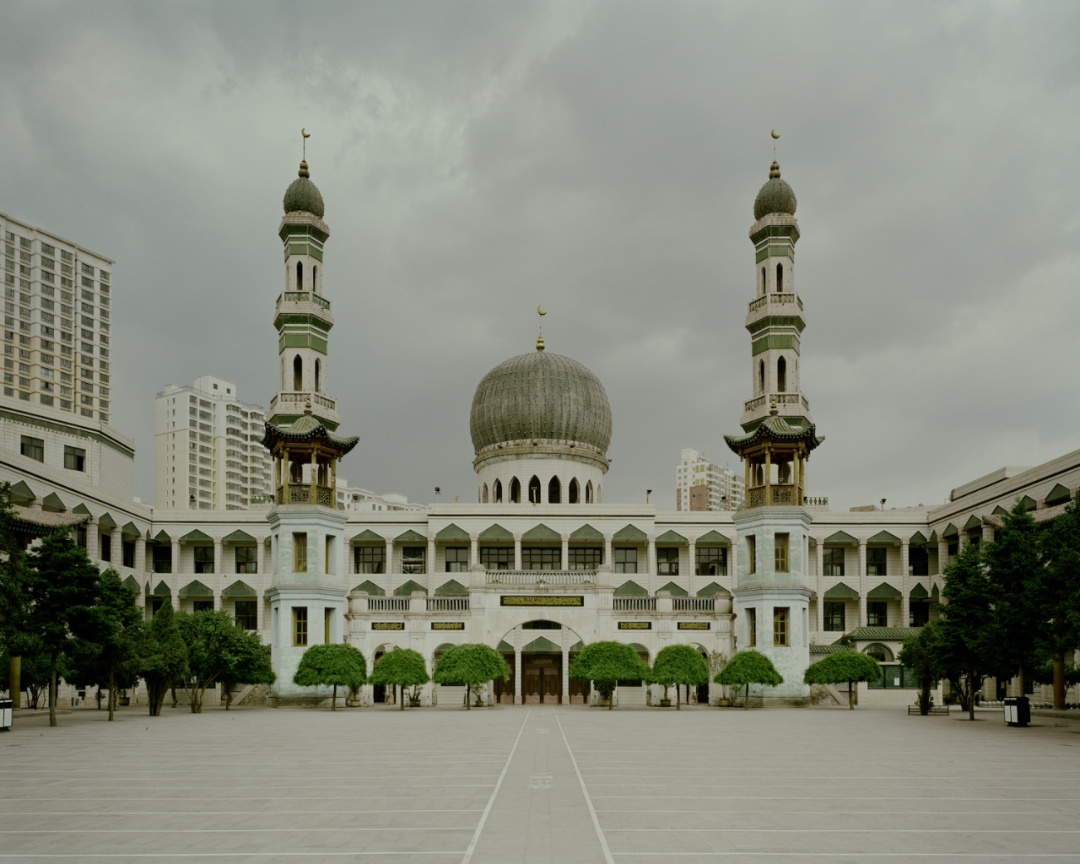
Xining Dongguan Great Mosque, photographed in 2014.
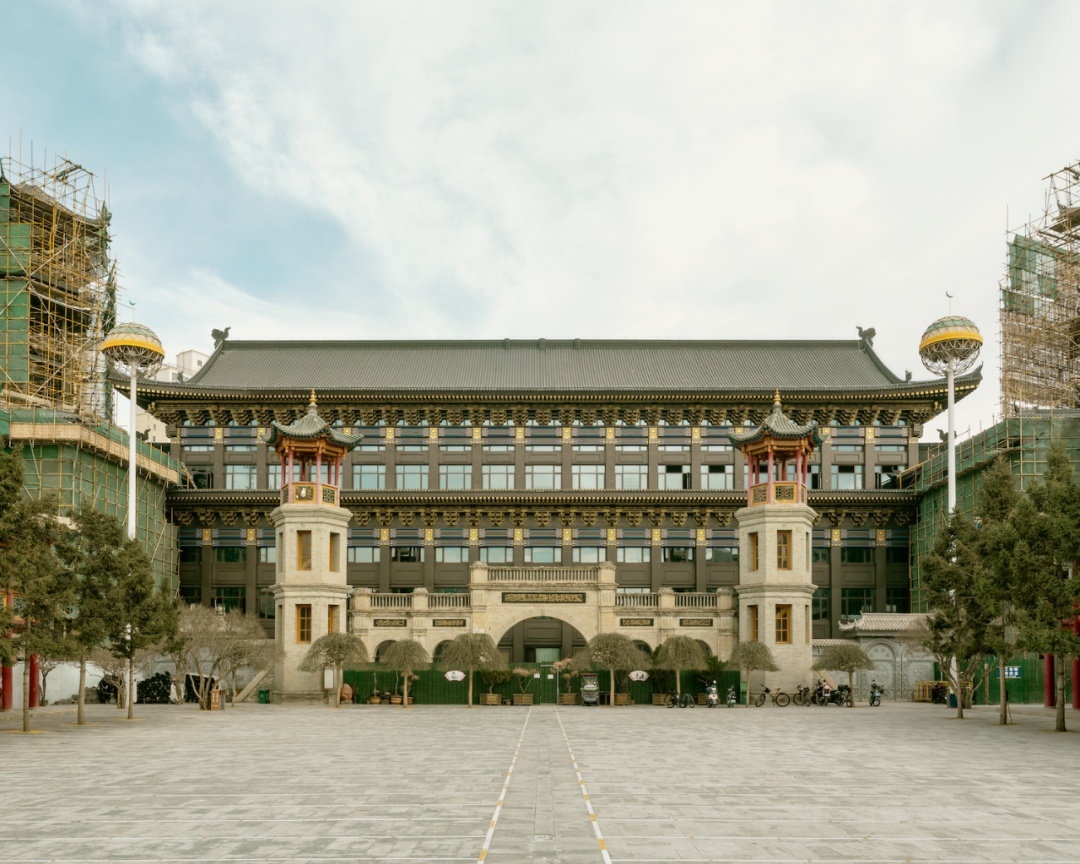
Xining Dongguan Great Mosque, photographed in 2023.
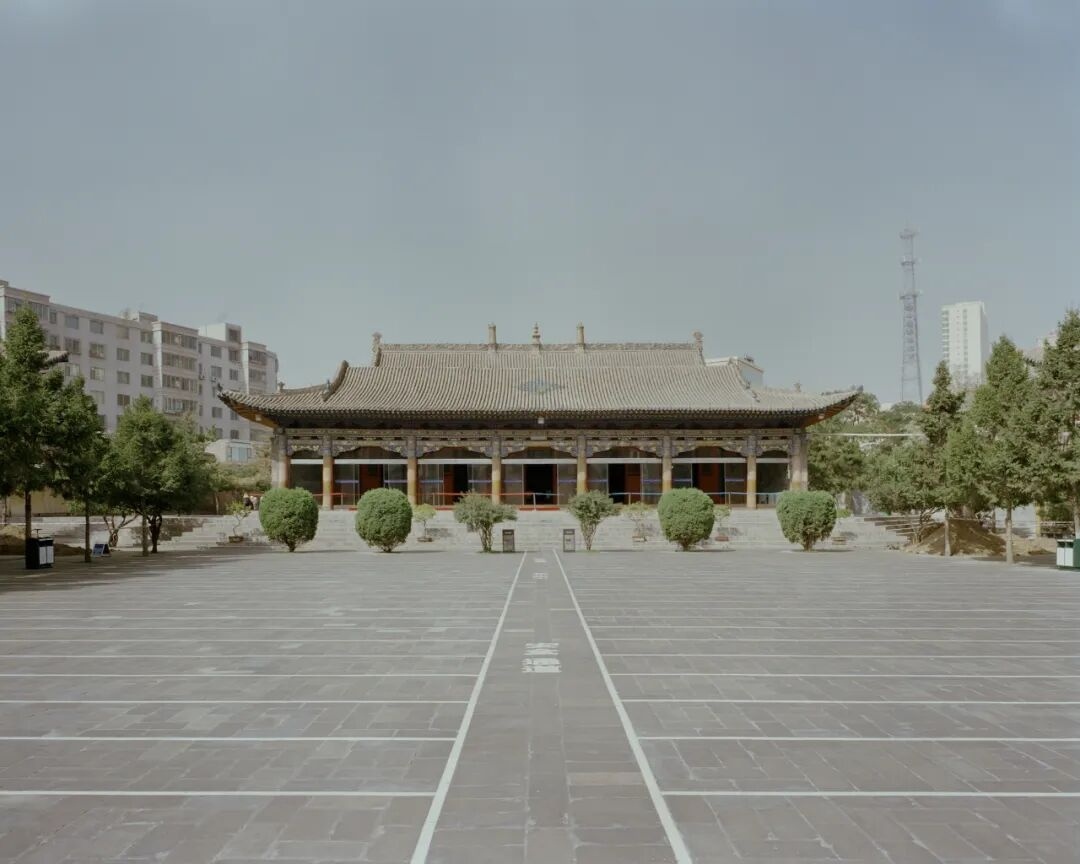
The traditional Chinese-style prayer hall at the Dongguan Great Mosque, built in the 1920s.
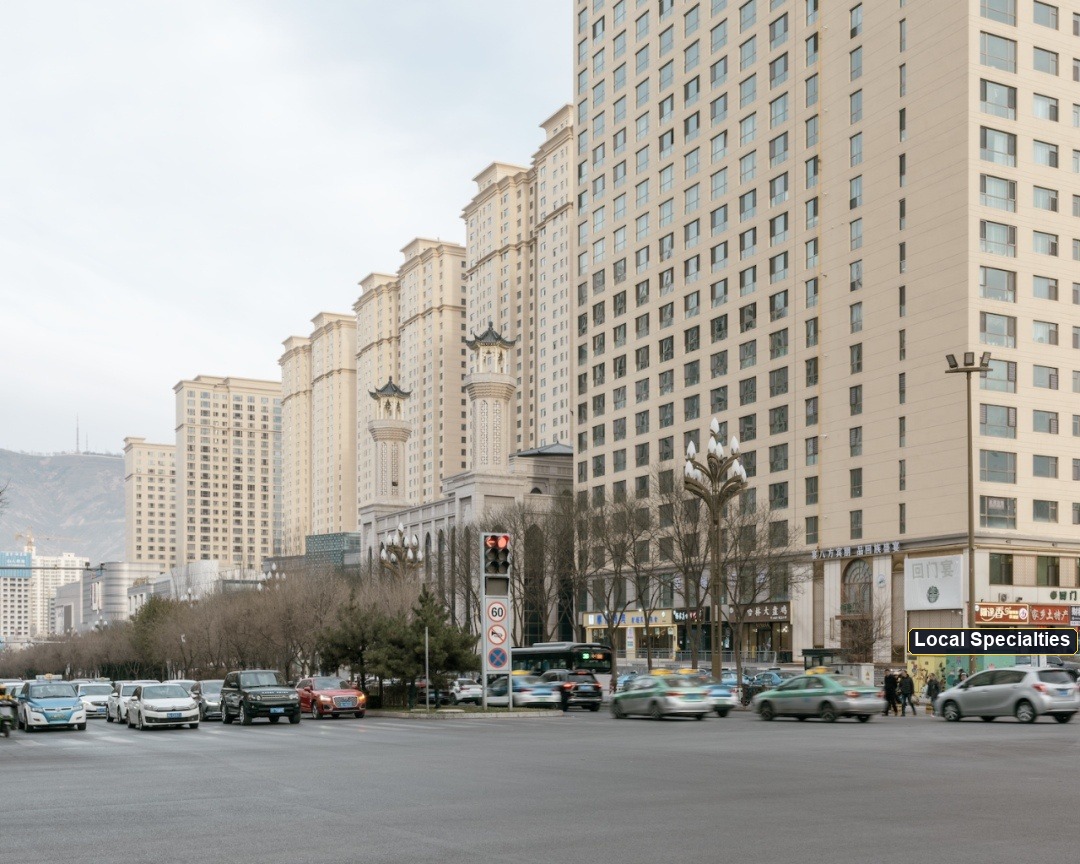
Xining Shulin Lane Mosque, photographed in 2023.
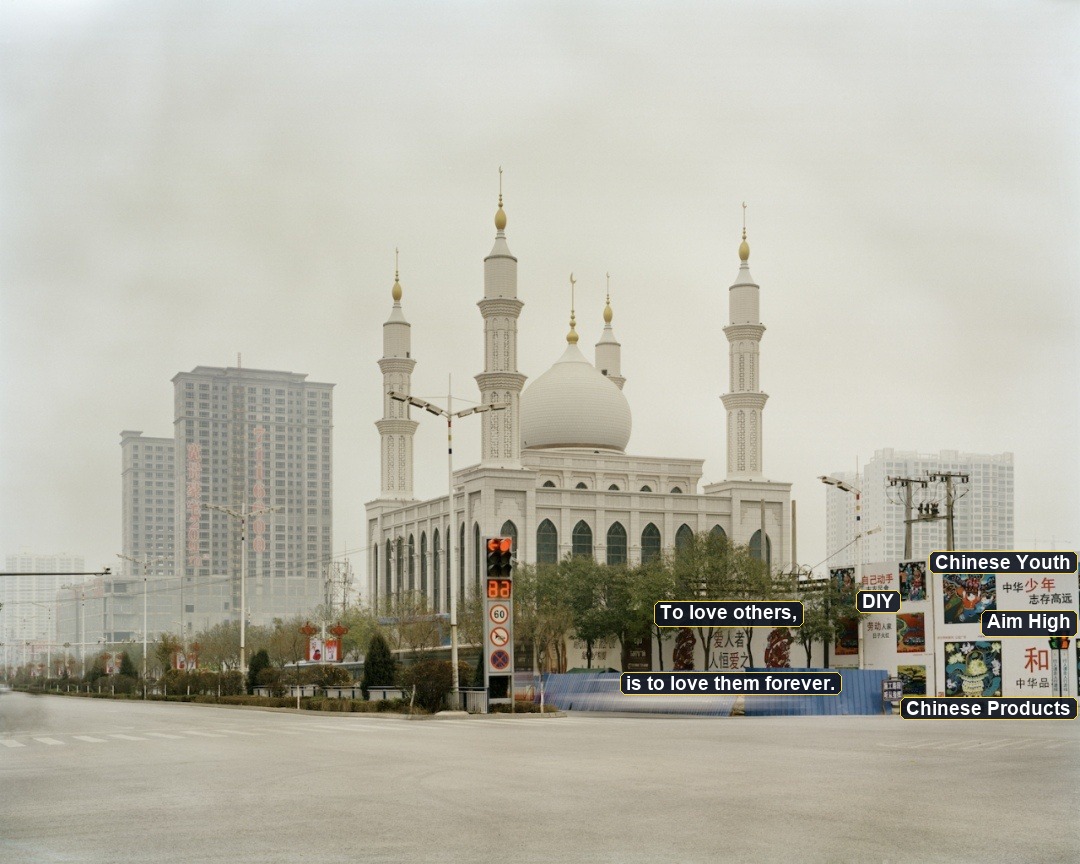
Xining Shulin Lane Mosque, photographed in 2016.
2
Back in 2016, I shot the exterior of this mosque from several street-level angles; it was a beautiful, distinct-looking Arab-style mosque. However, when I returned this summer, I barely recognized it. Huge office buildings had been constructed on both sides, squeezing the mosque into a narrow gap. It completely lost that elegant, stand-alone silhouette it once had.
When capital and faith collide, faith appears fragile and small, while the power of capital is ultimately dominant and all-encompassing.
For this shot, I had to work hard to find the exact angle from eight years ago, matching the distant buildings and mountains. When you compare the two photos, only a small portion of the elements overlap perfectly, highlighting just how much has changed. Otherwise, you’d never guess they were taken in the same place.
The Shulin Lane Mosque belongs to the Salafiyya school, a sect that split off from the Yihewani. Locals often call them 'Santai' (three-lifting), likely because they lift their hands three times during prayer. But I rarely use that term. Years ago, I was chatting with a local Hui Muslim in Henan, and when I mentioned Xining, he scoffed and said, 'Oh, you mean the Santai people?' The tone was quite dismissive, so I’ve never used that name myself, as I know it can be disrespectful and easily misunderstood.
I finished filming the mosque from an intersection. I used to take photos from where a Confucius statue stood about 100 meters east, but now a solid office building sits right between that spot and the mosque.
After finishing, I parked the car in the underground garage of the Xinqian Plaza across the street. This is a commercial real estate project owned by the Hui people—a massive complex with over a dozen towers and the Fuqiang Lane Mosque in the center. It’s surrounded by commercial buildings.
I took the elevator to the fifth floor, which was perfect for getting a full view of the Fuqiang Lane Mosque. I had come here in August to scout locations, so I knew exactly where to go. I found a quiet spot on the southeast side that overlooked the main entrance perfectly.
I hadn't officially filmed every iteration of this mosque. What I mean is that the current version—with its roof looking like the Temple of Heaven—is actually its third. The earliest one dates back to 2015, which was a newly built Arab-style mosque with a round, onion-shaped dome and two tall, slender minarets. Because it’s surrounded by a circular commercial district, the mosque has been rebuilt alongside the real estate projects. I captured the older version 1.0, a low, worn-down, two-story structure with a hint of Arab style that was almost swallowed by the shopping center. I have a photo of that version hanging on my wall. I just missed capturing the Arab-style 2.0 version because I was too relaxed, and now, under the policy of 'Sinicization' of mosques, version 3.0 has already been completed.
I used a 16-frame focus stacking technique with my Fuji camera to capture the mosque, then walked into the mall. Near the entrance was a casual tea house. Through the window, I saw three Muslim women—all wearing beautiful hijabs, their hair completely covered, and dressed impeccably. They looked like wealthy ladies, sitting together drinking tea from glass pots filled with rose-red and pale green infusions. They were clearly of a certain social status. I really wanted to take a proper portrait of them. I gestured through the glass, and they saw me. To make my request clearer, I walked inside and politely asked if I could take their picture. Their response wasn't just a 'no'—it was filled with disdain and a warning in their eyes.
The landlady noticed the scene and rushed over to smooth things over. This middle-aged woman was quite polished, quickly saying, 'Take a picture of me instead! I’m Hui too; I don’t mind you taking photos.'
Finally, I found a place to drink tea and rehydrate. 'Guan-guan tea' (tea brewed in small metal pots) is popular in Xining. It’s a very rustic way of drinking tea, where you have to boil the water and steep the leaves yourself in a metal pot. To me, it feels like people just pretending to be fancy—totally pointless.
I posted a photo I’d just taken of the Fuqiang Lane Mosque, and quickly got a comment from Jin Biao: 'Teacher Li, that was the place where I worked for eleven years.' Yes, Jin Biao was originally an Imam at this mosque, though we didn’t know each other back then.
By the time we were full of tea, we’d pretty much finalized our trip to Xishuangbanna. Most importantly, we managed to convince Zhang Yi to cancel his flight back to Beijing and join us instead. We’d be flying straight from Xining the day after tomorrow.
At dusk, the three of us were still searching for t-shirts for Xishuangbanna in a Xining mall. After 7:00 PM, we drove to the Tangdao shopping center in the Chengxi District. This mall didn't exist when I lived in Xining. There was a Uniqlo, so we followed the signs. The only shirt in the whole store that fit us was a white one with a pink bear. We bought three. In the mall corridor, we specifically asked a passing girl to take our picture. She didn't refuse, but seeing three grown men grinning and holding up pink-bear shirts, she definitely must have thought we were 'crazy.'
Zhang Yi’s impression of Xining was stuck on 'Mazhong Shifu' (a well-known food center). Even though it's a bit dated, it really was the hub for Xining snacks for many years. It has a bit of everything, so you can try all the local specialties in one go. That’s the advantage of Mazhong Shifu. Besides, I hadn't been there in decades.
While I was going around buying different snacks at Mazhong, Zhang Yi went to buy some beer, worried he wouldn't find any in the halal shops. Once my lamb offal, liangpi (cold skin noodles), and skewers were ready, his beers arrived at the table. We sat right next to the liangpi stall. I told him that this thick-style liangpi was what made Mazhong famous back in the day; before they had a restaurant, they just had a street stall nearby. Mazhong liangpi is legendary.
We shared a lot of bold stories all night, talking about everything from the Pamir Plateau to the Xilin Gol Grassland. A man’s best stories are always found on the road. Listening to Zhang Yi talk about motorcycling through the no-man's land on the 219 National Highway and climbing Muztagh Ata without oxygen—he’s a hardcore outdoor enthusiast, a real tough guy. It’s ironic that he’s so into photography, even though his lifestyle seems so far removed from the art.
The lady selling 'zhuamian' (hand-grabbed noodles) had already cleaned the pots, pans, and the stove, and poured out the dishwater before we finished our drinks and left Mojia Street. Yu Li hadn't been drinking, so he drove. We stayed at the Atour Hotel that night. Our rooms weren't connected and were scattered in different directions. The room was a bit chilly, and less than three minutes after checking in, Zhang Yi complained about a weird smell. The staff couldn't fix it, so they just kept smiling and eventually offered a plate of fruit to settle it.
(To be continued)
Fuqiang Lane Mosque, 2023.

Fuqiang Lane Mosque, 2014.

Rendering of the version 2.0 Fuqiang Lane Mosque (photographed from a real estate advertisement billboard).


Xining Nanguan Mosque in 2015, where Jin Biao worked.

Dongguan Great Mosque.

Dongguan Great Mosque.

Dongguan Great Mosque.
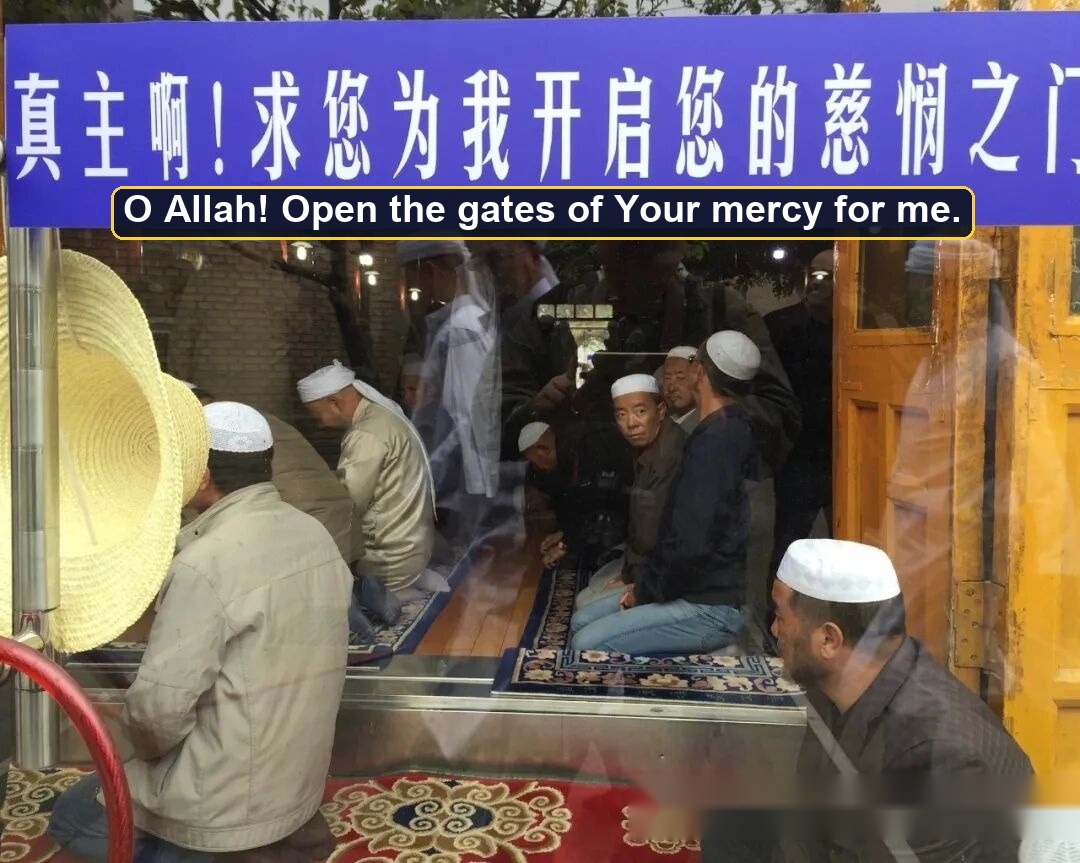
Dongguan Grand Mosque
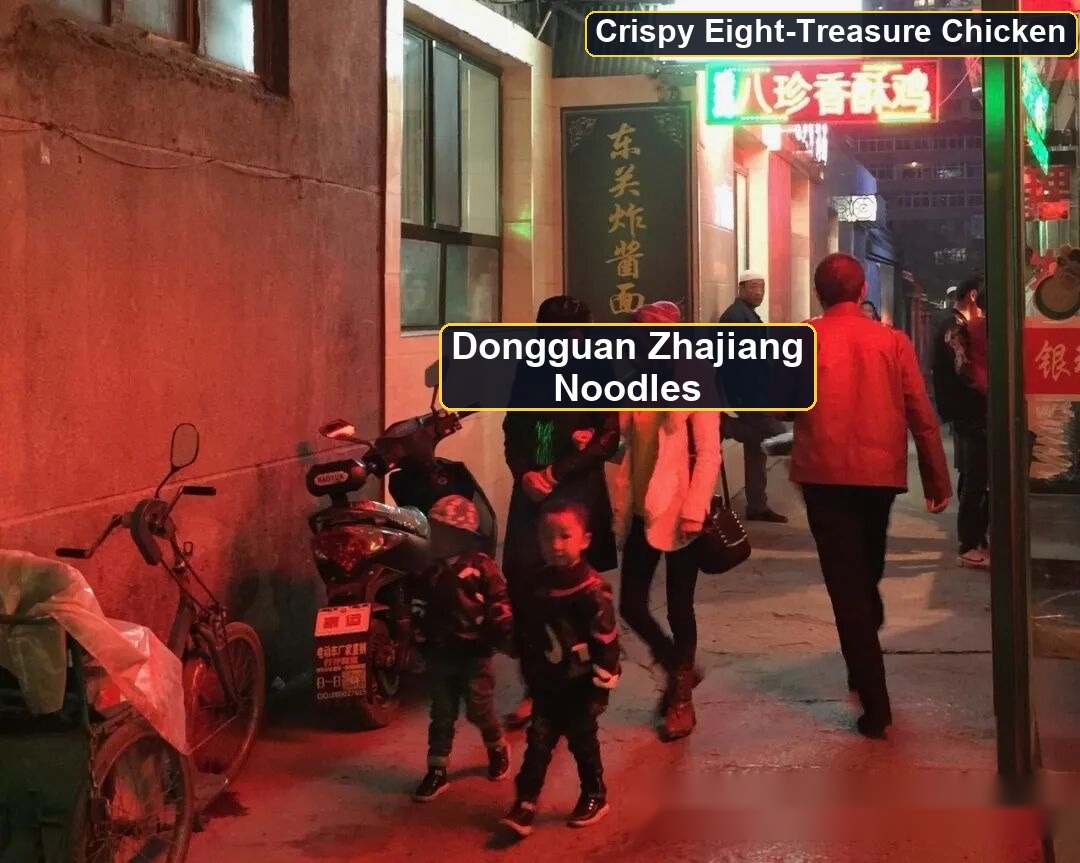
The Dongguan Grand Mosque
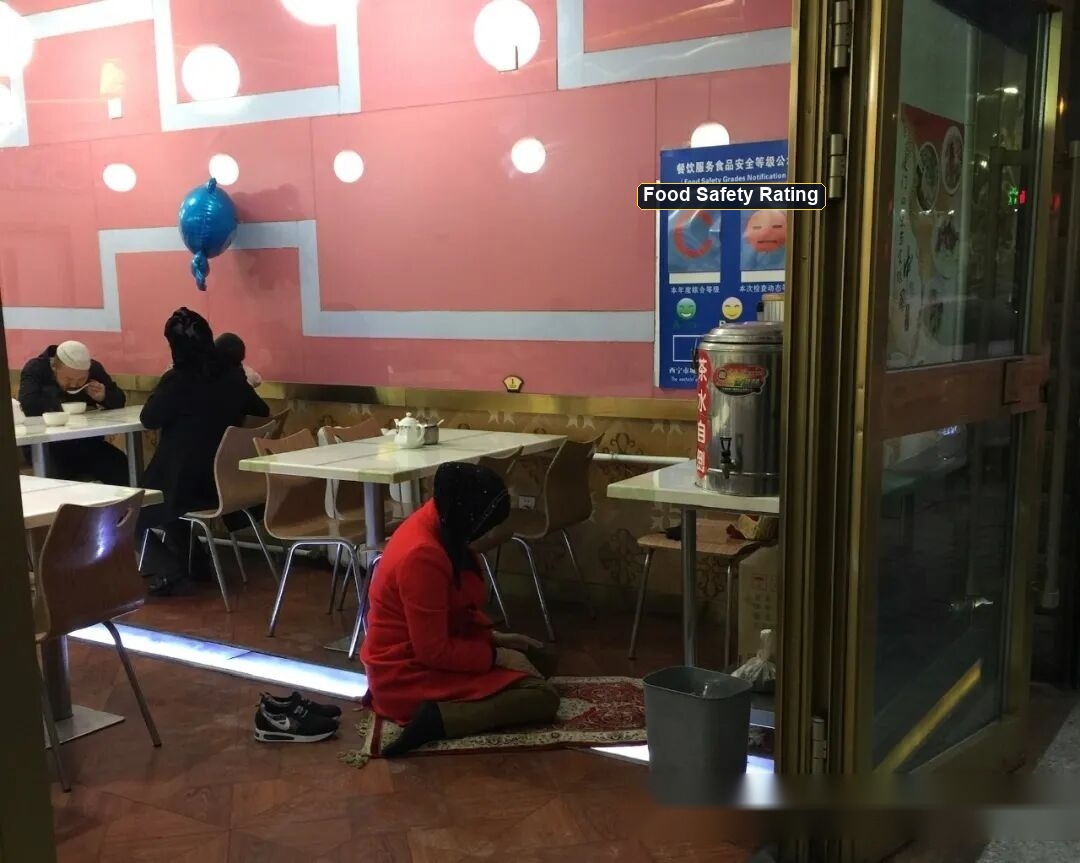
Evening prayers at a restaurant near the Dongguan Grand Mosque
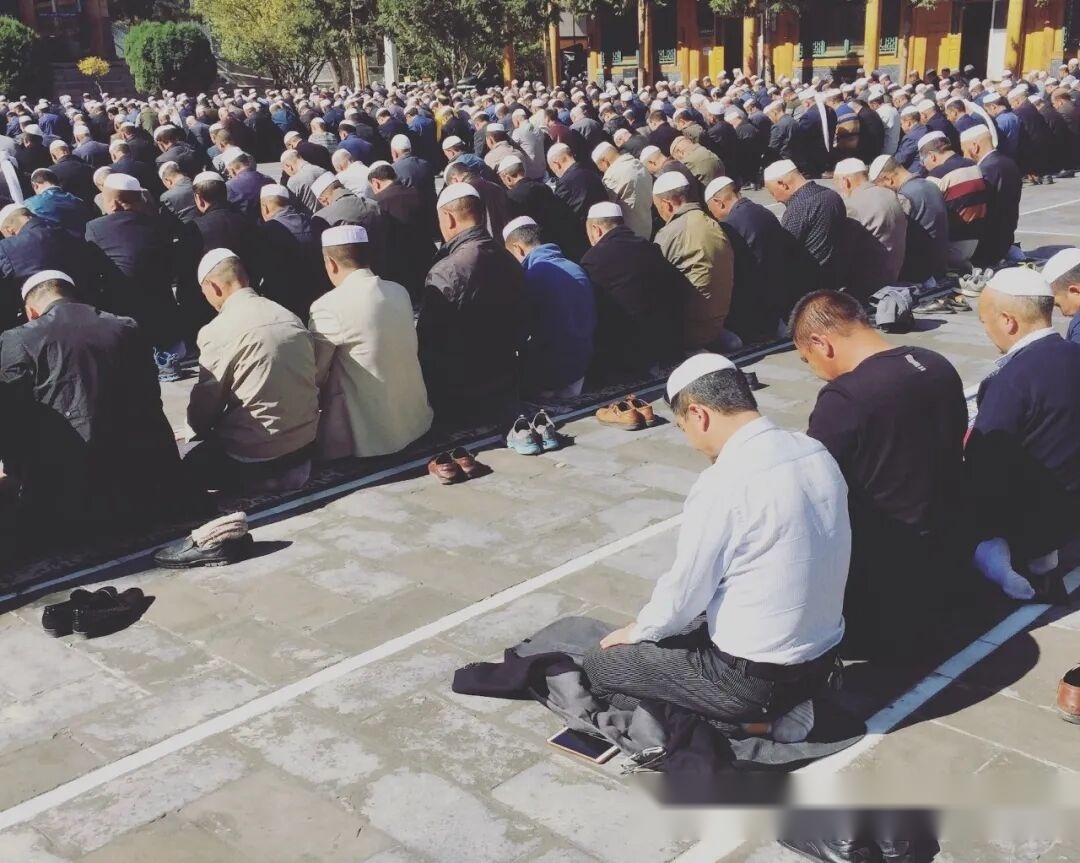
The Jumu'ah (Friday congregational prayer) at the Dongguan Grand Mosque
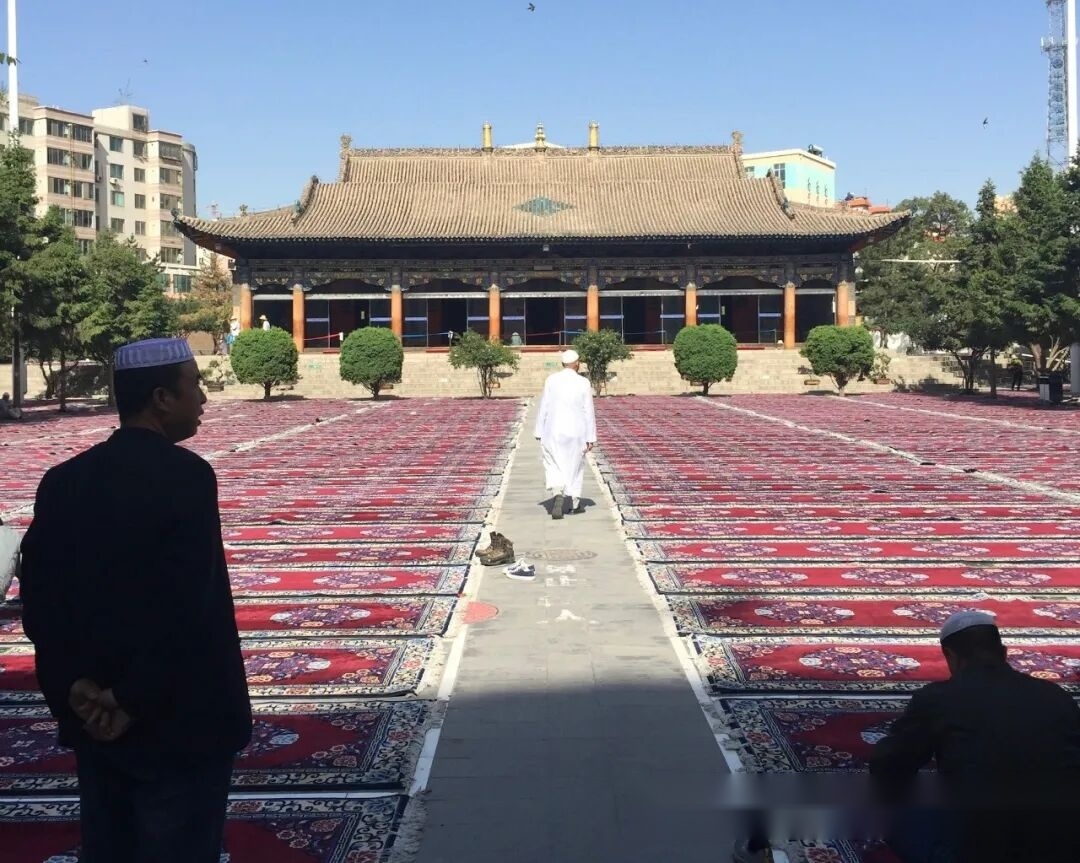
The Dongguan Grand Mosque preparing for the Jumu'ah service for the congregation
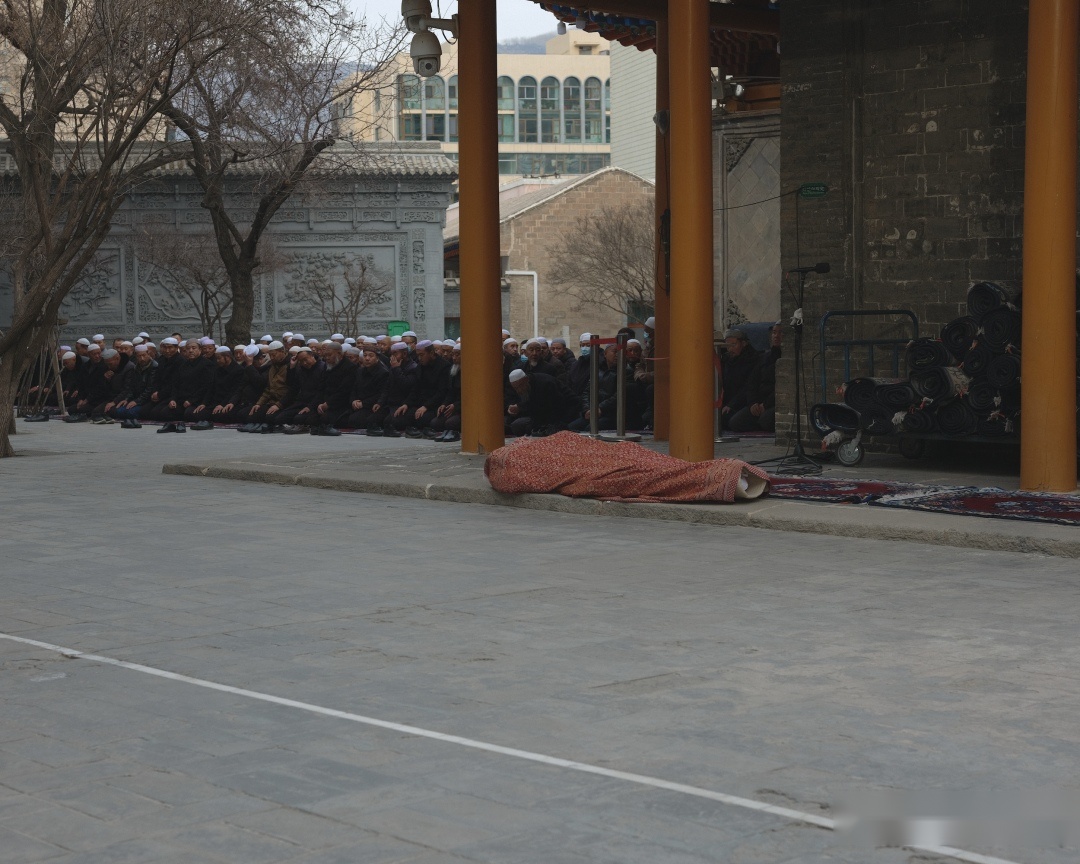
A funeral service at the Dongguan Grand Mosque
During the Maghrib prayer, the funeral dua (supplication) for the deceased happens first, followed by the regular prayer. As soon as the dua ends, the body is carried out through this door. The men walk with hurried steps, quickly turning the corner to reach the Iveco van waiting at the street corner. The women finally lose their composure, chasing after the procession for a few steps while sobbing, 'My dada (father), hmm... hmm...' From the tearful tone of this Xining dialect, I realize she is the daughter of the deceased.
1
Leaving the two mosques in Haidong and heading thirty kilometers west, I pass through the final tunnel of the canyon. Suddenly, the view opens up to a landscape of endless high-rises stretching for dozens of kilometers—this is Xining, the place where I grew up.
Zhang Yi drives the car directly to the alley entrance near the back gate of the Dongguan Mosque. Yu Li and I get out; he goes to look for a parking spot and doesn't come in with me.
‘That’s for the deceased,’ I say, spotting an Iveco van parked at the alley entrance. I’ve known for a long time that these vans are used to transport departed Hui Muslims to the Great Mosque for community prayers before burial.
‘What?’ Yu Li doesn’t quite catch that.
‘The deceased, the body—it’s a dead Muslim being brought to the mosque for funeral rites.’
The back gate of the Dongguan Mosque is convenient for parking and moving stretchers, and it opens up to a relatively quiet area behind the main prayer hall—the perfect setup for handling funeral arrivals. As I enter the back gate, I see twenty or thirty Hui Muslim women gathered. Most are middle-aged, their hair covered tightly, their faces solemn. Two even have tearstains on their cheeks; they are family members of the deceased. However, according to the customs of the Ikhwan (a prominent Islamic sect in China), women aren’t meant to enter the mosque grounds during this ceremony, so they stay at the gate to wait.
Once inside the mosque, I see a body covered in cloth lying on a stretcher just a few meters away. The young men, all wearing white prayer caps, stand in neat rows. Some whisper quietly, but most wait in silence for the ceremony to begin.
I quietly tell Yu Li that there’s a body on the stretcher. I lack the courage to point and stare; it feels like an intrusion on people who have just lost a loved one.
I head from the south side of the main hall to the front. The courtyard is packed with people. The Maghrib prayer is about to begin, and as always, the mosque is bustling with believers. The front plaza is crowded, and opposite it lies the Arabic-style teaching building currently under renovation. The roof ridge is finished, and the scaffolding was removed a week ago; I learned this from the WeChat moments of Jin Biao, the mosque’s assistant Imam.
One day in November, Imam Jin Biao posted a photo of the renovation of the Dongguan Mosque teaching building. In the picture, the original circular Arabic dome and two tall minarets had been removed and replaced with a Chinese-style grand roof. With the scaffolding gone, the deep grey roof tiles and matching wall decorations were now visible, giving the new building its initial form.
This was a landmark event. In 2019, the 'Sinicization' of mosques had already begun in places like Yinchuan. However, Xining, in the Hehuang Valley—the heartland of the Hui Muslims—had been slow to implement this policy. It wasn't until 2022 that the potential renovation of the Dongguan Mosque became a heated topic and a focal point of debate.
How it was modified wasn't the point; whether to modify it and when to start were the key issues. The Ikhwan is the most significant branch of Islam in China and holds immense influence. The Dongguan Mosque is their headquarters and the main mosque; Muslims across the province and the country were watching. The commencement of the Dongguan Mosque’s renovation project was of epoch-making significance.
To understand the progress of the work—or, more accurately, to know if those scaffolds blocking my shots were gone—I messaged Ma Yougui from the mosque. I explained my goal: to take two photos, one from outside the front gate and one from the prayer hall steps facing the building. A phone photo would be clear enough to show me the progress. On my journey through the Northwest, the Xiguan Mosque in Lanzhou and the Dongguan Mosque in Xining were the two most important locations; I could only set out if both were ready to be photographed.
Ma Yougui is an interesting character. I met him in August during a visit to the Dongguan Mosque, where he was in the plaza explaining the basics of Islam to passing tourists and sharing unique historical facts about the mosque. Dressed in white and speaking clearly, he was more than capable of answering the tourists' questions. I was debating whether to look for Imam Jin Biao, whom I hadn't seen in years due to the pandemic, when Ma Yougui greeted me and asked if I needed any help.
I gave him a rough idea of my background. He said he had seen me there before, which is likely true; over the last decade, I’ve visited the Dongguan Mosque dozens of times. I’ve remembered the faces of many regular worshippers, and as a human being, others remember me too—some even guessing my profession or intent by the camera gear I carry.
I remember something he said: ‘Muslims worship Allah, not a building; it doesn't matter what the building looks like.’ It was a stubbornness born of resignation—a sentiment most believers at Dongguan Mosque likely share.
I didn't find Imam Jin Biao that time, but Ma Yougui and I added each other on WeChat. I enjoy getting to know all kinds of Muslims. I want to pay attention to their lives to understand their religion, their faith, and the authentic life of their community.
In November, the photo Ma Yougui specifically took for me showed that the site was ready to be photographed. I quickly finalized my trip. Starting from Lanzhou, passing through Minhe, Linxia, Xunhua, and Hualong, I reached Haidong, and finally arrived at Xining, the last stop of the trip, making Dongguan Mosque my first destination.
However, the plaza was packed with people, making it impossible for me to shoot. I needed an empty space and time to finish my work. Rather than hesitate, I decided to ask the three middle-aged Hui Muslims chatting in front of me in the local Qinghai dialect. Their conversation was trivial, mostly killing time while waiting for the Maghrib prayer. I needed to know the exact time, as I couldn't find the mosque's prayer schedule board.
‘Aba (Father/Sir), what time does prayer start?’ I asked in the Xining dialect.
‘16:52, it's almost time,’ he answered simply. Sure enough, it was only six or seven minutes away. I decided to wait; as soon as prayer started, all the worshippers would enter the hall, and the plaza would instantly clear out.
Near the garden in front of the mosque committee office, I asked about Imam Jin Biao. An older Muslim, a staff member there, said the Imam had gone to a meeting half a month ago—he wasn't sure if it was Beijing or Shanghai—but he had been gone for quite a while.
I gave up on finding Jin Biao and didn't have time to look for Ma Yougui; prayer was about to start, and I had to get my shots.
The old-fashioned electric bell rang—the signal that prayer at the Dongguan Mosque was beginning. The Ikhwan worshippers who had been in the courtyard, on the steps, under the eaves, or by the railings just minutes ago all walked into the Chinese-style prayer hall behind me. I calmly began my work. While I was busy, Yu Li said someone was looking for me. I looked up and saw it was Ma Yougui. He must have seen me and came over to say hello. I shook his hand, and I told him, ‘I didn't see you, and I heard the Imam is away at a conference.’ He said, ‘That's not right, the Imam was here this morning; I'm not sure where he is now.’ He spoke in a rush as the prayer was about to start, so I urged him to go and join the ceremony.
I photographed the teaching building across the square, then turned toward the side and back of the prayer hall. I wanted to see the family praying for the deceased.
Through the loudspeaker came the Imam's distinct voice. I don't understand Arabic, and certainly not Persian. After what sounded like a prayer, he announced information about the deceased. I only remembered the age—63; the rest escaped me. This Imam’s Mandarin had a heavy Hezhou accent, which made it harder to follow, and combined with the multi-layered echoes of the loudspeaker, it was even harder to hear clearly.
All the believers knelt on the prayer mats, offering dua for the deceased. The Ikhwan strongly emphasizes an immediate funeral; typically, the deceased is cleaned and brought to the mosque on the day of death to await the community prayer at Dhuhr (noon) or Maghrib (evening), after which the family quickly transports the body to the cemetery for burial.
I decided not to wait for Ma Yougui, nor to find Jin Biao anymore. I wanted to photograph the family of the deceased, especially the female relatives standing at the gate who couldn't enter.
Before leaving the mosque, I took one photo in the direction of the deceased. Just one. I always have an internal block when taking these kinds of photos. I have seen people who have passed away at this spot countless times, but I rarely photograph them. I cannot face the stern faces of the Ikhwan. The 'Ten Articles of the Orchard' written when the sect was founded didn't specifically forbid mourning, but I have seen and heard rules against weeping at funerals. Even if, according to faith, a person has entered Heaven, they have still truly left their loved ones in this life. How could one not be sad? How could the right to grieve be taken away?
The women at the gate were still waiting. Some spoke in low voices, while the closer family members wore expressions of profound grief. People are the same regardless of their faith; the departure of a loved one leaves us with immense sorrow.
During the Maghrib prayer, the funeral dua for the deceased happens first, followed by the regular prayer. As soon as the dua ends, the body is carried out through this door. The men walk with hurried steps, quickly turning the corner to reach the Iveco van waiting at the street corner. The women finally lose their composure, chasing after the procession for a few steps while sobbing, 'My dada (father), hmm... hmm...' From the tearful tone of this Xining dialect, I realize she is the daughter of the deceased.
The back door of the Iveco was already wide open, and the body was quickly pushed inside. A few young men jumped into the van, while the other men climbed into several other vehicles. The driver started the engine, quickly turned the vehicle around, and sped off toward the south. In one of the trailing cars, someone tried hard to look back through the glass at the group of grieving women left at the alley entrance.
I stood on a step across from the back gate, recording it all on video. Above those steps is a shop; Zhongxia Nanguan Street is the most iconic commercial strip by the Great Mosque. It used to be mainly for vegetables, and it still is today. There are a few snack stalls at the entrance, and inside the alley, you’ll find beef and lamb shops, seafood stands, and other grocery stores. If you turn the corner, there’s a great noodle shop I filmed years ago. The ingredients here aren't just halal—they’re the freshest, additive-free options around. A local Muslim once told me that the noodle shop is where they go to 'eat our own food,' and these markets are just 'where we buy our own groceries.' There is no denying that Islam has always held a certain sense of superiority and exclusivity.
Just as I was filming the deceased being carried out, someone behind me started trying to stop me. At first, she spoke in the Qinghai dialect, kindly reminding me to stop filming. I ignored her. I’m not sure if my feigned ignorance—or perhaps my indifference—angered her, but she switched to standard Mandarin with a firm tone: 'Filming the deceased is not allowed; don't just take pictures like this.' Perhaps, at that moment, this Yihewani (a reformist Islamic school in China) woman felt that same fuzzy sense of 'this is our street.' As for her anger, I didn't even acknowledge it; I didn't give her a single glance.
I decided to leave that tense spot. It was still early, so I had time to head over to film the Shulin Lane Mosque.
Xining Dongguan Great Mosque, photographed in 2014.
Xining Dongguan Great Mosque, photographed in 2023.
The traditional Chinese-style prayer hall at the Dongguan Great Mosque, built in the 1920s.
Xining Shulin Lane Mosque, photographed in 2023.
Xining Shulin Lane Mosque, photographed in 2016.
2
Back in 2016, I shot the exterior of this mosque from several street-level angles; it was a beautiful, distinct-looking Arab-style mosque. However, when I returned this summer, I barely recognized it. Huge office buildings had been constructed on both sides, squeezing the mosque into a narrow gap. It completely lost that elegant, stand-alone silhouette it once had.
When capital and faith collide, faith appears fragile and small, while the power of capital is ultimately dominant and all-encompassing.
For this shot, I had to work hard to find the exact angle from eight years ago, matching the distant buildings and mountains. When you compare the two photos, only a small portion of the elements overlap perfectly, highlighting just how much has changed. Otherwise, you’d never guess they were taken in the same place.
The Shulin Lane Mosque belongs to the Salafiyya school, a sect that split off from the Yihewani. Locals often call them 'Santai' (three-lifting), likely because they lift their hands three times during prayer. But I rarely use that term. Years ago, I was chatting with a local Hui Muslim in Henan, and when I mentioned Xining, he scoffed and said, 'Oh, you mean the Santai people?' The tone was quite dismissive, so I’ve never used that name myself, as I know it can be disrespectful and easily misunderstood.
I finished filming the mosque from an intersection. I used to take photos from where a Confucius statue stood about 100 meters east, but now a solid office building sits right between that spot and the mosque.
After finishing, I parked the car in the underground garage of the Xinqian Plaza across the street. This is a commercial real estate project owned by the Hui people—a massive complex with over a dozen towers and the Fuqiang Lane Mosque in the center. It’s surrounded by commercial buildings.
I took the elevator to the fifth floor, which was perfect for getting a full view of the Fuqiang Lane Mosque. I had come here in August to scout locations, so I knew exactly where to go. I found a quiet spot on the southeast side that overlooked the main entrance perfectly.
I hadn't officially filmed every iteration of this mosque. What I mean is that the current version—with its roof looking like the Temple of Heaven—is actually its third. The earliest one dates back to 2015, which was a newly built Arab-style mosque with a round, onion-shaped dome and two tall, slender minarets. Because it’s surrounded by a circular commercial district, the mosque has been rebuilt alongside the real estate projects. I captured the older version 1.0, a low, worn-down, two-story structure with a hint of Arab style that was almost swallowed by the shopping center. I have a photo of that version hanging on my wall. I just missed capturing the Arab-style 2.0 version because I was too relaxed, and now, under the policy of 'Sinicization' of mosques, version 3.0 has already been completed.
I used a 16-frame focus stacking technique with my Fuji camera to capture the mosque, then walked into the mall. Near the entrance was a casual tea house. Through the window, I saw three Muslim women—all wearing beautiful hijabs, their hair completely covered, and dressed impeccably. They looked like wealthy ladies, sitting together drinking tea from glass pots filled with rose-red and pale green infusions. They were clearly of a certain social status. I really wanted to take a proper portrait of them. I gestured through the glass, and they saw me. To make my request clearer, I walked inside and politely asked if I could take their picture. Their response wasn't just a 'no'—it was filled with disdain and a warning in their eyes.
The landlady noticed the scene and rushed over to smooth things over. This middle-aged woman was quite polished, quickly saying, 'Take a picture of me instead! I’m Hui too; I don’t mind you taking photos.'
Finally, I found a place to drink tea and rehydrate. 'Guan-guan tea' (tea brewed in small metal pots) is popular in Xining. It’s a very rustic way of drinking tea, where you have to boil the water and steep the leaves yourself in a metal pot. To me, it feels like people just pretending to be fancy—totally pointless.
I posted a photo I’d just taken of the Fuqiang Lane Mosque, and quickly got a comment from Jin Biao: 'Teacher Li, that was the place where I worked for eleven years.' Yes, Jin Biao was originally an Imam at this mosque, though we didn’t know each other back then.
By the time we were full of tea, we’d pretty much finalized our trip to Xishuangbanna. Most importantly, we managed to convince Zhang Yi to cancel his flight back to Beijing and join us instead. We’d be flying straight from Xining the day after tomorrow.
At dusk, the three of us were still searching for t-shirts for Xishuangbanna in a Xining mall. After 7:00 PM, we drove to the Tangdao shopping center in the Chengxi District. This mall didn't exist when I lived in Xining. There was a Uniqlo, so we followed the signs. The only shirt in the whole store that fit us was a white one with a pink bear. We bought three. In the mall corridor, we specifically asked a passing girl to take our picture. She didn't refuse, but seeing three grown men grinning and holding up pink-bear shirts, she definitely must have thought we were 'crazy.'
Zhang Yi’s impression of Xining was stuck on 'Mazhong Shifu' (a well-known food center). Even though it's a bit dated, it really was the hub for Xining snacks for many years. It has a bit of everything, so you can try all the local specialties in one go. That’s the advantage of Mazhong Shifu. Besides, I hadn't been there in decades.
While I was going around buying different snacks at Mazhong, Zhang Yi went to buy some beer, worried he wouldn't find any in the halal shops. Once my lamb offal, liangpi (cold skin noodles), and skewers were ready, his beers arrived at the table. We sat right next to the liangpi stall. I told him that this thick-style liangpi was what made Mazhong famous back in the day; before they had a restaurant, they just had a street stall nearby. Mazhong liangpi is legendary.
We shared a lot of bold stories all night, talking about everything from the Pamir Plateau to the Xilin Gol Grassland. A man’s best stories are always found on the road. Listening to Zhang Yi talk about motorcycling through the no-man's land on the 219 National Highway and climbing Muztagh Ata without oxygen—he’s a hardcore outdoor enthusiast, a real tough guy. It’s ironic that he’s so into photography, even though his lifestyle seems so far removed from the art.
The lady selling 'zhuamian' (hand-grabbed noodles) had already cleaned the pots, pans, and the stove, and poured out the dishwater before we finished our drinks and left Mojia Street. Yu Li hadn't been drinking, so he drove. We stayed at the Atour Hotel that night. Our rooms weren't connected and were scattered in different directions. The room was a bit chilly, and less than three minutes after checking in, Zhang Yi complained about a weird smell. The staff couldn't fix it, so they just kept smiling and eventually offered a plate of fruit to settle it.
(To be continued)
Fuqiang Lane Mosque, 2023.
Fuqiang Lane Mosque, 2014.
Rendering of the version 2.0 Fuqiang Lane Mosque (photographed from a real estate advertisement billboard).
Xining Nanguan Mosque in 2015, where Jin Biao worked.
Dongguan Great Mosque.
Dongguan Great Mosque.
Dongguan Great Mosque.
Dongguan Grand Mosque
The Dongguan Grand Mosque
Evening prayers at a restaurant near the Dongguan Grand Mosque
The Jumu'ah (Friday congregational prayer) at the Dongguan Grand Mosque
The Dongguan Grand Mosque preparing for the Jumu'ah service for the congregation
A funeral service at the Dongguan Grand Mosque
Exploring Xining Dongguan Mosque: Deep Documentary on Hui Muslim Traditions and Funeral Customs in Qinghai
Articles • Hasan09 posted the article • 0 comments • 12 views • 5 hours ago
This is the eighth installment of my documentary photography series, 'The Vanishing Arch.' Returning to my hometown of Xining, Qinghai, I capture an intimate look at the solemn Jumu'ah (Friday prayer) at the historic Dongguan Mosque, the funeral processions following the Maghrib (evening) prayer, and the simple, devoted lives of the local Hui Muslims.
During the Maghrib prayer, the funeral dua (supplication) for the deceased happens first, followed by the regular prayer. As soon as the dua ends, the body is carried out through this door. The men walk with hurried steps, quickly turning the corner to reach the Iveco van waiting at the street corner. The women finally lose their composure, chasing after the procession for a few steps while sobbing, 'My dada (father), hmm... hmm...' From the tearful tone of this Xining dialect, I realize she is the daughter of the deceased.
1
Leaving the two mosques in Haidong and heading thirty kilometers west, I pass through the final tunnel of the canyon. Suddenly, the view opens up to a landscape of endless high-rises stretching for dozens of kilometers—this is Xining, the place where I grew up.
Zhang Yi drives the car directly to the alley entrance near the back gate of the Dongguan Mosque. Yu Li and I get out; he goes to look for a parking spot and doesn't come in with me.
‘That’s for the deceased,’ I say, spotting an Iveco van parked at the alley entrance. I’ve known for a long time that these vans are used to transport departed Hui Muslims to the Great Mosque for community prayers before burial.
‘What?’ Yu Li doesn’t quite catch that.
‘The deceased, the body—it’s a dead Muslim being brought to the mosque for funeral rites.’
The back gate of the Dongguan Mosque is convenient for parking and moving stretchers, and it opens up to a relatively quiet area behind the main prayer hall—the perfect setup for handling funeral arrivals. As I enter the back gate, I see twenty or thirty Hui Muslim women gathered. Most are middle-aged, their hair covered tightly, their faces solemn. Two even have tearstains on their cheeks; they are family members of the deceased. However, according to the customs of the Ikhwan (a prominent Islamic sect in China), women aren’t meant to enter the mosque grounds during this ceremony, so they stay at the gate to wait.
Once inside the mosque, I see a body covered in cloth lying on a stretcher just a few meters away. The young men, all wearing white prayer caps, stand in neat rows. Some whisper quietly, but most wait in silence for the ceremony to begin.
I quietly tell Yu Li that there’s a body on the stretcher. I lack the courage to point and stare; it feels like an intrusion on people who have just lost a loved one.
I head from the south side of the main hall to the front. The courtyard is packed with people. The Maghrib prayer is about to begin, and as always, the mosque is bustling with believers. The front plaza is crowded, and opposite it lies the Arabic-style teaching building currently under renovation. The roof ridge is finished, and the scaffolding was removed a week ago; I learned this from the WeChat moments of Jin Biao, the mosque’s assistant Imam.
One day in November, Imam Jin Biao posted a photo of the renovation of the Dongguan Mosque teaching building. In the picture, the original circular Arabic dome and two tall minarets had been removed and replaced with a Chinese-style grand roof. With the scaffolding gone, the deep grey roof tiles and matching wall decorations were now visible, giving the new building its initial form.
This was a landmark event. In 2019, the 'Sinicization' of mosques had already begun in places like Yinchuan. However, Xining, in the Hehuang Valley—the heartland of the Hui Muslims—had been slow to implement this policy. It wasn't until 2022 that the potential renovation of the Dongguan Mosque became a heated topic and a focal point of debate.
How it was modified wasn't the point; whether to modify it and when to start were the key issues. The Ikhwan is the most significant branch of Islam in China and holds immense influence. The Dongguan Mosque is their headquarters and the main mosque; Muslims across the province and the country were watching. The commencement of the Dongguan Mosque’s renovation project was of epoch-making significance.
To understand the progress of the work—or, more accurately, to know if those scaffolds blocking my shots were gone—I messaged Ma Yougui from the mosque. I explained my goal: to take two photos, one from outside the front gate and one from the prayer hall steps facing the building. A phone photo would be clear enough to show me the progress. On my journey through the Northwest, the Xiguan Mosque in Lanzhou and the Dongguan Mosque in Xining were the two most important locations; I could only set out if both were ready to be photographed.
Ma Yougui is an interesting character. I met him in August during a visit to the Dongguan Mosque, where he was in the plaza explaining the basics of Islam to passing tourists and sharing unique historical facts about the mosque. Dressed in white and speaking clearly, he was more than capable of answering the tourists' questions. I was debating whether to look for Imam Jin Biao, whom I hadn't seen in years due to the pandemic, when Ma Yougui greeted me and asked if I needed any help.
I gave him a rough idea of my background. He said he had seen me there before, which is likely true; over the last decade, I’ve visited the Dongguan Mosque dozens of times. I’ve remembered the faces of many regular worshippers, and as a human being, others remember me too—some even guessing my profession or intent by the camera gear I carry.
I remember something he said: ‘Muslims worship Allah, not a building; it doesn't matter what the building looks like.’ It was a stubbornness born of resignation—a sentiment most believers at Dongguan Mosque likely share.
I didn't find Imam Jin Biao that time, but Ma Yougui and I added each other on WeChat. I enjoy getting to know all kinds of Muslims. I want to pay attention to their lives to understand their religion, their faith, and the authentic life of their community.
In November, the photo Ma Yougui specifically took for me showed that the site was ready to be photographed. I quickly finalized my trip. Starting from Lanzhou, passing through Minhe, Linxia, Xunhua, and Hualong, I reached Haidong, and finally arrived at Xining, the last stop of the trip, making Dongguan Mosque my first destination.
However, the plaza was packed with people, making it impossible for me to shoot. I needed an empty space and time to finish my work. Rather than hesitate, I decided to ask the three middle-aged Hui Muslims chatting in front of me in the local Qinghai dialect. Their conversation was trivial, mostly killing time while waiting for the Maghrib prayer. I needed to know the exact time, as I couldn't find the mosque's prayer schedule board.
‘Aba (Father/Sir), what time does prayer start?’ I asked in the Xining dialect.
‘16:52, it's almost time,’ he answered simply. Sure enough, it was only six or seven minutes away. I decided to wait; as soon as prayer started, all the worshippers would enter the hall, and the plaza would instantly clear out.
Near the garden in front of the mosque committee office, I asked about Imam Jin Biao. An older Muslim, a staff member there, said the Imam had gone to a meeting half a month ago—he wasn't sure if it was Beijing or Shanghai—but he had been gone for quite a while.
I gave up on finding Jin Biao and didn't have time to look for Ma Yougui; prayer was about to start, and I had to get my shots.
The old-fashioned electric bell rang—the signal that prayer at the Dongguan Mosque was beginning. The Ikhwan worshippers who had been in the courtyard, on the steps, under the eaves, or by the railings just minutes ago all walked into the Chinese-style prayer hall behind me. I calmly began my work. While I was busy, Yu Li said someone was looking for me. I looked up and saw it was Ma Yougui. He must have seen me and came over to say hello. I shook his hand, and I told him, ‘I didn't see you, and I heard the Imam is away at a conference.’ He said, ‘That's not right, the Imam was here this morning; I'm not sure where he is now.’ He spoke in a rush as the prayer was about to start, so I urged him to go and join the ceremony.
I photographed the teaching building across the square, then turned toward the side and back of the prayer hall. I wanted to see the family praying for the deceased.
Through the loudspeaker came the Imam's distinct voice. I don't understand Arabic, and certainly not Persian. After what sounded like a prayer, he announced information about the deceased. I only remembered the age—63; the rest escaped me. This Imam’s Mandarin had a heavy Hezhou accent, which made it harder to follow, and combined with the multi-layered echoes of the loudspeaker, it was even harder to hear clearly.
All the believers knelt on the prayer mats, offering dua for the deceased. The Ikhwan strongly emphasizes an immediate funeral; typically, the deceased is cleaned and brought to the mosque on the day of death to await the community prayer at Dhuhr (noon) or Maghrib (evening), after which the family quickly transports the body to the cemetery for burial.
I decided not to wait for Ma Yougui, nor to find Jin Biao anymore. I wanted to photograph the family of the deceased, especially the female relatives standing at the gate who couldn't enter.
Before leaving the mosque, I took one photo in the direction of the deceased. Just one. I always have an internal block when taking these kinds of photos. I have seen people who have passed away at this spot countless times, but I rarely photograph them. I cannot face the stern faces of the Ikhwan. The 'Ten Articles of the Orchard' written when the sect was founded didn't specifically forbid mourning, but I have seen and heard rules against weeping at funerals. Even if, according to faith, a person has entered Heaven, they have still truly left their loved ones in this life. How could one not be sad? How could the right to grieve be taken away?
The women at the gate were still waiting. Some spoke in low voices, while the closer family members wore expressions of profound grief. People are the same regardless of their faith; the departure of a loved one leaves us with immense sorrow.
During the Maghrib prayer, the funeral dua for the deceased happens first, followed by the regular prayer. As soon as the dua ends, the body is carried out through this door. The men walk with hurried steps, quickly turning the corner to reach the Iveco van waiting at the street corner. The women finally lose their composure, chasing after the procession for a few steps while sobbing, 'My dada (father), hmm... hmm...' From the tearful tone of this Xining dialect, I realize she is the daughter of the deceased.
The back door of the Iveco was already wide open, and the body was quickly pushed inside. A few young men jumped into the van, while the other men climbed into several other vehicles. The driver started the engine, quickly turned the vehicle around, and sped off toward the south. In one of the trailing cars, someone tried hard to look back through the glass at the group of grieving women left at the alley entrance.
I stood on a step across from the back gate, recording it all on video. Above those steps is a shop; Zhongxia Nanguan Street is the most iconic commercial strip by the Great Mosque. It used to be mainly for vegetables, and it still is today. There are a few snack stalls at the entrance, and inside the alley, you’ll find beef and lamb shops, seafood stands, and other grocery stores. If you turn the corner, there’s a great noodle shop I filmed years ago. The ingredients here aren't just halal—they’re the freshest, additive-free options around. A local Muslim once told me that the noodle shop is where they go to 'eat our own food,' and these markets are just 'where we buy our own groceries.' There is no denying that Islam has always held a certain sense of superiority and exclusivity.
Just as I was filming the deceased being carried out, someone behind me started trying to stop me. At first, she spoke in the Qinghai dialect, kindly reminding me to stop filming. I ignored her. I’m not sure if my feigned ignorance—or perhaps my indifference—angered her, but she switched to standard Mandarin with a firm tone: 'Filming the deceased is not allowed; don't just take pictures like this.' Perhaps, at that moment, this Yihewani (a reformist Islamic school in China) woman felt that same fuzzy sense of 'this is our street.' As for her anger, I didn't even acknowledge it; I didn't give her a single glance.
I decided to leave that tense spot. It was still early, so I had time to head over to film the Shulin Lane Mosque.
Xining Dongguan Great Mosque, photographed in 2014.
Xining Dongguan Great Mosque, photographed in 2023.
The traditional Chinese-style prayer hall at the Dongguan Great Mosque, built in the 1920s.
Xining Shulin Lane Mosque, photographed in 2023.
Xining Shulin Lane Mosque, photographed in 2016.
2
Back in 2016, I shot the exterior of this mosque from several street-level angles; it was a beautiful, distinct-looking Arab-style mosque. However, when I returned this summer, I barely recognized it. Huge office buildings had been constructed on both sides, squeezing the mosque into a narrow gap. It completely lost that elegant, stand-alone silhouette it once had.
When capital and faith collide, faith appears fragile and small, while the power of capital is ultimately dominant and all-encompassing.
For this shot, I had to work hard to find the exact angle from eight years ago, matching the distant buildings and mountains. When you compare the two photos, only a small portion of the elements overlap perfectly, highlighting just how much has changed. Otherwise, you’d never guess they were taken in the same place.
The Shulin Lane Mosque belongs to the Salafiyya school, a sect that split off from the Yihewani. Locals often call them 'Santai' (three-lifting), likely because they lift their hands three times during prayer. But I rarely use that term. Years ago, I was chatting with a local Hui Muslim in Henan, and when I mentioned Xining, he scoffed and said, 'Oh, you mean the Santai people?' The tone was quite dismissive, so I’ve never used that name myself, as I know it can be disrespectful and easily misunderstood.
I finished filming the mosque from an intersection. I used to take photos from where a Confucius statue stood about 100 meters east, but now a solid office building sits right between that spot and the mosque.
After finishing, I parked the car in the underground garage of the Xinqian Plaza across the street. This is a commercial real estate project owned by the Hui people—a massive complex with over a dozen towers and the Fuqiang Lane Mosque in the center. It’s surrounded by commercial buildings.
I took the elevator to the fifth floor, which was perfect for getting a full view of the Fuqiang Lane Mosque. I had come here in August to scout locations, so I knew exactly where to go. I found a quiet spot on the southeast side that overlooked the main entrance perfectly.
I hadn't officially filmed every iteration of this mosque. What I mean is that the current version—with its roof looking like the Temple of Heaven—is actually its third. The earliest one dates back to 2015, which was a newly built Arab-style mosque with a round, onion-shaped dome and two tall, slender minarets. Because it’s surrounded by a circular commercial district, the mosque has been rebuilt alongside the real estate projects. I captured the older version 1.0, a low, worn-down, two-story structure with a hint of Arab style that was almost swallowed by the shopping center. I have a photo of that version hanging on my wall. I just missed capturing the Arab-style 2.0 version because I was too relaxed, and now, under the policy of 'Sinicization' of mosques, version 3.0 has already been completed.
I used a 16-frame focus stacking technique with my Fuji camera to capture the mosque, then walked into the mall. Near the entrance was a casual tea house. Through the window, I saw three Muslim women—all wearing beautiful hijabs, their hair completely covered, and dressed impeccably. They looked like wealthy ladies, sitting together drinking tea from glass pots filled with rose-red and pale green infusions. They were clearly of a certain social status. I really wanted to take a proper portrait of them. I gestured through the glass, and they saw me. To make my request clearer, I walked inside and politely asked if I could take their picture. Their response wasn't just a 'no'—it was filled with disdain and a warning in their eyes.
The landlady noticed the scene and rushed over to smooth things over. This middle-aged woman was quite polished, quickly saying, 'Take a picture of me instead! I’m Hui too; I don’t mind you taking photos.'
Finally, I found a place to drink tea and rehydrate. 'Guan-guan tea' (tea brewed in small metal pots) is popular in Xining. It’s a very rustic way of drinking tea, where you have to boil the water and steep the leaves yourself in a metal pot. To me, it feels like people just pretending to be fancy—totally pointless.
I posted a photo I’d just taken of the Fuqiang Lane Mosque, and quickly got a comment from Jin Biao: 'Teacher Li, that was the place where I worked for eleven years.' Yes, Jin Biao was originally an Imam at this mosque, though we didn’t know each other back then.
By the time we were full of tea, we’d pretty much finalized our trip to Xishuangbanna. Most importantly, we managed to convince Zhang Yi to cancel his flight back to Beijing and join us instead. We’d be flying straight from Xining the day after tomorrow.
At dusk, the three of us were still searching for t-shirts for Xishuangbanna in a Xining mall. After 7:00 PM, we drove to the Tangdao shopping center in the Chengxi District. This mall didn't exist when I lived in Xining. There was a Uniqlo, so we followed the signs. The only shirt in the whole store that fit us was a white one with a pink bear. We bought three. In the mall corridor, we specifically asked a passing girl to take our picture. She didn't refuse, but seeing three grown men grinning and holding up pink-bear shirts, she definitely must have thought we were 'crazy.'
Zhang Yi’s impression of Xining was stuck on 'Mazhong Shifu' (a well-known food center). Even though it's a bit dated, it really was the hub for Xining snacks for many years. It has a bit of everything, so you can try all the local specialties in one go. That’s the advantage of Mazhong Shifu. Besides, I hadn't been there in decades.
While I was going around buying different snacks at Mazhong, Zhang Yi went to buy some beer, worried he wouldn't find any in the halal shops. Once my lamb offal, liangpi (cold skin noodles), and skewers were ready, his beers arrived at the table. We sat right next to the liangpi stall. I told him that this thick-style liangpi was what made Mazhong famous back in the day; before they had a restaurant, they just had a street stall nearby. Mazhong liangpi is legendary.
We shared a lot of bold stories all night, talking about everything from the Pamir Plateau to the Xilin Gol Grassland. A man’s best stories are always found on the road. Listening to Zhang Yi talk about motorcycling through the no-man's land on the 219 National Highway and climbing Muztagh Ata without oxygen—he’s a hardcore outdoor enthusiast, a real tough guy. It’s ironic that he’s so into photography, even though his lifestyle seems so far removed from the art.
The lady selling 'zhuamian' (hand-grabbed noodles) had already cleaned the pots, pans, and the stove, and poured out the dishwater before we finished our drinks and left Mojia Street. Yu Li hadn't been drinking, so he drove. We stayed at the Atour Hotel that night. Our rooms weren't connected and were scattered in different directions. The room was a bit chilly, and less than three minutes after checking in, Zhang Yi complained about a weird smell. The staff couldn't fix it, so they just kept smiling and eventually offered a plate of fruit to settle it.
(To be continued)
Fuqiang Lane Mosque, 2023.
Fuqiang Lane Mosque, 2014.
Rendering of the version 2.0 Fuqiang Lane Mosque (photographed from a real estate advertisement billboard).
Xining Nanguan Mosque in 2015, where Jin Biao worked.
Dongguan Great Mosque.
Dongguan Great Mosque.
Dongguan Great Mosque.
Dongguan Grand Mosque
The Dongguan Grand Mosque
Evening prayers at a restaurant near the Dongguan Grand Mosque
The Jumu'ah (Friday congregational prayer) at the Dongguan Grand Mosque
The Dongguan Grand Mosque preparing for the Jumu'ah service for the congregation
A funeral service at the Dongguan Grand Mosque view all
During the Maghrib prayer, the funeral dua (supplication) for the deceased happens first, followed by the regular prayer. As soon as the dua ends, the body is carried out through this door. The men walk with hurried steps, quickly turning the corner to reach the Iveco van waiting at the street corner. The women finally lose their composure, chasing after the procession for a few steps while sobbing, 'My dada (father), hmm... hmm...' From the tearful tone of this Xining dialect, I realize she is the daughter of the deceased.
1
Leaving the two mosques in Haidong and heading thirty kilometers west, I pass through the final tunnel of the canyon. Suddenly, the view opens up to a landscape of endless high-rises stretching for dozens of kilometers—this is Xining, the place where I grew up.
Zhang Yi drives the car directly to the alley entrance near the back gate of the Dongguan Mosque. Yu Li and I get out; he goes to look for a parking spot and doesn't come in with me.
‘That’s for the deceased,’ I say, spotting an Iveco van parked at the alley entrance. I’ve known for a long time that these vans are used to transport departed Hui Muslims to the Great Mosque for community prayers before burial.
‘What?’ Yu Li doesn’t quite catch that.
‘The deceased, the body—it’s a dead Muslim being brought to the mosque for funeral rites.’
The back gate of the Dongguan Mosque is convenient for parking and moving stretchers, and it opens up to a relatively quiet area behind the main prayer hall—the perfect setup for handling funeral arrivals. As I enter the back gate, I see twenty or thirty Hui Muslim women gathered. Most are middle-aged, their hair covered tightly, their faces solemn. Two even have tearstains on their cheeks; they are family members of the deceased. However, according to the customs of the Ikhwan (a prominent Islamic sect in China), women aren’t meant to enter the mosque grounds during this ceremony, so they stay at the gate to wait.
Once inside the mosque, I see a body covered in cloth lying on a stretcher just a few meters away. The young men, all wearing white prayer caps, stand in neat rows. Some whisper quietly, but most wait in silence for the ceremony to begin.
I quietly tell Yu Li that there’s a body on the stretcher. I lack the courage to point and stare; it feels like an intrusion on people who have just lost a loved one.
I head from the south side of the main hall to the front. The courtyard is packed with people. The Maghrib prayer is about to begin, and as always, the mosque is bustling with believers. The front plaza is crowded, and opposite it lies the Arabic-style teaching building currently under renovation. The roof ridge is finished, and the scaffolding was removed a week ago; I learned this from the WeChat moments of Jin Biao, the mosque’s assistant Imam.
One day in November, Imam Jin Biao posted a photo of the renovation of the Dongguan Mosque teaching building. In the picture, the original circular Arabic dome and two tall minarets had been removed and replaced with a Chinese-style grand roof. With the scaffolding gone, the deep grey roof tiles and matching wall decorations were now visible, giving the new building its initial form.
This was a landmark event. In 2019, the 'Sinicization' of mosques had already begun in places like Yinchuan. However, Xining, in the Hehuang Valley—the heartland of the Hui Muslims—had been slow to implement this policy. It wasn't until 2022 that the potential renovation of the Dongguan Mosque became a heated topic and a focal point of debate.
How it was modified wasn't the point; whether to modify it and when to start were the key issues. The Ikhwan is the most significant branch of Islam in China and holds immense influence. The Dongguan Mosque is their headquarters and the main mosque; Muslims across the province and the country were watching. The commencement of the Dongguan Mosque’s renovation project was of epoch-making significance.
To understand the progress of the work—or, more accurately, to know if those scaffolds blocking my shots were gone—I messaged Ma Yougui from the mosque. I explained my goal: to take two photos, one from outside the front gate and one from the prayer hall steps facing the building. A phone photo would be clear enough to show me the progress. On my journey through the Northwest, the Xiguan Mosque in Lanzhou and the Dongguan Mosque in Xining were the two most important locations; I could only set out if both were ready to be photographed.
Ma Yougui is an interesting character. I met him in August during a visit to the Dongguan Mosque, where he was in the plaza explaining the basics of Islam to passing tourists and sharing unique historical facts about the mosque. Dressed in white and speaking clearly, he was more than capable of answering the tourists' questions. I was debating whether to look for Imam Jin Biao, whom I hadn't seen in years due to the pandemic, when Ma Yougui greeted me and asked if I needed any help.
I gave him a rough idea of my background. He said he had seen me there before, which is likely true; over the last decade, I’ve visited the Dongguan Mosque dozens of times. I’ve remembered the faces of many regular worshippers, and as a human being, others remember me too—some even guessing my profession or intent by the camera gear I carry.
I remember something he said: ‘Muslims worship Allah, not a building; it doesn't matter what the building looks like.’ It was a stubbornness born of resignation—a sentiment most believers at Dongguan Mosque likely share.
I didn't find Imam Jin Biao that time, but Ma Yougui and I added each other on WeChat. I enjoy getting to know all kinds of Muslims. I want to pay attention to their lives to understand their religion, their faith, and the authentic life of their community.
In November, the photo Ma Yougui specifically took for me showed that the site was ready to be photographed. I quickly finalized my trip. Starting from Lanzhou, passing through Minhe, Linxia, Xunhua, and Hualong, I reached Haidong, and finally arrived at Xining, the last stop of the trip, making Dongguan Mosque my first destination.
However, the plaza was packed with people, making it impossible for me to shoot. I needed an empty space and time to finish my work. Rather than hesitate, I decided to ask the three middle-aged Hui Muslims chatting in front of me in the local Qinghai dialect. Their conversation was trivial, mostly killing time while waiting for the Maghrib prayer. I needed to know the exact time, as I couldn't find the mosque's prayer schedule board.
‘Aba (Father/Sir), what time does prayer start?’ I asked in the Xining dialect.
‘16:52, it's almost time,’ he answered simply. Sure enough, it was only six or seven minutes away. I decided to wait; as soon as prayer started, all the worshippers would enter the hall, and the plaza would instantly clear out.
Near the garden in front of the mosque committee office, I asked about Imam Jin Biao. An older Muslim, a staff member there, said the Imam had gone to a meeting half a month ago—he wasn't sure if it was Beijing or Shanghai—but he had been gone for quite a while.
I gave up on finding Jin Biao and didn't have time to look for Ma Yougui; prayer was about to start, and I had to get my shots.
The old-fashioned electric bell rang—the signal that prayer at the Dongguan Mosque was beginning. The Ikhwan worshippers who had been in the courtyard, on the steps, under the eaves, or by the railings just minutes ago all walked into the Chinese-style prayer hall behind me. I calmly began my work. While I was busy, Yu Li said someone was looking for me. I looked up and saw it was Ma Yougui. He must have seen me and came over to say hello. I shook his hand, and I told him, ‘I didn't see you, and I heard the Imam is away at a conference.’ He said, ‘That's not right, the Imam was here this morning; I'm not sure where he is now.’ He spoke in a rush as the prayer was about to start, so I urged him to go and join the ceremony.
I photographed the teaching building across the square, then turned toward the side and back of the prayer hall. I wanted to see the family praying for the deceased.
Through the loudspeaker came the Imam's distinct voice. I don't understand Arabic, and certainly not Persian. After what sounded like a prayer, he announced information about the deceased. I only remembered the age—63; the rest escaped me. This Imam’s Mandarin had a heavy Hezhou accent, which made it harder to follow, and combined with the multi-layered echoes of the loudspeaker, it was even harder to hear clearly.
All the believers knelt on the prayer mats, offering dua for the deceased. The Ikhwan strongly emphasizes an immediate funeral; typically, the deceased is cleaned and brought to the mosque on the day of death to await the community prayer at Dhuhr (noon) or Maghrib (evening), after which the family quickly transports the body to the cemetery for burial.
I decided not to wait for Ma Yougui, nor to find Jin Biao anymore. I wanted to photograph the family of the deceased, especially the female relatives standing at the gate who couldn't enter.
Before leaving the mosque, I took one photo in the direction of the deceased. Just one. I always have an internal block when taking these kinds of photos. I have seen people who have passed away at this spot countless times, but I rarely photograph them. I cannot face the stern faces of the Ikhwan. The 'Ten Articles of the Orchard' written when the sect was founded didn't specifically forbid mourning, but I have seen and heard rules against weeping at funerals. Even if, according to faith, a person has entered Heaven, they have still truly left their loved ones in this life. How could one not be sad? How could the right to grieve be taken away?
The women at the gate were still waiting. Some spoke in low voices, while the closer family members wore expressions of profound grief. People are the same regardless of their faith; the departure of a loved one leaves us with immense sorrow.
During the Maghrib prayer, the funeral dua for the deceased happens first, followed by the regular prayer. As soon as the dua ends, the body is carried out through this door. The men walk with hurried steps, quickly turning the corner to reach the Iveco van waiting at the street corner. The women finally lose their composure, chasing after the procession for a few steps while sobbing, 'My dada (father), hmm... hmm...' From the tearful tone of this Xining dialect, I realize she is the daughter of the deceased.
The back door of the Iveco was already wide open, and the body was quickly pushed inside. A few young men jumped into the van, while the other men climbed into several other vehicles. The driver started the engine, quickly turned the vehicle around, and sped off toward the south. In one of the trailing cars, someone tried hard to look back through the glass at the group of grieving women left at the alley entrance.
I stood on a step across from the back gate, recording it all on video. Above those steps is a shop; Zhongxia Nanguan Street is the most iconic commercial strip by the Great Mosque. It used to be mainly for vegetables, and it still is today. There are a few snack stalls at the entrance, and inside the alley, you’ll find beef and lamb shops, seafood stands, and other grocery stores. If you turn the corner, there’s a great noodle shop I filmed years ago. The ingredients here aren't just halal—they’re the freshest, additive-free options around. A local Muslim once told me that the noodle shop is where they go to 'eat our own food,' and these markets are just 'where we buy our own groceries.' There is no denying that Islam has always held a certain sense of superiority and exclusivity.
Just as I was filming the deceased being carried out, someone behind me started trying to stop me. At first, she spoke in the Qinghai dialect, kindly reminding me to stop filming. I ignored her. I’m not sure if my feigned ignorance—or perhaps my indifference—angered her, but she switched to standard Mandarin with a firm tone: 'Filming the deceased is not allowed; don't just take pictures like this.' Perhaps, at that moment, this Yihewani (a reformist Islamic school in China) woman felt that same fuzzy sense of 'this is our street.' As for her anger, I didn't even acknowledge it; I didn't give her a single glance.
I decided to leave that tense spot. It was still early, so I had time to head over to film the Shulin Lane Mosque.
Xining Dongguan Great Mosque, photographed in 2014.
Xining Dongguan Great Mosque, photographed in 2023.
The traditional Chinese-style prayer hall at the Dongguan Great Mosque, built in the 1920s.
Xining Shulin Lane Mosque, photographed in 2023.
Xining Shulin Lane Mosque, photographed in 2016.
2
Back in 2016, I shot the exterior of this mosque from several street-level angles; it was a beautiful, distinct-looking Arab-style mosque. However, when I returned this summer, I barely recognized it. Huge office buildings had been constructed on both sides, squeezing the mosque into a narrow gap. It completely lost that elegant, stand-alone silhouette it once had.
When capital and faith collide, faith appears fragile and small, while the power of capital is ultimately dominant and all-encompassing.
For this shot, I had to work hard to find the exact angle from eight years ago, matching the distant buildings and mountains. When you compare the two photos, only a small portion of the elements overlap perfectly, highlighting just how much has changed. Otherwise, you’d never guess they were taken in the same place.
The Shulin Lane Mosque belongs to the Salafiyya school, a sect that split off from the Yihewani. Locals often call them 'Santai' (three-lifting), likely because they lift their hands three times during prayer. But I rarely use that term. Years ago, I was chatting with a local Hui Muslim in Henan, and when I mentioned Xining, he scoffed and said, 'Oh, you mean the Santai people?' The tone was quite dismissive, so I’ve never used that name myself, as I know it can be disrespectful and easily misunderstood.
I finished filming the mosque from an intersection. I used to take photos from where a Confucius statue stood about 100 meters east, but now a solid office building sits right between that spot and the mosque.
After finishing, I parked the car in the underground garage of the Xinqian Plaza across the street. This is a commercial real estate project owned by the Hui people—a massive complex with over a dozen towers and the Fuqiang Lane Mosque in the center. It’s surrounded by commercial buildings.
I took the elevator to the fifth floor, which was perfect for getting a full view of the Fuqiang Lane Mosque. I had come here in August to scout locations, so I knew exactly where to go. I found a quiet spot on the southeast side that overlooked the main entrance perfectly.
I hadn't officially filmed every iteration of this mosque. What I mean is that the current version—with its roof looking like the Temple of Heaven—is actually its third. The earliest one dates back to 2015, which was a newly built Arab-style mosque with a round, onion-shaped dome and two tall, slender minarets. Because it’s surrounded by a circular commercial district, the mosque has been rebuilt alongside the real estate projects. I captured the older version 1.0, a low, worn-down, two-story structure with a hint of Arab style that was almost swallowed by the shopping center. I have a photo of that version hanging on my wall. I just missed capturing the Arab-style 2.0 version because I was too relaxed, and now, under the policy of 'Sinicization' of mosques, version 3.0 has already been completed.
I used a 16-frame focus stacking technique with my Fuji camera to capture the mosque, then walked into the mall. Near the entrance was a casual tea house. Through the window, I saw three Muslim women—all wearing beautiful hijabs, their hair completely covered, and dressed impeccably. They looked like wealthy ladies, sitting together drinking tea from glass pots filled with rose-red and pale green infusions. They were clearly of a certain social status. I really wanted to take a proper portrait of them. I gestured through the glass, and they saw me. To make my request clearer, I walked inside and politely asked if I could take their picture. Their response wasn't just a 'no'—it was filled with disdain and a warning in their eyes.
The landlady noticed the scene and rushed over to smooth things over. This middle-aged woman was quite polished, quickly saying, 'Take a picture of me instead! I’m Hui too; I don’t mind you taking photos.'
Finally, I found a place to drink tea and rehydrate. 'Guan-guan tea' (tea brewed in small metal pots) is popular in Xining. It’s a very rustic way of drinking tea, where you have to boil the water and steep the leaves yourself in a metal pot. To me, it feels like people just pretending to be fancy—totally pointless.
I posted a photo I’d just taken of the Fuqiang Lane Mosque, and quickly got a comment from Jin Biao: 'Teacher Li, that was the place where I worked for eleven years.' Yes, Jin Biao was originally an Imam at this mosque, though we didn’t know each other back then.
By the time we were full of tea, we’d pretty much finalized our trip to Xishuangbanna. Most importantly, we managed to convince Zhang Yi to cancel his flight back to Beijing and join us instead. We’d be flying straight from Xining the day after tomorrow.
At dusk, the three of us were still searching for t-shirts for Xishuangbanna in a Xining mall. After 7:00 PM, we drove to the Tangdao shopping center in the Chengxi District. This mall didn't exist when I lived in Xining. There was a Uniqlo, so we followed the signs. The only shirt in the whole store that fit us was a white one with a pink bear. We bought three. In the mall corridor, we specifically asked a passing girl to take our picture. She didn't refuse, but seeing three grown men grinning and holding up pink-bear shirts, she definitely must have thought we were 'crazy.'
Zhang Yi’s impression of Xining was stuck on 'Mazhong Shifu' (a well-known food center). Even though it's a bit dated, it really was the hub for Xining snacks for many years. It has a bit of everything, so you can try all the local specialties in one go. That’s the advantage of Mazhong Shifu. Besides, I hadn't been there in decades.
While I was going around buying different snacks at Mazhong, Zhang Yi went to buy some beer, worried he wouldn't find any in the halal shops. Once my lamb offal, liangpi (cold skin noodles), and skewers were ready, his beers arrived at the table. We sat right next to the liangpi stall. I told him that this thick-style liangpi was what made Mazhong famous back in the day; before they had a restaurant, they just had a street stall nearby. Mazhong liangpi is legendary.
We shared a lot of bold stories all night, talking about everything from the Pamir Plateau to the Xilin Gol Grassland. A man’s best stories are always found on the road. Listening to Zhang Yi talk about motorcycling through the no-man's land on the 219 National Highway and climbing Muztagh Ata without oxygen—he’s a hardcore outdoor enthusiast, a real tough guy. It’s ironic that he’s so into photography, even though his lifestyle seems so far removed from the art.
The lady selling 'zhuamian' (hand-grabbed noodles) had already cleaned the pots, pans, and the stove, and poured out the dishwater before we finished our drinks and left Mojia Street. Yu Li hadn't been drinking, so he drove. We stayed at the Atour Hotel that night. Our rooms weren't connected and were scattered in different directions. The room was a bit chilly, and less than three minutes after checking in, Zhang Yi complained about a weird smell. The staff couldn't fix it, so they just kept smiling and eventually offered a plate of fruit to settle it.
(To be continued)
Fuqiang Lane Mosque, 2023.
Fuqiang Lane Mosque, 2014.
Rendering of the version 2.0 Fuqiang Lane Mosque (photographed from a real estate advertisement billboard).
Xining Nanguan Mosque in 2015, where Jin Biao worked.
Dongguan Great Mosque.
Dongguan Great Mosque.
Dongguan Great Mosque.
Dongguan Grand Mosque
The Dongguan Grand Mosque
Evening prayers at a restaurant near the Dongguan Grand Mosque
The Jumu'ah (Friday congregational prayer) at the Dongguan Grand Mosque
The Dongguan Grand Mosque preparing for the Jumu'ah service for the congregation
A funeral service at the Dongguan Grand Mosque view all
This is the eighth installment of my documentary photography series, 'The Vanishing Arch.' Returning to my hometown of Xining, Qinghai, I capture an intimate look at the solemn Jumu'ah (Friday prayer) at the historic Dongguan Mosque, the funeral processions following the Maghrib (evening) prayer, and the simple, devoted lives of the local Hui Muslims.
During the Maghrib prayer, the funeral dua (supplication) for the deceased happens first, followed by the regular prayer. As soon as the dua ends, the body is carried out through this door. The men walk with hurried steps, quickly turning the corner to reach the Iveco van waiting at the street corner. The women finally lose their composure, chasing after the procession for a few steps while sobbing, 'My dada (father), hmm... hmm...' From the tearful tone of this Xining dialect, I realize she is the daughter of the deceased.
1
Leaving the two mosques in Haidong and heading thirty kilometers west, I pass through the final tunnel of the canyon. Suddenly, the view opens up to a landscape of endless high-rises stretching for dozens of kilometers—this is Xining, the place where I grew up.
Zhang Yi drives the car directly to the alley entrance near the back gate of the Dongguan Mosque. Yu Li and I get out; he goes to look for a parking spot and doesn't come in with me.
‘That’s for the deceased,’ I say, spotting an Iveco van parked at the alley entrance. I’ve known for a long time that these vans are used to transport departed Hui Muslims to the Great Mosque for community prayers before burial.
‘What?’ Yu Li doesn’t quite catch that.
‘The deceased, the body—it’s a dead Muslim being brought to the mosque for funeral rites.’
The back gate of the Dongguan Mosque is convenient for parking and moving stretchers, and it opens up to a relatively quiet area behind the main prayer hall—the perfect setup for handling funeral arrivals. As I enter the back gate, I see twenty or thirty Hui Muslim women gathered. Most are middle-aged, their hair covered tightly, their faces solemn. Two even have tearstains on their cheeks; they are family members of the deceased. However, according to the customs of the Ikhwan (a prominent Islamic sect in China), women aren’t meant to enter the mosque grounds during this ceremony, so they stay at the gate to wait.
Once inside the mosque, I see a body covered in cloth lying on a stretcher just a few meters away. The young men, all wearing white prayer caps, stand in neat rows. Some whisper quietly, but most wait in silence for the ceremony to begin.
I quietly tell Yu Li that there’s a body on the stretcher. I lack the courage to point and stare; it feels like an intrusion on people who have just lost a loved one.
I head from the south side of the main hall to the front. The courtyard is packed with people. The Maghrib prayer is about to begin, and as always, the mosque is bustling with believers. The front plaza is crowded, and opposite it lies the Arabic-style teaching building currently under renovation. The roof ridge is finished, and the scaffolding was removed a week ago; I learned this from the WeChat moments of Jin Biao, the mosque’s assistant Imam.
One day in November, Imam Jin Biao posted a photo of the renovation of the Dongguan Mosque teaching building. In the picture, the original circular Arabic dome and two tall minarets had been removed and replaced with a Chinese-style grand roof. With the scaffolding gone, the deep grey roof tiles and matching wall decorations were now visible, giving the new building its initial form.
This was a landmark event. In 2019, the 'Sinicization' of mosques had already begun in places like Yinchuan. However, Xining, in the Hehuang Valley—the heartland of the Hui Muslims—had been slow to implement this policy. It wasn't until 2022 that the potential renovation of the Dongguan Mosque became a heated topic and a focal point of debate.
How it was modified wasn't the point; whether to modify it and when to start were the key issues. The Ikhwan is the most significant branch of Islam in China and holds immense influence. The Dongguan Mosque is their headquarters and the main mosque; Muslims across the province and the country were watching. The commencement of the Dongguan Mosque’s renovation project was of epoch-making significance.
To understand the progress of the work—or, more accurately, to know if those scaffolds blocking my shots were gone—I messaged Ma Yougui from the mosque. I explained my goal: to take two photos, one from outside the front gate and one from the prayer hall steps facing the building. A phone photo would be clear enough to show me the progress. On my journey through the Northwest, the Xiguan Mosque in Lanzhou and the Dongguan Mosque in Xining were the two most important locations; I could only set out if both were ready to be photographed.
Ma Yougui is an interesting character. I met him in August during a visit to the Dongguan Mosque, where he was in the plaza explaining the basics of Islam to passing tourists and sharing unique historical facts about the mosque. Dressed in white and speaking clearly, he was more than capable of answering the tourists' questions. I was debating whether to look for Imam Jin Biao, whom I hadn't seen in years due to the pandemic, when Ma Yougui greeted me and asked if I needed any help.
I gave him a rough idea of my background. He said he had seen me there before, which is likely true; over the last decade, I’ve visited the Dongguan Mosque dozens of times. I’ve remembered the faces of many regular worshippers, and as a human being, others remember me too—some even guessing my profession or intent by the camera gear I carry.
I remember something he said: ‘Muslims worship Allah, not a building; it doesn't matter what the building looks like.’ It was a stubbornness born of resignation—a sentiment most believers at Dongguan Mosque likely share.
I didn't find Imam Jin Biao that time, but Ma Yougui and I added each other on WeChat. I enjoy getting to know all kinds of Muslims. I want to pay attention to their lives to understand their religion, their faith, and the authentic life of their community.
In November, the photo Ma Yougui specifically took for me showed that the site was ready to be photographed. I quickly finalized my trip. Starting from Lanzhou, passing through Minhe, Linxia, Xunhua, and Hualong, I reached Haidong, and finally arrived at Xining, the last stop of the trip, making Dongguan Mosque my first destination.
However, the plaza was packed with people, making it impossible for me to shoot. I needed an empty space and time to finish my work. Rather than hesitate, I decided to ask the three middle-aged Hui Muslims chatting in front of me in the local Qinghai dialect. Their conversation was trivial, mostly killing time while waiting for the Maghrib prayer. I needed to know the exact time, as I couldn't find the mosque's prayer schedule board.
‘Aba (Father/Sir), what time does prayer start?’ I asked in the Xining dialect.
‘16:52, it's almost time,’ he answered simply. Sure enough, it was only six or seven minutes away. I decided to wait; as soon as prayer started, all the worshippers would enter the hall, and the plaza would instantly clear out.
Near the garden in front of the mosque committee office, I asked about Imam Jin Biao. An older Muslim, a staff member there, said the Imam had gone to a meeting half a month ago—he wasn't sure if it was Beijing or Shanghai—but he had been gone for quite a while.
I gave up on finding Jin Biao and didn't have time to look for Ma Yougui; prayer was about to start, and I had to get my shots.
The old-fashioned electric bell rang—the signal that prayer at the Dongguan Mosque was beginning. The Ikhwan worshippers who had been in the courtyard, on the steps, under the eaves, or by the railings just minutes ago all walked into the Chinese-style prayer hall behind me. I calmly began my work. While I was busy, Yu Li said someone was looking for me. I looked up and saw it was Ma Yougui. He must have seen me and came over to say hello. I shook his hand, and I told him, ‘I didn't see you, and I heard the Imam is away at a conference.’ He said, ‘That's not right, the Imam was here this morning; I'm not sure where he is now.’ He spoke in a rush as the prayer was about to start, so I urged him to go and join the ceremony.
I photographed the teaching building across the square, then turned toward the side and back of the prayer hall. I wanted to see the family praying for the deceased.
Through the loudspeaker came the Imam's distinct voice. I don't understand Arabic, and certainly not Persian. After what sounded like a prayer, he announced information about the deceased. I only remembered the age—63; the rest escaped me. This Imam’s Mandarin had a heavy Hezhou accent, which made it harder to follow, and combined with the multi-layered echoes of the loudspeaker, it was even harder to hear clearly.
All the believers knelt on the prayer mats, offering dua for the deceased. The Ikhwan strongly emphasizes an immediate funeral; typically, the deceased is cleaned and brought to the mosque on the day of death to await the community prayer at Dhuhr (noon) or Maghrib (evening), after which the family quickly transports the body to the cemetery for burial.
I decided not to wait for Ma Yougui, nor to find Jin Biao anymore. I wanted to photograph the family of the deceased, especially the female relatives standing at the gate who couldn't enter.
Before leaving the mosque, I took one photo in the direction of the deceased. Just one. I always have an internal block when taking these kinds of photos. I have seen people who have passed away at this spot countless times, but I rarely photograph them. I cannot face the stern faces of the Ikhwan. The 'Ten Articles of the Orchard' written when the sect was founded didn't specifically forbid mourning, but I have seen and heard rules against weeping at funerals. Even if, according to faith, a person has entered Heaven, they have still truly left their loved ones in this life. How could one not be sad? How could the right to grieve be taken away?
The women at the gate were still waiting. Some spoke in low voices, while the closer family members wore expressions of profound grief. People are the same regardless of their faith; the departure of a loved one leaves us with immense sorrow.
During the Maghrib prayer, the funeral dua for the deceased happens first, followed by the regular prayer. As soon as the dua ends, the body is carried out through this door. The men walk with hurried steps, quickly turning the corner to reach the Iveco van waiting at the street corner. The women finally lose their composure, chasing after the procession for a few steps while sobbing, 'My dada (father), hmm... hmm...' From the tearful tone of this Xining dialect, I realize she is the daughter of the deceased.
The back door of the Iveco was already wide open, and the body was quickly pushed inside. A few young men jumped into the van, while the other men climbed into several other vehicles. The driver started the engine, quickly turned the vehicle around, and sped off toward the south. In one of the trailing cars, someone tried hard to look back through the glass at the group of grieving women left at the alley entrance.
I stood on a step across from the back gate, recording it all on video. Above those steps is a shop; Zhongxia Nanguan Street is the most iconic commercial strip by the Great Mosque. It used to be mainly for vegetables, and it still is today. There are a few snack stalls at the entrance, and inside the alley, you’ll find beef and lamb shops, seafood stands, and other grocery stores. If you turn the corner, there’s a great noodle shop I filmed years ago. The ingredients here aren't just halal—they’re the freshest, additive-free options around. A local Muslim once told me that the noodle shop is where they go to 'eat our own food,' and these markets are just 'where we buy our own groceries.' There is no denying that Islam has always held a certain sense of superiority and exclusivity.
Just as I was filming the deceased being carried out, someone behind me started trying to stop me. At first, she spoke in the Qinghai dialect, kindly reminding me to stop filming. I ignored her. I’m not sure if my feigned ignorance—or perhaps my indifference—angered her, but she switched to standard Mandarin with a firm tone: 'Filming the deceased is not allowed; don't just take pictures like this.' Perhaps, at that moment, this Yihewani (a reformist Islamic school in China) woman felt that same fuzzy sense of 'this is our street.' As for her anger, I didn't even acknowledge it; I didn't give her a single glance.
I decided to leave that tense spot. It was still early, so I had time to head over to film the Shulin Lane Mosque.
Xining Dongguan Great Mosque, photographed in 2014.
Xining Dongguan Great Mosque, photographed in 2023.
The traditional Chinese-style prayer hall at the Dongguan Great Mosque, built in the 1920s.
Xining Shulin Lane Mosque, photographed in 2023.
Xining Shulin Lane Mosque, photographed in 2016.
2
Back in 2016, I shot the exterior of this mosque from several street-level angles; it was a beautiful, distinct-looking Arab-style mosque. However, when I returned this summer, I barely recognized it. Huge office buildings had been constructed on both sides, squeezing the mosque into a narrow gap. It completely lost that elegant, stand-alone silhouette it once had.
When capital and faith collide, faith appears fragile and small, while the power of capital is ultimately dominant and all-encompassing.
For this shot, I had to work hard to find the exact angle from eight years ago, matching the distant buildings and mountains. When you compare the two photos, only a small portion of the elements overlap perfectly, highlighting just how much has changed. Otherwise, you’d never guess they were taken in the same place.
The Shulin Lane Mosque belongs to the Salafiyya school, a sect that split off from the Yihewani. Locals often call them 'Santai' (three-lifting), likely because they lift their hands three times during prayer. But I rarely use that term. Years ago, I was chatting with a local Hui Muslim in Henan, and when I mentioned Xining, he scoffed and said, 'Oh, you mean the Santai people?' The tone was quite dismissive, so I’ve never used that name myself, as I know it can be disrespectful and easily misunderstood.
I finished filming the mosque from an intersection. I used to take photos from where a Confucius statue stood about 100 meters east, but now a solid office building sits right between that spot and the mosque.
After finishing, I parked the car in the underground garage of the Xinqian Plaza across the street. This is a commercial real estate project owned by the Hui people—a massive complex with over a dozen towers and the Fuqiang Lane Mosque in the center. It’s surrounded by commercial buildings.
I took the elevator to the fifth floor, which was perfect for getting a full view of the Fuqiang Lane Mosque. I had come here in August to scout locations, so I knew exactly where to go. I found a quiet spot on the southeast side that overlooked the main entrance perfectly.
I hadn't officially filmed every iteration of this mosque. What I mean is that the current version—with its roof looking like the Temple of Heaven—is actually its third. The earliest one dates back to 2015, which was a newly built Arab-style mosque with a round, onion-shaped dome and two tall, slender minarets. Because it’s surrounded by a circular commercial district, the mosque has been rebuilt alongside the real estate projects. I captured the older version 1.0, a low, worn-down, two-story structure with a hint of Arab style that was almost swallowed by the shopping center. I have a photo of that version hanging on my wall. I just missed capturing the Arab-style 2.0 version because I was too relaxed, and now, under the policy of 'Sinicization' of mosques, version 3.0 has already been completed.
I used a 16-frame focus stacking technique with my Fuji camera to capture the mosque, then walked into the mall. Near the entrance was a casual tea house. Through the window, I saw three Muslim women—all wearing beautiful hijabs, their hair completely covered, and dressed impeccably. They looked like wealthy ladies, sitting together drinking tea from glass pots filled with rose-red and pale green infusions. They were clearly of a certain social status. I really wanted to take a proper portrait of them. I gestured through the glass, and they saw me. To make my request clearer, I walked inside and politely asked if I could take their picture. Their response wasn't just a 'no'—it was filled with disdain and a warning in their eyes.
The landlady noticed the scene and rushed over to smooth things over. This middle-aged woman was quite polished, quickly saying, 'Take a picture of me instead! I’m Hui too; I don’t mind you taking photos.'
Finally, I found a place to drink tea and rehydrate. 'Guan-guan tea' (tea brewed in small metal pots) is popular in Xining. It’s a very rustic way of drinking tea, where you have to boil the water and steep the leaves yourself in a metal pot. To me, it feels like people just pretending to be fancy—totally pointless.
I posted a photo I’d just taken of the Fuqiang Lane Mosque, and quickly got a comment from Jin Biao: 'Teacher Li, that was the place where I worked for eleven years.' Yes, Jin Biao was originally an Imam at this mosque, though we didn’t know each other back then.
By the time we were full of tea, we’d pretty much finalized our trip to Xishuangbanna. Most importantly, we managed to convince Zhang Yi to cancel his flight back to Beijing and join us instead. We’d be flying straight from Xining the day after tomorrow.
At dusk, the three of us were still searching for t-shirts for Xishuangbanna in a Xining mall. After 7:00 PM, we drove to the Tangdao shopping center in the Chengxi District. This mall didn't exist when I lived in Xining. There was a Uniqlo, so we followed the signs. The only shirt in the whole store that fit us was a white one with a pink bear. We bought three. In the mall corridor, we specifically asked a passing girl to take our picture. She didn't refuse, but seeing three grown men grinning and holding up pink-bear shirts, she definitely must have thought we were 'crazy.'
Zhang Yi’s impression of Xining was stuck on 'Mazhong Shifu' (a well-known food center). Even though it's a bit dated, it really was the hub for Xining snacks for many years. It has a bit of everything, so you can try all the local specialties in one go. That’s the advantage of Mazhong Shifu. Besides, I hadn't been there in decades.
While I was going around buying different snacks at Mazhong, Zhang Yi went to buy some beer, worried he wouldn't find any in the halal shops. Once my lamb offal, liangpi (cold skin noodles), and skewers were ready, his beers arrived at the table. We sat right next to the liangpi stall. I told him that this thick-style liangpi was what made Mazhong famous back in the day; before they had a restaurant, they just had a street stall nearby. Mazhong liangpi is legendary.
We shared a lot of bold stories all night, talking about everything from the Pamir Plateau to the Xilin Gol Grassland. A man’s best stories are always found on the road. Listening to Zhang Yi talk about motorcycling through the no-man's land on the 219 National Highway and climbing Muztagh Ata without oxygen—he’s a hardcore outdoor enthusiast, a real tough guy. It’s ironic that he’s so into photography, even though his lifestyle seems so far removed from the art.
The lady selling 'zhuamian' (hand-grabbed noodles) had already cleaned the pots, pans, and the stove, and poured out the dishwater before we finished our drinks and left Mojia Street. Yu Li hadn't been drinking, so he drove. We stayed at the Atour Hotel that night. Our rooms weren't connected and were scattered in different directions. The room was a bit chilly, and less than three minutes after checking in, Zhang Yi complained about a weird smell. The staff couldn't fix it, so they just kept smiling and eventually offered a plate of fruit to settle it.
(To be continued)
Fuqiang Lane Mosque, 2023.
Fuqiang Lane Mosque, 2014.
Rendering of the version 2.0 Fuqiang Lane Mosque (photographed from a real estate advertisement billboard).
Xining Nanguan Mosque in 2015, where Jin Biao worked.
Dongguan Great Mosque.
Dongguan Great Mosque.
Dongguan Great Mosque.
Dongguan Grand Mosque
The Dongguan Grand Mosque
Evening prayers at a restaurant near the Dongguan Grand Mosque
The Jumu'ah (Friday congregational prayer) at the Dongguan Grand Mosque
The Dongguan Grand Mosque preparing for the Jumu'ah service for the congregation
A funeral service at the Dongguan Grand Mosque