

Xining Mosques
Exploring Xining Mosques: Authentic Hui Muslim Heritage and Architectural Changes in Northwest China
Articles • Hasan09 posted the article • 0 comments • 7 views • 3 hours ago
This is the final installment of the documentary photography series, "The Vanishing Arches." By visiting the Datong Hezhouzhuang Mosque and the Xining Nanguan Mosque, I reflect on the urban landscape from 2016 to 2023, where highways, modern high-rises, and mosques have become deeply intertwined, offering a somber and restrained conclusion to the evolution of mosques in Northwest China.
Most urban mosques in China are not significant public buildings in the general sense. The highway overpasses and neighboring buildings that appear in my photos are all part of the reality—they exist like a matter of fate. In the city, what changes the appearance of a mosque goes far beyond those government-mandated traditional-style roofs or structural modifications.
The Vanishing Arches (Part 9)
1
Zhang Yi didn't show up for breakfast. He sent a message saying he needed a break; both his body and stomach needed a rest from days of eating shouzhua yangrou (hand-grabbed lamb). He had some emails to deal with and laundry to do. It was clear he wouldn't be joining me today. The novelty of the Islamic world only lasted about five or six days for him, which is typical. Yu Li took over the driving, and while we only had five mosques left to photograph, they were scattered forty or fifty kilometers apart.
The Yangjiazhuang Mosque is just a block away, located on another small street to the west. It’s one of the few Gedimu (the oldest sect of Islam in China, heavily influenced by traditional Chinese culture) mosques in Xining. From the outside, it’s a large building; the main hall is four or five stories high, and the minaret reaches dozens of meters. I visited in 2015, making it the first mosque I ever photographed. At the time, there was a construction pit on the north side, which made the mosque seem incredibly spacious. I set up my camera on the edge of that pit.
In early 2022, I often saw videos online of a group of seven or eight Hui Muslims, both men and women, dancing. They choreographed the routines themselves, set to old songs praising socialism and ethnic unity. The dance wasn't particularly graceful, blending folk fan dances, Tibetan Guozhuang, and even elements of the Han Chinese Shehuo yangge dance. But they took it very seriously. I would start by suppressing a smile, but often end up doing the same. Most of the comments were sarcastic, sometimes even abusive, mostly from people claiming to be "orthodox" Muslims who felt this "hybrid" style, neither Han, Hui, nor Tibetan, insulted the sanctity of Islam. The dancers ignored the haters and kept going, using their amusing moves to respond to those who viewed them as enemies. Fascinated by this example of cultural diversity, I connected with "Gan'en" (Gratitude) online, who posted these videos. I couldn't determine if he was one of the dancers, but he is a local Muslim in Xining, likely from a county in Haidong. We talked quite a bit.
In our later exchanges, he frequently updated me on the "Sinicization" (Sinicization/Chinese-style architectural) process of mosques in Xining, effectively becoming my "informant." One day, I mentioned the Yangjiazhuang Mosque, and he told me it was undergoing renovations. I wanted to know the progress, so he rode his electric scooter a few blocks over and took photos for me.
The photos were taken from the angle of Dazhong Street, looking up. The mosque is only six or seven meters from the road. The original rounded dome had been replaced by a Chinese-style roof supported by tiers of dougong (traditional wooden brackets). The three corners of the triangular layout each featured a minaret. It was covered in green construction netting, looking like an unpeeled ear of corn, with the shape of the newly built octagonal pavilion dimly visible inside.
This August, I visited the renovated Yangjiazhuang Mosque again. When looking for my 2016 camera spot, I realized it was now nestled within a new high-rise building. This building was built on the foundation of that old construction pit. Construction was slow—seven years later, the building still wasn't finished. That doesn't matter; what matters is that I can never photograph the Yangjiazhuang Mosque from the old vantage point again.
In cities, recognized public buildings get visual "privileges," usually granted wider spaces, landscaping, and plazas to create distance. This distance makes them look more elegant and reinforces their status as landmarks; the openness is part of the architecture itself. However, most urban mosques in China aren't treated this way. The overpasses and surrounding buildings in my photos are part of a fated reality. Just as I was about to give up on shooting this mosque, it dawned on me. I placed the looming presence of that unfinished building in the foreground, with the Chinese-style eaves as the mid-to-background focus. The unrelated building now occupies half the frame. In the city, what changes the face of a mosque isn't just those government mandates.
Photographing these mosques has become second nature. Xining has fifty or sixty mosques, and I’ve been to most of them. As a non-Muslim, I visit them quite often.
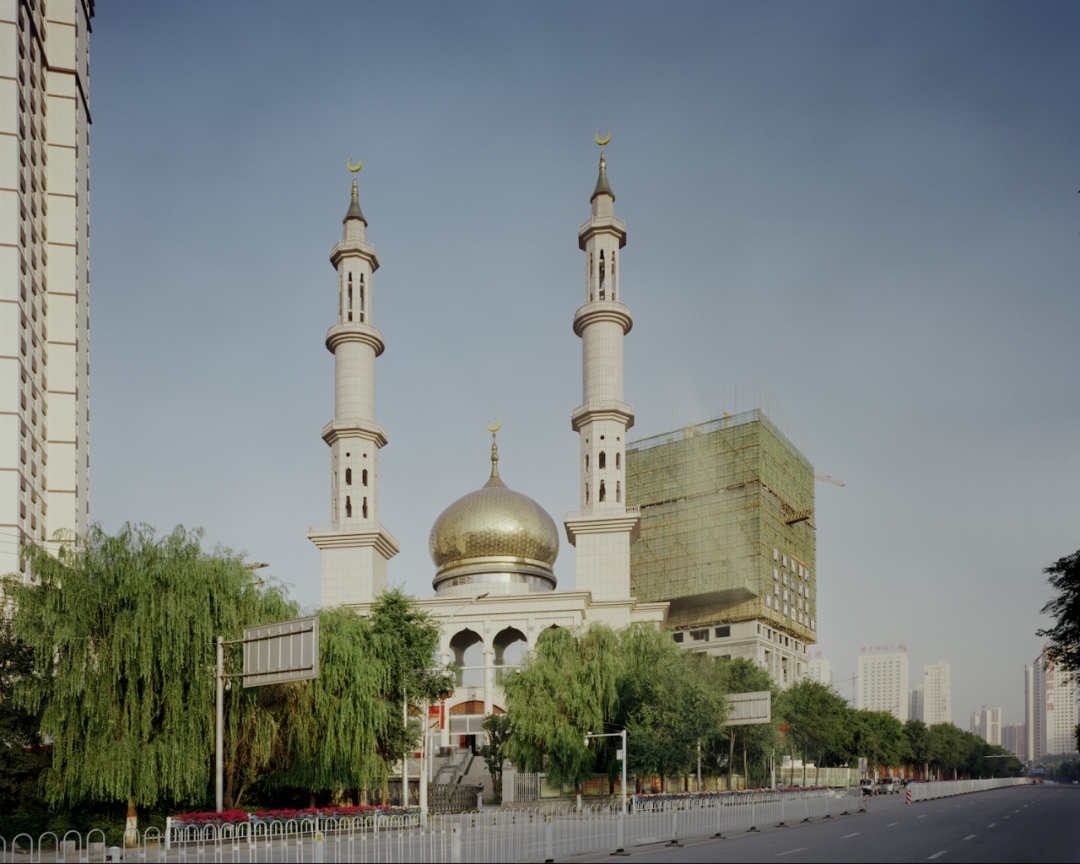
Before 10:00 AM, I shot another one, the Xiadu Avenue Mosque, two kilometers away. I dislike the name "Xiadu" (Summer Capital); it’s a label that became popular only after I left Xining, and I have no emotional attachment to it. I posted a photo I took with my phone to my social media feed.
"I'm not used to calling Xining 'Xiadu.' It’s a shallow and eager name coined by the tourism bureau years ago. It makes people think Xining was the capital of the Xia Dynasty, which it clearly wasn't. It's preposterous. This mosque is called the Xiadu Avenue Mosque, and I suppose the street is likely named that, too."
This was a long-premeditated message. I’d been bothered by those two culturally illiterate characters for too long, and today, while Yu Li drove me to the Chengbei District, I finally vented.
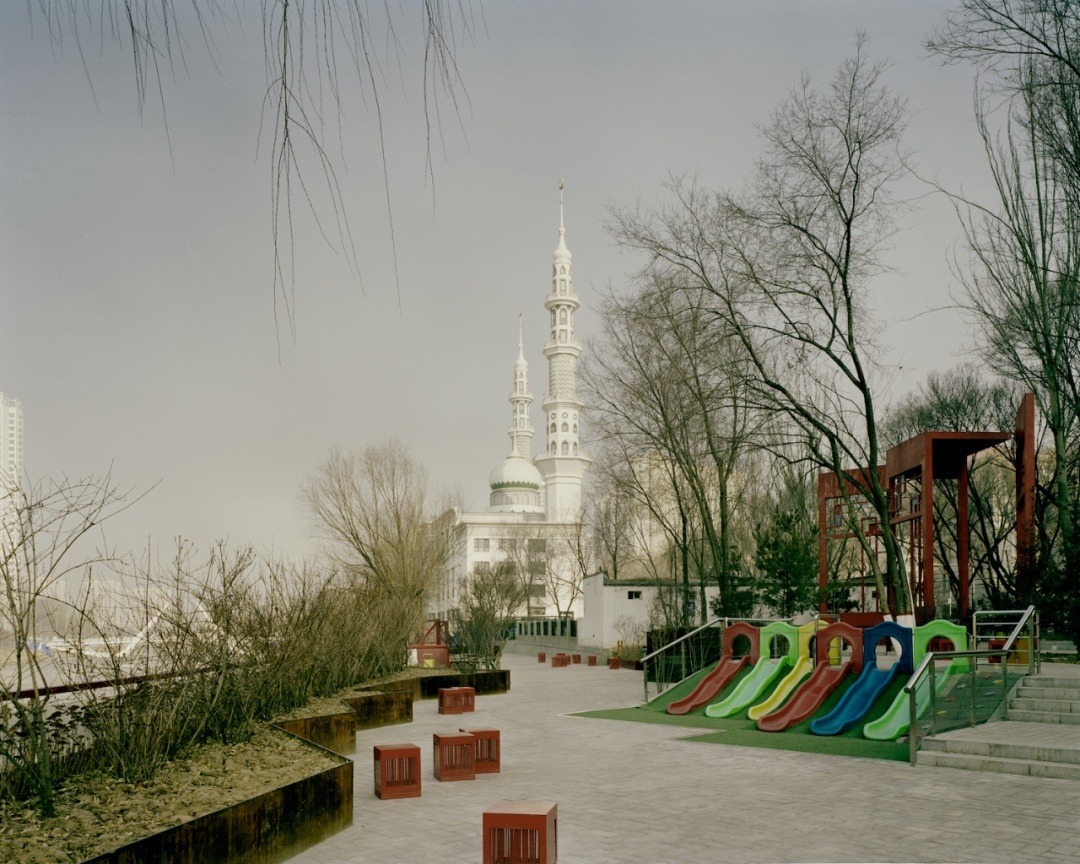
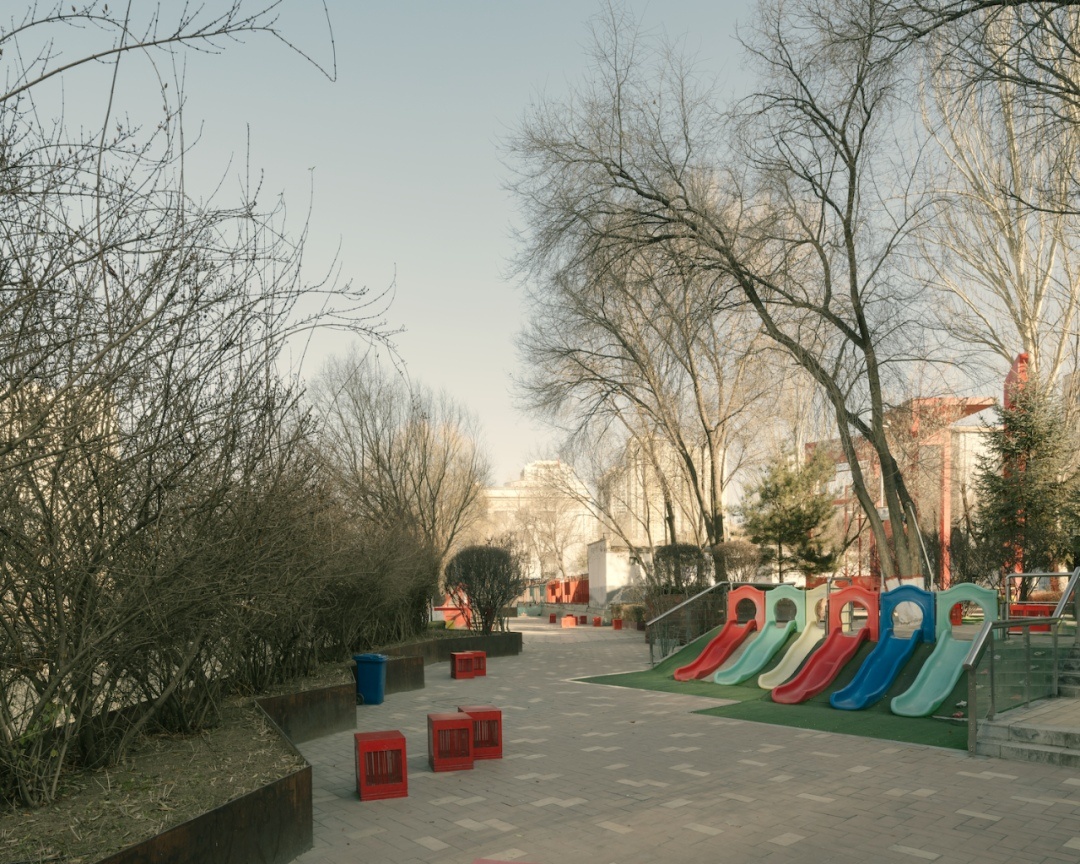
The Chengbei 'Xiaoqiao' (Small Bridge) area is where I grew up. There's only one mosque there. The so-called Xiaoqiao Mosque isn't actually on the bridge; it’s by the river in Zhaoyang Village. It used to be remote, but now it’s a park, and some bright red and blue plastic slides made for an interesting foreground.
Thank heavens, eight or nine years later, those plastic slides are still there. The only difference is the shrubs and willow trees in the distance have grown, blocking the four-story main building of the mosque. In my 2016 photos, the two soaring minarets and the round dome were the landmarks. Now, the towers are gone, the dome is altered, and the remaining prayer hall is almost hidden by trees.
Without stopping, Yu Li set the GPS for Qiaotou Town, over thirty kilometers away, where the last three mosques on my list were located.
Datong County is a Hui and Tu Autonomous County, and the Beichuan River Valley is an extension of the Hehuang Valley.
I've never met "Gan'en" in person. I guessed from his accent he was from Datong, but I wasn't sure. I asked him indirectly, but he didn't answer. In the villages of Datong, some unique Menhuan (Sufi orders) are still preserved. He probably comes from an old order. Sometimes, based on their love for Tibetan dances, I suspect he might be from Kaligang—descendants of the Tibetans who converted to Islam under Ma Laichi during the Qianlong era. Regardless, I know very little about rural Muslims, especially their production methods and economic relationships—which are exactly the things I want to investigate.
The expressway from Xining north to Qiaotou Town doesn't just go to Datong County. We realized we took a wrong turn when we saw a branch road heading toward a tunnel on the south side of Laoye Mountain. Passing through the tunnel, we headed toward Dongxia. Twenty kilometers later, we reached the end of the valley. The expressway is relentless, cutting straight through Daban Mountain, one of the parallel ranges of the Qilian Mountains and a barrier between Xining and the Hexi Corridor. Our wrong turn ended there because there was an exit to turn back. I looked ahead; the highway continues to Menyuan County on the north side of Daban Mountain, passing through the Datong River and into the Xianmi Forest Farm, crossing the main Qilian range, and finally hitting Wuwei in the Hexi Corridor. Mountains have always blocked the spread of Islam into the Hexi region. Historically, there was no solid ground for the Hui people there. Whether it was the Muslims moving in from the west or those fleeing the 'Shaanxi-Gansu Hui Revolt,' no roots were ever established. Even in modern times, when the Hexi region was under the control of the Qinghai Ma family, it still didn't become a Hui settlement. The mountains disrupted the geographical continuity of the Hehuang Valley and blocked the path of the Muslims.
Qiaotou is a coal-producing town, known for high-quality 'Ba'er' (lump) coal. Locals love it because it’s smokeless and the chunks are the perfect size for heating stoves. Another local legend, perhaps an official one, claims this coal releases heat far beyond the average 5,000 calories, reaching a staggering 8,200 calories—so 'Ba'er' actually refers to '82' coal. It’s all hearsay, impossible to verify. One thing is certain: Xining’s legendary roasted lamb has always used this 82 coal, not charcoal. Heat control is the core of cooking, isn't it? Besides, Xining lamb comes from the small-tail Han sheep that roam the Qilian grasslands in a near-wild state.
The Bayi Road Mosque in Qiaotou isn't on Bayi Road; it’s in a newly built residential area two kilometers away. During urban redevelopment, the coal mine's shantytown was demolished, and the mosque was relocated here, inheriting its original name, which feels a bit mismatched.
In 2016, after the Eid al-Adha prayers, I interviewed an old man outside the Dongguan Grand Mosque in Xining. He had set out early from his home 80 miles away to pray at Dongguan, a tradition among the Ikhwan sect—they believe the most important prayers of the year, especially Eid al-Adha and Eid al-Fitr, should be held there. Thousands of Muslims gather; for the noon prayer on those days, the hall, the plaza, the school hallways, and the streets outside are packed. Traffic police would close off a kilometer of Dongguan Street, and even the sidewalks would be covered in prayer rugs.
After the interview, he invited me to visit their newly completed mosque. I took down his number and address, and the next day I drove to Qiaotou Town, Datong County. The mosque he’d invited me to was the Bayi Road Mosque.
I arrived at the mosque, standing in the middle of overgrown weeds, in the afternoon. It was a cold day, and the old man had his black velvet-lined sheepskin coat draped over his shoulders.
The two-story beige building looked as decent as possible, with its tall round dome and two thin minarets. While it followed the standard Ikhwan-style architecture, it had its own character. The green-rimmed pointed arches, the golden spires, and the grey brick-carved eaves on the front porch linked it to the Hezhou style. Of course, Hehuang Islam is one entity. The large bronze-colored gate at the front was tall and ornate; though industrially manufactured, its complex, layered lines were quite impressive.
However, when the old man led me into the main hall and pushed open those heavy doors, I saw a crude prayer hall. It was still in the 'rough' stage. The concrete walls had white salt efflorescence; the rough plastering was just a base for future panels. The ceiling beams were exposed, and the concrete, while poured neatly, still showed the grain of the wooden molds. A few simple bare lightbulbs hung from exposed wiring. Even under the thin carpet, there was only smooth, bare cement. It was freezing inside, with no heating.
The wall in front was decorated with a simple cloth to mark the mihrab (the prayer niche), the point indicating the direction of Mecca. Everything showed that this was a prayer hall used before interior renovations were finished—shabby and sparse.
The old man gave me another video interview. Building this mosque had exhausted all their construction funds, and there was no money left for the interior, yet they had to start praying. The reason we met the day before was that he had gone to the Dongguan Grand Mosque to attend prayers and, incidentally, to fundraise among his brothers. They belonged to a group with slight differences from the mainstream Ikhwan—not exactly a 'sect,' but they held different views on certain Ikhwan practices. He specifically warned me: "That Jin Biao Ahong (Imam) you mentioned is the one we like the least. Don't tell anyone you know him when you visit other mosques; it won't be good for you." To me, Jin Biao represented the Ikhwan mainstream. He was a qualified, even excellent, Imam. When he led the Nanguan Mosque, he managed it perfectly. He opened the gates to Han, Tibetan, and other non-Muslims, and advocated for female worshippers, believing they should have equal rights as children of Allah. He created a library in the mosque, accepting all donated books except for those that were anti-Islamic or anti-social. He encouraged the students to read widely to understand the world outside. He also invited socialites to give lectures. He was a gentle man, often saying, "harmony without uniformity"—isn't that the prerequisite for diversity and coexistence? These practices were revolutionary for the traditional Xining Islamic community. In the religiously conservative environment of Xining, he drew opposition and even faced an assassination attempt. A shot rang out, and the bullet grazed his ear. Thank Allah, he was fine. The assailant was also a local Muslim. All of this has become a legendary story; I’ve even toyed with the idea of doing an in-depth interview with Jin Biao to write those stories down.
Internal divisions within Islam have never ceased. Islam is not just a religion; it is a way of life, entangled in complex political, economic, and clan relationships. In the countryside, mosques and their management systems influence the distribution of economic interests, so creating sects and staking claims is inevitable. Moreover, the Islamic classics have never explicitly forbidden the formation of new schools of thought.
Xining Yangjiazhuang Mosque, photographed in 2016.
Xining Yangjiazhuang Mosque, photographed in 2023.
Inside the prayer hall of Xining Yangjiazhuang Mosque, 2016.
Xining Xiaoqiao Mosque, photographed in 2016. Xining Xiaoqiao Mosque, photographed in 2023.
Xining Xiadu Avenue Mosque, photographed in 2016.
Xining Xiadu Avenue Mosque, photographed in 2023.
2
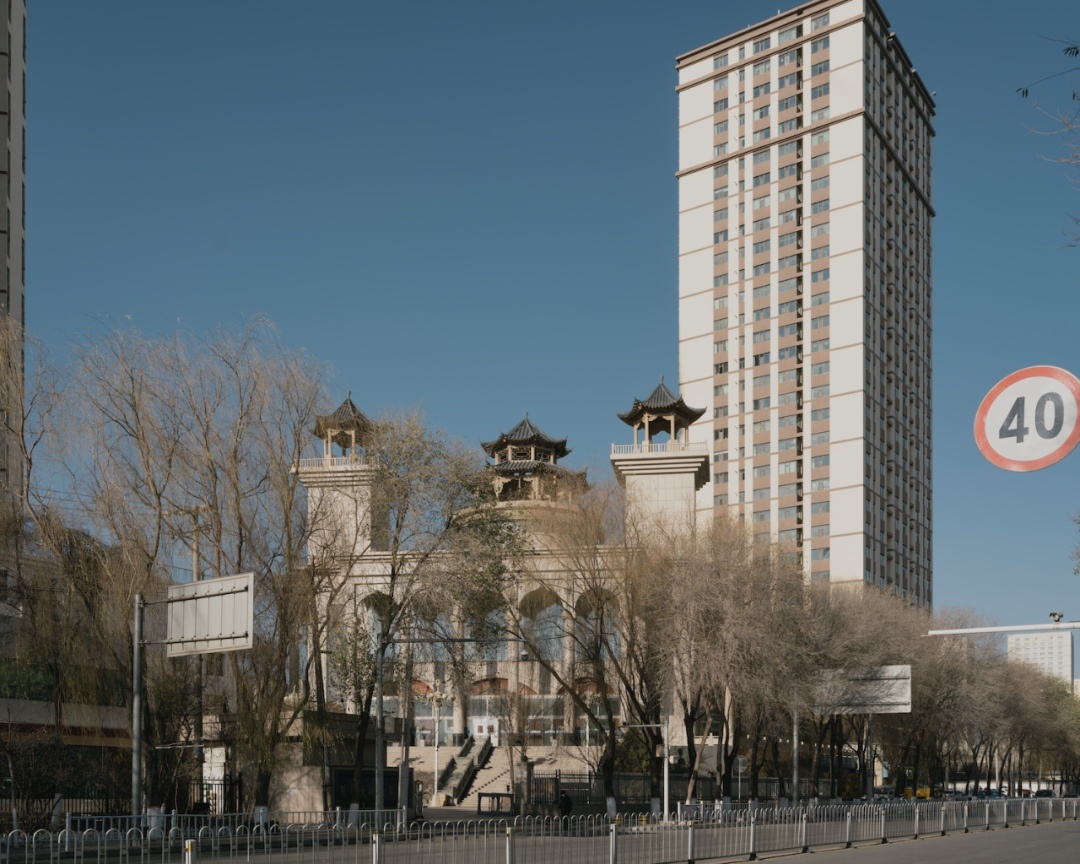
Yu Li carefully parked the car in a space by the entrance of the mosque. Before I even stepped out, I knew this mosque would be impossible to photograph. Just like the Yangjiazhuang Mosque, a residential building had been built right where my original camera angle used to be. Still, I couldn't give up, so I walked over to the small gate guarded by an old security guard. He was busy shooing away students coming home from school—it was probably a shortcut, and the mischievous kids kept stepping on the dried-out lawn, so he was herding them toward the main gate instead. When he saw me, he opened the gate; the children flooded in like a stream before dispersing in every direction. The old guard grumbled under his breath, shouting, 'Don't step on the grass!'
The golden dome and minaret have been replaced by a Chinese-style pavilion roof, which actually matches the grey brick carvings along the eaves quite well. The interior has been renovated with bright tiles and walls, and the ceiling now features layered caisson ceilings—that temporary prayer hall I once photographed exists only on my film now.
As noon approached, I headed for a village mosque about five kilometers north. I needed to get my buddy Yu Li some food; if he wasn't here with me, he probably would never have set foot in this place in his life. There were beef noodle shops along the road, mostly run by Hui Muslims. I wasn't really in the mood for beef ramen, so I walked a bit further until I saw a sign for 'Yanfu Classic Mianpian (handmade noodle flakes).' The sign looked a bit like a knockoff, but when I walked up to the entrance, it was bright and clean. It was peak lunch hour, and every table was packed, which instantly dismissed my skepticism. This was perfect—the braised beef brisket Zhang Yi is always raving about is the one from the Yanfu Mianpian in Minhe County. He’d been bragging about it for days, so today Yu Li could finally try this braised beef.
To recreate the taste and vibe of the one in Minhe, I ordered exactly the same things: two bowls of clear-soup mianpian, one jin (500 grams) of braised beef brisket, and two small side dishes. They had an appetizing braised sheep head for 68 yuan, but since Zhang Yi wasn't there, I decided against it—it was just too expensive.
After lunch, we headed to Hezhouzhuang, only about a ten-minute drive away. The highland winter is dry and desolate; the wind has scrubbed the ground clean, and the sun shines with a harsh, bright glare. The poplar trees have shed every single leaf, leaving their pale, tender bark exposed, and their branches are completely bare, not even a twig in sight. There wasn't a soul on the road—everyone was hunkering down at home for the winter, which still felt like it would last a long time.
We spotted the Hezhouzhuang Mosque from a distance. When we got close enough, I told the driver to stop, got out, and compared it to the photos on my phone. Like the others, this small rural mosque hadn't escaped the 'beheading' of its original structure, and the nearby courtyards and roads had all changed, making it nearly impossible to line up the shots.
A few minutes later, I realized I’d made a mistake—this wasn't the angle I’d used back then. Country roads all start to look the same. I kept moving, took a 90-degree turn at the intersection by the mosque, walked another hundred meters, and turned back to face it. This was the original spot! It was perfect; the courtyard, the porch, and the alley entrance all matched up—even the white lamppost looked exactly as it had before.
The final mosque was the Qiaotou Town Grand Mosque, about seven or eight kilometers back from Hezhouzhuang. Qiaotou Town is located at the most treacherous point between Laoye Mountain and the Beichuan River. This coal-producing town no longer looks as grimy as it once did; it has everything a modern city requires: landscaping, commercial billboards, and political slogans. Across the way, the winding Ming Dynasty Great Wall—part of the Xining garrison defense system designed to separate nomadic tribes from farming communities—snakes along the mountainside. The mosque sits at the most prominent three-way intersection, right in the square of the Taoist Laoye Mountain. My camera spot was in a quiet area along the riverbank, right against the railing. A row of old storefronts from over a decade ago was still there, but they were all locked tight, with no business open. Most of the signs had fallen off and were never replaced; the businesses had clearly been abandoned. A few had 'Tea House' or 'Bar' signs, and the neon lights were still there—perhaps when night falls, they offer some bleak, flashy nightlife. I tried hard to find that bar with the strange name, but I looked from left to right and couldn't find any '7 Bar' sign.
I managed to capture both the Qiaotou Mosque and the famous Taoist mountain in the same frame.
In the evening, we went to the most famous lamb restaurant on Baiyu Lane in Xining. Luckily, it was winter, so it wasn't too crowded. While picking out the meat, a man and a woman in front of me were choosing braised lamb. The lamb in the big iron bucket looked golden, tender, and juicy, but the woman complained it was a bit fatty. I couldn't help but chime in that it was the best kind. The woman felt embarrassed and laughed, saying, 'This is for the lahou'r to eat.' 'Lahou'r' is a Xining slang term for outsiders, which comes from the local tendency to be surprised by things they don't see often. Decades ago, the first 'outsiders' people in Xining saw were people from Sichuan or Henan who traveled with monkeys to perform. The locals called anyone speaking a dialect they couldn't understand 'lahou'r' (monkey-pullers). And here I was, leading my two 'lahou'r' buddies to eat the best lamb in Xining. The couple took their ten portions vacuum-packed to go. When it was my turn, I ordered lamb ribs. The woman chopping the meat told me to wait a moment; she’d bring some fresh from the kitchen. It was cold outside, and hot lamb is just perfect.
While waiting for the meat to be chopped, I looked at the photos of celebrities on the wall. People from all over the country and all walks of life were posing with the owner—it turns out everyone loves good food. Next to the photos were the staff’s health permits and business licenses. The owner’s surname was indeed Jin, but the Mr. Jin in the photos with the celebrities didn't look like the person I was looking for.
'I heard from the elders in the Nanguan community that your boss is the older brother of Ahong (Imam) Jin Biao?' I lowered my voice and asked the woman at the register.
'That's right, he is,' she laughed, not showing any sign of offense—after all, my question was a bit personal.
Yu Li was finally able to eat his shouzhua yangrou (hand-grabbed lamb) with raw garlic—this was his biggest progress yet. The hand-grabbed lamb and beef brisket were incredibly delicious. Zhang Yi said it truly lived up to its reputation as the gold standard for lamb in Xining. After two cups of free green tea, we decided to walk the two or three kilometers back to the hotel to burn off some of the guilt.
Back at the hotel, Yu Li kept boiling water for tea in my room. The heater was pumping, and my photography trip was finally over. It had been a rushed experience, but I had enough to deliver for the exhibition in the U.S. We chatted, and suddenly I felt like having a drink. The last time we had a moment like this was in a guesthouse by Heimahe at Qinghai Lake; that night, by the fireplace, Daman sang a song, but we were lacking alcohol then, too. Tonight was no different—the three of us were flushed, but sober.
I got a new comment on my social media post about the before-and-after photos of the mosques: 'You can see the stubbornness after being forced to renovate.' Honestly, I don't care much about that 'stubbornness.' I don't support the Arabic-style expansions, nor do I agree with the reckless demolition and renovations. In other words, I don't support either side, nor do I favor anyone—I don't even have sympathy for them. I have to look at this issue rationally and neutrally. Sometimes, I feel like Pierluigi Collina, the Italian bald referee running across the pitch; a cold, ruthless, and objective attitude is my only way to maintain a sharp perspective. That's how it's been since the first day I decided to photograph these mosques. I am neither a follower of Islam nor a narrow-minded nationalist pushing for 'total Sinicization.'
(End of article)
Li Ming, December 2023 to January 2024
Xining Datong Hezhouzhuang Mosque, photographed in 2016.
Xining Datong Hezhouzhuang Mosque, photographed in 2023.
Xining Nanguan Mosque, photographed in 2016—the place where I first met Jin Biao. view all
This is the final installment of the documentary photography series, "The Vanishing Arches." By visiting the Datong Hezhouzhuang Mosque and the Xining Nanguan Mosque, I reflect on the urban landscape from 2016 to 2023, where highways, modern high-rises, and mosques have become deeply intertwined, offering a somber and restrained conclusion to the evolution of mosques in Northwest China.
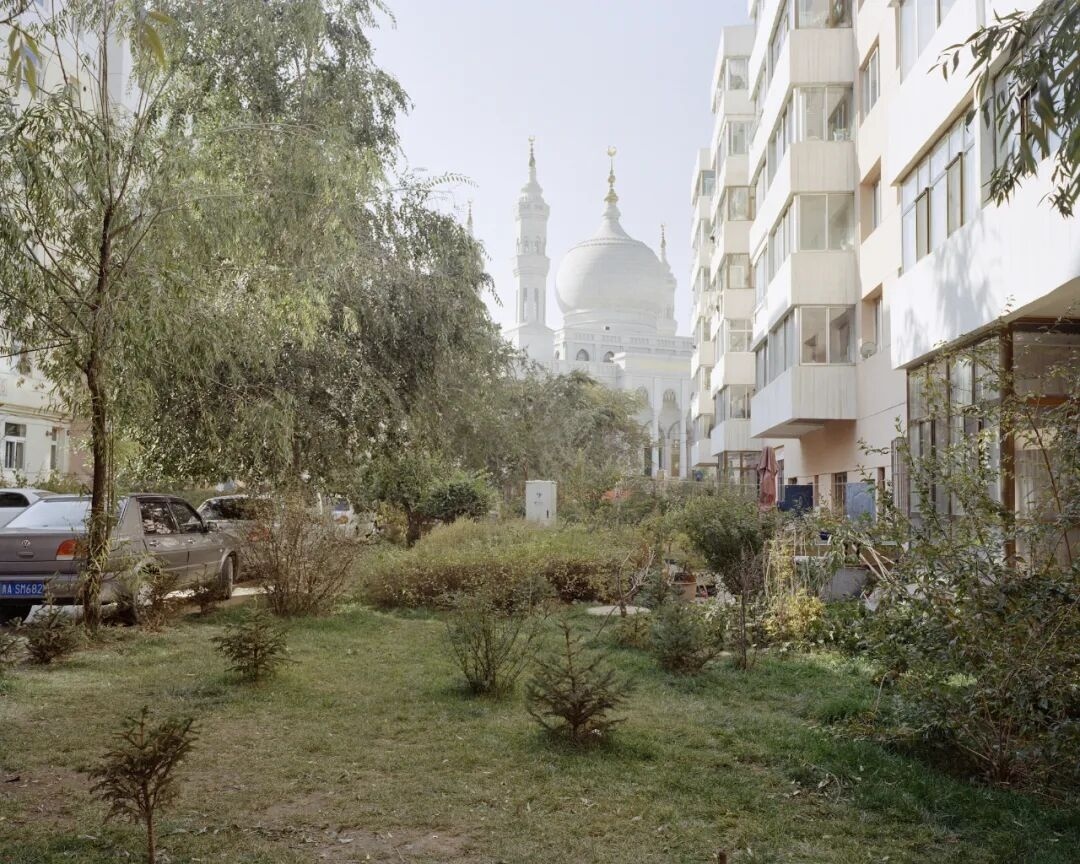
Most urban mosques in China are not significant public buildings in the general sense. The highway overpasses and neighboring buildings that appear in my photos are all part of the reality—they exist like a matter of fate. In the city, what changes the appearance of a mosque goes far beyond those government-mandated traditional-style roofs or structural modifications.
The Vanishing Arches (Part 9)
1
Zhang Yi didn't show up for breakfast. He sent a message saying he needed a break; both his body and stomach needed a rest from days of eating shouzhua yangrou (hand-grabbed lamb). He had some emails to deal with and laundry to do. It was clear he wouldn't be joining me today. The novelty of the Islamic world only lasted about five or six days for him, which is typical. Yu Li took over the driving, and while we only had five mosques left to photograph, they were scattered forty or fifty kilometers apart.
The Yangjiazhuang Mosque is just a block away, located on another small street to the west. It’s one of the few Gedimu (the oldest sect of Islam in China, heavily influenced by traditional Chinese culture) mosques in Xining. From the outside, it’s a large building; the main hall is four or five stories high, and the minaret reaches dozens of meters. I visited in 2015, making it the first mosque I ever photographed. At the time, there was a construction pit on the north side, which made the mosque seem incredibly spacious. I set up my camera on the edge of that pit.
In early 2022, I often saw videos online of a group of seven or eight Hui Muslims, both men and women, dancing. They choreographed the routines themselves, set to old songs praising socialism and ethnic unity. The dance wasn't particularly graceful, blending folk fan dances, Tibetan Guozhuang, and even elements of the Han Chinese Shehuo yangge dance. But they took it very seriously. I would start by suppressing a smile, but often end up doing the same. Most of the comments were sarcastic, sometimes even abusive, mostly from people claiming to be "orthodox" Muslims who felt this "hybrid" style, neither Han, Hui, nor Tibetan, insulted the sanctity of Islam. The dancers ignored the haters and kept going, using their amusing moves to respond to those who viewed them as enemies. Fascinated by this example of cultural diversity, I connected with "Gan'en" (Gratitude) online, who posted these videos. I couldn't determine if he was one of the dancers, but he is a local Muslim in Xining, likely from a county in Haidong. We talked quite a bit.
In our later exchanges, he frequently updated me on the "Sinicization" (Sinicization/Chinese-style architectural) process of mosques in Xining, effectively becoming my "informant." One day, I mentioned the Yangjiazhuang Mosque, and he told me it was undergoing renovations. I wanted to know the progress, so he rode his electric scooter a few blocks over and took photos for me.
The photos were taken from the angle of Dazhong Street, looking up. The mosque is only six or seven meters from the road. The original rounded dome had been replaced by a Chinese-style roof supported by tiers of dougong (traditional wooden brackets). The three corners of the triangular layout each featured a minaret. It was covered in green construction netting, looking like an unpeeled ear of corn, with the shape of the newly built octagonal pavilion dimly visible inside.
This August, I visited the renovated Yangjiazhuang Mosque again. When looking for my 2016 camera spot, I realized it was now nestled within a new high-rise building. This building was built on the foundation of that old construction pit. Construction was slow—seven years later, the building still wasn't finished. That doesn't matter; what matters is that I can never photograph the Yangjiazhuang Mosque from the old vantage point again.
In cities, recognized public buildings get visual "privileges," usually granted wider spaces, landscaping, and plazas to create distance. This distance makes them look more elegant and reinforces their status as landmarks; the openness is part of the architecture itself. However, most urban mosques in China aren't treated this way. The overpasses and surrounding buildings in my photos are part of a fated reality. Just as I was about to give up on shooting this mosque, it dawned on me. I placed the looming presence of that unfinished building in the foreground, with the Chinese-style eaves as the mid-to-background focus. The unrelated building now occupies half the frame. In the city, what changes the face of a mosque isn't just those government mandates.
Photographing these mosques has become second nature. Xining has fifty or sixty mosques, and I’ve been to most of them. As a non-Muslim, I visit them quite often.
Before 10:00 AM, I shot another one, the Xiadu Avenue Mosque, two kilometers away. I dislike the name "Xiadu" (Summer Capital); it’s a label that became popular only after I left Xining, and I have no emotional attachment to it. I posted a photo I took with my phone to my social media feed.
"I'm not used to calling Xining 'Xiadu.' It’s a shallow and eager name coined by the tourism bureau years ago. It makes people think Xining was the capital of the Xia Dynasty, which it clearly wasn't. It's preposterous. This mosque is called the Xiadu Avenue Mosque, and I suppose the street is likely named that, too."
This was a long-premeditated message. I’d been bothered by those two culturally illiterate characters for too long, and today, while Yu Li drove me to the Chengbei District, I finally vented.
The Chengbei 'Xiaoqiao' (Small Bridge) area is where I grew up. There's only one mosque there. The so-called Xiaoqiao Mosque isn't actually on the bridge; it’s by the river in Zhaoyang Village. It used to be remote, but now it’s a park, and some bright red and blue plastic slides made for an interesting foreground.
Thank heavens, eight or nine years later, those plastic slides are still there. The only difference is the shrubs and willow trees in the distance have grown, blocking the four-story main building of the mosque. In my 2016 photos, the two soaring minarets and the round dome were the landmarks. Now, the towers are gone, the dome is altered, and the remaining prayer hall is almost hidden by trees.
Without stopping, Yu Li set the GPS for Qiaotou Town, over thirty kilometers away, where the last three mosques on my list were located.
Datong County is a Hui and Tu Autonomous County, and the Beichuan River Valley is an extension of the Hehuang Valley.
I've never met "Gan'en" in person. I guessed from his accent he was from Datong, but I wasn't sure. I asked him indirectly, but he didn't answer. In the villages of Datong, some unique Menhuan (Sufi orders) are still preserved. He probably comes from an old order. Sometimes, based on their love for Tibetan dances, I suspect he might be from Kaligang—descendants of the Tibetans who converted to Islam under Ma Laichi during the Qianlong era. Regardless, I know very little about rural Muslims, especially their production methods and economic relationships—which are exactly the things I want to investigate.
The expressway from Xining north to Qiaotou Town doesn't just go to Datong County. We realized we took a wrong turn when we saw a branch road heading toward a tunnel on the south side of Laoye Mountain. Passing through the tunnel, we headed toward Dongxia. Twenty kilometers later, we reached the end of the valley. The expressway is relentless, cutting straight through Daban Mountain, one of the parallel ranges of the Qilian Mountains and a barrier between Xining and the Hexi Corridor. Our wrong turn ended there because there was an exit to turn back. I looked ahead; the highway continues to Menyuan County on the north side of Daban Mountain, passing through the Datong River and into the Xianmi Forest Farm, crossing the main Qilian range, and finally hitting Wuwei in the Hexi Corridor. Mountains have always blocked the spread of Islam into the Hexi region. Historically, there was no solid ground for the Hui people there. Whether it was the Muslims moving in from the west or those fleeing the 'Shaanxi-Gansu Hui Revolt,' no roots were ever established. Even in modern times, when the Hexi region was under the control of the Qinghai Ma family, it still didn't become a Hui settlement. The mountains disrupted the geographical continuity of the Hehuang Valley and blocked the path of the Muslims.
Qiaotou is a coal-producing town, known for high-quality 'Ba'er' (lump) coal. Locals love it because it’s smokeless and the chunks are the perfect size for heating stoves. Another local legend, perhaps an official one, claims this coal releases heat far beyond the average 5,000 calories, reaching a staggering 8,200 calories—so 'Ba'er' actually refers to '82' coal. It’s all hearsay, impossible to verify. One thing is certain: Xining’s legendary roasted lamb has always used this 82 coal, not charcoal. Heat control is the core of cooking, isn't it? Besides, Xining lamb comes from the small-tail Han sheep that roam the Qilian grasslands in a near-wild state.
The Bayi Road Mosque in Qiaotou isn't on Bayi Road; it’s in a newly built residential area two kilometers away. During urban redevelopment, the coal mine's shantytown was demolished, and the mosque was relocated here, inheriting its original name, which feels a bit mismatched.
In 2016, after the Eid al-Adha prayers, I interviewed an old man outside the Dongguan Grand Mosque in Xining. He had set out early from his home 80 miles away to pray at Dongguan, a tradition among the Ikhwan sect—they believe the most important prayers of the year, especially Eid al-Adha and Eid al-Fitr, should be held there. Thousands of Muslims gather; for the noon prayer on those days, the hall, the plaza, the school hallways, and the streets outside are packed. Traffic police would close off a kilometer of Dongguan Street, and even the sidewalks would be covered in prayer rugs.
After the interview, he invited me to visit their newly completed mosque. I took down his number and address, and the next day I drove to Qiaotou Town, Datong County. The mosque he’d invited me to was the Bayi Road Mosque.
I arrived at the mosque, standing in the middle of overgrown weeds, in the afternoon. It was a cold day, and the old man had his black velvet-lined sheepskin coat draped over his shoulders.
The two-story beige building looked as decent as possible, with its tall round dome and two thin minarets. While it followed the standard Ikhwan-style architecture, it had its own character. The green-rimmed pointed arches, the golden spires, and the grey brick-carved eaves on the front porch linked it to the Hezhou style. Of course, Hehuang Islam is one entity. The large bronze-colored gate at the front was tall and ornate; though industrially manufactured, its complex, layered lines were quite impressive.
However, when the old man led me into the main hall and pushed open those heavy doors, I saw a crude prayer hall. It was still in the 'rough' stage. The concrete walls had white salt efflorescence; the rough plastering was just a base for future panels. The ceiling beams were exposed, and the concrete, while poured neatly, still showed the grain of the wooden molds. A few simple bare lightbulbs hung from exposed wiring. Even under the thin carpet, there was only smooth, bare cement. It was freezing inside, with no heating.
The wall in front was decorated with a simple cloth to mark the mihrab (the prayer niche), the point indicating the direction of Mecca. Everything showed that this was a prayer hall used before interior renovations were finished—shabby and sparse.
The old man gave me another video interview. Building this mosque had exhausted all their construction funds, and there was no money left for the interior, yet they had to start praying. The reason we met the day before was that he had gone to the Dongguan Grand Mosque to attend prayers and, incidentally, to fundraise among his brothers. They belonged to a group with slight differences from the mainstream Ikhwan—not exactly a 'sect,' but they held different views on certain Ikhwan practices. He specifically warned me: "That Jin Biao Ahong (Imam) you mentioned is the one we like the least. Don't tell anyone you know him when you visit other mosques; it won't be good for you." To me, Jin Biao represented the Ikhwan mainstream. He was a qualified, even excellent, Imam. When he led the Nanguan Mosque, he managed it perfectly. He opened the gates to Han, Tibetan, and other non-Muslims, and advocated for female worshippers, believing they should have equal rights as children of Allah. He created a library in the mosque, accepting all donated books except for those that were anti-Islamic or anti-social. He encouraged the students to read widely to understand the world outside. He also invited socialites to give lectures. He was a gentle man, often saying, "harmony without uniformity"—isn't that the prerequisite for diversity and coexistence? These practices were revolutionary for the traditional Xining Islamic community. In the religiously conservative environment of Xining, he drew opposition and even faced an assassination attempt. A shot rang out, and the bullet grazed his ear. Thank Allah, he was fine. The assailant was also a local Muslim. All of this has become a legendary story; I’ve even toyed with the idea of doing an in-depth interview with Jin Biao to write those stories down.
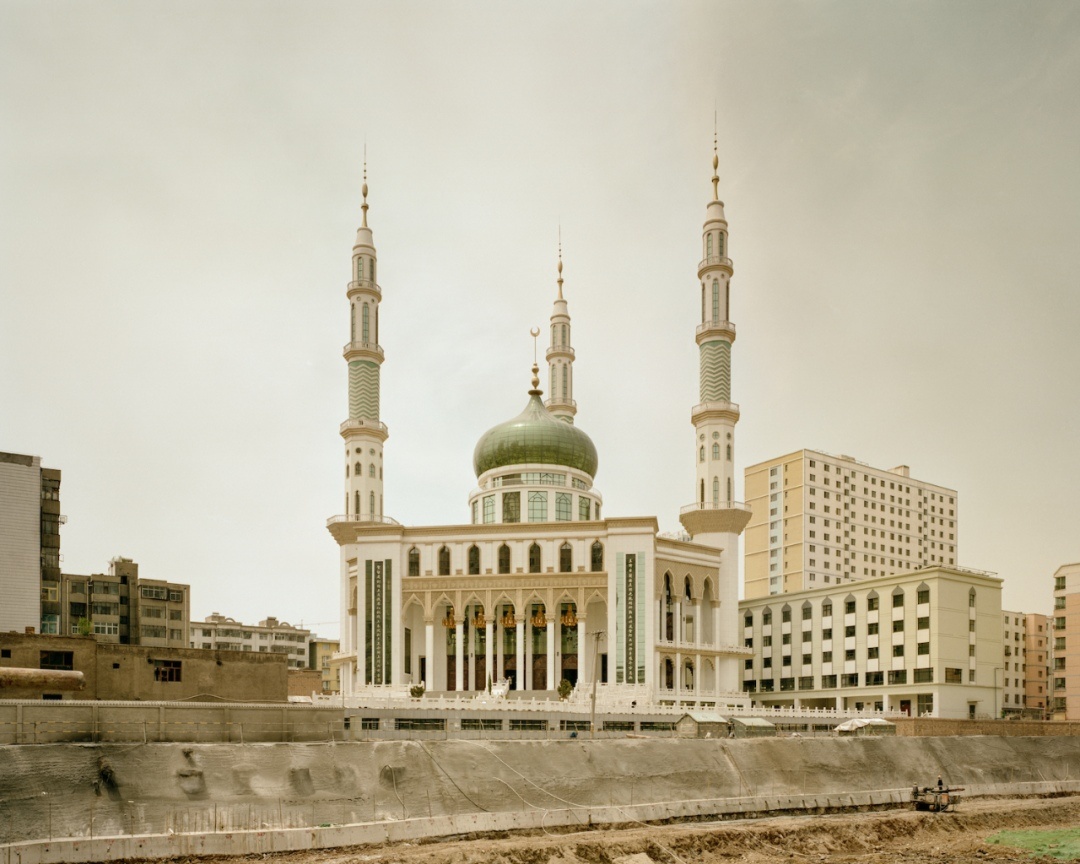
Internal divisions within Islam have never ceased. Islam is not just a religion; it is a way of life, entangled in complex political, economic, and clan relationships. In the countryside, mosques and their management systems influence the distribution of economic interests, so creating sects and staking claims is inevitable. Moreover, the Islamic classics have never explicitly forbidden the formation of new schools of thought.
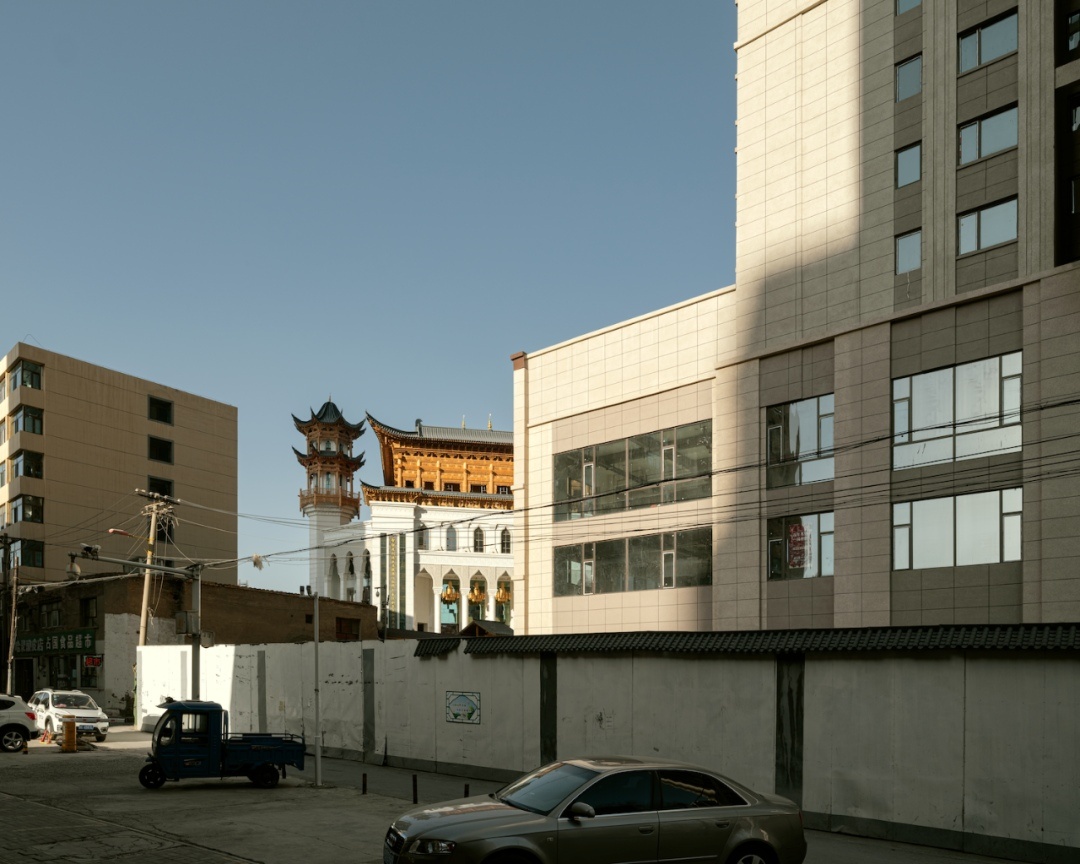
Xining Yangjiazhuang Mosque, photographed in 2016.
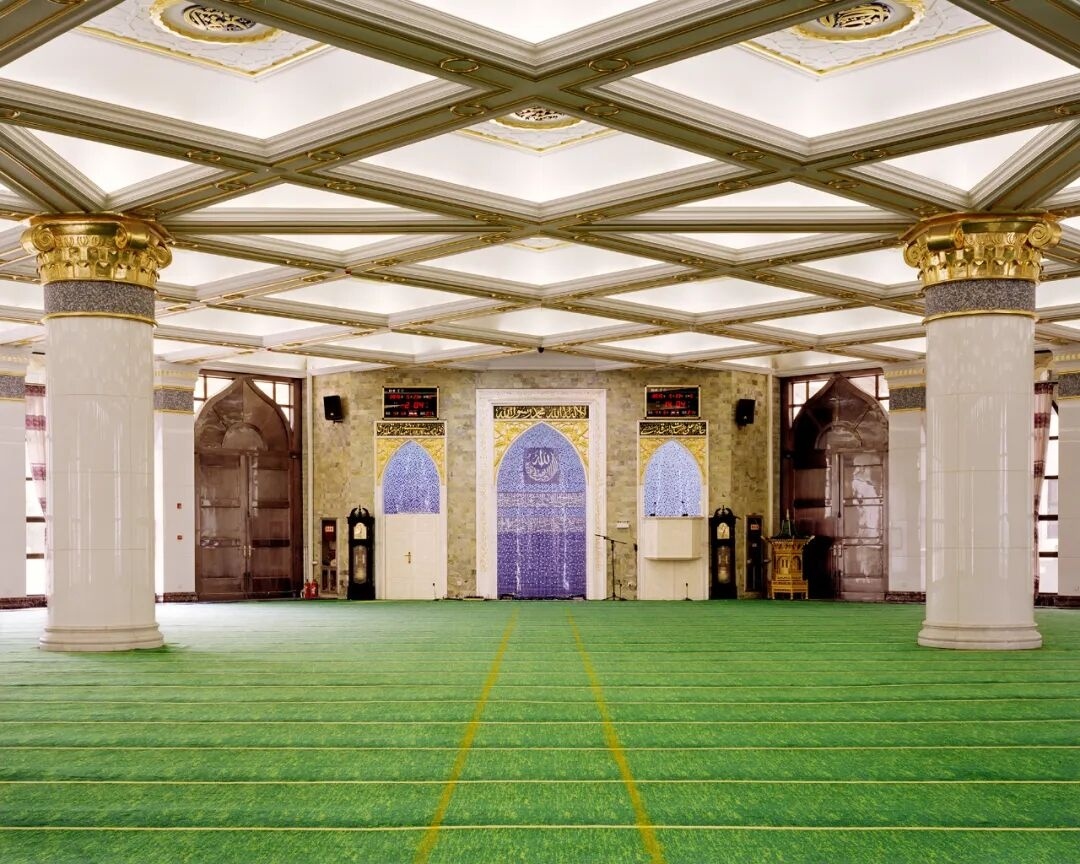
Xining Yangjiazhuang Mosque, photographed in 2023.
Inside the prayer hall of Xining Yangjiazhuang Mosque, 2016.
Xining Xiaoqiao Mosque, photographed in 2016. Xining Xiaoqiao Mosque, photographed in 2023.
Xining Xiadu Avenue Mosque, photographed in 2016.
Xining Xiadu Avenue Mosque, photographed in 2023.
2
Yu Li carefully parked the car in a space by the entrance of the mosque. Before I even stepped out, I knew this mosque would be impossible to photograph. Just like the Yangjiazhuang Mosque, a residential building had been built right where my original camera angle used to be. Still, I couldn't give up, so I walked over to the small gate guarded by an old security guard. He was busy shooing away students coming home from school—it was probably a shortcut, and the mischievous kids kept stepping on the dried-out lawn, so he was herding them toward the main gate instead. When he saw me, he opened the gate; the children flooded in like a stream before dispersing in every direction. The old guard grumbled under his breath, shouting, 'Don't step on the grass!'
The golden dome and minaret have been replaced by a Chinese-style pavilion roof, which actually matches the grey brick carvings along the eaves quite well. The interior has been renovated with bright tiles and walls, and the ceiling now features layered caisson ceilings—that temporary prayer hall I once photographed exists only on my film now.
As noon approached, I headed for a village mosque about five kilometers north. I needed to get my buddy Yu Li some food; if he wasn't here with me, he probably would never have set foot in this place in his life. There were beef noodle shops along the road, mostly run by Hui Muslims. I wasn't really in the mood for beef ramen, so I walked a bit further until I saw a sign for 'Yanfu Classic Mianpian (handmade noodle flakes).' The sign looked a bit like a knockoff, but when I walked up to the entrance, it was bright and clean. It was peak lunch hour, and every table was packed, which instantly dismissed my skepticism. This was perfect—the braised beef brisket Zhang Yi is always raving about is the one from the Yanfu Mianpian in Minhe County. He’d been bragging about it for days, so today Yu Li could finally try this braised beef.
To recreate the taste and vibe of the one in Minhe, I ordered exactly the same things: two bowls of clear-soup mianpian, one jin (500 grams) of braised beef brisket, and two small side dishes. They had an appetizing braised sheep head for 68 yuan, but since Zhang Yi wasn't there, I decided against it—it was just too expensive.
After lunch, we headed to Hezhouzhuang, only about a ten-minute drive away. The highland winter is dry and desolate; the wind has scrubbed the ground clean, and the sun shines with a harsh, bright glare. The poplar trees have shed every single leaf, leaving their pale, tender bark exposed, and their branches are completely bare, not even a twig in sight. There wasn't a soul on the road—everyone was hunkering down at home for the winter, which still felt like it would last a long time.
We spotted the Hezhouzhuang Mosque from a distance. When we got close enough, I told the driver to stop, got out, and compared it to the photos on my phone. Like the others, this small rural mosque hadn't escaped the 'beheading' of its original structure, and the nearby courtyards and roads had all changed, making it nearly impossible to line up the shots.
A few minutes later, I realized I’d made a mistake—this wasn't the angle I’d used back then. Country roads all start to look the same. I kept moving, took a 90-degree turn at the intersection by the mosque, walked another hundred meters, and turned back to face it. This was the original spot! It was perfect; the courtyard, the porch, and the alley entrance all matched up—even the white lamppost looked exactly as it had before.
The final mosque was the Qiaotou Town Grand Mosque, about seven or eight kilometers back from Hezhouzhuang. Qiaotou Town is located at the most treacherous point between Laoye Mountain and the Beichuan River. This coal-producing town no longer looks as grimy as it once did; it has everything a modern city requires: landscaping, commercial billboards, and political slogans. Across the way, the winding Ming Dynasty Great Wall—part of the Xining garrison defense system designed to separate nomadic tribes from farming communities—snakes along the mountainside. The mosque sits at the most prominent three-way intersection, right in the square of the Taoist Laoye Mountain. My camera spot was in a quiet area along the riverbank, right against the railing. A row of old storefronts from over a decade ago was still there, but they were all locked tight, with no business open. Most of the signs had fallen off and were never replaced; the businesses had clearly been abandoned. A few had 'Tea House' or 'Bar' signs, and the neon lights were still there—perhaps when night falls, they offer some bleak, flashy nightlife. I tried hard to find that bar with the strange name, but I looked from left to right and couldn't find any '7 Bar' sign.
I managed to capture both the Qiaotou Mosque and the famous Taoist mountain in the same frame.
In the evening, we went to the most famous lamb restaurant on Baiyu Lane in Xining. Luckily, it was winter, so it wasn't too crowded. While picking out the meat, a man and a woman in front of me were choosing braised lamb. The lamb in the big iron bucket looked golden, tender, and juicy, but the woman complained it was a bit fatty. I couldn't help but chime in that it was the best kind. The woman felt embarrassed and laughed, saying, 'This is for the lahou'r to eat.' 'Lahou'r' is a Xining slang term for outsiders, which comes from the local tendency to be surprised by things they don't see often. Decades ago, the first 'outsiders' people in Xining saw were people from Sichuan or Henan who traveled with monkeys to perform. The locals called anyone speaking a dialect they couldn't understand 'lahou'r' (monkey-pullers). And here I was, leading my two 'lahou'r' buddies to eat the best lamb in Xining. The couple took their ten portions vacuum-packed to go. When it was my turn, I ordered lamb ribs. The woman chopping the meat told me to wait a moment; she’d bring some fresh from the kitchen. It was cold outside, and hot lamb is just perfect.
While waiting for the meat to be chopped, I looked at the photos of celebrities on the wall. People from all over the country and all walks of life were posing with the owner—it turns out everyone loves good food. Next to the photos were the staff’s health permits and business licenses. The owner’s surname was indeed Jin, but the Mr. Jin in the photos with the celebrities didn't look like the person I was looking for.
'I heard from the elders in the Nanguan community that your boss is the older brother of Ahong (Imam) Jin Biao?' I lowered my voice and asked the woman at the register.
'That's right, he is,' she laughed, not showing any sign of offense—after all, my question was a bit personal.
Yu Li was finally able to eat his shouzhua yangrou (hand-grabbed lamb) with raw garlic—this was his biggest progress yet. The hand-grabbed lamb and beef brisket were incredibly delicious. Zhang Yi said it truly lived up to its reputation as the gold standard for lamb in Xining. After two cups of free green tea, we decided to walk the two or three kilometers back to the hotel to burn off some of the guilt.
Back at the hotel, Yu Li kept boiling water for tea in my room. The heater was pumping, and my photography trip was finally over. It had been a rushed experience, but I had enough to deliver for the exhibition in the U.S. We chatted, and suddenly I felt like having a drink. The last time we had a moment like this was in a guesthouse by Heimahe at Qinghai Lake; that night, by the fireplace, Daman sang a song, but we were lacking alcohol then, too. Tonight was no different—the three of us were flushed, but sober.
I got a new comment on my social media post about the before-and-after photos of the mosques: 'You can see the stubbornness after being forced to renovate.' Honestly, I don't care much about that 'stubbornness.' I don't support the Arabic-style expansions, nor do I agree with the reckless demolition and renovations. In other words, I don't support either side, nor do I favor anyone—I don't even have sympathy for them. I have to look at this issue rationally and neutrally. Sometimes, I feel like Pierluigi Collina, the Italian bald referee running across the pitch; a cold, ruthless, and objective attitude is my only way to maintain a sharp perspective. That's how it's been since the first day I decided to photograph these mosques. I am neither a follower of Islam nor a narrow-minded nationalist pushing for 'total Sinicization.'
(End of article)
Li Ming, December 2023 to January 2024
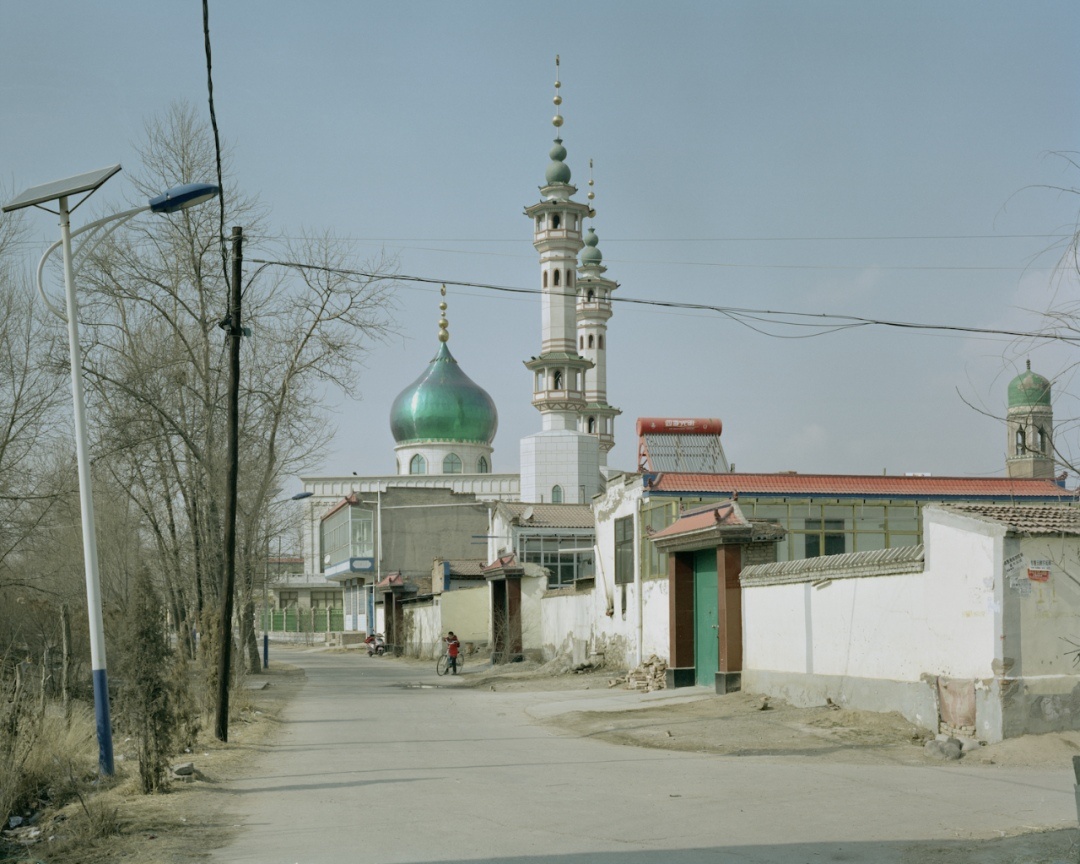
Xining Datong Hezhouzhuang Mosque, photographed in 2016.
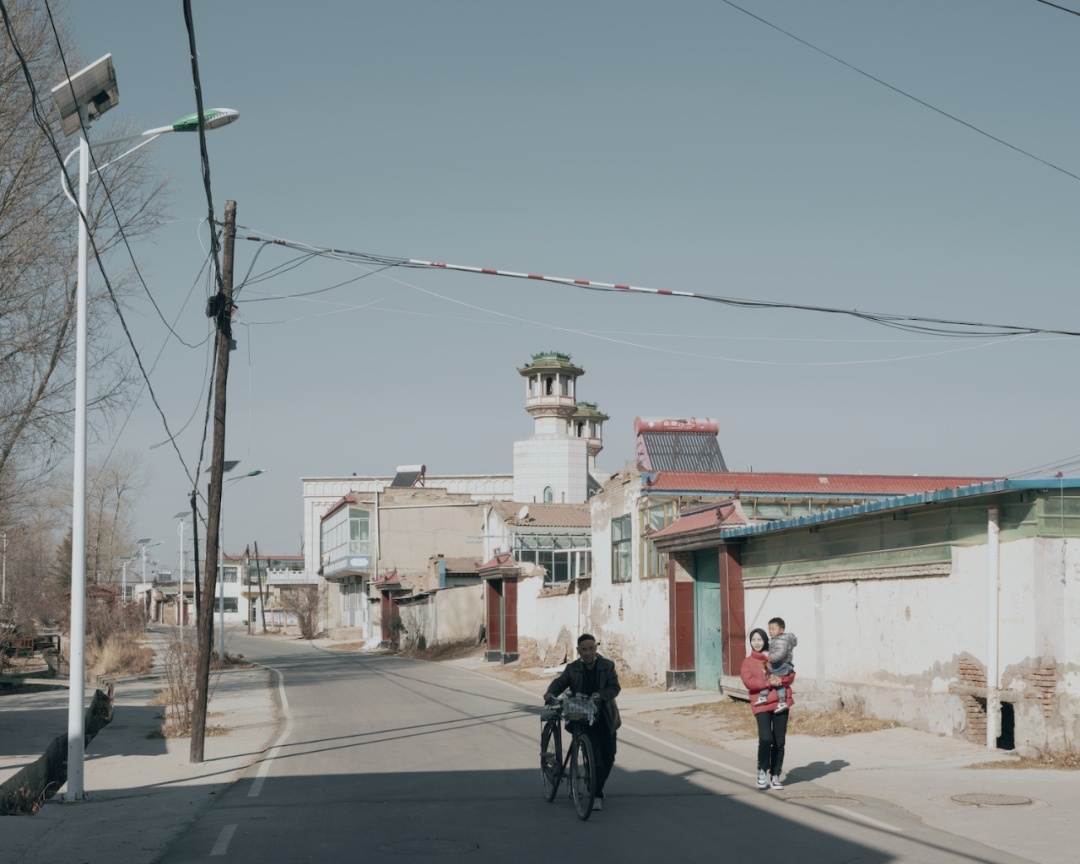
Xining Datong Hezhouzhuang Mosque, photographed in 2023.
Xining Nanguan Mosque, photographed in 2016—the place where I first met Jin Biao.
Most urban mosques in China are not significant public buildings in the general sense. The highway overpasses and neighboring buildings that appear in my photos are all part of the reality—they exist like a matter of fate. In the city, what changes the appearance of a mosque goes far beyond those government-mandated traditional-style roofs or structural modifications.
The Vanishing Arches (Part 9)
1
Zhang Yi didn't show up for breakfast. He sent a message saying he needed a break; both his body and stomach needed a rest from days of eating shouzhua yangrou (hand-grabbed lamb). He had some emails to deal with and laundry to do. It was clear he wouldn't be joining me today. The novelty of the Islamic world only lasted about five or six days for him, which is typical. Yu Li took over the driving, and while we only had five mosques left to photograph, they were scattered forty or fifty kilometers apart.
The Yangjiazhuang Mosque is just a block away, located on another small street to the west. It’s one of the few Gedimu (the oldest sect of Islam in China, heavily influenced by traditional Chinese culture) mosques in Xining. From the outside, it’s a large building; the main hall is four or five stories high, and the minaret reaches dozens of meters. I visited in 2015, making it the first mosque I ever photographed. At the time, there was a construction pit on the north side, which made the mosque seem incredibly spacious. I set up my camera on the edge of that pit.
In early 2022, I often saw videos online of a group of seven or eight Hui Muslims, both men and women, dancing. They choreographed the routines themselves, set to old songs praising socialism and ethnic unity. The dance wasn't particularly graceful, blending folk fan dances, Tibetan Guozhuang, and even elements of the Han Chinese Shehuo yangge dance. But they took it very seriously. I would start by suppressing a smile, but often end up doing the same. Most of the comments were sarcastic, sometimes even abusive, mostly from people claiming to be "orthodox" Muslims who felt this "hybrid" style, neither Han, Hui, nor Tibetan, insulted the sanctity of Islam. The dancers ignored the haters and kept going, using their amusing moves to respond to those who viewed them as enemies. Fascinated by this example of cultural diversity, I connected with "Gan'en" (Gratitude) online, who posted these videos. I couldn't determine if he was one of the dancers, but he is a local Muslim in Xining, likely from a county in Haidong. We talked quite a bit.
In our later exchanges, he frequently updated me on the "Sinicization" (Sinicization/Chinese-style architectural) process of mosques in Xining, effectively becoming my "informant." One day, I mentioned the Yangjiazhuang Mosque, and he told me it was undergoing renovations. I wanted to know the progress, so he rode his electric scooter a few blocks over and took photos for me.
The photos were taken from the angle of Dazhong Street, looking up. The mosque is only six or seven meters from the road. The original rounded dome had been replaced by a Chinese-style roof supported by tiers of dougong (traditional wooden brackets). The three corners of the triangular layout each featured a minaret. It was covered in green construction netting, looking like an unpeeled ear of corn, with the shape of the newly built octagonal pavilion dimly visible inside.
This August, I visited the renovated Yangjiazhuang Mosque again. When looking for my 2016 camera spot, I realized it was now nestled within a new high-rise building. This building was built on the foundation of that old construction pit. Construction was slow—seven years later, the building still wasn't finished. That doesn't matter; what matters is that I can never photograph the Yangjiazhuang Mosque from the old vantage point again.
In cities, recognized public buildings get visual "privileges," usually granted wider spaces, landscaping, and plazas to create distance. This distance makes them look more elegant and reinforces their status as landmarks; the openness is part of the architecture itself. However, most urban mosques in China aren't treated this way. The overpasses and surrounding buildings in my photos are part of a fated reality. Just as I was about to give up on shooting this mosque, it dawned on me. I placed the looming presence of that unfinished building in the foreground, with the Chinese-style eaves as the mid-to-background focus. The unrelated building now occupies half the frame. In the city, what changes the face of a mosque isn't just those government mandates.
Photographing these mosques has become second nature. Xining has fifty or sixty mosques, and I’ve been to most of them. As a non-Muslim, I visit them quite often.
Before 10:00 AM, I shot another one, the Xiadu Avenue Mosque, two kilometers away. I dislike the name "Xiadu" (Summer Capital); it’s a label that became popular only after I left Xining, and I have no emotional attachment to it. I posted a photo I took with my phone to my social media feed.
"I'm not used to calling Xining 'Xiadu.' It’s a shallow and eager name coined by the tourism bureau years ago. It makes people think Xining was the capital of the Xia Dynasty, which it clearly wasn't. It's preposterous. This mosque is called the Xiadu Avenue Mosque, and I suppose the street is likely named that, too."
This was a long-premeditated message. I’d been bothered by those two culturally illiterate characters for too long, and today, while Yu Li drove me to the Chengbei District, I finally vented.
The Chengbei 'Xiaoqiao' (Small Bridge) area is where I grew up. There's only one mosque there. The so-called Xiaoqiao Mosque isn't actually on the bridge; it’s by the river in Zhaoyang Village. It used to be remote, but now it’s a park, and some bright red and blue plastic slides made for an interesting foreground.
Thank heavens, eight or nine years later, those plastic slides are still there. The only difference is the shrubs and willow trees in the distance have grown, blocking the four-story main building of the mosque. In my 2016 photos, the two soaring minarets and the round dome were the landmarks. Now, the towers are gone, the dome is altered, and the remaining prayer hall is almost hidden by trees.
Without stopping, Yu Li set the GPS for Qiaotou Town, over thirty kilometers away, where the last three mosques on my list were located.
Datong County is a Hui and Tu Autonomous County, and the Beichuan River Valley is an extension of the Hehuang Valley.
I've never met "Gan'en" in person. I guessed from his accent he was from Datong, but I wasn't sure. I asked him indirectly, but he didn't answer. In the villages of Datong, some unique Menhuan (Sufi orders) are still preserved. He probably comes from an old order. Sometimes, based on their love for Tibetan dances, I suspect he might be from Kaligang—descendants of the Tibetans who converted to Islam under Ma Laichi during the Qianlong era. Regardless, I know very little about rural Muslims, especially their production methods and economic relationships—which are exactly the things I want to investigate.
The expressway from Xining north to Qiaotou Town doesn't just go to Datong County. We realized we took a wrong turn when we saw a branch road heading toward a tunnel on the south side of Laoye Mountain. Passing through the tunnel, we headed toward Dongxia. Twenty kilometers later, we reached the end of the valley. The expressway is relentless, cutting straight through Daban Mountain, one of the parallel ranges of the Qilian Mountains and a barrier between Xining and the Hexi Corridor. Our wrong turn ended there because there was an exit to turn back. I looked ahead; the highway continues to Menyuan County on the north side of Daban Mountain, passing through the Datong River and into the Xianmi Forest Farm, crossing the main Qilian range, and finally hitting Wuwei in the Hexi Corridor. Mountains have always blocked the spread of Islam into the Hexi region. Historically, there was no solid ground for the Hui people there. Whether it was the Muslims moving in from the west or those fleeing the 'Shaanxi-Gansu Hui Revolt,' no roots were ever established. Even in modern times, when the Hexi region was under the control of the Qinghai Ma family, it still didn't become a Hui settlement. The mountains disrupted the geographical continuity of the Hehuang Valley and blocked the path of the Muslims.
Qiaotou is a coal-producing town, known for high-quality 'Ba'er' (lump) coal. Locals love it because it’s smokeless and the chunks are the perfect size for heating stoves. Another local legend, perhaps an official one, claims this coal releases heat far beyond the average 5,000 calories, reaching a staggering 8,200 calories—so 'Ba'er' actually refers to '82' coal. It’s all hearsay, impossible to verify. One thing is certain: Xining’s legendary roasted lamb has always used this 82 coal, not charcoal. Heat control is the core of cooking, isn't it? Besides, Xining lamb comes from the small-tail Han sheep that roam the Qilian grasslands in a near-wild state.
The Bayi Road Mosque in Qiaotou isn't on Bayi Road; it’s in a newly built residential area two kilometers away. During urban redevelopment, the coal mine's shantytown was demolished, and the mosque was relocated here, inheriting its original name, which feels a bit mismatched.
In 2016, after the Eid al-Adha prayers, I interviewed an old man outside the Dongguan Grand Mosque in Xining. He had set out early from his home 80 miles away to pray at Dongguan, a tradition among the Ikhwan sect—they believe the most important prayers of the year, especially Eid al-Adha and Eid al-Fitr, should be held there. Thousands of Muslims gather; for the noon prayer on those days, the hall, the plaza, the school hallways, and the streets outside are packed. Traffic police would close off a kilometer of Dongguan Street, and even the sidewalks would be covered in prayer rugs.
After the interview, he invited me to visit their newly completed mosque. I took down his number and address, and the next day I drove to Qiaotou Town, Datong County. The mosque he’d invited me to was the Bayi Road Mosque.
I arrived at the mosque, standing in the middle of overgrown weeds, in the afternoon. It was a cold day, and the old man had his black velvet-lined sheepskin coat draped over his shoulders.
The two-story beige building looked as decent as possible, with its tall round dome and two thin minarets. While it followed the standard Ikhwan-style architecture, it had its own character. The green-rimmed pointed arches, the golden spires, and the grey brick-carved eaves on the front porch linked it to the Hezhou style. Of course, Hehuang Islam is one entity. The large bronze-colored gate at the front was tall and ornate; though industrially manufactured, its complex, layered lines were quite impressive.
However, when the old man led me into the main hall and pushed open those heavy doors, I saw a crude prayer hall. It was still in the 'rough' stage. The concrete walls had white salt efflorescence; the rough plastering was just a base for future panels. The ceiling beams were exposed, and the concrete, while poured neatly, still showed the grain of the wooden molds. A few simple bare lightbulbs hung from exposed wiring. Even under the thin carpet, there was only smooth, bare cement. It was freezing inside, with no heating.
The wall in front was decorated with a simple cloth to mark the mihrab (the prayer niche), the point indicating the direction of Mecca. Everything showed that this was a prayer hall used before interior renovations were finished—shabby and sparse.
The old man gave me another video interview. Building this mosque had exhausted all their construction funds, and there was no money left for the interior, yet they had to start praying. The reason we met the day before was that he had gone to the Dongguan Grand Mosque to attend prayers and, incidentally, to fundraise among his brothers. They belonged to a group with slight differences from the mainstream Ikhwan—not exactly a 'sect,' but they held different views on certain Ikhwan practices. He specifically warned me: "That Jin Biao Ahong (Imam) you mentioned is the one we like the least. Don't tell anyone you know him when you visit other mosques; it won't be good for you." To me, Jin Biao represented the Ikhwan mainstream. He was a qualified, even excellent, Imam. When he led the Nanguan Mosque, he managed it perfectly. He opened the gates to Han, Tibetan, and other non-Muslims, and advocated for female worshippers, believing they should have equal rights as children of Allah. He created a library in the mosque, accepting all donated books except for those that were anti-Islamic or anti-social. He encouraged the students to read widely to understand the world outside. He also invited socialites to give lectures. He was a gentle man, often saying, "harmony without uniformity"—isn't that the prerequisite for diversity and coexistence? These practices were revolutionary for the traditional Xining Islamic community. In the religiously conservative environment of Xining, he drew opposition and even faced an assassination attempt. A shot rang out, and the bullet grazed his ear. Thank Allah, he was fine. The assailant was also a local Muslim. All of this has become a legendary story; I’ve even toyed with the idea of doing an in-depth interview with Jin Biao to write those stories down.
Internal divisions within Islam have never ceased. Islam is not just a religion; it is a way of life, entangled in complex political, economic, and clan relationships. In the countryside, mosques and their management systems influence the distribution of economic interests, so creating sects and staking claims is inevitable. Moreover, the Islamic classics have never explicitly forbidden the formation of new schools of thought.
Xining Yangjiazhuang Mosque, photographed in 2016.
Xining Yangjiazhuang Mosque, photographed in 2023.
Inside the prayer hall of Xining Yangjiazhuang Mosque, 2016.
Xining Xiaoqiao Mosque, photographed in 2016. Xining Xiaoqiao Mosque, photographed in 2023.
Xining Xiadu Avenue Mosque, photographed in 2016.
Xining Xiadu Avenue Mosque, photographed in 2023.
2
Yu Li carefully parked the car in a space by the entrance of the mosque. Before I even stepped out, I knew this mosque would be impossible to photograph. Just like the Yangjiazhuang Mosque, a residential building had been built right where my original camera angle used to be. Still, I couldn't give up, so I walked over to the small gate guarded by an old security guard. He was busy shooing away students coming home from school—it was probably a shortcut, and the mischievous kids kept stepping on the dried-out lawn, so he was herding them toward the main gate instead. When he saw me, he opened the gate; the children flooded in like a stream before dispersing in every direction. The old guard grumbled under his breath, shouting, 'Don't step on the grass!'
The golden dome and minaret have been replaced by a Chinese-style pavilion roof, which actually matches the grey brick carvings along the eaves quite well. The interior has been renovated with bright tiles and walls, and the ceiling now features layered caisson ceilings—that temporary prayer hall I once photographed exists only on my film now.
As noon approached, I headed for a village mosque about five kilometers north. I needed to get my buddy Yu Li some food; if he wasn't here with me, he probably would never have set foot in this place in his life. There were beef noodle shops along the road, mostly run by Hui Muslims. I wasn't really in the mood for beef ramen, so I walked a bit further until I saw a sign for 'Yanfu Classic Mianpian (handmade noodle flakes).' The sign looked a bit like a knockoff, but when I walked up to the entrance, it was bright and clean. It was peak lunch hour, and every table was packed, which instantly dismissed my skepticism. This was perfect—the braised beef brisket Zhang Yi is always raving about is the one from the Yanfu Mianpian in Minhe County. He’d been bragging about it for days, so today Yu Li could finally try this braised beef.
To recreate the taste and vibe of the one in Minhe, I ordered exactly the same things: two bowls of clear-soup mianpian, one jin (500 grams) of braised beef brisket, and two small side dishes. They had an appetizing braised sheep head for 68 yuan, but since Zhang Yi wasn't there, I decided against it—it was just too expensive.
After lunch, we headed to Hezhouzhuang, only about a ten-minute drive away. The highland winter is dry and desolate; the wind has scrubbed the ground clean, and the sun shines with a harsh, bright glare. The poplar trees have shed every single leaf, leaving their pale, tender bark exposed, and their branches are completely bare, not even a twig in sight. There wasn't a soul on the road—everyone was hunkering down at home for the winter, which still felt like it would last a long time.
We spotted the Hezhouzhuang Mosque from a distance. When we got close enough, I told the driver to stop, got out, and compared it to the photos on my phone. Like the others, this small rural mosque hadn't escaped the 'beheading' of its original structure, and the nearby courtyards and roads had all changed, making it nearly impossible to line up the shots.
A few minutes later, I realized I’d made a mistake—this wasn't the angle I’d used back then. Country roads all start to look the same. I kept moving, took a 90-degree turn at the intersection by the mosque, walked another hundred meters, and turned back to face it. This was the original spot! It was perfect; the courtyard, the porch, and the alley entrance all matched up—even the white lamppost looked exactly as it had before.
The final mosque was the Qiaotou Town Grand Mosque, about seven or eight kilometers back from Hezhouzhuang. Qiaotou Town is located at the most treacherous point between Laoye Mountain and the Beichuan River. This coal-producing town no longer looks as grimy as it once did; it has everything a modern city requires: landscaping, commercial billboards, and political slogans. Across the way, the winding Ming Dynasty Great Wall—part of the Xining garrison defense system designed to separate nomadic tribes from farming communities—snakes along the mountainside. The mosque sits at the most prominent three-way intersection, right in the square of the Taoist Laoye Mountain. My camera spot was in a quiet area along the riverbank, right against the railing. A row of old storefronts from over a decade ago was still there, but they were all locked tight, with no business open. Most of the signs had fallen off and were never replaced; the businesses had clearly been abandoned. A few had 'Tea House' or 'Bar' signs, and the neon lights were still there—perhaps when night falls, they offer some bleak, flashy nightlife. I tried hard to find that bar with the strange name, but I looked from left to right and couldn't find any '7 Bar' sign.
I managed to capture both the Qiaotou Mosque and the famous Taoist mountain in the same frame.
In the evening, we went to the most famous lamb restaurant on Baiyu Lane in Xining. Luckily, it was winter, so it wasn't too crowded. While picking out the meat, a man and a woman in front of me were choosing braised lamb. The lamb in the big iron bucket looked golden, tender, and juicy, but the woman complained it was a bit fatty. I couldn't help but chime in that it was the best kind. The woman felt embarrassed and laughed, saying, 'This is for the lahou'r to eat.' 'Lahou'r' is a Xining slang term for outsiders, which comes from the local tendency to be surprised by things they don't see often. Decades ago, the first 'outsiders' people in Xining saw were people from Sichuan or Henan who traveled with monkeys to perform. The locals called anyone speaking a dialect they couldn't understand 'lahou'r' (monkey-pullers). And here I was, leading my two 'lahou'r' buddies to eat the best lamb in Xining. The couple took their ten portions vacuum-packed to go. When it was my turn, I ordered lamb ribs. The woman chopping the meat told me to wait a moment; she’d bring some fresh from the kitchen. It was cold outside, and hot lamb is just perfect.
While waiting for the meat to be chopped, I looked at the photos of celebrities on the wall. People from all over the country and all walks of life were posing with the owner—it turns out everyone loves good food. Next to the photos were the staff’s health permits and business licenses. The owner’s surname was indeed Jin, but the Mr. Jin in the photos with the celebrities didn't look like the person I was looking for.
'I heard from the elders in the Nanguan community that your boss is the older brother of Ahong (Imam) Jin Biao?' I lowered my voice and asked the woman at the register.
'That's right, he is,' she laughed, not showing any sign of offense—after all, my question was a bit personal.
Yu Li was finally able to eat his shouzhua yangrou (hand-grabbed lamb) with raw garlic—this was his biggest progress yet. The hand-grabbed lamb and beef brisket were incredibly delicious. Zhang Yi said it truly lived up to its reputation as the gold standard for lamb in Xining. After two cups of free green tea, we decided to walk the two or three kilometers back to the hotel to burn off some of the guilt.
Back at the hotel, Yu Li kept boiling water for tea in my room. The heater was pumping, and my photography trip was finally over. It had been a rushed experience, but I had enough to deliver for the exhibition in the U.S. We chatted, and suddenly I felt like having a drink. The last time we had a moment like this was in a guesthouse by Heimahe at Qinghai Lake; that night, by the fireplace, Daman sang a song, but we were lacking alcohol then, too. Tonight was no different—the three of us were flushed, but sober.
I got a new comment on my social media post about the before-and-after photos of the mosques: 'You can see the stubbornness after being forced to renovate.' Honestly, I don't care much about that 'stubbornness.' I don't support the Arabic-style expansions, nor do I agree with the reckless demolition and renovations. In other words, I don't support either side, nor do I favor anyone—I don't even have sympathy for them. I have to look at this issue rationally and neutrally. Sometimes, I feel like Pierluigi Collina, the Italian bald referee running across the pitch; a cold, ruthless, and objective attitude is my only way to maintain a sharp perspective. That's how it's been since the first day I decided to photograph these mosques. I am neither a follower of Islam nor a narrow-minded nationalist pushing for 'total Sinicization.'
(End of article)
Li Ming, December 2023 to January 2024
Xining Datong Hezhouzhuang Mosque, photographed in 2016.
Xining Datong Hezhouzhuang Mosque, photographed in 2023.
Xining Nanguan Mosque, photographed in 2016—the place where I first met Jin Biao.
Exploring Xining Mosques: Authentic Hui Muslim Heritage and Architectural Changes in Northwest China
Articles • Hasan09 posted the article • 0 comments • 7 views • 3 hours ago
This is the final installment of the documentary photography series, "The Vanishing Arches." By visiting the Datong Hezhouzhuang Mosque and the Xining Nanguan Mosque, I reflect on the urban landscape from 2016 to 2023, where highways, modern high-rises, and mosques have become deeply intertwined, offering a somber and restrained conclusion to the evolution of mosques in Northwest China.
Most urban mosques in China are not significant public buildings in the general sense. The highway overpasses and neighboring buildings that appear in my photos are all part of the reality—they exist like a matter of fate. In the city, what changes the appearance of a mosque goes far beyond those government-mandated traditional-style roofs or structural modifications.
The Vanishing Arches (Part 9)
1
Zhang Yi didn't show up for breakfast. He sent a message saying he needed a break; both his body and stomach needed a rest from days of eating shouzhua yangrou (hand-grabbed lamb). He had some emails to deal with and laundry to do. It was clear he wouldn't be joining me today. The novelty of the Islamic world only lasted about five or six days for him, which is typical. Yu Li took over the driving, and while we only had five mosques left to photograph, they were scattered forty or fifty kilometers apart.
The Yangjiazhuang Mosque is just a block away, located on another small street to the west. It’s one of the few Gedimu (the oldest sect of Islam in China, heavily influenced by traditional Chinese culture) mosques in Xining. From the outside, it’s a large building; the main hall is four or five stories high, and the minaret reaches dozens of meters. I visited in 2015, making it the first mosque I ever photographed. At the time, there was a construction pit on the north side, which made the mosque seem incredibly spacious. I set up my camera on the edge of that pit.
In early 2022, I often saw videos online of a group of seven or eight Hui Muslims, both men and women, dancing. They choreographed the routines themselves, set to old songs praising socialism and ethnic unity. The dance wasn't particularly graceful, blending folk fan dances, Tibetan Guozhuang, and even elements of the Han Chinese Shehuo yangge dance. But they took it very seriously. I would start by suppressing a smile, but often end up doing the same. Most of the comments were sarcastic, sometimes even abusive, mostly from people claiming to be "orthodox" Muslims who felt this "hybrid" style, neither Han, Hui, nor Tibetan, insulted the sanctity of Islam. The dancers ignored the haters and kept going, using their amusing moves to respond to those who viewed them as enemies. Fascinated by this example of cultural diversity, I connected with "Gan'en" (Gratitude) online, who posted these videos. I couldn't determine if he was one of the dancers, but he is a local Muslim in Xining, likely from a county in Haidong. We talked quite a bit.
In our later exchanges, he frequently updated me on the "Sinicization" (Sinicization/Chinese-style architectural) process of mosques in Xining, effectively becoming my "informant." One day, I mentioned the Yangjiazhuang Mosque, and he told me it was undergoing renovations. I wanted to know the progress, so he rode his electric scooter a few blocks over and took photos for me.
The photos were taken from the angle of Dazhong Street, looking up. The mosque is only six or seven meters from the road. The original rounded dome had been replaced by a Chinese-style roof supported by tiers of dougong (traditional wooden brackets). The three corners of the triangular layout each featured a minaret. It was covered in green construction netting, looking like an unpeeled ear of corn, with the shape of the newly built octagonal pavilion dimly visible inside.
This August, I visited the renovated Yangjiazhuang Mosque again. When looking for my 2016 camera spot, I realized it was now nestled within a new high-rise building. This building was built on the foundation of that old construction pit. Construction was slow—seven years later, the building still wasn't finished. That doesn't matter; what matters is that I can never photograph the Yangjiazhuang Mosque from the old vantage point again.
In cities, recognized public buildings get visual "privileges," usually granted wider spaces, landscaping, and plazas to create distance. This distance makes them look more elegant and reinforces their status as landmarks; the openness is part of the architecture itself. However, most urban mosques in China aren't treated this way. The overpasses and surrounding buildings in my photos are part of a fated reality. Just as I was about to give up on shooting this mosque, it dawned on me. I placed the looming presence of that unfinished building in the foreground, with the Chinese-style eaves as the mid-to-background focus. The unrelated building now occupies half the frame. In the city, what changes the face of a mosque isn't just those government mandates.
Photographing these mosques has become second nature. Xining has fifty or sixty mosques, and I’ve been to most of them. As a non-Muslim, I visit them quite often.
Before 10:00 AM, I shot another one, the Xiadu Avenue Mosque, two kilometers away. I dislike the name "Xiadu" (Summer Capital); it’s a label that became popular only after I left Xining, and I have no emotional attachment to it. I posted a photo I took with my phone to my social media feed.
"I'm not used to calling Xining 'Xiadu.' It’s a shallow and eager name coined by the tourism bureau years ago. It makes people think Xining was the capital of the Xia Dynasty, which it clearly wasn't. It's preposterous. This mosque is called the Xiadu Avenue Mosque, and I suppose the street is likely named that, too."
This was a long-premeditated message. I’d been bothered by those two culturally illiterate characters for too long, and today, while Yu Li drove me to the Chengbei District, I finally vented.
The Chengbei 'Xiaoqiao' (Small Bridge) area is where I grew up. There's only one mosque there. The so-called Xiaoqiao Mosque isn't actually on the bridge; it’s by the river in Zhaoyang Village. It used to be remote, but now it’s a park, and some bright red and blue plastic slides made for an interesting foreground.
Thank heavens, eight or nine years later, those plastic slides are still there. The only difference is the shrubs and willow trees in the distance have grown, blocking the four-story main building of the mosque. In my 2016 photos, the two soaring minarets and the round dome were the landmarks. Now, the towers are gone, the dome is altered, and the remaining prayer hall is almost hidden by trees.
Without stopping, Yu Li set the GPS for Qiaotou Town, over thirty kilometers away, where the last three mosques on my list were located.
Datong County is a Hui and Tu Autonomous County, and the Beichuan River Valley is an extension of the Hehuang Valley.
I've never met "Gan'en" in person. I guessed from his accent he was from Datong, but I wasn't sure. I asked him indirectly, but he didn't answer. In the villages of Datong, some unique Menhuan (Sufi orders) are still preserved. He probably comes from an old order. Sometimes, based on their love for Tibetan dances, I suspect he might be from Kaligang—descendants of the Tibetans who converted to Islam under Ma Laichi during the Qianlong era. Regardless, I know very little about rural Muslims, especially their production methods and economic relationships—which are exactly the things I want to investigate.
The expressway from Xining north to Qiaotou Town doesn't just go to Datong County. We realized we took a wrong turn when we saw a branch road heading toward a tunnel on the south side of Laoye Mountain. Passing through the tunnel, we headed toward Dongxia. Twenty kilometers later, we reached the end of the valley. The expressway is relentless, cutting straight through Daban Mountain, one of the parallel ranges of the Qilian Mountains and a barrier between Xining and the Hexi Corridor. Our wrong turn ended there because there was an exit to turn back. I looked ahead; the highway continues to Menyuan County on the north side of Daban Mountain, passing through the Datong River and into the Xianmi Forest Farm, crossing the main Qilian range, and finally hitting Wuwei in the Hexi Corridor. Mountains have always blocked the spread of Islam into the Hexi region. Historically, there was no solid ground for the Hui people there. Whether it was the Muslims moving in from the west or those fleeing the 'Shaanxi-Gansu Hui Revolt,' no roots were ever established. Even in modern times, when the Hexi region was under the control of the Qinghai Ma family, it still didn't become a Hui settlement. The mountains disrupted the geographical continuity of the Hehuang Valley and blocked the path of the Muslims.
Qiaotou is a coal-producing town, known for high-quality 'Ba'er' (lump) coal. Locals love it because it’s smokeless and the chunks are the perfect size for heating stoves. Another local legend, perhaps an official one, claims this coal releases heat far beyond the average 5,000 calories, reaching a staggering 8,200 calories—so 'Ba'er' actually refers to '82' coal. It’s all hearsay, impossible to verify. One thing is certain: Xining’s legendary roasted lamb has always used this 82 coal, not charcoal. Heat control is the core of cooking, isn't it? Besides, Xining lamb comes from the small-tail Han sheep that roam the Qilian grasslands in a near-wild state.
The Bayi Road Mosque in Qiaotou isn't on Bayi Road; it’s in a newly built residential area two kilometers away. During urban redevelopment, the coal mine's shantytown was demolished, and the mosque was relocated here, inheriting its original name, which feels a bit mismatched.
In 2016, after the Eid al-Adha prayers, I interviewed an old man outside the Dongguan Grand Mosque in Xining. He had set out early from his home 80 miles away to pray at Dongguan, a tradition among the Ikhwan sect—they believe the most important prayers of the year, especially Eid al-Adha and Eid al-Fitr, should be held there. Thousands of Muslims gather; for the noon prayer on those days, the hall, the plaza, the school hallways, and the streets outside are packed. Traffic police would close off a kilometer of Dongguan Street, and even the sidewalks would be covered in prayer rugs.
After the interview, he invited me to visit their newly completed mosque. I took down his number and address, and the next day I drove to Qiaotou Town, Datong County. The mosque he’d invited me to was the Bayi Road Mosque.
I arrived at the mosque, standing in the middle of overgrown weeds, in the afternoon. It was a cold day, and the old man had his black velvet-lined sheepskin coat draped over his shoulders.
The two-story beige building looked as decent as possible, with its tall round dome and two thin minarets. While it followed the standard Ikhwan-style architecture, it had its own character. The green-rimmed pointed arches, the golden spires, and the grey brick-carved eaves on the front porch linked it to the Hezhou style. Of course, Hehuang Islam is one entity. The large bronze-colored gate at the front was tall and ornate; though industrially manufactured, its complex, layered lines were quite impressive.
However, when the old man led me into the main hall and pushed open those heavy doors, I saw a crude prayer hall. It was still in the 'rough' stage. The concrete walls had white salt efflorescence; the rough plastering was just a base for future panels. The ceiling beams were exposed, and the concrete, while poured neatly, still showed the grain of the wooden molds. A few simple bare lightbulbs hung from exposed wiring. Even under the thin carpet, there was only smooth, bare cement. It was freezing inside, with no heating.
The wall in front was decorated with a simple cloth to mark the mihrab (the prayer niche), the point indicating the direction of Mecca. Everything showed that this was a prayer hall used before interior renovations were finished—shabby and sparse.
The old man gave me another video interview. Building this mosque had exhausted all their construction funds, and there was no money left for the interior, yet they had to start praying. The reason we met the day before was that he had gone to the Dongguan Grand Mosque to attend prayers and, incidentally, to fundraise among his brothers. They belonged to a group with slight differences from the mainstream Ikhwan—not exactly a 'sect,' but they held different views on certain Ikhwan practices. He specifically warned me: "That Jin Biao Ahong (Imam) you mentioned is the one we like the least. Don't tell anyone you know him when you visit other mosques; it won't be good for you." To me, Jin Biao represented the Ikhwan mainstream. He was a qualified, even excellent, Imam. When he led the Nanguan Mosque, he managed it perfectly. He opened the gates to Han, Tibetan, and other non-Muslims, and advocated for female worshippers, believing they should have equal rights as children of Allah. He created a library in the mosque, accepting all donated books except for those that were anti-Islamic or anti-social. He encouraged the students to read widely to understand the world outside. He also invited socialites to give lectures. He was a gentle man, often saying, "harmony without uniformity"—isn't that the prerequisite for diversity and coexistence? These practices were revolutionary for the traditional Xining Islamic community. In the religiously conservative environment of Xining, he drew opposition and even faced an assassination attempt. A shot rang out, and the bullet grazed his ear. Thank Allah, he was fine. The assailant was also a local Muslim. All of this has become a legendary story; I’ve even toyed with the idea of doing an in-depth interview with Jin Biao to write those stories down.
Internal divisions within Islam have never ceased. Islam is not just a religion; it is a way of life, entangled in complex political, economic, and clan relationships. In the countryside, mosques and their management systems influence the distribution of economic interests, so creating sects and staking claims is inevitable. Moreover, the Islamic classics have never explicitly forbidden the formation of new schools of thought.
Xining Yangjiazhuang Mosque, photographed in 2016.
Xining Yangjiazhuang Mosque, photographed in 2023.
Inside the prayer hall of Xining Yangjiazhuang Mosque, 2016.
Xining Xiaoqiao Mosque, photographed in 2016. Xining Xiaoqiao Mosque, photographed in 2023.
Xining Xiadu Avenue Mosque, photographed in 2016.
Xining Xiadu Avenue Mosque, photographed in 2023.
2
Yu Li carefully parked the car in a space by the entrance of the mosque. Before I even stepped out, I knew this mosque would be impossible to photograph. Just like the Yangjiazhuang Mosque, a residential building had been built right where my original camera angle used to be. Still, I couldn't give up, so I walked over to the small gate guarded by an old security guard. He was busy shooing away students coming home from school—it was probably a shortcut, and the mischievous kids kept stepping on the dried-out lawn, so he was herding them toward the main gate instead. When he saw me, he opened the gate; the children flooded in like a stream before dispersing in every direction. The old guard grumbled under his breath, shouting, 'Don't step on the grass!'
The golden dome and minaret have been replaced by a Chinese-style pavilion roof, which actually matches the grey brick carvings along the eaves quite well. The interior has been renovated with bright tiles and walls, and the ceiling now features layered caisson ceilings—that temporary prayer hall I once photographed exists only on my film now.
As noon approached, I headed for a village mosque about five kilometers north. I needed to get my buddy Yu Li some food; if he wasn't here with me, he probably would never have set foot in this place in his life. There were beef noodle shops along the road, mostly run by Hui Muslims. I wasn't really in the mood for beef ramen, so I walked a bit further until I saw a sign for 'Yanfu Classic Mianpian (handmade noodle flakes).' The sign looked a bit like a knockoff, but when I walked up to the entrance, it was bright and clean. It was peak lunch hour, and every table was packed, which instantly dismissed my skepticism. This was perfect—the braised beef brisket Zhang Yi is always raving about is the one from the Yanfu Mianpian in Minhe County. He’d been bragging about it for days, so today Yu Li could finally try this braised beef.
To recreate the taste and vibe of the one in Minhe, I ordered exactly the same things: two bowls of clear-soup mianpian, one jin (500 grams) of braised beef brisket, and two small side dishes. They had an appetizing braised sheep head for 68 yuan, but since Zhang Yi wasn't there, I decided against it—it was just too expensive.
After lunch, we headed to Hezhouzhuang, only about a ten-minute drive away. The highland winter is dry and desolate; the wind has scrubbed the ground clean, and the sun shines with a harsh, bright glare. The poplar trees have shed every single leaf, leaving their pale, tender bark exposed, and their branches are completely bare, not even a twig in sight. There wasn't a soul on the road—everyone was hunkering down at home for the winter, which still felt like it would last a long time.
We spotted the Hezhouzhuang Mosque from a distance. When we got close enough, I told the driver to stop, got out, and compared it to the photos on my phone. Like the others, this small rural mosque hadn't escaped the 'beheading' of its original structure, and the nearby courtyards and roads had all changed, making it nearly impossible to line up the shots.
A few minutes later, I realized I’d made a mistake—this wasn't the angle I’d used back then. Country roads all start to look the same. I kept moving, took a 90-degree turn at the intersection by the mosque, walked another hundred meters, and turned back to face it. This was the original spot! It was perfect; the courtyard, the porch, and the alley entrance all matched up—even the white lamppost looked exactly as it had before.
The final mosque was the Qiaotou Town Grand Mosque, about seven or eight kilometers back from Hezhouzhuang. Qiaotou Town is located at the most treacherous point between Laoye Mountain and the Beichuan River. This coal-producing town no longer looks as grimy as it once did; it has everything a modern city requires: landscaping, commercial billboards, and political slogans. Across the way, the winding Ming Dynasty Great Wall—part of the Xining garrison defense system designed to separate nomadic tribes from farming communities—snakes along the mountainside. The mosque sits at the most prominent three-way intersection, right in the square of the Taoist Laoye Mountain. My camera spot was in a quiet area along the riverbank, right against the railing. A row of old storefronts from over a decade ago was still there, but they were all locked tight, with no business open. Most of the signs had fallen off and were never replaced; the businesses had clearly been abandoned. A few had 'Tea House' or 'Bar' signs, and the neon lights were still there—perhaps when night falls, they offer some bleak, flashy nightlife. I tried hard to find that bar with the strange name, but I looked from left to right and couldn't find any '7 Bar' sign.
I managed to capture both the Qiaotou Mosque and the famous Taoist mountain in the same frame.
In the evening, we went to the most famous lamb restaurant on Baiyu Lane in Xining. Luckily, it was winter, so it wasn't too crowded. While picking out the meat, a man and a woman in front of me were choosing braised lamb. The lamb in the big iron bucket looked golden, tender, and juicy, but the woman complained it was a bit fatty. I couldn't help but chime in that it was the best kind. The woman felt embarrassed and laughed, saying, 'This is for the lahou'r to eat.' 'Lahou'r' is a Xining slang term for outsiders, which comes from the local tendency to be surprised by things they don't see often. Decades ago, the first 'outsiders' people in Xining saw were people from Sichuan or Henan who traveled with monkeys to perform. The locals called anyone speaking a dialect they couldn't understand 'lahou'r' (monkey-pullers). And here I was, leading my two 'lahou'r' buddies to eat the best lamb in Xining. The couple took their ten portions vacuum-packed to go. When it was my turn, I ordered lamb ribs. The woman chopping the meat told me to wait a moment; she’d bring some fresh from the kitchen. It was cold outside, and hot lamb is just perfect.
While waiting for the meat to be chopped, I looked at the photos of celebrities on the wall. People from all over the country and all walks of life were posing with the owner—it turns out everyone loves good food. Next to the photos were the staff’s health permits and business licenses. The owner’s surname was indeed Jin, but the Mr. Jin in the photos with the celebrities didn't look like the person I was looking for.
'I heard from the elders in the Nanguan community that your boss is the older brother of Ahong (Imam) Jin Biao?' I lowered my voice and asked the woman at the register.
'That's right, he is,' she laughed, not showing any sign of offense—after all, my question was a bit personal.
Yu Li was finally able to eat his shouzhua yangrou (hand-grabbed lamb) with raw garlic—this was his biggest progress yet. The hand-grabbed lamb and beef brisket were incredibly delicious. Zhang Yi said it truly lived up to its reputation as the gold standard for lamb in Xining. After two cups of free green tea, we decided to walk the two or three kilometers back to the hotel to burn off some of the guilt.
Back at the hotel, Yu Li kept boiling water for tea in my room. The heater was pumping, and my photography trip was finally over. It had been a rushed experience, but I had enough to deliver for the exhibition in the U.S. We chatted, and suddenly I felt like having a drink. The last time we had a moment like this was in a guesthouse by Heimahe at Qinghai Lake; that night, by the fireplace, Daman sang a song, but we were lacking alcohol then, too. Tonight was no different—the three of us were flushed, but sober.
I got a new comment on my social media post about the before-and-after photos of the mosques: 'You can see the stubbornness after being forced to renovate.' Honestly, I don't care much about that 'stubbornness.' I don't support the Arabic-style expansions, nor do I agree with the reckless demolition and renovations. In other words, I don't support either side, nor do I favor anyone—I don't even have sympathy for them. I have to look at this issue rationally and neutrally. Sometimes, I feel like Pierluigi Collina, the Italian bald referee running across the pitch; a cold, ruthless, and objective attitude is my only way to maintain a sharp perspective. That's how it's been since the first day I decided to photograph these mosques. I am neither a follower of Islam nor a narrow-minded nationalist pushing for 'total Sinicization.'
(End of article)
Li Ming, December 2023 to January 2024
Xining Datong Hezhouzhuang Mosque, photographed in 2016.
Xining Datong Hezhouzhuang Mosque, photographed in 2023.
Xining Nanguan Mosque, photographed in 2016—the place where I first met Jin Biao. view all
Most urban mosques in China are not significant public buildings in the general sense. The highway overpasses and neighboring buildings that appear in my photos are all part of the reality—they exist like a matter of fate. In the city, what changes the appearance of a mosque goes far beyond those government-mandated traditional-style roofs or structural modifications.
The Vanishing Arches (Part 9)
1
Zhang Yi didn't show up for breakfast. He sent a message saying he needed a break; both his body and stomach needed a rest from days of eating shouzhua yangrou (hand-grabbed lamb). He had some emails to deal with and laundry to do. It was clear he wouldn't be joining me today. The novelty of the Islamic world only lasted about five or six days for him, which is typical. Yu Li took over the driving, and while we only had five mosques left to photograph, they were scattered forty or fifty kilometers apart.
The Yangjiazhuang Mosque is just a block away, located on another small street to the west. It’s one of the few Gedimu (the oldest sect of Islam in China, heavily influenced by traditional Chinese culture) mosques in Xining. From the outside, it’s a large building; the main hall is four or five stories high, and the minaret reaches dozens of meters. I visited in 2015, making it the first mosque I ever photographed. At the time, there was a construction pit on the north side, which made the mosque seem incredibly spacious. I set up my camera on the edge of that pit.
In early 2022, I often saw videos online of a group of seven or eight Hui Muslims, both men and women, dancing. They choreographed the routines themselves, set to old songs praising socialism and ethnic unity. The dance wasn't particularly graceful, blending folk fan dances, Tibetan Guozhuang, and even elements of the Han Chinese Shehuo yangge dance. But they took it very seriously. I would start by suppressing a smile, but often end up doing the same. Most of the comments were sarcastic, sometimes even abusive, mostly from people claiming to be "orthodox" Muslims who felt this "hybrid" style, neither Han, Hui, nor Tibetan, insulted the sanctity of Islam. The dancers ignored the haters and kept going, using their amusing moves to respond to those who viewed them as enemies. Fascinated by this example of cultural diversity, I connected with "Gan'en" (Gratitude) online, who posted these videos. I couldn't determine if he was one of the dancers, but he is a local Muslim in Xining, likely from a county in Haidong. We talked quite a bit.
In our later exchanges, he frequently updated me on the "Sinicization" (Sinicization/Chinese-style architectural) process of mosques in Xining, effectively becoming my "informant." One day, I mentioned the Yangjiazhuang Mosque, and he told me it was undergoing renovations. I wanted to know the progress, so he rode his electric scooter a few blocks over and took photos for me.
The photos were taken from the angle of Dazhong Street, looking up. The mosque is only six or seven meters from the road. The original rounded dome had been replaced by a Chinese-style roof supported by tiers of dougong (traditional wooden brackets). The three corners of the triangular layout each featured a minaret. It was covered in green construction netting, looking like an unpeeled ear of corn, with the shape of the newly built octagonal pavilion dimly visible inside.
This August, I visited the renovated Yangjiazhuang Mosque again. When looking for my 2016 camera spot, I realized it was now nestled within a new high-rise building. This building was built on the foundation of that old construction pit. Construction was slow—seven years later, the building still wasn't finished. That doesn't matter; what matters is that I can never photograph the Yangjiazhuang Mosque from the old vantage point again.
In cities, recognized public buildings get visual "privileges," usually granted wider spaces, landscaping, and plazas to create distance. This distance makes them look more elegant and reinforces their status as landmarks; the openness is part of the architecture itself. However, most urban mosques in China aren't treated this way. The overpasses and surrounding buildings in my photos are part of a fated reality. Just as I was about to give up on shooting this mosque, it dawned on me. I placed the looming presence of that unfinished building in the foreground, with the Chinese-style eaves as the mid-to-background focus. The unrelated building now occupies half the frame. In the city, what changes the face of a mosque isn't just those government mandates.
Photographing these mosques has become second nature. Xining has fifty or sixty mosques, and I’ve been to most of them. As a non-Muslim, I visit them quite often.
Before 10:00 AM, I shot another one, the Xiadu Avenue Mosque, two kilometers away. I dislike the name "Xiadu" (Summer Capital); it’s a label that became popular only after I left Xining, and I have no emotional attachment to it. I posted a photo I took with my phone to my social media feed.
"I'm not used to calling Xining 'Xiadu.' It’s a shallow and eager name coined by the tourism bureau years ago. It makes people think Xining was the capital of the Xia Dynasty, which it clearly wasn't. It's preposterous. This mosque is called the Xiadu Avenue Mosque, and I suppose the street is likely named that, too."
This was a long-premeditated message. I’d been bothered by those two culturally illiterate characters for too long, and today, while Yu Li drove me to the Chengbei District, I finally vented.
The Chengbei 'Xiaoqiao' (Small Bridge) area is where I grew up. There's only one mosque there. The so-called Xiaoqiao Mosque isn't actually on the bridge; it’s by the river in Zhaoyang Village. It used to be remote, but now it’s a park, and some bright red and blue plastic slides made for an interesting foreground.
Thank heavens, eight or nine years later, those plastic slides are still there. The only difference is the shrubs and willow trees in the distance have grown, blocking the four-story main building of the mosque. In my 2016 photos, the two soaring minarets and the round dome were the landmarks. Now, the towers are gone, the dome is altered, and the remaining prayer hall is almost hidden by trees.
Without stopping, Yu Li set the GPS for Qiaotou Town, over thirty kilometers away, where the last three mosques on my list were located.
Datong County is a Hui and Tu Autonomous County, and the Beichuan River Valley is an extension of the Hehuang Valley.
I've never met "Gan'en" in person. I guessed from his accent he was from Datong, but I wasn't sure. I asked him indirectly, but he didn't answer. In the villages of Datong, some unique Menhuan (Sufi orders) are still preserved. He probably comes from an old order. Sometimes, based on their love for Tibetan dances, I suspect he might be from Kaligang—descendants of the Tibetans who converted to Islam under Ma Laichi during the Qianlong era. Regardless, I know very little about rural Muslims, especially their production methods and economic relationships—which are exactly the things I want to investigate.
The expressway from Xining north to Qiaotou Town doesn't just go to Datong County. We realized we took a wrong turn when we saw a branch road heading toward a tunnel on the south side of Laoye Mountain. Passing through the tunnel, we headed toward Dongxia. Twenty kilometers later, we reached the end of the valley. The expressway is relentless, cutting straight through Daban Mountain, one of the parallel ranges of the Qilian Mountains and a barrier between Xining and the Hexi Corridor. Our wrong turn ended there because there was an exit to turn back. I looked ahead; the highway continues to Menyuan County on the north side of Daban Mountain, passing through the Datong River and into the Xianmi Forest Farm, crossing the main Qilian range, and finally hitting Wuwei in the Hexi Corridor. Mountains have always blocked the spread of Islam into the Hexi region. Historically, there was no solid ground for the Hui people there. Whether it was the Muslims moving in from the west or those fleeing the 'Shaanxi-Gansu Hui Revolt,' no roots were ever established. Even in modern times, when the Hexi region was under the control of the Qinghai Ma family, it still didn't become a Hui settlement. The mountains disrupted the geographical continuity of the Hehuang Valley and blocked the path of the Muslims.
Qiaotou is a coal-producing town, known for high-quality 'Ba'er' (lump) coal. Locals love it because it’s smokeless and the chunks are the perfect size for heating stoves. Another local legend, perhaps an official one, claims this coal releases heat far beyond the average 5,000 calories, reaching a staggering 8,200 calories—so 'Ba'er' actually refers to '82' coal. It’s all hearsay, impossible to verify. One thing is certain: Xining’s legendary roasted lamb has always used this 82 coal, not charcoal. Heat control is the core of cooking, isn't it? Besides, Xining lamb comes from the small-tail Han sheep that roam the Qilian grasslands in a near-wild state.
The Bayi Road Mosque in Qiaotou isn't on Bayi Road; it’s in a newly built residential area two kilometers away. During urban redevelopment, the coal mine's shantytown was demolished, and the mosque was relocated here, inheriting its original name, which feels a bit mismatched.
In 2016, after the Eid al-Adha prayers, I interviewed an old man outside the Dongguan Grand Mosque in Xining. He had set out early from his home 80 miles away to pray at Dongguan, a tradition among the Ikhwan sect—they believe the most important prayers of the year, especially Eid al-Adha and Eid al-Fitr, should be held there. Thousands of Muslims gather; for the noon prayer on those days, the hall, the plaza, the school hallways, and the streets outside are packed. Traffic police would close off a kilometer of Dongguan Street, and even the sidewalks would be covered in prayer rugs.
After the interview, he invited me to visit their newly completed mosque. I took down his number and address, and the next day I drove to Qiaotou Town, Datong County. The mosque he’d invited me to was the Bayi Road Mosque.
I arrived at the mosque, standing in the middle of overgrown weeds, in the afternoon. It was a cold day, and the old man had his black velvet-lined sheepskin coat draped over his shoulders.
The two-story beige building looked as decent as possible, with its tall round dome and two thin minarets. While it followed the standard Ikhwan-style architecture, it had its own character. The green-rimmed pointed arches, the golden spires, and the grey brick-carved eaves on the front porch linked it to the Hezhou style. Of course, Hehuang Islam is one entity. The large bronze-colored gate at the front was tall and ornate; though industrially manufactured, its complex, layered lines were quite impressive.
However, when the old man led me into the main hall and pushed open those heavy doors, I saw a crude prayer hall. It was still in the 'rough' stage. The concrete walls had white salt efflorescence; the rough plastering was just a base for future panels. The ceiling beams were exposed, and the concrete, while poured neatly, still showed the grain of the wooden molds. A few simple bare lightbulbs hung from exposed wiring. Even under the thin carpet, there was only smooth, bare cement. It was freezing inside, with no heating.
The wall in front was decorated with a simple cloth to mark the mihrab (the prayer niche), the point indicating the direction of Mecca. Everything showed that this was a prayer hall used before interior renovations were finished—shabby and sparse.
The old man gave me another video interview. Building this mosque had exhausted all their construction funds, and there was no money left for the interior, yet they had to start praying. The reason we met the day before was that he had gone to the Dongguan Grand Mosque to attend prayers and, incidentally, to fundraise among his brothers. They belonged to a group with slight differences from the mainstream Ikhwan—not exactly a 'sect,' but they held different views on certain Ikhwan practices. He specifically warned me: "That Jin Biao Ahong (Imam) you mentioned is the one we like the least. Don't tell anyone you know him when you visit other mosques; it won't be good for you." To me, Jin Biao represented the Ikhwan mainstream. He was a qualified, even excellent, Imam. When he led the Nanguan Mosque, he managed it perfectly. He opened the gates to Han, Tibetan, and other non-Muslims, and advocated for female worshippers, believing they should have equal rights as children of Allah. He created a library in the mosque, accepting all donated books except for those that were anti-Islamic or anti-social. He encouraged the students to read widely to understand the world outside. He also invited socialites to give lectures. He was a gentle man, often saying, "harmony without uniformity"—isn't that the prerequisite for diversity and coexistence? These practices were revolutionary for the traditional Xining Islamic community. In the religiously conservative environment of Xining, he drew opposition and even faced an assassination attempt. A shot rang out, and the bullet grazed his ear. Thank Allah, he was fine. The assailant was also a local Muslim. All of this has become a legendary story; I’ve even toyed with the idea of doing an in-depth interview with Jin Biao to write those stories down.
Internal divisions within Islam have never ceased. Islam is not just a religion; it is a way of life, entangled in complex political, economic, and clan relationships. In the countryside, mosques and their management systems influence the distribution of economic interests, so creating sects and staking claims is inevitable. Moreover, the Islamic classics have never explicitly forbidden the formation of new schools of thought.
Xining Yangjiazhuang Mosque, photographed in 2016.
Xining Yangjiazhuang Mosque, photographed in 2023.
Inside the prayer hall of Xining Yangjiazhuang Mosque, 2016.
Xining Xiaoqiao Mosque, photographed in 2016. Xining Xiaoqiao Mosque, photographed in 2023.
Xining Xiadu Avenue Mosque, photographed in 2016.
Xining Xiadu Avenue Mosque, photographed in 2023.
2
Yu Li carefully parked the car in a space by the entrance of the mosque. Before I even stepped out, I knew this mosque would be impossible to photograph. Just like the Yangjiazhuang Mosque, a residential building had been built right where my original camera angle used to be. Still, I couldn't give up, so I walked over to the small gate guarded by an old security guard. He was busy shooing away students coming home from school—it was probably a shortcut, and the mischievous kids kept stepping on the dried-out lawn, so he was herding them toward the main gate instead. When he saw me, he opened the gate; the children flooded in like a stream before dispersing in every direction. The old guard grumbled under his breath, shouting, 'Don't step on the grass!'
The golden dome and minaret have been replaced by a Chinese-style pavilion roof, which actually matches the grey brick carvings along the eaves quite well. The interior has been renovated with bright tiles and walls, and the ceiling now features layered caisson ceilings—that temporary prayer hall I once photographed exists only on my film now.
As noon approached, I headed for a village mosque about five kilometers north. I needed to get my buddy Yu Li some food; if he wasn't here with me, he probably would never have set foot in this place in his life. There were beef noodle shops along the road, mostly run by Hui Muslims. I wasn't really in the mood for beef ramen, so I walked a bit further until I saw a sign for 'Yanfu Classic Mianpian (handmade noodle flakes).' The sign looked a bit like a knockoff, but when I walked up to the entrance, it was bright and clean. It was peak lunch hour, and every table was packed, which instantly dismissed my skepticism. This was perfect—the braised beef brisket Zhang Yi is always raving about is the one from the Yanfu Mianpian in Minhe County. He’d been bragging about it for days, so today Yu Li could finally try this braised beef.
To recreate the taste and vibe of the one in Minhe, I ordered exactly the same things: two bowls of clear-soup mianpian, one jin (500 grams) of braised beef brisket, and two small side dishes. They had an appetizing braised sheep head for 68 yuan, but since Zhang Yi wasn't there, I decided against it—it was just too expensive.
After lunch, we headed to Hezhouzhuang, only about a ten-minute drive away. The highland winter is dry and desolate; the wind has scrubbed the ground clean, and the sun shines with a harsh, bright glare. The poplar trees have shed every single leaf, leaving their pale, tender bark exposed, and their branches are completely bare, not even a twig in sight. There wasn't a soul on the road—everyone was hunkering down at home for the winter, which still felt like it would last a long time.
We spotted the Hezhouzhuang Mosque from a distance. When we got close enough, I told the driver to stop, got out, and compared it to the photos on my phone. Like the others, this small rural mosque hadn't escaped the 'beheading' of its original structure, and the nearby courtyards and roads had all changed, making it nearly impossible to line up the shots.
A few minutes later, I realized I’d made a mistake—this wasn't the angle I’d used back then. Country roads all start to look the same. I kept moving, took a 90-degree turn at the intersection by the mosque, walked another hundred meters, and turned back to face it. This was the original spot! It was perfect; the courtyard, the porch, and the alley entrance all matched up—even the white lamppost looked exactly as it had before.
The final mosque was the Qiaotou Town Grand Mosque, about seven or eight kilometers back from Hezhouzhuang. Qiaotou Town is located at the most treacherous point between Laoye Mountain and the Beichuan River. This coal-producing town no longer looks as grimy as it once did; it has everything a modern city requires: landscaping, commercial billboards, and political slogans. Across the way, the winding Ming Dynasty Great Wall—part of the Xining garrison defense system designed to separate nomadic tribes from farming communities—snakes along the mountainside. The mosque sits at the most prominent three-way intersection, right in the square of the Taoist Laoye Mountain. My camera spot was in a quiet area along the riverbank, right against the railing. A row of old storefronts from over a decade ago was still there, but they were all locked tight, with no business open. Most of the signs had fallen off and were never replaced; the businesses had clearly been abandoned. A few had 'Tea House' or 'Bar' signs, and the neon lights were still there—perhaps when night falls, they offer some bleak, flashy nightlife. I tried hard to find that bar with the strange name, but I looked from left to right and couldn't find any '7 Bar' sign.
I managed to capture both the Qiaotou Mosque and the famous Taoist mountain in the same frame.
In the evening, we went to the most famous lamb restaurant on Baiyu Lane in Xining. Luckily, it was winter, so it wasn't too crowded. While picking out the meat, a man and a woman in front of me were choosing braised lamb. The lamb in the big iron bucket looked golden, tender, and juicy, but the woman complained it was a bit fatty. I couldn't help but chime in that it was the best kind. The woman felt embarrassed and laughed, saying, 'This is for the lahou'r to eat.' 'Lahou'r' is a Xining slang term for outsiders, which comes from the local tendency to be surprised by things they don't see often. Decades ago, the first 'outsiders' people in Xining saw were people from Sichuan or Henan who traveled with monkeys to perform. The locals called anyone speaking a dialect they couldn't understand 'lahou'r' (monkey-pullers). And here I was, leading my two 'lahou'r' buddies to eat the best lamb in Xining. The couple took their ten portions vacuum-packed to go. When it was my turn, I ordered lamb ribs. The woman chopping the meat told me to wait a moment; she’d bring some fresh from the kitchen. It was cold outside, and hot lamb is just perfect.
While waiting for the meat to be chopped, I looked at the photos of celebrities on the wall. People from all over the country and all walks of life were posing with the owner—it turns out everyone loves good food. Next to the photos were the staff’s health permits and business licenses. The owner’s surname was indeed Jin, but the Mr. Jin in the photos with the celebrities didn't look like the person I was looking for.
'I heard from the elders in the Nanguan community that your boss is the older brother of Ahong (Imam) Jin Biao?' I lowered my voice and asked the woman at the register.
'That's right, he is,' she laughed, not showing any sign of offense—after all, my question was a bit personal.
Yu Li was finally able to eat his shouzhua yangrou (hand-grabbed lamb) with raw garlic—this was his biggest progress yet. The hand-grabbed lamb and beef brisket were incredibly delicious. Zhang Yi said it truly lived up to its reputation as the gold standard for lamb in Xining. After two cups of free green tea, we decided to walk the two or three kilometers back to the hotel to burn off some of the guilt.
Back at the hotel, Yu Li kept boiling water for tea in my room. The heater was pumping, and my photography trip was finally over. It had been a rushed experience, but I had enough to deliver for the exhibition in the U.S. We chatted, and suddenly I felt like having a drink. The last time we had a moment like this was in a guesthouse by Heimahe at Qinghai Lake; that night, by the fireplace, Daman sang a song, but we were lacking alcohol then, too. Tonight was no different—the three of us were flushed, but sober.
I got a new comment on my social media post about the before-and-after photos of the mosques: 'You can see the stubbornness after being forced to renovate.' Honestly, I don't care much about that 'stubbornness.' I don't support the Arabic-style expansions, nor do I agree with the reckless demolition and renovations. In other words, I don't support either side, nor do I favor anyone—I don't even have sympathy for them. I have to look at this issue rationally and neutrally. Sometimes, I feel like Pierluigi Collina, the Italian bald referee running across the pitch; a cold, ruthless, and objective attitude is my only way to maintain a sharp perspective. That's how it's been since the first day I decided to photograph these mosques. I am neither a follower of Islam nor a narrow-minded nationalist pushing for 'total Sinicization.'
(End of article)
Li Ming, December 2023 to January 2024
Xining Datong Hezhouzhuang Mosque, photographed in 2016.
Xining Datong Hezhouzhuang Mosque, photographed in 2023.
Xining Nanguan Mosque, photographed in 2016—the place where I first met Jin Biao. view all
This is the final installment of the documentary photography series, "The Vanishing Arches." By visiting the Datong Hezhouzhuang Mosque and the Xining Nanguan Mosque, I reflect on the urban landscape from 2016 to 2023, where highways, modern high-rises, and mosques have become deeply intertwined, offering a somber and restrained conclusion to the evolution of mosques in Northwest China.
Most urban mosques in China are not significant public buildings in the general sense. The highway overpasses and neighboring buildings that appear in my photos are all part of the reality—they exist like a matter of fate. In the city, what changes the appearance of a mosque goes far beyond those government-mandated traditional-style roofs or structural modifications.
The Vanishing Arches (Part 9)
1
Zhang Yi didn't show up for breakfast. He sent a message saying he needed a break; both his body and stomach needed a rest from days of eating shouzhua yangrou (hand-grabbed lamb). He had some emails to deal with and laundry to do. It was clear he wouldn't be joining me today. The novelty of the Islamic world only lasted about five or six days for him, which is typical. Yu Li took over the driving, and while we only had five mosques left to photograph, they were scattered forty or fifty kilometers apart.
The Yangjiazhuang Mosque is just a block away, located on another small street to the west. It’s one of the few Gedimu (the oldest sect of Islam in China, heavily influenced by traditional Chinese culture) mosques in Xining. From the outside, it’s a large building; the main hall is four or five stories high, and the minaret reaches dozens of meters. I visited in 2015, making it the first mosque I ever photographed. At the time, there was a construction pit on the north side, which made the mosque seem incredibly spacious. I set up my camera on the edge of that pit.
In early 2022, I often saw videos online of a group of seven or eight Hui Muslims, both men and women, dancing. They choreographed the routines themselves, set to old songs praising socialism and ethnic unity. The dance wasn't particularly graceful, blending folk fan dances, Tibetan Guozhuang, and even elements of the Han Chinese Shehuo yangge dance. But they took it very seriously. I would start by suppressing a smile, but often end up doing the same. Most of the comments were sarcastic, sometimes even abusive, mostly from people claiming to be "orthodox" Muslims who felt this "hybrid" style, neither Han, Hui, nor Tibetan, insulted the sanctity of Islam. The dancers ignored the haters and kept going, using their amusing moves to respond to those who viewed them as enemies. Fascinated by this example of cultural diversity, I connected with "Gan'en" (Gratitude) online, who posted these videos. I couldn't determine if he was one of the dancers, but he is a local Muslim in Xining, likely from a county in Haidong. We talked quite a bit.
In our later exchanges, he frequently updated me on the "Sinicization" (Sinicization/Chinese-style architectural) process of mosques in Xining, effectively becoming my "informant." One day, I mentioned the Yangjiazhuang Mosque, and he told me it was undergoing renovations. I wanted to know the progress, so he rode his electric scooter a few blocks over and took photos for me.
The photos were taken from the angle of Dazhong Street, looking up. The mosque is only six or seven meters from the road. The original rounded dome had been replaced by a Chinese-style roof supported by tiers of dougong (traditional wooden brackets). The three corners of the triangular layout each featured a minaret. It was covered in green construction netting, looking like an unpeeled ear of corn, with the shape of the newly built octagonal pavilion dimly visible inside.
This August, I visited the renovated Yangjiazhuang Mosque again. When looking for my 2016 camera spot, I realized it was now nestled within a new high-rise building. This building was built on the foundation of that old construction pit. Construction was slow—seven years later, the building still wasn't finished. That doesn't matter; what matters is that I can never photograph the Yangjiazhuang Mosque from the old vantage point again.
In cities, recognized public buildings get visual "privileges," usually granted wider spaces, landscaping, and plazas to create distance. This distance makes them look more elegant and reinforces their status as landmarks; the openness is part of the architecture itself. However, most urban mosques in China aren't treated this way. The overpasses and surrounding buildings in my photos are part of a fated reality. Just as I was about to give up on shooting this mosque, it dawned on me. I placed the looming presence of that unfinished building in the foreground, with the Chinese-style eaves as the mid-to-background focus. The unrelated building now occupies half the frame. In the city, what changes the face of a mosque isn't just those government mandates.
Photographing these mosques has become second nature. Xining has fifty or sixty mosques, and I’ve been to most of them. As a non-Muslim, I visit them quite often.
Before 10:00 AM, I shot another one, the Xiadu Avenue Mosque, two kilometers away. I dislike the name "Xiadu" (Summer Capital); it’s a label that became popular only after I left Xining, and I have no emotional attachment to it. I posted a photo I took with my phone to my social media feed.
"I'm not used to calling Xining 'Xiadu.' It’s a shallow and eager name coined by the tourism bureau years ago. It makes people think Xining was the capital of the Xia Dynasty, which it clearly wasn't. It's preposterous. This mosque is called the Xiadu Avenue Mosque, and I suppose the street is likely named that, too."
This was a long-premeditated message. I’d been bothered by those two culturally illiterate characters for too long, and today, while Yu Li drove me to the Chengbei District, I finally vented.
The Chengbei 'Xiaoqiao' (Small Bridge) area is where I grew up. There's only one mosque there. The so-called Xiaoqiao Mosque isn't actually on the bridge; it’s by the river in Zhaoyang Village. It used to be remote, but now it’s a park, and some bright red and blue plastic slides made for an interesting foreground.
Thank heavens, eight or nine years later, those plastic slides are still there. The only difference is the shrubs and willow trees in the distance have grown, blocking the four-story main building of the mosque. In my 2016 photos, the two soaring minarets and the round dome were the landmarks. Now, the towers are gone, the dome is altered, and the remaining prayer hall is almost hidden by trees.
Without stopping, Yu Li set the GPS for Qiaotou Town, over thirty kilometers away, where the last three mosques on my list were located.
Datong County is a Hui and Tu Autonomous County, and the Beichuan River Valley is an extension of the Hehuang Valley.
I've never met "Gan'en" in person. I guessed from his accent he was from Datong, but I wasn't sure. I asked him indirectly, but he didn't answer. In the villages of Datong, some unique Menhuan (Sufi orders) are still preserved. He probably comes from an old order. Sometimes, based on their love for Tibetan dances, I suspect he might be from Kaligang—descendants of the Tibetans who converted to Islam under Ma Laichi during the Qianlong era. Regardless, I know very little about rural Muslims, especially their production methods and economic relationships—which are exactly the things I want to investigate.
The expressway from Xining north to Qiaotou Town doesn't just go to Datong County. We realized we took a wrong turn when we saw a branch road heading toward a tunnel on the south side of Laoye Mountain. Passing through the tunnel, we headed toward Dongxia. Twenty kilometers later, we reached the end of the valley. The expressway is relentless, cutting straight through Daban Mountain, one of the parallel ranges of the Qilian Mountains and a barrier between Xining and the Hexi Corridor. Our wrong turn ended there because there was an exit to turn back. I looked ahead; the highway continues to Menyuan County on the north side of Daban Mountain, passing through the Datong River and into the Xianmi Forest Farm, crossing the main Qilian range, and finally hitting Wuwei in the Hexi Corridor. Mountains have always blocked the spread of Islam into the Hexi region. Historically, there was no solid ground for the Hui people there. Whether it was the Muslims moving in from the west or those fleeing the 'Shaanxi-Gansu Hui Revolt,' no roots were ever established. Even in modern times, when the Hexi region was under the control of the Qinghai Ma family, it still didn't become a Hui settlement. The mountains disrupted the geographical continuity of the Hehuang Valley and blocked the path of the Muslims.
Qiaotou is a coal-producing town, known for high-quality 'Ba'er' (lump) coal. Locals love it because it’s smokeless and the chunks are the perfect size for heating stoves. Another local legend, perhaps an official one, claims this coal releases heat far beyond the average 5,000 calories, reaching a staggering 8,200 calories—so 'Ba'er' actually refers to '82' coal. It’s all hearsay, impossible to verify. One thing is certain: Xining’s legendary roasted lamb has always used this 82 coal, not charcoal. Heat control is the core of cooking, isn't it? Besides, Xining lamb comes from the small-tail Han sheep that roam the Qilian grasslands in a near-wild state.
The Bayi Road Mosque in Qiaotou isn't on Bayi Road; it’s in a newly built residential area two kilometers away. During urban redevelopment, the coal mine's shantytown was demolished, and the mosque was relocated here, inheriting its original name, which feels a bit mismatched.
In 2016, after the Eid al-Adha prayers, I interviewed an old man outside the Dongguan Grand Mosque in Xining. He had set out early from his home 80 miles away to pray at Dongguan, a tradition among the Ikhwan sect—they believe the most important prayers of the year, especially Eid al-Adha and Eid al-Fitr, should be held there. Thousands of Muslims gather; for the noon prayer on those days, the hall, the plaza, the school hallways, and the streets outside are packed. Traffic police would close off a kilometer of Dongguan Street, and even the sidewalks would be covered in prayer rugs.
After the interview, he invited me to visit their newly completed mosque. I took down his number and address, and the next day I drove to Qiaotou Town, Datong County. The mosque he’d invited me to was the Bayi Road Mosque.
I arrived at the mosque, standing in the middle of overgrown weeds, in the afternoon. It was a cold day, and the old man had his black velvet-lined sheepskin coat draped over his shoulders.
The two-story beige building looked as decent as possible, with its tall round dome and two thin minarets. While it followed the standard Ikhwan-style architecture, it had its own character. The green-rimmed pointed arches, the golden spires, and the grey brick-carved eaves on the front porch linked it to the Hezhou style. Of course, Hehuang Islam is one entity. The large bronze-colored gate at the front was tall and ornate; though industrially manufactured, its complex, layered lines were quite impressive.
However, when the old man led me into the main hall and pushed open those heavy doors, I saw a crude prayer hall. It was still in the 'rough' stage. The concrete walls had white salt efflorescence; the rough plastering was just a base for future panels. The ceiling beams were exposed, and the concrete, while poured neatly, still showed the grain of the wooden molds. A few simple bare lightbulbs hung from exposed wiring. Even under the thin carpet, there was only smooth, bare cement. It was freezing inside, with no heating.
The wall in front was decorated with a simple cloth to mark the mihrab (the prayer niche), the point indicating the direction of Mecca. Everything showed that this was a prayer hall used before interior renovations were finished—shabby and sparse.
The old man gave me another video interview. Building this mosque had exhausted all their construction funds, and there was no money left for the interior, yet they had to start praying. The reason we met the day before was that he had gone to the Dongguan Grand Mosque to attend prayers and, incidentally, to fundraise among his brothers. They belonged to a group with slight differences from the mainstream Ikhwan—not exactly a 'sect,' but they held different views on certain Ikhwan practices. He specifically warned me: "That Jin Biao Ahong (Imam) you mentioned is the one we like the least. Don't tell anyone you know him when you visit other mosques; it won't be good for you." To me, Jin Biao represented the Ikhwan mainstream. He was a qualified, even excellent, Imam. When he led the Nanguan Mosque, he managed it perfectly. He opened the gates to Han, Tibetan, and other non-Muslims, and advocated for female worshippers, believing they should have equal rights as children of Allah. He created a library in the mosque, accepting all donated books except for those that were anti-Islamic or anti-social. He encouraged the students to read widely to understand the world outside. He also invited socialites to give lectures. He was a gentle man, often saying, "harmony without uniformity"—isn't that the prerequisite for diversity and coexistence? These practices were revolutionary for the traditional Xining Islamic community. In the religiously conservative environment of Xining, he drew opposition and even faced an assassination attempt. A shot rang out, and the bullet grazed his ear. Thank Allah, he was fine. The assailant was also a local Muslim. All of this has become a legendary story; I’ve even toyed with the idea of doing an in-depth interview with Jin Biao to write those stories down.
Internal divisions within Islam have never ceased. Islam is not just a religion; it is a way of life, entangled in complex political, economic, and clan relationships. In the countryside, mosques and their management systems influence the distribution of economic interests, so creating sects and staking claims is inevitable. Moreover, the Islamic classics have never explicitly forbidden the formation of new schools of thought.
Xining Yangjiazhuang Mosque, photographed in 2016.
Xining Yangjiazhuang Mosque, photographed in 2023.
Inside the prayer hall of Xining Yangjiazhuang Mosque, 2016.
Xining Xiaoqiao Mosque, photographed in 2016. Xining Xiaoqiao Mosque, photographed in 2023.
Xining Xiadu Avenue Mosque, photographed in 2016.
Xining Xiadu Avenue Mosque, photographed in 2023.
2
Yu Li carefully parked the car in a space by the entrance of the mosque. Before I even stepped out, I knew this mosque would be impossible to photograph. Just like the Yangjiazhuang Mosque, a residential building had been built right where my original camera angle used to be. Still, I couldn't give up, so I walked over to the small gate guarded by an old security guard. He was busy shooing away students coming home from school—it was probably a shortcut, and the mischievous kids kept stepping on the dried-out lawn, so he was herding them toward the main gate instead. When he saw me, he opened the gate; the children flooded in like a stream before dispersing in every direction. The old guard grumbled under his breath, shouting, 'Don't step on the grass!'
The golden dome and minaret have been replaced by a Chinese-style pavilion roof, which actually matches the grey brick carvings along the eaves quite well. The interior has been renovated with bright tiles and walls, and the ceiling now features layered caisson ceilings—that temporary prayer hall I once photographed exists only on my film now.
As noon approached, I headed for a village mosque about five kilometers north. I needed to get my buddy Yu Li some food; if he wasn't here with me, he probably would never have set foot in this place in his life. There were beef noodle shops along the road, mostly run by Hui Muslims. I wasn't really in the mood for beef ramen, so I walked a bit further until I saw a sign for 'Yanfu Classic Mianpian (handmade noodle flakes).' The sign looked a bit like a knockoff, but when I walked up to the entrance, it was bright and clean. It was peak lunch hour, and every table was packed, which instantly dismissed my skepticism. This was perfect—the braised beef brisket Zhang Yi is always raving about is the one from the Yanfu Mianpian in Minhe County. He’d been bragging about it for days, so today Yu Li could finally try this braised beef.
To recreate the taste and vibe of the one in Minhe, I ordered exactly the same things: two bowls of clear-soup mianpian, one jin (500 grams) of braised beef brisket, and two small side dishes. They had an appetizing braised sheep head for 68 yuan, but since Zhang Yi wasn't there, I decided against it—it was just too expensive.
After lunch, we headed to Hezhouzhuang, only about a ten-minute drive away. The highland winter is dry and desolate; the wind has scrubbed the ground clean, and the sun shines with a harsh, bright glare. The poplar trees have shed every single leaf, leaving their pale, tender bark exposed, and their branches are completely bare, not even a twig in sight. There wasn't a soul on the road—everyone was hunkering down at home for the winter, which still felt like it would last a long time.
We spotted the Hezhouzhuang Mosque from a distance. When we got close enough, I told the driver to stop, got out, and compared it to the photos on my phone. Like the others, this small rural mosque hadn't escaped the 'beheading' of its original structure, and the nearby courtyards and roads had all changed, making it nearly impossible to line up the shots.
A few minutes later, I realized I’d made a mistake—this wasn't the angle I’d used back then. Country roads all start to look the same. I kept moving, took a 90-degree turn at the intersection by the mosque, walked another hundred meters, and turned back to face it. This was the original spot! It was perfect; the courtyard, the porch, and the alley entrance all matched up—even the white lamppost looked exactly as it had before.
The final mosque was the Qiaotou Town Grand Mosque, about seven or eight kilometers back from Hezhouzhuang. Qiaotou Town is located at the most treacherous point between Laoye Mountain and the Beichuan River. This coal-producing town no longer looks as grimy as it once did; it has everything a modern city requires: landscaping, commercial billboards, and political slogans. Across the way, the winding Ming Dynasty Great Wall—part of the Xining garrison defense system designed to separate nomadic tribes from farming communities—snakes along the mountainside. The mosque sits at the most prominent three-way intersection, right in the square of the Taoist Laoye Mountain. My camera spot was in a quiet area along the riverbank, right against the railing. A row of old storefronts from over a decade ago was still there, but they were all locked tight, with no business open. Most of the signs had fallen off and were never replaced; the businesses had clearly been abandoned. A few had 'Tea House' or 'Bar' signs, and the neon lights were still there—perhaps when night falls, they offer some bleak, flashy nightlife. I tried hard to find that bar with the strange name, but I looked from left to right and couldn't find any '7 Bar' sign.
I managed to capture both the Qiaotou Mosque and the famous Taoist mountain in the same frame.
In the evening, we went to the most famous lamb restaurant on Baiyu Lane in Xining. Luckily, it was winter, so it wasn't too crowded. While picking out the meat, a man and a woman in front of me were choosing braised lamb. The lamb in the big iron bucket looked golden, tender, and juicy, but the woman complained it was a bit fatty. I couldn't help but chime in that it was the best kind. The woman felt embarrassed and laughed, saying, 'This is for the lahou'r to eat.' 'Lahou'r' is a Xining slang term for outsiders, which comes from the local tendency to be surprised by things they don't see often. Decades ago, the first 'outsiders' people in Xining saw were people from Sichuan or Henan who traveled with monkeys to perform. The locals called anyone speaking a dialect they couldn't understand 'lahou'r' (monkey-pullers). And here I was, leading my two 'lahou'r' buddies to eat the best lamb in Xining. The couple took their ten portions vacuum-packed to go. When it was my turn, I ordered lamb ribs. The woman chopping the meat told me to wait a moment; she’d bring some fresh from the kitchen. It was cold outside, and hot lamb is just perfect.
While waiting for the meat to be chopped, I looked at the photos of celebrities on the wall. People from all over the country and all walks of life were posing with the owner—it turns out everyone loves good food. Next to the photos were the staff’s health permits and business licenses. The owner’s surname was indeed Jin, but the Mr. Jin in the photos with the celebrities didn't look like the person I was looking for.
'I heard from the elders in the Nanguan community that your boss is the older brother of Ahong (Imam) Jin Biao?' I lowered my voice and asked the woman at the register.
'That's right, he is,' she laughed, not showing any sign of offense—after all, my question was a bit personal.
Yu Li was finally able to eat his shouzhua yangrou (hand-grabbed lamb) with raw garlic—this was his biggest progress yet. The hand-grabbed lamb and beef brisket were incredibly delicious. Zhang Yi said it truly lived up to its reputation as the gold standard for lamb in Xining. After two cups of free green tea, we decided to walk the two or three kilometers back to the hotel to burn off some of the guilt.
Back at the hotel, Yu Li kept boiling water for tea in my room. The heater was pumping, and my photography trip was finally over. It had been a rushed experience, but I had enough to deliver for the exhibition in the U.S. We chatted, and suddenly I felt like having a drink. The last time we had a moment like this was in a guesthouse by Heimahe at Qinghai Lake; that night, by the fireplace, Daman sang a song, but we were lacking alcohol then, too. Tonight was no different—the three of us were flushed, but sober.
I got a new comment on my social media post about the before-and-after photos of the mosques: 'You can see the stubbornness after being forced to renovate.' Honestly, I don't care much about that 'stubbornness.' I don't support the Arabic-style expansions, nor do I agree with the reckless demolition and renovations. In other words, I don't support either side, nor do I favor anyone—I don't even have sympathy for them. I have to look at this issue rationally and neutrally. Sometimes, I feel like Pierluigi Collina, the Italian bald referee running across the pitch; a cold, ruthless, and objective attitude is my only way to maintain a sharp perspective. That's how it's been since the first day I decided to photograph these mosques. I am neither a follower of Islam nor a narrow-minded nationalist pushing for 'total Sinicization.'
(End of article)
Li Ming, December 2023 to January 2024
Xining Datong Hezhouzhuang Mosque, photographed in 2016.
Xining Datong Hezhouzhuang Mosque, photographed in 2023.
Xining Nanguan Mosque, photographed in 2016—the place where I first met Jin Biao.