

Yunnan Diaspora
The Epic Migration of Yunnan Hui Muslims to Northern Thailand: History, Mosques & Family Stories
Articles • Hasan09 posted the article • 0 comments • 1 views • 2 hours ago
[Internet Repost]
[Overseas Fieldwork Oral History] Ma Shimei | The Migration Story of a Thai-Northern Yunnanese Muslim Family
Abstract:
Ma Shimei (born 1991), female, master's student in Asian-African Languages and Literature at the School of Southeast Asian Studies, Yunnan Minzu University. Regarding the study of Yunnanese Muslim immigrants in northern Thailand, Suthep Soonthornpasuch categorized Yunnanese Muslim immigrants into five groups based on different migration backgrounds in his doctoral dissertation: First, Muslim merchants engaged in long-distance caravan trade between Yunnan and Southeast Asia in the 19th century; second, Yunnanese Muslims who fled to northern Thailand under Qing government persecution after the failure of the Du Wenxiu Rebellion; third, refugees who escaped from Yunnan to Burma and finally relocated to northern Thailand after the founding of the People's Republic of China in 1949; fourth, Yunnanese individuals loyal to regular Kuomintang troops; fifth, Yunnanese bandits driven out of China after the Chinese Communist Party took power in 1949. [1] Through reading literature and combining it with fieldwork, the author believes that we...
Ma Shimei (born 1991), female, master's student in Asian-African Languages and Literature at the School of Southeast Asian Studies, Yunnan Minzu University
Regarding the study of Yunnanese Muslim immigrants in northern Thailand, Suthep Soonthornpasuch categorized Yunnanese Muslim immigrants into five groups based on different migration backgrounds in his doctoral dissertation: First, Muslim merchants engaged in long-distance caravan trade between Yunnan and Southeast Asia in the 19th century; second, Yunnanese Muslims who fled to northern Thailand under Qing government persecution after the failure of the Du Wenxiu Rebellion; third, refugees who escaped from Yunnan to Burma and finally relocated to northern Thailand after the founding of the People's Republic of China in 1949; fourth, Yunnanese individuals loyal to regular Kuomintang troops; fifth, Yunnanese bandits driven out of China after the Chinese Communist Party took power in 1949. [1] Through reading literature and combining it with fieldwork, the author believes we can no longer fully reconstruct history, but can only explore the migration history of our ancestors through historical relics and oral histories from later generations. Among the immigration categories mentioned above, "Yunnanese bandits" lacks precise historical verification, and the author did not encounter related accounts during the investigation, so the author offers no evaluation of the fifth category, "Yunnanese bandits." However, aside from this, we learn about the migration history and origins of northern Thai Yunnanese Muslims from the other four migration types, which is indispensable material for our current research on local Yunnanese Muslims. Combining oral histories collected during the author's fieldwork and taking the migration experience of ZHGJ's [2] family as an example, this article explores the migration history and living conditions of northern Thai Yunnanese Muslims.
ZHGJ (female, 86 years old) is a native of Dali Ancient City, while her husband, MDH, is a native of Dabaiyi, Yuxi. MDH was the eighth Imam (prayer leader) of the Baan Haw Mosque (serving from 1980–1993 Gregorian calendar) and passed away more than 20 years ago. They had two sons and two daughters. Both sons went to the United States to pursue master's degrees in management. After graduation, the older son began working in Bangkok, married a local non-Muslim Thai woman, and has a daughter currently studying engineering at Chulalongkorn University in Thailand. The younger son works as a manager at a foreign trade company in Chiang Mai and married the sixth daughter of MCL. Both daughters work in administrative roles at Chiang Mai University and married descendants of Yunnanese people. Today, the older daughter has two daughters: one works in the pharmacy of Chiang Mai University's affiliated hospital, and the other is still attending a medical college in another province. The younger son and younger daughter remained childless several years after marriage.
First-Generation Migration: From Dali, China to Panghsang, Burma
ZHGJ told the author that because of the failure of the Du Wenxiu Rebellion, her father's generation of Muslims in Dali suffered persecution and massacres by the Qing government. To escape the slaughter, they fled to the Panghsang area along the China-Myanmar border and settled there. Later, due to turmoil in Panghsang, she and her family fled overnight to Taunggyi, Burma. During the period when Qing troops withdrew from Dali, ZHGJ returned to Dali to stay with her aunt and attend elementary school; after graduating, she returned to her parents' side to attend middle school. Because Burma was under British rule at the time, learning English was mandatory in school. Thus, at an early age, she mastered three languages: Chinese, English, and Burmese. ZHGJ's parents were married in Panghsang, Burma; her mother was also a Hui Muslim who fled from Yunnan to Burma. After marriage, they had three sons and three daughters—the three oldest were daughters and the youngest were three sons—and she was the eldest child in the family. Today, both younger brothers have passed away; only the oldest younger brother is in the United States. One sister married an Indian-descent Muslim and lives in Yangon, Burma, while another sister married a Burmese-descent Muslim in Taunggyi. After her husband passed away a few years ago, she moved to Bangkok, Thailand, to live with her daughter.
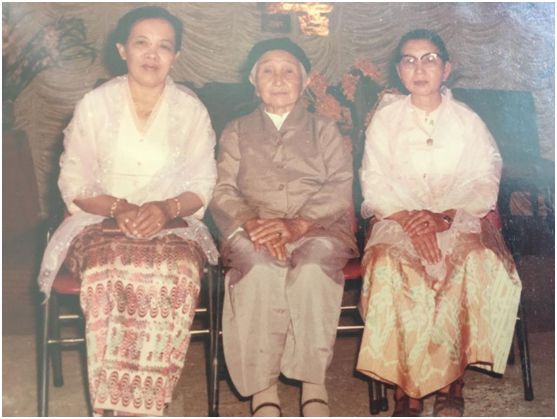
ZHGJ in her youth (far left) with her family
(Photographed by the author in 2017 from ZHGJ's photo album; the original photo was taken in Burma)
Second-Generation Migration: From Taunggyi, Burma to Chiang Mai, Thailand
According to ZHGJ, when the airport in Chiang Mai was newly built, she and her female cousins agreed to take a plane ride to experience it. Since she was already working at a bank in Burma at the time, she took leave and flew to Chiang Mai with her cousins to visit for a few days. One of her brothers hosted them in Chiang Mai, and upon meeting her, he formed the intention of introducing her to his cousin. She mentioned that back then, they had only seen each other's photos, and even their engagement was decided jointly by her parents-in-law, with her father-in-law traveling to Burma carrying betrothal gifts. The man who would later become her husband was still away leading horse caravans in business at the time and could not go in person. ZHGJ smiled and added that her father-in-law was very satisfied when he met her, so the marriage was finalized right then and there. Chatting about her and her husband's love story, she also recalled: back then, a very beautiful young woman living in Chiang Mai city also fancied her husband. At the time, her husband's older cousin went to propose marriage to this young woman's family. As a result, the young woman told her family, "The dark one (referring to that cousin), I won't give myself to him (I won't marry him); if it's the fair one (ZHGJ's husband), I'll give myself to him (I am willing to marry him)." [3] ZHGJ said this beautiful young woman was Thai, but her husband didn't want to marry a Thai woman—he was completely set on marrying a Chinese woman. Later, hearing that his cousin had introduced a Chinese girl named ZHGJ, he decided to get married without ever having met her.
After marriage, ZHGJ stayed behind in Burma while her husband continued leading horse caravans for trade, primarily transporting goods from the Burmese border to sell in Chiang Mai, Chiang Rai, and Bangkok. The goods also included opium. ZHGJ herself told the author without any concealment about transporting opium, saying that back then there were many opium dens in Chiang Mai, and engaging in the opium trade was not illegal. Later, a coup occurred in the Burmese government, plunging the situation into turmoil. ZHGJ's husband was filled with fear over the coup, so in 1964 he fled with his family to Chiang Mai and settled there.
She described it this way: "The Burmese government suddenly announced overnight that 100-yuan banknotes were no longer valid—they were scrapped. The cash in the hands of countless ordinary people instantly vanished into thin air." Her husband panicked, so he tried every possible means to escape. At that time, they already had three children. Her family and her aunt's family (her mother's sister's family) bought two horses and fled outward, while her other siblings and her parents did not come along. We can hardly imagine what they experienced during the month-plus escape. The author asked her, "Weren't you scared escaping from the mountains?" She smiled and said, "Of course we were still scared! The babies were small, and the youngest was still nursing. Coming through mountain trails, passing through those deep mountain wildernesses, resting among those massive trees—we were scared, so scared (Thai people like to use reduplication to heighten emotional color when expressing certain feelings and experiences—Author's note), but we all made it out, so we couldn't worry about much else." The two families had only two horses, which also had to carry food and supplies. The women rode the horses while the men walked, trekking through mountain paths for a full month and a half. Along the way, they encountered who knows how many problems. She said, "Hiking through the big mountains, one minute it was burning hot, the next it was pouring rain. The little kids would get sick, and the roads were so rough—those paths were truly roads only horses could walk out of." After fleeing to Chiang Mai, her husband first settled them in a village in the mountains and only brought them down after finding a house in Chiang Mai city. After arriving in Chiang Mai, they didn't go off to regular jobs; instead, they opened a small shop right at the entrance of the Baan Haw Mosque, selling pastries and dried noodles. After arriving in Chiang Mai, because the government launched a strict crackdown on opium, her husband did not continue the opium business.
Shortly after arriving in Chiang Mai, they caught the Thai government issuing "alien ID cards" (citizenship cards) to outsiders, allowing them to successfully acquire Thai nationality. She said, "The Thai King is so good, and his heart is broad. He is willing to let people from other countries live on his land, and he cares deeply for ordinary people. Thai people respect him very much, and we Yunnanese do too." She shared that the King once told the people: "A flowerpot is only beautiful when it has all kinds of flowers in it; a single variety doesn't look good." That is why he was willing to accept people who fled from China and issue us citizenship cards.
From these two migrations, we understand that ZHGJ's paternal generation fled to Panghsang, Burma, after the failure of the Du Wenxiu Rebellion, marrying and having children locally. Following the marriage of the second generation—herself and her husband—they fled once again to Chiang Mai, Thailand, due to the Burmese government coup. These two migrations neatly formed the migration route of "Yunnan–Burma–Chiang Mai," a trajectory proposed by many scholars in academia early on. During my fieldwork, I encountered a large proportion of Yunnanese Muslims whose ancestors first migrated to Burma and later relocated to Chiang Mai. Some moved to escape political coups, while others shifted to northern Thailand through intermarriage between Yunnanese populations in the two places. Today, these Yunnanese who relocated to Chiang Mai have lived in Thailand for nearly fifty to sixty years, and virtually all have obtained Thai citizenship. I classify these two migrations as "political refugee" movements, whereas the earlier "caravan merchants" trace their origins back to her husband's family's migration.
The "Unreturnable" Caravan Merchants
According to ZHGJ, her husband's family was formerly a prominent, wealthy family known as the "Ma Family of Dabaiyi, Yuxi." The men of the family had been engaged in horse caravan trade from an early age, traveling year-round between Yunnan and Southeast Asia for long-distance caravan commerce, rarely returning home. Only the elderly mother, her husband's first wife, and two children were left behind at home. Her father-in-law took his two sons out on horse caravans for business, leaving the household in the care of the mother-in-law. The money earned from the caravans was brought back home for the mother-in-law to purchase farmland; nearly all the farmland belonging to the nearby Han Chinese was bought up by them. When a mosque was built in their hometown, their family even donated a plot of land. At the time, her husband's family owned vast amounts of farmland, was extremely wealthy, and even had gold buried inside their home. Back then, her husband's family also built a multi-story building in Kunming, which was later destroyed by fire due to careless fire usage by the occupants. Because of various reasons, the father and two sons could not return to China and could only drift in migration between Burma and Thailand. Later, her husband married her in Myanmar, his younger brother married and started a family in Chiang Mai, and her father-in-law eventually passed away in Chiang Mai. After China's reform and opening up, when domestic conditions improved, her husband would split his earnings into two portions: one left for household expenses in Thailand, and the other regularly sent back to China via proxy for his first wife (her husband's senior wife) to raise the children.
Regarding the migration background of her husband's family, although caravan merchants did not initially settle in northern Thailand, they spent years away from home running caravan businesses and sojourning in northern Thailand. Eventually, due to complex international political factors, they remained permanently in northern Thailand, becoming "unreturnable" caravan merchants. Here, the author categorizes them into the first category of immigration mentioned above: "Yunnanese Muslim merchants engaged in long-distance caravan trade." Although they were not the earliest caravan merchants to settle in northern Thailand, having journeyed back and forth across the Thai-Burmese border year-round to conduct caravan business, they can already be considered part of the early northern Thai Yunnanese Muslim community. Moreover, according to historical literature, the early Yunnanese caravan merchants who settled permanently in northern Thailand were not numerous; the majority were merely sojourning traders traveling back and forth between China, Burma, Thailand, and Laos.
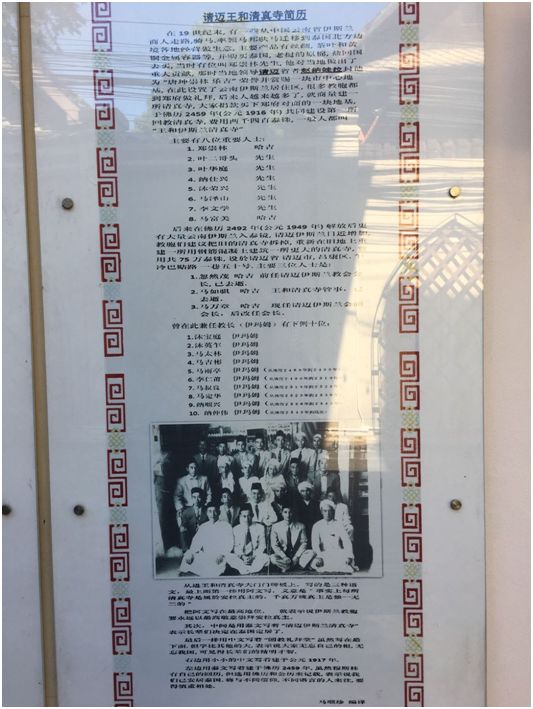
Introduction to the Baan Haw Mosque
(Photographed by the author at the Baan Haw Mosque, 2018)
A Life History of Putting Down Roots
When they first fled from Burma, a relative living in Ban Yang (a refugee village in Chiang Mai) asked them to stay and live in Ban Yang village, saying the living expenses were low and everyone in the village was also from Yunnan. But ZHGJ was unwilling. She told the author: "I was not willing. I wanted to take my children to study in Chiang Mai city. In Ban Yang, you could only learn a bit of Thai and Chinese—and even Chinese had to be studied in hiding and in secret. In the city, you could learn everything." Later, they came to Chiang Mai city, rented a property from the Baan Haw Mosque, and opened a shop at the entrance. Because her husband was already a "Hajj" who had completed the pilgrimage to Mecca before marrying her, upon arriving in Chiang Mai city, her husband was appointed as the Imam (prayer leader) of the mosque. She and her husband placed great emphasis on their children's education. She once told the author that she hoped her children would not wander around everywhere like the older generation, fleeing from place to place. Today, all four of their children have received higher education and hold enviable jobs. From her usual remarks, the author could also feel her pride and satisfaction regarding her children. All four of her children can speak Chinese, but except for the second son, who can read and write, the others cannot. The second son was once sent by his company to work in Shantou for a period of time, which is how he learned to read and write. She said that upon first arriving in Chiang Mai, to quickly adapt to local life, she also went to study Thai with local children for three months, and then gradually used Thai to communicate and conduct business. When the children were sent to school, her husband did not allow them to speak Thai at home after returning from school; they had to speak Chinese. Her husband said: "You speak Thai at school with your teachers and classmates, but at home you must speak your own language (Chinese)." Later, the author learned from her children that another reason her husband forbade them from speaking Thai was because the older generation of Yunnanese who came over was reluctant to learn Thai and thus could not speak it very well themselves, so they demanded that everyone in the household speak Chinese. Today, when she recounts this matter, she is still comforted that all four of her children can still speak Chinese.
Normally, ZHGJ stays at the shop in front of the mosque from Monday to Friday. Before her second son was married, she lived with him and took care of his daily life. Later, after her second son started a family and the children went out to work every day, she was left alone at home with nothing to do. So, she asked her children to rent a small shop adjacent to the side of the mosque for her. During the day, she would spend time at the shop, watch television, and gather or chat with friends at the mosque. Every morning, her second-layer daughter-in-law prepares lunch and drives her to the shop, where she spends time watching TV, performing prayers, and reciting scriptures with her female cousins and many older sisters. At 5:00 PM, her granddaughter finishes work and comes to pick her up to go home. From Monday to Thursday, she stays at her youngest daughter's house, and from Friday to Sunday, she stays at her son's house. Every Friday, her son goes to her daughter's house to pick her up, and the family takes the opportunity to gather together for dinner.
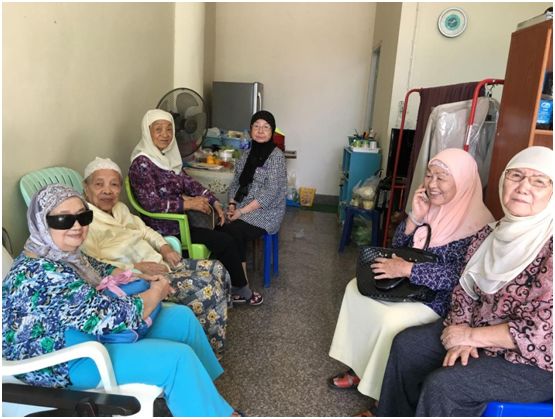
Elderly Yunnanese Muslim women in the Baan Haw community, Chiang Mai
(Photographed by the author at ZHGJ's shop, 2018)
The life history of ZHGJ's family putting down roots in Chiang Mai shows us that the first generation of Yunnanese Muslims who migrated to urban northern Thailand essentially built their livelihoods through commerce. From being "stateless" to gaining Thai citizenship, they experienced countless hardships. The second generation of Yunnanese Muslims in Thailand has largely received formal higher education, and many have completed upward social mobility through education, evolving into the Thai middle class. In the paper "Changes in Ethnic Identity of Chinese Muslims in Northern Thailand" (2012) by scholars Feng Yu and He Fuxiang, the importance of "national education" in the formation of the Chinese Muslim middle class was proposed. Indeed, through fieldwork, the author discovered that Yunnanese Muslims in the urban areas today have basically received national higher education and work across various societal fields. Receiving formal higher education and obtaining advanced degrees is a strategy for their upward social mobility. In other words, pursuing formal higher education is the direct pathway for second-generation Yunnanese Muslims and their descendants to acquire social status and capital. Taking ZHGJ's four children as an example, after completing their bachelor's degrees in Thailand, both sons went on to pursue master's degrees in the United States, while both daughters graduated from Chiang Mai University and stayed on to work there. The recognition and capital they hold today were all earned through educational channels. In the Baan Haw community of Chiang Mai, families like this are not isolated cases; locals frequently mention: "In Chiang Mai, our Yunnanese Hui Muslim doctors number nearly 20." Beyond doctors, professions such as university faculty, bank public servants, government civil servants, and corporate management personnel have all been attained through receiving an education.
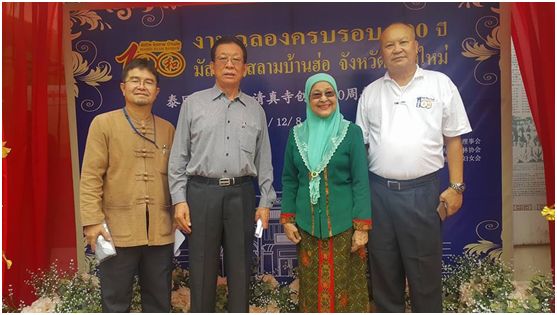
Yunnanese Muslims at the 100th-anniversary celebration of the Baan Haw Mosque in Chiang Mai
The man standing on the far right is an outstanding businessman, and the man on the far left is a university professor
During the fieldwork, ZHGJ introduced many locals to the author and shared numerous stories of the past. She is a kind, enthusiastic, and open-minded elder who loves learning, eagerly embraces new things, and is exceptionally proactive and brave. Sometimes the author wonders whether this personality is connected to their migration experiences. Many northern Thai Yunnanese Muslims, after migrating to Chiang Mai, migrated yet again through studies or business to places like the United States, Saudi Arabia, Australia, and Taiwan, achieving high economic standing and social status. From these migration cases, the author finds that a single generation's migration may bring about more than just geographical or cultural shifts; on a deeper level, it shapes the character and horizons of several generations.
This is merely one minor story among the many migration tales of northern Thai Chinese. Beneath every story lies the bitterness, joy, sorrow, and delight of human life. Every fieldwork trip allows the author to encounter diverse life stories and grow considerably—perhaps this is precisely why the author loves the discipline of anthropology.
[1] Suthep Soonthornpasuch. 1977. Islamic identity in Chiang Mai City: A Historical and Structural Comparison of Two Communities. Unpublished Dissertation. University of California at Berkeley. Quoted from Feng Yu and He Fuxiang, "Changes in Ethnic Identity of Chinese Muslims in Northern Thailand" (unpublished).
[2] To respect personal privacy, real names involved in this article are replaced throughout by English letters.
[3] Yunnan dialect, translated as: If the dark-looking one comes to propose, I won't agree; if the fair-looking one comes to propose, I will agree. view all
[Overseas Fieldwork Oral History] Ma Shimei | The Migration Story of a Thai-Northern Yunnanese Muslim Family
Abstract:
Ma Shimei (born 1991), female, master's student in Asian-African Languages and Literature at the School of Southeast Asian Studies, Yunnan Minzu University. Regarding the study of Yunnanese Muslim immigrants in northern Thailand, Suthep Soonthornpasuch categorized Yunnanese Muslim immigrants into five groups based on different migration backgrounds in his doctoral dissertation: First, Muslim merchants engaged in long-distance caravan trade between Yunnan and Southeast Asia in the 19th century; second, Yunnanese Muslims who fled to northern Thailand under Qing government persecution after the failure of the Du Wenxiu Rebellion; third, refugees who escaped from Yunnan to Burma and finally relocated to northern Thailand after the founding of the People's Republic of China in 1949; fourth, Yunnanese individuals loyal to regular Kuomintang troops; fifth, Yunnanese bandits driven out of China after the Chinese Communist Party took power in 1949. [1] Through reading literature and combining it with fieldwork, the author believes that we...
Ma Shimei (born 1991), female, master's student in Asian-African Languages and Literature at the School of Southeast Asian Studies, Yunnan Minzu University
Regarding the study of Yunnanese Muslim immigrants in northern Thailand, Suthep Soonthornpasuch categorized Yunnanese Muslim immigrants into five groups based on different migration backgrounds in his doctoral dissertation: First, Muslim merchants engaged in long-distance caravan trade between Yunnan and Southeast Asia in the 19th century; second, Yunnanese Muslims who fled to northern Thailand under Qing government persecution after the failure of the Du Wenxiu Rebellion; third, refugees who escaped from Yunnan to Burma and finally relocated to northern Thailand after the founding of the People's Republic of China in 1949; fourth, Yunnanese individuals loyal to regular Kuomintang troops; fifth, Yunnanese bandits driven out of China after the Chinese Communist Party took power in 1949. [1] Through reading literature and combining it with fieldwork, the author believes we can no longer fully reconstruct history, but can only explore the migration history of our ancestors through historical relics and oral histories from later generations. Among the immigration categories mentioned above, "Yunnanese bandits" lacks precise historical verification, and the author did not encounter related accounts during the investigation, so the author offers no evaluation of the fifth category, "Yunnanese bandits." However, aside from this, we learn about the migration history and origins of northern Thai Yunnanese Muslims from the other four migration types, which is indispensable material for our current research on local Yunnanese Muslims. Combining oral histories collected during the author's fieldwork and taking the migration experience of ZHGJ's [2] family as an example, this article explores the migration history and living conditions of northern Thai Yunnanese Muslims.
ZHGJ (female, 86 years old) is a native of Dali Ancient City, while her husband, MDH, is a native of Dabaiyi, Yuxi. MDH was the eighth Imam (prayer leader) of the Baan Haw Mosque (serving from 1980–1993 Gregorian calendar) and passed away more than 20 years ago. They had two sons and two daughters. Both sons went to the United States to pursue master's degrees in management. After graduation, the older son began working in Bangkok, married a local non-Muslim Thai woman, and has a daughter currently studying engineering at Chulalongkorn University in Thailand. The younger son works as a manager at a foreign trade company in Chiang Mai and married the sixth daughter of MCL. Both daughters work in administrative roles at Chiang Mai University and married descendants of Yunnanese people. Today, the older daughter has two daughters: one works in the pharmacy of Chiang Mai University's affiliated hospital, and the other is still attending a medical college in another province. The younger son and younger daughter remained childless several years after marriage.
First-Generation Migration: From Dali, China to Panghsang, Burma
ZHGJ told the author that because of the failure of the Du Wenxiu Rebellion, her father's generation of Muslims in Dali suffered persecution and massacres by the Qing government. To escape the slaughter, they fled to the Panghsang area along the China-Myanmar border and settled there. Later, due to turmoil in Panghsang, she and her family fled overnight to Taunggyi, Burma. During the period when Qing troops withdrew from Dali, ZHGJ returned to Dali to stay with her aunt and attend elementary school; after graduating, she returned to her parents' side to attend middle school. Because Burma was under British rule at the time, learning English was mandatory in school. Thus, at an early age, she mastered three languages: Chinese, English, and Burmese. ZHGJ's parents were married in Panghsang, Burma; her mother was also a Hui Muslim who fled from Yunnan to Burma. After marriage, they had three sons and three daughters—the three oldest were daughters and the youngest were three sons—and she was the eldest child in the family. Today, both younger brothers have passed away; only the oldest younger brother is in the United States. One sister married an Indian-descent Muslim and lives in Yangon, Burma, while another sister married a Burmese-descent Muslim in Taunggyi. After her husband passed away a few years ago, she moved to Bangkok, Thailand, to live with her daughter.
ZHGJ in her youth (far left) with her family
(Photographed by the author in 2017 from ZHGJ's photo album; the original photo was taken in Burma)
Second-Generation Migration: From Taunggyi, Burma to Chiang Mai, Thailand
According to ZHGJ, when the airport in Chiang Mai was newly built, she and her female cousins agreed to take a plane ride to experience it. Since she was already working at a bank in Burma at the time, she took leave and flew to Chiang Mai with her cousins to visit for a few days. One of her brothers hosted them in Chiang Mai, and upon meeting her, he formed the intention of introducing her to his cousin. She mentioned that back then, they had only seen each other's photos, and even their engagement was decided jointly by her parents-in-law, with her father-in-law traveling to Burma carrying betrothal gifts. The man who would later become her husband was still away leading horse caravans in business at the time and could not go in person. ZHGJ smiled and added that her father-in-law was very satisfied when he met her, so the marriage was finalized right then and there. Chatting about her and her husband's love story, she also recalled: back then, a very beautiful young woman living in Chiang Mai city also fancied her husband. At the time, her husband's older cousin went to propose marriage to this young woman's family. As a result, the young woman told her family, "The dark one (referring to that cousin), I won't give myself to him (I won't marry him); if it's the fair one (ZHGJ's husband), I'll give myself to him (I am willing to marry him)." [3] ZHGJ said this beautiful young woman was Thai, but her husband didn't want to marry a Thai woman—he was completely set on marrying a Chinese woman. Later, hearing that his cousin had introduced a Chinese girl named ZHGJ, he decided to get married without ever having met her.
After marriage, ZHGJ stayed behind in Burma while her husband continued leading horse caravans for trade, primarily transporting goods from the Burmese border to sell in Chiang Mai, Chiang Rai, and Bangkok. The goods also included opium. ZHGJ herself told the author without any concealment about transporting opium, saying that back then there were many opium dens in Chiang Mai, and engaging in the opium trade was not illegal. Later, a coup occurred in the Burmese government, plunging the situation into turmoil. ZHGJ's husband was filled with fear over the coup, so in 1964 he fled with his family to Chiang Mai and settled there.
She described it this way: "The Burmese government suddenly announced overnight that 100-yuan banknotes were no longer valid—they were scrapped. The cash in the hands of countless ordinary people instantly vanished into thin air." Her husband panicked, so he tried every possible means to escape. At that time, they already had three children. Her family and her aunt's family (her mother's sister's family) bought two horses and fled outward, while her other siblings and her parents did not come along. We can hardly imagine what they experienced during the month-plus escape. The author asked her, "Weren't you scared escaping from the mountains?" She smiled and said, "Of course we were still scared! The babies were small, and the youngest was still nursing. Coming through mountain trails, passing through those deep mountain wildernesses, resting among those massive trees—we were scared, so scared (Thai people like to use reduplication to heighten emotional color when expressing certain feelings and experiences—Author's note), but we all made it out, so we couldn't worry about much else." The two families had only two horses, which also had to carry food and supplies. The women rode the horses while the men walked, trekking through mountain paths for a full month and a half. Along the way, they encountered who knows how many problems. She said, "Hiking through the big mountains, one minute it was burning hot, the next it was pouring rain. The little kids would get sick, and the roads were so rough—those paths were truly roads only horses could walk out of." After fleeing to Chiang Mai, her husband first settled them in a village in the mountains and only brought them down after finding a house in Chiang Mai city. After arriving in Chiang Mai, they didn't go off to regular jobs; instead, they opened a small shop right at the entrance of the Baan Haw Mosque, selling pastries and dried noodles. After arriving in Chiang Mai, because the government launched a strict crackdown on opium, her husband did not continue the opium business.
Shortly after arriving in Chiang Mai, they caught the Thai government issuing "alien ID cards" (citizenship cards) to outsiders, allowing them to successfully acquire Thai nationality. She said, "The Thai King is so good, and his heart is broad. He is willing to let people from other countries live on his land, and he cares deeply for ordinary people. Thai people respect him very much, and we Yunnanese do too." She shared that the King once told the people: "A flowerpot is only beautiful when it has all kinds of flowers in it; a single variety doesn't look good." That is why he was willing to accept people who fled from China and issue us citizenship cards.
From these two migrations, we understand that ZHGJ's paternal generation fled to Panghsang, Burma, after the failure of the Du Wenxiu Rebellion, marrying and having children locally. Following the marriage of the second generation—herself and her husband—they fled once again to Chiang Mai, Thailand, due to the Burmese government coup. These two migrations neatly formed the migration route of "Yunnan–Burma–Chiang Mai," a trajectory proposed by many scholars in academia early on. During my fieldwork, I encountered a large proportion of Yunnanese Muslims whose ancestors first migrated to Burma and later relocated to Chiang Mai. Some moved to escape political coups, while others shifted to northern Thailand through intermarriage between Yunnanese populations in the two places. Today, these Yunnanese who relocated to Chiang Mai have lived in Thailand for nearly fifty to sixty years, and virtually all have obtained Thai citizenship. I classify these two migrations as "political refugee" movements, whereas the earlier "caravan merchants" trace their origins back to her husband's family's migration.
The "Unreturnable" Caravan Merchants
According to ZHGJ, her husband's family was formerly a prominent, wealthy family known as the "Ma Family of Dabaiyi, Yuxi." The men of the family had been engaged in horse caravan trade from an early age, traveling year-round between Yunnan and Southeast Asia for long-distance caravan commerce, rarely returning home. Only the elderly mother, her husband's first wife, and two children were left behind at home. Her father-in-law took his two sons out on horse caravans for business, leaving the household in the care of the mother-in-law. The money earned from the caravans was brought back home for the mother-in-law to purchase farmland; nearly all the farmland belonging to the nearby Han Chinese was bought up by them. When a mosque was built in their hometown, their family even donated a plot of land. At the time, her husband's family owned vast amounts of farmland, was extremely wealthy, and even had gold buried inside their home. Back then, her husband's family also built a multi-story building in Kunming, which was later destroyed by fire due to careless fire usage by the occupants. Because of various reasons, the father and two sons could not return to China and could only drift in migration between Burma and Thailand. Later, her husband married her in Myanmar, his younger brother married and started a family in Chiang Mai, and her father-in-law eventually passed away in Chiang Mai. After China's reform and opening up, when domestic conditions improved, her husband would split his earnings into two portions: one left for household expenses in Thailand, and the other regularly sent back to China via proxy for his first wife (her husband's senior wife) to raise the children.
Regarding the migration background of her husband's family, although caravan merchants did not initially settle in northern Thailand, they spent years away from home running caravan businesses and sojourning in northern Thailand. Eventually, due to complex international political factors, they remained permanently in northern Thailand, becoming "unreturnable" caravan merchants. Here, the author categorizes them into the first category of immigration mentioned above: "Yunnanese Muslim merchants engaged in long-distance caravan trade." Although they were not the earliest caravan merchants to settle in northern Thailand, having journeyed back and forth across the Thai-Burmese border year-round to conduct caravan business, they can already be considered part of the early northern Thai Yunnanese Muslim community. Moreover, according to historical literature, the early Yunnanese caravan merchants who settled permanently in northern Thailand were not numerous; the majority were merely sojourning traders traveling back and forth between China, Burma, Thailand, and Laos.
Introduction to the Baan Haw Mosque
(Photographed by the author at the Baan Haw Mosque, 2018)
A Life History of Putting Down Roots
When they first fled from Burma, a relative living in Ban Yang (a refugee village in Chiang Mai) asked them to stay and live in Ban Yang village, saying the living expenses were low and everyone in the village was also from Yunnan. But ZHGJ was unwilling. She told the author: "I was not willing. I wanted to take my children to study in Chiang Mai city. In Ban Yang, you could only learn a bit of Thai and Chinese—and even Chinese had to be studied in hiding and in secret. In the city, you could learn everything." Later, they came to Chiang Mai city, rented a property from the Baan Haw Mosque, and opened a shop at the entrance. Because her husband was already a "Hajj" who had completed the pilgrimage to Mecca before marrying her, upon arriving in Chiang Mai city, her husband was appointed as the Imam (prayer leader) of the mosque. She and her husband placed great emphasis on their children's education. She once told the author that she hoped her children would not wander around everywhere like the older generation, fleeing from place to place. Today, all four of their children have received higher education and hold enviable jobs. From her usual remarks, the author could also feel her pride and satisfaction regarding her children. All four of her children can speak Chinese, but except for the second son, who can read and write, the others cannot. The second son was once sent by his company to work in Shantou for a period of time, which is how he learned to read and write. She said that upon first arriving in Chiang Mai, to quickly adapt to local life, she also went to study Thai with local children for three months, and then gradually used Thai to communicate and conduct business. When the children were sent to school, her husband did not allow them to speak Thai at home after returning from school; they had to speak Chinese. Her husband said: "You speak Thai at school with your teachers and classmates, but at home you must speak your own language (Chinese)." Later, the author learned from her children that another reason her husband forbade them from speaking Thai was because the older generation of Yunnanese who came over was reluctant to learn Thai and thus could not speak it very well themselves, so they demanded that everyone in the household speak Chinese. Today, when she recounts this matter, she is still comforted that all four of her children can still speak Chinese.
Normally, ZHGJ stays at the shop in front of the mosque from Monday to Friday. Before her second son was married, she lived with him and took care of his daily life. Later, after her second son started a family and the children went out to work every day, she was left alone at home with nothing to do. So, she asked her children to rent a small shop adjacent to the side of the mosque for her. During the day, she would spend time at the shop, watch television, and gather or chat with friends at the mosque. Every morning, her second-layer daughter-in-law prepares lunch and drives her to the shop, where she spends time watching TV, performing prayers, and reciting scriptures with her female cousins and many older sisters. At 5:00 PM, her granddaughter finishes work and comes to pick her up to go home. From Monday to Thursday, she stays at her youngest daughter's house, and from Friday to Sunday, she stays at her son's house. Every Friday, her son goes to her daughter's house to pick her up, and the family takes the opportunity to gather together for dinner.
Elderly Yunnanese Muslim women in the Baan Haw community, Chiang Mai
(Photographed by the author at ZHGJ's shop, 2018)
The life history of ZHGJ's family putting down roots in Chiang Mai shows us that the first generation of Yunnanese Muslims who migrated to urban northern Thailand essentially built their livelihoods through commerce. From being "stateless" to gaining Thai citizenship, they experienced countless hardships. The second generation of Yunnanese Muslims in Thailand has largely received formal higher education, and many have completed upward social mobility through education, evolving into the Thai middle class. In the paper "Changes in Ethnic Identity of Chinese Muslims in Northern Thailand" (2012) by scholars Feng Yu and He Fuxiang, the importance of "national education" in the formation of the Chinese Muslim middle class was proposed. Indeed, through fieldwork, the author discovered that Yunnanese Muslims in the urban areas today have basically received national higher education and work across various societal fields. Receiving formal higher education and obtaining advanced degrees is a strategy for their upward social mobility. In other words, pursuing formal higher education is the direct pathway for second-generation Yunnanese Muslims and their descendants to acquire social status and capital. Taking ZHGJ's four children as an example, after completing their bachelor's degrees in Thailand, both sons went on to pursue master's degrees in the United States, while both daughters graduated from Chiang Mai University and stayed on to work there. The recognition and capital they hold today were all earned through educational channels. In the Baan Haw community of Chiang Mai, families like this are not isolated cases; locals frequently mention: "In Chiang Mai, our Yunnanese Hui Muslim doctors number nearly 20." Beyond doctors, professions such as university faculty, bank public servants, government civil servants, and corporate management personnel have all been attained through receiving an education.
Yunnanese Muslims at the 100th-anniversary celebration of the Baan Haw Mosque in Chiang Mai
The man standing on the far right is an outstanding businessman, and the man on the far left is a university professor
During the fieldwork, ZHGJ introduced many locals to the author and shared numerous stories of the past. She is a kind, enthusiastic, and open-minded elder who loves learning, eagerly embraces new things, and is exceptionally proactive and brave. Sometimes the author wonders whether this personality is connected to their migration experiences. Many northern Thai Yunnanese Muslims, after migrating to Chiang Mai, migrated yet again through studies or business to places like the United States, Saudi Arabia, Australia, and Taiwan, achieving high economic standing and social status. From these migration cases, the author finds that a single generation's migration may bring about more than just geographical or cultural shifts; on a deeper level, it shapes the character and horizons of several generations.
This is merely one minor story among the many migration tales of northern Thai Chinese. Beneath every story lies the bitterness, joy, sorrow, and delight of human life. Every fieldwork trip allows the author to encounter diverse life stories and grow considerably—perhaps this is precisely why the author loves the discipline of anthropology.
[1] Suthep Soonthornpasuch. 1977. Islamic identity in Chiang Mai City: A Historical and Structural Comparison of Two Communities. Unpublished Dissertation. University of California at Berkeley. Quoted from Feng Yu and He Fuxiang, "Changes in Ethnic Identity of Chinese Muslims in Northern Thailand" (unpublished).
[2] To respect personal privacy, real names involved in this article are replaced throughout by English letters.
[3] Yunnan dialect, translated as: If the dark-looking one comes to propose, I won't agree; if the fair-looking one comes to propose, I will agree. view all
[Internet Repost]
[Overseas Fieldwork Oral History] Ma Shimei | The Migration Story of a Thai-Northern Yunnanese Muslim Family
Abstract:
Ma Shimei (born 1991), female, master's student in Asian-African Languages and Literature at the School of Southeast Asian Studies, Yunnan Minzu University. Regarding the study of Yunnanese Muslim immigrants in northern Thailand, Suthep Soonthornpasuch categorized Yunnanese Muslim immigrants into five groups based on different migration backgrounds in his doctoral dissertation: First, Muslim merchants engaged in long-distance caravan trade between Yunnan and Southeast Asia in the 19th century; second, Yunnanese Muslims who fled to northern Thailand under Qing government persecution after the failure of the Du Wenxiu Rebellion; third, refugees who escaped from Yunnan to Burma and finally relocated to northern Thailand after the founding of the People's Republic of China in 1949; fourth, Yunnanese individuals loyal to regular Kuomintang troops; fifth, Yunnanese bandits driven out of China after the Chinese Communist Party took power in 1949. [1] Through reading literature and combining it with fieldwork, the author believes that we...
Ma Shimei (born 1991), female, master's student in Asian-African Languages and Literature at the School of Southeast Asian Studies, Yunnan Minzu University
Regarding the study of Yunnanese Muslim immigrants in northern Thailand, Suthep Soonthornpasuch categorized Yunnanese Muslim immigrants into five groups based on different migration backgrounds in his doctoral dissertation: First, Muslim merchants engaged in long-distance caravan trade between Yunnan and Southeast Asia in the 19th century; second, Yunnanese Muslims who fled to northern Thailand under Qing government persecution after the failure of the Du Wenxiu Rebellion; third, refugees who escaped from Yunnan to Burma and finally relocated to northern Thailand after the founding of the People's Republic of China in 1949; fourth, Yunnanese individuals loyal to regular Kuomintang troops; fifth, Yunnanese bandits driven out of China after the Chinese Communist Party took power in 1949. [1] Through reading literature and combining it with fieldwork, the author believes we can no longer fully reconstruct history, but can only explore the migration history of our ancestors through historical relics and oral histories from later generations. Among the immigration categories mentioned above, "Yunnanese bandits" lacks precise historical verification, and the author did not encounter related accounts during the investigation, so the author offers no evaluation of the fifth category, "Yunnanese bandits." However, aside from this, we learn about the migration history and origins of northern Thai Yunnanese Muslims from the other four migration types, which is indispensable material for our current research on local Yunnanese Muslims. Combining oral histories collected during the author's fieldwork and taking the migration experience of ZHGJ's [2] family as an example, this article explores the migration history and living conditions of northern Thai Yunnanese Muslims.
ZHGJ (female, 86 years old) is a native of Dali Ancient City, while her husband, MDH, is a native of Dabaiyi, Yuxi. MDH was the eighth Imam (prayer leader) of the Baan Haw Mosque (serving from 1980–1993 Gregorian calendar) and passed away more than 20 years ago. They had two sons and two daughters. Both sons went to the United States to pursue master's degrees in management. After graduation, the older son began working in Bangkok, married a local non-Muslim Thai woman, and has a daughter currently studying engineering at Chulalongkorn University in Thailand. The younger son works as a manager at a foreign trade company in Chiang Mai and married the sixth daughter of MCL. Both daughters work in administrative roles at Chiang Mai University and married descendants of Yunnanese people. Today, the older daughter has two daughters: one works in the pharmacy of Chiang Mai University's affiliated hospital, and the other is still attending a medical college in another province. The younger son and younger daughter remained childless several years after marriage.
First-Generation Migration: From Dali, China to Panghsang, Burma
ZHGJ told the author that because of the failure of the Du Wenxiu Rebellion, her father's generation of Muslims in Dali suffered persecution and massacres by the Qing government. To escape the slaughter, they fled to the Panghsang area along the China-Myanmar border and settled there. Later, due to turmoil in Panghsang, she and her family fled overnight to Taunggyi, Burma. During the period when Qing troops withdrew from Dali, ZHGJ returned to Dali to stay with her aunt and attend elementary school; after graduating, she returned to her parents' side to attend middle school. Because Burma was under British rule at the time, learning English was mandatory in school. Thus, at an early age, she mastered three languages: Chinese, English, and Burmese. ZHGJ's parents were married in Panghsang, Burma; her mother was also a Hui Muslim who fled from Yunnan to Burma. After marriage, they had three sons and three daughters—the three oldest were daughters and the youngest were three sons—and she was the eldest child in the family. Today, both younger brothers have passed away; only the oldest younger brother is in the United States. One sister married an Indian-descent Muslim and lives in Yangon, Burma, while another sister married a Burmese-descent Muslim in Taunggyi. After her husband passed away a few years ago, she moved to Bangkok, Thailand, to live with her daughter.
ZHGJ in her youth (far left) with her family
(Photographed by the author in 2017 from ZHGJ's photo album; the original photo was taken in Burma)
Second-Generation Migration: From Taunggyi, Burma to Chiang Mai, Thailand
According to ZHGJ, when the airport in Chiang Mai was newly built, she and her female cousins agreed to take a plane ride to experience it. Since she was already working at a bank in Burma at the time, she took leave and flew to Chiang Mai with her cousins to visit for a few days. One of her brothers hosted them in Chiang Mai, and upon meeting her, he formed the intention of introducing her to his cousin. She mentioned that back then, they had only seen each other's photos, and even their engagement was decided jointly by her parents-in-law, with her father-in-law traveling to Burma carrying betrothal gifts. The man who would later become her husband was still away leading horse caravans in business at the time and could not go in person. ZHGJ smiled and added that her father-in-law was very satisfied when he met her, so the marriage was finalized right then and there. Chatting about her and her husband's love story, she also recalled: back then, a very beautiful young woman living in Chiang Mai city also fancied her husband. At the time, her husband's older cousin went to propose marriage to this young woman's family. As a result, the young woman told her family, "The dark one (referring to that cousin), I won't give myself to him (I won't marry him); if it's the fair one (ZHGJ's husband), I'll give myself to him (I am willing to marry him)." [3] ZHGJ said this beautiful young woman was Thai, but her husband didn't want to marry a Thai woman—he was completely set on marrying a Chinese woman. Later, hearing that his cousin had introduced a Chinese girl named ZHGJ, he decided to get married without ever having met her.
After marriage, ZHGJ stayed behind in Burma while her husband continued leading horse caravans for trade, primarily transporting goods from the Burmese border to sell in Chiang Mai, Chiang Rai, and Bangkok. The goods also included opium. ZHGJ herself told the author without any concealment about transporting opium, saying that back then there were many opium dens in Chiang Mai, and engaging in the opium trade was not illegal. Later, a coup occurred in the Burmese government, plunging the situation into turmoil. ZHGJ's husband was filled with fear over the coup, so in 1964 he fled with his family to Chiang Mai and settled there.
She described it this way: "The Burmese government suddenly announced overnight that 100-yuan banknotes were no longer valid—they were scrapped. The cash in the hands of countless ordinary people instantly vanished into thin air." Her husband panicked, so he tried every possible means to escape. At that time, they already had three children. Her family and her aunt's family (her mother's sister's family) bought two horses and fled outward, while her other siblings and her parents did not come along. We can hardly imagine what they experienced during the month-plus escape. The author asked her, "Weren't you scared escaping from the mountains?" She smiled and said, "Of course we were still scared! The babies were small, and the youngest was still nursing. Coming through mountain trails, passing through those deep mountain wildernesses, resting among those massive trees—we were scared, so scared (Thai people like to use reduplication to heighten emotional color when expressing certain feelings and experiences—Author's note), but we all made it out, so we couldn't worry about much else." The two families had only two horses, which also had to carry food and supplies. The women rode the horses while the men walked, trekking through mountain paths for a full month and a half. Along the way, they encountered who knows how many problems. She said, "Hiking through the big mountains, one minute it was burning hot, the next it was pouring rain. The little kids would get sick, and the roads were so rough—those paths were truly roads only horses could walk out of." After fleeing to Chiang Mai, her husband first settled them in a village in the mountains and only brought them down after finding a house in Chiang Mai city. After arriving in Chiang Mai, they didn't go off to regular jobs; instead, they opened a small shop right at the entrance of the Baan Haw Mosque, selling pastries and dried noodles. After arriving in Chiang Mai, because the government launched a strict crackdown on opium, her husband did not continue the opium business.
Shortly after arriving in Chiang Mai, they caught the Thai government issuing "alien ID cards" (citizenship cards) to outsiders, allowing them to successfully acquire Thai nationality. She said, "The Thai King is so good, and his heart is broad. He is willing to let people from other countries live on his land, and he cares deeply for ordinary people. Thai people respect him very much, and we Yunnanese do too." She shared that the King once told the people: "A flowerpot is only beautiful when it has all kinds of flowers in it; a single variety doesn't look good." That is why he was willing to accept people who fled from China and issue us citizenship cards.
From these two migrations, we understand that ZHGJ's paternal generation fled to Panghsang, Burma, after the failure of the Du Wenxiu Rebellion, marrying and having children locally. Following the marriage of the second generation—herself and her husband—they fled once again to Chiang Mai, Thailand, due to the Burmese government coup. These two migrations neatly formed the migration route of "Yunnan–Burma–Chiang Mai," a trajectory proposed by many scholars in academia early on. During my fieldwork, I encountered a large proportion of Yunnanese Muslims whose ancestors first migrated to Burma and later relocated to Chiang Mai. Some moved to escape political coups, while others shifted to northern Thailand through intermarriage between Yunnanese populations in the two places. Today, these Yunnanese who relocated to Chiang Mai have lived in Thailand for nearly fifty to sixty years, and virtually all have obtained Thai citizenship. I classify these two migrations as "political refugee" movements, whereas the earlier "caravan merchants" trace their origins back to her husband's family's migration.
The "Unreturnable" Caravan Merchants
According to ZHGJ, her husband's family was formerly a prominent, wealthy family known as the "Ma Family of Dabaiyi, Yuxi." The men of the family had been engaged in horse caravan trade from an early age, traveling year-round between Yunnan and Southeast Asia for long-distance caravan commerce, rarely returning home. Only the elderly mother, her husband's first wife, and two children were left behind at home. Her father-in-law took his two sons out on horse caravans for business, leaving the household in the care of the mother-in-law. The money earned from the caravans was brought back home for the mother-in-law to purchase farmland; nearly all the farmland belonging to the nearby Han Chinese was bought up by them. When a mosque was built in their hometown, their family even donated a plot of land. At the time, her husband's family owned vast amounts of farmland, was extremely wealthy, and even had gold buried inside their home. Back then, her husband's family also built a multi-story building in Kunming, which was later destroyed by fire due to careless fire usage by the occupants. Because of various reasons, the father and two sons could not return to China and could only drift in migration between Burma and Thailand. Later, her husband married her in Myanmar, his younger brother married and started a family in Chiang Mai, and her father-in-law eventually passed away in Chiang Mai. After China's reform and opening up, when domestic conditions improved, her husband would split his earnings into two portions: one left for household expenses in Thailand, and the other regularly sent back to China via proxy for his first wife (her husband's senior wife) to raise the children.
Regarding the migration background of her husband's family, although caravan merchants did not initially settle in northern Thailand, they spent years away from home running caravan businesses and sojourning in northern Thailand. Eventually, due to complex international political factors, they remained permanently in northern Thailand, becoming "unreturnable" caravan merchants. Here, the author categorizes them into the first category of immigration mentioned above: "Yunnanese Muslim merchants engaged in long-distance caravan trade." Although they were not the earliest caravan merchants to settle in northern Thailand, having journeyed back and forth across the Thai-Burmese border year-round to conduct caravan business, they can already be considered part of the early northern Thai Yunnanese Muslim community. Moreover, according to historical literature, the early Yunnanese caravan merchants who settled permanently in northern Thailand were not numerous; the majority were merely sojourning traders traveling back and forth between China, Burma, Thailand, and Laos.
Introduction to the Baan Haw Mosque
(Photographed by the author at the Baan Haw Mosque, 2018)
A Life History of Putting Down Roots
When they first fled from Burma, a relative living in Ban Yang (a refugee village in Chiang Mai) asked them to stay and live in Ban Yang village, saying the living expenses were low and everyone in the village was also from Yunnan. But ZHGJ was unwilling. She told the author: "I was not willing. I wanted to take my children to study in Chiang Mai city. In Ban Yang, you could only learn a bit of Thai and Chinese—and even Chinese had to be studied in hiding and in secret. In the city, you could learn everything." Later, they came to Chiang Mai city, rented a property from the Baan Haw Mosque, and opened a shop at the entrance. Because her husband was already a "Hajj" who had completed the pilgrimage to Mecca before marrying her, upon arriving in Chiang Mai city, her husband was appointed as the Imam (prayer leader) of the mosque. She and her husband placed great emphasis on their children's education. She once told the author that she hoped her children would not wander around everywhere like the older generation, fleeing from place to place. Today, all four of their children have received higher education and hold enviable jobs. From her usual remarks, the author could also feel her pride and satisfaction regarding her children. All four of her children can speak Chinese, but except for the second son, who can read and write, the others cannot. The second son was once sent by his company to work in Shantou for a period of time, which is how he learned to read and write. She said that upon first arriving in Chiang Mai, to quickly adapt to local life, she also went to study Thai with local children for three months, and then gradually used Thai to communicate and conduct business. When the children were sent to school, her husband did not allow them to speak Thai at home after returning from school; they had to speak Chinese. Her husband said: "You speak Thai at school with your teachers and classmates, but at home you must speak your own language (Chinese)." Later, the author learned from her children that another reason her husband forbade them from speaking Thai was because the older generation of Yunnanese who came over was reluctant to learn Thai and thus could not speak it very well themselves, so they demanded that everyone in the household speak Chinese. Today, when she recounts this matter, she is still comforted that all four of her children can still speak Chinese.
Normally, ZHGJ stays at the shop in front of the mosque from Monday to Friday. Before her second son was married, she lived with him and took care of his daily life. Later, after her second son started a family and the children went out to work every day, she was left alone at home with nothing to do. So, she asked her children to rent a small shop adjacent to the side of the mosque for her. During the day, she would spend time at the shop, watch television, and gather or chat with friends at the mosque. Every morning, her second-layer daughter-in-law prepares lunch and drives her to the shop, where she spends time watching TV, performing prayers, and reciting scriptures with her female cousins and many older sisters. At 5:00 PM, her granddaughter finishes work and comes to pick her up to go home. From Monday to Thursday, she stays at her youngest daughter's house, and from Friday to Sunday, she stays at her son's house. Every Friday, her son goes to her daughter's house to pick her up, and the family takes the opportunity to gather together for dinner.
Elderly Yunnanese Muslim women in the Baan Haw community, Chiang Mai
(Photographed by the author at ZHGJ's shop, 2018)
The life history of ZHGJ's family putting down roots in Chiang Mai shows us that the first generation of Yunnanese Muslims who migrated to urban northern Thailand essentially built their livelihoods through commerce. From being "stateless" to gaining Thai citizenship, they experienced countless hardships. The second generation of Yunnanese Muslims in Thailand has largely received formal higher education, and many have completed upward social mobility through education, evolving into the Thai middle class. In the paper "Changes in Ethnic Identity of Chinese Muslims in Northern Thailand" (2012) by scholars Feng Yu and He Fuxiang, the importance of "national education" in the formation of the Chinese Muslim middle class was proposed. Indeed, through fieldwork, the author discovered that Yunnanese Muslims in the urban areas today have basically received national higher education and work across various societal fields. Receiving formal higher education and obtaining advanced degrees is a strategy for their upward social mobility. In other words, pursuing formal higher education is the direct pathway for second-generation Yunnanese Muslims and their descendants to acquire social status and capital. Taking ZHGJ's four children as an example, after completing their bachelor's degrees in Thailand, both sons went on to pursue master's degrees in the United States, while both daughters graduated from Chiang Mai University and stayed on to work there. The recognition and capital they hold today were all earned through educational channels. In the Baan Haw community of Chiang Mai, families like this are not isolated cases; locals frequently mention: "In Chiang Mai, our Yunnanese Hui Muslim doctors number nearly 20." Beyond doctors, professions such as university faculty, bank public servants, government civil servants, and corporate management personnel have all been attained through receiving an education.
Yunnanese Muslims at the 100th-anniversary celebration of the Baan Haw Mosque in Chiang Mai
The man standing on the far right is an outstanding businessman, and the man on the far left is a university professor
During the fieldwork, ZHGJ introduced many locals to the author and shared numerous stories of the past. She is a kind, enthusiastic, and open-minded elder who loves learning, eagerly embraces new things, and is exceptionally proactive and brave. Sometimes the author wonders whether this personality is connected to their migration experiences. Many northern Thai Yunnanese Muslims, after migrating to Chiang Mai, migrated yet again through studies or business to places like the United States, Saudi Arabia, Australia, and Taiwan, achieving high economic standing and social status. From these migration cases, the author finds that a single generation's migration may bring about more than just geographical or cultural shifts; on a deeper level, it shapes the character and horizons of several generations.
This is merely one minor story among the many migration tales of northern Thai Chinese. Beneath every story lies the bitterness, joy, sorrow, and delight of human life. Every fieldwork trip allows the author to encounter diverse life stories and grow considerably—perhaps this is precisely why the author loves the discipline of anthropology.
[1] Suthep Soonthornpasuch. 1977. Islamic identity in Chiang Mai City: A Historical and Structural Comparison of Two Communities. Unpublished Dissertation. University of California at Berkeley. Quoted from Feng Yu and He Fuxiang, "Changes in Ethnic Identity of Chinese Muslims in Northern Thailand" (unpublished).
[2] To respect personal privacy, real names involved in this article are replaced throughout by English letters.
[3] Yunnan dialect, translated as: If the dark-looking one comes to propose, I won't agree; if the fair-looking one comes to propose, I will agree.
[Overseas Fieldwork Oral History] Ma Shimei | The Migration Story of a Thai-Northern Yunnanese Muslim Family
Abstract:
Ma Shimei (born 1991), female, master's student in Asian-African Languages and Literature at the School of Southeast Asian Studies, Yunnan Minzu University. Regarding the study of Yunnanese Muslim immigrants in northern Thailand, Suthep Soonthornpasuch categorized Yunnanese Muslim immigrants into five groups based on different migration backgrounds in his doctoral dissertation: First, Muslim merchants engaged in long-distance caravan trade between Yunnan and Southeast Asia in the 19th century; second, Yunnanese Muslims who fled to northern Thailand under Qing government persecution after the failure of the Du Wenxiu Rebellion; third, refugees who escaped from Yunnan to Burma and finally relocated to northern Thailand after the founding of the People's Republic of China in 1949; fourth, Yunnanese individuals loyal to regular Kuomintang troops; fifth, Yunnanese bandits driven out of China after the Chinese Communist Party took power in 1949. [1] Through reading literature and combining it with fieldwork, the author believes that we...
Ma Shimei (born 1991), female, master's student in Asian-African Languages and Literature at the School of Southeast Asian Studies, Yunnan Minzu University
Regarding the study of Yunnanese Muslim immigrants in northern Thailand, Suthep Soonthornpasuch categorized Yunnanese Muslim immigrants into five groups based on different migration backgrounds in his doctoral dissertation: First, Muslim merchants engaged in long-distance caravan trade between Yunnan and Southeast Asia in the 19th century; second, Yunnanese Muslims who fled to northern Thailand under Qing government persecution after the failure of the Du Wenxiu Rebellion; third, refugees who escaped from Yunnan to Burma and finally relocated to northern Thailand after the founding of the People's Republic of China in 1949; fourth, Yunnanese individuals loyal to regular Kuomintang troops; fifth, Yunnanese bandits driven out of China after the Chinese Communist Party took power in 1949. [1] Through reading literature and combining it with fieldwork, the author believes we can no longer fully reconstruct history, but can only explore the migration history of our ancestors through historical relics and oral histories from later generations. Among the immigration categories mentioned above, "Yunnanese bandits" lacks precise historical verification, and the author did not encounter related accounts during the investigation, so the author offers no evaluation of the fifth category, "Yunnanese bandits." However, aside from this, we learn about the migration history and origins of northern Thai Yunnanese Muslims from the other four migration types, which is indispensable material for our current research on local Yunnanese Muslims. Combining oral histories collected during the author's fieldwork and taking the migration experience of ZHGJ's [2] family as an example, this article explores the migration history and living conditions of northern Thai Yunnanese Muslims.
ZHGJ (female, 86 years old) is a native of Dali Ancient City, while her husband, MDH, is a native of Dabaiyi, Yuxi. MDH was the eighth Imam (prayer leader) of the Baan Haw Mosque (serving from 1980–1993 Gregorian calendar) and passed away more than 20 years ago. They had two sons and two daughters. Both sons went to the United States to pursue master's degrees in management. After graduation, the older son began working in Bangkok, married a local non-Muslim Thai woman, and has a daughter currently studying engineering at Chulalongkorn University in Thailand. The younger son works as a manager at a foreign trade company in Chiang Mai and married the sixth daughter of MCL. Both daughters work in administrative roles at Chiang Mai University and married descendants of Yunnanese people. Today, the older daughter has two daughters: one works in the pharmacy of Chiang Mai University's affiliated hospital, and the other is still attending a medical college in another province. The younger son and younger daughter remained childless several years after marriage.
First-Generation Migration: From Dali, China to Panghsang, Burma
ZHGJ told the author that because of the failure of the Du Wenxiu Rebellion, her father's generation of Muslims in Dali suffered persecution and massacres by the Qing government. To escape the slaughter, they fled to the Panghsang area along the China-Myanmar border and settled there. Later, due to turmoil in Panghsang, she and her family fled overnight to Taunggyi, Burma. During the period when Qing troops withdrew from Dali, ZHGJ returned to Dali to stay with her aunt and attend elementary school; after graduating, she returned to her parents' side to attend middle school. Because Burma was under British rule at the time, learning English was mandatory in school. Thus, at an early age, she mastered three languages: Chinese, English, and Burmese. ZHGJ's parents were married in Panghsang, Burma; her mother was also a Hui Muslim who fled from Yunnan to Burma. After marriage, they had three sons and three daughters—the three oldest were daughters and the youngest were three sons—and she was the eldest child in the family. Today, both younger brothers have passed away; only the oldest younger brother is in the United States. One sister married an Indian-descent Muslim and lives in Yangon, Burma, while another sister married a Burmese-descent Muslim in Taunggyi. After her husband passed away a few years ago, she moved to Bangkok, Thailand, to live with her daughter.
ZHGJ in her youth (far left) with her family
(Photographed by the author in 2017 from ZHGJ's photo album; the original photo was taken in Burma)
Second-Generation Migration: From Taunggyi, Burma to Chiang Mai, Thailand
According to ZHGJ, when the airport in Chiang Mai was newly built, she and her female cousins agreed to take a plane ride to experience it. Since she was already working at a bank in Burma at the time, she took leave and flew to Chiang Mai with her cousins to visit for a few days. One of her brothers hosted them in Chiang Mai, and upon meeting her, he formed the intention of introducing her to his cousin. She mentioned that back then, they had only seen each other's photos, and even their engagement was decided jointly by her parents-in-law, with her father-in-law traveling to Burma carrying betrothal gifts. The man who would later become her husband was still away leading horse caravans in business at the time and could not go in person. ZHGJ smiled and added that her father-in-law was very satisfied when he met her, so the marriage was finalized right then and there. Chatting about her and her husband's love story, she also recalled: back then, a very beautiful young woman living in Chiang Mai city also fancied her husband. At the time, her husband's older cousin went to propose marriage to this young woman's family. As a result, the young woman told her family, "The dark one (referring to that cousin), I won't give myself to him (I won't marry him); if it's the fair one (ZHGJ's husband), I'll give myself to him (I am willing to marry him)." [3] ZHGJ said this beautiful young woman was Thai, but her husband didn't want to marry a Thai woman—he was completely set on marrying a Chinese woman. Later, hearing that his cousin had introduced a Chinese girl named ZHGJ, he decided to get married without ever having met her.
After marriage, ZHGJ stayed behind in Burma while her husband continued leading horse caravans for trade, primarily transporting goods from the Burmese border to sell in Chiang Mai, Chiang Rai, and Bangkok. The goods also included opium. ZHGJ herself told the author without any concealment about transporting opium, saying that back then there were many opium dens in Chiang Mai, and engaging in the opium trade was not illegal. Later, a coup occurred in the Burmese government, plunging the situation into turmoil. ZHGJ's husband was filled with fear over the coup, so in 1964 he fled with his family to Chiang Mai and settled there.
She described it this way: "The Burmese government suddenly announced overnight that 100-yuan banknotes were no longer valid—they were scrapped. The cash in the hands of countless ordinary people instantly vanished into thin air." Her husband panicked, so he tried every possible means to escape. At that time, they already had three children. Her family and her aunt's family (her mother's sister's family) bought two horses and fled outward, while her other siblings and her parents did not come along. We can hardly imagine what they experienced during the month-plus escape. The author asked her, "Weren't you scared escaping from the mountains?" She smiled and said, "Of course we were still scared! The babies were small, and the youngest was still nursing. Coming through mountain trails, passing through those deep mountain wildernesses, resting among those massive trees—we were scared, so scared (Thai people like to use reduplication to heighten emotional color when expressing certain feelings and experiences—Author's note), but we all made it out, so we couldn't worry about much else." The two families had only two horses, which also had to carry food and supplies. The women rode the horses while the men walked, trekking through mountain paths for a full month and a half. Along the way, they encountered who knows how many problems. She said, "Hiking through the big mountains, one minute it was burning hot, the next it was pouring rain. The little kids would get sick, and the roads were so rough—those paths were truly roads only horses could walk out of." After fleeing to Chiang Mai, her husband first settled them in a village in the mountains and only brought them down after finding a house in Chiang Mai city. After arriving in Chiang Mai, they didn't go off to regular jobs; instead, they opened a small shop right at the entrance of the Baan Haw Mosque, selling pastries and dried noodles. After arriving in Chiang Mai, because the government launched a strict crackdown on opium, her husband did not continue the opium business.
Shortly after arriving in Chiang Mai, they caught the Thai government issuing "alien ID cards" (citizenship cards) to outsiders, allowing them to successfully acquire Thai nationality. She said, "The Thai King is so good, and his heart is broad. He is willing to let people from other countries live on his land, and he cares deeply for ordinary people. Thai people respect him very much, and we Yunnanese do too." She shared that the King once told the people: "A flowerpot is only beautiful when it has all kinds of flowers in it; a single variety doesn't look good." That is why he was willing to accept people who fled from China and issue us citizenship cards.
From these two migrations, we understand that ZHGJ's paternal generation fled to Panghsang, Burma, after the failure of the Du Wenxiu Rebellion, marrying and having children locally. Following the marriage of the second generation—herself and her husband—they fled once again to Chiang Mai, Thailand, due to the Burmese government coup. These two migrations neatly formed the migration route of "Yunnan–Burma–Chiang Mai," a trajectory proposed by many scholars in academia early on. During my fieldwork, I encountered a large proportion of Yunnanese Muslims whose ancestors first migrated to Burma and later relocated to Chiang Mai. Some moved to escape political coups, while others shifted to northern Thailand through intermarriage between Yunnanese populations in the two places. Today, these Yunnanese who relocated to Chiang Mai have lived in Thailand for nearly fifty to sixty years, and virtually all have obtained Thai citizenship. I classify these two migrations as "political refugee" movements, whereas the earlier "caravan merchants" trace their origins back to her husband's family's migration.
The "Unreturnable" Caravan Merchants
According to ZHGJ, her husband's family was formerly a prominent, wealthy family known as the "Ma Family of Dabaiyi, Yuxi." The men of the family had been engaged in horse caravan trade from an early age, traveling year-round between Yunnan and Southeast Asia for long-distance caravan commerce, rarely returning home. Only the elderly mother, her husband's first wife, and two children were left behind at home. Her father-in-law took his two sons out on horse caravans for business, leaving the household in the care of the mother-in-law. The money earned from the caravans was brought back home for the mother-in-law to purchase farmland; nearly all the farmland belonging to the nearby Han Chinese was bought up by them. When a mosque was built in their hometown, their family even donated a plot of land. At the time, her husband's family owned vast amounts of farmland, was extremely wealthy, and even had gold buried inside their home. Back then, her husband's family also built a multi-story building in Kunming, which was later destroyed by fire due to careless fire usage by the occupants. Because of various reasons, the father and two sons could not return to China and could only drift in migration between Burma and Thailand. Later, her husband married her in Myanmar, his younger brother married and started a family in Chiang Mai, and her father-in-law eventually passed away in Chiang Mai. After China's reform and opening up, when domestic conditions improved, her husband would split his earnings into two portions: one left for household expenses in Thailand, and the other regularly sent back to China via proxy for his first wife (her husband's senior wife) to raise the children.
Regarding the migration background of her husband's family, although caravan merchants did not initially settle in northern Thailand, they spent years away from home running caravan businesses and sojourning in northern Thailand. Eventually, due to complex international political factors, they remained permanently in northern Thailand, becoming "unreturnable" caravan merchants. Here, the author categorizes them into the first category of immigration mentioned above: "Yunnanese Muslim merchants engaged in long-distance caravan trade." Although they were not the earliest caravan merchants to settle in northern Thailand, having journeyed back and forth across the Thai-Burmese border year-round to conduct caravan business, they can already be considered part of the early northern Thai Yunnanese Muslim community. Moreover, according to historical literature, the early Yunnanese caravan merchants who settled permanently in northern Thailand were not numerous; the majority were merely sojourning traders traveling back and forth between China, Burma, Thailand, and Laos.
Introduction to the Baan Haw Mosque
(Photographed by the author at the Baan Haw Mosque, 2018)
A Life History of Putting Down Roots
When they first fled from Burma, a relative living in Ban Yang (a refugee village in Chiang Mai) asked them to stay and live in Ban Yang village, saying the living expenses were low and everyone in the village was also from Yunnan. But ZHGJ was unwilling. She told the author: "I was not willing. I wanted to take my children to study in Chiang Mai city. In Ban Yang, you could only learn a bit of Thai and Chinese—and even Chinese had to be studied in hiding and in secret. In the city, you could learn everything." Later, they came to Chiang Mai city, rented a property from the Baan Haw Mosque, and opened a shop at the entrance. Because her husband was already a "Hajj" who had completed the pilgrimage to Mecca before marrying her, upon arriving in Chiang Mai city, her husband was appointed as the Imam (prayer leader) of the mosque. She and her husband placed great emphasis on their children's education. She once told the author that she hoped her children would not wander around everywhere like the older generation, fleeing from place to place. Today, all four of their children have received higher education and hold enviable jobs. From her usual remarks, the author could also feel her pride and satisfaction regarding her children. All four of her children can speak Chinese, but except for the second son, who can read and write, the others cannot. The second son was once sent by his company to work in Shantou for a period of time, which is how he learned to read and write. She said that upon first arriving in Chiang Mai, to quickly adapt to local life, she also went to study Thai with local children for three months, and then gradually used Thai to communicate and conduct business. When the children were sent to school, her husband did not allow them to speak Thai at home after returning from school; they had to speak Chinese. Her husband said: "You speak Thai at school with your teachers and classmates, but at home you must speak your own language (Chinese)." Later, the author learned from her children that another reason her husband forbade them from speaking Thai was because the older generation of Yunnanese who came over was reluctant to learn Thai and thus could not speak it very well themselves, so they demanded that everyone in the household speak Chinese. Today, when she recounts this matter, she is still comforted that all four of her children can still speak Chinese.
Normally, ZHGJ stays at the shop in front of the mosque from Monday to Friday. Before her second son was married, she lived with him and took care of his daily life. Later, after her second son started a family and the children went out to work every day, she was left alone at home with nothing to do. So, she asked her children to rent a small shop adjacent to the side of the mosque for her. During the day, she would spend time at the shop, watch television, and gather or chat with friends at the mosque. Every morning, her second-layer daughter-in-law prepares lunch and drives her to the shop, where she spends time watching TV, performing prayers, and reciting scriptures with her female cousins and many older sisters. At 5:00 PM, her granddaughter finishes work and comes to pick her up to go home. From Monday to Thursday, she stays at her youngest daughter's house, and from Friday to Sunday, she stays at her son's house. Every Friday, her son goes to her daughter's house to pick her up, and the family takes the opportunity to gather together for dinner.
Elderly Yunnanese Muslim women in the Baan Haw community, Chiang Mai
(Photographed by the author at ZHGJ's shop, 2018)
The life history of ZHGJ's family putting down roots in Chiang Mai shows us that the first generation of Yunnanese Muslims who migrated to urban northern Thailand essentially built their livelihoods through commerce. From being "stateless" to gaining Thai citizenship, they experienced countless hardships. The second generation of Yunnanese Muslims in Thailand has largely received formal higher education, and many have completed upward social mobility through education, evolving into the Thai middle class. In the paper "Changes in Ethnic Identity of Chinese Muslims in Northern Thailand" (2012) by scholars Feng Yu and He Fuxiang, the importance of "national education" in the formation of the Chinese Muslim middle class was proposed. Indeed, through fieldwork, the author discovered that Yunnanese Muslims in the urban areas today have basically received national higher education and work across various societal fields. Receiving formal higher education and obtaining advanced degrees is a strategy for their upward social mobility. In other words, pursuing formal higher education is the direct pathway for second-generation Yunnanese Muslims and their descendants to acquire social status and capital. Taking ZHGJ's four children as an example, after completing their bachelor's degrees in Thailand, both sons went on to pursue master's degrees in the United States, while both daughters graduated from Chiang Mai University and stayed on to work there. The recognition and capital they hold today were all earned through educational channels. In the Baan Haw community of Chiang Mai, families like this are not isolated cases; locals frequently mention: "In Chiang Mai, our Yunnanese Hui Muslim doctors number nearly 20." Beyond doctors, professions such as university faculty, bank public servants, government civil servants, and corporate management personnel have all been attained through receiving an education.
Yunnanese Muslims at the 100th-anniversary celebration of the Baan Haw Mosque in Chiang Mai
The man standing on the far right is an outstanding businessman, and the man on the far left is a university professor
During the fieldwork, ZHGJ introduced many locals to the author and shared numerous stories of the past. She is a kind, enthusiastic, and open-minded elder who loves learning, eagerly embraces new things, and is exceptionally proactive and brave. Sometimes the author wonders whether this personality is connected to their migration experiences. Many northern Thai Yunnanese Muslims, after migrating to Chiang Mai, migrated yet again through studies or business to places like the United States, Saudi Arabia, Australia, and Taiwan, achieving high economic standing and social status. From these migration cases, the author finds that a single generation's migration may bring about more than just geographical or cultural shifts; on a deeper level, it shapes the character and horizons of several generations.
This is merely one minor story among the many migration tales of northern Thai Chinese. Beneath every story lies the bitterness, joy, sorrow, and delight of human life. Every fieldwork trip allows the author to encounter diverse life stories and grow considerably—perhaps this is precisely why the author loves the discipline of anthropology.
[1] Suthep Soonthornpasuch. 1977. Islamic identity in Chiang Mai City: A Historical and Structural Comparison of Two Communities. Unpublished Dissertation. University of California at Berkeley. Quoted from Feng Yu and He Fuxiang, "Changes in Ethnic Identity of Chinese Muslims in Northern Thailand" (unpublished).
[2] To respect personal privacy, real names involved in this article are replaced throughout by English letters.
[3] Yunnan dialect, translated as: If the dark-looking one comes to propose, I won't agree; if the fair-looking one comes to propose, I will agree.
The Epic Migration of Yunnan Hui Muslims to Northern Thailand: History, Mosques & Family Stories
Articles • Hasan09 posted the article • 0 comments • 1 views • 2 hours ago
[Internet Repost]
[Overseas Fieldwork Oral History] Ma Shimei | The Migration Story of a Thai-Northern Yunnanese Muslim Family
Abstract:
Ma Shimei (born 1991), female, master's student in Asian-African Languages and Literature at the School of Southeast Asian Studies, Yunnan Minzu University. Regarding the study of Yunnanese Muslim immigrants in northern Thailand, Suthep Soonthornpasuch categorized Yunnanese Muslim immigrants into five groups based on different migration backgrounds in his doctoral dissertation: First, Muslim merchants engaged in long-distance caravan trade between Yunnan and Southeast Asia in the 19th century; second, Yunnanese Muslims who fled to northern Thailand under Qing government persecution after the failure of the Du Wenxiu Rebellion; third, refugees who escaped from Yunnan to Burma and finally relocated to northern Thailand after the founding of the People's Republic of China in 1949; fourth, Yunnanese individuals loyal to regular Kuomintang troops; fifth, Yunnanese bandits driven out of China after the Chinese Communist Party took power in 1949. [1] Through reading literature and combining it with fieldwork, the author believes that we...
Ma Shimei (born 1991), female, master's student in Asian-African Languages and Literature at the School of Southeast Asian Studies, Yunnan Minzu University
Regarding the study of Yunnanese Muslim immigrants in northern Thailand, Suthep Soonthornpasuch categorized Yunnanese Muslim immigrants into five groups based on different migration backgrounds in his doctoral dissertation: First, Muslim merchants engaged in long-distance caravan trade between Yunnan and Southeast Asia in the 19th century; second, Yunnanese Muslims who fled to northern Thailand under Qing government persecution after the failure of the Du Wenxiu Rebellion; third, refugees who escaped from Yunnan to Burma and finally relocated to northern Thailand after the founding of the People's Republic of China in 1949; fourth, Yunnanese individuals loyal to regular Kuomintang troops; fifth, Yunnanese bandits driven out of China after the Chinese Communist Party took power in 1949. [1] Through reading literature and combining it with fieldwork, the author believes we can no longer fully reconstruct history, but can only explore the migration history of our ancestors through historical relics and oral histories from later generations. Among the immigration categories mentioned above, "Yunnanese bandits" lacks precise historical verification, and the author did not encounter related accounts during the investigation, so the author offers no evaluation of the fifth category, "Yunnanese bandits." However, aside from this, we learn about the migration history and origins of northern Thai Yunnanese Muslims from the other four migration types, which is indispensable material for our current research on local Yunnanese Muslims. Combining oral histories collected during the author's fieldwork and taking the migration experience of ZHGJ's [2] family as an example, this article explores the migration history and living conditions of northern Thai Yunnanese Muslims.
ZHGJ (female, 86 years old) is a native of Dali Ancient City, while her husband, MDH, is a native of Dabaiyi, Yuxi. MDH was the eighth Imam (prayer leader) of the Baan Haw Mosque (serving from 1980–1993 Gregorian calendar) and passed away more than 20 years ago. They had two sons and two daughters. Both sons went to the United States to pursue master's degrees in management. After graduation, the older son began working in Bangkok, married a local non-Muslim Thai woman, and has a daughter currently studying engineering at Chulalongkorn University in Thailand. The younger son works as a manager at a foreign trade company in Chiang Mai and married the sixth daughter of MCL. Both daughters work in administrative roles at Chiang Mai University and married descendants of Yunnanese people. Today, the older daughter has two daughters: one works in the pharmacy of Chiang Mai University's affiliated hospital, and the other is still attending a medical college in another province. The younger son and younger daughter remained childless several years after marriage.
First-Generation Migration: From Dali, China to Panghsang, Burma
ZHGJ told the author that because of the failure of the Du Wenxiu Rebellion, her father's generation of Muslims in Dali suffered persecution and massacres by the Qing government. To escape the slaughter, they fled to the Panghsang area along the China-Myanmar border and settled there. Later, due to turmoil in Panghsang, she and her family fled overnight to Taunggyi, Burma. During the period when Qing troops withdrew from Dali, ZHGJ returned to Dali to stay with her aunt and attend elementary school; after graduating, she returned to her parents' side to attend middle school. Because Burma was under British rule at the time, learning English was mandatory in school. Thus, at an early age, she mastered three languages: Chinese, English, and Burmese. ZHGJ's parents were married in Panghsang, Burma; her mother was also a Hui Muslim who fled from Yunnan to Burma. After marriage, they had three sons and three daughters—the three oldest were daughters and the youngest were three sons—and she was the eldest child in the family. Today, both younger brothers have passed away; only the oldest younger brother is in the United States. One sister married an Indian-descent Muslim and lives in Yangon, Burma, while another sister married a Burmese-descent Muslim in Taunggyi. After her husband passed away a few years ago, she moved to Bangkok, Thailand, to live with her daughter.
ZHGJ in her youth (far left) with her family
(Photographed by the author in 2017 from ZHGJ's photo album; the original photo was taken in Burma)
Second-Generation Migration: From Taunggyi, Burma to Chiang Mai, Thailand
According to ZHGJ, when the airport in Chiang Mai was newly built, she and her female cousins agreed to take a plane ride to experience it. Since she was already working at a bank in Burma at the time, she took leave and flew to Chiang Mai with her cousins to visit for a few days. One of her brothers hosted them in Chiang Mai, and upon meeting her, he formed the intention of introducing her to his cousin. She mentioned that back then, they had only seen each other's photos, and even their engagement was decided jointly by her parents-in-law, with her father-in-law traveling to Burma carrying betrothal gifts. The man who would later become her husband was still away leading horse caravans in business at the time and could not go in person. ZHGJ smiled and added that her father-in-law was very satisfied when he met her, so the marriage was finalized right then and there. Chatting about her and her husband's love story, she also recalled: back then, a very beautiful young woman living in Chiang Mai city also fancied her husband. At the time, her husband's older cousin went to propose marriage to this young woman's family. As a result, the young woman told her family, "The dark one (referring to that cousin), I won't give myself to him (I won't marry him); if it's the fair one (ZHGJ's husband), I'll give myself to him (I am willing to marry him)." [3] ZHGJ said this beautiful young woman was Thai, but her husband didn't want to marry a Thai woman—he was completely set on marrying a Chinese woman. Later, hearing that his cousin had introduced a Chinese girl named ZHGJ, he decided to get married without ever having met her.
After marriage, ZHGJ stayed behind in Burma while her husband continued leading horse caravans for trade, primarily transporting goods from the Burmese border to sell in Chiang Mai, Chiang Rai, and Bangkok. The goods also included opium. ZHGJ herself told the author without any concealment about transporting opium, saying that back then there were many opium dens in Chiang Mai, and engaging in the opium trade was not illegal. Later, a coup occurred in the Burmese government, plunging the situation into turmoil. ZHGJ's husband was filled with fear over the coup, so in 1964 he fled with his family to Chiang Mai and settled there.
She described it this way: "The Burmese government suddenly announced overnight that 100-yuan banknotes were no longer valid—they were scrapped. The cash in the hands of countless ordinary people instantly vanished into thin air." Her husband panicked, so he tried every possible means to escape. At that time, they already had three children. Her family and her aunt's family (her mother's sister's family) bought two horses and fled outward, while her other siblings and her parents did not come along. We can hardly imagine what they experienced during the month-plus escape. The author asked her, "Weren't you scared escaping from the mountains?" She smiled and said, "Of course we were still scared! The babies were small, and the youngest was still nursing. Coming through mountain trails, passing through those deep mountain wildernesses, resting among those massive trees—we were scared, so scared (Thai people like to use reduplication to heighten emotional color when expressing certain feelings and experiences—Author's note), but we all made it out, so we couldn't worry about much else." The two families had only two horses, which also had to carry food and supplies. The women rode the horses while the men walked, trekking through mountain paths for a full month and a half. Along the way, they encountered who knows how many problems. She said, "Hiking through the big mountains, one minute it was burning hot, the next it was pouring rain. The little kids would get sick, and the roads were so rough—those paths were truly roads only horses could walk out of." After fleeing to Chiang Mai, her husband first settled them in a village in the mountains and only brought them down after finding a house in Chiang Mai city. After arriving in Chiang Mai, they didn't go off to regular jobs; instead, they opened a small shop right at the entrance of the Baan Haw Mosque, selling pastries and dried noodles. After arriving in Chiang Mai, because the government launched a strict crackdown on opium, her husband did not continue the opium business.
Shortly after arriving in Chiang Mai, they caught the Thai government issuing "alien ID cards" (citizenship cards) to outsiders, allowing them to successfully acquire Thai nationality. She said, "The Thai King is so good, and his heart is broad. He is willing to let people from other countries live on his land, and he cares deeply for ordinary people. Thai people respect him very much, and we Yunnanese do too." She shared that the King once told the people: "A flowerpot is only beautiful when it has all kinds of flowers in it; a single variety doesn't look good." That is why he was willing to accept people who fled from China and issue us citizenship cards.
From these two migrations, we understand that ZHGJ's paternal generation fled to Panghsang, Burma, after the failure of the Du Wenxiu Rebellion, marrying and having children locally. Following the marriage of the second generation—herself and her husband—they fled once again to Chiang Mai, Thailand, due to the Burmese government coup. These two migrations neatly formed the migration route of "Yunnan–Burma–Chiang Mai," a trajectory proposed by many scholars in academia early on. During my fieldwork, I encountered a large proportion of Yunnanese Muslims whose ancestors first migrated to Burma and later relocated to Chiang Mai. Some moved to escape political coups, while others shifted to northern Thailand through intermarriage between Yunnanese populations in the two places. Today, these Yunnanese who relocated to Chiang Mai have lived in Thailand for nearly fifty to sixty years, and virtually all have obtained Thai citizenship. I classify these two migrations as "political refugee" movements, whereas the earlier "caravan merchants" trace their origins back to her husband's family's migration.
The "Unreturnable" Caravan Merchants
According to ZHGJ, her husband's family was formerly a prominent, wealthy family known as the "Ma Family of Dabaiyi, Yuxi." The men of the family had been engaged in horse caravan trade from an early age, traveling year-round between Yunnan and Southeast Asia for long-distance caravan commerce, rarely returning home. Only the elderly mother, her husband's first wife, and two children were left behind at home. Her father-in-law took his two sons out on horse caravans for business, leaving the household in the care of the mother-in-law. The money earned from the caravans was brought back home for the mother-in-law to purchase farmland; nearly all the farmland belonging to the nearby Han Chinese was bought up by them. When a mosque was built in their hometown, their family even donated a plot of land. At the time, her husband's family owned vast amounts of farmland, was extremely wealthy, and even had gold buried inside their home. Back then, her husband's family also built a multi-story building in Kunming, which was later destroyed by fire due to careless fire usage by the occupants. Because of various reasons, the father and two sons could not return to China and could only drift in migration between Burma and Thailand. Later, her husband married her in Myanmar, his younger brother married and started a family in Chiang Mai, and her father-in-law eventually passed away in Chiang Mai. After China's reform and opening up, when domestic conditions improved, her husband would split his earnings into two portions: one left for household expenses in Thailand, and the other regularly sent back to China via proxy for his first wife (her husband's senior wife) to raise the children.
Regarding the migration background of her husband's family, although caravan merchants did not initially settle in northern Thailand, they spent years away from home running caravan businesses and sojourning in northern Thailand. Eventually, due to complex international political factors, they remained permanently in northern Thailand, becoming "unreturnable" caravan merchants. Here, the author categorizes them into the first category of immigration mentioned above: "Yunnanese Muslim merchants engaged in long-distance caravan trade." Although they were not the earliest caravan merchants to settle in northern Thailand, having journeyed back and forth across the Thai-Burmese border year-round to conduct caravan business, they can already be considered part of the early northern Thai Yunnanese Muslim community. Moreover, according to historical literature, the early Yunnanese caravan merchants who settled permanently in northern Thailand were not numerous; the majority were merely sojourning traders traveling back and forth between China, Burma, Thailand, and Laos.
Introduction to the Baan Haw Mosque
(Photographed by the author at the Baan Haw Mosque, 2018)
A Life History of Putting Down Roots
When they first fled from Burma, a relative living in Ban Yang (a refugee village in Chiang Mai) asked them to stay and live in Ban Yang village, saying the living expenses were low and everyone in the village was also from Yunnan. But ZHGJ was unwilling. She told the author: "I was not willing. I wanted to take my children to study in Chiang Mai city. In Ban Yang, you could only learn a bit of Thai and Chinese—and even Chinese had to be studied in hiding and in secret. In the city, you could learn everything." Later, they came to Chiang Mai city, rented a property from the Baan Haw Mosque, and opened a shop at the entrance. Because her husband was already a "Hajj" who had completed the pilgrimage to Mecca before marrying her, upon arriving in Chiang Mai city, her husband was appointed as the Imam (prayer leader) of the mosque. She and her husband placed great emphasis on their children's education. She once told the author that she hoped her children would not wander around everywhere like the older generation, fleeing from place to place. Today, all four of their children have received higher education and hold enviable jobs. From her usual remarks, the author could also feel her pride and satisfaction regarding her children. All four of her children can speak Chinese, but except for the second son, who can read and write, the others cannot. The second son was once sent by his company to work in Shantou for a period of time, which is how he learned to read and write. She said that upon first arriving in Chiang Mai, to quickly adapt to local life, she also went to study Thai with local children for three months, and then gradually used Thai to communicate and conduct business. When the children were sent to school, her husband did not allow them to speak Thai at home after returning from school; they had to speak Chinese. Her husband said: "You speak Thai at school with your teachers and classmates, but at home you must speak your own language (Chinese)." Later, the author learned from her children that another reason her husband forbade them from speaking Thai was because the older generation of Yunnanese who came over was reluctant to learn Thai and thus could not speak it very well themselves, so they demanded that everyone in the household speak Chinese. Today, when she recounts this matter, she is still comforted that all four of her children can still speak Chinese.
Normally, ZHGJ stays at the shop in front of the mosque from Monday to Friday. Before her second son was married, she lived with him and took care of his daily life. Later, after her second son started a family and the children went out to work every day, she was left alone at home with nothing to do. So, she asked her children to rent a small shop adjacent to the side of the mosque for her. During the day, she would spend time at the shop, watch television, and gather or chat with friends at the mosque. Every morning, her second-layer daughter-in-law prepares lunch and drives her to the shop, where she spends time watching TV, performing prayers, and reciting scriptures with her female cousins and many older sisters. At 5:00 PM, her granddaughter finishes work and comes to pick her up to go home. From Monday to Thursday, she stays at her youngest daughter's house, and from Friday to Sunday, she stays at her son's house. Every Friday, her son goes to her daughter's house to pick her up, and the family takes the opportunity to gather together for dinner.
Elderly Yunnanese Muslim women in the Baan Haw community, Chiang Mai
(Photographed by the author at ZHGJ's shop, 2018)
The life history of ZHGJ's family putting down roots in Chiang Mai shows us that the first generation of Yunnanese Muslims who migrated to urban northern Thailand essentially built their livelihoods through commerce. From being "stateless" to gaining Thai citizenship, they experienced countless hardships. The second generation of Yunnanese Muslims in Thailand has largely received formal higher education, and many have completed upward social mobility through education, evolving into the Thai middle class. In the paper "Changes in Ethnic Identity of Chinese Muslims in Northern Thailand" (2012) by scholars Feng Yu and He Fuxiang, the importance of "national education" in the formation of the Chinese Muslim middle class was proposed. Indeed, through fieldwork, the author discovered that Yunnanese Muslims in the urban areas today have basically received national higher education and work across various societal fields. Receiving formal higher education and obtaining advanced degrees is a strategy for their upward social mobility. In other words, pursuing formal higher education is the direct pathway for second-generation Yunnanese Muslims and their descendants to acquire social status and capital. Taking ZHGJ's four children as an example, after completing their bachelor's degrees in Thailand, both sons went on to pursue master's degrees in the United States, while both daughters graduated from Chiang Mai University and stayed on to work there. The recognition and capital they hold today were all earned through educational channels. In the Baan Haw community of Chiang Mai, families like this are not isolated cases; locals frequently mention: "In Chiang Mai, our Yunnanese Hui Muslim doctors number nearly 20." Beyond doctors, professions such as university faculty, bank public servants, government civil servants, and corporate management personnel have all been attained through receiving an education.
Yunnanese Muslims at the 100th-anniversary celebration of the Baan Haw Mosque in Chiang Mai
The man standing on the far right is an outstanding businessman, and the man on the far left is a university professor
During the fieldwork, ZHGJ introduced many locals to the author and shared numerous stories of the past. She is a kind, enthusiastic, and open-minded elder who loves learning, eagerly embraces new things, and is exceptionally proactive and brave. Sometimes the author wonders whether this personality is connected to their migration experiences. Many northern Thai Yunnanese Muslims, after migrating to Chiang Mai, migrated yet again through studies or business to places like the United States, Saudi Arabia, Australia, and Taiwan, achieving high economic standing and social status. From these migration cases, the author finds that a single generation's migration may bring about more than just geographical or cultural shifts; on a deeper level, it shapes the character and horizons of several generations.
This is merely one minor story among the many migration tales of northern Thai Chinese. Beneath every story lies the bitterness, joy, sorrow, and delight of human life. Every fieldwork trip allows the author to encounter diverse life stories and grow considerably—perhaps this is precisely why the author loves the discipline of anthropology.
[1] Suthep Soonthornpasuch. 1977. Islamic identity in Chiang Mai City: A Historical and Structural Comparison of Two Communities. Unpublished Dissertation. University of California at Berkeley. Quoted from Feng Yu and He Fuxiang, "Changes in Ethnic Identity of Chinese Muslims in Northern Thailand" (unpublished).
[2] To respect personal privacy, real names involved in this article are replaced throughout by English letters.
[3] Yunnan dialect, translated as: If the dark-looking one comes to propose, I won't agree; if the fair-looking one comes to propose, I will agree. view all
[Overseas Fieldwork Oral History] Ma Shimei | The Migration Story of a Thai-Northern Yunnanese Muslim Family
Abstract:
Ma Shimei (born 1991), female, master's student in Asian-African Languages and Literature at the School of Southeast Asian Studies, Yunnan Minzu University. Regarding the study of Yunnanese Muslim immigrants in northern Thailand, Suthep Soonthornpasuch categorized Yunnanese Muslim immigrants into five groups based on different migration backgrounds in his doctoral dissertation: First, Muslim merchants engaged in long-distance caravan trade between Yunnan and Southeast Asia in the 19th century; second, Yunnanese Muslims who fled to northern Thailand under Qing government persecution after the failure of the Du Wenxiu Rebellion; third, refugees who escaped from Yunnan to Burma and finally relocated to northern Thailand after the founding of the People's Republic of China in 1949; fourth, Yunnanese individuals loyal to regular Kuomintang troops; fifth, Yunnanese bandits driven out of China after the Chinese Communist Party took power in 1949. [1] Through reading literature and combining it with fieldwork, the author believes that we...
Ma Shimei (born 1991), female, master's student in Asian-African Languages and Literature at the School of Southeast Asian Studies, Yunnan Minzu University
Regarding the study of Yunnanese Muslim immigrants in northern Thailand, Suthep Soonthornpasuch categorized Yunnanese Muslim immigrants into five groups based on different migration backgrounds in his doctoral dissertation: First, Muslim merchants engaged in long-distance caravan trade between Yunnan and Southeast Asia in the 19th century; second, Yunnanese Muslims who fled to northern Thailand under Qing government persecution after the failure of the Du Wenxiu Rebellion; third, refugees who escaped from Yunnan to Burma and finally relocated to northern Thailand after the founding of the People's Republic of China in 1949; fourth, Yunnanese individuals loyal to regular Kuomintang troops; fifth, Yunnanese bandits driven out of China after the Chinese Communist Party took power in 1949. [1] Through reading literature and combining it with fieldwork, the author believes we can no longer fully reconstruct history, but can only explore the migration history of our ancestors through historical relics and oral histories from later generations. Among the immigration categories mentioned above, "Yunnanese bandits" lacks precise historical verification, and the author did not encounter related accounts during the investigation, so the author offers no evaluation of the fifth category, "Yunnanese bandits." However, aside from this, we learn about the migration history and origins of northern Thai Yunnanese Muslims from the other four migration types, which is indispensable material for our current research on local Yunnanese Muslims. Combining oral histories collected during the author's fieldwork and taking the migration experience of ZHGJ's [2] family as an example, this article explores the migration history and living conditions of northern Thai Yunnanese Muslims.
ZHGJ (female, 86 years old) is a native of Dali Ancient City, while her husband, MDH, is a native of Dabaiyi, Yuxi. MDH was the eighth Imam (prayer leader) of the Baan Haw Mosque (serving from 1980–1993 Gregorian calendar) and passed away more than 20 years ago. They had two sons and two daughters. Both sons went to the United States to pursue master's degrees in management. After graduation, the older son began working in Bangkok, married a local non-Muslim Thai woman, and has a daughter currently studying engineering at Chulalongkorn University in Thailand. The younger son works as a manager at a foreign trade company in Chiang Mai and married the sixth daughter of MCL. Both daughters work in administrative roles at Chiang Mai University and married descendants of Yunnanese people. Today, the older daughter has two daughters: one works in the pharmacy of Chiang Mai University's affiliated hospital, and the other is still attending a medical college in another province. The younger son and younger daughter remained childless several years after marriage.
First-Generation Migration: From Dali, China to Panghsang, Burma
ZHGJ told the author that because of the failure of the Du Wenxiu Rebellion, her father's generation of Muslims in Dali suffered persecution and massacres by the Qing government. To escape the slaughter, they fled to the Panghsang area along the China-Myanmar border and settled there. Later, due to turmoil in Panghsang, she and her family fled overnight to Taunggyi, Burma. During the period when Qing troops withdrew from Dali, ZHGJ returned to Dali to stay with her aunt and attend elementary school; after graduating, she returned to her parents' side to attend middle school. Because Burma was under British rule at the time, learning English was mandatory in school. Thus, at an early age, she mastered three languages: Chinese, English, and Burmese. ZHGJ's parents were married in Panghsang, Burma; her mother was also a Hui Muslim who fled from Yunnan to Burma. After marriage, they had three sons and three daughters—the three oldest were daughters and the youngest were three sons—and she was the eldest child in the family. Today, both younger brothers have passed away; only the oldest younger brother is in the United States. One sister married an Indian-descent Muslim and lives in Yangon, Burma, while another sister married a Burmese-descent Muslim in Taunggyi. After her husband passed away a few years ago, she moved to Bangkok, Thailand, to live with her daughter.
ZHGJ in her youth (far left) with her family
(Photographed by the author in 2017 from ZHGJ's photo album; the original photo was taken in Burma)
Second-Generation Migration: From Taunggyi, Burma to Chiang Mai, Thailand
According to ZHGJ, when the airport in Chiang Mai was newly built, she and her female cousins agreed to take a plane ride to experience it. Since she was already working at a bank in Burma at the time, she took leave and flew to Chiang Mai with her cousins to visit for a few days. One of her brothers hosted them in Chiang Mai, and upon meeting her, he formed the intention of introducing her to his cousin. She mentioned that back then, they had only seen each other's photos, and even their engagement was decided jointly by her parents-in-law, with her father-in-law traveling to Burma carrying betrothal gifts. The man who would later become her husband was still away leading horse caravans in business at the time and could not go in person. ZHGJ smiled and added that her father-in-law was very satisfied when he met her, so the marriage was finalized right then and there. Chatting about her and her husband's love story, she also recalled: back then, a very beautiful young woman living in Chiang Mai city also fancied her husband. At the time, her husband's older cousin went to propose marriage to this young woman's family. As a result, the young woman told her family, "The dark one (referring to that cousin), I won't give myself to him (I won't marry him); if it's the fair one (ZHGJ's husband), I'll give myself to him (I am willing to marry him)." [3] ZHGJ said this beautiful young woman was Thai, but her husband didn't want to marry a Thai woman—he was completely set on marrying a Chinese woman. Later, hearing that his cousin had introduced a Chinese girl named ZHGJ, he decided to get married without ever having met her.
After marriage, ZHGJ stayed behind in Burma while her husband continued leading horse caravans for trade, primarily transporting goods from the Burmese border to sell in Chiang Mai, Chiang Rai, and Bangkok. The goods also included opium. ZHGJ herself told the author without any concealment about transporting opium, saying that back then there were many opium dens in Chiang Mai, and engaging in the opium trade was not illegal. Later, a coup occurred in the Burmese government, plunging the situation into turmoil. ZHGJ's husband was filled with fear over the coup, so in 1964 he fled with his family to Chiang Mai and settled there.
She described it this way: "The Burmese government suddenly announced overnight that 100-yuan banknotes were no longer valid—they were scrapped. The cash in the hands of countless ordinary people instantly vanished into thin air." Her husband panicked, so he tried every possible means to escape. At that time, they already had three children. Her family and her aunt's family (her mother's sister's family) bought two horses and fled outward, while her other siblings and her parents did not come along. We can hardly imagine what they experienced during the month-plus escape. The author asked her, "Weren't you scared escaping from the mountains?" She smiled and said, "Of course we were still scared! The babies were small, and the youngest was still nursing. Coming through mountain trails, passing through those deep mountain wildernesses, resting among those massive trees—we were scared, so scared (Thai people like to use reduplication to heighten emotional color when expressing certain feelings and experiences—Author's note), but we all made it out, so we couldn't worry about much else." The two families had only two horses, which also had to carry food and supplies. The women rode the horses while the men walked, trekking through mountain paths for a full month and a half. Along the way, they encountered who knows how many problems. She said, "Hiking through the big mountains, one minute it was burning hot, the next it was pouring rain. The little kids would get sick, and the roads were so rough—those paths were truly roads only horses could walk out of." After fleeing to Chiang Mai, her husband first settled them in a village in the mountains and only brought them down after finding a house in Chiang Mai city. After arriving in Chiang Mai, they didn't go off to regular jobs; instead, they opened a small shop right at the entrance of the Baan Haw Mosque, selling pastries and dried noodles. After arriving in Chiang Mai, because the government launched a strict crackdown on opium, her husband did not continue the opium business.
Shortly after arriving in Chiang Mai, they caught the Thai government issuing "alien ID cards" (citizenship cards) to outsiders, allowing them to successfully acquire Thai nationality. She said, "The Thai King is so good, and his heart is broad. He is willing to let people from other countries live on his land, and he cares deeply for ordinary people. Thai people respect him very much, and we Yunnanese do too." She shared that the King once told the people: "A flowerpot is only beautiful when it has all kinds of flowers in it; a single variety doesn't look good." That is why he was willing to accept people who fled from China and issue us citizenship cards.
From these two migrations, we understand that ZHGJ's paternal generation fled to Panghsang, Burma, after the failure of the Du Wenxiu Rebellion, marrying and having children locally. Following the marriage of the second generation—herself and her husband—they fled once again to Chiang Mai, Thailand, due to the Burmese government coup. These two migrations neatly formed the migration route of "Yunnan–Burma–Chiang Mai," a trajectory proposed by many scholars in academia early on. During my fieldwork, I encountered a large proportion of Yunnanese Muslims whose ancestors first migrated to Burma and later relocated to Chiang Mai. Some moved to escape political coups, while others shifted to northern Thailand through intermarriage between Yunnanese populations in the two places. Today, these Yunnanese who relocated to Chiang Mai have lived in Thailand for nearly fifty to sixty years, and virtually all have obtained Thai citizenship. I classify these two migrations as "political refugee" movements, whereas the earlier "caravan merchants" trace their origins back to her husband's family's migration.
The "Unreturnable" Caravan Merchants
According to ZHGJ, her husband's family was formerly a prominent, wealthy family known as the "Ma Family of Dabaiyi, Yuxi." The men of the family had been engaged in horse caravan trade from an early age, traveling year-round between Yunnan and Southeast Asia for long-distance caravan commerce, rarely returning home. Only the elderly mother, her husband's first wife, and two children were left behind at home. Her father-in-law took his two sons out on horse caravans for business, leaving the household in the care of the mother-in-law. The money earned from the caravans was brought back home for the mother-in-law to purchase farmland; nearly all the farmland belonging to the nearby Han Chinese was bought up by them. When a mosque was built in their hometown, their family even donated a plot of land. At the time, her husband's family owned vast amounts of farmland, was extremely wealthy, and even had gold buried inside their home. Back then, her husband's family also built a multi-story building in Kunming, which was later destroyed by fire due to careless fire usage by the occupants. Because of various reasons, the father and two sons could not return to China and could only drift in migration between Burma and Thailand. Later, her husband married her in Myanmar, his younger brother married and started a family in Chiang Mai, and her father-in-law eventually passed away in Chiang Mai. After China's reform and opening up, when domestic conditions improved, her husband would split his earnings into two portions: one left for household expenses in Thailand, and the other regularly sent back to China via proxy for his first wife (her husband's senior wife) to raise the children.
Regarding the migration background of her husband's family, although caravan merchants did not initially settle in northern Thailand, they spent years away from home running caravan businesses and sojourning in northern Thailand. Eventually, due to complex international political factors, they remained permanently in northern Thailand, becoming "unreturnable" caravan merchants. Here, the author categorizes them into the first category of immigration mentioned above: "Yunnanese Muslim merchants engaged in long-distance caravan trade." Although they were not the earliest caravan merchants to settle in northern Thailand, having journeyed back and forth across the Thai-Burmese border year-round to conduct caravan business, they can already be considered part of the early northern Thai Yunnanese Muslim community. Moreover, according to historical literature, the early Yunnanese caravan merchants who settled permanently in northern Thailand were not numerous; the majority were merely sojourning traders traveling back and forth between China, Burma, Thailand, and Laos.
Introduction to the Baan Haw Mosque
(Photographed by the author at the Baan Haw Mosque, 2018)
A Life History of Putting Down Roots
When they first fled from Burma, a relative living in Ban Yang (a refugee village in Chiang Mai) asked them to stay and live in Ban Yang village, saying the living expenses were low and everyone in the village was also from Yunnan. But ZHGJ was unwilling. She told the author: "I was not willing. I wanted to take my children to study in Chiang Mai city. In Ban Yang, you could only learn a bit of Thai and Chinese—and even Chinese had to be studied in hiding and in secret. In the city, you could learn everything." Later, they came to Chiang Mai city, rented a property from the Baan Haw Mosque, and opened a shop at the entrance. Because her husband was already a "Hajj" who had completed the pilgrimage to Mecca before marrying her, upon arriving in Chiang Mai city, her husband was appointed as the Imam (prayer leader) of the mosque. She and her husband placed great emphasis on their children's education. She once told the author that she hoped her children would not wander around everywhere like the older generation, fleeing from place to place. Today, all four of their children have received higher education and hold enviable jobs. From her usual remarks, the author could also feel her pride and satisfaction regarding her children. All four of her children can speak Chinese, but except for the second son, who can read and write, the others cannot. The second son was once sent by his company to work in Shantou for a period of time, which is how he learned to read and write. She said that upon first arriving in Chiang Mai, to quickly adapt to local life, she also went to study Thai with local children for three months, and then gradually used Thai to communicate and conduct business. When the children were sent to school, her husband did not allow them to speak Thai at home after returning from school; they had to speak Chinese. Her husband said: "You speak Thai at school with your teachers and classmates, but at home you must speak your own language (Chinese)." Later, the author learned from her children that another reason her husband forbade them from speaking Thai was because the older generation of Yunnanese who came over was reluctant to learn Thai and thus could not speak it very well themselves, so they demanded that everyone in the household speak Chinese. Today, when she recounts this matter, she is still comforted that all four of her children can still speak Chinese.
Normally, ZHGJ stays at the shop in front of the mosque from Monday to Friday. Before her second son was married, she lived with him and took care of his daily life. Later, after her second son started a family and the children went out to work every day, she was left alone at home with nothing to do. So, she asked her children to rent a small shop adjacent to the side of the mosque for her. During the day, she would spend time at the shop, watch television, and gather or chat with friends at the mosque. Every morning, her second-layer daughter-in-law prepares lunch and drives her to the shop, where she spends time watching TV, performing prayers, and reciting scriptures with her female cousins and many older sisters. At 5:00 PM, her granddaughter finishes work and comes to pick her up to go home. From Monday to Thursday, she stays at her youngest daughter's house, and from Friday to Sunday, she stays at her son's house. Every Friday, her son goes to her daughter's house to pick her up, and the family takes the opportunity to gather together for dinner.
Elderly Yunnanese Muslim women in the Baan Haw community, Chiang Mai
(Photographed by the author at ZHGJ's shop, 2018)
The life history of ZHGJ's family putting down roots in Chiang Mai shows us that the first generation of Yunnanese Muslims who migrated to urban northern Thailand essentially built their livelihoods through commerce. From being "stateless" to gaining Thai citizenship, they experienced countless hardships. The second generation of Yunnanese Muslims in Thailand has largely received formal higher education, and many have completed upward social mobility through education, evolving into the Thai middle class. In the paper "Changes in Ethnic Identity of Chinese Muslims in Northern Thailand" (2012) by scholars Feng Yu and He Fuxiang, the importance of "national education" in the formation of the Chinese Muslim middle class was proposed. Indeed, through fieldwork, the author discovered that Yunnanese Muslims in the urban areas today have basically received national higher education and work across various societal fields. Receiving formal higher education and obtaining advanced degrees is a strategy for their upward social mobility. In other words, pursuing formal higher education is the direct pathway for second-generation Yunnanese Muslims and their descendants to acquire social status and capital. Taking ZHGJ's four children as an example, after completing their bachelor's degrees in Thailand, both sons went on to pursue master's degrees in the United States, while both daughters graduated from Chiang Mai University and stayed on to work there. The recognition and capital they hold today were all earned through educational channels. In the Baan Haw community of Chiang Mai, families like this are not isolated cases; locals frequently mention: "In Chiang Mai, our Yunnanese Hui Muslim doctors number nearly 20." Beyond doctors, professions such as university faculty, bank public servants, government civil servants, and corporate management personnel have all been attained through receiving an education.
Yunnanese Muslims at the 100th-anniversary celebration of the Baan Haw Mosque in Chiang Mai
The man standing on the far right is an outstanding businessman, and the man on the far left is a university professor
During the fieldwork, ZHGJ introduced many locals to the author and shared numerous stories of the past. She is a kind, enthusiastic, and open-minded elder who loves learning, eagerly embraces new things, and is exceptionally proactive and brave. Sometimes the author wonders whether this personality is connected to their migration experiences. Many northern Thai Yunnanese Muslims, after migrating to Chiang Mai, migrated yet again through studies or business to places like the United States, Saudi Arabia, Australia, and Taiwan, achieving high economic standing and social status. From these migration cases, the author finds that a single generation's migration may bring about more than just geographical or cultural shifts; on a deeper level, it shapes the character and horizons of several generations.
This is merely one minor story among the many migration tales of northern Thai Chinese. Beneath every story lies the bitterness, joy, sorrow, and delight of human life. Every fieldwork trip allows the author to encounter diverse life stories and grow considerably—perhaps this is precisely why the author loves the discipline of anthropology.
[1] Suthep Soonthornpasuch. 1977. Islamic identity in Chiang Mai City: A Historical and Structural Comparison of Two Communities. Unpublished Dissertation. University of California at Berkeley. Quoted from Feng Yu and He Fuxiang, "Changes in Ethnic Identity of Chinese Muslims in Northern Thailand" (unpublished).
[2] To respect personal privacy, real names involved in this article are replaced throughout by English letters.
[3] Yunnan dialect, translated as: If the dark-looking one comes to propose, I won't agree; if the fair-looking one comes to propose, I will agree. view all
[Internet Repost]
[Overseas Fieldwork Oral History] Ma Shimei | The Migration Story of a Thai-Northern Yunnanese Muslim Family
Abstract:
Ma Shimei (born 1991), female, master's student in Asian-African Languages and Literature at the School of Southeast Asian Studies, Yunnan Minzu University. Regarding the study of Yunnanese Muslim immigrants in northern Thailand, Suthep Soonthornpasuch categorized Yunnanese Muslim immigrants into five groups based on different migration backgrounds in his doctoral dissertation: First, Muslim merchants engaged in long-distance caravan trade between Yunnan and Southeast Asia in the 19th century; second, Yunnanese Muslims who fled to northern Thailand under Qing government persecution after the failure of the Du Wenxiu Rebellion; third, refugees who escaped from Yunnan to Burma and finally relocated to northern Thailand after the founding of the People's Republic of China in 1949; fourth, Yunnanese individuals loyal to regular Kuomintang troops; fifth, Yunnanese bandits driven out of China after the Chinese Communist Party took power in 1949. [1] Through reading literature and combining it with fieldwork, the author believes that we...
Ma Shimei (born 1991), female, master's student in Asian-African Languages and Literature at the School of Southeast Asian Studies, Yunnan Minzu University
Regarding the study of Yunnanese Muslim immigrants in northern Thailand, Suthep Soonthornpasuch categorized Yunnanese Muslim immigrants into five groups based on different migration backgrounds in his doctoral dissertation: First, Muslim merchants engaged in long-distance caravan trade between Yunnan and Southeast Asia in the 19th century; second, Yunnanese Muslims who fled to northern Thailand under Qing government persecution after the failure of the Du Wenxiu Rebellion; third, refugees who escaped from Yunnan to Burma and finally relocated to northern Thailand after the founding of the People's Republic of China in 1949; fourth, Yunnanese individuals loyal to regular Kuomintang troops; fifth, Yunnanese bandits driven out of China after the Chinese Communist Party took power in 1949. [1] Through reading literature and combining it with fieldwork, the author believes we can no longer fully reconstruct history, but can only explore the migration history of our ancestors through historical relics and oral histories from later generations. Among the immigration categories mentioned above, "Yunnanese bandits" lacks precise historical verification, and the author did not encounter related accounts during the investigation, so the author offers no evaluation of the fifth category, "Yunnanese bandits." However, aside from this, we learn about the migration history and origins of northern Thai Yunnanese Muslims from the other four migration types, which is indispensable material for our current research on local Yunnanese Muslims. Combining oral histories collected during the author's fieldwork and taking the migration experience of ZHGJ's [2] family as an example, this article explores the migration history and living conditions of northern Thai Yunnanese Muslims.
ZHGJ (female, 86 years old) is a native of Dali Ancient City, while her husband, MDH, is a native of Dabaiyi, Yuxi. MDH was the eighth Imam (prayer leader) of the Baan Haw Mosque (serving from 1980–1993 Gregorian calendar) and passed away more than 20 years ago. They had two sons and two daughters. Both sons went to the United States to pursue master's degrees in management. After graduation, the older son began working in Bangkok, married a local non-Muslim Thai woman, and has a daughter currently studying engineering at Chulalongkorn University in Thailand. The younger son works as a manager at a foreign trade company in Chiang Mai and married the sixth daughter of MCL. Both daughters work in administrative roles at Chiang Mai University and married descendants of Yunnanese people. Today, the older daughter has two daughters: one works in the pharmacy of Chiang Mai University's affiliated hospital, and the other is still attending a medical college in another province. The younger son and younger daughter remained childless several years after marriage.
First-Generation Migration: From Dali, China to Panghsang, Burma
ZHGJ told the author that because of the failure of the Du Wenxiu Rebellion, her father's generation of Muslims in Dali suffered persecution and massacres by the Qing government. To escape the slaughter, they fled to the Panghsang area along the China-Myanmar border and settled there. Later, due to turmoil in Panghsang, she and her family fled overnight to Taunggyi, Burma. During the period when Qing troops withdrew from Dali, ZHGJ returned to Dali to stay with her aunt and attend elementary school; after graduating, she returned to her parents' side to attend middle school. Because Burma was under British rule at the time, learning English was mandatory in school. Thus, at an early age, she mastered three languages: Chinese, English, and Burmese. ZHGJ's parents were married in Panghsang, Burma; her mother was also a Hui Muslim who fled from Yunnan to Burma. After marriage, they had three sons and three daughters—the three oldest were daughters and the youngest were three sons—and she was the eldest child in the family. Today, both younger brothers have passed away; only the oldest younger brother is in the United States. One sister married an Indian-descent Muslim and lives in Yangon, Burma, while another sister married a Burmese-descent Muslim in Taunggyi. After her husband passed away a few years ago, she moved to Bangkok, Thailand, to live with her daughter.
ZHGJ in her youth (far left) with her family
(Photographed by the author in 2017 from ZHGJ's photo album; the original photo was taken in Burma)
Second-Generation Migration: From Taunggyi, Burma to Chiang Mai, Thailand
According to ZHGJ, when the airport in Chiang Mai was newly built, she and her female cousins agreed to take a plane ride to experience it. Since she was already working at a bank in Burma at the time, she took leave and flew to Chiang Mai with her cousins to visit for a few days. One of her brothers hosted them in Chiang Mai, and upon meeting her, he formed the intention of introducing her to his cousin. She mentioned that back then, they had only seen each other's photos, and even their engagement was decided jointly by her parents-in-law, with her father-in-law traveling to Burma carrying betrothal gifts. The man who would later become her husband was still away leading horse caravans in business at the time and could not go in person. ZHGJ smiled and added that her father-in-law was very satisfied when he met her, so the marriage was finalized right then and there. Chatting about her and her husband's love story, she also recalled: back then, a very beautiful young woman living in Chiang Mai city also fancied her husband. At the time, her husband's older cousin went to propose marriage to this young woman's family. As a result, the young woman told her family, "The dark one (referring to that cousin), I won't give myself to him (I won't marry him); if it's the fair one (ZHGJ's husband), I'll give myself to him (I am willing to marry him)." [3] ZHGJ said this beautiful young woman was Thai, but her husband didn't want to marry a Thai woman—he was completely set on marrying a Chinese woman. Later, hearing that his cousin had introduced a Chinese girl named ZHGJ, he decided to get married without ever having met her.
After marriage, ZHGJ stayed behind in Burma while her husband continued leading horse caravans for trade, primarily transporting goods from the Burmese border to sell in Chiang Mai, Chiang Rai, and Bangkok. The goods also included opium. ZHGJ herself told the author without any concealment about transporting opium, saying that back then there were many opium dens in Chiang Mai, and engaging in the opium trade was not illegal. Later, a coup occurred in the Burmese government, plunging the situation into turmoil. ZHGJ's husband was filled with fear over the coup, so in 1964 he fled with his family to Chiang Mai and settled there.
She described it this way: "The Burmese government suddenly announced overnight that 100-yuan banknotes were no longer valid—they were scrapped. The cash in the hands of countless ordinary people instantly vanished into thin air." Her husband panicked, so he tried every possible means to escape. At that time, they already had three children. Her family and her aunt's family (her mother's sister's family) bought two horses and fled outward, while her other siblings and her parents did not come along. We can hardly imagine what they experienced during the month-plus escape. The author asked her, "Weren't you scared escaping from the mountains?" She smiled and said, "Of course we were still scared! The babies were small, and the youngest was still nursing. Coming through mountain trails, passing through those deep mountain wildernesses, resting among those massive trees—we were scared, so scared (Thai people like to use reduplication to heighten emotional color when expressing certain feelings and experiences—Author's note), but we all made it out, so we couldn't worry about much else." The two families had only two horses, which also had to carry food and supplies. The women rode the horses while the men walked, trekking through mountain paths for a full month and a half. Along the way, they encountered who knows how many problems. She said, "Hiking through the big mountains, one minute it was burning hot, the next it was pouring rain. The little kids would get sick, and the roads were so rough—those paths were truly roads only horses could walk out of." After fleeing to Chiang Mai, her husband first settled them in a village in the mountains and only brought them down after finding a house in Chiang Mai city. After arriving in Chiang Mai, they didn't go off to regular jobs; instead, they opened a small shop right at the entrance of the Baan Haw Mosque, selling pastries and dried noodles. After arriving in Chiang Mai, because the government launched a strict crackdown on opium, her husband did not continue the opium business.
Shortly after arriving in Chiang Mai, they caught the Thai government issuing "alien ID cards" (citizenship cards) to outsiders, allowing them to successfully acquire Thai nationality. She said, "The Thai King is so good, and his heart is broad. He is willing to let people from other countries live on his land, and he cares deeply for ordinary people. Thai people respect him very much, and we Yunnanese do too." She shared that the King once told the people: "A flowerpot is only beautiful when it has all kinds of flowers in it; a single variety doesn't look good." That is why he was willing to accept people who fled from China and issue us citizenship cards.
From these two migrations, we understand that ZHGJ's paternal generation fled to Panghsang, Burma, after the failure of the Du Wenxiu Rebellion, marrying and having children locally. Following the marriage of the second generation—herself and her husband—they fled once again to Chiang Mai, Thailand, due to the Burmese government coup. These two migrations neatly formed the migration route of "Yunnan–Burma–Chiang Mai," a trajectory proposed by many scholars in academia early on. During my fieldwork, I encountered a large proportion of Yunnanese Muslims whose ancestors first migrated to Burma and later relocated to Chiang Mai. Some moved to escape political coups, while others shifted to northern Thailand through intermarriage between Yunnanese populations in the two places. Today, these Yunnanese who relocated to Chiang Mai have lived in Thailand for nearly fifty to sixty years, and virtually all have obtained Thai citizenship. I classify these two migrations as "political refugee" movements, whereas the earlier "caravan merchants" trace their origins back to her husband's family's migration.
The "Unreturnable" Caravan Merchants
According to ZHGJ, her husband's family was formerly a prominent, wealthy family known as the "Ma Family of Dabaiyi, Yuxi." The men of the family had been engaged in horse caravan trade from an early age, traveling year-round between Yunnan and Southeast Asia for long-distance caravan commerce, rarely returning home. Only the elderly mother, her husband's first wife, and two children were left behind at home. Her father-in-law took his two sons out on horse caravans for business, leaving the household in the care of the mother-in-law. The money earned from the caravans was brought back home for the mother-in-law to purchase farmland; nearly all the farmland belonging to the nearby Han Chinese was bought up by them. When a mosque was built in their hometown, their family even donated a plot of land. At the time, her husband's family owned vast amounts of farmland, was extremely wealthy, and even had gold buried inside their home. Back then, her husband's family also built a multi-story building in Kunming, which was later destroyed by fire due to careless fire usage by the occupants. Because of various reasons, the father and two sons could not return to China and could only drift in migration between Burma and Thailand. Later, her husband married her in Myanmar, his younger brother married and started a family in Chiang Mai, and her father-in-law eventually passed away in Chiang Mai. After China's reform and opening up, when domestic conditions improved, her husband would split his earnings into two portions: one left for household expenses in Thailand, and the other regularly sent back to China via proxy for his first wife (her husband's senior wife) to raise the children.
Regarding the migration background of her husband's family, although caravan merchants did not initially settle in northern Thailand, they spent years away from home running caravan businesses and sojourning in northern Thailand. Eventually, due to complex international political factors, they remained permanently in northern Thailand, becoming "unreturnable" caravan merchants. Here, the author categorizes them into the first category of immigration mentioned above: "Yunnanese Muslim merchants engaged in long-distance caravan trade." Although they were not the earliest caravan merchants to settle in northern Thailand, having journeyed back and forth across the Thai-Burmese border year-round to conduct caravan business, they can already be considered part of the early northern Thai Yunnanese Muslim community. Moreover, according to historical literature, the early Yunnanese caravan merchants who settled permanently in northern Thailand were not numerous; the majority were merely sojourning traders traveling back and forth between China, Burma, Thailand, and Laos.
Introduction to the Baan Haw Mosque
(Photographed by the author at the Baan Haw Mosque, 2018)
A Life History of Putting Down Roots
When they first fled from Burma, a relative living in Ban Yang (a refugee village in Chiang Mai) asked them to stay and live in Ban Yang village, saying the living expenses were low and everyone in the village was also from Yunnan. But ZHGJ was unwilling. She told the author: "I was not willing. I wanted to take my children to study in Chiang Mai city. In Ban Yang, you could only learn a bit of Thai and Chinese—and even Chinese had to be studied in hiding and in secret. In the city, you could learn everything." Later, they came to Chiang Mai city, rented a property from the Baan Haw Mosque, and opened a shop at the entrance. Because her husband was already a "Hajj" who had completed the pilgrimage to Mecca before marrying her, upon arriving in Chiang Mai city, her husband was appointed as the Imam (prayer leader) of the mosque. She and her husband placed great emphasis on their children's education. She once told the author that she hoped her children would not wander around everywhere like the older generation, fleeing from place to place. Today, all four of their children have received higher education and hold enviable jobs. From her usual remarks, the author could also feel her pride and satisfaction regarding her children. All four of her children can speak Chinese, but except for the second son, who can read and write, the others cannot. The second son was once sent by his company to work in Shantou for a period of time, which is how he learned to read and write. She said that upon first arriving in Chiang Mai, to quickly adapt to local life, she also went to study Thai with local children for three months, and then gradually used Thai to communicate and conduct business. When the children were sent to school, her husband did not allow them to speak Thai at home after returning from school; they had to speak Chinese. Her husband said: "You speak Thai at school with your teachers and classmates, but at home you must speak your own language (Chinese)." Later, the author learned from her children that another reason her husband forbade them from speaking Thai was because the older generation of Yunnanese who came over was reluctant to learn Thai and thus could not speak it very well themselves, so they demanded that everyone in the household speak Chinese. Today, when she recounts this matter, she is still comforted that all four of her children can still speak Chinese.
Normally, ZHGJ stays at the shop in front of the mosque from Monday to Friday. Before her second son was married, she lived with him and took care of his daily life. Later, after her second son started a family and the children went out to work every day, she was left alone at home with nothing to do. So, she asked her children to rent a small shop adjacent to the side of the mosque for her. During the day, she would spend time at the shop, watch television, and gather or chat with friends at the mosque. Every morning, her second-layer daughter-in-law prepares lunch and drives her to the shop, where she spends time watching TV, performing prayers, and reciting scriptures with her female cousins and many older sisters. At 5:00 PM, her granddaughter finishes work and comes to pick her up to go home. From Monday to Thursday, she stays at her youngest daughter's house, and from Friday to Sunday, she stays at her son's house. Every Friday, her son goes to her daughter's house to pick her up, and the family takes the opportunity to gather together for dinner.
Elderly Yunnanese Muslim women in the Baan Haw community, Chiang Mai
(Photographed by the author at ZHGJ's shop, 2018)
The life history of ZHGJ's family putting down roots in Chiang Mai shows us that the first generation of Yunnanese Muslims who migrated to urban northern Thailand essentially built their livelihoods through commerce. From being "stateless" to gaining Thai citizenship, they experienced countless hardships. The second generation of Yunnanese Muslims in Thailand has largely received formal higher education, and many have completed upward social mobility through education, evolving into the Thai middle class. In the paper "Changes in Ethnic Identity of Chinese Muslims in Northern Thailand" (2012) by scholars Feng Yu and He Fuxiang, the importance of "national education" in the formation of the Chinese Muslim middle class was proposed. Indeed, through fieldwork, the author discovered that Yunnanese Muslims in the urban areas today have basically received national higher education and work across various societal fields. Receiving formal higher education and obtaining advanced degrees is a strategy for their upward social mobility. In other words, pursuing formal higher education is the direct pathway for second-generation Yunnanese Muslims and their descendants to acquire social status and capital. Taking ZHGJ's four children as an example, after completing their bachelor's degrees in Thailand, both sons went on to pursue master's degrees in the United States, while both daughters graduated from Chiang Mai University and stayed on to work there. The recognition and capital they hold today were all earned through educational channels. In the Baan Haw community of Chiang Mai, families like this are not isolated cases; locals frequently mention: "In Chiang Mai, our Yunnanese Hui Muslim doctors number nearly 20." Beyond doctors, professions such as university faculty, bank public servants, government civil servants, and corporate management personnel have all been attained through receiving an education.
Yunnanese Muslims at the 100th-anniversary celebration of the Baan Haw Mosque in Chiang Mai
The man standing on the far right is an outstanding businessman, and the man on the far left is a university professor
During the fieldwork, ZHGJ introduced many locals to the author and shared numerous stories of the past. She is a kind, enthusiastic, and open-minded elder who loves learning, eagerly embraces new things, and is exceptionally proactive and brave. Sometimes the author wonders whether this personality is connected to their migration experiences. Many northern Thai Yunnanese Muslims, after migrating to Chiang Mai, migrated yet again through studies or business to places like the United States, Saudi Arabia, Australia, and Taiwan, achieving high economic standing and social status. From these migration cases, the author finds that a single generation's migration may bring about more than just geographical or cultural shifts; on a deeper level, it shapes the character and horizons of several generations.
This is merely one minor story among the many migration tales of northern Thai Chinese. Beneath every story lies the bitterness, joy, sorrow, and delight of human life. Every fieldwork trip allows the author to encounter diverse life stories and grow considerably—perhaps this is precisely why the author loves the discipline of anthropology.
[1] Suthep Soonthornpasuch. 1977. Islamic identity in Chiang Mai City: A Historical and Structural Comparison of Two Communities. Unpublished Dissertation. University of California at Berkeley. Quoted from Feng Yu and He Fuxiang, "Changes in Ethnic Identity of Chinese Muslims in Northern Thailand" (unpublished).
[2] To respect personal privacy, real names involved in this article are replaced throughout by English letters.
[3] Yunnan dialect, translated as: If the dark-looking one comes to propose, I won't agree; if the fair-looking one comes to propose, I will agree.
[Overseas Fieldwork Oral History] Ma Shimei | The Migration Story of a Thai-Northern Yunnanese Muslim Family
Abstract:
Ma Shimei (born 1991), female, master's student in Asian-African Languages and Literature at the School of Southeast Asian Studies, Yunnan Minzu University. Regarding the study of Yunnanese Muslim immigrants in northern Thailand, Suthep Soonthornpasuch categorized Yunnanese Muslim immigrants into five groups based on different migration backgrounds in his doctoral dissertation: First, Muslim merchants engaged in long-distance caravan trade between Yunnan and Southeast Asia in the 19th century; second, Yunnanese Muslims who fled to northern Thailand under Qing government persecution after the failure of the Du Wenxiu Rebellion; third, refugees who escaped from Yunnan to Burma and finally relocated to northern Thailand after the founding of the People's Republic of China in 1949; fourth, Yunnanese individuals loyal to regular Kuomintang troops; fifth, Yunnanese bandits driven out of China after the Chinese Communist Party took power in 1949. [1] Through reading literature and combining it with fieldwork, the author believes that we...
Ma Shimei (born 1991), female, master's student in Asian-African Languages and Literature at the School of Southeast Asian Studies, Yunnan Minzu University
Regarding the study of Yunnanese Muslim immigrants in northern Thailand, Suthep Soonthornpasuch categorized Yunnanese Muslim immigrants into five groups based on different migration backgrounds in his doctoral dissertation: First, Muslim merchants engaged in long-distance caravan trade between Yunnan and Southeast Asia in the 19th century; second, Yunnanese Muslims who fled to northern Thailand under Qing government persecution after the failure of the Du Wenxiu Rebellion; third, refugees who escaped from Yunnan to Burma and finally relocated to northern Thailand after the founding of the People's Republic of China in 1949; fourth, Yunnanese individuals loyal to regular Kuomintang troops; fifth, Yunnanese bandits driven out of China after the Chinese Communist Party took power in 1949. [1] Through reading literature and combining it with fieldwork, the author believes we can no longer fully reconstruct history, but can only explore the migration history of our ancestors through historical relics and oral histories from later generations. Among the immigration categories mentioned above, "Yunnanese bandits" lacks precise historical verification, and the author did not encounter related accounts during the investigation, so the author offers no evaluation of the fifth category, "Yunnanese bandits." However, aside from this, we learn about the migration history and origins of northern Thai Yunnanese Muslims from the other four migration types, which is indispensable material for our current research on local Yunnanese Muslims. Combining oral histories collected during the author's fieldwork and taking the migration experience of ZHGJ's [2] family as an example, this article explores the migration history and living conditions of northern Thai Yunnanese Muslims.
ZHGJ (female, 86 years old) is a native of Dali Ancient City, while her husband, MDH, is a native of Dabaiyi, Yuxi. MDH was the eighth Imam (prayer leader) of the Baan Haw Mosque (serving from 1980–1993 Gregorian calendar) and passed away more than 20 years ago. They had two sons and two daughters. Both sons went to the United States to pursue master's degrees in management. After graduation, the older son began working in Bangkok, married a local non-Muslim Thai woman, and has a daughter currently studying engineering at Chulalongkorn University in Thailand. The younger son works as a manager at a foreign trade company in Chiang Mai and married the sixth daughter of MCL. Both daughters work in administrative roles at Chiang Mai University and married descendants of Yunnanese people. Today, the older daughter has two daughters: one works in the pharmacy of Chiang Mai University's affiliated hospital, and the other is still attending a medical college in another province. The younger son and younger daughter remained childless several years after marriage.
First-Generation Migration: From Dali, China to Panghsang, Burma
ZHGJ told the author that because of the failure of the Du Wenxiu Rebellion, her father's generation of Muslims in Dali suffered persecution and massacres by the Qing government. To escape the slaughter, they fled to the Panghsang area along the China-Myanmar border and settled there. Later, due to turmoil in Panghsang, she and her family fled overnight to Taunggyi, Burma. During the period when Qing troops withdrew from Dali, ZHGJ returned to Dali to stay with her aunt and attend elementary school; after graduating, she returned to her parents' side to attend middle school. Because Burma was under British rule at the time, learning English was mandatory in school. Thus, at an early age, she mastered three languages: Chinese, English, and Burmese. ZHGJ's parents were married in Panghsang, Burma; her mother was also a Hui Muslim who fled from Yunnan to Burma. After marriage, they had three sons and three daughters—the three oldest were daughters and the youngest were three sons—and she was the eldest child in the family. Today, both younger brothers have passed away; only the oldest younger brother is in the United States. One sister married an Indian-descent Muslim and lives in Yangon, Burma, while another sister married a Burmese-descent Muslim in Taunggyi. After her husband passed away a few years ago, she moved to Bangkok, Thailand, to live with her daughter.
ZHGJ in her youth (far left) with her family
(Photographed by the author in 2017 from ZHGJ's photo album; the original photo was taken in Burma)
Second-Generation Migration: From Taunggyi, Burma to Chiang Mai, Thailand
According to ZHGJ, when the airport in Chiang Mai was newly built, she and her female cousins agreed to take a plane ride to experience it. Since she was already working at a bank in Burma at the time, she took leave and flew to Chiang Mai with her cousins to visit for a few days. One of her brothers hosted them in Chiang Mai, and upon meeting her, he formed the intention of introducing her to his cousin. She mentioned that back then, they had only seen each other's photos, and even their engagement was decided jointly by her parents-in-law, with her father-in-law traveling to Burma carrying betrothal gifts. The man who would later become her husband was still away leading horse caravans in business at the time and could not go in person. ZHGJ smiled and added that her father-in-law was very satisfied when he met her, so the marriage was finalized right then and there. Chatting about her and her husband's love story, she also recalled: back then, a very beautiful young woman living in Chiang Mai city also fancied her husband. At the time, her husband's older cousin went to propose marriage to this young woman's family. As a result, the young woman told her family, "The dark one (referring to that cousin), I won't give myself to him (I won't marry him); if it's the fair one (ZHGJ's husband), I'll give myself to him (I am willing to marry him)." [3] ZHGJ said this beautiful young woman was Thai, but her husband didn't want to marry a Thai woman—he was completely set on marrying a Chinese woman. Later, hearing that his cousin had introduced a Chinese girl named ZHGJ, he decided to get married without ever having met her.
After marriage, ZHGJ stayed behind in Burma while her husband continued leading horse caravans for trade, primarily transporting goods from the Burmese border to sell in Chiang Mai, Chiang Rai, and Bangkok. The goods also included opium. ZHGJ herself told the author without any concealment about transporting opium, saying that back then there were many opium dens in Chiang Mai, and engaging in the opium trade was not illegal. Later, a coup occurred in the Burmese government, plunging the situation into turmoil. ZHGJ's husband was filled with fear over the coup, so in 1964 he fled with his family to Chiang Mai and settled there.
She described it this way: "The Burmese government suddenly announced overnight that 100-yuan banknotes were no longer valid—they were scrapped. The cash in the hands of countless ordinary people instantly vanished into thin air." Her husband panicked, so he tried every possible means to escape. At that time, they already had three children. Her family and her aunt's family (her mother's sister's family) bought two horses and fled outward, while her other siblings and her parents did not come along. We can hardly imagine what they experienced during the month-plus escape. The author asked her, "Weren't you scared escaping from the mountains?" She smiled and said, "Of course we were still scared! The babies were small, and the youngest was still nursing. Coming through mountain trails, passing through those deep mountain wildernesses, resting among those massive trees—we were scared, so scared (Thai people like to use reduplication to heighten emotional color when expressing certain feelings and experiences—Author's note), but we all made it out, so we couldn't worry about much else." The two families had only two horses, which also had to carry food and supplies. The women rode the horses while the men walked, trekking through mountain paths for a full month and a half. Along the way, they encountered who knows how many problems. She said, "Hiking through the big mountains, one minute it was burning hot, the next it was pouring rain. The little kids would get sick, and the roads were so rough—those paths were truly roads only horses could walk out of." After fleeing to Chiang Mai, her husband first settled them in a village in the mountains and only brought them down after finding a house in Chiang Mai city. After arriving in Chiang Mai, they didn't go off to regular jobs; instead, they opened a small shop right at the entrance of the Baan Haw Mosque, selling pastries and dried noodles. After arriving in Chiang Mai, because the government launched a strict crackdown on opium, her husband did not continue the opium business.
Shortly after arriving in Chiang Mai, they caught the Thai government issuing "alien ID cards" (citizenship cards) to outsiders, allowing them to successfully acquire Thai nationality. She said, "The Thai King is so good, and his heart is broad. He is willing to let people from other countries live on his land, and he cares deeply for ordinary people. Thai people respect him very much, and we Yunnanese do too." She shared that the King once told the people: "A flowerpot is only beautiful when it has all kinds of flowers in it; a single variety doesn't look good." That is why he was willing to accept people who fled from China and issue us citizenship cards.
From these two migrations, we understand that ZHGJ's paternal generation fled to Panghsang, Burma, after the failure of the Du Wenxiu Rebellion, marrying and having children locally. Following the marriage of the second generation—herself and her husband—they fled once again to Chiang Mai, Thailand, due to the Burmese government coup. These two migrations neatly formed the migration route of "Yunnan–Burma–Chiang Mai," a trajectory proposed by many scholars in academia early on. During my fieldwork, I encountered a large proportion of Yunnanese Muslims whose ancestors first migrated to Burma and later relocated to Chiang Mai. Some moved to escape political coups, while others shifted to northern Thailand through intermarriage between Yunnanese populations in the two places. Today, these Yunnanese who relocated to Chiang Mai have lived in Thailand for nearly fifty to sixty years, and virtually all have obtained Thai citizenship. I classify these two migrations as "political refugee" movements, whereas the earlier "caravan merchants" trace their origins back to her husband's family's migration.
The "Unreturnable" Caravan Merchants
According to ZHGJ, her husband's family was formerly a prominent, wealthy family known as the "Ma Family of Dabaiyi, Yuxi." The men of the family had been engaged in horse caravan trade from an early age, traveling year-round between Yunnan and Southeast Asia for long-distance caravan commerce, rarely returning home. Only the elderly mother, her husband's first wife, and two children were left behind at home. Her father-in-law took his two sons out on horse caravans for business, leaving the household in the care of the mother-in-law. The money earned from the caravans was brought back home for the mother-in-law to purchase farmland; nearly all the farmland belonging to the nearby Han Chinese was bought up by them. When a mosque was built in their hometown, their family even donated a plot of land. At the time, her husband's family owned vast amounts of farmland, was extremely wealthy, and even had gold buried inside their home. Back then, her husband's family also built a multi-story building in Kunming, which was later destroyed by fire due to careless fire usage by the occupants. Because of various reasons, the father and two sons could not return to China and could only drift in migration between Burma and Thailand. Later, her husband married her in Myanmar, his younger brother married and started a family in Chiang Mai, and her father-in-law eventually passed away in Chiang Mai. After China's reform and opening up, when domestic conditions improved, her husband would split his earnings into two portions: one left for household expenses in Thailand, and the other regularly sent back to China via proxy for his first wife (her husband's senior wife) to raise the children.
Regarding the migration background of her husband's family, although caravan merchants did not initially settle in northern Thailand, they spent years away from home running caravan businesses and sojourning in northern Thailand. Eventually, due to complex international political factors, they remained permanently in northern Thailand, becoming "unreturnable" caravan merchants. Here, the author categorizes them into the first category of immigration mentioned above: "Yunnanese Muslim merchants engaged in long-distance caravan trade." Although they were not the earliest caravan merchants to settle in northern Thailand, having journeyed back and forth across the Thai-Burmese border year-round to conduct caravan business, they can already be considered part of the early northern Thai Yunnanese Muslim community. Moreover, according to historical literature, the early Yunnanese caravan merchants who settled permanently in northern Thailand were not numerous; the majority were merely sojourning traders traveling back and forth between China, Burma, Thailand, and Laos.
Introduction to the Baan Haw Mosque
(Photographed by the author at the Baan Haw Mosque, 2018)
A Life History of Putting Down Roots
When they first fled from Burma, a relative living in Ban Yang (a refugee village in Chiang Mai) asked them to stay and live in Ban Yang village, saying the living expenses were low and everyone in the village was also from Yunnan. But ZHGJ was unwilling. She told the author: "I was not willing. I wanted to take my children to study in Chiang Mai city. In Ban Yang, you could only learn a bit of Thai and Chinese—and even Chinese had to be studied in hiding and in secret. In the city, you could learn everything." Later, they came to Chiang Mai city, rented a property from the Baan Haw Mosque, and opened a shop at the entrance. Because her husband was already a "Hajj" who had completed the pilgrimage to Mecca before marrying her, upon arriving in Chiang Mai city, her husband was appointed as the Imam (prayer leader) of the mosque. She and her husband placed great emphasis on their children's education. She once told the author that she hoped her children would not wander around everywhere like the older generation, fleeing from place to place. Today, all four of their children have received higher education and hold enviable jobs. From her usual remarks, the author could also feel her pride and satisfaction regarding her children. All four of her children can speak Chinese, but except for the second son, who can read and write, the others cannot. The second son was once sent by his company to work in Shantou for a period of time, which is how he learned to read and write. She said that upon first arriving in Chiang Mai, to quickly adapt to local life, she also went to study Thai with local children for three months, and then gradually used Thai to communicate and conduct business. When the children were sent to school, her husband did not allow them to speak Thai at home after returning from school; they had to speak Chinese. Her husband said: "You speak Thai at school with your teachers and classmates, but at home you must speak your own language (Chinese)." Later, the author learned from her children that another reason her husband forbade them from speaking Thai was because the older generation of Yunnanese who came over was reluctant to learn Thai and thus could not speak it very well themselves, so they demanded that everyone in the household speak Chinese. Today, when she recounts this matter, she is still comforted that all four of her children can still speak Chinese.
Normally, ZHGJ stays at the shop in front of the mosque from Monday to Friday. Before her second son was married, she lived with him and took care of his daily life. Later, after her second son started a family and the children went out to work every day, she was left alone at home with nothing to do. So, she asked her children to rent a small shop adjacent to the side of the mosque for her. During the day, she would spend time at the shop, watch television, and gather or chat with friends at the mosque. Every morning, her second-layer daughter-in-law prepares lunch and drives her to the shop, where she spends time watching TV, performing prayers, and reciting scriptures with her female cousins and many older sisters. At 5:00 PM, her granddaughter finishes work and comes to pick her up to go home. From Monday to Thursday, she stays at her youngest daughter's house, and from Friday to Sunday, she stays at her son's house. Every Friday, her son goes to her daughter's house to pick her up, and the family takes the opportunity to gather together for dinner.
Elderly Yunnanese Muslim women in the Baan Haw community, Chiang Mai
(Photographed by the author at ZHGJ's shop, 2018)
The life history of ZHGJ's family putting down roots in Chiang Mai shows us that the first generation of Yunnanese Muslims who migrated to urban northern Thailand essentially built their livelihoods through commerce. From being "stateless" to gaining Thai citizenship, they experienced countless hardships. The second generation of Yunnanese Muslims in Thailand has largely received formal higher education, and many have completed upward social mobility through education, evolving into the Thai middle class. In the paper "Changes in Ethnic Identity of Chinese Muslims in Northern Thailand" (2012) by scholars Feng Yu and He Fuxiang, the importance of "national education" in the formation of the Chinese Muslim middle class was proposed. Indeed, through fieldwork, the author discovered that Yunnanese Muslims in the urban areas today have basically received national higher education and work across various societal fields. Receiving formal higher education and obtaining advanced degrees is a strategy for their upward social mobility. In other words, pursuing formal higher education is the direct pathway for second-generation Yunnanese Muslims and their descendants to acquire social status and capital. Taking ZHGJ's four children as an example, after completing their bachelor's degrees in Thailand, both sons went on to pursue master's degrees in the United States, while both daughters graduated from Chiang Mai University and stayed on to work there. The recognition and capital they hold today were all earned through educational channels. In the Baan Haw community of Chiang Mai, families like this are not isolated cases; locals frequently mention: "In Chiang Mai, our Yunnanese Hui Muslim doctors number nearly 20." Beyond doctors, professions such as university faculty, bank public servants, government civil servants, and corporate management personnel have all been attained through receiving an education.
Yunnanese Muslims at the 100th-anniversary celebration of the Baan Haw Mosque in Chiang Mai
The man standing on the far right is an outstanding businessman, and the man on the far left is a university professor
During the fieldwork, ZHGJ introduced many locals to the author and shared numerous stories of the past. She is a kind, enthusiastic, and open-minded elder who loves learning, eagerly embraces new things, and is exceptionally proactive and brave. Sometimes the author wonders whether this personality is connected to their migration experiences. Many northern Thai Yunnanese Muslims, after migrating to Chiang Mai, migrated yet again through studies or business to places like the United States, Saudi Arabia, Australia, and Taiwan, achieving high economic standing and social status. From these migration cases, the author finds that a single generation's migration may bring about more than just geographical or cultural shifts; on a deeper level, it shapes the character and horizons of several generations.
This is merely one minor story among the many migration tales of northern Thai Chinese. Beneath every story lies the bitterness, joy, sorrow, and delight of human life. Every fieldwork trip allows the author to encounter diverse life stories and grow considerably—perhaps this is precisely why the author loves the discipline of anthropology.
[1] Suthep Soonthornpasuch. 1977. Islamic identity in Chiang Mai City: A Historical and Structural Comparison of Two Communities. Unpublished Dissertation. University of California at Berkeley. Quoted from Feng Yu and He Fuxiang, "Changes in Ethnic Identity of Chinese Muslims in Northern Thailand" (unpublished).
[2] To respect personal privacy, real names involved in this article are replaced throughout by English letters.
[3] Yunnan dialect, translated as: If the dark-looking one comes to propose, I won't agree; if the fair-looking one comes to propose, I will agree.