

mosque in Manhattan
Ramadan in the Big Apple: My 2025 islamic Journey to Manhattan, NYC
Articles • ahmedla posted the article • 0 comments • 971 views • 2025-06-09 09:05
Ramadan in the Big Apple: My 2025 islamic Journey to Manhattan, NYC
As the southbound train gently rolled into Brooklyn on the East Coast, looking out the window, you suddenly see those towering skyscrapers of Manhattan. At that moment, you can't help but exclaim, "We've made it to New York!" I quickly pulled out my phone and snapped a couple of shots. It's that feeling you get looking at the Lujiazui skyline from the Bund in Shanghai – it's like a calling card, as if it is the entire city. Of course, to truly appreciate the beauty of such urban grandeur, it's always better to keep your distance, to remain an observer.
Eventually, our train pulled into Penn Station, right in Midtown Manhattan. This, my friends, is the busiest train station in all of America, sitting near Times Square, with its entire concourse and waiting areas completely underground. Unlike back home, here there isn't just one rail company. The waiting areas are split into three sections – Amtrak, Long Island Rail Road, and NJ Transit – each managed by their own company. Amtrak and NJ Transit are on the first basement level, while Long Island Rail Road is on the second basement level. We got off the train and made our way through the Moynihan Train Hall to street level. As an old-school NBA fan, I was absolutely stunned to realize that the building right above the station was Madison Square Garden, the home of the New York Knicks! There I was, wearing my Brooklyn Nets jacket, feeling just a tad out of place. Subhanallah, what a welcome!
Navigating the NYC Subway: A Leap of Faith
Our first day in New York happened to be a Monday, and we'd already planned to hit the Metropolitan Museum of Art, which was open. I stared at the complex subway map, finally picking a line that didn't require any transfers – we'd get off and just walk through Central Park to the Met. I'd heard stories before coming here: the New York subway runs 24/7, and there are no barriers between the platforms and the tracks, just like the old Shanghai Metro Line 3/4. Word on the street was that people waiting on the platforms always choose to stand against the wall because some crazy person might just push you onto the tracks. Others warned that the NYC subway reeked, rats scurried everywhere, and you'd see all sorts of eccentrically dressed characters, plus rumors of anti-Asian violence. It sounded like a no-go zone, a place to avoid at all costs, as if this bizarre underworld gathered all the evil of the city.
But honestly, the thing that chapped my hide the most was buying a subway ticket. You can't buy tickets from a human; you're stuck using these ancient-looking, grandpa-era ticket machines on the wall. Since we didn't have enough cash, my wife and I tried our credit cards a gazillion times, but it was a bust every time. We finally had to scrounge up some coins from a passerby to buy our tickets. Later, when I was venting about this to Wasim (the young brother I met in Flushing), he just chuckled and told me you could actually just tap your credit card directly on the turnstile. My actual experience riding the subway, however, felt perfectly normal: the same crowds, the same bumps and jostles. Every now and then, you'd see someone leaning against the door, their eyes closed, swaying precariously, looking like they were about to keel over onto you at any moment. May Allah protect us all.
Central Park: A Spiritual Oasis
After getting off the subway, we crossed the street to the west entrance of Central Park. Our plan was to cut through the park to reach the Met on the east side. This route turned out to be an absolute winner. Central Park is simply breathtaking; the city's usual hustle and bustle just stops cold here. It's crawling with people walking their dogs, jogging, and just strolling along. Central Park is massive, like a sharp sword plunged right into the heart of the city.
The park feels like a sanctuary for the soul, pulling you away from the heavy burden of work, if only for a short while, and healing the wounds within. The park is surrounded by a dense forest of skyscrapers, and behind them are the crowded streets. The roads separate the park from the buildings that rise abruptly from the ground, almost like a dividing line between reality and an ideal. Central Park has been around for over a hundred years, and it hasn't been developed into housing projects as the city grew. In fact, it's even gotten bigger. The city's planners clearly see it as a balance between work and leisure, a true ni'mah (blessing) for the residents.
Islamic Cultural Center of New York: A Thriving Ummah
Lately, my social media has been flooded with posts from my brothers and sisters in New York. They're back to performing Tarawih (Ramadan night prayers) in Times Square. They cordon off a rectangular area amidst the crowds, standing with their backs to that iconic, gigantic screen. Even with a light rain, the Imam leading the prayer recited the beautiful Quran into a microphone, his melodious voice cutting through the surrounding clamor. The dhul-jism (Muslims) behind him, their lips moving, quietly recited along with the Imam, completely undisturbed by the environment. By now, most New Yorkers probably don't even bat an eye at this sight. When you look at the number of mosques and the Muslim population, New York might just be considered the halal capital of America. Data from 2018 showed that over 750,000 Muslims lived in New York City, making it the city with the largest Muslim population in the U.S. Roughly 9% of New York City residents are Muslims, accounting for 22.3% of America's total Muslim population. And New York City boasts over 200 mosques, scattered in every corner of the metropolis. Masha'Allah, the Ummah is truly thriving here.
Okay, here's the translation of your article, incorporating the requested style, tone, and vocabulary:
The Islamic Cultural Center of New York: A Beacon of Faith
Perhaps it all began with the completion of the Islamic Cultural Center. In Manhattan, no other mosque stands out quite like the Islamic Cultural Center of New York, located between East 96th and 97th Streets in the Upper East Side. Due to the need to face the Kaaba for prayer, the entire building is angled about thirty degrees to the street. This Islamic Cultural Center is New York's first purpose-built mosque and one of the largest in the city. When this mosque, with its dome soaring 27 meters high and minaret reaching 40 meters, was completed, Islam seemed to suddenly burst onto the scene for New Yorkers. The dedication of this masjid felt like New York granting a new identity card to its Muslims, acknowledging and embracing their presence in the city. After its opening, Muslim culture, by the grace of Allah, truly became an integral part of this vibrant metropolis.
The ambitious plan to establish a large Islamic center in New York was first conceived in the late 1960s. The initial Islamic center operated on a small scale in a modest townhouse. Later, the board of directors envisioned a grander center to elevate the prestige of Islam and to become one of New York City's iconic landmarks. Eventually, a comprehensive project including a mosque, a school, a library, a museum, and an auditorium was planned. After years of delays, including fundraising from Muslim countries, lengthy tenant relocations, and the eventual demolition of existing structures on the site, construction of the Islamic Cultural Center finally began in October 1984. The mosque itself started construction on May 28, 1987, a day that perfectly coincided with the end of Ramadan. Construction was even further delayed during the Iraqi invasion of Kuwait and the First Gulf War. Finally, the mosque officially opened its doors on April 15, 1991, which was the blessed day of Eid al-Fitr. Throughout this monumental process, over 46 Muslim nations contributed to the center's $17 million construction cost, with Kuwait alone donating a staggering two-thirds of the total. Truly, this center embodies the hopes of Muslims from nearly every country in the world; even in this place, famously known as the "center of the universe," Islam continues to flourish. Allahu Akbar!
This mosque just so happened to be near the museum we were visiting. We arrived after the Asr prayer time had passed, so we performed our salah individually. The constant stream of people coming and going was incredible; new prayer congregations were forming one after another. I even witnessed a truly fascinating sight: a New York Police Department (NYPD) officer, in full uniform, became a temporary Imam, leading a few Muslim brothers behind him in prayer. In that moment, there was no law enforcement and no civilians, only ikhwah (brothers) bowing together towards the Kaaba. Near the entrance of the mosque, there was also a small shop selling books and various Muslim essentials. Before leaving, I bought a black prayer cap, and my wife picked up a box of dates. After settling the bill, we were about to head out when the shop owner suddenly called us back. She must have gathered from our brief chat that we were tourists. She then gave us some extra dates, explaining they were from Madinah, and also handed us two bottles of water. Mind you, we had only spent twelve bucks in total, and the items the kind sister gave us were easily worth at least five dollars. May Allah bless her for her generosity!
It was a bit of a bummer, though, that only the first floor of this mosque was open during our visit. The doors to the second and third floors were firmly locked, so we couldn't explore them fully.
Manhattan's "Rest Stops" for the Faithful
Aside from a handful of mosques whose unique architecture immediately gives them away, most mosques in Manhattan are incognito from the outside, blending seamlessly with office buildings and townhouses. You often have to get close and rely on the name of the mosque on the doorplate and the Muslims going in and out to confirm its identity.
More often than not, a mosque in Manhattan is like a mini "Central Park" for Muslims. The peaceful prayer hall inside is a world apart from the bustling environment outside the door. Muslims come and go, entering through an inconspicuous little door, quickly heading to the wudu facilities in the basement to perform their ablution. After that, they quietly perform their salah, and if they're tired, they lean against a wall for a quick rest. When it's time for work or if they have an urgent matter, they quickly leave. Traveling during Ramadan can be a bit tiring, so I gave up on my specific plans to visit every mosque. Instead, I just started treating them as places to rest. If I felt weary, I'd find a mosque, step inside for a breather, and then continue my journey. Alhamdulillah for these havens.
The Islamic Society of Mid Manhattan on 55th Street (154 E 55th St, New York) is a prime example of such a mosque. It doesn't have a grand entrance or stand alone; it looks just like the surrounding apartment buildings, accessed through a small door. Braving the rainy weather, we followed the directions from a fellow Muslim brother outside and easily entered the mosque. After walking in, you go down a long corridor, almost like a wormhole, and suddenly you've transported from the chaos of Manhattan to the quiet peace of home.
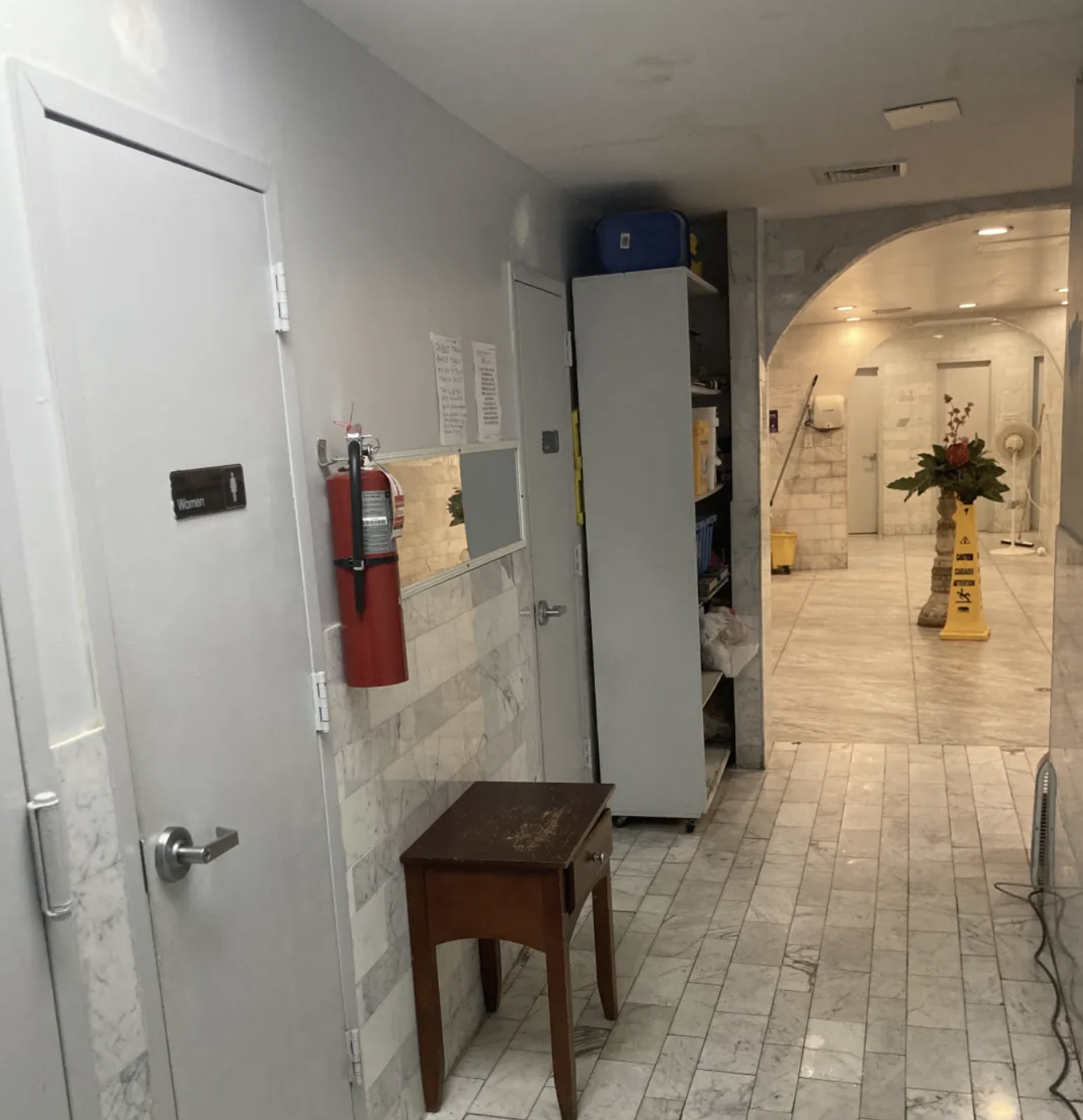
The wudu area wasn't as clean as it could be, probably due to the high foot traffic and the rainy weather, making the floor and restrooms a bit dirty. This might indicate a lack of regular upkeep, but it definitely highlighted the significant number of people using this mosque. After performing wudu, I headed straight to the men's prayer hall. As I entered, a Black brother was standing by the door, and I greeted him with a salam. His response was quite animated: his arm went halfway up, then swung down in a semicircle, firmly grasping my hand. With a rhythmic cadence, he repeatedly said, "Welcome, brother," "How are you doing?" and "You're doing great!" (likely approving of my enthusiastic response to him). After prayer, I leaned against the wall, and people kept greeting me. Compared to other places, New Yorkers are pretty well-informed. Folks elsewhere had no clue where I was from, but New York Muslims asked me more than once, "Are you Indonesian?"
NYC's Halal Food Carts: A Culinary Blessing
Speaking of halal food in New York, you simply can't skip the halal food carts – they're a huge part of New York's halal culinary scene. If you instinctively search "halal" on your map, most of the results you'll get are these food carts. These carts usually have fixed locations, and the map will show their spot along with customer reviews. The types of food they sell are pretty similar across the board: meat platters, rice bowls, hot dogs, and falafel. Some even have fried chicken if they're feeling a bit more adventurous.
On my first evening in Flushing, I broke my fast (iftar) with food from a cart. I ordered chicken over rice. The turmeric-colored long-grain rice was piled high with tender chicken, topped with a generous squeeze of white sauce and hot sauce. Even before I took a bite, my mouth was watering! And for a heaping container of that deliciousness, it only cost me $7. I immediately ordered another one to take for my suhoor (pre-dawn meal), grabbed a drink, and the total was $15. No exaggeration, this might just be the cheapest meal you can get in New York that's worth its salt. Of course, carts in Manhattan might charge a little more, but still usually under $10. Alhamdulillah for these blessings!
A Test of Faith in Manhattan: Halal Carts and Humble Mosques
Fasting while walking through the bustling streets of Manhattan is a massive test of sabr (patience). Despite my rumbling stomach, the tempting aroma from those halal food carts would waft into my nostrils every now and then. You know for sure that scent is halal, and sometimes you can't help but take an extra sniff or two, but there's nothing to do but sigh and hurry past. This temptation and the urge to buy don't just vanish. When you think you've missed out on a delicious meal, you turn the next corner and lo and behold, you find another cart. Look further down, and there's yet another halal food cart at the next intersection. By the time Iftar (breaking of fast) rolls around, you've probably passed a good dozen or so carts, and at that point, you're so famished you don't even want to explore which one has the most variety or the best taste.
Masjid Awliya of Allah: A Hidden Gem
As Iftar time drew near, my wife and I were walking around Times Square, passing one food cart after another, our eyes glued to the prize. I suggested we find a masjid to settle down and rest for a bit, then grab our food once it was time to break our fast, and head to the train station to go home. So, I searched and found this mosque: Masjid Awliya of Allah (Friends of Allah Mosque, located at 327 W 36th St., New York, NY 10018). It's probably the closest mosque to Times Square. We made a beeline for it, and as soon as we got to the entrance, my wife stared in disbelief and asked, "Are you sure this is a mosque?"
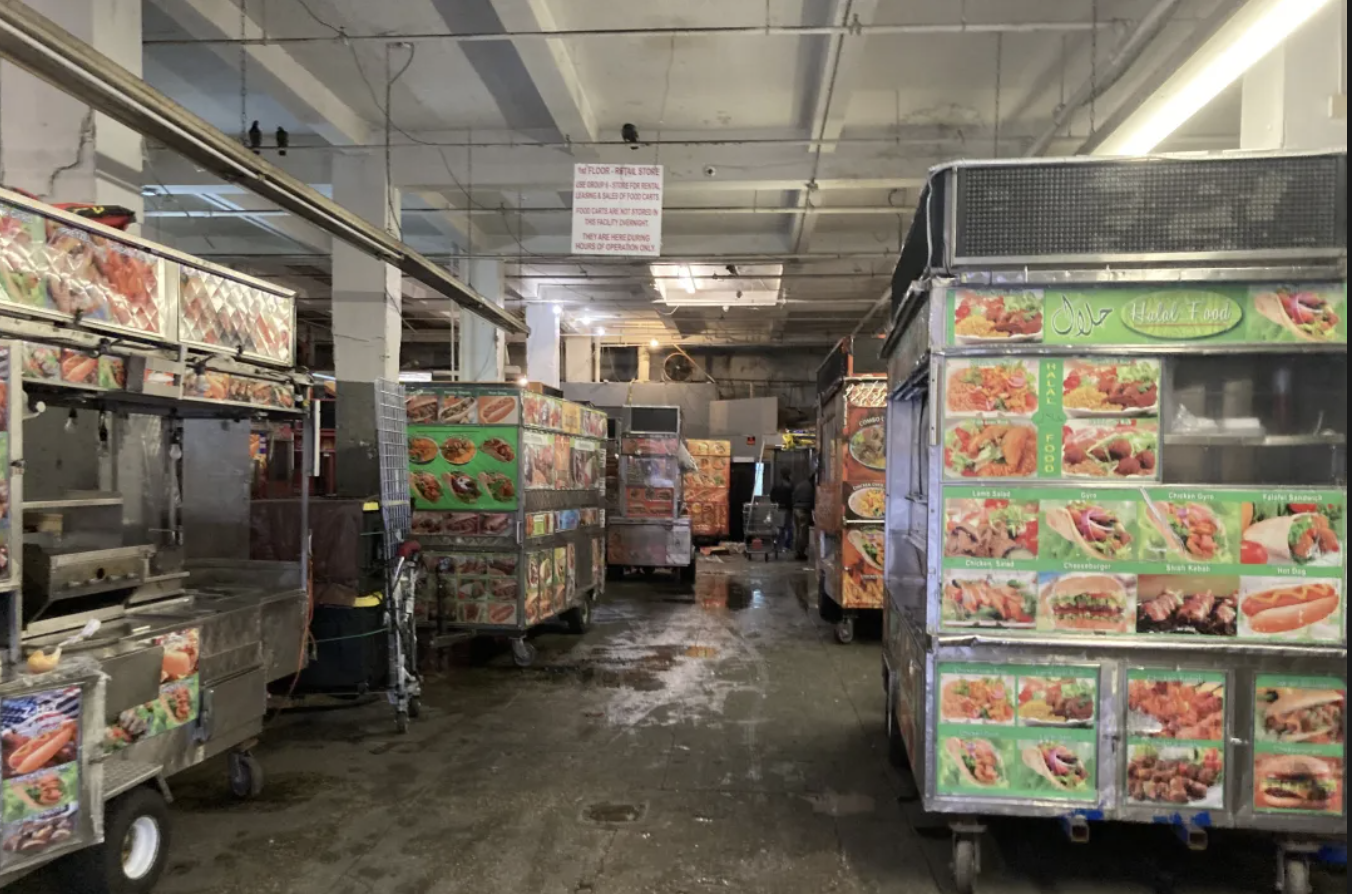
And honestly, at first glance, you'd think you'd stumbled into the Halal Food Cart Association. The entrance, as marked on the map, led into a huge warehouse chock-full of food carts waiting to be stocked up for their day's business. We asked someone inside, and he confirmed it was indeed the masjid. Then, he led us on a winding path, weaving through rows of food carts until we finally reached a staircase. Lo and behold! The actual masjid entrance was hidden behind this dense array of food trucks! We ascended to the second floor, where we found a small prayer room. Even with such limited space, they had a dedicated area for the sisters, masha'Allah. I quickly scanned the people resting; by their attire, most seemed to be delivery drivers or food cart vendors. This place had clearly become their perfect refuge from the elements, a spot to enjoy a moment of tranquility amidst their busy lives. The only downside was that the wudu (ablution) area in this mosque had no partitions, just a large communal water basin. It wasn't very convenient for the sisters to perform wudu, so we decided to head out.
The Ever-Present Mercy (of Allah)
Back on the street, my wife and I were beat, our feet killing us. I pointed to the map and said, "There's another masjid not too far. Let's make a dash for it." At this point, I was pinning all my hopes on that one, praying it would be a more "conventional" masjid, a place where I could charge my phone and my body could get a quick recharge too. Our train home was less than two hours away, so time was of the essence. We decided to grab some food from the "Tianshan" restaurant we'd just passed, saving it for tomorrow's suhoor (pre-dawn meal).
Walking up to the restaurant, we saw the menu taped to the window, filled with familiar dishes: "wontons," "roasted samosa-like buns," "stir-fried noodles with meat." We walked in, our hearts singing, thinking this must be authentic Chinese cuisine. At the ordering counter, my wife looked at a familiar-looking young man and started, "Hey, so, can I have a—" I cut in, blurting out, "Wontons!" The young man replied in Chinese, "Sorry, no wontons." We both looked at each other and shared a laugh. He asked about our situation, and we, in turn, asked about his. This young man, who had been in the U.S. for six years, told us his parents had also moved to New York. Hearing that, the slight tension in my brow eased a bit, as if a worry had lifted off my shoulders. I said, "That's the real deal." The young man, seeing we weren't planning to sit down, asked, "Are you also fasting?" Fearing he might misunderstand, I quickly said, "Yes, that's right! I'm taking it to go for suhoor." The young man wasn't questioning us; he just wanted to give us some dates, and with that, he started to head to the kitchen. We quickly stopped him, explaining that we already had plenty of dates, both ones we'd bought and some given to us for free at the masjid. But he insisted on giving us more. When we finally got our takeout bag, we saw a box of dates placed right next to our roasted buns. We thanked him profusely, saying, "Jazak Allah Khayr!" The young man waved us goodbye, calling out, "Come back anytime!"
Masjid al-Rahman: A True Sanctuary
With our suhoor taken care of, we made a beeline for our next masjid: Masjid al-Rahman (The Mosque of The Most Merciful). As we hurried along, I could already see men in kufis and women in hijabs gathered at the entrance from a distance. I told my wife, "Do you see that group of Muslim brothers and sisters up ahead? This time, we definitely haven't come to the wrong place!" The mosque had two roll-up doors, one covering the prayer hall and the other serving as the entrance. After confirming there was a designated women's prayer area and a women's wudu station, we couldn't wait to go inside and recharge.
After praying, I took a moment to truly examine this masjid. It wasn't small at all. As Iftar time drew near, the number of people was substantial. There were small groups chatting by the walls, and others reciting Quran to a teacher. Through their official website, I learned that the jama'ah (congregation) in this area had been gathering and renting places for Jumu'ah since the 1990s, enduring three relocations before finally settling here. The first floor was the main prayer hall, and the basement held another surprise. The masjid had covered the entire basement with tablecloths, waiting for those breaking their fast to arrive.
I leaned against a pillar, charging my phone and resting. A study circle behind me caught my interest. Some young men were sitting around an elder, who was clearly imparting ilm (knowledge). About twenty minutes passed, and I figured my phone was charged enough. I quickly unplugged it and discreetly slipped into a spot next to a brother, not wanting to miss anything. I whispered to him, "Is this a halaqah (study circle) for new Muslims?" The brother whispered back, explaining that it covered basic Islamic knowledge, Quranic studies, and more. Our whispering must have disturbed the elder, as he paused his talk and reminded us to be quiet. We awkwardly sat upright in our places.
The Wisdom of Obligation Versus Tradition
When I joined, it was exactly during the Q&A session. A brother across from me, with the trendiest dreadlocks, was casually leaning against the wall, legs stretched out. Suddenly, the elder turned to him and asked gravely, "What are the seven external conditions for Salat (prayer)?" The young man immediately straightened up, knelt with his thighs upright, placed his hands on his thighs, closed his eyes tightly, and answered the Shaykh's question precisely: "Purity of body, purity of clothes, purity of place of prayer, covering the awrah (modesty), praying on time, facing the qibla, and having the correct niyyah (intention)!" At that moment, he sat rigidly, looking just like a student called to task. The Shaykh then asked about the essential elements of prayer and wudu. Finally, he asked him to recite Surah Al-Ikhlas ("The Chapter of Sincerity"). After answering all this, the young man slumped back into his original relaxed posture, like a balloon that had lost its air.
This teaching method was quite insightful. If we reflect on our own learning process for things like wudu, we often don't explicitly differentiate between its fardh (obligatory) and Sunnah (Prophetic tradition) elements. Instead, the focus is on formal instruction, teaching the entire wudu procedure as a whole. The same goes for salat. Every movement, every recitation is ingrained in our bones, but if you're pressed to explain what's fardh and what's Sunnah, you might not remember it with such clarity. This somewhat pragmatic approach, not emphasizing the distinction, can lead us to treat fardh and Sunnah as equally essential in practice. In special circumstances, our memory gets blurry, and it feels like everything is fardh and shouldn't be omitted. However, if we clearly understand that fardh are absolute obligations, and Sunnah are not strictly mandatory (referring only to special circumstances, as emphasized Sunnah implies you shouldn't casually abandon it!), then the issue becomes clear as daylight. I recall a brother recently asking in our group chat about the validity of wudu if one cannot rinse their mouth due to illness. How did the Imam answer? He said rinsing the mouth is Sunnah, so the wudu is still valid without it. Indeed, our Deen is one of ease.
The Abundance of Allah's Provision
Seeing the time was almost up, I told my wife to wait for me by the door while I quickly performed my wudu (ablution). When I emerged, my wife had a takeout container in her hand. She explained that one of the uncles at the masjid had seen us leaving and insisted she take a meal for iftar (breaking fast), a true blessing from Allah. We didn't have time to dwell on it; our minds were still set on the food carts we'd been eyeing, eager to get our actual iftar there.
After walking for less than five minutes, we finally settled on a large food cart. The young man working the cart seemed a bit green; he was out of pretty much everything we wanted, only having rice bowls and meat wraps left. We had no choice but to settle for what we could get. Just then, a Black uncle came bustling over. Without a word to the vendor, he grabbed some water from the cart, paid, and was about to leave. He seemed to notice my wife and I by our attire, and he extended a warm salam (peace greeting) to us. Masha'Allah.
After he left, I told my wife, "Subhanallah, there are so many Muslims here!" No sooner had the words left my mouth than the uncle reappeared. This time, he was carrying a bag overflowing with fruits and dates. He pulled out some bananas and oranges and insisted we take them, shoving them into our hands. The other people waiting for food around us looked on, perplexed, wondering what in the world was going on. After the uncle left, I smiled at an auntie nearby and tried to explain, "We're Muslims, fasting, and he gave us food." The auntie just smiled back. It was clear she didn't speak English and didn't understand my explanation, but the gesture of brotherhood transcended language.
A Sister in Need, A Prophet's Wisdom
Just that morning, we were wondering what we'd eat, and now we had a whole bag full of food. It felt as though Allah's grace was continuously flowing into our lives. Alhamdulillah (all praise is due to Allah)! As we waited, a young woman wearing a white hijab (headscarf) came over to buy food. I pointed to the dates in our bag and gestured for my wife to offer her some. The girl took the dates, and her previously serious expression instantly lit up with a smile. My wife chatted with her, while I pointed her in the direction of the masjid. It turned out this sister had no idea where there was a mosque nearby where she could break her fast. Subhanallah! It was a perfect moment for a small act of kindness.
This experience brought to mind the beautiful Hadith (Prophetic tradition) where the Prophet Muhammad (peace be upon him) was asked, "Which act in Islam is the most excellent?" He replied, "To feed others and to greet with salam (peace) those whom you know and those whom you do not know." (Recorded in Sahih al-Bukhari and Sahih Muslim).
As we walked through the bustling streets of New York, my wife turned to me and said, "I feel so content with this trip." And how could I not feel the same? Indeed, Subhanallah, what a blessed journey!
view all
As the southbound train gently rolled into Brooklyn on the East Coast, looking out the window, you suddenly see those towering skyscrapers of Manhattan. At that moment, you can't help but exclaim, "We've made it to New York!" I quickly pulled out my phone and snapped a couple of shots. It's that feeling you get looking at the Lujiazui skyline from the Bund in Shanghai – it's like a calling card, as if it is the entire city. Of course, to truly appreciate the beauty of such urban grandeur, it's always better to keep your distance, to remain an observer.
Eventually, our train pulled into Penn Station, right in Midtown Manhattan. This, my friends, is the busiest train station in all of America, sitting near Times Square, with its entire concourse and waiting areas completely underground. Unlike back home, here there isn't just one rail company. The waiting areas are split into three sections – Amtrak, Long Island Rail Road, and NJ Transit – each managed by their own company. Amtrak and NJ Transit are on the first basement level, while Long Island Rail Road is on the second basement level. We got off the train and made our way through the Moynihan Train Hall to street level. As an old-school NBA fan, I was absolutely stunned to realize that the building right above the station was Madison Square Garden, the home of the New York Knicks! There I was, wearing my Brooklyn Nets jacket, feeling just a tad out of place. Subhanallah, what a welcome!
Navigating the NYC Subway: A Leap of Faith
Our first day in New York happened to be a Monday, and we'd already planned to hit the Metropolitan Museum of Art, which was open. I stared at the complex subway map, finally picking a line that didn't require any transfers – we'd get off and just walk through Central Park to the Met. I'd heard stories before coming here: the New York subway runs 24/7, and there are no barriers between the platforms and the tracks, just like the old Shanghai Metro Line 3/4. Word on the street was that people waiting on the platforms always choose to stand against the wall because some crazy person might just push you onto the tracks. Others warned that the NYC subway reeked, rats scurried everywhere, and you'd see all sorts of eccentrically dressed characters, plus rumors of anti-Asian violence. It sounded like a no-go zone, a place to avoid at all costs, as if this bizarre underworld gathered all the evil of the city.
But honestly, the thing that chapped my hide the most was buying a subway ticket. You can't buy tickets from a human; you're stuck using these ancient-looking, grandpa-era ticket machines on the wall. Since we didn't have enough cash, my wife and I tried our credit cards a gazillion times, but it was a bust every time. We finally had to scrounge up some coins from a passerby to buy our tickets. Later, when I was venting about this to Wasim (the young brother I met in Flushing), he just chuckled and told me you could actually just tap your credit card directly on the turnstile. My actual experience riding the subway, however, felt perfectly normal: the same crowds, the same bumps and jostles. Every now and then, you'd see someone leaning against the door, their eyes closed, swaying precariously, looking like they were about to keel over onto you at any moment. May Allah protect us all.
Central Park: A Spiritual Oasis
After getting off the subway, we crossed the street to the west entrance of Central Park. Our plan was to cut through the park to reach the Met on the east side. This route turned out to be an absolute winner. Central Park is simply breathtaking; the city's usual hustle and bustle just stops cold here. It's crawling with people walking their dogs, jogging, and just strolling along. Central Park is massive, like a sharp sword plunged right into the heart of the city.
The park feels like a sanctuary for the soul, pulling you away from the heavy burden of work, if only for a short while, and healing the wounds within. The park is surrounded by a dense forest of skyscrapers, and behind them are the crowded streets. The roads separate the park from the buildings that rise abruptly from the ground, almost like a dividing line between reality and an ideal. Central Park has been around for over a hundred years, and it hasn't been developed into housing projects as the city grew. In fact, it's even gotten bigger. The city's planners clearly see it as a balance between work and leisure, a true ni'mah (blessing) for the residents.
Islamic Cultural Center of New York: A Thriving Ummah
Lately, my social media has been flooded with posts from my brothers and sisters in New York. They're back to performing Tarawih (Ramadan night prayers) in Times Square. They cordon off a rectangular area amidst the crowds, standing with their backs to that iconic, gigantic screen. Even with a light rain, the Imam leading the prayer recited the beautiful Quran into a microphone, his melodious voice cutting through the surrounding clamor. The dhul-jism (Muslims) behind him, their lips moving, quietly recited along with the Imam, completely undisturbed by the environment. By now, most New Yorkers probably don't even bat an eye at this sight. When you look at the number of mosques and the Muslim population, New York might just be considered the halal capital of America. Data from 2018 showed that over 750,000 Muslims lived in New York City, making it the city with the largest Muslim population in the U.S. Roughly 9% of New York City residents are Muslims, accounting for 22.3% of America's total Muslim population. And New York City boasts over 200 mosques, scattered in every corner of the metropolis. Masha'Allah, the Ummah is truly thriving here.
Okay, here's the translation of your article, incorporating the requested style, tone, and vocabulary:
The Islamic Cultural Center of New York: A Beacon of Faith
Perhaps it all began with the completion of the Islamic Cultural Center. In Manhattan, no other mosque stands out quite like the Islamic Cultural Center of New York, located between East 96th and 97th Streets in the Upper East Side. Due to the need to face the Kaaba for prayer, the entire building is angled about thirty degrees to the street. This Islamic Cultural Center is New York's first purpose-built mosque and one of the largest in the city. When this mosque, with its dome soaring 27 meters high and minaret reaching 40 meters, was completed, Islam seemed to suddenly burst onto the scene for New Yorkers. The dedication of this masjid felt like New York granting a new identity card to its Muslims, acknowledging and embracing their presence in the city. After its opening, Muslim culture, by the grace of Allah, truly became an integral part of this vibrant metropolis.
The ambitious plan to establish a large Islamic center in New York was first conceived in the late 1960s. The initial Islamic center operated on a small scale in a modest townhouse. Later, the board of directors envisioned a grander center to elevate the prestige of Islam and to become one of New York City's iconic landmarks. Eventually, a comprehensive project including a mosque, a school, a library, a museum, and an auditorium was planned. After years of delays, including fundraising from Muslim countries, lengthy tenant relocations, and the eventual demolition of existing structures on the site, construction of the Islamic Cultural Center finally began in October 1984. The mosque itself started construction on May 28, 1987, a day that perfectly coincided with the end of Ramadan. Construction was even further delayed during the Iraqi invasion of Kuwait and the First Gulf War. Finally, the mosque officially opened its doors on April 15, 1991, which was the blessed day of Eid al-Fitr. Throughout this monumental process, over 46 Muslim nations contributed to the center's $17 million construction cost, with Kuwait alone donating a staggering two-thirds of the total. Truly, this center embodies the hopes of Muslims from nearly every country in the world; even in this place, famously known as the "center of the universe," Islam continues to flourish. Allahu Akbar!
This mosque just so happened to be near the museum we were visiting. We arrived after the Asr prayer time had passed, so we performed our salah individually. The constant stream of people coming and going was incredible; new prayer congregations were forming one after another. I even witnessed a truly fascinating sight: a New York Police Department (NYPD) officer, in full uniform, became a temporary Imam, leading a few Muslim brothers behind him in prayer. In that moment, there was no law enforcement and no civilians, only ikhwah (brothers) bowing together towards the Kaaba. Near the entrance of the mosque, there was also a small shop selling books and various Muslim essentials. Before leaving, I bought a black prayer cap, and my wife picked up a box of dates. After settling the bill, we were about to head out when the shop owner suddenly called us back. She must have gathered from our brief chat that we were tourists. She then gave us some extra dates, explaining they were from Madinah, and also handed us two bottles of water. Mind you, we had only spent twelve bucks in total, and the items the kind sister gave us were easily worth at least five dollars. May Allah bless her for her generosity!
It was a bit of a bummer, though, that only the first floor of this mosque was open during our visit. The doors to the second and third floors were firmly locked, so we couldn't explore them fully.
Manhattan's "Rest Stops" for the Faithful
Aside from a handful of mosques whose unique architecture immediately gives them away, most mosques in Manhattan are incognito from the outside, blending seamlessly with office buildings and townhouses. You often have to get close and rely on the name of the mosque on the doorplate and the Muslims going in and out to confirm its identity.
More often than not, a mosque in Manhattan is like a mini "Central Park" for Muslims. The peaceful prayer hall inside is a world apart from the bustling environment outside the door. Muslims come and go, entering through an inconspicuous little door, quickly heading to the wudu facilities in the basement to perform their ablution. After that, they quietly perform their salah, and if they're tired, they lean against a wall for a quick rest. When it's time for work or if they have an urgent matter, they quickly leave. Traveling during Ramadan can be a bit tiring, so I gave up on my specific plans to visit every mosque. Instead, I just started treating them as places to rest. If I felt weary, I'd find a mosque, step inside for a breather, and then continue my journey. Alhamdulillah for these havens.
The Islamic Society of Mid Manhattan on 55th Street (154 E 55th St, New York) is a prime example of such a mosque. It doesn't have a grand entrance or stand alone; it looks just like the surrounding apartment buildings, accessed through a small door. Braving the rainy weather, we followed the directions from a fellow Muslim brother outside and easily entered the mosque. After walking in, you go down a long corridor, almost like a wormhole, and suddenly you've transported from the chaos of Manhattan to the quiet peace of home.
The wudu area wasn't as clean as it could be, probably due to the high foot traffic and the rainy weather, making the floor and restrooms a bit dirty. This might indicate a lack of regular upkeep, but it definitely highlighted the significant number of people using this mosque. After performing wudu, I headed straight to the men's prayer hall. As I entered, a Black brother was standing by the door, and I greeted him with a salam. His response was quite animated: his arm went halfway up, then swung down in a semicircle, firmly grasping my hand. With a rhythmic cadence, he repeatedly said, "Welcome, brother," "How are you doing?" and "You're doing great!" (likely approving of my enthusiastic response to him). After prayer, I leaned against the wall, and people kept greeting me. Compared to other places, New Yorkers are pretty well-informed. Folks elsewhere had no clue where I was from, but New York Muslims asked me more than once, "Are you Indonesian?"
NYC's Halal Food Carts: A Culinary Blessing
Speaking of halal food in New York, you simply can't skip the halal food carts – they're a huge part of New York's halal culinary scene. If you instinctively search "halal" on your map, most of the results you'll get are these food carts. These carts usually have fixed locations, and the map will show their spot along with customer reviews. The types of food they sell are pretty similar across the board: meat platters, rice bowls, hot dogs, and falafel. Some even have fried chicken if they're feeling a bit more adventurous.
On my first evening in Flushing, I broke my fast (iftar) with food from a cart. I ordered chicken over rice. The turmeric-colored long-grain rice was piled high with tender chicken, topped with a generous squeeze of white sauce and hot sauce. Even before I took a bite, my mouth was watering! And for a heaping container of that deliciousness, it only cost me $7. I immediately ordered another one to take for my suhoor (pre-dawn meal), grabbed a drink, and the total was $15. No exaggeration, this might just be the cheapest meal you can get in New York that's worth its salt. Of course, carts in Manhattan might charge a little more, but still usually under $10. Alhamdulillah for these blessings!
A Test of Faith in Manhattan: Halal Carts and Humble Mosques
Fasting while walking through the bustling streets of Manhattan is a massive test of sabr (patience). Despite my rumbling stomach, the tempting aroma from those halal food carts would waft into my nostrils every now and then. You know for sure that scent is halal, and sometimes you can't help but take an extra sniff or two, but there's nothing to do but sigh and hurry past. This temptation and the urge to buy don't just vanish. When you think you've missed out on a delicious meal, you turn the next corner and lo and behold, you find another cart. Look further down, and there's yet another halal food cart at the next intersection. By the time Iftar (breaking of fast) rolls around, you've probably passed a good dozen or so carts, and at that point, you're so famished you don't even want to explore which one has the most variety or the best taste.
Masjid Awliya of Allah: A Hidden Gem
As Iftar time drew near, my wife and I were walking around Times Square, passing one food cart after another, our eyes glued to the prize. I suggested we find a masjid to settle down and rest for a bit, then grab our food once it was time to break our fast, and head to the train station to go home. So, I searched and found this mosque: Masjid Awliya of Allah (Friends of Allah Mosque, located at 327 W 36th St., New York, NY 10018). It's probably the closest mosque to Times Square. We made a beeline for it, and as soon as we got to the entrance, my wife stared in disbelief and asked, "Are you sure this is a mosque?"
And honestly, at first glance, you'd think you'd stumbled into the Halal Food Cart Association. The entrance, as marked on the map, led into a huge warehouse chock-full of food carts waiting to be stocked up for their day's business. We asked someone inside, and he confirmed it was indeed the masjid. Then, he led us on a winding path, weaving through rows of food carts until we finally reached a staircase. Lo and behold! The actual masjid entrance was hidden behind this dense array of food trucks! We ascended to the second floor, where we found a small prayer room. Even with such limited space, they had a dedicated area for the sisters, masha'Allah. I quickly scanned the people resting; by their attire, most seemed to be delivery drivers or food cart vendors. This place had clearly become their perfect refuge from the elements, a spot to enjoy a moment of tranquility amidst their busy lives. The only downside was that the wudu (ablution) area in this mosque had no partitions, just a large communal water basin. It wasn't very convenient for the sisters to perform wudu, so we decided to head out.
The Ever-Present Mercy (of Allah)
Back on the street, my wife and I were beat, our feet killing us. I pointed to the map and said, "There's another masjid not too far. Let's make a dash for it." At this point, I was pinning all my hopes on that one, praying it would be a more "conventional" masjid, a place where I could charge my phone and my body could get a quick recharge too. Our train home was less than two hours away, so time was of the essence. We decided to grab some food from the "Tianshan" restaurant we'd just passed, saving it for tomorrow's suhoor (pre-dawn meal).
Walking up to the restaurant, we saw the menu taped to the window, filled with familiar dishes: "wontons," "roasted samosa-like buns," "stir-fried noodles with meat." We walked in, our hearts singing, thinking this must be authentic Chinese cuisine. At the ordering counter, my wife looked at a familiar-looking young man and started, "Hey, so, can I have a—" I cut in, blurting out, "Wontons!" The young man replied in Chinese, "Sorry, no wontons." We both looked at each other and shared a laugh. He asked about our situation, and we, in turn, asked about his. This young man, who had been in the U.S. for six years, told us his parents had also moved to New York. Hearing that, the slight tension in my brow eased a bit, as if a worry had lifted off my shoulders. I said, "That's the real deal." The young man, seeing we weren't planning to sit down, asked, "Are you also fasting?" Fearing he might misunderstand, I quickly said, "Yes, that's right! I'm taking it to go for suhoor." The young man wasn't questioning us; he just wanted to give us some dates, and with that, he started to head to the kitchen. We quickly stopped him, explaining that we already had plenty of dates, both ones we'd bought and some given to us for free at the masjid. But he insisted on giving us more. When we finally got our takeout bag, we saw a box of dates placed right next to our roasted buns. We thanked him profusely, saying, "Jazak Allah Khayr!" The young man waved us goodbye, calling out, "Come back anytime!"
Masjid al-Rahman: A True Sanctuary
With our suhoor taken care of, we made a beeline for our next masjid: Masjid al-Rahman (The Mosque of The Most Merciful). As we hurried along, I could already see men in kufis and women in hijabs gathered at the entrance from a distance. I told my wife, "Do you see that group of Muslim brothers and sisters up ahead? This time, we definitely haven't come to the wrong place!" The mosque had two roll-up doors, one covering the prayer hall and the other serving as the entrance. After confirming there was a designated women's prayer area and a women's wudu station, we couldn't wait to go inside and recharge.
After praying, I took a moment to truly examine this masjid. It wasn't small at all. As Iftar time drew near, the number of people was substantial. There were small groups chatting by the walls, and others reciting Quran to a teacher. Through their official website, I learned that the jama'ah (congregation) in this area had been gathering and renting places for Jumu'ah since the 1990s, enduring three relocations before finally settling here. The first floor was the main prayer hall, and the basement held another surprise. The masjid had covered the entire basement with tablecloths, waiting for those breaking their fast to arrive.
I leaned against a pillar, charging my phone and resting. A study circle behind me caught my interest. Some young men were sitting around an elder, who was clearly imparting ilm (knowledge). About twenty minutes passed, and I figured my phone was charged enough. I quickly unplugged it and discreetly slipped into a spot next to a brother, not wanting to miss anything. I whispered to him, "Is this a halaqah (study circle) for new Muslims?" The brother whispered back, explaining that it covered basic Islamic knowledge, Quranic studies, and more. Our whispering must have disturbed the elder, as he paused his talk and reminded us to be quiet. We awkwardly sat upright in our places.
The Wisdom of Obligation Versus Tradition
When I joined, it was exactly during the Q&A session. A brother across from me, with the trendiest dreadlocks, was casually leaning against the wall, legs stretched out. Suddenly, the elder turned to him and asked gravely, "What are the seven external conditions for Salat (prayer)?" The young man immediately straightened up, knelt with his thighs upright, placed his hands on his thighs, closed his eyes tightly, and answered the Shaykh's question precisely: "Purity of body, purity of clothes, purity of place of prayer, covering the awrah (modesty), praying on time, facing the qibla, and having the correct niyyah (intention)!" At that moment, he sat rigidly, looking just like a student called to task. The Shaykh then asked about the essential elements of prayer and wudu. Finally, he asked him to recite Surah Al-Ikhlas ("The Chapter of Sincerity"). After answering all this, the young man slumped back into his original relaxed posture, like a balloon that had lost its air.
This teaching method was quite insightful. If we reflect on our own learning process for things like wudu, we often don't explicitly differentiate between its fardh (obligatory) and Sunnah (Prophetic tradition) elements. Instead, the focus is on formal instruction, teaching the entire wudu procedure as a whole. The same goes for salat. Every movement, every recitation is ingrained in our bones, but if you're pressed to explain what's fardh and what's Sunnah, you might not remember it with such clarity. This somewhat pragmatic approach, not emphasizing the distinction, can lead us to treat fardh and Sunnah as equally essential in practice. In special circumstances, our memory gets blurry, and it feels like everything is fardh and shouldn't be omitted. However, if we clearly understand that fardh are absolute obligations, and Sunnah are not strictly mandatory (referring only to special circumstances, as emphasized Sunnah implies you shouldn't casually abandon it!), then the issue becomes clear as daylight. I recall a brother recently asking in our group chat about the validity of wudu if one cannot rinse their mouth due to illness. How did the Imam answer? He said rinsing the mouth is Sunnah, so the wudu is still valid without it. Indeed, our Deen is one of ease.
The Abundance of Allah's Provision
Seeing the time was almost up, I told my wife to wait for me by the door while I quickly performed my wudu (ablution). When I emerged, my wife had a takeout container in her hand. She explained that one of the uncles at the masjid had seen us leaving and insisted she take a meal for iftar (breaking fast), a true blessing from Allah. We didn't have time to dwell on it; our minds were still set on the food carts we'd been eyeing, eager to get our actual iftar there.
After walking for less than five minutes, we finally settled on a large food cart. The young man working the cart seemed a bit green; he was out of pretty much everything we wanted, only having rice bowls and meat wraps left. We had no choice but to settle for what we could get. Just then, a Black uncle came bustling over. Without a word to the vendor, he grabbed some water from the cart, paid, and was about to leave. He seemed to notice my wife and I by our attire, and he extended a warm salam (peace greeting) to us. Masha'Allah.
After he left, I told my wife, "Subhanallah, there are so many Muslims here!" No sooner had the words left my mouth than the uncle reappeared. This time, he was carrying a bag overflowing with fruits and dates. He pulled out some bananas and oranges and insisted we take them, shoving them into our hands. The other people waiting for food around us looked on, perplexed, wondering what in the world was going on. After the uncle left, I smiled at an auntie nearby and tried to explain, "We're Muslims, fasting, and he gave us food." The auntie just smiled back. It was clear she didn't speak English and didn't understand my explanation, but the gesture of brotherhood transcended language.
A Sister in Need, A Prophet's Wisdom
Just that morning, we were wondering what we'd eat, and now we had a whole bag full of food. It felt as though Allah's grace was continuously flowing into our lives. Alhamdulillah (all praise is due to Allah)! As we waited, a young woman wearing a white hijab (headscarf) came over to buy food. I pointed to the dates in our bag and gestured for my wife to offer her some. The girl took the dates, and her previously serious expression instantly lit up with a smile. My wife chatted with her, while I pointed her in the direction of the masjid. It turned out this sister had no idea where there was a mosque nearby where she could break her fast. Subhanallah! It was a perfect moment for a small act of kindness.
This experience brought to mind the beautiful Hadith (Prophetic tradition) where the Prophet Muhammad (peace be upon him) was asked, "Which act in Islam is the most excellent?" He replied, "To feed others and to greet with salam (peace) those whom you know and those whom you do not know." (Recorded in Sahih al-Bukhari and Sahih Muslim).
As we walked through the bustling streets of New York, my wife turned to me and said, "I feel so content with this trip." And how could I not feel the same? Indeed, Subhanallah, what a blessed journey!
view all
Ramadan in the Big Apple: My 2025 islamic Journey to Manhattan, NYC
As the southbound train gently rolled into Brooklyn on the East Coast, looking out the window, you suddenly see those towering skyscrapers of Manhattan. At that moment, you can't help but exclaim, "We've made it to New York!" I quickly pulled out my phone and snapped a couple of shots. It's that feeling you get looking at the Lujiazui skyline from the Bund in Shanghai – it's like a calling card, as if it is the entire city. Of course, to truly appreciate the beauty of such urban grandeur, it's always better to keep your distance, to remain an observer.
Eventually, our train pulled into Penn Station, right in Midtown Manhattan. This, my friends, is the busiest train station in all of America, sitting near Times Square, with its entire concourse and waiting areas completely underground. Unlike back home, here there isn't just one rail company. The waiting areas are split into three sections – Amtrak, Long Island Rail Road, and NJ Transit – each managed by their own company. Amtrak and NJ Transit are on the first basement level, while Long Island Rail Road is on the second basement level. We got off the train and made our way through the Moynihan Train Hall to street level. As an old-school NBA fan, I was absolutely stunned to realize that the building right above the station was Madison Square Garden, the home of the New York Knicks! There I was, wearing my Brooklyn Nets jacket, feeling just a tad out of place. Subhanallah, what a welcome!

Navigating the NYC Subway: A Leap of Faith
Our first day in New York happened to be a Monday, and we'd already planned to hit the Metropolitan Museum of Art, which was open. I stared at the complex subway map, finally picking a line that didn't require any transfers – we'd get off and just walk through Central Park to the Met. I'd heard stories before coming here: the New York subway runs 24/7, and there are no barriers between the platforms and the tracks, just like the old Shanghai Metro Line 3/4. Word on the street was that people waiting on the platforms always choose to stand against the wall because some crazy person might just push you onto the tracks. Others warned that the NYC subway reeked, rats scurried everywhere, and you'd see all sorts of eccentrically dressed characters, plus rumors of anti-Asian violence. It sounded like a no-go zone, a place to avoid at all costs, as if this bizarre underworld gathered all the evil of the city.


But honestly, the thing that chapped my hide the most was buying a subway ticket. You can't buy tickets from a human; you're stuck using these ancient-looking, grandpa-era ticket machines on the wall. Since we didn't have enough cash, my wife and I tried our credit cards a gazillion times, but it was a bust every time. We finally had to scrounge up some coins from a passerby to buy our tickets. Later, when I was venting about this to Wasim (the young brother I met in Flushing), he just chuckled and told me you could actually just tap your credit card directly on the turnstile. My actual experience riding the subway, however, felt perfectly normal: the same crowds, the same bumps and jostles. Every now and then, you'd see someone leaning against the door, their eyes closed, swaying precariously, looking like they were about to keel over onto you at any moment. May Allah protect us all.
Central Park: A Spiritual Oasis
After getting off the subway, we crossed the street to the west entrance of Central Park. Our plan was to cut through the park to reach the Met on the east side. This route turned out to be an absolute winner. Central Park is simply breathtaking; the city's usual hustle and bustle just stops cold here. It's crawling with people walking their dogs, jogging, and just strolling along. Central Park is massive, like a sharp sword plunged right into the heart of the city.


The park feels like a sanctuary for the soul, pulling you away from the heavy burden of work, if only for a short while, and healing the wounds within. The park is surrounded by a dense forest of skyscrapers, and behind them are the crowded streets. The roads separate the park from the buildings that rise abruptly from the ground, almost like a dividing line between reality and an ideal. Central Park has been around for over a hundred years, and it hasn't been developed into housing projects as the city grew. In fact, it's even gotten bigger. The city's planners clearly see it as a balance between work and leisure, a true ni'mah (blessing) for the residents.
Islamic Cultural Center of New York: A Thriving Ummah
Lately, my social media has been flooded with posts from my brothers and sisters in New York. They're back to performing Tarawih (Ramadan night prayers) in Times Square. They cordon off a rectangular area amidst the crowds, standing with their backs to that iconic, gigantic screen. Even with a light rain, the Imam leading the prayer recited the beautiful Quran into a microphone, his melodious voice cutting through the surrounding clamor. The dhul-jism (Muslims) behind him, their lips moving, quietly recited along with the Imam, completely undisturbed by the environment. By now, most New Yorkers probably don't even bat an eye at this sight. When you look at the number of mosques and the Muslim population, New York might just be considered the halal capital of America. Data from 2018 showed that over 750,000 Muslims lived in New York City, making it the city with the largest Muslim population in the U.S. Roughly 9% of New York City residents are Muslims, accounting for 22.3% of America's total Muslim population. And New York City boasts over 200 mosques, scattered in every corner of the metropolis. Masha'Allah, the Ummah is truly thriving here.
Okay, here's the translation of your article, incorporating the requested style, tone, and vocabulary:
The Islamic Cultural Center of New York: A Beacon of Faith
Perhaps it all began with the completion of the Islamic Cultural Center. In Manhattan, no other mosque stands out quite like the Islamic Cultural Center of New York, located between East 96th and 97th Streets in the Upper East Side. Due to the need to face the Kaaba for prayer, the entire building is angled about thirty degrees to the street. This Islamic Cultural Center is New York's first purpose-built mosque and one of the largest in the city. When this mosque, with its dome soaring 27 meters high and minaret reaching 40 meters, was completed, Islam seemed to suddenly burst onto the scene for New Yorkers. The dedication of this masjid felt like New York granting a new identity card to its Muslims, acknowledging and embracing their presence in the city. After its opening, Muslim culture, by the grace of Allah, truly became an integral part of this vibrant metropolis.

The ambitious plan to establish a large Islamic center in New York was first conceived in the late 1960s. The initial Islamic center operated on a small scale in a modest townhouse. Later, the board of directors envisioned a grander center to elevate the prestige of Islam and to become one of New York City's iconic landmarks. Eventually, a comprehensive project including a mosque, a school, a library, a museum, and an auditorium was planned. After years of delays, including fundraising from Muslim countries, lengthy tenant relocations, and the eventual demolition of existing structures on the site, construction of the Islamic Cultural Center finally began in October 1984. The mosque itself started construction on May 28, 1987, a day that perfectly coincided with the end of Ramadan. Construction was even further delayed during the Iraqi invasion of Kuwait and the First Gulf War. Finally, the mosque officially opened its doors on April 15, 1991, which was the blessed day of Eid al-Fitr. Throughout this monumental process, over 46 Muslim nations contributed to the center's $17 million construction cost, with Kuwait alone donating a staggering two-thirds of the total. Truly, this center embodies the hopes of Muslims from nearly every country in the world; even in this place, famously known as the "center of the universe," Islam continues to flourish. Allahu Akbar!
This mosque just so happened to be near the museum we were visiting. We arrived after the Asr prayer time had passed, so we performed our salah individually. The constant stream of people coming and going was incredible; new prayer congregations were forming one after another. I even witnessed a truly fascinating sight: a New York Police Department (NYPD) officer, in full uniform, became a temporary Imam, leading a few Muslim brothers behind him in prayer. In that moment, there was no law enforcement and no civilians, only ikhwah (brothers) bowing together towards the Kaaba. Near the entrance of the mosque, there was also a small shop selling books and various Muslim essentials. Before leaving, I bought a black prayer cap, and my wife picked up a box of dates. After settling the bill, we were about to head out when the shop owner suddenly called us back. She must have gathered from our brief chat that we were tourists. She then gave us some extra dates, explaining they were from Madinah, and also handed us two bottles of water. Mind you, we had only spent twelve bucks in total, and the items the kind sister gave us were easily worth at least five dollars. May Allah bless her for her generosity!


It was a bit of a bummer, though, that only the first floor of this mosque was open during our visit. The doors to the second and third floors were firmly locked, so we couldn't explore them fully.
Manhattan's "Rest Stops" for the Faithful
Aside from a handful of mosques whose unique architecture immediately gives them away, most mosques in Manhattan are incognito from the outside, blending seamlessly with office buildings and townhouses. You often have to get close and rely on the name of the mosque on the doorplate and the Muslims going in and out to confirm its identity.

More often than not, a mosque in Manhattan is like a mini "Central Park" for Muslims. The peaceful prayer hall inside is a world apart from the bustling environment outside the door. Muslims come and go, entering through an inconspicuous little door, quickly heading to the wudu facilities in the basement to perform their ablution. After that, they quietly perform their salah, and if they're tired, they lean against a wall for a quick rest. When it's time for work or if they have an urgent matter, they quickly leave. Traveling during Ramadan can be a bit tiring, so I gave up on my specific plans to visit every mosque. Instead, I just started treating them as places to rest. If I felt weary, I'd find a mosque, step inside for a breather, and then continue my journey. Alhamdulillah for these havens.
The Islamic Society of Mid Manhattan on 55th Street (154 E 55th St, New York) is a prime example of such a mosque. It doesn't have a grand entrance or stand alone; it looks just like the surrounding apartment buildings, accessed through a small door. Braving the rainy weather, we followed the directions from a fellow Muslim brother outside and easily entered the mosque. After walking in, you go down a long corridor, almost like a wormhole, and suddenly you've transported from the chaos of Manhattan to the quiet peace of home.
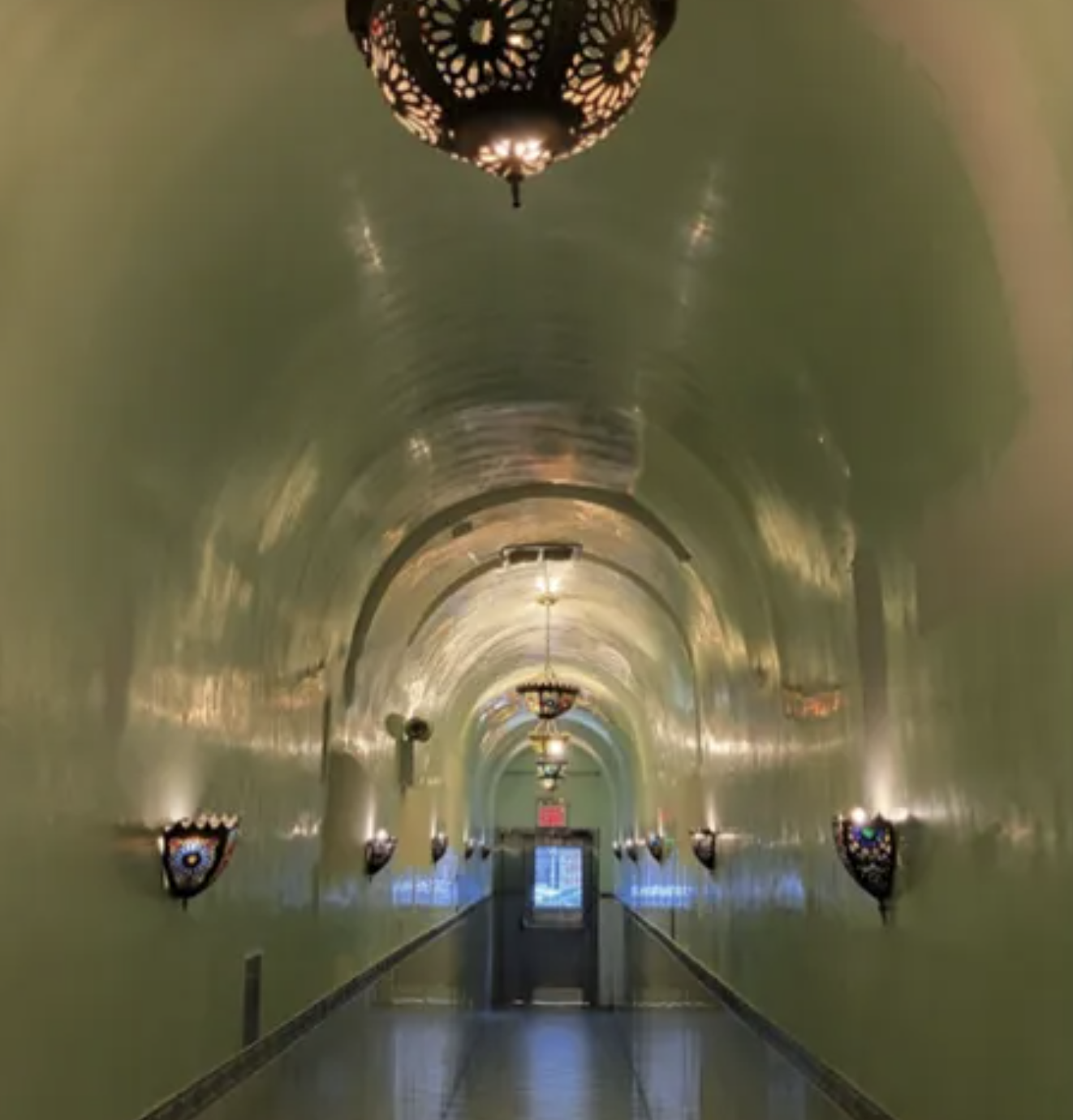
The wudu area wasn't as clean as it could be, probably due to the high foot traffic and the rainy weather, making the floor and restrooms a bit dirty. This might indicate a lack of regular upkeep, but it definitely highlighted the significant number of people using this mosque. After performing wudu, I headed straight to the men's prayer hall. As I entered, a Black brother was standing by the door, and I greeted him with a salam. His response was quite animated: his arm went halfway up, then swung down in a semicircle, firmly grasping my hand. With a rhythmic cadence, he repeatedly said, "Welcome, brother," "How are you doing?" and "You're doing great!" (likely approving of my enthusiastic response to him). After prayer, I leaned against the wall, and people kept greeting me. Compared to other places, New Yorkers are pretty well-informed. Folks elsewhere had no clue where I was from, but New York Muslims asked me more than once, "Are you Indonesian?"


NYC's Halal Food Carts: A Culinary Blessing
Speaking of halal food in New York, you simply can't skip the halal food carts – they're a huge part of New York's halal culinary scene. If you instinctively search "halal" on your map, most of the results you'll get are these food carts. These carts usually have fixed locations, and the map will show their spot along with customer reviews. The types of food they sell are pretty similar across the board: meat platters, rice bowls, hot dogs, and falafel. Some even have fried chicken if they're feeling a bit more adventurous.




On my first evening in Flushing, I broke my fast (iftar) with food from a cart. I ordered chicken over rice. The turmeric-colored long-grain rice was piled high with tender chicken, topped with a generous squeeze of white sauce and hot sauce. Even before I took a bite, my mouth was watering! And for a heaping container of that deliciousness, it only cost me $7. I immediately ordered another one to take for my suhoor (pre-dawn meal), grabbed a drink, and the total was $15. No exaggeration, this might just be the cheapest meal you can get in New York that's worth its salt. Of course, carts in Manhattan might charge a little more, but still usually under $10. Alhamdulillah for these blessings!
A Test of Faith in Manhattan: Halal Carts and Humble Mosques
Fasting while walking through the bustling streets of Manhattan is a massive test of sabr (patience). Despite my rumbling stomach, the tempting aroma from those halal food carts would waft into my nostrils every now and then. You know for sure that scent is halal, and sometimes you can't help but take an extra sniff or two, but there's nothing to do but sigh and hurry past. This temptation and the urge to buy don't just vanish. When you think you've missed out on a delicious meal, you turn the next corner and lo and behold, you find another cart. Look further down, and there's yet another halal food cart at the next intersection. By the time Iftar (breaking of fast) rolls around, you've probably passed a good dozen or so carts, and at that point, you're so famished you don't even want to explore which one has the most variety or the best taste.
Masjid Awliya of Allah: A Hidden Gem
As Iftar time drew near, my wife and I were walking around Times Square, passing one food cart after another, our eyes glued to the prize. I suggested we find a masjid to settle down and rest for a bit, then grab our food once it was time to break our fast, and head to the train station to go home. So, I searched and found this mosque: Masjid Awliya of Allah (Friends of Allah Mosque, located at 327 W 36th St., New York, NY 10018). It's probably the closest mosque to Times Square. We made a beeline for it, and as soon as we got to the entrance, my wife stared in disbelief and asked, "Are you sure this is a mosque?"
And honestly, at first glance, you'd think you'd stumbled into the Halal Food Cart Association. The entrance, as marked on the map, led into a huge warehouse chock-full of food carts waiting to be stocked up for their day's business. We asked someone inside, and he confirmed it was indeed the masjid. Then, he led us on a winding path, weaving through rows of food carts until we finally reached a staircase. Lo and behold! The actual masjid entrance was hidden behind this dense array of food trucks! We ascended to the second floor, where we found a small prayer room. Even with such limited space, they had a dedicated area for the sisters, masha'Allah. I quickly scanned the people resting; by their attire, most seemed to be delivery drivers or food cart vendors. This place had clearly become their perfect refuge from the elements, a spot to enjoy a moment of tranquility amidst their busy lives. The only downside was that the wudu (ablution) area in this mosque had no partitions, just a large communal water basin. It wasn't very convenient for the sisters to perform wudu, so we decided to head out.
The Ever-Present Mercy (of Allah)
Back on the street, my wife and I were beat, our feet killing us. I pointed to the map and said, "There's another masjid not too far. Let's make a dash for it." At this point, I was pinning all my hopes on that one, praying it would be a more "conventional" masjid, a place where I could charge my phone and my body could get a quick recharge too. Our train home was less than two hours away, so time was of the essence. We decided to grab some food from the "Tianshan" restaurant we'd just passed, saving it for tomorrow's suhoor (pre-dawn meal).
Walking up to the restaurant, we saw the menu taped to the window, filled with familiar dishes: "wontons," "roasted samosa-like buns," "stir-fried noodles with meat." We walked in, our hearts singing, thinking this must be authentic Chinese cuisine. At the ordering counter, my wife looked at a familiar-looking young man and started, "Hey, so, can I have a—" I cut in, blurting out, "Wontons!" The young man replied in Chinese, "Sorry, no wontons." We both looked at each other and shared a laugh. He asked about our situation, and we, in turn, asked about his. This young man, who had been in the U.S. for six years, told us his parents had also moved to New York. Hearing that, the slight tension in my brow eased a bit, as if a worry had lifted off my shoulders. I said, "That's the real deal." The young man, seeing we weren't planning to sit down, asked, "Are you also fasting?" Fearing he might misunderstand, I quickly said, "Yes, that's right! I'm taking it to go for suhoor." The young man wasn't questioning us; he just wanted to give us some dates, and with that, he started to head to the kitchen. We quickly stopped him, explaining that we already had plenty of dates, both ones we'd bought and some given to us for free at the masjid. But he insisted on giving us more. When we finally got our takeout bag, we saw a box of dates placed right next to our roasted buns. We thanked him profusely, saying, "Jazak Allah Khayr!" The young man waved us goodbye, calling out, "Come back anytime!"


Masjid al-Rahman: A True Sanctuary
With our suhoor taken care of, we made a beeline for our next masjid: Masjid al-Rahman (The Mosque of The Most Merciful). As we hurried along, I could already see men in kufis and women in hijabs gathered at the entrance from a distance. I told my wife, "Do you see that group of Muslim brothers and sisters up ahead? This time, we definitely haven't come to the wrong place!" The mosque had two roll-up doors, one covering the prayer hall and the other serving as the entrance. After confirming there was a designated women's prayer area and a women's wudu station, we couldn't wait to go inside and recharge.
After praying, I took a moment to truly examine this masjid. It wasn't small at all. As Iftar time drew near, the number of people was substantial. There were small groups chatting by the walls, and others reciting Quran to a teacher. Through their official website, I learned that the jama'ah (congregation) in this area had been gathering and renting places for Jumu'ah since the 1990s, enduring three relocations before finally settling here. The first floor was the main prayer hall, and the basement held another surprise. The masjid had covered the entire basement with tablecloths, waiting for those breaking their fast to arrive.
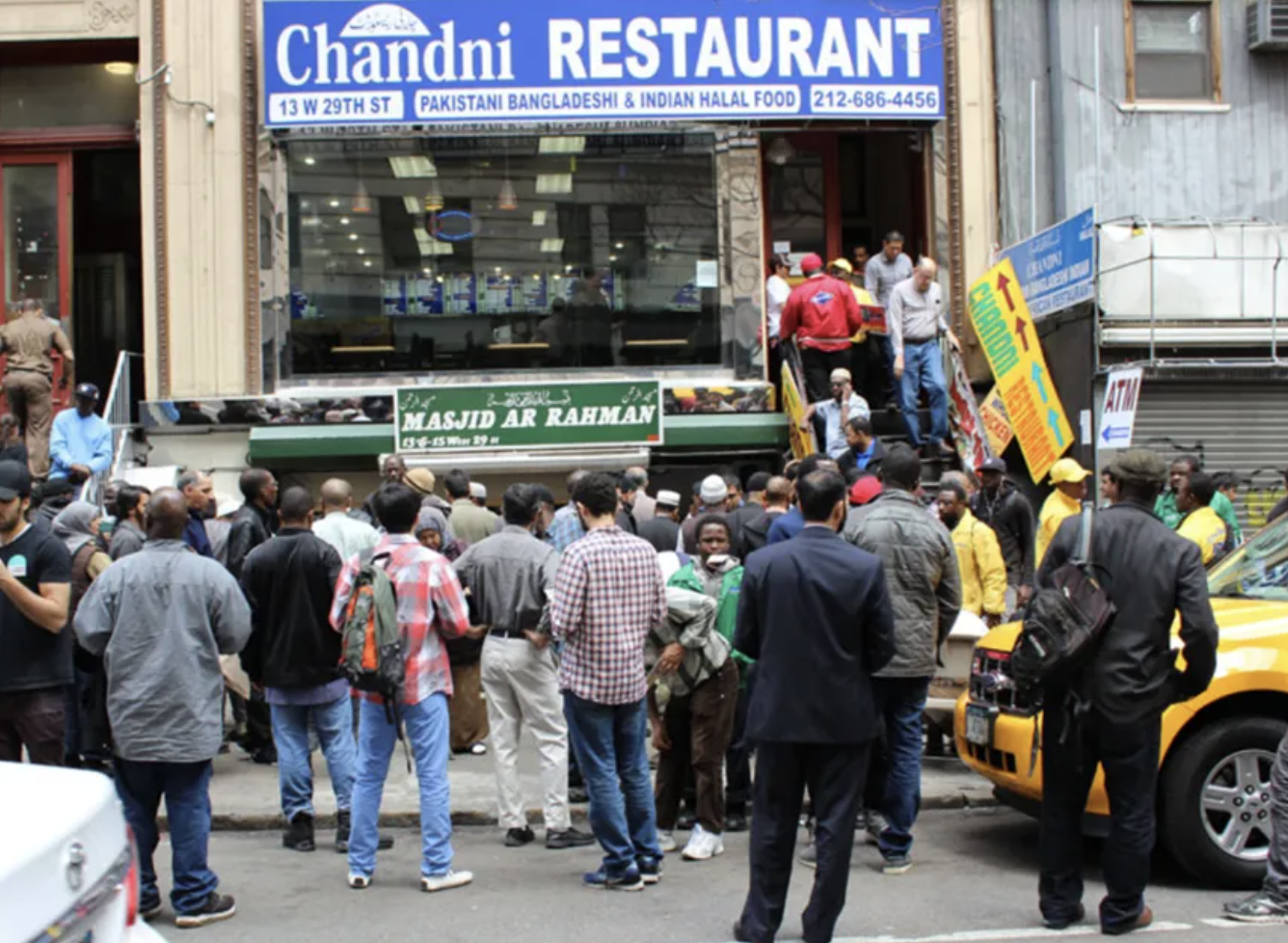

I leaned against a pillar, charging my phone and resting. A study circle behind me caught my interest. Some young men were sitting around an elder, who was clearly imparting ilm (knowledge). About twenty minutes passed, and I figured my phone was charged enough. I quickly unplugged it and discreetly slipped into a spot next to a brother, not wanting to miss anything. I whispered to him, "Is this a halaqah (study circle) for new Muslims?" The brother whispered back, explaining that it covered basic Islamic knowledge, Quranic studies, and more. Our whispering must have disturbed the elder, as he paused his talk and reminded us to be quiet. We awkwardly sat upright in our places.
The Wisdom of Obligation Versus Tradition
When I joined, it was exactly during the Q&A session. A brother across from me, with the trendiest dreadlocks, was casually leaning against the wall, legs stretched out. Suddenly, the elder turned to him and asked gravely, "What are the seven external conditions for Salat (prayer)?" The young man immediately straightened up, knelt with his thighs upright, placed his hands on his thighs, closed his eyes tightly, and answered the Shaykh's question precisely: "Purity of body, purity of clothes, purity of place of prayer, covering the awrah (modesty), praying on time, facing the qibla, and having the correct niyyah (intention)!" At that moment, he sat rigidly, looking just like a student called to task. The Shaykh then asked about the essential elements of prayer and wudu. Finally, he asked him to recite Surah Al-Ikhlas ("The Chapter of Sincerity"). After answering all this, the young man slumped back into his original relaxed posture, like a balloon that had lost its air.
This teaching method was quite insightful. If we reflect on our own learning process for things like wudu, we often don't explicitly differentiate between its fardh (obligatory) and Sunnah (Prophetic tradition) elements. Instead, the focus is on formal instruction, teaching the entire wudu procedure as a whole. The same goes for salat. Every movement, every recitation is ingrained in our bones, but if you're pressed to explain what's fardh and what's Sunnah, you might not remember it with such clarity. This somewhat pragmatic approach, not emphasizing the distinction, can lead us to treat fardh and Sunnah as equally essential in practice. In special circumstances, our memory gets blurry, and it feels like everything is fardh and shouldn't be omitted. However, if we clearly understand that fardh are absolute obligations, and Sunnah are not strictly mandatory (referring only to special circumstances, as emphasized Sunnah implies you shouldn't casually abandon it!), then the issue becomes clear as daylight. I recall a brother recently asking in our group chat about the validity of wudu if one cannot rinse their mouth due to illness. How did the Imam answer? He said rinsing the mouth is Sunnah, so the wudu is still valid without it. Indeed, our Deen is one of ease.


The Abundance of Allah's Provision
Seeing the time was almost up, I told my wife to wait for me by the door while I quickly performed my wudu (ablution). When I emerged, my wife had a takeout container in her hand. She explained that one of the uncles at the masjid had seen us leaving and insisted she take a meal for iftar (breaking fast), a true blessing from Allah. We didn't have time to dwell on it; our minds were still set on the food carts we'd been eyeing, eager to get our actual iftar there.
After walking for less than five minutes, we finally settled on a large food cart. The young man working the cart seemed a bit green; he was out of pretty much everything we wanted, only having rice bowls and meat wraps left. We had no choice but to settle for what we could get. Just then, a Black uncle came bustling over. Without a word to the vendor, he grabbed some water from the cart, paid, and was about to leave. He seemed to notice my wife and I by our attire, and he extended a warm salam (peace greeting) to us. Masha'Allah.
After he left, I told my wife, "Subhanallah, there are so many Muslims here!" No sooner had the words left my mouth than the uncle reappeared. This time, he was carrying a bag overflowing with fruits and dates. He pulled out some bananas and oranges and insisted we take them, shoving them into our hands. The other people waiting for food around us looked on, perplexed, wondering what in the world was going on. After the uncle left, I smiled at an auntie nearby and tried to explain, "We're Muslims, fasting, and he gave us food." The auntie just smiled back. It was clear she didn't speak English and didn't understand my explanation, but the gesture of brotherhood transcended language.
A Sister in Need, A Prophet's Wisdom
Just that morning, we were wondering what we'd eat, and now we had a whole bag full of food. It felt as though Allah's grace was continuously flowing into our lives. Alhamdulillah (all praise is due to Allah)! As we waited, a young woman wearing a white hijab (headscarf) came over to buy food. I pointed to the dates in our bag and gestured for my wife to offer her some. The girl took the dates, and her previously serious expression instantly lit up with a smile. My wife chatted with her, while I pointed her in the direction of the masjid. It turned out this sister had no idea where there was a mosque nearby where she could break her fast. Subhanallah! It was a perfect moment for a small act of kindness.
This experience brought to mind the beautiful Hadith (Prophetic tradition) where the Prophet Muhammad (peace be upon him) was asked, "Which act in Islam is the most excellent?" He replied, "To feed others and to greet with salam (peace) those whom you know and those whom you do not know." (Recorded in Sahih al-Bukhari and Sahih Muslim).
As we walked through the bustling streets of New York, my wife turned to me and said, "I feel so content with this trip." And how could I not feel the same? Indeed, Subhanallah, what a blessed journey!
As the southbound train gently rolled into Brooklyn on the East Coast, looking out the window, you suddenly see those towering skyscrapers of Manhattan. At that moment, you can't help but exclaim, "We've made it to New York!" I quickly pulled out my phone and snapped a couple of shots. It's that feeling you get looking at the Lujiazui skyline from the Bund in Shanghai – it's like a calling card, as if it is the entire city. Of course, to truly appreciate the beauty of such urban grandeur, it's always better to keep your distance, to remain an observer.
Eventually, our train pulled into Penn Station, right in Midtown Manhattan. This, my friends, is the busiest train station in all of America, sitting near Times Square, with its entire concourse and waiting areas completely underground. Unlike back home, here there isn't just one rail company. The waiting areas are split into three sections – Amtrak, Long Island Rail Road, and NJ Transit – each managed by their own company. Amtrak and NJ Transit are on the first basement level, while Long Island Rail Road is on the second basement level. We got off the train and made our way through the Moynihan Train Hall to street level. As an old-school NBA fan, I was absolutely stunned to realize that the building right above the station was Madison Square Garden, the home of the New York Knicks! There I was, wearing my Brooklyn Nets jacket, feeling just a tad out of place. Subhanallah, what a welcome!
Navigating the NYC Subway: A Leap of Faith
Our first day in New York happened to be a Monday, and we'd already planned to hit the Metropolitan Museum of Art, which was open. I stared at the complex subway map, finally picking a line that didn't require any transfers – we'd get off and just walk through Central Park to the Met. I'd heard stories before coming here: the New York subway runs 24/7, and there are no barriers between the platforms and the tracks, just like the old Shanghai Metro Line 3/4. Word on the street was that people waiting on the platforms always choose to stand against the wall because some crazy person might just push you onto the tracks. Others warned that the NYC subway reeked, rats scurried everywhere, and you'd see all sorts of eccentrically dressed characters, plus rumors of anti-Asian violence. It sounded like a no-go zone, a place to avoid at all costs, as if this bizarre underworld gathered all the evil of the city.
But honestly, the thing that chapped my hide the most was buying a subway ticket. You can't buy tickets from a human; you're stuck using these ancient-looking, grandpa-era ticket machines on the wall. Since we didn't have enough cash, my wife and I tried our credit cards a gazillion times, but it was a bust every time. We finally had to scrounge up some coins from a passerby to buy our tickets. Later, when I was venting about this to Wasim (the young brother I met in Flushing), he just chuckled and told me you could actually just tap your credit card directly on the turnstile. My actual experience riding the subway, however, felt perfectly normal: the same crowds, the same bumps and jostles. Every now and then, you'd see someone leaning against the door, their eyes closed, swaying precariously, looking like they were about to keel over onto you at any moment. May Allah protect us all.
Central Park: A Spiritual Oasis
After getting off the subway, we crossed the street to the west entrance of Central Park. Our plan was to cut through the park to reach the Met on the east side. This route turned out to be an absolute winner. Central Park is simply breathtaking; the city's usual hustle and bustle just stops cold here. It's crawling with people walking their dogs, jogging, and just strolling along. Central Park is massive, like a sharp sword plunged right into the heart of the city.
The park feels like a sanctuary for the soul, pulling you away from the heavy burden of work, if only for a short while, and healing the wounds within. The park is surrounded by a dense forest of skyscrapers, and behind them are the crowded streets. The roads separate the park from the buildings that rise abruptly from the ground, almost like a dividing line between reality and an ideal. Central Park has been around for over a hundred years, and it hasn't been developed into housing projects as the city grew. In fact, it's even gotten bigger. The city's planners clearly see it as a balance between work and leisure, a true ni'mah (blessing) for the residents.
Islamic Cultural Center of New York: A Thriving Ummah
Lately, my social media has been flooded with posts from my brothers and sisters in New York. They're back to performing Tarawih (Ramadan night prayers) in Times Square. They cordon off a rectangular area amidst the crowds, standing with their backs to that iconic, gigantic screen. Even with a light rain, the Imam leading the prayer recited the beautiful Quran into a microphone, his melodious voice cutting through the surrounding clamor. The dhul-jism (Muslims) behind him, their lips moving, quietly recited along with the Imam, completely undisturbed by the environment. By now, most New Yorkers probably don't even bat an eye at this sight. When you look at the number of mosques and the Muslim population, New York might just be considered the halal capital of America. Data from 2018 showed that over 750,000 Muslims lived in New York City, making it the city with the largest Muslim population in the U.S. Roughly 9% of New York City residents are Muslims, accounting for 22.3% of America's total Muslim population. And New York City boasts over 200 mosques, scattered in every corner of the metropolis. Masha'Allah, the Ummah is truly thriving here.
Okay, here's the translation of your article, incorporating the requested style, tone, and vocabulary:
The Islamic Cultural Center of New York: A Beacon of Faith
Perhaps it all began with the completion of the Islamic Cultural Center. In Manhattan, no other mosque stands out quite like the Islamic Cultural Center of New York, located between East 96th and 97th Streets in the Upper East Side. Due to the need to face the Kaaba for prayer, the entire building is angled about thirty degrees to the street. This Islamic Cultural Center is New York's first purpose-built mosque and one of the largest in the city. When this mosque, with its dome soaring 27 meters high and minaret reaching 40 meters, was completed, Islam seemed to suddenly burst onto the scene for New Yorkers. The dedication of this masjid felt like New York granting a new identity card to its Muslims, acknowledging and embracing their presence in the city. After its opening, Muslim culture, by the grace of Allah, truly became an integral part of this vibrant metropolis.
The ambitious plan to establish a large Islamic center in New York was first conceived in the late 1960s. The initial Islamic center operated on a small scale in a modest townhouse. Later, the board of directors envisioned a grander center to elevate the prestige of Islam and to become one of New York City's iconic landmarks. Eventually, a comprehensive project including a mosque, a school, a library, a museum, and an auditorium was planned. After years of delays, including fundraising from Muslim countries, lengthy tenant relocations, and the eventual demolition of existing structures on the site, construction of the Islamic Cultural Center finally began in October 1984. The mosque itself started construction on May 28, 1987, a day that perfectly coincided with the end of Ramadan. Construction was even further delayed during the Iraqi invasion of Kuwait and the First Gulf War. Finally, the mosque officially opened its doors on April 15, 1991, which was the blessed day of Eid al-Fitr. Throughout this monumental process, over 46 Muslim nations contributed to the center's $17 million construction cost, with Kuwait alone donating a staggering two-thirds of the total. Truly, this center embodies the hopes of Muslims from nearly every country in the world; even in this place, famously known as the "center of the universe," Islam continues to flourish. Allahu Akbar!
This mosque just so happened to be near the museum we were visiting. We arrived after the Asr prayer time had passed, so we performed our salah individually. The constant stream of people coming and going was incredible; new prayer congregations were forming one after another. I even witnessed a truly fascinating sight: a New York Police Department (NYPD) officer, in full uniform, became a temporary Imam, leading a few Muslim brothers behind him in prayer. In that moment, there was no law enforcement and no civilians, only ikhwah (brothers) bowing together towards the Kaaba. Near the entrance of the mosque, there was also a small shop selling books and various Muslim essentials. Before leaving, I bought a black prayer cap, and my wife picked up a box of dates. After settling the bill, we were about to head out when the shop owner suddenly called us back. She must have gathered from our brief chat that we were tourists. She then gave us some extra dates, explaining they were from Madinah, and also handed us two bottles of water. Mind you, we had only spent twelve bucks in total, and the items the kind sister gave us were easily worth at least five dollars. May Allah bless her for her generosity!
It was a bit of a bummer, though, that only the first floor of this mosque was open during our visit. The doors to the second and third floors were firmly locked, so we couldn't explore them fully.
Manhattan's "Rest Stops" for the Faithful
Aside from a handful of mosques whose unique architecture immediately gives them away, most mosques in Manhattan are incognito from the outside, blending seamlessly with office buildings and townhouses. You often have to get close and rely on the name of the mosque on the doorplate and the Muslims going in and out to confirm its identity.
More often than not, a mosque in Manhattan is like a mini "Central Park" for Muslims. The peaceful prayer hall inside is a world apart from the bustling environment outside the door. Muslims come and go, entering through an inconspicuous little door, quickly heading to the wudu facilities in the basement to perform their ablution. After that, they quietly perform their salah, and if they're tired, they lean against a wall for a quick rest. When it's time for work or if they have an urgent matter, they quickly leave. Traveling during Ramadan can be a bit tiring, so I gave up on my specific plans to visit every mosque. Instead, I just started treating them as places to rest. If I felt weary, I'd find a mosque, step inside for a breather, and then continue my journey. Alhamdulillah for these havens.
The Islamic Society of Mid Manhattan on 55th Street (154 E 55th St, New York) is a prime example of such a mosque. It doesn't have a grand entrance or stand alone; it looks just like the surrounding apartment buildings, accessed through a small door. Braving the rainy weather, we followed the directions from a fellow Muslim brother outside and easily entered the mosque. After walking in, you go down a long corridor, almost like a wormhole, and suddenly you've transported from the chaos of Manhattan to the quiet peace of home.
The wudu area wasn't as clean as it could be, probably due to the high foot traffic and the rainy weather, making the floor and restrooms a bit dirty. This might indicate a lack of regular upkeep, but it definitely highlighted the significant number of people using this mosque. After performing wudu, I headed straight to the men's prayer hall. As I entered, a Black brother was standing by the door, and I greeted him with a salam. His response was quite animated: his arm went halfway up, then swung down in a semicircle, firmly grasping my hand. With a rhythmic cadence, he repeatedly said, "Welcome, brother," "How are you doing?" and "You're doing great!" (likely approving of my enthusiastic response to him). After prayer, I leaned against the wall, and people kept greeting me. Compared to other places, New Yorkers are pretty well-informed. Folks elsewhere had no clue where I was from, but New York Muslims asked me more than once, "Are you Indonesian?"
NYC's Halal Food Carts: A Culinary Blessing
Speaking of halal food in New York, you simply can't skip the halal food carts – they're a huge part of New York's halal culinary scene. If you instinctively search "halal" on your map, most of the results you'll get are these food carts. These carts usually have fixed locations, and the map will show their spot along with customer reviews. The types of food they sell are pretty similar across the board: meat platters, rice bowls, hot dogs, and falafel. Some even have fried chicken if they're feeling a bit more adventurous.
On my first evening in Flushing, I broke my fast (iftar) with food from a cart. I ordered chicken over rice. The turmeric-colored long-grain rice was piled high with tender chicken, topped with a generous squeeze of white sauce and hot sauce. Even before I took a bite, my mouth was watering! And for a heaping container of that deliciousness, it only cost me $7. I immediately ordered another one to take for my suhoor (pre-dawn meal), grabbed a drink, and the total was $15. No exaggeration, this might just be the cheapest meal you can get in New York that's worth its salt. Of course, carts in Manhattan might charge a little more, but still usually under $10. Alhamdulillah for these blessings!
A Test of Faith in Manhattan: Halal Carts and Humble Mosques
Fasting while walking through the bustling streets of Manhattan is a massive test of sabr (patience). Despite my rumbling stomach, the tempting aroma from those halal food carts would waft into my nostrils every now and then. You know for sure that scent is halal, and sometimes you can't help but take an extra sniff or two, but there's nothing to do but sigh and hurry past. This temptation and the urge to buy don't just vanish. When you think you've missed out on a delicious meal, you turn the next corner and lo and behold, you find another cart. Look further down, and there's yet another halal food cart at the next intersection. By the time Iftar (breaking of fast) rolls around, you've probably passed a good dozen or so carts, and at that point, you're so famished you don't even want to explore which one has the most variety or the best taste.
Masjid Awliya of Allah: A Hidden Gem
As Iftar time drew near, my wife and I were walking around Times Square, passing one food cart after another, our eyes glued to the prize. I suggested we find a masjid to settle down and rest for a bit, then grab our food once it was time to break our fast, and head to the train station to go home. So, I searched and found this mosque: Masjid Awliya of Allah (Friends of Allah Mosque, located at 327 W 36th St., New York, NY 10018). It's probably the closest mosque to Times Square. We made a beeline for it, and as soon as we got to the entrance, my wife stared in disbelief and asked, "Are you sure this is a mosque?"
And honestly, at first glance, you'd think you'd stumbled into the Halal Food Cart Association. The entrance, as marked on the map, led into a huge warehouse chock-full of food carts waiting to be stocked up for their day's business. We asked someone inside, and he confirmed it was indeed the masjid. Then, he led us on a winding path, weaving through rows of food carts until we finally reached a staircase. Lo and behold! The actual masjid entrance was hidden behind this dense array of food trucks! We ascended to the second floor, where we found a small prayer room. Even with such limited space, they had a dedicated area for the sisters, masha'Allah. I quickly scanned the people resting; by their attire, most seemed to be delivery drivers or food cart vendors. This place had clearly become their perfect refuge from the elements, a spot to enjoy a moment of tranquility amidst their busy lives. The only downside was that the wudu (ablution) area in this mosque had no partitions, just a large communal water basin. It wasn't very convenient for the sisters to perform wudu, so we decided to head out.
The Ever-Present Mercy (of Allah)
Back on the street, my wife and I were beat, our feet killing us. I pointed to the map and said, "There's another masjid not too far. Let's make a dash for it." At this point, I was pinning all my hopes on that one, praying it would be a more "conventional" masjid, a place where I could charge my phone and my body could get a quick recharge too. Our train home was less than two hours away, so time was of the essence. We decided to grab some food from the "Tianshan" restaurant we'd just passed, saving it for tomorrow's suhoor (pre-dawn meal).
Walking up to the restaurant, we saw the menu taped to the window, filled with familiar dishes: "wontons," "roasted samosa-like buns," "stir-fried noodles with meat." We walked in, our hearts singing, thinking this must be authentic Chinese cuisine. At the ordering counter, my wife looked at a familiar-looking young man and started, "Hey, so, can I have a—" I cut in, blurting out, "Wontons!" The young man replied in Chinese, "Sorry, no wontons." We both looked at each other and shared a laugh. He asked about our situation, and we, in turn, asked about his. This young man, who had been in the U.S. for six years, told us his parents had also moved to New York. Hearing that, the slight tension in my brow eased a bit, as if a worry had lifted off my shoulders. I said, "That's the real deal." The young man, seeing we weren't planning to sit down, asked, "Are you also fasting?" Fearing he might misunderstand, I quickly said, "Yes, that's right! I'm taking it to go for suhoor." The young man wasn't questioning us; he just wanted to give us some dates, and with that, he started to head to the kitchen. We quickly stopped him, explaining that we already had plenty of dates, both ones we'd bought and some given to us for free at the masjid. But he insisted on giving us more. When we finally got our takeout bag, we saw a box of dates placed right next to our roasted buns. We thanked him profusely, saying, "Jazak Allah Khayr!" The young man waved us goodbye, calling out, "Come back anytime!"
Masjid al-Rahman: A True Sanctuary
With our suhoor taken care of, we made a beeline for our next masjid: Masjid al-Rahman (The Mosque of The Most Merciful). As we hurried along, I could already see men in kufis and women in hijabs gathered at the entrance from a distance. I told my wife, "Do you see that group of Muslim brothers and sisters up ahead? This time, we definitely haven't come to the wrong place!" The mosque had two roll-up doors, one covering the prayer hall and the other serving as the entrance. After confirming there was a designated women's prayer area and a women's wudu station, we couldn't wait to go inside and recharge.
After praying, I took a moment to truly examine this masjid. It wasn't small at all. As Iftar time drew near, the number of people was substantial. There were small groups chatting by the walls, and others reciting Quran to a teacher. Through their official website, I learned that the jama'ah (congregation) in this area had been gathering and renting places for Jumu'ah since the 1990s, enduring three relocations before finally settling here. The first floor was the main prayer hall, and the basement held another surprise. The masjid had covered the entire basement with tablecloths, waiting for those breaking their fast to arrive.
I leaned against a pillar, charging my phone and resting. A study circle behind me caught my interest. Some young men were sitting around an elder, who was clearly imparting ilm (knowledge). About twenty minutes passed, and I figured my phone was charged enough. I quickly unplugged it and discreetly slipped into a spot next to a brother, not wanting to miss anything. I whispered to him, "Is this a halaqah (study circle) for new Muslims?" The brother whispered back, explaining that it covered basic Islamic knowledge, Quranic studies, and more. Our whispering must have disturbed the elder, as he paused his talk and reminded us to be quiet. We awkwardly sat upright in our places.
The Wisdom of Obligation Versus Tradition
When I joined, it was exactly during the Q&A session. A brother across from me, with the trendiest dreadlocks, was casually leaning against the wall, legs stretched out. Suddenly, the elder turned to him and asked gravely, "What are the seven external conditions for Salat (prayer)?" The young man immediately straightened up, knelt with his thighs upright, placed his hands on his thighs, closed his eyes tightly, and answered the Shaykh's question precisely: "Purity of body, purity of clothes, purity of place of prayer, covering the awrah (modesty), praying on time, facing the qibla, and having the correct niyyah (intention)!" At that moment, he sat rigidly, looking just like a student called to task. The Shaykh then asked about the essential elements of prayer and wudu. Finally, he asked him to recite Surah Al-Ikhlas ("The Chapter of Sincerity"). After answering all this, the young man slumped back into his original relaxed posture, like a balloon that had lost its air.
This teaching method was quite insightful. If we reflect on our own learning process for things like wudu, we often don't explicitly differentiate between its fardh (obligatory) and Sunnah (Prophetic tradition) elements. Instead, the focus is on formal instruction, teaching the entire wudu procedure as a whole. The same goes for salat. Every movement, every recitation is ingrained in our bones, but if you're pressed to explain what's fardh and what's Sunnah, you might not remember it with such clarity. This somewhat pragmatic approach, not emphasizing the distinction, can lead us to treat fardh and Sunnah as equally essential in practice. In special circumstances, our memory gets blurry, and it feels like everything is fardh and shouldn't be omitted. However, if we clearly understand that fardh are absolute obligations, and Sunnah are not strictly mandatory (referring only to special circumstances, as emphasized Sunnah implies you shouldn't casually abandon it!), then the issue becomes clear as daylight. I recall a brother recently asking in our group chat about the validity of wudu if one cannot rinse their mouth due to illness. How did the Imam answer? He said rinsing the mouth is Sunnah, so the wudu is still valid without it. Indeed, our Deen is one of ease.
The Abundance of Allah's Provision
Seeing the time was almost up, I told my wife to wait for me by the door while I quickly performed my wudu (ablution). When I emerged, my wife had a takeout container in her hand. She explained that one of the uncles at the masjid had seen us leaving and insisted she take a meal for iftar (breaking fast), a true blessing from Allah. We didn't have time to dwell on it; our minds were still set on the food carts we'd been eyeing, eager to get our actual iftar there.
After walking for less than five minutes, we finally settled on a large food cart. The young man working the cart seemed a bit green; he was out of pretty much everything we wanted, only having rice bowls and meat wraps left. We had no choice but to settle for what we could get. Just then, a Black uncle came bustling over. Without a word to the vendor, he grabbed some water from the cart, paid, and was about to leave. He seemed to notice my wife and I by our attire, and he extended a warm salam (peace greeting) to us. Masha'Allah.
After he left, I told my wife, "Subhanallah, there are so many Muslims here!" No sooner had the words left my mouth than the uncle reappeared. This time, he was carrying a bag overflowing with fruits and dates. He pulled out some bananas and oranges and insisted we take them, shoving them into our hands. The other people waiting for food around us looked on, perplexed, wondering what in the world was going on. After the uncle left, I smiled at an auntie nearby and tried to explain, "We're Muslims, fasting, and he gave us food." The auntie just smiled back. It was clear she didn't speak English and didn't understand my explanation, but the gesture of brotherhood transcended language.
A Sister in Need, A Prophet's Wisdom
Just that morning, we were wondering what we'd eat, and now we had a whole bag full of food. It felt as though Allah's grace was continuously flowing into our lives. Alhamdulillah (all praise is due to Allah)! As we waited, a young woman wearing a white hijab (headscarf) came over to buy food. I pointed to the dates in our bag and gestured for my wife to offer her some. The girl took the dates, and her previously serious expression instantly lit up with a smile. My wife chatted with her, while I pointed her in the direction of the masjid. It turned out this sister had no idea where there was a mosque nearby where she could break her fast. Subhanallah! It was a perfect moment for a small act of kindness.
This experience brought to mind the beautiful Hadith (Prophetic tradition) where the Prophet Muhammad (peace be upon him) was asked, "Which act in Islam is the most excellent?" He replied, "To feed others and to greet with salam (peace) those whom you know and those whom you do not know." (Recorded in Sahih al-Bukhari and Sahih Muslim).
As we walked through the bustling streets of New York, my wife turned to me and said, "I feel so content with this trip." And how could I not feel the same? Indeed, Subhanallah, what a blessed journey!
Ramadan in the Big Apple: My 2025 islamic Journey to Manhattan, NYC
Articles • ahmedla posted the article • 0 comments • 971 views • 2025-06-09 09:05
Ramadan in the Big Apple: My 2025 islamic Journey to Manhattan, NYC
As the southbound train gently rolled into Brooklyn on the East Coast, looking out the window, you suddenly see those towering skyscrapers of Manhattan. At that moment, you can't help but exclaim, "We've made it to New York!" I quickly pulled out my phone and snapped a couple of shots. It's that feeling you get looking at the Lujiazui skyline from the Bund in Shanghai – it's like a calling card, as if it is the entire city. Of course, to truly appreciate the beauty of such urban grandeur, it's always better to keep your distance, to remain an observer.
Eventually, our train pulled into Penn Station, right in Midtown Manhattan. This, my friends, is the busiest train station in all of America, sitting near Times Square, with its entire concourse and waiting areas completely underground. Unlike back home, here there isn't just one rail company. The waiting areas are split into three sections – Amtrak, Long Island Rail Road, and NJ Transit – each managed by their own company. Amtrak and NJ Transit are on the first basement level, while Long Island Rail Road is on the second basement level. We got off the train and made our way through the Moynihan Train Hall to street level. As an old-school NBA fan, I was absolutely stunned to realize that the building right above the station was Madison Square Garden, the home of the New York Knicks! There I was, wearing my Brooklyn Nets jacket, feeling just a tad out of place. Subhanallah, what a welcome!
Navigating the NYC Subway: A Leap of Faith
Our first day in New York happened to be a Monday, and we'd already planned to hit the Metropolitan Museum of Art, which was open. I stared at the complex subway map, finally picking a line that didn't require any transfers – we'd get off and just walk through Central Park to the Met. I'd heard stories before coming here: the New York subway runs 24/7, and there are no barriers between the platforms and the tracks, just like the old Shanghai Metro Line 3/4. Word on the street was that people waiting on the platforms always choose to stand against the wall because some crazy person might just push you onto the tracks. Others warned that the NYC subway reeked, rats scurried everywhere, and you'd see all sorts of eccentrically dressed characters, plus rumors of anti-Asian violence. It sounded like a no-go zone, a place to avoid at all costs, as if this bizarre underworld gathered all the evil of the city.
But honestly, the thing that chapped my hide the most was buying a subway ticket. You can't buy tickets from a human; you're stuck using these ancient-looking, grandpa-era ticket machines on the wall. Since we didn't have enough cash, my wife and I tried our credit cards a gazillion times, but it was a bust every time. We finally had to scrounge up some coins from a passerby to buy our tickets. Later, when I was venting about this to Wasim (the young brother I met in Flushing), he just chuckled and told me you could actually just tap your credit card directly on the turnstile. My actual experience riding the subway, however, felt perfectly normal: the same crowds, the same bumps and jostles. Every now and then, you'd see someone leaning against the door, their eyes closed, swaying precariously, looking like they were about to keel over onto you at any moment. May Allah protect us all.
Central Park: A Spiritual Oasis
After getting off the subway, we crossed the street to the west entrance of Central Park. Our plan was to cut through the park to reach the Met on the east side. This route turned out to be an absolute winner. Central Park is simply breathtaking; the city's usual hustle and bustle just stops cold here. It's crawling with people walking their dogs, jogging, and just strolling along. Central Park is massive, like a sharp sword plunged right into the heart of the city.
The park feels like a sanctuary for the soul, pulling you away from the heavy burden of work, if only for a short while, and healing the wounds within. The park is surrounded by a dense forest of skyscrapers, and behind them are the crowded streets. The roads separate the park from the buildings that rise abruptly from the ground, almost like a dividing line between reality and an ideal. Central Park has been around for over a hundred years, and it hasn't been developed into housing projects as the city grew. In fact, it's even gotten bigger. The city's planners clearly see it as a balance between work and leisure, a true ni'mah (blessing) for the residents.
Islamic Cultural Center of New York: A Thriving Ummah
Lately, my social media has been flooded with posts from my brothers and sisters in New York. They're back to performing Tarawih (Ramadan night prayers) in Times Square. They cordon off a rectangular area amidst the crowds, standing with their backs to that iconic, gigantic screen. Even with a light rain, the Imam leading the prayer recited the beautiful Quran into a microphone, his melodious voice cutting through the surrounding clamor. The dhul-jism (Muslims) behind him, their lips moving, quietly recited along with the Imam, completely undisturbed by the environment. By now, most New Yorkers probably don't even bat an eye at this sight. When you look at the number of mosques and the Muslim population, New York might just be considered the halal capital of America. Data from 2018 showed that over 750,000 Muslims lived in New York City, making it the city with the largest Muslim population in the U.S. Roughly 9% of New York City residents are Muslims, accounting for 22.3% of America's total Muslim population. And New York City boasts over 200 mosques, scattered in every corner of the metropolis. Masha'Allah, the Ummah is truly thriving here.
Okay, here's the translation of your article, incorporating the requested style, tone, and vocabulary:
The Islamic Cultural Center of New York: A Beacon of Faith
Perhaps it all began with the completion of the Islamic Cultural Center. In Manhattan, no other mosque stands out quite like the Islamic Cultural Center of New York, located between East 96th and 97th Streets in the Upper East Side. Due to the need to face the Kaaba for prayer, the entire building is angled about thirty degrees to the street. This Islamic Cultural Center is New York's first purpose-built mosque and one of the largest in the city. When this mosque, with its dome soaring 27 meters high and minaret reaching 40 meters, was completed, Islam seemed to suddenly burst onto the scene for New Yorkers. The dedication of this masjid felt like New York granting a new identity card to its Muslims, acknowledging and embracing their presence in the city. After its opening, Muslim culture, by the grace of Allah, truly became an integral part of this vibrant metropolis.
The ambitious plan to establish a large Islamic center in New York was first conceived in the late 1960s. The initial Islamic center operated on a small scale in a modest townhouse. Later, the board of directors envisioned a grander center to elevate the prestige of Islam and to become one of New York City's iconic landmarks. Eventually, a comprehensive project including a mosque, a school, a library, a museum, and an auditorium was planned. After years of delays, including fundraising from Muslim countries, lengthy tenant relocations, and the eventual demolition of existing structures on the site, construction of the Islamic Cultural Center finally began in October 1984. The mosque itself started construction on May 28, 1987, a day that perfectly coincided with the end of Ramadan. Construction was even further delayed during the Iraqi invasion of Kuwait and the First Gulf War. Finally, the mosque officially opened its doors on April 15, 1991, which was the blessed day of Eid al-Fitr. Throughout this monumental process, over 46 Muslim nations contributed to the center's $17 million construction cost, with Kuwait alone donating a staggering two-thirds of the total. Truly, this center embodies the hopes of Muslims from nearly every country in the world; even in this place, famously known as the "center of the universe," Islam continues to flourish. Allahu Akbar!
This mosque just so happened to be near the museum we were visiting. We arrived after the Asr prayer time had passed, so we performed our salah individually. The constant stream of people coming and going was incredible; new prayer congregations were forming one after another. I even witnessed a truly fascinating sight: a New York Police Department (NYPD) officer, in full uniform, became a temporary Imam, leading a few Muslim brothers behind him in prayer. In that moment, there was no law enforcement and no civilians, only ikhwah (brothers) bowing together towards the Kaaba. Near the entrance of the mosque, there was also a small shop selling books and various Muslim essentials. Before leaving, I bought a black prayer cap, and my wife picked up a box of dates. After settling the bill, we were about to head out when the shop owner suddenly called us back. She must have gathered from our brief chat that we were tourists. She then gave us some extra dates, explaining they were from Madinah, and also handed us two bottles of water. Mind you, we had only spent twelve bucks in total, and the items the kind sister gave us were easily worth at least five dollars. May Allah bless her for her generosity!
It was a bit of a bummer, though, that only the first floor of this mosque was open during our visit. The doors to the second and third floors were firmly locked, so we couldn't explore them fully.
Manhattan's "Rest Stops" for the Faithful
Aside from a handful of mosques whose unique architecture immediately gives them away, most mosques in Manhattan are incognito from the outside, blending seamlessly with office buildings and townhouses. You often have to get close and rely on the name of the mosque on the doorplate and the Muslims going in and out to confirm its identity.
More often than not, a mosque in Manhattan is like a mini "Central Park" for Muslims. The peaceful prayer hall inside is a world apart from the bustling environment outside the door. Muslims come and go, entering through an inconspicuous little door, quickly heading to the wudu facilities in the basement to perform their ablution. After that, they quietly perform their salah, and if they're tired, they lean against a wall for a quick rest. When it's time for work or if they have an urgent matter, they quickly leave. Traveling during Ramadan can be a bit tiring, so I gave up on my specific plans to visit every mosque. Instead, I just started treating them as places to rest. If I felt weary, I'd find a mosque, step inside for a breather, and then continue my journey. Alhamdulillah for these havens.
The Islamic Society of Mid Manhattan on 55th Street (154 E 55th St, New York) is a prime example of such a mosque. It doesn't have a grand entrance or stand alone; it looks just like the surrounding apartment buildings, accessed through a small door. Braving the rainy weather, we followed the directions from a fellow Muslim brother outside and easily entered the mosque. After walking in, you go down a long corridor, almost like a wormhole, and suddenly you've transported from the chaos of Manhattan to the quiet peace of home.
The wudu area wasn't as clean as it could be, probably due to the high foot traffic and the rainy weather, making the floor and restrooms a bit dirty. This might indicate a lack of regular upkeep, but it definitely highlighted the significant number of people using this mosque. After performing wudu, I headed straight to the men's prayer hall. As I entered, a Black brother was standing by the door, and I greeted him with a salam. His response was quite animated: his arm went halfway up, then swung down in a semicircle, firmly grasping my hand. With a rhythmic cadence, he repeatedly said, "Welcome, brother," "How are you doing?" and "You're doing great!" (likely approving of my enthusiastic response to him). After prayer, I leaned against the wall, and people kept greeting me. Compared to other places, New Yorkers are pretty well-informed. Folks elsewhere had no clue where I was from, but New York Muslims asked me more than once, "Are you Indonesian?"
NYC's Halal Food Carts: A Culinary Blessing
Speaking of halal food in New York, you simply can't skip the halal food carts – they're a huge part of New York's halal culinary scene. If you instinctively search "halal" on your map, most of the results you'll get are these food carts. These carts usually have fixed locations, and the map will show their spot along with customer reviews. The types of food they sell are pretty similar across the board: meat platters, rice bowls, hot dogs, and falafel. Some even have fried chicken if they're feeling a bit more adventurous.
On my first evening in Flushing, I broke my fast (iftar) with food from a cart. I ordered chicken over rice. The turmeric-colored long-grain rice was piled high with tender chicken, topped with a generous squeeze of white sauce and hot sauce. Even before I took a bite, my mouth was watering! And for a heaping container of that deliciousness, it only cost me $7. I immediately ordered another one to take for my suhoor (pre-dawn meal), grabbed a drink, and the total was $15. No exaggeration, this might just be the cheapest meal you can get in New York that's worth its salt. Of course, carts in Manhattan might charge a little more, but still usually under $10. Alhamdulillah for these blessings!
A Test of Faith in Manhattan: Halal Carts and Humble Mosques
Fasting while walking through the bustling streets of Manhattan is a massive test of sabr (patience). Despite my rumbling stomach, the tempting aroma from those halal food carts would waft into my nostrils every now and then. You know for sure that scent is halal, and sometimes you can't help but take an extra sniff or two, but there's nothing to do but sigh and hurry past. This temptation and the urge to buy don't just vanish. When you think you've missed out on a delicious meal, you turn the next corner and lo and behold, you find another cart. Look further down, and there's yet another halal food cart at the next intersection. By the time Iftar (breaking of fast) rolls around, you've probably passed a good dozen or so carts, and at that point, you're so famished you don't even want to explore which one has the most variety or the best taste.
Masjid Awliya of Allah: A Hidden Gem
As Iftar time drew near, my wife and I were walking around Times Square, passing one food cart after another, our eyes glued to the prize. I suggested we find a masjid to settle down and rest for a bit, then grab our food once it was time to break our fast, and head to the train station to go home. So, I searched and found this mosque: Masjid Awliya of Allah (Friends of Allah Mosque, located at 327 W 36th St., New York, NY 10018). It's probably the closest mosque to Times Square. We made a beeline for it, and as soon as we got to the entrance, my wife stared in disbelief and asked, "Are you sure this is a mosque?"
And honestly, at first glance, you'd think you'd stumbled into the Halal Food Cart Association. The entrance, as marked on the map, led into a huge warehouse chock-full of food carts waiting to be stocked up for their day's business. We asked someone inside, and he confirmed it was indeed the masjid. Then, he led us on a winding path, weaving through rows of food carts until we finally reached a staircase. Lo and behold! The actual masjid entrance was hidden behind this dense array of food trucks! We ascended to the second floor, where we found a small prayer room. Even with such limited space, they had a dedicated area for the sisters, masha'Allah. I quickly scanned the people resting; by their attire, most seemed to be delivery drivers or food cart vendors. This place had clearly become their perfect refuge from the elements, a spot to enjoy a moment of tranquility amidst their busy lives. The only downside was that the wudu (ablution) area in this mosque had no partitions, just a large communal water basin. It wasn't very convenient for the sisters to perform wudu, so we decided to head out.
The Ever-Present Mercy (of Allah)
Back on the street, my wife and I were beat, our feet killing us. I pointed to the map and said, "There's another masjid not too far. Let's make a dash for it." At this point, I was pinning all my hopes on that one, praying it would be a more "conventional" masjid, a place where I could charge my phone and my body could get a quick recharge too. Our train home was less than two hours away, so time was of the essence. We decided to grab some food from the "Tianshan" restaurant we'd just passed, saving it for tomorrow's suhoor (pre-dawn meal).
Walking up to the restaurant, we saw the menu taped to the window, filled with familiar dishes: "wontons," "roasted samosa-like buns," "stir-fried noodles with meat." We walked in, our hearts singing, thinking this must be authentic Chinese cuisine. At the ordering counter, my wife looked at a familiar-looking young man and started, "Hey, so, can I have a—" I cut in, blurting out, "Wontons!" The young man replied in Chinese, "Sorry, no wontons." We both looked at each other and shared a laugh. He asked about our situation, and we, in turn, asked about his. This young man, who had been in the U.S. for six years, told us his parents had also moved to New York. Hearing that, the slight tension in my brow eased a bit, as if a worry had lifted off my shoulders. I said, "That's the real deal." The young man, seeing we weren't planning to sit down, asked, "Are you also fasting?" Fearing he might misunderstand, I quickly said, "Yes, that's right! I'm taking it to go for suhoor." The young man wasn't questioning us; he just wanted to give us some dates, and with that, he started to head to the kitchen. We quickly stopped him, explaining that we already had plenty of dates, both ones we'd bought and some given to us for free at the masjid. But he insisted on giving us more. When we finally got our takeout bag, we saw a box of dates placed right next to our roasted buns. We thanked him profusely, saying, "Jazak Allah Khayr!" The young man waved us goodbye, calling out, "Come back anytime!"
Masjid al-Rahman: A True Sanctuary
With our suhoor taken care of, we made a beeline for our next masjid: Masjid al-Rahman (The Mosque of The Most Merciful). As we hurried along, I could already see men in kufis and women in hijabs gathered at the entrance from a distance. I told my wife, "Do you see that group of Muslim brothers and sisters up ahead? This time, we definitely haven't come to the wrong place!" The mosque had two roll-up doors, one covering the prayer hall and the other serving as the entrance. After confirming there was a designated women's prayer area and a women's wudu station, we couldn't wait to go inside and recharge.
After praying, I took a moment to truly examine this masjid. It wasn't small at all. As Iftar time drew near, the number of people was substantial. There were small groups chatting by the walls, and others reciting Quran to a teacher. Through their official website, I learned that the jama'ah (congregation) in this area had been gathering and renting places for Jumu'ah since the 1990s, enduring three relocations before finally settling here. The first floor was the main prayer hall, and the basement held another surprise. The masjid had covered the entire basement with tablecloths, waiting for those breaking their fast to arrive.
I leaned against a pillar, charging my phone and resting. A study circle behind me caught my interest. Some young men were sitting around an elder, who was clearly imparting ilm (knowledge). About twenty minutes passed, and I figured my phone was charged enough. I quickly unplugged it and discreetly slipped into a spot next to a brother, not wanting to miss anything. I whispered to him, "Is this a halaqah (study circle) for new Muslims?" The brother whispered back, explaining that it covered basic Islamic knowledge, Quranic studies, and more. Our whispering must have disturbed the elder, as he paused his talk and reminded us to be quiet. We awkwardly sat upright in our places.
The Wisdom of Obligation Versus Tradition
When I joined, it was exactly during the Q&A session. A brother across from me, with the trendiest dreadlocks, was casually leaning against the wall, legs stretched out. Suddenly, the elder turned to him and asked gravely, "What are the seven external conditions for Salat (prayer)?" The young man immediately straightened up, knelt with his thighs upright, placed his hands on his thighs, closed his eyes tightly, and answered the Shaykh's question precisely: "Purity of body, purity of clothes, purity of place of prayer, covering the awrah (modesty), praying on time, facing the qibla, and having the correct niyyah (intention)!" At that moment, he sat rigidly, looking just like a student called to task. The Shaykh then asked about the essential elements of prayer and wudu. Finally, he asked him to recite Surah Al-Ikhlas ("The Chapter of Sincerity"). After answering all this, the young man slumped back into his original relaxed posture, like a balloon that had lost its air.
This teaching method was quite insightful. If we reflect on our own learning process for things like wudu, we often don't explicitly differentiate between its fardh (obligatory) and Sunnah (Prophetic tradition) elements. Instead, the focus is on formal instruction, teaching the entire wudu procedure as a whole. The same goes for salat. Every movement, every recitation is ingrained in our bones, but if you're pressed to explain what's fardh and what's Sunnah, you might not remember it with such clarity. This somewhat pragmatic approach, not emphasizing the distinction, can lead us to treat fardh and Sunnah as equally essential in practice. In special circumstances, our memory gets blurry, and it feels like everything is fardh and shouldn't be omitted. However, if we clearly understand that fardh are absolute obligations, and Sunnah are not strictly mandatory (referring only to special circumstances, as emphasized Sunnah implies you shouldn't casually abandon it!), then the issue becomes clear as daylight. I recall a brother recently asking in our group chat about the validity of wudu if one cannot rinse their mouth due to illness. How did the Imam answer? He said rinsing the mouth is Sunnah, so the wudu is still valid without it. Indeed, our Deen is one of ease.
The Abundance of Allah's Provision
Seeing the time was almost up, I told my wife to wait for me by the door while I quickly performed my wudu (ablution). When I emerged, my wife had a takeout container in her hand. She explained that one of the uncles at the masjid had seen us leaving and insisted she take a meal for iftar (breaking fast), a true blessing from Allah. We didn't have time to dwell on it; our minds were still set on the food carts we'd been eyeing, eager to get our actual iftar there.
After walking for less than five minutes, we finally settled on a large food cart. The young man working the cart seemed a bit green; he was out of pretty much everything we wanted, only having rice bowls and meat wraps left. We had no choice but to settle for what we could get. Just then, a Black uncle came bustling over. Without a word to the vendor, he grabbed some water from the cart, paid, and was about to leave. He seemed to notice my wife and I by our attire, and he extended a warm salam (peace greeting) to us. Masha'Allah.
After he left, I told my wife, "Subhanallah, there are so many Muslims here!" No sooner had the words left my mouth than the uncle reappeared. This time, he was carrying a bag overflowing with fruits and dates. He pulled out some bananas and oranges and insisted we take them, shoving them into our hands. The other people waiting for food around us looked on, perplexed, wondering what in the world was going on. After the uncle left, I smiled at an auntie nearby and tried to explain, "We're Muslims, fasting, and he gave us food." The auntie just smiled back. It was clear she didn't speak English and didn't understand my explanation, but the gesture of brotherhood transcended language.
A Sister in Need, A Prophet's Wisdom
Just that morning, we were wondering what we'd eat, and now we had a whole bag full of food. It felt as though Allah's grace was continuously flowing into our lives. Alhamdulillah (all praise is due to Allah)! As we waited, a young woman wearing a white hijab (headscarf) came over to buy food. I pointed to the dates in our bag and gestured for my wife to offer her some. The girl took the dates, and her previously serious expression instantly lit up with a smile. My wife chatted with her, while I pointed her in the direction of the masjid. It turned out this sister had no idea where there was a mosque nearby where she could break her fast. Subhanallah! It was a perfect moment for a small act of kindness.
This experience brought to mind the beautiful Hadith (Prophetic tradition) where the Prophet Muhammad (peace be upon him) was asked, "Which act in Islam is the most excellent?" He replied, "To feed others and to greet with salam (peace) those whom you know and those whom you do not know." (Recorded in Sahih al-Bukhari and Sahih Muslim).
As we walked through the bustling streets of New York, my wife turned to me and said, "I feel so content with this trip." And how could I not feel the same? Indeed, Subhanallah, what a blessed journey!
view all
As the southbound train gently rolled into Brooklyn on the East Coast, looking out the window, you suddenly see those towering skyscrapers of Manhattan. At that moment, you can't help but exclaim, "We've made it to New York!" I quickly pulled out my phone and snapped a couple of shots. It's that feeling you get looking at the Lujiazui skyline from the Bund in Shanghai – it's like a calling card, as if it is the entire city. Of course, to truly appreciate the beauty of such urban grandeur, it's always better to keep your distance, to remain an observer.
Eventually, our train pulled into Penn Station, right in Midtown Manhattan. This, my friends, is the busiest train station in all of America, sitting near Times Square, with its entire concourse and waiting areas completely underground. Unlike back home, here there isn't just one rail company. The waiting areas are split into three sections – Amtrak, Long Island Rail Road, and NJ Transit – each managed by their own company. Amtrak and NJ Transit are on the first basement level, while Long Island Rail Road is on the second basement level. We got off the train and made our way through the Moynihan Train Hall to street level. As an old-school NBA fan, I was absolutely stunned to realize that the building right above the station was Madison Square Garden, the home of the New York Knicks! There I was, wearing my Brooklyn Nets jacket, feeling just a tad out of place. Subhanallah, what a welcome!
Navigating the NYC Subway: A Leap of Faith
Our first day in New York happened to be a Monday, and we'd already planned to hit the Metropolitan Museum of Art, which was open. I stared at the complex subway map, finally picking a line that didn't require any transfers – we'd get off and just walk through Central Park to the Met. I'd heard stories before coming here: the New York subway runs 24/7, and there are no barriers between the platforms and the tracks, just like the old Shanghai Metro Line 3/4. Word on the street was that people waiting on the platforms always choose to stand against the wall because some crazy person might just push you onto the tracks. Others warned that the NYC subway reeked, rats scurried everywhere, and you'd see all sorts of eccentrically dressed characters, plus rumors of anti-Asian violence. It sounded like a no-go zone, a place to avoid at all costs, as if this bizarre underworld gathered all the evil of the city.
But honestly, the thing that chapped my hide the most was buying a subway ticket. You can't buy tickets from a human; you're stuck using these ancient-looking, grandpa-era ticket machines on the wall. Since we didn't have enough cash, my wife and I tried our credit cards a gazillion times, but it was a bust every time. We finally had to scrounge up some coins from a passerby to buy our tickets. Later, when I was venting about this to Wasim (the young brother I met in Flushing), he just chuckled and told me you could actually just tap your credit card directly on the turnstile. My actual experience riding the subway, however, felt perfectly normal: the same crowds, the same bumps and jostles. Every now and then, you'd see someone leaning against the door, their eyes closed, swaying precariously, looking like they were about to keel over onto you at any moment. May Allah protect us all.
Central Park: A Spiritual Oasis
After getting off the subway, we crossed the street to the west entrance of Central Park. Our plan was to cut through the park to reach the Met on the east side. This route turned out to be an absolute winner. Central Park is simply breathtaking; the city's usual hustle and bustle just stops cold here. It's crawling with people walking their dogs, jogging, and just strolling along. Central Park is massive, like a sharp sword plunged right into the heart of the city.
The park feels like a sanctuary for the soul, pulling you away from the heavy burden of work, if only for a short while, and healing the wounds within. The park is surrounded by a dense forest of skyscrapers, and behind them are the crowded streets. The roads separate the park from the buildings that rise abruptly from the ground, almost like a dividing line between reality and an ideal. Central Park has been around for over a hundred years, and it hasn't been developed into housing projects as the city grew. In fact, it's even gotten bigger. The city's planners clearly see it as a balance between work and leisure, a true ni'mah (blessing) for the residents.
Islamic Cultural Center of New York: A Thriving Ummah
Lately, my social media has been flooded with posts from my brothers and sisters in New York. They're back to performing Tarawih (Ramadan night prayers) in Times Square. They cordon off a rectangular area amidst the crowds, standing with their backs to that iconic, gigantic screen. Even with a light rain, the Imam leading the prayer recited the beautiful Quran into a microphone, his melodious voice cutting through the surrounding clamor. The dhul-jism (Muslims) behind him, their lips moving, quietly recited along with the Imam, completely undisturbed by the environment. By now, most New Yorkers probably don't even bat an eye at this sight. When you look at the number of mosques and the Muslim population, New York might just be considered the halal capital of America. Data from 2018 showed that over 750,000 Muslims lived in New York City, making it the city with the largest Muslim population in the U.S. Roughly 9% of New York City residents are Muslims, accounting for 22.3% of America's total Muslim population. And New York City boasts over 200 mosques, scattered in every corner of the metropolis. Masha'Allah, the Ummah is truly thriving here.
Okay, here's the translation of your article, incorporating the requested style, tone, and vocabulary:
The Islamic Cultural Center of New York: A Beacon of Faith
Perhaps it all began with the completion of the Islamic Cultural Center. In Manhattan, no other mosque stands out quite like the Islamic Cultural Center of New York, located between East 96th and 97th Streets in the Upper East Side. Due to the need to face the Kaaba for prayer, the entire building is angled about thirty degrees to the street. This Islamic Cultural Center is New York's first purpose-built mosque and one of the largest in the city. When this mosque, with its dome soaring 27 meters high and minaret reaching 40 meters, was completed, Islam seemed to suddenly burst onto the scene for New Yorkers. The dedication of this masjid felt like New York granting a new identity card to its Muslims, acknowledging and embracing their presence in the city. After its opening, Muslim culture, by the grace of Allah, truly became an integral part of this vibrant metropolis.
The ambitious plan to establish a large Islamic center in New York was first conceived in the late 1960s. The initial Islamic center operated on a small scale in a modest townhouse. Later, the board of directors envisioned a grander center to elevate the prestige of Islam and to become one of New York City's iconic landmarks. Eventually, a comprehensive project including a mosque, a school, a library, a museum, and an auditorium was planned. After years of delays, including fundraising from Muslim countries, lengthy tenant relocations, and the eventual demolition of existing structures on the site, construction of the Islamic Cultural Center finally began in October 1984. The mosque itself started construction on May 28, 1987, a day that perfectly coincided with the end of Ramadan. Construction was even further delayed during the Iraqi invasion of Kuwait and the First Gulf War. Finally, the mosque officially opened its doors on April 15, 1991, which was the blessed day of Eid al-Fitr. Throughout this monumental process, over 46 Muslim nations contributed to the center's $17 million construction cost, with Kuwait alone donating a staggering two-thirds of the total. Truly, this center embodies the hopes of Muslims from nearly every country in the world; even in this place, famously known as the "center of the universe," Islam continues to flourish. Allahu Akbar!
This mosque just so happened to be near the museum we were visiting. We arrived after the Asr prayer time had passed, so we performed our salah individually. The constant stream of people coming and going was incredible; new prayer congregations were forming one after another. I even witnessed a truly fascinating sight: a New York Police Department (NYPD) officer, in full uniform, became a temporary Imam, leading a few Muslim brothers behind him in prayer. In that moment, there was no law enforcement and no civilians, only ikhwah (brothers) bowing together towards the Kaaba. Near the entrance of the mosque, there was also a small shop selling books and various Muslim essentials. Before leaving, I bought a black prayer cap, and my wife picked up a box of dates. After settling the bill, we were about to head out when the shop owner suddenly called us back. She must have gathered from our brief chat that we were tourists. She then gave us some extra dates, explaining they were from Madinah, and also handed us two bottles of water. Mind you, we had only spent twelve bucks in total, and the items the kind sister gave us were easily worth at least five dollars. May Allah bless her for her generosity!
It was a bit of a bummer, though, that only the first floor of this mosque was open during our visit. The doors to the second and third floors were firmly locked, so we couldn't explore them fully.
Manhattan's "Rest Stops" for the Faithful
Aside from a handful of mosques whose unique architecture immediately gives them away, most mosques in Manhattan are incognito from the outside, blending seamlessly with office buildings and townhouses. You often have to get close and rely on the name of the mosque on the doorplate and the Muslims going in and out to confirm its identity.
More often than not, a mosque in Manhattan is like a mini "Central Park" for Muslims. The peaceful prayer hall inside is a world apart from the bustling environment outside the door. Muslims come and go, entering through an inconspicuous little door, quickly heading to the wudu facilities in the basement to perform their ablution. After that, they quietly perform their salah, and if they're tired, they lean against a wall for a quick rest. When it's time for work or if they have an urgent matter, they quickly leave. Traveling during Ramadan can be a bit tiring, so I gave up on my specific plans to visit every mosque. Instead, I just started treating them as places to rest. If I felt weary, I'd find a mosque, step inside for a breather, and then continue my journey. Alhamdulillah for these havens.
The Islamic Society of Mid Manhattan on 55th Street (154 E 55th St, New York) is a prime example of such a mosque. It doesn't have a grand entrance or stand alone; it looks just like the surrounding apartment buildings, accessed through a small door. Braving the rainy weather, we followed the directions from a fellow Muslim brother outside and easily entered the mosque. After walking in, you go down a long corridor, almost like a wormhole, and suddenly you've transported from the chaos of Manhattan to the quiet peace of home.
The wudu area wasn't as clean as it could be, probably due to the high foot traffic and the rainy weather, making the floor and restrooms a bit dirty. This might indicate a lack of regular upkeep, but it definitely highlighted the significant number of people using this mosque. After performing wudu, I headed straight to the men's prayer hall. As I entered, a Black brother was standing by the door, and I greeted him with a salam. His response was quite animated: his arm went halfway up, then swung down in a semicircle, firmly grasping my hand. With a rhythmic cadence, he repeatedly said, "Welcome, brother," "How are you doing?" and "You're doing great!" (likely approving of my enthusiastic response to him). After prayer, I leaned against the wall, and people kept greeting me. Compared to other places, New Yorkers are pretty well-informed. Folks elsewhere had no clue where I was from, but New York Muslims asked me more than once, "Are you Indonesian?"
NYC's Halal Food Carts: A Culinary Blessing
Speaking of halal food in New York, you simply can't skip the halal food carts – they're a huge part of New York's halal culinary scene. If you instinctively search "halal" on your map, most of the results you'll get are these food carts. These carts usually have fixed locations, and the map will show their spot along with customer reviews. The types of food they sell are pretty similar across the board: meat platters, rice bowls, hot dogs, and falafel. Some even have fried chicken if they're feeling a bit more adventurous.
On my first evening in Flushing, I broke my fast (iftar) with food from a cart. I ordered chicken over rice. The turmeric-colored long-grain rice was piled high with tender chicken, topped with a generous squeeze of white sauce and hot sauce. Even before I took a bite, my mouth was watering! And for a heaping container of that deliciousness, it only cost me $7. I immediately ordered another one to take for my suhoor (pre-dawn meal), grabbed a drink, and the total was $15. No exaggeration, this might just be the cheapest meal you can get in New York that's worth its salt. Of course, carts in Manhattan might charge a little more, but still usually under $10. Alhamdulillah for these blessings!
A Test of Faith in Manhattan: Halal Carts and Humble Mosques
Fasting while walking through the bustling streets of Manhattan is a massive test of sabr (patience). Despite my rumbling stomach, the tempting aroma from those halal food carts would waft into my nostrils every now and then. You know for sure that scent is halal, and sometimes you can't help but take an extra sniff or two, but there's nothing to do but sigh and hurry past. This temptation and the urge to buy don't just vanish. When you think you've missed out on a delicious meal, you turn the next corner and lo and behold, you find another cart. Look further down, and there's yet another halal food cart at the next intersection. By the time Iftar (breaking of fast) rolls around, you've probably passed a good dozen or so carts, and at that point, you're so famished you don't even want to explore which one has the most variety or the best taste.
Masjid Awliya of Allah: A Hidden Gem
As Iftar time drew near, my wife and I were walking around Times Square, passing one food cart after another, our eyes glued to the prize. I suggested we find a masjid to settle down and rest for a bit, then grab our food once it was time to break our fast, and head to the train station to go home. So, I searched and found this mosque: Masjid Awliya of Allah (Friends of Allah Mosque, located at 327 W 36th St., New York, NY 10018). It's probably the closest mosque to Times Square. We made a beeline for it, and as soon as we got to the entrance, my wife stared in disbelief and asked, "Are you sure this is a mosque?"
And honestly, at first glance, you'd think you'd stumbled into the Halal Food Cart Association. The entrance, as marked on the map, led into a huge warehouse chock-full of food carts waiting to be stocked up for their day's business. We asked someone inside, and he confirmed it was indeed the masjid. Then, he led us on a winding path, weaving through rows of food carts until we finally reached a staircase. Lo and behold! The actual masjid entrance was hidden behind this dense array of food trucks! We ascended to the second floor, where we found a small prayer room. Even with such limited space, they had a dedicated area for the sisters, masha'Allah. I quickly scanned the people resting; by their attire, most seemed to be delivery drivers or food cart vendors. This place had clearly become their perfect refuge from the elements, a spot to enjoy a moment of tranquility amidst their busy lives. The only downside was that the wudu (ablution) area in this mosque had no partitions, just a large communal water basin. It wasn't very convenient for the sisters to perform wudu, so we decided to head out.
The Ever-Present Mercy (of Allah)
Back on the street, my wife and I were beat, our feet killing us. I pointed to the map and said, "There's another masjid not too far. Let's make a dash for it." At this point, I was pinning all my hopes on that one, praying it would be a more "conventional" masjid, a place where I could charge my phone and my body could get a quick recharge too. Our train home was less than two hours away, so time was of the essence. We decided to grab some food from the "Tianshan" restaurant we'd just passed, saving it for tomorrow's suhoor (pre-dawn meal).
Walking up to the restaurant, we saw the menu taped to the window, filled with familiar dishes: "wontons," "roasted samosa-like buns," "stir-fried noodles with meat." We walked in, our hearts singing, thinking this must be authentic Chinese cuisine. At the ordering counter, my wife looked at a familiar-looking young man and started, "Hey, so, can I have a—" I cut in, blurting out, "Wontons!" The young man replied in Chinese, "Sorry, no wontons." We both looked at each other and shared a laugh. He asked about our situation, and we, in turn, asked about his. This young man, who had been in the U.S. for six years, told us his parents had also moved to New York. Hearing that, the slight tension in my brow eased a bit, as if a worry had lifted off my shoulders. I said, "That's the real deal." The young man, seeing we weren't planning to sit down, asked, "Are you also fasting?" Fearing he might misunderstand, I quickly said, "Yes, that's right! I'm taking it to go for suhoor." The young man wasn't questioning us; he just wanted to give us some dates, and with that, he started to head to the kitchen. We quickly stopped him, explaining that we already had plenty of dates, both ones we'd bought and some given to us for free at the masjid. But he insisted on giving us more. When we finally got our takeout bag, we saw a box of dates placed right next to our roasted buns. We thanked him profusely, saying, "Jazak Allah Khayr!" The young man waved us goodbye, calling out, "Come back anytime!"
Masjid al-Rahman: A True Sanctuary
With our suhoor taken care of, we made a beeline for our next masjid: Masjid al-Rahman (The Mosque of The Most Merciful). As we hurried along, I could already see men in kufis and women in hijabs gathered at the entrance from a distance. I told my wife, "Do you see that group of Muslim brothers and sisters up ahead? This time, we definitely haven't come to the wrong place!" The mosque had two roll-up doors, one covering the prayer hall and the other serving as the entrance. After confirming there was a designated women's prayer area and a women's wudu station, we couldn't wait to go inside and recharge.
After praying, I took a moment to truly examine this masjid. It wasn't small at all. As Iftar time drew near, the number of people was substantial. There were small groups chatting by the walls, and others reciting Quran to a teacher. Through their official website, I learned that the jama'ah (congregation) in this area had been gathering and renting places for Jumu'ah since the 1990s, enduring three relocations before finally settling here. The first floor was the main prayer hall, and the basement held another surprise. The masjid had covered the entire basement with tablecloths, waiting for those breaking their fast to arrive.
I leaned against a pillar, charging my phone and resting. A study circle behind me caught my interest. Some young men were sitting around an elder, who was clearly imparting ilm (knowledge). About twenty minutes passed, and I figured my phone was charged enough. I quickly unplugged it and discreetly slipped into a spot next to a brother, not wanting to miss anything. I whispered to him, "Is this a halaqah (study circle) for new Muslims?" The brother whispered back, explaining that it covered basic Islamic knowledge, Quranic studies, and more. Our whispering must have disturbed the elder, as he paused his talk and reminded us to be quiet. We awkwardly sat upright in our places.
The Wisdom of Obligation Versus Tradition
When I joined, it was exactly during the Q&A session. A brother across from me, with the trendiest dreadlocks, was casually leaning against the wall, legs stretched out. Suddenly, the elder turned to him and asked gravely, "What are the seven external conditions for Salat (prayer)?" The young man immediately straightened up, knelt with his thighs upright, placed his hands on his thighs, closed his eyes tightly, and answered the Shaykh's question precisely: "Purity of body, purity of clothes, purity of place of prayer, covering the awrah (modesty), praying on time, facing the qibla, and having the correct niyyah (intention)!" At that moment, he sat rigidly, looking just like a student called to task. The Shaykh then asked about the essential elements of prayer and wudu. Finally, he asked him to recite Surah Al-Ikhlas ("The Chapter of Sincerity"). After answering all this, the young man slumped back into his original relaxed posture, like a balloon that had lost its air.
This teaching method was quite insightful. If we reflect on our own learning process for things like wudu, we often don't explicitly differentiate between its fardh (obligatory) and Sunnah (Prophetic tradition) elements. Instead, the focus is on formal instruction, teaching the entire wudu procedure as a whole. The same goes for salat. Every movement, every recitation is ingrained in our bones, but if you're pressed to explain what's fardh and what's Sunnah, you might not remember it with such clarity. This somewhat pragmatic approach, not emphasizing the distinction, can lead us to treat fardh and Sunnah as equally essential in practice. In special circumstances, our memory gets blurry, and it feels like everything is fardh and shouldn't be omitted. However, if we clearly understand that fardh are absolute obligations, and Sunnah are not strictly mandatory (referring only to special circumstances, as emphasized Sunnah implies you shouldn't casually abandon it!), then the issue becomes clear as daylight. I recall a brother recently asking in our group chat about the validity of wudu if one cannot rinse their mouth due to illness. How did the Imam answer? He said rinsing the mouth is Sunnah, so the wudu is still valid without it. Indeed, our Deen is one of ease.
The Abundance of Allah's Provision
Seeing the time was almost up, I told my wife to wait for me by the door while I quickly performed my wudu (ablution). When I emerged, my wife had a takeout container in her hand. She explained that one of the uncles at the masjid had seen us leaving and insisted she take a meal for iftar (breaking fast), a true blessing from Allah. We didn't have time to dwell on it; our minds were still set on the food carts we'd been eyeing, eager to get our actual iftar there.
After walking for less than five minutes, we finally settled on a large food cart. The young man working the cart seemed a bit green; he was out of pretty much everything we wanted, only having rice bowls and meat wraps left. We had no choice but to settle for what we could get. Just then, a Black uncle came bustling over. Without a word to the vendor, he grabbed some water from the cart, paid, and was about to leave. He seemed to notice my wife and I by our attire, and he extended a warm salam (peace greeting) to us. Masha'Allah.
After he left, I told my wife, "Subhanallah, there are so many Muslims here!" No sooner had the words left my mouth than the uncle reappeared. This time, he was carrying a bag overflowing with fruits and dates. He pulled out some bananas and oranges and insisted we take them, shoving them into our hands. The other people waiting for food around us looked on, perplexed, wondering what in the world was going on. After the uncle left, I smiled at an auntie nearby and tried to explain, "We're Muslims, fasting, and he gave us food." The auntie just smiled back. It was clear she didn't speak English and didn't understand my explanation, but the gesture of brotherhood transcended language.
A Sister in Need, A Prophet's Wisdom
Just that morning, we were wondering what we'd eat, and now we had a whole bag full of food. It felt as though Allah's grace was continuously flowing into our lives. Alhamdulillah (all praise is due to Allah)! As we waited, a young woman wearing a white hijab (headscarf) came over to buy food. I pointed to the dates in our bag and gestured for my wife to offer her some. The girl took the dates, and her previously serious expression instantly lit up with a smile. My wife chatted with her, while I pointed her in the direction of the masjid. It turned out this sister had no idea where there was a mosque nearby where she could break her fast. Subhanallah! It was a perfect moment for a small act of kindness.
This experience brought to mind the beautiful Hadith (Prophetic tradition) where the Prophet Muhammad (peace be upon him) was asked, "Which act in Islam is the most excellent?" He replied, "To feed others and to greet with salam (peace) those whom you know and those whom you do not know." (Recorded in Sahih al-Bukhari and Sahih Muslim).
As we walked through the bustling streets of New York, my wife turned to me and said, "I feel so content with this trip." And how could I not feel the same? Indeed, Subhanallah, what a blessed journey!
view all
Ramadan in the Big Apple: My 2025 islamic Journey to Manhattan, NYC
As the southbound train gently rolled into Brooklyn on the East Coast, looking out the window, you suddenly see those towering skyscrapers of Manhattan. At that moment, you can't help but exclaim, "We've made it to New York!" I quickly pulled out my phone and snapped a couple of shots. It's that feeling you get looking at the Lujiazui skyline from the Bund in Shanghai – it's like a calling card, as if it is the entire city. Of course, to truly appreciate the beauty of such urban grandeur, it's always better to keep your distance, to remain an observer.
Eventually, our train pulled into Penn Station, right in Midtown Manhattan. This, my friends, is the busiest train station in all of America, sitting near Times Square, with its entire concourse and waiting areas completely underground. Unlike back home, here there isn't just one rail company. The waiting areas are split into three sections – Amtrak, Long Island Rail Road, and NJ Transit – each managed by their own company. Amtrak and NJ Transit are on the first basement level, while Long Island Rail Road is on the second basement level. We got off the train and made our way through the Moynihan Train Hall to street level. As an old-school NBA fan, I was absolutely stunned to realize that the building right above the station was Madison Square Garden, the home of the New York Knicks! There I was, wearing my Brooklyn Nets jacket, feeling just a tad out of place. Subhanallah, what a welcome!
Navigating the NYC Subway: A Leap of Faith
Our first day in New York happened to be a Monday, and we'd already planned to hit the Metropolitan Museum of Art, which was open. I stared at the complex subway map, finally picking a line that didn't require any transfers – we'd get off and just walk through Central Park to the Met. I'd heard stories before coming here: the New York subway runs 24/7, and there are no barriers between the platforms and the tracks, just like the old Shanghai Metro Line 3/4. Word on the street was that people waiting on the platforms always choose to stand against the wall because some crazy person might just push you onto the tracks. Others warned that the NYC subway reeked, rats scurried everywhere, and you'd see all sorts of eccentrically dressed characters, plus rumors of anti-Asian violence. It sounded like a no-go zone, a place to avoid at all costs, as if this bizarre underworld gathered all the evil of the city.
But honestly, the thing that chapped my hide the most was buying a subway ticket. You can't buy tickets from a human; you're stuck using these ancient-looking, grandpa-era ticket machines on the wall. Since we didn't have enough cash, my wife and I tried our credit cards a gazillion times, but it was a bust every time. We finally had to scrounge up some coins from a passerby to buy our tickets. Later, when I was venting about this to Wasim (the young brother I met in Flushing), he just chuckled and told me you could actually just tap your credit card directly on the turnstile. My actual experience riding the subway, however, felt perfectly normal: the same crowds, the same bumps and jostles. Every now and then, you'd see someone leaning against the door, their eyes closed, swaying precariously, looking like they were about to keel over onto you at any moment. May Allah protect us all.
Central Park: A Spiritual Oasis
After getting off the subway, we crossed the street to the west entrance of Central Park. Our plan was to cut through the park to reach the Met on the east side. This route turned out to be an absolute winner. Central Park is simply breathtaking; the city's usual hustle and bustle just stops cold here. It's crawling with people walking their dogs, jogging, and just strolling along. Central Park is massive, like a sharp sword plunged right into the heart of the city.
The park feels like a sanctuary for the soul, pulling you away from the heavy burden of work, if only for a short while, and healing the wounds within. The park is surrounded by a dense forest of skyscrapers, and behind them are the crowded streets. The roads separate the park from the buildings that rise abruptly from the ground, almost like a dividing line between reality and an ideal. Central Park has been around for over a hundred years, and it hasn't been developed into housing projects as the city grew. In fact, it's even gotten bigger. The city's planners clearly see it as a balance between work and leisure, a true ni'mah (blessing) for the residents.
Islamic Cultural Center of New York: A Thriving Ummah
Lately, my social media has been flooded with posts from my brothers and sisters in New York. They're back to performing Tarawih (Ramadan night prayers) in Times Square. They cordon off a rectangular area amidst the crowds, standing with their backs to that iconic, gigantic screen. Even with a light rain, the Imam leading the prayer recited the beautiful Quran into a microphone, his melodious voice cutting through the surrounding clamor. The dhul-jism (Muslims) behind him, their lips moving, quietly recited along with the Imam, completely undisturbed by the environment. By now, most New Yorkers probably don't even bat an eye at this sight. When you look at the number of mosques and the Muslim population, New York might just be considered the halal capital of America. Data from 2018 showed that over 750,000 Muslims lived in New York City, making it the city with the largest Muslim population in the U.S. Roughly 9% of New York City residents are Muslims, accounting for 22.3% of America's total Muslim population. And New York City boasts over 200 mosques, scattered in every corner of the metropolis. Masha'Allah, the Ummah is truly thriving here.
Okay, here's the translation of your article, incorporating the requested style, tone, and vocabulary:
The Islamic Cultural Center of New York: A Beacon of Faith
Perhaps it all began with the completion of the Islamic Cultural Center. In Manhattan, no other mosque stands out quite like the Islamic Cultural Center of New York, located between East 96th and 97th Streets in the Upper East Side. Due to the need to face the Kaaba for prayer, the entire building is angled about thirty degrees to the street. This Islamic Cultural Center is New York's first purpose-built mosque and one of the largest in the city. When this mosque, with its dome soaring 27 meters high and minaret reaching 40 meters, was completed, Islam seemed to suddenly burst onto the scene for New Yorkers. The dedication of this masjid felt like New York granting a new identity card to its Muslims, acknowledging and embracing their presence in the city. After its opening, Muslim culture, by the grace of Allah, truly became an integral part of this vibrant metropolis.
The ambitious plan to establish a large Islamic center in New York was first conceived in the late 1960s. The initial Islamic center operated on a small scale in a modest townhouse. Later, the board of directors envisioned a grander center to elevate the prestige of Islam and to become one of New York City's iconic landmarks. Eventually, a comprehensive project including a mosque, a school, a library, a museum, and an auditorium was planned. After years of delays, including fundraising from Muslim countries, lengthy tenant relocations, and the eventual demolition of existing structures on the site, construction of the Islamic Cultural Center finally began in October 1984. The mosque itself started construction on May 28, 1987, a day that perfectly coincided with the end of Ramadan. Construction was even further delayed during the Iraqi invasion of Kuwait and the First Gulf War. Finally, the mosque officially opened its doors on April 15, 1991, which was the blessed day of Eid al-Fitr. Throughout this monumental process, over 46 Muslim nations contributed to the center's $17 million construction cost, with Kuwait alone donating a staggering two-thirds of the total. Truly, this center embodies the hopes of Muslims from nearly every country in the world; even in this place, famously known as the "center of the universe," Islam continues to flourish. Allahu Akbar!
This mosque just so happened to be near the museum we were visiting. We arrived after the Asr prayer time had passed, so we performed our salah individually. The constant stream of people coming and going was incredible; new prayer congregations were forming one after another. I even witnessed a truly fascinating sight: a New York Police Department (NYPD) officer, in full uniform, became a temporary Imam, leading a few Muslim brothers behind him in prayer. In that moment, there was no law enforcement and no civilians, only ikhwah (brothers) bowing together towards the Kaaba. Near the entrance of the mosque, there was also a small shop selling books and various Muslim essentials. Before leaving, I bought a black prayer cap, and my wife picked up a box of dates. After settling the bill, we were about to head out when the shop owner suddenly called us back. She must have gathered from our brief chat that we were tourists. She then gave us some extra dates, explaining they were from Madinah, and also handed us two bottles of water. Mind you, we had only spent twelve bucks in total, and the items the kind sister gave us were easily worth at least five dollars. May Allah bless her for her generosity!
It was a bit of a bummer, though, that only the first floor of this mosque was open during our visit. The doors to the second and third floors were firmly locked, so we couldn't explore them fully.
Manhattan's "Rest Stops" for the Faithful
Aside from a handful of mosques whose unique architecture immediately gives them away, most mosques in Manhattan are incognito from the outside, blending seamlessly with office buildings and townhouses. You often have to get close and rely on the name of the mosque on the doorplate and the Muslims going in and out to confirm its identity.
More often than not, a mosque in Manhattan is like a mini "Central Park" for Muslims. The peaceful prayer hall inside is a world apart from the bustling environment outside the door. Muslims come and go, entering through an inconspicuous little door, quickly heading to the wudu facilities in the basement to perform their ablution. After that, they quietly perform their salah, and if they're tired, they lean against a wall for a quick rest. When it's time for work or if they have an urgent matter, they quickly leave. Traveling during Ramadan can be a bit tiring, so I gave up on my specific plans to visit every mosque. Instead, I just started treating them as places to rest. If I felt weary, I'd find a mosque, step inside for a breather, and then continue my journey. Alhamdulillah for these havens.
The Islamic Society of Mid Manhattan on 55th Street (154 E 55th St, New York) is a prime example of such a mosque. It doesn't have a grand entrance or stand alone; it looks just like the surrounding apartment buildings, accessed through a small door. Braving the rainy weather, we followed the directions from a fellow Muslim brother outside and easily entered the mosque. After walking in, you go down a long corridor, almost like a wormhole, and suddenly you've transported from the chaos of Manhattan to the quiet peace of home.
The wudu area wasn't as clean as it could be, probably due to the high foot traffic and the rainy weather, making the floor and restrooms a bit dirty. This might indicate a lack of regular upkeep, but it definitely highlighted the significant number of people using this mosque. After performing wudu, I headed straight to the men's prayer hall. As I entered, a Black brother was standing by the door, and I greeted him with a salam. His response was quite animated: his arm went halfway up, then swung down in a semicircle, firmly grasping my hand. With a rhythmic cadence, he repeatedly said, "Welcome, brother," "How are you doing?" and "You're doing great!" (likely approving of my enthusiastic response to him). After prayer, I leaned against the wall, and people kept greeting me. Compared to other places, New Yorkers are pretty well-informed. Folks elsewhere had no clue where I was from, but New York Muslims asked me more than once, "Are you Indonesian?"
NYC's Halal Food Carts: A Culinary Blessing
Speaking of halal food in New York, you simply can't skip the halal food carts – they're a huge part of New York's halal culinary scene. If you instinctively search "halal" on your map, most of the results you'll get are these food carts. These carts usually have fixed locations, and the map will show their spot along with customer reviews. The types of food they sell are pretty similar across the board: meat platters, rice bowls, hot dogs, and falafel. Some even have fried chicken if they're feeling a bit more adventurous.
On my first evening in Flushing, I broke my fast (iftar) with food from a cart. I ordered chicken over rice. The turmeric-colored long-grain rice was piled high with tender chicken, topped with a generous squeeze of white sauce and hot sauce. Even before I took a bite, my mouth was watering! And for a heaping container of that deliciousness, it only cost me $7. I immediately ordered another one to take for my suhoor (pre-dawn meal), grabbed a drink, and the total was $15. No exaggeration, this might just be the cheapest meal you can get in New York that's worth its salt. Of course, carts in Manhattan might charge a little more, but still usually under $10. Alhamdulillah for these blessings!
A Test of Faith in Manhattan: Halal Carts and Humble Mosques
Fasting while walking through the bustling streets of Manhattan is a massive test of sabr (patience). Despite my rumbling stomach, the tempting aroma from those halal food carts would waft into my nostrils every now and then. You know for sure that scent is halal, and sometimes you can't help but take an extra sniff or two, but there's nothing to do but sigh and hurry past. This temptation and the urge to buy don't just vanish. When you think you've missed out on a delicious meal, you turn the next corner and lo and behold, you find another cart. Look further down, and there's yet another halal food cart at the next intersection. By the time Iftar (breaking of fast) rolls around, you've probably passed a good dozen or so carts, and at that point, you're so famished you don't even want to explore which one has the most variety or the best taste.
Masjid Awliya of Allah: A Hidden Gem
As Iftar time drew near, my wife and I were walking around Times Square, passing one food cart after another, our eyes glued to the prize. I suggested we find a masjid to settle down and rest for a bit, then grab our food once it was time to break our fast, and head to the train station to go home. So, I searched and found this mosque: Masjid Awliya of Allah (Friends of Allah Mosque, located at 327 W 36th St., New York, NY 10018). It's probably the closest mosque to Times Square. We made a beeline for it, and as soon as we got to the entrance, my wife stared in disbelief and asked, "Are you sure this is a mosque?"
And honestly, at first glance, you'd think you'd stumbled into the Halal Food Cart Association. The entrance, as marked on the map, led into a huge warehouse chock-full of food carts waiting to be stocked up for their day's business. We asked someone inside, and he confirmed it was indeed the masjid. Then, he led us on a winding path, weaving through rows of food carts until we finally reached a staircase. Lo and behold! The actual masjid entrance was hidden behind this dense array of food trucks! We ascended to the second floor, where we found a small prayer room. Even with such limited space, they had a dedicated area for the sisters, masha'Allah. I quickly scanned the people resting; by their attire, most seemed to be delivery drivers or food cart vendors. This place had clearly become their perfect refuge from the elements, a spot to enjoy a moment of tranquility amidst their busy lives. The only downside was that the wudu (ablution) area in this mosque had no partitions, just a large communal water basin. It wasn't very convenient for the sisters to perform wudu, so we decided to head out.
The Ever-Present Mercy (of Allah)
Back on the street, my wife and I were beat, our feet killing us. I pointed to the map and said, "There's another masjid not too far. Let's make a dash for it." At this point, I was pinning all my hopes on that one, praying it would be a more "conventional" masjid, a place where I could charge my phone and my body could get a quick recharge too. Our train home was less than two hours away, so time was of the essence. We decided to grab some food from the "Tianshan" restaurant we'd just passed, saving it for tomorrow's suhoor (pre-dawn meal).
Walking up to the restaurant, we saw the menu taped to the window, filled with familiar dishes: "wontons," "roasted samosa-like buns," "stir-fried noodles with meat." We walked in, our hearts singing, thinking this must be authentic Chinese cuisine. At the ordering counter, my wife looked at a familiar-looking young man and started, "Hey, so, can I have a—" I cut in, blurting out, "Wontons!" The young man replied in Chinese, "Sorry, no wontons." We both looked at each other and shared a laugh. He asked about our situation, and we, in turn, asked about his. This young man, who had been in the U.S. for six years, told us his parents had also moved to New York. Hearing that, the slight tension in my brow eased a bit, as if a worry had lifted off my shoulders. I said, "That's the real deal." The young man, seeing we weren't planning to sit down, asked, "Are you also fasting?" Fearing he might misunderstand, I quickly said, "Yes, that's right! I'm taking it to go for suhoor." The young man wasn't questioning us; he just wanted to give us some dates, and with that, he started to head to the kitchen. We quickly stopped him, explaining that we already had plenty of dates, both ones we'd bought and some given to us for free at the masjid. But he insisted on giving us more. When we finally got our takeout bag, we saw a box of dates placed right next to our roasted buns. We thanked him profusely, saying, "Jazak Allah Khayr!" The young man waved us goodbye, calling out, "Come back anytime!"
Masjid al-Rahman: A True Sanctuary
With our suhoor taken care of, we made a beeline for our next masjid: Masjid al-Rahman (The Mosque of The Most Merciful). As we hurried along, I could already see men in kufis and women in hijabs gathered at the entrance from a distance. I told my wife, "Do you see that group of Muslim brothers and sisters up ahead? This time, we definitely haven't come to the wrong place!" The mosque had two roll-up doors, one covering the prayer hall and the other serving as the entrance. After confirming there was a designated women's prayer area and a women's wudu station, we couldn't wait to go inside and recharge.
After praying, I took a moment to truly examine this masjid. It wasn't small at all. As Iftar time drew near, the number of people was substantial. There were small groups chatting by the walls, and others reciting Quran to a teacher. Through their official website, I learned that the jama'ah (congregation) in this area had been gathering and renting places for Jumu'ah since the 1990s, enduring three relocations before finally settling here. The first floor was the main prayer hall, and the basement held another surprise. The masjid had covered the entire basement with tablecloths, waiting for those breaking their fast to arrive.
I leaned against a pillar, charging my phone and resting. A study circle behind me caught my interest. Some young men were sitting around an elder, who was clearly imparting ilm (knowledge). About twenty minutes passed, and I figured my phone was charged enough. I quickly unplugged it and discreetly slipped into a spot next to a brother, not wanting to miss anything. I whispered to him, "Is this a halaqah (study circle) for new Muslims?" The brother whispered back, explaining that it covered basic Islamic knowledge, Quranic studies, and more. Our whispering must have disturbed the elder, as he paused his talk and reminded us to be quiet. We awkwardly sat upright in our places.
The Wisdom of Obligation Versus Tradition
When I joined, it was exactly during the Q&A session. A brother across from me, with the trendiest dreadlocks, was casually leaning against the wall, legs stretched out. Suddenly, the elder turned to him and asked gravely, "What are the seven external conditions for Salat (prayer)?" The young man immediately straightened up, knelt with his thighs upright, placed his hands on his thighs, closed his eyes tightly, and answered the Shaykh's question precisely: "Purity of body, purity of clothes, purity of place of prayer, covering the awrah (modesty), praying on time, facing the qibla, and having the correct niyyah (intention)!" At that moment, he sat rigidly, looking just like a student called to task. The Shaykh then asked about the essential elements of prayer and wudu. Finally, he asked him to recite Surah Al-Ikhlas ("The Chapter of Sincerity"). After answering all this, the young man slumped back into his original relaxed posture, like a balloon that had lost its air.
This teaching method was quite insightful. If we reflect on our own learning process for things like wudu, we often don't explicitly differentiate between its fardh (obligatory) and Sunnah (Prophetic tradition) elements. Instead, the focus is on formal instruction, teaching the entire wudu procedure as a whole. The same goes for salat. Every movement, every recitation is ingrained in our bones, but if you're pressed to explain what's fardh and what's Sunnah, you might not remember it with such clarity. This somewhat pragmatic approach, not emphasizing the distinction, can lead us to treat fardh and Sunnah as equally essential in practice. In special circumstances, our memory gets blurry, and it feels like everything is fardh and shouldn't be omitted. However, if we clearly understand that fardh are absolute obligations, and Sunnah are not strictly mandatory (referring only to special circumstances, as emphasized Sunnah implies you shouldn't casually abandon it!), then the issue becomes clear as daylight. I recall a brother recently asking in our group chat about the validity of wudu if one cannot rinse their mouth due to illness. How did the Imam answer? He said rinsing the mouth is Sunnah, so the wudu is still valid without it. Indeed, our Deen is one of ease.
The Abundance of Allah's Provision
Seeing the time was almost up, I told my wife to wait for me by the door while I quickly performed my wudu (ablution). When I emerged, my wife had a takeout container in her hand. She explained that one of the uncles at the masjid had seen us leaving and insisted she take a meal for iftar (breaking fast), a true blessing from Allah. We didn't have time to dwell on it; our minds were still set on the food carts we'd been eyeing, eager to get our actual iftar there.
After walking for less than five minutes, we finally settled on a large food cart. The young man working the cart seemed a bit green; he was out of pretty much everything we wanted, only having rice bowls and meat wraps left. We had no choice but to settle for what we could get. Just then, a Black uncle came bustling over. Without a word to the vendor, he grabbed some water from the cart, paid, and was about to leave. He seemed to notice my wife and I by our attire, and he extended a warm salam (peace greeting) to us. Masha'Allah.
After he left, I told my wife, "Subhanallah, there are so many Muslims here!" No sooner had the words left my mouth than the uncle reappeared. This time, he was carrying a bag overflowing with fruits and dates. He pulled out some bananas and oranges and insisted we take them, shoving them into our hands. The other people waiting for food around us looked on, perplexed, wondering what in the world was going on. After the uncle left, I smiled at an auntie nearby and tried to explain, "We're Muslims, fasting, and he gave us food." The auntie just smiled back. It was clear she didn't speak English and didn't understand my explanation, but the gesture of brotherhood transcended language.
A Sister in Need, A Prophet's Wisdom
Just that morning, we were wondering what we'd eat, and now we had a whole bag full of food. It felt as though Allah's grace was continuously flowing into our lives. Alhamdulillah (all praise is due to Allah)! As we waited, a young woman wearing a white hijab (headscarf) came over to buy food. I pointed to the dates in our bag and gestured for my wife to offer her some. The girl took the dates, and her previously serious expression instantly lit up with a smile. My wife chatted with her, while I pointed her in the direction of the masjid. It turned out this sister had no idea where there was a mosque nearby where she could break her fast. Subhanallah! It was a perfect moment for a small act of kindness.
This experience brought to mind the beautiful Hadith (Prophetic tradition) where the Prophet Muhammad (peace be upon him) was asked, "Which act in Islam is the most excellent?" He replied, "To feed others and to greet with salam (peace) those whom you know and those whom you do not know." (Recorded in Sahih al-Bukhari and Sahih Muslim).
As we walked through the bustling streets of New York, my wife turned to me and said, "I feel so content with this trip." And how could I not feel the same? Indeed, Subhanallah, what a blessed journey!
As the southbound train gently rolled into Brooklyn on the East Coast, looking out the window, you suddenly see those towering skyscrapers of Manhattan. At that moment, you can't help but exclaim, "We've made it to New York!" I quickly pulled out my phone and snapped a couple of shots. It's that feeling you get looking at the Lujiazui skyline from the Bund in Shanghai – it's like a calling card, as if it is the entire city. Of course, to truly appreciate the beauty of such urban grandeur, it's always better to keep your distance, to remain an observer.
Eventually, our train pulled into Penn Station, right in Midtown Manhattan. This, my friends, is the busiest train station in all of America, sitting near Times Square, with its entire concourse and waiting areas completely underground. Unlike back home, here there isn't just one rail company. The waiting areas are split into three sections – Amtrak, Long Island Rail Road, and NJ Transit – each managed by their own company. Amtrak and NJ Transit are on the first basement level, while Long Island Rail Road is on the second basement level. We got off the train and made our way through the Moynihan Train Hall to street level. As an old-school NBA fan, I was absolutely stunned to realize that the building right above the station was Madison Square Garden, the home of the New York Knicks! There I was, wearing my Brooklyn Nets jacket, feeling just a tad out of place. Subhanallah, what a welcome!
Navigating the NYC Subway: A Leap of Faith
Our first day in New York happened to be a Monday, and we'd already planned to hit the Metropolitan Museum of Art, which was open. I stared at the complex subway map, finally picking a line that didn't require any transfers – we'd get off and just walk through Central Park to the Met. I'd heard stories before coming here: the New York subway runs 24/7, and there are no barriers between the platforms and the tracks, just like the old Shanghai Metro Line 3/4. Word on the street was that people waiting on the platforms always choose to stand against the wall because some crazy person might just push you onto the tracks. Others warned that the NYC subway reeked, rats scurried everywhere, and you'd see all sorts of eccentrically dressed characters, plus rumors of anti-Asian violence. It sounded like a no-go zone, a place to avoid at all costs, as if this bizarre underworld gathered all the evil of the city.
But honestly, the thing that chapped my hide the most was buying a subway ticket. You can't buy tickets from a human; you're stuck using these ancient-looking, grandpa-era ticket machines on the wall. Since we didn't have enough cash, my wife and I tried our credit cards a gazillion times, but it was a bust every time. We finally had to scrounge up some coins from a passerby to buy our tickets. Later, when I was venting about this to Wasim (the young brother I met in Flushing), he just chuckled and told me you could actually just tap your credit card directly on the turnstile. My actual experience riding the subway, however, felt perfectly normal: the same crowds, the same bumps and jostles. Every now and then, you'd see someone leaning against the door, their eyes closed, swaying precariously, looking like they were about to keel over onto you at any moment. May Allah protect us all.
Central Park: A Spiritual Oasis
After getting off the subway, we crossed the street to the west entrance of Central Park. Our plan was to cut through the park to reach the Met on the east side. This route turned out to be an absolute winner. Central Park is simply breathtaking; the city's usual hustle and bustle just stops cold here. It's crawling with people walking their dogs, jogging, and just strolling along. Central Park is massive, like a sharp sword plunged right into the heart of the city.
The park feels like a sanctuary for the soul, pulling you away from the heavy burden of work, if only for a short while, and healing the wounds within. The park is surrounded by a dense forest of skyscrapers, and behind them are the crowded streets. The roads separate the park from the buildings that rise abruptly from the ground, almost like a dividing line between reality and an ideal. Central Park has been around for over a hundred years, and it hasn't been developed into housing projects as the city grew. In fact, it's even gotten bigger. The city's planners clearly see it as a balance between work and leisure, a true ni'mah (blessing) for the residents.
Islamic Cultural Center of New York: A Thriving Ummah
Lately, my social media has been flooded with posts from my brothers and sisters in New York. They're back to performing Tarawih (Ramadan night prayers) in Times Square. They cordon off a rectangular area amidst the crowds, standing with their backs to that iconic, gigantic screen. Even with a light rain, the Imam leading the prayer recited the beautiful Quran into a microphone, his melodious voice cutting through the surrounding clamor. The dhul-jism (Muslims) behind him, their lips moving, quietly recited along with the Imam, completely undisturbed by the environment. By now, most New Yorkers probably don't even bat an eye at this sight. When you look at the number of mosques and the Muslim population, New York might just be considered the halal capital of America. Data from 2018 showed that over 750,000 Muslims lived in New York City, making it the city with the largest Muslim population in the U.S. Roughly 9% of New York City residents are Muslims, accounting for 22.3% of America's total Muslim population. And New York City boasts over 200 mosques, scattered in every corner of the metropolis. Masha'Allah, the Ummah is truly thriving here.
Okay, here's the translation of your article, incorporating the requested style, tone, and vocabulary:
The Islamic Cultural Center of New York: A Beacon of Faith
Perhaps it all began with the completion of the Islamic Cultural Center. In Manhattan, no other mosque stands out quite like the Islamic Cultural Center of New York, located between East 96th and 97th Streets in the Upper East Side. Due to the need to face the Kaaba for prayer, the entire building is angled about thirty degrees to the street. This Islamic Cultural Center is New York's first purpose-built mosque and one of the largest in the city. When this mosque, with its dome soaring 27 meters high and minaret reaching 40 meters, was completed, Islam seemed to suddenly burst onto the scene for New Yorkers. The dedication of this masjid felt like New York granting a new identity card to its Muslims, acknowledging and embracing their presence in the city. After its opening, Muslim culture, by the grace of Allah, truly became an integral part of this vibrant metropolis.
The ambitious plan to establish a large Islamic center in New York was first conceived in the late 1960s. The initial Islamic center operated on a small scale in a modest townhouse. Later, the board of directors envisioned a grander center to elevate the prestige of Islam and to become one of New York City's iconic landmarks. Eventually, a comprehensive project including a mosque, a school, a library, a museum, and an auditorium was planned. After years of delays, including fundraising from Muslim countries, lengthy tenant relocations, and the eventual demolition of existing structures on the site, construction of the Islamic Cultural Center finally began in October 1984. The mosque itself started construction on May 28, 1987, a day that perfectly coincided with the end of Ramadan. Construction was even further delayed during the Iraqi invasion of Kuwait and the First Gulf War. Finally, the mosque officially opened its doors on April 15, 1991, which was the blessed day of Eid al-Fitr. Throughout this monumental process, over 46 Muslim nations contributed to the center's $17 million construction cost, with Kuwait alone donating a staggering two-thirds of the total. Truly, this center embodies the hopes of Muslims from nearly every country in the world; even in this place, famously known as the "center of the universe," Islam continues to flourish. Allahu Akbar!
This mosque just so happened to be near the museum we were visiting. We arrived after the Asr prayer time had passed, so we performed our salah individually. The constant stream of people coming and going was incredible; new prayer congregations were forming one after another. I even witnessed a truly fascinating sight: a New York Police Department (NYPD) officer, in full uniform, became a temporary Imam, leading a few Muslim brothers behind him in prayer. In that moment, there was no law enforcement and no civilians, only ikhwah (brothers) bowing together towards the Kaaba. Near the entrance of the mosque, there was also a small shop selling books and various Muslim essentials. Before leaving, I bought a black prayer cap, and my wife picked up a box of dates. After settling the bill, we were about to head out when the shop owner suddenly called us back. She must have gathered from our brief chat that we were tourists. She then gave us some extra dates, explaining they were from Madinah, and also handed us two bottles of water. Mind you, we had only spent twelve bucks in total, and the items the kind sister gave us were easily worth at least five dollars. May Allah bless her for her generosity!
It was a bit of a bummer, though, that only the first floor of this mosque was open during our visit. The doors to the second and third floors were firmly locked, so we couldn't explore them fully.
Manhattan's "Rest Stops" for the Faithful
Aside from a handful of mosques whose unique architecture immediately gives them away, most mosques in Manhattan are incognito from the outside, blending seamlessly with office buildings and townhouses. You often have to get close and rely on the name of the mosque on the doorplate and the Muslims going in and out to confirm its identity.
More often than not, a mosque in Manhattan is like a mini "Central Park" for Muslims. The peaceful prayer hall inside is a world apart from the bustling environment outside the door. Muslims come and go, entering through an inconspicuous little door, quickly heading to the wudu facilities in the basement to perform their ablution. After that, they quietly perform their salah, and if they're tired, they lean against a wall for a quick rest. When it's time for work or if they have an urgent matter, they quickly leave. Traveling during Ramadan can be a bit tiring, so I gave up on my specific plans to visit every mosque. Instead, I just started treating them as places to rest. If I felt weary, I'd find a mosque, step inside for a breather, and then continue my journey. Alhamdulillah for these havens.
The Islamic Society of Mid Manhattan on 55th Street (154 E 55th St, New York) is a prime example of such a mosque. It doesn't have a grand entrance or stand alone; it looks just like the surrounding apartment buildings, accessed through a small door. Braving the rainy weather, we followed the directions from a fellow Muslim brother outside and easily entered the mosque. After walking in, you go down a long corridor, almost like a wormhole, and suddenly you've transported from the chaos of Manhattan to the quiet peace of home.
The wudu area wasn't as clean as it could be, probably due to the high foot traffic and the rainy weather, making the floor and restrooms a bit dirty. This might indicate a lack of regular upkeep, but it definitely highlighted the significant number of people using this mosque. After performing wudu, I headed straight to the men's prayer hall. As I entered, a Black brother was standing by the door, and I greeted him with a salam. His response was quite animated: his arm went halfway up, then swung down in a semicircle, firmly grasping my hand. With a rhythmic cadence, he repeatedly said, "Welcome, brother," "How are you doing?" and "You're doing great!" (likely approving of my enthusiastic response to him). After prayer, I leaned against the wall, and people kept greeting me. Compared to other places, New Yorkers are pretty well-informed. Folks elsewhere had no clue where I was from, but New York Muslims asked me more than once, "Are you Indonesian?"
NYC's Halal Food Carts: A Culinary Blessing
Speaking of halal food in New York, you simply can't skip the halal food carts – they're a huge part of New York's halal culinary scene. If you instinctively search "halal" on your map, most of the results you'll get are these food carts. These carts usually have fixed locations, and the map will show their spot along with customer reviews. The types of food they sell are pretty similar across the board: meat platters, rice bowls, hot dogs, and falafel. Some even have fried chicken if they're feeling a bit more adventurous.
On my first evening in Flushing, I broke my fast (iftar) with food from a cart. I ordered chicken over rice. The turmeric-colored long-grain rice was piled high with tender chicken, topped with a generous squeeze of white sauce and hot sauce. Even before I took a bite, my mouth was watering! And for a heaping container of that deliciousness, it only cost me $7. I immediately ordered another one to take for my suhoor (pre-dawn meal), grabbed a drink, and the total was $15. No exaggeration, this might just be the cheapest meal you can get in New York that's worth its salt. Of course, carts in Manhattan might charge a little more, but still usually under $10. Alhamdulillah for these blessings!
A Test of Faith in Manhattan: Halal Carts and Humble Mosques
Fasting while walking through the bustling streets of Manhattan is a massive test of sabr (patience). Despite my rumbling stomach, the tempting aroma from those halal food carts would waft into my nostrils every now and then. You know for sure that scent is halal, and sometimes you can't help but take an extra sniff or two, but there's nothing to do but sigh and hurry past. This temptation and the urge to buy don't just vanish. When you think you've missed out on a delicious meal, you turn the next corner and lo and behold, you find another cart. Look further down, and there's yet another halal food cart at the next intersection. By the time Iftar (breaking of fast) rolls around, you've probably passed a good dozen or so carts, and at that point, you're so famished you don't even want to explore which one has the most variety or the best taste.
Masjid Awliya of Allah: A Hidden Gem
As Iftar time drew near, my wife and I were walking around Times Square, passing one food cart after another, our eyes glued to the prize. I suggested we find a masjid to settle down and rest for a bit, then grab our food once it was time to break our fast, and head to the train station to go home. So, I searched and found this mosque: Masjid Awliya of Allah (Friends of Allah Mosque, located at 327 W 36th St., New York, NY 10018). It's probably the closest mosque to Times Square. We made a beeline for it, and as soon as we got to the entrance, my wife stared in disbelief and asked, "Are you sure this is a mosque?"
And honestly, at first glance, you'd think you'd stumbled into the Halal Food Cart Association. The entrance, as marked on the map, led into a huge warehouse chock-full of food carts waiting to be stocked up for their day's business. We asked someone inside, and he confirmed it was indeed the masjid. Then, he led us on a winding path, weaving through rows of food carts until we finally reached a staircase. Lo and behold! The actual masjid entrance was hidden behind this dense array of food trucks! We ascended to the second floor, where we found a small prayer room. Even with such limited space, they had a dedicated area for the sisters, masha'Allah. I quickly scanned the people resting; by their attire, most seemed to be delivery drivers or food cart vendors. This place had clearly become their perfect refuge from the elements, a spot to enjoy a moment of tranquility amidst their busy lives. The only downside was that the wudu (ablution) area in this mosque had no partitions, just a large communal water basin. It wasn't very convenient for the sisters to perform wudu, so we decided to head out.
The Ever-Present Mercy (of Allah)
Back on the street, my wife and I were beat, our feet killing us. I pointed to the map and said, "There's another masjid not too far. Let's make a dash for it." At this point, I was pinning all my hopes on that one, praying it would be a more "conventional" masjid, a place where I could charge my phone and my body could get a quick recharge too. Our train home was less than two hours away, so time was of the essence. We decided to grab some food from the "Tianshan" restaurant we'd just passed, saving it for tomorrow's suhoor (pre-dawn meal).
Walking up to the restaurant, we saw the menu taped to the window, filled with familiar dishes: "wontons," "roasted samosa-like buns," "stir-fried noodles with meat." We walked in, our hearts singing, thinking this must be authentic Chinese cuisine. At the ordering counter, my wife looked at a familiar-looking young man and started, "Hey, so, can I have a—" I cut in, blurting out, "Wontons!" The young man replied in Chinese, "Sorry, no wontons." We both looked at each other and shared a laugh. He asked about our situation, and we, in turn, asked about his. This young man, who had been in the U.S. for six years, told us his parents had also moved to New York. Hearing that, the slight tension in my brow eased a bit, as if a worry had lifted off my shoulders. I said, "That's the real deal." The young man, seeing we weren't planning to sit down, asked, "Are you also fasting?" Fearing he might misunderstand, I quickly said, "Yes, that's right! I'm taking it to go for suhoor." The young man wasn't questioning us; he just wanted to give us some dates, and with that, he started to head to the kitchen. We quickly stopped him, explaining that we already had plenty of dates, both ones we'd bought and some given to us for free at the masjid. But he insisted on giving us more. When we finally got our takeout bag, we saw a box of dates placed right next to our roasted buns. We thanked him profusely, saying, "Jazak Allah Khayr!" The young man waved us goodbye, calling out, "Come back anytime!"
Masjid al-Rahman: A True Sanctuary
With our suhoor taken care of, we made a beeline for our next masjid: Masjid al-Rahman (The Mosque of The Most Merciful). As we hurried along, I could already see men in kufis and women in hijabs gathered at the entrance from a distance. I told my wife, "Do you see that group of Muslim brothers and sisters up ahead? This time, we definitely haven't come to the wrong place!" The mosque had two roll-up doors, one covering the prayer hall and the other serving as the entrance. After confirming there was a designated women's prayer area and a women's wudu station, we couldn't wait to go inside and recharge.
After praying, I took a moment to truly examine this masjid. It wasn't small at all. As Iftar time drew near, the number of people was substantial. There were small groups chatting by the walls, and others reciting Quran to a teacher. Through their official website, I learned that the jama'ah (congregation) in this area had been gathering and renting places for Jumu'ah since the 1990s, enduring three relocations before finally settling here. The first floor was the main prayer hall, and the basement held another surprise. The masjid had covered the entire basement with tablecloths, waiting for those breaking their fast to arrive.
I leaned against a pillar, charging my phone and resting. A study circle behind me caught my interest. Some young men were sitting around an elder, who was clearly imparting ilm (knowledge). About twenty minutes passed, and I figured my phone was charged enough. I quickly unplugged it and discreetly slipped into a spot next to a brother, not wanting to miss anything. I whispered to him, "Is this a halaqah (study circle) for new Muslims?" The brother whispered back, explaining that it covered basic Islamic knowledge, Quranic studies, and more. Our whispering must have disturbed the elder, as he paused his talk and reminded us to be quiet. We awkwardly sat upright in our places.
The Wisdom of Obligation Versus Tradition
When I joined, it was exactly during the Q&A session. A brother across from me, with the trendiest dreadlocks, was casually leaning against the wall, legs stretched out. Suddenly, the elder turned to him and asked gravely, "What are the seven external conditions for Salat (prayer)?" The young man immediately straightened up, knelt with his thighs upright, placed his hands on his thighs, closed his eyes tightly, and answered the Shaykh's question precisely: "Purity of body, purity of clothes, purity of place of prayer, covering the awrah (modesty), praying on time, facing the qibla, and having the correct niyyah (intention)!" At that moment, he sat rigidly, looking just like a student called to task. The Shaykh then asked about the essential elements of prayer and wudu. Finally, he asked him to recite Surah Al-Ikhlas ("The Chapter of Sincerity"). After answering all this, the young man slumped back into his original relaxed posture, like a balloon that had lost its air.
This teaching method was quite insightful. If we reflect on our own learning process for things like wudu, we often don't explicitly differentiate between its fardh (obligatory) and Sunnah (Prophetic tradition) elements. Instead, the focus is on formal instruction, teaching the entire wudu procedure as a whole. The same goes for salat. Every movement, every recitation is ingrained in our bones, but if you're pressed to explain what's fardh and what's Sunnah, you might not remember it with such clarity. This somewhat pragmatic approach, not emphasizing the distinction, can lead us to treat fardh and Sunnah as equally essential in practice. In special circumstances, our memory gets blurry, and it feels like everything is fardh and shouldn't be omitted. However, if we clearly understand that fardh are absolute obligations, and Sunnah are not strictly mandatory (referring only to special circumstances, as emphasized Sunnah implies you shouldn't casually abandon it!), then the issue becomes clear as daylight. I recall a brother recently asking in our group chat about the validity of wudu if one cannot rinse their mouth due to illness. How did the Imam answer? He said rinsing the mouth is Sunnah, so the wudu is still valid without it. Indeed, our Deen is one of ease.
The Abundance of Allah's Provision
Seeing the time was almost up, I told my wife to wait for me by the door while I quickly performed my wudu (ablution). When I emerged, my wife had a takeout container in her hand. She explained that one of the uncles at the masjid had seen us leaving and insisted she take a meal for iftar (breaking fast), a true blessing from Allah. We didn't have time to dwell on it; our minds were still set on the food carts we'd been eyeing, eager to get our actual iftar there.
After walking for less than five minutes, we finally settled on a large food cart. The young man working the cart seemed a bit green; he was out of pretty much everything we wanted, only having rice bowls and meat wraps left. We had no choice but to settle for what we could get. Just then, a Black uncle came bustling over. Without a word to the vendor, he grabbed some water from the cart, paid, and was about to leave. He seemed to notice my wife and I by our attire, and he extended a warm salam (peace greeting) to us. Masha'Allah.
After he left, I told my wife, "Subhanallah, there are so many Muslims here!" No sooner had the words left my mouth than the uncle reappeared. This time, he was carrying a bag overflowing with fruits and dates. He pulled out some bananas and oranges and insisted we take them, shoving them into our hands. The other people waiting for food around us looked on, perplexed, wondering what in the world was going on. After the uncle left, I smiled at an auntie nearby and tried to explain, "We're Muslims, fasting, and he gave us food." The auntie just smiled back. It was clear she didn't speak English and didn't understand my explanation, but the gesture of brotherhood transcended language.
A Sister in Need, A Prophet's Wisdom
Just that morning, we were wondering what we'd eat, and now we had a whole bag full of food. It felt as though Allah's grace was continuously flowing into our lives. Alhamdulillah (all praise is due to Allah)! As we waited, a young woman wearing a white hijab (headscarf) came over to buy food. I pointed to the dates in our bag and gestured for my wife to offer her some. The girl took the dates, and her previously serious expression instantly lit up with a smile. My wife chatted with her, while I pointed her in the direction of the masjid. It turned out this sister had no idea where there was a mosque nearby where she could break her fast. Subhanallah! It was a perfect moment for a small act of kindness.
This experience brought to mind the beautiful Hadith (Prophetic tradition) where the Prophet Muhammad (peace be upon him) was asked, "Which act in Islam is the most excellent?" He replied, "To feed others and to greet with salam (peace) those whom you know and those whom you do not know." (Recorded in Sahih al-Bukhari and Sahih Muslim).
As we walked through the bustling streets of New York, my wife turned to me and said, "I feel so content with this trip." And how could I not feel the same? Indeed, Subhanallah, what a blessed journey!