

uyghur concentration camps
Chinese Youth Who Risked It All to Film Uyghur Camps Gets Nabbed by ICE
News • ahmedla posted the article • 0 comments • 711 views • 2025-12-15 03:20
This is a story about guts, a getaway, and a cruel twist of irony.
In October 2020, Guan Heng, a young guy from Henan, China, drove solo deep into the heart of Xinjiang. Armed with a long-lens camera, he documented the internment facilities hidden behind the wilderness, towns, and military barracks. To get this footage out to the world, he embarked on a hair-raising escape: zigzagging through South America, and finally, piloting a small boat alone for 23 hours across the ocean, making landfall in Florida from the Bahamas. After arriving in the US in 2021, he released the videos as planned. These clips became key evidence for the international community—including the Pulitzer Prize-winning team at BuzzFeed News—to confirm what China was doing in Xinjiang.
Guan Heng thought he was safe. But four years later, he lost his freedom right here in the States. In August 2025, during an ICE raid targeting his housemates, Guan was arrested in Upstate New York for "illegal entry." Now, sitting in the Broome County Correctional Facility, he faces the threat of deportation—being forced back to the very country he risked everything to escape.
On the morning of August 21, 2025, in a residential neighborhood in Upstate New York, Guan Heng was jolted awake by a violent pounding on the door. It was ICE agents.
They weren't there for him. Their target was his roommate—a couple in the business of flipping shops who had been reported due to a financial dispute. But when the agents stormed in with a search warrant, they "bumped into" the 38-year-old Guan Heng, and he was taken into custody on the spot. The exchange went like this:
Agent: "How’d you get into the country?"
Guan: "I drove a boat over from the ocean myself."
Agent: "Do you have an I-94 form (arrival record)?"
Guan: "No."
Guan was first taken to an ICE office, then tossed in a county jail near Albany for a day. From there, he was shipped to an immigration detention center in Buffalo for nearly a week, before finally landing where he is now—Broome County Correctional Facility.
"They couldn't care less if I have a work permit or what the status of my asylum case is," Guan said, his voice thick with confusion and frustration during a phone interview with Human Rights in China in October 2025. "They only care about how I entered. They just say I didn't come through a normal customs checkpoint, so the act itself is illegal."
His pending asylum interview, his legal work permit, his New York State driver's license... in the eyes of ICE, all of it was worth zilch compared to the fact of his "Entry Without Inspection."
With the Trump administration cracking down hard on illegal immigration, the Broome County jail is packed to the gills. Months have passed, and Guan waits for the outcome of his case in a state of anxiety and depression. Nobody there knows what this young man from China went through over the past few years; nobody knows that the footage he risked his life to shoot provided crucial corroboration of the Chinese authorities' actions against the Uyghurs. And nobody knows the immense danger he faces if he gets sent back.
1. "I wanted to go to Xinjiang and see for myself what was really going on."
Guan Heng calls Nanyang, Henan his home. He was born in November 1987.
According to Guan and his mother, his parents divorced when he was young, and he was raised by his grandmother. After she passed, he’s been on his own. Before leaving China in July 2021, he worked a bunch of different gigs—ran a fast-food joint, worked in the oil fields for a few years, and later freelanced. By his own account, he learned how to "jump the Great Firewall" (bypass internet censorship) pretty early on.
Unlike many young Chinese people, Guan didn't just use the VPN to watch movies or listen to music. He used the internet to touch the "forbidden zones" buried by official narratives: from the Great Famine of the 1960s to the Tiananmen Square incident in 1989. This raw information from the outside world hit him hard, cracking his worldview wide open.
"I learned bit by bit, and finally realized that the Chinese government was hiding so many dirty secrets," he recalled in a jailhouse phone interview with the author in November 2025. He said that since graduating college, he had become a silent dissident—someone living under the regime, but whose mind had already "broken out of prison."
In 2019, Guan rode a motorcycle from Shanghai all the way to Xinjiang as an adventure tourist. He thought it would be a scenic road trip, but he slammed into an invisible wall of high-pressure control.
" The vibe was obvious," he said. "As soon as you enter Xinjiang, there are checkpoints everywhere, police and armed guards all over the place. Even checking into a hotel requires repeated registration and facial recognition." At gas stations, he faced strict restrictions just for being on a motorcycle. This trip gave him a firsthand look at the government's harsh social management system in the region, though he didn't fully understand the depth of it at the time.
In 2020, when COVID hit, Guan was locked down at home like hundreds of millions of other Chinese people. Bored out of his mind surfing the web, he clicked on a report from the famous American outlet BuzzFeed News (BFN). The report used satellite imagery and data to reveal a massive network of concentration camps spread across Xinjiang.
In that moment, the questions from his 2019 trip were answered. He realized those checkpoints, police, and facial recognition systems he saw were actually the outer perimeter of this massive surveillance state.
"Knowing the Chinese government, they love covering up stuff they don't want people to see," Guan said. "It really piqued my interest, especially since I'd been there and knew nothing about it. I immediately wanted to go back and see with my own eyes what the hell was going on."
He knew perfectly well that for a regular guy to do this as a tourist was basically a "suicide mission." "I fully expected the risks," he said calmly. He started prepping like he was planning a covert op: instead of his own pro gear, he rented a long-range DV camcorder online so he could film from a safe distance.
He prepped two SD cards. One for filming, which he’d hide in a secret spot in the car immediately after shooting; and a dummy card to stick back in the camera. "I was afraid of getting stopped and searched," he said. "At least they wouldn't know what I'd filmed."
In October 2020, Guan Heng drove alone toward the trouble spot he’d visited a year prior—Xinjiang.
2. "Roaming" Xinjiang for three days: Verifying prison coordinates one by one.
Guan's trip wasn't an aimless wander; it was a treasure hunt based on a map. That "map" consisted of satellite coordinates marked as suspected "detention camps" in the BuzzFeed News report.
He spent three whole days crisscrossing the vast lands of Xinjiang, fact-checking the coordinates marked as gray (low confidence), yellow (medium confidence), and red (high confidence).
His first stop was Hami City. Before hitting the city, he went to a place called "Beicun," marked with a gray tag. It was a pink building, no barbed wire, didn't look like anyone was there—didn't look like a prison.
Next, he drove into downtown Hami and found a yellow marker. The sign out front read "Hami Compulsory Drug Rehabilitation Center." It was in a busy area with heavy traffic, which made Guan skeptical. "A rehab center in a busy downtown isn't likely to be a detention camp." But right after that, he found another yellow marker—"Xinjiang Production and Construction Corps 13th Division Detention Center."
This place immediately put him on edge. It was tucked at the end of a small alley. Not only did the detention center itself have towering walls, but several adjacent courtyards were also ringed with high walls and barbed wire—definitely not normal residential compounds. This matched the description of the concentration camps perfectly.
To cover his tracks, Guan bought some snacks at a shop at the alley entrance on his way out and "deliberately" paid with WeChat. "If I got questioned," he explained later, "at least I’d have an excuse for why I was in that dead-end alley."
The second day, Guan was on the road constantly. He passed through three counties: Mulei, Jimsar, and Fukang. He found that many of the BFN markers pointed to existing "detention centers" or "jails"—Mulei County Detention Center, Jimsar County Detention Center, Fukang City Detention Center. In Mulei, he found two gray markers: a "Farmers and Herdsmen Training School" and a "Vocational Education Center." Although the buildings looked abandoned, the barbed wire still on the walls seemed to whisper of their former use.
That day's journey made him realize the scale of the campaign was far bigger than he imagined—the authorities weren't just building new facilities; they were utilizing, retrofitting, and expanding the entire existing incarceration system.
However, this was tricky. Watchtowers and barbed wire are standard for jails, so judging by appearance alone, it was hard to tell if they were being used as concentration camps for Uyghurs.
On the third day, Guan drove through three cities: Urumqi, Dabancheng, and Korla. This was his most productive—and most dangerous—day.
In the suburbs of Urumqi, following the coordinates, he found the "Urumqi No. 2 Education and Correction Bureau (Drug Rehab Center)." He parked far away, posed as a jogger out for a morning run, and filmed with a GoPro as he walked. He not only captured the rehab center but also discovered three other heavily guarded compounds nearby. At the gate of one facility, he filmed a vegetable truck unloading—proof the facility was active.
Right after, at a place nearby called "Gaoke Road," he made his key discovery. On one side of the road lay a sprawling complex of huge facilities, complete with high walls and watchtowers, yet it wasn't marked on any map. Guan zoomed in with his long lens and successfully captured the bold red characters on the roof: "Reform through Labor, Reform through Culture."
That afternoon, he headed to Dabancheng. This was a "red marker," hidden deep in the wilderness far from the highway, without even a gravel road leading to it. Guan parked by a pond and climbed a high dirt mound alone.
"I was nothing but nervous," he recalled. Lying flat on the mound, his lens filled with a brand-new, massive, but seemingly unopened facility. He snapped his shots and hurried down, breaking into a cold sweat—he realized there was actually a house on top of the hill he’d just climbed, and down by the pond where he parked, a fisherman had appeared out of nowhere.
Forcing himself to stay calm, he walked up to the guy. "Hey boss, catch anything?" After confirming the guy hadn't noticed his shady behavior, he got in his car and sped off.
The final stop was Korla, 339 kilometers from Urumqi. Here, the coordinates pointed behind a military base (there were tanks at the gate). It was a massive, heavily guarded facility, and the only way in was through the military camp.
As Guan tried to pull off onto the shoulder to get a shot, someone from a shop next to the base walked out and stared him down, dead in the eyes.
In the tension of the standoff, Guan thought fast. He slammed on the gas, drifting his high-chassis SUV in the dirt, spinning donuts, deliberately acting like a guy just testing out his car's performance. The "shopkeeper" seemed confused by this crazy driver, watched for a bit, and then boredly went back inside.
The second the guy turned around, Guan stopped, whipped out his long-lens DV, and captured the final scene of his video.
3. Drifting at sea for a day and a night: Smuggling into the US from the Bahamas.
The video was done. Guan Heng possessed a "digital bomb," but he quickly realized a fatal problem: he couldn't hit the "publish" button without blowing himself up.
"I knew, finishing the video was one thing, but once it hit the internet, the police would definitely find me," Guan said in the interview. "If they got to me, the videos would either never get out or be deleted, and my life would be in danger."
The only way out he could think of was to leave China first.
But the fuse on this bomb was stretched painfully long. Since the outbreak in 2020, China's borders had been sealed. Guan had nowhere to go, sitting on this footage in depression and anxiety. Finally, in the summer of 2021, a window opened. On July 4, he left via Shekou, departed from Hong Kong, and flew to Ecuador, a South American country that was visa-free for Chinese passports at the time.
He stayed in Ecuador for over two months for one reason: to get the Pfizer vaccine. He didn't trust the Chinese domestic vaccines, but the policy back home was getting stricter—"No vax meant a red health code, you couldn't go anywhere."
After two shots, he flew to another visa-free country—The Bahamas. Here, he was separated from his final destination by just a strip of water. He wanted to buy a boat from China and have it shipped to save money, but his Bahamian visa was ticking away—he recalls only having 14 days—and logistics were slow. By October 2021, he couldn't wait any longer. He spent his last $3,000 at a local marine supply store on a small inflatable boat and an outboard motor. He launched from Freeport, Bahamas, aiming for Florida. Google Maps said it was about 85 miles as the crow flies.
According to Guan, he had zero nautical experience, didn't know how to row, and got seasick easily. This was his first time "captaining" a vessel. His only tools were a mechanical compass and a phone with offline GPS maps.
"I was drifting on the ocean for nearly 23 hours," he recalled. He brought plenty of food and water, but was so nervous he "only drank one can of Coke the whole time." The biggest threat wasn't the waves, but his sketchy engine.
"I didn't have much money, so I didn't buy a closed fuel tank," he said. "I had to hold a gas can and pour fuel directly into the engine while the boat was rocking violently." Gasoline spilled everywhere, filling the dinghy with heavy fumes, ready to explode at the slightest spark.
"That boat turned into a floating bomb," Guan said. "I was actually terrified, because if it caught fire, I'd never make it to America."
He planned to land at night to avoid detection. But in the endless drifting, his only thought was "just get there."
The next morning, he saw the Florida coastline in the distance. Around 9 AM, the boat hit the sand. There were already tourists taking morning walks on the beach, and an elderly couple was walking toward him. Guan's heart was in his throat, terrified they would call the cops.
Ignoring the boat and his scattered luggage, he grabbed his most important backpack. The moment the boat hit the shallows, he jumped off and sprinted into the coastal bushes. Hiding in the brush, gasping for air, he watched a Coast Guard patrol boat cruise by just offshore. But he was safe.
Just like that, through smuggling, Guan Heng arrived in the "Free World" he had longed for.
4. The video shocks the web, but he and his family pay a heavy price.
According to Guan, before he launched from the Bahamas, he had already scheduled the video release. "I didn't know if I'd make it to the US alive," he said. "I couldn't wait until I arrived to publish." The video about the Xinjiang concentration camps finally went public on his YouTube channel on October 5, 2021.
The video immediately triggered a massive reaction. As rare, first-person footage from a Chinese citizen, Guan's video was quickly reported on and cited by media outlets like Deutsche Welle and Radio Free Asia. More importantly, it provided key on-the-ground proof for the Pulitzer Prize-winning team at BuzzFeed News. In interviews, BFN reporters emphasized the extraordinary value of Guan's footage, praising his courage and stating that the new information confirmed their analysis of what was happening in Xinjiang.
Meanwhile, as the one who lit the fuse, Guan himself faced pressure beyond his worst nightmares—a massive wave of attacks from Chinese state security and online propaganda trolls began immediately.
Shortly after the video dropped, a YouTuber named "Science Guy K-One Meter" posted a "doxxing" video, stripping Guan's personal info bare—real name, birthday, college, home address—everything. This "Science Guy," typically, posts pro-CCP content.
"They doxxed Guan Heng," said Ms. Luo, Guan's mother, in an interview with Human Rights in China on November 1, 2025. Her voice trembled with anger. "The comments underneath were incredibly nasty, calling him a traitor to the Han race, and saying things like 'hope he gets accidentally killed by a black brother in America'."
Simultaneously, a "siege" on his YouTube channel began. "First they reported me for 'privacy violations' because I filmed a guard, and YouTube took my video down," Guan recalled.
He was forced to appeal and use YouTube's tools to blur the face. Once the video was back up, the attackers saw this tactic worked and started "mass reporting" all his videos. Guan's dashboard was instantly flooded with "violation notifications."
This precise cyber-violence, launched by the state machine, combined with the systematic technical siege, broke Guan psychologically.
" The pressure was immense," Guan recalled. "I basically stopped paying attention, actively avoided looking at it." The insane cyberbullying drove him into severe depression. To protect himself, he cut off information from the outside world. Because of this, he didn't even know until his recent arrest just how huge of an impact his video had made internationally. He only knew he was being organizedly "doxxed" by the state, and he was scared.
He went into hiding. But the real eye of the storm exploded in his hometown of Nanyang, Henan.
According to Guan and his mother, just over a month after the video release, in January 2022, a systematic "guilt by association" campaign led by state security targeted all his relatives.
"When I went back from Taiwan [in late 2023], everyone in the family was super nervous," Ms. Luo said. "They were worried I'd be detained at the airport because they'd already been interrogated."
Ms. Luo said her four sisters in Henan and Zhengzhou were summoned by local state security almost simultaneously. "The police told them," Ms. Luo said, "'If you have any news about Guan Heng, report it immediately. If you know something and don't report it, you know the consequences.'"
In late January 2022, four police officers took Guan's father from his home for an interrogation that lasted from noon until 9 PM. They confiscated his phone to "recover data" at the Nanyang City Bureau. That night, they dragged his father to Guan's grandmother's house—where he lived before leaving—seized his computer tower, and issued a "confiscation list." Over a month later (March 2022), state security interrogated his father again.
Agents also found the aunt Guan was closest to growing up. They took his aunt and uncle separately for interrogation. This psychological warfare completely broke his aunt. "She's so scared she can't sleep at night now," Ms. Luo said. "She later told Guan's father point-blank: 'Please don't come to me about Guan Heng anymore! We have to live here, I'm afraid it will affect my kids, afraid of getting implicated! Please stop harassing me!'"
Guan didn't know any of this. While he thought he was just digesting the trauma of online abuse alone in New York, his entire family back in China had been thoroughly "combed through" and terrified by state security.
And so, carrying his trauma and a complete break from his homeland, Guan lived alone in the US for three years. Until the summer of 2025, when fate pushed him into another cage in the most absurd way possible.
5. From one cage to another.
For over three years in the US, Guan Heng tried to rebuild his life in solitude. On October 25, 2021, he filed for asylum in New York, got his work permit, bought a used car, and started out driving Uber and delivering food in NYC. Later, he switched to long-haul trucking "because living in the truck meant I didn't need an apartment." When he quit trucking, he decided to move out of the city.
"I really love the state parks upstate," he said. Seeking a quieter environment closer to nature, he moved to a small town near Albany in the spring of 2025.
He was just a tenant. The house he shared was run by a Chinese couple, the "sub-landlords." His quiet life lasted until that morning in 2025, when the violent banging of ICE agents shattered the peace.
During the raid, Guan showed his work permit and asylum documents to prove his identity. But it seemed that in the enforcement logic of ICE—under the Department of Homeland Security (DHS)—Guan's status with US Citizenship and Immigration Services (USCIS) didn't matter.
Arrested as an "illegal immigrant" solely because he entered by sea, Guan was bounced from the ICE office to a county jail, then to the Buffalo detention center, and finally to Broome County jail.
At first, he was in the immigration unit. "It was okay there," he said. "I was with other immigrants, people in the same boat. We had things to talk about, played ball and cards, it was lively."
But a month later, he was moved to a unit with American inmates—many of whom, he says, are sex offenders.
He was thrown back into total isolation. "Nothing to talk about with them," he said on the phone, sounding down. " The air in the hall is bad, makes me cough if I stay too long, so mostly I just stay alone in the yard or my cell."
It was in this extreme loneliness that he began to reflect on his life.
"I met an inmate here, another immigrant," Guan said. "She told me something that really stuck with me. She said: 'Two is always better than one.'"
That hit him hard. "I thought to myself," he reflected, "if I had family or friends with me, I might not have moved upstate, and I wouldn't have been caught. If I had a partner, my mental state would be much better."
He realized that the "lone wolf" trait that allowed him to pull off the Xinjiang feat was also his Achilles' heel right now.
"Before, I always felt like a solitary warrior, that I had to solve every problem myself," he said. "But once I really got into prison, I realized that no matter how capable I am individually, I can't do anything. I have to rely completely on outside help."
Now, he realizes he must step out of his self-imposed isolation and rely on American civil society and human rights organizations to stop US law enforcement from sending him back to China—a place he risked death to expose, and where the consequences of his return would be unthinkable.
6. Rescue across the bars, and "I did the right thing."
While Guan Heng sat in Broome County jail facing the massive risk of deportation, letters of testimony began arriving in his lawyer's hands. These letters revealed a fact Guan himself hadn't known: the footage he shot alone had become a crucial piece of the puzzle for the international community's focus on the human rights crisis in Xinjiang.
The first letter came from the very source that inspired him. The Pulitzer Prize-winning team at BuzzFeed News (Megha Rajagopalan, Alison Killing, Christo Buschek), upon hearing of Guan's plight, co-signed a letter of support. They confirmed that the "Ground Truth" provided by Guan filled the final gap in their satellite image analysis.
"Mr. Guan provided key corroboration for our investigation at great personal risk. His courage is extraordinary... There is no other plausible reason for him to be near many of these detention sites, as they are often in remote areas... If captured, the danger he faces would increase significantly," the BFN team wrote. They noted specifically that Guan's evidence helped confirm the existence of the new prison in Dabancheng—directly puncturing the Chinese government's lie that the "re-education camps had been closed."
The letter concluded: "We believe that if Mr. Guan is returned to China, he will face immense danger. Therefore, we call on the US to grant Mr. Guan asylum and end his detention and the threat of deportation."
The second letter came from Janice M. Englehart, producer of the documentary All Static & Noise.
Guan's footage was included in this documentary about the Uyghur condition, which has been screened in New Zealand, Australia, Japan, and the UK to expose the Chinese government's abuses.
Janice stated in her support letter: "Mr. Guan risked his own safety and that of his family to provide important video evidence. This evidence corroborates satellite imagery, confirming the existence of internment camps operated by the Chinese government in the Xinjiang Uyghur Autonomous Region... His efforts in 2020 supported researchers, journalists, and filmmakers, allowing them to confidently understand and broadcast what is happening in a region of China that has long been inaccessible to many Western journalists, diplomats, and visitors."
At the end of the letter, Janice was blunt: "Mr. Guan's actions are entirely in the US national interest." She warned that if deported, Guan would likely face torture or even death on charges of "espionage" or "collusion with foreign forces."
Another testimony came from Zhou Fengsuo, Executive Director of Human Rights in China. He said he noticed the young man on Twitter as early as November 17, 2021, just days after Guan arrived in the US, and reached out to him. "I thought then that he was someone acting on his conscience," Zhou recalled. But he also sensed the trauma in Guan. "He was very low-key, even evasive. Even in the US, he was living in a sort of 'hiding'."
Zhou pointed out, "This (the Uyghur issue) is a high-voltage red line for Han people. If he is sent back, given the social impact of this event, he will definitely face a very severe prison sentence." More importantly, Zhou believes Guan's ordeal reveals the common plight of many freedom seekers today: "They yearn for freedom and flee tyranny, yet live in multiple layers of fear." In his testimony, Zhou wrote, "On one hand, they have to dodge US immigration jail; on the other, they have to dodge transnational repression from the CCP."
This is the true picture of Guan Heng's last three years—surviving in the crack between "double fears," until one side finally caught him.
"America is a country built by people who love freedom," Zhou appealed in closing. "A person who loves freedom, resists tyranny, and has paid a huge price for it should be allowed to stay. He belongs in this country."
At the same time, Rushan Abbas, Executive Director of the Campaign for Uyghurs, and renowned Uyghur poet Abduweli Ayup also stepped forward to voice support for this Han man who spoke up for their people.
"If he gets sent back, he's truly dead meat." On November 10, 2025, Guan's mother, Ms. Luo, said trembling in an interview. Now in Taiwan, she is terrified for her son. Her biggest wish is for the US court to make a just ruling, stop the ICE deportation process, and let her son stay in the US. At least then, he's safe.
Ms. Luo's fear isn't baseless; similar tragedies have happened before. Young scholar Feng Siyu, a graduate of Amherst College, is a cautionary tale. She was a visiting scholar at Xinjiang University's Folklore Research Center in 2017, working with the center's director, famous anthropologist Rahile Dawut. However, Rahile was arrested in December 2017 and sentenced to life in prison the following year; Feng Siyu was also suddenly arrested in 2018 and eventually sentenced to a heavy 15 years.
Now, an effort involving Pulitzer winners, filmmakers, Uyghur leaders, and human rights activists is trying to build a "protective wall" to block ICE's deportation and get Guan his freedom back.
On October 20, 2025, in a New York state jail, wearing a prison uniform, Guan Heng waits for his December immigration hearing. When the author reached him by phone and told him his risky footage was key proof for a Pulitzer-winning report, he sounded pretty surprised.
He says he doesn't regret what he did. After going through all this, he's even more convinced that what he did was "right."
"Because I'm personally tasting what it's like to lose freedom now, I can understand even more what those people in the camps are feeling," he said on the prison phone. "I need outside help now, and they need it too. So, I still think I did the right thing."
"I feel this is a massive, unchecked, and uncontrolled evil being committed by the Chinese government," he added. "It has caused the pain of separation and loss of freedom for countless families. So, even now, I still firmly oppose everything the Chinese government is doing in Xinjiang."
But as an "illegal immigrant" stripped of his freedom, his only hope now lies in the urgent rescue efforts of lawyers, journalists, and human rights organizations on the outside.
Guan Heng in 2019
On December 15, Guan Heng's asylum case opens in New York. His fate hangs in the balance, resting on one question: Will this free world he risked everything to reach choose to protect him, or send him back to the homeland he exposed at the risk of death and fled in search of liberty and justice? view all
This is a story about guts, a getaway, and a cruel twist of irony.
In October 2020, Guan Heng, a young guy from Henan, China, drove solo deep into the heart of Xinjiang. Armed with a long-lens camera, he documented the internment facilities hidden behind the wilderness, towns, and military barracks. To get this footage out to the world, he embarked on a hair-raising escape: zigzagging through South America, and finally, piloting a small boat alone for 23 hours across the ocean, making landfall in Florida from the Bahamas. After arriving in the US in 2021, he released the videos as planned. These clips became key evidence for the international community—including the Pulitzer Prize-winning team at BuzzFeed News—to confirm what China was doing in Xinjiang.
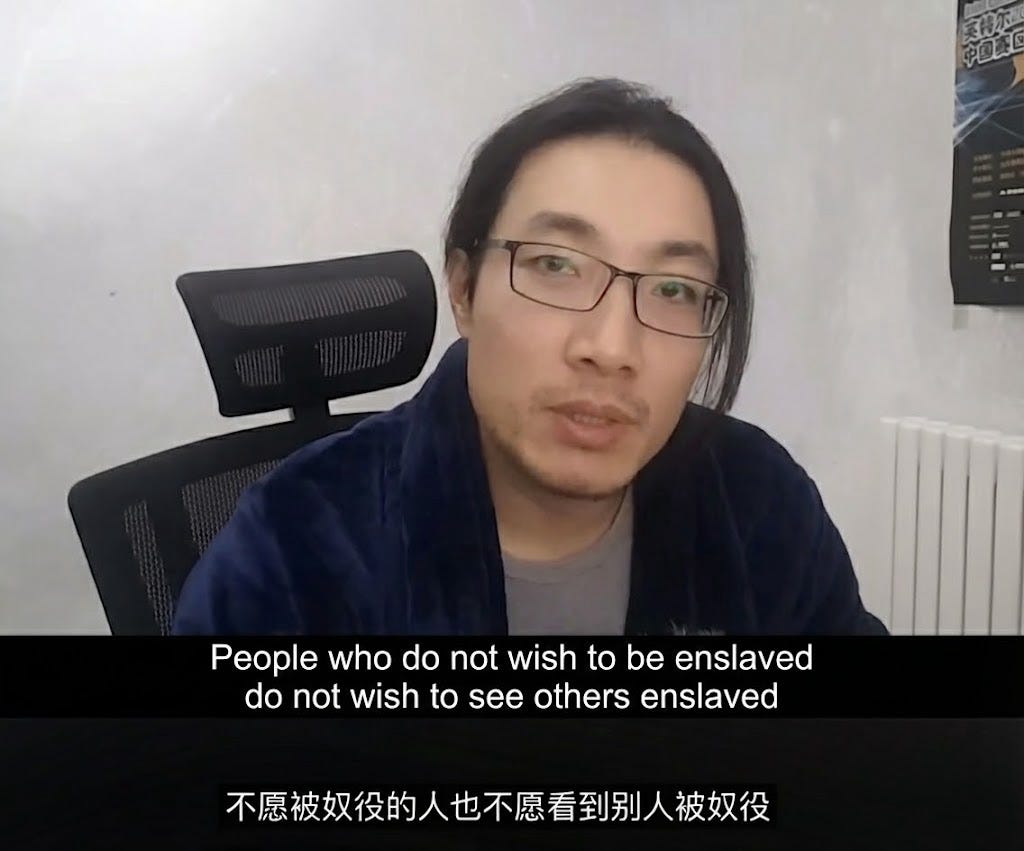
Guan Heng thought he was safe. But four years later, he lost his freedom right here in the States. In August 2025, during an ICE raid targeting his housemates, Guan was arrested in Upstate New York for "illegal entry." Now, sitting in the Broome County Correctional Facility, he faces the threat of deportation—being forced back to the very country he risked everything to escape.
On the morning of August 21, 2025, in a residential neighborhood in Upstate New York, Guan Heng was jolted awake by a violent pounding on the door. It was ICE agents.
They weren't there for him. Their target was his roommate—a couple in the business of flipping shops who had been reported due to a financial dispute. But when the agents stormed in with a search warrant, they "bumped into" the 38-year-old Guan Heng, and he was taken into custody on the spot. The exchange went like this:
Agent: "How’d you get into the country?"
Guan: "I drove a boat over from the ocean myself."
Agent: "Do you have an I-94 form (arrival record)?"
Guan: "No."
Guan was first taken to an ICE office, then tossed in a county jail near Albany for a day. From there, he was shipped to an immigration detention center in Buffalo for nearly a week, before finally landing where he is now—Broome County Correctional Facility.
"They couldn't care less if I have a work permit or what the status of my asylum case is," Guan said, his voice thick with confusion and frustration during a phone interview with Human Rights in China in October 2025. "They only care about how I entered. They just say I didn't come through a normal customs checkpoint, so the act itself is illegal."
His pending asylum interview, his legal work permit, his New York State driver's license... in the eyes of ICE, all of it was worth zilch compared to the fact of his "Entry Without Inspection."
With the Trump administration cracking down hard on illegal immigration, the Broome County jail is packed to the gills. Months have passed, and Guan waits for the outcome of his case in a state of anxiety and depression. Nobody there knows what this young man from China went through over the past few years; nobody knows that the footage he risked his life to shoot provided crucial corroboration of the Chinese authorities' actions against the Uyghurs. And nobody knows the immense danger he faces if he gets sent back.
1. "I wanted to go to Xinjiang and see for myself what was really going on."
Guan Heng calls Nanyang, Henan his home. He was born in November 1987.
According to Guan and his mother, his parents divorced when he was young, and he was raised by his grandmother. After she passed, he’s been on his own. Before leaving China in July 2021, he worked a bunch of different gigs—ran a fast-food joint, worked in the oil fields for a few years, and later freelanced. By his own account, he learned how to "jump the Great Firewall" (bypass internet censorship) pretty early on.
Unlike many young Chinese people, Guan didn't just use the VPN to watch movies or listen to music. He used the internet to touch the "forbidden zones" buried by official narratives: from the Great Famine of the 1960s to the Tiananmen Square incident in 1989. This raw information from the outside world hit him hard, cracking his worldview wide open.
"I learned bit by bit, and finally realized that the Chinese government was hiding so many dirty secrets," he recalled in a jailhouse phone interview with the author in November 2025. He said that since graduating college, he had become a silent dissident—someone living under the regime, but whose mind had already "broken out of prison."
In 2019, Guan rode a motorcycle from Shanghai all the way to Xinjiang as an adventure tourist. He thought it would be a scenic road trip, but he slammed into an invisible wall of high-pressure control.
" The vibe was obvious," he said. "As soon as you enter Xinjiang, there are checkpoints everywhere, police and armed guards all over the place. Even checking into a hotel requires repeated registration and facial recognition." At gas stations, he faced strict restrictions just for being on a motorcycle. This trip gave him a firsthand look at the government's harsh social management system in the region, though he didn't fully understand the depth of it at the time.
In 2020, when COVID hit, Guan was locked down at home like hundreds of millions of other Chinese people. Bored out of his mind surfing the web, he clicked on a report from the famous American outlet BuzzFeed News (BFN). The report used satellite imagery and data to reveal a massive network of concentration camps spread across Xinjiang.
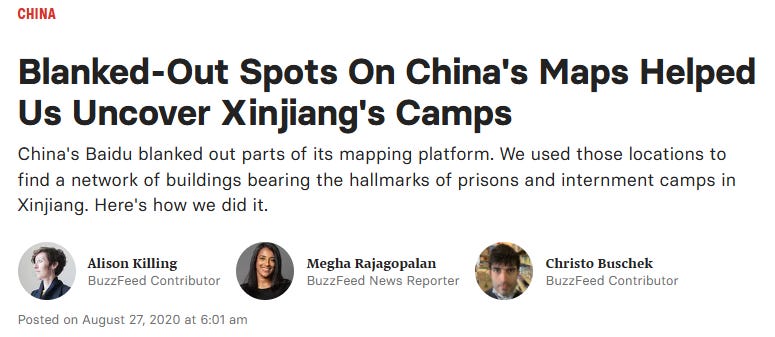
In that moment, the questions from his 2019 trip were answered. He realized those checkpoints, police, and facial recognition systems he saw were actually the outer perimeter of this massive surveillance state.
"Knowing the Chinese government, they love covering up stuff they don't want people to see," Guan said. "It really piqued my interest, especially since I'd been there and knew nothing about it. I immediately wanted to go back and see with my own eyes what the hell was going on."
He knew perfectly well that for a regular guy to do this as a tourist was basically a "suicide mission." "I fully expected the risks," he said calmly. He started prepping like he was planning a covert op: instead of his own pro gear, he rented a long-range DV camcorder online so he could film from a safe distance.
He prepped two SD cards. One for filming, which he’d hide in a secret spot in the car immediately after shooting; and a dummy card to stick back in the camera. "I was afraid of getting stopped and searched," he said. "At least they wouldn't know what I'd filmed."
In October 2020, Guan Heng drove alone toward the trouble spot he’d visited a year prior—Xinjiang.
2. "Roaming" Xinjiang for three days: Verifying prison coordinates one by one.
Guan's trip wasn't an aimless wander; it was a treasure hunt based on a map. That "map" consisted of satellite coordinates marked as suspected "detention camps" in the BuzzFeed News report.
He spent three whole days crisscrossing the vast lands of Xinjiang, fact-checking the coordinates marked as gray (low confidence), yellow (medium confidence), and red (high confidence).
His first stop was Hami City. Before hitting the city, he went to a place called "Beicun," marked with a gray tag. It was a pink building, no barbed wire, didn't look like anyone was there—didn't look like a prison.
Next, he drove into downtown Hami and found a yellow marker. The sign out front read "Hami Compulsory Drug Rehabilitation Center." It was in a busy area with heavy traffic, which made Guan skeptical. "A rehab center in a busy downtown isn't likely to be a detention camp." But right after that, he found another yellow marker—"Xinjiang Production and Construction Corps 13th Division Detention Center."
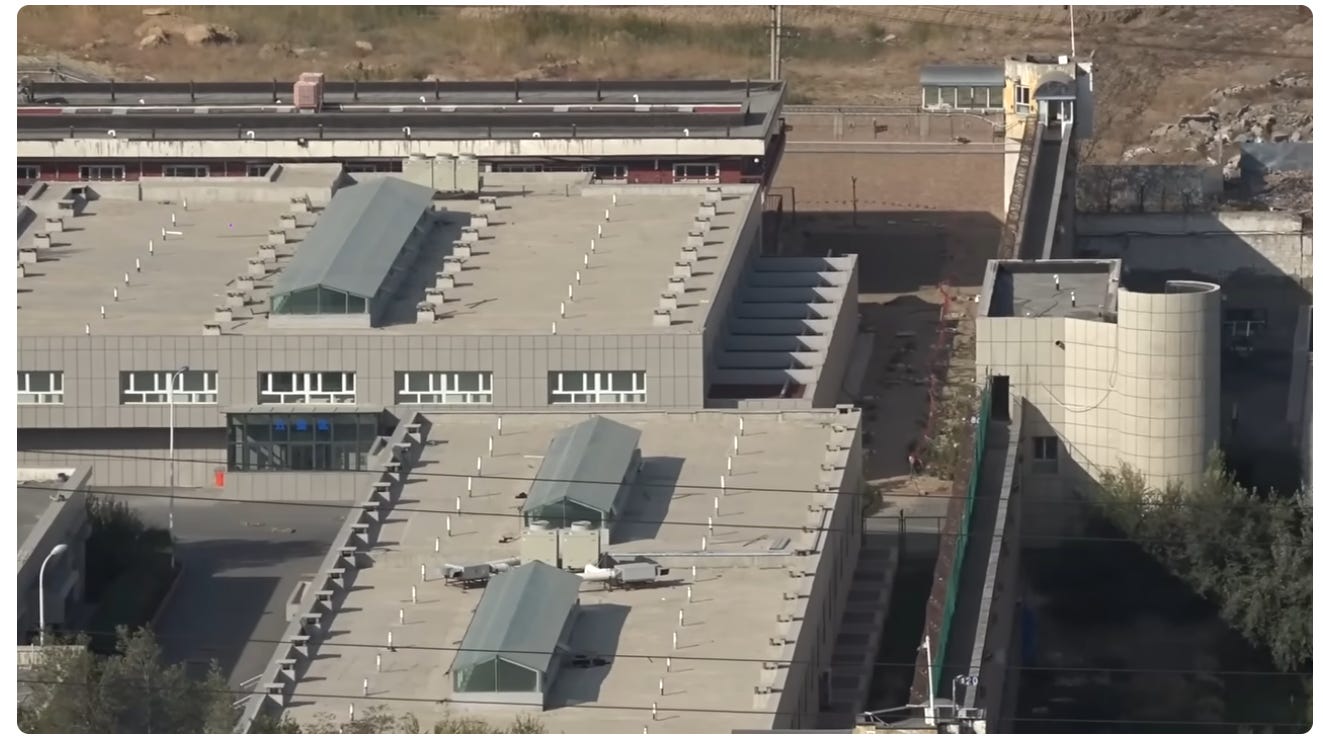
This place immediately put him on edge. It was tucked at the end of a small alley. Not only did the detention center itself have towering walls, but several adjacent courtyards were also ringed with high walls and barbed wire—definitely not normal residential compounds. This matched the description of the concentration camps perfectly.
To cover his tracks, Guan bought some snacks at a shop at the alley entrance on his way out and "deliberately" paid with WeChat. "If I got questioned," he explained later, "at least I’d have an excuse for why I was in that dead-end alley."
The second day, Guan was on the road constantly. He passed through three counties: Mulei, Jimsar, and Fukang. He found that many of the BFN markers pointed to existing "detention centers" or "jails"—Mulei County Detention Center, Jimsar County Detention Center, Fukang City Detention Center. In Mulei, he found two gray markers: a "Farmers and Herdsmen Training School" and a "Vocational Education Center." Although the buildings looked abandoned, the barbed wire still on the walls seemed to whisper of their former use.
That day's journey made him realize the scale of the campaign was far bigger than he imagined—the authorities weren't just building new facilities; they were utilizing, retrofitting, and expanding the entire existing incarceration system.
However, this was tricky. Watchtowers and barbed wire are standard for jails, so judging by appearance alone, it was hard to tell if they were being used as concentration camps for Uyghurs.
On the third day, Guan drove through three cities: Urumqi, Dabancheng, and Korla. This was his most productive—and most dangerous—day.
In the suburbs of Urumqi, following the coordinates, he found the "Urumqi No. 2 Education and Correction Bureau (Drug Rehab Center)." He parked far away, posed as a jogger out for a morning run, and filmed with a GoPro as he walked. He not only captured the rehab center but also discovered three other heavily guarded compounds nearby. At the gate of one facility, he filmed a vegetable truck unloading—proof the facility was active.
Right after, at a place nearby called "Gaoke Road," he made his key discovery. On one side of the road lay a sprawling complex of huge facilities, complete with high walls and watchtowers, yet it wasn't marked on any map. Guan zoomed in with his long lens and successfully captured the bold red characters on the roof: "Reform through Labor, Reform through Culture."
That afternoon, he headed to Dabancheng. This was a "red marker," hidden deep in the wilderness far from the highway, without even a gravel road leading to it. Guan parked by a pond and climbed a high dirt mound alone.
"I was nothing but nervous," he recalled. Lying flat on the mound, his lens filled with a brand-new, massive, but seemingly unopened facility. He snapped his shots and hurried down, breaking into a cold sweat—he realized there was actually a house on top of the hill he’d just climbed, and down by the pond where he parked, a fisherman had appeared out of nowhere.
Forcing himself to stay calm, he walked up to the guy. "Hey boss, catch anything?" After confirming the guy hadn't noticed his shady behavior, he got in his car and sped off.
The final stop was Korla, 339 kilometers from Urumqi. Here, the coordinates pointed behind a military base (there were tanks at the gate). It was a massive, heavily guarded facility, and the only way in was through the military camp.
As Guan tried to pull off onto the shoulder to get a shot, someone from a shop next to the base walked out and stared him down, dead in the eyes.
In the tension of the standoff, Guan thought fast. He slammed on the gas, drifting his high-chassis SUV in the dirt, spinning donuts, deliberately acting like a guy just testing out his car's performance. The "shopkeeper" seemed confused by this crazy driver, watched for a bit, and then boredly went back inside.
The second the guy turned around, Guan stopped, whipped out his long-lens DV, and captured the final scene of his video.
3. Drifting at sea for a day and a night: Smuggling into the US from the Bahamas.
The video was done. Guan Heng possessed a "digital bomb," but he quickly realized a fatal problem: he couldn't hit the "publish" button without blowing himself up.
"I knew, finishing the video was one thing, but once it hit the internet, the police would definitely find me," Guan said in the interview. "If they got to me, the videos would either never get out or be deleted, and my life would be in danger."
The only way out he could think of was to leave China first.
But the fuse on this bomb was stretched painfully long. Since the outbreak in 2020, China's borders had been sealed. Guan had nowhere to go, sitting on this footage in depression and anxiety. Finally, in the summer of 2021, a window opened. On July 4, he left via Shekou, departed from Hong Kong, and flew to Ecuador, a South American country that was visa-free for Chinese passports at the time.
He stayed in Ecuador for over two months for one reason: to get the Pfizer vaccine. He didn't trust the Chinese domestic vaccines, but the policy back home was getting stricter—"No vax meant a red health code, you couldn't go anywhere."
After two shots, he flew to another visa-free country—The Bahamas. Here, he was separated from his final destination by just a strip of water. He wanted to buy a boat from China and have it shipped to save money, but his Bahamian visa was ticking away—he recalls only having 14 days—and logistics were slow. By October 2021, he couldn't wait any longer. He spent his last $3,000 at a local marine supply store on a small inflatable boat and an outboard motor. He launched from Freeport, Bahamas, aiming for Florida. Google Maps said it was about 85 miles as the crow flies.
According to Guan, he had zero nautical experience, didn't know how to row, and got seasick easily. This was his first time "captaining" a vessel. His only tools were a mechanical compass and a phone with offline GPS maps.
"I was drifting on the ocean for nearly 23 hours," he recalled. He brought plenty of food and water, but was so nervous he "only drank one can of Coke the whole time." The biggest threat wasn't the waves, but his sketchy engine.
"I didn't have much money, so I didn't buy a closed fuel tank," he said. "I had to hold a gas can and pour fuel directly into the engine while the boat was rocking violently." Gasoline spilled everywhere, filling the dinghy with heavy fumes, ready to explode at the slightest spark.
"That boat turned into a floating bomb," Guan said. "I was actually terrified, because if it caught fire, I'd never make it to America."
He planned to land at night to avoid detection. But in the endless drifting, his only thought was "just get there."
The next morning, he saw the Florida coastline in the distance. Around 9 AM, the boat hit the sand. There were already tourists taking morning walks on the beach, and an elderly couple was walking toward him. Guan's heart was in his throat, terrified they would call the cops.
Ignoring the boat and his scattered luggage, he grabbed his most important backpack. The moment the boat hit the shallows, he jumped off and sprinted into the coastal bushes. Hiding in the brush, gasping for air, he watched a Coast Guard patrol boat cruise by just offshore. But he was safe.
Just like that, through smuggling, Guan Heng arrived in the "Free World" he had longed for.
4. The video shocks the web, but he and his family pay a heavy price.
According to Guan, before he launched from the Bahamas, he had already scheduled the video release. "I didn't know if I'd make it to the US alive," he said. "I couldn't wait until I arrived to publish." The video about the Xinjiang concentration camps finally went public on his YouTube channel on October 5, 2021.
The video immediately triggered a massive reaction. As rare, first-person footage from a Chinese citizen, Guan's video was quickly reported on and cited by media outlets like Deutsche Welle and Radio Free Asia. More importantly, it provided key on-the-ground proof for the Pulitzer Prize-winning team at BuzzFeed News. In interviews, BFN reporters emphasized the extraordinary value of Guan's footage, praising his courage and stating that the new information confirmed their analysis of what was happening in Xinjiang.
Meanwhile, as the one who lit the fuse, Guan himself faced pressure beyond his worst nightmares—a massive wave of attacks from Chinese state security and online propaganda trolls began immediately.
Shortly after the video dropped, a YouTuber named "Science Guy K-One Meter" posted a "doxxing" video, stripping Guan's personal info bare—real name, birthday, college, home address—everything. This "Science Guy," typically, posts pro-CCP content.
"They doxxed Guan Heng," said Ms. Luo, Guan's mother, in an interview with Human Rights in China on November 1, 2025. Her voice trembled with anger. "The comments underneath were incredibly nasty, calling him a traitor to the Han race, and saying things like 'hope he gets accidentally killed by a black brother in America'."
Simultaneously, a "siege" on his YouTube channel began. "First they reported me for 'privacy violations' because I filmed a guard, and YouTube took my video down," Guan recalled.
He was forced to appeal and use YouTube's tools to blur the face. Once the video was back up, the attackers saw this tactic worked and started "mass reporting" all his videos. Guan's dashboard was instantly flooded with "violation notifications."
This precise cyber-violence, launched by the state machine, combined with the systematic technical siege, broke Guan psychologically.
" The pressure was immense," Guan recalled. "I basically stopped paying attention, actively avoided looking at it." The insane cyberbullying drove him into severe depression. To protect himself, he cut off information from the outside world. Because of this, he didn't even know until his recent arrest just how huge of an impact his video had made internationally. He only knew he was being organizedly "doxxed" by the state, and he was scared.
He went into hiding. But the real eye of the storm exploded in his hometown of Nanyang, Henan.
According to Guan and his mother, just over a month after the video release, in January 2022, a systematic "guilt by association" campaign led by state security targeted all his relatives.
"When I went back from Taiwan [in late 2023], everyone in the family was super nervous," Ms. Luo said. "They were worried I'd be detained at the airport because they'd already been interrogated."
Ms. Luo said her four sisters in Henan and Zhengzhou were summoned by local state security almost simultaneously. "The police told them," Ms. Luo said, "'If you have any news about Guan Heng, report it immediately. If you know something and don't report it, you know the consequences.'"
In late January 2022, four police officers took Guan's father from his home for an interrogation that lasted from noon until 9 PM. They confiscated his phone to "recover data" at the Nanyang City Bureau. That night, they dragged his father to Guan's grandmother's house—where he lived before leaving—seized his computer tower, and issued a "confiscation list." Over a month later (March 2022), state security interrogated his father again.
Agents also found the aunt Guan was closest to growing up. They took his aunt and uncle separately for interrogation. This psychological warfare completely broke his aunt. "She's so scared she can't sleep at night now," Ms. Luo said. "She later told Guan's father point-blank: 'Please don't come to me about Guan Heng anymore! We have to live here, I'm afraid it will affect my kids, afraid of getting implicated! Please stop harassing me!'"
Guan didn't know any of this. While he thought he was just digesting the trauma of online abuse alone in New York, his entire family back in China had been thoroughly "combed through" and terrified by state security.
And so, carrying his trauma and a complete break from his homeland, Guan lived alone in the US for three years. Until the summer of 2025, when fate pushed him into another cage in the most absurd way possible.
5. From one cage to another.
For over three years in the US, Guan Heng tried to rebuild his life in solitude. On October 25, 2021, he filed for asylum in New York, got his work permit, bought a used car, and started out driving Uber and delivering food in NYC. Later, he switched to long-haul trucking "because living in the truck meant I didn't need an apartment." When he quit trucking, he decided to move out of the city.
"I really love the state parks upstate," he said. Seeking a quieter environment closer to nature, he moved to a small town near Albany in the spring of 2025.
He was just a tenant. The house he shared was run by a Chinese couple, the "sub-landlords." His quiet life lasted until that morning in 2025, when the violent banging of ICE agents shattered the peace.
During the raid, Guan showed his work permit and asylum documents to prove his identity. But it seemed that in the enforcement logic of ICE—under the Department of Homeland Security (DHS)—Guan's status with US Citizenship and Immigration Services (USCIS) didn't matter.
Arrested as an "illegal immigrant" solely because he entered by sea, Guan was bounced from the ICE office to a county jail, then to the Buffalo detention center, and finally to Broome County jail.
At first, he was in the immigration unit. "It was okay there," he said. "I was with other immigrants, people in the same boat. We had things to talk about, played ball and cards, it was lively."
But a month later, he was moved to a unit with American inmates—many of whom, he says, are sex offenders.
He was thrown back into total isolation. "Nothing to talk about with them," he said on the phone, sounding down. " The air in the hall is bad, makes me cough if I stay too long, so mostly I just stay alone in the yard or my cell."
It was in this extreme loneliness that he began to reflect on his life.
"I met an inmate here, another immigrant," Guan said. "She told me something that really stuck with me. She said: 'Two is always better than one.'"
That hit him hard. "I thought to myself," he reflected, "if I had family or friends with me, I might not have moved upstate, and I wouldn't have been caught. If I had a partner, my mental state would be much better."
He realized that the "lone wolf" trait that allowed him to pull off the Xinjiang feat was also his Achilles' heel right now.
"Before, I always felt like a solitary warrior, that I had to solve every problem myself," he said. "But once I really got into prison, I realized that no matter how capable I am individually, I can't do anything. I have to rely completely on outside help."
Now, he realizes he must step out of his self-imposed isolation and rely on American civil society and human rights organizations to stop US law enforcement from sending him back to China—a place he risked death to expose, and where the consequences of his return would be unthinkable.
6. Rescue across the bars, and "I did the right thing."
While Guan Heng sat in Broome County jail facing the massive risk of deportation, letters of testimony began arriving in his lawyer's hands. These letters revealed a fact Guan himself hadn't known: the footage he shot alone had become a crucial piece of the puzzle for the international community's focus on the human rights crisis in Xinjiang.
The first letter came from the very source that inspired him. The Pulitzer Prize-winning team at BuzzFeed News (Megha Rajagopalan, Alison Killing, Christo Buschek), upon hearing of Guan's plight, co-signed a letter of support. They confirmed that the "Ground Truth" provided by Guan filled the final gap in their satellite image analysis.
"Mr. Guan provided key corroboration for our investigation at great personal risk. His courage is extraordinary... There is no other plausible reason for him to be near many of these detention sites, as they are often in remote areas... If captured, the danger he faces would increase significantly," the BFN team wrote. They noted specifically that Guan's evidence helped confirm the existence of the new prison in Dabancheng—directly puncturing the Chinese government's lie that the "re-education camps had been closed."
The letter concluded: "We believe that if Mr. Guan is returned to China, he will face immense danger. Therefore, we call on the US to grant Mr. Guan asylum and end his detention and the threat of deportation."
The second letter came from Janice M. Englehart, producer of the documentary All Static & Noise.
Guan's footage was included in this documentary about the Uyghur condition, which has been screened in New Zealand, Australia, Japan, and the UK to expose the Chinese government's abuses.
Janice stated in her support letter: "Mr. Guan risked his own safety and that of his family to provide important video evidence. This evidence corroborates satellite imagery, confirming the existence of internment camps operated by the Chinese government in the Xinjiang Uyghur Autonomous Region... His efforts in 2020 supported researchers, journalists, and filmmakers, allowing them to confidently understand and broadcast what is happening in a region of China that has long been inaccessible to many Western journalists, diplomats, and visitors."
At the end of the letter, Janice was blunt: "Mr. Guan's actions are entirely in the US national interest." She warned that if deported, Guan would likely face torture or even death on charges of "espionage" or "collusion with foreign forces."
Another testimony came from Zhou Fengsuo, Executive Director of Human Rights in China. He said he noticed the young man on Twitter as early as November 17, 2021, just days after Guan arrived in the US, and reached out to him. "I thought then that he was someone acting on his conscience," Zhou recalled. But he also sensed the trauma in Guan. "He was very low-key, even evasive. Even in the US, he was living in a sort of 'hiding'."
Zhou pointed out, "This (the Uyghur issue) is a high-voltage red line for Han people. If he is sent back, given the social impact of this event, he will definitely face a very severe prison sentence." More importantly, Zhou believes Guan's ordeal reveals the common plight of many freedom seekers today: "They yearn for freedom and flee tyranny, yet live in multiple layers of fear." In his testimony, Zhou wrote, "On one hand, they have to dodge US immigration jail; on the other, they have to dodge transnational repression from the CCP."
This is the true picture of Guan Heng's last three years—surviving in the crack between "double fears," until one side finally caught him.
"America is a country built by people who love freedom," Zhou appealed in closing. "A person who loves freedom, resists tyranny, and has paid a huge price for it should be allowed to stay. He belongs in this country."
At the same time, Rushan Abbas, Executive Director of the Campaign for Uyghurs, and renowned Uyghur poet Abduweli Ayup also stepped forward to voice support for this Han man who spoke up for their people.
"If he gets sent back, he's truly dead meat." On November 10, 2025, Guan's mother, Ms. Luo, said trembling in an interview. Now in Taiwan, she is terrified for her son. Her biggest wish is for the US court to make a just ruling, stop the ICE deportation process, and let her son stay in the US. At least then, he's safe.
Ms. Luo's fear isn't baseless; similar tragedies have happened before. Young scholar Feng Siyu, a graduate of Amherst College, is a cautionary tale. She was a visiting scholar at Xinjiang University's Folklore Research Center in 2017, working with the center's director, famous anthropologist Rahile Dawut. However, Rahile was arrested in December 2017 and sentenced to life in prison the following year; Feng Siyu was also suddenly arrested in 2018 and eventually sentenced to a heavy 15 years.
Now, an effort involving Pulitzer winners, filmmakers, Uyghur leaders, and human rights activists is trying to build a "protective wall" to block ICE's deportation and get Guan his freedom back.
On October 20, 2025, in a New York state jail, wearing a prison uniform, Guan Heng waits for his December immigration hearing. When the author reached him by phone and told him his risky footage was key proof for a Pulitzer-winning report, he sounded pretty surprised.
He says he doesn't regret what he did. After going through all this, he's even more convinced that what he did was "right."
"Because I'm personally tasting what it's like to lose freedom now, I can understand even more what those people in the camps are feeling," he said on the prison phone. "I need outside help now, and they need it too. So, I still think I did the right thing."
"I feel this is a massive, unchecked, and uncontrolled evil being committed by the Chinese government," he added. "It has caused the pain of separation and loss of freedom for countless families. So, even now, I still firmly oppose everything the Chinese government is doing in Xinjiang."
But as an "illegal immigrant" stripped of his freedom, his only hope now lies in the urgent rescue efforts of lawyers, journalists, and human rights organizations on the outside.
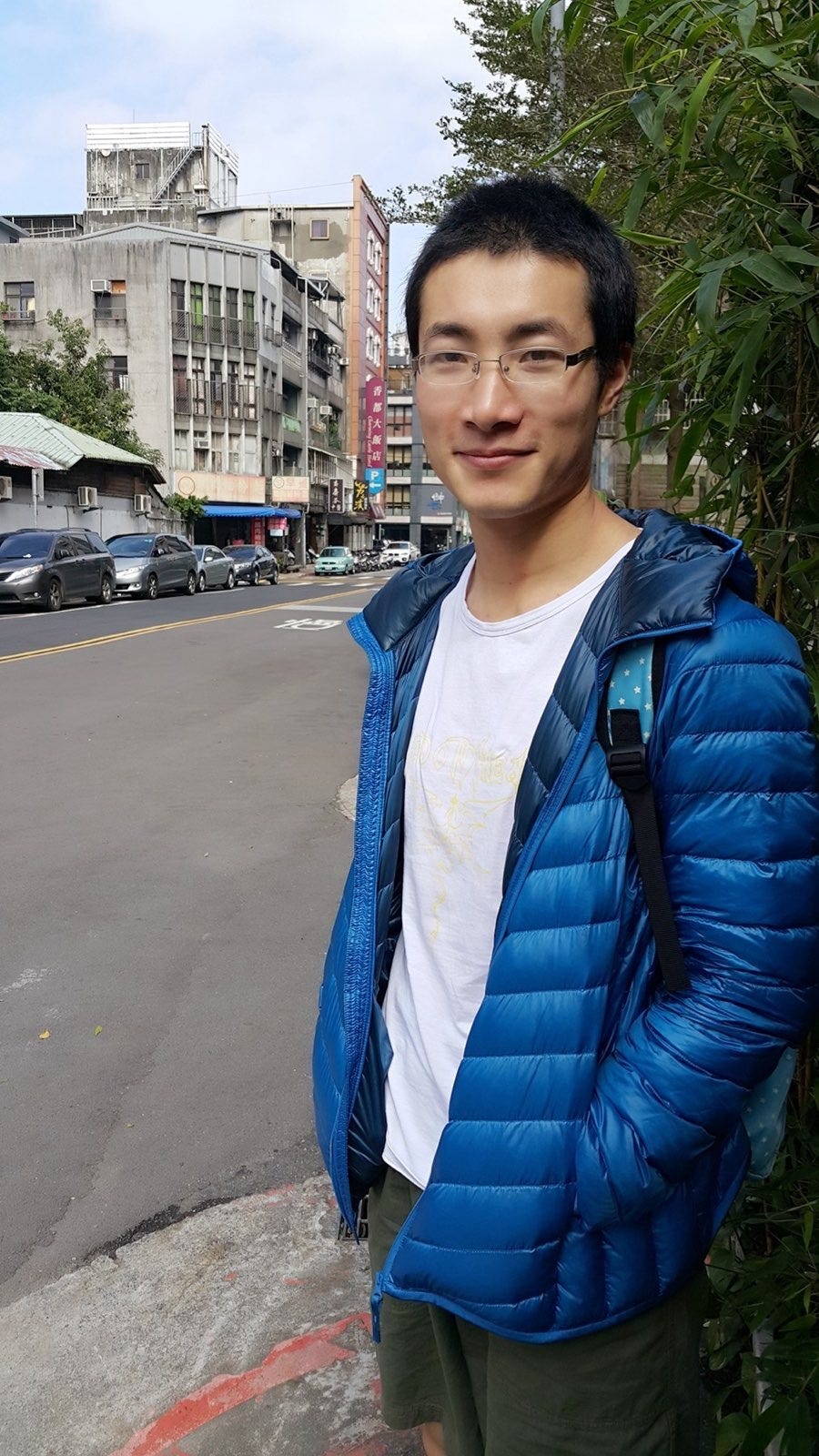
Guan Heng in 2019
On December 15, Guan Heng's asylum case opens in New York. His fate hangs in the balance, resting on one question: Will this free world he risked everything to reach choose to protect him, or send him back to the homeland he exposed at the risk of death and fled in search of liberty and justice?
Uyghur Genocide Database | Uyghur internment camps | reports emerged documenting the deaths of individuals in mass internment camps
Human Rights • leo posted the article • 0 comments • 1247 views • 2022-11-21 13:02
• Yaqup Haji, a 45-year-old Uyghur businessman and philan- thropist from Ghulja (Yining) city, Ili (Yili) Kazakh Autono- mous Prefecture, who died in or around September 2021 after being tortured in a mass internment camp or prison, where he had been held since 2018. A friend of Yaqup Haji told RFA that authorities had detained him for making contributions to religious causes, and that authorities had tortured him, includ- ing by holding him in solitary confinement.
• Zeynephan Memtimin, a 40-year-old Uyghur woman who died in 2020 in a prison in Keriye (Yutian) county, Hotan pre- fecture, where she was serving a 10-year sentence for violating family planning policies.62 Authorities previously held Zeynephan Memtimin in a mass internment camp beginning in 2017, for having fled a hospital where she was due to undergo a forced abortion in 2014.63 Officials did not disclose the cause of her death to relatives.
• Yaqup Hesen, a 43-year-old goldsmith who died on May 1, 2022, 20 days after being released from a prison in Ghulja (Yining) city, Ili (Yili) Kazakh Autonomous Prefecture, where he had been held for three years. A neighborhood committee official told RFA that authorities had detained him for pray- ing. Family members sought medical treatment for Yaqup Hesen for an unspecified illness at multiple hospitals following his release. Yaqup Hesen’s 20-year-old son died, reportedly of grief, at his father’s funeral. view all
• Yaqup Haji, a 45-year-old Uyghur businessman and philan- thropist from Ghulja (Yining) city, Ili (Yili) Kazakh Autono- mous Prefecture, who died in or around September 2021 after being tortured in a mass internment camp or prison, where he had been held since 2018. A friend of Yaqup Haji told RFA that authorities had detained him for making contributions to religious causes, and that authorities had tortured him, includ- ing by holding him in solitary confinement.
• Zeynephan Memtimin, a 40-year-old Uyghur woman who died in 2020 in a prison in Keriye (Yutian) county, Hotan pre- fecture, where she was serving a 10-year sentence for violating family planning policies.62 Authorities previously held Zeynephan Memtimin in a mass internment camp beginning in 2017, for having fled a hospital where she was due to undergo a forced abortion in 2014.63 Officials did not disclose the cause of her death to relatives.
• Yaqup Hesen, a 43-year-old goldsmith who died on May 1, 2022, 20 days after being released from a prison in Ghulja (Yining) city, Ili (Yili) Kazakh Autonomous Prefecture, where he had been held for three years. A neighborhood committee official told RFA that authorities had detained him for pray- ing. Family members sought medical treatment for Yaqup Hesen for an unspecified illness at multiple hospitals following his release. Yaqup Hesen’s 20-year-old son died, reportedly of grief, at his father’s funeral.
CECC Annual Report 2022 | XINJIANG
Human Rights • leo posted the article • 0 comments • 1452 views • 2022-11-21 12:10
XINJIANG
• Key findings from a cache of tens of thousands of files ob- tained from public security bureaus in two counties in the Xinjiang Uyghur Autonomous Region (XUAR) included: the key role of senior Communist Party and central government offi- cials in carrying out the mass detention and other persecution of Turkic Muslims in the XUAR; the highly securitized nature of detention in the region’s camps and prisons; the high rate of imprisonment in Konasheher (Shufu) county in Kashgar pre- fecture, XUAR, as authorities increasingly sentenced Turkic Muslims to formal imprisonment; and arbitrary deprivation of liberty in camps and prisons.
• Reports published during the Commission’s 2022 reporting year indicated that XUAR officials increasingly sentenced many Turkic and Muslim individuals to long prison terms, sometimes following their detention in mass internment camps. According to international reporting and analysts’ re- view of satellite imagery, officials have converted many former mass internment camps into prisons or other types of formal detention facilities.
• International researchers and journalists found evidence that authorities continued to expand detention facilities, in- cluding mass internment camps. Based on research and anal- ysis of leaked official documents and satellite imagery, BuzzFeed News journalists estimated in July 2021 that au- thorities in the XUAR had enough space in detention facilities in the region, including prisons and mass internment camps, to detain more than one million people at the same time.
• Authorities in the XUAR maintained a system of forced labor that involved former mass internment camp detainees and other Turkic and Muslim individuals. In its annual report re- leased in February 2022, the International Labour Organiza- tion expressed ‘‘deep concern’’ over forced labor in the XUAR and asserted that the ‘‘extensive use of forced labor’’ involving Turkic and/or Muslim minorities in the region violated the Em- ployment Policy Convention of 1964.
• In September 2021, official media in the XUAR announced a new plan pairing Uyghur children with children from across the country, a move that observers believe is designed to con- trol Uyghurs’ lives and eliminate Uyghurs’ cultural identity.
Executive Summary
Called the ‘‘Pomegranate Flower Plan,’’ the initiative matched Uyghur toddlers and elementary school students from a village in Kashgar prefecture with predominantly Han Chinese chil- dren from other parts of China, in order to establish ‘‘kinship’’ ties between the children.
• During the 2022 Ramadan period, which lasted from April 1 to May 1, authorities in parts of Urumqi municipality and Kashgar and Hotan prefectures reportedly enforced quotas for local Muslims allowed to fast during the holiday, and required them to register with officials. Reports published this past year showed that authorities have sentenced Turkic Muslims in the XUAR, including members of the clergy, to lengthy prison terms.
• Turkic women who had been detained in mass internment camps in the XUAR provided evidence to the Uyghur Tribunal that many female detainees were raped in the camps. One former camp detainee testified that unmarried, divorced, and widowed women were raped in a camp where she was detained and that men paid to come to camps to rape female detainees. view all

XINJIANG
• Key findings from a cache of tens of thousands of files ob- tained from public security bureaus in two counties in the Xinjiang Uyghur Autonomous Region (XUAR) included: the key role of senior Communist Party and central government offi- cials in carrying out the mass detention and other persecution of Turkic Muslims in the XUAR; the highly securitized nature of detention in the region’s camps and prisons; the high rate of imprisonment in Konasheher (Shufu) county in Kashgar pre- fecture, XUAR, as authorities increasingly sentenced Turkic Muslims to formal imprisonment; and arbitrary deprivation of liberty in camps and prisons.
• Reports published during the Commission’s 2022 reporting year indicated that XUAR officials increasingly sentenced many Turkic and Muslim individuals to long prison terms, sometimes following their detention in mass internment camps. According to international reporting and analysts’ re- view of satellite imagery, officials have converted many former mass internment camps into prisons or other types of formal detention facilities.
• International researchers and journalists found evidence that authorities continued to expand detention facilities, in- cluding mass internment camps. Based on research and anal- ysis of leaked official documents and satellite imagery, BuzzFeed News journalists estimated in July 2021 that au- thorities in the XUAR had enough space in detention facilities in the region, including prisons and mass internment camps, to detain more than one million people at the same time.
• Authorities in the XUAR maintained a system of forced labor that involved former mass internment camp detainees and other Turkic and Muslim individuals. In its annual report re- leased in February 2022, the International Labour Organiza- tion expressed ‘‘deep concern’’ over forced labor in the XUAR and asserted that the ‘‘extensive use of forced labor’’ involving Turkic and/or Muslim minorities in the region violated the Em- ployment Policy Convention of 1964.
• In September 2021, official media in the XUAR announced a new plan pairing Uyghur children with children from across the country, a move that observers believe is designed to con- trol Uyghurs’ lives and eliminate Uyghurs’ cultural identity.
Executive Summary
Called the ‘‘Pomegranate Flower Plan,’’ the initiative matched Uyghur toddlers and elementary school students from a village in Kashgar prefecture with predominantly Han Chinese chil- dren from other parts of China, in order to establish ‘‘kinship’’ ties between the children.
• During the 2022 Ramadan period, which lasted from April 1 to May 1, authorities in parts of Urumqi municipality and Kashgar and Hotan prefectures reportedly enforced quotas for local Muslims allowed to fast during the holiday, and required them to register with officials. Reports published this past year showed that authorities have sentenced Turkic Muslims in the XUAR, including members of the clergy, to lengthy prison terms.
• Turkic women who had been detained in mass internment camps in the XUAR provided evidence to the Uyghur Tribunal that many female detainees were raped in the camps. One former camp detainee testified that unmarried, divorced, and widowed women were raped in a camp where she was detained and that men paid to come to camps to rape female detainees.
Uyghur Genocide Database | Meryem Emet | muslim concentration camps in china
Uyghur Genocide • leo posted the article • 0 comments • 1219 views • 2022-11-21 11:39
link:https://www.cecc.gov/sites/chi ... 0.pdf
Meryem Emet
2022-00124
Date of Detention: Unknown date in 2017
Place of Detention: A prison in Kucha (Kuche) county, Aksu prefecture, XUAR
Charge(s): Unknown
Status: Sentenced to 20 years
Context: In 2017, authorities in Urumqi municipality, XUAR, detained Meryem Emet and later sentenced her to 20 years in prison. Her sentence was reportedly con- nected with her marriage to a Turkish national, and with her having met and spoken with Turkish Prime Minister Recep Tayyip Erdog ̆an during his 2012 visit to Urumqi. Additional Information: After her detention, XUAR au- thorities forced her two children, then ages four and six, into boarding schools in Urumqi, where teachers sub- jected them to traumatizing disciplinary measures includ- ing beatings and being forced to hold stress positions. After nearly 20 months at the schools, the two children were left unable to communicate in Uyghur. view all
link:https://www.cecc.gov/sites/chi ... 0.pdf
Meryem Emet
2022-00124
Date of Detention: Unknown date in 2017
Place of Detention: A prison in Kucha (Kuche) county, Aksu prefecture, XUAR
Charge(s): Unknown
Status: Sentenced to 20 years
Context: In 2017, authorities in Urumqi municipality, XUAR, detained Meryem Emet and later sentenced her to 20 years in prison. Her sentence was reportedly con- nected with her marriage to a Turkish national, and with her having met and spoken with Turkish Prime Minister Recep Tayyip Erdog ̆an during his 2012 visit to Urumqi. Additional Information: After her detention, XUAR au- thorities forced her two children, then ages four and six, into boarding schools in Urumqi, where teachers sub- jected them to traumatizing disciplinary measures includ- ing beatings and being forced to hold stress positions. After nearly 20 months at the schools, the two children were left unable to communicate in Uyghur.
Uyghur Genocide database | Helchem Pazil
Human Rights • leo posted the article • 0 comments • 1211 views • 2022-11-21 11:37
Helchem Pazil
2022-00112
Date of Detention: Unknown date in 2018 or 2019 Place of Detention: Changji Women’s Prison, Changji Hui Autonomous Prefecture, Xinjiang Uyghur Autono- mous Region (XUAR)
Charge(s): Inciting ethnic hatred; gathering a crowd to disturb public order
Status: Sentenced to 17 years
Context: In a court judgment issued in 2019, the Korla (Ku’erle) Municipal People’s Court in Bayangol (Bayinguoleng) Mongol Autonomous Prefecture, XUAR, sentenced 78-year-old Helchem Pazil and several of her relatives, including her three daughters and a daughter- in-law, to prison in connection with private gatherings in which they discussed family life and Islam. view all
Helchem Pazil
2022-00112
Date of Detention: Unknown date in 2018 or 2019 Place of Detention: Changji Women’s Prison, Changji Hui Autonomous Prefecture, Xinjiang Uyghur Autono- mous Region (XUAR)
Charge(s): Inciting ethnic hatred; gathering a crowd to disturb public order
Status: Sentenced to 17 years
Context: In a court judgment issued in 2019, the Korla (Ku’erle) Municipal People’s Court in Bayangol (Bayinguoleng) Mongol Autonomous Prefecture, XUAR, sentenced 78-year-old Helchem Pazil and several of her relatives, including her three daughters and a daughter- in-law, to prison in connection with private gatherings in which they discussed family life and Islam.
UN Human Rights Council rejects debate on Xinjiang
News • ogmt posted the article • 0 comments • 1142 views • 2022-10-09 07:02

9 so-called muslim countries sold their religion and soul for China government's money
News • ogmt posted the article • 0 comments • 1034 views • 2022-10-09 06:04

Bangladeshi rise against persecution of Uyghur by Chinese govt.
News • yakitoriPB posted the article • 0 comments • 1061 views • 2022-10-02 23:12
view all


Earlier around 100 Uyghurs protested at the WhiteHouse against China’s ongoing genocide & forced starvation in East Turkistan
News • Justice Brown posted the article • 0 comments • 1048 views • 2022-09-11 21:19
view all


China extends DNA sample collection to Tibet under ‘crime detection’ program, had earlier done so for Uyghur Muslims in Xinjiang
News • shotiko91 posted the article • 0 comments • 1004 views • 2022-09-07 09:17
view all

Ambassador Xiao Qian keep lying to the world, he says the UN report on Uyghurs and other Muslim groups in China's Xinjiang region is "an absolute fabrication".
News • shotiko91 posted the article • 0 comments • 1056 views • 2022-09-07 09:13
view all
THIS IS HOW THE ARAB REGIMES ARREST THE UYGHURS MUSLIMS AND HAND THEM OVER TO CHINA
Uyghur Genocide • shotiko91 posted the article • 1 comments • 1272 views • 2022-09-06 10:22
Many of China's Muslims of the Uyghur minority escaped the oppression of their government and decided to reside in Arab countries. However, since 2017, the Arab regimes have repeatedly attempted to extradite them to Beijing.
The American network, NBC News, revealed the secret on April 25, 2022, confirming that the Beijing government provided “gifts” to Arab regimes in the form of projects and economic benefits in exchange for a position against the Uyghur minority.
It emphasized that the Chinese authorities, in order to suppress the Muslim Uyghur minority, are intensifying cooperation with the governments of Arab countries, such as Saudi Arabia, Egypt, and the UAE, whether to arrest them or to cooperate in defending China against international criticism over the persecution of its Muslims.
Simultaneously, the Kissinger Institute for Chinese-American Affairs of the Woodrow Wilson Center released a study entitled The Great Wall of Steel that revealed unprecedented details about the extent of Arab governments' complicity with China to deport Uyghurs.
The study showed that more than 1,500 Uyghurs in Arab countries were arrested or extradited, or forced to return to China to face detention and torture.
It said that Beijing targeted more than 5,500 Uyghurs outside China in Arab and Middle Eastern countries with cyber-attacks to spy on them and threaten their family members residing at home, with the complicity of Arab governments as well.
Since 1949, Beijing has controlled the territory of East Turkestan, which is the homeland of the Muslim Uyghur Turks, and called it Xinjiang, meaning "the new frontier".
Official statistics indicate that there are 30 million Muslims in the country, 23 million of whom are Uyghurs, while unofficial reports confirm that the number of Muslims is about 100 million, or about 9.5 percent of the total population.
In 2017, the Chinese authorities in Xinjiang began a campaign to arrest Muslim women and men from the Uyghur, Kazakh, and Kyrgyz ethnic minorities and detain them in camps designed under the pretext of " ridding them of terrorist and extremist tendencies," according to China’s claim.
Between one and two million Uyghurs and members of other minorities from Xinjiang are believed to be held in the camps, where they are forced to study Marxism, renounce their religion, work in factories, and face abuse, according to human rights groups.
'Gifts' and Complicity
NBC News issued a study entitled the Great Steel Wall in 2022, researchers identified several reasons for the complicity of Arab regimes with Beijing in the suppression of China's Muslims.
The Great Steel Wall report chronicles the efforts of the Chinese Ministry of State Security to harass, detain, and extradite Uyghurs from around the world, and the cooperation it receives from Arab governments in the Middle East and North Africa in unprecedented detail.
The author of the report, Bradley Jardine, of the Kissinger Institute of the Wilson Center, says that these gifts are Chinese projects in Arab countries, including Egypt, Morocco, and Saudi Arabia, with billions of dollars, and their goal is to facilitate trade between China and the Arabs.
Scholar Adrian Zenz, who has studied China's systematic oppression of the Uyghurs, explained that Beijing uses its economic influence and "gifts" in the form of infrastructure projects.
These projects are represented by the Belt and Road Initiative, and they benefit Arab and Islamic countries that sympathize with the Uyghur crisis and put pressure on them as well.
He stressed that "the Chinese are afraid of the opinion of Muslim peoples regarding their treatment of the Uyghurs, and they have made exceptional efforts to influence the governments of those countries and their public opinion."
The researcher Jardine, who is also director of research at the Oxus Association for Central Asian Affairs, wrote in Time magazine on March 24, 2022, that "the Arab world is not only silent about the Chinese oppression of the Uyghurs, but it is complicit."
He asserted that Arab countries actively help Beijing in justifying abuses and retaliation against the Uyghurs and that at least six governments in the Arab world: Egypt, Morocco, Qatar, Saudi Arabia, Syria, and the UAE have detained and extradited Chinese Muslims to Beijing.
Torture and Murder
The Oxus Association says: "The Egyptian police arrested more than 200 Chinese Muslims from their homes, restaurants, mosques and even airports, most of them students at al-Azhar University, and a large number were transferred to the notorious Tora and Scorpion prisons."
It asserted, in a report entitled: Beyond the Silence: Cooperation between Arab Countries and China in the Cross-Border Repression of the Uyghurs, that Chinese detainees in Egypt assured that Chinese intelligence officers interrogated them inside Egyptian prisons.
"The Uyghurs who fled the crackdown in Egypt believed that al-Azhar University would protect them, but they were "surprised" when the police arrested them and revealed that it had killed two Uyghur students in custody and deported 76 of them to China," according to the association.
According to a report by NBC News, in 2017, the Egyptian police arrested Uyghur students at a university in Cairo and deported them to China and other places in the Middle East.
On June 19, 2017, the Egyptian Ministry of Interior signed an agreement with the Chinese Ministry of Public Security, during the visit of Egyptian President Abdel Fattah Sisi to Beijing to attend the BRICS summit focused on "fighting terrorism and security cooperation between the two countries", without details.
The agreement was followed by a campaign by the Egyptian security services against Muslim students from East Turkestan in China (the Uyghurs) who are studying at al-Azhar or residing in Egypt for fear of returning to their country and being subjected to torture.
Omer Kanat, an activist of the Uyghur Human Rights Project, said that "the Egyptian authorities are forcing the students to sign documents stating that they belong to extremist groups at the request of the Chinese government, which accused them of terrorism, with the aim of justifying their deportation to China," according to a statement published in June 2017.
The news was also confirmed by the New York Times on July 6, 2017, confirming that 12 of these students had already been deported to China and that 22 others were awaiting deportation, as it quoted three Egyptian aviation officials at the time.
Arabic 'Trap'
Reports by NBC News, the study of the Great Steel Wall, and Time magazine confirm that China's Muslims were not spared from arrest, even on the pilgrimage, which turned into a trap for them, as Saudi Arabia arrested an Uyghur coming to it.
In the report published in Time magazine, Bradley Jardine pointed out that the Chinese intelligence services used the pilgrimage to lure fugitive Uyghurs residing in Europe, and deport them to China with the complicity of the Saudi government.
Such as the arrest of the Uyghur Osman Ahmed Tohti, after he came for Hajj in 2018 from Turkey, where he resides legally.
The UAE, which has strong relations with China, also played a role in the arrest of Uyghurs and was described as a "regional intelligence center for the Chinese security services."
It was reported that Chinese Muslims residing in the Netherlands were lured to Dubai and their families in Xinjiang were pressured to ensure their compliance in cooperating with Chinese intelligence to spy on Chinese Muslims abroad.
Saudi Arabia appears on China's list of "suspicious" countries to which the Uyghurs travel, "and the kingdom has increasingly cooperated with Beijing," according to the American network, NBC News.
It confirmed that the Saudi authorities had deported at least six Uyghurs to China in the past four years who were performing the Hajj pilgrimage to Mecca or entered the country legally, according to the report.
view all

Many of China's Muslims of the Uyghur minority escaped the oppression of their government and decided to reside in Arab countries. However, since 2017, the Arab regimes have repeatedly attempted to extradite them to Beijing.
The American network, NBC News, revealed the secret on April 25, 2022, confirming that the Beijing government provided “gifts” to Arab regimes in the form of projects and economic benefits in exchange for a position against the Uyghur minority.
It emphasized that the Chinese authorities, in order to suppress the Muslim Uyghur minority, are intensifying cooperation with the governments of Arab countries, such as Saudi Arabia, Egypt, and the UAE, whether to arrest them or to cooperate in defending China against international criticism over the persecution of its Muslims.
Simultaneously, the Kissinger Institute for Chinese-American Affairs of the Woodrow Wilson Center released a study entitled The Great Wall of Steel that revealed unprecedented details about the extent of Arab governments' complicity with China to deport Uyghurs.
The study showed that more than 1,500 Uyghurs in Arab countries were arrested or extradited, or forced to return to China to face detention and torture.
It said that Beijing targeted more than 5,500 Uyghurs outside China in Arab and Middle Eastern countries with cyber-attacks to spy on them and threaten their family members residing at home, with the complicity of Arab governments as well.
Since 1949, Beijing has controlled the territory of East Turkestan, which is the homeland of the Muslim Uyghur Turks, and called it Xinjiang, meaning "the new frontier".
Official statistics indicate that there are 30 million Muslims in the country, 23 million of whom are Uyghurs, while unofficial reports confirm that the number of Muslims is about 100 million, or about 9.5 percent of the total population.
In 2017, the Chinese authorities in Xinjiang began a campaign to arrest Muslim women and men from the Uyghur, Kazakh, and Kyrgyz ethnic minorities and detain them in camps designed under the pretext of " ridding them of terrorist and extremist tendencies," according to China’s claim.
Between one and two million Uyghurs and members of other minorities from Xinjiang are believed to be held in the camps, where they are forced to study Marxism, renounce their religion, work in factories, and face abuse, according to human rights groups.
'Gifts' and Complicity
NBC News issued a study entitled the Great Steel Wall in 2022, researchers identified several reasons for the complicity of Arab regimes with Beijing in the suppression of China's Muslims.
The Great Steel Wall report chronicles the efforts of the Chinese Ministry of State Security to harass, detain, and extradite Uyghurs from around the world, and the cooperation it receives from Arab governments in the Middle East and North Africa in unprecedented detail.
The author of the report, Bradley Jardine, of the Kissinger Institute of the Wilson Center, says that these gifts are Chinese projects in Arab countries, including Egypt, Morocco, and Saudi Arabia, with billions of dollars, and their goal is to facilitate trade between China and the Arabs.
Scholar Adrian Zenz, who has studied China's systematic oppression of the Uyghurs, explained that Beijing uses its economic influence and "gifts" in the form of infrastructure projects.
These projects are represented by the Belt and Road Initiative, and they benefit Arab and Islamic countries that sympathize with the Uyghur crisis and put pressure on them as well.
He stressed that "the Chinese are afraid of the opinion of Muslim peoples regarding their treatment of the Uyghurs, and they have made exceptional efforts to influence the governments of those countries and their public opinion."
The researcher Jardine, who is also director of research at the Oxus Association for Central Asian Affairs, wrote in Time magazine on March 24, 2022, that "the Arab world is not only silent about the Chinese oppression of the Uyghurs, but it is complicit."
He asserted that Arab countries actively help Beijing in justifying abuses and retaliation against the Uyghurs and that at least six governments in the Arab world: Egypt, Morocco, Qatar, Saudi Arabia, Syria, and the UAE have detained and extradited Chinese Muslims to Beijing.

Torture and Murder
The Oxus Association says: "The Egyptian police arrested more than 200 Chinese Muslims from their homes, restaurants, mosques and even airports, most of them students at al-Azhar University, and a large number were transferred to the notorious Tora and Scorpion prisons."
It asserted, in a report entitled: Beyond the Silence: Cooperation between Arab Countries and China in the Cross-Border Repression of the Uyghurs, that Chinese detainees in Egypt assured that Chinese intelligence officers interrogated them inside Egyptian prisons.
"The Uyghurs who fled the crackdown in Egypt believed that al-Azhar University would protect them, but they were "surprised" when the police arrested them and revealed that it had killed two Uyghur students in custody and deported 76 of them to China," according to the association.
According to a report by NBC News, in 2017, the Egyptian police arrested Uyghur students at a university in Cairo and deported them to China and other places in the Middle East.
On June 19, 2017, the Egyptian Ministry of Interior signed an agreement with the Chinese Ministry of Public Security, during the visit of Egyptian President Abdel Fattah Sisi to Beijing to attend the BRICS summit focused on "fighting terrorism and security cooperation between the two countries", without details.
The agreement was followed by a campaign by the Egyptian security services against Muslim students from East Turkestan in China (the Uyghurs) who are studying at al-Azhar or residing in Egypt for fear of returning to their country and being subjected to torture.
Omer Kanat, an activist of the Uyghur Human Rights Project, said that "the Egyptian authorities are forcing the students to sign documents stating that they belong to extremist groups at the request of the Chinese government, which accused them of terrorism, with the aim of justifying their deportation to China," according to a statement published in June 2017.
The news was also confirmed by the New York Times on July 6, 2017, confirming that 12 of these students had already been deported to China and that 22 others were awaiting deportation, as it quoted three Egyptian aviation officials at the time.
Arabic 'Trap'
Reports by NBC News, the study of the Great Steel Wall, and Time magazine confirm that China's Muslims were not spared from arrest, even on the pilgrimage, which turned into a trap for them, as Saudi Arabia arrested an Uyghur coming to it.
In the report published in Time magazine, Bradley Jardine pointed out that the Chinese intelligence services used the pilgrimage to lure fugitive Uyghurs residing in Europe, and deport them to China with the complicity of the Saudi government.
Such as the arrest of the Uyghur Osman Ahmed Tohti, after he came for Hajj in 2018 from Turkey, where he resides legally.
The UAE, which has strong relations with China, also played a role in the arrest of Uyghurs and was described as a "regional intelligence center for the Chinese security services."
It was reported that Chinese Muslims residing in the Netherlands were lured to Dubai and their families in Xinjiang were pressured to ensure their compliance in cooperating with Chinese intelligence to spy on Chinese Muslims abroad.
Saudi Arabia appears on China's list of "suspicious" countries to which the Uyghurs travel, "and the kingdom has increasingly cooperated with Beijing," according to the American network, NBC News.
It confirmed that the Saudi authorities had deported at least six Uyghurs to China in the past four years who were performing the Hajj pilgrimage to Mecca or entered the country legally, according to the report.
Muslim Concentration Camps in China | China’s cost-free gulag for Muslims
News • shotiko91 posted the article • 0 comments • 1085 views • 2022-09-06 10:14
China’s prolonged detention of more than 1 million Muslims in Xinjiang represents the largest mass incarceration of people on religious grounds since the Nazi era. Yet, disturbingly, China has incurred no international costs.
Chinese President Xi Jinping, the brain behind the scheme, and his inner circle have faced no consequences for sustaining the Muslim gulag since at least March 2017. Despite two successive U.S. administrations describing the unparalleled repression in Xinjiang as “genocide” and “crimes against humanity,” Western actions against China have largely been symbolic.
The just-released report on Xinjiang by the United Nations’ human rights office cites serious human-rights violations there and recommends that Beijing take “prompt steps to release all individuals arbitrarily deprived of their liberty” in that sprawling ethnic-minority homeland.
Yet this report, paradoxically, is a fresh reminder that China has escaped scot-free, with little prospect that it will be held to account for its mass internment of Muslim minorities, including expanding detention sites in Xinjiang since 2019. The Xinjiang repression also includes forced sterilization and abortion, torture of detainees, slave labor and draconian curbs on freedom of religion and movement.
The report’s release came after nearly a yearlong delay and just minutes before the four-year term of Michelle Bachelet, the U.N. high commissioner for human rights, ended. U.N. investigators had compiled the Xinjiang report almost a year ago, but Bachelet kept stalling its release, despite growing pressure from Western countries.
In May, after lengthy discussions with Beijing on arrangements, Bachelet undertook a controversial official visit to China, the first by a U.N. high commissioner for human rights since 2005. During her tenure, Bachelet – a former Chilean president and political detainee under dictator Augusto Pinochet – stayed mum on the Chinese repression in Xinjiang (and Tibet). She said nothing on the crackdown in Xinjiang even when she briefly visited that region during her restrictive China tour, which glossed over abuses by Xi’s regime.
Bachelet had earlier acknowledged that she was under “tremendous pressure” over the report, with China asking her to bury it. The eventual release of the report, minutes before Bachelet’s retirement at midnight on Aug. 31, indicated that she did not want her successor or temporary replacement to take credit for publishing it. Failing to release the report would have left a glaring black mark on her tenure.
Days before her retirement, Bachelet sent a copy of the report to Beijing because, as she explained in a Sept. 1 statement, she “wanted to take the greatest care to deal with the responses and inputs received from the (Chinese) government last week.” In response to the 48-page U.N. assessment, China wrote a 131-page rebuttal, with its foreign ministry calling the report a “farce.”
China has been emboldened by the international community’s indifference and indulgence. It successfully hosted the 2022 Winter Olympics, probably the most divisive games since the 1936 Berlin Summer Olympics, which helped strengthen the hands of Germany’s Adolf Hitler.
Underscoring China’s growing economic power and geopolitical clout, even Muslim countries, by and large, have remained shockingly silent on the Xinjiang repression. As if that weren’t bad enough, the 57-nation Organization of Islamic Cooperation in March honored Chinese Foreign Minister Wang Yi as a speaker at its foreign ministers’ forum in Pakistan.
Xi’s Muslim gulag has made a mockery of the 1948 Genocide Convention, to which China acceded in 1983 (with the rider that it does not consider itself bound by Article IX, the clause allowing any party in a dispute to lodge a complaint with the International Court of Justice). The Genocide Convention requires its parties, which include the United States, to “prevent and punish” acts of genocide.
Chinese authorities have subjected Uyghur and other Muslim groups in Xinjiang, including ethnic Kazakhs and Kyrgyz, to Orwellian levels of surveillance and control over many details of life. As Secretary of Commerce Gina M. Raimondo warned, China is weaponizing biotechnology to “pursue control over its people and its repression of members of ethnic and religious minority groups.”
The Xinjiang repression is aimed at indoctrinating not just political dissidents and religious zealots but entire Muslim communities by imposing large-scale deprogramming of Islamic identities. A gulag archipelago of 380 internment camps (or “reeducation hospitals,” as Beijing calls them) has become integral to this larger assault on Islam.
It is against this background that the carefully worded U.N. report warns that, “The extent of arbitrary and discriminatory detention of members of Uyghur and other predominantly Muslim groups … and deprivation more generally of fundamental rights enjoyed individually and collectively, may constitute international crimes, in particular crimes against humanity.” The report cited “patterns of torture or other forms of cruel, inhuman or degrading treatment or punishment” in the detention centers, including “credible” allegations of sexual violence.
The U.N. report may carry the imprimatur of the world’s only truly universal organization and its member states, yet China was quick to pour scorn on it. Just as it rubbished a 2016 international arbitral tribunal ruling that invalidated its territorial claims in the South China Sea, China ridiculed the U.N. report, calling it a pack of “disinformation and lies.”
The 1945-46 Nuremberg Military Tribunal, set up after Germany’s surrender in World War II, prosecuted those involved in crimes against humanity, the same crimes now being perpetrated in Xinjiang. Yet, with China a rising power, there seems little prospect that Chinese officials behind the Muslim gulag will face similar justice.
Indeed, just as China responded to the tribunal’s ruling by accelerating its expansionism in the South China Sea, including militarizing the region, it could step up its repression in Xinjiang until it manages to fully Sinicize and tame Muslim groups.
Brahma Chellaney is a geostrategist and the author of nine books, including the award-winning “Water: Asia’s New Battleground” (Georgetown University Press). Follow him on Twitter @Chellaney.
view all
China’s prolonged detention of more than 1 million Muslims in Xinjiang represents the largest mass incarceration of people on religious grounds since the Nazi era. Yet, disturbingly, China has incurred no international costs.
Chinese President Xi Jinping, the brain behind the scheme, and his inner circle have faced no consequences for sustaining the Muslim gulag since at least March 2017. Despite two successive U.S. administrations describing the unparalleled repression in Xinjiang as “genocide” and “crimes against humanity,” Western actions against China have largely been symbolic.
The just-released report on Xinjiang by the United Nations’ human rights office cites serious human-rights violations there and recommends that Beijing take “prompt steps to release all individuals arbitrarily deprived of their liberty” in that sprawling ethnic-minority homeland.
Yet this report, paradoxically, is a fresh reminder that China has escaped scot-free, with little prospect that it will be held to account for its mass internment of Muslim minorities, including expanding detention sites in Xinjiang since 2019. The Xinjiang repression also includes forced sterilization and abortion, torture of detainees, slave labor and draconian curbs on freedom of religion and movement.
The report’s release came after nearly a yearlong delay and just minutes before the four-year term of Michelle Bachelet, the U.N. high commissioner for human rights, ended. U.N. investigators had compiled the Xinjiang report almost a year ago, but Bachelet kept stalling its release, despite growing pressure from Western countries.
In May, after lengthy discussions with Beijing on arrangements, Bachelet undertook a controversial official visit to China, the first by a U.N. high commissioner for human rights since 2005. During her tenure, Bachelet – a former Chilean president and political detainee under dictator Augusto Pinochet – stayed mum on the Chinese repression in Xinjiang (and Tibet). She said nothing on the crackdown in Xinjiang even when she briefly visited that region during her restrictive China tour, which glossed over abuses by Xi’s regime.
Bachelet had earlier acknowledged that she was under “tremendous pressure” over the report, with China asking her to bury it. The eventual release of the report, minutes before Bachelet’s retirement at midnight on Aug. 31, indicated that she did not want her successor or temporary replacement to take credit for publishing it. Failing to release the report would have left a glaring black mark on her tenure.
Days before her retirement, Bachelet sent a copy of the report to Beijing because, as she explained in a Sept. 1 statement, she “wanted to take the greatest care to deal with the responses and inputs received from the (Chinese) government last week.” In response to the 48-page U.N. assessment, China wrote a 131-page rebuttal, with its foreign ministry calling the report a “farce.”
China has been emboldened by the international community’s indifference and indulgence. It successfully hosted the 2022 Winter Olympics, probably the most divisive games since the 1936 Berlin Summer Olympics, which helped strengthen the hands of Germany’s Adolf Hitler.
Underscoring China’s growing economic power and geopolitical clout, even Muslim countries, by and large, have remained shockingly silent on the Xinjiang repression. As if that weren’t bad enough, the 57-nation Organization of Islamic Cooperation in March honored Chinese Foreign Minister Wang Yi as a speaker at its foreign ministers’ forum in Pakistan.
Xi’s Muslim gulag has made a mockery of the 1948 Genocide Convention, to which China acceded in 1983 (with the rider that it does not consider itself bound by Article IX, the clause allowing any party in a dispute to lodge a complaint with the International Court of Justice). The Genocide Convention requires its parties, which include the United States, to “prevent and punish” acts of genocide.
Chinese authorities have subjected Uyghur and other Muslim groups in Xinjiang, including ethnic Kazakhs and Kyrgyz, to Orwellian levels of surveillance and control over many details of life. As Secretary of Commerce Gina M. Raimondo warned, China is weaponizing biotechnology to “pursue control over its people and its repression of members of ethnic and religious minority groups.”
The Xinjiang repression is aimed at indoctrinating not just political dissidents and religious zealots but entire Muslim communities by imposing large-scale deprogramming of Islamic identities. A gulag archipelago of 380 internment camps (or “reeducation hospitals,” as Beijing calls them) has become integral to this larger assault on Islam.
It is against this background that the carefully worded U.N. report warns that, “The extent of arbitrary and discriminatory detention of members of Uyghur and other predominantly Muslim groups … and deprivation more generally of fundamental rights enjoyed individually and collectively, may constitute international crimes, in particular crimes against humanity.” The report cited “patterns of torture or other forms of cruel, inhuman or degrading treatment or punishment” in the detention centers, including “credible” allegations of sexual violence.
The U.N. report may carry the imprimatur of the world’s only truly universal organization and its member states, yet China was quick to pour scorn on it. Just as it rubbished a 2016 international arbitral tribunal ruling that invalidated its territorial claims in the South China Sea, China ridiculed the U.N. report, calling it a pack of “disinformation and lies.”
The 1945-46 Nuremberg Military Tribunal, set up after Germany’s surrender in World War II, prosecuted those involved in crimes against humanity, the same crimes now being perpetrated in Xinjiang. Yet, with China a rising power, there seems little prospect that Chinese officials behind the Muslim gulag will face similar justice.
Indeed, just as China responded to the tribunal’s ruling by accelerating its expansionism in the South China Sea, including militarizing the region, it could step up its repression in Xinjiang until it manages to fully Sinicize and tame Muslim groups.
Brahma Chellaney is a geostrategist and the author of nine books, including the award-winning “Water: Asia’s New Battleground” (Georgetown University Press). Follow him on Twitter @Chellaney.
September 12 at 1pm for Atrocities Against Uyghurs: Law and Politics | Roosevelt House Public Policy Institute at Hunter College
News • leo posted the article • 0 comments • 872 views • 2022-09-06 07:10
RSVP — http://bit.ly/Uyghur9-12
Location: Roosevelt House Public Policy Institute at Hunter College view all
RSVP — http://bit.ly/Uyghur9-12
Location: Roosevelt House Public Policy Institute at Hunter College

Uyghur genocide camps | Roziqari Dawut, 27, the so-called reason of his imprisonment was having complex social relations。
Uyghur Genocide • Edikan posted the article • 0 comments • 1150 views • 2022-09-05 00:16
view all

Testimony from Uyghurs in China, Abdurehim Turdi died in Uyghur concentration camps.
Uyghur Genocide • Edikan posted the article • 1 comments • 1197 views • 2022-09-04 23:51
view all
Uyghur concentration camps evidence | Nighmet Yarmemet | He was born 1990, studied in Turkey, went back to Chinese as he requested by local police to return.
Articles • Edikan posted the article • 0 comments • 886 views • 2022-09-04 23:42
view all

Xinjiang Muslim Victims Database | Uyghur concentration camps evidence | We are praying for the victims of the mass incarceration campaign in Xinjiang.
Articles • Edikan posted the article • 0 comments • 1060 views • 2022-09-04 23:36
We are praying for the victims of the mass incarceration campaign in Xinjiang.
Name: Adil Imin.
Ethnicity: #Uyghur.
Profile: https://shahit.biz/#5121 ——
Pray together: http://scantopray.art
testifying party
Testimony 1|2: Tahir Imin, an Uyghur activist residing in Washington, DC. (brother)
about the victim
Adil Imin, 37 years old (as of November 2019), was a transporation business owner. He's a father of four.
current location
---
chronology of detention(s)
He was sentenced sometime in 2018 as retaliation against the testifier's activism.
suspected and/or official reason(s) for detention
Tahir Imin is certain that it is because of his (Tahir's) having spoken to foreign media about the Uyghur issue.
last reported status
Allegedly sentenced to 10 years in prison.
how testifier(s) learned of victim's situation
Not stated.
additional information
Mention in the Guardian: https://www.theguardian.com/wo ... t-act -------------------------------------------------------------------------
entry created on: 2019-08-19
entry last modified on: 2019-12-22
last update from testifier(s): 2019-12-27 view all
We are praying for the victims of the mass incarceration campaign in Xinjiang.
Name: Adil Imin.
Ethnicity: #Uyghur.
Profile: https://shahit.biz/#5121 ——
Pray together: http://scantopray.art

testifying party
Testimony 1|2: Tahir Imin, an Uyghur activist residing in Washington, DC. (brother)
about the victim
Adil Imin, 37 years old (as of November 2019), was a transporation business owner. He's a father of four.
current location
---
chronology of detention(s)
He was sentenced sometime in 2018 as retaliation against the testifier's activism.
suspected and/or official reason(s) for detention
Tahir Imin is certain that it is because of his (Tahir's) having spoken to foreign media about the Uyghur issue.
last reported status
Allegedly sentenced to 10 years in prison.
how testifier(s) learned of victim's situation
Not stated.
additional information
Mention in the Guardian: https://www.theguardian.com/wo ... t-act -------------------------------------------------------------------------
entry created on: 2019-08-19
entry last modified on: 2019-12-22
last update from testifier(s): 2019-12-27
OHCHR Assessment of human rights concerns in the Xinjiang Uyghur Autonomous Region, People’s Republic of China
News • dan posted the article • 0 comments • 893 views • 2022-09-03 23:01
]click and check the report pdf format[/url]
view all
]click and check the report pdf format[/url]
We can all help end China's genocide of the Uyghurs
Articles • dan posted the article • 0 comments • 866 views • 2022-09-03 22:46
1. Don't buy products from China, especially cotton
2. Don't use China's tech products
Uyghur activist @nuryturkel told me in Taiwan
view all
1. Don't buy products from China, especially cotton
2. Don't use China's tech products
Uyghur activist @nuryturkel told me in Taiwan
Xinjiang Production and Construction Corps: A Main Tool of Uyghur Oppression
Articles • Dexter posted the article • 0 comments • 1008 views • 2022-08-28 23:14
]This original article is from here[/url]
Barracks of a paramilitary unit operated by XPCC. Credits.Beijing’s persecution in Xinjiang is deeply tied in with an organization set up specifically to squeeze out ethnic identities on its westernmost flank.
Shocking proof that the persecution of indigenous Turkic peoples in Xinjiang has been engineered and propelled by an organization specifically set up to squeeze out its indigenous population, has been uncovered by new research.
The extent to which the Xinjiang Production and Construction Corps (XPCC), also known as the Bingtuan, originally set up seventy years ago to guard the Western frontiers, has mutated over time to create an “environment of extraordinary terror and oppression” has been laid bare by academics at the Sheffield Hallam University’s Helena Kennedy Centre for International Justice.
According to “Until Nothing is Left, China’s Settler Corporation and its Human Rights Violations in the Uyghur Region,” the XPCC, steered by Beijing, but run locally, has evolved to the point whereby even the most intimate moments of Uyghur life are “surveilled, judged, and punished.”
The alarming conclusions of the report found that the small border force set up in 1954 during the Mao era, now functions as an immense multi-billion-dollar conglomerate with thirteen listed companies, and direct and indirect corporate holdings amounting to more than 862,000 entities worldwide.
Originally focused on agriculture and construction, the Bingtuan also now operates corporations in energy, mining, chemicals, oil and gas extraction, logistics, apparel, electronics, wine, food processing, insurance, tourism, and many other sectors. “The goods produced by the XPCC reach far into global supply chains, and XPCC construction projects operate not only in the XUAR but throughout China and across Central Asia, the Middle East, and Africa,” note the authors.
Managing one sixth of the region’s total land, one sixth of the region’s total population, and much of its governing structures, the XPCC has its own military force, media networks, and high-quality schools and universities. It runs prisons, distributes and requisitions land, and mobilizes hundreds of thousands of Han from inner China to settle the region, and thereby dilute the indigenous population, building them houses and even cities, and grabbing land from local farmers to do so.
Most troubling, the Bingtuan has been charged with building and running the vast network of so-called re-education centers and forced labor programs that have seen more than a million corralled into ex-judicial detention to face torture and every kind of privation, and many more swallowed up into euphemistically named “poverty alleviation” schemes around China making goods for Western markets.
“All enterprises and investment projects in the region are expected as part of their corporate responsibility to engage in the government’s programs to ‘transform’ and indoctrinate Uyghur people and to ‘transfer’ and coerce them into labor-intensive work,” states the report. Subsidies and incentives are lavished on compliant companies and all entities operating in Bingtuan territory are obliged to perform central roles in the repression inflicted on the Uyghurs and other minoritized citizens.
The human rights violations implicit in its reach earned the XPCC and two of its highest officials sweeping US sanctions in July 2019 thereby banning all products under its umbrella from entering the USA.
The report points out that XPCC products, particularly tomatoes, coal, cotton and wool fabrics cited for export cannot escape tainting global supply chains, and although now forbidden from entering the U.K. and the United States, are polluting trade around the world due to their complex and opaque accountability networks.
One case study after another showing XPCC encroachment on land, its appropriation of scarce water resources, its destruction of ancient and traditional settlements and cultural and religious landmarks prove incontrovertibly that the relentless forward march of the paramilitary corporation, ordered by Beijing, has one end goal, that of the elimination or at the very least total assimilation of the Turkic peoples.
The economic, physical, mental, and emotional effect on the local population has taken its toll as farmers whose families have tilled their land for centuries see bulldozers raze their oasis homes, carved pillars and orchards to build concrete monolithic housing estates for incoming Chinese settlers. Many are even given bonuses if they demolish their own homes, and surrender their land without a whisper, after which they are forcibly relocated to state-run and monitored communities, “sterile, treeless, and anodyne,” say the authors, “maximizing visibility and surveillability.”
The report’s deep dive into the machinations of the XPCC reveal an orchestrated campaign lead by Beijing and collaborated with on the ground, to terrorize every Turkic citizen into shedding their cultural heritage and language in favor of Han practices and Xi Jinping’s vision of a “New Era.”
Xi’s orders to “chop the weeds and destroy their roots, eliminate the evil until nothing is left,” are personified in the roll out of tyranny since 2016 which has seen the XPCC transform the Uyghur region into a virtual open prison. Those who weren’t interned, lived under the spotlight of surveillance and networks of neighborhood snitches, the terror of practicing any religious faith, knocks on the door at midnight, disappearing academics, authors and friends and communities were gripped by the fear of what tomorrow might bring.
Every action and decision was, and still is, laced with the fear that disobedience would mean incarceration without trial. All these charges are laid at the feet of the XPCC by the authors of the report, who urge the international community to stand jointly against the monolith.
“The main purpose of the XPCC is to control, intimidate, disperse, and ultimately break down the Uyghur people until there is nothing left of their culture,” said Laura Murphy, Professor of Human Rights and Contemporary Slavery at the Helena Kennedy Centre for International Justice at Sheffield Hallam University and one of the authors of the report.
“The corporate empire that it has built on the backs of its forced labor programs has a huge footprint in the global economy, and it’s essential that world leaders in both business and government stand against the XPCC and its violations of human rights. As long as companies around the world continue to source from XPCC subsidiaries, Uyghurs and other local peoples in the region will continue to suffer.”
Direct action and a raft of more sanctions, including import bans on goods grown, processed or manufactured by the XPCC, should be imposed and Magnitsky sanctions widened to include more of its leaders, particularly the chief instigator of the worst excesses of recent clampdowns, former CCP Xinjiang Secretary Chen Quanguo himself, says the report.
Backing the research, 20 co-chairs of the Inter-Parliamentary Alliance on China (IPAC) from across the political spectrum and the world, have called for urgent action to hold the XPCC to account. Reiterating the need for robust trade measures against the body, to include “export controls against the 2,873 companies internationally in which the XPCC holds a majority stake,” it also advocates reforming modern slavery legislation to ban the import of goods made by the XPCC and other entities responsible for forced labor in the Xinjiang region.
Following the release of the report, Uyghur groups, including the World Uyghur Congress and the End Uyghur Forced Labour coalition have joined forces to call on “all companies in all countries to sever all relationships with XPCC companies and subsidiaries.” view all
]This original article is from here[/url]

Barracks of a paramilitary unit operated by XPCC. Credits.Beijing’s persecution in Xinjiang is deeply tied in with an organization set up specifically to squeeze out ethnic identities on its westernmost flank.
Shocking proof that the persecution of indigenous Turkic peoples in Xinjiang has been engineered and propelled by an organization specifically set up to squeeze out its indigenous population, has been uncovered by new research.
The extent to which the Xinjiang Production and Construction Corps (XPCC), also known as the Bingtuan, originally set up seventy years ago to guard the Western frontiers, has mutated over time to create an “environment of extraordinary terror and oppression” has been laid bare by academics at the Sheffield Hallam University’s Helena Kennedy Centre for International Justice.
According to “Until Nothing is Left, China’s Settler Corporation and its Human Rights Violations in the Uyghur Region,” the XPCC, steered by Beijing, but run locally, has evolved to the point whereby even the most intimate moments of Uyghur life are “surveilled, judged, and punished.”
The alarming conclusions of the report found that the small border force set up in 1954 during the Mao era, now functions as an immense multi-billion-dollar conglomerate with thirteen listed companies, and direct and indirect corporate holdings amounting to more than 862,000 entities worldwide.
Originally focused on agriculture and construction, the Bingtuan also now operates corporations in energy, mining, chemicals, oil and gas extraction, logistics, apparel, electronics, wine, food processing, insurance, tourism, and many other sectors. “The goods produced by the XPCC reach far into global supply chains, and XPCC construction projects operate not only in the XUAR but throughout China and across Central Asia, the Middle East, and Africa,” note the authors.
Managing one sixth of the region’s total land, one sixth of the region’s total population, and much of its governing structures, the XPCC has its own military force, media networks, and high-quality schools and universities. It runs prisons, distributes and requisitions land, and mobilizes hundreds of thousands of Han from inner China to settle the region, and thereby dilute the indigenous population, building them houses and even cities, and grabbing land from local farmers to do so.
Most troubling, the Bingtuan has been charged with building and running the vast network of so-called re-education centers and forced labor programs that have seen more than a million corralled into ex-judicial detention to face torture and every kind of privation, and many more swallowed up into euphemistically named “poverty alleviation” schemes around China making goods for Western markets.
“All enterprises and investment projects in the region are expected as part of their corporate responsibility to engage in the government’s programs to ‘transform’ and indoctrinate Uyghur people and to ‘transfer’ and coerce them into labor-intensive work,” states the report. Subsidies and incentives are lavished on compliant companies and all entities operating in Bingtuan territory are obliged to perform central roles in the repression inflicted on the Uyghurs and other minoritized citizens.

The human rights violations implicit in its reach earned the XPCC and two of its highest officials sweeping US sanctions in July 2019 thereby banning all products under its umbrella from entering the USA.
The report points out that XPCC products, particularly tomatoes, coal, cotton and wool fabrics cited for export cannot escape tainting global supply chains, and although now forbidden from entering the U.K. and the United States, are polluting trade around the world due to their complex and opaque accountability networks.
One case study after another showing XPCC encroachment on land, its appropriation of scarce water resources, its destruction of ancient and traditional settlements and cultural and religious landmarks prove incontrovertibly that the relentless forward march of the paramilitary corporation, ordered by Beijing, has one end goal, that of the elimination or at the very least total assimilation of the Turkic peoples.
The economic, physical, mental, and emotional effect on the local population has taken its toll as farmers whose families have tilled their land for centuries see bulldozers raze their oasis homes, carved pillars and orchards to build concrete monolithic housing estates for incoming Chinese settlers. Many are even given bonuses if they demolish their own homes, and surrender their land without a whisper, after which they are forcibly relocated to state-run and monitored communities, “sterile, treeless, and anodyne,” say the authors, “maximizing visibility and surveillability.”
The report’s deep dive into the machinations of the XPCC reveal an orchestrated campaign lead by Beijing and collaborated with on the ground, to terrorize every Turkic citizen into shedding their cultural heritage and language in favor of Han practices and Xi Jinping’s vision of a “New Era.”
Xi’s orders to “chop the weeds and destroy their roots, eliminate the evil until nothing is left,” are personified in the roll out of tyranny since 2016 which has seen the XPCC transform the Uyghur region into a virtual open prison. Those who weren’t interned, lived under the spotlight of surveillance and networks of neighborhood snitches, the terror of practicing any religious faith, knocks on the door at midnight, disappearing academics, authors and friends and communities were gripped by the fear of what tomorrow might bring.
Every action and decision was, and still is, laced with the fear that disobedience would mean incarceration without trial. All these charges are laid at the feet of the XPCC by the authors of the report, who urge the international community to stand jointly against the monolith.
“The main purpose of the XPCC is to control, intimidate, disperse, and ultimately break down the Uyghur people until there is nothing left of their culture,” said Laura Murphy, Professor of Human Rights and Contemporary Slavery at the Helena Kennedy Centre for International Justice at Sheffield Hallam University and one of the authors of the report.
“The corporate empire that it has built on the backs of its forced labor programs has a huge footprint in the global economy, and it’s essential that world leaders in both business and government stand against the XPCC and its violations of human rights. As long as companies around the world continue to source from XPCC subsidiaries, Uyghurs and other local peoples in the region will continue to suffer.”
Direct action and a raft of more sanctions, including import bans on goods grown, processed or manufactured by the XPCC, should be imposed and Magnitsky sanctions widened to include more of its leaders, particularly the chief instigator of the worst excesses of recent clampdowns, former CCP Xinjiang Secretary Chen Quanguo himself, says the report.
Backing the research, 20 co-chairs of the Inter-Parliamentary Alliance on China (IPAC) from across the political spectrum and the world, have called for urgent action to hold the XPCC to account. Reiterating the need for robust trade measures against the body, to include “export controls against the 2,873 companies internationally in which the XPCC holds a majority stake,” it also advocates reforming modern slavery legislation to ban the import of goods made by the XPCC and other entities responsible for forced labor in the Xinjiang region.
Following the release of the report, Uyghur groups, including the World Uyghur Congress and the End Uyghur Forced Labour coalition have joined forces to call on “all companies in all countries to sever all relationships with XPCC companies and subsidiaries.”
CHINA RAMPS UP DISINFORMATION CAMPAIGN ON UYGHURS IN XINJIANG
News • Dexter posted the article • 0 comments • 1003 views • 2022-08-28 23:04
China’s burgeoning propaganda to forge a better image of Beijing has taken on US-based social media platforms as international concerns over human rights violations and genocide against the Uyghur population in Xinjiang increase.
United Nations High Commissioner Michelle Bachelet will step down this month amid brickbats from rights groups and Western governments following her visit to China in May this year.
Bachelet has been criticised for her soft rhetoric about China’s potential human rights abuses, including the ongoing genocide of Uyghurs in Xinjiang. Soon after, Reuters reported exclusively that China lobbied for support from other countries to ask Bachelet to scrap an upcoming report on human rights violations in Xinjiang.
This is one of many acts by Beijing to control information - an objective that researchers at the Australian Strategic Policy Institute (ASPI) called "central" to the Communist Party’s geopolitical policy. In a recent report, ASPI states that China utilises disinformation in order to "influence international public opinion."
ASPI’s report, along with a plethora of others from various thinktanks and legacy media outlets, points out that China’s disinformation campaign has been evident on US-based social media platforms including Twitter and Facebook. Among the over 6.7 million tweets and retweets mentioning Xinjiang that the report analysed, over 60 percent were posted by Chinese state media and diplomats.
A joint report by Propublica and the New York Times also dug into over 3,000 videos on Western social media platforms in which Uyghur speakers are seen denying accusations of Beijing’s genocide and forced labour. The report states these people seemed to have followed a similar script, as the use of "complete nonsense" appeared in over 600 of these videos and over 1,000 said they uploaded such videos in response to former US secretary of state Mike Pompeo’s speech denouncing human rights abuses in Xinjiang.
Chinese president Xi Jinping stressed multiple times that the internet is the "battlefield" of information competition. Officials said in a statement that the variety of voices "brought an enormous crash and challenge" to China’s "mainstream ideology," and that they now strive to "unify thoughts."
On Xinjiang, Beijing reiterated its accusation that any reports of human rights violation in the region have been "fabricated by the US and other Western countries," calling them "the lie of the century" with the intention to smear China with "falsified information."
CREATING THE “CHINESE DREAM”
Using social media to spread pro-China rhetoric is part of the CCP’s effort to boost its soft power, according to Dr Gregary Winger, assistant professor at the University of Cincinnati’s School of International and Public Affairs specialising in cybersecurity.
"Disinformation campaigns waged via social media are new, but the underlying practice is a form of propaganda and reflects an effort to strengthen China's soft power," Dr Winger told FairPlane. "Specifically, China is not Russia," he added. "While Putin and the Russian government are seemingly comfortable being feared and alienated from the international order, China is not."
The expert said that China seeks to present an admirable image to the Western world.
"The basis of Xi Jingping's worldview and the Chinese Dream are positing China as an alternative model of governance that should be admired and emulated abroad," he explained. "Soft power is the ability to convince others of that fact and persuade them to embrace China's vision."
Such campaigns include attacking researchers investigating the genocide of Uyghur people in Xinjiang, a report by Mandiant showed. The report investigated 72 fake news sites and social media posts that are linked to a Chinese PR firm named Shanghai Haixun Technology Co, which reportedly sells "Europe and US Positive Energy" content creation packages for English-speaking audiences.
"Content promoted by the campaign includes efforts to reshape the international image of Xinjiang, criticism of the US and its allies, and attempts to discredit critics of the PRC government," the report reads. "We observed efforts to smear anthropologist Adrian Zenz - known for his research on Xinjiang and China’s reported genocide against the Uyghur population - through website articles and social media posts."
GOING UNDER THE RADAR
China’s state media has reportedly adopted a new strategy to spread the Republic's narrative on social media: certain journalists working at China Daily, Global Times and Xinhua were found to have obscured their online bio by hiding who they work for.
For instance, CGTN’s chief US correspondent calls himself "TV Host/Journalist" on Twitter, while Xinhua’s Berlin reporter’s bio became "Chinese correspondent in Europe."
While many have been marked by social media as "China state-affiliated media," others successfully went under the radar, and were found to have run ads targeting American users. CGTN employees who were able to run Facebook ads for their content that attack Western countries, including the US, have been dubbed "international influencers."
Dr Winger says China’s disinformation campaign to save its image will likely result in a fiasco.
"China's human rights record, and especially the international campaign on abuses in Xinjiang, are embarrassing and undermine China's soft power," he said. "This is particularly true in Europe and the United States, where concerns about human rights can lead to real economic costs in the form of economic boycotts."
"The disinformation campaign is a response to these efforts and an attempt to limit the economic and political damage to China's reputation," he added. "I do not believe these campaigns will be particularly successful in either North America or Europe, but they may help in other parts of the world like South America."
ASPI researchers say that Beijing will likely bolster its external propaganda by working with overseas Chinese diaspora groups - many oh which are reportedly radical in support of the CCP – and using emerging technology to generate native phrases to improve its campaign.
The report advises governments to expand economic sanctions on parties who spread propaganda, similar to the ones launched in response to Russia's disinformation campaigners about the Ukraine War, as well as provide more funding to researches exposing China’s propaganda system. view all
China’s burgeoning propaganda to forge a better image of Beijing has taken on US-based social media platforms as international concerns over human rights violations and genocide against the Uyghur population in Xinjiang increase.

United Nations High Commissioner Michelle Bachelet will step down this month amid brickbats from rights groups and Western governments following her visit to China in May this year.
Bachelet has been criticised for her soft rhetoric about China’s potential human rights abuses, including the ongoing genocide of Uyghurs in Xinjiang. Soon after, Reuters reported exclusively that China lobbied for support from other countries to ask Bachelet to scrap an upcoming report on human rights violations in Xinjiang.
This is one of many acts by Beijing to control information - an objective that researchers at the Australian Strategic Policy Institute (ASPI) called "central" to the Communist Party’s geopolitical policy. In a recent report, ASPI states that China utilises disinformation in order to "influence international public opinion."
ASPI’s report, along with a plethora of others from various thinktanks and legacy media outlets, points out that China’s disinformation campaign has been evident on US-based social media platforms including Twitter and Facebook. Among the over 6.7 million tweets and retweets mentioning Xinjiang that the report analysed, over 60 percent were posted by Chinese state media and diplomats.
A joint report by Propublica and the New York Times also dug into over 3,000 videos on Western social media platforms in which Uyghur speakers are seen denying accusations of Beijing’s genocide and forced labour. The report states these people seemed to have followed a similar script, as the use of "complete nonsense" appeared in over 600 of these videos and over 1,000 said they uploaded such videos in response to former US secretary of state Mike Pompeo’s speech denouncing human rights abuses in Xinjiang.
Chinese president Xi Jinping stressed multiple times that the internet is the "battlefield" of information competition. Officials said in a statement that the variety of voices "brought an enormous crash and challenge" to China’s "mainstream ideology," and that they now strive to "unify thoughts."
On Xinjiang, Beijing reiterated its accusation that any reports of human rights violation in the region have been "fabricated by the US and other Western countries," calling them "the lie of the century" with the intention to smear China with "falsified information."
CREATING THE “CHINESE DREAM”
Using social media to spread pro-China rhetoric is part of the CCP’s effort to boost its soft power, according to Dr Gregary Winger, assistant professor at the University of Cincinnati’s School of International and Public Affairs specialising in cybersecurity.
"Disinformation campaigns waged via social media are new, but the underlying practice is a form of propaganda and reflects an effort to strengthen China's soft power," Dr Winger told FairPlane. "Specifically, China is not Russia," he added. "While Putin and the Russian government are seemingly comfortable being feared and alienated from the international order, China is not."
The expert said that China seeks to present an admirable image to the Western world.
"The basis of Xi Jingping's worldview and the Chinese Dream are positing China as an alternative model of governance that should be admired and emulated abroad," he explained. "Soft power is the ability to convince others of that fact and persuade them to embrace China's vision."
Such campaigns include attacking researchers investigating the genocide of Uyghur people in Xinjiang, a report by Mandiant showed. The report investigated 72 fake news sites and social media posts that are linked to a Chinese PR firm named Shanghai Haixun Technology Co, which reportedly sells "Europe and US Positive Energy" content creation packages for English-speaking audiences.
"Content promoted by the campaign includes efforts to reshape the international image of Xinjiang, criticism of the US and its allies, and attempts to discredit critics of the PRC government," the report reads. "We observed efforts to smear anthropologist Adrian Zenz - known for his research on Xinjiang and China’s reported genocide against the Uyghur population - through website articles and social media posts."
GOING UNDER THE RADAR
China’s state media has reportedly adopted a new strategy to spread the Republic's narrative on social media: certain journalists working at China Daily, Global Times and Xinhua were found to have obscured their online bio by hiding who they work for.
For instance, CGTN’s chief US correspondent calls himself "TV Host/Journalist" on Twitter, while Xinhua’s Berlin reporter’s bio became "Chinese correspondent in Europe."
While many have been marked by social media as "China state-affiliated media," others successfully went under the radar, and were found to have run ads targeting American users. CGTN employees who were able to run Facebook ads for their content that attack Western countries, including the US, have been dubbed "international influencers."
Dr Winger says China’s disinformation campaign to save its image will likely result in a fiasco.
"China's human rights record, and especially the international campaign on abuses in Xinjiang, are embarrassing and undermine China's soft power," he said. "This is particularly true in Europe and the United States, where concerns about human rights can lead to real economic costs in the form of economic boycotts."
"The disinformation campaign is a response to these efforts and an attempt to limit the economic and political damage to China's reputation," he added. "I do not believe these campaigns will be particularly successful in either North America or Europe, but they may help in other parts of the world like South America."
ASPI researchers say that Beijing will likely bolster its external propaganda by working with overseas Chinese diaspora groups - many oh which are reportedly radical in support of the CCP – and using emerging technology to generate native phrases to improve its campaign.
The report advises governments to expand economic sanctions on parties who spread propaganda, similar to the ones launched in response to Russia's disinformation campaigners about the Ukraine War, as well as provide more funding to researches exposing China’s propaganda system.
The U.S. Department of State published a report on CPP efforts to manipulate the global narrative on the Uyghur genocide
News • Dexter posted the article • 0 comments • 914 views • 2022-08-28 22:54
]English Report link[/url]
]Chinese Language Report Link[/url]
EXECUTIVE SUMMARY
The People’s Republic of China (PRC) actively attempts to manipulate and dominate global discourse on Xinjiang and to discredit independent sources reporting ongoing genocide and crimes against humanity conducted against predominantly Muslim Uyghurs and members of other ethnic and religious minority groups in the Xinjiang Uyghur Autonomous Region. PRC-directed and -affiliated actors lead a coordinated effort to amplify Beijing’s preferred narratives on Xinjiang, to drown out and marginalize narratives that are critical of the PRC’s repression of Uyghurs, and to harass those critical of the PRC.
MESSAGING TACTICS
PRC messaging tactics seek to drown out critical narratives by both flooding the international information environment to limit access to content that contradicts Beijing’s official line, and by creating an artificial appearance of support for PRC policies. Messengers use sophisticated A.I. -generated images to create the appearance of authenticity of fake user profiles. The PRC works to silence dissent by engaging in digital transnational repression, trolling, and cyberbullying.
Flooding To Drown Out Critical Narratives
The PRC floods conversations to drown out messages it perceives as unfavorable to its interests on search engines and social media feeds, and to amplify Beijing’s preferred narratives on its treatment of Uyghurs. Pro-PRC stakeholders flood information ecosystems with counternarratives, conspiracy theories, and unrelated news items to suppress narratives detailing PRC authorities’ atrocities in Xinjiang. Government social media accounts, PRC-affiliated media, private accounts, and bot clusters, likely all directed by PRC authorities, assist in this effort.
Astroturfing To Create a False Appearance of Support
To manipulate narratives on Xinjiang, pro-PRC actors engage in “astroturfing ,” or coordinated campaigns of inauthentic posts to create the illusion of widespread grassroots support for a policy, individual, or viewpoint, when no such widespread support exists. Similar to flooding, the PRC uses astroturfing to inundate the information space with “positive stories ” about Xinjiang and the Uyghur population, including manufactured depictions of Uyghurs living “simple happy lives,” as well as posts emphasizing the purported economic gains that the PRC’s policies have brought to Xinjiang. In mid-2021, more than 300 pro-PRC inauthentic accounts posted thousands of videos of Uyghurs seeming to deny abuse in the region and claiming they were “very free.” These videos claimed to show widespread disagreement throughout Xinjiang with claims in international media that Uyghurs were oppressed. However, according to the New York Times and ProPublica , propaganda officials in Xinjiang created most of these videos, which first appeared on PRC-based platforms and then spread to YouTube and Twitter, in order to manipulate public opinion.
A.I. Generated Images Used To Create the Appearance of Authenticity
Since at least January 2021 , pro-PRC networks have used advanced artificial intelligence-generated content, such as ]StyleGAN machine-learning[/url] generated images, to fabricate realistic-looking profile pictures for their inauthentic accounts. Unlike stolen images of real people, these tools create composite images that cannot be traced using a reverse image search, making it harder to determine whether the account is inauthentic. Some of these accounts repeatedly denied the PRC’s atrocities in Xinjiang, falsely asserting that the body of overwhelming and objective independent evidence of the atrocities is simply a fabrication of the United States and its allies.
Transnational Repression, Trolling, and Cyberbullying To Silence Dissent
PRC-sponsored transnational repression targets those who speak out against the PRC, particularly in Chinese diaspora communities , with on- and offline harassment to prevent them from sharing their stories or to intimidate them into self-censorship. Trolling campaigns are designed to silence those who speak out against the PRC, to poison the information environment with bad-faith arguments, and to silence opposing viewpoints. Trolling campaigns frequently evolve into threats of death, rape, or assault; malicious cyber-attacks; and cyberbullying or harassment through doxxing – publishing an individual’s personal information online without their permission, including their full name, home address, or job. In March 2021, the PRC Ministry of Foreign Affairs (MFA) publicly questioned several individuals’ claims of maltreatment.
Narrative Focus
PRC Xinjiang narratives focus on denying criticism and amplifying “positive stories” in an attempt to counter accusations of genocide and crimes against humanity. The most aggressive PRC messengers often go on the offensive, creating false equivalencies with the actions of other countries to distract from international criticism of PRC behavior.
Rebutting/Denying Criticism from Independent Media Sources
PRC messengers both post and amplify content that denies claims made by independent media outlets and internationally renowned think tanks. In response to third-party accusations that the PRC subjects Uyghurs to forced labor , a wave of PRC diplomatic accounts , PRC- and Chinese Communist Party (CCP)-affiliated media organizations , and suspected bot networks posted stories about the mechanized cotton harvesting process in Xinjiang, suggesting that the Xinjiang cotton industry has no need for forced labor. This messaging avoided responding to reports regarding the PRC authorities’ transfer of an estimated 100,000 Uyghurs out of Xinjiang in “coercive labor placements ” to work in factories elsewhere in the PRC.
Amplifying “Positive Stories” To Counter/”Disprove” Accusations of Genocide and Crimes Against Humanity
PRC actors use hashtags such as #AmazingXinjiang and #Xinjiang to amplify positive stories about Xinjiang and counter independent reporting of allegations of crimes against humanity and genocide by PRC authorities. Stories of a multicultural society living in harmony stand in contrast to the reality of the PRC’s extensive surveillance of Uyghurs, including PRC officials living in Uyghur homes for at least six weeks a year. This messaging aims to divert attention from reports regarding the PRC’s “demographic engineering ” campaign to systematically increase the Han Chinese population in Xinjiang and to “dilute ” Uyghur population concentrations in the region.
“Whataboutism” and False Equivalencies Used To Distract/Deflect Criticism
PRC actors, including voluble diplomats in the MFA’s Information Department use “whataboutism” and false equivalencies to distract from the PRC’s policies in Xinjiang and to portray accusers as hypocritical . Their arguments do not advance the case that the PRC is innocent; rather, they make the point that other countries are equally guilty of abuses. Despite these efforts to distract from the situation in Xinjiang, independent media outlets, academics, and human rights activists have published multiple eyewitness accounts and verifiable data that the PRC has imprisoned an estimated one million people and that credible evidence exists of torture , forced sterilization , and other abuses.
PRC MESSENGERS
The PRC’s most aggressive messengers are a subset of PRC diplomatic officials known for their confrontational messaging. Additionally, PRC- and CCP-affiliated media spread Xinjiang-related disinformation on a global scale in at least a dozen languages. To reach and resonate with global audiences, the PRC turns to private media companies and multilingual social media influencers. Trolls take the lead on attacking, stirring controversies, insulting, and harassing netizens to poison the information environment and distract from narratives critical of the PRC.
Subset of PRC Diplomats Lead with Assertive Messaging
Most of the PRC’s diplomatic social media messaging is positive and tends to focus on highlighting good relations with other countries and seeks to burnish the PRC’s image. A minority of MFA officials – dubbed “wolf warriors ” by some commentators – use social media platforms to defend the PRC’s national interests, often in confrontational ways . These individuals are most likely to try to deny, “disprove,” and deflect narratives that run counter to PRC official messaging. For example, to distract from the atrocities in Xinjiang, PRC messengers spread a false narrative claiming that the CIA was trying to foment unrest in Xinjiang in order to bring down the PRC. This aggressive style allows the PRC to experiment with different types of messaging to see what plays well at home and abroad. For example, some MFA officials’ accounts repeatedly spread disinformation and conspiracy theories regarding the origin of the virus that causes COVID-19 and about Russia’s unjustified and unprovoked war against Ukraine.
PRC- and CCP-Affiliated Media Spread Xinjiang-Related Disinformation Globally
PRC- and CCP-affiliated media outlets like China Global Television Network, China Daily, China Radio International, and Xinhua produce content in at least 12 languages and devote significant resources to advertising on social media. In February 2021, facing growing international scrutiny over the PRC’s genocide in Xinjiang, Xinhua released a “fact sheet ” containing numerous false claims, such as stating that the internment camps holding Uyghurs in Xinjiang are “vocational education and training centers”’ that have “fully guaranteed the trainees’ personal freedom and dignity.” However, detainees’ testimonies published by Amnesty International allege that the PRC subjected them to regular interrogation, torture, and other mistreatment. The PRC partners with foreign media to republish both PRC-produced and PRC-backed content to local audiences, giving Beijing’s chosen narratives a level of authority and credibility they would not be able to achieve on their own. For example, Kenya Broadcasting Corporation ran a story by an anonymous author in November 2019 on the PRC’s “poverty alleviation ” policy in Xinjiang, causing observers to question its validity and whether it was PRC propaganda.
PRC Increasingly Turns to Private Media Companies To Craft Foreign-Facing Information Manipulation Campaigns
The PRC outsources and privatizes some of its foreign language information operations to take advantage of private sector innovation. The PRC government engages with at least 90 PRC-based firms to design foreign-facing information manipulation campaigns to portray the PRC positively. For example, a publishing organization operated by the Xinjiang Uyghur Autonomous Region Bureau of Radio, Film and Television and affiliated with the CCP’s United Front Work Department paid a marketing company to create videos depicting Uyghurs supporting the PRC government, which a network of inauthentic accounts then amplified on Twitter and YouTube.
Inauthentic Networks Used To Amplify PRC Narratives
Inauthentic networks of bots as well as real accounts that tweet and retweet PRC-approved narratives flood the information space and support astroturfing campaigns. One network of accounts posts information denying atrocities in Xinjiang or accusing “the West” of hypocrisy and another, larger network of accounts amplifies it through retweets and reposting. Stanford University’s Internet Observatory Cyber Policy Center assesses that the PRC’s English-language inauthentic networks have not been successful at gaining traction among foreign audiences.
Influencers Used To Better Reach Young International Audiences
PRC authorities believe social media influencers can help to push PRC messaging to shape local information environments due to their relatability and authenticity. CCP planners seek to adapt how they reach younger media consumers globally and are designing foreign propaganda to be more “youthful” and viral while strictly adhering to political “red lines .” In June 2021, Shen Haixiong, the head of state-run China Media Group – which falls under the direction of the CCP’s Propaganda Department – promoted the use of “multilingual internet celebrity studios ” to enhance the PRC’s image in key regions. Analytics firm Miburo Solutions identified more than 200 third-country influencers affiliated with PRC state media creating social media content in at least 38 languages, including English, Spanish, French, Arabic, and Russian with an average reach of 309,000 followers. Miburo found that the PRC uses influencers to advance its narratives regarding Xinjiang by obscuring state media employees’ affiliations and by orchestrating pro-PRC Western influencers’ tours of Xinjiang.
Trolls Used To Defend PRC Positions and Attack, Insult, and Harass Critics
Internet trolls mainly working under the auspices of the People’s Liberation Army, the Central Cyberspace Affairs Commission, or the Communist Youth League directly attack critics online. According to the French Military School Strategic Research Institute , PRC trolls’ tactics include defending the PRC, attacking and trying to discredit critics, feeding controversies, insulting, and harassing. The PRC’s Cyberspace Affairs Commission and Central Propaganda Department directly employ an estimated two million people nationwide in this capacity and another 20 million working as part-time “network civilization volunteers .” These forces target the PRC’s domestic audience and Chinese-speaking diaspora communities. In response to the Hong Kong protests in 2019, the PRC started to invest more in influencing users of U.S.-based platforms, such as Twitter, Facebook, and YouTube, as well as international platforms, such as VKontakte and Telegram. In 2021, cybersecurity firm FireEye’s Mandiant Threat Intelligence arm and Google’s Threat Analysis Group identified elements of an ongoing PRC-backed information operation that targeted a range of issues, including Xinjiang, in various languages across 30 social media platforms and 40 websites. view all
]English Report link[/url]
]Chinese Language Report Link[/url]
EXECUTIVE SUMMARY
The People’s Republic of China (PRC) actively attempts to manipulate and dominate global discourse on Xinjiang and to discredit independent sources reporting ongoing genocide and crimes against humanity conducted against predominantly Muslim Uyghurs and members of other ethnic and religious minority groups in the Xinjiang Uyghur Autonomous Region. PRC-directed and -affiliated actors lead a coordinated effort to amplify Beijing’s preferred narratives on Xinjiang, to drown out and marginalize narratives that are critical of the PRC’s repression of Uyghurs, and to harass those critical of the PRC.
MESSAGING TACTICS
PRC messaging tactics seek to drown out critical narratives by both flooding the international information environment to limit access to content that contradicts Beijing’s official line, and by creating an artificial appearance of support for PRC policies. Messengers use sophisticated A.I. -generated images to create the appearance of authenticity of fake user profiles. The PRC works to silence dissent by engaging in digital transnational repression, trolling, and cyberbullying.
Flooding To Drown Out Critical Narratives
The PRC floods conversations to drown out messages it perceives as unfavorable to its interests on search engines and social media feeds, and to amplify Beijing’s preferred narratives on its treatment of Uyghurs. Pro-PRC stakeholders flood information ecosystems with counternarratives, conspiracy theories, and unrelated news items to suppress narratives detailing PRC authorities’ atrocities in Xinjiang. Government social media accounts, PRC-affiliated media, private accounts, and bot clusters, likely all directed by PRC authorities, assist in this effort.
Astroturfing To Create a False Appearance of Support
To manipulate narratives on Xinjiang, pro-PRC actors engage in “astroturfing ,” or coordinated campaigns of inauthentic posts to create the illusion of widespread grassroots support for a policy, individual, or viewpoint, when no such widespread support exists. Similar to flooding, the PRC uses astroturfing to inundate the information space with “positive stories ” about Xinjiang and the Uyghur population, including manufactured depictions of Uyghurs living “simple happy lives,” as well as posts emphasizing the purported economic gains that the PRC’s policies have brought to Xinjiang. In mid-2021, more than 300 pro-PRC inauthentic accounts posted thousands of videos of Uyghurs seeming to deny abuse in the region and claiming they were “very free.” These videos claimed to show widespread disagreement throughout Xinjiang with claims in international media that Uyghurs were oppressed. However, according to the New York Times and ProPublica , propaganda officials in Xinjiang created most of these videos, which first appeared on PRC-based platforms and then spread to YouTube and Twitter, in order to manipulate public opinion.
A.I. Generated Images Used To Create the Appearance of Authenticity
Since at least January 2021 , pro-PRC networks have used advanced artificial intelligence-generated content, such as ]StyleGAN machine-learning[/url] generated images, to fabricate realistic-looking profile pictures for their inauthentic accounts. Unlike stolen images of real people, these tools create composite images that cannot be traced using a reverse image search, making it harder to determine whether the account is inauthentic. Some of these accounts repeatedly denied the PRC’s atrocities in Xinjiang, falsely asserting that the body of overwhelming and objective independent evidence of the atrocities is simply a fabrication of the United States and its allies.
Transnational Repression, Trolling, and Cyberbullying To Silence Dissent
PRC-sponsored transnational repression targets those who speak out against the PRC, particularly in Chinese diaspora communities , with on- and offline harassment to prevent them from sharing their stories or to intimidate them into self-censorship. Trolling campaigns are designed to silence those who speak out against the PRC, to poison the information environment with bad-faith arguments, and to silence opposing viewpoints. Trolling campaigns frequently evolve into threats of death, rape, or assault; malicious cyber-attacks; and cyberbullying or harassment through doxxing – publishing an individual’s personal information online without their permission, including their full name, home address, or job. In March 2021, the PRC Ministry of Foreign Affairs (MFA) publicly questioned several individuals’ claims of maltreatment.
Narrative Focus
PRC Xinjiang narratives focus on denying criticism and amplifying “positive stories” in an attempt to counter accusations of genocide and crimes against humanity. The most aggressive PRC messengers often go on the offensive, creating false equivalencies with the actions of other countries to distract from international criticism of PRC behavior.
Rebutting/Denying Criticism from Independent Media Sources
PRC messengers both post and amplify content that denies claims made by independent media outlets and internationally renowned think tanks. In response to third-party accusations that the PRC subjects Uyghurs to forced labor , a wave of PRC diplomatic accounts , PRC- and Chinese Communist Party (CCP)-affiliated media organizations , and suspected bot networks posted stories about the mechanized cotton harvesting process in Xinjiang, suggesting that the Xinjiang cotton industry has no need for forced labor. This messaging avoided responding to reports regarding the PRC authorities’ transfer of an estimated 100,000 Uyghurs out of Xinjiang in “coercive labor placements ” to work in factories elsewhere in the PRC.
Amplifying “Positive Stories” To Counter/”Disprove” Accusations of Genocide and Crimes Against Humanity
PRC actors use hashtags such as #AmazingXinjiang and #Xinjiang to amplify positive stories about Xinjiang and counter independent reporting of allegations of crimes against humanity and genocide by PRC authorities. Stories of a multicultural society living in harmony stand in contrast to the reality of the PRC’s extensive surveillance of Uyghurs, including PRC officials living in Uyghur homes for at least six weeks a year. This messaging aims to divert attention from reports regarding the PRC’s “demographic engineering ” campaign to systematically increase the Han Chinese population in Xinjiang and to “dilute ” Uyghur population concentrations in the region.
“Whataboutism” and False Equivalencies Used To Distract/Deflect Criticism
PRC actors, including voluble diplomats in the MFA’s Information Department use “whataboutism” and false equivalencies to distract from the PRC’s policies in Xinjiang and to portray accusers as hypocritical . Their arguments do not advance the case that the PRC is innocent; rather, they make the point that other countries are equally guilty of abuses. Despite these efforts to distract from the situation in Xinjiang, independent media outlets, academics, and human rights activists have published multiple eyewitness accounts and verifiable data that the PRC has imprisoned an estimated one million people and that credible evidence exists of torture , forced sterilization , and other abuses.
PRC MESSENGERS
The PRC’s most aggressive messengers are a subset of PRC diplomatic officials known for their confrontational messaging. Additionally, PRC- and CCP-affiliated media spread Xinjiang-related disinformation on a global scale in at least a dozen languages. To reach and resonate with global audiences, the PRC turns to private media companies and multilingual social media influencers. Trolls take the lead on attacking, stirring controversies, insulting, and harassing netizens to poison the information environment and distract from narratives critical of the PRC.
Subset of PRC Diplomats Lead with Assertive Messaging
Most of the PRC’s diplomatic social media messaging is positive and tends to focus on highlighting good relations with other countries and seeks to burnish the PRC’s image. A minority of MFA officials – dubbed “wolf warriors ” by some commentators – use social media platforms to defend the PRC’s national interests, often in confrontational ways . These individuals are most likely to try to deny, “disprove,” and deflect narratives that run counter to PRC official messaging. For example, to distract from the atrocities in Xinjiang, PRC messengers spread a false narrative claiming that the CIA was trying to foment unrest in Xinjiang in order to bring down the PRC. This aggressive style allows the PRC to experiment with different types of messaging to see what plays well at home and abroad. For example, some MFA officials’ accounts repeatedly spread disinformation and conspiracy theories regarding the origin of the virus that causes COVID-19 and about Russia’s unjustified and unprovoked war against Ukraine.
PRC- and CCP-Affiliated Media Spread Xinjiang-Related Disinformation Globally
PRC- and CCP-affiliated media outlets like China Global Television Network, China Daily, China Radio International, and Xinhua produce content in at least 12 languages and devote significant resources to advertising on social media. In February 2021, facing growing international scrutiny over the PRC’s genocide in Xinjiang, Xinhua released a “fact sheet ” containing numerous false claims, such as stating that the internment camps holding Uyghurs in Xinjiang are “vocational education and training centers”’ that have “fully guaranteed the trainees’ personal freedom and dignity.” However, detainees’ testimonies published by Amnesty International allege that the PRC subjected them to regular interrogation, torture, and other mistreatment. The PRC partners with foreign media to republish both PRC-produced and PRC-backed content to local audiences, giving Beijing’s chosen narratives a level of authority and credibility they would not be able to achieve on their own. For example, Kenya Broadcasting Corporation ran a story by an anonymous author in November 2019 on the PRC’s “poverty alleviation ” policy in Xinjiang, causing observers to question its validity and whether it was PRC propaganda.
PRC Increasingly Turns to Private Media Companies To Craft Foreign-Facing Information Manipulation Campaigns
The PRC outsources and privatizes some of its foreign language information operations to take advantage of private sector innovation. The PRC government engages with at least 90 PRC-based firms to design foreign-facing information manipulation campaigns to portray the PRC positively. For example, a publishing organization operated by the Xinjiang Uyghur Autonomous Region Bureau of Radio, Film and Television and affiliated with the CCP’s United Front Work Department paid a marketing company to create videos depicting Uyghurs supporting the PRC government, which a network of inauthentic accounts then amplified on Twitter and YouTube.
Inauthentic Networks Used To Amplify PRC Narratives
Inauthentic networks of bots as well as real accounts that tweet and retweet PRC-approved narratives flood the information space and support astroturfing campaigns. One network of accounts posts information denying atrocities in Xinjiang or accusing “the West” of hypocrisy and another, larger network of accounts amplifies it through retweets and reposting. Stanford University’s Internet Observatory Cyber Policy Center assesses that the PRC’s English-language inauthentic networks have not been successful at gaining traction among foreign audiences.
Influencers Used To Better Reach Young International Audiences
PRC authorities believe social media influencers can help to push PRC messaging to shape local information environments due to their relatability and authenticity. CCP planners seek to adapt how they reach younger media consumers globally and are designing foreign propaganda to be more “youthful” and viral while strictly adhering to political “red lines .” In June 2021, Shen Haixiong, the head of state-run China Media Group – which falls under the direction of the CCP’s Propaganda Department – promoted the use of “multilingual internet celebrity studios ” to enhance the PRC’s image in key regions. Analytics firm Miburo Solutions identified more than 200 third-country influencers affiliated with PRC state media creating social media content in at least 38 languages, including English, Spanish, French, Arabic, and Russian with an average reach of 309,000 followers. Miburo found that the PRC uses influencers to advance its narratives regarding Xinjiang by obscuring state media employees’ affiliations and by orchestrating pro-PRC Western influencers’ tours of Xinjiang.
Trolls Used To Defend PRC Positions and Attack, Insult, and Harass Critics
Internet trolls mainly working under the auspices of the People’s Liberation Army, the Central Cyberspace Affairs Commission, or the Communist Youth League directly attack critics online. According to the French Military School Strategic Research Institute , PRC trolls’ tactics include defending the PRC, attacking and trying to discredit critics, feeding controversies, insulting, and harassing. The PRC’s Cyberspace Affairs Commission and Central Propaganda Department directly employ an estimated two million people nationwide in this capacity and another 20 million working as part-time “network civilization volunteers .” These forces target the PRC’s domestic audience and Chinese-speaking diaspora communities. In response to the Hong Kong protests in 2019, the PRC started to invest more in influencing users of U.S.-based platforms, such as Twitter, Facebook, and YouTube, as well as international platforms, such as VKontakte and Telegram. In 2021, cybersecurity firm FireEye’s Mandiant Threat Intelligence arm and Google’s Threat Analysis Group identified elements of an ongoing PRC-backed information operation that targeted a range of issues, including Xinjiang, in various languages across 30 social media platforms and 40 websites.
China invited Muslim diplomats to visit East Turkistan to whitewash reports of Uyghur Genocide & China's war on Islam.
Articles • enock posted the article • 0 comments • 1046 views • 2022-08-15 10:43
Last week, the Chinese Ministry of Foreign Affairs invited diplomats from 30 Muslim-majority countries to visit East Turkistan in an attempt to whitewash the reports of the Uyghur Genocide and China’s war on Islam. The Chinese regime has also invited Turkiye to visit East Turkistan. The Chinese state media CGTN reported that the delegation “expressed their hopes that exchanges and cooperation with the region would be deepened” and quoted Algeria’s Ambassador to China saying, “The fruit here is so sweet, just like the life of the people here”, and that he witnessed the “real situation” there, where the “rights of people of all ethnic groups are well protected”.
Furthermore, Ma Xingrui, secretary of the regional committee of the Chinese Communist Party in East Turkistan said he “believes that the envoys will have a deeper and more comprehensive understanding of Xinjiang through the visit” and hope that “they will continue to play a bridging role and introduce a harmonious, stable, prosperous, happy and beautiful Xinjiang to the international community”.
As it is clear from Ma Xingrui’s words, the Chinese regime aims to reach its objectives of deceiving the Islamic World through such staged visits and legitimize its genocidal policies against the Uyghur and other Muslims of East Turkistan among Muslims. The Chinese regime has always wanted to isolate the Uyghur Muslims from the rest of the Islamic World and make them feel that the Muslims have abandoned them. Visiting Muslim majority countries in the past such as Saudi Arabia, UAE, Malaysia, and Bahrain have been used by Chinese authorities as a pretext for sending Uyghurs to concentration camps.
Hence, it is vitally important to not fall into such propaganda and staged scenes by Chinese authorities that are known for their lack of transparency and concealing of facts. It is also critical to note that the Chinese authorities invited delegations from Muslim-majority countries to visit East Turkistan in previous years as well, whereas they have always denied Western governments and international human rights organizations’ requests for unfettered access to East Turkistan. Moreover, the Uyghurs in the diaspora are not able to communicate with their family and friends in East Turkistan in the Information Age.
On the other hand, in his recent visit to East Turkistan, Chinese Chairman Xi Jinping directed his officials to make “enhanced efforts” to “uphold the principle that Islam in China must be Chinese in orientation and adhere to socialism”. This confirms that the Chinese regime will continue to target Islam in its war on the Uyghurs.
Executive Director Abdulhakim Idris said, “As the Chinese authorities failed to deceive the international community and other democratic governments, they are trying very hard to deceive the Islamic World. The Chinese regime is afraid of Muslims standing up for their Uyghur brothers and sisters. We call on every Muslim to not fall into Chinese propaganda and try to discredit their brothers and sisters in faith who have been rightfully fighting for their human rights, freedom, and democracy. As for the Muslim diplomats who were misled by the Chinese authorities and thus echoed Chinese propaganda against Uyghur Muslims, we can only hope for their conscience to wake up and remind them to not forget the day of judgment before trying to whitewash China’s crimes and genocide against Uyghur Muslims. Also, those diplomats should meet and listen to the Uyghurs abroad who have been separated from their families for many years”.
In stark contrast to the Muslim diplomats, the Stand4Uyghurs campaign has mobilized hundreds of mosques and thousands of Muslims around the world to voice their support and solidarity with the Uyghur Muslims at the end of July. We hope that more and more Muslims will stand up against China’s crimes and war on Islam in East Turkistan and eventually fail the Chinese regime’s long-standing goal of deceiving the Islamic World on the Uyghur Genocide. view all

Last week, the Chinese Ministry of Foreign Affairs invited diplomats from 30 Muslim-majority countries to visit East Turkistan in an attempt to whitewash the reports of the Uyghur Genocide and China’s war on Islam. The Chinese regime has also invited Turkiye to visit East Turkistan. The Chinese state media CGTN reported that the delegation “expressed their hopes that exchanges and cooperation with the region would be deepened” and quoted Algeria’s Ambassador to China saying, “The fruit here is so sweet, just like the life of the people here”, and that he witnessed the “real situation” there, where the “rights of people of all ethnic groups are well protected”.
Furthermore, Ma Xingrui, secretary of the regional committee of the Chinese Communist Party in East Turkistan said he “believes that the envoys will have a deeper and more comprehensive understanding of Xinjiang through the visit” and hope that “they will continue to play a bridging role and introduce a harmonious, stable, prosperous, happy and beautiful Xinjiang to the international community”.
As it is clear from Ma Xingrui’s words, the Chinese regime aims to reach its objectives of deceiving the Islamic World through such staged visits and legitimize its genocidal policies against the Uyghur and other Muslims of East Turkistan among Muslims. The Chinese regime has always wanted to isolate the Uyghur Muslims from the rest of the Islamic World and make them feel that the Muslims have abandoned them. Visiting Muslim majority countries in the past such as Saudi Arabia, UAE, Malaysia, and Bahrain have been used by Chinese authorities as a pretext for sending Uyghurs to concentration camps.
Hence, it is vitally important to not fall into such propaganda and staged scenes by Chinese authorities that are known for their lack of transparency and concealing of facts. It is also critical to note that the Chinese authorities invited delegations from Muslim-majority countries to visit East Turkistan in previous years as well, whereas they have always denied Western governments and international human rights organizations’ requests for unfettered access to East Turkistan. Moreover, the Uyghurs in the diaspora are not able to communicate with their family and friends in East Turkistan in the Information Age.
On the other hand, in his recent visit to East Turkistan, Chinese Chairman Xi Jinping directed his officials to make “enhanced efforts” to “uphold the principle that Islam in China must be Chinese in orientation and adhere to socialism”. This confirms that the Chinese regime will continue to target Islam in its war on the Uyghurs.
Executive Director Abdulhakim Idris said, “As the Chinese authorities failed to deceive the international community and other democratic governments, they are trying very hard to deceive the Islamic World. The Chinese regime is afraid of Muslims standing up for their Uyghur brothers and sisters. We call on every Muslim to not fall into Chinese propaganda and try to discredit their brothers and sisters in faith who have been rightfully fighting for their human rights, freedom, and democracy. As for the Muslim diplomats who were misled by the Chinese authorities and thus echoed Chinese propaganda against Uyghur Muslims, we can only hope for their conscience to wake up and remind them to not forget the day of judgment before trying to whitewash China’s crimes and genocide against Uyghur Muslims. Also, those diplomats should meet and listen to the Uyghurs abroad who have been separated from their families for many years”.
In stark contrast to the Muslim diplomats, the Stand4Uyghurs campaign has mobilized hundreds of mosques and thousands of Muslims around the world to voice their support and solidarity with the Uyghur Muslims at the end of July. We hope that more and more Muslims will stand up against China’s crimes and war on Islam in East Turkistan and eventually fail the Chinese regime’s long-standing goal of deceiving the Islamic World on the Uyghur Genocide.
Aytursun Qasim, 48 years old innocent Uyghur muslim woman was detained in Uyghur concentration camps, the reason of her detention was wearing Islamic dresses.
Articles • FAIZA posted the article • 0 comments • 1069 views • 2022-08-14 07:34
view all

Tajir Abdurusul, 60 years old innocent Uyghur grandmother was sentenced. the reason of her imprisonment was listened to Islamic preach in August 2011.
Uyghur Genocide • FAIZA posted the article • 1 comments • 1415 views • 2022-08-14 07:00
view all

Australian Uyghur Muslim Mehray is seeking her husband, who is still being held prisoner by the CCP for crimes he did not commit.
News • kidia posted the article • 0 comments • 1050 views • 2022-08-05 05:52
The following tweets from her official twitter account.
6 years ago today I married the love of my life, Mirzat Taher. We should be celebrating this day together however, my husband is still being held prisoner by the CCP for crimes he did not commit. No one deserves to be separated from their loved ones.
view all
The following tweets from her official twitter account.
6 years ago today I married the love of my life, Mirzat Taher. We should be celebrating this day together however, my husband is still being held prisoner by the CCP for crimes he did not commit. No one deserves to be separated from their loved ones.


The key points in the Uyghur Forced Labor Prevention Act.
News • kidia posted the article • 0 comments • 963 views • 2022-08-05 05:22
What is human trafficking? What is modern slavery? Where does it show up in the daily life of an organization? Human trafficking doesn't always take the form we first imagine - it can be found at almost any level of an organization's supply chain. What can compliance professionals do to assess human trafficking risk, and how can they leverage the resources of the organizations they work for to help root out this tragic problem? Gwen Hassan is here to help - this is Hidden Traffic.
There has been a debate around which comes first: mapping your supply chain or doing a risk assessment. Rather than making it a chicken or the egg scenario, Virginia believes mapping your supply chain is a part of a risk assessment and due diligence. The first step in performing a risk assessment is discussing your products with your product team; she shares: figuring out which products have high-risk inputs and which ones you should focus on mapping first.
This is especially important for large companies that import and distribute countless products. There may be too many products for everyone to have a fully mapped and detailed supply chain. Taking it one input at a time breaks down the line item list to a more manageable level. view all
What is human trafficking? What is modern slavery? Where does it show up in the daily life of an organization? Human trafficking doesn't always take the form we first imagine - it can be found at almost any level of an organization's supply chain. What can compliance professionals do to assess human trafficking risk, and how can they leverage the resources of the organizations they work for to help root out this tragic problem? Gwen Hassan is here to help - this is Hidden Traffic.

There has been a debate around which comes first: mapping your supply chain or doing a risk assessment. Rather than making it a chicken or the egg scenario, Virginia believes mapping your supply chain is a part of a risk assessment and due diligence. The first step in performing a risk assessment is discussing your products with your product team; she shares: figuring out which products have high-risk inputs and which ones you should focus on mapping first.
This is especially important for large companies that import and distribute countless products. There may be too many products for everyone to have a fully mapped and detailed supply chain. Taking it one input at a time breaks down the line item list to a more manageable level.
The Chinese ambassador to France on Taiwan “After reunification, we will do Taiwanese re-education camps.”
News • kidia posted the article • 0 comments • 1022 views • 2022-08-05 05:16
view all

The Uyghur Forced Labor Database
Articles • kidia posted the article • 0 comments • 950 views • 2022-08-05 05:08
view all

Chinese Youth Who Risked It All to Film Uyghur Camps Gets Nabbed by ICE
News • ahmedla posted the article • 0 comments • 711 views • 2025-12-15 03:20
This is a story about guts, a getaway, and a cruel twist of irony.
In October 2020, Guan Heng, a young guy from Henan, China, drove solo deep into the heart of Xinjiang. Armed with a long-lens camera, he documented the internment facilities hidden behind the wilderness, towns, and military barracks. To get this footage out to the world, he embarked on a hair-raising escape: zigzagging through South America, and finally, piloting a small boat alone for 23 hours across the ocean, making landfall in Florida from the Bahamas. After arriving in the US in 2021, he released the videos as planned. These clips became key evidence for the international community—including the Pulitzer Prize-winning team at BuzzFeed News—to confirm what China was doing in Xinjiang.
Guan Heng thought he was safe. But four years later, he lost his freedom right here in the States. In August 2025, during an ICE raid targeting his housemates, Guan was arrested in Upstate New York for "illegal entry." Now, sitting in the Broome County Correctional Facility, he faces the threat of deportation—being forced back to the very country he risked everything to escape.
On the morning of August 21, 2025, in a residential neighborhood in Upstate New York, Guan Heng was jolted awake by a violent pounding on the door. It was ICE agents.
They weren't there for him. Their target was his roommate—a couple in the business of flipping shops who had been reported due to a financial dispute. But when the agents stormed in with a search warrant, they "bumped into" the 38-year-old Guan Heng, and he was taken into custody on the spot. The exchange went like this:
Agent: "How’d you get into the country?"
Guan: "I drove a boat over from the ocean myself."
Agent: "Do you have an I-94 form (arrival record)?"
Guan: "No."
Guan was first taken to an ICE office, then tossed in a county jail near Albany for a day. From there, he was shipped to an immigration detention center in Buffalo for nearly a week, before finally landing where he is now—Broome County Correctional Facility.
"They couldn't care less if I have a work permit or what the status of my asylum case is," Guan said, his voice thick with confusion and frustration during a phone interview with Human Rights in China in October 2025. "They only care about how I entered. They just say I didn't come through a normal customs checkpoint, so the act itself is illegal."
His pending asylum interview, his legal work permit, his New York State driver's license... in the eyes of ICE, all of it was worth zilch compared to the fact of his "Entry Without Inspection."
With the Trump administration cracking down hard on illegal immigration, the Broome County jail is packed to the gills. Months have passed, and Guan waits for the outcome of his case in a state of anxiety and depression. Nobody there knows what this young man from China went through over the past few years; nobody knows that the footage he risked his life to shoot provided crucial corroboration of the Chinese authorities' actions against the Uyghurs. And nobody knows the immense danger he faces if he gets sent back.
1. "I wanted to go to Xinjiang and see for myself what was really going on."
Guan Heng calls Nanyang, Henan his home. He was born in November 1987.
According to Guan and his mother, his parents divorced when he was young, and he was raised by his grandmother. After she passed, he’s been on his own. Before leaving China in July 2021, he worked a bunch of different gigs—ran a fast-food joint, worked in the oil fields for a few years, and later freelanced. By his own account, he learned how to "jump the Great Firewall" (bypass internet censorship) pretty early on.
Unlike many young Chinese people, Guan didn't just use the VPN to watch movies or listen to music. He used the internet to touch the "forbidden zones" buried by official narratives: from the Great Famine of the 1960s to the Tiananmen Square incident in 1989. This raw information from the outside world hit him hard, cracking his worldview wide open.
"I learned bit by bit, and finally realized that the Chinese government was hiding so many dirty secrets," he recalled in a jailhouse phone interview with the author in November 2025. He said that since graduating college, he had become a silent dissident—someone living under the regime, but whose mind had already "broken out of prison."
In 2019, Guan rode a motorcycle from Shanghai all the way to Xinjiang as an adventure tourist. He thought it would be a scenic road trip, but he slammed into an invisible wall of high-pressure control.
" The vibe was obvious," he said. "As soon as you enter Xinjiang, there are checkpoints everywhere, police and armed guards all over the place. Even checking into a hotel requires repeated registration and facial recognition." At gas stations, he faced strict restrictions just for being on a motorcycle. This trip gave him a firsthand look at the government's harsh social management system in the region, though he didn't fully understand the depth of it at the time.
In 2020, when COVID hit, Guan was locked down at home like hundreds of millions of other Chinese people. Bored out of his mind surfing the web, he clicked on a report from the famous American outlet BuzzFeed News (BFN). The report used satellite imagery and data to reveal a massive network of concentration camps spread across Xinjiang.
In that moment, the questions from his 2019 trip were answered. He realized those checkpoints, police, and facial recognition systems he saw were actually the outer perimeter of this massive surveillance state.
"Knowing the Chinese government, they love covering up stuff they don't want people to see," Guan said. "It really piqued my interest, especially since I'd been there and knew nothing about it. I immediately wanted to go back and see with my own eyes what the hell was going on."
He knew perfectly well that for a regular guy to do this as a tourist was basically a "suicide mission." "I fully expected the risks," he said calmly. He started prepping like he was planning a covert op: instead of his own pro gear, he rented a long-range DV camcorder online so he could film from a safe distance.
He prepped two SD cards. One for filming, which he’d hide in a secret spot in the car immediately after shooting; and a dummy card to stick back in the camera. "I was afraid of getting stopped and searched," he said. "At least they wouldn't know what I'd filmed."
In October 2020, Guan Heng drove alone toward the trouble spot he’d visited a year prior—Xinjiang.
2. "Roaming" Xinjiang for three days: Verifying prison coordinates one by one.
Guan's trip wasn't an aimless wander; it was a treasure hunt based on a map. That "map" consisted of satellite coordinates marked as suspected "detention camps" in the BuzzFeed News report.
He spent three whole days crisscrossing the vast lands of Xinjiang, fact-checking the coordinates marked as gray (low confidence), yellow (medium confidence), and red (high confidence).
His first stop was Hami City. Before hitting the city, he went to a place called "Beicun," marked with a gray tag. It was a pink building, no barbed wire, didn't look like anyone was there—didn't look like a prison.
Next, he drove into downtown Hami and found a yellow marker. The sign out front read "Hami Compulsory Drug Rehabilitation Center." It was in a busy area with heavy traffic, which made Guan skeptical. "A rehab center in a busy downtown isn't likely to be a detention camp." But right after that, he found another yellow marker—"Xinjiang Production and Construction Corps 13th Division Detention Center."
This place immediately put him on edge. It was tucked at the end of a small alley. Not only did the detention center itself have towering walls, but several adjacent courtyards were also ringed with high walls and barbed wire—definitely not normal residential compounds. This matched the description of the concentration camps perfectly.
To cover his tracks, Guan bought some snacks at a shop at the alley entrance on his way out and "deliberately" paid with WeChat. "If I got questioned," he explained later, "at least I’d have an excuse for why I was in that dead-end alley."
The second day, Guan was on the road constantly. He passed through three counties: Mulei, Jimsar, and Fukang. He found that many of the BFN markers pointed to existing "detention centers" or "jails"—Mulei County Detention Center, Jimsar County Detention Center, Fukang City Detention Center. In Mulei, he found two gray markers: a "Farmers and Herdsmen Training School" and a "Vocational Education Center." Although the buildings looked abandoned, the barbed wire still on the walls seemed to whisper of their former use.
That day's journey made him realize the scale of the campaign was far bigger than he imagined—the authorities weren't just building new facilities; they were utilizing, retrofitting, and expanding the entire existing incarceration system.
However, this was tricky. Watchtowers and barbed wire are standard for jails, so judging by appearance alone, it was hard to tell if they were being used as concentration camps for Uyghurs.
On the third day, Guan drove through three cities: Urumqi, Dabancheng, and Korla. This was his most productive—and most dangerous—day.
In the suburbs of Urumqi, following the coordinates, he found the "Urumqi No. 2 Education and Correction Bureau (Drug Rehab Center)." He parked far away, posed as a jogger out for a morning run, and filmed with a GoPro as he walked. He not only captured the rehab center but also discovered three other heavily guarded compounds nearby. At the gate of one facility, he filmed a vegetable truck unloading—proof the facility was active.
Right after, at a place nearby called "Gaoke Road," he made his key discovery. On one side of the road lay a sprawling complex of huge facilities, complete with high walls and watchtowers, yet it wasn't marked on any map. Guan zoomed in with his long lens and successfully captured the bold red characters on the roof: "Reform through Labor, Reform through Culture."
That afternoon, he headed to Dabancheng. This was a "red marker," hidden deep in the wilderness far from the highway, without even a gravel road leading to it. Guan parked by a pond and climbed a high dirt mound alone.
"I was nothing but nervous," he recalled. Lying flat on the mound, his lens filled with a brand-new, massive, but seemingly unopened facility. He snapped his shots and hurried down, breaking into a cold sweat—he realized there was actually a house on top of the hill he’d just climbed, and down by the pond where he parked, a fisherman had appeared out of nowhere.
Forcing himself to stay calm, he walked up to the guy. "Hey boss, catch anything?" After confirming the guy hadn't noticed his shady behavior, he got in his car and sped off.
The final stop was Korla, 339 kilometers from Urumqi. Here, the coordinates pointed behind a military base (there were tanks at the gate). It was a massive, heavily guarded facility, and the only way in was through the military camp.
As Guan tried to pull off onto the shoulder to get a shot, someone from a shop next to the base walked out and stared him down, dead in the eyes.
In the tension of the standoff, Guan thought fast. He slammed on the gas, drifting his high-chassis SUV in the dirt, spinning donuts, deliberately acting like a guy just testing out his car's performance. The "shopkeeper" seemed confused by this crazy driver, watched for a bit, and then boredly went back inside.
The second the guy turned around, Guan stopped, whipped out his long-lens DV, and captured the final scene of his video.
3. Drifting at sea for a day and a night: Smuggling into the US from the Bahamas.
The video was done. Guan Heng possessed a "digital bomb," but he quickly realized a fatal problem: he couldn't hit the "publish" button without blowing himself up.
"I knew, finishing the video was one thing, but once it hit the internet, the police would definitely find me," Guan said in the interview. "If they got to me, the videos would either never get out or be deleted, and my life would be in danger."
The only way out he could think of was to leave China first.
But the fuse on this bomb was stretched painfully long. Since the outbreak in 2020, China's borders had been sealed. Guan had nowhere to go, sitting on this footage in depression and anxiety. Finally, in the summer of 2021, a window opened. On July 4, he left via Shekou, departed from Hong Kong, and flew to Ecuador, a South American country that was visa-free for Chinese passports at the time.
He stayed in Ecuador for over two months for one reason: to get the Pfizer vaccine. He didn't trust the Chinese domestic vaccines, but the policy back home was getting stricter—"No vax meant a red health code, you couldn't go anywhere."
After two shots, he flew to another visa-free country—The Bahamas. Here, he was separated from his final destination by just a strip of water. He wanted to buy a boat from China and have it shipped to save money, but his Bahamian visa was ticking away—he recalls only having 14 days—and logistics were slow. By October 2021, he couldn't wait any longer. He spent his last $3,000 at a local marine supply store on a small inflatable boat and an outboard motor. He launched from Freeport, Bahamas, aiming for Florida. Google Maps said it was about 85 miles as the crow flies.
According to Guan, he had zero nautical experience, didn't know how to row, and got seasick easily. This was his first time "captaining" a vessel. His only tools were a mechanical compass and a phone with offline GPS maps.
"I was drifting on the ocean for nearly 23 hours," he recalled. He brought plenty of food and water, but was so nervous he "only drank one can of Coke the whole time." The biggest threat wasn't the waves, but his sketchy engine.
"I didn't have much money, so I didn't buy a closed fuel tank," he said. "I had to hold a gas can and pour fuel directly into the engine while the boat was rocking violently." Gasoline spilled everywhere, filling the dinghy with heavy fumes, ready to explode at the slightest spark.
"That boat turned into a floating bomb," Guan said. "I was actually terrified, because if it caught fire, I'd never make it to America."
He planned to land at night to avoid detection. But in the endless drifting, his only thought was "just get there."
The next morning, he saw the Florida coastline in the distance. Around 9 AM, the boat hit the sand. There were already tourists taking morning walks on the beach, and an elderly couple was walking toward him. Guan's heart was in his throat, terrified they would call the cops.
Ignoring the boat and his scattered luggage, he grabbed his most important backpack. The moment the boat hit the shallows, he jumped off and sprinted into the coastal bushes. Hiding in the brush, gasping for air, he watched a Coast Guard patrol boat cruise by just offshore. But he was safe.
Just like that, through smuggling, Guan Heng arrived in the "Free World" he had longed for.
4. The video shocks the web, but he and his family pay a heavy price.
According to Guan, before he launched from the Bahamas, he had already scheduled the video release. "I didn't know if I'd make it to the US alive," he said. "I couldn't wait until I arrived to publish." The video about the Xinjiang concentration camps finally went public on his YouTube channel on October 5, 2021.
The video immediately triggered a massive reaction. As rare, first-person footage from a Chinese citizen, Guan's video was quickly reported on and cited by media outlets like Deutsche Welle and Radio Free Asia. More importantly, it provided key on-the-ground proof for the Pulitzer Prize-winning team at BuzzFeed News. In interviews, BFN reporters emphasized the extraordinary value of Guan's footage, praising his courage and stating that the new information confirmed their analysis of what was happening in Xinjiang.
Meanwhile, as the one who lit the fuse, Guan himself faced pressure beyond his worst nightmares—a massive wave of attacks from Chinese state security and online propaganda trolls began immediately.
Shortly after the video dropped, a YouTuber named "Science Guy K-One Meter" posted a "doxxing" video, stripping Guan's personal info bare—real name, birthday, college, home address—everything. This "Science Guy," typically, posts pro-CCP content.
"They doxxed Guan Heng," said Ms. Luo, Guan's mother, in an interview with Human Rights in China on November 1, 2025. Her voice trembled with anger. "The comments underneath were incredibly nasty, calling him a traitor to the Han race, and saying things like 'hope he gets accidentally killed by a black brother in America'."
Simultaneously, a "siege" on his YouTube channel began. "First they reported me for 'privacy violations' because I filmed a guard, and YouTube took my video down," Guan recalled.
He was forced to appeal and use YouTube's tools to blur the face. Once the video was back up, the attackers saw this tactic worked and started "mass reporting" all his videos. Guan's dashboard was instantly flooded with "violation notifications."
This precise cyber-violence, launched by the state machine, combined with the systematic technical siege, broke Guan psychologically.
" The pressure was immense," Guan recalled. "I basically stopped paying attention, actively avoided looking at it." The insane cyberbullying drove him into severe depression. To protect himself, he cut off information from the outside world. Because of this, he didn't even know until his recent arrest just how huge of an impact his video had made internationally. He only knew he was being organizedly "doxxed" by the state, and he was scared.
He went into hiding. But the real eye of the storm exploded in his hometown of Nanyang, Henan.
According to Guan and his mother, just over a month after the video release, in January 2022, a systematic "guilt by association" campaign led by state security targeted all his relatives.
"When I went back from Taiwan [in late 2023], everyone in the family was super nervous," Ms. Luo said. "They were worried I'd be detained at the airport because they'd already been interrogated."
Ms. Luo said her four sisters in Henan and Zhengzhou were summoned by local state security almost simultaneously. "The police told them," Ms. Luo said, "'If you have any news about Guan Heng, report it immediately. If you know something and don't report it, you know the consequences.'"
In late January 2022, four police officers took Guan's father from his home for an interrogation that lasted from noon until 9 PM. They confiscated his phone to "recover data" at the Nanyang City Bureau. That night, they dragged his father to Guan's grandmother's house—where he lived before leaving—seized his computer tower, and issued a "confiscation list." Over a month later (March 2022), state security interrogated his father again.
Agents also found the aunt Guan was closest to growing up. They took his aunt and uncle separately for interrogation. This psychological warfare completely broke his aunt. "She's so scared she can't sleep at night now," Ms. Luo said. "She later told Guan's father point-blank: 'Please don't come to me about Guan Heng anymore! We have to live here, I'm afraid it will affect my kids, afraid of getting implicated! Please stop harassing me!'"
Guan didn't know any of this. While he thought he was just digesting the trauma of online abuse alone in New York, his entire family back in China had been thoroughly "combed through" and terrified by state security.
And so, carrying his trauma and a complete break from his homeland, Guan lived alone in the US for three years. Until the summer of 2025, when fate pushed him into another cage in the most absurd way possible.
5. From one cage to another.
For over three years in the US, Guan Heng tried to rebuild his life in solitude. On October 25, 2021, he filed for asylum in New York, got his work permit, bought a used car, and started out driving Uber and delivering food in NYC. Later, he switched to long-haul trucking "because living in the truck meant I didn't need an apartment." When he quit trucking, he decided to move out of the city.
"I really love the state parks upstate," he said. Seeking a quieter environment closer to nature, he moved to a small town near Albany in the spring of 2025.
He was just a tenant. The house he shared was run by a Chinese couple, the "sub-landlords." His quiet life lasted until that morning in 2025, when the violent banging of ICE agents shattered the peace.
During the raid, Guan showed his work permit and asylum documents to prove his identity. But it seemed that in the enforcement logic of ICE—under the Department of Homeland Security (DHS)—Guan's status with US Citizenship and Immigration Services (USCIS) didn't matter.
Arrested as an "illegal immigrant" solely because he entered by sea, Guan was bounced from the ICE office to a county jail, then to the Buffalo detention center, and finally to Broome County jail.
At first, he was in the immigration unit. "It was okay there," he said. "I was with other immigrants, people in the same boat. We had things to talk about, played ball and cards, it was lively."
But a month later, he was moved to a unit with American inmates—many of whom, he says, are sex offenders.
He was thrown back into total isolation. "Nothing to talk about with them," he said on the phone, sounding down. " The air in the hall is bad, makes me cough if I stay too long, so mostly I just stay alone in the yard or my cell."
It was in this extreme loneliness that he began to reflect on his life.
"I met an inmate here, another immigrant," Guan said. "She told me something that really stuck with me. She said: 'Two is always better than one.'"
That hit him hard. "I thought to myself," he reflected, "if I had family or friends with me, I might not have moved upstate, and I wouldn't have been caught. If I had a partner, my mental state would be much better."
He realized that the "lone wolf" trait that allowed him to pull off the Xinjiang feat was also his Achilles' heel right now.
"Before, I always felt like a solitary warrior, that I had to solve every problem myself," he said. "But once I really got into prison, I realized that no matter how capable I am individually, I can't do anything. I have to rely completely on outside help."
Now, he realizes he must step out of his self-imposed isolation and rely on American civil society and human rights organizations to stop US law enforcement from sending him back to China—a place he risked death to expose, and where the consequences of his return would be unthinkable.
6. Rescue across the bars, and "I did the right thing."
While Guan Heng sat in Broome County jail facing the massive risk of deportation, letters of testimony began arriving in his lawyer's hands. These letters revealed a fact Guan himself hadn't known: the footage he shot alone had become a crucial piece of the puzzle for the international community's focus on the human rights crisis in Xinjiang.
The first letter came from the very source that inspired him. The Pulitzer Prize-winning team at BuzzFeed News (Megha Rajagopalan, Alison Killing, Christo Buschek), upon hearing of Guan's plight, co-signed a letter of support. They confirmed that the "Ground Truth" provided by Guan filled the final gap in their satellite image analysis.
"Mr. Guan provided key corroboration for our investigation at great personal risk. His courage is extraordinary... There is no other plausible reason for him to be near many of these detention sites, as they are often in remote areas... If captured, the danger he faces would increase significantly," the BFN team wrote. They noted specifically that Guan's evidence helped confirm the existence of the new prison in Dabancheng—directly puncturing the Chinese government's lie that the "re-education camps had been closed."
The letter concluded: "We believe that if Mr. Guan is returned to China, he will face immense danger. Therefore, we call on the US to grant Mr. Guan asylum and end his detention and the threat of deportation."
The second letter came from Janice M. Englehart, producer of the documentary All Static & Noise.
Guan's footage was included in this documentary about the Uyghur condition, which has been screened in New Zealand, Australia, Japan, and the UK to expose the Chinese government's abuses.
Janice stated in her support letter: "Mr. Guan risked his own safety and that of his family to provide important video evidence. This evidence corroborates satellite imagery, confirming the existence of internment camps operated by the Chinese government in the Xinjiang Uyghur Autonomous Region... His efforts in 2020 supported researchers, journalists, and filmmakers, allowing them to confidently understand and broadcast what is happening in a region of China that has long been inaccessible to many Western journalists, diplomats, and visitors."
At the end of the letter, Janice was blunt: "Mr. Guan's actions are entirely in the US national interest." She warned that if deported, Guan would likely face torture or even death on charges of "espionage" or "collusion with foreign forces."
Another testimony came from Zhou Fengsuo, Executive Director of Human Rights in China. He said he noticed the young man on Twitter as early as November 17, 2021, just days after Guan arrived in the US, and reached out to him. "I thought then that he was someone acting on his conscience," Zhou recalled. But he also sensed the trauma in Guan. "He was very low-key, even evasive. Even in the US, he was living in a sort of 'hiding'."
Zhou pointed out, "This (the Uyghur issue) is a high-voltage red line for Han people. If he is sent back, given the social impact of this event, he will definitely face a very severe prison sentence." More importantly, Zhou believes Guan's ordeal reveals the common plight of many freedom seekers today: "They yearn for freedom and flee tyranny, yet live in multiple layers of fear." In his testimony, Zhou wrote, "On one hand, they have to dodge US immigration jail; on the other, they have to dodge transnational repression from the CCP."
This is the true picture of Guan Heng's last three years—surviving in the crack between "double fears," until one side finally caught him.
"America is a country built by people who love freedom," Zhou appealed in closing. "A person who loves freedom, resists tyranny, and has paid a huge price for it should be allowed to stay. He belongs in this country."
At the same time, Rushan Abbas, Executive Director of the Campaign for Uyghurs, and renowned Uyghur poet Abduweli Ayup also stepped forward to voice support for this Han man who spoke up for their people.
"If he gets sent back, he's truly dead meat." On November 10, 2025, Guan's mother, Ms. Luo, said trembling in an interview. Now in Taiwan, she is terrified for her son. Her biggest wish is for the US court to make a just ruling, stop the ICE deportation process, and let her son stay in the US. At least then, he's safe.
Ms. Luo's fear isn't baseless; similar tragedies have happened before. Young scholar Feng Siyu, a graduate of Amherst College, is a cautionary tale. She was a visiting scholar at Xinjiang University's Folklore Research Center in 2017, working with the center's director, famous anthropologist Rahile Dawut. However, Rahile was arrested in December 2017 and sentenced to life in prison the following year; Feng Siyu was also suddenly arrested in 2018 and eventually sentenced to a heavy 15 years.
Now, an effort involving Pulitzer winners, filmmakers, Uyghur leaders, and human rights activists is trying to build a "protective wall" to block ICE's deportation and get Guan his freedom back.
On October 20, 2025, in a New York state jail, wearing a prison uniform, Guan Heng waits for his December immigration hearing. When the author reached him by phone and told him his risky footage was key proof for a Pulitzer-winning report, he sounded pretty surprised.
He says he doesn't regret what he did. After going through all this, he's even more convinced that what he did was "right."
"Because I'm personally tasting what it's like to lose freedom now, I can understand even more what those people in the camps are feeling," he said on the prison phone. "I need outside help now, and they need it too. So, I still think I did the right thing."
"I feel this is a massive, unchecked, and uncontrolled evil being committed by the Chinese government," he added. "It has caused the pain of separation and loss of freedom for countless families. So, even now, I still firmly oppose everything the Chinese government is doing in Xinjiang."
But as an "illegal immigrant" stripped of his freedom, his only hope now lies in the urgent rescue efforts of lawyers, journalists, and human rights organizations on the outside.
Guan Heng in 2019
On December 15, Guan Heng's asylum case opens in New York. His fate hangs in the balance, resting on one question: Will this free world he risked everything to reach choose to protect him, or send him back to the homeland he exposed at the risk of death and fled in search of liberty and justice? view all
This is a story about guts, a getaway, and a cruel twist of irony.
In October 2020, Guan Heng, a young guy from Henan, China, drove solo deep into the heart of Xinjiang. Armed with a long-lens camera, he documented the internment facilities hidden behind the wilderness, towns, and military barracks. To get this footage out to the world, he embarked on a hair-raising escape: zigzagging through South America, and finally, piloting a small boat alone for 23 hours across the ocean, making landfall in Florida from the Bahamas. After arriving in the US in 2021, he released the videos as planned. These clips became key evidence for the international community—including the Pulitzer Prize-winning team at BuzzFeed News—to confirm what China was doing in Xinjiang.
Guan Heng thought he was safe. But four years later, he lost his freedom right here in the States. In August 2025, during an ICE raid targeting his housemates, Guan was arrested in Upstate New York for "illegal entry." Now, sitting in the Broome County Correctional Facility, he faces the threat of deportation—being forced back to the very country he risked everything to escape.
On the morning of August 21, 2025, in a residential neighborhood in Upstate New York, Guan Heng was jolted awake by a violent pounding on the door. It was ICE agents.
They weren't there for him. Their target was his roommate—a couple in the business of flipping shops who had been reported due to a financial dispute. But when the agents stormed in with a search warrant, they "bumped into" the 38-year-old Guan Heng, and he was taken into custody on the spot. The exchange went like this:
Agent: "How’d you get into the country?"
Guan: "I drove a boat over from the ocean myself."
Agent: "Do you have an I-94 form (arrival record)?"
Guan: "No."
Guan was first taken to an ICE office, then tossed in a county jail near Albany for a day. From there, he was shipped to an immigration detention center in Buffalo for nearly a week, before finally landing where he is now—Broome County Correctional Facility.
"They couldn't care less if I have a work permit or what the status of my asylum case is," Guan said, his voice thick with confusion and frustration during a phone interview with Human Rights in China in October 2025. "They only care about how I entered. They just say I didn't come through a normal customs checkpoint, so the act itself is illegal."
His pending asylum interview, his legal work permit, his New York State driver's license... in the eyes of ICE, all of it was worth zilch compared to the fact of his "Entry Without Inspection."
With the Trump administration cracking down hard on illegal immigration, the Broome County jail is packed to the gills. Months have passed, and Guan waits for the outcome of his case in a state of anxiety and depression. Nobody there knows what this young man from China went through over the past few years; nobody knows that the footage he risked his life to shoot provided crucial corroboration of the Chinese authorities' actions against the Uyghurs. And nobody knows the immense danger he faces if he gets sent back.
1. "I wanted to go to Xinjiang and see for myself what was really going on."
Guan Heng calls Nanyang, Henan his home. He was born in November 1987.
According to Guan and his mother, his parents divorced when he was young, and he was raised by his grandmother. After she passed, he’s been on his own. Before leaving China in July 2021, he worked a bunch of different gigs—ran a fast-food joint, worked in the oil fields for a few years, and later freelanced. By his own account, he learned how to "jump the Great Firewall" (bypass internet censorship) pretty early on.
Unlike many young Chinese people, Guan didn't just use the VPN to watch movies or listen to music. He used the internet to touch the "forbidden zones" buried by official narratives: from the Great Famine of the 1960s to the Tiananmen Square incident in 1989. This raw information from the outside world hit him hard, cracking his worldview wide open.
"I learned bit by bit, and finally realized that the Chinese government was hiding so many dirty secrets," he recalled in a jailhouse phone interview with the author in November 2025. He said that since graduating college, he had become a silent dissident—someone living under the regime, but whose mind had already "broken out of prison."
In 2019, Guan rode a motorcycle from Shanghai all the way to Xinjiang as an adventure tourist. He thought it would be a scenic road trip, but he slammed into an invisible wall of high-pressure control.
" The vibe was obvious," he said. "As soon as you enter Xinjiang, there are checkpoints everywhere, police and armed guards all over the place. Even checking into a hotel requires repeated registration and facial recognition." At gas stations, he faced strict restrictions just for being on a motorcycle. This trip gave him a firsthand look at the government's harsh social management system in the region, though he didn't fully understand the depth of it at the time.
In 2020, when COVID hit, Guan was locked down at home like hundreds of millions of other Chinese people. Bored out of his mind surfing the web, he clicked on a report from the famous American outlet BuzzFeed News (BFN). The report used satellite imagery and data to reveal a massive network of concentration camps spread across Xinjiang.
In that moment, the questions from his 2019 trip were answered. He realized those checkpoints, police, and facial recognition systems he saw were actually the outer perimeter of this massive surveillance state.
"Knowing the Chinese government, they love covering up stuff they don't want people to see," Guan said. "It really piqued my interest, especially since I'd been there and knew nothing about it. I immediately wanted to go back and see with my own eyes what the hell was going on."
He knew perfectly well that for a regular guy to do this as a tourist was basically a "suicide mission." "I fully expected the risks," he said calmly. He started prepping like he was planning a covert op: instead of his own pro gear, he rented a long-range DV camcorder online so he could film from a safe distance.
He prepped two SD cards. One for filming, which he’d hide in a secret spot in the car immediately after shooting; and a dummy card to stick back in the camera. "I was afraid of getting stopped and searched," he said. "At least they wouldn't know what I'd filmed."
In October 2020, Guan Heng drove alone toward the trouble spot he’d visited a year prior—Xinjiang.
2. "Roaming" Xinjiang for three days: Verifying prison coordinates one by one.
Guan's trip wasn't an aimless wander; it was a treasure hunt based on a map. That "map" consisted of satellite coordinates marked as suspected "detention camps" in the BuzzFeed News report.
He spent three whole days crisscrossing the vast lands of Xinjiang, fact-checking the coordinates marked as gray (low confidence), yellow (medium confidence), and red (high confidence).
His first stop was Hami City. Before hitting the city, he went to a place called "Beicun," marked with a gray tag. It was a pink building, no barbed wire, didn't look like anyone was there—didn't look like a prison.
Next, he drove into downtown Hami and found a yellow marker. The sign out front read "Hami Compulsory Drug Rehabilitation Center." It was in a busy area with heavy traffic, which made Guan skeptical. "A rehab center in a busy downtown isn't likely to be a detention camp." But right after that, he found another yellow marker—"Xinjiang Production and Construction Corps 13th Division Detention Center."
This place immediately put him on edge. It was tucked at the end of a small alley. Not only did the detention center itself have towering walls, but several adjacent courtyards were also ringed with high walls and barbed wire—definitely not normal residential compounds. This matched the description of the concentration camps perfectly.
To cover his tracks, Guan bought some snacks at a shop at the alley entrance on his way out and "deliberately" paid with WeChat. "If I got questioned," he explained later, "at least I’d have an excuse for why I was in that dead-end alley."
The second day, Guan was on the road constantly. He passed through three counties: Mulei, Jimsar, and Fukang. He found that many of the BFN markers pointed to existing "detention centers" or "jails"—Mulei County Detention Center, Jimsar County Detention Center, Fukang City Detention Center. In Mulei, he found two gray markers: a "Farmers and Herdsmen Training School" and a "Vocational Education Center." Although the buildings looked abandoned, the barbed wire still on the walls seemed to whisper of their former use.
That day's journey made him realize the scale of the campaign was far bigger than he imagined—the authorities weren't just building new facilities; they were utilizing, retrofitting, and expanding the entire existing incarceration system.
However, this was tricky. Watchtowers and barbed wire are standard for jails, so judging by appearance alone, it was hard to tell if they were being used as concentration camps for Uyghurs.
On the third day, Guan drove through three cities: Urumqi, Dabancheng, and Korla. This was his most productive—and most dangerous—day.
In the suburbs of Urumqi, following the coordinates, he found the "Urumqi No. 2 Education and Correction Bureau (Drug Rehab Center)." He parked far away, posed as a jogger out for a morning run, and filmed with a GoPro as he walked. He not only captured the rehab center but also discovered three other heavily guarded compounds nearby. At the gate of one facility, he filmed a vegetable truck unloading—proof the facility was active.
Right after, at a place nearby called "Gaoke Road," he made his key discovery. On one side of the road lay a sprawling complex of huge facilities, complete with high walls and watchtowers, yet it wasn't marked on any map. Guan zoomed in with his long lens and successfully captured the bold red characters on the roof: "Reform through Labor, Reform through Culture."
That afternoon, he headed to Dabancheng. This was a "red marker," hidden deep in the wilderness far from the highway, without even a gravel road leading to it. Guan parked by a pond and climbed a high dirt mound alone.
"I was nothing but nervous," he recalled. Lying flat on the mound, his lens filled with a brand-new, massive, but seemingly unopened facility. He snapped his shots and hurried down, breaking into a cold sweat—he realized there was actually a house on top of the hill he’d just climbed, and down by the pond where he parked, a fisherman had appeared out of nowhere.
Forcing himself to stay calm, he walked up to the guy. "Hey boss, catch anything?" After confirming the guy hadn't noticed his shady behavior, he got in his car and sped off.
The final stop was Korla, 339 kilometers from Urumqi. Here, the coordinates pointed behind a military base (there were tanks at the gate). It was a massive, heavily guarded facility, and the only way in was through the military camp.
As Guan tried to pull off onto the shoulder to get a shot, someone from a shop next to the base walked out and stared him down, dead in the eyes.
In the tension of the standoff, Guan thought fast. He slammed on the gas, drifting his high-chassis SUV in the dirt, spinning donuts, deliberately acting like a guy just testing out his car's performance. The "shopkeeper" seemed confused by this crazy driver, watched for a bit, and then boredly went back inside.
The second the guy turned around, Guan stopped, whipped out his long-lens DV, and captured the final scene of his video.
3. Drifting at sea for a day and a night: Smuggling into the US from the Bahamas.
The video was done. Guan Heng possessed a "digital bomb," but he quickly realized a fatal problem: he couldn't hit the "publish" button without blowing himself up.
"I knew, finishing the video was one thing, but once it hit the internet, the police would definitely find me," Guan said in the interview. "If they got to me, the videos would either never get out or be deleted, and my life would be in danger."
The only way out he could think of was to leave China first.
But the fuse on this bomb was stretched painfully long. Since the outbreak in 2020, China's borders had been sealed. Guan had nowhere to go, sitting on this footage in depression and anxiety. Finally, in the summer of 2021, a window opened. On July 4, he left via Shekou, departed from Hong Kong, and flew to Ecuador, a South American country that was visa-free for Chinese passports at the time.
He stayed in Ecuador for over two months for one reason: to get the Pfizer vaccine. He didn't trust the Chinese domestic vaccines, but the policy back home was getting stricter—"No vax meant a red health code, you couldn't go anywhere."
After two shots, he flew to another visa-free country—The Bahamas. Here, he was separated from his final destination by just a strip of water. He wanted to buy a boat from China and have it shipped to save money, but his Bahamian visa was ticking away—he recalls only having 14 days—and logistics were slow. By October 2021, he couldn't wait any longer. He spent his last $3,000 at a local marine supply store on a small inflatable boat and an outboard motor. He launched from Freeport, Bahamas, aiming for Florida. Google Maps said it was about 85 miles as the crow flies.
According to Guan, he had zero nautical experience, didn't know how to row, and got seasick easily. This was his first time "captaining" a vessel. His only tools were a mechanical compass and a phone with offline GPS maps.
"I was drifting on the ocean for nearly 23 hours," he recalled. He brought plenty of food and water, but was so nervous he "only drank one can of Coke the whole time." The biggest threat wasn't the waves, but his sketchy engine.
"I didn't have much money, so I didn't buy a closed fuel tank," he said. "I had to hold a gas can and pour fuel directly into the engine while the boat was rocking violently." Gasoline spilled everywhere, filling the dinghy with heavy fumes, ready to explode at the slightest spark.
"That boat turned into a floating bomb," Guan said. "I was actually terrified, because if it caught fire, I'd never make it to America."
He planned to land at night to avoid detection. But in the endless drifting, his only thought was "just get there."
The next morning, he saw the Florida coastline in the distance. Around 9 AM, the boat hit the sand. There were already tourists taking morning walks on the beach, and an elderly couple was walking toward him. Guan's heart was in his throat, terrified they would call the cops.
Ignoring the boat and his scattered luggage, he grabbed his most important backpack. The moment the boat hit the shallows, he jumped off and sprinted into the coastal bushes. Hiding in the brush, gasping for air, he watched a Coast Guard patrol boat cruise by just offshore. But he was safe.
Just like that, through smuggling, Guan Heng arrived in the "Free World" he had longed for.
4. The video shocks the web, but he and his family pay a heavy price.
According to Guan, before he launched from the Bahamas, he had already scheduled the video release. "I didn't know if I'd make it to the US alive," he said. "I couldn't wait until I arrived to publish." The video about the Xinjiang concentration camps finally went public on his YouTube channel on October 5, 2021.
The video immediately triggered a massive reaction. As rare, first-person footage from a Chinese citizen, Guan's video was quickly reported on and cited by media outlets like Deutsche Welle and Radio Free Asia. More importantly, it provided key on-the-ground proof for the Pulitzer Prize-winning team at BuzzFeed News. In interviews, BFN reporters emphasized the extraordinary value of Guan's footage, praising his courage and stating that the new information confirmed their analysis of what was happening in Xinjiang.
Meanwhile, as the one who lit the fuse, Guan himself faced pressure beyond his worst nightmares—a massive wave of attacks from Chinese state security and online propaganda trolls began immediately.
Shortly after the video dropped, a YouTuber named "Science Guy K-One Meter" posted a "doxxing" video, stripping Guan's personal info bare—real name, birthday, college, home address—everything. This "Science Guy," typically, posts pro-CCP content.
"They doxxed Guan Heng," said Ms. Luo, Guan's mother, in an interview with Human Rights in China on November 1, 2025. Her voice trembled with anger. "The comments underneath were incredibly nasty, calling him a traitor to the Han race, and saying things like 'hope he gets accidentally killed by a black brother in America'."
Simultaneously, a "siege" on his YouTube channel began. "First they reported me for 'privacy violations' because I filmed a guard, and YouTube took my video down," Guan recalled.
He was forced to appeal and use YouTube's tools to blur the face. Once the video was back up, the attackers saw this tactic worked and started "mass reporting" all his videos. Guan's dashboard was instantly flooded with "violation notifications."
This precise cyber-violence, launched by the state machine, combined with the systematic technical siege, broke Guan psychologically.
" The pressure was immense," Guan recalled. "I basically stopped paying attention, actively avoided looking at it." The insane cyberbullying drove him into severe depression. To protect himself, he cut off information from the outside world. Because of this, he didn't even know until his recent arrest just how huge of an impact his video had made internationally. He only knew he was being organizedly "doxxed" by the state, and he was scared.
He went into hiding. But the real eye of the storm exploded in his hometown of Nanyang, Henan.
According to Guan and his mother, just over a month after the video release, in January 2022, a systematic "guilt by association" campaign led by state security targeted all his relatives.
"When I went back from Taiwan [in late 2023], everyone in the family was super nervous," Ms. Luo said. "They were worried I'd be detained at the airport because they'd already been interrogated."
Ms. Luo said her four sisters in Henan and Zhengzhou were summoned by local state security almost simultaneously. "The police told them," Ms. Luo said, "'If you have any news about Guan Heng, report it immediately. If you know something and don't report it, you know the consequences.'"
In late January 2022, four police officers took Guan's father from his home for an interrogation that lasted from noon until 9 PM. They confiscated his phone to "recover data" at the Nanyang City Bureau. That night, they dragged his father to Guan's grandmother's house—where he lived before leaving—seized his computer tower, and issued a "confiscation list." Over a month later (March 2022), state security interrogated his father again.
Agents also found the aunt Guan was closest to growing up. They took his aunt and uncle separately for interrogation. This psychological warfare completely broke his aunt. "She's so scared she can't sleep at night now," Ms. Luo said. "She later told Guan's father point-blank: 'Please don't come to me about Guan Heng anymore! We have to live here, I'm afraid it will affect my kids, afraid of getting implicated! Please stop harassing me!'"
Guan didn't know any of this. While he thought he was just digesting the trauma of online abuse alone in New York, his entire family back in China had been thoroughly "combed through" and terrified by state security.
And so, carrying his trauma and a complete break from his homeland, Guan lived alone in the US for three years. Until the summer of 2025, when fate pushed him into another cage in the most absurd way possible.
5. From one cage to another.
For over three years in the US, Guan Heng tried to rebuild his life in solitude. On October 25, 2021, he filed for asylum in New York, got his work permit, bought a used car, and started out driving Uber and delivering food in NYC. Later, he switched to long-haul trucking "because living in the truck meant I didn't need an apartment." When he quit trucking, he decided to move out of the city.
"I really love the state parks upstate," he said. Seeking a quieter environment closer to nature, he moved to a small town near Albany in the spring of 2025.
He was just a tenant. The house he shared was run by a Chinese couple, the "sub-landlords." His quiet life lasted until that morning in 2025, when the violent banging of ICE agents shattered the peace.
During the raid, Guan showed his work permit and asylum documents to prove his identity. But it seemed that in the enforcement logic of ICE—under the Department of Homeland Security (DHS)—Guan's status with US Citizenship and Immigration Services (USCIS) didn't matter.
Arrested as an "illegal immigrant" solely because he entered by sea, Guan was bounced from the ICE office to a county jail, then to the Buffalo detention center, and finally to Broome County jail.
At first, he was in the immigration unit. "It was okay there," he said. "I was with other immigrants, people in the same boat. We had things to talk about, played ball and cards, it was lively."
But a month later, he was moved to a unit with American inmates—many of whom, he says, are sex offenders.
He was thrown back into total isolation. "Nothing to talk about with them," he said on the phone, sounding down. " The air in the hall is bad, makes me cough if I stay too long, so mostly I just stay alone in the yard or my cell."
It was in this extreme loneliness that he began to reflect on his life.
"I met an inmate here, another immigrant," Guan said. "She told me something that really stuck with me. She said: 'Two is always better than one.'"
That hit him hard. "I thought to myself," he reflected, "if I had family or friends with me, I might not have moved upstate, and I wouldn't have been caught. If I had a partner, my mental state would be much better."
He realized that the "lone wolf" trait that allowed him to pull off the Xinjiang feat was also his Achilles' heel right now.
"Before, I always felt like a solitary warrior, that I had to solve every problem myself," he said. "But once I really got into prison, I realized that no matter how capable I am individually, I can't do anything. I have to rely completely on outside help."
Now, he realizes he must step out of his self-imposed isolation and rely on American civil society and human rights organizations to stop US law enforcement from sending him back to China—a place he risked death to expose, and where the consequences of his return would be unthinkable.
6. Rescue across the bars, and "I did the right thing."
While Guan Heng sat in Broome County jail facing the massive risk of deportation, letters of testimony began arriving in his lawyer's hands. These letters revealed a fact Guan himself hadn't known: the footage he shot alone had become a crucial piece of the puzzle for the international community's focus on the human rights crisis in Xinjiang.
The first letter came from the very source that inspired him. The Pulitzer Prize-winning team at BuzzFeed News (Megha Rajagopalan, Alison Killing, Christo Buschek), upon hearing of Guan's plight, co-signed a letter of support. They confirmed that the "Ground Truth" provided by Guan filled the final gap in their satellite image analysis.
"Mr. Guan provided key corroboration for our investigation at great personal risk. His courage is extraordinary... There is no other plausible reason for him to be near many of these detention sites, as they are often in remote areas... If captured, the danger he faces would increase significantly," the BFN team wrote. They noted specifically that Guan's evidence helped confirm the existence of the new prison in Dabancheng—directly puncturing the Chinese government's lie that the "re-education camps had been closed."
The letter concluded: "We believe that if Mr. Guan is returned to China, he will face immense danger. Therefore, we call on the US to grant Mr. Guan asylum and end his detention and the threat of deportation."
The second letter came from Janice M. Englehart, producer of the documentary All Static & Noise.
Guan's footage was included in this documentary about the Uyghur condition, which has been screened in New Zealand, Australia, Japan, and the UK to expose the Chinese government's abuses.
Janice stated in her support letter: "Mr. Guan risked his own safety and that of his family to provide important video evidence. This evidence corroborates satellite imagery, confirming the existence of internment camps operated by the Chinese government in the Xinjiang Uyghur Autonomous Region... His efforts in 2020 supported researchers, journalists, and filmmakers, allowing them to confidently understand and broadcast what is happening in a region of China that has long been inaccessible to many Western journalists, diplomats, and visitors."
At the end of the letter, Janice was blunt: "Mr. Guan's actions are entirely in the US national interest." She warned that if deported, Guan would likely face torture or even death on charges of "espionage" or "collusion with foreign forces."
Another testimony came from Zhou Fengsuo, Executive Director of Human Rights in China. He said he noticed the young man on Twitter as early as November 17, 2021, just days after Guan arrived in the US, and reached out to him. "I thought then that he was someone acting on his conscience," Zhou recalled. But he also sensed the trauma in Guan. "He was very low-key, even evasive. Even in the US, he was living in a sort of 'hiding'."
Zhou pointed out, "This (the Uyghur issue) is a high-voltage red line for Han people. If he is sent back, given the social impact of this event, he will definitely face a very severe prison sentence." More importantly, Zhou believes Guan's ordeal reveals the common plight of many freedom seekers today: "They yearn for freedom and flee tyranny, yet live in multiple layers of fear." In his testimony, Zhou wrote, "On one hand, they have to dodge US immigration jail; on the other, they have to dodge transnational repression from the CCP."
This is the true picture of Guan Heng's last three years—surviving in the crack between "double fears," until one side finally caught him.
"America is a country built by people who love freedom," Zhou appealed in closing. "A person who loves freedom, resists tyranny, and has paid a huge price for it should be allowed to stay. He belongs in this country."
At the same time, Rushan Abbas, Executive Director of the Campaign for Uyghurs, and renowned Uyghur poet Abduweli Ayup also stepped forward to voice support for this Han man who spoke up for their people.
"If he gets sent back, he's truly dead meat." On November 10, 2025, Guan's mother, Ms. Luo, said trembling in an interview. Now in Taiwan, she is terrified for her son. Her biggest wish is for the US court to make a just ruling, stop the ICE deportation process, and let her son stay in the US. At least then, he's safe.
Ms. Luo's fear isn't baseless; similar tragedies have happened before. Young scholar Feng Siyu, a graduate of Amherst College, is a cautionary tale. She was a visiting scholar at Xinjiang University's Folklore Research Center in 2017, working with the center's director, famous anthropologist Rahile Dawut. However, Rahile was arrested in December 2017 and sentenced to life in prison the following year; Feng Siyu was also suddenly arrested in 2018 and eventually sentenced to a heavy 15 years.
Now, an effort involving Pulitzer winners, filmmakers, Uyghur leaders, and human rights activists is trying to build a "protective wall" to block ICE's deportation and get Guan his freedom back.
On October 20, 2025, in a New York state jail, wearing a prison uniform, Guan Heng waits for his December immigration hearing. When the author reached him by phone and told him his risky footage was key proof for a Pulitzer-winning report, he sounded pretty surprised.
He says he doesn't regret what he did. After going through all this, he's even more convinced that what he did was "right."
"Because I'm personally tasting what it's like to lose freedom now, I can understand even more what those people in the camps are feeling," he said on the prison phone. "I need outside help now, and they need it too. So, I still think I did the right thing."
"I feel this is a massive, unchecked, and uncontrolled evil being committed by the Chinese government," he added. "It has caused the pain of separation and loss of freedom for countless families. So, even now, I still firmly oppose everything the Chinese government is doing in Xinjiang."
But as an "illegal immigrant" stripped of his freedom, his only hope now lies in the urgent rescue efforts of lawyers, journalists, and human rights organizations on the outside.
Guan Heng in 2019
On December 15, Guan Heng's asylum case opens in New York. His fate hangs in the balance, resting on one question: Will this free world he risked everything to reach choose to protect him, or send him back to the homeland he exposed at the risk of death and fled in search of liberty and justice?
UN Human Rights Council rejects debate on Xinjiang
News • ogmt posted the article • 0 comments • 1142 views • 2022-10-09 07:02
9 so-called muslim countries sold their religion and soul for China government's money
News • ogmt posted the article • 0 comments • 1034 views • 2022-10-09 06:04
Bangladeshi rise against persecution of Uyghur by Chinese govt.
News • yakitoriPB posted the article • 0 comments • 1061 views • 2022-10-02 23:12
view all
Earlier around 100 Uyghurs protested at the WhiteHouse against China’s ongoing genocide & forced starvation in East Turkistan
News • Justice Brown posted the article • 0 comments • 1048 views • 2022-09-11 21:19
view all
Muslim Concentration Camps in China | China’s cost-free gulag for Muslims
News • shotiko91 posted the article • 0 comments • 1085 views • 2022-09-06 10:14
China’s prolonged detention of more than 1 million Muslims in Xinjiang represents the largest mass incarceration of people on religious grounds since the Nazi era. Yet, disturbingly, China has incurred no international costs.
Chinese President Xi Jinping, the brain behind the scheme, and his inner circle have faced no consequences for sustaining the Muslim gulag since at least March 2017. Despite two successive U.S. administrations describing the unparalleled repression in Xinjiang as “genocide” and “crimes against humanity,” Western actions against China have largely been symbolic.
The just-released report on Xinjiang by the United Nations’ human rights office cites serious human-rights violations there and recommends that Beijing take “prompt steps to release all individuals arbitrarily deprived of their liberty” in that sprawling ethnic-minority homeland.
Yet this report, paradoxically, is a fresh reminder that China has escaped scot-free, with little prospect that it will be held to account for its mass internment of Muslim minorities, including expanding detention sites in Xinjiang since 2019. The Xinjiang repression also includes forced sterilization and abortion, torture of detainees, slave labor and draconian curbs on freedom of religion and movement.
The report’s release came after nearly a yearlong delay and just minutes before the four-year term of Michelle Bachelet, the U.N. high commissioner for human rights, ended. U.N. investigators had compiled the Xinjiang report almost a year ago, but Bachelet kept stalling its release, despite growing pressure from Western countries.
In May, after lengthy discussions with Beijing on arrangements, Bachelet undertook a controversial official visit to China, the first by a U.N. high commissioner for human rights since 2005. During her tenure, Bachelet – a former Chilean president and political detainee under dictator Augusto Pinochet – stayed mum on the Chinese repression in Xinjiang (and Tibet). She said nothing on the crackdown in Xinjiang even when she briefly visited that region during her restrictive China tour, which glossed over abuses by Xi’s regime.
Bachelet had earlier acknowledged that she was under “tremendous pressure” over the report, with China asking her to bury it. The eventual release of the report, minutes before Bachelet’s retirement at midnight on Aug. 31, indicated that she did not want her successor or temporary replacement to take credit for publishing it. Failing to release the report would have left a glaring black mark on her tenure.
Days before her retirement, Bachelet sent a copy of the report to Beijing because, as she explained in a Sept. 1 statement, she “wanted to take the greatest care to deal with the responses and inputs received from the (Chinese) government last week.” In response to the 48-page U.N. assessment, China wrote a 131-page rebuttal, with its foreign ministry calling the report a “farce.”
China has been emboldened by the international community’s indifference and indulgence. It successfully hosted the 2022 Winter Olympics, probably the most divisive games since the 1936 Berlin Summer Olympics, which helped strengthen the hands of Germany’s Adolf Hitler.
Underscoring China’s growing economic power and geopolitical clout, even Muslim countries, by and large, have remained shockingly silent on the Xinjiang repression. As if that weren’t bad enough, the 57-nation Organization of Islamic Cooperation in March honored Chinese Foreign Minister Wang Yi as a speaker at its foreign ministers’ forum in Pakistan.
Xi’s Muslim gulag has made a mockery of the 1948 Genocide Convention, to which China acceded in 1983 (with the rider that it does not consider itself bound by Article IX, the clause allowing any party in a dispute to lodge a complaint with the International Court of Justice). The Genocide Convention requires its parties, which include the United States, to “prevent and punish” acts of genocide.
Chinese authorities have subjected Uyghur and other Muslim groups in Xinjiang, including ethnic Kazakhs and Kyrgyz, to Orwellian levels of surveillance and control over many details of life. As Secretary of Commerce Gina M. Raimondo warned, China is weaponizing biotechnology to “pursue control over its people and its repression of members of ethnic and religious minority groups.”
The Xinjiang repression is aimed at indoctrinating not just political dissidents and religious zealots but entire Muslim communities by imposing large-scale deprogramming of Islamic identities. A gulag archipelago of 380 internment camps (or “reeducation hospitals,” as Beijing calls them) has become integral to this larger assault on Islam.
It is against this background that the carefully worded U.N. report warns that, “The extent of arbitrary and discriminatory detention of members of Uyghur and other predominantly Muslim groups … and deprivation more generally of fundamental rights enjoyed individually and collectively, may constitute international crimes, in particular crimes against humanity.” The report cited “patterns of torture or other forms of cruel, inhuman or degrading treatment or punishment” in the detention centers, including “credible” allegations of sexual violence.
The U.N. report may carry the imprimatur of the world’s only truly universal organization and its member states, yet China was quick to pour scorn on it. Just as it rubbished a 2016 international arbitral tribunal ruling that invalidated its territorial claims in the South China Sea, China ridiculed the U.N. report, calling it a pack of “disinformation and lies.”
The 1945-46 Nuremberg Military Tribunal, set up after Germany’s surrender in World War II, prosecuted those involved in crimes against humanity, the same crimes now being perpetrated in Xinjiang. Yet, with China a rising power, there seems little prospect that Chinese officials behind the Muslim gulag will face similar justice.
Indeed, just as China responded to the tribunal’s ruling by accelerating its expansionism in the South China Sea, including militarizing the region, it could step up its repression in Xinjiang until it manages to fully Sinicize and tame Muslim groups.
Brahma Chellaney is a geostrategist and the author of nine books, including the award-winning “Water: Asia’s New Battleground” (Georgetown University Press). Follow him on Twitter @Chellaney.
view all
China’s prolonged detention of more than 1 million Muslims in Xinjiang represents the largest mass incarceration of people on religious grounds since the Nazi era. Yet, disturbingly, China has incurred no international costs.
Chinese President Xi Jinping, the brain behind the scheme, and his inner circle have faced no consequences for sustaining the Muslim gulag since at least March 2017. Despite two successive U.S. administrations describing the unparalleled repression in Xinjiang as “genocide” and “crimes against humanity,” Western actions against China have largely been symbolic.
The just-released report on Xinjiang by the United Nations’ human rights office cites serious human-rights violations there and recommends that Beijing take “prompt steps to release all individuals arbitrarily deprived of their liberty” in that sprawling ethnic-minority homeland.
Yet this report, paradoxically, is a fresh reminder that China has escaped scot-free, with little prospect that it will be held to account for its mass internment of Muslim minorities, including expanding detention sites in Xinjiang since 2019. The Xinjiang repression also includes forced sterilization and abortion, torture of detainees, slave labor and draconian curbs on freedom of religion and movement.
The report’s release came after nearly a yearlong delay and just minutes before the four-year term of Michelle Bachelet, the U.N. high commissioner for human rights, ended. U.N. investigators had compiled the Xinjiang report almost a year ago, but Bachelet kept stalling its release, despite growing pressure from Western countries.
In May, after lengthy discussions with Beijing on arrangements, Bachelet undertook a controversial official visit to China, the first by a U.N. high commissioner for human rights since 2005. During her tenure, Bachelet – a former Chilean president and political detainee under dictator Augusto Pinochet – stayed mum on the Chinese repression in Xinjiang (and Tibet). She said nothing on the crackdown in Xinjiang even when she briefly visited that region during her restrictive China tour, which glossed over abuses by Xi’s regime.
Bachelet had earlier acknowledged that she was under “tremendous pressure” over the report, with China asking her to bury it. The eventual release of the report, minutes before Bachelet’s retirement at midnight on Aug. 31, indicated that she did not want her successor or temporary replacement to take credit for publishing it. Failing to release the report would have left a glaring black mark on her tenure.
Days before her retirement, Bachelet sent a copy of the report to Beijing because, as she explained in a Sept. 1 statement, she “wanted to take the greatest care to deal with the responses and inputs received from the (Chinese) government last week.” In response to the 48-page U.N. assessment, China wrote a 131-page rebuttal, with its foreign ministry calling the report a “farce.”
China has been emboldened by the international community’s indifference and indulgence. It successfully hosted the 2022 Winter Olympics, probably the most divisive games since the 1936 Berlin Summer Olympics, which helped strengthen the hands of Germany’s Adolf Hitler.
Underscoring China’s growing economic power and geopolitical clout, even Muslim countries, by and large, have remained shockingly silent on the Xinjiang repression. As if that weren’t bad enough, the 57-nation Organization of Islamic Cooperation in March honored Chinese Foreign Minister Wang Yi as a speaker at its foreign ministers’ forum in Pakistan.
Xi’s Muslim gulag has made a mockery of the 1948 Genocide Convention, to which China acceded in 1983 (with the rider that it does not consider itself bound by Article IX, the clause allowing any party in a dispute to lodge a complaint with the International Court of Justice). The Genocide Convention requires its parties, which include the United States, to “prevent and punish” acts of genocide.
Chinese authorities have subjected Uyghur and other Muslim groups in Xinjiang, including ethnic Kazakhs and Kyrgyz, to Orwellian levels of surveillance and control over many details of life. As Secretary of Commerce Gina M. Raimondo warned, China is weaponizing biotechnology to “pursue control over its people and its repression of members of ethnic and religious minority groups.”
The Xinjiang repression is aimed at indoctrinating not just political dissidents and religious zealots but entire Muslim communities by imposing large-scale deprogramming of Islamic identities. A gulag archipelago of 380 internment camps (or “reeducation hospitals,” as Beijing calls them) has become integral to this larger assault on Islam.
It is against this background that the carefully worded U.N. report warns that, “The extent of arbitrary and discriminatory detention of members of Uyghur and other predominantly Muslim groups … and deprivation more generally of fundamental rights enjoyed individually and collectively, may constitute international crimes, in particular crimes against humanity.” The report cited “patterns of torture or other forms of cruel, inhuman or degrading treatment or punishment” in the detention centers, including “credible” allegations of sexual violence.
The U.N. report may carry the imprimatur of the world’s only truly universal organization and its member states, yet China was quick to pour scorn on it. Just as it rubbished a 2016 international arbitral tribunal ruling that invalidated its territorial claims in the South China Sea, China ridiculed the U.N. report, calling it a pack of “disinformation and lies.”
The 1945-46 Nuremberg Military Tribunal, set up after Germany’s surrender in World War II, prosecuted those involved in crimes against humanity, the same crimes now being perpetrated in Xinjiang. Yet, with China a rising power, there seems little prospect that Chinese officials behind the Muslim gulag will face similar justice.
Indeed, just as China responded to the tribunal’s ruling by accelerating its expansionism in the South China Sea, including militarizing the region, it could step up its repression in Xinjiang until it manages to fully Sinicize and tame Muslim groups.
Brahma Chellaney is a geostrategist and the author of nine books, including the award-winning “Water: Asia’s New Battleground” (Georgetown University Press). Follow him on Twitter @Chellaney.
September 12 at 1pm for Atrocities Against Uyghurs: Law and Politics | Roosevelt House Public Policy Institute at Hunter College
News • leo posted the article • 0 comments • 872 views • 2022-09-06 07:10
RSVP — http://bit.ly/Uyghur9-12
Location: Roosevelt House Public Policy Institute at Hunter College view all
RSVP — http://bit.ly/Uyghur9-12
Location: Roosevelt House Public Policy Institute at Hunter College
Testimony from Uyghurs in China, Abdurehim Turdi died in Uyghur concentration camps.
Uyghur Genocide • Edikan posted the article • 1 comments • 1197 views • 2022-09-04 23:51
view all
OHCHR Assessment of human rights concerns in the Xinjiang Uyghur Autonomous Region, People’s Republic of China
News • dan posted the article • 0 comments • 893 views • 2022-09-03 23:01
]click and check the report pdf format[/url]
view all
]click and check the report pdf format[/url]
We can all help end China's genocide of the Uyghurs
Articles • dan posted the article • 0 comments • 866 views • 2022-09-03 22:46
1. Don't buy products from China, especially cotton
2. Don't use China's tech products
Uyghur activist @nuryturkel told me in Taiwan
view all
1. Don't buy products from China, especially cotton
2. Don't use China's tech products
Uyghur activist @nuryturkel told me in Taiwan
CHINA RAMPS UP DISINFORMATION CAMPAIGN ON UYGHURS IN XINJIANG
News • Dexter posted the article • 0 comments • 1003 views • 2022-08-28 23:04
China’s burgeoning propaganda to forge a better image of Beijing has taken on US-based social media platforms as international concerns over human rights violations and genocide against the Uyghur population in Xinjiang increase.
United Nations High Commissioner Michelle Bachelet will step down this month amid brickbats from rights groups and Western governments following her visit to China in May this year.
Bachelet has been criticised for her soft rhetoric about China’s potential human rights abuses, including the ongoing genocide of Uyghurs in Xinjiang. Soon after, Reuters reported exclusively that China lobbied for support from other countries to ask Bachelet to scrap an upcoming report on human rights violations in Xinjiang.
This is one of many acts by Beijing to control information - an objective that researchers at the Australian Strategic Policy Institute (ASPI) called "central" to the Communist Party’s geopolitical policy. In a recent report, ASPI states that China utilises disinformation in order to "influence international public opinion."
ASPI’s report, along with a plethora of others from various thinktanks and legacy media outlets, points out that China’s disinformation campaign has been evident on US-based social media platforms including Twitter and Facebook. Among the over 6.7 million tweets and retweets mentioning Xinjiang that the report analysed, over 60 percent were posted by Chinese state media and diplomats.
A joint report by Propublica and the New York Times also dug into over 3,000 videos on Western social media platforms in which Uyghur speakers are seen denying accusations of Beijing’s genocide and forced labour. The report states these people seemed to have followed a similar script, as the use of "complete nonsense" appeared in over 600 of these videos and over 1,000 said they uploaded such videos in response to former US secretary of state Mike Pompeo’s speech denouncing human rights abuses in Xinjiang.
Chinese president Xi Jinping stressed multiple times that the internet is the "battlefield" of information competition. Officials said in a statement that the variety of voices "brought an enormous crash and challenge" to China’s "mainstream ideology," and that they now strive to "unify thoughts."
On Xinjiang, Beijing reiterated its accusation that any reports of human rights violation in the region have been "fabricated by the US and other Western countries," calling them "the lie of the century" with the intention to smear China with "falsified information."
CREATING THE “CHINESE DREAM”
Using social media to spread pro-China rhetoric is part of the CCP’s effort to boost its soft power, according to Dr Gregary Winger, assistant professor at the University of Cincinnati’s School of International and Public Affairs specialising in cybersecurity.
"Disinformation campaigns waged via social media are new, but the underlying practice is a form of propaganda and reflects an effort to strengthen China's soft power," Dr Winger told FairPlane. "Specifically, China is not Russia," he added. "While Putin and the Russian government are seemingly comfortable being feared and alienated from the international order, China is not."
The expert said that China seeks to present an admirable image to the Western world.
"The basis of Xi Jingping's worldview and the Chinese Dream are positing China as an alternative model of governance that should be admired and emulated abroad," he explained. "Soft power is the ability to convince others of that fact and persuade them to embrace China's vision."
Such campaigns include attacking researchers investigating the genocide of Uyghur people in Xinjiang, a report by Mandiant showed. The report investigated 72 fake news sites and social media posts that are linked to a Chinese PR firm named Shanghai Haixun Technology Co, which reportedly sells "Europe and US Positive Energy" content creation packages for English-speaking audiences.
"Content promoted by the campaign includes efforts to reshape the international image of Xinjiang, criticism of the US and its allies, and attempts to discredit critics of the PRC government," the report reads. "We observed efforts to smear anthropologist Adrian Zenz - known for his research on Xinjiang and China’s reported genocide against the Uyghur population - through website articles and social media posts."
GOING UNDER THE RADAR
China’s state media has reportedly adopted a new strategy to spread the Republic's narrative on social media: certain journalists working at China Daily, Global Times and Xinhua were found to have obscured their online bio by hiding who they work for.
For instance, CGTN’s chief US correspondent calls himself "TV Host/Journalist" on Twitter, while Xinhua’s Berlin reporter’s bio became "Chinese correspondent in Europe."
While many have been marked by social media as "China state-affiliated media," others successfully went under the radar, and were found to have run ads targeting American users. CGTN employees who were able to run Facebook ads for their content that attack Western countries, including the US, have been dubbed "international influencers."
Dr Winger says China’s disinformation campaign to save its image will likely result in a fiasco.
"China's human rights record, and especially the international campaign on abuses in Xinjiang, are embarrassing and undermine China's soft power," he said. "This is particularly true in Europe and the United States, where concerns about human rights can lead to real economic costs in the form of economic boycotts."
"The disinformation campaign is a response to these efforts and an attempt to limit the economic and political damage to China's reputation," he added. "I do not believe these campaigns will be particularly successful in either North America or Europe, but they may help in other parts of the world like South America."
ASPI researchers say that Beijing will likely bolster its external propaganda by working with overseas Chinese diaspora groups - many oh which are reportedly radical in support of the CCP – and using emerging technology to generate native phrases to improve its campaign.
The report advises governments to expand economic sanctions on parties who spread propaganda, similar to the ones launched in response to Russia's disinformation campaigners about the Ukraine War, as well as provide more funding to researches exposing China’s propaganda system. view all
China’s burgeoning propaganda to forge a better image of Beijing has taken on US-based social media platforms as international concerns over human rights violations and genocide against the Uyghur population in Xinjiang increase.
United Nations High Commissioner Michelle Bachelet will step down this month amid brickbats from rights groups and Western governments following her visit to China in May this year.
Bachelet has been criticised for her soft rhetoric about China’s potential human rights abuses, including the ongoing genocide of Uyghurs in Xinjiang. Soon after, Reuters reported exclusively that China lobbied for support from other countries to ask Bachelet to scrap an upcoming report on human rights violations in Xinjiang.
This is one of many acts by Beijing to control information - an objective that researchers at the Australian Strategic Policy Institute (ASPI) called "central" to the Communist Party’s geopolitical policy. In a recent report, ASPI states that China utilises disinformation in order to "influence international public opinion."
ASPI’s report, along with a plethora of others from various thinktanks and legacy media outlets, points out that China’s disinformation campaign has been evident on US-based social media platforms including Twitter and Facebook. Among the over 6.7 million tweets and retweets mentioning Xinjiang that the report analysed, over 60 percent were posted by Chinese state media and diplomats.
A joint report by Propublica and the New York Times also dug into over 3,000 videos on Western social media platforms in which Uyghur speakers are seen denying accusations of Beijing’s genocide and forced labour. The report states these people seemed to have followed a similar script, as the use of "complete nonsense" appeared in over 600 of these videos and over 1,000 said they uploaded such videos in response to former US secretary of state Mike Pompeo’s speech denouncing human rights abuses in Xinjiang.
Chinese president Xi Jinping stressed multiple times that the internet is the "battlefield" of information competition. Officials said in a statement that the variety of voices "brought an enormous crash and challenge" to China’s "mainstream ideology," and that they now strive to "unify thoughts."
On Xinjiang, Beijing reiterated its accusation that any reports of human rights violation in the region have been "fabricated by the US and other Western countries," calling them "the lie of the century" with the intention to smear China with "falsified information."
CREATING THE “CHINESE DREAM”
Using social media to spread pro-China rhetoric is part of the CCP’s effort to boost its soft power, according to Dr Gregary Winger, assistant professor at the University of Cincinnati’s School of International and Public Affairs specialising in cybersecurity.
"Disinformation campaigns waged via social media are new, but the underlying practice is a form of propaganda and reflects an effort to strengthen China's soft power," Dr Winger told FairPlane. "Specifically, China is not Russia," he added. "While Putin and the Russian government are seemingly comfortable being feared and alienated from the international order, China is not."
The expert said that China seeks to present an admirable image to the Western world.
"The basis of Xi Jingping's worldview and the Chinese Dream are positing China as an alternative model of governance that should be admired and emulated abroad," he explained. "Soft power is the ability to convince others of that fact and persuade them to embrace China's vision."
Such campaigns include attacking researchers investigating the genocide of Uyghur people in Xinjiang, a report by Mandiant showed. The report investigated 72 fake news sites and social media posts that are linked to a Chinese PR firm named Shanghai Haixun Technology Co, which reportedly sells "Europe and US Positive Energy" content creation packages for English-speaking audiences.
"Content promoted by the campaign includes efforts to reshape the international image of Xinjiang, criticism of the US and its allies, and attempts to discredit critics of the PRC government," the report reads. "We observed efforts to smear anthropologist Adrian Zenz - known for his research on Xinjiang and China’s reported genocide against the Uyghur population - through website articles and social media posts."
GOING UNDER THE RADAR
China’s state media has reportedly adopted a new strategy to spread the Republic's narrative on social media: certain journalists working at China Daily, Global Times and Xinhua were found to have obscured their online bio by hiding who they work for.
For instance, CGTN’s chief US correspondent calls himself "TV Host/Journalist" on Twitter, while Xinhua’s Berlin reporter’s bio became "Chinese correspondent in Europe."
While many have been marked by social media as "China state-affiliated media," others successfully went under the radar, and were found to have run ads targeting American users. CGTN employees who were able to run Facebook ads for their content that attack Western countries, including the US, have been dubbed "international influencers."
Dr Winger says China’s disinformation campaign to save its image will likely result in a fiasco.
"China's human rights record, and especially the international campaign on abuses in Xinjiang, are embarrassing and undermine China's soft power," he said. "This is particularly true in Europe and the United States, where concerns about human rights can lead to real economic costs in the form of economic boycotts."
"The disinformation campaign is a response to these efforts and an attempt to limit the economic and political damage to China's reputation," he added. "I do not believe these campaigns will be particularly successful in either North America or Europe, but they may help in other parts of the world like South America."
ASPI researchers say that Beijing will likely bolster its external propaganda by working with overseas Chinese diaspora groups - many oh which are reportedly radical in support of the CCP – and using emerging technology to generate native phrases to improve its campaign.
The report advises governments to expand economic sanctions on parties who spread propaganda, similar to the ones launched in response to Russia's disinformation campaigners about the Ukraine War, as well as provide more funding to researches exposing China’s propaganda system.
The U.S. Department of State published a report on CPP efforts to manipulate the global narrative on the Uyghur genocide
News • Dexter posted the article • 0 comments • 914 views • 2022-08-28 22:54
]English Report link[/url]
]Chinese Language Report Link[/url]
EXECUTIVE SUMMARY
The People’s Republic of China (PRC) actively attempts to manipulate and dominate global discourse on Xinjiang and to discredit independent sources reporting ongoing genocide and crimes against humanity conducted against predominantly Muslim Uyghurs and members of other ethnic and religious minority groups in the Xinjiang Uyghur Autonomous Region. PRC-directed and -affiliated actors lead a coordinated effort to amplify Beijing’s preferred narratives on Xinjiang, to drown out and marginalize narratives that are critical of the PRC’s repression of Uyghurs, and to harass those critical of the PRC.
MESSAGING TACTICS
PRC messaging tactics seek to drown out critical narratives by both flooding the international information environment to limit access to content that contradicts Beijing’s official line, and by creating an artificial appearance of support for PRC policies. Messengers use sophisticated A.I. -generated images to create the appearance of authenticity of fake user profiles. The PRC works to silence dissent by engaging in digital transnational repression, trolling, and cyberbullying.
Flooding To Drown Out Critical Narratives
The PRC floods conversations to drown out messages it perceives as unfavorable to its interests on search engines and social media feeds, and to amplify Beijing’s preferred narratives on its treatment of Uyghurs. Pro-PRC stakeholders flood information ecosystems with counternarratives, conspiracy theories, and unrelated news items to suppress narratives detailing PRC authorities’ atrocities in Xinjiang. Government social media accounts, PRC-affiliated media, private accounts, and bot clusters, likely all directed by PRC authorities, assist in this effort.
Astroturfing To Create a False Appearance of Support
To manipulate narratives on Xinjiang, pro-PRC actors engage in “astroturfing ,” or coordinated campaigns of inauthentic posts to create the illusion of widespread grassroots support for a policy, individual, or viewpoint, when no such widespread support exists. Similar to flooding, the PRC uses astroturfing to inundate the information space with “positive stories ” about Xinjiang and the Uyghur population, including manufactured depictions of Uyghurs living “simple happy lives,” as well as posts emphasizing the purported economic gains that the PRC’s policies have brought to Xinjiang. In mid-2021, more than 300 pro-PRC inauthentic accounts posted thousands of videos of Uyghurs seeming to deny abuse in the region and claiming they were “very free.” These videos claimed to show widespread disagreement throughout Xinjiang with claims in international media that Uyghurs were oppressed. However, according to the New York Times and ProPublica , propaganda officials in Xinjiang created most of these videos, which first appeared on PRC-based platforms and then spread to YouTube and Twitter, in order to manipulate public opinion.
A.I. Generated Images Used To Create the Appearance of Authenticity
Since at least January 2021 , pro-PRC networks have used advanced artificial intelligence-generated content, such as ]StyleGAN machine-learning[/url] generated images, to fabricate realistic-looking profile pictures for their inauthentic accounts. Unlike stolen images of real people, these tools create composite images that cannot be traced using a reverse image search, making it harder to determine whether the account is inauthentic. Some of these accounts repeatedly denied the PRC’s atrocities in Xinjiang, falsely asserting that the body of overwhelming and objective independent evidence of the atrocities is simply a fabrication of the United States and its allies.
Transnational Repression, Trolling, and Cyberbullying To Silence Dissent
PRC-sponsored transnational repression targets those who speak out against the PRC, particularly in Chinese diaspora communities , with on- and offline harassment to prevent them from sharing their stories or to intimidate them into self-censorship. Trolling campaigns are designed to silence those who speak out against the PRC, to poison the information environment with bad-faith arguments, and to silence opposing viewpoints. Trolling campaigns frequently evolve into threats of death, rape, or assault; malicious cyber-attacks; and cyberbullying or harassment through doxxing – publishing an individual’s personal information online without their permission, including their full name, home address, or job. In March 2021, the PRC Ministry of Foreign Affairs (MFA) publicly questioned several individuals’ claims of maltreatment.
Narrative Focus
PRC Xinjiang narratives focus on denying criticism and amplifying “positive stories” in an attempt to counter accusations of genocide and crimes against humanity. The most aggressive PRC messengers often go on the offensive, creating false equivalencies with the actions of other countries to distract from international criticism of PRC behavior.
Rebutting/Denying Criticism from Independent Media Sources
PRC messengers both post and amplify content that denies claims made by independent media outlets and internationally renowned think tanks. In response to third-party accusations that the PRC subjects Uyghurs to forced labor , a wave of PRC diplomatic accounts , PRC- and Chinese Communist Party (CCP)-affiliated media organizations , and suspected bot networks posted stories about the mechanized cotton harvesting process in Xinjiang, suggesting that the Xinjiang cotton industry has no need for forced labor. This messaging avoided responding to reports regarding the PRC authorities’ transfer of an estimated 100,000 Uyghurs out of Xinjiang in “coercive labor placements ” to work in factories elsewhere in the PRC.
Amplifying “Positive Stories” To Counter/”Disprove” Accusations of Genocide and Crimes Against Humanity
PRC actors use hashtags such as #AmazingXinjiang and #Xinjiang to amplify positive stories about Xinjiang and counter independent reporting of allegations of crimes against humanity and genocide by PRC authorities. Stories of a multicultural society living in harmony stand in contrast to the reality of the PRC’s extensive surveillance of Uyghurs, including PRC officials living in Uyghur homes for at least six weeks a year. This messaging aims to divert attention from reports regarding the PRC’s “demographic engineering ” campaign to systematically increase the Han Chinese population in Xinjiang and to “dilute ” Uyghur population concentrations in the region.
“Whataboutism” and False Equivalencies Used To Distract/Deflect Criticism
PRC actors, including voluble diplomats in the MFA’s Information Department use “whataboutism” and false equivalencies to distract from the PRC’s policies in Xinjiang and to portray accusers as hypocritical . Their arguments do not advance the case that the PRC is innocent; rather, they make the point that other countries are equally guilty of abuses. Despite these efforts to distract from the situation in Xinjiang, independent media outlets, academics, and human rights activists have published multiple eyewitness accounts and verifiable data that the PRC has imprisoned an estimated one million people and that credible evidence exists of torture , forced sterilization , and other abuses.
PRC MESSENGERS
The PRC’s most aggressive messengers are a subset of PRC diplomatic officials known for their confrontational messaging. Additionally, PRC- and CCP-affiliated media spread Xinjiang-related disinformation on a global scale in at least a dozen languages. To reach and resonate with global audiences, the PRC turns to private media companies and multilingual social media influencers. Trolls take the lead on attacking, stirring controversies, insulting, and harassing netizens to poison the information environment and distract from narratives critical of the PRC.
Subset of PRC Diplomats Lead with Assertive Messaging
Most of the PRC’s diplomatic social media messaging is positive and tends to focus on highlighting good relations with other countries and seeks to burnish the PRC’s image. A minority of MFA officials – dubbed “wolf warriors ” by some commentators – use social media platforms to defend the PRC’s national interests, often in confrontational ways . These individuals are most likely to try to deny, “disprove,” and deflect narratives that run counter to PRC official messaging. For example, to distract from the atrocities in Xinjiang, PRC messengers spread a false narrative claiming that the CIA was trying to foment unrest in Xinjiang in order to bring down the PRC. This aggressive style allows the PRC to experiment with different types of messaging to see what plays well at home and abroad. For example, some MFA officials’ accounts repeatedly spread disinformation and conspiracy theories regarding the origin of the virus that causes COVID-19 and about Russia’s unjustified and unprovoked war against Ukraine.
PRC- and CCP-Affiliated Media Spread Xinjiang-Related Disinformation Globally
PRC- and CCP-affiliated media outlets like China Global Television Network, China Daily, China Radio International, and Xinhua produce content in at least 12 languages and devote significant resources to advertising on social media. In February 2021, facing growing international scrutiny over the PRC’s genocide in Xinjiang, Xinhua released a “fact sheet ” containing numerous false claims, such as stating that the internment camps holding Uyghurs in Xinjiang are “vocational education and training centers”’ that have “fully guaranteed the trainees’ personal freedom and dignity.” However, detainees’ testimonies published by Amnesty International allege that the PRC subjected them to regular interrogation, torture, and other mistreatment. The PRC partners with foreign media to republish both PRC-produced and PRC-backed content to local audiences, giving Beijing’s chosen narratives a level of authority and credibility they would not be able to achieve on their own. For example, Kenya Broadcasting Corporation ran a story by an anonymous author in November 2019 on the PRC’s “poverty alleviation ” policy in Xinjiang, causing observers to question its validity and whether it was PRC propaganda.
PRC Increasingly Turns to Private Media Companies To Craft Foreign-Facing Information Manipulation Campaigns
The PRC outsources and privatizes some of its foreign language information operations to take advantage of private sector innovation. The PRC government engages with at least 90 PRC-based firms to design foreign-facing information manipulation campaigns to portray the PRC positively. For example, a publishing organization operated by the Xinjiang Uyghur Autonomous Region Bureau of Radio, Film and Television and affiliated with the CCP’s United Front Work Department paid a marketing company to create videos depicting Uyghurs supporting the PRC government, which a network of inauthentic accounts then amplified on Twitter and YouTube.
Inauthentic Networks Used To Amplify PRC Narratives
Inauthentic networks of bots as well as real accounts that tweet and retweet PRC-approved narratives flood the information space and support astroturfing campaigns. One network of accounts posts information denying atrocities in Xinjiang or accusing “the West” of hypocrisy and another, larger network of accounts amplifies it through retweets and reposting. Stanford University’s Internet Observatory Cyber Policy Center assesses that the PRC’s English-language inauthentic networks have not been successful at gaining traction among foreign audiences.
Influencers Used To Better Reach Young International Audiences
PRC authorities believe social media influencers can help to push PRC messaging to shape local information environments due to their relatability and authenticity. CCP planners seek to adapt how they reach younger media consumers globally and are designing foreign propaganda to be more “youthful” and viral while strictly adhering to political “red lines .” In June 2021, Shen Haixiong, the head of state-run China Media Group – which falls under the direction of the CCP’s Propaganda Department – promoted the use of “multilingual internet celebrity studios ” to enhance the PRC’s image in key regions. Analytics firm Miburo Solutions identified more than 200 third-country influencers affiliated with PRC state media creating social media content in at least 38 languages, including English, Spanish, French, Arabic, and Russian with an average reach of 309,000 followers. Miburo found that the PRC uses influencers to advance its narratives regarding Xinjiang by obscuring state media employees’ affiliations and by orchestrating pro-PRC Western influencers’ tours of Xinjiang.
Trolls Used To Defend PRC Positions and Attack, Insult, and Harass Critics
Internet trolls mainly working under the auspices of the People’s Liberation Army, the Central Cyberspace Affairs Commission, or the Communist Youth League directly attack critics online. According to the French Military School Strategic Research Institute , PRC trolls’ tactics include defending the PRC, attacking and trying to discredit critics, feeding controversies, insulting, and harassing. The PRC’s Cyberspace Affairs Commission and Central Propaganda Department directly employ an estimated two million people nationwide in this capacity and another 20 million working as part-time “network civilization volunteers .” These forces target the PRC’s domestic audience and Chinese-speaking diaspora communities. In response to the Hong Kong protests in 2019, the PRC started to invest more in influencing users of U.S.-based platforms, such as Twitter, Facebook, and YouTube, as well as international platforms, such as VKontakte and Telegram. In 2021, cybersecurity firm FireEye’s Mandiant Threat Intelligence arm and Google’s Threat Analysis Group identified elements of an ongoing PRC-backed information operation that targeted a range of issues, including Xinjiang, in various languages across 30 social media platforms and 40 websites. view all
]English Report link[/url]
]Chinese Language Report Link[/url]
EXECUTIVE SUMMARY
The People’s Republic of China (PRC) actively attempts to manipulate and dominate global discourse on Xinjiang and to discredit independent sources reporting ongoing genocide and crimes against humanity conducted against predominantly Muslim Uyghurs and members of other ethnic and religious minority groups in the Xinjiang Uyghur Autonomous Region. PRC-directed and -affiliated actors lead a coordinated effort to amplify Beijing’s preferred narratives on Xinjiang, to drown out and marginalize narratives that are critical of the PRC’s repression of Uyghurs, and to harass those critical of the PRC.
MESSAGING TACTICS
PRC messaging tactics seek to drown out critical narratives by both flooding the international information environment to limit access to content that contradicts Beijing’s official line, and by creating an artificial appearance of support for PRC policies. Messengers use sophisticated A.I. -generated images to create the appearance of authenticity of fake user profiles. The PRC works to silence dissent by engaging in digital transnational repression, trolling, and cyberbullying.
Flooding To Drown Out Critical Narratives
The PRC floods conversations to drown out messages it perceives as unfavorable to its interests on search engines and social media feeds, and to amplify Beijing’s preferred narratives on its treatment of Uyghurs. Pro-PRC stakeholders flood information ecosystems with counternarratives, conspiracy theories, and unrelated news items to suppress narratives detailing PRC authorities’ atrocities in Xinjiang. Government social media accounts, PRC-affiliated media, private accounts, and bot clusters, likely all directed by PRC authorities, assist in this effort.
Astroturfing To Create a False Appearance of Support
To manipulate narratives on Xinjiang, pro-PRC actors engage in “astroturfing ,” or coordinated campaigns of inauthentic posts to create the illusion of widespread grassroots support for a policy, individual, or viewpoint, when no such widespread support exists. Similar to flooding, the PRC uses astroturfing to inundate the information space with “positive stories ” about Xinjiang and the Uyghur population, including manufactured depictions of Uyghurs living “simple happy lives,” as well as posts emphasizing the purported economic gains that the PRC’s policies have brought to Xinjiang. In mid-2021, more than 300 pro-PRC inauthentic accounts posted thousands of videos of Uyghurs seeming to deny abuse in the region and claiming they were “very free.” These videos claimed to show widespread disagreement throughout Xinjiang with claims in international media that Uyghurs were oppressed. However, according to the New York Times and ProPublica , propaganda officials in Xinjiang created most of these videos, which first appeared on PRC-based platforms and then spread to YouTube and Twitter, in order to manipulate public opinion.
A.I. Generated Images Used To Create the Appearance of Authenticity
Since at least January 2021 , pro-PRC networks have used advanced artificial intelligence-generated content, such as ]StyleGAN machine-learning[/url] generated images, to fabricate realistic-looking profile pictures for their inauthentic accounts. Unlike stolen images of real people, these tools create composite images that cannot be traced using a reverse image search, making it harder to determine whether the account is inauthentic. Some of these accounts repeatedly denied the PRC’s atrocities in Xinjiang, falsely asserting that the body of overwhelming and objective independent evidence of the atrocities is simply a fabrication of the United States and its allies.
Transnational Repression, Trolling, and Cyberbullying To Silence Dissent
PRC-sponsored transnational repression targets those who speak out against the PRC, particularly in Chinese diaspora communities , with on- and offline harassment to prevent them from sharing their stories or to intimidate them into self-censorship. Trolling campaigns are designed to silence those who speak out against the PRC, to poison the information environment with bad-faith arguments, and to silence opposing viewpoints. Trolling campaigns frequently evolve into threats of death, rape, or assault; malicious cyber-attacks; and cyberbullying or harassment through doxxing – publishing an individual’s personal information online without their permission, including their full name, home address, or job. In March 2021, the PRC Ministry of Foreign Affairs (MFA) publicly questioned several individuals’ claims of maltreatment.
Narrative Focus
PRC Xinjiang narratives focus on denying criticism and amplifying “positive stories” in an attempt to counter accusations of genocide and crimes against humanity. The most aggressive PRC messengers often go on the offensive, creating false equivalencies with the actions of other countries to distract from international criticism of PRC behavior.
Rebutting/Denying Criticism from Independent Media Sources
PRC messengers both post and amplify content that denies claims made by independent media outlets and internationally renowned think tanks. In response to third-party accusations that the PRC subjects Uyghurs to forced labor , a wave of PRC diplomatic accounts , PRC- and Chinese Communist Party (CCP)-affiliated media organizations , and suspected bot networks posted stories about the mechanized cotton harvesting process in Xinjiang, suggesting that the Xinjiang cotton industry has no need for forced labor. This messaging avoided responding to reports regarding the PRC authorities’ transfer of an estimated 100,000 Uyghurs out of Xinjiang in “coercive labor placements ” to work in factories elsewhere in the PRC.
Amplifying “Positive Stories” To Counter/”Disprove” Accusations of Genocide and Crimes Against Humanity
PRC actors use hashtags such as #AmazingXinjiang and #Xinjiang to amplify positive stories about Xinjiang and counter independent reporting of allegations of crimes against humanity and genocide by PRC authorities. Stories of a multicultural society living in harmony stand in contrast to the reality of the PRC’s extensive surveillance of Uyghurs, including PRC officials living in Uyghur homes for at least six weeks a year. This messaging aims to divert attention from reports regarding the PRC’s “demographic engineering ” campaign to systematically increase the Han Chinese population in Xinjiang and to “dilute ” Uyghur population concentrations in the region.
“Whataboutism” and False Equivalencies Used To Distract/Deflect Criticism
PRC actors, including voluble diplomats in the MFA’s Information Department use “whataboutism” and false equivalencies to distract from the PRC’s policies in Xinjiang and to portray accusers as hypocritical . Their arguments do not advance the case that the PRC is innocent; rather, they make the point that other countries are equally guilty of abuses. Despite these efforts to distract from the situation in Xinjiang, independent media outlets, academics, and human rights activists have published multiple eyewitness accounts and verifiable data that the PRC has imprisoned an estimated one million people and that credible evidence exists of torture , forced sterilization , and other abuses.
PRC MESSENGERS
The PRC’s most aggressive messengers are a subset of PRC diplomatic officials known for their confrontational messaging. Additionally, PRC- and CCP-affiliated media spread Xinjiang-related disinformation on a global scale in at least a dozen languages. To reach and resonate with global audiences, the PRC turns to private media companies and multilingual social media influencers. Trolls take the lead on attacking, stirring controversies, insulting, and harassing netizens to poison the information environment and distract from narratives critical of the PRC.
Subset of PRC Diplomats Lead with Assertive Messaging
Most of the PRC’s diplomatic social media messaging is positive and tends to focus on highlighting good relations with other countries and seeks to burnish the PRC’s image. A minority of MFA officials – dubbed “wolf warriors ” by some commentators – use social media platforms to defend the PRC’s national interests, often in confrontational ways . These individuals are most likely to try to deny, “disprove,” and deflect narratives that run counter to PRC official messaging. For example, to distract from the atrocities in Xinjiang, PRC messengers spread a false narrative claiming that the CIA was trying to foment unrest in Xinjiang in order to bring down the PRC. This aggressive style allows the PRC to experiment with different types of messaging to see what plays well at home and abroad. For example, some MFA officials’ accounts repeatedly spread disinformation and conspiracy theories regarding the origin of the virus that causes COVID-19 and about Russia’s unjustified and unprovoked war against Ukraine.
PRC- and CCP-Affiliated Media Spread Xinjiang-Related Disinformation Globally
PRC- and CCP-affiliated media outlets like China Global Television Network, China Daily, China Radio International, and Xinhua produce content in at least 12 languages and devote significant resources to advertising on social media. In February 2021, facing growing international scrutiny over the PRC’s genocide in Xinjiang, Xinhua released a “fact sheet ” containing numerous false claims, such as stating that the internment camps holding Uyghurs in Xinjiang are “vocational education and training centers”’ that have “fully guaranteed the trainees’ personal freedom and dignity.” However, detainees’ testimonies published by Amnesty International allege that the PRC subjected them to regular interrogation, torture, and other mistreatment. The PRC partners with foreign media to republish both PRC-produced and PRC-backed content to local audiences, giving Beijing’s chosen narratives a level of authority and credibility they would not be able to achieve on their own. For example, Kenya Broadcasting Corporation ran a story by an anonymous author in November 2019 on the PRC’s “poverty alleviation ” policy in Xinjiang, causing observers to question its validity and whether it was PRC propaganda.
PRC Increasingly Turns to Private Media Companies To Craft Foreign-Facing Information Manipulation Campaigns
The PRC outsources and privatizes some of its foreign language information operations to take advantage of private sector innovation. The PRC government engages with at least 90 PRC-based firms to design foreign-facing information manipulation campaigns to portray the PRC positively. For example, a publishing organization operated by the Xinjiang Uyghur Autonomous Region Bureau of Radio, Film and Television and affiliated with the CCP’s United Front Work Department paid a marketing company to create videos depicting Uyghurs supporting the PRC government, which a network of inauthentic accounts then amplified on Twitter and YouTube.
Inauthentic Networks Used To Amplify PRC Narratives
Inauthentic networks of bots as well as real accounts that tweet and retweet PRC-approved narratives flood the information space and support astroturfing campaigns. One network of accounts posts information denying atrocities in Xinjiang or accusing “the West” of hypocrisy and another, larger network of accounts amplifies it through retweets and reposting. Stanford University’s Internet Observatory Cyber Policy Center assesses that the PRC’s English-language inauthentic networks have not been successful at gaining traction among foreign audiences.
Influencers Used To Better Reach Young International Audiences
PRC authorities believe social media influencers can help to push PRC messaging to shape local information environments due to their relatability and authenticity. CCP planners seek to adapt how they reach younger media consumers globally and are designing foreign propaganda to be more “youthful” and viral while strictly adhering to political “red lines .” In June 2021, Shen Haixiong, the head of state-run China Media Group – which falls under the direction of the CCP’s Propaganda Department – promoted the use of “multilingual internet celebrity studios ” to enhance the PRC’s image in key regions. Analytics firm Miburo Solutions identified more than 200 third-country influencers affiliated with PRC state media creating social media content in at least 38 languages, including English, Spanish, French, Arabic, and Russian with an average reach of 309,000 followers. Miburo found that the PRC uses influencers to advance its narratives regarding Xinjiang by obscuring state media employees’ affiliations and by orchestrating pro-PRC Western influencers’ tours of Xinjiang.
Trolls Used To Defend PRC Positions and Attack, Insult, and Harass Critics
Internet trolls mainly working under the auspices of the People’s Liberation Army, the Central Cyberspace Affairs Commission, or the Communist Youth League directly attack critics online. According to the French Military School Strategic Research Institute , PRC trolls’ tactics include defending the PRC, attacking and trying to discredit critics, feeding controversies, insulting, and harassing. The PRC’s Cyberspace Affairs Commission and Central Propaganda Department directly employ an estimated two million people nationwide in this capacity and another 20 million working as part-time “network civilization volunteers .” These forces target the PRC’s domestic audience and Chinese-speaking diaspora communities. In response to the Hong Kong protests in 2019, the PRC started to invest more in influencing users of U.S.-based platforms, such as Twitter, Facebook, and YouTube, as well as international platforms, such as VKontakte and Telegram. In 2021, cybersecurity firm FireEye’s Mandiant Threat Intelligence arm and Google’s Threat Analysis Group identified elements of an ongoing PRC-backed information operation that targeted a range of issues, including Xinjiang, in various languages across 30 social media platforms and 40 websites.
Aytursun Qasim, 48 years old innocent Uyghur muslim woman was detained in Uyghur concentration camps, the reason of her detention was wearing Islamic dresses.
Articles • FAIZA posted the article • 0 comments • 1069 views • 2022-08-14 07:34
view all
Tajir Abdurusul, 60 years old innocent Uyghur grandmother was sentenced. the reason of her imprisonment was listened to Islamic preach in August 2011.
Uyghur Genocide • FAIZA posted the article • 1 comments • 1415 views • 2022-08-14 07:00
view all
Australian Uyghur Muslim Mehray is seeking her husband, who is still being held prisoner by the CCP for crimes he did not commit.
News • kidia posted the article • 0 comments • 1050 views • 2022-08-05 05:52
The following tweets from her official twitter account.
6 years ago today I married the love of my life, Mirzat Taher. We should be celebrating this day together however, my husband is still being held prisoner by the CCP for crimes he did not commit. No one deserves to be separated from their loved ones.
view all
The following tweets from her official twitter account.
6 years ago today I married the love of my life, Mirzat Taher. We should be celebrating this day together however, my husband is still being held prisoner by the CCP for crimes he did not commit. No one deserves to be separated from their loved ones.
The Chinese ambassador to France on Taiwan “After reunification, we will do Taiwanese re-education camps.”
News • kidia posted the article • 0 comments • 1022 views • 2022-08-05 05:16
view all
Rabigul Turghun, 39 years old innocent Uyghur woman was detained in Chinese death camp.
Articles • Yosuf posted the article • 0 comments • 1029 views • 2022-08-03 01:06
view all

Some pics from the #Stand4Uyghurs protest in London on Jul 31, 2022
Articles • Yosuf posted the article • 0 comments • 1113 views • 2022-08-03 01:03


Until Nothing is Left. China's Settler Corporation and its Human Rights Violations in the Uyghur Region. A report on the Xinjiang Production and Construction Corps
Articles • Yosuf posted the article • 0 comments • 1123 views • 2022-07-29 07:08
The Xinjiang Production and Construction Corps (also known as the XPCC or Bingtuan or corps) is a state-run paramilitary corporate conglomerate that operates in the Xinjiang Uyghur Autonomous Region (Uyghur Region or XUAR) of the People’s Republic of China (PRC). The XPCC functions as a regional government, a paramilitary organization, a bureau of prisons, a media empire, an educational system, and one of the world’s largest state-run corporate enterprises. The central government of the PRC considers the XPCC a “special system of integration of government, military and enterprise.” As such, the XPCC is a colonial institution, responsible for land expropriation and explicitly dispatched by the top levels of the party-state to act as a military and industrial force to suppress Uyghur dissent.
The XPCC has been sanctioned by the United States government and has been banned from importing its goods into the country, all because of the Bingtuan’s role in human rights violations in the Uyghur Region. Other countries have sanctioned XPCC officials. As this report documents in stark detail, the XPCC is involved in a pervasive program of egregious rights violations that effect the most marginalized people in the Uyghur Region. The region, its people, and their identities are seen as critical security threats to China’s cultural integrity, the stability of the state’s borders, and the absolute authority of the CCP. In the last five years in particular, the XPCC has played a critical role in suppressing Uyghur life, culture, and identity through the following means:
extrajudicial internment and imprisonment land expropriation forcible migration of peoplerepressive, pre-emptive policingsocial engineeringreligious persecution forced labour
From cradle to grave, Uyghur people are subjected to centrally directed indoctrination delivered by the XPCC. The XPCC’s deliberate program of social engineering requires that every minoritized citizen shed their cultural heritage and language in favour of Han practices and Xi Jinping ideology. This report documents the way this constellation of repressive programs is designed to make the Uyghur people docile and dependent on the state. It identifies the ways the XPCC has operationalized these programs in the last five years to create a reign of terror.
"Until Nothing Is Left" documents in great detail the inner workings and policies of the XPCC, designed to suppress and colonize the Indigenous people of the Uyghur Region. The report provides:
a clear history of the XPCCextensive documentation of the XPCC's internment and prison system with visuals of their development and growth in the last five yearsin-depth evidence of the colonial government's human rights violationsa section on the XPCC's systematic program of forced laboura supply chain risk section that carefully examines XPCC cotton, tomato, chemicals, and constructionnew evidence of the movement of cotton from XPCC to the rest of China and a list of warehouses and logistics companies that are purchasing XPCC cotton, useful for companies procuring cotton from Chinaan expose of international investments in and contracts to the XPCC's main construction company
This report traces some of the XPCC’s most important products and services – cotton, tomatoes, chemicals, and construction – out to the rest of the world through supply chains and investments, revealing the way international spending supports this regime of oppression.
]Documents Related to the XPCC[/url]
Over the course of the 18 months of research for this report, HKC collected troves of publicly available XPCC corporate reports, publicity videos, and other related materials. Though they were not all cited in the report, we share all of those materials here for the benefit of researchers and others interested in the Bingtuan.
]Annex A: XPCC Cotton Customers and Suppliers (PDF, 446.9KB)[/url]
]Annex B: Corporate Responses (PDF, 11.5KB)[/url]
view all
The Xinjiang Production and Construction Corps (also known as the XPCC or Bingtuan or corps) is a state-run paramilitary corporate conglomerate that operates in the Xinjiang Uyghur Autonomous Region (Uyghur Region or XUAR) of the People’s Republic of China (PRC). The XPCC functions as a regional government, a paramilitary organization, a bureau of prisons, a media empire, an educational system, and one of the world’s largest state-run corporate enterprises. The central government of the PRC considers the XPCC a “special system of integration of government, military and enterprise.” As such, the XPCC is a colonial institution, responsible for land expropriation and explicitly dispatched by the top levels of the party-state to act as a military and industrial force to suppress Uyghur dissent.
The XPCC has been sanctioned by the United States government and has been banned from importing its goods into the country, all because of the Bingtuan’s role in human rights violations in the Uyghur Region. Other countries have sanctioned XPCC officials. As this report documents in stark detail, the XPCC is involved in a pervasive program of egregious rights violations that effect the most marginalized people in the Uyghur Region. The region, its people, and their identities are seen as critical security threats to China’s cultural integrity, the stability of the state’s borders, and the absolute authority of the CCP. In the last five years in particular, the XPCC has played a critical role in suppressing Uyghur life, culture, and identity through the following means:
- extrajudicial internment and imprisonment
- land expropriation
- forcible migration of people
- repressive, pre-emptive policing
- social engineering
- religious persecution
- forced labour
From cradle to grave, Uyghur people are subjected to centrally directed indoctrination delivered by the XPCC. The XPCC’s deliberate program of social engineering requires that every minoritized citizen shed their cultural heritage and language in favour of Han practices and Xi Jinping ideology. This report documents the way this constellation of repressive programs is designed to make the Uyghur people docile and dependent on the state. It identifies the ways the XPCC has operationalized these programs in the last five years to create a reign of terror.
"Until Nothing Is Left" documents in great detail the inner workings and policies of the XPCC, designed to suppress and colonize the Indigenous people of the Uyghur Region. The report provides:
- a clear history of the XPCC
- extensive documentation of the XPCC's internment and prison system with visuals of their development and growth in the last five years
- in-depth evidence of the colonial government's human rights violations
- a section on the XPCC's systematic program of forced labour
- a supply chain risk section that carefully examines XPCC cotton, tomato, chemicals, and construction
- new evidence of the movement of cotton from XPCC to the rest of China and a list of warehouses and logistics companies that are purchasing XPCC cotton, useful for companies procuring cotton from China
- an expose of international investments in and contracts to the XPCC's main construction company
This report traces some of the XPCC’s most important products and services – cotton, tomatoes, chemicals, and construction – out to the rest of the world through supply chains and investments, revealing the way international spending supports this regime of oppression.
]Documents Related to the XPCC[/url]
Over the course of the 18 months of research for this report, HKC collected troves of publicly available XPCC corporate reports, publicity videos, and other related materials. Though they were not all cited in the report, we share all of those materials here for the benefit of researchers and others interested in the Bingtuan.
]Annex A: XPCC Cotton Customers and Suppliers (PDF, 446.9KB)[/url]
]Annex B: Corporate Responses (PDF, 11.5KB)[/url]

July 31, 2022. Join the #stand4uyghurs movement alongside 100+ muslim organisations.
News • Yosuf posted the article • 0 comments • 1068 views • 2022-07-28 03:59
The Stand4Uyghurs coalition of over 100Muslim partner organisations will be hitting the streets of London,Manchester Edinburgh as well as internationally in Washington DC,Toronto Istanbul,Sydney,Melbourne and Brisbane on Sunday 31July
view all
The Stand4Uyghurs coalition of over 100Muslim partner organisations will be hitting the streets of London,Manchester Edinburgh as well as internationally in Washington DC,Toronto Istanbul,Sydney,Melbourne and Brisbane on Sunday 31July

A Uyghur activist looks at the truth behind Xi Jinping’s visit to Xinjiang
Articles • mykhan posted the article • 0 comments • 1120 views • 2022-07-28 00:32
Why would Xi Jinping hide his visit to “Xinjiang” from his people and the world, and why did the Chinese media not report on it until three days after it began?
No matter how powerful the killer is or how modern his weapon, the magnitude and brutality of the crime he commits is so well-known that he cannot be free from the weakness of criminal guilt.
No pre-visit press statement was issued, no news of journey reported until the visit was well underway. It was an obvious abnormality, given that the region is under domestic and international scrutiny over accusations of genocide. The lack of announcement may have been to either surprise or hide it from people in the Uyghur region. The latter is likely true—there is no need to surprise the oppressed.
The reason for Xi Jinping’s lack of transparency is clear. He is aware of the crimes he has committed in the Uyghur region over the last five years.
Chinese officials have repeatedly and proudly stated that there has been no single violent incident in “Xinjiang” since the establishment of the “vocational training centers.” If it is so, why was Xi Jinping afraid of publicizing his visit to a region where the objective of zero violence has been achieved? This is because he has not reached this goal by solving the root of the problem—illegal occupation of Uyghur land and ethnic injustice policies in the region. Instead, he has fueled the problem with unprecedented crackdowns, including the incarceration of more than three million people. From a sociological perspective, a zero-violence record is not natural stability but artificial stability. It is not due to a lack of resistance; the resistance has moved underground. Xi Jinping is well aware of this fact and its dangers.
In 2014, Xi Jinping’s first visit to the region was “welcomed” by an explosion at the Urumqi train station. He may not have forgotten this precedent, so his latest visit may have been unannounced to leave potential attackers unprepared. However, hiding his travel dates and itinerary did not provide him with adequate comfort or confidence, and the police stations located every few blocks in Urumqi did not allow him enough freedom. This fear was reflected in the pictures of the official Xinhua news agency: the Uyghur residents, who surrounded Xi Jinping while smiling and applauding, mostly comprised women and the elderly. There were almost no young male residents.
What brought Xi Jinping to “Xinjiang”? Politically, he wanted to tell the world that he does not regret the genocide he has committed and for which he has been criticized; he does not care about international public opinion. With this message, Xi Jinping wanted to encourage his military, police forces, and Han settlers in the region. Psychologically, he was demonstrating his gratification over the successful concealment of thousands of corpses of those who have died in his camps and prisons, killed by his chauvinist comrades.
Another image of the visit. Young males still rare.
Boasting of strength is normal, but boasting of crime is not. While most murderers in human history have tried to cover their guilt with reasons and excuses, China has no such tradition. Holding up all the men in the military age in a captured nation, then boasting of a “zero-violence victory” is unique to Chinese officials. If China had won and formed this victory against the army of a state or against armed rebel groups in the region, it would have been possible to think there was a moral side to this, and a reason to be proud. In reality, it is a victory against a small and unorganized group of “terrorists” who had no weapons other than axes and knives. This victory came in killing these men, their wives, children, relatives, and neighbors and in incarcerating all residents who shared the same ethnic origin with them. It is a shameful victory of a power that has no decency, standards, or care for humanity.
The state media has shown Xi Jinping with a group of people who celebrated him by dancing and singing. Since the occupation of East Turkestan, the Chinese state has always hoped to see Uyghurs engaged in music and dance with no interest in politics. They also dreamed of seeing Uyghur Muslims who only pray but do not think and seek justice. That dream has not been realized, as it is incompatible with human nature. The Uyghur dancers around Xi Jinping are not reflective of the Uyghurs’ situation. They represent a scene that China wants the world to see and an expression of China’s unwavering colonial desire.
To understand this scene of dancing, one must read only two lines of dialog in a report by Radio Free Asia of some years ago. The reporter questioned a Kashgar resident:
Q: “How is the situation in Kashgar, especially the unity of Han settlers and Uyghurs?”
A: “The situation is normal. The unity of nationalities is wonderful because if we do not unite with the Han people, we will be imprisoned and shot.”
This is the real voice of the Uyghur people when they are given a path to express their will.
On the eve of Xi Jinping’s visit, in mid-June this year, “community corrections personnel” and Uyghurs suspected of participating in religious activities in some districts of Urumqi were transferred to several locations in southern Xinjiang for a month-long “legal education,” perhaps out of concerns for the safety of Xi Jinping.
Xi Jinping’s non-announcement and delayed reporting of his visit to “Xinjiang,” as well as the relocation of suspected Uyghurs from Urumqi, is an acknowledgment of his failures and that he has established peace in appearance only and not in essence. He has captured Uyghurs physically but not spiritually. Murderers cannot live in peace spiritually, regardless of their “power” and “success.” view all

An image of Xi’s visit from China’s state television, but where are the young male residents?
Why would Xi Jinping hide his visit to “Xinjiang” from his people and the world, and why did the Chinese media not report on it until three days after it began?
No matter how powerful the killer is or how modern his weapon, the magnitude and brutality of the crime he commits is so well-known that he cannot be free from the weakness of criminal guilt.
No pre-visit press statement was issued, no news of journey reported until the visit was well underway. It was an obvious abnormality, given that the region is under domestic and international scrutiny over accusations of genocide. The lack of announcement may have been to either surprise or hide it from people in the Uyghur region. The latter is likely true—there is no need to surprise the oppressed.
The reason for Xi Jinping’s lack of transparency is clear. He is aware of the crimes he has committed in the Uyghur region over the last five years.
Chinese officials have repeatedly and proudly stated that there has been no single violent incident in “Xinjiang” since the establishment of the “vocational training centers.” If it is so, why was Xi Jinping afraid of publicizing his visit to a region where the objective of zero violence has been achieved? This is because he has not reached this goal by solving the root of the problem—illegal occupation of Uyghur land and ethnic injustice policies in the region. Instead, he has fueled the problem with unprecedented crackdowns, including the incarceration of more than three million people. From a sociological perspective, a zero-violence record is not natural stability but artificial stability. It is not due to a lack of resistance; the resistance has moved underground. Xi Jinping is well aware of this fact and its dangers.
In 2014, Xi Jinping’s first visit to the region was “welcomed” by an explosion at the Urumqi train station. He may not have forgotten this precedent, so his latest visit may have been unannounced to leave potential attackers unprepared. However, hiding his travel dates and itinerary did not provide him with adequate comfort or confidence, and the police stations located every few blocks in Urumqi did not allow him enough freedom. This fear was reflected in the pictures of the official Xinhua news agency: the Uyghur residents, who surrounded Xi Jinping while smiling and applauding, mostly comprised women and the elderly. There were almost no young male residents.
What brought Xi Jinping to “Xinjiang”? Politically, he wanted to tell the world that he does not regret the genocide he has committed and for which he has been criticized; he does not care about international public opinion. With this message, Xi Jinping wanted to encourage his military, police forces, and Han settlers in the region. Psychologically, he was demonstrating his gratification over the successful concealment of thousands of corpses of those who have died in his camps and prisons, killed by his chauvinist comrades.

Another image of the visit. Young males still rare.
Boasting of strength is normal, but boasting of crime is not. While most murderers in human history have tried to cover their guilt with reasons and excuses, China has no such tradition. Holding up all the men in the military age in a captured nation, then boasting of a “zero-violence victory” is unique to Chinese officials. If China had won and formed this victory against the army of a state or against armed rebel groups in the region, it would have been possible to think there was a moral side to this, and a reason to be proud. In reality, it is a victory against a small and unorganized group of “terrorists” who had no weapons other than axes and knives. This victory came in killing these men, their wives, children, relatives, and neighbors and in incarcerating all residents who shared the same ethnic origin with them. It is a shameful victory of a power that has no decency, standards, or care for humanity.
The state media has shown Xi Jinping with a group of people who celebrated him by dancing and singing. Since the occupation of East Turkestan, the Chinese state has always hoped to see Uyghurs engaged in music and dance with no interest in politics. They also dreamed of seeing Uyghur Muslims who only pray but do not think and seek justice. That dream has not been realized, as it is incompatible with human nature. The Uyghur dancers around Xi Jinping are not reflective of the Uyghurs’ situation. They represent a scene that China wants the world to see and an expression of China’s unwavering colonial desire.
To understand this scene of dancing, one must read only two lines of dialog in a report by Radio Free Asia of some years ago. The reporter questioned a Kashgar resident:
Q: “How is the situation in Kashgar, especially the unity of Han settlers and Uyghurs?”
A: “The situation is normal. The unity of nationalities is wonderful because if we do not unite with the Han people, we will be imprisoned and shot.”
This is the real voice of the Uyghur people when they are given a path to express their will.
On the eve of Xi Jinping’s visit, in mid-June this year, “community corrections personnel” and Uyghurs suspected of participating in religious activities in some districts of Urumqi were transferred to several locations in southern Xinjiang for a month-long “legal education,” perhaps out of concerns for the safety of Xi Jinping.
Xi Jinping’s non-announcement and delayed reporting of his visit to “Xinjiang,” as well as the relocation of suspected Uyghurs from Urumqi, is an acknowledgment of his failures and that he has established peace in appearance only and not in essence. He has captured Uyghurs physically but not spiritually. Murderers cannot live in peace spiritually, regardless of their “power” and “success.”
The camps were established in 2017 by the administration of CCP general secretary Xi Jinping.Operations are led by Chen Quanguo, a CCP Politburo member and committee secretary who leads the region's party committee and government. The camps are reportedly operated outside the Chinese legal system; many Uyghurs have reportedly been interned without trial and no charges have been levied against them (held in administrative detention). Local authorities are reportedly holding hundreds of thousands of Uyghurs in these camps as well as members of other ethnic minority groups in China, for the stated purpose of countering extremism and terrorism and promoting social integration.
The internment of Uyghurs and other Turkic Muslims in the camps constitutes the largest-scale arbitrary detention of ethnic and religious minorities since World War II. As of 2020, it was estimated that Chinese authorities may have detained up to 1.8 million people, mostly Uyghurs but also including Kazakhs, Kyrgyz and other ethnic Turkic Muslims, Christians, as well as some foreign citizens including Kazakhstanis, in these secretive internment camps located throughout the region.
In May 2018, Randall Schriver, US Assistant Secretary of Defense for Indo-Pacific Security Affairs, said that "at least a million but likely closer to three million citizens" were imprisoned in detention centers, which he described as "concentration camps". In August 2018, Gay McDougall, a US representative at the United Nations Committee on the Elimination of Racial Discrimination, said that the committee had received many credible reports that 1 million ethnic Uyghurs in China have been held in "re-education camps". There have been comparisons between the Xinjiang camps and the Chinese Cultural Revolution.
In 2019, at the United Nations, 54 countries, including China itself,rejected the allegations and supported the Chinese government's policies in Xinjiang. In another letter, 23 countries shared the concerns in the committee's reports and called on China to uphold human rights. In September 2020, the Australian Strategic Policy Institute (ASPI) reported in its Xinjiang Data Project that construction of camps continued despite government claims that their function was winding down. In October 2020, it was reported that the total number of countries that denounced China increased to 39, while the total number of countries that defended China decreased to. Sixteen countries that defended China in 2019 did not do so in 2020.