
the party-state’s rhetoric implies that signifiers of Islamic identity should be restricted solely to the mosque
4.0 Aesthetics
The emergence of measures under the umbrella term ‘Resisting the Three Transformations’ (反三化) was one of the earliest and most visible manifestations of the Sinicization of Islam. In both cases, ‘Saudization’ and ‘Arabization’ are loosely defined, with little concrete connection made — either in justification or implementation of policy — to practices linked to Saudi Arabia or the broader Islamic world. However, both terms infer that influences from abroad are corrupting Islam in China, leaving Muslim communities vulnerable to extremism, a danger requiring state intervention. In party-state justifications, extremism is always defined as a foreign force. Both terms reinforce perceptions that ‘foreign Islam’ is dangerous. In contrast, ‘Chinese Islam’ is implied to be ‘safe’ and ‘normal’ when appropriately guided by the party-state.
The third transformation, ‘pan-halalification,’ is distinct from the other two, as this term refers to a perceived expansion of halal labeling to products and places outside of its ‘normal’ usage as defined by the party-state (i.e., in relation to the status of animal products, especially meat). This term acts as a proxy for discussion of the spread of religious influence, implicitly defining any expansion of the visibility of Islam as a threat to the party-state and a precursor to extremism. Its appearance within the Three Transformations campaign highlights the party-state’s commitment to building a secular society, with an ever-narrower demarcation of the spaces where religion is permissible.
The concept of the Three Transformations was first articulated amid counter-terror and de-extremification measures enacted in the XUAR. References to the need to counter ‘Arabization’ and ‘Saudization’ in Islam in Ningxia first officially appear outside the XUAR in a December 2016 speech given by Ningxia Party Secretary Li Jianhua to the Ningxia Autonomous Region Religious Work Conference, where such changes are explicitly mentioned alongside work in Xinjiang. Li stated that “the central government holds that we must be strictly on guard against the phenomena of ‘Arabization’ and ‘Saudization’ of Islam in regions such as Ningxia and Xinjiang, the infiltration of foreign Islam is not a religious problem but a political problem.” Li further singled out pan-halalification as an early sign of the development of religious extremism, and signaled his opposition to the idea that Arabic is a Hui language. By singling out the Arabic language, and pointing the finger at ‘infiltration’ by ‘foreign’ practices, Li’s efforts draw clear and bright lines between party-state-approved practice and the “extremism” exemplified by the ‘Three Transformations.’
In the initial stages of the campaign against the Three Transformations, the most readily observed targets of policy measures were aesthetic: markers showcasing the influence of ‘foreign’ Islam were removed from public places — particularly where they occur in public art, signage, and architecture. In practice, so-called ‘Arabic’-style mosque architecture (including tall minarets and onion domes), overtly Islamic styles of dress and veiling, the public use of Arabic script, and halal labeling and certification have been identified as evidence of the ‘Three Transformations’ and targeted for suppression. Taken together, the interventions represent an increased policing of any visual markers of Muslim presence in public space. In many instances, the party-state’s rhetoric implies that signifiers of Islamic identity should be restricted solely to the mosque.
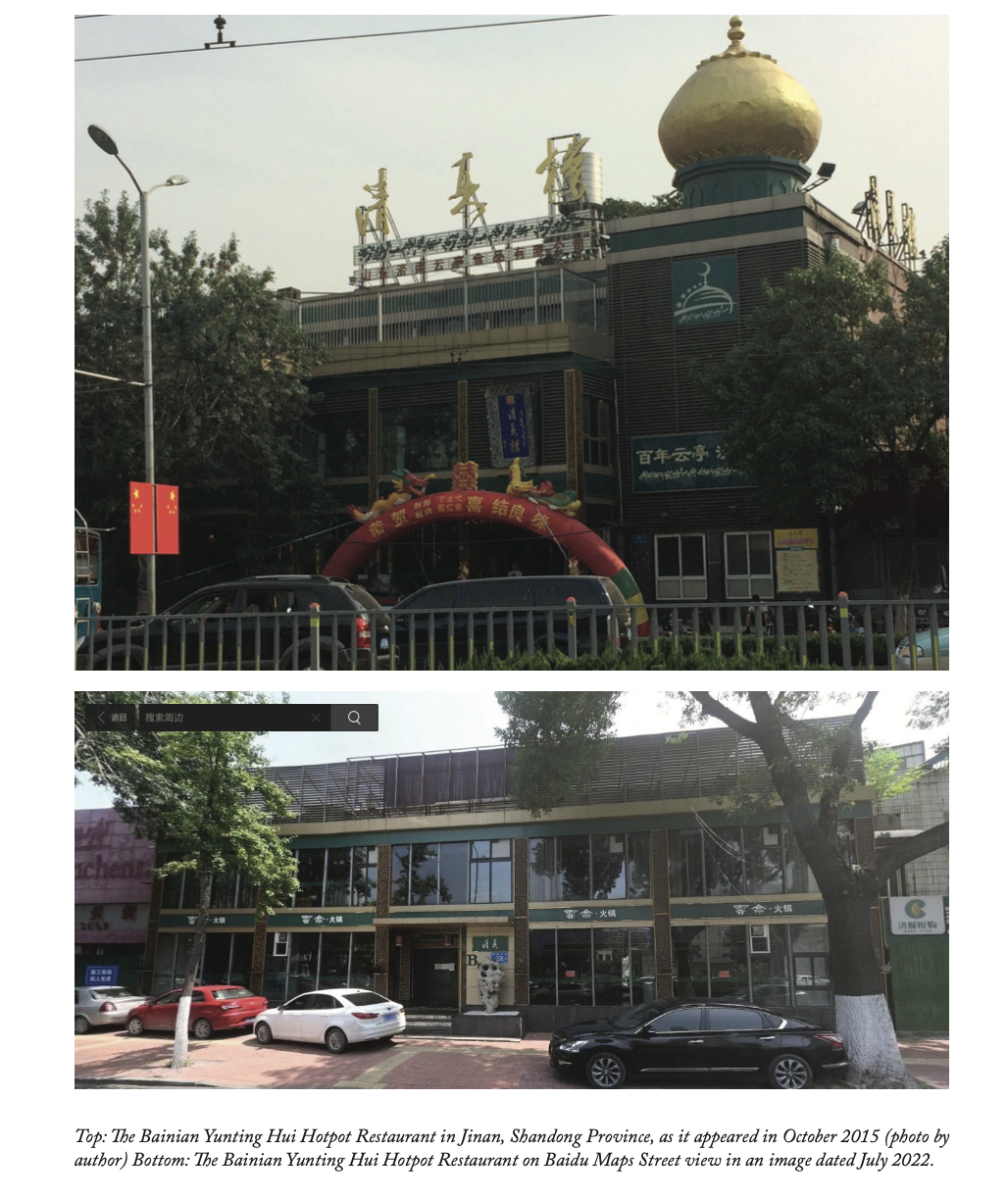
As with other aspects of Sinicization policy, party-state action to remove aesthetic markers of foreign influence was first taken in Ningxia in 2016, continuing into 2017. The measures taken to “resist the Three Transformations” were later folded into broader Sinicization policy. After the Three Transformations campaign identified unacceptable practices of Islam linked to latent extremism, the Five-Year Plan bestowed power to define ‘normal’ practice of faith on the CIA. Interventions made by the party-state under the Three Transformations also demonstrate the intersections between counter-terrorism and ‘anti-extremist’ work and the broader Sinicization campaign, as signs of the Three Transformations are explicitly understood as signifiers indicating a vulnerability to extremism. As of 2024, mosques continue to be monitored for any evidence of the Three Transformations. Policing of mosque architecture, dress, and halal labeling continues to provide a rationale for further, programmatic interventions into Muslim communities.
In the section below, we outline examples of party-state interventions taken against practices identified as exemplary of the Three Transformations. We discuss how the party-state’s crackdown targeted mosque architecture, public use of Arabic script, halal branding and certification, practices of dress, and public broadcasting of the call to prayer (adhan).
