
Tehran Reza Abbasi Museum: Persian Miniatures, Ceramics and Islamic Art
Reposted from the web
Summary: Tehran Reza Abbasi Museum: Persian Miniatures, Ceramics and Islamic Art is presented here as a firsthand travel account in clear English, beginning with this scene: In the second half of 1978, strikes and protests almost paralyzed all of Iran, and the Reza Abbasi Museum was forced to close in November. The account keeps its focus on Tehran Travel, Islamic Art, Persian Miniatures while preserving the names, places, food, and historical details from the Chinese source.
In the second half of 1978, strikes and protests almost paralyzed all of Iran, and the Reza Abbasi Museum was forced to close in November. In 1979, the Pahlavi dynasty fell, the Islamic Republic of Iran was established, and the Reza Abbasi Museum reopened. After closing and reopening several more times, the museum is now managed by the Iranian Cultural Heritage Organization and houses various precious Iranian artifacts from prehistoric times to the Islamic period.
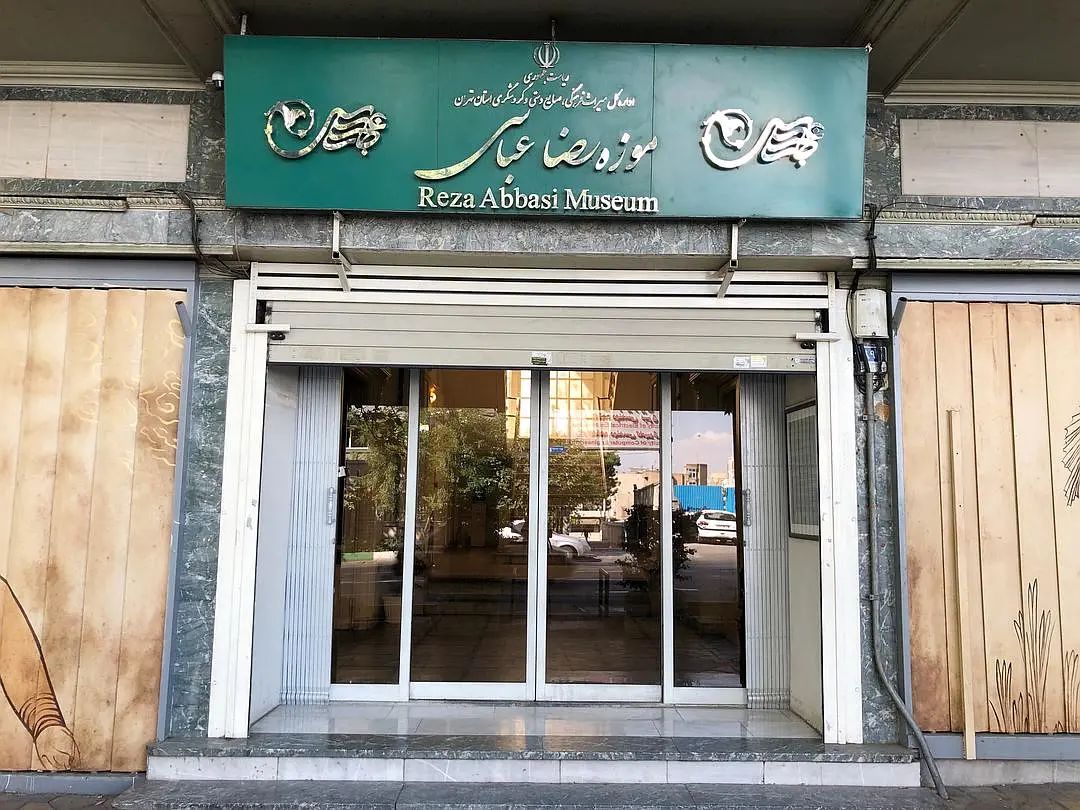
Table of Contents
1. Miniatures from the Shahnameh (Book of Kings)
1. Shahnameh miniatures from the Ilkhanate period
2. Shahnameh miniatures from the Timurid period
3. Shahnameh miniatures from the Safavid dynasty period
2. Miniatures from the Compendium of Chronicles (Jami' al-tawarikh) from the Timurid Empire period
3. Other miniatures
4. Pottery from the 9th to 10th centuries unearthed in the ancient city of Nishapur in Khorasan
5. Ceramics from the 12th to 14th centuries from the ancient Iranian city of Kashan
6. Iranian tiles from the 12th to 13th century Seljuk Empire and
the Ilkhanate period.
7. A gold-inlaid silver plate made in 1009 AD.
1. Miniatures from the Shahnameh (Book of Kings)
Persian miniature painting emerged during the Mongol invasion in the 13th century. During the Ilkhanate rule in the 13th and 14th centuries, the royal court moved often for seasonal changes, wars, and hunting. Portable books became the best surface for painting, and the art of miniatures continued to grow. The Mongols brought many Eastern artistic influences to Persian miniatures. For example, some mythical beasts were drawn to look like qilin, phoenixes, pixiu, and Chinese dragons.
Several centers for Persian miniature painting appeared between the 13th and 15th centuries. As the capital of the Ilkhanate, Tabriz was the earliest center for miniatures, and Baghdad, which was under Persian rule at the time, was also very important. In the mid-to-late 14th century, Shiraz in southern Iran became a center for literature and art, and Shiraz miniatures became world-famous. By the early 15th century, after the Timurid era, Bukhara and Herat became centers for miniatures under the patronage of the Timurid royal family. During this period, each miniature painting center had its own unique style. These styles did not gradually merge until the Safavid dynasty ruled in the 16th century.
1. Miniature paintings from the Book of Kings (Shahnameh) during the Ilkhanate period.
During the Ilkhanate period, miniature paintings based on classic Persian poetry began to appear. The most famous is the Persian epic poem Book of Kings (Shahnameh), written by the Persian poet Ferdowsi between 977 and 1010. It describes the myths and historical legends of the Persian Empire from its founding until it was conquered by the Arabs in the 7th century.
The earliest surviving Ilkhanate manuscripts of the Book of Kings are three small manuscripts. This small size was likely more convenient to carry while moving between nomadic camps.
The two images below are illustrations from the manuscript known as the First Small Book of Kings, which is believed to be in the late 13th-century Baghdad style.
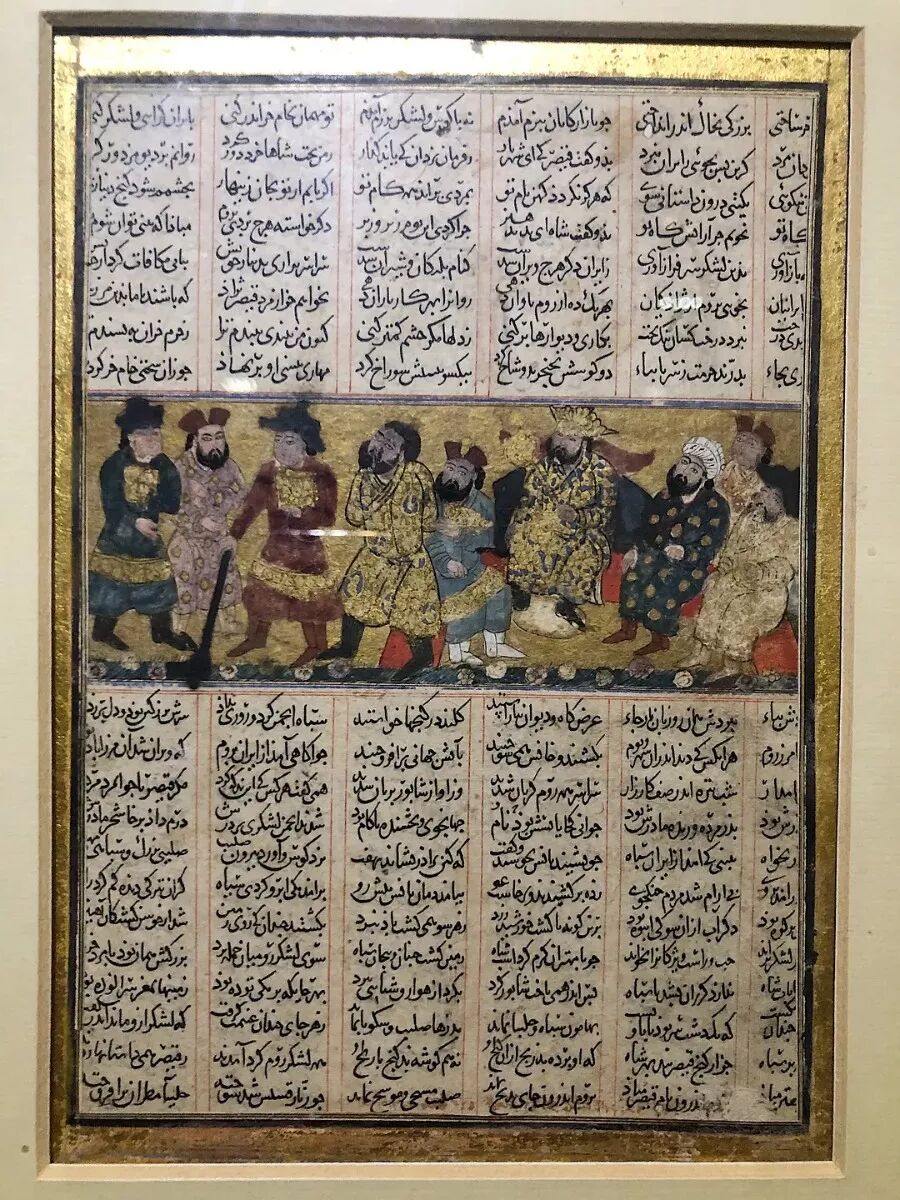
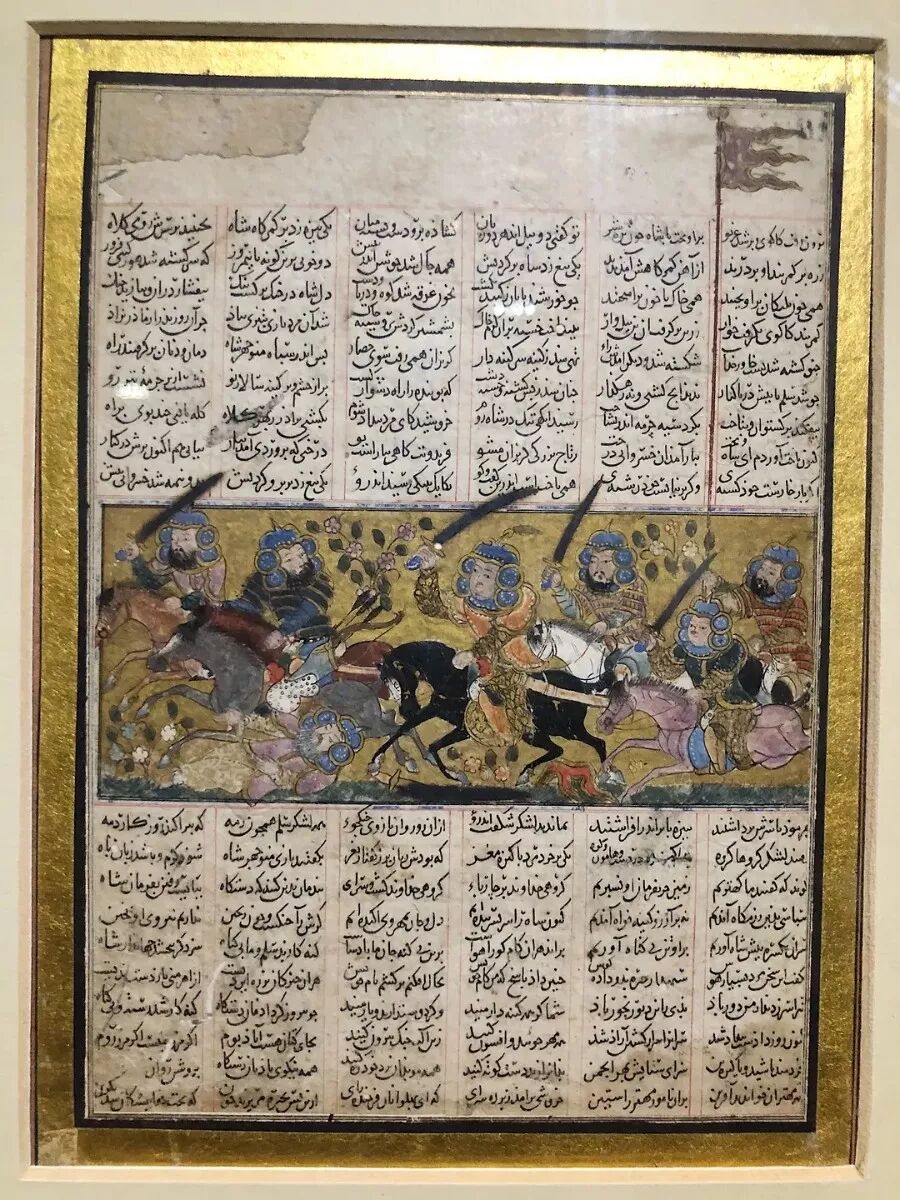
This depicts the Iranian prince Salm killing his younger brother Iraj out of jealousy. Years later, Iraj's grandson, the legendary king Manuchehr, killed Salm to avenge his grandfather.
The two images below are illustrations from the manuscript known as the Second Small Book of Kings, which is believed to be in the late 13th-century Baghdad style.
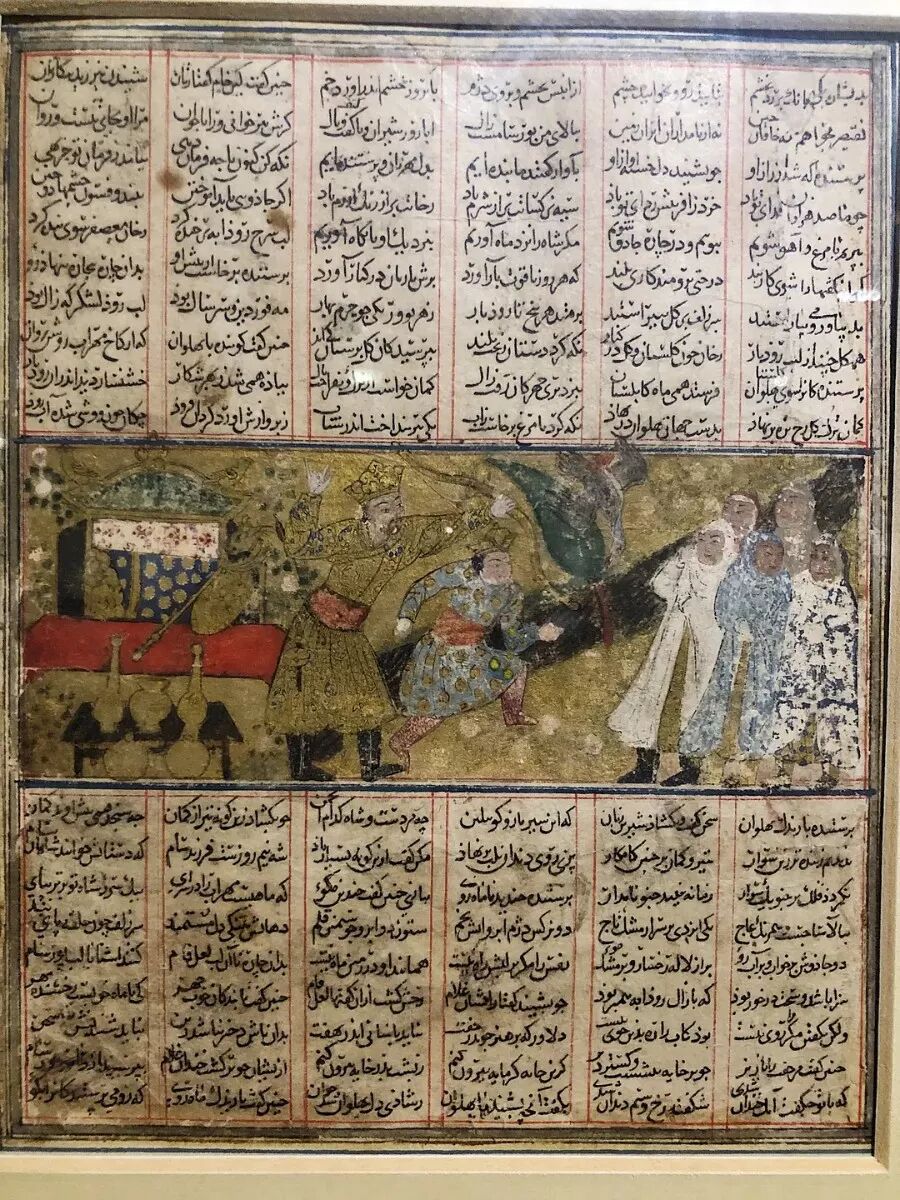
This depicts the Kabul princess Rudaba talking to her female slave so she could meet her husband, the Iranian king Zal. Rudaba is the mother of the legendary hero Rostam, the protagonist of the Book of Kings.
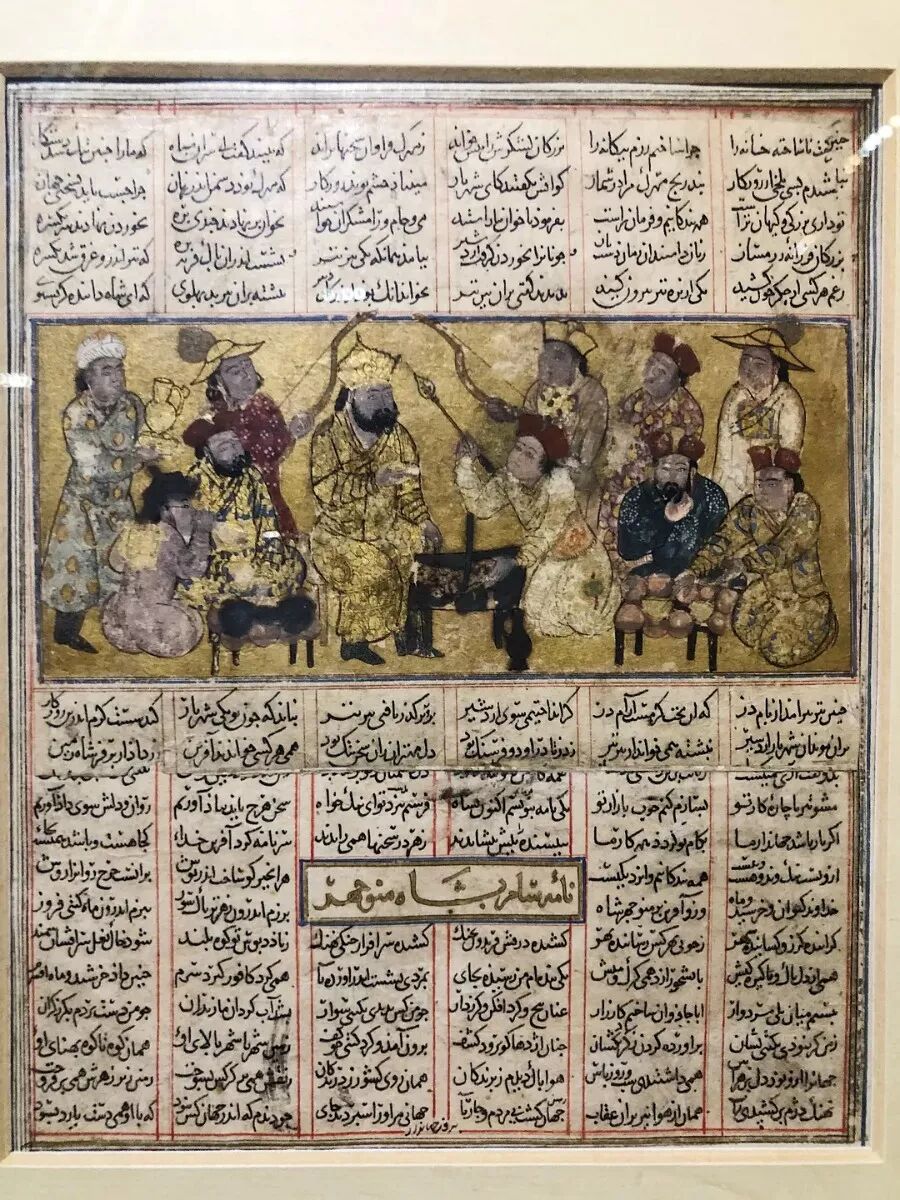
This depicts Ardashir, the founder of the Persian Sasanian dynasty, receiving a warning from his enemy Haftvād.
There are four other manuscripts produced in the early 14th century by the Injuid family, who ruled the Shiraz and Isfahan regions of southern Iran and were semi-independent from the Ilkhanate.
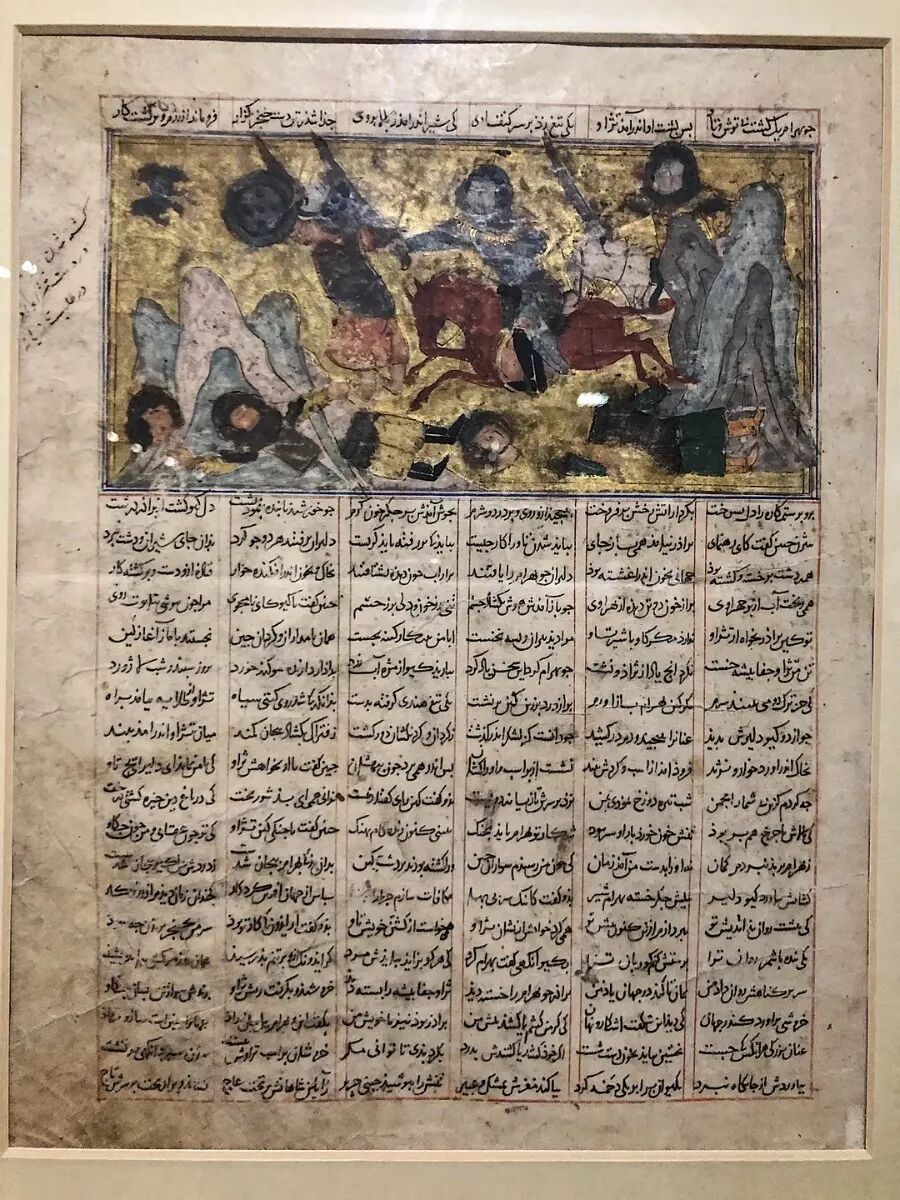
The image below is one of these, done in the Shiraz style. It shows the Iranian hero Bahram being mortally wounded by Tazhav while fighting the Turanians (the Persian name for Central Asian people), a scene from shortly before his death.
Among the Shahnameh manuscripts from the Ilkhanate period, the most famous one is known as the Great Mongol Shahnameh, the Great Ilkhanid Shahnameh, or the Demotte Shahnameh. It is considered the greatest work of early Persian miniature painting.
In the early 14th century, the Persian Jewish vizier of the Ilkhanate, Rashid al-Din, set up a book production department in the suburbs of the Ilkhanate capital, Tabriz, specifically to create books containing miniature paintings. After Rashid al-Din died in 1318, his son Ghiyath al-Din Muhammad continued his father's work by producing miniature manuscripts in the 1330s.
Based on research by later historians, it is believed that Ghiyath al-Din Muhammad produced the Great Mongol Shahnameh manuscript in Tabriz in 1335, under the patronage of the ninth Ilkhanid ruler, Abu Sa'id Bahadur Khan (reigned 1316–1335).
The Great Mongol Shahnameh was kept in Tabriz until the 16th century, after which it entered the library of the Golestan Palace in Tehran. In the late 19th century, taking photographs of the manuscript was still restricted.
In the early 20th century, the Belgian art dealer Georges Demotte, who was active in Paris, acquired the Great Mongol Shahnameh. Because he could not get a suitable price from potential buyers like the Metropolitan Museum of Art, Demotte eventually tore the manuscript apart to sell it in pieces. To hide the damage caused by tearing the book apart, Demotte hired calligraphers to add new text to the manuscript, which greatly annoyed buyers who could read Persian.
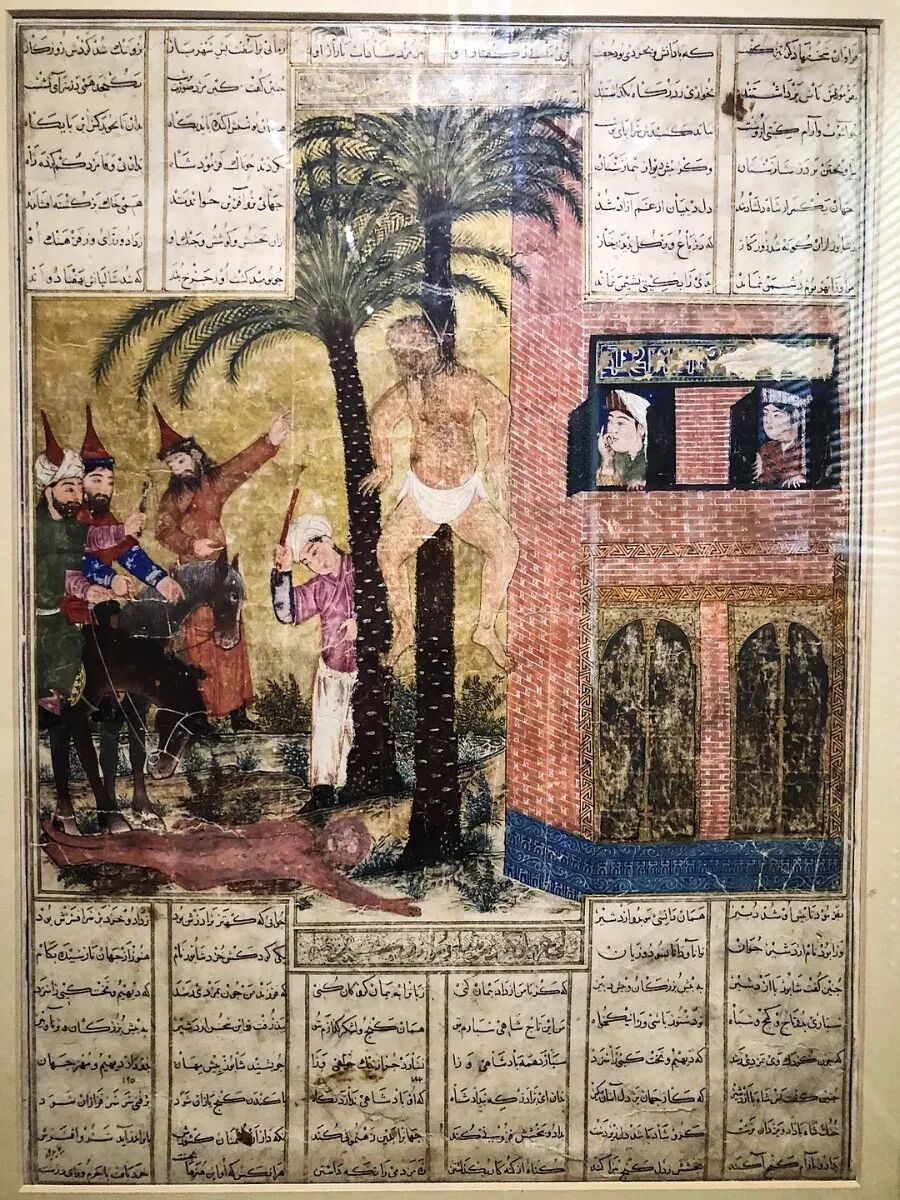
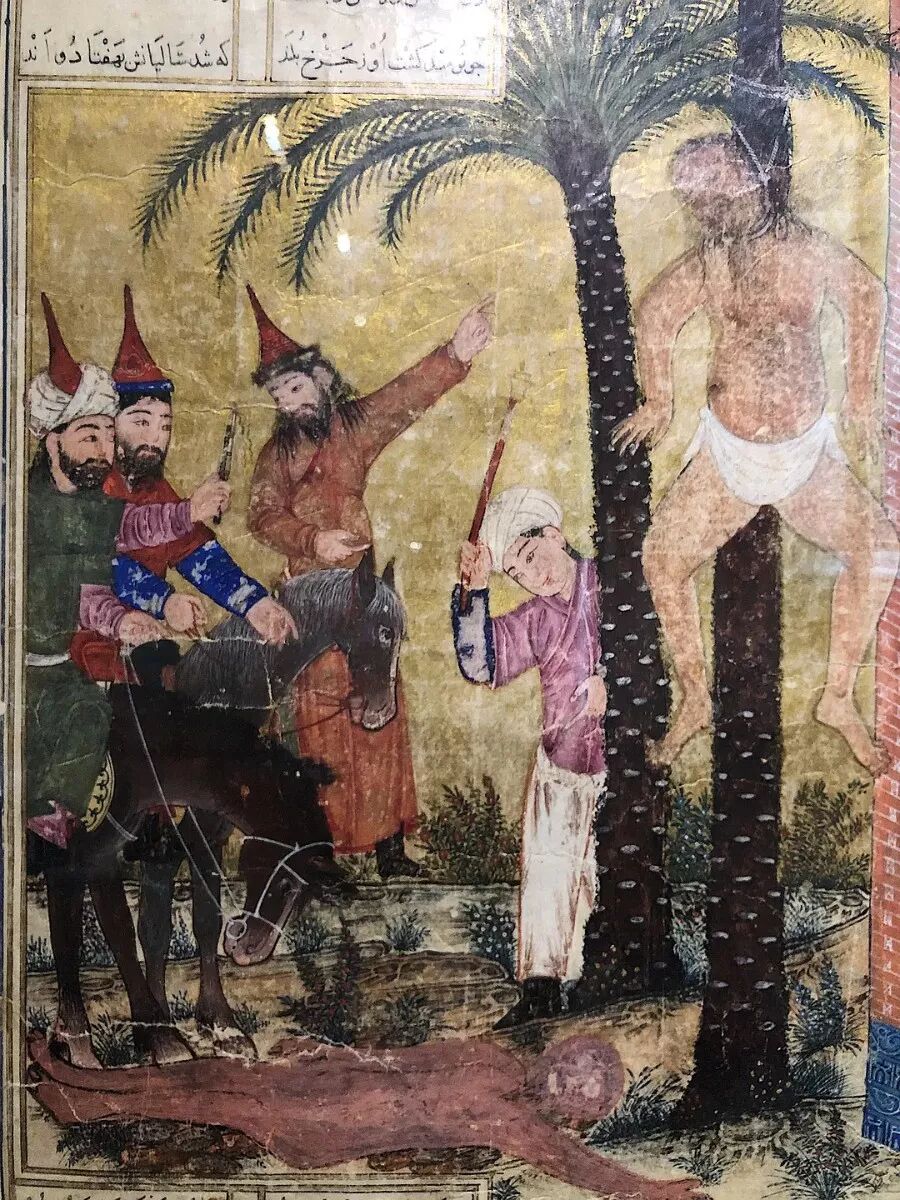
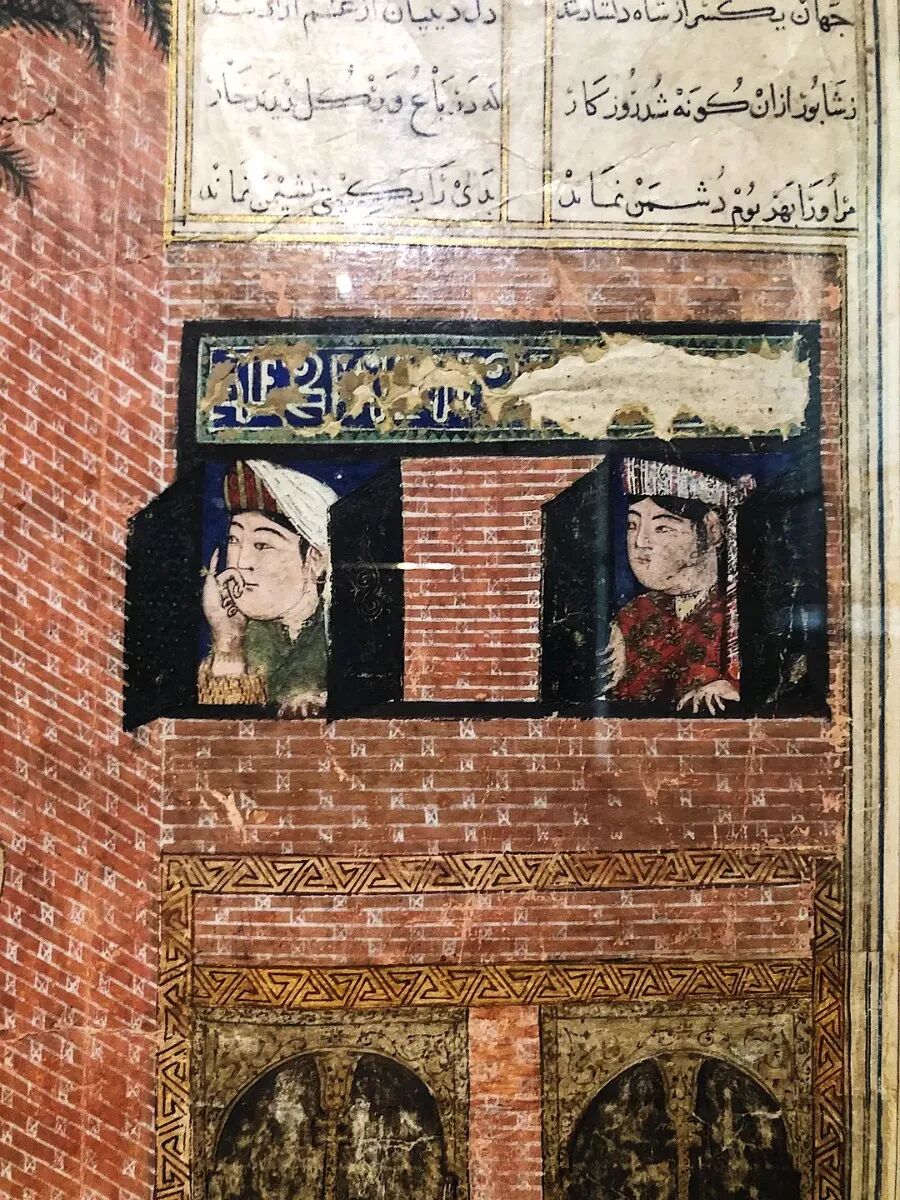
The image below is an illustration from the Tabriz-style Great Mongol Shahnameh, depicting the hanging of Mani.
2. Shahnameh miniature paintings from the Timurid dynasty
During the Timurid dynasty, Bukhara became a center for producing the Book of Kings (Shahnameh).
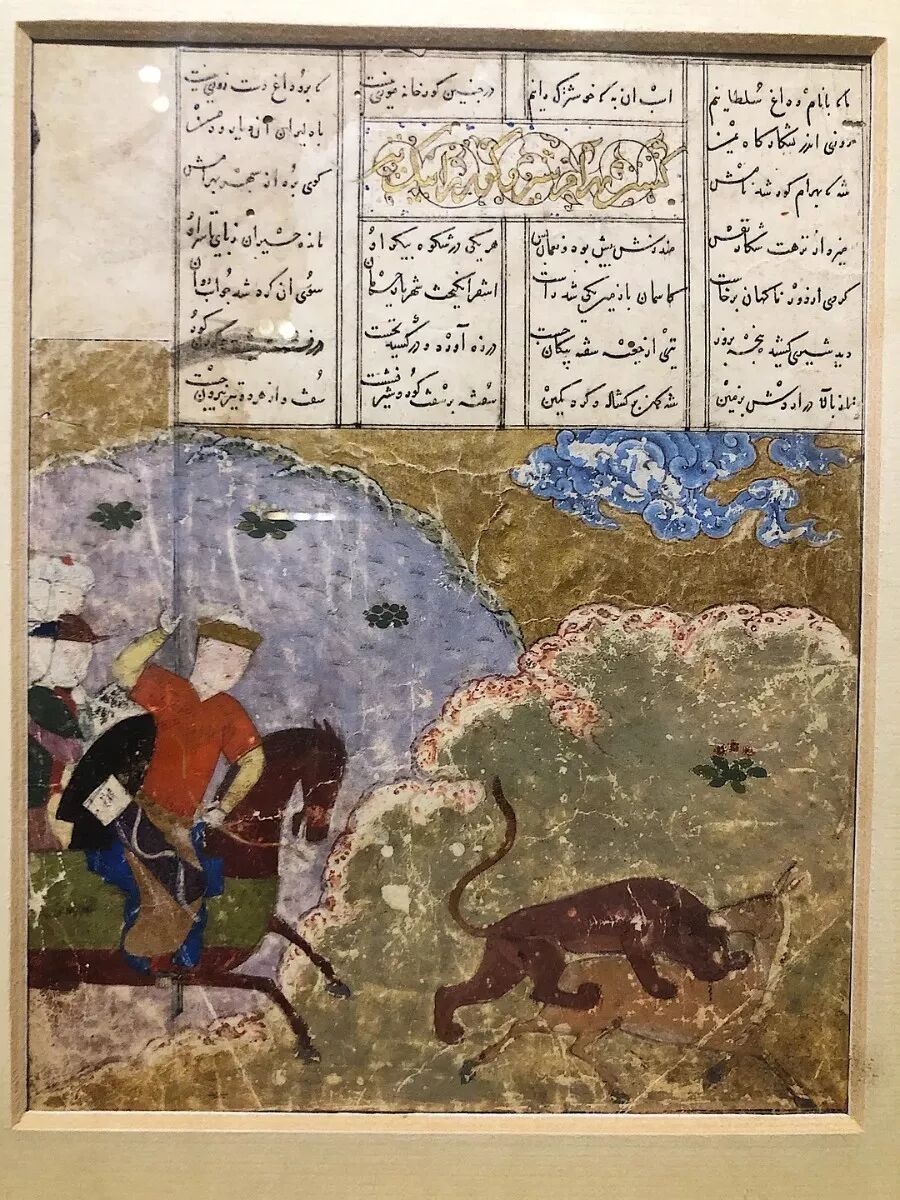
The image below shows a late 14th-century illustration of the Book of Kings in the Herat style, depicting the Iranian hero Bahram shooting his prey.
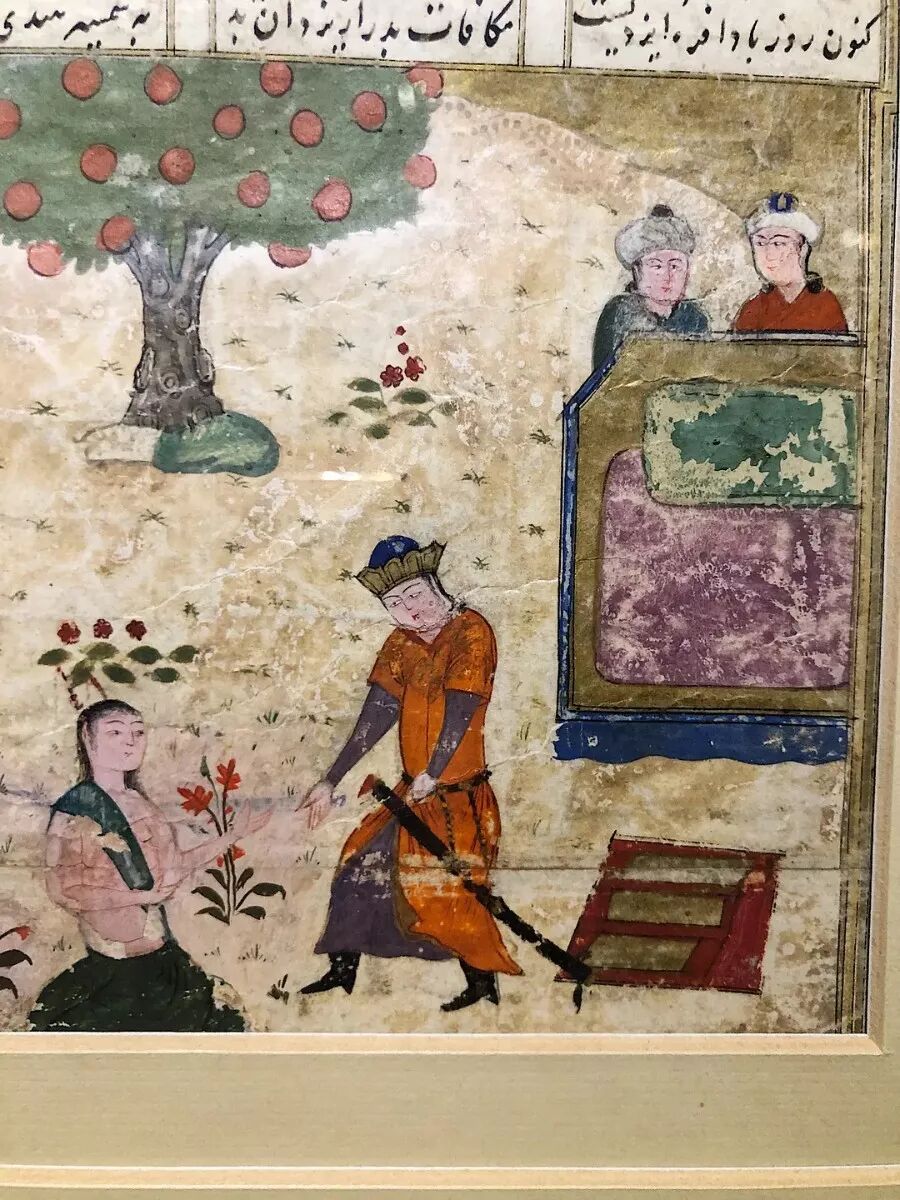
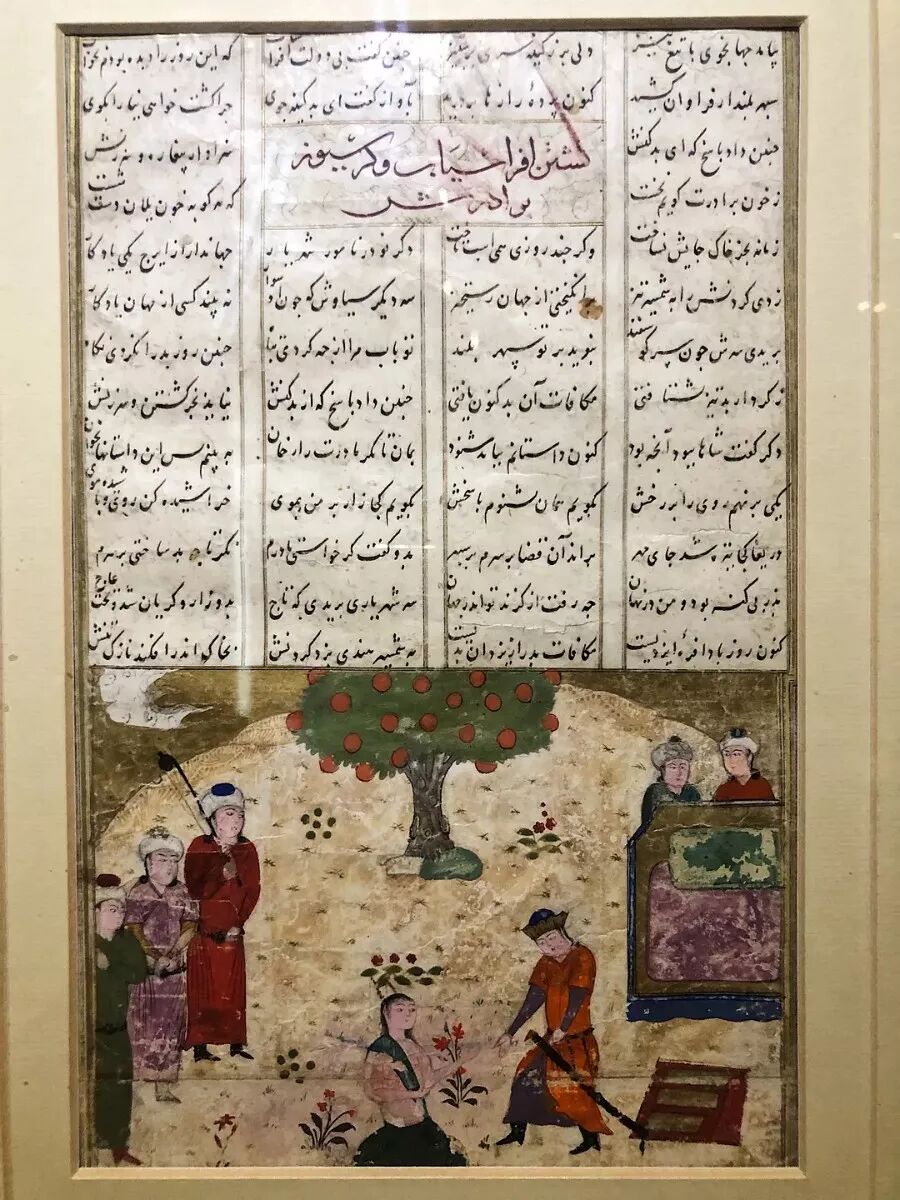
The image below shows an early 15th-century miniature painting of the Book of Kings in the Bukhara style, depicting Garsiwaz killing his brother, the Turanian king Afrasiab.
3. Miniature paintings of the Book of Kings from the Safavid dynasty period
During the Safavid dynasty's rule over Iran in the 16th and 17th centuries, the production of Book of Kings miniature paintings saw a revival. Ismail I (reigned 1502-1524), the founder of the Safavid dynasty, used the production of Book of Kings manuscripts to emphasize the authority of Persian kings and to strengthen Persian patriotism. Later generations consider the miniature painting created during the Safavid period to be the last great era of the art form.
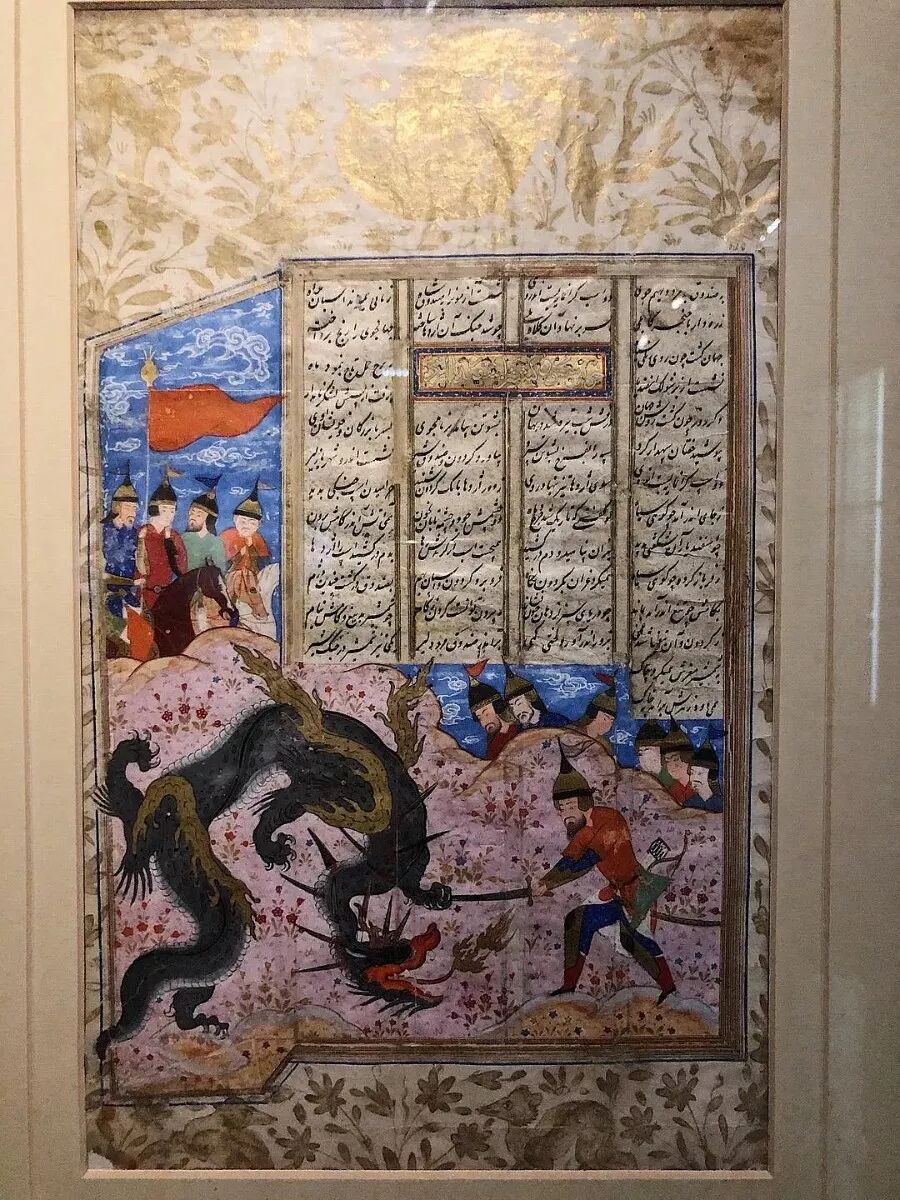
A 16th-century miniature painting of the Book of Kings in the Tabriz style, depicting the hero Esfandiyar slaying a dragon. Esfandiyar was an Iranian prince, and his father once sent him to suppress a rebellion and rescue a kidnapped princess. On his journey, he fought seven different battles, one of which was killing a dragon.
A 16th-century miniature painting of the Book of Kings in the Tabriz style, depicting the legendary hero Rostam fighting his enemies.
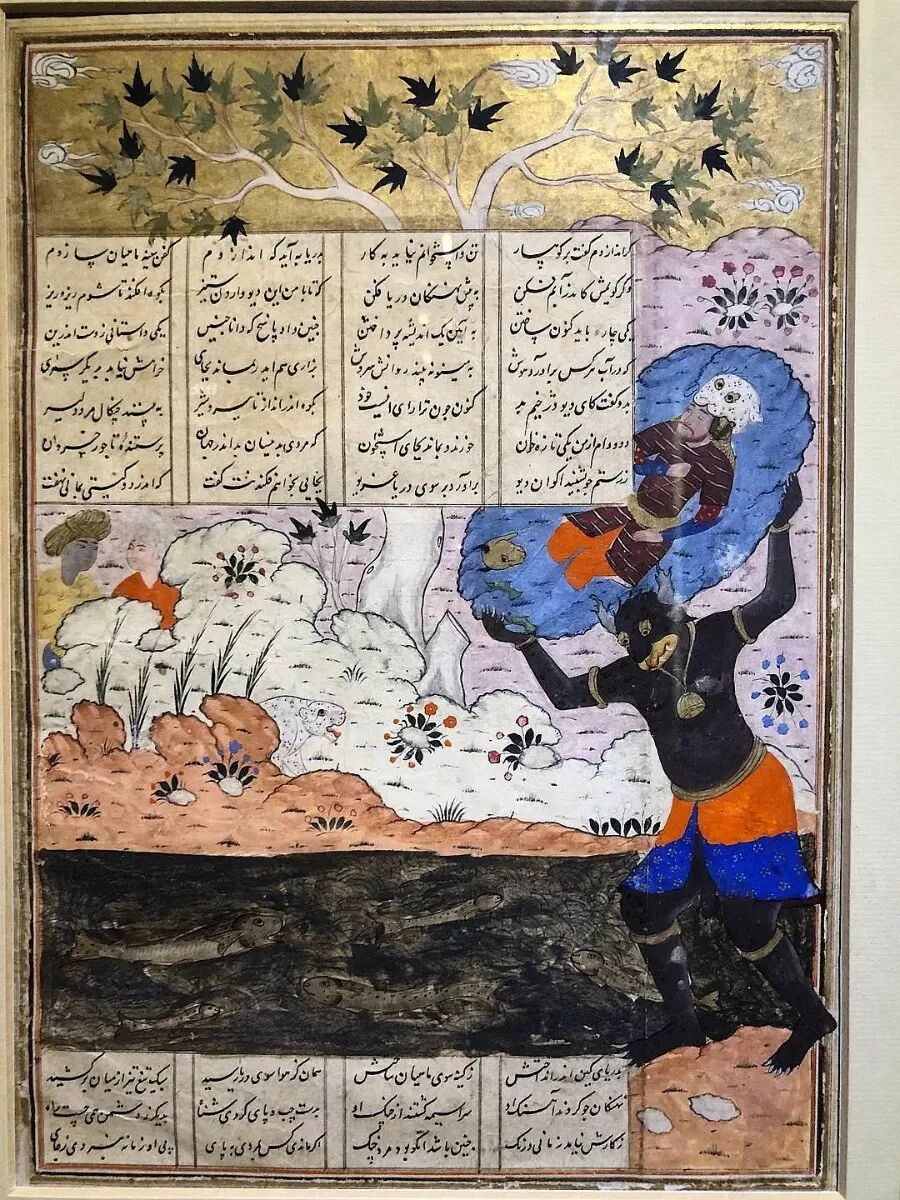
A late 16th-century miniature painting of the Book of Kings in the Khorasan style, depicting the Turanian king Afrasiab being led out of a cave by Houm.
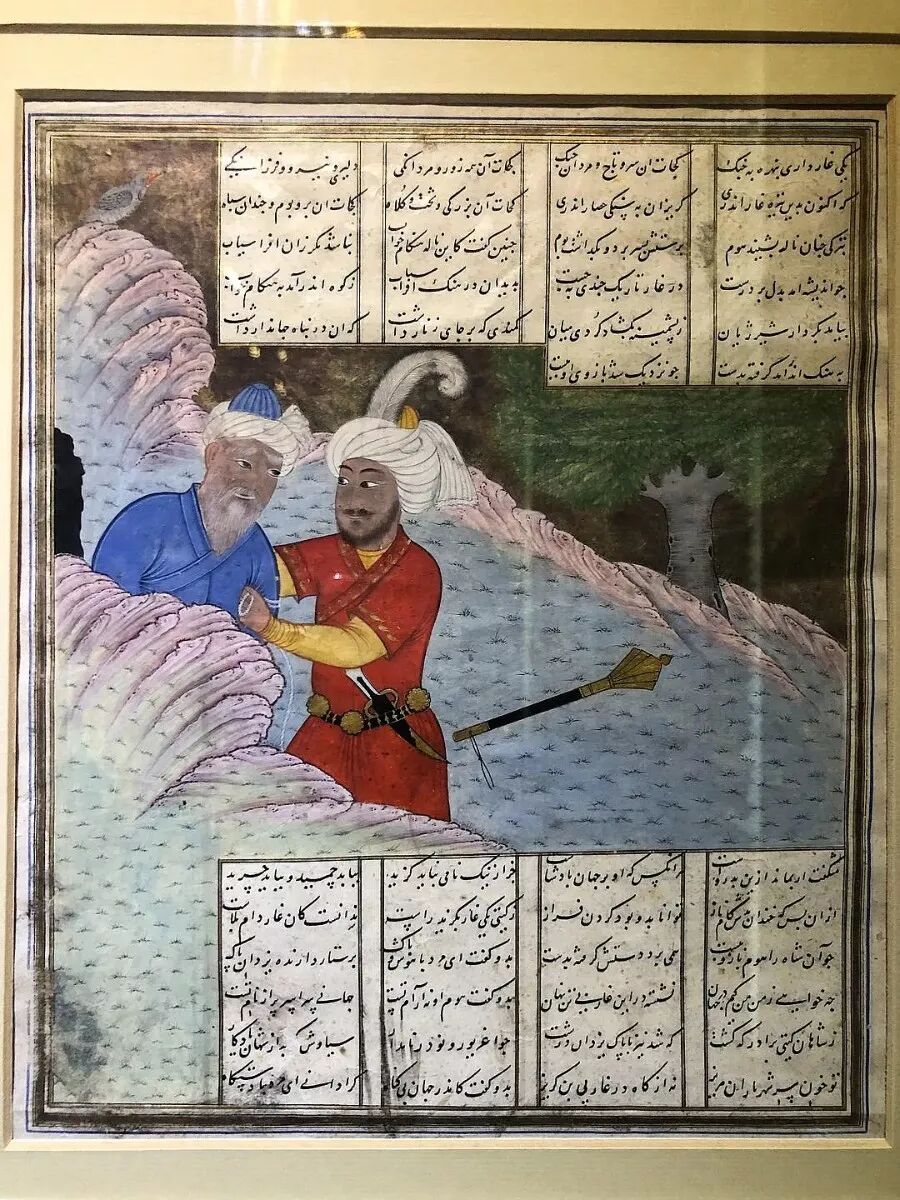
A 16th-century Shiraz-style miniature painting from the Shahnameh, showing the Iranian hero Bahram on his way to Egypt.
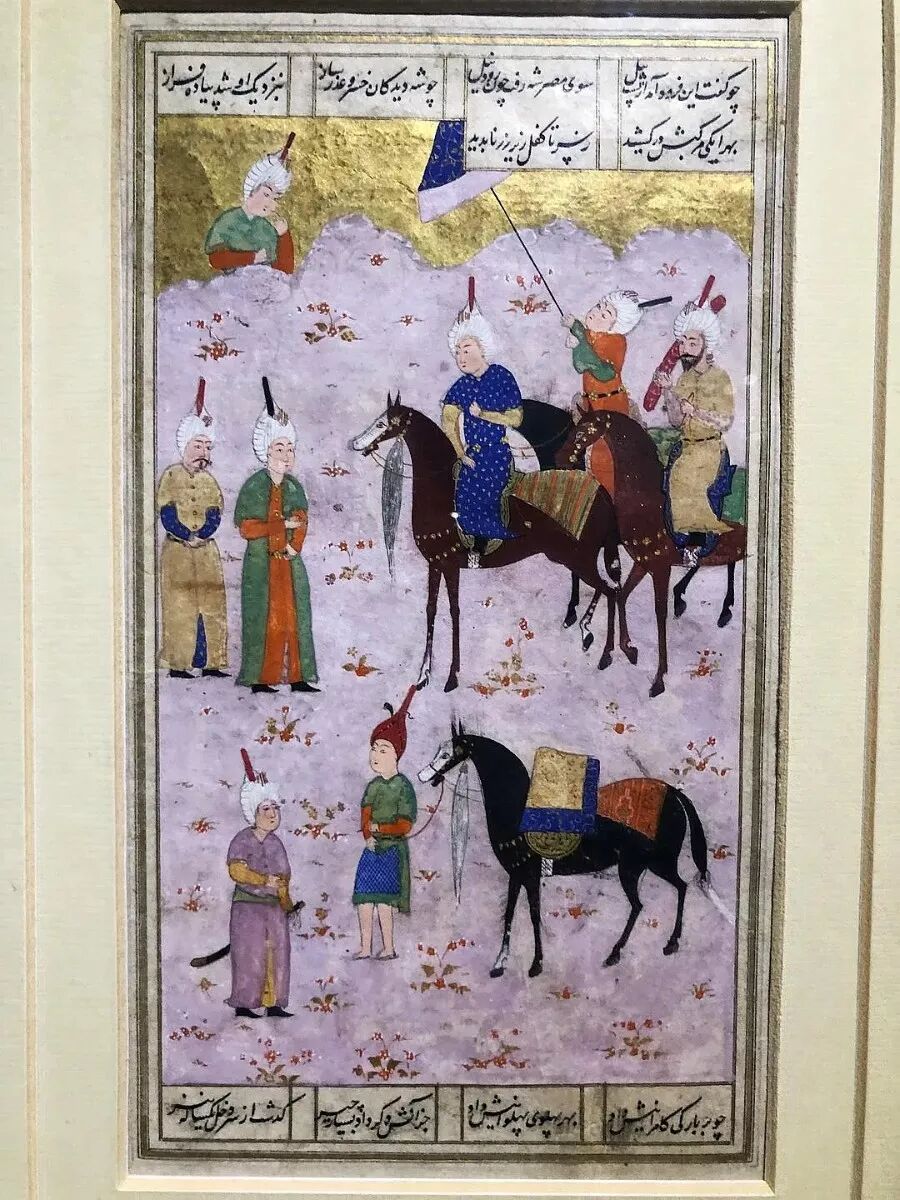
A 16th-century Tabriz-style miniature painting from the Shahnameh, showing the war between Darab, Shoaib, and the Arabs.
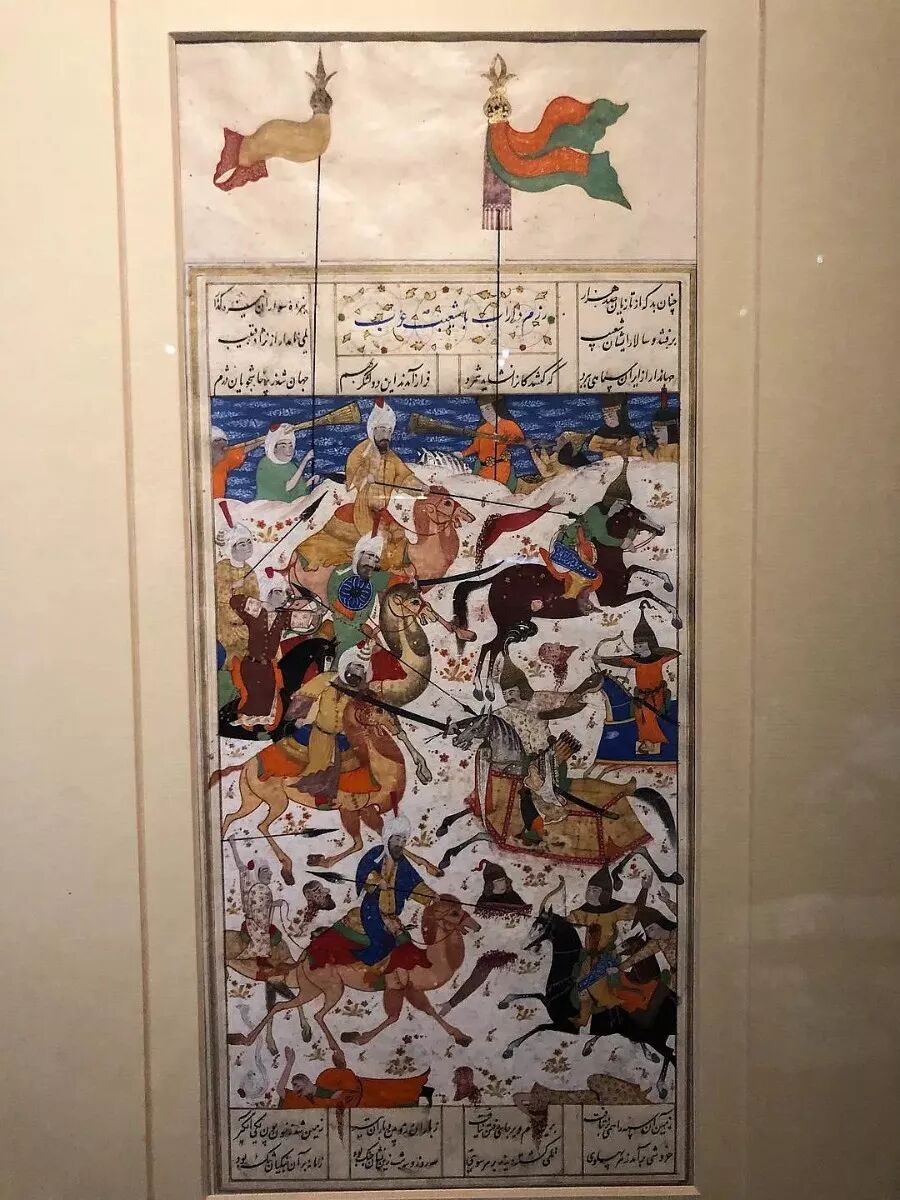
A late 16th-century Shiraz-style miniature painting from the Shahnameh.
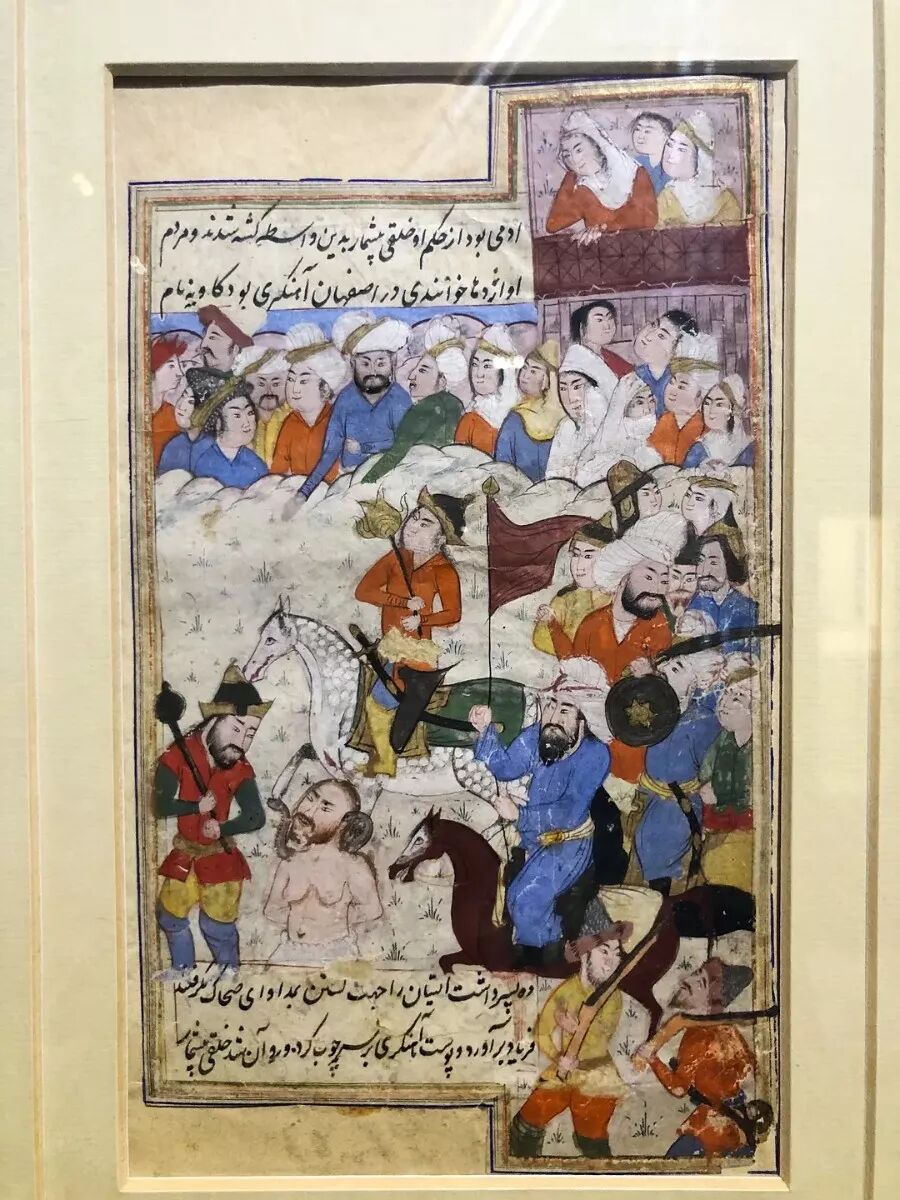
A 17th-century Shiraz-style miniature painting from the Shahnameh, showing the war between the legendary King Kay Khosrow of the Iranian Kayanian dynasty and King Shideh of Turan.
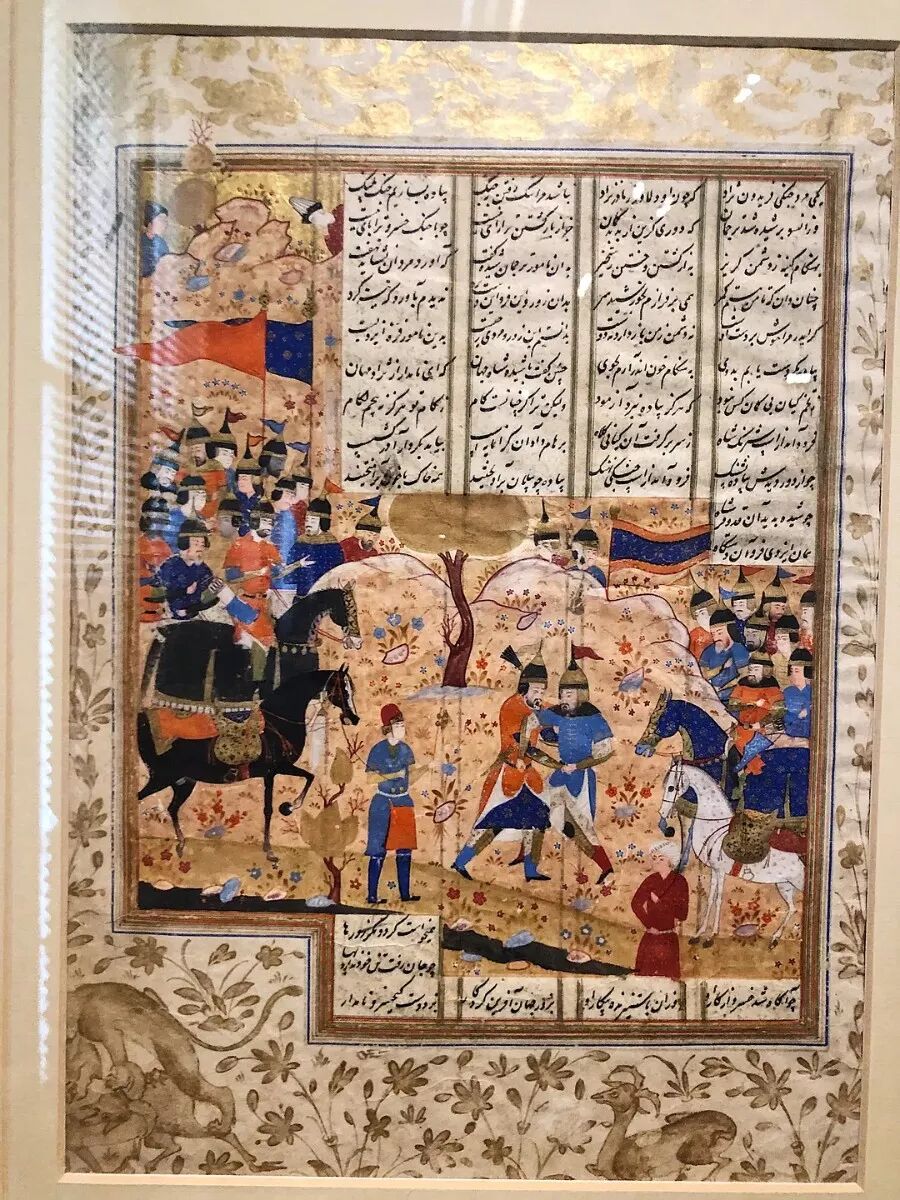
3 Produced by Tahmasp I of the Safavid dynasty.
Tahmasbi Shahnameh miniature painting.
The Tahmasbi Shahnameh, also called the Houghton Shahnameh, was commissioned by Tahmasp I (reigned 1524-1576) of the Safavid dynasty. The greatest painters of the Safavid era worked on it, and it originally included 258 miniature paintings. Because the Safavid capital was in Tabriz at the time, the Tahmasbi Shahnameh has a Tabriz style.
In 1959, the famous collector Arthur Houghton bought this Shahnameh from the wealthy French Jew Edmond de Rothschild. Only 118 miniature paintings remained at that time.
Since 1962, Arthur Houghton broke up the Tahmasbi Shahnameh and donated 88 of the paintings to the Metropolitan Museum of Art in New York to avoid taxes (Houghton had served as the president of the Metropolitan Museum of Art for many years). After that, Houghton auctioned off the miniature paintings several times. After Houghton died in 1990, the Houghton Foundation decided to sell the collection for 13 million dollars, but no one bought it because the price was too high. British seller Oliver Hoare suggested that Iran trade the remaining Shahnameh miniatures for the painting Lady No. 3 by Dutch artist Willem de Kooning, because the painting was banned from public display in Iran for being anti-Islamic. In the end, the Tahmasbi Shahnameh returned to Iran.
The image below shows the Sassanid king Bahram Chobin (reigned 590-591) fighting Sava Shah.
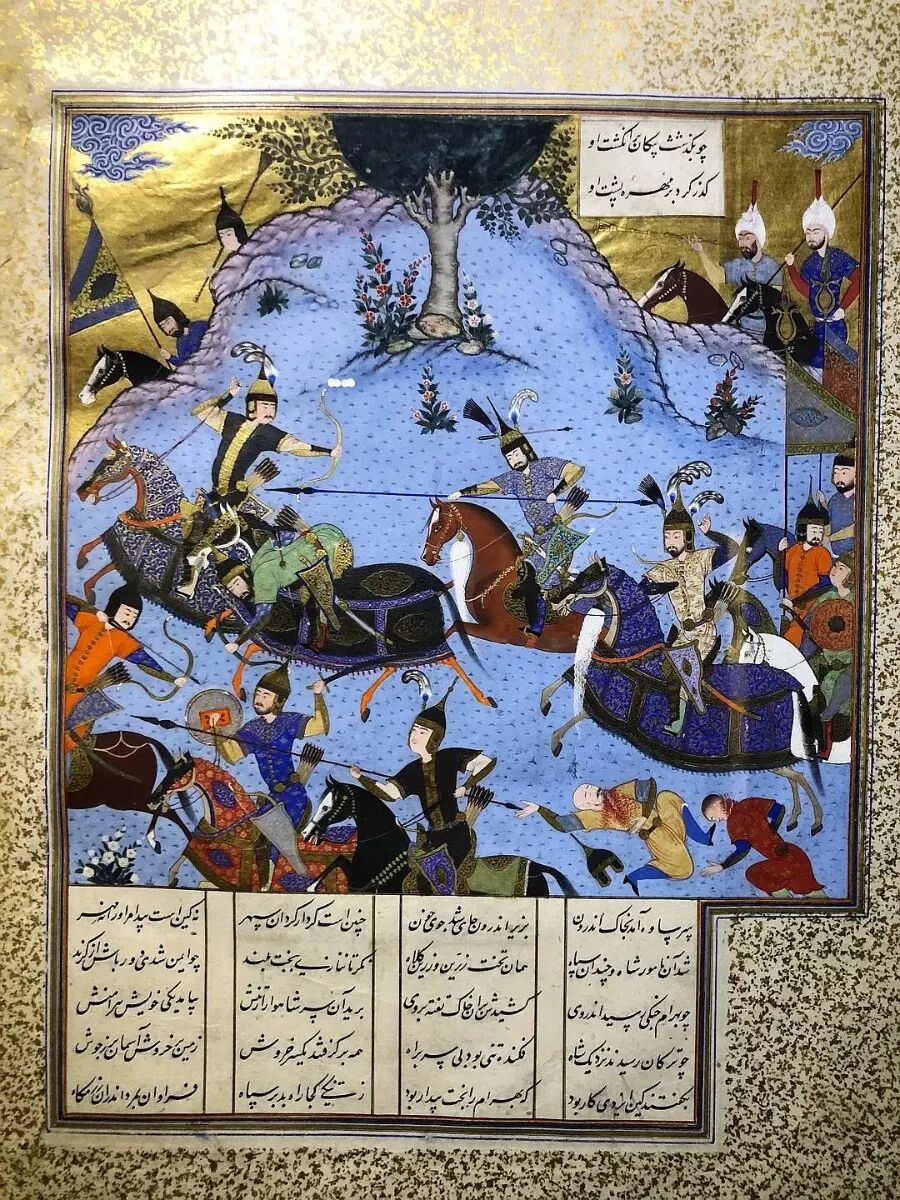
A Shahnameh miniature produced by Ismail II of the Safavid dynasty.
Ismail II (reigned 1576-1577) was the third ruler of the Safavid dynasty. At that time, the Safavid capital was Qazvin, Iran (1548–1598), so the miniatures from this period have a Qazvin style.
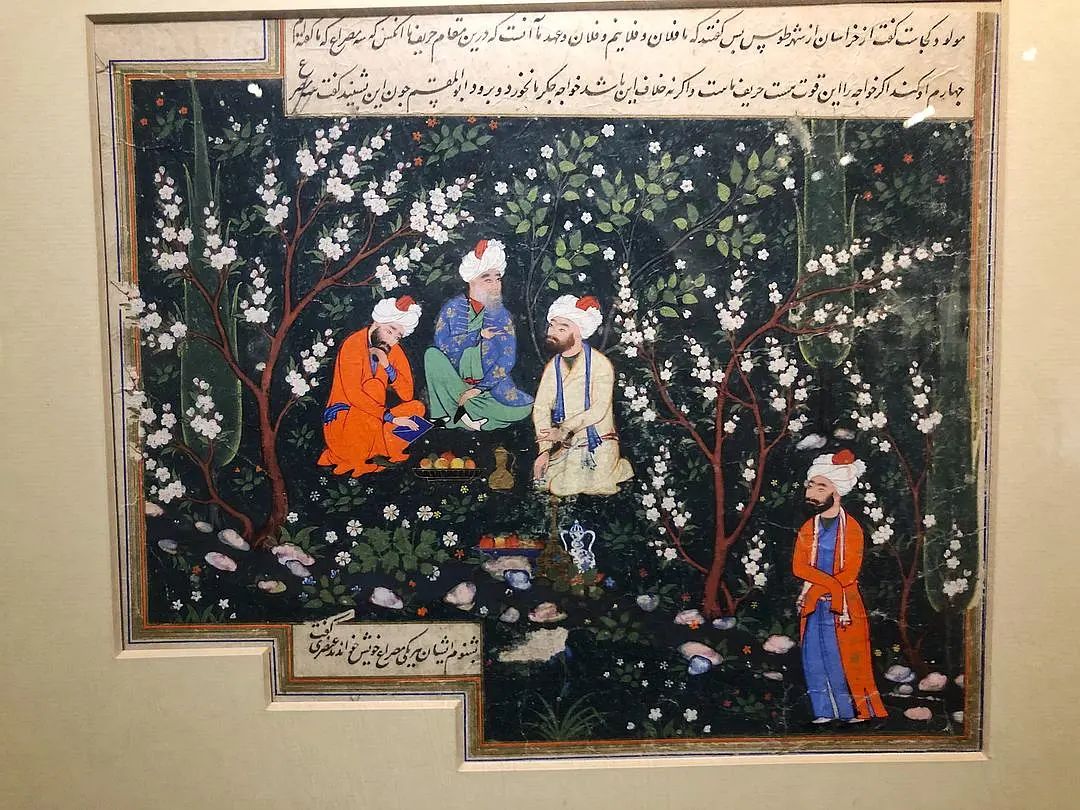
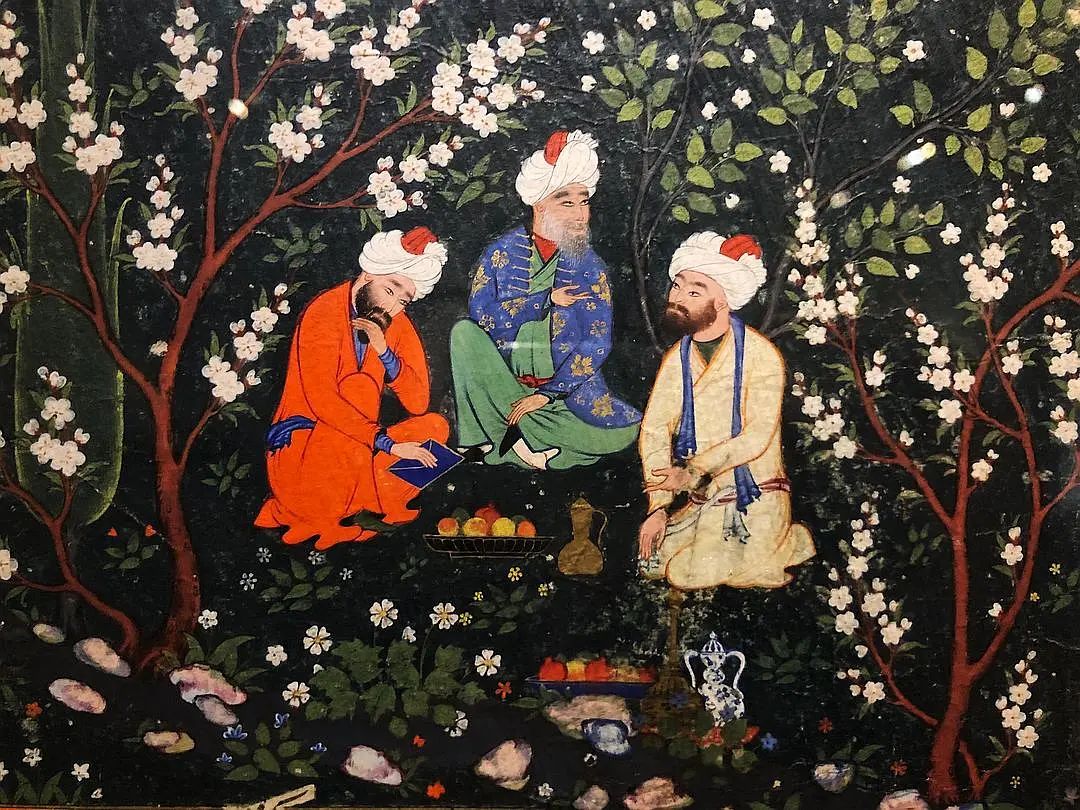
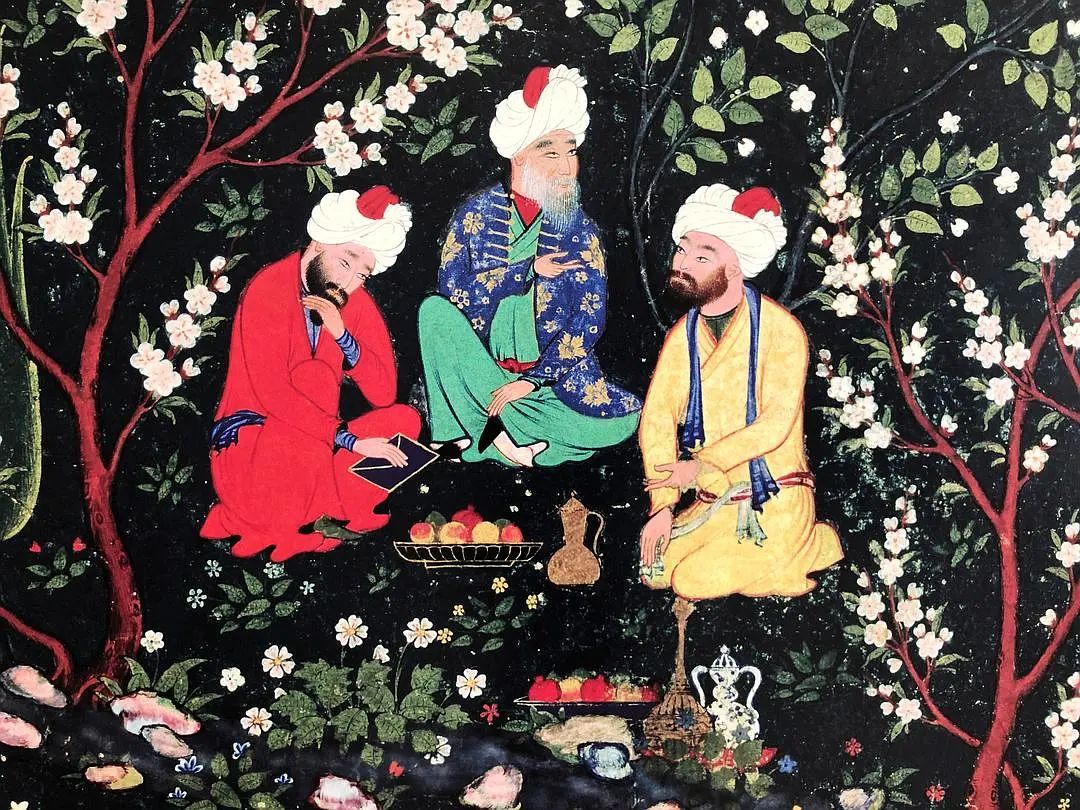
The image below shows the author of the Shahnameh, Ferdowsi, walking toward several court poets of the Ghaznavids. An enlarged version of this miniature is posted in the hall right at the entrance of the Reza Abbasi Museum. It is also the cover of the book Entering the Orchard in Spring.
Reproduction:
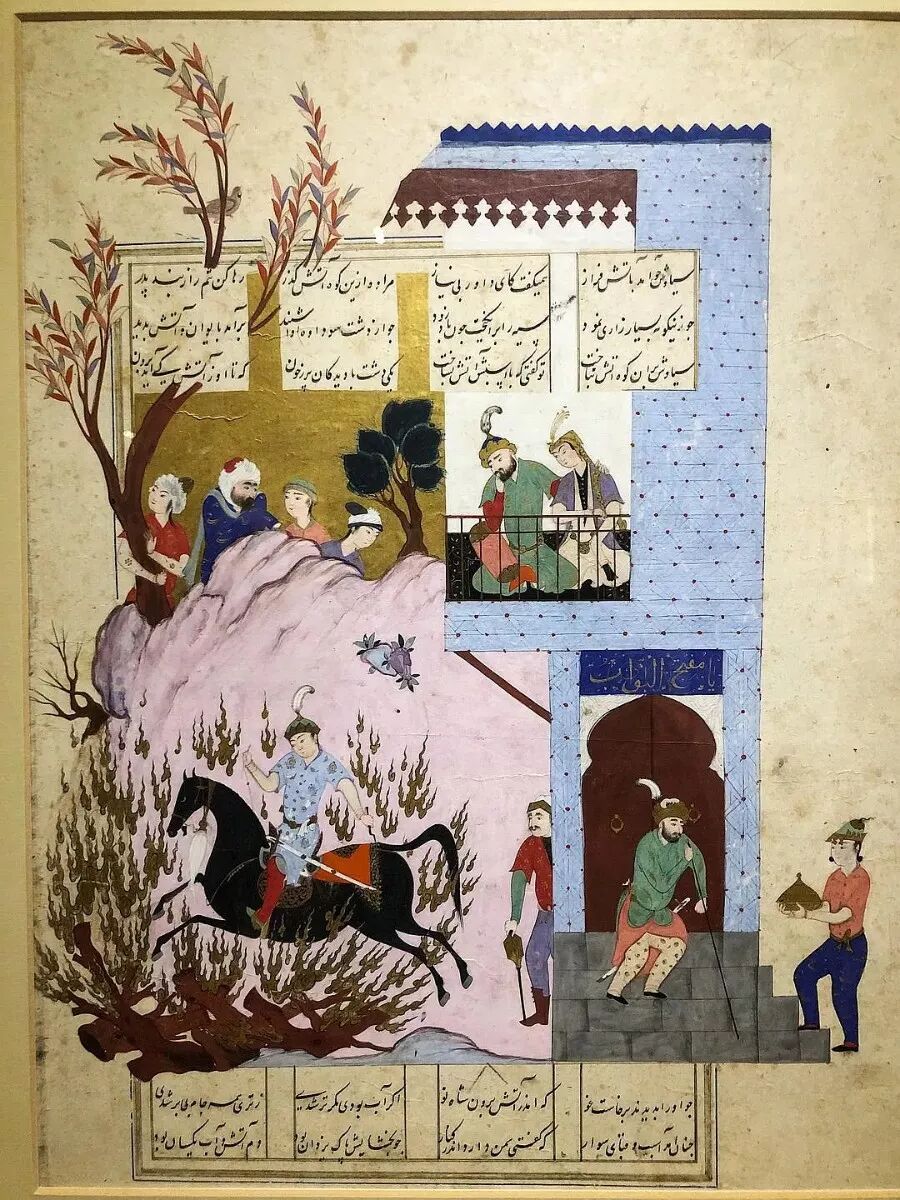
The image below shows the legendary Iranian prince Siavash undergoing a trial by fire, while his father, the Iranian king Kay Kavus, and his stepmother, Queen Sudabeh, watch from a balcony.
The image below shows Siavash hunting with the Turanian king Afrasiyab. The second part of the Shahnameh says that Siavash willingly became a hostage in Turan so that Iran and Turan could have peace. However, the king broke the peace treaty and committed a series of atrocities, which made Siavash decide to start a new life in Turan. King Afrasiyab of Turan gave Siavash a warm welcome, and Siavash fell in love with the king's daughter and married her.
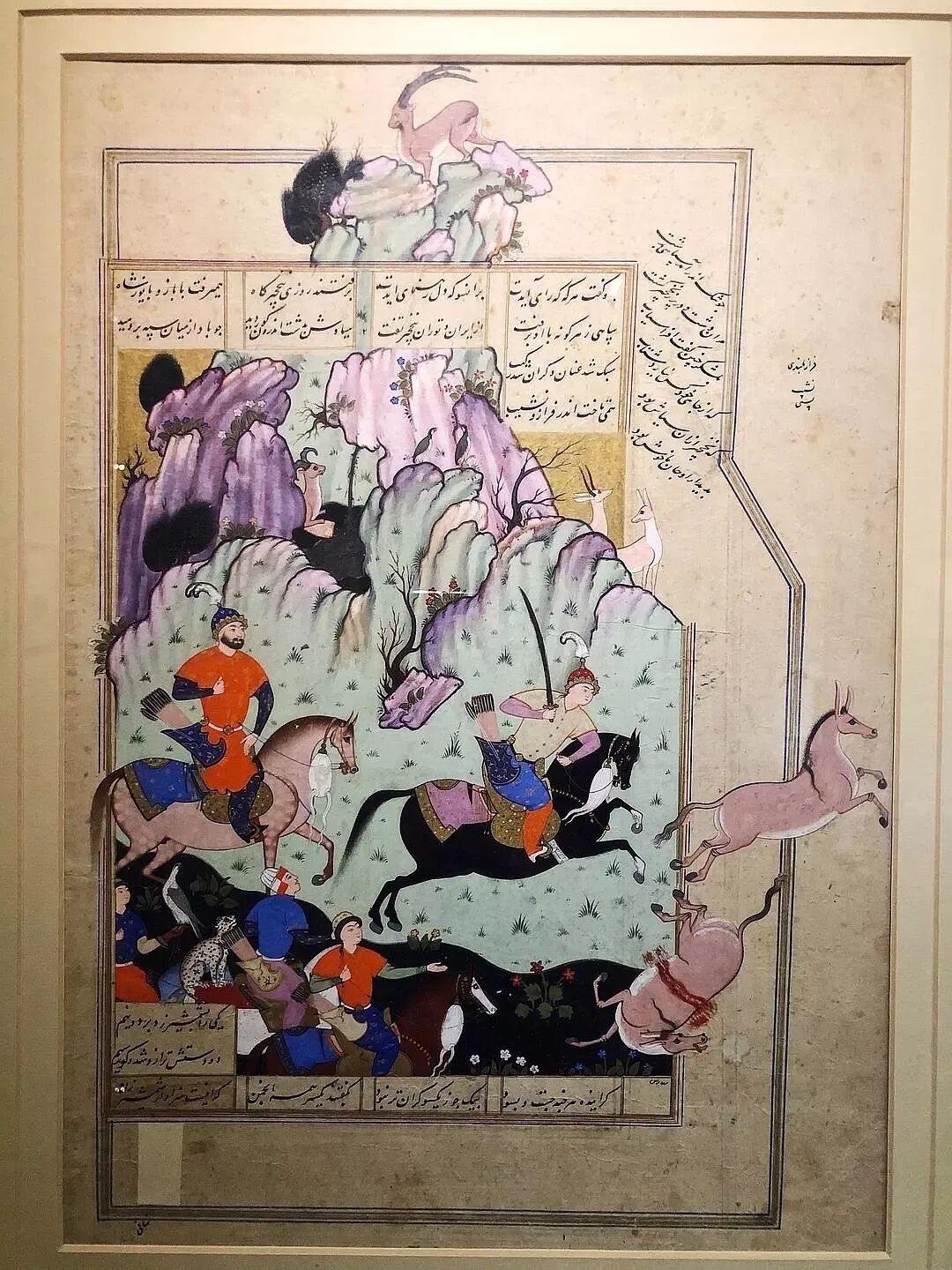
The image below shows the story of the mythical bird Simurgh taking care of the great hero Zal. Simurgh is a kind mythical bird in Iranian legends, similar to a phoenix. It appears often in various Iranian myths, most famously in the Shahnameh.
In the Shahnameh, the Iranian hero Saam's son, Zal, was born with albinism. Saam thought his son was a demon's child, so he abandoned him on Mount Alborz. The kind Simurgh living on the mountain peak heard the baby crying and raised him. Zal learned much wisdom and knowledge from the loving Simurgh.
In the picture, the mythical bird Simurgh is holding the baby Zal, and below them is Zal's father, Saam.
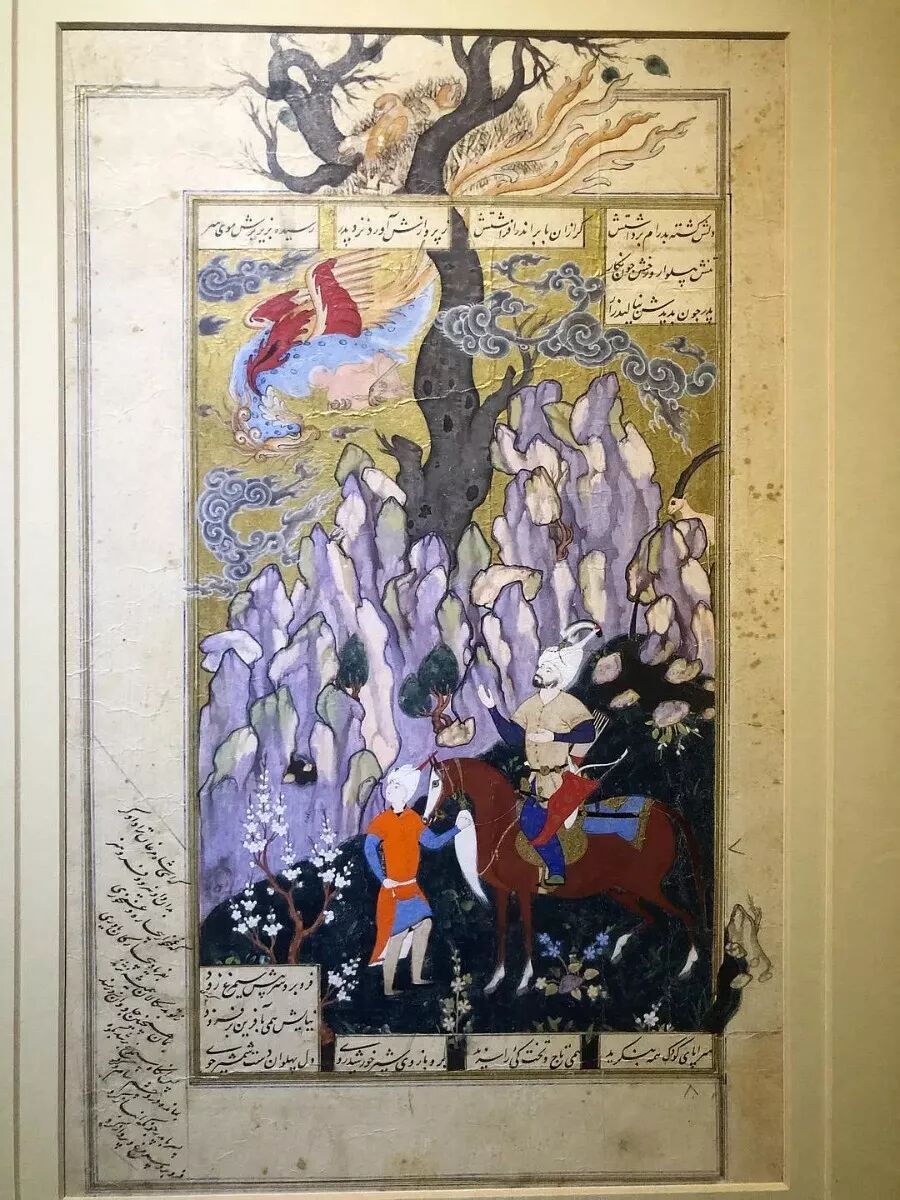
The image below shows the scene of the Iranian hero Esfandiyar slaying a dragon. Esfandiyar was an Iranian prince, and his father once sent him to suppress a rebellion and rescue a kidnapped princess. On his journey, he fought seven different battles, one of which was killing a dragon.
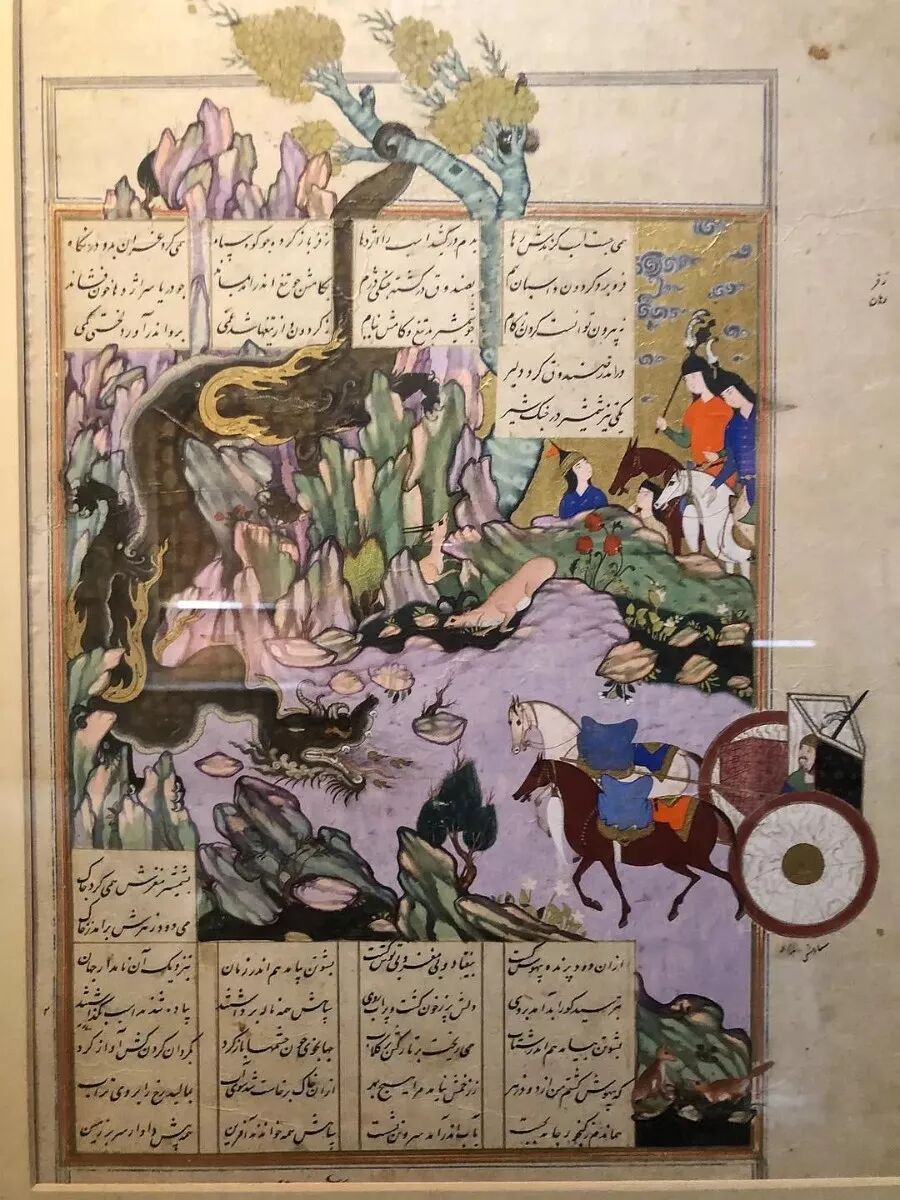
The image below shows the scene of the Iranian hero Esfandiyar killing the Turanian hero Biderafsh. When the King of Turan learned that the Iranians had converted to Zoroastrianism, he wrote a letter to the King of Iran demanding they abandon their faith and sent Biderafsh as a messenger to Iran. The King of Iran refused the demand, which started a war between Turan and Iran. During the war, Biderafsh was killed by the Iranian hero Esfandiyār.
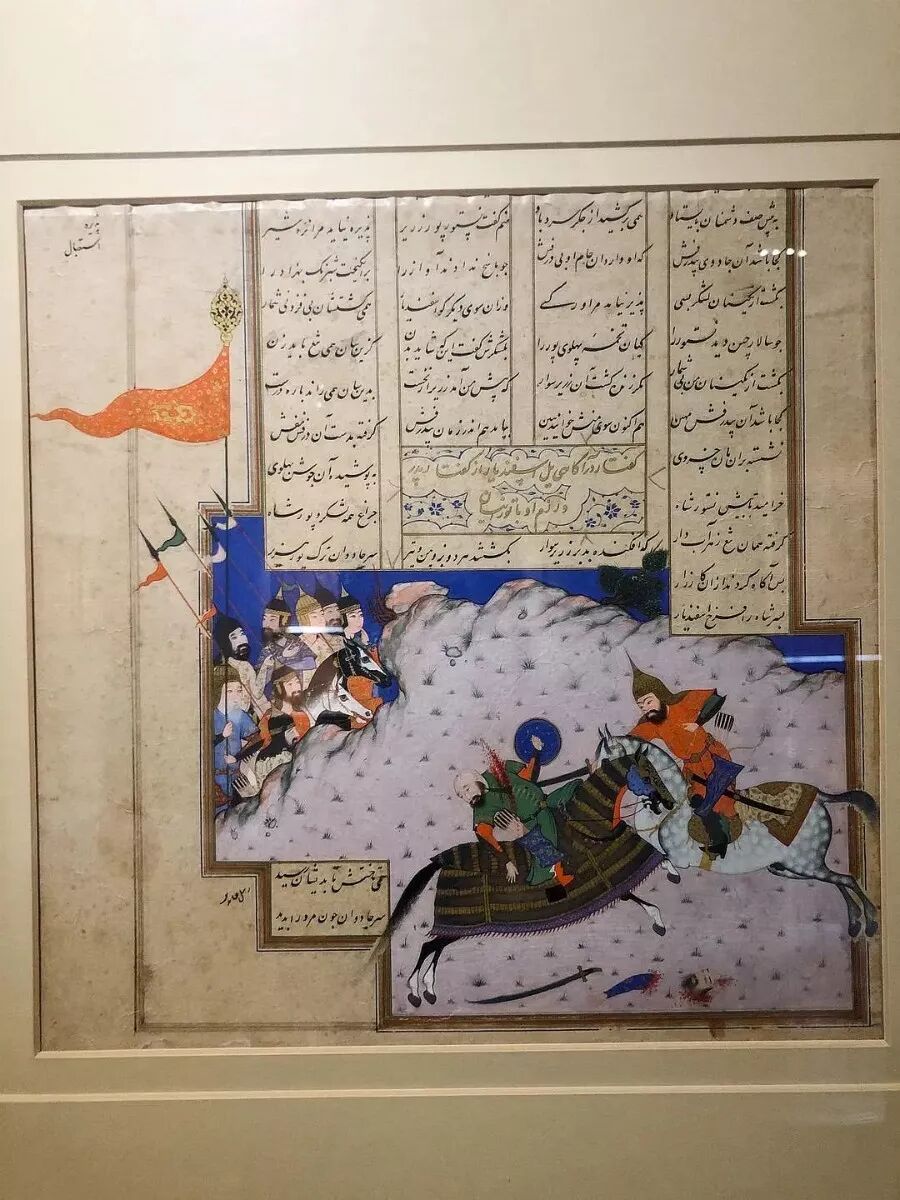
The image below shows the legendary Iranian King Kay Khosrow talking with the Iranian heroes Zal, Rostam, and others.
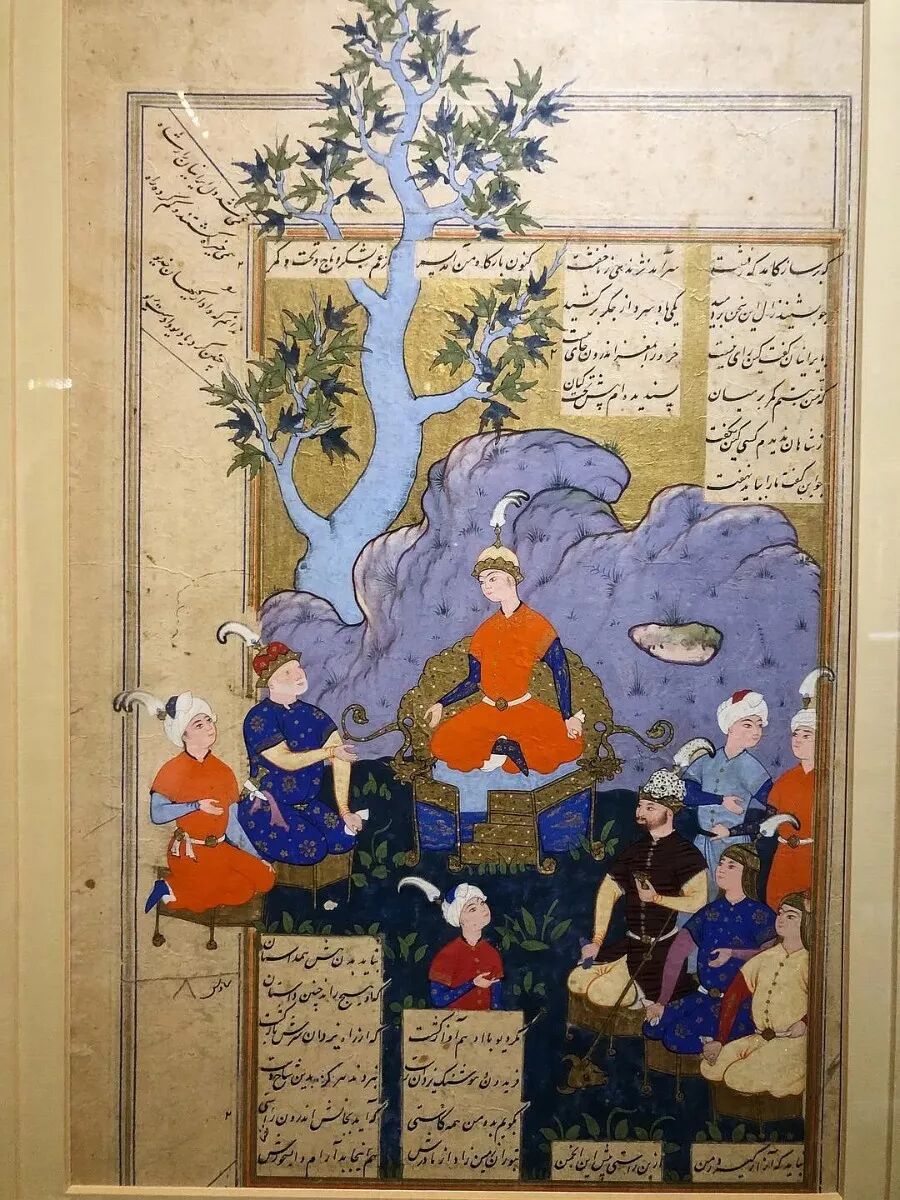
The image below shows the legendary Iranian King Kay Khosrow crossing a river with his mother Farangis and the hero Giv.
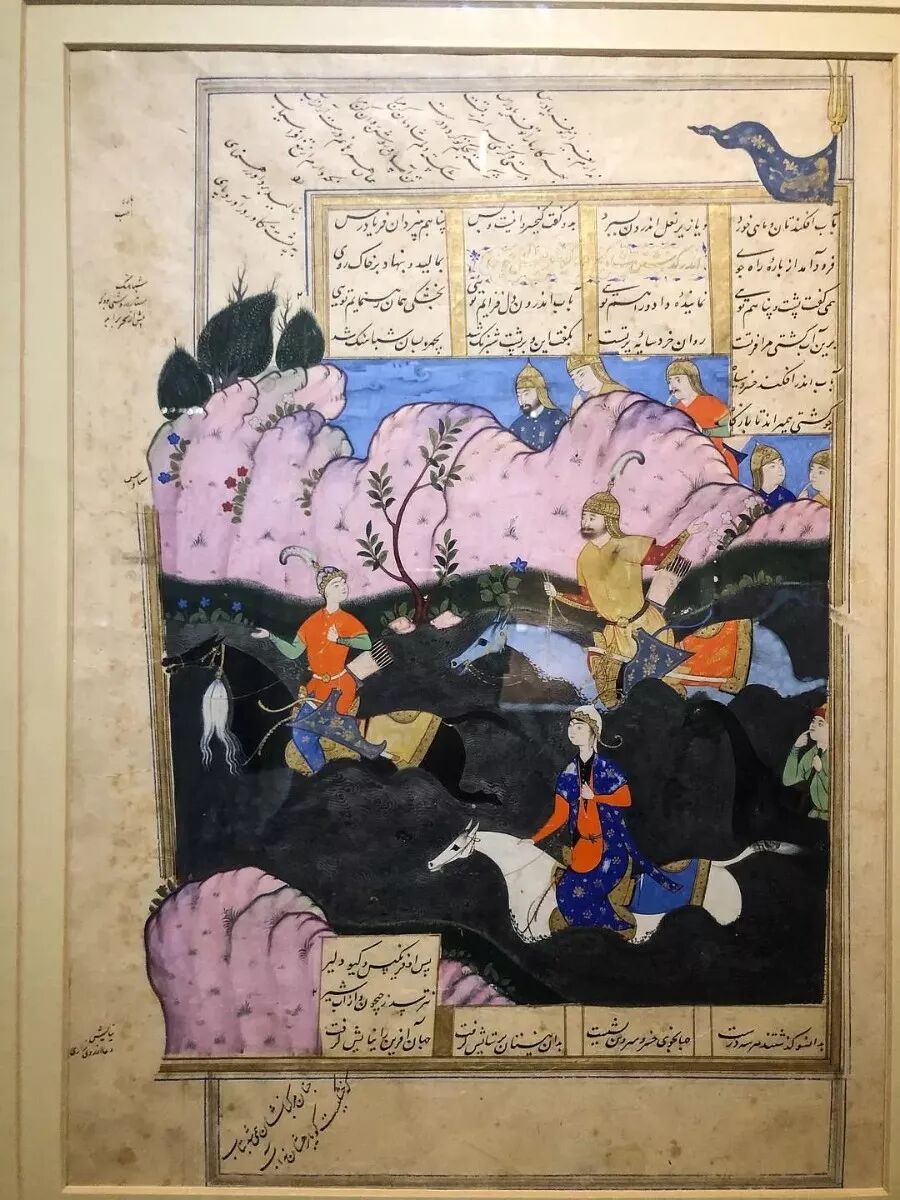
The image below shows the King of Yemen, Sarv, sitting on his throne with his three daughters on his left and the three sons of the mythical Iranian King Fereydun on his right.
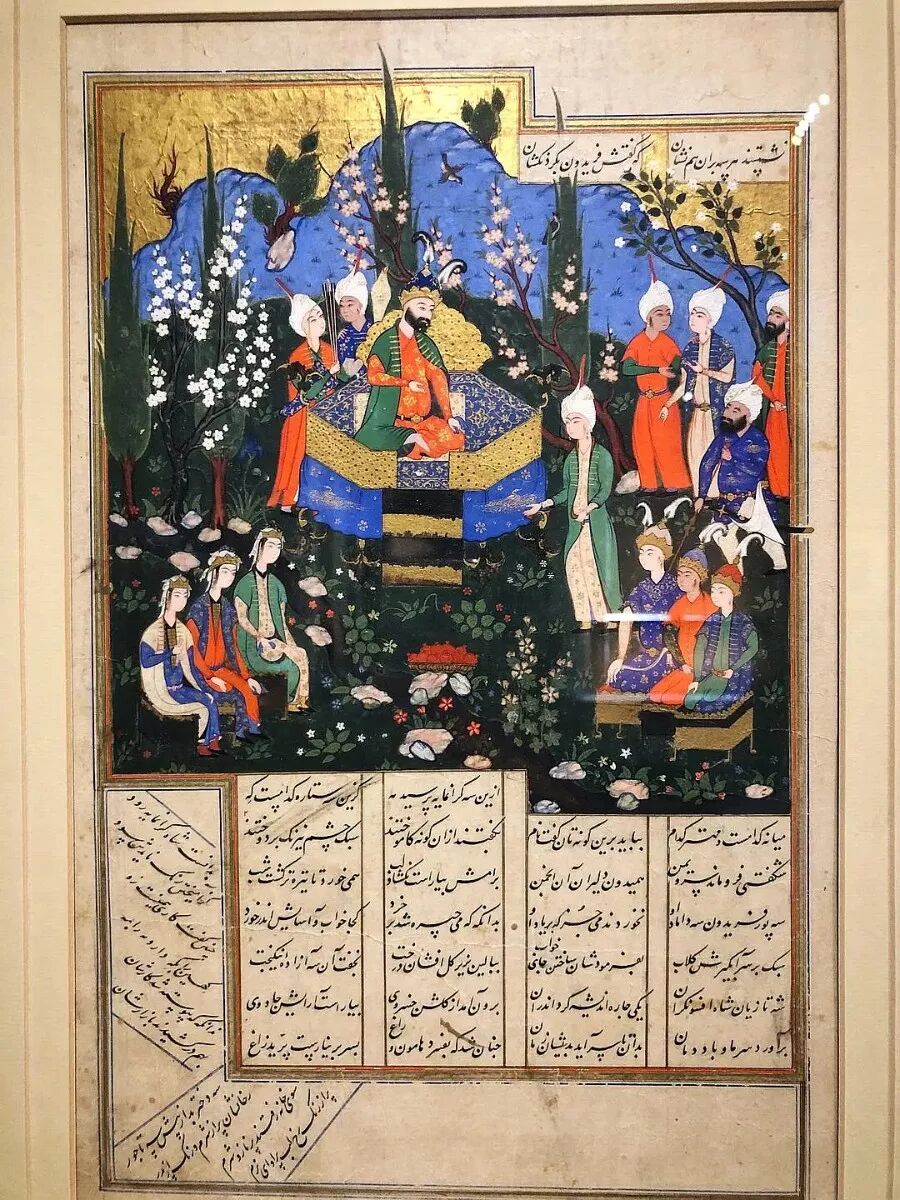
The image below shows the Iranians surrounded by the Turanian army on Mount Hamawan as they watch reinforcements arrive.
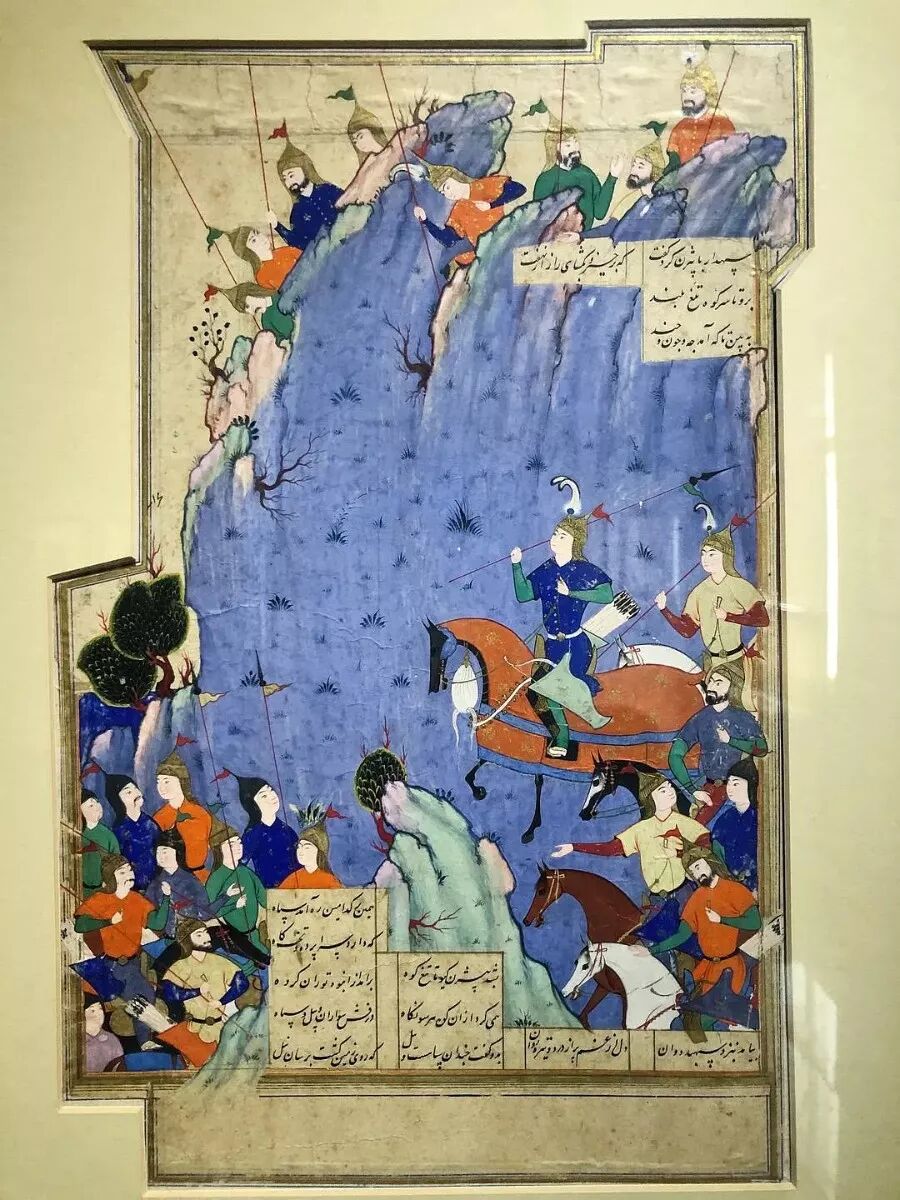
The image below depicts the tragic story between the Iranian hero Rostam and his son Sohrab. Once, Rostam followed the tracks of his lost horse to the Kingdom of Samangan, where he met Princess Tahmina. The princess admired Rostam greatly, so she came to his room at night and said that if he gave her a child, she would return his horse. Rostam agreed and did so. Before leaving, Rostam gave the princess two tokens. If she gave birth to a girl, she should braid the tokens into the child's hair along with some jewelry. If it was a boy, they tied the token to the child's arm. Later, the princess gave birth to a boy and named him Sohrab.
Many years later, Iran and Turan went to war. As a legendary hero of Iran, Rostam forced the Turan army to retreat, and no one dared to face him. Eventually, Sohrab and Rostam fought each other. Although he knew his father was named Rostam, he did not know that the man in front of him was his father. After a long battle, Rostam finally broke Sohrab's back and stabbed him. Before he died, Sohrab said his father would avenge him, and that was when the father and son finally recognized each other. Sohrab took out the token his mother had given him. Rostam was heartbroken, but he could not save his son.
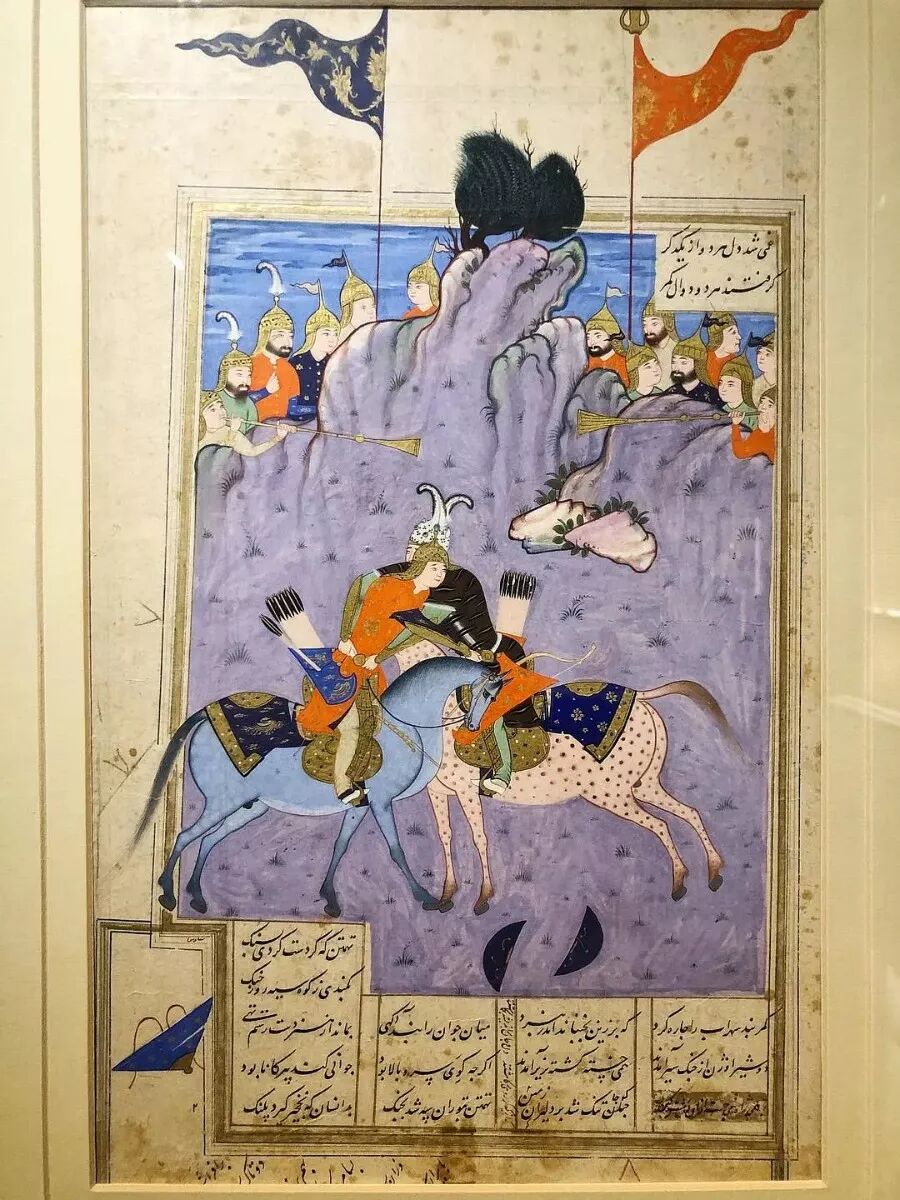
Other miniature paintings in the Qazvin style.
The image below is a 16th-century Qazvin-style miniature painting from Saadi's The Orchard (Bustan).
The Orchard (Bustan) is a collection of lyric poems completed by the famous Persian poet Saadi in 1257. It is considered one of Saadi's two greatest works, alongside The Rose Garden (Golestan).
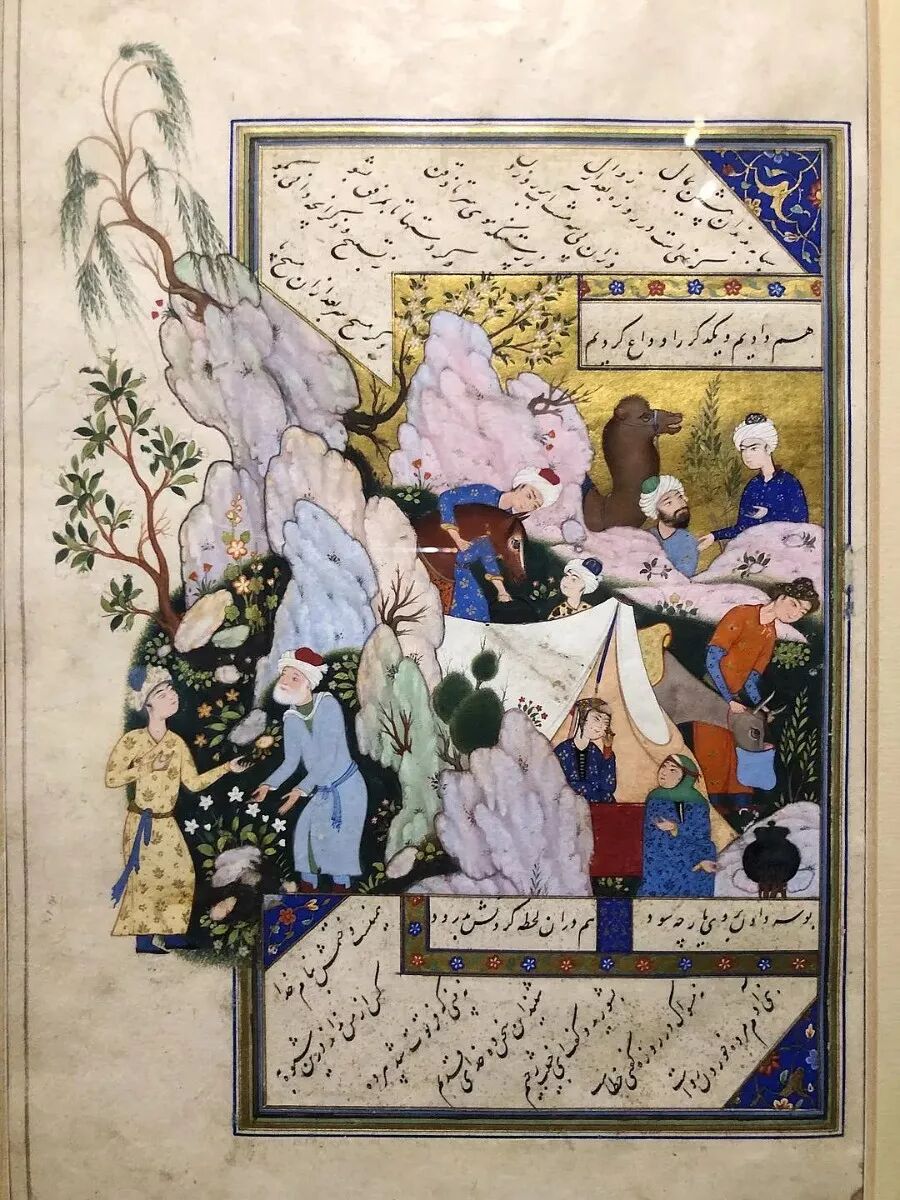
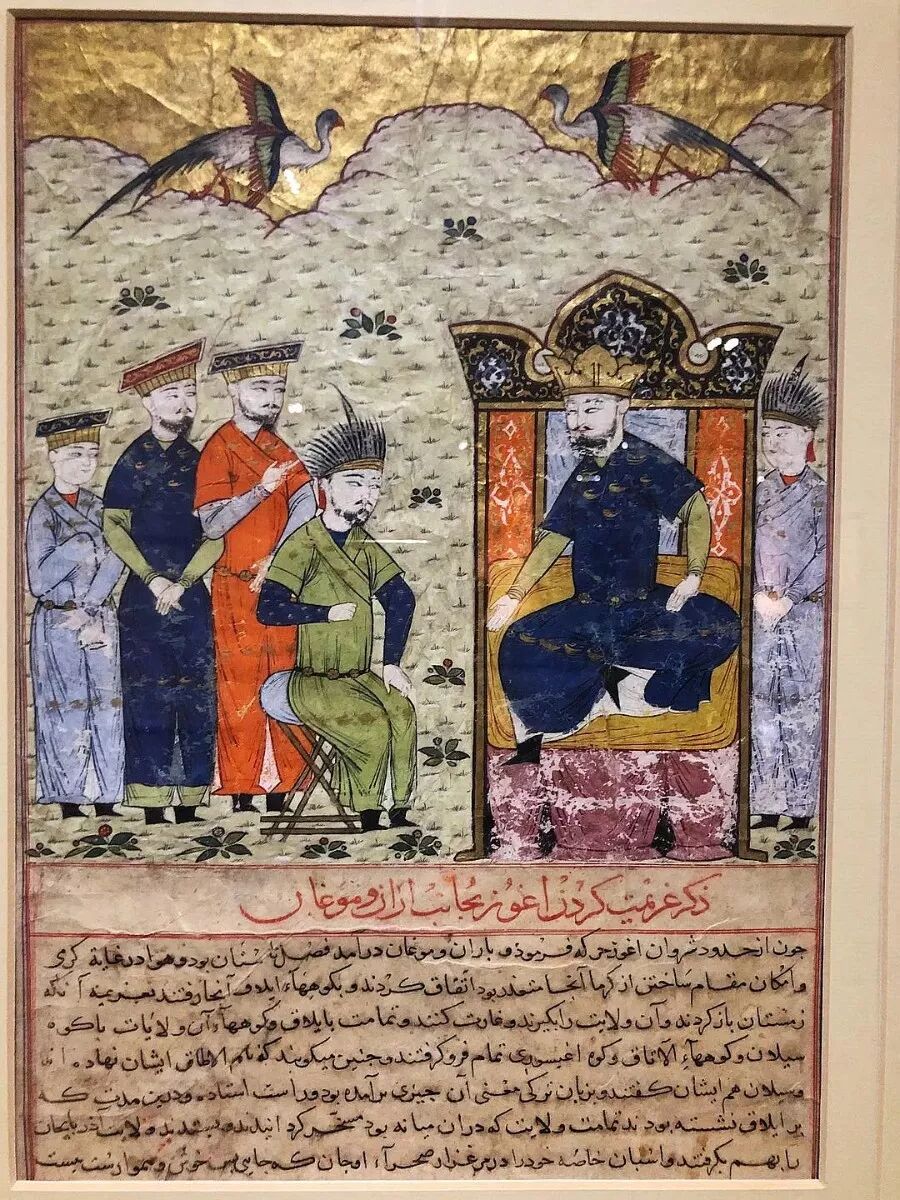
2. Miniatures from the Compendium of Chronicles (Jami' al-tawarikh) from the Timurid Empire period
The Compendium of Chronicles (Jami' al-tawarikh) is a world history book from the Ilkhanate period. It was commissioned by the seventh Ilkhan, Ghazan (reigned 1295-1304), and edited by his vizier and scholar Rashid-al-Din Hamadani. Because of its scope, the book is known as the first world history. It covers various histories, cultures, and major events from China to Europe.
By the early 14th century, the Mongols of the Ilkhanate had settled down and adopted Persian cultural customs. Ghazan's original idea was to write a book that preserved the traditions of the Ilkhanate Mongols by explaining their history on the steppes. To compile the history, Rashid-al-Din set up a special area at the Rab'-e Rashidi university in the Ilkhanate capital of Tabriz. This area included many buildings such as a mosque, a hospital, a library, and classrooms.
After Ghazan died in 1304, his successor, Öljaitü (reigned 1304-1316), asked Rashid-al-Din to expand the scope of the compilation to cover the entire known world history. The Compendium of Chronicles was finally completed between 1306 and 1311. Afterward, Rashid-al-Din organized hundreds of miniature painters and calligraphers to produce one Persian copy and one Arabic copy of the Compendium of Chronicles every year to distribute to schools throughout the Ilkhanate. Rashid-al-Din produced 20 copies of the Compendium of Chronicles during his lifetime, which are known as the first-generation manuscripts. Only a very small number have survived, and they are extremely precious examples of early Persian miniature painting.
In the early 15th century, the Timurid Empire replaced the Ilkhanate as the ruler of Iran and took a great interest in the Compendium of Chronicles. At that time, Shah Rukh (reigned 1405-1447), the ruler of the eastern part of the Timurid Empire, owned an incomplete manuscript of the Compendium of Chronicles. He commissioned the court historian Hafiz-i Abru to continue the work in Herat, Afghanistan, which was Shah Rukh's capital. The continuation brought the content up to the Timurid era, and the miniature paintings in it have a typical Timurid style.
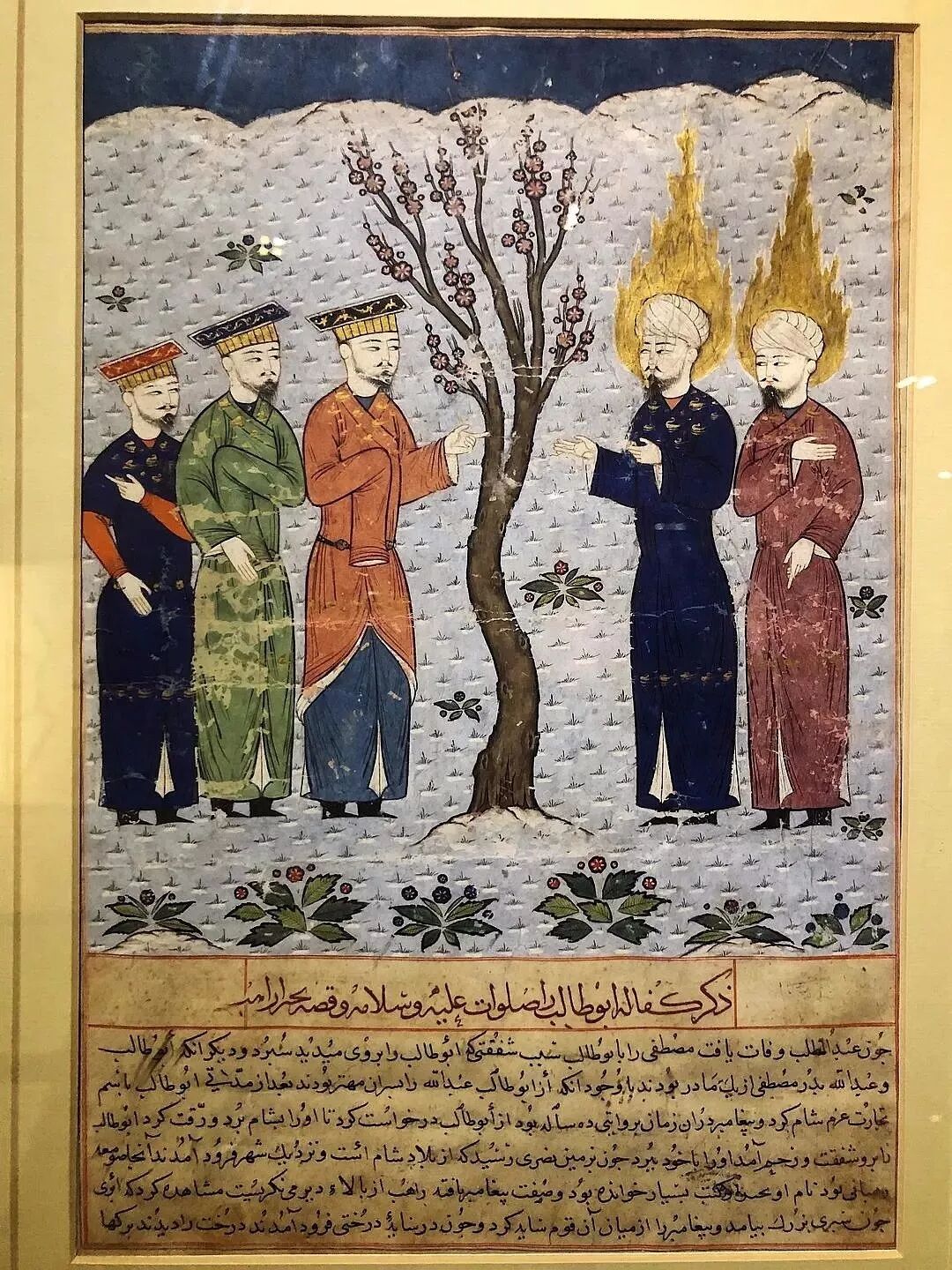
3. Other miniatures
A 16th-century miniature painting from Saadi's The Rose Garden (Gulistan).
Saadi Shirazi was a famous 13th-century Persian poet. He is widely considered one of the greatest poets in classical Persian literature and has had a huge influence on later generations. The Rose Garden (Gulistan, literally meaning 'rose garden') is a masterpiece of classical Persian literature. Saadi wrote it in 1258, and it is a collection of poems and stories.
The image below shows a 16th-century miniature painting of The Rose Garden in the Herat style from the Safavid dynasty.
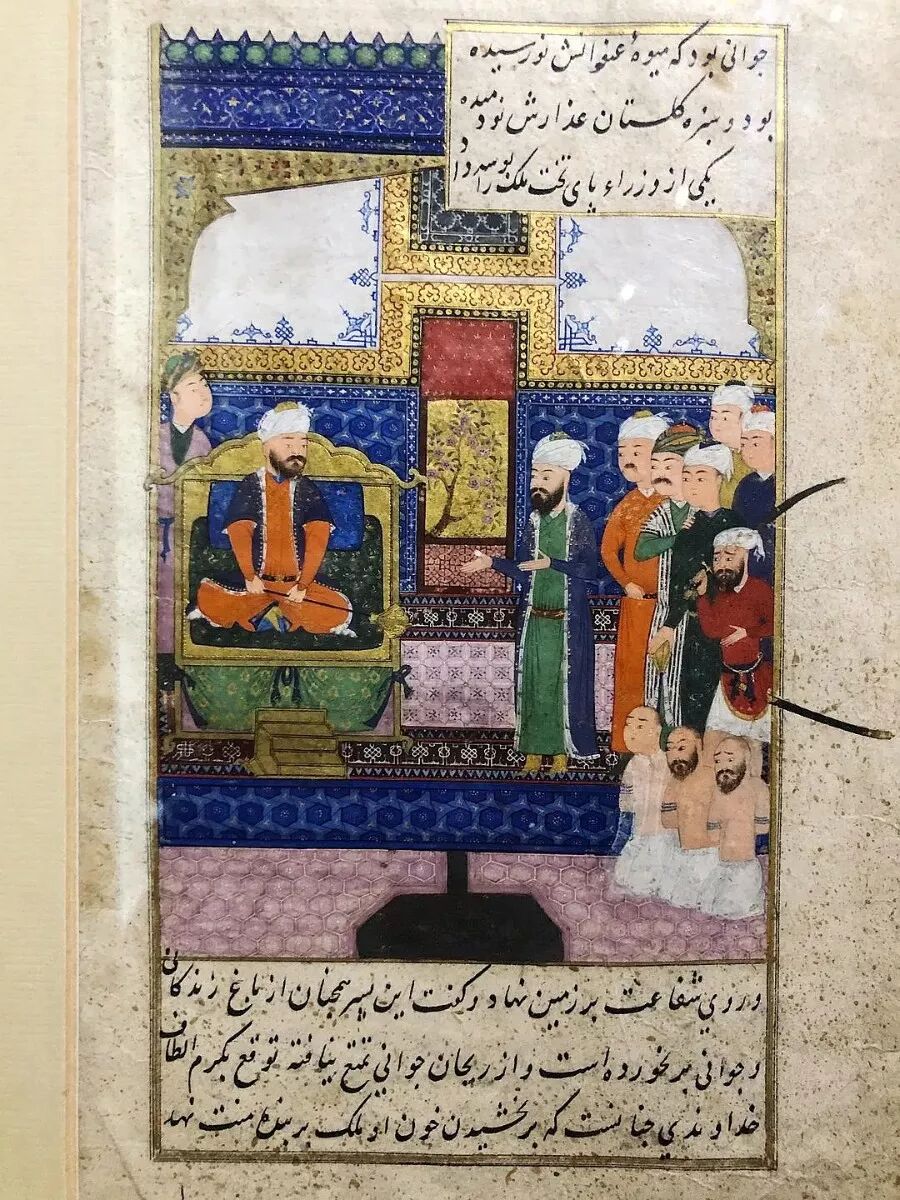
A 15th to 16th-century miniature painting in the Bukhara style.
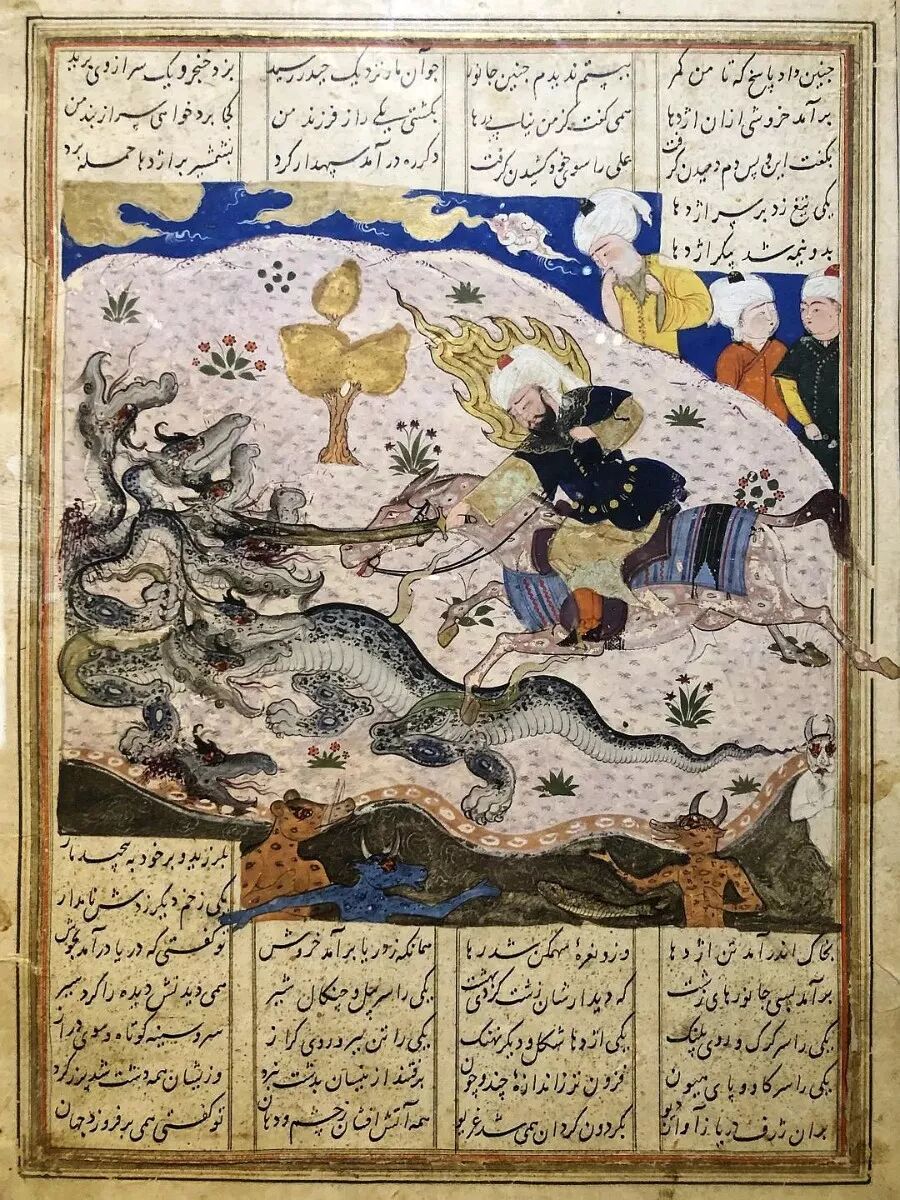
A 15th-century miniature painting from the Timurid dynasty in the Bukhara style, depicting 'Imam Ali slaying a dragon' in the Khavaran-Nameh.
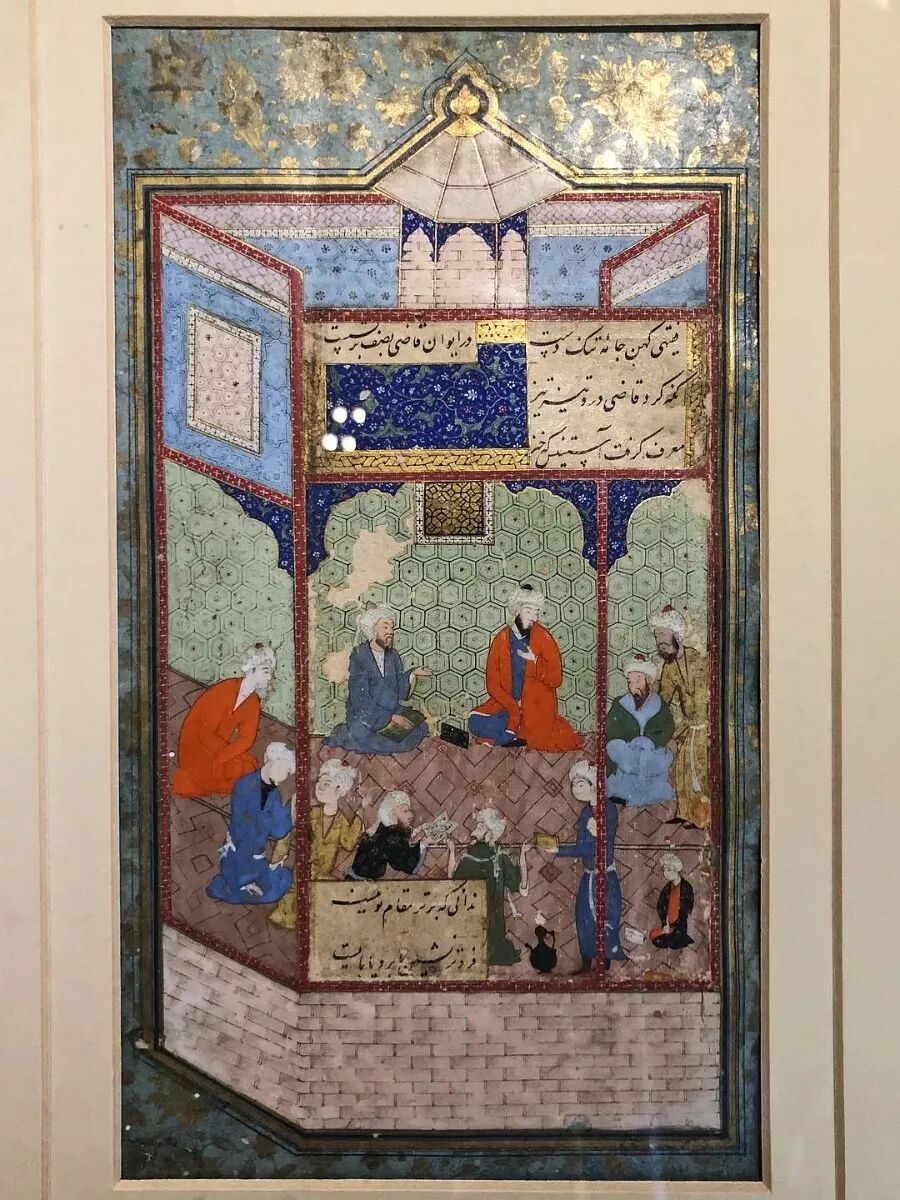
A 15th-century miniature painting of Saadi's The Orchard (Bustan) in the Bukhara style.
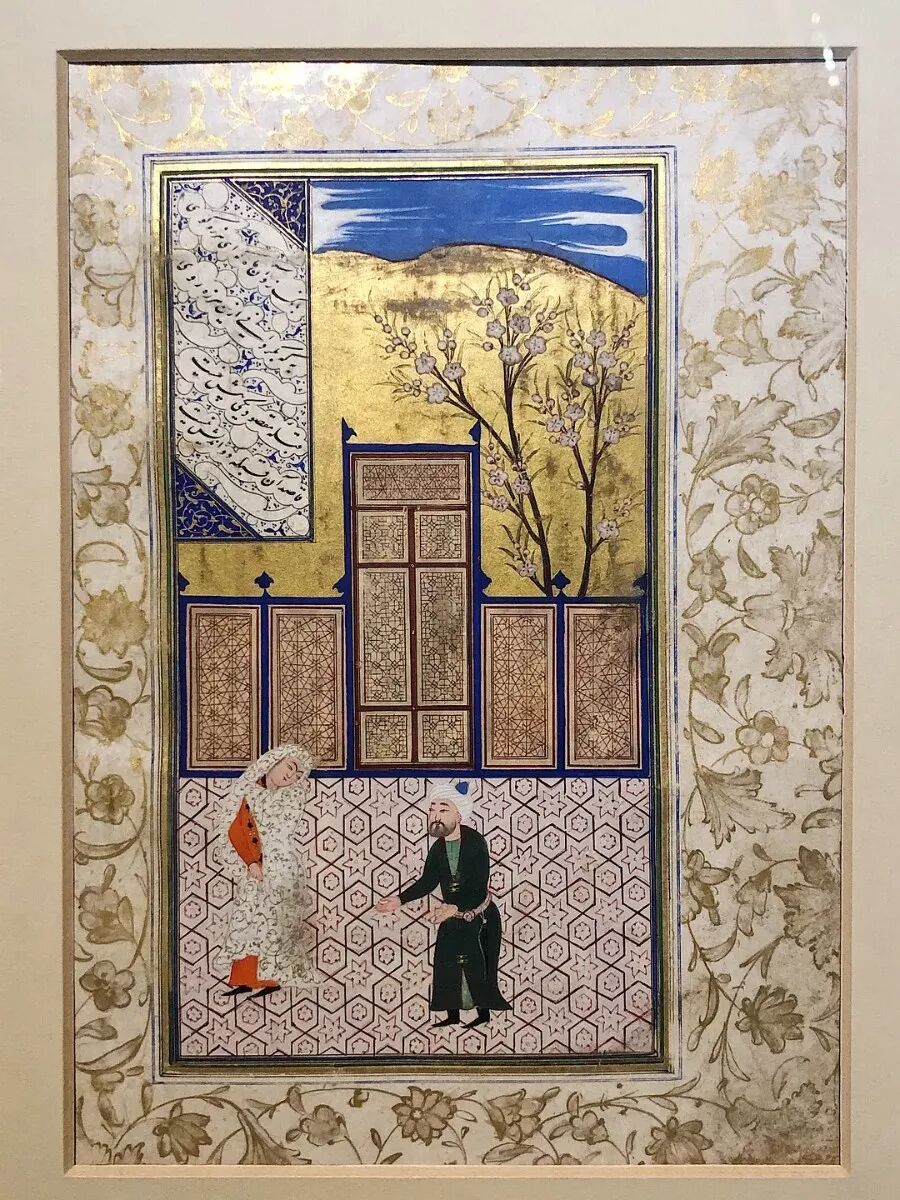
A 16th-century miniature painting in the Bukhara style.
A miniature painting in the Khorasan style.
A 15th-century miniature painting of The Garden of Truth (The Hadiqa Tul Haqiqat) in the Khorasan style. The original work is by the famous 11th to 12th-century Persian Sufi poet Sanai, and The Garden of Truth is his masterpiece.
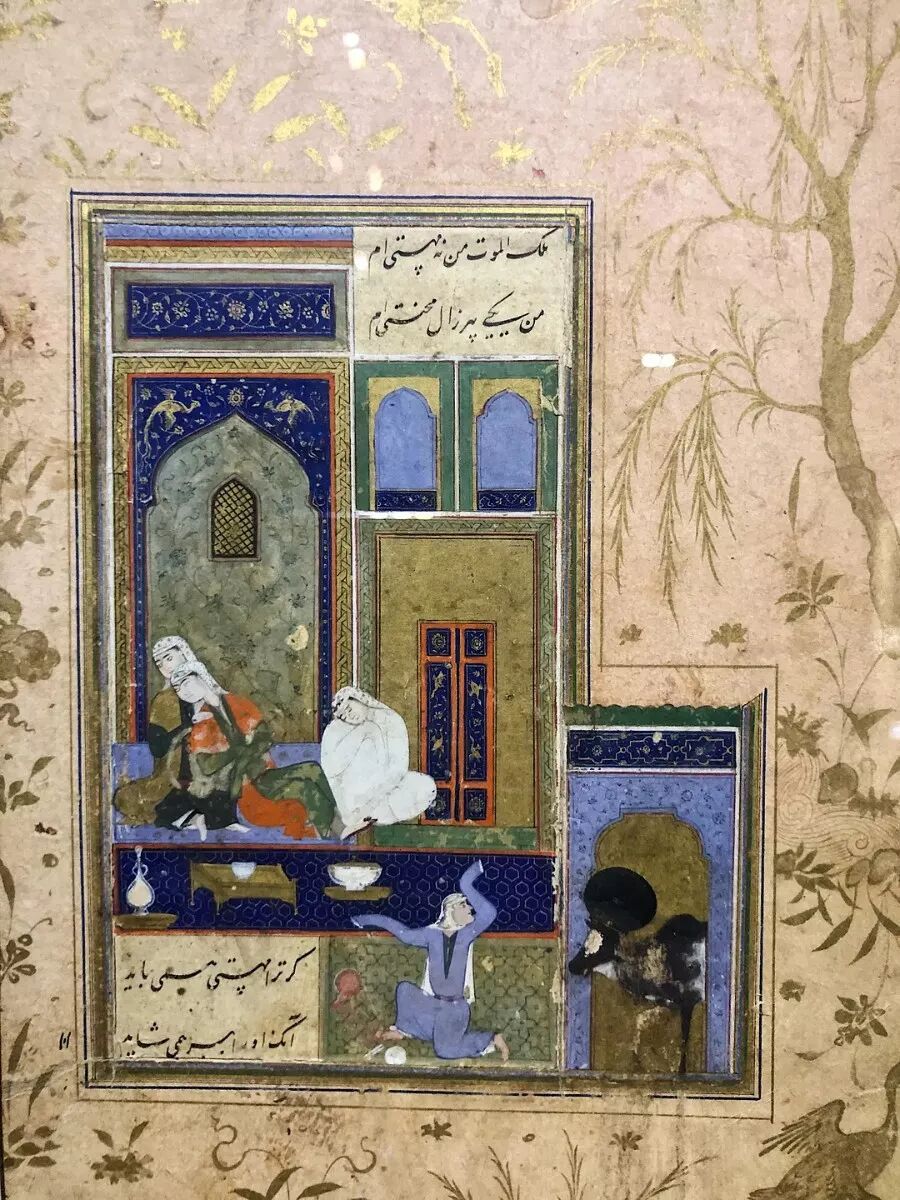
A miniature painting in the Shiraz style.
16th-century Shiraz-style miniature painting.
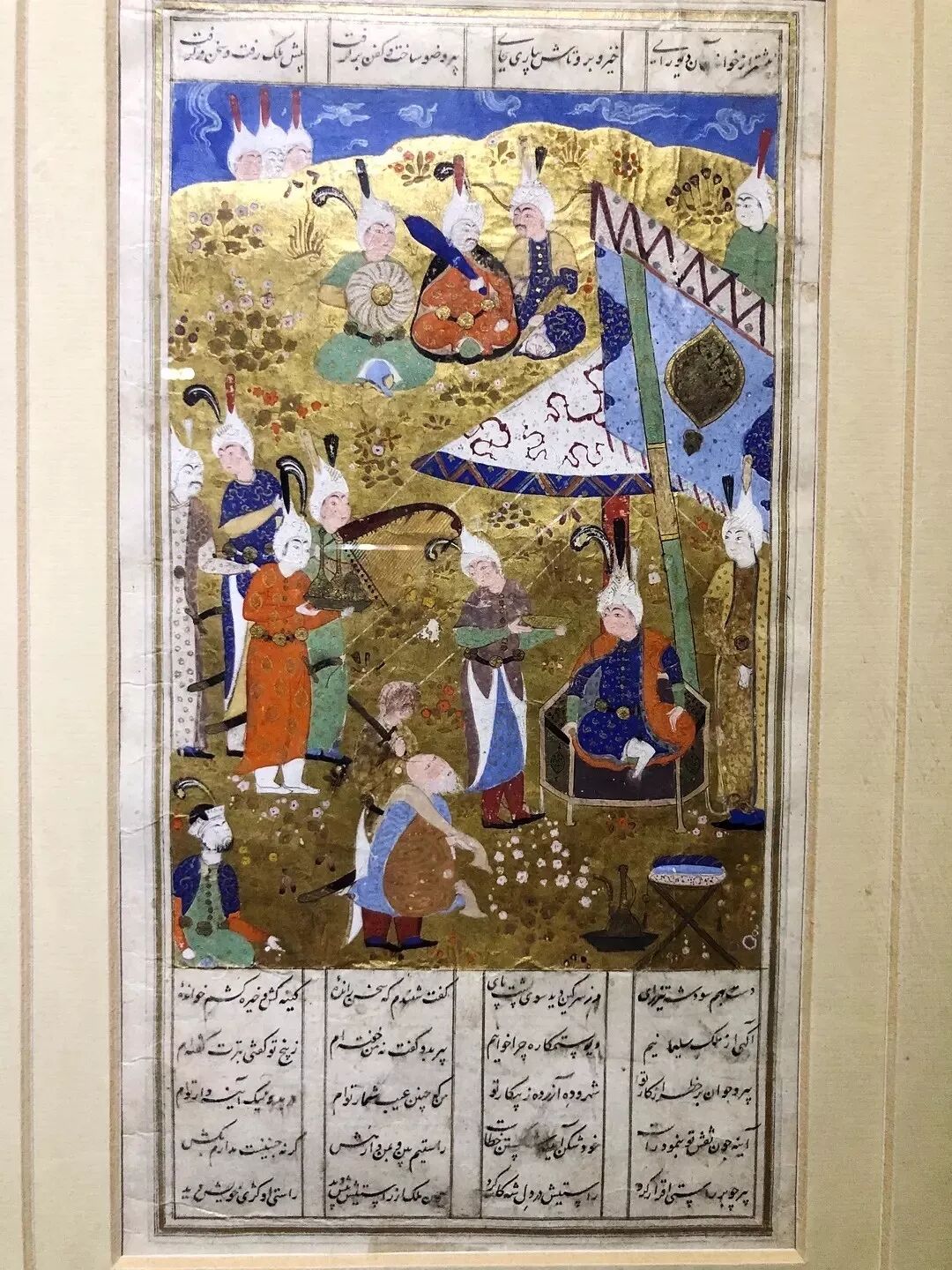
Herat-style miniature painting.
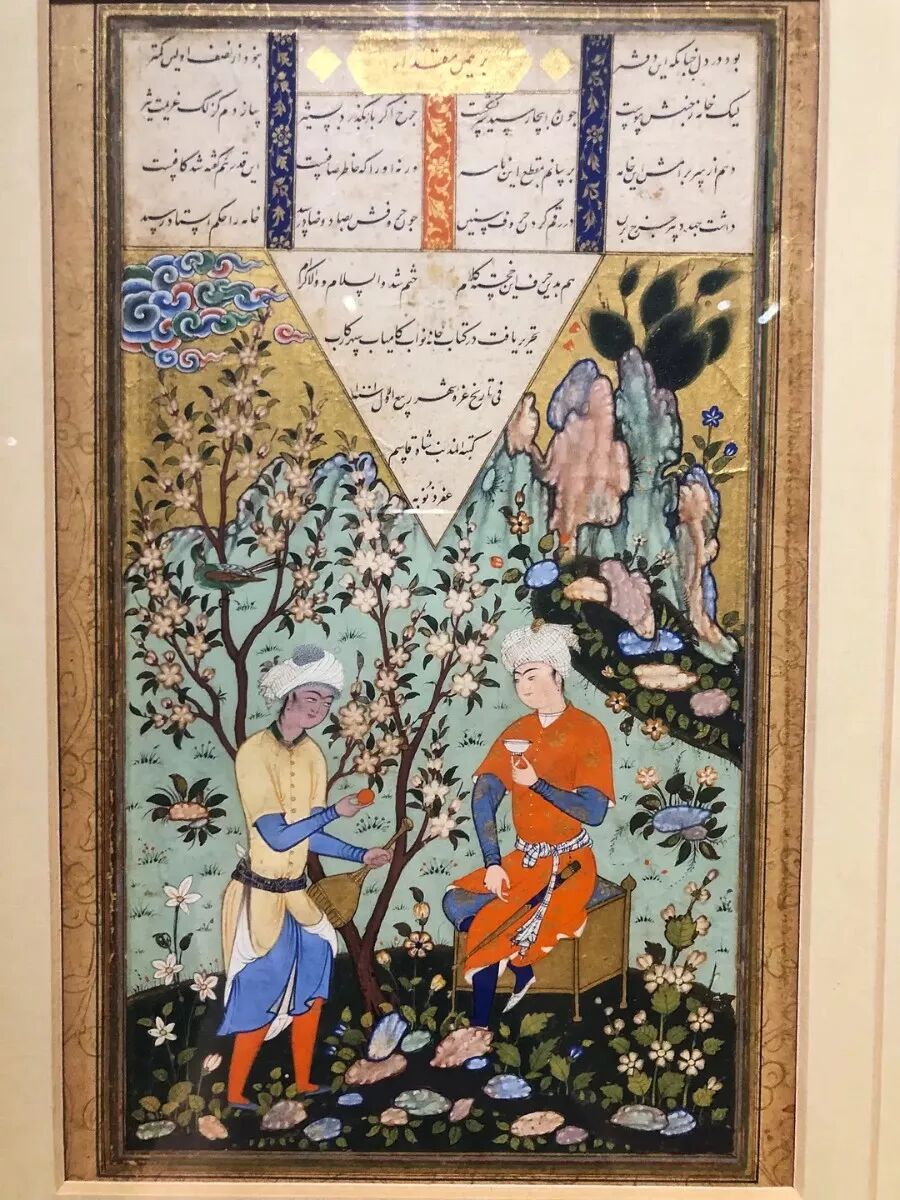
1592 Herat-style miniature painting showing two people in a garden.
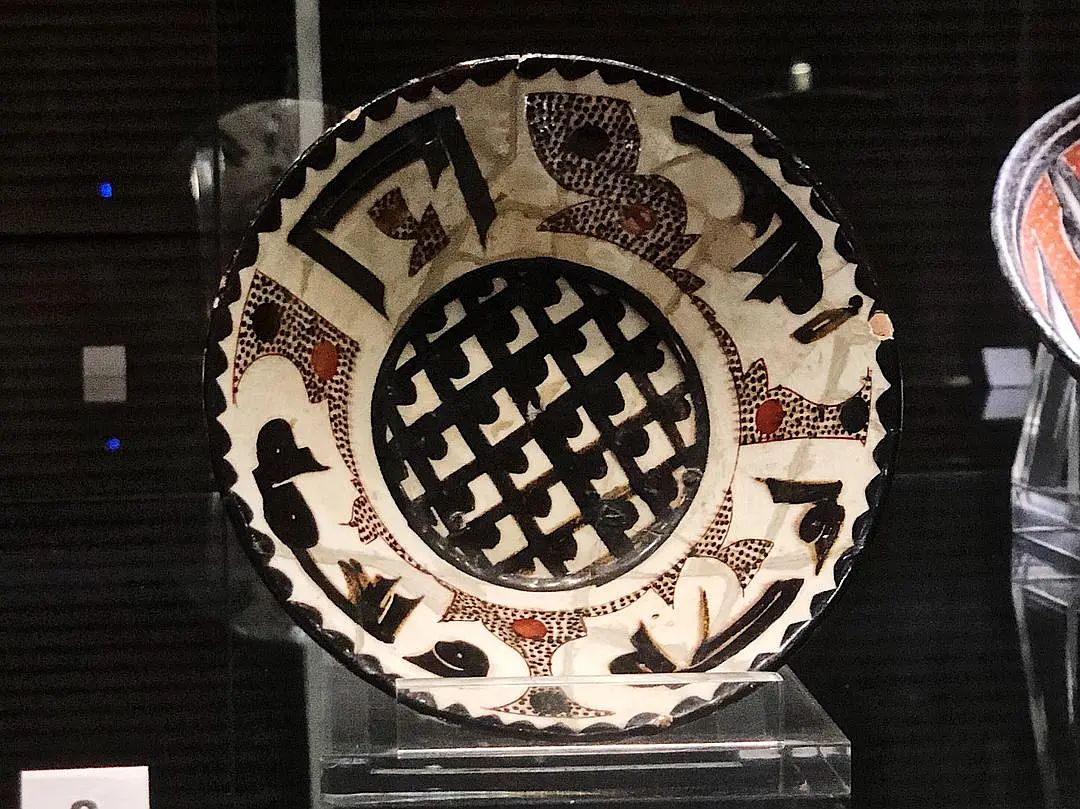
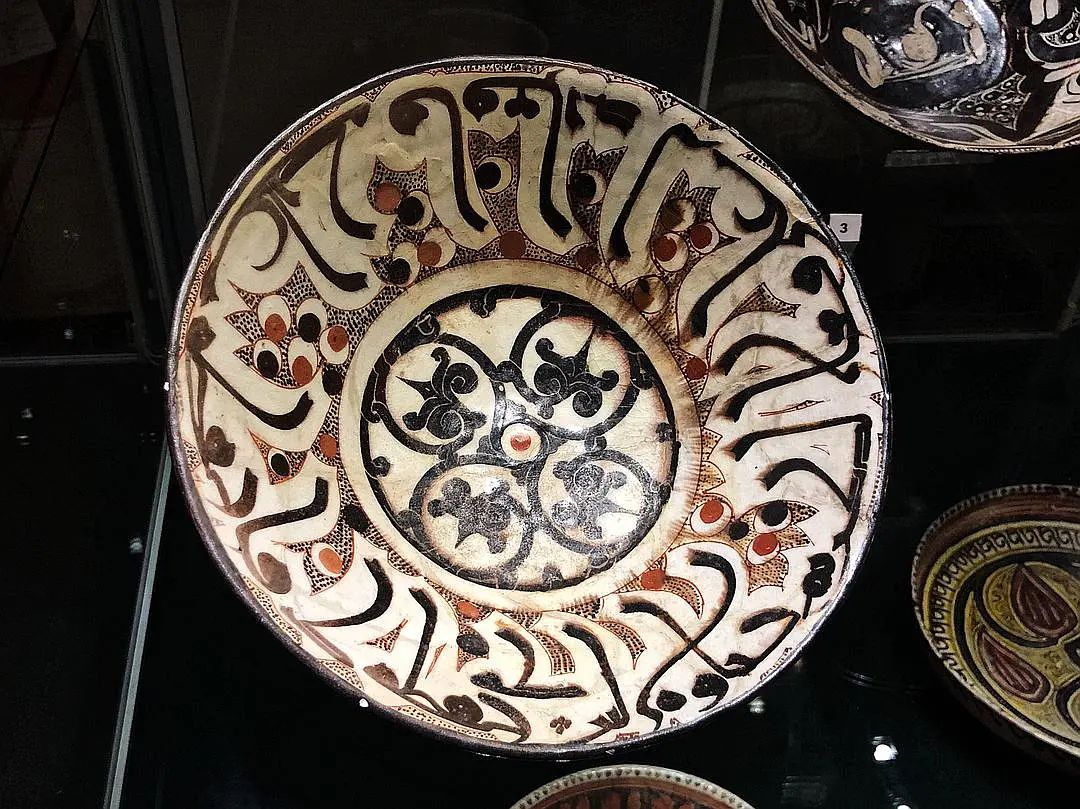
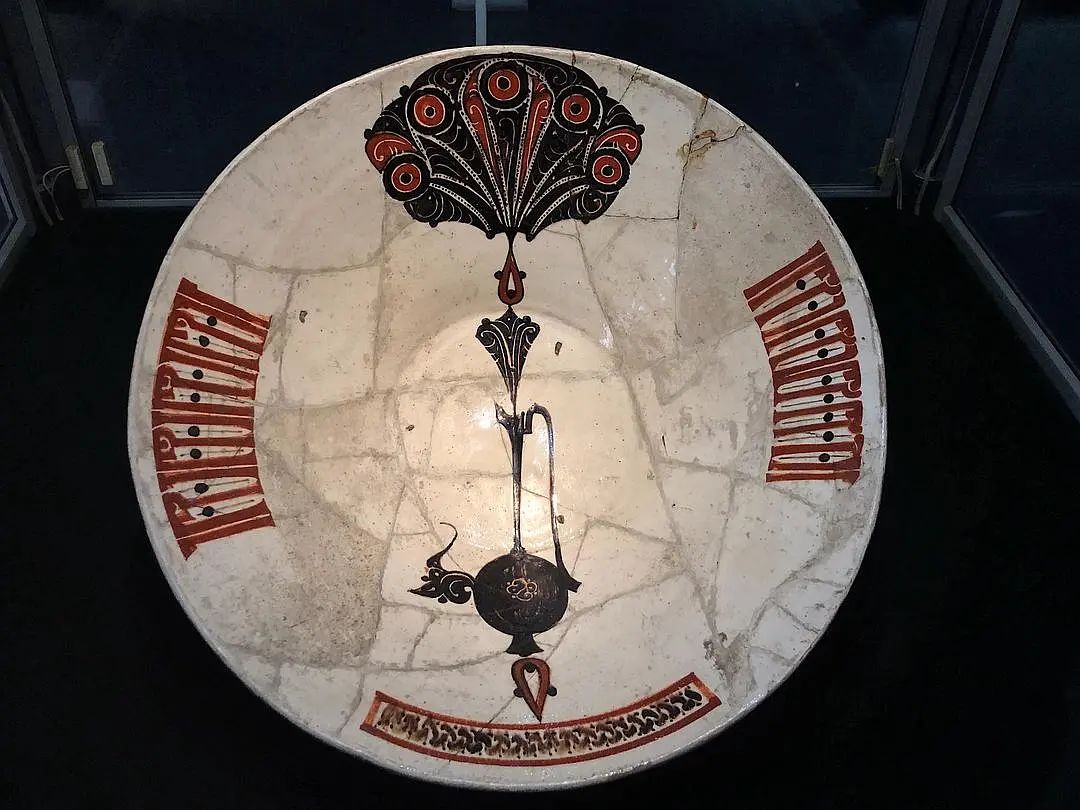
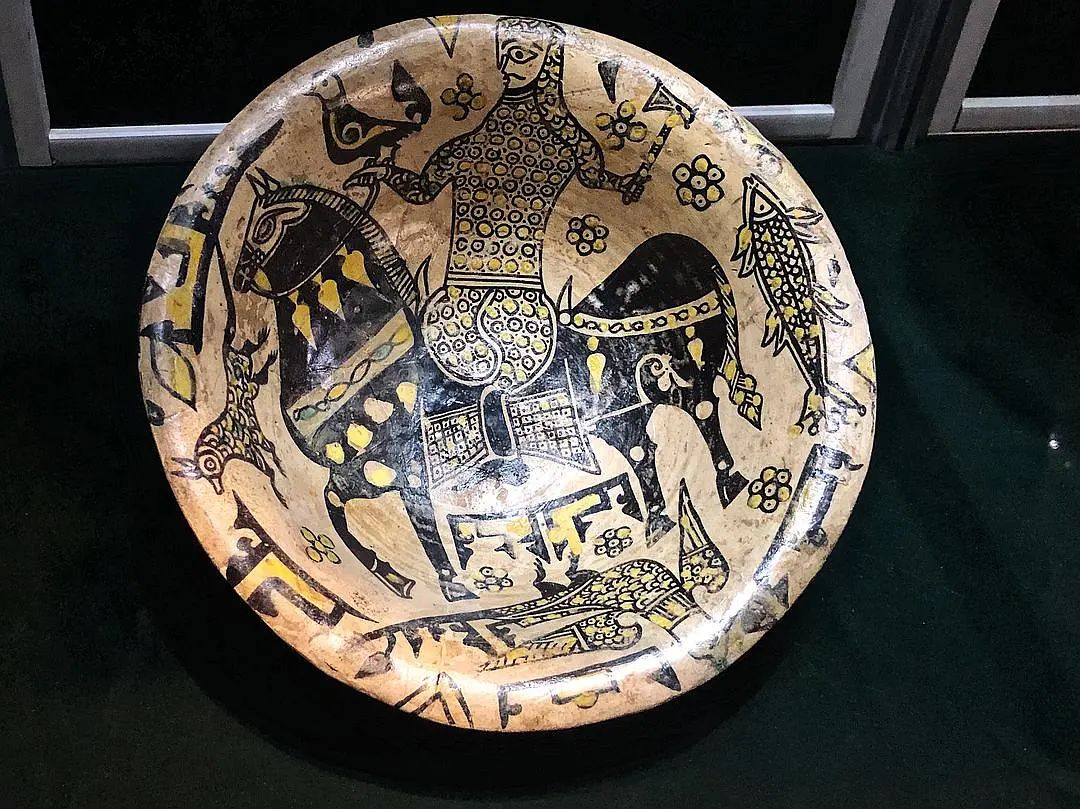
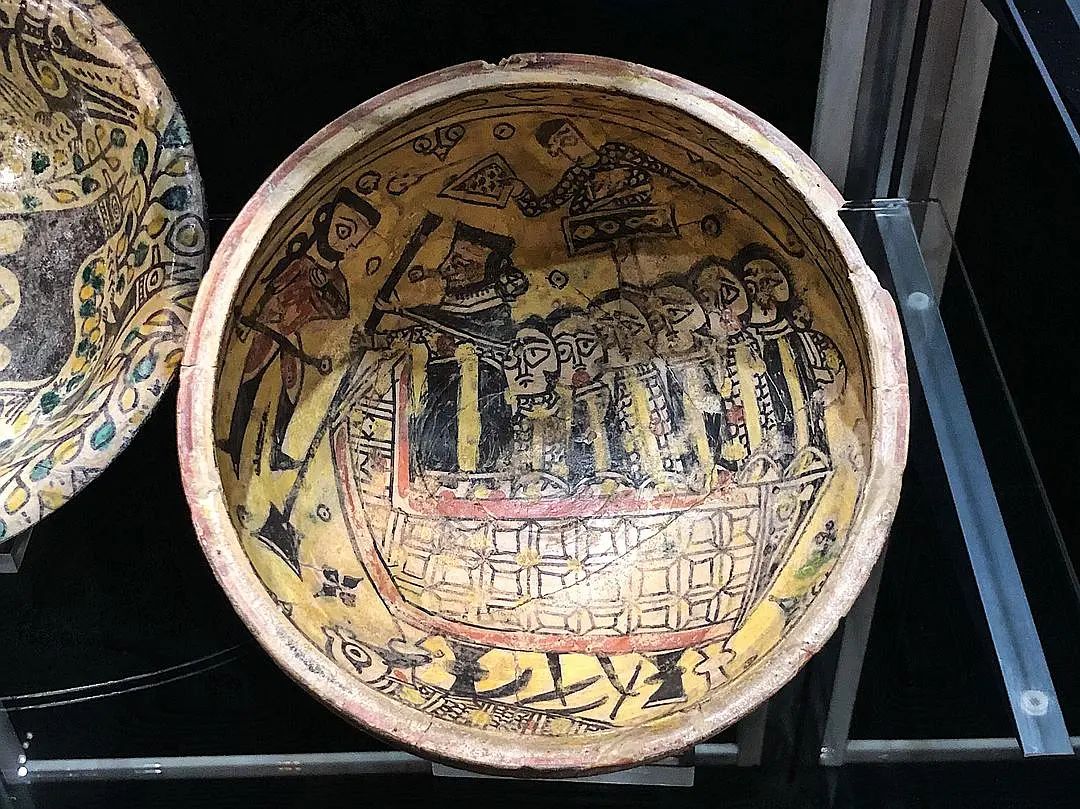
4. Pottery from the 9th to 10th centuries unearthed in the ancient Khorasan city of Nishapur.
Nishapur is located on the ancient Silk Road in northeastern Iran and was once one of the four major cities in the Greater Khorasan region. In the 9th century, Nishapur became the capital of the Persian Tahirid dynasty. Under the rule of the Persian Samanid dynasty in the 10th century, Nishapur grew into an important cultural and commercial center of the Islamic world. Various cultures and religions gathered here, and trade routes from Transoxiana in Central Asia, China, Iraq, and Egypt met in this city. The glazed pottery produced in Nishapur at that time became an important trade commodity in the West, once rivaling Baghdad and Cairo.
In 1221, the Mongols massacred the population of Nishapur and completely destroyed the city, burying the former metropolis underground. It was not until the mid-20th century that the site was rediscovered through archaeological excavations. Today, most of the unearthed Nishapur ceramics are kept at the Metropolitan Museum of Art, as well as in museums in Tehran and Mashhad.
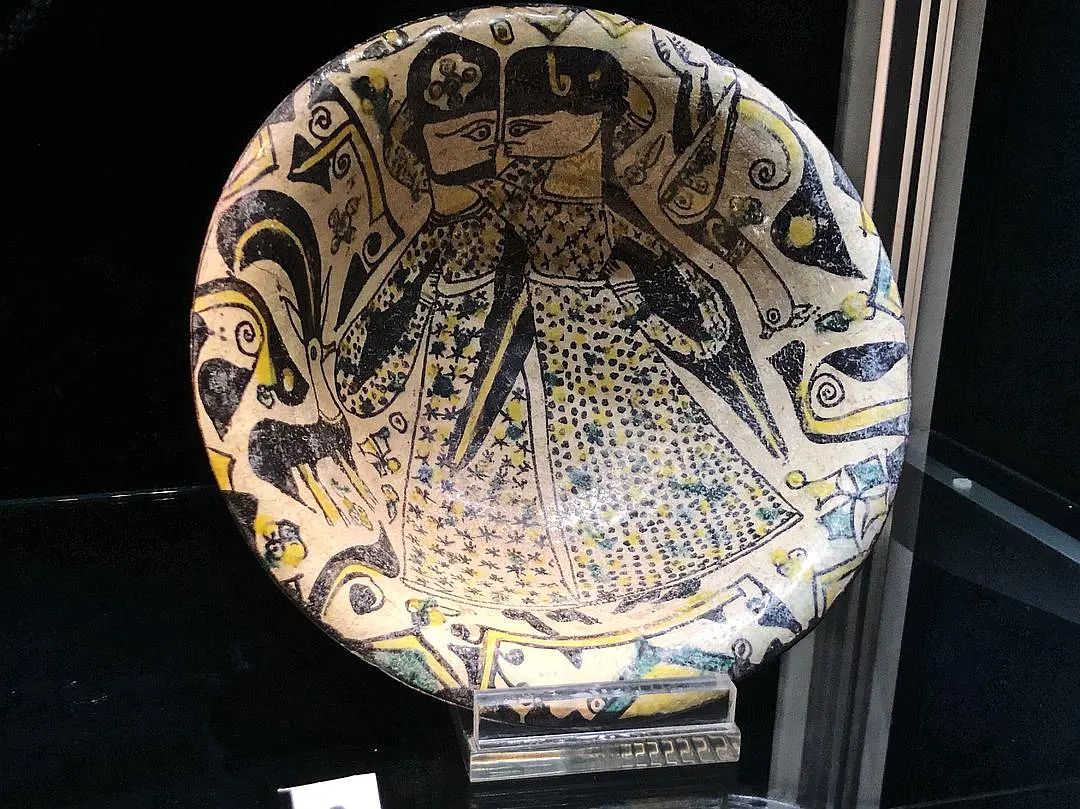
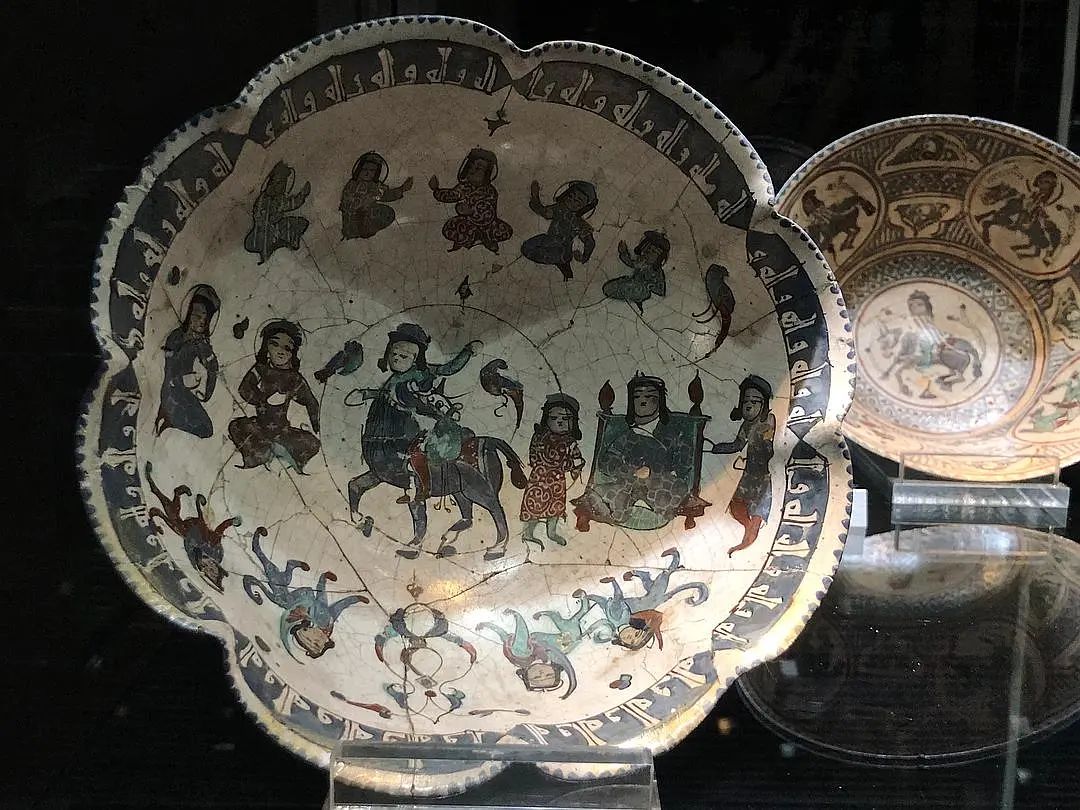
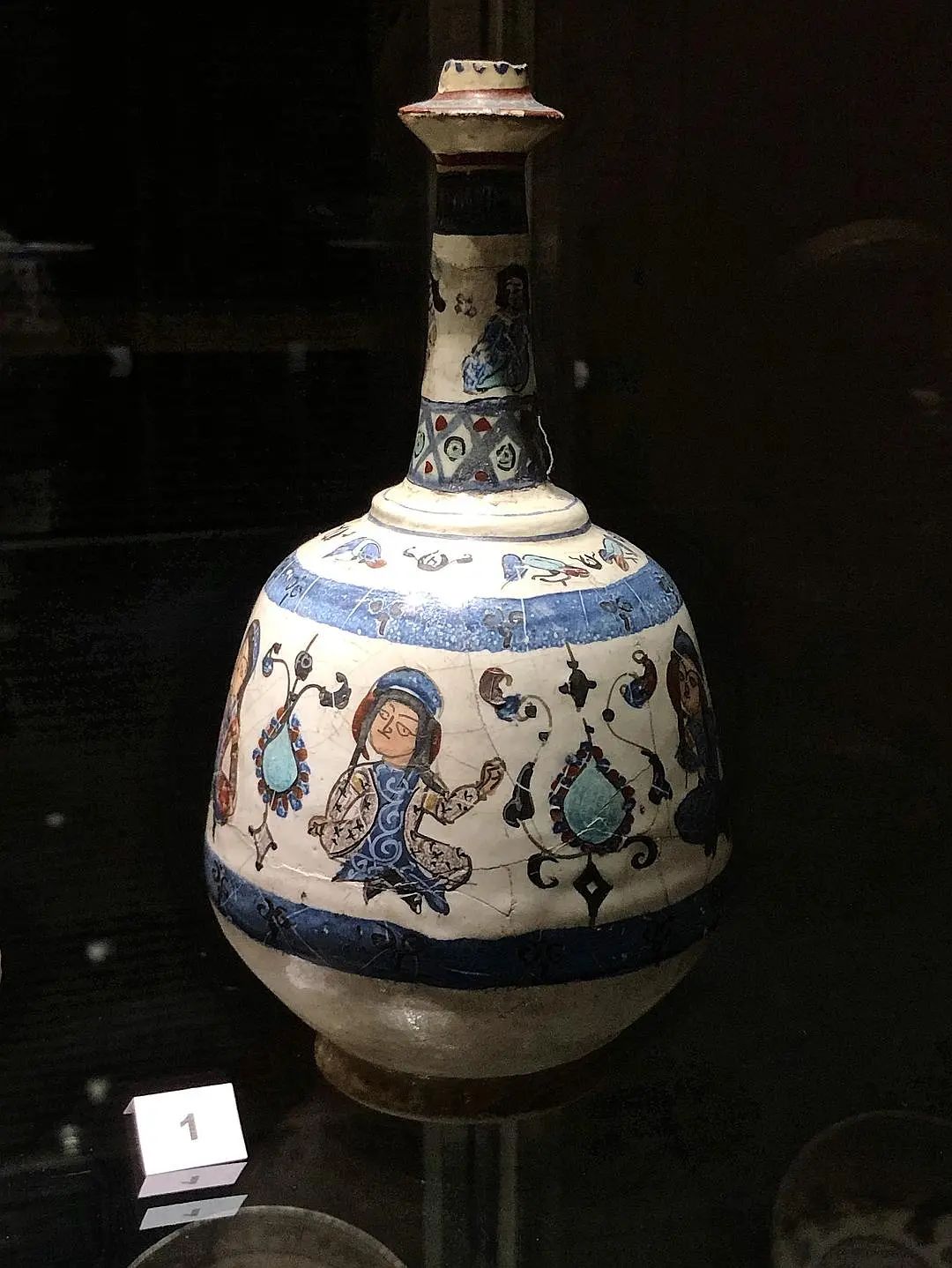
5. Ceramics from the 12th to 14th centuries from the ancient Iranian city of Kashan
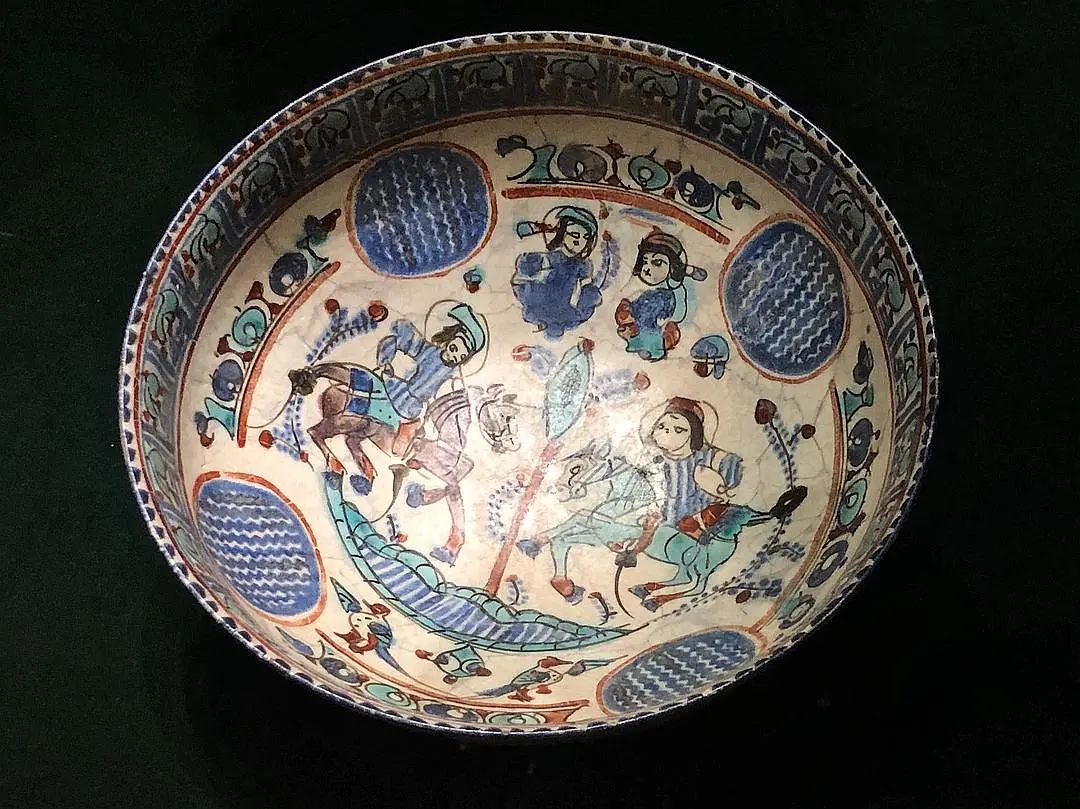
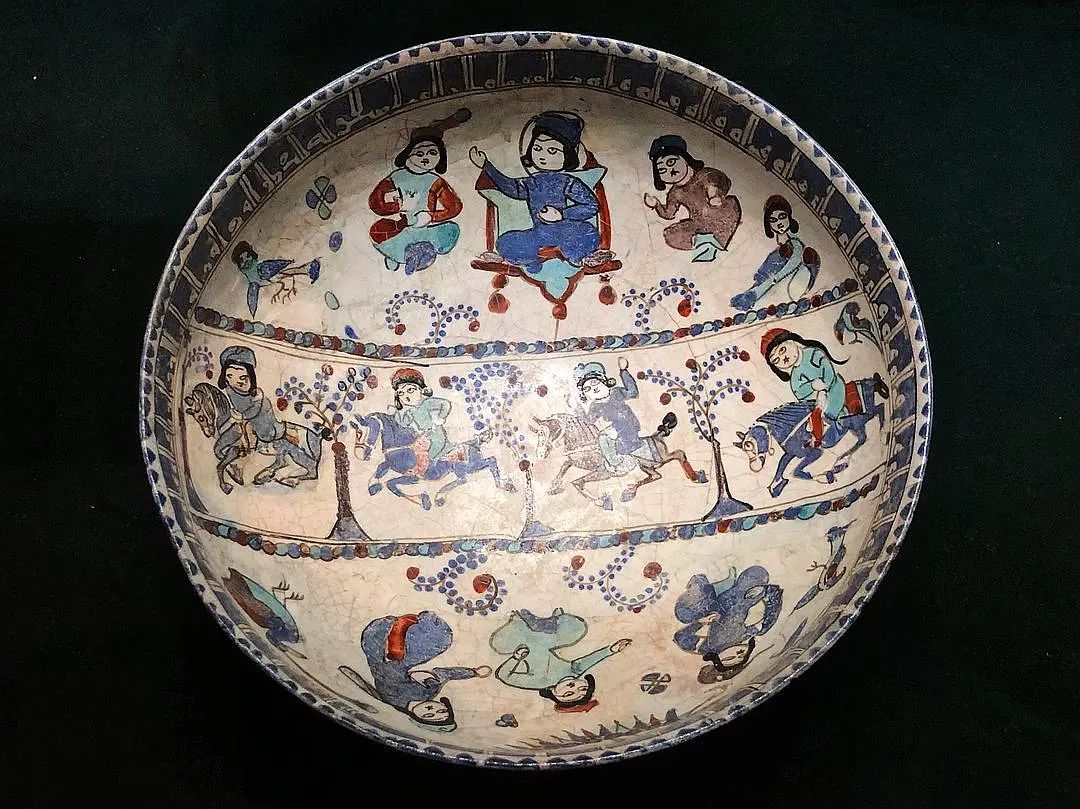
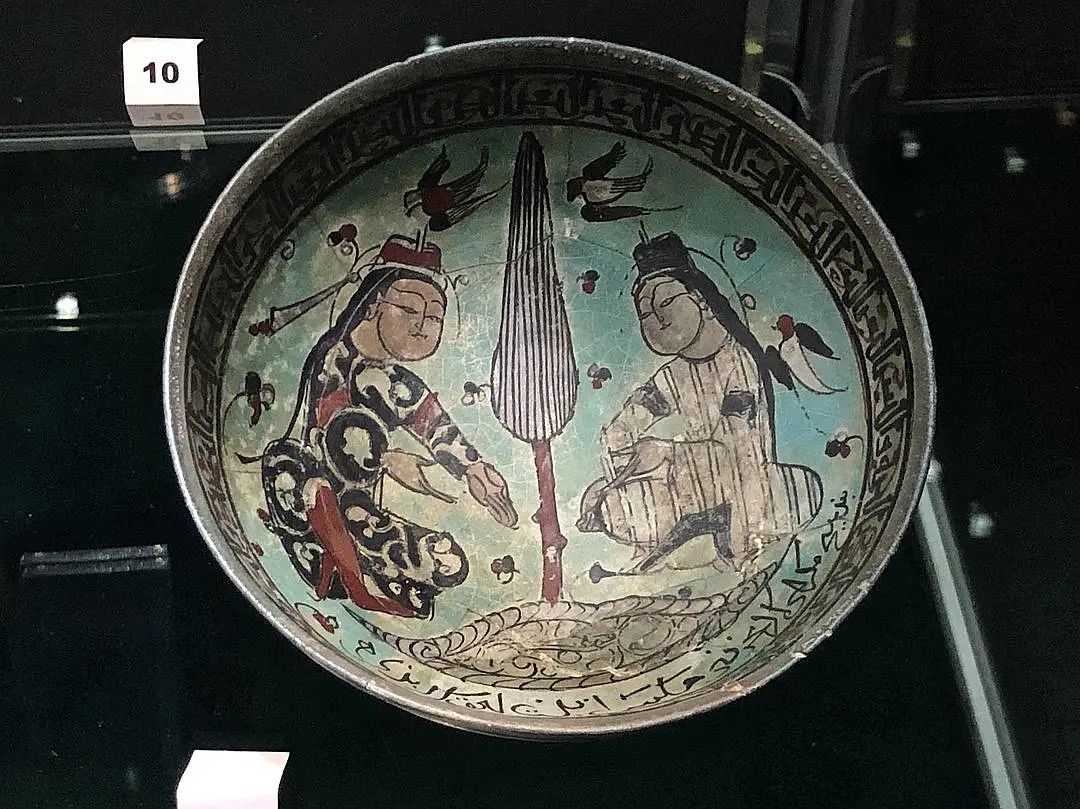
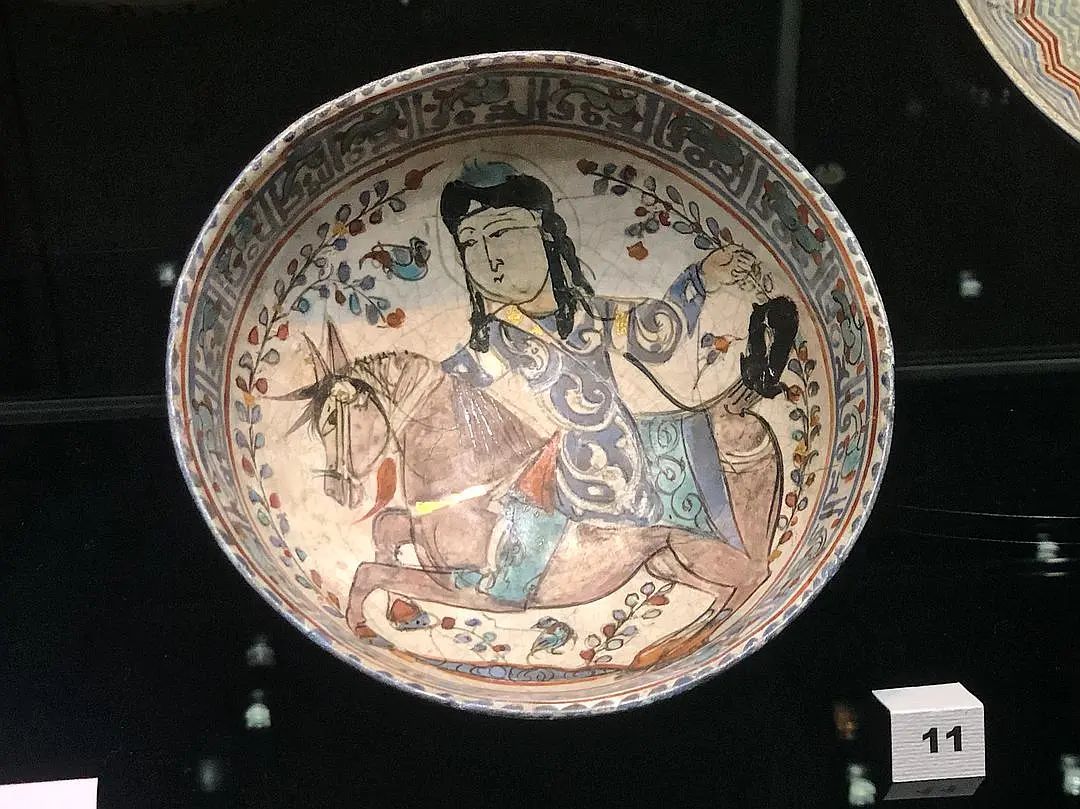
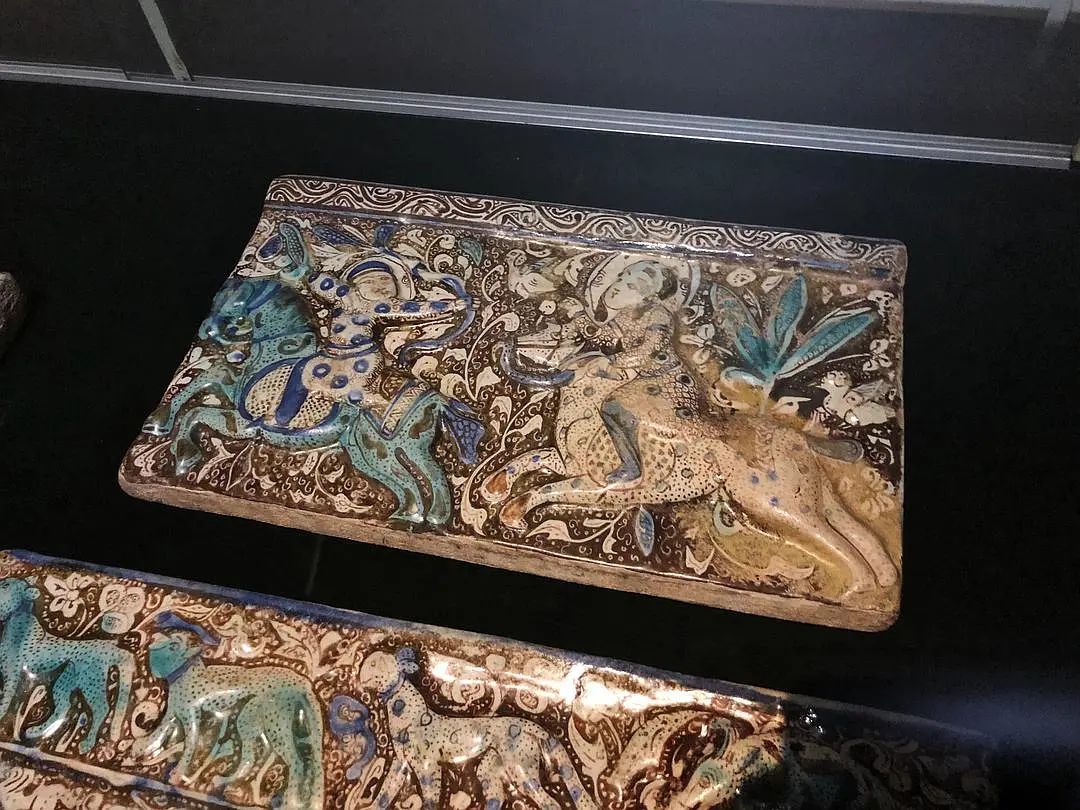
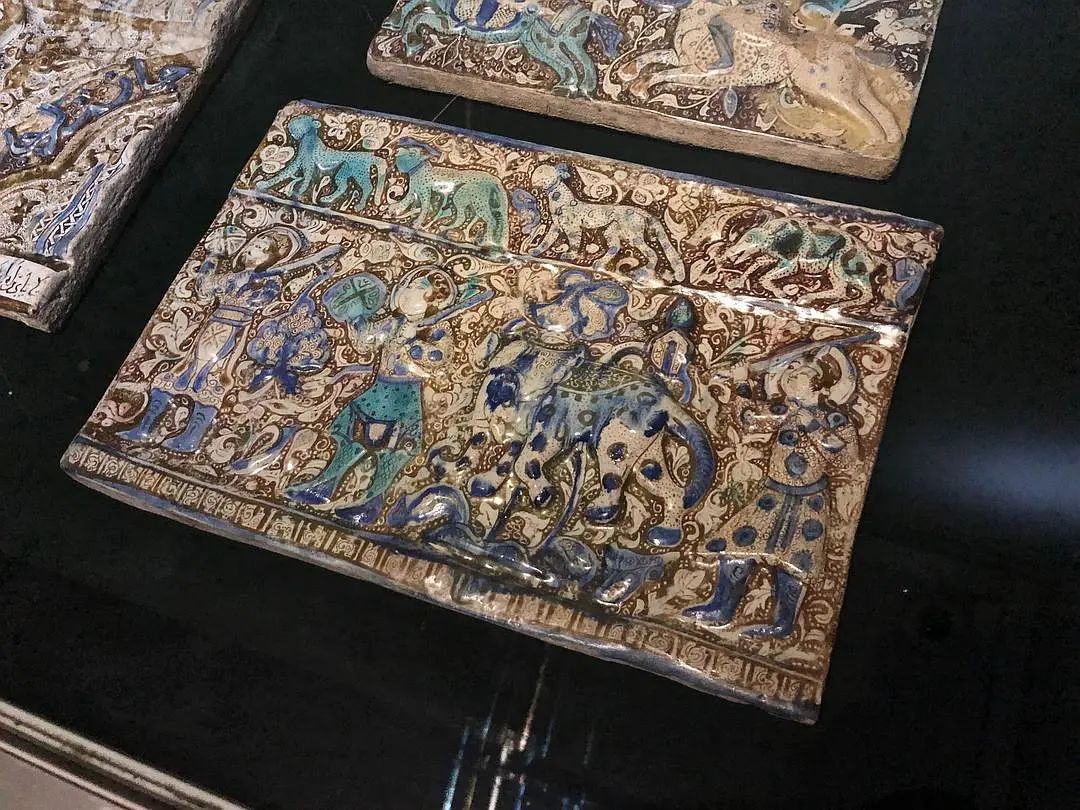
Kashan is south of Tehran. During the Seljuk Empire and Ilkhanate rule from the 12th to 14th centuries, it was a major center for making high-quality pottery and tiles in Iran. In modern Persian, the word for tile (kashi) comes from Kashan.
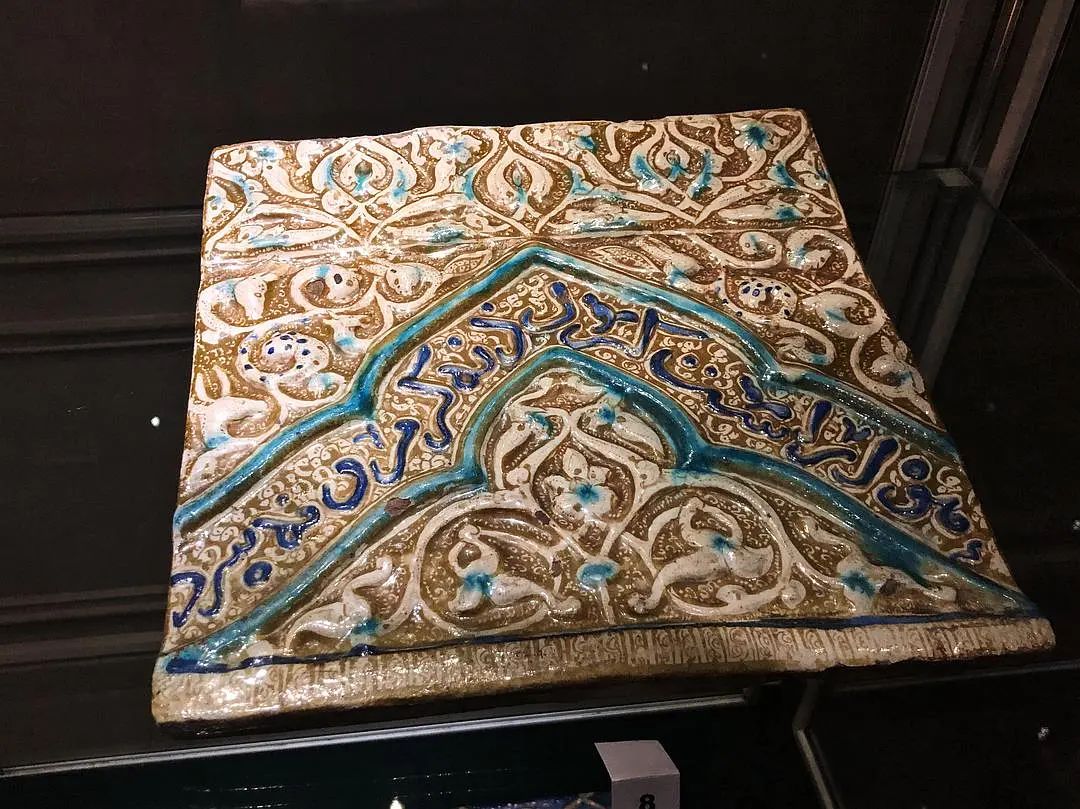
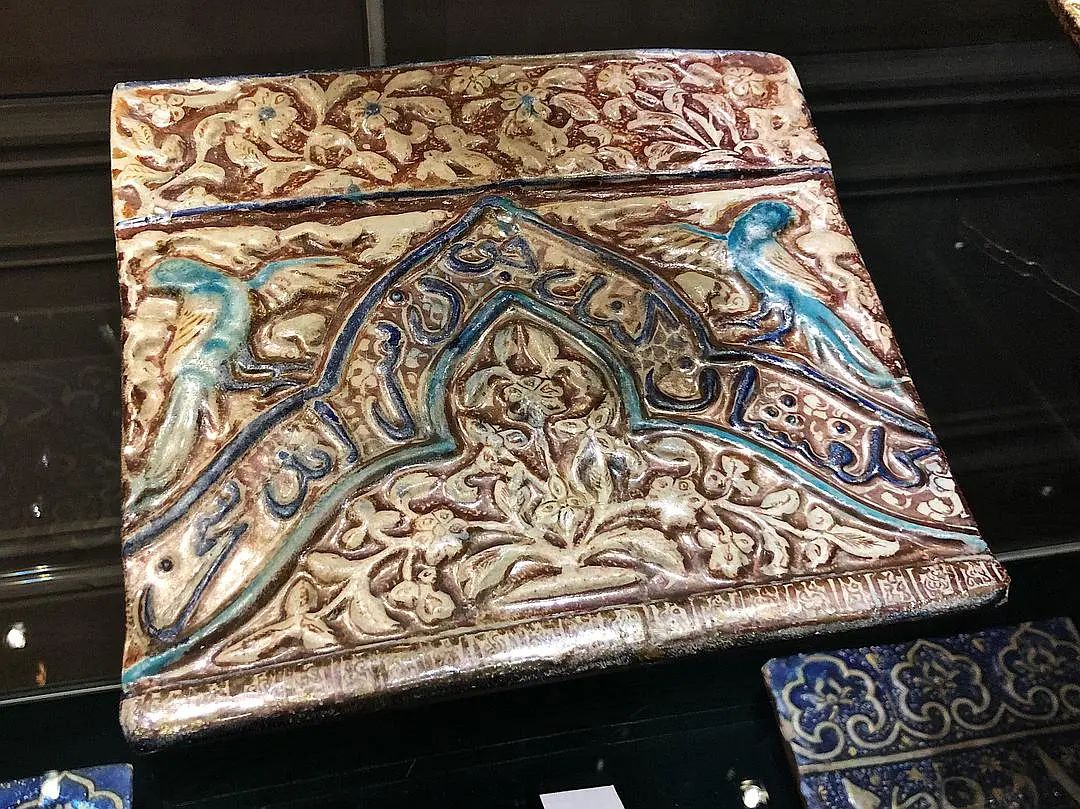
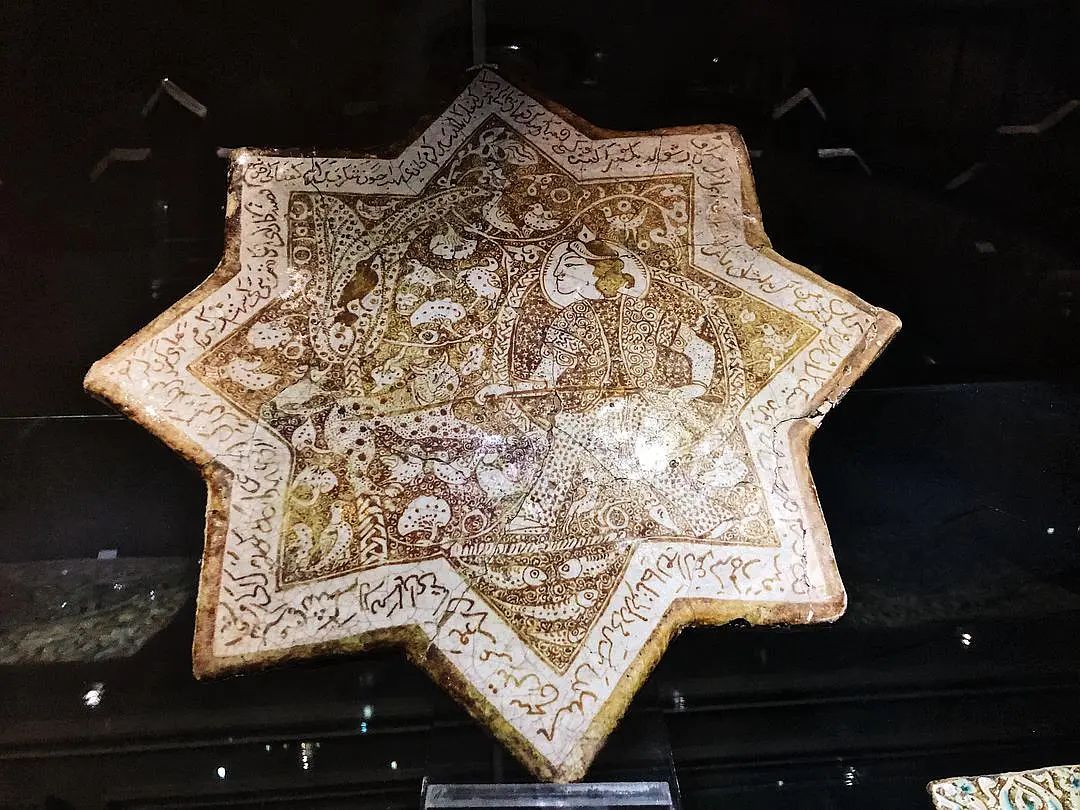
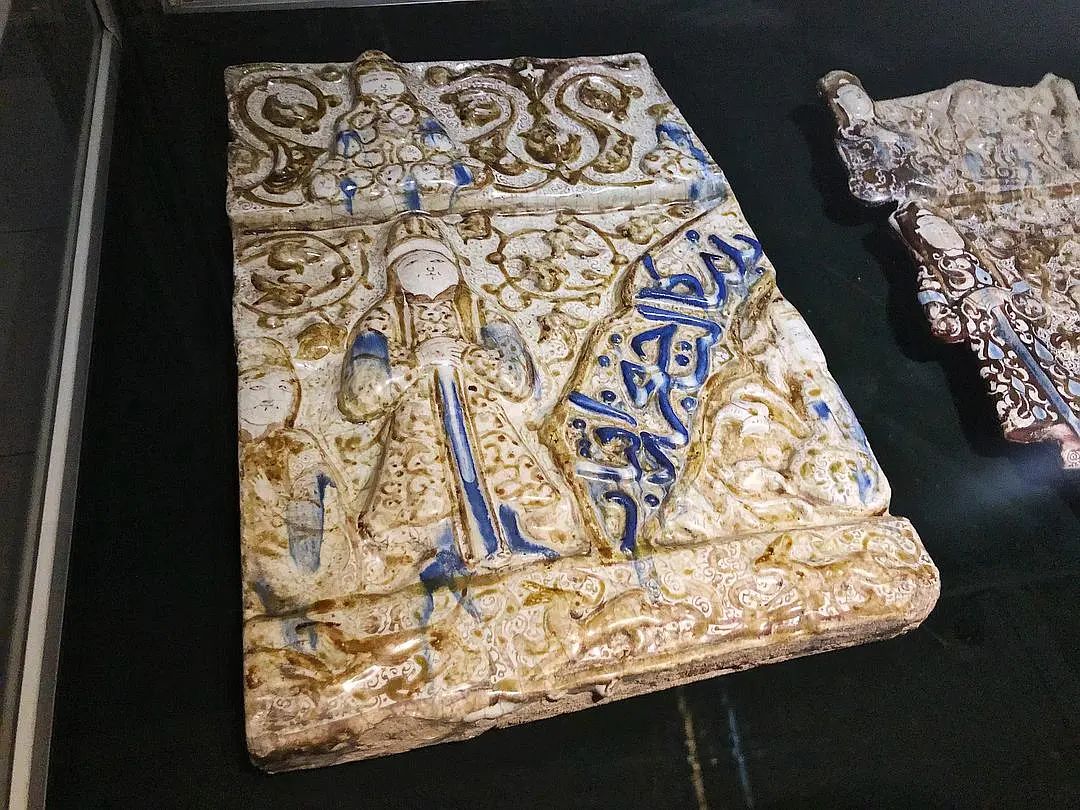
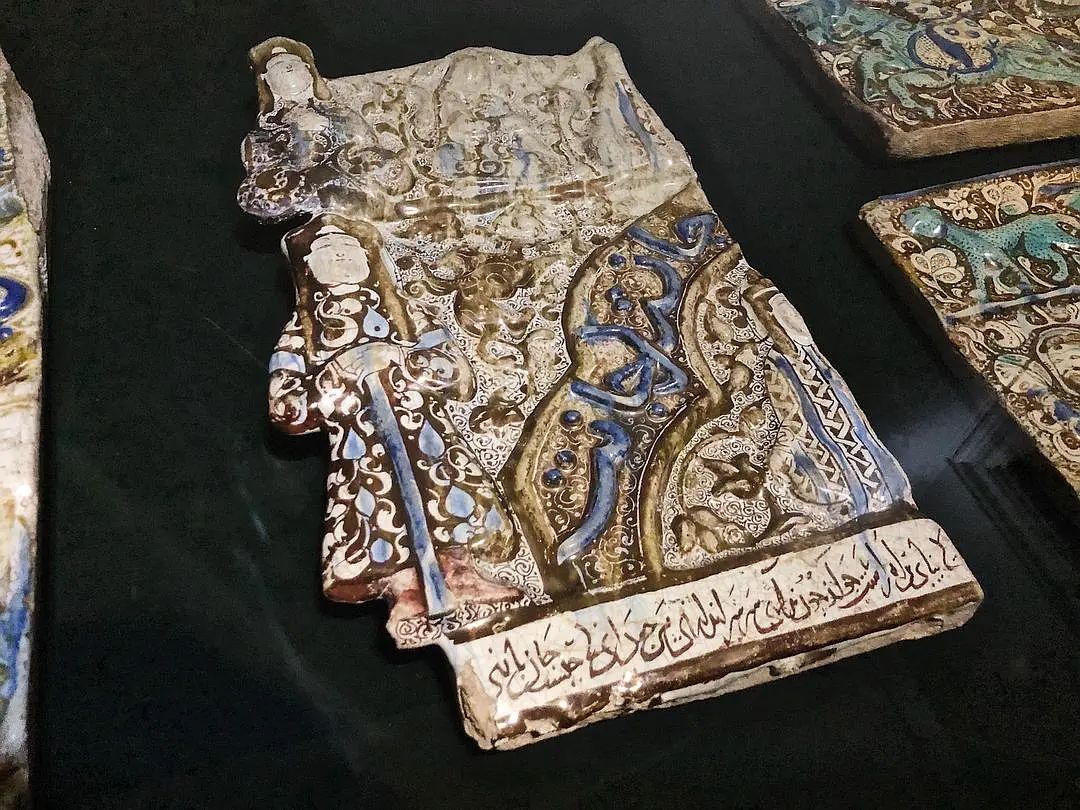
6. Iranian tiles from the Seljuk Empire and Ilkhanate period, 12th to 13th centuries.
The tiles have a very unique style.
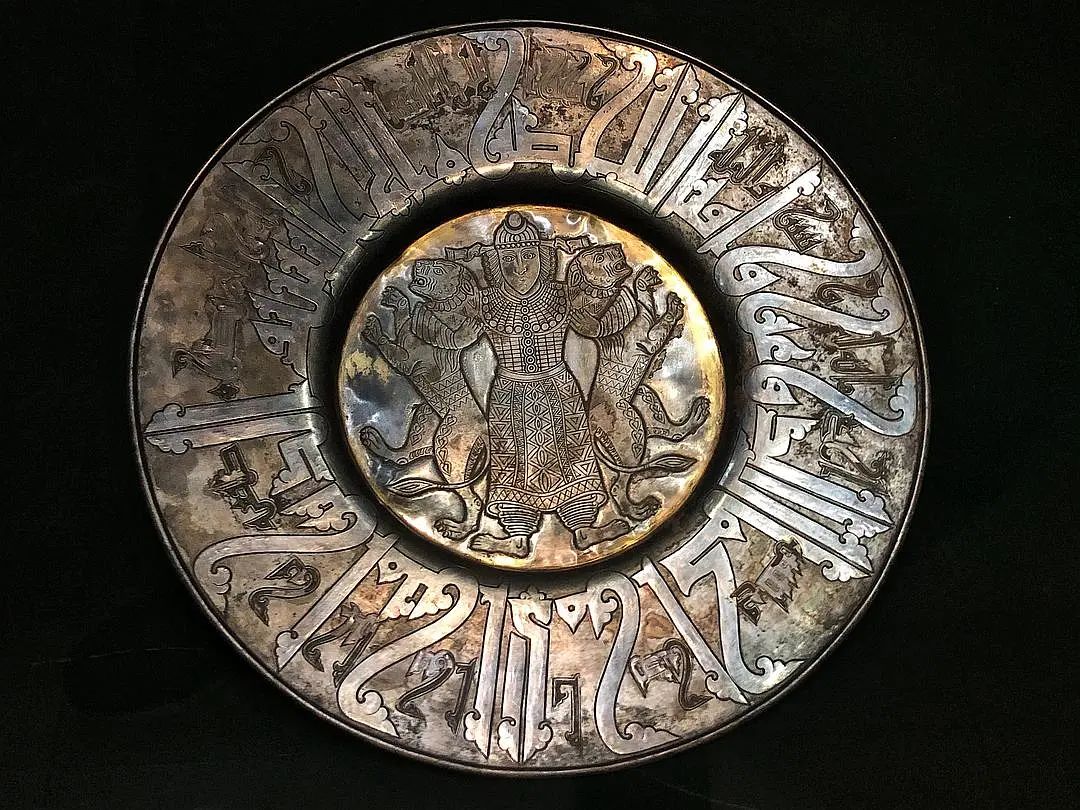
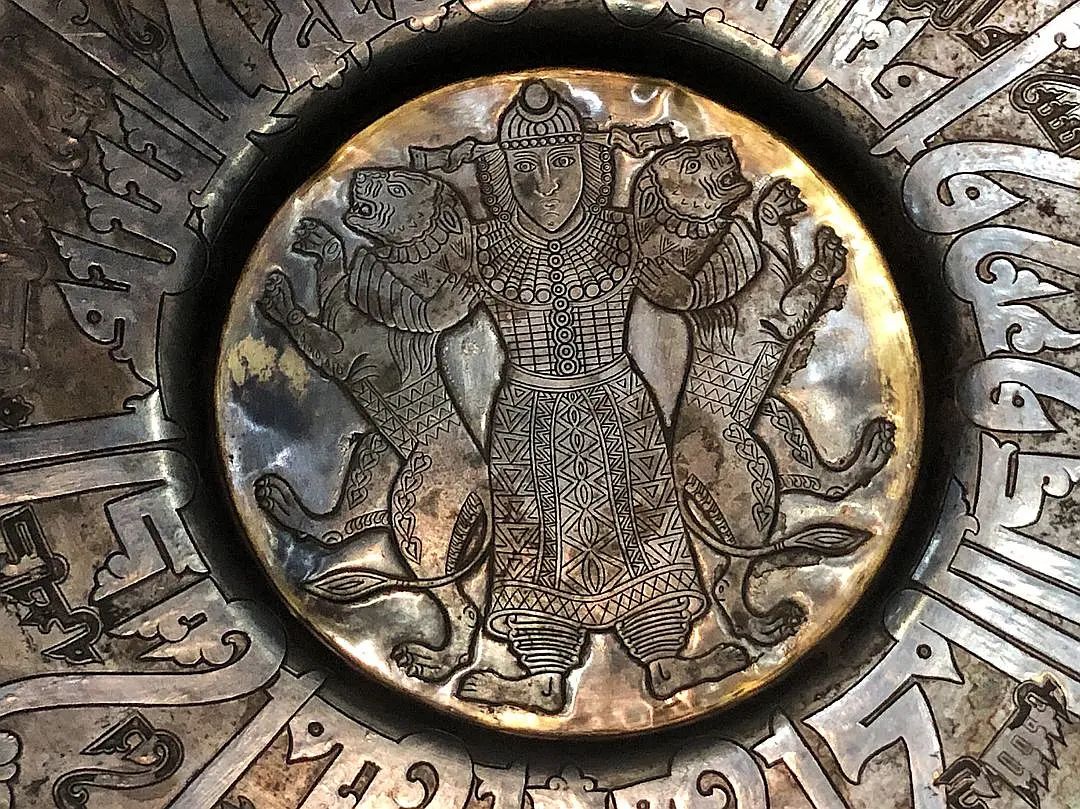
7. A gold-inlaid silver plate made in 1009 AD.
They feature beautiful Kufic calligraphy. At that time, the Buyid dynasty ruled western Iran, and the Ghaznavid dynasty ruled the east.

Summary: Tehran Reza Abbasi Museum: Persian Miniatures, Ceramics and Islamic Art is presented here as a firsthand travel account in clear English, beginning with this scene: In the second half of 1978, strikes and protests almost paralyzed all of Iran, and the Reza Abbasi Museum was forced to close in November. The account keeps its focus on Tehran Travel, Islamic Art, Persian Miniatures while preserving the names, places, food, and historical details from the Chinese source.
In the second half of 1978, strikes and protests almost paralyzed all of Iran, and the Reza Abbasi Museum was forced to close in November. In 1979, the Pahlavi dynasty fell, the Islamic Republic of Iran was established, and the Reza Abbasi Museum reopened. After closing and reopening several more times, the museum is now managed by the Iranian Cultural Heritage Organization and houses various precious Iranian artifacts from prehistoric times to the Islamic period.
Table of Contents
1. Miniatures from the Shahnameh (Book of Kings)
1. Shahnameh miniatures from the Ilkhanate period
2. Shahnameh miniatures from the Timurid period
3. Shahnameh miniatures from the Safavid dynasty period
2. Miniatures from the Compendium of Chronicles (Jami' al-tawarikh) from the Timurid Empire period
3. Other miniatures
4. Pottery from the 9th to 10th centuries unearthed in the ancient city of Nishapur in Khorasan
5. Ceramics from the 12th to 14th centuries from the ancient Iranian city of Kashan
6. Iranian tiles from the 12th to 13th century Seljuk Empire and
the Ilkhanate period.
7. A gold-inlaid silver plate made in 1009 AD.
1. Miniatures from the Shahnameh (Book of Kings)
Persian miniature painting emerged during the Mongol invasion in the 13th century. During the Ilkhanate rule in the 13th and 14th centuries, the royal court moved often for seasonal changes, wars, and hunting. Portable books became the best surface for painting, and the art of miniatures continued to grow. The Mongols brought many Eastern artistic influences to Persian miniatures. For example, some mythical beasts were drawn to look like qilin, phoenixes, pixiu, and Chinese dragons.
Several centers for Persian miniature painting appeared between the 13th and 15th centuries. As the capital of the Ilkhanate, Tabriz was the earliest center for miniatures, and Baghdad, which was under Persian rule at the time, was also very important. In the mid-to-late 14th century, Shiraz in southern Iran became a center for literature and art, and Shiraz miniatures became world-famous. By the early 15th century, after the Timurid era, Bukhara and Herat became centers for miniatures under the patronage of the Timurid royal family. During this period, each miniature painting center had its own unique style. These styles did not gradually merge until the Safavid dynasty ruled in the 16th century.
1. Miniature paintings from the Book of Kings (Shahnameh) during the Ilkhanate period.
During the Ilkhanate period, miniature paintings based on classic Persian poetry began to appear. The most famous is the Persian epic poem Book of Kings (Shahnameh), written by the Persian poet Ferdowsi between 977 and 1010. It describes the myths and historical legends of the Persian Empire from its founding until it was conquered by the Arabs in the 7th century.
The earliest surviving Ilkhanate manuscripts of the Book of Kings are three small manuscripts. This small size was likely more convenient to carry while moving between nomadic camps.
The two images below are illustrations from the manuscript known as the First Small Book of Kings, which is believed to be in the late 13th-century Baghdad style.
This depicts the Iranian prince Salm killing his younger brother Iraj out of jealousy. Years later, Iraj's grandson, the legendary king Manuchehr, killed Salm to avenge his grandfather.
The two images below are illustrations from the manuscript known as the Second Small Book of Kings, which is believed to be in the late 13th-century Baghdad style.
This depicts the Kabul princess Rudaba talking to her female slave so she could meet her husband, the Iranian king Zal. Rudaba is the mother of the legendary hero Rostam, the protagonist of the Book of Kings.
This depicts Ardashir, the founder of the Persian Sasanian dynasty, receiving a warning from his enemy Haftvād.
There are four other manuscripts produced in the early 14th century by the Injuid family, who ruled the Shiraz and Isfahan regions of southern Iran and were semi-independent from the Ilkhanate.
The image below is one of these, done in the Shiraz style. It shows the Iranian hero Bahram being mortally wounded by Tazhav while fighting the Turanians (the Persian name for Central Asian people), a scene from shortly before his death.
Among the Shahnameh manuscripts from the Ilkhanate period, the most famous one is known as the Great Mongol Shahnameh, the Great Ilkhanid Shahnameh, or the Demotte Shahnameh. It is considered the greatest work of early Persian miniature painting.
In the early 14th century, the Persian Jewish vizier of the Ilkhanate, Rashid al-Din, set up a book production department in the suburbs of the Ilkhanate capital, Tabriz, specifically to create books containing miniature paintings. After Rashid al-Din died in 1318, his son Ghiyath al-Din Muhammad continued his father's work by producing miniature manuscripts in the 1330s.
Based on research by later historians, it is believed that Ghiyath al-Din Muhammad produced the Great Mongol Shahnameh manuscript in Tabriz in 1335, under the patronage of the ninth Ilkhanid ruler, Abu Sa'id Bahadur Khan (reigned 1316–1335).
The Great Mongol Shahnameh was kept in Tabriz until the 16th century, after which it entered the library of the Golestan Palace in Tehran. In the late 19th century, taking photographs of the manuscript was still restricted.
In the early 20th century, the Belgian art dealer Georges Demotte, who was active in Paris, acquired the Great Mongol Shahnameh. Because he could not get a suitable price from potential buyers like the Metropolitan Museum of Art, Demotte eventually tore the manuscript apart to sell it in pieces. To hide the damage caused by tearing the book apart, Demotte hired calligraphers to add new text to the manuscript, which greatly annoyed buyers who could read Persian.
The image below is an illustration from the Tabriz-style Great Mongol Shahnameh, depicting the hanging of Mani.
2. Shahnameh miniature paintings from the Timurid dynasty
During the Timurid dynasty, Bukhara became a center for producing the Book of Kings (Shahnameh).
The image below shows a late 14th-century illustration of the Book of Kings in the Herat style, depicting the Iranian hero Bahram shooting his prey.
The image below shows an early 15th-century miniature painting of the Book of Kings in the Bukhara style, depicting Garsiwaz killing his brother, the Turanian king Afrasiab.
3. Miniature paintings of the Book of Kings from the Safavid dynasty period
During the Safavid dynasty's rule over Iran in the 16th and 17th centuries, the production of Book of Kings miniature paintings saw a revival. Ismail I (reigned 1502-1524), the founder of the Safavid dynasty, used the production of Book of Kings manuscripts to emphasize the authority of Persian kings and to strengthen Persian patriotism. Later generations consider the miniature painting created during the Safavid period to be the last great era of the art form.
A 16th-century miniature painting of the Book of Kings in the Tabriz style, depicting the hero Esfandiyar slaying a dragon. Esfandiyar was an Iranian prince, and his father once sent him to suppress a rebellion and rescue a kidnapped princess. On his journey, he fought seven different battles, one of which was killing a dragon.
A 16th-century miniature painting of the Book of Kings in the Tabriz style, depicting the legendary hero Rostam fighting his enemies.
A late 16th-century miniature painting of the Book of Kings in the Khorasan style, depicting the Turanian king Afrasiab being led out of a cave by Houm.
A 16th-century Shiraz-style miniature painting from the Shahnameh, showing the Iranian hero Bahram on his way to Egypt.
A 16th-century Tabriz-style miniature painting from the Shahnameh, showing the war between Darab, Shoaib, and the Arabs.
A late 16th-century Shiraz-style miniature painting from the Shahnameh.
A 17th-century Shiraz-style miniature painting from the Shahnameh, showing the war between the legendary King Kay Khosrow of the Iranian Kayanian dynasty and King Shideh of Turan.
3 Produced by Tahmasp I of the Safavid dynasty.
Tahmasbi Shahnameh miniature painting.
The Tahmasbi Shahnameh, also called the Houghton Shahnameh, was commissioned by Tahmasp I (reigned 1524-1576) of the Safavid dynasty. The greatest painters of the Safavid era worked on it, and it originally included 258 miniature paintings. Because the Safavid capital was in Tabriz at the time, the Tahmasbi Shahnameh has a Tabriz style.
In 1959, the famous collector Arthur Houghton bought this Shahnameh from the wealthy French Jew Edmond de Rothschild. Only 118 miniature paintings remained at that time.
Since 1962, Arthur Houghton broke up the Tahmasbi Shahnameh and donated 88 of the paintings to the Metropolitan Museum of Art in New York to avoid taxes (Houghton had served as the president of the Metropolitan Museum of Art for many years). After that, Houghton auctioned off the miniature paintings several times. After Houghton died in 1990, the Houghton Foundation decided to sell the collection for 13 million dollars, but no one bought it because the price was too high. British seller Oliver Hoare suggested that Iran trade the remaining Shahnameh miniatures for the painting Lady No. 3 by Dutch artist Willem de Kooning, because the painting was banned from public display in Iran for being anti-Islamic. In the end, the Tahmasbi Shahnameh returned to Iran.
The image below shows the Sassanid king Bahram Chobin (reigned 590-591) fighting Sava Shah.
A Shahnameh miniature produced by Ismail II of the Safavid dynasty.
Ismail II (reigned 1576-1577) was the third ruler of the Safavid dynasty. At that time, the Safavid capital was Qazvin, Iran (1548–1598), so the miniatures from this period have a Qazvin style.
The image below shows the author of the Shahnameh, Ferdowsi, walking toward several court poets of the Ghaznavids. An enlarged version of this miniature is posted in the hall right at the entrance of the Reza Abbasi Museum. It is also the cover of the book Entering the Orchard in Spring.
Reproduction:
The image below shows the legendary Iranian prince Siavash undergoing a trial by fire, while his father, the Iranian king Kay Kavus, and his stepmother, Queen Sudabeh, watch from a balcony.
The image below shows Siavash hunting with the Turanian king Afrasiyab. The second part of the Shahnameh says that Siavash willingly became a hostage in Turan so that Iran and Turan could have peace. However, the king broke the peace treaty and committed a series of atrocities, which made Siavash decide to start a new life in Turan. King Afrasiyab of Turan gave Siavash a warm welcome, and Siavash fell in love with the king's daughter and married her.
The image below shows the story of the mythical bird Simurgh taking care of the great hero Zal. Simurgh is a kind mythical bird in Iranian legends, similar to a phoenix. It appears often in various Iranian myths, most famously in the Shahnameh.
In the Shahnameh, the Iranian hero Saam's son, Zal, was born with albinism. Saam thought his son was a demon's child, so he abandoned him on Mount Alborz. The kind Simurgh living on the mountain peak heard the baby crying and raised him. Zal learned much wisdom and knowledge from the loving Simurgh.
In the picture, the mythical bird Simurgh is holding the baby Zal, and below them is Zal's father, Saam.
The image below shows the scene of the Iranian hero Esfandiyar slaying a dragon. Esfandiyar was an Iranian prince, and his father once sent him to suppress a rebellion and rescue a kidnapped princess. On his journey, he fought seven different battles, one of which was killing a dragon.
The image below shows the scene of the Iranian hero Esfandiyar killing the Turanian hero Biderafsh. When the King of Turan learned that the Iranians had converted to Zoroastrianism, he wrote a letter to the King of Iran demanding they abandon their faith and sent Biderafsh as a messenger to Iran. The King of Iran refused the demand, which started a war between Turan and Iran. During the war, Biderafsh was killed by the Iranian hero Esfandiyār.
The image below shows the legendary Iranian King Kay Khosrow talking with the Iranian heroes Zal, Rostam, and others.
The image below shows the legendary Iranian King Kay Khosrow crossing a river with his mother Farangis and the hero Giv.
The image below shows the King of Yemen, Sarv, sitting on his throne with his three daughters on his left and the three sons of the mythical Iranian King Fereydun on his right.
The image below shows the Iranians surrounded by the Turanian army on Mount Hamawan as they watch reinforcements arrive.
The image below depicts the tragic story between the Iranian hero Rostam and his son Sohrab. Once, Rostam followed the tracks of his lost horse to the Kingdom of Samangan, where he met Princess Tahmina. The princess admired Rostam greatly, so she came to his room at night and said that if he gave her a child, she would return his horse. Rostam agreed and did so. Before leaving, Rostam gave the princess two tokens. If she gave birth to a girl, she should braid the tokens into the child's hair along with some jewelry. If it was a boy, they tied the token to the child's arm. Later, the princess gave birth to a boy and named him Sohrab.
Many years later, Iran and Turan went to war. As a legendary hero of Iran, Rostam forced the Turan army to retreat, and no one dared to face him. Eventually, Sohrab and Rostam fought each other. Although he knew his father was named Rostam, he did not know that the man in front of him was his father. After a long battle, Rostam finally broke Sohrab's back and stabbed him. Before he died, Sohrab said his father would avenge him, and that was when the father and son finally recognized each other. Sohrab took out the token his mother had given him. Rostam was heartbroken, but he could not save his son.
Other miniature paintings in the Qazvin style.
The image below is a 16th-century Qazvin-style miniature painting from Saadi's The Orchard (Bustan).
The Orchard (Bustan) is a collection of lyric poems completed by the famous Persian poet Saadi in 1257. It is considered one of Saadi's two greatest works, alongside The Rose Garden (Golestan).
2. Miniatures from the Compendium of Chronicles (Jami' al-tawarikh) from the Timurid Empire period
The Compendium of Chronicles (Jami' al-tawarikh) is a world history book from the Ilkhanate period. It was commissioned by the seventh Ilkhan, Ghazan (reigned 1295-1304), and edited by his vizier and scholar Rashid-al-Din Hamadani. Because of its scope, the book is known as the first world history. It covers various histories, cultures, and major events from China to Europe.
By the early 14th century, the Mongols of the Ilkhanate had settled down and adopted Persian cultural customs. Ghazan's original idea was to write a book that preserved the traditions of the Ilkhanate Mongols by explaining their history on the steppes. To compile the history, Rashid-al-Din set up a special area at the Rab'-e Rashidi university in the Ilkhanate capital of Tabriz. This area included many buildings such as a mosque, a hospital, a library, and classrooms.
After Ghazan died in 1304, his successor, Öljaitü (reigned 1304-1316), asked Rashid-al-Din to expand the scope of the compilation to cover the entire known world history. The Compendium of Chronicles was finally completed between 1306 and 1311. Afterward, Rashid-al-Din organized hundreds of miniature painters and calligraphers to produce one Persian copy and one Arabic copy of the Compendium of Chronicles every year to distribute to schools throughout the Ilkhanate. Rashid-al-Din produced 20 copies of the Compendium of Chronicles during his lifetime, which are known as the first-generation manuscripts. Only a very small number have survived, and they are extremely precious examples of early Persian miniature painting.
In the early 15th century, the Timurid Empire replaced the Ilkhanate as the ruler of Iran and took a great interest in the Compendium of Chronicles. At that time, Shah Rukh (reigned 1405-1447), the ruler of the eastern part of the Timurid Empire, owned an incomplete manuscript of the Compendium of Chronicles. He commissioned the court historian Hafiz-i Abru to continue the work in Herat, Afghanistan, which was Shah Rukh's capital. The continuation brought the content up to the Timurid era, and the miniature paintings in it have a typical Timurid style.
3. Other miniatures
A 16th-century miniature painting from Saadi's The Rose Garden (Gulistan).
Saadi Shirazi was a famous 13th-century Persian poet. He is widely considered one of the greatest poets in classical Persian literature and has had a huge influence on later generations. The Rose Garden (Gulistan, literally meaning 'rose garden') is a masterpiece of classical Persian literature. Saadi wrote it in 1258, and it is a collection of poems and stories.
The image below shows a 16th-century miniature painting of The Rose Garden in the Herat style from the Safavid dynasty.
A 15th to 16th-century miniature painting in the Bukhara style.
A 15th-century miniature painting from the Timurid dynasty in the Bukhara style, depicting 'Imam Ali slaying a dragon' in the Khavaran-Nameh.
A 15th-century miniature painting of Saadi's The Orchard (Bustan) in the Bukhara style.
A 16th-century miniature painting in the Bukhara style.
A miniature painting in the Khorasan style.
A 15th-century miniature painting of The Garden of Truth (The Hadiqa Tul Haqiqat) in the Khorasan style. The original work is by the famous 11th to 12th-century Persian Sufi poet Sanai, and The Garden of Truth is his masterpiece.
A miniature painting in the Shiraz style.
16th-century Shiraz-style miniature painting.
Herat-style miniature painting.
1592 Herat-style miniature painting showing two people in a garden.
4. Pottery from the 9th to 10th centuries unearthed in the ancient Khorasan city of Nishapur.
Nishapur is located on the ancient Silk Road in northeastern Iran and was once one of the four major cities in the Greater Khorasan region. In the 9th century, Nishapur became the capital of the Persian Tahirid dynasty. Under the rule of the Persian Samanid dynasty in the 10th century, Nishapur grew into an important cultural and commercial center of the Islamic world. Various cultures and religions gathered here, and trade routes from Transoxiana in Central Asia, China, Iraq, and Egypt met in this city. The glazed pottery produced in Nishapur at that time became an important trade commodity in the West, once rivaling Baghdad and Cairo.
In 1221, the Mongols massacred the population of Nishapur and completely destroyed the city, burying the former metropolis underground. It was not until the mid-20th century that the site was rediscovered through archaeological excavations. Today, most of the unearthed Nishapur ceramics are kept at the Metropolitan Museum of Art, as well as in museums in Tehran and Mashhad.
5. Ceramics from the 12th to 14th centuries from the ancient Iranian city of Kashan
Kashan is south of Tehran. During the Seljuk Empire and Ilkhanate rule from the 12th to 14th centuries, it was a major center for making high-quality pottery and tiles in Iran. In modern Persian, the word for tile (kashi) comes from Kashan.
6. Iranian tiles from the Seljuk Empire and Ilkhanate period, 12th to 13th centuries.
The tiles have a very unique style.
7. A gold-inlaid silver plate made in 1009 AD.
They feature beautiful Kufic calligraphy. At that time, the Buyid dynasty ruled western Iran, and the Ghaznavid dynasty ruled the east.
