
Muslim Friendly Guilin: Bai Chongxi Hometown, Historic Mosques and Guangxi Halal Travel
Reposted from the web
Summary: Muslim Friendly Guilin: Bai Chongxi Hometown, Historic Mosques and Guangxi Halal Travel is presented here as a clear English account for Muslim readers, beginning with this scene: — Hello, Travel —. The article keeps the original names, food details, mosque details, photographs, and cultural context while focusing on Guilin Mosques, Bai Chongxi, Halal Travel.

— Hello, Travel —
To avoid the National Day travel rush, I chose to take my whole family to Guilin, Guangxi, right after the holiday ended. We spent 6 days there visiting the famous Two Rivers and Four Lakes, Elephant Trunk Hill, the Li River, the Ten-Mile Gallery, Huangluo Yao Village, the Longji Rice Terraces, and 9 mosques in Guilin and its surrounding villages. It was a deep dive into Guilin.
Mid-October is the most beautiful time in Guilin. The temperature is perfect, around 25 degrees Celsius during the day and 17 or 18 degrees at night, so a single layer of clothing is very comfortable. The rice terraces are also harvested in October, turning the mountainsides a spectacular golden yellow.
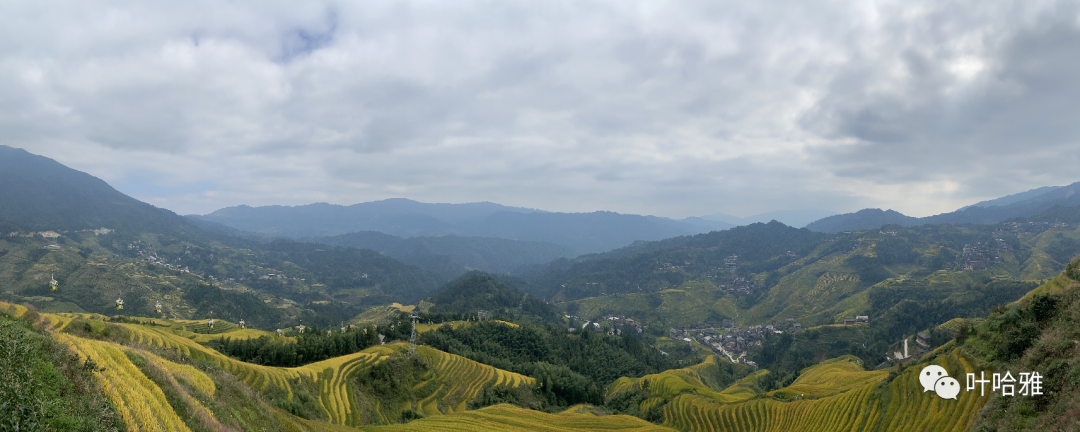
Longji Rice Terraces
Travel Tips

Transportation
If you visit a popular destination like Guilin during a holiday, I do not recommend driving yourself unless you can find good parking. During major holidays like National Day, every scenic spot is packed with people.
If you drive into a scenic area, you will likely wait in line for at least 3 hours. Between the time and energy spent touring, you will be exhausted, and driving back is very hard. My advice is to travel to the city on your own and then join a local one-day tour group.

Dining
See the details below.

Accommodation
There are many one-day tours in Guilin. You can book them at your hotel front desk or through travel platforms like Trip.com or Mafengwo. They are very cheap. I booked two one-day tours this time, and each cost less than 200 yuan per day. This included round-trip transportation and entrance tickets, but not group meals, which suited me perfectly since group meals are not halal.
For accommodation in Guilin, I recommend staying near the Xicheng Pedestrian Street in the city center. It is only a few dozen meters from the Chongshan Road Mosque, there are several halal restaurants nearby, and it is only 2 kilometers from the Guilin Railway Station.
1
Day 1 One-Day Tour
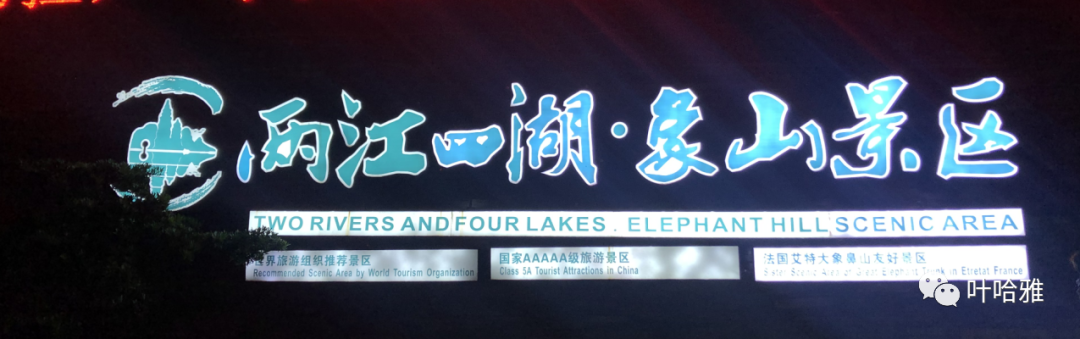
If you stay in downtown Guilin, you can take a boat at night to tour the 5A-rated Two Rivers and Four Lakes scenic area. The tickets are a bit expensive at 180 yuan per person, and night tickets cost even more, but the night view is more beautiful than the daytime.
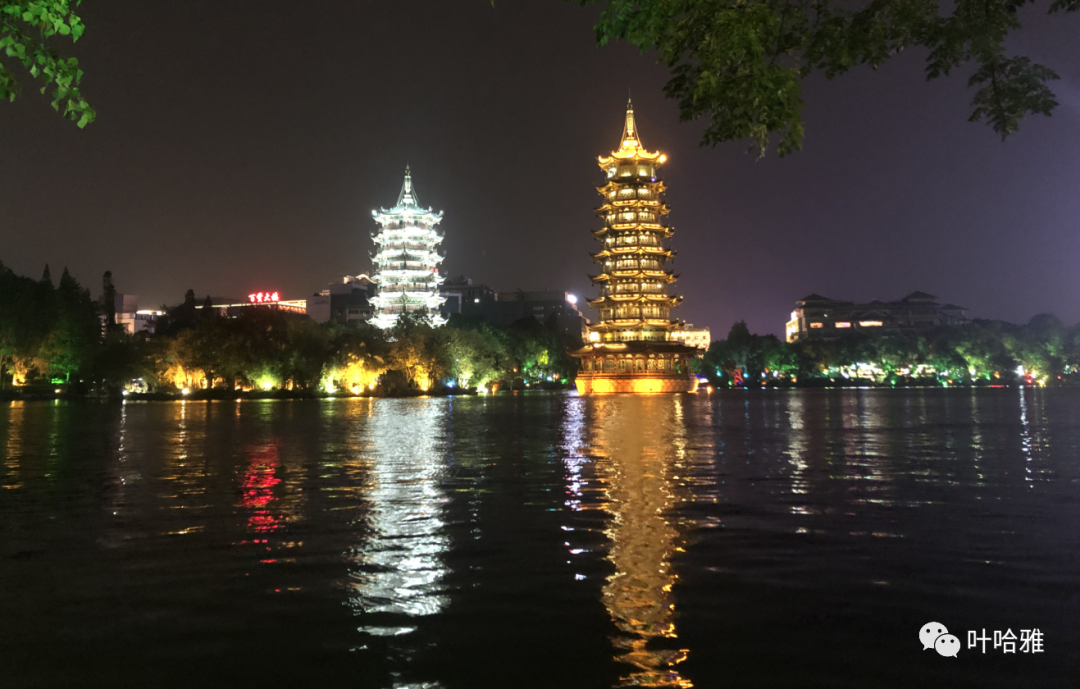
Sun and Moon Twin Pagodas (Riyue Shuangta)
In the evening, you can walk around Zhengyang Road Pedestrian Street near the Sun and Moon Twin Pagodas Cultural Park, but there are no halal snacks on this street.
The most famous spot in Guilin is the Nine Horse Painting Mountain (Jiuma Huashan) scenic area on the Li River, which is well-known for being the background image on the 20-yuan note of the fifth series of renminbi. From downtown Guilin, you can take a tourist bus for about 1.5 hours to reach Yangshuo County where the scenic area is located. If you are traveling independently, I recommend staying in Yangshuo town, as it is very close to the surrounding scenic spots.
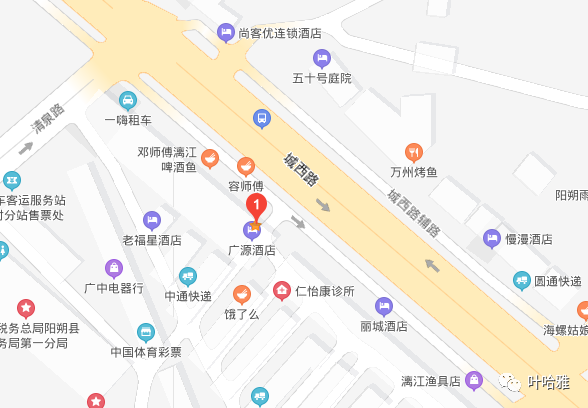
There is a halal restaurant in Yangshuo town called Muslim Restaurant (Musilin Fandian)
and its location is as follows.
In Xingping Ancient Town of Yangshuo County, there is also an Indian halal restaurant called Ganges (Henghe).
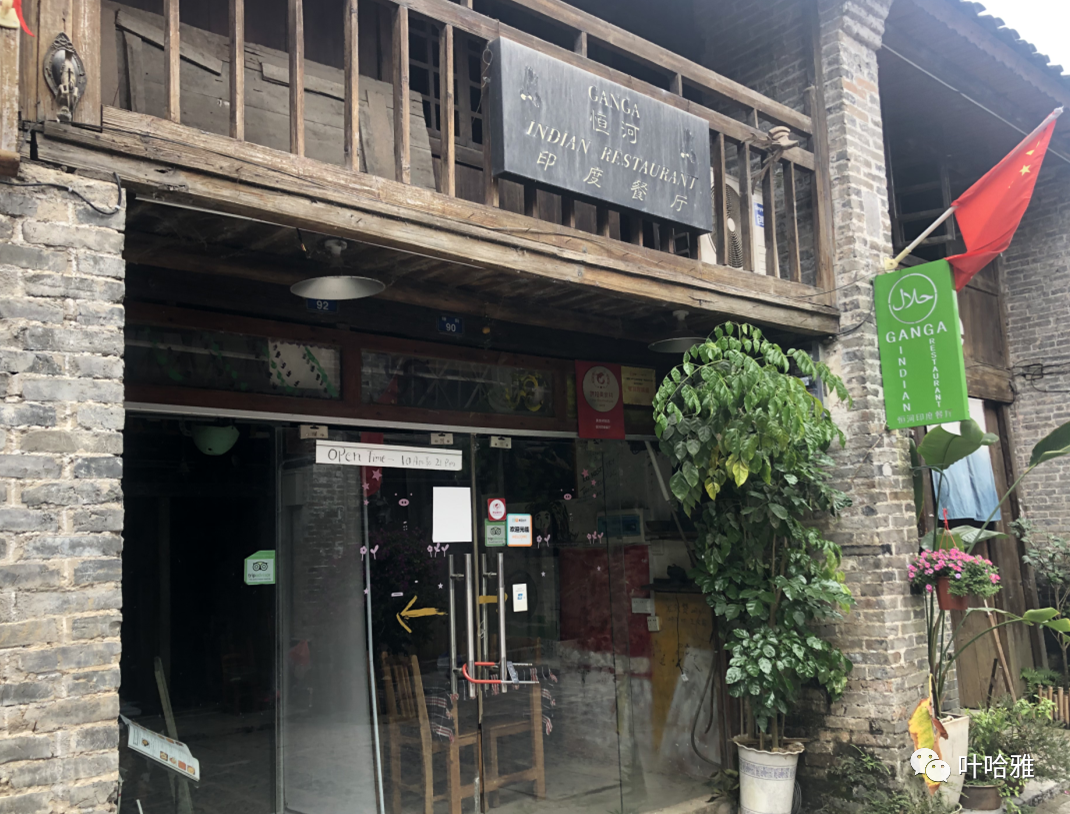
You can take a bamboo raft from the Xingping Ancient Town pier to tour the Li River. The boat ride takes about 30 minutes, and there are shuttle buses in the scenic area to take tourists back to the entrance after the boat trip.
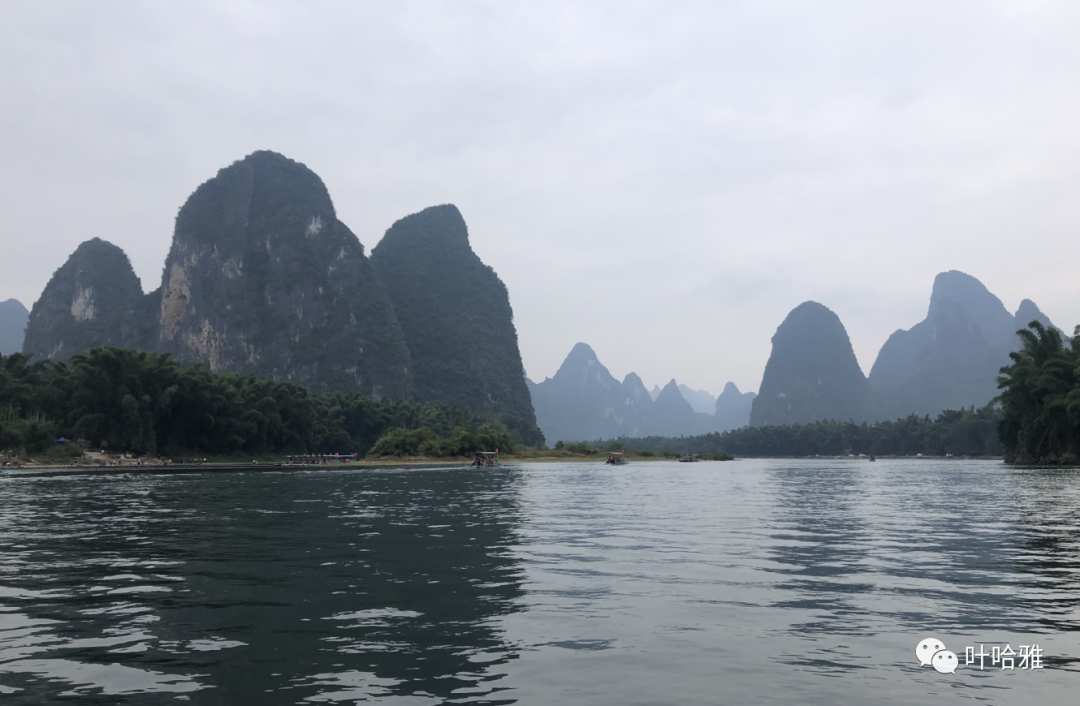

A comparison of the Nine Horse Painting Mountain scenic area on the Li River with the renminbi background.
Guilin's landscape is a World Natural Heritage site and a classic example of Chinese mountain and water scenery. Successive national leaders have visited Guilin many times.
A small bamboo raft floats on the river.
To protect the Guilin landscape, the local government has set height limits for urban buildings, so you won't see any skyscrapers in the city.
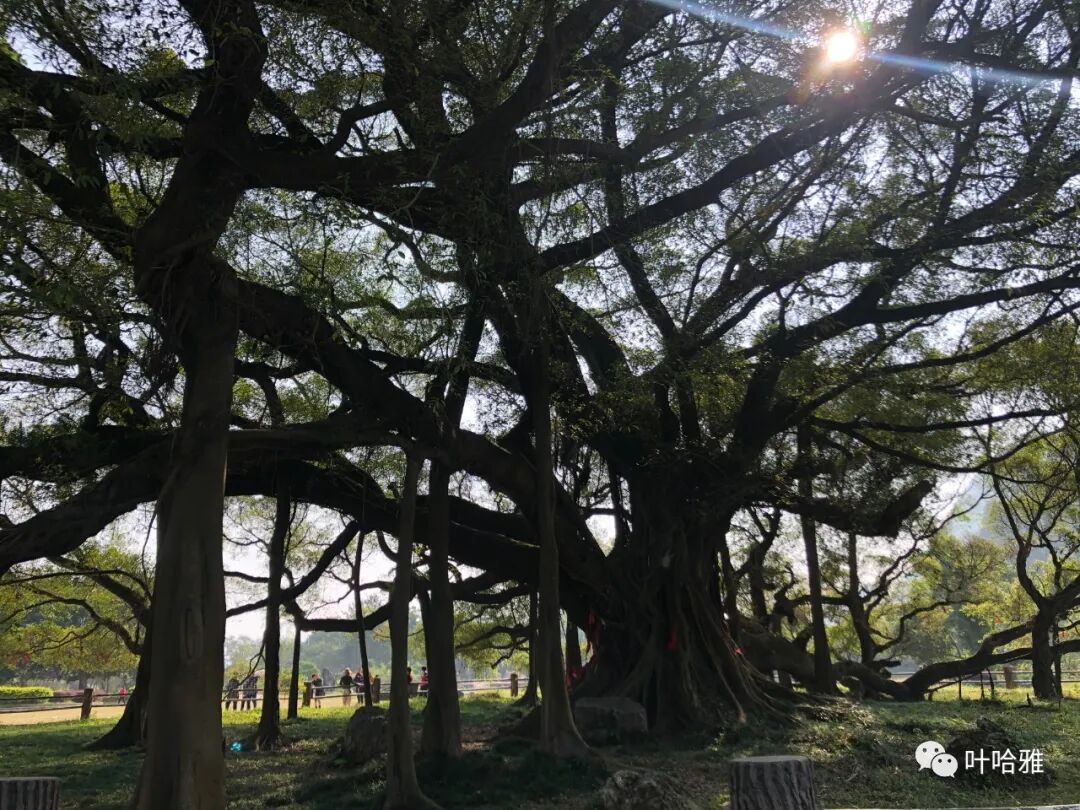
The Thousand-Year-Old Banyan Tree (Qiannian Darongshu).
One of the highlights of the Ten-Mile Gallery (Shili Hualang) is the Big Banyan Tree scenic area. This is the hometown of Liu Sanjie and the filming location for the movie "Liu Sanjie." Yangshuo County hosts the "Impression Liu Sanjie" show. It is very impressive, though the ticket price is expensive at over 200 yuan, it is worth seeing.
From the Big Banyan Tree, you can drive 1 kilometer to reach Jinshui Cave to explore the karst landforms and take a mud bath. After leaving the cave, you can watch a Yao village song and dance performance. The show is great, and they invite audience members to join a mock Yao wedding ceremony. I was lucky enough to be chosen as the groom, pretended to enter the bridal chamber with a Yao girl, and was even asked for a 39 yuan bride price.

Jinshui Cave
These activities are all included in the Guilin one-day tour. There is no shopping involved. The only local Guilin specialties sold are offered by the tour guide while the bus is moving, so it does not delay the trip. The items are cheap, and you can choose whether to buy them.
2
Day 2 one-day tour
Because the first day's tour was a good experience, we immediately signed up for a second one-day tour. This trip followed a different route to see the famous Longji Rice Terraces.
The Longji Rice Terraces are divided into areas like the Jinkeng (Dazhai) Yao ethnic terrace viewing area and the Ping'an Zhuang ethnic terrace viewing area. We chose to visit the larger Jinkeng Yao ethnic terraces. The terraces are fields carved into the mountains by local villagers to grow rice. This rice is no longer sold to the public and is only for the villagers' daily consumption.

Longji Rice Terraces
You can take a cable car to the top of the terraces. A one-way ticket is 50 yuan, and a round-trip ticket is 100 yuan per person. If you walk up the mountain, it takes about 5 kilometers of mountain roads and three hours round-trip, but hiking allows you to see the scenery along the way.
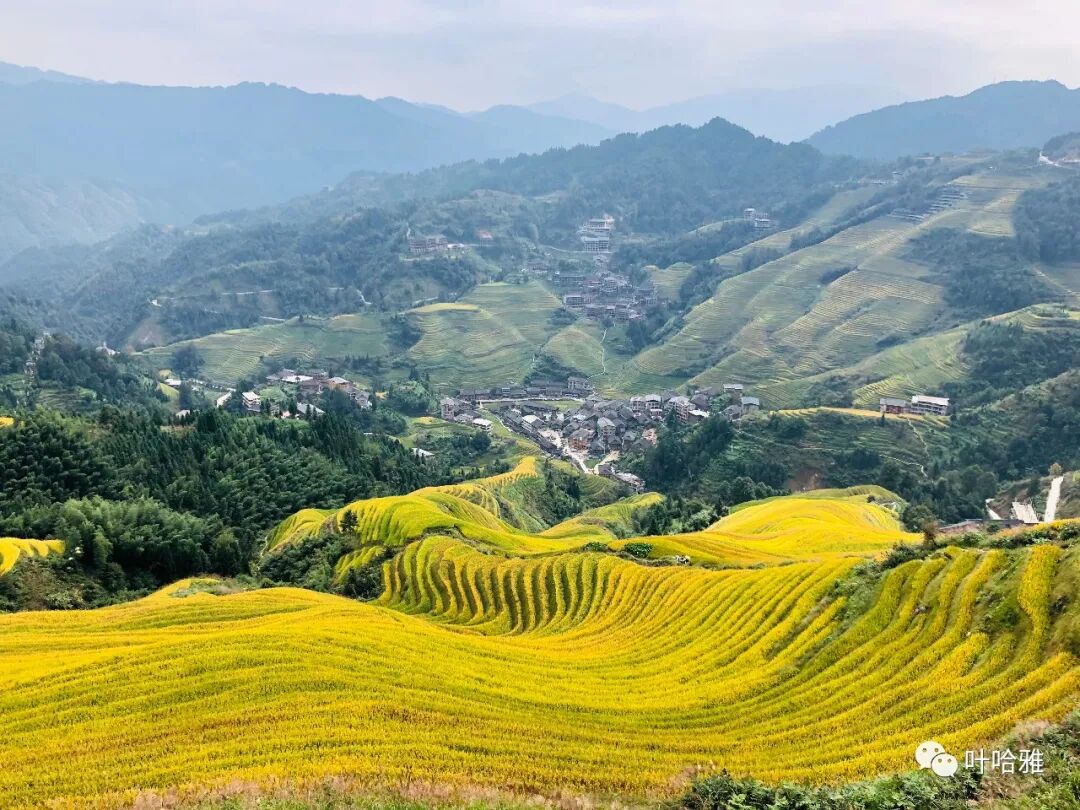
Looking down at the terraces from the mountain top
Huangluo Yao Village is known as the world's number one long-hair village. The villagers still keep the tradition of growing their hair long. According to the locals, the village is a matriarchal society where women go out to work and men stay home to do housework. While we wandered around the village, we really did not seem to see any men, and all the villagers providing services were women.
Women in the long-hair village rarely cut their hair in their lives. They might cut it once before getting married, and they keep the hair they cut off coiled on their heads. After marriage, they basically never cut their hair again, so the older they get, the longer their hair becomes.
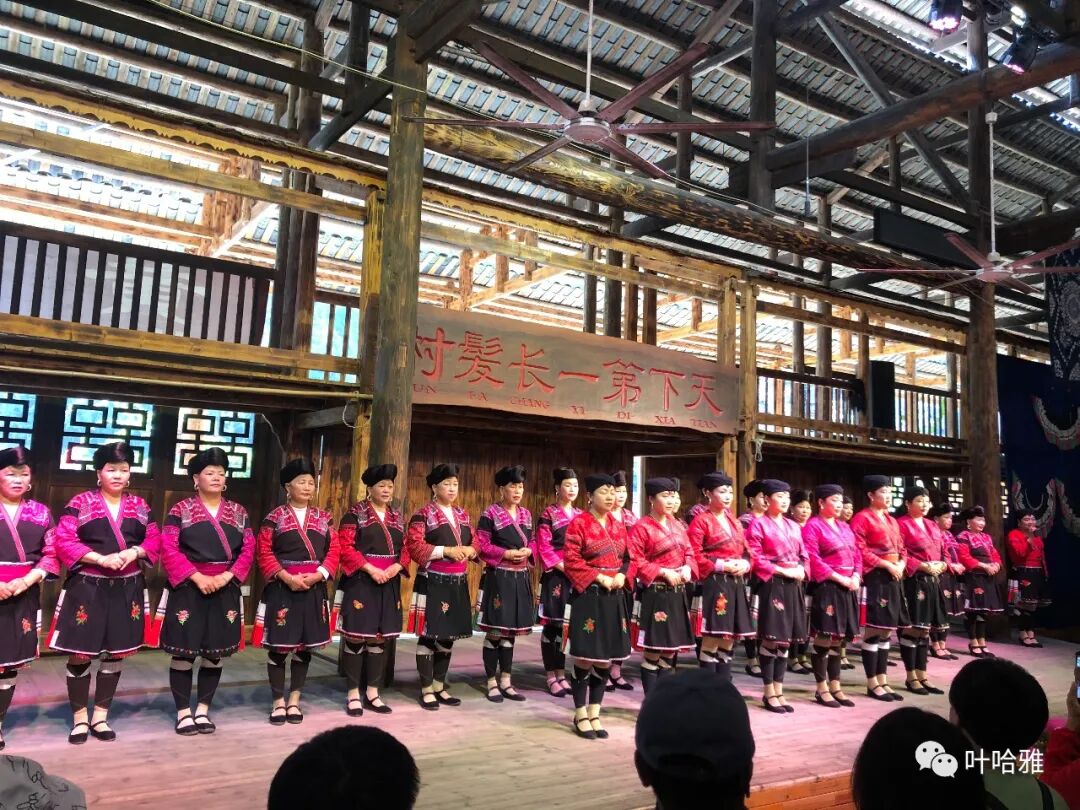
Villagers in the long-hair village perform hair combing
Locals say that although their hair is dark and shiny, they do not use any hair care products. At most, they wash their hair with rice water, and their hair quality is good mostly because of their genetics.
Long-haired girls' hair-washing performance
3
Cultural journey
After enjoying the natural scenery, we immediately started our cultural journey in Guilin. We learned that Qianjing Village, under Guilin's jurisdiction, is the hometown of Bai Chongxi. We drove from the city to the village, which is located in Caoping Hui Ethnic Township, about 50 kilometers away and a one-hour drive.
1. Qianjing Mosque
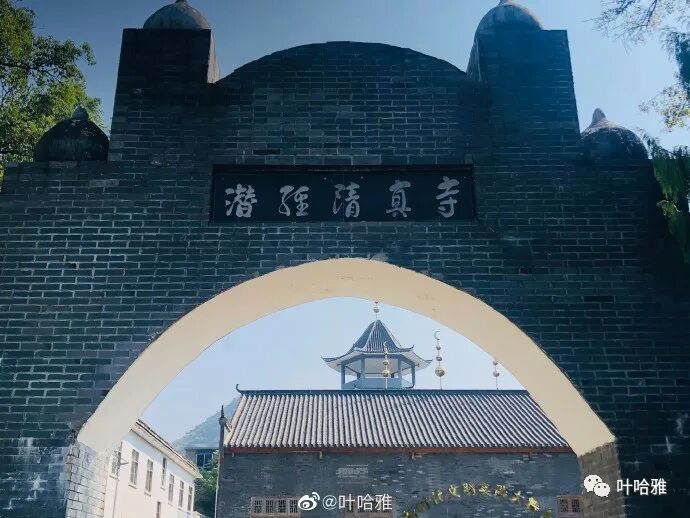
First built in the Qing Dynasty, the original mosque was destroyed. The current building was funded by Bai Chongxi in 1940. Bai Chongxi was born in this village and once returned here to pay respects to his ancestors. Qianjing is a village of Hui Muslims. Most villagers are Hui Muslims and all share the surname Bai. The imam told us that even outsiders who marry into the village must change their surname to Bai.
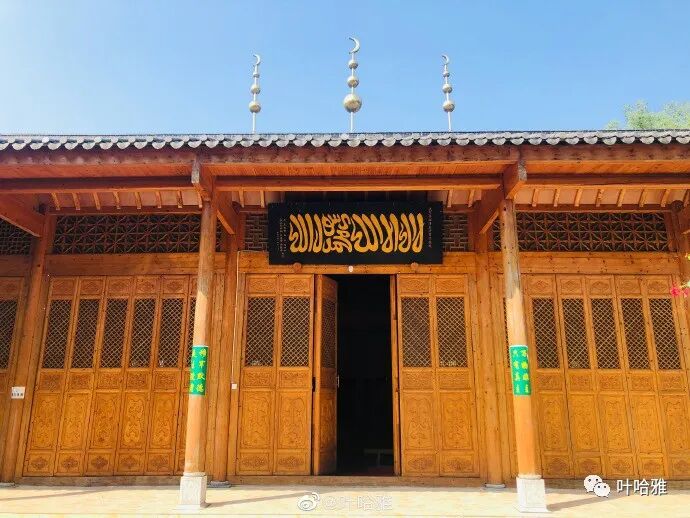
The mosque features a traditional wooden structure. It is worth noting that all nine mosques I visited in Guilin are built in this traditional style.
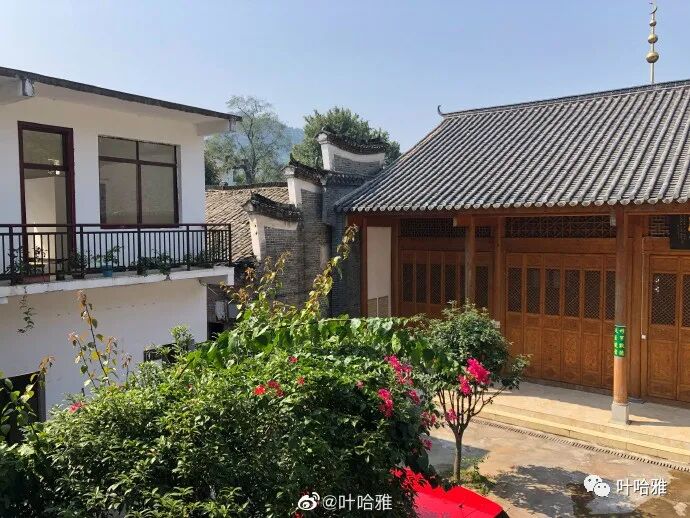
Although the villagers in Qianjing are Hui Muslims, People say they have been disconnected from the faith since the end of the Qing Dynasty. Today, very few elderly people there know the basic knowledge of Islam, and their daily habits are no different from other ethnic groups.
Even today, every household keeps ancestral tablets. Interestingly, they do not believe in Christianity or Buddhism; it seems ancestor worship is the only faith of the villagers.
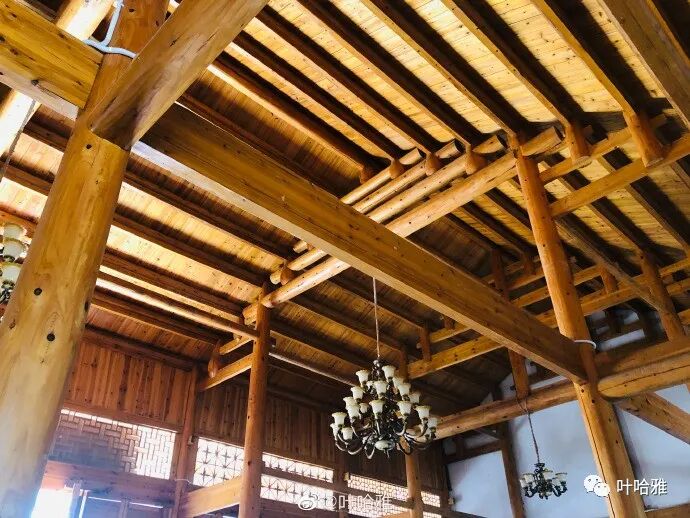
Crossbeam of the prayer hall
On weekdays, almost no villagers come to pray, except for the imam and a few passing friends (dosti). However, about ten villagers, mostly elderly, attend Friday prayers (Jumu'ah).
Currently, only one person in the village, an elder over 90 years old, still maintains a halal diet. People say he is a descendant of a Guilin imam. He cooks for himself every day, and it is not easy for him to hold onto this practice today.
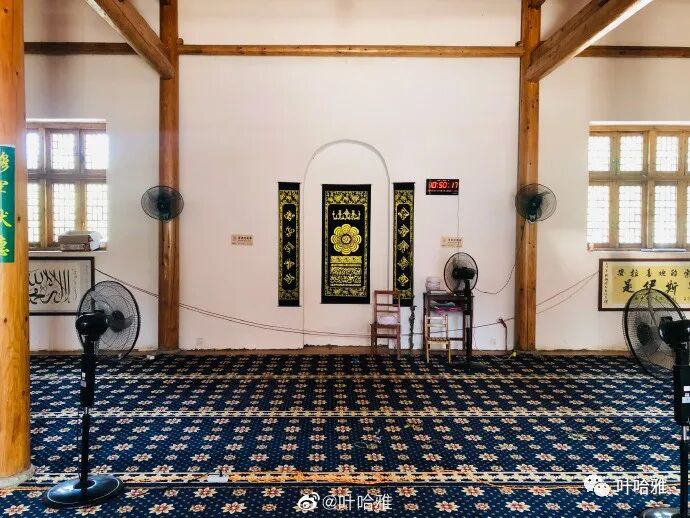
Qianjing Village was originally called Baijiazhuang. It was later renamed Zangjing Village because it sheltered Muslims who fled here during the Yuan Dynasty and brought the Quran with them. Later, it was renamed Qianjing Village.
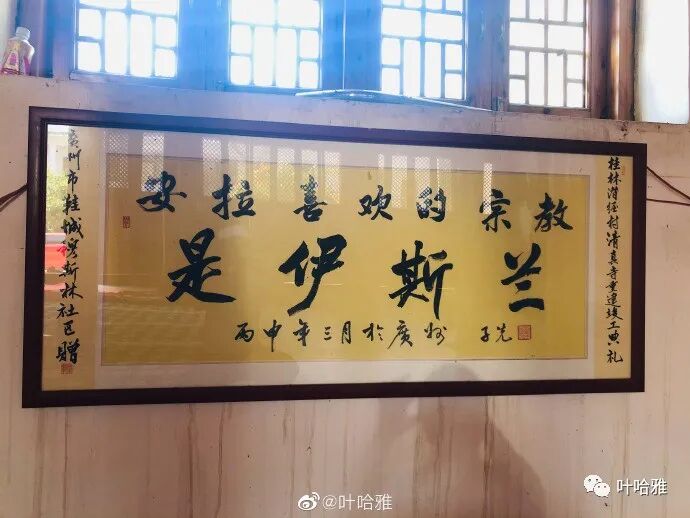
Qianjing Mosque and the Bai Family Ancestral Hall are separated by only one wall. The ancestral hall also serves as an activity center for the elderly.
Bai Family Ancestral Hall
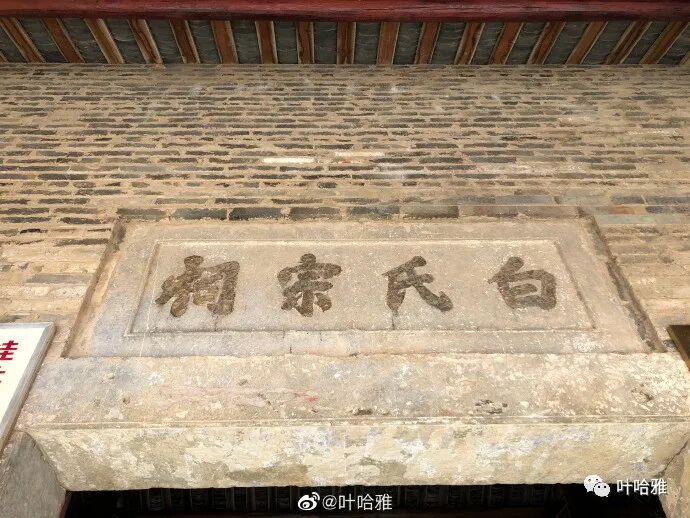
Bai Family Ancestral Hall and the Qianjing Village Hui Muslim Folk Culture Exhibition Hall
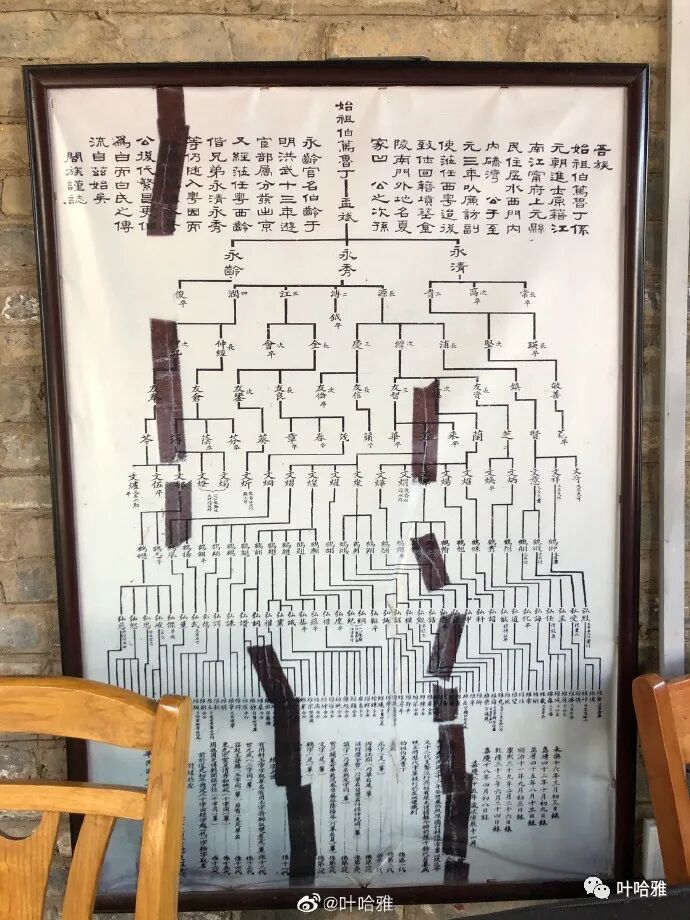
Bai family genealogy
The most famous Hui Muslim from Qianjing Village is Bai Chongxi. His ancestor was Bo Dulu Ding, a Semu person who came to China to serve as an official during the Yuan Dynasty. Bai Chongxi’s Islamic name was Umar. He served as a first-class general in the Nationalist Army and as the Minister of National Defense for the Republic of China. He passed away in Taipei in 1966 at the age of 74.
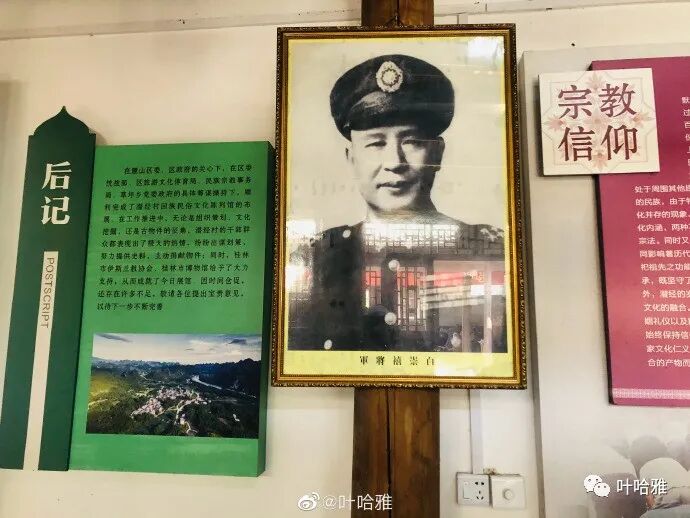
Portrait of Bai Chongxi.
There was a rumor that Bai Chongxi claimed to be Han Chinese and only followed Islam. I checked the source of this article and it is definitely taken out of context and completely false. For example, in the oral history book 'Interview Records of Mr. Bai Chongxi' from the Institute of Modern History at Academia Sinica in Taiwan, Bai Chongxi himself stated: 'But many of us are Han Chinese and not Hui, we just follow Islam, so how can we be called Hui Muslims?'
Many social media outlets interpreted this sentence as Bai Chongxi calling himself Han Chinese. I do not know how they could possibly read that meaning into it. When Bai Chongxi said 'many of us are Han Chinese,' he was not referring to himself. More authoritative evidence can be found in a China Daily interview with Bai Chongxi’s son, Bai Xianyong.
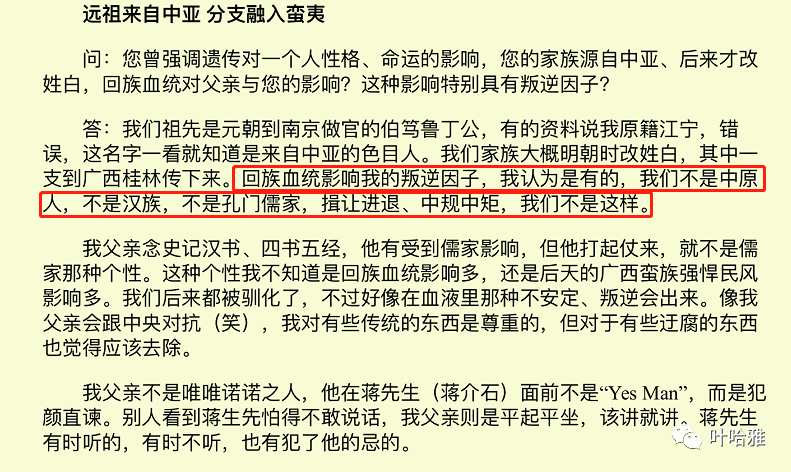
'Rebellion: The Genetic Code of Bai Chongxi and Bai Xianyong,' source: China Times.
From the interview transcript above, it is clear that Bai Xianyong explicitly stated his family is Hui, not Han.
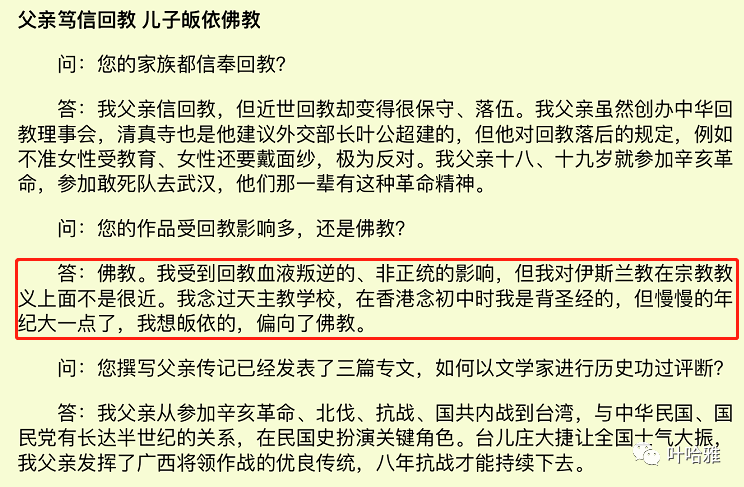
'Rebellion: The Genetic Code of Bai Chongxi and Bai Xianyong,' source: China Times.
It is regrettable that Bai Xianyong admitted in the interview that he follows Buddhism. We do not need to criticize his choice, but the Bai family believes that rules they consider backward—such as forbidding women from education or requiring women to wear veils—are not authentic Islamic rules. This shows the Bai family does not have a deep understanding of Islam. Islam encourages women to receive an education, as seen in the Hadith passed down by the Prophet’s wives. When the Prophet was alive, he encouraged women to go to the mosque to learn, and his wives are role models for all female Muslims.
Bai Chongxi was not a devout Muslim like Ma Bufang. I caught a glimpse of the details regarding Bai Chongxi’s religious practice in the book 'Biography of Ma Bufang' by Fan Qianfeng.
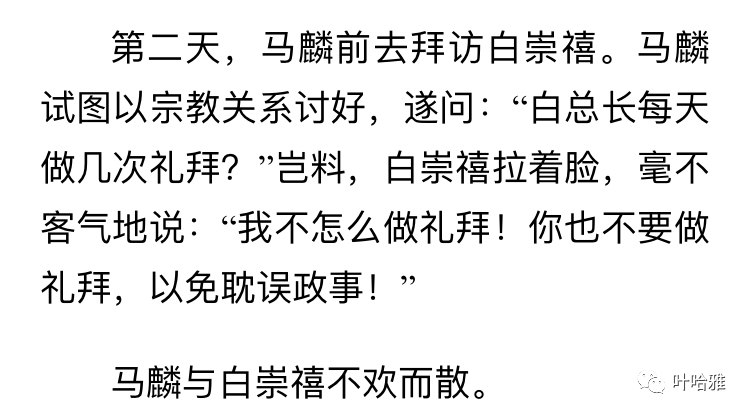
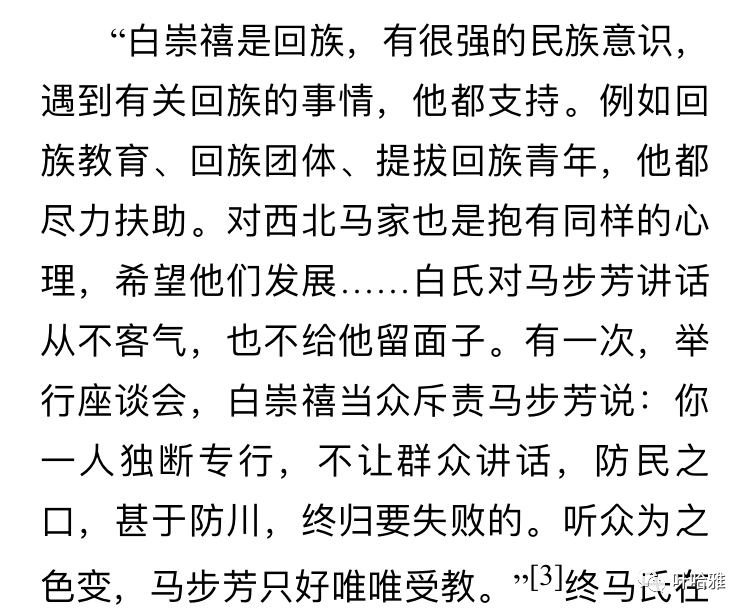
Screenshot from 'Biography of Ma Bufang' by Fan Qianfeng.
Based on the two article screenshots, it is clear that Bai Chongxi only had an ethnic identity and was a cultural Muslim who took his religious duties lightly. It is understandable that his descendants lacked the proper understanding of Islam and eventually converted to other faiths. This shows how important family teaching and example are.
When I visited the Bai family ancestral hall, an imam (ahong) from Linxia was teaching the elders the Shahada (the declaration of faith). The elders were actually playing cards and watching TV while half-heartedly imitating the Arabic words 'There is no god but Allah.' This scene is hard to imagine in areas with strong religious practice. It was both funny and sad. The imam was helpless, but he felt it was good enough that the elders were willing to come to the mosque at all.
But what can be done? The villagers of Qianjing have been away from the faith for too long. Returning to the path of Allah is extremely difficult, especially in a village with such deep-rooted traditional folk beliefs. One can imagine how much hardship the imam has faced.
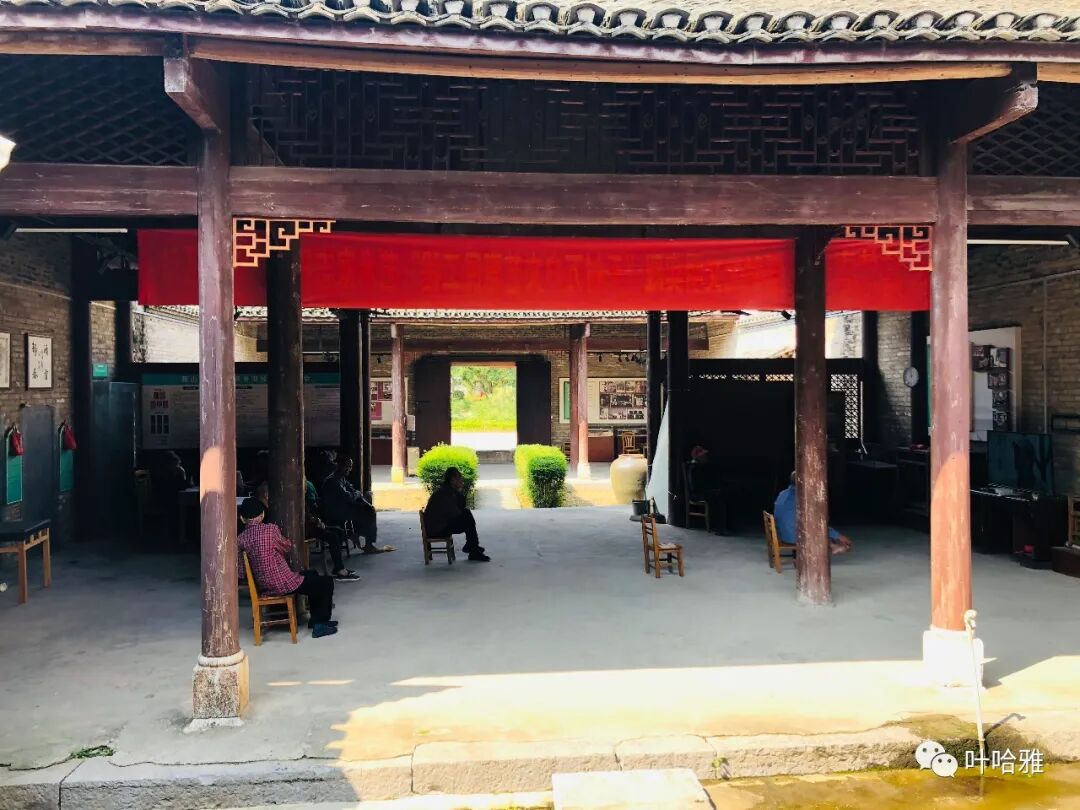
Old men at the Bai family ancestral hall are playing cards and watching television.
When the imam learned I was visiting specifically to see mosques, he happily invited us to visit the largest remaining mosque in the Guilin area, the Liutang Mosque. A Han Chinese Muslim from Ningxia joined us. He has over ten years of teaching experience and is now at retirement age. His only hobby is traveling to visit mosques. He stays at each mosque for three to five days and says he has already visited over a thousand of them.
2. Liutang Town Mosque
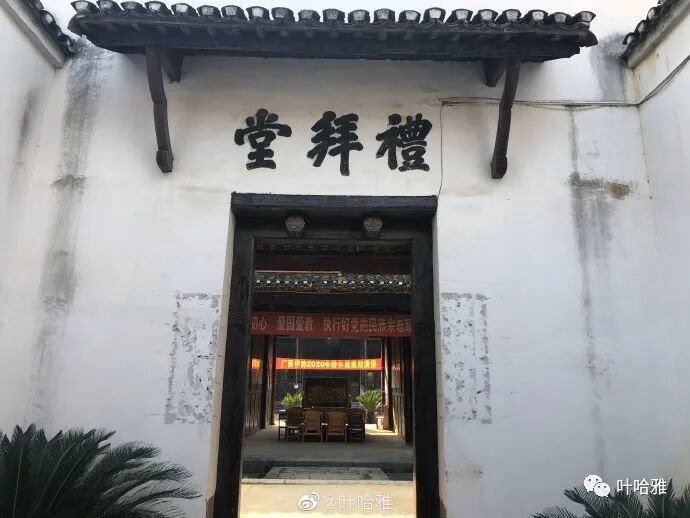
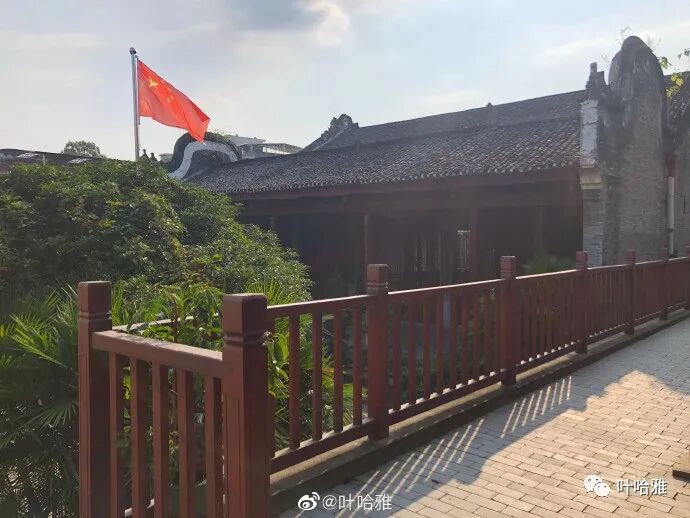
Our group rode in the imam's car and arrived at the Liutang Town Mosque, located under the jurisdiction of Guilin, after about half an hour. The mosque was first built during the Kangxi and Qianlong periods of the Qing Dynasty. During the War of Resistance Against Japan, when the Beiping Chengda Normal School moved south to Guilin, it established its first affiliated experimental primary school at this mosque in early 1939.
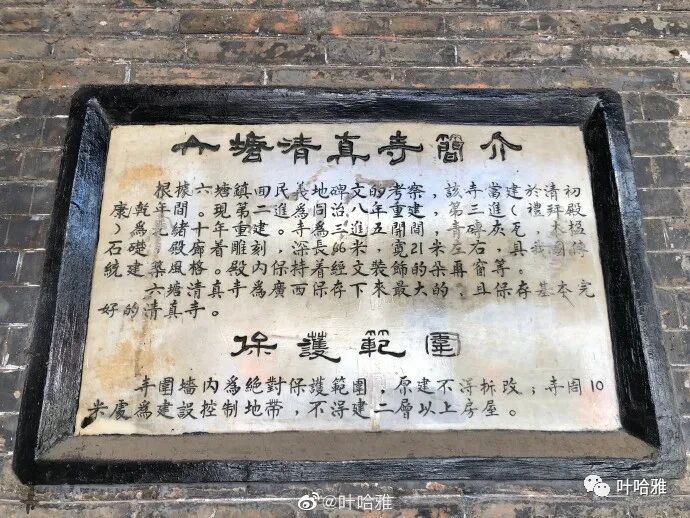
Liutang Mosque covers an area of 3.7 mu and has a building area of 1,700 square meters. It is a cultural relic protection unit at the Guilin municipal level.
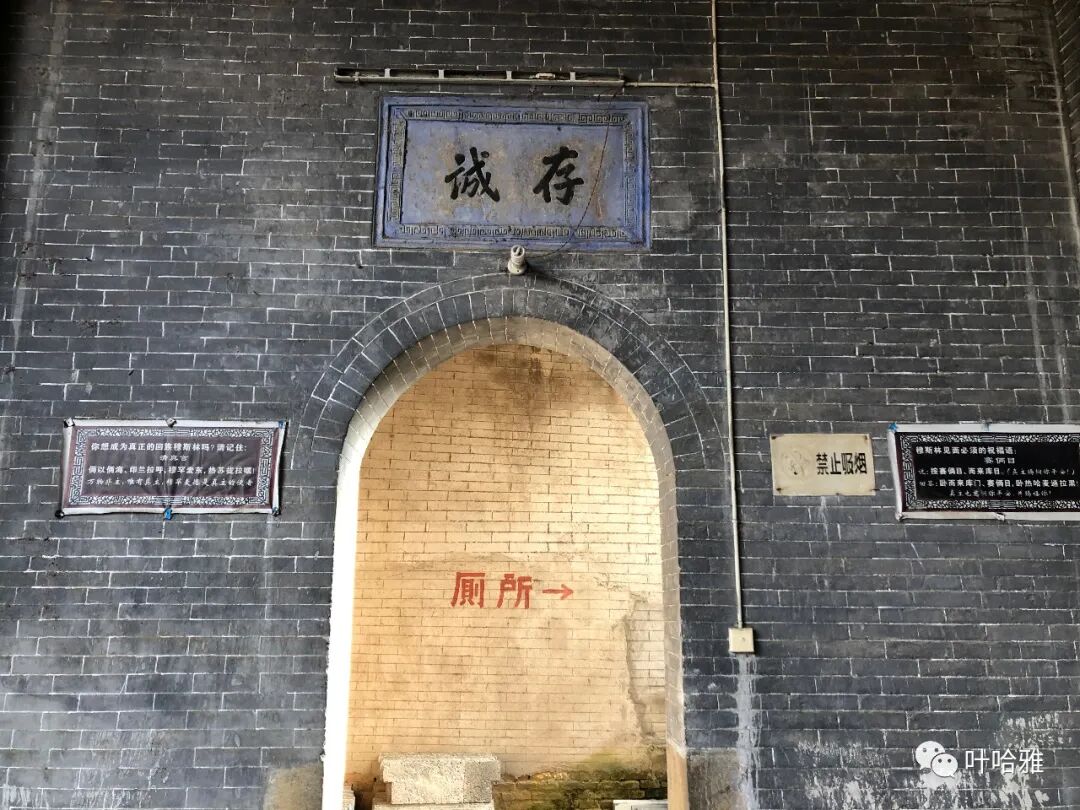
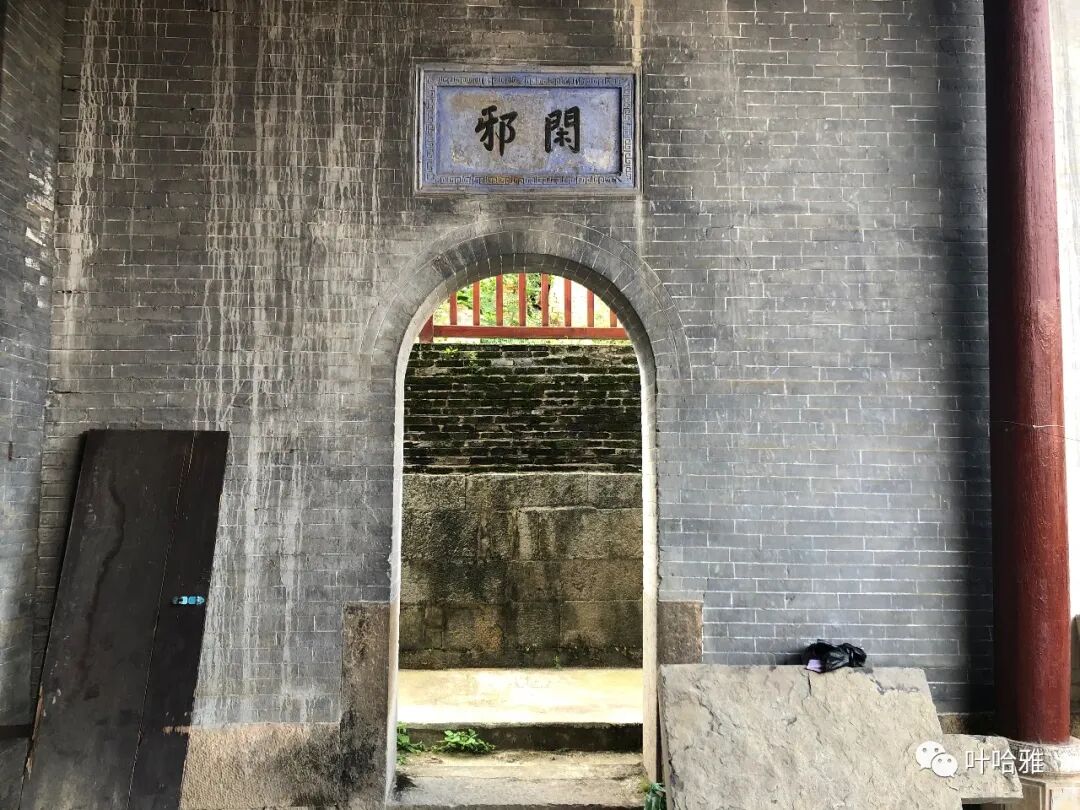
On both sides of the front hall are the inscriptions 'Xian Xie' (guard against evil) and 'Cun Cheng' (maintain sincerity), which come from the I Ching (Book of Changes), Qian hexagram: 'Guard against evil and maintain one's sincerity.'
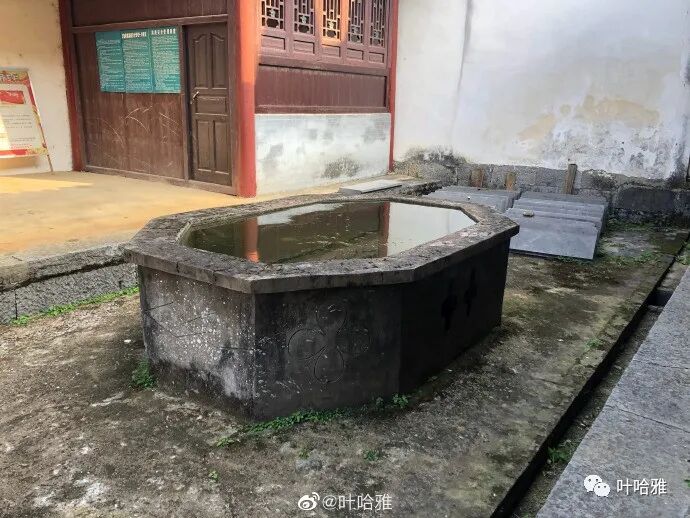
Ancient water well
Liutang Mosque now has a resident imam from Linxia. However, the religious practice in Liutang Town is on the verge of disappearing. The local Hui Muslims have long been assimilated into Han culture, and there are no halal restaurants nearby. After a brief chat with the imam on the second floor, we learned that Shanwei Village, where the former residence of Bai Chongxi is located, is not far away.
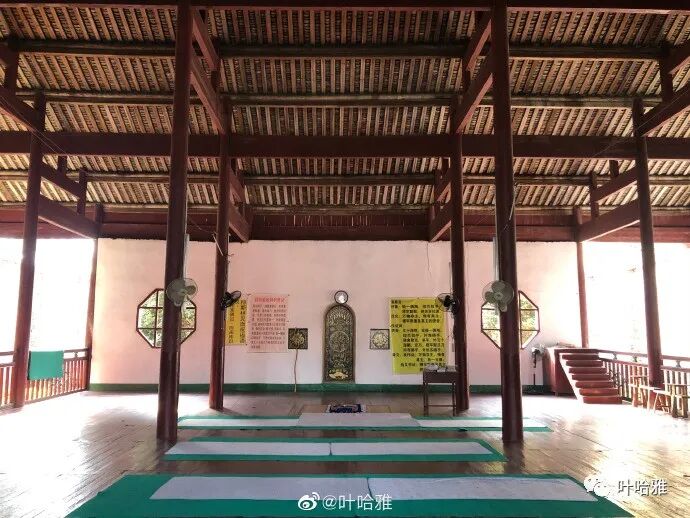
Looking down at the main prayer hall from the second floor
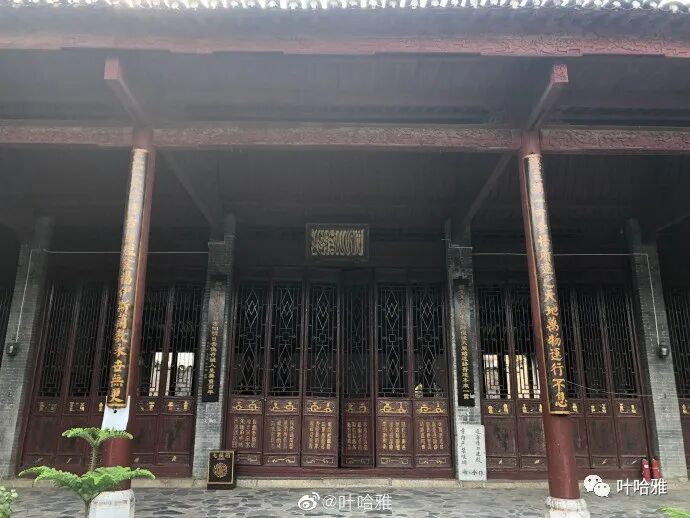
Former residence of Bai Chongxi
Our Han Muslim friend from Ningxia decided to stay in Liutang for a few days. After getting him settled, we continued to follow the imam to the nearby Shanwei Village to visit the former residence of Bai Chongxi.
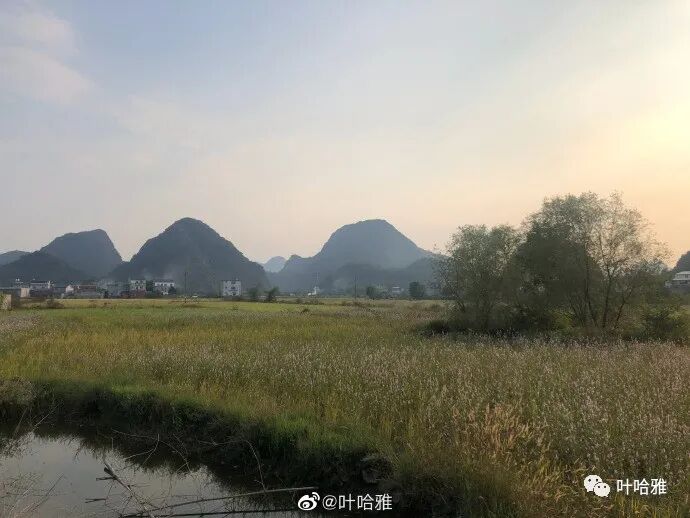
Shanwei Village
The scenery in Shanwei Village is still very beautiful. Bai Chongxi's former residence is at the foot of the mountain, and you have to walk to get there.
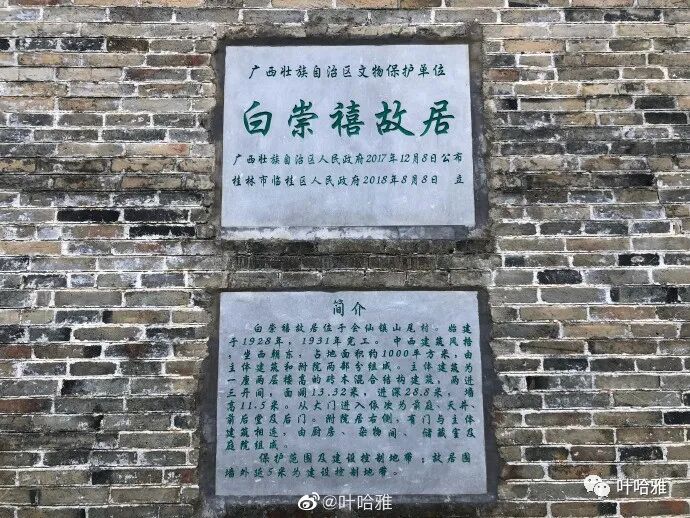
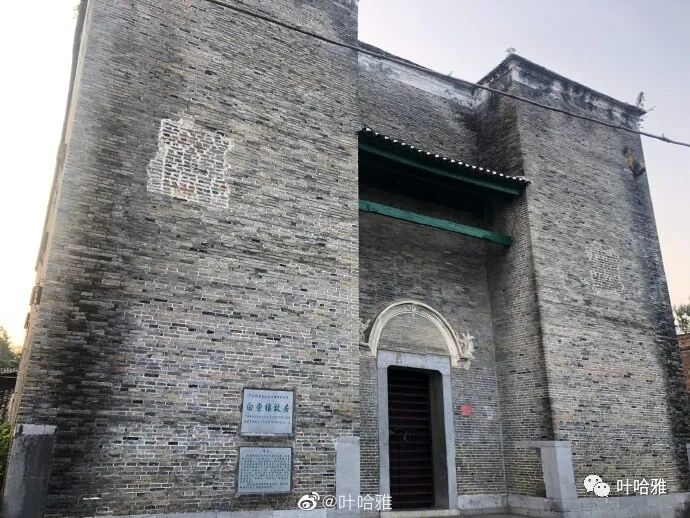
Bai Chongxi's former residence was built in 1928. It has been emptied out, so there is not much to see inside.
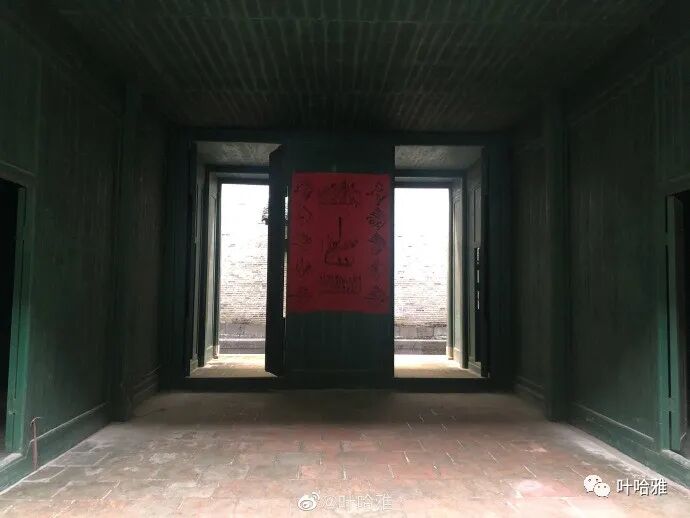
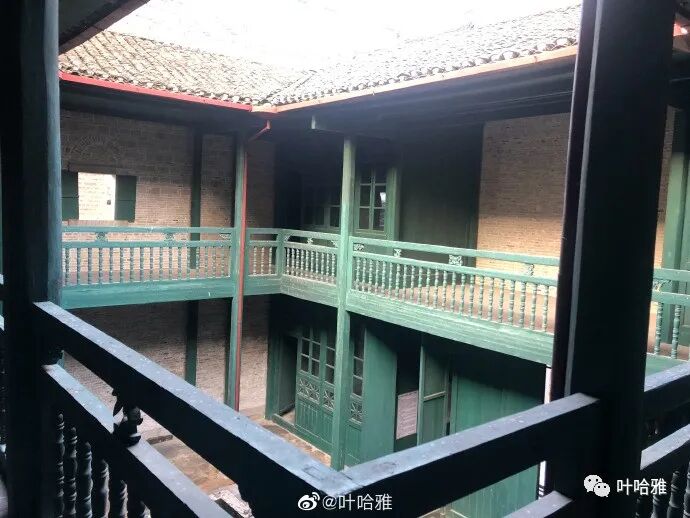
Interior of Bai Chongxi's former residence
A mosque was built next to the former residence, but because the person in charge at the time only received 500,000 yuan, the construction stopped halfway when he passed away. No one followed up on it, so it has become an unfinished project.
3. Shanwei Village Mosque
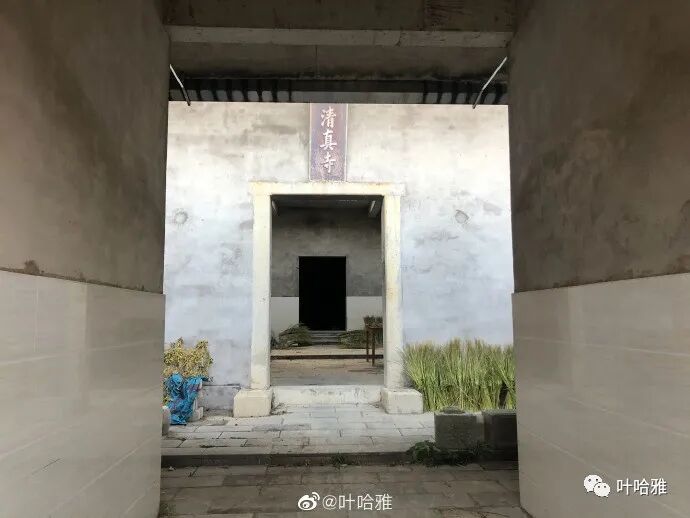
Shanwei Village Mosque
The Shanwei Village Mosque is abandoned. It will likely be hard to rebuild unless the Hui Muslims in Shanwei Village return to their faith.
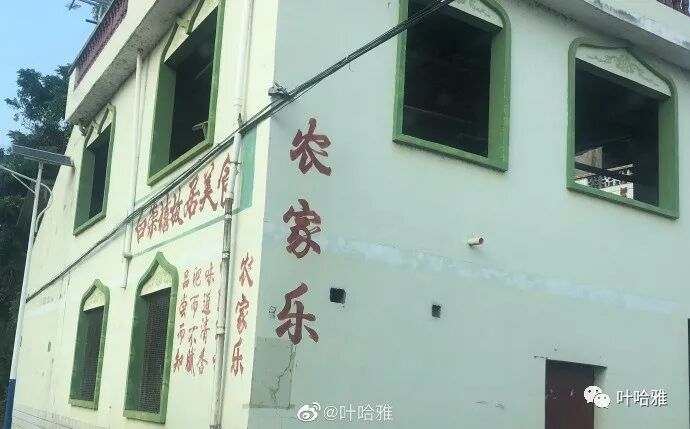
Food near the former residence of Bai Chongxi
4. Jiucun Village Mosque
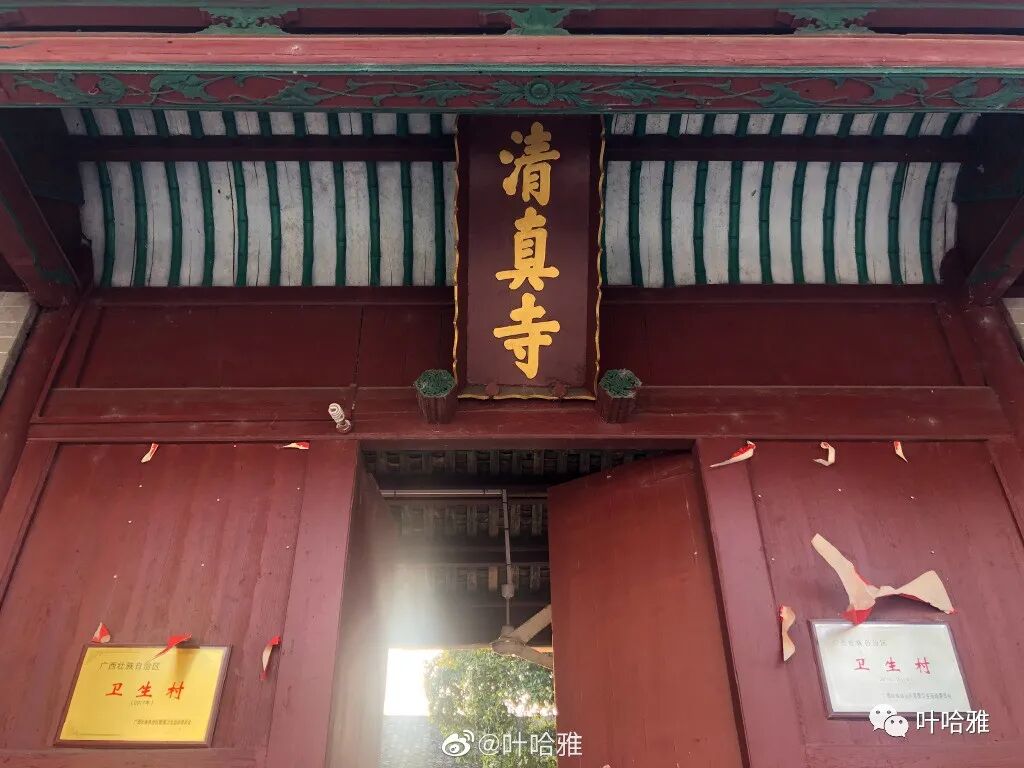
Shanwei Village and the neighboring Jiucun Village are both Hui Muslim villages. Most villagers are Hui Muslims, though they have other surnames besides Bai. The imam told me the situation for Hui Muslims here is better than in Qianjing Village. The Hui Muslims here do not eat pork or dog meat, and they do not drink alcohol openly in the village. The meat eaten in the village is all slaughtered by the imam. On the road, we even met an old grandmother who greeted us with salaam.
The original Jiucun Village Mosque was built during the Chongzhen period of the Ming Dynasty. The current building was rebuilt in 2004 and was named a cultural relic protection unit of Lingui County in 2013.
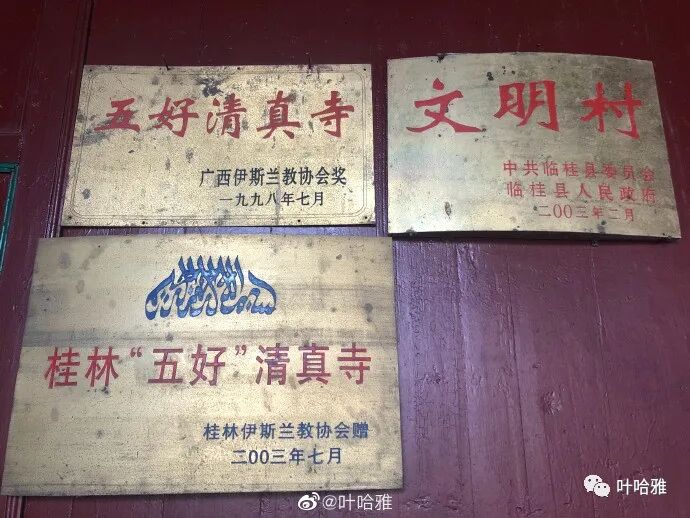
Jiucun Village is a natural village under the jurisdiction of the Shanwei Village Residents' Committee and has 44 households.
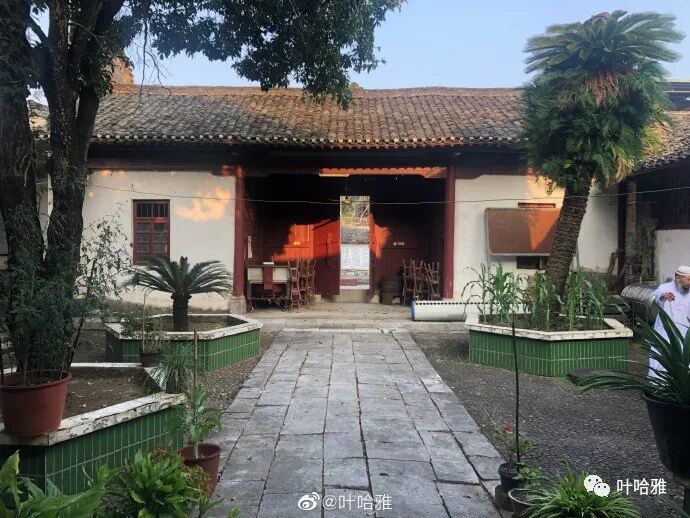
The mosque has three halls and three bays, measuring 24.8 meters wide and 44.15 meters deep.
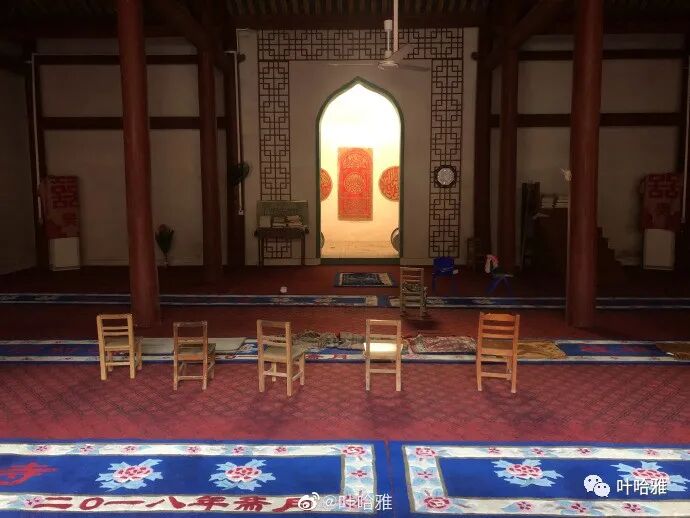
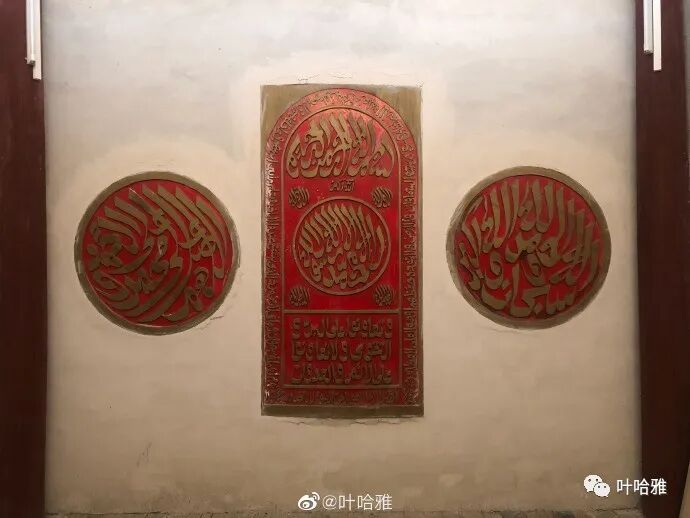
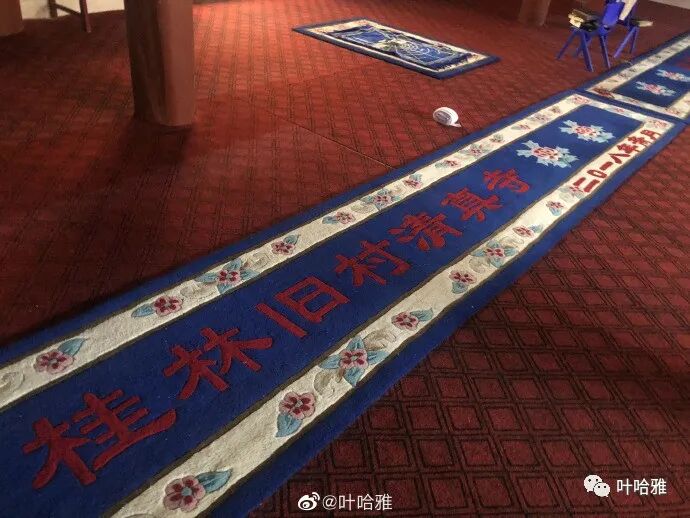
After visiting Shanwei Village and Jiucun Village, we said goodbye to the imam and returned to Guilin city. The next day, we went to visit the Maping Mosque inside the Seven Star Park scenic area in Guilin.
5. Maping Mosque
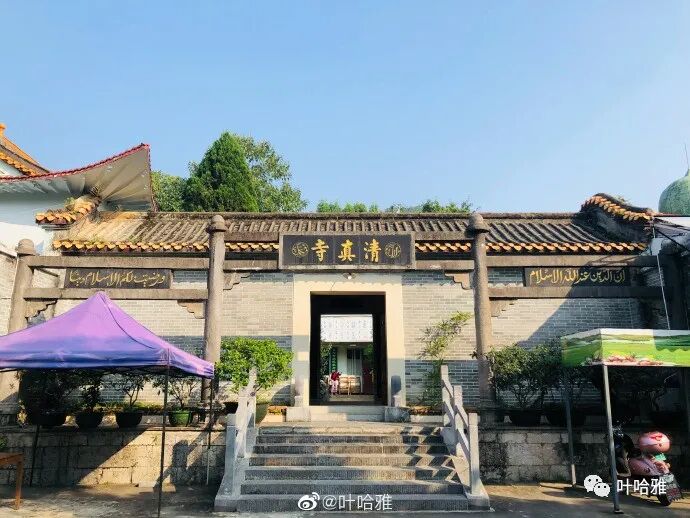
Maping Mosque was first built during the Kangxi period of the Qing Dynasty. Later, due to the expansion of Guilin Seven Star Park, the mosque was included within the park. It is now also the location of the Guilin Hui Muslim Nursing Home. If you are a Hui Muslim or wearing a white cap, you can enter for free. Otherwise, you must buy a 55-yuan ticket. Just show your ID card at the park entrance.
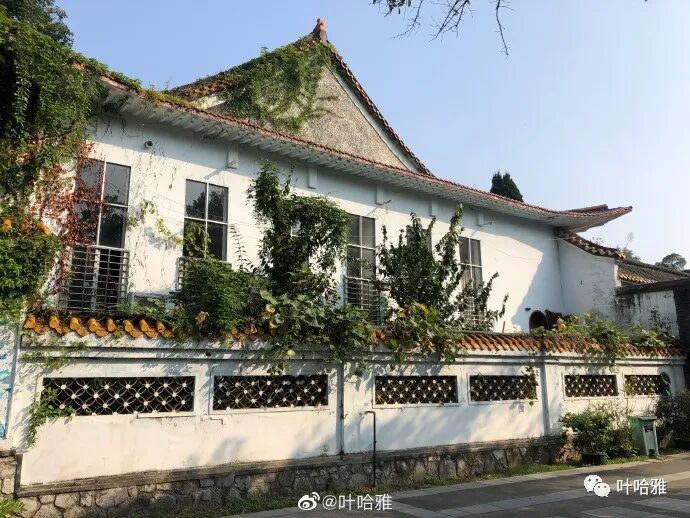
During the War of Resistance, the Guilin Hui Muslims formed a War Service Group to promote the war effort to the public. Their most prominent work was carrying out cave education, providing wartime education for people hiding from Japanese planes in Seven Star Cave.
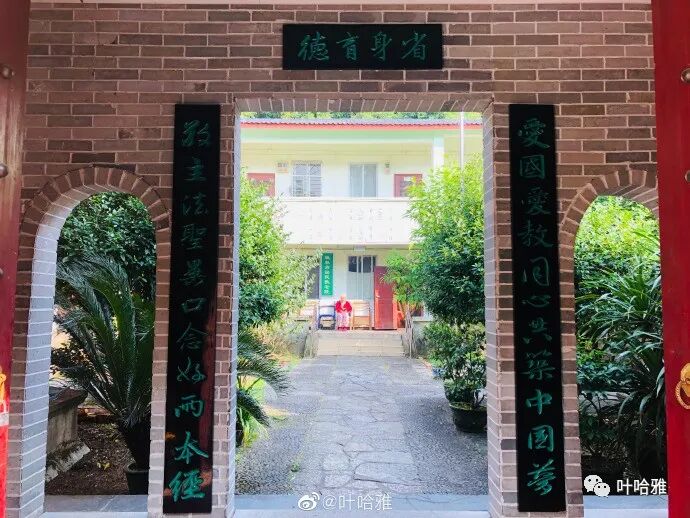
The earliest Hui Muslim to travel to Guilin, the Northern Song Dynasty master calligrapher and painter Mi Fu, left stone carvings including "Poem for Chen Guilin, and a Letter to Old Historian Shuai," "Preface to the Poem for Shaoyan," and "Mi Fu and Cheng Jie's Exchange Poems" in the Longyin Cave exhibition area of the Guihai Stele Forest Museum.
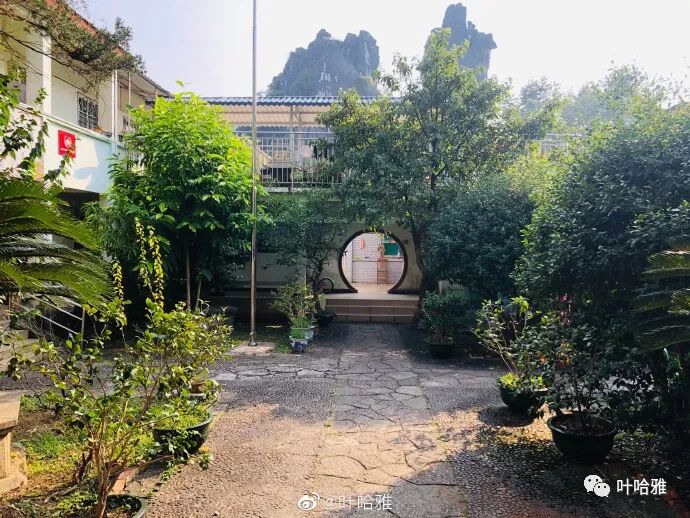
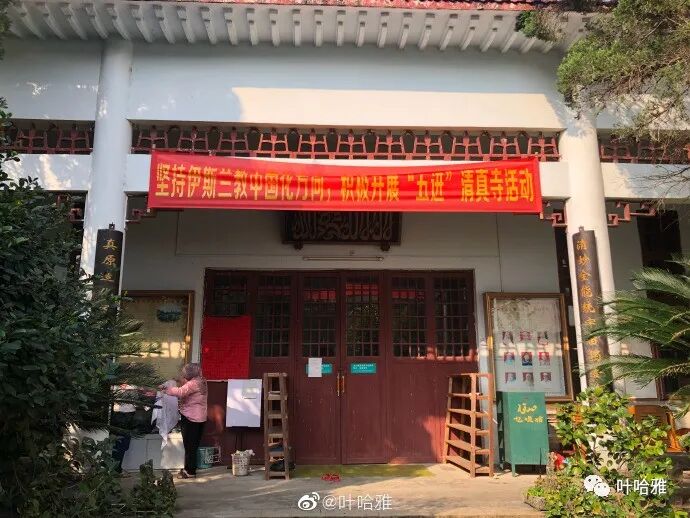
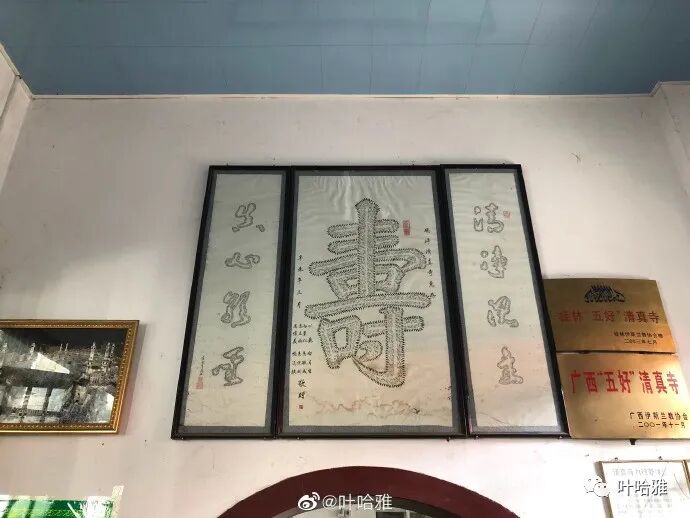
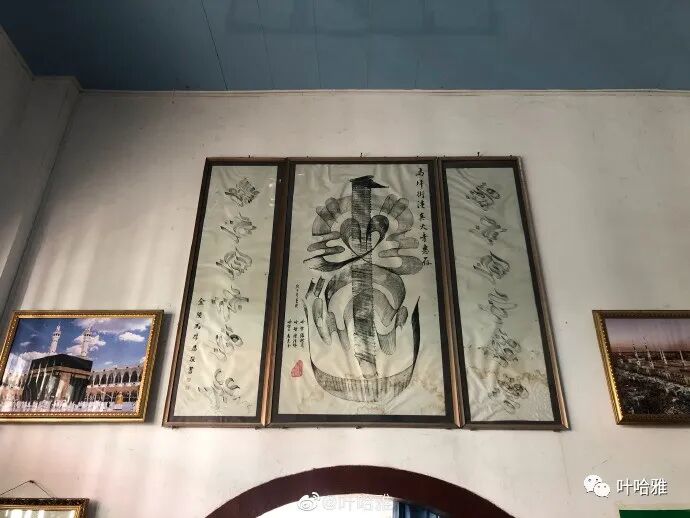
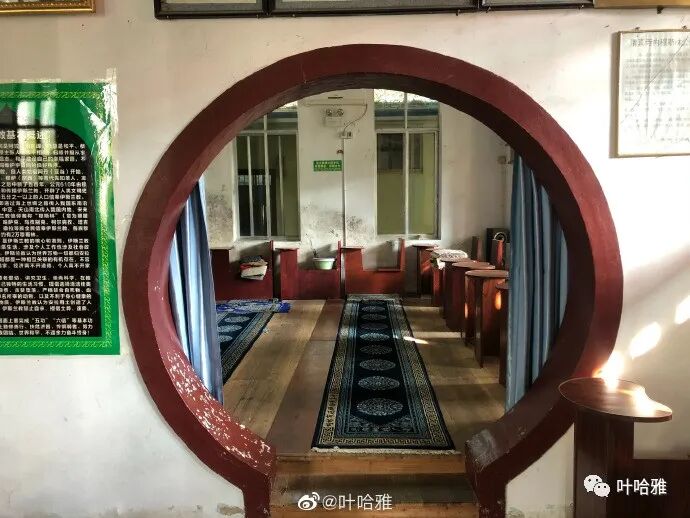
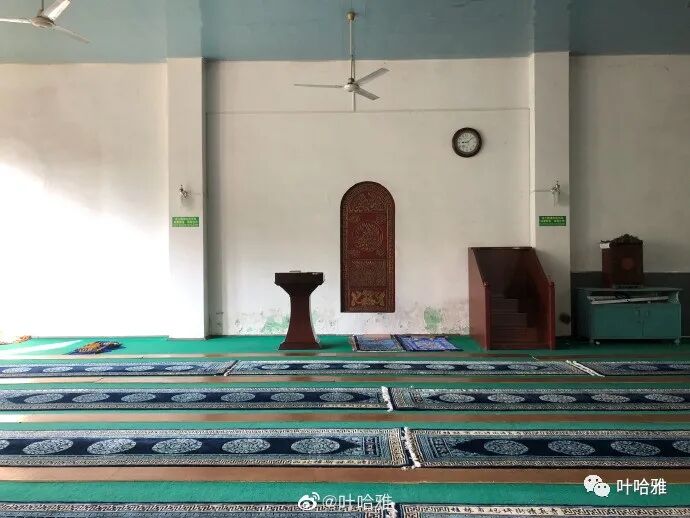
Maping Mosque is connected to the Guilin Hui Muslim Nursing Home and can be accessed through the halal restaurant next door.
Sharia snacks
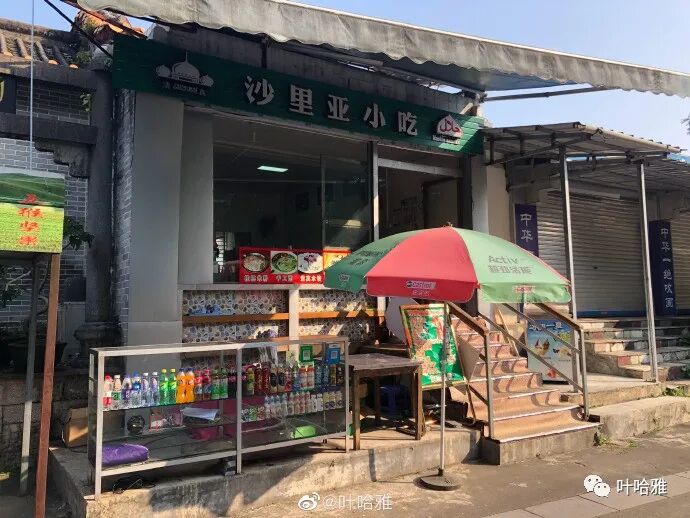
Sharia snacks
The halal snack shop next to Maping Mosque has been run by the imam's family for years. They chose the name Shariya to emphasize that their ingredients are halal. We came here for dinner at night. Since the park was already closed, tourists were not allowed in. However, if you say you are a Hui Muslim going to the mosque, they will let you in. Just do not say you are going there to eat, or the security guard will lie and tell you there is no restaurant inside, which is very annoying.
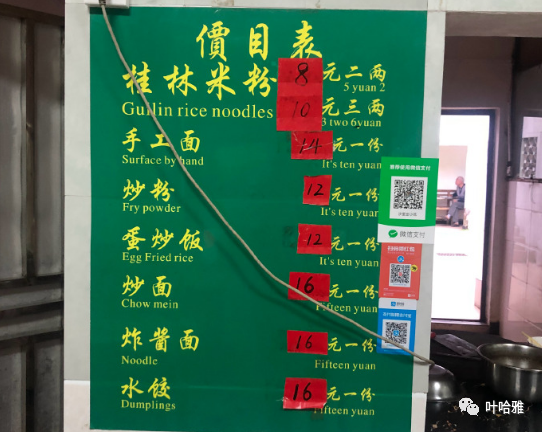
Price list
You definitely have to try the Guilin rice noodles (guilin mifen). This is arguably the only place in Guilin where you can find reliable halal rice noodles, and they make them very authentically.
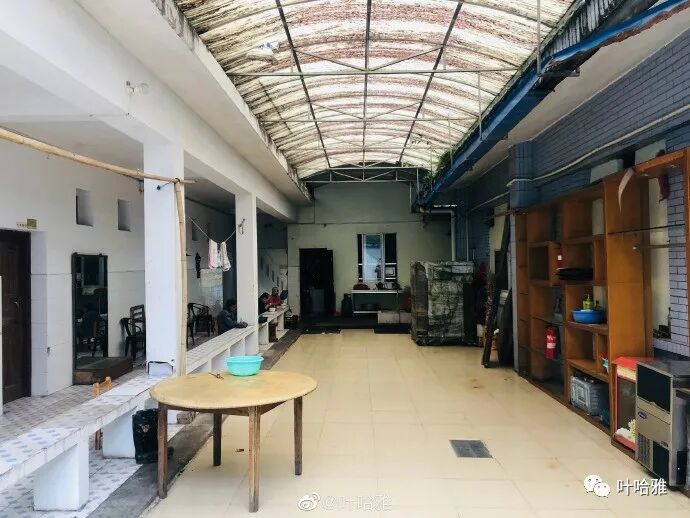
Behind the kitchen is a nursing home for Hui Muslims, where the elderly were eating dinner.

The stir-fried noodles (chaomian) smell delicious.
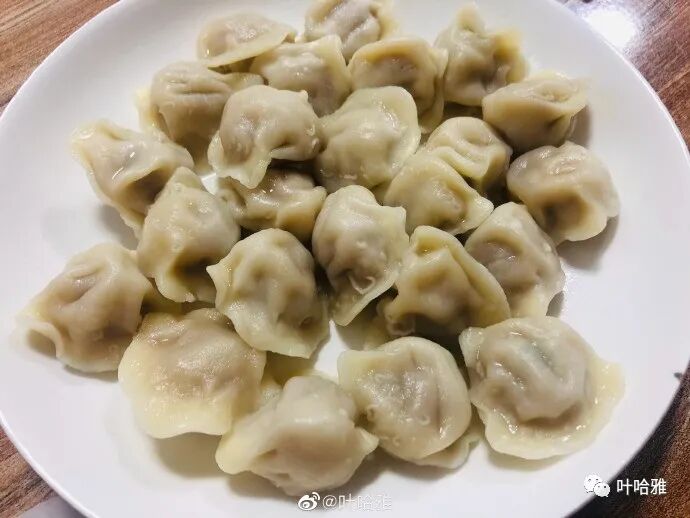
Beef dumplings (niurou shuijiao) are delicate little dumplings that you can eat in one bite.
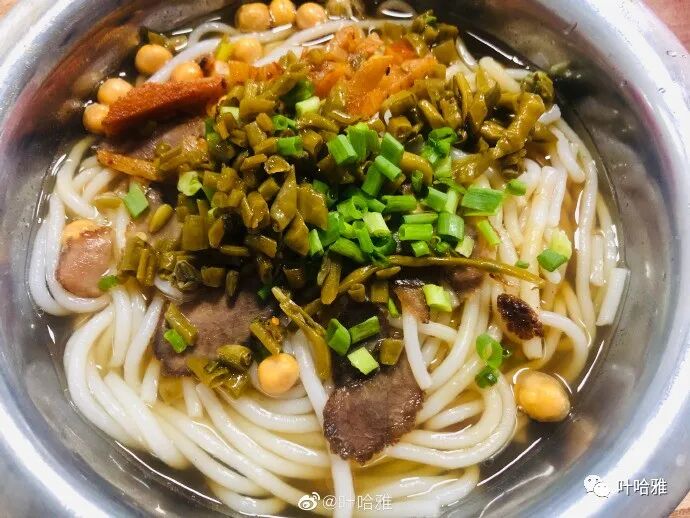
Guilin rice noodles come in stir-fried and soup versions. The stir-fried noodles are a bit sticky and not as good as the ones with soup, but local people in Guilin think the stir-fried version is more traditional. You can add as many pickled long beans as you like to your noodles.
I was satisfied just to have a bowl of reliable rice noodles in Guilin. Later, the imam of Daxu Mosque invited us to Daxu Ancient Town to visit the mosque, which we could not find on the map at the time. It is visible on maps now because I helped the imam add the address to Baidu and Amap.
6. Daxu Mosque
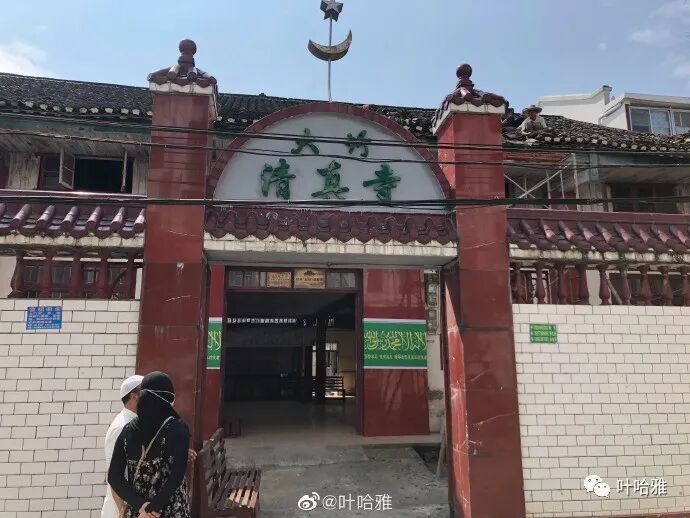
Daxu Mosque was first built during the Qianlong reign. The wood is moldy, and it is currently being renovated. The mosque is located at No. 69 Shengchanxia Street in Daxu Ancient Town. Daxu is a historic town where many local Hui Muslims still live, though the state of the faith is not very optimistic, with only about ten people attending Friday prayers (Jumu'ah).
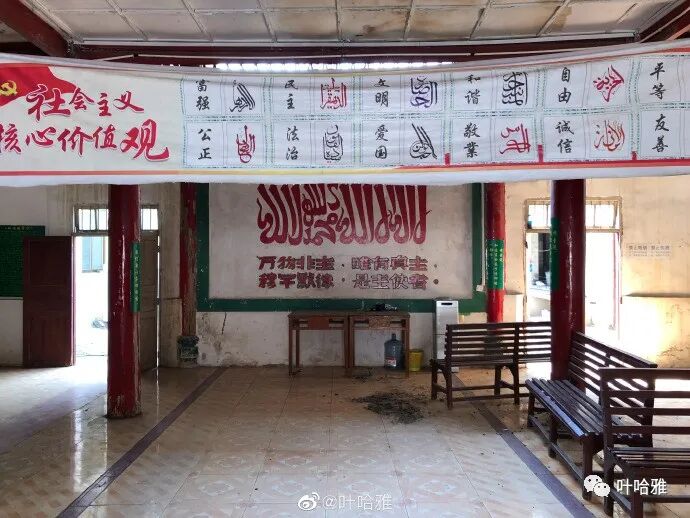
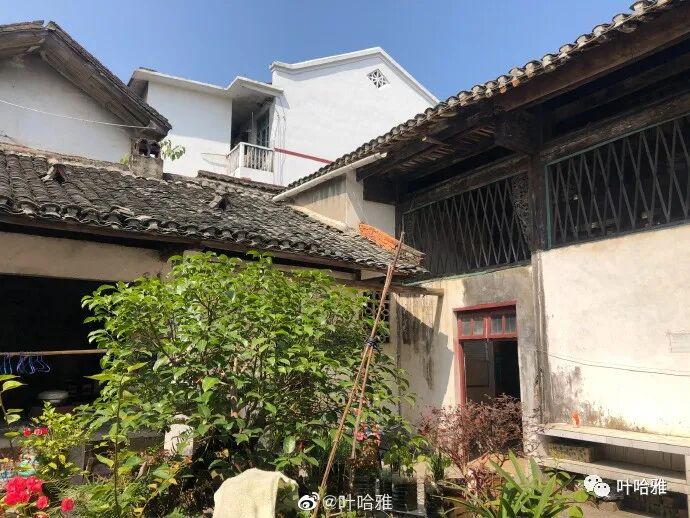
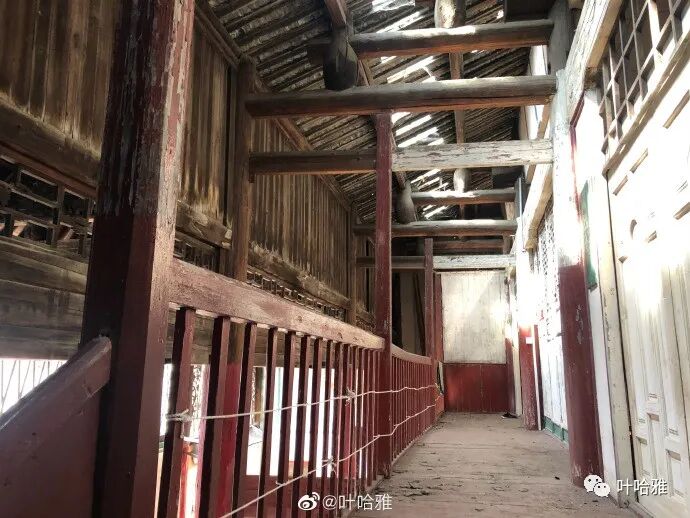
You can see that the wood in the attic is very old. In 1933, during the Republic of China era, Imam Li Meibin started a night school for children to study scripture at the mosque, which later became a primary school for Hui Muslims that accepted both Hui and Han students.
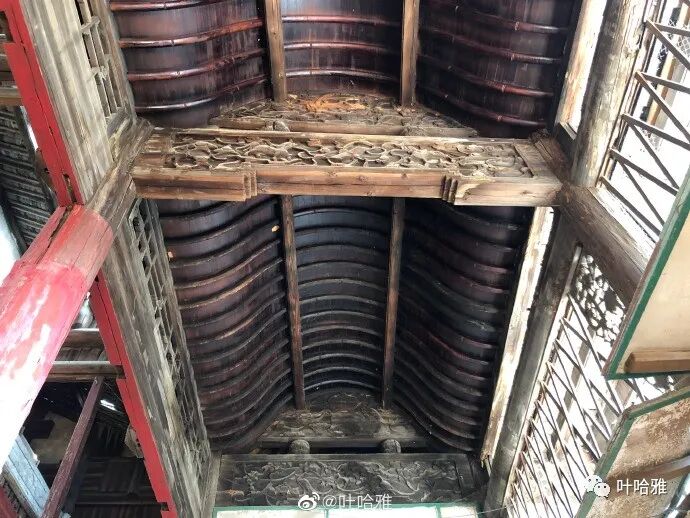
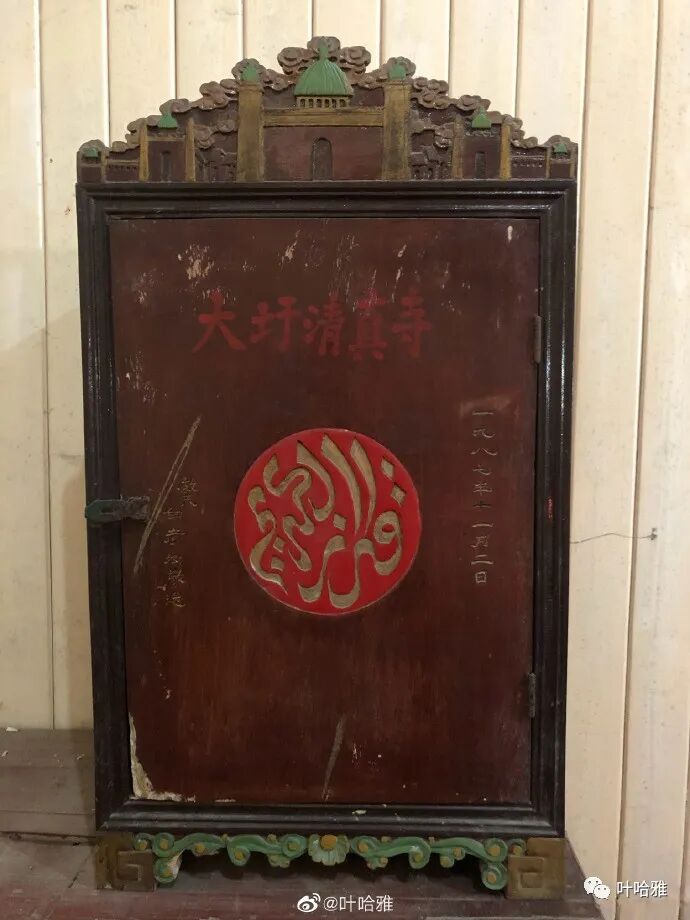
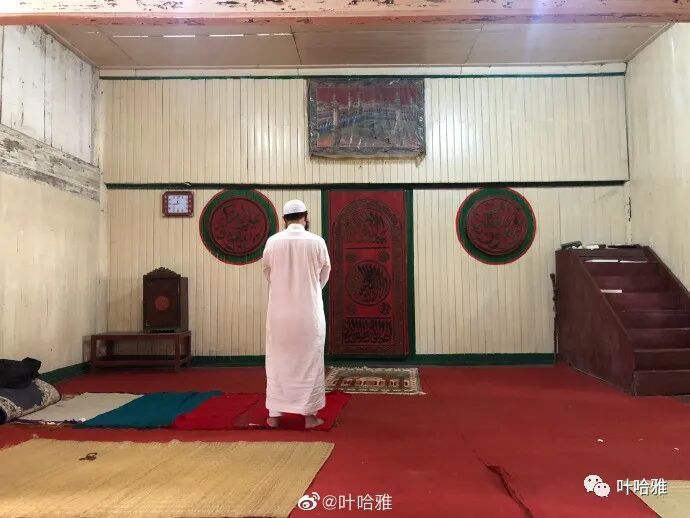
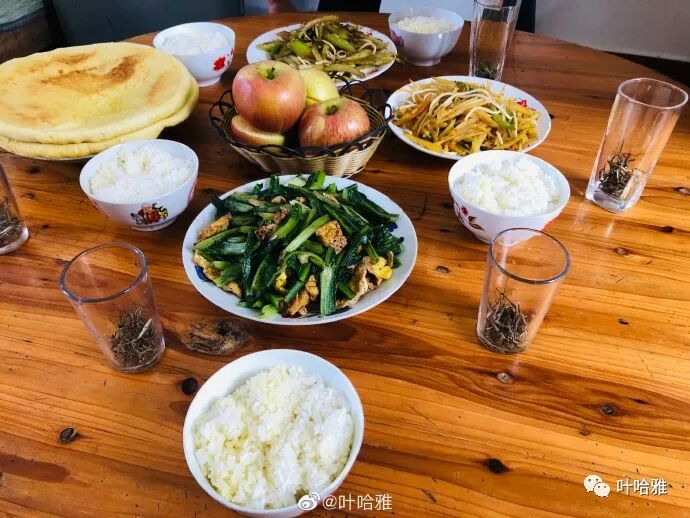
The imam warmly invited us to eat at the mosque again, and we felt very grateful (shukr). We learned from the imam that the mosque is being renovated, but funds are limited. They only receive a few tens of thousands of yuan from the government each year for basic repairs. After the meal, we stayed for a while before the imam walked us to the entrance of the ancient town. We said goodbye to him and promised to meet again, Insha'Allah.
There are no halal restaurants in Daxu Ancient Town. I only saw some scripture plaques hanging in front of private homes. Since I already knew there are actually quite a few Hui Muslims in Guilin, just without much religious practice, I was no longer surprised.
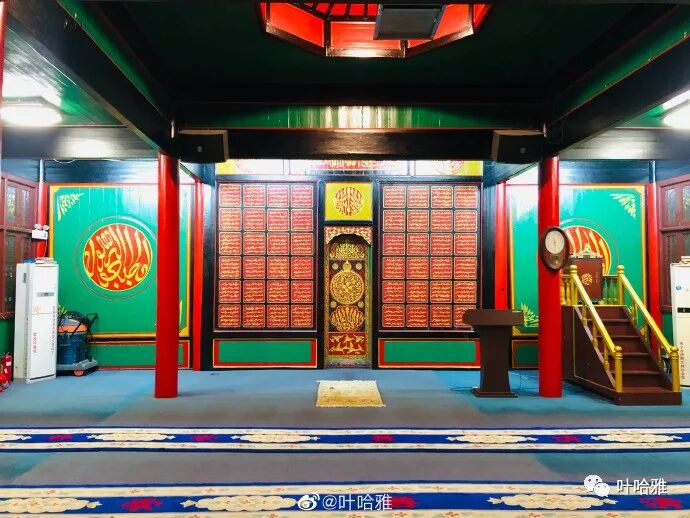
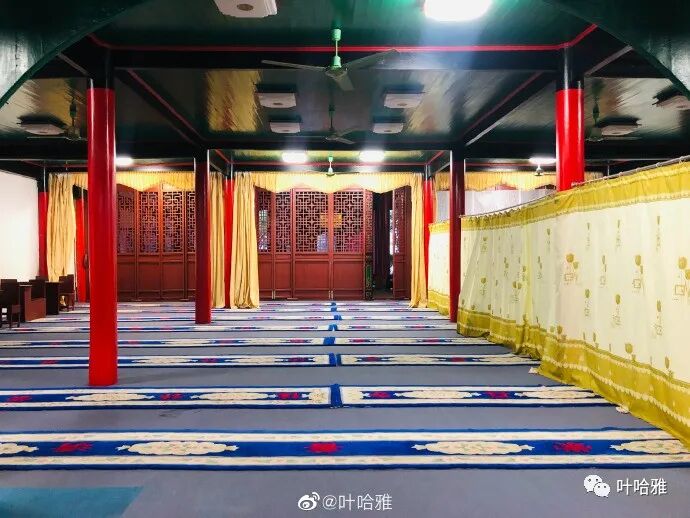
7. Chongshan Mosque
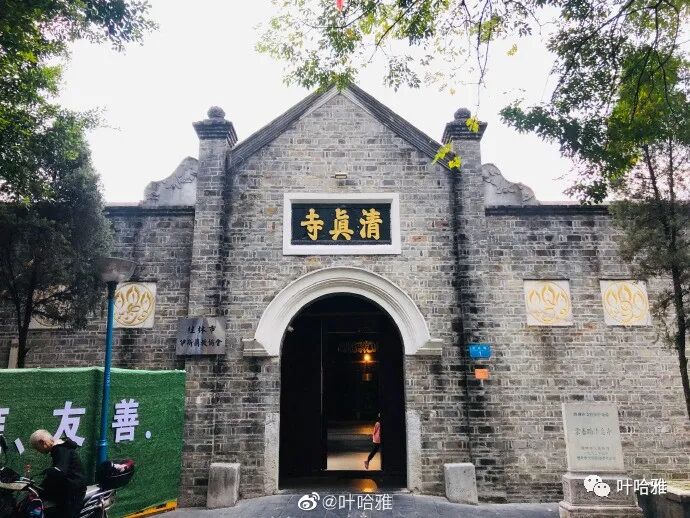
Chongshan Mosque was first built in 1734, the 12th year of the Yongzheng reign of the Qing Dynasty. It is a protected cultural site in Guilin. The family of Bai Chongxi's father-in-law provided significant funding to build this mosque. Without their support, the state of the faith in Guilin today might be like in Fujian, where only a few ruins remain to show the glory left by our ancestors.
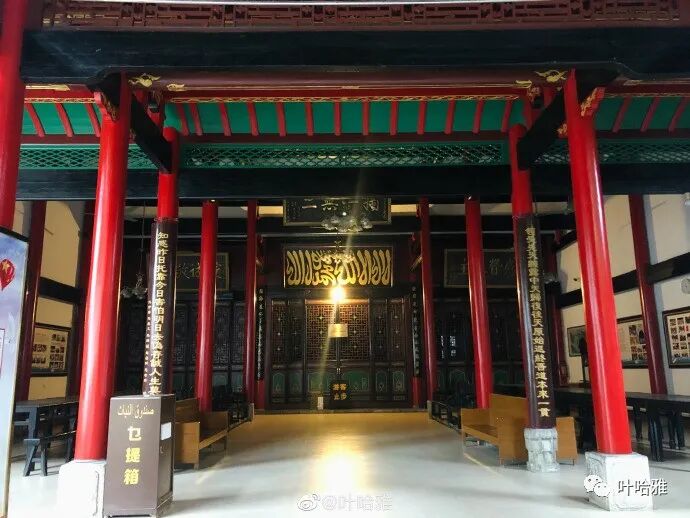
You can still see a few local Guilin people coming to the Chongshan Mosque for namaz every day.
8. Women's Mosque
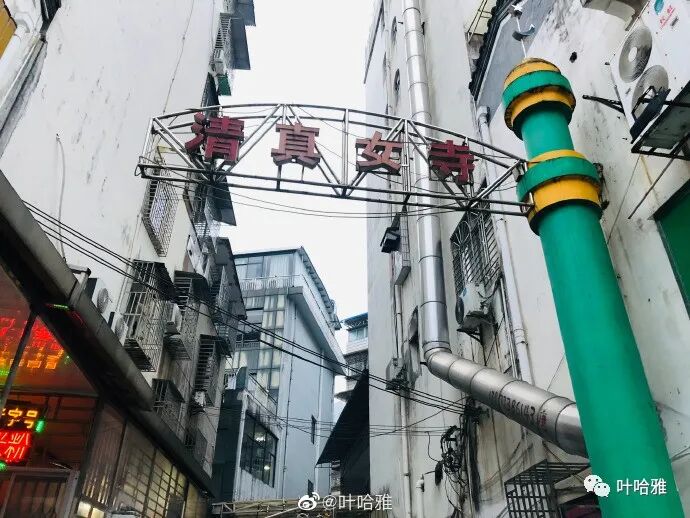
Chongshan Women's Mosque is the only one left in Guilin. I performed the sunset prayer (maghrib) here and learned that the person calling the adhan is a Hui Muslim from Shaoyang, Hunan. Men are also allowed to enter the women's mosque to pray.
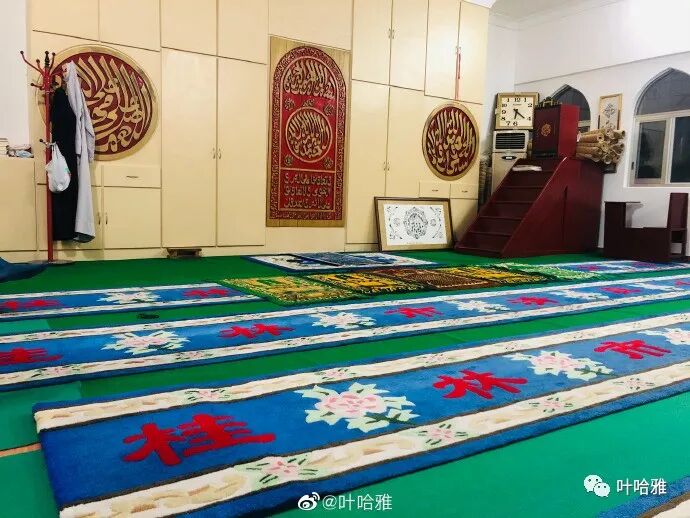
9. Xixiang Mosque
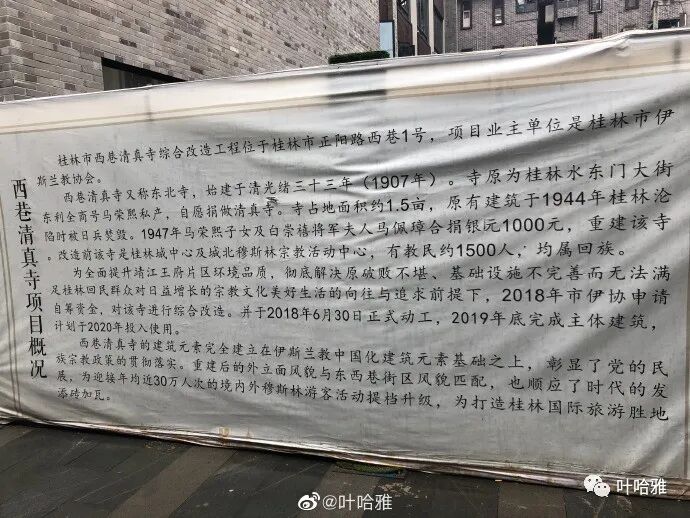
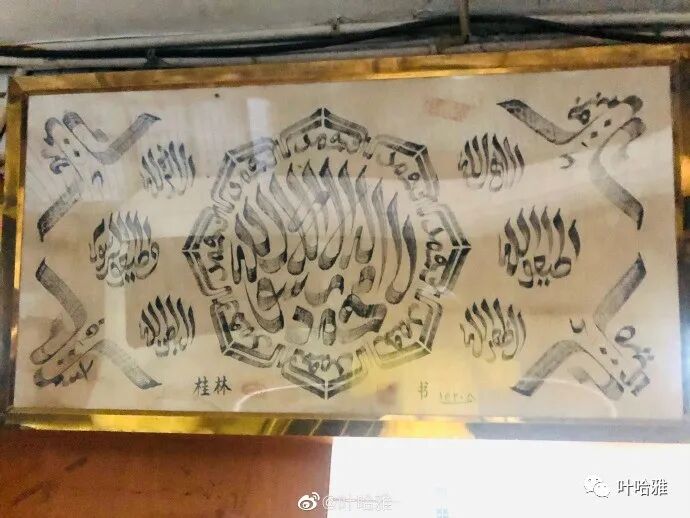
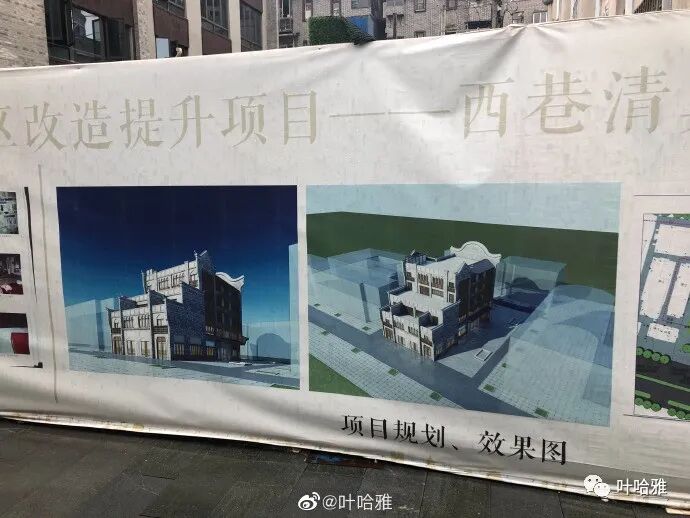
The last mosque I visited in Guilin was Xixiang Mosque. It is currently being renovated. The main structure is finished, and only the interior decoration is left.
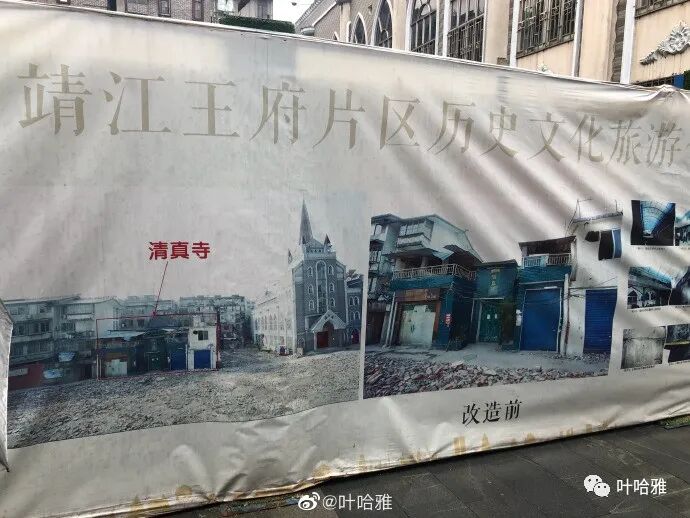
Xixiang Mosque was first built during the Guangxu reign and was later rebuilt with donations from Bai Chongxi's wife, Ma Peizhang, and the children of Ma Rongxi. This mosque sits right next to the Guilin Catholic Church, which shows religious harmony.
Summary: Muslim Friendly Guilin: Bai Chongxi Hometown, Historic Mosques and Guangxi Halal Travel is presented here as a clear English account for Muslim readers, beginning with this scene: — Hello, Travel —. The article keeps the original names, food details, mosque details, photographs, and cultural context while focusing on Guilin Mosques, Bai Chongxi, Halal Travel.
— Hello, Travel —
To avoid the National Day travel rush, I chose to take my whole family to Guilin, Guangxi, right after the holiday ended. We spent 6 days there visiting the famous Two Rivers and Four Lakes, Elephant Trunk Hill, the Li River, the Ten-Mile Gallery, Huangluo Yao Village, the Longji Rice Terraces, and 9 mosques in Guilin and its surrounding villages. It was a deep dive into Guilin.
Mid-October is the most beautiful time in Guilin. The temperature is perfect, around 25 degrees Celsius during the day and 17 or 18 degrees at night, so a single layer of clothing is very comfortable. The rice terraces are also harvested in October, turning the mountainsides a spectacular golden yellow.
Longji Rice Terraces
Travel Tips
Transportation
If you visit a popular destination like Guilin during a holiday, I do not recommend driving yourself unless you can find good parking. During major holidays like National Day, every scenic spot is packed with people.
If you drive into a scenic area, you will likely wait in line for at least 3 hours. Between the time and energy spent touring, you will be exhausted, and driving back is very hard. My advice is to travel to the city on your own and then join a local one-day tour group.
Dining
See the details below.
Accommodation
There are many one-day tours in Guilin. You can book them at your hotel front desk or through travel platforms like Trip.com or Mafengwo. They are very cheap. I booked two one-day tours this time, and each cost less than 200 yuan per day. This included round-trip transportation and entrance tickets, but not group meals, which suited me perfectly since group meals are not halal.
For accommodation in Guilin, I recommend staying near the Xicheng Pedestrian Street in the city center. It is only a few dozen meters from the Chongshan Road Mosque, there are several halal restaurants nearby, and it is only 2 kilometers from the Guilin Railway Station.
1
Day 1 One-Day Tour
If you stay in downtown Guilin, you can take a boat at night to tour the 5A-rated Two Rivers and Four Lakes scenic area. The tickets are a bit expensive at 180 yuan per person, and night tickets cost even more, but the night view is more beautiful than the daytime.
Sun and Moon Twin Pagodas (Riyue Shuangta)
In the evening, you can walk around Zhengyang Road Pedestrian Street near the Sun and Moon Twin Pagodas Cultural Park, but there are no halal snacks on this street.
The most famous spot in Guilin is the Nine Horse Painting Mountain (Jiuma Huashan) scenic area on the Li River, which is well-known for being the background image on the 20-yuan note of the fifth series of renminbi. From downtown Guilin, you can take a tourist bus for about 1.5 hours to reach Yangshuo County where the scenic area is located. If you are traveling independently, I recommend staying in Yangshuo town, as it is very close to the surrounding scenic spots.
There is a halal restaurant in Yangshuo town called Muslim Restaurant (Musilin Fandian)
and its location is as follows.
In Xingping Ancient Town of Yangshuo County, there is also an Indian halal restaurant called Ganges (Henghe).
You can take a bamboo raft from the Xingping Ancient Town pier to tour the Li River. The boat ride takes about 30 minutes, and there are shuttle buses in the scenic area to take tourists back to the entrance after the boat trip.
A comparison of the Nine Horse Painting Mountain scenic area on the Li River with the renminbi background.
Guilin's landscape is a World Natural Heritage site and a classic example of Chinese mountain and water scenery. Successive national leaders have visited Guilin many times.
A small bamboo raft floats on the river.
To protect the Guilin landscape, the local government has set height limits for urban buildings, so you won't see any skyscrapers in the city.
The Thousand-Year-Old Banyan Tree (Qiannian Darongshu).
One of the highlights of the Ten-Mile Gallery (Shili Hualang) is the Big Banyan Tree scenic area. This is the hometown of Liu Sanjie and the filming location for the movie "Liu Sanjie." Yangshuo County hosts the "Impression Liu Sanjie" show. It is very impressive, though the ticket price is expensive at over 200 yuan, it is worth seeing.
From the Big Banyan Tree, you can drive 1 kilometer to reach Jinshui Cave to explore the karst landforms and take a mud bath. After leaving the cave, you can watch a Yao village song and dance performance. The show is great, and they invite audience members to join a mock Yao wedding ceremony. I was lucky enough to be chosen as the groom, pretended to enter the bridal chamber with a Yao girl, and was even asked for a 39 yuan bride price.
Jinshui Cave
These activities are all included in the Guilin one-day tour. There is no shopping involved. The only local Guilin specialties sold are offered by the tour guide while the bus is moving, so it does not delay the trip. The items are cheap, and you can choose whether to buy them.
2
Day 2 one-day tour
Because the first day's tour was a good experience, we immediately signed up for a second one-day tour. This trip followed a different route to see the famous Longji Rice Terraces.
The Longji Rice Terraces are divided into areas like the Jinkeng (Dazhai) Yao ethnic terrace viewing area and the Ping'an Zhuang ethnic terrace viewing area. We chose to visit the larger Jinkeng Yao ethnic terraces. The terraces are fields carved into the mountains by local villagers to grow rice. This rice is no longer sold to the public and is only for the villagers' daily consumption.
Longji Rice Terraces
You can take a cable car to the top of the terraces. A one-way ticket is 50 yuan, and a round-trip ticket is 100 yuan per person. If you walk up the mountain, it takes about 5 kilometers of mountain roads and three hours round-trip, but hiking allows you to see the scenery along the way.
Looking down at the terraces from the mountain top
Huangluo Yao Village is known as the world's number one long-hair village. The villagers still keep the tradition of growing their hair long. According to the locals, the village is a matriarchal society where women go out to work and men stay home to do housework. While we wandered around the village, we really did not seem to see any men, and all the villagers providing services were women.
Women in the long-hair village rarely cut their hair in their lives. They might cut it once before getting married, and they keep the hair they cut off coiled on their heads. After marriage, they basically never cut their hair again, so the older they get, the longer their hair becomes.
Villagers in the long-hair village perform hair combing
Locals say that although their hair is dark and shiny, they do not use any hair care products. At most, they wash their hair with rice water, and their hair quality is good mostly because of their genetics.
Long-haired girls' hair-washing performance
3
Cultural journey
After enjoying the natural scenery, we immediately started our cultural journey in Guilin. We learned that Qianjing Village, under Guilin's jurisdiction, is the hometown of Bai Chongxi. We drove from the city to the village, which is located in Caoping Hui Ethnic Township, about 50 kilometers away and a one-hour drive.
1. Qianjing Mosque
First built in the Qing Dynasty, the original mosque was destroyed. The current building was funded by Bai Chongxi in 1940. Bai Chongxi was born in this village and once returned here to pay respects to his ancestors. Qianjing is a village of Hui Muslims. Most villagers are Hui Muslims and all share the surname Bai. The imam told us that even outsiders who marry into the village must change their surname to Bai.
The mosque features a traditional wooden structure. It is worth noting that all nine mosques I visited in Guilin are built in this traditional style.
Although the villagers in Qianjing are Hui Muslims, People say they have been disconnected from the faith since the end of the Qing Dynasty. Today, very few elderly people there know the basic knowledge of Islam, and their daily habits are no different from other ethnic groups.
Even today, every household keeps ancestral tablets. Interestingly, they do not believe in Christianity or Buddhism; it seems ancestor worship is the only faith of the villagers.
Crossbeam of the prayer hall
On weekdays, almost no villagers come to pray, except for the imam and a few passing friends (dosti). However, about ten villagers, mostly elderly, attend Friday prayers (Jumu'ah).
Currently, only one person in the village, an elder over 90 years old, still maintains a halal diet. People say he is a descendant of a Guilin imam. He cooks for himself every day, and it is not easy for him to hold onto this practice today.
Qianjing Village was originally called Baijiazhuang. It was later renamed Zangjing Village because it sheltered Muslims who fled here during the Yuan Dynasty and brought the Quran with them. Later, it was renamed Qianjing Village.
Qianjing Mosque and the Bai Family Ancestral Hall are separated by only one wall. The ancestral hall also serves as an activity center for the elderly.
Bai Family Ancestral Hall
Bai Family Ancestral Hall and the Qianjing Village Hui Muslim Folk Culture Exhibition Hall
Bai family genealogy
The most famous Hui Muslim from Qianjing Village is Bai Chongxi. His ancestor was Bo Dulu Ding, a Semu person who came to China to serve as an official during the Yuan Dynasty. Bai Chongxi’s Islamic name was Umar. He served as a first-class general in the Nationalist Army and as the Minister of National Defense for the Republic of China. He passed away in Taipei in 1966 at the age of 74.
Portrait of Bai Chongxi.
There was a rumor that Bai Chongxi claimed to be Han Chinese and only followed Islam. I checked the source of this article and it is definitely taken out of context and completely false. For example, in the oral history book 'Interview Records of Mr. Bai Chongxi' from the Institute of Modern History at Academia Sinica in Taiwan, Bai Chongxi himself stated: 'But many of us are Han Chinese and not Hui, we just follow Islam, so how can we be called Hui Muslims?'
Many social media outlets interpreted this sentence as Bai Chongxi calling himself Han Chinese. I do not know how they could possibly read that meaning into it. When Bai Chongxi said 'many of us are Han Chinese,' he was not referring to himself. More authoritative evidence can be found in a China Daily interview with Bai Chongxi’s son, Bai Xianyong.
'Rebellion: The Genetic Code of Bai Chongxi and Bai Xianyong,' source: China Times.
From the interview transcript above, it is clear that Bai Xianyong explicitly stated his family is Hui, not Han.
'Rebellion: The Genetic Code of Bai Chongxi and Bai Xianyong,' source: China Times.
It is regrettable that Bai Xianyong admitted in the interview that he follows Buddhism. We do not need to criticize his choice, but the Bai family believes that rules they consider backward—such as forbidding women from education or requiring women to wear veils—are not authentic Islamic rules. This shows the Bai family does not have a deep understanding of Islam. Islam encourages women to receive an education, as seen in the Hadith passed down by the Prophet’s wives. When the Prophet was alive, he encouraged women to go to the mosque to learn, and his wives are role models for all female Muslims.
Bai Chongxi was not a devout Muslim like Ma Bufang. I caught a glimpse of the details regarding Bai Chongxi’s religious practice in the book 'Biography of Ma Bufang' by Fan Qianfeng.
Screenshot from 'Biography of Ma Bufang' by Fan Qianfeng.
Based on the two article screenshots, it is clear that Bai Chongxi only had an ethnic identity and was a cultural Muslim who took his religious duties lightly. It is understandable that his descendants lacked the proper understanding of Islam and eventually converted to other faiths. This shows how important family teaching and example are.
When I visited the Bai family ancestral hall, an imam (ahong) from Linxia was teaching the elders the Shahada (the declaration of faith). The elders were actually playing cards and watching TV while half-heartedly imitating the Arabic words 'There is no god but Allah.' This scene is hard to imagine in areas with strong religious practice. It was both funny and sad. The imam was helpless, but he felt it was good enough that the elders were willing to come to the mosque at all.
But what can be done? The villagers of Qianjing have been away from the faith for too long. Returning to the path of Allah is extremely difficult, especially in a village with such deep-rooted traditional folk beliefs. One can imagine how much hardship the imam has faced.
Old men at the Bai family ancestral hall are playing cards and watching television.
When the imam learned I was visiting specifically to see mosques, he happily invited us to visit the largest remaining mosque in the Guilin area, the Liutang Mosque. A Han Chinese Muslim from Ningxia joined us. He has over ten years of teaching experience and is now at retirement age. His only hobby is traveling to visit mosques. He stays at each mosque for three to five days and says he has already visited over a thousand of them.
2. Liutang Town Mosque
Our group rode in the imam's car and arrived at the Liutang Town Mosque, located under the jurisdiction of Guilin, after about half an hour. The mosque was first built during the Kangxi and Qianlong periods of the Qing Dynasty. During the War of Resistance Against Japan, when the Beiping Chengda Normal School moved south to Guilin, it established its first affiliated experimental primary school at this mosque in early 1939.
Liutang Mosque covers an area of 3.7 mu and has a building area of 1,700 square meters. It is a cultural relic protection unit at the Guilin municipal level.
On both sides of the front hall are the inscriptions 'Xian Xie' (guard against evil) and 'Cun Cheng' (maintain sincerity), which come from the I Ching (Book of Changes), Qian hexagram: 'Guard against evil and maintain one's sincerity.'
Ancient water well
Liutang Mosque now has a resident imam from Linxia. However, the religious practice in Liutang Town is on the verge of disappearing. The local Hui Muslims have long been assimilated into Han culture, and there are no halal restaurants nearby. After a brief chat with the imam on the second floor, we learned that Shanwei Village, where the former residence of Bai Chongxi is located, is not far away.
Looking down at the main prayer hall from the second floor
Former residence of Bai Chongxi
Our Han Muslim friend from Ningxia decided to stay in Liutang for a few days. After getting him settled, we continued to follow the imam to the nearby Shanwei Village to visit the former residence of Bai Chongxi.
Shanwei Village
The scenery in Shanwei Village is still very beautiful. Bai Chongxi's former residence is at the foot of the mountain, and you have to walk to get there.
Bai Chongxi's former residence was built in 1928. It has been emptied out, so there is not much to see inside.
Interior of Bai Chongxi's former residence
A mosque was built next to the former residence, but because the person in charge at the time only received 500,000 yuan, the construction stopped halfway when he passed away. No one followed up on it, so it has become an unfinished project.
3. Shanwei Village Mosque
Shanwei Village Mosque
The Shanwei Village Mosque is abandoned. It will likely be hard to rebuild unless the Hui Muslims in Shanwei Village return to their faith.
Food near the former residence of Bai Chongxi
4. Jiucun Village Mosque
Shanwei Village and the neighboring Jiucun Village are both Hui Muslim villages. Most villagers are Hui Muslims, though they have other surnames besides Bai. The imam told me the situation for Hui Muslims here is better than in Qianjing Village. The Hui Muslims here do not eat pork or dog meat, and they do not drink alcohol openly in the village. The meat eaten in the village is all slaughtered by the imam. On the road, we even met an old grandmother who greeted us with salaam.
The original Jiucun Village Mosque was built during the Chongzhen period of the Ming Dynasty. The current building was rebuilt in 2004 and was named a cultural relic protection unit of Lingui County in 2013.
Jiucun Village is a natural village under the jurisdiction of the Shanwei Village Residents' Committee and has 44 households.
The mosque has three halls and three bays, measuring 24.8 meters wide and 44.15 meters deep.
After visiting Shanwei Village and Jiucun Village, we said goodbye to the imam and returned to Guilin city. The next day, we went to visit the Maping Mosque inside the Seven Star Park scenic area in Guilin.
5. Maping Mosque
Maping Mosque was first built during the Kangxi period of the Qing Dynasty. Later, due to the expansion of Guilin Seven Star Park, the mosque was included within the park. It is now also the location of the Guilin Hui Muslim Nursing Home. If you are a Hui Muslim or wearing a white cap, you can enter for free. Otherwise, you must buy a 55-yuan ticket. Just show your ID card at the park entrance.
During the War of Resistance, the Guilin Hui Muslims formed a War Service Group to promote the war effort to the public. Their most prominent work was carrying out cave education, providing wartime education for people hiding from Japanese planes in Seven Star Cave.
The earliest Hui Muslim to travel to Guilin, the Northern Song Dynasty master calligrapher and painter Mi Fu, left stone carvings including "Poem for Chen Guilin, and a Letter to Old Historian Shuai," "Preface to the Poem for Shaoyan," and "Mi Fu and Cheng Jie's Exchange Poems" in the Longyin Cave exhibition area of the Guihai Stele Forest Museum.
Maping Mosque is connected to the Guilin Hui Muslim Nursing Home and can be accessed through the halal restaurant next door.
Sharia snacks
Sharia snacks
The halal snack shop next to Maping Mosque has been run by the imam's family for years. They chose the name Shariya to emphasize that their ingredients are halal. We came here for dinner at night. Since the park was already closed, tourists were not allowed in. However, if you say you are a Hui Muslim going to the mosque, they will let you in. Just do not say you are going there to eat, or the security guard will lie and tell you there is no restaurant inside, which is very annoying.
Price list
You definitely have to try the Guilin rice noodles (guilin mifen). This is arguably the only place in Guilin where you can find reliable halal rice noodles, and they make them very authentically.
Behind the kitchen is a nursing home for Hui Muslims, where the elderly were eating dinner.
The stir-fried noodles (chaomian) smell delicious.
Beef dumplings (niurou shuijiao) are delicate little dumplings that you can eat in one bite.
Guilin rice noodles come in stir-fried and soup versions. The stir-fried noodles are a bit sticky and not as good as the ones with soup, but local people in Guilin think the stir-fried version is more traditional. You can add as many pickled long beans as you like to your noodles.
I was satisfied just to have a bowl of reliable rice noodles in Guilin. Later, the imam of Daxu Mosque invited us to Daxu Ancient Town to visit the mosque, which we could not find on the map at the time. It is visible on maps now because I helped the imam add the address to Baidu and Amap.
6. Daxu Mosque
Daxu Mosque was first built during the Qianlong reign. The wood is moldy, and it is currently being renovated. The mosque is located at No. 69 Shengchanxia Street in Daxu Ancient Town. Daxu is a historic town where many local Hui Muslims still live, though the state of the faith is not very optimistic, with only about ten people attending Friday prayers (Jumu'ah).
You can see that the wood in the attic is very old. In 1933, during the Republic of China era, Imam Li Meibin started a night school for children to study scripture at the mosque, which later became a primary school for Hui Muslims that accepted both Hui and Han students.
The imam warmly invited us to eat at the mosque again, and we felt very grateful (shukr). We learned from the imam that the mosque is being renovated, but funds are limited. They only receive a few tens of thousands of yuan from the government each year for basic repairs. After the meal, we stayed for a while before the imam walked us to the entrance of the ancient town. We said goodbye to him and promised to meet again, Insha'Allah.
There are no halal restaurants in Daxu Ancient Town. I only saw some scripture plaques hanging in front of private homes. Since I already knew there are actually quite a few Hui Muslims in Guilin, just without much religious practice, I was no longer surprised.
7. Chongshan Mosque
Chongshan Mosque was first built in 1734, the 12th year of the Yongzheng reign of the Qing Dynasty. It is a protected cultural site in Guilin. The family of Bai Chongxi's father-in-law provided significant funding to build this mosque. Without their support, the state of the faith in Guilin today might be like in Fujian, where only a few ruins remain to show the glory left by our ancestors.
You can still see a few local Guilin people coming to the Chongshan Mosque for namaz every day.
8. Women's Mosque
Chongshan Women's Mosque is the only one left in Guilin. I performed the sunset prayer (maghrib) here and learned that the person calling the adhan is a Hui Muslim from Shaoyang, Hunan. Men are also allowed to enter the women's mosque to pray.
9. Xixiang Mosque
The last mosque I visited in Guilin was Xixiang Mosque. It is currently being renovated. The main structure is finished, and only the interior decoration is left.
Xixiang Mosque was first built during the Guangxu reign and was later rebuilt with donations from Bai Chongxi's wife, Ma Peizhang, and the children of Ma Rongxi. This mosque sits right next to the Guilin Catholic Church, which shows religious harmony.
