
Muslim Knowledge Guide Egypt: Ali Gomaa Fatwa Review and Andrew Booso Response
Reposted from the web
Summary: This Muslim knowledge guide reviews Andrew Booso's response to Ali Gomaa's book Responding from the Tradition, focusing on contemporary fatwas, questions about context, dar al-harb, selling alcohol outside Muslim lands, lottery participation, and how Muslims choose scholarly opinions.
I actually mentioned the different opinions on the fatwa he issued in my last article about Gomaa, and I even included references. But many people clearly just read the headline and started complaining. Those familiar with my style know that any point I make has a source. Some people always say only scholars are qualified to express opinions. I have no interest in becoming a scholar, but I am very willing to use the words of scholars to silence some people. In reality, when the scholarly opinions I cite differ from what these people believe, they follow their own desires and refuse to accept them. That is human nature.
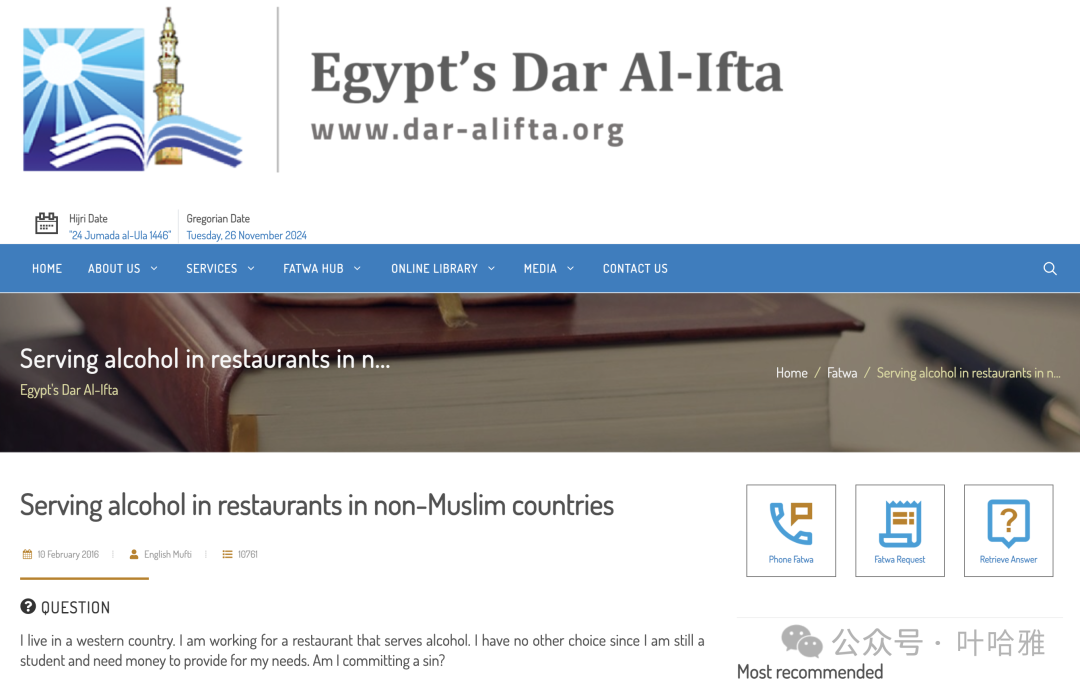
Ali Gomaa's fatwa has been posted on the Egyptian Ministry of Justice website (https://www.dar-alifta.org/en/... tries) since 2005, providing guidance to Muslims worldwide. A year before he stepped down, he even published a book titled Responding from the Tradition: One Hundred Contemporary Fatwas, which included this fatwa. Clearly, he has not changed his opinion to this day.
However, I found a review written by a British scholar on Ali Gomaa's thought. The author mainly wants to express that his opinion differs from Gomaa's, and it is written in a very accessible way. Everyone has the right to choose the scholarly views they prefer, and doing so is the safest approach. I am now translating the article for readers to reference.
Review of Gomaa’s Responding from the Tradition
Author: Andrew Booso, a British Muslim scholar who graduated from the Law Department of the London School of Economics.
In the English-speaking world, few important contemporary scholars engage with a series of current issues of concern. Therefore, this work will be eagerly welcomed in many parts of the English-speaking world. Their expectations are justified because this work covers various topics, including theology, law, customs, and spirituality. Ultimately, it should simply be seen as an introductory text. We can look forward to more works in the future addressing the more pressing life challenges faced by Muslims in the English-speaking world.
Regrettably, Responding from the Tradition does not provide context on how or where the one hundred fatwas answered in the book were asked. One does not know if they were simply selected from a broader database, and if so, what criteria were used to select them. Or whether Sheikh Gomaa himself decided to publish these specific answers in one volume. Such details could be very helpful, especially if we are told that these questions were chosen by Sheikh Gomaa himself, because this would tell us what he considers more important for an English-speaking audience.
From a theological perspective, this work is Sunni orthodox, even though it was published by a publishing house known for spreading perennial philosophy. The answer to question 1 affirms that Islam is the final religion sent by Allah to humanity and is applicable to people of every race and geographic location. the answer to question 2 adds that Allah wants Islam to be the seal of all religions in the field of law and to make it the only religion in the field of faith.
The general Sunni position mentioned above is elaborated more specifically in answer 33, where Juma points out that the orthodox schools of Sunni Islam include the Ash'ari and Maturidi schools. He adds that those who criticize these schools know nothing about their creed regarding belief in Allah, and the misunderstanding is mainly related to the attributes of Allah.
Juma distinguishes between early and late Ash'ari theologians. He argues that the early Ash'aris accepted the attributes used in the Quran to refer to Allah without believing in the literal meaning of their linguistic expressions. Conversely, he points out that later Ash'ari theologians adopted an interpretive approach because they believed that affirming attributes in an ambiguous way would lead some people to develop anthropomorphic beliefs and everything that entails. In his final comments, Juma effectively summarizes the debate surrounding the attributes of Allah, and he approvingly cites the non-Ash'ari-Maturidi scholar Ibn Qudama al-Maqdisi in his book Lum'a al-I'tiqad, calling it perhaps the best commentary. The latter points out that a person is obligated to believe in and accept without reservation everything in the Quran or everything the Messenger of Allah (peace and blessings of Allah be upon him) said regarding the qualities of the Most Merciful. People should avoid rejecting them, obsessing over their interpretation, or comparing Allah to His creation.
One has to wonder how much Gomaa will take a revisionist stance on late Ash'ari theology to support an earlier, minimalist version. For example, would he also be willing to stop defining the contrast between the actual speech of Allah (kalam nafsi) and the scripture revealed by Allah (kalam lafzi)? Would he just stop and say the Quran is the word of Allah, or simply that it is the uncreated word of Allah? A total minimalism of the scholastic school might be more effective today, avoiding many past and present debates, and the answer to the latter question is a result of that.
The legal approach of this work is helpfully explained at the beginning by Gomaa himself under the title 'The Art of Issuing Fatwas'. He believes the mufti's job in this era is to make things easy for people by bringing them into the religion of Allah, protecting them, and providing a way for them to act according to positions recognized by Islamic law. Gomaa points out that when answering questions, a mufti should first consult the Quran, then the Sunnah if it is not in the Quran, then use analogy, and should not violate consensus. the protocols established by the schools of jurisprudence allow a mufti to follow any mujtahid school to issue a fatwa, as long as his own ijtihad does not convince him that the truth lies elsewhere. He explains that Dar al-Iftar' al-Misriyyah (the Egyptian House of Fatwa) spreads the schools followed by the four Sunni schools (Hanafi, Maliki, Shafi'i, and Hanbali), as well as many non-Sunni schools (such as Ja'fari, Zaydi, Ibadi, and Zahiri), and even
expanded the range of evidence it relies on to include the major schools of over 80 companions in Muslim history, such as al-Awza'i, al-Tabari, al-Layth ibn Sa'd, and others. The opinions of these schools are taken into account and may even be prioritized based on the strength of their evidence, the need for their views, the purpose of the greater good, or to achieve the goals of Islamic law. This method reflects the values used by all academic groups today, whether in the East, the West, or across the Muslim world.
Given these comments, it is no surprise that Juma does not show school-of-thought bias from a strict ideological position.
One of the high points of his legal answers is his response to whether Islamic inheritance law oppresses women (Question 9). This answer is very important because the English-speaking world knows very little about inheritance rules, let alone how to defend them. His answer is very detailed, and it summarizes as follows:
There are 30 situations where a woman inherits the same amount as a man or more than a man. In some cases, she inherits, while her male counterpart inherits nothing at all. However, there are only four situations where a woman inherits half the share of a man.
It is the general lack of knowledge about these 34 possible situations, combined with a failure to remember that Islamic law was set by Allah for all times and all societies—rather than for individual families or whims—that leads to many modern doubts. What makes this detailed fatwa by Juma important for people to understand is the BBC series on inheritance called 'Can't Take It With You'. In that series, there is a Muslim couple from the UK who want to write a will that meets both Islamic and British legal requirements. But they were shocked when they were told that the Quran states their daughter is entitled to half the share of their son. It is a pity that the program did not include an answer like Gomaa's, which shows his deep understanding of divine law and fiqh al-waqi' (understanding of social reality). First, Gomaa's understanding of divine law here is stronger because his answer aligns with the Quran and Islamic scholars. Second, he explains why a brother has the right to receive more than his sister in this situation:
"When a group of heirs, such as the children of the deceased, are equal in the first two factors mentioned above [degree of kinship to the deceased and the generation the heir belongs to], their shares are then affected by the third [economic responsibility]." In this specific case, the misunderstood Quranic verse implied in the original question comes into play. The Quran does not make the gap between men and women a general rule, but limits it to this specific situation. When individuals in a group of heirs are equal in their relationship to the deceased and in age, the male son of the deceased receives twice as much as the female daughter of the deceased. The wisdom behind this arrangement is as follows: the man is responsible for the financial support of his wife and children, while his sister's financial support is the responsibility of someone other than herself, such as her husband or father. Therefore, for all practical purposes, this gap favors women because the wealth she inherits does not have to be used for family expenses, and she can spend her wealth however she likes. This economic advantage also protects her from any situation that might lead her into financial hardship. Unfortunately, few people today understand this detail of the Muslim inheritance system.
Juma adds that men also have the financial responsibility to "provide a dowry for his spouse," which "is a man's obligation, not a woman's." And 'if the situation requires it, men also need to financially support their extended family members'. This answer truly shows the now-clichéd context of the text, without needing to change the ruling. In fact, Juma pointed out the shallowness of our common understanding by emphasizing this point:
'...wealth is a broader concept than income. Income becomes part of wealth, but it is not wealth itself, because wealth is what remains after all expenses.' In cases where women receive half the inheritance of men, the woman's new income is protected by Sharia law and can be spent however she wishes. On the other hand, the man's new income is meant to help him support the family members now under his care. This is why we can say that Islamic inheritance law protects women's wealth and gives them rights that take priority over men's.
This answer is a helpful reminder that, as mentioned in the translator's introduction, Gomaa's first degree was a business degree from 'Ayn Shams University, so one expects him to have a full understanding of the economic consequences required for this issue, along with his extensive legal training at Al-Azhar University.
Nevertheless, economic and legal training is not political training, and two answers of a political nature in the collection might cause some people concern. The first is the answer to question 23, where he uses the legal understanding of Abu Hanifa and Shaybani to allow Muslims living in bilad ghayr al-Muslimin (non-Muslim lands)—because he prefers to call the latter this rather than dar al-kufr (abode of disbelief) or dar al-harb (abode of war), since 'the situation has changed' and Muslims are now not prevented from living in these lands, he says, 'there is no open declaration of war against Islam and Muslims'—to give and receive usury (riba) and engage in other transactions that are invalid in Muslim lands, such as selling meat not slaughtered according to Islamic law, selling pork or alcohol, or engaging in gambling. [This fatwa has been discussed previously on virtualmosque.com.] As reported by Taqi 'Uthmani (in Contemporary Fatawa), 'Abdullah Bin Bayyah (in a CD series titled 'Sacred Law in Secular Lands: A Guide for Muslim Survival in the West, Vol. 1', translated by Hamza Yusuf), and Muhammad Hamid (quoted in Reliance of the Traveller, translated by Nuh Keller), Jumuah's understanding of the positions of Abu Hanifa and Shaybani is correct. Nuh Keller translated it.
Now, 'Uthmani, Bin Bayyah, and Hamid focus on why they prefer positions that oppose Abu Hanifa's allowance for Muslims to act differently in the land of war (dar al-harb), rather than their obligation to act differently in Muslim lands. 'Uthmani appeals to the 'overwhelming majority' that opposes this position, while Hamid tentatively appeals to the opposing views of Shafi'i and Abu Yusuf, which are 'not weak views without supporting evidence'. Bin Bayyah argues that terms like dar al-harb and dar al-Islam are not 'evidence'—meaning they do not come from the Quran and Sunnah (narrations)—and that the world should be re-evaluated because the modern world has changed so much (another source for Bin Bayyah's view), which also aligns with Jumuah's understanding in his answer. As H. A. Hellyer mentions in his book Muslims of Europe: The 'Other' Europeans, Bin Bayyah prefers to call the West the abode of trust (dar al-aman). In fact, as explained initially above, Jumuah himself denies using the term dar al-harb in a modern context, but is satisfied with applying rulings related to a state of affairs that does not currently exist.
Now, none of the scholars mentioned above discuss whether Abu Hanifa's actual ruling would remain in a modern context according to his own criteria. For those who agree with the understanding of Abu Hanifa that the West is still dar al-harb, this is the only argument. [I will focus on Abu Hanifa's position because, as discussed below, Shaybani's view may have more far-reaching consequences, where the entire world could be viewed as dar al-harb. Muhammad Shoaib Omar, the editor of 'Uthmani's Contemporary Fatawa—whom 'Uthmani praises in the preface as a 'learned brother' and for whom he expresses 'gratitude' for adding 'explanatory footnotes that clarify certain answers'—tentatively questions 'Uthmani in a footnote, opposing the allowance of usury in the West based on Abu Hanifa's understanding: 'Muslims living as a minority in a non-Muslim country enjoy constitutional rights and protection in a secular state just like other citizens. Their status seems different from the abode of war (Darul-Harb), which is actually a state of ongoing military conflict between the abode of Islam (Darul-Islam) and the abode of war (Darul-Harb).' We need to correctly define the Abode of War (Darul-Harb) in the context of modern nations to see if Imam Abu Hanifah's views still apply.
The research Omar calls for was largely presented by Ahmed Mohsen al-Dawoody in his 2009 doctoral thesis at the University of Birmingham in the UK, titled 'War in Islamic Law: Justifications and Regulations' (later published by Palgrave as 'The Islamic Law of War: Justifications and Regulations'). Al-Dawoody points out that Shaybani believed the Abode of Islam (Dar al-Islam) is a place where Islamic law (Sharia) is applied. But Abu Hanifah believed that the Abode of Islam is a region where Islamic law is applied and where Muslims and protected non-Muslim citizens (ahl al-dhimma) are safe. Jasser Auda, in an article titled 'How Much of an "Abode of Islam" is Europe Today?' He cites a study of classical jurisprudence that quotes Abu Hanifah from Kasani's 'Wondrous Arts' (Bada'i al-Sana'i): 'The purpose (maqsud) of calling a land the "Abode of Islam" or the "Abode of Disbelief" (kufr) is not the opposition between Islam and disbelief, but rather between safety and insecurity.'
Bin Bayyah says in his book 'Sacred Law in Secular Lands' that the Hanafi school, including Sarakhsi and Kasani, says that any place where Muslims have 'amn' or 'safety, well-being, or security' is the Abode of Islam. Another Al-Azhar graduate, Shahrul Hussain, in his work 'Dār al-Islām and Dār al-Ĥarb: An Analytical Study of Their Historical Origins, Definitions by Classical Scholars, and Their Application in the Contemporary World,' quotes the relevant section on the Abode of Islam from Sarakhsi's 'The Extended' (al-Mabsut): 'A place that is under Muslim authority or ownership, proving that Muslims are safe within it.' Al-Dawoody adds, while capturing this concept of 'safety':
'In other words, it (the Abode of War) is a region where religious freedom does not exist and the lives of Muslims and protected non-Muslim citizens (dhimmi) are not safe.' Therefore, the classification of the Abode of War and the Abode of Islam refers to the presence or absence of safety and peace, specifically the freedom for Muslims to apply and practice Islamic law. It is worth adding here that calling a territory the Abode of War 'does not mean actual fighting,' but it clearly indicates a state of potential hostility, enmity, or war when the territory does not belong to the Abode of Islam and has no peace treaty or alliance with it, especially if Islamic law cannot be applied. Muslims claim their faith in Islam and their dua are not safe, and the lives of Muslims and protected non-Muslims (dhimmis) are under threat.
According to Wahba al-Zuhayli in his book The Effects of War in Islam (Athar al-Harb fi al-Islam), most jurists including Abu Hanifa do not accept the third conceptual division of the abode of peace (dar al-sulh). They believe that if a region signs a peace treaty and pays taxes to the abode of Islam (dar al-Islam), it becomes part of the dar al-Islam, and therefore the dar al-Islam is obligated to protect it.
Therefore, according to Abu Hanifa's definition, non-Muslim countries today would be classified as dar al-Islam because the Muslims living there are safe. In the view of other Hanafi jurists al-Shaybani and Abu Yusuf, non-Muslim countries and most Muslim countries should now be the abode of war (dar al-harb) because some parts of Islamic law do not apply there.
These academic attempts to truly understand Abu Hanifa's view of dar al-harb provide enough material to question the idea that he would uphold the specific rulings he discussed in this context. Even if one could argue that the element of non-Muslim signatories agreeing to pay taxes to Muslim countries is missing, which makes one question if he would call the West Islamic, other conditions certainly make one doubt he would consider today's geopolitical reality the same as his understanding of his own time. One must also question if al-Shaybani would hold the same view on this matter. This topic is by no means final, but there is enough reason to question the minority position, which could have dire consequences if the West followed it.
To look at the issue of allowing usury, the sale of alcohol, and gambling from a purely Western perspective, Eastern muftis should be very careful before giving such a legal opinion (fatwa) to us Westerners. This is especially true when our inner cities are full of Muslims who give in to the evils and sins of drinkers, even when Muslims sell alcohol to them from their own shops, like many Arab-owned liquor stores in American inner cities. This also applies to the issue of giving in to accepting interest-based loans that they cannot afford to repay, and even as they become addicted to gambling and the terrible consequences this causes for themselves and those around them. when selling alcohol in the city center, how can Muslims appear as upright callers to a noble and original Islam when they hear the human degradation that Gil Scott-Heron complains about in his song The Bottle? In rejecting such a fatwa, we Westerners might not only be able to reject it because most Islamic jurists in the past and present have rejected it, or because one could argue that if Abu Hanifa and al-Shaybani lived in our time, they might also change their positions—as Juma says in The Art of Issuing Fatwas: 'A fatwa changes according to its specific time, place, people, and conditions' regarding non-definitive issues that never change—but rather, we Westerners can reject the fatwa because it is actually a huge danger to us, especially those of us struggling in the already difficult reality of Western inner cities. We really do not need Muslims to fuel this problem by using, or abusing, such a fatwa.
The second surprising political fatwa addresses question 16 and the modern application of Islamic corporal punishment (hudud). Gomaa says:
For over a thousand years, countries like Egypt have not carried out corporal punishment. This is because the legal conditions they require, which describe the specific means to determine guilt and allow for the retraction of a confession, have not been met. The penal codes of the remaining Islamic countries, which make up 56 out of the 196 countries in the world, remain silent on the issue of corporal punishment (hudud). This is because our era is one of general uncertainty (shubha), and the Prophet, may Allah bless him and grant him peace, said: 'Stop carrying out corporal punishment when there is doubt.' the legally recognized witnesses needed to convict a criminal in capital cases requiring corporal punishment have not existed for a long time. Al-Tanuki mentions in his book Mishwar al-Muhadara that in the past, a judge would enter a region or a village and find forty witnesses whose fairness and accuracy we were satisfied with, whereas today, a judge enters a town and finds only one or two witnesses. Therefore, our era can generally be described as an era without witnesses.
People will be curious about such a fatwa, not only because of its grand historical claims, but also because it seems to equate much of the Muslim world, such as large cities like Cairo where Gomaa himself lives, with some rural regions or villages. This fatwa is undoubtedly a secularist's dream. For a famous Islamic scholar, it is surprising that Gomaa's answer shows a certain resignation to the current situation, without seeking to remedy the circumstances he admits have led to neglecting the following of certain Quranic rulings. It is this apparent indifference and submission that caused the greatest shock. Now, with the greatest respect, the Arab Spring reminds our scholars—including the Jumu'ah discussed here with such compassion by Hisham Hellyer—that it is not always the smartest politics.
The translation of this book was strengthened by being reviewed by two learned scholars trained in Islamic law, Abdullah ibn Hamid Ali and Musa Furber.
In short, this is a welcome addition to English literature, containing a wealth of valuable academic discussion from Jumu'ah himself and some of the greatest Islamic history scholars from various major schools. Nevertheless, this work serves as a warning to Muslim minorities in the West to be cautious with Islamic scholarship, even when it comes from the best places currently available. This places a great responsibility on Western Muslims. They must commit to studying Islamic sciences, even if they do not become full-fledged scholars, to gain enough knowledge to coherently follow Islamic academic arguments and, to some extent, choose views with the best academic strength and benefit (a limited form of tarjih).
Of course, we acknowledge that knowledge from the East has enlightened our hearts, but the light from that region is multifaceted, so we must be careful not to choose only one beautiful beam while excluding all others. At the same time, we must offer dua for colorblindness: we often think we see things as they truly are when we do not see them at all. Nevertheless, in the West, we still have an urgent need for expert scholars who empower their audience, rather than those who seek to bully academic research by appealing to narrow authority. Finally, this work is a welcome addition to English libraries, and we pray that more publishers produce legal works by English-speaking experts. We rely on Allah, and we pray that Allah forgives our ignorance.
Summary: This Muslim knowledge guide reviews Andrew Booso's response to Ali Gomaa's book Responding from the Tradition, focusing on contemporary fatwas, questions about context, dar al-harb, selling alcohol outside Muslim lands, lottery participation, and how Muslims choose scholarly opinions.
I actually mentioned the different opinions on the fatwa he issued in my last article about Gomaa, and I even included references. But many people clearly just read the headline and started complaining. Those familiar with my style know that any point I make has a source. Some people always say only scholars are qualified to express opinions. I have no interest in becoming a scholar, but I am very willing to use the words of scholars to silence some people. In reality, when the scholarly opinions I cite differ from what these people believe, they follow their own desires and refuse to accept them. That is human nature.
Ali Gomaa's fatwa has been posted on the Egyptian Ministry of Justice website (https://www.dar-alifta.org/en/... tries) since 2005, providing guidance to Muslims worldwide. A year before he stepped down, he even published a book titled Responding from the Tradition: One Hundred Contemporary Fatwas, which included this fatwa. Clearly, he has not changed his opinion to this day.
However, I found a review written by a British scholar on Ali Gomaa's thought. The author mainly wants to express that his opinion differs from Gomaa's, and it is written in a very accessible way. Everyone has the right to choose the scholarly views they prefer, and doing so is the safest approach. I am now translating the article for readers to reference.
Review of Gomaa’s Responding from the Tradition
Author: Andrew Booso, a British Muslim scholar who graduated from the Law Department of the London School of Economics.
In the English-speaking world, few important contemporary scholars engage with a series of current issues of concern. Therefore, this work will be eagerly welcomed in many parts of the English-speaking world. Their expectations are justified because this work covers various topics, including theology, law, customs, and spirituality. Ultimately, it should simply be seen as an introductory text. We can look forward to more works in the future addressing the more pressing life challenges faced by Muslims in the English-speaking world.
Regrettably, Responding from the Tradition does not provide context on how or where the one hundred fatwas answered in the book were asked. One does not know if they were simply selected from a broader database, and if so, what criteria were used to select them. Or whether Sheikh Gomaa himself decided to publish these specific answers in one volume. Such details could be very helpful, especially if we are told that these questions were chosen by Sheikh Gomaa himself, because this would tell us what he considers more important for an English-speaking audience.
From a theological perspective, this work is Sunni orthodox, even though it was published by a publishing house known for spreading perennial philosophy. The answer to question 1 affirms that Islam is the final religion sent by Allah to humanity and is applicable to people of every race and geographic location. the answer to question 2 adds that Allah wants Islam to be the seal of all religions in the field of law and to make it the only religion in the field of faith.
The general Sunni position mentioned above is elaborated more specifically in answer 33, where Juma points out that the orthodox schools of Sunni Islam include the Ash'ari and Maturidi schools. He adds that those who criticize these schools know nothing about their creed regarding belief in Allah, and the misunderstanding is mainly related to the attributes of Allah.
Juma distinguishes between early and late Ash'ari theologians. He argues that the early Ash'aris accepted the attributes used in the Quran to refer to Allah without believing in the literal meaning of their linguistic expressions. Conversely, he points out that later Ash'ari theologians adopted an interpretive approach because they believed that affirming attributes in an ambiguous way would lead some people to develop anthropomorphic beliefs and everything that entails. In his final comments, Juma effectively summarizes the debate surrounding the attributes of Allah, and he approvingly cites the non-Ash'ari-Maturidi scholar Ibn Qudama al-Maqdisi in his book Lum'a al-I'tiqad, calling it perhaps the best commentary. The latter points out that a person is obligated to believe in and accept without reservation everything in the Quran or everything the Messenger of Allah (peace and blessings of Allah be upon him) said regarding the qualities of the Most Merciful. People should avoid rejecting them, obsessing over their interpretation, or comparing Allah to His creation.
One has to wonder how much Gomaa will take a revisionist stance on late Ash'ari theology to support an earlier, minimalist version. For example, would he also be willing to stop defining the contrast between the actual speech of Allah (kalam nafsi) and the scripture revealed by Allah (kalam lafzi)? Would he just stop and say the Quran is the word of Allah, or simply that it is the uncreated word of Allah? A total minimalism of the scholastic school might be more effective today, avoiding many past and present debates, and the answer to the latter question is a result of that.
The legal approach of this work is helpfully explained at the beginning by Gomaa himself under the title 'The Art of Issuing Fatwas'. He believes the mufti's job in this era is to make things easy for people by bringing them into the religion of Allah, protecting them, and providing a way for them to act according to positions recognized by Islamic law. Gomaa points out that when answering questions, a mufti should first consult the Quran, then the Sunnah if it is not in the Quran, then use analogy, and should not violate consensus. the protocols established by the schools of jurisprudence allow a mufti to follow any mujtahid school to issue a fatwa, as long as his own ijtihad does not convince him that the truth lies elsewhere. He explains that Dar al-Iftar' al-Misriyyah (the Egyptian House of Fatwa) spreads the schools followed by the four Sunni schools (Hanafi, Maliki, Shafi'i, and Hanbali), as well as many non-Sunni schools (such as Ja'fari, Zaydi, Ibadi, and Zahiri), and even
expanded the range of evidence it relies on to include the major schools of over 80 companions in Muslim history, such as al-Awza'i, al-Tabari, al-Layth ibn Sa'd, and others. The opinions of these schools are taken into account and may even be prioritized based on the strength of their evidence, the need for their views, the purpose of the greater good, or to achieve the goals of Islamic law. This method reflects the values used by all academic groups today, whether in the East, the West, or across the Muslim world.
Given these comments, it is no surprise that Juma does not show school-of-thought bias from a strict ideological position.
One of the high points of his legal answers is his response to whether Islamic inheritance law oppresses women (Question 9). This answer is very important because the English-speaking world knows very little about inheritance rules, let alone how to defend them. His answer is very detailed, and it summarizes as follows:
There are 30 situations where a woman inherits the same amount as a man or more than a man. In some cases, she inherits, while her male counterpart inherits nothing at all. However, there are only four situations where a woman inherits half the share of a man.
It is the general lack of knowledge about these 34 possible situations, combined with a failure to remember that Islamic law was set by Allah for all times and all societies—rather than for individual families or whims—that leads to many modern doubts. What makes this detailed fatwa by Juma important for people to understand is the BBC series on inheritance called 'Can't Take It With You'. In that series, there is a Muslim couple from the UK who want to write a will that meets both Islamic and British legal requirements. But they were shocked when they were told that the Quran states their daughter is entitled to half the share of their son. It is a pity that the program did not include an answer like Gomaa's, which shows his deep understanding of divine law and fiqh al-waqi' (understanding of social reality). First, Gomaa's understanding of divine law here is stronger because his answer aligns with the Quran and Islamic scholars. Second, he explains why a brother has the right to receive more than his sister in this situation:
"When a group of heirs, such as the children of the deceased, are equal in the first two factors mentioned above [degree of kinship to the deceased and the generation the heir belongs to], their shares are then affected by the third [economic responsibility]." In this specific case, the misunderstood Quranic verse implied in the original question comes into play. The Quran does not make the gap between men and women a general rule, but limits it to this specific situation. When individuals in a group of heirs are equal in their relationship to the deceased and in age, the male son of the deceased receives twice as much as the female daughter of the deceased. The wisdom behind this arrangement is as follows: the man is responsible for the financial support of his wife and children, while his sister's financial support is the responsibility of someone other than herself, such as her husband or father. Therefore, for all practical purposes, this gap favors women because the wealth she inherits does not have to be used for family expenses, and she can spend her wealth however she likes. This economic advantage also protects her from any situation that might lead her into financial hardship. Unfortunately, few people today understand this detail of the Muslim inheritance system.
Juma adds that men also have the financial responsibility to "provide a dowry for his spouse," which "is a man's obligation, not a woman's." And 'if the situation requires it, men also need to financially support their extended family members'. This answer truly shows the now-clichéd context of the text, without needing to change the ruling. In fact, Juma pointed out the shallowness of our common understanding by emphasizing this point:
'...wealth is a broader concept than income. Income becomes part of wealth, but it is not wealth itself, because wealth is what remains after all expenses.' In cases where women receive half the inheritance of men, the woman's new income is protected by Sharia law and can be spent however she wishes. On the other hand, the man's new income is meant to help him support the family members now under his care. This is why we can say that Islamic inheritance law protects women's wealth and gives them rights that take priority over men's.
This answer is a helpful reminder that, as mentioned in the translator's introduction, Gomaa's first degree was a business degree from 'Ayn Shams University, so one expects him to have a full understanding of the economic consequences required for this issue, along with his extensive legal training at Al-Azhar University.
Nevertheless, economic and legal training is not political training, and two answers of a political nature in the collection might cause some people concern. The first is the answer to question 23, where he uses the legal understanding of Abu Hanifa and Shaybani to allow Muslims living in bilad ghayr al-Muslimin (non-Muslim lands)—because he prefers to call the latter this rather than dar al-kufr (abode of disbelief) or dar al-harb (abode of war), since 'the situation has changed' and Muslims are now not prevented from living in these lands, he says, 'there is no open declaration of war against Islam and Muslims'—to give and receive usury (riba) and engage in other transactions that are invalid in Muslim lands, such as selling meat not slaughtered according to Islamic law, selling pork or alcohol, or engaging in gambling. [This fatwa has been discussed previously on virtualmosque.com.] As reported by Taqi 'Uthmani (in Contemporary Fatawa), 'Abdullah Bin Bayyah (in a CD series titled 'Sacred Law in Secular Lands: A Guide for Muslim Survival in the West, Vol. 1', translated by Hamza Yusuf), and Muhammad Hamid (quoted in Reliance of the Traveller, translated by Nuh Keller), Jumuah's understanding of the positions of Abu Hanifa and Shaybani is correct. Nuh Keller translated it.
Now, 'Uthmani, Bin Bayyah, and Hamid focus on why they prefer positions that oppose Abu Hanifa's allowance for Muslims to act differently in the land of war (dar al-harb), rather than their obligation to act differently in Muslim lands. 'Uthmani appeals to the 'overwhelming majority' that opposes this position, while Hamid tentatively appeals to the opposing views of Shafi'i and Abu Yusuf, which are 'not weak views without supporting evidence'. Bin Bayyah argues that terms like dar al-harb and dar al-Islam are not 'evidence'—meaning they do not come from the Quran and Sunnah (narrations)—and that the world should be re-evaluated because the modern world has changed so much (another source for Bin Bayyah's view), which also aligns with Jumuah's understanding in his answer. As H. A. Hellyer mentions in his book Muslims of Europe: The 'Other' Europeans, Bin Bayyah prefers to call the West the abode of trust (dar al-aman). In fact, as explained initially above, Jumuah himself denies using the term dar al-harb in a modern context, but is satisfied with applying rulings related to a state of affairs that does not currently exist.
Now, none of the scholars mentioned above discuss whether Abu Hanifa's actual ruling would remain in a modern context according to his own criteria. For those who agree with the understanding of Abu Hanifa that the West is still dar al-harb, this is the only argument. [I will focus on Abu Hanifa's position because, as discussed below, Shaybani's view may have more far-reaching consequences, where the entire world could be viewed as dar al-harb. Muhammad Shoaib Omar, the editor of 'Uthmani's Contemporary Fatawa—whom 'Uthmani praises in the preface as a 'learned brother' and for whom he expresses 'gratitude' for adding 'explanatory footnotes that clarify certain answers'—tentatively questions 'Uthmani in a footnote, opposing the allowance of usury in the West based on Abu Hanifa's understanding: 'Muslims living as a minority in a non-Muslim country enjoy constitutional rights and protection in a secular state just like other citizens. Their status seems different from the abode of war (Darul-Harb), which is actually a state of ongoing military conflict between the abode of Islam (Darul-Islam) and the abode of war (Darul-Harb).' We need to correctly define the Abode of War (Darul-Harb) in the context of modern nations to see if Imam Abu Hanifah's views still apply.
The research Omar calls for was largely presented by Ahmed Mohsen al-Dawoody in his 2009 doctoral thesis at the University of Birmingham in the UK, titled 'War in Islamic Law: Justifications and Regulations' (later published by Palgrave as 'The Islamic Law of War: Justifications and Regulations'). Al-Dawoody points out that Shaybani believed the Abode of Islam (Dar al-Islam) is a place where Islamic law (Sharia) is applied. But Abu Hanifah believed that the Abode of Islam is a region where Islamic law is applied and where Muslims and protected non-Muslim citizens (ahl al-dhimma) are safe. Jasser Auda, in an article titled 'How Much of an "Abode of Islam" is Europe Today?' He cites a study of classical jurisprudence that quotes Abu Hanifah from Kasani's 'Wondrous Arts' (Bada'i al-Sana'i): 'The purpose (maqsud) of calling a land the "Abode of Islam" or the "Abode of Disbelief" (kufr) is not the opposition between Islam and disbelief, but rather between safety and insecurity.'
Bin Bayyah says in his book 'Sacred Law in Secular Lands' that the Hanafi school, including Sarakhsi and Kasani, says that any place where Muslims have 'amn' or 'safety, well-being, or security' is the Abode of Islam. Another Al-Azhar graduate, Shahrul Hussain, in his work 'Dār al-Islām and Dār al-Ĥarb: An Analytical Study of Their Historical Origins, Definitions by Classical Scholars, and Their Application in the Contemporary World,' quotes the relevant section on the Abode of Islam from Sarakhsi's 'The Extended' (al-Mabsut): 'A place that is under Muslim authority or ownership, proving that Muslims are safe within it.' Al-Dawoody adds, while capturing this concept of 'safety':
'In other words, it (the Abode of War) is a region where religious freedom does not exist and the lives of Muslims and protected non-Muslim citizens (dhimmi) are not safe.' Therefore, the classification of the Abode of War and the Abode of Islam refers to the presence or absence of safety and peace, specifically the freedom for Muslims to apply and practice Islamic law. It is worth adding here that calling a territory the Abode of War 'does not mean actual fighting,' but it clearly indicates a state of potential hostility, enmity, or war when the territory does not belong to the Abode of Islam and has no peace treaty or alliance with it, especially if Islamic law cannot be applied. Muslims claim their faith in Islam and their dua are not safe, and the lives of Muslims and protected non-Muslims (dhimmis) are under threat.
According to Wahba al-Zuhayli in his book The Effects of War in Islam (Athar al-Harb fi al-Islam), most jurists including Abu Hanifa do not accept the third conceptual division of the abode of peace (dar al-sulh). They believe that if a region signs a peace treaty and pays taxes to the abode of Islam (dar al-Islam), it becomes part of the dar al-Islam, and therefore the dar al-Islam is obligated to protect it.
Therefore, according to Abu Hanifa's definition, non-Muslim countries today would be classified as dar al-Islam because the Muslims living there are safe. In the view of other Hanafi jurists al-Shaybani and Abu Yusuf, non-Muslim countries and most Muslim countries should now be the abode of war (dar al-harb) because some parts of Islamic law do not apply there.
These academic attempts to truly understand Abu Hanifa's view of dar al-harb provide enough material to question the idea that he would uphold the specific rulings he discussed in this context. Even if one could argue that the element of non-Muslim signatories agreeing to pay taxes to Muslim countries is missing, which makes one question if he would call the West Islamic, other conditions certainly make one doubt he would consider today's geopolitical reality the same as his understanding of his own time. One must also question if al-Shaybani would hold the same view on this matter. This topic is by no means final, but there is enough reason to question the minority position, which could have dire consequences if the West followed it.
To look at the issue of allowing usury, the sale of alcohol, and gambling from a purely Western perspective, Eastern muftis should be very careful before giving such a legal opinion (fatwa) to us Westerners. This is especially true when our inner cities are full of Muslims who give in to the evils and sins of drinkers, even when Muslims sell alcohol to them from their own shops, like many Arab-owned liquor stores in American inner cities. This also applies to the issue of giving in to accepting interest-based loans that they cannot afford to repay, and even as they become addicted to gambling and the terrible consequences this causes for themselves and those around them. when selling alcohol in the city center, how can Muslims appear as upright callers to a noble and original Islam when they hear the human degradation that Gil Scott-Heron complains about in his song The Bottle? In rejecting such a fatwa, we Westerners might not only be able to reject it because most Islamic jurists in the past and present have rejected it, or because one could argue that if Abu Hanifa and al-Shaybani lived in our time, they might also change their positions—as Juma says in The Art of Issuing Fatwas: 'A fatwa changes according to its specific time, place, people, and conditions' regarding non-definitive issues that never change—but rather, we Westerners can reject the fatwa because it is actually a huge danger to us, especially those of us struggling in the already difficult reality of Western inner cities. We really do not need Muslims to fuel this problem by using, or abusing, such a fatwa.
The second surprising political fatwa addresses question 16 and the modern application of Islamic corporal punishment (hudud). Gomaa says:
For over a thousand years, countries like Egypt have not carried out corporal punishment. This is because the legal conditions they require, which describe the specific means to determine guilt and allow for the retraction of a confession, have not been met. The penal codes of the remaining Islamic countries, which make up 56 out of the 196 countries in the world, remain silent on the issue of corporal punishment (hudud). This is because our era is one of general uncertainty (shubha), and the Prophet, may Allah bless him and grant him peace, said: 'Stop carrying out corporal punishment when there is doubt.' the legally recognized witnesses needed to convict a criminal in capital cases requiring corporal punishment have not existed for a long time. Al-Tanuki mentions in his book Mishwar al-Muhadara that in the past, a judge would enter a region or a village and find forty witnesses whose fairness and accuracy we were satisfied with, whereas today, a judge enters a town and finds only one or two witnesses. Therefore, our era can generally be described as an era without witnesses.
People will be curious about such a fatwa, not only because of its grand historical claims, but also because it seems to equate much of the Muslim world, such as large cities like Cairo where Gomaa himself lives, with some rural regions or villages. This fatwa is undoubtedly a secularist's dream. For a famous Islamic scholar, it is surprising that Gomaa's answer shows a certain resignation to the current situation, without seeking to remedy the circumstances he admits have led to neglecting the following of certain Quranic rulings. It is this apparent indifference and submission that caused the greatest shock. Now, with the greatest respect, the Arab Spring reminds our scholars—including the Jumu'ah discussed here with such compassion by Hisham Hellyer—that it is not always the smartest politics.
The translation of this book was strengthened by being reviewed by two learned scholars trained in Islamic law, Abdullah ibn Hamid Ali and Musa Furber.
In short, this is a welcome addition to English literature, containing a wealth of valuable academic discussion from Jumu'ah himself and some of the greatest Islamic history scholars from various major schools. Nevertheless, this work serves as a warning to Muslim minorities in the West to be cautious with Islamic scholarship, even when it comes from the best places currently available. This places a great responsibility on Western Muslims. They must commit to studying Islamic sciences, even if they do not become full-fledged scholars, to gain enough knowledge to coherently follow Islamic academic arguments and, to some extent, choose views with the best academic strength and benefit (a limited form of tarjih).
Of course, we acknowledge that knowledge from the East has enlightened our hearts, but the light from that region is multifaceted, so we must be careful not to choose only one beautiful beam while excluding all others. At the same time, we must offer dua for colorblindness: we often think we see things as they truly are when we do not see them at all. Nevertheless, in the West, we still have an urgent need for expert scholars who empower their audience, rather than those who seek to bully academic research by appealing to narrow authority. Finally, this work is a welcome addition to English libraries, and we pray that more publishers produce legal works by English-speaking experts. We rely on Allah, and we pray that Allah forgives our ignorance.
