
Shanghai's 130-Year-Old Halal Legend Yixinzhai: Five Generations of Golden Beef Pan-Fried Buns
[Internet Repost]
Shanghai Yangpu's 130-Year-Old Yixinzhai Tested & Reviewed: How Good Are These Five-Generation Golden Beef Pan-Fried Buns?
Summary:
A personal visit to the 130-year-old historic institution Yixinzhai on Pingliang Road in Yangpu. Joining the line for fresh-off-the-griddle niurou jianbao (pan-fried beef buns) with their crispy golden crusts, rich and savory broth, and five generations of dedication to traditional craftsmanship—delivering an authentic taste of early Shanghai morning nostalgia.
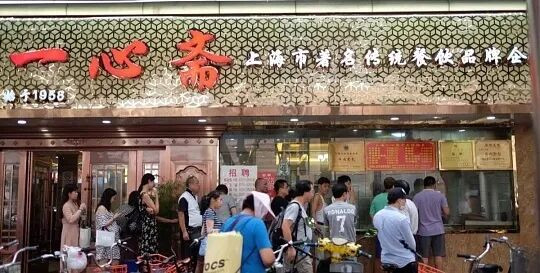
Last week, I made a special trip to Yangpu to hunt down some classic old-school flavors. As soon as I turned onto Pingliang Road, an irresistible, mouthwatering aroma of meat stopped me in my tracks. Looking up, I saw a long line snaking beneath the golden sign of 'Yixinzhai.' An auntie carrying a vegetable basket struck up a conversation with me: 'Little girl, you came to the right place! These jianbao just came out of the pan, waiting 10 minutes is totally worth it!' I obediently joined the queue, and the second they were handed to me, I couldn't wait to take a bite: the golden, crispy crust cracked with a satisfying *crunch*, and a burst of savory meat juice squirted right onto the corner of my mouth. It was so scalding hot that I gasped, but there was no way I was letting go. This is the absolute god-tier flavor that generations of old Yangpu locals grew up eating!
Who would have guessed that this slice of gritty neighborhood life hides a full 130 years of history? Starting from a mobile food cart in Cao County, Shandong, all the way to today's sprawling 1,200-square-meter, three-story restaurant, five generations of the Ma family have brought Halal culinary craftsmanship to Shanghai while cooking up a one-of-a-kind 'Shanghai-style Halal flavor'—combining authentic Halal traditions with the rich, glossy, savory-sweet profile Shanghainese love. No wonder regular customers keep coming back from their own childhoods all the way until they bring their grandkids.
This bustling neighborhood vibe holds 130 years of stories! In 1891, the first-generation patriarch of the Ma family, Ma Shisheng, arrived with a knack for making Halal pastries and set up a small street cart in Cao County, Shandong. He sold just two heavy-hitting items: niurou jianbao (pan-fried beef buns) and curry beef soup. Thanks to fillings that were so ridiculously generous they piled up like a mountain, neighbors lined up every single day. Later, during turbulent times in 1938, he and his son Ma Xingbang moved to Zhenjiang, and by the late 1940s, they bounced around until they landed in Shanghai's Yangpu District. They put together a makeshift tarp paper shack on Huangxing Road—running the business out of the front and housing the whole family in the back. That's how the 'Ma Family' Halal stall first took root in Shanghai.
Today, 82-year-old Ma Wanglin is the third-generation heir and a recognized Shanghai Intangible Cultural Heritage inheritor. Chatting with the veteran, he pulled some yellowed old photos out of a drawer and smiled as he pointed them out to me: 'Look, this is my dad. When I was under ten, I had to stand on a little wooden stool just to reach the stovetop, helping him pump the bellows and knead the dough. My face and clothes were always covered in flour; I looked just like a little dough figurine.' He remembers his father's rules by heart: 'Halal cooking leaves zero room for slacking! The beef has to be hind leg meat with no gristle or skin, and the filling has to be hand-chopped into a fine mince. Grandpa's original seasoning recipe means missing even a single spice ruins the flavor.' That stubborn perfectionism has been baked into his bones since he was a kid.
During the joint state-private ownership transition in 1958, a 15-year-old Ma Wanglin followed his father into a state-run restaurant as an apprentice, earning an 18-yuan monthly salary while treating master craftsmanship as his absolute top priority. While everyone else bolted for home the second their shift ended, he stayed behind in the kitchen to 'steal' culinary secrets: when his father mixed fillings, he'd pretend to wipe down tables just to memorize the seasoning ratios; when tending the fire, his eyes would lock onto the flames to figure out exactly how long it took to get the jianbao crust golden and crispy. 'Back then, seeing my classmates carry school bags to class made me envious. But after kneading dough for so long, I guess I grew an attachment to it.' That persistence paid off—by age 30, he was manager of two state-run restaurants. When the restaurant system reformed in 2000, he gritted his teeth and took over the 'Yixinzhai' signboard, determined not to let regular patrons lose this classic taste.
Yixinzhai's 130-year success comes down to Grandpa Ma's philosophy of 'preserving' and 'adapting.' What they 'preserve' are the ancestral rules: niurou jianbao must use beef hind leg mixed with cabbage for the filling so you get a textured crunch in every bite; the lü sanhuangji (braised Sanhuang yellow chicken) uses tender, three-pound young chickens simmered slowly for four hours with over a dozen spices like star anise and cinnamon until a chopstick slides right through. The meat is as tender as a cloud, and I can easily polish off two bowls of rice drenched in that braising broth. What they 'adapt' is understanding the Shanghainese palate: knowing locals love rich, glossy, savory-sweet flavors, they created a Halal version of braised beef tendon, stewed until melt-in-your-mouth tender and bouncy, coated in a sweet-and-savory glaze. Worried that younger crowds might find things too heavy, they added lightly stir-fried seasonal vegetables paired with Halal sauces. Kids, parents, and grandparents all find something they love.
Today's Yixinzhai is a far cry from the old tarp shack of the past—its 1,200-square-meter, three-story building is seriously grand. The first floor is the snack counter, serving up niurou jianbao, niurou guotie (crispy beef potstickers), and tanggao (glutinous rice sugar cakes) where neighborhood folks drop in daily for a quick bite. The second floor focuses on stir-fries, with a menu boasting 60 cold dishes and 100 hot dishes. The third floor handles banquets, hosting countless weddings and milestone birthday parties for loyal patrons. To keep up with the long lines, Grandpa Ma upgraded the equipment, swapping out small iron skillets for massive flat-top griddles that can fry 50 buns at once. Yet the rules of hand-chopping fillings and wrapping and frying to order haven't changed one bit. When I visited, I lucked out and caught the very first batch coming off the griddle—that rich aroma of meat and dough drifted halfway down the street, calling people in! Here's a quick pro-tip to beat the crowds: go before 8 AM or after 3 PM, when lines are practically nonexistent, and you can still score piping-hot batches straight from the pan.
The most heartwarming part is this living, breathing legacy. Grandpa Ma's son, Ma Jun, took over the kitchen ages ago, and his wok-flipping skills are even sharper than his dad's. His 23-year-old grandson is even more interesting: studying business management in England, he dives straight into the kitchen to practice kneading dough during breaks, vowing to 'come back and take over right after graduation.' Grandpa patted his grandson's head and laughed: 'Back in the day, becoming an apprentice meant serving tea and kowtowing. I don't care for that formality, but the rule of "never cutting corners" has to be passed down.' He didn't have much formal schooling himself, so he poured everything into supporting his grandson's education: 'He's educated, understands the internet, and can share the story of this legacy brand with more young people.' Last year, when 'Yixinzhai Sanhuang Chicken' was named a 'Shanghai Time-Honored Brand,' the grandfather and grandson hung the plaque together, and Grandpa beamed so hard his eyes crinkled into slits.
While eating lunch on the second floor, an auntie at the next table chatted with me like family: 'When I was little, my grandpa brought me here, and we'd split a single jianbao into three bites. Now I bring my grandson, and he wolfs them down whole, complaining one isn't enough and saying they taste better than burgers!' An uncle nearby slurped his curry beef soup and sighed: 'I come here every day since retiring. This taste is more familiar than home cooking, and Mr. Ma calls out "the usual?" the second he sees me.' Grandpa Ma sat quietly in an old rattan chair by the register, clutching an old-school abacus, occasionally looking up at the passing diners. His hair was dyed jet-black, but decades of kneading dough had left the calluses on his hands thicker than coins. He told me: 'I haven't done anything else grand in my life; I just wanted to make sure Shanghainese people could always get an authentic taste of Shanghai-style Halal cuisine, no matter how many years go by.'
As I left, the setting sun cast a warm golden glow over the golden sign of 'Yixinzhai.' The aroma of freshly baked niurou jianbao drifted on the evening breeze, and the waiting line stretched further down the alleyway. True heritage brands are never just 'museum pieces' to look at; instead, through five generations of craftsmanship and genuine heart, they cook flavor directly into the pulse of the city, pulling generation after generation in with their irresistible aroma while passing down warmth and fond memories along the way.
Does your city have a 'hidden gem old-school brand' like this? Is there a flavor that instantly brings back a specific memory from childhood? Drop a comment below and share your story~
Shanghai Yangpu's 130-Year-Old Yixinzhai Tested & Reviewed: How Good Are These Five-Generation Golden Beef Pan-Fried Buns?
Summary:
A personal visit to the 130-year-old historic institution Yixinzhai on Pingliang Road in Yangpu. Joining the line for fresh-off-the-griddle niurou jianbao (pan-fried beef buns) with their crispy golden crusts, rich and savory broth, and five generations of dedication to traditional craftsmanship—delivering an authentic taste of early Shanghai morning nostalgia.
Last week, I made a special trip to Yangpu to hunt down some classic old-school flavors. As soon as I turned onto Pingliang Road, an irresistible, mouthwatering aroma of meat stopped me in my tracks. Looking up, I saw a long line snaking beneath the golden sign of 'Yixinzhai.' An auntie carrying a vegetable basket struck up a conversation with me: 'Little girl, you came to the right place! These jianbao just came out of the pan, waiting 10 minutes is totally worth it!' I obediently joined the queue, and the second they were handed to me, I couldn't wait to take a bite: the golden, crispy crust cracked with a satisfying *crunch*, and a burst of savory meat juice squirted right onto the corner of my mouth. It was so scalding hot that I gasped, but there was no way I was letting go. This is the absolute god-tier flavor that generations of old Yangpu locals grew up eating!
Who would have guessed that this slice of gritty neighborhood life hides a full 130 years of history? Starting from a mobile food cart in Cao County, Shandong, all the way to today's sprawling 1,200-square-meter, three-story restaurant, five generations of the Ma family have brought Halal culinary craftsmanship to Shanghai while cooking up a one-of-a-kind 'Shanghai-style Halal flavor'—combining authentic Halal traditions with the rich, glossy, savory-sweet profile Shanghainese love. No wonder regular customers keep coming back from their own childhoods all the way until they bring their grandkids.
This bustling neighborhood vibe holds 130 years of stories! In 1891, the first-generation patriarch of the Ma family, Ma Shisheng, arrived with a knack for making Halal pastries and set up a small street cart in Cao County, Shandong. He sold just two heavy-hitting items: niurou jianbao (pan-fried beef buns) and curry beef soup. Thanks to fillings that were so ridiculously generous they piled up like a mountain, neighbors lined up every single day. Later, during turbulent times in 1938, he and his son Ma Xingbang moved to Zhenjiang, and by the late 1940s, they bounced around until they landed in Shanghai's Yangpu District. They put together a makeshift tarp paper shack on Huangxing Road—running the business out of the front and housing the whole family in the back. That's how the 'Ma Family' Halal stall first took root in Shanghai.
Today, 82-year-old Ma Wanglin is the third-generation heir and a recognized Shanghai Intangible Cultural Heritage inheritor. Chatting with the veteran, he pulled some yellowed old photos out of a drawer and smiled as he pointed them out to me: 'Look, this is my dad. When I was under ten, I had to stand on a little wooden stool just to reach the stovetop, helping him pump the bellows and knead the dough. My face and clothes were always covered in flour; I looked just like a little dough figurine.' He remembers his father's rules by heart: 'Halal cooking leaves zero room for slacking! The beef has to be hind leg meat with no gristle or skin, and the filling has to be hand-chopped into a fine mince. Grandpa's original seasoning recipe means missing even a single spice ruins the flavor.' That stubborn perfectionism has been baked into his bones since he was a kid.
During the joint state-private ownership transition in 1958, a 15-year-old Ma Wanglin followed his father into a state-run restaurant as an apprentice, earning an 18-yuan monthly salary while treating master craftsmanship as his absolute top priority. While everyone else bolted for home the second their shift ended, he stayed behind in the kitchen to 'steal' culinary secrets: when his father mixed fillings, he'd pretend to wipe down tables just to memorize the seasoning ratios; when tending the fire, his eyes would lock onto the flames to figure out exactly how long it took to get the jianbao crust golden and crispy. 'Back then, seeing my classmates carry school bags to class made me envious. But after kneading dough for so long, I guess I grew an attachment to it.' That persistence paid off—by age 30, he was manager of two state-run restaurants. When the restaurant system reformed in 2000, he gritted his teeth and took over the 'Yixinzhai' signboard, determined not to let regular patrons lose this classic taste.
Yixinzhai's 130-year success comes down to Grandpa Ma's philosophy of 'preserving' and 'adapting.' What they 'preserve' are the ancestral rules: niurou jianbao must use beef hind leg mixed with cabbage for the filling so you get a textured crunch in every bite; the lü sanhuangji (braised Sanhuang yellow chicken) uses tender, three-pound young chickens simmered slowly for four hours with over a dozen spices like star anise and cinnamon until a chopstick slides right through. The meat is as tender as a cloud, and I can easily polish off two bowls of rice drenched in that braising broth. What they 'adapt' is understanding the Shanghainese palate: knowing locals love rich, glossy, savory-sweet flavors, they created a Halal version of braised beef tendon, stewed until melt-in-your-mouth tender and bouncy, coated in a sweet-and-savory glaze. Worried that younger crowds might find things too heavy, they added lightly stir-fried seasonal vegetables paired with Halal sauces. Kids, parents, and grandparents all find something they love.
Today's Yixinzhai is a far cry from the old tarp shack of the past—its 1,200-square-meter, three-story building is seriously grand. The first floor is the snack counter, serving up niurou jianbao, niurou guotie (crispy beef potstickers), and tanggao (glutinous rice sugar cakes) where neighborhood folks drop in daily for a quick bite. The second floor focuses on stir-fries, with a menu boasting 60 cold dishes and 100 hot dishes. The third floor handles banquets, hosting countless weddings and milestone birthday parties for loyal patrons. To keep up with the long lines, Grandpa Ma upgraded the equipment, swapping out small iron skillets for massive flat-top griddles that can fry 50 buns at once. Yet the rules of hand-chopping fillings and wrapping and frying to order haven't changed one bit. When I visited, I lucked out and caught the very first batch coming off the griddle—that rich aroma of meat and dough drifted halfway down the street, calling people in! Here's a quick pro-tip to beat the crowds: go before 8 AM or after 3 PM, when lines are practically nonexistent, and you can still score piping-hot batches straight from the pan.
The most heartwarming part is this living, breathing legacy. Grandpa Ma's son, Ma Jun, took over the kitchen ages ago, and his wok-flipping skills are even sharper than his dad's. His 23-year-old grandson is even more interesting: studying business management in England, he dives straight into the kitchen to practice kneading dough during breaks, vowing to 'come back and take over right after graduation.' Grandpa patted his grandson's head and laughed: 'Back in the day, becoming an apprentice meant serving tea and kowtowing. I don't care for that formality, but the rule of "never cutting corners" has to be passed down.' He didn't have much formal schooling himself, so he poured everything into supporting his grandson's education: 'He's educated, understands the internet, and can share the story of this legacy brand with more young people.' Last year, when 'Yixinzhai Sanhuang Chicken' was named a 'Shanghai Time-Honored Brand,' the grandfather and grandson hung the plaque together, and Grandpa beamed so hard his eyes crinkled into slits.
While eating lunch on the second floor, an auntie at the next table chatted with me like family: 'When I was little, my grandpa brought me here, and we'd split a single jianbao into three bites. Now I bring my grandson, and he wolfs them down whole, complaining one isn't enough and saying they taste better than burgers!' An uncle nearby slurped his curry beef soup and sighed: 'I come here every day since retiring. This taste is more familiar than home cooking, and Mr. Ma calls out "the usual?" the second he sees me.' Grandpa Ma sat quietly in an old rattan chair by the register, clutching an old-school abacus, occasionally looking up at the passing diners. His hair was dyed jet-black, but decades of kneading dough had left the calluses on his hands thicker than coins. He told me: 'I haven't done anything else grand in my life; I just wanted to make sure Shanghainese people could always get an authentic taste of Shanghai-style Halal cuisine, no matter how many years go by.'
As I left, the setting sun cast a warm golden glow over the golden sign of 'Yixinzhai.' The aroma of freshly baked niurou jianbao drifted on the evening breeze, and the waiting line stretched further down the alleyway. True heritage brands are never just 'museum pieces' to look at; instead, through five generations of craftsmanship and genuine heart, they cook flavor directly into the pulse of the city, pulling generation after generation in with their irresistible aroma while passing down warmth and fond memories along the way.
Does your city have a 'hidden gem old-school brand' like this? Is there a flavor that instantly brings back a specific memory from childhood? Drop a comment below and share your story~
