
Exploring Ningxia Muslim Culture: Historic Mosques, Sufi Shrines & Halal Heritage in Northwest China
[Internet Repost]
A Mosque That Purifies the Heart and Embraces Truth: The Architectural Spatial Order and Islamic Aesthetics of Najahu Mosque
Abstract:

A deep dive into the Najahu Mosque through the lens of architectural aesthetics and religious culture. We explore how its axially symmetrical, traditional Chinese double-eaved Xieshan-style roof and brick carvings embody the pure faith of Northwest China's Muslims in submitting to Allah and loving humanity.
Downtown Yinchuan doesn't have many historic landmarks left, and most of its mosques are modern constructions. After a quick stroll past the Drum Tower and Jade Emperor Pavilion, and a brief look at the empty Xinhua Mosque, I hopped in a car and headed south.

Reportedly, it's a mosque primarily serving Ikhwan Muslims, though unfortunately no one was around.
On the outskirts near the Tanglai Canal stands Minxin Mosque, the only mosque in Yinchuan centered around Jahriyya Sufi Muslims. According to the mosque's ahong (imam), the name comes from the phrase 'enlightening the heart to perceive one's true nature.' At the main entrance hangs a pair of plaques inscribed with: 'Spreading the Way to the East to carry on the past and usher in the future' and 'Propagating the teachings to the West, uniting the three vehicles.' The 'three vehicles' here aren't the Buddhist Sravakayana, Pratyekabuddayana, and Bodhisattvayana; instead, they refer to the three stages in Islamic Sufism: Sharia (the ritual path), Tariqah (the spiritual path), and Haqiqa (ultimate Truth).

Visually, this young mosque opted for a fully Sinicized design from the start. While the interior features modern decor, the exterior carries a distinct Han-Tang aesthetic. Compared to those awkward, forced buildings in the city center where Arab-style domes were chopped off and replaced with Chinese roofs, this one actually respects the viewer's sense of aesthetics.
Yinchuan during the National Day holiday felt completely devoid of festive spirit. Most people had likely migrated south like wintering birds, leaving this mosque far from the city center utterly quiet and undisturbed. Since there were no ancient steles or classic texts to examine, I didn't linger long and continued further south into remote Yongning County. There stands Yinchuan's only surviving ancient, traditional-style mosque—the Najahu Mosque.

Najahu is a village in Yongning's Yanghe Town, where eighty percent of the residents share the surname Na. Their ancestors trace back to Saiyid Shams al-Din (also known as Sayyid Ajall Shams al-Din), a prominent Muslim official from the early Yuan dynasty. According to the History of Yuan, Saiyid Ajall was a nobleman from Transoxiana who surrendered during Genghis Khan's western campaigns—though this is certainly a historical error by chroniclers, because his primary historical achievements took place long after Kublai Khan established the Yuan dynasty. Over forty years separated Genghis Khan's conquest of Transoxiana and Saiyid Ajall's governorship in Shaanxi and Yunnan. By the time he passed away in the sixteenth year of Zhiyuan (1279), more than half a century had elapsed. Moreover, the historical texts explicitly state he was '69 years old,' meaning he would have been a child under ten if he had 'led a thousand cavalry with leopards and falcons to surrender.' It is far more likely that his father was the one who surrendered to the Mongols, and that his father held the honorific title of Saiyid (signifying descent from Ali and Husayn, though later often falsely claimed by those cozying up to prestigious lineages). Careless Ming dynasty historians likely mistook the two.
Saiyid Ajall's eldest son was named Nasr al-Din, a very common Central and West Asian Muslim name. Like his father, he served as a provincial chancellor and was posthumously granted the title of Prince after his death. Interestingly, the sons of this Prince of Yan each took a character from the Chinese transliteration of his name to use as their surname, which is why his descendants split into surnames like Na, Su (or Suo), La, and Ding. The village of Najahu was formed by Hui Muslims bearing the Na surname migrating and settling here.

Perhaps precisely because this is Yinchuan's only traditional ancient Chinese-style mosque, a Huixiang (Hui Homeland) Cultural Park was built nearby many years ago. But as I mentioned earlier, that folklore park—operating under the banner of 'Hui culture'—showed off the most cliché, fictionalized fake Hui folk customs tailored for mass appeal, brimming with One Thousand and One Nights exoticism and used mainly as a backdrop for young couples' wedding photos. During the recent crackdown on the 'Threeizations' (Arabization, etc.), it was demolished. This also left the shops outside the Najahu Mosque plaza completely desolate and dilapidated, plunging this promising new village right back to its rural starting point.
Facing this scene, my feelings were complicated. From a long-term perspective, I've always supported the inheritance and development of traditions rooted in local soil and history. Aesthetically, I've never had any patience for those ultra-plastic, Thousand and One Nights-style movie-set buildings. Yet when political campaigns and reforms always come at the expense of ordinary working-class folks, I find it hard to stand on the lofty heights of grand narratives and turn a deaf ear to the humble cries of the powerless. Because facing an unpredictable destiny, at our core, we are no different from them.

There are very few well-preserved ancient Chinese mosques left in Ningxia today, and in terms of architecture, the two most representative ones are the Najahu Mosque in Yongning County, Yinchuan, and the Tongxin Great Mosque (Tongxin Mosque) in Tongxin County, Wuzhong.
Much like the Tongxin Great Mosque, the entrance of the Najahu Mosque resembles a city gate tower, with the minaret (bunker tower) built in the style of defensive watchtowers on city walls. Personally, I suspect the resemblance between these two mosques isn't a coincidence; it's likely a leftover trace of the military culture in Ningxia during the Ming dynasty. At the time, the area constantly faced the threat of Mongol cavalry raids, and the local Hui people were largely hereditary garrison soldiers. Consequently, even public buildings like mosques had to incorporate certain military defense functions, serving as temporary fortresses to protect the local community during wartime.

Standing atop the towering bunker tower, the entire panorama of the mosque unfolds before your eyes. The mosque is grand in scale, which contrasts sharply with the village's current poverty and decline, hinting that this place must have once been a thriving, renowned major Hui settlement. The ancient pagoda trees inside the courtyard are lush and green; tapping the trunks to ask about history takes us all the way back to the early Ming dynasty, aligning with the temple plaque record stating the mosque was built in the third year of Jiajing (1524).
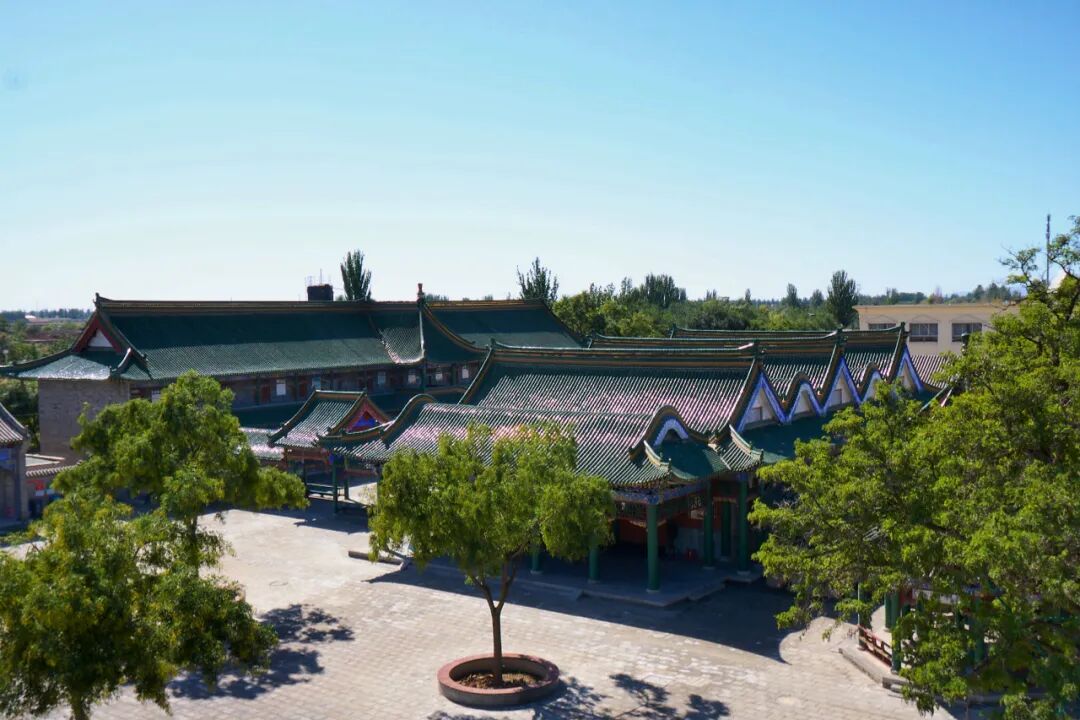
I wonder what the specific function was for this structure composed of roll-eaved, Xieshan, and Yingshan (hard-mountain) roofs.

Outside the main prayer hall hang several inscribed plaques presented by famous figures from past dynasties—a rarity among Ningxia's mosques. Examining the signatures one by one, I recognized three of them: one was Yang Yuchun, a famous Northwest military commander from the Qianlong and Jiaqing eras; another was Dong Fuxiang, commander of the Gansu Army in the late Qing dynasty; and the third was Ma Fuxiang, one of the 'Three Ma' warlords who dominated the Northwest in the Republican era. These three Hui and Han military men are well worth discussing, as they neatly connect the bloody history between the Hui and Han peoples in the Northwest since the Qianlong era.
Yang Yuchun was a celebrated general who rose to prominence during the mid-to-late Qianlong period, alongside a Han Chinese military general of the same surname, Yang Fang. Both men participated in multiple military campaigns during Qianlong's 'Ten Great Campaigns,' and were known at the time as the 'Two Yangs.' They both took part in suppressing rebellions in the Northwest—for instance, Yang Yuchun accompanied Fikanggan (Fukangcan) to suppress the Jahriyya's second uprising, known as the Tianwu Rebellion. In his later years, his greatest achievement was teaming up with Yang Fang to quell the rebellion of Jahangir (Zhangge'er), a descendant of the southern Xinjiang Khojas. In my personal view, these 'Two Yangs' were both blessed and cursed by their times.

They were blessed by their times because they caught the tail end of the Manchu Banner troops' total military decline, yet didn't miss the relatively frequent foreign wars of the late Qianlong era, giving these Han Chinese military officers the chance to rise to prominence and achieve greatness. They were a new breed of Han military commanders who emerged after renowned Manchu generals like Fukangcan and Hailancha had passed from the scene. Had they been born a few decades earlier, under the Manchu-supremacist military doctrine, they would have merely been sidekicks to Manchu and Mongol generals, never rising to command armies.
A portrait of Yang Yuchun hanging in the Ziguangge (Hall of Purple Light)

Yet they were also cursed by their times, because while the first half of their lives caught a faint glimmer of the Old Man's (Emperor Qianlong's) military glory, the second half forced them to act as firefighters, cleaning up burning messes across a crumbling empire. Yang Yuchun, in particular, fought against Lin Shuangwen in Taiwan, campaigned against the Gorkhas (Nepalese) across the Himalayas, suppressed the White Lotus Rebellion in Sichuan and Hubei as well as the Miao uprisings in Hunan and Guizhou, and finally swept through southern Xinjiang to crush Jahangir. His military career touched nearly every extreme frontier of the Qing dynasty. Yet all it bought him was a head of white hair in the Ziguangge, nursing old ambitions with lingering resentment, ultimately unable to prop up the falling heavenly dynasty. Still, he was relatively lucky to step away in time. Yang Fang, who belonged to a younger generation, lived long enough to witness the Opium War, deploying the ancestral 'Yinmen Array' (you can look up what kind of formation this was if you're curious) against the British 'foreign devils' atop the city walls of Guangzhou, leaving future generations to sneer at the dynasty's ignorance and ruining his hard-earned reputation in his twilight years—a case of living long enough to bring disgrace upon oneself.
Shaanxi-Gansu Governor-General Yang Yuchun's inscription plaque for the Najahu Mosque
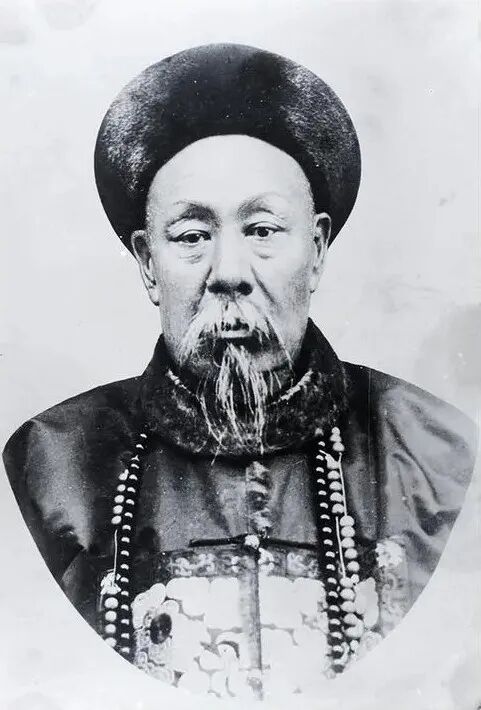
Dong Fuxiang hardly needs an introduction; anyone familiar with the Northwest's Hui history knows him well. Originally a leader of the Gelaohui (Elder Brothers Society) uprising in northern Shaanxi during the Tongzhi era, he was defeated and pacified by Zuo Zongxiang, subsequently becoming a vanguard in pacifying the Hui uprisings. His militia—composed of Han vagrants known as the 'Dong Three Battalions'—became a chess piece used to balance the surrendered Hui armies. After Zuo Zongxiang's death, during the pacification of the Hehuang disturbances, Dong rose to prominence through military merit. His Gansu Army (by then expanded beyond his original Han vagrant base to incorporate many surrendered Hui troops) skyrocketed in power after the Huai Army lost its prestige following the First Sino-Japanese War, becoming a military pillar the Qing court relied upon and incorporating into the newly established imperial guard: the Wowei Army (Guard Corps).
Dong Fuxiang

Yet this Rear Guard of the Wowei Corps retained its rough-and-tumble bandit origins: while perhaps the worst-equipped division in the Wowei Army, they were fiercely rebellious and hard to tame. During the Boxer Rebellion, they were among the most active participants in joining the Boxers, brutally murdering foreign diplomats—an action that directly triggered the military intervention of the Eight-Nation Alliance.
Wowei Rear Army Commander Dong Fuxiang's inscription plaque for the Najahu Mosque. For some reason, his signature reads 'Commander of the Wowei District Army,' though his Gansu Army unit designation should have been the Wowei Rear Army.

Ma Fuxiang's rise to power was also closely tied to Dong Fuxiang's Gansu Army. His father, Ma Qianling, had close ties with the rebel Huasi Menhuan faction that dominated Hehuang during the Tongzhi Hui Rebellion, though he wasn't part of the direct lineage of Huasi Menhuan leader Ma Guiyuan. After the Battle of Taizisi thwarted Zuo Zongxiang's military campaigns, Ma Qianling very pragmatically persuaded leader Ma Zong'ao (who was also Ma Qianling's nephew) to take the win while they were ahead and voluntarily surrender. Zuo Zongxiang logically supported Ma Zong'ao as a proxy to replace the old Huasi Menhuan forces, and Ma Qianling's family leveraged this momentum to rise to prominence.
Originally, the family patriarch after Ma Qianling was Ma Fuxiang's older brother, Ma Fulu. He was a fiercely brave military man who passed the military imperial examinations, though legend has it that Emperor Guangzong denied him the top 'zhuangyuan' scholar spot because his manners were too crude. Still, he was a loyal subject deeply devoted to the emperor and actively participated in Dong Fuxiang's campaigns to suppress the Hehuang Hui uprisings. Because of his loyalty to the imperial house, his troops were the most active in fighting foreigners during the Boxer Rebellion, suffering the heaviest casualties and ultimately shedding their blood at Zhengyangmen Gate. Because of his death, Ma Fuxiang became the new family head, emerging as a prominent figure during the Republican era. His Ningxia Hui army gradually rose to become one of the 'Three Ma' factions of the Northwest, standing alongside the Gansu Ma and Qinghai Ma cliques.
Ma Fuxiang
Ma Fuxiang, much like his older brother, was fundamentally a military man, yet he was fiercely passionate about Islamic scholarly causes. Many ancient Islamic texts were published thanks to his financial sponsorship, making an immense contribution to the preservation and continuation of Chinese Islamic culture. When examining these classic texts, I often come across his preface inscriptions; his sincere pursuit of Iman (faith) shines through every single stroke of ink, clearly not just affected or pretentious prose. It always fills me with deep admiration—even an ordinary man of action can keep his word, and his steadfast resolve cannot be shaken.

A plaque inscribed for the Najahu Mosque (Najahu Mosque) by Ma Fuxiang, the military governor of Ningxia.
Examining its architectural style, this mosque isn't regular in structure, and it completely throws out basic symmetry. If you take a central pavilion as the axis, one side features a main prayer hall consisting of five hip-and-gable or gable roofs interspersed with four connected roll-vault sheds, with a towering hip-and-gable roof on the front porch. On the other side sits a slightly smaller building made up of three hip-and-gable or gable roofs interspersed with three roll-vault sheds (since I couldn't go inside, I'm not sure what this building's exact function is; it looks like another prayer hall, though I've never heard of a single mosque having two prayer halls), and its front porch features a roll-vault style. Both large structures are linked by covered corridors—one big, one small; one rigid, one fluid. Even though it's asymmetrical, it feels like it embodies the Taoist principle of yin and yang.

The main prayer hall.
The mihrab at the back of the main prayer hall isn't housed in a massive vaulted alcove like the ones you see in mosques across North China.

Rules equal order, but they also mean constraint. The lack of strict rules shows just how far this place is from the core of traditional Chinese civilization, yet that's exactly what makes it so fascinating. Precisely because of this, there was room for creativity. Out in a remote, turbulent military frontier, people could freely mix and match hip-and-gable, gable, and roll-vault roofs, wildly sketching out their devotion to an unnameable faith.
Whenever I look at ancient architecture and hear people confidently pointing at roof ridges and tile ends, explaining what structural style it is, which social class it represents, or what it says about the status of the temple, I just shrug and brush it off. People whose brains are totally wired to the ancient architectural manuals seem even more rigid than the craftsmen of the imperial era, insisting not a single mortise and tenon can be missing. The world in their eyes is neatly lined up like brackets in dougong, with everyone in their exact place—above or below, rigid and tightly interlocked. People with such veils over their eyes fail to see the true and wondrous essence within worldly laws.

"Allah has set a seal upon their hearts and their hearing, and over their vision is a veil."
As the ancient saying goes: "Seek knowledge, even if you must go as far as China."

If hidden gems are found in remote places, why not seek truth outside the mainstream centers?
After publishing this article yesterday, a staff member at the Mingxin Mosque reached out to me privately to point out some errors in my introduction to the temple, so I've made some minor revisions and am reposting it. Also, thanks to two readers who added context in the comments yesterday, I now know that the secondary building at the Najahu Mosque whose purpose I wasn't sure about is actually a women's prayer hall built 12 years ago. Word has it that after a devoted single mother who endured great hardship to raise her children while keeping the mosque in her heart passed away, her children donated funds during a mosque renovation to build this new hall exclusively for female Muslims to offer their prayers. It was precisely that renovation and expansion to the south that made the mosque asymmetrical.
Looks like my observation was spot on after all—it really is one large and one small structure, organically echoing the balance of yin and swang. At the same time, I never expected a newly built hall could be designed with such rustic charm and creativity. Not only did it avoid breaking the vibe of the original architecture, but it actually added a fresh, playful dynamic through the blend of rigidity and fluidity. This completely shattered my prejudices regarding the design and aesthetics of newly built mosques in Ningxia. It just goes to show that true talent and wisdom can be found tucked away in the countryside—they really weren't kidding.
A Mosque That Purifies the Heart and Embraces Truth: The Architectural Spatial Order and Islamic Aesthetics of Najahu Mosque
Abstract:
A deep dive into the Najahu Mosque through the lens of architectural aesthetics and religious culture. We explore how its axially symmetrical, traditional Chinese double-eaved Xieshan-style roof and brick carvings embody the pure faith of Northwest China's Muslims in submitting to Allah and loving humanity.
Downtown Yinchuan doesn't have many historic landmarks left, and most of its mosques are modern constructions. After a quick stroll past the Drum Tower and Jade Emperor Pavilion, and a brief look at the empty Xinhua Mosque, I hopped in a car and headed south.
Reportedly, it's a mosque primarily serving Ikhwan Muslims, though unfortunately no one was around.
On the outskirts near the Tanglai Canal stands Minxin Mosque, the only mosque in Yinchuan centered around Jahriyya Sufi Muslims. According to the mosque's ahong (imam), the name comes from the phrase 'enlightening the heart to perceive one's true nature.' At the main entrance hangs a pair of plaques inscribed with: 'Spreading the Way to the East to carry on the past and usher in the future' and 'Propagating the teachings to the West, uniting the three vehicles.' The 'three vehicles' here aren't the Buddhist Sravakayana, Pratyekabuddayana, and Bodhisattvayana; instead, they refer to the three stages in Islamic Sufism: Sharia (the ritual path), Tariqah (the spiritual path), and Haqiqa (ultimate Truth).
Visually, this young mosque opted for a fully Sinicized design from the start. While the interior features modern decor, the exterior carries a distinct Han-Tang aesthetic. Compared to those awkward, forced buildings in the city center where Arab-style domes were chopped off and replaced with Chinese roofs, this one actually respects the viewer's sense of aesthetics.
Yinchuan during the National Day holiday felt completely devoid of festive spirit. Most people had likely migrated south like wintering birds, leaving this mosque far from the city center utterly quiet and undisturbed. Since there were no ancient steles or classic texts to examine, I didn't linger long and continued further south into remote Yongning County. There stands Yinchuan's only surviving ancient, traditional-style mosque—the Najahu Mosque.
Najahu is a village in Yongning's Yanghe Town, where eighty percent of the residents share the surname Na. Their ancestors trace back to Saiyid Shams al-Din (also known as Sayyid Ajall Shams al-Din), a prominent Muslim official from the early Yuan dynasty. According to the History of Yuan, Saiyid Ajall was a nobleman from Transoxiana who surrendered during Genghis Khan's western campaigns—though this is certainly a historical error by chroniclers, because his primary historical achievements took place long after Kublai Khan established the Yuan dynasty. Over forty years separated Genghis Khan's conquest of Transoxiana and Saiyid Ajall's governorship in Shaanxi and Yunnan. By the time he passed away in the sixteenth year of Zhiyuan (1279), more than half a century had elapsed. Moreover, the historical texts explicitly state he was '69 years old,' meaning he would have been a child under ten if he had 'led a thousand cavalry with leopards and falcons to surrender.' It is far more likely that his father was the one who surrendered to the Mongols, and that his father held the honorific title of Saiyid (signifying descent from Ali and Husayn, though later often falsely claimed by those cozying up to prestigious lineages). Careless Ming dynasty historians likely mistook the two.
Saiyid Ajall's eldest son was named Nasr al-Din, a very common Central and West Asian Muslim name. Like his father, he served as a provincial chancellor and was posthumously granted the title of Prince after his death. Interestingly, the sons of this Prince of Yan each took a character from the Chinese transliteration of his name to use as their surname, which is why his descendants split into surnames like Na, Su (or Suo), La, and Ding. The village of Najahu was formed by Hui Muslims bearing the Na surname migrating and settling here.
Perhaps precisely because this is Yinchuan's only traditional ancient Chinese-style mosque, a Huixiang (Hui Homeland) Cultural Park was built nearby many years ago. But as I mentioned earlier, that folklore park—operating under the banner of 'Hui culture'—showed off the most cliché, fictionalized fake Hui folk customs tailored for mass appeal, brimming with One Thousand and One Nights exoticism and used mainly as a backdrop for young couples' wedding photos. During the recent crackdown on the 'Threeizations' (Arabization, etc.), it was demolished. This also left the shops outside the Najahu Mosque plaza completely desolate and dilapidated, plunging this promising new village right back to its rural starting point.
Facing this scene, my feelings were complicated. From a long-term perspective, I've always supported the inheritance and development of traditions rooted in local soil and history. Aesthetically, I've never had any patience for those ultra-plastic, Thousand and One Nights-style movie-set buildings. Yet when political campaigns and reforms always come at the expense of ordinary working-class folks, I find it hard to stand on the lofty heights of grand narratives and turn a deaf ear to the humble cries of the powerless. Because facing an unpredictable destiny, at our core, we are no different from them.
There are very few well-preserved ancient Chinese mosques left in Ningxia today, and in terms of architecture, the two most representative ones are the Najahu Mosque in Yongning County, Yinchuan, and the Tongxin Great Mosque (Tongxin Mosque) in Tongxin County, Wuzhong.
Much like the Tongxin Great Mosque, the entrance of the Najahu Mosque resembles a city gate tower, with the minaret (bunker tower) built in the style of defensive watchtowers on city walls. Personally, I suspect the resemblance between these two mosques isn't a coincidence; it's likely a leftover trace of the military culture in Ningxia during the Ming dynasty. At the time, the area constantly faced the threat of Mongol cavalry raids, and the local Hui people were largely hereditary garrison soldiers. Consequently, even public buildings like mosques had to incorporate certain military defense functions, serving as temporary fortresses to protect the local community during wartime.
Standing atop the towering bunker tower, the entire panorama of the mosque unfolds before your eyes. The mosque is grand in scale, which contrasts sharply with the village's current poverty and decline, hinting that this place must have once been a thriving, renowned major Hui settlement. The ancient pagoda trees inside the courtyard are lush and green; tapping the trunks to ask about history takes us all the way back to the early Ming dynasty, aligning with the temple plaque record stating the mosque was built in the third year of Jiajing (1524).
I wonder what the specific function was for this structure composed of roll-eaved, Xieshan, and Yingshan (hard-mountain) roofs.
Outside the main prayer hall hang several inscribed plaques presented by famous figures from past dynasties—a rarity among Ningxia's mosques. Examining the signatures one by one, I recognized three of them: one was Yang Yuchun, a famous Northwest military commander from the Qianlong and Jiaqing eras; another was Dong Fuxiang, commander of the Gansu Army in the late Qing dynasty; and the third was Ma Fuxiang, one of the 'Three Ma' warlords who dominated the Northwest in the Republican era. These three Hui and Han military men are well worth discussing, as they neatly connect the bloody history between the Hui and Han peoples in the Northwest since the Qianlong era.
Yang Yuchun was a celebrated general who rose to prominence during the mid-to-late Qianlong period, alongside a Han Chinese military general of the same surname, Yang Fang. Both men participated in multiple military campaigns during Qianlong's 'Ten Great Campaigns,' and were known at the time as the 'Two Yangs.' They both took part in suppressing rebellions in the Northwest—for instance, Yang Yuchun accompanied Fikanggan (Fukangcan) to suppress the Jahriyya's second uprising, known as the Tianwu Rebellion. In his later years, his greatest achievement was teaming up with Yang Fang to quell the rebellion of Jahangir (Zhangge'er), a descendant of the southern Xinjiang Khojas. In my personal view, these 'Two Yangs' were both blessed and cursed by their times.
They were blessed by their times because they caught the tail end of the Manchu Banner troops' total military decline, yet didn't miss the relatively frequent foreign wars of the late Qianlong era, giving these Han Chinese military officers the chance to rise to prominence and achieve greatness. They were a new breed of Han military commanders who emerged after renowned Manchu generals like Fukangcan and Hailancha had passed from the scene. Had they been born a few decades earlier, under the Manchu-supremacist military doctrine, they would have merely been sidekicks to Manchu and Mongol generals, never rising to command armies.
A portrait of Yang Yuchun hanging in the Ziguangge (Hall of Purple Light)
Yet they were also cursed by their times, because while the first half of their lives caught a faint glimmer of the Old Man's (Emperor Qianlong's) military glory, the second half forced them to act as firefighters, cleaning up burning messes across a crumbling empire. Yang Yuchun, in particular, fought against Lin Shuangwen in Taiwan, campaigned against the Gorkhas (Nepalese) across the Himalayas, suppressed the White Lotus Rebellion in Sichuan and Hubei as well as the Miao uprisings in Hunan and Guizhou, and finally swept through southern Xinjiang to crush Jahangir. His military career touched nearly every extreme frontier of the Qing dynasty. Yet all it bought him was a head of white hair in the Ziguangge, nursing old ambitions with lingering resentment, ultimately unable to prop up the falling heavenly dynasty. Still, he was relatively lucky to step away in time. Yang Fang, who belonged to a younger generation, lived long enough to witness the Opium War, deploying the ancestral 'Yinmen Array' (you can look up what kind of formation this was if you're curious) against the British 'foreign devils' atop the city walls of Guangzhou, leaving future generations to sneer at the dynasty's ignorance and ruining his hard-earned reputation in his twilight years—a case of living long enough to bring disgrace upon oneself.
Shaanxi-Gansu Governor-General Yang Yuchun's inscription plaque for the Najahu Mosque
Dong Fuxiang hardly needs an introduction; anyone familiar with the Northwest's Hui history knows him well. Originally a leader of the Gelaohui (Elder Brothers Society) uprising in northern Shaanxi during the Tongzhi era, he was defeated and pacified by Zuo Zongxiang, subsequently becoming a vanguard in pacifying the Hui uprisings. His militia—composed of Han vagrants known as the 'Dong Three Battalions'—became a chess piece used to balance the surrendered Hui armies. After Zuo Zongxiang's death, during the pacification of the Hehuang disturbances, Dong rose to prominence through military merit. His Gansu Army (by then expanded beyond his original Han vagrant base to incorporate many surrendered Hui troops) skyrocketed in power after the Huai Army lost its prestige following the First Sino-Japanese War, becoming a military pillar the Qing court relied upon and incorporating into the newly established imperial guard: the Wowei Army (Guard Corps).
Dong Fuxiang
Yet this Rear Guard of the Wowei Corps retained its rough-and-tumble bandit origins: while perhaps the worst-equipped division in the Wowei Army, they were fiercely rebellious and hard to tame. During the Boxer Rebellion, they were among the most active participants in joining the Boxers, brutally murdering foreign diplomats—an action that directly triggered the military intervention of the Eight-Nation Alliance.
Wowei Rear Army Commander Dong Fuxiang's inscription plaque for the Najahu Mosque. For some reason, his signature reads 'Commander of the Wowei District Army,' though his Gansu Army unit designation should have been the Wowei Rear Army.
Ma Fuxiang's rise to power was also closely tied to Dong Fuxiang's Gansu Army. His father, Ma Qianling, had close ties with the rebel Huasi Menhuan faction that dominated Hehuang during the Tongzhi Hui Rebellion, though he wasn't part of the direct lineage of Huasi Menhuan leader Ma Guiyuan. After the Battle of Taizisi thwarted Zuo Zongxiang's military campaigns, Ma Qianling very pragmatically persuaded leader Ma Zong'ao (who was also Ma Qianling's nephew) to take the win while they were ahead and voluntarily surrender. Zuo Zongxiang logically supported Ma Zong'ao as a proxy to replace the old Huasi Menhuan forces, and Ma Qianling's family leveraged this momentum to rise to prominence.
Originally, the family patriarch after Ma Qianling was Ma Fuxiang's older brother, Ma Fulu. He was a fiercely brave military man who passed the military imperial examinations, though legend has it that Emperor Guangzong denied him the top 'zhuangyuan' scholar spot because his manners were too crude. Still, he was a loyal subject deeply devoted to the emperor and actively participated in Dong Fuxiang's campaigns to suppress the Hehuang Hui uprisings. Because of his loyalty to the imperial house, his troops were the most active in fighting foreigners during the Boxer Rebellion, suffering the heaviest casualties and ultimately shedding their blood at Zhengyangmen Gate. Because of his death, Ma Fuxiang became the new family head, emerging as a prominent figure during the Republican era. His Ningxia Hui army gradually rose to become one of the 'Three Ma' factions of the Northwest, standing alongside the Gansu Ma and Qinghai Ma cliques.
Ma Fuxiang
Ma Fuxiang, much like his older brother, was fundamentally a military man, yet he was fiercely passionate about Islamic scholarly causes. Many ancient Islamic texts were published thanks to his financial sponsorship, making an immense contribution to the preservation and continuation of Chinese Islamic culture. When examining these classic texts, I often come across his preface inscriptions; his sincere pursuit of Iman (faith) shines through every single stroke of ink, clearly not just affected or pretentious prose. It always fills me with deep admiration—even an ordinary man of action can keep his word, and his steadfast resolve cannot be shaken.
A plaque inscribed for the Najahu Mosque (Najahu Mosque) by Ma Fuxiang, the military governor of Ningxia.
Examining its architectural style, this mosque isn't regular in structure, and it completely throws out basic symmetry. If you take a central pavilion as the axis, one side features a main prayer hall consisting of five hip-and-gable or gable roofs interspersed with four connected roll-vault sheds, with a towering hip-and-gable roof on the front porch. On the other side sits a slightly smaller building made up of three hip-and-gable or gable roofs interspersed with three roll-vault sheds (since I couldn't go inside, I'm not sure what this building's exact function is; it looks like another prayer hall, though I've never heard of a single mosque having two prayer halls), and its front porch features a roll-vault style. Both large structures are linked by covered corridors—one big, one small; one rigid, one fluid. Even though it's asymmetrical, it feels like it embodies the Taoist principle of yin and yang.
The main prayer hall.
The mihrab at the back of the main prayer hall isn't housed in a massive vaulted alcove like the ones you see in mosques across North China.
Rules equal order, but they also mean constraint. The lack of strict rules shows just how far this place is from the core of traditional Chinese civilization, yet that's exactly what makes it so fascinating. Precisely because of this, there was room for creativity. Out in a remote, turbulent military frontier, people could freely mix and match hip-and-gable, gable, and roll-vault roofs, wildly sketching out their devotion to an unnameable faith.
Whenever I look at ancient architecture and hear people confidently pointing at roof ridges and tile ends, explaining what structural style it is, which social class it represents, or what it says about the status of the temple, I just shrug and brush it off. People whose brains are totally wired to the ancient architectural manuals seem even more rigid than the craftsmen of the imperial era, insisting not a single mortise and tenon can be missing. The world in their eyes is neatly lined up like brackets in dougong, with everyone in their exact place—above or below, rigid and tightly interlocked. People with such veils over their eyes fail to see the true and wondrous essence within worldly laws.
"Allah has set a seal upon their hearts and their hearing, and over their vision is a veil."
As the ancient saying goes: "Seek knowledge, even if you must go as far as China."
If hidden gems are found in remote places, why not seek truth outside the mainstream centers?
After publishing this article yesterday, a staff member at the Mingxin Mosque reached out to me privately to point out some errors in my introduction to the temple, so I've made some minor revisions and am reposting it. Also, thanks to two readers who added context in the comments yesterday, I now know that the secondary building at the Najahu Mosque whose purpose I wasn't sure about is actually a women's prayer hall built 12 years ago. Word has it that after a devoted single mother who endured great hardship to raise her children while keeping the mosque in her heart passed away, her children donated funds during a mosque renovation to build this new hall exclusively for female Muslims to offer their prayers. It was precisely that renovation and expansion to the south that made the mosque asymmetrical.
Looks like my observation was spot on after all—it really is one large and one small structure, organically echoing the balance of yin and swang. At the same time, I never expected a newly built hall could be designed with such rustic charm and creativity. Not only did it avoid breaking the vibe of the original architecture, but it actually added a fresh, playful dynamic through the blend of rigidity and fluidity. This completely shattered my prejudices regarding the design and aesthetics of newly built mosques in Ningxia. It just goes to show that true talent and wisdom can be found tucked away in the countryside—they really weren't kidding.
