
Exploring Changji: The History of Hui Muslims and the Legacy of Ma Liangjun at Shaanxi Grand Mosque
[Internet Repost]
I traveled from Urumqi to the Northern Xinjiang hub of Changji—historically known as Ningbian—to trace the legacy of Ma Liangjun, the renowned Hui Muslim religious leader and educator. My journey documents the architecture of the Changji Shaanxi Grand Mosque and the century-old history of how Hui Muslim pioneers there championed education and their faith.
It was mid-October. As soon as I arrived in Urumqi from Tashkent, the freezing air cut right through my clothes the moment I stepped off the jet bridge.
I spent two days kicking around that bleak provincial capital. Aside from a few Uyghur restaurants on Yan'an Road, nothing really left a mark on me. It felt pretty underwhelming, so I hopped on a ride to Changji to pay my respects to a Wali (a saintly figure or friend of Allah) whom I deeply admire in the context of modern Xinjiang history.
Compared to the chaos of Urumqi, Changji felt surprisingly chill and refreshing. The gold-tinted "piyanzi" (onion)—officially known as the Xinjiang Grand Theatre—drifted past my right window, signaling that I’d entered the city limits. With its wide streets, tidy apartment buildings, and the occasional retro park left over from the 90s, Changji is a young, grounded city in Northern Xinjiang.
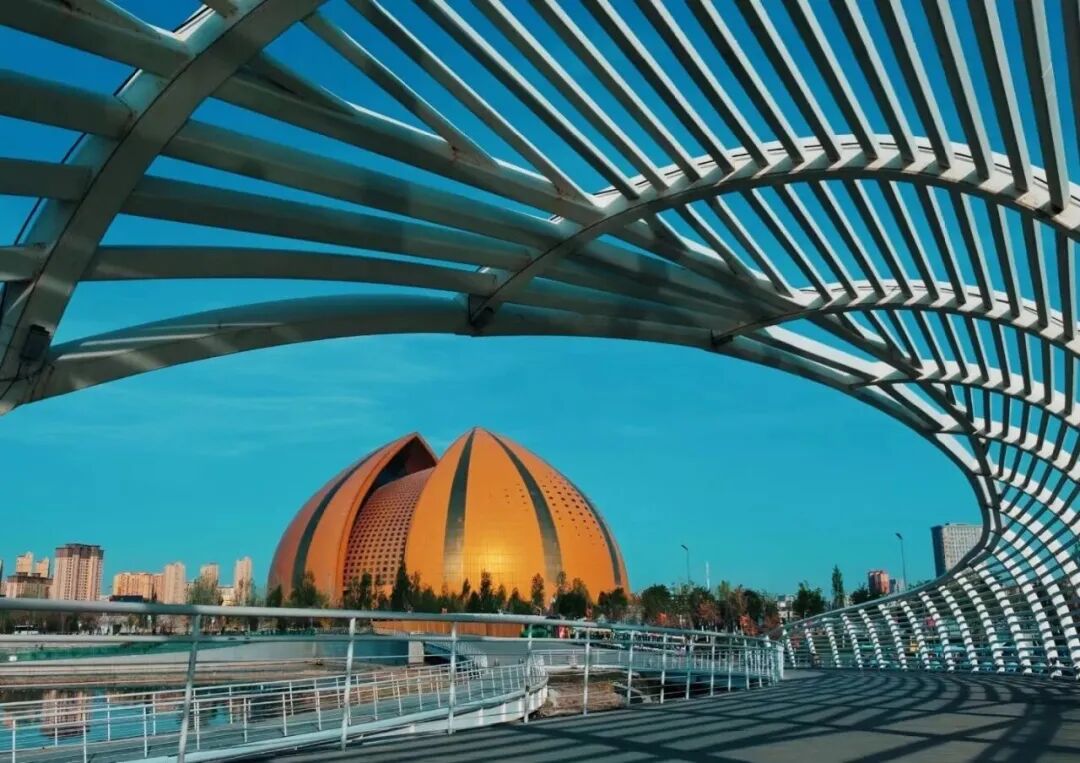
The Xinjiang Grand Theatre. This local landmark was originally designed to look like a blooming lotus flower, but due to budget cuts, they were left with just the center bud. They painted it gold, leading locals to jokingly call it the "Onion Building."
Calling it "young" doesn't mean the city lacks history. If we mark the start of Chinese influence in the Western Regions from the Han Dynasty, this area was one of the first to bear the mark of the Central Plains. It’s where the Han general Geng Gong famously stood his ground, and where the Uyghur people established their khanate after moving west.
But the truth is, neither Geng Gong's Shule City (now the Shichengzi ruins in Qitai County) nor the Uyghur Khagan’s Ordu (now the Beiting ruins in Jimsar County) are located within the current city limits of Changji. They’re further east in the county jurisdictions. Basically, the center of gravity back then was shifted east because of trade and military links with Gaochang (Turpan). The modern city of Changji only really took off because of the later connection between Dihua (Urumqi) and Ili in the north.
The modern urban area of Changji essentially traces its roots back to the Ningbian City built during the Qing Dynasty.
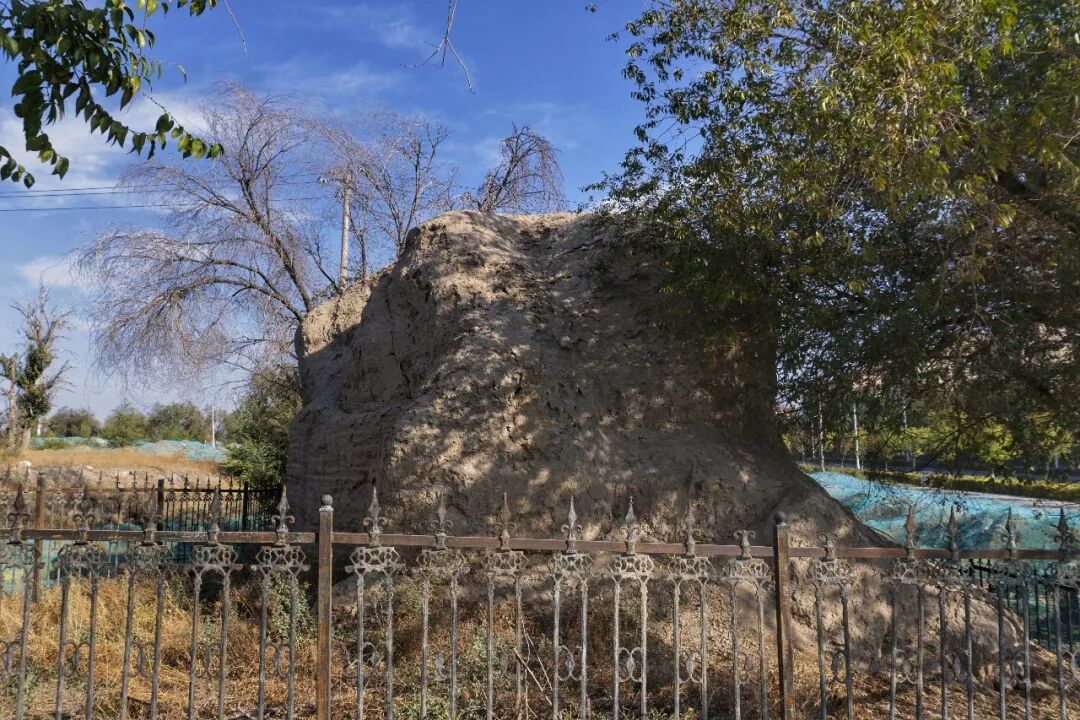
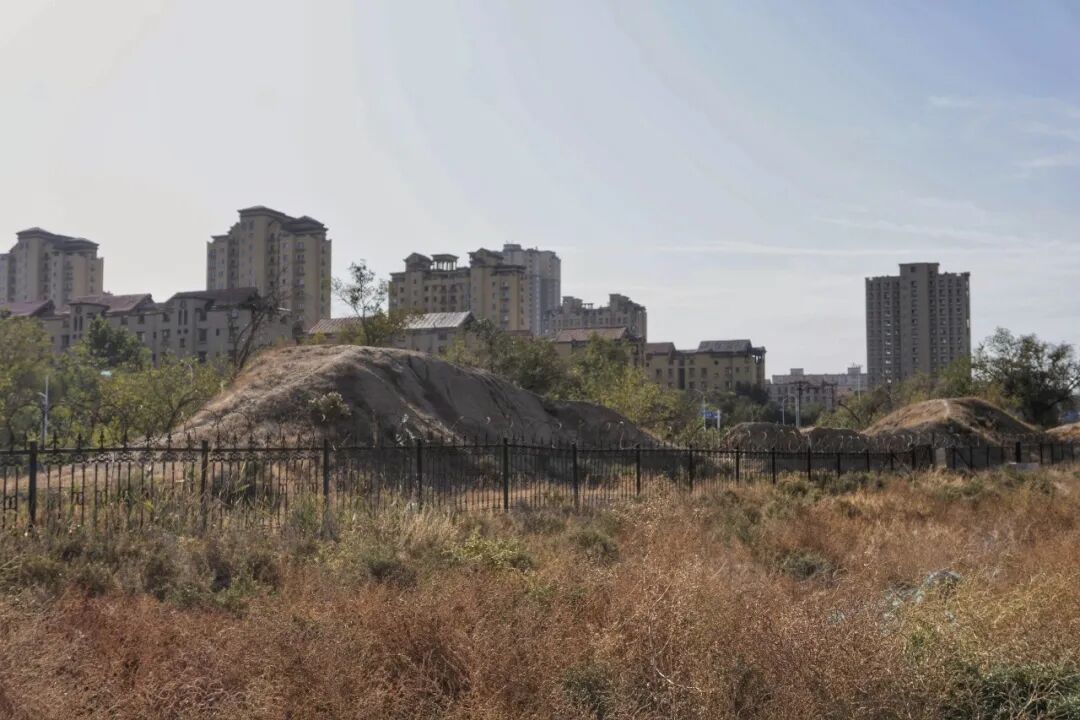
The ruins of Ningbian City on the outskirts of Changji.
In 1757, the Qing Dynasty suppressed the rebellion of Amursana, and by 1759, they’d put down the rebellion of the Khoja brothers. By the 1860s, the Qing had fully consolidated control over Xinjiang and started setting up a new administrative order. Ili was the military hub, but Urumqi, tucked under the central Tianshan Mountains, gradually became the primary administrative center, second only to Ili.
Ningbian City was the first of a series of garrison towns built by the Qing to connect Urumqi and Ili. So, in a way, the rise of today's Changji was the direct result of the Qing government reordering Northern and Eastern Xinjiang and making Urumqi the seat of power instead of Turpan. From that perspective, Changji is indeed a very young city.
Its "grounded" nature makes total sense when you realize that. Since it evolved from a Qing garrison town, the culture is rooted in reclamation and farming. You can hear that humble, rustic vibe in how the locals talk. They call the theater the "Onion Building" and the Flying Horse Plaza the "Leek Plaza," as if they have to relate anything new or shiny back to the crops they’ve spent generations growing.
The Hui Muslims of Changji moved here along with the growth of this garrison city. Under the Qing military structure, the "banner men" were a purely military class that didn't produce food. To keep the machine running, they needed farmers, merchants, and artisans from other ethnic groups—either the Taranchi (a name from Oirat Mongol for 'farmers', originally referring to Central Asian farmers relocated to the north by the Qing) or Hui and Han farmers from the Chinese interior, especially from the Shaanxi and Gansu provinces.
Just like that, Ningbian and Changji became major landmarks in the history of the Hui people, eventually becoming the final resting place for the great scholar, Imam Ma Liangjun.
Ma Liangjun—a name that popped up in my reading of modern Xinjiang history a few times, but never really stuck. Back then, I was more focused on the big picture: nationalism, revolution, and the shifting political tides. Religion felt like a relic of the past, so for a long time, I didn't pay much attention to his achievements.
That was until last summer, when I visited the largest Dungan (Hui Muslim) settlement in Central Asia: Masanchi. In the world of the Hui people, the place has a much older and more familiar name: Yingpan (The Camp).
It’s a historical memory of the Shaanxi-Gansu Hui rebellions. During those turbulent times, thousands of Hui refugees, driven from their homes by Qing troops and local militias, organized themselves into eighteen camps. The remnant groups, eventually led by Bai Yanhu, brought the name "Yingpan" to the Chu River valley in Central Asia. After the October Revolution, the village produced a Bolshevik revolutionary hero named Ma Sanchi (originally Ma Sancheng; his mother named him 'Cheng'—'succeed'—because her first two children had died in infancy. The Russians pronounced the Dungan 'Cheng' as 'Qi,' hence the name), and the official administrative name was changed to this awkward hybrid.
At the Masanchi Dungan Museum, the director, Musa, walked me through the history of the local Dungan people, pointing out photos on the wall. Suddenly, one black-and-white image caught my eye.
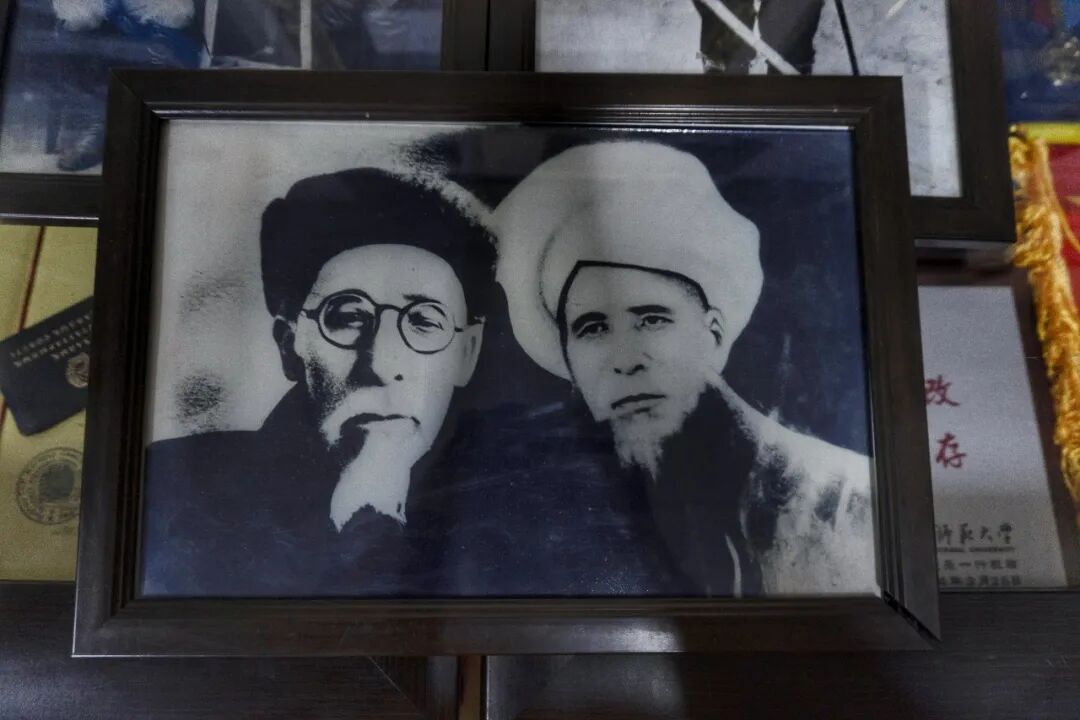
A photo from the Masanchi Dungan Museum showing Imam Ma Liangjun with local imams.
"Is that... Imam Ma Liangjun?"
Director Musa looked genuinely surprised. "Not bad, you actually know about 'Little Imam Ma'?" (Ma Liangjun became an imam at just 18 due to his exceptional knowledge, so he was nicknamed 'Little Imam Ma.' Even as he grew old and famous, the affectionate title stuck with the Hui people).
"Why is his photo here?"
"He taught school here in Yingpan for three years."
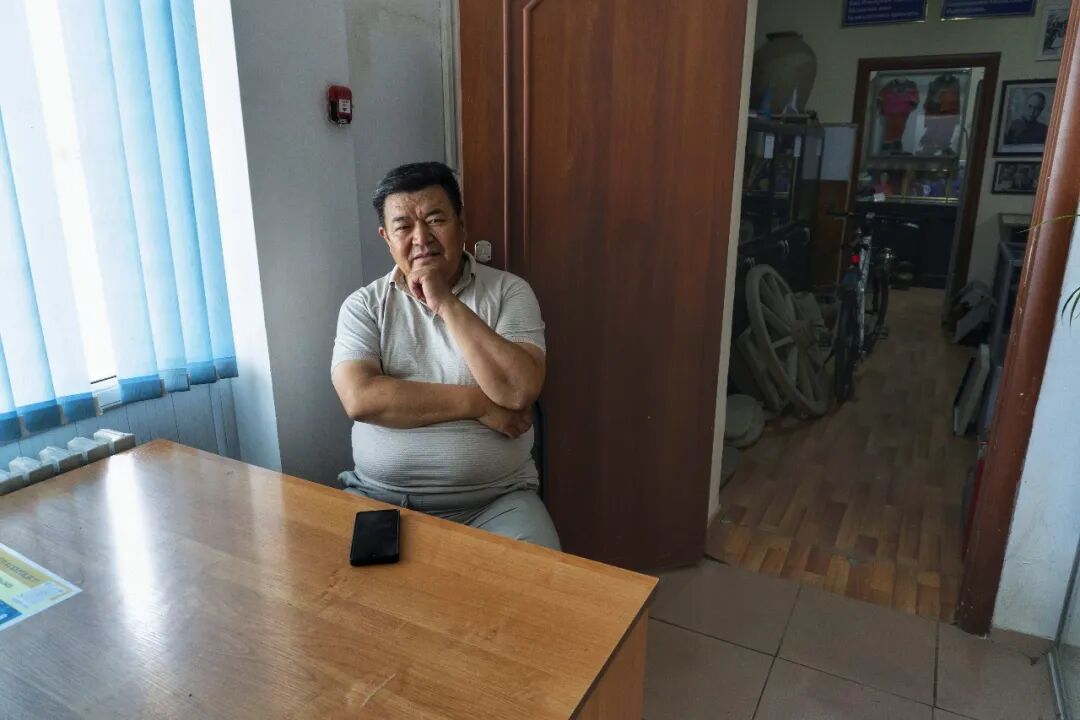
Museum Director Musa of the Masanchi Dungan Museum.
From that moment, I realized this man’s influence had crossed borders and made an impact far beyond his home. However, when I looked up records in China later, I couldn't find a single mention of him teaching in Central Asia. I suspect it happened during the two decades between 1919, when he started teaching at the Shaanxi Grand Mosque in Yining, and 1938, when he returned to Urumqi. He likely fled abroad to stay safe, most probably during the 1933–1934 civil war between Ma Zhongying, Zhang Peiyuan, and Sheng Shicai for control of Xinjiang.
This matter requires further historical verification.
At eight in the morning, I stepped out of the hotel. Xinjiang time is two hours behind Beijing, so it was still dawn, and the streets were quiet and deserted. I grabbed a taxi to the Erliugong Town Muslim Cemetery, and within no time, the car dropped me off at the fork leading to the graveyard.
However, the name on the cemetery stone wasn't the "Erliugong Town Muslim Cemetery" shown on the map; it clearly read "Erliugong Gongbei."
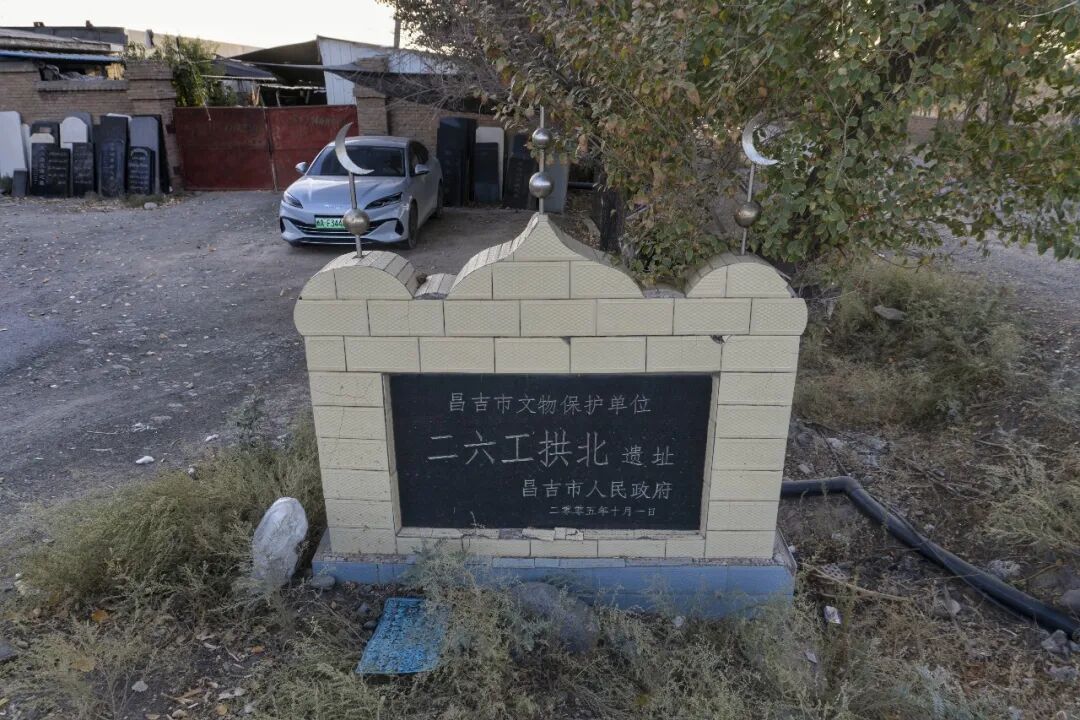
Though called a gongbei (shrine/tomb complex of a Sufi master), there were no fancy buildings around, and the reason behind this has a fascinating history.
Erliugong, just like downtown Changji, is a historical trace left behind by Qing dynasty land reclamation and military colonization (tuntian). The word "gong" (work/unit) refers to village units formed along irrigation canals dug in northern Xinjiang during the Qing dynasty, numbered sequentially. Erliugong got its name because it was formed by merging the second and sixth canal units. There is no actual gongbei structure here; it's simply because a mysterious holy figure (wali) from the late Qing dynasty, known as Gou Taiye, is buried here. Legend says he left instructions before his death forbidding later generations from building a gongbei for him. Therefore, this gongbei isn't built on the ground, but rather in the hearts of countless Muslims.


The cemetery had no directional signs at all, so I just wandered around, following my gut down the path, figuring that if it was meant to be, I would naturally find the tombs of the predecessors. Not even a hundred meters in, I spotted a small earthen mound topped with a little domed pavilion engraved with three characters meaning "Quran Recitation Pavilion." Directly facing it were two tombs without tombstones, and buried right nearby was Ma Cunliang, the famous former governor of Changji Prefecture.
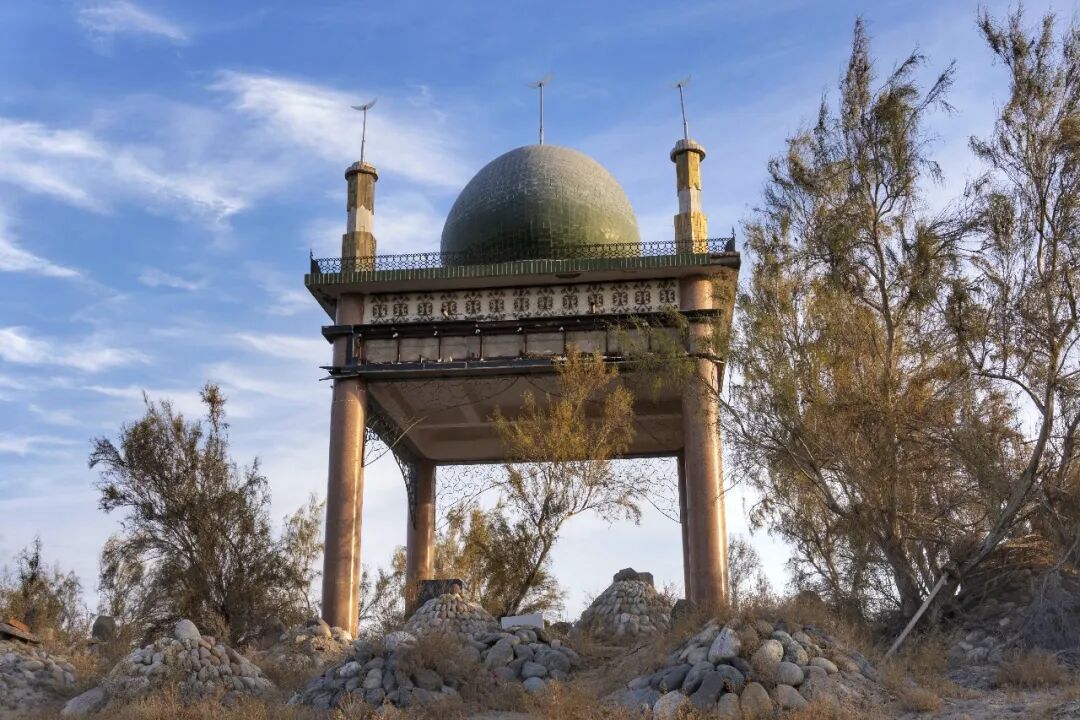
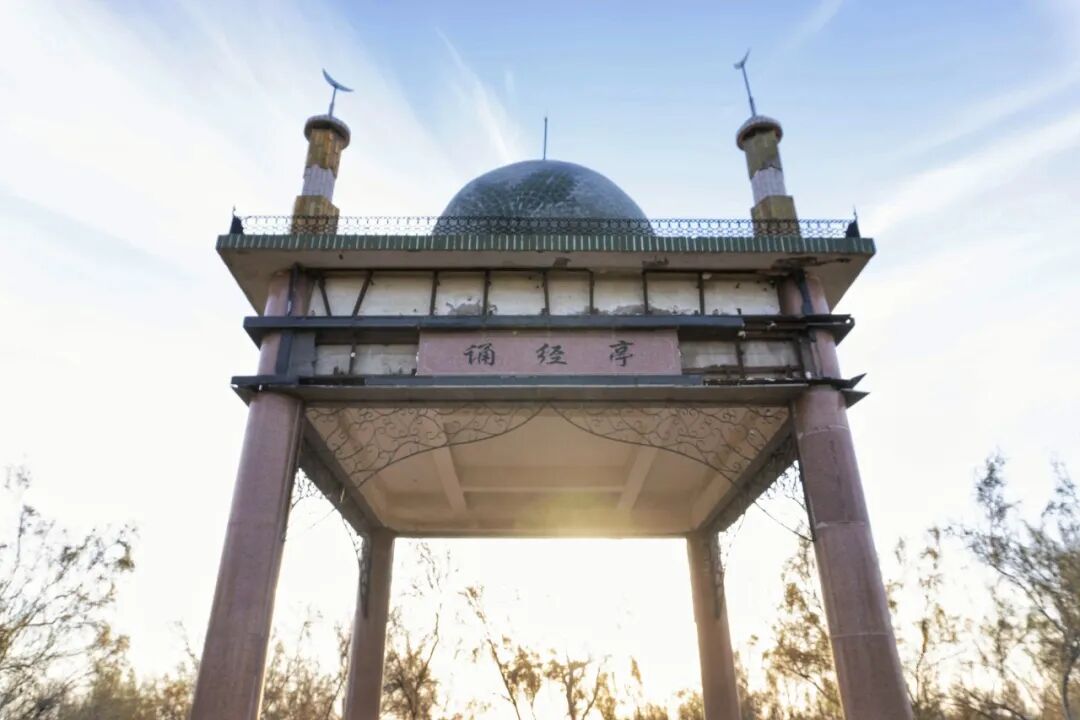
The Quran Recitation Pavilion.

The tomb of Ma Cunliang, former governor of Changji Prefecture and vice chairman of the Standing Committee of the Autonomous Region People's Congress.
Ma Cunliang is definitely a local historical figure worthy of being recorded in Changji's urban history. In just the two short days I spent in Changji, the locals brought up his legacy multiple times. Serving as governor in the early days of China's reform and opening-up, he laid the foundation for Changji to become a modern agricultural powerhouse in Xinjiang and mapped out the initial urban planning for the city.
Today, Changji's most famous landmark, Pegasus Square, is his brainchild. Although officials have never explicitly stated it, everyone in town knows the sculpture's design secretly incorporates his name: the flying horse (feima) represents his surname "Ma," and the horse galloping over a colorful ribbon leading the pack symbolizes a fierce drive ("chong"), which rhymes with "Cun" in his name. Meanwhile, the weird-looking crescent moon around the base represents "Liang" (moon) in his name. Yet, the down-to-earth locals couldn't help poking a bit of fun at this agricultural governor, likening the commemorative pillar with the crescent moon on top of the flying horse to scallions jammed into a giant bun, affectionately dubbing it the "Ma Onion-Bright Square."

Pegasus Square. This is not only the center of Changji's old town, but also the starting point for calculating highway mileage radiating outward from Changji.
Walking through this park, aside from Imam Ma Liangjun and Gou Taiye (historical records state Imam Ma Liangjun is buried right beside Gou Taiye), who else would deserve to have a standalone Quran Recitation Pavilion built for dua, or attract a high-ranking regional official to keep them company? Struggling with the lack of a tombstone for verification, I looked around for passersby visiting graves to ask.
"Excuse me, where is the tomb of Imam Ma Liangjun?"
A passerby pointed far off toward that Quran Recitation Pavilion—sure enough, it was the right place!
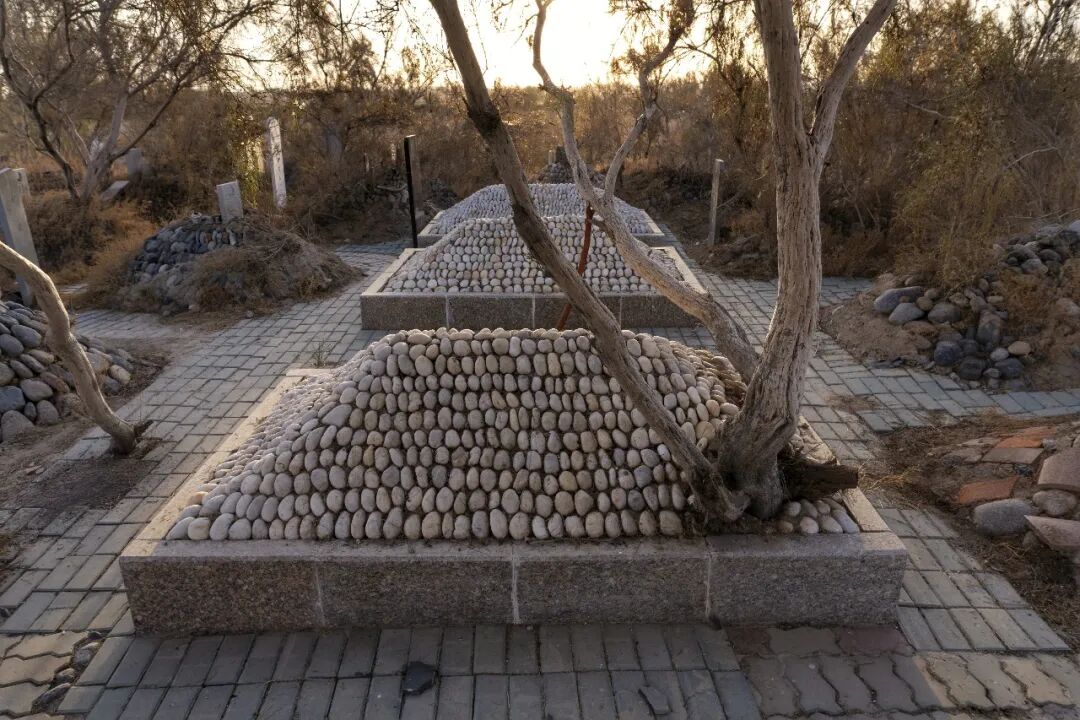
The tombs of Imam Ma Liangjun and Gou Taiye.
The Western Regions (Xiyu) were the blessed lands where this Gedimu (traditional Hanafi school in China) scholar achieved great success, dedicating half his life to this soil. Yet, perhaps very few people know that in the beginning, this trip to Xinjiang and Yili felt more like a forced exile for the old man.
In the sixth year of the Tongzhi Emperor's reign (1867), a baby boy was born into the family of Mr. and Mrs. Ma Dengxiao in Shangmozhuang, Qinzhou, Qinshua County (now near the county town of Zhangjiachuan Hui Autonomous County in Tianshui City, Gansu Province). The imam gave him the Islamic name Muhammad Yusuf. This was the peak of the chaotic Northwest Hui uprisings. Five years later, Jinjibu fell, the Jahriyya Sufi leader Ma Hualong was martyred, and all eighteen Shaanxi Hui insurgent camps except Bai Yanhu's surrendered, marking a turning point in the Northwest Hui wars. Li Decang, the former Hui insurgent leader and Jahriyya follower from Zhangjiachuan, led his forces to surrender to the Qing court. He was awarded official buttons and feathers by Zuo Zongtan, and was assigned about 30,000 remaining troops from the Jahriyya Southern Eight Camps under Mu Shenghua (grandnephew of the second-generation Jahriyya Murshid Mu Xianzhang, who served as a Reis leading Hui insurgents in the southern Ningxia region during the anti-Qing wars of the Tongzhi era) to settle in Zhangjiachuan. Li Decang thus became the Qing-sanctioned proxy ruler governing the Hui people of Zhangjiachuan post-war.
Against this backdrop, the small town of Zhangjiachuan suddenly flooded with tens of thousands of Jahriyya refugees, instantly transforming it into a new stronghold for the Jahriyya order after the Tongzhi turmoil. This situation intensified even further in 1875 when Ma Yuanzhang, the great-grandson of Jahriyya founder Ma Mingxin, fled in secret from Yunnan to Zhangjiachuan to seek Li Decang's protection, making the place a center for the revival of the Jahriyya order in the late Qing dynasty.
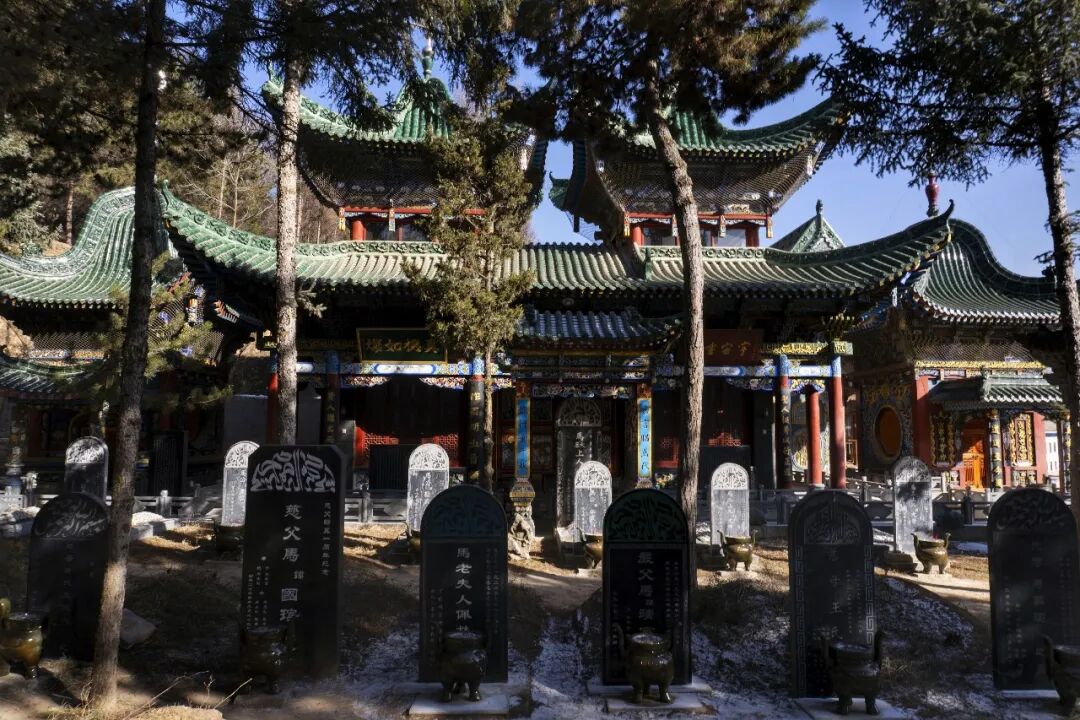
Xuanhuagang Gongbei, a sacred Jahriyya site located in Zhangjiachuan.
Young Ma Liangjun grew up in this grand environment of the Jahriyya Sufi order; both his parents and maternal relatives were devout local Jahriyya followers, and his family was comfortably well-off.
Following the path of most local Hui Muslims, his life should have consisted of entering a mosque to study Islamic texts, picking up some Confucian moral classics if he was bright enough, and eventually graduating to become an imam. After putting in a few years of seniority, he would follow a mentor within the Jahriyya, climb the ranks of the Sufi order, and ultimately become a local prayer leader or even a regional Reis.
Yet, no one can ever predict the unpredictable twists of fate. In 1883, driven by massive social mobility following the Shaanxi-Gansu Hui war, the renowned Shaanxi classical scripture teacher Ma Deqing arrived to teach at the Zhangjiachuan East Mosque. This Gedimu Erling (Islamic scholar/teacher), who deeply studied the *Tafsir al-Baydawi* (also known as *Bidawei Quranic Commentary*, compiled by the 13th-century scholar Nasir al-Din Abdallah al-Baydawi, and the most influential Quranic commentary in China's mosque education system), completely captured young Ma Liangjun's thirst for knowledge, taking him under his wing to diligently study both Islamic and Chinese texts.
Ma Deqing was the guiding teacher who altered young Imam Ma's life trajectory. This Shaanxi classical teacher, who stumbled into the Jahriyya world by chance due to war-induced displacement, inspired the future torchbearer journeying westward to see a world far beyond Zhangjiachuan—realizing there was a much broader universe outside the Sufi orders. Four years later, having achieved moderate proficiency in his studies and reaching adulthood, Ma Liangjun bid farewell to his hometown and set off on a far journey with his books, heading toward Pingliang, the post-war revival hub of Shaanxi scholarship, to study under "Puer Ma" (Ma Shouqing). Under the tutelage of this " titan of Northwest Islamic scholarship," Ma Liangjun quickly rose to fame in Pingliang as a brilliant up-and-coming talent.
Pingliang, this major hub of Gedimu scriptural learning, always seemed to share an indescribable destiny with the Jahriyya. Years ago, Jahriyya founder Ma Mingxin spotted a talent here, discovering his destined successor who transcended Vilayet and Cini, nurturing Mu Xianzhang from a Gedimu Muslim into a generation-defining Jahriyya grand master, leaving behind the legendary tale of "flowers blooming without people knowing" (as referenced in my previous article). Over a hundred years later, another Jahriyya Erling stepped into the camp of a Gedimu scripture teacher, as if fulfilling an old promise from years past.
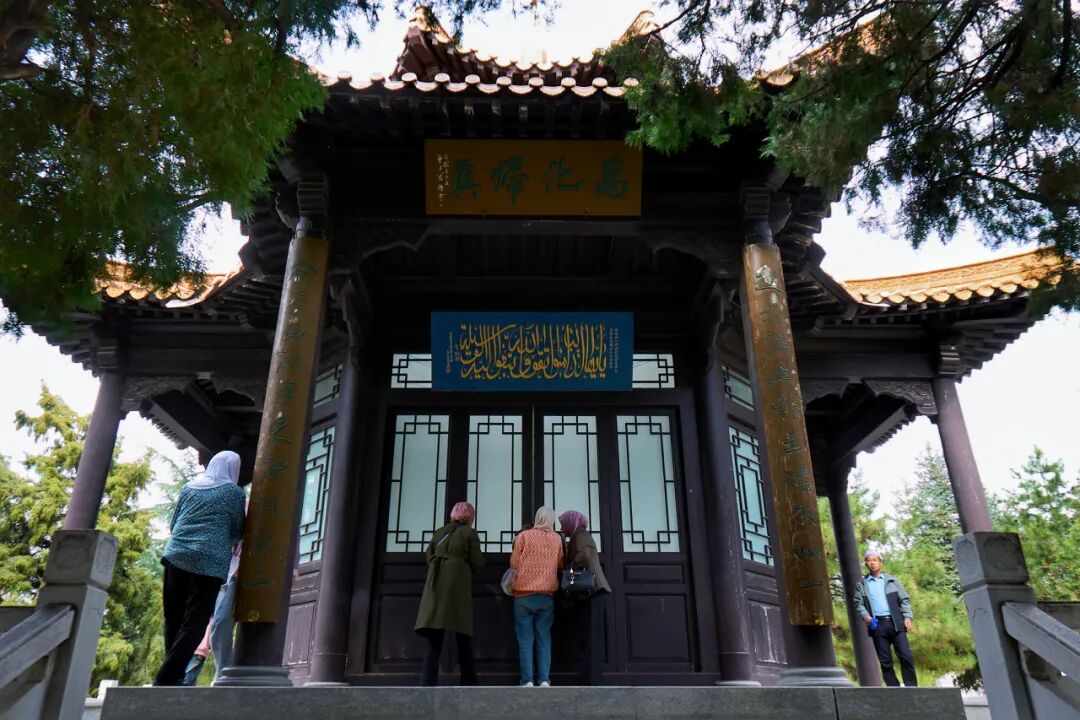
The Gongbei of Master Mu Xianzhang in Pingliang.
Not everyone had the open-minded, sect-blind perspective of Ma Mingxin; back in the day, when Mu Xianzhang changed his religious affiliation, it sparked a wave of skepticism within the Jahriyya Sufi order. Fast forward to the aftermath of the bloody conflicts during the Tongzhi era, and the heavily suppressed Jahriyya followers developed an unprecedented level of exclusivity. Even though Ma Liangjun hadn't officially broken away from the Sufi order, his eclectic style of studying under various teachers without a single permanent master was treated as an act of rebellion by his maternal uncle, Su Shangda. Even though this Hui Muslim local notable was completely illiterate in classical Islamic texts and history, he was a prominent and influential elder within the order. Seeing his nephew constantly follow Geddim (traditionalist) customs during religious rituals made him feel like his nephew was publicly slapping him in front of the local believers.
The tension finally blew up during a traditional religious gathering known as an 'ilmeli (religious gathering/feast).
Back in 1901, Ma Liangjun—who was serving as the imam of the mosque in the Twelve Fortresses of Huating, Pingliang (now Xinmin Township, Jingyuan County, Guyuan, Ningxia)—returned home to visit his family just as they were preparing food for an 'ilmeli. Starving and unaware of the situation, Ma Liangjun walked into the kitchen, grabbed a piece of youxiang (fried unleavened dough), and broke it open to grab a quick bite. Little did he know that this particular batch of youxiang was specifically prepared for the 'ilmeli ceremony. According to Jahriyya rules, food prepared for an 'ilmeli cannot be eaten beforehand. When his mother, Ms. Su, walked in and caught her son's thoughtless action, she panicked and tried to snatch the youxiang away, accidentally slipping and injuring herself in the process. This completely unintentional mistake ended up bringing a near-fatal disaster upon Imam Ma Liangjun.
Su Shangda rallied the local villagers to grab his nephew, stripped him naked to humiliate him in the freezing depths of winter, and Imam Ma Liangjun almost got killed. Fortunately, his mentor Ma Deqing and a few locals stepped in to save him, recommending him to serve as a military imam in the Qing army camps on the Nanyuan highlands of Pingliang, which helped him dodge the crisis. This whole ordeal completely severed Imam Ma Liangjun's ties with his hometown. After that, he rarely came back to visit his family, his path took him further and further away, and he ultimately ended up buried thousands of miles away in Erliugong, Changji.
Maybe because of all this, he added a special self-chosen title after his Islamic name—Al-Hijrani (الْهِجْرَانِي, meaning 'the exile' or 'the one who left his homeland').
I traveled from Urumqi to the Northern Xinjiang hub of Changji—historically known as Ningbian—to trace the legacy of Ma Liangjun, the renowned Hui Muslim religious leader and educator. My journey documents the architecture of the Changji Shaanxi Grand Mosque and the century-old history of how Hui Muslim pioneers there championed education and their faith.
It was mid-October. As soon as I arrived in Urumqi from Tashkent, the freezing air cut right through my clothes the moment I stepped off the jet bridge.
I spent two days kicking around that bleak provincial capital. Aside from a few Uyghur restaurants on Yan'an Road, nothing really left a mark on me. It felt pretty underwhelming, so I hopped on a ride to Changji to pay my respects to a Wali (a saintly figure or friend of Allah) whom I deeply admire in the context of modern Xinjiang history.
Compared to the chaos of Urumqi, Changji felt surprisingly chill and refreshing. The gold-tinted "piyanzi" (onion)—officially known as the Xinjiang Grand Theatre—drifted past my right window, signaling that I’d entered the city limits. With its wide streets, tidy apartment buildings, and the occasional retro park left over from the 90s, Changji is a young, grounded city in Northern Xinjiang.
The Xinjiang Grand Theatre. This local landmark was originally designed to look like a blooming lotus flower, but due to budget cuts, they were left with just the center bud. They painted it gold, leading locals to jokingly call it the "Onion Building."
Calling it "young" doesn't mean the city lacks history. If we mark the start of Chinese influence in the Western Regions from the Han Dynasty, this area was one of the first to bear the mark of the Central Plains. It’s where the Han general Geng Gong famously stood his ground, and where the Uyghur people established their khanate after moving west.
But the truth is, neither Geng Gong's Shule City (now the Shichengzi ruins in Qitai County) nor the Uyghur Khagan’s Ordu (now the Beiting ruins in Jimsar County) are located within the current city limits of Changji. They’re further east in the county jurisdictions. Basically, the center of gravity back then was shifted east because of trade and military links with Gaochang (Turpan). The modern city of Changji only really took off because of the later connection between Dihua (Urumqi) and Ili in the north.
The modern urban area of Changji essentially traces its roots back to the Ningbian City built during the Qing Dynasty.
The ruins of Ningbian City on the outskirts of Changji.
In 1757, the Qing Dynasty suppressed the rebellion of Amursana, and by 1759, they’d put down the rebellion of the Khoja brothers. By the 1860s, the Qing had fully consolidated control over Xinjiang and started setting up a new administrative order. Ili was the military hub, but Urumqi, tucked under the central Tianshan Mountains, gradually became the primary administrative center, second only to Ili.
Ningbian City was the first of a series of garrison towns built by the Qing to connect Urumqi and Ili. So, in a way, the rise of today's Changji was the direct result of the Qing government reordering Northern and Eastern Xinjiang and making Urumqi the seat of power instead of Turpan. From that perspective, Changji is indeed a very young city.
Its "grounded" nature makes total sense when you realize that. Since it evolved from a Qing garrison town, the culture is rooted in reclamation and farming. You can hear that humble, rustic vibe in how the locals talk. They call the theater the "Onion Building" and the Flying Horse Plaza the "Leek Plaza," as if they have to relate anything new or shiny back to the crops they’ve spent generations growing.
The Hui Muslims of Changji moved here along with the growth of this garrison city. Under the Qing military structure, the "banner men" were a purely military class that didn't produce food. To keep the machine running, they needed farmers, merchants, and artisans from other ethnic groups—either the Taranchi (a name from Oirat Mongol for 'farmers', originally referring to Central Asian farmers relocated to the north by the Qing) or Hui and Han farmers from the Chinese interior, especially from the Shaanxi and Gansu provinces.
Just like that, Ningbian and Changji became major landmarks in the history of the Hui people, eventually becoming the final resting place for the great scholar, Imam Ma Liangjun.
Ma Liangjun—a name that popped up in my reading of modern Xinjiang history a few times, but never really stuck. Back then, I was more focused on the big picture: nationalism, revolution, and the shifting political tides. Religion felt like a relic of the past, so for a long time, I didn't pay much attention to his achievements.
That was until last summer, when I visited the largest Dungan (Hui Muslim) settlement in Central Asia: Masanchi. In the world of the Hui people, the place has a much older and more familiar name: Yingpan (The Camp).
It’s a historical memory of the Shaanxi-Gansu Hui rebellions. During those turbulent times, thousands of Hui refugees, driven from their homes by Qing troops and local militias, organized themselves into eighteen camps. The remnant groups, eventually led by Bai Yanhu, brought the name "Yingpan" to the Chu River valley in Central Asia. After the October Revolution, the village produced a Bolshevik revolutionary hero named Ma Sanchi (originally Ma Sancheng; his mother named him 'Cheng'—'succeed'—because her first two children had died in infancy. The Russians pronounced the Dungan 'Cheng' as 'Qi,' hence the name), and the official administrative name was changed to this awkward hybrid.
At the Masanchi Dungan Museum, the director, Musa, walked me through the history of the local Dungan people, pointing out photos on the wall. Suddenly, one black-and-white image caught my eye.
A photo from the Masanchi Dungan Museum showing Imam Ma Liangjun with local imams.
"Is that... Imam Ma Liangjun?"
Director Musa looked genuinely surprised. "Not bad, you actually know about 'Little Imam Ma'?" (Ma Liangjun became an imam at just 18 due to his exceptional knowledge, so he was nicknamed 'Little Imam Ma.' Even as he grew old and famous, the affectionate title stuck with the Hui people).
"Why is his photo here?"
"He taught school here in Yingpan for three years."
Museum Director Musa of the Masanchi Dungan Museum.
From that moment, I realized this man’s influence had crossed borders and made an impact far beyond his home. However, when I looked up records in China later, I couldn't find a single mention of him teaching in Central Asia. I suspect it happened during the two decades between 1919, when he started teaching at the Shaanxi Grand Mosque in Yining, and 1938, when he returned to Urumqi. He likely fled abroad to stay safe, most probably during the 1933–1934 civil war between Ma Zhongying, Zhang Peiyuan, and Sheng Shicai for control of Xinjiang.
This matter requires further historical verification.
At eight in the morning, I stepped out of the hotel. Xinjiang time is two hours behind Beijing, so it was still dawn, and the streets were quiet and deserted. I grabbed a taxi to the Erliugong Town Muslim Cemetery, and within no time, the car dropped me off at the fork leading to the graveyard.
However, the name on the cemetery stone wasn't the "Erliugong Town Muslim Cemetery" shown on the map; it clearly read "Erliugong Gongbei."
Though called a gongbei (shrine/tomb complex of a Sufi master), there were no fancy buildings around, and the reason behind this has a fascinating history.
Erliugong, just like downtown Changji, is a historical trace left behind by Qing dynasty land reclamation and military colonization (tuntian). The word "gong" (work/unit) refers to village units formed along irrigation canals dug in northern Xinjiang during the Qing dynasty, numbered sequentially. Erliugong got its name because it was formed by merging the second and sixth canal units. There is no actual gongbei structure here; it's simply because a mysterious holy figure (wali) from the late Qing dynasty, known as Gou Taiye, is buried here. Legend says he left instructions before his death forbidding later generations from building a gongbei for him. Therefore, this gongbei isn't built on the ground, but rather in the hearts of countless Muslims.
The cemetery had no directional signs at all, so I just wandered around, following my gut down the path, figuring that if it was meant to be, I would naturally find the tombs of the predecessors. Not even a hundred meters in, I spotted a small earthen mound topped with a little domed pavilion engraved with three characters meaning "Quran Recitation Pavilion." Directly facing it were two tombs without tombstones, and buried right nearby was Ma Cunliang, the famous former governor of Changji Prefecture.
The Quran Recitation Pavilion.
The tomb of Ma Cunliang, former governor of Changji Prefecture and vice chairman of the Standing Committee of the Autonomous Region People's Congress.
Ma Cunliang is definitely a local historical figure worthy of being recorded in Changji's urban history. In just the two short days I spent in Changji, the locals brought up his legacy multiple times. Serving as governor in the early days of China's reform and opening-up, he laid the foundation for Changji to become a modern agricultural powerhouse in Xinjiang and mapped out the initial urban planning for the city.
Today, Changji's most famous landmark, Pegasus Square, is his brainchild. Although officials have never explicitly stated it, everyone in town knows the sculpture's design secretly incorporates his name: the flying horse (feima) represents his surname "Ma," and the horse galloping over a colorful ribbon leading the pack symbolizes a fierce drive ("chong"), which rhymes with "Cun" in his name. Meanwhile, the weird-looking crescent moon around the base represents "Liang" (moon) in his name. Yet, the down-to-earth locals couldn't help poking a bit of fun at this agricultural governor, likening the commemorative pillar with the crescent moon on top of the flying horse to scallions jammed into a giant bun, affectionately dubbing it the "Ma Onion-Bright Square."
Pegasus Square. This is not only the center of Changji's old town, but also the starting point for calculating highway mileage radiating outward from Changji.
Walking through this park, aside from Imam Ma Liangjun and Gou Taiye (historical records state Imam Ma Liangjun is buried right beside Gou Taiye), who else would deserve to have a standalone Quran Recitation Pavilion built for dua, or attract a high-ranking regional official to keep them company? Struggling with the lack of a tombstone for verification, I looked around for passersby visiting graves to ask.
"Excuse me, where is the tomb of Imam Ma Liangjun?"
A passerby pointed far off toward that Quran Recitation Pavilion—sure enough, it was the right place!
The tombs of Imam Ma Liangjun and Gou Taiye.
The Western Regions (Xiyu) were the blessed lands where this Gedimu (traditional Hanafi school in China) scholar achieved great success, dedicating half his life to this soil. Yet, perhaps very few people know that in the beginning, this trip to Xinjiang and Yili felt more like a forced exile for the old man.
In the sixth year of the Tongzhi Emperor's reign (1867), a baby boy was born into the family of Mr. and Mrs. Ma Dengxiao in Shangmozhuang, Qinzhou, Qinshua County (now near the county town of Zhangjiachuan Hui Autonomous County in Tianshui City, Gansu Province). The imam gave him the Islamic name Muhammad Yusuf. This was the peak of the chaotic Northwest Hui uprisings. Five years later, Jinjibu fell, the Jahriyya Sufi leader Ma Hualong was martyred, and all eighteen Shaanxi Hui insurgent camps except Bai Yanhu's surrendered, marking a turning point in the Northwest Hui wars. Li Decang, the former Hui insurgent leader and Jahriyya follower from Zhangjiachuan, led his forces to surrender to the Qing court. He was awarded official buttons and feathers by Zuo Zongtan, and was assigned about 30,000 remaining troops from the Jahriyya Southern Eight Camps under Mu Shenghua (grandnephew of the second-generation Jahriyya Murshid Mu Xianzhang, who served as a Reis leading Hui insurgents in the southern Ningxia region during the anti-Qing wars of the Tongzhi era) to settle in Zhangjiachuan. Li Decang thus became the Qing-sanctioned proxy ruler governing the Hui people of Zhangjiachuan post-war.
Against this backdrop, the small town of Zhangjiachuan suddenly flooded with tens of thousands of Jahriyya refugees, instantly transforming it into a new stronghold for the Jahriyya order after the Tongzhi turmoil. This situation intensified even further in 1875 when Ma Yuanzhang, the great-grandson of Jahriyya founder Ma Mingxin, fled in secret from Yunnan to Zhangjiachuan to seek Li Decang's protection, making the place a center for the revival of the Jahriyya order in the late Qing dynasty.
Xuanhuagang Gongbei, a sacred Jahriyya site located in Zhangjiachuan.
Young Ma Liangjun grew up in this grand environment of the Jahriyya Sufi order; both his parents and maternal relatives were devout local Jahriyya followers, and his family was comfortably well-off.
Following the path of most local Hui Muslims, his life should have consisted of entering a mosque to study Islamic texts, picking up some Confucian moral classics if he was bright enough, and eventually graduating to become an imam. After putting in a few years of seniority, he would follow a mentor within the Jahriyya, climb the ranks of the Sufi order, and ultimately become a local prayer leader or even a regional Reis.
Yet, no one can ever predict the unpredictable twists of fate. In 1883, driven by massive social mobility following the Shaanxi-Gansu Hui war, the renowned Shaanxi classical scripture teacher Ma Deqing arrived to teach at the Zhangjiachuan East Mosque. This Gedimu Erling (Islamic scholar/teacher), who deeply studied the *Tafsir al-Baydawi* (also known as *Bidawei Quranic Commentary*, compiled by the 13th-century scholar Nasir al-Din Abdallah al-Baydawi, and the most influential Quranic commentary in China's mosque education system), completely captured young Ma Liangjun's thirst for knowledge, taking him under his wing to diligently study both Islamic and Chinese texts.
Ma Deqing was the guiding teacher who altered young Imam Ma's life trajectory. This Shaanxi classical teacher, who stumbled into the Jahriyya world by chance due to war-induced displacement, inspired the future torchbearer journeying westward to see a world far beyond Zhangjiachuan—realizing there was a much broader universe outside the Sufi orders. Four years later, having achieved moderate proficiency in his studies and reaching adulthood, Ma Liangjun bid farewell to his hometown and set off on a far journey with his books, heading toward Pingliang, the post-war revival hub of Shaanxi scholarship, to study under "Puer Ma" (Ma Shouqing). Under the tutelage of this " titan of Northwest Islamic scholarship," Ma Liangjun quickly rose to fame in Pingliang as a brilliant up-and-coming talent.
Pingliang, this major hub of Gedimu scriptural learning, always seemed to share an indescribable destiny with the Jahriyya. Years ago, Jahriyya founder Ma Mingxin spotted a talent here, discovering his destined successor who transcended Vilayet and Cini, nurturing Mu Xianzhang from a Gedimu Muslim into a generation-defining Jahriyya grand master, leaving behind the legendary tale of "flowers blooming without people knowing" (as referenced in my previous article). Over a hundred years later, another Jahriyya Erling stepped into the camp of a Gedimu scripture teacher, as if fulfilling an old promise from years past.
The Gongbei of Master Mu Xianzhang in Pingliang.
Not everyone had the open-minded, sect-blind perspective of Ma Mingxin; back in the day, when Mu Xianzhang changed his religious affiliation, it sparked a wave of skepticism within the Jahriyya Sufi order. Fast forward to the aftermath of the bloody conflicts during the Tongzhi era, and the heavily suppressed Jahriyya followers developed an unprecedented level of exclusivity. Even though Ma Liangjun hadn't officially broken away from the Sufi order, his eclectic style of studying under various teachers without a single permanent master was treated as an act of rebellion by his maternal uncle, Su Shangda. Even though this Hui Muslim local notable was completely illiterate in classical Islamic texts and history, he was a prominent and influential elder within the order. Seeing his nephew constantly follow Geddim (traditionalist) customs during religious rituals made him feel like his nephew was publicly slapping him in front of the local believers.
The tension finally blew up during a traditional religious gathering known as an 'ilmeli (religious gathering/feast).
Back in 1901, Ma Liangjun—who was serving as the imam of the mosque in the Twelve Fortresses of Huating, Pingliang (now Xinmin Township, Jingyuan County, Guyuan, Ningxia)—returned home to visit his family just as they were preparing food for an 'ilmeli. Starving and unaware of the situation, Ma Liangjun walked into the kitchen, grabbed a piece of youxiang (fried unleavened dough), and broke it open to grab a quick bite. Little did he know that this particular batch of youxiang was specifically prepared for the 'ilmeli ceremony. According to Jahriyya rules, food prepared for an 'ilmeli cannot be eaten beforehand. When his mother, Ms. Su, walked in and caught her son's thoughtless action, she panicked and tried to snatch the youxiang away, accidentally slipping and injuring herself in the process. This completely unintentional mistake ended up bringing a near-fatal disaster upon Imam Ma Liangjun.
Su Shangda rallied the local villagers to grab his nephew, stripped him naked to humiliate him in the freezing depths of winter, and Imam Ma Liangjun almost got killed. Fortunately, his mentor Ma Deqing and a few locals stepped in to save him, recommending him to serve as a military imam in the Qing army camps on the Nanyuan highlands of Pingliang, which helped him dodge the crisis. This whole ordeal completely severed Imam Ma Liangjun's ties with his hometown. After that, he rarely came back to visit his family, his path took him further and further away, and he ultimately ended up buried thousands of miles away in Erliugong, Changji.
Maybe because of all this, he added a special self-chosen title after his Islamic name—Al-Hijrani (الْهِجْرَانِي, meaning 'the exile' or 'the one who left his homeland').
