

民主政治

《经济学人》观察:欧洲穆斯林、民主政治与社会焦虑
其他 • ygh09en 发表了文章 • 0 个评论 • 69 次浏览 • 2026-09-13 23:55
网络转帖
《经济学人》观察:欧洲穆斯林、民主政治与社会焦虑
摘要:本文围绕“经济学人丨好消息是:很少有穆斯林想要颠覆欧洲民主”整理原文要点,保留原文段落与图片顺序,适合关注穆斯林生活、伊斯兰文化和中文伊斯兰文章的读者阅读,也方便搜索清真寺、伊斯兰、社会观察等相关内容。
The good news: few Muslims want to subvert European democracy
Briefing | Of veils and threats
简报 | 关于面纱和威胁
The bad news: there is no easy way to counter those who do
坏消息是:没有简单的办法来应对那些这样做的人。
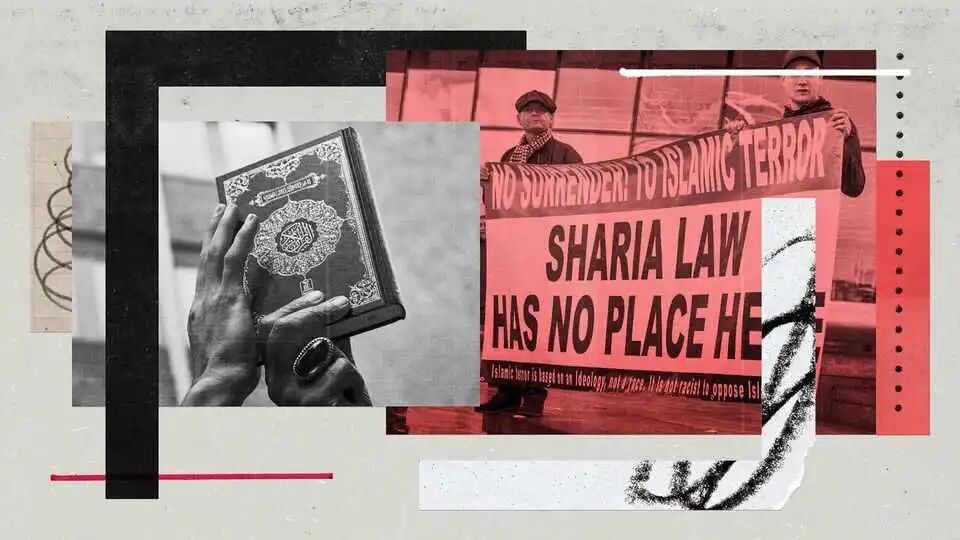
Mohamed Louizi was first approached by representatives of the Muslim Brotherhood, in Casablanca, Morocco at the age of 13. By 18 he had pledged allegiance to the movement, which works to institute Islamic rule around the world. In 1999, as a student in France, he became its representative at two mosques and head of the local branch of the Muslim Students of France in the city of Lille. His task, he says, was “to spread Islamism”—the idea that Islam should be the organising principle of government and society.
穆罕默德·路易齐13岁时在摩洛哥卡萨布兰卡首次接触到穆斯林兄弟会的代表。18岁时,他宣誓效忠于这个致力于在世界各地建立伊斯兰统治的运动。1999年,在法国求学期间,他成为该组织在两座清真寺的代表,并担任法国穆斯林学生协会里尔分会的负责人。他说,他的任务是“传播伊斯兰主义”——即伊斯兰教应成为政府和社会的组织原则。
But by 2006, alarmed by what he had begun to see as a “totalitarian project”, Mr Louizi quit the Brotherhood. He considers the movement a “real danger” for France and for Muslims: “We need to help the Muslim community get rid of Islamism.”
但到了2006年,路易齐先生开始对该组织逐渐呈现出的“极权主义倾向”感到震惊,于是退出了穆斯林兄弟会。他认为该运动对法国和穆斯林来说都是“真正的危险”:“我们需要帮助穆斯林群体摆脱伊斯兰主义。”
The French authorities, too, are worried about the Brotherhood’s activities. A report published by the interior ministry in 2025, entitled “The Muslim Brotherhood and Political Islam in France”, concluded that it could, in time, threaten the country’s secular rules and women’s rights. Measuring the threat is tricky because the Brotherhood “practises entryism”, the report said, using a “double language, by which it hides its real intentions while claiming to share the rules and principles regulating western societies”.
法国当局也对穆斯林兄弟会的活动感到担忧。法国内政部于2025年发布的一份题为《穆斯林兄弟会与法国的政治伊斯兰》的报告指出,穆斯林兄弟会的活动最终可能会威胁到法国的世俗法律和妇女权利。报告称,评估这种威胁并非易事,因为穆斯林兄弟会“奉行渗透主义”,并使用“双重语言,一方面声称认同西方社会的规则和原则,另一方面却掩盖其真实意图”。
It is not just France where Islamism is seen to be a threat. Sweden’s centre-right government recently initiated a formal inquiry into its “infiltration in Swedish society”. “Islamism as a political ideology threatens several fundamental values of Sweden’s democratic society,” declared Hans Eklind, a government MP, in the accompanying press release. Ahead of elections in Berlin later this month, the CDU, Germany’s ruling party, has put up posters promising Freiheit statt Islamismus (“Freedom rather than Islamism”).
伊斯兰主义被视为威胁的并非只有法国。瑞典中右翼政府近期也启动了一项正式调查,旨在查明其“对瑞典社会的渗透”。政府议员汉斯·埃克林德在随附的新闻稿中宣称:“伊斯兰主义作为一种政治意识形态,威胁着瑞典民主社会的若干基本价值观。”在本月晚些时候柏林即将举行大选之际,德国执政党基民盟张贴了“自由而非伊斯兰主义”(Freiheit statt Islamismus)的海报。
Europe’s right-wing populists go much further, routinely assailing Muslim immigrants as a threat to European civilisation. The AfD, which won an election this week in the German state of Saxony-Anhalt, pledged to curb construction of mosques there and restrict any public Muslim calls to prayer. Eric Zemmour, a French nationalist, once warned that Muslims want to “slit our throats”. Richard Jomshof, an MP for the Sweden Democrats, says the best thing for Swedish Muslims to do is “stop being Muslims”. The PVV, a Dutch party, wants to ban Islam for 20 years. Fully 39 of the Netherlands’ 150 MPs supported a parliamentary motion earlier this year stating, “Islam does not belong in the Netherlands.”
欧洲右翼民粹主义者走得更远,他们经常攻击穆斯林移民,称其对欧洲文明构成威胁。本周在德国萨克森-安哈尔特州赢得选举的德国选择党(AfD)承诺,将限制当地清真寺的建设,并禁止任何公开的穆斯林祈祷。法国民族主义者埃里克·泽穆尔曾警告说,穆斯林想要“割断我们的喉咙”。瑞典民主党议员理查德·约姆肖夫表示,瑞典穆斯林最好的做法就是“停止信奉伊斯兰教”。荷兰自由党(PVV)希望禁止伊斯兰教20年。今年早些时候,荷兰150名议员中有39人支持一项议会动议,该动议声称“伊斯兰教不属于荷兰”。
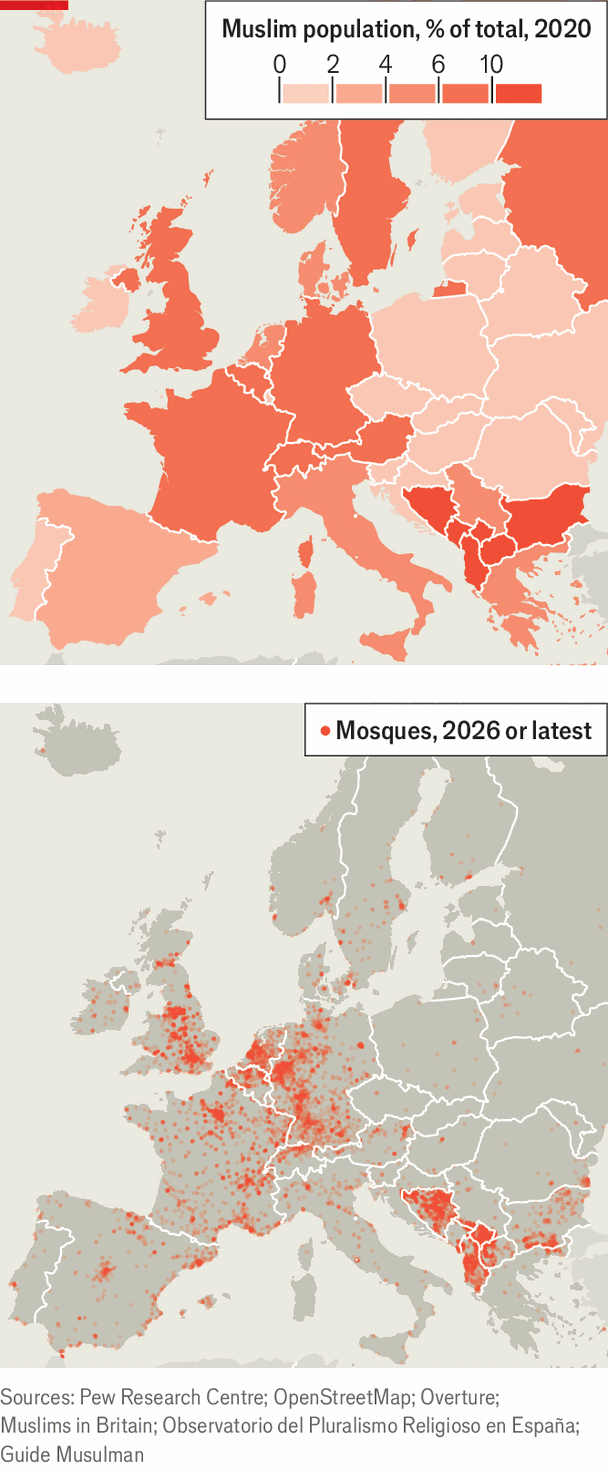
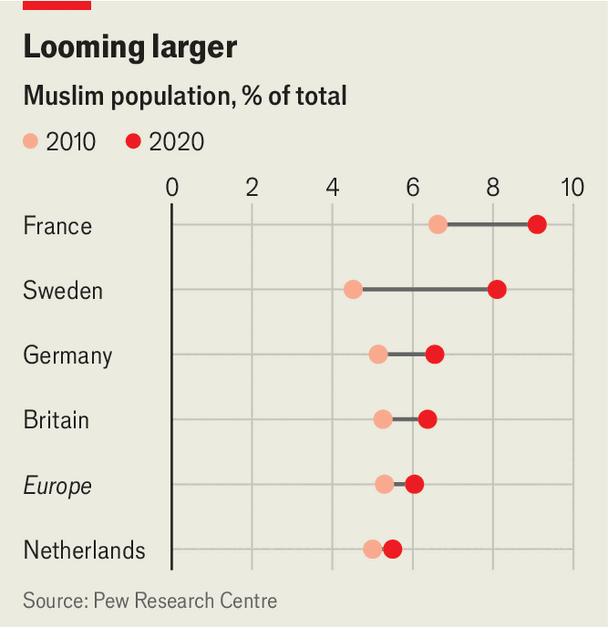
The anti-Muslim clamour may be deafening, but the actual numbers of Muslims are modest. They account for less than 10% of the population in every Western European country (see map). Their numbers, however, have been growing fast. Lots of European countries, including France, Germany and Sweden, do not compile official statistics on their citizens’ religious beliefs. Yet estimates suggest that the Muslim share of France’s population jumped from 6.6% in 2010 to 9.1% in 2020. In Sweden, the leap has been even faster, from 4.5% to 8.1%. In most European countries Muslims are a growing presence (see chart).
反穆斯林的喧嚣或许震耳欲聋,但穆斯林的实际人数并不多。在所有西欧国家,穆斯林人口占比均不足10%(见地图)。然而,他们的人口数量增长迅速。包括法国、德国和瑞典在内的许多欧洲国家并未编制公民宗教信仰的官方统计数据。但据估计,法国穆斯林人口比例从2010年的6.6%跃升至2020年的9.1%。在瑞典,这一增长速度更快,从4.5%增长至8.1%。在大多数欧洲国家,穆斯林的影响力都在不断增强(见图表)。
Much of the growth comes from a wave of refugees from Syria and elsewhere that peaked in 2015. Broadly speaking, the new arrivals have integrated quickly. Germany’s Institute for Employment Research says that 64% of those who had arrived in 2015 had found work by 2022, close to the national employment rate of 70%. Last year a report from University of Münster found that 88% of Muslims feel comfortable in Germany and 73% wanted to integrate “unreservedly and without qualification”.
德国人口增长主要源于2015年达到顶峰的来自叙利亚和其他地区的难民潮。总体而言,这些新来者融入得很快。德国就业研究所的数据显示,2015年抵达德国的难民中,到2022年已有64%找到了工作,接近70%的全国就业率。去年,明斯特大学的一份报告显示,88%的穆斯林在德国感到自在,73%的穆斯林希望“毫无保留、毫无保留地”融入德国社会。
In Britain the children of immigrants do better at school than the native-born. A study by France’s National Institute of Demographic Studies found that 32% of the children of parents who both immigrated from the Maghreb hold a higher-education degree. That is lower than the figure for France as a whole, 43%, but far higher than the 3% of their parents who do.
在英国,移民子女的学业成绩优于本土出生的孩子。法国国家人口研究所的一项研究发现,父母双方均来自马格里布地区的移民子女中,32%拥有高等教育学位。这一比例低于法国整体的43%,但远高于其父母的3%。
Nonetheless, there are pockets in many European countries where integration is proceeding slowly, if at all. Swedish police label a neighbourhood a “vulnerable area” if it has persistent problems with crime, religious extremism or “parallel social structures that challenge the functionality of society”. The suburb of Rosengard, in the southern city of Malmo, has been on its list for more than a decade. It appears to be strongly Muslim, despite the lack of official data. “On Eid everything here stops,” says Kashif Virk, an imam from Malmo’s small group of Ahmadi Muslims. In the local shopping centre, almost every woman is wearing a head covering. “It’s a very segregated area,” says Mr Virk.
然而,在许多欧洲国家,仍存在一些融合进程缓慢甚至停滞不前的地区。瑞典警方将持续存在犯罪、宗教极端主义或“挑战社会正常运转的平行社会结构”等问题的社区列为“脆弱地区”。位于南部城市马尔默的罗森加德郊区已被列入名单十余年。尽管缺乏官方数据,但该地区似乎穆斯林人口众多。“开斋节期间,这里的一切都停滞了,”马尔默一小群艾哈迈迪穆斯林的伊玛目卡什夫·维尔克说道。在当地的购物中心,几乎所有女性都戴着头巾。“这是一个隔离非常严重的地区,”维尔克先生说。
That does not make Rosengard a “no-go zone”, however, as some alarmists have claimed. In fact, it receives extra attention from the police. Nor have the growth of Europe’s Muslim minority and the problems with integration led, as many pessimists had predicted, to an explosion of violence in the name of Islam. Europol reports that there were 24 attempted acts of jihadist terror in the European Union last year, most of which were foiled. The nine that were carried out (eight of which were stabbings and one an attempt to run people over with a car), led to five deaths. Most involved lone assailants, without clear external assistance or encouragement. The numbers for 2024 were similar, with six attacks causing six deaths. There was nothing even remotely on the same scale as the 9/11 attacks in America in 2001, whose 25th anniversary falls this week. An assault on a gay pride parade in Berlin in July, in which an extremist rammed participants with a van, killing one, is typical.
然而,这并不意味着罗森加德就成了某些危言耸听者所声称的“禁区”。事实上,它反而受到了警方的格外关注。欧洲穆斯林少数群体的增长以及融合问题也并未像许多悲观主义者预测的那样,导致以伊斯兰之名进行的暴力活动激增。欧洲刑警组织报告称,去年欧盟境内共发生24起圣战恐怖袭击未遂事件,其中大部分被挫败。在9起已实施的袭击中(8起为持刀袭击,1起为驾车冲撞未遂),造成5人死亡。大多数袭击者都是单独行动,没有明显的外部协助或怂恿。2024年的数据与此类似,预计发生6起袭击,造成6人死亡。这些事件的规模与2001年发生在美国的“9·11”恐怖袭击相比,简直天壤之别,而本周正是“9·11”事件25周年纪念日。今年7月,柏林发生了一起针对同性恋骄傲游行的袭击事件,一名极端分子驾驶货车冲撞游行队伍,造成一人死亡,这种情况十分典型。
Police in European countries have long experience of countering Islamic terror networks. They arrest hundreds of suspected jihadists each year. They had, in fact, arrested the attacker in Berlin, a 21-year-old German of Lebanese descent named Abdul Ballout. He had been convicted of planning a terror attack two months before he actually perpetrated one, but a court had suspended his sentence. Although the justice system malfunctioned, police and intelligence agencies seem to have been alert to the danger.
欧洲各国警方在打击伊斯兰恐怖网络方面拥有丰富的经验。他们每年都会逮捕数百名涉嫌圣战分子。事实上,他们已经逮捕了柏林袭击者,一名21岁的黎巴嫩裔德国人阿卜杜勒·巴卢特。他在实际实施袭击前两个月就因策划恐怖袭击而被定罪,但法院暂缓执行了他的刑罚。尽管司法系统出现了失灵,但警方和情报机构似乎对这种危险保持了警惕。
But even as police have become better at curbing violent extremism, the authorities in many European countries have grown more anxious about Muslims who, although eschewing violence, work to undermine liberal freedoms and secular principles. German officials, for instance, fret about legalistischer Islamismus, or “legalistic Islamism”, which they see as a threat to the constitutional order. Simona Mohamsson, Sweden’s education and integration minister and herself the daughter of Muslim immigrants, mistrusts “political Islam” which “aims to shape and influence Swedish society”. A report from the French Senate in January concluded that the Muslim Brotherhood’s methods and ideology “threaten our democratic values and our societies’ security”. In April a senator from the centre-right Republicans party presented a draft bill designed to “fight entryism” in France, arguing that this “new strategy deployed quietly by Islamist entities” was designed “to replace the republic’s principles with religious law”.
尽管警方在遏制暴力极端主义方面取得了长足进步,但许多欧洲国家的当局却对一些穆斯林群体日益感到担忧。这些穆斯林虽然不诉诸暴力,却致力于破坏自由和世俗原则。例如,德国官员对“法理伊斯兰主义”(legalistischer Islamismus)忧心忡忡,认为它威胁着宪政秩序。瑞典教育与融合部长西蒙娜·穆罕默森(Simona Mohamsson)本人也是穆斯林移民的女儿,她对“政治伊斯兰”抱有怀疑,认为其“旨在塑造和影响瑞典社会”。法国参议院一月份的一份报告得出结论,穆斯林兄弟会的手段和意识形态“威胁着我们的民主价值观和社会安全”。四月份,一位来自中右翼共和党的参议员提出了一项旨在“打击渗透主义”的法案草案,他认为伊斯兰实体悄然部署的这一“新战略”旨在“用宗教法律取代共和国的原则”。
Intelligence agencies point to outfits like FEMYSO, an association of Muslim youth organisations from around Europe, which denies any ties to the Brotherhood but which, the spooks say, is riddled with its supporters. FEMYSO purports to speak for all Muslim youth and has received funding from the European Union. Its public activities include seemingly anodyne campaigns against Islamophobia. For its critics, that is the point: Islamist members get to present themselves as mainstream Muslims and make friends in high places. But others see this as hysteria. “It’s not in the data,” says Nader Hotait of the German Centre for Integration and Migration Research in Berlin, referring to Germany: “Nobody has been able to substantiate a threat that corresponds to the moral panic about the Muslim Brotherhood.”
情报机构指出,像FEMYSO这样的组织——一个由来自欧洲各地的穆斯林青年组织组成的联盟——与穆斯林兄弟会存在关联。该联盟否认与穆斯林兄弟会有任何联系,但情报部门称,其成员中充斥着穆斯林兄弟会的支持者。FEMYSO声称代表所有穆斯林青年,并接受了欧盟的资助。其公开活动包括一些看似温和的反伊斯兰恐惧症运动。批评者认为,这正是其目的所在:伊斯兰主义成员得以将自己包装成主流穆斯林,并在政界高层建立人脉。但也有人认为这是歇斯底里。“数据中并没有这样的迹象,”柏林德国融合与移民研究中心的纳德·霍泰特(Nader Hotait)在谈到德国时说道,“没有人能够证实存在与针对穆斯林兄弟会的道德恐慌相对应的威胁。”
The numbers of people involved are small. The French interior ministry’s report estimated that there were 400–1,000 members of the Brotherhood in France. These were linked to some 280 charities, youth organisations, sports clubs and the like, as well as 139 mosques (out of a national total of 2,800). It said that about 91,000 people attend such places of worship, out of an estimated Muslim population of about 7.5m. The report also noted ties between the Brotherhood and 21 of the 74 Muslim schools in France, educating 4,200 pupils (out of a national total of 5.6m).
涉案人数不多。法国内政部报告估计,穆斯林兄弟会在法国的成员约有400至1000人。这些人与约280个慈善机构、青年组织、体育俱乐部等有关联,并与139座清真寺(全国共有2800座清真寺)有联系。报告称,在约750万穆斯林人口中,约有9.1万人会前往这些宗教场所。报告还指出,穆斯林兄弟会与法国74所穆斯林学校中的21所存在联系,这些学校共有4200名学生(全国学生总数为560万)。
The Bundesamt für Verfassungsschutz (BfV), Germany’s domestic-intelligence agency, also keeps tabs on local Islamists. It estimates that the groups it tracks have roughly 28,000 members. The Dutch authorities, for their part, estimate that only 3-5% of Dutch Muslims (perhaps 25,000-50,000 people) have fundamentalist views.
德国联邦宪法保卫局(BfV)是德国的国内情报机构,也密切关注着当地的伊斯兰主义者。据其估计,被追踪的团体约有28000名成员。而荷兰当局则估计,只有3%至5%的荷兰穆斯林(约25000至50000人)持有原教旨主义观点。
But countering Islamism is much harder than these numbers might suggest. For one thing, the distinction between Muslims with illiberal views and those seeking to capture or undermine democratic institutions is not always clear. Many Muslims denounce homosexuality and would like to ban the burning of the Koran or the publication of satirical cartoons of the prophet Muhammad. As Ms Mohamsson notes, it is not a crime to have “deeply conservative religious values”. “It’s very difficult to draw the line,” says Andy Grote, the interior minister of Hamburg, which has the greatest concentration of Muslims of concern to the authorities of all Germany’s states.
但对抗伊斯兰主义远比这些数字所显示的要困难得多。首先,持有非自由主义观点的穆斯林与那些试图掌控或破坏民主制度的人之间的界限并不总是很清晰。许多穆斯林谴责同性恋,并希望禁止焚烧《古兰经》或刊登讽刺先知穆罕默德的漫画。正如莫哈姆森女士所指出的,拥有“根深蒂固的保守宗教价值观”并非犯罪。“划清界限非常困难,”汉堡市内政部长安迪·格罗特说道。汉堡市是德国各州中穆斯林人口最集中的地区,这些穆斯林群体引起了德国当局的关注。
At Sweden’s previous election, in 2022, more than 30% of voters in Rosengard’s main electoral district cast their ballots for the Nuance Party, which wants to criminalise Islamophobia and the desecration of the Koran (it won just 0.4% of the national vote). Especially for younger Muslims, adherence to seemingly conservative, anti-secular views may be a way of expressing their identity in the face of widespread hostility to Islam. Last year a poll suggested that 44% of French Muslims would prefer to respect Islamic law over French law, up from 28% in 1995. Among those under 25 the figure was 52%.
在瑞典2022年的上届大选中,罗森加德主要选区超过30%的选民投票支持“微妙党”(Nuance Party),该党主张将伊斯兰恐惧症和亵渎《古兰经》的行为定为刑事犯罪(但最终仅获得0.4%的全国选票)。尤其对于年轻的穆斯林而言,在普遍存在的对伊斯兰教的敌意面前,坚持看似保守、反世俗的观点或许是一种表达自身身份认同的方式。去年的一项民意调查显示,44%的法国穆斯林更倾向于尊重伊斯兰教法而非法国法律,这一比例高于1995年的28%。在25岁以下的人群中,这一比例更是高达52%。
What is more, Islamists with genuinely subversive goals deliberately muddle the boundaries between themselves and other Muslims. In June Sinan Selen, the (Turkish-born) head of the BfV, is said to have warned a closed-door session of lawmakers about German groups linked to the Muslim Brotherhood which, he claimed, were seeking to co-opt institutions and establish relationships with politicians.
此外,一些真正怀有颠覆性目标的伊斯兰主义者故意模糊自身与其他穆斯林之间的界限。据称,今年6月,德国联邦宪法保卫局(BfV)局长(土耳其裔)锡南·塞伦在一次闭门议员会议上警告称,一些与穆斯林兄弟会有关联的德国团体正试图拉拢机构并与政界人士建立联系。
European authorities have periodically sought to curtail the activities of institutions or organisations they accuse of propagating Islamist ideas, or to shut them down altogether. In 2020, after a jihadist decapitated Samuel Paty, a schoolteacher who showed pupils cartoons of the prophet, the French government banned BarakaCity, an NGO, and the Collective Against Islamophobia in France, both of which it accused of spreading Islamist propaganda. In 2023 Swedish security services accused employees at Cordoba International School, an Islamic school in Stockholm, of having links to violent extremists and said that pupils were at risk of being radicalised. The school inspectorate closed it the following year. In November Germany’s government banned Muslim Interaktiv, a group that had called thousands of local Muslims onto Hamburg’s streets to protest in favour of an Islamic caliphate.
欧洲当局曾多次试图限制或彻底关闭被指控传播伊斯兰主义思想的机构或组织的活动。2020年,一名圣战分子斩首了向学生展示先知漫画的教师塞缪尔·帕蒂后,法国政府取缔了非政府组织“巴拉卡城”(BarakaCity)和“法国反伊斯兰恐惧症集体”(Collective Against Islamophobia in France),指控这两个组织传播伊斯兰主义宣传。2023年,瑞典安全部门指控斯德哥尔摩一所伊斯兰学校——科尔多瓦国际学校(Cordoba International School)的员工与暴力极端分子有联系,并称学生面临被极端化的风险。学校督察部门于次年关闭了该校。同年11月,德国政府取缔了“穆斯林互动”(Muslim Interaktiv)组织,该组织曾号召数千名当地穆斯林走上汉堡街头,抗议建立伊斯兰哈里发国。
But not all European governments have the authority to ban groups considered hostile to the constitutional order. Moreover, proving that an institution or group is subversive, as opposed to a few people within it, can be difficult. In 2019 the Dutch security services said Cornelius Haga Lyceum, a Muslim secondary school in Amsterdam, had been co-opted by fundamentalist teachers spreading discriminatory views. The school sued, and in 2024 a court ruled that the agency’s accusations had been misleading.
但并非所有欧洲国家政府都有权取缔被认为对宪政秩序怀有敌意的团体。此外,要证明某个机构或团体具有颠覆性,而非其中少数人具有颠覆性,并非易事。2019年,荷兰安全部门声称阿姆斯特丹的一所穆斯林中学——科尼利厄斯·哈加中学——已被散布歧视性观点的原教旨主义教师所控制。该校提起诉讼,2024年,法院裁定该机构的指控具有误导性。
Episodes like this fuel the perception among European Muslims that they are victims of a witch hunt. Groups involved in deradicalisation say they must jump through hoops to prove they are not too chummy with Islamists themselves. “There is not one big Muslim organisation in Germany which is not problematised,” says Matthias Schmidt of the Islamic Science and Education Institute in Hamburg. “Not one that is seen as a solution, no matter how often they swear on the constitution.”
此类事件加剧了欧洲穆斯林群体中“我是政治迫害受害者”的印象。参与去极端化工作的团体表示,他们必须费尽周折才能证明自己与伊斯兰主义者关系并不密切。汉堡伊斯兰科学与教育研究所的马蒂亚斯·施密特说:“在德国,没有哪个大型穆斯林组织不被质疑。无论他们多么频繁地宣誓效忠宪法,都无法被视为解决方案。”
In 2021 Kauthar Bouchallikht of the GreenLeft party in the Netherlands became the first Dutch MP to wear a hijab. The media hounded her over a past role within FEMYSO and other supposed signs of extremism, even though she disavowed any Islamist views herself. Although she retained her seat in an election in 2023, she turned it down and left politics. Lotfi el-Hamidi, a Moroccan-Dutch journalist, terms his cohort of Muslims “Generation 9/11”: they have come to feel that they will never be accepted as fully Dutch.
2021年,荷兰绿党成员考塔尔·布沙利赫特成为首位佩戴头巾的荷兰议员。媒体对她过去在FEMYSO(妇女、穆斯林和青年组织)的经历以及其他所谓的极端主义迹象穷追猛打,尽管她本人否认持有任何伊斯兰主义观点。尽管她在2023年的选举中保住了席位,但她拒绝连任,退出了政坛。摩洛哥裔荷兰记者洛特菲·哈米迪将他所在的穆斯林群体称为“9·11一代”:他们感到自己永远无法被完全接纳为荷兰人。
The hard lesson from places that have been trying to counter Islamism for a long time is that the work is gruelling and open-ended. Hamburg adopted a formal Islamism-prevention strategy in 2014, knitting together state bodies, Muslim groups, civil society and schools. It drew on a formal contract signed in 2012 between the city government and Muslim community leaders. Yet problems with extremism persist, as Muslim Interaktiv showed.
那些长期致力于打击伊斯兰主义的地方所吸取的惨痛教训是,这项工作艰巨且永无止境。汉堡于2014年正式制定了一项伊斯兰主义预防战略,将政府机构、穆斯林团体、民间社会和学校联合起来。该战略以市政府和穆斯林社区领袖于2012年签署的正式协议为基础。然而,正如穆斯林互动组织(Muslim Interaktiv)所展现的那样,极端主义问题依然存在。
Indeed, curbing Islamist views is, if anything, getting harder. For one thing, the main source of them may no longer be networks like the Brotherhood’s, but social media. As Hugo Micheron, a French scholar of political Islam, puts it, “Algorithms have increasingly replaced the imams, mentors and professors.” The French interior ministry report, for instance, listed 20 influencers who seemed especially important in this regard.
事实上,遏制伊斯兰主义观点正变得越来越难。一方面,这些观点的主要来源可能不再是像穆斯林兄弟会这样的组织,而是社交媒体。正如法国政治伊斯兰学者雨果·米歇龙所言,“算法正日益取代伊玛目、导师和教授。”例如,法国内政部的一份报告列出了20位在这方面似乎尤为重要的影响力人物。
In addition, the Islamists have eager allies on social media these days, in the form of far-right groups stoking fears of Islam. In 2022 a Danish activist publicly burnt copies of the Koran in several locations around Sweden. Islamist groups immediately began spreading (false) rumours that the Swedish authorities were encouraging the burnings, as outraged Muslims rioted.
此外,如今伊斯兰主义者在社交媒体上也拥有了积极的盟友,即煽动对伊斯兰教恐惧的极右翼团体。2022年,一名丹麦活动人士在瑞典多地公开焚烧《古兰经》。伊斯兰主义团体立即开始散布(虚假)谣言,声称瑞典当局鼓励焚烧行为,愤怒的穆斯林随即举行了骚乱。
“The AfD and radical Islamists are partners—they both thrive on polarisation,” says Mr Grote. The leading candidate in France’s presidential election next year, Marine Le Pen, not content with France’s existing ban on the headscarf and other “ostentatious religious symbols” in government buildings, is calling for a ban in all public places. That is bound to push many merely pious French Muslims into the embrace of the extremists. Ahmed Marcouch, the mayor of the Dutch city of Arnhem and a former MP for the Labour Party, worries about what is to come. The idea of a public discussion about how best to handle extreme views within the Muslim community was a good one, he says, “But that dialogue never really got a chance.” ■
格罗特先生说:“德国选择党和激进伊斯兰主义者是同伙——他们都靠制造两极分化而壮大。”明年法国总统大选的领跑候选人玛丽娜·勒庞并不满足于法国目前在政府大楼内禁止佩戴头巾和其他“张扬的宗教标志”,她呼吁在所有公共场所都禁止佩戴。这势必会将许多虔诚的法国穆斯林推向极端主义的怀抱。荷兰阿纳姆市市长、前工党议员艾哈迈德·马尔库什对未来感到担忧。他说,就如何最好地处理穆斯林社区内部的极端观点展开公开讨论的想法很好,“但这种对话从未真正有机会进行。”
This article was downloaded by zlibrary from https://www.economist.com/brie ... cracy
本文由 zlibrary 从 https://www.economist.com/brie ... cracy 下载。
AI 翻译声明:
本文由 AI 翻译并辅助润色,可能存在错译、遗漏或表述偏差,仅供参考,请结合英文原文谨慎核对。 查看全部
《经济学人》观察:欧洲穆斯林、民主政治与社会焦虑
摘要:本文围绕“经济学人丨好消息是:很少有穆斯林想要颠覆欧洲民主”整理原文要点,保留原文段落与图片顺序,适合关注穆斯林生活、伊斯兰文化和中文伊斯兰文章的读者阅读,也方便搜索清真寺、伊斯兰、社会观察等相关内容。
The good news: few Muslims want to subvert European democracy
Briefing | Of veils and threats
简报 | 关于面纱和威胁
The bad news: there is no easy way to counter those who do
坏消息是:没有简单的办法来应对那些这样做的人。
Mohamed Louizi was first approached by representatives of the Muslim Brotherhood, in Casablanca, Morocco at the age of 13. By 18 he had pledged allegiance to the movement, which works to institute Islamic rule around the world. In 1999, as a student in France, he became its representative at two mosques and head of the local branch of the Muslim Students of France in the city of Lille. His task, he says, was “to spread Islamism”—the idea that Islam should be the organising principle of government and society.
穆罕默德·路易齐13岁时在摩洛哥卡萨布兰卡首次接触到穆斯林兄弟会的代表。18岁时,他宣誓效忠于这个致力于在世界各地建立伊斯兰统治的运动。1999年,在法国求学期间,他成为该组织在两座清真寺的代表,并担任法国穆斯林学生协会里尔分会的负责人。他说,他的任务是“传播伊斯兰主义”——即伊斯兰教应成为政府和社会的组织原则。
But by 2006, alarmed by what he had begun to see as a “totalitarian project”, Mr Louizi quit the Brotherhood. He considers the movement a “real danger” for France and for Muslims: “We need to help the Muslim community get rid of Islamism.”
但到了2006年,路易齐先生开始对该组织逐渐呈现出的“极权主义倾向”感到震惊,于是退出了穆斯林兄弟会。他认为该运动对法国和穆斯林来说都是“真正的危险”:“我们需要帮助穆斯林群体摆脱伊斯兰主义。”
The French authorities, too, are worried about the Brotherhood’s activities. A report published by the interior ministry in 2025, entitled “The Muslim Brotherhood and Political Islam in France”, concluded that it could, in time, threaten the country’s secular rules and women’s rights. Measuring the threat is tricky because the Brotherhood “practises entryism”, the report said, using a “double language, by which it hides its real intentions while claiming to share the rules and principles regulating western societies”.
法国当局也对穆斯林兄弟会的活动感到担忧。法国内政部于2025年发布的一份题为《穆斯林兄弟会与法国的政治伊斯兰》的报告指出,穆斯林兄弟会的活动最终可能会威胁到法国的世俗法律和妇女权利。报告称,评估这种威胁并非易事,因为穆斯林兄弟会“奉行渗透主义”,并使用“双重语言,一方面声称认同西方社会的规则和原则,另一方面却掩盖其真实意图”。
It is not just France where Islamism is seen to be a threat. Sweden’s centre-right government recently initiated a formal inquiry into its “infiltration in Swedish society”. “Islamism as a political ideology threatens several fundamental values of Sweden’s democratic society,” declared Hans Eklind, a government MP, in the accompanying press release. Ahead of elections in Berlin later this month, the CDU, Germany’s ruling party, has put up posters promising Freiheit statt Islamismus (“Freedom rather than Islamism”).
伊斯兰主义被视为威胁的并非只有法国。瑞典中右翼政府近期也启动了一项正式调查,旨在查明其“对瑞典社会的渗透”。政府议员汉斯·埃克林德在随附的新闻稿中宣称:“伊斯兰主义作为一种政治意识形态,威胁着瑞典民主社会的若干基本价值观。”在本月晚些时候柏林即将举行大选之际,德国执政党基民盟张贴了“自由而非伊斯兰主义”(Freiheit statt Islamismus)的海报。
Europe’s right-wing populists go much further, routinely assailing Muslim immigrants as a threat to European civilisation. The AfD, which won an election this week in the German state of Saxony-Anhalt, pledged to curb construction of mosques there and restrict any public Muslim calls to prayer. Eric Zemmour, a French nationalist, once warned that Muslims want to “slit our throats”. Richard Jomshof, an MP for the Sweden Democrats, says the best thing for Swedish Muslims to do is “stop being Muslims”. The PVV, a Dutch party, wants to ban Islam for 20 years. Fully 39 of the Netherlands’ 150 MPs supported a parliamentary motion earlier this year stating, “Islam does not belong in the Netherlands.”
欧洲右翼民粹主义者走得更远,他们经常攻击穆斯林移民,称其对欧洲文明构成威胁。本周在德国萨克森-安哈尔特州赢得选举的德国选择党(AfD)承诺,将限制当地清真寺的建设,并禁止任何公开的穆斯林祈祷。法国民族主义者埃里克·泽穆尔曾警告说,穆斯林想要“割断我们的喉咙”。瑞典民主党议员理查德·约姆肖夫表示,瑞典穆斯林最好的做法就是“停止信奉伊斯兰教”。荷兰自由党(PVV)希望禁止伊斯兰教20年。今年早些时候,荷兰150名议员中有39人支持一项议会动议,该动议声称“伊斯兰教不属于荷兰”。
The anti-Muslim clamour may be deafening, but the actual numbers of Muslims are modest. They account for less than 10% of the population in every Western European country (see map). Their numbers, however, have been growing fast. Lots of European countries, including France, Germany and Sweden, do not compile official statistics on their citizens’ religious beliefs. Yet estimates suggest that the Muslim share of France’s population jumped from 6.6% in 2010 to 9.1% in 2020. In Sweden, the leap has been even faster, from 4.5% to 8.1%. In most European countries Muslims are a growing presence (see chart).
反穆斯林的喧嚣或许震耳欲聋,但穆斯林的实际人数并不多。在所有西欧国家,穆斯林人口占比均不足10%(见地图)。然而,他们的人口数量增长迅速。包括法国、德国和瑞典在内的许多欧洲国家并未编制公民宗教信仰的官方统计数据。但据估计,法国穆斯林人口比例从2010年的6.6%跃升至2020年的9.1%。在瑞典,这一增长速度更快,从4.5%增长至8.1%。在大多数欧洲国家,穆斯林的影响力都在不断增强(见图表)。
Much of the growth comes from a wave of refugees from Syria and elsewhere that peaked in 2015. Broadly speaking, the new arrivals have integrated quickly. Germany’s Institute for Employment Research says that 64% of those who had arrived in 2015 had found work by 2022, close to the national employment rate of 70%. Last year a report from University of Münster found that 88% of Muslims feel comfortable in Germany and 73% wanted to integrate “unreservedly and without qualification”.
德国人口增长主要源于2015年达到顶峰的来自叙利亚和其他地区的难民潮。总体而言,这些新来者融入得很快。德国就业研究所的数据显示,2015年抵达德国的难民中,到2022年已有64%找到了工作,接近70%的全国就业率。去年,明斯特大学的一份报告显示,88%的穆斯林在德国感到自在,73%的穆斯林希望“毫无保留、毫无保留地”融入德国社会。
In Britain the children of immigrants do better at school than the native-born. A study by France’s National Institute of Demographic Studies found that 32% of the children of parents who both immigrated from the Maghreb hold a higher-education degree. That is lower than the figure for France as a whole, 43%, but far higher than the 3% of their parents who do.
在英国,移民子女的学业成绩优于本土出生的孩子。法国国家人口研究所的一项研究发现,父母双方均来自马格里布地区的移民子女中,32%拥有高等教育学位。这一比例低于法国整体的43%,但远高于其父母的3%。
Nonetheless, there are pockets in many European countries where integration is proceeding slowly, if at all. Swedish police label a neighbourhood a “vulnerable area” if it has persistent problems with crime, religious extremism or “parallel social structures that challenge the functionality of society”. The suburb of Rosengard, in the southern city of Malmo, has been on its list for more than a decade. It appears to be strongly Muslim, despite the lack of official data. “On Eid everything here stops,” says Kashif Virk, an imam from Malmo’s small group of Ahmadi Muslims. In the local shopping centre, almost every woman is wearing a head covering. “It’s a very segregated area,” says Mr Virk.
然而,在许多欧洲国家,仍存在一些融合进程缓慢甚至停滞不前的地区。瑞典警方将持续存在犯罪、宗教极端主义或“挑战社会正常运转的平行社会结构”等问题的社区列为“脆弱地区”。位于南部城市马尔默的罗森加德郊区已被列入名单十余年。尽管缺乏官方数据,但该地区似乎穆斯林人口众多。“开斋节期间,这里的一切都停滞了,”马尔默一小群艾哈迈迪穆斯林的伊玛目卡什夫·维尔克说道。在当地的购物中心,几乎所有女性都戴着头巾。“这是一个隔离非常严重的地区,”维尔克先生说。
That does not make Rosengard a “no-go zone”, however, as some alarmists have claimed. In fact, it receives extra attention from the police. Nor have the growth of Europe’s Muslim minority and the problems with integration led, as many pessimists had predicted, to an explosion of violence in the name of Islam. Europol reports that there were 24 attempted acts of jihadist terror in the European Union last year, most of which were foiled. The nine that were carried out (eight of which were stabbings and one an attempt to run people over with a car), led to five deaths. Most involved lone assailants, without clear external assistance or encouragement. The numbers for 2024 were similar, with six attacks causing six deaths. There was nothing even remotely on the same scale as the 9/11 attacks in America in 2001, whose 25th anniversary falls this week. An assault on a gay pride parade in Berlin in July, in which an extremist rammed participants with a van, killing one, is typical.
然而,这并不意味着罗森加德就成了某些危言耸听者所声称的“禁区”。事实上,它反而受到了警方的格外关注。欧洲穆斯林少数群体的增长以及融合问题也并未像许多悲观主义者预测的那样,导致以伊斯兰之名进行的暴力活动激增。欧洲刑警组织报告称,去年欧盟境内共发生24起圣战恐怖袭击未遂事件,其中大部分被挫败。在9起已实施的袭击中(8起为持刀袭击,1起为驾车冲撞未遂),造成5人死亡。大多数袭击者都是单独行动,没有明显的外部协助或怂恿。2024年的数据与此类似,预计发生6起袭击,造成6人死亡。这些事件的规模与2001年发生在美国的“9·11”恐怖袭击相比,简直天壤之别,而本周正是“9·11”事件25周年纪念日。今年7月,柏林发生了一起针对同性恋骄傲游行的袭击事件,一名极端分子驾驶货车冲撞游行队伍,造成一人死亡,这种情况十分典型。
Police in European countries have long experience of countering Islamic terror networks. They arrest hundreds of suspected jihadists each year. They had, in fact, arrested the attacker in Berlin, a 21-year-old German of Lebanese descent named Abdul Ballout. He had been convicted of planning a terror attack two months before he actually perpetrated one, but a court had suspended his sentence. Although the justice system malfunctioned, police and intelligence agencies seem to have been alert to the danger.
欧洲各国警方在打击伊斯兰恐怖网络方面拥有丰富的经验。他们每年都会逮捕数百名涉嫌圣战分子。事实上,他们已经逮捕了柏林袭击者,一名21岁的黎巴嫩裔德国人阿卜杜勒·巴卢特。他在实际实施袭击前两个月就因策划恐怖袭击而被定罪,但法院暂缓执行了他的刑罚。尽管司法系统出现了失灵,但警方和情报机构似乎对这种危险保持了警惕。
But even as police have become better at curbing violent extremism, the authorities in many European countries have grown more anxious about Muslims who, although eschewing violence, work to undermine liberal freedoms and secular principles. German officials, for instance, fret about legalistischer Islamismus, or “legalistic Islamism”, which they see as a threat to the constitutional order. Simona Mohamsson, Sweden’s education and integration minister and herself the daughter of Muslim immigrants, mistrusts “political Islam” which “aims to shape and influence Swedish society”. A report from the French Senate in January concluded that the Muslim Brotherhood’s methods and ideology “threaten our democratic values and our societies’ security”. In April a senator from the centre-right Republicans party presented a draft bill designed to “fight entryism” in France, arguing that this “new strategy deployed quietly by Islamist entities” was designed “to replace the republic’s principles with religious law”.
尽管警方在遏制暴力极端主义方面取得了长足进步,但许多欧洲国家的当局却对一些穆斯林群体日益感到担忧。这些穆斯林虽然不诉诸暴力,却致力于破坏自由和世俗原则。例如,德国官员对“法理伊斯兰主义”(legalistischer Islamismus)忧心忡忡,认为它威胁着宪政秩序。瑞典教育与融合部长西蒙娜·穆罕默森(Simona Mohamsson)本人也是穆斯林移民的女儿,她对“政治伊斯兰”抱有怀疑,认为其“旨在塑造和影响瑞典社会”。法国参议院一月份的一份报告得出结论,穆斯林兄弟会的手段和意识形态“威胁着我们的民主价值观和社会安全”。四月份,一位来自中右翼共和党的参议员提出了一项旨在“打击渗透主义”的法案草案,他认为伊斯兰实体悄然部署的这一“新战略”旨在“用宗教法律取代共和国的原则”。
Intelligence agencies point to outfits like FEMYSO, an association of Muslim youth organisations from around Europe, which denies any ties to the Brotherhood but which, the spooks say, is riddled with its supporters. FEMYSO purports to speak for all Muslim youth and has received funding from the European Union. Its public activities include seemingly anodyne campaigns against Islamophobia. For its critics, that is the point: Islamist members get to present themselves as mainstream Muslims and make friends in high places. But others see this as hysteria. “It’s not in the data,” says Nader Hotait of the German Centre for Integration and Migration Research in Berlin, referring to Germany: “Nobody has been able to substantiate a threat that corresponds to the moral panic about the Muslim Brotherhood.”
情报机构指出,像FEMYSO这样的组织——一个由来自欧洲各地的穆斯林青年组织组成的联盟——与穆斯林兄弟会存在关联。该联盟否认与穆斯林兄弟会有任何联系,但情报部门称,其成员中充斥着穆斯林兄弟会的支持者。FEMYSO声称代表所有穆斯林青年,并接受了欧盟的资助。其公开活动包括一些看似温和的反伊斯兰恐惧症运动。批评者认为,这正是其目的所在:伊斯兰主义成员得以将自己包装成主流穆斯林,并在政界高层建立人脉。但也有人认为这是歇斯底里。“数据中并没有这样的迹象,”柏林德国融合与移民研究中心的纳德·霍泰特(Nader Hotait)在谈到德国时说道,“没有人能够证实存在与针对穆斯林兄弟会的道德恐慌相对应的威胁。”
The numbers of people involved are small. The French interior ministry’s report estimated that there were 400–1,000 members of the Brotherhood in France. These were linked to some 280 charities, youth organisations, sports clubs and the like, as well as 139 mosques (out of a national total of 2,800). It said that about 91,000 people attend such places of worship, out of an estimated Muslim population of about 7.5m. The report also noted ties between the Brotherhood and 21 of the 74 Muslim schools in France, educating 4,200 pupils (out of a national total of 5.6m).
涉案人数不多。法国内政部报告估计,穆斯林兄弟会在法国的成员约有400至1000人。这些人与约280个慈善机构、青年组织、体育俱乐部等有关联,并与139座清真寺(全国共有2800座清真寺)有联系。报告称,在约750万穆斯林人口中,约有9.1万人会前往这些宗教场所。报告还指出,穆斯林兄弟会与法国74所穆斯林学校中的21所存在联系,这些学校共有4200名学生(全国学生总数为560万)。
The Bundesamt für Verfassungsschutz (BfV), Germany’s domestic-intelligence agency, also keeps tabs on local Islamists. It estimates that the groups it tracks have roughly 28,000 members. The Dutch authorities, for their part, estimate that only 3-5% of Dutch Muslims (perhaps 25,000-50,000 people) have fundamentalist views.
德国联邦宪法保卫局(BfV)是德国的国内情报机构,也密切关注着当地的伊斯兰主义者。据其估计,被追踪的团体约有28000名成员。而荷兰当局则估计,只有3%至5%的荷兰穆斯林(约25000至50000人)持有原教旨主义观点。
But countering Islamism is much harder than these numbers might suggest. For one thing, the distinction between Muslims with illiberal views and those seeking to capture or undermine democratic institutions is not always clear. Many Muslims denounce homosexuality and would like to ban the burning of the Koran or the publication of satirical cartoons of the prophet Muhammad. As Ms Mohamsson notes, it is not a crime to have “deeply conservative religious values”. “It’s very difficult to draw the line,” says Andy Grote, the interior minister of Hamburg, which has the greatest concentration of Muslims of concern to the authorities of all Germany’s states.
但对抗伊斯兰主义远比这些数字所显示的要困难得多。首先,持有非自由主义观点的穆斯林与那些试图掌控或破坏民主制度的人之间的界限并不总是很清晰。许多穆斯林谴责同性恋,并希望禁止焚烧《古兰经》或刊登讽刺先知穆罕默德的漫画。正如莫哈姆森女士所指出的,拥有“根深蒂固的保守宗教价值观”并非犯罪。“划清界限非常困难,”汉堡市内政部长安迪·格罗特说道。汉堡市是德国各州中穆斯林人口最集中的地区,这些穆斯林群体引起了德国当局的关注。
At Sweden’s previous election, in 2022, more than 30% of voters in Rosengard’s main electoral district cast their ballots for the Nuance Party, which wants to criminalise Islamophobia and the desecration of the Koran (it won just 0.4% of the national vote). Especially for younger Muslims, adherence to seemingly conservative, anti-secular views may be a way of expressing their identity in the face of widespread hostility to Islam. Last year a poll suggested that 44% of French Muslims would prefer to respect Islamic law over French law, up from 28% in 1995. Among those under 25 the figure was 52%.
在瑞典2022年的上届大选中,罗森加德主要选区超过30%的选民投票支持“微妙党”(Nuance Party),该党主张将伊斯兰恐惧症和亵渎《古兰经》的行为定为刑事犯罪(但最终仅获得0.4%的全国选票)。尤其对于年轻的穆斯林而言,在普遍存在的对伊斯兰教的敌意面前,坚持看似保守、反世俗的观点或许是一种表达自身身份认同的方式。去年的一项民意调查显示,44%的法国穆斯林更倾向于尊重伊斯兰教法而非法国法律,这一比例高于1995年的28%。在25岁以下的人群中,这一比例更是高达52%。
What is more, Islamists with genuinely subversive goals deliberately muddle the boundaries between themselves and other Muslims. In June Sinan Selen, the (Turkish-born) head of the BfV, is said to have warned a closed-door session of lawmakers about German groups linked to the Muslim Brotherhood which, he claimed, were seeking to co-opt institutions and establish relationships with politicians.
此外,一些真正怀有颠覆性目标的伊斯兰主义者故意模糊自身与其他穆斯林之间的界限。据称,今年6月,德国联邦宪法保卫局(BfV)局长(土耳其裔)锡南·塞伦在一次闭门议员会议上警告称,一些与穆斯林兄弟会有关联的德国团体正试图拉拢机构并与政界人士建立联系。
European authorities have periodically sought to curtail the activities of institutions or organisations they accuse of propagating Islamist ideas, or to shut them down altogether. In 2020, after a jihadist decapitated Samuel Paty, a schoolteacher who showed pupils cartoons of the prophet, the French government banned BarakaCity, an NGO, and the Collective Against Islamophobia in France, both of which it accused of spreading Islamist propaganda. In 2023 Swedish security services accused employees at Cordoba International School, an Islamic school in Stockholm, of having links to violent extremists and said that pupils were at risk of being radicalised. The school inspectorate closed it the following year. In November Germany’s government banned Muslim Interaktiv, a group that had called thousands of local Muslims onto Hamburg’s streets to protest in favour of an Islamic caliphate.
欧洲当局曾多次试图限制或彻底关闭被指控传播伊斯兰主义思想的机构或组织的活动。2020年,一名圣战分子斩首了向学生展示先知漫画的教师塞缪尔·帕蒂后,法国政府取缔了非政府组织“巴拉卡城”(BarakaCity)和“法国反伊斯兰恐惧症集体”(Collective Against Islamophobia in France),指控这两个组织传播伊斯兰主义宣传。2023年,瑞典安全部门指控斯德哥尔摩一所伊斯兰学校——科尔多瓦国际学校(Cordoba International School)的员工与暴力极端分子有联系,并称学生面临被极端化的风险。学校督察部门于次年关闭了该校。同年11月,德国政府取缔了“穆斯林互动”(Muslim Interaktiv)组织,该组织曾号召数千名当地穆斯林走上汉堡街头,抗议建立伊斯兰哈里发国。
But not all European governments have the authority to ban groups considered hostile to the constitutional order. Moreover, proving that an institution or group is subversive, as opposed to a few people within it, can be difficult. In 2019 the Dutch security services said Cornelius Haga Lyceum, a Muslim secondary school in Amsterdam, had been co-opted by fundamentalist teachers spreading discriminatory views. The school sued, and in 2024 a court ruled that the agency’s accusations had been misleading.
但并非所有欧洲国家政府都有权取缔被认为对宪政秩序怀有敌意的团体。此外,要证明某个机构或团体具有颠覆性,而非其中少数人具有颠覆性,并非易事。2019年,荷兰安全部门声称阿姆斯特丹的一所穆斯林中学——科尼利厄斯·哈加中学——已被散布歧视性观点的原教旨主义教师所控制。该校提起诉讼,2024年,法院裁定该机构的指控具有误导性。
Episodes like this fuel the perception among European Muslims that they are victims of a witch hunt. Groups involved in deradicalisation say they must jump through hoops to prove they are not too chummy with Islamists themselves. “There is not one big Muslim organisation in Germany which is not problematised,” says Matthias Schmidt of the Islamic Science and Education Institute in Hamburg. “Not one that is seen as a solution, no matter how often they swear on the constitution.”
此类事件加剧了欧洲穆斯林群体中“我是政治迫害受害者”的印象。参与去极端化工作的团体表示,他们必须费尽周折才能证明自己与伊斯兰主义者关系并不密切。汉堡伊斯兰科学与教育研究所的马蒂亚斯·施密特说:“在德国,没有哪个大型穆斯林组织不被质疑。无论他们多么频繁地宣誓效忠宪法,都无法被视为解决方案。”
In 2021 Kauthar Bouchallikht of the GreenLeft party in the Netherlands became the first Dutch MP to wear a hijab. The media hounded her over a past role within FEMYSO and other supposed signs of extremism, even though she disavowed any Islamist views herself. Although she retained her seat in an election in 2023, she turned it down and left politics. Lotfi el-Hamidi, a Moroccan-Dutch journalist, terms his cohort of Muslims “Generation 9/11”: they have come to feel that they will never be accepted as fully Dutch.
2021年,荷兰绿党成员考塔尔·布沙利赫特成为首位佩戴头巾的荷兰议员。媒体对她过去在FEMYSO(妇女、穆斯林和青年组织)的经历以及其他所谓的极端主义迹象穷追猛打,尽管她本人否认持有任何伊斯兰主义观点。尽管她在2023年的选举中保住了席位,但她拒绝连任,退出了政坛。摩洛哥裔荷兰记者洛特菲·哈米迪将他所在的穆斯林群体称为“9·11一代”:他们感到自己永远无法被完全接纳为荷兰人。
The hard lesson from places that have been trying to counter Islamism for a long time is that the work is gruelling and open-ended. Hamburg adopted a formal Islamism-prevention strategy in 2014, knitting together state bodies, Muslim groups, civil society and schools. It drew on a formal contract signed in 2012 between the city government and Muslim community leaders. Yet problems with extremism persist, as Muslim Interaktiv showed.
那些长期致力于打击伊斯兰主义的地方所吸取的惨痛教训是,这项工作艰巨且永无止境。汉堡于2014年正式制定了一项伊斯兰主义预防战略,将政府机构、穆斯林团体、民间社会和学校联合起来。该战略以市政府和穆斯林社区领袖于2012年签署的正式协议为基础。然而,正如穆斯林互动组织(Muslim Interaktiv)所展现的那样,极端主义问题依然存在。
Indeed, curbing Islamist views is, if anything, getting harder. For one thing, the main source of them may no longer be networks like the Brotherhood’s, but social media. As Hugo Micheron, a French scholar of political Islam, puts it, “Algorithms have increasingly replaced the imams, mentors and professors.” The French interior ministry report, for instance, listed 20 influencers who seemed especially important in this regard.
事实上,遏制伊斯兰主义观点正变得越来越难。一方面,这些观点的主要来源可能不再是像穆斯林兄弟会这样的组织,而是社交媒体。正如法国政治伊斯兰学者雨果·米歇龙所言,“算法正日益取代伊玛目、导师和教授。”例如,法国内政部的一份报告列出了20位在这方面似乎尤为重要的影响力人物。
In addition, the Islamists have eager allies on social media these days, in the form of far-right groups stoking fears of Islam. In 2022 a Danish activist publicly burnt copies of the Koran in several locations around Sweden. Islamist groups immediately began spreading (false) rumours that the Swedish authorities were encouraging the burnings, as outraged Muslims rioted.
此外,如今伊斯兰主义者在社交媒体上也拥有了积极的盟友,即煽动对伊斯兰教恐惧的极右翼团体。2022年,一名丹麦活动人士在瑞典多地公开焚烧《古兰经》。伊斯兰主义团体立即开始散布(虚假)谣言,声称瑞典当局鼓励焚烧行为,愤怒的穆斯林随即举行了骚乱。
“The AfD and radical Islamists are partners—they both thrive on polarisation,” says Mr Grote. The leading candidate in France’s presidential election next year, Marine Le Pen, not content with France’s existing ban on the headscarf and other “ostentatious religious symbols” in government buildings, is calling for a ban in all public places. That is bound to push many merely pious French Muslims into the embrace of the extremists. Ahmed Marcouch, the mayor of the Dutch city of Arnhem and a former MP for the Labour Party, worries about what is to come. The idea of a public discussion about how best to handle extreme views within the Muslim community was a good one, he says, “But that dialogue never really got a chance.” ■
格罗特先生说:“德国选择党和激进伊斯兰主义者是同伙——他们都靠制造两极分化而壮大。”明年法国总统大选的领跑候选人玛丽娜·勒庞并不满足于法国目前在政府大楼内禁止佩戴头巾和其他“张扬的宗教标志”,她呼吁在所有公共场所都禁止佩戴。这势必会将许多虔诚的法国穆斯林推向极端主义的怀抱。荷兰阿纳姆市市长、前工党议员艾哈迈德·马尔库什对未来感到担忧。他说,就如何最好地处理穆斯林社区内部的极端观点展开公开讨论的想法很好,“但这种对话从未真正有机会进行。”
This article was downloaded by zlibrary from https://www.economist.com/brie ... cracy
本文由 zlibrary 从 https://www.economist.com/brie ... cracy 下载。
AI 翻译声明:
本文由 AI 翻译并辅助润色,可能存在错译、遗漏或表述偏差,仅供参考,请结合英文原文谨慎核对。 查看全部
网络转帖
《经济学人》观察:欧洲穆斯林、民主政治与社会焦虑
摘要:本文围绕“经济学人丨好消息是:很少有穆斯林想要颠覆欧洲民主”整理原文要点,保留原文段落与图片顺序,适合关注穆斯林生活、伊斯兰文化和中文伊斯兰文章的读者阅读,也方便搜索清真寺、伊斯兰、社会观察等相关内容。
The good news: few Muslims want to subvert European democracy
Briefing | Of veils and threats
简报 | 关于面纱和威胁
The bad news: there is no easy way to counter those who do
坏消息是:没有简单的办法来应对那些这样做的人。
Mohamed Louizi was first approached by representatives of the Muslim Brotherhood, in Casablanca, Morocco at the age of 13. By 18 he had pledged allegiance to the movement, which works to institute Islamic rule around the world. In 1999, as a student in France, he became its representative at two mosques and head of the local branch of the Muslim Students of France in the city of Lille. His task, he says, was “to spread Islamism”—the idea that Islam should be the organising principle of government and society.
穆罕默德·路易齐13岁时在摩洛哥卡萨布兰卡首次接触到穆斯林兄弟会的代表。18岁时,他宣誓效忠于这个致力于在世界各地建立伊斯兰统治的运动。1999年,在法国求学期间,他成为该组织在两座清真寺的代表,并担任法国穆斯林学生协会里尔分会的负责人。他说,他的任务是“传播伊斯兰主义”——即伊斯兰教应成为政府和社会的组织原则。
But by 2006, alarmed by what he had begun to see as a “totalitarian project”, Mr Louizi quit the Brotherhood. He considers the movement a “real danger” for France and for Muslims: “We need to help the Muslim community get rid of Islamism.”
但到了2006年,路易齐先生开始对该组织逐渐呈现出的“极权主义倾向”感到震惊,于是退出了穆斯林兄弟会。他认为该运动对法国和穆斯林来说都是“真正的危险”:“我们需要帮助穆斯林群体摆脱伊斯兰主义。”
The French authorities, too, are worried about the Brotherhood’s activities. A report published by the interior ministry in 2025, entitled “The Muslim Brotherhood and Political Islam in France”, concluded that it could, in time, threaten the country’s secular rules and women’s rights. Measuring the threat is tricky because the Brotherhood “practises entryism”, the report said, using a “double language, by which it hides its real intentions while claiming to share the rules and principles regulating western societies”.
法国当局也对穆斯林兄弟会的活动感到担忧。法国内政部于2025年发布的一份题为《穆斯林兄弟会与法国的政治伊斯兰》的报告指出,穆斯林兄弟会的活动最终可能会威胁到法国的世俗法律和妇女权利。报告称,评估这种威胁并非易事,因为穆斯林兄弟会“奉行渗透主义”,并使用“双重语言,一方面声称认同西方社会的规则和原则,另一方面却掩盖其真实意图”。
It is not just France where Islamism is seen to be a threat. Sweden’s centre-right government recently initiated a formal inquiry into its “infiltration in Swedish society”. “Islamism as a political ideology threatens several fundamental values of Sweden’s democratic society,” declared Hans Eklind, a government MP, in the accompanying press release. Ahead of elections in Berlin later this month, the CDU, Germany’s ruling party, has put up posters promising Freiheit statt Islamismus (“Freedom rather than Islamism”).
伊斯兰主义被视为威胁的并非只有法国。瑞典中右翼政府近期也启动了一项正式调查,旨在查明其“对瑞典社会的渗透”。政府议员汉斯·埃克林德在随附的新闻稿中宣称:“伊斯兰主义作为一种政治意识形态,威胁着瑞典民主社会的若干基本价值观。”在本月晚些时候柏林即将举行大选之际,德国执政党基民盟张贴了“自由而非伊斯兰主义”(Freiheit statt Islamismus)的海报。
Europe’s right-wing populists go much further, routinely assailing Muslim immigrants as a threat to European civilisation. The AfD, which won an election this week in the German state of Saxony-Anhalt, pledged to curb construction of mosques there and restrict any public Muslim calls to prayer. Eric Zemmour, a French nationalist, once warned that Muslims want to “slit our throats”. Richard Jomshof, an MP for the Sweden Democrats, says the best thing for Swedish Muslims to do is “stop being Muslims”. The PVV, a Dutch party, wants to ban Islam for 20 years. Fully 39 of the Netherlands’ 150 MPs supported a parliamentary motion earlier this year stating, “Islam does not belong in the Netherlands.”
欧洲右翼民粹主义者走得更远,他们经常攻击穆斯林移民,称其对欧洲文明构成威胁。本周在德国萨克森-安哈尔特州赢得选举的德国选择党(AfD)承诺,将限制当地清真寺的建设,并禁止任何公开的穆斯林祈祷。法国民族主义者埃里克·泽穆尔曾警告说,穆斯林想要“割断我们的喉咙”。瑞典民主党议员理查德·约姆肖夫表示,瑞典穆斯林最好的做法就是“停止信奉伊斯兰教”。荷兰自由党(PVV)希望禁止伊斯兰教20年。今年早些时候,荷兰150名议员中有39人支持一项议会动议,该动议声称“伊斯兰教不属于荷兰”。
The anti-Muslim clamour may be deafening, but the actual numbers of Muslims are modest. They account for less than 10% of the population in every Western European country (see map). Their numbers, however, have been growing fast. Lots of European countries, including France, Germany and Sweden, do not compile official statistics on their citizens’ religious beliefs. Yet estimates suggest that the Muslim share of France’s population jumped from 6.6% in 2010 to 9.1% in 2020. In Sweden, the leap has been even faster, from 4.5% to 8.1%. In most European countries Muslims are a growing presence (see chart).
反穆斯林的喧嚣或许震耳欲聋,但穆斯林的实际人数并不多。在所有西欧国家,穆斯林人口占比均不足10%(见地图)。然而,他们的人口数量增长迅速。包括法国、德国和瑞典在内的许多欧洲国家并未编制公民宗教信仰的官方统计数据。但据估计,法国穆斯林人口比例从2010年的6.6%跃升至2020年的9.1%。在瑞典,这一增长速度更快,从4.5%增长至8.1%。在大多数欧洲国家,穆斯林的影响力都在不断增强(见图表)。
Much of the growth comes from a wave of refugees from Syria and elsewhere that peaked in 2015. Broadly speaking, the new arrivals have integrated quickly. Germany’s Institute for Employment Research says that 64% of those who had arrived in 2015 had found work by 2022, close to the national employment rate of 70%. Last year a report from University of Münster found that 88% of Muslims feel comfortable in Germany and 73% wanted to integrate “unreservedly and without qualification”.
德国人口增长主要源于2015年达到顶峰的来自叙利亚和其他地区的难民潮。总体而言,这些新来者融入得很快。德国就业研究所的数据显示,2015年抵达德国的难民中,到2022年已有64%找到了工作,接近70%的全国就业率。去年,明斯特大学的一份报告显示,88%的穆斯林在德国感到自在,73%的穆斯林希望“毫无保留、毫无保留地”融入德国社会。
In Britain the children of immigrants do better at school than the native-born. A study by France’s National Institute of Demographic Studies found that 32% of the children of parents who both immigrated from the Maghreb hold a higher-education degree. That is lower than the figure for France as a whole, 43%, but far higher than the 3% of their parents who do.
在英国,移民子女的学业成绩优于本土出生的孩子。法国国家人口研究所的一项研究发现,父母双方均来自马格里布地区的移民子女中,32%拥有高等教育学位。这一比例低于法国整体的43%,但远高于其父母的3%。
Nonetheless, there are pockets in many European countries where integration is proceeding slowly, if at all. Swedish police label a neighbourhood a “vulnerable area” if it has persistent problems with crime, religious extremism or “parallel social structures that challenge the functionality of society”. The suburb of Rosengard, in the southern city of Malmo, has been on its list for more than a decade. It appears to be strongly Muslim, despite the lack of official data. “On Eid everything here stops,” says Kashif Virk, an imam from Malmo’s small group of Ahmadi Muslims. In the local shopping centre, almost every woman is wearing a head covering. “It’s a very segregated area,” says Mr Virk.
然而,在许多欧洲国家,仍存在一些融合进程缓慢甚至停滞不前的地区。瑞典警方将持续存在犯罪、宗教极端主义或“挑战社会正常运转的平行社会结构”等问题的社区列为“脆弱地区”。位于南部城市马尔默的罗森加德郊区已被列入名单十余年。尽管缺乏官方数据,但该地区似乎穆斯林人口众多。“开斋节期间,这里的一切都停滞了,”马尔默一小群艾哈迈迪穆斯林的伊玛目卡什夫·维尔克说道。在当地的购物中心,几乎所有女性都戴着头巾。“这是一个隔离非常严重的地区,”维尔克先生说。
That does not make Rosengard a “no-go zone”, however, as some alarmists have claimed. In fact, it receives extra attention from the police. Nor have the growth of Europe’s Muslim minority and the problems with integration led, as many pessimists had predicted, to an explosion of violence in the name of Islam. Europol reports that there were 24 attempted acts of jihadist terror in the European Union last year, most of which were foiled. The nine that were carried out (eight of which were stabbings and one an attempt to run people over with a car), led to five deaths. Most involved lone assailants, without clear external assistance or encouragement. The numbers for 2024 were similar, with six attacks causing six deaths. There was nothing even remotely on the same scale as the 9/11 attacks in America in 2001, whose 25th anniversary falls this week. An assault on a gay pride parade in Berlin in July, in which an extremist rammed participants with a van, killing one, is typical.
然而,这并不意味着罗森加德就成了某些危言耸听者所声称的“禁区”。事实上,它反而受到了警方的格外关注。欧洲穆斯林少数群体的增长以及融合问题也并未像许多悲观主义者预测的那样,导致以伊斯兰之名进行的暴力活动激增。欧洲刑警组织报告称,去年欧盟境内共发生24起圣战恐怖袭击未遂事件,其中大部分被挫败。在9起已实施的袭击中(8起为持刀袭击,1起为驾车冲撞未遂),造成5人死亡。大多数袭击者都是单独行动,没有明显的外部协助或怂恿。2024年的数据与此类似,预计发生6起袭击,造成6人死亡。这些事件的规模与2001年发生在美国的“9·11”恐怖袭击相比,简直天壤之别,而本周正是“9·11”事件25周年纪念日。今年7月,柏林发生了一起针对同性恋骄傲游行的袭击事件,一名极端分子驾驶货车冲撞游行队伍,造成一人死亡,这种情况十分典型。
Police in European countries have long experience of countering Islamic terror networks. They arrest hundreds of suspected jihadists each year. They had, in fact, arrested the attacker in Berlin, a 21-year-old German of Lebanese descent named Abdul Ballout. He had been convicted of planning a terror attack two months before he actually perpetrated one, but a court had suspended his sentence. Although the justice system malfunctioned, police and intelligence agencies seem to have been alert to the danger.
欧洲各国警方在打击伊斯兰恐怖网络方面拥有丰富的经验。他们每年都会逮捕数百名涉嫌圣战分子。事实上,他们已经逮捕了柏林袭击者,一名21岁的黎巴嫩裔德国人阿卜杜勒·巴卢特。他在实际实施袭击前两个月就因策划恐怖袭击而被定罪,但法院暂缓执行了他的刑罚。尽管司法系统出现了失灵,但警方和情报机构似乎对这种危险保持了警惕。
But even as police have become better at curbing violent extremism, the authorities in many European countries have grown more anxious about Muslims who, although eschewing violence, work to undermine liberal freedoms and secular principles. German officials, for instance, fret about legalistischer Islamismus, or “legalistic Islamism”, which they see as a threat to the constitutional order. Simona Mohamsson, Sweden’s education and integration minister and herself the daughter of Muslim immigrants, mistrusts “political Islam” which “aims to shape and influence Swedish society”. A report from the French Senate in January concluded that the Muslim Brotherhood’s methods and ideology “threaten our democratic values and our societies’ security”. In April a senator from the centre-right Republicans party presented a draft bill designed to “fight entryism” in France, arguing that this “new strategy deployed quietly by Islamist entities” was designed “to replace the republic’s principles with religious law”.
尽管警方在遏制暴力极端主义方面取得了长足进步,但许多欧洲国家的当局却对一些穆斯林群体日益感到担忧。这些穆斯林虽然不诉诸暴力,却致力于破坏自由和世俗原则。例如,德国官员对“法理伊斯兰主义”(legalistischer Islamismus)忧心忡忡,认为它威胁着宪政秩序。瑞典教育与融合部长西蒙娜·穆罕默森(Simona Mohamsson)本人也是穆斯林移民的女儿,她对“政治伊斯兰”抱有怀疑,认为其“旨在塑造和影响瑞典社会”。法国参议院一月份的一份报告得出结论,穆斯林兄弟会的手段和意识形态“威胁着我们的民主价值观和社会安全”。四月份,一位来自中右翼共和党的参议员提出了一项旨在“打击渗透主义”的法案草案,他认为伊斯兰实体悄然部署的这一“新战略”旨在“用宗教法律取代共和国的原则”。
Intelligence agencies point to outfits like FEMYSO, an association of Muslim youth organisations from around Europe, which denies any ties to the Brotherhood but which, the spooks say, is riddled with its supporters. FEMYSO purports to speak for all Muslim youth and has received funding from the European Union. Its public activities include seemingly anodyne campaigns against Islamophobia. For its critics, that is the point: Islamist members get to present themselves as mainstream Muslims and make friends in high places. But others see this as hysteria. “It’s not in the data,” says Nader Hotait of the German Centre for Integration and Migration Research in Berlin, referring to Germany: “Nobody has been able to substantiate a threat that corresponds to the moral panic about the Muslim Brotherhood.”
情报机构指出,像FEMYSO这样的组织——一个由来自欧洲各地的穆斯林青年组织组成的联盟——与穆斯林兄弟会存在关联。该联盟否认与穆斯林兄弟会有任何联系,但情报部门称,其成员中充斥着穆斯林兄弟会的支持者。FEMYSO声称代表所有穆斯林青年,并接受了欧盟的资助。其公开活动包括一些看似温和的反伊斯兰恐惧症运动。批评者认为,这正是其目的所在:伊斯兰主义成员得以将自己包装成主流穆斯林,并在政界高层建立人脉。但也有人认为这是歇斯底里。“数据中并没有这样的迹象,”柏林德国融合与移民研究中心的纳德·霍泰特(Nader Hotait)在谈到德国时说道,“没有人能够证实存在与针对穆斯林兄弟会的道德恐慌相对应的威胁。”
The numbers of people involved are small. The French interior ministry’s report estimated that there were 400–1,000 members of the Brotherhood in France. These were linked to some 280 charities, youth organisations, sports clubs and the like, as well as 139 mosques (out of a national total of 2,800). It said that about 91,000 people attend such places of worship, out of an estimated Muslim population of about 7.5m. The report also noted ties between the Brotherhood and 21 of the 74 Muslim schools in France, educating 4,200 pupils (out of a national total of 5.6m).
涉案人数不多。法国内政部报告估计,穆斯林兄弟会在法国的成员约有400至1000人。这些人与约280个慈善机构、青年组织、体育俱乐部等有关联,并与139座清真寺(全国共有2800座清真寺)有联系。报告称,在约750万穆斯林人口中,约有9.1万人会前往这些宗教场所。报告还指出,穆斯林兄弟会与法国74所穆斯林学校中的21所存在联系,这些学校共有4200名学生(全国学生总数为560万)。
The Bundesamt für Verfassungsschutz (BfV), Germany’s domestic-intelligence agency, also keeps tabs on local Islamists. It estimates that the groups it tracks have roughly 28,000 members. The Dutch authorities, for their part, estimate that only 3-5% of Dutch Muslims (perhaps 25,000-50,000 people) have fundamentalist views.
德国联邦宪法保卫局(BfV)是德国的国内情报机构,也密切关注着当地的伊斯兰主义者。据其估计,被追踪的团体约有28000名成员。而荷兰当局则估计,只有3%至5%的荷兰穆斯林(约25000至50000人)持有原教旨主义观点。
But countering Islamism is much harder than these numbers might suggest. For one thing, the distinction between Muslims with illiberal views and those seeking to capture or undermine democratic institutions is not always clear. Many Muslims denounce homosexuality and would like to ban the burning of the Koran or the publication of satirical cartoons of the prophet Muhammad. As Ms Mohamsson notes, it is not a crime to have “deeply conservative religious values”. “It’s very difficult to draw the line,” says Andy Grote, the interior minister of Hamburg, which has the greatest concentration of Muslims of concern to the authorities of all Germany’s states.
但对抗伊斯兰主义远比这些数字所显示的要困难得多。首先,持有非自由主义观点的穆斯林与那些试图掌控或破坏民主制度的人之间的界限并不总是很清晰。许多穆斯林谴责同性恋,并希望禁止焚烧《古兰经》或刊登讽刺先知穆罕默德的漫画。正如莫哈姆森女士所指出的,拥有“根深蒂固的保守宗教价值观”并非犯罪。“划清界限非常困难,”汉堡市内政部长安迪·格罗特说道。汉堡市是德国各州中穆斯林人口最集中的地区,这些穆斯林群体引起了德国当局的关注。
At Sweden’s previous election, in 2022, more than 30% of voters in Rosengard’s main electoral district cast their ballots for the Nuance Party, which wants to criminalise Islamophobia and the desecration of the Koran (it won just 0.4% of the national vote). Especially for younger Muslims, adherence to seemingly conservative, anti-secular views may be a way of expressing their identity in the face of widespread hostility to Islam. Last year a poll suggested that 44% of French Muslims would prefer to respect Islamic law over French law, up from 28% in 1995. Among those under 25 the figure was 52%.
在瑞典2022年的上届大选中,罗森加德主要选区超过30%的选民投票支持“微妙党”(Nuance Party),该党主张将伊斯兰恐惧症和亵渎《古兰经》的行为定为刑事犯罪(但最终仅获得0.4%的全国选票)。尤其对于年轻的穆斯林而言,在普遍存在的对伊斯兰教的敌意面前,坚持看似保守、反世俗的观点或许是一种表达自身身份认同的方式。去年的一项民意调查显示,44%的法国穆斯林更倾向于尊重伊斯兰教法而非法国法律,这一比例高于1995年的28%。在25岁以下的人群中,这一比例更是高达52%。
What is more, Islamists with genuinely subversive goals deliberately muddle the boundaries between themselves and other Muslims. In June Sinan Selen, the (Turkish-born) head of the BfV, is said to have warned a closed-door session of lawmakers about German groups linked to the Muslim Brotherhood which, he claimed, were seeking to co-opt institutions and establish relationships with politicians.
此外,一些真正怀有颠覆性目标的伊斯兰主义者故意模糊自身与其他穆斯林之间的界限。据称,今年6月,德国联邦宪法保卫局(BfV)局长(土耳其裔)锡南·塞伦在一次闭门议员会议上警告称,一些与穆斯林兄弟会有关联的德国团体正试图拉拢机构并与政界人士建立联系。
European authorities have periodically sought to curtail the activities of institutions or organisations they accuse of propagating Islamist ideas, or to shut them down altogether. In 2020, after a jihadist decapitated Samuel Paty, a schoolteacher who showed pupils cartoons of the prophet, the French government banned BarakaCity, an NGO, and the Collective Against Islamophobia in France, both of which it accused of spreading Islamist propaganda. In 2023 Swedish security services accused employees at Cordoba International School, an Islamic school in Stockholm, of having links to violent extremists and said that pupils were at risk of being radicalised. The school inspectorate closed it the following year. In November Germany’s government banned Muslim Interaktiv, a group that had called thousands of local Muslims onto Hamburg’s streets to protest in favour of an Islamic caliphate.
欧洲当局曾多次试图限制或彻底关闭被指控传播伊斯兰主义思想的机构或组织的活动。2020年,一名圣战分子斩首了向学生展示先知漫画的教师塞缪尔·帕蒂后,法国政府取缔了非政府组织“巴拉卡城”(BarakaCity)和“法国反伊斯兰恐惧症集体”(Collective Against Islamophobia in France),指控这两个组织传播伊斯兰主义宣传。2023年,瑞典安全部门指控斯德哥尔摩一所伊斯兰学校——科尔多瓦国际学校(Cordoba International School)的员工与暴力极端分子有联系,并称学生面临被极端化的风险。学校督察部门于次年关闭了该校。同年11月,德国政府取缔了“穆斯林互动”(Muslim Interaktiv)组织,该组织曾号召数千名当地穆斯林走上汉堡街头,抗议建立伊斯兰哈里发国。
But not all European governments have the authority to ban groups considered hostile to the constitutional order. Moreover, proving that an institution or group is subversive, as opposed to a few people within it, can be difficult. In 2019 the Dutch security services said Cornelius Haga Lyceum, a Muslim secondary school in Amsterdam, had been co-opted by fundamentalist teachers spreading discriminatory views. The school sued, and in 2024 a court ruled that the agency’s accusations had been misleading.
但并非所有欧洲国家政府都有权取缔被认为对宪政秩序怀有敌意的团体。此外,要证明某个机构或团体具有颠覆性,而非其中少数人具有颠覆性,并非易事。2019年,荷兰安全部门声称阿姆斯特丹的一所穆斯林中学——科尼利厄斯·哈加中学——已被散布歧视性观点的原教旨主义教师所控制。该校提起诉讼,2024年,法院裁定该机构的指控具有误导性。
Episodes like this fuel the perception among European Muslims that they are victims of a witch hunt. Groups involved in deradicalisation say they must jump through hoops to prove they are not too chummy with Islamists themselves. “There is not one big Muslim organisation in Germany which is not problematised,” says Matthias Schmidt of the Islamic Science and Education Institute in Hamburg. “Not one that is seen as a solution, no matter how often they swear on the constitution.”
此类事件加剧了欧洲穆斯林群体中“我是政治迫害受害者”的印象。参与去极端化工作的团体表示,他们必须费尽周折才能证明自己与伊斯兰主义者关系并不密切。汉堡伊斯兰科学与教育研究所的马蒂亚斯·施密特说:“在德国,没有哪个大型穆斯林组织不被质疑。无论他们多么频繁地宣誓效忠宪法,都无法被视为解决方案。”
In 2021 Kauthar Bouchallikht of the GreenLeft party in the Netherlands became the first Dutch MP to wear a hijab. The media hounded her over a past role within FEMYSO and other supposed signs of extremism, even though she disavowed any Islamist views herself. Although she retained her seat in an election in 2023, she turned it down and left politics. Lotfi el-Hamidi, a Moroccan-Dutch journalist, terms his cohort of Muslims “Generation 9/11”: they have come to feel that they will never be accepted as fully Dutch.
2021年,荷兰绿党成员考塔尔·布沙利赫特成为首位佩戴头巾的荷兰议员。媒体对她过去在FEMYSO(妇女、穆斯林和青年组织)的经历以及其他所谓的极端主义迹象穷追猛打,尽管她本人否认持有任何伊斯兰主义观点。尽管她在2023年的选举中保住了席位,但她拒绝连任,退出了政坛。摩洛哥裔荷兰记者洛特菲·哈米迪将他所在的穆斯林群体称为“9·11一代”:他们感到自己永远无法被完全接纳为荷兰人。
The hard lesson from places that have been trying to counter Islamism for a long time is that the work is gruelling and open-ended. Hamburg adopted a formal Islamism-prevention strategy in 2014, knitting together state bodies, Muslim groups, civil society and schools. It drew on a formal contract signed in 2012 between the city government and Muslim community leaders. Yet problems with extremism persist, as Muslim Interaktiv showed.
那些长期致力于打击伊斯兰主义的地方所吸取的惨痛教训是,这项工作艰巨且永无止境。汉堡于2014年正式制定了一项伊斯兰主义预防战略,将政府机构、穆斯林团体、民间社会和学校联合起来。该战略以市政府和穆斯林社区领袖于2012年签署的正式协议为基础。然而,正如穆斯林互动组织(Muslim Interaktiv)所展现的那样,极端主义问题依然存在。
Indeed, curbing Islamist views is, if anything, getting harder. For one thing, the main source of them may no longer be networks like the Brotherhood’s, but social media. As Hugo Micheron, a French scholar of political Islam, puts it, “Algorithms have increasingly replaced the imams, mentors and professors.” The French interior ministry report, for instance, listed 20 influencers who seemed especially important in this regard.
事实上,遏制伊斯兰主义观点正变得越来越难。一方面,这些观点的主要来源可能不再是像穆斯林兄弟会这样的组织,而是社交媒体。正如法国政治伊斯兰学者雨果·米歇龙所言,“算法正日益取代伊玛目、导师和教授。”例如,法国内政部的一份报告列出了20位在这方面似乎尤为重要的影响力人物。
In addition, the Islamists have eager allies on social media these days, in the form of far-right groups stoking fears of Islam. In 2022 a Danish activist publicly burnt copies of the Koran in several locations around Sweden. Islamist groups immediately began spreading (false) rumours that the Swedish authorities were encouraging the burnings, as outraged Muslims rioted.
此外,如今伊斯兰主义者在社交媒体上也拥有了积极的盟友,即煽动对伊斯兰教恐惧的极右翼团体。2022年,一名丹麦活动人士在瑞典多地公开焚烧《古兰经》。伊斯兰主义团体立即开始散布(虚假)谣言,声称瑞典当局鼓励焚烧行为,愤怒的穆斯林随即举行了骚乱。
“The AfD and radical Islamists are partners—they both thrive on polarisation,” says Mr Grote. The leading candidate in France’s presidential election next year, Marine Le Pen, not content with France’s existing ban on the headscarf and other “ostentatious religious symbols” in government buildings, is calling for a ban in all public places. That is bound to push many merely pious French Muslims into the embrace of the extremists. Ahmed Marcouch, the mayor of the Dutch city of Arnhem and a former MP for the Labour Party, worries about what is to come. The idea of a public discussion about how best to handle extreme views within the Muslim community was a good one, he says, “But that dialogue never really got a chance.” ■
格罗特先生说:“德国选择党和激进伊斯兰主义者是同伙——他们都靠制造两极分化而壮大。”明年法国总统大选的领跑候选人玛丽娜·勒庞并不满足于法国目前在政府大楼内禁止佩戴头巾和其他“张扬的宗教标志”,她呼吁在所有公共场所都禁止佩戴。这势必会将许多虔诚的法国穆斯林推向极端主义的怀抱。荷兰阿纳姆市市长、前工党议员艾哈迈德·马尔库什对未来感到担忧。他说,就如何最好地处理穆斯林社区内部的极端观点展开公开讨论的想法很好,“但这种对话从未真正有机会进行。”
This article was downloaded by zlibrary from https://www.economist.com/brie ... cracy
本文由 zlibrary 从 https://www.economist.com/brie ... cracy 下载。
AI 翻译声明:
本文由 AI 翻译并辅助润色,可能存在错译、遗漏或表述偏差,仅供参考,请结合英文原文谨慎核对。
《经济学人》观察:欧洲穆斯林、民主政治与社会焦虑
摘要:本文围绕“经济学人丨好消息是:很少有穆斯林想要颠覆欧洲民主”整理原文要点,保留原文段落与图片顺序,适合关注穆斯林生活、伊斯兰文化和中文伊斯兰文章的读者阅读,也方便搜索清真寺、伊斯兰、社会观察等相关内容。
The good news: few Muslims want to subvert European democracy
Briefing | Of veils and threats
简报 | 关于面纱和威胁
The bad news: there is no easy way to counter those who do
坏消息是:没有简单的办法来应对那些这样做的人。
Mohamed Louizi was first approached by representatives of the Muslim Brotherhood, in Casablanca, Morocco at the age of 13. By 18 he had pledged allegiance to the movement, which works to institute Islamic rule around the world. In 1999, as a student in France, he became its representative at two mosques and head of the local branch of the Muslim Students of France in the city of Lille. His task, he says, was “to spread Islamism”—the idea that Islam should be the organising principle of government and society.
穆罕默德·路易齐13岁时在摩洛哥卡萨布兰卡首次接触到穆斯林兄弟会的代表。18岁时,他宣誓效忠于这个致力于在世界各地建立伊斯兰统治的运动。1999年,在法国求学期间,他成为该组织在两座清真寺的代表,并担任法国穆斯林学生协会里尔分会的负责人。他说,他的任务是“传播伊斯兰主义”——即伊斯兰教应成为政府和社会的组织原则。
But by 2006, alarmed by what he had begun to see as a “totalitarian project”, Mr Louizi quit the Brotherhood. He considers the movement a “real danger” for France and for Muslims: “We need to help the Muslim community get rid of Islamism.”
但到了2006年,路易齐先生开始对该组织逐渐呈现出的“极权主义倾向”感到震惊,于是退出了穆斯林兄弟会。他认为该运动对法国和穆斯林来说都是“真正的危险”:“我们需要帮助穆斯林群体摆脱伊斯兰主义。”
The French authorities, too, are worried about the Brotherhood’s activities. A report published by the interior ministry in 2025, entitled “The Muslim Brotherhood and Political Islam in France”, concluded that it could, in time, threaten the country’s secular rules and women’s rights. Measuring the threat is tricky because the Brotherhood “practises entryism”, the report said, using a “double language, by which it hides its real intentions while claiming to share the rules and principles regulating western societies”.
法国当局也对穆斯林兄弟会的活动感到担忧。法国内政部于2025年发布的一份题为《穆斯林兄弟会与法国的政治伊斯兰》的报告指出,穆斯林兄弟会的活动最终可能会威胁到法国的世俗法律和妇女权利。报告称,评估这种威胁并非易事,因为穆斯林兄弟会“奉行渗透主义”,并使用“双重语言,一方面声称认同西方社会的规则和原则,另一方面却掩盖其真实意图”。
It is not just France where Islamism is seen to be a threat. Sweden’s centre-right government recently initiated a formal inquiry into its “infiltration in Swedish society”. “Islamism as a political ideology threatens several fundamental values of Sweden’s democratic society,” declared Hans Eklind, a government MP, in the accompanying press release. Ahead of elections in Berlin later this month, the CDU, Germany’s ruling party, has put up posters promising Freiheit statt Islamismus (“Freedom rather than Islamism”).
伊斯兰主义被视为威胁的并非只有法国。瑞典中右翼政府近期也启动了一项正式调查,旨在查明其“对瑞典社会的渗透”。政府议员汉斯·埃克林德在随附的新闻稿中宣称:“伊斯兰主义作为一种政治意识形态,威胁着瑞典民主社会的若干基本价值观。”在本月晚些时候柏林即将举行大选之际,德国执政党基民盟张贴了“自由而非伊斯兰主义”(Freiheit statt Islamismus)的海报。
Europe’s right-wing populists go much further, routinely assailing Muslim immigrants as a threat to European civilisation. The AfD, which won an election this week in the German state of Saxony-Anhalt, pledged to curb construction of mosques there and restrict any public Muslim calls to prayer. Eric Zemmour, a French nationalist, once warned that Muslims want to “slit our throats”. Richard Jomshof, an MP for the Sweden Democrats, says the best thing for Swedish Muslims to do is “stop being Muslims”. The PVV, a Dutch party, wants to ban Islam for 20 years. Fully 39 of the Netherlands’ 150 MPs supported a parliamentary motion earlier this year stating, “Islam does not belong in the Netherlands.”
欧洲右翼民粹主义者走得更远,他们经常攻击穆斯林移民,称其对欧洲文明构成威胁。本周在德国萨克森-安哈尔特州赢得选举的德国选择党(AfD)承诺,将限制当地清真寺的建设,并禁止任何公开的穆斯林祈祷。法国民族主义者埃里克·泽穆尔曾警告说,穆斯林想要“割断我们的喉咙”。瑞典民主党议员理查德·约姆肖夫表示,瑞典穆斯林最好的做法就是“停止信奉伊斯兰教”。荷兰自由党(PVV)希望禁止伊斯兰教20年。今年早些时候,荷兰150名议员中有39人支持一项议会动议,该动议声称“伊斯兰教不属于荷兰”。
The anti-Muslim clamour may be deafening, but the actual numbers of Muslims are modest. They account for less than 10% of the population in every Western European country (see map). Their numbers, however, have been growing fast. Lots of European countries, including France, Germany and Sweden, do not compile official statistics on their citizens’ religious beliefs. Yet estimates suggest that the Muslim share of France’s population jumped from 6.6% in 2010 to 9.1% in 2020. In Sweden, the leap has been even faster, from 4.5% to 8.1%. In most European countries Muslims are a growing presence (see chart).
反穆斯林的喧嚣或许震耳欲聋,但穆斯林的实际人数并不多。在所有西欧国家,穆斯林人口占比均不足10%(见地图)。然而,他们的人口数量增长迅速。包括法国、德国和瑞典在内的许多欧洲国家并未编制公民宗教信仰的官方统计数据。但据估计,法国穆斯林人口比例从2010年的6.6%跃升至2020年的9.1%。在瑞典,这一增长速度更快,从4.5%增长至8.1%。在大多数欧洲国家,穆斯林的影响力都在不断增强(见图表)。
Much of the growth comes from a wave of refugees from Syria and elsewhere that peaked in 2015. Broadly speaking, the new arrivals have integrated quickly. Germany’s Institute for Employment Research says that 64% of those who had arrived in 2015 had found work by 2022, close to the national employment rate of 70%. Last year a report from University of Münster found that 88% of Muslims feel comfortable in Germany and 73% wanted to integrate “unreservedly and without qualification”.
德国人口增长主要源于2015年达到顶峰的来自叙利亚和其他地区的难民潮。总体而言,这些新来者融入得很快。德国就业研究所的数据显示,2015年抵达德国的难民中,到2022年已有64%找到了工作,接近70%的全国就业率。去年,明斯特大学的一份报告显示,88%的穆斯林在德国感到自在,73%的穆斯林希望“毫无保留、毫无保留地”融入德国社会。
In Britain the children of immigrants do better at school than the native-born. A study by France’s National Institute of Demographic Studies found that 32% of the children of parents who both immigrated from the Maghreb hold a higher-education degree. That is lower than the figure for France as a whole, 43%, but far higher than the 3% of their parents who do.
在英国,移民子女的学业成绩优于本土出生的孩子。法国国家人口研究所的一项研究发现,父母双方均来自马格里布地区的移民子女中,32%拥有高等教育学位。这一比例低于法国整体的43%,但远高于其父母的3%。
Nonetheless, there are pockets in many European countries where integration is proceeding slowly, if at all. Swedish police label a neighbourhood a “vulnerable area” if it has persistent problems with crime, religious extremism or “parallel social structures that challenge the functionality of society”. The suburb of Rosengard, in the southern city of Malmo, has been on its list for more than a decade. It appears to be strongly Muslim, despite the lack of official data. “On Eid everything here stops,” says Kashif Virk, an imam from Malmo’s small group of Ahmadi Muslims. In the local shopping centre, almost every woman is wearing a head covering. “It’s a very segregated area,” says Mr Virk.
然而,在许多欧洲国家,仍存在一些融合进程缓慢甚至停滞不前的地区。瑞典警方将持续存在犯罪、宗教极端主义或“挑战社会正常运转的平行社会结构”等问题的社区列为“脆弱地区”。位于南部城市马尔默的罗森加德郊区已被列入名单十余年。尽管缺乏官方数据,但该地区似乎穆斯林人口众多。“开斋节期间,这里的一切都停滞了,”马尔默一小群艾哈迈迪穆斯林的伊玛目卡什夫·维尔克说道。在当地的购物中心,几乎所有女性都戴着头巾。“这是一个隔离非常严重的地区,”维尔克先生说。
That does not make Rosengard a “no-go zone”, however, as some alarmists have claimed. In fact, it receives extra attention from the police. Nor have the growth of Europe’s Muslim minority and the problems with integration led, as many pessimists had predicted, to an explosion of violence in the name of Islam. Europol reports that there were 24 attempted acts of jihadist terror in the European Union last year, most of which were foiled. The nine that were carried out (eight of which were stabbings and one an attempt to run people over with a car), led to five deaths. Most involved lone assailants, without clear external assistance or encouragement. The numbers for 2024 were similar, with six attacks causing six deaths. There was nothing even remotely on the same scale as the 9/11 attacks in America in 2001, whose 25th anniversary falls this week. An assault on a gay pride parade in Berlin in July, in which an extremist rammed participants with a van, killing one, is typical.
然而,这并不意味着罗森加德就成了某些危言耸听者所声称的“禁区”。事实上,它反而受到了警方的格外关注。欧洲穆斯林少数群体的增长以及融合问题也并未像许多悲观主义者预测的那样,导致以伊斯兰之名进行的暴力活动激增。欧洲刑警组织报告称,去年欧盟境内共发生24起圣战恐怖袭击未遂事件,其中大部分被挫败。在9起已实施的袭击中(8起为持刀袭击,1起为驾车冲撞未遂),造成5人死亡。大多数袭击者都是单独行动,没有明显的外部协助或怂恿。2024年的数据与此类似,预计发生6起袭击,造成6人死亡。这些事件的规模与2001年发生在美国的“9·11”恐怖袭击相比,简直天壤之别,而本周正是“9·11”事件25周年纪念日。今年7月,柏林发生了一起针对同性恋骄傲游行的袭击事件,一名极端分子驾驶货车冲撞游行队伍,造成一人死亡,这种情况十分典型。
Police in European countries have long experience of countering Islamic terror networks. They arrest hundreds of suspected jihadists each year. They had, in fact, arrested the attacker in Berlin, a 21-year-old German of Lebanese descent named Abdul Ballout. He had been convicted of planning a terror attack two months before he actually perpetrated one, but a court had suspended his sentence. Although the justice system malfunctioned, police and intelligence agencies seem to have been alert to the danger.
欧洲各国警方在打击伊斯兰恐怖网络方面拥有丰富的经验。他们每年都会逮捕数百名涉嫌圣战分子。事实上,他们已经逮捕了柏林袭击者,一名21岁的黎巴嫩裔德国人阿卜杜勒·巴卢特。他在实际实施袭击前两个月就因策划恐怖袭击而被定罪,但法院暂缓执行了他的刑罚。尽管司法系统出现了失灵,但警方和情报机构似乎对这种危险保持了警惕。
But even as police have become better at curbing violent extremism, the authorities in many European countries have grown more anxious about Muslims who, although eschewing violence, work to undermine liberal freedoms and secular principles. German officials, for instance, fret about legalistischer Islamismus, or “legalistic Islamism”, which they see as a threat to the constitutional order. Simona Mohamsson, Sweden’s education and integration minister and herself the daughter of Muslim immigrants, mistrusts “political Islam” which “aims to shape and influence Swedish society”. A report from the French Senate in January concluded that the Muslim Brotherhood’s methods and ideology “threaten our democratic values and our societies’ security”. In April a senator from the centre-right Republicans party presented a draft bill designed to “fight entryism” in France, arguing that this “new strategy deployed quietly by Islamist entities” was designed “to replace the republic’s principles with religious law”.
尽管警方在遏制暴力极端主义方面取得了长足进步,但许多欧洲国家的当局却对一些穆斯林群体日益感到担忧。这些穆斯林虽然不诉诸暴力,却致力于破坏自由和世俗原则。例如,德国官员对“法理伊斯兰主义”(legalistischer Islamismus)忧心忡忡,认为它威胁着宪政秩序。瑞典教育与融合部长西蒙娜·穆罕默森(Simona Mohamsson)本人也是穆斯林移民的女儿,她对“政治伊斯兰”抱有怀疑,认为其“旨在塑造和影响瑞典社会”。法国参议院一月份的一份报告得出结论,穆斯林兄弟会的手段和意识形态“威胁着我们的民主价值观和社会安全”。四月份,一位来自中右翼共和党的参议员提出了一项旨在“打击渗透主义”的法案草案,他认为伊斯兰实体悄然部署的这一“新战略”旨在“用宗教法律取代共和国的原则”。
Intelligence agencies point to outfits like FEMYSO, an association of Muslim youth organisations from around Europe, which denies any ties to the Brotherhood but which, the spooks say, is riddled with its supporters. FEMYSO purports to speak for all Muslim youth and has received funding from the European Union. Its public activities include seemingly anodyne campaigns against Islamophobia. For its critics, that is the point: Islamist members get to present themselves as mainstream Muslims and make friends in high places. But others see this as hysteria. “It’s not in the data,” says Nader Hotait of the German Centre for Integration and Migration Research in Berlin, referring to Germany: “Nobody has been able to substantiate a threat that corresponds to the moral panic about the Muslim Brotherhood.”
情报机构指出,像FEMYSO这样的组织——一个由来自欧洲各地的穆斯林青年组织组成的联盟——与穆斯林兄弟会存在关联。该联盟否认与穆斯林兄弟会有任何联系,但情报部门称,其成员中充斥着穆斯林兄弟会的支持者。FEMYSO声称代表所有穆斯林青年,并接受了欧盟的资助。其公开活动包括一些看似温和的反伊斯兰恐惧症运动。批评者认为,这正是其目的所在:伊斯兰主义成员得以将自己包装成主流穆斯林,并在政界高层建立人脉。但也有人认为这是歇斯底里。“数据中并没有这样的迹象,”柏林德国融合与移民研究中心的纳德·霍泰特(Nader Hotait)在谈到德国时说道,“没有人能够证实存在与针对穆斯林兄弟会的道德恐慌相对应的威胁。”
The numbers of people involved are small. The French interior ministry’s report estimated that there were 400–1,000 members of the Brotherhood in France. These were linked to some 280 charities, youth organisations, sports clubs and the like, as well as 139 mosques (out of a national total of 2,800). It said that about 91,000 people attend such places of worship, out of an estimated Muslim population of about 7.5m. The report also noted ties between the Brotherhood and 21 of the 74 Muslim schools in France, educating 4,200 pupils (out of a national total of 5.6m).
涉案人数不多。法国内政部报告估计,穆斯林兄弟会在法国的成员约有400至1000人。这些人与约280个慈善机构、青年组织、体育俱乐部等有关联,并与139座清真寺(全国共有2800座清真寺)有联系。报告称,在约750万穆斯林人口中,约有9.1万人会前往这些宗教场所。报告还指出,穆斯林兄弟会与法国74所穆斯林学校中的21所存在联系,这些学校共有4200名学生(全国学生总数为560万)。
The Bundesamt für Verfassungsschutz (BfV), Germany’s domestic-intelligence agency, also keeps tabs on local Islamists. It estimates that the groups it tracks have roughly 28,000 members. The Dutch authorities, for their part, estimate that only 3-5% of Dutch Muslims (perhaps 25,000-50,000 people) have fundamentalist views.
德国联邦宪法保卫局(BfV)是德国的国内情报机构,也密切关注着当地的伊斯兰主义者。据其估计,被追踪的团体约有28000名成员。而荷兰当局则估计,只有3%至5%的荷兰穆斯林(约25000至50000人)持有原教旨主义观点。
But countering Islamism is much harder than these numbers might suggest. For one thing, the distinction between Muslims with illiberal views and those seeking to capture or undermine democratic institutions is not always clear. Many Muslims denounce homosexuality and would like to ban the burning of the Koran or the publication of satirical cartoons of the prophet Muhammad. As Ms Mohamsson notes, it is not a crime to have “deeply conservative religious values”. “It’s very difficult to draw the line,” says Andy Grote, the interior minister of Hamburg, which has the greatest concentration of Muslims of concern to the authorities of all Germany’s states.
但对抗伊斯兰主义远比这些数字所显示的要困难得多。首先,持有非自由主义观点的穆斯林与那些试图掌控或破坏民主制度的人之间的界限并不总是很清晰。许多穆斯林谴责同性恋,并希望禁止焚烧《古兰经》或刊登讽刺先知穆罕默德的漫画。正如莫哈姆森女士所指出的,拥有“根深蒂固的保守宗教价值观”并非犯罪。“划清界限非常困难,”汉堡市内政部长安迪·格罗特说道。汉堡市是德国各州中穆斯林人口最集中的地区,这些穆斯林群体引起了德国当局的关注。
At Sweden’s previous election, in 2022, more than 30% of voters in Rosengard’s main electoral district cast their ballots for the Nuance Party, which wants to criminalise Islamophobia and the desecration of the Koran (it won just 0.4% of the national vote). Especially for younger Muslims, adherence to seemingly conservative, anti-secular views may be a way of expressing their identity in the face of widespread hostility to Islam. Last year a poll suggested that 44% of French Muslims would prefer to respect Islamic law over French law, up from 28% in 1995. Among those under 25 the figure was 52%.
在瑞典2022年的上届大选中,罗森加德主要选区超过30%的选民投票支持“微妙党”(Nuance Party),该党主张将伊斯兰恐惧症和亵渎《古兰经》的行为定为刑事犯罪(但最终仅获得0.4%的全国选票)。尤其对于年轻的穆斯林而言,在普遍存在的对伊斯兰教的敌意面前,坚持看似保守、反世俗的观点或许是一种表达自身身份认同的方式。去年的一项民意调查显示,44%的法国穆斯林更倾向于尊重伊斯兰教法而非法国法律,这一比例高于1995年的28%。在25岁以下的人群中,这一比例更是高达52%。
What is more, Islamists with genuinely subversive goals deliberately muddle the boundaries between themselves and other Muslims. In June Sinan Selen, the (Turkish-born) head of the BfV, is said to have warned a closed-door session of lawmakers about German groups linked to the Muslim Brotherhood which, he claimed, were seeking to co-opt institutions and establish relationships with politicians.
此外,一些真正怀有颠覆性目标的伊斯兰主义者故意模糊自身与其他穆斯林之间的界限。据称,今年6月,德国联邦宪法保卫局(BfV)局长(土耳其裔)锡南·塞伦在一次闭门议员会议上警告称,一些与穆斯林兄弟会有关联的德国团体正试图拉拢机构并与政界人士建立联系。
European authorities have periodically sought to curtail the activities of institutions or organisations they accuse of propagating Islamist ideas, or to shut them down altogether. In 2020, after a jihadist decapitated Samuel Paty, a schoolteacher who showed pupils cartoons of the prophet, the French government banned BarakaCity, an NGO, and the Collective Against Islamophobia in France, both of which it accused of spreading Islamist propaganda. In 2023 Swedish security services accused employees at Cordoba International School, an Islamic school in Stockholm, of having links to violent extremists and said that pupils were at risk of being radicalised. The school inspectorate closed it the following year. In November Germany’s government banned Muslim Interaktiv, a group that had called thousands of local Muslims onto Hamburg’s streets to protest in favour of an Islamic caliphate.
欧洲当局曾多次试图限制或彻底关闭被指控传播伊斯兰主义思想的机构或组织的活动。2020年,一名圣战分子斩首了向学生展示先知漫画的教师塞缪尔·帕蒂后,法国政府取缔了非政府组织“巴拉卡城”(BarakaCity)和“法国反伊斯兰恐惧症集体”(Collective Against Islamophobia in France),指控这两个组织传播伊斯兰主义宣传。2023年,瑞典安全部门指控斯德哥尔摩一所伊斯兰学校——科尔多瓦国际学校(Cordoba International School)的员工与暴力极端分子有联系,并称学生面临被极端化的风险。学校督察部门于次年关闭了该校。同年11月,德国政府取缔了“穆斯林互动”(Muslim Interaktiv)组织,该组织曾号召数千名当地穆斯林走上汉堡街头,抗议建立伊斯兰哈里发国。
But not all European governments have the authority to ban groups considered hostile to the constitutional order. Moreover, proving that an institution or group is subversive, as opposed to a few people within it, can be difficult. In 2019 the Dutch security services said Cornelius Haga Lyceum, a Muslim secondary school in Amsterdam, had been co-opted by fundamentalist teachers spreading discriminatory views. The school sued, and in 2024 a court ruled that the agency’s accusations had been misleading.
但并非所有欧洲国家政府都有权取缔被认为对宪政秩序怀有敌意的团体。此外,要证明某个机构或团体具有颠覆性,而非其中少数人具有颠覆性,并非易事。2019年,荷兰安全部门声称阿姆斯特丹的一所穆斯林中学——科尼利厄斯·哈加中学——已被散布歧视性观点的原教旨主义教师所控制。该校提起诉讼,2024年,法院裁定该机构的指控具有误导性。
Episodes like this fuel the perception among European Muslims that they are victims of a witch hunt. Groups involved in deradicalisation say they must jump through hoops to prove they are not too chummy with Islamists themselves. “There is not one big Muslim organisation in Germany which is not problematised,” says Matthias Schmidt of the Islamic Science and Education Institute in Hamburg. “Not one that is seen as a solution, no matter how often they swear on the constitution.”
此类事件加剧了欧洲穆斯林群体中“我是政治迫害受害者”的印象。参与去极端化工作的团体表示,他们必须费尽周折才能证明自己与伊斯兰主义者关系并不密切。汉堡伊斯兰科学与教育研究所的马蒂亚斯·施密特说:“在德国,没有哪个大型穆斯林组织不被质疑。无论他们多么频繁地宣誓效忠宪法,都无法被视为解决方案。”
In 2021 Kauthar Bouchallikht of the GreenLeft party in the Netherlands became the first Dutch MP to wear a hijab. The media hounded her over a past role within FEMYSO and other supposed signs of extremism, even though she disavowed any Islamist views herself. Although she retained her seat in an election in 2023, she turned it down and left politics. Lotfi el-Hamidi, a Moroccan-Dutch journalist, terms his cohort of Muslims “Generation 9/11”: they have come to feel that they will never be accepted as fully Dutch.
2021年,荷兰绿党成员考塔尔·布沙利赫特成为首位佩戴头巾的荷兰议员。媒体对她过去在FEMYSO(妇女、穆斯林和青年组织)的经历以及其他所谓的极端主义迹象穷追猛打,尽管她本人否认持有任何伊斯兰主义观点。尽管她在2023年的选举中保住了席位,但她拒绝连任,退出了政坛。摩洛哥裔荷兰记者洛特菲·哈米迪将他所在的穆斯林群体称为“9·11一代”:他们感到自己永远无法被完全接纳为荷兰人。
The hard lesson from places that have been trying to counter Islamism for a long time is that the work is gruelling and open-ended. Hamburg adopted a formal Islamism-prevention strategy in 2014, knitting together state bodies, Muslim groups, civil society and schools. It drew on a formal contract signed in 2012 between the city government and Muslim community leaders. Yet problems with extremism persist, as Muslim Interaktiv showed.
那些长期致力于打击伊斯兰主义的地方所吸取的惨痛教训是,这项工作艰巨且永无止境。汉堡于2014年正式制定了一项伊斯兰主义预防战略,将政府机构、穆斯林团体、民间社会和学校联合起来。该战略以市政府和穆斯林社区领袖于2012年签署的正式协议为基础。然而,正如穆斯林互动组织(Muslim Interaktiv)所展现的那样,极端主义问题依然存在。
Indeed, curbing Islamist views is, if anything, getting harder. For one thing, the main source of them may no longer be networks like the Brotherhood’s, but social media. As Hugo Micheron, a French scholar of political Islam, puts it, “Algorithms have increasingly replaced the imams, mentors and professors.” The French interior ministry report, for instance, listed 20 influencers who seemed especially important in this regard.
事实上,遏制伊斯兰主义观点正变得越来越难。一方面,这些观点的主要来源可能不再是像穆斯林兄弟会这样的组织,而是社交媒体。正如法国政治伊斯兰学者雨果·米歇龙所言,“算法正日益取代伊玛目、导师和教授。”例如,法国内政部的一份报告列出了20位在这方面似乎尤为重要的影响力人物。
In addition, the Islamists have eager allies on social media these days, in the form of far-right groups stoking fears of Islam. In 2022 a Danish activist publicly burnt copies of the Koran in several locations around Sweden. Islamist groups immediately began spreading (false) rumours that the Swedish authorities were encouraging the burnings, as outraged Muslims rioted.
此外,如今伊斯兰主义者在社交媒体上也拥有了积极的盟友,即煽动对伊斯兰教恐惧的极右翼团体。2022年,一名丹麦活动人士在瑞典多地公开焚烧《古兰经》。伊斯兰主义团体立即开始散布(虚假)谣言,声称瑞典当局鼓励焚烧行为,愤怒的穆斯林随即举行了骚乱。
“The AfD and radical Islamists are partners—they both thrive on polarisation,” says Mr Grote. The leading candidate in France’s presidential election next year, Marine Le Pen, not content with France’s existing ban on the headscarf and other “ostentatious religious symbols” in government buildings, is calling for a ban in all public places. That is bound to push many merely pious French Muslims into the embrace of the extremists. Ahmed Marcouch, the mayor of the Dutch city of Arnhem and a former MP for the Labour Party, worries about what is to come. The idea of a public discussion about how best to handle extreme views within the Muslim community was a good one, he says, “But that dialogue never really got a chance.” ■
格罗特先生说:“德国选择党和激进伊斯兰主义者是同伙——他们都靠制造两极分化而壮大。”明年法国总统大选的领跑候选人玛丽娜·勒庞并不满足于法国目前在政府大楼内禁止佩戴头巾和其他“张扬的宗教标志”,她呼吁在所有公共场所都禁止佩戴。这势必会将许多虔诚的法国穆斯林推向极端主义的怀抱。荷兰阿纳姆市市长、前工党议员艾哈迈德·马尔库什对未来感到担忧。他说,就如何最好地处理穆斯林社区内部的极端观点展开公开讨论的想法很好,“但这种对话从未真正有机会进行。”
This article was downloaded by zlibrary from https://www.economist.com/brie ... cracy
本文由 zlibrary 从 https://www.economist.com/brie ... cracy 下载。
AI 翻译声明:
本文由 AI 翻译并辅助润色,可能存在错译、遗漏或表述偏差,仅供参考,请结合英文原文谨慎核对。
《经济学人》观察:欧洲穆斯林、民主政治与社会焦虑
其他 • ygh09en 发表了文章 • 0 个评论 • 69 次浏览 • 2026-09-13 23:55
网络转帖
《经济学人》观察:欧洲穆斯林、民主政治与社会焦虑
摘要:本文围绕“经济学人丨好消息是:很少有穆斯林想要颠覆欧洲民主”整理原文要点,保留原文段落与图片顺序,适合关注穆斯林生活、伊斯兰文化和中文伊斯兰文章的读者阅读,也方便搜索清真寺、伊斯兰、社会观察等相关内容。
The good news: few Muslims want to subvert European democracy
Briefing | Of veils and threats
简报 | 关于面纱和威胁
The bad news: there is no easy way to counter those who do
坏消息是:没有简单的办法来应对那些这样做的人。
Mohamed Louizi was first approached by representatives of the Muslim Brotherhood, in Casablanca, Morocco at the age of 13. By 18 he had pledged allegiance to the movement, which works to institute Islamic rule around the world. In 1999, as a student in France, he became its representative at two mosques and head of the local branch of the Muslim Students of France in the city of Lille. His task, he says, was “to spread Islamism”—the idea that Islam should be the organising principle of government and society.
穆罕默德·路易齐13岁时在摩洛哥卡萨布兰卡首次接触到穆斯林兄弟会的代表。18岁时,他宣誓效忠于这个致力于在世界各地建立伊斯兰统治的运动。1999年,在法国求学期间,他成为该组织在两座清真寺的代表,并担任法国穆斯林学生协会里尔分会的负责人。他说,他的任务是“传播伊斯兰主义”——即伊斯兰教应成为政府和社会的组织原则。
But by 2006, alarmed by what he had begun to see as a “totalitarian project”, Mr Louizi quit the Brotherhood. He considers the movement a “real danger” for France and for Muslims: “We need to help the Muslim community get rid of Islamism.”
但到了2006年,路易齐先生开始对该组织逐渐呈现出的“极权主义倾向”感到震惊,于是退出了穆斯林兄弟会。他认为该运动对法国和穆斯林来说都是“真正的危险”:“我们需要帮助穆斯林群体摆脱伊斯兰主义。”
The French authorities, too, are worried about the Brotherhood’s activities. A report published by the interior ministry in 2025, entitled “The Muslim Brotherhood and Political Islam in France”, concluded that it could, in time, threaten the country’s secular rules and women’s rights. Measuring the threat is tricky because the Brotherhood “practises entryism”, the report said, using a “double language, by which it hides its real intentions while claiming to share the rules and principles regulating western societies”.
法国当局也对穆斯林兄弟会的活动感到担忧。法国内政部于2025年发布的一份题为《穆斯林兄弟会与法国的政治伊斯兰》的报告指出,穆斯林兄弟会的活动最终可能会威胁到法国的世俗法律和妇女权利。报告称,评估这种威胁并非易事,因为穆斯林兄弟会“奉行渗透主义”,并使用“双重语言,一方面声称认同西方社会的规则和原则,另一方面却掩盖其真实意图”。
It is not just France where Islamism is seen to be a threat. Sweden’s centre-right government recently initiated a formal inquiry into its “infiltration in Swedish society”. “Islamism as a political ideology threatens several fundamental values of Sweden’s democratic society,” declared Hans Eklind, a government MP, in the accompanying press release. Ahead of elections in Berlin later this month, the CDU, Germany’s ruling party, has put up posters promising Freiheit statt Islamismus (“Freedom rather than Islamism”).
伊斯兰主义被视为威胁的并非只有法国。瑞典中右翼政府近期也启动了一项正式调查,旨在查明其“对瑞典社会的渗透”。政府议员汉斯·埃克林德在随附的新闻稿中宣称:“伊斯兰主义作为一种政治意识形态,威胁着瑞典民主社会的若干基本价值观。”在本月晚些时候柏林即将举行大选之际,德国执政党基民盟张贴了“自由而非伊斯兰主义”(Freiheit statt Islamismus)的海报。
Europe’s right-wing populists go much further, routinely assailing Muslim immigrants as a threat to European civilisation. The AfD, which won an election this week in the German state of Saxony-Anhalt, pledged to curb construction of mosques there and restrict any public Muslim calls to prayer. Eric Zemmour, a French nationalist, once warned that Muslims want to “slit our throats”. Richard Jomshof, an MP for the Sweden Democrats, says the best thing for Swedish Muslims to do is “stop being Muslims”. The PVV, a Dutch party, wants to ban Islam for 20 years. Fully 39 of the Netherlands’ 150 MPs supported a parliamentary motion earlier this year stating, “Islam does not belong in the Netherlands.”
欧洲右翼民粹主义者走得更远,他们经常攻击穆斯林移民,称其对欧洲文明构成威胁。本周在德国萨克森-安哈尔特州赢得选举的德国选择党(AfD)承诺,将限制当地清真寺的建设,并禁止任何公开的穆斯林祈祷。法国民族主义者埃里克·泽穆尔曾警告说,穆斯林想要“割断我们的喉咙”。瑞典民主党议员理查德·约姆肖夫表示,瑞典穆斯林最好的做法就是“停止信奉伊斯兰教”。荷兰自由党(PVV)希望禁止伊斯兰教20年。今年早些时候,荷兰150名议员中有39人支持一项议会动议,该动议声称“伊斯兰教不属于荷兰”。
The anti-Muslim clamour may be deafening, but the actual numbers of Muslims are modest. They account for less than 10% of the population in every Western European country (see map). Their numbers, however, have been growing fast. Lots of European countries, including France, Germany and Sweden, do not compile official statistics on their citizens’ religious beliefs. Yet estimates suggest that the Muslim share of France’s population jumped from 6.6% in 2010 to 9.1% in 2020. In Sweden, the leap has been even faster, from 4.5% to 8.1%. In most European countries Muslims are a growing presence (see chart).
反穆斯林的喧嚣或许震耳欲聋,但穆斯林的实际人数并不多。在所有西欧国家,穆斯林人口占比均不足10%(见地图)。然而,他们的人口数量增长迅速。包括法国、德国和瑞典在内的许多欧洲国家并未编制公民宗教信仰的官方统计数据。但据估计,法国穆斯林人口比例从2010年的6.6%跃升至2020年的9.1%。在瑞典,这一增长速度更快,从4.5%增长至8.1%。在大多数欧洲国家,穆斯林的影响力都在不断增强(见图表)。
Much of the growth comes from a wave of refugees from Syria and elsewhere that peaked in 2015. Broadly speaking, the new arrivals have integrated quickly. Germany’s Institute for Employment Research says that 64% of those who had arrived in 2015 had found work by 2022, close to the national employment rate of 70%. Last year a report from University of Münster found that 88% of Muslims feel comfortable in Germany and 73% wanted to integrate “unreservedly and without qualification”.
德国人口增长主要源于2015年达到顶峰的来自叙利亚和其他地区的难民潮。总体而言,这些新来者融入得很快。德国就业研究所的数据显示,2015年抵达德国的难民中,到2022年已有64%找到了工作,接近70%的全国就业率。去年,明斯特大学的一份报告显示,88%的穆斯林在德国感到自在,73%的穆斯林希望“毫无保留、毫无保留地”融入德国社会。
In Britain the children of immigrants do better at school than the native-born. A study by France’s National Institute of Demographic Studies found that 32% of the children of parents who both immigrated from the Maghreb hold a higher-education degree. That is lower than the figure for France as a whole, 43%, but far higher than the 3% of their parents who do.
在英国,移民子女的学业成绩优于本土出生的孩子。法国国家人口研究所的一项研究发现,父母双方均来自马格里布地区的移民子女中,32%拥有高等教育学位。这一比例低于法国整体的43%,但远高于其父母的3%。
Nonetheless, there are pockets in many European countries where integration is proceeding slowly, if at all. Swedish police label a neighbourhood a “vulnerable area” if it has persistent problems with crime, religious extremism or “parallel social structures that challenge the functionality of society”. The suburb of Rosengard, in the southern city of Malmo, has been on its list for more than a decade. It appears to be strongly Muslim, despite the lack of official data. “On Eid everything here stops,” says Kashif Virk, an imam from Malmo’s small group of Ahmadi Muslims. In the local shopping centre, almost every woman is wearing a head covering. “It’s a very segregated area,” says Mr Virk.
然而,在许多欧洲国家,仍存在一些融合进程缓慢甚至停滞不前的地区。瑞典警方将持续存在犯罪、宗教极端主义或“挑战社会正常运转的平行社会结构”等问题的社区列为“脆弱地区”。位于南部城市马尔默的罗森加德郊区已被列入名单十余年。尽管缺乏官方数据,但该地区似乎穆斯林人口众多。“开斋节期间,这里的一切都停滞了,”马尔默一小群艾哈迈迪穆斯林的伊玛目卡什夫·维尔克说道。在当地的购物中心,几乎所有女性都戴着头巾。“这是一个隔离非常严重的地区,”维尔克先生说。
That does not make Rosengard a “no-go zone”, however, as some alarmists have claimed. In fact, it receives extra attention from the police. Nor have the growth of Europe’s Muslim minority and the problems with integration led, as many pessimists had predicted, to an explosion of violence in the name of Islam. Europol reports that there were 24 attempted acts of jihadist terror in the European Union last year, most of which were foiled. The nine that were carried out (eight of which were stabbings and one an attempt to run people over with a car), led to five deaths. Most involved lone assailants, without clear external assistance or encouragement. The numbers for 2024 were similar, with six attacks causing six deaths. There was nothing even remotely on the same scale as the 9/11 attacks in America in 2001, whose 25th anniversary falls this week. An assault on a gay pride parade in Berlin in July, in which an extremist rammed participants with a van, killing one, is typical.
然而,这并不意味着罗森加德就成了某些危言耸听者所声称的“禁区”。事实上,它反而受到了警方的格外关注。欧洲穆斯林少数群体的增长以及融合问题也并未像许多悲观主义者预测的那样,导致以伊斯兰之名进行的暴力活动激增。欧洲刑警组织报告称,去年欧盟境内共发生24起圣战恐怖袭击未遂事件,其中大部分被挫败。在9起已实施的袭击中(8起为持刀袭击,1起为驾车冲撞未遂),造成5人死亡。大多数袭击者都是单独行动,没有明显的外部协助或怂恿。2024年的数据与此类似,预计发生6起袭击,造成6人死亡。这些事件的规模与2001年发生在美国的“9·11”恐怖袭击相比,简直天壤之别,而本周正是“9·11”事件25周年纪念日。今年7月,柏林发生了一起针对同性恋骄傲游行的袭击事件,一名极端分子驾驶货车冲撞游行队伍,造成一人死亡,这种情况十分典型。
Police in European countries have long experience of countering Islamic terror networks. They arrest hundreds of suspected jihadists each year. They had, in fact, arrested the attacker in Berlin, a 21-year-old German of Lebanese descent named Abdul Ballout. He had been convicted of planning a terror attack two months before he actually perpetrated one, but a court had suspended his sentence. Although the justice system malfunctioned, police and intelligence agencies seem to have been alert to the danger.
欧洲各国警方在打击伊斯兰恐怖网络方面拥有丰富的经验。他们每年都会逮捕数百名涉嫌圣战分子。事实上,他们已经逮捕了柏林袭击者,一名21岁的黎巴嫩裔德国人阿卜杜勒·巴卢特。他在实际实施袭击前两个月就因策划恐怖袭击而被定罪,但法院暂缓执行了他的刑罚。尽管司法系统出现了失灵,但警方和情报机构似乎对这种危险保持了警惕。
But even as police have become better at curbing violent extremism, the authorities in many European countries have grown more anxious about Muslims who, although eschewing violence, work to undermine liberal freedoms and secular principles. German officials, for instance, fret about legalistischer Islamismus, or “legalistic Islamism”, which they see as a threat to the constitutional order. Simona Mohamsson, Sweden’s education and integration minister and herself the daughter of Muslim immigrants, mistrusts “political Islam” which “aims to shape and influence Swedish society”. A report from the French Senate in January concluded that the Muslim Brotherhood’s methods and ideology “threaten our democratic values and our societies’ security”. In April a senator from the centre-right Republicans party presented a draft bill designed to “fight entryism” in France, arguing that this “new strategy deployed quietly by Islamist entities” was designed “to replace the republic’s principles with religious law”.
尽管警方在遏制暴力极端主义方面取得了长足进步,但许多欧洲国家的当局却对一些穆斯林群体日益感到担忧。这些穆斯林虽然不诉诸暴力,却致力于破坏自由和世俗原则。例如,德国官员对“法理伊斯兰主义”(legalistischer Islamismus)忧心忡忡,认为它威胁着宪政秩序。瑞典教育与融合部长西蒙娜·穆罕默森(Simona Mohamsson)本人也是穆斯林移民的女儿,她对“政治伊斯兰”抱有怀疑,认为其“旨在塑造和影响瑞典社会”。法国参议院一月份的一份报告得出结论,穆斯林兄弟会的手段和意识形态“威胁着我们的民主价值观和社会安全”。四月份,一位来自中右翼共和党的参议员提出了一项旨在“打击渗透主义”的法案草案,他认为伊斯兰实体悄然部署的这一“新战略”旨在“用宗教法律取代共和国的原则”。
Intelligence agencies point to outfits like FEMYSO, an association of Muslim youth organisations from around Europe, which denies any ties to the Brotherhood but which, the spooks say, is riddled with its supporters. FEMYSO purports to speak for all Muslim youth and has received funding from the European Union. Its public activities include seemingly anodyne campaigns against Islamophobia. For its critics, that is the point: Islamist members get to present themselves as mainstream Muslims and make friends in high places. But others see this as hysteria. “It’s not in the data,” says Nader Hotait of the German Centre for Integration and Migration Research in Berlin, referring to Germany: “Nobody has been able to substantiate a threat that corresponds to the moral panic about the Muslim Brotherhood.”
情报机构指出,像FEMYSO这样的组织——一个由来自欧洲各地的穆斯林青年组织组成的联盟——与穆斯林兄弟会存在关联。该联盟否认与穆斯林兄弟会有任何联系,但情报部门称,其成员中充斥着穆斯林兄弟会的支持者。FEMYSO声称代表所有穆斯林青年,并接受了欧盟的资助。其公开活动包括一些看似温和的反伊斯兰恐惧症运动。批评者认为,这正是其目的所在:伊斯兰主义成员得以将自己包装成主流穆斯林,并在政界高层建立人脉。但也有人认为这是歇斯底里。“数据中并没有这样的迹象,”柏林德国融合与移民研究中心的纳德·霍泰特(Nader Hotait)在谈到德国时说道,“没有人能够证实存在与针对穆斯林兄弟会的道德恐慌相对应的威胁。”
The numbers of people involved are small. The French interior ministry’s report estimated that there were 400–1,000 members of the Brotherhood in France. These were linked to some 280 charities, youth organisations, sports clubs and the like, as well as 139 mosques (out of a national total of 2,800). It said that about 91,000 people attend such places of worship, out of an estimated Muslim population of about 7.5m. The report also noted ties between the Brotherhood and 21 of the 74 Muslim schools in France, educating 4,200 pupils (out of a national total of 5.6m).
涉案人数不多。法国内政部报告估计,穆斯林兄弟会在法国的成员约有400至1000人。这些人与约280个慈善机构、青年组织、体育俱乐部等有关联,并与139座清真寺(全国共有2800座清真寺)有联系。报告称,在约750万穆斯林人口中,约有9.1万人会前往这些宗教场所。报告还指出,穆斯林兄弟会与法国74所穆斯林学校中的21所存在联系,这些学校共有4200名学生(全国学生总数为560万)。
The Bundesamt für Verfassungsschutz (BfV), Germany’s domestic-intelligence agency, also keeps tabs on local Islamists. It estimates that the groups it tracks have roughly 28,000 members. The Dutch authorities, for their part, estimate that only 3-5% of Dutch Muslims (perhaps 25,000-50,000 people) have fundamentalist views.
德国联邦宪法保卫局(BfV)是德国的国内情报机构,也密切关注着当地的伊斯兰主义者。据其估计,被追踪的团体约有28000名成员。而荷兰当局则估计,只有3%至5%的荷兰穆斯林(约25000至50000人)持有原教旨主义观点。
But countering Islamism is much harder than these numbers might suggest. For one thing, the distinction between Muslims with illiberal views and those seeking to capture or undermine democratic institutions is not always clear. Many Muslims denounce homosexuality and would like to ban the burning of the Koran or the publication of satirical cartoons of the prophet Muhammad. As Ms Mohamsson notes, it is not a crime to have “deeply conservative religious values”. “It’s very difficult to draw the line,” says Andy Grote, the interior minister of Hamburg, which has the greatest concentration of Muslims of concern to the authorities of all Germany’s states.
但对抗伊斯兰主义远比这些数字所显示的要困难得多。首先,持有非自由主义观点的穆斯林与那些试图掌控或破坏民主制度的人之间的界限并不总是很清晰。许多穆斯林谴责同性恋,并希望禁止焚烧《古兰经》或刊登讽刺先知穆罕默德的漫画。正如莫哈姆森女士所指出的,拥有“根深蒂固的保守宗教价值观”并非犯罪。“划清界限非常困难,”汉堡市内政部长安迪·格罗特说道。汉堡市是德国各州中穆斯林人口最集中的地区,这些穆斯林群体引起了德国当局的关注。
At Sweden’s previous election, in 2022, more than 30% of voters in Rosengard’s main electoral district cast their ballots for the Nuance Party, which wants to criminalise Islamophobia and the desecration of the Koran (it won just 0.4% of the national vote). Especially for younger Muslims, adherence to seemingly conservative, anti-secular views may be a way of expressing their identity in the face of widespread hostility to Islam. Last year a poll suggested that 44% of French Muslims would prefer to respect Islamic law over French law, up from 28% in 1995. Among those under 25 the figure was 52%.
在瑞典2022年的上届大选中,罗森加德主要选区超过30%的选民投票支持“微妙党”(Nuance Party),该党主张将伊斯兰恐惧症和亵渎《古兰经》的行为定为刑事犯罪(但最终仅获得0.4%的全国选票)。尤其对于年轻的穆斯林而言,在普遍存在的对伊斯兰教的敌意面前,坚持看似保守、反世俗的观点或许是一种表达自身身份认同的方式。去年的一项民意调查显示,44%的法国穆斯林更倾向于尊重伊斯兰教法而非法国法律,这一比例高于1995年的28%。在25岁以下的人群中,这一比例更是高达52%。
What is more, Islamists with genuinely subversive goals deliberately muddle the boundaries between themselves and other Muslims. In June Sinan Selen, the (Turkish-born) head of the BfV, is said to have warned a closed-door session of lawmakers about German groups linked to the Muslim Brotherhood which, he claimed, were seeking to co-opt institutions and establish relationships with politicians.
此外,一些真正怀有颠覆性目标的伊斯兰主义者故意模糊自身与其他穆斯林之间的界限。据称,今年6月,德国联邦宪法保卫局(BfV)局长(土耳其裔)锡南·塞伦在一次闭门议员会议上警告称,一些与穆斯林兄弟会有关联的德国团体正试图拉拢机构并与政界人士建立联系。
European authorities have periodically sought to curtail the activities of institutions or organisations they accuse of propagating Islamist ideas, or to shut them down altogether. In 2020, after a jihadist decapitated Samuel Paty, a schoolteacher who showed pupils cartoons of the prophet, the French government banned BarakaCity, an NGO, and the Collective Against Islamophobia in France, both of which it accused of spreading Islamist propaganda. In 2023 Swedish security services accused employees at Cordoba International School, an Islamic school in Stockholm, of having links to violent extremists and said that pupils were at risk of being radicalised. The school inspectorate closed it the following year. In November Germany’s government banned Muslim Interaktiv, a group that had called thousands of local Muslims onto Hamburg’s streets to protest in favour of an Islamic caliphate.
欧洲当局曾多次试图限制或彻底关闭被指控传播伊斯兰主义思想的机构或组织的活动。2020年,一名圣战分子斩首了向学生展示先知漫画的教师塞缪尔·帕蒂后,法国政府取缔了非政府组织“巴拉卡城”(BarakaCity)和“法国反伊斯兰恐惧症集体”(Collective Against Islamophobia in France),指控这两个组织传播伊斯兰主义宣传。2023年,瑞典安全部门指控斯德哥尔摩一所伊斯兰学校——科尔多瓦国际学校(Cordoba International School)的员工与暴力极端分子有联系,并称学生面临被极端化的风险。学校督察部门于次年关闭了该校。同年11月,德国政府取缔了“穆斯林互动”(Muslim Interaktiv)组织,该组织曾号召数千名当地穆斯林走上汉堡街头,抗议建立伊斯兰哈里发国。
But not all European governments have the authority to ban groups considered hostile to the constitutional order. Moreover, proving that an institution or group is subversive, as opposed to a few people within it, can be difficult. In 2019 the Dutch security services said Cornelius Haga Lyceum, a Muslim secondary school in Amsterdam, had been co-opted by fundamentalist teachers spreading discriminatory views. The school sued, and in 2024 a court ruled that the agency’s accusations had been misleading.
但并非所有欧洲国家政府都有权取缔被认为对宪政秩序怀有敌意的团体。此外,要证明某个机构或团体具有颠覆性,而非其中少数人具有颠覆性,并非易事。2019年,荷兰安全部门声称阿姆斯特丹的一所穆斯林中学——科尼利厄斯·哈加中学——已被散布歧视性观点的原教旨主义教师所控制。该校提起诉讼,2024年,法院裁定该机构的指控具有误导性。
Episodes like this fuel the perception among European Muslims that they are victims of a witch hunt. Groups involved in deradicalisation say they must jump through hoops to prove they are not too chummy with Islamists themselves. “There is not one big Muslim organisation in Germany which is not problematised,” says Matthias Schmidt of the Islamic Science and Education Institute in Hamburg. “Not one that is seen as a solution, no matter how often they swear on the constitution.”
此类事件加剧了欧洲穆斯林群体中“我是政治迫害受害者”的印象。参与去极端化工作的团体表示,他们必须费尽周折才能证明自己与伊斯兰主义者关系并不密切。汉堡伊斯兰科学与教育研究所的马蒂亚斯·施密特说:“在德国,没有哪个大型穆斯林组织不被质疑。无论他们多么频繁地宣誓效忠宪法,都无法被视为解决方案。”
In 2021 Kauthar Bouchallikht of the GreenLeft party in the Netherlands became the first Dutch MP to wear a hijab. The media hounded her over a past role within FEMYSO and other supposed signs of extremism, even though she disavowed any Islamist views herself. Although she retained her seat in an election in 2023, she turned it down and left politics. Lotfi el-Hamidi, a Moroccan-Dutch journalist, terms his cohort of Muslims “Generation 9/11”: they have come to feel that they will never be accepted as fully Dutch.
2021年,荷兰绿党成员考塔尔·布沙利赫特成为首位佩戴头巾的荷兰议员。媒体对她过去在FEMYSO(妇女、穆斯林和青年组织)的经历以及其他所谓的极端主义迹象穷追猛打,尽管她本人否认持有任何伊斯兰主义观点。尽管她在2023年的选举中保住了席位,但她拒绝连任,退出了政坛。摩洛哥裔荷兰记者洛特菲·哈米迪将他所在的穆斯林群体称为“9·11一代”:他们感到自己永远无法被完全接纳为荷兰人。
The hard lesson from places that have been trying to counter Islamism for a long time is that the work is gruelling and open-ended. Hamburg adopted a formal Islamism-prevention strategy in 2014, knitting together state bodies, Muslim groups, civil society and schools. It drew on a formal contract signed in 2012 between the city government and Muslim community leaders. Yet problems with extremism persist, as Muslim Interaktiv showed.
那些长期致力于打击伊斯兰主义的地方所吸取的惨痛教训是,这项工作艰巨且永无止境。汉堡于2014年正式制定了一项伊斯兰主义预防战略,将政府机构、穆斯林团体、民间社会和学校联合起来。该战略以市政府和穆斯林社区领袖于2012年签署的正式协议为基础。然而,正如穆斯林互动组织(Muslim Interaktiv)所展现的那样,极端主义问题依然存在。
Indeed, curbing Islamist views is, if anything, getting harder. For one thing, the main source of them may no longer be networks like the Brotherhood’s, but social media. As Hugo Micheron, a French scholar of political Islam, puts it, “Algorithms have increasingly replaced the imams, mentors and professors.” The French interior ministry report, for instance, listed 20 influencers who seemed especially important in this regard.
事实上,遏制伊斯兰主义观点正变得越来越难。一方面,这些观点的主要来源可能不再是像穆斯林兄弟会这样的组织,而是社交媒体。正如法国政治伊斯兰学者雨果·米歇龙所言,“算法正日益取代伊玛目、导师和教授。”例如,法国内政部的一份报告列出了20位在这方面似乎尤为重要的影响力人物。
In addition, the Islamists have eager allies on social media these days, in the form of far-right groups stoking fears of Islam. In 2022 a Danish activist publicly burnt copies of the Koran in several locations around Sweden. Islamist groups immediately began spreading (false) rumours that the Swedish authorities were encouraging the burnings, as outraged Muslims rioted.
此外,如今伊斯兰主义者在社交媒体上也拥有了积极的盟友,即煽动对伊斯兰教恐惧的极右翼团体。2022年,一名丹麦活动人士在瑞典多地公开焚烧《古兰经》。伊斯兰主义团体立即开始散布(虚假)谣言,声称瑞典当局鼓励焚烧行为,愤怒的穆斯林随即举行了骚乱。
“The AfD and radical Islamists are partners—they both thrive on polarisation,” says Mr Grote. The leading candidate in France’s presidential election next year, Marine Le Pen, not content with France’s existing ban on the headscarf and other “ostentatious religious symbols” in government buildings, is calling for a ban in all public places. That is bound to push many merely pious French Muslims into the embrace of the extremists. Ahmed Marcouch, the mayor of the Dutch city of Arnhem and a former MP for the Labour Party, worries about what is to come. The idea of a public discussion about how best to handle extreme views within the Muslim community was a good one, he says, “But that dialogue never really got a chance.” ■
格罗特先生说:“德国选择党和激进伊斯兰主义者是同伙——他们都靠制造两极分化而壮大。”明年法国总统大选的领跑候选人玛丽娜·勒庞并不满足于法国目前在政府大楼内禁止佩戴头巾和其他“张扬的宗教标志”,她呼吁在所有公共场所都禁止佩戴。这势必会将许多虔诚的法国穆斯林推向极端主义的怀抱。荷兰阿纳姆市市长、前工党议员艾哈迈德·马尔库什对未来感到担忧。他说,就如何最好地处理穆斯林社区内部的极端观点展开公开讨论的想法很好,“但这种对话从未真正有机会进行。”
This article was downloaded by zlibrary from https://www.economist.com/brie ... cracy
本文由 zlibrary 从 https://www.economist.com/brie ... cracy 下载。
AI 翻译声明:
本文由 AI 翻译并辅助润色,可能存在错译、遗漏或表述偏差,仅供参考,请结合英文原文谨慎核对。 查看全部
《经济学人》观察:欧洲穆斯林、民主政治与社会焦虑
摘要:本文围绕“经济学人丨好消息是:很少有穆斯林想要颠覆欧洲民主”整理原文要点,保留原文段落与图片顺序,适合关注穆斯林生活、伊斯兰文化和中文伊斯兰文章的读者阅读,也方便搜索清真寺、伊斯兰、社会观察等相关内容。
The good news: few Muslims want to subvert European democracy
Briefing | Of veils and threats
简报 | 关于面纱和威胁
The bad news: there is no easy way to counter those who do
坏消息是:没有简单的办法来应对那些这样做的人。
Mohamed Louizi was first approached by representatives of the Muslim Brotherhood, in Casablanca, Morocco at the age of 13. By 18 he had pledged allegiance to the movement, which works to institute Islamic rule around the world. In 1999, as a student in France, he became its representative at two mosques and head of the local branch of the Muslim Students of France in the city of Lille. His task, he says, was “to spread Islamism”—the idea that Islam should be the organising principle of government and society.
穆罕默德·路易齐13岁时在摩洛哥卡萨布兰卡首次接触到穆斯林兄弟会的代表。18岁时,他宣誓效忠于这个致力于在世界各地建立伊斯兰统治的运动。1999年,在法国求学期间,他成为该组织在两座清真寺的代表,并担任法国穆斯林学生协会里尔分会的负责人。他说,他的任务是“传播伊斯兰主义”——即伊斯兰教应成为政府和社会的组织原则。
But by 2006, alarmed by what he had begun to see as a “totalitarian project”, Mr Louizi quit the Brotherhood. He considers the movement a “real danger” for France and for Muslims: “We need to help the Muslim community get rid of Islamism.”
但到了2006年,路易齐先生开始对该组织逐渐呈现出的“极权主义倾向”感到震惊,于是退出了穆斯林兄弟会。他认为该运动对法国和穆斯林来说都是“真正的危险”:“我们需要帮助穆斯林群体摆脱伊斯兰主义。”
The French authorities, too, are worried about the Brotherhood’s activities. A report published by the interior ministry in 2025, entitled “The Muslim Brotherhood and Political Islam in France”, concluded that it could, in time, threaten the country’s secular rules and women’s rights. Measuring the threat is tricky because the Brotherhood “practises entryism”, the report said, using a “double language, by which it hides its real intentions while claiming to share the rules and principles regulating western societies”.
法国当局也对穆斯林兄弟会的活动感到担忧。法国内政部于2025年发布的一份题为《穆斯林兄弟会与法国的政治伊斯兰》的报告指出,穆斯林兄弟会的活动最终可能会威胁到法国的世俗法律和妇女权利。报告称,评估这种威胁并非易事,因为穆斯林兄弟会“奉行渗透主义”,并使用“双重语言,一方面声称认同西方社会的规则和原则,另一方面却掩盖其真实意图”。
It is not just France where Islamism is seen to be a threat. Sweden’s centre-right government recently initiated a formal inquiry into its “infiltration in Swedish society”. “Islamism as a political ideology threatens several fundamental values of Sweden’s democratic society,” declared Hans Eklind, a government MP, in the accompanying press release. Ahead of elections in Berlin later this month, the CDU, Germany’s ruling party, has put up posters promising Freiheit statt Islamismus (“Freedom rather than Islamism”).
伊斯兰主义被视为威胁的并非只有法国。瑞典中右翼政府近期也启动了一项正式调查,旨在查明其“对瑞典社会的渗透”。政府议员汉斯·埃克林德在随附的新闻稿中宣称:“伊斯兰主义作为一种政治意识形态,威胁着瑞典民主社会的若干基本价值观。”在本月晚些时候柏林即将举行大选之际,德国执政党基民盟张贴了“自由而非伊斯兰主义”(Freiheit statt Islamismus)的海报。
Europe’s right-wing populists go much further, routinely assailing Muslim immigrants as a threat to European civilisation. The AfD, which won an election this week in the German state of Saxony-Anhalt, pledged to curb construction of mosques there and restrict any public Muslim calls to prayer. Eric Zemmour, a French nationalist, once warned that Muslims want to “slit our throats”. Richard Jomshof, an MP for the Sweden Democrats, says the best thing for Swedish Muslims to do is “stop being Muslims”. The PVV, a Dutch party, wants to ban Islam for 20 years. Fully 39 of the Netherlands’ 150 MPs supported a parliamentary motion earlier this year stating, “Islam does not belong in the Netherlands.”
欧洲右翼民粹主义者走得更远,他们经常攻击穆斯林移民,称其对欧洲文明构成威胁。本周在德国萨克森-安哈尔特州赢得选举的德国选择党(AfD)承诺,将限制当地清真寺的建设,并禁止任何公开的穆斯林祈祷。法国民族主义者埃里克·泽穆尔曾警告说,穆斯林想要“割断我们的喉咙”。瑞典民主党议员理查德·约姆肖夫表示,瑞典穆斯林最好的做法就是“停止信奉伊斯兰教”。荷兰自由党(PVV)希望禁止伊斯兰教20年。今年早些时候,荷兰150名议员中有39人支持一项议会动议,该动议声称“伊斯兰教不属于荷兰”。
The anti-Muslim clamour may be deafening, but the actual numbers of Muslims are modest. They account for less than 10% of the population in every Western European country (see map). Their numbers, however, have been growing fast. Lots of European countries, including France, Germany and Sweden, do not compile official statistics on their citizens’ religious beliefs. Yet estimates suggest that the Muslim share of France’s population jumped from 6.6% in 2010 to 9.1% in 2020. In Sweden, the leap has been even faster, from 4.5% to 8.1%. In most European countries Muslims are a growing presence (see chart).
反穆斯林的喧嚣或许震耳欲聋,但穆斯林的实际人数并不多。在所有西欧国家,穆斯林人口占比均不足10%(见地图)。然而,他们的人口数量增长迅速。包括法国、德国和瑞典在内的许多欧洲国家并未编制公民宗教信仰的官方统计数据。但据估计,法国穆斯林人口比例从2010年的6.6%跃升至2020年的9.1%。在瑞典,这一增长速度更快,从4.5%增长至8.1%。在大多数欧洲国家,穆斯林的影响力都在不断增强(见图表)。
Much of the growth comes from a wave of refugees from Syria and elsewhere that peaked in 2015. Broadly speaking, the new arrivals have integrated quickly. Germany’s Institute for Employment Research says that 64% of those who had arrived in 2015 had found work by 2022, close to the national employment rate of 70%. Last year a report from University of Münster found that 88% of Muslims feel comfortable in Germany and 73% wanted to integrate “unreservedly and without qualification”.
德国人口增长主要源于2015年达到顶峰的来自叙利亚和其他地区的难民潮。总体而言,这些新来者融入得很快。德国就业研究所的数据显示,2015年抵达德国的难民中,到2022年已有64%找到了工作,接近70%的全国就业率。去年,明斯特大学的一份报告显示,88%的穆斯林在德国感到自在,73%的穆斯林希望“毫无保留、毫无保留地”融入德国社会。
In Britain the children of immigrants do better at school than the native-born. A study by France’s National Institute of Demographic Studies found that 32% of the children of parents who both immigrated from the Maghreb hold a higher-education degree. That is lower than the figure for France as a whole, 43%, but far higher than the 3% of their parents who do.
在英国,移民子女的学业成绩优于本土出生的孩子。法国国家人口研究所的一项研究发现,父母双方均来自马格里布地区的移民子女中,32%拥有高等教育学位。这一比例低于法国整体的43%,但远高于其父母的3%。
Nonetheless, there are pockets in many European countries where integration is proceeding slowly, if at all. Swedish police label a neighbourhood a “vulnerable area” if it has persistent problems with crime, religious extremism or “parallel social structures that challenge the functionality of society”. The suburb of Rosengard, in the southern city of Malmo, has been on its list for more than a decade. It appears to be strongly Muslim, despite the lack of official data. “On Eid everything here stops,” says Kashif Virk, an imam from Malmo’s small group of Ahmadi Muslims. In the local shopping centre, almost every woman is wearing a head covering. “It’s a very segregated area,” says Mr Virk.
然而,在许多欧洲国家,仍存在一些融合进程缓慢甚至停滞不前的地区。瑞典警方将持续存在犯罪、宗教极端主义或“挑战社会正常运转的平行社会结构”等问题的社区列为“脆弱地区”。位于南部城市马尔默的罗森加德郊区已被列入名单十余年。尽管缺乏官方数据,但该地区似乎穆斯林人口众多。“开斋节期间,这里的一切都停滞了,”马尔默一小群艾哈迈迪穆斯林的伊玛目卡什夫·维尔克说道。在当地的购物中心,几乎所有女性都戴着头巾。“这是一个隔离非常严重的地区,”维尔克先生说。
That does not make Rosengard a “no-go zone”, however, as some alarmists have claimed. In fact, it receives extra attention from the police. Nor have the growth of Europe’s Muslim minority and the problems with integration led, as many pessimists had predicted, to an explosion of violence in the name of Islam. Europol reports that there were 24 attempted acts of jihadist terror in the European Union last year, most of which were foiled. The nine that were carried out (eight of which were stabbings and one an attempt to run people over with a car), led to five deaths. Most involved lone assailants, without clear external assistance or encouragement. The numbers for 2024 were similar, with six attacks causing six deaths. There was nothing even remotely on the same scale as the 9/11 attacks in America in 2001, whose 25th anniversary falls this week. An assault on a gay pride parade in Berlin in July, in which an extremist rammed participants with a van, killing one, is typical.
然而,这并不意味着罗森加德就成了某些危言耸听者所声称的“禁区”。事实上,它反而受到了警方的格外关注。欧洲穆斯林少数群体的增长以及融合问题也并未像许多悲观主义者预测的那样,导致以伊斯兰之名进行的暴力活动激增。欧洲刑警组织报告称,去年欧盟境内共发生24起圣战恐怖袭击未遂事件,其中大部分被挫败。在9起已实施的袭击中(8起为持刀袭击,1起为驾车冲撞未遂),造成5人死亡。大多数袭击者都是单独行动,没有明显的外部协助或怂恿。2024年的数据与此类似,预计发生6起袭击,造成6人死亡。这些事件的规模与2001年发生在美国的“9·11”恐怖袭击相比,简直天壤之别,而本周正是“9·11”事件25周年纪念日。今年7月,柏林发生了一起针对同性恋骄傲游行的袭击事件,一名极端分子驾驶货车冲撞游行队伍,造成一人死亡,这种情况十分典型。
Police in European countries have long experience of countering Islamic terror networks. They arrest hundreds of suspected jihadists each year. They had, in fact, arrested the attacker in Berlin, a 21-year-old German of Lebanese descent named Abdul Ballout. He had been convicted of planning a terror attack two months before he actually perpetrated one, but a court had suspended his sentence. Although the justice system malfunctioned, police and intelligence agencies seem to have been alert to the danger.
欧洲各国警方在打击伊斯兰恐怖网络方面拥有丰富的经验。他们每年都会逮捕数百名涉嫌圣战分子。事实上,他们已经逮捕了柏林袭击者,一名21岁的黎巴嫩裔德国人阿卜杜勒·巴卢特。他在实际实施袭击前两个月就因策划恐怖袭击而被定罪,但法院暂缓执行了他的刑罚。尽管司法系统出现了失灵,但警方和情报机构似乎对这种危险保持了警惕。
But even as police have become better at curbing violent extremism, the authorities in many European countries have grown more anxious about Muslims who, although eschewing violence, work to undermine liberal freedoms and secular principles. German officials, for instance, fret about legalistischer Islamismus, or “legalistic Islamism”, which they see as a threat to the constitutional order. Simona Mohamsson, Sweden’s education and integration minister and herself the daughter of Muslim immigrants, mistrusts “political Islam” which “aims to shape and influence Swedish society”. A report from the French Senate in January concluded that the Muslim Brotherhood’s methods and ideology “threaten our democratic values and our societies’ security”. In April a senator from the centre-right Republicans party presented a draft bill designed to “fight entryism” in France, arguing that this “new strategy deployed quietly by Islamist entities” was designed “to replace the republic’s principles with religious law”.
尽管警方在遏制暴力极端主义方面取得了长足进步,但许多欧洲国家的当局却对一些穆斯林群体日益感到担忧。这些穆斯林虽然不诉诸暴力,却致力于破坏自由和世俗原则。例如,德国官员对“法理伊斯兰主义”(legalistischer Islamismus)忧心忡忡,认为它威胁着宪政秩序。瑞典教育与融合部长西蒙娜·穆罕默森(Simona Mohamsson)本人也是穆斯林移民的女儿,她对“政治伊斯兰”抱有怀疑,认为其“旨在塑造和影响瑞典社会”。法国参议院一月份的一份报告得出结论,穆斯林兄弟会的手段和意识形态“威胁着我们的民主价值观和社会安全”。四月份,一位来自中右翼共和党的参议员提出了一项旨在“打击渗透主义”的法案草案,他认为伊斯兰实体悄然部署的这一“新战略”旨在“用宗教法律取代共和国的原则”。
Intelligence agencies point to outfits like FEMYSO, an association of Muslim youth organisations from around Europe, which denies any ties to the Brotherhood but which, the spooks say, is riddled with its supporters. FEMYSO purports to speak for all Muslim youth and has received funding from the European Union. Its public activities include seemingly anodyne campaigns against Islamophobia. For its critics, that is the point: Islamist members get to present themselves as mainstream Muslims and make friends in high places. But others see this as hysteria. “It’s not in the data,” says Nader Hotait of the German Centre for Integration and Migration Research in Berlin, referring to Germany: “Nobody has been able to substantiate a threat that corresponds to the moral panic about the Muslim Brotherhood.”
情报机构指出,像FEMYSO这样的组织——一个由来自欧洲各地的穆斯林青年组织组成的联盟——与穆斯林兄弟会存在关联。该联盟否认与穆斯林兄弟会有任何联系,但情报部门称,其成员中充斥着穆斯林兄弟会的支持者。FEMYSO声称代表所有穆斯林青年,并接受了欧盟的资助。其公开活动包括一些看似温和的反伊斯兰恐惧症运动。批评者认为,这正是其目的所在:伊斯兰主义成员得以将自己包装成主流穆斯林,并在政界高层建立人脉。但也有人认为这是歇斯底里。“数据中并没有这样的迹象,”柏林德国融合与移民研究中心的纳德·霍泰特(Nader Hotait)在谈到德国时说道,“没有人能够证实存在与针对穆斯林兄弟会的道德恐慌相对应的威胁。”
The numbers of people involved are small. The French interior ministry’s report estimated that there were 400–1,000 members of the Brotherhood in France. These were linked to some 280 charities, youth organisations, sports clubs and the like, as well as 139 mosques (out of a national total of 2,800). It said that about 91,000 people attend such places of worship, out of an estimated Muslim population of about 7.5m. The report also noted ties between the Brotherhood and 21 of the 74 Muslim schools in France, educating 4,200 pupils (out of a national total of 5.6m).
涉案人数不多。法国内政部报告估计,穆斯林兄弟会在法国的成员约有400至1000人。这些人与约280个慈善机构、青年组织、体育俱乐部等有关联,并与139座清真寺(全国共有2800座清真寺)有联系。报告称,在约750万穆斯林人口中,约有9.1万人会前往这些宗教场所。报告还指出,穆斯林兄弟会与法国74所穆斯林学校中的21所存在联系,这些学校共有4200名学生(全国学生总数为560万)。
The Bundesamt für Verfassungsschutz (BfV), Germany’s domestic-intelligence agency, also keeps tabs on local Islamists. It estimates that the groups it tracks have roughly 28,000 members. The Dutch authorities, for their part, estimate that only 3-5% of Dutch Muslims (perhaps 25,000-50,000 people) have fundamentalist views.
德国联邦宪法保卫局(BfV)是德国的国内情报机构,也密切关注着当地的伊斯兰主义者。据其估计,被追踪的团体约有28000名成员。而荷兰当局则估计,只有3%至5%的荷兰穆斯林(约25000至50000人)持有原教旨主义观点。
But countering Islamism is much harder than these numbers might suggest. For one thing, the distinction between Muslims with illiberal views and those seeking to capture or undermine democratic institutions is not always clear. Many Muslims denounce homosexuality and would like to ban the burning of the Koran or the publication of satirical cartoons of the prophet Muhammad. As Ms Mohamsson notes, it is not a crime to have “deeply conservative religious values”. “It’s very difficult to draw the line,” says Andy Grote, the interior minister of Hamburg, which has the greatest concentration of Muslims of concern to the authorities of all Germany’s states.
但对抗伊斯兰主义远比这些数字所显示的要困难得多。首先,持有非自由主义观点的穆斯林与那些试图掌控或破坏民主制度的人之间的界限并不总是很清晰。许多穆斯林谴责同性恋,并希望禁止焚烧《古兰经》或刊登讽刺先知穆罕默德的漫画。正如莫哈姆森女士所指出的,拥有“根深蒂固的保守宗教价值观”并非犯罪。“划清界限非常困难,”汉堡市内政部长安迪·格罗特说道。汉堡市是德国各州中穆斯林人口最集中的地区,这些穆斯林群体引起了德国当局的关注。
At Sweden’s previous election, in 2022, more than 30% of voters in Rosengard’s main electoral district cast their ballots for the Nuance Party, which wants to criminalise Islamophobia and the desecration of the Koran (it won just 0.4% of the national vote). Especially for younger Muslims, adherence to seemingly conservative, anti-secular views may be a way of expressing their identity in the face of widespread hostility to Islam. Last year a poll suggested that 44% of French Muslims would prefer to respect Islamic law over French law, up from 28% in 1995. Among those under 25 the figure was 52%.
在瑞典2022年的上届大选中,罗森加德主要选区超过30%的选民投票支持“微妙党”(Nuance Party),该党主张将伊斯兰恐惧症和亵渎《古兰经》的行为定为刑事犯罪(但最终仅获得0.4%的全国选票)。尤其对于年轻的穆斯林而言,在普遍存在的对伊斯兰教的敌意面前,坚持看似保守、反世俗的观点或许是一种表达自身身份认同的方式。去年的一项民意调查显示,44%的法国穆斯林更倾向于尊重伊斯兰教法而非法国法律,这一比例高于1995年的28%。在25岁以下的人群中,这一比例更是高达52%。
What is more, Islamists with genuinely subversive goals deliberately muddle the boundaries between themselves and other Muslims. In June Sinan Selen, the (Turkish-born) head of the BfV, is said to have warned a closed-door session of lawmakers about German groups linked to the Muslim Brotherhood which, he claimed, were seeking to co-opt institutions and establish relationships with politicians.
此外,一些真正怀有颠覆性目标的伊斯兰主义者故意模糊自身与其他穆斯林之间的界限。据称,今年6月,德国联邦宪法保卫局(BfV)局长(土耳其裔)锡南·塞伦在一次闭门议员会议上警告称,一些与穆斯林兄弟会有关联的德国团体正试图拉拢机构并与政界人士建立联系。
European authorities have periodically sought to curtail the activities of institutions or organisations they accuse of propagating Islamist ideas, or to shut them down altogether. In 2020, after a jihadist decapitated Samuel Paty, a schoolteacher who showed pupils cartoons of the prophet, the French government banned BarakaCity, an NGO, and the Collective Against Islamophobia in France, both of which it accused of spreading Islamist propaganda. In 2023 Swedish security services accused employees at Cordoba International School, an Islamic school in Stockholm, of having links to violent extremists and said that pupils were at risk of being radicalised. The school inspectorate closed it the following year. In November Germany’s government banned Muslim Interaktiv, a group that had called thousands of local Muslims onto Hamburg’s streets to protest in favour of an Islamic caliphate.
欧洲当局曾多次试图限制或彻底关闭被指控传播伊斯兰主义思想的机构或组织的活动。2020年,一名圣战分子斩首了向学生展示先知漫画的教师塞缪尔·帕蒂后,法国政府取缔了非政府组织“巴拉卡城”(BarakaCity)和“法国反伊斯兰恐惧症集体”(Collective Against Islamophobia in France),指控这两个组织传播伊斯兰主义宣传。2023年,瑞典安全部门指控斯德哥尔摩一所伊斯兰学校——科尔多瓦国际学校(Cordoba International School)的员工与暴力极端分子有联系,并称学生面临被极端化的风险。学校督察部门于次年关闭了该校。同年11月,德国政府取缔了“穆斯林互动”(Muslim Interaktiv)组织,该组织曾号召数千名当地穆斯林走上汉堡街头,抗议建立伊斯兰哈里发国。
But not all European governments have the authority to ban groups considered hostile to the constitutional order. Moreover, proving that an institution or group is subversive, as opposed to a few people within it, can be difficult. In 2019 the Dutch security services said Cornelius Haga Lyceum, a Muslim secondary school in Amsterdam, had been co-opted by fundamentalist teachers spreading discriminatory views. The school sued, and in 2024 a court ruled that the agency’s accusations had been misleading.
但并非所有欧洲国家政府都有权取缔被认为对宪政秩序怀有敌意的团体。此外,要证明某个机构或团体具有颠覆性,而非其中少数人具有颠覆性,并非易事。2019年,荷兰安全部门声称阿姆斯特丹的一所穆斯林中学——科尼利厄斯·哈加中学——已被散布歧视性观点的原教旨主义教师所控制。该校提起诉讼,2024年,法院裁定该机构的指控具有误导性。
Episodes like this fuel the perception among European Muslims that they are victims of a witch hunt. Groups involved in deradicalisation say they must jump through hoops to prove they are not too chummy with Islamists themselves. “There is not one big Muslim organisation in Germany which is not problematised,” says Matthias Schmidt of the Islamic Science and Education Institute in Hamburg. “Not one that is seen as a solution, no matter how often they swear on the constitution.”
此类事件加剧了欧洲穆斯林群体中“我是政治迫害受害者”的印象。参与去极端化工作的团体表示,他们必须费尽周折才能证明自己与伊斯兰主义者关系并不密切。汉堡伊斯兰科学与教育研究所的马蒂亚斯·施密特说:“在德国,没有哪个大型穆斯林组织不被质疑。无论他们多么频繁地宣誓效忠宪法,都无法被视为解决方案。”
In 2021 Kauthar Bouchallikht of the GreenLeft party in the Netherlands became the first Dutch MP to wear a hijab. The media hounded her over a past role within FEMYSO and other supposed signs of extremism, even though she disavowed any Islamist views herself. Although she retained her seat in an election in 2023, she turned it down and left politics. Lotfi el-Hamidi, a Moroccan-Dutch journalist, terms his cohort of Muslims “Generation 9/11”: they have come to feel that they will never be accepted as fully Dutch.
2021年,荷兰绿党成员考塔尔·布沙利赫特成为首位佩戴头巾的荷兰议员。媒体对她过去在FEMYSO(妇女、穆斯林和青年组织)的经历以及其他所谓的极端主义迹象穷追猛打,尽管她本人否认持有任何伊斯兰主义观点。尽管她在2023年的选举中保住了席位,但她拒绝连任,退出了政坛。摩洛哥裔荷兰记者洛特菲·哈米迪将他所在的穆斯林群体称为“9·11一代”:他们感到自己永远无法被完全接纳为荷兰人。
The hard lesson from places that have been trying to counter Islamism for a long time is that the work is gruelling and open-ended. Hamburg adopted a formal Islamism-prevention strategy in 2014, knitting together state bodies, Muslim groups, civil society and schools. It drew on a formal contract signed in 2012 between the city government and Muslim community leaders. Yet problems with extremism persist, as Muslim Interaktiv showed.
那些长期致力于打击伊斯兰主义的地方所吸取的惨痛教训是,这项工作艰巨且永无止境。汉堡于2014年正式制定了一项伊斯兰主义预防战略,将政府机构、穆斯林团体、民间社会和学校联合起来。该战略以市政府和穆斯林社区领袖于2012年签署的正式协议为基础。然而,正如穆斯林互动组织(Muslim Interaktiv)所展现的那样,极端主义问题依然存在。
Indeed, curbing Islamist views is, if anything, getting harder. For one thing, the main source of them may no longer be networks like the Brotherhood’s, but social media. As Hugo Micheron, a French scholar of political Islam, puts it, “Algorithms have increasingly replaced the imams, mentors and professors.” The French interior ministry report, for instance, listed 20 influencers who seemed especially important in this regard.
事实上,遏制伊斯兰主义观点正变得越来越难。一方面,这些观点的主要来源可能不再是像穆斯林兄弟会这样的组织,而是社交媒体。正如法国政治伊斯兰学者雨果·米歇龙所言,“算法正日益取代伊玛目、导师和教授。”例如,法国内政部的一份报告列出了20位在这方面似乎尤为重要的影响力人物。
In addition, the Islamists have eager allies on social media these days, in the form of far-right groups stoking fears of Islam. In 2022 a Danish activist publicly burnt copies of the Koran in several locations around Sweden. Islamist groups immediately began spreading (false) rumours that the Swedish authorities were encouraging the burnings, as outraged Muslims rioted.
此外,如今伊斯兰主义者在社交媒体上也拥有了积极的盟友,即煽动对伊斯兰教恐惧的极右翼团体。2022年,一名丹麦活动人士在瑞典多地公开焚烧《古兰经》。伊斯兰主义团体立即开始散布(虚假)谣言,声称瑞典当局鼓励焚烧行为,愤怒的穆斯林随即举行了骚乱。
“The AfD and radical Islamists are partners—they both thrive on polarisation,” says Mr Grote. The leading candidate in France’s presidential election next year, Marine Le Pen, not content with France’s existing ban on the headscarf and other “ostentatious religious symbols” in government buildings, is calling for a ban in all public places. That is bound to push many merely pious French Muslims into the embrace of the extremists. Ahmed Marcouch, the mayor of the Dutch city of Arnhem and a former MP for the Labour Party, worries about what is to come. The idea of a public discussion about how best to handle extreme views within the Muslim community was a good one, he says, “But that dialogue never really got a chance.” ■
格罗特先生说:“德国选择党和激进伊斯兰主义者是同伙——他们都靠制造两极分化而壮大。”明年法国总统大选的领跑候选人玛丽娜·勒庞并不满足于法国目前在政府大楼内禁止佩戴头巾和其他“张扬的宗教标志”,她呼吁在所有公共场所都禁止佩戴。这势必会将许多虔诚的法国穆斯林推向极端主义的怀抱。荷兰阿纳姆市市长、前工党议员艾哈迈德·马尔库什对未来感到担忧。他说,就如何最好地处理穆斯林社区内部的极端观点展开公开讨论的想法很好,“但这种对话从未真正有机会进行。”
This article was downloaded by zlibrary from https://www.economist.com/brie ... cracy
本文由 zlibrary 从 https://www.economist.com/brie ... cracy 下载。
AI 翻译声明:
本文由 AI 翻译并辅助润色,可能存在错译、遗漏或表述偏差,仅供参考,请结合英文原文谨慎核对。 查看全部
网络转帖
《经济学人》观察:欧洲穆斯林、民主政治与社会焦虑
摘要:本文围绕“经济学人丨好消息是:很少有穆斯林想要颠覆欧洲民主”整理原文要点,保留原文段落与图片顺序,适合关注穆斯林生活、伊斯兰文化和中文伊斯兰文章的读者阅读,也方便搜索清真寺、伊斯兰、社会观察等相关内容。
The good news: few Muslims want to subvert European democracy
Briefing | Of veils and threats
简报 | 关于面纱和威胁
The bad news: there is no easy way to counter those who do
坏消息是:没有简单的办法来应对那些这样做的人。
Mohamed Louizi was first approached by representatives of the Muslim Brotherhood, in Casablanca, Morocco at the age of 13. By 18 he had pledged allegiance to the movement, which works to institute Islamic rule around the world. In 1999, as a student in France, he became its representative at two mosques and head of the local branch of the Muslim Students of France in the city of Lille. His task, he says, was “to spread Islamism”—the idea that Islam should be the organising principle of government and society.
穆罕默德·路易齐13岁时在摩洛哥卡萨布兰卡首次接触到穆斯林兄弟会的代表。18岁时,他宣誓效忠于这个致力于在世界各地建立伊斯兰统治的运动。1999年,在法国求学期间,他成为该组织在两座清真寺的代表,并担任法国穆斯林学生协会里尔分会的负责人。他说,他的任务是“传播伊斯兰主义”——即伊斯兰教应成为政府和社会的组织原则。
But by 2006, alarmed by what he had begun to see as a “totalitarian project”, Mr Louizi quit the Brotherhood. He considers the movement a “real danger” for France and for Muslims: “We need to help the Muslim community get rid of Islamism.”
但到了2006年,路易齐先生开始对该组织逐渐呈现出的“极权主义倾向”感到震惊,于是退出了穆斯林兄弟会。他认为该运动对法国和穆斯林来说都是“真正的危险”:“我们需要帮助穆斯林群体摆脱伊斯兰主义。”
The French authorities, too, are worried about the Brotherhood’s activities. A report published by the interior ministry in 2025, entitled “The Muslim Brotherhood and Political Islam in France”, concluded that it could, in time, threaten the country’s secular rules and women’s rights. Measuring the threat is tricky because the Brotherhood “practises entryism”, the report said, using a “double language, by which it hides its real intentions while claiming to share the rules and principles regulating western societies”.
法国当局也对穆斯林兄弟会的活动感到担忧。法国内政部于2025年发布的一份题为《穆斯林兄弟会与法国的政治伊斯兰》的报告指出,穆斯林兄弟会的活动最终可能会威胁到法国的世俗法律和妇女权利。报告称,评估这种威胁并非易事,因为穆斯林兄弟会“奉行渗透主义”,并使用“双重语言,一方面声称认同西方社会的规则和原则,另一方面却掩盖其真实意图”。
It is not just France where Islamism is seen to be a threat. Sweden’s centre-right government recently initiated a formal inquiry into its “infiltration in Swedish society”. “Islamism as a political ideology threatens several fundamental values of Sweden’s democratic society,” declared Hans Eklind, a government MP, in the accompanying press release. Ahead of elections in Berlin later this month, the CDU, Germany’s ruling party, has put up posters promising Freiheit statt Islamismus (“Freedom rather than Islamism”).
伊斯兰主义被视为威胁的并非只有法国。瑞典中右翼政府近期也启动了一项正式调查,旨在查明其“对瑞典社会的渗透”。政府议员汉斯·埃克林德在随附的新闻稿中宣称:“伊斯兰主义作为一种政治意识形态,威胁着瑞典民主社会的若干基本价值观。”在本月晚些时候柏林即将举行大选之际,德国执政党基民盟张贴了“自由而非伊斯兰主义”(Freiheit statt Islamismus)的海报。
Europe’s right-wing populists go much further, routinely assailing Muslim immigrants as a threat to European civilisation. The AfD, which won an election this week in the German state of Saxony-Anhalt, pledged to curb construction of mosques there and restrict any public Muslim calls to prayer. Eric Zemmour, a French nationalist, once warned that Muslims want to “slit our throats”. Richard Jomshof, an MP for the Sweden Democrats, says the best thing for Swedish Muslims to do is “stop being Muslims”. The PVV, a Dutch party, wants to ban Islam for 20 years. Fully 39 of the Netherlands’ 150 MPs supported a parliamentary motion earlier this year stating, “Islam does not belong in the Netherlands.”
欧洲右翼民粹主义者走得更远,他们经常攻击穆斯林移民,称其对欧洲文明构成威胁。本周在德国萨克森-安哈尔特州赢得选举的德国选择党(AfD)承诺,将限制当地清真寺的建设,并禁止任何公开的穆斯林祈祷。法国民族主义者埃里克·泽穆尔曾警告说,穆斯林想要“割断我们的喉咙”。瑞典民主党议员理查德·约姆肖夫表示,瑞典穆斯林最好的做法就是“停止信奉伊斯兰教”。荷兰自由党(PVV)希望禁止伊斯兰教20年。今年早些时候,荷兰150名议员中有39人支持一项议会动议,该动议声称“伊斯兰教不属于荷兰”。
The anti-Muslim clamour may be deafening, but the actual numbers of Muslims are modest. They account for less than 10% of the population in every Western European country (see map). Their numbers, however, have been growing fast. Lots of European countries, including France, Germany and Sweden, do not compile official statistics on their citizens’ religious beliefs. Yet estimates suggest that the Muslim share of France’s population jumped from 6.6% in 2010 to 9.1% in 2020. In Sweden, the leap has been even faster, from 4.5% to 8.1%. In most European countries Muslims are a growing presence (see chart).
反穆斯林的喧嚣或许震耳欲聋,但穆斯林的实际人数并不多。在所有西欧国家,穆斯林人口占比均不足10%(见地图)。然而,他们的人口数量增长迅速。包括法国、德国和瑞典在内的许多欧洲国家并未编制公民宗教信仰的官方统计数据。但据估计,法国穆斯林人口比例从2010年的6.6%跃升至2020年的9.1%。在瑞典,这一增长速度更快,从4.5%增长至8.1%。在大多数欧洲国家,穆斯林的影响力都在不断增强(见图表)。
Much of the growth comes from a wave of refugees from Syria and elsewhere that peaked in 2015. Broadly speaking, the new arrivals have integrated quickly. Germany’s Institute for Employment Research says that 64% of those who had arrived in 2015 had found work by 2022, close to the national employment rate of 70%. Last year a report from University of Münster found that 88% of Muslims feel comfortable in Germany and 73% wanted to integrate “unreservedly and without qualification”.
德国人口增长主要源于2015年达到顶峰的来自叙利亚和其他地区的难民潮。总体而言,这些新来者融入得很快。德国就业研究所的数据显示,2015年抵达德国的难民中,到2022年已有64%找到了工作,接近70%的全国就业率。去年,明斯特大学的一份报告显示,88%的穆斯林在德国感到自在,73%的穆斯林希望“毫无保留、毫无保留地”融入德国社会。
In Britain the children of immigrants do better at school than the native-born. A study by France’s National Institute of Demographic Studies found that 32% of the children of parents who both immigrated from the Maghreb hold a higher-education degree. That is lower than the figure for France as a whole, 43%, but far higher than the 3% of their parents who do.
在英国,移民子女的学业成绩优于本土出生的孩子。法国国家人口研究所的一项研究发现,父母双方均来自马格里布地区的移民子女中,32%拥有高等教育学位。这一比例低于法国整体的43%,但远高于其父母的3%。
Nonetheless, there are pockets in many European countries where integration is proceeding slowly, if at all. Swedish police label a neighbourhood a “vulnerable area” if it has persistent problems with crime, religious extremism or “parallel social structures that challenge the functionality of society”. The suburb of Rosengard, in the southern city of Malmo, has been on its list for more than a decade. It appears to be strongly Muslim, despite the lack of official data. “On Eid everything here stops,” says Kashif Virk, an imam from Malmo’s small group of Ahmadi Muslims. In the local shopping centre, almost every woman is wearing a head covering. “It’s a very segregated area,” says Mr Virk.
然而,在许多欧洲国家,仍存在一些融合进程缓慢甚至停滞不前的地区。瑞典警方将持续存在犯罪、宗教极端主义或“挑战社会正常运转的平行社会结构”等问题的社区列为“脆弱地区”。位于南部城市马尔默的罗森加德郊区已被列入名单十余年。尽管缺乏官方数据,但该地区似乎穆斯林人口众多。“开斋节期间,这里的一切都停滞了,”马尔默一小群艾哈迈迪穆斯林的伊玛目卡什夫·维尔克说道。在当地的购物中心,几乎所有女性都戴着头巾。“这是一个隔离非常严重的地区,”维尔克先生说。
That does not make Rosengard a “no-go zone”, however, as some alarmists have claimed. In fact, it receives extra attention from the police. Nor have the growth of Europe’s Muslim minority and the problems with integration led, as many pessimists had predicted, to an explosion of violence in the name of Islam. Europol reports that there were 24 attempted acts of jihadist terror in the European Union last year, most of which were foiled. The nine that were carried out (eight of which were stabbings and one an attempt to run people over with a car), led to five deaths. Most involved lone assailants, without clear external assistance or encouragement. The numbers for 2024 were similar, with six attacks causing six deaths. There was nothing even remotely on the same scale as the 9/11 attacks in America in 2001, whose 25th anniversary falls this week. An assault on a gay pride parade in Berlin in July, in which an extremist rammed participants with a van, killing one, is typical.
然而,这并不意味着罗森加德就成了某些危言耸听者所声称的“禁区”。事实上,它反而受到了警方的格外关注。欧洲穆斯林少数群体的增长以及融合问题也并未像许多悲观主义者预测的那样,导致以伊斯兰之名进行的暴力活动激增。欧洲刑警组织报告称,去年欧盟境内共发生24起圣战恐怖袭击未遂事件,其中大部分被挫败。在9起已实施的袭击中(8起为持刀袭击,1起为驾车冲撞未遂),造成5人死亡。大多数袭击者都是单独行动,没有明显的外部协助或怂恿。2024年的数据与此类似,预计发生6起袭击,造成6人死亡。这些事件的规模与2001年发生在美国的“9·11”恐怖袭击相比,简直天壤之别,而本周正是“9·11”事件25周年纪念日。今年7月,柏林发生了一起针对同性恋骄傲游行的袭击事件,一名极端分子驾驶货车冲撞游行队伍,造成一人死亡,这种情况十分典型。
Police in European countries have long experience of countering Islamic terror networks. They arrest hundreds of suspected jihadists each year. They had, in fact, arrested the attacker in Berlin, a 21-year-old German of Lebanese descent named Abdul Ballout. He had been convicted of planning a terror attack two months before he actually perpetrated one, but a court had suspended his sentence. Although the justice system malfunctioned, police and intelligence agencies seem to have been alert to the danger.
欧洲各国警方在打击伊斯兰恐怖网络方面拥有丰富的经验。他们每年都会逮捕数百名涉嫌圣战分子。事实上,他们已经逮捕了柏林袭击者,一名21岁的黎巴嫩裔德国人阿卜杜勒·巴卢特。他在实际实施袭击前两个月就因策划恐怖袭击而被定罪,但法院暂缓执行了他的刑罚。尽管司法系统出现了失灵,但警方和情报机构似乎对这种危险保持了警惕。
But even as police have become better at curbing violent extremism, the authorities in many European countries have grown more anxious about Muslims who, although eschewing violence, work to undermine liberal freedoms and secular principles. German officials, for instance, fret about legalistischer Islamismus, or “legalistic Islamism”, which they see as a threat to the constitutional order. Simona Mohamsson, Sweden’s education and integration minister and herself the daughter of Muslim immigrants, mistrusts “political Islam” which “aims to shape and influence Swedish society”. A report from the French Senate in January concluded that the Muslim Brotherhood’s methods and ideology “threaten our democratic values and our societies’ security”. In April a senator from the centre-right Republicans party presented a draft bill designed to “fight entryism” in France, arguing that this “new strategy deployed quietly by Islamist entities” was designed “to replace the republic’s principles with religious law”.
尽管警方在遏制暴力极端主义方面取得了长足进步,但许多欧洲国家的当局却对一些穆斯林群体日益感到担忧。这些穆斯林虽然不诉诸暴力,却致力于破坏自由和世俗原则。例如,德国官员对“法理伊斯兰主义”(legalistischer Islamismus)忧心忡忡,认为它威胁着宪政秩序。瑞典教育与融合部长西蒙娜·穆罕默森(Simona Mohamsson)本人也是穆斯林移民的女儿,她对“政治伊斯兰”抱有怀疑,认为其“旨在塑造和影响瑞典社会”。法国参议院一月份的一份报告得出结论,穆斯林兄弟会的手段和意识形态“威胁着我们的民主价值观和社会安全”。四月份,一位来自中右翼共和党的参议员提出了一项旨在“打击渗透主义”的法案草案,他认为伊斯兰实体悄然部署的这一“新战略”旨在“用宗教法律取代共和国的原则”。
Intelligence agencies point to outfits like FEMYSO, an association of Muslim youth organisations from around Europe, which denies any ties to the Brotherhood but which, the spooks say, is riddled with its supporters. FEMYSO purports to speak for all Muslim youth and has received funding from the European Union. Its public activities include seemingly anodyne campaigns against Islamophobia. For its critics, that is the point: Islamist members get to present themselves as mainstream Muslims and make friends in high places. But others see this as hysteria. “It’s not in the data,” says Nader Hotait of the German Centre for Integration and Migration Research in Berlin, referring to Germany: “Nobody has been able to substantiate a threat that corresponds to the moral panic about the Muslim Brotherhood.”
情报机构指出,像FEMYSO这样的组织——一个由来自欧洲各地的穆斯林青年组织组成的联盟——与穆斯林兄弟会存在关联。该联盟否认与穆斯林兄弟会有任何联系,但情报部门称,其成员中充斥着穆斯林兄弟会的支持者。FEMYSO声称代表所有穆斯林青年,并接受了欧盟的资助。其公开活动包括一些看似温和的反伊斯兰恐惧症运动。批评者认为,这正是其目的所在:伊斯兰主义成员得以将自己包装成主流穆斯林,并在政界高层建立人脉。但也有人认为这是歇斯底里。“数据中并没有这样的迹象,”柏林德国融合与移民研究中心的纳德·霍泰特(Nader Hotait)在谈到德国时说道,“没有人能够证实存在与针对穆斯林兄弟会的道德恐慌相对应的威胁。”
The numbers of people involved are small. The French interior ministry’s report estimated that there were 400–1,000 members of the Brotherhood in France. These were linked to some 280 charities, youth organisations, sports clubs and the like, as well as 139 mosques (out of a national total of 2,800). It said that about 91,000 people attend such places of worship, out of an estimated Muslim population of about 7.5m. The report also noted ties between the Brotherhood and 21 of the 74 Muslim schools in France, educating 4,200 pupils (out of a national total of 5.6m).
涉案人数不多。法国内政部报告估计,穆斯林兄弟会在法国的成员约有400至1000人。这些人与约280个慈善机构、青年组织、体育俱乐部等有关联,并与139座清真寺(全国共有2800座清真寺)有联系。报告称,在约750万穆斯林人口中,约有9.1万人会前往这些宗教场所。报告还指出,穆斯林兄弟会与法国74所穆斯林学校中的21所存在联系,这些学校共有4200名学生(全国学生总数为560万)。
The Bundesamt für Verfassungsschutz (BfV), Germany’s domestic-intelligence agency, also keeps tabs on local Islamists. It estimates that the groups it tracks have roughly 28,000 members. The Dutch authorities, for their part, estimate that only 3-5% of Dutch Muslims (perhaps 25,000-50,000 people) have fundamentalist views.
德国联邦宪法保卫局(BfV)是德国的国内情报机构,也密切关注着当地的伊斯兰主义者。据其估计,被追踪的团体约有28000名成员。而荷兰当局则估计,只有3%至5%的荷兰穆斯林(约25000至50000人)持有原教旨主义观点。
But countering Islamism is much harder than these numbers might suggest. For one thing, the distinction between Muslims with illiberal views and those seeking to capture or undermine democratic institutions is not always clear. Many Muslims denounce homosexuality and would like to ban the burning of the Koran or the publication of satirical cartoons of the prophet Muhammad. As Ms Mohamsson notes, it is not a crime to have “deeply conservative religious values”. “It’s very difficult to draw the line,” says Andy Grote, the interior minister of Hamburg, which has the greatest concentration of Muslims of concern to the authorities of all Germany’s states.
但对抗伊斯兰主义远比这些数字所显示的要困难得多。首先,持有非自由主义观点的穆斯林与那些试图掌控或破坏民主制度的人之间的界限并不总是很清晰。许多穆斯林谴责同性恋,并希望禁止焚烧《古兰经》或刊登讽刺先知穆罕默德的漫画。正如莫哈姆森女士所指出的,拥有“根深蒂固的保守宗教价值观”并非犯罪。“划清界限非常困难,”汉堡市内政部长安迪·格罗特说道。汉堡市是德国各州中穆斯林人口最集中的地区,这些穆斯林群体引起了德国当局的关注。
At Sweden’s previous election, in 2022, more than 30% of voters in Rosengard’s main electoral district cast their ballots for the Nuance Party, which wants to criminalise Islamophobia and the desecration of the Koran (it won just 0.4% of the national vote). Especially for younger Muslims, adherence to seemingly conservative, anti-secular views may be a way of expressing their identity in the face of widespread hostility to Islam. Last year a poll suggested that 44% of French Muslims would prefer to respect Islamic law over French law, up from 28% in 1995. Among those under 25 the figure was 52%.
在瑞典2022年的上届大选中,罗森加德主要选区超过30%的选民投票支持“微妙党”(Nuance Party),该党主张将伊斯兰恐惧症和亵渎《古兰经》的行为定为刑事犯罪(但最终仅获得0.4%的全国选票)。尤其对于年轻的穆斯林而言,在普遍存在的对伊斯兰教的敌意面前,坚持看似保守、反世俗的观点或许是一种表达自身身份认同的方式。去年的一项民意调查显示,44%的法国穆斯林更倾向于尊重伊斯兰教法而非法国法律,这一比例高于1995年的28%。在25岁以下的人群中,这一比例更是高达52%。
What is more, Islamists with genuinely subversive goals deliberately muddle the boundaries between themselves and other Muslims. In June Sinan Selen, the (Turkish-born) head of the BfV, is said to have warned a closed-door session of lawmakers about German groups linked to the Muslim Brotherhood which, he claimed, were seeking to co-opt institutions and establish relationships with politicians.
此外,一些真正怀有颠覆性目标的伊斯兰主义者故意模糊自身与其他穆斯林之间的界限。据称,今年6月,德国联邦宪法保卫局(BfV)局长(土耳其裔)锡南·塞伦在一次闭门议员会议上警告称,一些与穆斯林兄弟会有关联的德国团体正试图拉拢机构并与政界人士建立联系。
European authorities have periodically sought to curtail the activities of institutions or organisations they accuse of propagating Islamist ideas, or to shut them down altogether. In 2020, after a jihadist decapitated Samuel Paty, a schoolteacher who showed pupils cartoons of the prophet, the French government banned BarakaCity, an NGO, and the Collective Against Islamophobia in France, both of which it accused of spreading Islamist propaganda. In 2023 Swedish security services accused employees at Cordoba International School, an Islamic school in Stockholm, of having links to violent extremists and said that pupils were at risk of being radicalised. The school inspectorate closed it the following year. In November Germany’s government banned Muslim Interaktiv, a group that had called thousands of local Muslims onto Hamburg’s streets to protest in favour of an Islamic caliphate.
欧洲当局曾多次试图限制或彻底关闭被指控传播伊斯兰主义思想的机构或组织的活动。2020年,一名圣战分子斩首了向学生展示先知漫画的教师塞缪尔·帕蒂后,法国政府取缔了非政府组织“巴拉卡城”(BarakaCity)和“法国反伊斯兰恐惧症集体”(Collective Against Islamophobia in France),指控这两个组织传播伊斯兰主义宣传。2023年,瑞典安全部门指控斯德哥尔摩一所伊斯兰学校——科尔多瓦国际学校(Cordoba International School)的员工与暴力极端分子有联系,并称学生面临被极端化的风险。学校督察部门于次年关闭了该校。同年11月,德国政府取缔了“穆斯林互动”(Muslim Interaktiv)组织,该组织曾号召数千名当地穆斯林走上汉堡街头,抗议建立伊斯兰哈里发国。
But not all European governments have the authority to ban groups considered hostile to the constitutional order. Moreover, proving that an institution or group is subversive, as opposed to a few people within it, can be difficult. In 2019 the Dutch security services said Cornelius Haga Lyceum, a Muslim secondary school in Amsterdam, had been co-opted by fundamentalist teachers spreading discriminatory views. The school sued, and in 2024 a court ruled that the agency’s accusations had been misleading.
但并非所有欧洲国家政府都有权取缔被认为对宪政秩序怀有敌意的团体。此外,要证明某个机构或团体具有颠覆性,而非其中少数人具有颠覆性,并非易事。2019年,荷兰安全部门声称阿姆斯特丹的一所穆斯林中学——科尼利厄斯·哈加中学——已被散布歧视性观点的原教旨主义教师所控制。该校提起诉讼,2024年,法院裁定该机构的指控具有误导性。
Episodes like this fuel the perception among European Muslims that they are victims of a witch hunt. Groups involved in deradicalisation say they must jump through hoops to prove they are not too chummy with Islamists themselves. “There is not one big Muslim organisation in Germany which is not problematised,” says Matthias Schmidt of the Islamic Science and Education Institute in Hamburg. “Not one that is seen as a solution, no matter how often they swear on the constitution.”
此类事件加剧了欧洲穆斯林群体中“我是政治迫害受害者”的印象。参与去极端化工作的团体表示,他们必须费尽周折才能证明自己与伊斯兰主义者关系并不密切。汉堡伊斯兰科学与教育研究所的马蒂亚斯·施密特说:“在德国,没有哪个大型穆斯林组织不被质疑。无论他们多么频繁地宣誓效忠宪法,都无法被视为解决方案。”
In 2021 Kauthar Bouchallikht of the GreenLeft party in the Netherlands became the first Dutch MP to wear a hijab. The media hounded her over a past role within FEMYSO and other supposed signs of extremism, even though she disavowed any Islamist views herself. Although she retained her seat in an election in 2023, she turned it down and left politics. Lotfi el-Hamidi, a Moroccan-Dutch journalist, terms his cohort of Muslims “Generation 9/11”: they have come to feel that they will never be accepted as fully Dutch.
2021年,荷兰绿党成员考塔尔·布沙利赫特成为首位佩戴头巾的荷兰议员。媒体对她过去在FEMYSO(妇女、穆斯林和青年组织)的经历以及其他所谓的极端主义迹象穷追猛打,尽管她本人否认持有任何伊斯兰主义观点。尽管她在2023年的选举中保住了席位,但她拒绝连任,退出了政坛。摩洛哥裔荷兰记者洛特菲·哈米迪将他所在的穆斯林群体称为“9·11一代”:他们感到自己永远无法被完全接纳为荷兰人。
The hard lesson from places that have been trying to counter Islamism for a long time is that the work is gruelling and open-ended. Hamburg adopted a formal Islamism-prevention strategy in 2014, knitting together state bodies, Muslim groups, civil society and schools. It drew on a formal contract signed in 2012 between the city government and Muslim community leaders. Yet problems with extremism persist, as Muslim Interaktiv showed.
那些长期致力于打击伊斯兰主义的地方所吸取的惨痛教训是,这项工作艰巨且永无止境。汉堡于2014年正式制定了一项伊斯兰主义预防战略,将政府机构、穆斯林团体、民间社会和学校联合起来。该战略以市政府和穆斯林社区领袖于2012年签署的正式协议为基础。然而,正如穆斯林互动组织(Muslim Interaktiv)所展现的那样,极端主义问题依然存在。
Indeed, curbing Islamist views is, if anything, getting harder. For one thing, the main source of them may no longer be networks like the Brotherhood’s, but social media. As Hugo Micheron, a French scholar of political Islam, puts it, “Algorithms have increasingly replaced the imams, mentors and professors.” The French interior ministry report, for instance, listed 20 influencers who seemed especially important in this regard.
事实上,遏制伊斯兰主义观点正变得越来越难。一方面,这些观点的主要来源可能不再是像穆斯林兄弟会这样的组织,而是社交媒体。正如法国政治伊斯兰学者雨果·米歇龙所言,“算法正日益取代伊玛目、导师和教授。”例如,法国内政部的一份报告列出了20位在这方面似乎尤为重要的影响力人物。
In addition, the Islamists have eager allies on social media these days, in the form of far-right groups stoking fears of Islam. In 2022 a Danish activist publicly burnt copies of the Koran in several locations around Sweden. Islamist groups immediately began spreading (false) rumours that the Swedish authorities were encouraging the burnings, as outraged Muslims rioted.
此外,如今伊斯兰主义者在社交媒体上也拥有了积极的盟友,即煽动对伊斯兰教恐惧的极右翼团体。2022年,一名丹麦活动人士在瑞典多地公开焚烧《古兰经》。伊斯兰主义团体立即开始散布(虚假)谣言,声称瑞典当局鼓励焚烧行为,愤怒的穆斯林随即举行了骚乱。
“The AfD and radical Islamists are partners—they both thrive on polarisation,” says Mr Grote. The leading candidate in France’s presidential election next year, Marine Le Pen, not content with France’s existing ban on the headscarf and other “ostentatious religious symbols” in government buildings, is calling for a ban in all public places. That is bound to push many merely pious French Muslims into the embrace of the extremists. Ahmed Marcouch, the mayor of the Dutch city of Arnhem and a former MP for the Labour Party, worries about what is to come. The idea of a public discussion about how best to handle extreme views within the Muslim community was a good one, he says, “But that dialogue never really got a chance.” ■
格罗特先生说:“德国选择党和激进伊斯兰主义者是同伙——他们都靠制造两极分化而壮大。”明年法国总统大选的领跑候选人玛丽娜·勒庞并不满足于法国目前在政府大楼内禁止佩戴头巾和其他“张扬的宗教标志”,她呼吁在所有公共场所都禁止佩戴。这势必会将许多虔诚的法国穆斯林推向极端主义的怀抱。荷兰阿纳姆市市长、前工党议员艾哈迈德·马尔库什对未来感到担忧。他说,就如何最好地处理穆斯林社区内部的极端观点展开公开讨论的想法很好,“但这种对话从未真正有机会进行。”
This article was downloaded by zlibrary from https://www.economist.com/brie ... cracy
本文由 zlibrary 从 https://www.economist.com/brie ... cracy 下载。
AI 翻译声明:
本文由 AI 翻译并辅助润色,可能存在错译、遗漏或表述偏差,仅供参考,请结合英文原文谨慎核对。
《经济学人》观察:欧洲穆斯林、民主政治与社会焦虑
摘要:本文围绕“经济学人丨好消息是:很少有穆斯林想要颠覆欧洲民主”整理原文要点,保留原文段落与图片顺序,适合关注穆斯林生活、伊斯兰文化和中文伊斯兰文章的读者阅读,也方便搜索清真寺、伊斯兰、社会观察等相关内容。
The good news: few Muslims want to subvert European democracy
Briefing | Of veils and threats
简报 | 关于面纱和威胁
The bad news: there is no easy way to counter those who do
坏消息是:没有简单的办法来应对那些这样做的人。
Mohamed Louizi was first approached by representatives of the Muslim Brotherhood, in Casablanca, Morocco at the age of 13. By 18 he had pledged allegiance to the movement, which works to institute Islamic rule around the world. In 1999, as a student in France, he became its representative at two mosques and head of the local branch of the Muslim Students of France in the city of Lille. His task, he says, was “to spread Islamism”—the idea that Islam should be the organising principle of government and society.
穆罕默德·路易齐13岁时在摩洛哥卡萨布兰卡首次接触到穆斯林兄弟会的代表。18岁时,他宣誓效忠于这个致力于在世界各地建立伊斯兰统治的运动。1999年,在法国求学期间,他成为该组织在两座清真寺的代表,并担任法国穆斯林学生协会里尔分会的负责人。他说,他的任务是“传播伊斯兰主义”——即伊斯兰教应成为政府和社会的组织原则。
But by 2006, alarmed by what he had begun to see as a “totalitarian project”, Mr Louizi quit the Brotherhood. He considers the movement a “real danger” for France and for Muslims: “We need to help the Muslim community get rid of Islamism.”
但到了2006年,路易齐先生开始对该组织逐渐呈现出的“极权主义倾向”感到震惊,于是退出了穆斯林兄弟会。他认为该运动对法国和穆斯林来说都是“真正的危险”:“我们需要帮助穆斯林群体摆脱伊斯兰主义。”
The French authorities, too, are worried about the Brotherhood’s activities. A report published by the interior ministry in 2025, entitled “The Muslim Brotherhood and Political Islam in France”, concluded that it could, in time, threaten the country’s secular rules and women’s rights. Measuring the threat is tricky because the Brotherhood “practises entryism”, the report said, using a “double language, by which it hides its real intentions while claiming to share the rules and principles regulating western societies”.
法国当局也对穆斯林兄弟会的活动感到担忧。法国内政部于2025年发布的一份题为《穆斯林兄弟会与法国的政治伊斯兰》的报告指出,穆斯林兄弟会的活动最终可能会威胁到法国的世俗法律和妇女权利。报告称,评估这种威胁并非易事,因为穆斯林兄弟会“奉行渗透主义”,并使用“双重语言,一方面声称认同西方社会的规则和原则,另一方面却掩盖其真实意图”。
It is not just France where Islamism is seen to be a threat. Sweden’s centre-right government recently initiated a formal inquiry into its “infiltration in Swedish society”. “Islamism as a political ideology threatens several fundamental values of Sweden’s democratic society,” declared Hans Eklind, a government MP, in the accompanying press release. Ahead of elections in Berlin later this month, the CDU, Germany’s ruling party, has put up posters promising Freiheit statt Islamismus (“Freedom rather than Islamism”).
伊斯兰主义被视为威胁的并非只有法国。瑞典中右翼政府近期也启动了一项正式调查,旨在查明其“对瑞典社会的渗透”。政府议员汉斯·埃克林德在随附的新闻稿中宣称:“伊斯兰主义作为一种政治意识形态,威胁着瑞典民主社会的若干基本价值观。”在本月晚些时候柏林即将举行大选之际,德国执政党基民盟张贴了“自由而非伊斯兰主义”(Freiheit statt Islamismus)的海报。
Europe’s right-wing populists go much further, routinely assailing Muslim immigrants as a threat to European civilisation. The AfD, which won an election this week in the German state of Saxony-Anhalt, pledged to curb construction of mosques there and restrict any public Muslim calls to prayer. Eric Zemmour, a French nationalist, once warned that Muslims want to “slit our throats”. Richard Jomshof, an MP for the Sweden Democrats, says the best thing for Swedish Muslims to do is “stop being Muslims”. The PVV, a Dutch party, wants to ban Islam for 20 years. Fully 39 of the Netherlands’ 150 MPs supported a parliamentary motion earlier this year stating, “Islam does not belong in the Netherlands.”
欧洲右翼民粹主义者走得更远,他们经常攻击穆斯林移民,称其对欧洲文明构成威胁。本周在德国萨克森-安哈尔特州赢得选举的德国选择党(AfD)承诺,将限制当地清真寺的建设,并禁止任何公开的穆斯林祈祷。法国民族主义者埃里克·泽穆尔曾警告说,穆斯林想要“割断我们的喉咙”。瑞典民主党议员理查德·约姆肖夫表示,瑞典穆斯林最好的做法就是“停止信奉伊斯兰教”。荷兰自由党(PVV)希望禁止伊斯兰教20年。今年早些时候,荷兰150名议员中有39人支持一项议会动议,该动议声称“伊斯兰教不属于荷兰”。
The anti-Muslim clamour may be deafening, but the actual numbers of Muslims are modest. They account for less than 10% of the population in every Western European country (see map). Their numbers, however, have been growing fast. Lots of European countries, including France, Germany and Sweden, do not compile official statistics on their citizens’ religious beliefs. Yet estimates suggest that the Muslim share of France’s population jumped from 6.6% in 2010 to 9.1% in 2020. In Sweden, the leap has been even faster, from 4.5% to 8.1%. In most European countries Muslims are a growing presence (see chart).
反穆斯林的喧嚣或许震耳欲聋,但穆斯林的实际人数并不多。在所有西欧国家,穆斯林人口占比均不足10%(见地图)。然而,他们的人口数量增长迅速。包括法国、德国和瑞典在内的许多欧洲国家并未编制公民宗教信仰的官方统计数据。但据估计,法国穆斯林人口比例从2010年的6.6%跃升至2020年的9.1%。在瑞典,这一增长速度更快,从4.5%增长至8.1%。在大多数欧洲国家,穆斯林的影响力都在不断增强(见图表)。
Much of the growth comes from a wave of refugees from Syria and elsewhere that peaked in 2015. Broadly speaking, the new arrivals have integrated quickly. Germany’s Institute for Employment Research says that 64% of those who had arrived in 2015 had found work by 2022, close to the national employment rate of 70%. Last year a report from University of Münster found that 88% of Muslims feel comfortable in Germany and 73% wanted to integrate “unreservedly and without qualification”.
德国人口增长主要源于2015年达到顶峰的来自叙利亚和其他地区的难民潮。总体而言,这些新来者融入得很快。德国就业研究所的数据显示,2015年抵达德国的难民中,到2022年已有64%找到了工作,接近70%的全国就业率。去年,明斯特大学的一份报告显示,88%的穆斯林在德国感到自在,73%的穆斯林希望“毫无保留、毫无保留地”融入德国社会。
In Britain the children of immigrants do better at school than the native-born. A study by France’s National Institute of Demographic Studies found that 32% of the children of parents who both immigrated from the Maghreb hold a higher-education degree. That is lower than the figure for France as a whole, 43%, but far higher than the 3% of their parents who do.
在英国,移民子女的学业成绩优于本土出生的孩子。法国国家人口研究所的一项研究发现,父母双方均来自马格里布地区的移民子女中,32%拥有高等教育学位。这一比例低于法国整体的43%,但远高于其父母的3%。
Nonetheless, there are pockets in many European countries where integration is proceeding slowly, if at all. Swedish police label a neighbourhood a “vulnerable area” if it has persistent problems with crime, religious extremism or “parallel social structures that challenge the functionality of society”. The suburb of Rosengard, in the southern city of Malmo, has been on its list for more than a decade. It appears to be strongly Muslim, despite the lack of official data. “On Eid everything here stops,” says Kashif Virk, an imam from Malmo’s small group of Ahmadi Muslims. In the local shopping centre, almost every woman is wearing a head covering. “It’s a very segregated area,” says Mr Virk.
然而,在许多欧洲国家,仍存在一些融合进程缓慢甚至停滞不前的地区。瑞典警方将持续存在犯罪、宗教极端主义或“挑战社会正常运转的平行社会结构”等问题的社区列为“脆弱地区”。位于南部城市马尔默的罗森加德郊区已被列入名单十余年。尽管缺乏官方数据,但该地区似乎穆斯林人口众多。“开斋节期间,这里的一切都停滞了,”马尔默一小群艾哈迈迪穆斯林的伊玛目卡什夫·维尔克说道。在当地的购物中心,几乎所有女性都戴着头巾。“这是一个隔离非常严重的地区,”维尔克先生说。
That does not make Rosengard a “no-go zone”, however, as some alarmists have claimed. In fact, it receives extra attention from the police. Nor have the growth of Europe’s Muslim minority and the problems with integration led, as many pessimists had predicted, to an explosion of violence in the name of Islam. Europol reports that there were 24 attempted acts of jihadist terror in the European Union last year, most of which were foiled. The nine that were carried out (eight of which were stabbings and one an attempt to run people over with a car), led to five deaths. Most involved lone assailants, without clear external assistance or encouragement. The numbers for 2024 were similar, with six attacks causing six deaths. There was nothing even remotely on the same scale as the 9/11 attacks in America in 2001, whose 25th anniversary falls this week. An assault on a gay pride parade in Berlin in July, in which an extremist rammed participants with a van, killing one, is typical.
然而,这并不意味着罗森加德就成了某些危言耸听者所声称的“禁区”。事实上,它反而受到了警方的格外关注。欧洲穆斯林少数群体的增长以及融合问题也并未像许多悲观主义者预测的那样,导致以伊斯兰之名进行的暴力活动激增。欧洲刑警组织报告称,去年欧盟境内共发生24起圣战恐怖袭击未遂事件,其中大部分被挫败。在9起已实施的袭击中(8起为持刀袭击,1起为驾车冲撞未遂),造成5人死亡。大多数袭击者都是单独行动,没有明显的外部协助或怂恿。2024年的数据与此类似,预计发生6起袭击,造成6人死亡。这些事件的规模与2001年发生在美国的“9·11”恐怖袭击相比,简直天壤之别,而本周正是“9·11”事件25周年纪念日。今年7月,柏林发生了一起针对同性恋骄傲游行的袭击事件,一名极端分子驾驶货车冲撞游行队伍,造成一人死亡,这种情况十分典型。
Police in European countries have long experience of countering Islamic terror networks. They arrest hundreds of suspected jihadists each year. They had, in fact, arrested the attacker in Berlin, a 21-year-old German of Lebanese descent named Abdul Ballout. He had been convicted of planning a terror attack two months before he actually perpetrated one, but a court had suspended his sentence. Although the justice system malfunctioned, police and intelligence agencies seem to have been alert to the danger.
欧洲各国警方在打击伊斯兰恐怖网络方面拥有丰富的经验。他们每年都会逮捕数百名涉嫌圣战分子。事实上,他们已经逮捕了柏林袭击者,一名21岁的黎巴嫩裔德国人阿卜杜勒·巴卢特。他在实际实施袭击前两个月就因策划恐怖袭击而被定罪,但法院暂缓执行了他的刑罚。尽管司法系统出现了失灵,但警方和情报机构似乎对这种危险保持了警惕。
But even as police have become better at curbing violent extremism, the authorities in many European countries have grown more anxious about Muslims who, although eschewing violence, work to undermine liberal freedoms and secular principles. German officials, for instance, fret about legalistischer Islamismus, or “legalistic Islamism”, which they see as a threat to the constitutional order. Simona Mohamsson, Sweden’s education and integration minister and herself the daughter of Muslim immigrants, mistrusts “political Islam” which “aims to shape and influence Swedish society”. A report from the French Senate in January concluded that the Muslim Brotherhood’s methods and ideology “threaten our democratic values and our societies’ security”. In April a senator from the centre-right Republicans party presented a draft bill designed to “fight entryism” in France, arguing that this “new strategy deployed quietly by Islamist entities” was designed “to replace the republic’s principles with religious law”.
尽管警方在遏制暴力极端主义方面取得了长足进步,但许多欧洲国家的当局却对一些穆斯林群体日益感到担忧。这些穆斯林虽然不诉诸暴力,却致力于破坏自由和世俗原则。例如,德国官员对“法理伊斯兰主义”(legalistischer Islamismus)忧心忡忡,认为它威胁着宪政秩序。瑞典教育与融合部长西蒙娜·穆罕默森(Simona Mohamsson)本人也是穆斯林移民的女儿,她对“政治伊斯兰”抱有怀疑,认为其“旨在塑造和影响瑞典社会”。法国参议院一月份的一份报告得出结论,穆斯林兄弟会的手段和意识形态“威胁着我们的民主价值观和社会安全”。四月份,一位来自中右翼共和党的参议员提出了一项旨在“打击渗透主义”的法案草案,他认为伊斯兰实体悄然部署的这一“新战略”旨在“用宗教法律取代共和国的原则”。
Intelligence agencies point to outfits like FEMYSO, an association of Muslim youth organisations from around Europe, which denies any ties to the Brotherhood but which, the spooks say, is riddled with its supporters. FEMYSO purports to speak for all Muslim youth and has received funding from the European Union. Its public activities include seemingly anodyne campaigns against Islamophobia. For its critics, that is the point: Islamist members get to present themselves as mainstream Muslims and make friends in high places. But others see this as hysteria. “It’s not in the data,” says Nader Hotait of the German Centre for Integration and Migration Research in Berlin, referring to Germany: “Nobody has been able to substantiate a threat that corresponds to the moral panic about the Muslim Brotherhood.”
情报机构指出,像FEMYSO这样的组织——一个由来自欧洲各地的穆斯林青年组织组成的联盟——与穆斯林兄弟会存在关联。该联盟否认与穆斯林兄弟会有任何联系,但情报部门称,其成员中充斥着穆斯林兄弟会的支持者。FEMYSO声称代表所有穆斯林青年,并接受了欧盟的资助。其公开活动包括一些看似温和的反伊斯兰恐惧症运动。批评者认为,这正是其目的所在:伊斯兰主义成员得以将自己包装成主流穆斯林,并在政界高层建立人脉。但也有人认为这是歇斯底里。“数据中并没有这样的迹象,”柏林德国融合与移民研究中心的纳德·霍泰特(Nader Hotait)在谈到德国时说道,“没有人能够证实存在与针对穆斯林兄弟会的道德恐慌相对应的威胁。”
The numbers of people involved are small. The French interior ministry’s report estimated that there were 400–1,000 members of the Brotherhood in France. These were linked to some 280 charities, youth organisations, sports clubs and the like, as well as 139 mosques (out of a national total of 2,800). It said that about 91,000 people attend such places of worship, out of an estimated Muslim population of about 7.5m. The report also noted ties between the Brotherhood and 21 of the 74 Muslim schools in France, educating 4,200 pupils (out of a national total of 5.6m).
涉案人数不多。法国内政部报告估计,穆斯林兄弟会在法国的成员约有400至1000人。这些人与约280个慈善机构、青年组织、体育俱乐部等有关联,并与139座清真寺(全国共有2800座清真寺)有联系。报告称,在约750万穆斯林人口中,约有9.1万人会前往这些宗教场所。报告还指出,穆斯林兄弟会与法国74所穆斯林学校中的21所存在联系,这些学校共有4200名学生(全国学生总数为560万)。
The Bundesamt für Verfassungsschutz (BfV), Germany’s domestic-intelligence agency, also keeps tabs on local Islamists. It estimates that the groups it tracks have roughly 28,000 members. The Dutch authorities, for their part, estimate that only 3-5% of Dutch Muslims (perhaps 25,000-50,000 people) have fundamentalist views.
德国联邦宪法保卫局(BfV)是德国的国内情报机构,也密切关注着当地的伊斯兰主义者。据其估计,被追踪的团体约有28000名成员。而荷兰当局则估计,只有3%至5%的荷兰穆斯林(约25000至50000人)持有原教旨主义观点。
But countering Islamism is much harder than these numbers might suggest. For one thing, the distinction between Muslims with illiberal views and those seeking to capture or undermine democratic institutions is not always clear. Many Muslims denounce homosexuality and would like to ban the burning of the Koran or the publication of satirical cartoons of the prophet Muhammad. As Ms Mohamsson notes, it is not a crime to have “deeply conservative religious values”. “It’s very difficult to draw the line,” says Andy Grote, the interior minister of Hamburg, which has the greatest concentration of Muslims of concern to the authorities of all Germany’s states.
但对抗伊斯兰主义远比这些数字所显示的要困难得多。首先,持有非自由主义观点的穆斯林与那些试图掌控或破坏民主制度的人之间的界限并不总是很清晰。许多穆斯林谴责同性恋,并希望禁止焚烧《古兰经》或刊登讽刺先知穆罕默德的漫画。正如莫哈姆森女士所指出的,拥有“根深蒂固的保守宗教价值观”并非犯罪。“划清界限非常困难,”汉堡市内政部长安迪·格罗特说道。汉堡市是德国各州中穆斯林人口最集中的地区,这些穆斯林群体引起了德国当局的关注。
At Sweden’s previous election, in 2022, more than 30% of voters in Rosengard’s main electoral district cast their ballots for the Nuance Party, which wants to criminalise Islamophobia and the desecration of the Koran (it won just 0.4% of the national vote). Especially for younger Muslims, adherence to seemingly conservative, anti-secular views may be a way of expressing their identity in the face of widespread hostility to Islam. Last year a poll suggested that 44% of French Muslims would prefer to respect Islamic law over French law, up from 28% in 1995. Among those under 25 the figure was 52%.
在瑞典2022年的上届大选中,罗森加德主要选区超过30%的选民投票支持“微妙党”(Nuance Party),该党主张将伊斯兰恐惧症和亵渎《古兰经》的行为定为刑事犯罪(但最终仅获得0.4%的全国选票)。尤其对于年轻的穆斯林而言,在普遍存在的对伊斯兰教的敌意面前,坚持看似保守、反世俗的观点或许是一种表达自身身份认同的方式。去年的一项民意调查显示,44%的法国穆斯林更倾向于尊重伊斯兰教法而非法国法律,这一比例高于1995年的28%。在25岁以下的人群中,这一比例更是高达52%。
What is more, Islamists with genuinely subversive goals deliberately muddle the boundaries between themselves and other Muslims. In June Sinan Selen, the (Turkish-born) head of the BfV, is said to have warned a closed-door session of lawmakers about German groups linked to the Muslim Brotherhood which, he claimed, were seeking to co-opt institutions and establish relationships with politicians.
此外,一些真正怀有颠覆性目标的伊斯兰主义者故意模糊自身与其他穆斯林之间的界限。据称,今年6月,德国联邦宪法保卫局(BfV)局长(土耳其裔)锡南·塞伦在一次闭门议员会议上警告称,一些与穆斯林兄弟会有关联的德国团体正试图拉拢机构并与政界人士建立联系。
European authorities have periodically sought to curtail the activities of institutions or organisations they accuse of propagating Islamist ideas, or to shut them down altogether. In 2020, after a jihadist decapitated Samuel Paty, a schoolteacher who showed pupils cartoons of the prophet, the French government banned BarakaCity, an NGO, and the Collective Against Islamophobia in France, both of which it accused of spreading Islamist propaganda. In 2023 Swedish security services accused employees at Cordoba International School, an Islamic school in Stockholm, of having links to violent extremists and said that pupils were at risk of being radicalised. The school inspectorate closed it the following year. In November Germany’s government banned Muslim Interaktiv, a group that had called thousands of local Muslims onto Hamburg’s streets to protest in favour of an Islamic caliphate.
欧洲当局曾多次试图限制或彻底关闭被指控传播伊斯兰主义思想的机构或组织的活动。2020年,一名圣战分子斩首了向学生展示先知漫画的教师塞缪尔·帕蒂后,法国政府取缔了非政府组织“巴拉卡城”(BarakaCity)和“法国反伊斯兰恐惧症集体”(Collective Against Islamophobia in France),指控这两个组织传播伊斯兰主义宣传。2023年,瑞典安全部门指控斯德哥尔摩一所伊斯兰学校——科尔多瓦国际学校(Cordoba International School)的员工与暴力极端分子有联系,并称学生面临被极端化的风险。学校督察部门于次年关闭了该校。同年11月,德国政府取缔了“穆斯林互动”(Muslim Interaktiv)组织,该组织曾号召数千名当地穆斯林走上汉堡街头,抗议建立伊斯兰哈里发国。
But not all European governments have the authority to ban groups considered hostile to the constitutional order. Moreover, proving that an institution or group is subversive, as opposed to a few people within it, can be difficult. In 2019 the Dutch security services said Cornelius Haga Lyceum, a Muslim secondary school in Amsterdam, had been co-opted by fundamentalist teachers spreading discriminatory views. The school sued, and in 2024 a court ruled that the agency’s accusations had been misleading.
但并非所有欧洲国家政府都有权取缔被认为对宪政秩序怀有敌意的团体。此外,要证明某个机构或团体具有颠覆性,而非其中少数人具有颠覆性,并非易事。2019年,荷兰安全部门声称阿姆斯特丹的一所穆斯林中学——科尼利厄斯·哈加中学——已被散布歧视性观点的原教旨主义教师所控制。该校提起诉讼,2024年,法院裁定该机构的指控具有误导性。
Episodes like this fuel the perception among European Muslims that they are victims of a witch hunt. Groups involved in deradicalisation say they must jump through hoops to prove they are not too chummy with Islamists themselves. “There is not one big Muslim organisation in Germany which is not problematised,” says Matthias Schmidt of the Islamic Science and Education Institute in Hamburg. “Not one that is seen as a solution, no matter how often they swear on the constitution.”
此类事件加剧了欧洲穆斯林群体中“我是政治迫害受害者”的印象。参与去极端化工作的团体表示,他们必须费尽周折才能证明自己与伊斯兰主义者关系并不密切。汉堡伊斯兰科学与教育研究所的马蒂亚斯·施密特说:“在德国,没有哪个大型穆斯林组织不被质疑。无论他们多么频繁地宣誓效忠宪法,都无法被视为解决方案。”
In 2021 Kauthar Bouchallikht of the GreenLeft party in the Netherlands became the first Dutch MP to wear a hijab. The media hounded her over a past role within FEMYSO and other supposed signs of extremism, even though she disavowed any Islamist views herself. Although she retained her seat in an election in 2023, she turned it down and left politics. Lotfi el-Hamidi, a Moroccan-Dutch journalist, terms his cohort of Muslims “Generation 9/11”: they have come to feel that they will never be accepted as fully Dutch.
2021年,荷兰绿党成员考塔尔·布沙利赫特成为首位佩戴头巾的荷兰议员。媒体对她过去在FEMYSO(妇女、穆斯林和青年组织)的经历以及其他所谓的极端主义迹象穷追猛打,尽管她本人否认持有任何伊斯兰主义观点。尽管她在2023年的选举中保住了席位,但她拒绝连任,退出了政坛。摩洛哥裔荷兰记者洛特菲·哈米迪将他所在的穆斯林群体称为“9·11一代”:他们感到自己永远无法被完全接纳为荷兰人。
The hard lesson from places that have been trying to counter Islamism for a long time is that the work is gruelling and open-ended. Hamburg adopted a formal Islamism-prevention strategy in 2014, knitting together state bodies, Muslim groups, civil society and schools. It drew on a formal contract signed in 2012 between the city government and Muslim community leaders. Yet problems with extremism persist, as Muslim Interaktiv showed.
那些长期致力于打击伊斯兰主义的地方所吸取的惨痛教训是,这项工作艰巨且永无止境。汉堡于2014年正式制定了一项伊斯兰主义预防战略,将政府机构、穆斯林团体、民间社会和学校联合起来。该战略以市政府和穆斯林社区领袖于2012年签署的正式协议为基础。然而,正如穆斯林互动组织(Muslim Interaktiv)所展现的那样,极端主义问题依然存在。
Indeed, curbing Islamist views is, if anything, getting harder. For one thing, the main source of them may no longer be networks like the Brotherhood’s, but social media. As Hugo Micheron, a French scholar of political Islam, puts it, “Algorithms have increasingly replaced the imams, mentors and professors.” The French interior ministry report, for instance, listed 20 influencers who seemed especially important in this regard.
事实上,遏制伊斯兰主义观点正变得越来越难。一方面,这些观点的主要来源可能不再是像穆斯林兄弟会这样的组织,而是社交媒体。正如法国政治伊斯兰学者雨果·米歇龙所言,“算法正日益取代伊玛目、导师和教授。”例如,法国内政部的一份报告列出了20位在这方面似乎尤为重要的影响力人物。
In addition, the Islamists have eager allies on social media these days, in the form of far-right groups stoking fears of Islam. In 2022 a Danish activist publicly burnt copies of the Koran in several locations around Sweden. Islamist groups immediately began spreading (false) rumours that the Swedish authorities were encouraging the burnings, as outraged Muslims rioted.
此外,如今伊斯兰主义者在社交媒体上也拥有了积极的盟友,即煽动对伊斯兰教恐惧的极右翼团体。2022年,一名丹麦活动人士在瑞典多地公开焚烧《古兰经》。伊斯兰主义团体立即开始散布(虚假)谣言,声称瑞典当局鼓励焚烧行为,愤怒的穆斯林随即举行了骚乱。
“The AfD and radical Islamists are partners—they both thrive on polarisation,” says Mr Grote. The leading candidate in France’s presidential election next year, Marine Le Pen, not content with France’s existing ban on the headscarf and other “ostentatious religious symbols” in government buildings, is calling for a ban in all public places. That is bound to push many merely pious French Muslims into the embrace of the extremists. Ahmed Marcouch, the mayor of the Dutch city of Arnhem and a former MP for the Labour Party, worries about what is to come. The idea of a public discussion about how best to handle extreme views within the Muslim community was a good one, he says, “But that dialogue never really got a chance.” ■
格罗特先生说:“德国选择党和激进伊斯兰主义者是同伙——他们都靠制造两极分化而壮大。”明年法国总统大选的领跑候选人玛丽娜·勒庞并不满足于法国目前在政府大楼内禁止佩戴头巾和其他“张扬的宗教标志”,她呼吁在所有公共场所都禁止佩戴。这势必会将许多虔诚的法国穆斯林推向极端主义的怀抱。荷兰阿纳姆市市长、前工党议员艾哈迈德·马尔库什对未来感到担忧。他说,就如何最好地处理穆斯林社区内部的极端观点展开公开讨论的想法很好,“但这种对话从未真正有机会进行。”
This article was downloaded by zlibrary from https://www.economist.com/brie ... cracy
本文由 zlibrary 从 https://www.economist.com/brie ... cracy 下载。
AI 翻译声明:
本文由 AI 翻译并辅助润色,可能存在错译、遗漏或表述偏差,仅供参考,请结合英文原文谨慎核对。