

维吾尔强迫劳动

维吾尔强迫劳动风险如何被转移?一文读懂澳大利亚和日本执法缺口
人权 • malik 发表了文章 • 0 个评论 • 196 次浏览 • 2026-07-16 21:54
原文出处:https://uhrp.org/report/redirected-risk-uyghur-forced-labor-and-the-enforcement-gap-in-australia-and-japan/
原文标题:Redirected Risk: 维吾尔强迫劳动 and the Enforcement Gap in Australia and Japan - 维吾尔人权项目
作者:Elijah Pockell-Wilson
作者简介:Elijah Pockell-Wilson 是维吾尔人权项目(维吾尔人权项目)的研究助理,专注于全球供应链中的强迫劳动风险、贸易流向以及高风险行业。
副标题:供应链、进口规则和企业责任:为什么执法漏洞会让风险换个出口?
摘要:本文介绍维吾尔人权项目关于强迫劳动风险转移的报告。原文指出,供应链审查和进口执法不足,可能让涉及维吾尔强迫劳动的商品转向澳大利亚和日本市场。
转移的风险:维吾尔强迫劳动与澳大利亚及日本的执法缺口
这是一份由Elijah Pockell-Wilson撰写的维吾尔人权项目报告。请阅读我们关于该报告的新闻声明,下载英文版完整简报,并阅读可打印的报告单页摘要。
阅读Sourcing Journal、China Global South Project以及Ecotextile News对该报告的报道。
I. 核心要点
• 强迫劳动的风险正在被重新分配,而非被消除。 随着美国执行《维吾尔强迫劳动预防法》(UFLPA),以及欧盟准备实施其《强迫劳动条例》,高风险商品可能会流向缺乏同等进口管控的市场。
• 澳大利亚和日本等中等经济体依然面临风险。 2024年,澳大利亚从中国进口了约48.2亿美元的高风险商品,而日本进口了约67.1亿美元。
• 风险集中在战略性行业。 棉制服装与纺织品、太阳能原材料、铝材和化学产品,依然是维吾尔强迫劳动风险进入消费品和工业供应链的主要渠道。
• 透明度不等于执法。 澳大利亚的《现代奴隶制法案》和日本的供应链人权准则虽然促进了信息披露和尽职调查,但两者都无法在边境拦截高风险商品。
• 中等经济体需要可执行的工具。 澳大利亚和日本应采取强迫劳动进口禁令、进口商溯源要求、海关执法权以及强制性人权尽职调查措施。
II. 强迫劳动风险正向执法较弱的市场转移
随着美国和欧盟收紧对强迫劳动制造商品的限制,中等经济体面临着日益增长的风险:高风险进口商品可能会被转移到执法力度较弱的市场。 本报告考察了澳大利亚和日本的风险情况,这两个主要经济体深度融入中国供应链,但缺乏强迫劳动进口禁令。
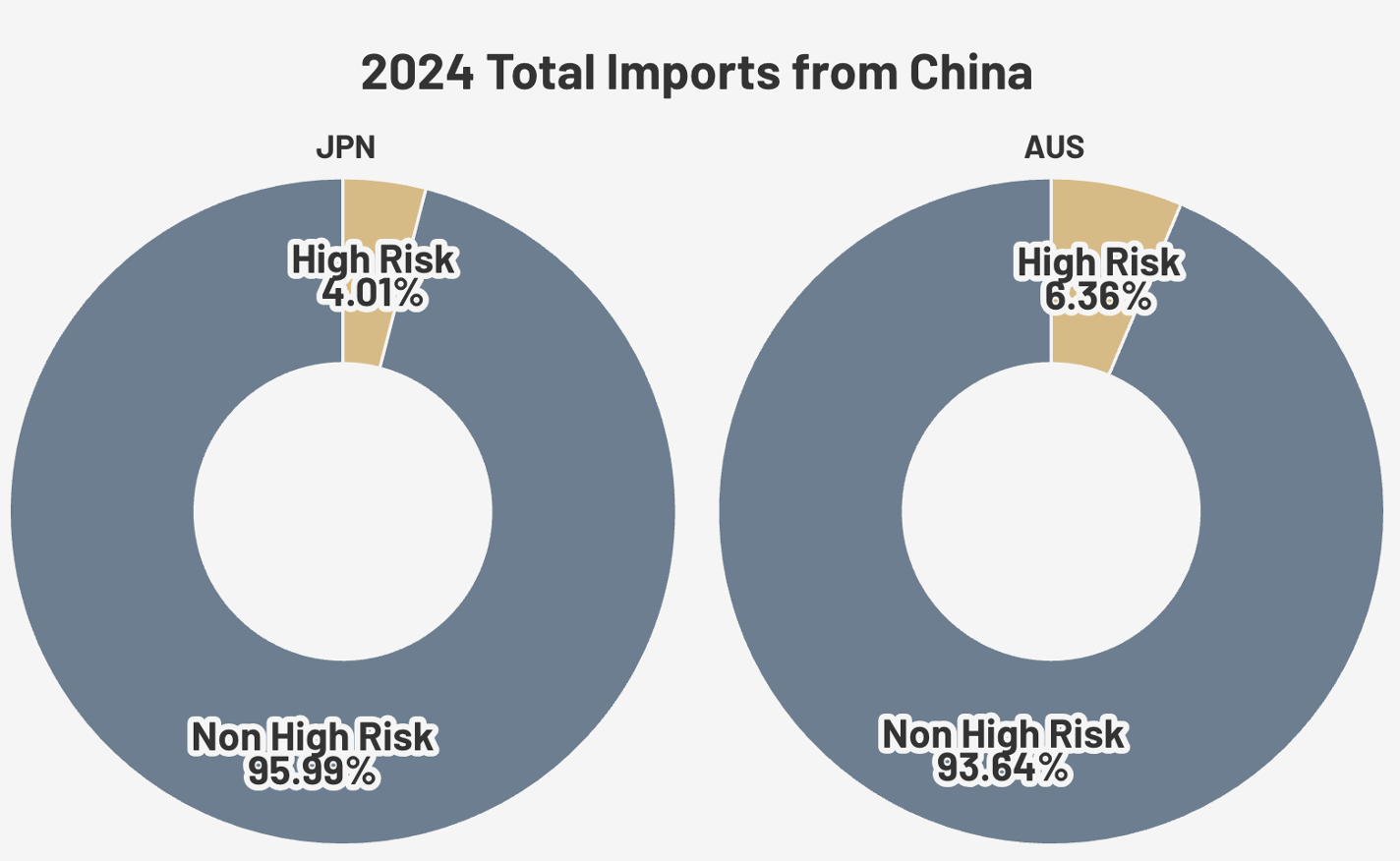
本报告利用2024年联合国(UN)商品贸易数据、行业风险映射以及通过批判性话语分析(CDA)进行的比较政策分析,发现澳大利亚和日本仍在继续从与维吾尔强迫劳动风险相关的行业进口价值数十亿美元的商品。 澳大利亚从中国进口了约48.2亿美元的高风险商品,占其从中国进口总额的6.36%。 日本进口了约67.1亿美元,占其进口总额的4.01%。 风险集中在棉制服装与纺织品、太阳能原材料、铝材和化学产品领域。
这些数据并不意味着这些类别中的所有商品都是通过强迫劳动制造的。它们显示了对那些强迫劳动风险记录在案且难以进行独立核实的行业的暴露程度。东突厥斯坦(也被称为维吾尔地区)在中国的棉花、纺织、太阳能和工业供应链中处于核心地位,而国家强加的劳动力转移计划、监控以及对独立调查的限制,削弱了传统的审计模式。相关报告记录了维吾尔地区严重的侵犯人权问题,包括任意拘留、强制劳动计划以及阻碍独立评估的限制措施。经济合作与发展组织(OECD)准则以及国际劳工组织(ILO)的强迫劳动公约。但它们的国内体系主要依赖于披露、指导和企业自愿尽职调查。国际劳工组织2014年的《强迫劳动公约议定书》呼吁采取有效措施识别、保护和补救强迫劳动造成的伤害,而经合组织准则呼吁进行基于风险的企业尽职调查。然而,澳大利亚和日本目前均未要求企业在商品进入其市场前证明其不涉及强迫劳动。
其结果是出现了执法缺口。 《维吾尔强迫劳动预防法》(UFLPA)展示了市场准入限制如何通过将证明商品与强迫劳动无关的举证责任转嫁给进口商,从而改变企业的激励机制。 但单边执法是不够的。 如果没有中等经济体的同等行动,被一个市场排除在外的高风险商品可以继续在其他市场流通。
国际标准固然重要,但只有转化为可执行的国内法时才有效。
澳大利亚和日本应通过采取强迫劳动进口禁令、进口商溯源要求、更强的海关权力以及强制性人权尽职调查来弥补这一缺口。 国际标准固然重要,但只有转化为可执行的国内法时才有效。
III. 中等经济体与强迫劳动执法缺口
中等经济体正日益暴露于中国供应链中的强迫劳动风险之下。 随着美国和欧盟等主要市场加强强迫劳动法律和进口管制措施,与东突厥斯坦国家强加的强迫劳动相关的商品,可能会被转移到执法体系较弱、调查能力有限且没有强迫劳动进口禁令的司法管辖区。 这造成了治理缺口:企业可以在满足形式上的披露或尽职调查期望的同时,继续从高风险行业采购。
这种风险之所以特别难以解决,是因为维吾尔地区的强迫劳动嵌入在更广泛的国家控制体系中。自2017年以来,超过一百万维吾尔人和其他突厥裔穆斯林被任意拘留在再教育营、拘留设施和监狱中。
这些条件削弱了传统供应链审计的核心假设。第三方尽职调查依赖于自愿披露、可信的工人访谈和独立的现场检查。在维吾尔地区,监控、与拘留挂钩的就业以及国家主导的劳动力转移使得这些工具变得不可靠。
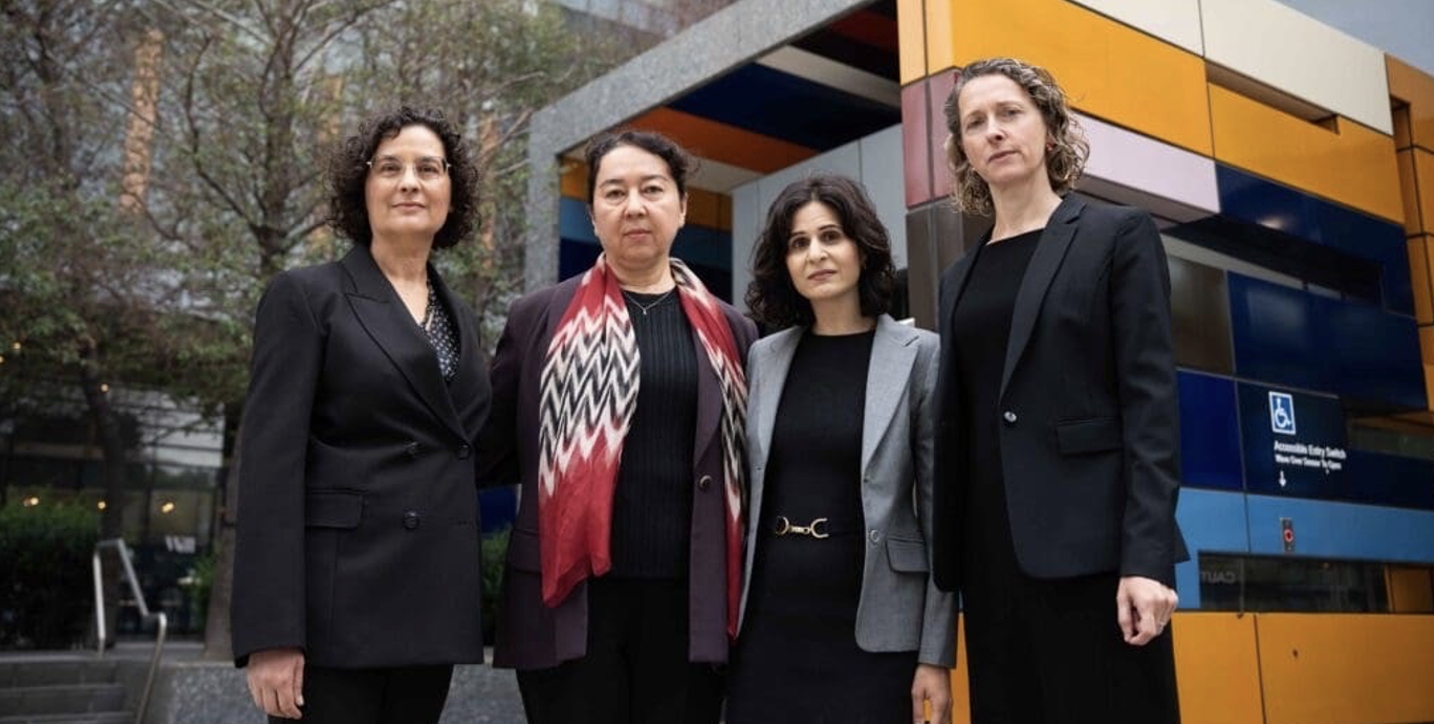
在澳大利亚,这种动态正受到越来越多的审视。2025年,澳大利亚维吾尔唐里塔格妇女协会(AUTWA)根据消费者保护法对澳大利亚Kmart提起诉讼,要求披露供应链信息。该组织指控Kmart可能在强迫劳动风险方面误导了消费者。
日本面临着类似的挑战。它仍然深度融入中国的制造网络,包括与维吾尔人被强迫劳动相关的行业。这种风险特别集中在纺织品和太阳能原材料领域,这些领域与维吾尔地区的生产联系已被广泛记录。尽管在与维吾尔地区相关的行业中存在记录在案的风险,但民间社会团体越来越多地批评日本非强制性的人权尽职调查准则未能建立可执行的义务。
IV. 从中国向澳大利亚和日本进口的高风险商品
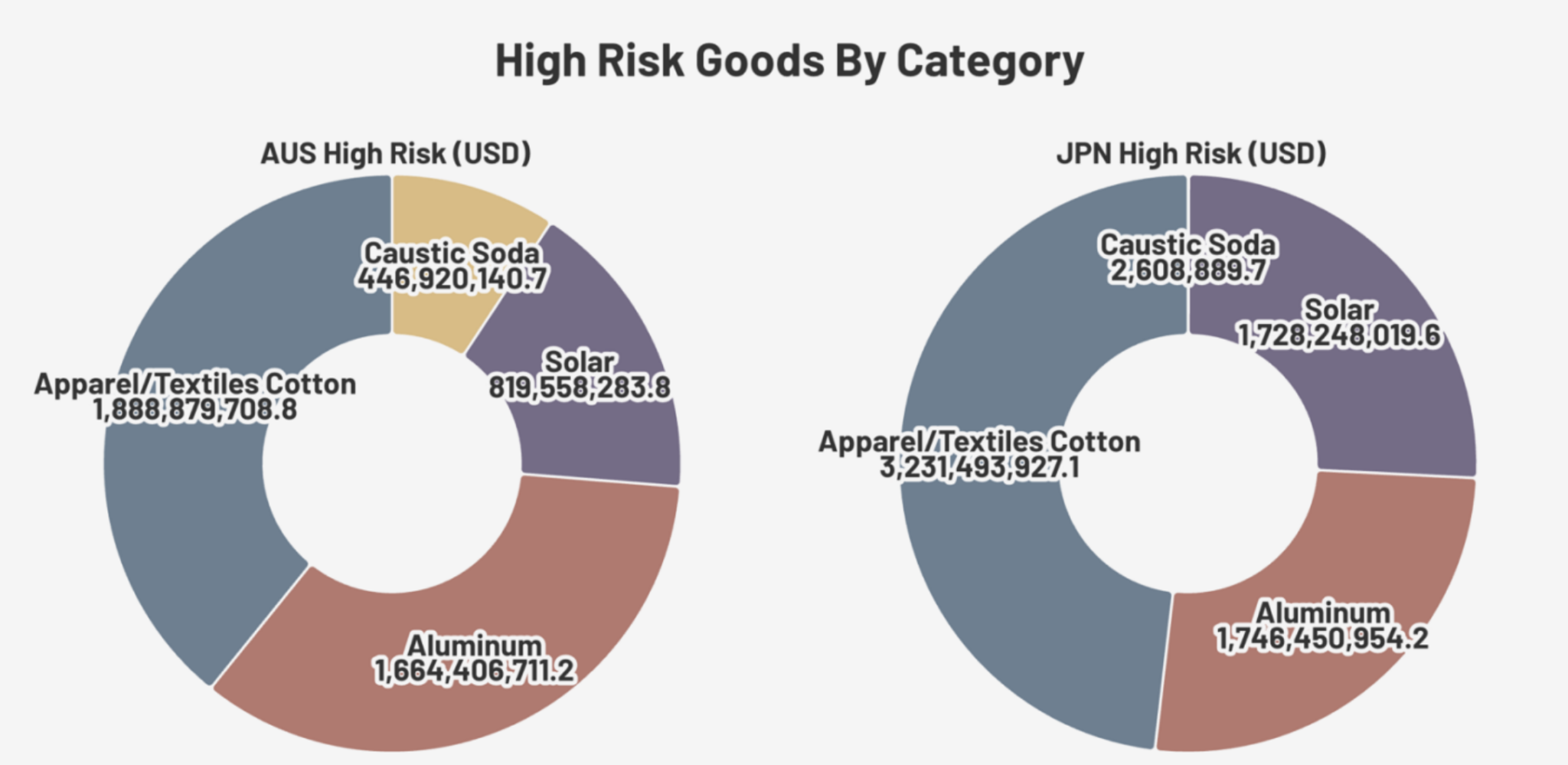
根据维吾尔人权项目(UHRP)对2024年联合国商品贸易数据的一项新分析,日本和澳大利亚在与维吾尔强迫劳动风险相关的行业中进口了大量商品。该分析并不声称这些类别中的所有商品都是通过强迫劳动制造的。相反,它通过汇总中国在协调制度(HS)类别下的进口额来估算风险暴露程度。HS编码是国际贸易数据中用于商品分类的标准产品代码,允许研究人员按行业追踪各国的进出口情况。本报告确定了高风险类别,包括棉制服装与纺织品、烧碱、与多晶硅相关的太阳能产品以及铝材。这些行业已被记录与维吾尔地区的国家强加的劳动力转移计划、国家关联企业以及强制劳动系统存在联系。2024年,澳大利亚进口了48.2亿美元与强迫劳动风险升高相关的商品,占其从中国进口总额的6.36%。日本进口了67.1亿美元,占其从中国进口总额的4.01%。虽然日本的进口总量明显更大,但按贸易总额占比衡量,澳大利亚表现出更高的相对风险(见图1)。
这种风险集中在少数几个行业(见图2),且强迫劳动风险因行业而异。太阳能供应链尤其脆弱,因为维吾尔地区在《维吾尔强迫劳动预防法》开始执行时,在全球多晶硅生产中发挥了重要作用,约占全球产量的40%至45%。
纺织品约占澳大利亚高风险进口商品的40%,占日本的近一半,使这些商品成为强迫劳动风险进入这两个市场的主要渠道。
与太阳能相关的产品,包括多晶硅和光伏原材料,构成了第二大类别。 澳大利亚进口了约8.2亿美元此类商品,而日本进口了17.3亿美元。 日本较高的风险暴露反映了其融入了上游制造过程,特别是在电子和可再生能源供应链中,这些环节的原材料更难追踪和核实。
工业材料(包括铝材和化学化合物)中也存在额外的风险。 虽然总价值较小,但这些行业代表了生产的上游节点,强迫劳动风险在供应链更早阶段就已嵌入,使得溯源更具挑战性。 日本对高纯度硅及相关原材料的进口,进一步凸显了识别在到达最终市场前经过多道加工工序的中间商品风险的难度。
在日本和澳大利亚,高风险进口商品在贸易总额中的份额保持稳定。这一点很重要,因为《维吾尔强迫劳动预防法》通过其可反驳的推定和进口限制,为企业提供了强有力的激励,使其将与维吾尔地区相关的商品排除在美国市场之外。
高风险商品持续进口至日本和澳大利亚,表明供应链正在发生分化:企业可能会为美国市场建立低风险供应链,同时继续将高风险商品输往没有类似进口禁令的司法管辖区。这种不均衡的执法不仅无法消除强迫劳动风险,反而可能导致风险转移。对于日本和澳大利亚等中等经济体而言,这造成了政策缺口:即便美国通过执法减少了其市场内的直接风险,这些国家仍可能面临高风险进口商品。图3:2016-2024年中国对日本、澳大利亚和美国的铝进口情况相比之下,美国在2022年后呈现出更明显的下降趋势,这与执法驱动的限制措施所产生的影响相一致。 尽管短期波动明显,特别是2023年出现过下滑,但日本和澳大利亚的进口水平已经回升,且正如《维吾尔强迫劳动预防法》(UFLPA)实施后的时期所显示的那样,总体上仍与执法前的水平保持一致。 这种差异表明,具体且可执行的机制对于改变采购行为至关重要。 在边境执行强迫劳动进口禁令的地方(如美国根据UFLPA所采取的措施),贸易流向的调整更为显著。 而在缺乏此类机制的地方(如日本和澳大利亚),风险依然存在,本报告稍后将对此进行探讨。
在边境执行强迫劳动进口禁令的地方(如美国根据UFLPA所采取的措施),贸易流向的调整更为显著。
五、澳大利亚:仅有披露要求,缺乏进口管制
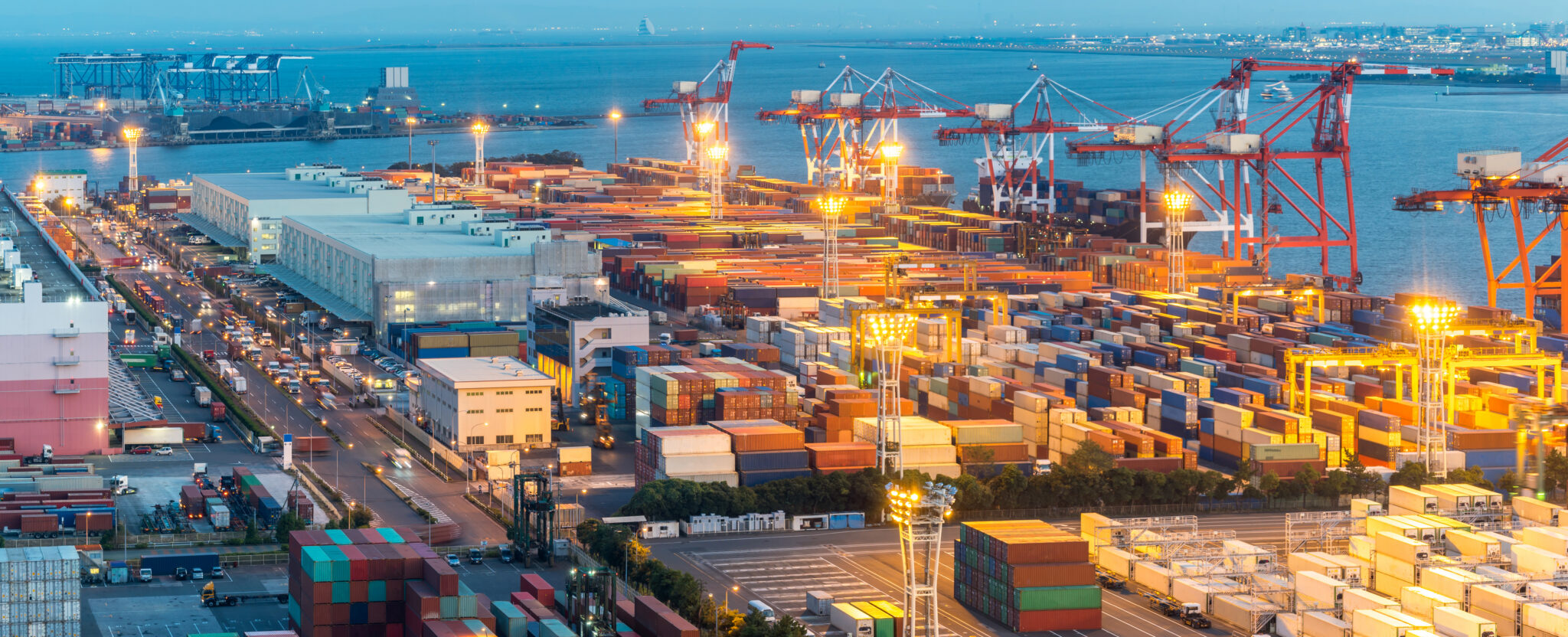
澳大利亚的《现代奴隶制法案》采取了基于透明度的方法:要求相关企业报告供应链风险。然而,该法案并未强制要求进行人权尽职调查、补救措施或对与强迫劳动相关的商品实施限制。因此,它仅反映了商业与人权议程中关于信息披露的一面,而未达到联合国工商企业与人权指导原则(UNGPs)和经合组织(OECD)准则所设定的更广泛的尽职调查预期。该法案要求年收入超过1亿澳元(约合7050万美元)的企业报告供应链风险及缓解措施,但并未规定任何处罚、进口限制或调查权限。政府监管主要侧重于改善信息披露而非限制市场准入,导致执法在很大程度上依赖于企业行为和民间社会的监督。图片2:维多利亚港的集装箱船和港口起重机,高容量航运网络将商品从中国供应链输往全球市场。在实践中,这些局限性制约了该框架的有效性。正如澳大利亚维吾尔坦格里塔格妇女协会主席Ramila Chanisheff所解释的那样:“澳大利亚的《现代奴隶制法案》在很大程度上处于不活跃状态,且依赖于行业自身的透明度和对其做法的披露。” 由于缺乏具有约束力的执法机制,民间社会行动者不得不寻求其他法律途径,2025年根据消费者保护法对Kmart Australia提起的诉讼即是证明。
《现代奴隶制法案》侧重于披露而非进口禁令,这造成了结构性局限:企业可以通过报告风险来遵守法律,而无需改变其采购行为。
澳大利亚的《现代奴隶制法案》旨在建立一个披露框架,而非作为强迫劳动进口禁令。该法案要求大型企业报告其运营和供应链中的现代奴隶制风险。然而,该法案并不禁止与强迫劳动相关的进口,也不要求企业更换供应商,或对未能进行充分尽职调查的行为施加直接处罚。《现代奴隶制法案》侧重于披露而非进口禁令,这造成了结构性局限:企业可以通过报告风险来遵守法律,而无需改变其采购行为。因此,学者和民间团体主张,透明度法律必须与更强有力的执法工具相结合,包括强制性人权尽职调查和强迫劳动进口禁令。六、日本:仅有指导意见,缺乏约束性义务。日本在形式上与澳大利亚不同,但存在同样的执法缺口。澳大利亚要求进行现代奴隶制报告,而日本则提供自愿性的尽职调查指导。这两个框架均未强制要求进行人权尽职调查,也未限制与强迫劳动相关的进口。日本2022年的《负责任供应链中尊重人权指南》最好被理解为一种国家背书但无约束力的指导框架,而非正式法规。日本的指南鼓励企业识别、预防和减轻人权风险,但并未设定法律义务、处罚或针对强迫劳动相关商品的边境限制。因此,法律形式上缺乏执法机制,其实施完全依赖于企业的自愿行动和声誉压力。
日本的指南鼓励企业识别、预防和减轻人权风险,但并未设定法律义务、处罚或针对强迫劳动相关商品的边境限制。
这些指南可能会通过政府预期、投资者审查和声誉压力影响企业行为,但其实施最终取决于企业的自愿采纳。
尽管图3显示2022年后铝进口量略有下降,但这一模式不应被解读为指南改变了采购行为的明确证据。 由于指南并未施加处罚、进口限制或强制性溯源要求,任何下降更可能被理解为暗示性而非因果性的,且可能反映了更广泛的市场状况、供应商替代、价格变动或日中贸易的其他变化。
澳大利亚和日本共同说明了透明度和自愿性尽职调查框架在解决强迫劳动风险方面的局限性。 澳大利亚的《现代奴隶制法案》被设计为一部披露法,要求相关企业报告其运营和供应链中的现代奴隶制风险。 日本2022年的指南同样反映了一种国家背书但无约束力的尽职调查方法,鼓励企业按照国际标准识别并减轻人权风险。 在这两种情况下,目标都是通过报告、指导和声誉压力来塑造企业行为,而非通过直接的进口限制。 这两个框架均不具备强迫劳动进口禁令的功能,也不要求企业在进入国内市场前证明高风险商品不涉及强迫劳动。
因此,信息披露和自愿性尽职调查或许能提高对风险的认识,但仍允许高风险商品进入澳大利亚和日本。 高风险进口商品持续进入澳大利亚和日本,特别是在棉纺织品、太阳能原材料和铝等行业,这表明当供应链涉及独立核查受限或不可靠的地区时,仅靠透明度和指导是不够的。
七。 国际标准与国内执法缺口
澳大利亚和日本在形式上均与主要的国际商业与人权框架保持一致。 两国均为国际劳工组织(ILO)成员,支持《联合国工商企业与人权指导原则》,并参与经合组织的负责任商业行为体系。 它们的国内做法反映了这些框架的部分内容,特别是企业透明度、风险评估和人权尽职调查。 澳大利亚的《现代奴隶制法案》要求相关实体报告现代奴隶制风险并描述尽职调查和补救流程,而日本的指南则鼓励企业在其供应链中进行人权尽职调查。 日本,2022年;澳大利亚,2018年。 然而,两国目前均未制定强制性人权尽职调查法或强迫劳动进口禁令。
国际劳工组织《强迫劳动公约》、联合国指导原则和经合组织准则等国际框架,为预防强迫劳动和开展供应链尽职调查确立了明确的预期。这些文书共同概述了预防强迫劳动、开展企业尽职调查以及确保受影响社区获得补救的预期。
国际劳工组织将强迫劳动定义为在惩罚威胁下且未经自愿同意而从事的工作,并要求成员国通过法律和行政措施抑制和消除此类行为。1930年《强迫劳动公约》(第29号)提供了核心定义,要求各国禁止并抑制强迫劳动;而1957年《废除强迫劳动公约》(第105号)则明确禁止国家强加的强迫劳动,包括作为政治胁迫、惩罚政治观点、劳动纪律或歧视手段的劳动。2014年《第29号公约议定书》进一步加强了这些义务,呼吁各国政府不仅要禁止强迫劳动,还要通过执法机制、劳动监察系统和受害者保护措施积极预防强迫劳动。这些标准共同确立了一个明确的预期,即国家在识别虐待行为、保护受害者以及限制与强迫劳动相关的经济活动方面发挥核心作用。经合组织准则也期望企业进行基于风险的尽职调查,但此类尽职调查只有在明确的法律义务和国家执法支持下才最为有效。在澳大利亚和日本,识别和管理强迫劳动风险的责任主要由企业承担,尽管企业往往缺乏核实高风险地区劳动条件所需的独立性、杠杆作用或准入权限。这在东突厥斯坦地区尤为严重,那里的监控、劳动力转移计划以及对独立调查的限制使得可信的审计变得困难。问题不在于澳大利亚的《现代奴隶制法案》或日本的指南未能实现其设计目标,而在于这些工具缺乏解决东突厥斯坦强迫劳动供应链问题所需的法律机制。
在缺乏强制性人权尽职调查、国家主导的调查权限、核查要求或强迫劳动进口禁令的情况下,高风险商品可以继续进入那些认识到问题但缺乏制止机制的市场。
因此,两国虽然在形式上支持国际人权准则,却缺乏使这些承诺生效所需的国内工具。 如果没有强制性的人权尽职调查、国家主导的调查权、核查要求或强迫劳动进口禁令,高风险商品将继续进入那些意识到问题但缺乏制止机制的市场。
VIII. 软法框架如何限制问责制
要理解为什么高风险进口商品持续进入澳大利亚和日本,仅靠审视贸易数据或正式的法律授权是不够的。 各国强迫劳动治理框架的措辞也至关重要。 这些措辞揭示了各国政府如何分配责任、定义国家角色,并表明强迫劳动是被视为执法问题还是企业风险管理问题。 对法律、政策指南、法律评论、倡导报告和媒体报道进行的批判性话语分析(CDA)表明,两国主要将强迫劳动风险视为企业披露和自愿风险管理的问题。 “报告”、“披露”、“指南”、“鼓励”和“尽职调查”等术语在政策词汇中占据主导地位。 相比之下,“禁止”、“处罚”、“责任”、“扣押”和“进口限制”等以执法为导向的术语出现频率要低得多。 这种措辞反映了一种更广泛的治理模式:责任被置于企业身上,由其识别和管理风险,而国家保留阻止高风险商品进入市场的有限权力。
这种措辞反映了一种更广泛的治理模式:责任被置于企业身上,由其识别和管理风险,而国家保留阻止高风险商品进入市场的有限权力。
在澳大利亚,关于《2018年现代奴隶制法案》的讨论集中在报告和披露上。 正如澳大利亚维吾尔唐格里塔格妇女协会主席拉米拉·查尼谢夫(Ramila Chanisheff)所解释的那样:“澳大利亚的《现代奴隶制法案》在很大程度上处于不活跃状态,且依赖于行业自身的透明度和对其行为的披露。” 拉米拉·查尼谢夫,致作者的电子邮件,2026年3月29日。 图4:与会者参加了2月份与人权观察组织共同举办的研讨会,讨论中国的区域民族自治制度和维吾尔种族灭绝的现实,强调了国际社会对东突厥斯坦国家镇压和侵犯人权行为的关注。。 日本的供应链框架也以类似的术语进行描述,尽管是通过指南而非披露法。 法律和政策分析通常将日本2022年的《负责任供应链中尊重人权指南》描述为非约束性指南,鼓励企业采取人权尽职调查,但并未设定法律处罚或进口限制。 这种措辞将责任置于企业身上,由其识别和管理风险,同时使国家在调查违规行为或限制高风险商品方面缺乏有效工具。
这种话语有助于解释本报告前面确定的贸易模式。 澳大利亚的披露框架和日本的指南模式并非未能实现其设计目标。 它们旨在促进报告、风险意识和企业自愿尽职调查。 问题在于,这些工具不足以替代执法机制。
批判性话语分析和贸易数据指向同一个结论:澳大利亚和日本正式承认强迫劳动风险,但其国内系统主要通过企业报告和自愿合规来应对。 如果没有更强有力的机制来调查违规行为、要求可信的核查或阻止高风险进口,即使在认可国际人权标准的市场中,强迫劳动风险也可能继续嵌入供应链中。
IX. 为什么中等经济体需要可执行的标准
澳大利亚和日本的模式揭示了强迫劳动治理面临的更广泛挑战。 国际标准有助于定义政府和企业的预期,但除非转化为可执行的国内法,否则它们无法阻止高风险商品进入国内市场。 澳大利亚和日本正式与全球人权规范保持一致,并促进企业尽职调查。 然而,两国都没有要求企业在进口前证明高风险商品不涉及强迫劳动。
本报告确定的贸易模式表明,在强迫劳动风险与国家强加的劳动制度挂钩的情况下,披露和自愿尽职调查是不够的。 澳大利亚的《现代奴隶制法案》和日本的2022年指南旨在促进报告、风险识别和负责任的商业行为。 它们并非旨在限制市场准入。 因此,它们可能提高了意识,却未能阻止高风险商品进入国内市场。
这是中等经济体面临的核心风险:如果没有相应的进口禁令、可追溯性要求和海关执法,全球贸易中的强迫劳动风险就不会被消除。 它只是被重新分配了。
《维吾尔强迫劳动预防法》(UFLPA)提供了一种通过以进口商证据为条件来限制市场准入的弥补差距的模式。 但单边执法是不够的。 如果只有部分市场限制与强迫劳动有关的商品,企业可以将高风险商品转运至规则较宽松的司法管辖区。 这是中等经济体面临的核心风险:如果没有相应的进口禁令、可追溯性要求和海关执法,全球贸易中的强迫劳动风险就不会被消除。 它只是被重新分配了。
这种风险在东突厥斯坦(维吾尔地区)最为严重,强迫劳动已嵌入国家主导的生产中。自2017年以来,当局拘留了估计150万维吾尔人和其他突厥民族,同时劳动转移计划将维吾尔工人带到了中国各地的工厂和农场。这些计划在胁迫和监视下运作,使得劳动剥削与更广泛的国家控制系统密不可分。该地区在棉花、纺织品、多晶硅和农业供应链中的作用意味着北美、欧洲和亚洲的企业和消费者在物质上仍然与强迫劳动风险相连。凯马特(Kmart)案例说明了合规与问责之间的差距。问题不在于凯马特根据澳大利亚的《现代奴隶制法案》披露了强迫劳动风险而政府未采取行动。相反,外部行为者提出了对维吾尔强迫劳动的潜在联系的担忧。尽管如此,澳大利亚仍缺乏能够阻止高风险商品进入或在国内市场销售的强迫劳动进口禁令。在这种法律环境下,澳大利亚维吾尔唐格里塔格妇女协会(AUTWA)不得不依赖消费者法和关于误导性行为的指控,作为获取信息和问责的间接途径。
这加强了本报告的核心论点:澳大利亚的《现代奴隶制法案》和日本的2022年指南可能实现了其设计目标。 尽管如此,它们并非旨在防止进口与维吾尔强迫劳动有关的商品。 因此,维吾尔人暴露在国家强加的强迫劳动之下,维吾尔社区和家庭的离散以及对维吾尔文化和社会的持续压迫仍在继续。 两国都需要能够直接解决该问题的法律工具。 如果没有强迫劳动进口禁令、强制性可追溯性、海关执法和协调一致的国际行动,强迫劳动风险将继续向执法较弱的市场转移。
X. 弥补执法差距的建议
• 采纳以《维吾尔强迫劳动预防法》(UFLPA)为蓝本的强迫劳动进口禁令。 澳大利亚、日本和其他中等经济体应采纳强迫劳动进口禁令,以可信的供应链证据作为市场准入的条件。 与UFLPA一样,这些法律应将举证责任转移给进口商,要求其在商品进入国内市场前证明其不涉及强迫劳动。 进口禁令应特别适用于记录有国家强加强迫劳动的高风险地区和行业,包括棉纺织品、太阳能输入品、铝及其他工业品。
• 将进口禁令与可追溯性、海关权力和强制性尽职调查相结合。 只有当政府赋予海关机构执行禁令所需的权力、资源和数据时,进口禁令才会有效。 澳大利亚和日本应要求进口商绘制供应链图,记录上游输入品,并为高风险商品提供可信证据。 这些规则应与强制性人权尽职调查相结合,以便企业在商品到达边境前识别、预防和解决强迫劳动风险。
• 协调主要市场和中等市场的执法。单边行动可能会减少一个市场的风险敞口,同时将高风险商品转移到其他市场。美国、欧盟、澳大利亚、日本和其他合作伙伴应通过共享海关数据、共同风险指标、公共实体名单以及针对高风险行业和地区的协调方法来统一执法工作。这将减少企业在不同司法管辖区之间转运商品的机会,并有助于防止强迫劳动风险在较弱的市场中流通。“结束维吾尔地区强迫劳动联盟”和“人口贩运法律中心”强调,需要加强进口禁令的执行,并采取协调行动,防止在一个市场被排除的商品被转运到另一个市场。
• 正式将公民社会和受影响社区纳入执法过程。 公民社会组织往往在政府采取行动之前就能识别出风险。 凯马特案例表明,澳大利亚维吾尔唐格里塔格妇女协会等团体如何能够揭露供应链问题,但也表明有限的法律工具如何迫使社区依赖间接途径来寻求问责。 政府应加强举报人保护,建立证据共享机制,并为受影响社区提供更明确的法律途径,以启动调查或质疑高风险进口。
XI. 方法论
本报告采用混合方法来评估澳大利亚和日本的强迫劳动风险敞口。 该方法结合了HS-6贸易数据分析与批判性话语分析,以比较哪些商品进入了每个市场,以及每个国家如何界定这一政策问题。
贸易数据分析使用手动HS-6分类表,将2024年联合国商品贸易统计数据库(UN Comtrade)中从中国进口的贸易线编码为四个高风险行业:铝、棉服装和纺织品、烧碱以及太阳能相关商品。 铝使用第76章产品进行编码,而棉服装和纺织品使用第61、62和63章中的选定商品进行编码。 烧碱在HS 281511和HS 281512项下进行编码。 太阳能相关风险使用HS 280461、280469、381800、854141、854142、854143和854149进行编码,涵盖硅、掺杂化合物、半导体器件、光伏电池、光伏组件和LED。 每条HS-6贸易线被分配到一个行业和子类别,然后在Excel数据透视表中按国家、行业和产品组进行汇总。 这得出了澳大利亚和日本的行业级风险敞口总额,显示中国向澳大利亚出口的高风险商品约为48.2亿美元,向日本出口约为67.1亿美元。
批判性话语分析考察了澳大利亚和日本如何讨论强迫劳动治理。 一个手动编码的Excel数据库按标题、作者、日期、国家重点、来源类型、视角、立场、关键引语和关键词组织了来源。 批判性话语分析数据集共包含17个来源:7个关注日本,10个关注澳大利亚。 来源包括法律概述、政府声明、倡导报告、新闻稿、评论文章和新闻报道。 每个来源都按视角(例如:法律分析、初级立法、新闻文章或公民社会报告)和立场(例如:中立或批判)进行编码。 这种编码使得比较强迫劳动风险是被界定为基于透明度的语言(如报告、指南和尽职调查),还是基于执法的语言(如处罚、进口限制和法律问责)成为可能。
XII. 附录:批判性话语分析数据集
XIII. 关于作者
以利亚·波克尔-威尔逊(Elijah Pockell-Wilson)是维吾尔人权项目的研究助理,他的工作重点是全球供应链中的强迫劳动风险、国际贸易流以及包括棉纺织品、太阳能输入品、铝和农产品在内的高风险行业。 他在维吾尔人权项目撰写的文章曾发表在《The Trail》上,他在文中将国际政治经济学、贸易和维吾尔人权问题与地方层面的公共辩论联系起来。 他最近毕业于普吉特湾大学,获得了经济学理学学士学位,主修国际政治经济学,辅修数学。 他的学术工作研究国际贸易、全球治理和数据驱动的人权政策。
XIIV. 致谢
作者感谢维吾尔人权项目研究主任亨利克·萨齐耶夫斯基(Henryk Szadziewski)博士在本报告准备过程中提供的指导和支持,以及维吾尔人权项目项目助理阿黛尔·克里纳(Adaire Criner)的细心编辑,这些工作增强了报告的清晰度和呈现效果。 作者感谢澳大利亚维吾尔唐格里塔格妇女协会的拉米拉·查尼谢夫(Ramila Chanisheff)为澳大利亚现代奴隶制框架提供的倡导和见解。 作者还要感谢两位匿名审稿人提供的建设性反馈。 特别感谢普吉特湾大学的韩允善(Yoonseon Han)博士和丽莎·纳恩(Lisa Nunn)博士的支持,感谢他们帮助作者梳理了关于中等经济体和供应链治理的报告思路,并协助通过世界综合贸易解决方案(WITS)获取联合国商品贸易统计数据库数据。
封面艺术由 YetteSu 创作。© 2026 维吾尔人权项目。请在遵守知识共享署名 4.0 国际许可协议 (CC BY 4.0) 的前提下,注明出处并自由分享这些资料。
————————————
以下为该文章引用的外部资源:
• 1 原文引用资料(uhrp.org):https://uhrp.org/
• 2 原文引用资料(uhrp.org):https://uhrp.org/statement/new-uhrp-report-warns-uyghur-forced-labor-risks-are-shifting-to-australia-and-japan-amid-global-enforcement-gaps/
• 3 原文引用资料(uhrp.org):https://uhrp.org/wp-content/uploads/2026/06/Redirected-Risk_UHRP-Report-2026-2.pdf
• 4 原文引用资料(uhrp.org):https://uhrp.org/wp-content/uploads/2026/06/Redirected-Risk-One-Pager-2026.pdf
• 5 原文引用资料(wwd.com):https://wwd.com/sourcing-journal/
• 6 原文引用资料(chinaglobalsouth.com):https://chinaglobalsouth.com/2026/06/24/report-uyghur-forced-labor-may-be-distributed-across-global-south-supply-chains/
• 7 原文引用资料(ecotextile.com):https://www.ecotextile.com/2026062563632/news/social-compliance-and-csr/australia-japan-face-forced-labour-risks/
• 8 原文引用资料(csis.org):https://www.csis.org/analysis/assessing-impact-uyghur-forced-labor-prevention-act-after-three-years
• 9 原文引用资料(ohchr.org):https://www.ohchr.org/en/documents/country-reports/ohchr-assessment-human-rights-concerns-xinjiang-uyghur-autonomous-region
• 10 原文引用资料(cfr.org):https://www.cfr.org/backgrounders/china-xinjiang-uyghurs-muslims-repression-genocide-human-rights
• 11 原文引用资料(jamestown.org):https://jamestown.org/wp-content/uploads/2022/08/Coercive-Labor-and-Forced-Displacement-in-Xinjiangs-Cross-Regional-Labor-Transfers-A-Process-Oriented-Evaluation_Updated-December-2021___.pdf
• 12 原文引用资料(csis.org):https://www.csis.org/analysis/addressing-forced-labor-concerns-polysilicon-produced-xinjiang
• 13 原文引用资料(hrlc.org.au):https://www.hrlc.org.au/updates/legal-action-filed-against-kmart
• 14 原文引用资料(hrw.org):https://www.hrw.org/news/2026/02/27/japan-should-adopt-regulation-to-counter-uyghur-forced-labor
• 15 原文引用资料(dhs.gov):https://www.dhs.gov/sites/default/files/2022-
• 16 原文引用资料(dhs.gov):https://www.dhs.gov/sites/default/files/2022-%20%20%2006/22_0617_fletf_uflpa-strategy.pdf
• 17 原文引用资料(shura.shu.ac.uk):https://shura.shu.ac.uk/29640/
• 18 原文引用资料(aspi.org.au):https://www.aspi.org.au/report/uyghurs-sale/
• 19 原文引用资料(cbp.gov):https://www.cbp.gov/newsroom/stats/trade/uyghur-forced-labor-prevention-act-statistics.
• 20 原文引用资料(csis.org):https://www.csis.org/analysis/uyghur-forced-labor-prevention-act-goes-effect
• 21 原文引用资料(hrw.org):https://www.hrw.org/report/2021/04/19/break-their-lineage-break-their-roots/chinas-crimes-against-humanity-targeting
• 22 原文引用资料(legislation.gov.au):https://www.legislation.gov.au/C2018A00153/latest/text
• 23 原文引用资料(modernslavery.gov.au):https://www.modernslavery.gov.au/guidance-training-
• 24 原文引用资料(modernslavery.gov.au):https://www.modernslavery.gov.au/guidance-training-%20%20%20%0dresources/resources/official-modern-slavery-act-guidance
• 25 原文引用资料(ag.gov.au):https://www.ag.gov.au/sites/default/files/2023-05/Report%20-%20Statutory%20Review%20of%20the%20Modern%20Slavery%20Act%202018.PDF
• 26 原文引用资料(journals.sagepub.com):https://journals.sagepub.com/doi/abs/10.1177/0022185620957471
• 27 原文引用资料(cdn.walkfree.org):https://cdn.walkfree.org/content/uploads/2026/02/17150535/GD432-AUMSA_finalRGB.pdf
• 28 原文引用资料(meti.go.jp):https://www.meti.go.jp/policy/economy/businessjinken/guidelines/provisionalenglishtranslation.pdf
• 29 原文引用资料(meti.go.jp):https://www.meti.go.jp/policy/economy/business-jinken/guidelines/provisionalenglishtranslation.pdf
• 30 原文引用资料(ilo.org):https://www.ilo.org/dyn/normlex/en/fp=NORMLEXPUB:12100:0::NO::P12100_ILO_CODE:C029
• 31 原文引用资料(oecd.org):https://www.oecd.org/en/publications/oecd-guidelines-for-multinational-enterprises_9789264115415-en.html
• 32 原文引用资料(ilo.org):https://www.ilo.org/media/21031/download
• 33 原文引用资料(ilo.org):https://www.ilo.org/dyn/normlex/en/fp=NORMLEXPUB:12100:0::NO::P12100_ILO_CODE:P029
• 34 原文引用资料(ilo.org):https://www.ilo.org/dyn/normlex/en/f?p=NORMLEXPUB:12100:0::NO::P12100_ILO_CODE:P029
• 35 原文引用资料(oecd.org):https://www.oecd.org/en/publications/oecd-guidelines-for-multinational-enterprises-on-responsible-business-conduct_81f92357-en.html.
• 36 原文引用资料(ohchr.org):https://www.ohchr.org/en/publications/reference-publications/guiding-principles-business-and-human-rights.
• 37 原文引用资料(law.georgetown.edu):https://www.law.georgetown.edu/georgetownlawjournal/wpcontent/uploads/sites/26/2024/09/Bacon_TradeAndHumanRightsAbuses.pdf
• 38 原文引用资料(law.georgetown.edu):https://www.law.georgetown.edu/georgetown-law-journal/wpcontent/uploads/sites/26/2024/09/Bacon_TradeAndHumanRightsAbuses.pdf
• 39 原文引用资料(doi.org):https://doi.org/10.1080/14631369.2019.1605497.
• 40 原文引用资料(uhrp.org):https://uhrp.org/statement/global-coalition-calls-on-companies-not-to-dump-forced-labour-made-goods-in-non-us-markets/
• 41 原文引用资料(htlegalcenter.org):https://htlegalcenter.org/wp-content/uploads/December-11-CSO-Statement-on-Import-Bans-Against-Forced-Labour.pdf
• 42 原文引用资料(htlegalcenter.org):https://htlegalcenter.org/sdm_downloads/taag-policy-memo-on-import-bans/
• 43 原文引用资料(instagram.com):http://instagram.com/yette.su 查看全部
原文标题:Redirected Risk: 维吾尔强迫劳动 and the Enforcement Gap in Australia and Japan - 维吾尔人权项目
作者:Elijah Pockell-Wilson
作者简介:Elijah Pockell-Wilson 是维吾尔人权项目(维吾尔人权项目)的研究助理,专注于全球供应链中的强迫劳动风险、贸易流向以及高风险行业。
副标题:供应链、进口规则和企业责任:为什么执法漏洞会让风险换个出口?
摘要:本文介绍维吾尔人权项目关于强迫劳动风险转移的报告。原文指出,供应链审查和进口执法不足,可能让涉及维吾尔强迫劳动的商品转向澳大利亚和日本市场。
转移的风险:维吾尔强迫劳动与澳大利亚及日本的执法缺口
这是一份由Elijah Pockell-Wilson撰写的维吾尔人权项目报告。请阅读我们关于该报告的新闻声明,下载英文版完整简报,并阅读可打印的报告单页摘要。
阅读Sourcing Journal、China Global South Project以及Ecotextile News对该报告的报道。
I. 核心要点
• 强迫劳动的风险正在被重新分配,而非被消除。 随着美国执行《维吾尔强迫劳动预防法》(UFLPA),以及欧盟准备实施其《强迫劳动条例》,高风险商品可能会流向缺乏同等进口管控的市场。
• 澳大利亚和日本等中等经济体依然面临风险。 2024年,澳大利亚从中国进口了约48.2亿美元的高风险商品,而日本进口了约67.1亿美元。
• 风险集中在战略性行业。 棉制服装与纺织品、太阳能原材料、铝材和化学产品,依然是维吾尔强迫劳动风险进入消费品和工业供应链的主要渠道。
• 透明度不等于执法。 澳大利亚的《现代奴隶制法案》和日本的供应链人权准则虽然促进了信息披露和尽职调查,但两者都无法在边境拦截高风险商品。
• 中等经济体需要可执行的工具。 澳大利亚和日本应采取强迫劳动进口禁令、进口商溯源要求、海关执法权以及强制性人权尽职调查措施。
II. 强迫劳动风险正向执法较弱的市场转移
随着美国和欧盟收紧对强迫劳动制造商品的限制,中等经济体面临着日益增长的风险:高风险进口商品可能会被转移到执法力度较弱的市场。 本报告考察了澳大利亚和日本的风险情况,这两个主要经济体深度融入中国供应链,但缺乏强迫劳动进口禁令。
本报告利用2024年联合国(UN)商品贸易数据、行业风险映射以及通过批判性话语分析(CDA)进行的比较政策分析,发现澳大利亚和日本仍在继续从与维吾尔强迫劳动风险相关的行业进口价值数十亿美元的商品。 澳大利亚从中国进口了约48.2亿美元的高风险商品,占其从中国进口总额的6.36%。 日本进口了约67.1亿美元,占其进口总额的4.01%。 风险集中在棉制服装与纺织品、太阳能原材料、铝材和化学产品领域。
这些数据并不意味着这些类别中的所有商品都是通过强迫劳动制造的。它们显示了对那些强迫劳动风险记录在案且难以进行独立核实的行业的暴露程度。东突厥斯坦(也被称为维吾尔地区)在中国的棉花、纺织、太阳能和工业供应链中处于核心地位,而国家强加的劳动力转移计划、监控以及对独立调查的限制,削弱了传统的审计模式。相关报告记录了维吾尔地区严重的侵犯人权问题,包括任意拘留、强制劳动计划以及阻碍独立评估的限制措施。经济合作与发展组织(OECD)准则以及国际劳工组织(ILO)的强迫劳动公约。但它们的国内体系主要依赖于披露、指导和企业自愿尽职调查。国际劳工组织2014年的《强迫劳动公约议定书》呼吁采取有效措施识别、保护和补救强迫劳动造成的伤害,而经合组织准则呼吁进行基于风险的企业尽职调查。然而,澳大利亚和日本目前均未要求企业在商品进入其市场前证明其不涉及强迫劳动。
其结果是出现了执法缺口。 《维吾尔强迫劳动预防法》(UFLPA)展示了市场准入限制如何通过将证明商品与强迫劳动无关的举证责任转嫁给进口商,从而改变企业的激励机制。 但单边执法是不够的。 如果没有中等经济体的同等行动,被一个市场排除在外的高风险商品可以继续在其他市场流通。
国际标准固然重要,但只有转化为可执行的国内法时才有效。
澳大利亚和日本应通过采取强迫劳动进口禁令、进口商溯源要求、更强的海关权力以及强制性人权尽职调查来弥补这一缺口。 国际标准固然重要,但只有转化为可执行的国内法时才有效。
III. 中等经济体与强迫劳动执法缺口
中等经济体正日益暴露于中国供应链中的强迫劳动风险之下。 随着美国和欧盟等主要市场加强强迫劳动法律和进口管制措施,与东突厥斯坦国家强加的强迫劳动相关的商品,可能会被转移到执法体系较弱、调查能力有限且没有强迫劳动进口禁令的司法管辖区。 这造成了治理缺口:企业可以在满足形式上的披露或尽职调查期望的同时,继续从高风险行业采购。
这种风险之所以特别难以解决,是因为维吾尔地区的强迫劳动嵌入在更广泛的国家控制体系中。自2017年以来,超过一百万维吾尔人和其他突厥裔穆斯林被任意拘留在再教育营、拘留设施和监狱中。
这些条件削弱了传统供应链审计的核心假设。第三方尽职调查依赖于自愿披露、可信的工人访谈和独立的现场检查。在维吾尔地区,监控、与拘留挂钩的就业以及国家主导的劳动力转移使得这些工具变得不可靠。
在澳大利亚,这种动态正受到越来越多的审视。2025年,澳大利亚维吾尔唐里塔格妇女协会(AUTWA)根据消费者保护法对澳大利亚Kmart提起诉讼,要求披露供应链信息。该组织指控Kmart可能在强迫劳动风险方面误导了消费者。
日本面临着类似的挑战。它仍然深度融入中国的制造网络,包括与维吾尔人被强迫劳动相关的行业。这种风险特别集中在纺织品和太阳能原材料领域,这些领域与维吾尔地区的生产联系已被广泛记录。尽管在与维吾尔地区相关的行业中存在记录在案的风险,但民间社会团体越来越多地批评日本非强制性的人权尽职调查准则未能建立可执行的义务。
IV. 从中国向澳大利亚和日本进口的高风险商品
根据维吾尔人权项目(UHRP)对2024年联合国商品贸易数据的一项新分析,日本和澳大利亚在与维吾尔强迫劳动风险相关的行业中进口了大量商品。该分析并不声称这些类别中的所有商品都是通过强迫劳动制造的。相反,它通过汇总中国在协调制度(HS)类别下的进口额来估算风险暴露程度。HS编码是国际贸易数据中用于商品分类的标准产品代码,允许研究人员按行业追踪各国的进出口情况。本报告确定了高风险类别,包括棉制服装与纺织品、烧碱、与多晶硅相关的太阳能产品以及铝材。这些行业已被记录与维吾尔地区的国家强加的劳动力转移计划、国家关联企业以及强制劳动系统存在联系。2024年,澳大利亚进口了48.2亿美元与强迫劳动风险升高相关的商品,占其从中国进口总额的6.36%。日本进口了67.1亿美元,占其从中国进口总额的4.01%。虽然日本的进口总量明显更大,但按贸易总额占比衡量,澳大利亚表现出更高的相对风险(见图1)。
这种风险集中在少数几个行业(见图2),且强迫劳动风险因行业而异。太阳能供应链尤其脆弱,因为维吾尔地区在《维吾尔强迫劳动预防法》开始执行时,在全球多晶硅生产中发挥了重要作用,约占全球产量的40%至45%。
纺织品约占澳大利亚高风险进口商品的40%,占日本的近一半,使这些商品成为强迫劳动风险进入这两个市场的主要渠道。
与太阳能相关的产品,包括多晶硅和光伏原材料,构成了第二大类别。 澳大利亚进口了约8.2亿美元此类商品,而日本进口了17.3亿美元。 日本较高的风险暴露反映了其融入了上游制造过程,特别是在电子和可再生能源供应链中,这些环节的原材料更难追踪和核实。
工业材料(包括铝材和化学化合物)中也存在额外的风险。 虽然总价值较小,但这些行业代表了生产的上游节点,强迫劳动风险在供应链更早阶段就已嵌入,使得溯源更具挑战性。 日本对高纯度硅及相关原材料的进口,进一步凸显了识别在到达最终市场前经过多道加工工序的中间商品风险的难度。
在日本和澳大利亚,高风险进口商品在贸易总额中的份额保持稳定。这一点很重要,因为《维吾尔强迫劳动预防法》通过其可反驳的推定和进口限制,为企业提供了强有力的激励,使其将与维吾尔地区相关的商品排除在美国市场之外。
高风险商品持续进口至日本和澳大利亚,表明供应链正在发生分化:企业可能会为美国市场建立低风险供应链,同时继续将高风险商品输往没有类似进口禁令的司法管辖区。这种不均衡的执法不仅无法消除强迫劳动风险,反而可能导致风险转移。对于日本和澳大利亚等中等经济体而言,这造成了政策缺口:即便美国通过执法减少了其市场内的直接风险,这些国家仍可能面临高风险进口商品。图3:2016-2024年中国对日本、澳大利亚和美国的铝进口情况相比之下,美国在2022年后呈现出更明显的下降趋势,这与执法驱动的限制措施所产生的影响相一致。 尽管短期波动明显,特别是2023年出现过下滑,但日本和澳大利亚的进口水平已经回升,且正如《维吾尔强迫劳动预防法》(UFLPA)实施后的时期所显示的那样,总体上仍与执法前的水平保持一致。 这种差异表明,具体且可执行的机制对于改变采购行为至关重要。 在边境执行强迫劳动进口禁令的地方(如美国根据UFLPA所采取的措施),贸易流向的调整更为显著。 而在缺乏此类机制的地方(如日本和澳大利亚),风险依然存在,本报告稍后将对此进行探讨。
在边境执行强迫劳动进口禁令的地方(如美国根据UFLPA所采取的措施),贸易流向的调整更为显著。
五、澳大利亚:仅有披露要求,缺乏进口管制
澳大利亚的《现代奴隶制法案》采取了基于透明度的方法:要求相关企业报告供应链风险。然而,该法案并未强制要求进行人权尽职调查、补救措施或对与强迫劳动相关的商品实施限制。因此,它仅反映了商业与人权议程中关于信息披露的一面,而未达到联合国工商企业与人权指导原则(UNGPs)和经合组织(OECD)准则所设定的更广泛的尽职调查预期。该法案要求年收入超过1亿澳元(约合7050万美元)的企业报告供应链风险及缓解措施,但并未规定任何处罚、进口限制或调查权限。政府监管主要侧重于改善信息披露而非限制市场准入,导致执法在很大程度上依赖于企业行为和民间社会的监督。图片2:维多利亚港的集装箱船和港口起重机,高容量航运网络将商品从中国供应链输往全球市场。在实践中,这些局限性制约了该框架的有效性。正如澳大利亚维吾尔坦格里塔格妇女协会主席Ramila Chanisheff所解释的那样:“澳大利亚的《现代奴隶制法案》在很大程度上处于不活跃状态,且依赖于行业自身的透明度和对其做法的披露。” 由于缺乏具有约束力的执法机制,民间社会行动者不得不寻求其他法律途径,2025年根据消费者保护法对Kmart Australia提起的诉讼即是证明。
《现代奴隶制法案》侧重于披露而非进口禁令,这造成了结构性局限:企业可以通过报告风险来遵守法律,而无需改变其采购行为。
澳大利亚的《现代奴隶制法案》旨在建立一个披露框架,而非作为强迫劳动进口禁令。该法案要求大型企业报告其运营和供应链中的现代奴隶制风险。然而,该法案并不禁止与强迫劳动相关的进口,也不要求企业更换供应商,或对未能进行充分尽职调查的行为施加直接处罚。《现代奴隶制法案》侧重于披露而非进口禁令,这造成了结构性局限:企业可以通过报告风险来遵守法律,而无需改变其采购行为。因此,学者和民间团体主张,透明度法律必须与更强有力的执法工具相结合,包括强制性人权尽职调查和强迫劳动进口禁令。六、日本:仅有指导意见,缺乏约束性义务。日本在形式上与澳大利亚不同,但存在同样的执法缺口。澳大利亚要求进行现代奴隶制报告,而日本则提供自愿性的尽职调查指导。这两个框架均未强制要求进行人权尽职调查,也未限制与强迫劳动相关的进口。日本2022年的《负责任供应链中尊重人权指南》最好被理解为一种国家背书但无约束力的指导框架,而非正式法规。日本的指南鼓励企业识别、预防和减轻人权风险,但并未设定法律义务、处罚或针对强迫劳动相关商品的边境限制。因此,法律形式上缺乏执法机制,其实施完全依赖于企业的自愿行动和声誉压力。
日本的指南鼓励企业识别、预防和减轻人权风险,但并未设定法律义务、处罚或针对强迫劳动相关商品的边境限制。
这些指南可能会通过政府预期、投资者审查和声誉压力影响企业行为,但其实施最终取决于企业的自愿采纳。
尽管图3显示2022年后铝进口量略有下降,但这一模式不应被解读为指南改变了采购行为的明确证据。 由于指南并未施加处罚、进口限制或强制性溯源要求,任何下降更可能被理解为暗示性而非因果性的,且可能反映了更广泛的市场状况、供应商替代、价格变动或日中贸易的其他变化。
澳大利亚和日本共同说明了透明度和自愿性尽职调查框架在解决强迫劳动风险方面的局限性。 澳大利亚的《现代奴隶制法案》被设计为一部披露法,要求相关企业报告其运营和供应链中的现代奴隶制风险。 日本2022年的指南同样反映了一种国家背书但无约束力的尽职调查方法,鼓励企业按照国际标准识别并减轻人权风险。 在这两种情况下,目标都是通过报告、指导和声誉压力来塑造企业行为,而非通过直接的进口限制。 这两个框架均不具备强迫劳动进口禁令的功能,也不要求企业在进入国内市场前证明高风险商品不涉及强迫劳动。
因此,信息披露和自愿性尽职调查或许能提高对风险的认识,但仍允许高风险商品进入澳大利亚和日本。 高风险进口商品持续进入澳大利亚和日本,特别是在棉纺织品、太阳能原材料和铝等行业,这表明当供应链涉及独立核查受限或不可靠的地区时,仅靠透明度和指导是不够的。
七。 国际标准与国内执法缺口
澳大利亚和日本在形式上均与主要的国际商业与人权框架保持一致。 两国均为国际劳工组织(ILO)成员,支持《联合国工商企业与人权指导原则》,并参与经合组织的负责任商业行为体系。 它们的国内做法反映了这些框架的部分内容,特别是企业透明度、风险评估和人权尽职调查。 澳大利亚的《现代奴隶制法案》要求相关实体报告现代奴隶制风险并描述尽职调查和补救流程,而日本的指南则鼓励企业在其供应链中进行人权尽职调查。 日本,2022年;澳大利亚,2018年。 然而,两国目前均未制定强制性人权尽职调查法或强迫劳动进口禁令。
国际劳工组织《强迫劳动公约》、联合国指导原则和经合组织准则等国际框架,为预防强迫劳动和开展供应链尽职调查确立了明确的预期。这些文书共同概述了预防强迫劳动、开展企业尽职调查以及确保受影响社区获得补救的预期。
国际劳工组织将强迫劳动定义为在惩罚威胁下且未经自愿同意而从事的工作,并要求成员国通过法律和行政措施抑制和消除此类行为。1930年《强迫劳动公约》(第29号)提供了核心定义,要求各国禁止并抑制强迫劳动;而1957年《废除强迫劳动公约》(第105号)则明确禁止国家强加的强迫劳动,包括作为政治胁迫、惩罚政治观点、劳动纪律或歧视手段的劳动。2014年《第29号公约议定书》进一步加强了这些义务,呼吁各国政府不仅要禁止强迫劳动,还要通过执法机制、劳动监察系统和受害者保护措施积极预防强迫劳动。这些标准共同确立了一个明确的预期,即国家在识别虐待行为、保护受害者以及限制与强迫劳动相关的经济活动方面发挥核心作用。经合组织准则也期望企业进行基于风险的尽职调查,但此类尽职调查只有在明确的法律义务和国家执法支持下才最为有效。在澳大利亚和日本,识别和管理强迫劳动风险的责任主要由企业承担,尽管企业往往缺乏核实高风险地区劳动条件所需的独立性、杠杆作用或准入权限。这在东突厥斯坦地区尤为严重,那里的监控、劳动力转移计划以及对独立调查的限制使得可信的审计变得困难。问题不在于澳大利亚的《现代奴隶制法案》或日本的指南未能实现其设计目标,而在于这些工具缺乏解决东突厥斯坦强迫劳动供应链问题所需的法律机制。
在缺乏强制性人权尽职调查、国家主导的调查权限、核查要求或强迫劳动进口禁令的情况下,高风险商品可以继续进入那些认识到问题但缺乏制止机制的市场。
因此,两国虽然在形式上支持国际人权准则,却缺乏使这些承诺生效所需的国内工具。 如果没有强制性的人权尽职调查、国家主导的调查权、核查要求或强迫劳动进口禁令,高风险商品将继续进入那些意识到问题但缺乏制止机制的市场。
VIII. 软法框架如何限制问责制
要理解为什么高风险进口商品持续进入澳大利亚和日本,仅靠审视贸易数据或正式的法律授权是不够的。 各国强迫劳动治理框架的措辞也至关重要。 这些措辞揭示了各国政府如何分配责任、定义国家角色,并表明强迫劳动是被视为执法问题还是企业风险管理问题。 对法律、政策指南、法律评论、倡导报告和媒体报道进行的批判性话语分析(CDA)表明,两国主要将强迫劳动风险视为企业披露和自愿风险管理的问题。 “报告”、“披露”、“指南”、“鼓励”和“尽职调查”等术语在政策词汇中占据主导地位。 相比之下,“禁止”、“处罚”、“责任”、“扣押”和“进口限制”等以执法为导向的术语出现频率要低得多。 这种措辞反映了一种更广泛的治理模式:责任被置于企业身上,由其识别和管理风险,而国家保留阻止高风险商品进入市场的有限权力。
这种措辞反映了一种更广泛的治理模式:责任被置于企业身上,由其识别和管理风险,而国家保留阻止高风险商品进入市场的有限权力。
在澳大利亚,关于《2018年现代奴隶制法案》的讨论集中在报告和披露上。 正如澳大利亚维吾尔唐格里塔格妇女协会主席拉米拉·查尼谢夫(Ramila Chanisheff)所解释的那样:“澳大利亚的《现代奴隶制法案》在很大程度上处于不活跃状态,且依赖于行业自身的透明度和对其行为的披露。” 拉米拉·查尼谢夫,致作者的电子邮件,2026年3月29日。 图4:与会者参加了2月份与人权观察组织共同举办的研讨会,讨论中国的区域民族自治制度和维吾尔种族灭绝的现实,强调了国际社会对东突厥斯坦国家镇压和侵犯人权行为的关注。。 日本的供应链框架也以类似的术语进行描述,尽管是通过指南而非披露法。 法律和政策分析通常将日本2022年的《负责任供应链中尊重人权指南》描述为非约束性指南,鼓励企业采取人权尽职调查,但并未设定法律处罚或进口限制。 这种措辞将责任置于企业身上,由其识别和管理风险,同时使国家在调查违规行为或限制高风险商品方面缺乏有效工具。
这种话语有助于解释本报告前面确定的贸易模式。 澳大利亚的披露框架和日本的指南模式并非未能实现其设计目标。 它们旨在促进报告、风险意识和企业自愿尽职调查。 问题在于,这些工具不足以替代执法机制。
批判性话语分析和贸易数据指向同一个结论:澳大利亚和日本正式承认强迫劳动风险,但其国内系统主要通过企业报告和自愿合规来应对。 如果没有更强有力的机制来调查违规行为、要求可信的核查或阻止高风险进口,即使在认可国际人权标准的市场中,强迫劳动风险也可能继续嵌入供应链中。
IX. 为什么中等经济体需要可执行的标准
澳大利亚和日本的模式揭示了强迫劳动治理面临的更广泛挑战。 国际标准有助于定义政府和企业的预期,但除非转化为可执行的国内法,否则它们无法阻止高风险商品进入国内市场。 澳大利亚和日本正式与全球人权规范保持一致,并促进企业尽职调查。 然而,两国都没有要求企业在进口前证明高风险商品不涉及强迫劳动。
本报告确定的贸易模式表明,在强迫劳动风险与国家强加的劳动制度挂钩的情况下,披露和自愿尽职调查是不够的。 澳大利亚的《现代奴隶制法案》和日本的2022年指南旨在促进报告、风险识别和负责任的商业行为。 它们并非旨在限制市场准入。 因此,它们可能提高了意识,却未能阻止高风险商品进入国内市场。
这是中等经济体面临的核心风险:如果没有相应的进口禁令、可追溯性要求和海关执法,全球贸易中的强迫劳动风险就不会被消除。 它只是被重新分配了。
《维吾尔强迫劳动预防法》(UFLPA)提供了一种通过以进口商证据为条件来限制市场准入的弥补差距的模式。 但单边执法是不够的。 如果只有部分市场限制与强迫劳动有关的商品,企业可以将高风险商品转运至规则较宽松的司法管辖区。 这是中等经济体面临的核心风险:如果没有相应的进口禁令、可追溯性要求和海关执法,全球贸易中的强迫劳动风险就不会被消除。 它只是被重新分配了。
这种风险在东突厥斯坦(维吾尔地区)最为严重,强迫劳动已嵌入国家主导的生产中。自2017年以来,当局拘留了估计150万维吾尔人和其他突厥民族,同时劳动转移计划将维吾尔工人带到了中国各地的工厂和农场。这些计划在胁迫和监视下运作,使得劳动剥削与更广泛的国家控制系统密不可分。该地区在棉花、纺织品、多晶硅和农业供应链中的作用意味着北美、欧洲和亚洲的企业和消费者在物质上仍然与强迫劳动风险相连。凯马特(Kmart)案例说明了合规与问责之间的差距。问题不在于凯马特根据澳大利亚的《现代奴隶制法案》披露了强迫劳动风险而政府未采取行动。相反,外部行为者提出了对维吾尔强迫劳动的潜在联系的担忧。尽管如此,澳大利亚仍缺乏能够阻止高风险商品进入或在国内市场销售的强迫劳动进口禁令。在这种法律环境下,澳大利亚维吾尔唐格里塔格妇女协会(AUTWA)不得不依赖消费者法和关于误导性行为的指控,作为获取信息和问责的间接途径。
这加强了本报告的核心论点:澳大利亚的《现代奴隶制法案》和日本的2022年指南可能实现了其设计目标。 尽管如此,它们并非旨在防止进口与维吾尔强迫劳动有关的商品。 因此,维吾尔人暴露在国家强加的强迫劳动之下,维吾尔社区和家庭的离散以及对维吾尔文化和社会的持续压迫仍在继续。 两国都需要能够直接解决该问题的法律工具。 如果没有强迫劳动进口禁令、强制性可追溯性、海关执法和协调一致的国际行动,强迫劳动风险将继续向执法较弱的市场转移。
X. 弥补执法差距的建议
• 采纳以《维吾尔强迫劳动预防法》(UFLPA)为蓝本的强迫劳动进口禁令。 澳大利亚、日本和其他中等经济体应采纳强迫劳动进口禁令,以可信的供应链证据作为市场准入的条件。 与UFLPA一样,这些法律应将举证责任转移给进口商,要求其在商品进入国内市场前证明其不涉及强迫劳动。 进口禁令应特别适用于记录有国家强加强迫劳动的高风险地区和行业,包括棉纺织品、太阳能输入品、铝及其他工业品。
• 将进口禁令与可追溯性、海关权力和强制性尽职调查相结合。 只有当政府赋予海关机构执行禁令所需的权力、资源和数据时,进口禁令才会有效。 澳大利亚和日本应要求进口商绘制供应链图,记录上游输入品,并为高风险商品提供可信证据。 这些规则应与强制性人权尽职调查相结合,以便企业在商品到达边境前识别、预防和解决强迫劳动风险。
• 协调主要市场和中等市场的执法。单边行动可能会减少一个市场的风险敞口,同时将高风险商品转移到其他市场。美国、欧盟、澳大利亚、日本和其他合作伙伴应通过共享海关数据、共同风险指标、公共实体名单以及针对高风险行业和地区的协调方法来统一执法工作。这将减少企业在不同司法管辖区之间转运商品的机会,并有助于防止强迫劳动风险在较弱的市场中流通。“结束维吾尔地区强迫劳动联盟”和“人口贩运法律中心”强调,需要加强进口禁令的执行,并采取协调行动,防止在一个市场被排除的商品被转运到另一个市场。
• 正式将公民社会和受影响社区纳入执法过程。 公民社会组织往往在政府采取行动之前就能识别出风险。 凯马特案例表明,澳大利亚维吾尔唐格里塔格妇女协会等团体如何能够揭露供应链问题,但也表明有限的法律工具如何迫使社区依赖间接途径来寻求问责。 政府应加强举报人保护,建立证据共享机制,并为受影响社区提供更明确的法律途径,以启动调查或质疑高风险进口。
XI. 方法论
本报告采用混合方法来评估澳大利亚和日本的强迫劳动风险敞口。 该方法结合了HS-6贸易数据分析与批判性话语分析,以比较哪些商品进入了每个市场,以及每个国家如何界定这一政策问题。
贸易数据分析使用手动HS-6分类表,将2024年联合国商品贸易统计数据库(UN Comtrade)中从中国进口的贸易线编码为四个高风险行业:铝、棉服装和纺织品、烧碱以及太阳能相关商品。 铝使用第76章产品进行编码,而棉服装和纺织品使用第61、62和63章中的选定商品进行编码。 烧碱在HS 281511和HS 281512项下进行编码。 太阳能相关风险使用HS 280461、280469、381800、854141、854142、854143和854149进行编码,涵盖硅、掺杂化合物、半导体器件、光伏电池、光伏组件和LED。 每条HS-6贸易线被分配到一个行业和子类别,然后在Excel数据透视表中按国家、行业和产品组进行汇总。 这得出了澳大利亚和日本的行业级风险敞口总额,显示中国向澳大利亚出口的高风险商品约为48.2亿美元,向日本出口约为67.1亿美元。
批判性话语分析考察了澳大利亚和日本如何讨论强迫劳动治理。 一个手动编码的Excel数据库按标题、作者、日期、国家重点、来源类型、视角、立场、关键引语和关键词组织了来源。 批判性话语分析数据集共包含17个来源:7个关注日本,10个关注澳大利亚。 来源包括法律概述、政府声明、倡导报告、新闻稿、评论文章和新闻报道。 每个来源都按视角(例如:法律分析、初级立法、新闻文章或公民社会报告)和立场(例如:中立或批判)进行编码。 这种编码使得比较强迫劳动风险是被界定为基于透明度的语言(如报告、指南和尽职调查),还是基于执法的语言(如处罚、进口限制和法律问责)成为可能。
XII. 附录:批判性话语分析数据集
XIII. 关于作者
以利亚·波克尔-威尔逊(Elijah Pockell-Wilson)是维吾尔人权项目的研究助理,他的工作重点是全球供应链中的强迫劳动风险、国际贸易流以及包括棉纺织品、太阳能输入品、铝和农产品在内的高风险行业。 他在维吾尔人权项目撰写的文章曾发表在《The Trail》上,他在文中将国际政治经济学、贸易和维吾尔人权问题与地方层面的公共辩论联系起来。 他最近毕业于普吉特湾大学,获得了经济学理学学士学位,主修国际政治经济学,辅修数学。 他的学术工作研究国际贸易、全球治理和数据驱动的人权政策。
XIIV. 致谢
作者感谢维吾尔人权项目研究主任亨利克·萨齐耶夫斯基(Henryk Szadziewski)博士在本报告准备过程中提供的指导和支持,以及维吾尔人权项目项目助理阿黛尔·克里纳(Adaire Criner)的细心编辑,这些工作增强了报告的清晰度和呈现效果。 作者感谢澳大利亚维吾尔唐格里塔格妇女协会的拉米拉·查尼谢夫(Ramila Chanisheff)为澳大利亚现代奴隶制框架提供的倡导和见解。 作者还要感谢两位匿名审稿人提供的建设性反馈。 特别感谢普吉特湾大学的韩允善(Yoonseon Han)博士和丽莎·纳恩(Lisa Nunn)博士的支持,感谢他们帮助作者梳理了关于中等经济体和供应链治理的报告思路,并协助通过世界综合贸易解决方案(WITS)获取联合国商品贸易统计数据库数据。
封面艺术由 YetteSu 创作。© 2026 维吾尔人权项目。请在遵守知识共享署名 4.0 国际许可协议 (CC BY 4.0) 的前提下,注明出处并自由分享这些资料。
————————————
以下为该文章引用的外部资源:
• 1 原文引用资料(uhrp.org):https://uhrp.org/
• 2 原文引用资料(uhrp.org):https://uhrp.org/statement/new-uhrp-report-warns-uyghur-forced-labor-risks-are-shifting-to-australia-and-japan-amid-global-enforcement-gaps/
• 3 原文引用资料(uhrp.org):https://uhrp.org/wp-content/uploads/2026/06/Redirected-Risk_UHRP-Report-2026-2.pdf
• 4 原文引用资料(uhrp.org):https://uhrp.org/wp-content/uploads/2026/06/Redirected-Risk-One-Pager-2026.pdf
• 5 原文引用资料(wwd.com):https://wwd.com/sourcing-journal/
• 6 原文引用资料(chinaglobalsouth.com):https://chinaglobalsouth.com/2026/06/24/report-uyghur-forced-labor-may-be-distributed-across-global-south-supply-chains/
• 7 原文引用资料(ecotextile.com):https://www.ecotextile.com/2026062563632/news/social-compliance-and-csr/australia-japan-face-forced-labour-risks/
• 8 原文引用资料(csis.org):https://www.csis.org/analysis/assessing-impact-uyghur-forced-labor-prevention-act-after-three-years
• 9 原文引用资料(ohchr.org):https://www.ohchr.org/en/documents/country-reports/ohchr-assessment-human-rights-concerns-xinjiang-uyghur-autonomous-region
• 10 原文引用资料(cfr.org):https://www.cfr.org/backgrounders/china-xinjiang-uyghurs-muslims-repression-genocide-human-rights
• 11 原文引用资料(jamestown.org):https://jamestown.org/wp-content/uploads/2022/08/Coercive-Labor-and-Forced-Displacement-in-Xinjiangs-Cross-Regional-Labor-Transfers-A-Process-Oriented-Evaluation_Updated-December-2021___.pdf
• 12 原文引用资料(csis.org):https://www.csis.org/analysis/addressing-forced-labor-concerns-polysilicon-produced-xinjiang
• 13 原文引用资料(hrlc.org.au):https://www.hrlc.org.au/updates/legal-action-filed-against-kmart
• 14 原文引用资料(hrw.org):https://www.hrw.org/news/2026/02/27/japan-should-adopt-regulation-to-counter-uyghur-forced-labor
• 15 原文引用资料(dhs.gov):https://www.dhs.gov/sites/default/files/2022-
• 16 原文引用资料(dhs.gov):https://www.dhs.gov/sites/default/files/2022-%20%20%2006/22_0617_fletf_uflpa-strategy.pdf
• 17 原文引用资料(shura.shu.ac.uk):https://shura.shu.ac.uk/29640/
• 18 原文引用资料(aspi.org.au):https://www.aspi.org.au/report/uyghurs-sale/
• 19 原文引用资料(cbp.gov):https://www.cbp.gov/newsroom/stats/trade/uyghur-forced-labor-prevention-act-statistics.
• 20 原文引用资料(csis.org):https://www.csis.org/analysis/uyghur-forced-labor-prevention-act-goes-effect
• 21 原文引用资料(hrw.org):https://www.hrw.org/report/2021/04/19/break-their-lineage-break-their-roots/chinas-crimes-against-humanity-targeting
• 22 原文引用资料(legislation.gov.au):https://www.legislation.gov.au/C2018A00153/latest/text
• 23 原文引用资料(modernslavery.gov.au):https://www.modernslavery.gov.au/guidance-training-
• 24 原文引用资料(modernslavery.gov.au):https://www.modernslavery.gov.au/guidance-training-%20%20%20%0dresources/resources/official-modern-slavery-act-guidance
• 25 原文引用资料(ag.gov.au):https://www.ag.gov.au/sites/default/files/2023-05/Report%20-%20Statutory%20Review%20of%20the%20Modern%20Slavery%20Act%202018.PDF
• 26 原文引用资料(journals.sagepub.com):https://journals.sagepub.com/doi/abs/10.1177/0022185620957471
• 27 原文引用资料(cdn.walkfree.org):https://cdn.walkfree.org/content/uploads/2026/02/17150535/GD432-AUMSA_finalRGB.pdf
• 28 原文引用资料(meti.go.jp):https://www.meti.go.jp/policy/economy/businessjinken/guidelines/provisionalenglishtranslation.pdf
• 29 原文引用资料(meti.go.jp):https://www.meti.go.jp/policy/economy/business-jinken/guidelines/provisionalenglishtranslation.pdf
• 30 原文引用资料(ilo.org):https://www.ilo.org/dyn/normlex/en/fp=NORMLEXPUB:12100:0::NO::P12100_ILO_CODE:C029
• 31 原文引用资料(oecd.org):https://www.oecd.org/en/publications/oecd-guidelines-for-multinational-enterprises_9789264115415-en.html
• 32 原文引用资料(ilo.org):https://www.ilo.org/media/21031/download
• 33 原文引用资料(ilo.org):https://www.ilo.org/dyn/normlex/en/fp=NORMLEXPUB:12100:0::NO::P12100_ILO_CODE:P029
• 34 原文引用资料(ilo.org):https://www.ilo.org/dyn/normlex/en/f?p=NORMLEXPUB:12100:0::NO::P12100_ILO_CODE:P029
• 35 原文引用资料(oecd.org):https://www.oecd.org/en/publications/oecd-guidelines-for-multinational-enterprises-on-responsible-business-conduct_81f92357-en.html.
• 36 原文引用资料(ohchr.org):https://www.ohchr.org/en/publications/reference-publications/guiding-principles-business-and-human-rights.
• 37 原文引用资料(law.georgetown.edu):https://www.law.georgetown.edu/georgetownlawjournal/wpcontent/uploads/sites/26/2024/09/Bacon_TradeAndHumanRightsAbuses.pdf
• 38 原文引用资料(law.georgetown.edu):https://www.law.georgetown.edu/georgetown-law-journal/wpcontent/uploads/sites/26/2024/09/Bacon_TradeAndHumanRightsAbuses.pdf
• 39 原文引用资料(doi.org):https://doi.org/10.1080/14631369.2019.1605497.
• 40 原文引用资料(uhrp.org):https://uhrp.org/statement/global-coalition-calls-on-companies-not-to-dump-forced-labour-made-goods-in-non-us-markets/
• 41 原文引用资料(htlegalcenter.org):https://htlegalcenter.org/wp-content/uploads/December-11-CSO-Statement-on-Import-Bans-Against-Forced-Labour.pdf
• 42 原文引用资料(htlegalcenter.org):https://htlegalcenter.org/sdm_downloads/taag-policy-memo-on-import-bans/
• 43 原文引用资料(instagram.com):http://instagram.com/yette.su 查看全部
原文出处:https://uhrp.org/report/redirected-risk-uyghur-forced-labor-and-the-enforcement-gap-in-australia-and-japan/
原文标题:Redirected Risk: 维吾尔强迫劳动 and the Enforcement Gap in Australia and Japan - 维吾尔人权项目
作者:Elijah Pockell-Wilson
作者简介:Elijah Pockell-Wilson 是维吾尔人权项目(维吾尔人权项目)的研究助理,专注于全球供应链中的强迫劳动风险、贸易流向以及高风险行业。
副标题:供应链、进口规则和企业责任:为什么执法漏洞会让风险换个出口?
摘要:本文介绍维吾尔人权项目关于强迫劳动风险转移的报告。原文指出,供应链审查和进口执法不足,可能让涉及维吾尔强迫劳动的商品转向澳大利亚和日本市场。
转移的风险:维吾尔强迫劳动与澳大利亚及日本的执法缺口
这是一份由Elijah Pockell-Wilson撰写的维吾尔人权项目报告。请阅读我们关于该报告的新闻声明,下载英文版完整简报,并阅读可打印的报告单页摘要。
阅读Sourcing Journal、China Global South Project以及Ecotextile News对该报告的报道。

I. 核心要点
• 强迫劳动的风险正在被重新分配,而非被消除。 随着美国执行《维吾尔强迫劳动预防法》(UFLPA),以及欧盟准备实施其《强迫劳动条例》,高风险商品可能会流向缺乏同等进口管控的市场。
• 澳大利亚和日本等中等经济体依然面临风险。 2024年,澳大利亚从中国进口了约48.2亿美元的高风险商品,而日本进口了约67.1亿美元。
• 风险集中在战略性行业。 棉制服装与纺织品、太阳能原材料、铝材和化学产品,依然是维吾尔强迫劳动风险进入消费品和工业供应链的主要渠道。
• 透明度不等于执法。 澳大利亚的《现代奴隶制法案》和日本的供应链人权准则虽然促进了信息披露和尽职调查,但两者都无法在边境拦截高风险商品。
• 中等经济体需要可执行的工具。 澳大利亚和日本应采取强迫劳动进口禁令、进口商溯源要求、海关执法权以及强制性人权尽职调查措施。
II. 强迫劳动风险正向执法较弱的市场转移
随着美国和欧盟收紧对强迫劳动制造商品的限制,中等经济体面临着日益增长的风险:高风险进口商品可能会被转移到执法力度较弱的市场。 本报告考察了澳大利亚和日本的风险情况,这两个主要经济体深度融入中国供应链,但缺乏强迫劳动进口禁令。
本报告利用2024年联合国(UN)商品贸易数据、行业风险映射以及通过批判性话语分析(CDA)进行的比较政策分析,发现澳大利亚和日本仍在继续从与维吾尔强迫劳动风险相关的行业进口价值数十亿美元的商品。 澳大利亚从中国进口了约48.2亿美元的高风险商品,占其从中国进口总额的6.36%。 日本进口了约67.1亿美元,占其进口总额的4.01%。 风险集中在棉制服装与纺织品、太阳能原材料、铝材和化学产品领域。
这些数据并不意味着这些类别中的所有商品都是通过强迫劳动制造的。它们显示了对那些强迫劳动风险记录在案且难以进行独立核实的行业的暴露程度。东突厥斯坦(也被称为维吾尔地区)在中国的棉花、纺织、太阳能和工业供应链中处于核心地位,而国家强加的劳动力转移计划、监控以及对独立调查的限制,削弱了传统的审计模式。相关报告记录了维吾尔地区严重的侵犯人权问题,包括任意拘留、强制劳动计划以及阻碍独立评估的限制措施。经济合作与发展组织(OECD)准则以及国际劳工组织(ILO)的强迫劳动公约。但它们的国内体系主要依赖于披露、指导和企业自愿尽职调查。国际劳工组织2014年的《强迫劳动公约议定书》呼吁采取有效措施识别、保护和补救强迫劳动造成的伤害,而经合组织准则呼吁进行基于风险的企业尽职调查。然而,澳大利亚和日本目前均未要求企业在商品进入其市场前证明其不涉及强迫劳动。
其结果是出现了执法缺口。 《维吾尔强迫劳动预防法》(UFLPA)展示了市场准入限制如何通过将证明商品与强迫劳动无关的举证责任转嫁给进口商,从而改变企业的激励机制。 但单边执法是不够的。 如果没有中等经济体的同等行动,被一个市场排除在外的高风险商品可以继续在其他市场流通。
国际标准固然重要,但只有转化为可执行的国内法时才有效。
澳大利亚和日本应通过采取强迫劳动进口禁令、进口商溯源要求、更强的海关权力以及强制性人权尽职调查来弥补这一缺口。 国际标准固然重要,但只有转化为可执行的国内法时才有效。
III. 中等经济体与强迫劳动执法缺口
中等经济体正日益暴露于中国供应链中的强迫劳动风险之下。 随着美国和欧盟等主要市场加强强迫劳动法律和进口管制措施,与东突厥斯坦国家强加的强迫劳动相关的商品,可能会被转移到执法体系较弱、调查能力有限且没有强迫劳动进口禁令的司法管辖区。 这造成了治理缺口:企业可以在满足形式上的披露或尽职调查期望的同时,继续从高风险行业采购。
这种风险之所以特别难以解决,是因为维吾尔地区的强迫劳动嵌入在更广泛的国家控制体系中。自2017年以来,超过一百万维吾尔人和其他突厥裔穆斯林被任意拘留在再教育营、拘留设施和监狱中。
这些条件削弱了传统供应链审计的核心假设。第三方尽职调查依赖于自愿披露、可信的工人访谈和独立的现场检查。在维吾尔地区,监控、与拘留挂钩的就业以及国家主导的劳动力转移使得这些工具变得不可靠。
在澳大利亚,这种动态正受到越来越多的审视。2025年,澳大利亚维吾尔唐里塔格妇女协会(AUTWA)根据消费者保护法对澳大利亚Kmart提起诉讼,要求披露供应链信息。该组织指控Kmart可能在强迫劳动风险方面误导了消费者。
日本面临着类似的挑战。它仍然深度融入中国的制造网络,包括与维吾尔人被强迫劳动相关的行业。这种风险特别集中在纺织品和太阳能原材料领域,这些领域与维吾尔地区的生产联系已被广泛记录。尽管在与维吾尔地区相关的行业中存在记录在案的风险,但民间社会团体越来越多地批评日本非强制性的人权尽职调查准则未能建立可执行的义务。
IV. 从中国向澳大利亚和日本进口的高风险商品
根据维吾尔人权项目(UHRP)对2024年联合国商品贸易数据的一项新分析,日本和澳大利亚在与维吾尔强迫劳动风险相关的行业中进口了大量商品。该分析并不声称这些类别中的所有商品都是通过强迫劳动制造的。相反,它通过汇总中国在协调制度(HS)类别下的进口额来估算风险暴露程度。HS编码是国际贸易数据中用于商品分类的标准产品代码,允许研究人员按行业追踪各国的进出口情况。本报告确定了高风险类别,包括棉制服装与纺织品、烧碱、与多晶硅相关的太阳能产品以及铝材。这些行业已被记录与维吾尔地区的国家强加的劳动力转移计划、国家关联企业以及强制劳动系统存在联系。2024年,澳大利亚进口了48.2亿美元与强迫劳动风险升高相关的商品,占其从中国进口总额的6.36%。日本进口了67.1亿美元,占其从中国进口总额的4.01%。虽然日本的进口总量明显更大,但按贸易总额占比衡量,澳大利亚表现出更高的相对风险(见图1)。
这种风险集中在少数几个行业(见图2),且强迫劳动风险因行业而异。太阳能供应链尤其脆弱,因为维吾尔地区在《维吾尔强迫劳动预防法》开始执行时,在全球多晶硅生产中发挥了重要作用,约占全球产量的40%至45%。
纺织品约占澳大利亚高风险进口商品的40%,占日本的近一半,使这些商品成为强迫劳动风险进入这两个市场的主要渠道。
与太阳能相关的产品,包括多晶硅和光伏原材料,构成了第二大类别。 澳大利亚进口了约8.2亿美元此类商品,而日本进口了17.3亿美元。 日本较高的风险暴露反映了其融入了上游制造过程,特别是在电子和可再生能源供应链中,这些环节的原材料更难追踪和核实。
工业材料(包括铝材和化学化合物)中也存在额外的风险。 虽然总价值较小,但这些行业代表了生产的上游节点,强迫劳动风险在供应链更早阶段就已嵌入,使得溯源更具挑战性。 日本对高纯度硅及相关原材料的进口,进一步凸显了识别在到达最终市场前经过多道加工工序的中间商品风险的难度。
在日本和澳大利亚,高风险进口商品在贸易总额中的份额保持稳定。这一点很重要,因为《维吾尔强迫劳动预防法》通过其可反驳的推定和进口限制,为企业提供了强有力的激励,使其将与维吾尔地区相关的商品排除在美国市场之外。
高风险商品持续进口至日本和澳大利亚,表明供应链正在发生分化:企业可能会为美国市场建立低风险供应链,同时继续将高风险商品输往没有类似进口禁令的司法管辖区。这种不均衡的执法不仅无法消除强迫劳动风险,反而可能导致风险转移。对于日本和澳大利亚等中等经济体而言,这造成了政策缺口:即便美国通过执法减少了其市场内的直接风险,这些国家仍可能面临高风险进口商品。图3:2016-2024年中国对日本、澳大利亚和美国的铝进口情况相比之下,美国在2022年后呈现出更明显的下降趋势,这与执法驱动的限制措施所产生的影响相一致。 尽管短期波动明显,特别是2023年出现过下滑,但日本和澳大利亚的进口水平已经回升,且正如《维吾尔强迫劳动预防法》(UFLPA)实施后的时期所显示的那样,总体上仍与执法前的水平保持一致。 这种差异表明,具体且可执行的机制对于改变采购行为至关重要。 在边境执行强迫劳动进口禁令的地方(如美国根据UFLPA所采取的措施),贸易流向的调整更为显著。 而在缺乏此类机制的地方(如日本和澳大利亚),风险依然存在,本报告稍后将对此进行探讨。
在边境执行强迫劳动进口禁令的地方(如美国根据UFLPA所采取的措施),贸易流向的调整更为显著。
五、澳大利亚:仅有披露要求,缺乏进口管制
澳大利亚的《现代奴隶制法案》采取了基于透明度的方法:要求相关企业报告供应链风险。然而,该法案并未强制要求进行人权尽职调查、补救措施或对与强迫劳动相关的商品实施限制。因此,它仅反映了商业与人权议程中关于信息披露的一面,而未达到联合国工商企业与人权指导原则(UNGPs)和经合组织(OECD)准则所设定的更广泛的尽职调查预期。该法案要求年收入超过1亿澳元(约合7050万美元)的企业报告供应链风险及缓解措施,但并未规定任何处罚、进口限制或调查权限。政府监管主要侧重于改善信息披露而非限制市场准入,导致执法在很大程度上依赖于企业行为和民间社会的监督。图片2:维多利亚港的集装箱船和港口起重机,高容量航运网络将商品从中国供应链输往全球市场。在实践中,这些局限性制约了该框架的有效性。正如澳大利亚维吾尔坦格里塔格妇女协会主席Ramila Chanisheff所解释的那样:“澳大利亚的《现代奴隶制法案》在很大程度上处于不活跃状态,且依赖于行业自身的透明度和对其做法的披露。” 由于缺乏具有约束力的执法机制,民间社会行动者不得不寻求其他法律途径,2025年根据消费者保护法对Kmart Australia提起的诉讼即是证明。
《现代奴隶制法案》侧重于披露而非进口禁令,这造成了结构性局限:企业可以通过报告风险来遵守法律,而无需改变其采购行为。
澳大利亚的《现代奴隶制法案》旨在建立一个披露框架,而非作为强迫劳动进口禁令。该法案要求大型企业报告其运营和供应链中的现代奴隶制风险。然而,该法案并不禁止与强迫劳动相关的进口,也不要求企业更换供应商,或对未能进行充分尽职调查的行为施加直接处罚。《现代奴隶制法案》侧重于披露而非进口禁令,这造成了结构性局限:企业可以通过报告风险来遵守法律,而无需改变其采购行为。因此,学者和民间团体主张,透明度法律必须与更强有力的执法工具相结合,包括强制性人权尽职调查和强迫劳动进口禁令。六、日本:仅有指导意见,缺乏约束性义务。日本在形式上与澳大利亚不同,但存在同样的执法缺口。澳大利亚要求进行现代奴隶制报告,而日本则提供自愿性的尽职调查指导。这两个框架均未强制要求进行人权尽职调查,也未限制与强迫劳动相关的进口。日本2022年的《负责任供应链中尊重人权指南》最好被理解为一种国家背书但无约束力的指导框架,而非正式法规。日本的指南鼓励企业识别、预防和减轻人权风险,但并未设定法律义务、处罚或针对强迫劳动相关商品的边境限制。因此,法律形式上缺乏执法机制,其实施完全依赖于企业的自愿行动和声誉压力。
日本的指南鼓励企业识别、预防和减轻人权风险,但并未设定法律义务、处罚或针对强迫劳动相关商品的边境限制。
这些指南可能会通过政府预期、投资者审查和声誉压力影响企业行为,但其实施最终取决于企业的自愿采纳。
尽管图3显示2022年后铝进口量略有下降,但这一模式不应被解读为指南改变了采购行为的明确证据。 由于指南并未施加处罚、进口限制或强制性溯源要求,任何下降更可能被理解为暗示性而非因果性的,且可能反映了更广泛的市场状况、供应商替代、价格变动或日中贸易的其他变化。
澳大利亚和日本共同说明了透明度和自愿性尽职调查框架在解决强迫劳动风险方面的局限性。 澳大利亚的《现代奴隶制法案》被设计为一部披露法,要求相关企业报告其运营和供应链中的现代奴隶制风险。 日本2022年的指南同样反映了一种国家背书但无约束力的尽职调查方法,鼓励企业按照国际标准识别并减轻人权风险。 在这两种情况下,目标都是通过报告、指导和声誉压力来塑造企业行为,而非通过直接的进口限制。 这两个框架均不具备强迫劳动进口禁令的功能,也不要求企业在进入国内市场前证明高风险商品不涉及强迫劳动。
因此,信息披露和自愿性尽职调查或许能提高对风险的认识,但仍允许高风险商品进入澳大利亚和日本。 高风险进口商品持续进入澳大利亚和日本,特别是在棉纺织品、太阳能原材料和铝等行业,这表明当供应链涉及独立核查受限或不可靠的地区时,仅靠透明度和指导是不够的。
七。 国际标准与国内执法缺口
澳大利亚和日本在形式上均与主要的国际商业与人权框架保持一致。 两国均为国际劳工组织(ILO)成员,支持《联合国工商企业与人权指导原则》,并参与经合组织的负责任商业行为体系。 它们的国内做法反映了这些框架的部分内容,特别是企业透明度、风险评估和人权尽职调查。 澳大利亚的《现代奴隶制法案》要求相关实体报告现代奴隶制风险并描述尽职调查和补救流程,而日本的指南则鼓励企业在其供应链中进行人权尽职调查。 日本,2022年;澳大利亚,2018年。 然而,两国目前均未制定强制性人权尽职调查法或强迫劳动进口禁令。
国际劳工组织《强迫劳动公约》、联合国指导原则和经合组织准则等国际框架,为预防强迫劳动和开展供应链尽职调查确立了明确的预期。这些文书共同概述了预防强迫劳动、开展企业尽职调查以及确保受影响社区获得补救的预期。
国际劳工组织将强迫劳动定义为在惩罚威胁下且未经自愿同意而从事的工作,并要求成员国通过法律和行政措施抑制和消除此类行为。1930年《强迫劳动公约》(第29号)提供了核心定义,要求各国禁止并抑制强迫劳动;而1957年《废除强迫劳动公约》(第105号)则明确禁止国家强加的强迫劳动,包括作为政治胁迫、惩罚政治观点、劳动纪律或歧视手段的劳动。2014年《第29号公约议定书》进一步加强了这些义务,呼吁各国政府不仅要禁止强迫劳动,还要通过执法机制、劳动监察系统和受害者保护措施积极预防强迫劳动。这些标准共同确立了一个明确的预期,即国家在识别虐待行为、保护受害者以及限制与强迫劳动相关的经济活动方面发挥核心作用。经合组织准则也期望企业进行基于风险的尽职调查,但此类尽职调查只有在明确的法律义务和国家执法支持下才最为有效。在澳大利亚和日本,识别和管理强迫劳动风险的责任主要由企业承担,尽管企业往往缺乏核实高风险地区劳动条件所需的独立性、杠杆作用或准入权限。这在东突厥斯坦地区尤为严重,那里的监控、劳动力转移计划以及对独立调查的限制使得可信的审计变得困难。问题不在于澳大利亚的《现代奴隶制法案》或日本的指南未能实现其设计目标,而在于这些工具缺乏解决东突厥斯坦强迫劳动供应链问题所需的法律机制。
在缺乏强制性人权尽职调查、国家主导的调查权限、核查要求或强迫劳动进口禁令的情况下,高风险商品可以继续进入那些认识到问题但缺乏制止机制的市场。
因此,两国虽然在形式上支持国际人权准则,却缺乏使这些承诺生效所需的国内工具。 如果没有强制性的人权尽职调查、国家主导的调查权、核查要求或强迫劳动进口禁令,高风险商品将继续进入那些意识到问题但缺乏制止机制的市场。
VIII. 软法框架如何限制问责制
要理解为什么高风险进口商品持续进入澳大利亚和日本,仅靠审视贸易数据或正式的法律授权是不够的。 各国强迫劳动治理框架的措辞也至关重要。 这些措辞揭示了各国政府如何分配责任、定义国家角色,并表明强迫劳动是被视为执法问题还是企业风险管理问题。 对法律、政策指南、法律评论、倡导报告和媒体报道进行的批判性话语分析(CDA)表明,两国主要将强迫劳动风险视为企业披露和自愿风险管理的问题。 “报告”、“披露”、“指南”、“鼓励”和“尽职调查”等术语在政策词汇中占据主导地位。 相比之下,“禁止”、“处罚”、“责任”、“扣押”和“进口限制”等以执法为导向的术语出现频率要低得多。 这种措辞反映了一种更广泛的治理模式:责任被置于企业身上,由其识别和管理风险,而国家保留阻止高风险商品进入市场的有限权力。
这种措辞反映了一种更广泛的治理模式:责任被置于企业身上,由其识别和管理风险,而国家保留阻止高风险商品进入市场的有限权力。
在澳大利亚,关于《2018年现代奴隶制法案》的讨论集中在报告和披露上。 正如澳大利亚维吾尔唐格里塔格妇女协会主席拉米拉·查尼谢夫(Ramila Chanisheff)所解释的那样:“澳大利亚的《现代奴隶制法案》在很大程度上处于不活跃状态,且依赖于行业自身的透明度和对其行为的披露。” 拉米拉·查尼谢夫,致作者的电子邮件,2026年3月29日。 图4:与会者参加了2月份与人权观察组织共同举办的研讨会,讨论中国的区域民族自治制度和维吾尔种族灭绝的现实,强调了国际社会对东突厥斯坦国家镇压和侵犯人权行为的关注。。 日本的供应链框架也以类似的术语进行描述,尽管是通过指南而非披露法。 法律和政策分析通常将日本2022年的《负责任供应链中尊重人权指南》描述为非约束性指南,鼓励企业采取人权尽职调查,但并未设定法律处罚或进口限制。 这种措辞将责任置于企业身上,由其识别和管理风险,同时使国家在调查违规行为或限制高风险商品方面缺乏有效工具。
这种话语有助于解释本报告前面确定的贸易模式。 澳大利亚的披露框架和日本的指南模式并非未能实现其设计目标。 它们旨在促进报告、风险意识和企业自愿尽职调查。 问题在于,这些工具不足以替代执法机制。
批判性话语分析和贸易数据指向同一个结论:澳大利亚和日本正式承认强迫劳动风险,但其国内系统主要通过企业报告和自愿合规来应对。 如果没有更强有力的机制来调查违规行为、要求可信的核查或阻止高风险进口,即使在认可国际人权标准的市场中,强迫劳动风险也可能继续嵌入供应链中。
IX. 为什么中等经济体需要可执行的标准
澳大利亚和日本的模式揭示了强迫劳动治理面临的更广泛挑战。 国际标准有助于定义政府和企业的预期,但除非转化为可执行的国内法,否则它们无法阻止高风险商品进入国内市场。 澳大利亚和日本正式与全球人权规范保持一致,并促进企业尽职调查。 然而,两国都没有要求企业在进口前证明高风险商品不涉及强迫劳动。
本报告确定的贸易模式表明,在强迫劳动风险与国家强加的劳动制度挂钩的情况下,披露和自愿尽职调查是不够的。 澳大利亚的《现代奴隶制法案》和日本的2022年指南旨在促进报告、风险识别和负责任的商业行为。 它们并非旨在限制市场准入。 因此,它们可能提高了意识,却未能阻止高风险商品进入国内市场。
这是中等经济体面临的核心风险:如果没有相应的进口禁令、可追溯性要求和海关执法,全球贸易中的强迫劳动风险就不会被消除。 它只是被重新分配了。
《维吾尔强迫劳动预防法》(UFLPA)提供了一种通过以进口商证据为条件来限制市场准入的弥补差距的模式。 但单边执法是不够的。 如果只有部分市场限制与强迫劳动有关的商品,企业可以将高风险商品转运至规则较宽松的司法管辖区。 这是中等经济体面临的核心风险:如果没有相应的进口禁令、可追溯性要求和海关执法,全球贸易中的强迫劳动风险就不会被消除。 它只是被重新分配了。
这种风险在东突厥斯坦(维吾尔地区)最为严重,强迫劳动已嵌入国家主导的生产中。自2017年以来,当局拘留了估计150万维吾尔人和其他突厥民族,同时劳动转移计划将维吾尔工人带到了中国各地的工厂和农场。这些计划在胁迫和监视下运作,使得劳动剥削与更广泛的国家控制系统密不可分。该地区在棉花、纺织品、多晶硅和农业供应链中的作用意味着北美、欧洲和亚洲的企业和消费者在物质上仍然与强迫劳动风险相连。凯马特(Kmart)案例说明了合规与问责之间的差距。问题不在于凯马特根据澳大利亚的《现代奴隶制法案》披露了强迫劳动风险而政府未采取行动。相反,外部行为者提出了对维吾尔强迫劳动的潜在联系的担忧。尽管如此,澳大利亚仍缺乏能够阻止高风险商品进入或在国内市场销售的强迫劳动进口禁令。在这种法律环境下,澳大利亚维吾尔唐格里塔格妇女协会(AUTWA)不得不依赖消费者法和关于误导性行为的指控,作为获取信息和问责的间接途径。
这加强了本报告的核心论点:澳大利亚的《现代奴隶制法案》和日本的2022年指南可能实现了其设计目标。 尽管如此,它们并非旨在防止进口与维吾尔强迫劳动有关的商品。 因此,维吾尔人暴露在国家强加的强迫劳动之下,维吾尔社区和家庭的离散以及对维吾尔文化和社会的持续压迫仍在继续。 两国都需要能够直接解决该问题的法律工具。 如果没有强迫劳动进口禁令、强制性可追溯性、海关执法和协调一致的国际行动,强迫劳动风险将继续向执法较弱的市场转移。
X. 弥补执法差距的建议
• 采纳以《维吾尔强迫劳动预防法》(UFLPA)为蓝本的强迫劳动进口禁令。 澳大利亚、日本和其他中等经济体应采纳强迫劳动进口禁令,以可信的供应链证据作为市场准入的条件。 与UFLPA一样,这些法律应将举证责任转移给进口商,要求其在商品进入国内市场前证明其不涉及强迫劳动。 进口禁令应特别适用于记录有国家强加强迫劳动的高风险地区和行业,包括棉纺织品、太阳能输入品、铝及其他工业品。
• 将进口禁令与可追溯性、海关权力和强制性尽职调查相结合。 只有当政府赋予海关机构执行禁令所需的权力、资源和数据时,进口禁令才会有效。 澳大利亚和日本应要求进口商绘制供应链图,记录上游输入品,并为高风险商品提供可信证据。 这些规则应与强制性人权尽职调查相结合,以便企业在商品到达边境前识别、预防和解决强迫劳动风险。
• 协调主要市场和中等市场的执法。单边行动可能会减少一个市场的风险敞口,同时将高风险商品转移到其他市场。美国、欧盟、澳大利亚、日本和其他合作伙伴应通过共享海关数据、共同风险指标、公共实体名单以及针对高风险行业和地区的协调方法来统一执法工作。这将减少企业在不同司法管辖区之间转运商品的机会,并有助于防止强迫劳动风险在较弱的市场中流通。“结束维吾尔地区强迫劳动联盟”和“人口贩运法律中心”强调,需要加强进口禁令的执行,并采取协调行动,防止在一个市场被排除的商品被转运到另一个市场。
• 正式将公民社会和受影响社区纳入执法过程。 公民社会组织往往在政府采取行动之前就能识别出风险。 凯马特案例表明,澳大利亚维吾尔唐格里塔格妇女协会等团体如何能够揭露供应链问题,但也表明有限的法律工具如何迫使社区依赖间接途径来寻求问责。 政府应加强举报人保护,建立证据共享机制,并为受影响社区提供更明确的法律途径,以启动调查或质疑高风险进口。
XI. 方法论
本报告采用混合方法来评估澳大利亚和日本的强迫劳动风险敞口。 该方法结合了HS-6贸易数据分析与批判性话语分析,以比较哪些商品进入了每个市场,以及每个国家如何界定这一政策问题。
贸易数据分析使用手动HS-6分类表,将2024年联合国商品贸易统计数据库(UN Comtrade)中从中国进口的贸易线编码为四个高风险行业:铝、棉服装和纺织品、烧碱以及太阳能相关商品。 铝使用第76章产品进行编码,而棉服装和纺织品使用第61、62和63章中的选定商品进行编码。 烧碱在HS 281511和HS 281512项下进行编码。 太阳能相关风险使用HS 280461、280469、381800、854141、854142、854143和854149进行编码,涵盖硅、掺杂化合物、半导体器件、光伏电池、光伏组件和LED。 每条HS-6贸易线被分配到一个行业和子类别,然后在Excel数据透视表中按国家、行业和产品组进行汇总。 这得出了澳大利亚和日本的行业级风险敞口总额,显示中国向澳大利亚出口的高风险商品约为48.2亿美元,向日本出口约为67.1亿美元。
批判性话语分析考察了澳大利亚和日本如何讨论强迫劳动治理。 一个手动编码的Excel数据库按标题、作者、日期、国家重点、来源类型、视角、立场、关键引语和关键词组织了来源。 批判性话语分析数据集共包含17个来源:7个关注日本,10个关注澳大利亚。 来源包括法律概述、政府声明、倡导报告、新闻稿、评论文章和新闻报道。 每个来源都按视角(例如:法律分析、初级立法、新闻文章或公民社会报告)和立场(例如:中立或批判)进行编码。 这种编码使得比较强迫劳动风险是被界定为基于透明度的语言(如报告、指南和尽职调查),还是基于执法的语言(如处罚、进口限制和法律问责)成为可能。
XII. 附录:批判性话语分析数据集
XIII. 关于作者
以利亚·波克尔-威尔逊(Elijah Pockell-Wilson)是维吾尔人权项目的研究助理,他的工作重点是全球供应链中的强迫劳动风险、国际贸易流以及包括棉纺织品、太阳能输入品、铝和农产品在内的高风险行业。 他在维吾尔人权项目撰写的文章曾发表在《The Trail》上,他在文中将国际政治经济学、贸易和维吾尔人权问题与地方层面的公共辩论联系起来。 他最近毕业于普吉特湾大学,获得了经济学理学学士学位,主修国际政治经济学,辅修数学。 他的学术工作研究国际贸易、全球治理和数据驱动的人权政策。
XIIV. 致谢
作者感谢维吾尔人权项目研究主任亨利克·萨齐耶夫斯基(Henryk Szadziewski)博士在本报告准备过程中提供的指导和支持,以及维吾尔人权项目项目助理阿黛尔·克里纳(Adaire Criner)的细心编辑,这些工作增强了报告的清晰度和呈现效果。 作者感谢澳大利亚维吾尔唐格里塔格妇女协会的拉米拉·查尼谢夫(Ramila Chanisheff)为澳大利亚现代奴隶制框架提供的倡导和见解。 作者还要感谢两位匿名审稿人提供的建设性反馈。 特别感谢普吉特湾大学的韩允善(Yoonseon Han)博士和丽莎·纳恩(Lisa Nunn)博士的支持,感谢他们帮助作者梳理了关于中等经济体和供应链治理的报告思路,并协助通过世界综合贸易解决方案(WITS)获取联合国商品贸易统计数据库数据。
封面艺术由 YetteSu 创作。© 2026 维吾尔人权项目。请在遵守知识共享署名 4.0 国际许可协议 (CC BY 4.0) 的前提下,注明出处并自由分享这些资料。
————————————
以下为该文章引用的外部资源:
• 1 原文引用资料(uhrp.org):https://uhrp.org/
• 2 原文引用资料(uhrp.org):https://uhrp.org/statement/new-uhrp-report-warns-uyghur-forced-labor-risks-are-shifting-to-australia-and-japan-amid-global-enforcement-gaps/
• 3 原文引用资料(uhrp.org):https://uhrp.org/wp-content/uploads/2026/06/Redirected-Risk_UHRP-Report-2026-2.pdf
• 4 原文引用资料(uhrp.org):https://uhrp.org/wp-content/uploads/2026/06/Redirected-Risk-One-Pager-2026.pdf
• 5 原文引用资料(wwd.com):https://wwd.com/sourcing-journal/
• 6 原文引用资料(chinaglobalsouth.com):https://chinaglobalsouth.com/2026/06/24/report-uyghur-forced-labor-may-be-distributed-across-global-south-supply-chains/
• 7 原文引用资料(ecotextile.com):https://www.ecotextile.com/2026062563632/news/social-compliance-and-csr/australia-japan-face-forced-labour-risks/
• 8 原文引用资料(csis.org):https://www.csis.org/analysis/assessing-impact-uyghur-forced-labor-prevention-act-after-three-years
• 9 原文引用资料(ohchr.org):https://www.ohchr.org/en/documents/country-reports/ohchr-assessment-human-rights-concerns-xinjiang-uyghur-autonomous-region
• 10 原文引用资料(cfr.org):https://www.cfr.org/backgrounders/china-xinjiang-uyghurs-muslims-repression-genocide-human-rights
• 11 原文引用资料(jamestown.org):https://jamestown.org/wp-content/uploads/2022/08/Coercive-Labor-and-Forced-Displacement-in-Xinjiangs-Cross-Regional-Labor-Transfers-A-Process-Oriented-Evaluation_Updated-December-2021___.pdf
• 12 原文引用资料(csis.org):https://www.csis.org/analysis/addressing-forced-labor-concerns-polysilicon-produced-xinjiang
• 13 原文引用资料(hrlc.org.au):https://www.hrlc.org.au/updates/legal-action-filed-against-kmart
• 14 原文引用资料(hrw.org):https://www.hrw.org/news/2026/02/27/japan-should-adopt-regulation-to-counter-uyghur-forced-labor
• 15 原文引用资料(dhs.gov):https://www.dhs.gov/sites/default/files/2022-
• 16 原文引用资料(dhs.gov):https://www.dhs.gov/sites/default/files/2022-%20%20%2006/22_0617_fletf_uflpa-strategy.pdf
• 17 原文引用资料(shura.shu.ac.uk):https://shura.shu.ac.uk/29640/
• 18 原文引用资料(aspi.org.au):https://www.aspi.org.au/report/uyghurs-sale/
• 19 原文引用资料(cbp.gov):https://www.cbp.gov/newsroom/stats/trade/uyghur-forced-labor-prevention-act-statistics.
• 20 原文引用资料(csis.org):https://www.csis.org/analysis/uyghur-forced-labor-prevention-act-goes-effect
• 21 原文引用资料(hrw.org):https://www.hrw.org/report/2021/04/19/break-their-lineage-break-their-roots/chinas-crimes-against-humanity-targeting
• 22 原文引用资料(legislation.gov.au):https://www.legislation.gov.au/C2018A00153/latest/text
• 23 原文引用资料(modernslavery.gov.au):https://www.modernslavery.gov.au/guidance-training-
• 24 原文引用资料(modernslavery.gov.au):https://www.modernslavery.gov.au/guidance-training-%20%20%20%0dresources/resources/official-modern-slavery-act-guidance
• 25 原文引用资料(ag.gov.au):https://www.ag.gov.au/sites/default/files/2023-05/Report%20-%20Statutory%20Review%20of%20the%20Modern%20Slavery%20Act%202018.PDF
• 26 原文引用资料(journals.sagepub.com):https://journals.sagepub.com/doi/abs/10.1177/0022185620957471
• 27 原文引用资料(cdn.walkfree.org):https://cdn.walkfree.org/content/uploads/2026/02/17150535/GD432-AUMSA_finalRGB.pdf
• 28 原文引用资料(meti.go.jp):https://www.meti.go.jp/policy/economy/businessjinken/guidelines/provisionalenglishtranslation.pdf
• 29 原文引用资料(meti.go.jp):https://www.meti.go.jp/policy/economy/business-jinken/guidelines/provisionalenglishtranslation.pdf
• 30 原文引用资料(ilo.org):https://www.ilo.org/dyn/normlex/en/fp=NORMLEXPUB:12100:0::NO::P12100_ILO_CODE:C029
• 31 原文引用资料(oecd.org):https://www.oecd.org/en/publications/oecd-guidelines-for-multinational-enterprises_9789264115415-en.html
• 32 原文引用资料(ilo.org):https://www.ilo.org/media/21031/download
• 33 原文引用资料(ilo.org):https://www.ilo.org/dyn/normlex/en/fp=NORMLEXPUB:12100:0::NO::P12100_ILO_CODE:P029
• 34 原文引用资料(ilo.org):https://www.ilo.org/dyn/normlex/en/f?p=NORMLEXPUB:12100:0::NO::P12100_ILO_CODE:P029
• 35 原文引用资料(oecd.org):https://www.oecd.org/en/publications/oecd-guidelines-for-multinational-enterprises-on-responsible-business-conduct_81f92357-en.html.
• 36 原文引用资料(ohchr.org):https://www.ohchr.org/en/publications/reference-publications/guiding-principles-business-and-human-rights.
• 37 原文引用资料(law.georgetown.edu):https://www.law.georgetown.edu/georgetownlawjournal/wpcontent/uploads/sites/26/2024/09/Bacon_TradeAndHumanRightsAbuses.pdf
• 38 原文引用资料(law.georgetown.edu):https://www.law.georgetown.edu/georgetown-law-journal/wpcontent/uploads/sites/26/2024/09/Bacon_TradeAndHumanRightsAbuses.pdf
• 39 原文引用资料(doi.org):https://doi.org/10.1080/14631369.2019.1605497.
• 40 原文引用资料(uhrp.org):https://uhrp.org/statement/global-coalition-calls-on-companies-not-to-dump-forced-labour-made-goods-in-non-us-markets/
• 41 原文引用资料(htlegalcenter.org):https://htlegalcenter.org/wp-content/uploads/December-11-CSO-Statement-on-Import-Bans-Against-Forced-Labour.pdf
• 42 原文引用资料(htlegalcenter.org):https://htlegalcenter.org/sdm_downloads/taag-policy-memo-on-import-bans/
• 43 原文引用资料(instagram.com):http://instagram.com/yette.su
原文标题:Redirected Risk: 维吾尔强迫劳动 and the Enforcement Gap in Australia and Japan - 维吾尔人权项目
作者:Elijah Pockell-Wilson
作者简介:Elijah Pockell-Wilson 是维吾尔人权项目(维吾尔人权项目)的研究助理,专注于全球供应链中的强迫劳动风险、贸易流向以及高风险行业。
副标题:供应链、进口规则和企业责任:为什么执法漏洞会让风险换个出口?
摘要:本文介绍维吾尔人权项目关于强迫劳动风险转移的报告。原文指出,供应链审查和进口执法不足,可能让涉及维吾尔强迫劳动的商品转向澳大利亚和日本市场。
转移的风险:维吾尔强迫劳动与澳大利亚及日本的执法缺口
这是一份由Elijah Pockell-Wilson撰写的维吾尔人权项目报告。请阅读我们关于该报告的新闻声明,下载英文版完整简报,并阅读可打印的报告单页摘要。
阅读Sourcing Journal、China Global South Project以及Ecotextile News对该报告的报道。
I. 核心要点
• 强迫劳动的风险正在被重新分配,而非被消除。 随着美国执行《维吾尔强迫劳动预防法》(UFLPA),以及欧盟准备实施其《强迫劳动条例》,高风险商品可能会流向缺乏同等进口管控的市场。
• 澳大利亚和日本等中等经济体依然面临风险。 2024年,澳大利亚从中国进口了约48.2亿美元的高风险商品,而日本进口了约67.1亿美元。
• 风险集中在战略性行业。 棉制服装与纺织品、太阳能原材料、铝材和化学产品,依然是维吾尔强迫劳动风险进入消费品和工业供应链的主要渠道。
• 透明度不等于执法。 澳大利亚的《现代奴隶制法案》和日本的供应链人权准则虽然促进了信息披露和尽职调查,但两者都无法在边境拦截高风险商品。
• 中等经济体需要可执行的工具。 澳大利亚和日本应采取强迫劳动进口禁令、进口商溯源要求、海关执法权以及强制性人权尽职调查措施。
II. 强迫劳动风险正向执法较弱的市场转移
随着美国和欧盟收紧对强迫劳动制造商品的限制,中等经济体面临着日益增长的风险:高风险进口商品可能会被转移到执法力度较弱的市场。 本报告考察了澳大利亚和日本的风险情况,这两个主要经济体深度融入中国供应链,但缺乏强迫劳动进口禁令。
本报告利用2024年联合国(UN)商品贸易数据、行业风险映射以及通过批判性话语分析(CDA)进行的比较政策分析,发现澳大利亚和日本仍在继续从与维吾尔强迫劳动风险相关的行业进口价值数十亿美元的商品。 澳大利亚从中国进口了约48.2亿美元的高风险商品,占其从中国进口总额的6.36%。 日本进口了约67.1亿美元,占其进口总额的4.01%。 风险集中在棉制服装与纺织品、太阳能原材料、铝材和化学产品领域。
这些数据并不意味着这些类别中的所有商品都是通过强迫劳动制造的。它们显示了对那些强迫劳动风险记录在案且难以进行独立核实的行业的暴露程度。东突厥斯坦(也被称为维吾尔地区)在中国的棉花、纺织、太阳能和工业供应链中处于核心地位,而国家强加的劳动力转移计划、监控以及对独立调查的限制,削弱了传统的审计模式。相关报告记录了维吾尔地区严重的侵犯人权问题,包括任意拘留、强制劳动计划以及阻碍独立评估的限制措施。经济合作与发展组织(OECD)准则以及国际劳工组织(ILO)的强迫劳动公约。但它们的国内体系主要依赖于披露、指导和企业自愿尽职调查。国际劳工组织2014年的《强迫劳动公约议定书》呼吁采取有效措施识别、保护和补救强迫劳动造成的伤害,而经合组织准则呼吁进行基于风险的企业尽职调查。然而,澳大利亚和日本目前均未要求企业在商品进入其市场前证明其不涉及强迫劳动。
其结果是出现了执法缺口。 《维吾尔强迫劳动预防法》(UFLPA)展示了市场准入限制如何通过将证明商品与强迫劳动无关的举证责任转嫁给进口商,从而改变企业的激励机制。 但单边执法是不够的。 如果没有中等经济体的同等行动,被一个市场排除在外的高风险商品可以继续在其他市场流通。
国际标准固然重要,但只有转化为可执行的国内法时才有效。
澳大利亚和日本应通过采取强迫劳动进口禁令、进口商溯源要求、更强的海关权力以及强制性人权尽职调查来弥补这一缺口。 国际标准固然重要,但只有转化为可执行的国内法时才有效。
III. 中等经济体与强迫劳动执法缺口
中等经济体正日益暴露于中国供应链中的强迫劳动风险之下。 随着美国和欧盟等主要市场加强强迫劳动法律和进口管制措施,与东突厥斯坦国家强加的强迫劳动相关的商品,可能会被转移到执法体系较弱、调查能力有限且没有强迫劳动进口禁令的司法管辖区。 这造成了治理缺口:企业可以在满足形式上的披露或尽职调查期望的同时,继续从高风险行业采购。
这种风险之所以特别难以解决,是因为维吾尔地区的强迫劳动嵌入在更广泛的国家控制体系中。自2017年以来,超过一百万维吾尔人和其他突厥裔穆斯林被任意拘留在再教育营、拘留设施和监狱中。
这些条件削弱了传统供应链审计的核心假设。第三方尽职调查依赖于自愿披露、可信的工人访谈和独立的现场检查。在维吾尔地区,监控、与拘留挂钩的就业以及国家主导的劳动力转移使得这些工具变得不可靠。
在澳大利亚,这种动态正受到越来越多的审视。2025年,澳大利亚维吾尔唐里塔格妇女协会(AUTWA)根据消费者保护法对澳大利亚Kmart提起诉讼,要求披露供应链信息。该组织指控Kmart可能在强迫劳动风险方面误导了消费者。
日本面临着类似的挑战。它仍然深度融入中国的制造网络,包括与维吾尔人被强迫劳动相关的行业。这种风险特别集中在纺织品和太阳能原材料领域,这些领域与维吾尔地区的生产联系已被广泛记录。尽管在与维吾尔地区相关的行业中存在记录在案的风险,但民间社会团体越来越多地批评日本非强制性的人权尽职调查准则未能建立可执行的义务。
IV. 从中国向澳大利亚和日本进口的高风险商品
根据维吾尔人权项目(UHRP)对2024年联合国商品贸易数据的一项新分析,日本和澳大利亚在与维吾尔强迫劳动风险相关的行业中进口了大量商品。该分析并不声称这些类别中的所有商品都是通过强迫劳动制造的。相反,它通过汇总中国在协调制度(HS)类别下的进口额来估算风险暴露程度。HS编码是国际贸易数据中用于商品分类的标准产品代码,允许研究人员按行业追踪各国的进出口情况。本报告确定了高风险类别,包括棉制服装与纺织品、烧碱、与多晶硅相关的太阳能产品以及铝材。这些行业已被记录与维吾尔地区的国家强加的劳动力转移计划、国家关联企业以及强制劳动系统存在联系。2024年,澳大利亚进口了48.2亿美元与强迫劳动风险升高相关的商品,占其从中国进口总额的6.36%。日本进口了67.1亿美元,占其从中国进口总额的4.01%。虽然日本的进口总量明显更大,但按贸易总额占比衡量,澳大利亚表现出更高的相对风险(见图1)。
这种风险集中在少数几个行业(见图2),且强迫劳动风险因行业而异。太阳能供应链尤其脆弱,因为维吾尔地区在《维吾尔强迫劳动预防法》开始执行时,在全球多晶硅生产中发挥了重要作用,约占全球产量的40%至45%。
纺织品约占澳大利亚高风险进口商品的40%,占日本的近一半,使这些商品成为强迫劳动风险进入这两个市场的主要渠道。
与太阳能相关的产品,包括多晶硅和光伏原材料,构成了第二大类别。 澳大利亚进口了约8.2亿美元此类商品,而日本进口了17.3亿美元。 日本较高的风险暴露反映了其融入了上游制造过程,特别是在电子和可再生能源供应链中,这些环节的原材料更难追踪和核实。
工业材料(包括铝材和化学化合物)中也存在额外的风险。 虽然总价值较小,但这些行业代表了生产的上游节点,强迫劳动风险在供应链更早阶段就已嵌入,使得溯源更具挑战性。 日本对高纯度硅及相关原材料的进口,进一步凸显了识别在到达最终市场前经过多道加工工序的中间商品风险的难度。
在日本和澳大利亚,高风险进口商品在贸易总额中的份额保持稳定。这一点很重要,因为《维吾尔强迫劳动预防法》通过其可反驳的推定和进口限制,为企业提供了强有力的激励,使其将与维吾尔地区相关的商品排除在美国市场之外。
高风险商品持续进口至日本和澳大利亚,表明供应链正在发生分化:企业可能会为美国市场建立低风险供应链,同时继续将高风险商品输往没有类似进口禁令的司法管辖区。这种不均衡的执法不仅无法消除强迫劳动风险,反而可能导致风险转移。对于日本和澳大利亚等中等经济体而言,这造成了政策缺口:即便美国通过执法减少了其市场内的直接风险,这些国家仍可能面临高风险进口商品。图3:2016-2024年中国对日本、澳大利亚和美国的铝进口情况相比之下,美国在2022年后呈现出更明显的下降趋势,这与执法驱动的限制措施所产生的影响相一致。 尽管短期波动明显,特别是2023年出现过下滑,但日本和澳大利亚的进口水平已经回升,且正如《维吾尔强迫劳动预防法》(UFLPA)实施后的时期所显示的那样,总体上仍与执法前的水平保持一致。 这种差异表明,具体且可执行的机制对于改变采购行为至关重要。 在边境执行强迫劳动进口禁令的地方(如美国根据UFLPA所采取的措施),贸易流向的调整更为显著。 而在缺乏此类机制的地方(如日本和澳大利亚),风险依然存在,本报告稍后将对此进行探讨。
在边境执行强迫劳动进口禁令的地方(如美国根据UFLPA所采取的措施),贸易流向的调整更为显著。
五、澳大利亚:仅有披露要求,缺乏进口管制
澳大利亚的《现代奴隶制法案》采取了基于透明度的方法:要求相关企业报告供应链风险。然而,该法案并未强制要求进行人权尽职调查、补救措施或对与强迫劳动相关的商品实施限制。因此,它仅反映了商业与人权议程中关于信息披露的一面,而未达到联合国工商企业与人权指导原则(UNGPs)和经合组织(OECD)准则所设定的更广泛的尽职调查预期。该法案要求年收入超过1亿澳元(约合7050万美元)的企业报告供应链风险及缓解措施,但并未规定任何处罚、进口限制或调查权限。政府监管主要侧重于改善信息披露而非限制市场准入,导致执法在很大程度上依赖于企业行为和民间社会的监督。图片2:维多利亚港的集装箱船和港口起重机,高容量航运网络将商品从中国供应链输往全球市场。在实践中,这些局限性制约了该框架的有效性。正如澳大利亚维吾尔坦格里塔格妇女协会主席Ramila Chanisheff所解释的那样:“澳大利亚的《现代奴隶制法案》在很大程度上处于不活跃状态,且依赖于行业自身的透明度和对其做法的披露。” 由于缺乏具有约束力的执法机制,民间社会行动者不得不寻求其他法律途径,2025年根据消费者保护法对Kmart Australia提起的诉讼即是证明。
《现代奴隶制法案》侧重于披露而非进口禁令,这造成了结构性局限:企业可以通过报告风险来遵守法律,而无需改变其采购行为。
澳大利亚的《现代奴隶制法案》旨在建立一个披露框架,而非作为强迫劳动进口禁令。该法案要求大型企业报告其运营和供应链中的现代奴隶制风险。然而,该法案并不禁止与强迫劳动相关的进口,也不要求企业更换供应商,或对未能进行充分尽职调查的行为施加直接处罚。《现代奴隶制法案》侧重于披露而非进口禁令,这造成了结构性局限:企业可以通过报告风险来遵守法律,而无需改变其采购行为。因此,学者和民间团体主张,透明度法律必须与更强有力的执法工具相结合,包括强制性人权尽职调查和强迫劳动进口禁令。六、日本:仅有指导意见,缺乏约束性义务。日本在形式上与澳大利亚不同,但存在同样的执法缺口。澳大利亚要求进行现代奴隶制报告,而日本则提供自愿性的尽职调查指导。这两个框架均未强制要求进行人权尽职调查,也未限制与强迫劳动相关的进口。日本2022年的《负责任供应链中尊重人权指南》最好被理解为一种国家背书但无约束力的指导框架,而非正式法规。日本的指南鼓励企业识别、预防和减轻人权风险,但并未设定法律义务、处罚或针对强迫劳动相关商品的边境限制。因此,法律形式上缺乏执法机制,其实施完全依赖于企业的自愿行动和声誉压力。
日本的指南鼓励企业识别、预防和减轻人权风险,但并未设定法律义务、处罚或针对强迫劳动相关商品的边境限制。
这些指南可能会通过政府预期、投资者审查和声誉压力影响企业行为,但其实施最终取决于企业的自愿采纳。
尽管图3显示2022年后铝进口量略有下降,但这一模式不应被解读为指南改变了采购行为的明确证据。 由于指南并未施加处罚、进口限制或强制性溯源要求,任何下降更可能被理解为暗示性而非因果性的,且可能反映了更广泛的市场状况、供应商替代、价格变动或日中贸易的其他变化。
澳大利亚和日本共同说明了透明度和自愿性尽职调查框架在解决强迫劳动风险方面的局限性。 澳大利亚的《现代奴隶制法案》被设计为一部披露法,要求相关企业报告其运营和供应链中的现代奴隶制风险。 日本2022年的指南同样反映了一种国家背书但无约束力的尽职调查方法,鼓励企业按照国际标准识别并减轻人权风险。 在这两种情况下,目标都是通过报告、指导和声誉压力来塑造企业行为,而非通过直接的进口限制。 这两个框架均不具备强迫劳动进口禁令的功能,也不要求企业在进入国内市场前证明高风险商品不涉及强迫劳动。
因此,信息披露和自愿性尽职调查或许能提高对风险的认识,但仍允许高风险商品进入澳大利亚和日本。 高风险进口商品持续进入澳大利亚和日本,特别是在棉纺织品、太阳能原材料和铝等行业,这表明当供应链涉及独立核查受限或不可靠的地区时,仅靠透明度和指导是不够的。
七。 国际标准与国内执法缺口
澳大利亚和日本在形式上均与主要的国际商业与人权框架保持一致。 两国均为国际劳工组织(ILO)成员,支持《联合国工商企业与人权指导原则》,并参与经合组织的负责任商业行为体系。 它们的国内做法反映了这些框架的部分内容,特别是企业透明度、风险评估和人权尽职调查。 澳大利亚的《现代奴隶制法案》要求相关实体报告现代奴隶制风险并描述尽职调查和补救流程,而日本的指南则鼓励企业在其供应链中进行人权尽职调查。 日本,2022年;澳大利亚,2018年。 然而,两国目前均未制定强制性人权尽职调查法或强迫劳动进口禁令。
国际劳工组织《强迫劳动公约》、联合国指导原则和经合组织准则等国际框架,为预防强迫劳动和开展供应链尽职调查确立了明确的预期。这些文书共同概述了预防强迫劳动、开展企业尽职调查以及确保受影响社区获得补救的预期。
国际劳工组织将强迫劳动定义为在惩罚威胁下且未经自愿同意而从事的工作,并要求成员国通过法律和行政措施抑制和消除此类行为。1930年《强迫劳动公约》(第29号)提供了核心定义,要求各国禁止并抑制强迫劳动;而1957年《废除强迫劳动公约》(第105号)则明确禁止国家强加的强迫劳动,包括作为政治胁迫、惩罚政治观点、劳动纪律或歧视手段的劳动。2014年《第29号公约议定书》进一步加强了这些义务,呼吁各国政府不仅要禁止强迫劳动,还要通过执法机制、劳动监察系统和受害者保护措施积极预防强迫劳动。这些标准共同确立了一个明确的预期,即国家在识别虐待行为、保护受害者以及限制与强迫劳动相关的经济活动方面发挥核心作用。经合组织准则也期望企业进行基于风险的尽职调查,但此类尽职调查只有在明确的法律义务和国家执法支持下才最为有效。在澳大利亚和日本,识别和管理强迫劳动风险的责任主要由企业承担,尽管企业往往缺乏核实高风险地区劳动条件所需的独立性、杠杆作用或准入权限。这在东突厥斯坦地区尤为严重,那里的监控、劳动力转移计划以及对独立调查的限制使得可信的审计变得困难。问题不在于澳大利亚的《现代奴隶制法案》或日本的指南未能实现其设计目标,而在于这些工具缺乏解决东突厥斯坦强迫劳动供应链问题所需的法律机制。
在缺乏强制性人权尽职调查、国家主导的调查权限、核查要求或强迫劳动进口禁令的情况下,高风险商品可以继续进入那些认识到问题但缺乏制止机制的市场。
因此,两国虽然在形式上支持国际人权准则,却缺乏使这些承诺生效所需的国内工具。 如果没有强制性的人权尽职调查、国家主导的调查权、核查要求或强迫劳动进口禁令,高风险商品将继续进入那些意识到问题但缺乏制止机制的市场。
VIII. 软法框架如何限制问责制
要理解为什么高风险进口商品持续进入澳大利亚和日本,仅靠审视贸易数据或正式的法律授权是不够的。 各国强迫劳动治理框架的措辞也至关重要。 这些措辞揭示了各国政府如何分配责任、定义国家角色,并表明强迫劳动是被视为执法问题还是企业风险管理问题。 对法律、政策指南、法律评论、倡导报告和媒体报道进行的批判性话语分析(CDA)表明,两国主要将强迫劳动风险视为企业披露和自愿风险管理的问题。 “报告”、“披露”、“指南”、“鼓励”和“尽职调查”等术语在政策词汇中占据主导地位。 相比之下,“禁止”、“处罚”、“责任”、“扣押”和“进口限制”等以执法为导向的术语出现频率要低得多。 这种措辞反映了一种更广泛的治理模式:责任被置于企业身上,由其识别和管理风险,而国家保留阻止高风险商品进入市场的有限权力。
这种措辞反映了一种更广泛的治理模式:责任被置于企业身上,由其识别和管理风险,而国家保留阻止高风险商品进入市场的有限权力。
在澳大利亚,关于《2018年现代奴隶制法案》的讨论集中在报告和披露上。 正如澳大利亚维吾尔唐格里塔格妇女协会主席拉米拉·查尼谢夫(Ramila Chanisheff)所解释的那样:“澳大利亚的《现代奴隶制法案》在很大程度上处于不活跃状态,且依赖于行业自身的透明度和对其行为的披露。” 拉米拉·查尼谢夫,致作者的电子邮件,2026年3月29日。 图4:与会者参加了2月份与人权观察组织共同举办的研讨会,讨论中国的区域民族自治制度和维吾尔种族灭绝的现实,强调了国际社会对东突厥斯坦国家镇压和侵犯人权行为的关注。。 日本的供应链框架也以类似的术语进行描述,尽管是通过指南而非披露法。 法律和政策分析通常将日本2022年的《负责任供应链中尊重人权指南》描述为非约束性指南,鼓励企业采取人权尽职调查,但并未设定法律处罚或进口限制。 这种措辞将责任置于企业身上,由其识别和管理风险,同时使国家在调查违规行为或限制高风险商品方面缺乏有效工具。
这种话语有助于解释本报告前面确定的贸易模式。 澳大利亚的披露框架和日本的指南模式并非未能实现其设计目标。 它们旨在促进报告、风险意识和企业自愿尽职调查。 问题在于,这些工具不足以替代执法机制。
批判性话语分析和贸易数据指向同一个结论:澳大利亚和日本正式承认强迫劳动风险,但其国内系统主要通过企业报告和自愿合规来应对。 如果没有更强有力的机制来调查违规行为、要求可信的核查或阻止高风险进口,即使在认可国际人权标准的市场中,强迫劳动风险也可能继续嵌入供应链中。
IX. 为什么中等经济体需要可执行的标准
澳大利亚和日本的模式揭示了强迫劳动治理面临的更广泛挑战。 国际标准有助于定义政府和企业的预期,但除非转化为可执行的国内法,否则它们无法阻止高风险商品进入国内市场。 澳大利亚和日本正式与全球人权规范保持一致,并促进企业尽职调查。 然而,两国都没有要求企业在进口前证明高风险商品不涉及强迫劳动。
本报告确定的贸易模式表明,在强迫劳动风险与国家强加的劳动制度挂钩的情况下,披露和自愿尽职调查是不够的。 澳大利亚的《现代奴隶制法案》和日本的2022年指南旨在促进报告、风险识别和负责任的商业行为。 它们并非旨在限制市场准入。 因此,它们可能提高了意识,却未能阻止高风险商品进入国内市场。
这是中等经济体面临的核心风险:如果没有相应的进口禁令、可追溯性要求和海关执法,全球贸易中的强迫劳动风险就不会被消除。 它只是被重新分配了。
《维吾尔强迫劳动预防法》(UFLPA)提供了一种通过以进口商证据为条件来限制市场准入的弥补差距的模式。 但单边执法是不够的。 如果只有部分市场限制与强迫劳动有关的商品,企业可以将高风险商品转运至规则较宽松的司法管辖区。 这是中等经济体面临的核心风险:如果没有相应的进口禁令、可追溯性要求和海关执法,全球贸易中的强迫劳动风险就不会被消除。 它只是被重新分配了。
这种风险在东突厥斯坦(维吾尔地区)最为严重,强迫劳动已嵌入国家主导的生产中。自2017年以来,当局拘留了估计150万维吾尔人和其他突厥民族,同时劳动转移计划将维吾尔工人带到了中国各地的工厂和农场。这些计划在胁迫和监视下运作,使得劳动剥削与更广泛的国家控制系统密不可分。该地区在棉花、纺织品、多晶硅和农业供应链中的作用意味着北美、欧洲和亚洲的企业和消费者在物质上仍然与强迫劳动风险相连。凯马特(Kmart)案例说明了合规与问责之间的差距。问题不在于凯马特根据澳大利亚的《现代奴隶制法案》披露了强迫劳动风险而政府未采取行动。相反,外部行为者提出了对维吾尔强迫劳动的潜在联系的担忧。尽管如此,澳大利亚仍缺乏能够阻止高风险商品进入或在国内市场销售的强迫劳动进口禁令。在这种法律环境下,澳大利亚维吾尔唐格里塔格妇女协会(AUTWA)不得不依赖消费者法和关于误导性行为的指控,作为获取信息和问责的间接途径。
这加强了本报告的核心论点:澳大利亚的《现代奴隶制法案》和日本的2022年指南可能实现了其设计目标。 尽管如此,它们并非旨在防止进口与维吾尔强迫劳动有关的商品。 因此,维吾尔人暴露在国家强加的强迫劳动之下,维吾尔社区和家庭的离散以及对维吾尔文化和社会的持续压迫仍在继续。 两国都需要能够直接解决该问题的法律工具。 如果没有强迫劳动进口禁令、强制性可追溯性、海关执法和协调一致的国际行动,强迫劳动风险将继续向执法较弱的市场转移。
X. 弥补执法差距的建议
• 采纳以《维吾尔强迫劳动预防法》(UFLPA)为蓝本的强迫劳动进口禁令。 澳大利亚、日本和其他中等经济体应采纳强迫劳动进口禁令,以可信的供应链证据作为市场准入的条件。 与UFLPA一样,这些法律应将举证责任转移给进口商,要求其在商品进入国内市场前证明其不涉及强迫劳动。 进口禁令应特别适用于记录有国家强加强迫劳动的高风险地区和行业,包括棉纺织品、太阳能输入品、铝及其他工业品。
• 将进口禁令与可追溯性、海关权力和强制性尽职调查相结合。 只有当政府赋予海关机构执行禁令所需的权力、资源和数据时,进口禁令才会有效。 澳大利亚和日本应要求进口商绘制供应链图,记录上游输入品,并为高风险商品提供可信证据。 这些规则应与强制性人权尽职调查相结合,以便企业在商品到达边境前识别、预防和解决强迫劳动风险。
• 协调主要市场和中等市场的执法。单边行动可能会减少一个市场的风险敞口,同时将高风险商品转移到其他市场。美国、欧盟、澳大利亚、日本和其他合作伙伴应通过共享海关数据、共同风险指标、公共实体名单以及针对高风险行业和地区的协调方法来统一执法工作。这将减少企业在不同司法管辖区之间转运商品的机会,并有助于防止强迫劳动风险在较弱的市场中流通。“结束维吾尔地区强迫劳动联盟”和“人口贩运法律中心”强调,需要加强进口禁令的执行,并采取协调行动,防止在一个市场被排除的商品被转运到另一个市场。
• 正式将公民社会和受影响社区纳入执法过程。 公民社会组织往往在政府采取行动之前就能识别出风险。 凯马特案例表明,澳大利亚维吾尔唐格里塔格妇女协会等团体如何能够揭露供应链问题,但也表明有限的法律工具如何迫使社区依赖间接途径来寻求问责。 政府应加强举报人保护,建立证据共享机制,并为受影响社区提供更明确的法律途径,以启动调查或质疑高风险进口。
XI. 方法论
本报告采用混合方法来评估澳大利亚和日本的强迫劳动风险敞口。 该方法结合了HS-6贸易数据分析与批判性话语分析,以比较哪些商品进入了每个市场,以及每个国家如何界定这一政策问题。
贸易数据分析使用手动HS-6分类表,将2024年联合国商品贸易统计数据库(UN Comtrade)中从中国进口的贸易线编码为四个高风险行业:铝、棉服装和纺织品、烧碱以及太阳能相关商品。 铝使用第76章产品进行编码,而棉服装和纺织品使用第61、62和63章中的选定商品进行编码。 烧碱在HS 281511和HS 281512项下进行编码。 太阳能相关风险使用HS 280461、280469、381800、854141、854142、854143和854149进行编码,涵盖硅、掺杂化合物、半导体器件、光伏电池、光伏组件和LED。 每条HS-6贸易线被分配到一个行业和子类别,然后在Excel数据透视表中按国家、行业和产品组进行汇总。 这得出了澳大利亚和日本的行业级风险敞口总额,显示中国向澳大利亚出口的高风险商品约为48.2亿美元,向日本出口约为67.1亿美元。
批判性话语分析考察了澳大利亚和日本如何讨论强迫劳动治理。 一个手动编码的Excel数据库按标题、作者、日期、国家重点、来源类型、视角、立场、关键引语和关键词组织了来源。 批判性话语分析数据集共包含17个来源:7个关注日本,10个关注澳大利亚。 来源包括法律概述、政府声明、倡导报告、新闻稿、评论文章和新闻报道。 每个来源都按视角(例如:法律分析、初级立法、新闻文章或公民社会报告)和立场(例如:中立或批判)进行编码。 这种编码使得比较强迫劳动风险是被界定为基于透明度的语言(如报告、指南和尽职调查),还是基于执法的语言(如处罚、进口限制和法律问责)成为可能。
XII. 附录:批判性话语分析数据集
XIII. 关于作者
以利亚·波克尔-威尔逊(Elijah Pockell-Wilson)是维吾尔人权项目的研究助理,他的工作重点是全球供应链中的强迫劳动风险、国际贸易流以及包括棉纺织品、太阳能输入品、铝和农产品在内的高风险行业。 他在维吾尔人权项目撰写的文章曾发表在《The Trail》上,他在文中将国际政治经济学、贸易和维吾尔人权问题与地方层面的公共辩论联系起来。 他最近毕业于普吉特湾大学,获得了经济学理学学士学位,主修国际政治经济学,辅修数学。 他的学术工作研究国际贸易、全球治理和数据驱动的人权政策。
XIIV. 致谢
作者感谢维吾尔人权项目研究主任亨利克·萨齐耶夫斯基(Henryk Szadziewski)博士在本报告准备过程中提供的指导和支持,以及维吾尔人权项目项目助理阿黛尔·克里纳(Adaire Criner)的细心编辑,这些工作增强了报告的清晰度和呈现效果。 作者感谢澳大利亚维吾尔唐格里塔格妇女协会的拉米拉·查尼谢夫(Ramila Chanisheff)为澳大利亚现代奴隶制框架提供的倡导和见解。 作者还要感谢两位匿名审稿人提供的建设性反馈。 特别感谢普吉特湾大学的韩允善(Yoonseon Han)博士和丽莎·纳恩(Lisa Nunn)博士的支持,感谢他们帮助作者梳理了关于中等经济体和供应链治理的报告思路,并协助通过世界综合贸易解决方案(WITS)获取联合国商品贸易统计数据库数据。
封面艺术由 YetteSu 创作。© 2026 维吾尔人权项目。请在遵守知识共享署名 4.0 国际许可协议 (CC BY 4.0) 的前提下,注明出处并自由分享这些资料。
————————————
以下为该文章引用的外部资源:
• 1 原文引用资料(uhrp.org):https://uhrp.org/
• 2 原文引用资料(uhrp.org):https://uhrp.org/statement/new-uhrp-report-warns-uyghur-forced-labor-risks-are-shifting-to-australia-and-japan-amid-global-enforcement-gaps/
• 3 原文引用资料(uhrp.org):https://uhrp.org/wp-content/uploads/2026/06/Redirected-Risk_UHRP-Report-2026-2.pdf
• 4 原文引用资料(uhrp.org):https://uhrp.org/wp-content/uploads/2026/06/Redirected-Risk-One-Pager-2026.pdf
• 5 原文引用资料(wwd.com):https://wwd.com/sourcing-journal/
• 6 原文引用资料(chinaglobalsouth.com):https://chinaglobalsouth.com/2026/06/24/report-uyghur-forced-labor-may-be-distributed-across-global-south-supply-chains/
• 7 原文引用资料(ecotextile.com):https://www.ecotextile.com/2026062563632/news/social-compliance-and-csr/australia-japan-face-forced-labour-risks/
• 8 原文引用资料(csis.org):https://www.csis.org/analysis/assessing-impact-uyghur-forced-labor-prevention-act-after-three-years
• 9 原文引用资料(ohchr.org):https://www.ohchr.org/en/documents/country-reports/ohchr-assessment-human-rights-concerns-xinjiang-uyghur-autonomous-region
• 10 原文引用资料(cfr.org):https://www.cfr.org/backgrounders/china-xinjiang-uyghurs-muslims-repression-genocide-human-rights
• 11 原文引用资料(jamestown.org):https://jamestown.org/wp-content/uploads/2022/08/Coercive-Labor-and-Forced-Displacement-in-Xinjiangs-Cross-Regional-Labor-Transfers-A-Process-Oriented-Evaluation_Updated-December-2021___.pdf
• 12 原文引用资料(csis.org):https://www.csis.org/analysis/addressing-forced-labor-concerns-polysilicon-produced-xinjiang
• 13 原文引用资料(hrlc.org.au):https://www.hrlc.org.au/updates/legal-action-filed-against-kmart
• 14 原文引用资料(hrw.org):https://www.hrw.org/news/2026/02/27/japan-should-adopt-regulation-to-counter-uyghur-forced-labor
• 15 原文引用资料(dhs.gov):https://www.dhs.gov/sites/default/files/2022-
• 16 原文引用资料(dhs.gov):https://www.dhs.gov/sites/default/files/2022-%20%20%2006/22_0617_fletf_uflpa-strategy.pdf
• 17 原文引用资料(shura.shu.ac.uk):https://shura.shu.ac.uk/29640/
• 18 原文引用资料(aspi.org.au):https://www.aspi.org.au/report/uyghurs-sale/
• 19 原文引用资料(cbp.gov):https://www.cbp.gov/newsroom/stats/trade/uyghur-forced-labor-prevention-act-statistics.
• 20 原文引用资料(csis.org):https://www.csis.org/analysis/uyghur-forced-labor-prevention-act-goes-effect
• 21 原文引用资料(hrw.org):https://www.hrw.org/report/2021/04/19/break-their-lineage-break-their-roots/chinas-crimes-against-humanity-targeting
• 22 原文引用资料(legislation.gov.au):https://www.legislation.gov.au/C2018A00153/latest/text
• 23 原文引用资料(modernslavery.gov.au):https://www.modernslavery.gov.au/guidance-training-
• 24 原文引用资料(modernslavery.gov.au):https://www.modernslavery.gov.au/guidance-training-%20%20%20%0dresources/resources/official-modern-slavery-act-guidance
• 25 原文引用资料(ag.gov.au):https://www.ag.gov.au/sites/default/files/2023-05/Report%20-%20Statutory%20Review%20of%20the%20Modern%20Slavery%20Act%202018.PDF
• 26 原文引用资料(journals.sagepub.com):https://journals.sagepub.com/doi/abs/10.1177/0022185620957471
• 27 原文引用资料(cdn.walkfree.org):https://cdn.walkfree.org/content/uploads/2026/02/17150535/GD432-AUMSA_finalRGB.pdf
• 28 原文引用资料(meti.go.jp):https://www.meti.go.jp/policy/economy/businessjinken/guidelines/provisionalenglishtranslation.pdf
• 29 原文引用资料(meti.go.jp):https://www.meti.go.jp/policy/economy/business-jinken/guidelines/provisionalenglishtranslation.pdf
• 30 原文引用资料(ilo.org):https://www.ilo.org/dyn/normlex/en/fp=NORMLEXPUB:12100:0::NO::P12100_ILO_CODE:C029
• 31 原文引用资料(oecd.org):https://www.oecd.org/en/publications/oecd-guidelines-for-multinational-enterprises_9789264115415-en.html
• 32 原文引用资料(ilo.org):https://www.ilo.org/media/21031/download
• 33 原文引用资料(ilo.org):https://www.ilo.org/dyn/normlex/en/fp=NORMLEXPUB:12100:0::NO::P12100_ILO_CODE:P029
• 34 原文引用资料(ilo.org):https://www.ilo.org/dyn/normlex/en/f?p=NORMLEXPUB:12100:0::NO::P12100_ILO_CODE:P029
• 35 原文引用资料(oecd.org):https://www.oecd.org/en/publications/oecd-guidelines-for-multinational-enterprises-on-responsible-business-conduct_81f92357-en.html.
• 36 原文引用资料(ohchr.org):https://www.ohchr.org/en/publications/reference-publications/guiding-principles-business-and-human-rights.
• 37 原文引用资料(law.georgetown.edu):https://www.law.georgetown.edu/georgetownlawjournal/wpcontent/uploads/sites/26/2024/09/Bacon_TradeAndHumanRightsAbuses.pdf
• 38 原文引用资料(law.georgetown.edu):https://www.law.georgetown.edu/georgetown-law-journal/wpcontent/uploads/sites/26/2024/09/Bacon_TradeAndHumanRightsAbuses.pdf
• 39 原文引用资料(doi.org):https://doi.org/10.1080/14631369.2019.1605497.
• 40 原文引用资料(uhrp.org):https://uhrp.org/statement/global-coalition-calls-on-companies-not-to-dump-forced-labour-made-goods-in-non-us-markets/
• 41 原文引用资料(htlegalcenter.org):https://htlegalcenter.org/wp-content/uploads/December-11-CSO-Statement-on-Import-Bans-Against-Forced-Labour.pdf
• 42 原文引用资料(htlegalcenter.org):https://htlegalcenter.org/sdm_downloads/taag-policy-memo-on-import-bans/
• 43 原文引用资料(instagram.com):http://instagram.com/yette.su
中国国安人员闯入英国大学办公室, 威胁停止维吾尔研究, 英国教授讲述亲身经历
新闻 • history 发表了文章 • 0 个评论 • 261 次浏览 • 2025-11-15 04:18
在学术界和人权界,有越来越多的说法称,中国政府对研究维吾尔族的学者所施加的压力和学术限制,甚至已经扩大到了西方学术机构。
最近几天在欧洲学术界被广泛讨论的Laura Murphy教授的案例,就是这些指控的最新例证。
据国际新闻媒体报道,由于中国政府的威胁和商业压力,位于英国的谢菲尔德哈勒姆大学(Sheffield Hallam University)因向Laura Murphy教授施压而受到审查,Laura Murphy教授在过去两年中一直在进行人权和现代奴役方面的研究,而此次审查是源于她针对维吾尔族相关的工作。
英国广播公司(BBC)和《卫报》(The Guardian)根据2022年至2024年的大学内部通信进行报道,揭示了该大学被迫在其商业利益和学术自由之间做出选择。
2022年,中国政府因为Murphy教授对维吾尔族强迫劳动的研究,限制了该大学可以与中国学生连接的网站和通信网络。2024年4月,三名中国国家安全部官员访问了该大学在中国的办公室,对工作人员就未来的研究课题进行了两个小时的讯问,并明确表示该大学的网站在中国被屏蔽是由于“对维吾尔族强迫劳动的研究”。
同年,中国政府谴责Murphy教授关于强迫劳动的研究是“诽谤”,并提出了正式投诉。在该诉讼之后,该大学援引正在进行的法律程序,宣布不会公布该研究的发现。
在2025年初,该大学表示将暂停对维吾尔族强迫劳动的研究,理由是“研究保险覆盖范围到期以及其对英国员工的责任”。
Murphy教授提起了法律上诉,以便她主要由维吾尔族人组成的研究团队能够继续他们的工作。在国际媒体介入后,谢菲尔德哈勒姆大学正式道歉并允许她恢复研究。
当该事件在西方媒体获得关注时,我与Laura Murphy教授进行了交谈。她说她将继续对与维吾尔族强迫劳动相关的某些技术和战略基础设施进行研究,并补充说,许多研究维吾尔族问题的突厥学家都害怕来自大学行政部门的压力。她表示:“我希望我们大学发生的这件事能作为一个例子,防止行政人员再次干涉我们记录和反对压迫维吾尔族社区的自由。”
社会学家兼欧洲维吾尔研究所所长Dilnur Reyhan博士在一次采访中告诉我,欧洲国家研究和高等教育资金的减少,使得大学越来越依赖富裕的、威权主义的国家——这种令人不安的局面一直在加深,尤其是在盎格鲁-撒克逊世界。她评论道:“Laura Murphy教授身上发生的事情,对那些自视为自由捍卫者的西欧国家来说,是巨大的耻辱。”
著名维吾尔族知识分子和研究员Abduweli Ayup表示,Laura Murphy是少数坚持不懈揭露中国现代奴役政策的西方学者之一。他认为,该大学在中国面前的退缩无异于接受奴役,他补充说:“没有学术自由,就没有科学。不捍卫学术自由,我们就无法抵制势力范围。不抵制势力范围,我们就无法反对威权主义。我们希望此类事件永远不会再发生。”
该大学因涉嫌直接与中国情报机构谈判,以维持进入利润丰厚的中国学生市场的渠道,而面临来自人权倡导者和学术界的严厉批评。
中国对西方学术机构日益增长的影响力,意味着对敏感话题的审查更加严格,对研究人员的恐吓也日益加剧。
人权观察组织的中国专家Yalqun Ulughyo’l指出,近年来,中国“正在利用各种方法,通过利用民主国家的法律机制来压制海外活动家、批评性学者和维吾尔族人。”他补充说:“这些最近的事件对世界各国来说是一个强烈的警告。各国政府必须保护学者和活动家免受中国跨国镇压策略的侵害。”
Laura Murphy强调,西方机构应立即向地方当局报告外国政府的威胁,并将解决权留给本国政府。她补充说:
“我从我的维吾尔族同事那里汲取灵感,他们因拒绝保持沉默而付出了更高的代价。我将通过我的研究继续支持他们。我们不能允许中国掩盖其行为。仔细且有充分记录的研究现在比以往任何时候都更加重要。”
中国对研究维吾尔族的西方研究人员的威胁和限制早已为人所知。丹麦人类学家Rune Steenberg曾对维吾尔族拘留营进行研究,他被禁止进入中国。2025年,他还被拒绝进入哈萨克斯坦。Steenberg表示,中国试图通过威胁、间谍活动和恐吓来阻挠从事维吾尔族问题研究的研究人员,他说:“受中国镇压影响最深的是海外的突厥民族,例如维吾尔族和哈萨克族。我们知道与我合作或交谈的人——以及他们的家人——受到了中国的伤害。这些压力使我们的研究变得越来越困难。”
Steenberg还指出,中国当局一直积极试图阻止通过欧盟区域发展项目资助的维吾尔族研究,但欧盟和帕拉茨基大学(Palacký University)都拒绝屈服于北京的威胁。
Dilnur Reyhan博士因中国驻法国大使馆的投诉而接受了三年的审判,她表示中国正试图通过欧洲机构操纵和利用学术自由的概念。她表示:
“针对我的威胁旨在阻止我通过我的著作、讲座和会议揭露中国政府的真面目——它的罪行。我们必须利用一切可用的法律手段,抵制中国利用其金融影响力破坏欧洲大学学术自由的企图。”
最后,尽管人权捍卫者和研究维吾尔族问题的突厥学家面临的压力日益增加,种类和严重程度也在加剧,但西方政府和法律机构尚未就如何保护这些学者的安全和学术自由发表明确声明。
本报告译自新成立的维吾尔语媒体《维吾尔邮报》(The Uyghur Post)上发表的文章。
İhsan Ismail Umun是一位常驻巴黎的维吾尔族记者、编辑和分析师,拥有社会学和法国研究背景。他为新成立的维吾尔语媒体《维吾尔邮报》(The Uyghur Post)撰写人权、侨民问题和全球事务方面的文章。他毕业于土耳其阿克登尼兹大学(Akdeniz University)(2020年),曾为自由亚洲电台报道,并为土耳其媒体如Medyascope、Gazete Duvar和Serbestiyet撰稿。他的工作涵盖新闻、分析和文学,诗歌发表在维吾尔语诗集。İhsan使用维吾尔语、土耳其语和法语写作。 查看全部
最近几天在欧洲学术界被广泛讨论的Laura Murphy教授的案例,就是这些指控的最新例证。
据国际新闻媒体报道,由于中国政府的威胁和商业压力,位于英国的谢菲尔德哈勒姆大学(Sheffield Hallam University)因向Laura Murphy教授施压而受到审查,Laura Murphy教授在过去两年中一直在进行人权和现代奴役方面的研究,而此次审查是源于她针对维吾尔族相关的工作。
英国广播公司(BBC)和《卫报》(The Guardian)根据2022年至2024年的大学内部通信进行报道,揭示了该大学被迫在其商业利益和学术自由之间做出选择。
2022年,中国政府因为Murphy教授对维吾尔族强迫劳动的研究,限制了该大学可以与中国学生连接的网站和通信网络。2024年4月,三名中国国家安全部官员访问了该大学在中国的办公室,对工作人员就未来的研究课题进行了两个小时的讯问,并明确表示该大学的网站在中国被屏蔽是由于“对维吾尔族强迫劳动的研究”。
同年,中国政府谴责Murphy教授关于强迫劳动的研究是“诽谤”,并提出了正式投诉。在该诉讼之后,该大学援引正在进行的法律程序,宣布不会公布该研究的发现。
在2025年初,该大学表示将暂停对维吾尔族强迫劳动的研究,理由是“研究保险覆盖范围到期以及其对英国员工的责任”。
Murphy教授提起了法律上诉,以便她主要由维吾尔族人组成的研究团队能够继续他们的工作。在国际媒体介入后,谢菲尔德哈勒姆大学正式道歉并允许她恢复研究。
当该事件在西方媒体获得关注时,我与Laura Murphy教授进行了交谈。她说她将继续对与维吾尔族强迫劳动相关的某些技术和战略基础设施进行研究,并补充说,许多研究维吾尔族问题的突厥学家都害怕来自大学行政部门的压力。她表示:“我希望我们大学发生的这件事能作为一个例子,防止行政人员再次干涉我们记录和反对压迫维吾尔族社区的自由。”
社会学家兼欧洲维吾尔研究所所长Dilnur Reyhan博士在一次采访中告诉我,欧洲国家研究和高等教育资金的减少,使得大学越来越依赖富裕的、威权主义的国家——这种令人不安的局面一直在加深,尤其是在盎格鲁-撒克逊世界。她评论道:“Laura Murphy教授身上发生的事情,对那些自视为自由捍卫者的西欧国家来说,是巨大的耻辱。”
著名维吾尔族知识分子和研究员Abduweli Ayup表示,Laura Murphy是少数坚持不懈揭露中国现代奴役政策的西方学者之一。他认为,该大学在中国面前的退缩无异于接受奴役,他补充说:“没有学术自由,就没有科学。不捍卫学术自由,我们就无法抵制势力范围。不抵制势力范围,我们就无法反对威权主义。我们希望此类事件永远不会再发生。”
该大学因涉嫌直接与中国情报机构谈判,以维持进入利润丰厚的中国学生市场的渠道,而面临来自人权倡导者和学术界的严厉批评。
中国对西方学术机构日益增长的影响力,意味着对敏感话题的审查更加严格,对研究人员的恐吓也日益加剧。
人权观察组织的中国专家Yalqun Ulughyo’l指出,近年来,中国“正在利用各种方法,通过利用民主国家的法律机制来压制海外活动家、批评性学者和维吾尔族人。”他补充说:“这些最近的事件对世界各国来说是一个强烈的警告。各国政府必须保护学者和活动家免受中国跨国镇压策略的侵害。”
Laura Murphy强调,西方机构应立即向地方当局报告外国政府的威胁,并将解决权留给本国政府。她补充说:
“我从我的维吾尔族同事那里汲取灵感,他们因拒绝保持沉默而付出了更高的代价。我将通过我的研究继续支持他们。我们不能允许中国掩盖其行为。仔细且有充分记录的研究现在比以往任何时候都更加重要。”
中国对研究维吾尔族的西方研究人员的威胁和限制早已为人所知。丹麦人类学家Rune Steenberg曾对维吾尔族拘留营进行研究,他被禁止进入中国。2025年,他还被拒绝进入哈萨克斯坦。Steenberg表示,中国试图通过威胁、间谍活动和恐吓来阻挠从事维吾尔族问题研究的研究人员,他说:“受中国镇压影响最深的是海外的突厥民族,例如维吾尔族和哈萨克族。我们知道与我合作或交谈的人——以及他们的家人——受到了中国的伤害。这些压力使我们的研究变得越来越困难。”
Steenberg还指出,中国当局一直积极试图阻止通过欧盟区域发展项目资助的维吾尔族研究,但欧盟和帕拉茨基大学(Palacký University)都拒绝屈服于北京的威胁。
Dilnur Reyhan博士因中国驻法国大使馆的投诉而接受了三年的审判,她表示中国正试图通过欧洲机构操纵和利用学术自由的概念。她表示:
“针对我的威胁旨在阻止我通过我的著作、讲座和会议揭露中国政府的真面目——它的罪行。我们必须利用一切可用的法律手段,抵制中国利用其金融影响力破坏欧洲大学学术自由的企图。”
最后,尽管人权捍卫者和研究维吾尔族问题的突厥学家面临的压力日益增加,种类和严重程度也在加剧,但西方政府和法律机构尚未就如何保护这些学者的安全和学术自由发表明确声明。
本报告译自新成立的维吾尔语媒体《维吾尔邮报》(The Uyghur Post)上发表的文章。
İhsan Ismail Umun是一位常驻巴黎的维吾尔族记者、编辑和分析师,拥有社会学和法国研究背景。他为新成立的维吾尔语媒体《维吾尔邮报》(The Uyghur Post)撰写人权、侨民问题和全球事务方面的文章。他毕业于土耳其阿克登尼兹大学(Akdeniz University)(2020年),曾为自由亚洲电台报道,并为土耳其媒体如Medyascope、Gazete Duvar和Serbestiyet撰稿。他的工作涵盖新闻、分析和文学,诗歌发表在维吾尔语诗集。İhsan使用维吾尔语、土耳其语和法语写作。 查看全部
在学术界和人权界,有越来越多的说法称,中国政府对研究维吾尔族的学者所施加的压力和学术限制,甚至已经扩大到了西方学术机构。

最近几天在欧洲学术界被广泛讨论的Laura Murphy教授的案例,就是这些指控的最新例证。
据国际新闻媒体报道,由于中国政府的威胁和商业压力,位于英国的谢菲尔德哈勒姆大学(Sheffield Hallam University)因向Laura Murphy教授施压而受到审查,Laura Murphy教授在过去两年中一直在进行人权和现代奴役方面的研究,而此次审查是源于她针对维吾尔族相关的工作。
英国广播公司(BBC)和《卫报》(The Guardian)根据2022年至2024年的大学内部通信进行报道,揭示了该大学被迫在其商业利益和学术自由之间做出选择。
2022年,中国政府因为Murphy教授对维吾尔族强迫劳动的研究,限制了该大学可以与中国学生连接的网站和通信网络。2024年4月,三名中国国家安全部官员访问了该大学在中国的办公室,对工作人员就未来的研究课题进行了两个小时的讯问,并明确表示该大学的网站在中国被屏蔽是由于“对维吾尔族强迫劳动的研究”。
同年,中国政府谴责Murphy教授关于强迫劳动的研究是“诽谤”,并提出了正式投诉。在该诉讼之后,该大学援引正在进行的法律程序,宣布不会公布该研究的发现。
在2025年初,该大学表示将暂停对维吾尔族强迫劳动的研究,理由是“研究保险覆盖范围到期以及其对英国员工的责任”。
Murphy教授提起了法律上诉,以便她主要由维吾尔族人组成的研究团队能够继续他们的工作。在国际媒体介入后,谢菲尔德哈勒姆大学正式道歉并允许她恢复研究。
当该事件在西方媒体获得关注时,我与Laura Murphy教授进行了交谈。她说她将继续对与维吾尔族强迫劳动相关的某些技术和战略基础设施进行研究,并补充说,许多研究维吾尔族问题的突厥学家都害怕来自大学行政部门的压力。她表示:“我希望我们大学发生的这件事能作为一个例子,防止行政人员再次干涉我们记录和反对压迫维吾尔族社区的自由。”
社会学家兼欧洲维吾尔研究所所长Dilnur Reyhan博士在一次采访中告诉我,欧洲国家研究和高等教育资金的减少,使得大学越来越依赖富裕的、威权主义的国家——这种令人不安的局面一直在加深,尤其是在盎格鲁-撒克逊世界。她评论道:“Laura Murphy教授身上发生的事情,对那些自视为自由捍卫者的西欧国家来说,是巨大的耻辱。”
著名维吾尔族知识分子和研究员Abduweli Ayup表示,Laura Murphy是少数坚持不懈揭露中国现代奴役政策的西方学者之一。他认为,该大学在中国面前的退缩无异于接受奴役,他补充说:“没有学术自由,就没有科学。不捍卫学术自由,我们就无法抵制势力范围。不抵制势力范围,我们就无法反对威权主义。我们希望此类事件永远不会再发生。”
该大学因涉嫌直接与中国情报机构谈判,以维持进入利润丰厚的中国学生市场的渠道,而面临来自人权倡导者和学术界的严厉批评。
中国对西方学术机构日益增长的影响力,意味着对敏感话题的审查更加严格,对研究人员的恐吓也日益加剧。
人权观察组织的中国专家Yalqun Ulughyo’l指出,近年来,中国“正在利用各种方法,通过利用民主国家的法律机制来压制海外活动家、批评性学者和维吾尔族人。”他补充说:“这些最近的事件对世界各国来说是一个强烈的警告。各国政府必须保护学者和活动家免受中国跨国镇压策略的侵害。”
Laura Murphy强调,西方机构应立即向地方当局报告外国政府的威胁,并将解决权留给本国政府。她补充说:
“我从我的维吾尔族同事那里汲取灵感,他们因拒绝保持沉默而付出了更高的代价。我将通过我的研究继续支持他们。我们不能允许中国掩盖其行为。仔细且有充分记录的研究现在比以往任何时候都更加重要。”
中国对研究维吾尔族的西方研究人员的威胁和限制早已为人所知。丹麦人类学家Rune Steenberg曾对维吾尔族拘留营进行研究,他被禁止进入中国。2025年,他还被拒绝进入哈萨克斯坦。Steenberg表示,中国试图通过威胁、间谍活动和恐吓来阻挠从事维吾尔族问题研究的研究人员,他说:“受中国镇压影响最深的是海外的突厥民族,例如维吾尔族和哈萨克族。我们知道与我合作或交谈的人——以及他们的家人——受到了中国的伤害。这些压力使我们的研究变得越来越困难。”
Steenberg还指出,中国当局一直积极试图阻止通过欧盟区域发展项目资助的维吾尔族研究,但欧盟和帕拉茨基大学(Palacký University)都拒绝屈服于北京的威胁。
Dilnur Reyhan博士因中国驻法国大使馆的投诉而接受了三年的审判,她表示中国正试图通过欧洲机构操纵和利用学术自由的概念。她表示:
“针对我的威胁旨在阻止我通过我的著作、讲座和会议揭露中国政府的真面目——它的罪行。我们必须利用一切可用的法律手段,抵制中国利用其金融影响力破坏欧洲大学学术自由的企图。”
最后,尽管人权捍卫者和研究维吾尔族问题的突厥学家面临的压力日益增加,种类和严重程度也在加剧,但西方政府和法律机构尚未就如何保护这些学者的安全和学术自由发表明确声明。
本报告译自新成立的维吾尔语媒体《维吾尔邮报》(The Uyghur Post)上发表的文章。
İhsan Ismail Umun是一位常驻巴黎的维吾尔族记者、编辑和分析师,拥有社会学和法国研究背景。他为新成立的维吾尔语媒体《维吾尔邮报》(The Uyghur Post)撰写人权、侨民问题和全球事务方面的文章。他毕业于土耳其阿克登尼兹大学(Akdeniz University)(2020年),曾为自由亚洲电台报道,并为土耳其媒体如Medyascope、Gazete Duvar和Serbestiyet撰稿。他的工作涵盖新闻、分析和文学,诗歌发表在维吾尔语诗集。İhsan使用维吾尔语、土耳其语和法语写作。
最近几天在欧洲学术界被广泛讨论的Laura Murphy教授的案例,就是这些指控的最新例证。
据国际新闻媒体报道,由于中国政府的威胁和商业压力,位于英国的谢菲尔德哈勒姆大学(Sheffield Hallam University)因向Laura Murphy教授施压而受到审查,Laura Murphy教授在过去两年中一直在进行人权和现代奴役方面的研究,而此次审查是源于她针对维吾尔族相关的工作。
英国广播公司(BBC)和《卫报》(The Guardian)根据2022年至2024年的大学内部通信进行报道,揭示了该大学被迫在其商业利益和学术自由之间做出选择。
2022年,中国政府因为Murphy教授对维吾尔族强迫劳动的研究,限制了该大学可以与中国学生连接的网站和通信网络。2024年4月,三名中国国家安全部官员访问了该大学在中国的办公室,对工作人员就未来的研究课题进行了两个小时的讯问,并明确表示该大学的网站在中国被屏蔽是由于“对维吾尔族强迫劳动的研究”。
同年,中国政府谴责Murphy教授关于强迫劳动的研究是“诽谤”,并提出了正式投诉。在该诉讼之后,该大学援引正在进行的法律程序,宣布不会公布该研究的发现。
在2025年初,该大学表示将暂停对维吾尔族强迫劳动的研究,理由是“研究保险覆盖范围到期以及其对英国员工的责任”。
Murphy教授提起了法律上诉,以便她主要由维吾尔族人组成的研究团队能够继续他们的工作。在国际媒体介入后,谢菲尔德哈勒姆大学正式道歉并允许她恢复研究。
当该事件在西方媒体获得关注时,我与Laura Murphy教授进行了交谈。她说她将继续对与维吾尔族强迫劳动相关的某些技术和战略基础设施进行研究,并补充说,许多研究维吾尔族问题的突厥学家都害怕来自大学行政部门的压力。她表示:“我希望我们大学发生的这件事能作为一个例子,防止行政人员再次干涉我们记录和反对压迫维吾尔族社区的自由。”
社会学家兼欧洲维吾尔研究所所长Dilnur Reyhan博士在一次采访中告诉我,欧洲国家研究和高等教育资金的减少,使得大学越来越依赖富裕的、威权主义的国家——这种令人不安的局面一直在加深,尤其是在盎格鲁-撒克逊世界。她评论道:“Laura Murphy教授身上发生的事情,对那些自视为自由捍卫者的西欧国家来说,是巨大的耻辱。”
著名维吾尔族知识分子和研究员Abduweli Ayup表示,Laura Murphy是少数坚持不懈揭露中国现代奴役政策的西方学者之一。他认为,该大学在中国面前的退缩无异于接受奴役,他补充说:“没有学术自由,就没有科学。不捍卫学术自由,我们就无法抵制势力范围。不抵制势力范围,我们就无法反对威权主义。我们希望此类事件永远不会再发生。”
该大学因涉嫌直接与中国情报机构谈判,以维持进入利润丰厚的中国学生市场的渠道,而面临来自人权倡导者和学术界的严厉批评。
中国对西方学术机构日益增长的影响力,意味着对敏感话题的审查更加严格,对研究人员的恐吓也日益加剧。
人权观察组织的中国专家Yalqun Ulughyo’l指出,近年来,中国“正在利用各种方法,通过利用民主国家的法律机制来压制海外活动家、批评性学者和维吾尔族人。”他补充说:“这些最近的事件对世界各国来说是一个强烈的警告。各国政府必须保护学者和活动家免受中国跨国镇压策略的侵害。”
Laura Murphy强调,西方机构应立即向地方当局报告外国政府的威胁,并将解决权留给本国政府。她补充说:
“我从我的维吾尔族同事那里汲取灵感,他们因拒绝保持沉默而付出了更高的代价。我将通过我的研究继续支持他们。我们不能允许中国掩盖其行为。仔细且有充分记录的研究现在比以往任何时候都更加重要。”
中国对研究维吾尔族的西方研究人员的威胁和限制早已为人所知。丹麦人类学家Rune Steenberg曾对维吾尔族拘留营进行研究,他被禁止进入中国。2025年,他还被拒绝进入哈萨克斯坦。Steenberg表示,中国试图通过威胁、间谍活动和恐吓来阻挠从事维吾尔族问题研究的研究人员,他说:“受中国镇压影响最深的是海外的突厥民族,例如维吾尔族和哈萨克族。我们知道与我合作或交谈的人——以及他们的家人——受到了中国的伤害。这些压力使我们的研究变得越来越困难。”
Steenberg还指出,中国当局一直积极试图阻止通过欧盟区域发展项目资助的维吾尔族研究,但欧盟和帕拉茨基大学(Palacký University)都拒绝屈服于北京的威胁。
Dilnur Reyhan博士因中国驻法国大使馆的投诉而接受了三年的审判,她表示中国正试图通过欧洲机构操纵和利用学术自由的概念。她表示:
“针对我的威胁旨在阻止我通过我的著作、讲座和会议揭露中国政府的真面目——它的罪行。我们必须利用一切可用的法律手段,抵制中国利用其金融影响力破坏欧洲大学学术自由的企图。”
最后,尽管人权捍卫者和研究维吾尔族问题的突厥学家面临的压力日益增加,种类和严重程度也在加剧,但西方政府和法律机构尚未就如何保护这些学者的安全和学术自由发表明确声明。
本报告译自新成立的维吾尔语媒体《维吾尔邮报》(The Uyghur Post)上发表的文章。
İhsan Ismail Umun是一位常驻巴黎的维吾尔族记者、编辑和分析师,拥有社会学和法国研究背景。他为新成立的维吾尔语媒体《维吾尔邮报》(The Uyghur Post)撰写人权、侨民问题和全球事务方面的文章。他毕业于土耳其阿克登尼兹大学(Akdeniz University)(2020年),曾为自由亚洲电台报道,并为土耳其媒体如Medyascope、Gazete Duvar和Serbestiyet撰稿。他的工作涵盖新闻、分析和文学,诗歌发表在维吾尔语诗集。İhsan使用维吾尔语、土耳其语和法语写作。
维吾尔强迫劳动法案已经通过了有一年时间,美国国土安全部发表声明:"阻止强迫劳动商品,保障合法商品贸易"
新闻 • ali 发表了文章 • 0 个评论 • 365 次浏览 • 2023-01-02 08:19
维吾尔强迫劳动法案已经通过了有一年时间,美国国土安全部发表声明:"阻止强迫劳动商品,保障合法商品贸易" 全文如下.
Statement on First Anniversary of President Biden Signing the Uyghur Forced Labor Prevention Act into LawRelease Date: December 23, 2022DHS is working diligently to prevent the importation of forced labor-made goods from Xinjiang while facilitating lawful trade
The Department of Homeland Security (DHS) continues its diligent enforcement of the Uyghur Forced Labor Prevention Act (UFLPA) through U.S. Customs and Border Protection (CBP) and its leadership of the federal government’s Forced Labor Enforcement Task Force (FLETF). In the year since President Biden signed the UFLPA into law with overwhelming bipartisan support, DHS has spearheaded collaborations with non-governmental organizations (NGOs), industry, and federal p. artners to keep goods made with forced labor from the Xinjiang Uyghur Autonomous Region (XUAR) out of U.S. commerce, while facilitating the flow of legitimate trade. As of December 6, 2022, CBP has identified over 2,300 entries valued at nearly $740 million for further examination under the UFLPA, and held hundreds of meetings with importers to clarify the adjudication process.
“The use of forced labor is a heinous act and our Department will continue to devote its full energy to combat it,” said Secretary of Homeland Security Alejandro N. Mayorkas. “The enforcement of the UFLPA is a moral imperative; we will continue to prevent goods produced by forced labor, particularly through the repression of ethnic minorities in China, from entering the United States. We will uphold our nation’s values, enforce our laws, and protect the integrity of lawful trade and the rights of the individual worker.”
“Forced labor is a scourge and DHS will continue to prevent goods made with forced labor from entering the United States, whether they come from the People’s Republic of China or any other part of the world,” said DHS Under Secretary for Policy and FLETF Chair Robert Silvers. “We are committed to eradicating forced labor from our supply chains. We are also committed to deepening our partnership with industry and civil society to further improve implementation of this new regime, ensuring that lawful commerce can proceed efficiently at the same time that we enforce our laws.”
“CBP is committed to eliminating forced labor from supply chains and shining a spotlight on global human rights,” said CBP Acting Commissioner Troy A. Miller. “This means goods directly from or connected to forced labor are prohibited from entering the United States unless the importer can demonstrate that its imports do not include any goods made from forced labor in any part of its supply chain.”
Following the publication on June 21, 2022 of the FLETF’s Strategy to Prevent the Importation of Goods Mined, Produced, or Manufactured with Forced Labor in the People’s Republic of China (UFLPA Strategy), U.S. Customs and Border Protection (CBP) began enforcement of the UFLPA’s presumption that goods sourced from the XUAR or an entity on the UFLPA Entity List are made with forced labor and therefore prohibited from entering the United States. Implementation of the UFLPA followed months of extensive engagement with members of the trade and civil society communities. Since then, the FLETF and CBP have continued to engage with industry and civil society through meetings, public forums, and roundtables. The FLETF is planning to continue this engagement by hosting its first biannual meeting with NGOs in January, which will be followed by the first biannual meeting with the private sector.
In the coming year, DHS will continue enhancing its UFLPA enforcement efforts, including by identifying additional entities that meet the criteria of the UFLPA Entity List, improving transparency and regular data sharing with the private sector and NGOs, and continuing to improve DHS’s ability to identify and prohibit imports made wholly or in part with forced labor in U.S. supply chains.
查看全部
Statement on First Anniversary of President Biden Signing the Uyghur Forced Labor Prevention Act into LawRelease Date: December 23, 2022DHS is working diligently to prevent the importation of forced labor-made goods from Xinjiang while facilitating lawful trade
The Department of Homeland Security (DHS) continues its diligent enforcement of the Uyghur Forced Labor Prevention Act (UFLPA) through U.S. Customs and Border Protection (CBP) and its leadership of the federal government’s Forced Labor Enforcement Task Force (FLETF). In the year since President Biden signed the UFLPA into law with overwhelming bipartisan support, DHS has spearheaded collaborations with non-governmental organizations (NGOs), industry, and federal p. artners to keep goods made with forced labor from the Xinjiang Uyghur Autonomous Region (XUAR) out of U.S. commerce, while facilitating the flow of legitimate trade. As of December 6, 2022, CBP has identified over 2,300 entries valued at nearly $740 million for further examination under the UFLPA, and held hundreds of meetings with importers to clarify the adjudication process.
“The use of forced labor is a heinous act and our Department will continue to devote its full energy to combat it,” said Secretary of Homeland Security Alejandro N. Mayorkas. “The enforcement of the UFLPA is a moral imperative; we will continue to prevent goods produced by forced labor, particularly through the repression of ethnic minorities in China, from entering the United States. We will uphold our nation’s values, enforce our laws, and protect the integrity of lawful trade and the rights of the individual worker.”
“Forced labor is a scourge and DHS will continue to prevent goods made with forced labor from entering the United States, whether they come from the People’s Republic of China or any other part of the world,” said DHS Under Secretary for Policy and FLETF Chair Robert Silvers. “We are committed to eradicating forced labor from our supply chains. We are also committed to deepening our partnership with industry and civil society to further improve implementation of this new regime, ensuring that lawful commerce can proceed efficiently at the same time that we enforce our laws.”
“CBP is committed to eliminating forced labor from supply chains and shining a spotlight on global human rights,” said CBP Acting Commissioner Troy A. Miller. “This means goods directly from or connected to forced labor are prohibited from entering the United States unless the importer can demonstrate that its imports do not include any goods made from forced labor in any part of its supply chain.”
Following the publication on June 21, 2022 of the FLETF’s Strategy to Prevent the Importation of Goods Mined, Produced, or Manufactured with Forced Labor in the People’s Republic of China (UFLPA Strategy), U.S. Customs and Border Protection (CBP) began enforcement of the UFLPA’s presumption that goods sourced from the XUAR or an entity on the UFLPA Entity List are made with forced labor and therefore prohibited from entering the United States. Implementation of the UFLPA followed months of extensive engagement with members of the trade and civil society communities. Since then, the FLETF and CBP have continued to engage with industry and civil society through meetings, public forums, and roundtables. The FLETF is planning to continue this engagement by hosting its first biannual meeting with NGOs in January, which will be followed by the first biannual meeting with the private sector.
In the coming year, DHS will continue enhancing its UFLPA enforcement efforts, including by identifying additional entities that meet the criteria of the UFLPA Entity List, improving transparency and regular data sharing with the private sector and NGOs, and continuing to improve DHS’s ability to identify and prohibit imports made wholly or in part with forced labor in U.S. supply chains.
查看全部
维吾尔强迫劳动法案已经通过了有一年时间,美国国土安全部发表声明:"阻止强迫劳动商品,保障合法商品贸易" 全文如下.
Statement on First Anniversary of President Biden Signing the Uyghur Forced Labor Prevention Act into LawRelease Date: December 23, 2022DHS is working diligently to prevent the importation of forced labor-made goods from Xinjiang while facilitating lawful trade
The Department of Homeland Security (DHS) continues its diligent enforcement of the Uyghur Forced Labor Prevention Act (UFLPA) through U.S. Customs and Border Protection (CBP) and its leadership of the federal government’s Forced Labor Enforcement Task Force (FLETF). In the year since President Biden signed the UFLPA into law with overwhelming bipartisan support, DHS has spearheaded collaborations with non-governmental organizations (NGOs), industry, and federal p. artners to keep goods made with forced labor from the Xinjiang Uyghur Autonomous Region (XUAR) out of U.S. commerce, while facilitating the flow of legitimate trade. As of December 6, 2022, CBP has identified over 2,300 entries valued at nearly $740 million for further examination under the UFLPA, and held hundreds of meetings with importers to clarify the adjudication process.
“The use of forced labor is a heinous act and our Department will continue to devote its full energy to combat it,” said Secretary of Homeland Security Alejandro N. Mayorkas. “The enforcement of the UFLPA is a moral imperative; we will continue to prevent goods produced by forced labor, particularly through the repression of ethnic minorities in China, from entering the United States. We will uphold our nation’s values, enforce our laws, and protect the integrity of lawful trade and the rights of the individual worker.”
“Forced labor is a scourge and DHS will continue to prevent goods made with forced labor from entering the United States, whether they come from the People’s Republic of China or any other part of the world,” said DHS Under Secretary for Policy and FLETF Chair Robert Silvers. “We are committed to eradicating forced labor from our supply chains. We are also committed to deepening our partnership with industry and civil society to further improve implementation of this new regime, ensuring that lawful commerce can proceed efficiently at the same time that we enforce our laws.”
“CBP is committed to eliminating forced labor from supply chains and shining a spotlight on global human rights,” said CBP Acting Commissioner Troy A. Miller. “This means goods directly from or connected to forced labor are prohibited from entering the United States unless the importer can demonstrate that its imports do not include any goods made from forced labor in any part of its supply chain.”
Following the publication on June 21, 2022 of the FLETF’s Strategy to Prevent the Importation of Goods Mined, Produced, or Manufactured with Forced Labor in the People’s Republic of China (UFLPA Strategy), U.S. Customs and Border Protection (CBP) began enforcement of the UFLPA’s presumption that goods sourced from the XUAR or an entity on the UFLPA Entity List are made with forced labor and therefore prohibited from entering the United States. Implementation of the UFLPA followed months of extensive engagement with members of the trade and civil society communities. Since then, the FLETF and CBP have continued to engage with industry and civil society through meetings, public forums, and roundtables. The FLETF is planning to continue this engagement by hosting its first biannual meeting with NGOs in January, which will be followed by the first biannual meeting with the private sector.
In the coming year, DHS will continue enhancing its UFLPA enforcement efforts, including by identifying additional entities that meet the criteria of the UFLPA Entity List, improving transparency and regular data sharing with the private sector and NGOs, and continuing to improve DHS’s ability to identify and prohibit imports made wholly or in part with forced labor in U.S. supply chains.
Statement on First Anniversary of President Biden Signing the Uyghur Forced Labor Prevention Act into LawRelease Date: December 23, 2022DHS is working diligently to prevent the importation of forced labor-made goods from Xinjiang while facilitating lawful trade
The Department of Homeland Security (DHS) continues its diligent enforcement of the Uyghur Forced Labor Prevention Act (UFLPA) through U.S. Customs and Border Protection (CBP) and its leadership of the federal government’s Forced Labor Enforcement Task Force (FLETF). In the year since President Biden signed the UFLPA into law with overwhelming bipartisan support, DHS has spearheaded collaborations with non-governmental organizations (NGOs), industry, and federal p. artners to keep goods made with forced labor from the Xinjiang Uyghur Autonomous Region (XUAR) out of U.S. commerce, while facilitating the flow of legitimate trade. As of December 6, 2022, CBP has identified over 2,300 entries valued at nearly $740 million for further examination under the UFLPA, and held hundreds of meetings with importers to clarify the adjudication process.
“The use of forced labor is a heinous act and our Department will continue to devote its full energy to combat it,” said Secretary of Homeland Security Alejandro N. Mayorkas. “The enforcement of the UFLPA is a moral imperative; we will continue to prevent goods produced by forced labor, particularly through the repression of ethnic minorities in China, from entering the United States. We will uphold our nation’s values, enforce our laws, and protect the integrity of lawful trade and the rights of the individual worker.”
“Forced labor is a scourge and DHS will continue to prevent goods made with forced labor from entering the United States, whether they come from the People’s Republic of China or any other part of the world,” said DHS Under Secretary for Policy and FLETF Chair Robert Silvers. “We are committed to eradicating forced labor from our supply chains. We are also committed to deepening our partnership with industry and civil society to further improve implementation of this new regime, ensuring that lawful commerce can proceed efficiently at the same time that we enforce our laws.”
“CBP is committed to eliminating forced labor from supply chains and shining a spotlight on global human rights,” said CBP Acting Commissioner Troy A. Miller. “This means goods directly from or connected to forced labor are prohibited from entering the United States unless the importer can demonstrate that its imports do not include any goods made from forced labor in any part of its supply chain.”
Following the publication on June 21, 2022 of the FLETF’s Strategy to Prevent the Importation of Goods Mined, Produced, or Manufactured with Forced Labor in the People’s Republic of China (UFLPA Strategy), U.S. Customs and Border Protection (CBP) began enforcement of the UFLPA’s presumption that goods sourced from the XUAR or an entity on the UFLPA Entity List are made with forced labor and therefore prohibited from entering the United States. Implementation of the UFLPA followed months of extensive engagement with members of the trade and civil society communities. Since then, the FLETF and CBP have continued to engage with industry and civil society through meetings, public forums, and roundtables. The FLETF is planning to continue this engagement by hosting its first biannual meeting with NGOs in January, which will be followed by the first biannual meeting with the private sector.
In the coming year, DHS will continue enhancing its UFLPA enforcement efforts, including by identifying additional entities that meet the criteria of the UFLPA Entity List, improving transparency and regular data sharing with the private sector and NGOs, and continuing to improve DHS’s ability to identify and prohibit imports made wholly or in part with forced labor in U.S. supply chains.
维吾尔强迫劳动风险如何被转移?一文读懂澳大利亚和日本执法缺口
人权 • malik 发表了文章 • 0 个评论 • 196 次浏览 • 2026-07-16 21:54
原文出处:https://uhrp.org/report/redirected-risk-uyghur-forced-labor-and-the-enforcement-gap-in-australia-and-japan/
原文标题:Redirected Risk: 维吾尔强迫劳动 and the Enforcement Gap in Australia and Japan - 维吾尔人权项目
作者:Elijah Pockell-Wilson
作者简介:Elijah Pockell-Wilson 是维吾尔人权项目(维吾尔人权项目)的研究助理,专注于全球供应链中的强迫劳动风险、贸易流向以及高风险行业。
副标题:供应链、进口规则和企业责任:为什么执法漏洞会让风险换个出口?
摘要:本文介绍维吾尔人权项目关于强迫劳动风险转移的报告。原文指出,供应链审查和进口执法不足,可能让涉及维吾尔强迫劳动的商品转向澳大利亚和日本市场。
转移的风险:维吾尔强迫劳动与澳大利亚及日本的执法缺口
这是一份由Elijah Pockell-Wilson撰写的维吾尔人权项目报告。请阅读我们关于该报告的新闻声明,下载英文版完整简报,并阅读可打印的报告单页摘要。
阅读Sourcing Journal、China Global South Project以及Ecotextile News对该报告的报道。
I. 核心要点
• 强迫劳动的风险正在被重新分配,而非被消除。 随着美国执行《维吾尔强迫劳动预防法》(UFLPA),以及欧盟准备实施其《强迫劳动条例》,高风险商品可能会流向缺乏同等进口管控的市场。
• 澳大利亚和日本等中等经济体依然面临风险。 2024年,澳大利亚从中国进口了约48.2亿美元的高风险商品,而日本进口了约67.1亿美元。
• 风险集中在战略性行业。 棉制服装与纺织品、太阳能原材料、铝材和化学产品,依然是维吾尔强迫劳动风险进入消费品和工业供应链的主要渠道。
• 透明度不等于执法。 澳大利亚的《现代奴隶制法案》和日本的供应链人权准则虽然促进了信息披露和尽职调查,但两者都无法在边境拦截高风险商品。
• 中等经济体需要可执行的工具。 澳大利亚和日本应采取强迫劳动进口禁令、进口商溯源要求、海关执法权以及强制性人权尽职调查措施。
II. 强迫劳动风险正向执法较弱的市场转移
随着美国和欧盟收紧对强迫劳动制造商品的限制,中等经济体面临着日益增长的风险:高风险进口商品可能会被转移到执法力度较弱的市场。 本报告考察了澳大利亚和日本的风险情况,这两个主要经济体深度融入中国供应链,但缺乏强迫劳动进口禁令。
本报告利用2024年联合国(UN)商品贸易数据、行业风险映射以及通过批判性话语分析(CDA)进行的比较政策分析,发现澳大利亚和日本仍在继续从与维吾尔强迫劳动风险相关的行业进口价值数十亿美元的商品。 澳大利亚从中国进口了约48.2亿美元的高风险商品,占其从中国进口总额的6.36%。 日本进口了约67.1亿美元,占其进口总额的4.01%。 风险集中在棉制服装与纺织品、太阳能原材料、铝材和化学产品领域。
这些数据并不意味着这些类别中的所有商品都是通过强迫劳动制造的。它们显示了对那些强迫劳动风险记录在案且难以进行独立核实的行业的暴露程度。东突厥斯坦(也被称为维吾尔地区)在中国的棉花、纺织、太阳能和工业供应链中处于核心地位,而国家强加的劳动力转移计划、监控以及对独立调查的限制,削弱了传统的审计模式。相关报告记录了维吾尔地区严重的侵犯人权问题,包括任意拘留、强制劳动计划以及阻碍独立评估的限制措施。经济合作与发展组织(OECD)准则以及国际劳工组织(ILO)的强迫劳动公约。但它们的国内体系主要依赖于披露、指导和企业自愿尽职调查。国际劳工组织2014年的《强迫劳动公约议定书》呼吁采取有效措施识别、保护和补救强迫劳动造成的伤害,而经合组织准则呼吁进行基于风险的企业尽职调查。然而,澳大利亚和日本目前均未要求企业在商品进入其市场前证明其不涉及强迫劳动。
其结果是出现了执法缺口。 《维吾尔强迫劳动预防法》(UFLPA)展示了市场准入限制如何通过将证明商品与强迫劳动无关的举证责任转嫁给进口商,从而改变企业的激励机制。 但单边执法是不够的。 如果没有中等经济体的同等行动,被一个市场排除在外的高风险商品可以继续在其他市场流通。
国际标准固然重要,但只有转化为可执行的国内法时才有效。
澳大利亚和日本应通过采取强迫劳动进口禁令、进口商溯源要求、更强的海关权力以及强制性人权尽职调查来弥补这一缺口。 国际标准固然重要,但只有转化为可执行的国内法时才有效。
III. 中等经济体与强迫劳动执法缺口
中等经济体正日益暴露于中国供应链中的强迫劳动风险之下。 随着美国和欧盟等主要市场加强强迫劳动法律和进口管制措施,与东突厥斯坦国家强加的强迫劳动相关的商品,可能会被转移到执法体系较弱、调查能力有限且没有强迫劳动进口禁令的司法管辖区。 这造成了治理缺口:企业可以在满足形式上的披露或尽职调查期望的同时,继续从高风险行业采购。
这种风险之所以特别难以解决,是因为维吾尔地区的强迫劳动嵌入在更广泛的国家控制体系中。自2017年以来,超过一百万维吾尔人和其他突厥裔穆斯林被任意拘留在再教育营、拘留设施和监狱中。
这些条件削弱了传统供应链审计的核心假设。第三方尽职调查依赖于自愿披露、可信的工人访谈和独立的现场检查。在维吾尔地区,监控、与拘留挂钩的就业以及国家主导的劳动力转移使得这些工具变得不可靠。
在澳大利亚,这种动态正受到越来越多的审视。2025年,澳大利亚维吾尔唐里塔格妇女协会(AUTWA)根据消费者保护法对澳大利亚Kmart提起诉讼,要求披露供应链信息。该组织指控Kmart可能在强迫劳动风险方面误导了消费者。
日本面临着类似的挑战。它仍然深度融入中国的制造网络,包括与维吾尔人被强迫劳动相关的行业。这种风险特别集中在纺织品和太阳能原材料领域,这些领域与维吾尔地区的生产联系已被广泛记录。尽管在与维吾尔地区相关的行业中存在记录在案的风险,但民间社会团体越来越多地批评日本非强制性的人权尽职调查准则未能建立可执行的义务。
IV. 从中国向澳大利亚和日本进口的高风险商品
根据维吾尔人权项目(UHRP)对2024年联合国商品贸易数据的一项新分析,日本和澳大利亚在与维吾尔强迫劳动风险相关的行业中进口了大量商品。该分析并不声称这些类别中的所有商品都是通过强迫劳动制造的。相反,它通过汇总中国在协调制度(HS)类别下的进口额来估算风险暴露程度。HS编码是国际贸易数据中用于商品分类的标准产品代码,允许研究人员按行业追踪各国的进出口情况。本报告确定了高风险类别,包括棉制服装与纺织品、烧碱、与多晶硅相关的太阳能产品以及铝材。这些行业已被记录与维吾尔地区的国家强加的劳动力转移计划、国家关联企业以及强制劳动系统存在联系。2024年,澳大利亚进口了48.2亿美元与强迫劳动风险升高相关的商品,占其从中国进口总额的6.36%。日本进口了67.1亿美元,占其从中国进口总额的4.01%。虽然日本的进口总量明显更大,但按贸易总额占比衡量,澳大利亚表现出更高的相对风险(见图1)。
这种风险集中在少数几个行业(见图2),且强迫劳动风险因行业而异。太阳能供应链尤其脆弱,因为维吾尔地区在《维吾尔强迫劳动预防法》开始执行时,在全球多晶硅生产中发挥了重要作用,约占全球产量的40%至45%。
纺织品约占澳大利亚高风险进口商品的40%,占日本的近一半,使这些商品成为强迫劳动风险进入这两个市场的主要渠道。
与太阳能相关的产品,包括多晶硅和光伏原材料,构成了第二大类别。 澳大利亚进口了约8.2亿美元此类商品,而日本进口了17.3亿美元。 日本较高的风险暴露反映了其融入了上游制造过程,特别是在电子和可再生能源供应链中,这些环节的原材料更难追踪和核实。
工业材料(包括铝材和化学化合物)中也存在额外的风险。 虽然总价值较小,但这些行业代表了生产的上游节点,强迫劳动风险在供应链更早阶段就已嵌入,使得溯源更具挑战性。 日本对高纯度硅及相关原材料的进口,进一步凸显了识别在到达最终市场前经过多道加工工序的中间商品风险的难度。
在日本和澳大利亚,高风险进口商品在贸易总额中的份额保持稳定。这一点很重要,因为《维吾尔强迫劳动预防法》通过其可反驳的推定和进口限制,为企业提供了强有力的激励,使其将与维吾尔地区相关的商品排除在美国市场之外。
高风险商品持续进口至日本和澳大利亚,表明供应链正在发生分化:企业可能会为美国市场建立低风险供应链,同时继续将高风险商品输往没有类似进口禁令的司法管辖区。这种不均衡的执法不仅无法消除强迫劳动风险,反而可能导致风险转移。对于日本和澳大利亚等中等经济体而言,这造成了政策缺口:即便美国通过执法减少了其市场内的直接风险,这些国家仍可能面临高风险进口商品。图3:2016-2024年中国对日本、澳大利亚和美国的铝进口情况相比之下,美国在2022年后呈现出更明显的下降趋势,这与执法驱动的限制措施所产生的影响相一致。 尽管短期波动明显,特别是2023年出现过下滑,但日本和澳大利亚的进口水平已经回升,且正如《维吾尔强迫劳动预防法》(UFLPA)实施后的时期所显示的那样,总体上仍与执法前的水平保持一致。 这种差异表明,具体且可执行的机制对于改变采购行为至关重要。 在边境执行强迫劳动进口禁令的地方(如美国根据UFLPA所采取的措施),贸易流向的调整更为显著。 而在缺乏此类机制的地方(如日本和澳大利亚),风险依然存在,本报告稍后将对此进行探讨。
在边境执行强迫劳动进口禁令的地方(如美国根据UFLPA所采取的措施),贸易流向的调整更为显著。
五、澳大利亚:仅有披露要求,缺乏进口管制
澳大利亚的《现代奴隶制法案》采取了基于透明度的方法:要求相关企业报告供应链风险。然而,该法案并未强制要求进行人权尽职调查、补救措施或对与强迫劳动相关的商品实施限制。因此,它仅反映了商业与人权议程中关于信息披露的一面,而未达到联合国工商企业与人权指导原则(UNGPs)和经合组织(OECD)准则所设定的更广泛的尽职调查预期。该法案要求年收入超过1亿澳元(约合7050万美元)的企业报告供应链风险及缓解措施,但并未规定任何处罚、进口限制或调查权限。政府监管主要侧重于改善信息披露而非限制市场准入,导致执法在很大程度上依赖于企业行为和民间社会的监督。图片2:维多利亚港的集装箱船和港口起重机,高容量航运网络将商品从中国供应链输往全球市场。在实践中,这些局限性制约了该框架的有效性。正如澳大利亚维吾尔坦格里塔格妇女协会主席Ramila Chanisheff所解释的那样:“澳大利亚的《现代奴隶制法案》在很大程度上处于不活跃状态,且依赖于行业自身的透明度和对其做法的披露。” 由于缺乏具有约束力的执法机制,民间社会行动者不得不寻求其他法律途径,2025年根据消费者保护法对Kmart Australia提起的诉讼即是证明。
《现代奴隶制法案》侧重于披露而非进口禁令,这造成了结构性局限:企业可以通过报告风险来遵守法律,而无需改变其采购行为。
澳大利亚的《现代奴隶制法案》旨在建立一个披露框架,而非作为强迫劳动进口禁令。该法案要求大型企业报告其运营和供应链中的现代奴隶制风险。然而,该法案并不禁止与强迫劳动相关的进口,也不要求企业更换供应商,或对未能进行充分尽职调查的行为施加直接处罚。《现代奴隶制法案》侧重于披露而非进口禁令,这造成了结构性局限:企业可以通过报告风险来遵守法律,而无需改变其采购行为。因此,学者和民间团体主张,透明度法律必须与更强有力的执法工具相结合,包括强制性人权尽职调查和强迫劳动进口禁令。六、日本:仅有指导意见,缺乏约束性义务。日本在形式上与澳大利亚不同,但存在同样的执法缺口。澳大利亚要求进行现代奴隶制报告,而日本则提供自愿性的尽职调查指导。这两个框架均未强制要求进行人权尽职调查,也未限制与强迫劳动相关的进口。日本2022年的《负责任供应链中尊重人权指南》最好被理解为一种国家背书但无约束力的指导框架,而非正式法规。日本的指南鼓励企业识别、预防和减轻人权风险,但并未设定法律义务、处罚或针对强迫劳动相关商品的边境限制。因此,法律形式上缺乏执法机制,其实施完全依赖于企业的自愿行动和声誉压力。
日本的指南鼓励企业识别、预防和减轻人权风险,但并未设定法律义务、处罚或针对强迫劳动相关商品的边境限制。
这些指南可能会通过政府预期、投资者审查和声誉压力影响企业行为,但其实施最终取决于企业的自愿采纳。
尽管图3显示2022年后铝进口量略有下降,但这一模式不应被解读为指南改变了采购行为的明确证据。 由于指南并未施加处罚、进口限制或强制性溯源要求,任何下降更可能被理解为暗示性而非因果性的,且可能反映了更广泛的市场状况、供应商替代、价格变动或日中贸易的其他变化。
澳大利亚和日本共同说明了透明度和自愿性尽职调查框架在解决强迫劳动风险方面的局限性。 澳大利亚的《现代奴隶制法案》被设计为一部披露法,要求相关企业报告其运营和供应链中的现代奴隶制风险。 日本2022年的指南同样反映了一种国家背书但无约束力的尽职调查方法,鼓励企业按照国际标准识别并减轻人权风险。 在这两种情况下,目标都是通过报告、指导和声誉压力来塑造企业行为,而非通过直接的进口限制。 这两个框架均不具备强迫劳动进口禁令的功能,也不要求企业在进入国内市场前证明高风险商品不涉及强迫劳动。
因此,信息披露和自愿性尽职调查或许能提高对风险的认识,但仍允许高风险商品进入澳大利亚和日本。 高风险进口商品持续进入澳大利亚和日本,特别是在棉纺织品、太阳能原材料和铝等行业,这表明当供应链涉及独立核查受限或不可靠的地区时,仅靠透明度和指导是不够的。
七。 国际标准与国内执法缺口
澳大利亚和日本在形式上均与主要的国际商业与人权框架保持一致。 两国均为国际劳工组织(ILO)成员,支持《联合国工商企业与人权指导原则》,并参与经合组织的负责任商业行为体系。 它们的国内做法反映了这些框架的部分内容,特别是企业透明度、风险评估和人权尽职调查。 澳大利亚的《现代奴隶制法案》要求相关实体报告现代奴隶制风险并描述尽职调查和补救流程,而日本的指南则鼓励企业在其供应链中进行人权尽职调查。 日本,2022年;澳大利亚,2018年。 然而,两国目前均未制定强制性人权尽职调查法或强迫劳动进口禁令。
国际劳工组织《强迫劳动公约》、联合国指导原则和经合组织准则等国际框架,为预防强迫劳动和开展供应链尽职调查确立了明确的预期。这些文书共同概述了预防强迫劳动、开展企业尽职调查以及确保受影响社区获得补救的预期。
国际劳工组织将强迫劳动定义为在惩罚威胁下且未经自愿同意而从事的工作,并要求成员国通过法律和行政措施抑制和消除此类行为。1930年《强迫劳动公约》(第29号)提供了核心定义,要求各国禁止并抑制强迫劳动;而1957年《废除强迫劳动公约》(第105号)则明确禁止国家强加的强迫劳动,包括作为政治胁迫、惩罚政治观点、劳动纪律或歧视手段的劳动。2014年《第29号公约议定书》进一步加强了这些义务,呼吁各国政府不仅要禁止强迫劳动,还要通过执法机制、劳动监察系统和受害者保护措施积极预防强迫劳动。这些标准共同确立了一个明确的预期,即国家在识别虐待行为、保护受害者以及限制与强迫劳动相关的经济活动方面发挥核心作用。经合组织准则也期望企业进行基于风险的尽职调查,但此类尽职调查只有在明确的法律义务和国家执法支持下才最为有效。在澳大利亚和日本,识别和管理强迫劳动风险的责任主要由企业承担,尽管企业往往缺乏核实高风险地区劳动条件所需的独立性、杠杆作用或准入权限。这在东突厥斯坦地区尤为严重,那里的监控、劳动力转移计划以及对独立调查的限制使得可信的审计变得困难。问题不在于澳大利亚的《现代奴隶制法案》或日本的指南未能实现其设计目标,而在于这些工具缺乏解决东突厥斯坦强迫劳动供应链问题所需的法律机制。
在缺乏强制性人权尽职调查、国家主导的调查权限、核查要求或强迫劳动进口禁令的情况下,高风险商品可以继续进入那些认识到问题但缺乏制止机制的市场。
因此,两国虽然在形式上支持国际人权准则,却缺乏使这些承诺生效所需的国内工具。 如果没有强制性的人权尽职调查、国家主导的调查权、核查要求或强迫劳动进口禁令,高风险商品将继续进入那些意识到问题但缺乏制止机制的市场。
VIII. 软法框架如何限制问责制
要理解为什么高风险进口商品持续进入澳大利亚和日本,仅靠审视贸易数据或正式的法律授权是不够的。 各国强迫劳动治理框架的措辞也至关重要。 这些措辞揭示了各国政府如何分配责任、定义国家角色,并表明强迫劳动是被视为执法问题还是企业风险管理问题。 对法律、政策指南、法律评论、倡导报告和媒体报道进行的批判性话语分析(CDA)表明,两国主要将强迫劳动风险视为企业披露和自愿风险管理的问题。 “报告”、“披露”、“指南”、“鼓励”和“尽职调查”等术语在政策词汇中占据主导地位。 相比之下,“禁止”、“处罚”、“责任”、“扣押”和“进口限制”等以执法为导向的术语出现频率要低得多。 这种措辞反映了一种更广泛的治理模式:责任被置于企业身上,由其识别和管理风险,而国家保留阻止高风险商品进入市场的有限权力。
这种措辞反映了一种更广泛的治理模式:责任被置于企业身上,由其识别和管理风险,而国家保留阻止高风险商品进入市场的有限权力。
在澳大利亚,关于《2018年现代奴隶制法案》的讨论集中在报告和披露上。 正如澳大利亚维吾尔唐格里塔格妇女协会主席拉米拉·查尼谢夫(Ramila Chanisheff)所解释的那样:“澳大利亚的《现代奴隶制法案》在很大程度上处于不活跃状态,且依赖于行业自身的透明度和对其行为的披露。” 拉米拉·查尼谢夫,致作者的电子邮件,2026年3月29日。 图4:与会者参加了2月份与人权观察组织共同举办的研讨会,讨论中国的区域民族自治制度和维吾尔种族灭绝的现实,强调了国际社会对东突厥斯坦国家镇压和侵犯人权行为的关注。。 日本的供应链框架也以类似的术语进行描述,尽管是通过指南而非披露法。 法律和政策分析通常将日本2022年的《负责任供应链中尊重人权指南》描述为非约束性指南,鼓励企业采取人权尽职调查,但并未设定法律处罚或进口限制。 这种措辞将责任置于企业身上,由其识别和管理风险,同时使国家在调查违规行为或限制高风险商品方面缺乏有效工具。
这种话语有助于解释本报告前面确定的贸易模式。 澳大利亚的披露框架和日本的指南模式并非未能实现其设计目标。 它们旨在促进报告、风险意识和企业自愿尽职调查。 问题在于,这些工具不足以替代执法机制。
批判性话语分析和贸易数据指向同一个结论:澳大利亚和日本正式承认强迫劳动风险,但其国内系统主要通过企业报告和自愿合规来应对。 如果没有更强有力的机制来调查违规行为、要求可信的核查或阻止高风险进口,即使在认可国际人权标准的市场中,强迫劳动风险也可能继续嵌入供应链中。
IX. 为什么中等经济体需要可执行的标准
澳大利亚和日本的模式揭示了强迫劳动治理面临的更广泛挑战。 国际标准有助于定义政府和企业的预期,但除非转化为可执行的国内法,否则它们无法阻止高风险商品进入国内市场。 澳大利亚和日本正式与全球人权规范保持一致,并促进企业尽职调查。 然而,两国都没有要求企业在进口前证明高风险商品不涉及强迫劳动。
本报告确定的贸易模式表明,在强迫劳动风险与国家强加的劳动制度挂钩的情况下,披露和自愿尽职调查是不够的。 澳大利亚的《现代奴隶制法案》和日本的2022年指南旨在促进报告、风险识别和负责任的商业行为。 它们并非旨在限制市场准入。 因此,它们可能提高了意识,却未能阻止高风险商品进入国内市场。
这是中等经济体面临的核心风险:如果没有相应的进口禁令、可追溯性要求和海关执法,全球贸易中的强迫劳动风险就不会被消除。 它只是被重新分配了。
《维吾尔强迫劳动预防法》(UFLPA)提供了一种通过以进口商证据为条件来限制市场准入的弥补差距的模式。 但单边执法是不够的。 如果只有部分市场限制与强迫劳动有关的商品,企业可以将高风险商品转运至规则较宽松的司法管辖区。 这是中等经济体面临的核心风险:如果没有相应的进口禁令、可追溯性要求和海关执法,全球贸易中的强迫劳动风险就不会被消除。 它只是被重新分配了。
这种风险在东突厥斯坦(维吾尔地区)最为严重,强迫劳动已嵌入国家主导的生产中。自2017年以来,当局拘留了估计150万维吾尔人和其他突厥民族,同时劳动转移计划将维吾尔工人带到了中国各地的工厂和农场。这些计划在胁迫和监视下运作,使得劳动剥削与更广泛的国家控制系统密不可分。该地区在棉花、纺织品、多晶硅和农业供应链中的作用意味着北美、欧洲和亚洲的企业和消费者在物质上仍然与强迫劳动风险相连。凯马特(Kmart)案例说明了合规与问责之间的差距。问题不在于凯马特根据澳大利亚的《现代奴隶制法案》披露了强迫劳动风险而政府未采取行动。相反,外部行为者提出了对维吾尔强迫劳动的潜在联系的担忧。尽管如此,澳大利亚仍缺乏能够阻止高风险商品进入或在国内市场销售的强迫劳动进口禁令。在这种法律环境下,澳大利亚维吾尔唐格里塔格妇女协会(AUTWA)不得不依赖消费者法和关于误导性行为的指控,作为获取信息和问责的间接途径。
这加强了本报告的核心论点:澳大利亚的《现代奴隶制法案》和日本的2022年指南可能实现了其设计目标。 尽管如此,它们并非旨在防止进口与维吾尔强迫劳动有关的商品。 因此,维吾尔人暴露在国家强加的强迫劳动之下,维吾尔社区和家庭的离散以及对维吾尔文化和社会的持续压迫仍在继续。 两国都需要能够直接解决该问题的法律工具。 如果没有强迫劳动进口禁令、强制性可追溯性、海关执法和协调一致的国际行动,强迫劳动风险将继续向执法较弱的市场转移。
X. 弥补执法差距的建议
• 采纳以《维吾尔强迫劳动预防法》(UFLPA)为蓝本的强迫劳动进口禁令。 澳大利亚、日本和其他中等经济体应采纳强迫劳动进口禁令,以可信的供应链证据作为市场准入的条件。 与UFLPA一样,这些法律应将举证责任转移给进口商,要求其在商品进入国内市场前证明其不涉及强迫劳动。 进口禁令应特别适用于记录有国家强加强迫劳动的高风险地区和行业,包括棉纺织品、太阳能输入品、铝及其他工业品。
• 将进口禁令与可追溯性、海关权力和强制性尽职调查相结合。 只有当政府赋予海关机构执行禁令所需的权力、资源和数据时,进口禁令才会有效。 澳大利亚和日本应要求进口商绘制供应链图,记录上游输入品,并为高风险商品提供可信证据。 这些规则应与强制性人权尽职调查相结合,以便企业在商品到达边境前识别、预防和解决强迫劳动风险。
• 协调主要市场和中等市场的执法。单边行动可能会减少一个市场的风险敞口,同时将高风险商品转移到其他市场。美国、欧盟、澳大利亚、日本和其他合作伙伴应通过共享海关数据、共同风险指标、公共实体名单以及针对高风险行业和地区的协调方法来统一执法工作。这将减少企业在不同司法管辖区之间转运商品的机会,并有助于防止强迫劳动风险在较弱的市场中流通。“结束维吾尔地区强迫劳动联盟”和“人口贩运法律中心”强调,需要加强进口禁令的执行,并采取协调行动,防止在一个市场被排除的商品被转运到另一个市场。
• 正式将公民社会和受影响社区纳入执法过程。 公民社会组织往往在政府采取行动之前就能识别出风险。 凯马特案例表明,澳大利亚维吾尔唐格里塔格妇女协会等团体如何能够揭露供应链问题,但也表明有限的法律工具如何迫使社区依赖间接途径来寻求问责。 政府应加强举报人保护,建立证据共享机制,并为受影响社区提供更明确的法律途径,以启动调查或质疑高风险进口。
XI. 方法论
本报告采用混合方法来评估澳大利亚和日本的强迫劳动风险敞口。 该方法结合了HS-6贸易数据分析与批判性话语分析,以比较哪些商品进入了每个市场,以及每个国家如何界定这一政策问题。
贸易数据分析使用手动HS-6分类表,将2024年联合国商品贸易统计数据库(UN Comtrade)中从中国进口的贸易线编码为四个高风险行业:铝、棉服装和纺织品、烧碱以及太阳能相关商品。 铝使用第76章产品进行编码,而棉服装和纺织品使用第61、62和63章中的选定商品进行编码。 烧碱在HS 281511和HS 281512项下进行编码。 太阳能相关风险使用HS 280461、280469、381800、854141、854142、854143和854149进行编码,涵盖硅、掺杂化合物、半导体器件、光伏电池、光伏组件和LED。 每条HS-6贸易线被分配到一个行业和子类别,然后在Excel数据透视表中按国家、行业和产品组进行汇总。 这得出了澳大利亚和日本的行业级风险敞口总额,显示中国向澳大利亚出口的高风险商品约为48.2亿美元,向日本出口约为67.1亿美元。
批判性话语分析考察了澳大利亚和日本如何讨论强迫劳动治理。 一个手动编码的Excel数据库按标题、作者、日期、国家重点、来源类型、视角、立场、关键引语和关键词组织了来源。 批判性话语分析数据集共包含17个来源:7个关注日本,10个关注澳大利亚。 来源包括法律概述、政府声明、倡导报告、新闻稿、评论文章和新闻报道。 每个来源都按视角(例如:法律分析、初级立法、新闻文章或公民社会报告)和立场(例如:中立或批判)进行编码。 这种编码使得比较强迫劳动风险是被界定为基于透明度的语言(如报告、指南和尽职调查),还是基于执法的语言(如处罚、进口限制和法律问责)成为可能。
XII. 附录:批判性话语分析数据集
XIII. 关于作者
以利亚·波克尔-威尔逊(Elijah Pockell-Wilson)是维吾尔人权项目的研究助理,他的工作重点是全球供应链中的强迫劳动风险、国际贸易流以及包括棉纺织品、太阳能输入品、铝和农产品在内的高风险行业。 他在维吾尔人权项目撰写的文章曾发表在《The Trail》上,他在文中将国际政治经济学、贸易和维吾尔人权问题与地方层面的公共辩论联系起来。 他最近毕业于普吉特湾大学,获得了经济学理学学士学位,主修国际政治经济学,辅修数学。 他的学术工作研究国际贸易、全球治理和数据驱动的人权政策。
XIIV. 致谢
作者感谢维吾尔人权项目研究主任亨利克·萨齐耶夫斯基(Henryk Szadziewski)博士在本报告准备过程中提供的指导和支持,以及维吾尔人权项目项目助理阿黛尔·克里纳(Adaire Criner)的细心编辑,这些工作增强了报告的清晰度和呈现效果。 作者感谢澳大利亚维吾尔唐格里塔格妇女协会的拉米拉·查尼谢夫(Ramila Chanisheff)为澳大利亚现代奴隶制框架提供的倡导和见解。 作者还要感谢两位匿名审稿人提供的建设性反馈。 特别感谢普吉特湾大学的韩允善(Yoonseon Han)博士和丽莎·纳恩(Lisa Nunn)博士的支持,感谢他们帮助作者梳理了关于中等经济体和供应链治理的报告思路,并协助通过世界综合贸易解决方案(WITS)获取联合国商品贸易统计数据库数据。
封面艺术由 YetteSu 创作。© 2026 维吾尔人权项目。请在遵守知识共享署名 4.0 国际许可协议 (CC BY 4.0) 的前提下,注明出处并自由分享这些资料。
————————————
以下为该文章引用的外部资源:
• 1 原文引用资料(uhrp.org):https://uhrp.org/
• 2 原文引用资料(uhrp.org):https://uhrp.org/statement/new-uhrp-report-warns-uyghur-forced-labor-risks-are-shifting-to-australia-and-japan-amid-global-enforcement-gaps/
• 3 原文引用资料(uhrp.org):https://uhrp.org/wp-content/uploads/2026/06/Redirected-Risk_UHRP-Report-2026-2.pdf
• 4 原文引用资料(uhrp.org):https://uhrp.org/wp-content/uploads/2026/06/Redirected-Risk-One-Pager-2026.pdf
• 5 原文引用资料(wwd.com):https://wwd.com/sourcing-journal/
• 6 原文引用资料(chinaglobalsouth.com):https://chinaglobalsouth.com/2026/06/24/report-uyghur-forced-labor-may-be-distributed-across-global-south-supply-chains/
• 7 原文引用资料(ecotextile.com):https://www.ecotextile.com/2026062563632/news/social-compliance-and-csr/australia-japan-face-forced-labour-risks/
• 8 原文引用资料(csis.org):https://www.csis.org/analysis/assessing-impact-uyghur-forced-labor-prevention-act-after-three-years
• 9 原文引用资料(ohchr.org):https://www.ohchr.org/en/documents/country-reports/ohchr-assessment-human-rights-concerns-xinjiang-uyghur-autonomous-region
• 10 原文引用资料(cfr.org):https://www.cfr.org/backgrounders/china-xinjiang-uyghurs-muslims-repression-genocide-human-rights
• 11 原文引用资料(jamestown.org):https://jamestown.org/wp-content/uploads/2022/08/Coercive-Labor-and-Forced-Displacement-in-Xinjiangs-Cross-Regional-Labor-Transfers-A-Process-Oriented-Evaluation_Updated-December-2021___.pdf
• 12 原文引用资料(csis.org):https://www.csis.org/analysis/addressing-forced-labor-concerns-polysilicon-produced-xinjiang
• 13 原文引用资料(hrlc.org.au):https://www.hrlc.org.au/updates/legal-action-filed-against-kmart
• 14 原文引用资料(hrw.org):https://www.hrw.org/news/2026/02/27/japan-should-adopt-regulation-to-counter-uyghur-forced-labor
• 15 原文引用资料(dhs.gov):https://www.dhs.gov/sites/default/files/2022-
• 16 原文引用资料(dhs.gov):https://www.dhs.gov/sites/default/files/2022-%20%20%2006/22_0617_fletf_uflpa-strategy.pdf
• 17 原文引用资料(shura.shu.ac.uk):https://shura.shu.ac.uk/29640/
• 18 原文引用资料(aspi.org.au):https://www.aspi.org.au/report/uyghurs-sale/
• 19 原文引用资料(cbp.gov):https://www.cbp.gov/newsroom/stats/trade/uyghur-forced-labor-prevention-act-statistics.
• 20 原文引用资料(csis.org):https://www.csis.org/analysis/uyghur-forced-labor-prevention-act-goes-effect
• 21 原文引用资料(hrw.org):https://www.hrw.org/report/2021/04/19/break-their-lineage-break-their-roots/chinas-crimes-against-humanity-targeting
• 22 原文引用资料(legislation.gov.au):https://www.legislation.gov.au/C2018A00153/latest/text
• 23 原文引用资料(modernslavery.gov.au):https://www.modernslavery.gov.au/guidance-training-
• 24 原文引用资料(modernslavery.gov.au):https://www.modernslavery.gov.au/guidance-training-%20%20%20%0dresources/resources/official-modern-slavery-act-guidance
• 25 原文引用资料(ag.gov.au):https://www.ag.gov.au/sites/default/files/2023-05/Report%20-%20Statutory%20Review%20of%20the%20Modern%20Slavery%20Act%202018.PDF
• 26 原文引用资料(journals.sagepub.com):https://journals.sagepub.com/doi/abs/10.1177/0022185620957471
• 27 原文引用资料(cdn.walkfree.org):https://cdn.walkfree.org/content/uploads/2026/02/17150535/GD432-AUMSA_finalRGB.pdf
• 28 原文引用资料(meti.go.jp):https://www.meti.go.jp/policy/economy/businessjinken/guidelines/provisionalenglishtranslation.pdf
• 29 原文引用资料(meti.go.jp):https://www.meti.go.jp/policy/economy/business-jinken/guidelines/provisionalenglishtranslation.pdf
• 30 原文引用资料(ilo.org):https://www.ilo.org/dyn/normlex/en/fp=NORMLEXPUB:12100:0::NO::P12100_ILO_CODE:C029
• 31 原文引用资料(oecd.org):https://www.oecd.org/en/publications/oecd-guidelines-for-multinational-enterprises_9789264115415-en.html
• 32 原文引用资料(ilo.org):https://www.ilo.org/media/21031/download
• 33 原文引用资料(ilo.org):https://www.ilo.org/dyn/normlex/en/fp=NORMLEXPUB:12100:0::NO::P12100_ILO_CODE:P029
• 34 原文引用资料(ilo.org):https://www.ilo.org/dyn/normlex/en/f?p=NORMLEXPUB:12100:0::NO::P12100_ILO_CODE:P029
• 35 原文引用资料(oecd.org):https://www.oecd.org/en/publications/oecd-guidelines-for-multinational-enterprises-on-responsible-business-conduct_81f92357-en.html.
• 36 原文引用资料(ohchr.org):https://www.ohchr.org/en/publications/reference-publications/guiding-principles-business-and-human-rights.
• 37 原文引用资料(law.georgetown.edu):https://www.law.georgetown.edu/georgetownlawjournal/wpcontent/uploads/sites/26/2024/09/Bacon_TradeAndHumanRightsAbuses.pdf
• 38 原文引用资料(law.georgetown.edu):https://www.law.georgetown.edu/georgetown-law-journal/wpcontent/uploads/sites/26/2024/09/Bacon_TradeAndHumanRightsAbuses.pdf
• 39 原文引用资料(doi.org):https://doi.org/10.1080/14631369.2019.1605497.
• 40 原文引用资料(uhrp.org):https://uhrp.org/statement/global-coalition-calls-on-companies-not-to-dump-forced-labour-made-goods-in-non-us-markets/
• 41 原文引用资料(htlegalcenter.org):https://htlegalcenter.org/wp-content/uploads/December-11-CSO-Statement-on-Import-Bans-Against-Forced-Labour.pdf
• 42 原文引用资料(htlegalcenter.org):https://htlegalcenter.org/sdm_downloads/taag-policy-memo-on-import-bans/
• 43 原文引用资料(instagram.com):http://instagram.com/yette.su 查看全部
原文标题:Redirected Risk: 维吾尔强迫劳动 and the Enforcement Gap in Australia and Japan - 维吾尔人权项目
作者:Elijah Pockell-Wilson
作者简介:Elijah Pockell-Wilson 是维吾尔人权项目(维吾尔人权项目)的研究助理,专注于全球供应链中的强迫劳动风险、贸易流向以及高风险行业。
副标题:供应链、进口规则和企业责任:为什么执法漏洞会让风险换个出口?
摘要:本文介绍维吾尔人权项目关于强迫劳动风险转移的报告。原文指出,供应链审查和进口执法不足,可能让涉及维吾尔强迫劳动的商品转向澳大利亚和日本市场。
转移的风险:维吾尔强迫劳动与澳大利亚及日本的执法缺口
这是一份由Elijah Pockell-Wilson撰写的维吾尔人权项目报告。请阅读我们关于该报告的新闻声明,下载英文版完整简报,并阅读可打印的报告单页摘要。
阅读Sourcing Journal、China Global South Project以及Ecotextile News对该报告的报道。
I. 核心要点
• 强迫劳动的风险正在被重新分配,而非被消除。 随着美国执行《维吾尔强迫劳动预防法》(UFLPA),以及欧盟准备实施其《强迫劳动条例》,高风险商品可能会流向缺乏同等进口管控的市场。
• 澳大利亚和日本等中等经济体依然面临风险。 2024年,澳大利亚从中国进口了约48.2亿美元的高风险商品,而日本进口了约67.1亿美元。
• 风险集中在战略性行业。 棉制服装与纺织品、太阳能原材料、铝材和化学产品,依然是维吾尔强迫劳动风险进入消费品和工业供应链的主要渠道。
• 透明度不等于执法。 澳大利亚的《现代奴隶制法案》和日本的供应链人权准则虽然促进了信息披露和尽职调查,但两者都无法在边境拦截高风险商品。
• 中等经济体需要可执行的工具。 澳大利亚和日本应采取强迫劳动进口禁令、进口商溯源要求、海关执法权以及强制性人权尽职调查措施。
II. 强迫劳动风险正向执法较弱的市场转移
随着美国和欧盟收紧对强迫劳动制造商品的限制,中等经济体面临着日益增长的风险:高风险进口商品可能会被转移到执法力度较弱的市场。 本报告考察了澳大利亚和日本的风险情况,这两个主要经济体深度融入中国供应链,但缺乏强迫劳动进口禁令。
本报告利用2024年联合国(UN)商品贸易数据、行业风险映射以及通过批判性话语分析(CDA)进行的比较政策分析,发现澳大利亚和日本仍在继续从与维吾尔强迫劳动风险相关的行业进口价值数十亿美元的商品。 澳大利亚从中国进口了约48.2亿美元的高风险商品,占其从中国进口总额的6.36%。 日本进口了约67.1亿美元,占其进口总额的4.01%。 风险集中在棉制服装与纺织品、太阳能原材料、铝材和化学产品领域。
这些数据并不意味着这些类别中的所有商品都是通过强迫劳动制造的。它们显示了对那些强迫劳动风险记录在案且难以进行独立核实的行业的暴露程度。东突厥斯坦(也被称为维吾尔地区)在中国的棉花、纺织、太阳能和工业供应链中处于核心地位,而国家强加的劳动力转移计划、监控以及对独立调查的限制,削弱了传统的审计模式。相关报告记录了维吾尔地区严重的侵犯人权问题,包括任意拘留、强制劳动计划以及阻碍独立评估的限制措施。经济合作与发展组织(OECD)准则以及国际劳工组织(ILO)的强迫劳动公约。但它们的国内体系主要依赖于披露、指导和企业自愿尽职调查。国际劳工组织2014年的《强迫劳动公约议定书》呼吁采取有效措施识别、保护和补救强迫劳动造成的伤害,而经合组织准则呼吁进行基于风险的企业尽职调查。然而,澳大利亚和日本目前均未要求企业在商品进入其市场前证明其不涉及强迫劳动。
其结果是出现了执法缺口。 《维吾尔强迫劳动预防法》(UFLPA)展示了市场准入限制如何通过将证明商品与强迫劳动无关的举证责任转嫁给进口商,从而改变企业的激励机制。 但单边执法是不够的。 如果没有中等经济体的同等行动,被一个市场排除在外的高风险商品可以继续在其他市场流通。
国际标准固然重要,但只有转化为可执行的国内法时才有效。
澳大利亚和日本应通过采取强迫劳动进口禁令、进口商溯源要求、更强的海关权力以及强制性人权尽职调查来弥补这一缺口。 国际标准固然重要,但只有转化为可执行的国内法时才有效。
III. 中等经济体与强迫劳动执法缺口
中等经济体正日益暴露于中国供应链中的强迫劳动风险之下。 随着美国和欧盟等主要市场加强强迫劳动法律和进口管制措施,与东突厥斯坦国家强加的强迫劳动相关的商品,可能会被转移到执法体系较弱、调查能力有限且没有强迫劳动进口禁令的司法管辖区。 这造成了治理缺口:企业可以在满足形式上的披露或尽职调查期望的同时,继续从高风险行业采购。
这种风险之所以特别难以解决,是因为维吾尔地区的强迫劳动嵌入在更广泛的国家控制体系中。自2017年以来,超过一百万维吾尔人和其他突厥裔穆斯林被任意拘留在再教育营、拘留设施和监狱中。
这些条件削弱了传统供应链审计的核心假设。第三方尽职调查依赖于自愿披露、可信的工人访谈和独立的现场检查。在维吾尔地区,监控、与拘留挂钩的就业以及国家主导的劳动力转移使得这些工具变得不可靠。
在澳大利亚,这种动态正受到越来越多的审视。2025年,澳大利亚维吾尔唐里塔格妇女协会(AUTWA)根据消费者保护法对澳大利亚Kmart提起诉讼,要求披露供应链信息。该组织指控Kmart可能在强迫劳动风险方面误导了消费者。
日本面临着类似的挑战。它仍然深度融入中国的制造网络,包括与维吾尔人被强迫劳动相关的行业。这种风险特别集中在纺织品和太阳能原材料领域,这些领域与维吾尔地区的生产联系已被广泛记录。尽管在与维吾尔地区相关的行业中存在记录在案的风险,但民间社会团体越来越多地批评日本非强制性的人权尽职调查准则未能建立可执行的义务。
IV. 从中国向澳大利亚和日本进口的高风险商品
根据维吾尔人权项目(UHRP)对2024年联合国商品贸易数据的一项新分析,日本和澳大利亚在与维吾尔强迫劳动风险相关的行业中进口了大量商品。该分析并不声称这些类别中的所有商品都是通过强迫劳动制造的。相反,它通过汇总中国在协调制度(HS)类别下的进口额来估算风险暴露程度。HS编码是国际贸易数据中用于商品分类的标准产品代码,允许研究人员按行业追踪各国的进出口情况。本报告确定了高风险类别,包括棉制服装与纺织品、烧碱、与多晶硅相关的太阳能产品以及铝材。这些行业已被记录与维吾尔地区的国家强加的劳动力转移计划、国家关联企业以及强制劳动系统存在联系。2024年,澳大利亚进口了48.2亿美元与强迫劳动风险升高相关的商品,占其从中国进口总额的6.36%。日本进口了67.1亿美元,占其从中国进口总额的4.01%。虽然日本的进口总量明显更大,但按贸易总额占比衡量,澳大利亚表现出更高的相对风险(见图1)。
这种风险集中在少数几个行业(见图2),且强迫劳动风险因行业而异。太阳能供应链尤其脆弱,因为维吾尔地区在《维吾尔强迫劳动预防法》开始执行时,在全球多晶硅生产中发挥了重要作用,约占全球产量的40%至45%。
纺织品约占澳大利亚高风险进口商品的40%,占日本的近一半,使这些商品成为强迫劳动风险进入这两个市场的主要渠道。
与太阳能相关的产品,包括多晶硅和光伏原材料,构成了第二大类别。 澳大利亚进口了约8.2亿美元此类商品,而日本进口了17.3亿美元。 日本较高的风险暴露反映了其融入了上游制造过程,特别是在电子和可再生能源供应链中,这些环节的原材料更难追踪和核实。
工业材料(包括铝材和化学化合物)中也存在额外的风险。 虽然总价值较小,但这些行业代表了生产的上游节点,强迫劳动风险在供应链更早阶段就已嵌入,使得溯源更具挑战性。 日本对高纯度硅及相关原材料的进口,进一步凸显了识别在到达最终市场前经过多道加工工序的中间商品风险的难度。
在日本和澳大利亚,高风险进口商品在贸易总额中的份额保持稳定。这一点很重要,因为《维吾尔强迫劳动预防法》通过其可反驳的推定和进口限制,为企业提供了强有力的激励,使其将与维吾尔地区相关的商品排除在美国市场之外。
高风险商品持续进口至日本和澳大利亚,表明供应链正在发生分化:企业可能会为美国市场建立低风险供应链,同时继续将高风险商品输往没有类似进口禁令的司法管辖区。这种不均衡的执法不仅无法消除强迫劳动风险,反而可能导致风险转移。对于日本和澳大利亚等中等经济体而言,这造成了政策缺口:即便美国通过执法减少了其市场内的直接风险,这些国家仍可能面临高风险进口商品。图3:2016-2024年中国对日本、澳大利亚和美国的铝进口情况相比之下,美国在2022年后呈现出更明显的下降趋势,这与执法驱动的限制措施所产生的影响相一致。 尽管短期波动明显,特别是2023年出现过下滑,但日本和澳大利亚的进口水平已经回升,且正如《维吾尔强迫劳动预防法》(UFLPA)实施后的时期所显示的那样,总体上仍与执法前的水平保持一致。 这种差异表明,具体且可执行的机制对于改变采购行为至关重要。 在边境执行强迫劳动进口禁令的地方(如美国根据UFLPA所采取的措施),贸易流向的调整更为显著。 而在缺乏此类机制的地方(如日本和澳大利亚),风险依然存在,本报告稍后将对此进行探讨。
在边境执行强迫劳动进口禁令的地方(如美国根据UFLPA所采取的措施),贸易流向的调整更为显著。
五、澳大利亚:仅有披露要求,缺乏进口管制
澳大利亚的《现代奴隶制法案》采取了基于透明度的方法:要求相关企业报告供应链风险。然而,该法案并未强制要求进行人权尽职调查、补救措施或对与强迫劳动相关的商品实施限制。因此,它仅反映了商业与人权议程中关于信息披露的一面,而未达到联合国工商企业与人权指导原则(UNGPs)和经合组织(OECD)准则所设定的更广泛的尽职调查预期。该法案要求年收入超过1亿澳元(约合7050万美元)的企业报告供应链风险及缓解措施,但并未规定任何处罚、进口限制或调查权限。政府监管主要侧重于改善信息披露而非限制市场准入,导致执法在很大程度上依赖于企业行为和民间社会的监督。图片2:维多利亚港的集装箱船和港口起重机,高容量航运网络将商品从中国供应链输往全球市场。在实践中,这些局限性制约了该框架的有效性。正如澳大利亚维吾尔坦格里塔格妇女协会主席Ramila Chanisheff所解释的那样:“澳大利亚的《现代奴隶制法案》在很大程度上处于不活跃状态,且依赖于行业自身的透明度和对其做法的披露。” 由于缺乏具有约束力的执法机制,民间社会行动者不得不寻求其他法律途径,2025年根据消费者保护法对Kmart Australia提起的诉讼即是证明。
《现代奴隶制法案》侧重于披露而非进口禁令,这造成了结构性局限:企业可以通过报告风险来遵守法律,而无需改变其采购行为。
澳大利亚的《现代奴隶制法案》旨在建立一个披露框架,而非作为强迫劳动进口禁令。该法案要求大型企业报告其运营和供应链中的现代奴隶制风险。然而,该法案并不禁止与强迫劳动相关的进口,也不要求企业更换供应商,或对未能进行充分尽职调查的行为施加直接处罚。《现代奴隶制法案》侧重于披露而非进口禁令,这造成了结构性局限:企业可以通过报告风险来遵守法律,而无需改变其采购行为。因此,学者和民间团体主张,透明度法律必须与更强有力的执法工具相结合,包括强制性人权尽职调查和强迫劳动进口禁令。六、日本:仅有指导意见,缺乏约束性义务。日本在形式上与澳大利亚不同,但存在同样的执法缺口。澳大利亚要求进行现代奴隶制报告,而日本则提供自愿性的尽职调查指导。这两个框架均未强制要求进行人权尽职调查,也未限制与强迫劳动相关的进口。日本2022年的《负责任供应链中尊重人权指南》最好被理解为一种国家背书但无约束力的指导框架,而非正式法规。日本的指南鼓励企业识别、预防和减轻人权风险,但并未设定法律义务、处罚或针对强迫劳动相关商品的边境限制。因此,法律形式上缺乏执法机制,其实施完全依赖于企业的自愿行动和声誉压力。
日本的指南鼓励企业识别、预防和减轻人权风险,但并未设定法律义务、处罚或针对强迫劳动相关商品的边境限制。
这些指南可能会通过政府预期、投资者审查和声誉压力影响企业行为,但其实施最终取决于企业的自愿采纳。
尽管图3显示2022年后铝进口量略有下降,但这一模式不应被解读为指南改变了采购行为的明确证据。 由于指南并未施加处罚、进口限制或强制性溯源要求,任何下降更可能被理解为暗示性而非因果性的,且可能反映了更广泛的市场状况、供应商替代、价格变动或日中贸易的其他变化。
澳大利亚和日本共同说明了透明度和自愿性尽职调查框架在解决强迫劳动风险方面的局限性。 澳大利亚的《现代奴隶制法案》被设计为一部披露法,要求相关企业报告其运营和供应链中的现代奴隶制风险。 日本2022年的指南同样反映了一种国家背书但无约束力的尽职调查方法,鼓励企业按照国际标准识别并减轻人权风险。 在这两种情况下,目标都是通过报告、指导和声誉压力来塑造企业行为,而非通过直接的进口限制。 这两个框架均不具备强迫劳动进口禁令的功能,也不要求企业在进入国内市场前证明高风险商品不涉及强迫劳动。
因此,信息披露和自愿性尽职调查或许能提高对风险的认识,但仍允许高风险商品进入澳大利亚和日本。 高风险进口商品持续进入澳大利亚和日本,特别是在棉纺织品、太阳能原材料和铝等行业,这表明当供应链涉及独立核查受限或不可靠的地区时,仅靠透明度和指导是不够的。
七。 国际标准与国内执法缺口
澳大利亚和日本在形式上均与主要的国际商业与人权框架保持一致。 两国均为国际劳工组织(ILO)成员,支持《联合国工商企业与人权指导原则》,并参与经合组织的负责任商业行为体系。 它们的国内做法反映了这些框架的部分内容,特别是企业透明度、风险评估和人权尽职调查。 澳大利亚的《现代奴隶制法案》要求相关实体报告现代奴隶制风险并描述尽职调查和补救流程,而日本的指南则鼓励企业在其供应链中进行人权尽职调查。 日本,2022年;澳大利亚,2018年。 然而,两国目前均未制定强制性人权尽职调查法或强迫劳动进口禁令。
国际劳工组织《强迫劳动公约》、联合国指导原则和经合组织准则等国际框架,为预防强迫劳动和开展供应链尽职调查确立了明确的预期。这些文书共同概述了预防强迫劳动、开展企业尽职调查以及确保受影响社区获得补救的预期。
国际劳工组织将强迫劳动定义为在惩罚威胁下且未经自愿同意而从事的工作,并要求成员国通过法律和行政措施抑制和消除此类行为。1930年《强迫劳动公约》(第29号)提供了核心定义,要求各国禁止并抑制强迫劳动;而1957年《废除强迫劳动公约》(第105号)则明确禁止国家强加的强迫劳动,包括作为政治胁迫、惩罚政治观点、劳动纪律或歧视手段的劳动。2014年《第29号公约议定书》进一步加强了这些义务,呼吁各国政府不仅要禁止强迫劳动,还要通过执法机制、劳动监察系统和受害者保护措施积极预防强迫劳动。这些标准共同确立了一个明确的预期,即国家在识别虐待行为、保护受害者以及限制与强迫劳动相关的经济活动方面发挥核心作用。经合组织准则也期望企业进行基于风险的尽职调查,但此类尽职调查只有在明确的法律义务和国家执法支持下才最为有效。在澳大利亚和日本,识别和管理强迫劳动风险的责任主要由企业承担,尽管企业往往缺乏核实高风险地区劳动条件所需的独立性、杠杆作用或准入权限。这在东突厥斯坦地区尤为严重,那里的监控、劳动力转移计划以及对独立调查的限制使得可信的审计变得困难。问题不在于澳大利亚的《现代奴隶制法案》或日本的指南未能实现其设计目标,而在于这些工具缺乏解决东突厥斯坦强迫劳动供应链问题所需的法律机制。
在缺乏强制性人权尽职调查、国家主导的调查权限、核查要求或强迫劳动进口禁令的情况下,高风险商品可以继续进入那些认识到问题但缺乏制止机制的市场。
因此,两国虽然在形式上支持国际人权准则,却缺乏使这些承诺生效所需的国内工具。 如果没有强制性的人权尽职调查、国家主导的调查权、核查要求或强迫劳动进口禁令,高风险商品将继续进入那些意识到问题但缺乏制止机制的市场。
VIII. 软法框架如何限制问责制
要理解为什么高风险进口商品持续进入澳大利亚和日本,仅靠审视贸易数据或正式的法律授权是不够的。 各国强迫劳动治理框架的措辞也至关重要。 这些措辞揭示了各国政府如何分配责任、定义国家角色,并表明强迫劳动是被视为执法问题还是企业风险管理问题。 对法律、政策指南、法律评论、倡导报告和媒体报道进行的批判性话语分析(CDA)表明,两国主要将强迫劳动风险视为企业披露和自愿风险管理的问题。 “报告”、“披露”、“指南”、“鼓励”和“尽职调查”等术语在政策词汇中占据主导地位。 相比之下,“禁止”、“处罚”、“责任”、“扣押”和“进口限制”等以执法为导向的术语出现频率要低得多。 这种措辞反映了一种更广泛的治理模式:责任被置于企业身上,由其识别和管理风险,而国家保留阻止高风险商品进入市场的有限权力。
这种措辞反映了一种更广泛的治理模式:责任被置于企业身上,由其识别和管理风险,而国家保留阻止高风险商品进入市场的有限权力。
在澳大利亚,关于《2018年现代奴隶制法案》的讨论集中在报告和披露上。 正如澳大利亚维吾尔唐格里塔格妇女协会主席拉米拉·查尼谢夫(Ramila Chanisheff)所解释的那样:“澳大利亚的《现代奴隶制法案》在很大程度上处于不活跃状态,且依赖于行业自身的透明度和对其行为的披露。” 拉米拉·查尼谢夫,致作者的电子邮件,2026年3月29日。 图4:与会者参加了2月份与人权观察组织共同举办的研讨会,讨论中国的区域民族自治制度和维吾尔种族灭绝的现实,强调了国际社会对东突厥斯坦国家镇压和侵犯人权行为的关注。。 日本的供应链框架也以类似的术语进行描述,尽管是通过指南而非披露法。 法律和政策分析通常将日本2022年的《负责任供应链中尊重人权指南》描述为非约束性指南,鼓励企业采取人权尽职调查,但并未设定法律处罚或进口限制。 这种措辞将责任置于企业身上,由其识别和管理风险,同时使国家在调查违规行为或限制高风险商品方面缺乏有效工具。
这种话语有助于解释本报告前面确定的贸易模式。 澳大利亚的披露框架和日本的指南模式并非未能实现其设计目标。 它们旨在促进报告、风险意识和企业自愿尽职调查。 问题在于,这些工具不足以替代执法机制。
批判性话语分析和贸易数据指向同一个结论:澳大利亚和日本正式承认强迫劳动风险,但其国内系统主要通过企业报告和自愿合规来应对。 如果没有更强有力的机制来调查违规行为、要求可信的核查或阻止高风险进口,即使在认可国际人权标准的市场中,强迫劳动风险也可能继续嵌入供应链中。
IX. 为什么中等经济体需要可执行的标准
澳大利亚和日本的模式揭示了强迫劳动治理面临的更广泛挑战。 国际标准有助于定义政府和企业的预期,但除非转化为可执行的国内法,否则它们无法阻止高风险商品进入国内市场。 澳大利亚和日本正式与全球人权规范保持一致,并促进企业尽职调查。 然而,两国都没有要求企业在进口前证明高风险商品不涉及强迫劳动。
本报告确定的贸易模式表明,在强迫劳动风险与国家强加的劳动制度挂钩的情况下,披露和自愿尽职调查是不够的。 澳大利亚的《现代奴隶制法案》和日本的2022年指南旨在促进报告、风险识别和负责任的商业行为。 它们并非旨在限制市场准入。 因此,它们可能提高了意识,却未能阻止高风险商品进入国内市场。
这是中等经济体面临的核心风险:如果没有相应的进口禁令、可追溯性要求和海关执法,全球贸易中的强迫劳动风险就不会被消除。 它只是被重新分配了。
《维吾尔强迫劳动预防法》(UFLPA)提供了一种通过以进口商证据为条件来限制市场准入的弥补差距的模式。 但单边执法是不够的。 如果只有部分市场限制与强迫劳动有关的商品,企业可以将高风险商品转运至规则较宽松的司法管辖区。 这是中等经济体面临的核心风险:如果没有相应的进口禁令、可追溯性要求和海关执法,全球贸易中的强迫劳动风险就不会被消除。 它只是被重新分配了。
这种风险在东突厥斯坦(维吾尔地区)最为严重,强迫劳动已嵌入国家主导的生产中。自2017年以来,当局拘留了估计150万维吾尔人和其他突厥民族,同时劳动转移计划将维吾尔工人带到了中国各地的工厂和农场。这些计划在胁迫和监视下运作,使得劳动剥削与更广泛的国家控制系统密不可分。该地区在棉花、纺织品、多晶硅和农业供应链中的作用意味着北美、欧洲和亚洲的企业和消费者在物质上仍然与强迫劳动风险相连。凯马特(Kmart)案例说明了合规与问责之间的差距。问题不在于凯马特根据澳大利亚的《现代奴隶制法案》披露了强迫劳动风险而政府未采取行动。相反,外部行为者提出了对维吾尔强迫劳动的潜在联系的担忧。尽管如此,澳大利亚仍缺乏能够阻止高风险商品进入或在国内市场销售的强迫劳动进口禁令。在这种法律环境下,澳大利亚维吾尔唐格里塔格妇女协会(AUTWA)不得不依赖消费者法和关于误导性行为的指控,作为获取信息和问责的间接途径。
这加强了本报告的核心论点:澳大利亚的《现代奴隶制法案》和日本的2022年指南可能实现了其设计目标。 尽管如此,它们并非旨在防止进口与维吾尔强迫劳动有关的商品。 因此,维吾尔人暴露在国家强加的强迫劳动之下,维吾尔社区和家庭的离散以及对维吾尔文化和社会的持续压迫仍在继续。 两国都需要能够直接解决该问题的法律工具。 如果没有强迫劳动进口禁令、强制性可追溯性、海关执法和协调一致的国际行动,强迫劳动风险将继续向执法较弱的市场转移。
X. 弥补执法差距的建议
• 采纳以《维吾尔强迫劳动预防法》(UFLPA)为蓝本的强迫劳动进口禁令。 澳大利亚、日本和其他中等经济体应采纳强迫劳动进口禁令,以可信的供应链证据作为市场准入的条件。 与UFLPA一样,这些法律应将举证责任转移给进口商,要求其在商品进入国内市场前证明其不涉及强迫劳动。 进口禁令应特别适用于记录有国家强加强迫劳动的高风险地区和行业,包括棉纺织品、太阳能输入品、铝及其他工业品。
• 将进口禁令与可追溯性、海关权力和强制性尽职调查相结合。 只有当政府赋予海关机构执行禁令所需的权力、资源和数据时,进口禁令才会有效。 澳大利亚和日本应要求进口商绘制供应链图,记录上游输入品,并为高风险商品提供可信证据。 这些规则应与强制性人权尽职调查相结合,以便企业在商品到达边境前识别、预防和解决强迫劳动风险。
• 协调主要市场和中等市场的执法。单边行动可能会减少一个市场的风险敞口,同时将高风险商品转移到其他市场。美国、欧盟、澳大利亚、日本和其他合作伙伴应通过共享海关数据、共同风险指标、公共实体名单以及针对高风险行业和地区的协调方法来统一执法工作。这将减少企业在不同司法管辖区之间转运商品的机会,并有助于防止强迫劳动风险在较弱的市场中流通。“结束维吾尔地区强迫劳动联盟”和“人口贩运法律中心”强调,需要加强进口禁令的执行,并采取协调行动,防止在一个市场被排除的商品被转运到另一个市场。
• 正式将公民社会和受影响社区纳入执法过程。 公民社会组织往往在政府采取行动之前就能识别出风险。 凯马特案例表明,澳大利亚维吾尔唐格里塔格妇女协会等团体如何能够揭露供应链问题,但也表明有限的法律工具如何迫使社区依赖间接途径来寻求问责。 政府应加强举报人保护,建立证据共享机制,并为受影响社区提供更明确的法律途径,以启动调查或质疑高风险进口。
XI. 方法论
本报告采用混合方法来评估澳大利亚和日本的强迫劳动风险敞口。 该方法结合了HS-6贸易数据分析与批判性话语分析,以比较哪些商品进入了每个市场,以及每个国家如何界定这一政策问题。
贸易数据分析使用手动HS-6分类表,将2024年联合国商品贸易统计数据库(UN Comtrade)中从中国进口的贸易线编码为四个高风险行业:铝、棉服装和纺织品、烧碱以及太阳能相关商品。 铝使用第76章产品进行编码,而棉服装和纺织品使用第61、62和63章中的选定商品进行编码。 烧碱在HS 281511和HS 281512项下进行编码。 太阳能相关风险使用HS 280461、280469、381800、854141、854142、854143和854149进行编码,涵盖硅、掺杂化合物、半导体器件、光伏电池、光伏组件和LED。 每条HS-6贸易线被分配到一个行业和子类别,然后在Excel数据透视表中按国家、行业和产品组进行汇总。 这得出了澳大利亚和日本的行业级风险敞口总额,显示中国向澳大利亚出口的高风险商品约为48.2亿美元,向日本出口约为67.1亿美元。
批判性话语分析考察了澳大利亚和日本如何讨论强迫劳动治理。 一个手动编码的Excel数据库按标题、作者、日期、国家重点、来源类型、视角、立场、关键引语和关键词组织了来源。 批判性话语分析数据集共包含17个来源:7个关注日本,10个关注澳大利亚。 来源包括法律概述、政府声明、倡导报告、新闻稿、评论文章和新闻报道。 每个来源都按视角(例如:法律分析、初级立法、新闻文章或公民社会报告)和立场(例如:中立或批判)进行编码。 这种编码使得比较强迫劳动风险是被界定为基于透明度的语言(如报告、指南和尽职调查),还是基于执法的语言(如处罚、进口限制和法律问责)成为可能。
XII. 附录:批判性话语分析数据集
XIII. 关于作者
以利亚·波克尔-威尔逊(Elijah Pockell-Wilson)是维吾尔人权项目的研究助理,他的工作重点是全球供应链中的强迫劳动风险、国际贸易流以及包括棉纺织品、太阳能输入品、铝和农产品在内的高风险行业。 他在维吾尔人权项目撰写的文章曾发表在《The Trail》上,他在文中将国际政治经济学、贸易和维吾尔人权问题与地方层面的公共辩论联系起来。 他最近毕业于普吉特湾大学,获得了经济学理学学士学位,主修国际政治经济学,辅修数学。 他的学术工作研究国际贸易、全球治理和数据驱动的人权政策。
XIIV. 致谢
作者感谢维吾尔人权项目研究主任亨利克·萨齐耶夫斯基(Henryk Szadziewski)博士在本报告准备过程中提供的指导和支持,以及维吾尔人权项目项目助理阿黛尔·克里纳(Adaire Criner)的细心编辑,这些工作增强了报告的清晰度和呈现效果。 作者感谢澳大利亚维吾尔唐格里塔格妇女协会的拉米拉·查尼谢夫(Ramila Chanisheff)为澳大利亚现代奴隶制框架提供的倡导和见解。 作者还要感谢两位匿名审稿人提供的建设性反馈。 特别感谢普吉特湾大学的韩允善(Yoonseon Han)博士和丽莎·纳恩(Lisa Nunn)博士的支持,感谢他们帮助作者梳理了关于中等经济体和供应链治理的报告思路,并协助通过世界综合贸易解决方案(WITS)获取联合国商品贸易统计数据库数据。
封面艺术由 YetteSu 创作。© 2026 维吾尔人权项目。请在遵守知识共享署名 4.0 国际许可协议 (CC BY 4.0) 的前提下,注明出处并自由分享这些资料。
————————————
以下为该文章引用的外部资源:
• 1 原文引用资料(uhrp.org):https://uhrp.org/
• 2 原文引用资料(uhrp.org):https://uhrp.org/statement/new-uhrp-report-warns-uyghur-forced-labor-risks-are-shifting-to-australia-and-japan-amid-global-enforcement-gaps/
• 3 原文引用资料(uhrp.org):https://uhrp.org/wp-content/uploads/2026/06/Redirected-Risk_UHRP-Report-2026-2.pdf
• 4 原文引用资料(uhrp.org):https://uhrp.org/wp-content/uploads/2026/06/Redirected-Risk-One-Pager-2026.pdf
• 5 原文引用资料(wwd.com):https://wwd.com/sourcing-journal/
• 6 原文引用资料(chinaglobalsouth.com):https://chinaglobalsouth.com/2026/06/24/report-uyghur-forced-labor-may-be-distributed-across-global-south-supply-chains/
• 7 原文引用资料(ecotextile.com):https://www.ecotextile.com/2026062563632/news/social-compliance-and-csr/australia-japan-face-forced-labour-risks/
• 8 原文引用资料(csis.org):https://www.csis.org/analysis/assessing-impact-uyghur-forced-labor-prevention-act-after-three-years
• 9 原文引用资料(ohchr.org):https://www.ohchr.org/en/documents/country-reports/ohchr-assessment-human-rights-concerns-xinjiang-uyghur-autonomous-region
• 10 原文引用资料(cfr.org):https://www.cfr.org/backgrounders/china-xinjiang-uyghurs-muslims-repression-genocide-human-rights
• 11 原文引用资料(jamestown.org):https://jamestown.org/wp-content/uploads/2022/08/Coercive-Labor-and-Forced-Displacement-in-Xinjiangs-Cross-Regional-Labor-Transfers-A-Process-Oriented-Evaluation_Updated-December-2021___.pdf
• 12 原文引用资料(csis.org):https://www.csis.org/analysis/addressing-forced-labor-concerns-polysilicon-produced-xinjiang
• 13 原文引用资料(hrlc.org.au):https://www.hrlc.org.au/updates/legal-action-filed-against-kmart
• 14 原文引用资料(hrw.org):https://www.hrw.org/news/2026/02/27/japan-should-adopt-regulation-to-counter-uyghur-forced-labor
• 15 原文引用资料(dhs.gov):https://www.dhs.gov/sites/default/files/2022-
• 16 原文引用资料(dhs.gov):https://www.dhs.gov/sites/default/files/2022-%20%20%2006/22_0617_fletf_uflpa-strategy.pdf
• 17 原文引用资料(shura.shu.ac.uk):https://shura.shu.ac.uk/29640/
• 18 原文引用资料(aspi.org.au):https://www.aspi.org.au/report/uyghurs-sale/
• 19 原文引用资料(cbp.gov):https://www.cbp.gov/newsroom/stats/trade/uyghur-forced-labor-prevention-act-statistics.
• 20 原文引用资料(csis.org):https://www.csis.org/analysis/uyghur-forced-labor-prevention-act-goes-effect
• 21 原文引用资料(hrw.org):https://www.hrw.org/report/2021/04/19/break-their-lineage-break-their-roots/chinas-crimes-against-humanity-targeting
• 22 原文引用资料(legislation.gov.au):https://www.legislation.gov.au/C2018A00153/latest/text
• 23 原文引用资料(modernslavery.gov.au):https://www.modernslavery.gov.au/guidance-training-
• 24 原文引用资料(modernslavery.gov.au):https://www.modernslavery.gov.au/guidance-training-%20%20%20%0dresources/resources/official-modern-slavery-act-guidance
• 25 原文引用资料(ag.gov.au):https://www.ag.gov.au/sites/default/files/2023-05/Report%20-%20Statutory%20Review%20of%20the%20Modern%20Slavery%20Act%202018.PDF
• 26 原文引用资料(journals.sagepub.com):https://journals.sagepub.com/doi/abs/10.1177/0022185620957471
• 27 原文引用资料(cdn.walkfree.org):https://cdn.walkfree.org/content/uploads/2026/02/17150535/GD432-AUMSA_finalRGB.pdf
• 28 原文引用资料(meti.go.jp):https://www.meti.go.jp/policy/economy/businessjinken/guidelines/provisionalenglishtranslation.pdf
• 29 原文引用资料(meti.go.jp):https://www.meti.go.jp/policy/economy/business-jinken/guidelines/provisionalenglishtranslation.pdf
• 30 原文引用资料(ilo.org):https://www.ilo.org/dyn/normlex/en/fp=NORMLEXPUB:12100:0::NO::P12100_ILO_CODE:C029
• 31 原文引用资料(oecd.org):https://www.oecd.org/en/publications/oecd-guidelines-for-multinational-enterprises_9789264115415-en.html
• 32 原文引用资料(ilo.org):https://www.ilo.org/media/21031/download
• 33 原文引用资料(ilo.org):https://www.ilo.org/dyn/normlex/en/fp=NORMLEXPUB:12100:0::NO::P12100_ILO_CODE:P029
• 34 原文引用资料(ilo.org):https://www.ilo.org/dyn/normlex/en/f?p=NORMLEXPUB:12100:0::NO::P12100_ILO_CODE:P029
• 35 原文引用资料(oecd.org):https://www.oecd.org/en/publications/oecd-guidelines-for-multinational-enterprises-on-responsible-business-conduct_81f92357-en.html.
• 36 原文引用资料(ohchr.org):https://www.ohchr.org/en/publications/reference-publications/guiding-principles-business-and-human-rights.
• 37 原文引用资料(law.georgetown.edu):https://www.law.georgetown.edu/georgetownlawjournal/wpcontent/uploads/sites/26/2024/09/Bacon_TradeAndHumanRightsAbuses.pdf
• 38 原文引用资料(law.georgetown.edu):https://www.law.georgetown.edu/georgetown-law-journal/wpcontent/uploads/sites/26/2024/09/Bacon_TradeAndHumanRightsAbuses.pdf
• 39 原文引用资料(doi.org):https://doi.org/10.1080/14631369.2019.1605497.
• 40 原文引用资料(uhrp.org):https://uhrp.org/statement/global-coalition-calls-on-companies-not-to-dump-forced-labour-made-goods-in-non-us-markets/
• 41 原文引用资料(htlegalcenter.org):https://htlegalcenter.org/wp-content/uploads/December-11-CSO-Statement-on-Import-Bans-Against-Forced-Labour.pdf
• 42 原文引用资料(htlegalcenter.org):https://htlegalcenter.org/sdm_downloads/taag-policy-memo-on-import-bans/
• 43 原文引用资料(instagram.com):http://instagram.com/yette.su 查看全部
原文出处:https://uhrp.org/report/redirected-risk-uyghur-forced-labor-and-the-enforcement-gap-in-australia-and-japan/
原文标题:Redirected Risk: 维吾尔强迫劳动 and the Enforcement Gap in Australia and Japan - 维吾尔人权项目
作者:Elijah Pockell-Wilson
作者简介:Elijah Pockell-Wilson 是维吾尔人权项目(维吾尔人权项目)的研究助理,专注于全球供应链中的强迫劳动风险、贸易流向以及高风险行业。
副标题:供应链、进口规则和企业责任:为什么执法漏洞会让风险换个出口?
摘要:本文介绍维吾尔人权项目关于强迫劳动风险转移的报告。原文指出,供应链审查和进口执法不足,可能让涉及维吾尔强迫劳动的商品转向澳大利亚和日本市场。
转移的风险:维吾尔强迫劳动与澳大利亚及日本的执法缺口
这是一份由Elijah Pockell-Wilson撰写的维吾尔人权项目报告。请阅读我们关于该报告的新闻声明,下载英文版完整简报,并阅读可打印的报告单页摘要。
阅读Sourcing Journal、China Global South Project以及Ecotextile News对该报告的报道。
I. 核心要点
• 强迫劳动的风险正在被重新分配,而非被消除。 随着美国执行《维吾尔强迫劳动预防法》(UFLPA),以及欧盟准备实施其《强迫劳动条例》,高风险商品可能会流向缺乏同等进口管控的市场。
• 澳大利亚和日本等中等经济体依然面临风险。 2024年,澳大利亚从中国进口了约48.2亿美元的高风险商品,而日本进口了约67.1亿美元。
• 风险集中在战略性行业。 棉制服装与纺织品、太阳能原材料、铝材和化学产品,依然是维吾尔强迫劳动风险进入消费品和工业供应链的主要渠道。
• 透明度不等于执法。 澳大利亚的《现代奴隶制法案》和日本的供应链人权准则虽然促进了信息披露和尽职调查,但两者都无法在边境拦截高风险商品。
• 中等经济体需要可执行的工具。 澳大利亚和日本应采取强迫劳动进口禁令、进口商溯源要求、海关执法权以及强制性人权尽职调查措施。
II. 强迫劳动风险正向执法较弱的市场转移
随着美国和欧盟收紧对强迫劳动制造商品的限制,中等经济体面临着日益增长的风险:高风险进口商品可能会被转移到执法力度较弱的市场。 本报告考察了澳大利亚和日本的风险情况,这两个主要经济体深度融入中国供应链,但缺乏强迫劳动进口禁令。
本报告利用2024年联合国(UN)商品贸易数据、行业风险映射以及通过批判性话语分析(CDA)进行的比较政策分析,发现澳大利亚和日本仍在继续从与维吾尔强迫劳动风险相关的行业进口价值数十亿美元的商品。 澳大利亚从中国进口了约48.2亿美元的高风险商品,占其从中国进口总额的6.36%。 日本进口了约67.1亿美元,占其进口总额的4.01%。 风险集中在棉制服装与纺织品、太阳能原材料、铝材和化学产品领域。
这些数据并不意味着这些类别中的所有商品都是通过强迫劳动制造的。它们显示了对那些强迫劳动风险记录在案且难以进行独立核实的行业的暴露程度。东突厥斯坦(也被称为维吾尔地区)在中国的棉花、纺织、太阳能和工业供应链中处于核心地位,而国家强加的劳动力转移计划、监控以及对独立调查的限制,削弱了传统的审计模式。相关报告记录了维吾尔地区严重的侵犯人权问题,包括任意拘留、强制劳动计划以及阻碍独立评估的限制措施。经济合作与发展组织(OECD)准则以及国际劳工组织(ILO)的强迫劳动公约。但它们的国内体系主要依赖于披露、指导和企业自愿尽职调查。国际劳工组织2014年的《强迫劳动公约议定书》呼吁采取有效措施识别、保护和补救强迫劳动造成的伤害,而经合组织准则呼吁进行基于风险的企业尽职调查。然而,澳大利亚和日本目前均未要求企业在商品进入其市场前证明其不涉及强迫劳动。
其结果是出现了执法缺口。 《维吾尔强迫劳动预防法》(UFLPA)展示了市场准入限制如何通过将证明商品与强迫劳动无关的举证责任转嫁给进口商,从而改变企业的激励机制。 但单边执法是不够的。 如果没有中等经济体的同等行动,被一个市场排除在外的高风险商品可以继续在其他市场流通。
国际标准固然重要,但只有转化为可执行的国内法时才有效。
澳大利亚和日本应通过采取强迫劳动进口禁令、进口商溯源要求、更强的海关权力以及强制性人权尽职调查来弥补这一缺口。 国际标准固然重要,但只有转化为可执行的国内法时才有效。
III. 中等经济体与强迫劳动执法缺口
中等经济体正日益暴露于中国供应链中的强迫劳动风险之下。 随着美国和欧盟等主要市场加强强迫劳动法律和进口管制措施,与东突厥斯坦国家强加的强迫劳动相关的商品,可能会被转移到执法体系较弱、调查能力有限且没有强迫劳动进口禁令的司法管辖区。 这造成了治理缺口:企业可以在满足形式上的披露或尽职调查期望的同时,继续从高风险行业采购。
这种风险之所以特别难以解决,是因为维吾尔地区的强迫劳动嵌入在更广泛的国家控制体系中。自2017年以来,超过一百万维吾尔人和其他突厥裔穆斯林被任意拘留在再教育营、拘留设施和监狱中。
这些条件削弱了传统供应链审计的核心假设。第三方尽职调查依赖于自愿披露、可信的工人访谈和独立的现场检查。在维吾尔地区,监控、与拘留挂钩的就业以及国家主导的劳动力转移使得这些工具变得不可靠。
在澳大利亚,这种动态正受到越来越多的审视。2025年,澳大利亚维吾尔唐里塔格妇女协会(AUTWA)根据消费者保护法对澳大利亚Kmart提起诉讼,要求披露供应链信息。该组织指控Kmart可能在强迫劳动风险方面误导了消费者。
日本面临着类似的挑战。它仍然深度融入中国的制造网络,包括与维吾尔人被强迫劳动相关的行业。这种风险特别集中在纺织品和太阳能原材料领域,这些领域与维吾尔地区的生产联系已被广泛记录。尽管在与维吾尔地区相关的行业中存在记录在案的风险,但民间社会团体越来越多地批评日本非强制性的人权尽职调查准则未能建立可执行的义务。
IV. 从中国向澳大利亚和日本进口的高风险商品
根据维吾尔人权项目(UHRP)对2024年联合国商品贸易数据的一项新分析,日本和澳大利亚在与维吾尔强迫劳动风险相关的行业中进口了大量商品。该分析并不声称这些类别中的所有商品都是通过强迫劳动制造的。相反,它通过汇总中国在协调制度(HS)类别下的进口额来估算风险暴露程度。HS编码是国际贸易数据中用于商品分类的标准产品代码,允许研究人员按行业追踪各国的进出口情况。本报告确定了高风险类别,包括棉制服装与纺织品、烧碱、与多晶硅相关的太阳能产品以及铝材。这些行业已被记录与维吾尔地区的国家强加的劳动力转移计划、国家关联企业以及强制劳动系统存在联系。2024年,澳大利亚进口了48.2亿美元与强迫劳动风险升高相关的商品,占其从中国进口总额的6.36%。日本进口了67.1亿美元,占其从中国进口总额的4.01%。虽然日本的进口总量明显更大,但按贸易总额占比衡量,澳大利亚表现出更高的相对风险(见图1)。
这种风险集中在少数几个行业(见图2),且强迫劳动风险因行业而异。太阳能供应链尤其脆弱,因为维吾尔地区在《维吾尔强迫劳动预防法》开始执行时,在全球多晶硅生产中发挥了重要作用,约占全球产量的40%至45%。
纺织品约占澳大利亚高风险进口商品的40%,占日本的近一半,使这些商品成为强迫劳动风险进入这两个市场的主要渠道。
与太阳能相关的产品,包括多晶硅和光伏原材料,构成了第二大类别。 澳大利亚进口了约8.2亿美元此类商品,而日本进口了17.3亿美元。 日本较高的风险暴露反映了其融入了上游制造过程,特别是在电子和可再生能源供应链中,这些环节的原材料更难追踪和核实。
工业材料(包括铝材和化学化合物)中也存在额外的风险。 虽然总价值较小,但这些行业代表了生产的上游节点,强迫劳动风险在供应链更早阶段就已嵌入,使得溯源更具挑战性。 日本对高纯度硅及相关原材料的进口,进一步凸显了识别在到达最终市场前经过多道加工工序的中间商品风险的难度。
在日本和澳大利亚,高风险进口商品在贸易总额中的份额保持稳定。这一点很重要,因为《维吾尔强迫劳动预防法》通过其可反驳的推定和进口限制,为企业提供了强有力的激励,使其将与维吾尔地区相关的商品排除在美国市场之外。
高风险商品持续进口至日本和澳大利亚,表明供应链正在发生分化:企业可能会为美国市场建立低风险供应链,同时继续将高风险商品输往没有类似进口禁令的司法管辖区。这种不均衡的执法不仅无法消除强迫劳动风险,反而可能导致风险转移。对于日本和澳大利亚等中等经济体而言,这造成了政策缺口:即便美国通过执法减少了其市场内的直接风险,这些国家仍可能面临高风险进口商品。图3:2016-2024年中国对日本、澳大利亚和美国的铝进口情况相比之下,美国在2022年后呈现出更明显的下降趋势,这与执法驱动的限制措施所产生的影响相一致。 尽管短期波动明显,特别是2023年出现过下滑,但日本和澳大利亚的进口水平已经回升,且正如《维吾尔强迫劳动预防法》(UFLPA)实施后的时期所显示的那样,总体上仍与执法前的水平保持一致。 这种差异表明,具体且可执行的机制对于改变采购行为至关重要。 在边境执行强迫劳动进口禁令的地方(如美国根据UFLPA所采取的措施),贸易流向的调整更为显著。 而在缺乏此类机制的地方(如日本和澳大利亚),风险依然存在,本报告稍后将对此进行探讨。
在边境执行强迫劳动进口禁令的地方(如美国根据UFLPA所采取的措施),贸易流向的调整更为显著。
五、澳大利亚:仅有披露要求,缺乏进口管制
澳大利亚的《现代奴隶制法案》采取了基于透明度的方法:要求相关企业报告供应链风险。然而,该法案并未强制要求进行人权尽职调查、补救措施或对与强迫劳动相关的商品实施限制。因此,它仅反映了商业与人权议程中关于信息披露的一面,而未达到联合国工商企业与人权指导原则(UNGPs)和经合组织(OECD)准则所设定的更广泛的尽职调查预期。该法案要求年收入超过1亿澳元(约合7050万美元)的企业报告供应链风险及缓解措施,但并未规定任何处罚、进口限制或调查权限。政府监管主要侧重于改善信息披露而非限制市场准入,导致执法在很大程度上依赖于企业行为和民间社会的监督。图片2:维多利亚港的集装箱船和港口起重机,高容量航运网络将商品从中国供应链输往全球市场。在实践中,这些局限性制约了该框架的有效性。正如澳大利亚维吾尔坦格里塔格妇女协会主席Ramila Chanisheff所解释的那样:“澳大利亚的《现代奴隶制法案》在很大程度上处于不活跃状态,且依赖于行业自身的透明度和对其做法的披露。” 由于缺乏具有约束力的执法机制,民间社会行动者不得不寻求其他法律途径,2025年根据消费者保护法对Kmart Australia提起的诉讼即是证明。
《现代奴隶制法案》侧重于披露而非进口禁令,这造成了结构性局限:企业可以通过报告风险来遵守法律,而无需改变其采购行为。
澳大利亚的《现代奴隶制法案》旨在建立一个披露框架,而非作为强迫劳动进口禁令。该法案要求大型企业报告其运营和供应链中的现代奴隶制风险。然而,该法案并不禁止与强迫劳动相关的进口,也不要求企业更换供应商,或对未能进行充分尽职调查的行为施加直接处罚。《现代奴隶制法案》侧重于披露而非进口禁令,这造成了结构性局限:企业可以通过报告风险来遵守法律,而无需改变其采购行为。因此,学者和民间团体主张,透明度法律必须与更强有力的执法工具相结合,包括强制性人权尽职调查和强迫劳动进口禁令。六、日本:仅有指导意见,缺乏约束性义务。日本在形式上与澳大利亚不同,但存在同样的执法缺口。澳大利亚要求进行现代奴隶制报告,而日本则提供自愿性的尽职调查指导。这两个框架均未强制要求进行人权尽职调查,也未限制与强迫劳动相关的进口。日本2022年的《负责任供应链中尊重人权指南》最好被理解为一种国家背书但无约束力的指导框架,而非正式法规。日本的指南鼓励企业识别、预防和减轻人权风险,但并未设定法律义务、处罚或针对强迫劳动相关商品的边境限制。因此,法律形式上缺乏执法机制,其实施完全依赖于企业的自愿行动和声誉压力。
日本的指南鼓励企业识别、预防和减轻人权风险,但并未设定法律义务、处罚或针对强迫劳动相关商品的边境限制。
这些指南可能会通过政府预期、投资者审查和声誉压力影响企业行为,但其实施最终取决于企业的自愿采纳。
尽管图3显示2022年后铝进口量略有下降,但这一模式不应被解读为指南改变了采购行为的明确证据。 由于指南并未施加处罚、进口限制或强制性溯源要求,任何下降更可能被理解为暗示性而非因果性的,且可能反映了更广泛的市场状况、供应商替代、价格变动或日中贸易的其他变化。
澳大利亚和日本共同说明了透明度和自愿性尽职调查框架在解决强迫劳动风险方面的局限性。 澳大利亚的《现代奴隶制法案》被设计为一部披露法,要求相关企业报告其运营和供应链中的现代奴隶制风险。 日本2022年的指南同样反映了一种国家背书但无约束力的尽职调查方法,鼓励企业按照国际标准识别并减轻人权风险。 在这两种情况下,目标都是通过报告、指导和声誉压力来塑造企业行为,而非通过直接的进口限制。 这两个框架均不具备强迫劳动进口禁令的功能,也不要求企业在进入国内市场前证明高风险商品不涉及强迫劳动。
因此,信息披露和自愿性尽职调查或许能提高对风险的认识,但仍允许高风险商品进入澳大利亚和日本。 高风险进口商品持续进入澳大利亚和日本,特别是在棉纺织品、太阳能原材料和铝等行业,这表明当供应链涉及独立核查受限或不可靠的地区时,仅靠透明度和指导是不够的。
七。 国际标准与国内执法缺口
澳大利亚和日本在形式上均与主要的国际商业与人权框架保持一致。 两国均为国际劳工组织(ILO)成员,支持《联合国工商企业与人权指导原则》,并参与经合组织的负责任商业行为体系。 它们的国内做法反映了这些框架的部分内容,特别是企业透明度、风险评估和人权尽职调查。 澳大利亚的《现代奴隶制法案》要求相关实体报告现代奴隶制风险并描述尽职调查和补救流程,而日本的指南则鼓励企业在其供应链中进行人权尽职调查。 日本,2022年;澳大利亚,2018年。 然而,两国目前均未制定强制性人权尽职调查法或强迫劳动进口禁令。
国际劳工组织《强迫劳动公约》、联合国指导原则和经合组织准则等国际框架,为预防强迫劳动和开展供应链尽职调查确立了明确的预期。这些文书共同概述了预防强迫劳动、开展企业尽职调查以及确保受影响社区获得补救的预期。
国际劳工组织将强迫劳动定义为在惩罚威胁下且未经自愿同意而从事的工作,并要求成员国通过法律和行政措施抑制和消除此类行为。1930年《强迫劳动公约》(第29号)提供了核心定义,要求各国禁止并抑制强迫劳动;而1957年《废除强迫劳动公约》(第105号)则明确禁止国家强加的强迫劳动,包括作为政治胁迫、惩罚政治观点、劳动纪律或歧视手段的劳动。2014年《第29号公约议定书》进一步加强了这些义务,呼吁各国政府不仅要禁止强迫劳动,还要通过执法机制、劳动监察系统和受害者保护措施积极预防强迫劳动。这些标准共同确立了一个明确的预期,即国家在识别虐待行为、保护受害者以及限制与强迫劳动相关的经济活动方面发挥核心作用。经合组织准则也期望企业进行基于风险的尽职调查,但此类尽职调查只有在明确的法律义务和国家执法支持下才最为有效。在澳大利亚和日本,识别和管理强迫劳动风险的责任主要由企业承担,尽管企业往往缺乏核实高风险地区劳动条件所需的独立性、杠杆作用或准入权限。这在东突厥斯坦地区尤为严重,那里的监控、劳动力转移计划以及对独立调查的限制使得可信的审计变得困难。问题不在于澳大利亚的《现代奴隶制法案》或日本的指南未能实现其设计目标,而在于这些工具缺乏解决东突厥斯坦强迫劳动供应链问题所需的法律机制。
在缺乏强制性人权尽职调查、国家主导的调查权限、核查要求或强迫劳动进口禁令的情况下,高风险商品可以继续进入那些认识到问题但缺乏制止机制的市场。
因此,两国虽然在形式上支持国际人权准则,却缺乏使这些承诺生效所需的国内工具。 如果没有强制性的人权尽职调查、国家主导的调查权、核查要求或强迫劳动进口禁令,高风险商品将继续进入那些意识到问题但缺乏制止机制的市场。
VIII. 软法框架如何限制问责制
要理解为什么高风险进口商品持续进入澳大利亚和日本,仅靠审视贸易数据或正式的法律授权是不够的。 各国强迫劳动治理框架的措辞也至关重要。 这些措辞揭示了各国政府如何分配责任、定义国家角色,并表明强迫劳动是被视为执法问题还是企业风险管理问题。 对法律、政策指南、法律评论、倡导报告和媒体报道进行的批判性话语分析(CDA)表明,两国主要将强迫劳动风险视为企业披露和自愿风险管理的问题。 “报告”、“披露”、“指南”、“鼓励”和“尽职调查”等术语在政策词汇中占据主导地位。 相比之下,“禁止”、“处罚”、“责任”、“扣押”和“进口限制”等以执法为导向的术语出现频率要低得多。 这种措辞反映了一种更广泛的治理模式:责任被置于企业身上,由其识别和管理风险,而国家保留阻止高风险商品进入市场的有限权力。
这种措辞反映了一种更广泛的治理模式:责任被置于企业身上,由其识别和管理风险,而国家保留阻止高风险商品进入市场的有限权力。
在澳大利亚,关于《2018年现代奴隶制法案》的讨论集中在报告和披露上。 正如澳大利亚维吾尔唐格里塔格妇女协会主席拉米拉·查尼谢夫(Ramila Chanisheff)所解释的那样:“澳大利亚的《现代奴隶制法案》在很大程度上处于不活跃状态,且依赖于行业自身的透明度和对其行为的披露。” 拉米拉·查尼谢夫,致作者的电子邮件,2026年3月29日。 图4:与会者参加了2月份与人权观察组织共同举办的研讨会,讨论中国的区域民族自治制度和维吾尔种族灭绝的现实,强调了国际社会对东突厥斯坦国家镇压和侵犯人权行为的关注。。 日本的供应链框架也以类似的术语进行描述,尽管是通过指南而非披露法。 法律和政策分析通常将日本2022年的《负责任供应链中尊重人权指南》描述为非约束性指南,鼓励企业采取人权尽职调查,但并未设定法律处罚或进口限制。 这种措辞将责任置于企业身上,由其识别和管理风险,同时使国家在调查违规行为或限制高风险商品方面缺乏有效工具。
这种话语有助于解释本报告前面确定的贸易模式。 澳大利亚的披露框架和日本的指南模式并非未能实现其设计目标。 它们旨在促进报告、风险意识和企业自愿尽职调查。 问题在于,这些工具不足以替代执法机制。
批判性话语分析和贸易数据指向同一个结论:澳大利亚和日本正式承认强迫劳动风险,但其国内系统主要通过企业报告和自愿合规来应对。 如果没有更强有力的机制来调查违规行为、要求可信的核查或阻止高风险进口,即使在认可国际人权标准的市场中,强迫劳动风险也可能继续嵌入供应链中。
IX. 为什么中等经济体需要可执行的标准
澳大利亚和日本的模式揭示了强迫劳动治理面临的更广泛挑战。 国际标准有助于定义政府和企业的预期,但除非转化为可执行的国内法,否则它们无法阻止高风险商品进入国内市场。 澳大利亚和日本正式与全球人权规范保持一致,并促进企业尽职调查。 然而,两国都没有要求企业在进口前证明高风险商品不涉及强迫劳动。
本报告确定的贸易模式表明,在强迫劳动风险与国家强加的劳动制度挂钩的情况下,披露和自愿尽职调查是不够的。 澳大利亚的《现代奴隶制法案》和日本的2022年指南旨在促进报告、风险识别和负责任的商业行为。 它们并非旨在限制市场准入。 因此,它们可能提高了意识,却未能阻止高风险商品进入国内市场。
这是中等经济体面临的核心风险:如果没有相应的进口禁令、可追溯性要求和海关执法,全球贸易中的强迫劳动风险就不会被消除。 它只是被重新分配了。
《维吾尔强迫劳动预防法》(UFLPA)提供了一种通过以进口商证据为条件来限制市场准入的弥补差距的模式。 但单边执法是不够的。 如果只有部分市场限制与强迫劳动有关的商品,企业可以将高风险商品转运至规则较宽松的司法管辖区。 这是中等经济体面临的核心风险:如果没有相应的进口禁令、可追溯性要求和海关执法,全球贸易中的强迫劳动风险就不会被消除。 它只是被重新分配了。
这种风险在东突厥斯坦(维吾尔地区)最为严重,强迫劳动已嵌入国家主导的生产中。自2017年以来,当局拘留了估计150万维吾尔人和其他突厥民族,同时劳动转移计划将维吾尔工人带到了中国各地的工厂和农场。这些计划在胁迫和监视下运作,使得劳动剥削与更广泛的国家控制系统密不可分。该地区在棉花、纺织品、多晶硅和农业供应链中的作用意味着北美、欧洲和亚洲的企业和消费者在物质上仍然与强迫劳动风险相连。凯马特(Kmart)案例说明了合规与问责之间的差距。问题不在于凯马特根据澳大利亚的《现代奴隶制法案》披露了强迫劳动风险而政府未采取行动。相反,外部行为者提出了对维吾尔强迫劳动的潜在联系的担忧。尽管如此,澳大利亚仍缺乏能够阻止高风险商品进入或在国内市场销售的强迫劳动进口禁令。在这种法律环境下,澳大利亚维吾尔唐格里塔格妇女协会(AUTWA)不得不依赖消费者法和关于误导性行为的指控,作为获取信息和问责的间接途径。
这加强了本报告的核心论点:澳大利亚的《现代奴隶制法案》和日本的2022年指南可能实现了其设计目标。 尽管如此,它们并非旨在防止进口与维吾尔强迫劳动有关的商品。 因此,维吾尔人暴露在国家强加的强迫劳动之下,维吾尔社区和家庭的离散以及对维吾尔文化和社会的持续压迫仍在继续。 两国都需要能够直接解决该问题的法律工具。 如果没有强迫劳动进口禁令、强制性可追溯性、海关执法和协调一致的国际行动,强迫劳动风险将继续向执法较弱的市场转移。
X. 弥补执法差距的建议
• 采纳以《维吾尔强迫劳动预防法》(UFLPA)为蓝本的强迫劳动进口禁令。 澳大利亚、日本和其他中等经济体应采纳强迫劳动进口禁令,以可信的供应链证据作为市场准入的条件。 与UFLPA一样,这些法律应将举证责任转移给进口商,要求其在商品进入国内市场前证明其不涉及强迫劳动。 进口禁令应特别适用于记录有国家强加强迫劳动的高风险地区和行业,包括棉纺织品、太阳能输入品、铝及其他工业品。
• 将进口禁令与可追溯性、海关权力和强制性尽职调查相结合。 只有当政府赋予海关机构执行禁令所需的权力、资源和数据时,进口禁令才会有效。 澳大利亚和日本应要求进口商绘制供应链图,记录上游输入品,并为高风险商品提供可信证据。 这些规则应与强制性人权尽职调查相结合,以便企业在商品到达边境前识别、预防和解决强迫劳动风险。
• 协调主要市场和中等市场的执法。单边行动可能会减少一个市场的风险敞口,同时将高风险商品转移到其他市场。美国、欧盟、澳大利亚、日本和其他合作伙伴应通过共享海关数据、共同风险指标、公共实体名单以及针对高风险行业和地区的协调方法来统一执法工作。这将减少企业在不同司法管辖区之间转运商品的机会,并有助于防止强迫劳动风险在较弱的市场中流通。“结束维吾尔地区强迫劳动联盟”和“人口贩运法律中心”强调,需要加强进口禁令的执行,并采取协调行动,防止在一个市场被排除的商品被转运到另一个市场。
• 正式将公民社会和受影响社区纳入执法过程。 公民社会组织往往在政府采取行动之前就能识别出风险。 凯马特案例表明,澳大利亚维吾尔唐格里塔格妇女协会等团体如何能够揭露供应链问题,但也表明有限的法律工具如何迫使社区依赖间接途径来寻求问责。 政府应加强举报人保护,建立证据共享机制,并为受影响社区提供更明确的法律途径,以启动调查或质疑高风险进口。
XI. 方法论
本报告采用混合方法来评估澳大利亚和日本的强迫劳动风险敞口。 该方法结合了HS-6贸易数据分析与批判性话语分析,以比较哪些商品进入了每个市场,以及每个国家如何界定这一政策问题。
贸易数据分析使用手动HS-6分类表,将2024年联合国商品贸易统计数据库(UN Comtrade)中从中国进口的贸易线编码为四个高风险行业:铝、棉服装和纺织品、烧碱以及太阳能相关商品。 铝使用第76章产品进行编码,而棉服装和纺织品使用第61、62和63章中的选定商品进行编码。 烧碱在HS 281511和HS 281512项下进行编码。 太阳能相关风险使用HS 280461、280469、381800、854141、854142、854143和854149进行编码,涵盖硅、掺杂化合物、半导体器件、光伏电池、光伏组件和LED。 每条HS-6贸易线被分配到一个行业和子类别,然后在Excel数据透视表中按国家、行业和产品组进行汇总。 这得出了澳大利亚和日本的行业级风险敞口总额,显示中国向澳大利亚出口的高风险商品约为48.2亿美元,向日本出口约为67.1亿美元。
批判性话语分析考察了澳大利亚和日本如何讨论强迫劳动治理。 一个手动编码的Excel数据库按标题、作者、日期、国家重点、来源类型、视角、立场、关键引语和关键词组织了来源。 批判性话语分析数据集共包含17个来源:7个关注日本,10个关注澳大利亚。 来源包括法律概述、政府声明、倡导报告、新闻稿、评论文章和新闻报道。 每个来源都按视角(例如:法律分析、初级立法、新闻文章或公民社会报告)和立场(例如:中立或批判)进行编码。 这种编码使得比较强迫劳动风险是被界定为基于透明度的语言(如报告、指南和尽职调查),还是基于执法的语言(如处罚、进口限制和法律问责)成为可能。
XII. 附录:批判性话语分析数据集
XIII. 关于作者
以利亚·波克尔-威尔逊(Elijah Pockell-Wilson)是维吾尔人权项目的研究助理,他的工作重点是全球供应链中的强迫劳动风险、国际贸易流以及包括棉纺织品、太阳能输入品、铝和农产品在内的高风险行业。 他在维吾尔人权项目撰写的文章曾发表在《The Trail》上,他在文中将国际政治经济学、贸易和维吾尔人权问题与地方层面的公共辩论联系起来。 他最近毕业于普吉特湾大学,获得了经济学理学学士学位,主修国际政治经济学,辅修数学。 他的学术工作研究国际贸易、全球治理和数据驱动的人权政策。
XIIV. 致谢
作者感谢维吾尔人权项目研究主任亨利克·萨齐耶夫斯基(Henryk Szadziewski)博士在本报告准备过程中提供的指导和支持,以及维吾尔人权项目项目助理阿黛尔·克里纳(Adaire Criner)的细心编辑,这些工作增强了报告的清晰度和呈现效果。 作者感谢澳大利亚维吾尔唐格里塔格妇女协会的拉米拉·查尼谢夫(Ramila Chanisheff)为澳大利亚现代奴隶制框架提供的倡导和见解。 作者还要感谢两位匿名审稿人提供的建设性反馈。 特别感谢普吉特湾大学的韩允善(Yoonseon Han)博士和丽莎·纳恩(Lisa Nunn)博士的支持,感谢他们帮助作者梳理了关于中等经济体和供应链治理的报告思路,并协助通过世界综合贸易解决方案(WITS)获取联合国商品贸易统计数据库数据。
封面艺术由 YetteSu 创作。© 2026 维吾尔人权项目。请在遵守知识共享署名 4.0 国际许可协议 (CC BY 4.0) 的前提下,注明出处并自由分享这些资料。
————————————
以下为该文章引用的外部资源:
• 1 原文引用资料(uhrp.org):https://uhrp.org/
• 2 原文引用资料(uhrp.org):https://uhrp.org/statement/new-uhrp-report-warns-uyghur-forced-labor-risks-are-shifting-to-australia-and-japan-amid-global-enforcement-gaps/
• 3 原文引用资料(uhrp.org):https://uhrp.org/wp-content/uploads/2026/06/Redirected-Risk_UHRP-Report-2026-2.pdf
• 4 原文引用资料(uhrp.org):https://uhrp.org/wp-content/uploads/2026/06/Redirected-Risk-One-Pager-2026.pdf
• 5 原文引用资料(wwd.com):https://wwd.com/sourcing-journal/
• 6 原文引用资料(chinaglobalsouth.com):https://chinaglobalsouth.com/2026/06/24/report-uyghur-forced-labor-may-be-distributed-across-global-south-supply-chains/
• 7 原文引用资料(ecotextile.com):https://www.ecotextile.com/2026062563632/news/social-compliance-and-csr/australia-japan-face-forced-labour-risks/
• 8 原文引用资料(csis.org):https://www.csis.org/analysis/assessing-impact-uyghur-forced-labor-prevention-act-after-three-years
• 9 原文引用资料(ohchr.org):https://www.ohchr.org/en/documents/country-reports/ohchr-assessment-human-rights-concerns-xinjiang-uyghur-autonomous-region
• 10 原文引用资料(cfr.org):https://www.cfr.org/backgrounders/china-xinjiang-uyghurs-muslims-repression-genocide-human-rights
• 11 原文引用资料(jamestown.org):https://jamestown.org/wp-content/uploads/2022/08/Coercive-Labor-and-Forced-Displacement-in-Xinjiangs-Cross-Regional-Labor-Transfers-A-Process-Oriented-Evaluation_Updated-December-2021___.pdf
• 12 原文引用资料(csis.org):https://www.csis.org/analysis/addressing-forced-labor-concerns-polysilicon-produced-xinjiang
• 13 原文引用资料(hrlc.org.au):https://www.hrlc.org.au/updates/legal-action-filed-against-kmart
• 14 原文引用资料(hrw.org):https://www.hrw.org/news/2026/02/27/japan-should-adopt-regulation-to-counter-uyghur-forced-labor
• 15 原文引用资料(dhs.gov):https://www.dhs.gov/sites/default/files/2022-
• 16 原文引用资料(dhs.gov):https://www.dhs.gov/sites/default/files/2022-%20%20%2006/22_0617_fletf_uflpa-strategy.pdf
• 17 原文引用资料(shura.shu.ac.uk):https://shura.shu.ac.uk/29640/
• 18 原文引用资料(aspi.org.au):https://www.aspi.org.au/report/uyghurs-sale/
• 19 原文引用资料(cbp.gov):https://www.cbp.gov/newsroom/stats/trade/uyghur-forced-labor-prevention-act-statistics.
• 20 原文引用资料(csis.org):https://www.csis.org/analysis/uyghur-forced-labor-prevention-act-goes-effect
• 21 原文引用资料(hrw.org):https://www.hrw.org/report/2021/04/19/break-their-lineage-break-their-roots/chinas-crimes-against-humanity-targeting
• 22 原文引用资料(legislation.gov.au):https://www.legislation.gov.au/C2018A00153/latest/text
• 23 原文引用资料(modernslavery.gov.au):https://www.modernslavery.gov.au/guidance-training-
• 24 原文引用资料(modernslavery.gov.au):https://www.modernslavery.gov.au/guidance-training-%20%20%20%0dresources/resources/official-modern-slavery-act-guidance
• 25 原文引用资料(ag.gov.au):https://www.ag.gov.au/sites/default/files/2023-05/Report%20-%20Statutory%20Review%20of%20the%20Modern%20Slavery%20Act%202018.PDF
• 26 原文引用资料(journals.sagepub.com):https://journals.sagepub.com/doi/abs/10.1177/0022185620957471
• 27 原文引用资料(cdn.walkfree.org):https://cdn.walkfree.org/content/uploads/2026/02/17150535/GD432-AUMSA_finalRGB.pdf
• 28 原文引用资料(meti.go.jp):https://www.meti.go.jp/policy/economy/businessjinken/guidelines/provisionalenglishtranslation.pdf
• 29 原文引用资料(meti.go.jp):https://www.meti.go.jp/policy/economy/business-jinken/guidelines/provisionalenglishtranslation.pdf
• 30 原文引用资料(ilo.org):https://www.ilo.org/dyn/normlex/en/fp=NORMLEXPUB:12100:0::NO::P12100_ILO_CODE:C029
• 31 原文引用资料(oecd.org):https://www.oecd.org/en/publications/oecd-guidelines-for-multinational-enterprises_9789264115415-en.html
• 32 原文引用资料(ilo.org):https://www.ilo.org/media/21031/download
• 33 原文引用资料(ilo.org):https://www.ilo.org/dyn/normlex/en/fp=NORMLEXPUB:12100:0::NO::P12100_ILO_CODE:P029
• 34 原文引用资料(ilo.org):https://www.ilo.org/dyn/normlex/en/f?p=NORMLEXPUB:12100:0::NO::P12100_ILO_CODE:P029
• 35 原文引用资料(oecd.org):https://www.oecd.org/en/publications/oecd-guidelines-for-multinational-enterprises-on-responsible-business-conduct_81f92357-en.html.
• 36 原文引用资料(ohchr.org):https://www.ohchr.org/en/publications/reference-publications/guiding-principles-business-and-human-rights.
• 37 原文引用资料(law.georgetown.edu):https://www.law.georgetown.edu/georgetownlawjournal/wpcontent/uploads/sites/26/2024/09/Bacon_TradeAndHumanRightsAbuses.pdf
• 38 原文引用资料(law.georgetown.edu):https://www.law.georgetown.edu/georgetown-law-journal/wpcontent/uploads/sites/26/2024/09/Bacon_TradeAndHumanRightsAbuses.pdf
• 39 原文引用资料(doi.org):https://doi.org/10.1080/14631369.2019.1605497.
• 40 原文引用资料(uhrp.org):https://uhrp.org/statement/global-coalition-calls-on-companies-not-to-dump-forced-labour-made-goods-in-non-us-markets/
• 41 原文引用资料(htlegalcenter.org):https://htlegalcenter.org/wp-content/uploads/December-11-CSO-Statement-on-Import-Bans-Against-Forced-Labour.pdf
• 42 原文引用资料(htlegalcenter.org):https://htlegalcenter.org/sdm_downloads/taag-policy-memo-on-import-bans/
• 43 原文引用资料(instagram.com):http://instagram.com/yette.su
原文标题:Redirected Risk: 维吾尔强迫劳动 and the Enforcement Gap in Australia and Japan - 维吾尔人权项目
作者:Elijah Pockell-Wilson
作者简介:Elijah Pockell-Wilson 是维吾尔人权项目(维吾尔人权项目)的研究助理,专注于全球供应链中的强迫劳动风险、贸易流向以及高风险行业。
副标题:供应链、进口规则和企业责任:为什么执法漏洞会让风险换个出口?
摘要:本文介绍维吾尔人权项目关于强迫劳动风险转移的报告。原文指出,供应链审查和进口执法不足,可能让涉及维吾尔强迫劳动的商品转向澳大利亚和日本市场。
转移的风险:维吾尔强迫劳动与澳大利亚及日本的执法缺口
这是一份由Elijah Pockell-Wilson撰写的维吾尔人权项目报告。请阅读我们关于该报告的新闻声明,下载英文版完整简报,并阅读可打印的报告单页摘要。
阅读Sourcing Journal、China Global South Project以及Ecotextile News对该报告的报道。
I. 核心要点
• 强迫劳动的风险正在被重新分配,而非被消除。 随着美国执行《维吾尔强迫劳动预防法》(UFLPA),以及欧盟准备实施其《强迫劳动条例》,高风险商品可能会流向缺乏同等进口管控的市场。
• 澳大利亚和日本等中等经济体依然面临风险。 2024年,澳大利亚从中国进口了约48.2亿美元的高风险商品,而日本进口了约67.1亿美元。
• 风险集中在战略性行业。 棉制服装与纺织品、太阳能原材料、铝材和化学产品,依然是维吾尔强迫劳动风险进入消费品和工业供应链的主要渠道。
• 透明度不等于执法。 澳大利亚的《现代奴隶制法案》和日本的供应链人权准则虽然促进了信息披露和尽职调查,但两者都无法在边境拦截高风险商品。
• 中等经济体需要可执行的工具。 澳大利亚和日本应采取强迫劳动进口禁令、进口商溯源要求、海关执法权以及强制性人权尽职调查措施。
II. 强迫劳动风险正向执法较弱的市场转移
随着美国和欧盟收紧对强迫劳动制造商品的限制,中等经济体面临着日益增长的风险:高风险进口商品可能会被转移到执法力度较弱的市场。 本报告考察了澳大利亚和日本的风险情况,这两个主要经济体深度融入中国供应链,但缺乏强迫劳动进口禁令。
本报告利用2024年联合国(UN)商品贸易数据、行业风险映射以及通过批判性话语分析(CDA)进行的比较政策分析,发现澳大利亚和日本仍在继续从与维吾尔强迫劳动风险相关的行业进口价值数十亿美元的商品。 澳大利亚从中国进口了约48.2亿美元的高风险商品,占其从中国进口总额的6.36%。 日本进口了约67.1亿美元,占其进口总额的4.01%。 风险集中在棉制服装与纺织品、太阳能原材料、铝材和化学产品领域。
这些数据并不意味着这些类别中的所有商品都是通过强迫劳动制造的。它们显示了对那些强迫劳动风险记录在案且难以进行独立核实的行业的暴露程度。东突厥斯坦(也被称为维吾尔地区)在中国的棉花、纺织、太阳能和工业供应链中处于核心地位,而国家强加的劳动力转移计划、监控以及对独立调查的限制,削弱了传统的审计模式。相关报告记录了维吾尔地区严重的侵犯人权问题,包括任意拘留、强制劳动计划以及阻碍独立评估的限制措施。经济合作与发展组织(OECD)准则以及国际劳工组织(ILO)的强迫劳动公约。但它们的国内体系主要依赖于披露、指导和企业自愿尽职调查。国际劳工组织2014年的《强迫劳动公约议定书》呼吁采取有效措施识别、保护和补救强迫劳动造成的伤害,而经合组织准则呼吁进行基于风险的企业尽职调查。然而,澳大利亚和日本目前均未要求企业在商品进入其市场前证明其不涉及强迫劳动。
其结果是出现了执法缺口。 《维吾尔强迫劳动预防法》(UFLPA)展示了市场准入限制如何通过将证明商品与强迫劳动无关的举证责任转嫁给进口商,从而改变企业的激励机制。 但单边执法是不够的。 如果没有中等经济体的同等行动,被一个市场排除在外的高风险商品可以继续在其他市场流通。
国际标准固然重要,但只有转化为可执行的国内法时才有效。
澳大利亚和日本应通过采取强迫劳动进口禁令、进口商溯源要求、更强的海关权力以及强制性人权尽职调查来弥补这一缺口。 国际标准固然重要,但只有转化为可执行的国内法时才有效。
III. 中等经济体与强迫劳动执法缺口
中等经济体正日益暴露于中国供应链中的强迫劳动风险之下。 随着美国和欧盟等主要市场加强强迫劳动法律和进口管制措施,与东突厥斯坦国家强加的强迫劳动相关的商品,可能会被转移到执法体系较弱、调查能力有限且没有强迫劳动进口禁令的司法管辖区。 这造成了治理缺口:企业可以在满足形式上的披露或尽职调查期望的同时,继续从高风险行业采购。
这种风险之所以特别难以解决,是因为维吾尔地区的强迫劳动嵌入在更广泛的国家控制体系中。自2017年以来,超过一百万维吾尔人和其他突厥裔穆斯林被任意拘留在再教育营、拘留设施和监狱中。
这些条件削弱了传统供应链审计的核心假设。第三方尽职调查依赖于自愿披露、可信的工人访谈和独立的现场检查。在维吾尔地区,监控、与拘留挂钩的就业以及国家主导的劳动力转移使得这些工具变得不可靠。
在澳大利亚,这种动态正受到越来越多的审视。2025年,澳大利亚维吾尔唐里塔格妇女协会(AUTWA)根据消费者保护法对澳大利亚Kmart提起诉讼,要求披露供应链信息。该组织指控Kmart可能在强迫劳动风险方面误导了消费者。
日本面临着类似的挑战。它仍然深度融入中国的制造网络,包括与维吾尔人被强迫劳动相关的行业。这种风险特别集中在纺织品和太阳能原材料领域,这些领域与维吾尔地区的生产联系已被广泛记录。尽管在与维吾尔地区相关的行业中存在记录在案的风险,但民间社会团体越来越多地批评日本非强制性的人权尽职调查准则未能建立可执行的义务。
IV. 从中国向澳大利亚和日本进口的高风险商品
根据维吾尔人权项目(UHRP)对2024年联合国商品贸易数据的一项新分析,日本和澳大利亚在与维吾尔强迫劳动风险相关的行业中进口了大量商品。该分析并不声称这些类别中的所有商品都是通过强迫劳动制造的。相反,它通过汇总中国在协调制度(HS)类别下的进口额来估算风险暴露程度。HS编码是国际贸易数据中用于商品分类的标准产品代码,允许研究人员按行业追踪各国的进出口情况。本报告确定了高风险类别,包括棉制服装与纺织品、烧碱、与多晶硅相关的太阳能产品以及铝材。这些行业已被记录与维吾尔地区的国家强加的劳动力转移计划、国家关联企业以及强制劳动系统存在联系。2024年,澳大利亚进口了48.2亿美元与强迫劳动风险升高相关的商品,占其从中国进口总额的6.36%。日本进口了67.1亿美元,占其从中国进口总额的4.01%。虽然日本的进口总量明显更大,但按贸易总额占比衡量,澳大利亚表现出更高的相对风险(见图1)。
这种风险集中在少数几个行业(见图2),且强迫劳动风险因行业而异。太阳能供应链尤其脆弱,因为维吾尔地区在《维吾尔强迫劳动预防法》开始执行时,在全球多晶硅生产中发挥了重要作用,约占全球产量的40%至45%。
纺织品约占澳大利亚高风险进口商品的40%,占日本的近一半,使这些商品成为强迫劳动风险进入这两个市场的主要渠道。
与太阳能相关的产品,包括多晶硅和光伏原材料,构成了第二大类别。 澳大利亚进口了约8.2亿美元此类商品,而日本进口了17.3亿美元。 日本较高的风险暴露反映了其融入了上游制造过程,特别是在电子和可再生能源供应链中,这些环节的原材料更难追踪和核实。
工业材料(包括铝材和化学化合物)中也存在额外的风险。 虽然总价值较小,但这些行业代表了生产的上游节点,强迫劳动风险在供应链更早阶段就已嵌入,使得溯源更具挑战性。 日本对高纯度硅及相关原材料的进口,进一步凸显了识别在到达最终市场前经过多道加工工序的中间商品风险的难度。
在日本和澳大利亚,高风险进口商品在贸易总额中的份额保持稳定。这一点很重要,因为《维吾尔强迫劳动预防法》通过其可反驳的推定和进口限制,为企业提供了强有力的激励,使其将与维吾尔地区相关的商品排除在美国市场之外。
高风险商品持续进口至日本和澳大利亚,表明供应链正在发生分化:企业可能会为美国市场建立低风险供应链,同时继续将高风险商品输往没有类似进口禁令的司法管辖区。这种不均衡的执法不仅无法消除强迫劳动风险,反而可能导致风险转移。对于日本和澳大利亚等中等经济体而言,这造成了政策缺口:即便美国通过执法减少了其市场内的直接风险,这些国家仍可能面临高风险进口商品。图3:2016-2024年中国对日本、澳大利亚和美国的铝进口情况相比之下,美国在2022年后呈现出更明显的下降趋势,这与执法驱动的限制措施所产生的影响相一致。 尽管短期波动明显,特别是2023年出现过下滑,但日本和澳大利亚的进口水平已经回升,且正如《维吾尔强迫劳动预防法》(UFLPA)实施后的时期所显示的那样,总体上仍与执法前的水平保持一致。 这种差异表明,具体且可执行的机制对于改变采购行为至关重要。 在边境执行强迫劳动进口禁令的地方(如美国根据UFLPA所采取的措施),贸易流向的调整更为显著。 而在缺乏此类机制的地方(如日本和澳大利亚),风险依然存在,本报告稍后将对此进行探讨。
在边境执行强迫劳动进口禁令的地方(如美国根据UFLPA所采取的措施),贸易流向的调整更为显著。
五、澳大利亚:仅有披露要求,缺乏进口管制
澳大利亚的《现代奴隶制法案》采取了基于透明度的方法:要求相关企业报告供应链风险。然而,该法案并未强制要求进行人权尽职调查、补救措施或对与强迫劳动相关的商品实施限制。因此,它仅反映了商业与人权议程中关于信息披露的一面,而未达到联合国工商企业与人权指导原则(UNGPs)和经合组织(OECD)准则所设定的更广泛的尽职调查预期。该法案要求年收入超过1亿澳元(约合7050万美元)的企业报告供应链风险及缓解措施,但并未规定任何处罚、进口限制或调查权限。政府监管主要侧重于改善信息披露而非限制市场准入,导致执法在很大程度上依赖于企业行为和民间社会的监督。图片2:维多利亚港的集装箱船和港口起重机,高容量航运网络将商品从中国供应链输往全球市场。在实践中,这些局限性制约了该框架的有效性。正如澳大利亚维吾尔坦格里塔格妇女协会主席Ramila Chanisheff所解释的那样:“澳大利亚的《现代奴隶制法案》在很大程度上处于不活跃状态,且依赖于行业自身的透明度和对其做法的披露。” 由于缺乏具有约束力的执法机制,民间社会行动者不得不寻求其他法律途径,2025年根据消费者保护法对Kmart Australia提起的诉讼即是证明。
《现代奴隶制法案》侧重于披露而非进口禁令,这造成了结构性局限:企业可以通过报告风险来遵守法律,而无需改变其采购行为。
澳大利亚的《现代奴隶制法案》旨在建立一个披露框架,而非作为强迫劳动进口禁令。该法案要求大型企业报告其运营和供应链中的现代奴隶制风险。然而,该法案并不禁止与强迫劳动相关的进口,也不要求企业更换供应商,或对未能进行充分尽职调查的行为施加直接处罚。《现代奴隶制法案》侧重于披露而非进口禁令,这造成了结构性局限:企业可以通过报告风险来遵守法律,而无需改变其采购行为。因此,学者和民间团体主张,透明度法律必须与更强有力的执法工具相结合,包括强制性人权尽职调查和强迫劳动进口禁令。六、日本:仅有指导意见,缺乏约束性义务。日本在形式上与澳大利亚不同,但存在同样的执法缺口。澳大利亚要求进行现代奴隶制报告,而日本则提供自愿性的尽职调查指导。这两个框架均未强制要求进行人权尽职调查,也未限制与强迫劳动相关的进口。日本2022年的《负责任供应链中尊重人权指南》最好被理解为一种国家背书但无约束力的指导框架,而非正式法规。日本的指南鼓励企业识别、预防和减轻人权风险,但并未设定法律义务、处罚或针对强迫劳动相关商品的边境限制。因此,法律形式上缺乏执法机制,其实施完全依赖于企业的自愿行动和声誉压力。
日本的指南鼓励企业识别、预防和减轻人权风险,但并未设定法律义务、处罚或针对强迫劳动相关商品的边境限制。
这些指南可能会通过政府预期、投资者审查和声誉压力影响企业行为,但其实施最终取决于企业的自愿采纳。
尽管图3显示2022年后铝进口量略有下降,但这一模式不应被解读为指南改变了采购行为的明确证据。 由于指南并未施加处罚、进口限制或强制性溯源要求,任何下降更可能被理解为暗示性而非因果性的,且可能反映了更广泛的市场状况、供应商替代、价格变动或日中贸易的其他变化。
澳大利亚和日本共同说明了透明度和自愿性尽职调查框架在解决强迫劳动风险方面的局限性。 澳大利亚的《现代奴隶制法案》被设计为一部披露法,要求相关企业报告其运营和供应链中的现代奴隶制风险。 日本2022年的指南同样反映了一种国家背书但无约束力的尽职调查方法,鼓励企业按照国际标准识别并减轻人权风险。 在这两种情况下,目标都是通过报告、指导和声誉压力来塑造企业行为,而非通过直接的进口限制。 这两个框架均不具备强迫劳动进口禁令的功能,也不要求企业在进入国内市场前证明高风险商品不涉及强迫劳动。
因此,信息披露和自愿性尽职调查或许能提高对风险的认识,但仍允许高风险商品进入澳大利亚和日本。 高风险进口商品持续进入澳大利亚和日本,特别是在棉纺织品、太阳能原材料和铝等行业,这表明当供应链涉及独立核查受限或不可靠的地区时,仅靠透明度和指导是不够的。
七。 国际标准与国内执法缺口
澳大利亚和日本在形式上均与主要的国际商业与人权框架保持一致。 两国均为国际劳工组织(ILO)成员,支持《联合国工商企业与人权指导原则》,并参与经合组织的负责任商业行为体系。 它们的国内做法反映了这些框架的部分内容,特别是企业透明度、风险评估和人权尽职调查。 澳大利亚的《现代奴隶制法案》要求相关实体报告现代奴隶制风险并描述尽职调查和补救流程,而日本的指南则鼓励企业在其供应链中进行人权尽职调查。 日本,2022年;澳大利亚,2018年。 然而,两国目前均未制定强制性人权尽职调查法或强迫劳动进口禁令。
国际劳工组织《强迫劳动公约》、联合国指导原则和经合组织准则等国际框架,为预防强迫劳动和开展供应链尽职调查确立了明确的预期。这些文书共同概述了预防强迫劳动、开展企业尽职调查以及确保受影响社区获得补救的预期。
国际劳工组织将强迫劳动定义为在惩罚威胁下且未经自愿同意而从事的工作,并要求成员国通过法律和行政措施抑制和消除此类行为。1930年《强迫劳动公约》(第29号)提供了核心定义,要求各国禁止并抑制强迫劳动;而1957年《废除强迫劳动公约》(第105号)则明确禁止国家强加的强迫劳动,包括作为政治胁迫、惩罚政治观点、劳动纪律或歧视手段的劳动。2014年《第29号公约议定书》进一步加强了这些义务,呼吁各国政府不仅要禁止强迫劳动,还要通过执法机制、劳动监察系统和受害者保护措施积极预防强迫劳动。这些标准共同确立了一个明确的预期,即国家在识别虐待行为、保护受害者以及限制与强迫劳动相关的经济活动方面发挥核心作用。经合组织准则也期望企业进行基于风险的尽职调查,但此类尽职调查只有在明确的法律义务和国家执法支持下才最为有效。在澳大利亚和日本,识别和管理强迫劳动风险的责任主要由企业承担,尽管企业往往缺乏核实高风险地区劳动条件所需的独立性、杠杆作用或准入权限。这在东突厥斯坦地区尤为严重,那里的监控、劳动力转移计划以及对独立调查的限制使得可信的审计变得困难。问题不在于澳大利亚的《现代奴隶制法案》或日本的指南未能实现其设计目标,而在于这些工具缺乏解决东突厥斯坦强迫劳动供应链问题所需的法律机制。
在缺乏强制性人权尽职调查、国家主导的调查权限、核查要求或强迫劳动进口禁令的情况下,高风险商品可以继续进入那些认识到问题但缺乏制止机制的市场。
因此,两国虽然在形式上支持国际人权准则,却缺乏使这些承诺生效所需的国内工具。 如果没有强制性的人权尽职调查、国家主导的调查权、核查要求或强迫劳动进口禁令,高风险商品将继续进入那些意识到问题但缺乏制止机制的市场。
VIII. 软法框架如何限制问责制
要理解为什么高风险进口商品持续进入澳大利亚和日本,仅靠审视贸易数据或正式的法律授权是不够的。 各国强迫劳动治理框架的措辞也至关重要。 这些措辞揭示了各国政府如何分配责任、定义国家角色,并表明强迫劳动是被视为执法问题还是企业风险管理问题。 对法律、政策指南、法律评论、倡导报告和媒体报道进行的批判性话语分析(CDA)表明,两国主要将强迫劳动风险视为企业披露和自愿风险管理的问题。 “报告”、“披露”、“指南”、“鼓励”和“尽职调查”等术语在政策词汇中占据主导地位。 相比之下,“禁止”、“处罚”、“责任”、“扣押”和“进口限制”等以执法为导向的术语出现频率要低得多。 这种措辞反映了一种更广泛的治理模式:责任被置于企业身上,由其识别和管理风险,而国家保留阻止高风险商品进入市场的有限权力。
这种措辞反映了一种更广泛的治理模式:责任被置于企业身上,由其识别和管理风险,而国家保留阻止高风险商品进入市场的有限权力。
在澳大利亚,关于《2018年现代奴隶制法案》的讨论集中在报告和披露上。 正如澳大利亚维吾尔唐格里塔格妇女协会主席拉米拉·查尼谢夫(Ramila Chanisheff)所解释的那样:“澳大利亚的《现代奴隶制法案》在很大程度上处于不活跃状态,且依赖于行业自身的透明度和对其行为的披露。” 拉米拉·查尼谢夫,致作者的电子邮件,2026年3月29日。 图4:与会者参加了2月份与人权观察组织共同举办的研讨会,讨论中国的区域民族自治制度和维吾尔种族灭绝的现实,强调了国际社会对东突厥斯坦国家镇压和侵犯人权行为的关注。。 日本的供应链框架也以类似的术语进行描述,尽管是通过指南而非披露法。 法律和政策分析通常将日本2022年的《负责任供应链中尊重人权指南》描述为非约束性指南,鼓励企业采取人权尽职调查,但并未设定法律处罚或进口限制。 这种措辞将责任置于企业身上,由其识别和管理风险,同时使国家在调查违规行为或限制高风险商品方面缺乏有效工具。
这种话语有助于解释本报告前面确定的贸易模式。 澳大利亚的披露框架和日本的指南模式并非未能实现其设计目标。 它们旨在促进报告、风险意识和企业自愿尽职调查。 问题在于,这些工具不足以替代执法机制。
批判性话语分析和贸易数据指向同一个结论:澳大利亚和日本正式承认强迫劳动风险,但其国内系统主要通过企业报告和自愿合规来应对。 如果没有更强有力的机制来调查违规行为、要求可信的核查或阻止高风险进口,即使在认可国际人权标准的市场中,强迫劳动风险也可能继续嵌入供应链中。
IX. 为什么中等经济体需要可执行的标准
澳大利亚和日本的模式揭示了强迫劳动治理面临的更广泛挑战。 国际标准有助于定义政府和企业的预期,但除非转化为可执行的国内法,否则它们无法阻止高风险商品进入国内市场。 澳大利亚和日本正式与全球人权规范保持一致,并促进企业尽职调查。 然而,两国都没有要求企业在进口前证明高风险商品不涉及强迫劳动。
本报告确定的贸易模式表明,在强迫劳动风险与国家强加的劳动制度挂钩的情况下,披露和自愿尽职调查是不够的。 澳大利亚的《现代奴隶制法案》和日本的2022年指南旨在促进报告、风险识别和负责任的商业行为。 它们并非旨在限制市场准入。 因此,它们可能提高了意识,却未能阻止高风险商品进入国内市场。
这是中等经济体面临的核心风险:如果没有相应的进口禁令、可追溯性要求和海关执法,全球贸易中的强迫劳动风险就不会被消除。 它只是被重新分配了。
《维吾尔强迫劳动预防法》(UFLPA)提供了一种通过以进口商证据为条件来限制市场准入的弥补差距的模式。 但单边执法是不够的。 如果只有部分市场限制与强迫劳动有关的商品,企业可以将高风险商品转运至规则较宽松的司法管辖区。 这是中等经济体面临的核心风险:如果没有相应的进口禁令、可追溯性要求和海关执法,全球贸易中的强迫劳动风险就不会被消除。 它只是被重新分配了。
这种风险在东突厥斯坦(维吾尔地区)最为严重,强迫劳动已嵌入国家主导的生产中。自2017年以来,当局拘留了估计150万维吾尔人和其他突厥民族,同时劳动转移计划将维吾尔工人带到了中国各地的工厂和农场。这些计划在胁迫和监视下运作,使得劳动剥削与更广泛的国家控制系统密不可分。该地区在棉花、纺织品、多晶硅和农业供应链中的作用意味着北美、欧洲和亚洲的企业和消费者在物质上仍然与强迫劳动风险相连。凯马特(Kmart)案例说明了合规与问责之间的差距。问题不在于凯马特根据澳大利亚的《现代奴隶制法案》披露了强迫劳动风险而政府未采取行动。相反,外部行为者提出了对维吾尔强迫劳动的潜在联系的担忧。尽管如此,澳大利亚仍缺乏能够阻止高风险商品进入或在国内市场销售的强迫劳动进口禁令。在这种法律环境下,澳大利亚维吾尔唐格里塔格妇女协会(AUTWA)不得不依赖消费者法和关于误导性行为的指控,作为获取信息和问责的间接途径。
这加强了本报告的核心论点:澳大利亚的《现代奴隶制法案》和日本的2022年指南可能实现了其设计目标。 尽管如此,它们并非旨在防止进口与维吾尔强迫劳动有关的商品。 因此,维吾尔人暴露在国家强加的强迫劳动之下,维吾尔社区和家庭的离散以及对维吾尔文化和社会的持续压迫仍在继续。 两国都需要能够直接解决该问题的法律工具。 如果没有强迫劳动进口禁令、强制性可追溯性、海关执法和协调一致的国际行动,强迫劳动风险将继续向执法较弱的市场转移。
X. 弥补执法差距的建议
• 采纳以《维吾尔强迫劳动预防法》(UFLPA)为蓝本的强迫劳动进口禁令。 澳大利亚、日本和其他中等经济体应采纳强迫劳动进口禁令,以可信的供应链证据作为市场准入的条件。 与UFLPA一样,这些法律应将举证责任转移给进口商,要求其在商品进入国内市场前证明其不涉及强迫劳动。 进口禁令应特别适用于记录有国家强加强迫劳动的高风险地区和行业,包括棉纺织品、太阳能输入品、铝及其他工业品。
• 将进口禁令与可追溯性、海关权力和强制性尽职调查相结合。 只有当政府赋予海关机构执行禁令所需的权力、资源和数据时,进口禁令才会有效。 澳大利亚和日本应要求进口商绘制供应链图,记录上游输入品,并为高风险商品提供可信证据。 这些规则应与强制性人权尽职调查相结合,以便企业在商品到达边境前识别、预防和解决强迫劳动风险。
• 协调主要市场和中等市场的执法。单边行动可能会减少一个市场的风险敞口,同时将高风险商品转移到其他市场。美国、欧盟、澳大利亚、日本和其他合作伙伴应通过共享海关数据、共同风险指标、公共实体名单以及针对高风险行业和地区的协调方法来统一执法工作。这将减少企业在不同司法管辖区之间转运商品的机会,并有助于防止强迫劳动风险在较弱的市场中流通。“结束维吾尔地区强迫劳动联盟”和“人口贩运法律中心”强调,需要加强进口禁令的执行,并采取协调行动,防止在一个市场被排除的商品被转运到另一个市场。
• 正式将公民社会和受影响社区纳入执法过程。 公民社会组织往往在政府采取行动之前就能识别出风险。 凯马特案例表明,澳大利亚维吾尔唐格里塔格妇女协会等团体如何能够揭露供应链问题,但也表明有限的法律工具如何迫使社区依赖间接途径来寻求问责。 政府应加强举报人保护,建立证据共享机制,并为受影响社区提供更明确的法律途径,以启动调查或质疑高风险进口。
XI. 方法论
本报告采用混合方法来评估澳大利亚和日本的强迫劳动风险敞口。 该方法结合了HS-6贸易数据分析与批判性话语分析,以比较哪些商品进入了每个市场,以及每个国家如何界定这一政策问题。
贸易数据分析使用手动HS-6分类表,将2024年联合国商品贸易统计数据库(UN Comtrade)中从中国进口的贸易线编码为四个高风险行业:铝、棉服装和纺织品、烧碱以及太阳能相关商品。 铝使用第76章产品进行编码,而棉服装和纺织品使用第61、62和63章中的选定商品进行编码。 烧碱在HS 281511和HS 281512项下进行编码。 太阳能相关风险使用HS 280461、280469、381800、854141、854142、854143和854149进行编码,涵盖硅、掺杂化合物、半导体器件、光伏电池、光伏组件和LED。 每条HS-6贸易线被分配到一个行业和子类别,然后在Excel数据透视表中按国家、行业和产品组进行汇总。 这得出了澳大利亚和日本的行业级风险敞口总额,显示中国向澳大利亚出口的高风险商品约为48.2亿美元,向日本出口约为67.1亿美元。
批判性话语分析考察了澳大利亚和日本如何讨论强迫劳动治理。 一个手动编码的Excel数据库按标题、作者、日期、国家重点、来源类型、视角、立场、关键引语和关键词组织了来源。 批判性话语分析数据集共包含17个来源:7个关注日本,10个关注澳大利亚。 来源包括法律概述、政府声明、倡导报告、新闻稿、评论文章和新闻报道。 每个来源都按视角(例如:法律分析、初级立法、新闻文章或公民社会报告)和立场(例如:中立或批判)进行编码。 这种编码使得比较强迫劳动风险是被界定为基于透明度的语言(如报告、指南和尽职调查),还是基于执法的语言(如处罚、进口限制和法律问责)成为可能。
XII. 附录:批判性话语分析数据集
XIII. 关于作者
以利亚·波克尔-威尔逊(Elijah Pockell-Wilson)是维吾尔人权项目的研究助理,他的工作重点是全球供应链中的强迫劳动风险、国际贸易流以及包括棉纺织品、太阳能输入品、铝和农产品在内的高风险行业。 他在维吾尔人权项目撰写的文章曾发表在《The Trail》上,他在文中将国际政治经济学、贸易和维吾尔人权问题与地方层面的公共辩论联系起来。 他最近毕业于普吉特湾大学,获得了经济学理学学士学位,主修国际政治经济学,辅修数学。 他的学术工作研究国际贸易、全球治理和数据驱动的人权政策。
XIIV. 致谢
作者感谢维吾尔人权项目研究主任亨利克·萨齐耶夫斯基(Henryk Szadziewski)博士在本报告准备过程中提供的指导和支持,以及维吾尔人权项目项目助理阿黛尔·克里纳(Adaire Criner)的细心编辑,这些工作增强了报告的清晰度和呈现效果。 作者感谢澳大利亚维吾尔唐格里塔格妇女协会的拉米拉·查尼谢夫(Ramila Chanisheff)为澳大利亚现代奴隶制框架提供的倡导和见解。 作者还要感谢两位匿名审稿人提供的建设性反馈。 特别感谢普吉特湾大学的韩允善(Yoonseon Han)博士和丽莎·纳恩(Lisa Nunn)博士的支持,感谢他们帮助作者梳理了关于中等经济体和供应链治理的报告思路,并协助通过世界综合贸易解决方案(WITS)获取联合国商品贸易统计数据库数据。
封面艺术由 YetteSu 创作。© 2026 维吾尔人权项目。请在遵守知识共享署名 4.0 国际许可协议 (CC BY 4.0) 的前提下,注明出处并自由分享这些资料。
————————————
以下为该文章引用的外部资源:
• 1 原文引用资料(uhrp.org):https://uhrp.org/
• 2 原文引用资料(uhrp.org):https://uhrp.org/statement/new-uhrp-report-warns-uyghur-forced-labor-risks-are-shifting-to-australia-and-japan-amid-global-enforcement-gaps/
• 3 原文引用资料(uhrp.org):https://uhrp.org/wp-content/uploads/2026/06/Redirected-Risk_UHRP-Report-2026-2.pdf
• 4 原文引用资料(uhrp.org):https://uhrp.org/wp-content/uploads/2026/06/Redirected-Risk-One-Pager-2026.pdf
• 5 原文引用资料(wwd.com):https://wwd.com/sourcing-journal/
• 6 原文引用资料(chinaglobalsouth.com):https://chinaglobalsouth.com/2026/06/24/report-uyghur-forced-labor-may-be-distributed-across-global-south-supply-chains/
• 7 原文引用资料(ecotextile.com):https://www.ecotextile.com/2026062563632/news/social-compliance-and-csr/australia-japan-face-forced-labour-risks/
• 8 原文引用资料(csis.org):https://www.csis.org/analysis/assessing-impact-uyghur-forced-labor-prevention-act-after-three-years
• 9 原文引用资料(ohchr.org):https://www.ohchr.org/en/documents/country-reports/ohchr-assessment-human-rights-concerns-xinjiang-uyghur-autonomous-region
• 10 原文引用资料(cfr.org):https://www.cfr.org/backgrounders/china-xinjiang-uyghurs-muslims-repression-genocide-human-rights
• 11 原文引用资料(jamestown.org):https://jamestown.org/wp-content/uploads/2022/08/Coercive-Labor-and-Forced-Displacement-in-Xinjiangs-Cross-Regional-Labor-Transfers-A-Process-Oriented-Evaluation_Updated-December-2021___.pdf
• 12 原文引用资料(csis.org):https://www.csis.org/analysis/addressing-forced-labor-concerns-polysilicon-produced-xinjiang
• 13 原文引用资料(hrlc.org.au):https://www.hrlc.org.au/updates/legal-action-filed-against-kmart
• 14 原文引用资料(hrw.org):https://www.hrw.org/news/2026/02/27/japan-should-adopt-regulation-to-counter-uyghur-forced-labor
• 15 原文引用资料(dhs.gov):https://www.dhs.gov/sites/default/files/2022-
• 16 原文引用资料(dhs.gov):https://www.dhs.gov/sites/default/files/2022-%20%20%2006/22_0617_fletf_uflpa-strategy.pdf
• 17 原文引用资料(shura.shu.ac.uk):https://shura.shu.ac.uk/29640/
• 18 原文引用资料(aspi.org.au):https://www.aspi.org.au/report/uyghurs-sale/
• 19 原文引用资料(cbp.gov):https://www.cbp.gov/newsroom/stats/trade/uyghur-forced-labor-prevention-act-statistics.
• 20 原文引用资料(csis.org):https://www.csis.org/analysis/uyghur-forced-labor-prevention-act-goes-effect
• 21 原文引用资料(hrw.org):https://www.hrw.org/report/2021/04/19/break-their-lineage-break-their-roots/chinas-crimes-against-humanity-targeting
• 22 原文引用资料(legislation.gov.au):https://www.legislation.gov.au/C2018A00153/latest/text
• 23 原文引用资料(modernslavery.gov.au):https://www.modernslavery.gov.au/guidance-training-
• 24 原文引用资料(modernslavery.gov.au):https://www.modernslavery.gov.au/guidance-training-%20%20%20%0dresources/resources/official-modern-slavery-act-guidance
• 25 原文引用资料(ag.gov.au):https://www.ag.gov.au/sites/default/files/2023-05/Report%20-%20Statutory%20Review%20of%20the%20Modern%20Slavery%20Act%202018.PDF
• 26 原文引用资料(journals.sagepub.com):https://journals.sagepub.com/doi/abs/10.1177/0022185620957471
• 27 原文引用资料(cdn.walkfree.org):https://cdn.walkfree.org/content/uploads/2026/02/17150535/GD432-AUMSA_finalRGB.pdf
• 28 原文引用资料(meti.go.jp):https://www.meti.go.jp/policy/economy/businessjinken/guidelines/provisionalenglishtranslation.pdf
• 29 原文引用资料(meti.go.jp):https://www.meti.go.jp/policy/economy/business-jinken/guidelines/provisionalenglishtranslation.pdf
• 30 原文引用资料(ilo.org):https://www.ilo.org/dyn/normlex/en/fp=NORMLEXPUB:12100:0::NO::P12100_ILO_CODE:C029
• 31 原文引用资料(oecd.org):https://www.oecd.org/en/publications/oecd-guidelines-for-multinational-enterprises_9789264115415-en.html
• 32 原文引用资料(ilo.org):https://www.ilo.org/media/21031/download
• 33 原文引用资料(ilo.org):https://www.ilo.org/dyn/normlex/en/fp=NORMLEXPUB:12100:0::NO::P12100_ILO_CODE:P029
• 34 原文引用资料(ilo.org):https://www.ilo.org/dyn/normlex/en/f?p=NORMLEXPUB:12100:0::NO::P12100_ILO_CODE:P029
• 35 原文引用资料(oecd.org):https://www.oecd.org/en/publications/oecd-guidelines-for-multinational-enterprises-on-responsible-business-conduct_81f92357-en.html.
• 36 原文引用资料(ohchr.org):https://www.ohchr.org/en/publications/reference-publications/guiding-principles-business-and-human-rights.
• 37 原文引用资料(law.georgetown.edu):https://www.law.georgetown.edu/georgetownlawjournal/wpcontent/uploads/sites/26/2024/09/Bacon_TradeAndHumanRightsAbuses.pdf
• 38 原文引用资料(law.georgetown.edu):https://www.law.georgetown.edu/georgetown-law-journal/wpcontent/uploads/sites/26/2024/09/Bacon_TradeAndHumanRightsAbuses.pdf
• 39 原文引用资料(doi.org):https://doi.org/10.1080/14631369.2019.1605497.
• 40 原文引用资料(uhrp.org):https://uhrp.org/statement/global-coalition-calls-on-companies-not-to-dump-forced-labour-made-goods-in-non-us-markets/
• 41 原文引用资料(htlegalcenter.org):https://htlegalcenter.org/wp-content/uploads/December-11-CSO-Statement-on-Import-Bans-Against-Forced-Labour.pdf
• 42 原文引用资料(htlegalcenter.org):https://htlegalcenter.org/sdm_downloads/taag-policy-memo-on-import-bans/
• 43 原文引用资料(instagram.com):http://instagram.com/yette.su
中国国安人员闯入英国大学办公室, 威胁停止维吾尔研究, 英国教授讲述亲身经历
新闻 • history 发表了文章 • 0 个评论 • 261 次浏览 • 2025-11-15 04:18
在学术界和人权界,有越来越多的说法称,中国政府对研究维吾尔族的学者所施加的压力和学术限制,甚至已经扩大到了西方学术机构。
最近几天在欧洲学术界被广泛讨论的Laura Murphy教授的案例,就是这些指控的最新例证。
据国际新闻媒体报道,由于中国政府的威胁和商业压力,位于英国的谢菲尔德哈勒姆大学(Sheffield Hallam University)因向Laura Murphy教授施压而受到审查,Laura Murphy教授在过去两年中一直在进行人权和现代奴役方面的研究,而此次审查是源于她针对维吾尔族相关的工作。
英国广播公司(BBC)和《卫报》(The Guardian)根据2022年至2024年的大学内部通信进行报道,揭示了该大学被迫在其商业利益和学术自由之间做出选择。
2022年,中国政府因为Murphy教授对维吾尔族强迫劳动的研究,限制了该大学可以与中国学生连接的网站和通信网络。2024年4月,三名中国国家安全部官员访问了该大学在中国的办公室,对工作人员就未来的研究课题进行了两个小时的讯问,并明确表示该大学的网站在中国被屏蔽是由于“对维吾尔族强迫劳动的研究”。
同年,中国政府谴责Murphy教授关于强迫劳动的研究是“诽谤”,并提出了正式投诉。在该诉讼之后,该大学援引正在进行的法律程序,宣布不会公布该研究的发现。
在2025年初,该大学表示将暂停对维吾尔族强迫劳动的研究,理由是“研究保险覆盖范围到期以及其对英国员工的责任”。
Murphy教授提起了法律上诉,以便她主要由维吾尔族人组成的研究团队能够继续他们的工作。在国际媒体介入后,谢菲尔德哈勒姆大学正式道歉并允许她恢复研究。
当该事件在西方媒体获得关注时,我与Laura Murphy教授进行了交谈。她说她将继续对与维吾尔族强迫劳动相关的某些技术和战略基础设施进行研究,并补充说,许多研究维吾尔族问题的突厥学家都害怕来自大学行政部门的压力。她表示:“我希望我们大学发生的这件事能作为一个例子,防止行政人员再次干涉我们记录和反对压迫维吾尔族社区的自由。”
社会学家兼欧洲维吾尔研究所所长Dilnur Reyhan博士在一次采访中告诉我,欧洲国家研究和高等教育资金的减少,使得大学越来越依赖富裕的、威权主义的国家——这种令人不安的局面一直在加深,尤其是在盎格鲁-撒克逊世界。她评论道:“Laura Murphy教授身上发生的事情,对那些自视为自由捍卫者的西欧国家来说,是巨大的耻辱。”
著名维吾尔族知识分子和研究员Abduweli Ayup表示,Laura Murphy是少数坚持不懈揭露中国现代奴役政策的西方学者之一。他认为,该大学在中国面前的退缩无异于接受奴役,他补充说:“没有学术自由,就没有科学。不捍卫学术自由,我们就无法抵制势力范围。不抵制势力范围,我们就无法反对威权主义。我们希望此类事件永远不会再发生。”
该大学因涉嫌直接与中国情报机构谈判,以维持进入利润丰厚的中国学生市场的渠道,而面临来自人权倡导者和学术界的严厉批评。
中国对西方学术机构日益增长的影响力,意味着对敏感话题的审查更加严格,对研究人员的恐吓也日益加剧。
人权观察组织的中国专家Yalqun Ulughyo’l指出,近年来,中国“正在利用各种方法,通过利用民主国家的法律机制来压制海外活动家、批评性学者和维吾尔族人。”他补充说:“这些最近的事件对世界各国来说是一个强烈的警告。各国政府必须保护学者和活动家免受中国跨国镇压策略的侵害。”
Laura Murphy强调,西方机构应立即向地方当局报告外国政府的威胁,并将解决权留给本国政府。她补充说:
“我从我的维吾尔族同事那里汲取灵感,他们因拒绝保持沉默而付出了更高的代价。我将通过我的研究继续支持他们。我们不能允许中国掩盖其行为。仔细且有充分记录的研究现在比以往任何时候都更加重要。”
中国对研究维吾尔族的西方研究人员的威胁和限制早已为人所知。丹麦人类学家Rune Steenberg曾对维吾尔族拘留营进行研究,他被禁止进入中国。2025年,他还被拒绝进入哈萨克斯坦。Steenberg表示,中国试图通过威胁、间谍活动和恐吓来阻挠从事维吾尔族问题研究的研究人员,他说:“受中国镇压影响最深的是海外的突厥民族,例如维吾尔族和哈萨克族。我们知道与我合作或交谈的人——以及他们的家人——受到了中国的伤害。这些压力使我们的研究变得越来越困难。”
Steenberg还指出,中国当局一直积极试图阻止通过欧盟区域发展项目资助的维吾尔族研究,但欧盟和帕拉茨基大学(Palacký University)都拒绝屈服于北京的威胁。
Dilnur Reyhan博士因中国驻法国大使馆的投诉而接受了三年的审判,她表示中国正试图通过欧洲机构操纵和利用学术自由的概念。她表示:
“针对我的威胁旨在阻止我通过我的著作、讲座和会议揭露中国政府的真面目——它的罪行。我们必须利用一切可用的法律手段,抵制中国利用其金融影响力破坏欧洲大学学术自由的企图。”
最后,尽管人权捍卫者和研究维吾尔族问题的突厥学家面临的压力日益增加,种类和严重程度也在加剧,但西方政府和法律机构尚未就如何保护这些学者的安全和学术自由发表明确声明。
本报告译自新成立的维吾尔语媒体《维吾尔邮报》(The Uyghur Post)上发表的文章。
İhsan Ismail Umun是一位常驻巴黎的维吾尔族记者、编辑和分析师,拥有社会学和法国研究背景。他为新成立的维吾尔语媒体《维吾尔邮报》(The Uyghur Post)撰写人权、侨民问题和全球事务方面的文章。他毕业于土耳其阿克登尼兹大学(Akdeniz University)(2020年),曾为自由亚洲电台报道,并为土耳其媒体如Medyascope、Gazete Duvar和Serbestiyet撰稿。他的工作涵盖新闻、分析和文学,诗歌发表在维吾尔语诗集。İhsan使用维吾尔语、土耳其语和法语写作。 查看全部
最近几天在欧洲学术界被广泛讨论的Laura Murphy教授的案例,就是这些指控的最新例证。
据国际新闻媒体报道,由于中国政府的威胁和商业压力,位于英国的谢菲尔德哈勒姆大学(Sheffield Hallam University)因向Laura Murphy教授施压而受到审查,Laura Murphy教授在过去两年中一直在进行人权和现代奴役方面的研究,而此次审查是源于她针对维吾尔族相关的工作。
英国广播公司(BBC)和《卫报》(The Guardian)根据2022年至2024年的大学内部通信进行报道,揭示了该大学被迫在其商业利益和学术自由之间做出选择。
2022年,中国政府因为Murphy教授对维吾尔族强迫劳动的研究,限制了该大学可以与中国学生连接的网站和通信网络。2024年4月,三名中国国家安全部官员访问了该大学在中国的办公室,对工作人员就未来的研究课题进行了两个小时的讯问,并明确表示该大学的网站在中国被屏蔽是由于“对维吾尔族强迫劳动的研究”。
同年,中国政府谴责Murphy教授关于强迫劳动的研究是“诽谤”,并提出了正式投诉。在该诉讼之后,该大学援引正在进行的法律程序,宣布不会公布该研究的发现。
在2025年初,该大学表示将暂停对维吾尔族强迫劳动的研究,理由是“研究保险覆盖范围到期以及其对英国员工的责任”。
Murphy教授提起了法律上诉,以便她主要由维吾尔族人组成的研究团队能够继续他们的工作。在国际媒体介入后,谢菲尔德哈勒姆大学正式道歉并允许她恢复研究。
当该事件在西方媒体获得关注时,我与Laura Murphy教授进行了交谈。她说她将继续对与维吾尔族强迫劳动相关的某些技术和战略基础设施进行研究,并补充说,许多研究维吾尔族问题的突厥学家都害怕来自大学行政部门的压力。她表示:“我希望我们大学发生的这件事能作为一个例子,防止行政人员再次干涉我们记录和反对压迫维吾尔族社区的自由。”
社会学家兼欧洲维吾尔研究所所长Dilnur Reyhan博士在一次采访中告诉我,欧洲国家研究和高等教育资金的减少,使得大学越来越依赖富裕的、威权主义的国家——这种令人不安的局面一直在加深,尤其是在盎格鲁-撒克逊世界。她评论道:“Laura Murphy教授身上发生的事情,对那些自视为自由捍卫者的西欧国家来说,是巨大的耻辱。”
著名维吾尔族知识分子和研究员Abduweli Ayup表示,Laura Murphy是少数坚持不懈揭露中国现代奴役政策的西方学者之一。他认为,该大学在中国面前的退缩无异于接受奴役,他补充说:“没有学术自由,就没有科学。不捍卫学术自由,我们就无法抵制势力范围。不抵制势力范围,我们就无法反对威权主义。我们希望此类事件永远不会再发生。”
该大学因涉嫌直接与中国情报机构谈判,以维持进入利润丰厚的中国学生市场的渠道,而面临来自人权倡导者和学术界的严厉批评。
中国对西方学术机构日益增长的影响力,意味着对敏感话题的审查更加严格,对研究人员的恐吓也日益加剧。
人权观察组织的中国专家Yalqun Ulughyo’l指出,近年来,中国“正在利用各种方法,通过利用民主国家的法律机制来压制海外活动家、批评性学者和维吾尔族人。”他补充说:“这些最近的事件对世界各国来说是一个强烈的警告。各国政府必须保护学者和活动家免受中国跨国镇压策略的侵害。”
Laura Murphy强调,西方机构应立即向地方当局报告外国政府的威胁,并将解决权留给本国政府。她补充说:
“我从我的维吾尔族同事那里汲取灵感,他们因拒绝保持沉默而付出了更高的代价。我将通过我的研究继续支持他们。我们不能允许中国掩盖其行为。仔细且有充分记录的研究现在比以往任何时候都更加重要。”
中国对研究维吾尔族的西方研究人员的威胁和限制早已为人所知。丹麦人类学家Rune Steenberg曾对维吾尔族拘留营进行研究,他被禁止进入中国。2025年,他还被拒绝进入哈萨克斯坦。Steenberg表示,中国试图通过威胁、间谍活动和恐吓来阻挠从事维吾尔族问题研究的研究人员,他说:“受中国镇压影响最深的是海外的突厥民族,例如维吾尔族和哈萨克族。我们知道与我合作或交谈的人——以及他们的家人——受到了中国的伤害。这些压力使我们的研究变得越来越困难。”
Steenberg还指出,中国当局一直积极试图阻止通过欧盟区域发展项目资助的维吾尔族研究,但欧盟和帕拉茨基大学(Palacký University)都拒绝屈服于北京的威胁。
Dilnur Reyhan博士因中国驻法国大使馆的投诉而接受了三年的审判,她表示中国正试图通过欧洲机构操纵和利用学术自由的概念。她表示:
“针对我的威胁旨在阻止我通过我的著作、讲座和会议揭露中国政府的真面目——它的罪行。我们必须利用一切可用的法律手段,抵制中国利用其金融影响力破坏欧洲大学学术自由的企图。”
最后,尽管人权捍卫者和研究维吾尔族问题的突厥学家面临的压力日益增加,种类和严重程度也在加剧,但西方政府和法律机构尚未就如何保护这些学者的安全和学术自由发表明确声明。
本报告译自新成立的维吾尔语媒体《维吾尔邮报》(The Uyghur Post)上发表的文章。
İhsan Ismail Umun是一位常驻巴黎的维吾尔族记者、编辑和分析师,拥有社会学和法国研究背景。他为新成立的维吾尔语媒体《维吾尔邮报》(The Uyghur Post)撰写人权、侨民问题和全球事务方面的文章。他毕业于土耳其阿克登尼兹大学(Akdeniz University)(2020年),曾为自由亚洲电台报道,并为土耳其媒体如Medyascope、Gazete Duvar和Serbestiyet撰稿。他的工作涵盖新闻、分析和文学,诗歌发表在维吾尔语诗集。İhsan使用维吾尔语、土耳其语和法语写作。 查看全部
在学术界和人权界,有越来越多的说法称,中国政府对研究维吾尔族的学者所施加的压力和学术限制,甚至已经扩大到了西方学术机构。
最近几天在欧洲学术界被广泛讨论的Laura Murphy教授的案例,就是这些指控的最新例证。
据国际新闻媒体报道,由于中国政府的威胁和商业压力,位于英国的谢菲尔德哈勒姆大学(Sheffield Hallam University)因向Laura Murphy教授施压而受到审查,Laura Murphy教授在过去两年中一直在进行人权和现代奴役方面的研究,而此次审查是源于她针对维吾尔族相关的工作。
英国广播公司(BBC)和《卫报》(The Guardian)根据2022年至2024年的大学内部通信进行报道,揭示了该大学被迫在其商业利益和学术自由之间做出选择。
2022年,中国政府因为Murphy教授对维吾尔族强迫劳动的研究,限制了该大学可以与中国学生连接的网站和通信网络。2024年4月,三名中国国家安全部官员访问了该大学在中国的办公室,对工作人员就未来的研究课题进行了两个小时的讯问,并明确表示该大学的网站在中国被屏蔽是由于“对维吾尔族强迫劳动的研究”。
同年,中国政府谴责Murphy教授关于强迫劳动的研究是“诽谤”,并提出了正式投诉。在该诉讼之后,该大学援引正在进行的法律程序,宣布不会公布该研究的发现。
在2025年初,该大学表示将暂停对维吾尔族强迫劳动的研究,理由是“研究保险覆盖范围到期以及其对英国员工的责任”。
Murphy教授提起了法律上诉,以便她主要由维吾尔族人组成的研究团队能够继续他们的工作。在国际媒体介入后,谢菲尔德哈勒姆大学正式道歉并允许她恢复研究。
当该事件在西方媒体获得关注时,我与Laura Murphy教授进行了交谈。她说她将继续对与维吾尔族强迫劳动相关的某些技术和战略基础设施进行研究,并补充说,许多研究维吾尔族问题的突厥学家都害怕来自大学行政部门的压力。她表示:“我希望我们大学发生的这件事能作为一个例子,防止行政人员再次干涉我们记录和反对压迫维吾尔族社区的自由。”
社会学家兼欧洲维吾尔研究所所长Dilnur Reyhan博士在一次采访中告诉我,欧洲国家研究和高等教育资金的减少,使得大学越来越依赖富裕的、威权主义的国家——这种令人不安的局面一直在加深,尤其是在盎格鲁-撒克逊世界。她评论道:“Laura Murphy教授身上发生的事情,对那些自视为自由捍卫者的西欧国家来说,是巨大的耻辱。”
著名维吾尔族知识分子和研究员Abduweli Ayup表示,Laura Murphy是少数坚持不懈揭露中国现代奴役政策的西方学者之一。他认为,该大学在中国面前的退缩无异于接受奴役,他补充说:“没有学术自由,就没有科学。不捍卫学术自由,我们就无法抵制势力范围。不抵制势力范围,我们就无法反对威权主义。我们希望此类事件永远不会再发生。”
该大学因涉嫌直接与中国情报机构谈判,以维持进入利润丰厚的中国学生市场的渠道,而面临来自人权倡导者和学术界的严厉批评。
中国对西方学术机构日益增长的影响力,意味着对敏感话题的审查更加严格,对研究人员的恐吓也日益加剧。
人权观察组织的中国专家Yalqun Ulughyo’l指出,近年来,中国“正在利用各种方法,通过利用民主国家的法律机制来压制海外活动家、批评性学者和维吾尔族人。”他补充说:“这些最近的事件对世界各国来说是一个强烈的警告。各国政府必须保护学者和活动家免受中国跨国镇压策略的侵害。”
Laura Murphy强调,西方机构应立即向地方当局报告外国政府的威胁,并将解决权留给本国政府。她补充说:
“我从我的维吾尔族同事那里汲取灵感,他们因拒绝保持沉默而付出了更高的代价。我将通过我的研究继续支持他们。我们不能允许中国掩盖其行为。仔细且有充分记录的研究现在比以往任何时候都更加重要。”
中国对研究维吾尔族的西方研究人员的威胁和限制早已为人所知。丹麦人类学家Rune Steenberg曾对维吾尔族拘留营进行研究,他被禁止进入中国。2025年,他还被拒绝进入哈萨克斯坦。Steenberg表示,中国试图通过威胁、间谍活动和恐吓来阻挠从事维吾尔族问题研究的研究人员,他说:“受中国镇压影响最深的是海外的突厥民族,例如维吾尔族和哈萨克族。我们知道与我合作或交谈的人——以及他们的家人——受到了中国的伤害。这些压力使我们的研究变得越来越困难。”
Steenberg还指出,中国当局一直积极试图阻止通过欧盟区域发展项目资助的维吾尔族研究,但欧盟和帕拉茨基大学(Palacký University)都拒绝屈服于北京的威胁。
Dilnur Reyhan博士因中国驻法国大使馆的投诉而接受了三年的审判,她表示中国正试图通过欧洲机构操纵和利用学术自由的概念。她表示:
“针对我的威胁旨在阻止我通过我的著作、讲座和会议揭露中国政府的真面目——它的罪行。我们必须利用一切可用的法律手段,抵制中国利用其金融影响力破坏欧洲大学学术自由的企图。”
最后,尽管人权捍卫者和研究维吾尔族问题的突厥学家面临的压力日益增加,种类和严重程度也在加剧,但西方政府和法律机构尚未就如何保护这些学者的安全和学术自由发表明确声明。
本报告译自新成立的维吾尔语媒体《维吾尔邮报》(The Uyghur Post)上发表的文章。
İhsan Ismail Umun是一位常驻巴黎的维吾尔族记者、编辑和分析师,拥有社会学和法国研究背景。他为新成立的维吾尔语媒体《维吾尔邮报》(The Uyghur Post)撰写人权、侨民问题和全球事务方面的文章。他毕业于土耳其阿克登尼兹大学(Akdeniz University)(2020年),曾为自由亚洲电台报道,并为土耳其媒体如Medyascope、Gazete Duvar和Serbestiyet撰稿。他的工作涵盖新闻、分析和文学,诗歌发表在维吾尔语诗集。İhsan使用维吾尔语、土耳其语和法语写作。
最近几天在欧洲学术界被广泛讨论的Laura Murphy教授的案例,就是这些指控的最新例证。
据国际新闻媒体报道,由于中国政府的威胁和商业压力,位于英国的谢菲尔德哈勒姆大学(Sheffield Hallam University)因向Laura Murphy教授施压而受到审查,Laura Murphy教授在过去两年中一直在进行人权和现代奴役方面的研究,而此次审查是源于她针对维吾尔族相关的工作。
英国广播公司(BBC)和《卫报》(The Guardian)根据2022年至2024年的大学内部通信进行报道,揭示了该大学被迫在其商业利益和学术自由之间做出选择。
2022年,中国政府因为Murphy教授对维吾尔族强迫劳动的研究,限制了该大学可以与中国学生连接的网站和通信网络。2024年4月,三名中国国家安全部官员访问了该大学在中国的办公室,对工作人员就未来的研究课题进行了两个小时的讯问,并明确表示该大学的网站在中国被屏蔽是由于“对维吾尔族强迫劳动的研究”。
同年,中国政府谴责Murphy教授关于强迫劳动的研究是“诽谤”,并提出了正式投诉。在该诉讼之后,该大学援引正在进行的法律程序,宣布不会公布该研究的发现。
在2025年初,该大学表示将暂停对维吾尔族强迫劳动的研究,理由是“研究保险覆盖范围到期以及其对英国员工的责任”。
Murphy教授提起了法律上诉,以便她主要由维吾尔族人组成的研究团队能够继续他们的工作。在国际媒体介入后,谢菲尔德哈勒姆大学正式道歉并允许她恢复研究。
当该事件在西方媒体获得关注时,我与Laura Murphy教授进行了交谈。她说她将继续对与维吾尔族强迫劳动相关的某些技术和战略基础设施进行研究,并补充说,许多研究维吾尔族问题的突厥学家都害怕来自大学行政部门的压力。她表示:“我希望我们大学发生的这件事能作为一个例子,防止行政人员再次干涉我们记录和反对压迫维吾尔族社区的自由。”
社会学家兼欧洲维吾尔研究所所长Dilnur Reyhan博士在一次采访中告诉我,欧洲国家研究和高等教育资金的减少,使得大学越来越依赖富裕的、威权主义的国家——这种令人不安的局面一直在加深,尤其是在盎格鲁-撒克逊世界。她评论道:“Laura Murphy教授身上发生的事情,对那些自视为自由捍卫者的西欧国家来说,是巨大的耻辱。”
著名维吾尔族知识分子和研究员Abduweli Ayup表示,Laura Murphy是少数坚持不懈揭露中国现代奴役政策的西方学者之一。他认为,该大学在中国面前的退缩无异于接受奴役,他补充说:“没有学术自由,就没有科学。不捍卫学术自由,我们就无法抵制势力范围。不抵制势力范围,我们就无法反对威权主义。我们希望此类事件永远不会再发生。”
该大学因涉嫌直接与中国情报机构谈判,以维持进入利润丰厚的中国学生市场的渠道,而面临来自人权倡导者和学术界的严厉批评。
中国对西方学术机构日益增长的影响力,意味着对敏感话题的审查更加严格,对研究人员的恐吓也日益加剧。
人权观察组织的中国专家Yalqun Ulughyo’l指出,近年来,中国“正在利用各种方法,通过利用民主国家的法律机制来压制海外活动家、批评性学者和维吾尔族人。”他补充说:“这些最近的事件对世界各国来说是一个强烈的警告。各国政府必须保护学者和活动家免受中国跨国镇压策略的侵害。”
Laura Murphy强调,西方机构应立即向地方当局报告外国政府的威胁,并将解决权留给本国政府。她补充说:
“我从我的维吾尔族同事那里汲取灵感,他们因拒绝保持沉默而付出了更高的代价。我将通过我的研究继续支持他们。我们不能允许中国掩盖其行为。仔细且有充分记录的研究现在比以往任何时候都更加重要。”
中国对研究维吾尔族的西方研究人员的威胁和限制早已为人所知。丹麦人类学家Rune Steenberg曾对维吾尔族拘留营进行研究,他被禁止进入中国。2025年,他还被拒绝进入哈萨克斯坦。Steenberg表示,中国试图通过威胁、间谍活动和恐吓来阻挠从事维吾尔族问题研究的研究人员,他说:“受中国镇压影响最深的是海外的突厥民族,例如维吾尔族和哈萨克族。我们知道与我合作或交谈的人——以及他们的家人——受到了中国的伤害。这些压力使我们的研究变得越来越困难。”
Steenberg还指出,中国当局一直积极试图阻止通过欧盟区域发展项目资助的维吾尔族研究,但欧盟和帕拉茨基大学(Palacký University)都拒绝屈服于北京的威胁。
Dilnur Reyhan博士因中国驻法国大使馆的投诉而接受了三年的审判,她表示中国正试图通过欧洲机构操纵和利用学术自由的概念。她表示:
“针对我的威胁旨在阻止我通过我的著作、讲座和会议揭露中国政府的真面目——它的罪行。我们必须利用一切可用的法律手段,抵制中国利用其金融影响力破坏欧洲大学学术自由的企图。”
最后,尽管人权捍卫者和研究维吾尔族问题的突厥学家面临的压力日益增加,种类和严重程度也在加剧,但西方政府和法律机构尚未就如何保护这些学者的安全和学术自由发表明确声明。
本报告译自新成立的维吾尔语媒体《维吾尔邮报》(The Uyghur Post)上发表的文章。
İhsan Ismail Umun是一位常驻巴黎的维吾尔族记者、编辑和分析师,拥有社会学和法国研究背景。他为新成立的维吾尔语媒体《维吾尔邮报》(The Uyghur Post)撰写人权、侨民问题和全球事务方面的文章。他毕业于土耳其阿克登尼兹大学(Akdeniz University)(2020年),曾为自由亚洲电台报道,并为土耳其媒体如Medyascope、Gazete Duvar和Serbestiyet撰稿。他的工作涵盖新闻、分析和文学,诗歌发表在维吾尔语诗集。İhsan使用维吾尔语、土耳其语和法语写作。
维吾尔强迫劳动法案已经通过了有一年时间,美国国土安全部发表声明:"阻止强迫劳动商品,保障合法商品贸易"
新闻 • ali 发表了文章 • 0 个评论 • 365 次浏览 • 2023-01-02 08:19
维吾尔强迫劳动法案已经通过了有一年时间,美国国土安全部发表声明:"阻止强迫劳动商品,保障合法商品贸易" 全文如下.
Statement on First Anniversary of President Biden Signing the Uyghur Forced Labor Prevention Act into LawRelease Date: December 23, 2022DHS is working diligently to prevent the importation of forced labor-made goods from Xinjiang while facilitating lawful trade
The Department of Homeland Security (DHS) continues its diligent enforcement of the Uyghur Forced Labor Prevention Act (UFLPA) through U.S. Customs and Border Protection (CBP) and its leadership of the federal government’s Forced Labor Enforcement Task Force (FLETF). In the year since President Biden signed the UFLPA into law with overwhelming bipartisan support, DHS has spearheaded collaborations with non-governmental organizations (NGOs), industry, and federal p. artners to keep goods made with forced labor from the Xinjiang Uyghur Autonomous Region (XUAR) out of U.S. commerce, while facilitating the flow of legitimate trade. As of December 6, 2022, CBP has identified over 2,300 entries valued at nearly $740 million for further examination under the UFLPA, and held hundreds of meetings with importers to clarify the adjudication process.
“The use of forced labor is a heinous act and our Department will continue to devote its full energy to combat it,” said Secretary of Homeland Security Alejandro N. Mayorkas. “The enforcement of the UFLPA is a moral imperative; we will continue to prevent goods produced by forced labor, particularly through the repression of ethnic minorities in China, from entering the United States. We will uphold our nation’s values, enforce our laws, and protect the integrity of lawful trade and the rights of the individual worker.”
“Forced labor is a scourge and DHS will continue to prevent goods made with forced labor from entering the United States, whether they come from the People’s Republic of China or any other part of the world,” said DHS Under Secretary for Policy and FLETF Chair Robert Silvers. “We are committed to eradicating forced labor from our supply chains. We are also committed to deepening our partnership with industry and civil society to further improve implementation of this new regime, ensuring that lawful commerce can proceed efficiently at the same time that we enforce our laws.”
“CBP is committed to eliminating forced labor from supply chains and shining a spotlight on global human rights,” said CBP Acting Commissioner Troy A. Miller. “This means goods directly from or connected to forced labor are prohibited from entering the United States unless the importer can demonstrate that its imports do not include any goods made from forced labor in any part of its supply chain.”
Following the publication on June 21, 2022 of the FLETF’s Strategy to Prevent the Importation of Goods Mined, Produced, or Manufactured with Forced Labor in the People’s Republic of China (UFLPA Strategy), U.S. Customs and Border Protection (CBP) began enforcement of the UFLPA’s presumption that goods sourced from the XUAR or an entity on the UFLPA Entity List are made with forced labor and therefore prohibited from entering the United States. Implementation of the UFLPA followed months of extensive engagement with members of the trade and civil society communities. Since then, the FLETF and CBP have continued to engage with industry and civil society through meetings, public forums, and roundtables. The FLETF is planning to continue this engagement by hosting its first biannual meeting with NGOs in January, which will be followed by the first biannual meeting with the private sector.
In the coming year, DHS will continue enhancing its UFLPA enforcement efforts, including by identifying additional entities that meet the criteria of the UFLPA Entity List, improving transparency and regular data sharing with the private sector and NGOs, and continuing to improve DHS’s ability to identify and prohibit imports made wholly or in part with forced labor in U.S. supply chains.
查看全部
Statement on First Anniversary of President Biden Signing the Uyghur Forced Labor Prevention Act into LawRelease Date: December 23, 2022DHS is working diligently to prevent the importation of forced labor-made goods from Xinjiang while facilitating lawful trade
The Department of Homeland Security (DHS) continues its diligent enforcement of the Uyghur Forced Labor Prevention Act (UFLPA) through U.S. Customs and Border Protection (CBP) and its leadership of the federal government’s Forced Labor Enforcement Task Force (FLETF). In the year since President Biden signed the UFLPA into law with overwhelming bipartisan support, DHS has spearheaded collaborations with non-governmental organizations (NGOs), industry, and federal p. artners to keep goods made with forced labor from the Xinjiang Uyghur Autonomous Region (XUAR) out of U.S. commerce, while facilitating the flow of legitimate trade. As of December 6, 2022, CBP has identified over 2,300 entries valued at nearly $740 million for further examination under the UFLPA, and held hundreds of meetings with importers to clarify the adjudication process.
“The use of forced labor is a heinous act and our Department will continue to devote its full energy to combat it,” said Secretary of Homeland Security Alejandro N. Mayorkas. “The enforcement of the UFLPA is a moral imperative; we will continue to prevent goods produced by forced labor, particularly through the repression of ethnic minorities in China, from entering the United States. We will uphold our nation’s values, enforce our laws, and protect the integrity of lawful trade and the rights of the individual worker.”
“Forced labor is a scourge and DHS will continue to prevent goods made with forced labor from entering the United States, whether they come from the People’s Republic of China or any other part of the world,” said DHS Under Secretary for Policy and FLETF Chair Robert Silvers. “We are committed to eradicating forced labor from our supply chains. We are also committed to deepening our partnership with industry and civil society to further improve implementation of this new regime, ensuring that lawful commerce can proceed efficiently at the same time that we enforce our laws.”
“CBP is committed to eliminating forced labor from supply chains and shining a spotlight on global human rights,” said CBP Acting Commissioner Troy A. Miller. “This means goods directly from or connected to forced labor are prohibited from entering the United States unless the importer can demonstrate that its imports do not include any goods made from forced labor in any part of its supply chain.”
Following the publication on June 21, 2022 of the FLETF’s Strategy to Prevent the Importation of Goods Mined, Produced, or Manufactured with Forced Labor in the People’s Republic of China (UFLPA Strategy), U.S. Customs and Border Protection (CBP) began enforcement of the UFLPA’s presumption that goods sourced from the XUAR or an entity on the UFLPA Entity List are made with forced labor and therefore prohibited from entering the United States. Implementation of the UFLPA followed months of extensive engagement with members of the trade and civil society communities. Since then, the FLETF and CBP have continued to engage with industry and civil society through meetings, public forums, and roundtables. The FLETF is planning to continue this engagement by hosting its first biannual meeting with NGOs in January, which will be followed by the first biannual meeting with the private sector.
In the coming year, DHS will continue enhancing its UFLPA enforcement efforts, including by identifying additional entities that meet the criteria of the UFLPA Entity List, improving transparency and regular data sharing with the private sector and NGOs, and continuing to improve DHS’s ability to identify and prohibit imports made wholly or in part with forced labor in U.S. supply chains.
查看全部
维吾尔强迫劳动法案已经通过了有一年时间,美国国土安全部发表声明:"阻止强迫劳动商品,保障合法商品贸易" 全文如下.
Statement on First Anniversary of President Biden Signing the Uyghur Forced Labor Prevention Act into LawRelease Date: December 23, 2022DHS is working diligently to prevent the importation of forced labor-made goods from Xinjiang while facilitating lawful trade
The Department of Homeland Security (DHS) continues its diligent enforcement of the Uyghur Forced Labor Prevention Act (UFLPA) through U.S. Customs and Border Protection (CBP) and its leadership of the federal government’s Forced Labor Enforcement Task Force (FLETF). In the year since President Biden signed the UFLPA into law with overwhelming bipartisan support, DHS has spearheaded collaborations with non-governmental organizations (NGOs), industry, and federal p. artners to keep goods made with forced labor from the Xinjiang Uyghur Autonomous Region (XUAR) out of U.S. commerce, while facilitating the flow of legitimate trade. As of December 6, 2022, CBP has identified over 2,300 entries valued at nearly $740 million for further examination under the UFLPA, and held hundreds of meetings with importers to clarify the adjudication process.
“The use of forced labor is a heinous act and our Department will continue to devote its full energy to combat it,” said Secretary of Homeland Security Alejandro N. Mayorkas. “The enforcement of the UFLPA is a moral imperative; we will continue to prevent goods produced by forced labor, particularly through the repression of ethnic minorities in China, from entering the United States. We will uphold our nation’s values, enforce our laws, and protect the integrity of lawful trade and the rights of the individual worker.”
“Forced labor is a scourge and DHS will continue to prevent goods made with forced labor from entering the United States, whether they come from the People’s Republic of China or any other part of the world,” said DHS Under Secretary for Policy and FLETF Chair Robert Silvers. “We are committed to eradicating forced labor from our supply chains. We are also committed to deepening our partnership with industry and civil society to further improve implementation of this new regime, ensuring that lawful commerce can proceed efficiently at the same time that we enforce our laws.”
“CBP is committed to eliminating forced labor from supply chains and shining a spotlight on global human rights,” said CBP Acting Commissioner Troy A. Miller. “This means goods directly from or connected to forced labor are prohibited from entering the United States unless the importer can demonstrate that its imports do not include any goods made from forced labor in any part of its supply chain.”
Following the publication on June 21, 2022 of the FLETF’s Strategy to Prevent the Importation of Goods Mined, Produced, or Manufactured with Forced Labor in the People’s Republic of China (UFLPA Strategy), U.S. Customs and Border Protection (CBP) began enforcement of the UFLPA’s presumption that goods sourced from the XUAR or an entity on the UFLPA Entity List are made with forced labor and therefore prohibited from entering the United States. Implementation of the UFLPA followed months of extensive engagement with members of the trade and civil society communities. Since then, the FLETF and CBP have continued to engage with industry and civil society through meetings, public forums, and roundtables. The FLETF is planning to continue this engagement by hosting its first biannual meeting with NGOs in January, which will be followed by the first biannual meeting with the private sector.
In the coming year, DHS will continue enhancing its UFLPA enforcement efforts, including by identifying additional entities that meet the criteria of the UFLPA Entity List, improving transparency and regular data sharing with the private sector and NGOs, and continuing to improve DHS’s ability to identify and prohibit imports made wholly or in part with forced labor in U.S. supply chains.
Statement on First Anniversary of President Biden Signing the Uyghur Forced Labor Prevention Act into LawRelease Date: December 23, 2022DHS is working diligently to prevent the importation of forced labor-made goods from Xinjiang while facilitating lawful trade
The Department of Homeland Security (DHS) continues its diligent enforcement of the Uyghur Forced Labor Prevention Act (UFLPA) through U.S. Customs and Border Protection (CBP) and its leadership of the federal government’s Forced Labor Enforcement Task Force (FLETF). In the year since President Biden signed the UFLPA into law with overwhelming bipartisan support, DHS has spearheaded collaborations with non-governmental organizations (NGOs), industry, and federal p. artners to keep goods made with forced labor from the Xinjiang Uyghur Autonomous Region (XUAR) out of U.S. commerce, while facilitating the flow of legitimate trade. As of December 6, 2022, CBP has identified over 2,300 entries valued at nearly $740 million for further examination under the UFLPA, and held hundreds of meetings with importers to clarify the adjudication process.
“The use of forced labor is a heinous act and our Department will continue to devote its full energy to combat it,” said Secretary of Homeland Security Alejandro N. Mayorkas. “The enforcement of the UFLPA is a moral imperative; we will continue to prevent goods produced by forced labor, particularly through the repression of ethnic minorities in China, from entering the United States. We will uphold our nation’s values, enforce our laws, and protect the integrity of lawful trade and the rights of the individual worker.”
“Forced labor is a scourge and DHS will continue to prevent goods made with forced labor from entering the United States, whether they come from the People’s Republic of China or any other part of the world,” said DHS Under Secretary for Policy and FLETF Chair Robert Silvers. “We are committed to eradicating forced labor from our supply chains. We are also committed to deepening our partnership with industry and civil society to further improve implementation of this new regime, ensuring that lawful commerce can proceed efficiently at the same time that we enforce our laws.”
“CBP is committed to eliminating forced labor from supply chains and shining a spotlight on global human rights,” said CBP Acting Commissioner Troy A. Miller. “This means goods directly from or connected to forced labor are prohibited from entering the United States unless the importer can demonstrate that its imports do not include any goods made from forced labor in any part of its supply chain.”
Following the publication on June 21, 2022 of the FLETF’s Strategy to Prevent the Importation of Goods Mined, Produced, or Manufactured with Forced Labor in the People’s Republic of China (UFLPA Strategy), U.S. Customs and Border Protection (CBP) began enforcement of the UFLPA’s presumption that goods sourced from the XUAR or an entity on the UFLPA Entity List are made with forced labor and therefore prohibited from entering the United States. Implementation of the UFLPA followed months of extensive engagement with members of the trade and civil society communities. Since then, the FLETF and CBP have continued to engage with industry and civil society through meetings, public forums, and roundtables. The FLETF is planning to continue this engagement by hosting its first biannual meeting with NGOs in January, which will be followed by the first biannual meeting with the private sector.
In the coming year, DHS will continue enhancing its UFLPA enforcement efforts, including by identifying additional entities that meet the criteria of the UFLPA Entity List, improving transparency and regular data sharing with the private sector and NGOs, and continuing to improve DHS’s ability to identify and prohibit imports made wholly or in part with forced labor in U.S. supply chains.