

Museum Travel
Islamic History Guide: Riyadh - Saudi Coinage Heritage Exhibition
Articles • ali2007fr posted the article • 0 comments • 265 views • 2026-05-21 02:35
Reposted from the web
Summary: The Saudi National Museum exhibition Forging Narratives: The Coinage Heritage of Saudi Arabia traces Islamic coinage from early Umayyad gold coins to later dynasties. This English account keeps the source's dates, rulers, coin details, exhibition context, and photographs in one clear museum note.
The Saudi National Museum is hosting a special exhibition called "Forging Narratives: The Coinage Heritage of Saudi Arabia" from September 17 to December 16, 2025, featuring items from the famous coin collector Alain Baron. The exhibition follows a chronological order, starting with the oldest Umayyad gold coins, which surprisingly feature Byzantine emperors.
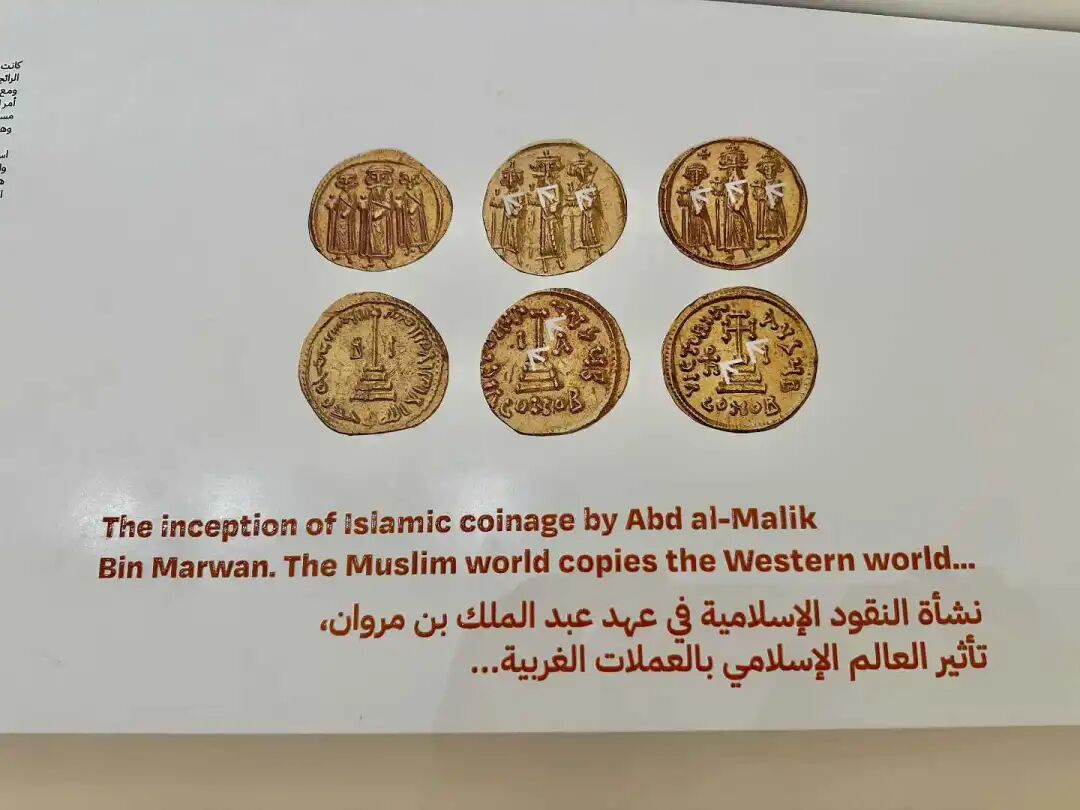
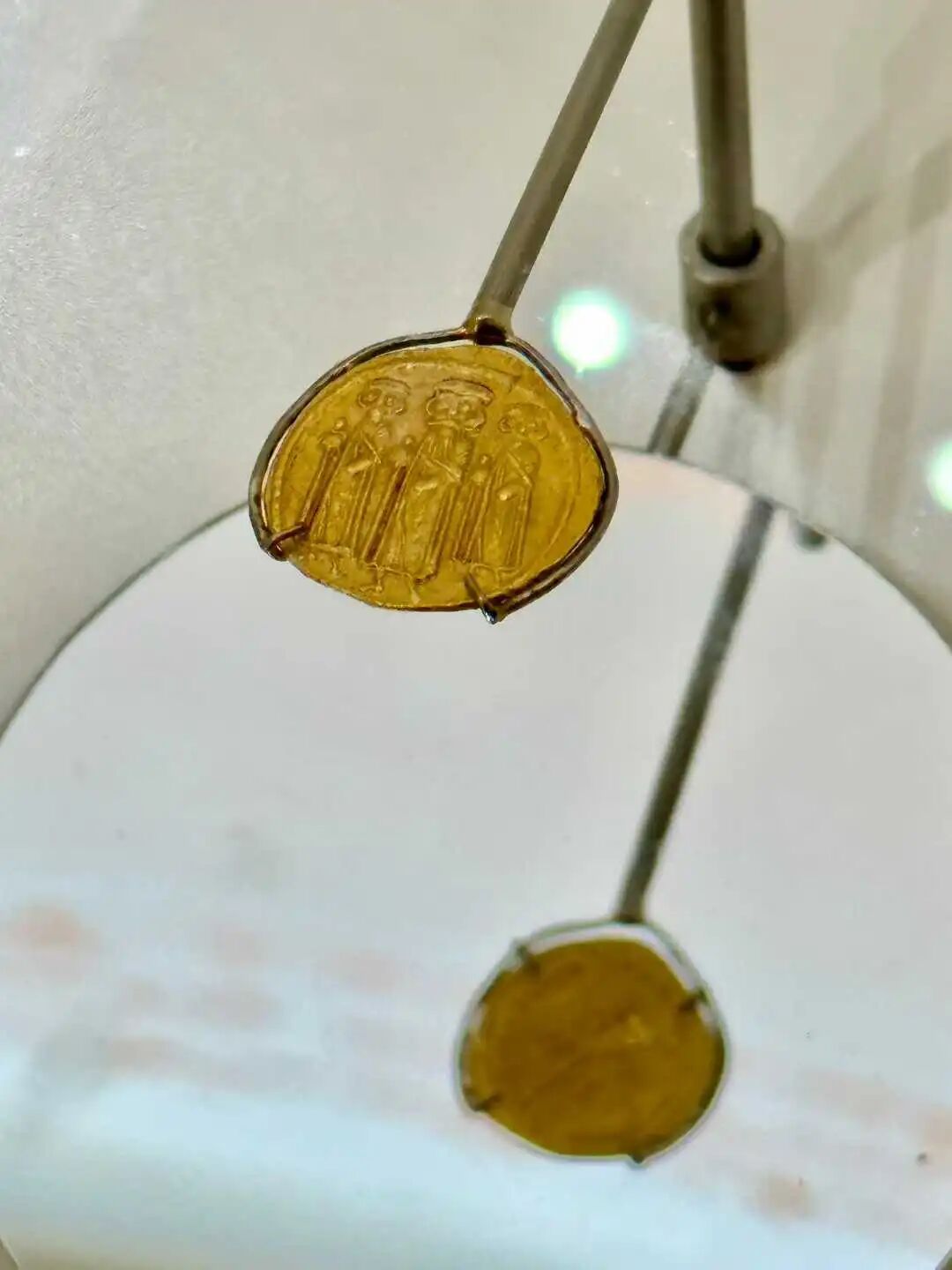
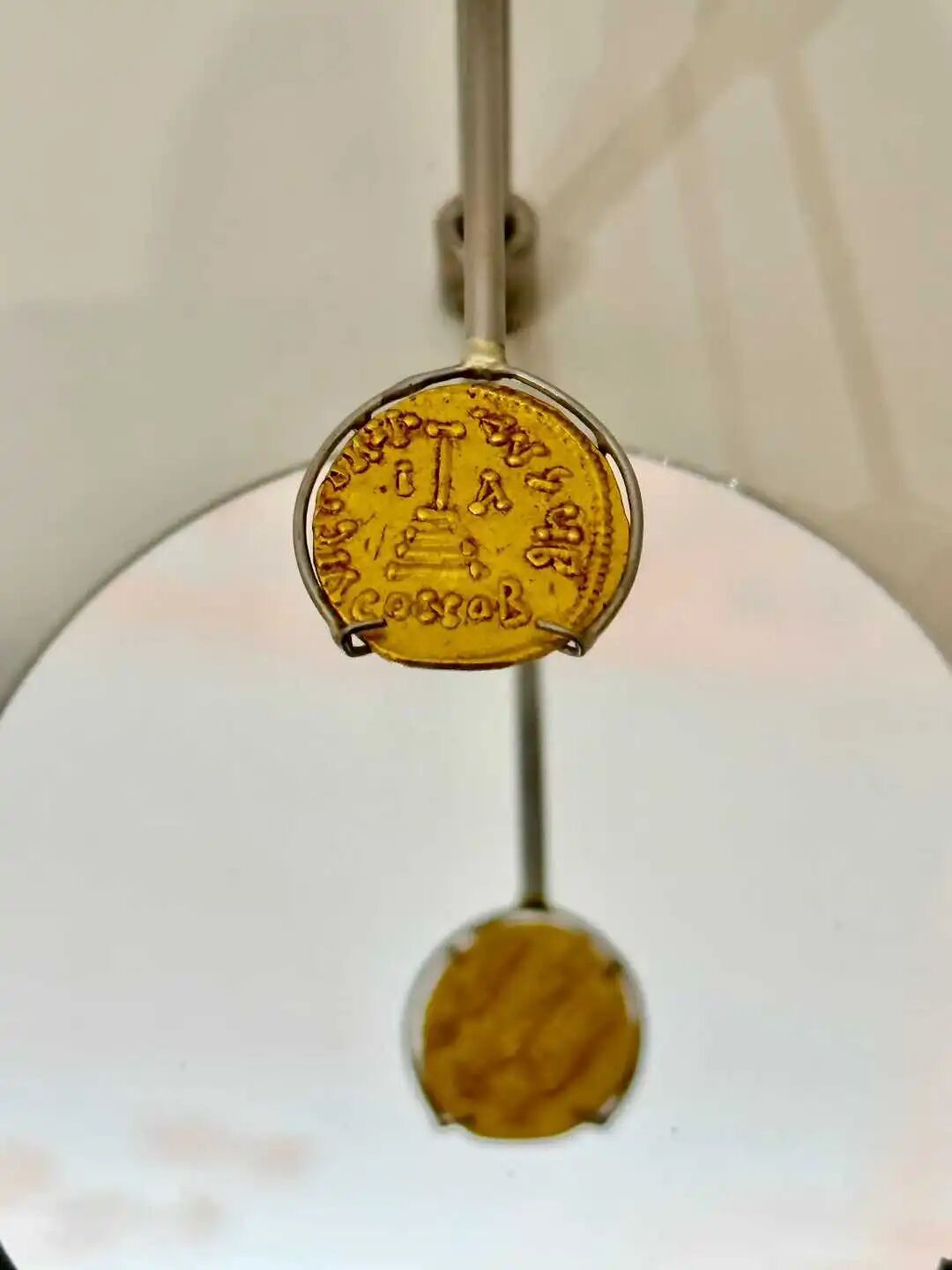
Before the Umayyad Caliphate was established, the Syrian region used Byzantine gold coins. After the Umayyad Caliphate was founded in 661, it began minting gold coins in Damascus. Early Umayyad gold coins continued to use Byzantine imagery. You can see coins showing the Byzantine Emperor Heraclius (reigned 610-641) and his two sons, Constantine III and Heraklonas, on the front, with Latin text on the back. Unlike Byzantine coins, the crowns and scepters of the emperors on Umayyad coins lack crosses, and the cross on the steps on the back is just a vertical line without a horizontal bar.
These Umayyad coins reflect the early culture of the Umayyad Caliphate, which continued to inherit Byzantine traditions. When Bedouin nomads from the Arabian Peninsula flooded into the grand city of Damascus, they saw a rich and colorful Byzantine culture. Because of this, they continued to use Byzantine culture in areas outside of religion, such as music, art, and architecture, becoming heirs to the Byzantine legacy.
It was not until the 690s that the Umayyad Caliphate began to move away from Byzantine culture and design its own gold coins. In 693, Caliph Abd al-Malik (reigned 685-705) minted gold dinar coins in Damascus, and by 696, he removed human figures, keeping only Arabic text. During the same period, Abd al-Malik also promoted the use of Arabic over Greek in Syria, making Arabic the only official language of the Umayyad Caliphate. From then on, the Umayyad Caliphate shifted from being an heir to Byzantine and Sasanian cultures to becoming a true Arab civilization.
This commemorative silver coin was issued between 800 and 810 AD by Queen Zubaidah (Zubaidah bint Ja`far ibn al-Mansur, 765-831) of the Abbasid Caliphate to give to noble dignitaries of the time.
Zubaidah is known as a key figure in the Golden Age of the Abbasid Caliphate and the most important queen in its history. She was the wife of Harun al-Rashid, the fifth Abbasid caliph. This was the most prosperous era of the Abbasid Caliphate, with the capital, Baghdad, housing libraries and the translation center known as the House of Wisdom. Baghdad was the world center for knowledge, culture, and trade at the time.
Zubaidah was famous for her generosity and donated to many poets, scholars, and doctors, regardless of their social or religious backgrounds. She spent over 20,000 dinars to improve the water supply in and around Mecca, deepened the Zamzam well, and built a series of rest areas, wells, and pools along the road connecting Baghdad, Mecca, and Medina. This road is still called the Zubaidah Road today. The famous traveler Ibn Battuta once said: "Every reservoir, pool, or well on this road from Mecca to Baghdad is there because of her generous gifts... If she had not cared for this road, no one would be able to use it."
This dirham coin was minted in 1243 in what is now Kurraman, Pakistan, during the reign of Empress Dowager Töregene Khatun of the Yuan Dynasty.
Empress Dowager Töregene Khatun took power in 1242 after the death of her husband, Ögedei Khan, and returned power in 1246 after her son, Güyük Khan, was elected Great Khan. During her time in power, she successfully balanced the competing forces of the Mongol Empire. Over five years, she not only ruled the vast empire but also laid the foundation for her son's succession. While she was in power, the Seljuk Sultan from Turkey and the Abbasid Caliph from Baghdad both sent envoys to her camp.
The city of Kurraman is located in the Kurram Valley of Pakistan and was a famous minting center during the Khwarazmian and Mongol periods.
A gold dinar coin minted by the Ilkhanate in 1338.
A gold dinar coin minted in Baghdad by the Ilkhanate in 1338.
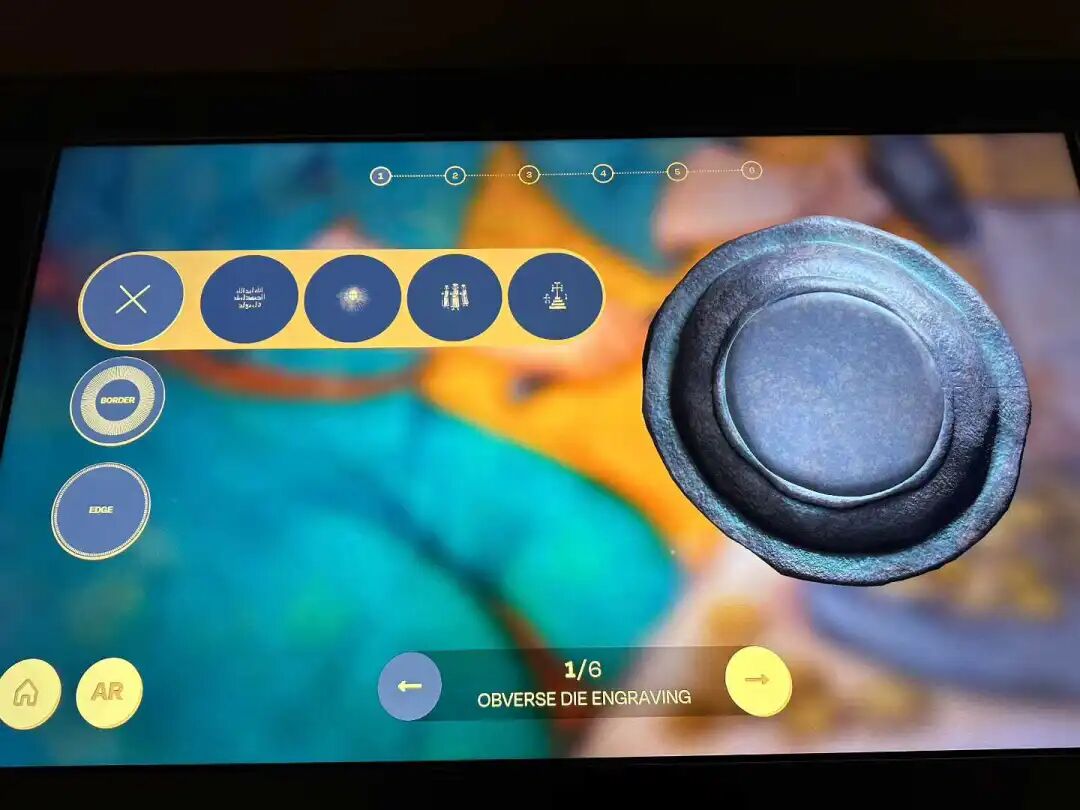
A coin minting mold brought back by Sultan Muhammad ibn Sam of the Ghurid dynasty after he conquered India in 1204. These molds broke easily during the minting process, so they are very hard to preserve.
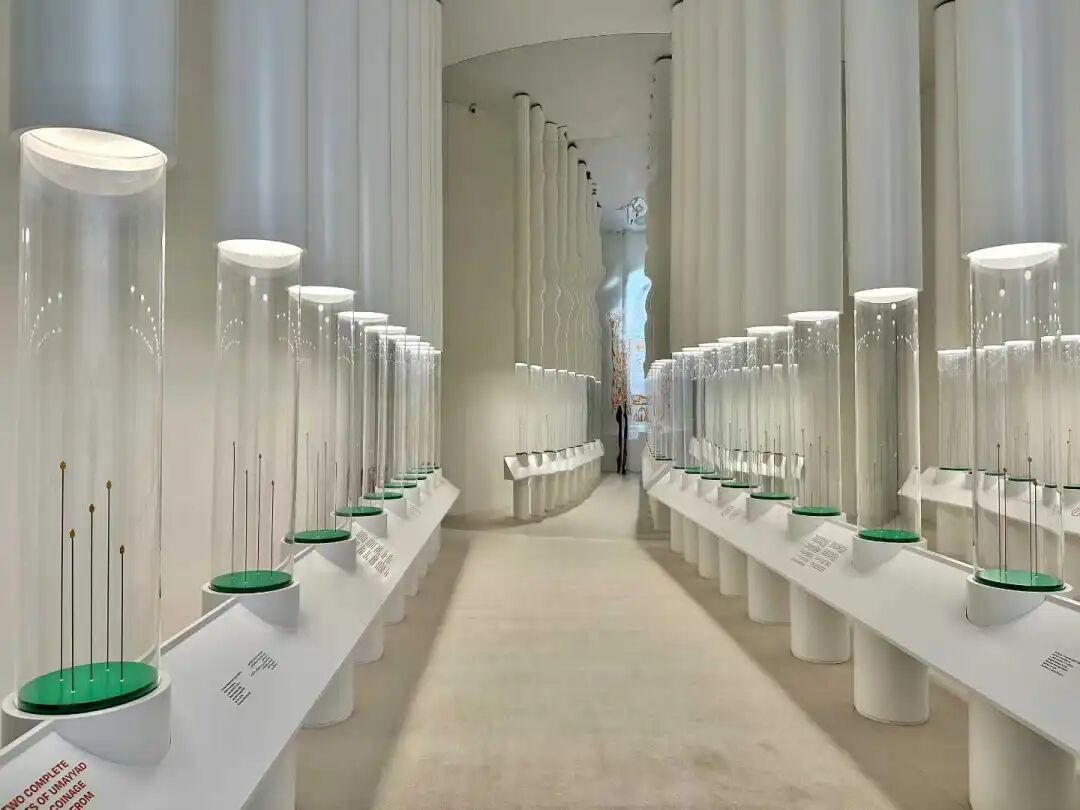
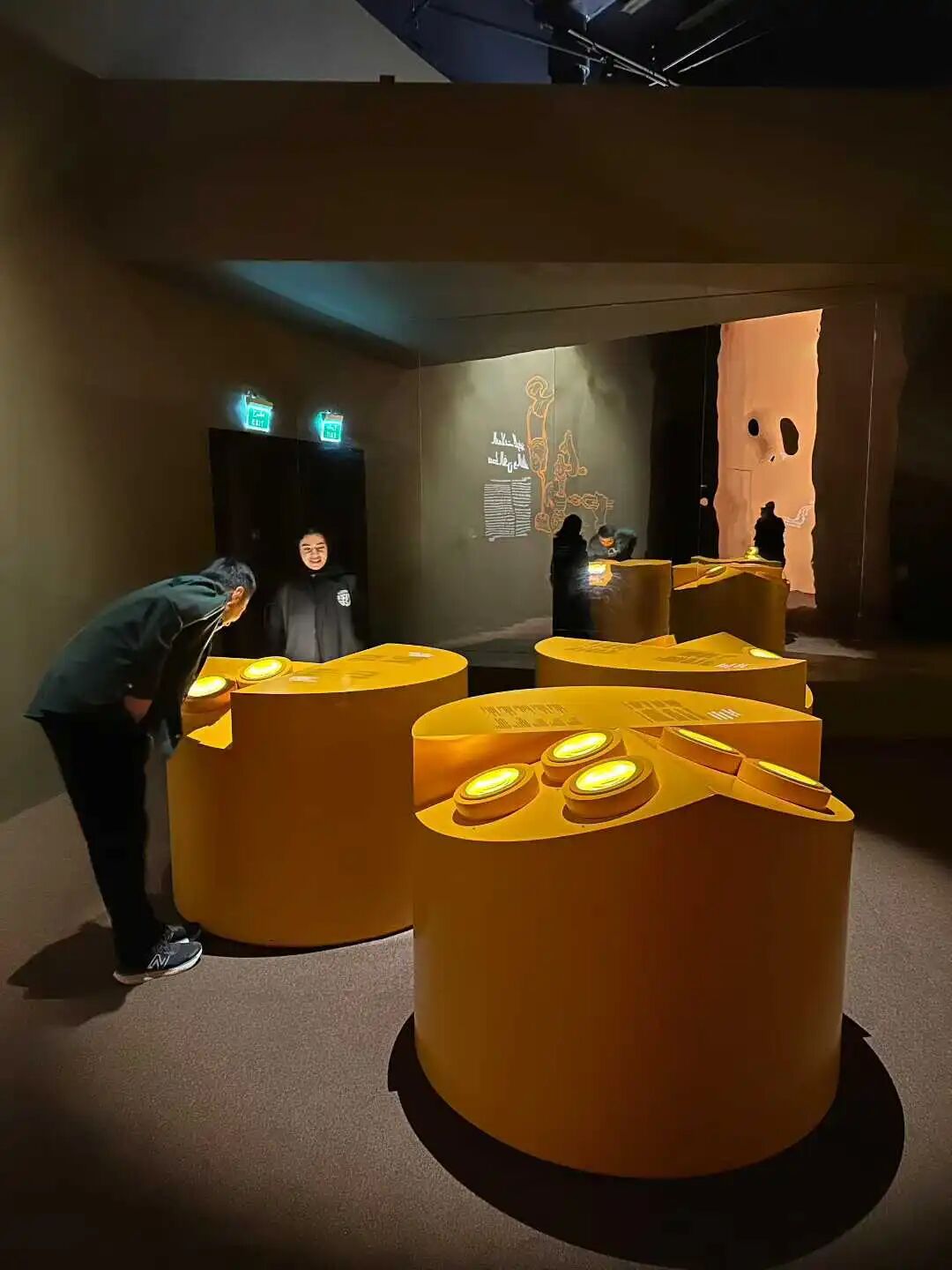
The interactive coin minting display at the exhibition shows the coin-making process in detail.
A coin from the 7th-century Umayyad Caliphate minted in Bishapur, featuring an image of a camel rider with a spear. Bishapur is located in southwestern Iran and was once the capital of the Sasanian Empire.
A coin from the Seljuk Empire minted between 1040 and 1063, featuring an image of a falconer on horseback.
The earliest Islamic coin found within Saudi territory is this Umayyad dinar minted in 723. It is engraved with the name of the mint, al-Madina Ma'din Amir al-Mu'minin, which tells us this coin was minted in Medina. This coin shows the important status of Medina during the Umayyad Caliphate.
This section features dinar coins minted in Mecca between the 9th-century Abbasid Caliphate and the 10th-century Fatimid Caliphate.
This is a gold dinar minted in Mecca during the Fatimid Caliphate in 971.
The Saudi Ministry of Culture holds two large coin collections. The first was found in 1980 by a farmer cleaning an old well in a village near Ha'il in northern Saudi Arabia. It includes 414 silver dinars, with 7 dating back to the late Umayyad period and 406 to the early Abbasid period, from mints including Baghdad, Basra, Armenia, Balkh, and Kufa. The second collection was found by chance in 2010 by a sand transport worker in another village near Ha'il, containing 2,296 gold and silver coins from the Umayyad and Abbasid dynasties.
A modern Saudi gold coin trial strike minted in 1950, with text on the back that differs from the final version in circulation. view all
Summary: The Saudi National Museum exhibition Forging Narratives: The Coinage Heritage of Saudi Arabia traces Islamic coinage from early Umayyad gold coins to later dynasties. This English account keeps the source's dates, rulers, coin details, exhibition context, and photographs in one clear museum note.
The Saudi National Museum is hosting a special exhibition called "Forging Narratives: The Coinage Heritage of Saudi Arabia" from September 17 to December 16, 2025, featuring items from the famous coin collector Alain Baron. The exhibition follows a chronological order, starting with the oldest Umayyad gold coins, which surprisingly feature Byzantine emperors.
Before the Umayyad Caliphate was established, the Syrian region used Byzantine gold coins. After the Umayyad Caliphate was founded in 661, it began minting gold coins in Damascus. Early Umayyad gold coins continued to use Byzantine imagery. You can see coins showing the Byzantine Emperor Heraclius (reigned 610-641) and his two sons, Constantine III and Heraklonas, on the front, with Latin text on the back. Unlike Byzantine coins, the crowns and scepters of the emperors on Umayyad coins lack crosses, and the cross on the steps on the back is just a vertical line without a horizontal bar.
These Umayyad coins reflect the early culture of the Umayyad Caliphate, which continued to inherit Byzantine traditions. When Bedouin nomads from the Arabian Peninsula flooded into the grand city of Damascus, they saw a rich and colorful Byzantine culture. Because of this, they continued to use Byzantine culture in areas outside of religion, such as music, art, and architecture, becoming heirs to the Byzantine legacy.
It was not until the 690s that the Umayyad Caliphate began to move away from Byzantine culture and design its own gold coins. In 693, Caliph Abd al-Malik (reigned 685-705) minted gold dinar coins in Damascus, and by 696, he removed human figures, keeping only Arabic text. During the same period, Abd al-Malik also promoted the use of Arabic over Greek in Syria, making Arabic the only official language of the Umayyad Caliphate. From then on, the Umayyad Caliphate shifted from being an heir to Byzantine and Sasanian cultures to becoming a true Arab civilization.
This commemorative silver coin was issued between 800 and 810 AD by Queen Zubaidah (Zubaidah bint Ja`far ibn al-Mansur, 765-831) of the Abbasid Caliphate to give to noble dignitaries of the time.
Zubaidah is known as a key figure in the Golden Age of the Abbasid Caliphate and the most important queen in its history. She was the wife of Harun al-Rashid, the fifth Abbasid caliph. This was the most prosperous era of the Abbasid Caliphate, with the capital, Baghdad, housing libraries and the translation center known as the House of Wisdom. Baghdad was the world center for knowledge, culture, and trade at the time.
Zubaidah was famous for her generosity and donated to many poets, scholars, and doctors, regardless of their social or religious backgrounds. She spent over 20,000 dinars to improve the water supply in and around Mecca, deepened the Zamzam well, and built a series of rest areas, wells, and pools along the road connecting Baghdad, Mecca, and Medina. This road is still called the Zubaidah Road today. The famous traveler Ibn Battuta once said: "Every reservoir, pool, or well on this road from Mecca to Baghdad is there because of her generous gifts... If she had not cared for this road, no one would be able to use it."
This dirham coin was minted in 1243 in what is now Kurraman, Pakistan, during the reign of Empress Dowager Töregene Khatun of the Yuan Dynasty.
Empress Dowager Töregene Khatun took power in 1242 after the death of her husband, Ögedei Khan, and returned power in 1246 after her son, Güyük Khan, was elected Great Khan. During her time in power, she successfully balanced the competing forces of the Mongol Empire. Over five years, she not only ruled the vast empire but also laid the foundation for her son's succession. While she was in power, the Seljuk Sultan from Turkey and the Abbasid Caliph from Baghdad both sent envoys to her camp.
The city of Kurraman is located in the Kurram Valley of Pakistan and was a famous minting center during the Khwarazmian and Mongol periods.
A gold dinar coin minted by the Ilkhanate in 1338.
A gold dinar coin minted in Baghdad by the Ilkhanate in 1338.
A coin minting mold brought back by Sultan Muhammad ibn Sam of the Ghurid dynasty after he conquered India in 1204. These molds broke easily during the minting process, so they are very hard to preserve.
The interactive coin minting display at the exhibition shows the coin-making process in detail.
A coin from the 7th-century Umayyad Caliphate minted in Bishapur, featuring an image of a camel rider with a spear. Bishapur is located in southwestern Iran and was once the capital of the Sasanian Empire.
A coin from the Seljuk Empire minted between 1040 and 1063, featuring an image of a falconer on horseback.
The earliest Islamic coin found within Saudi territory is this Umayyad dinar minted in 723. It is engraved with the name of the mint, al-Madina Ma'din Amir al-Mu'minin, which tells us this coin was minted in Medina. This coin shows the important status of Medina during the Umayyad Caliphate.
This section features dinar coins minted in Mecca between the 9th-century Abbasid Caliphate and the 10th-century Fatimid Caliphate.
This is a gold dinar minted in Mecca during the Fatimid Caliphate in 971.
The Saudi Ministry of Culture holds two large coin collections. The first was found in 1980 by a farmer cleaning an old well in a village near Ha'il in northern Saudi Arabia. It includes 414 silver dinars, with 7 dating back to the late Umayyad period and 406 to the early Abbasid period, from mints including Baghdad, Basra, Armenia, Balkh, and Kufa. The second collection was found by chance in 2010 by a sand transport worker in another village near Ha'il, containing 2,296 gold and silver coins from the Umayyad and Abbasid dynasties.
A modern Saudi gold coin trial strike minted in 1950, with text on the back that differs from the final version in circulation. view all
Reposted from the web
Summary: The Saudi National Museum exhibition Forging Narratives: The Coinage Heritage of Saudi Arabia traces Islamic coinage from early Umayyad gold coins to later dynasties. This English account keeps the source's dates, rulers, coin details, exhibition context, and photographs in one clear museum note.
The Saudi National Museum is hosting a special exhibition called "Forging Narratives: The Coinage Heritage of Saudi Arabia" from September 17 to December 16, 2025, featuring items from the famous coin collector Alain Baron. The exhibition follows a chronological order, starting with the oldest Umayyad gold coins, which surprisingly feature Byzantine emperors.
Before the Umayyad Caliphate was established, the Syrian region used Byzantine gold coins. After the Umayyad Caliphate was founded in 661, it began minting gold coins in Damascus. Early Umayyad gold coins continued to use Byzantine imagery. You can see coins showing the Byzantine Emperor Heraclius (reigned 610-641) and his two sons, Constantine III and Heraklonas, on the front, with Latin text on the back. Unlike Byzantine coins, the crowns and scepters of the emperors on Umayyad coins lack crosses, and the cross on the steps on the back is just a vertical line without a horizontal bar.
These Umayyad coins reflect the early culture of the Umayyad Caliphate, which continued to inherit Byzantine traditions. When Bedouin nomads from the Arabian Peninsula flooded into the grand city of Damascus, they saw a rich and colorful Byzantine culture. Because of this, they continued to use Byzantine culture in areas outside of religion, such as music, art, and architecture, becoming heirs to the Byzantine legacy.
It was not until the 690s that the Umayyad Caliphate began to move away from Byzantine culture and design its own gold coins. In 693, Caliph Abd al-Malik (reigned 685-705) minted gold dinar coins in Damascus, and by 696, he removed human figures, keeping only Arabic text. During the same period, Abd al-Malik also promoted the use of Arabic over Greek in Syria, making Arabic the only official language of the Umayyad Caliphate. From then on, the Umayyad Caliphate shifted from being an heir to Byzantine and Sasanian cultures to becoming a true Arab civilization.
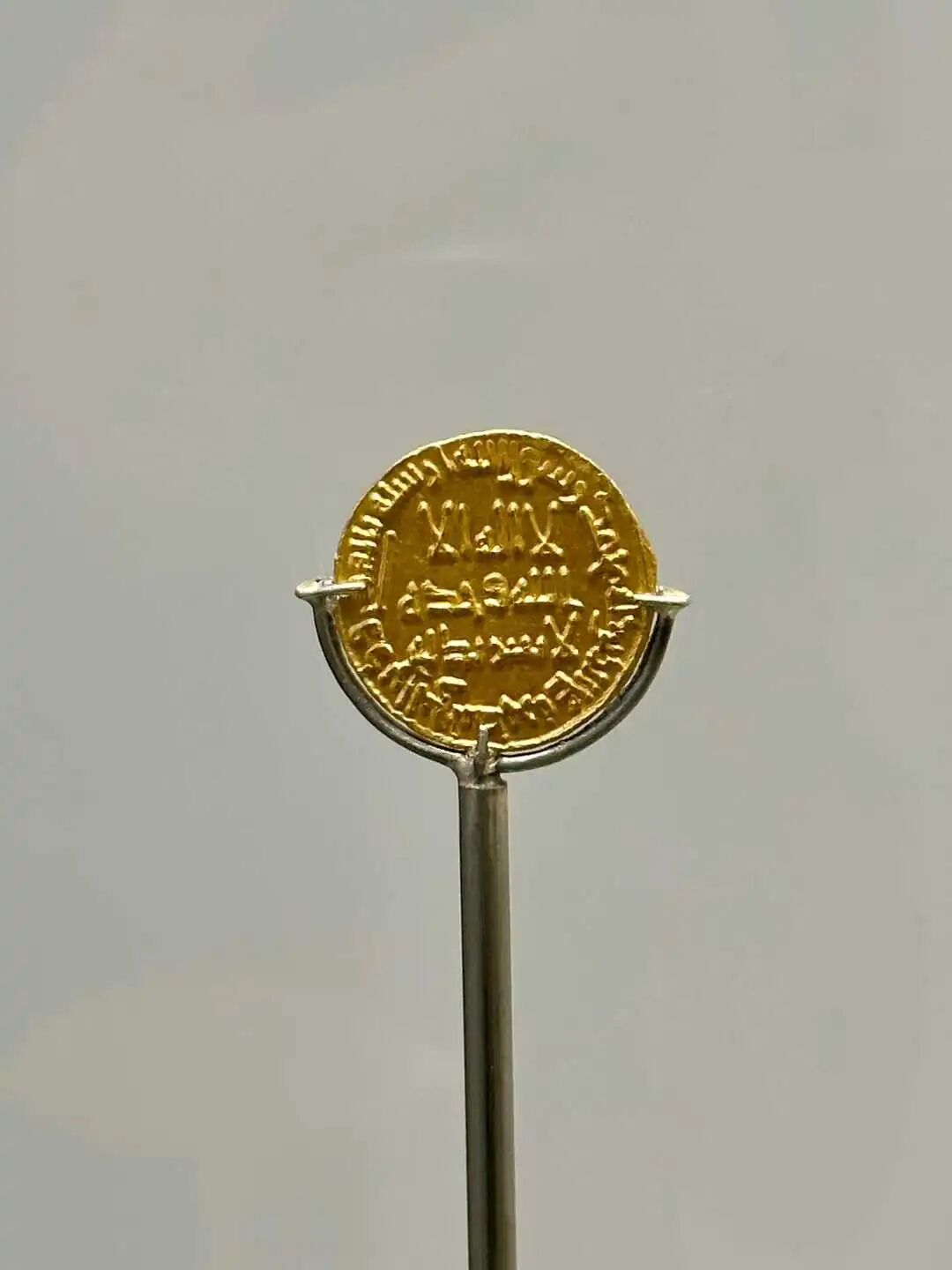
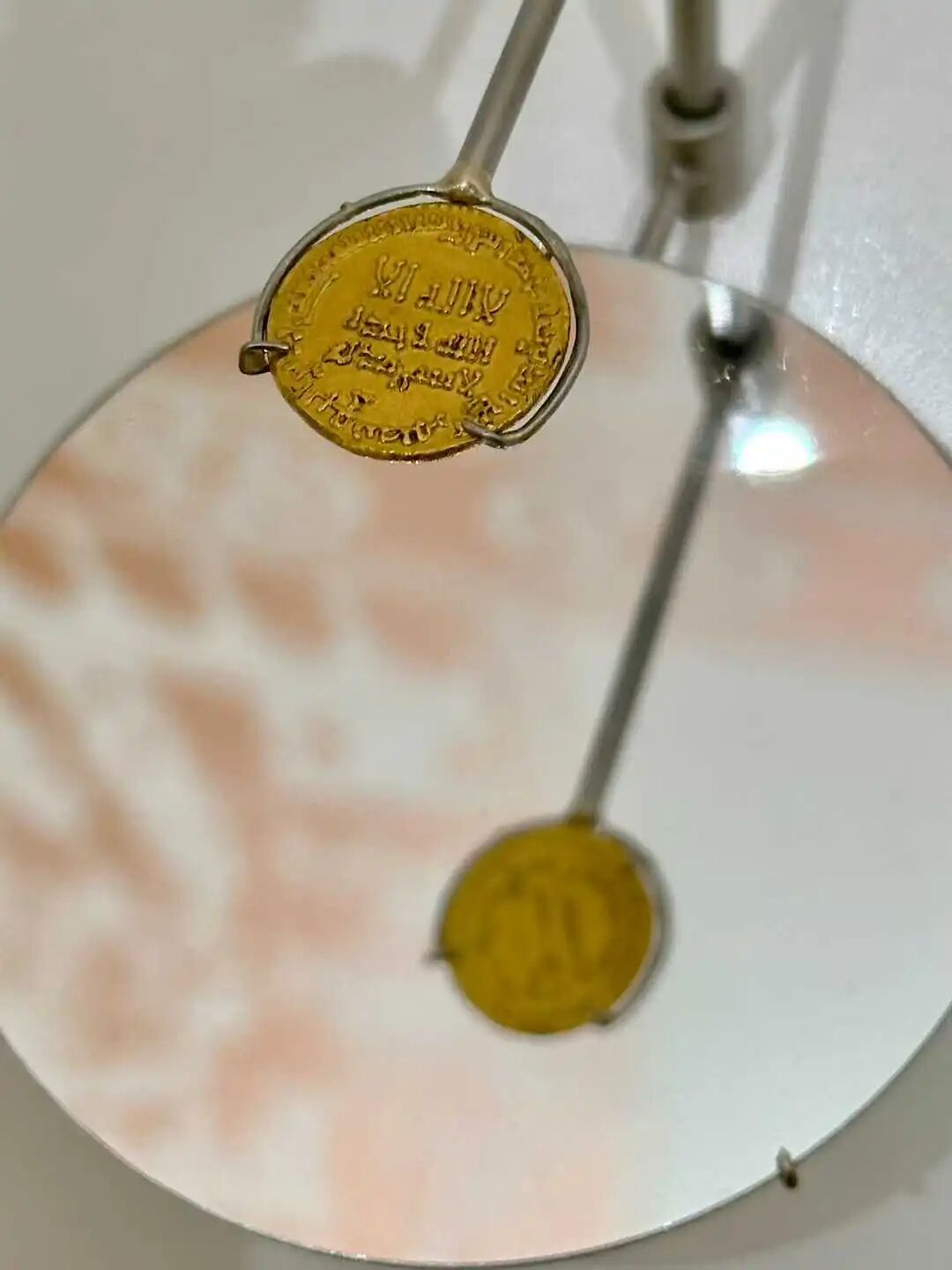
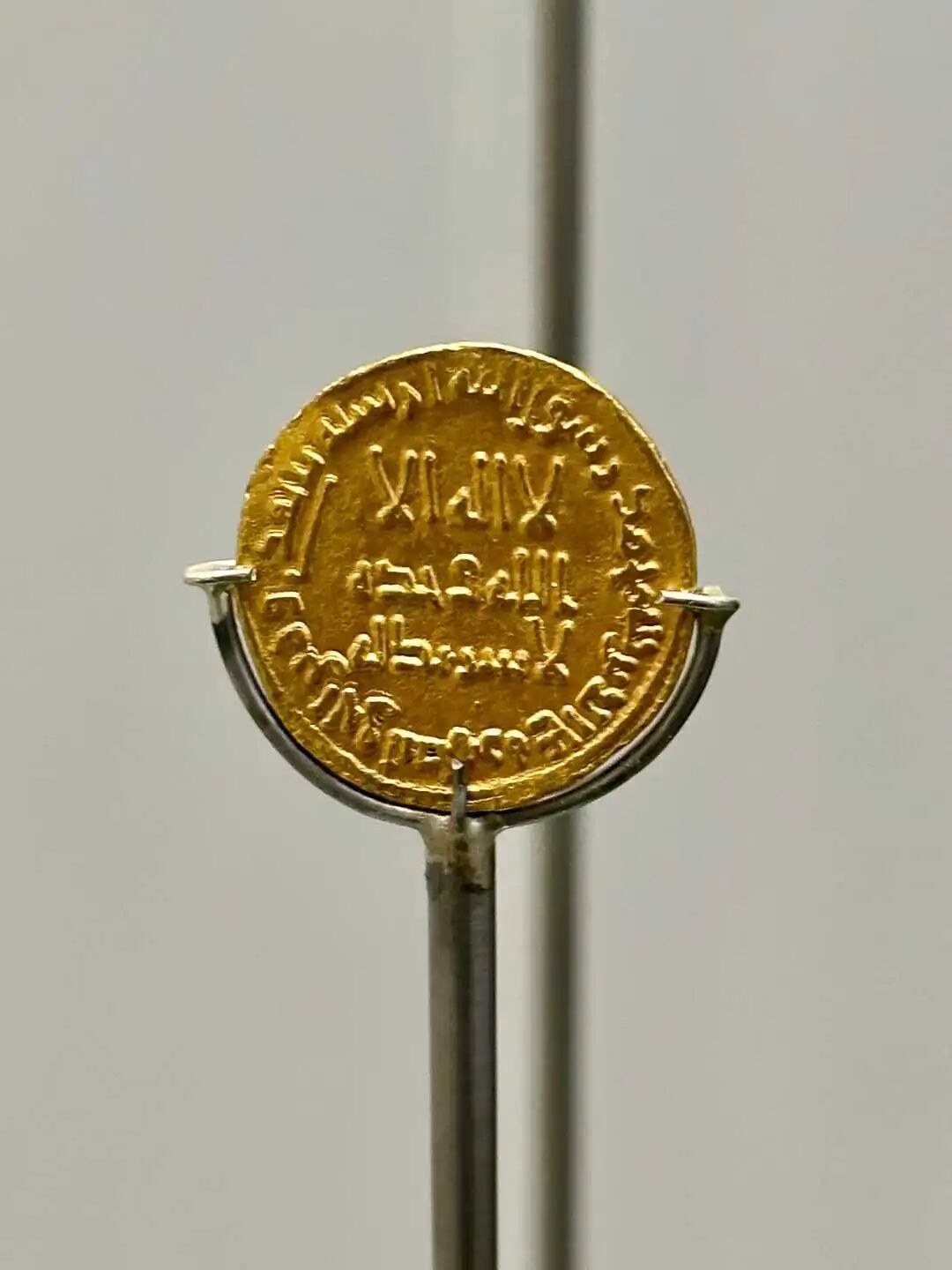
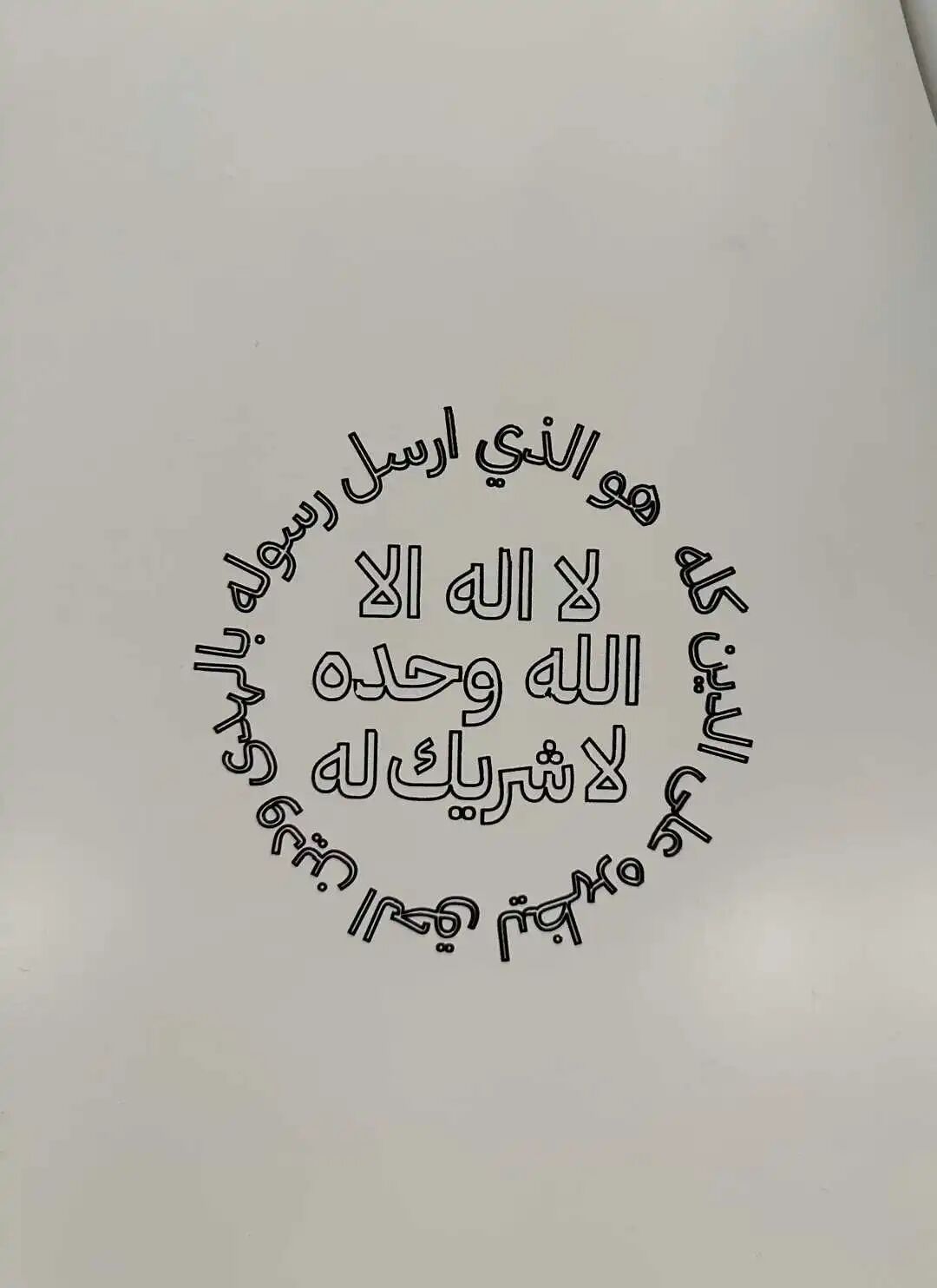
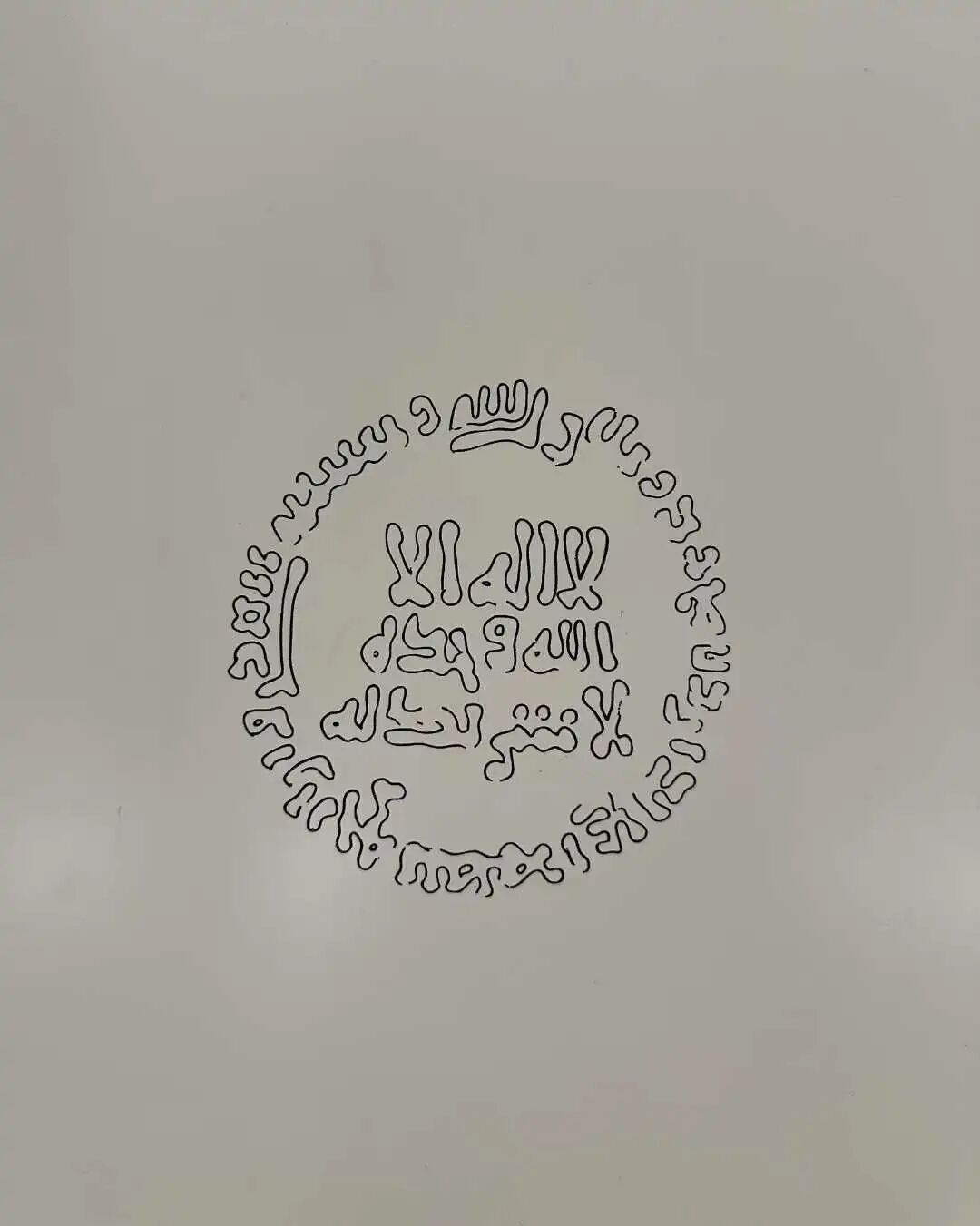
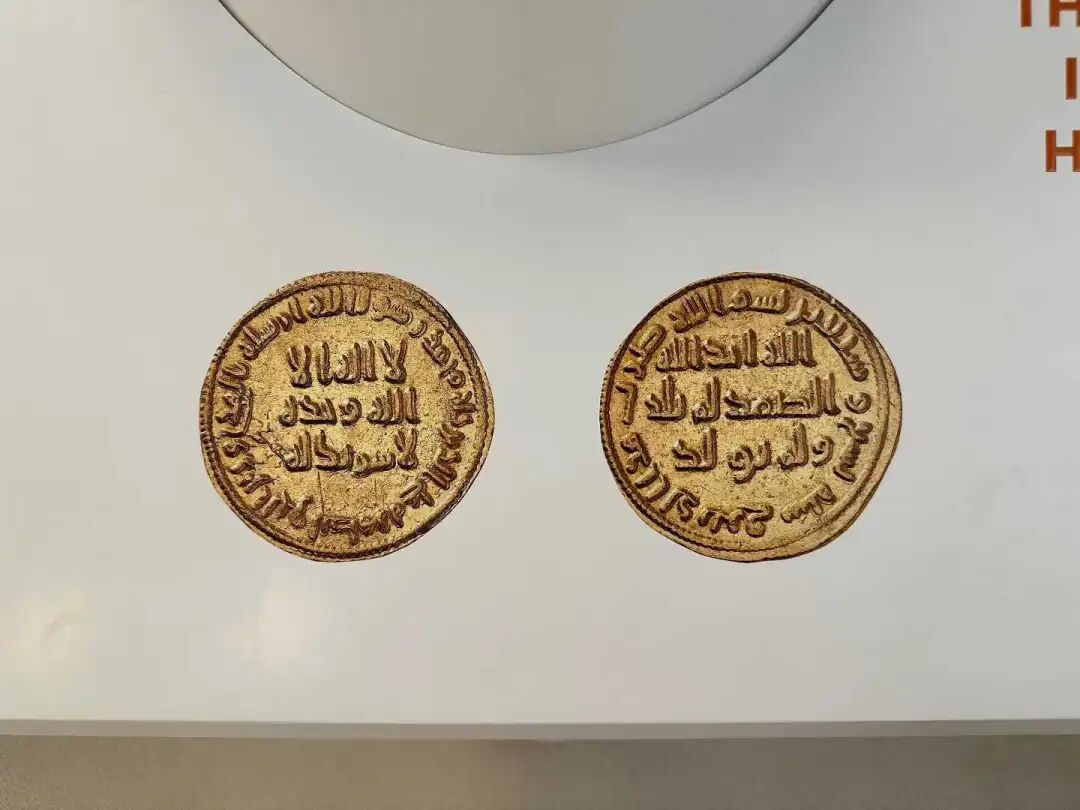
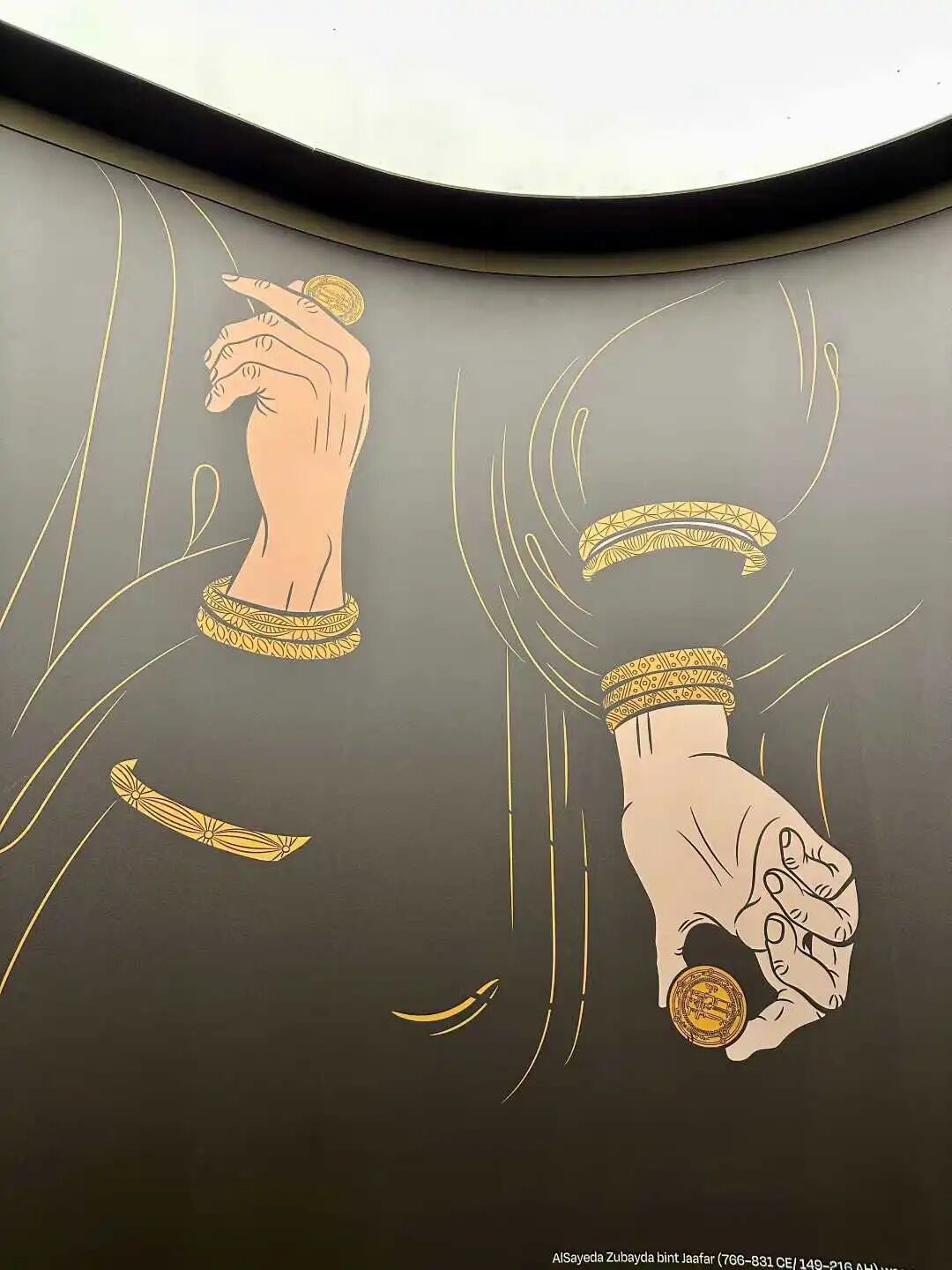
This commemorative silver coin was issued between 800 and 810 AD by Queen Zubaidah (Zubaidah bint Ja`far ibn al-Mansur, 765-831) of the Abbasid Caliphate to give to noble dignitaries of the time.
Zubaidah is known as a key figure in the Golden Age of the Abbasid Caliphate and the most important queen in its history. She was the wife of Harun al-Rashid, the fifth Abbasid caliph. This was the most prosperous era of the Abbasid Caliphate, with the capital, Baghdad, housing libraries and the translation center known as the House of Wisdom. Baghdad was the world center for knowledge, culture, and trade at the time.
Zubaidah was famous for her generosity and donated to many poets, scholars, and doctors, regardless of their social or religious backgrounds. She spent over 20,000 dinars to improve the water supply in and around Mecca, deepened the Zamzam well, and built a series of rest areas, wells, and pools along the road connecting Baghdad, Mecca, and Medina. This road is still called the Zubaidah Road today. The famous traveler Ibn Battuta once said: "Every reservoir, pool, or well on this road from Mecca to Baghdad is there because of her generous gifts... If she had not cared for this road, no one would be able to use it."
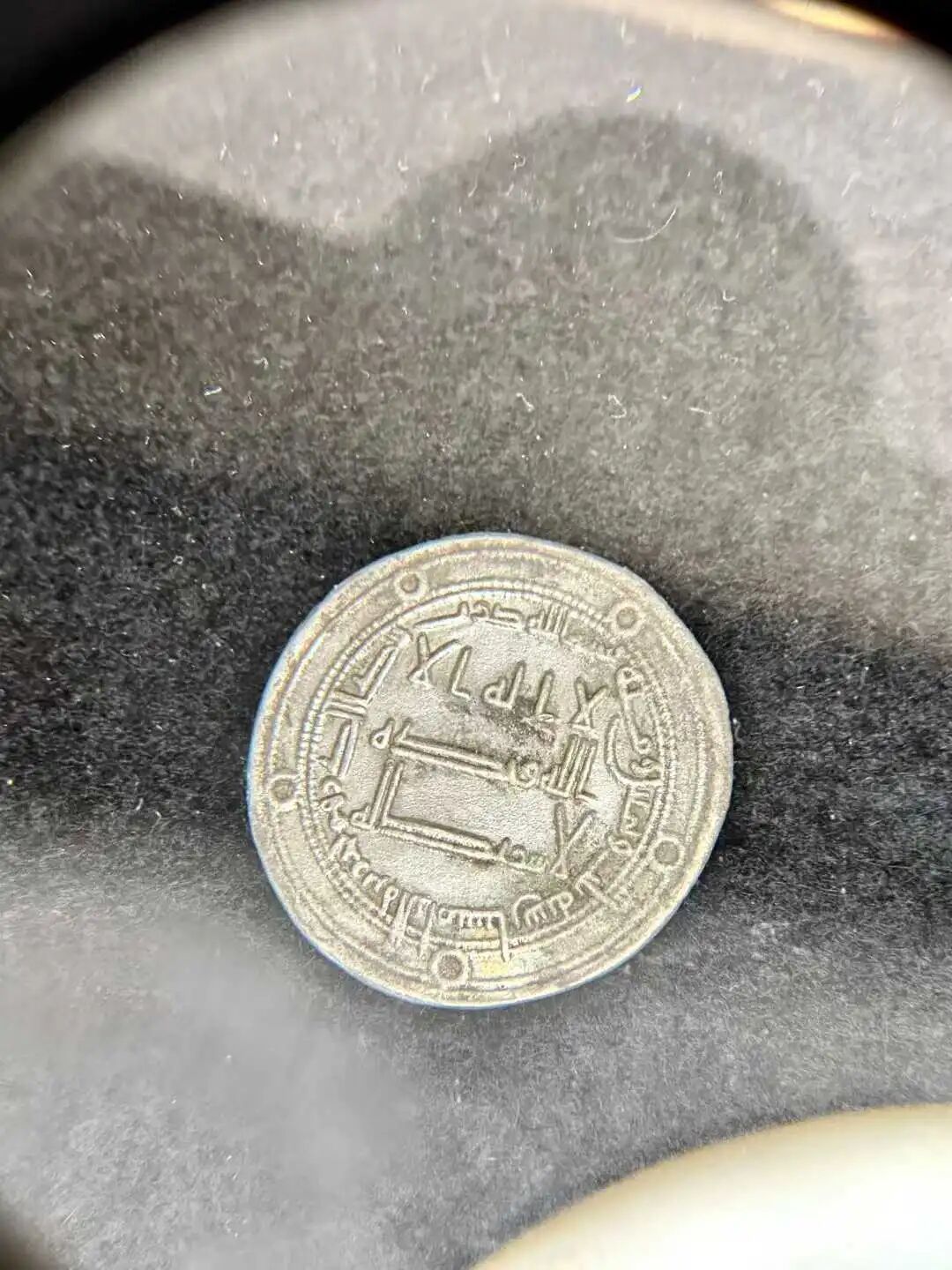
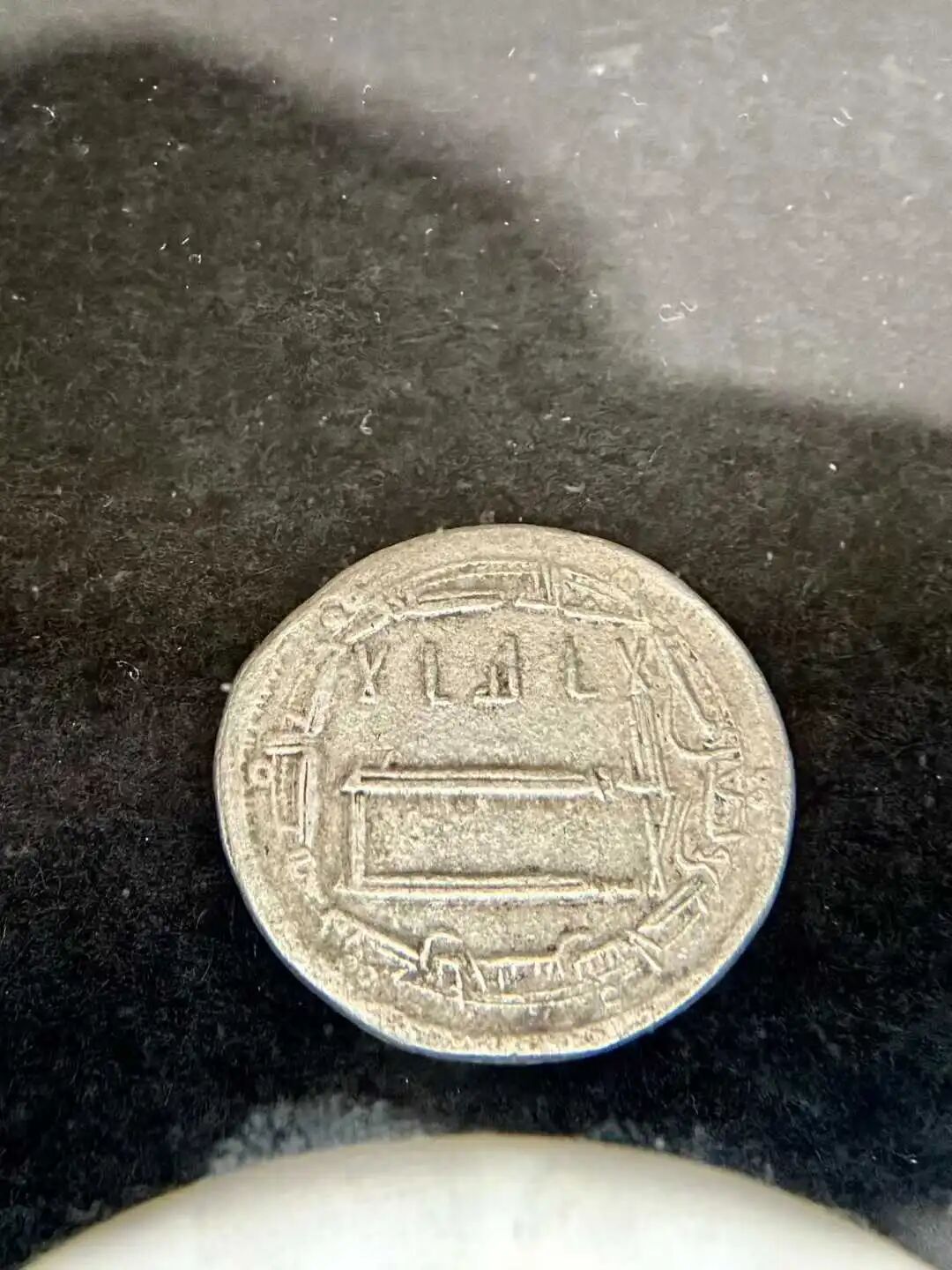
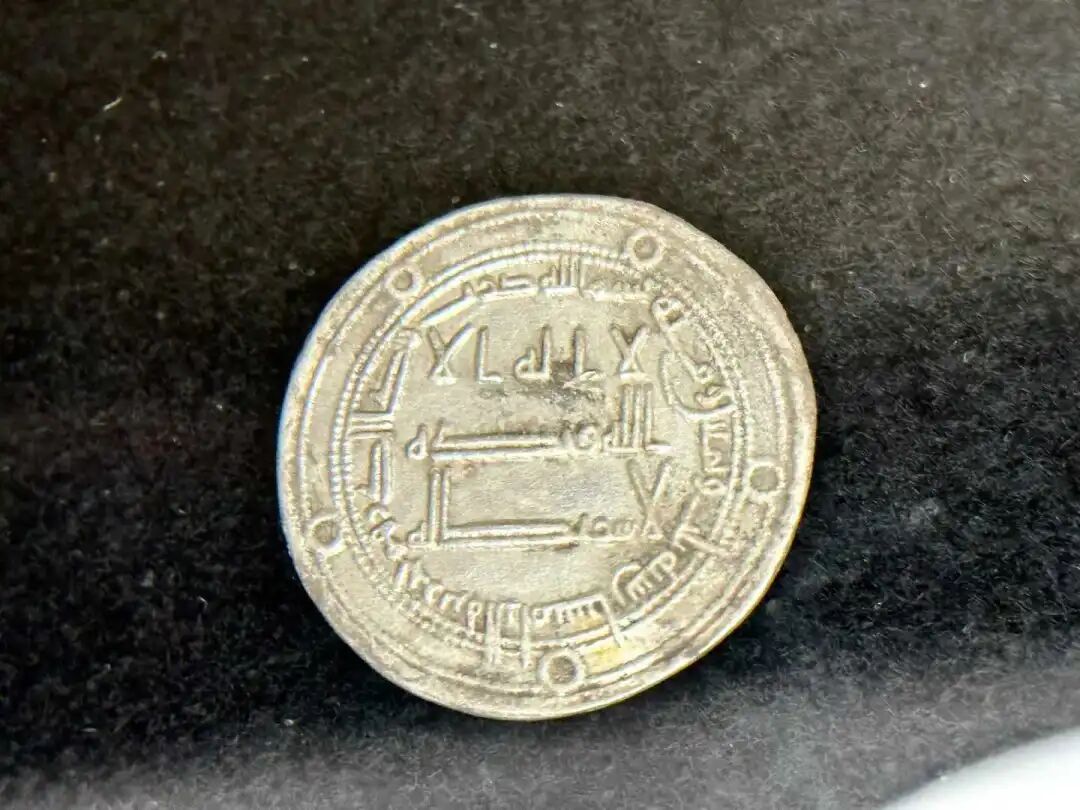
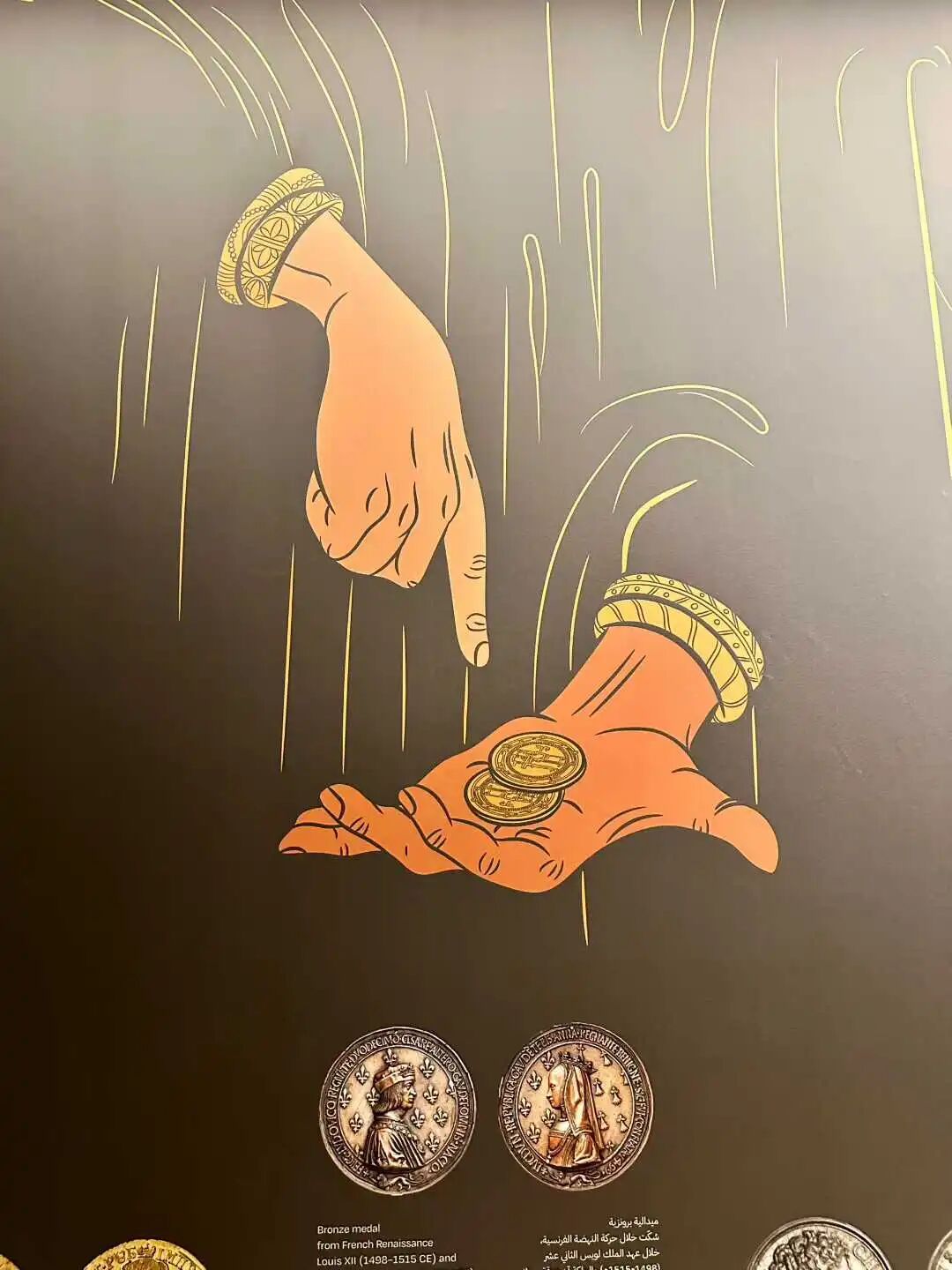
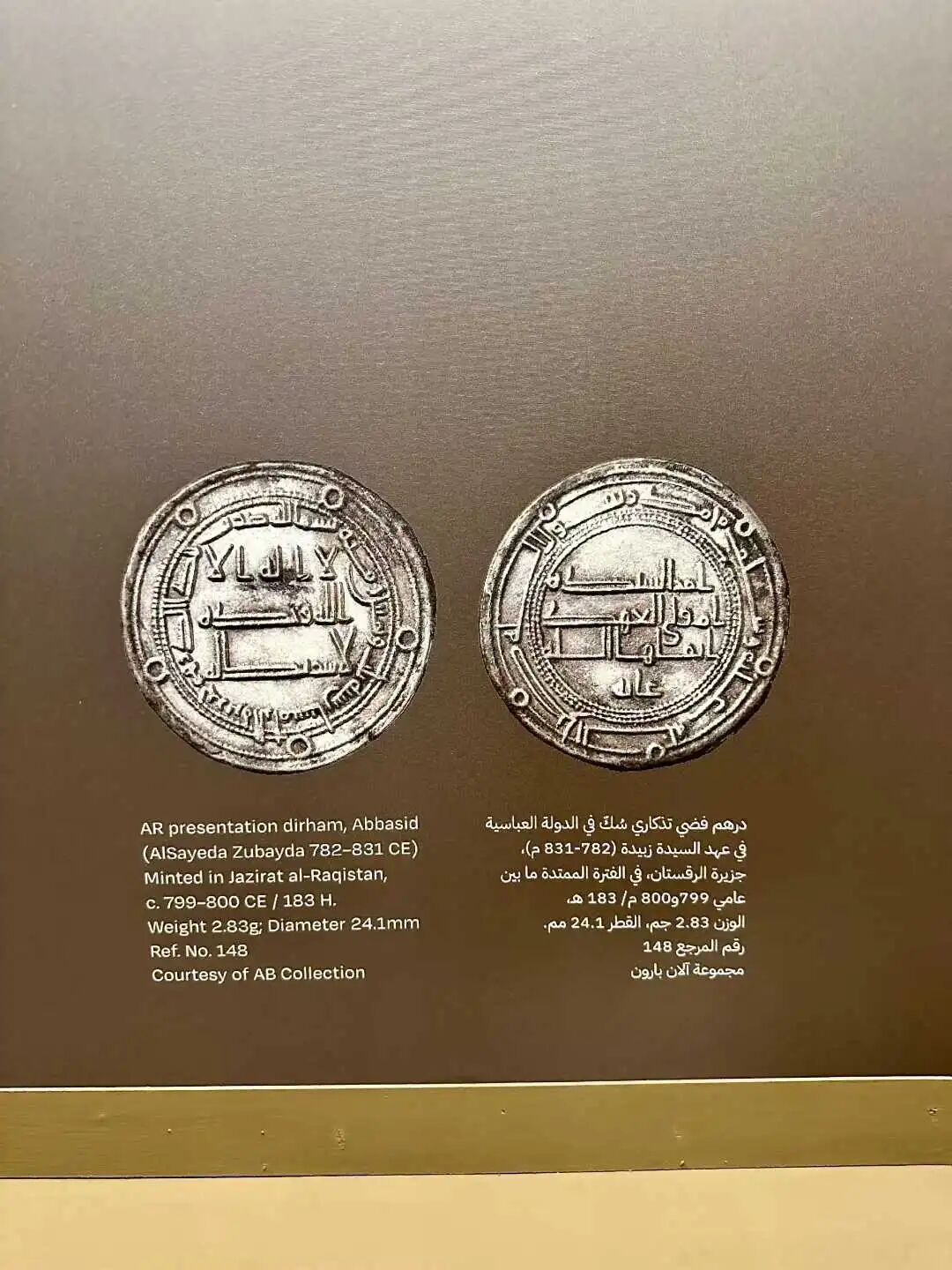
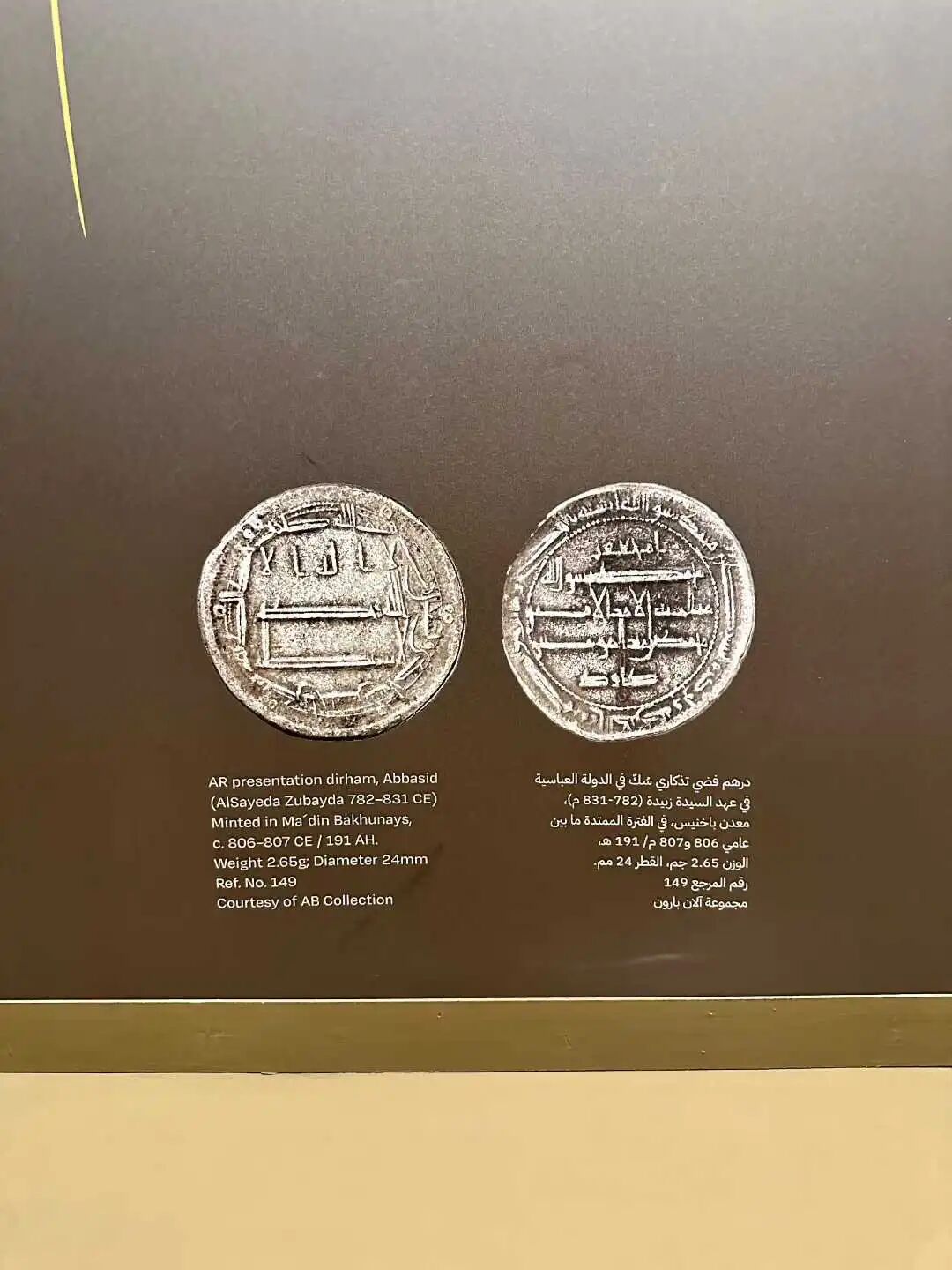
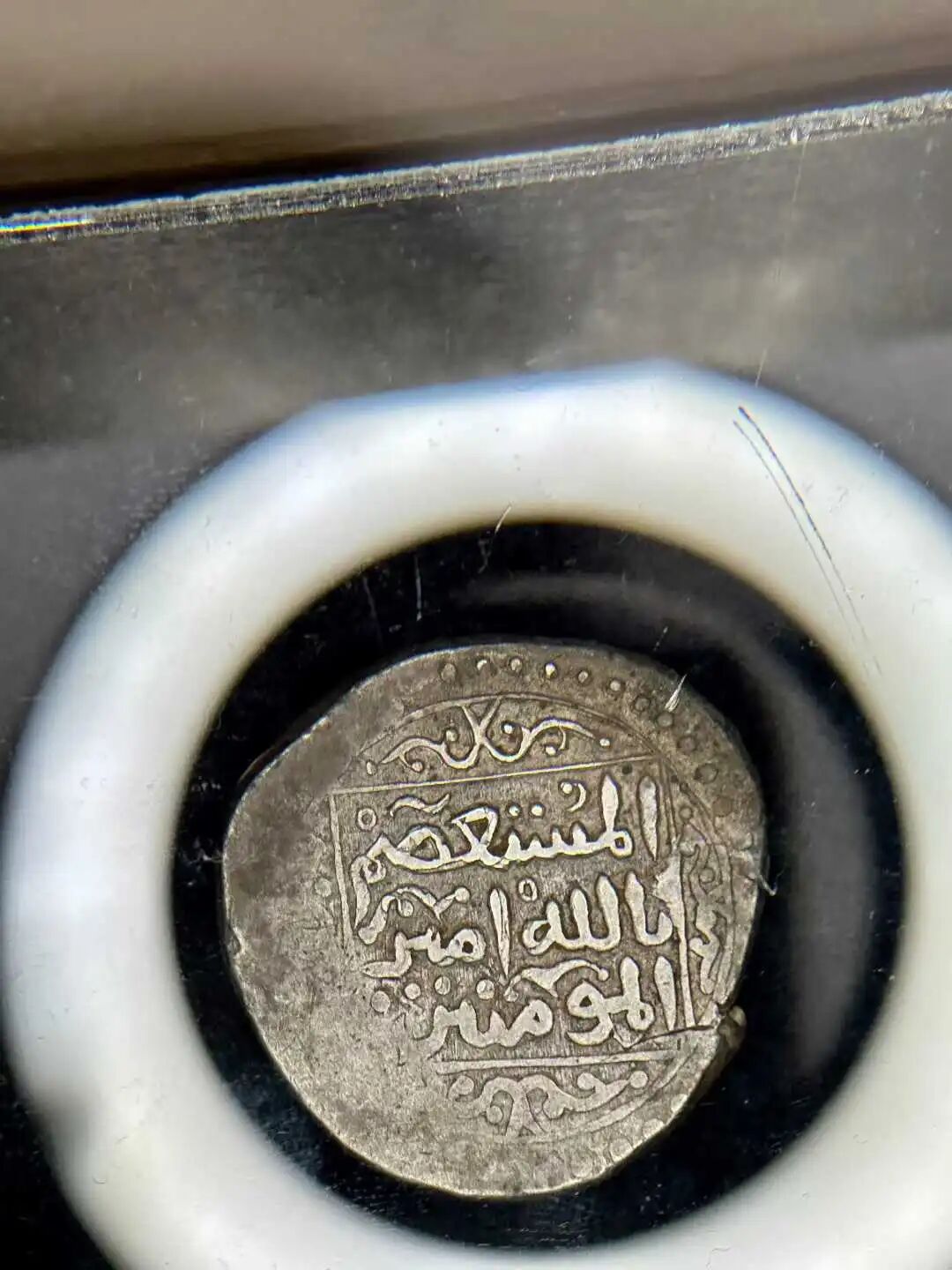
This dirham coin was minted in 1243 in what is now Kurraman, Pakistan, during the reign of Empress Dowager Töregene Khatun of the Yuan Dynasty.
Empress Dowager Töregene Khatun took power in 1242 after the death of her husband, Ögedei Khan, and returned power in 1246 after her son, Güyük Khan, was elected Great Khan. During her time in power, she successfully balanced the competing forces of the Mongol Empire. Over five years, she not only ruled the vast empire but also laid the foundation for her son's succession. While she was in power, the Seljuk Sultan from Turkey and the Abbasid Caliph from Baghdad both sent envoys to her camp.
The city of Kurraman is located in the Kurram Valley of Pakistan and was a famous minting center during the Khwarazmian and Mongol periods.
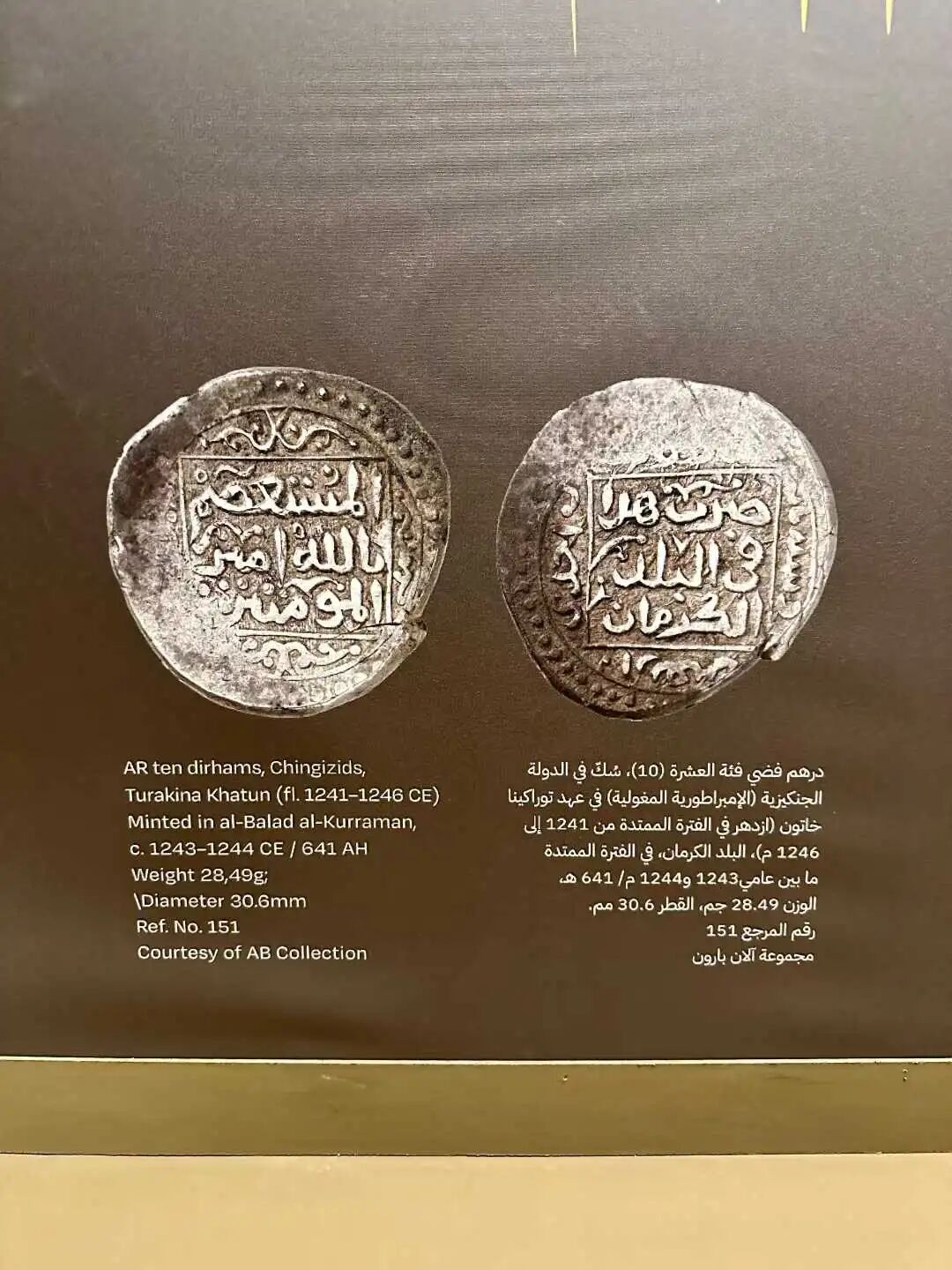
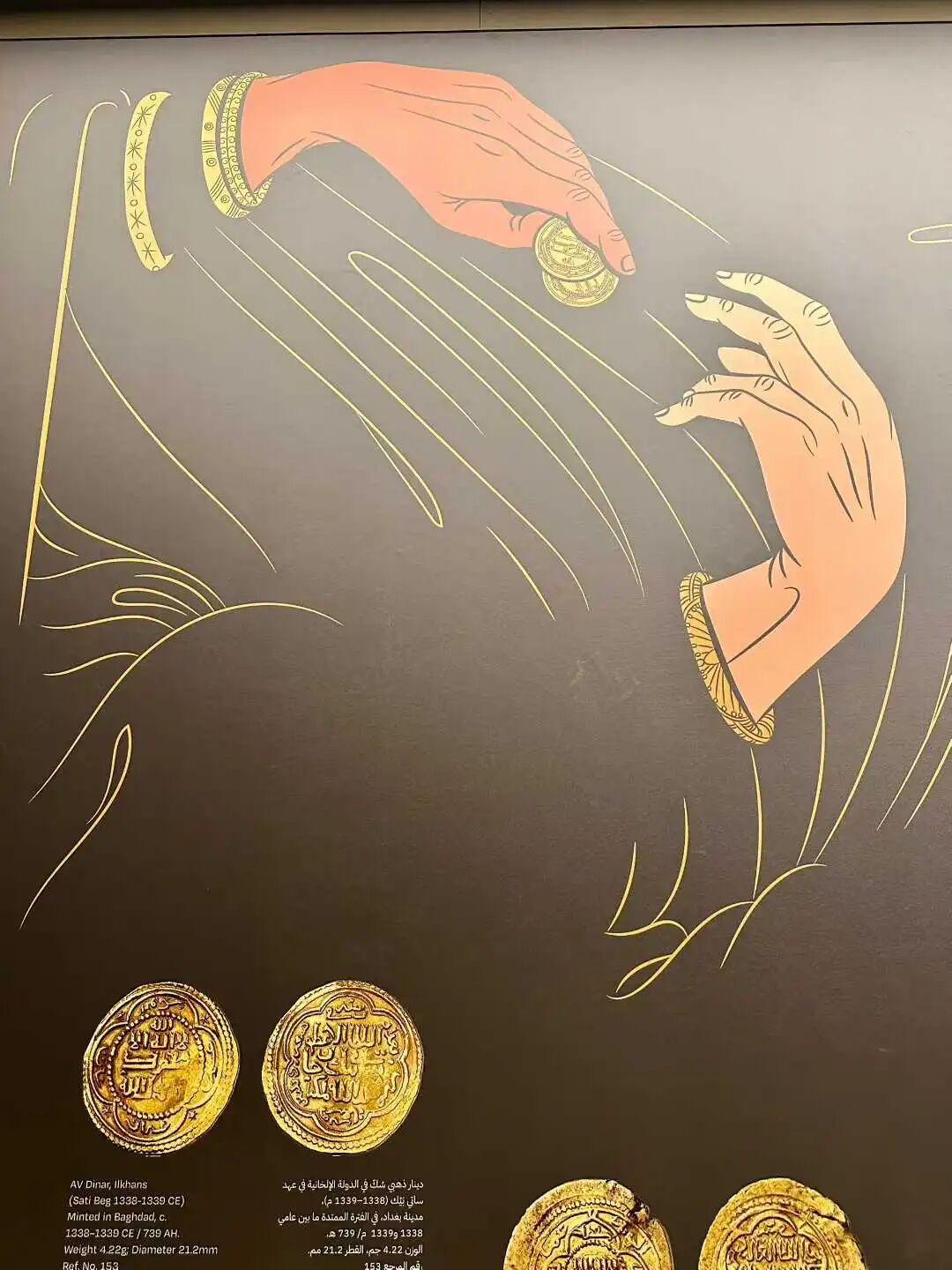
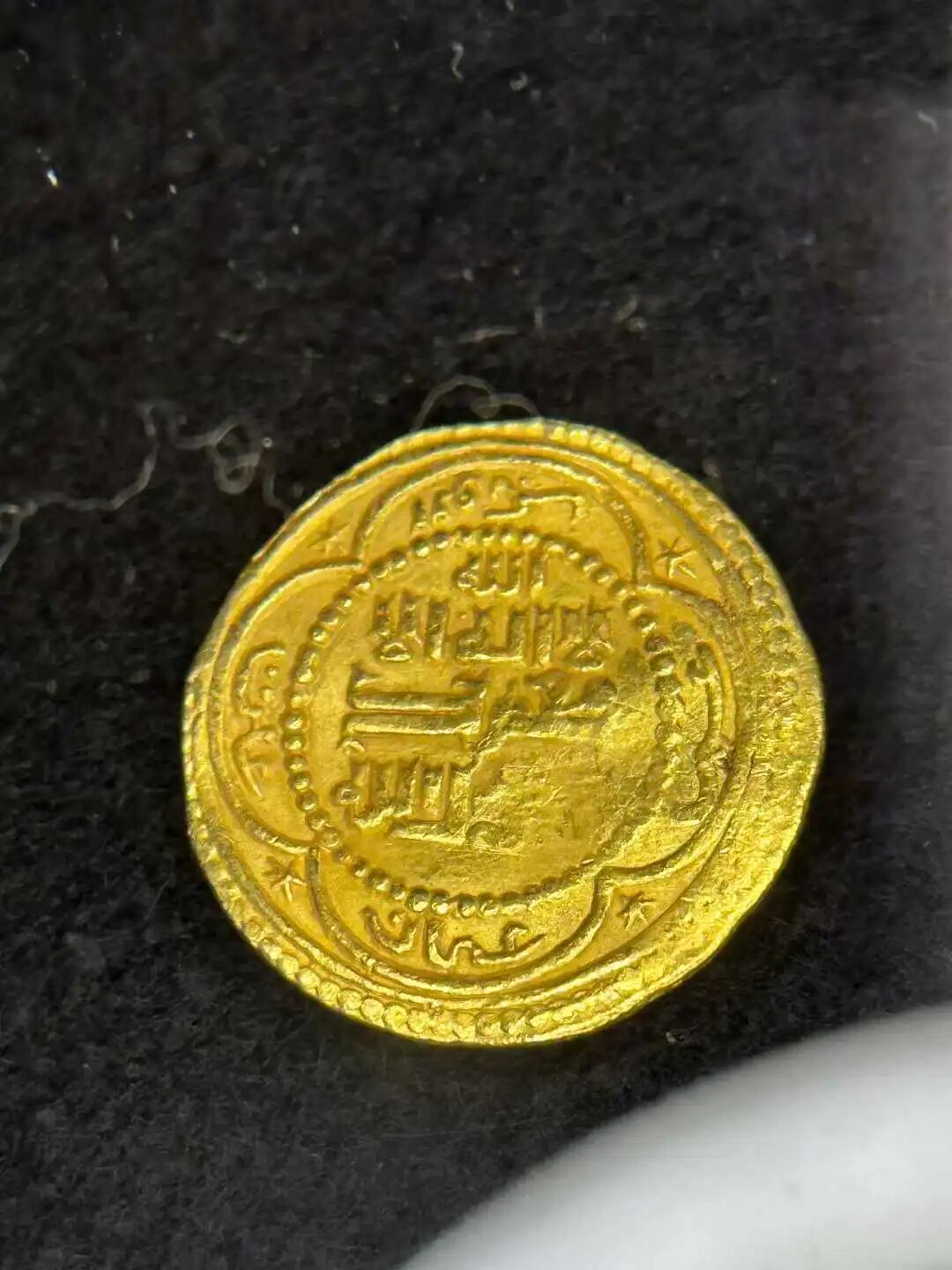
A gold dinar coin minted by the Ilkhanate in 1338.
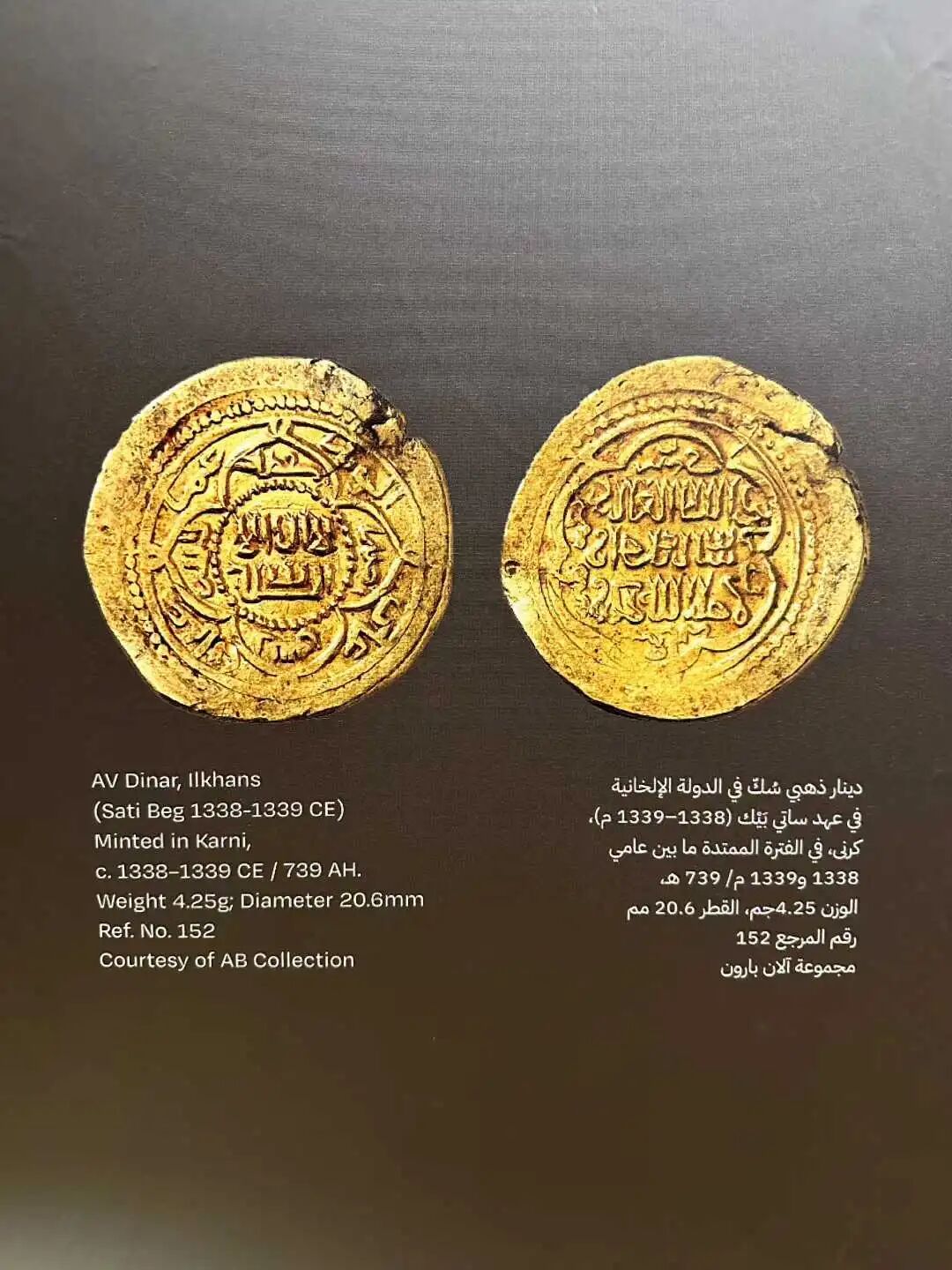
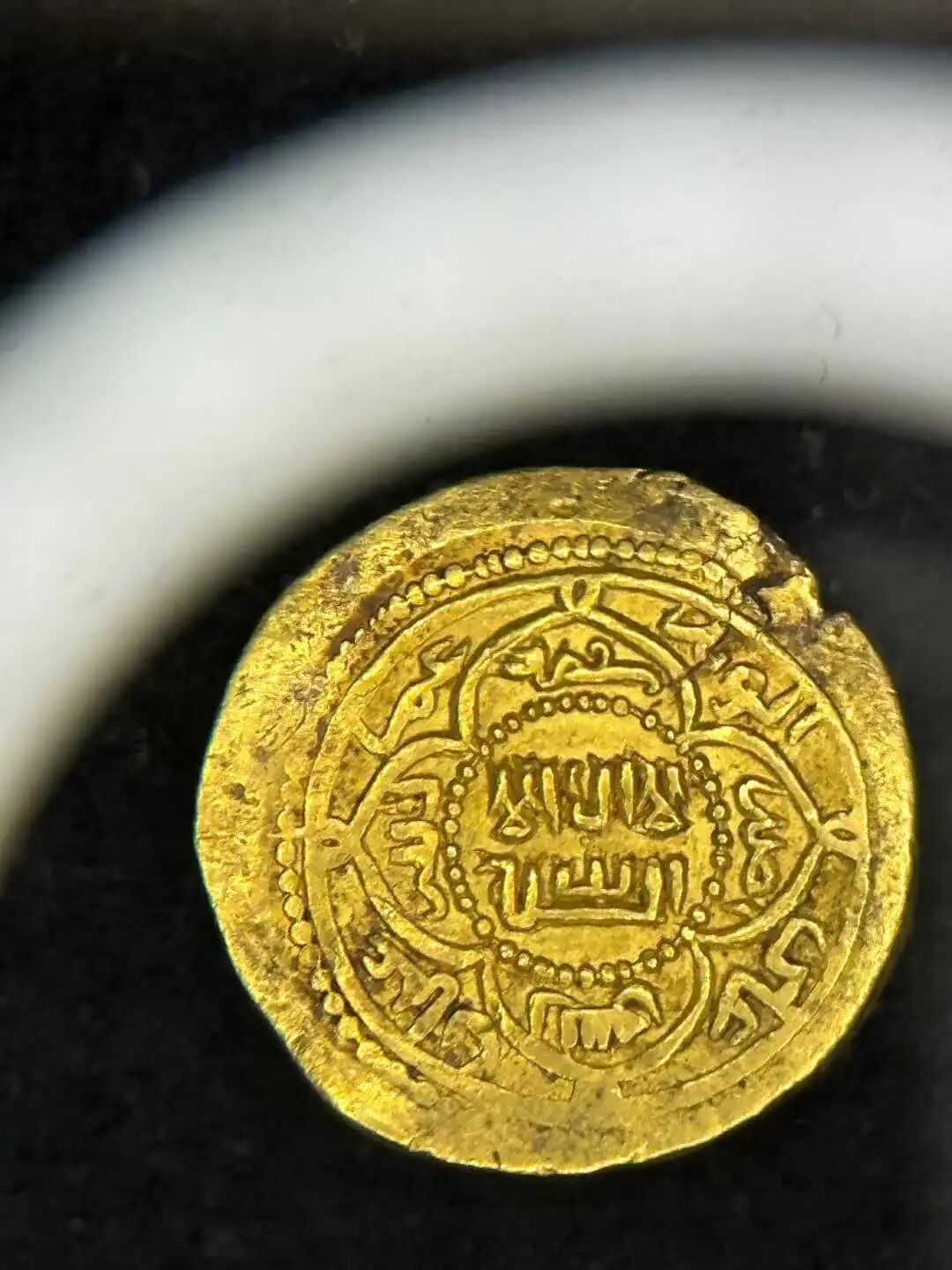
A gold dinar coin minted in Baghdad by the Ilkhanate in 1338.
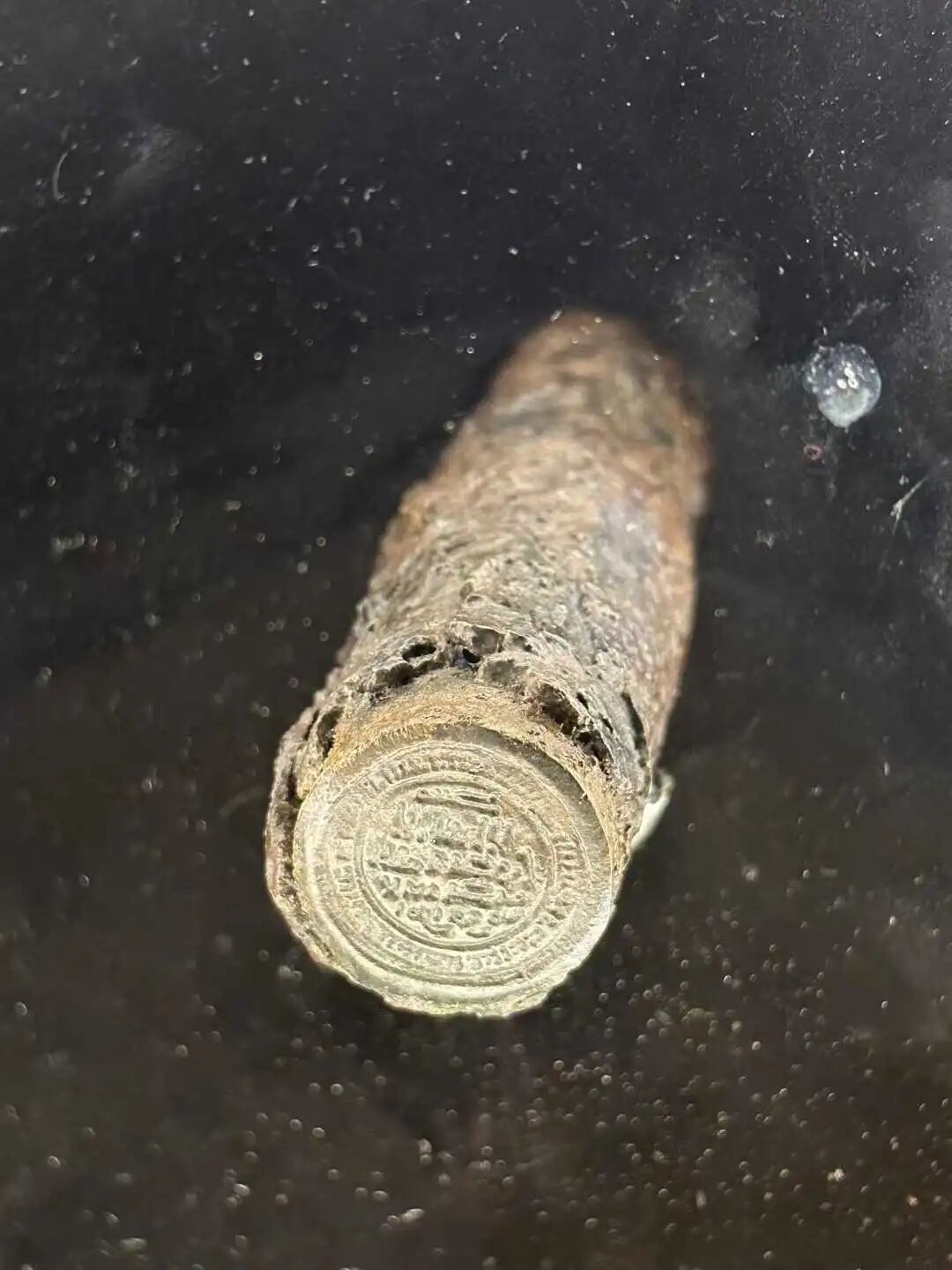
A coin minting mold brought back by Sultan Muhammad ibn Sam of the Ghurid dynasty after he conquered India in 1204. These molds broke easily during the minting process, so they are very hard to preserve.
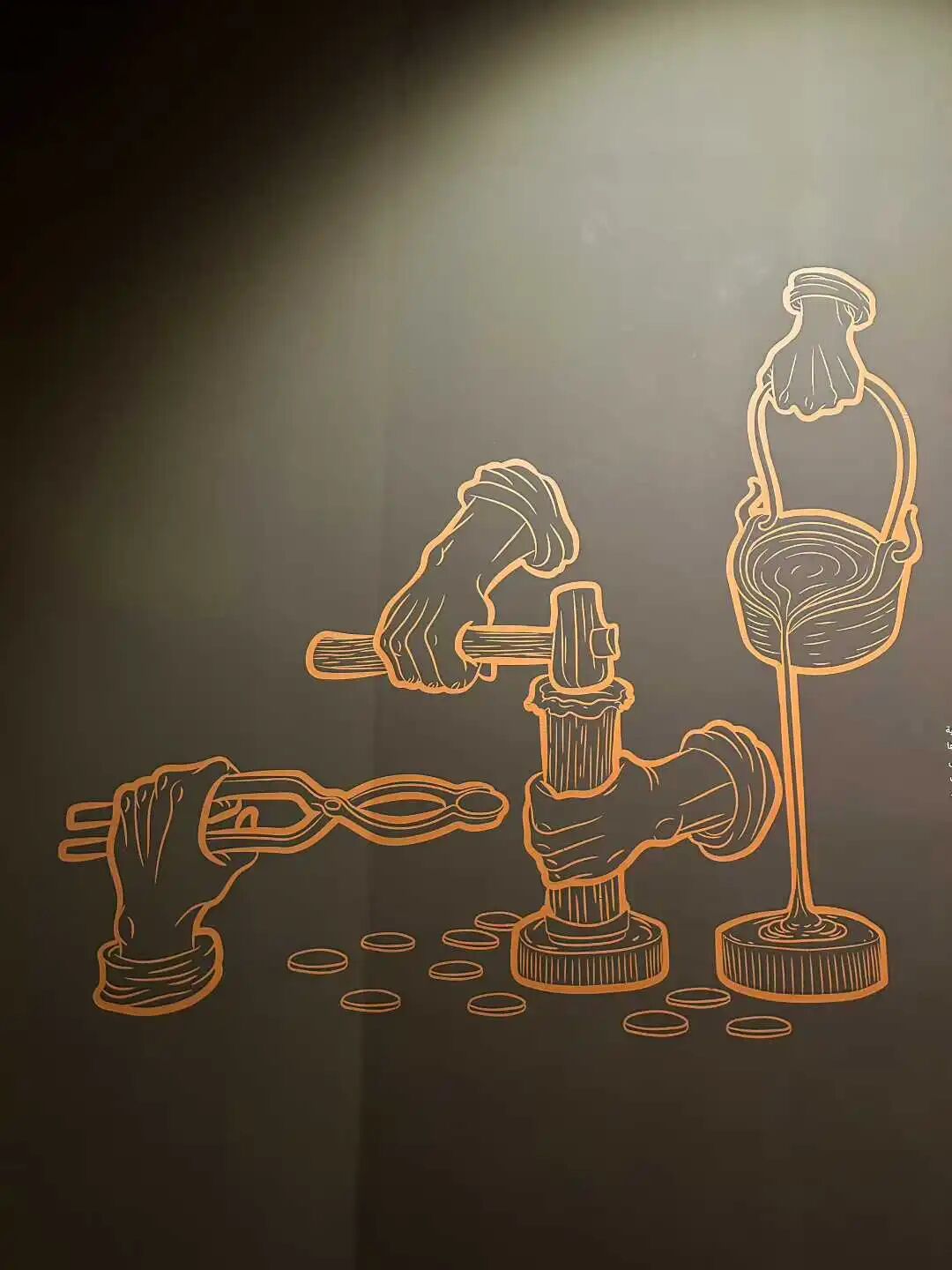
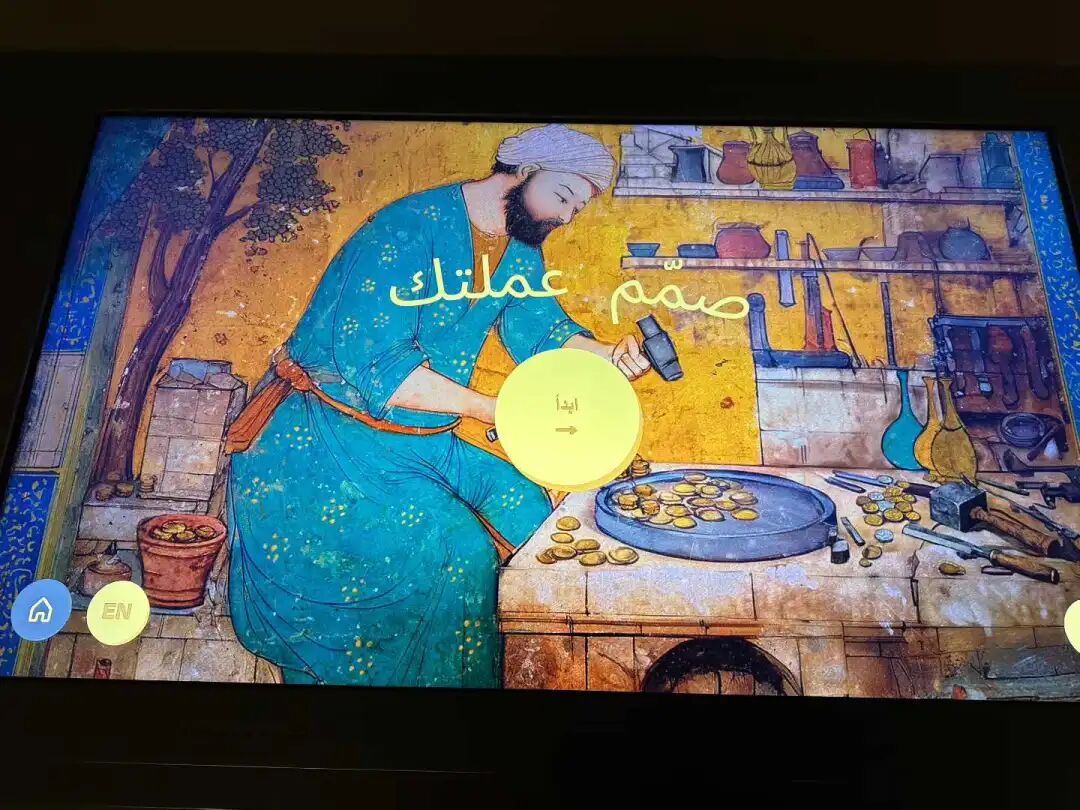
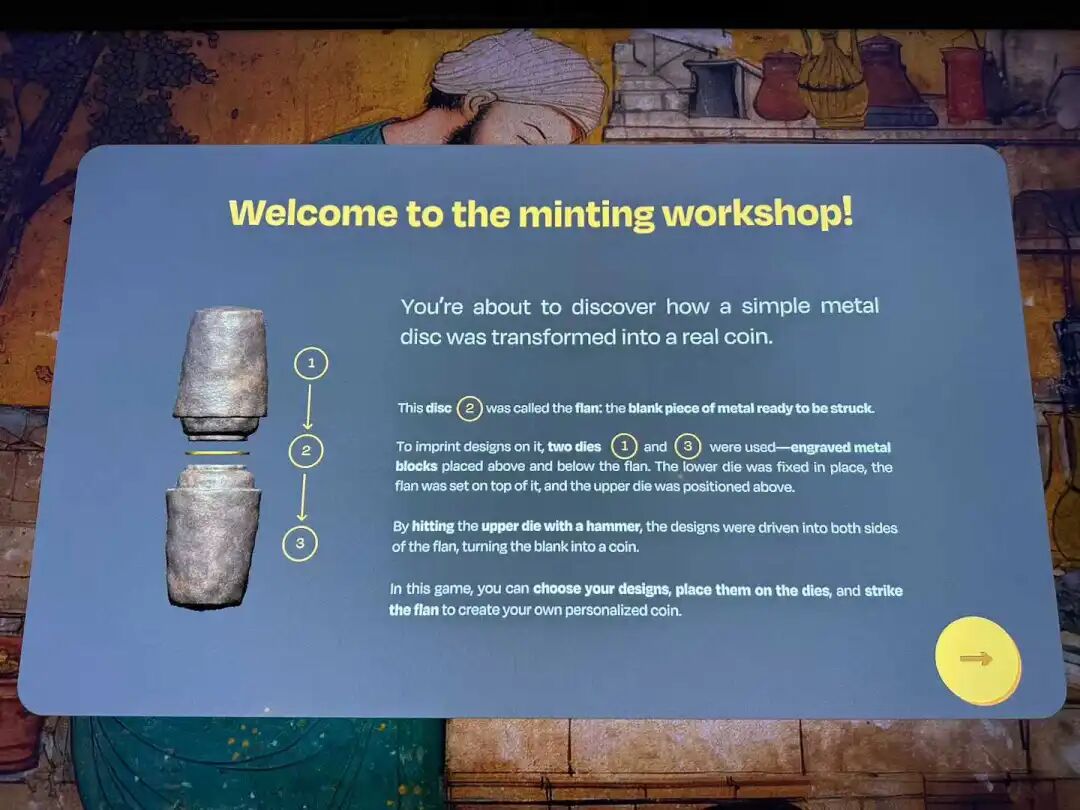
The interactive coin minting display at the exhibition shows the coin-making process in detail.
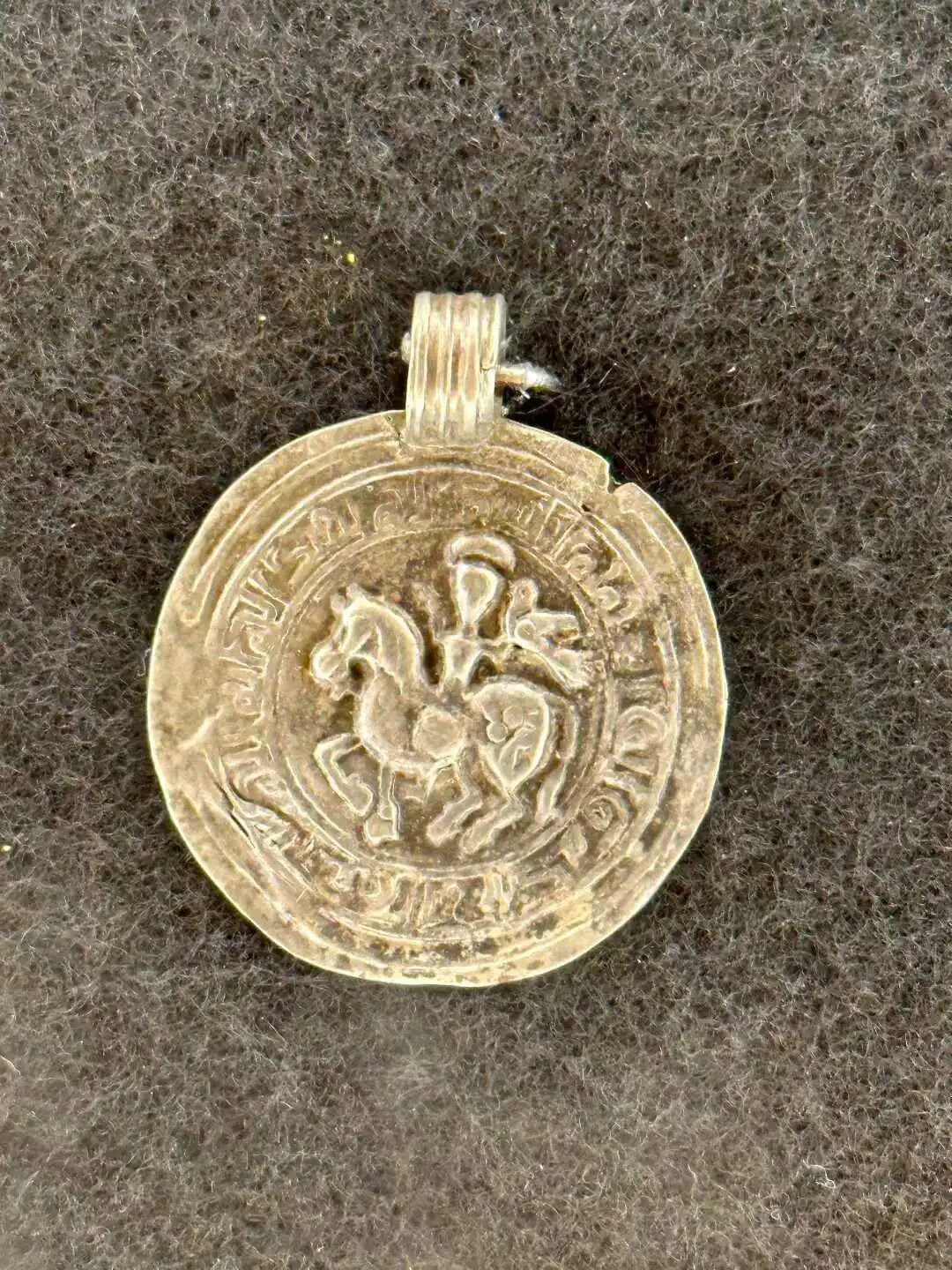
A coin from the 7th-century Umayyad Caliphate minted in Bishapur, featuring an image of a camel rider with a spear. Bishapur is located in southwestern Iran and was once the capital of the Sasanian Empire.
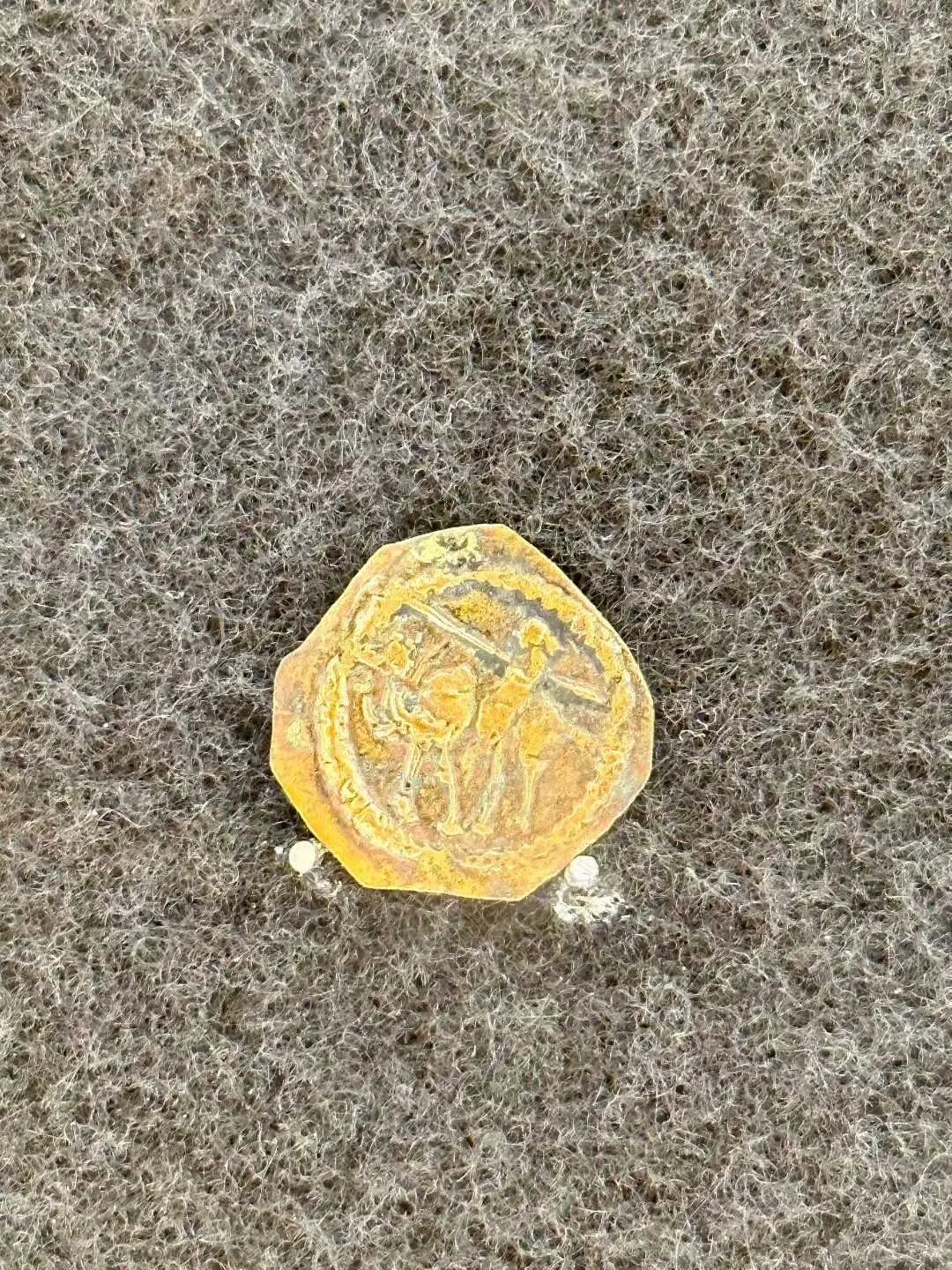
A coin from the Seljuk Empire minted between 1040 and 1063, featuring an image of a falconer on horseback.
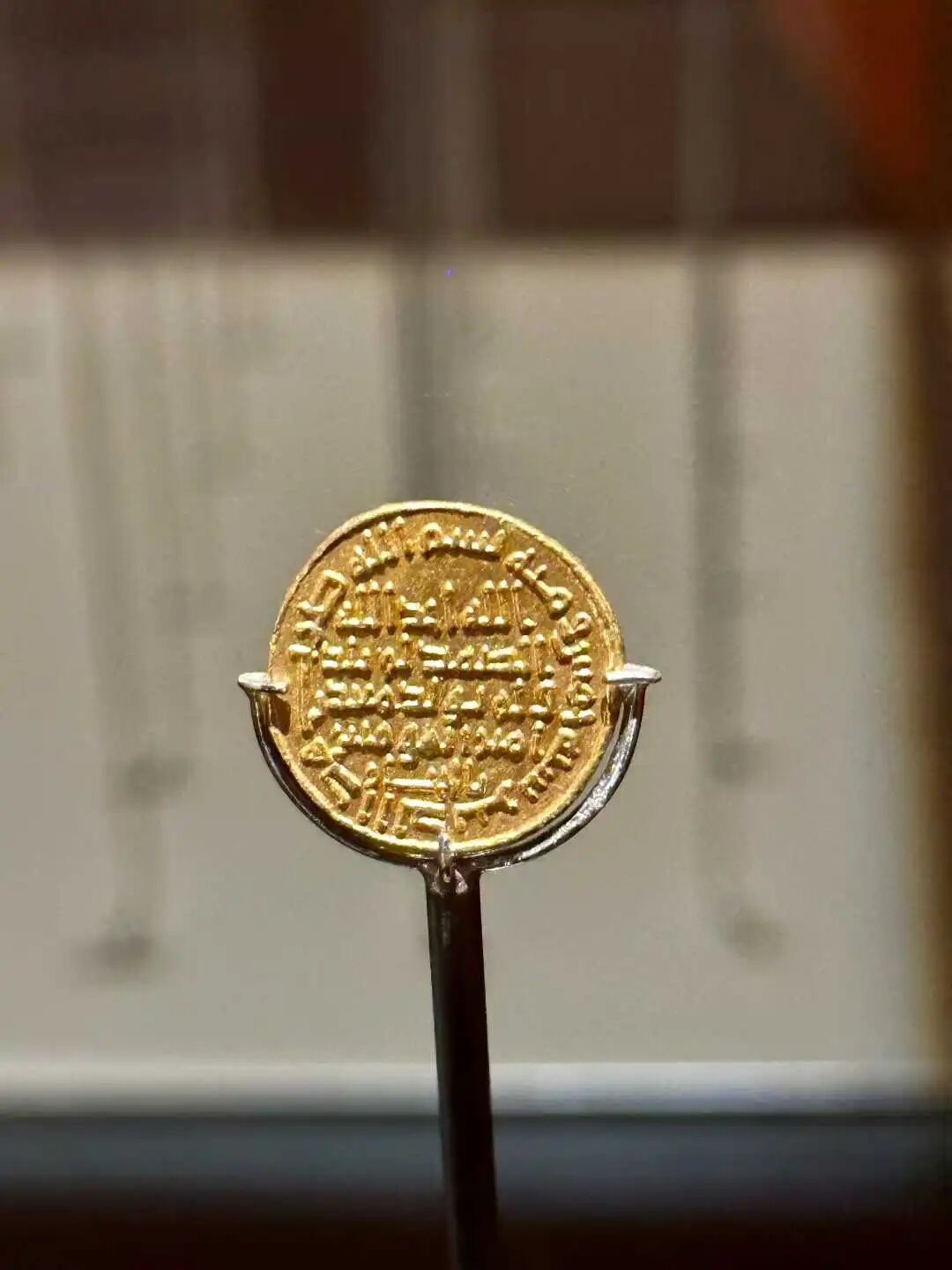
The earliest Islamic coin found within Saudi territory is this Umayyad dinar minted in 723. It is engraved with the name of the mint, al-Madina Ma'din Amir al-Mu'minin, which tells us this coin was minted in Medina. This coin shows the important status of Medina during the Umayyad Caliphate.
This section features dinar coins minted in Mecca between the 9th-century Abbasid Caliphate and the 10th-century Fatimid Caliphate.
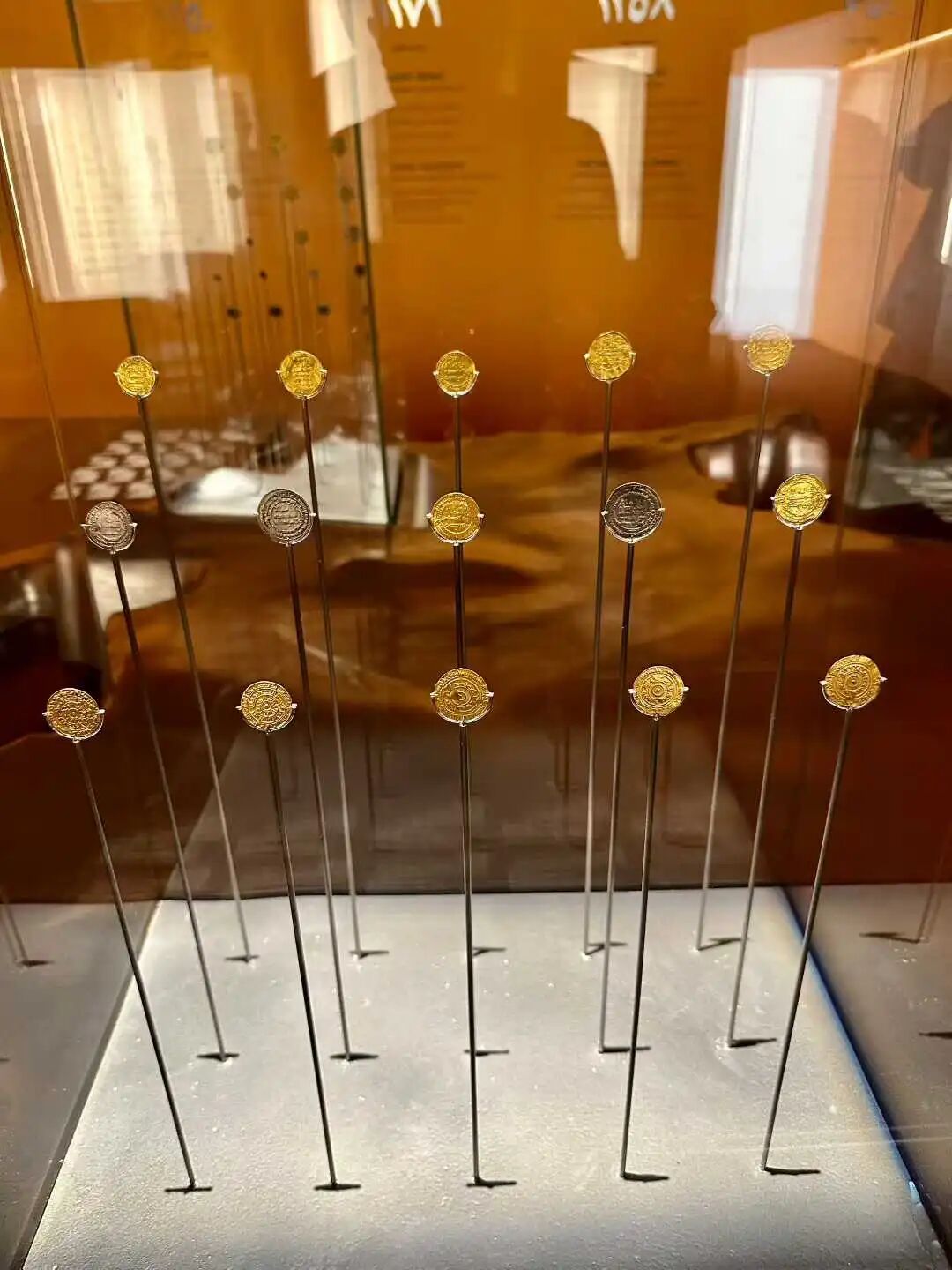
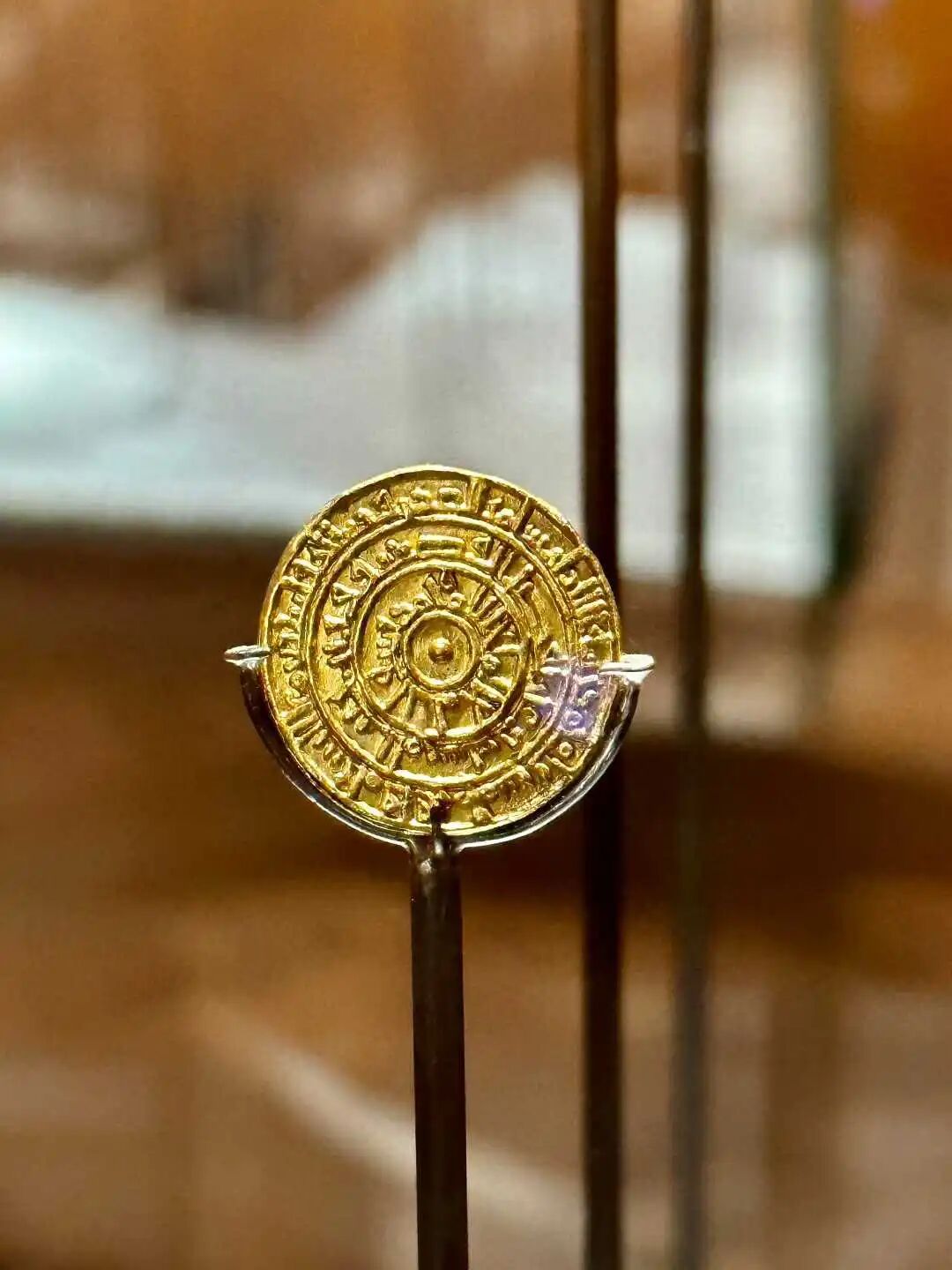
This is a gold dinar minted in Mecca during the Fatimid Caliphate in 971.
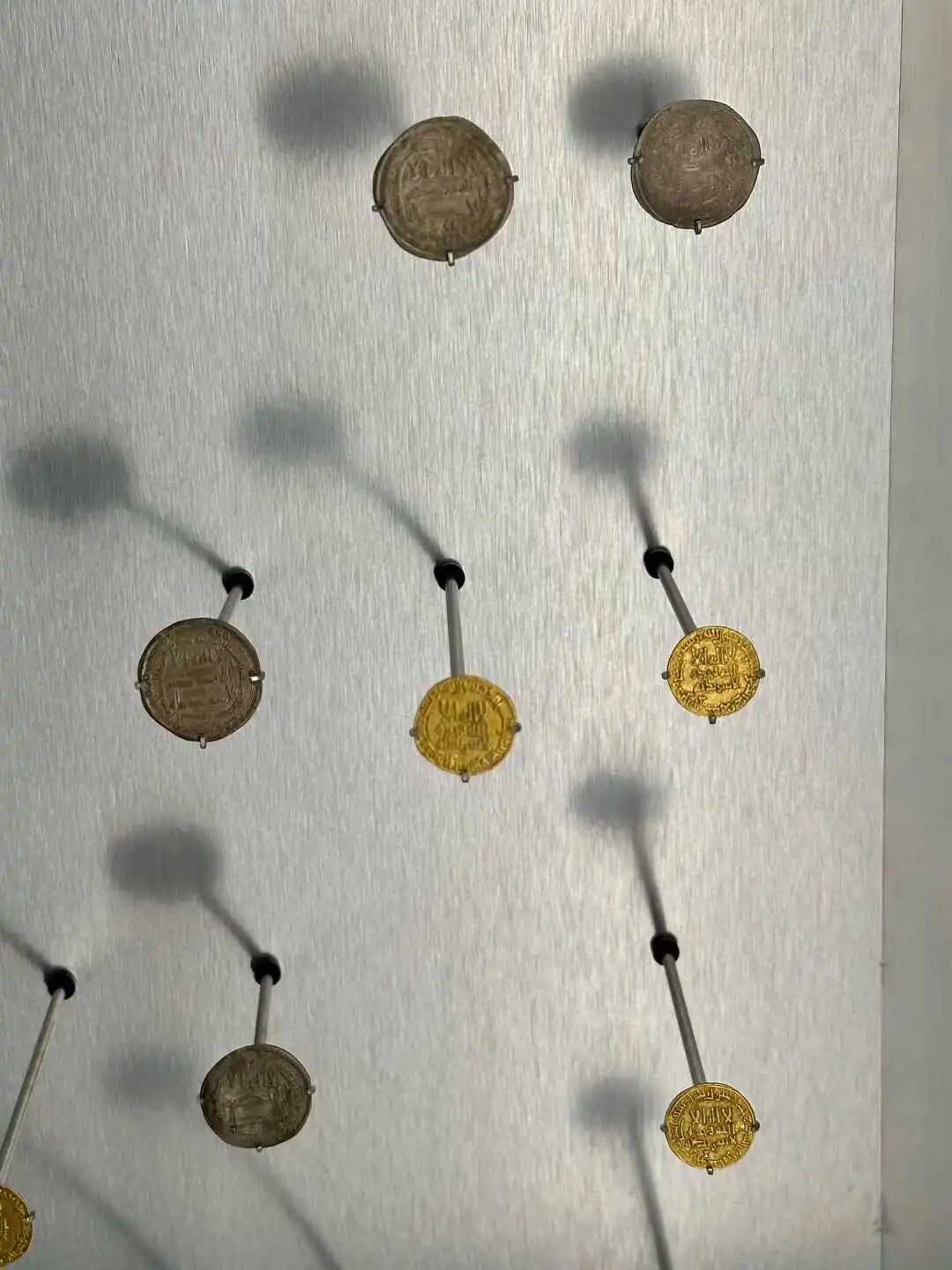
The Saudi Ministry of Culture holds two large coin collections. The first was found in 1980 by a farmer cleaning an old well in a village near Ha'il in northern Saudi Arabia. It includes 414 silver dinars, with 7 dating back to the late Umayyad period and 406 to the early Abbasid period, from mints including Baghdad, Basra, Armenia, Balkh, and Kufa. The second collection was found by chance in 2010 by a sand transport worker in another village near Ha'il, containing 2,296 gold and silver coins from the Umayyad and Abbasid dynasties.
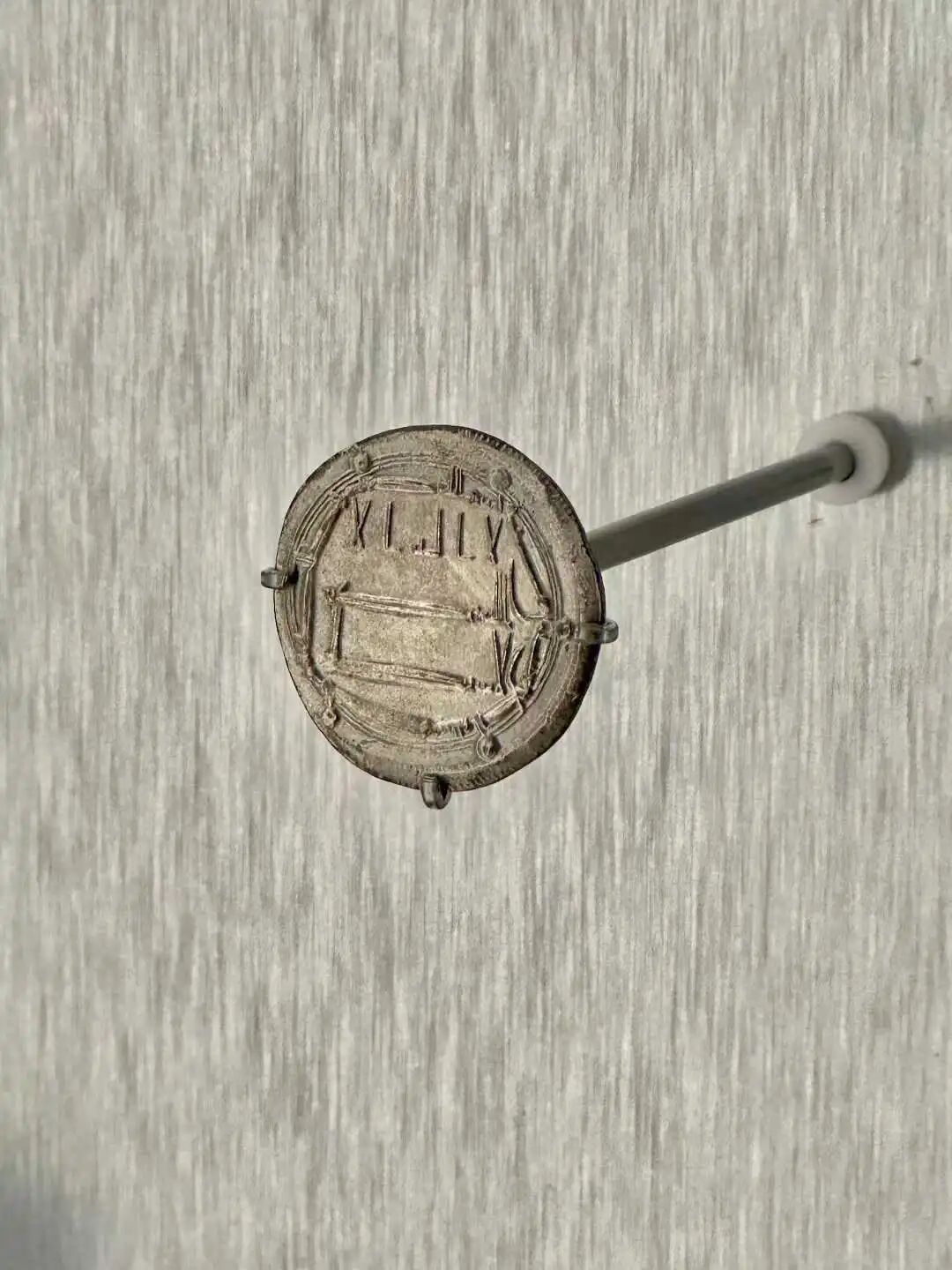
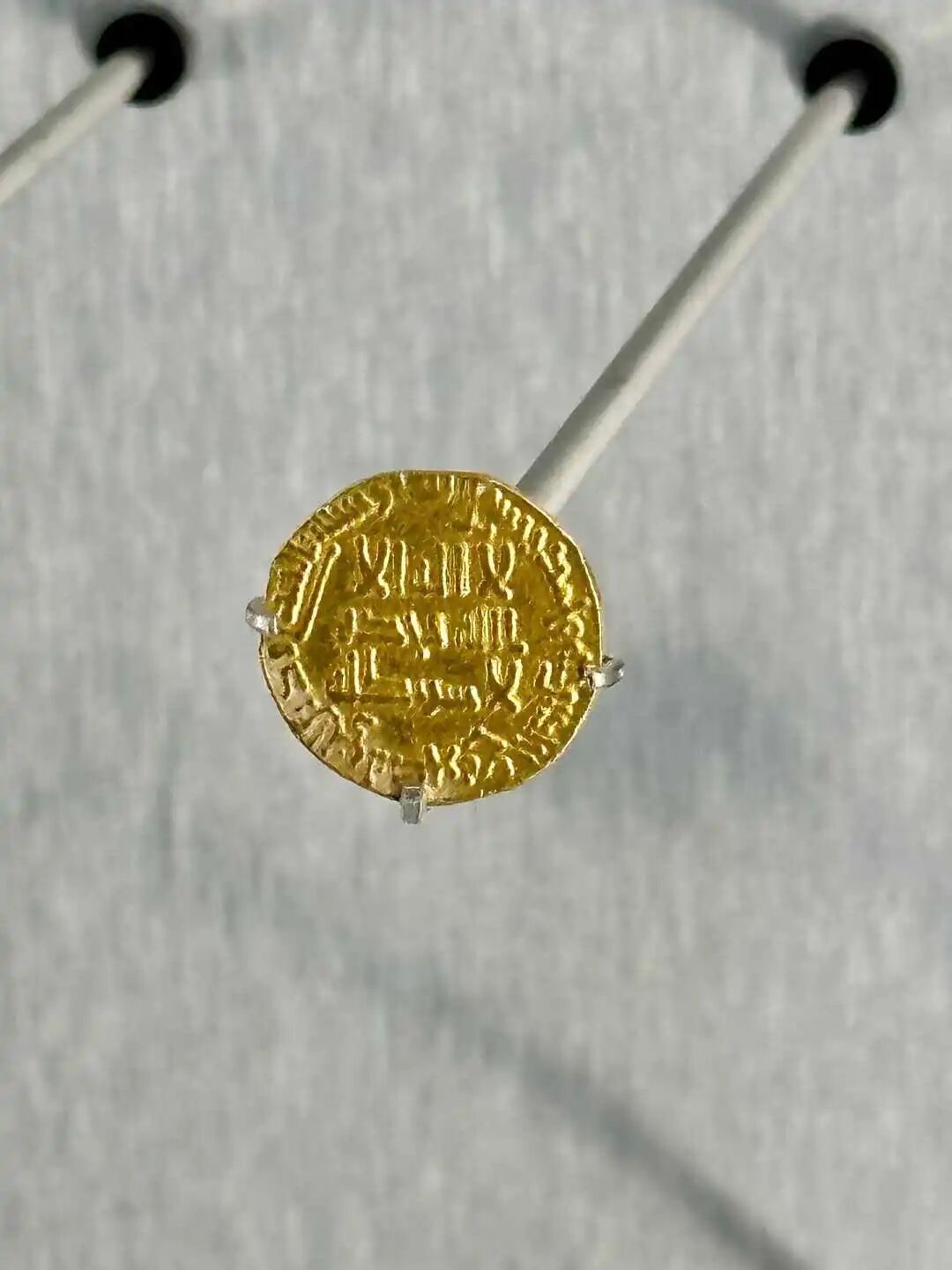
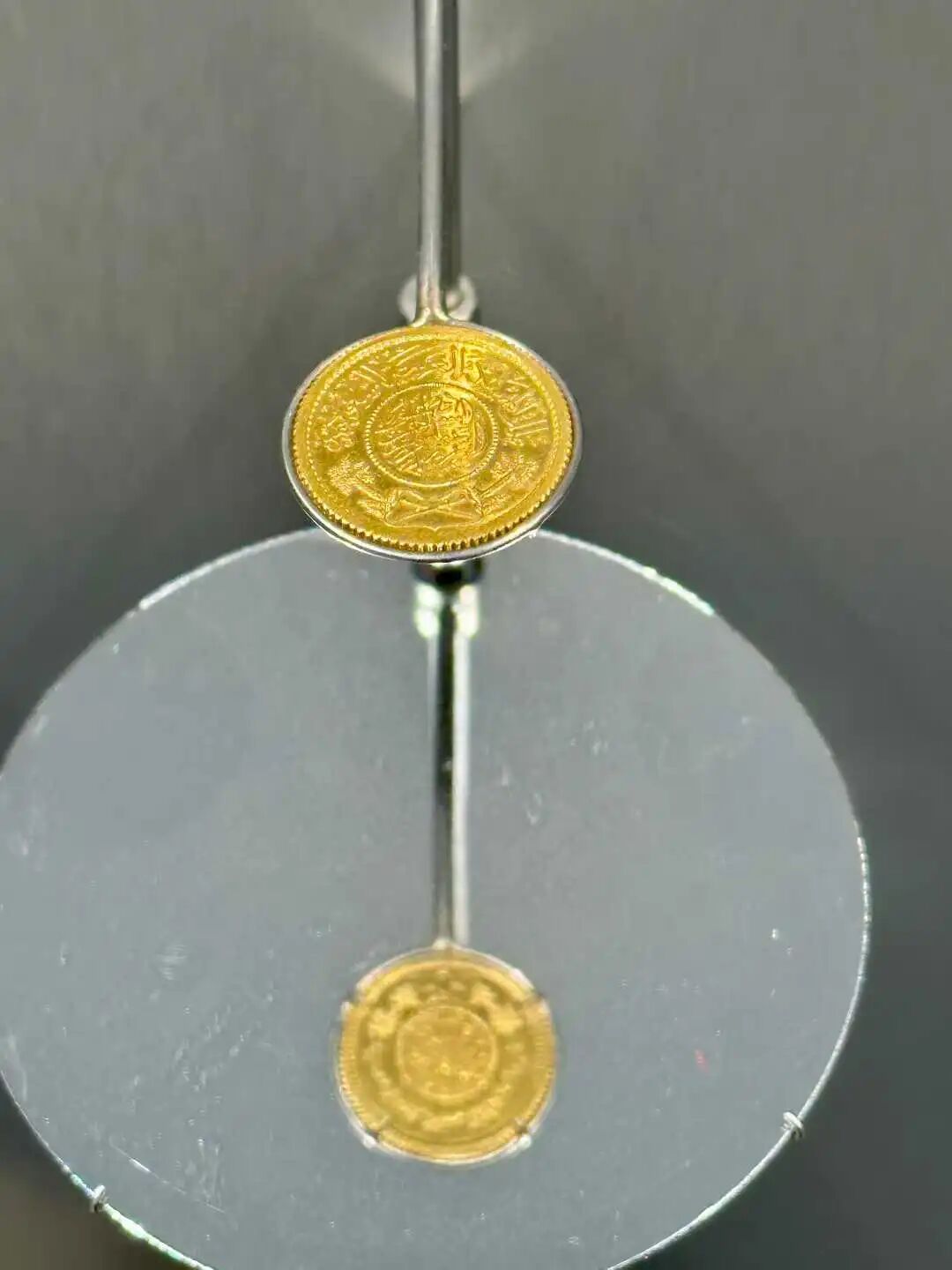
A modern Saudi gold coin trial strike minted in 1950, with text on the back that differs from the final version in circulation.
Summary: The Saudi National Museum exhibition Forging Narratives: The Coinage Heritage of Saudi Arabia traces Islamic coinage from early Umayyad gold coins to later dynasties. This English account keeps the source's dates, rulers, coin details, exhibition context, and photographs in one clear museum note.
The Saudi National Museum is hosting a special exhibition called "Forging Narratives: The Coinage Heritage of Saudi Arabia" from September 17 to December 16, 2025, featuring items from the famous coin collector Alain Baron. The exhibition follows a chronological order, starting with the oldest Umayyad gold coins, which surprisingly feature Byzantine emperors.
Before the Umayyad Caliphate was established, the Syrian region used Byzantine gold coins. After the Umayyad Caliphate was founded in 661, it began minting gold coins in Damascus. Early Umayyad gold coins continued to use Byzantine imagery. You can see coins showing the Byzantine Emperor Heraclius (reigned 610-641) and his two sons, Constantine III and Heraklonas, on the front, with Latin text on the back. Unlike Byzantine coins, the crowns and scepters of the emperors on Umayyad coins lack crosses, and the cross on the steps on the back is just a vertical line without a horizontal bar.
These Umayyad coins reflect the early culture of the Umayyad Caliphate, which continued to inherit Byzantine traditions. When Bedouin nomads from the Arabian Peninsula flooded into the grand city of Damascus, they saw a rich and colorful Byzantine culture. Because of this, they continued to use Byzantine culture in areas outside of religion, such as music, art, and architecture, becoming heirs to the Byzantine legacy.
It was not until the 690s that the Umayyad Caliphate began to move away from Byzantine culture and design its own gold coins. In 693, Caliph Abd al-Malik (reigned 685-705) minted gold dinar coins in Damascus, and by 696, he removed human figures, keeping only Arabic text. During the same period, Abd al-Malik also promoted the use of Arabic over Greek in Syria, making Arabic the only official language of the Umayyad Caliphate. From then on, the Umayyad Caliphate shifted from being an heir to Byzantine and Sasanian cultures to becoming a true Arab civilization.
This commemorative silver coin was issued between 800 and 810 AD by Queen Zubaidah (Zubaidah bint Ja`far ibn al-Mansur, 765-831) of the Abbasid Caliphate to give to noble dignitaries of the time.
Zubaidah is known as a key figure in the Golden Age of the Abbasid Caliphate and the most important queen in its history. She was the wife of Harun al-Rashid, the fifth Abbasid caliph. This was the most prosperous era of the Abbasid Caliphate, with the capital, Baghdad, housing libraries and the translation center known as the House of Wisdom. Baghdad was the world center for knowledge, culture, and trade at the time.
Zubaidah was famous for her generosity and donated to many poets, scholars, and doctors, regardless of their social or religious backgrounds. She spent over 20,000 dinars to improve the water supply in and around Mecca, deepened the Zamzam well, and built a series of rest areas, wells, and pools along the road connecting Baghdad, Mecca, and Medina. This road is still called the Zubaidah Road today. The famous traveler Ibn Battuta once said: "Every reservoir, pool, or well on this road from Mecca to Baghdad is there because of her generous gifts... If she had not cared for this road, no one would be able to use it."
This dirham coin was minted in 1243 in what is now Kurraman, Pakistan, during the reign of Empress Dowager Töregene Khatun of the Yuan Dynasty.
Empress Dowager Töregene Khatun took power in 1242 after the death of her husband, Ögedei Khan, and returned power in 1246 after her son, Güyük Khan, was elected Great Khan. During her time in power, she successfully balanced the competing forces of the Mongol Empire. Over five years, she not only ruled the vast empire but also laid the foundation for her son's succession. While she was in power, the Seljuk Sultan from Turkey and the Abbasid Caliph from Baghdad both sent envoys to her camp.
The city of Kurraman is located in the Kurram Valley of Pakistan and was a famous minting center during the Khwarazmian and Mongol periods.
A gold dinar coin minted by the Ilkhanate in 1338.
A gold dinar coin minted in Baghdad by the Ilkhanate in 1338.
A coin minting mold brought back by Sultan Muhammad ibn Sam of the Ghurid dynasty after he conquered India in 1204. These molds broke easily during the minting process, so they are very hard to preserve.
The interactive coin minting display at the exhibition shows the coin-making process in detail.
A coin from the 7th-century Umayyad Caliphate minted in Bishapur, featuring an image of a camel rider with a spear. Bishapur is located in southwestern Iran and was once the capital of the Sasanian Empire.
A coin from the Seljuk Empire minted between 1040 and 1063, featuring an image of a falconer on horseback.
The earliest Islamic coin found within Saudi territory is this Umayyad dinar minted in 723. It is engraved with the name of the mint, al-Madina Ma'din Amir al-Mu'minin, which tells us this coin was minted in Medina. This coin shows the important status of Medina during the Umayyad Caliphate.
This section features dinar coins minted in Mecca between the 9th-century Abbasid Caliphate and the 10th-century Fatimid Caliphate.
This is a gold dinar minted in Mecca during the Fatimid Caliphate in 971.
The Saudi Ministry of Culture holds two large coin collections. The first was found in 1980 by a farmer cleaning an old well in a village near Ha'il in northern Saudi Arabia. It includes 414 silver dinars, with 7 dating back to the late Umayyad period and 406 to the early Abbasid period, from mints including Baghdad, Basra, Armenia, Balkh, and Kufa. The second collection was found by chance in 2010 by a sand transport worker in another village near Ha'il, containing 2,296 gold and silver coins from the Umayyad and Abbasid dynasties.
A modern Saudi gold coin trial strike minted in 1950, with text on the back that differs from the final version in circulation.
Islamic Art Guide: Museum of Islamic Art in Cairo (Part 1)
Articles • ali2007fr posted the article • 0 comments • 153 views • 2026-05-19 08:54
Reposted from the web
Summary: Islamic Art Guide: Museum of Islamic Art in Cairo (Part 1) is presented here as a firsthand travel account in clear, natural English. The account focuses on Cairo, Islamic Art, Museum Travel while preserving the names, places, food, photos, and historical details from the Chinese source.
In the 19th century, Egypt placed great importance on Pharaonic art, but appreciation for Islamic art lagged behind. In 1880, Tewfik Pasha, the sixth ruler of the Muhammad Ali dynasty, finally established the first museum of Islamic art.
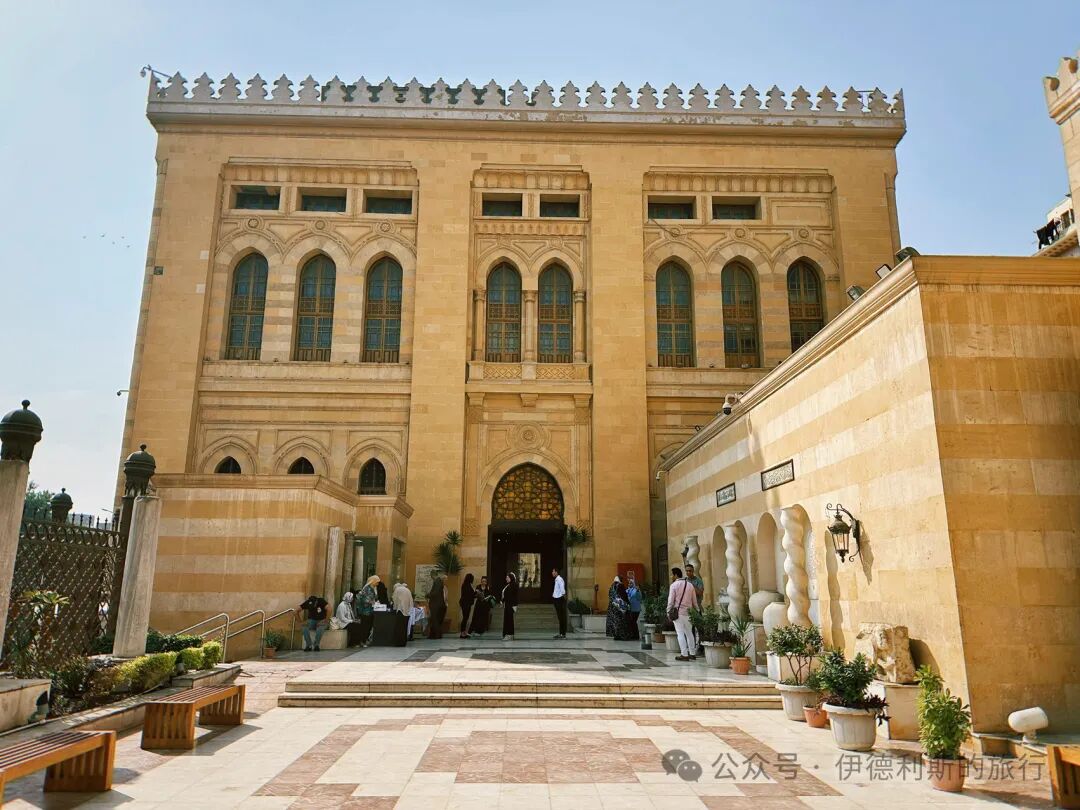
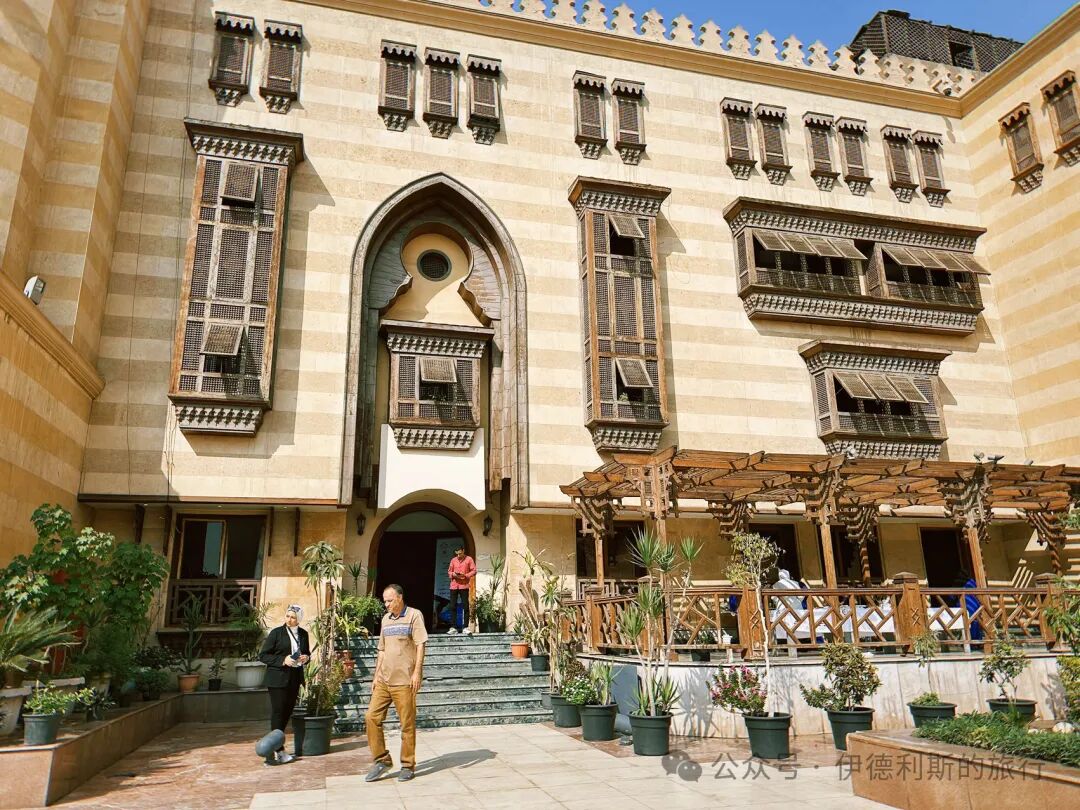
In 1881, Tewfik Pasha approved the creation of the Committee for the Preservation of Arab Monuments. The arcades of the abandoned Al-Hakim Mosque inside the northern gate of Cairo were used as a temporary exhibition hall to display hundreds of artifacts. In 1884, a two-story building was constructed in the mosque courtyard to house 900 artifacts. In 1887, the museum was named the Museum of Arab Antiquities. By 1895, the collection had grown to 1,641 items, and the museum space reached capacity. In 1902, the new Mamluk-style museum building was officially completed, which is the building we see today.
The Cairo Museum of Islamic Art building once featured complex decorative designs inspired by architecture from various periods of Islamic history. In 2014, a car bomb attack targeting the Cairo police headquarters across the street caused severe damage to the museum. Nearly 30 percent of the artifacts were damaged, and the exterior wall decorations were also destroyed. After three years of restoration, the museum reopened in 2017.
The hall after the entrance provides a general introduction, showcasing a selection of unique Islamic artifacts from different perspectives.
An 8th-century Umayyad dynasty Quran in Kufic script from Egypt, written in brown ink on parchment.
An enameled water jug and basin from the 19th-century Qajar dynasty of Iran, featuring Persian-style figures and floral patterns.
The oldest surviving key to the Kaaba, made in 1363-4, belonging to the Egyptian Mamluk Sultan Al-Ashraf Sha'ban (reigned 1363-77).
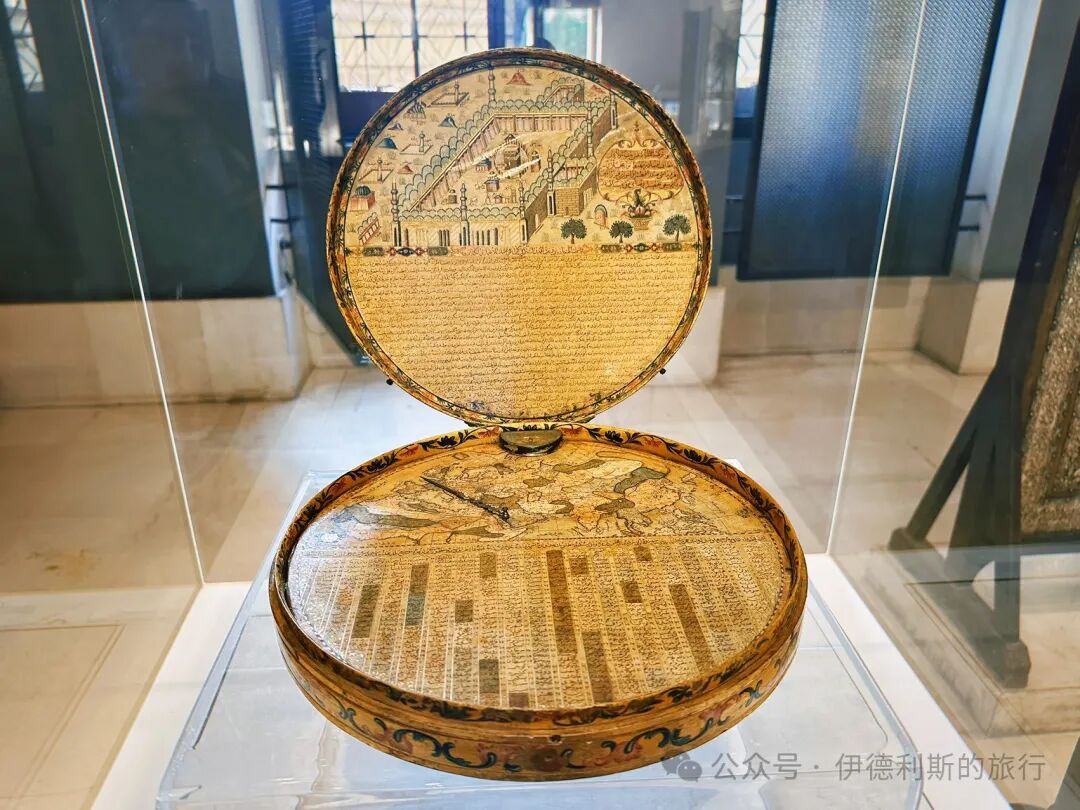
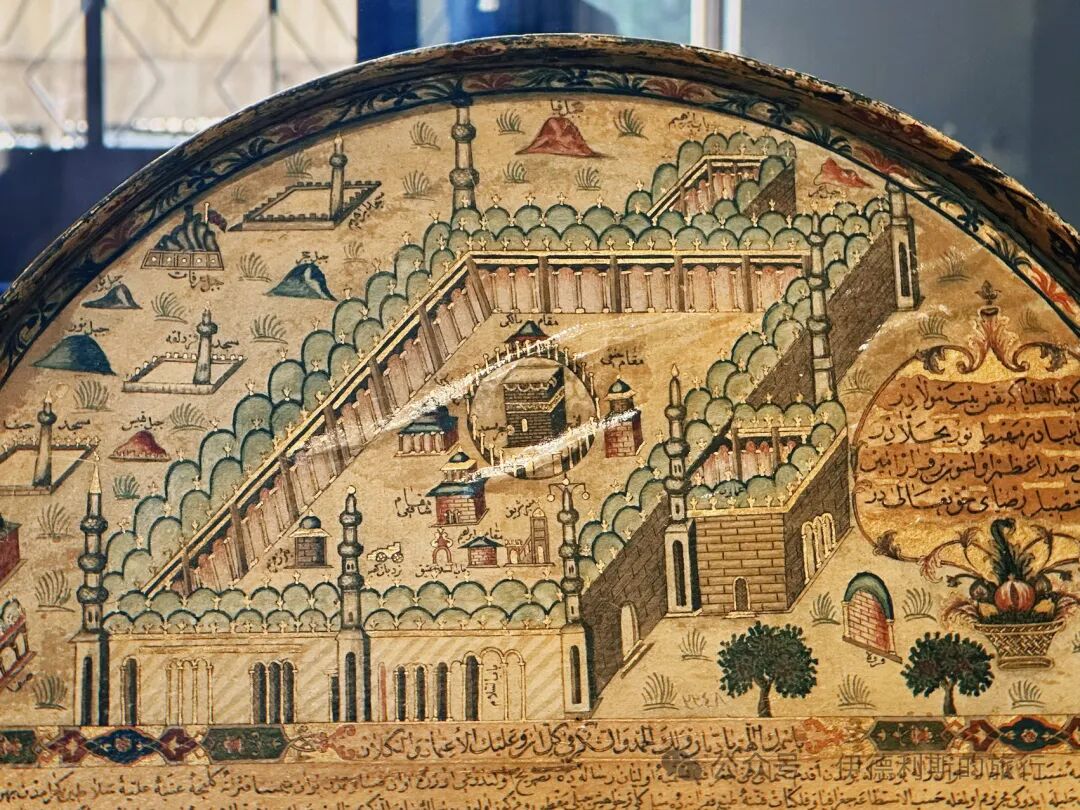
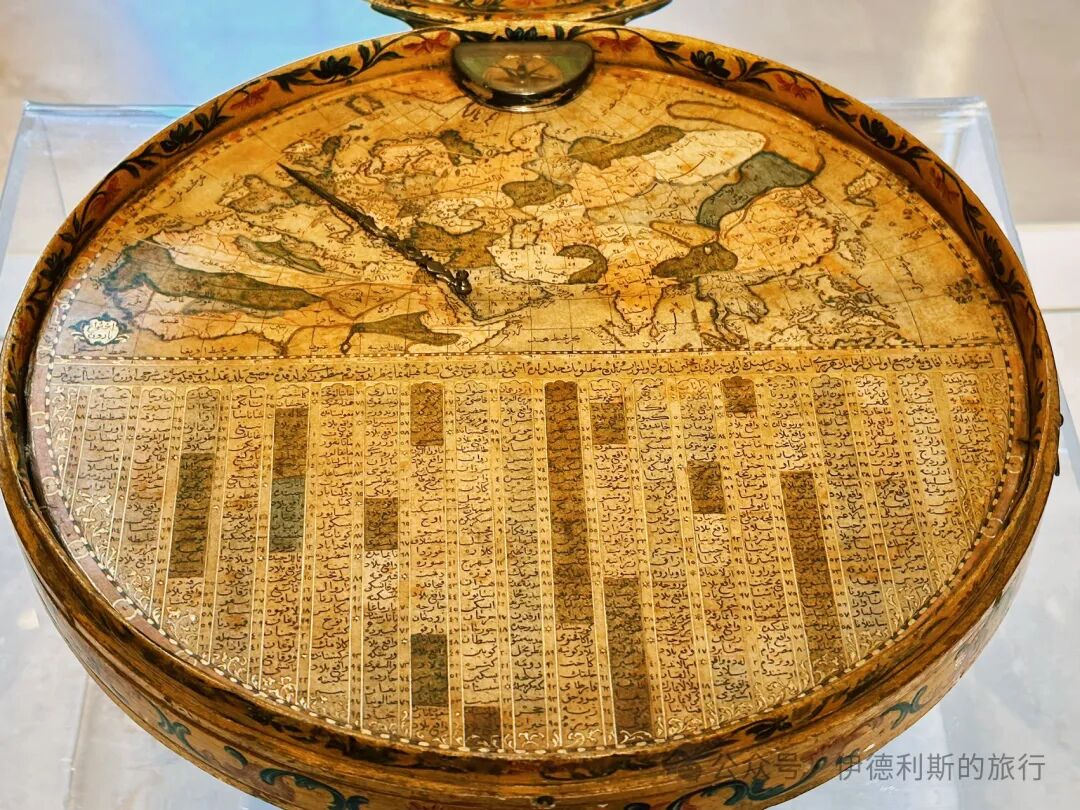
An 18th-century Ottoman qibla indicator, made by the manufacturer Barun al-Mukhtar during the reign of Sultan Mahmud I (reigned 1730-54). It shows the appearance of the Sacred Mosque (Masjid al-Haram) after the 1629 Ottoman renovation, a structure that remained until 1955.
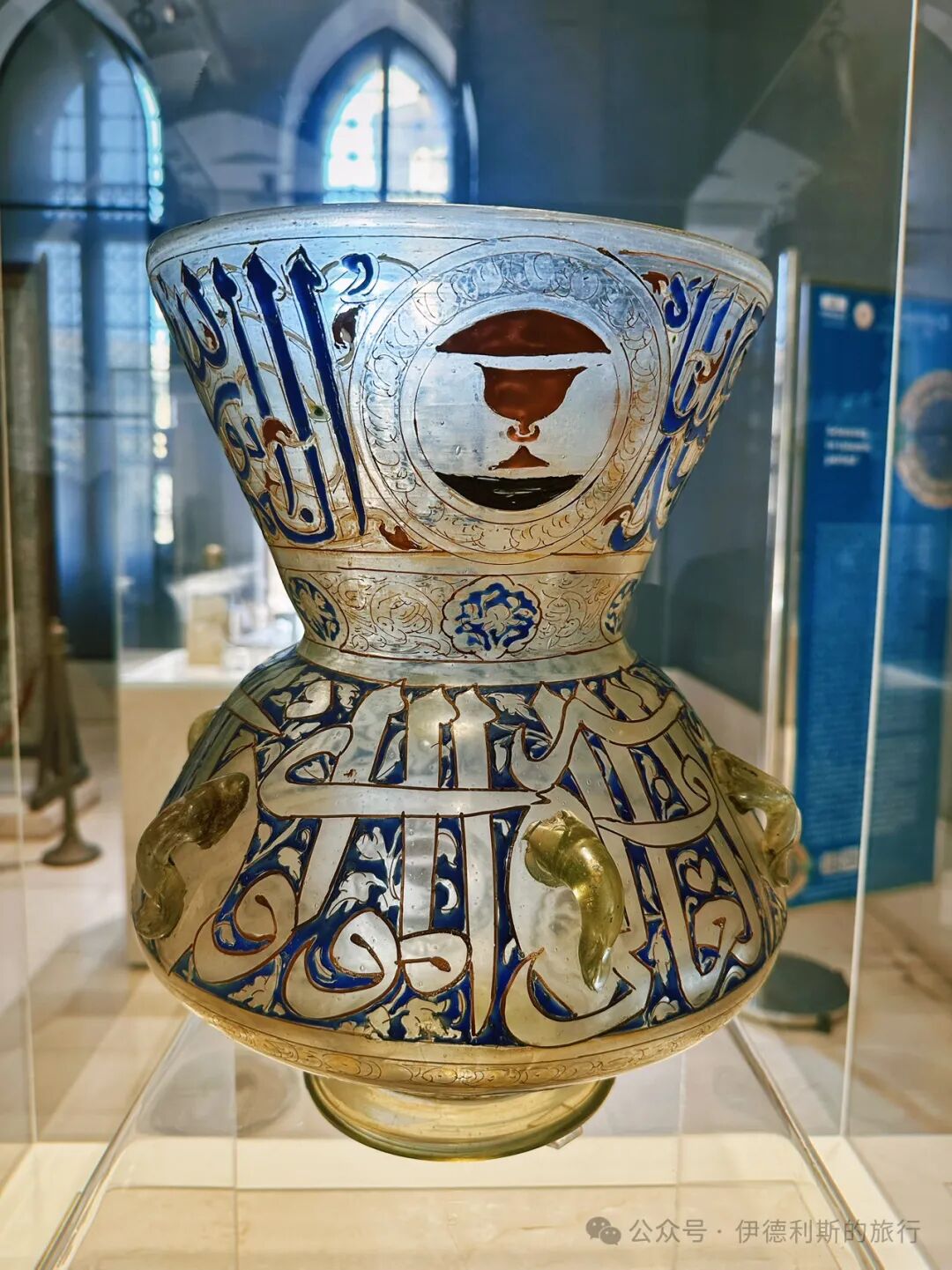
A 15th-century Mamluk-period mosque glass lamp from Egypt, bearing the name of Emir Safy al-Din Shaykhu.
After passing through the hall, the exhibition continues with Islamic artifacts arranged in chronological order.
Early days of the faith.
A wood carving panel from Egypt during the Abbasid Caliphate in the 9th century.
A wooden chest panel inlaid with ivory and bone from Egypt during the Tulunid dynasty in the 9th century.
An ivory plaque with floral carvings from Egypt during the Umayyad Caliphate in the 7th to 8th centuries.
A wood carving panel with floral decorations from Egypt or Syria during the Umayyad Caliphate in the 8th century.
An underglaze painted ceramic plate from Iraq during the Abbasid Caliphate in the 8th to 9th centuries.
A stucco carving panel in the Samarra style from Iraq during the Abbasid Caliphate in the 9th century. Samarra is located on the east bank of the Tigris River and served as the capital of the Abbasid Caliphate from 836 to 892.
Fatimid Caliphate.
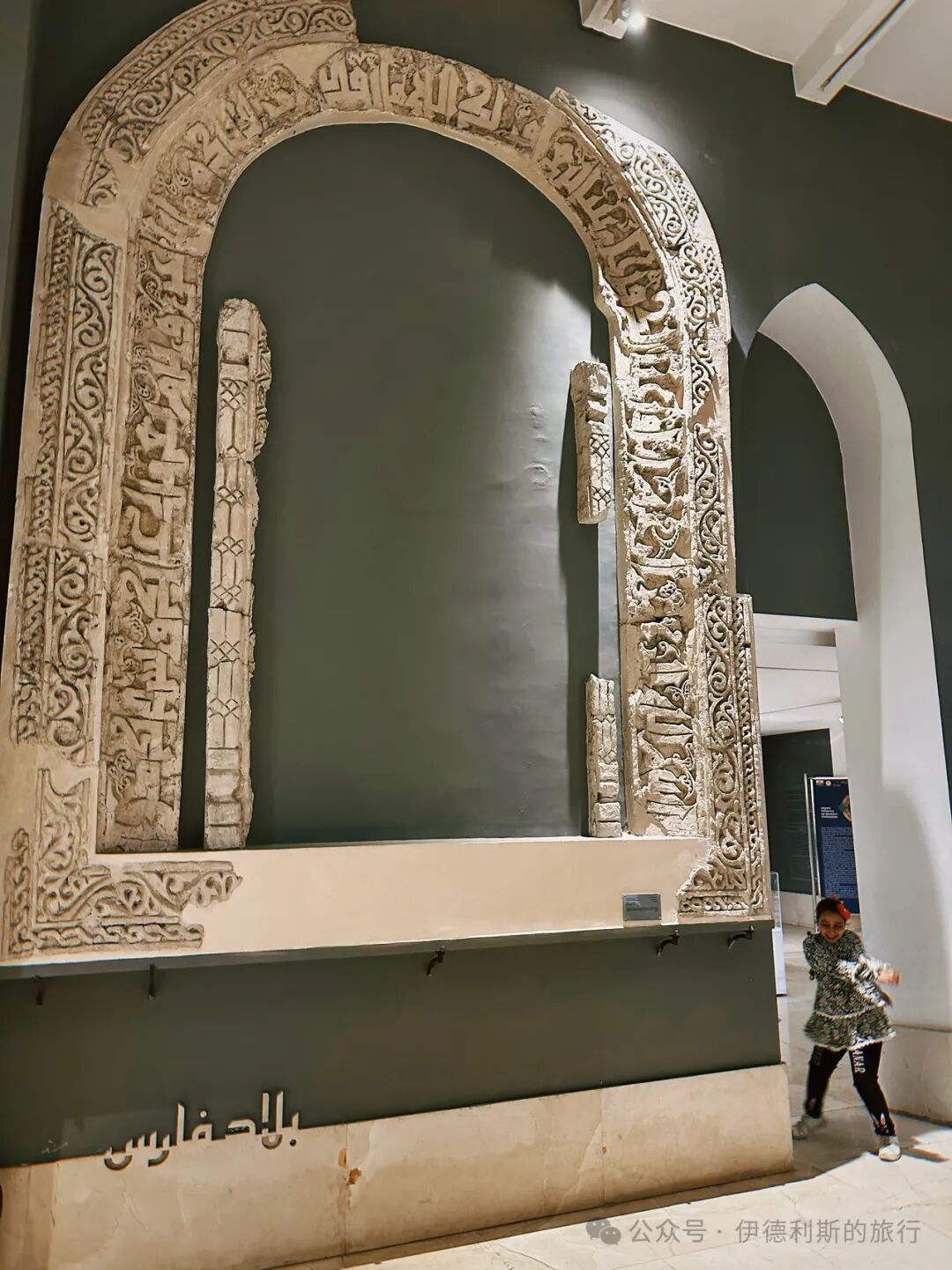
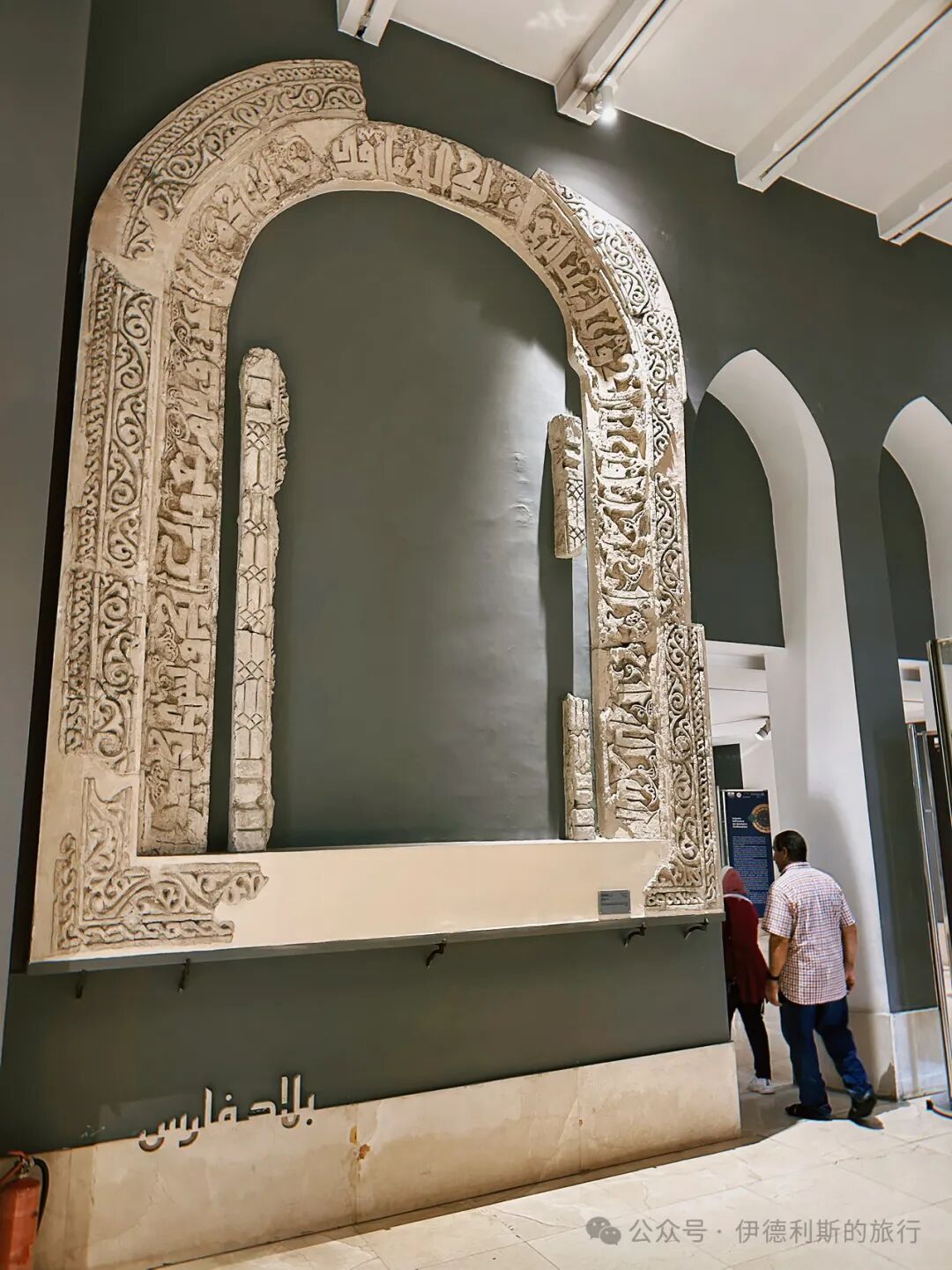
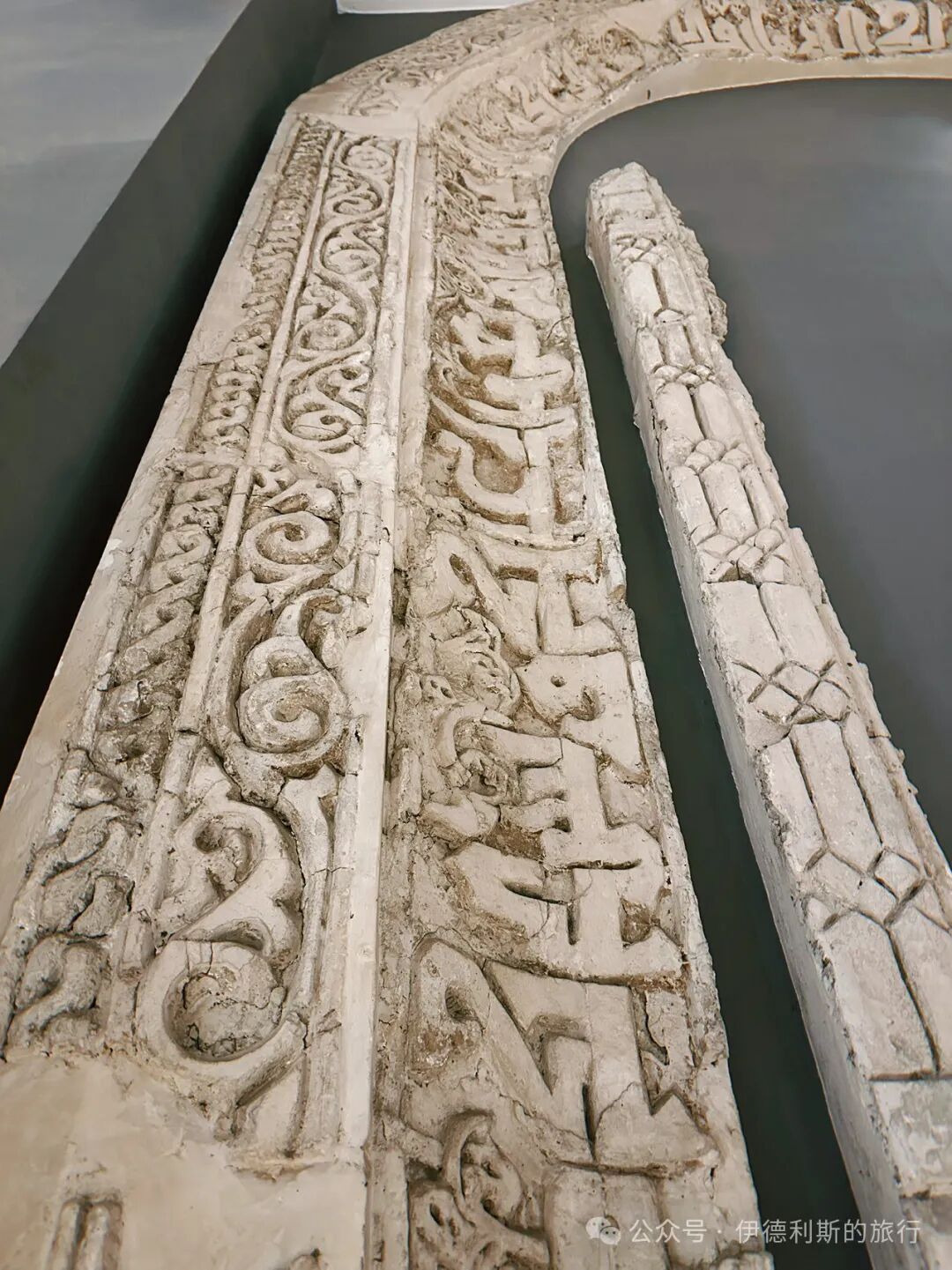
A 10th-century Kufic script stucco window frame from the Western Palace of the Fatimid Caliphate in Cairo. It is truly a masterpiece of the museum; you can see its size by comparing it to the child in the bottom right corner. The Fatimid palace in Cairo was built in 970 and was divided into two parts: the Eastern Palace and the Western Palace. The Western Palace was smaller and originally built for the Fatimid princess Sitt al-Mulk, then renovated by the Caliph in 1064. In 1284-1285, the Mamluk Sultan al-Mansur Qalawun built a massive complex on the site of the Fatimid Western Palace. The hospital within the complex used some architectural elements from the Fatimid Western Palace, and this window frame came from the Qalawun Hospital.
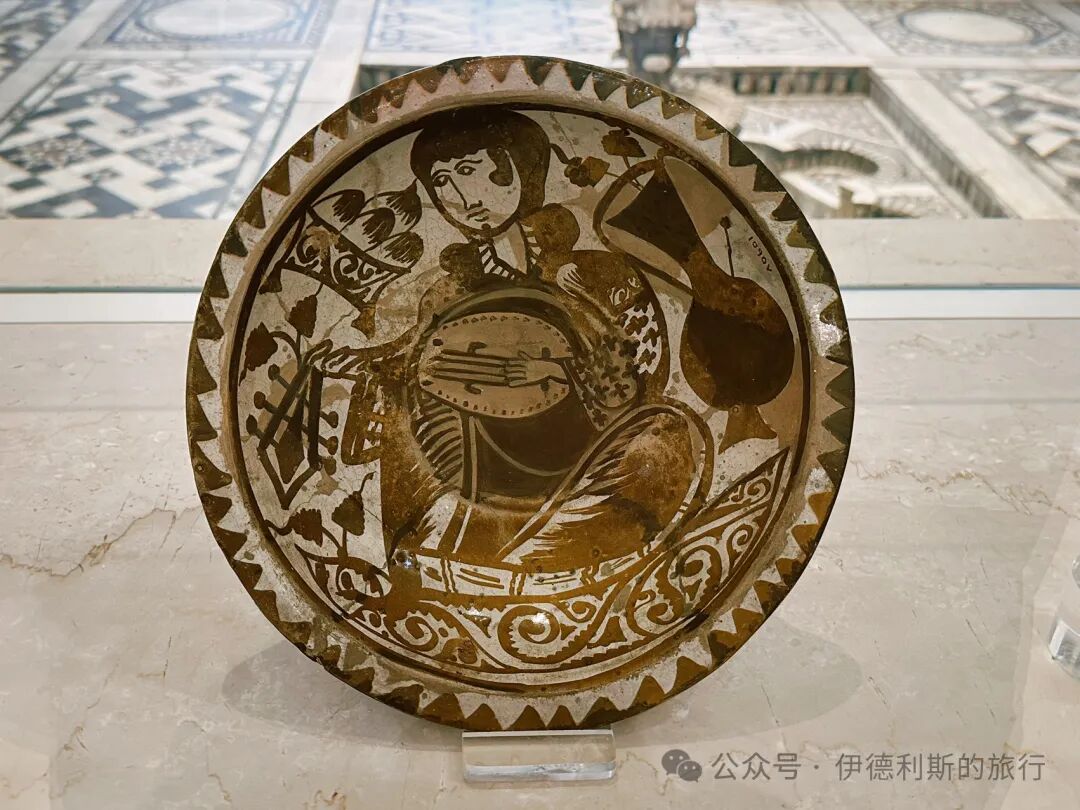
A ceramic plate from Egypt during the Fatimid Caliphate in the 10th to 11th centuries, depicting various music and banquet scenes.
A ceramic plate from Egypt during the Fatimid period in the 11th century, depicting a rider holding a falcon.
A ceramic plate from Egypt during the Fatimid Caliphate in the 11th to 12th centuries, showing two people performing the traditional Egyptian stick fighting, Tahtib.
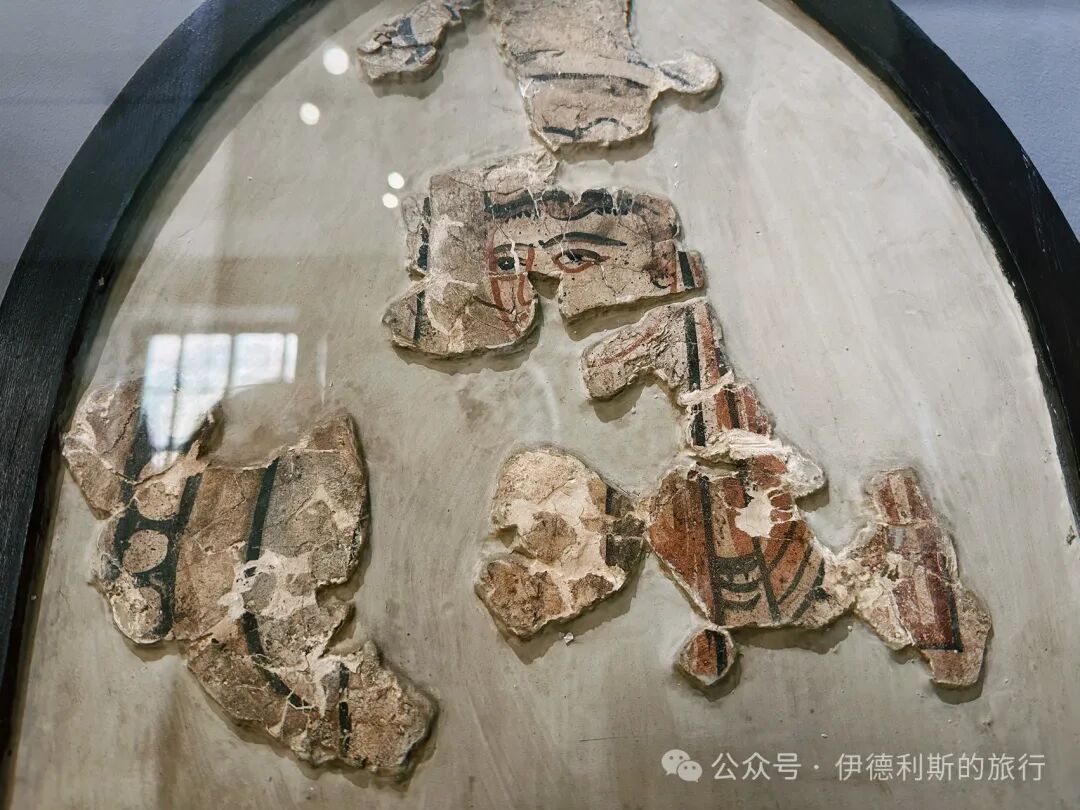
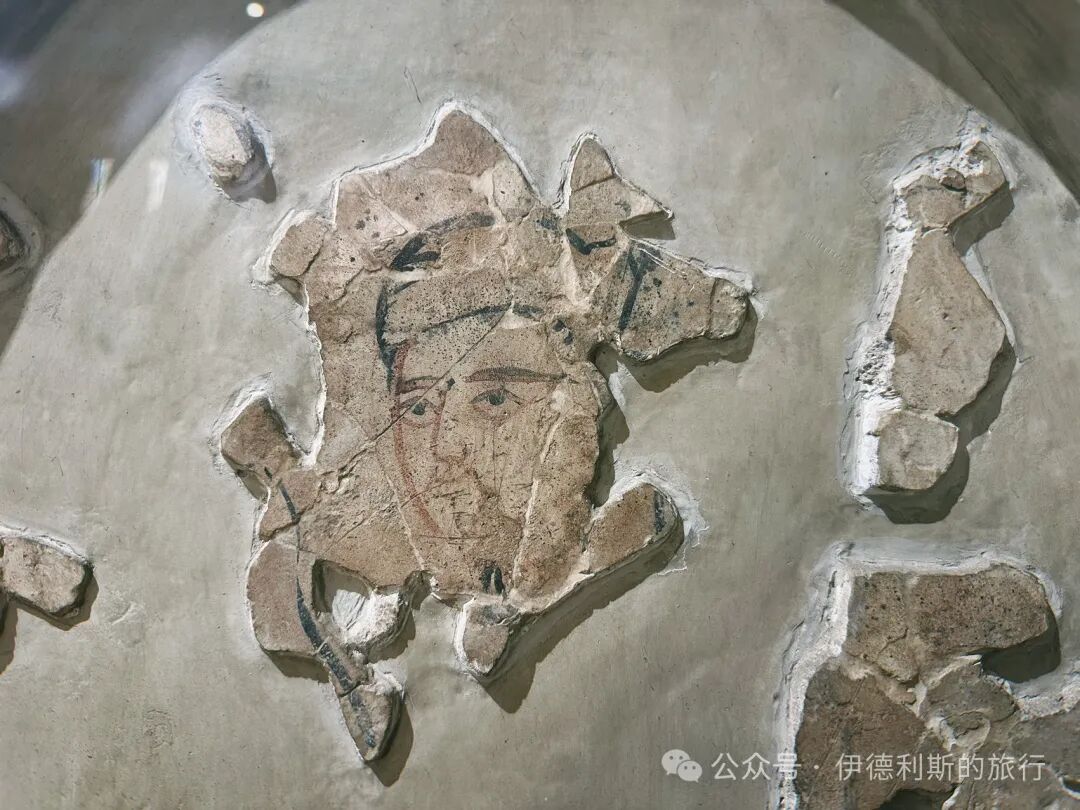
This 11th-century stucco mural from Egypt dates to the Fatimid dynasty and comes from the wall of a Fatimid-era bathhouse.
This small wooden prayer niche (mihrab) from 10th-11th century Fatimid Egypt features inscriptions with Shia content.
This 10th-11th century Fatimid Egyptian ceramic plate shows an image of the Prophet Isa (Jesus), which serves as evidence of the religious tolerance of that time.
This 11th-century Fatimid Egyptian ceramic plate is inscribed with the name of the commander Ghaban.
This 11th-century Fatimid Egyptian ceramic plate features a griffin design. The image of the griffin can be traced back to ancient Egyptian art from 3000 BC, later spreading to West Asia and the Mediterranean region. Because the lion rules the land and the eagle rules the sky, the griffin, which combines the features of both, became a symbol of nobility and power.
This 11th-century Fatimid Egyptian ceramic plate features images of humans, animals, and birds.
This 11th-century Fatimid Egyptian marble carving features Kufic calligraphy.
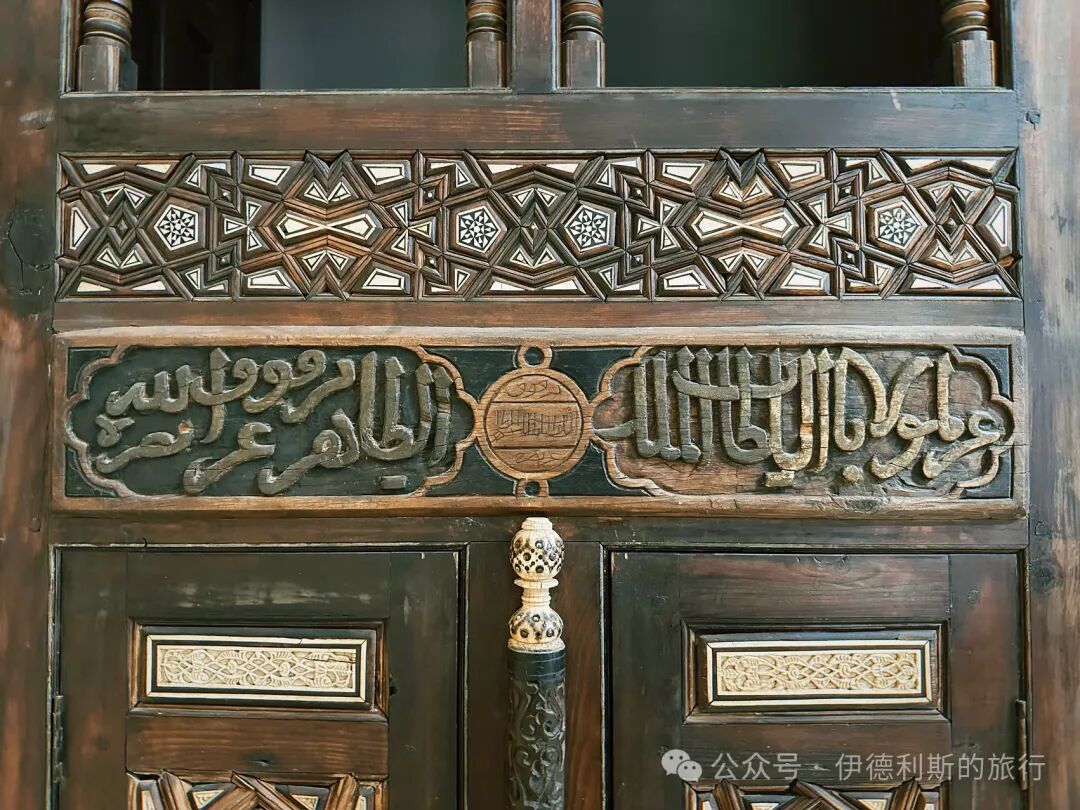
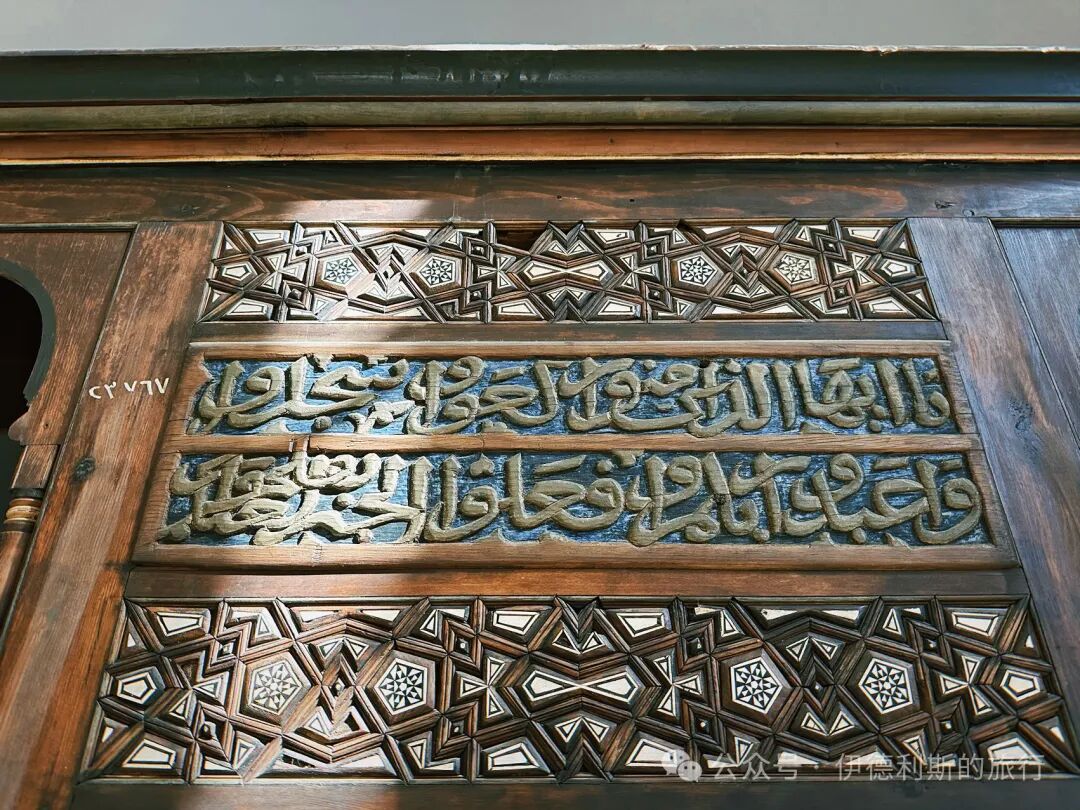
These stucco windows and wooden doors from the Al-Salih Tala'i Mosque in Cairo date to the late Fatimid period in 1160. The Al-Salih Tala'i Mosque is located outside the south gate of the old city of Cairo and was commissioned by the Fatimid vizier Tala'i ibn Ruzzik, who was the last powerful and capable vizier of the Fatimid dynasty. The Al-Salih Tala'i Mosque was completed only 11 years before the fall of the Fatimid dynasty, making it the last surviving building from the Fatimid era.
This wooden door from the Al-Azhar Mosque in Cairo dates to the Fatimid period in 1010 and was commissioned by Caliph al-Hakim bi-Amr Allah, who reigned from 996 to 1021. Al-Hakim was the first Fatimid caliph born in Cairo, an important imam in the history of Ismaili Shia Islam, and a central figure in the Druze faith. At that time, the city of Fustat on the south side of old Cairo was a densely populated Sunni city, while the newly built city of Cairo served as the capital of the Fatimid dynasty and the center of Ismaili Shia Islam. The Al-Azhar Mosque in Cairo is the city's official congregational mosque, where the caliph would deliver the khutbah sermon every Friday during Jumu'ah prayer.
The 12th-century Fatimid-era wooden prayer niche (mihrab) and wooden doors inside the Sayyida Nafisa mausoleum in Cairo. Sayyida Nafisa (762-824) was the great-granddaughter of Imam Hasan, the grandson of the Prophet. She was a famous Egyptian scholar of hadith who served as a mentor to Imam Shafi'i and provided him with financial support.
The Nafisa mausoleum is located in Cairo's famous City of the Dead. It was first built during the Abbasid period and later renovated and rebuilt during the Fatimid period. Nafisa was the first descendant of Imam Ali to be honored during the Fatimid period. As a Sunni and a descendant of Ali, she helped promote reconciliation between the Sunni and Shia populations within the Fatimid dynasty.
Ayyubid dynasty
A 12th-century wooden chest from the Hussein Mosque in Cairo. The Hussein Mosque is located across from the Al-Azhar Mosque in Cairo. It was first built in 1154 and is said to house the head of Imam Hussein.
A 13th-century wooden carving from the Ayyubid dynasty in Egypt.
A 1213 marble slab from the Ayyubid dynasty in Egypt inscribed with the name of Sultan Al-Kamil. Al-Kamil was the fifth sultan of the Ayyubid dynasty. During his reign, he defeated the Fifth Crusade, but he handed Jerusalem over to the Crusaders for ten years during the Sixth Crusade.
Marble slabs from the Ayyubid dynasty in Egypt dated 1184 and 1187, inscribed with the name of Sultan Saladin. Saladin was the founder of the Ayyubid dynasty. During the Third Crusade, he launched a series of military campaigns against the Crusaders in the Levant and recaptured Jerusalem, restoring Muslim rule in the region.
Wooden panels and doors made in 1178 during the Ayyubid period, found in the mausoleum of Imam Shafi'i in Cairo. Imam Shafi'i was the founder of the Shafi'i school of law and one of the four great imams of Sunni Islam. Imam Shafi'i arrived in Cairo in 813 and passed away there in 819. Sultan Saladin built his mausoleum in 1178, which features exquisite wood carvings inside. These include complex geometric patterns, scripture, and an introduction to the life of Imam al-Shafi'i.
A marble slab from the 12th-century Ayyubid dynasty in Egypt, featuring carvings of griffins and creatures with human heads and bird bodies.
Stucco carvings from the 13th-century Ayyubid dynasty at the Al-Kamil Madrasa in Cairo. The Al-Kamil Madrasa was built in 1225 by the Ayyubid Sultan al-Kamil in the northern part of the former Fatimid Western Palace in Old Cairo, and it was one of Egypt's educational centers during the 13th and 14th centuries.
A flint window from the 13th-century Ayyubid dynasty at the Sayf ibn Yazan tomb in Cairo.
Mamluk Dynasty.
A marble slab from the 14th-century Mamluk period at the Sarghatmish Madrasa in Cairo. The Sarghatmish Madrasa was built in 1356 by order of the Mamluk Emir General Sirghitmish. In the 1350s, Sirghitmish was the most powerful emir of the Mamluk dynasty.
A copper candlestick inscribed with the name of the Mamluk Sultan al-Nasir Muhammad, who reigned from 1299 to 1309.
A copper candlestick inscribed with the name of the Mamluk Sultan Qaitbay, who reigned from 1468 to 1496, donated by the Sultan to the Prophet's Mosque in Medina. Although Sultan Qaitbay built many structures in Cairo, his greatest achievement was the restoration of the Prophet's Mosque in Medina. After a fire at the Prophet's Mosque in 1481, Sultan Qaitbay rebuilt the tomb of the Prophet from a wooden structure into a brick one, added metal railings, and donated many chandeliers and candlesticks to the mosque.
A copper candlestick inlaid with silver from the 14th to 15th-century Mamluk dynasty.
A copper candlestick inscribed with the name of the wife of the Mamluk Sultan Qaitbay.
A copper incense burner inlaid with gold and silver from the 14th-century Mamluk dynasty.
A wooden door from the 13th-century Mamluk period at the Salihiyya Madrasa in Cairo. The Ayyubid Sultan As-Salih Ayyub founded the Salihiyya Madrasa in 1242, and it was one of Egypt's most famous centers of education during the 13th and 14th centuries.
A 14th-century Mamluk-era wooden cabinet from Egypt, inlaid with painted ivory decorations.
Above is a 13th-14th century Mamluk double-headed eagle marble carving from Egypt, and below is a 13th-century marble carving featuring the lion emblem of the Mamluk Sultan Baybars I (reigned 1260-1277). Baybars was the fourth sultan of the Mamluk dynasty and a tough military leader who defeated invasions by the Crusaders and the Mongol army.
A glass lamp from a 14th-century Mamluk-era mosque in Egypt.
A 14th-century Mamluk-era wooden Quran box and table inlaid with ebony and ivory from the Umm al-Sultan Sha'ban Madrasa in Cairo. The Mamluk Sultan Al-Ashraf Sha'ban ordered the construction of the madrasa in 1368-9 to honor his mother, who was on a pilgrimage (hajj) at the time.
Two Mamluk-era wood carvings; the first one bears the name of Sultan Qaitbay (reigned 1468-96). Qaitbay was one of the sultans who sponsored the most architecture in Mamluk history. Although the Mamluk dynasty was in decline, the situation remained relatively stable and commerce flourished under Sultan Qaitbay's rule.
The second carving bears the name of the Mamluk Sultan Al-Ashraf Qansuh al-Ghuri (reigned 1501-16). He was the second-to-last sultan of the Mamluk Sultanate. The Ottoman Sultan Selim I killed him in 1516, which marked the shift of control in the Middle East from the Mamluk dynasty to the Ottoman dynasty.
Components of a minbar (pulpit) from the 14th-century Mamluk-era Al-Khatiri-Boulaq mosque in Egypt.
A 15th-century Mamluk-era stucco window from Egypt.
A wooden ceiling with carvings of the name of Mamluk Sultan Qaitbay (reigned 1468-96) inside the Al-Azhar Mosque in Cairo.
Tiles on the Qaitbay fountain (sabil) in Cairo. Sultan Qaitbay built the Qaitbay fountain (sabil) in 1479. It was Cairo's first independent fountain-primary school (sabil-kuttab) building, a structure that became very common during the later Ottoman period.
A tile featuring the name of the Mamluk Sultan Al-Ashraf Janbalat, who reigned from 1500 to 1501.
A 15th-century tile from the Mamluk dynasty.
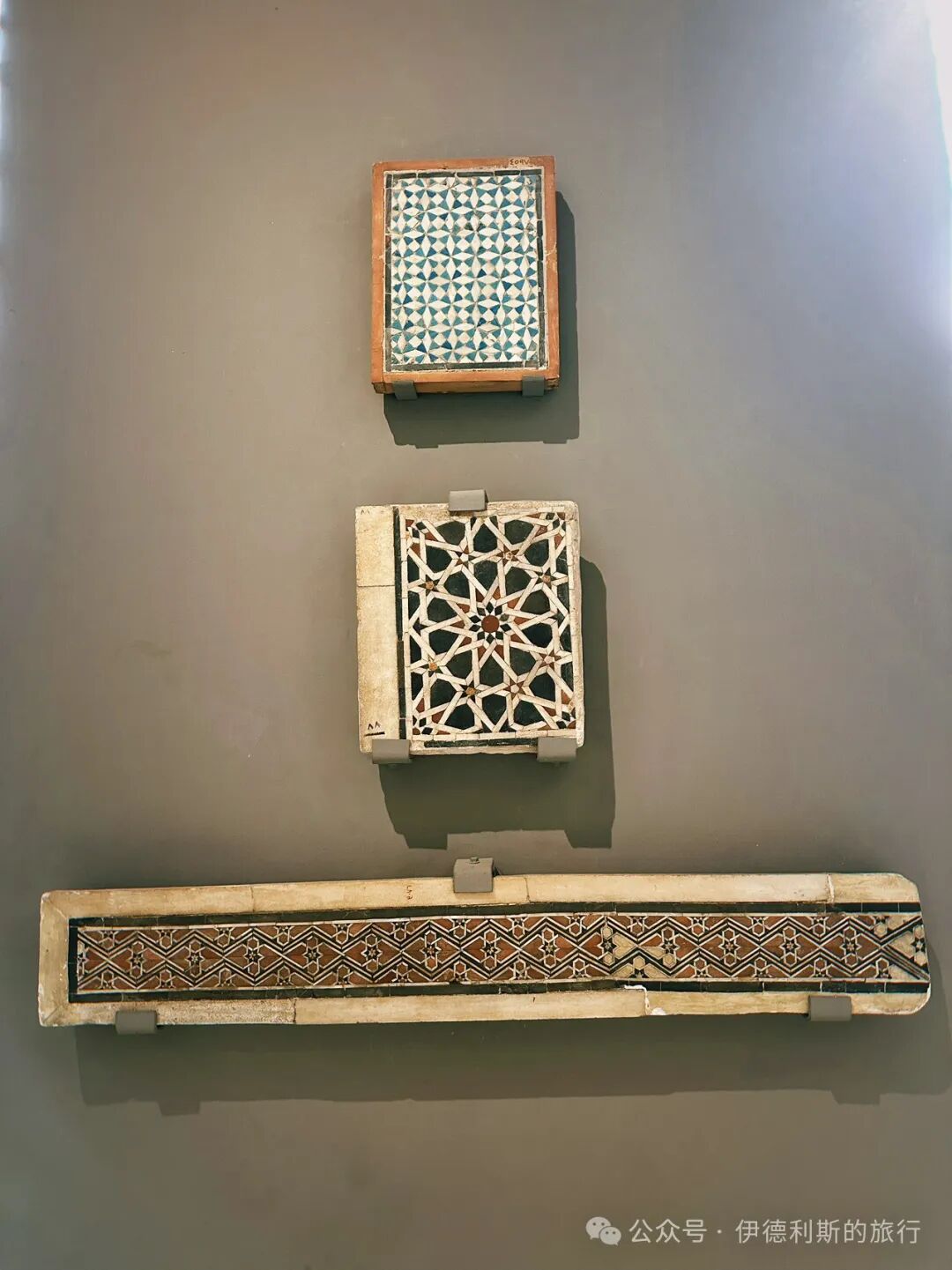
A 15th-century Mamluk dynasty marble slab decorated with mother-of-pearl mosaic.
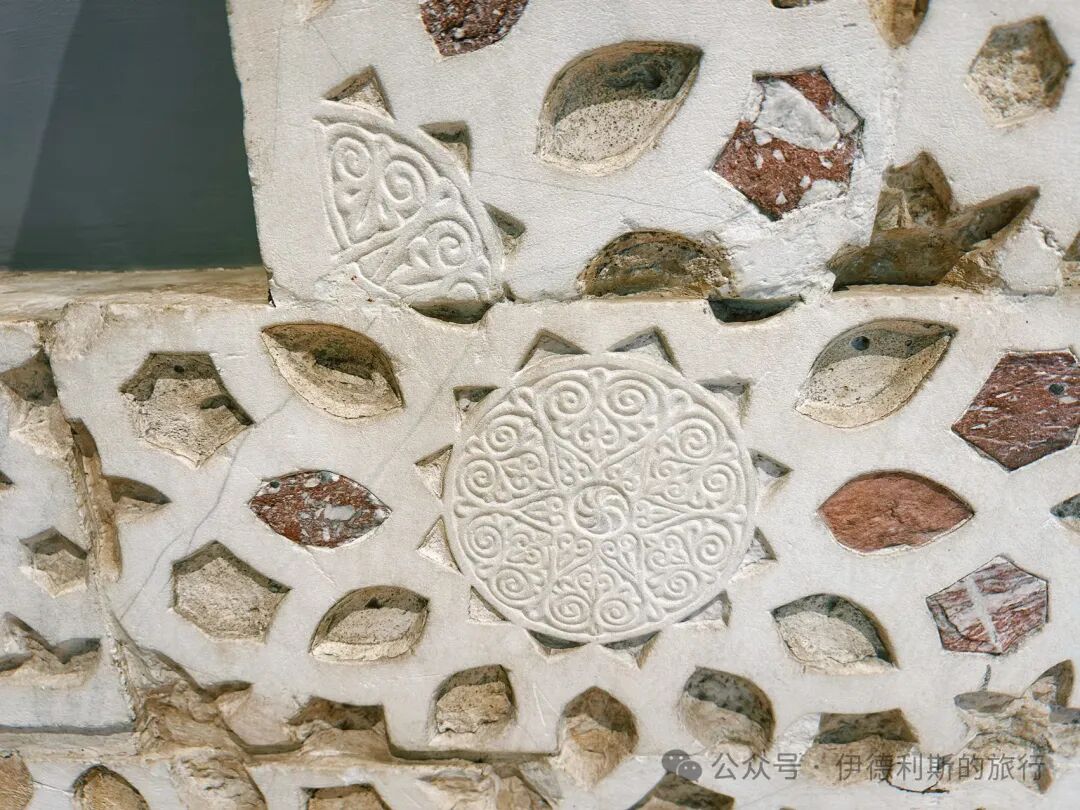
A 14th to 15th-century Mamluk dynasty marble slab with geometric patterns. view all
Summary: Islamic Art Guide: Museum of Islamic Art in Cairo (Part 1) is presented here as a firsthand travel account in clear, natural English. The account focuses on Cairo, Islamic Art, Museum Travel while preserving the names, places, food, photos, and historical details from the Chinese source.
In the 19th century, Egypt placed great importance on Pharaonic art, but appreciation for Islamic art lagged behind. In 1880, Tewfik Pasha, the sixth ruler of the Muhammad Ali dynasty, finally established the first museum of Islamic art.
In 1881, Tewfik Pasha approved the creation of the Committee for the Preservation of Arab Monuments. The arcades of the abandoned Al-Hakim Mosque inside the northern gate of Cairo were used as a temporary exhibition hall to display hundreds of artifacts. In 1884, a two-story building was constructed in the mosque courtyard to house 900 artifacts. In 1887, the museum was named the Museum of Arab Antiquities. By 1895, the collection had grown to 1,641 items, and the museum space reached capacity. In 1902, the new Mamluk-style museum building was officially completed, which is the building we see today.
The Cairo Museum of Islamic Art building once featured complex decorative designs inspired by architecture from various periods of Islamic history. In 2014, a car bomb attack targeting the Cairo police headquarters across the street caused severe damage to the museum. Nearly 30 percent of the artifacts were damaged, and the exterior wall decorations were also destroyed. After three years of restoration, the museum reopened in 2017.
The hall after the entrance provides a general introduction, showcasing a selection of unique Islamic artifacts from different perspectives.
An 8th-century Umayyad dynasty Quran in Kufic script from Egypt, written in brown ink on parchment.
An enameled water jug and basin from the 19th-century Qajar dynasty of Iran, featuring Persian-style figures and floral patterns.
The oldest surviving key to the Kaaba, made in 1363-4, belonging to the Egyptian Mamluk Sultan Al-Ashraf Sha'ban (reigned 1363-77).
An 18th-century Ottoman qibla indicator, made by the manufacturer Barun al-Mukhtar during the reign of Sultan Mahmud I (reigned 1730-54). It shows the appearance of the Sacred Mosque (Masjid al-Haram) after the 1629 Ottoman renovation, a structure that remained until 1955.
A 15th-century Mamluk-period mosque glass lamp from Egypt, bearing the name of Emir Safy al-Din Shaykhu.
After passing through the hall, the exhibition continues with Islamic artifacts arranged in chronological order.
Early days of the faith.
A wood carving panel from Egypt during the Abbasid Caliphate in the 9th century.
A wooden chest panel inlaid with ivory and bone from Egypt during the Tulunid dynasty in the 9th century.
An ivory plaque with floral carvings from Egypt during the Umayyad Caliphate in the 7th to 8th centuries.
A wood carving panel with floral decorations from Egypt or Syria during the Umayyad Caliphate in the 8th century.
An underglaze painted ceramic plate from Iraq during the Abbasid Caliphate in the 8th to 9th centuries.
A stucco carving panel in the Samarra style from Iraq during the Abbasid Caliphate in the 9th century. Samarra is located on the east bank of the Tigris River and served as the capital of the Abbasid Caliphate from 836 to 892.
Fatimid Caliphate.
A 10th-century Kufic script stucco window frame from the Western Palace of the Fatimid Caliphate in Cairo. It is truly a masterpiece of the museum; you can see its size by comparing it to the child in the bottom right corner. The Fatimid palace in Cairo was built in 970 and was divided into two parts: the Eastern Palace and the Western Palace. The Western Palace was smaller and originally built for the Fatimid princess Sitt al-Mulk, then renovated by the Caliph in 1064. In 1284-1285, the Mamluk Sultan al-Mansur Qalawun built a massive complex on the site of the Fatimid Western Palace. The hospital within the complex used some architectural elements from the Fatimid Western Palace, and this window frame came from the Qalawun Hospital.
A ceramic plate from Egypt during the Fatimid Caliphate in the 10th to 11th centuries, depicting various music and banquet scenes.
A ceramic plate from Egypt during the Fatimid period in the 11th century, depicting a rider holding a falcon.
A ceramic plate from Egypt during the Fatimid Caliphate in the 11th to 12th centuries, showing two people performing the traditional Egyptian stick fighting, Tahtib.
This 11th-century stucco mural from Egypt dates to the Fatimid dynasty and comes from the wall of a Fatimid-era bathhouse.
This small wooden prayer niche (mihrab) from 10th-11th century Fatimid Egypt features inscriptions with Shia content.
This 10th-11th century Fatimid Egyptian ceramic plate shows an image of the Prophet Isa (Jesus), which serves as evidence of the religious tolerance of that time.
This 11th-century Fatimid Egyptian ceramic plate is inscribed with the name of the commander Ghaban.
This 11th-century Fatimid Egyptian ceramic plate features a griffin design. The image of the griffin can be traced back to ancient Egyptian art from 3000 BC, later spreading to West Asia and the Mediterranean region. Because the lion rules the land and the eagle rules the sky, the griffin, which combines the features of both, became a symbol of nobility and power.
This 11th-century Fatimid Egyptian ceramic plate features images of humans, animals, and birds.
This 11th-century Fatimid Egyptian marble carving features Kufic calligraphy.
These stucco windows and wooden doors from the Al-Salih Tala'i Mosque in Cairo date to the late Fatimid period in 1160. The Al-Salih Tala'i Mosque is located outside the south gate of the old city of Cairo and was commissioned by the Fatimid vizier Tala'i ibn Ruzzik, who was the last powerful and capable vizier of the Fatimid dynasty. The Al-Salih Tala'i Mosque was completed only 11 years before the fall of the Fatimid dynasty, making it the last surviving building from the Fatimid era.
This wooden door from the Al-Azhar Mosque in Cairo dates to the Fatimid period in 1010 and was commissioned by Caliph al-Hakim bi-Amr Allah, who reigned from 996 to 1021. Al-Hakim was the first Fatimid caliph born in Cairo, an important imam in the history of Ismaili Shia Islam, and a central figure in the Druze faith. At that time, the city of Fustat on the south side of old Cairo was a densely populated Sunni city, while the newly built city of Cairo served as the capital of the Fatimid dynasty and the center of Ismaili Shia Islam. The Al-Azhar Mosque in Cairo is the city's official congregational mosque, where the caliph would deliver the khutbah sermon every Friday during Jumu'ah prayer.
The 12th-century Fatimid-era wooden prayer niche (mihrab) and wooden doors inside the Sayyida Nafisa mausoleum in Cairo. Sayyida Nafisa (762-824) was the great-granddaughter of Imam Hasan, the grandson of the Prophet. She was a famous Egyptian scholar of hadith who served as a mentor to Imam Shafi'i and provided him with financial support.
The Nafisa mausoleum is located in Cairo's famous City of the Dead. It was first built during the Abbasid period and later renovated and rebuilt during the Fatimid period. Nafisa was the first descendant of Imam Ali to be honored during the Fatimid period. As a Sunni and a descendant of Ali, she helped promote reconciliation between the Sunni and Shia populations within the Fatimid dynasty.
Ayyubid dynasty
A 12th-century wooden chest from the Hussein Mosque in Cairo. The Hussein Mosque is located across from the Al-Azhar Mosque in Cairo. It was first built in 1154 and is said to house the head of Imam Hussein.
A 13th-century wooden carving from the Ayyubid dynasty in Egypt.
A 1213 marble slab from the Ayyubid dynasty in Egypt inscribed with the name of Sultan Al-Kamil. Al-Kamil was the fifth sultan of the Ayyubid dynasty. During his reign, he defeated the Fifth Crusade, but he handed Jerusalem over to the Crusaders for ten years during the Sixth Crusade.
Marble slabs from the Ayyubid dynasty in Egypt dated 1184 and 1187, inscribed with the name of Sultan Saladin. Saladin was the founder of the Ayyubid dynasty. During the Third Crusade, he launched a series of military campaigns against the Crusaders in the Levant and recaptured Jerusalem, restoring Muslim rule in the region.
Wooden panels and doors made in 1178 during the Ayyubid period, found in the mausoleum of Imam Shafi'i in Cairo. Imam Shafi'i was the founder of the Shafi'i school of law and one of the four great imams of Sunni Islam. Imam Shafi'i arrived in Cairo in 813 and passed away there in 819. Sultan Saladin built his mausoleum in 1178, which features exquisite wood carvings inside. These include complex geometric patterns, scripture, and an introduction to the life of Imam al-Shafi'i.
A marble slab from the 12th-century Ayyubid dynasty in Egypt, featuring carvings of griffins and creatures with human heads and bird bodies.
Stucco carvings from the 13th-century Ayyubid dynasty at the Al-Kamil Madrasa in Cairo. The Al-Kamil Madrasa was built in 1225 by the Ayyubid Sultan al-Kamil in the northern part of the former Fatimid Western Palace in Old Cairo, and it was one of Egypt's educational centers during the 13th and 14th centuries.
A flint window from the 13th-century Ayyubid dynasty at the Sayf ibn Yazan tomb in Cairo.
Mamluk Dynasty.
A marble slab from the 14th-century Mamluk period at the Sarghatmish Madrasa in Cairo. The Sarghatmish Madrasa was built in 1356 by order of the Mamluk Emir General Sirghitmish. In the 1350s, Sirghitmish was the most powerful emir of the Mamluk dynasty.
A copper candlestick inscribed with the name of the Mamluk Sultan al-Nasir Muhammad, who reigned from 1299 to 1309.
A copper candlestick inscribed with the name of the Mamluk Sultan Qaitbay, who reigned from 1468 to 1496, donated by the Sultan to the Prophet's Mosque in Medina. Although Sultan Qaitbay built many structures in Cairo, his greatest achievement was the restoration of the Prophet's Mosque in Medina. After a fire at the Prophet's Mosque in 1481, Sultan Qaitbay rebuilt the tomb of the Prophet from a wooden structure into a brick one, added metal railings, and donated many chandeliers and candlesticks to the mosque.
A copper candlestick inlaid with silver from the 14th to 15th-century Mamluk dynasty.
A copper candlestick inscribed with the name of the wife of the Mamluk Sultan Qaitbay.
A copper incense burner inlaid with gold and silver from the 14th-century Mamluk dynasty.
A wooden door from the 13th-century Mamluk period at the Salihiyya Madrasa in Cairo. The Ayyubid Sultan As-Salih Ayyub founded the Salihiyya Madrasa in 1242, and it was one of Egypt's most famous centers of education during the 13th and 14th centuries.
A 14th-century Mamluk-era wooden cabinet from Egypt, inlaid with painted ivory decorations.
Above is a 13th-14th century Mamluk double-headed eagle marble carving from Egypt, and below is a 13th-century marble carving featuring the lion emblem of the Mamluk Sultan Baybars I (reigned 1260-1277). Baybars was the fourth sultan of the Mamluk dynasty and a tough military leader who defeated invasions by the Crusaders and the Mongol army.
A glass lamp from a 14th-century Mamluk-era mosque in Egypt.
A 14th-century Mamluk-era wooden Quran box and table inlaid with ebony and ivory from the Umm al-Sultan Sha'ban Madrasa in Cairo. The Mamluk Sultan Al-Ashraf Sha'ban ordered the construction of the madrasa in 1368-9 to honor his mother, who was on a pilgrimage (hajj) at the time.
Two Mamluk-era wood carvings; the first one bears the name of Sultan Qaitbay (reigned 1468-96). Qaitbay was one of the sultans who sponsored the most architecture in Mamluk history. Although the Mamluk dynasty was in decline, the situation remained relatively stable and commerce flourished under Sultan Qaitbay's rule.
The second carving bears the name of the Mamluk Sultan Al-Ashraf Qansuh al-Ghuri (reigned 1501-16). He was the second-to-last sultan of the Mamluk Sultanate. The Ottoman Sultan Selim I killed him in 1516, which marked the shift of control in the Middle East from the Mamluk dynasty to the Ottoman dynasty.
Components of a minbar (pulpit) from the 14th-century Mamluk-era Al-Khatiri-Boulaq mosque in Egypt.
A 15th-century Mamluk-era stucco window from Egypt.
A wooden ceiling with carvings of the name of Mamluk Sultan Qaitbay (reigned 1468-96) inside the Al-Azhar Mosque in Cairo.
Tiles on the Qaitbay fountain (sabil) in Cairo. Sultan Qaitbay built the Qaitbay fountain (sabil) in 1479. It was Cairo's first independent fountain-primary school (sabil-kuttab) building, a structure that became very common during the later Ottoman period.
A tile featuring the name of the Mamluk Sultan Al-Ashraf Janbalat, who reigned from 1500 to 1501.
A 15th-century tile from the Mamluk dynasty.
A 15th-century Mamluk dynasty marble slab decorated with mother-of-pearl mosaic.
A 14th to 15th-century Mamluk dynasty marble slab with geometric patterns. view all
Reposted from the web
Summary: Islamic Art Guide: Museum of Islamic Art in Cairo (Part 1) is presented here as a firsthand travel account in clear, natural English. The account focuses on Cairo, Islamic Art, Museum Travel while preserving the names, places, food, photos, and historical details from the Chinese source.
In the 19th century, Egypt placed great importance on Pharaonic art, but appreciation for Islamic art lagged behind. In 1880, Tewfik Pasha, the sixth ruler of the Muhammad Ali dynasty, finally established the first museum of Islamic art.
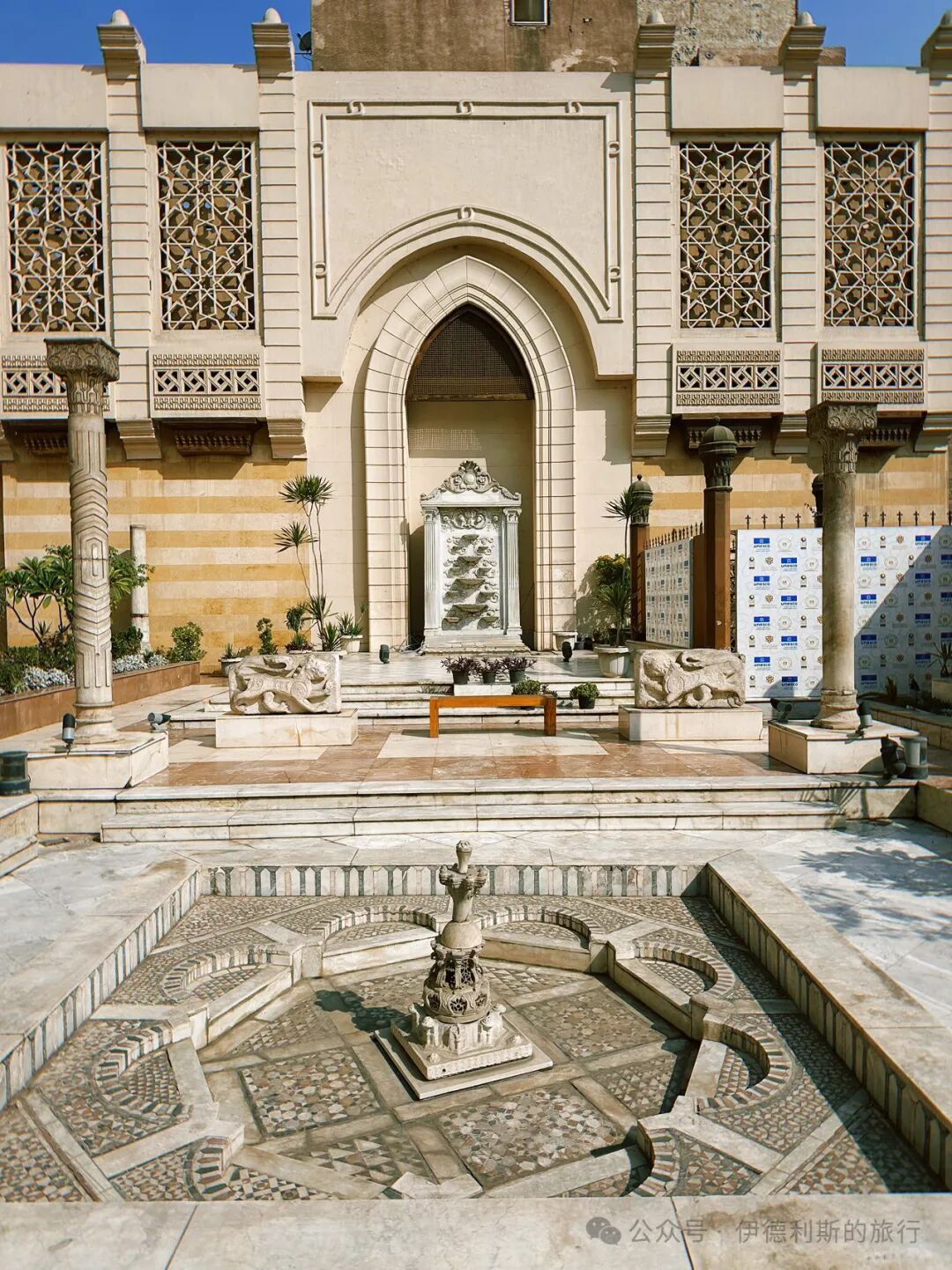
In 1881, Tewfik Pasha approved the creation of the Committee for the Preservation of Arab Monuments. The arcades of the abandoned Al-Hakim Mosque inside the northern gate of Cairo were used as a temporary exhibition hall to display hundreds of artifacts. In 1884, a two-story building was constructed in the mosque courtyard to house 900 artifacts. In 1887, the museum was named the Museum of Arab Antiquities. By 1895, the collection had grown to 1,641 items, and the museum space reached capacity. In 1902, the new Mamluk-style museum building was officially completed, which is the building we see today.
The Cairo Museum of Islamic Art building once featured complex decorative designs inspired by architecture from various periods of Islamic history. In 2014, a car bomb attack targeting the Cairo police headquarters across the street caused severe damage to the museum. Nearly 30 percent of the artifacts were damaged, and the exterior wall decorations were also destroyed. After three years of restoration, the museum reopened in 2017.
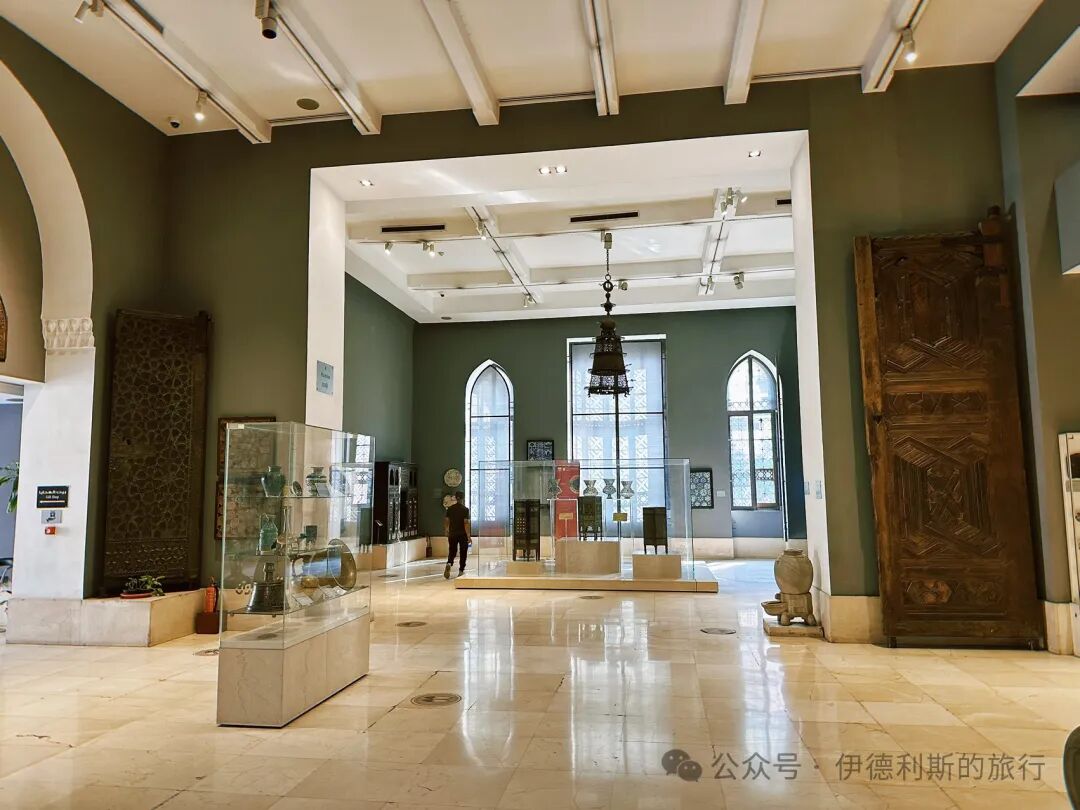
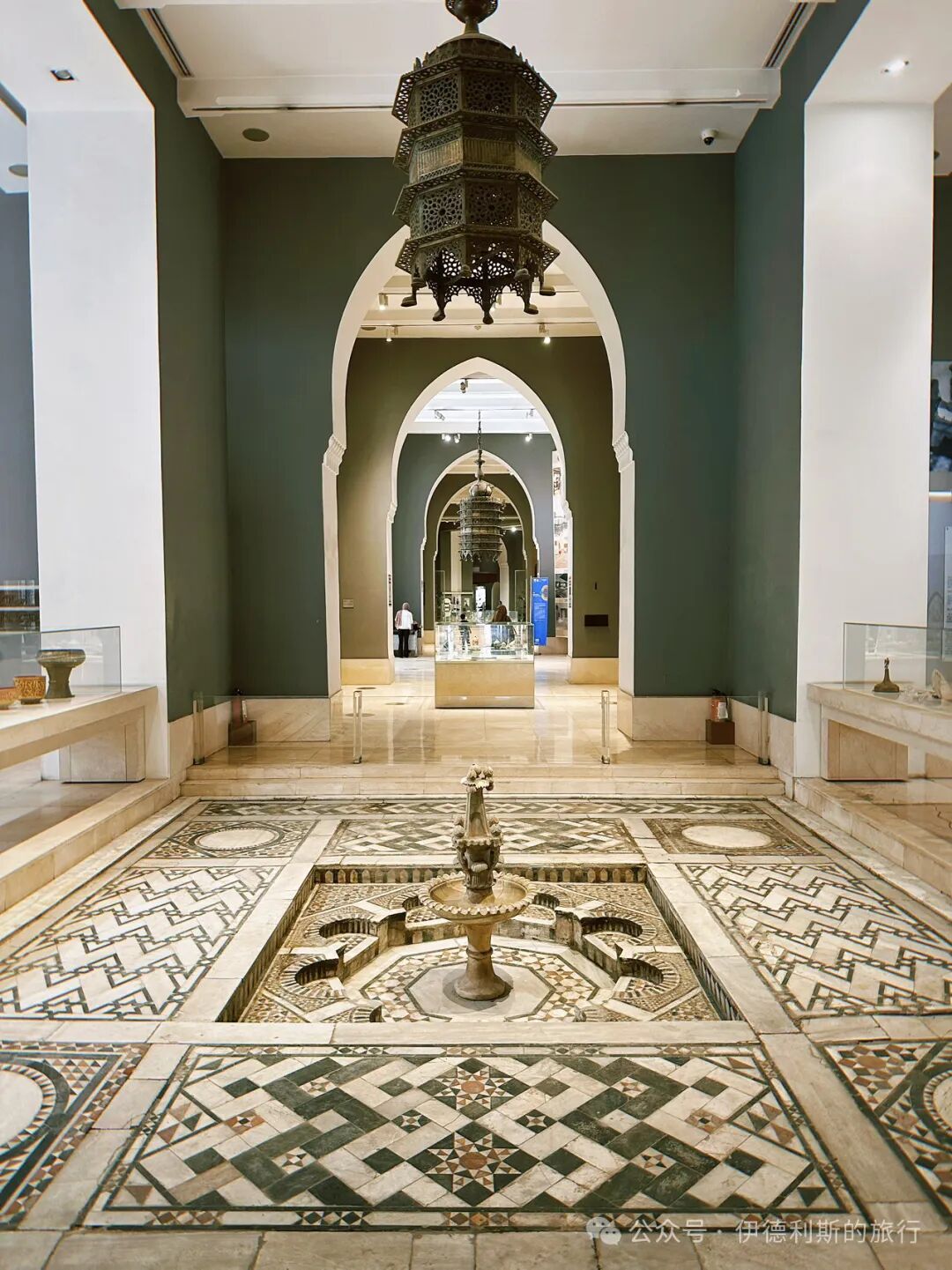
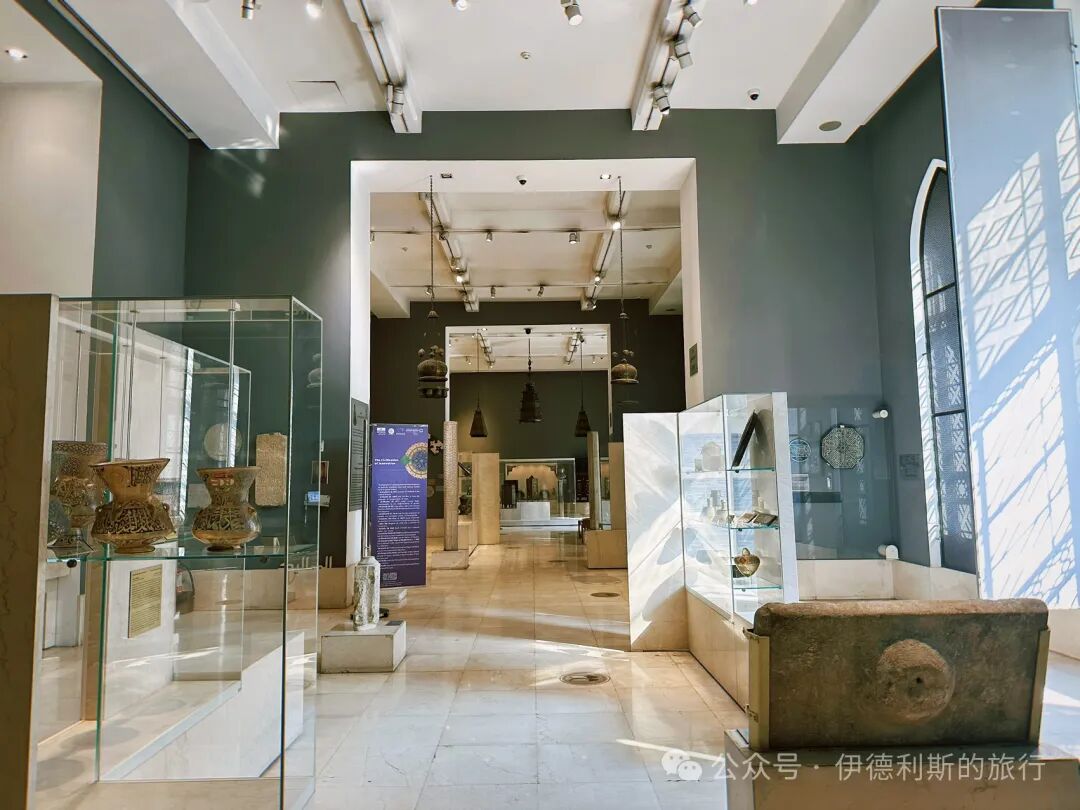
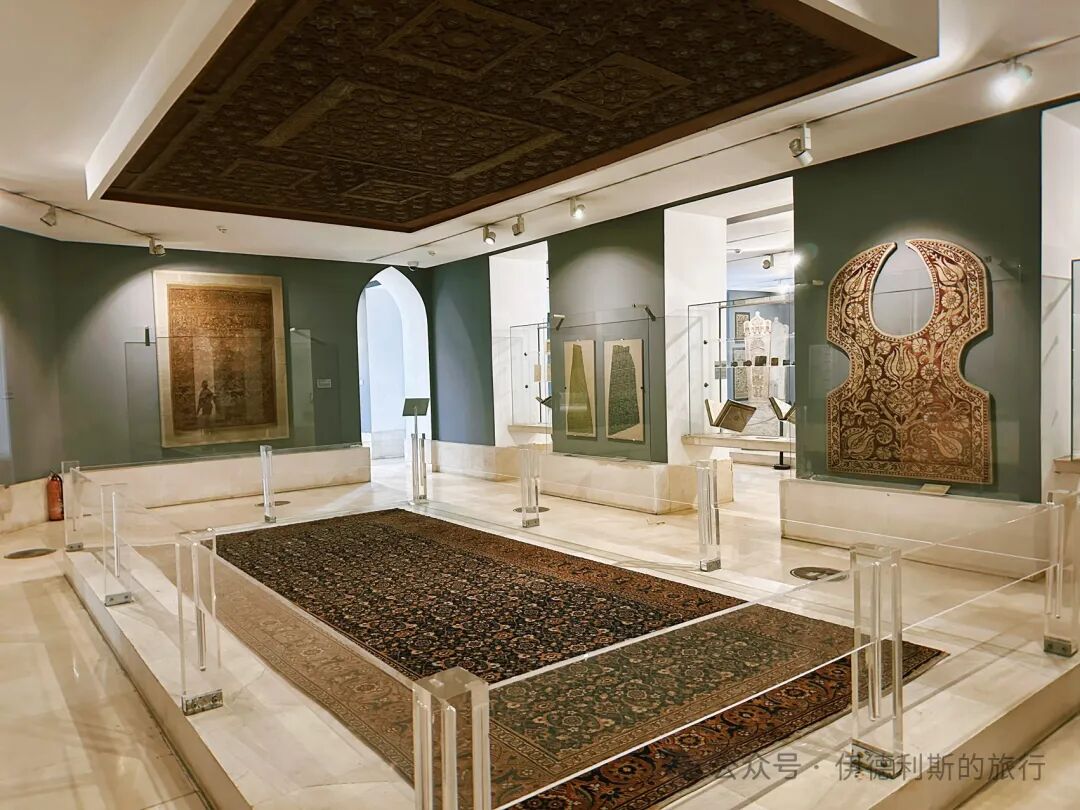
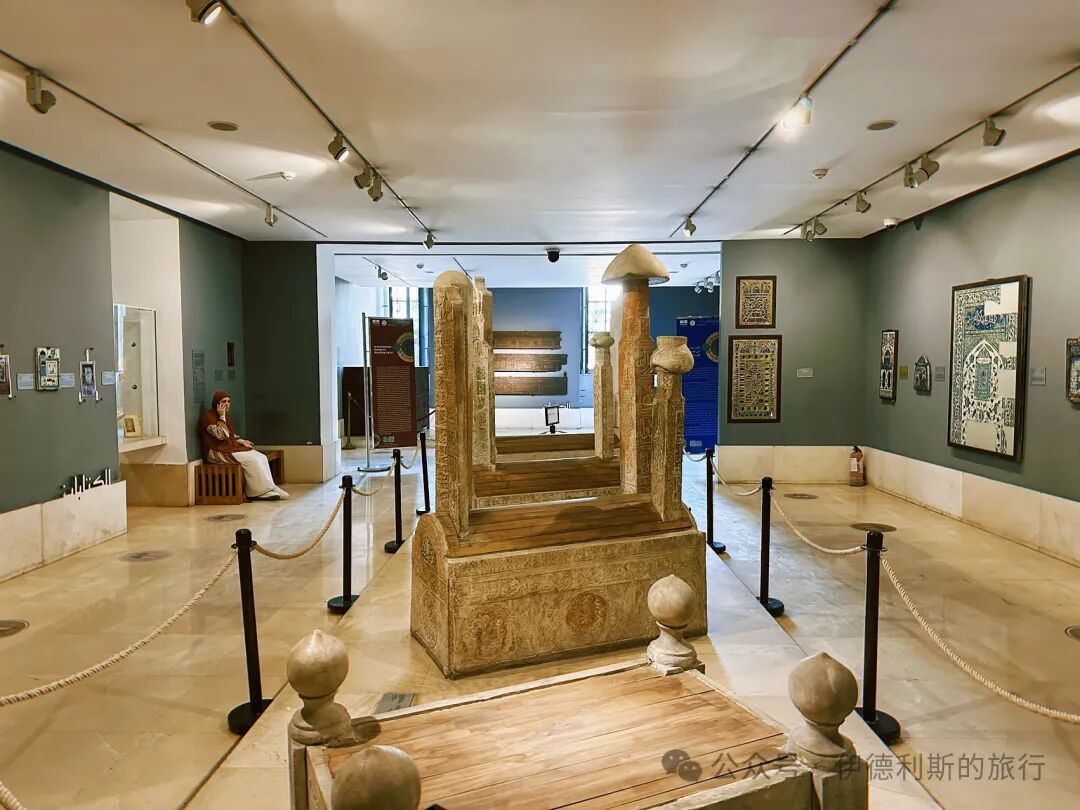
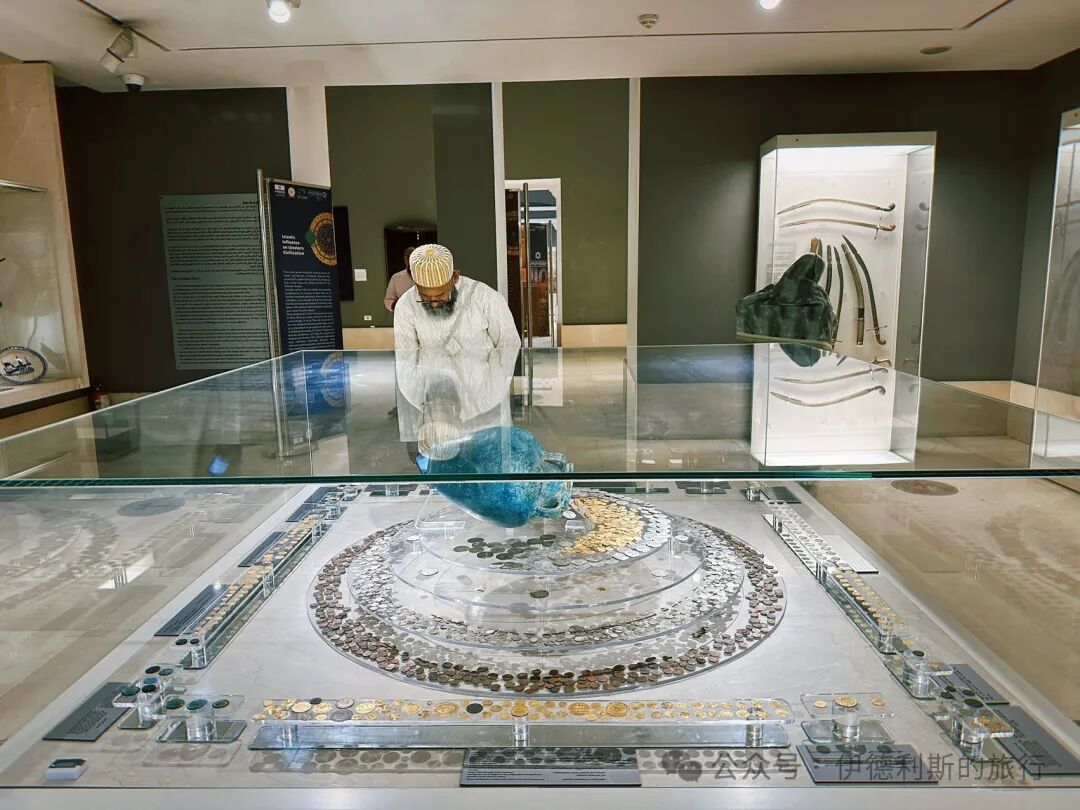
The hall after the entrance provides a general introduction, showcasing a selection of unique Islamic artifacts from different perspectives.
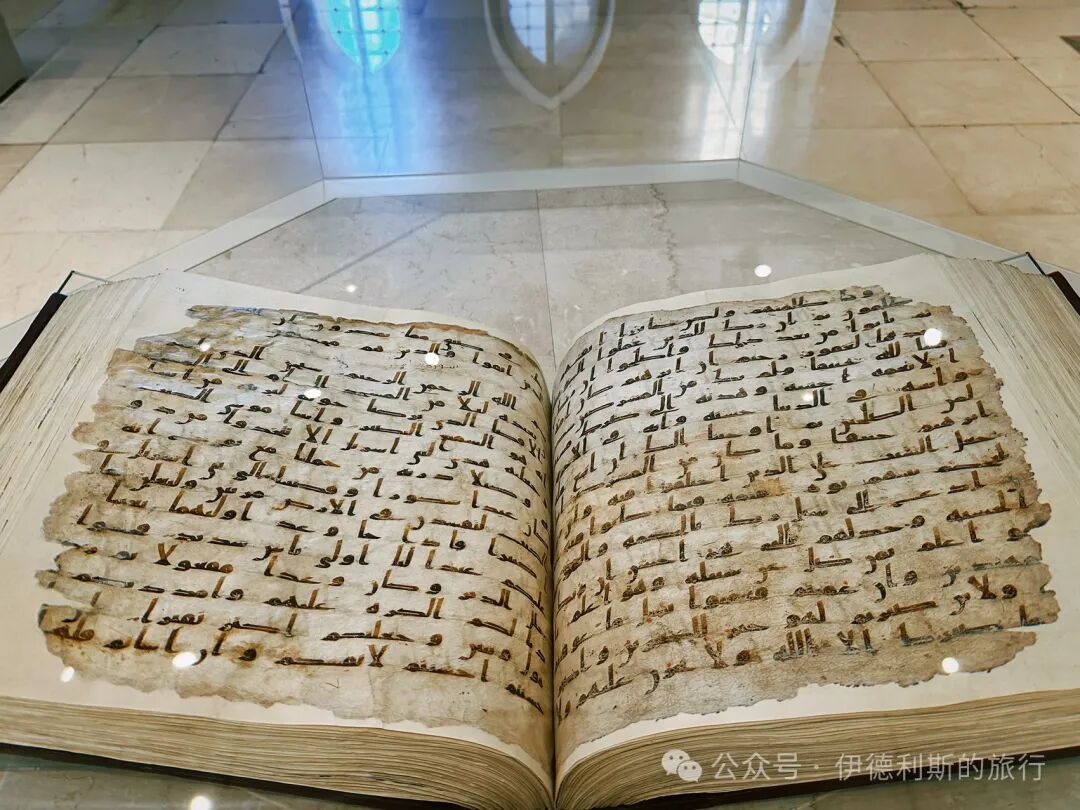
An 8th-century Umayyad dynasty Quran in Kufic script from Egypt, written in brown ink on parchment.
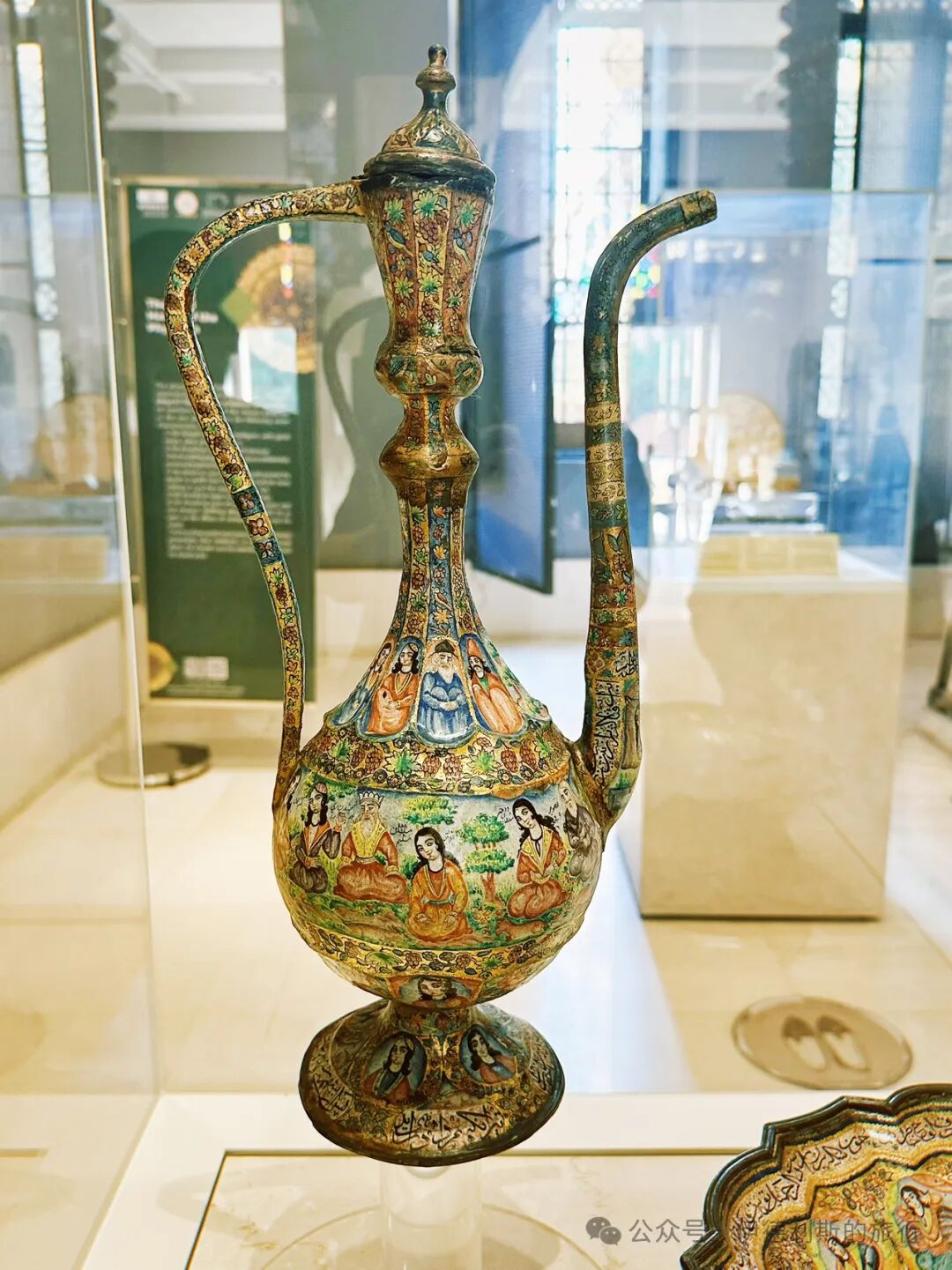
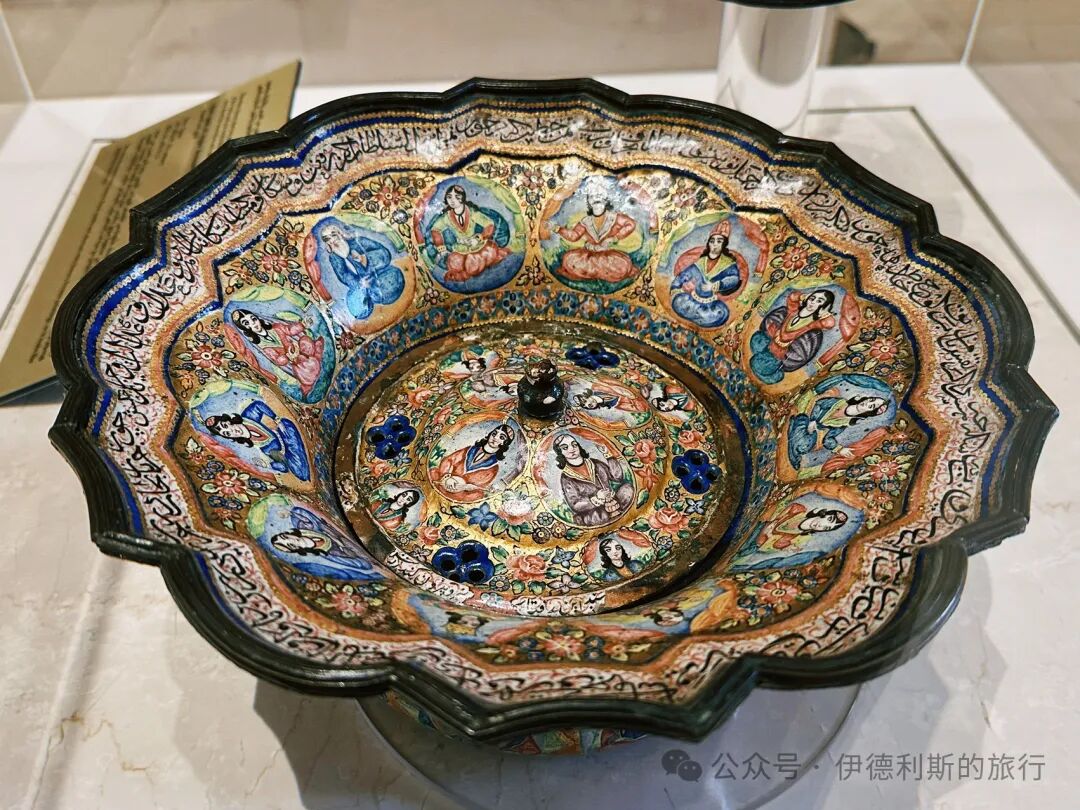
An enameled water jug and basin from the 19th-century Qajar dynasty of Iran, featuring Persian-style figures and floral patterns.
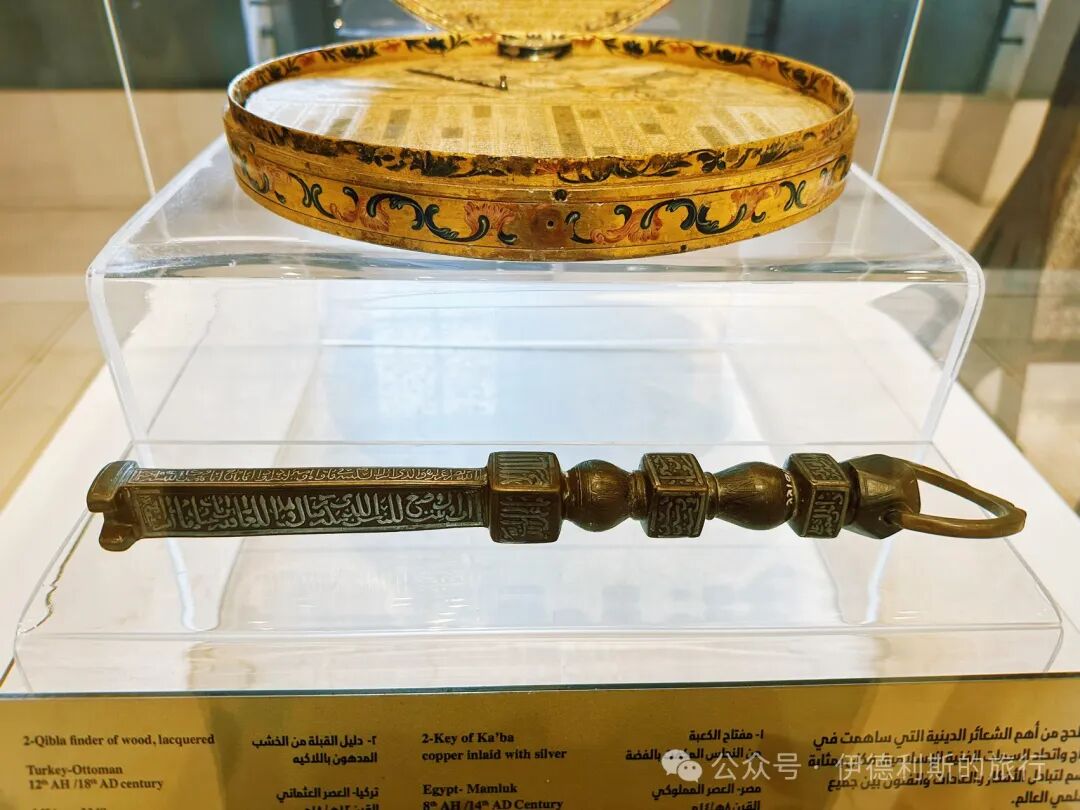
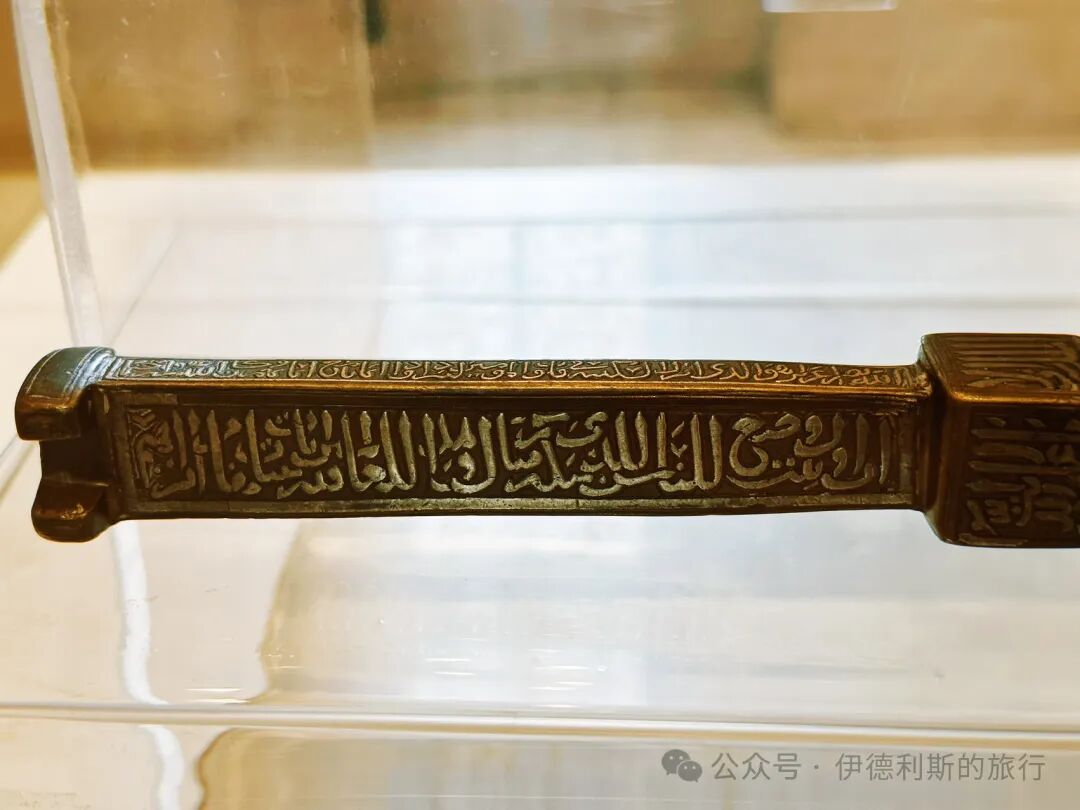
The oldest surviving key to the Kaaba, made in 1363-4, belonging to the Egyptian Mamluk Sultan Al-Ashraf Sha'ban (reigned 1363-77).
An 18th-century Ottoman qibla indicator, made by the manufacturer Barun al-Mukhtar during the reign of Sultan Mahmud I (reigned 1730-54). It shows the appearance of the Sacred Mosque (Masjid al-Haram) after the 1629 Ottoman renovation, a structure that remained until 1955.
A 15th-century Mamluk-period mosque glass lamp from Egypt, bearing the name of Emir Safy al-Din Shaykhu.
After passing through the hall, the exhibition continues with Islamic artifacts arranged in chronological order.
Early days of the faith.
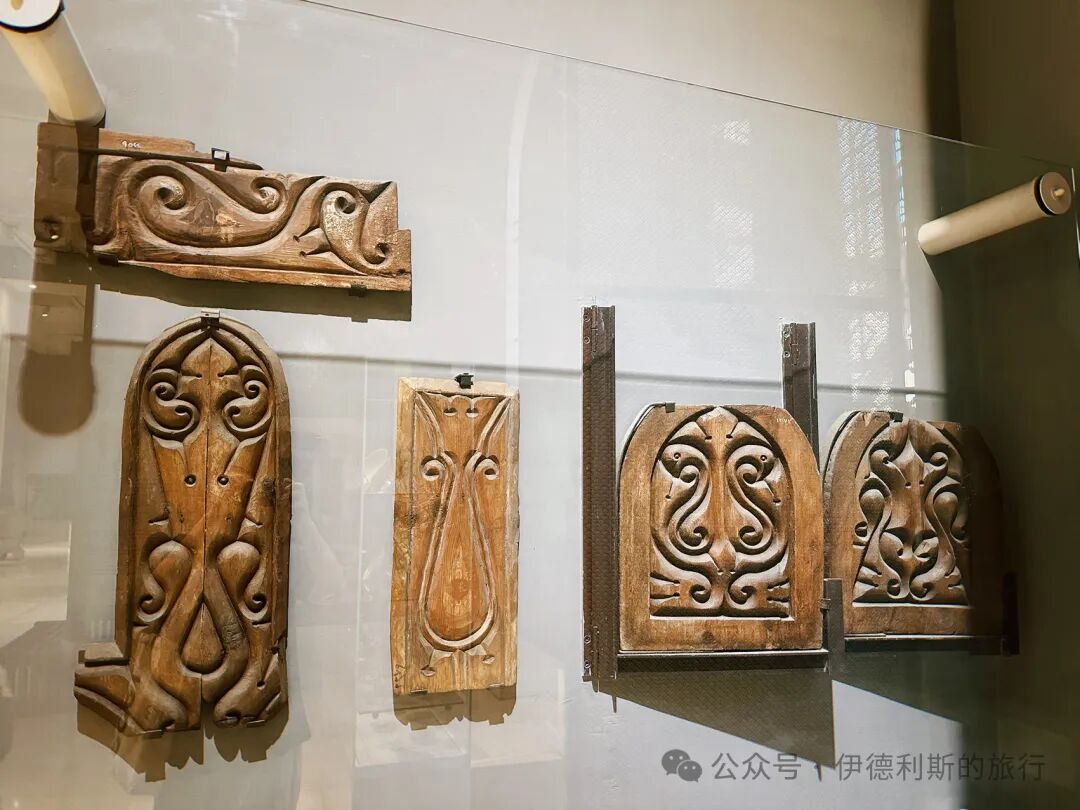
A wood carving panel from Egypt during the Abbasid Caliphate in the 9th century.
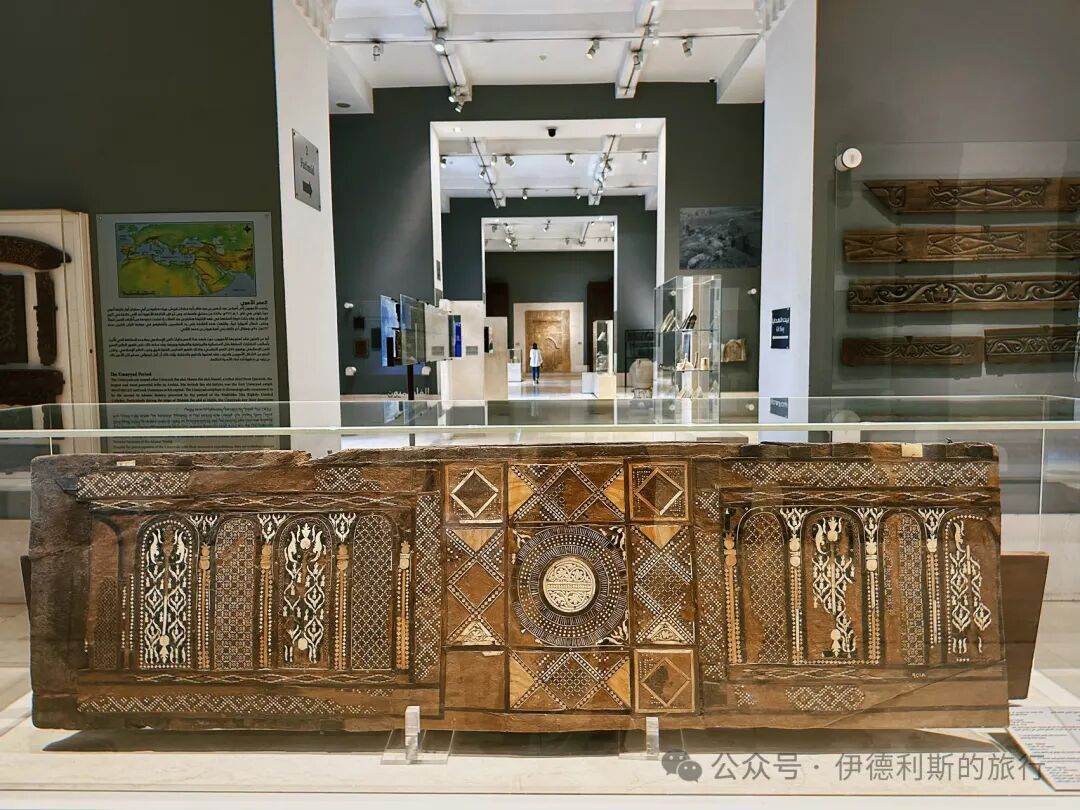
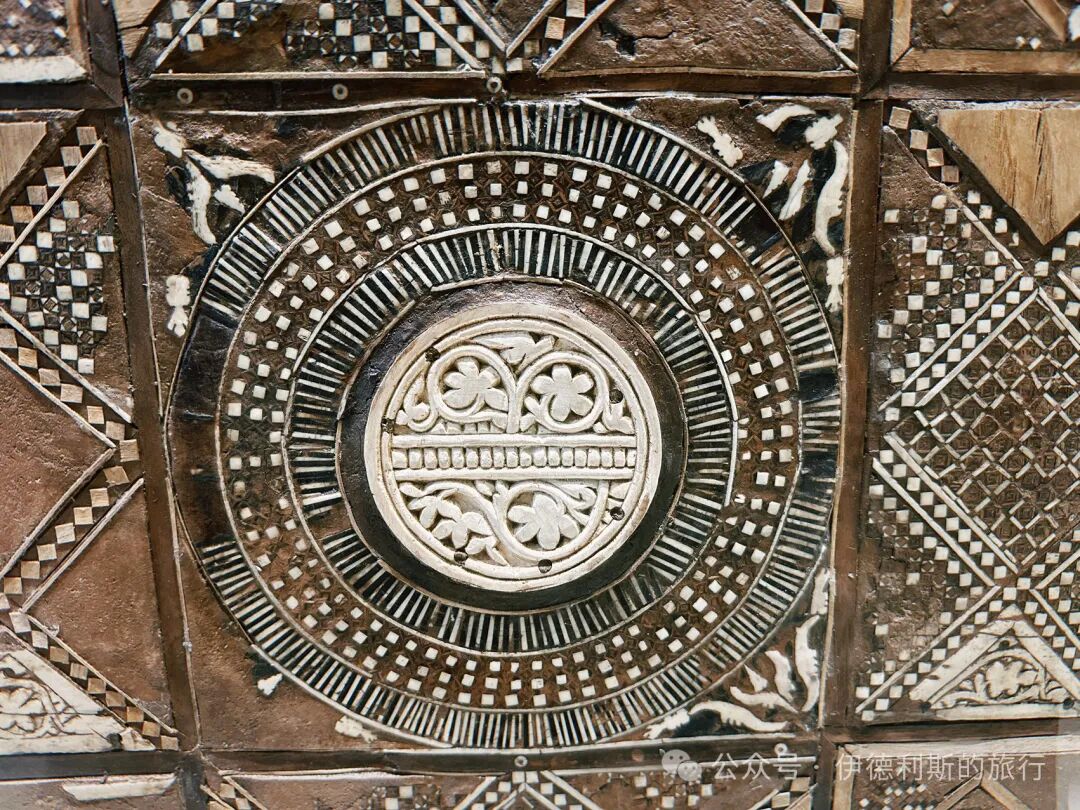
A wooden chest panel inlaid with ivory and bone from Egypt during the Tulunid dynasty in the 9th century.
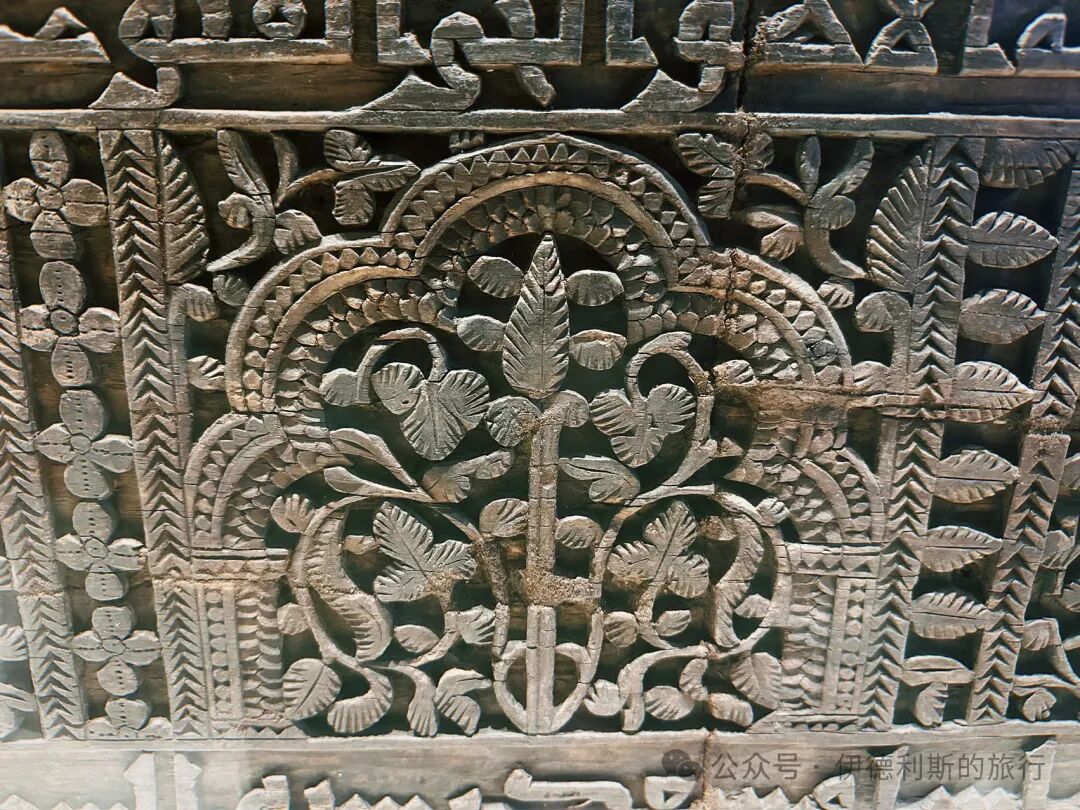
An ivory plaque with floral carvings from Egypt during the Umayyad Caliphate in the 7th to 8th centuries.
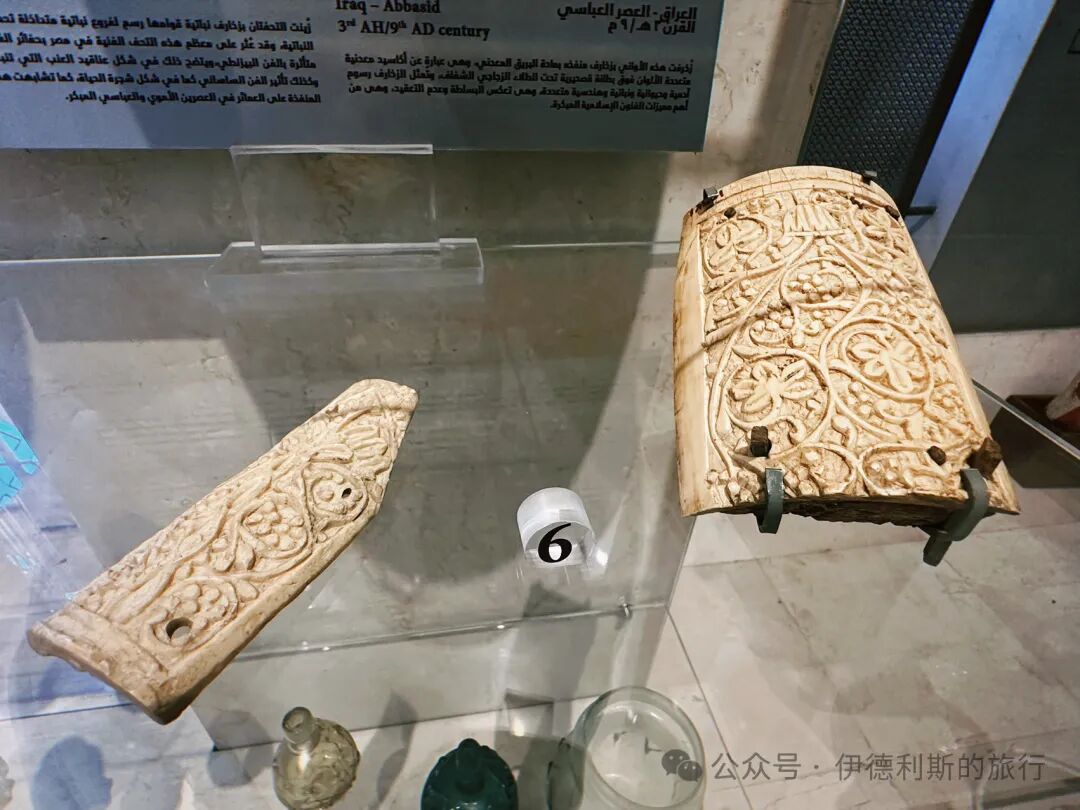
A wood carving panel with floral decorations from Egypt or Syria during the Umayyad Caliphate in the 8th century.
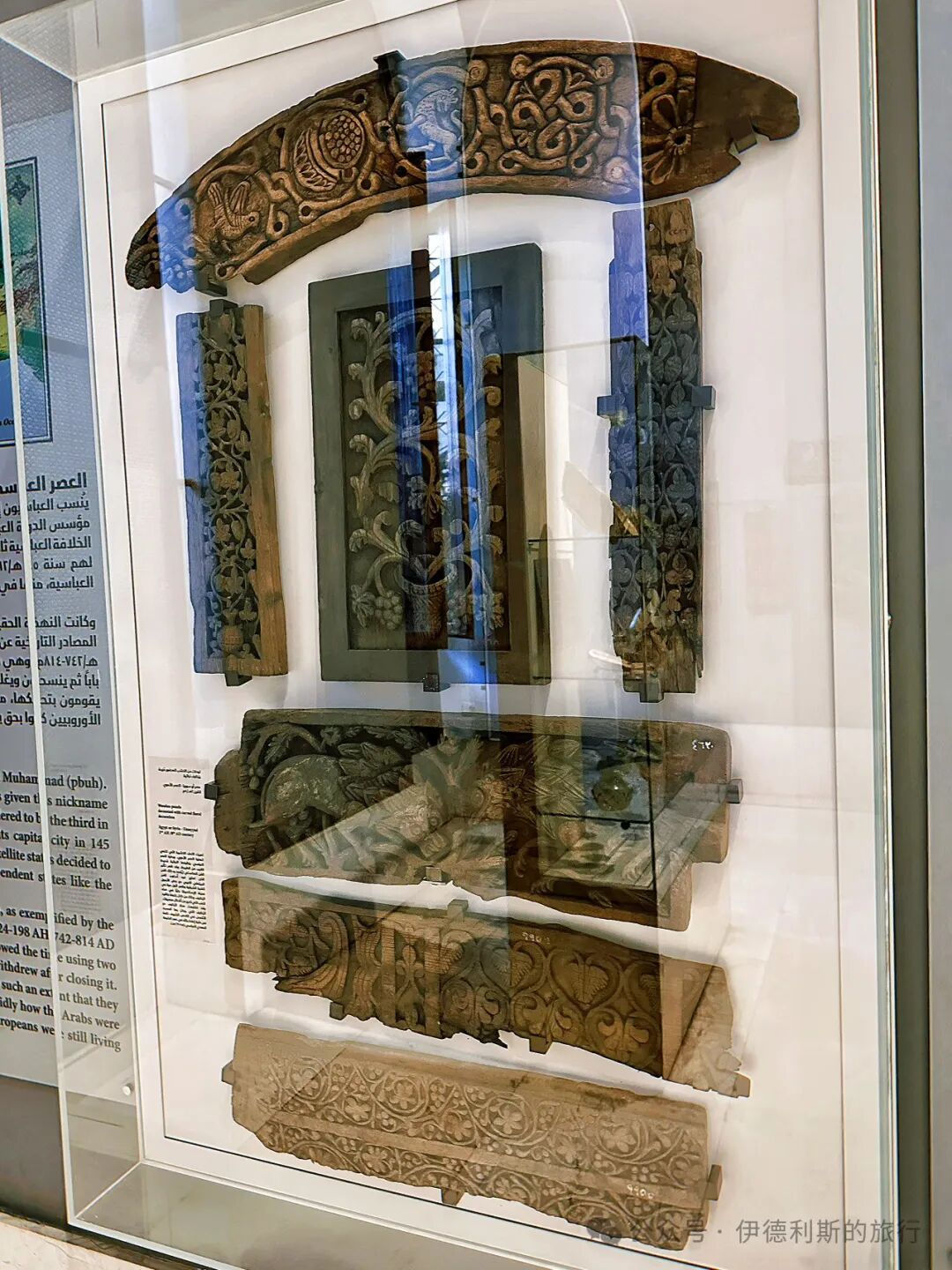
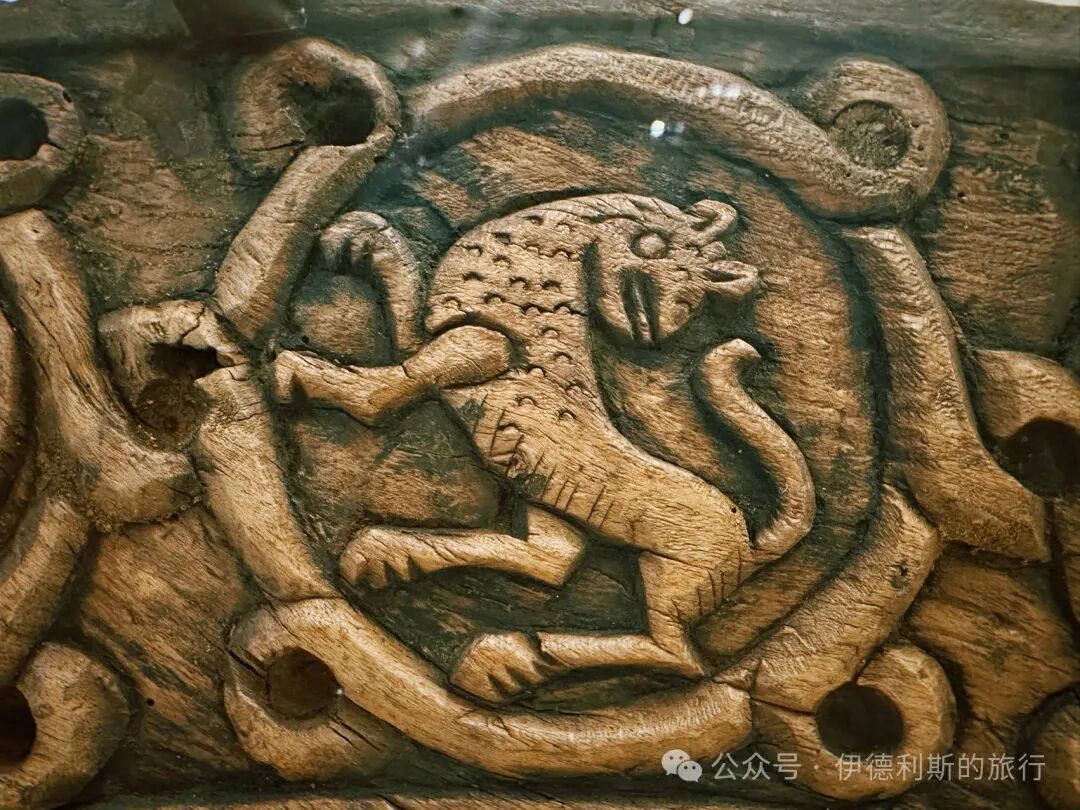
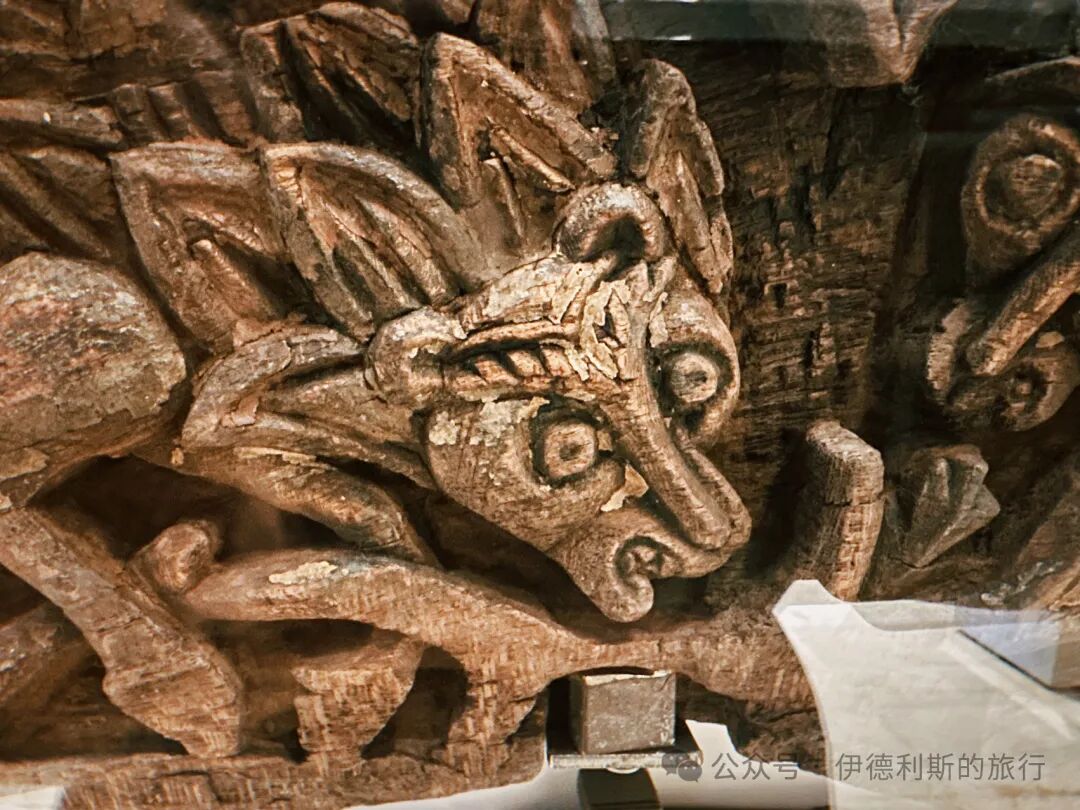
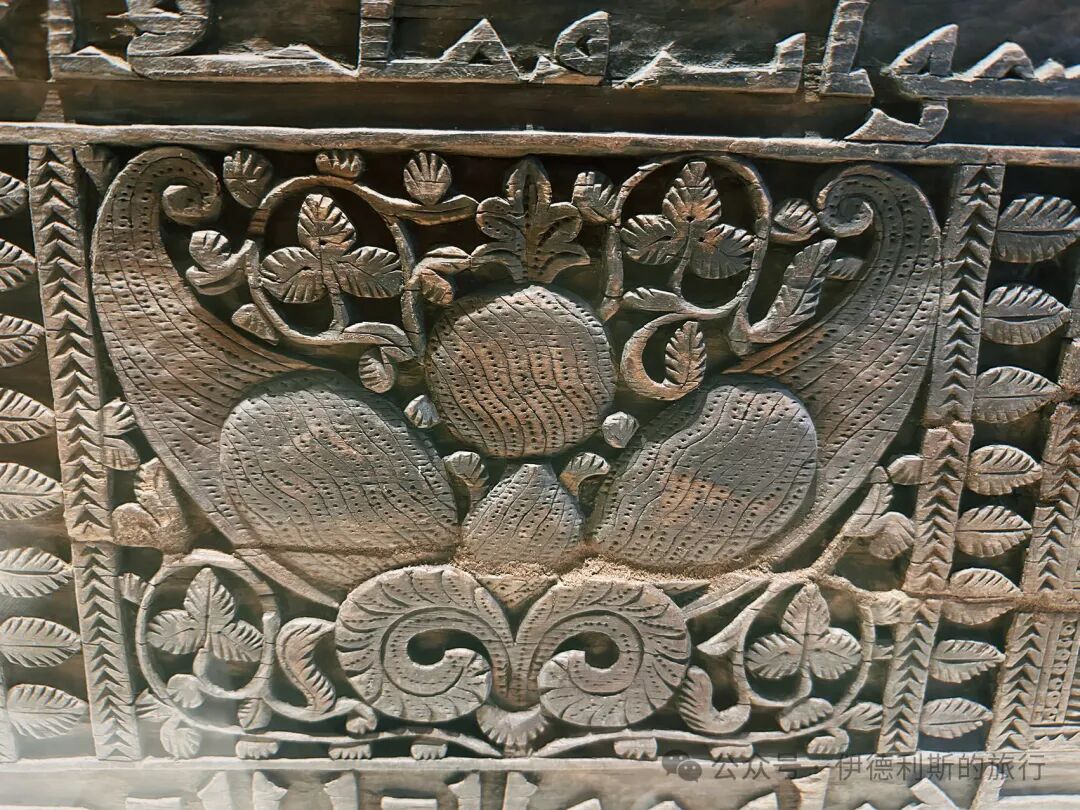
An underglaze painted ceramic plate from Iraq during the Abbasid Caliphate in the 8th to 9th centuries.
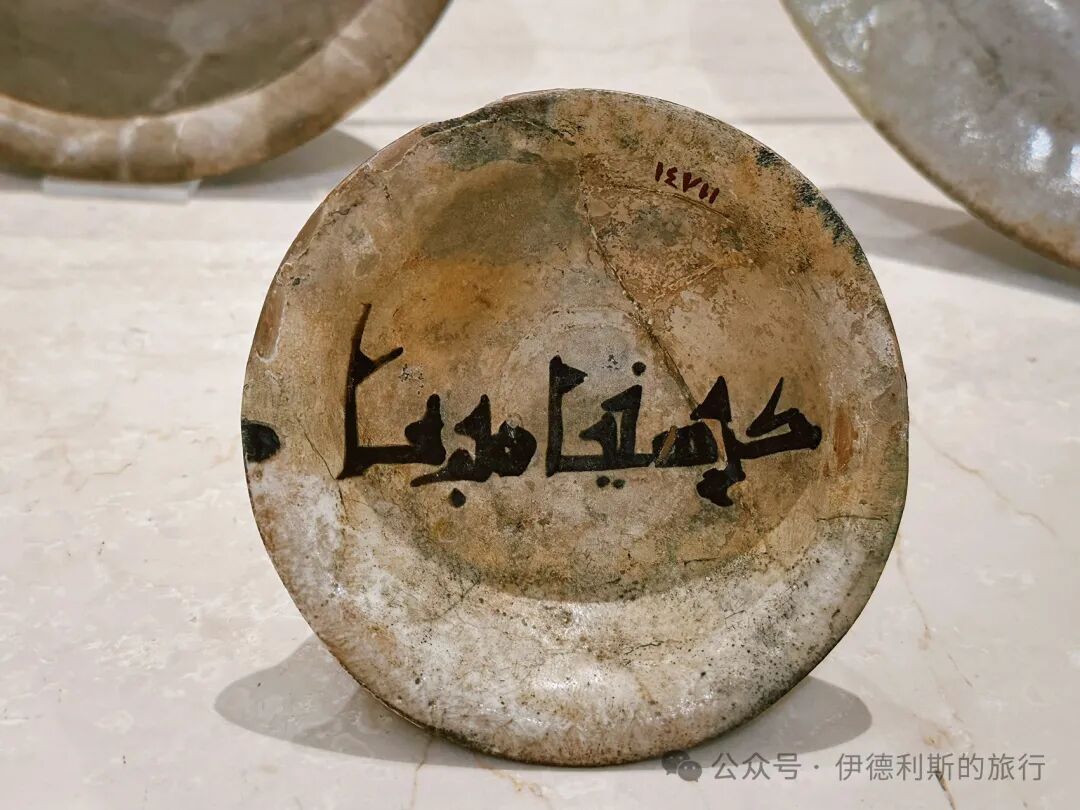
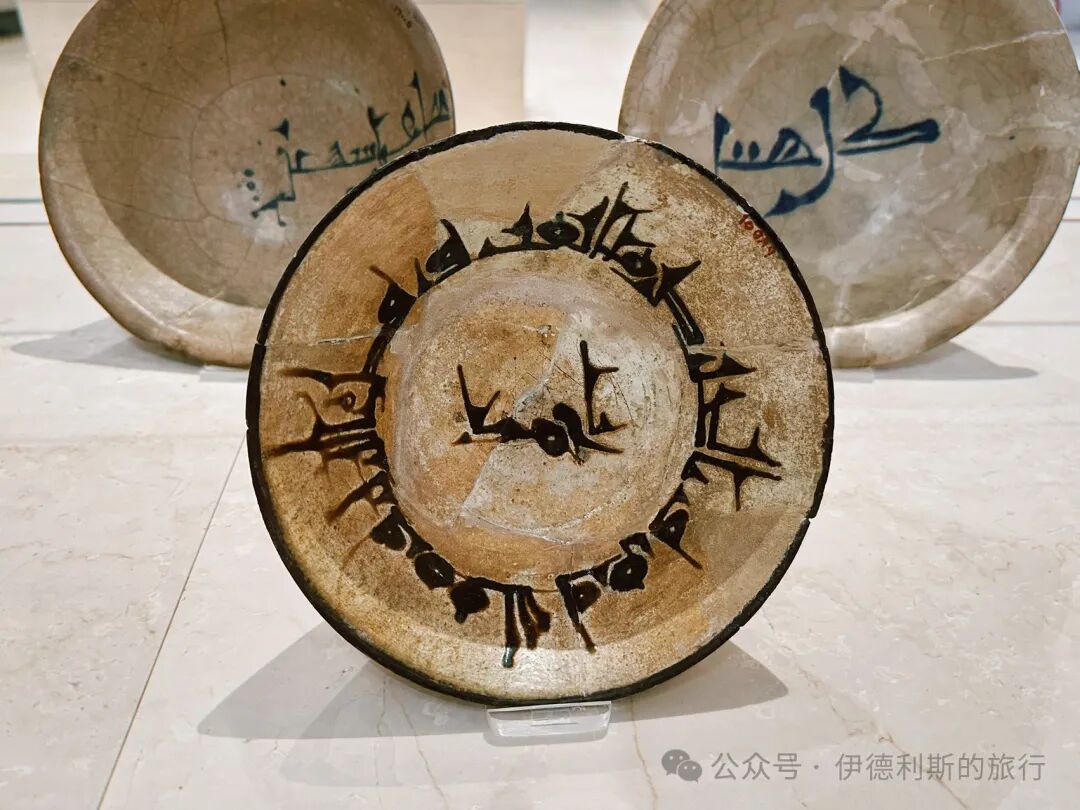
A stucco carving panel in the Samarra style from Iraq during the Abbasid Caliphate in the 9th century. Samarra is located on the east bank of the Tigris River and served as the capital of the Abbasid Caliphate from 836 to 892.
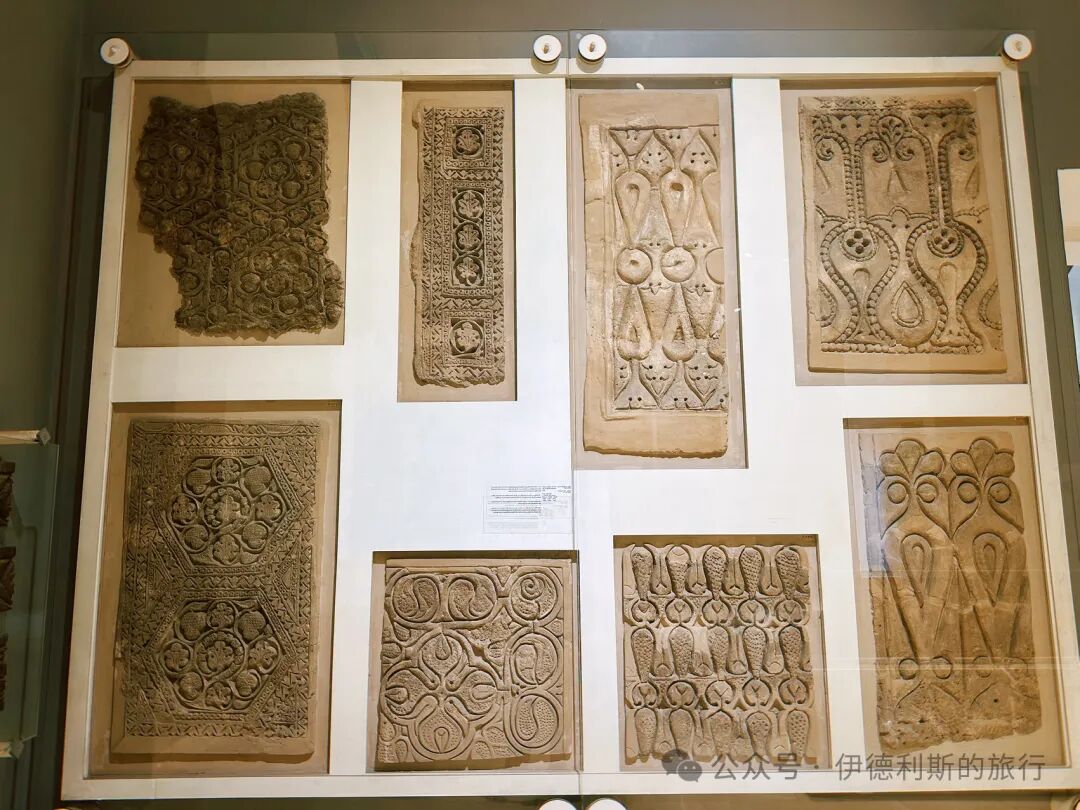
Fatimid Caliphate.
A 10th-century Kufic script stucco window frame from the Western Palace of the Fatimid Caliphate in Cairo. It is truly a masterpiece of the museum; you can see its size by comparing it to the child in the bottom right corner. The Fatimid palace in Cairo was built in 970 and was divided into two parts: the Eastern Palace and the Western Palace. The Western Palace was smaller and originally built for the Fatimid princess Sitt al-Mulk, then renovated by the Caliph in 1064. In 1284-1285, the Mamluk Sultan al-Mansur Qalawun built a massive complex on the site of the Fatimid Western Palace. The hospital within the complex used some architectural elements from the Fatimid Western Palace, and this window frame came from the Qalawun Hospital.
A ceramic plate from Egypt during the Fatimid Caliphate in the 10th to 11th centuries, depicting various music and banquet scenes.
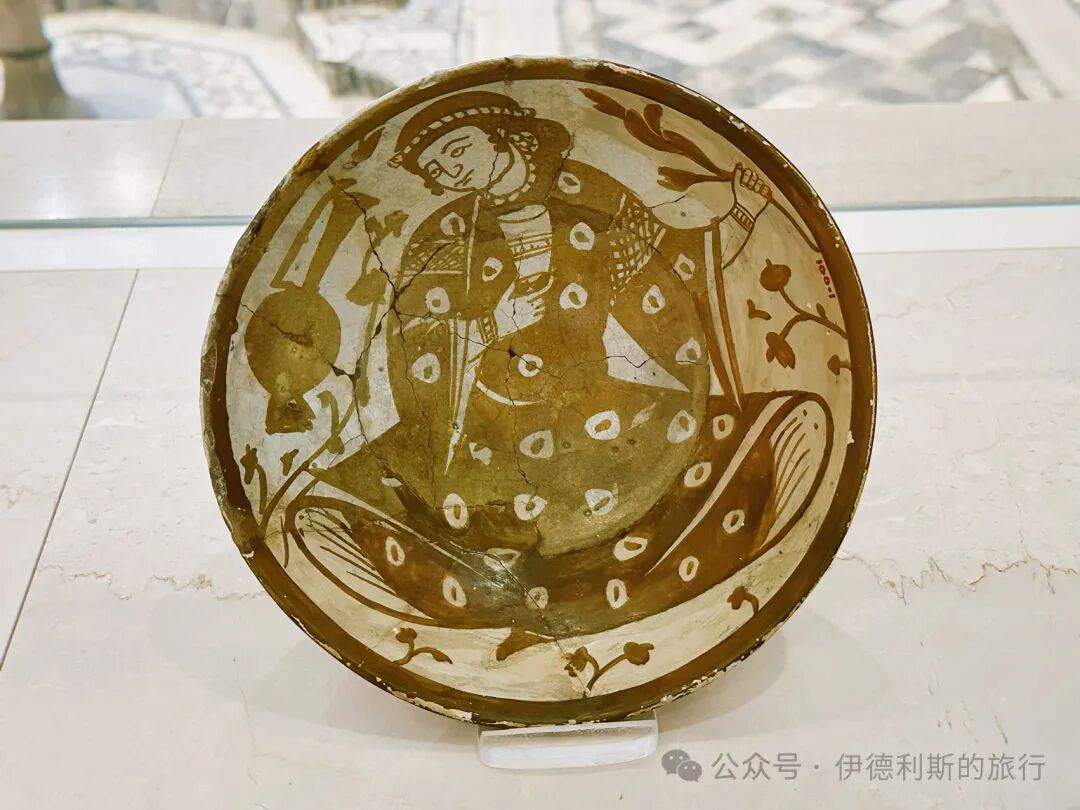
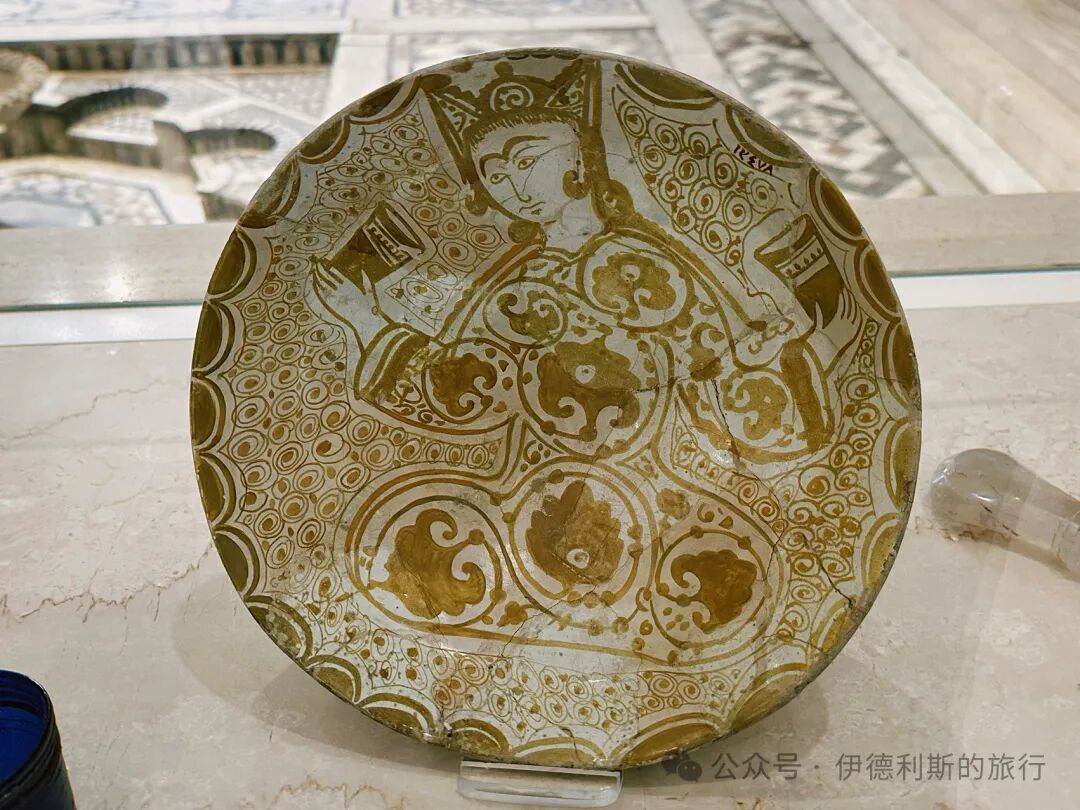
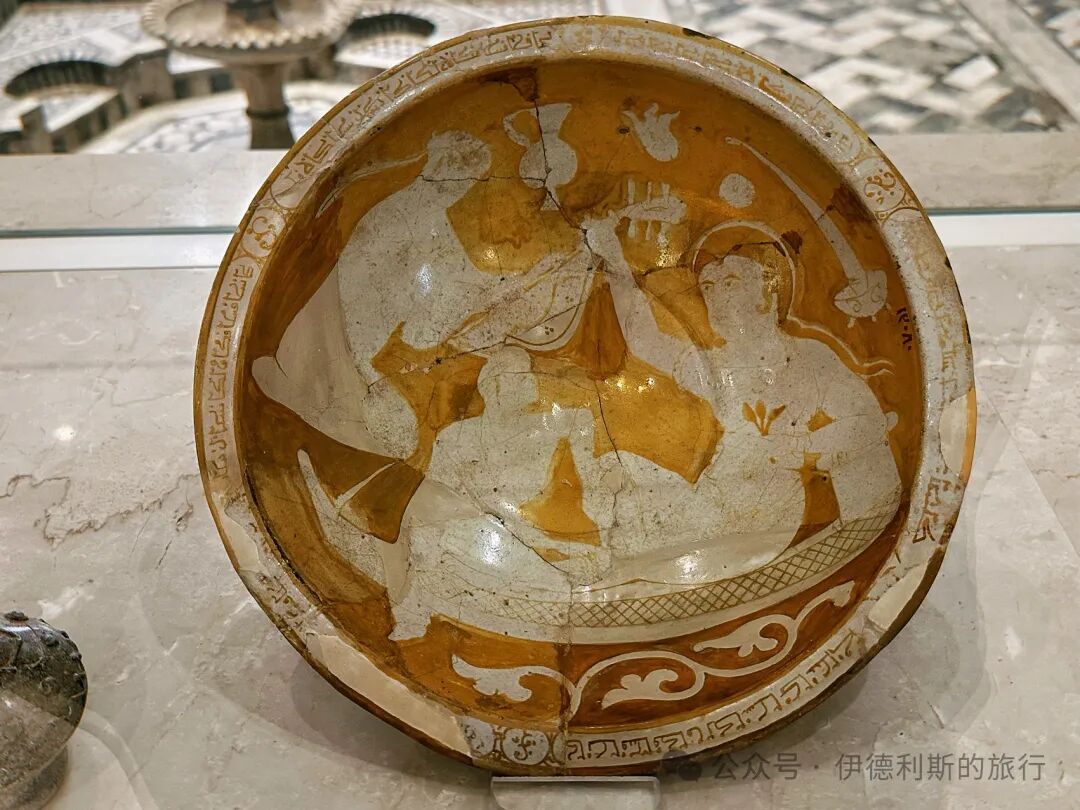
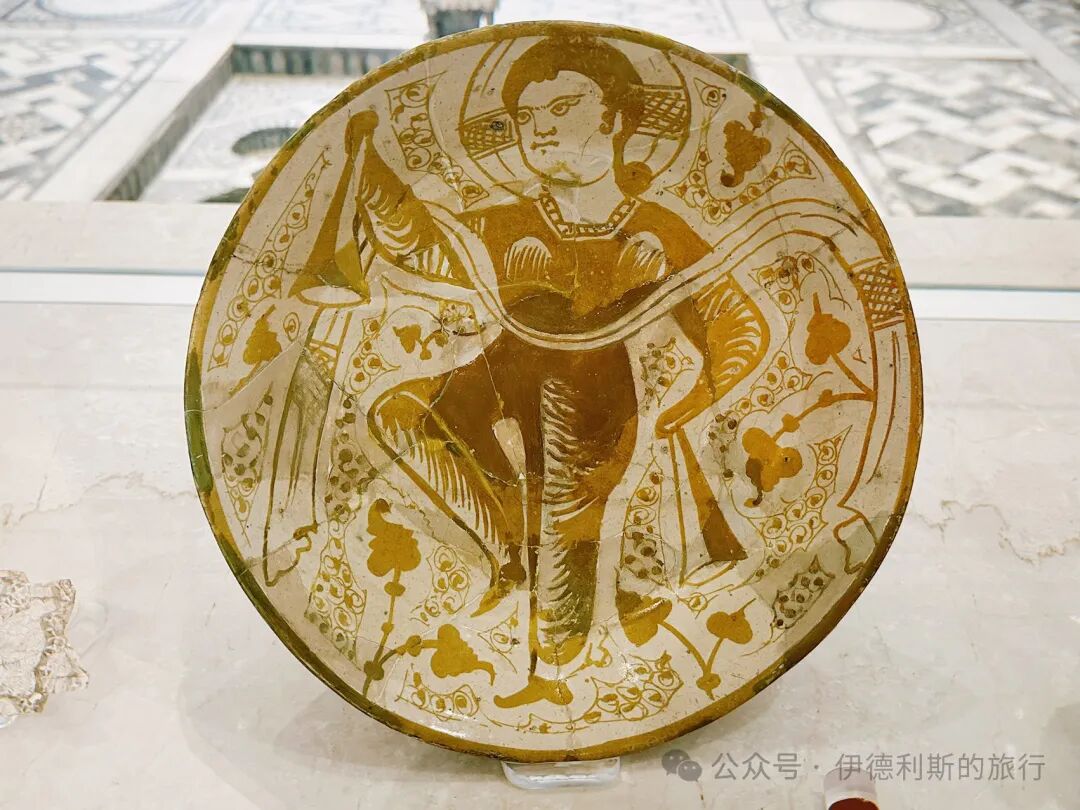
A ceramic plate from Egypt during the Fatimid period in the 11th century, depicting a rider holding a falcon.
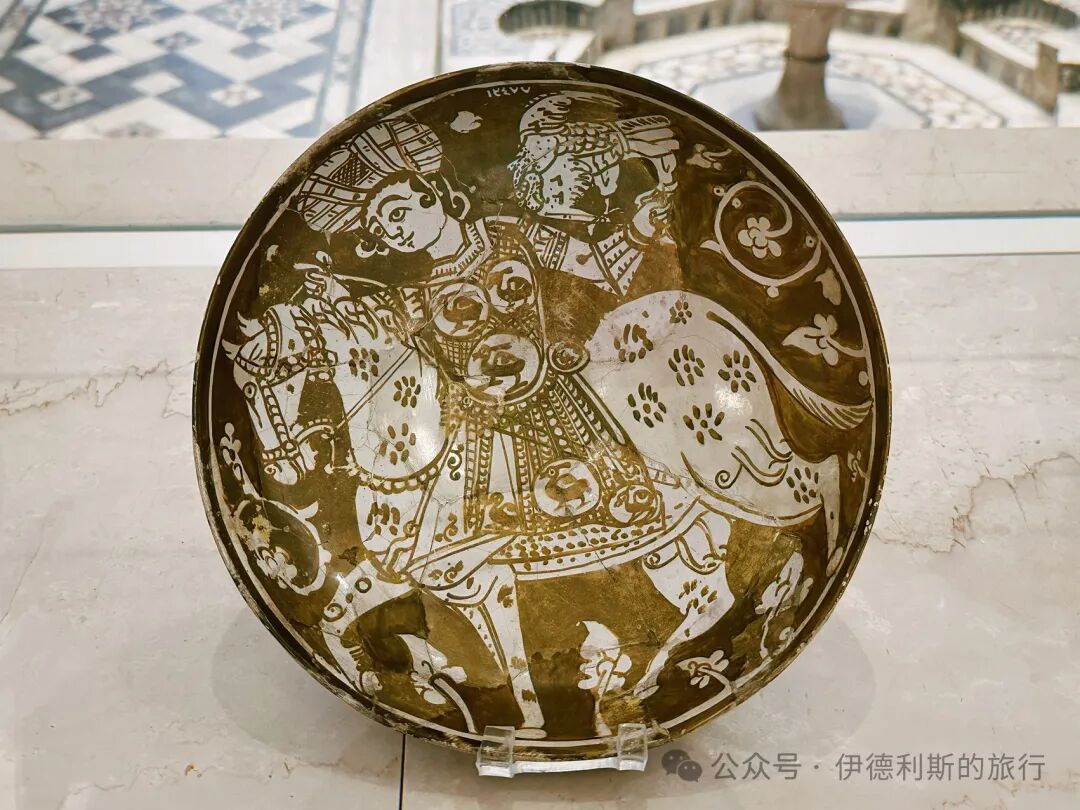
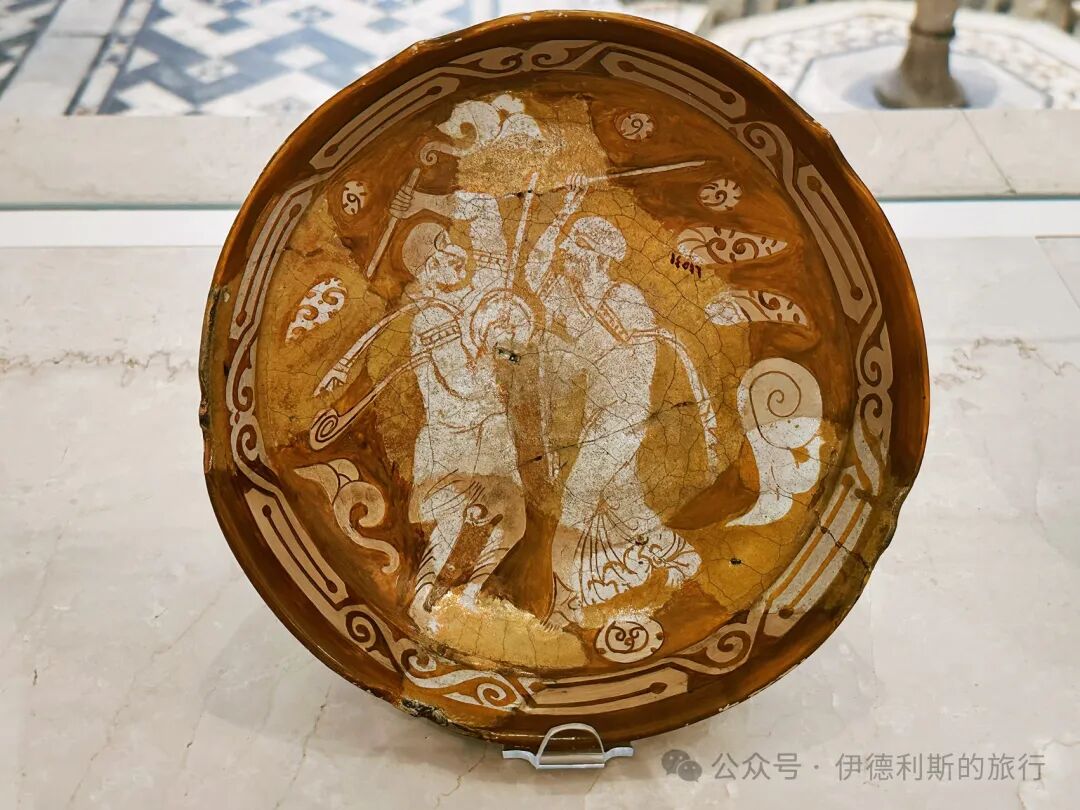
A ceramic plate from Egypt during the Fatimid Caliphate in the 11th to 12th centuries, showing two people performing the traditional Egyptian stick fighting, Tahtib.
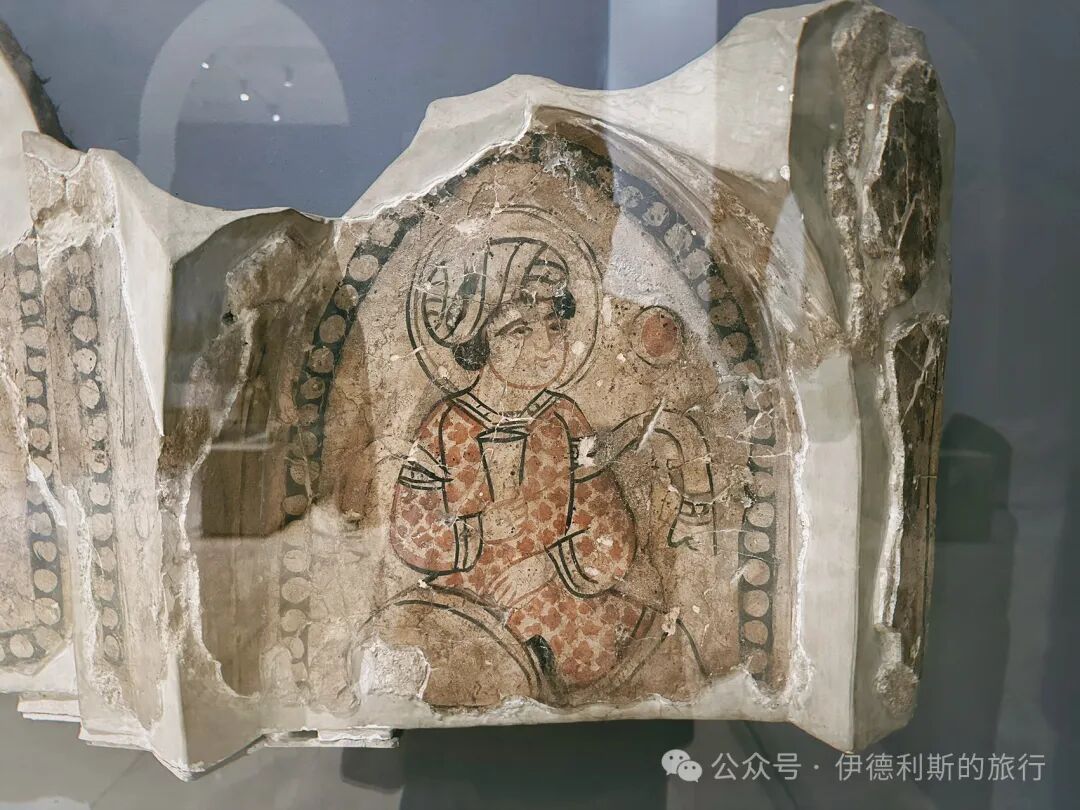
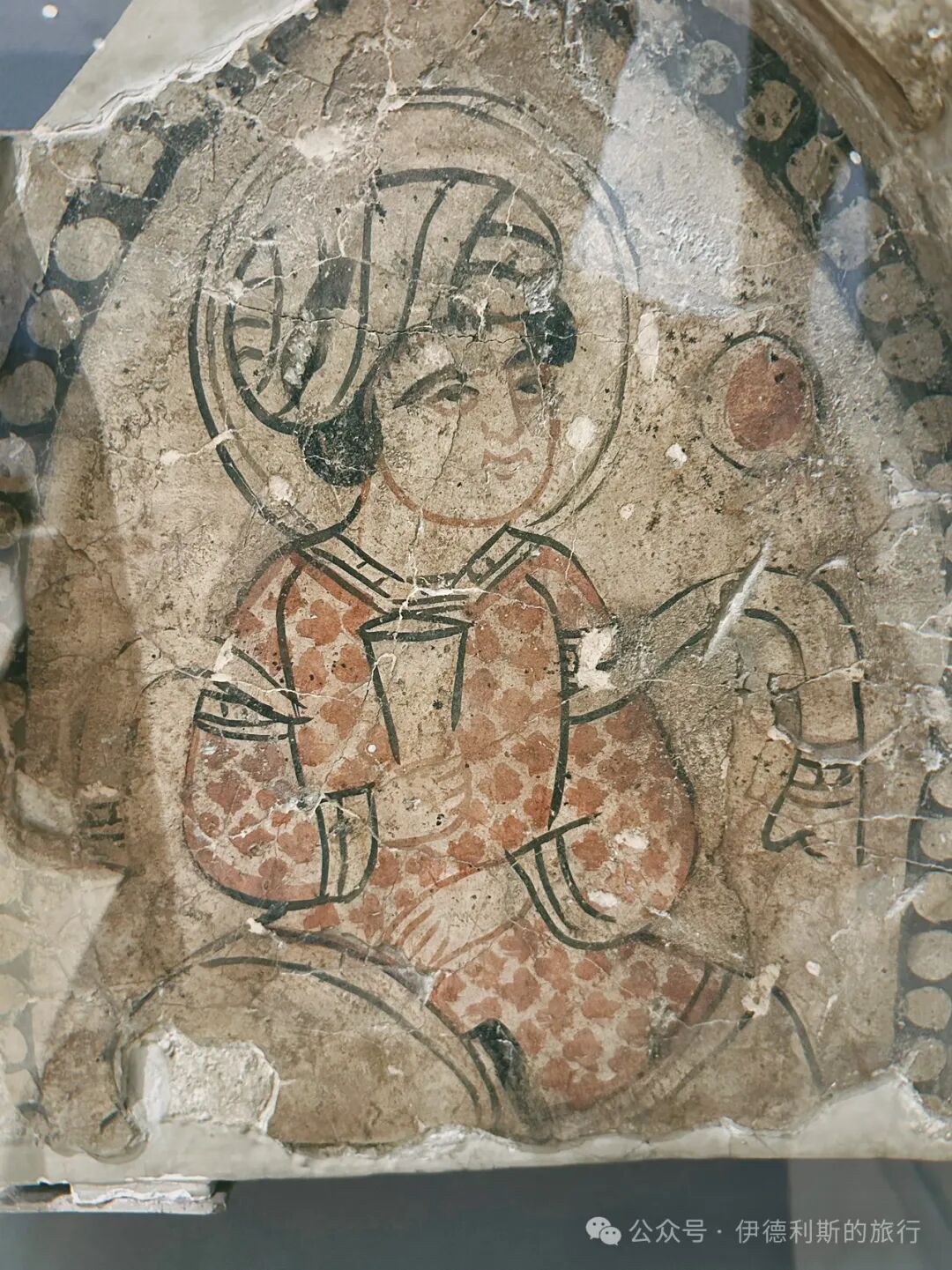
This 11th-century stucco mural from Egypt dates to the Fatimid dynasty and comes from the wall of a Fatimid-era bathhouse.
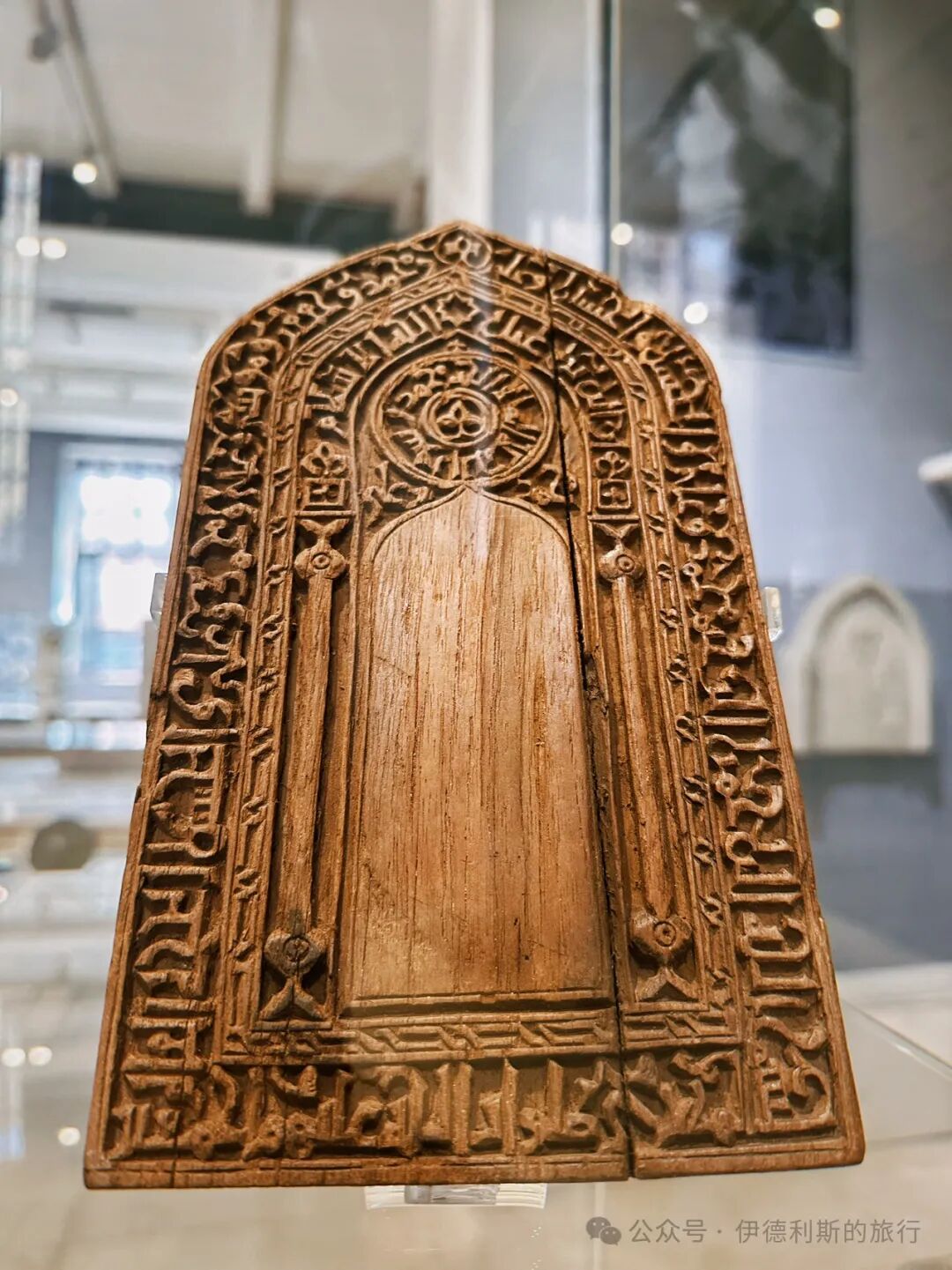
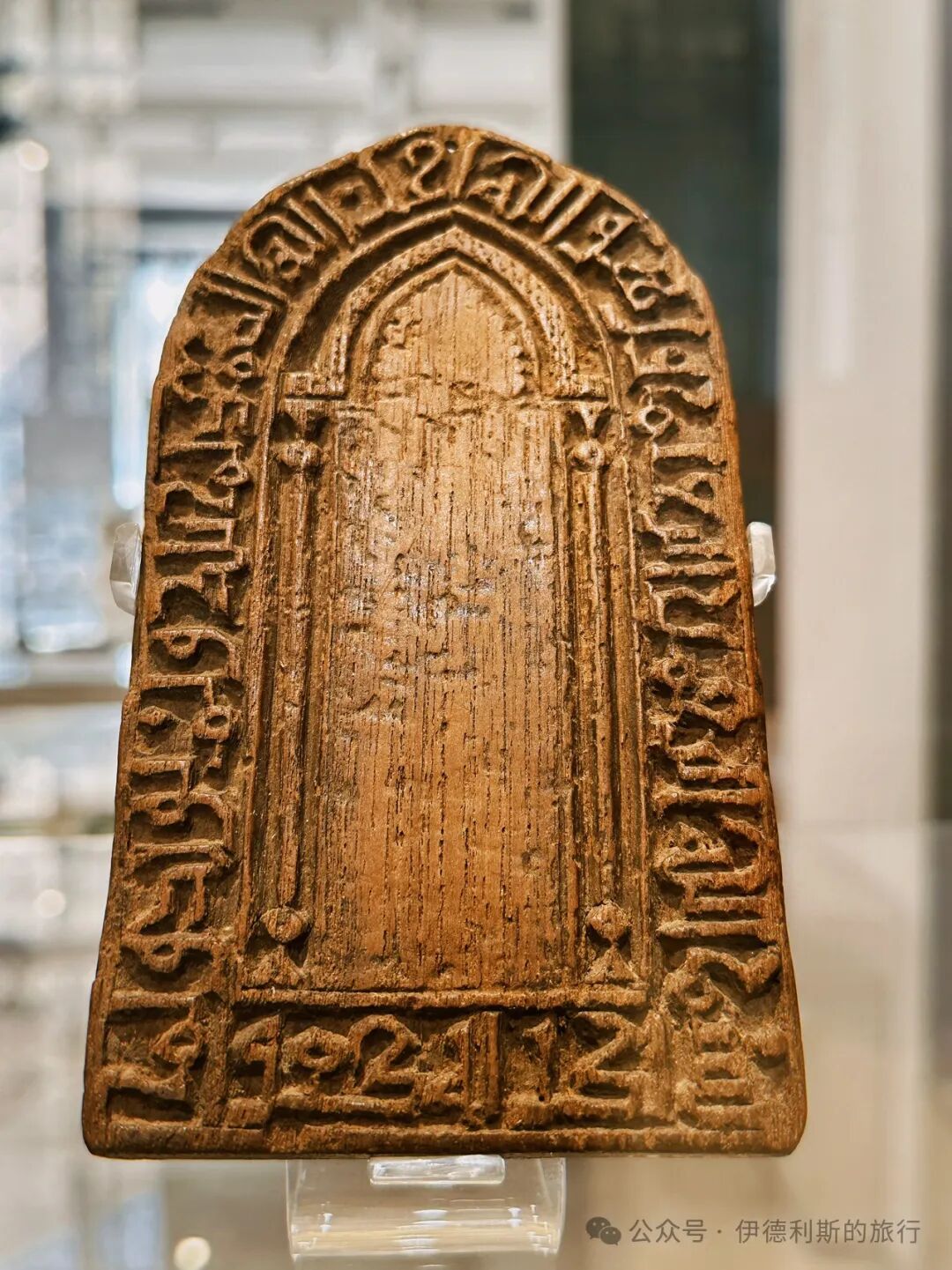
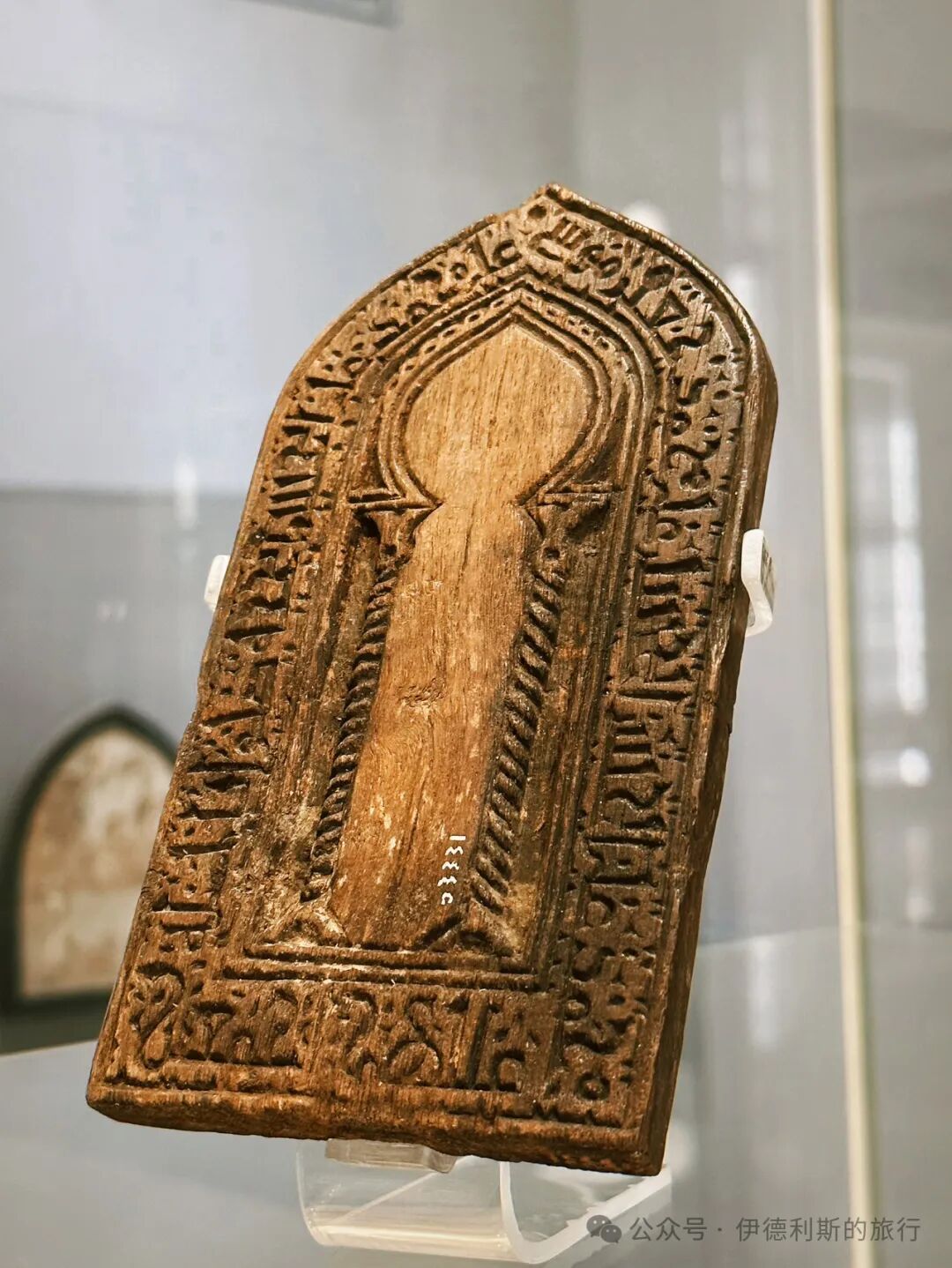
This small wooden prayer niche (mihrab) from 10th-11th century Fatimid Egypt features inscriptions with Shia content.
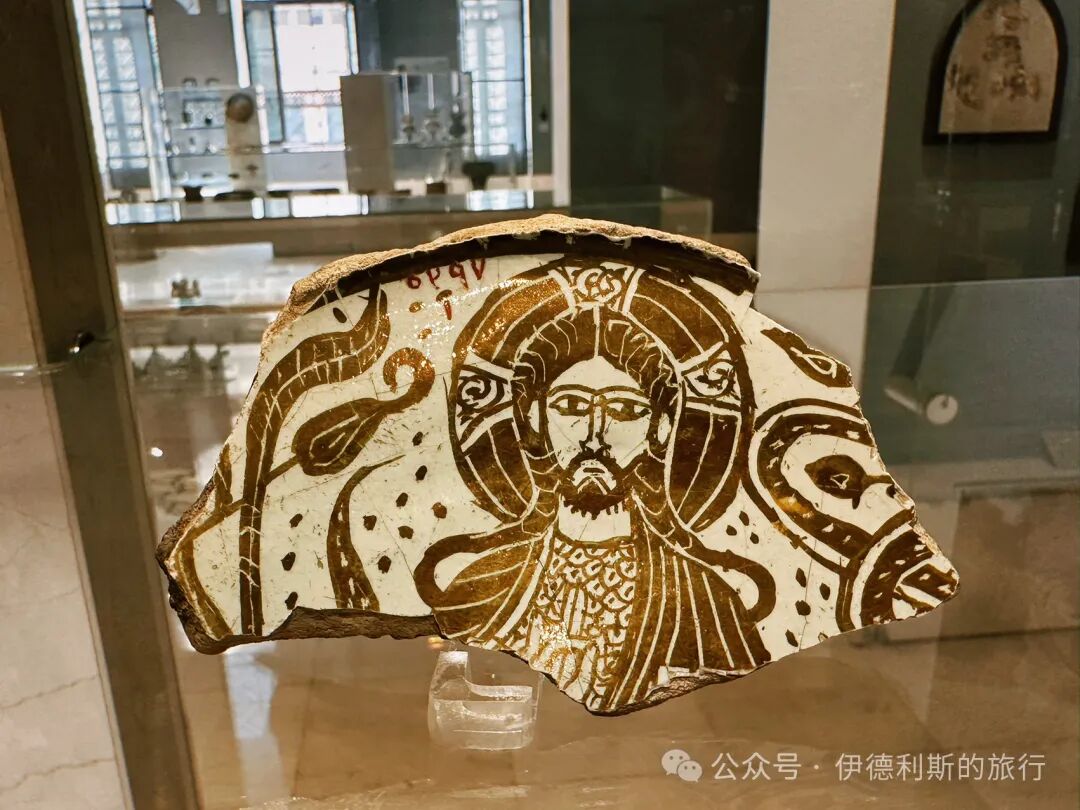
This 10th-11th century Fatimid Egyptian ceramic plate shows an image of the Prophet Isa (Jesus), which serves as evidence of the religious tolerance of that time.
This 11th-century Fatimid Egyptian ceramic plate is inscribed with the name of the commander Ghaban.
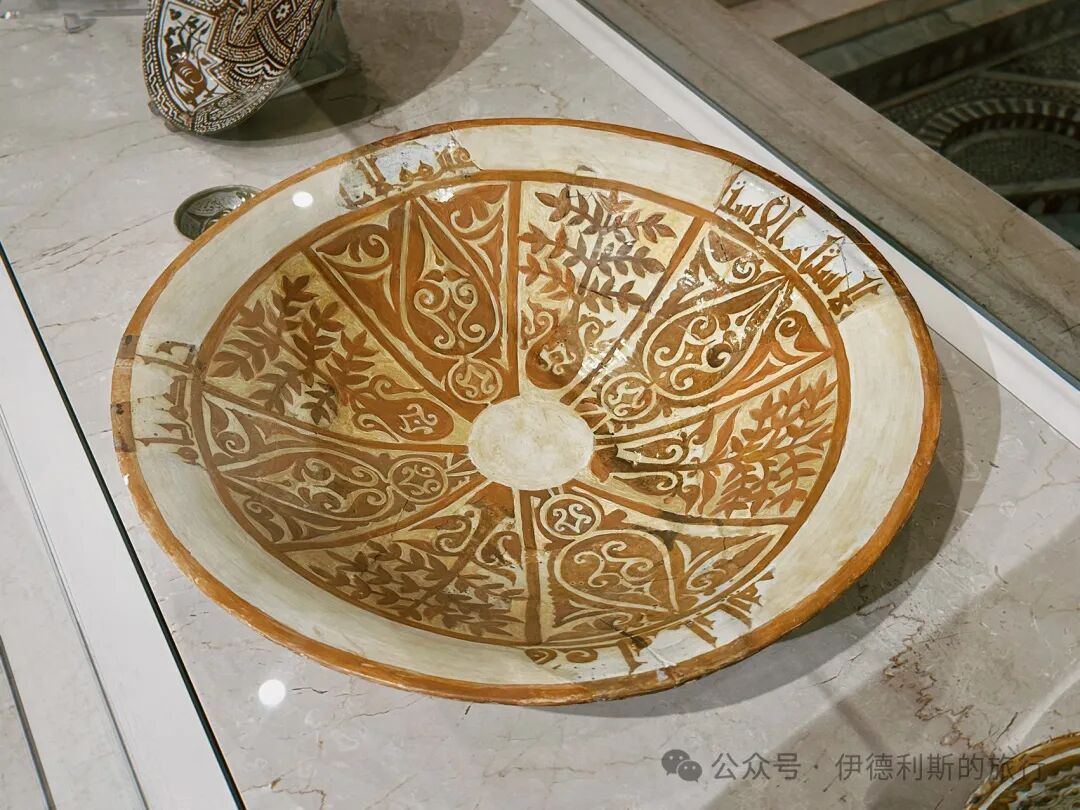
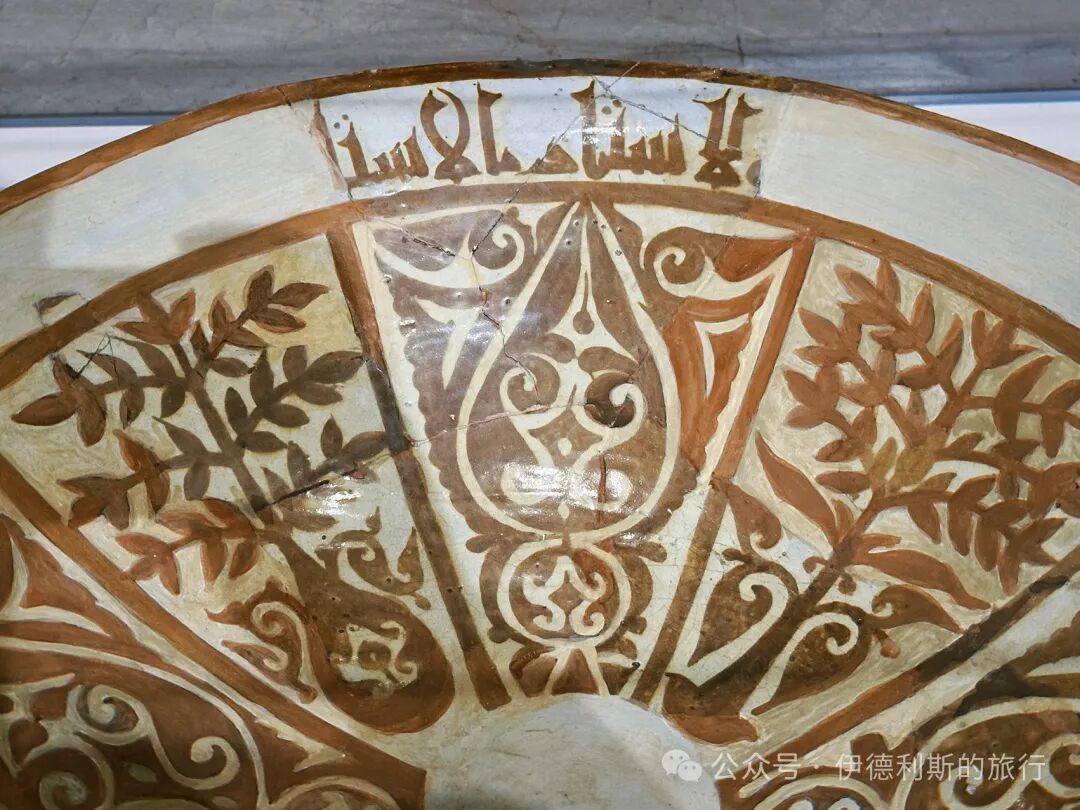
This 11th-century Fatimid Egyptian ceramic plate features a griffin design. The image of the griffin can be traced back to ancient Egyptian art from 3000 BC, later spreading to West Asia and the Mediterranean region. Because the lion rules the land and the eagle rules the sky, the griffin, which combines the features of both, became a symbol of nobility and power.
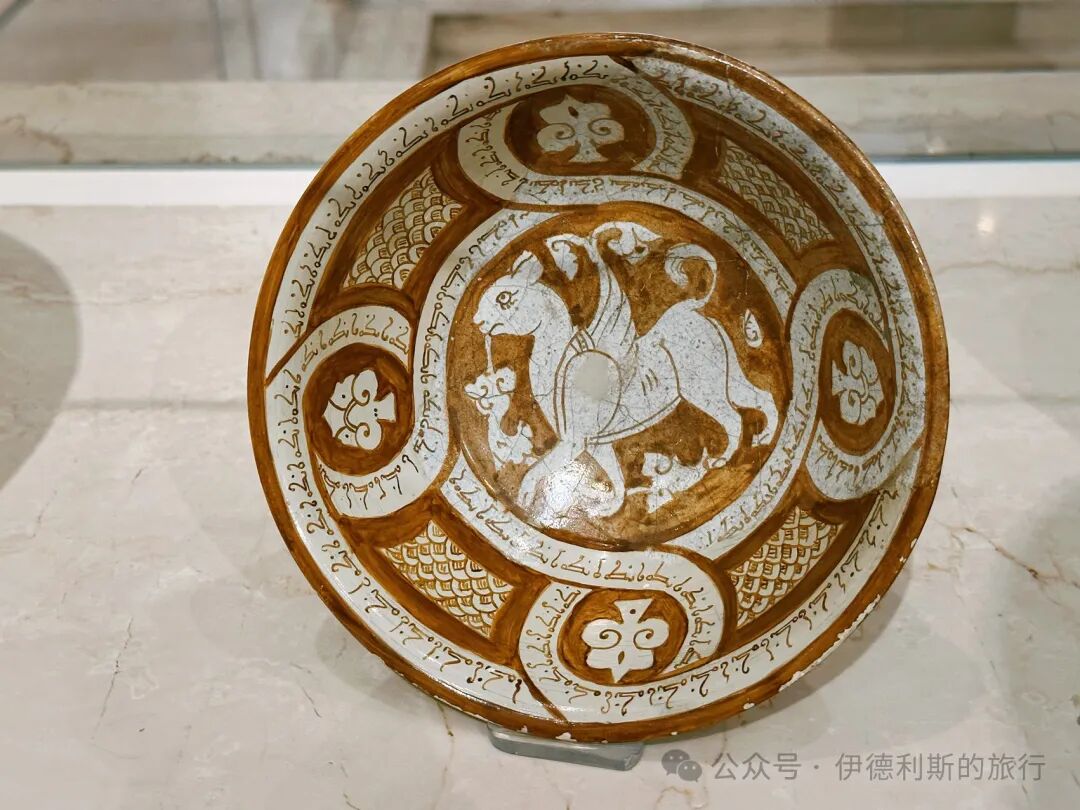
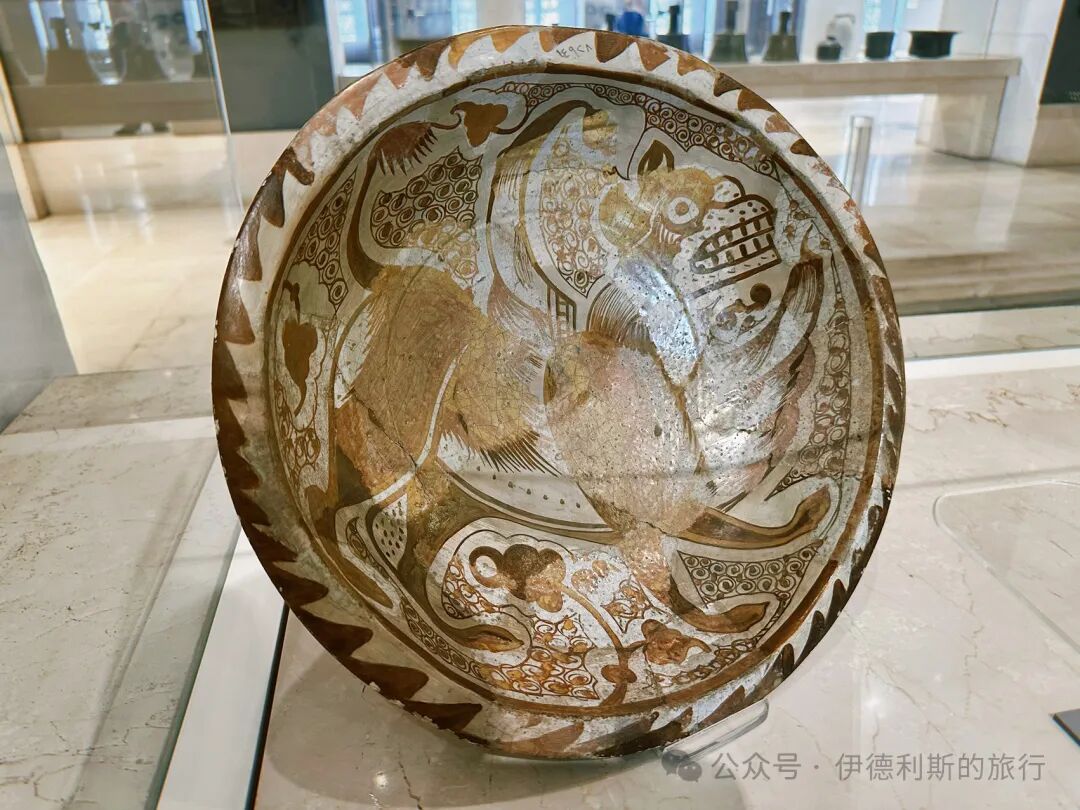
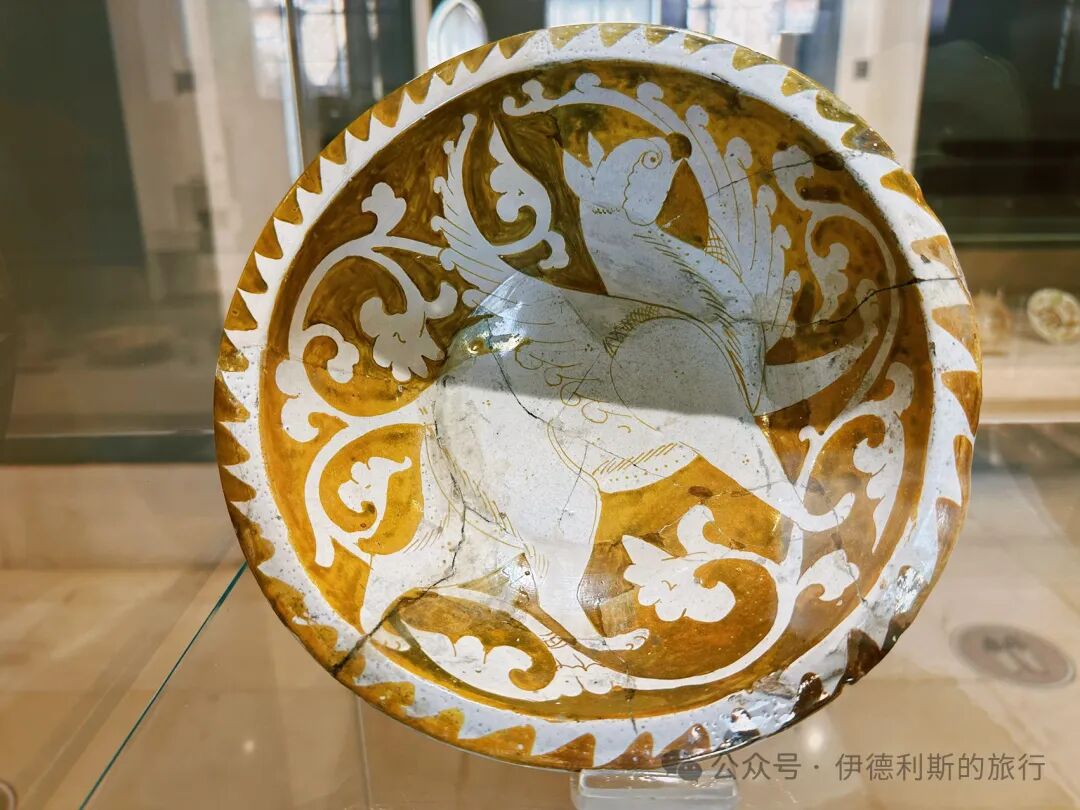
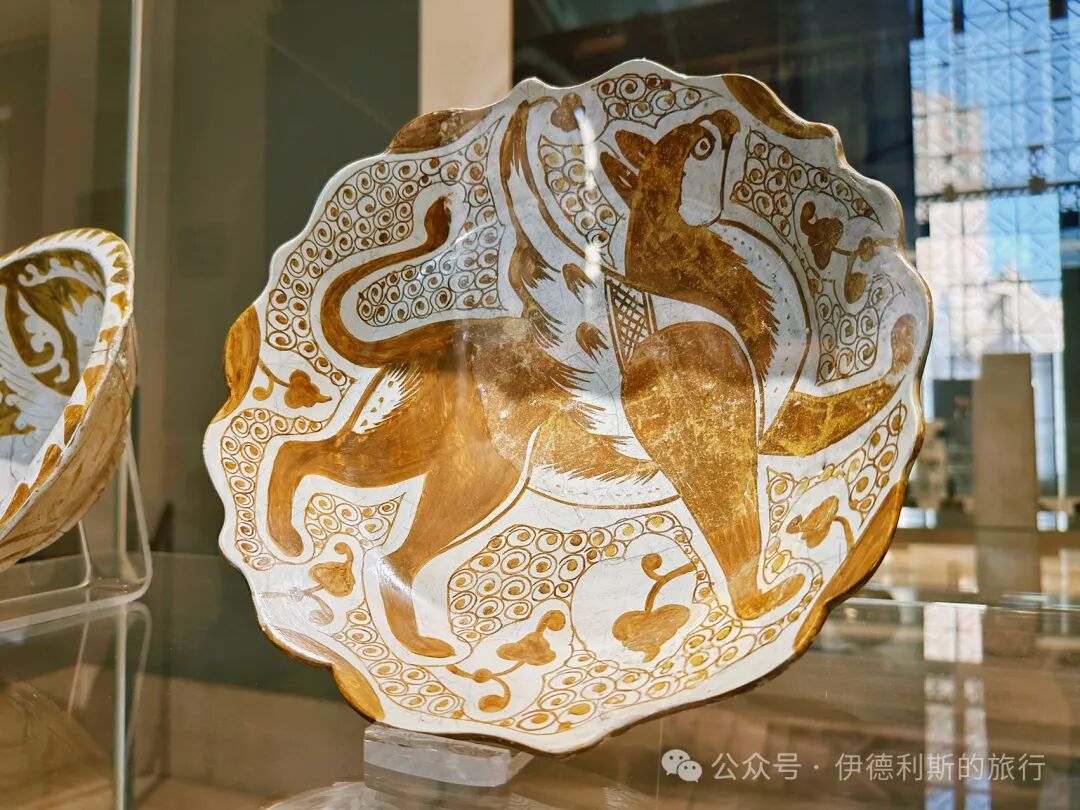
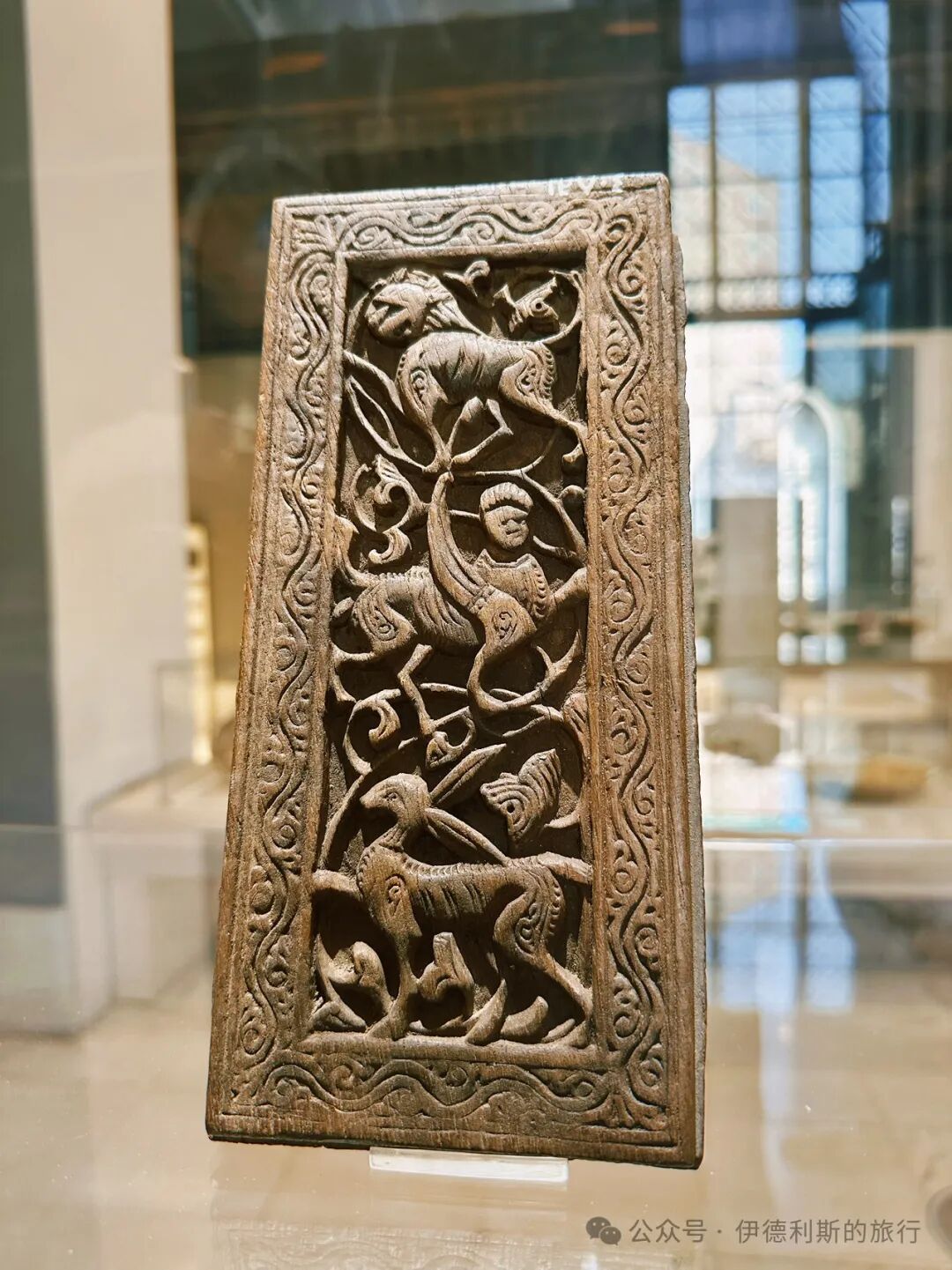
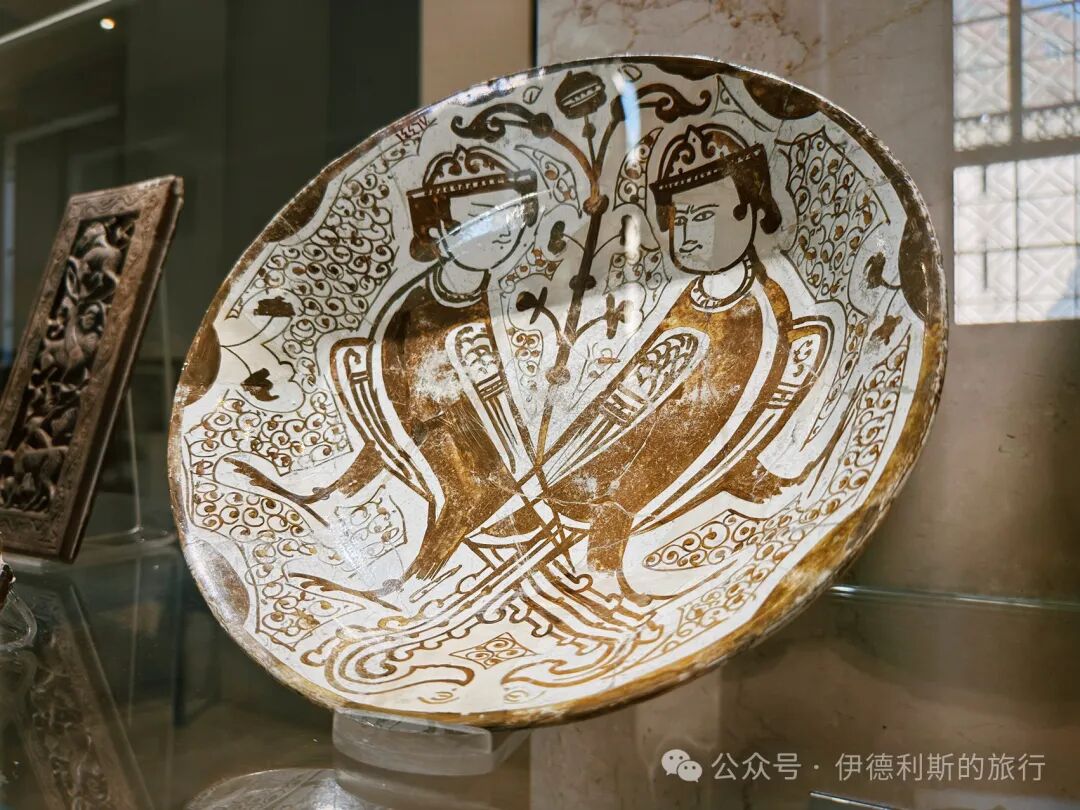
This 11th-century Fatimid Egyptian ceramic plate features images of humans, animals, and birds.
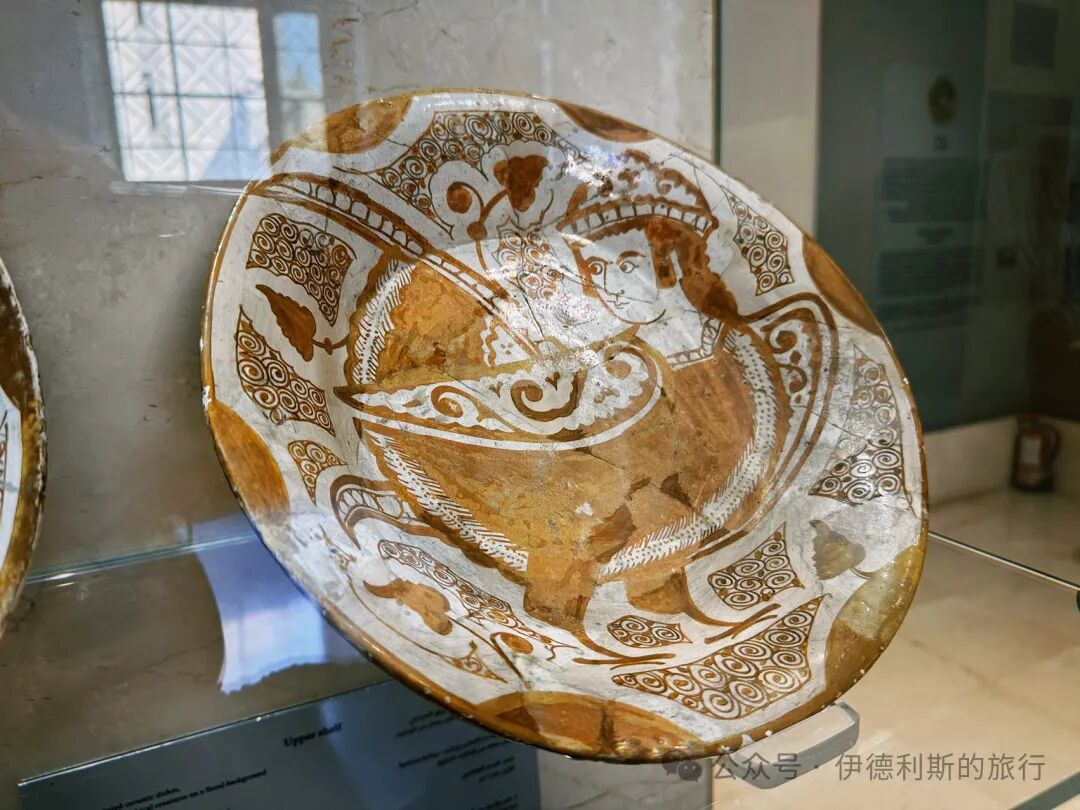
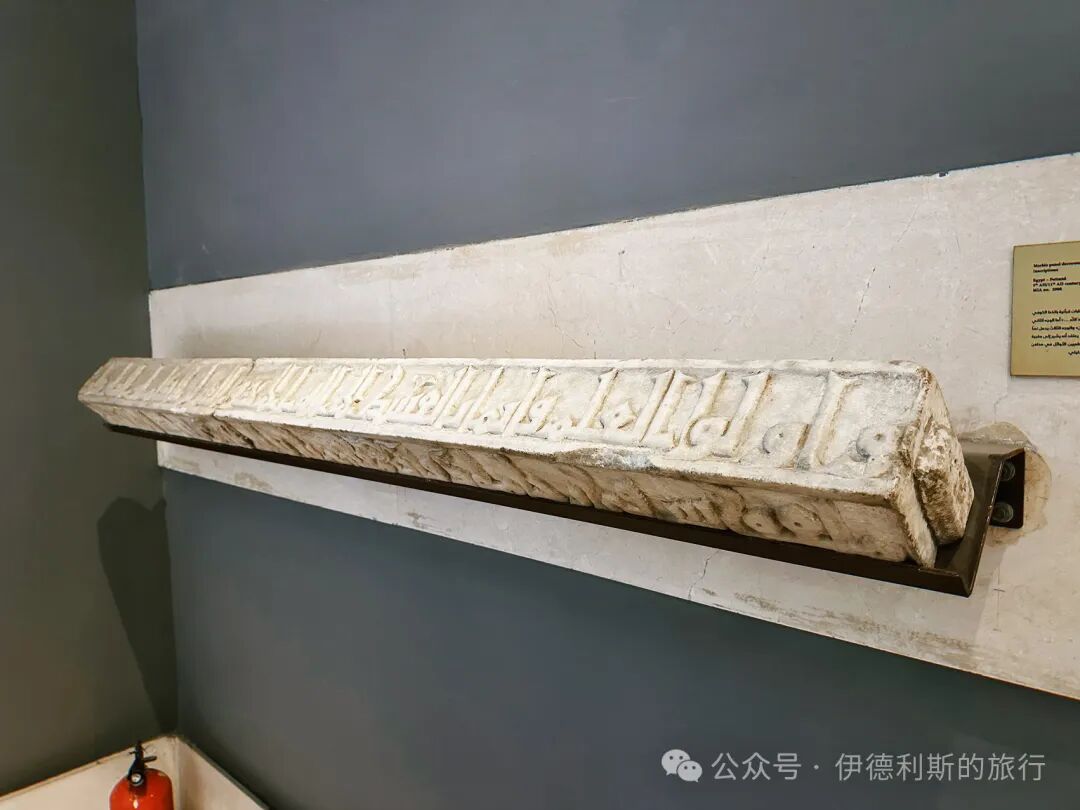
This 11th-century Fatimid Egyptian marble carving features Kufic calligraphy.
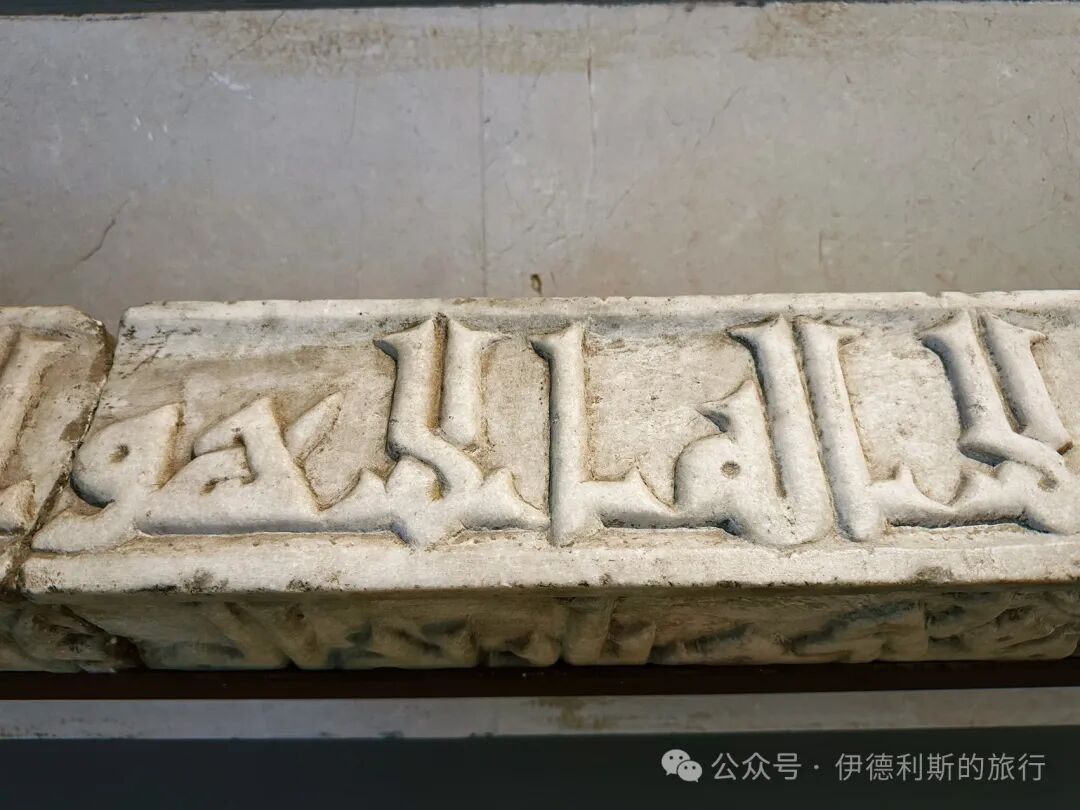
These stucco windows and wooden doors from the Al-Salih Tala'i Mosque in Cairo date to the late Fatimid period in 1160. The Al-Salih Tala'i Mosque is located outside the south gate of the old city of Cairo and was commissioned by the Fatimid vizier Tala'i ibn Ruzzik, who was the last powerful and capable vizier of the Fatimid dynasty. The Al-Salih Tala'i Mosque was completed only 11 years before the fall of the Fatimid dynasty, making it the last surviving building from the Fatimid era.
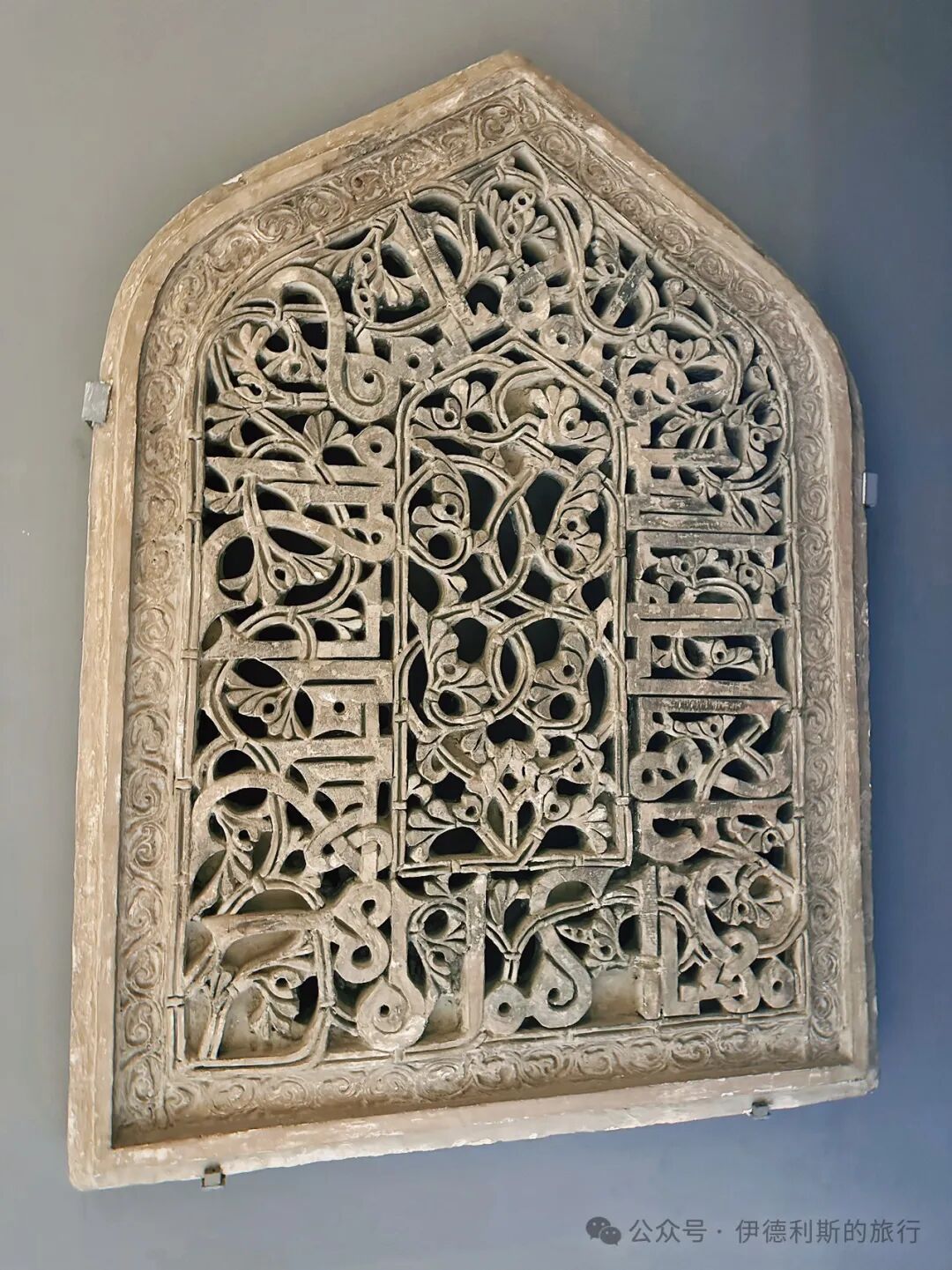
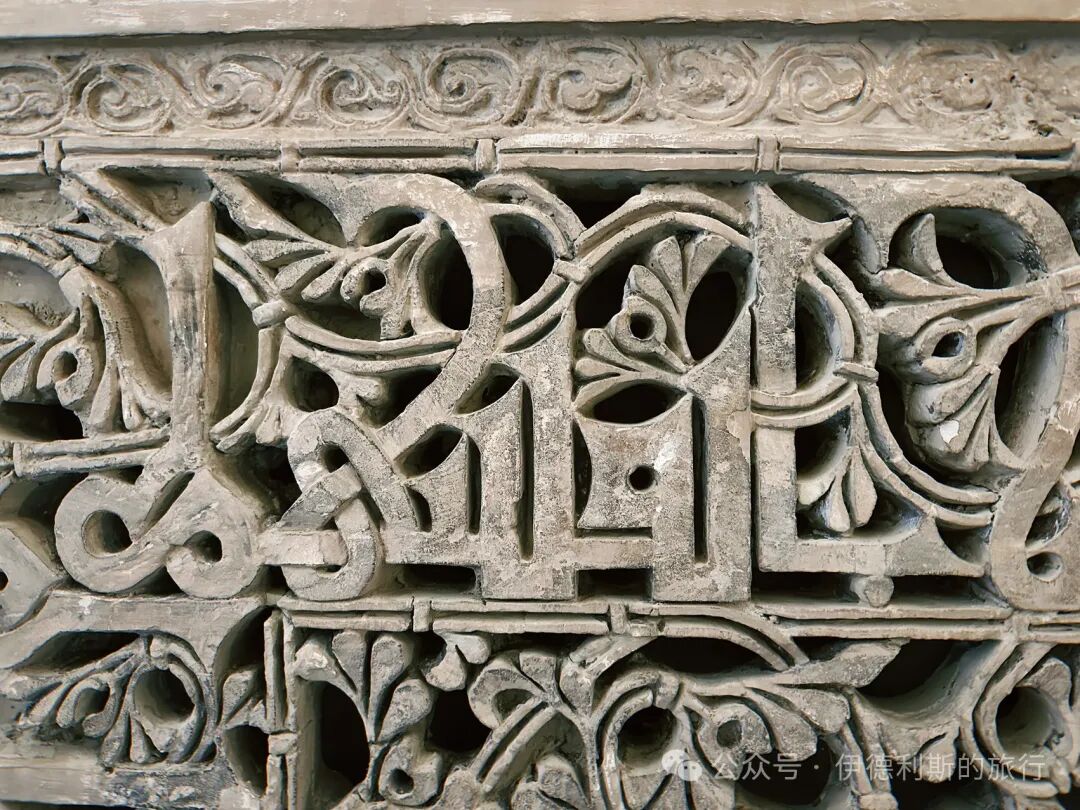
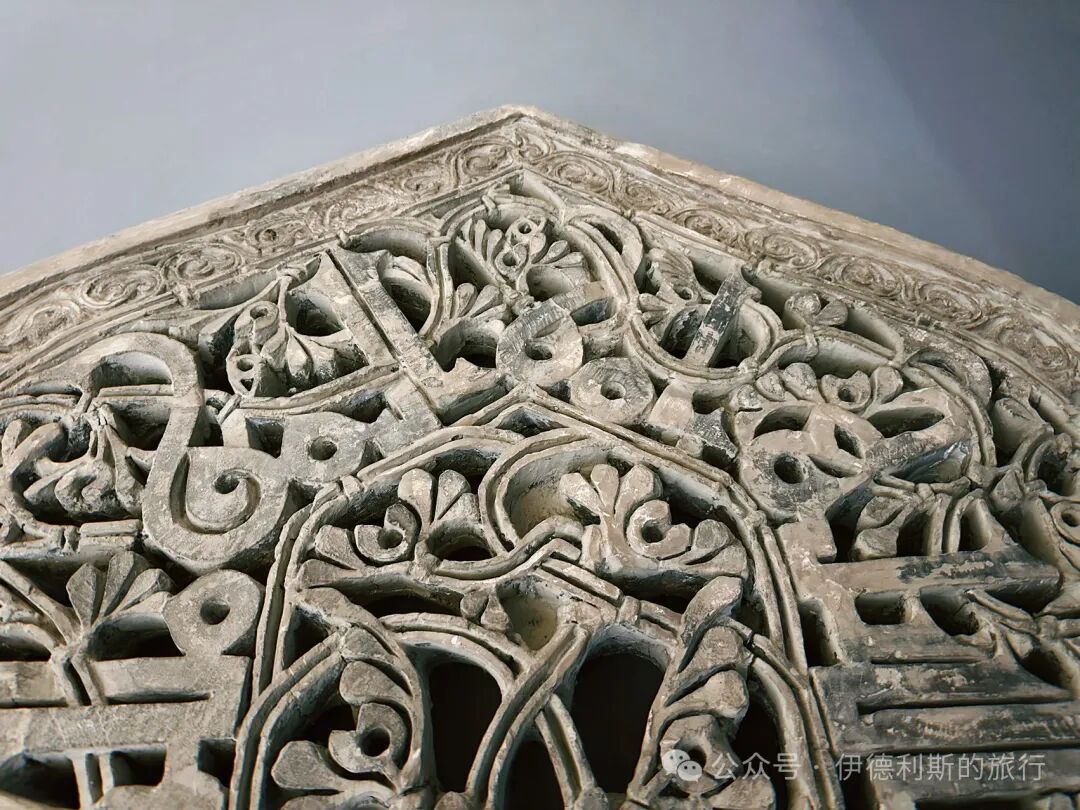
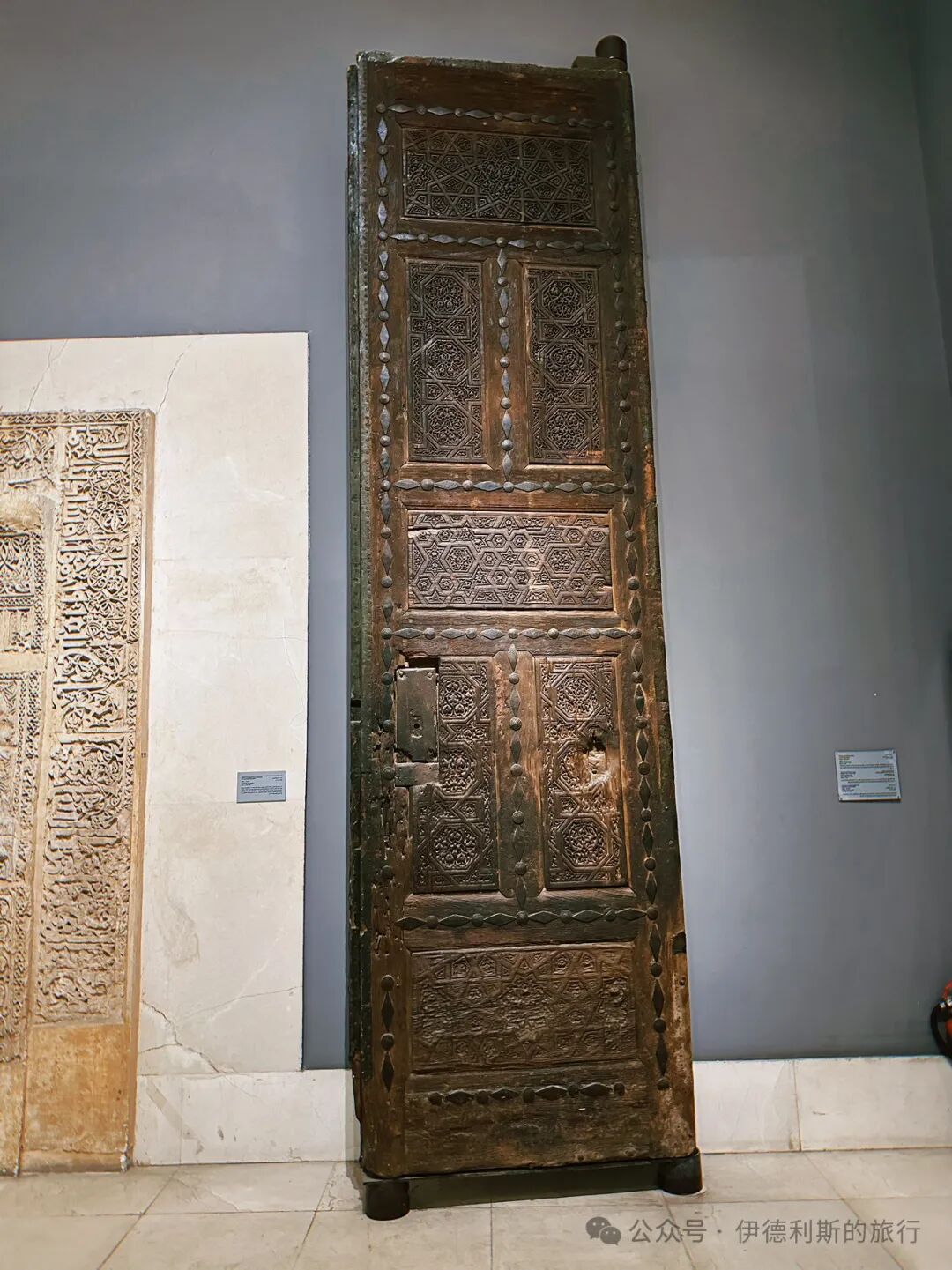
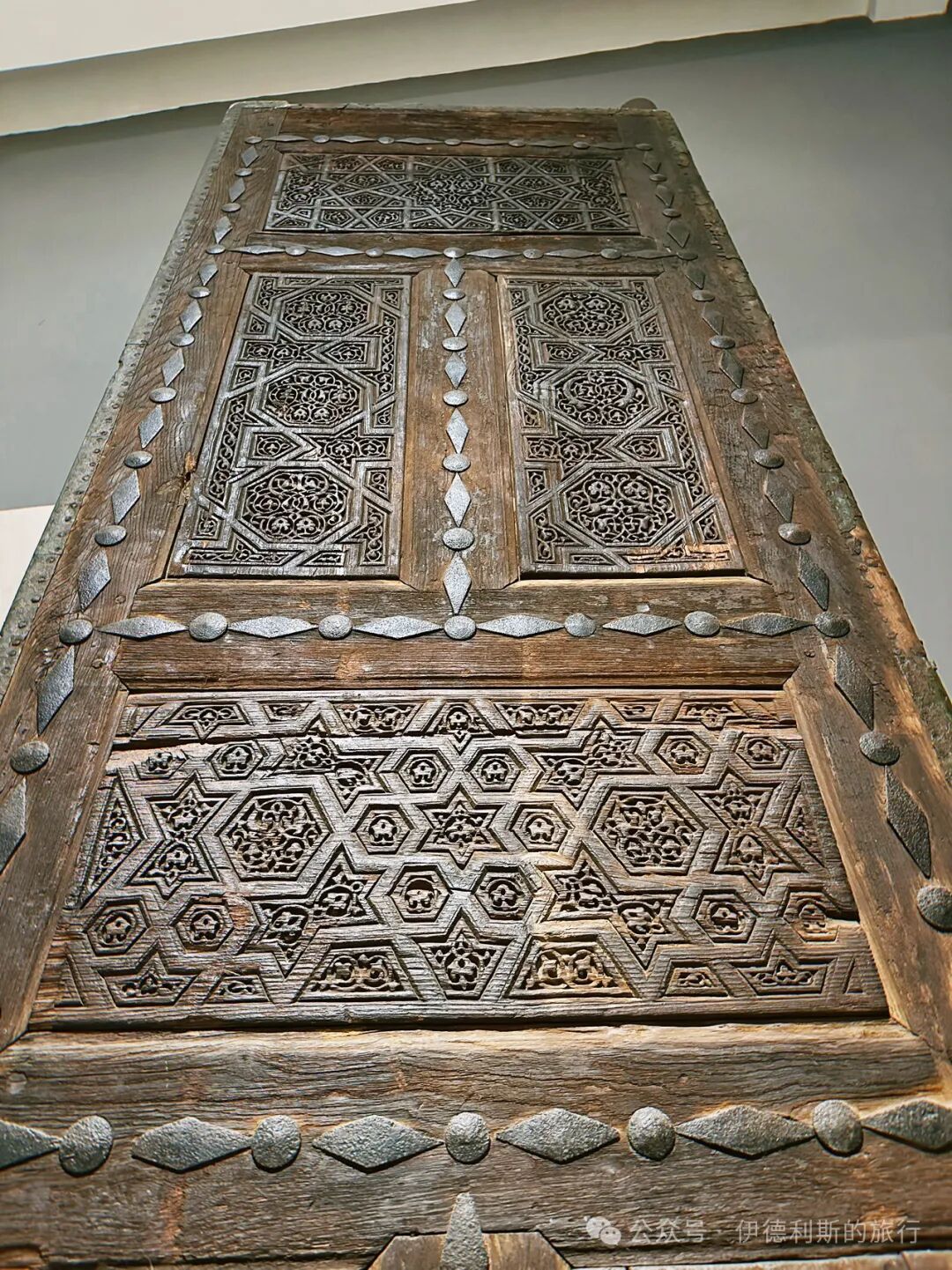
This wooden door from the Al-Azhar Mosque in Cairo dates to the Fatimid period in 1010 and was commissioned by Caliph al-Hakim bi-Amr Allah, who reigned from 996 to 1021. Al-Hakim was the first Fatimid caliph born in Cairo, an important imam in the history of Ismaili Shia Islam, and a central figure in the Druze faith. At that time, the city of Fustat on the south side of old Cairo was a densely populated Sunni city, while the newly built city of Cairo served as the capital of the Fatimid dynasty and the center of Ismaili Shia Islam. The Al-Azhar Mosque in Cairo is the city's official congregational mosque, where the caliph would deliver the khutbah sermon every Friday during Jumu'ah prayer.
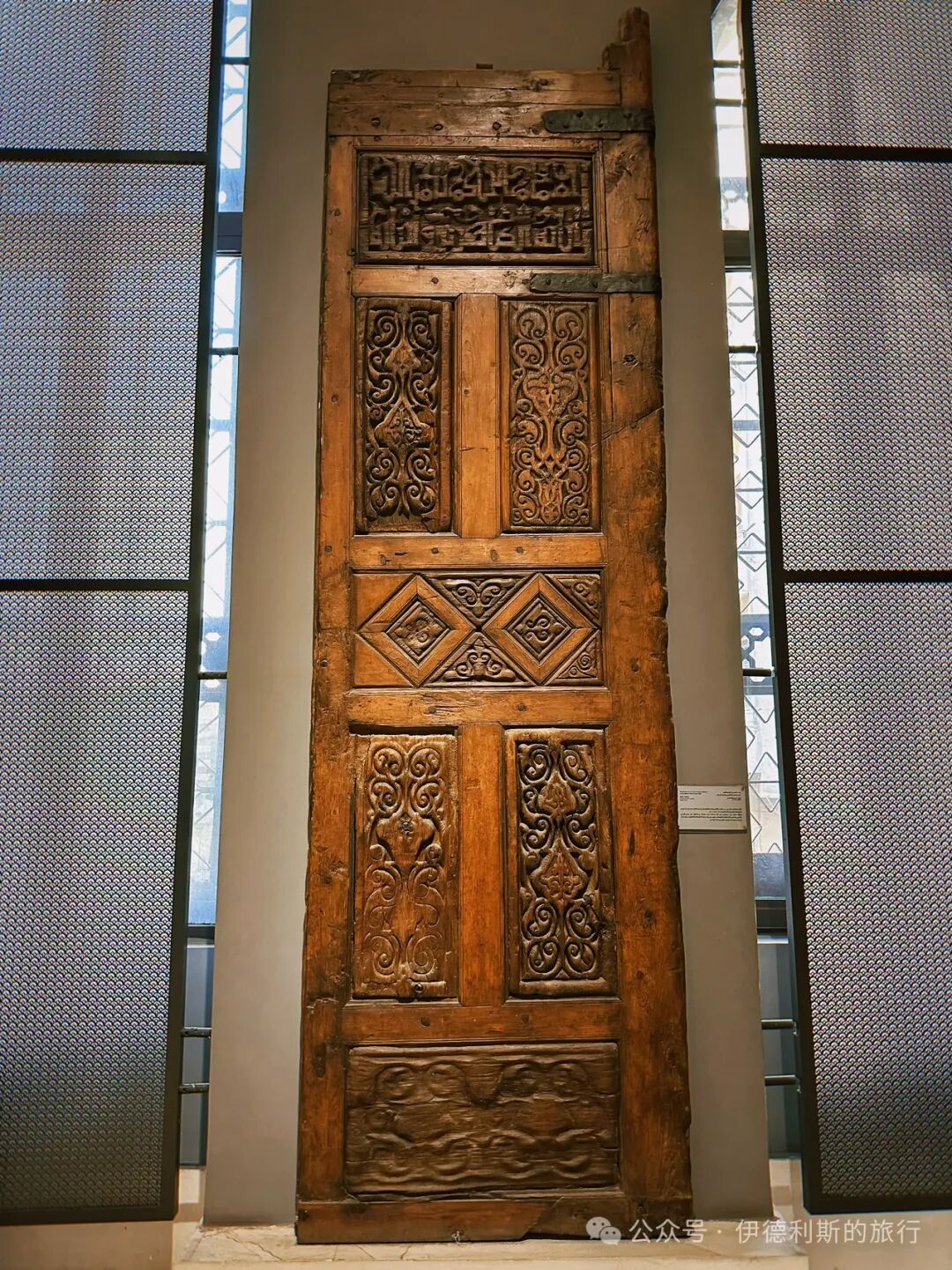
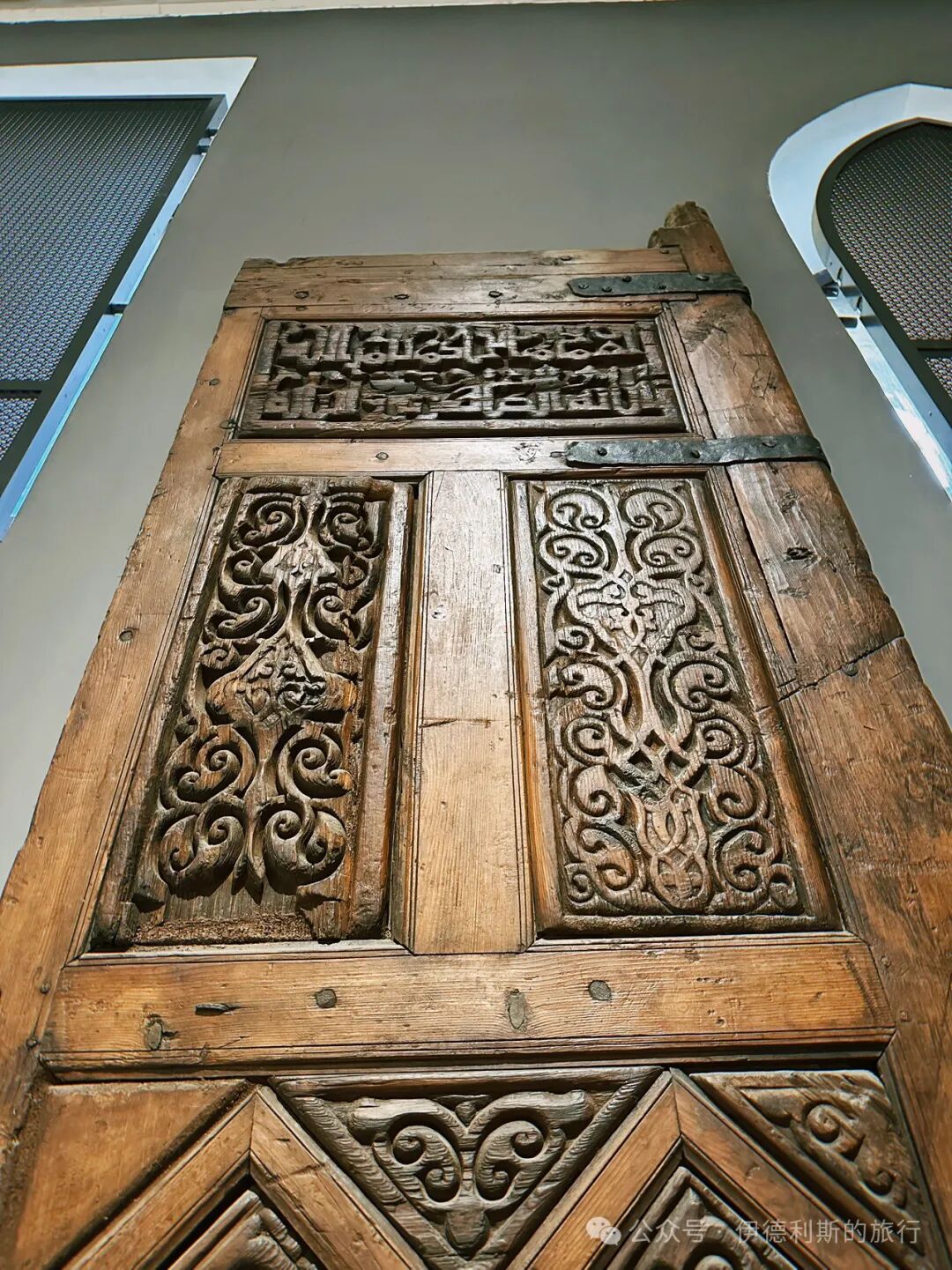
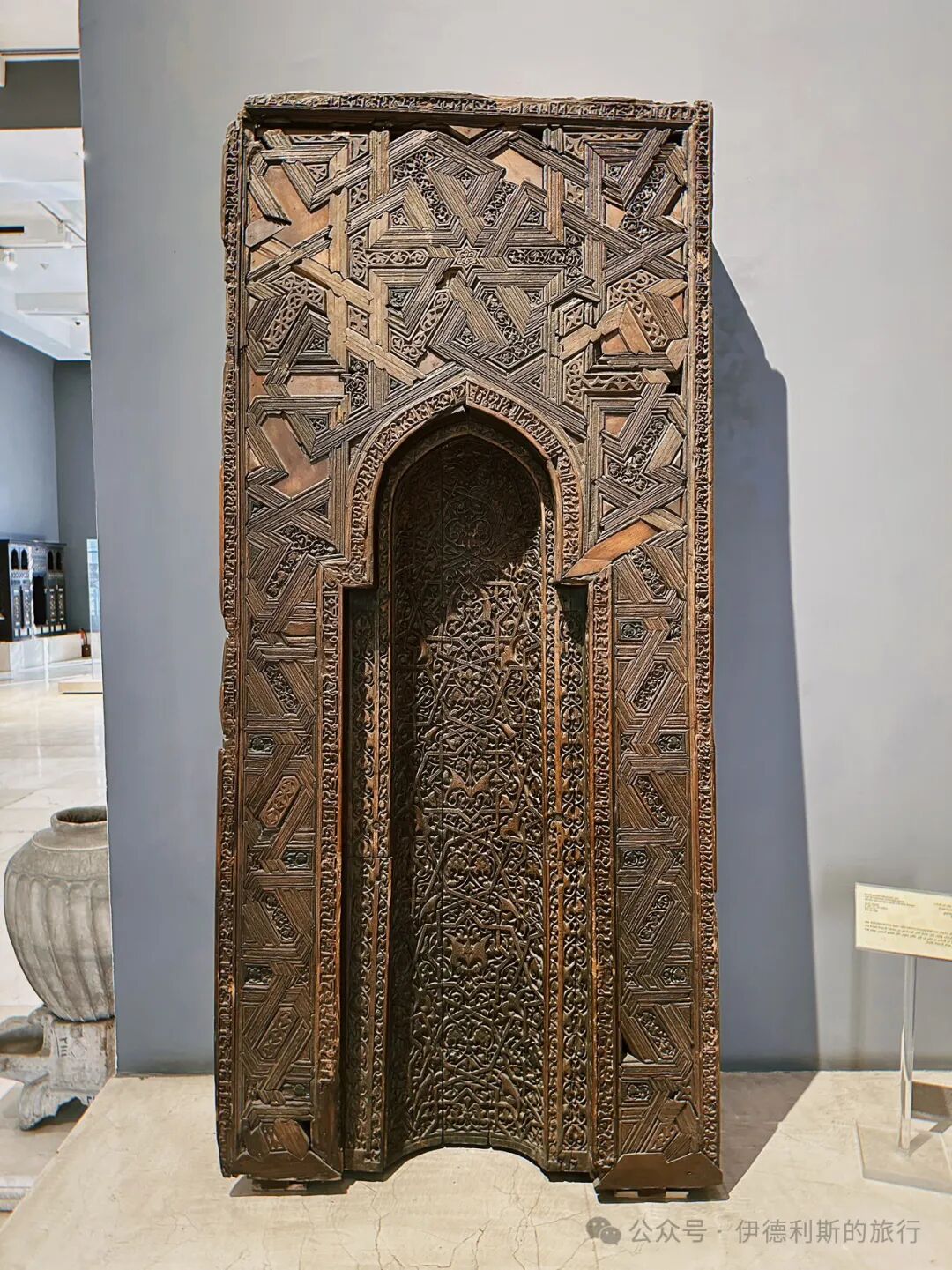
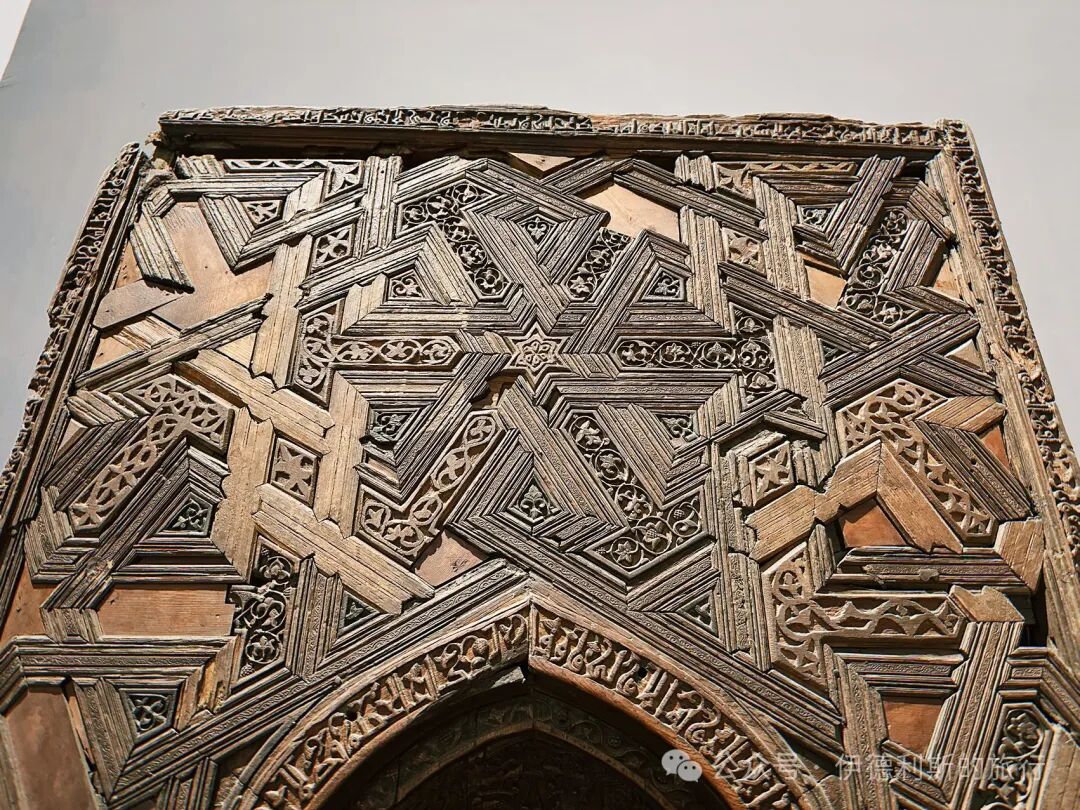
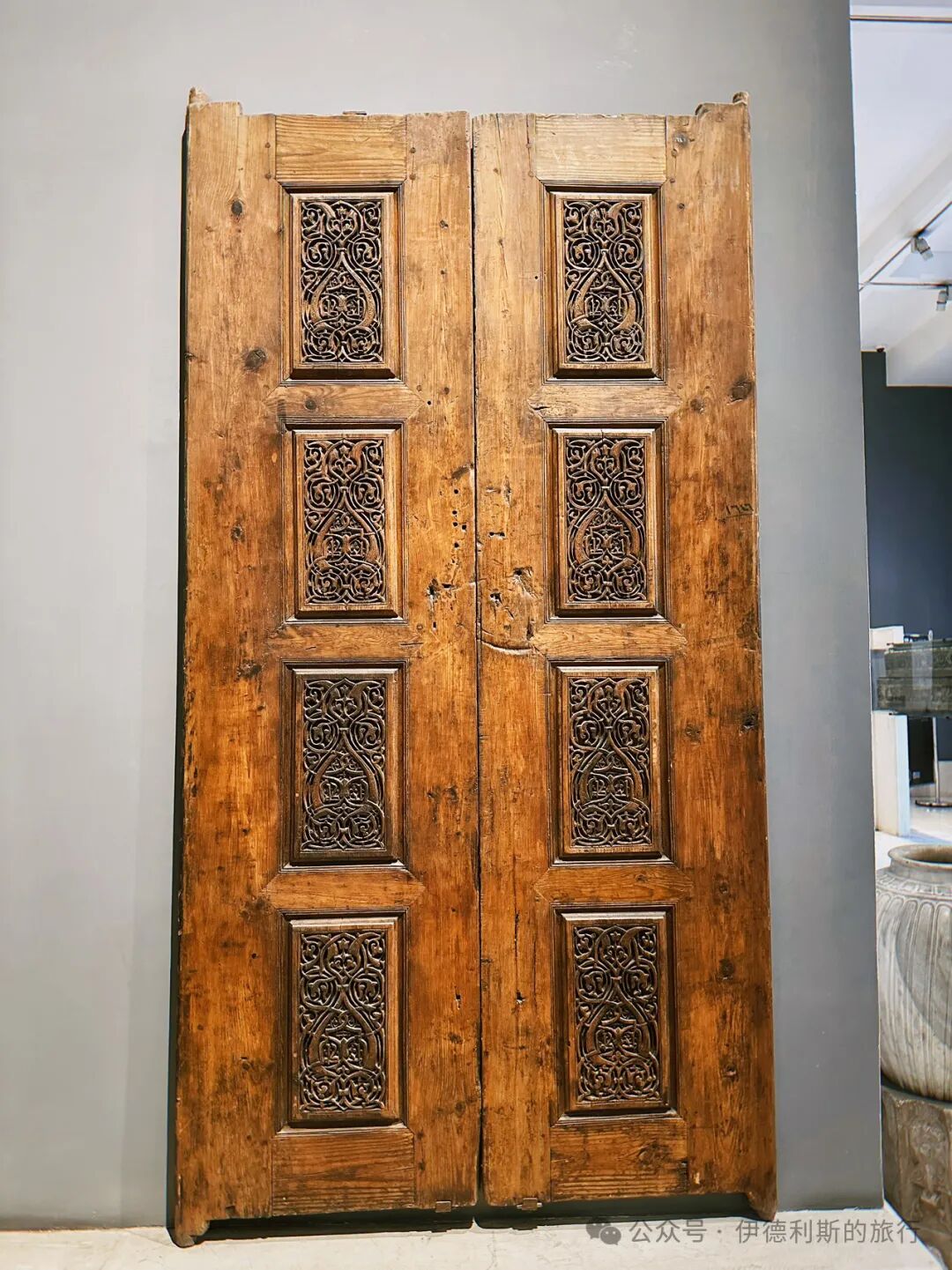
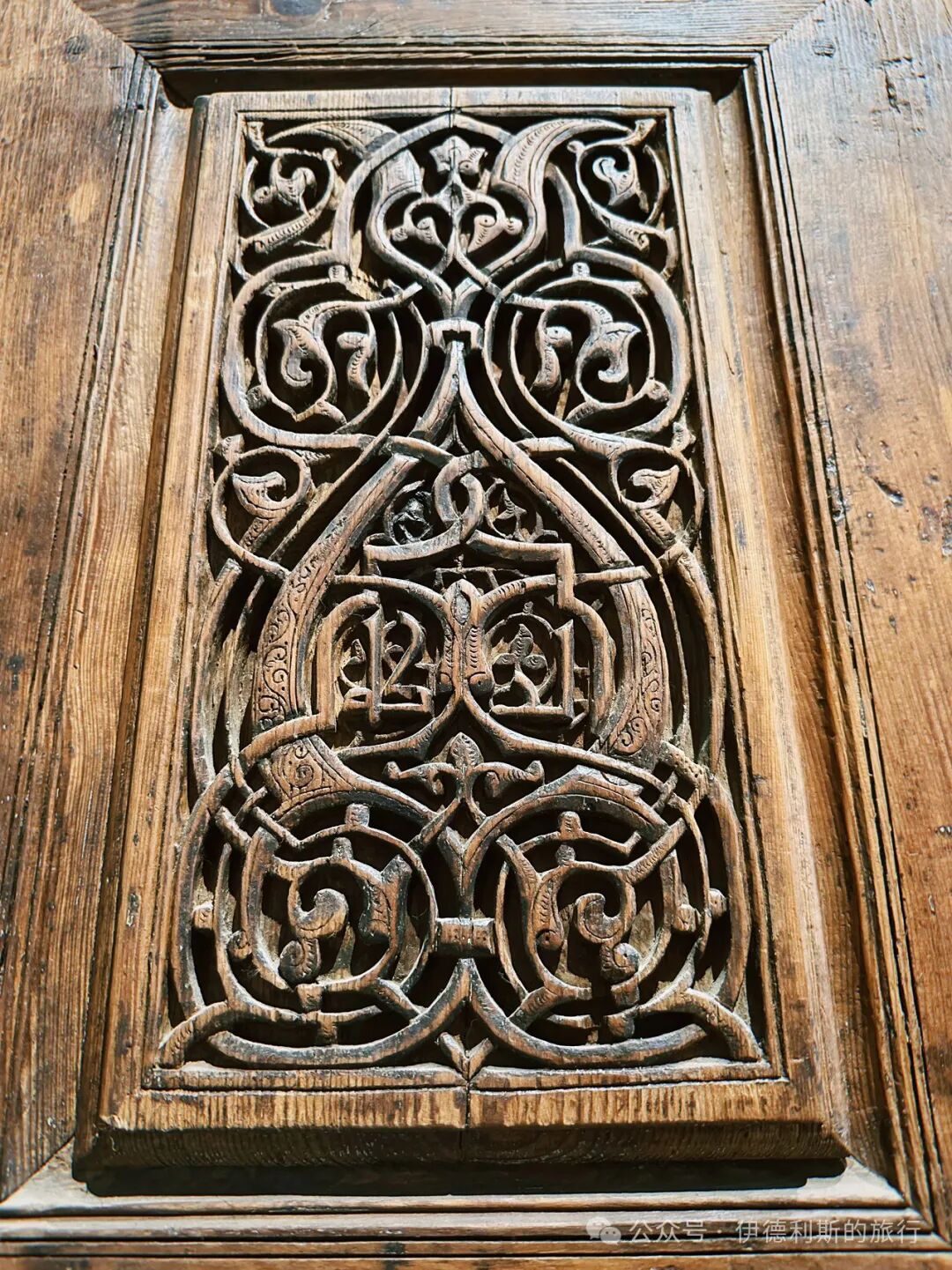
The 12th-century Fatimid-era wooden prayer niche (mihrab) and wooden doors inside the Sayyida Nafisa mausoleum in Cairo. Sayyida Nafisa (762-824) was the great-granddaughter of Imam Hasan, the grandson of the Prophet. She was a famous Egyptian scholar of hadith who served as a mentor to Imam Shafi'i and provided him with financial support.
The Nafisa mausoleum is located in Cairo's famous City of the Dead. It was first built during the Abbasid period and later renovated and rebuilt during the Fatimid period. Nafisa was the first descendant of Imam Ali to be honored during the Fatimid period. As a Sunni and a descendant of Ali, she helped promote reconciliation between the Sunni and Shia populations within the Fatimid dynasty.
Ayyubid dynasty
A 12th-century wooden chest from the Hussein Mosque in Cairo. The Hussein Mosque is located across from the Al-Azhar Mosque in Cairo. It was first built in 1154 and is said to house the head of Imam Hussein.
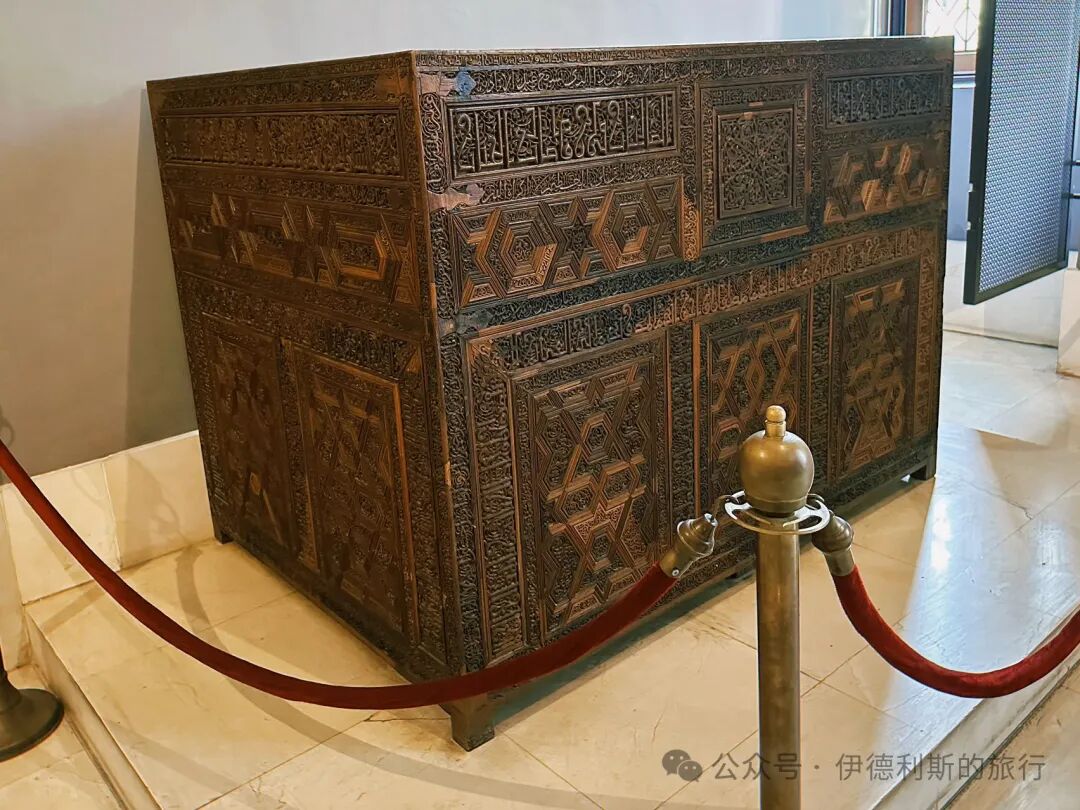
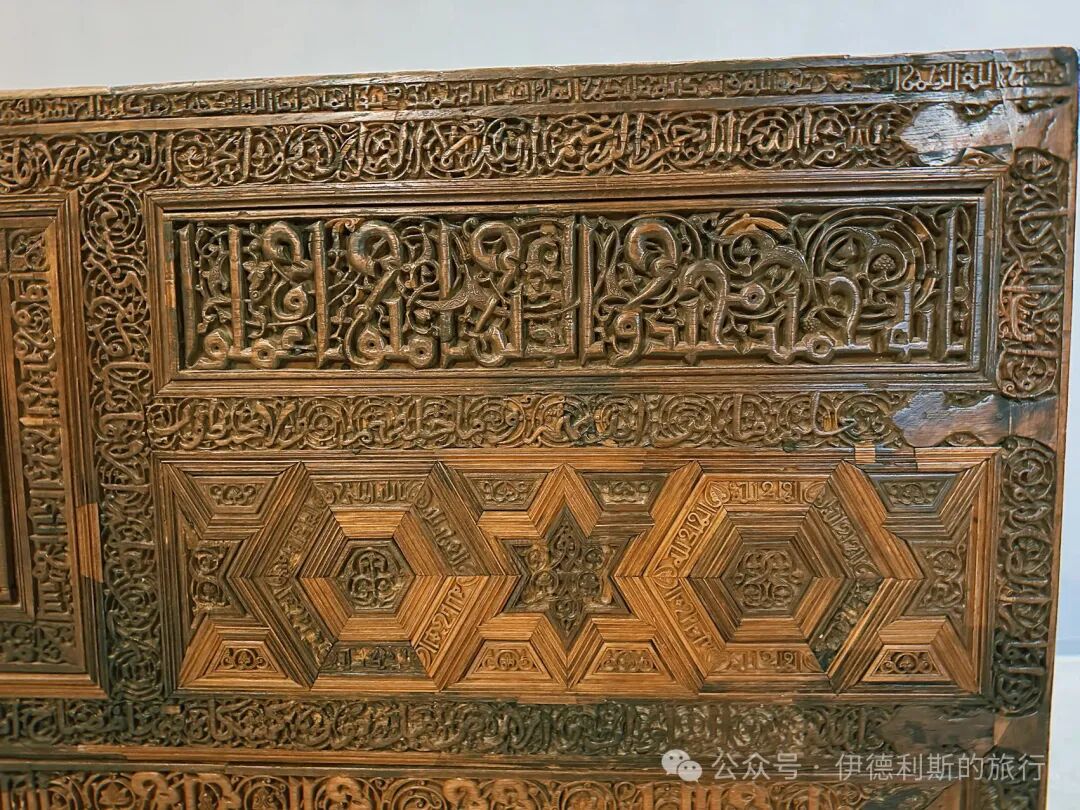
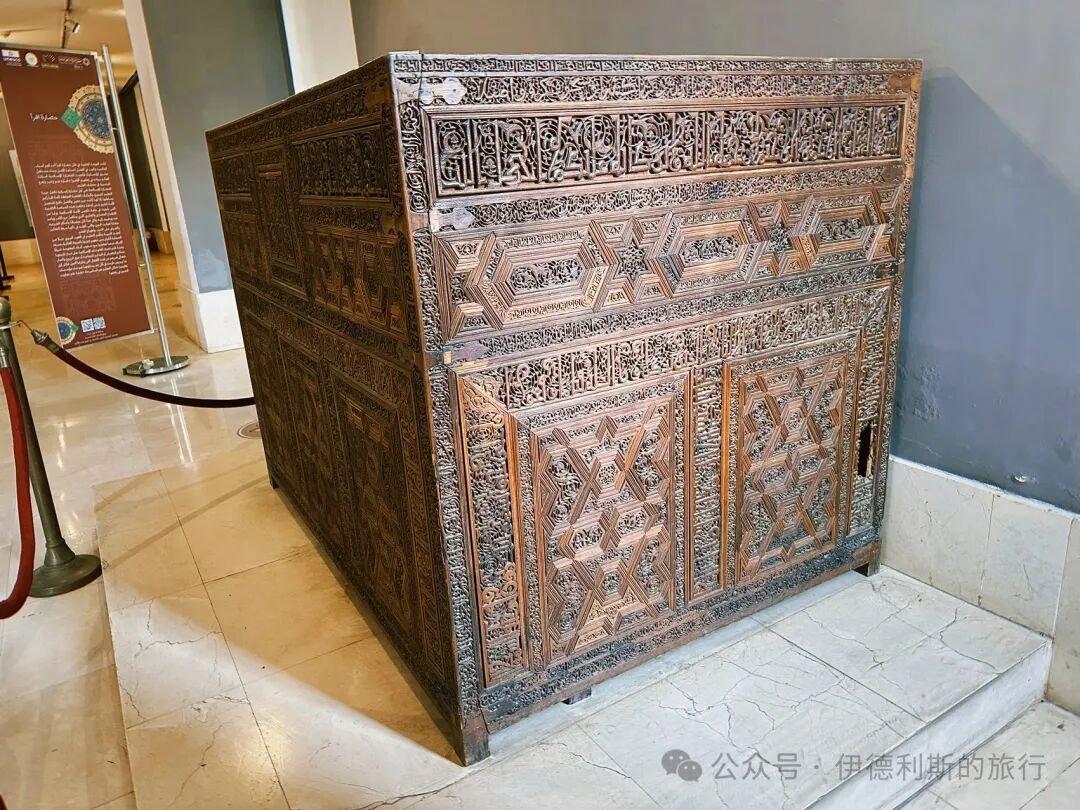
A 13th-century wooden carving from the Ayyubid dynasty in Egypt.
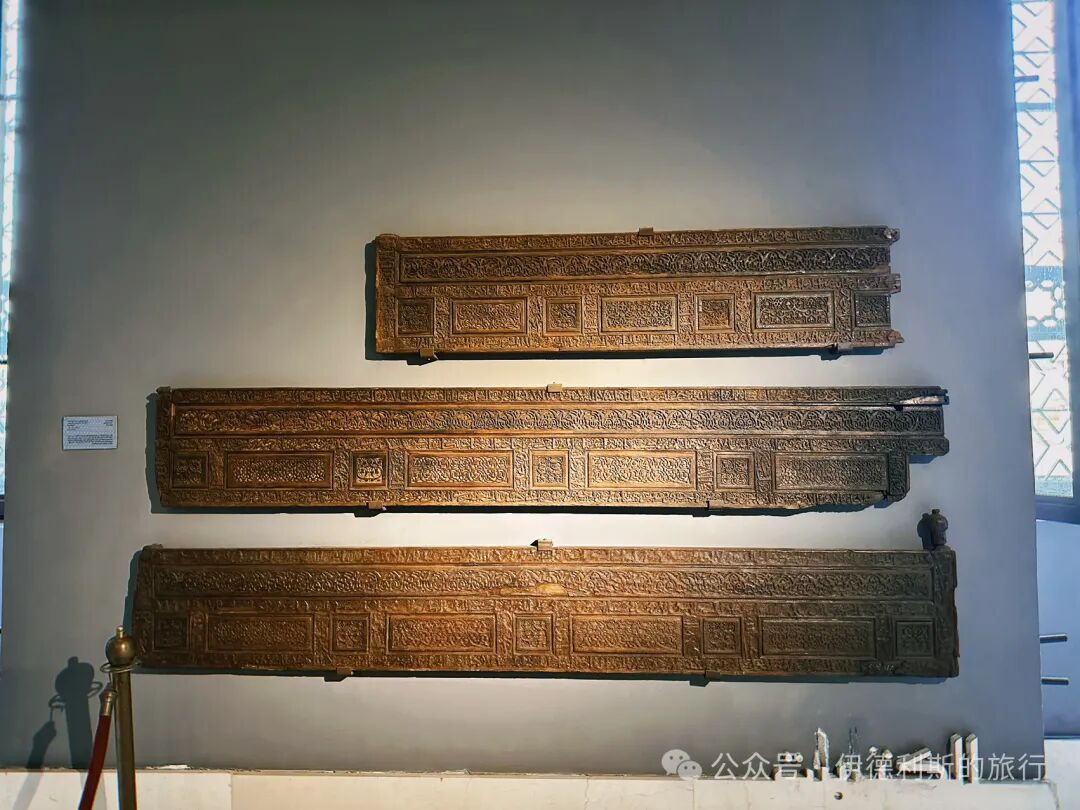
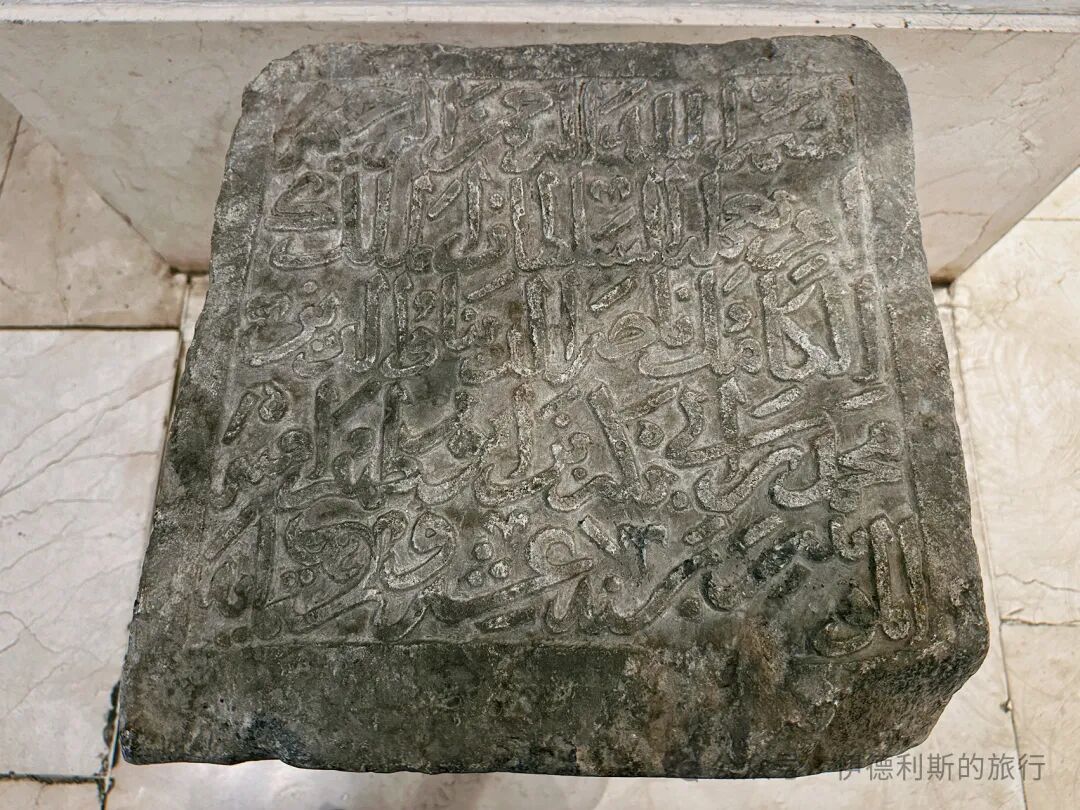
A 1213 marble slab from the Ayyubid dynasty in Egypt inscribed with the name of Sultan Al-Kamil. Al-Kamil was the fifth sultan of the Ayyubid dynasty. During his reign, he defeated the Fifth Crusade, but he handed Jerusalem over to the Crusaders for ten years during the Sixth Crusade.
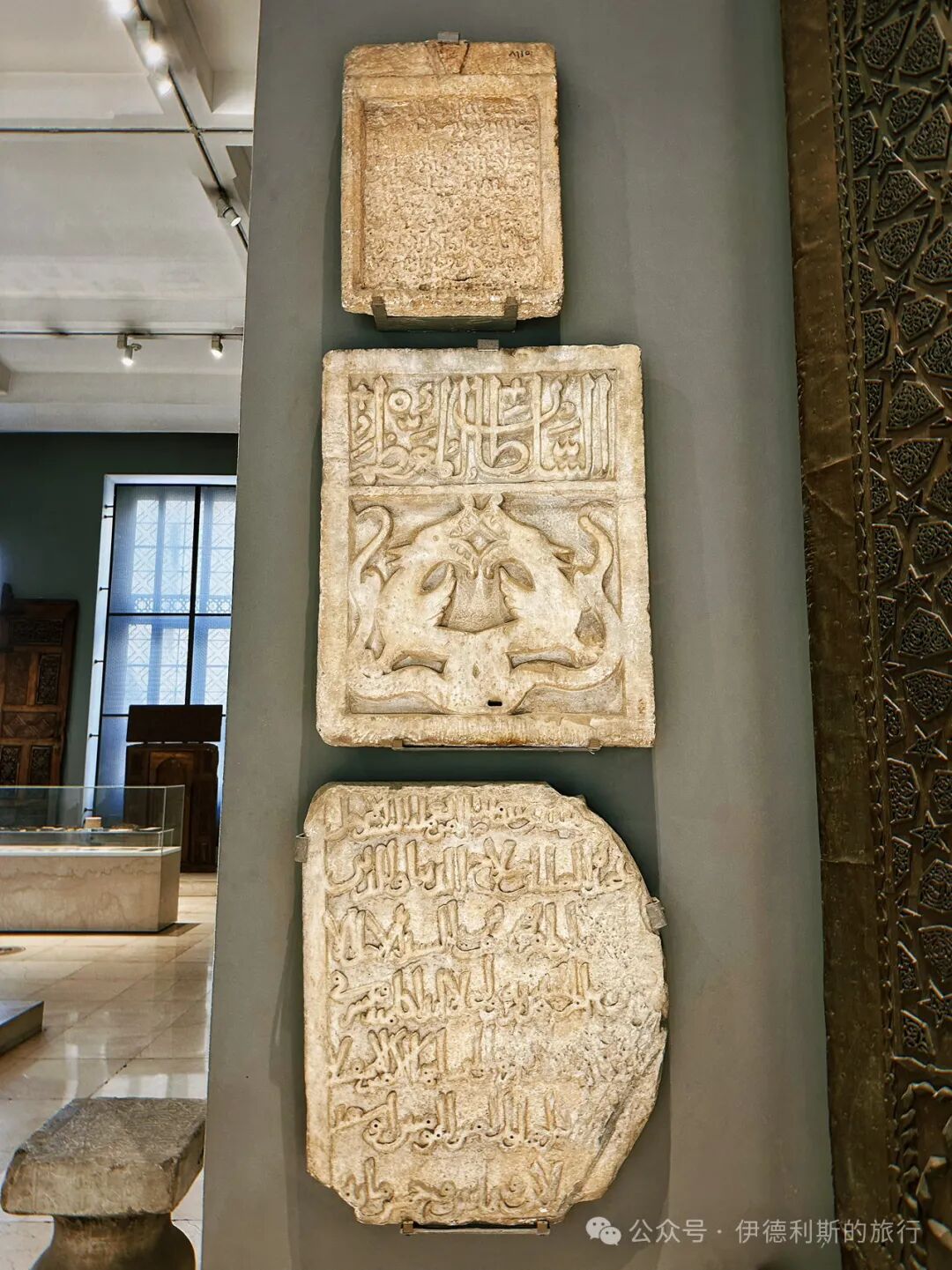
Marble slabs from the Ayyubid dynasty in Egypt dated 1184 and 1187, inscribed with the name of Sultan Saladin. Saladin was the founder of the Ayyubid dynasty. During the Third Crusade, he launched a series of military campaigns against the Crusaders in the Levant and recaptured Jerusalem, restoring Muslim rule in the region.
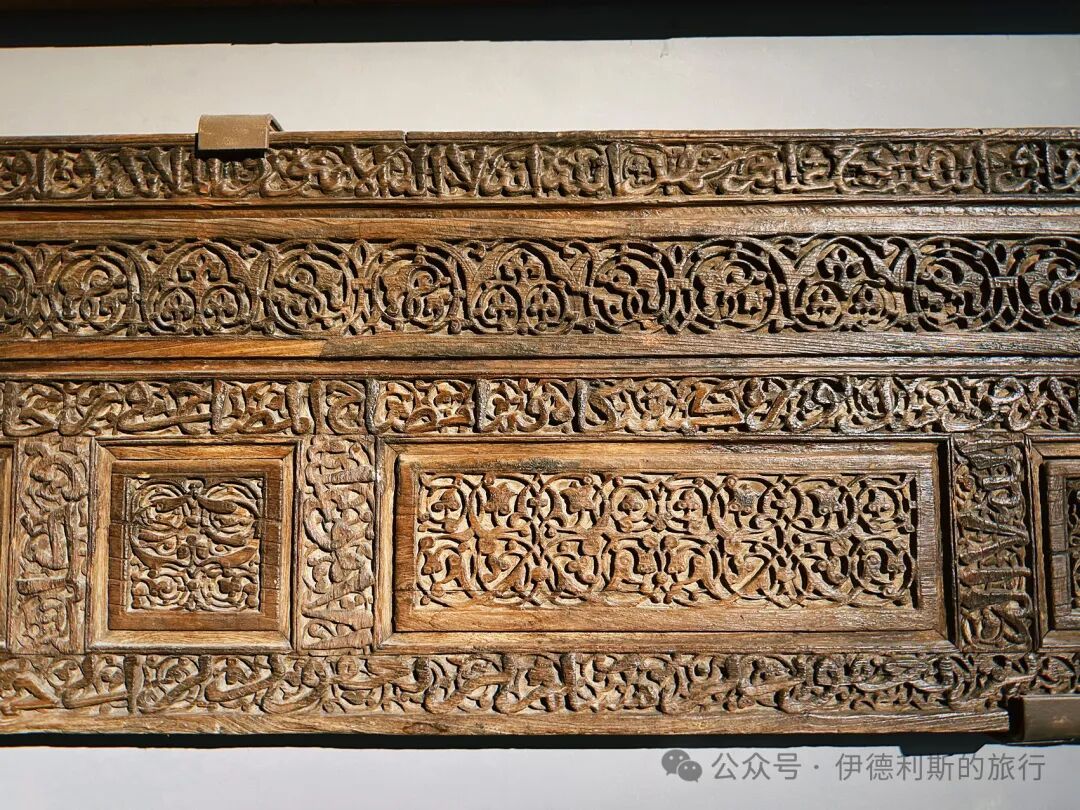
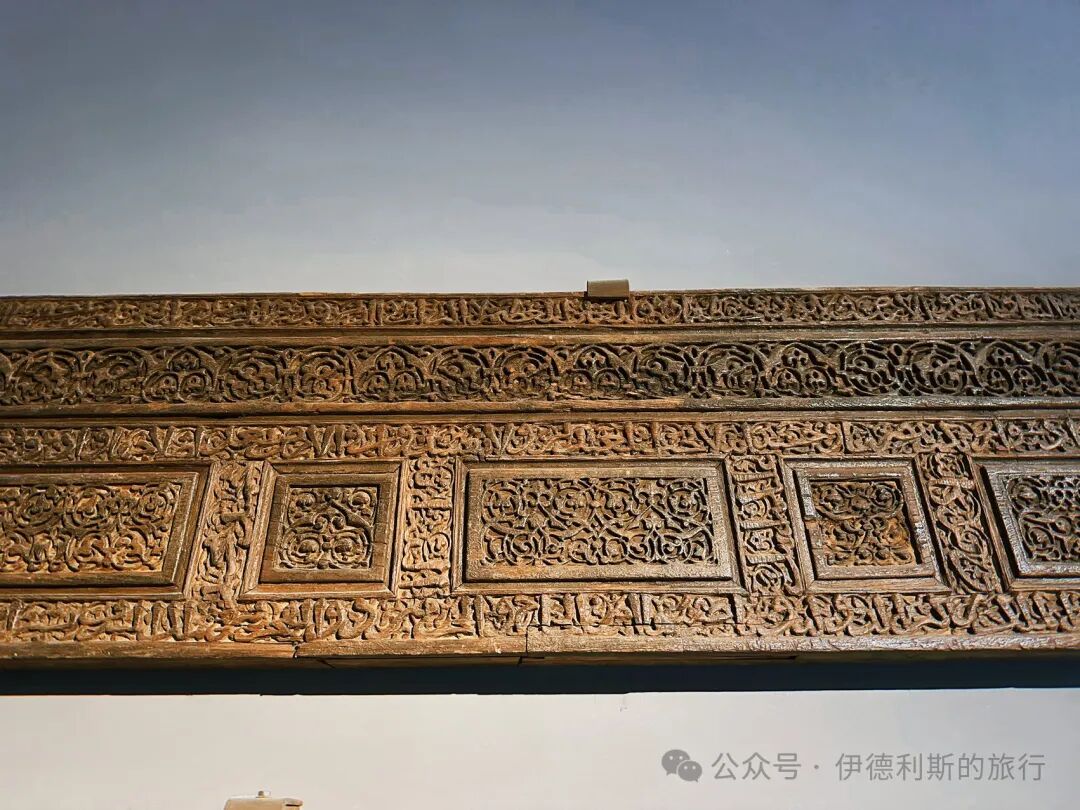
Wooden panels and doors made in 1178 during the Ayyubid period, found in the mausoleum of Imam Shafi'i in Cairo. Imam Shafi'i was the founder of the Shafi'i school of law and one of the four great imams of Sunni Islam. Imam Shafi'i arrived in Cairo in 813 and passed away there in 819. Sultan Saladin built his mausoleum in 1178, which features exquisite wood carvings inside. These include complex geometric patterns, scripture, and an introduction to the life of Imam al-Shafi'i.
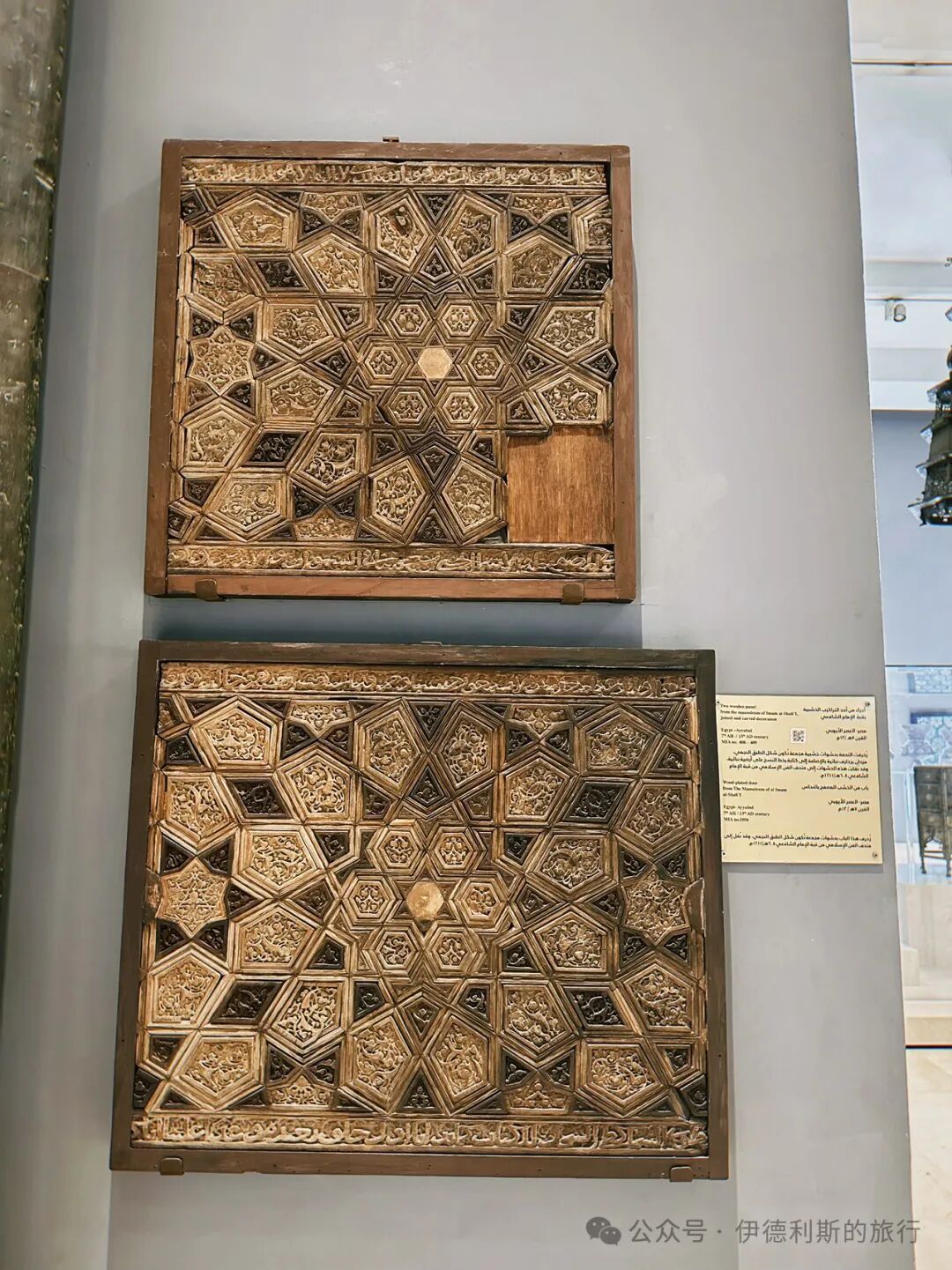
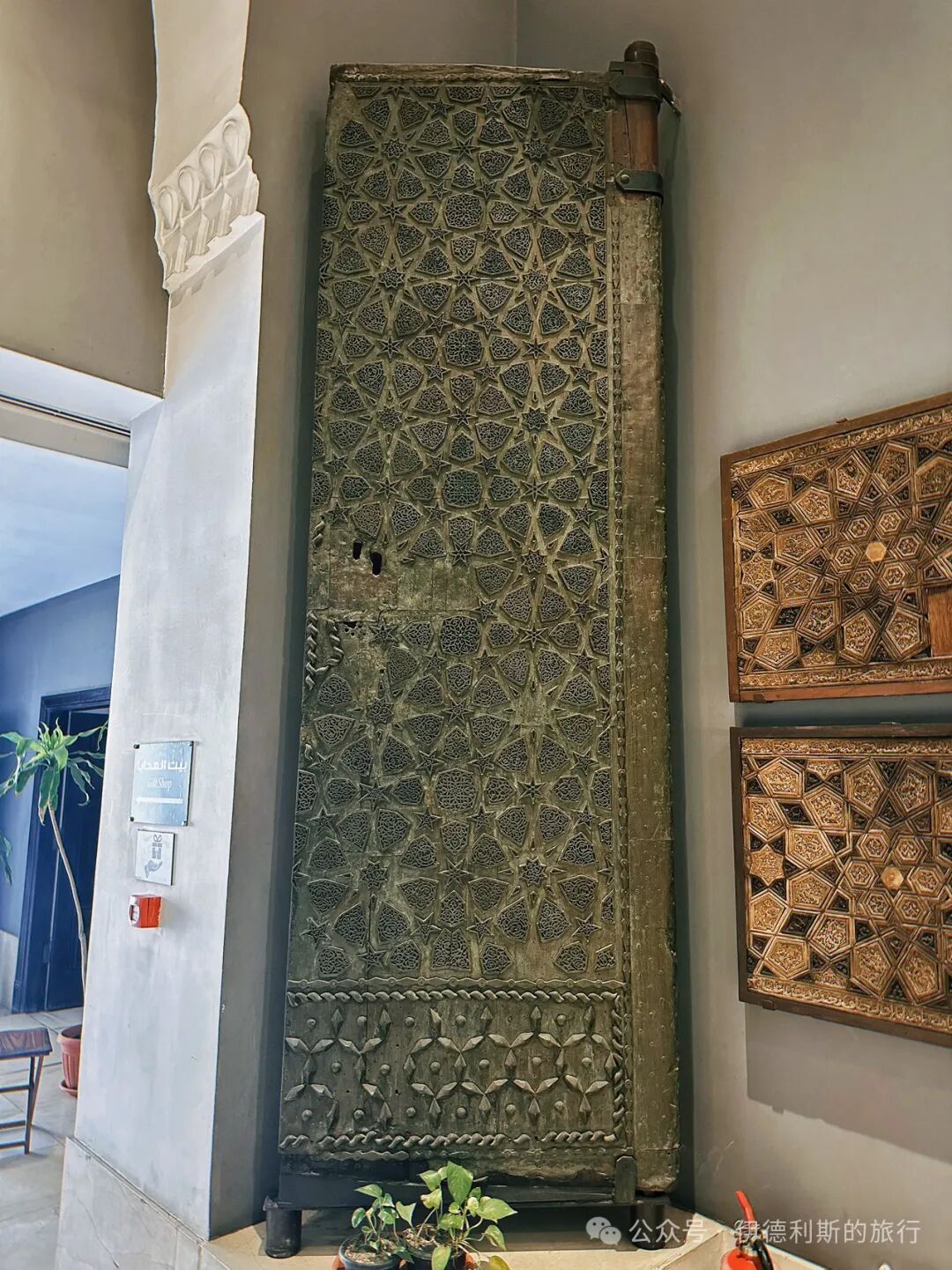
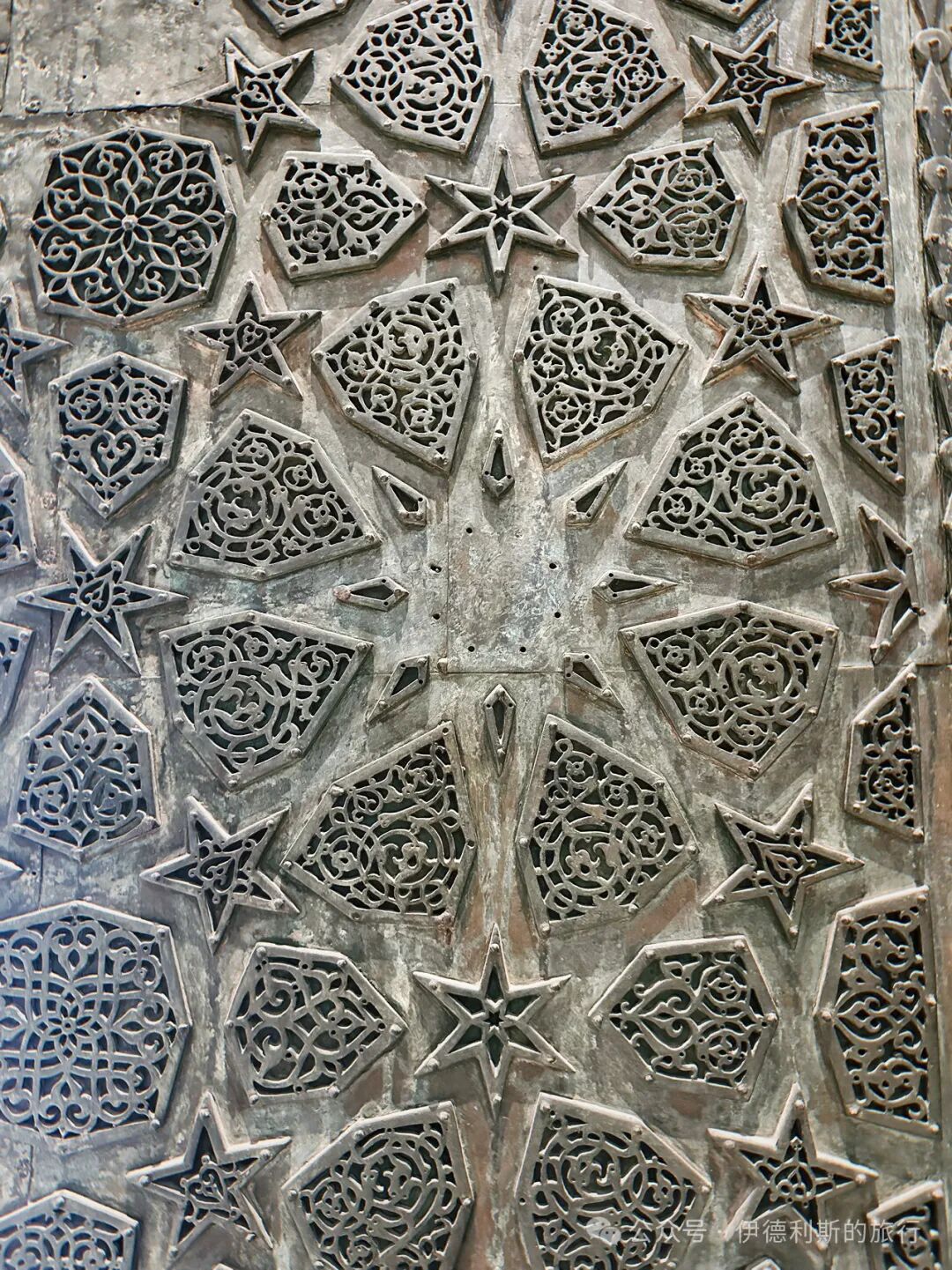
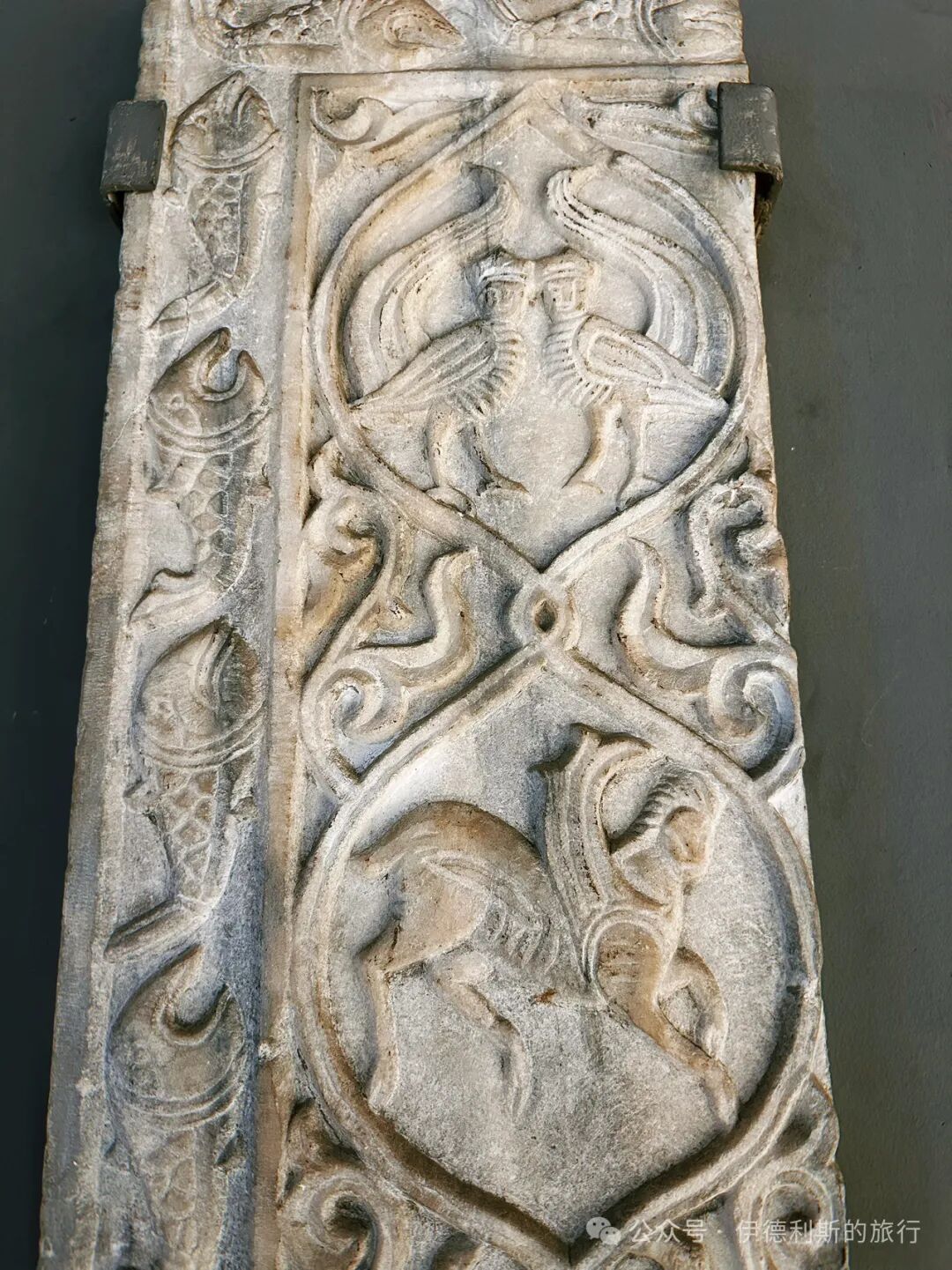
A marble slab from the 12th-century Ayyubid dynasty in Egypt, featuring carvings of griffins and creatures with human heads and bird bodies.
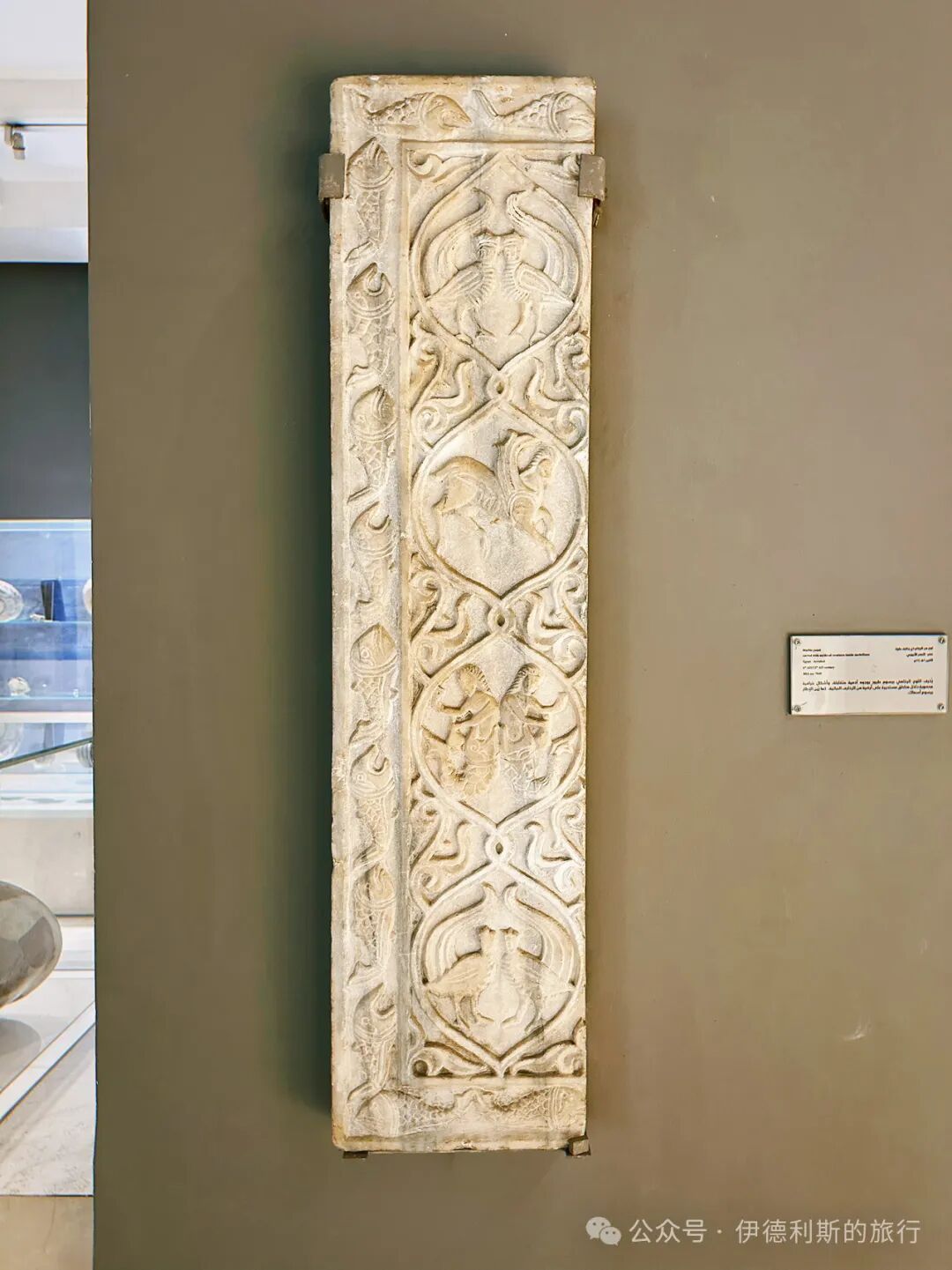
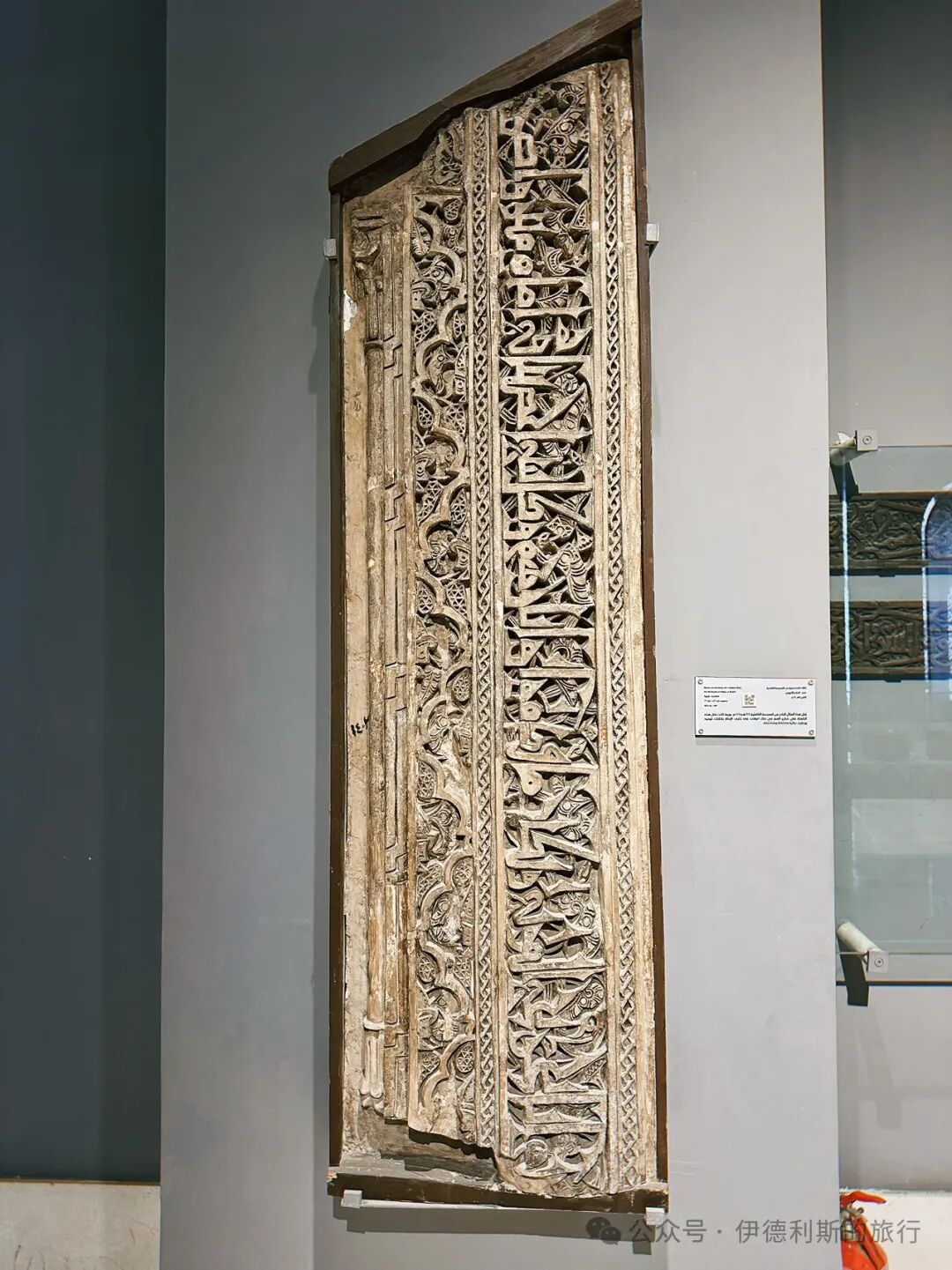
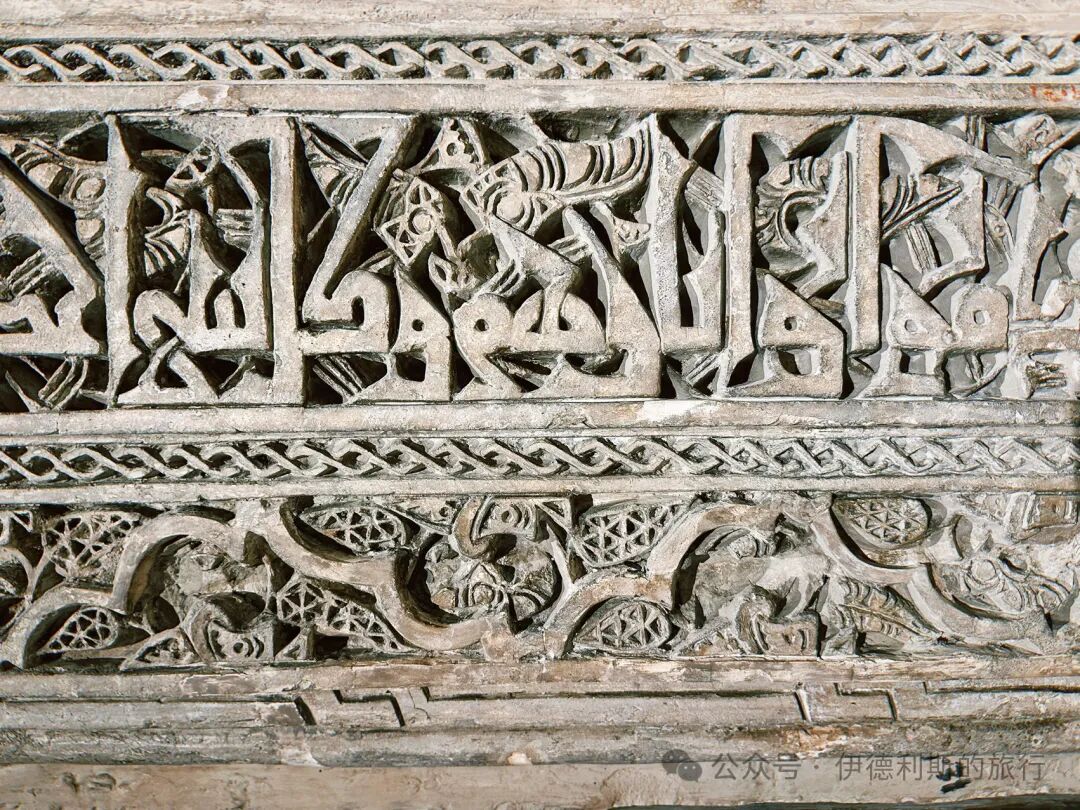
Stucco carvings from the 13th-century Ayyubid dynasty at the Al-Kamil Madrasa in Cairo. The Al-Kamil Madrasa was built in 1225 by the Ayyubid Sultan al-Kamil in the northern part of the former Fatimid Western Palace in Old Cairo, and it was one of Egypt's educational centers during the 13th and 14th centuries.
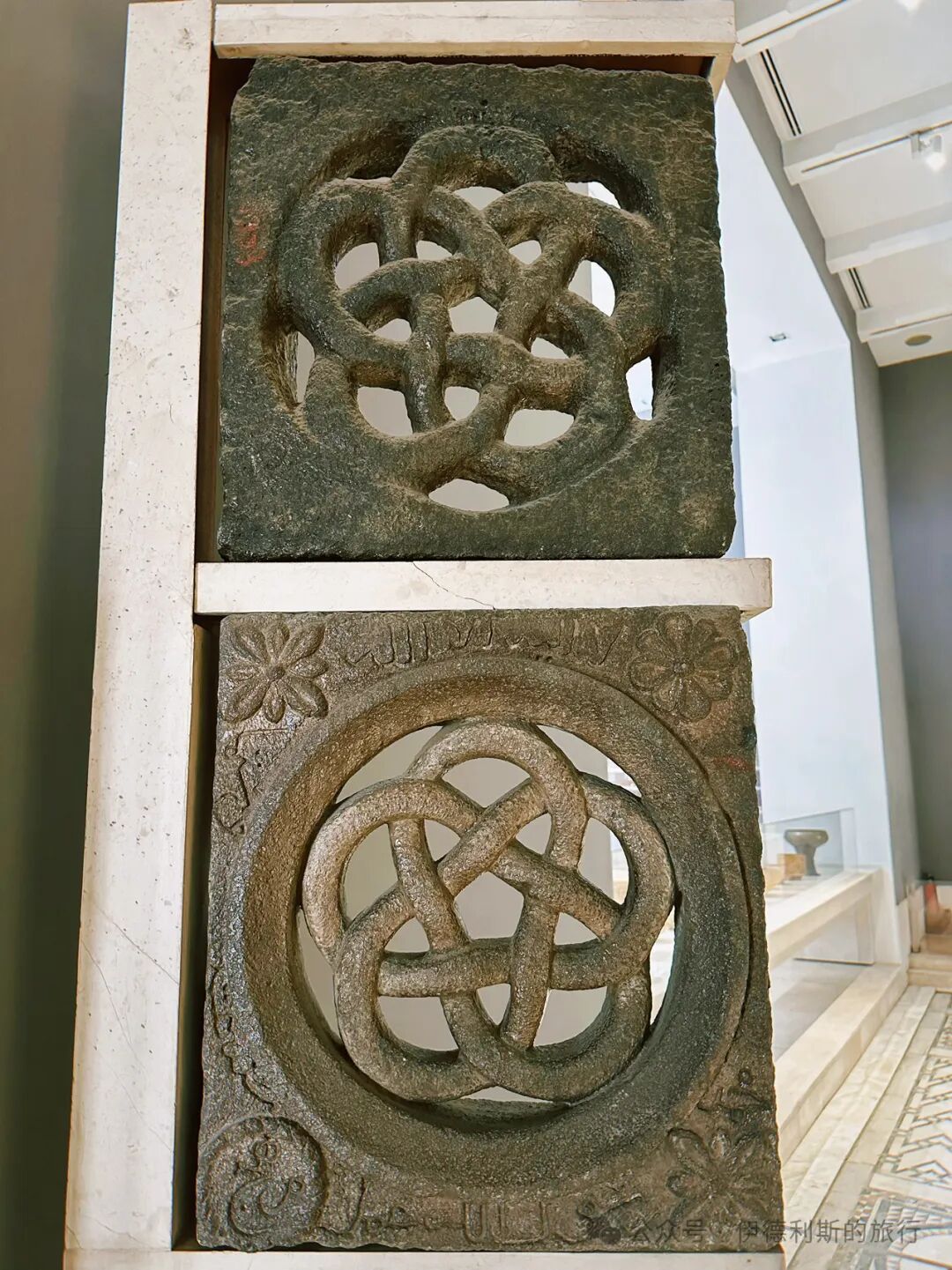
A flint window from the 13th-century Ayyubid dynasty at the Sayf ibn Yazan tomb in Cairo.
Mamluk Dynasty.
A marble slab from the 14th-century Mamluk period at the Sarghatmish Madrasa in Cairo. The Sarghatmish Madrasa was built in 1356 by order of the Mamluk Emir General Sirghitmish. In the 1350s, Sirghitmish was the most powerful emir of the Mamluk dynasty.
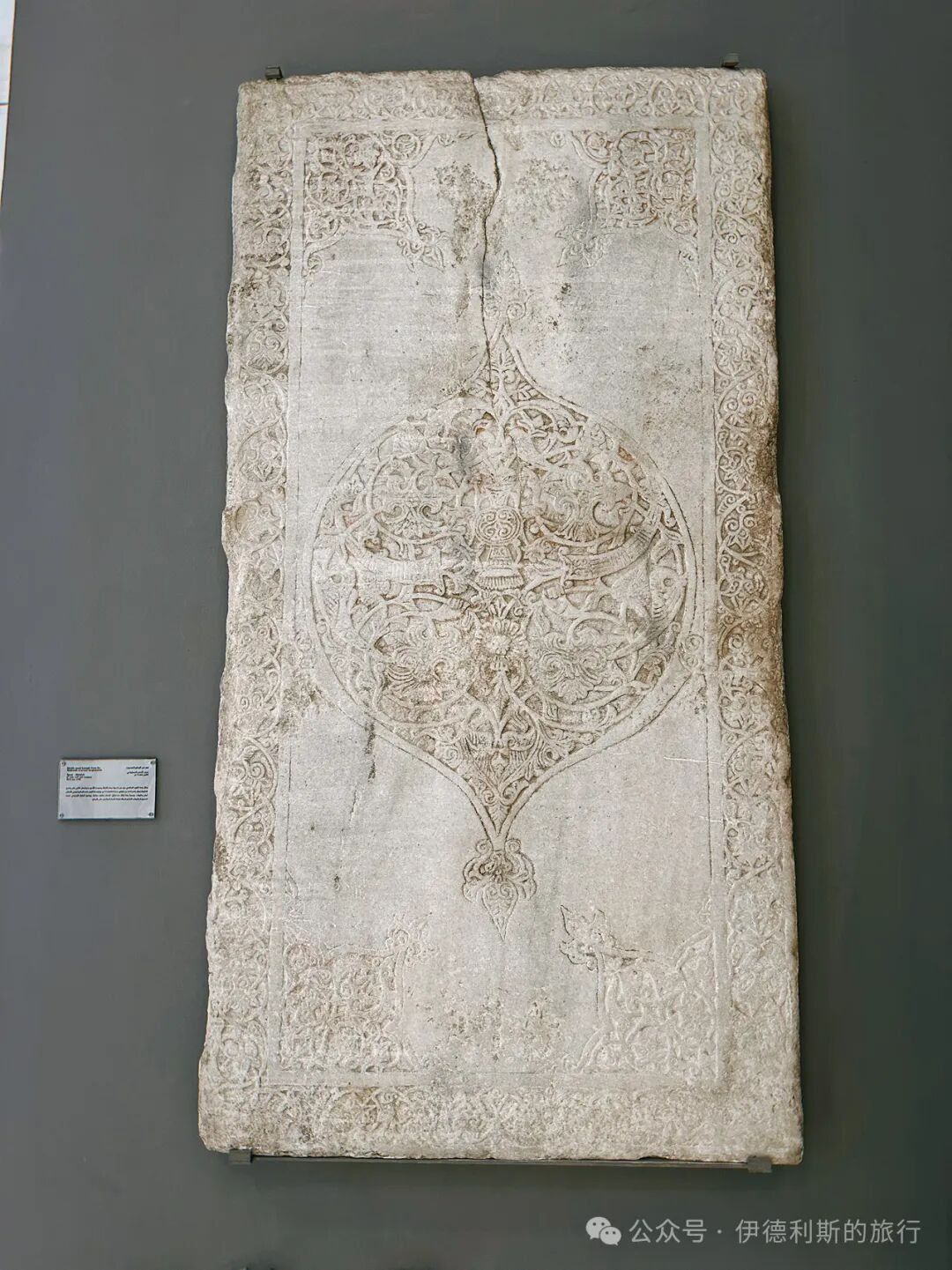
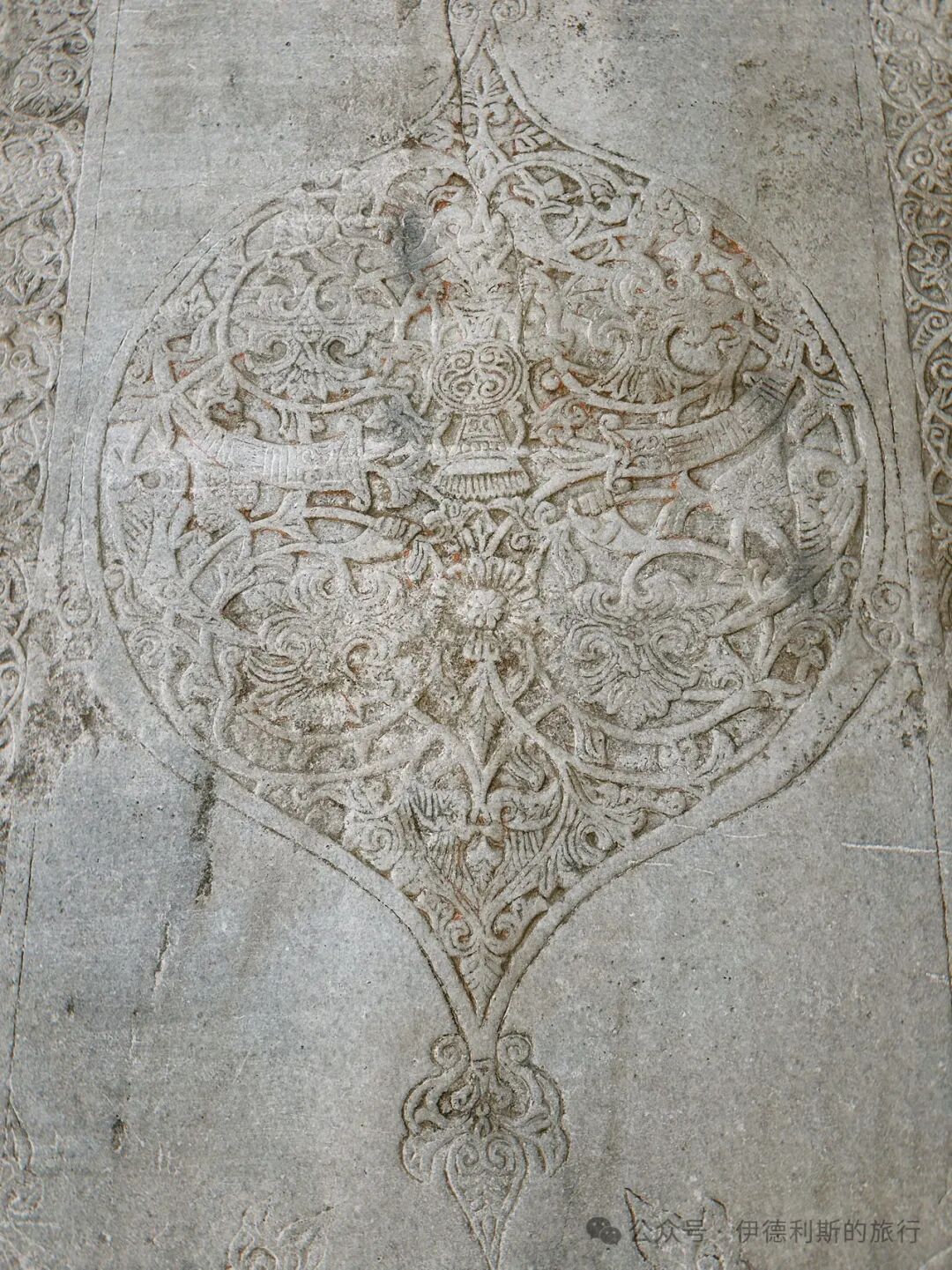
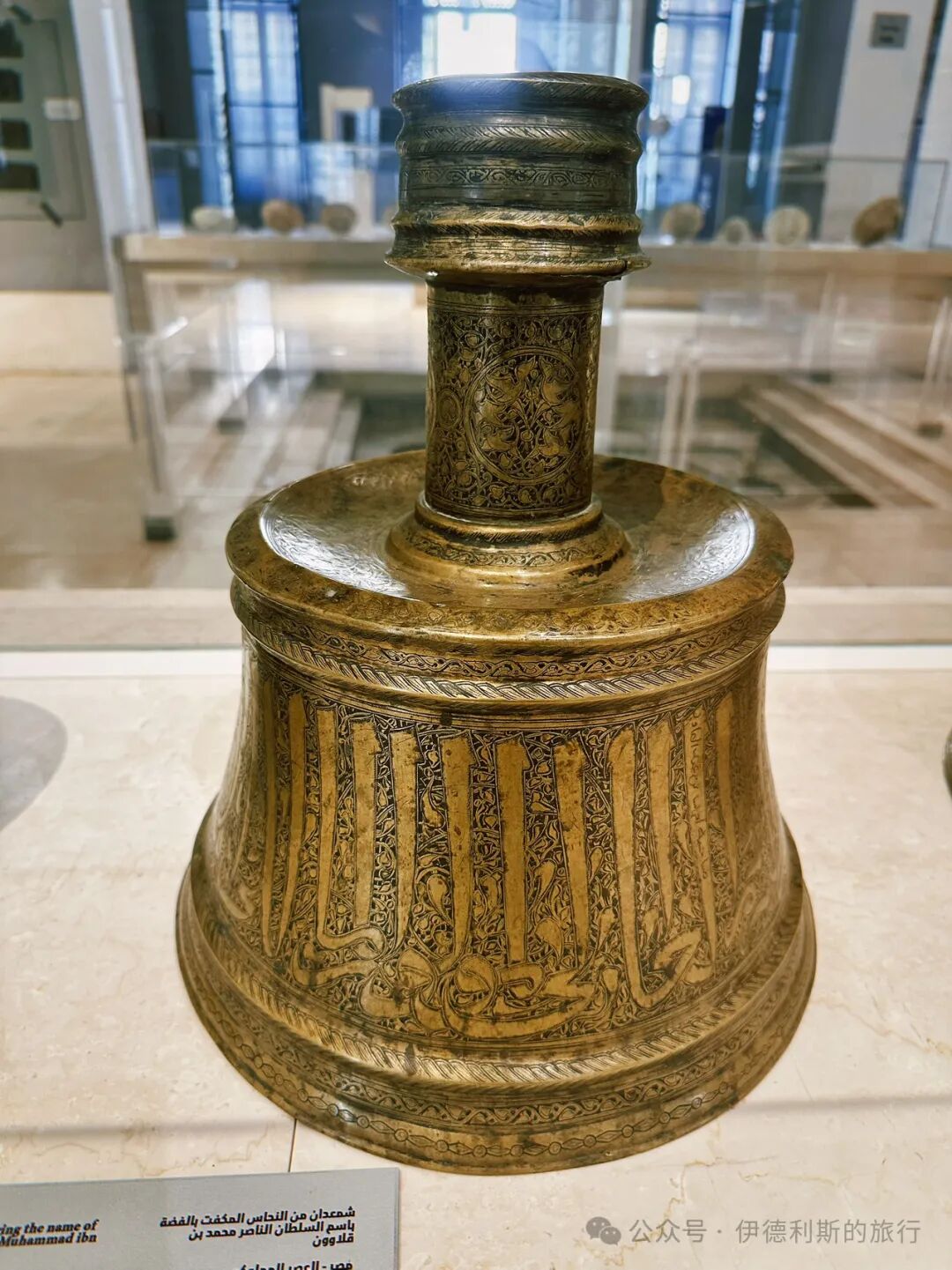
A copper candlestick inscribed with the name of the Mamluk Sultan al-Nasir Muhammad, who reigned from 1299 to 1309.
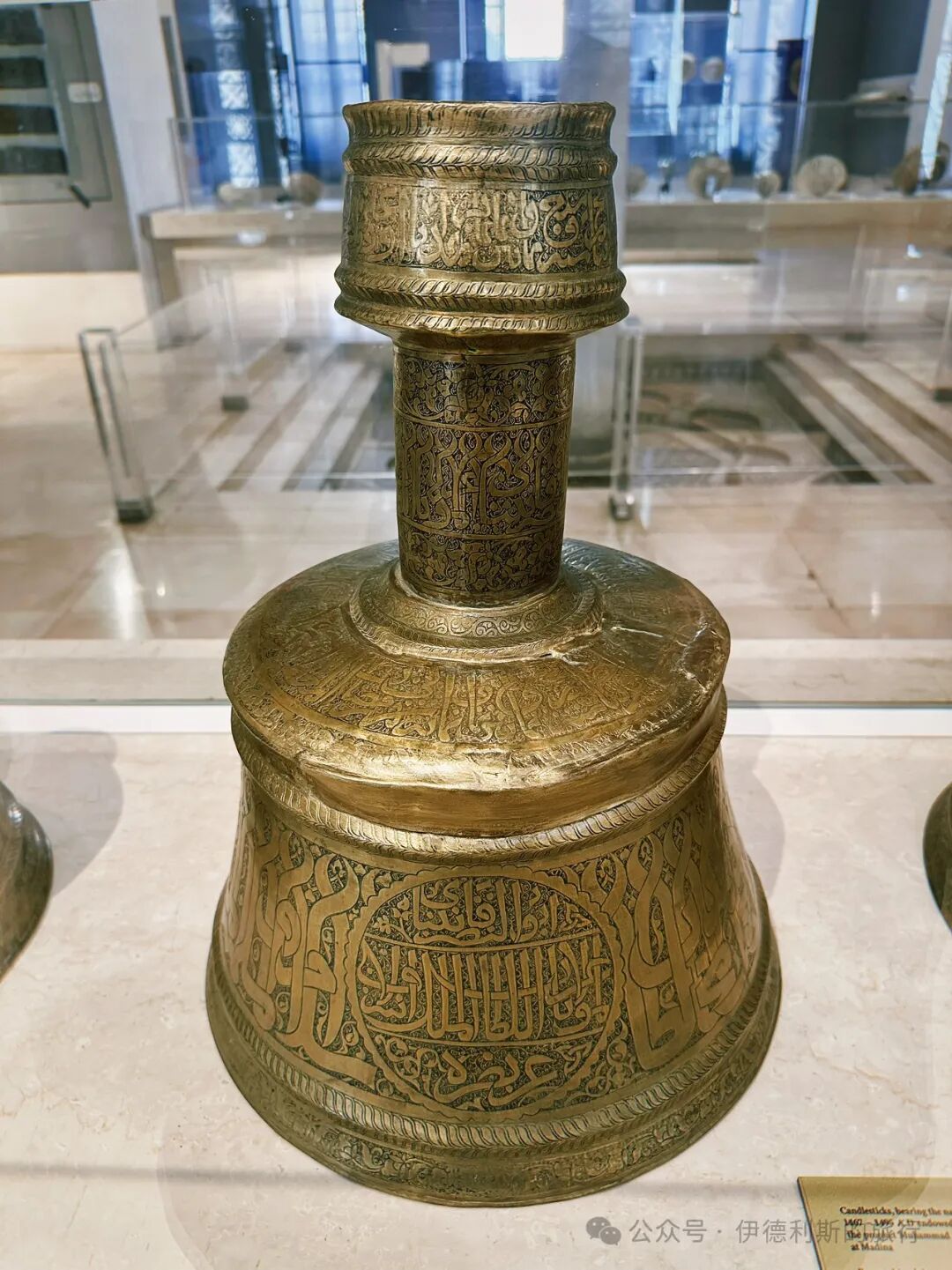
A copper candlestick inscribed with the name of the Mamluk Sultan Qaitbay, who reigned from 1468 to 1496, donated by the Sultan to the Prophet's Mosque in Medina. Although Sultan Qaitbay built many structures in Cairo, his greatest achievement was the restoration of the Prophet's Mosque in Medina. After a fire at the Prophet's Mosque in 1481, Sultan Qaitbay rebuilt the tomb of the Prophet from a wooden structure into a brick one, added metal railings, and donated many chandeliers and candlesticks to the mosque.
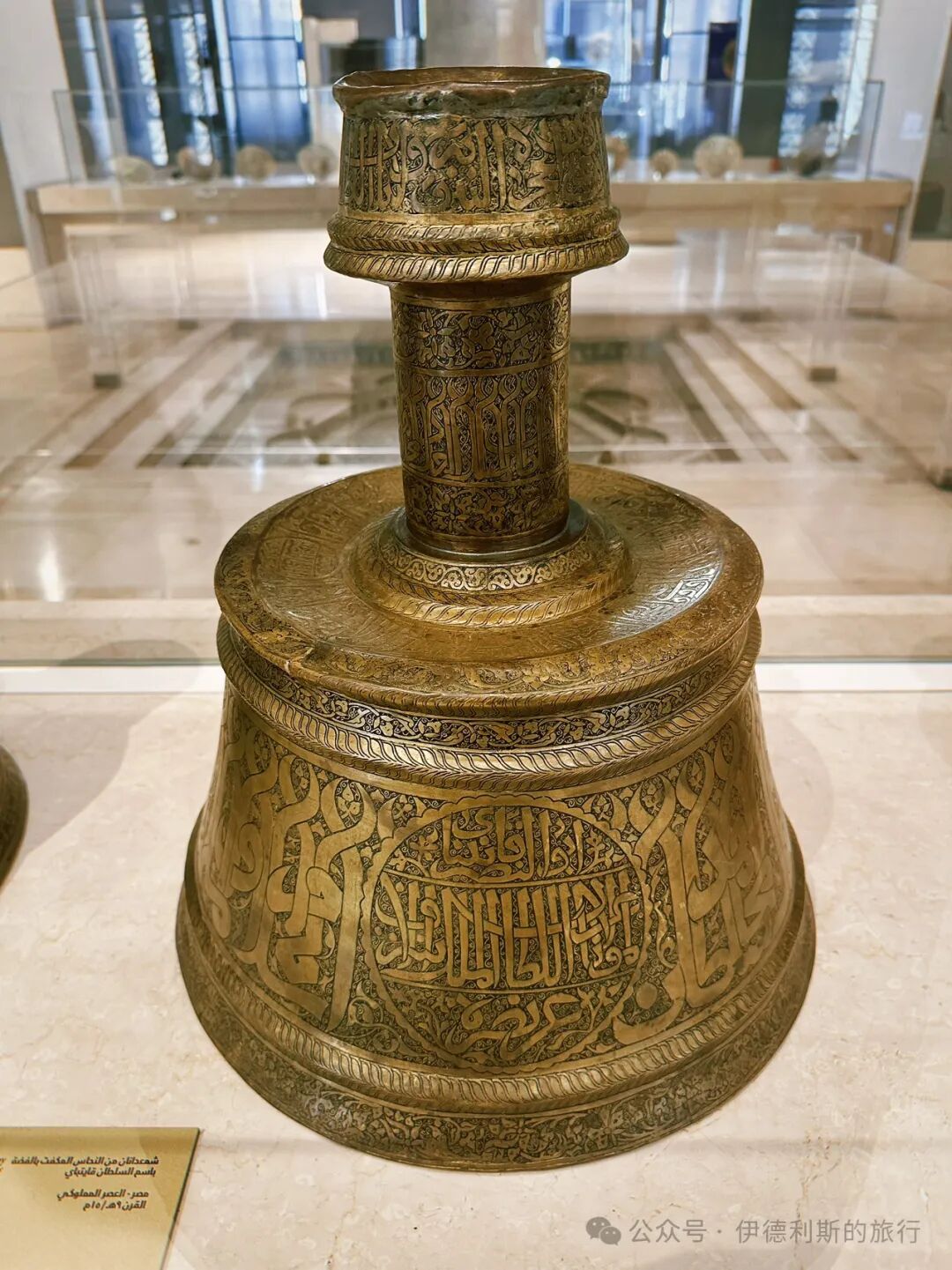
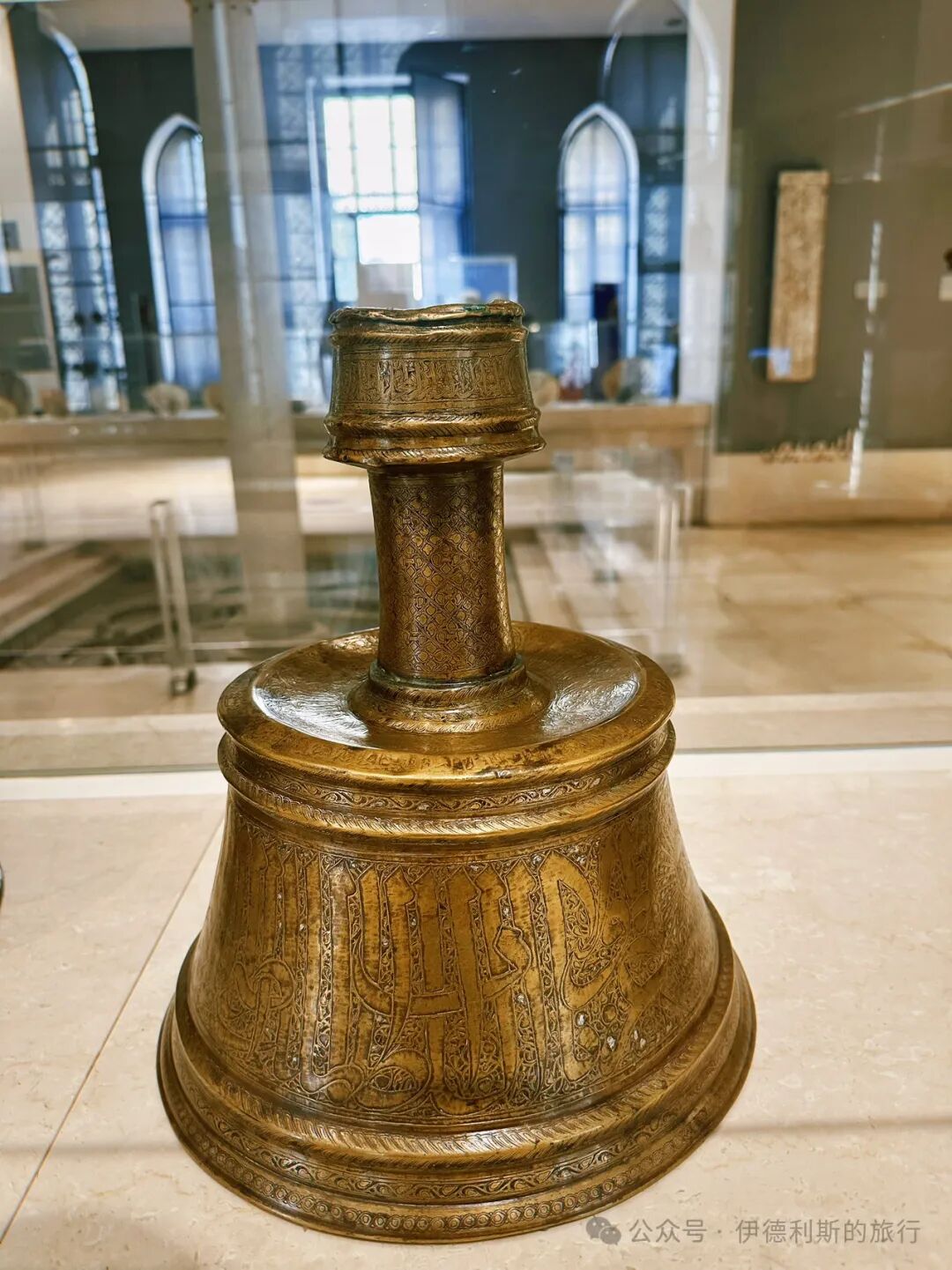
A copper candlestick inlaid with silver from the 14th to 15th-century Mamluk dynasty.
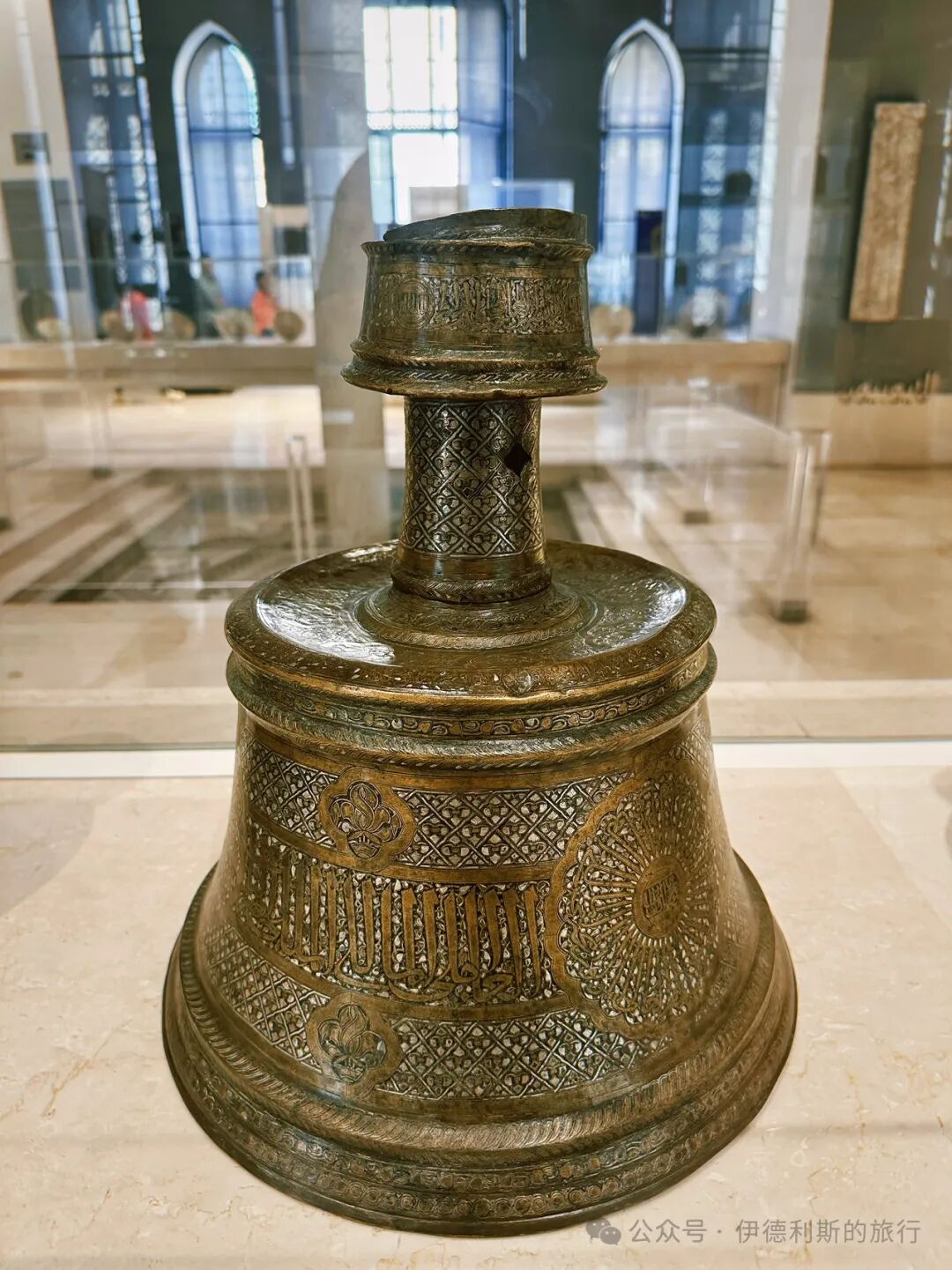
A copper candlestick inscribed with the name of the wife of the Mamluk Sultan Qaitbay.
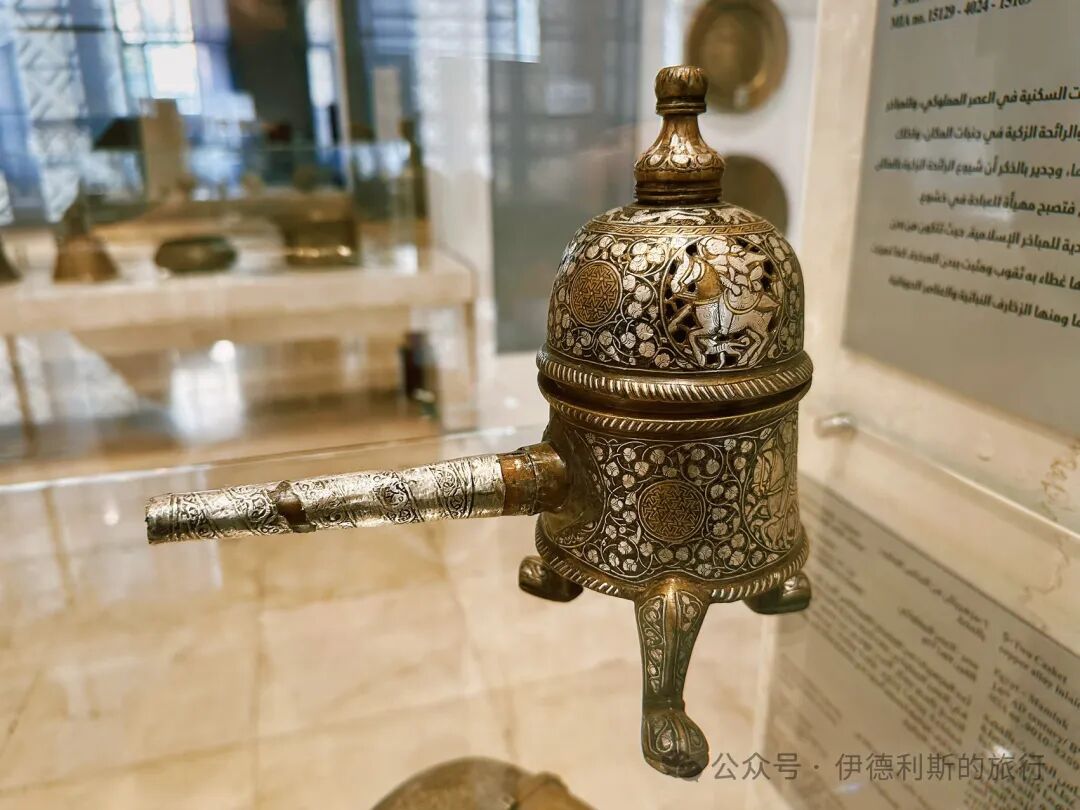
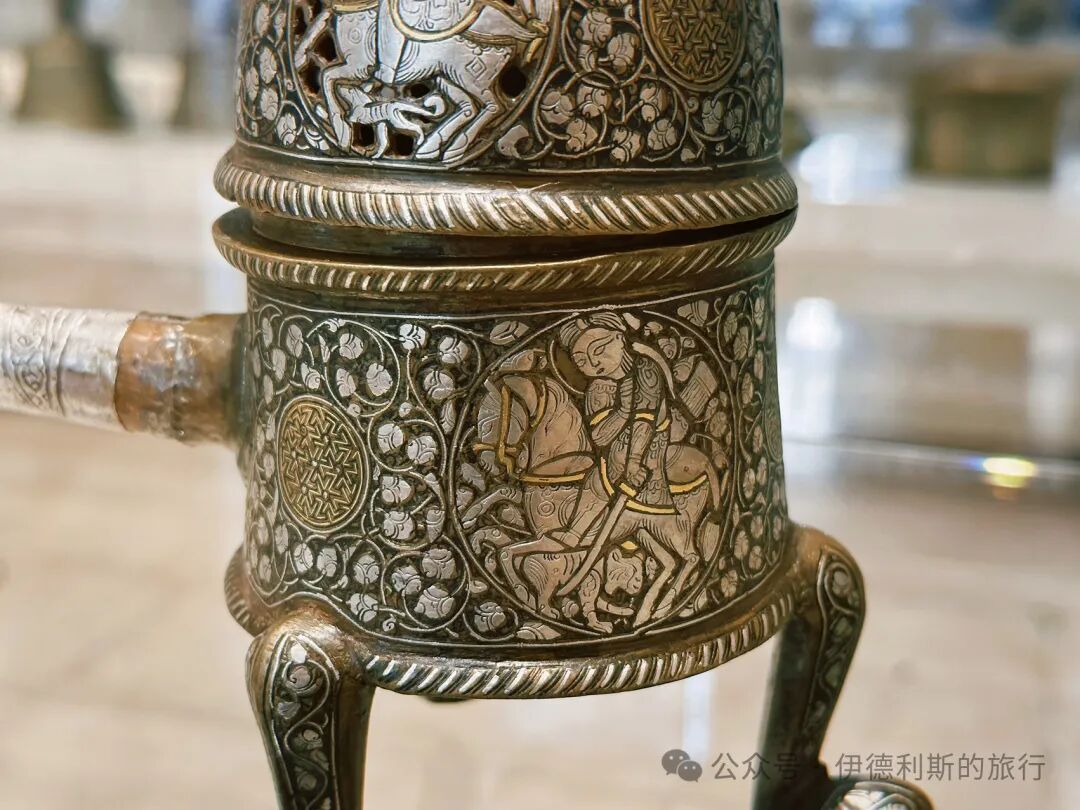
A copper incense burner inlaid with gold and silver from the 14th-century Mamluk dynasty.
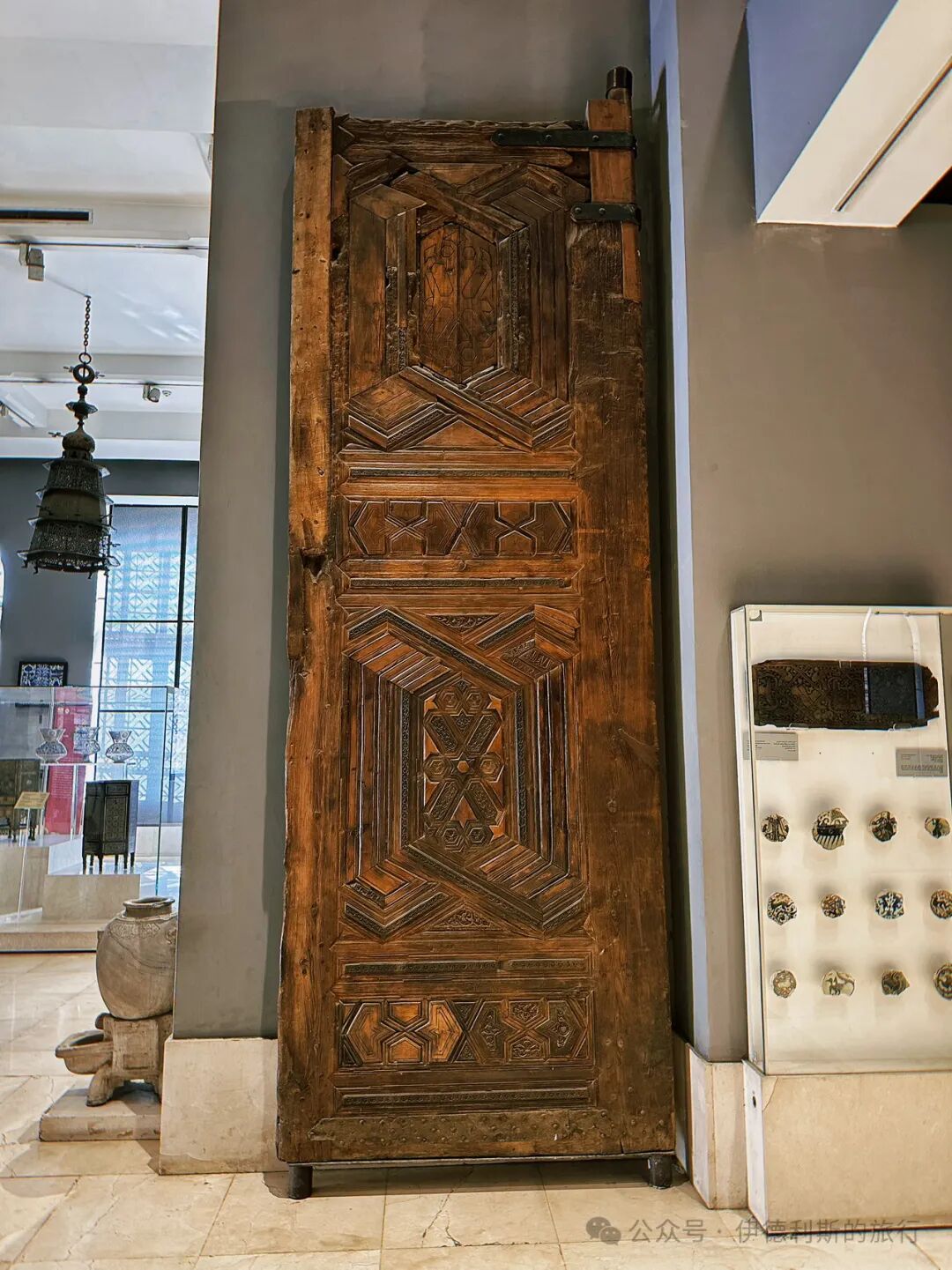
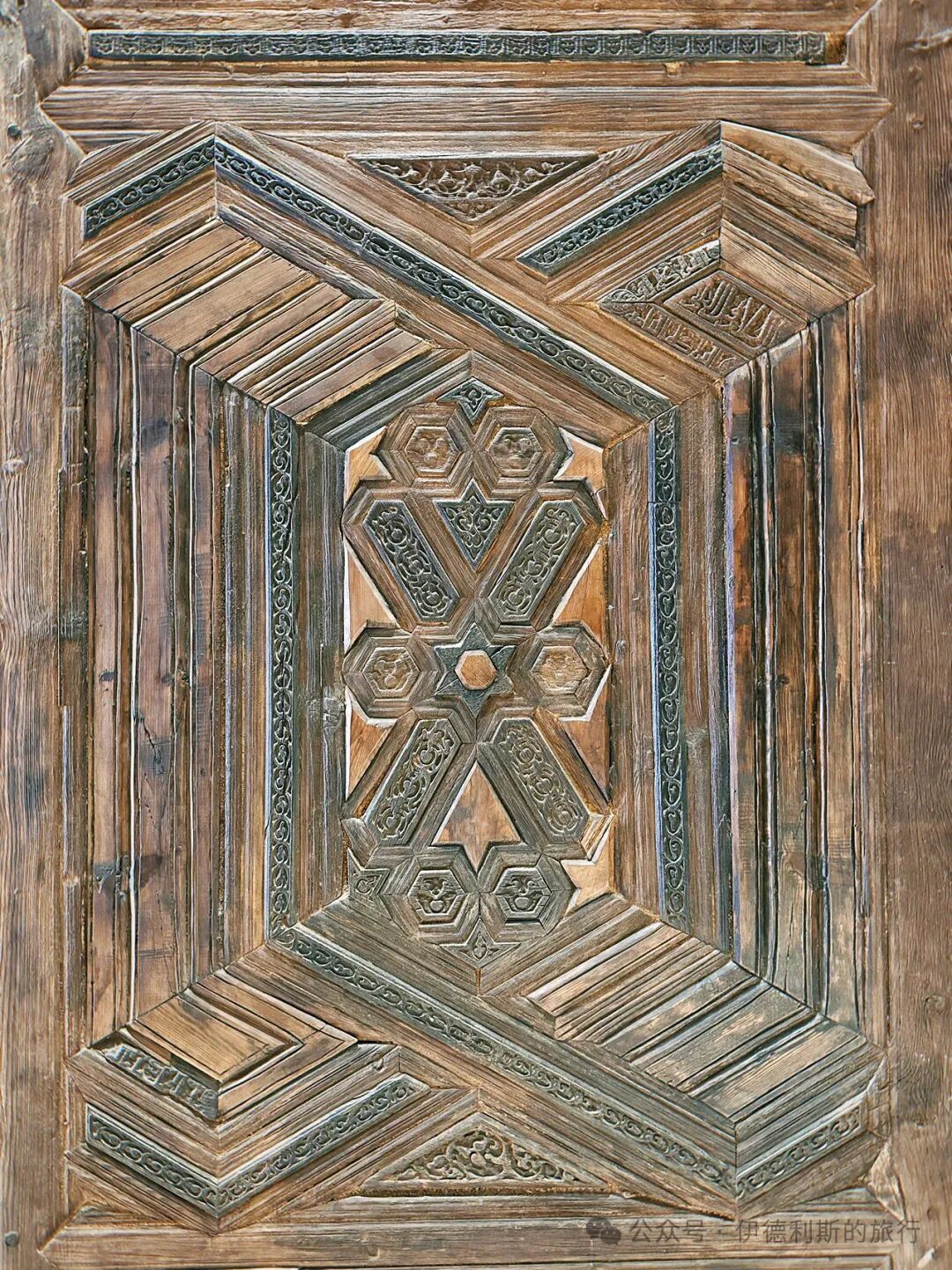
A wooden door from the 13th-century Mamluk period at the Salihiyya Madrasa in Cairo. The Ayyubid Sultan As-Salih Ayyub founded the Salihiyya Madrasa in 1242, and it was one of Egypt's most famous centers of education during the 13th and 14th centuries.
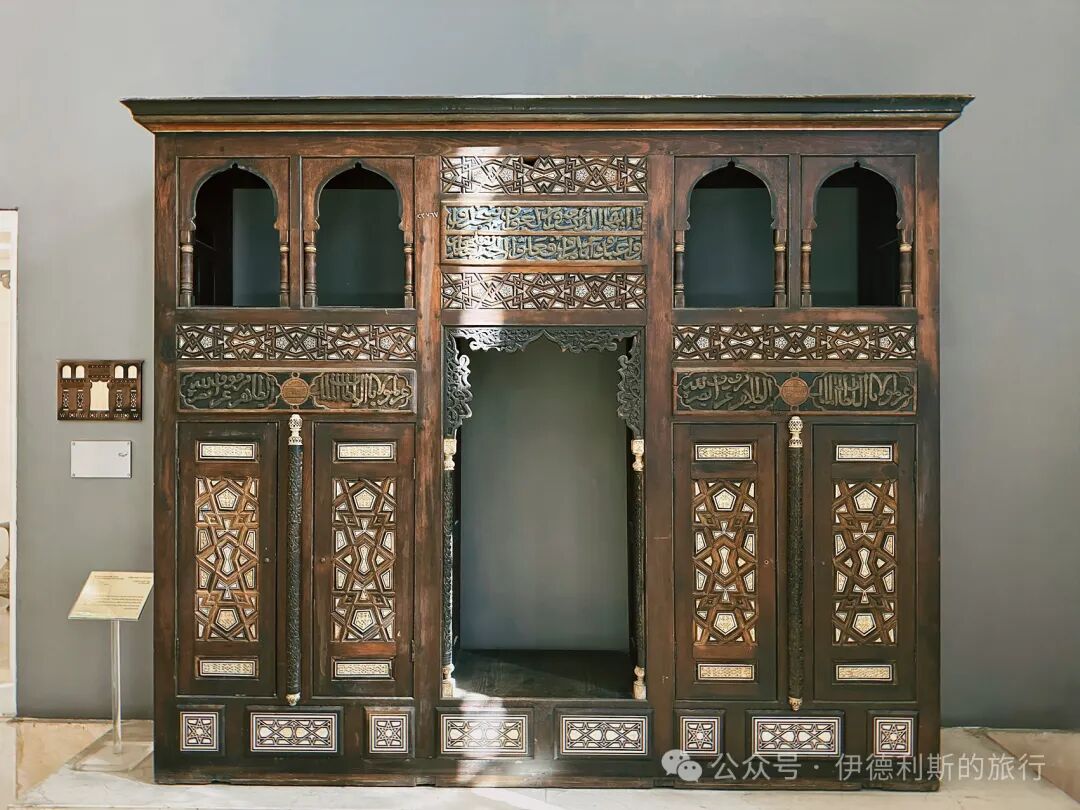
A 14th-century Mamluk-era wooden cabinet from Egypt, inlaid with painted ivory decorations.
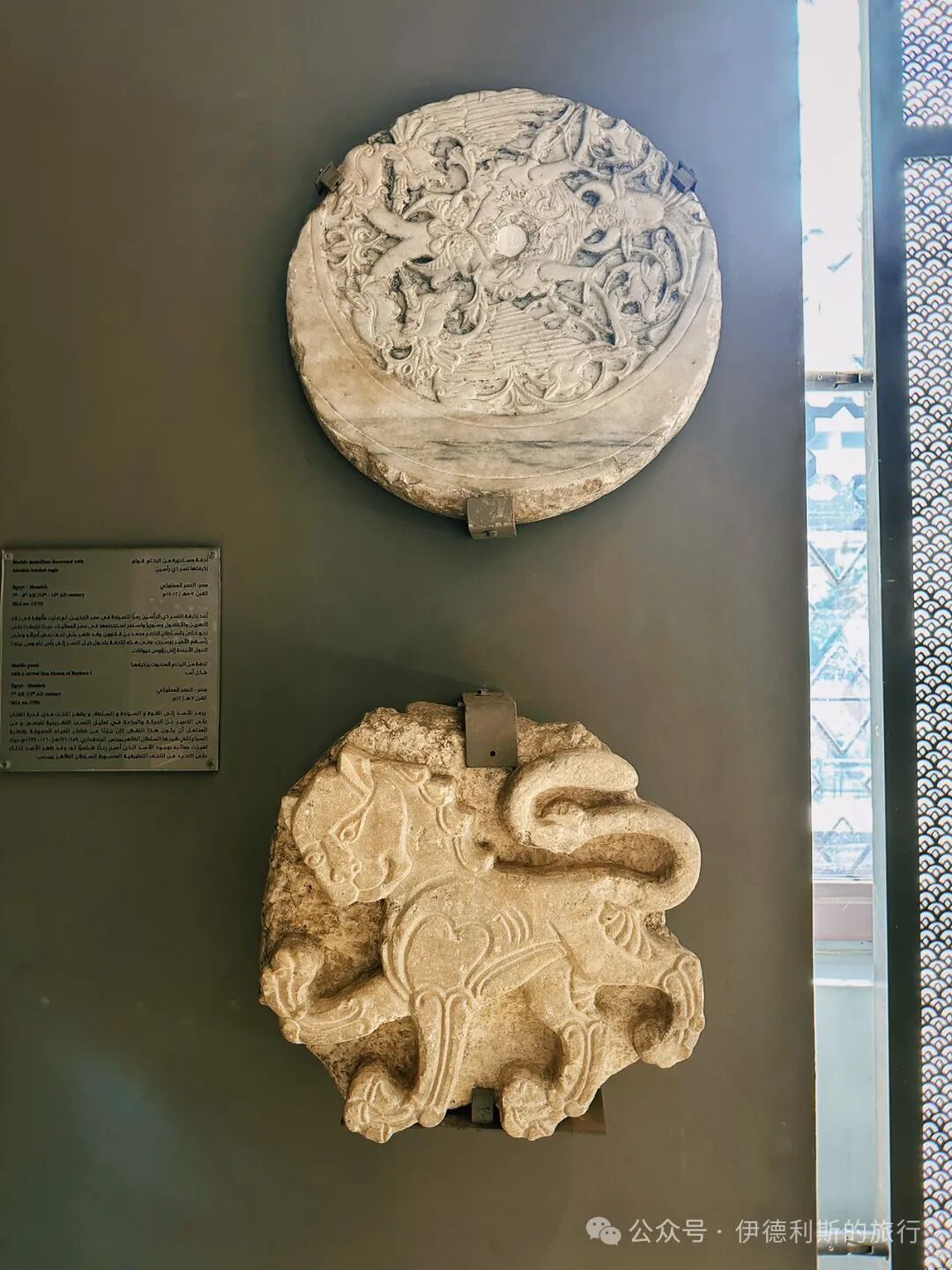
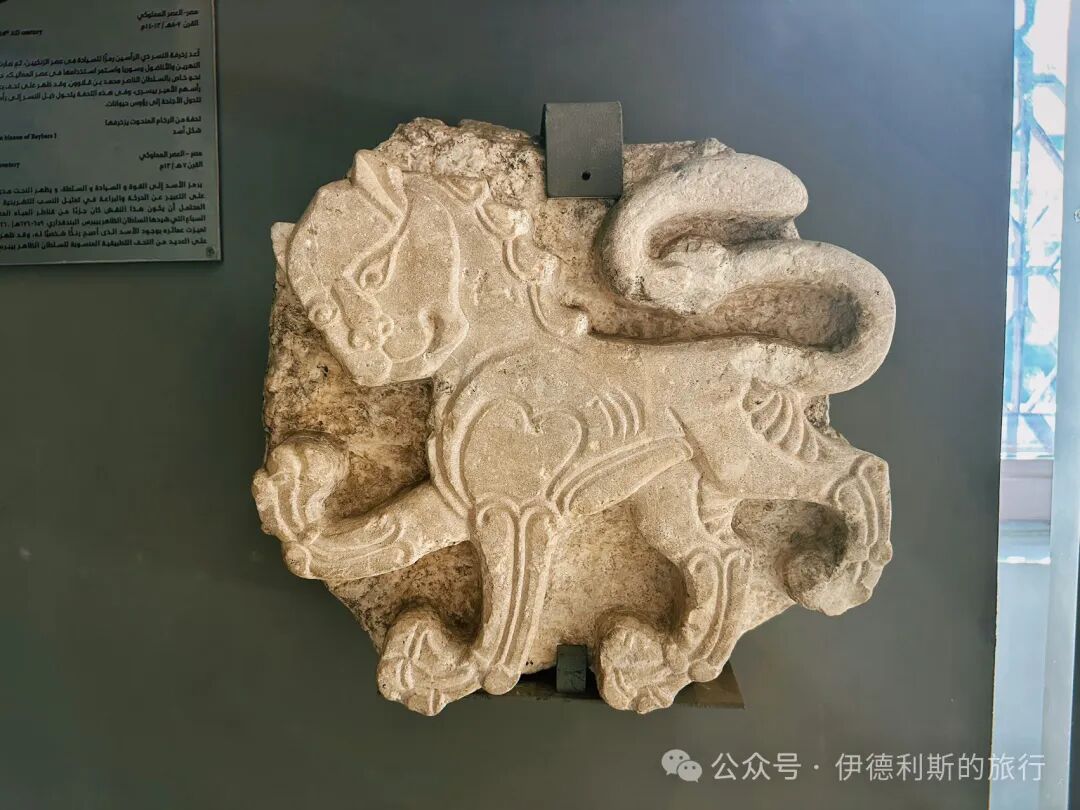
Above is a 13th-14th century Mamluk double-headed eagle marble carving from Egypt, and below is a 13th-century marble carving featuring the lion emblem of the Mamluk Sultan Baybars I (reigned 1260-1277). Baybars was the fourth sultan of the Mamluk dynasty and a tough military leader who defeated invasions by the Crusaders and the Mongol army.
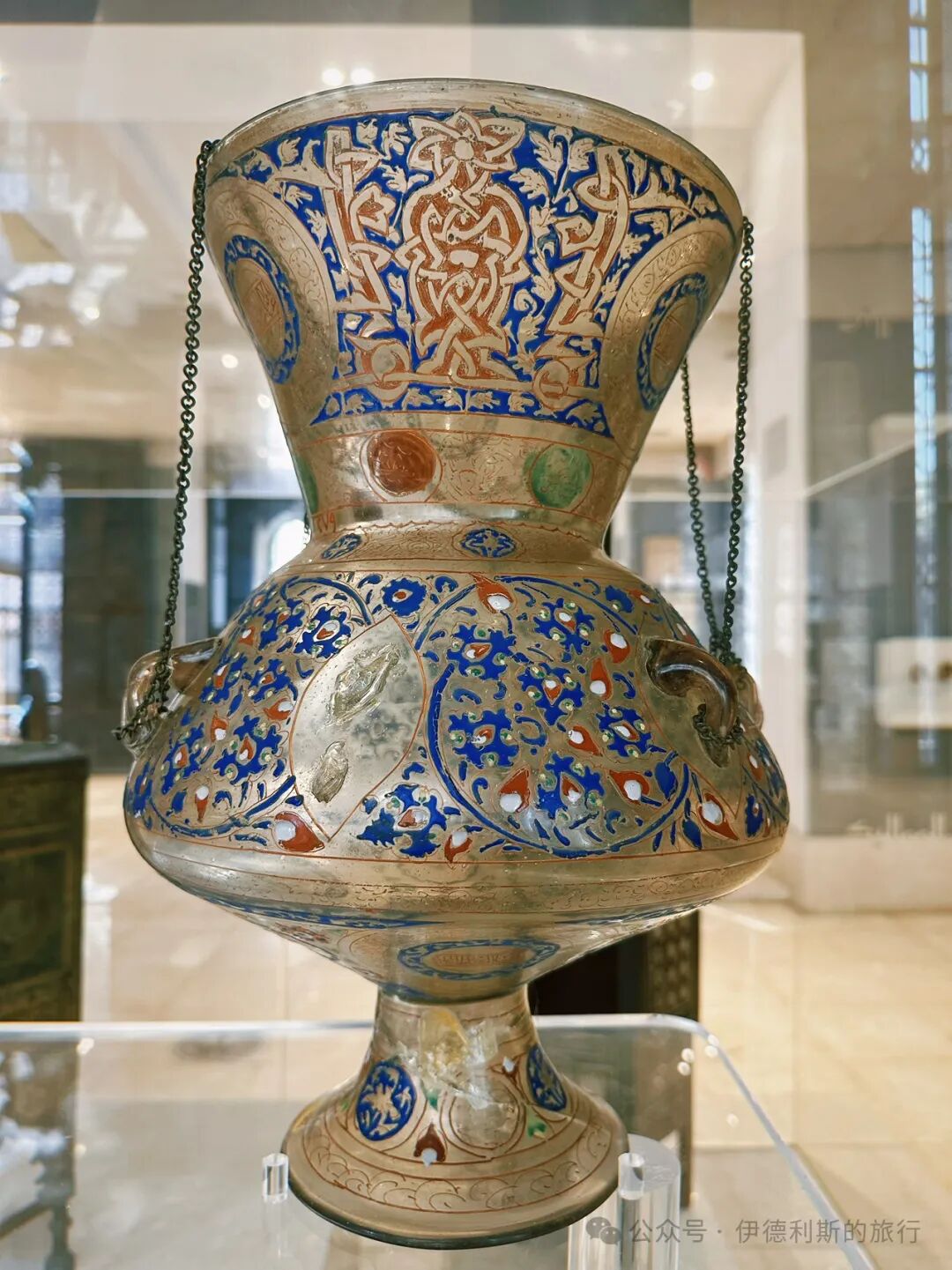
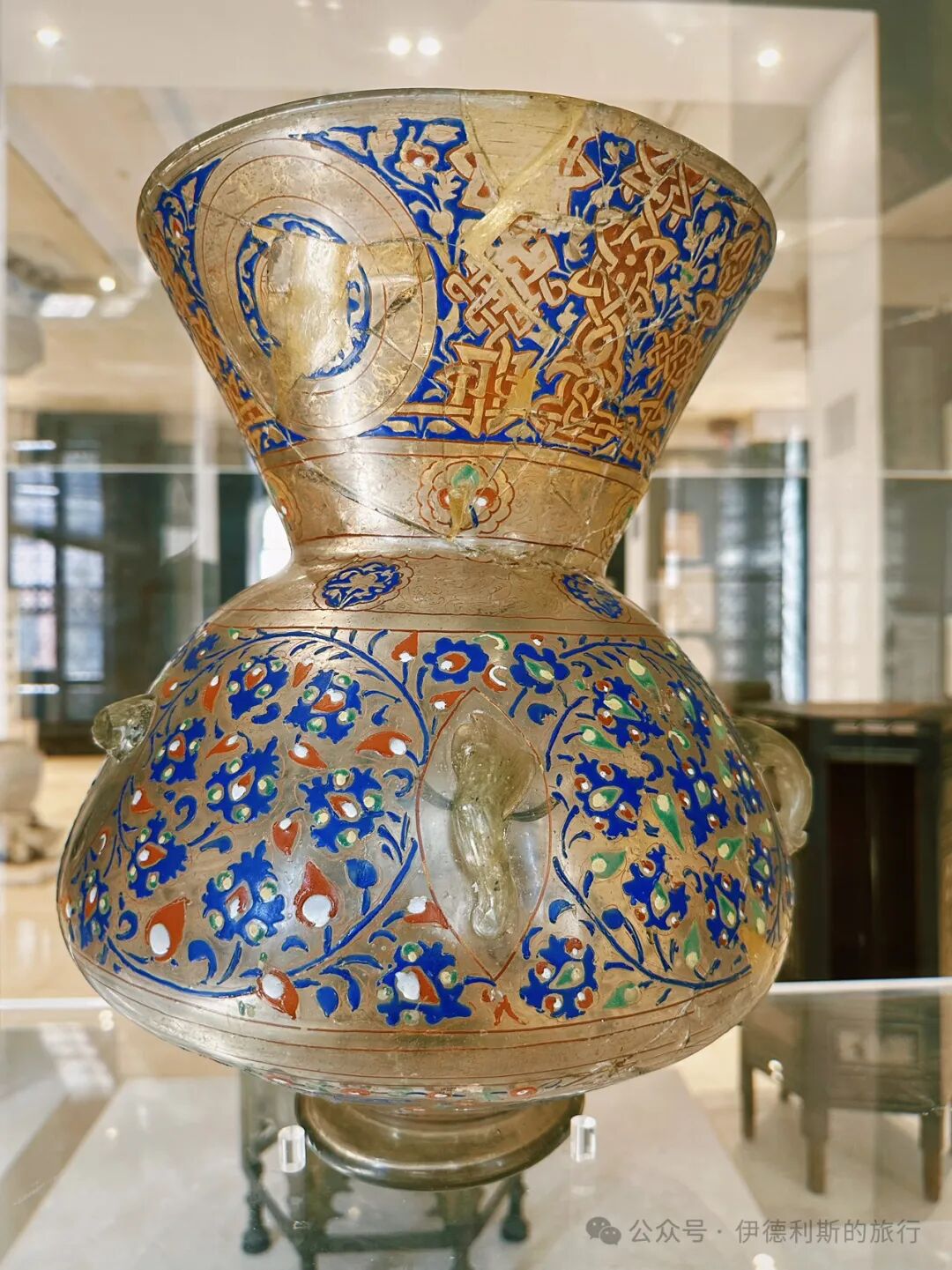
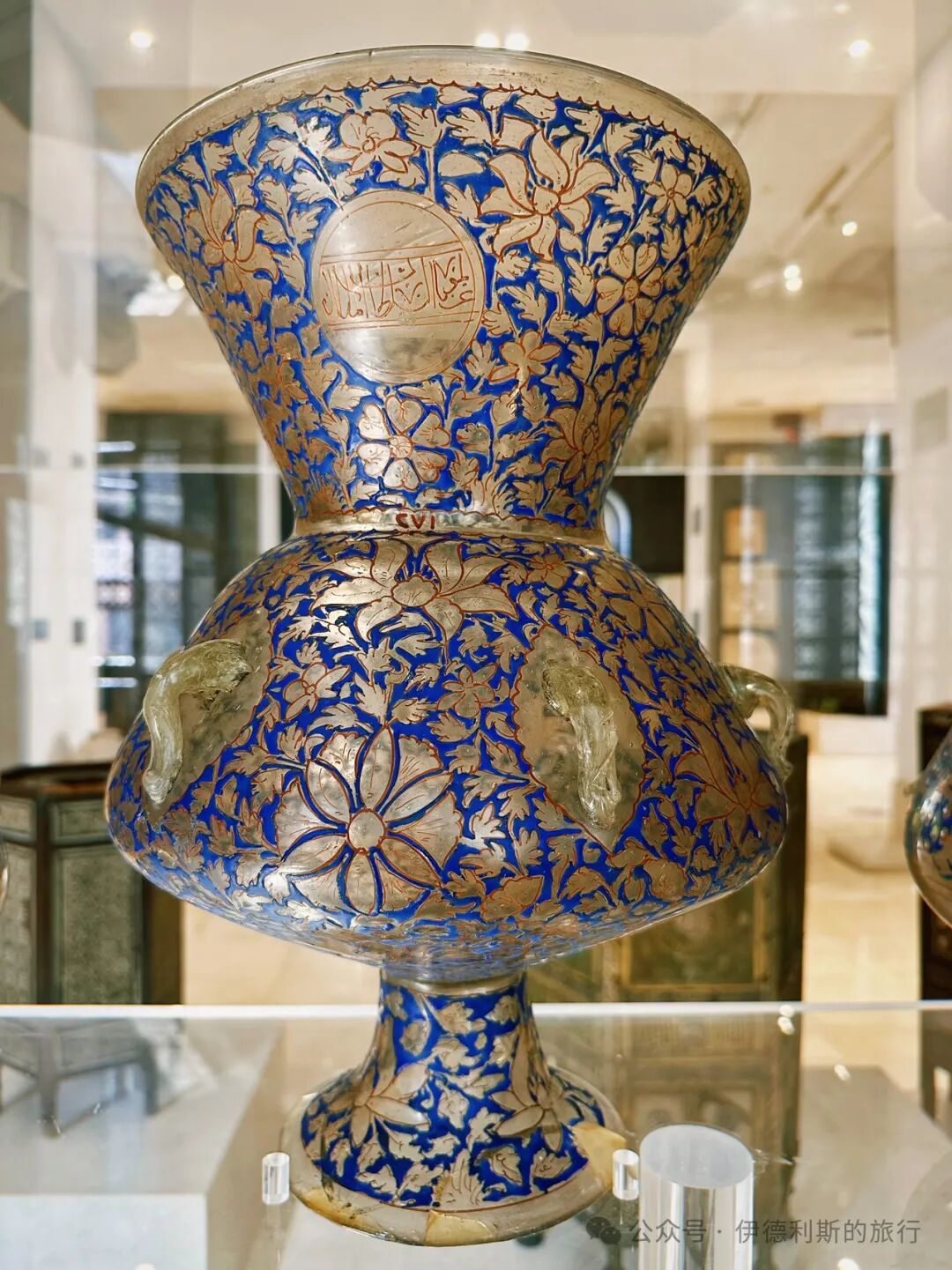
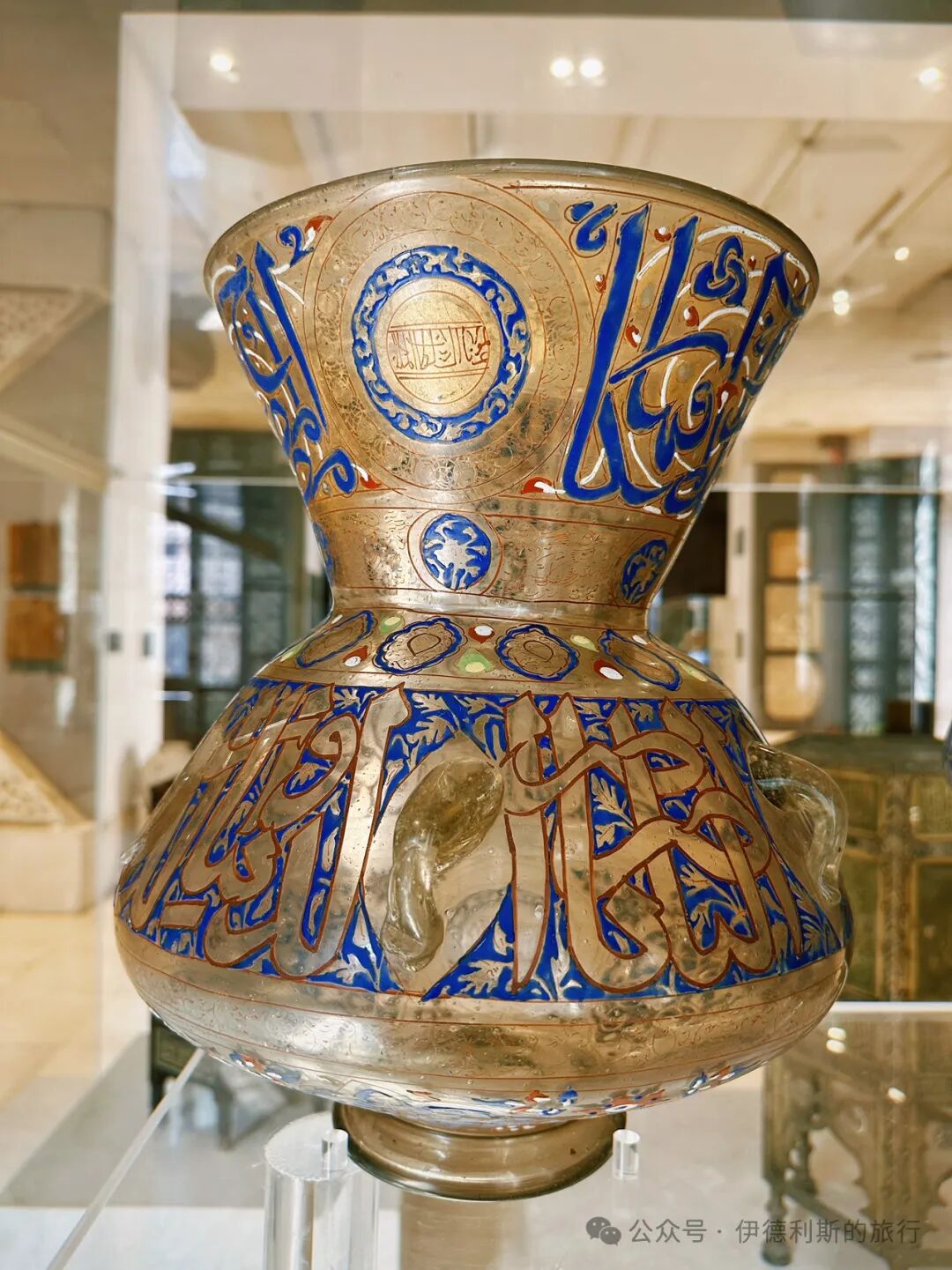
A glass lamp from a 14th-century Mamluk-era mosque in Egypt.
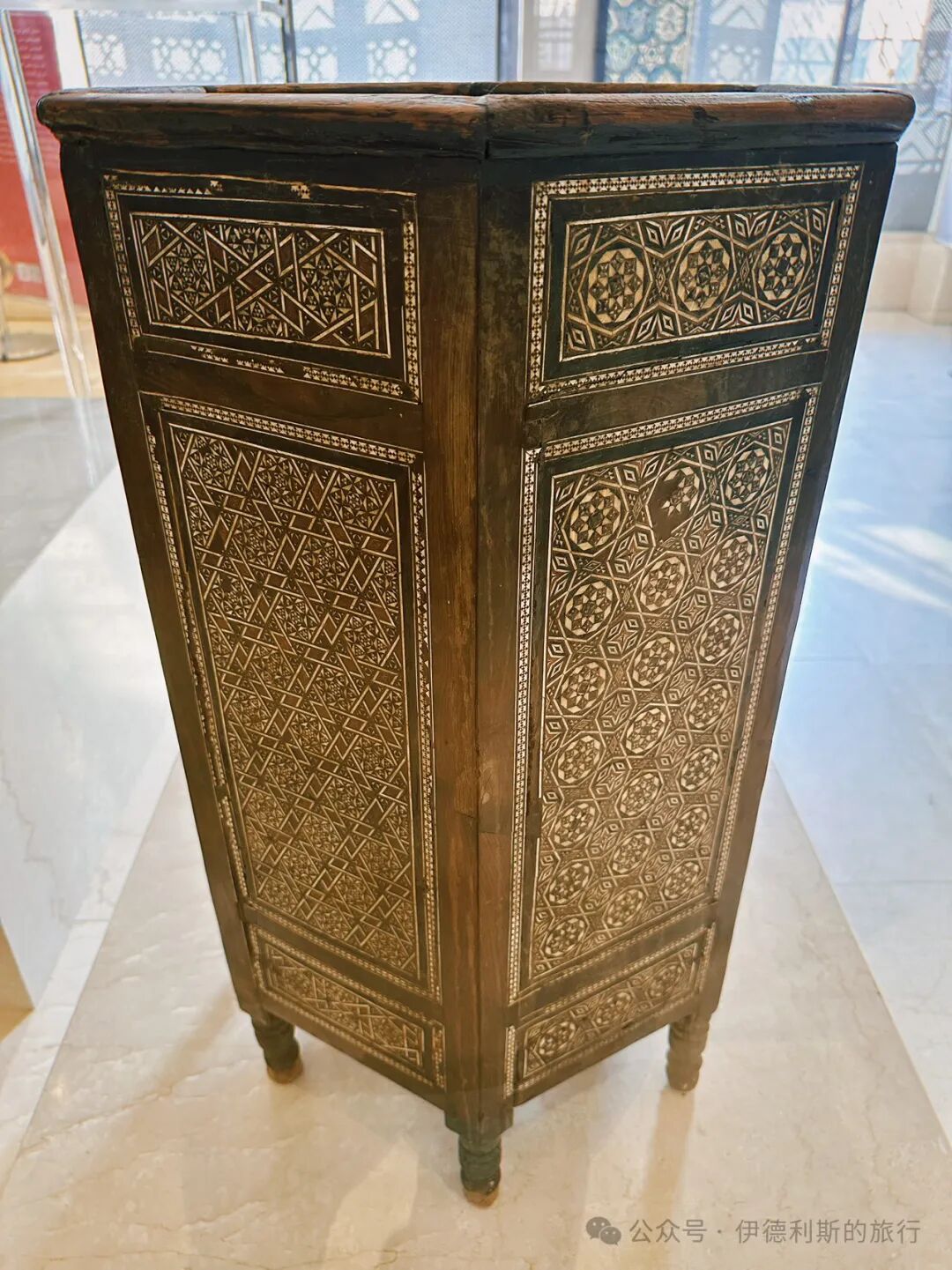
A 14th-century Mamluk-era wooden Quran box and table inlaid with ebony and ivory from the Umm al-Sultan Sha'ban Madrasa in Cairo. The Mamluk Sultan Al-Ashraf Sha'ban ordered the construction of the madrasa in 1368-9 to honor his mother, who was on a pilgrimage (hajj) at the time.
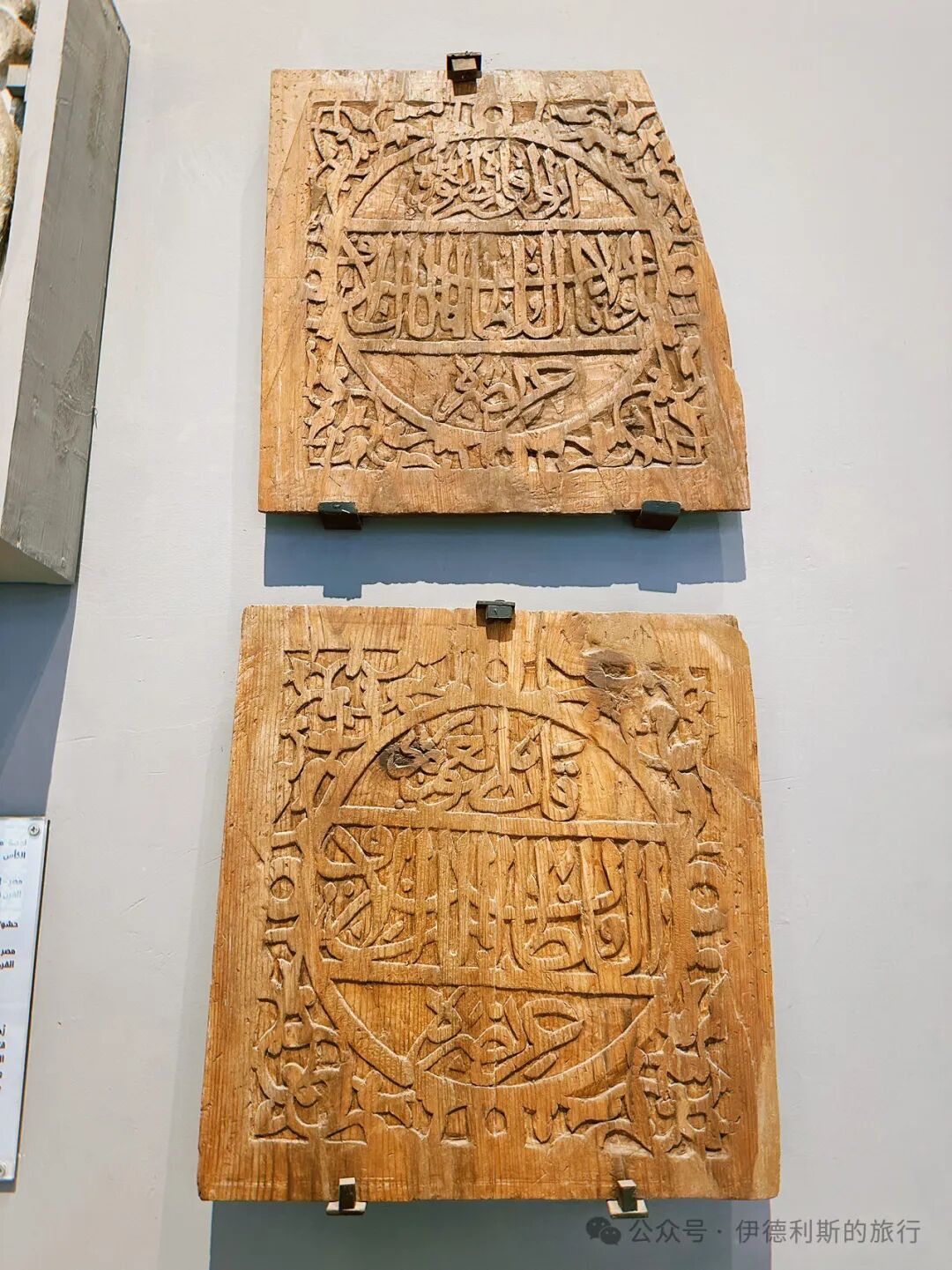
Two Mamluk-era wood carvings; the first one bears the name of Sultan Qaitbay (reigned 1468-96). Qaitbay was one of the sultans who sponsored the most architecture in Mamluk history. Although the Mamluk dynasty was in decline, the situation remained relatively stable and commerce flourished under Sultan Qaitbay's rule.
The second carving bears the name of the Mamluk Sultan Al-Ashraf Qansuh al-Ghuri (reigned 1501-16). He was the second-to-last sultan of the Mamluk Sultanate. The Ottoman Sultan Selim I killed him in 1516, which marked the shift of control in the Middle East from the Mamluk dynasty to the Ottoman dynasty.
Components of a minbar (pulpit) from the 14th-century Mamluk-era Al-Khatiri-Boulaq mosque in Egypt.
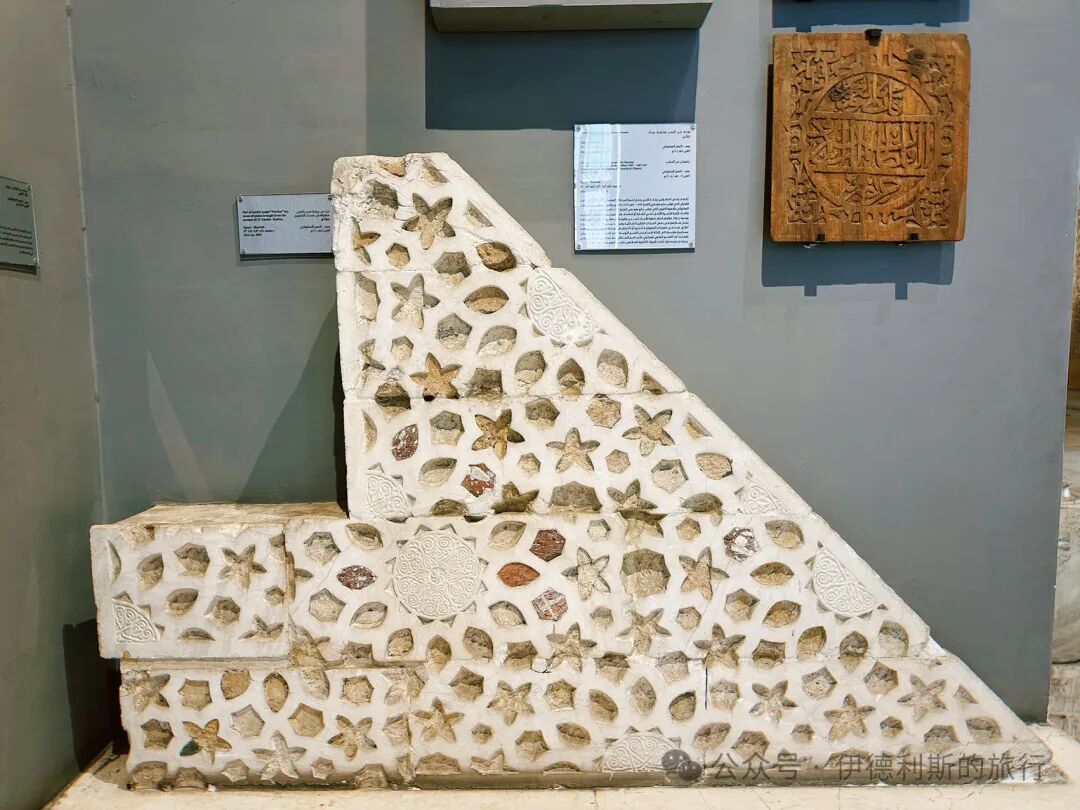
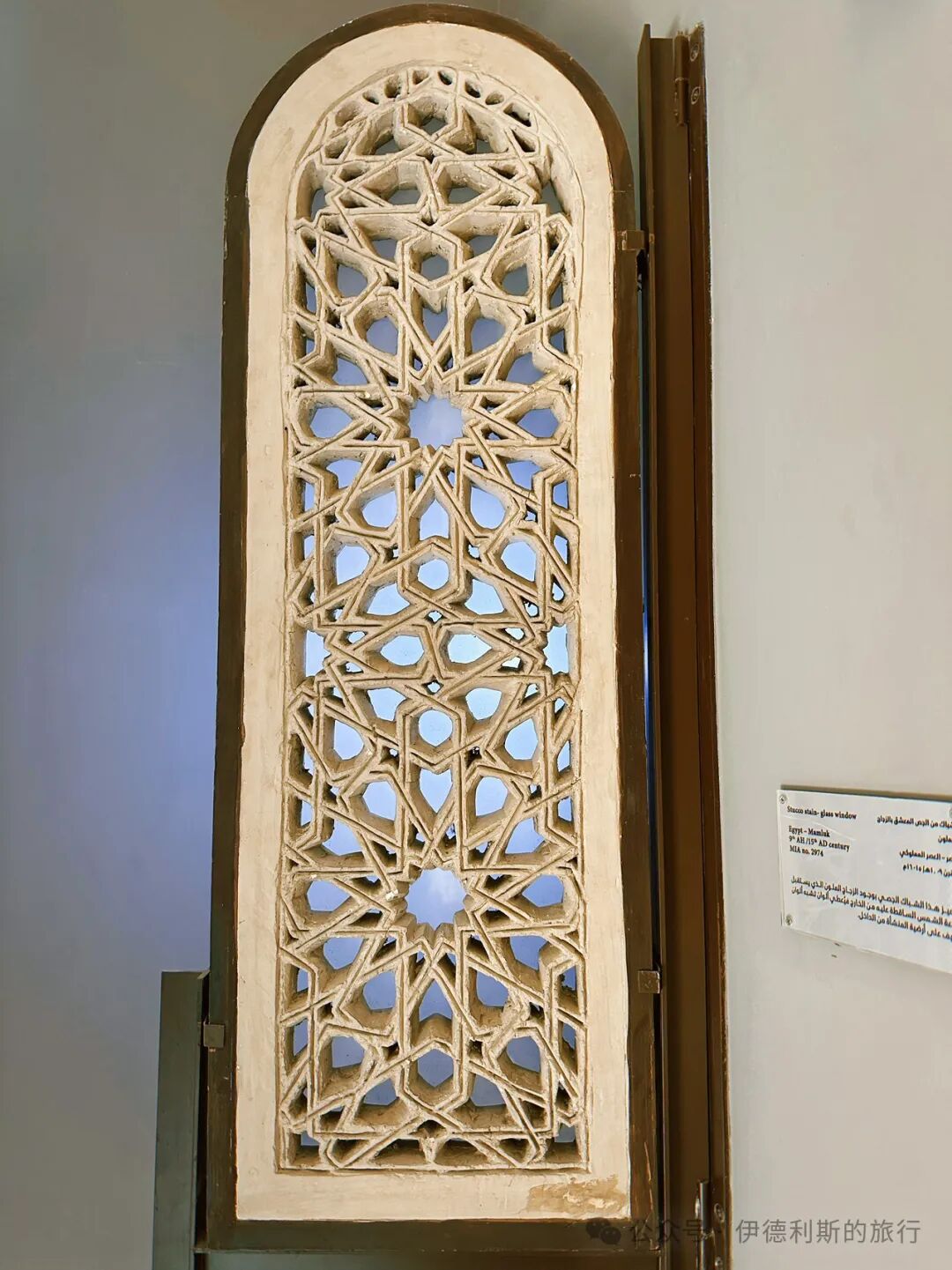
A 15th-century Mamluk-era stucco window from Egypt.
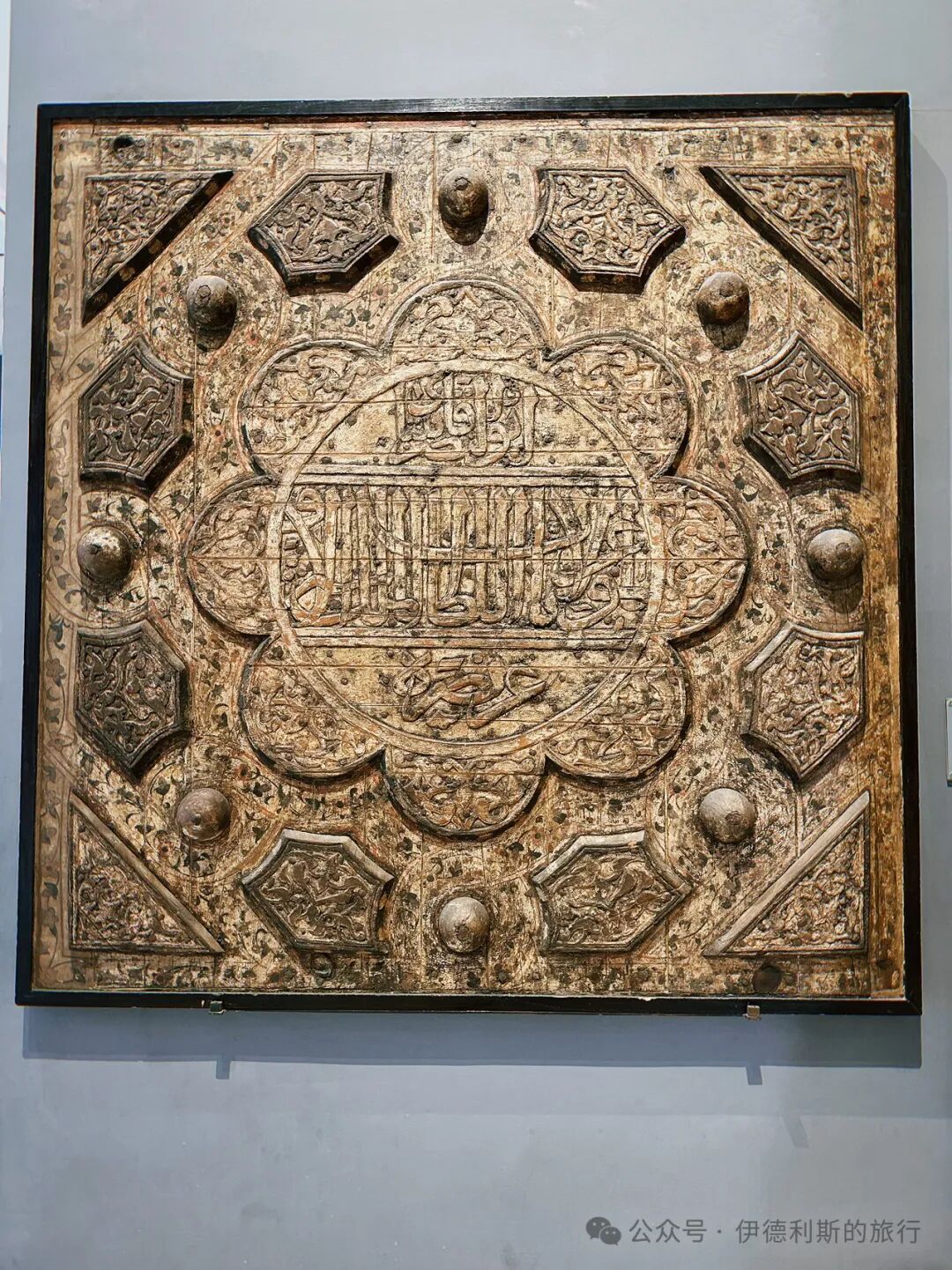
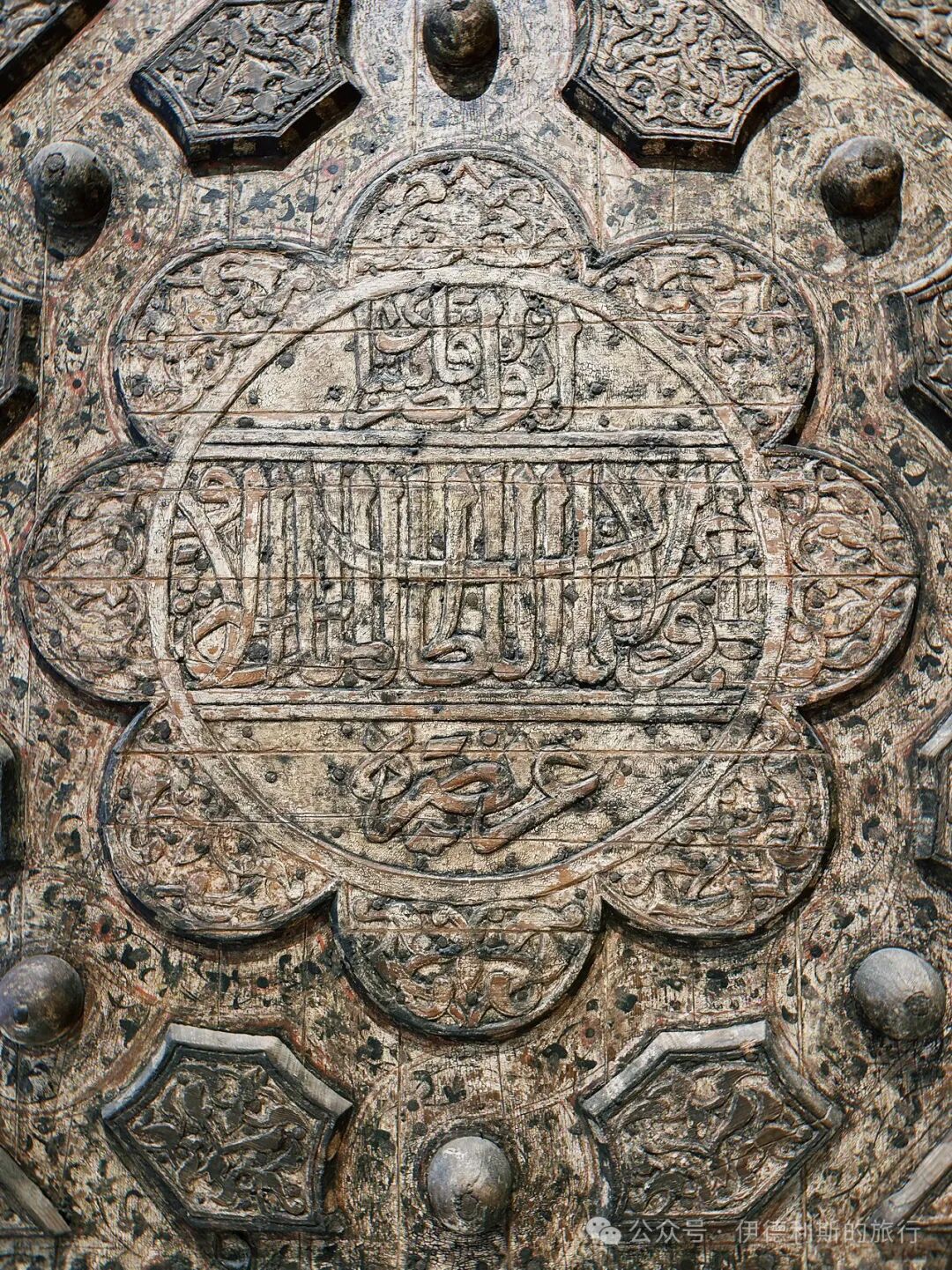
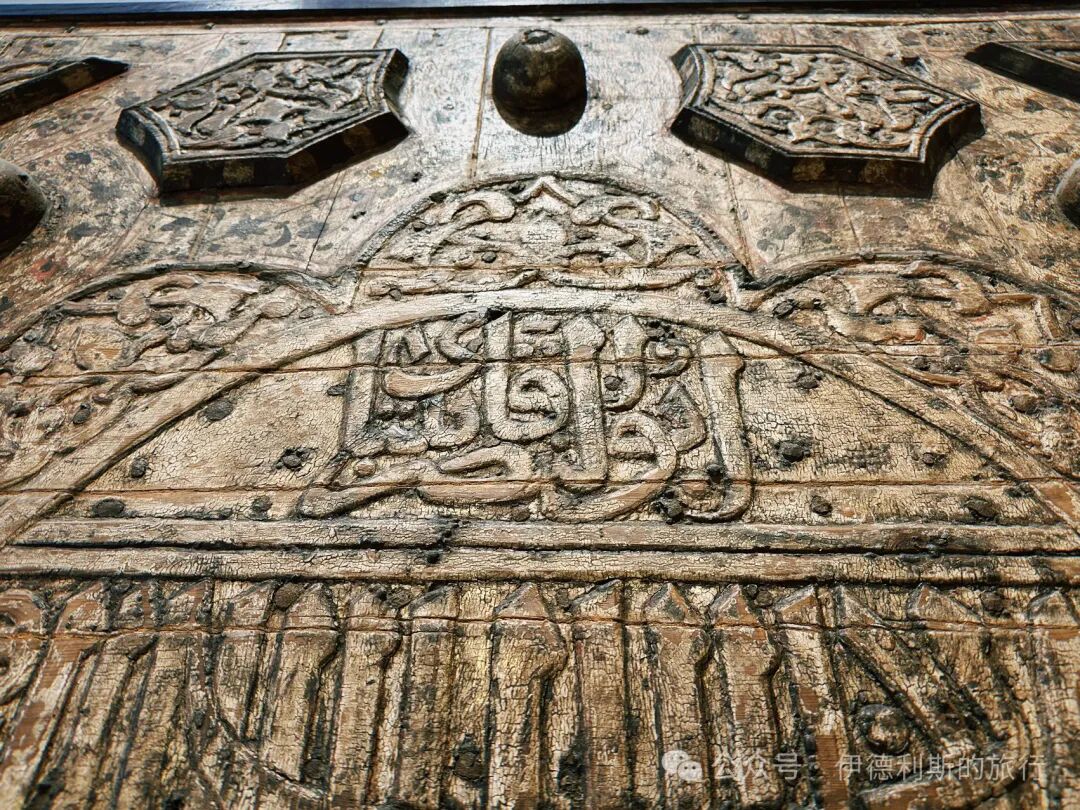
A wooden ceiling with carvings of the name of Mamluk Sultan Qaitbay (reigned 1468-96) inside the Al-Azhar Mosque in Cairo.
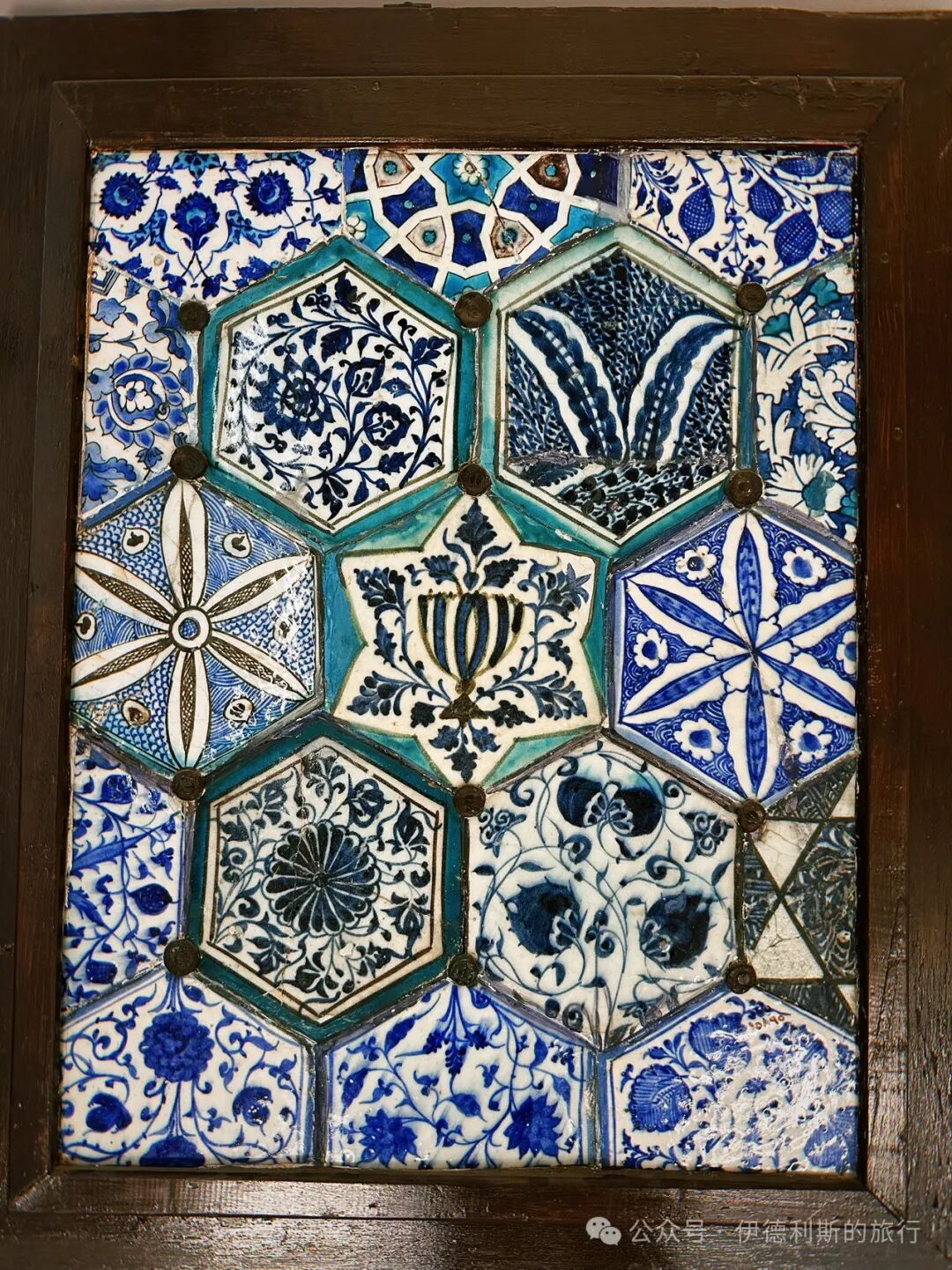
Tiles on the Qaitbay fountain (sabil) in Cairo. Sultan Qaitbay built the Qaitbay fountain (sabil) in 1479. It was Cairo's first independent fountain-primary school (sabil-kuttab) building, a structure that became very common during the later Ottoman period.
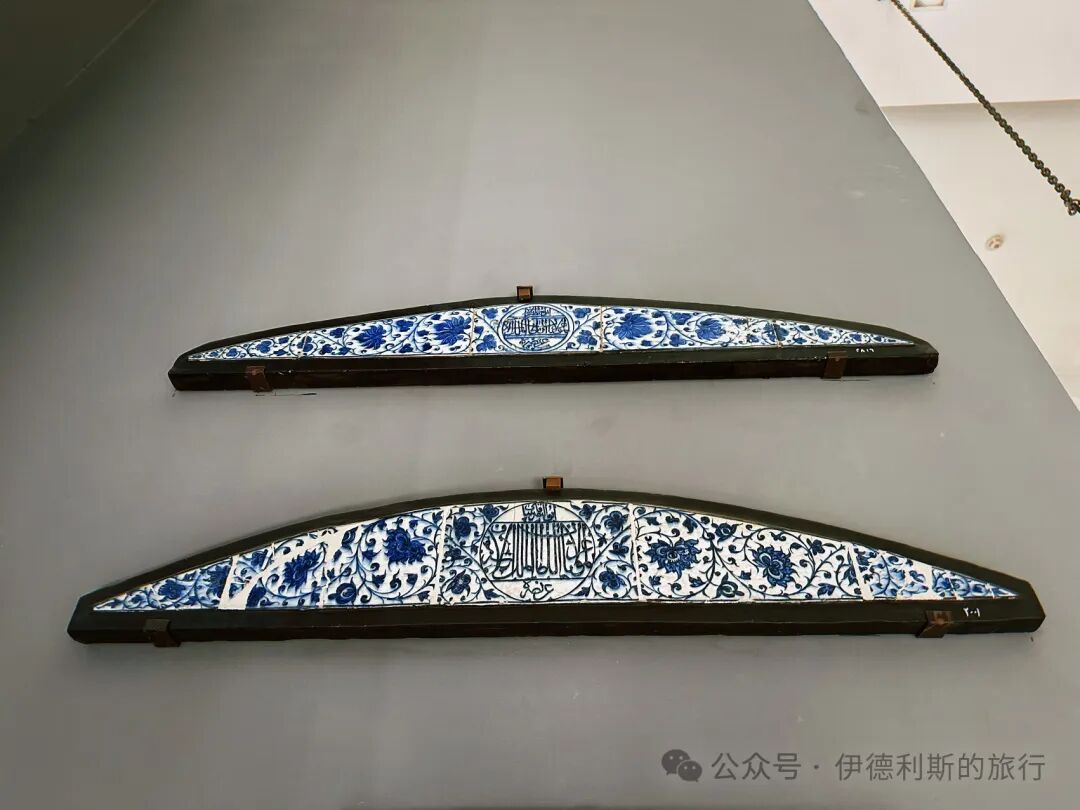
A tile featuring the name of the Mamluk Sultan Al-Ashraf Janbalat, who reigned from 1500 to 1501.
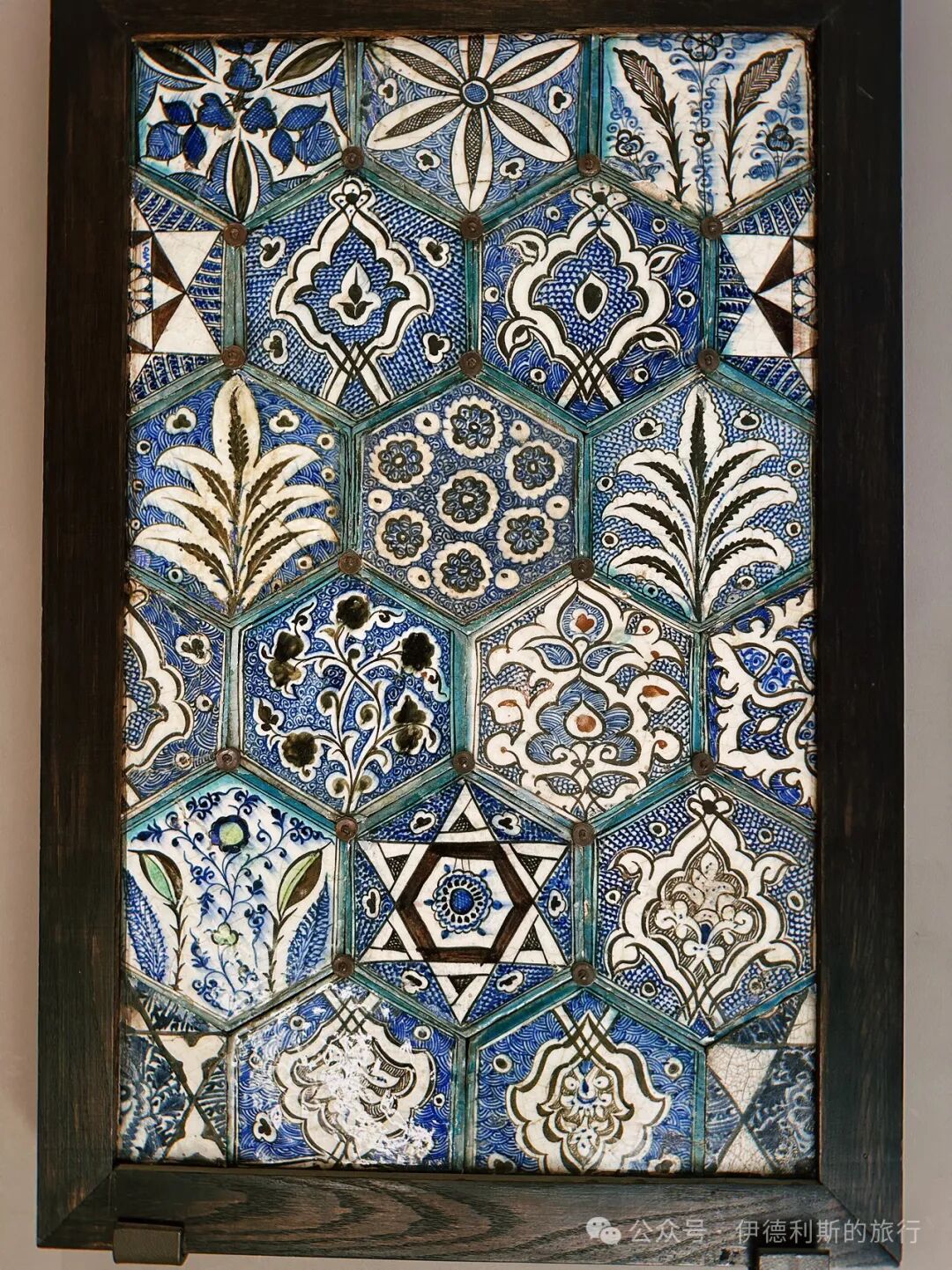
A 15th-century tile from the Mamluk dynasty.
A 15th-century Mamluk dynasty marble slab decorated with mother-of-pearl mosaic.
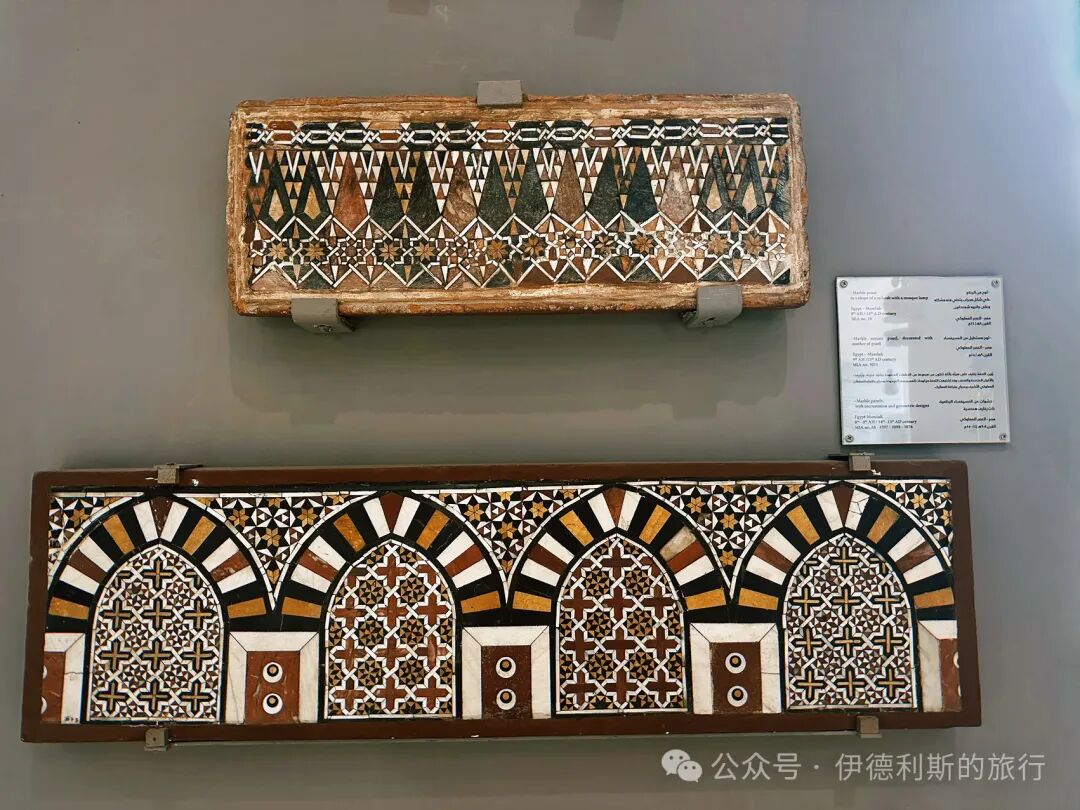
A 14th to 15th-century Mamluk dynasty marble slab with geometric patterns.
Summary: Islamic Art Guide: Museum of Islamic Art in Cairo (Part 1) is presented here as a firsthand travel account in clear, natural English. The account focuses on Cairo, Islamic Art, Museum Travel while preserving the names, places, food, photos, and historical details from the Chinese source.
In the 19th century, Egypt placed great importance on Pharaonic art, but appreciation for Islamic art lagged behind. In 1880, Tewfik Pasha, the sixth ruler of the Muhammad Ali dynasty, finally established the first museum of Islamic art.
In 1881, Tewfik Pasha approved the creation of the Committee for the Preservation of Arab Monuments. The arcades of the abandoned Al-Hakim Mosque inside the northern gate of Cairo were used as a temporary exhibition hall to display hundreds of artifacts. In 1884, a two-story building was constructed in the mosque courtyard to house 900 artifacts. In 1887, the museum was named the Museum of Arab Antiquities. By 1895, the collection had grown to 1,641 items, and the museum space reached capacity. In 1902, the new Mamluk-style museum building was officially completed, which is the building we see today.
The Cairo Museum of Islamic Art building once featured complex decorative designs inspired by architecture from various periods of Islamic history. In 2014, a car bomb attack targeting the Cairo police headquarters across the street caused severe damage to the museum. Nearly 30 percent of the artifacts were damaged, and the exterior wall decorations were also destroyed. After three years of restoration, the museum reopened in 2017.
The hall after the entrance provides a general introduction, showcasing a selection of unique Islamic artifacts from different perspectives.
An 8th-century Umayyad dynasty Quran in Kufic script from Egypt, written in brown ink on parchment.
An enameled water jug and basin from the 19th-century Qajar dynasty of Iran, featuring Persian-style figures and floral patterns.
The oldest surviving key to the Kaaba, made in 1363-4, belonging to the Egyptian Mamluk Sultan Al-Ashraf Sha'ban (reigned 1363-77).
An 18th-century Ottoman qibla indicator, made by the manufacturer Barun al-Mukhtar during the reign of Sultan Mahmud I (reigned 1730-54). It shows the appearance of the Sacred Mosque (Masjid al-Haram) after the 1629 Ottoman renovation, a structure that remained until 1955.
A 15th-century Mamluk-period mosque glass lamp from Egypt, bearing the name of Emir Safy al-Din Shaykhu.
After passing through the hall, the exhibition continues with Islamic artifacts arranged in chronological order.
Early days of the faith.
A wood carving panel from Egypt during the Abbasid Caliphate in the 9th century.
A wooden chest panel inlaid with ivory and bone from Egypt during the Tulunid dynasty in the 9th century.
An ivory plaque with floral carvings from Egypt during the Umayyad Caliphate in the 7th to 8th centuries.
A wood carving panel with floral decorations from Egypt or Syria during the Umayyad Caliphate in the 8th century.
An underglaze painted ceramic plate from Iraq during the Abbasid Caliphate in the 8th to 9th centuries.
A stucco carving panel in the Samarra style from Iraq during the Abbasid Caliphate in the 9th century. Samarra is located on the east bank of the Tigris River and served as the capital of the Abbasid Caliphate from 836 to 892.
Fatimid Caliphate.
A 10th-century Kufic script stucco window frame from the Western Palace of the Fatimid Caliphate in Cairo. It is truly a masterpiece of the museum; you can see its size by comparing it to the child in the bottom right corner. The Fatimid palace in Cairo was built in 970 and was divided into two parts: the Eastern Palace and the Western Palace. The Western Palace was smaller and originally built for the Fatimid princess Sitt al-Mulk, then renovated by the Caliph in 1064. In 1284-1285, the Mamluk Sultan al-Mansur Qalawun built a massive complex on the site of the Fatimid Western Palace. The hospital within the complex used some architectural elements from the Fatimid Western Palace, and this window frame came from the Qalawun Hospital.
A ceramic plate from Egypt during the Fatimid Caliphate in the 10th to 11th centuries, depicting various music and banquet scenes.
A ceramic plate from Egypt during the Fatimid period in the 11th century, depicting a rider holding a falcon.
A ceramic plate from Egypt during the Fatimid Caliphate in the 11th to 12th centuries, showing two people performing the traditional Egyptian stick fighting, Tahtib.
This 11th-century stucco mural from Egypt dates to the Fatimid dynasty and comes from the wall of a Fatimid-era bathhouse.
This small wooden prayer niche (mihrab) from 10th-11th century Fatimid Egypt features inscriptions with Shia content.
This 10th-11th century Fatimid Egyptian ceramic plate shows an image of the Prophet Isa (Jesus), which serves as evidence of the religious tolerance of that time.
This 11th-century Fatimid Egyptian ceramic plate is inscribed with the name of the commander Ghaban.
This 11th-century Fatimid Egyptian ceramic plate features a griffin design. The image of the griffin can be traced back to ancient Egyptian art from 3000 BC, later spreading to West Asia and the Mediterranean region. Because the lion rules the land and the eagle rules the sky, the griffin, which combines the features of both, became a symbol of nobility and power.
This 11th-century Fatimid Egyptian ceramic plate features images of humans, animals, and birds.
This 11th-century Fatimid Egyptian marble carving features Kufic calligraphy.
These stucco windows and wooden doors from the Al-Salih Tala'i Mosque in Cairo date to the late Fatimid period in 1160. The Al-Salih Tala'i Mosque is located outside the south gate of the old city of Cairo and was commissioned by the Fatimid vizier Tala'i ibn Ruzzik, who was the last powerful and capable vizier of the Fatimid dynasty. The Al-Salih Tala'i Mosque was completed only 11 years before the fall of the Fatimid dynasty, making it the last surviving building from the Fatimid era.
This wooden door from the Al-Azhar Mosque in Cairo dates to the Fatimid period in 1010 and was commissioned by Caliph al-Hakim bi-Amr Allah, who reigned from 996 to 1021. Al-Hakim was the first Fatimid caliph born in Cairo, an important imam in the history of Ismaili Shia Islam, and a central figure in the Druze faith. At that time, the city of Fustat on the south side of old Cairo was a densely populated Sunni city, while the newly built city of Cairo served as the capital of the Fatimid dynasty and the center of Ismaili Shia Islam. The Al-Azhar Mosque in Cairo is the city's official congregational mosque, where the caliph would deliver the khutbah sermon every Friday during Jumu'ah prayer.
The 12th-century Fatimid-era wooden prayer niche (mihrab) and wooden doors inside the Sayyida Nafisa mausoleum in Cairo. Sayyida Nafisa (762-824) was the great-granddaughter of Imam Hasan, the grandson of the Prophet. She was a famous Egyptian scholar of hadith who served as a mentor to Imam Shafi'i and provided him with financial support.
The Nafisa mausoleum is located in Cairo's famous City of the Dead. It was first built during the Abbasid period and later renovated and rebuilt during the Fatimid period. Nafisa was the first descendant of Imam Ali to be honored during the Fatimid period. As a Sunni and a descendant of Ali, she helped promote reconciliation between the Sunni and Shia populations within the Fatimid dynasty.
Ayyubid dynasty
A 12th-century wooden chest from the Hussein Mosque in Cairo. The Hussein Mosque is located across from the Al-Azhar Mosque in Cairo. It was first built in 1154 and is said to house the head of Imam Hussein.
A 13th-century wooden carving from the Ayyubid dynasty in Egypt.
A 1213 marble slab from the Ayyubid dynasty in Egypt inscribed with the name of Sultan Al-Kamil. Al-Kamil was the fifth sultan of the Ayyubid dynasty. During his reign, he defeated the Fifth Crusade, but he handed Jerusalem over to the Crusaders for ten years during the Sixth Crusade.
Marble slabs from the Ayyubid dynasty in Egypt dated 1184 and 1187, inscribed with the name of Sultan Saladin. Saladin was the founder of the Ayyubid dynasty. During the Third Crusade, he launched a series of military campaigns against the Crusaders in the Levant and recaptured Jerusalem, restoring Muslim rule in the region.
Wooden panels and doors made in 1178 during the Ayyubid period, found in the mausoleum of Imam Shafi'i in Cairo. Imam Shafi'i was the founder of the Shafi'i school of law and one of the four great imams of Sunni Islam. Imam Shafi'i arrived in Cairo in 813 and passed away there in 819. Sultan Saladin built his mausoleum in 1178, which features exquisite wood carvings inside. These include complex geometric patterns, scripture, and an introduction to the life of Imam al-Shafi'i.
A marble slab from the 12th-century Ayyubid dynasty in Egypt, featuring carvings of griffins and creatures with human heads and bird bodies.
Stucco carvings from the 13th-century Ayyubid dynasty at the Al-Kamil Madrasa in Cairo. The Al-Kamil Madrasa was built in 1225 by the Ayyubid Sultan al-Kamil in the northern part of the former Fatimid Western Palace in Old Cairo, and it was one of Egypt's educational centers during the 13th and 14th centuries.
A flint window from the 13th-century Ayyubid dynasty at the Sayf ibn Yazan tomb in Cairo.
Mamluk Dynasty.
A marble slab from the 14th-century Mamluk period at the Sarghatmish Madrasa in Cairo. The Sarghatmish Madrasa was built in 1356 by order of the Mamluk Emir General Sirghitmish. In the 1350s, Sirghitmish was the most powerful emir of the Mamluk dynasty.
A copper candlestick inscribed with the name of the Mamluk Sultan al-Nasir Muhammad, who reigned from 1299 to 1309.
A copper candlestick inscribed with the name of the Mamluk Sultan Qaitbay, who reigned from 1468 to 1496, donated by the Sultan to the Prophet's Mosque in Medina. Although Sultan Qaitbay built many structures in Cairo, his greatest achievement was the restoration of the Prophet's Mosque in Medina. After a fire at the Prophet's Mosque in 1481, Sultan Qaitbay rebuilt the tomb of the Prophet from a wooden structure into a brick one, added metal railings, and donated many chandeliers and candlesticks to the mosque.
A copper candlestick inlaid with silver from the 14th to 15th-century Mamluk dynasty.
A copper candlestick inscribed with the name of the wife of the Mamluk Sultan Qaitbay.
A copper incense burner inlaid with gold and silver from the 14th-century Mamluk dynasty.
A wooden door from the 13th-century Mamluk period at the Salihiyya Madrasa in Cairo. The Ayyubid Sultan As-Salih Ayyub founded the Salihiyya Madrasa in 1242, and it was one of Egypt's most famous centers of education during the 13th and 14th centuries.
A 14th-century Mamluk-era wooden cabinet from Egypt, inlaid with painted ivory decorations.
Above is a 13th-14th century Mamluk double-headed eagle marble carving from Egypt, and below is a 13th-century marble carving featuring the lion emblem of the Mamluk Sultan Baybars I (reigned 1260-1277). Baybars was the fourth sultan of the Mamluk dynasty and a tough military leader who defeated invasions by the Crusaders and the Mongol army.
A glass lamp from a 14th-century Mamluk-era mosque in Egypt.
A 14th-century Mamluk-era wooden Quran box and table inlaid with ebony and ivory from the Umm al-Sultan Sha'ban Madrasa in Cairo. The Mamluk Sultan Al-Ashraf Sha'ban ordered the construction of the madrasa in 1368-9 to honor his mother, who was on a pilgrimage (hajj) at the time.
Two Mamluk-era wood carvings; the first one bears the name of Sultan Qaitbay (reigned 1468-96). Qaitbay was one of the sultans who sponsored the most architecture in Mamluk history. Although the Mamluk dynasty was in decline, the situation remained relatively stable and commerce flourished under Sultan Qaitbay's rule.
The second carving bears the name of the Mamluk Sultan Al-Ashraf Qansuh al-Ghuri (reigned 1501-16). He was the second-to-last sultan of the Mamluk Sultanate. The Ottoman Sultan Selim I killed him in 1516, which marked the shift of control in the Middle East from the Mamluk dynasty to the Ottoman dynasty.
Components of a minbar (pulpit) from the 14th-century Mamluk-era Al-Khatiri-Boulaq mosque in Egypt.
A 15th-century Mamluk-era stucco window from Egypt.
A wooden ceiling with carvings of the name of Mamluk Sultan Qaitbay (reigned 1468-96) inside the Al-Azhar Mosque in Cairo.
Tiles on the Qaitbay fountain (sabil) in Cairo. Sultan Qaitbay built the Qaitbay fountain (sabil) in 1479. It was Cairo's first independent fountain-primary school (sabil-kuttab) building, a structure that became very common during the later Ottoman period.
A tile featuring the name of the Mamluk Sultan Al-Ashraf Janbalat, who reigned from 1500 to 1501.
A 15th-century tile from the Mamluk dynasty.
A 15th-century Mamluk dynasty marble slab decorated with mother-of-pearl mosaic.
A 14th to 15th-century Mamluk dynasty marble slab with geometric patterns.
Islamic Art Guide: Museum of Islamic Art in Cairo (Part 2)
Articles • ali2007fr posted the article • 0 comments • 161 views • 2026-05-19 08:52
Reposted from the web
Summary: Islamic Art Guide: Museum of Islamic Art in Cairo (Part 2) is presented here as a firsthand travel account in clear, natural English. The account focuses on Cairo, Islamic Art, Museum Travel while preserving the names, places, food, photos, and historical details from the Chinese source.
Script tiles from the Mamluk dynasty in the 14th century.
A tile inscribed with the name of the Mamluk Sultan Qaitbay, who reigned from 1468 to 1496.
A 14th-century marble tile with Kufic script from the Mamluk dynasty in Egypt.
Arabic script tiles from the Egyptian Mamluk dynasty, with the 14th century on top and the 16th century on the bottom.
A 14th-century Mamluk-era marble carving from the Sarghatmish Madrasa in Cairo, featuring a small-scale replica in the bottom right corner that allows visitors to touch the patterns.
A copper lamp inlaid with silver, inscribed with the name of the Mamluk Sultan Al-Ashraf Sha'ban, who reigned from 1363 to 1377.
A 13th-century glass vessel from the Mamluk dynasty inscribed with the name of Prince Shams al-Din al-Tanbugha.
A 13th-century copper-plated wooden door from the Egyptian Mamluk dynasty, inscribed with the name of Prince Shams al-Din Sunqur al-Tawil al-Mansuri.
An ivory carving inscribed with the name of the Mamluk Sultan Qaitbay, who reigned from 1468 to 1496.
A 14th-century ivory carving from the Egyptian Mamluk dynasty.
A marble carving inscribed with the name of the Mamluk Sultan Al-Ashraf Qansuh al-Ghuri, who reigned from 1501 to 1516.
A royal decree carved into marble by the Egyptian Mamluk Sultan Sayf al-Din Jaqmaq, who reigned from 1438 to 1453, after he ordered the exemption of taxes for merchants.
A marble tombstone from the 15th to 16th-century Egyptian Mamluk dynasty.
A 13th to 15th-century copper basin inlaid with silver from the Egyptian Mamluk dynasty; the Palace Museum holds several blue and white porcelain pieces with the same design.
Ottoman dynasty.
A 17th to 18th-century wooden balcony (mashrabiya) from the Ottoman dynasty in Egypt. This is an important part of traditional Middle Eastern architecture, featuring intricate wooden lattice screens that allow for evaporative cooling when water jars are placed inside.
An 18th-century wooden cabinet inlaid with ivory from the Ottoman period in Egypt.
This piece has no label, but it appears to be an ivory-inlaid wooden pulpit (minbar) from the Ottoman period in Egypt.
Ceramic tiles produced in Iznik, Turkey, during the 16th-century Ottoman period.
Porcelain from the 16th to 19th centuries, covering the Ottoman and Muhammad Ali periods.
A marble carving from the 16th-century Ottoman period.
A 17th-century Ottoman period ceramic tile painted with an image of the Kaaba (Tianfang).
An 18th-century Ottoman period ceramic tile painted with an image of the Prophet's Mosque in Medina.
Tombstone.
A 12th-century basalt tombstone from the Arabian Peninsula or the Dahlak Archipelago.
A 12th-century limestone tombstone from the Ayyubid dynasty in Egypt.
A 10th-century wooden tombstone from the Fatimid dynasty in Egypt.
A 7th-century limestone tombstone from the Rashidun or Umayyad period in Egypt.
An 8th-century marble tombstone from the Abbasid period in Egypt.
A 9th-century marble tombstone from the Abbasid period in Egypt.
A 10th-century marble tombstone from the Fatimid period in Egypt.
An 11th-century marble tombstone from the Fatimid period in Egypt. view all
Summary: Islamic Art Guide: Museum of Islamic Art in Cairo (Part 2) is presented here as a firsthand travel account in clear, natural English. The account focuses on Cairo, Islamic Art, Museum Travel while preserving the names, places, food, photos, and historical details from the Chinese source.
Script tiles from the Mamluk dynasty in the 14th century.
A tile inscribed with the name of the Mamluk Sultan Qaitbay, who reigned from 1468 to 1496.
A 14th-century marble tile with Kufic script from the Mamluk dynasty in Egypt.
Arabic script tiles from the Egyptian Mamluk dynasty, with the 14th century on top and the 16th century on the bottom.
A 14th-century Mamluk-era marble carving from the Sarghatmish Madrasa in Cairo, featuring a small-scale replica in the bottom right corner that allows visitors to touch the patterns.
A copper lamp inlaid with silver, inscribed with the name of the Mamluk Sultan Al-Ashraf Sha'ban, who reigned from 1363 to 1377.
A 13th-century glass vessel from the Mamluk dynasty inscribed with the name of Prince Shams al-Din al-Tanbugha.
A 13th-century copper-plated wooden door from the Egyptian Mamluk dynasty, inscribed with the name of Prince Shams al-Din Sunqur al-Tawil al-Mansuri.
An ivory carving inscribed with the name of the Mamluk Sultan Qaitbay, who reigned from 1468 to 1496.
A 14th-century ivory carving from the Egyptian Mamluk dynasty.
A marble carving inscribed with the name of the Mamluk Sultan Al-Ashraf Qansuh al-Ghuri, who reigned from 1501 to 1516.
A royal decree carved into marble by the Egyptian Mamluk Sultan Sayf al-Din Jaqmaq, who reigned from 1438 to 1453, after he ordered the exemption of taxes for merchants.
A marble tombstone from the 15th to 16th-century Egyptian Mamluk dynasty.
A 13th to 15th-century copper basin inlaid with silver from the Egyptian Mamluk dynasty; the Palace Museum holds several blue and white porcelain pieces with the same design.
Ottoman dynasty.
A 17th to 18th-century wooden balcony (mashrabiya) from the Ottoman dynasty in Egypt. This is an important part of traditional Middle Eastern architecture, featuring intricate wooden lattice screens that allow for evaporative cooling when water jars are placed inside.
An 18th-century wooden cabinet inlaid with ivory from the Ottoman period in Egypt.
This piece has no label, but it appears to be an ivory-inlaid wooden pulpit (minbar) from the Ottoman period in Egypt.
Ceramic tiles produced in Iznik, Turkey, during the 16th-century Ottoman period.
Porcelain from the 16th to 19th centuries, covering the Ottoman and Muhammad Ali periods.
A marble carving from the 16th-century Ottoman period.
A 17th-century Ottoman period ceramic tile painted with an image of the Kaaba (Tianfang).
An 18th-century Ottoman period ceramic tile painted with an image of the Prophet's Mosque in Medina.
Tombstone.
A 12th-century basalt tombstone from the Arabian Peninsula or the Dahlak Archipelago.
A 12th-century limestone tombstone from the Ayyubid dynasty in Egypt.
A 10th-century wooden tombstone from the Fatimid dynasty in Egypt.
A 7th-century limestone tombstone from the Rashidun or Umayyad period in Egypt.
An 8th-century marble tombstone from the Abbasid period in Egypt.
A 9th-century marble tombstone from the Abbasid period in Egypt.
A 10th-century marble tombstone from the Fatimid period in Egypt.
An 11th-century marble tombstone from the Fatimid period in Egypt. view all
Reposted from the web
Summary: Islamic Art Guide: Museum of Islamic Art in Cairo (Part 2) is presented here as a firsthand travel account in clear, natural English. The account focuses on Cairo, Islamic Art, Museum Travel while preserving the names, places, food, photos, and historical details from the Chinese source.
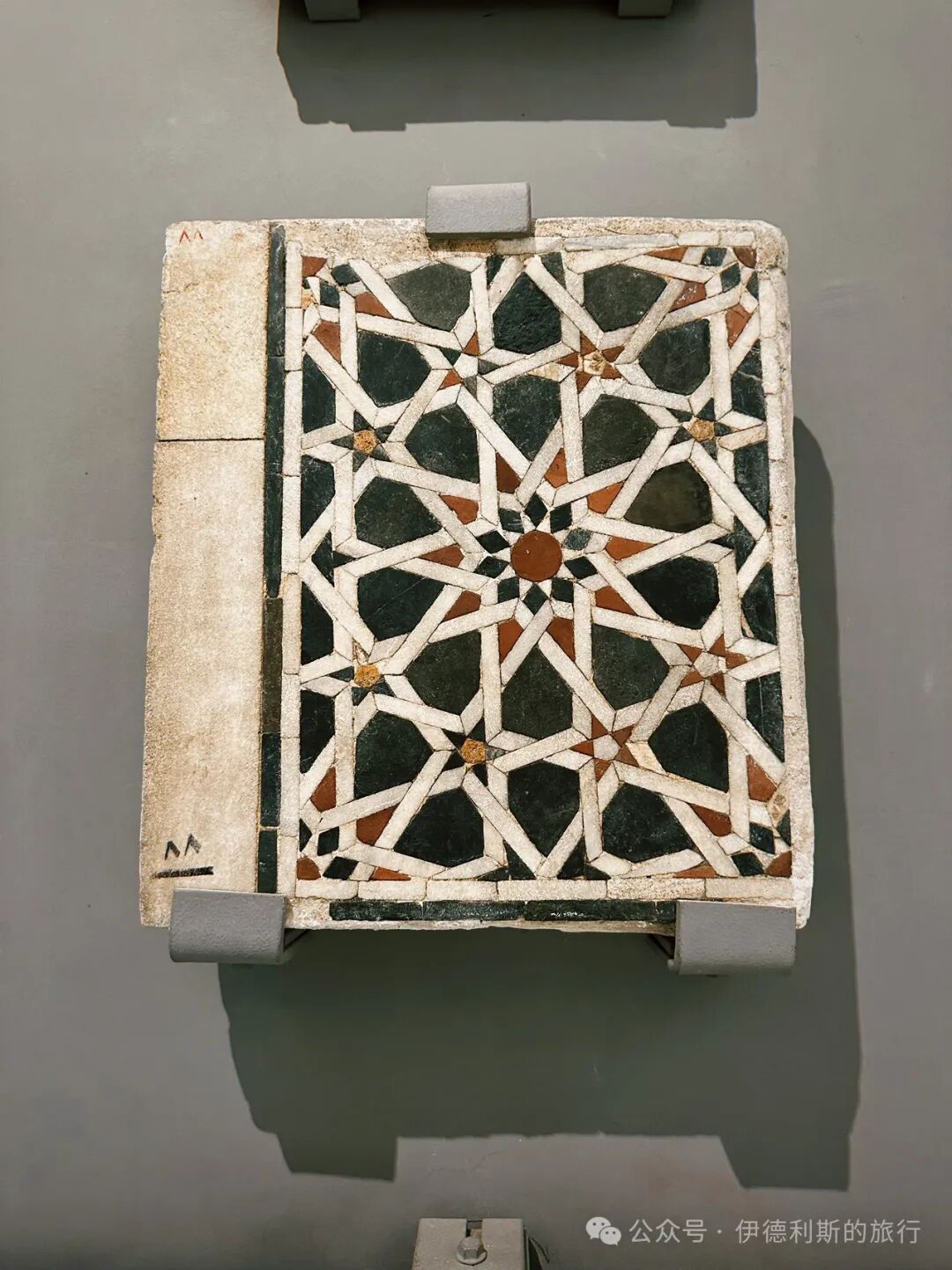
Script tiles from the Mamluk dynasty in the 14th century.
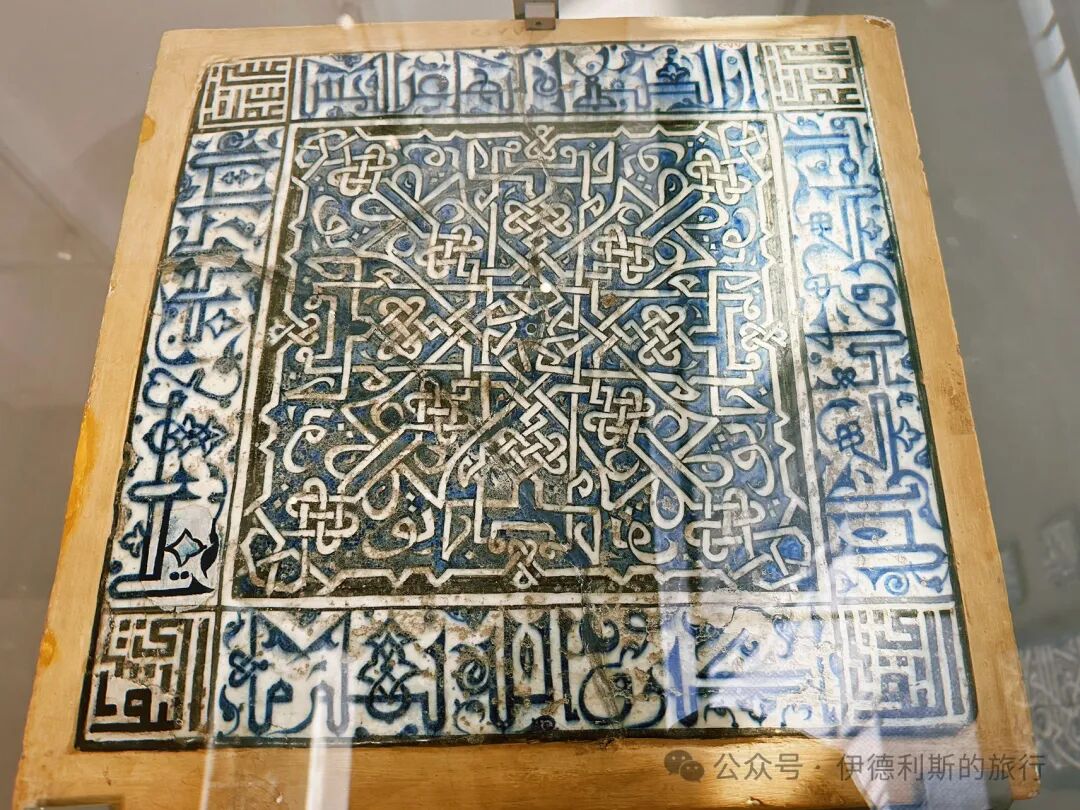
A tile inscribed with the name of the Mamluk Sultan Qaitbay, who reigned from 1468 to 1496.
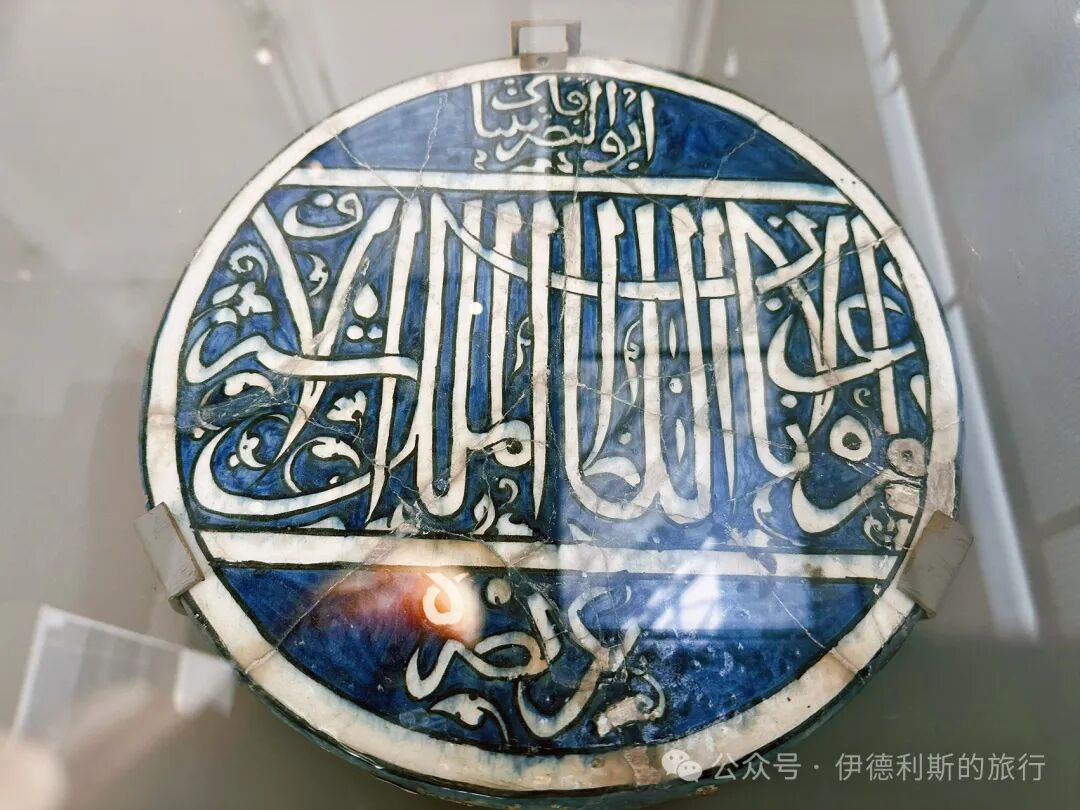
A 14th-century marble tile with Kufic script from the Mamluk dynasty in Egypt.
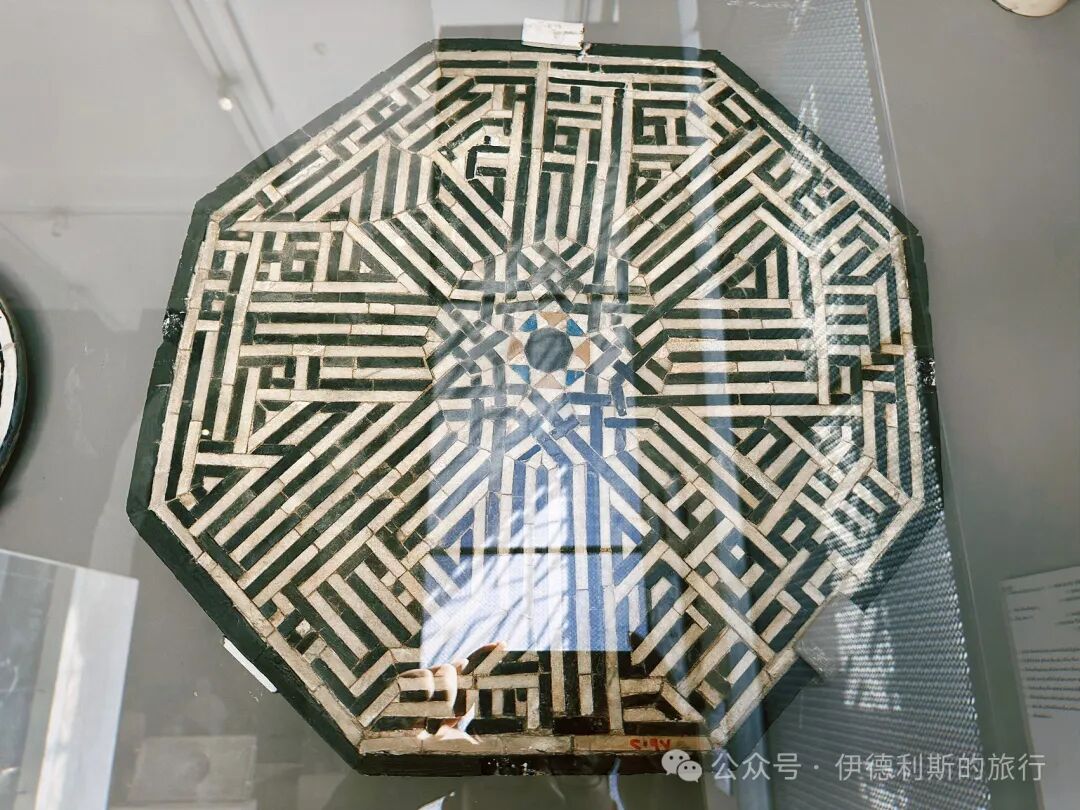
Arabic script tiles from the Egyptian Mamluk dynasty, with the 14th century on top and the 16th century on the bottom.
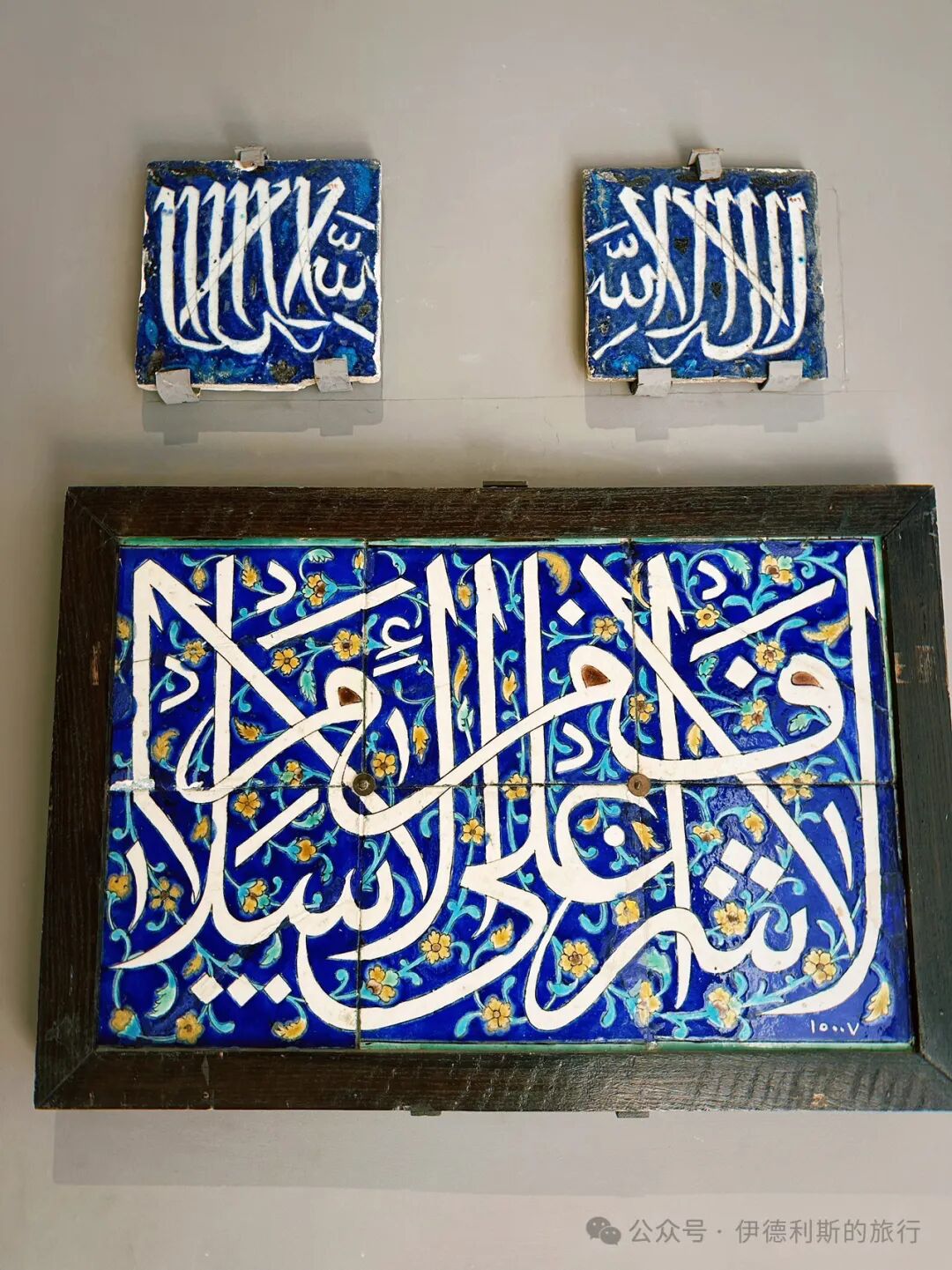
A 14th-century Mamluk-era marble carving from the Sarghatmish Madrasa in Cairo, featuring a small-scale replica in the bottom right corner that allows visitors to touch the patterns.
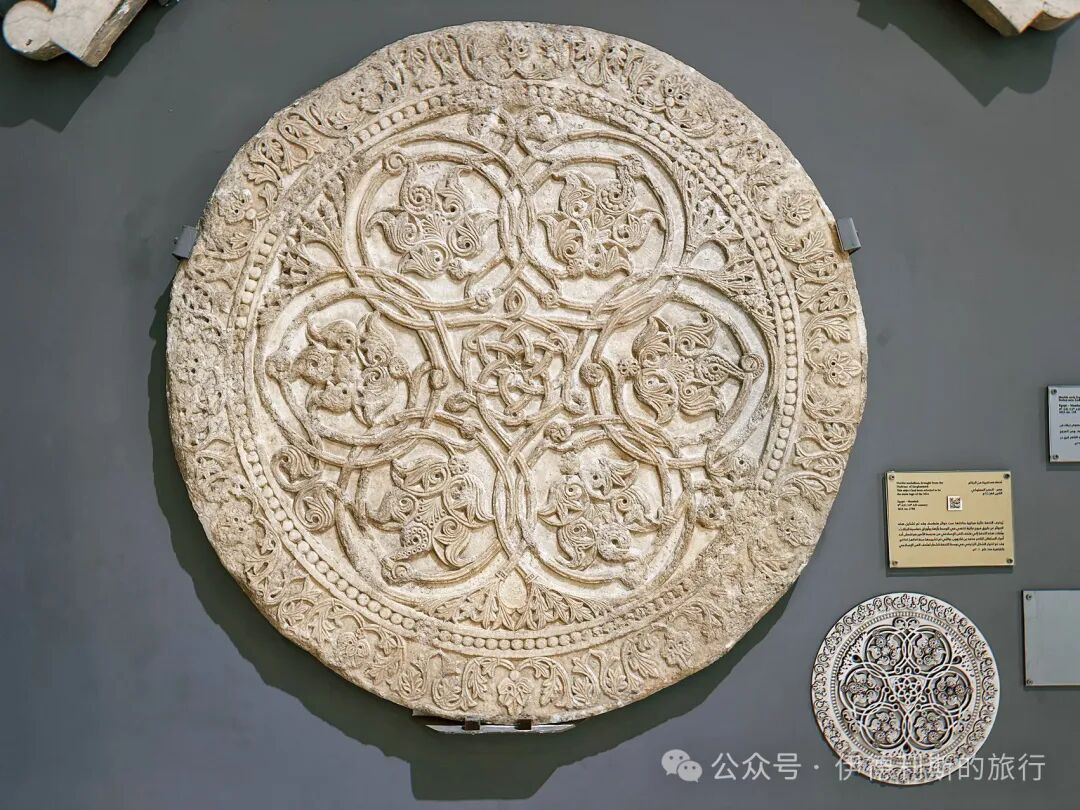
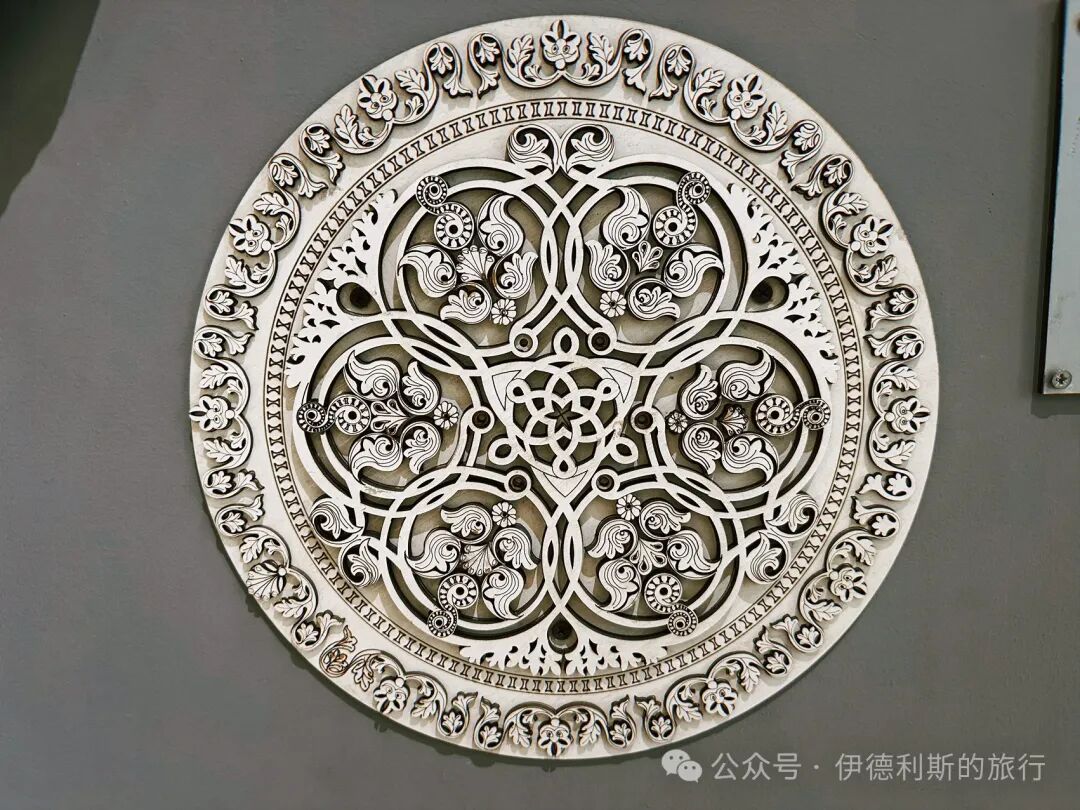
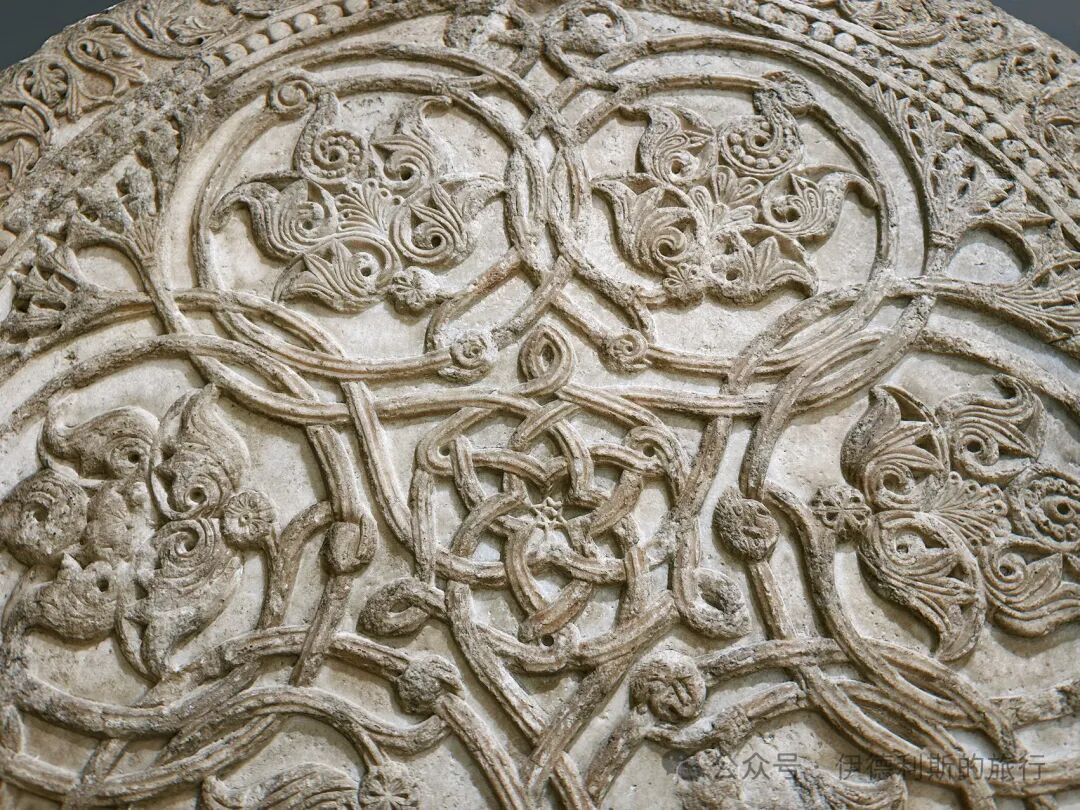
A copper lamp inlaid with silver, inscribed with the name of the Mamluk Sultan Al-Ashraf Sha'ban, who reigned from 1363 to 1377.
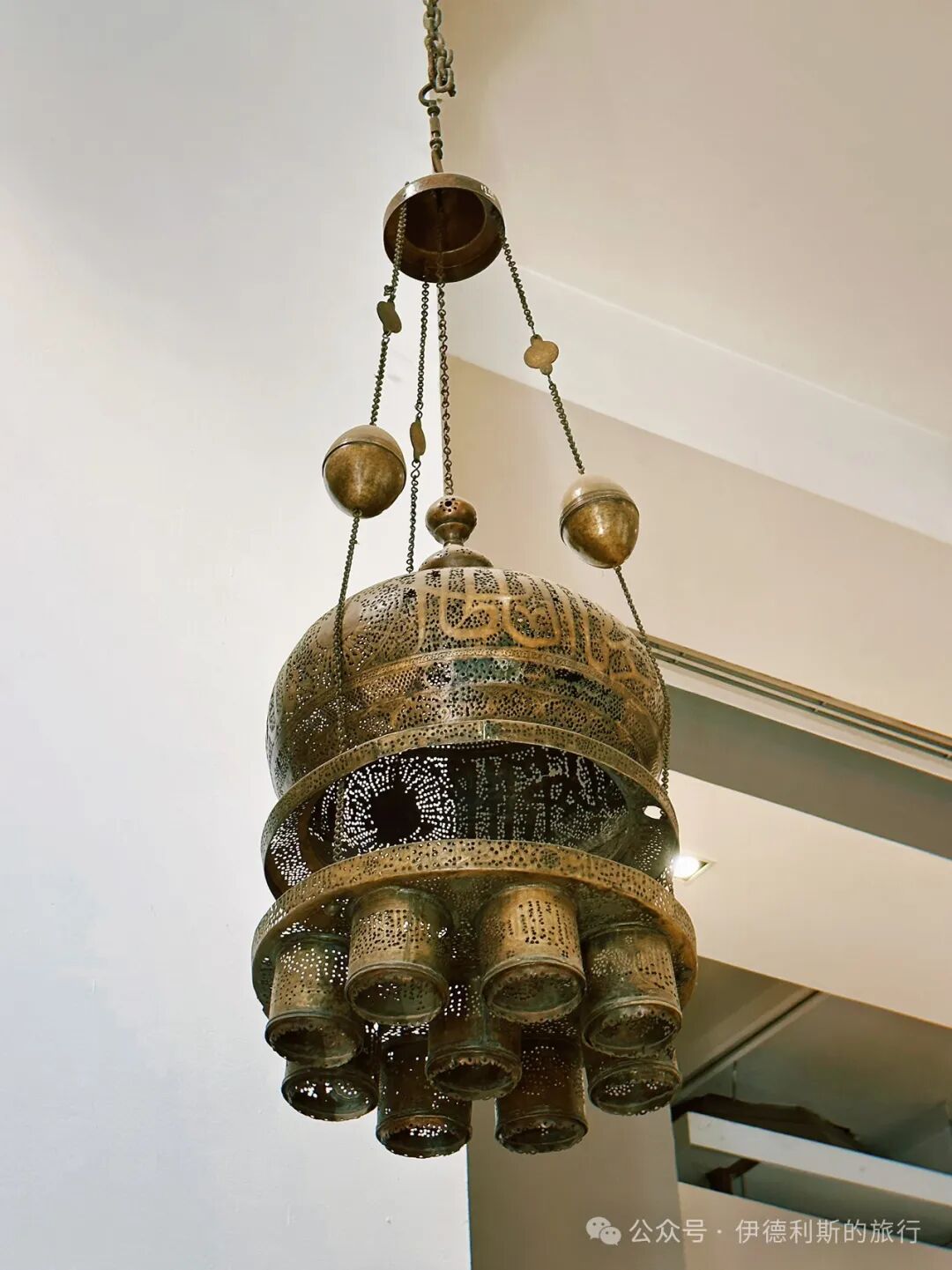
A 13th-century glass vessel from the Mamluk dynasty inscribed with the name of Prince Shams al-Din al-Tanbugha.
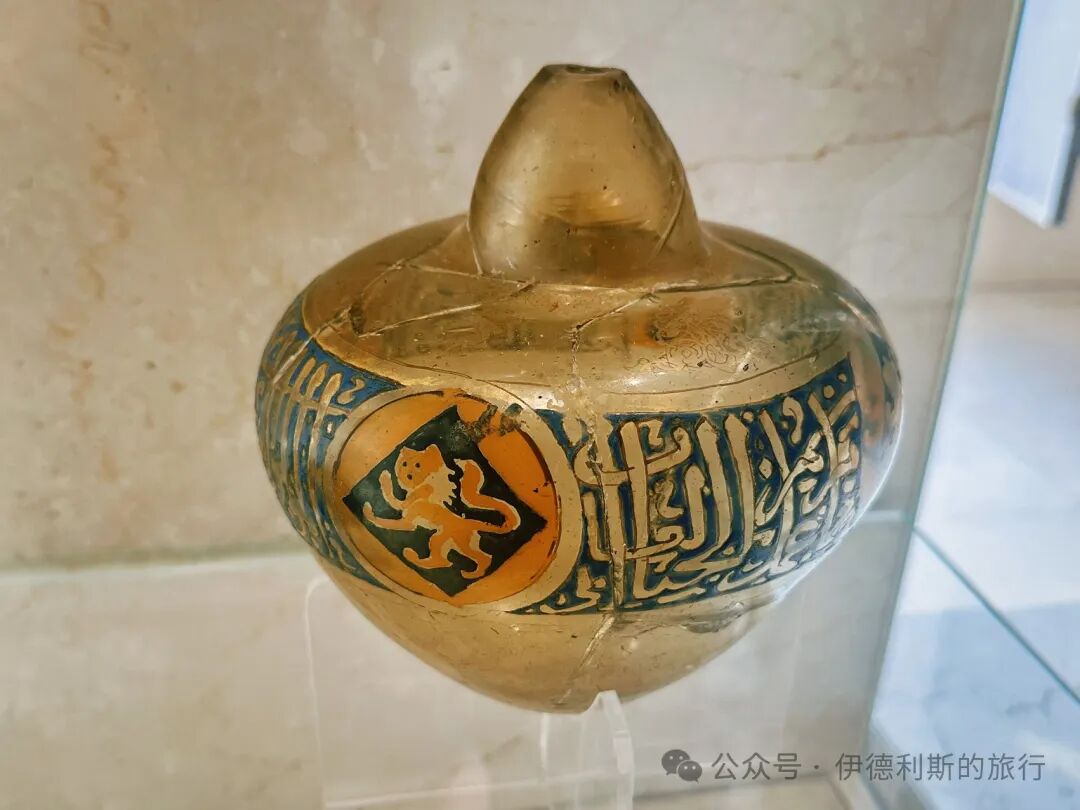
A 13th-century copper-plated wooden door from the Egyptian Mamluk dynasty, inscribed with the name of Prince Shams al-Din Sunqur al-Tawil al-Mansuri.
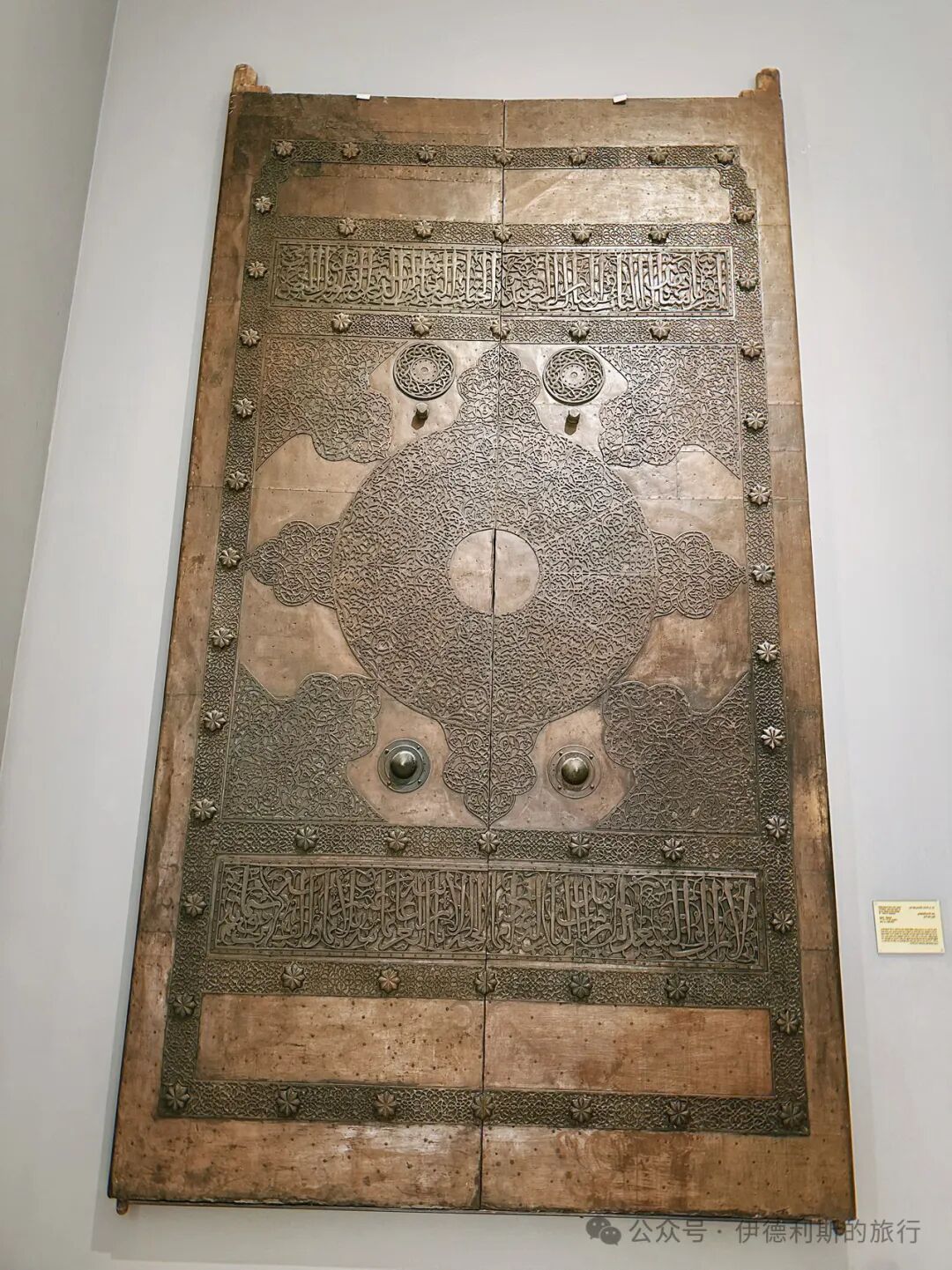
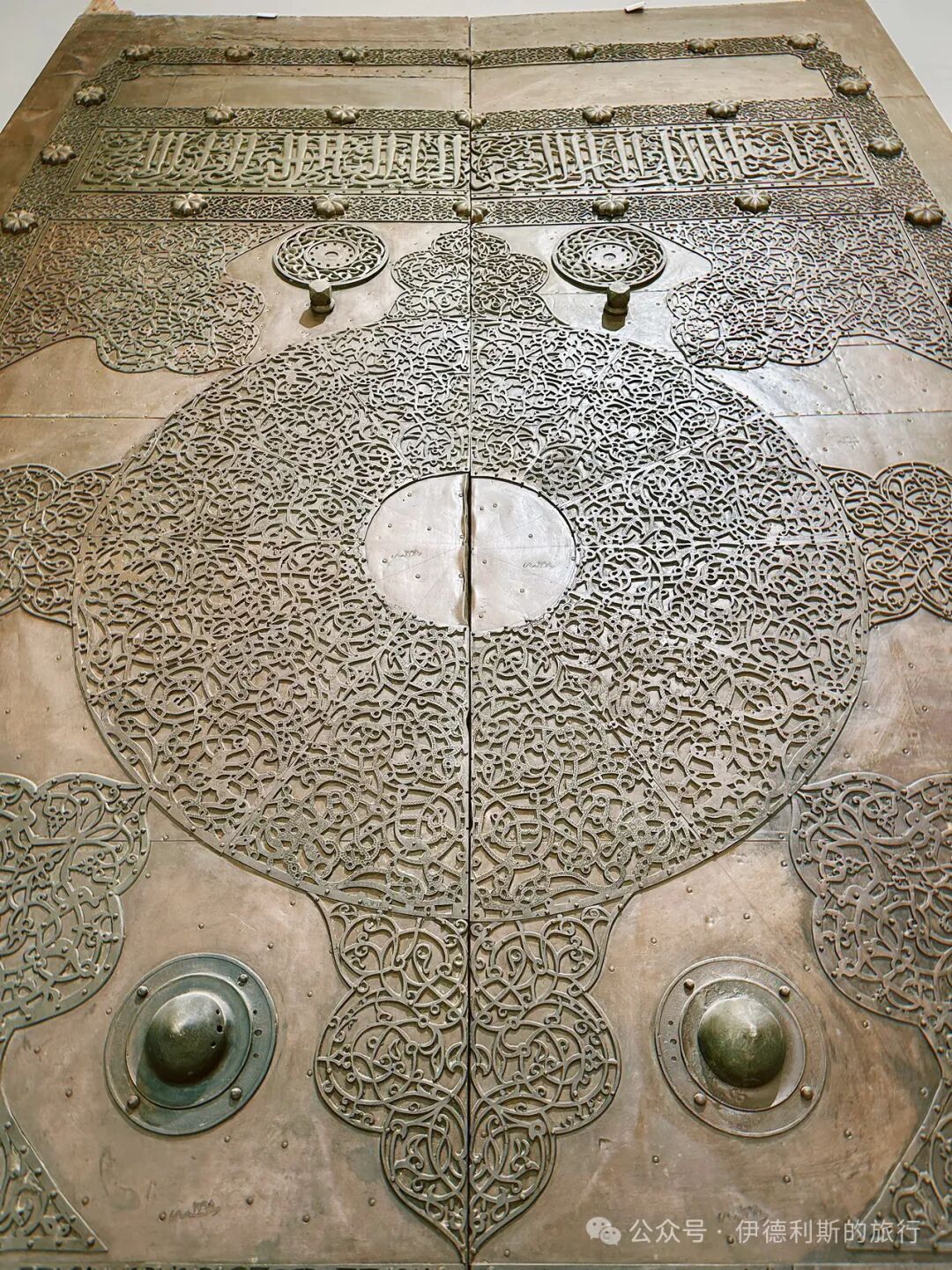
An ivory carving inscribed with the name of the Mamluk Sultan Qaitbay, who reigned from 1468 to 1496.
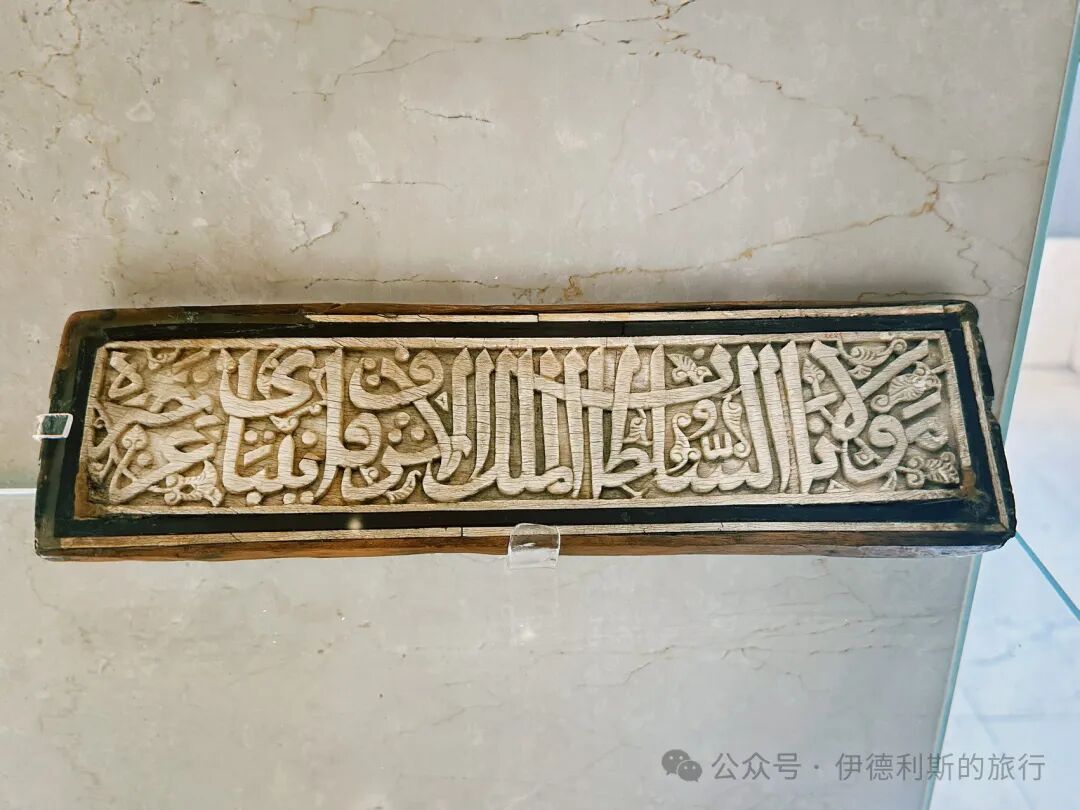
A 14th-century ivory carving from the Egyptian Mamluk dynasty.
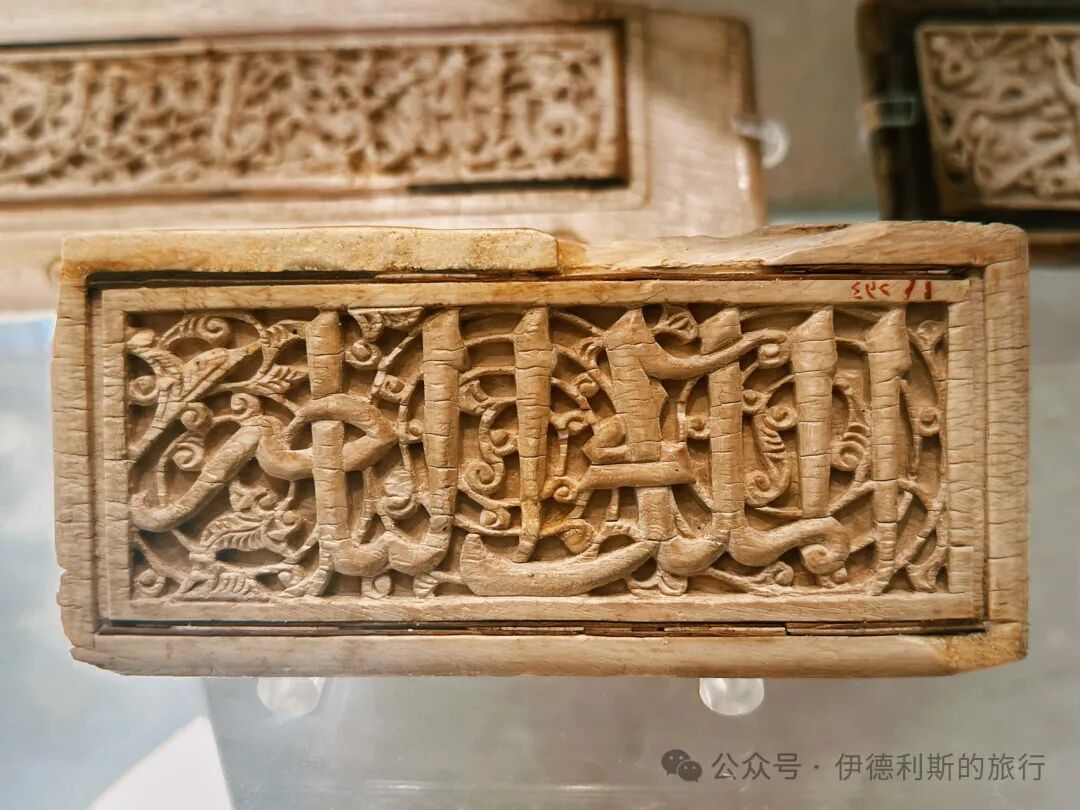
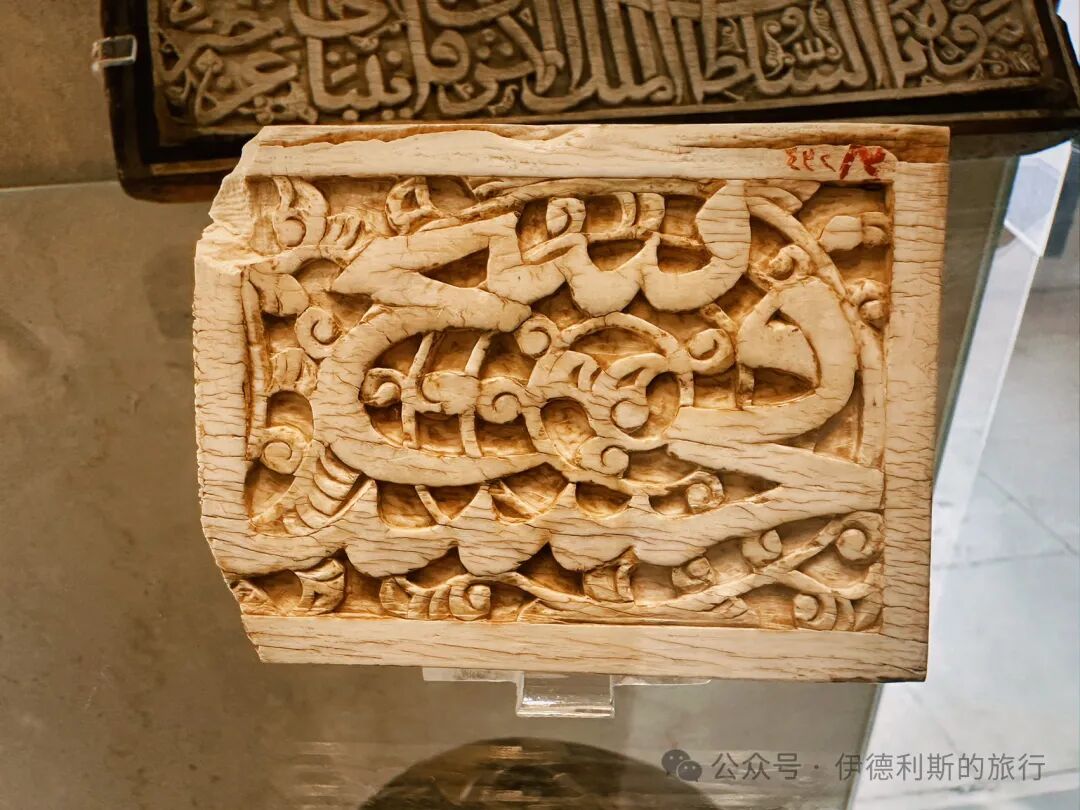
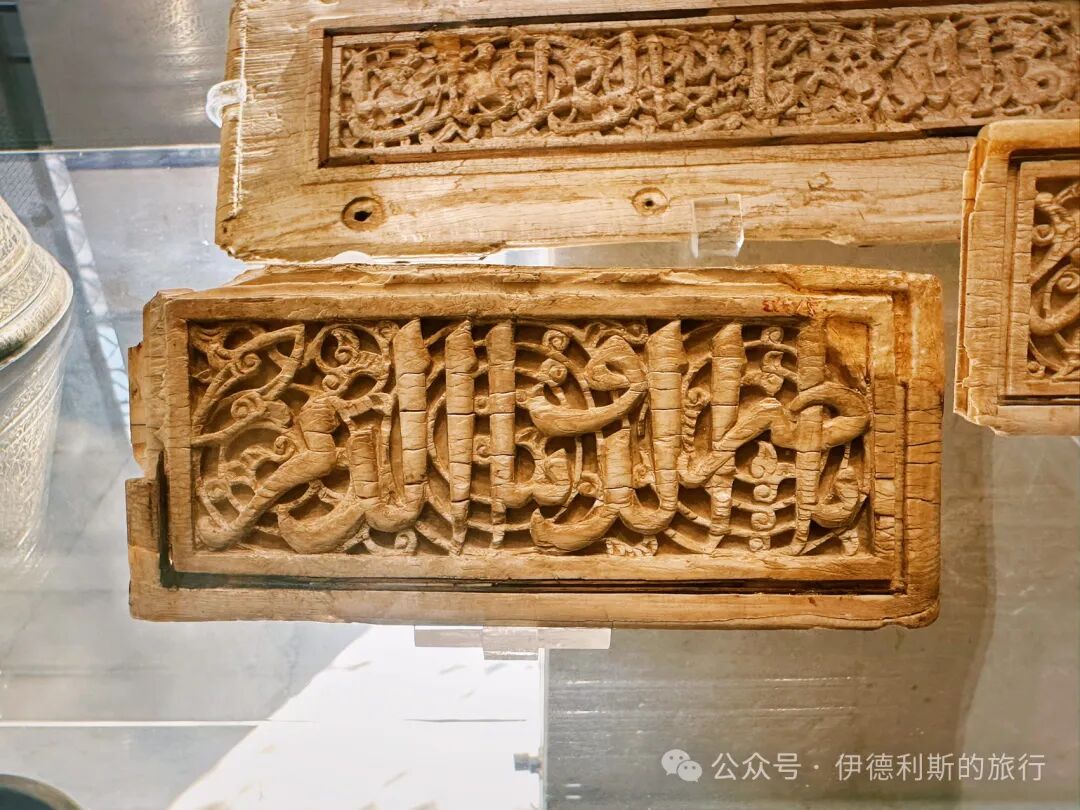
A marble carving inscribed with the name of the Mamluk Sultan Al-Ashraf Qansuh al-Ghuri, who reigned from 1501 to 1516.
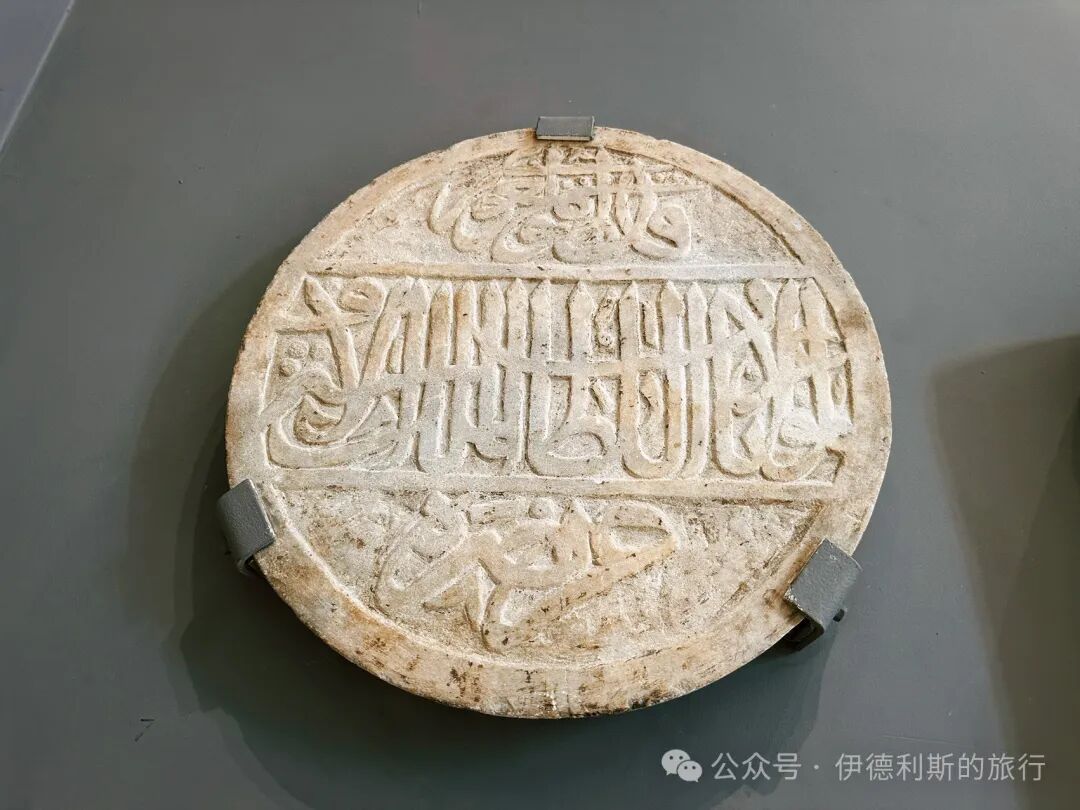
A royal decree carved into marble by the Egyptian Mamluk Sultan Sayf al-Din Jaqmaq, who reigned from 1438 to 1453, after he ordered the exemption of taxes for merchants.
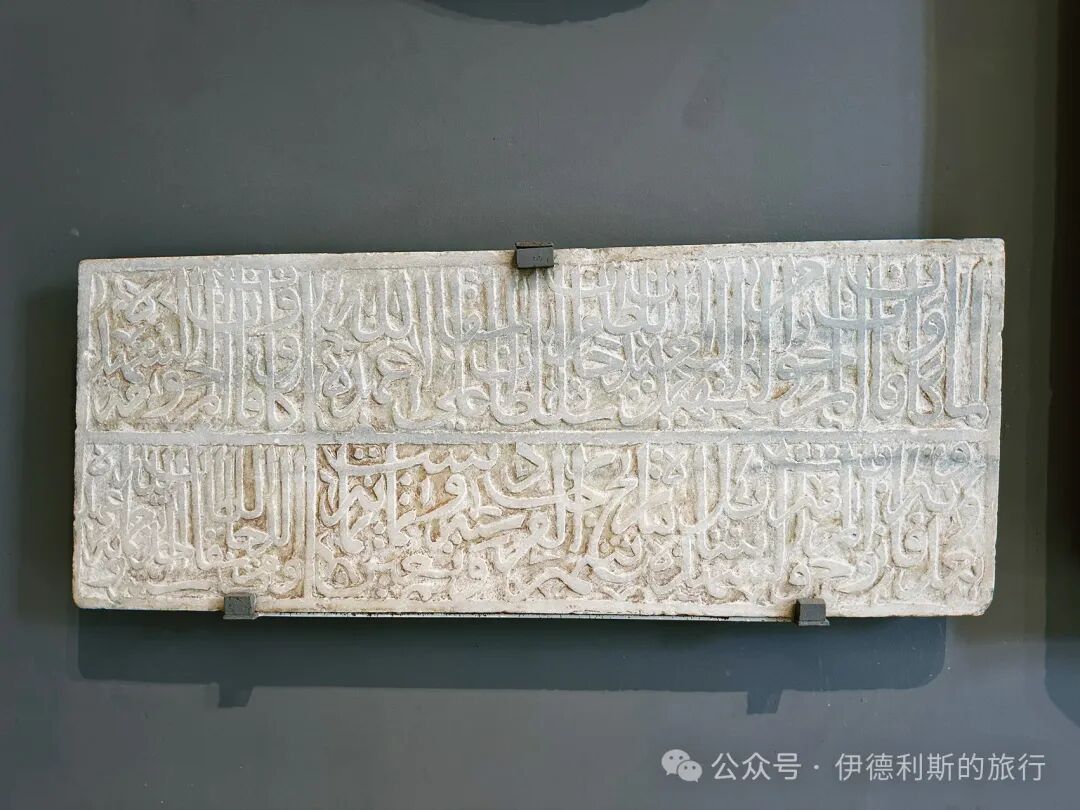
A marble tombstone from the 15th to 16th-century Egyptian Mamluk dynasty.
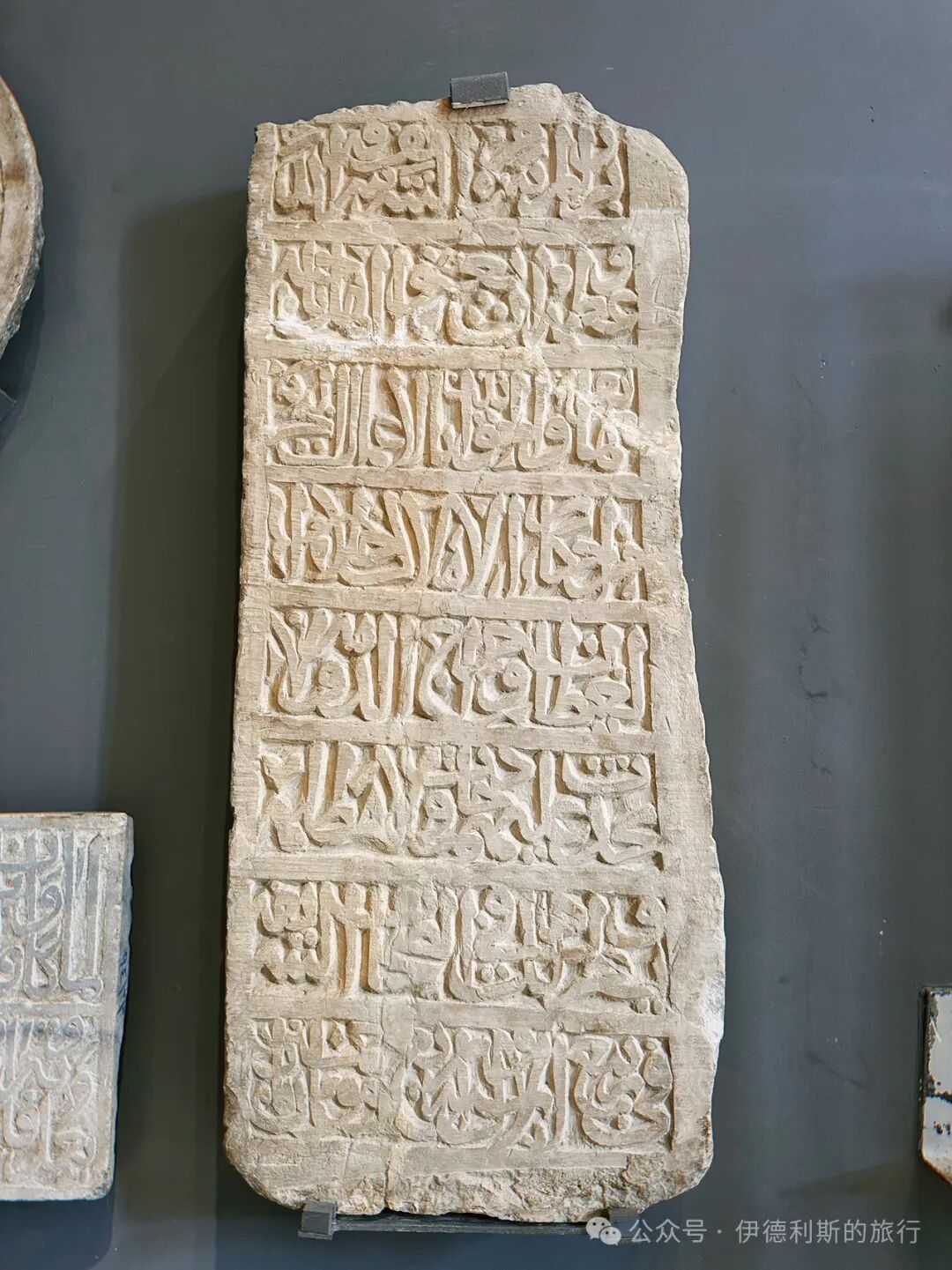
A 13th to 15th-century copper basin inlaid with silver from the Egyptian Mamluk dynasty; the Palace Museum holds several blue and white porcelain pieces with the same design.
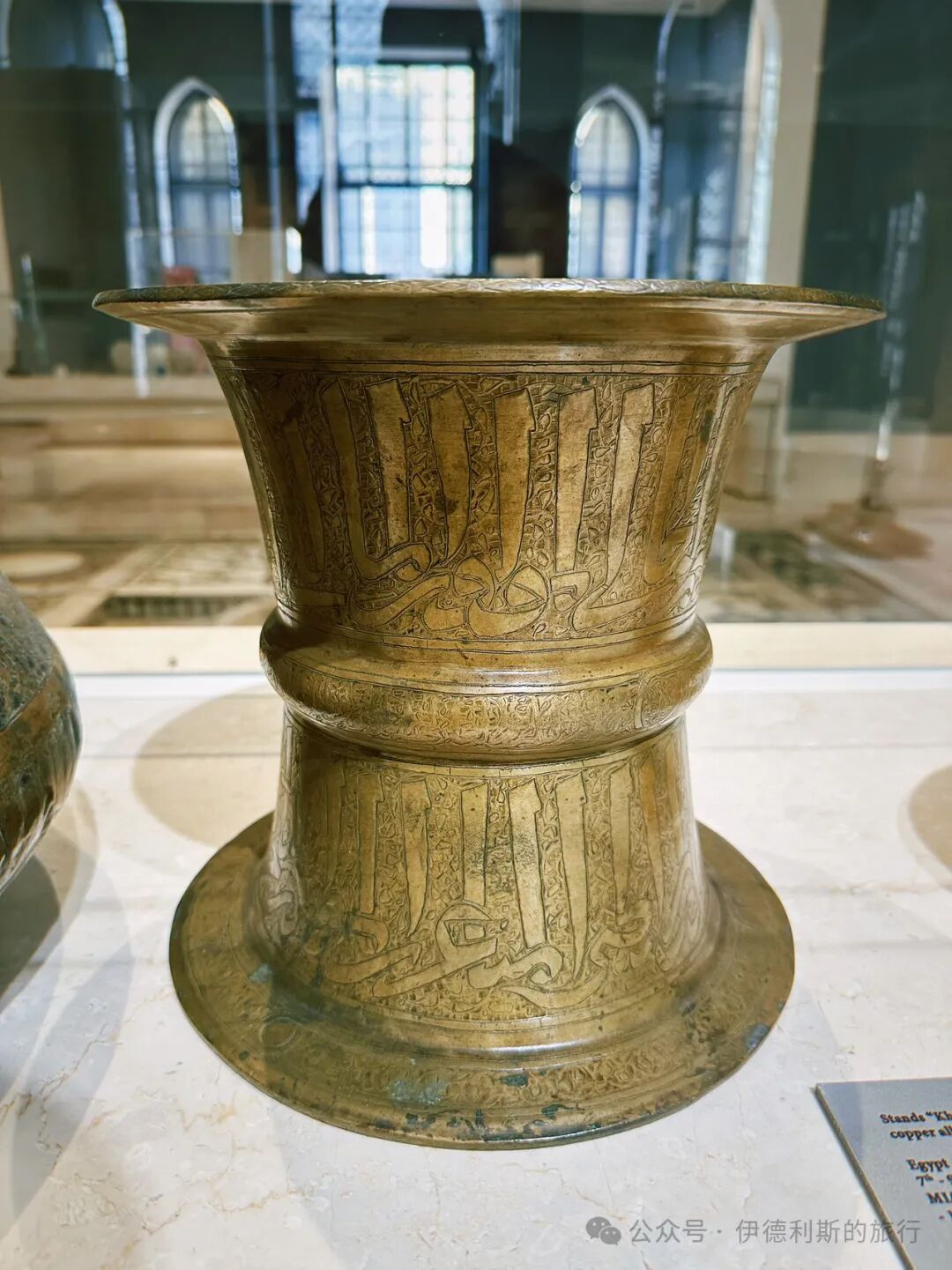
Ottoman dynasty.
A 17th to 18th-century wooden balcony (mashrabiya) from the Ottoman dynasty in Egypt. This is an important part of traditional Middle Eastern architecture, featuring intricate wooden lattice screens that allow for evaporative cooling when water jars are placed inside.
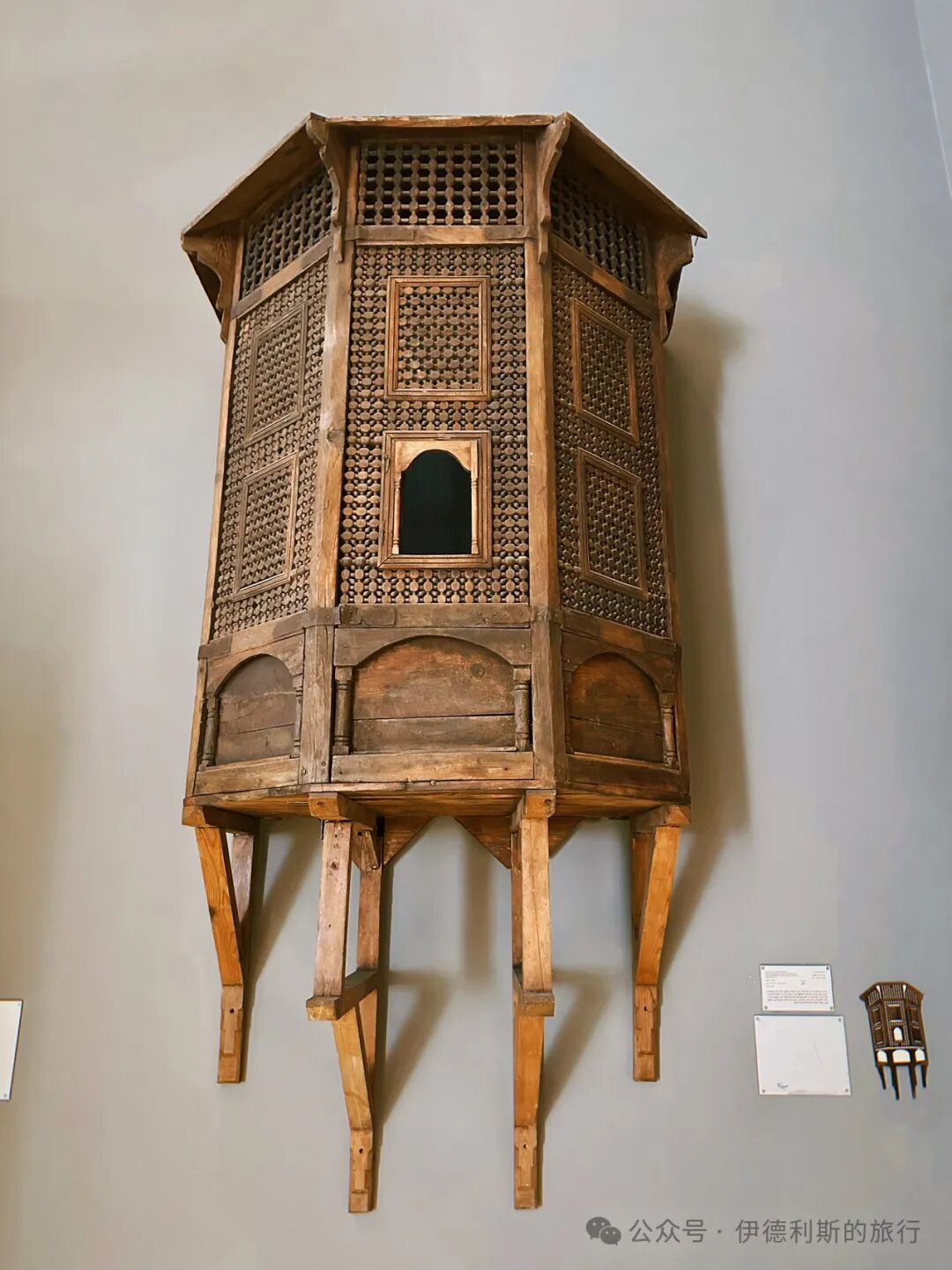
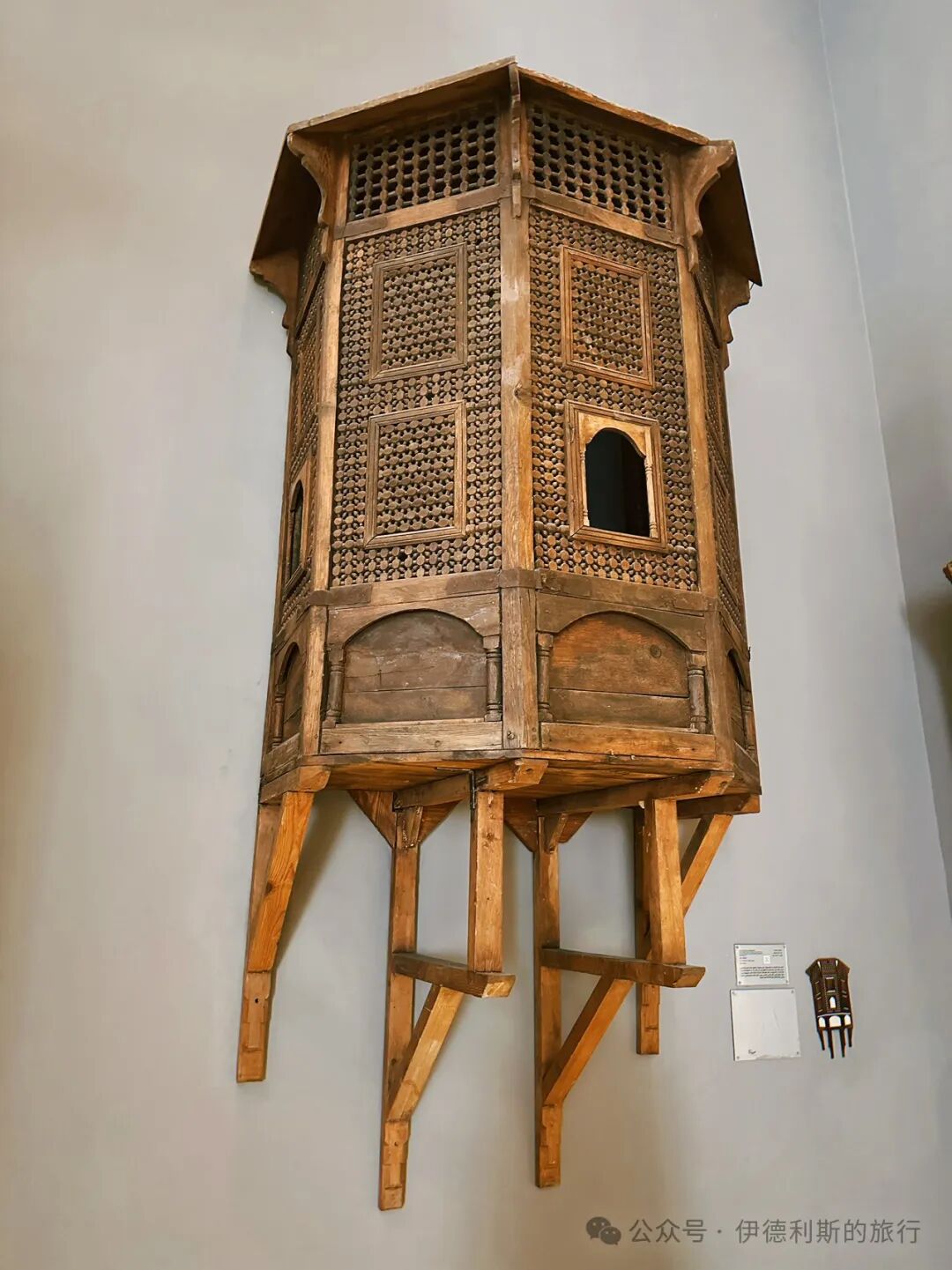
An 18th-century wooden cabinet inlaid with ivory from the Ottoman period in Egypt.
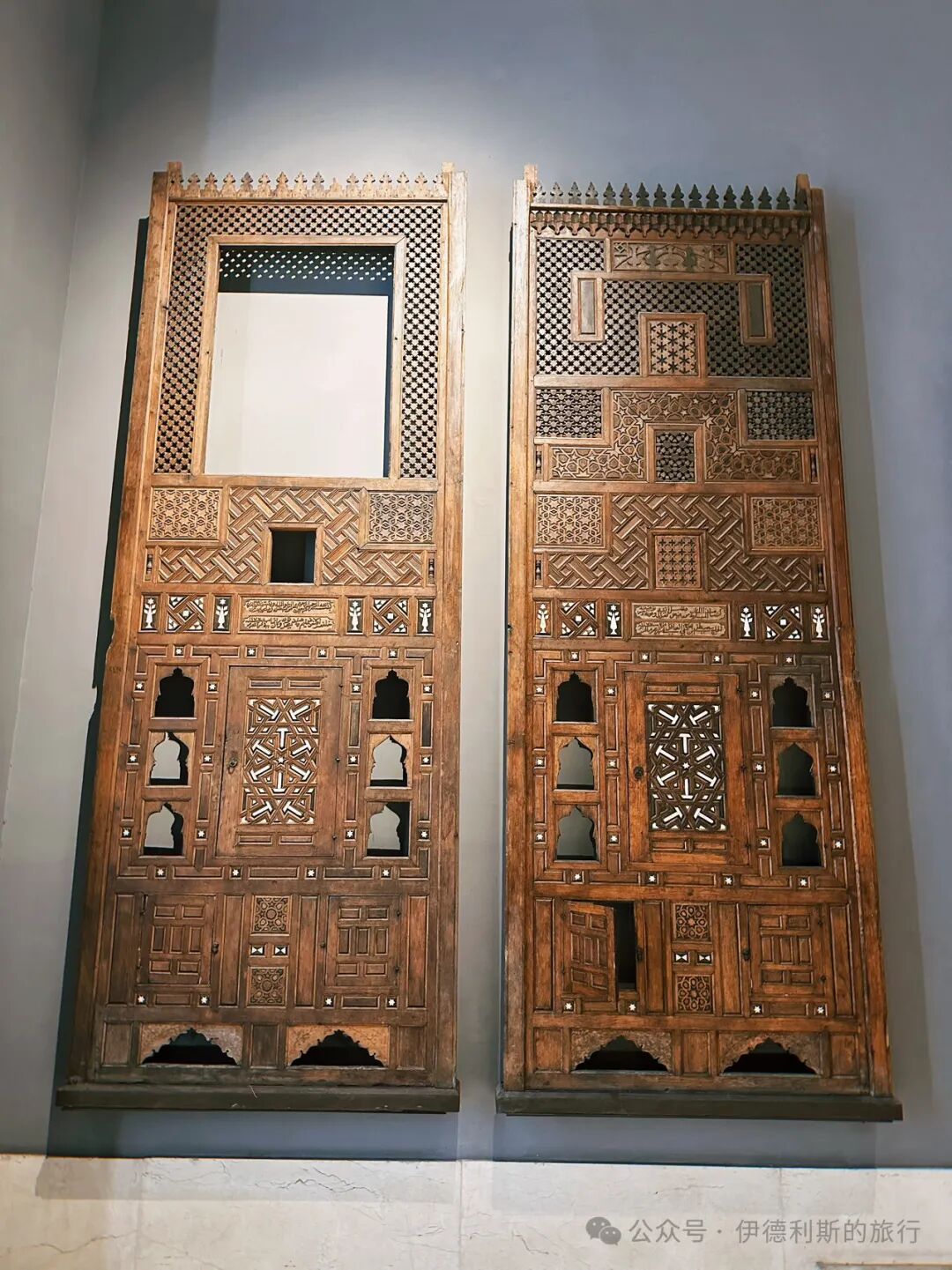
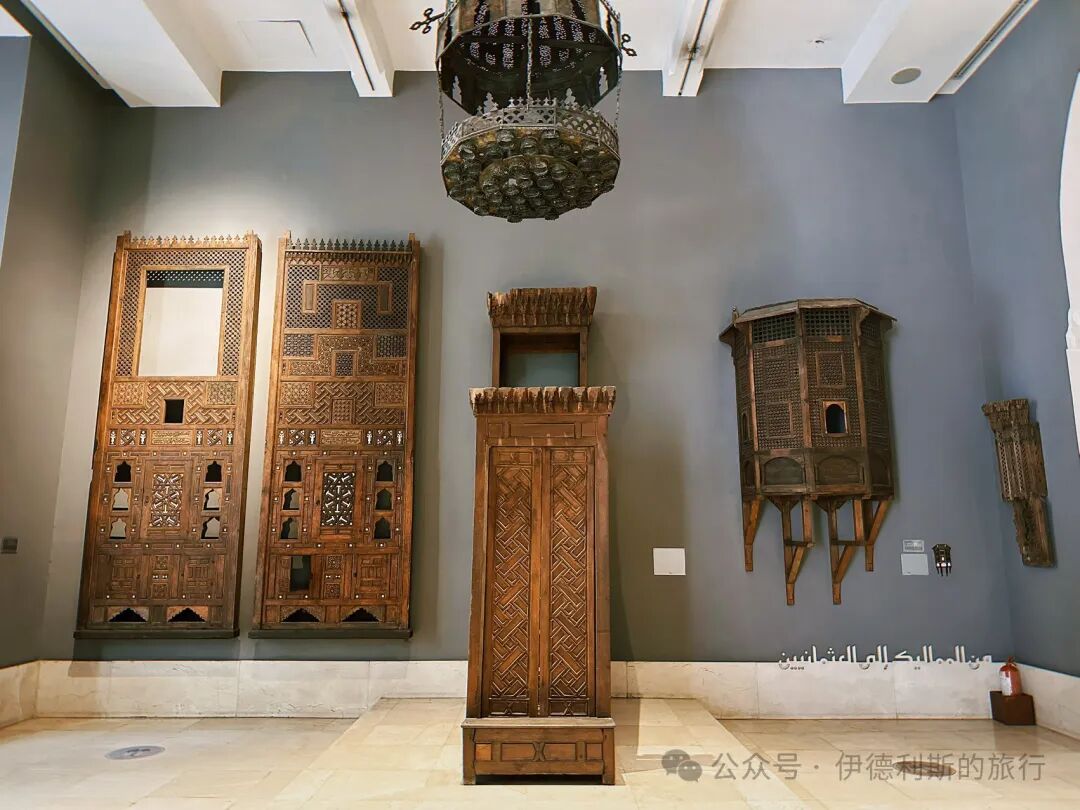
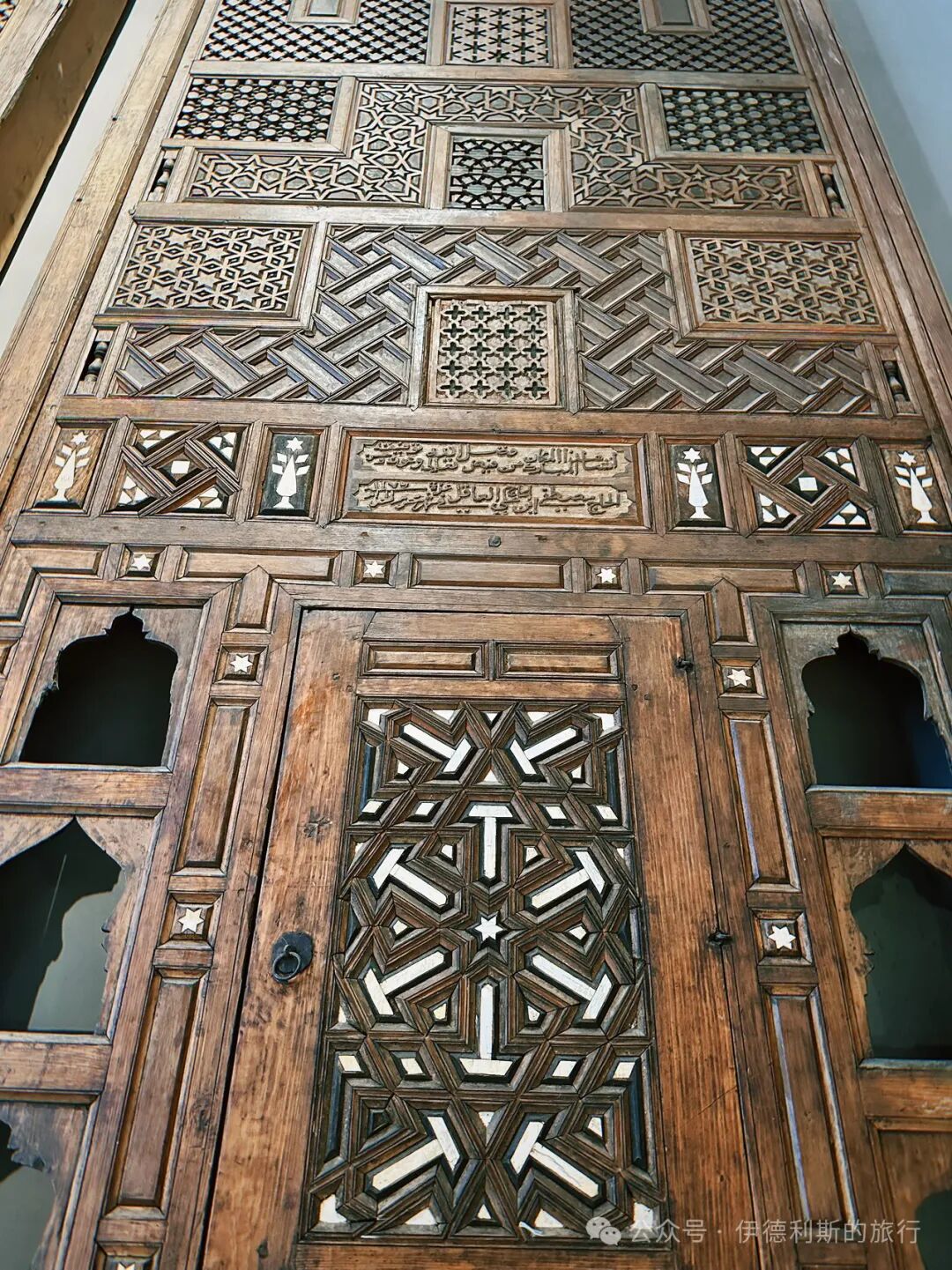
This piece has no label, but it appears to be an ivory-inlaid wooden pulpit (minbar) from the Ottoman period in Egypt.
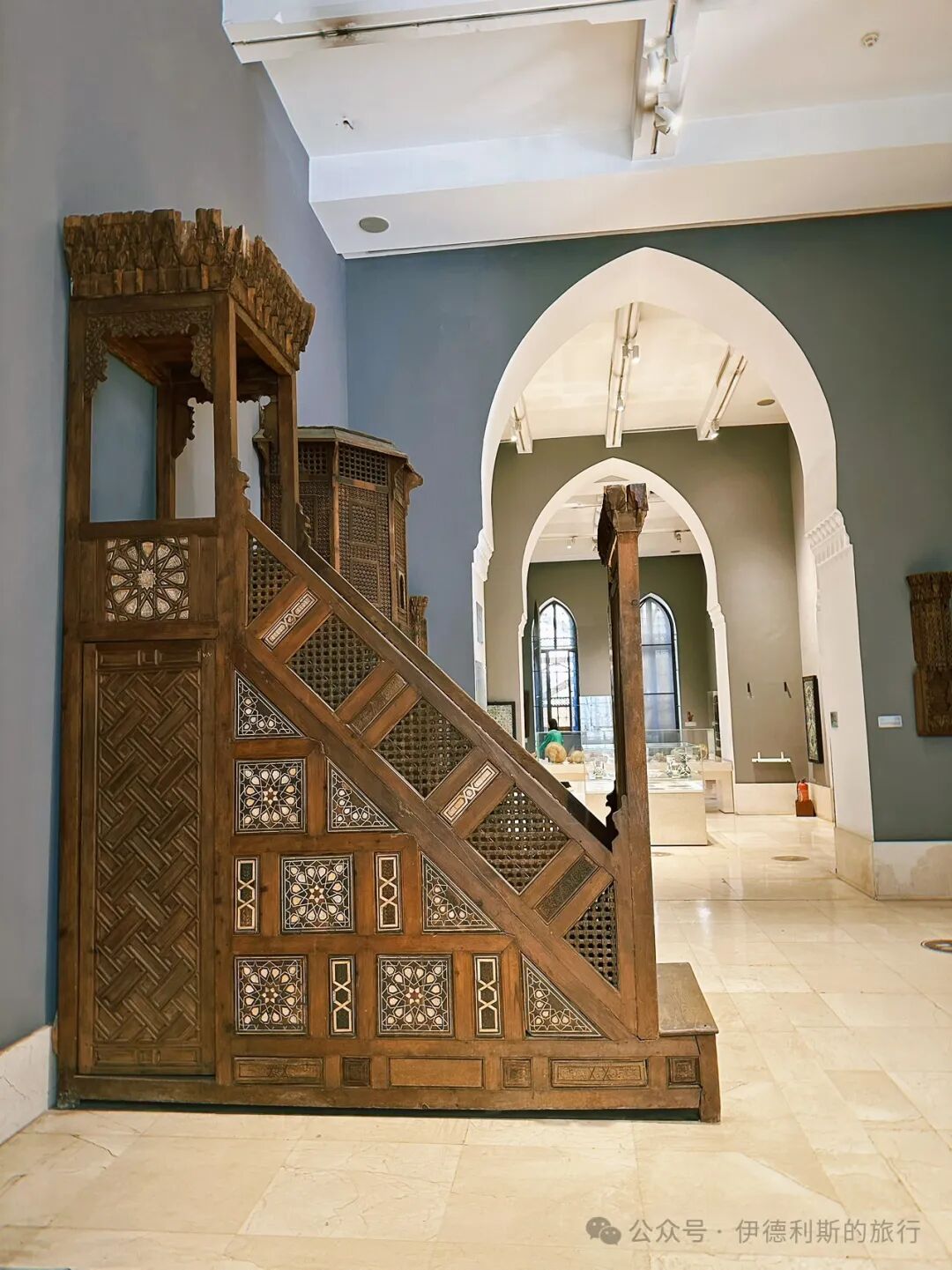
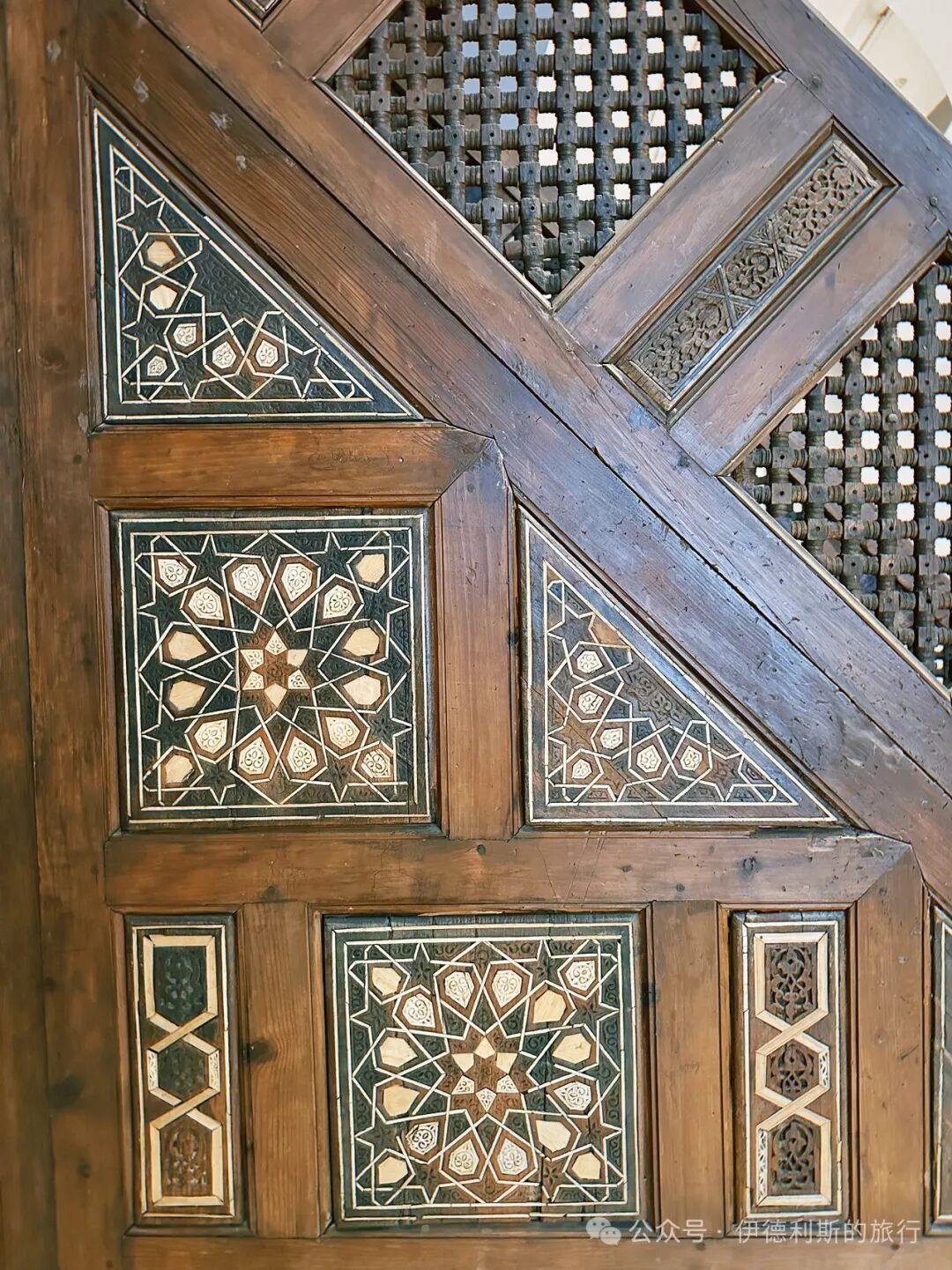
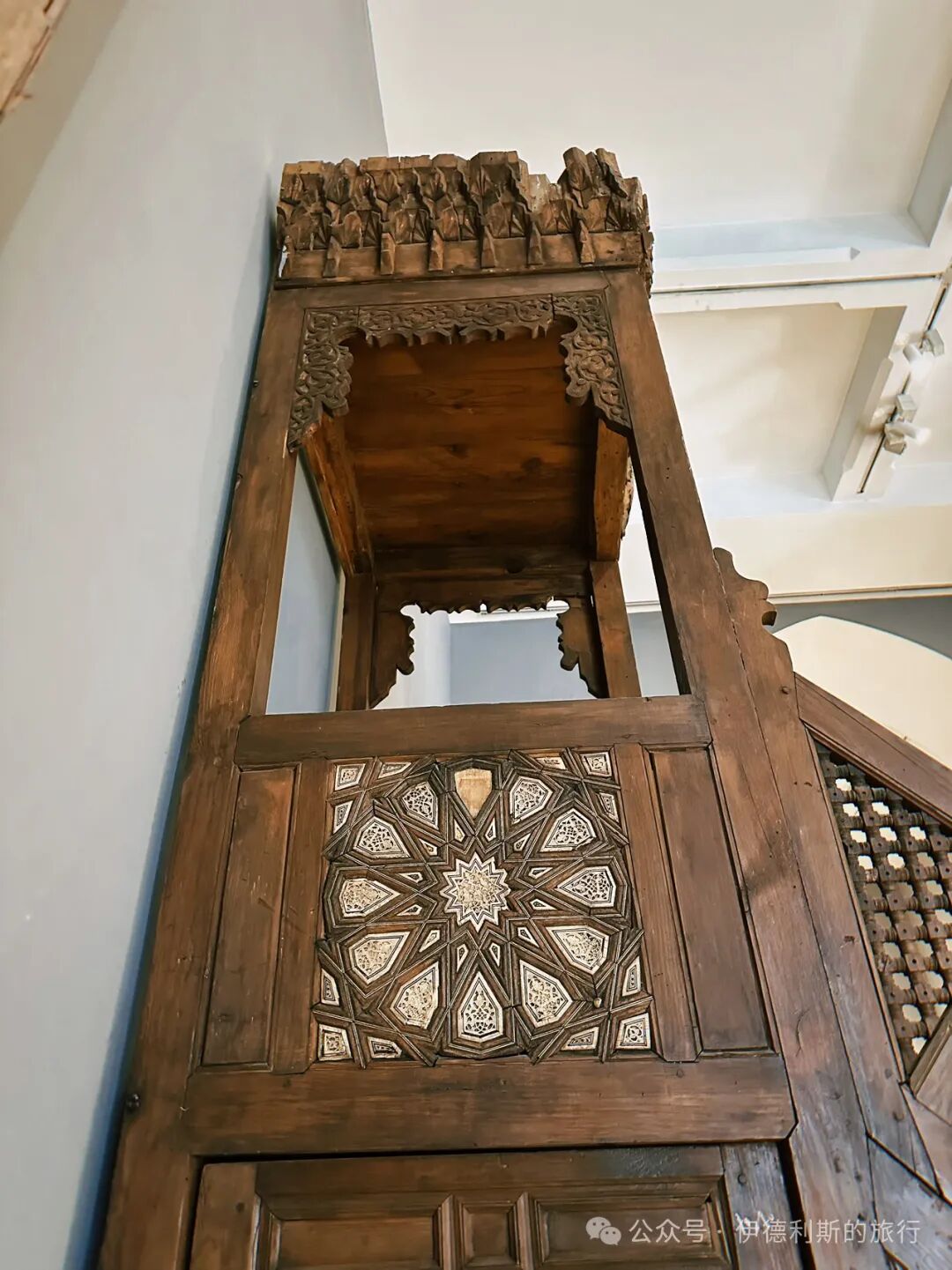
Ceramic tiles produced in Iznik, Turkey, during the 16th-century Ottoman period.
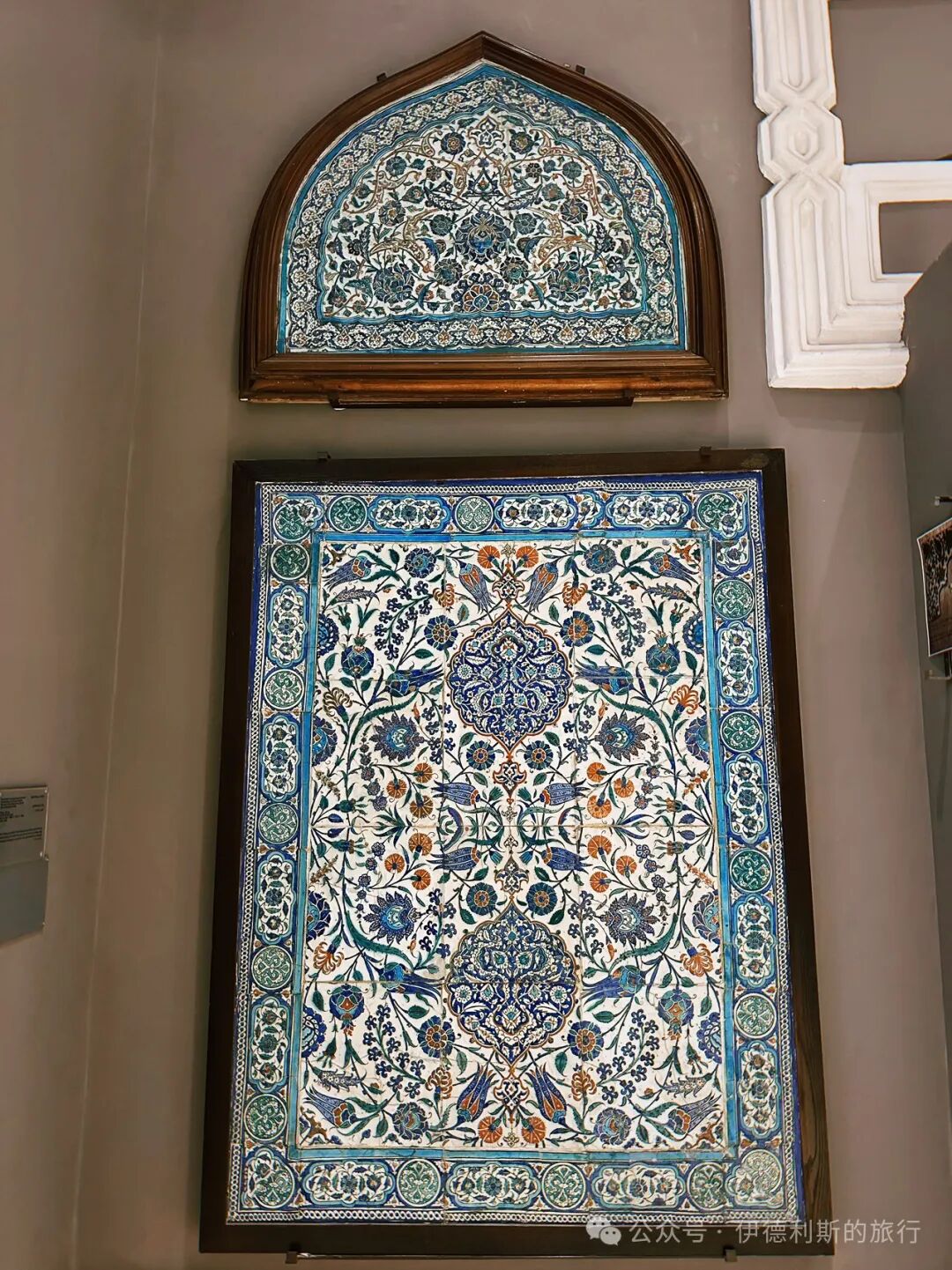
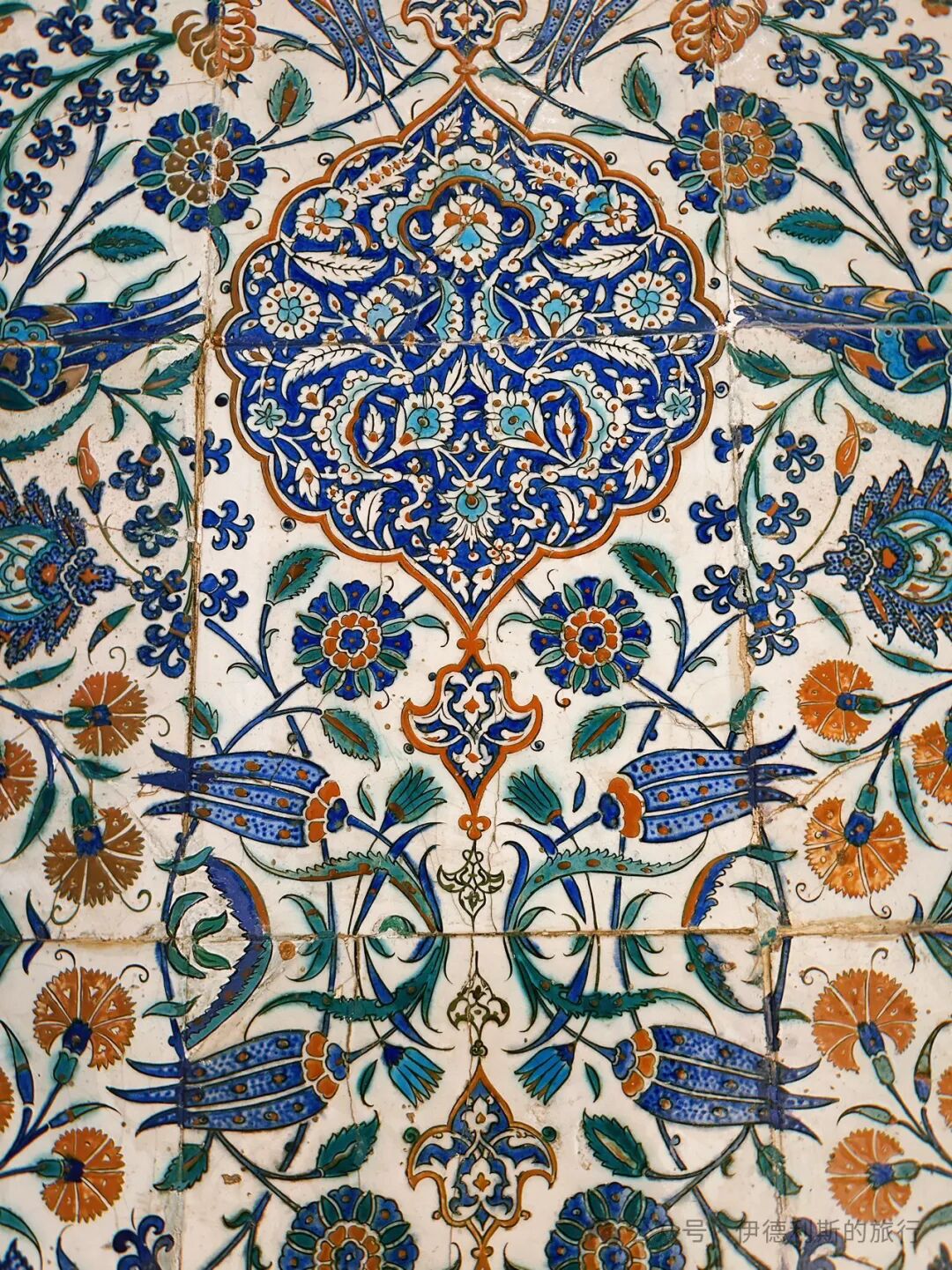
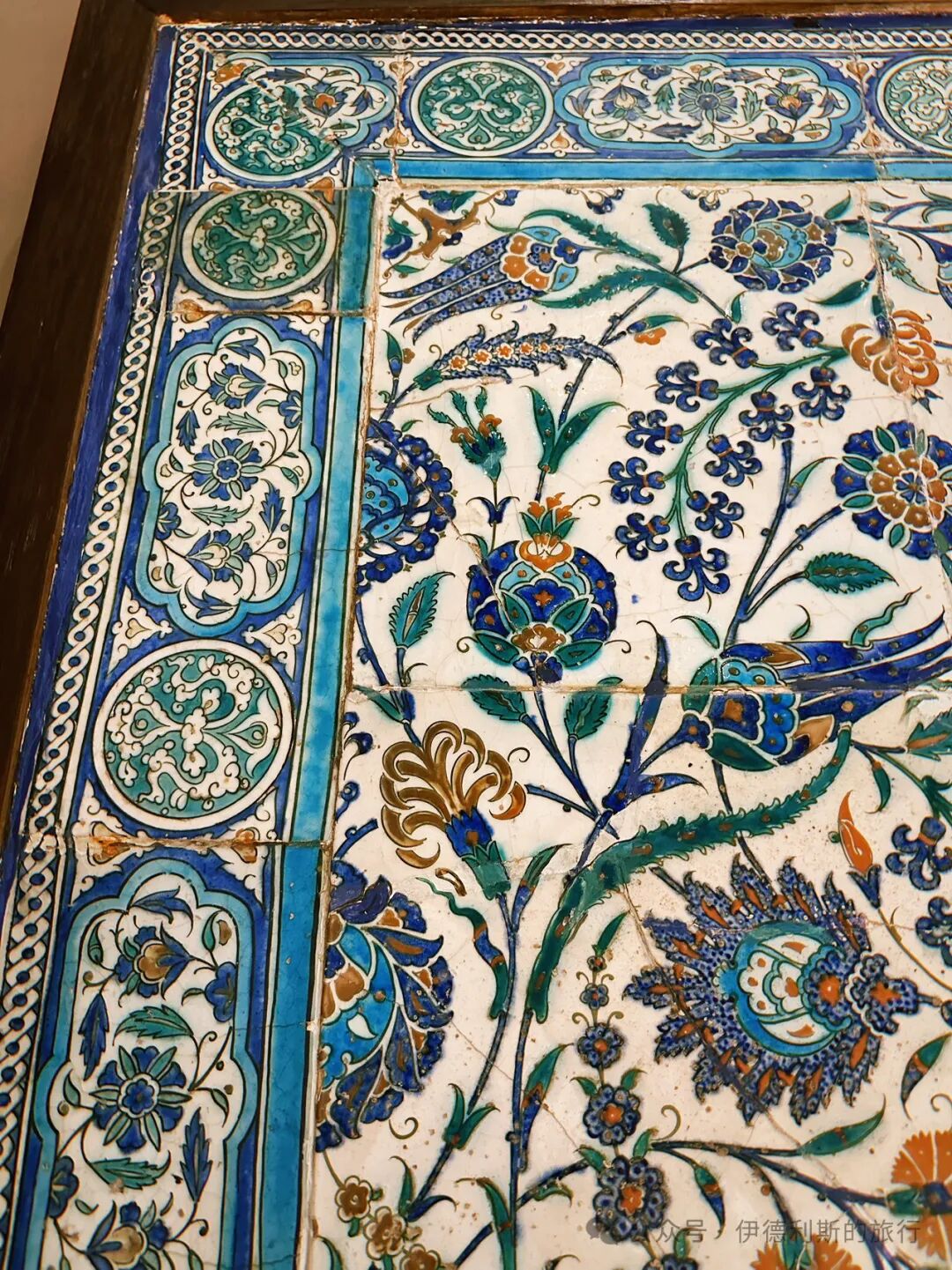
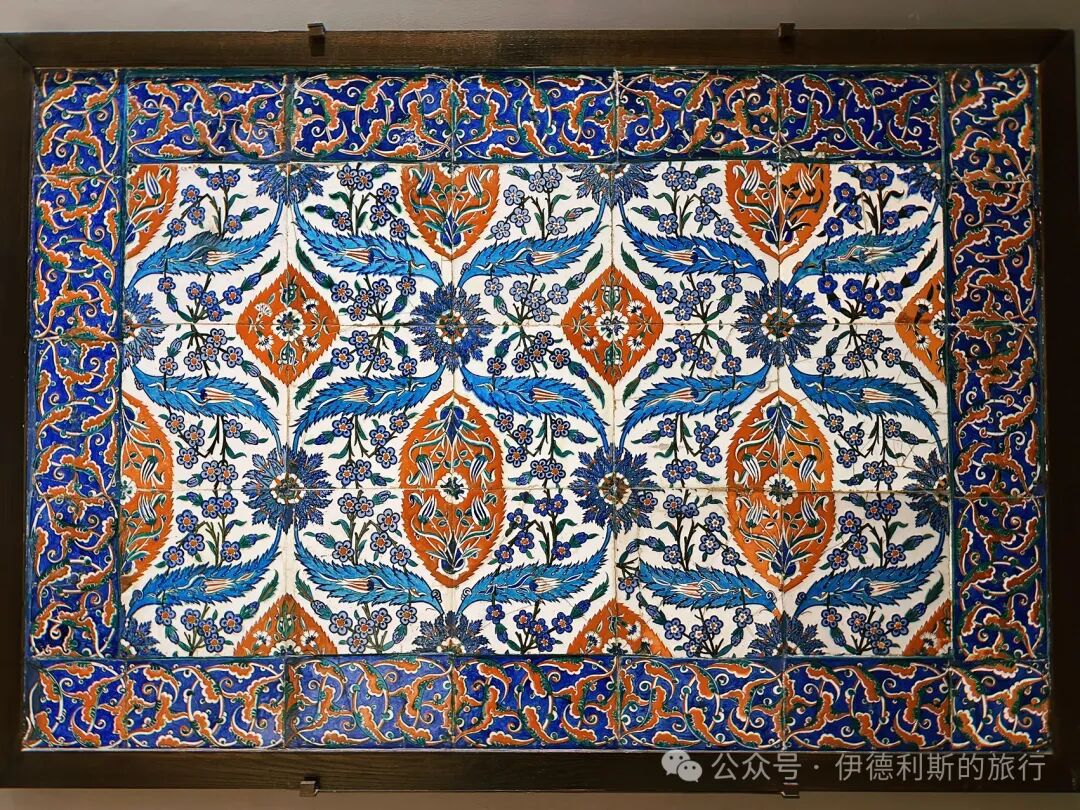
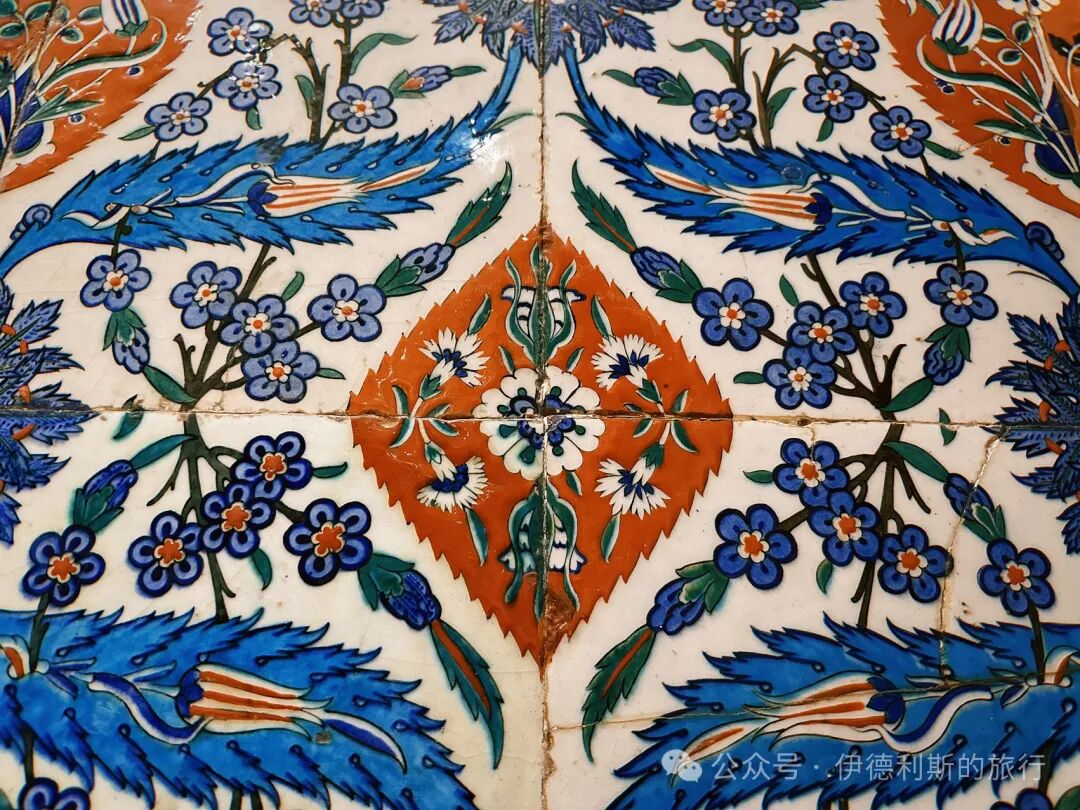
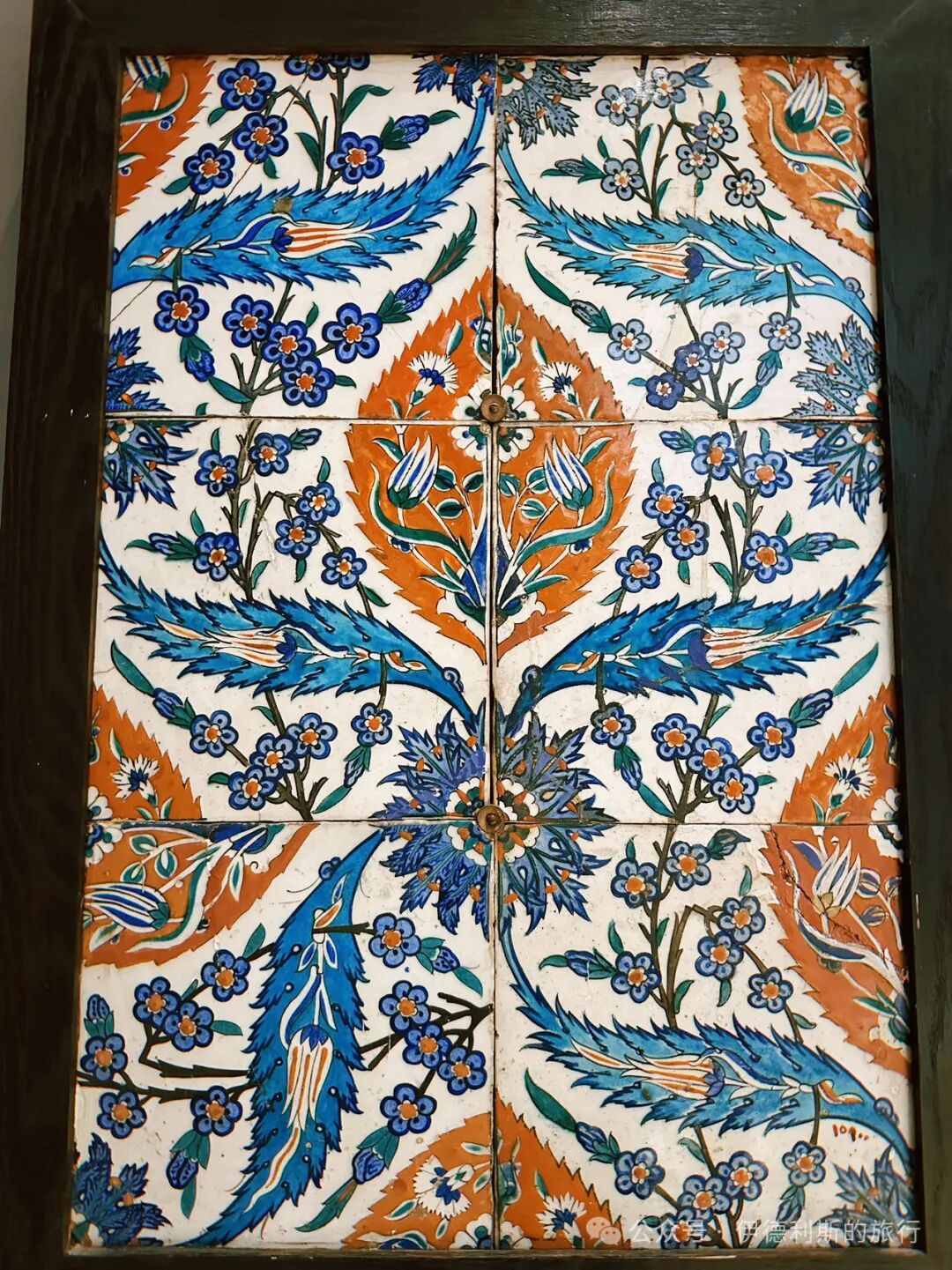
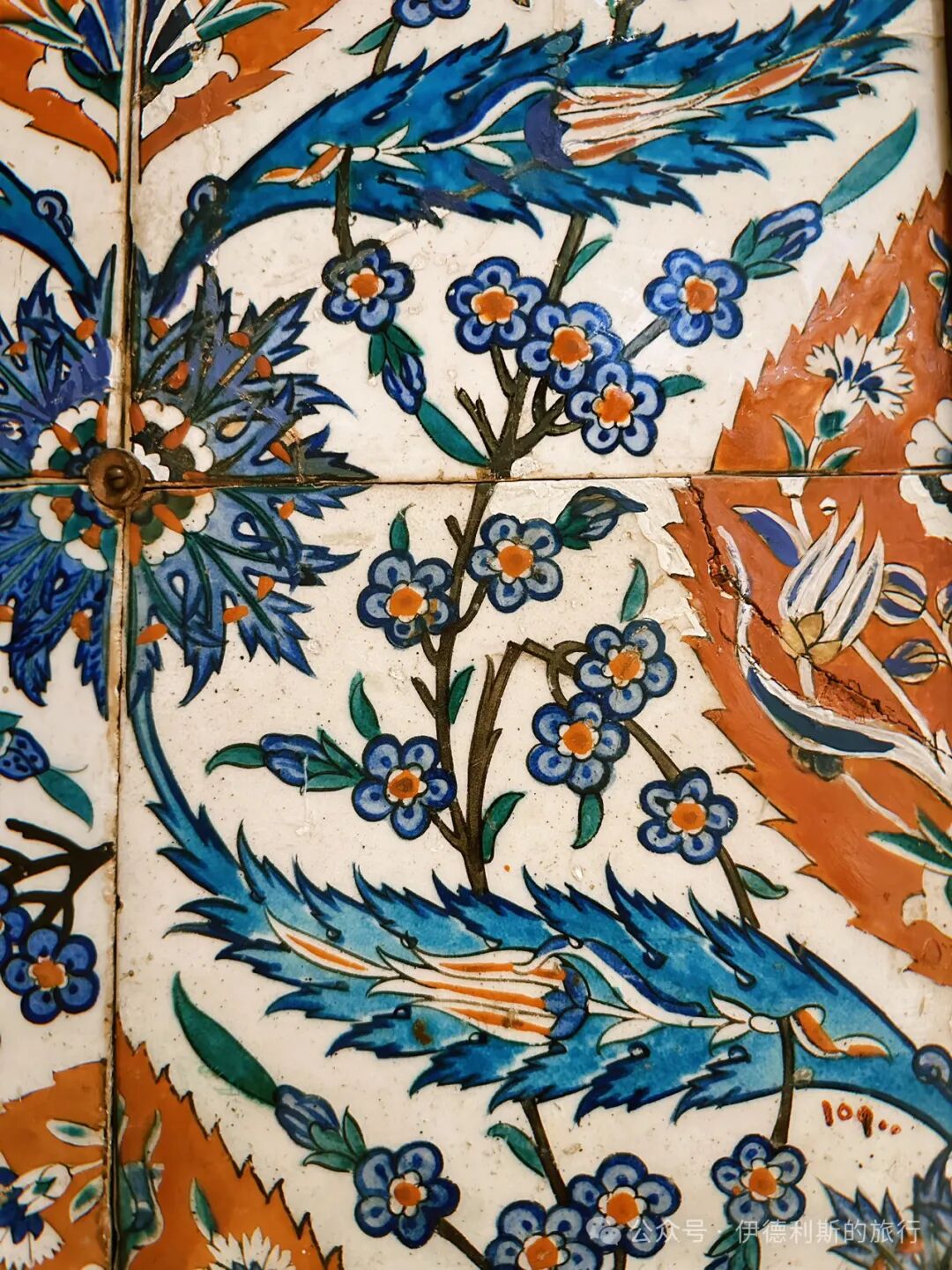
Porcelain from the 16th to 19th centuries, covering the Ottoman and Muhammad Ali periods.
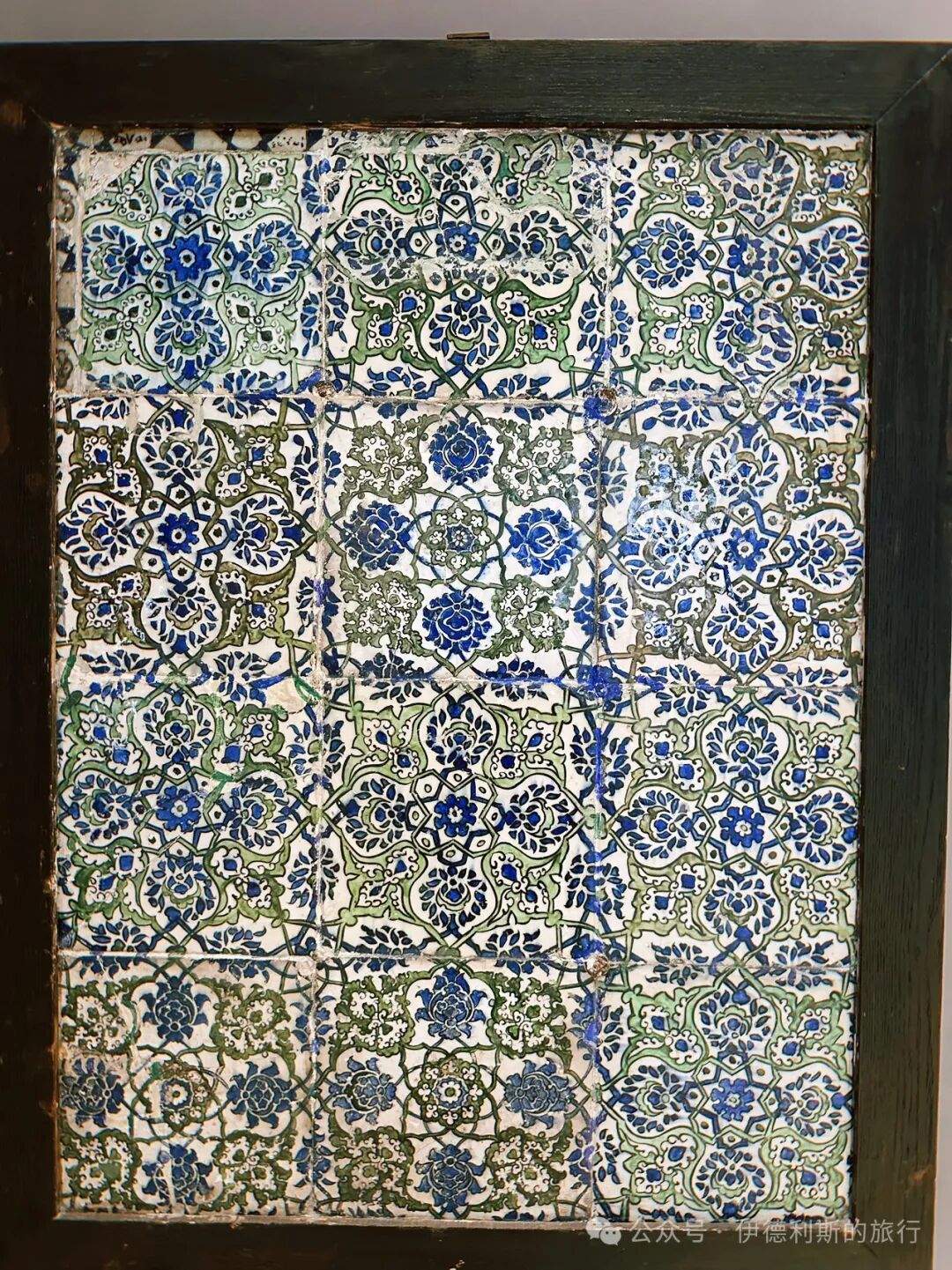
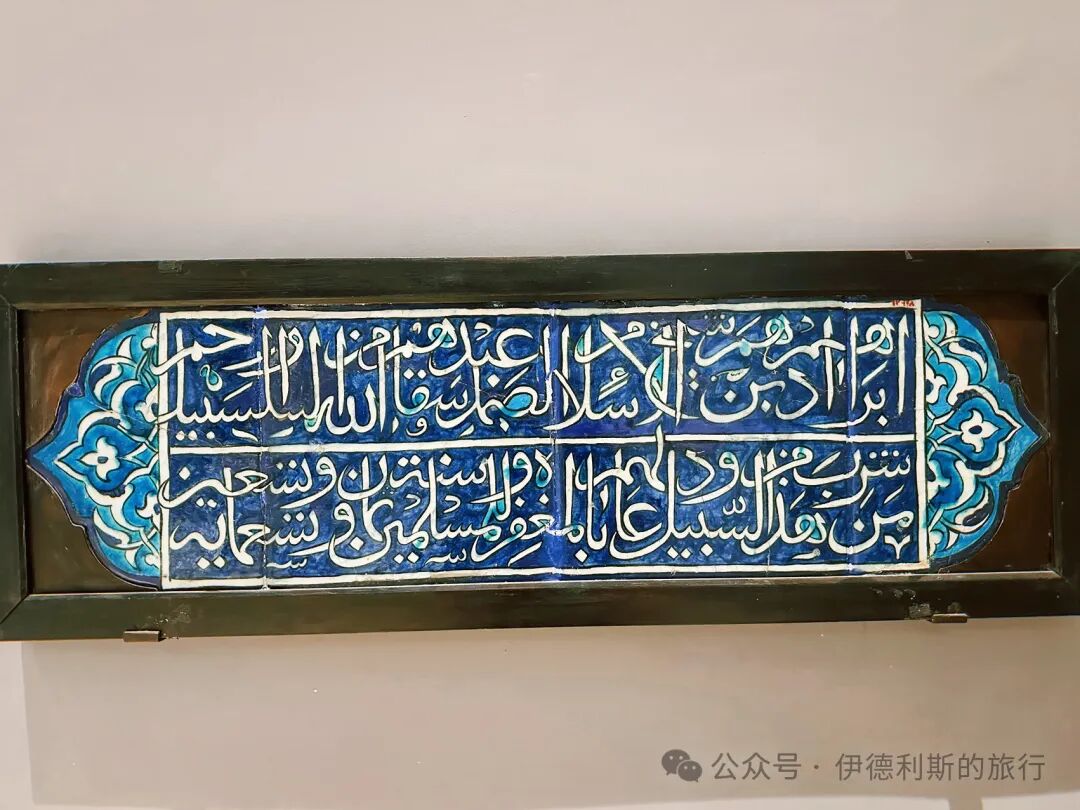
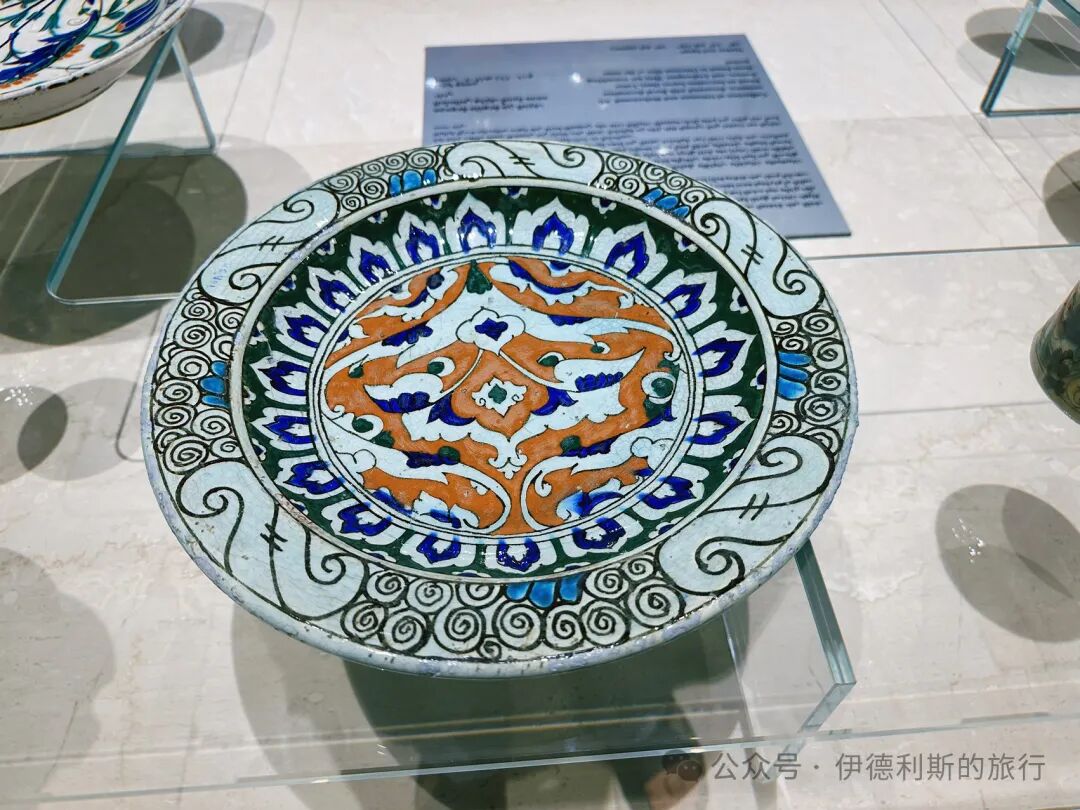
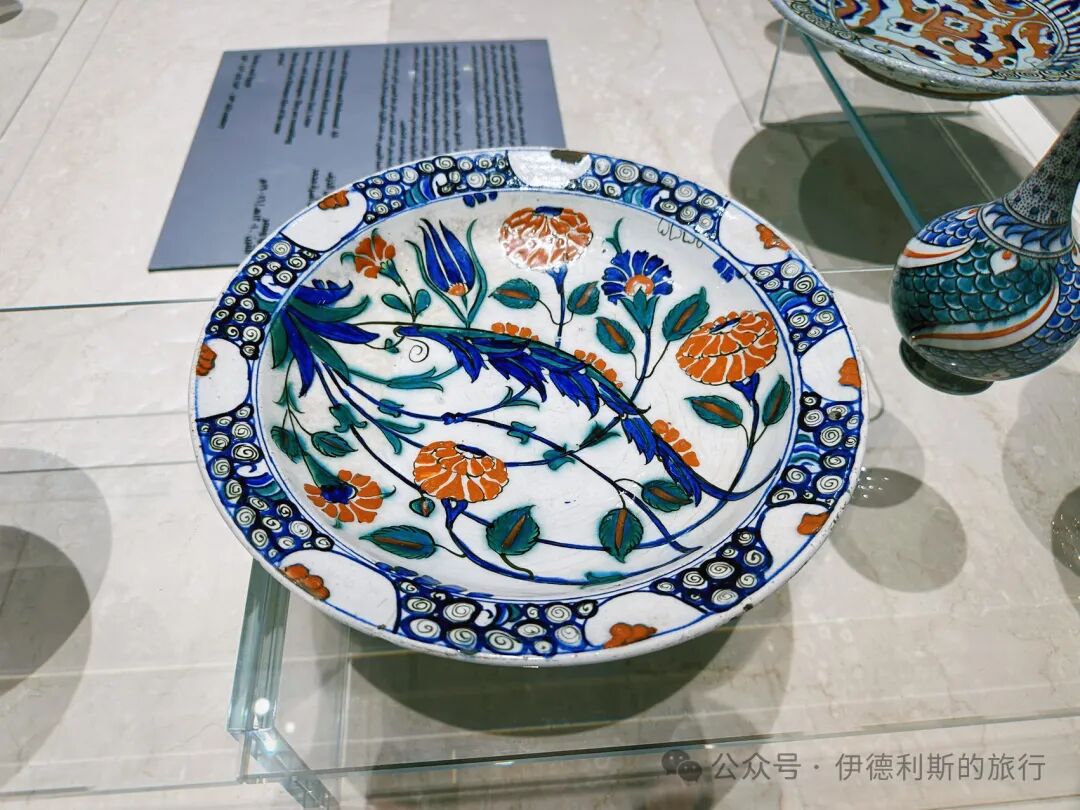
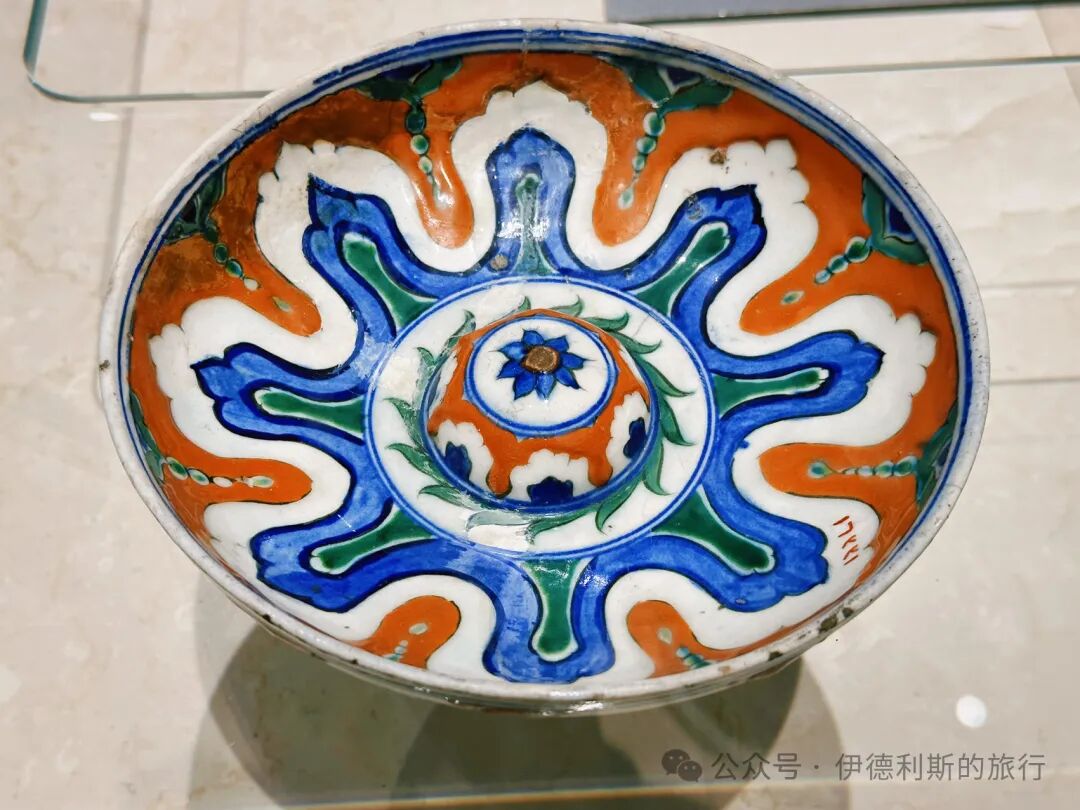
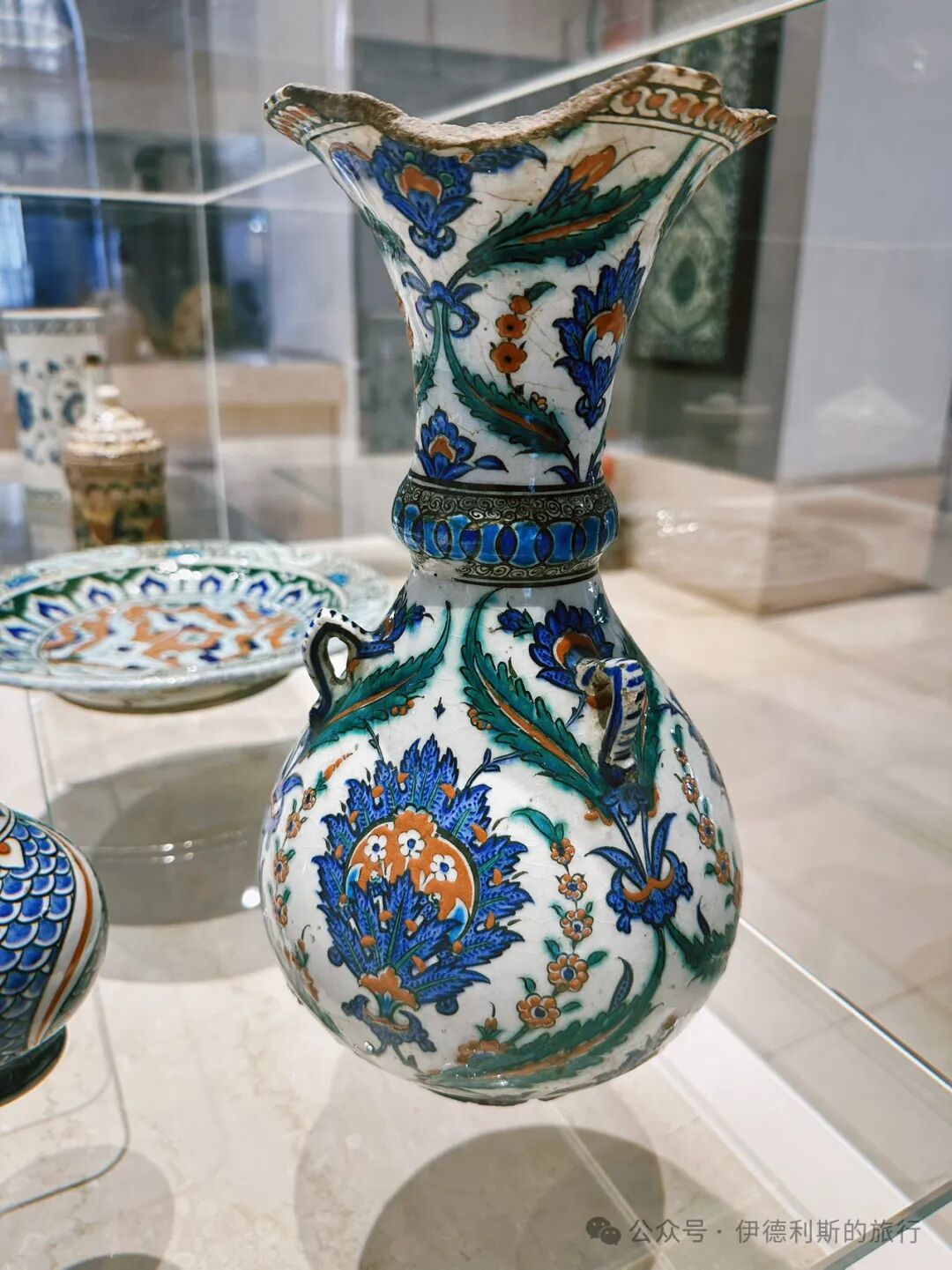
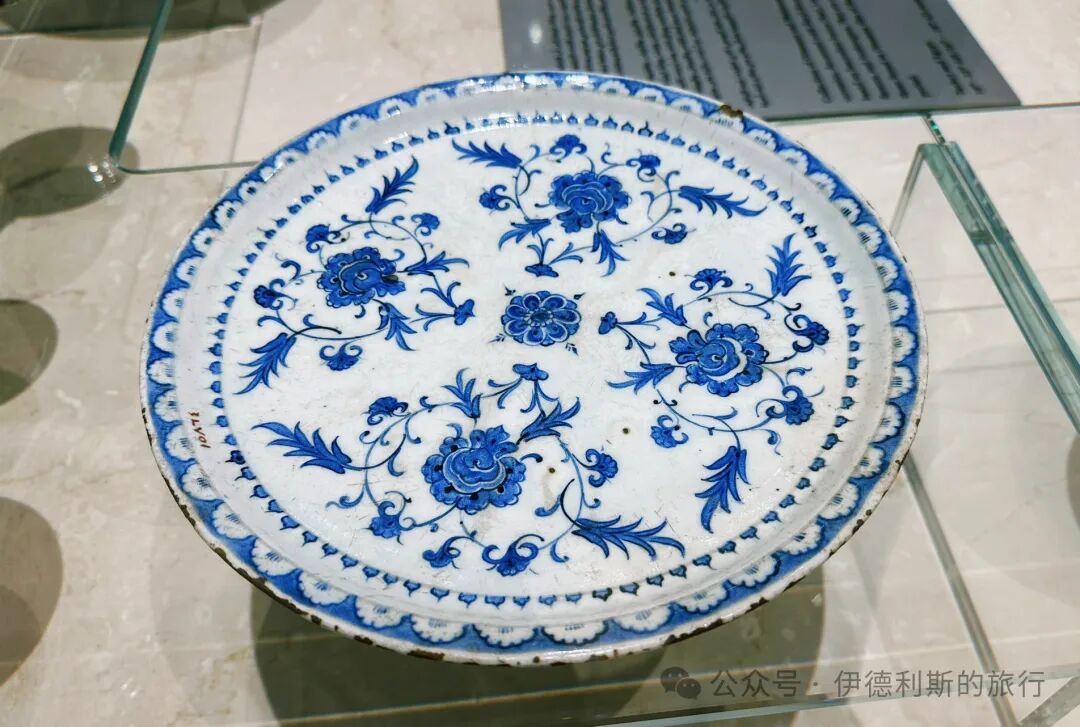
A marble carving from the 16th-century Ottoman period.
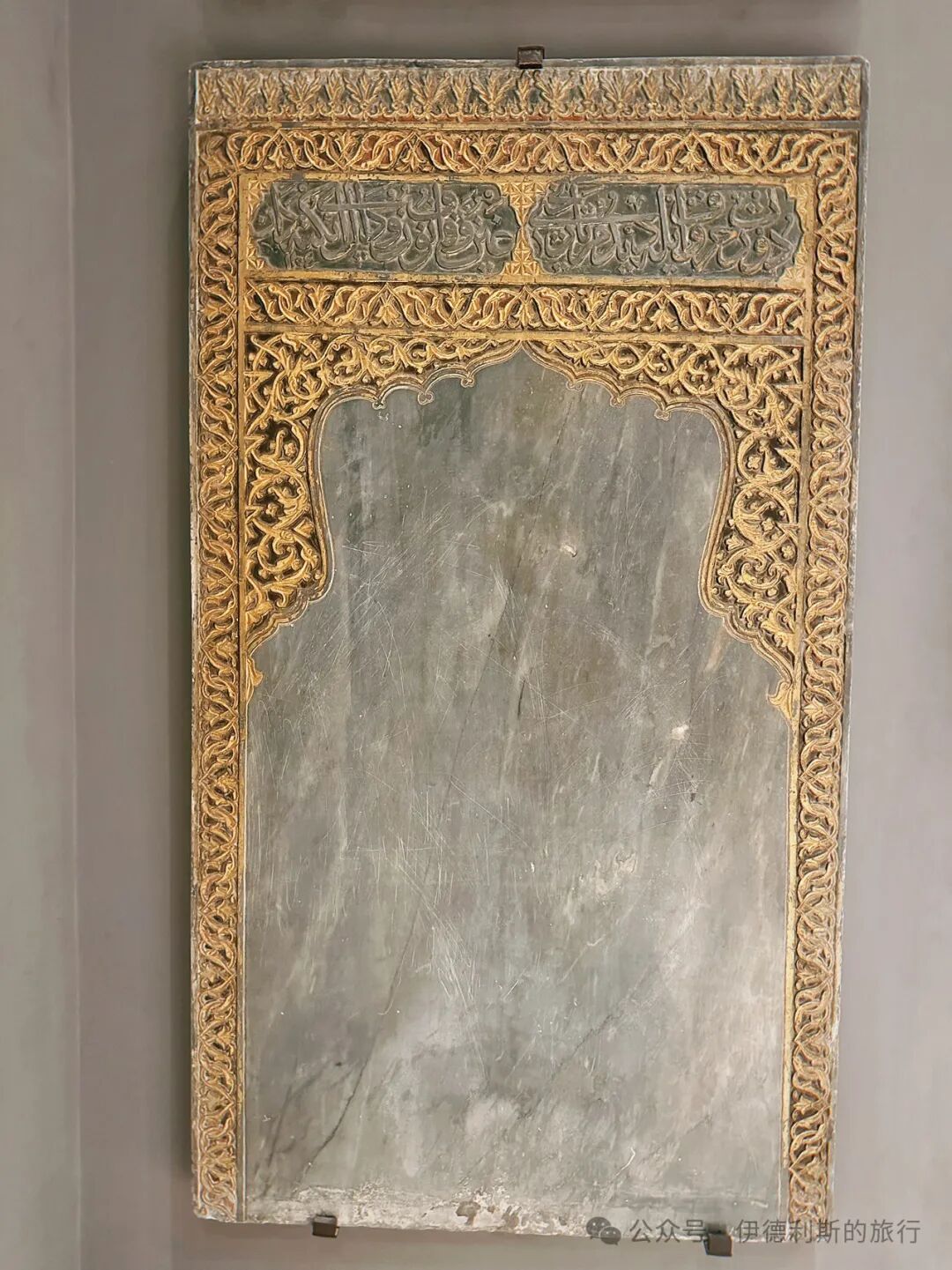
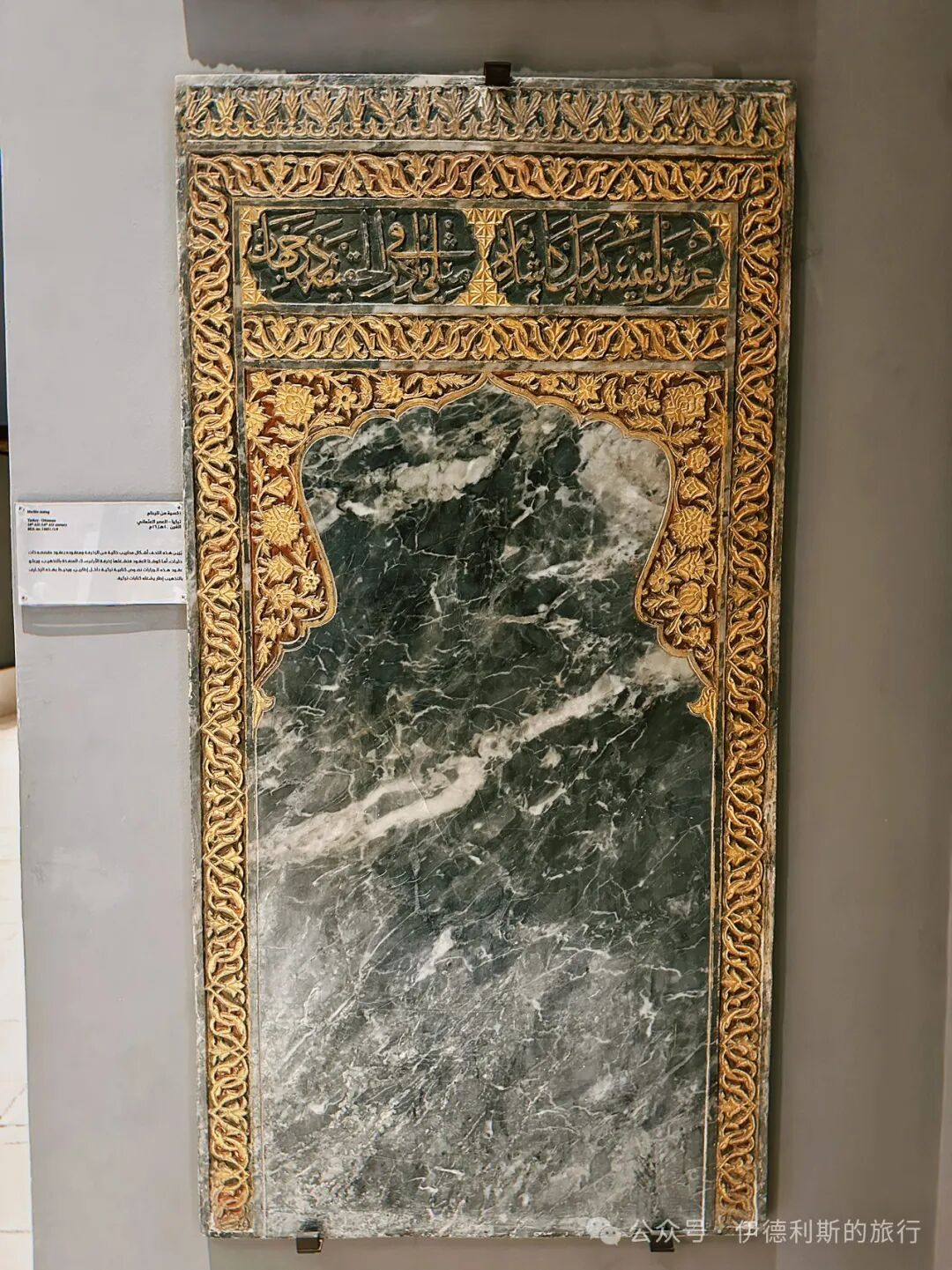
A 17th-century Ottoman period ceramic tile painted with an image of the Kaaba (Tianfang).
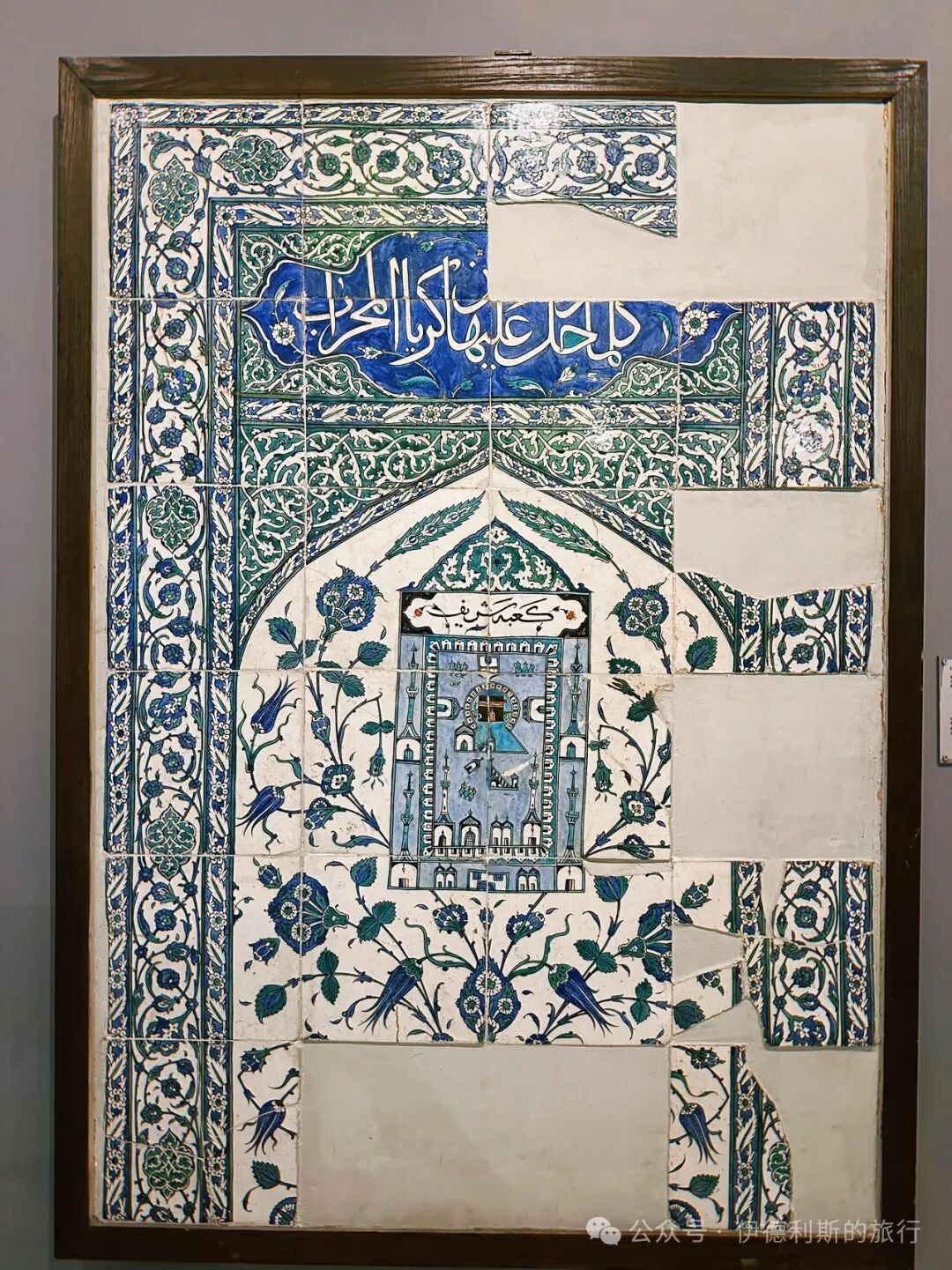
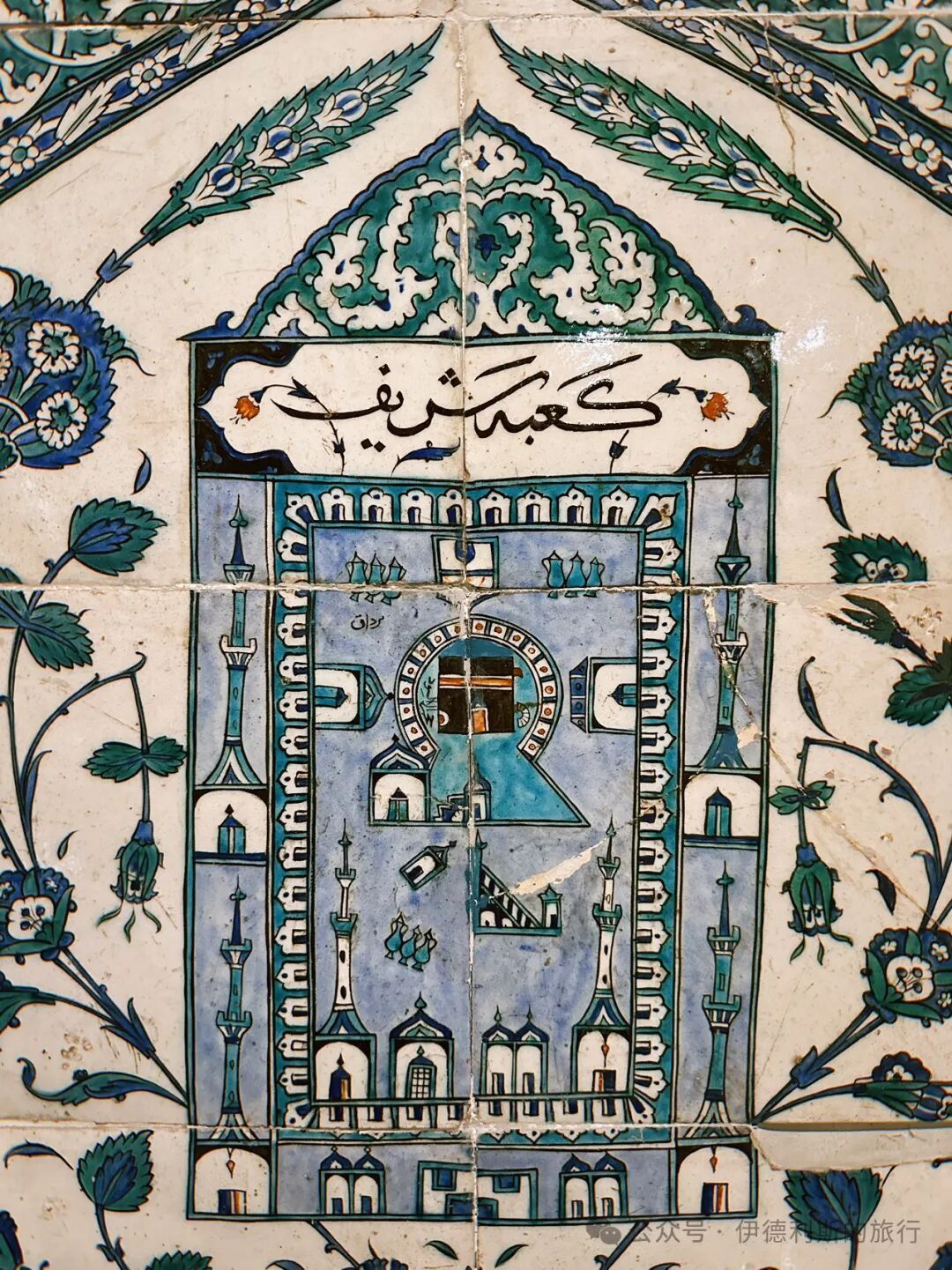
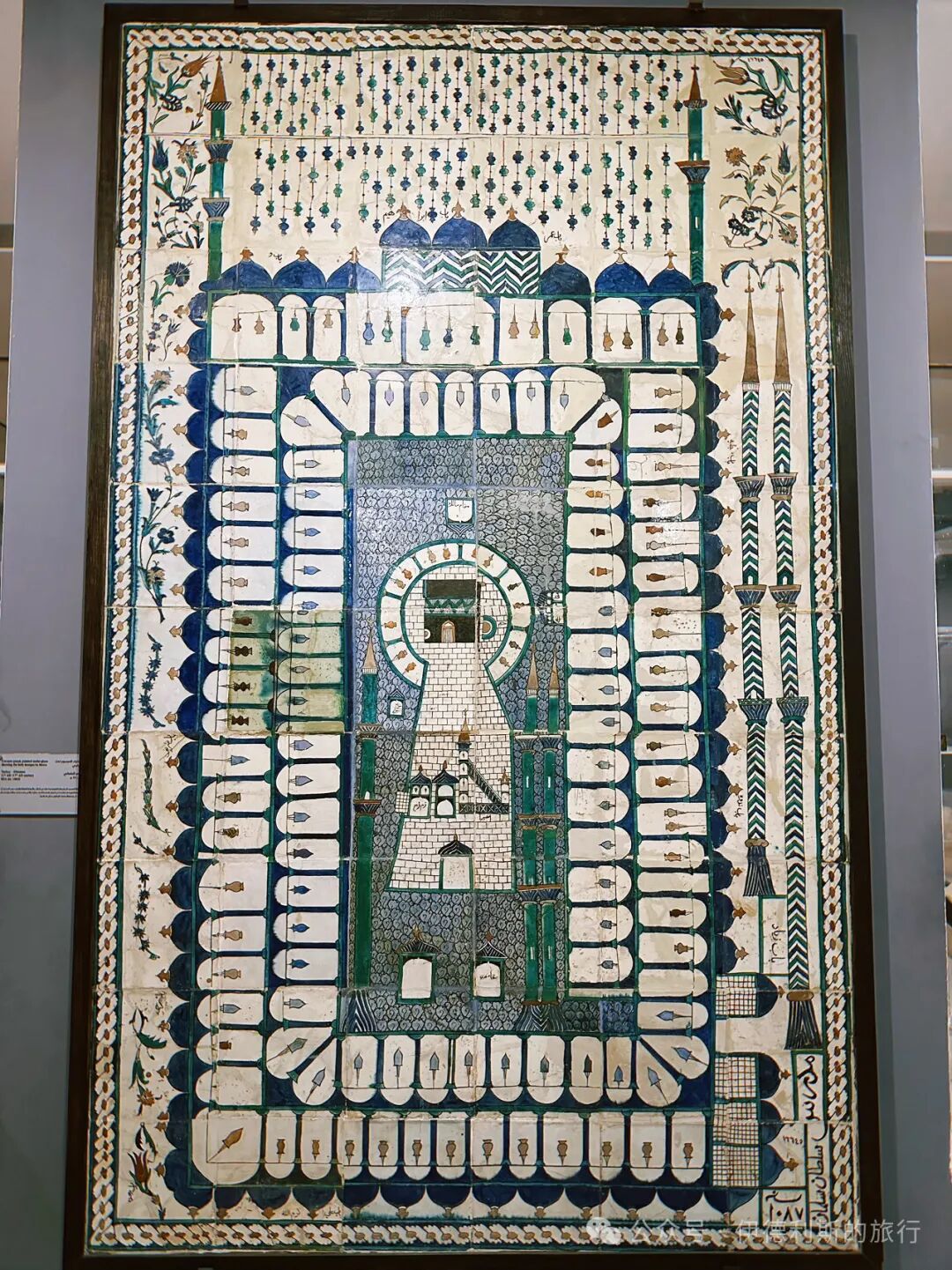
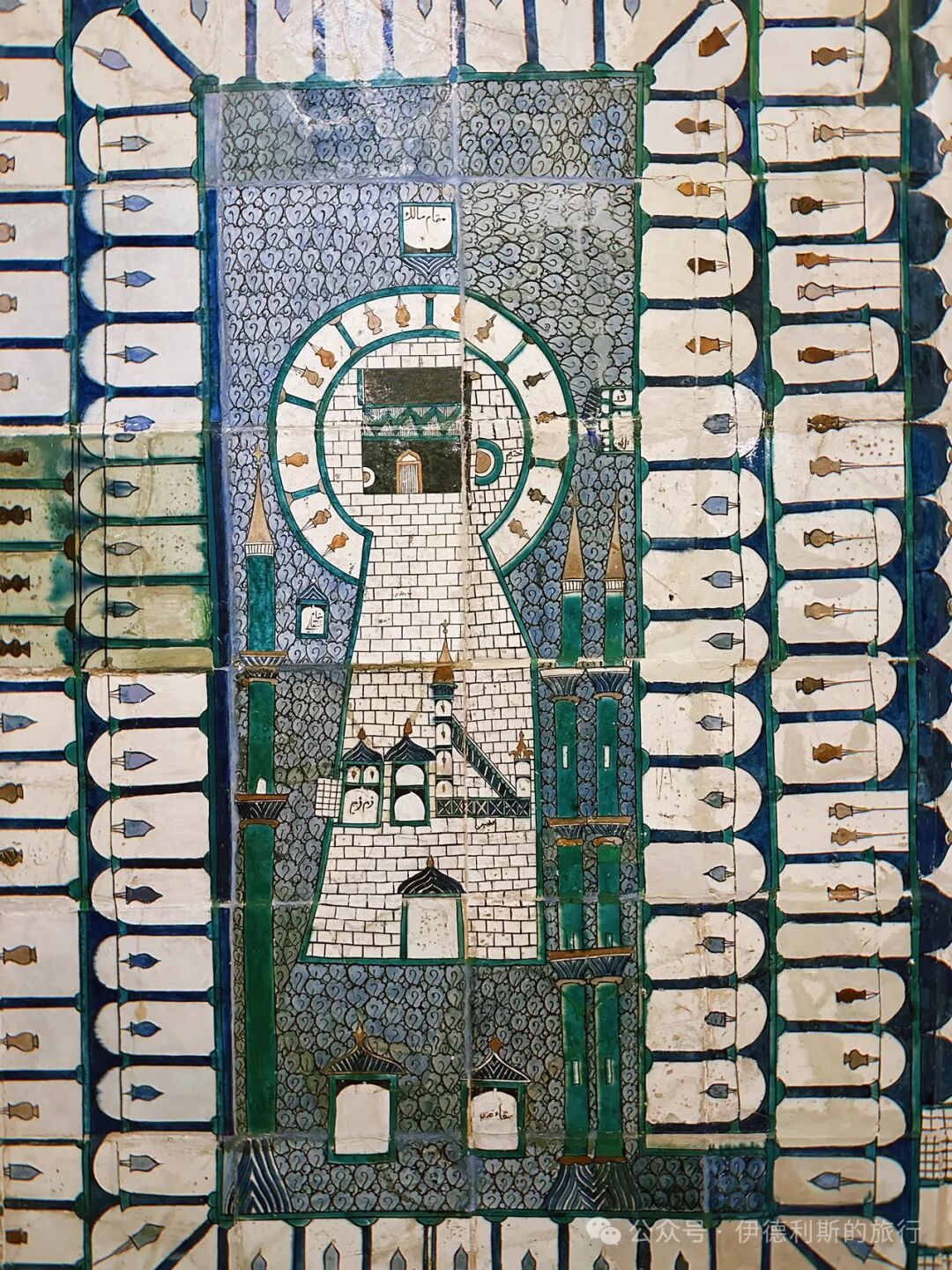
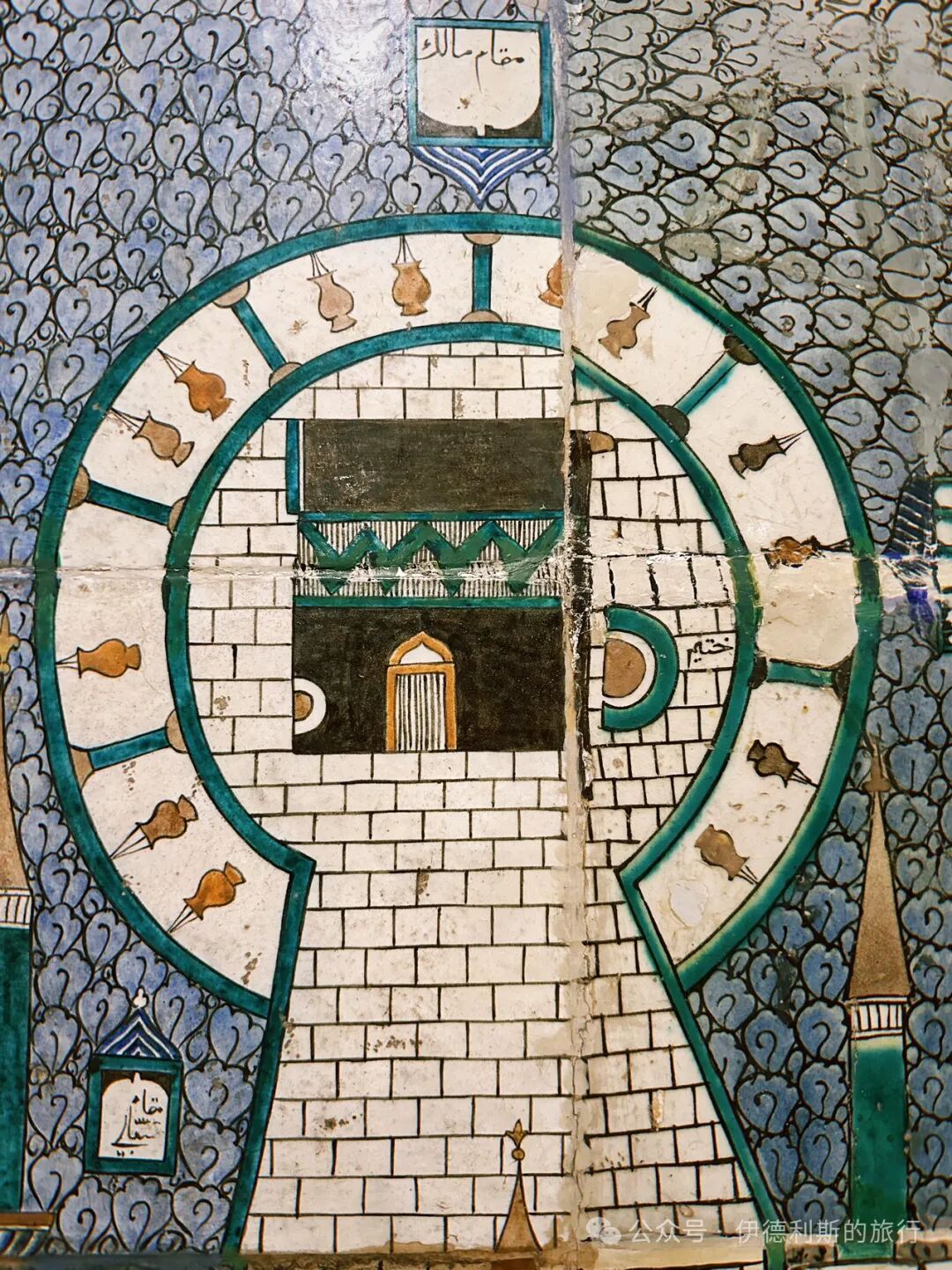
An 18th-century Ottoman period ceramic tile painted with an image of the Prophet's Mosque in Medina.
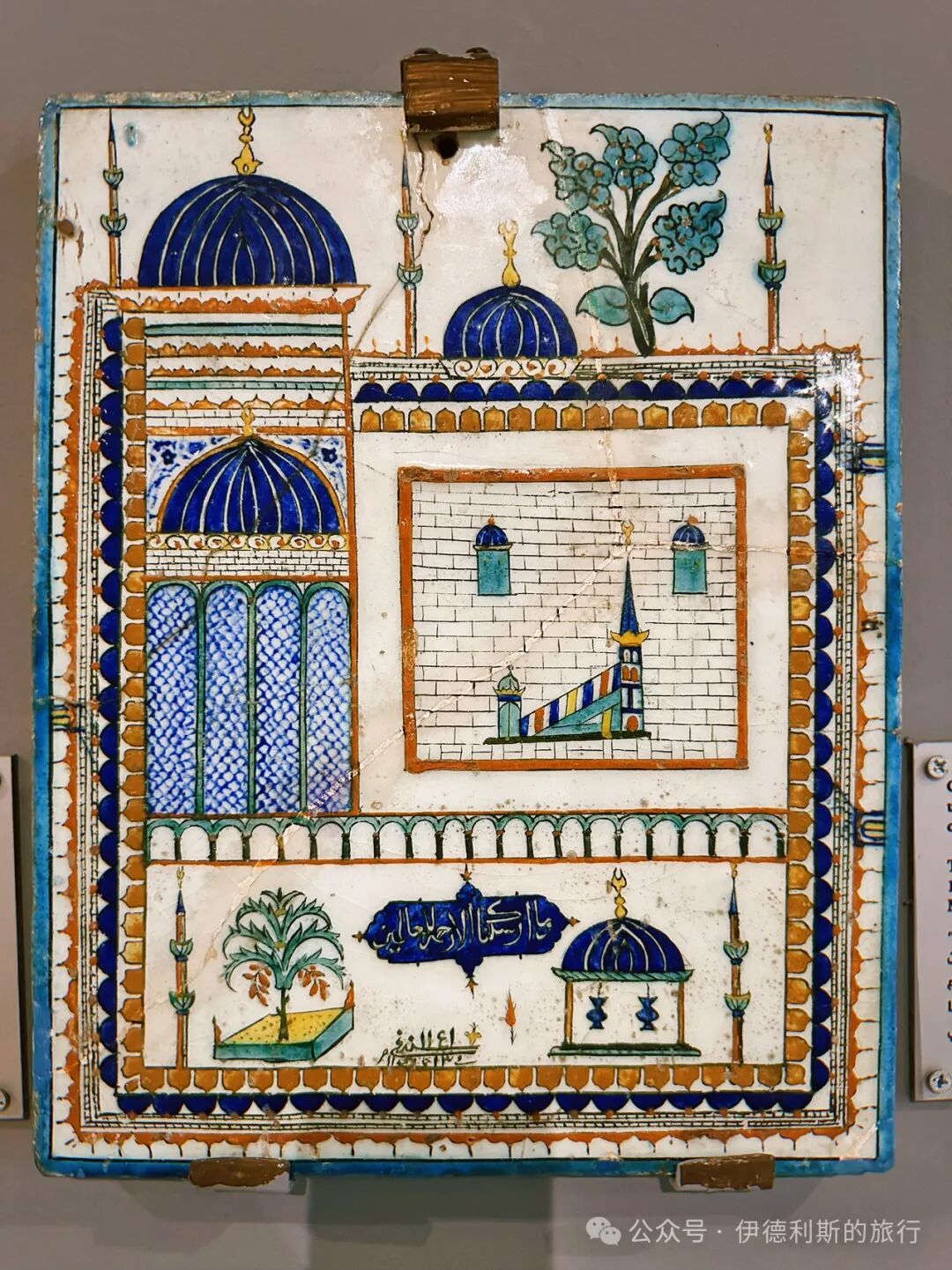
Tombstone.
A 12th-century basalt tombstone from the Arabian Peninsula or the Dahlak Archipelago.
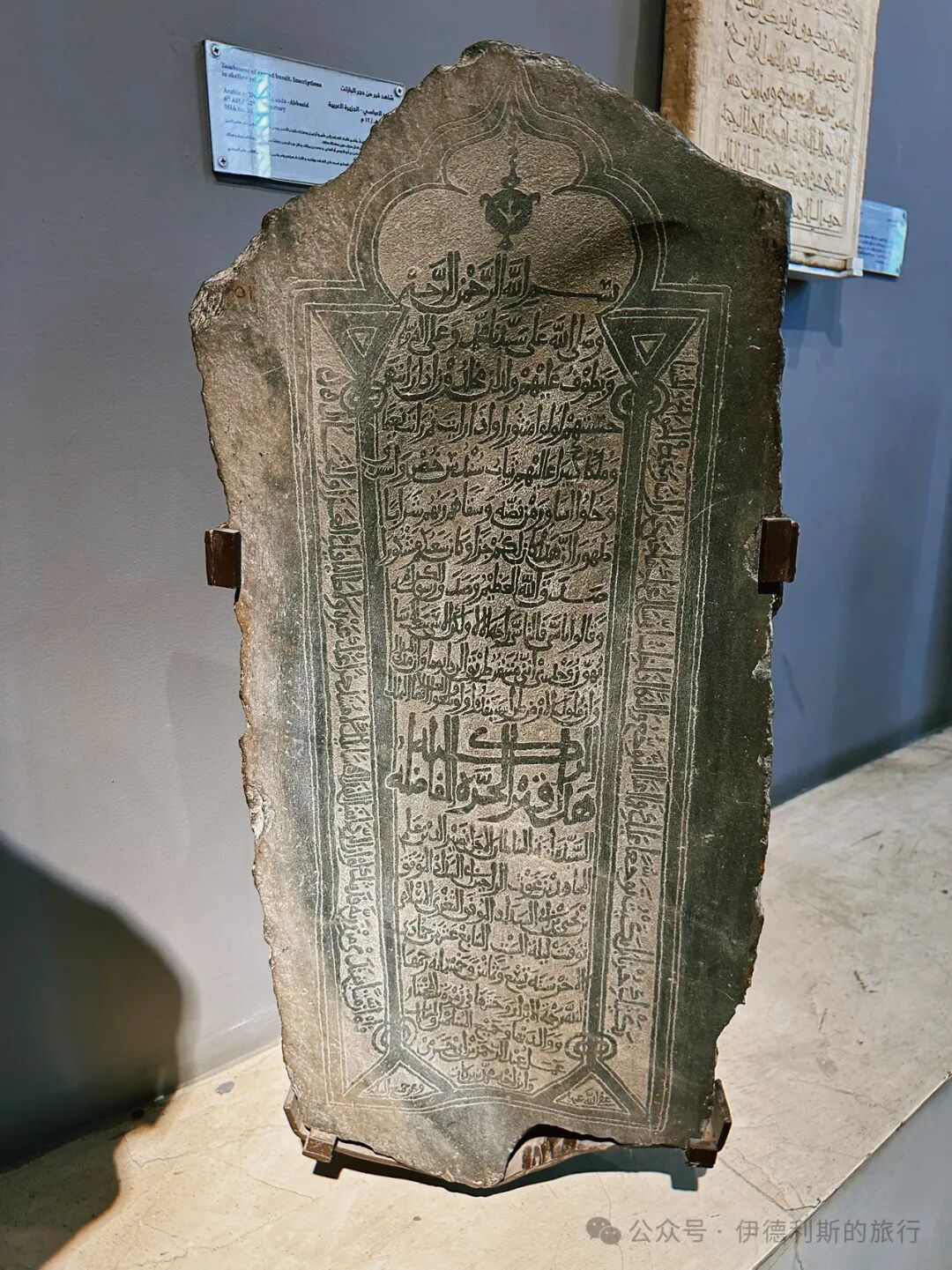
A 12th-century limestone tombstone from the Ayyubid dynasty in Egypt.
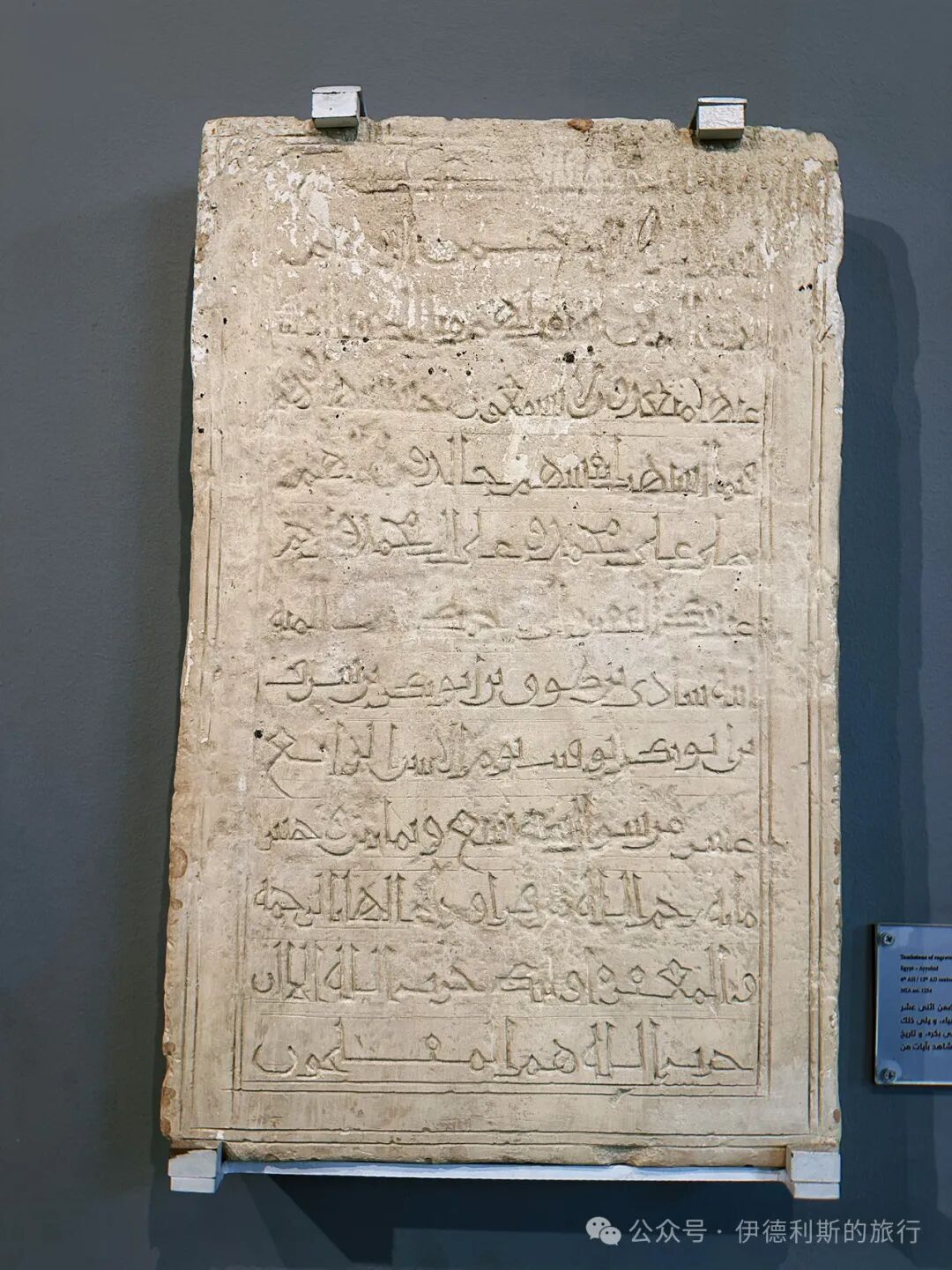
A 10th-century wooden tombstone from the Fatimid dynasty in Egypt.
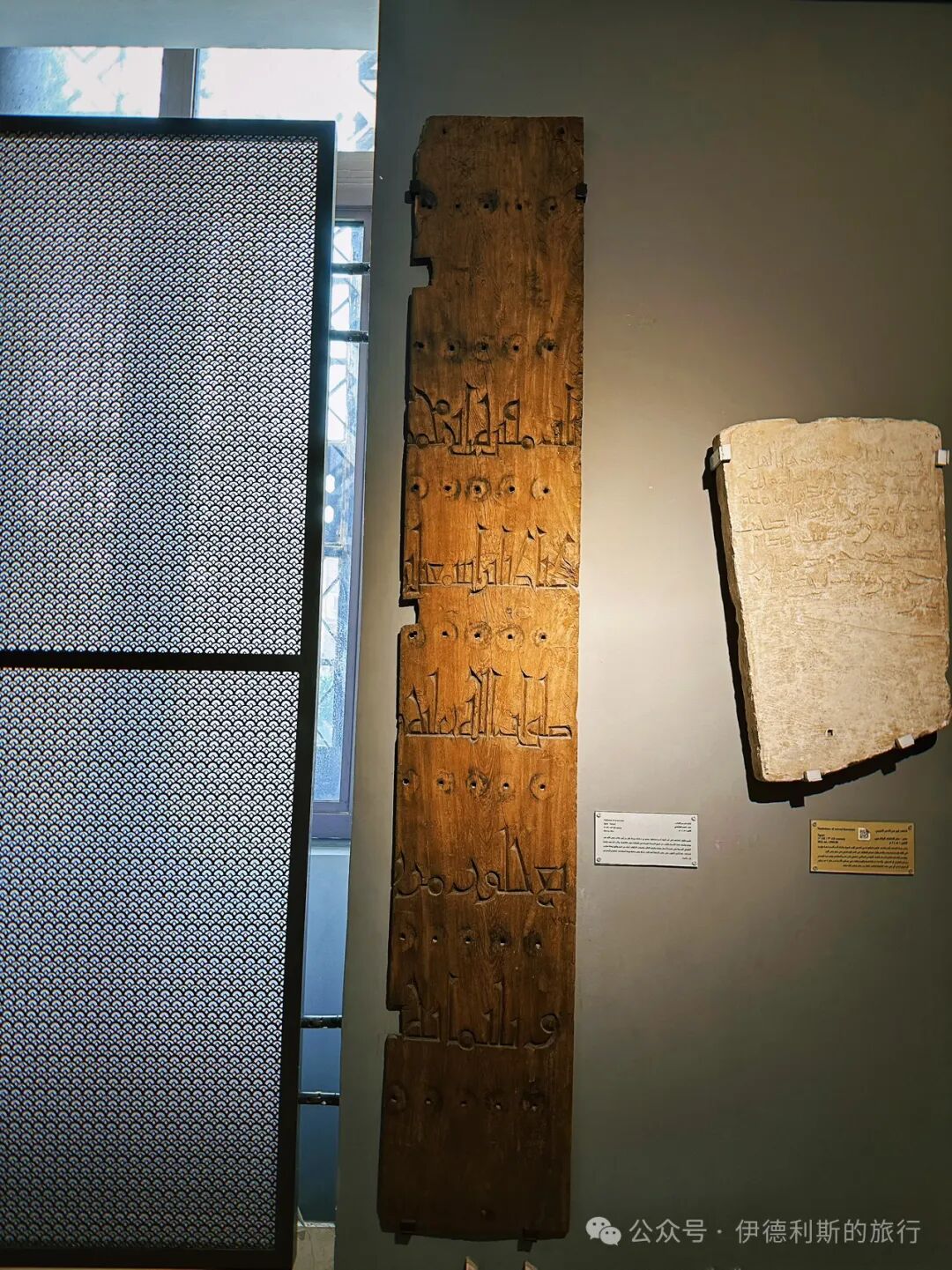
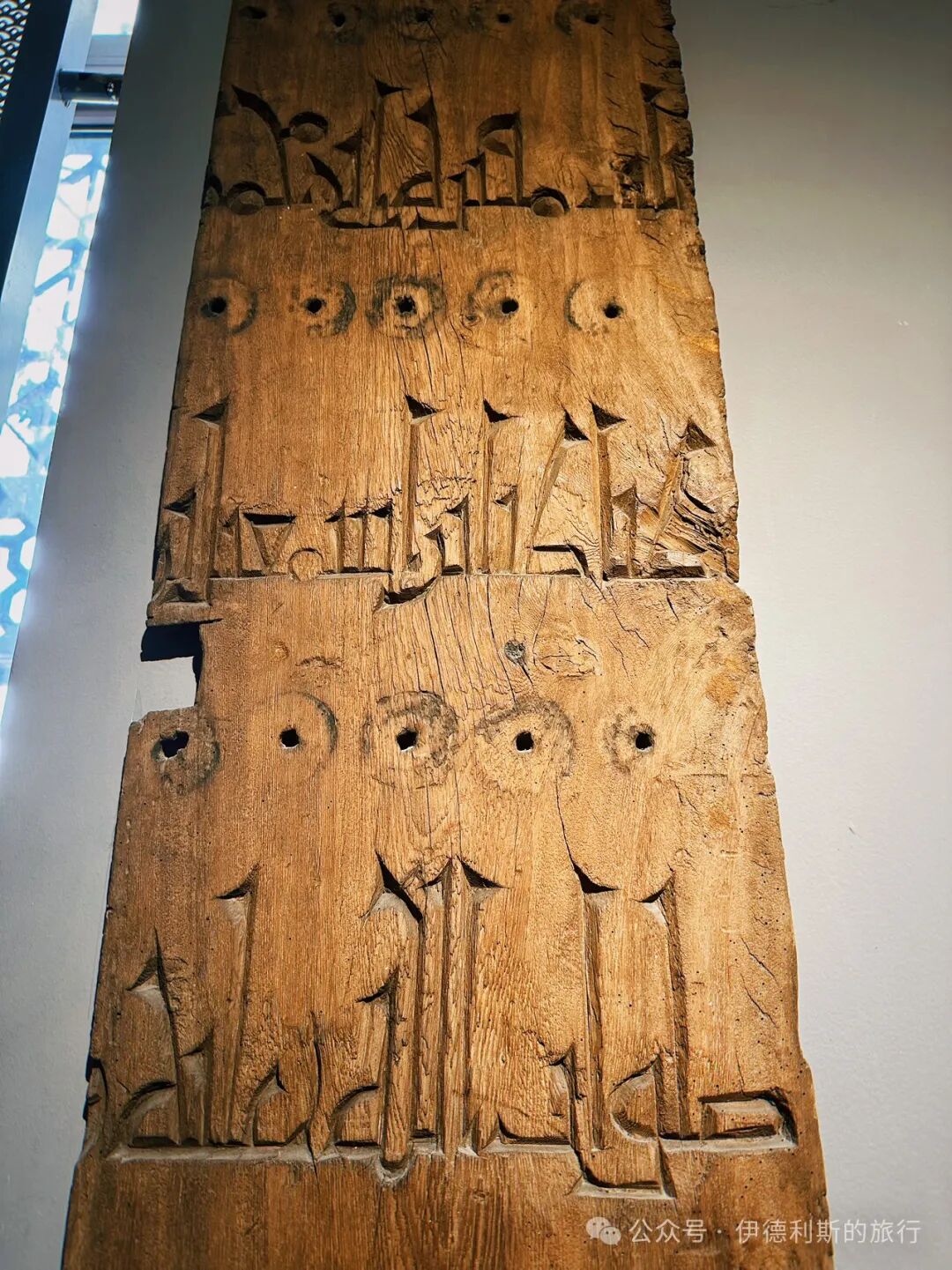
A 7th-century limestone tombstone from the Rashidun or Umayyad period in Egypt.
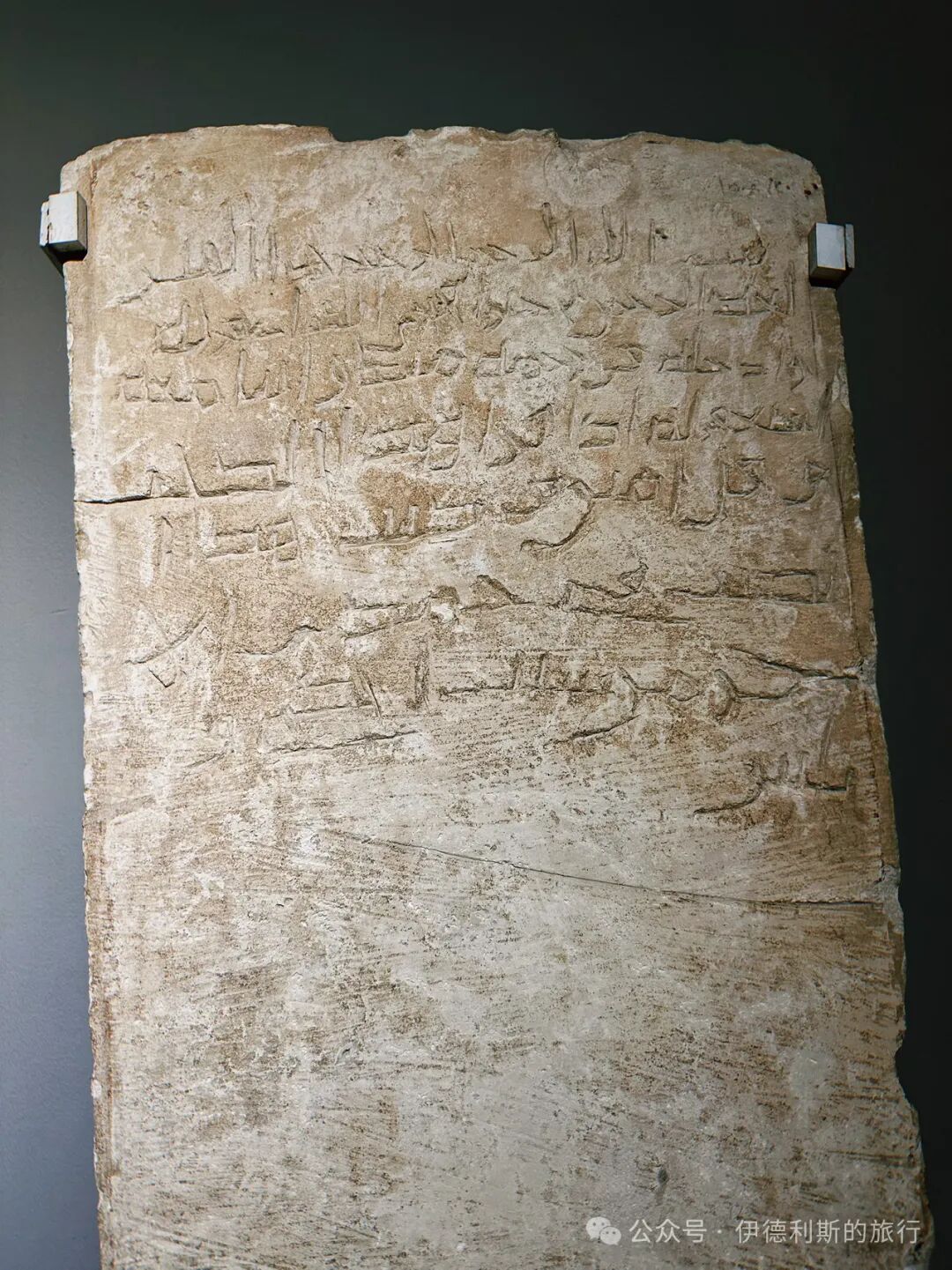
An 8th-century marble tombstone from the Abbasid period in Egypt.
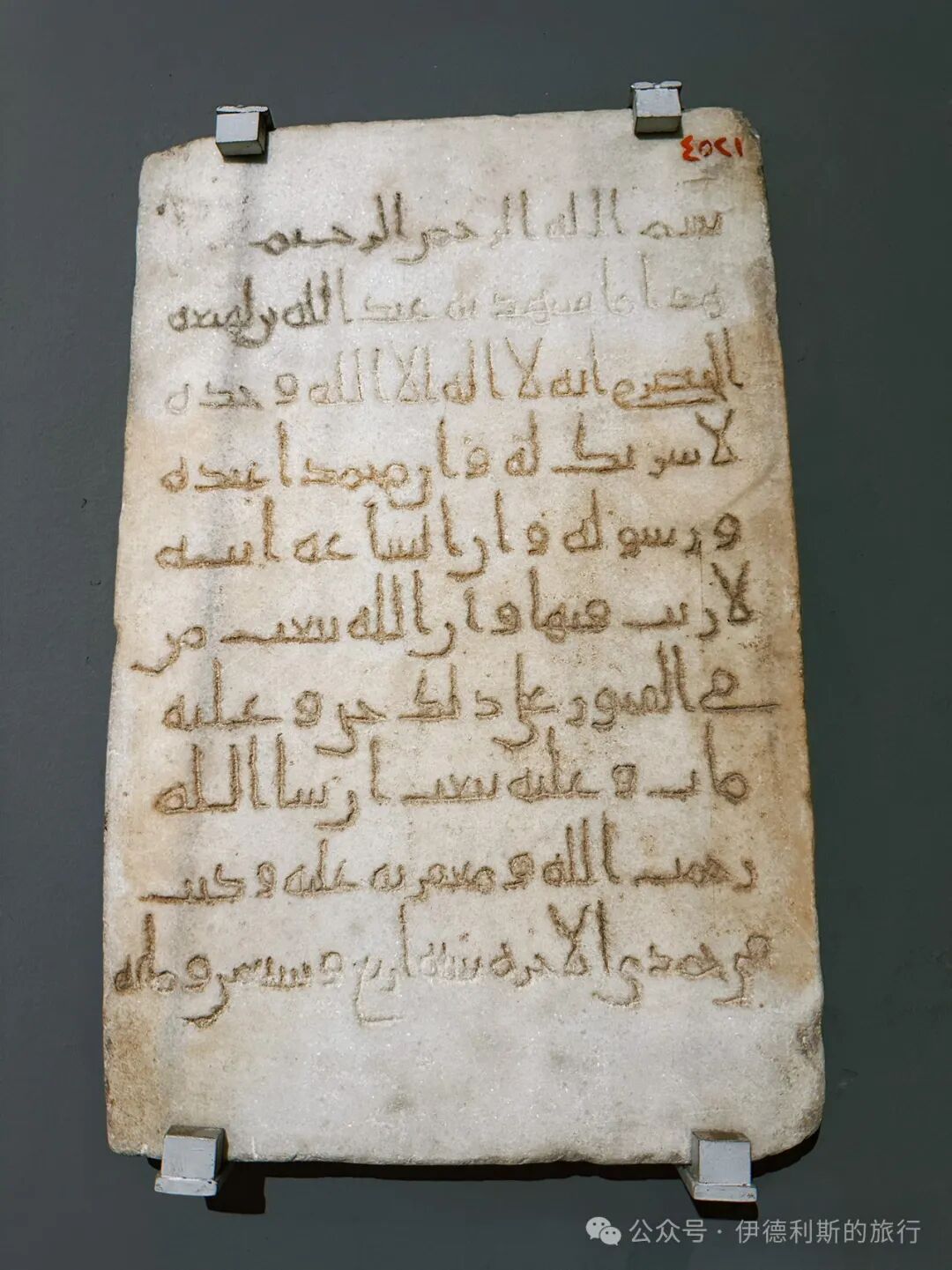
A 9th-century marble tombstone from the Abbasid period in Egypt.
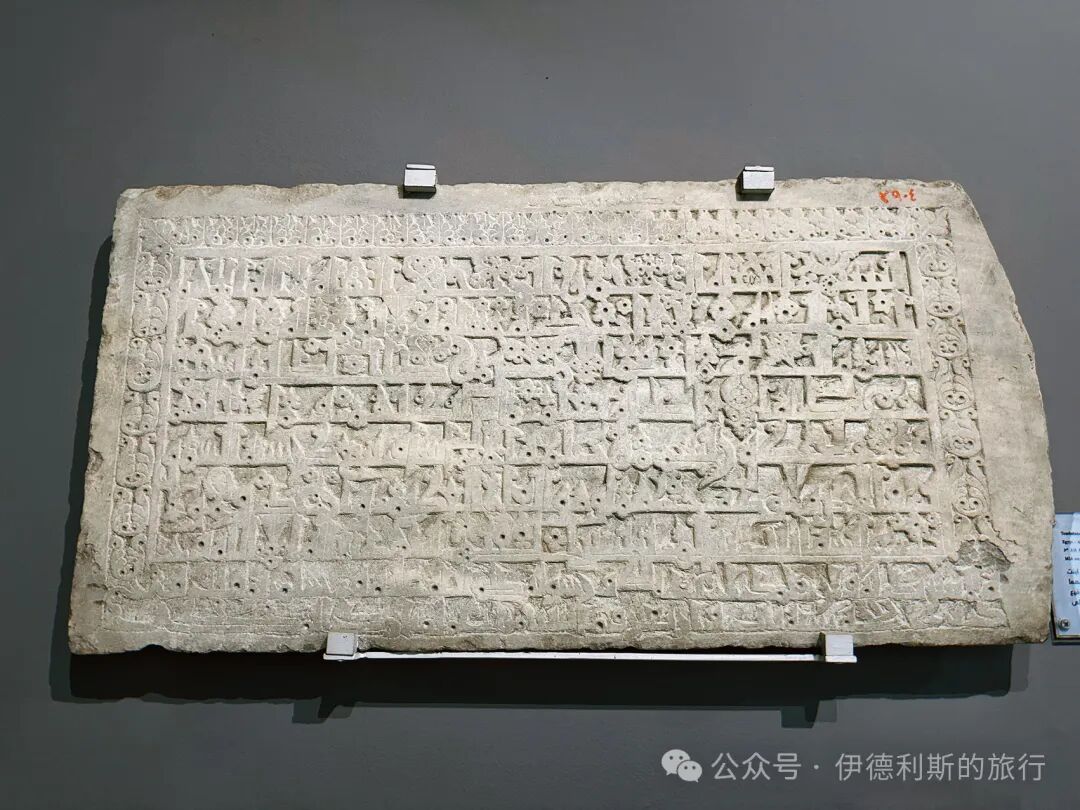
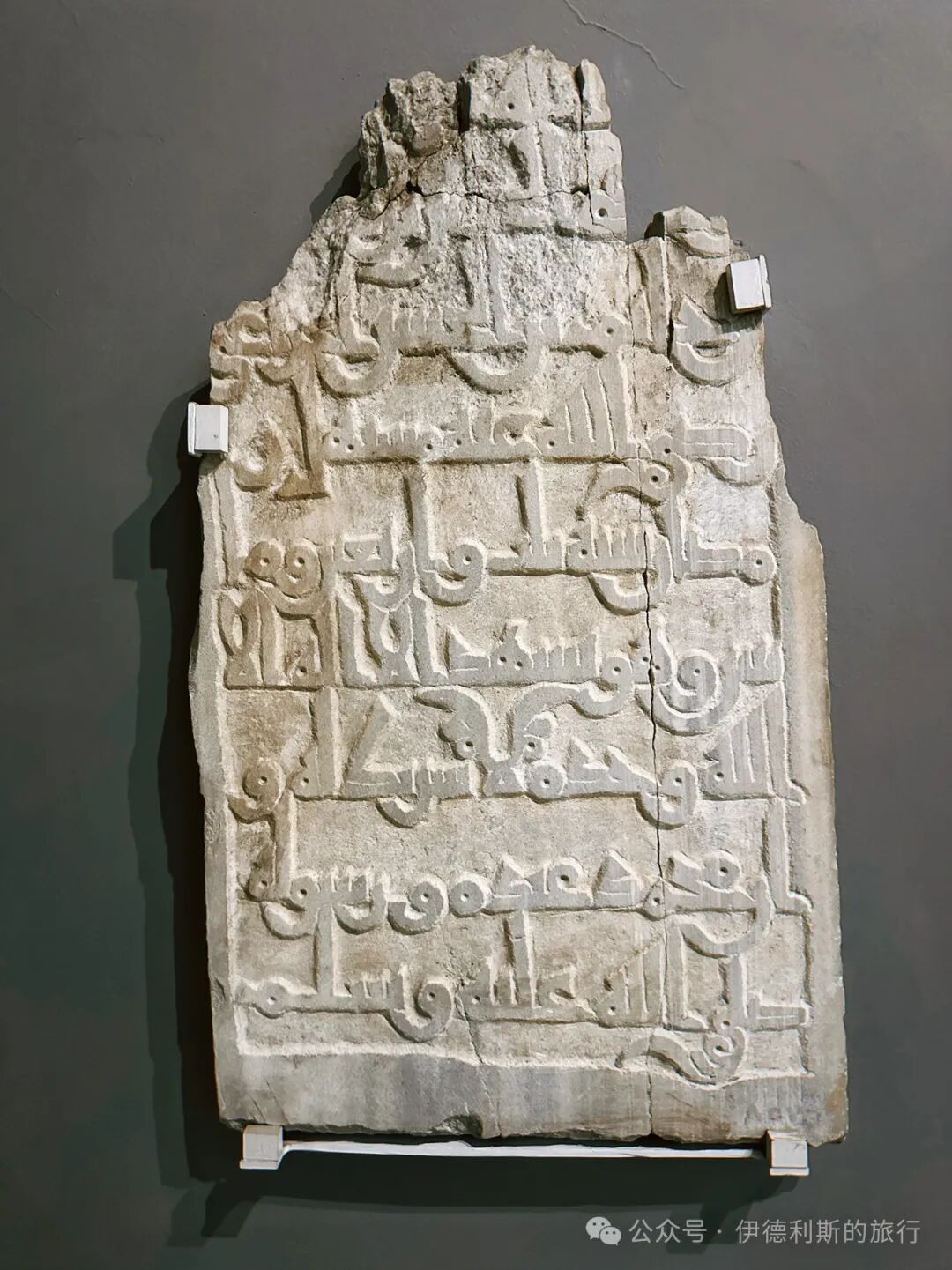
A 10th-century marble tombstone from the Fatimid period in Egypt.
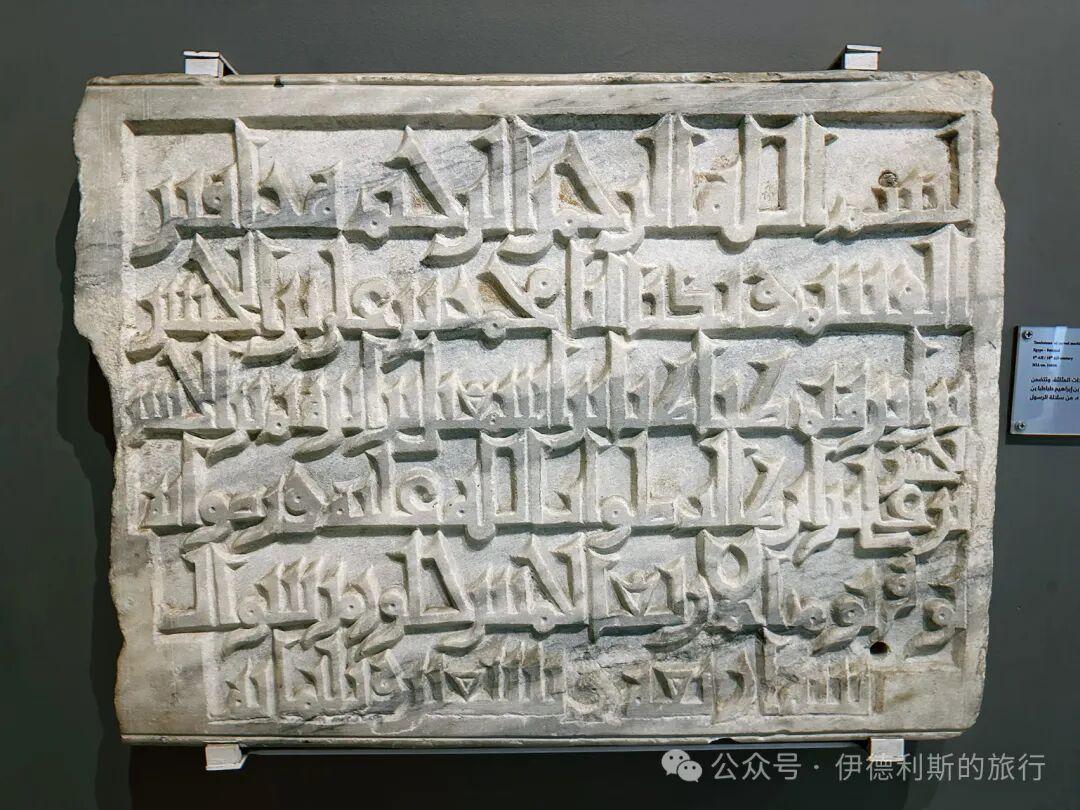
An 11th-century marble tombstone from the Fatimid period in Egypt.
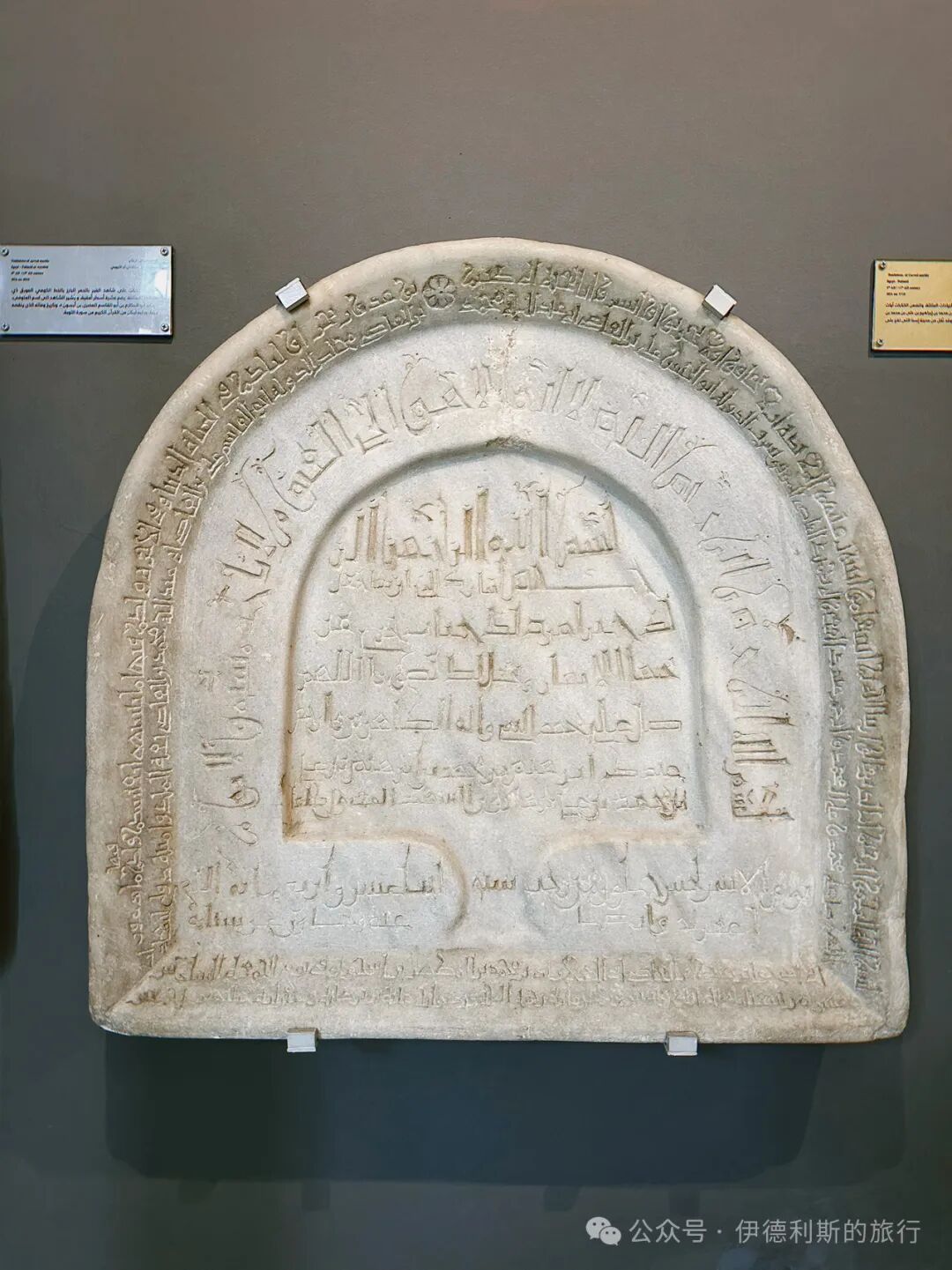
Summary: Islamic Art Guide: Museum of Islamic Art in Cairo (Part 2) is presented here as a firsthand travel account in clear, natural English. The account focuses on Cairo, Islamic Art, Museum Travel while preserving the names, places, food, photos, and historical details from the Chinese source.
Script tiles from the Mamluk dynasty in the 14th century.
A tile inscribed with the name of the Mamluk Sultan Qaitbay, who reigned from 1468 to 1496.
A 14th-century marble tile with Kufic script from the Mamluk dynasty in Egypt.
Arabic script tiles from the Egyptian Mamluk dynasty, with the 14th century on top and the 16th century on the bottom.
A 14th-century Mamluk-era marble carving from the Sarghatmish Madrasa in Cairo, featuring a small-scale replica in the bottom right corner that allows visitors to touch the patterns.
A copper lamp inlaid with silver, inscribed with the name of the Mamluk Sultan Al-Ashraf Sha'ban, who reigned from 1363 to 1377.
A 13th-century glass vessel from the Mamluk dynasty inscribed with the name of Prince Shams al-Din al-Tanbugha.
A 13th-century copper-plated wooden door from the Egyptian Mamluk dynasty, inscribed with the name of Prince Shams al-Din Sunqur al-Tawil al-Mansuri.
An ivory carving inscribed with the name of the Mamluk Sultan Qaitbay, who reigned from 1468 to 1496.
A 14th-century ivory carving from the Egyptian Mamluk dynasty.
A marble carving inscribed with the name of the Mamluk Sultan Al-Ashraf Qansuh al-Ghuri, who reigned from 1501 to 1516.
A royal decree carved into marble by the Egyptian Mamluk Sultan Sayf al-Din Jaqmaq, who reigned from 1438 to 1453, after he ordered the exemption of taxes for merchants.
A marble tombstone from the 15th to 16th-century Egyptian Mamluk dynasty.
A 13th to 15th-century copper basin inlaid with silver from the Egyptian Mamluk dynasty; the Palace Museum holds several blue and white porcelain pieces with the same design.
Ottoman dynasty.
A 17th to 18th-century wooden balcony (mashrabiya) from the Ottoman dynasty in Egypt. This is an important part of traditional Middle Eastern architecture, featuring intricate wooden lattice screens that allow for evaporative cooling when water jars are placed inside.
An 18th-century wooden cabinet inlaid with ivory from the Ottoman period in Egypt.
This piece has no label, but it appears to be an ivory-inlaid wooden pulpit (minbar) from the Ottoman period in Egypt.
Ceramic tiles produced in Iznik, Turkey, during the 16th-century Ottoman period.
Porcelain from the 16th to 19th centuries, covering the Ottoman and Muhammad Ali periods.
A marble carving from the 16th-century Ottoman period.
A 17th-century Ottoman period ceramic tile painted with an image of the Kaaba (Tianfang).
An 18th-century Ottoman period ceramic tile painted with an image of the Prophet's Mosque in Medina.
Tombstone.
A 12th-century basalt tombstone from the Arabian Peninsula or the Dahlak Archipelago.
A 12th-century limestone tombstone from the Ayyubid dynasty in Egypt.
A 10th-century wooden tombstone from the Fatimid dynasty in Egypt.
A 7th-century limestone tombstone from the Rashidun or Umayyad period in Egypt.
An 8th-century marble tombstone from the Abbasid period in Egypt.
A 9th-century marble tombstone from the Abbasid period in Egypt.
A 10th-century marble tombstone from the Fatimid period in Egypt.
An 11th-century marble tombstone from the Fatimid period in Egypt.
Islamic History Guide: Riyadh - Saudi Coinage Heritage Exhibition
Articles • ali2007fr posted the article • 0 comments • 265 views • 2026-05-21 02:35
Reposted from the web
Summary: The Saudi National Museum exhibition Forging Narratives: The Coinage Heritage of Saudi Arabia traces Islamic coinage from early Umayyad gold coins to later dynasties. This English account keeps the source's dates, rulers, coin details, exhibition context, and photographs in one clear museum note.
The Saudi National Museum is hosting a special exhibition called "Forging Narratives: The Coinage Heritage of Saudi Arabia" from September 17 to December 16, 2025, featuring items from the famous coin collector Alain Baron. The exhibition follows a chronological order, starting with the oldest Umayyad gold coins, which surprisingly feature Byzantine emperors.
Before the Umayyad Caliphate was established, the Syrian region used Byzantine gold coins. After the Umayyad Caliphate was founded in 661, it began minting gold coins in Damascus. Early Umayyad gold coins continued to use Byzantine imagery. You can see coins showing the Byzantine Emperor Heraclius (reigned 610-641) and his two sons, Constantine III and Heraklonas, on the front, with Latin text on the back. Unlike Byzantine coins, the crowns and scepters of the emperors on Umayyad coins lack crosses, and the cross on the steps on the back is just a vertical line without a horizontal bar.
These Umayyad coins reflect the early culture of the Umayyad Caliphate, which continued to inherit Byzantine traditions. When Bedouin nomads from the Arabian Peninsula flooded into the grand city of Damascus, they saw a rich and colorful Byzantine culture. Because of this, they continued to use Byzantine culture in areas outside of religion, such as music, art, and architecture, becoming heirs to the Byzantine legacy.
It was not until the 690s that the Umayyad Caliphate began to move away from Byzantine culture and design its own gold coins. In 693, Caliph Abd al-Malik (reigned 685-705) minted gold dinar coins in Damascus, and by 696, he removed human figures, keeping only Arabic text. During the same period, Abd al-Malik also promoted the use of Arabic over Greek in Syria, making Arabic the only official language of the Umayyad Caliphate. From then on, the Umayyad Caliphate shifted from being an heir to Byzantine and Sasanian cultures to becoming a true Arab civilization.
This commemorative silver coin was issued between 800 and 810 AD by Queen Zubaidah (Zubaidah bint Ja`far ibn al-Mansur, 765-831) of the Abbasid Caliphate to give to noble dignitaries of the time.
Zubaidah is known as a key figure in the Golden Age of the Abbasid Caliphate and the most important queen in its history. She was the wife of Harun al-Rashid, the fifth Abbasid caliph. This was the most prosperous era of the Abbasid Caliphate, with the capital, Baghdad, housing libraries and the translation center known as the House of Wisdom. Baghdad was the world center for knowledge, culture, and trade at the time.
Zubaidah was famous for her generosity and donated to many poets, scholars, and doctors, regardless of their social or religious backgrounds. She spent over 20,000 dinars to improve the water supply in and around Mecca, deepened the Zamzam well, and built a series of rest areas, wells, and pools along the road connecting Baghdad, Mecca, and Medina. This road is still called the Zubaidah Road today. The famous traveler Ibn Battuta once said: "Every reservoir, pool, or well on this road from Mecca to Baghdad is there because of her generous gifts... If she had not cared for this road, no one would be able to use it."
This dirham coin was minted in 1243 in what is now Kurraman, Pakistan, during the reign of Empress Dowager Töregene Khatun of the Yuan Dynasty.
Empress Dowager Töregene Khatun took power in 1242 after the death of her husband, Ögedei Khan, and returned power in 1246 after her son, Güyük Khan, was elected Great Khan. During her time in power, she successfully balanced the competing forces of the Mongol Empire. Over five years, she not only ruled the vast empire but also laid the foundation for her son's succession. While she was in power, the Seljuk Sultan from Turkey and the Abbasid Caliph from Baghdad both sent envoys to her camp.
The city of Kurraman is located in the Kurram Valley of Pakistan and was a famous minting center during the Khwarazmian and Mongol periods.
A gold dinar coin minted by the Ilkhanate in 1338.
A gold dinar coin minted in Baghdad by the Ilkhanate in 1338.
A coin minting mold brought back by Sultan Muhammad ibn Sam of the Ghurid dynasty after he conquered India in 1204. These molds broke easily during the minting process, so they are very hard to preserve.
The interactive coin minting display at the exhibition shows the coin-making process in detail.
A coin from the 7th-century Umayyad Caliphate minted in Bishapur, featuring an image of a camel rider with a spear. Bishapur is located in southwestern Iran and was once the capital of the Sasanian Empire.
A coin from the Seljuk Empire minted between 1040 and 1063, featuring an image of a falconer on horseback.
The earliest Islamic coin found within Saudi territory is this Umayyad dinar minted in 723. It is engraved with the name of the mint, al-Madina Ma'din Amir al-Mu'minin, which tells us this coin was minted in Medina. This coin shows the important status of Medina during the Umayyad Caliphate.
This section features dinar coins minted in Mecca between the 9th-century Abbasid Caliphate and the 10th-century Fatimid Caliphate.
This is a gold dinar minted in Mecca during the Fatimid Caliphate in 971.
The Saudi Ministry of Culture holds two large coin collections. The first was found in 1980 by a farmer cleaning an old well in a village near Ha'il in northern Saudi Arabia. It includes 414 silver dinars, with 7 dating back to the late Umayyad period and 406 to the early Abbasid period, from mints including Baghdad, Basra, Armenia, Balkh, and Kufa. The second collection was found by chance in 2010 by a sand transport worker in another village near Ha'il, containing 2,296 gold and silver coins from the Umayyad and Abbasid dynasties.
A modern Saudi gold coin trial strike minted in 1950, with text on the back that differs from the final version in circulation. view all
Summary: The Saudi National Museum exhibition Forging Narratives: The Coinage Heritage of Saudi Arabia traces Islamic coinage from early Umayyad gold coins to later dynasties. This English account keeps the source's dates, rulers, coin details, exhibition context, and photographs in one clear museum note.
The Saudi National Museum is hosting a special exhibition called "Forging Narratives: The Coinage Heritage of Saudi Arabia" from September 17 to December 16, 2025, featuring items from the famous coin collector Alain Baron. The exhibition follows a chronological order, starting with the oldest Umayyad gold coins, which surprisingly feature Byzantine emperors.
Before the Umayyad Caliphate was established, the Syrian region used Byzantine gold coins. After the Umayyad Caliphate was founded in 661, it began minting gold coins in Damascus. Early Umayyad gold coins continued to use Byzantine imagery. You can see coins showing the Byzantine Emperor Heraclius (reigned 610-641) and his two sons, Constantine III and Heraklonas, on the front, with Latin text on the back. Unlike Byzantine coins, the crowns and scepters of the emperors on Umayyad coins lack crosses, and the cross on the steps on the back is just a vertical line without a horizontal bar.
These Umayyad coins reflect the early culture of the Umayyad Caliphate, which continued to inherit Byzantine traditions. When Bedouin nomads from the Arabian Peninsula flooded into the grand city of Damascus, they saw a rich and colorful Byzantine culture. Because of this, they continued to use Byzantine culture in areas outside of religion, such as music, art, and architecture, becoming heirs to the Byzantine legacy.
It was not until the 690s that the Umayyad Caliphate began to move away from Byzantine culture and design its own gold coins. In 693, Caliph Abd al-Malik (reigned 685-705) minted gold dinar coins in Damascus, and by 696, he removed human figures, keeping only Arabic text. During the same period, Abd al-Malik also promoted the use of Arabic over Greek in Syria, making Arabic the only official language of the Umayyad Caliphate. From then on, the Umayyad Caliphate shifted from being an heir to Byzantine and Sasanian cultures to becoming a true Arab civilization.
This commemorative silver coin was issued between 800 and 810 AD by Queen Zubaidah (Zubaidah bint Ja`far ibn al-Mansur, 765-831) of the Abbasid Caliphate to give to noble dignitaries of the time.
Zubaidah is known as a key figure in the Golden Age of the Abbasid Caliphate and the most important queen in its history. She was the wife of Harun al-Rashid, the fifth Abbasid caliph. This was the most prosperous era of the Abbasid Caliphate, with the capital, Baghdad, housing libraries and the translation center known as the House of Wisdom. Baghdad was the world center for knowledge, culture, and trade at the time.
Zubaidah was famous for her generosity and donated to many poets, scholars, and doctors, regardless of their social or religious backgrounds. She spent over 20,000 dinars to improve the water supply in and around Mecca, deepened the Zamzam well, and built a series of rest areas, wells, and pools along the road connecting Baghdad, Mecca, and Medina. This road is still called the Zubaidah Road today. The famous traveler Ibn Battuta once said: "Every reservoir, pool, or well on this road from Mecca to Baghdad is there because of her generous gifts... If she had not cared for this road, no one would be able to use it."
This dirham coin was minted in 1243 in what is now Kurraman, Pakistan, during the reign of Empress Dowager Töregene Khatun of the Yuan Dynasty.
Empress Dowager Töregene Khatun took power in 1242 after the death of her husband, Ögedei Khan, and returned power in 1246 after her son, Güyük Khan, was elected Great Khan. During her time in power, she successfully balanced the competing forces of the Mongol Empire. Over five years, she not only ruled the vast empire but also laid the foundation for her son's succession. While she was in power, the Seljuk Sultan from Turkey and the Abbasid Caliph from Baghdad both sent envoys to her camp.
The city of Kurraman is located in the Kurram Valley of Pakistan and was a famous minting center during the Khwarazmian and Mongol periods.
A gold dinar coin minted by the Ilkhanate in 1338.
A gold dinar coin minted in Baghdad by the Ilkhanate in 1338.
A coin minting mold brought back by Sultan Muhammad ibn Sam of the Ghurid dynasty after he conquered India in 1204. These molds broke easily during the minting process, so they are very hard to preserve.
The interactive coin minting display at the exhibition shows the coin-making process in detail.
A coin from the 7th-century Umayyad Caliphate minted in Bishapur, featuring an image of a camel rider with a spear. Bishapur is located in southwestern Iran and was once the capital of the Sasanian Empire.
A coin from the Seljuk Empire minted between 1040 and 1063, featuring an image of a falconer on horseback.
The earliest Islamic coin found within Saudi territory is this Umayyad dinar minted in 723. It is engraved with the name of the mint, al-Madina Ma'din Amir al-Mu'minin, which tells us this coin was minted in Medina. This coin shows the important status of Medina during the Umayyad Caliphate.
This section features dinar coins minted in Mecca between the 9th-century Abbasid Caliphate and the 10th-century Fatimid Caliphate.
This is a gold dinar minted in Mecca during the Fatimid Caliphate in 971.
The Saudi Ministry of Culture holds two large coin collections. The first was found in 1980 by a farmer cleaning an old well in a village near Ha'il in northern Saudi Arabia. It includes 414 silver dinars, with 7 dating back to the late Umayyad period and 406 to the early Abbasid period, from mints including Baghdad, Basra, Armenia, Balkh, and Kufa. The second collection was found by chance in 2010 by a sand transport worker in another village near Ha'il, containing 2,296 gold and silver coins from the Umayyad and Abbasid dynasties.
A modern Saudi gold coin trial strike minted in 1950, with text on the back that differs from the final version in circulation. view all
Reposted from the web
Summary: The Saudi National Museum exhibition Forging Narratives: The Coinage Heritage of Saudi Arabia traces Islamic coinage from early Umayyad gold coins to later dynasties. This English account keeps the source's dates, rulers, coin details, exhibition context, and photographs in one clear museum note.
The Saudi National Museum is hosting a special exhibition called "Forging Narratives: The Coinage Heritage of Saudi Arabia" from September 17 to December 16, 2025, featuring items from the famous coin collector Alain Baron. The exhibition follows a chronological order, starting with the oldest Umayyad gold coins, which surprisingly feature Byzantine emperors.
Before the Umayyad Caliphate was established, the Syrian region used Byzantine gold coins. After the Umayyad Caliphate was founded in 661, it began minting gold coins in Damascus. Early Umayyad gold coins continued to use Byzantine imagery. You can see coins showing the Byzantine Emperor Heraclius (reigned 610-641) and his two sons, Constantine III and Heraklonas, on the front, with Latin text on the back. Unlike Byzantine coins, the crowns and scepters of the emperors on Umayyad coins lack crosses, and the cross on the steps on the back is just a vertical line without a horizontal bar.
These Umayyad coins reflect the early culture of the Umayyad Caliphate, which continued to inherit Byzantine traditions. When Bedouin nomads from the Arabian Peninsula flooded into the grand city of Damascus, they saw a rich and colorful Byzantine culture. Because of this, they continued to use Byzantine culture in areas outside of religion, such as music, art, and architecture, becoming heirs to the Byzantine legacy.
It was not until the 690s that the Umayyad Caliphate began to move away from Byzantine culture and design its own gold coins. In 693, Caliph Abd al-Malik (reigned 685-705) minted gold dinar coins in Damascus, and by 696, he removed human figures, keeping only Arabic text. During the same period, Abd al-Malik also promoted the use of Arabic over Greek in Syria, making Arabic the only official language of the Umayyad Caliphate. From then on, the Umayyad Caliphate shifted from being an heir to Byzantine and Sasanian cultures to becoming a true Arab civilization.
This commemorative silver coin was issued between 800 and 810 AD by Queen Zubaidah (Zubaidah bint Ja`far ibn al-Mansur, 765-831) of the Abbasid Caliphate to give to noble dignitaries of the time.
Zubaidah is known as a key figure in the Golden Age of the Abbasid Caliphate and the most important queen in its history. She was the wife of Harun al-Rashid, the fifth Abbasid caliph. This was the most prosperous era of the Abbasid Caliphate, with the capital, Baghdad, housing libraries and the translation center known as the House of Wisdom. Baghdad was the world center for knowledge, culture, and trade at the time.
Zubaidah was famous for her generosity and donated to many poets, scholars, and doctors, regardless of their social or religious backgrounds. She spent over 20,000 dinars to improve the water supply in and around Mecca, deepened the Zamzam well, and built a series of rest areas, wells, and pools along the road connecting Baghdad, Mecca, and Medina. This road is still called the Zubaidah Road today. The famous traveler Ibn Battuta once said: "Every reservoir, pool, or well on this road from Mecca to Baghdad is there because of her generous gifts... If she had not cared for this road, no one would be able to use it."
This dirham coin was minted in 1243 in what is now Kurraman, Pakistan, during the reign of Empress Dowager Töregene Khatun of the Yuan Dynasty.
Empress Dowager Töregene Khatun took power in 1242 after the death of her husband, Ögedei Khan, and returned power in 1246 after her son, Güyük Khan, was elected Great Khan. During her time in power, she successfully balanced the competing forces of the Mongol Empire. Over five years, she not only ruled the vast empire but also laid the foundation for her son's succession. While she was in power, the Seljuk Sultan from Turkey and the Abbasid Caliph from Baghdad both sent envoys to her camp.
The city of Kurraman is located in the Kurram Valley of Pakistan and was a famous minting center during the Khwarazmian and Mongol periods.
A gold dinar coin minted by the Ilkhanate in 1338.
A gold dinar coin minted in Baghdad by the Ilkhanate in 1338.
A coin minting mold brought back by Sultan Muhammad ibn Sam of the Ghurid dynasty after he conquered India in 1204. These molds broke easily during the minting process, so they are very hard to preserve.
The interactive coin minting display at the exhibition shows the coin-making process in detail.
A coin from the 7th-century Umayyad Caliphate minted in Bishapur, featuring an image of a camel rider with a spear. Bishapur is located in southwestern Iran and was once the capital of the Sasanian Empire.
A coin from the Seljuk Empire minted between 1040 and 1063, featuring an image of a falconer on horseback.
The earliest Islamic coin found within Saudi territory is this Umayyad dinar minted in 723. It is engraved with the name of the mint, al-Madina Ma'din Amir al-Mu'minin, which tells us this coin was minted in Medina. This coin shows the important status of Medina during the Umayyad Caliphate.
This section features dinar coins minted in Mecca between the 9th-century Abbasid Caliphate and the 10th-century Fatimid Caliphate.
This is a gold dinar minted in Mecca during the Fatimid Caliphate in 971.
The Saudi Ministry of Culture holds two large coin collections. The first was found in 1980 by a farmer cleaning an old well in a village near Ha'il in northern Saudi Arabia. It includes 414 silver dinars, with 7 dating back to the late Umayyad period and 406 to the early Abbasid period, from mints including Baghdad, Basra, Armenia, Balkh, and Kufa. The second collection was found by chance in 2010 by a sand transport worker in another village near Ha'il, containing 2,296 gold and silver coins from the Umayyad and Abbasid dynasties.
A modern Saudi gold coin trial strike minted in 1950, with text on the back that differs from the final version in circulation.
Summary: The Saudi National Museum exhibition Forging Narratives: The Coinage Heritage of Saudi Arabia traces Islamic coinage from early Umayyad gold coins to later dynasties. This English account keeps the source's dates, rulers, coin details, exhibition context, and photographs in one clear museum note.
The Saudi National Museum is hosting a special exhibition called "Forging Narratives: The Coinage Heritage of Saudi Arabia" from September 17 to December 16, 2025, featuring items from the famous coin collector Alain Baron. The exhibition follows a chronological order, starting with the oldest Umayyad gold coins, which surprisingly feature Byzantine emperors.
Before the Umayyad Caliphate was established, the Syrian region used Byzantine gold coins. After the Umayyad Caliphate was founded in 661, it began minting gold coins in Damascus. Early Umayyad gold coins continued to use Byzantine imagery. You can see coins showing the Byzantine Emperor Heraclius (reigned 610-641) and his two sons, Constantine III and Heraklonas, on the front, with Latin text on the back. Unlike Byzantine coins, the crowns and scepters of the emperors on Umayyad coins lack crosses, and the cross on the steps on the back is just a vertical line without a horizontal bar.
These Umayyad coins reflect the early culture of the Umayyad Caliphate, which continued to inherit Byzantine traditions. When Bedouin nomads from the Arabian Peninsula flooded into the grand city of Damascus, they saw a rich and colorful Byzantine culture. Because of this, they continued to use Byzantine culture in areas outside of religion, such as music, art, and architecture, becoming heirs to the Byzantine legacy.
It was not until the 690s that the Umayyad Caliphate began to move away from Byzantine culture and design its own gold coins. In 693, Caliph Abd al-Malik (reigned 685-705) minted gold dinar coins in Damascus, and by 696, he removed human figures, keeping only Arabic text. During the same period, Abd al-Malik also promoted the use of Arabic over Greek in Syria, making Arabic the only official language of the Umayyad Caliphate. From then on, the Umayyad Caliphate shifted from being an heir to Byzantine and Sasanian cultures to becoming a true Arab civilization.
This commemorative silver coin was issued between 800 and 810 AD by Queen Zubaidah (Zubaidah bint Ja`far ibn al-Mansur, 765-831) of the Abbasid Caliphate to give to noble dignitaries of the time.
Zubaidah is known as a key figure in the Golden Age of the Abbasid Caliphate and the most important queen in its history. She was the wife of Harun al-Rashid, the fifth Abbasid caliph. This was the most prosperous era of the Abbasid Caliphate, with the capital, Baghdad, housing libraries and the translation center known as the House of Wisdom. Baghdad was the world center for knowledge, culture, and trade at the time.
Zubaidah was famous for her generosity and donated to many poets, scholars, and doctors, regardless of their social or religious backgrounds. She spent over 20,000 dinars to improve the water supply in and around Mecca, deepened the Zamzam well, and built a series of rest areas, wells, and pools along the road connecting Baghdad, Mecca, and Medina. This road is still called the Zubaidah Road today. The famous traveler Ibn Battuta once said: "Every reservoir, pool, or well on this road from Mecca to Baghdad is there because of her generous gifts... If she had not cared for this road, no one would be able to use it."
This dirham coin was minted in 1243 in what is now Kurraman, Pakistan, during the reign of Empress Dowager Töregene Khatun of the Yuan Dynasty.
Empress Dowager Töregene Khatun took power in 1242 after the death of her husband, Ögedei Khan, and returned power in 1246 after her son, Güyük Khan, was elected Great Khan. During her time in power, she successfully balanced the competing forces of the Mongol Empire. Over five years, she not only ruled the vast empire but also laid the foundation for her son's succession. While she was in power, the Seljuk Sultan from Turkey and the Abbasid Caliph from Baghdad both sent envoys to her camp.
The city of Kurraman is located in the Kurram Valley of Pakistan and was a famous minting center during the Khwarazmian and Mongol periods.
A gold dinar coin minted by the Ilkhanate in 1338.
A gold dinar coin minted in Baghdad by the Ilkhanate in 1338.
A coin minting mold brought back by Sultan Muhammad ibn Sam of the Ghurid dynasty after he conquered India in 1204. These molds broke easily during the minting process, so they are very hard to preserve.
The interactive coin minting display at the exhibition shows the coin-making process in detail.
A coin from the 7th-century Umayyad Caliphate minted in Bishapur, featuring an image of a camel rider with a spear. Bishapur is located in southwestern Iran and was once the capital of the Sasanian Empire.
A coin from the Seljuk Empire minted between 1040 and 1063, featuring an image of a falconer on horseback.
The earliest Islamic coin found within Saudi territory is this Umayyad dinar minted in 723. It is engraved with the name of the mint, al-Madina Ma'din Amir al-Mu'minin, which tells us this coin was minted in Medina. This coin shows the important status of Medina during the Umayyad Caliphate.
This section features dinar coins minted in Mecca between the 9th-century Abbasid Caliphate and the 10th-century Fatimid Caliphate.
This is a gold dinar minted in Mecca during the Fatimid Caliphate in 971.
The Saudi Ministry of Culture holds two large coin collections. The first was found in 1980 by a farmer cleaning an old well in a village near Ha'il in northern Saudi Arabia. It includes 414 silver dinars, with 7 dating back to the late Umayyad period and 406 to the early Abbasid period, from mints including Baghdad, Basra, Armenia, Balkh, and Kufa. The second collection was found by chance in 2010 by a sand transport worker in another village near Ha'il, containing 2,296 gold and silver coins from the Umayyad and Abbasid dynasties.
A modern Saudi gold coin trial strike minted in 1950, with text on the back that differs from the final version in circulation.
Islamic Art Guide: Museum of Islamic Art in Cairo (Part 1)
Articles • ali2007fr posted the article • 0 comments • 153 views • 2026-05-19 08:54
Reposted from the web
Summary: Islamic Art Guide: Museum of Islamic Art in Cairo (Part 1) is presented here as a firsthand travel account in clear, natural English. The account focuses on Cairo, Islamic Art, Museum Travel while preserving the names, places, food, photos, and historical details from the Chinese source.
In the 19th century, Egypt placed great importance on Pharaonic art, but appreciation for Islamic art lagged behind. In 1880, Tewfik Pasha, the sixth ruler of the Muhammad Ali dynasty, finally established the first museum of Islamic art.
In 1881, Tewfik Pasha approved the creation of the Committee for the Preservation of Arab Monuments. The arcades of the abandoned Al-Hakim Mosque inside the northern gate of Cairo were used as a temporary exhibition hall to display hundreds of artifacts. In 1884, a two-story building was constructed in the mosque courtyard to house 900 artifacts. In 1887, the museum was named the Museum of Arab Antiquities. By 1895, the collection had grown to 1,641 items, and the museum space reached capacity. In 1902, the new Mamluk-style museum building was officially completed, which is the building we see today.
The Cairo Museum of Islamic Art building once featured complex decorative designs inspired by architecture from various periods of Islamic history. In 2014, a car bomb attack targeting the Cairo police headquarters across the street caused severe damage to the museum. Nearly 30 percent of the artifacts were damaged, and the exterior wall decorations were also destroyed. After three years of restoration, the museum reopened in 2017.
The hall after the entrance provides a general introduction, showcasing a selection of unique Islamic artifacts from different perspectives.
An 8th-century Umayyad dynasty Quran in Kufic script from Egypt, written in brown ink on parchment.
An enameled water jug and basin from the 19th-century Qajar dynasty of Iran, featuring Persian-style figures and floral patterns.
The oldest surviving key to the Kaaba, made in 1363-4, belonging to the Egyptian Mamluk Sultan Al-Ashraf Sha'ban (reigned 1363-77).
An 18th-century Ottoman qibla indicator, made by the manufacturer Barun al-Mukhtar during the reign of Sultan Mahmud I (reigned 1730-54). It shows the appearance of the Sacred Mosque (Masjid al-Haram) after the 1629 Ottoman renovation, a structure that remained until 1955.
A 15th-century Mamluk-period mosque glass lamp from Egypt, bearing the name of Emir Safy al-Din Shaykhu.
After passing through the hall, the exhibition continues with Islamic artifacts arranged in chronological order.
Early days of the faith.
A wood carving panel from Egypt during the Abbasid Caliphate in the 9th century.
A wooden chest panel inlaid with ivory and bone from Egypt during the Tulunid dynasty in the 9th century.
An ivory plaque with floral carvings from Egypt during the Umayyad Caliphate in the 7th to 8th centuries.
A wood carving panel with floral decorations from Egypt or Syria during the Umayyad Caliphate in the 8th century.
An underglaze painted ceramic plate from Iraq during the Abbasid Caliphate in the 8th to 9th centuries.
A stucco carving panel in the Samarra style from Iraq during the Abbasid Caliphate in the 9th century. Samarra is located on the east bank of the Tigris River and served as the capital of the Abbasid Caliphate from 836 to 892.
Fatimid Caliphate.
A 10th-century Kufic script stucco window frame from the Western Palace of the Fatimid Caliphate in Cairo. It is truly a masterpiece of the museum; you can see its size by comparing it to the child in the bottom right corner. The Fatimid palace in Cairo was built in 970 and was divided into two parts: the Eastern Palace and the Western Palace. The Western Palace was smaller and originally built for the Fatimid princess Sitt al-Mulk, then renovated by the Caliph in 1064. In 1284-1285, the Mamluk Sultan al-Mansur Qalawun built a massive complex on the site of the Fatimid Western Palace. The hospital within the complex used some architectural elements from the Fatimid Western Palace, and this window frame came from the Qalawun Hospital.
A ceramic plate from Egypt during the Fatimid Caliphate in the 10th to 11th centuries, depicting various music and banquet scenes.
A ceramic plate from Egypt during the Fatimid period in the 11th century, depicting a rider holding a falcon.
A ceramic plate from Egypt during the Fatimid Caliphate in the 11th to 12th centuries, showing two people performing the traditional Egyptian stick fighting, Tahtib.
This 11th-century stucco mural from Egypt dates to the Fatimid dynasty and comes from the wall of a Fatimid-era bathhouse.
This small wooden prayer niche (mihrab) from 10th-11th century Fatimid Egypt features inscriptions with Shia content.
This 10th-11th century Fatimid Egyptian ceramic plate shows an image of the Prophet Isa (Jesus), which serves as evidence of the religious tolerance of that time.
This 11th-century Fatimid Egyptian ceramic plate is inscribed with the name of the commander Ghaban.
This 11th-century Fatimid Egyptian ceramic plate features a griffin design. The image of the griffin can be traced back to ancient Egyptian art from 3000 BC, later spreading to West Asia and the Mediterranean region. Because the lion rules the land and the eagle rules the sky, the griffin, which combines the features of both, became a symbol of nobility and power.
This 11th-century Fatimid Egyptian ceramic plate features images of humans, animals, and birds.
This 11th-century Fatimid Egyptian marble carving features Kufic calligraphy.
These stucco windows and wooden doors from the Al-Salih Tala'i Mosque in Cairo date to the late Fatimid period in 1160. The Al-Salih Tala'i Mosque is located outside the south gate of the old city of Cairo and was commissioned by the Fatimid vizier Tala'i ibn Ruzzik, who was the last powerful and capable vizier of the Fatimid dynasty. The Al-Salih Tala'i Mosque was completed only 11 years before the fall of the Fatimid dynasty, making it the last surviving building from the Fatimid era.
This wooden door from the Al-Azhar Mosque in Cairo dates to the Fatimid period in 1010 and was commissioned by Caliph al-Hakim bi-Amr Allah, who reigned from 996 to 1021. Al-Hakim was the first Fatimid caliph born in Cairo, an important imam in the history of Ismaili Shia Islam, and a central figure in the Druze faith. At that time, the city of Fustat on the south side of old Cairo was a densely populated Sunni city, while the newly built city of Cairo served as the capital of the Fatimid dynasty and the center of Ismaili Shia Islam. The Al-Azhar Mosque in Cairo is the city's official congregational mosque, where the caliph would deliver the khutbah sermon every Friday during Jumu'ah prayer.
The 12th-century Fatimid-era wooden prayer niche (mihrab) and wooden doors inside the Sayyida Nafisa mausoleum in Cairo. Sayyida Nafisa (762-824) was the great-granddaughter of Imam Hasan, the grandson of the Prophet. She was a famous Egyptian scholar of hadith who served as a mentor to Imam Shafi'i and provided him with financial support.
The Nafisa mausoleum is located in Cairo's famous City of the Dead. It was first built during the Abbasid period and later renovated and rebuilt during the Fatimid period. Nafisa was the first descendant of Imam Ali to be honored during the Fatimid period. As a Sunni and a descendant of Ali, she helped promote reconciliation between the Sunni and Shia populations within the Fatimid dynasty.
Ayyubid dynasty
A 12th-century wooden chest from the Hussein Mosque in Cairo. The Hussein Mosque is located across from the Al-Azhar Mosque in Cairo. It was first built in 1154 and is said to house the head of Imam Hussein.
A 13th-century wooden carving from the Ayyubid dynasty in Egypt.
A 1213 marble slab from the Ayyubid dynasty in Egypt inscribed with the name of Sultan Al-Kamil. Al-Kamil was the fifth sultan of the Ayyubid dynasty. During his reign, he defeated the Fifth Crusade, but he handed Jerusalem over to the Crusaders for ten years during the Sixth Crusade.
Marble slabs from the Ayyubid dynasty in Egypt dated 1184 and 1187, inscribed with the name of Sultan Saladin. Saladin was the founder of the Ayyubid dynasty. During the Third Crusade, he launched a series of military campaigns against the Crusaders in the Levant and recaptured Jerusalem, restoring Muslim rule in the region.
Wooden panels and doors made in 1178 during the Ayyubid period, found in the mausoleum of Imam Shafi'i in Cairo. Imam Shafi'i was the founder of the Shafi'i school of law and one of the four great imams of Sunni Islam. Imam Shafi'i arrived in Cairo in 813 and passed away there in 819. Sultan Saladin built his mausoleum in 1178, which features exquisite wood carvings inside. These include complex geometric patterns, scripture, and an introduction to the life of Imam al-Shafi'i.
A marble slab from the 12th-century Ayyubid dynasty in Egypt, featuring carvings of griffins and creatures with human heads and bird bodies.
Stucco carvings from the 13th-century Ayyubid dynasty at the Al-Kamil Madrasa in Cairo. The Al-Kamil Madrasa was built in 1225 by the Ayyubid Sultan al-Kamil in the northern part of the former Fatimid Western Palace in Old Cairo, and it was one of Egypt's educational centers during the 13th and 14th centuries.
A flint window from the 13th-century Ayyubid dynasty at the Sayf ibn Yazan tomb in Cairo.
Mamluk Dynasty.
A marble slab from the 14th-century Mamluk period at the Sarghatmish Madrasa in Cairo. The Sarghatmish Madrasa was built in 1356 by order of the Mamluk Emir General Sirghitmish. In the 1350s, Sirghitmish was the most powerful emir of the Mamluk dynasty.
A copper candlestick inscribed with the name of the Mamluk Sultan al-Nasir Muhammad, who reigned from 1299 to 1309.
A copper candlestick inscribed with the name of the Mamluk Sultan Qaitbay, who reigned from 1468 to 1496, donated by the Sultan to the Prophet's Mosque in Medina. Although Sultan Qaitbay built many structures in Cairo, his greatest achievement was the restoration of the Prophet's Mosque in Medina. After a fire at the Prophet's Mosque in 1481, Sultan Qaitbay rebuilt the tomb of the Prophet from a wooden structure into a brick one, added metal railings, and donated many chandeliers and candlesticks to the mosque.
A copper candlestick inlaid with silver from the 14th to 15th-century Mamluk dynasty.
A copper candlestick inscribed with the name of the wife of the Mamluk Sultan Qaitbay.
A copper incense burner inlaid with gold and silver from the 14th-century Mamluk dynasty.
A wooden door from the 13th-century Mamluk period at the Salihiyya Madrasa in Cairo. The Ayyubid Sultan As-Salih Ayyub founded the Salihiyya Madrasa in 1242, and it was one of Egypt's most famous centers of education during the 13th and 14th centuries.
A 14th-century Mamluk-era wooden cabinet from Egypt, inlaid with painted ivory decorations.
Above is a 13th-14th century Mamluk double-headed eagle marble carving from Egypt, and below is a 13th-century marble carving featuring the lion emblem of the Mamluk Sultan Baybars I (reigned 1260-1277). Baybars was the fourth sultan of the Mamluk dynasty and a tough military leader who defeated invasions by the Crusaders and the Mongol army.
A glass lamp from a 14th-century Mamluk-era mosque in Egypt.
A 14th-century Mamluk-era wooden Quran box and table inlaid with ebony and ivory from the Umm al-Sultan Sha'ban Madrasa in Cairo. The Mamluk Sultan Al-Ashraf Sha'ban ordered the construction of the madrasa in 1368-9 to honor his mother, who was on a pilgrimage (hajj) at the time.
Two Mamluk-era wood carvings; the first one bears the name of Sultan Qaitbay (reigned 1468-96). Qaitbay was one of the sultans who sponsored the most architecture in Mamluk history. Although the Mamluk dynasty was in decline, the situation remained relatively stable and commerce flourished under Sultan Qaitbay's rule.
The second carving bears the name of the Mamluk Sultan Al-Ashraf Qansuh al-Ghuri (reigned 1501-16). He was the second-to-last sultan of the Mamluk Sultanate. The Ottoman Sultan Selim I killed him in 1516, which marked the shift of control in the Middle East from the Mamluk dynasty to the Ottoman dynasty.
Components of a minbar (pulpit) from the 14th-century Mamluk-era Al-Khatiri-Boulaq mosque in Egypt.
A 15th-century Mamluk-era stucco window from Egypt.
A wooden ceiling with carvings of the name of Mamluk Sultan Qaitbay (reigned 1468-96) inside the Al-Azhar Mosque in Cairo.
Tiles on the Qaitbay fountain (sabil) in Cairo. Sultan Qaitbay built the Qaitbay fountain (sabil) in 1479. It was Cairo's first independent fountain-primary school (sabil-kuttab) building, a structure that became very common during the later Ottoman period.
A tile featuring the name of the Mamluk Sultan Al-Ashraf Janbalat, who reigned from 1500 to 1501.
A 15th-century tile from the Mamluk dynasty.
A 15th-century Mamluk dynasty marble slab decorated with mother-of-pearl mosaic.
A 14th to 15th-century Mamluk dynasty marble slab with geometric patterns. view all
Summary: Islamic Art Guide: Museum of Islamic Art in Cairo (Part 1) is presented here as a firsthand travel account in clear, natural English. The account focuses on Cairo, Islamic Art, Museum Travel while preserving the names, places, food, photos, and historical details from the Chinese source.
In the 19th century, Egypt placed great importance on Pharaonic art, but appreciation for Islamic art lagged behind. In 1880, Tewfik Pasha, the sixth ruler of the Muhammad Ali dynasty, finally established the first museum of Islamic art.
In 1881, Tewfik Pasha approved the creation of the Committee for the Preservation of Arab Monuments. The arcades of the abandoned Al-Hakim Mosque inside the northern gate of Cairo were used as a temporary exhibition hall to display hundreds of artifacts. In 1884, a two-story building was constructed in the mosque courtyard to house 900 artifacts. In 1887, the museum was named the Museum of Arab Antiquities. By 1895, the collection had grown to 1,641 items, and the museum space reached capacity. In 1902, the new Mamluk-style museum building was officially completed, which is the building we see today.
The Cairo Museum of Islamic Art building once featured complex decorative designs inspired by architecture from various periods of Islamic history. In 2014, a car bomb attack targeting the Cairo police headquarters across the street caused severe damage to the museum. Nearly 30 percent of the artifacts were damaged, and the exterior wall decorations were also destroyed. After three years of restoration, the museum reopened in 2017.
The hall after the entrance provides a general introduction, showcasing a selection of unique Islamic artifacts from different perspectives.
An 8th-century Umayyad dynasty Quran in Kufic script from Egypt, written in brown ink on parchment.
An enameled water jug and basin from the 19th-century Qajar dynasty of Iran, featuring Persian-style figures and floral patterns.
The oldest surviving key to the Kaaba, made in 1363-4, belonging to the Egyptian Mamluk Sultan Al-Ashraf Sha'ban (reigned 1363-77).
An 18th-century Ottoman qibla indicator, made by the manufacturer Barun al-Mukhtar during the reign of Sultan Mahmud I (reigned 1730-54). It shows the appearance of the Sacred Mosque (Masjid al-Haram) after the 1629 Ottoman renovation, a structure that remained until 1955.
A 15th-century Mamluk-period mosque glass lamp from Egypt, bearing the name of Emir Safy al-Din Shaykhu.
After passing through the hall, the exhibition continues with Islamic artifacts arranged in chronological order.
Early days of the faith.
A wood carving panel from Egypt during the Abbasid Caliphate in the 9th century.
A wooden chest panel inlaid with ivory and bone from Egypt during the Tulunid dynasty in the 9th century.
An ivory plaque with floral carvings from Egypt during the Umayyad Caliphate in the 7th to 8th centuries.
A wood carving panel with floral decorations from Egypt or Syria during the Umayyad Caliphate in the 8th century.
An underglaze painted ceramic plate from Iraq during the Abbasid Caliphate in the 8th to 9th centuries.
A stucco carving panel in the Samarra style from Iraq during the Abbasid Caliphate in the 9th century. Samarra is located on the east bank of the Tigris River and served as the capital of the Abbasid Caliphate from 836 to 892.
Fatimid Caliphate.
A 10th-century Kufic script stucco window frame from the Western Palace of the Fatimid Caliphate in Cairo. It is truly a masterpiece of the museum; you can see its size by comparing it to the child in the bottom right corner. The Fatimid palace in Cairo was built in 970 and was divided into two parts: the Eastern Palace and the Western Palace. The Western Palace was smaller and originally built for the Fatimid princess Sitt al-Mulk, then renovated by the Caliph in 1064. In 1284-1285, the Mamluk Sultan al-Mansur Qalawun built a massive complex on the site of the Fatimid Western Palace. The hospital within the complex used some architectural elements from the Fatimid Western Palace, and this window frame came from the Qalawun Hospital.
A ceramic plate from Egypt during the Fatimid Caliphate in the 10th to 11th centuries, depicting various music and banquet scenes.
A ceramic plate from Egypt during the Fatimid period in the 11th century, depicting a rider holding a falcon.
A ceramic plate from Egypt during the Fatimid Caliphate in the 11th to 12th centuries, showing two people performing the traditional Egyptian stick fighting, Tahtib.
This 11th-century stucco mural from Egypt dates to the Fatimid dynasty and comes from the wall of a Fatimid-era bathhouse.
This small wooden prayer niche (mihrab) from 10th-11th century Fatimid Egypt features inscriptions with Shia content.
This 10th-11th century Fatimid Egyptian ceramic plate shows an image of the Prophet Isa (Jesus), which serves as evidence of the religious tolerance of that time.
This 11th-century Fatimid Egyptian ceramic plate is inscribed with the name of the commander Ghaban.
This 11th-century Fatimid Egyptian ceramic plate features a griffin design. The image of the griffin can be traced back to ancient Egyptian art from 3000 BC, later spreading to West Asia and the Mediterranean region. Because the lion rules the land and the eagle rules the sky, the griffin, which combines the features of both, became a symbol of nobility and power.
This 11th-century Fatimid Egyptian ceramic plate features images of humans, animals, and birds.
This 11th-century Fatimid Egyptian marble carving features Kufic calligraphy.
These stucco windows and wooden doors from the Al-Salih Tala'i Mosque in Cairo date to the late Fatimid period in 1160. The Al-Salih Tala'i Mosque is located outside the south gate of the old city of Cairo and was commissioned by the Fatimid vizier Tala'i ibn Ruzzik, who was the last powerful and capable vizier of the Fatimid dynasty. The Al-Salih Tala'i Mosque was completed only 11 years before the fall of the Fatimid dynasty, making it the last surviving building from the Fatimid era.
This wooden door from the Al-Azhar Mosque in Cairo dates to the Fatimid period in 1010 and was commissioned by Caliph al-Hakim bi-Amr Allah, who reigned from 996 to 1021. Al-Hakim was the first Fatimid caliph born in Cairo, an important imam in the history of Ismaili Shia Islam, and a central figure in the Druze faith. At that time, the city of Fustat on the south side of old Cairo was a densely populated Sunni city, while the newly built city of Cairo served as the capital of the Fatimid dynasty and the center of Ismaili Shia Islam. The Al-Azhar Mosque in Cairo is the city's official congregational mosque, where the caliph would deliver the khutbah sermon every Friday during Jumu'ah prayer.
The 12th-century Fatimid-era wooden prayer niche (mihrab) and wooden doors inside the Sayyida Nafisa mausoleum in Cairo. Sayyida Nafisa (762-824) was the great-granddaughter of Imam Hasan, the grandson of the Prophet. She was a famous Egyptian scholar of hadith who served as a mentor to Imam Shafi'i and provided him with financial support.
The Nafisa mausoleum is located in Cairo's famous City of the Dead. It was first built during the Abbasid period and later renovated and rebuilt during the Fatimid period. Nafisa was the first descendant of Imam Ali to be honored during the Fatimid period. As a Sunni and a descendant of Ali, she helped promote reconciliation between the Sunni and Shia populations within the Fatimid dynasty.
Ayyubid dynasty
A 12th-century wooden chest from the Hussein Mosque in Cairo. The Hussein Mosque is located across from the Al-Azhar Mosque in Cairo. It was first built in 1154 and is said to house the head of Imam Hussein.
A 13th-century wooden carving from the Ayyubid dynasty in Egypt.
A 1213 marble slab from the Ayyubid dynasty in Egypt inscribed with the name of Sultan Al-Kamil. Al-Kamil was the fifth sultan of the Ayyubid dynasty. During his reign, he defeated the Fifth Crusade, but he handed Jerusalem over to the Crusaders for ten years during the Sixth Crusade.
Marble slabs from the Ayyubid dynasty in Egypt dated 1184 and 1187, inscribed with the name of Sultan Saladin. Saladin was the founder of the Ayyubid dynasty. During the Third Crusade, he launched a series of military campaigns against the Crusaders in the Levant and recaptured Jerusalem, restoring Muslim rule in the region.
Wooden panels and doors made in 1178 during the Ayyubid period, found in the mausoleum of Imam Shafi'i in Cairo. Imam Shafi'i was the founder of the Shafi'i school of law and one of the four great imams of Sunni Islam. Imam Shafi'i arrived in Cairo in 813 and passed away there in 819. Sultan Saladin built his mausoleum in 1178, which features exquisite wood carvings inside. These include complex geometric patterns, scripture, and an introduction to the life of Imam al-Shafi'i.
A marble slab from the 12th-century Ayyubid dynasty in Egypt, featuring carvings of griffins and creatures with human heads and bird bodies.
Stucco carvings from the 13th-century Ayyubid dynasty at the Al-Kamil Madrasa in Cairo. The Al-Kamil Madrasa was built in 1225 by the Ayyubid Sultan al-Kamil in the northern part of the former Fatimid Western Palace in Old Cairo, and it was one of Egypt's educational centers during the 13th and 14th centuries.
A flint window from the 13th-century Ayyubid dynasty at the Sayf ibn Yazan tomb in Cairo.
Mamluk Dynasty.
A marble slab from the 14th-century Mamluk period at the Sarghatmish Madrasa in Cairo. The Sarghatmish Madrasa was built in 1356 by order of the Mamluk Emir General Sirghitmish. In the 1350s, Sirghitmish was the most powerful emir of the Mamluk dynasty.
A copper candlestick inscribed with the name of the Mamluk Sultan al-Nasir Muhammad, who reigned from 1299 to 1309.
A copper candlestick inscribed with the name of the Mamluk Sultan Qaitbay, who reigned from 1468 to 1496, donated by the Sultan to the Prophet's Mosque in Medina. Although Sultan Qaitbay built many structures in Cairo, his greatest achievement was the restoration of the Prophet's Mosque in Medina. After a fire at the Prophet's Mosque in 1481, Sultan Qaitbay rebuilt the tomb of the Prophet from a wooden structure into a brick one, added metal railings, and donated many chandeliers and candlesticks to the mosque.
A copper candlestick inlaid with silver from the 14th to 15th-century Mamluk dynasty.
A copper candlestick inscribed with the name of the wife of the Mamluk Sultan Qaitbay.
A copper incense burner inlaid with gold and silver from the 14th-century Mamluk dynasty.
A wooden door from the 13th-century Mamluk period at the Salihiyya Madrasa in Cairo. The Ayyubid Sultan As-Salih Ayyub founded the Salihiyya Madrasa in 1242, and it was one of Egypt's most famous centers of education during the 13th and 14th centuries.
A 14th-century Mamluk-era wooden cabinet from Egypt, inlaid with painted ivory decorations.
Above is a 13th-14th century Mamluk double-headed eagle marble carving from Egypt, and below is a 13th-century marble carving featuring the lion emblem of the Mamluk Sultan Baybars I (reigned 1260-1277). Baybars was the fourth sultan of the Mamluk dynasty and a tough military leader who defeated invasions by the Crusaders and the Mongol army.
A glass lamp from a 14th-century Mamluk-era mosque in Egypt.
A 14th-century Mamluk-era wooden Quran box and table inlaid with ebony and ivory from the Umm al-Sultan Sha'ban Madrasa in Cairo. The Mamluk Sultan Al-Ashraf Sha'ban ordered the construction of the madrasa in 1368-9 to honor his mother, who was on a pilgrimage (hajj) at the time.
Two Mamluk-era wood carvings; the first one bears the name of Sultan Qaitbay (reigned 1468-96). Qaitbay was one of the sultans who sponsored the most architecture in Mamluk history. Although the Mamluk dynasty was in decline, the situation remained relatively stable and commerce flourished under Sultan Qaitbay's rule.
The second carving bears the name of the Mamluk Sultan Al-Ashraf Qansuh al-Ghuri (reigned 1501-16). He was the second-to-last sultan of the Mamluk Sultanate. The Ottoman Sultan Selim I killed him in 1516, which marked the shift of control in the Middle East from the Mamluk dynasty to the Ottoman dynasty.
Components of a minbar (pulpit) from the 14th-century Mamluk-era Al-Khatiri-Boulaq mosque in Egypt.
A 15th-century Mamluk-era stucco window from Egypt.
A wooden ceiling with carvings of the name of Mamluk Sultan Qaitbay (reigned 1468-96) inside the Al-Azhar Mosque in Cairo.
Tiles on the Qaitbay fountain (sabil) in Cairo. Sultan Qaitbay built the Qaitbay fountain (sabil) in 1479. It was Cairo's first independent fountain-primary school (sabil-kuttab) building, a structure that became very common during the later Ottoman period.
A tile featuring the name of the Mamluk Sultan Al-Ashraf Janbalat, who reigned from 1500 to 1501.
A 15th-century tile from the Mamluk dynasty.
A 15th-century Mamluk dynasty marble slab decorated with mother-of-pearl mosaic.
A 14th to 15th-century Mamluk dynasty marble slab with geometric patterns. view all
Reposted from the web
Summary: Islamic Art Guide: Museum of Islamic Art in Cairo (Part 1) is presented here as a firsthand travel account in clear, natural English. The account focuses on Cairo, Islamic Art, Museum Travel while preserving the names, places, food, photos, and historical details from the Chinese source.
In the 19th century, Egypt placed great importance on Pharaonic art, but appreciation for Islamic art lagged behind. In 1880, Tewfik Pasha, the sixth ruler of the Muhammad Ali dynasty, finally established the first museum of Islamic art.
In 1881, Tewfik Pasha approved the creation of the Committee for the Preservation of Arab Monuments. The arcades of the abandoned Al-Hakim Mosque inside the northern gate of Cairo were used as a temporary exhibition hall to display hundreds of artifacts. In 1884, a two-story building was constructed in the mosque courtyard to house 900 artifacts. In 1887, the museum was named the Museum of Arab Antiquities. By 1895, the collection had grown to 1,641 items, and the museum space reached capacity. In 1902, the new Mamluk-style museum building was officially completed, which is the building we see today.
The Cairo Museum of Islamic Art building once featured complex decorative designs inspired by architecture from various periods of Islamic history. In 2014, a car bomb attack targeting the Cairo police headquarters across the street caused severe damage to the museum. Nearly 30 percent of the artifacts were damaged, and the exterior wall decorations were also destroyed. After three years of restoration, the museum reopened in 2017.
The hall after the entrance provides a general introduction, showcasing a selection of unique Islamic artifacts from different perspectives.
An 8th-century Umayyad dynasty Quran in Kufic script from Egypt, written in brown ink on parchment.
An enameled water jug and basin from the 19th-century Qajar dynasty of Iran, featuring Persian-style figures and floral patterns.
The oldest surviving key to the Kaaba, made in 1363-4, belonging to the Egyptian Mamluk Sultan Al-Ashraf Sha'ban (reigned 1363-77).
An 18th-century Ottoman qibla indicator, made by the manufacturer Barun al-Mukhtar during the reign of Sultan Mahmud I (reigned 1730-54). It shows the appearance of the Sacred Mosque (Masjid al-Haram) after the 1629 Ottoman renovation, a structure that remained until 1955.
A 15th-century Mamluk-period mosque glass lamp from Egypt, bearing the name of Emir Safy al-Din Shaykhu.
After passing through the hall, the exhibition continues with Islamic artifacts arranged in chronological order.
Early days of the faith.
A wood carving panel from Egypt during the Abbasid Caliphate in the 9th century.
A wooden chest panel inlaid with ivory and bone from Egypt during the Tulunid dynasty in the 9th century.
An ivory plaque with floral carvings from Egypt during the Umayyad Caliphate in the 7th to 8th centuries.
A wood carving panel with floral decorations from Egypt or Syria during the Umayyad Caliphate in the 8th century.
An underglaze painted ceramic plate from Iraq during the Abbasid Caliphate in the 8th to 9th centuries.
A stucco carving panel in the Samarra style from Iraq during the Abbasid Caliphate in the 9th century. Samarra is located on the east bank of the Tigris River and served as the capital of the Abbasid Caliphate from 836 to 892.
Fatimid Caliphate.
A 10th-century Kufic script stucco window frame from the Western Palace of the Fatimid Caliphate in Cairo. It is truly a masterpiece of the museum; you can see its size by comparing it to the child in the bottom right corner. The Fatimid palace in Cairo was built in 970 and was divided into two parts: the Eastern Palace and the Western Palace. The Western Palace was smaller and originally built for the Fatimid princess Sitt al-Mulk, then renovated by the Caliph in 1064. In 1284-1285, the Mamluk Sultan al-Mansur Qalawun built a massive complex on the site of the Fatimid Western Palace. The hospital within the complex used some architectural elements from the Fatimid Western Palace, and this window frame came from the Qalawun Hospital.
A ceramic plate from Egypt during the Fatimid Caliphate in the 10th to 11th centuries, depicting various music and banquet scenes.
A ceramic plate from Egypt during the Fatimid period in the 11th century, depicting a rider holding a falcon.
A ceramic plate from Egypt during the Fatimid Caliphate in the 11th to 12th centuries, showing two people performing the traditional Egyptian stick fighting, Tahtib.
This 11th-century stucco mural from Egypt dates to the Fatimid dynasty and comes from the wall of a Fatimid-era bathhouse.
This small wooden prayer niche (mihrab) from 10th-11th century Fatimid Egypt features inscriptions with Shia content.
This 10th-11th century Fatimid Egyptian ceramic plate shows an image of the Prophet Isa (Jesus), which serves as evidence of the religious tolerance of that time.
This 11th-century Fatimid Egyptian ceramic plate is inscribed with the name of the commander Ghaban.
This 11th-century Fatimid Egyptian ceramic plate features a griffin design. The image of the griffin can be traced back to ancient Egyptian art from 3000 BC, later spreading to West Asia and the Mediterranean region. Because the lion rules the land and the eagle rules the sky, the griffin, which combines the features of both, became a symbol of nobility and power.
This 11th-century Fatimid Egyptian ceramic plate features images of humans, animals, and birds.
This 11th-century Fatimid Egyptian marble carving features Kufic calligraphy.
These stucco windows and wooden doors from the Al-Salih Tala'i Mosque in Cairo date to the late Fatimid period in 1160. The Al-Salih Tala'i Mosque is located outside the south gate of the old city of Cairo and was commissioned by the Fatimid vizier Tala'i ibn Ruzzik, who was the last powerful and capable vizier of the Fatimid dynasty. The Al-Salih Tala'i Mosque was completed only 11 years before the fall of the Fatimid dynasty, making it the last surviving building from the Fatimid era.
This wooden door from the Al-Azhar Mosque in Cairo dates to the Fatimid period in 1010 and was commissioned by Caliph al-Hakim bi-Amr Allah, who reigned from 996 to 1021. Al-Hakim was the first Fatimid caliph born in Cairo, an important imam in the history of Ismaili Shia Islam, and a central figure in the Druze faith. At that time, the city of Fustat on the south side of old Cairo was a densely populated Sunni city, while the newly built city of Cairo served as the capital of the Fatimid dynasty and the center of Ismaili Shia Islam. The Al-Azhar Mosque in Cairo is the city's official congregational mosque, where the caliph would deliver the khutbah sermon every Friday during Jumu'ah prayer.
The 12th-century Fatimid-era wooden prayer niche (mihrab) and wooden doors inside the Sayyida Nafisa mausoleum in Cairo. Sayyida Nafisa (762-824) was the great-granddaughter of Imam Hasan, the grandson of the Prophet. She was a famous Egyptian scholar of hadith who served as a mentor to Imam Shafi'i and provided him with financial support.
The Nafisa mausoleum is located in Cairo's famous City of the Dead. It was first built during the Abbasid period and later renovated and rebuilt during the Fatimid period. Nafisa was the first descendant of Imam Ali to be honored during the Fatimid period. As a Sunni and a descendant of Ali, she helped promote reconciliation between the Sunni and Shia populations within the Fatimid dynasty.
Ayyubid dynasty
A 12th-century wooden chest from the Hussein Mosque in Cairo. The Hussein Mosque is located across from the Al-Azhar Mosque in Cairo. It was first built in 1154 and is said to house the head of Imam Hussein.
A 13th-century wooden carving from the Ayyubid dynasty in Egypt.
A 1213 marble slab from the Ayyubid dynasty in Egypt inscribed with the name of Sultan Al-Kamil. Al-Kamil was the fifth sultan of the Ayyubid dynasty. During his reign, he defeated the Fifth Crusade, but he handed Jerusalem over to the Crusaders for ten years during the Sixth Crusade.
Marble slabs from the Ayyubid dynasty in Egypt dated 1184 and 1187, inscribed with the name of Sultan Saladin. Saladin was the founder of the Ayyubid dynasty. During the Third Crusade, he launched a series of military campaigns against the Crusaders in the Levant and recaptured Jerusalem, restoring Muslim rule in the region.
Wooden panels and doors made in 1178 during the Ayyubid period, found in the mausoleum of Imam Shafi'i in Cairo. Imam Shafi'i was the founder of the Shafi'i school of law and one of the four great imams of Sunni Islam. Imam Shafi'i arrived in Cairo in 813 and passed away there in 819. Sultan Saladin built his mausoleum in 1178, which features exquisite wood carvings inside. These include complex geometric patterns, scripture, and an introduction to the life of Imam al-Shafi'i.
A marble slab from the 12th-century Ayyubid dynasty in Egypt, featuring carvings of griffins and creatures with human heads and bird bodies.
Stucco carvings from the 13th-century Ayyubid dynasty at the Al-Kamil Madrasa in Cairo. The Al-Kamil Madrasa was built in 1225 by the Ayyubid Sultan al-Kamil in the northern part of the former Fatimid Western Palace in Old Cairo, and it was one of Egypt's educational centers during the 13th and 14th centuries.
A flint window from the 13th-century Ayyubid dynasty at the Sayf ibn Yazan tomb in Cairo.
Mamluk Dynasty.
A marble slab from the 14th-century Mamluk period at the Sarghatmish Madrasa in Cairo. The Sarghatmish Madrasa was built in 1356 by order of the Mamluk Emir General Sirghitmish. In the 1350s, Sirghitmish was the most powerful emir of the Mamluk dynasty.
A copper candlestick inscribed with the name of the Mamluk Sultan al-Nasir Muhammad, who reigned from 1299 to 1309.
A copper candlestick inscribed with the name of the Mamluk Sultan Qaitbay, who reigned from 1468 to 1496, donated by the Sultan to the Prophet's Mosque in Medina. Although Sultan Qaitbay built many structures in Cairo, his greatest achievement was the restoration of the Prophet's Mosque in Medina. After a fire at the Prophet's Mosque in 1481, Sultan Qaitbay rebuilt the tomb of the Prophet from a wooden structure into a brick one, added metal railings, and donated many chandeliers and candlesticks to the mosque.
A copper candlestick inlaid with silver from the 14th to 15th-century Mamluk dynasty.
A copper candlestick inscribed with the name of the wife of the Mamluk Sultan Qaitbay.
A copper incense burner inlaid with gold and silver from the 14th-century Mamluk dynasty.
A wooden door from the 13th-century Mamluk period at the Salihiyya Madrasa in Cairo. The Ayyubid Sultan As-Salih Ayyub founded the Salihiyya Madrasa in 1242, and it was one of Egypt's most famous centers of education during the 13th and 14th centuries.
A 14th-century Mamluk-era wooden cabinet from Egypt, inlaid with painted ivory decorations.
Above is a 13th-14th century Mamluk double-headed eagle marble carving from Egypt, and below is a 13th-century marble carving featuring the lion emblem of the Mamluk Sultan Baybars I (reigned 1260-1277). Baybars was the fourth sultan of the Mamluk dynasty and a tough military leader who defeated invasions by the Crusaders and the Mongol army.
A glass lamp from a 14th-century Mamluk-era mosque in Egypt.
A 14th-century Mamluk-era wooden Quran box and table inlaid with ebony and ivory from the Umm al-Sultan Sha'ban Madrasa in Cairo. The Mamluk Sultan Al-Ashraf Sha'ban ordered the construction of the madrasa in 1368-9 to honor his mother, who was on a pilgrimage (hajj) at the time.
Two Mamluk-era wood carvings; the first one bears the name of Sultan Qaitbay (reigned 1468-96). Qaitbay was one of the sultans who sponsored the most architecture in Mamluk history. Although the Mamluk dynasty was in decline, the situation remained relatively stable and commerce flourished under Sultan Qaitbay's rule.
The second carving bears the name of the Mamluk Sultan Al-Ashraf Qansuh al-Ghuri (reigned 1501-16). He was the second-to-last sultan of the Mamluk Sultanate. The Ottoman Sultan Selim I killed him in 1516, which marked the shift of control in the Middle East from the Mamluk dynasty to the Ottoman dynasty.
Components of a minbar (pulpit) from the 14th-century Mamluk-era Al-Khatiri-Boulaq mosque in Egypt.
A 15th-century Mamluk-era stucco window from Egypt.
A wooden ceiling with carvings of the name of Mamluk Sultan Qaitbay (reigned 1468-96) inside the Al-Azhar Mosque in Cairo.
Tiles on the Qaitbay fountain (sabil) in Cairo. Sultan Qaitbay built the Qaitbay fountain (sabil) in 1479. It was Cairo's first independent fountain-primary school (sabil-kuttab) building, a structure that became very common during the later Ottoman period.
A tile featuring the name of the Mamluk Sultan Al-Ashraf Janbalat, who reigned from 1500 to 1501.
A 15th-century tile from the Mamluk dynasty.
A 15th-century Mamluk dynasty marble slab decorated with mother-of-pearl mosaic.
A 14th to 15th-century Mamluk dynasty marble slab with geometric patterns.
Summary: Islamic Art Guide: Museum of Islamic Art in Cairo (Part 1) is presented here as a firsthand travel account in clear, natural English. The account focuses on Cairo, Islamic Art, Museum Travel while preserving the names, places, food, photos, and historical details from the Chinese source.
In the 19th century, Egypt placed great importance on Pharaonic art, but appreciation for Islamic art lagged behind. In 1880, Tewfik Pasha, the sixth ruler of the Muhammad Ali dynasty, finally established the first museum of Islamic art.
In 1881, Tewfik Pasha approved the creation of the Committee for the Preservation of Arab Monuments. The arcades of the abandoned Al-Hakim Mosque inside the northern gate of Cairo were used as a temporary exhibition hall to display hundreds of artifacts. In 1884, a two-story building was constructed in the mosque courtyard to house 900 artifacts. In 1887, the museum was named the Museum of Arab Antiquities. By 1895, the collection had grown to 1,641 items, and the museum space reached capacity. In 1902, the new Mamluk-style museum building was officially completed, which is the building we see today.
The Cairo Museum of Islamic Art building once featured complex decorative designs inspired by architecture from various periods of Islamic history. In 2014, a car bomb attack targeting the Cairo police headquarters across the street caused severe damage to the museum. Nearly 30 percent of the artifacts were damaged, and the exterior wall decorations were also destroyed. After three years of restoration, the museum reopened in 2017.
The hall after the entrance provides a general introduction, showcasing a selection of unique Islamic artifacts from different perspectives.
An 8th-century Umayyad dynasty Quran in Kufic script from Egypt, written in brown ink on parchment.
An enameled water jug and basin from the 19th-century Qajar dynasty of Iran, featuring Persian-style figures and floral patterns.
The oldest surviving key to the Kaaba, made in 1363-4, belonging to the Egyptian Mamluk Sultan Al-Ashraf Sha'ban (reigned 1363-77).
An 18th-century Ottoman qibla indicator, made by the manufacturer Barun al-Mukhtar during the reign of Sultan Mahmud I (reigned 1730-54). It shows the appearance of the Sacred Mosque (Masjid al-Haram) after the 1629 Ottoman renovation, a structure that remained until 1955.
A 15th-century Mamluk-period mosque glass lamp from Egypt, bearing the name of Emir Safy al-Din Shaykhu.
After passing through the hall, the exhibition continues with Islamic artifacts arranged in chronological order.
Early days of the faith.
A wood carving panel from Egypt during the Abbasid Caliphate in the 9th century.
A wooden chest panel inlaid with ivory and bone from Egypt during the Tulunid dynasty in the 9th century.
An ivory plaque with floral carvings from Egypt during the Umayyad Caliphate in the 7th to 8th centuries.
A wood carving panel with floral decorations from Egypt or Syria during the Umayyad Caliphate in the 8th century.
An underglaze painted ceramic plate from Iraq during the Abbasid Caliphate in the 8th to 9th centuries.
A stucco carving panel in the Samarra style from Iraq during the Abbasid Caliphate in the 9th century. Samarra is located on the east bank of the Tigris River and served as the capital of the Abbasid Caliphate from 836 to 892.
Fatimid Caliphate.
A 10th-century Kufic script stucco window frame from the Western Palace of the Fatimid Caliphate in Cairo. It is truly a masterpiece of the museum; you can see its size by comparing it to the child in the bottom right corner. The Fatimid palace in Cairo was built in 970 and was divided into two parts: the Eastern Palace and the Western Palace. The Western Palace was smaller and originally built for the Fatimid princess Sitt al-Mulk, then renovated by the Caliph in 1064. In 1284-1285, the Mamluk Sultan al-Mansur Qalawun built a massive complex on the site of the Fatimid Western Palace. The hospital within the complex used some architectural elements from the Fatimid Western Palace, and this window frame came from the Qalawun Hospital.
A ceramic plate from Egypt during the Fatimid Caliphate in the 10th to 11th centuries, depicting various music and banquet scenes.
A ceramic plate from Egypt during the Fatimid period in the 11th century, depicting a rider holding a falcon.
A ceramic plate from Egypt during the Fatimid Caliphate in the 11th to 12th centuries, showing two people performing the traditional Egyptian stick fighting, Tahtib.
This 11th-century stucco mural from Egypt dates to the Fatimid dynasty and comes from the wall of a Fatimid-era bathhouse.
This small wooden prayer niche (mihrab) from 10th-11th century Fatimid Egypt features inscriptions with Shia content.
This 10th-11th century Fatimid Egyptian ceramic plate shows an image of the Prophet Isa (Jesus), which serves as evidence of the religious tolerance of that time.
This 11th-century Fatimid Egyptian ceramic plate is inscribed with the name of the commander Ghaban.
This 11th-century Fatimid Egyptian ceramic plate features a griffin design. The image of the griffin can be traced back to ancient Egyptian art from 3000 BC, later spreading to West Asia and the Mediterranean region. Because the lion rules the land and the eagle rules the sky, the griffin, which combines the features of both, became a symbol of nobility and power.
This 11th-century Fatimid Egyptian ceramic plate features images of humans, animals, and birds.
This 11th-century Fatimid Egyptian marble carving features Kufic calligraphy.
These stucco windows and wooden doors from the Al-Salih Tala'i Mosque in Cairo date to the late Fatimid period in 1160. The Al-Salih Tala'i Mosque is located outside the south gate of the old city of Cairo and was commissioned by the Fatimid vizier Tala'i ibn Ruzzik, who was the last powerful and capable vizier of the Fatimid dynasty. The Al-Salih Tala'i Mosque was completed only 11 years before the fall of the Fatimid dynasty, making it the last surviving building from the Fatimid era.
This wooden door from the Al-Azhar Mosque in Cairo dates to the Fatimid period in 1010 and was commissioned by Caliph al-Hakim bi-Amr Allah, who reigned from 996 to 1021. Al-Hakim was the first Fatimid caliph born in Cairo, an important imam in the history of Ismaili Shia Islam, and a central figure in the Druze faith. At that time, the city of Fustat on the south side of old Cairo was a densely populated Sunni city, while the newly built city of Cairo served as the capital of the Fatimid dynasty and the center of Ismaili Shia Islam. The Al-Azhar Mosque in Cairo is the city's official congregational mosque, where the caliph would deliver the khutbah sermon every Friday during Jumu'ah prayer.
The 12th-century Fatimid-era wooden prayer niche (mihrab) and wooden doors inside the Sayyida Nafisa mausoleum in Cairo. Sayyida Nafisa (762-824) was the great-granddaughter of Imam Hasan, the grandson of the Prophet. She was a famous Egyptian scholar of hadith who served as a mentor to Imam Shafi'i and provided him with financial support.
The Nafisa mausoleum is located in Cairo's famous City of the Dead. It was first built during the Abbasid period and later renovated and rebuilt during the Fatimid period. Nafisa was the first descendant of Imam Ali to be honored during the Fatimid period. As a Sunni and a descendant of Ali, she helped promote reconciliation between the Sunni and Shia populations within the Fatimid dynasty.
Ayyubid dynasty
A 12th-century wooden chest from the Hussein Mosque in Cairo. The Hussein Mosque is located across from the Al-Azhar Mosque in Cairo. It was first built in 1154 and is said to house the head of Imam Hussein.
A 13th-century wooden carving from the Ayyubid dynasty in Egypt.
A 1213 marble slab from the Ayyubid dynasty in Egypt inscribed with the name of Sultan Al-Kamil. Al-Kamil was the fifth sultan of the Ayyubid dynasty. During his reign, he defeated the Fifth Crusade, but he handed Jerusalem over to the Crusaders for ten years during the Sixth Crusade.
Marble slabs from the Ayyubid dynasty in Egypt dated 1184 and 1187, inscribed with the name of Sultan Saladin. Saladin was the founder of the Ayyubid dynasty. During the Third Crusade, he launched a series of military campaigns against the Crusaders in the Levant and recaptured Jerusalem, restoring Muslim rule in the region.
Wooden panels and doors made in 1178 during the Ayyubid period, found in the mausoleum of Imam Shafi'i in Cairo. Imam Shafi'i was the founder of the Shafi'i school of law and one of the four great imams of Sunni Islam. Imam Shafi'i arrived in Cairo in 813 and passed away there in 819. Sultan Saladin built his mausoleum in 1178, which features exquisite wood carvings inside. These include complex geometric patterns, scripture, and an introduction to the life of Imam al-Shafi'i.
A marble slab from the 12th-century Ayyubid dynasty in Egypt, featuring carvings of griffins and creatures with human heads and bird bodies.
Stucco carvings from the 13th-century Ayyubid dynasty at the Al-Kamil Madrasa in Cairo. The Al-Kamil Madrasa was built in 1225 by the Ayyubid Sultan al-Kamil in the northern part of the former Fatimid Western Palace in Old Cairo, and it was one of Egypt's educational centers during the 13th and 14th centuries.
A flint window from the 13th-century Ayyubid dynasty at the Sayf ibn Yazan tomb in Cairo.
Mamluk Dynasty.
A marble slab from the 14th-century Mamluk period at the Sarghatmish Madrasa in Cairo. The Sarghatmish Madrasa was built in 1356 by order of the Mamluk Emir General Sirghitmish. In the 1350s, Sirghitmish was the most powerful emir of the Mamluk dynasty.
A copper candlestick inscribed with the name of the Mamluk Sultan al-Nasir Muhammad, who reigned from 1299 to 1309.
A copper candlestick inscribed with the name of the Mamluk Sultan Qaitbay, who reigned from 1468 to 1496, donated by the Sultan to the Prophet's Mosque in Medina. Although Sultan Qaitbay built many structures in Cairo, his greatest achievement was the restoration of the Prophet's Mosque in Medina. After a fire at the Prophet's Mosque in 1481, Sultan Qaitbay rebuilt the tomb of the Prophet from a wooden structure into a brick one, added metal railings, and donated many chandeliers and candlesticks to the mosque.
A copper candlestick inlaid with silver from the 14th to 15th-century Mamluk dynasty.
A copper candlestick inscribed with the name of the wife of the Mamluk Sultan Qaitbay.
A copper incense burner inlaid with gold and silver from the 14th-century Mamluk dynasty.
A wooden door from the 13th-century Mamluk period at the Salihiyya Madrasa in Cairo. The Ayyubid Sultan As-Salih Ayyub founded the Salihiyya Madrasa in 1242, and it was one of Egypt's most famous centers of education during the 13th and 14th centuries.
A 14th-century Mamluk-era wooden cabinet from Egypt, inlaid with painted ivory decorations.
Above is a 13th-14th century Mamluk double-headed eagle marble carving from Egypt, and below is a 13th-century marble carving featuring the lion emblem of the Mamluk Sultan Baybars I (reigned 1260-1277). Baybars was the fourth sultan of the Mamluk dynasty and a tough military leader who defeated invasions by the Crusaders and the Mongol army.
A glass lamp from a 14th-century Mamluk-era mosque in Egypt.
A 14th-century Mamluk-era wooden Quran box and table inlaid with ebony and ivory from the Umm al-Sultan Sha'ban Madrasa in Cairo. The Mamluk Sultan Al-Ashraf Sha'ban ordered the construction of the madrasa in 1368-9 to honor his mother, who was on a pilgrimage (hajj) at the time.
Two Mamluk-era wood carvings; the first one bears the name of Sultan Qaitbay (reigned 1468-96). Qaitbay was one of the sultans who sponsored the most architecture in Mamluk history. Although the Mamluk dynasty was in decline, the situation remained relatively stable and commerce flourished under Sultan Qaitbay's rule.
The second carving bears the name of the Mamluk Sultan Al-Ashraf Qansuh al-Ghuri (reigned 1501-16). He was the second-to-last sultan of the Mamluk Sultanate. The Ottoman Sultan Selim I killed him in 1516, which marked the shift of control in the Middle East from the Mamluk dynasty to the Ottoman dynasty.
Components of a minbar (pulpit) from the 14th-century Mamluk-era Al-Khatiri-Boulaq mosque in Egypt.
A 15th-century Mamluk-era stucco window from Egypt.
A wooden ceiling with carvings of the name of Mamluk Sultan Qaitbay (reigned 1468-96) inside the Al-Azhar Mosque in Cairo.
Tiles on the Qaitbay fountain (sabil) in Cairo. Sultan Qaitbay built the Qaitbay fountain (sabil) in 1479. It was Cairo's first independent fountain-primary school (sabil-kuttab) building, a structure that became very common during the later Ottoman period.
A tile featuring the name of the Mamluk Sultan Al-Ashraf Janbalat, who reigned from 1500 to 1501.
A 15th-century tile from the Mamluk dynasty.
A 15th-century Mamluk dynasty marble slab decorated with mother-of-pearl mosaic.
A 14th to 15th-century Mamluk dynasty marble slab with geometric patterns.
Islamic Art Guide: Museum of Islamic Art in Cairo (Part 2)
Articles • ali2007fr posted the article • 0 comments • 161 views • 2026-05-19 08:52
Reposted from the web
Summary: Islamic Art Guide: Museum of Islamic Art in Cairo (Part 2) is presented here as a firsthand travel account in clear, natural English. The account focuses on Cairo, Islamic Art, Museum Travel while preserving the names, places, food, photos, and historical details from the Chinese source.
Script tiles from the Mamluk dynasty in the 14th century.
A tile inscribed with the name of the Mamluk Sultan Qaitbay, who reigned from 1468 to 1496.
A 14th-century marble tile with Kufic script from the Mamluk dynasty in Egypt.
Arabic script tiles from the Egyptian Mamluk dynasty, with the 14th century on top and the 16th century on the bottom.
A 14th-century Mamluk-era marble carving from the Sarghatmish Madrasa in Cairo, featuring a small-scale replica in the bottom right corner that allows visitors to touch the patterns.
A copper lamp inlaid with silver, inscribed with the name of the Mamluk Sultan Al-Ashraf Sha'ban, who reigned from 1363 to 1377.
A 13th-century glass vessel from the Mamluk dynasty inscribed with the name of Prince Shams al-Din al-Tanbugha.
A 13th-century copper-plated wooden door from the Egyptian Mamluk dynasty, inscribed with the name of Prince Shams al-Din Sunqur al-Tawil al-Mansuri.
An ivory carving inscribed with the name of the Mamluk Sultan Qaitbay, who reigned from 1468 to 1496.
A 14th-century ivory carving from the Egyptian Mamluk dynasty.
A marble carving inscribed with the name of the Mamluk Sultan Al-Ashraf Qansuh al-Ghuri, who reigned from 1501 to 1516.
A royal decree carved into marble by the Egyptian Mamluk Sultan Sayf al-Din Jaqmaq, who reigned from 1438 to 1453, after he ordered the exemption of taxes for merchants.
A marble tombstone from the 15th to 16th-century Egyptian Mamluk dynasty.
A 13th to 15th-century copper basin inlaid with silver from the Egyptian Mamluk dynasty; the Palace Museum holds several blue and white porcelain pieces with the same design.
Ottoman dynasty.
A 17th to 18th-century wooden balcony (mashrabiya) from the Ottoman dynasty in Egypt. This is an important part of traditional Middle Eastern architecture, featuring intricate wooden lattice screens that allow for evaporative cooling when water jars are placed inside.
An 18th-century wooden cabinet inlaid with ivory from the Ottoman period in Egypt.
This piece has no label, but it appears to be an ivory-inlaid wooden pulpit (minbar) from the Ottoman period in Egypt.
Ceramic tiles produced in Iznik, Turkey, during the 16th-century Ottoman period.
Porcelain from the 16th to 19th centuries, covering the Ottoman and Muhammad Ali periods.
A marble carving from the 16th-century Ottoman period.
A 17th-century Ottoman period ceramic tile painted with an image of the Kaaba (Tianfang).
An 18th-century Ottoman period ceramic tile painted with an image of the Prophet's Mosque in Medina.
Tombstone.
A 12th-century basalt tombstone from the Arabian Peninsula or the Dahlak Archipelago.
A 12th-century limestone tombstone from the Ayyubid dynasty in Egypt.
A 10th-century wooden tombstone from the Fatimid dynasty in Egypt.
A 7th-century limestone tombstone from the Rashidun or Umayyad period in Egypt.
An 8th-century marble tombstone from the Abbasid period in Egypt.
A 9th-century marble tombstone from the Abbasid period in Egypt.
A 10th-century marble tombstone from the Fatimid period in Egypt.
An 11th-century marble tombstone from the Fatimid period in Egypt. view all
Summary: Islamic Art Guide: Museum of Islamic Art in Cairo (Part 2) is presented here as a firsthand travel account in clear, natural English. The account focuses on Cairo, Islamic Art, Museum Travel while preserving the names, places, food, photos, and historical details from the Chinese source.
Script tiles from the Mamluk dynasty in the 14th century.
A tile inscribed with the name of the Mamluk Sultan Qaitbay, who reigned from 1468 to 1496.
A 14th-century marble tile with Kufic script from the Mamluk dynasty in Egypt.
Arabic script tiles from the Egyptian Mamluk dynasty, with the 14th century on top and the 16th century on the bottom.
A 14th-century Mamluk-era marble carving from the Sarghatmish Madrasa in Cairo, featuring a small-scale replica in the bottom right corner that allows visitors to touch the patterns.
A copper lamp inlaid with silver, inscribed with the name of the Mamluk Sultan Al-Ashraf Sha'ban, who reigned from 1363 to 1377.
A 13th-century glass vessel from the Mamluk dynasty inscribed with the name of Prince Shams al-Din al-Tanbugha.
A 13th-century copper-plated wooden door from the Egyptian Mamluk dynasty, inscribed with the name of Prince Shams al-Din Sunqur al-Tawil al-Mansuri.
An ivory carving inscribed with the name of the Mamluk Sultan Qaitbay, who reigned from 1468 to 1496.
A 14th-century ivory carving from the Egyptian Mamluk dynasty.
A marble carving inscribed with the name of the Mamluk Sultan Al-Ashraf Qansuh al-Ghuri, who reigned from 1501 to 1516.
A royal decree carved into marble by the Egyptian Mamluk Sultan Sayf al-Din Jaqmaq, who reigned from 1438 to 1453, after he ordered the exemption of taxes for merchants.
A marble tombstone from the 15th to 16th-century Egyptian Mamluk dynasty.
A 13th to 15th-century copper basin inlaid with silver from the Egyptian Mamluk dynasty; the Palace Museum holds several blue and white porcelain pieces with the same design.
Ottoman dynasty.
A 17th to 18th-century wooden balcony (mashrabiya) from the Ottoman dynasty in Egypt. This is an important part of traditional Middle Eastern architecture, featuring intricate wooden lattice screens that allow for evaporative cooling when water jars are placed inside.
An 18th-century wooden cabinet inlaid with ivory from the Ottoman period in Egypt.
This piece has no label, but it appears to be an ivory-inlaid wooden pulpit (minbar) from the Ottoman period in Egypt.
Ceramic tiles produced in Iznik, Turkey, during the 16th-century Ottoman period.
Porcelain from the 16th to 19th centuries, covering the Ottoman and Muhammad Ali periods.
A marble carving from the 16th-century Ottoman period.
A 17th-century Ottoman period ceramic tile painted with an image of the Kaaba (Tianfang).
An 18th-century Ottoman period ceramic tile painted with an image of the Prophet's Mosque in Medina.
Tombstone.
A 12th-century basalt tombstone from the Arabian Peninsula or the Dahlak Archipelago.
A 12th-century limestone tombstone from the Ayyubid dynasty in Egypt.
A 10th-century wooden tombstone from the Fatimid dynasty in Egypt.
A 7th-century limestone tombstone from the Rashidun or Umayyad period in Egypt.
An 8th-century marble tombstone from the Abbasid period in Egypt.
A 9th-century marble tombstone from the Abbasid period in Egypt.
A 10th-century marble tombstone from the Fatimid period in Egypt.
An 11th-century marble tombstone from the Fatimid period in Egypt. view all
Reposted from the web
Summary: Islamic Art Guide: Museum of Islamic Art in Cairo (Part 2) is presented here as a firsthand travel account in clear, natural English. The account focuses on Cairo, Islamic Art, Museum Travel while preserving the names, places, food, photos, and historical details from the Chinese source.
Script tiles from the Mamluk dynasty in the 14th century.
A tile inscribed with the name of the Mamluk Sultan Qaitbay, who reigned from 1468 to 1496.
A 14th-century marble tile with Kufic script from the Mamluk dynasty in Egypt.
Arabic script tiles from the Egyptian Mamluk dynasty, with the 14th century on top and the 16th century on the bottom.
A 14th-century Mamluk-era marble carving from the Sarghatmish Madrasa in Cairo, featuring a small-scale replica in the bottom right corner that allows visitors to touch the patterns.
A copper lamp inlaid with silver, inscribed with the name of the Mamluk Sultan Al-Ashraf Sha'ban, who reigned from 1363 to 1377.
A 13th-century glass vessel from the Mamluk dynasty inscribed with the name of Prince Shams al-Din al-Tanbugha.
A 13th-century copper-plated wooden door from the Egyptian Mamluk dynasty, inscribed with the name of Prince Shams al-Din Sunqur al-Tawil al-Mansuri.
An ivory carving inscribed with the name of the Mamluk Sultan Qaitbay, who reigned from 1468 to 1496.
A 14th-century ivory carving from the Egyptian Mamluk dynasty.
A marble carving inscribed with the name of the Mamluk Sultan Al-Ashraf Qansuh al-Ghuri, who reigned from 1501 to 1516.
A royal decree carved into marble by the Egyptian Mamluk Sultan Sayf al-Din Jaqmaq, who reigned from 1438 to 1453, after he ordered the exemption of taxes for merchants.
A marble tombstone from the 15th to 16th-century Egyptian Mamluk dynasty.
A 13th to 15th-century copper basin inlaid with silver from the Egyptian Mamluk dynasty; the Palace Museum holds several blue and white porcelain pieces with the same design.
Ottoman dynasty.
A 17th to 18th-century wooden balcony (mashrabiya) from the Ottoman dynasty in Egypt. This is an important part of traditional Middle Eastern architecture, featuring intricate wooden lattice screens that allow for evaporative cooling when water jars are placed inside.
An 18th-century wooden cabinet inlaid with ivory from the Ottoman period in Egypt.
This piece has no label, but it appears to be an ivory-inlaid wooden pulpit (minbar) from the Ottoman period in Egypt.
Ceramic tiles produced in Iznik, Turkey, during the 16th-century Ottoman period.
Porcelain from the 16th to 19th centuries, covering the Ottoman and Muhammad Ali periods.
A marble carving from the 16th-century Ottoman period.
A 17th-century Ottoman period ceramic tile painted with an image of the Kaaba (Tianfang).
An 18th-century Ottoman period ceramic tile painted with an image of the Prophet's Mosque in Medina.
Tombstone.
A 12th-century basalt tombstone from the Arabian Peninsula or the Dahlak Archipelago.
A 12th-century limestone tombstone from the Ayyubid dynasty in Egypt.
A 10th-century wooden tombstone from the Fatimid dynasty in Egypt.
A 7th-century limestone tombstone from the Rashidun or Umayyad period in Egypt.
An 8th-century marble tombstone from the Abbasid period in Egypt.
A 9th-century marble tombstone from the Abbasid period in Egypt.
A 10th-century marble tombstone from the Fatimid period in Egypt.
An 11th-century marble tombstone from the Fatimid period in Egypt.
Summary: Islamic Art Guide: Museum of Islamic Art in Cairo (Part 2) is presented here as a firsthand travel account in clear, natural English. The account focuses on Cairo, Islamic Art, Museum Travel while preserving the names, places, food, photos, and historical details from the Chinese source.
Script tiles from the Mamluk dynasty in the 14th century.
A tile inscribed with the name of the Mamluk Sultan Qaitbay, who reigned from 1468 to 1496.
A 14th-century marble tile with Kufic script from the Mamluk dynasty in Egypt.
Arabic script tiles from the Egyptian Mamluk dynasty, with the 14th century on top and the 16th century on the bottom.
A 14th-century Mamluk-era marble carving from the Sarghatmish Madrasa in Cairo, featuring a small-scale replica in the bottom right corner that allows visitors to touch the patterns.
A copper lamp inlaid with silver, inscribed with the name of the Mamluk Sultan Al-Ashraf Sha'ban, who reigned from 1363 to 1377.
A 13th-century glass vessel from the Mamluk dynasty inscribed with the name of Prince Shams al-Din al-Tanbugha.
A 13th-century copper-plated wooden door from the Egyptian Mamluk dynasty, inscribed with the name of Prince Shams al-Din Sunqur al-Tawil al-Mansuri.
An ivory carving inscribed with the name of the Mamluk Sultan Qaitbay, who reigned from 1468 to 1496.
A 14th-century ivory carving from the Egyptian Mamluk dynasty.
A marble carving inscribed with the name of the Mamluk Sultan Al-Ashraf Qansuh al-Ghuri, who reigned from 1501 to 1516.
A royal decree carved into marble by the Egyptian Mamluk Sultan Sayf al-Din Jaqmaq, who reigned from 1438 to 1453, after he ordered the exemption of taxes for merchants.
A marble tombstone from the 15th to 16th-century Egyptian Mamluk dynasty.
A 13th to 15th-century copper basin inlaid with silver from the Egyptian Mamluk dynasty; the Palace Museum holds several blue and white porcelain pieces with the same design.
Ottoman dynasty.
A 17th to 18th-century wooden balcony (mashrabiya) from the Ottoman dynasty in Egypt. This is an important part of traditional Middle Eastern architecture, featuring intricate wooden lattice screens that allow for evaporative cooling when water jars are placed inside.
An 18th-century wooden cabinet inlaid with ivory from the Ottoman period in Egypt.
This piece has no label, but it appears to be an ivory-inlaid wooden pulpit (minbar) from the Ottoman period in Egypt.
Ceramic tiles produced in Iznik, Turkey, during the 16th-century Ottoman period.
Porcelain from the 16th to 19th centuries, covering the Ottoman and Muhammad Ali periods.
A marble carving from the 16th-century Ottoman period.
A 17th-century Ottoman period ceramic tile painted with an image of the Kaaba (Tianfang).
An 18th-century Ottoman period ceramic tile painted with an image of the Prophet's Mosque in Medina.
Tombstone.
A 12th-century basalt tombstone from the Arabian Peninsula or the Dahlak Archipelago.
A 12th-century limestone tombstone from the Ayyubid dynasty in Egypt.
A 10th-century wooden tombstone from the Fatimid dynasty in Egypt.
A 7th-century limestone tombstone from the Rashidun or Umayyad period in Egypt.
An 8th-century marble tombstone from the Abbasid period in Egypt.
A 9th-century marble tombstone from the Abbasid period in Egypt.
A 10th-century marble tombstone from the Fatimid period in Egypt.
An 11th-century marble tombstone from the Fatimid period in Egypt.