

Sufi Shrines China
Journey Through Ningxia: Exploring Historic Mosques, Sufi Shrines & Halal Culture in Northwest China
Articles • Hasan09 posted the article • 0 comments • 4 views • 6 hours ago
[Internet Repost]
Southern Ningxia Travel Series Part 5: A Historical and Geographical Travelogue from Jiucaiping in Haiyuan to the Mountains and Rivers of Guyuan
Summary:
Setting off from the Sufi holy site of Jiucaiping in Haiyuan County toward Guyuan. Along the way, I chronicled the rolling loess hills outside the car window, the Hui Muslim villages, and ancient architecture, painting a vivid and lively picture of the history and cultural landscape of southern Ningxia.
丨Jiucaiping丨
-
It all depends on how you walk the road!
-
When I was in elementary school, Xumi Mountain Grottoes appeared in a pictorial I flipped through. With a child's simple mindset, I wondered: why does Hui Muslim-populated Ningxia have such a giant Buddha? Most Chinese Buddhist grottoes are located along the nomadic borderlands, which were also the front lines of war. War brings faith, and frequent warfare makes the anchoring of faith even more essential. War, commerce, and faith have always been born together.
From Xumi Mountain turning southwest toward Huoshizhai, this entire mountain range is made of red sandstone, much like the Bin County Giant Buddha, making it a natural location for carving grottoes. Xumi Mountain Grottoes hold a significant place in the history of Chinese Buddhist art. Carved during the Northern Wei dynasty, they are even 150 years older than the Bin County Giant Buddha. I really wanted to see that open-air Buddha I had admired in pictorials since childhood—rumored to be the prototype for the Lushena Buddha at the Longmen Grottoes. As it turned out, from far away I saw a layer of green protective netting erected over the mountain; the giant Buddha was undergoing renovations. As the car continued along the road, directly facing the highway, I clearly saw dense scaffolding covering the cliff face, wrapped in thick protective netting, obscuring the true appearance of the giant Buddha. I figured that if you just want to catch a glimpse of this main Buddha, it’s hardly worth buying a ticket to enter the scenic area, as travelers passing north and south can easily admire it right out the window.
From the Kouzi Reservoir at Xumi Mountain Temple, the road splits: one way goes northwest toward Haiyuan, and the other goes southwest toward Huoshizhai. Huoshizhai has become a famous scenic spot due to its Danxia landform. One of its grottoes is rumored to be the meditation chamber where Khwaja Abdullah once sat in silent contemplation, which has now become a gongbei (Sufi shrine / mausoleum complex). I even arranged a chapter for Huoshizhai in my book *Heroes of the Hehuang Region*, so I really should have gone to check it out. Choosing between diverging paths is always the hardest part, but in the end, I chose the direction of Haiyuan, because a friend I had never met before was patiently waiting for me there.
△ Xumi Mountain Grottoes, image sourced from the internet
The corridor spanning from Ershilipu to Yangjianbao, Huoshizhai, and Jiucaiping should be called a cultural corridor of the Qadiriyya-Yangmen (Sufi order / brotherhood) in Ningxia. This route basically unfolds along the footprint of Khwaja Abdullah during the Kangxi Emperor's reign, and the subsequent Patriarch Yang continued to spread the teachings along this corridor. Among them, Yangjianbao should be considered a relatively important community of the grand Qadiriyya gongbei (Sufi shrine / mausoleum complex) in its early days. Aside from people surnamed Ma represented by Ma Ziyun, people surnamed Yang represented by Yang Hong should also belong to this gongbei order. The Bababasi Mosque in Langzhong still preserves plaques presented to it by Yang Hong and his son Yang Shizhang respectively. One reads: 'The Way Preserved in Universal Illumination,' and the other reads: 'Arriving at the Shore of the Dao.'
My assessment that Yangjianbao belonged to the grand gongbei (Sufi shrine / mausoleum complex) rather than the Yangmen system in its early days is based on the fact that although the Yangmen system also originated from Khwaja Abdullah, every generation before Patriarch Yang practiced self-cultivation individually and transmitted the lineage in a single line, almost without developing a large following. It wasn't until Patriarch Yang that the lineage flourished. Patriarch Yang only set foot in the Haigu region to preach during the Xianfeng and Tongzhi eras. Therefore, the people of Yangjianbao prior to the Qianlong and Jiaqing eras must have maintained ties with the Qi Jingyi lineage, which guarded the tomb of Khwaja Abdullah. Moreover, Qi Jingyi's Dharma-brother Ma Shenyi was also a native of Majiazhuang. Finally, it was only after the Yangmen order rose to prominence in the Haigu region that Yangjianbao might have severed its ties with the grand gongbei (Sufi shrine / mausoleum complex)—though this is merely a conjecture.
Jiucaiping is not far from Xumi Mountain and can be considered the ancestral home of the Ningxia Yangmen. When I was a child, I only knew this place as Jiucaiping (Leek Flat). I don't know when it became Jiucaiping (Nine-Color Flat)—perhaps 'Jiucaiping' with the character for 'color' is an elegant refinement of 'Leek Flat,' or perhaps 'Leek Flat' was a corruption of the name. Legend has it that Patriarch Yang stepped foot here nine times; I wonder if that is a beautiful embellishment for the refined name. However, there is no doubt that Patriarch Yang used this place as his base for propagating the faith in the Haigu region.
The peculiar thing about Jiucaiping is that in the middle of a small plain embraced by mountains, a round, bulging little hill rises up, which locals vividly call 'Geda Mountain' (Lump Mountain). Geda Mountain buries the fifth patriarchs of the Yangmen tradition. It is the master of Patriarch Yang's grandfather, and Patriarch Yang's sacred remains were also temporarily interred on Geda Mountain. After the 1920 Haiyuan earthquake, Patriarch Yang's remains were moved back to Xining by followers from Qinghai.
A series of tangled and muddled historical controversies arose around Patriarch Yang's sacred remains. To summarize the main points: first, Patriarch Yang attained *wafat* (passed away) in Houzihe, northern Xining, and was buried there. Afterward, people from Ningxia quietly moved him to Geda Mountain. After the earthquake, he returned to Houzihe, and during the Cultural Revolution, he was quietly transferred to Lele Heyi in Datong, Qinghai, where he has remained a closely guarded secret ever since. These are considered the three rises and falls of this story. Along the way, there were various minor twists and turns too numerous to mention, and to this day there is no definitive conclusion. Naturally, one can understand the scramble for his blessed *ziyarat* (tomb/shrine) to gain blessings, but viewed from a deeper perspective, the pure light of the *mazar* (tomb/shrine) shines eternally, and fragrant breezes blow; Houzihe has Patriarch Yang, Heyi has Patriarch Yang, and Jiucaiping certainly has Patriarch Yang. There is no need to argue over who is superior.
The special feature of the Yangmen tradition is its lineage of single-line transmission across seven generations. The self-narrated lineage of Yangmen comes from Khwaja Abdullah, who passed it to Patriarch Ma of Yunnan. In terms of seniority, this Patriarch Ma was a Dharma-brother of the same generation as Qi Jingyi. Subsequently, Patriarch Ma of Yunnan passed it to Zhou of Gongchang; Zhou of Gongchang passed it to Ma of Guangdamen in Xi'an; Ma of Guangdamen passed it to Feng of Gedashan in Xi'an; Feng of Gedashan passed it to An of Beijiyuan; and An of Beijiyuan passed it to Patriarch Yang of Xining, making Patriarch Yang the seventh patriarch.
Apart from Khwaja Abdullah, the deeds of the generations from Patriarch Ma of Yunnan all the way to Patriarch Feng of Gedashan are not very clear; most of the time, they existed merely as names acting as links in this golden chain. The profile of Patriarch An is relatively clear, and the life trajectory of Patriarch Yang is completely transparent. This closely resembles the appearance of early Zen Buddhism: although Zen claims to have been transmitted from Bodhidharma through five generations to Huineng, where it blossomed and bore fruit, in reality, the profiles of the four patriarchs before the Fifth Patriarch Hongren are quite murky, seemingly existing only in legends.
The true founder of this Yunnan Ma lineage should be credited to the Seventh Patriarch, Yang Baoyuan. Patriarch Yang gathered the essence of the tradition, allowing this single-line transmitted order to branch out and flourish while simultaneously sealing it. That is to say, the era of the Patriarchs ended; after Patriarch Yang, there would no longer be an Eighth Patriarch. Even if there were individuals with great achievements afterward, they could no longer enter this sequence. This may seem baffling and kept me conflicted for a very long time, but seen from today's perspective, it is easily explained: the classical era completely ended during the time of Patriarch Yang. Compared to the classical era, the new era that the world entered after the late Qing dynasty seems like another dimension entirely.
Taking a careful look at the Yangmen tradition, more than half of the patriarchs from Khwaja Abdullah downward are people from the Xi'an-Guanzhong region. This demonstrates how deeply rooted Gedemu (traditional Islamic education/community) culture nourished the growth of Sufism. After all, prior to the Tongzhi Hui Revolt, the economy and culture of Xi'an and Guanzhong Hui Muslims ranked among the very best in all of China. This brings us back to the subtle relationship between Gedemu and Sufism; I think we can discuss this when we talk about the Xi'an Muslim Quarter (Huifang) another time.
Today's Jiucaiping is no longer just a dirt lump amidst thousands of mountains, but the realization of everyone's united effort to turn loess into gold. What is most admirable is the lush greenery covering Geda Mountain. Looking around at the surrounding barren mountains—which resemble a sea of loess—Geda Mountain stands like a green island in the middle of the sea. This is entirely due to the meticulous cultivation by the late Director Li Degui. Amidst the rustling of pine waves, the fifth patriarch, Feng, and various subsequent directors sleep in peace.
Below Geda Mountain sits the *daotang* (religious hall) of the Yangmen, featuring a massive fortress-like wall—the product of closing doors for self-preservation to resist soldiers and bandits during turbulent times. I have seen past photos of this religious hall; its exposed rammed-earth walls bore the weathering of time and were quite striking. Visiting in person this time, however, it has been completely wrapped in brand-new cement bricks. What a pity, though this is also what the times demand; the fresh look certainly appears more modern. The school next to the religious hall is large enough to rival a middle school.
Several years ago, my grandfather came here, and the leader of the hall, Mu Fengwu, warmly introduced him to the place when the school was still a construction site. On the third day after I arrived in Jiucaiping, my grandfather passed away suddenly. Standing where my grandfather had once stood, how could I have imagined that two days later he would leave us forever? Thinking of that day still moves me; as I write these words, my grandfather has inevitably become my late grandfather. Both of he and I have been here, but it feels like a lifetime away.
I asked an attendant at the entrance of the religious hall, who told me that hall leader Mu Fengwu was not there, so I didn't go inside to tour the hall, but I took a good look at the school instead. Everything about the religious hall shows that Mu Fengwu is a leader striving for prosperity. After all, the *hukm* (divine command/call of the times) and opportunities are different from the era of Master Li Degui. Master Li Degui's era, much like that of my late grandfather, could only accomplish one thing: survive. Survival wasn't for oneself, but to preserve the faith!
Sufism and *menhuan* (Sufi orders / brotherhoods) in the new era face immense external and internal challenges—challenges far too complex to explain in just a few words here. Seeing such a grand school in Jiucaiping made it very clear to me how Sufism internally reacts to these challenges. With knowledge and information exploding everywhere, is the traditional Sufi method of rigorous silence, oral transmission heart-to-heart, and avoiding written texts inevitably facing a threat? In the past, people spent ten years walking before a master just to beg for a single spiritual realization. Do people today have that kind of time and patience? In the past, attaining a single spiritual realization took a lifetime of effort—earned through staying up half the night, waking at the crow of the rooster, and kneeling until one's feet bled. Is it now earned through casual small talk in upscale tea rooms with high-class friends? In the past, dedicating one's whole life to strictly observing a single classic was enough for a lifetime; today, is devouring the *Siku Quanshu* (Complete Library in Four Branches of Literature) and the Buddhist Tripitaka still considered not enough?
At any time, the transmission of knowledge is necessary, and studying to understand principles will always be the fastest channel for elevation. A scholar without spiritual practice (*amal*) is still better than an ignorant practitioner. Ignorant asceticism leads only to destruction, whereas scholarship without practice still holds value. Without knowledge, it is absolutely impossible; but to make a superstition of knowledge is the greatest tragedy of our era. Sufism cannot be without knowledge; many forms of Sufi deviation stem from a lack of knowledge, leaving individuals to act on their own ego and turning spontaneous spiritual practice into ego-driven practice. How many Sufis have stumbled precisely into the quagmire of knowledge, mistaking the illusion for the truth and refusing to disembark once reaching the other shore? True Sufism transcends the dualistic opposition between knowledge and ignorance.
As I left Jiucaiping, I suddenly recalled a statement Patriarch Yang made when describing his own experiences: 'I too have mingled in the secular world and opened schools; I too have expounded the law and debated the rights and wrongs of the Dao. These idle conversations shall never be spoken again.' Patriarch Yang and the six patriarchs before him were all great scholars, yet without exception, they ultimately rejected their scholarly careers and walked the path of silent, unwritten self-cultivation. This is the unique temperament of the Qadiriyya and the foundational ethos of the Yangmen school.
After all, Patriarch Yang was too clear-headed, knowing that one era differs from another, which is why there are no more patriarchs after the Seventh Patriarch. A gust of wind swept by, my WeChat chimed, and my friends in Haiyuan were urging me on. I continued my journey northward.
—END— view all
Southern Ningxia Travel Series Part 5: A Historical and Geographical Travelogue from Jiucaiping in Haiyuan to the Mountains and Rivers of Guyuan
Summary:
Setting off from the Sufi holy site of Jiucaiping in Haiyuan County toward Guyuan. Along the way, I chronicled the rolling loess hills outside the car window, the Hui Muslim villages, and ancient architecture, painting a vivid and lively picture of the history and cultural landscape of southern Ningxia.
丨Jiucaiping丨
-
It all depends on how you walk the road!
-
When I was in elementary school, Xumi Mountain Grottoes appeared in a pictorial I flipped through. With a child's simple mindset, I wondered: why does Hui Muslim-populated Ningxia have such a giant Buddha? Most Chinese Buddhist grottoes are located along the nomadic borderlands, which were also the front lines of war. War brings faith, and frequent warfare makes the anchoring of faith even more essential. War, commerce, and faith have always been born together.
From Xumi Mountain turning southwest toward Huoshizhai, this entire mountain range is made of red sandstone, much like the Bin County Giant Buddha, making it a natural location for carving grottoes. Xumi Mountain Grottoes hold a significant place in the history of Chinese Buddhist art. Carved during the Northern Wei dynasty, they are even 150 years older than the Bin County Giant Buddha. I really wanted to see that open-air Buddha I had admired in pictorials since childhood—rumored to be the prototype for the Lushena Buddha at the Longmen Grottoes. As it turned out, from far away I saw a layer of green protective netting erected over the mountain; the giant Buddha was undergoing renovations. As the car continued along the road, directly facing the highway, I clearly saw dense scaffolding covering the cliff face, wrapped in thick protective netting, obscuring the true appearance of the giant Buddha. I figured that if you just want to catch a glimpse of this main Buddha, it’s hardly worth buying a ticket to enter the scenic area, as travelers passing north and south can easily admire it right out the window.
From the Kouzi Reservoir at Xumi Mountain Temple, the road splits: one way goes northwest toward Haiyuan, and the other goes southwest toward Huoshizhai. Huoshizhai has become a famous scenic spot due to its Danxia landform. One of its grottoes is rumored to be the meditation chamber where Khwaja Abdullah once sat in silent contemplation, which has now become a gongbei (Sufi shrine / mausoleum complex). I even arranged a chapter for Huoshizhai in my book *Heroes of the Hehuang Region*, so I really should have gone to check it out. Choosing between diverging paths is always the hardest part, but in the end, I chose the direction of Haiyuan, because a friend I had never met before was patiently waiting for me there.
△ Xumi Mountain Grottoes, image sourced from the internet
The corridor spanning from Ershilipu to Yangjianbao, Huoshizhai, and Jiucaiping should be called a cultural corridor of the Qadiriyya-Yangmen (Sufi order / brotherhood) in Ningxia. This route basically unfolds along the footprint of Khwaja Abdullah during the Kangxi Emperor's reign, and the subsequent Patriarch Yang continued to spread the teachings along this corridor. Among them, Yangjianbao should be considered a relatively important community of the grand Qadiriyya gongbei (Sufi shrine / mausoleum complex) in its early days. Aside from people surnamed Ma represented by Ma Ziyun, people surnamed Yang represented by Yang Hong should also belong to this gongbei order. The Bababasi Mosque in Langzhong still preserves plaques presented to it by Yang Hong and his son Yang Shizhang respectively. One reads: 'The Way Preserved in Universal Illumination,' and the other reads: 'Arriving at the Shore of the Dao.'
My assessment that Yangjianbao belonged to the grand gongbei (Sufi shrine / mausoleum complex) rather than the Yangmen system in its early days is based on the fact that although the Yangmen system also originated from Khwaja Abdullah, every generation before Patriarch Yang practiced self-cultivation individually and transmitted the lineage in a single line, almost without developing a large following. It wasn't until Patriarch Yang that the lineage flourished. Patriarch Yang only set foot in the Haigu region to preach during the Xianfeng and Tongzhi eras. Therefore, the people of Yangjianbao prior to the Qianlong and Jiaqing eras must have maintained ties with the Qi Jingyi lineage, which guarded the tomb of Khwaja Abdullah. Moreover, Qi Jingyi's Dharma-brother Ma Shenyi was also a native of Majiazhuang. Finally, it was only after the Yangmen order rose to prominence in the Haigu region that Yangjianbao might have severed its ties with the grand gongbei (Sufi shrine / mausoleum complex)—though this is merely a conjecture.
Jiucaiping is not far from Xumi Mountain and can be considered the ancestral home of the Ningxia Yangmen. When I was a child, I only knew this place as Jiucaiping (Leek Flat). I don't know when it became Jiucaiping (Nine-Color Flat)—perhaps 'Jiucaiping' with the character for 'color' is an elegant refinement of 'Leek Flat,' or perhaps 'Leek Flat' was a corruption of the name. Legend has it that Patriarch Yang stepped foot here nine times; I wonder if that is a beautiful embellishment for the refined name. However, there is no doubt that Patriarch Yang used this place as his base for propagating the faith in the Haigu region.
The peculiar thing about Jiucaiping is that in the middle of a small plain embraced by mountains, a round, bulging little hill rises up, which locals vividly call 'Geda Mountain' (Lump Mountain). Geda Mountain buries the fifth patriarchs of the Yangmen tradition. It is the master of Patriarch Yang's grandfather, and Patriarch Yang's sacred remains were also temporarily interred on Geda Mountain. After the 1920 Haiyuan earthquake, Patriarch Yang's remains were moved back to Xining by followers from Qinghai.
A series of tangled and muddled historical controversies arose around Patriarch Yang's sacred remains. To summarize the main points: first, Patriarch Yang attained *wafat* (passed away) in Houzihe, northern Xining, and was buried there. Afterward, people from Ningxia quietly moved him to Geda Mountain. After the earthquake, he returned to Houzihe, and during the Cultural Revolution, he was quietly transferred to Lele Heyi in Datong, Qinghai, where he has remained a closely guarded secret ever since. These are considered the three rises and falls of this story. Along the way, there were various minor twists and turns too numerous to mention, and to this day there is no definitive conclusion. Naturally, one can understand the scramble for his blessed *ziyarat* (tomb/shrine) to gain blessings, but viewed from a deeper perspective, the pure light of the *mazar* (tomb/shrine) shines eternally, and fragrant breezes blow; Houzihe has Patriarch Yang, Heyi has Patriarch Yang, and Jiucaiping certainly has Patriarch Yang. There is no need to argue over who is superior.
The special feature of the Yangmen tradition is its lineage of single-line transmission across seven generations. The self-narrated lineage of Yangmen comes from Khwaja Abdullah, who passed it to Patriarch Ma of Yunnan. In terms of seniority, this Patriarch Ma was a Dharma-brother of the same generation as Qi Jingyi. Subsequently, Patriarch Ma of Yunnan passed it to Zhou of Gongchang; Zhou of Gongchang passed it to Ma of Guangdamen in Xi'an; Ma of Guangdamen passed it to Feng of Gedashan in Xi'an; Feng of Gedashan passed it to An of Beijiyuan; and An of Beijiyuan passed it to Patriarch Yang of Xining, making Patriarch Yang the seventh patriarch.
Apart from Khwaja Abdullah, the deeds of the generations from Patriarch Ma of Yunnan all the way to Patriarch Feng of Gedashan are not very clear; most of the time, they existed merely as names acting as links in this golden chain. The profile of Patriarch An is relatively clear, and the life trajectory of Patriarch Yang is completely transparent. This closely resembles the appearance of early Zen Buddhism: although Zen claims to have been transmitted from Bodhidharma through five generations to Huineng, where it blossomed and bore fruit, in reality, the profiles of the four patriarchs before the Fifth Patriarch Hongren are quite murky, seemingly existing only in legends.
The true founder of this Yunnan Ma lineage should be credited to the Seventh Patriarch, Yang Baoyuan. Patriarch Yang gathered the essence of the tradition, allowing this single-line transmitted order to branch out and flourish while simultaneously sealing it. That is to say, the era of the Patriarchs ended; after Patriarch Yang, there would no longer be an Eighth Patriarch. Even if there were individuals with great achievements afterward, they could no longer enter this sequence. This may seem baffling and kept me conflicted for a very long time, but seen from today's perspective, it is easily explained: the classical era completely ended during the time of Patriarch Yang. Compared to the classical era, the new era that the world entered after the late Qing dynasty seems like another dimension entirely.
Taking a careful look at the Yangmen tradition, more than half of the patriarchs from Khwaja Abdullah downward are people from the Xi'an-Guanzhong region. This demonstrates how deeply rooted Gedemu (traditional Islamic education/community) culture nourished the growth of Sufism. After all, prior to the Tongzhi Hui Revolt, the economy and culture of Xi'an and Guanzhong Hui Muslims ranked among the very best in all of China. This brings us back to the subtle relationship between Gedemu and Sufism; I think we can discuss this when we talk about the Xi'an Muslim Quarter (Huifang) another time.
Today's Jiucaiping is no longer just a dirt lump amidst thousands of mountains, but the realization of everyone's united effort to turn loess into gold. What is most admirable is the lush greenery covering Geda Mountain. Looking around at the surrounding barren mountains—which resemble a sea of loess—Geda Mountain stands like a green island in the middle of the sea. This is entirely due to the meticulous cultivation by the late Director Li Degui. Amidst the rustling of pine waves, the fifth patriarch, Feng, and various subsequent directors sleep in peace.
Below Geda Mountain sits the *daotang* (religious hall) of the Yangmen, featuring a massive fortress-like wall—the product of closing doors for self-preservation to resist soldiers and bandits during turbulent times. I have seen past photos of this religious hall; its exposed rammed-earth walls bore the weathering of time and were quite striking. Visiting in person this time, however, it has been completely wrapped in brand-new cement bricks. What a pity, though this is also what the times demand; the fresh look certainly appears more modern. The school next to the religious hall is large enough to rival a middle school.
Several years ago, my grandfather came here, and the leader of the hall, Mu Fengwu, warmly introduced him to the place when the school was still a construction site. On the third day after I arrived in Jiucaiping, my grandfather passed away suddenly. Standing where my grandfather had once stood, how could I have imagined that two days later he would leave us forever? Thinking of that day still moves me; as I write these words, my grandfather has inevitably become my late grandfather. Both of he and I have been here, but it feels like a lifetime away.
I asked an attendant at the entrance of the religious hall, who told me that hall leader Mu Fengwu was not there, so I didn't go inside to tour the hall, but I took a good look at the school instead. Everything about the religious hall shows that Mu Fengwu is a leader striving for prosperity. After all, the *hukm* (divine command/call of the times) and opportunities are different from the era of Master Li Degui. Master Li Degui's era, much like that of my late grandfather, could only accomplish one thing: survive. Survival wasn't for oneself, but to preserve the faith!
Sufism and *menhuan* (Sufi orders / brotherhoods) in the new era face immense external and internal challenges—challenges far too complex to explain in just a few words here. Seeing such a grand school in Jiucaiping made it very clear to me how Sufism internally reacts to these challenges. With knowledge and information exploding everywhere, is the traditional Sufi method of rigorous silence, oral transmission heart-to-heart, and avoiding written texts inevitably facing a threat? In the past, people spent ten years walking before a master just to beg for a single spiritual realization. Do people today have that kind of time and patience? In the past, attaining a single spiritual realization took a lifetime of effort—earned through staying up half the night, waking at the crow of the rooster, and kneeling until one's feet bled. Is it now earned through casual small talk in upscale tea rooms with high-class friends? In the past, dedicating one's whole life to strictly observing a single classic was enough for a lifetime; today, is devouring the *Siku Quanshu* (Complete Library in Four Branches of Literature) and the Buddhist Tripitaka still considered not enough?
At any time, the transmission of knowledge is necessary, and studying to understand principles will always be the fastest channel for elevation. A scholar without spiritual practice (*amal*) is still better than an ignorant practitioner. Ignorant asceticism leads only to destruction, whereas scholarship without practice still holds value. Without knowledge, it is absolutely impossible; but to make a superstition of knowledge is the greatest tragedy of our era. Sufism cannot be without knowledge; many forms of Sufi deviation stem from a lack of knowledge, leaving individuals to act on their own ego and turning spontaneous spiritual practice into ego-driven practice. How many Sufis have stumbled precisely into the quagmire of knowledge, mistaking the illusion for the truth and refusing to disembark once reaching the other shore? True Sufism transcends the dualistic opposition between knowledge and ignorance.
As I left Jiucaiping, I suddenly recalled a statement Patriarch Yang made when describing his own experiences: 'I too have mingled in the secular world and opened schools; I too have expounded the law and debated the rights and wrongs of the Dao. These idle conversations shall never be spoken again.' Patriarch Yang and the six patriarchs before him were all great scholars, yet without exception, they ultimately rejected their scholarly careers and walked the path of silent, unwritten self-cultivation. This is the unique temperament of the Qadiriyya and the foundational ethos of the Yangmen school.
After all, Patriarch Yang was too clear-headed, knowing that one era differs from another, which is why there are no more patriarchs after the Seventh Patriarch. A gust of wind swept by, my WeChat chimed, and my friends in Haiyuan were urging me on. I continued my journey northward.
—END— view all
[Internet Repost]
Southern Ningxia Travel Series Part 5: A Historical and Geographical Travelogue from Jiucaiping in Haiyuan to the Mountains and Rivers of Guyuan
Summary:
Setting off from the Sufi holy site of Jiucaiping in Haiyuan County toward Guyuan. Along the way, I chronicled the rolling loess hills outside the car window, the Hui Muslim villages, and ancient architecture, painting a vivid and lively picture of the history and cultural landscape of southern Ningxia.
丨Jiucaiping丨

-
It all depends on how you walk the road!
-
When I was in elementary school, Xumi Mountain Grottoes appeared in a pictorial I flipped through. With a child's simple mindset, I wondered: why does Hui Muslim-populated Ningxia have such a giant Buddha? Most Chinese Buddhist grottoes are located along the nomadic borderlands, which were also the front lines of war. War brings faith, and frequent warfare makes the anchoring of faith even more essential. War, commerce, and faith have always been born together.

From Xumi Mountain turning southwest toward Huoshizhai, this entire mountain range is made of red sandstone, much like the Bin County Giant Buddha, making it a natural location for carving grottoes. Xumi Mountain Grottoes hold a significant place in the history of Chinese Buddhist art. Carved during the Northern Wei dynasty, they are even 150 years older than the Bin County Giant Buddha. I really wanted to see that open-air Buddha I had admired in pictorials since childhood—rumored to be the prototype for the Lushena Buddha at the Longmen Grottoes. As it turned out, from far away I saw a layer of green protective netting erected over the mountain; the giant Buddha was undergoing renovations. As the car continued along the road, directly facing the highway, I clearly saw dense scaffolding covering the cliff face, wrapped in thick protective netting, obscuring the true appearance of the giant Buddha. I figured that if you just want to catch a glimpse of this main Buddha, it’s hardly worth buying a ticket to enter the scenic area, as travelers passing north and south can easily admire it right out the window.
From the Kouzi Reservoir at Xumi Mountain Temple, the road splits: one way goes northwest toward Haiyuan, and the other goes southwest toward Huoshizhai. Huoshizhai has become a famous scenic spot due to its Danxia landform. One of its grottoes is rumored to be the meditation chamber where Khwaja Abdullah once sat in silent contemplation, which has now become a gongbei (Sufi shrine / mausoleum complex). I even arranged a chapter for Huoshizhai in my book *Heroes of the Hehuang Region*, so I really should have gone to check it out. Choosing between diverging paths is always the hardest part, but in the end, I chose the direction of Haiyuan, because a friend I had never met before was patiently waiting for me there.
△ Xumi Mountain Grottoes, image sourced from the internet
The corridor spanning from Ershilipu to Yangjianbao, Huoshizhai, and Jiucaiping should be called a cultural corridor of the Qadiriyya-Yangmen (Sufi order / brotherhood) in Ningxia. This route basically unfolds along the footprint of Khwaja Abdullah during the Kangxi Emperor's reign, and the subsequent Patriarch Yang continued to spread the teachings along this corridor. Among them, Yangjianbao should be considered a relatively important community of the grand Qadiriyya gongbei (Sufi shrine / mausoleum complex) in its early days. Aside from people surnamed Ma represented by Ma Ziyun, people surnamed Yang represented by Yang Hong should also belong to this gongbei order. The Bababasi Mosque in Langzhong still preserves plaques presented to it by Yang Hong and his son Yang Shizhang respectively. One reads: 'The Way Preserved in Universal Illumination,' and the other reads: 'Arriving at the Shore of the Dao.'

My assessment that Yangjianbao belonged to the grand gongbei (Sufi shrine / mausoleum complex) rather than the Yangmen system in its early days is based on the fact that although the Yangmen system also originated from Khwaja Abdullah, every generation before Patriarch Yang practiced self-cultivation individually and transmitted the lineage in a single line, almost without developing a large following. It wasn't until Patriarch Yang that the lineage flourished. Patriarch Yang only set foot in the Haigu region to preach during the Xianfeng and Tongzhi eras. Therefore, the people of Yangjianbao prior to the Qianlong and Jiaqing eras must have maintained ties with the Qi Jingyi lineage, which guarded the tomb of Khwaja Abdullah. Moreover, Qi Jingyi's Dharma-brother Ma Shenyi was also a native of Majiazhuang. Finally, it was only after the Yangmen order rose to prominence in the Haigu region that Yangjianbao might have severed its ties with the grand gongbei (Sufi shrine / mausoleum complex)—though this is merely a conjecture.
Jiucaiping is not far from Xumi Mountain and can be considered the ancestral home of the Ningxia Yangmen. When I was a child, I only knew this place as Jiucaiping (Leek Flat). I don't know when it became Jiucaiping (Nine-Color Flat)—perhaps 'Jiucaiping' with the character for 'color' is an elegant refinement of 'Leek Flat,' or perhaps 'Leek Flat' was a corruption of the name. Legend has it that Patriarch Yang stepped foot here nine times; I wonder if that is a beautiful embellishment for the refined name. However, there is no doubt that Patriarch Yang used this place as his base for propagating the faith in the Haigu region.
The peculiar thing about Jiucaiping is that in the middle of a small plain embraced by mountains, a round, bulging little hill rises up, which locals vividly call 'Geda Mountain' (Lump Mountain). Geda Mountain buries the fifth patriarchs of the Yangmen tradition. It is the master of Patriarch Yang's grandfather, and Patriarch Yang's sacred remains were also temporarily interred on Geda Mountain. After the 1920 Haiyuan earthquake, Patriarch Yang's remains were moved back to Xining by followers from Qinghai.
A series of tangled and muddled historical controversies arose around Patriarch Yang's sacred remains. To summarize the main points: first, Patriarch Yang attained *wafat* (passed away) in Houzihe, northern Xining, and was buried there. Afterward, people from Ningxia quietly moved him to Geda Mountain. After the earthquake, he returned to Houzihe, and during the Cultural Revolution, he was quietly transferred to Lele Heyi in Datong, Qinghai, where he has remained a closely guarded secret ever since. These are considered the three rises and falls of this story. Along the way, there were various minor twists and turns too numerous to mention, and to this day there is no definitive conclusion. Naturally, one can understand the scramble for his blessed *ziyarat* (tomb/shrine) to gain blessings, but viewed from a deeper perspective, the pure light of the *mazar* (tomb/shrine) shines eternally, and fragrant breezes blow; Houzihe has Patriarch Yang, Heyi has Patriarch Yang, and Jiucaiping certainly has Patriarch Yang. There is no need to argue over who is superior.

The special feature of the Yangmen tradition is its lineage of single-line transmission across seven generations. The self-narrated lineage of Yangmen comes from Khwaja Abdullah, who passed it to Patriarch Ma of Yunnan. In terms of seniority, this Patriarch Ma was a Dharma-brother of the same generation as Qi Jingyi. Subsequently, Patriarch Ma of Yunnan passed it to Zhou of Gongchang; Zhou of Gongchang passed it to Ma of Guangdamen in Xi'an; Ma of Guangdamen passed it to Feng of Gedashan in Xi'an; Feng of Gedashan passed it to An of Beijiyuan; and An of Beijiyuan passed it to Patriarch Yang of Xining, making Patriarch Yang the seventh patriarch.
Apart from Khwaja Abdullah, the deeds of the generations from Patriarch Ma of Yunnan all the way to Patriarch Feng of Gedashan are not very clear; most of the time, they existed merely as names acting as links in this golden chain. The profile of Patriarch An is relatively clear, and the life trajectory of Patriarch Yang is completely transparent. This closely resembles the appearance of early Zen Buddhism: although Zen claims to have been transmitted from Bodhidharma through five generations to Huineng, where it blossomed and bore fruit, in reality, the profiles of the four patriarchs before the Fifth Patriarch Hongren are quite murky, seemingly existing only in legends.
The true founder of this Yunnan Ma lineage should be credited to the Seventh Patriarch, Yang Baoyuan. Patriarch Yang gathered the essence of the tradition, allowing this single-line transmitted order to branch out and flourish while simultaneously sealing it. That is to say, the era of the Patriarchs ended; after Patriarch Yang, there would no longer be an Eighth Patriarch. Even if there were individuals with great achievements afterward, they could no longer enter this sequence. This may seem baffling and kept me conflicted for a very long time, but seen from today's perspective, it is easily explained: the classical era completely ended during the time of Patriarch Yang. Compared to the classical era, the new era that the world entered after the late Qing dynasty seems like another dimension entirely.
Taking a careful look at the Yangmen tradition, more than half of the patriarchs from Khwaja Abdullah downward are people from the Xi'an-Guanzhong region. This demonstrates how deeply rooted Gedemu (traditional Islamic education/community) culture nourished the growth of Sufism. After all, prior to the Tongzhi Hui Revolt, the economy and culture of Xi'an and Guanzhong Hui Muslims ranked among the very best in all of China. This brings us back to the subtle relationship between Gedemu and Sufism; I think we can discuss this when we talk about the Xi'an Muslim Quarter (Huifang) another time.

Today's Jiucaiping is no longer just a dirt lump amidst thousands of mountains, but the realization of everyone's united effort to turn loess into gold. What is most admirable is the lush greenery covering Geda Mountain. Looking around at the surrounding barren mountains—which resemble a sea of loess—Geda Mountain stands like a green island in the middle of the sea. This is entirely due to the meticulous cultivation by the late Director Li Degui. Amidst the rustling of pine waves, the fifth patriarch, Feng, and various subsequent directors sleep in peace.
Below Geda Mountain sits the *daotang* (religious hall) of the Yangmen, featuring a massive fortress-like wall—the product of closing doors for self-preservation to resist soldiers and bandits during turbulent times. I have seen past photos of this religious hall; its exposed rammed-earth walls bore the weathering of time and were quite striking. Visiting in person this time, however, it has been completely wrapped in brand-new cement bricks. What a pity, though this is also what the times demand; the fresh look certainly appears more modern. The school next to the religious hall is large enough to rival a middle school.
Several years ago, my grandfather came here, and the leader of the hall, Mu Fengwu, warmly introduced him to the place when the school was still a construction site. On the third day after I arrived in Jiucaiping, my grandfather passed away suddenly. Standing where my grandfather had once stood, how could I have imagined that two days later he would leave us forever? Thinking of that day still moves me; as I write these words, my grandfather has inevitably become my late grandfather. Both of he and I have been here, but it feels like a lifetime away.
I asked an attendant at the entrance of the religious hall, who told me that hall leader Mu Fengwu was not there, so I didn't go inside to tour the hall, but I took a good look at the school instead. Everything about the religious hall shows that Mu Fengwu is a leader striving for prosperity. After all, the *hukm* (divine command/call of the times) and opportunities are different from the era of Master Li Degui. Master Li Degui's era, much like that of my late grandfather, could only accomplish one thing: survive. Survival wasn't for oneself, but to preserve the faith!
Sufism and *menhuan* (Sufi orders / brotherhoods) in the new era face immense external and internal challenges—challenges far too complex to explain in just a few words here. Seeing such a grand school in Jiucaiping made it very clear to me how Sufism internally reacts to these challenges. With knowledge and information exploding everywhere, is the traditional Sufi method of rigorous silence, oral transmission heart-to-heart, and avoiding written texts inevitably facing a threat? In the past, people spent ten years walking before a master just to beg for a single spiritual realization. Do people today have that kind of time and patience? In the past, attaining a single spiritual realization took a lifetime of effort—earned through staying up half the night, waking at the crow of the rooster, and kneeling until one's feet bled. Is it now earned through casual small talk in upscale tea rooms with high-class friends? In the past, dedicating one's whole life to strictly observing a single classic was enough for a lifetime; today, is devouring the *Siku Quanshu* (Complete Library in Four Branches of Literature) and the Buddhist Tripitaka still considered not enough?
At any time, the transmission of knowledge is necessary, and studying to understand principles will always be the fastest channel for elevation. A scholar without spiritual practice (*amal*) is still better than an ignorant practitioner. Ignorant asceticism leads only to destruction, whereas scholarship without practice still holds value. Without knowledge, it is absolutely impossible; but to make a superstition of knowledge is the greatest tragedy of our era. Sufism cannot be without knowledge; many forms of Sufi deviation stem from a lack of knowledge, leaving individuals to act on their own ego and turning spontaneous spiritual practice into ego-driven practice. How many Sufis have stumbled precisely into the quagmire of knowledge, mistaking the illusion for the truth and refusing to disembark once reaching the other shore? True Sufism transcends the dualistic opposition between knowledge and ignorance.
As I left Jiucaiping, I suddenly recalled a statement Patriarch Yang made when describing his own experiences: 'I too have mingled in the secular world and opened schools; I too have expounded the law and debated the rights and wrongs of the Dao. These idle conversations shall never be spoken again.' Patriarch Yang and the six patriarchs before him were all great scholars, yet without exception, they ultimately rejected their scholarly careers and walked the path of silent, unwritten self-cultivation. This is the unique temperament of the Qadiriyya and the foundational ethos of the Yangmen school.
After all, Patriarch Yang was too clear-headed, knowing that one era differs from another, which is why there are no more patriarchs after the Seventh Patriarch. A gust of wind swept by, my WeChat chimed, and my friends in Haiyuan were urging me on. I continued my journey northward.
—END—
Southern Ningxia Travel Series Part 5: A Historical and Geographical Travelogue from Jiucaiping in Haiyuan to the Mountains and Rivers of Guyuan
Summary:
Setting off from the Sufi holy site of Jiucaiping in Haiyuan County toward Guyuan. Along the way, I chronicled the rolling loess hills outside the car window, the Hui Muslim villages, and ancient architecture, painting a vivid and lively picture of the history and cultural landscape of southern Ningxia.
丨Jiucaiping丨
-
It all depends on how you walk the road!
-
When I was in elementary school, Xumi Mountain Grottoes appeared in a pictorial I flipped through. With a child's simple mindset, I wondered: why does Hui Muslim-populated Ningxia have such a giant Buddha? Most Chinese Buddhist grottoes are located along the nomadic borderlands, which were also the front lines of war. War brings faith, and frequent warfare makes the anchoring of faith even more essential. War, commerce, and faith have always been born together.
From Xumi Mountain turning southwest toward Huoshizhai, this entire mountain range is made of red sandstone, much like the Bin County Giant Buddha, making it a natural location for carving grottoes. Xumi Mountain Grottoes hold a significant place in the history of Chinese Buddhist art. Carved during the Northern Wei dynasty, they are even 150 years older than the Bin County Giant Buddha. I really wanted to see that open-air Buddha I had admired in pictorials since childhood—rumored to be the prototype for the Lushena Buddha at the Longmen Grottoes. As it turned out, from far away I saw a layer of green protective netting erected over the mountain; the giant Buddha was undergoing renovations. As the car continued along the road, directly facing the highway, I clearly saw dense scaffolding covering the cliff face, wrapped in thick protective netting, obscuring the true appearance of the giant Buddha. I figured that if you just want to catch a glimpse of this main Buddha, it’s hardly worth buying a ticket to enter the scenic area, as travelers passing north and south can easily admire it right out the window.
From the Kouzi Reservoir at Xumi Mountain Temple, the road splits: one way goes northwest toward Haiyuan, and the other goes southwest toward Huoshizhai. Huoshizhai has become a famous scenic spot due to its Danxia landform. One of its grottoes is rumored to be the meditation chamber where Khwaja Abdullah once sat in silent contemplation, which has now become a gongbei (Sufi shrine / mausoleum complex). I even arranged a chapter for Huoshizhai in my book *Heroes of the Hehuang Region*, so I really should have gone to check it out. Choosing between diverging paths is always the hardest part, but in the end, I chose the direction of Haiyuan, because a friend I had never met before was patiently waiting for me there.
△ Xumi Mountain Grottoes, image sourced from the internet
The corridor spanning from Ershilipu to Yangjianbao, Huoshizhai, and Jiucaiping should be called a cultural corridor of the Qadiriyya-Yangmen (Sufi order / brotherhood) in Ningxia. This route basically unfolds along the footprint of Khwaja Abdullah during the Kangxi Emperor's reign, and the subsequent Patriarch Yang continued to spread the teachings along this corridor. Among them, Yangjianbao should be considered a relatively important community of the grand Qadiriyya gongbei (Sufi shrine / mausoleum complex) in its early days. Aside from people surnamed Ma represented by Ma Ziyun, people surnamed Yang represented by Yang Hong should also belong to this gongbei order. The Bababasi Mosque in Langzhong still preserves plaques presented to it by Yang Hong and his son Yang Shizhang respectively. One reads: 'The Way Preserved in Universal Illumination,' and the other reads: 'Arriving at the Shore of the Dao.'
My assessment that Yangjianbao belonged to the grand gongbei (Sufi shrine / mausoleum complex) rather than the Yangmen system in its early days is based on the fact that although the Yangmen system also originated from Khwaja Abdullah, every generation before Patriarch Yang practiced self-cultivation individually and transmitted the lineage in a single line, almost without developing a large following. It wasn't until Patriarch Yang that the lineage flourished. Patriarch Yang only set foot in the Haigu region to preach during the Xianfeng and Tongzhi eras. Therefore, the people of Yangjianbao prior to the Qianlong and Jiaqing eras must have maintained ties with the Qi Jingyi lineage, which guarded the tomb of Khwaja Abdullah. Moreover, Qi Jingyi's Dharma-brother Ma Shenyi was also a native of Majiazhuang. Finally, it was only after the Yangmen order rose to prominence in the Haigu region that Yangjianbao might have severed its ties with the grand gongbei (Sufi shrine / mausoleum complex)—though this is merely a conjecture.
Jiucaiping is not far from Xumi Mountain and can be considered the ancestral home of the Ningxia Yangmen. When I was a child, I only knew this place as Jiucaiping (Leek Flat). I don't know when it became Jiucaiping (Nine-Color Flat)—perhaps 'Jiucaiping' with the character for 'color' is an elegant refinement of 'Leek Flat,' or perhaps 'Leek Flat' was a corruption of the name. Legend has it that Patriarch Yang stepped foot here nine times; I wonder if that is a beautiful embellishment for the refined name. However, there is no doubt that Patriarch Yang used this place as his base for propagating the faith in the Haigu region.
The peculiar thing about Jiucaiping is that in the middle of a small plain embraced by mountains, a round, bulging little hill rises up, which locals vividly call 'Geda Mountain' (Lump Mountain). Geda Mountain buries the fifth patriarchs of the Yangmen tradition. It is the master of Patriarch Yang's grandfather, and Patriarch Yang's sacred remains were also temporarily interred on Geda Mountain. After the 1920 Haiyuan earthquake, Patriarch Yang's remains were moved back to Xining by followers from Qinghai.
A series of tangled and muddled historical controversies arose around Patriarch Yang's sacred remains. To summarize the main points: first, Patriarch Yang attained *wafat* (passed away) in Houzihe, northern Xining, and was buried there. Afterward, people from Ningxia quietly moved him to Geda Mountain. After the earthquake, he returned to Houzihe, and during the Cultural Revolution, he was quietly transferred to Lele Heyi in Datong, Qinghai, where he has remained a closely guarded secret ever since. These are considered the three rises and falls of this story. Along the way, there were various minor twists and turns too numerous to mention, and to this day there is no definitive conclusion. Naturally, one can understand the scramble for his blessed *ziyarat* (tomb/shrine) to gain blessings, but viewed from a deeper perspective, the pure light of the *mazar* (tomb/shrine) shines eternally, and fragrant breezes blow; Houzihe has Patriarch Yang, Heyi has Patriarch Yang, and Jiucaiping certainly has Patriarch Yang. There is no need to argue over who is superior.
The special feature of the Yangmen tradition is its lineage of single-line transmission across seven generations. The self-narrated lineage of Yangmen comes from Khwaja Abdullah, who passed it to Patriarch Ma of Yunnan. In terms of seniority, this Patriarch Ma was a Dharma-brother of the same generation as Qi Jingyi. Subsequently, Patriarch Ma of Yunnan passed it to Zhou of Gongchang; Zhou of Gongchang passed it to Ma of Guangdamen in Xi'an; Ma of Guangdamen passed it to Feng of Gedashan in Xi'an; Feng of Gedashan passed it to An of Beijiyuan; and An of Beijiyuan passed it to Patriarch Yang of Xining, making Patriarch Yang the seventh patriarch.
Apart from Khwaja Abdullah, the deeds of the generations from Patriarch Ma of Yunnan all the way to Patriarch Feng of Gedashan are not very clear; most of the time, they existed merely as names acting as links in this golden chain. The profile of Patriarch An is relatively clear, and the life trajectory of Patriarch Yang is completely transparent. This closely resembles the appearance of early Zen Buddhism: although Zen claims to have been transmitted from Bodhidharma through five generations to Huineng, where it blossomed and bore fruit, in reality, the profiles of the four patriarchs before the Fifth Patriarch Hongren are quite murky, seemingly existing only in legends.
The true founder of this Yunnan Ma lineage should be credited to the Seventh Patriarch, Yang Baoyuan. Patriarch Yang gathered the essence of the tradition, allowing this single-line transmitted order to branch out and flourish while simultaneously sealing it. That is to say, the era of the Patriarchs ended; after Patriarch Yang, there would no longer be an Eighth Patriarch. Even if there were individuals with great achievements afterward, they could no longer enter this sequence. This may seem baffling and kept me conflicted for a very long time, but seen from today's perspective, it is easily explained: the classical era completely ended during the time of Patriarch Yang. Compared to the classical era, the new era that the world entered after the late Qing dynasty seems like another dimension entirely.
Taking a careful look at the Yangmen tradition, more than half of the patriarchs from Khwaja Abdullah downward are people from the Xi'an-Guanzhong region. This demonstrates how deeply rooted Gedemu (traditional Islamic education/community) culture nourished the growth of Sufism. After all, prior to the Tongzhi Hui Revolt, the economy and culture of Xi'an and Guanzhong Hui Muslims ranked among the very best in all of China. This brings us back to the subtle relationship between Gedemu and Sufism; I think we can discuss this when we talk about the Xi'an Muslim Quarter (Huifang) another time.
Today's Jiucaiping is no longer just a dirt lump amidst thousands of mountains, but the realization of everyone's united effort to turn loess into gold. What is most admirable is the lush greenery covering Geda Mountain. Looking around at the surrounding barren mountains—which resemble a sea of loess—Geda Mountain stands like a green island in the middle of the sea. This is entirely due to the meticulous cultivation by the late Director Li Degui. Amidst the rustling of pine waves, the fifth patriarch, Feng, and various subsequent directors sleep in peace.
Below Geda Mountain sits the *daotang* (religious hall) of the Yangmen, featuring a massive fortress-like wall—the product of closing doors for self-preservation to resist soldiers and bandits during turbulent times. I have seen past photos of this religious hall; its exposed rammed-earth walls bore the weathering of time and were quite striking. Visiting in person this time, however, it has been completely wrapped in brand-new cement bricks. What a pity, though this is also what the times demand; the fresh look certainly appears more modern. The school next to the religious hall is large enough to rival a middle school.
Several years ago, my grandfather came here, and the leader of the hall, Mu Fengwu, warmly introduced him to the place when the school was still a construction site. On the third day after I arrived in Jiucaiping, my grandfather passed away suddenly. Standing where my grandfather had once stood, how could I have imagined that two days later he would leave us forever? Thinking of that day still moves me; as I write these words, my grandfather has inevitably become my late grandfather. Both of he and I have been here, but it feels like a lifetime away.
I asked an attendant at the entrance of the religious hall, who told me that hall leader Mu Fengwu was not there, so I didn't go inside to tour the hall, but I took a good look at the school instead. Everything about the religious hall shows that Mu Fengwu is a leader striving for prosperity. After all, the *hukm* (divine command/call of the times) and opportunities are different from the era of Master Li Degui. Master Li Degui's era, much like that of my late grandfather, could only accomplish one thing: survive. Survival wasn't for oneself, but to preserve the faith!
Sufism and *menhuan* (Sufi orders / brotherhoods) in the new era face immense external and internal challenges—challenges far too complex to explain in just a few words here. Seeing such a grand school in Jiucaiping made it very clear to me how Sufism internally reacts to these challenges. With knowledge and information exploding everywhere, is the traditional Sufi method of rigorous silence, oral transmission heart-to-heart, and avoiding written texts inevitably facing a threat? In the past, people spent ten years walking before a master just to beg for a single spiritual realization. Do people today have that kind of time and patience? In the past, attaining a single spiritual realization took a lifetime of effort—earned through staying up half the night, waking at the crow of the rooster, and kneeling until one's feet bled. Is it now earned through casual small talk in upscale tea rooms with high-class friends? In the past, dedicating one's whole life to strictly observing a single classic was enough for a lifetime; today, is devouring the *Siku Quanshu* (Complete Library in Four Branches of Literature) and the Buddhist Tripitaka still considered not enough?
At any time, the transmission of knowledge is necessary, and studying to understand principles will always be the fastest channel for elevation. A scholar without spiritual practice (*amal*) is still better than an ignorant practitioner. Ignorant asceticism leads only to destruction, whereas scholarship without practice still holds value. Without knowledge, it is absolutely impossible; but to make a superstition of knowledge is the greatest tragedy of our era. Sufism cannot be without knowledge; many forms of Sufi deviation stem from a lack of knowledge, leaving individuals to act on their own ego and turning spontaneous spiritual practice into ego-driven practice. How many Sufis have stumbled precisely into the quagmire of knowledge, mistaking the illusion for the truth and refusing to disembark once reaching the other shore? True Sufism transcends the dualistic opposition between knowledge and ignorance.
As I left Jiucaiping, I suddenly recalled a statement Patriarch Yang made when describing his own experiences: 'I too have mingled in the secular world and opened schools; I too have expounded the law and debated the rights and wrongs of the Dao. These idle conversations shall never be spoken again.' Patriarch Yang and the six patriarchs before him were all great scholars, yet without exception, they ultimately rejected their scholarly careers and walked the path of silent, unwritten self-cultivation. This is the unique temperament of the Qadiriyya and the foundational ethos of the Yangmen school.
After all, Patriarch Yang was too clear-headed, knowing that one era differs from another, which is why there are no more patriarchs after the Seventh Patriarch. A gust of wind swept by, my WeChat chimed, and my friends in Haiyuan were urging me on. I continued my journey northward.
—END—
Tracing the Roots of Ningxia's Sufi Heritage: The History and Architecture of the Zhongwan Liye Gongbei
Articles • Hasan09 posted the article • 0 comments • 3 views • 6 hours ago
[Internet Repost]
Tracing the History of the Zhongwan Liye Gongbei in Ningxia: The Spiritual Seat and Architectural Record of the Khufiyya Sufi Order Predecessors
Abstract:
A 54-photo and text documentation diving deep into the exploration of the Zhongwan Liye Gongbei and Honggang Gangzi Gongbei. Tracing the historical lineage of the Khufiyya Sufi order taking root and preaching in Ningxia, documenting the solemn gongbei mausoleums, scripture hall brick carvings, and the cultural landscape of surrounding Hui Muslim villages.
Zhongwan Liye Gongbei (Khufiyya Sufi Order)
The Honggang Gangzi Gongbei (associated with Master Hong Shoulin) is the first-generation missionary of the Ningxia Khufiyya Sufi order. Amin!
Zhongwan Liye Religious Activity Venue Registration Certificate
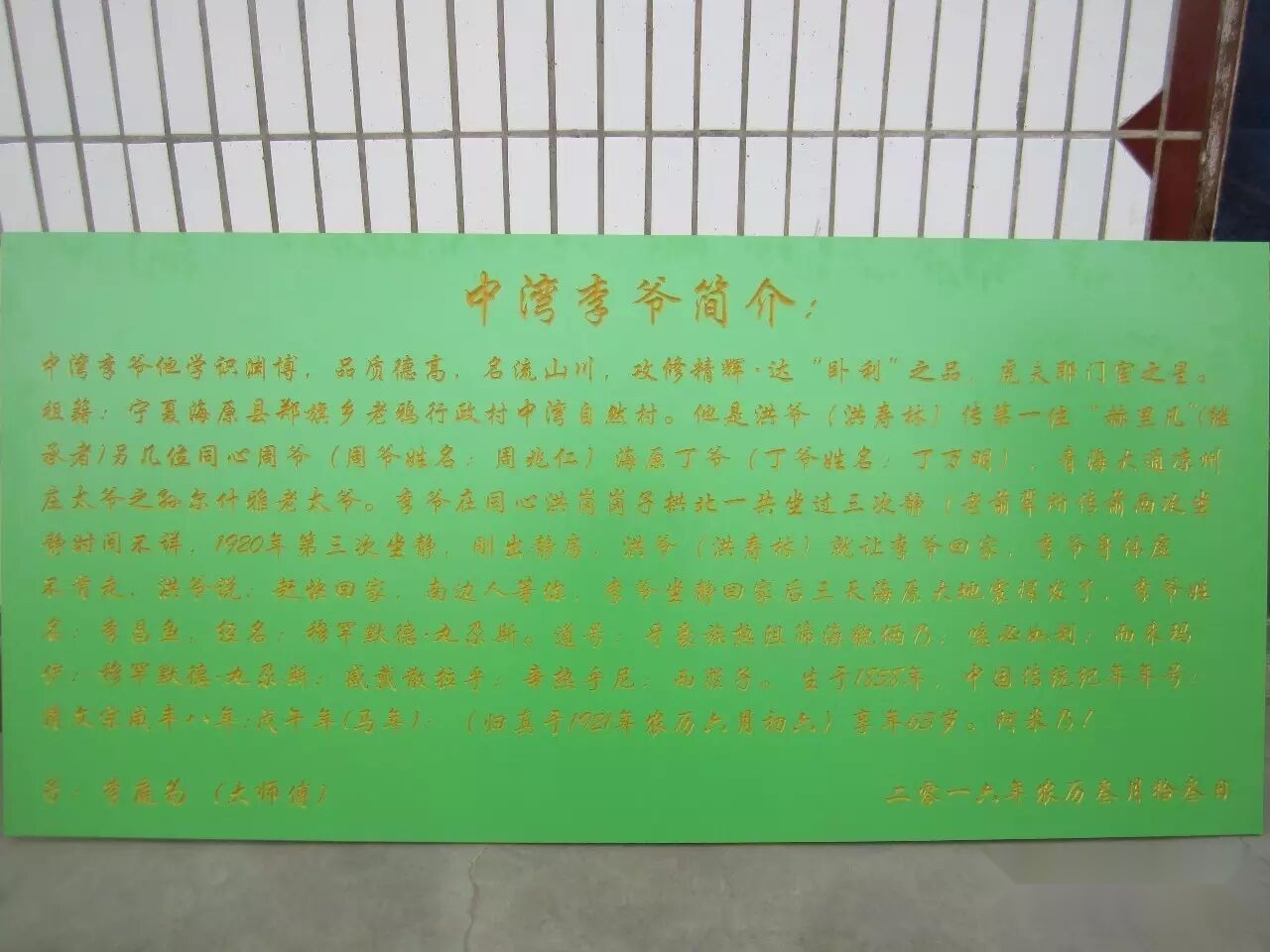
Introduction to Liye:
Liye was profoundly knowledgeable; his character was of the highest virtue, renowned across mountains and rivers. His spiritual cultivation reached the rank of a 'wali' (friend of Allah), a shining star of the Khufiyya Sufi order. Liye's given name: Li Changyu, Islamic name: Muhammad Wangas. Religious title: Yahaozu Rezu Sheih Maolainai, Kebiliuli; and Laimayi, Muhammad Wangas; praise be to Allah; Xinrehfuni; and Zui Zi. Ancestral home: Zhongwan Natural Village, Laoya Administrative Village, Zhengqi Township, Haiyuan County, Ningxia. He was the first 'khalifa' (successor) appointed by Master Hong (Hong Shoulin). Other appointed successors included Master Zhou of Tongxin (name: Zhou Zhaoren), Master Ding of Haiyuan (name: Ding Wanming), and Old Master Ershiya—the grandson of Old Master Liangzhouzhuang of Datong, Qinghai (Old Master Ershiya only initiated slightly over 100 people in his lifetime, including the grandson of Zhongwan Liye: Master Li Wenli, Master Li Wenjie, Li Wenshan, and Li Wenlu). Liye completed three periods of spiritual seclusion ('chilla') at Honggang Gangzi in Tongxin; (according to the historical tracking of our editor, passed down by senior elders, the exact dates of the first two seclusions are unknown). In 1920, during his third seclusion, right as he emerged from the seclusion room, Master Hong (Hong Shoulin) told Liye to return home. Liye was physically weak and reluctant to leave, but Master Hong said: 'Hurry home, people in the south are waiting for you.' Three days after Liye returned home, the great Haiyuan earthquake struck. Liye was born in 1858, in the traditional Chinese imperial year: the 8th year of Xianfeng under the Qing dynasty, the Wuwu year (Year of the Horse). He returned to the truth (passed away) in 1921 on the 6th day of the 6th lunar month, living to the age of 63. Amin!
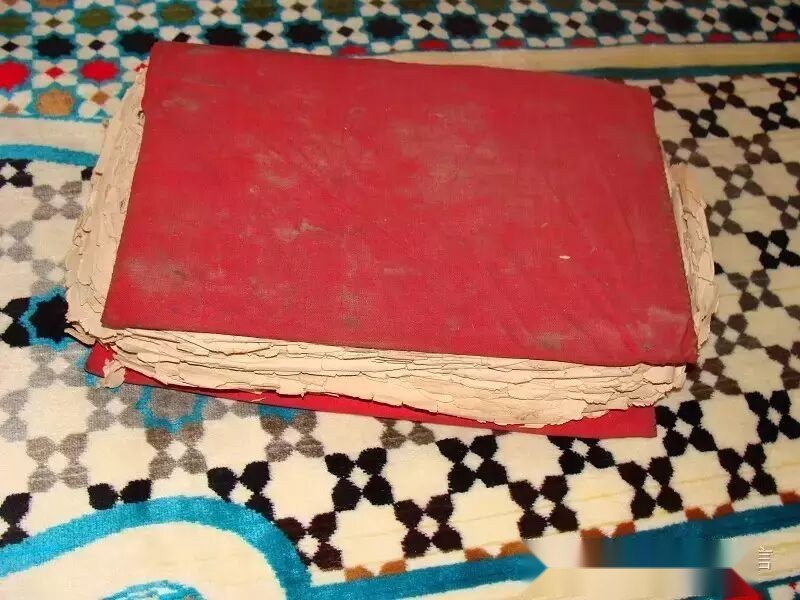
Our editor has excerpted records from the internet of the Quranic texts studied by Liye; Amin!
Liye's Hat (According to oral history passed down by elders: this hat was brought back from Mecca by the Seventh Old Master and distributed to Liye)
The knife used by Zhongwan Liye for slaughtering cattle
Liye's stationary box used for writing scripture scrolls
Liye's sajda mat (used for prayer/salah)
Liye Gongbei Bronze Incense Burner: Distributed by Li Yanqing (Haji)
Liye's Bagua Pavilion
Do you recognize all of these old masters (preachers)? Amin!
A commemorative photo of Master Hong Weizong and Master Li Wenjie taken in 1992 (Master Hong came to Laoya to preach). Photographed by Shuangwa on the South Mountain.
Master Bai Geda and Master Li Yanxue of Zhongwan at the 2007 completion celebration of the Liye Gongbei
Group photo of the Seventh Master and the Zhongwan Liye family on the 6th day of the 6th lunar month in 2007
In 2012, Li Cungui, researchers from the Second Northwest University for Nationalities and the Ningda Institute of Social and Ethnic Sciences came together to Mullah Li Wenjiang's home to trace the history of Zhongwan Liye. Photographed by Li Chengyu
Li Cungui, Professor Ma Jianfu from the University for Nationalities; Ningda graduate student; Master Li Yanxue, Mullah Li Xinghui, and Li Chenggang came to Zhou's home to trace the history of Zhongwan Liye. Hearing that Master Li Yanxue—the great-grandson of Zhongwan Liye—had come to visit, Zhou's granddaughter-in-law (who is blind) repeatedly said: 'Liye is the senior martial brother of Master Zhou.' She then reached into her clothes and shook out over one hundred yuan in saved-up money, giving it all to Master Li, the great-grandson of Liye.
Lecturing on the missionary journeys of Liye, Master Zhou, and Master Ding.
The 2012 Liye History Tracking Team visiting the Zhou Gongbei
Professor Ma Jianfu lecturing his students on the Khufiyya Sufi order at the Zhou Gongbei. Photographed in 2012 by Li Chengyu
The grandson of Master Zhou and Master Li Yanxue (grandson of Liye), along with Li Chenggang, exchanging stories about the history of Masters Li, Zhou, and Ding after completing an 'ayliya/meal prayer' (Dua/Dhikr gathering). Photographed in 2011 by Li Chengyu
In 2011, Master Li Yanxue (grandson of Zhongwan Liye) and Li Chenggang finished an ayliya gathering at the home of Master Ding's grandfather, and asked him about the history of Old Masters Li, Zhou, and Ding. Li Chenggang asked Master Ding's grandfather: 'Some people nowadays refuse to acknowledge that Zhongwan Liye was appointed as a 'khalifa' by Master Hong Shoulin.' Master Ding's grandfather replied: 'Children must not talk nonsense; whoever makes such claims is responsible for them. In our Khufiyya order, the Master of Liangzhouzhuang appointed two khalifas in Tongxin and Haiyuan counties: Liye of Haiyuan; while Master Hong of Tongxin appointed three khalifas: Zhongwan Liye of Haiyuan, Master Zhou of Tongxin, and Master Ding of Haiyuan. Before Master Hong returned to the truth, he said that religious teachings were reaching a time of weakness, and that we would stop with Ding. Master Hong sent his personal seal to the Daliang Gongbei, saying that forty years later someone would come to retrieve it. Forty years later, Master Weizong went to Daliang Gongbei to claim the seal.' Master Ding also said: 'In 1982, Master Li Wenjie and I were eating youxiang (traditional golden fried dough cakes) in Jiatang and discussing how the two of us should sort out and write down some history, but then he got sick, and we never saw each other again.'
Searching for historical truth is so difficult!! Amin!
Professor Ma Jianfu, Master Li Yanxue, Mullah Li Xinghui, and the graduate students from the University for Nationalities and Ningda tracing Liye's history at the home of Haji Li Yanqing. According to Haji Li Yanqing, he was serving as an accountant in Laoya Administrative Village at the time, and a working group dispatched by Haiyuan County stayed at his house and confiscated Zhongwan Liye's seal (the missionary seal).
Master Li Yanxue prepared a lavish plate of dapanji (spicy big plate chicken) for the Liye History Tracking Team
In 2012, led by Professor Ma Jianfu, visiting the Liye Gongbei for academic inspection and grave visitation
Professor Ma Jianfu and Li Cungui paying their respects at the Liye Gongbei (Sufi shrine / mausoleum complex). Photographed by Li Chengyu in 2012.
After the Cultural Revolution, masters Li Wenlin, Li Wenjie, Li Wenshan, and Li Wenlu rebuilt the gongbei (Sufi shrine / mausoleum complex) for their grandfather, Elder Li.
After finishing the *amal* (religious service / good deeds) at Liye Gongbei, Professor Ma and many students (*studani* / religious seekers) went to study the history of Liye's missionary work.
Students from the Second Ethnic Minority Normal School and graduate students from Ningxia University taking photos at Liye Gongbei.
Holding an *amal* (religious service / good deeds) at the Zhongwan Daotang (Sufi teaching hall) on the sixth day of the sixth lunar month in 2016.
Visiting and paying respects at Liye Gongbei.
The president of the Ningxia Yiguang Alumni Association and Master Li Yanxue posing for a commemorative photo at the Zhongwan Liye Gongbei.
Imam He from Xishan visiting the Zhongwan Daotang (Sufi teaching hall).
On the sixth day of the sixth lunar month in 2016, Master Li Yanxue (great-grandson of Liye) and imams from the Yiguang Association went to the gongbei (Sufi shrine / mausoleum complex) to pay their respects.
Master Li Yanxue and the imams visiting the Zhongwan Liye Gongbei to pay their respects. Amin! (Amen!) view all
Tracing the History of the Zhongwan Liye Gongbei in Ningxia: The Spiritual Seat and Architectural Record of the Khufiyya Sufi Order Predecessors
Abstract:
A 54-photo and text documentation diving deep into the exploration of the Zhongwan Liye Gongbei and Honggang Gangzi Gongbei. Tracing the historical lineage of the Khufiyya Sufi order taking root and preaching in Ningxia, documenting the solemn gongbei mausoleums, scripture hall brick carvings, and the cultural landscape of surrounding Hui Muslim villages.
Zhongwan Liye Gongbei (Khufiyya Sufi Order)
The Honggang Gangzi Gongbei (associated with Master Hong Shoulin) is the first-generation missionary of the Ningxia Khufiyya Sufi order. Amin!
Zhongwan Liye Religious Activity Venue Registration Certificate
Introduction to Liye:
Liye was profoundly knowledgeable; his character was of the highest virtue, renowned across mountains and rivers. His spiritual cultivation reached the rank of a 'wali' (friend of Allah), a shining star of the Khufiyya Sufi order. Liye's given name: Li Changyu, Islamic name: Muhammad Wangas. Religious title: Yahaozu Rezu Sheih Maolainai, Kebiliuli; and Laimayi, Muhammad Wangas; praise be to Allah; Xinrehfuni; and Zui Zi. Ancestral home: Zhongwan Natural Village, Laoya Administrative Village, Zhengqi Township, Haiyuan County, Ningxia. He was the first 'khalifa' (successor) appointed by Master Hong (Hong Shoulin). Other appointed successors included Master Zhou of Tongxin (name: Zhou Zhaoren), Master Ding of Haiyuan (name: Ding Wanming), and Old Master Ershiya—the grandson of Old Master Liangzhouzhuang of Datong, Qinghai (Old Master Ershiya only initiated slightly over 100 people in his lifetime, including the grandson of Zhongwan Liye: Master Li Wenli, Master Li Wenjie, Li Wenshan, and Li Wenlu). Liye completed three periods of spiritual seclusion ('chilla') at Honggang Gangzi in Tongxin; (according to the historical tracking of our editor, passed down by senior elders, the exact dates of the first two seclusions are unknown). In 1920, during his third seclusion, right as he emerged from the seclusion room, Master Hong (Hong Shoulin) told Liye to return home. Liye was physically weak and reluctant to leave, but Master Hong said: 'Hurry home, people in the south are waiting for you.' Three days after Liye returned home, the great Haiyuan earthquake struck. Liye was born in 1858, in the traditional Chinese imperial year: the 8th year of Xianfeng under the Qing dynasty, the Wuwu year (Year of the Horse). He returned to the truth (passed away) in 1921 on the 6th day of the 6th lunar month, living to the age of 63. Amin!
Our editor has excerpted records from the internet of the Quranic texts studied by Liye; Amin!
Liye's Hat (According to oral history passed down by elders: this hat was brought back from Mecca by the Seventh Old Master and distributed to Liye)
The knife used by Zhongwan Liye for slaughtering cattle
Liye's stationary box used for writing scripture scrolls
Liye's sajda mat (used for prayer/salah)
Liye Gongbei Bronze Incense Burner: Distributed by Li Yanqing (Haji)
Liye's Bagua Pavilion
Do you recognize all of these old masters (preachers)? Amin!
A commemorative photo of Master Hong Weizong and Master Li Wenjie taken in 1992 (Master Hong came to Laoya to preach). Photographed by Shuangwa on the South Mountain.
Master Bai Geda and Master Li Yanxue of Zhongwan at the 2007 completion celebration of the Liye Gongbei
Group photo of the Seventh Master and the Zhongwan Liye family on the 6th day of the 6th lunar month in 2007
In 2012, Li Cungui, researchers from the Second Northwest University for Nationalities and the Ningda Institute of Social and Ethnic Sciences came together to Mullah Li Wenjiang's home to trace the history of Zhongwan Liye. Photographed by Li Chengyu
Li Cungui, Professor Ma Jianfu from the University for Nationalities; Ningda graduate student; Master Li Yanxue, Mullah Li Xinghui, and Li Chenggang came to Zhou's home to trace the history of Zhongwan Liye. Hearing that Master Li Yanxue—the great-grandson of Zhongwan Liye—had come to visit, Zhou's granddaughter-in-law (who is blind) repeatedly said: 'Liye is the senior martial brother of Master Zhou.' She then reached into her clothes and shook out over one hundred yuan in saved-up money, giving it all to Master Li, the great-grandson of Liye.
Lecturing on the missionary journeys of Liye, Master Zhou, and Master Ding.
The 2012 Liye History Tracking Team visiting the Zhou Gongbei
Professor Ma Jianfu lecturing his students on the Khufiyya Sufi order at the Zhou Gongbei. Photographed in 2012 by Li Chengyu
The grandson of Master Zhou and Master Li Yanxue (grandson of Liye), along with Li Chenggang, exchanging stories about the history of Masters Li, Zhou, and Ding after completing an 'ayliya/meal prayer' (Dua/Dhikr gathering). Photographed in 2011 by Li Chengyu
In 2011, Master Li Yanxue (grandson of Zhongwan Liye) and Li Chenggang finished an ayliya gathering at the home of Master Ding's grandfather, and asked him about the history of Old Masters Li, Zhou, and Ding. Li Chenggang asked Master Ding's grandfather: 'Some people nowadays refuse to acknowledge that Zhongwan Liye was appointed as a 'khalifa' by Master Hong Shoulin.' Master Ding's grandfather replied: 'Children must not talk nonsense; whoever makes such claims is responsible for them. In our Khufiyya order, the Master of Liangzhouzhuang appointed two khalifas in Tongxin and Haiyuan counties: Liye of Haiyuan; while Master Hong of Tongxin appointed three khalifas: Zhongwan Liye of Haiyuan, Master Zhou of Tongxin, and Master Ding of Haiyuan. Before Master Hong returned to the truth, he said that religious teachings were reaching a time of weakness, and that we would stop with Ding. Master Hong sent his personal seal to the Daliang Gongbei, saying that forty years later someone would come to retrieve it. Forty years later, Master Weizong went to Daliang Gongbei to claim the seal.' Master Ding also said: 'In 1982, Master Li Wenjie and I were eating youxiang (traditional golden fried dough cakes) in Jiatang and discussing how the two of us should sort out and write down some history, but then he got sick, and we never saw each other again.'
Searching for historical truth is so difficult!! Amin!
Professor Ma Jianfu, Master Li Yanxue, Mullah Li Xinghui, and the graduate students from the University for Nationalities and Ningda tracing Liye's history at the home of Haji Li Yanqing. According to Haji Li Yanqing, he was serving as an accountant in Laoya Administrative Village at the time, and a working group dispatched by Haiyuan County stayed at his house and confiscated Zhongwan Liye's seal (the missionary seal).
Master Li Yanxue prepared a lavish plate of dapanji (spicy big plate chicken) for the Liye History Tracking Team
In 2012, led by Professor Ma Jianfu, visiting the Liye Gongbei for academic inspection and grave visitation
Professor Ma Jianfu and Li Cungui paying their respects at the Liye Gongbei (Sufi shrine / mausoleum complex). Photographed by Li Chengyu in 2012.
After the Cultural Revolution, masters Li Wenlin, Li Wenjie, Li Wenshan, and Li Wenlu rebuilt the gongbei (Sufi shrine / mausoleum complex) for their grandfather, Elder Li.
After finishing the *amal* (religious service / good deeds) at Liye Gongbei, Professor Ma and many students (*studani* / religious seekers) went to study the history of Liye's missionary work.
Students from the Second Ethnic Minority Normal School and graduate students from Ningxia University taking photos at Liye Gongbei.
Holding an *amal* (religious service / good deeds) at the Zhongwan Daotang (Sufi teaching hall) on the sixth day of the sixth lunar month in 2016.
Visiting and paying respects at Liye Gongbei.
The president of the Ningxia Yiguang Alumni Association and Master Li Yanxue posing for a commemorative photo at the Zhongwan Liye Gongbei.
Imam He from Xishan visiting the Zhongwan Daotang (Sufi teaching hall).
On the sixth day of the sixth lunar month in 2016, Master Li Yanxue (great-grandson of Liye) and imams from the Yiguang Association went to the gongbei (Sufi shrine / mausoleum complex) to pay their respects.
Master Li Yanxue and the imams visiting the Zhongwan Liye Gongbei to pay their respects. Amin! (Amen!) view all
[Internet Repost]
Tracing the History of the Zhongwan Liye Gongbei in Ningxia: The Spiritual Seat and Architectural Record of the Khufiyya Sufi Order Predecessors

Abstract:

A 54-photo and text documentation diving deep into the exploration of the Zhongwan Liye Gongbei and Honggang Gangzi Gongbei. Tracing the historical lineage of the Khufiyya Sufi order taking root and preaching in Ningxia, documenting the solemn gongbei mausoleums, scripture hall brick carvings, and the cultural landscape of surrounding Hui Muslim villages.

Zhongwan Liye Gongbei (Khufiyya Sufi Order)
The Honggang Gangzi Gongbei (associated with Master Hong Shoulin) is the first-generation missionary of the Ningxia Khufiyya Sufi order. Amin!

Zhongwan Liye Religious Activity Venue Registration Certificate
Introduction to Liye:

Liye was profoundly knowledgeable; his character was of the highest virtue, renowned across mountains and rivers. His spiritual cultivation reached the rank of a 'wali' (friend of Allah), a shining star of the Khufiyya Sufi order. Liye's given name: Li Changyu, Islamic name: Muhammad Wangas. Religious title: Yahaozu Rezu Sheih Maolainai, Kebiliuli; and Laimayi, Muhammad Wangas; praise be to Allah; Xinrehfuni; and Zui Zi. Ancestral home: Zhongwan Natural Village, Laoya Administrative Village, Zhengqi Township, Haiyuan County, Ningxia. He was the first 'khalifa' (successor) appointed by Master Hong (Hong Shoulin). Other appointed successors included Master Zhou of Tongxin (name: Zhou Zhaoren), Master Ding of Haiyuan (name: Ding Wanming), and Old Master Ershiya—the grandson of Old Master Liangzhouzhuang of Datong, Qinghai (Old Master Ershiya only initiated slightly over 100 people in his lifetime, including the grandson of Zhongwan Liye: Master Li Wenli, Master Li Wenjie, Li Wenshan, and Li Wenlu). Liye completed three periods of spiritual seclusion ('chilla') at Honggang Gangzi in Tongxin; (according to the historical tracking of our editor, passed down by senior elders, the exact dates of the first two seclusions are unknown). In 1920, during his third seclusion, right as he emerged from the seclusion room, Master Hong (Hong Shoulin) told Liye to return home. Liye was physically weak and reluctant to leave, but Master Hong said: 'Hurry home, people in the south are waiting for you.' Three days after Liye returned home, the great Haiyuan earthquake struck. Liye was born in 1858, in the traditional Chinese imperial year: the 8th year of Xianfeng under the Qing dynasty, the Wuwu year (Year of the Horse). He returned to the truth (passed away) in 1921 on the 6th day of the 6th lunar month, living to the age of 63. Amin!

Our editor has excerpted records from the internet of the Quranic texts studied by Liye; Amin!

Liye's Hat (According to oral history passed down by elders: this hat was brought back from Mecca by the Seventh Old Master and distributed to Liye)

The knife used by Zhongwan Liye for slaughtering cattle

Liye's stationary box used for writing scripture scrolls

Liye's sajda mat (used for prayer/salah)

Liye Gongbei Bronze Incense Burner: Distributed by Li Yanqing (Haji)

Liye's Bagua Pavilion

Do you recognize all of these old masters (preachers)? Amin!

A commemorative photo of Master Hong Weizong and Master Li Wenjie taken in 1992 (Master Hong came to Laoya to preach). Photographed by Shuangwa on the South Mountain.

Master Bai Geda and Master Li Yanxue of Zhongwan at the 2007 completion celebration of the Liye Gongbei

Group photo of the Seventh Master and the Zhongwan Liye family on the 6th day of the 6th lunar month in 2007

In 2012, Li Cungui, researchers from the Second Northwest University for Nationalities and the Ningda Institute of Social and Ethnic Sciences came together to Mullah Li Wenjiang's home to trace the history of Zhongwan Liye. Photographed by Li Chengyu

Li Cungui, Professor Ma Jianfu from the University for Nationalities; Ningda graduate student; Master Li Yanxue, Mullah Li Xinghui, and Li Chenggang came to Zhou's home to trace the history of Zhongwan Liye. Hearing that Master Li Yanxue—the great-grandson of Zhongwan Liye—had come to visit, Zhou's granddaughter-in-law (who is blind) repeatedly said: 'Liye is the senior martial brother of Master Zhou.' She then reached into her clothes and shook out over one hundred yuan in saved-up money, giving it all to Master Li, the great-grandson of Liye.

Lecturing on the missionary journeys of Liye, Master Zhou, and Master Ding.

The 2012 Liye History Tracking Team visiting the Zhou Gongbei

Professor Ma Jianfu lecturing his students on the Khufiyya Sufi order at the Zhou Gongbei. Photographed in 2012 by Li Chengyu

The grandson of Master Zhou and Master Li Yanxue (grandson of Liye), along with Li Chenggang, exchanging stories about the history of Masters Li, Zhou, and Ding after completing an 'ayliya/meal prayer' (Dua/Dhikr gathering). Photographed in 2011 by Li Chengyu

In 2011, Master Li Yanxue (grandson of Zhongwan Liye) and Li Chenggang finished an ayliya gathering at the home of Master Ding's grandfather, and asked him about the history of Old Masters Li, Zhou, and Ding. Li Chenggang asked Master Ding's grandfather: 'Some people nowadays refuse to acknowledge that Zhongwan Liye was appointed as a 'khalifa' by Master Hong Shoulin.' Master Ding's grandfather replied: 'Children must not talk nonsense; whoever makes such claims is responsible for them. In our Khufiyya order, the Master of Liangzhouzhuang appointed two khalifas in Tongxin and Haiyuan counties: Liye of Haiyuan; while Master Hong of Tongxin appointed three khalifas: Zhongwan Liye of Haiyuan, Master Zhou of Tongxin, and Master Ding of Haiyuan. Before Master Hong returned to the truth, he said that religious teachings were reaching a time of weakness, and that we would stop with Ding. Master Hong sent his personal seal to the Daliang Gongbei, saying that forty years later someone would come to retrieve it. Forty years later, Master Weizong went to Daliang Gongbei to claim the seal.' Master Ding also said: 'In 1982, Master Li Wenjie and I were eating youxiang (traditional golden fried dough cakes) in Jiatang and discussing how the two of us should sort out and write down some history, but then he got sick, and we never saw each other again.'

Searching for historical truth is so difficult!! Amin!

Professor Ma Jianfu, Master Li Yanxue, Mullah Li Xinghui, and the graduate students from the University for Nationalities and Ningda tracing Liye's history at the home of Haji Li Yanqing. According to Haji Li Yanqing, he was serving as an accountant in Laoya Administrative Village at the time, and a working group dispatched by Haiyuan County stayed at his house and confiscated Zhongwan Liye's seal (the missionary seal).

Master Li Yanxue prepared a lavish plate of dapanji (spicy big plate chicken) for the Liye History Tracking Team

In 2012, led by Professor Ma Jianfu, visiting the Liye Gongbei for academic inspection and grave visitation

Professor Ma Jianfu and Li Cungui paying their respects at the Liye Gongbei (Sufi shrine / mausoleum complex). Photographed by Li Chengyu in 2012.

After the Cultural Revolution, masters Li Wenlin, Li Wenjie, Li Wenshan, and Li Wenlu rebuilt the gongbei (Sufi shrine / mausoleum complex) for their grandfather, Elder Li.

After finishing the *amal* (religious service / good deeds) at Liye Gongbei, Professor Ma and many students (*studani* / religious seekers) went to study the history of Liye's missionary work.

Students from the Second Ethnic Minority Normal School and graduate students from Ningxia University taking photos at Liye Gongbei.

Holding an *amal* (religious service / good deeds) at the Zhongwan Daotang (Sufi teaching hall) on the sixth day of the sixth lunar month in 2016.

Visiting and paying respects at Liye Gongbei.

The president of the Ningxia Yiguang Alumni Association and Master Li Yanxue posing for a commemorative photo at the Zhongwan Liye Gongbei.

Imam He from Xishan visiting the Zhongwan Daotang (Sufi teaching hall).

On the sixth day of the sixth lunar month in 2016, Master Li Yanxue (great-grandson of Liye) and imams from the Yiguang Association went to the gongbei (Sufi shrine / mausoleum complex) to pay their respects.

Master Li Yanxue and the imams visiting the Zhongwan Liye Gongbei to pay their respects. Amin! (Amen!)


Tracing the History of the Zhongwan Liye Gongbei in Ningxia: The Spiritual Seat and Architectural Record of the Khufiyya Sufi Order Predecessors
Abstract:
A 54-photo and text documentation diving deep into the exploration of the Zhongwan Liye Gongbei and Honggang Gangzi Gongbei. Tracing the historical lineage of the Khufiyya Sufi order taking root and preaching in Ningxia, documenting the solemn gongbei mausoleums, scripture hall brick carvings, and the cultural landscape of surrounding Hui Muslim villages.
Zhongwan Liye Gongbei (Khufiyya Sufi Order)
The Honggang Gangzi Gongbei (associated with Master Hong Shoulin) is the first-generation missionary of the Ningxia Khufiyya Sufi order. Amin!
Zhongwan Liye Religious Activity Venue Registration Certificate
Introduction to Liye:
Liye was profoundly knowledgeable; his character was of the highest virtue, renowned across mountains and rivers. His spiritual cultivation reached the rank of a 'wali' (friend of Allah), a shining star of the Khufiyya Sufi order. Liye's given name: Li Changyu, Islamic name: Muhammad Wangas. Religious title: Yahaozu Rezu Sheih Maolainai, Kebiliuli; and Laimayi, Muhammad Wangas; praise be to Allah; Xinrehfuni; and Zui Zi. Ancestral home: Zhongwan Natural Village, Laoya Administrative Village, Zhengqi Township, Haiyuan County, Ningxia. He was the first 'khalifa' (successor) appointed by Master Hong (Hong Shoulin). Other appointed successors included Master Zhou of Tongxin (name: Zhou Zhaoren), Master Ding of Haiyuan (name: Ding Wanming), and Old Master Ershiya—the grandson of Old Master Liangzhouzhuang of Datong, Qinghai (Old Master Ershiya only initiated slightly over 100 people in his lifetime, including the grandson of Zhongwan Liye: Master Li Wenli, Master Li Wenjie, Li Wenshan, and Li Wenlu). Liye completed three periods of spiritual seclusion ('chilla') at Honggang Gangzi in Tongxin; (according to the historical tracking of our editor, passed down by senior elders, the exact dates of the first two seclusions are unknown). In 1920, during his third seclusion, right as he emerged from the seclusion room, Master Hong (Hong Shoulin) told Liye to return home. Liye was physically weak and reluctant to leave, but Master Hong said: 'Hurry home, people in the south are waiting for you.' Three days after Liye returned home, the great Haiyuan earthquake struck. Liye was born in 1858, in the traditional Chinese imperial year: the 8th year of Xianfeng under the Qing dynasty, the Wuwu year (Year of the Horse). He returned to the truth (passed away) in 1921 on the 6th day of the 6th lunar month, living to the age of 63. Amin!
Our editor has excerpted records from the internet of the Quranic texts studied by Liye; Amin!
Liye's Hat (According to oral history passed down by elders: this hat was brought back from Mecca by the Seventh Old Master and distributed to Liye)
The knife used by Zhongwan Liye for slaughtering cattle
Liye's stationary box used for writing scripture scrolls
Liye's sajda mat (used for prayer/salah)
Liye Gongbei Bronze Incense Burner: Distributed by Li Yanqing (Haji)
Liye's Bagua Pavilion
Do you recognize all of these old masters (preachers)? Amin!
A commemorative photo of Master Hong Weizong and Master Li Wenjie taken in 1992 (Master Hong came to Laoya to preach). Photographed by Shuangwa on the South Mountain.
Master Bai Geda and Master Li Yanxue of Zhongwan at the 2007 completion celebration of the Liye Gongbei
Group photo of the Seventh Master and the Zhongwan Liye family on the 6th day of the 6th lunar month in 2007
In 2012, Li Cungui, researchers from the Second Northwest University for Nationalities and the Ningda Institute of Social and Ethnic Sciences came together to Mullah Li Wenjiang's home to trace the history of Zhongwan Liye. Photographed by Li Chengyu
Li Cungui, Professor Ma Jianfu from the University for Nationalities; Ningda graduate student; Master Li Yanxue, Mullah Li Xinghui, and Li Chenggang came to Zhou's home to trace the history of Zhongwan Liye. Hearing that Master Li Yanxue—the great-grandson of Zhongwan Liye—had come to visit, Zhou's granddaughter-in-law (who is blind) repeatedly said: 'Liye is the senior martial brother of Master Zhou.' She then reached into her clothes and shook out over one hundred yuan in saved-up money, giving it all to Master Li, the great-grandson of Liye.
Lecturing on the missionary journeys of Liye, Master Zhou, and Master Ding.
The 2012 Liye History Tracking Team visiting the Zhou Gongbei
Professor Ma Jianfu lecturing his students on the Khufiyya Sufi order at the Zhou Gongbei. Photographed in 2012 by Li Chengyu
The grandson of Master Zhou and Master Li Yanxue (grandson of Liye), along with Li Chenggang, exchanging stories about the history of Masters Li, Zhou, and Ding after completing an 'ayliya/meal prayer' (Dua/Dhikr gathering). Photographed in 2011 by Li Chengyu
In 2011, Master Li Yanxue (grandson of Zhongwan Liye) and Li Chenggang finished an ayliya gathering at the home of Master Ding's grandfather, and asked him about the history of Old Masters Li, Zhou, and Ding. Li Chenggang asked Master Ding's grandfather: 'Some people nowadays refuse to acknowledge that Zhongwan Liye was appointed as a 'khalifa' by Master Hong Shoulin.' Master Ding's grandfather replied: 'Children must not talk nonsense; whoever makes such claims is responsible for them. In our Khufiyya order, the Master of Liangzhouzhuang appointed two khalifas in Tongxin and Haiyuan counties: Liye of Haiyuan; while Master Hong of Tongxin appointed three khalifas: Zhongwan Liye of Haiyuan, Master Zhou of Tongxin, and Master Ding of Haiyuan. Before Master Hong returned to the truth, he said that religious teachings were reaching a time of weakness, and that we would stop with Ding. Master Hong sent his personal seal to the Daliang Gongbei, saying that forty years later someone would come to retrieve it. Forty years later, Master Weizong went to Daliang Gongbei to claim the seal.' Master Ding also said: 'In 1982, Master Li Wenjie and I were eating youxiang (traditional golden fried dough cakes) in Jiatang and discussing how the two of us should sort out and write down some history, but then he got sick, and we never saw each other again.'
Searching for historical truth is so difficult!! Amin!
Professor Ma Jianfu, Master Li Yanxue, Mullah Li Xinghui, and the graduate students from the University for Nationalities and Ningda tracing Liye's history at the home of Haji Li Yanqing. According to Haji Li Yanqing, he was serving as an accountant in Laoya Administrative Village at the time, and a working group dispatched by Haiyuan County stayed at his house and confiscated Zhongwan Liye's seal (the missionary seal).
Master Li Yanxue prepared a lavish plate of dapanji (spicy big plate chicken) for the Liye History Tracking Team
In 2012, led by Professor Ma Jianfu, visiting the Liye Gongbei for academic inspection and grave visitation
Professor Ma Jianfu and Li Cungui paying their respects at the Liye Gongbei (Sufi shrine / mausoleum complex). Photographed by Li Chengyu in 2012.
After the Cultural Revolution, masters Li Wenlin, Li Wenjie, Li Wenshan, and Li Wenlu rebuilt the gongbei (Sufi shrine / mausoleum complex) for their grandfather, Elder Li.
After finishing the *amal* (religious service / good deeds) at Liye Gongbei, Professor Ma and many students (*studani* / religious seekers) went to study the history of Liye's missionary work.
Students from the Second Ethnic Minority Normal School and graduate students from Ningxia University taking photos at Liye Gongbei.
Holding an *amal* (religious service / good deeds) at the Zhongwan Daotang (Sufi teaching hall) on the sixth day of the sixth lunar month in 2016.
Visiting and paying respects at Liye Gongbei.
The president of the Ningxia Yiguang Alumni Association and Master Li Yanxue posing for a commemorative photo at the Zhongwan Liye Gongbei.
Imam He from Xishan visiting the Zhongwan Daotang (Sufi teaching hall).
On the sixth day of the sixth lunar month in 2016, Master Li Yanxue (great-grandson of Liye) and imams from the Yiguang Association went to the gongbei (Sufi shrine / mausoleum complex) to pay their respects.
Master Li Yanxue and the imams visiting the Zhongwan Liye Gongbei to pay their respects. Amin! (Amen!)
Exploring Shatan Gongbei & Diannong River: A Journey Through Yinchuan's Sufi Heritage and Yellow River Scenery
Articles • Hasan09 posted the article • 0 comments • 4 views • 6 hours ago
[Internet Repost]
Exploring Yinchuan's Shatan Gongbei and Diannong River: Ancient Waterwheels and Sufi Shrines Along Binhe Avenue
Abstract:
Exploring Shatan Gongbei, nestled along the banks of Yinchuan's Diannong River. Documenting the breathtaking wetlands and giant ancient waterwheels along the summer Yellow River Golden Bank Binhe Avenue, blending natural ecological waterscapes with solemn Sufi historical landmarks.
Waterwheels
Summer scenery of the Lingwu section of Yinchuan Binhe Avenue, featuring waterwheels. The Ningxia Yellow River Golden Bank Binhe Avenue, officially known as the Yellow River Standardized Embankment Binhe Avenue, spans a total length of 508 kilometers. Fully connected in July 2010, it links ten cities, counties, and districts within the Yellow River irrigation area. The crest road is fully constructed to Class-1 highway standards as a two-way six-lane road with a 24-meter roadbed width.
Shot on Rolleiflex 3.5F Planar 75MM F3.5, home-developed film directly scanned.
Stone Lions
Stone lions beneath the Zhenhe Pagoda in Lingwu, standing over one meter tall. They look adorable yet show some wear and tear, and are estimated to date back to the Qing Dynasty.
Linhof Technika Wollensak 162MM F4.5, home-developed film directly scanned.
Lingzhou Ancient City Wall Ruins
Located in the urban area of present-day Lingwu. Rebuilt after the devastating 1738 Ningxia earthquake (the third year of the Qianlong era), with subsequent modern repairs and reinforcements. Listed as an Autonomous Region-level Key Cultural Relic Protection Unit in December 2010.
Rolleiflex 3.5F Planar 75MM F3.5, home-developed film directly scanned.
Summer Diannong River
Yinchuan's Diannong River (an ancient Han Dynasty name) in summer, with swaying reeds and rippling waters.
On September 17, 2018, Ningxia officially renamed the 'Aiyi River' back to 'Diannong River' (originally named Aiyi River in 2004, renamed Aiyi River [with a different Chinese character] in 2008, changed back to Aiyi River in 2015, and renamed Diannong River again in 2018). The characters 'Diannong' are derived from the ancient local name Diannong City in the Yinchuan region, which was first built in the fifth year of the Yuanding era of the Western Han Dynasty (112 BCE), boasting a history of over 2,000 years.
The Diannong River stretches from the Xinqiao flood retention basin in Yongning County to the south, flowing north into the Yellow River at the Binhe Plaza in Shizuizi Park, Yuanying Town, Huinong District, Shizuishan. It spans six counties and districts—Yongning County, Xingqing District, Jinfeng District, Helan County, Pingluo County, and Huinong District—covering a total length of 180.5 kilometers.
Linhof Technika Schneider Symmar 240MM F5.6, home-developed film directly scanned.
Shatan Gongbei
Located inside the Shatan Mosque in Xingqing District, Yinchuan. It features a stone monument inscribed with the prominent characters 'Yuanweng Na Laotye' (Elder Yuanweng Na) and his religious name 'Haoke Menlaxi'. Flanking inscriptions are weathered and hard to make out, erected in the third year of the Qianlong era (1737). According to relevant cultural authorities, it was originally built during the Yuan Dynasty.
Gongbei (Sufi shrine / mausoleum complex): Originally referring to a dome-shaped building, it is translated to mean the dome over a Sufi master's mausoleum. By extension, it refers to the burial architecture of Sufi masters, menhuan (Sufi orders / brotherhoods) founders, spiritual ancestors, and revered sages. view all
Exploring Yinchuan's Shatan Gongbei and Diannong River: Ancient Waterwheels and Sufi Shrines Along Binhe Avenue
Abstract:
Exploring Shatan Gongbei, nestled along the banks of Yinchuan's Diannong River. Documenting the breathtaking wetlands and giant ancient waterwheels along the summer Yellow River Golden Bank Binhe Avenue, blending natural ecological waterscapes with solemn Sufi historical landmarks.
Waterwheels
Summer scenery of the Lingwu section of Yinchuan Binhe Avenue, featuring waterwheels. The Ningxia Yellow River Golden Bank Binhe Avenue, officially known as the Yellow River Standardized Embankment Binhe Avenue, spans a total length of 508 kilometers. Fully connected in July 2010, it links ten cities, counties, and districts within the Yellow River irrigation area. The crest road is fully constructed to Class-1 highway standards as a two-way six-lane road with a 24-meter roadbed width.
Shot on Rolleiflex 3.5F Planar 75MM F3.5, home-developed film directly scanned.
Stone Lions
Stone lions beneath the Zhenhe Pagoda in Lingwu, standing over one meter tall. They look adorable yet show some wear and tear, and are estimated to date back to the Qing Dynasty.
Linhof Technika Wollensak 162MM F4.5, home-developed film directly scanned.
Lingzhou Ancient City Wall Ruins
Located in the urban area of present-day Lingwu. Rebuilt after the devastating 1738 Ningxia earthquake (the third year of the Qianlong era), with subsequent modern repairs and reinforcements. Listed as an Autonomous Region-level Key Cultural Relic Protection Unit in December 2010.
Rolleiflex 3.5F Planar 75MM F3.5, home-developed film directly scanned.
Summer Diannong River
Yinchuan's Diannong River (an ancient Han Dynasty name) in summer, with swaying reeds and rippling waters.
On September 17, 2018, Ningxia officially renamed the 'Aiyi River' back to 'Diannong River' (originally named Aiyi River in 2004, renamed Aiyi River [with a different Chinese character] in 2008, changed back to Aiyi River in 2015, and renamed Diannong River again in 2018). The characters 'Diannong' are derived from the ancient local name Diannong City in the Yinchuan region, which was first built in the fifth year of the Yuanding era of the Western Han Dynasty (112 BCE), boasting a history of over 2,000 years.
The Diannong River stretches from the Xinqiao flood retention basin in Yongning County to the south, flowing north into the Yellow River at the Binhe Plaza in Shizuizi Park, Yuanying Town, Huinong District, Shizuishan. It spans six counties and districts—Yongning County, Xingqing District, Jinfeng District, Helan County, Pingluo County, and Huinong District—covering a total length of 180.5 kilometers.
Linhof Technika Schneider Symmar 240MM F5.6, home-developed film directly scanned.
Shatan Gongbei
Located inside the Shatan Mosque in Xingqing District, Yinchuan. It features a stone monument inscribed with the prominent characters 'Yuanweng Na Laotye' (Elder Yuanweng Na) and his religious name 'Haoke Menlaxi'. Flanking inscriptions are weathered and hard to make out, erected in the third year of the Qianlong era (1737). According to relevant cultural authorities, it was originally built during the Yuan Dynasty.
Gongbei (Sufi shrine / mausoleum complex): Originally referring to a dome-shaped building, it is translated to mean the dome over a Sufi master's mausoleum. By extension, it refers to the burial architecture of Sufi masters, menhuan (Sufi orders / brotherhoods) founders, spiritual ancestors, and revered sages. view all
[Internet Repost]
Exploring Yinchuan's Shatan Gongbei and Diannong River: Ancient Waterwheels and Sufi Shrines Along Binhe Avenue
Abstract:
Exploring Shatan Gongbei, nestled along the banks of Yinchuan's Diannong River. Documenting the breathtaking wetlands and giant ancient waterwheels along the summer Yellow River Golden Bank Binhe Avenue, blending natural ecological waterscapes with solemn Sufi historical landmarks.
Waterwheels

Summer scenery of the Lingwu section of Yinchuan Binhe Avenue, featuring waterwheels. The Ningxia Yellow River Golden Bank Binhe Avenue, officially known as the Yellow River Standardized Embankment Binhe Avenue, spans a total length of 508 kilometers. Fully connected in July 2010, it links ten cities, counties, and districts within the Yellow River irrigation area. The crest road is fully constructed to Class-1 highway standards as a two-way six-lane road with a 24-meter roadbed width.
Shot on Rolleiflex 3.5F Planar 75MM F3.5, home-developed film directly scanned.

Stone Lions
Stone lions beneath the Zhenhe Pagoda in Lingwu, standing over one meter tall. They look adorable yet show some wear and tear, and are estimated to date back to the Qing Dynasty.

Linhof Technika Wollensak 162MM F4.5, home-developed film directly scanned.
Lingzhou Ancient City Wall Ruins

Located in the urban area of present-day Lingwu. Rebuilt after the devastating 1738 Ningxia earthquake (the third year of the Qianlong era), with subsequent modern repairs and reinforcements. Listed as an Autonomous Region-level Key Cultural Relic Protection Unit in December 2010.
Rolleiflex 3.5F Planar 75MM F3.5, home-developed film directly scanned.

Summer Diannong River
Yinchuan's Diannong River (an ancient Han Dynasty name) in summer, with swaying reeds and rippling waters.
On September 17, 2018, Ningxia officially renamed the 'Aiyi River' back to 'Diannong River' (originally named Aiyi River in 2004, renamed Aiyi River [with a different Chinese character] in 2008, changed back to Aiyi River in 2015, and renamed Diannong River again in 2018). The characters 'Diannong' are derived from the ancient local name Diannong City in the Yinchuan region, which was first built in the fifth year of the Yuanding era of the Western Han Dynasty (112 BCE), boasting a history of over 2,000 years.
The Diannong River stretches from the Xinqiao flood retention basin in Yongning County to the south, flowing north into the Yellow River at the Binhe Plaza in Shizuizi Park, Yuanying Town, Huinong District, Shizuishan. It spans six counties and districts—Yongning County, Xingqing District, Jinfeng District, Helan County, Pingluo County, and Huinong District—covering a total length of 180.5 kilometers.
Linhof Technika Schneider Symmar 240MM F5.6, home-developed film directly scanned.
Shatan Gongbei
Located inside the Shatan Mosque in Xingqing District, Yinchuan. It features a stone monument inscribed with the prominent characters 'Yuanweng Na Laotye' (Elder Yuanweng Na) and his religious name 'Haoke Menlaxi'. Flanking inscriptions are weathered and hard to make out, erected in the third year of the Qianlong era (1737). According to relevant cultural authorities, it was originally built during the Yuan Dynasty.
Gongbei (Sufi shrine / mausoleum complex): Originally referring to a dome-shaped building, it is translated to mean the dome over a Sufi master's mausoleum. By extension, it refers to the burial architecture of Sufi masters, menhuan (Sufi orders / brotherhoods) founders, spiritual ancestors, and revered sages.
Exploring Yinchuan's Shatan Gongbei and Diannong River: Ancient Waterwheels and Sufi Shrines Along Binhe Avenue
Abstract:
Exploring Shatan Gongbei, nestled along the banks of Yinchuan's Diannong River. Documenting the breathtaking wetlands and giant ancient waterwheels along the summer Yellow River Golden Bank Binhe Avenue, blending natural ecological waterscapes with solemn Sufi historical landmarks.
Waterwheels
Summer scenery of the Lingwu section of Yinchuan Binhe Avenue, featuring waterwheels. The Ningxia Yellow River Golden Bank Binhe Avenue, officially known as the Yellow River Standardized Embankment Binhe Avenue, spans a total length of 508 kilometers. Fully connected in July 2010, it links ten cities, counties, and districts within the Yellow River irrigation area. The crest road is fully constructed to Class-1 highway standards as a two-way six-lane road with a 24-meter roadbed width.
Shot on Rolleiflex 3.5F Planar 75MM F3.5, home-developed film directly scanned.
Stone Lions
Stone lions beneath the Zhenhe Pagoda in Lingwu, standing over one meter tall. They look adorable yet show some wear and tear, and are estimated to date back to the Qing Dynasty.
Linhof Technika Wollensak 162MM F4.5, home-developed film directly scanned.
Lingzhou Ancient City Wall Ruins
Located in the urban area of present-day Lingwu. Rebuilt after the devastating 1738 Ningxia earthquake (the third year of the Qianlong era), with subsequent modern repairs and reinforcements. Listed as an Autonomous Region-level Key Cultural Relic Protection Unit in December 2010.
Rolleiflex 3.5F Planar 75MM F3.5, home-developed film directly scanned.
Summer Diannong River
Yinchuan's Diannong River (an ancient Han Dynasty name) in summer, with swaying reeds and rippling waters.
On September 17, 2018, Ningxia officially renamed the 'Aiyi River' back to 'Diannong River' (originally named Aiyi River in 2004, renamed Aiyi River [with a different Chinese character] in 2008, changed back to Aiyi River in 2015, and renamed Diannong River again in 2018). The characters 'Diannong' are derived from the ancient local name Diannong City in the Yinchuan region, which was first built in the fifth year of the Yuanding era of the Western Han Dynasty (112 BCE), boasting a history of over 2,000 years.
The Diannong River stretches from the Xinqiao flood retention basin in Yongning County to the south, flowing north into the Yellow River at the Binhe Plaza in Shizuizi Park, Yuanying Town, Huinong District, Shizuishan. It spans six counties and districts—Yongning County, Xingqing District, Jinfeng District, Helan County, Pingluo County, and Huinong District—covering a total length of 180.5 kilometers.
Linhof Technika Schneider Symmar 240MM F5.6, home-developed film directly scanned.
Shatan Gongbei
Located inside the Shatan Mosque in Xingqing District, Yinchuan. It features a stone monument inscribed with the prominent characters 'Yuanweng Na Laotye' (Elder Yuanweng Na) and his religious name 'Haoke Menlaxi'. Flanking inscriptions are weathered and hard to make out, erected in the third year of the Qianlong era (1737). According to relevant cultural authorities, it was originally built during the Yuan Dynasty.
Gongbei (Sufi shrine / mausoleum complex): Originally referring to a dome-shaped building, it is translated to mean the dome over a Sufi master's mausoleum. By extension, it refers to the burial architecture of Sufi masters, menhuan (Sufi orders / brotherhoods) founders, spiritual ancestors, and revered sages.
Journey Through Ningxia: Exploring Historic Mosques, Sufi Shrines & Halal Culture in Northwest China
Articles • Hasan09 posted the article • 0 comments • 4 views • 6 hours ago
[Internet Repost]
Southern Ningxia Travel Series Part 5: A Historical and Geographical Travelogue from Jiucaiping in Haiyuan to the Mountains and Rivers of Guyuan
Summary:
Setting off from the Sufi holy site of Jiucaiping in Haiyuan County toward Guyuan. Along the way, I chronicled the rolling loess hills outside the car window, the Hui Muslim villages, and ancient architecture, painting a vivid and lively picture of the history and cultural landscape of southern Ningxia.
丨Jiucaiping丨
-
It all depends on how you walk the road!
-
When I was in elementary school, Xumi Mountain Grottoes appeared in a pictorial I flipped through. With a child's simple mindset, I wondered: why does Hui Muslim-populated Ningxia have such a giant Buddha? Most Chinese Buddhist grottoes are located along the nomadic borderlands, which were also the front lines of war. War brings faith, and frequent warfare makes the anchoring of faith even more essential. War, commerce, and faith have always been born together.
From Xumi Mountain turning southwest toward Huoshizhai, this entire mountain range is made of red sandstone, much like the Bin County Giant Buddha, making it a natural location for carving grottoes. Xumi Mountain Grottoes hold a significant place in the history of Chinese Buddhist art. Carved during the Northern Wei dynasty, they are even 150 years older than the Bin County Giant Buddha. I really wanted to see that open-air Buddha I had admired in pictorials since childhood—rumored to be the prototype for the Lushena Buddha at the Longmen Grottoes. As it turned out, from far away I saw a layer of green protective netting erected over the mountain; the giant Buddha was undergoing renovations. As the car continued along the road, directly facing the highway, I clearly saw dense scaffolding covering the cliff face, wrapped in thick protective netting, obscuring the true appearance of the giant Buddha. I figured that if you just want to catch a glimpse of this main Buddha, it’s hardly worth buying a ticket to enter the scenic area, as travelers passing north and south can easily admire it right out the window.
From the Kouzi Reservoir at Xumi Mountain Temple, the road splits: one way goes northwest toward Haiyuan, and the other goes southwest toward Huoshizhai. Huoshizhai has become a famous scenic spot due to its Danxia landform. One of its grottoes is rumored to be the meditation chamber where Khwaja Abdullah once sat in silent contemplation, which has now become a gongbei (Sufi shrine / mausoleum complex). I even arranged a chapter for Huoshizhai in my book *Heroes of the Hehuang Region*, so I really should have gone to check it out. Choosing between diverging paths is always the hardest part, but in the end, I chose the direction of Haiyuan, because a friend I had never met before was patiently waiting for me there.
△ Xumi Mountain Grottoes, image sourced from the internet
The corridor spanning from Ershilipu to Yangjianbao, Huoshizhai, and Jiucaiping should be called a cultural corridor of the Qadiriyya-Yangmen (Sufi order / brotherhood) in Ningxia. This route basically unfolds along the footprint of Khwaja Abdullah during the Kangxi Emperor's reign, and the subsequent Patriarch Yang continued to spread the teachings along this corridor. Among them, Yangjianbao should be considered a relatively important community of the grand Qadiriyya gongbei (Sufi shrine / mausoleum complex) in its early days. Aside from people surnamed Ma represented by Ma Ziyun, people surnamed Yang represented by Yang Hong should also belong to this gongbei order. The Bababasi Mosque in Langzhong still preserves plaques presented to it by Yang Hong and his son Yang Shizhang respectively. One reads: 'The Way Preserved in Universal Illumination,' and the other reads: 'Arriving at the Shore of the Dao.'
My assessment that Yangjianbao belonged to the grand gongbei (Sufi shrine / mausoleum complex) rather than the Yangmen system in its early days is based on the fact that although the Yangmen system also originated from Khwaja Abdullah, every generation before Patriarch Yang practiced self-cultivation individually and transmitted the lineage in a single line, almost without developing a large following. It wasn't until Patriarch Yang that the lineage flourished. Patriarch Yang only set foot in the Haigu region to preach during the Xianfeng and Tongzhi eras. Therefore, the people of Yangjianbao prior to the Qianlong and Jiaqing eras must have maintained ties with the Qi Jingyi lineage, which guarded the tomb of Khwaja Abdullah. Moreover, Qi Jingyi's Dharma-brother Ma Shenyi was also a native of Majiazhuang. Finally, it was only after the Yangmen order rose to prominence in the Haigu region that Yangjianbao might have severed its ties with the grand gongbei (Sufi shrine / mausoleum complex)—though this is merely a conjecture.
Jiucaiping is not far from Xumi Mountain and can be considered the ancestral home of the Ningxia Yangmen. When I was a child, I only knew this place as Jiucaiping (Leek Flat). I don't know when it became Jiucaiping (Nine-Color Flat)—perhaps 'Jiucaiping' with the character for 'color' is an elegant refinement of 'Leek Flat,' or perhaps 'Leek Flat' was a corruption of the name. Legend has it that Patriarch Yang stepped foot here nine times; I wonder if that is a beautiful embellishment for the refined name. However, there is no doubt that Patriarch Yang used this place as his base for propagating the faith in the Haigu region.
The peculiar thing about Jiucaiping is that in the middle of a small plain embraced by mountains, a round, bulging little hill rises up, which locals vividly call 'Geda Mountain' (Lump Mountain). Geda Mountain buries the fifth patriarchs of the Yangmen tradition. It is the master of Patriarch Yang's grandfather, and Patriarch Yang's sacred remains were also temporarily interred on Geda Mountain. After the 1920 Haiyuan earthquake, Patriarch Yang's remains were moved back to Xining by followers from Qinghai.
A series of tangled and muddled historical controversies arose around Patriarch Yang's sacred remains. To summarize the main points: first, Patriarch Yang attained *wafat* (passed away) in Houzihe, northern Xining, and was buried there. Afterward, people from Ningxia quietly moved him to Geda Mountain. After the earthquake, he returned to Houzihe, and during the Cultural Revolution, he was quietly transferred to Lele Heyi in Datong, Qinghai, where he has remained a closely guarded secret ever since. These are considered the three rises and falls of this story. Along the way, there were various minor twists and turns too numerous to mention, and to this day there is no definitive conclusion. Naturally, one can understand the scramble for his blessed *ziyarat* (tomb/shrine) to gain blessings, but viewed from a deeper perspective, the pure light of the *mazar* (tomb/shrine) shines eternally, and fragrant breezes blow; Houzihe has Patriarch Yang, Heyi has Patriarch Yang, and Jiucaiping certainly has Patriarch Yang. There is no need to argue over who is superior.
The special feature of the Yangmen tradition is its lineage of single-line transmission across seven generations. The self-narrated lineage of Yangmen comes from Khwaja Abdullah, who passed it to Patriarch Ma of Yunnan. In terms of seniority, this Patriarch Ma was a Dharma-brother of the same generation as Qi Jingyi. Subsequently, Patriarch Ma of Yunnan passed it to Zhou of Gongchang; Zhou of Gongchang passed it to Ma of Guangdamen in Xi'an; Ma of Guangdamen passed it to Feng of Gedashan in Xi'an; Feng of Gedashan passed it to An of Beijiyuan; and An of Beijiyuan passed it to Patriarch Yang of Xining, making Patriarch Yang the seventh patriarch.
Apart from Khwaja Abdullah, the deeds of the generations from Patriarch Ma of Yunnan all the way to Patriarch Feng of Gedashan are not very clear; most of the time, they existed merely as names acting as links in this golden chain. The profile of Patriarch An is relatively clear, and the life trajectory of Patriarch Yang is completely transparent. This closely resembles the appearance of early Zen Buddhism: although Zen claims to have been transmitted from Bodhidharma through five generations to Huineng, where it blossomed and bore fruit, in reality, the profiles of the four patriarchs before the Fifth Patriarch Hongren are quite murky, seemingly existing only in legends.
The true founder of this Yunnan Ma lineage should be credited to the Seventh Patriarch, Yang Baoyuan. Patriarch Yang gathered the essence of the tradition, allowing this single-line transmitted order to branch out and flourish while simultaneously sealing it. That is to say, the era of the Patriarchs ended; after Patriarch Yang, there would no longer be an Eighth Patriarch. Even if there were individuals with great achievements afterward, they could no longer enter this sequence. This may seem baffling and kept me conflicted for a very long time, but seen from today's perspective, it is easily explained: the classical era completely ended during the time of Patriarch Yang. Compared to the classical era, the new era that the world entered after the late Qing dynasty seems like another dimension entirely.
Taking a careful look at the Yangmen tradition, more than half of the patriarchs from Khwaja Abdullah downward are people from the Xi'an-Guanzhong region. This demonstrates how deeply rooted Gedemu (traditional Islamic education/community) culture nourished the growth of Sufism. After all, prior to the Tongzhi Hui Revolt, the economy and culture of Xi'an and Guanzhong Hui Muslims ranked among the very best in all of China. This brings us back to the subtle relationship between Gedemu and Sufism; I think we can discuss this when we talk about the Xi'an Muslim Quarter (Huifang) another time.
Today's Jiucaiping is no longer just a dirt lump amidst thousands of mountains, but the realization of everyone's united effort to turn loess into gold. What is most admirable is the lush greenery covering Geda Mountain. Looking around at the surrounding barren mountains—which resemble a sea of loess—Geda Mountain stands like a green island in the middle of the sea. This is entirely due to the meticulous cultivation by the late Director Li Degui. Amidst the rustling of pine waves, the fifth patriarch, Feng, and various subsequent directors sleep in peace.
Below Geda Mountain sits the *daotang* (religious hall) of the Yangmen, featuring a massive fortress-like wall—the product of closing doors for self-preservation to resist soldiers and bandits during turbulent times. I have seen past photos of this religious hall; its exposed rammed-earth walls bore the weathering of time and were quite striking. Visiting in person this time, however, it has been completely wrapped in brand-new cement bricks. What a pity, though this is also what the times demand; the fresh look certainly appears more modern. The school next to the religious hall is large enough to rival a middle school.
Several years ago, my grandfather came here, and the leader of the hall, Mu Fengwu, warmly introduced him to the place when the school was still a construction site. On the third day after I arrived in Jiucaiping, my grandfather passed away suddenly. Standing where my grandfather had once stood, how could I have imagined that two days later he would leave us forever? Thinking of that day still moves me; as I write these words, my grandfather has inevitably become my late grandfather. Both of he and I have been here, but it feels like a lifetime away.
I asked an attendant at the entrance of the religious hall, who told me that hall leader Mu Fengwu was not there, so I didn't go inside to tour the hall, but I took a good look at the school instead. Everything about the religious hall shows that Mu Fengwu is a leader striving for prosperity. After all, the *hukm* (divine command/call of the times) and opportunities are different from the era of Master Li Degui. Master Li Degui's era, much like that of my late grandfather, could only accomplish one thing: survive. Survival wasn't for oneself, but to preserve the faith!
Sufism and *menhuan* (Sufi orders / brotherhoods) in the new era face immense external and internal challenges—challenges far too complex to explain in just a few words here. Seeing such a grand school in Jiucaiping made it very clear to me how Sufism internally reacts to these challenges. With knowledge and information exploding everywhere, is the traditional Sufi method of rigorous silence, oral transmission heart-to-heart, and avoiding written texts inevitably facing a threat? In the past, people spent ten years walking before a master just to beg for a single spiritual realization. Do people today have that kind of time and patience? In the past, attaining a single spiritual realization took a lifetime of effort—earned through staying up half the night, waking at the crow of the rooster, and kneeling until one's feet bled. Is it now earned through casual small talk in upscale tea rooms with high-class friends? In the past, dedicating one's whole life to strictly observing a single classic was enough for a lifetime; today, is devouring the *Siku Quanshu* (Complete Library in Four Branches of Literature) and the Buddhist Tripitaka still considered not enough?
At any time, the transmission of knowledge is necessary, and studying to understand principles will always be the fastest channel for elevation. A scholar without spiritual practice (*amal*) is still better than an ignorant practitioner. Ignorant asceticism leads only to destruction, whereas scholarship without practice still holds value. Without knowledge, it is absolutely impossible; but to make a superstition of knowledge is the greatest tragedy of our era. Sufism cannot be without knowledge; many forms of Sufi deviation stem from a lack of knowledge, leaving individuals to act on their own ego and turning spontaneous spiritual practice into ego-driven practice. How many Sufis have stumbled precisely into the quagmire of knowledge, mistaking the illusion for the truth and refusing to disembark once reaching the other shore? True Sufism transcends the dualistic opposition between knowledge and ignorance.
As I left Jiucaiping, I suddenly recalled a statement Patriarch Yang made when describing his own experiences: 'I too have mingled in the secular world and opened schools; I too have expounded the law and debated the rights and wrongs of the Dao. These idle conversations shall never be spoken again.' Patriarch Yang and the six patriarchs before him were all great scholars, yet without exception, they ultimately rejected their scholarly careers and walked the path of silent, unwritten self-cultivation. This is the unique temperament of the Qadiriyya and the foundational ethos of the Yangmen school.
After all, Patriarch Yang was too clear-headed, knowing that one era differs from another, which is why there are no more patriarchs after the Seventh Patriarch. A gust of wind swept by, my WeChat chimed, and my friends in Haiyuan were urging me on. I continued my journey northward.
—END— view all
Southern Ningxia Travel Series Part 5: A Historical and Geographical Travelogue from Jiucaiping in Haiyuan to the Mountains and Rivers of Guyuan
Summary:
Setting off from the Sufi holy site of Jiucaiping in Haiyuan County toward Guyuan. Along the way, I chronicled the rolling loess hills outside the car window, the Hui Muslim villages, and ancient architecture, painting a vivid and lively picture of the history and cultural landscape of southern Ningxia.
丨Jiucaiping丨
-
It all depends on how you walk the road!
-
When I was in elementary school, Xumi Mountain Grottoes appeared in a pictorial I flipped through. With a child's simple mindset, I wondered: why does Hui Muslim-populated Ningxia have such a giant Buddha? Most Chinese Buddhist grottoes are located along the nomadic borderlands, which were also the front lines of war. War brings faith, and frequent warfare makes the anchoring of faith even more essential. War, commerce, and faith have always been born together.
From Xumi Mountain turning southwest toward Huoshizhai, this entire mountain range is made of red sandstone, much like the Bin County Giant Buddha, making it a natural location for carving grottoes. Xumi Mountain Grottoes hold a significant place in the history of Chinese Buddhist art. Carved during the Northern Wei dynasty, they are even 150 years older than the Bin County Giant Buddha. I really wanted to see that open-air Buddha I had admired in pictorials since childhood—rumored to be the prototype for the Lushena Buddha at the Longmen Grottoes. As it turned out, from far away I saw a layer of green protective netting erected over the mountain; the giant Buddha was undergoing renovations. As the car continued along the road, directly facing the highway, I clearly saw dense scaffolding covering the cliff face, wrapped in thick protective netting, obscuring the true appearance of the giant Buddha. I figured that if you just want to catch a glimpse of this main Buddha, it’s hardly worth buying a ticket to enter the scenic area, as travelers passing north and south can easily admire it right out the window.
From the Kouzi Reservoir at Xumi Mountain Temple, the road splits: one way goes northwest toward Haiyuan, and the other goes southwest toward Huoshizhai. Huoshizhai has become a famous scenic spot due to its Danxia landform. One of its grottoes is rumored to be the meditation chamber where Khwaja Abdullah once sat in silent contemplation, which has now become a gongbei (Sufi shrine / mausoleum complex). I even arranged a chapter for Huoshizhai in my book *Heroes of the Hehuang Region*, so I really should have gone to check it out. Choosing between diverging paths is always the hardest part, but in the end, I chose the direction of Haiyuan, because a friend I had never met before was patiently waiting for me there.
△ Xumi Mountain Grottoes, image sourced from the internet
The corridor spanning from Ershilipu to Yangjianbao, Huoshizhai, and Jiucaiping should be called a cultural corridor of the Qadiriyya-Yangmen (Sufi order / brotherhood) in Ningxia. This route basically unfolds along the footprint of Khwaja Abdullah during the Kangxi Emperor's reign, and the subsequent Patriarch Yang continued to spread the teachings along this corridor. Among them, Yangjianbao should be considered a relatively important community of the grand Qadiriyya gongbei (Sufi shrine / mausoleum complex) in its early days. Aside from people surnamed Ma represented by Ma Ziyun, people surnamed Yang represented by Yang Hong should also belong to this gongbei order. The Bababasi Mosque in Langzhong still preserves plaques presented to it by Yang Hong and his son Yang Shizhang respectively. One reads: 'The Way Preserved in Universal Illumination,' and the other reads: 'Arriving at the Shore of the Dao.'
My assessment that Yangjianbao belonged to the grand gongbei (Sufi shrine / mausoleum complex) rather than the Yangmen system in its early days is based on the fact that although the Yangmen system also originated from Khwaja Abdullah, every generation before Patriarch Yang practiced self-cultivation individually and transmitted the lineage in a single line, almost without developing a large following. It wasn't until Patriarch Yang that the lineage flourished. Patriarch Yang only set foot in the Haigu region to preach during the Xianfeng and Tongzhi eras. Therefore, the people of Yangjianbao prior to the Qianlong and Jiaqing eras must have maintained ties with the Qi Jingyi lineage, which guarded the tomb of Khwaja Abdullah. Moreover, Qi Jingyi's Dharma-brother Ma Shenyi was also a native of Majiazhuang. Finally, it was only after the Yangmen order rose to prominence in the Haigu region that Yangjianbao might have severed its ties with the grand gongbei (Sufi shrine / mausoleum complex)—though this is merely a conjecture.
Jiucaiping is not far from Xumi Mountain and can be considered the ancestral home of the Ningxia Yangmen. When I was a child, I only knew this place as Jiucaiping (Leek Flat). I don't know when it became Jiucaiping (Nine-Color Flat)—perhaps 'Jiucaiping' with the character for 'color' is an elegant refinement of 'Leek Flat,' or perhaps 'Leek Flat' was a corruption of the name. Legend has it that Patriarch Yang stepped foot here nine times; I wonder if that is a beautiful embellishment for the refined name. However, there is no doubt that Patriarch Yang used this place as his base for propagating the faith in the Haigu region.
The peculiar thing about Jiucaiping is that in the middle of a small plain embraced by mountains, a round, bulging little hill rises up, which locals vividly call 'Geda Mountain' (Lump Mountain). Geda Mountain buries the fifth patriarchs of the Yangmen tradition. It is the master of Patriarch Yang's grandfather, and Patriarch Yang's sacred remains were also temporarily interred on Geda Mountain. After the 1920 Haiyuan earthquake, Patriarch Yang's remains were moved back to Xining by followers from Qinghai.
A series of tangled and muddled historical controversies arose around Patriarch Yang's sacred remains. To summarize the main points: first, Patriarch Yang attained *wafat* (passed away) in Houzihe, northern Xining, and was buried there. Afterward, people from Ningxia quietly moved him to Geda Mountain. After the earthquake, he returned to Houzihe, and during the Cultural Revolution, he was quietly transferred to Lele Heyi in Datong, Qinghai, where he has remained a closely guarded secret ever since. These are considered the three rises and falls of this story. Along the way, there were various minor twists and turns too numerous to mention, and to this day there is no definitive conclusion. Naturally, one can understand the scramble for his blessed *ziyarat* (tomb/shrine) to gain blessings, but viewed from a deeper perspective, the pure light of the *mazar* (tomb/shrine) shines eternally, and fragrant breezes blow; Houzihe has Patriarch Yang, Heyi has Patriarch Yang, and Jiucaiping certainly has Patriarch Yang. There is no need to argue over who is superior.
The special feature of the Yangmen tradition is its lineage of single-line transmission across seven generations. The self-narrated lineage of Yangmen comes from Khwaja Abdullah, who passed it to Patriarch Ma of Yunnan. In terms of seniority, this Patriarch Ma was a Dharma-brother of the same generation as Qi Jingyi. Subsequently, Patriarch Ma of Yunnan passed it to Zhou of Gongchang; Zhou of Gongchang passed it to Ma of Guangdamen in Xi'an; Ma of Guangdamen passed it to Feng of Gedashan in Xi'an; Feng of Gedashan passed it to An of Beijiyuan; and An of Beijiyuan passed it to Patriarch Yang of Xining, making Patriarch Yang the seventh patriarch.
Apart from Khwaja Abdullah, the deeds of the generations from Patriarch Ma of Yunnan all the way to Patriarch Feng of Gedashan are not very clear; most of the time, they existed merely as names acting as links in this golden chain. The profile of Patriarch An is relatively clear, and the life trajectory of Patriarch Yang is completely transparent. This closely resembles the appearance of early Zen Buddhism: although Zen claims to have been transmitted from Bodhidharma through five generations to Huineng, where it blossomed and bore fruit, in reality, the profiles of the four patriarchs before the Fifth Patriarch Hongren are quite murky, seemingly existing only in legends.
The true founder of this Yunnan Ma lineage should be credited to the Seventh Patriarch, Yang Baoyuan. Patriarch Yang gathered the essence of the tradition, allowing this single-line transmitted order to branch out and flourish while simultaneously sealing it. That is to say, the era of the Patriarchs ended; after Patriarch Yang, there would no longer be an Eighth Patriarch. Even if there were individuals with great achievements afterward, they could no longer enter this sequence. This may seem baffling and kept me conflicted for a very long time, but seen from today's perspective, it is easily explained: the classical era completely ended during the time of Patriarch Yang. Compared to the classical era, the new era that the world entered after the late Qing dynasty seems like another dimension entirely.
Taking a careful look at the Yangmen tradition, more than half of the patriarchs from Khwaja Abdullah downward are people from the Xi'an-Guanzhong region. This demonstrates how deeply rooted Gedemu (traditional Islamic education/community) culture nourished the growth of Sufism. After all, prior to the Tongzhi Hui Revolt, the economy and culture of Xi'an and Guanzhong Hui Muslims ranked among the very best in all of China. This brings us back to the subtle relationship between Gedemu and Sufism; I think we can discuss this when we talk about the Xi'an Muslim Quarter (Huifang) another time.
Today's Jiucaiping is no longer just a dirt lump amidst thousands of mountains, but the realization of everyone's united effort to turn loess into gold. What is most admirable is the lush greenery covering Geda Mountain. Looking around at the surrounding barren mountains—which resemble a sea of loess—Geda Mountain stands like a green island in the middle of the sea. This is entirely due to the meticulous cultivation by the late Director Li Degui. Amidst the rustling of pine waves, the fifth patriarch, Feng, and various subsequent directors sleep in peace.
Below Geda Mountain sits the *daotang* (religious hall) of the Yangmen, featuring a massive fortress-like wall—the product of closing doors for self-preservation to resist soldiers and bandits during turbulent times. I have seen past photos of this religious hall; its exposed rammed-earth walls bore the weathering of time and were quite striking. Visiting in person this time, however, it has been completely wrapped in brand-new cement bricks. What a pity, though this is also what the times demand; the fresh look certainly appears more modern. The school next to the religious hall is large enough to rival a middle school.
Several years ago, my grandfather came here, and the leader of the hall, Mu Fengwu, warmly introduced him to the place when the school was still a construction site. On the third day after I arrived in Jiucaiping, my grandfather passed away suddenly. Standing where my grandfather had once stood, how could I have imagined that two days later he would leave us forever? Thinking of that day still moves me; as I write these words, my grandfather has inevitably become my late grandfather. Both of he and I have been here, but it feels like a lifetime away.
I asked an attendant at the entrance of the religious hall, who told me that hall leader Mu Fengwu was not there, so I didn't go inside to tour the hall, but I took a good look at the school instead. Everything about the religious hall shows that Mu Fengwu is a leader striving for prosperity. After all, the *hukm* (divine command/call of the times) and opportunities are different from the era of Master Li Degui. Master Li Degui's era, much like that of my late grandfather, could only accomplish one thing: survive. Survival wasn't for oneself, but to preserve the faith!
Sufism and *menhuan* (Sufi orders / brotherhoods) in the new era face immense external and internal challenges—challenges far too complex to explain in just a few words here. Seeing such a grand school in Jiucaiping made it very clear to me how Sufism internally reacts to these challenges. With knowledge and information exploding everywhere, is the traditional Sufi method of rigorous silence, oral transmission heart-to-heart, and avoiding written texts inevitably facing a threat? In the past, people spent ten years walking before a master just to beg for a single spiritual realization. Do people today have that kind of time and patience? In the past, attaining a single spiritual realization took a lifetime of effort—earned through staying up half the night, waking at the crow of the rooster, and kneeling until one's feet bled. Is it now earned through casual small talk in upscale tea rooms with high-class friends? In the past, dedicating one's whole life to strictly observing a single classic was enough for a lifetime; today, is devouring the *Siku Quanshu* (Complete Library in Four Branches of Literature) and the Buddhist Tripitaka still considered not enough?
At any time, the transmission of knowledge is necessary, and studying to understand principles will always be the fastest channel for elevation. A scholar without spiritual practice (*amal*) is still better than an ignorant practitioner. Ignorant asceticism leads only to destruction, whereas scholarship without practice still holds value. Without knowledge, it is absolutely impossible; but to make a superstition of knowledge is the greatest tragedy of our era. Sufism cannot be without knowledge; many forms of Sufi deviation stem from a lack of knowledge, leaving individuals to act on their own ego and turning spontaneous spiritual practice into ego-driven practice. How many Sufis have stumbled precisely into the quagmire of knowledge, mistaking the illusion for the truth and refusing to disembark once reaching the other shore? True Sufism transcends the dualistic opposition between knowledge and ignorance.
As I left Jiucaiping, I suddenly recalled a statement Patriarch Yang made when describing his own experiences: 'I too have mingled in the secular world and opened schools; I too have expounded the law and debated the rights and wrongs of the Dao. These idle conversations shall never be spoken again.' Patriarch Yang and the six patriarchs before him were all great scholars, yet without exception, they ultimately rejected their scholarly careers and walked the path of silent, unwritten self-cultivation. This is the unique temperament of the Qadiriyya and the foundational ethos of the Yangmen school.
After all, Patriarch Yang was too clear-headed, knowing that one era differs from another, which is why there are no more patriarchs after the Seventh Patriarch. A gust of wind swept by, my WeChat chimed, and my friends in Haiyuan were urging me on. I continued my journey northward.
—END— view all
[Internet Repost]
Southern Ningxia Travel Series Part 5: A Historical and Geographical Travelogue from Jiucaiping in Haiyuan to the Mountains and Rivers of Guyuan
Summary:
Setting off from the Sufi holy site of Jiucaiping in Haiyuan County toward Guyuan. Along the way, I chronicled the rolling loess hills outside the car window, the Hui Muslim villages, and ancient architecture, painting a vivid and lively picture of the history and cultural landscape of southern Ningxia.
丨Jiucaiping丨
-
It all depends on how you walk the road!
-
When I was in elementary school, Xumi Mountain Grottoes appeared in a pictorial I flipped through. With a child's simple mindset, I wondered: why does Hui Muslim-populated Ningxia have such a giant Buddha? Most Chinese Buddhist grottoes are located along the nomadic borderlands, which were also the front lines of war. War brings faith, and frequent warfare makes the anchoring of faith even more essential. War, commerce, and faith have always been born together.
From Xumi Mountain turning southwest toward Huoshizhai, this entire mountain range is made of red sandstone, much like the Bin County Giant Buddha, making it a natural location for carving grottoes. Xumi Mountain Grottoes hold a significant place in the history of Chinese Buddhist art. Carved during the Northern Wei dynasty, they are even 150 years older than the Bin County Giant Buddha. I really wanted to see that open-air Buddha I had admired in pictorials since childhood—rumored to be the prototype for the Lushena Buddha at the Longmen Grottoes. As it turned out, from far away I saw a layer of green protective netting erected over the mountain; the giant Buddha was undergoing renovations. As the car continued along the road, directly facing the highway, I clearly saw dense scaffolding covering the cliff face, wrapped in thick protective netting, obscuring the true appearance of the giant Buddha. I figured that if you just want to catch a glimpse of this main Buddha, it’s hardly worth buying a ticket to enter the scenic area, as travelers passing north and south can easily admire it right out the window.
From the Kouzi Reservoir at Xumi Mountain Temple, the road splits: one way goes northwest toward Haiyuan, and the other goes southwest toward Huoshizhai. Huoshizhai has become a famous scenic spot due to its Danxia landform. One of its grottoes is rumored to be the meditation chamber where Khwaja Abdullah once sat in silent contemplation, which has now become a gongbei (Sufi shrine / mausoleum complex). I even arranged a chapter for Huoshizhai in my book *Heroes of the Hehuang Region*, so I really should have gone to check it out. Choosing between diverging paths is always the hardest part, but in the end, I chose the direction of Haiyuan, because a friend I had never met before was patiently waiting for me there.
△ Xumi Mountain Grottoes, image sourced from the internet
The corridor spanning from Ershilipu to Yangjianbao, Huoshizhai, and Jiucaiping should be called a cultural corridor of the Qadiriyya-Yangmen (Sufi order / brotherhood) in Ningxia. This route basically unfolds along the footprint of Khwaja Abdullah during the Kangxi Emperor's reign, and the subsequent Patriarch Yang continued to spread the teachings along this corridor. Among them, Yangjianbao should be considered a relatively important community of the grand Qadiriyya gongbei (Sufi shrine / mausoleum complex) in its early days. Aside from people surnamed Ma represented by Ma Ziyun, people surnamed Yang represented by Yang Hong should also belong to this gongbei order. The Bababasi Mosque in Langzhong still preserves plaques presented to it by Yang Hong and his son Yang Shizhang respectively. One reads: 'The Way Preserved in Universal Illumination,' and the other reads: 'Arriving at the Shore of the Dao.'
My assessment that Yangjianbao belonged to the grand gongbei (Sufi shrine / mausoleum complex) rather than the Yangmen system in its early days is based on the fact that although the Yangmen system also originated from Khwaja Abdullah, every generation before Patriarch Yang practiced self-cultivation individually and transmitted the lineage in a single line, almost without developing a large following. It wasn't until Patriarch Yang that the lineage flourished. Patriarch Yang only set foot in the Haigu region to preach during the Xianfeng and Tongzhi eras. Therefore, the people of Yangjianbao prior to the Qianlong and Jiaqing eras must have maintained ties with the Qi Jingyi lineage, which guarded the tomb of Khwaja Abdullah. Moreover, Qi Jingyi's Dharma-brother Ma Shenyi was also a native of Majiazhuang. Finally, it was only after the Yangmen order rose to prominence in the Haigu region that Yangjianbao might have severed its ties with the grand gongbei (Sufi shrine / mausoleum complex)—though this is merely a conjecture.
Jiucaiping is not far from Xumi Mountain and can be considered the ancestral home of the Ningxia Yangmen. When I was a child, I only knew this place as Jiucaiping (Leek Flat). I don't know when it became Jiucaiping (Nine-Color Flat)—perhaps 'Jiucaiping' with the character for 'color' is an elegant refinement of 'Leek Flat,' or perhaps 'Leek Flat' was a corruption of the name. Legend has it that Patriarch Yang stepped foot here nine times; I wonder if that is a beautiful embellishment for the refined name. However, there is no doubt that Patriarch Yang used this place as his base for propagating the faith in the Haigu region.
The peculiar thing about Jiucaiping is that in the middle of a small plain embraced by mountains, a round, bulging little hill rises up, which locals vividly call 'Geda Mountain' (Lump Mountain). Geda Mountain buries the fifth patriarchs of the Yangmen tradition. It is the master of Patriarch Yang's grandfather, and Patriarch Yang's sacred remains were also temporarily interred on Geda Mountain. After the 1920 Haiyuan earthquake, Patriarch Yang's remains were moved back to Xining by followers from Qinghai.
A series of tangled and muddled historical controversies arose around Patriarch Yang's sacred remains. To summarize the main points: first, Patriarch Yang attained *wafat* (passed away) in Houzihe, northern Xining, and was buried there. Afterward, people from Ningxia quietly moved him to Geda Mountain. After the earthquake, he returned to Houzihe, and during the Cultural Revolution, he was quietly transferred to Lele Heyi in Datong, Qinghai, where he has remained a closely guarded secret ever since. These are considered the three rises and falls of this story. Along the way, there were various minor twists and turns too numerous to mention, and to this day there is no definitive conclusion. Naturally, one can understand the scramble for his blessed *ziyarat* (tomb/shrine) to gain blessings, but viewed from a deeper perspective, the pure light of the *mazar* (tomb/shrine) shines eternally, and fragrant breezes blow; Houzihe has Patriarch Yang, Heyi has Patriarch Yang, and Jiucaiping certainly has Patriarch Yang. There is no need to argue over who is superior.
The special feature of the Yangmen tradition is its lineage of single-line transmission across seven generations. The self-narrated lineage of Yangmen comes from Khwaja Abdullah, who passed it to Patriarch Ma of Yunnan. In terms of seniority, this Patriarch Ma was a Dharma-brother of the same generation as Qi Jingyi. Subsequently, Patriarch Ma of Yunnan passed it to Zhou of Gongchang; Zhou of Gongchang passed it to Ma of Guangdamen in Xi'an; Ma of Guangdamen passed it to Feng of Gedashan in Xi'an; Feng of Gedashan passed it to An of Beijiyuan; and An of Beijiyuan passed it to Patriarch Yang of Xining, making Patriarch Yang the seventh patriarch.
Apart from Khwaja Abdullah, the deeds of the generations from Patriarch Ma of Yunnan all the way to Patriarch Feng of Gedashan are not very clear; most of the time, they existed merely as names acting as links in this golden chain. The profile of Patriarch An is relatively clear, and the life trajectory of Patriarch Yang is completely transparent. This closely resembles the appearance of early Zen Buddhism: although Zen claims to have been transmitted from Bodhidharma through five generations to Huineng, where it blossomed and bore fruit, in reality, the profiles of the four patriarchs before the Fifth Patriarch Hongren are quite murky, seemingly existing only in legends.
The true founder of this Yunnan Ma lineage should be credited to the Seventh Patriarch, Yang Baoyuan. Patriarch Yang gathered the essence of the tradition, allowing this single-line transmitted order to branch out and flourish while simultaneously sealing it. That is to say, the era of the Patriarchs ended; after Patriarch Yang, there would no longer be an Eighth Patriarch. Even if there were individuals with great achievements afterward, they could no longer enter this sequence. This may seem baffling and kept me conflicted for a very long time, but seen from today's perspective, it is easily explained: the classical era completely ended during the time of Patriarch Yang. Compared to the classical era, the new era that the world entered after the late Qing dynasty seems like another dimension entirely.
Taking a careful look at the Yangmen tradition, more than half of the patriarchs from Khwaja Abdullah downward are people from the Xi'an-Guanzhong region. This demonstrates how deeply rooted Gedemu (traditional Islamic education/community) culture nourished the growth of Sufism. After all, prior to the Tongzhi Hui Revolt, the economy and culture of Xi'an and Guanzhong Hui Muslims ranked among the very best in all of China. This brings us back to the subtle relationship between Gedemu and Sufism; I think we can discuss this when we talk about the Xi'an Muslim Quarter (Huifang) another time.
Today's Jiucaiping is no longer just a dirt lump amidst thousands of mountains, but the realization of everyone's united effort to turn loess into gold. What is most admirable is the lush greenery covering Geda Mountain. Looking around at the surrounding barren mountains—which resemble a sea of loess—Geda Mountain stands like a green island in the middle of the sea. This is entirely due to the meticulous cultivation by the late Director Li Degui. Amidst the rustling of pine waves, the fifth patriarch, Feng, and various subsequent directors sleep in peace.
Below Geda Mountain sits the *daotang* (religious hall) of the Yangmen, featuring a massive fortress-like wall—the product of closing doors for self-preservation to resist soldiers and bandits during turbulent times. I have seen past photos of this religious hall; its exposed rammed-earth walls bore the weathering of time and were quite striking. Visiting in person this time, however, it has been completely wrapped in brand-new cement bricks. What a pity, though this is also what the times demand; the fresh look certainly appears more modern. The school next to the religious hall is large enough to rival a middle school.
Several years ago, my grandfather came here, and the leader of the hall, Mu Fengwu, warmly introduced him to the place when the school was still a construction site. On the third day after I arrived in Jiucaiping, my grandfather passed away suddenly. Standing where my grandfather had once stood, how could I have imagined that two days later he would leave us forever? Thinking of that day still moves me; as I write these words, my grandfather has inevitably become my late grandfather. Both of he and I have been here, but it feels like a lifetime away.
I asked an attendant at the entrance of the religious hall, who told me that hall leader Mu Fengwu was not there, so I didn't go inside to tour the hall, but I took a good look at the school instead. Everything about the religious hall shows that Mu Fengwu is a leader striving for prosperity. After all, the *hukm* (divine command/call of the times) and opportunities are different from the era of Master Li Degui. Master Li Degui's era, much like that of my late grandfather, could only accomplish one thing: survive. Survival wasn't for oneself, but to preserve the faith!
Sufism and *menhuan* (Sufi orders / brotherhoods) in the new era face immense external and internal challenges—challenges far too complex to explain in just a few words here. Seeing such a grand school in Jiucaiping made it very clear to me how Sufism internally reacts to these challenges. With knowledge and information exploding everywhere, is the traditional Sufi method of rigorous silence, oral transmission heart-to-heart, and avoiding written texts inevitably facing a threat? In the past, people spent ten years walking before a master just to beg for a single spiritual realization. Do people today have that kind of time and patience? In the past, attaining a single spiritual realization took a lifetime of effort—earned through staying up half the night, waking at the crow of the rooster, and kneeling until one's feet bled. Is it now earned through casual small talk in upscale tea rooms with high-class friends? In the past, dedicating one's whole life to strictly observing a single classic was enough for a lifetime; today, is devouring the *Siku Quanshu* (Complete Library in Four Branches of Literature) and the Buddhist Tripitaka still considered not enough?
At any time, the transmission of knowledge is necessary, and studying to understand principles will always be the fastest channel for elevation. A scholar without spiritual practice (*amal*) is still better than an ignorant practitioner. Ignorant asceticism leads only to destruction, whereas scholarship without practice still holds value. Without knowledge, it is absolutely impossible; but to make a superstition of knowledge is the greatest tragedy of our era. Sufism cannot be without knowledge; many forms of Sufi deviation stem from a lack of knowledge, leaving individuals to act on their own ego and turning spontaneous spiritual practice into ego-driven practice. How many Sufis have stumbled precisely into the quagmire of knowledge, mistaking the illusion for the truth and refusing to disembark once reaching the other shore? True Sufism transcends the dualistic opposition between knowledge and ignorance.
As I left Jiucaiping, I suddenly recalled a statement Patriarch Yang made when describing his own experiences: 'I too have mingled in the secular world and opened schools; I too have expounded the law and debated the rights and wrongs of the Dao. These idle conversations shall never be spoken again.' Patriarch Yang and the six patriarchs before him were all great scholars, yet without exception, they ultimately rejected their scholarly careers and walked the path of silent, unwritten self-cultivation. This is the unique temperament of the Qadiriyya and the foundational ethos of the Yangmen school.
After all, Patriarch Yang was too clear-headed, knowing that one era differs from another, which is why there are no more patriarchs after the Seventh Patriarch. A gust of wind swept by, my WeChat chimed, and my friends in Haiyuan were urging me on. I continued my journey northward.
—END—
Southern Ningxia Travel Series Part 5: A Historical and Geographical Travelogue from Jiucaiping in Haiyuan to the Mountains and Rivers of Guyuan
Summary:
Setting off from the Sufi holy site of Jiucaiping in Haiyuan County toward Guyuan. Along the way, I chronicled the rolling loess hills outside the car window, the Hui Muslim villages, and ancient architecture, painting a vivid and lively picture of the history and cultural landscape of southern Ningxia.
丨Jiucaiping丨
-
It all depends on how you walk the road!
-
When I was in elementary school, Xumi Mountain Grottoes appeared in a pictorial I flipped through. With a child's simple mindset, I wondered: why does Hui Muslim-populated Ningxia have such a giant Buddha? Most Chinese Buddhist grottoes are located along the nomadic borderlands, which were also the front lines of war. War brings faith, and frequent warfare makes the anchoring of faith even more essential. War, commerce, and faith have always been born together.
From Xumi Mountain turning southwest toward Huoshizhai, this entire mountain range is made of red sandstone, much like the Bin County Giant Buddha, making it a natural location for carving grottoes. Xumi Mountain Grottoes hold a significant place in the history of Chinese Buddhist art. Carved during the Northern Wei dynasty, they are even 150 years older than the Bin County Giant Buddha. I really wanted to see that open-air Buddha I had admired in pictorials since childhood—rumored to be the prototype for the Lushena Buddha at the Longmen Grottoes. As it turned out, from far away I saw a layer of green protective netting erected over the mountain; the giant Buddha was undergoing renovations. As the car continued along the road, directly facing the highway, I clearly saw dense scaffolding covering the cliff face, wrapped in thick protective netting, obscuring the true appearance of the giant Buddha. I figured that if you just want to catch a glimpse of this main Buddha, it’s hardly worth buying a ticket to enter the scenic area, as travelers passing north and south can easily admire it right out the window.
From the Kouzi Reservoir at Xumi Mountain Temple, the road splits: one way goes northwest toward Haiyuan, and the other goes southwest toward Huoshizhai. Huoshizhai has become a famous scenic spot due to its Danxia landform. One of its grottoes is rumored to be the meditation chamber where Khwaja Abdullah once sat in silent contemplation, which has now become a gongbei (Sufi shrine / mausoleum complex). I even arranged a chapter for Huoshizhai in my book *Heroes of the Hehuang Region*, so I really should have gone to check it out. Choosing between diverging paths is always the hardest part, but in the end, I chose the direction of Haiyuan, because a friend I had never met before was patiently waiting for me there.
△ Xumi Mountain Grottoes, image sourced from the internet
The corridor spanning from Ershilipu to Yangjianbao, Huoshizhai, and Jiucaiping should be called a cultural corridor of the Qadiriyya-Yangmen (Sufi order / brotherhood) in Ningxia. This route basically unfolds along the footprint of Khwaja Abdullah during the Kangxi Emperor's reign, and the subsequent Patriarch Yang continued to spread the teachings along this corridor. Among them, Yangjianbao should be considered a relatively important community of the grand Qadiriyya gongbei (Sufi shrine / mausoleum complex) in its early days. Aside from people surnamed Ma represented by Ma Ziyun, people surnamed Yang represented by Yang Hong should also belong to this gongbei order. The Bababasi Mosque in Langzhong still preserves plaques presented to it by Yang Hong and his son Yang Shizhang respectively. One reads: 'The Way Preserved in Universal Illumination,' and the other reads: 'Arriving at the Shore of the Dao.'
My assessment that Yangjianbao belonged to the grand gongbei (Sufi shrine / mausoleum complex) rather than the Yangmen system in its early days is based on the fact that although the Yangmen system also originated from Khwaja Abdullah, every generation before Patriarch Yang practiced self-cultivation individually and transmitted the lineage in a single line, almost without developing a large following. It wasn't until Patriarch Yang that the lineage flourished. Patriarch Yang only set foot in the Haigu region to preach during the Xianfeng and Tongzhi eras. Therefore, the people of Yangjianbao prior to the Qianlong and Jiaqing eras must have maintained ties with the Qi Jingyi lineage, which guarded the tomb of Khwaja Abdullah. Moreover, Qi Jingyi's Dharma-brother Ma Shenyi was also a native of Majiazhuang. Finally, it was only after the Yangmen order rose to prominence in the Haigu region that Yangjianbao might have severed its ties with the grand gongbei (Sufi shrine / mausoleum complex)—though this is merely a conjecture.
Jiucaiping is not far from Xumi Mountain and can be considered the ancestral home of the Ningxia Yangmen. When I was a child, I only knew this place as Jiucaiping (Leek Flat). I don't know when it became Jiucaiping (Nine-Color Flat)—perhaps 'Jiucaiping' with the character for 'color' is an elegant refinement of 'Leek Flat,' or perhaps 'Leek Flat' was a corruption of the name. Legend has it that Patriarch Yang stepped foot here nine times; I wonder if that is a beautiful embellishment for the refined name. However, there is no doubt that Patriarch Yang used this place as his base for propagating the faith in the Haigu region.
The peculiar thing about Jiucaiping is that in the middle of a small plain embraced by mountains, a round, bulging little hill rises up, which locals vividly call 'Geda Mountain' (Lump Mountain). Geda Mountain buries the fifth patriarchs of the Yangmen tradition. It is the master of Patriarch Yang's grandfather, and Patriarch Yang's sacred remains were also temporarily interred on Geda Mountain. After the 1920 Haiyuan earthquake, Patriarch Yang's remains were moved back to Xining by followers from Qinghai.
A series of tangled and muddled historical controversies arose around Patriarch Yang's sacred remains. To summarize the main points: first, Patriarch Yang attained *wafat* (passed away) in Houzihe, northern Xining, and was buried there. Afterward, people from Ningxia quietly moved him to Geda Mountain. After the earthquake, he returned to Houzihe, and during the Cultural Revolution, he was quietly transferred to Lele Heyi in Datong, Qinghai, where he has remained a closely guarded secret ever since. These are considered the three rises and falls of this story. Along the way, there were various minor twists and turns too numerous to mention, and to this day there is no definitive conclusion. Naturally, one can understand the scramble for his blessed *ziyarat* (tomb/shrine) to gain blessings, but viewed from a deeper perspective, the pure light of the *mazar* (tomb/shrine) shines eternally, and fragrant breezes blow; Houzihe has Patriarch Yang, Heyi has Patriarch Yang, and Jiucaiping certainly has Patriarch Yang. There is no need to argue over who is superior.
The special feature of the Yangmen tradition is its lineage of single-line transmission across seven generations. The self-narrated lineage of Yangmen comes from Khwaja Abdullah, who passed it to Patriarch Ma of Yunnan. In terms of seniority, this Patriarch Ma was a Dharma-brother of the same generation as Qi Jingyi. Subsequently, Patriarch Ma of Yunnan passed it to Zhou of Gongchang; Zhou of Gongchang passed it to Ma of Guangdamen in Xi'an; Ma of Guangdamen passed it to Feng of Gedashan in Xi'an; Feng of Gedashan passed it to An of Beijiyuan; and An of Beijiyuan passed it to Patriarch Yang of Xining, making Patriarch Yang the seventh patriarch.
Apart from Khwaja Abdullah, the deeds of the generations from Patriarch Ma of Yunnan all the way to Patriarch Feng of Gedashan are not very clear; most of the time, they existed merely as names acting as links in this golden chain. The profile of Patriarch An is relatively clear, and the life trajectory of Patriarch Yang is completely transparent. This closely resembles the appearance of early Zen Buddhism: although Zen claims to have been transmitted from Bodhidharma through five generations to Huineng, where it blossomed and bore fruit, in reality, the profiles of the four patriarchs before the Fifth Patriarch Hongren are quite murky, seemingly existing only in legends.
The true founder of this Yunnan Ma lineage should be credited to the Seventh Patriarch, Yang Baoyuan. Patriarch Yang gathered the essence of the tradition, allowing this single-line transmitted order to branch out and flourish while simultaneously sealing it. That is to say, the era of the Patriarchs ended; after Patriarch Yang, there would no longer be an Eighth Patriarch. Even if there were individuals with great achievements afterward, they could no longer enter this sequence. This may seem baffling and kept me conflicted for a very long time, but seen from today's perspective, it is easily explained: the classical era completely ended during the time of Patriarch Yang. Compared to the classical era, the new era that the world entered after the late Qing dynasty seems like another dimension entirely.
Taking a careful look at the Yangmen tradition, more than half of the patriarchs from Khwaja Abdullah downward are people from the Xi'an-Guanzhong region. This demonstrates how deeply rooted Gedemu (traditional Islamic education/community) culture nourished the growth of Sufism. After all, prior to the Tongzhi Hui Revolt, the economy and culture of Xi'an and Guanzhong Hui Muslims ranked among the very best in all of China. This brings us back to the subtle relationship between Gedemu and Sufism; I think we can discuss this when we talk about the Xi'an Muslim Quarter (Huifang) another time.
Today's Jiucaiping is no longer just a dirt lump amidst thousands of mountains, but the realization of everyone's united effort to turn loess into gold. What is most admirable is the lush greenery covering Geda Mountain. Looking around at the surrounding barren mountains—which resemble a sea of loess—Geda Mountain stands like a green island in the middle of the sea. This is entirely due to the meticulous cultivation by the late Director Li Degui. Amidst the rustling of pine waves, the fifth patriarch, Feng, and various subsequent directors sleep in peace.
Below Geda Mountain sits the *daotang* (religious hall) of the Yangmen, featuring a massive fortress-like wall—the product of closing doors for self-preservation to resist soldiers and bandits during turbulent times. I have seen past photos of this religious hall; its exposed rammed-earth walls bore the weathering of time and were quite striking. Visiting in person this time, however, it has been completely wrapped in brand-new cement bricks. What a pity, though this is also what the times demand; the fresh look certainly appears more modern. The school next to the religious hall is large enough to rival a middle school.
Several years ago, my grandfather came here, and the leader of the hall, Mu Fengwu, warmly introduced him to the place when the school was still a construction site. On the third day after I arrived in Jiucaiping, my grandfather passed away suddenly. Standing where my grandfather had once stood, how could I have imagined that two days later he would leave us forever? Thinking of that day still moves me; as I write these words, my grandfather has inevitably become my late grandfather. Both of he and I have been here, but it feels like a lifetime away.
I asked an attendant at the entrance of the religious hall, who told me that hall leader Mu Fengwu was not there, so I didn't go inside to tour the hall, but I took a good look at the school instead. Everything about the religious hall shows that Mu Fengwu is a leader striving for prosperity. After all, the *hukm* (divine command/call of the times) and opportunities are different from the era of Master Li Degui. Master Li Degui's era, much like that of my late grandfather, could only accomplish one thing: survive. Survival wasn't for oneself, but to preserve the faith!
Sufism and *menhuan* (Sufi orders / brotherhoods) in the new era face immense external and internal challenges—challenges far too complex to explain in just a few words here. Seeing such a grand school in Jiucaiping made it very clear to me how Sufism internally reacts to these challenges. With knowledge and information exploding everywhere, is the traditional Sufi method of rigorous silence, oral transmission heart-to-heart, and avoiding written texts inevitably facing a threat? In the past, people spent ten years walking before a master just to beg for a single spiritual realization. Do people today have that kind of time and patience? In the past, attaining a single spiritual realization took a lifetime of effort—earned through staying up half the night, waking at the crow of the rooster, and kneeling until one's feet bled. Is it now earned through casual small talk in upscale tea rooms with high-class friends? In the past, dedicating one's whole life to strictly observing a single classic was enough for a lifetime; today, is devouring the *Siku Quanshu* (Complete Library in Four Branches of Literature) and the Buddhist Tripitaka still considered not enough?
At any time, the transmission of knowledge is necessary, and studying to understand principles will always be the fastest channel for elevation. A scholar without spiritual practice (*amal*) is still better than an ignorant practitioner. Ignorant asceticism leads only to destruction, whereas scholarship without practice still holds value. Without knowledge, it is absolutely impossible; but to make a superstition of knowledge is the greatest tragedy of our era. Sufism cannot be without knowledge; many forms of Sufi deviation stem from a lack of knowledge, leaving individuals to act on their own ego and turning spontaneous spiritual practice into ego-driven practice. How many Sufis have stumbled precisely into the quagmire of knowledge, mistaking the illusion for the truth and refusing to disembark once reaching the other shore? True Sufism transcends the dualistic opposition between knowledge and ignorance.
As I left Jiucaiping, I suddenly recalled a statement Patriarch Yang made when describing his own experiences: 'I too have mingled in the secular world and opened schools; I too have expounded the law and debated the rights and wrongs of the Dao. These idle conversations shall never be spoken again.' Patriarch Yang and the six patriarchs before him were all great scholars, yet without exception, they ultimately rejected their scholarly careers and walked the path of silent, unwritten self-cultivation. This is the unique temperament of the Qadiriyya and the foundational ethos of the Yangmen school.
After all, Patriarch Yang was too clear-headed, knowing that one era differs from another, which is why there are no more patriarchs after the Seventh Patriarch. A gust of wind swept by, my WeChat chimed, and my friends in Haiyuan were urging me on. I continued my journey northward.
—END—
Tracing the Roots of Ningxia's Sufi Heritage: The History and Architecture of the Zhongwan Liye Gongbei
Articles • Hasan09 posted the article • 0 comments • 3 views • 6 hours ago
[Internet Repost]
Tracing the History of the Zhongwan Liye Gongbei in Ningxia: The Spiritual Seat and Architectural Record of the Khufiyya Sufi Order Predecessors
Abstract:
A 54-photo and text documentation diving deep into the exploration of the Zhongwan Liye Gongbei and Honggang Gangzi Gongbei. Tracing the historical lineage of the Khufiyya Sufi order taking root and preaching in Ningxia, documenting the solemn gongbei mausoleums, scripture hall brick carvings, and the cultural landscape of surrounding Hui Muslim villages.
Zhongwan Liye Gongbei (Khufiyya Sufi Order)
The Honggang Gangzi Gongbei (associated with Master Hong Shoulin) is the first-generation missionary of the Ningxia Khufiyya Sufi order. Amin!
Zhongwan Liye Religious Activity Venue Registration Certificate
Introduction to Liye:
Liye was profoundly knowledgeable; his character was of the highest virtue, renowned across mountains and rivers. His spiritual cultivation reached the rank of a 'wali' (friend of Allah), a shining star of the Khufiyya Sufi order. Liye's given name: Li Changyu, Islamic name: Muhammad Wangas. Religious title: Yahaozu Rezu Sheih Maolainai, Kebiliuli; and Laimayi, Muhammad Wangas; praise be to Allah; Xinrehfuni; and Zui Zi. Ancestral home: Zhongwan Natural Village, Laoya Administrative Village, Zhengqi Township, Haiyuan County, Ningxia. He was the first 'khalifa' (successor) appointed by Master Hong (Hong Shoulin). Other appointed successors included Master Zhou of Tongxin (name: Zhou Zhaoren), Master Ding of Haiyuan (name: Ding Wanming), and Old Master Ershiya—the grandson of Old Master Liangzhouzhuang of Datong, Qinghai (Old Master Ershiya only initiated slightly over 100 people in his lifetime, including the grandson of Zhongwan Liye: Master Li Wenli, Master Li Wenjie, Li Wenshan, and Li Wenlu). Liye completed three periods of spiritual seclusion ('chilla') at Honggang Gangzi in Tongxin; (according to the historical tracking of our editor, passed down by senior elders, the exact dates of the first two seclusions are unknown). In 1920, during his third seclusion, right as he emerged from the seclusion room, Master Hong (Hong Shoulin) told Liye to return home. Liye was physically weak and reluctant to leave, but Master Hong said: 'Hurry home, people in the south are waiting for you.' Three days after Liye returned home, the great Haiyuan earthquake struck. Liye was born in 1858, in the traditional Chinese imperial year: the 8th year of Xianfeng under the Qing dynasty, the Wuwu year (Year of the Horse). He returned to the truth (passed away) in 1921 on the 6th day of the 6th lunar month, living to the age of 63. Amin!
Our editor has excerpted records from the internet of the Quranic texts studied by Liye; Amin!
Liye's Hat (According to oral history passed down by elders: this hat was brought back from Mecca by the Seventh Old Master and distributed to Liye)
The knife used by Zhongwan Liye for slaughtering cattle
Liye's stationary box used for writing scripture scrolls
Liye's sajda mat (used for prayer/salah)
Liye Gongbei Bronze Incense Burner: Distributed by Li Yanqing (Haji)
Liye's Bagua Pavilion
Do you recognize all of these old masters (preachers)? Amin!
A commemorative photo of Master Hong Weizong and Master Li Wenjie taken in 1992 (Master Hong came to Laoya to preach). Photographed by Shuangwa on the South Mountain.
Master Bai Geda and Master Li Yanxue of Zhongwan at the 2007 completion celebration of the Liye Gongbei
Group photo of the Seventh Master and the Zhongwan Liye family on the 6th day of the 6th lunar month in 2007
In 2012, Li Cungui, researchers from the Second Northwest University for Nationalities and the Ningda Institute of Social and Ethnic Sciences came together to Mullah Li Wenjiang's home to trace the history of Zhongwan Liye. Photographed by Li Chengyu
Li Cungui, Professor Ma Jianfu from the University for Nationalities; Ningda graduate student; Master Li Yanxue, Mullah Li Xinghui, and Li Chenggang came to Zhou's home to trace the history of Zhongwan Liye. Hearing that Master Li Yanxue—the great-grandson of Zhongwan Liye—had come to visit, Zhou's granddaughter-in-law (who is blind) repeatedly said: 'Liye is the senior martial brother of Master Zhou.' She then reached into her clothes and shook out over one hundred yuan in saved-up money, giving it all to Master Li, the great-grandson of Liye.
Lecturing on the missionary journeys of Liye, Master Zhou, and Master Ding.
The 2012 Liye History Tracking Team visiting the Zhou Gongbei
Professor Ma Jianfu lecturing his students on the Khufiyya Sufi order at the Zhou Gongbei. Photographed in 2012 by Li Chengyu
The grandson of Master Zhou and Master Li Yanxue (grandson of Liye), along with Li Chenggang, exchanging stories about the history of Masters Li, Zhou, and Ding after completing an 'ayliya/meal prayer' (Dua/Dhikr gathering). Photographed in 2011 by Li Chengyu
In 2011, Master Li Yanxue (grandson of Zhongwan Liye) and Li Chenggang finished an ayliya gathering at the home of Master Ding's grandfather, and asked him about the history of Old Masters Li, Zhou, and Ding. Li Chenggang asked Master Ding's grandfather: 'Some people nowadays refuse to acknowledge that Zhongwan Liye was appointed as a 'khalifa' by Master Hong Shoulin.' Master Ding's grandfather replied: 'Children must not talk nonsense; whoever makes such claims is responsible for them. In our Khufiyya order, the Master of Liangzhouzhuang appointed two khalifas in Tongxin and Haiyuan counties: Liye of Haiyuan; while Master Hong of Tongxin appointed three khalifas: Zhongwan Liye of Haiyuan, Master Zhou of Tongxin, and Master Ding of Haiyuan. Before Master Hong returned to the truth, he said that religious teachings were reaching a time of weakness, and that we would stop with Ding. Master Hong sent his personal seal to the Daliang Gongbei, saying that forty years later someone would come to retrieve it. Forty years later, Master Weizong went to Daliang Gongbei to claim the seal.' Master Ding also said: 'In 1982, Master Li Wenjie and I were eating youxiang (traditional golden fried dough cakes) in Jiatang and discussing how the two of us should sort out and write down some history, but then he got sick, and we never saw each other again.'
Searching for historical truth is so difficult!! Amin!
Professor Ma Jianfu, Master Li Yanxue, Mullah Li Xinghui, and the graduate students from the University for Nationalities and Ningda tracing Liye's history at the home of Haji Li Yanqing. According to Haji Li Yanqing, he was serving as an accountant in Laoya Administrative Village at the time, and a working group dispatched by Haiyuan County stayed at his house and confiscated Zhongwan Liye's seal (the missionary seal).
Master Li Yanxue prepared a lavish plate of dapanji (spicy big plate chicken) for the Liye History Tracking Team
In 2012, led by Professor Ma Jianfu, visiting the Liye Gongbei for academic inspection and grave visitation
Professor Ma Jianfu and Li Cungui paying their respects at the Liye Gongbei (Sufi shrine / mausoleum complex). Photographed by Li Chengyu in 2012.
After the Cultural Revolution, masters Li Wenlin, Li Wenjie, Li Wenshan, and Li Wenlu rebuilt the gongbei (Sufi shrine / mausoleum complex) for their grandfather, Elder Li.
After finishing the *amal* (religious service / good deeds) at Liye Gongbei, Professor Ma and many students (*studani* / religious seekers) went to study the history of Liye's missionary work.
Students from the Second Ethnic Minority Normal School and graduate students from Ningxia University taking photos at Liye Gongbei.
Holding an *amal* (religious service / good deeds) at the Zhongwan Daotang (Sufi teaching hall) on the sixth day of the sixth lunar month in 2016.
Visiting and paying respects at Liye Gongbei.
The president of the Ningxia Yiguang Alumni Association and Master Li Yanxue posing for a commemorative photo at the Zhongwan Liye Gongbei.
Imam He from Xishan visiting the Zhongwan Daotang (Sufi teaching hall).
On the sixth day of the sixth lunar month in 2016, Master Li Yanxue (great-grandson of Liye) and imams from the Yiguang Association went to the gongbei (Sufi shrine / mausoleum complex) to pay their respects.
Master Li Yanxue and the imams visiting the Zhongwan Liye Gongbei to pay their respects. Amin! (Amen!) view all
Tracing the History of the Zhongwan Liye Gongbei in Ningxia: The Spiritual Seat and Architectural Record of the Khufiyya Sufi Order Predecessors
Abstract:
A 54-photo and text documentation diving deep into the exploration of the Zhongwan Liye Gongbei and Honggang Gangzi Gongbei. Tracing the historical lineage of the Khufiyya Sufi order taking root and preaching in Ningxia, documenting the solemn gongbei mausoleums, scripture hall brick carvings, and the cultural landscape of surrounding Hui Muslim villages.
Zhongwan Liye Gongbei (Khufiyya Sufi Order)
The Honggang Gangzi Gongbei (associated with Master Hong Shoulin) is the first-generation missionary of the Ningxia Khufiyya Sufi order. Amin!
Zhongwan Liye Religious Activity Venue Registration Certificate
Introduction to Liye:
Liye was profoundly knowledgeable; his character was of the highest virtue, renowned across mountains and rivers. His spiritual cultivation reached the rank of a 'wali' (friend of Allah), a shining star of the Khufiyya Sufi order. Liye's given name: Li Changyu, Islamic name: Muhammad Wangas. Religious title: Yahaozu Rezu Sheih Maolainai, Kebiliuli; and Laimayi, Muhammad Wangas; praise be to Allah; Xinrehfuni; and Zui Zi. Ancestral home: Zhongwan Natural Village, Laoya Administrative Village, Zhengqi Township, Haiyuan County, Ningxia. He was the first 'khalifa' (successor) appointed by Master Hong (Hong Shoulin). Other appointed successors included Master Zhou of Tongxin (name: Zhou Zhaoren), Master Ding of Haiyuan (name: Ding Wanming), and Old Master Ershiya—the grandson of Old Master Liangzhouzhuang of Datong, Qinghai (Old Master Ershiya only initiated slightly over 100 people in his lifetime, including the grandson of Zhongwan Liye: Master Li Wenli, Master Li Wenjie, Li Wenshan, and Li Wenlu). Liye completed three periods of spiritual seclusion ('chilla') at Honggang Gangzi in Tongxin; (according to the historical tracking of our editor, passed down by senior elders, the exact dates of the first two seclusions are unknown). In 1920, during his third seclusion, right as he emerged from the seclusion room, Master Hong (Hong Shoulin) told Liye to return home. Liye was physically weak and reluctant to leave, but Master Hong said: 'Hurry home, people in the south are waiting for you.' Three days after Liye returned home, the great Haiyuan earthquake struck. Liye was born in 1858, in the traditional Chinese imperial year: the 8th year of Xianfeng under the Qing dynasty, the Wuwu year (Year of the Horse). He returned to the truth (passed away) in 1921 on the 6th day of the 6th lunar month, living to the age of 63. Amin!
Our editor has excerpted records from the internet of the Quranic texts studied by Liye; Amin!
Liye's Hat (According to oral history passed down by elders: this hat was brought back from Mecca by the Seventh Old Master and distributed to Liye)
The knife used by Zhongwan Liye for slaughtering cattle
Liye's stationary box used for writing scripture scrolls
Liye's sajda mat (used for prayer/salah)
Liye Gongbei Bronze Incense Burner: Distributed by Li Yanqing (Haji)
Liye's Bagua Pavilion
Do you recognize all of these old masters (preachers)? Amin!
A commemorative photo of Master Hong Weizong and Master Li Wenjie taken in 1992 (Master Hong came to Laoya to preach). Photographed by Shuangwa on the South Mountain.
Master Bai Geda and Master Li Yanxue of Zhongwan at the 2007 completion celebration of the Liye Gongbei
Group photo of the Seventh Master and the Zhongwan Liye family on the 6th day of the 6th lunar month in 2007
In 2012, Li Cungui, researchers from the Second Northwest University for Nationalities and the Ningda Institute of Social and Ethnic Sciences came together to Mullah Li Wenjiang's home to trace the history of Zhongwan Liye. Photographed by Li Chengyu
Li Cungui, Professor Ma Jianfu from the University for Nationalities; Ningda graduate student; Master Li Yanxue, Mullah Li Xinghui, and Li Chenggang came to Zhou's home to trace the history of Zhongwan Liye. Hearing that Master Li Yanxue—the great-grandson of Zhongwan Liye—had come to visit, Zhou's granddaughter-in-law (who is blind) repeatedly said: 'Liye is the senior martial brother of Master Zhou.' She then reached into her clothes and shook out over one hundred yuan in saved-up money, giving it all to Master Li, the great-grandson of Liye.
Lecturing on the missionary journeys of Liye, Master Zhou, and Master Ding.
The 2012 Liye History Tracking Team visiting the Zhou Gongbei
Professor Ma Jianfu lecturing his students on the Khufiyya Sufi order at the Zhou Gongbei. Photographed in 2012 by Li Chengyu
The grandson of Master Zhou and Master Li Yanxue (grandson of Liye), along with Li Chenggang, exchanging stories about the history of Masters Li, Zhou, and Ding after completing an 'ayliya/meal prayer' (Dua/Dhikr gathering). Photographed in 2011 by Li Chengyu
In 2011, Master Li Yanxue (grandson of Zhongwan Liye) and Li Chenggang finished an ayliya gathering at the home of Master Ding's grandfather, and asked him about the history of Old Masters Li, Zhou, and Ding. Li Chenggang asked Master Ding's grandfather: 'Some people nowadays refuse to acknowledge that Zhongwan Liye was appointed as a 'khalifa' by Master Hong Shoulin.' Master Ding's grandfather replied: 'Children must not talk nonsense; whoever makes such claims is responsible for them. In our Khufiyya order, the Master of Liangzhouzhuang appointed two khalifas in Tongxin and Haiyuan counties: Liye of Haiyuan; while Master Hong of Tongxin appointed three khalifas: Zhongwan Liye of Haiyuan, Master Zhou of Tongxin, and Master Ding of Haiyuan. Before Master Hong returned to the truth, he said that religious teachings were reaching a time of weakness, and that we would stop with Ding. Master Hong sent his personal seal to the Daliang Gongbei, saying that forty years later someone would come to retrieve it. Forty years later, Master Weizong went to Daliang Gongbei to claim the seal.' Master Ding also said: 'In 1982, Master Li Wenjie and I were eating youxiang (traditional golden fried dough cakes) in Jiatang and discussing how the two of us should sort out and write down some history, but then he got sick, and we never saw each other again.'
Searching for historical truth is so difficult!! Amin!
Professor Ma Jianfu, Master Li Yanxue, Mullah Li Xinghui, and the graduate students from the University for Nationalities and Ningda tracing Liye's history at the home of Haji Li Yanqing. According to Haji Li Yanqing, he was serving as an accountant in Laoya Administrative Village at the time, and a working group dispatched by Haiyuan County stayed at his house and confiscated Zhongwan Liye's seal (the missionary seal).
Master Li Yanxue prepared a lavish plate of dapanji (spicy big plate chicken) for the Liye History Tracking Team
In 2012, led by Professor Ma Jianfu, visiting the Liye Gongbei for academic inspection and grave visitation
Professor Ma Jianfu and Li Cungui paying their respects at the Liye Gongbei (Sufi shrine / mausoleum complex). Photographed by Li Chengyu in 2012.
After the Cultural Revolution, masters Li Wenlin, Li Wenjie, Li Wenshan, and Li Wenlu rebuilt the gongbei (Sufi shrine / mausoleum complex) for their grandfather, Elder Li.
After finishing the *amal* (religious service / good deeds) at Liye Gongbei, Professor Ma and many students (*studani* / religious seekers) went to study the history of Liye's missionary work.
Students from the Second Ethnic Minority Normal School and graduate students from Ningxia University taking photos at Liye Gongbei.
Holding an *amal* (religious service / good deeds) at the Zhongwan Daotang (Sufi teaching hall) on the sixth day of the sixth lunar month in 2016.
Visiting and paying respects at Liye Gongbei.
The president of the Ningxia Yiguang Alumni Association and Master Li Yanxue posing for a commemorative photo at the Zhongwan Liye Gongbei.
Imam He from Xishan visiting the Zhongwan Daotang (Sufi teaching hall).
On the sixth day of the sixth lunar month in 2016, Master Li Yanxue (great-grandson of Liye) and imams from the Yiguang Association went to the gongbei (Sufi shrine / mausoleum complex) to pay their respects.
Master Li Yanxue and the imams visiting the Zhongwan Liye Gongbei to pay their respects. Amin! (Amen!) view all
[Internet Repost]
Tracing the History of the Zhongwan Liye Gongbei in Ningxia: The Spiritual Seat and Architectural Record of the Khufiyya Sufi Order Predecessors
Abstract:
A 54-photo and text documentation diving deep into the exploration of the Zhongwan Liye Gongbei and Honggang Gangzi Gongbei. Tracing the historical lineage of the Khufiyya Sufi order taking root and preaching in Ningxia, documenting the solemn gongbei mausoleums, scripture hall brick carvings, and the cultural landscape of surrounding Hui Muslim villages.
Zhongwan Liye Gongbei (Khufiyya Sufi Order)
The Honggang Gangzi Gongbei (associated with Master Hong Shoulin) is the first-generation missionary of the Ningxia Khufiyya Sufi order. Amin!
Zhongwan Liye Religious Activity Venue Registration Certificate
Introduction to Liye:
Liye was profoundly knowledgeable; his character was of the highest virtue, renowned across mountains and rivers. His spiritual cultivation reached the rank of a 'wali' (friend of Allah), a shining star of the Khufiyya Sufi order. Liye's given name: Li Changyu, Islamic name: Muhammad Wangas. Religious title: Yahaozu Rezu Sheih Maolainai, Kebiliuli; and Laimayi, Muhammad Wangas; praise be to Allah; Xinrehfuni; and Zui Zi. Ancestral home: Zhongwan Natural Village, Laoya Administrative Village, Zhengqi Township, Haiyuan County, Ningxia. He was the first 'khalifa' (successor) appointed by Master Hong (Hong Shoulin). Other appointed successors included Master Zhou of Tongxin (name: Zhou Zhaoren), Master Ding of Haiyuan (name: Ding Wanming), and Old Master Ershiya—the grandson of Old Master Liangzhouzhuang of Datong, Qinghai (Old Master Ershiya only initiated slightly over 100 people in his lifetime, including the grandson of Zhongwan Liye: Master Li Wenli, Master Li Wenjie, Li Wenshan, and Li Wenlu). Liye completed three periods of spiritual seclusion ('chilla') at Honggang Gangzi in Tongxin; (according to the historical tracking of our editor, passed down by senior elders, the exact dates of the first two seclusions are unknown). In 1920, during his third seclusion, right as he emerged from the seclusion room, Master Hong (Hong Shoulin) told Liye to return home. Liye was physically weak and reluctant to leave, but Master Hong said: 'Hurry home, people in the south are waiting for you.' Three days after Liye returned home, the great Haiyuan earthquake struck. Liye was born in 1858, in the traditional Chinese imperial year: the 8th year of Xianfeng under the Qing dynasty, the Wuwu year (Year of the Horse). He returned to the truth (passed away) in 1921 on the 6th day of the 6th lunar month, living to the age of 63. Amin!
Our editor has excerpted records from the internet of the Quranic texts studied by Liye; Amin!
Liye's Hat (According to oral history passed down by elders: this hat was brought back from Mecca by the Seventh Old Master and distributed to Liye)
The knife used by Zhongwan Liye for slaughtering cattle
Liye's stationary box used for writing scripture scrolls
Liye's sajda mat (used for prayer/salah)
Liye Gongbei Bronze Incense Burner: Distributed by Li Yanqing (Haji)
Liye's Bagua Pavilion
Do you recognize all of these old masters (preachers)? Amin!
A commemorative photo of Master Hong Weizong and Master Li Wenjie taken in 1992 (Master Hong came to Laoya to preach). Photographed by Shuangwa on the South Mountain.
Master Bai Geda and Master Li Yanxue of Zhongwan at the 2007 completion celebration of the Liye Gongbei
Group photo of the Seventh Master and the Zhongwan Liye family on the 6th day of the 6th lunar month in 2007
In 2012, Li Cungui, researchers from the Second Northwest University for Nationalities and the Ningda Institute of Social and Ethnic Sciences came together to Mullah Li Wenjiang's home to trace the history of Zhongwan Liye. Photographed by Li Chengyu
Li Cungui, Professor Ma Jianfu from the University for Nationalities; Ningda graduate student; Master Li Yanxue, Mullah Li Xinghui, and Li Chenggang came to Zhou's home to trace the history of Zhongwan Liye. Hearing that Master Li Yanxue—the great-grandson of Zhongwan Liye—had come to visit, Zhou's granddaughter-in-law (who is blind) repeatedly said: 'Liye is the senior martial brother of Master Zhou.' She then reached into her clothes and shook out over one hundred yuan in saved-up money, giving it all to Master Li, the great-grandson of Liye.
Lecturing on the missionary journeys of Liye, Master Zhou, and Master Ding.
The 2012 Liye History Tracking Team visiting the Zhou Gongbei
Professor Ma Jianfu lecturing his students on the Khufiyya Sufi order at the Zhou Gongbei. Photographed in 2012 by Li Chengyu
The grandson of Master Zhou and Master Li Yanxue (grandson of Liye), along with Li Chenggang, exchanging stories about the history of Masters Li, Zhou, and Ding after completing an 'ayliya/meal prayer' (Dua/Dhikr gathering). Photographed in 2011 by Li Chengyu
In 2011, Master Li Yanxue (grandson of Zhongwan Liye) and Li Chenggang finished an ayliya gathering at the home of Master Ding's grandfather, and asked him about the history of Old Masters Li, Zhou, and Ding. Li Chenggang asked Master Ding's grandfather: 'Some people nowadays refuse to acknowledge that Zhongwan Liye was appointed as a 'khalifa' by Master Hong Shoulin.' Master Ding's grandfather replied: 'Children must not talk nonsense; whoever makes such claims is responsible for them. In our Khufiyya order, the Master of Liangzhouzhuang appointed two khalifas in Tongxin and Haiyuan counties: Liye of Haiyuan; while Master Hong of Tongxin appointed three khalifas: Zhongwan Liye of Haiyuan, Master Zhou of Tongxin, and Master Ding of Haiyuan. Before Master Hong returned to the truth, he said that religious teachings were reaching a time of weakness, and that we would stop with Ding. Master Hong sent his personal seal to the Daliang Gongbei, saying that forty years later someone would come to retrieve it. Forty years later, Master Weizong went to Daliang Gongbei to claim the seal.' Master Ding also said: 'In 1982, Master Li Wenjie and I were eating youxiang (traditional golden fried dough cakes) in Jiatang and discussing how the two of us should sort out and write down some history, but then he got sick, and we never saw each other again.'
Searching for historical truth is so difficult!! Amin!
Professor Ma Jianfu, Master Li Yanxue, Mullah Li Xinghui, and the graduate students from the University for Nationalities and Ningda tracing Liye's history at the home of Haji Li Yanqing. According to Haji Li Yanqing, he was serving as an accountant in Laoya Administrative Village at the time, and a working group dispatched by Haiyuan County stayed at his house and confiscated Zhongwan Liye's seal (the missionary seal).
Master Li Yanxue prepared a lavish plate of dapanji (spicy big plate chicken) for the Liye History Tracking Team
In 2012, led by Professor Ma Jianfu, visiting the Liye Gongbei for academic inspection and grave visitation
Professor Ma Jianfu and Li Cungui paying their respects at the Liye Gongbei (Sufi shrine / mausoleum complex). Photographed by Li Chengyu in 2012.
After the Cultural Revolution, masters Li Wenlin, Li Wenjie, Li Wenshan, and Li Wenlu rebuilt the gongbei (Sufi shrine / mausoleum complex) for their grandfather, Elder Li.
After finishing the *amal* (religious service / good deeds) at Liye Gongbei, Professor Ma and many students (*studani* / religious seekers) went to study the history of Liye's missionary work.
Students from the Second Ethnic Minority Normal School and graduate students from Ningxia University taking photos at Liye Gongbei.
Holding an *amal* (religious service / good deeds) at the Zhongwan Daotang (Sufi teaching hall) on the sixth day of the sixth lunar month in 2016.
Visiting and paying respects at Liye Gongbei.
The president of the Ningxia Yiguang Alumni Association and Master Li Yanxue posing for a commemorative photo at the Zhongwan Liye Gongbei.
Imam He from Xishan visiting the Zhongwan Daotang (Sufi teaching hall).
On the sixth day of the sixth lunar month in 2016, Master Li Yanxue (great-grandson of Liye) and imams from the Yiguang Association went to the gongbei (Sufi shrine / mausoleum complex) to pay their respects.
Master Li Yanxue and the imams visiting the Zhongwan Liye Gongbei to pay their respects. Amin! (Amen!)
Tracing the History of the Zhongwan Liye Gongbei in Ningxia: The Spiritual Seat and Architectural Record of the Khufiyya Sufi Order Predecessors
Abstract:
A 54-photo and text documentation diving deep into the exploration of the Zhongwan Liye Gongbei and Honggang Gangzi Gongbei. Tracing the historical lineage of the Khufiyya Sufi order taking root and preaching in Ningxia, documenting the solemn gongbei mausoleums, scripture hall brick carvings, and the cultural landscape of surrounding Hui Muslim villages.
Zhongwan Liye Gongbei (Khufiyya Sufi Order)
The Honggang Gangzi Gongbei (associated with Master Hong Shoulin) is the first-generation missionary of the Ningxia Khufiyya Sufi order. Amin!
Zhongwan Liye Religious Activity Venue Registration Certificate
Introduction to Liye:
Liye was profoundly knowledgeable; his character was of the highest virtue, renowned across mountains and rivers. His spiritual cultivation reached the rank of a 'wali' (friend of Allah), a shining star of the Khufiyya Sufi order. Liye's given name: Li Changyu, Islamic name: Muhammad Wangas. Religious title: Yahaozu Rezu Sheih Maolainai, Kebiliuli; and Laimayi, Muhammad Wangas; praise be to Allah; Xinrehfuni; and Zui Zi. Ancestral home: Zhongwan Natural Village, Laoya Administrative Village, Zhengqi Township, Haiyuan County, Ningxia. He was the first 'khalifa' (successor) appointed by Master Hong (Hong Shoulin). Other appointed successors included Master Zhou of Tongxin (name: Zhou Zhaoren), Master Ding of Haiyuan (name: Ding Wanming), and Old Master Ershiya—the grandson of Old Master Liangzhouzhuang of Datong, Qinghai (Old Master Ershiya only initiated slightly over 100 people in his lifetime, including the grandson of Zhongwan Liye: Master Li Wenli, Master Li Wenjie, Li Wenshan, and Li Wenlu). Liye completed three periods of spiritual seclusion ('chilla') at Honggang Gangzi in Tongxin; (according to the historical tracking of our editor, passed down by senior elders, the exact dates of the first two seclusions are unknown). In 1920, during his third seclusion, right as he emerged from the seclusion room, Master Hong (Hong Shoulin) told Liye to return home. Liye was physically weak and reluctant to leave, but Master Hong said: 'Hurry home, people in the south are waiting for you.' Three days after Liye returned home, the great Haiyuan earthquake struck. Liye was born in 1858, in the traditional Chinese imperial year: the 8th year of Xianfeng under the Qing dynasty, the Wuwu year (Year of the Horse). He returned to the truth (passed away) in 1921 on the 6th day of the 6th lunar month, living to the age of 63. Amin!
Our editor has excerpted records from the internet of the Quranic texts studied by Liye; Amin!
Liye's Hat (According to oral history passed down by elders: this hat was brought back from Mecca by the Seventh Old Master and distributed to Liye)
The knife used by Zhongwan Liye for slaughtering cattle
Liye's stationary box used for writing scripture scrolls
Liye's sajda mat (used for prayer/salah)
Liye Gongbei Bronze Incense Burner: Distributed by Li Yanqing (Haji)
Liye's Bagua Pavilion
Do you recognize all of these old masters (preachers)? Amin!
A commemorative photo of Master Hong Weizong and Master Li Wenjie taken in 1992 (Master Hong came to Laoya to preach). Photographed by Shuangwa on the South Mountain.
Master Bai Geda and Master Li Yanxue of Zhongwan at the 2007 completion celebration of the Liye Gongbei
Group photo of the Seventh Master and the Zhongwan Liye family on the 6th day of the 6th lunar month in 2007
In 2012, Li Cungui, researchers from the Second Northwest University for Nationalities and the Ningda Institute of Social and Ethnic Sciences came together to Mullah Li Wenjiang's home to trace the history of Zhongwan Liye. Photographed by Li Chengyu
Li Cungui, Professor Ma Jianfu from the University for Nationalities; Ningda graduate student; Master Li Yanxue, Mullah Li Xinghui, and Li Chenggang came to Zhou's home to trace the history of Zhongwan Liye. Hearing that Master Li Yanxue—the great-grandson of Zhongwan Liye—had come to visit, Zhou's granddaughter-in-law (who is blind) repeatedly said: 'Liye is the senior martial brother of Master Zhou.' She then reached into her clothes and shook out over one hundred yuan in saved-up money, giving it all to Master Li, the great-grandson of Liye.
Lecturing on the missionary journeys of Liye, Master Zhou, and Master Ding.
The 2012 Liye History Tracking Team visiting the Zhou Gongbei
Professor Ma Jianfu lecturing his students on the Khufiyya Sufi order at the Zhou Gongbei. Photographed in 2012 by Li Chengyu
The grandson of Master Zhou and Master Li Yanxue (grandson of Liye), along with Li Chenggang, exchanging stories about the history of Masters Li, Zhou, and Ding after completing an 'ayliya/meal prayer' (Dua/Dhikr gathering). Photographed in 2011 by Li Chengyu
In 2011, Master Li Yanxue (grandson of Zhongwan Liye) and Li Chenggang finished an ayliya gathering at the home of Master Ding's grandfather, and asked him about the history of Old Masters Li, Zhou, and Ding. Li Chenggang asked Master Ding's grandfather: 'Some people nowadays refuse to acknowledge that Zhongwan Liye was appointed as a 'khalifa' by Master Hong Shoulin.' Master Ding's grandfather replied: 'Children must not talk nonsense; whoever makes such claims is responsible for them. In our Khufiyya order, the Master of Liangzhouzhuang appointed two khalifas in Tongxin and Haiyuan counties: Liye of Haiyuan; while Master Hong of Tongxin appointed three khalifas: Zhongwan Liye of Haiyuan, Master Zhou of Tongxin, and Master Ding of Haiyuan. Before Master Hong returned to the truth, he said that religious teachings were reaching a time of weakness, and that we would stop with Ding. Master Hong sent his personal seal to the Daliang Gongbei, saying that forty years later someone would come to retrieve it. Forty years later, Master Weizong went to Daliang Gongbei to claim the seal.' Master Ding also said: 'In 1982, Master Li Wenjie and I were eating youxiang (traditional golden fried dough cakes) in Jiatang and discussing how the two of us should sort out and write down some history, but then he got sick, and we never saw each other again.'
Searching for historical truth is so difficult!! Amin!
Professor Ma Jianfu, Master Li Yanxue, Mullah Li Xinghui, and the graduate students from the University for Nationalities and Ningda tracing Liye's history at the home of Haji Li Yanqing. According to Haji Li Yanqing, he was serving as an accountant in Laoya Administrative Village at the time, and a working group dispatched by Haiyuan County stayed at his house and confiscated Zhongwan Liye's seal (the missionary seal).
Master Li Yanxue prepared a lavish plate of dapanji (spicy big plate chicken) for the Liye History Tracking Team
In 2012, led by Professor Ma Jianfu, visiting the Liye Gongbei for academic inspection and grave visitation
Professor Ma Jianfu and Li Cungui paying their respects at the Liye Gongbei (Sufi shrine / mausoleum complex). Photographed by Li Chengyu in 2012.
After the Cultural Revolution, masters Li Wenlin, Li Wenjie, Li Wenshan, and Li Wenlu rebuilt the gongbei (Sufi shrine / mausoleum complex) for their grandfather, Elder Li.
After finishing the *amal* (religious service / good deeds) at Liye Gongbei, Professor Ma and many students (*studani* / religious seekers) went to study the history of Liye's missionary work.
Students from the Second Ethnic Minority Normal School and graduate students from Ningxia University taking photos at Liye Gongbei.
Holding an *amal* (religious service / good deeds) at the Zhongwan Daotang (Sufi teaching hall) on the sixth day of the sixth lunar month in 2016.
Visiting and paying respects at Liye Gongbei.
The president of the Ningxia Yiguang Alumni Association and Master Li Yanxue posing for a commemorative photo at the Zhongwan Liye Gongbei.
Imam He from Xishan visiting the Zhongwan Daotang (Sufi teaching hall).
On the sixth day of the sixth lunar month in 2016, Master Li Yanxue (great-grandson of Liye) and imams from the Yiguang Association went to the gongbei (Sufi shrine / mausoleum complex) to pay their respects.
Master Li Yanxue and the imams visiting the Zhongwan Liye Gongbei to pay their respects. Amin! (Amen!)
Exploring Shatan Gongbei & Diannong River: A Journey Through Yinchuan's Sufi Heritage and Yellow River Scenery
Articles • Hasan09 posted the article • 0 comments • 4 views • 6 hours ago
[Internet Repost]
Exploring Yinchuan's Shatan Gongbei and Diannong River: Ancient Waterwheels and Sufi Shrines Along Binhe Avenue
Abstract:
Exploring Shatan Gongbei, nestled along the banks of Yinchuan's Diannong River. Documenting the breathtaking wetlands and giant ancient waterwheels along the summer Yellow River Golden Bank Binhe Avenue, blending natural ecological waterscapes with solemn Sufi historical landmarks.
Waterwheels
Summer scenery of the Lingwu section of Yinchuan Binhe Avenue, featuring waterwheels. The Ningxia Yellow River Golden Bank Binhe Avenue, officially known as the Yellow River Standardized Embankment Binhe Avenue, spans a total length of 508 kilometers. Fully connected in July 2010, it links ten cities, counties, and districts within the Yellow River irrigation area. The crest road is fully constructed to Class-1 highway standards as a two-way six-lane road with a 24-meter roadbed width.
Shot on Rolleiflex 3.5F Planar 75MM F3.5, home-developed film directly scanned.
Stone Lions
Stone lions beneath the Zhenhe Pagoda in Lingwu, standing over one meter tall. They look adorable yet show some wear and tear, and are estimated to date back to the Qing Dynasty.
Linhof Technika Wollensak 162MM F4.5, home-developed film directly scanned.
Lingzhou Ancient City Wall Ruins
Located in the urban area of present-day Lingwu. Rebuilt after the devastating 1738 Ningxia earthquake (the third year of the Qianlong era), with subsequent modern repairs and reinforcements. Listed as an Autonomous Region-level Key Cultural Relic Protection Unit in December 2010.
Rolleiflex 3.5F Planar 75MM F3.5, home-developed film directly scanned.
Summer Diannong River
Yinchuan's Diannong River (an ancient Han Dynasty name) in summer, with swaying reeds and rippling waters.
On September 17, 2018, Ningxia officially renamed the 'Aiyi River' back to 'Diannong River' (originally named Aiyi River in 2004, renamed Aiyi River [with a different Chinese character] in 2008, changed back to Aiyi River in 2015, and renamed Diannong River again in 2018). The characters 'Diannong' are derived from the ancient local name Diannong City in the Yinchuan region, which was first built in the fifth year of the Yuanding era of the Western Han Dynasty (112 BCE), boasting a history of over 2,000 years.
The Diannong River stretches from the Xinqiao flood retention basin in Yongning County to the south, flowing north into the Yellow River at the Binhe Plaza in Shizuizi Park, Yuanying Town, Huinong District, Shizuishan. It spans six counties and districts—Yongning County, Xingqing District, Jinfeng District, Helan County, Pingluo County, and Huinong District—covering a total length of 180.5 kilometers.
Linhof Technika Schneider Symmar 240MM F5.6, home-developed film directly scanned.
Shatan Gongbei
Located inside the Shatan Mosque in Xingqing District, Yinchuan. It features a stone monument inscribed with the prominent characters 'Yuanweng Na Laotye' (Elder Yuanweng Na) and his religious name 'Haoke Menlaxi'. Flanking inscriptions are weathered and hard to make out, erected in the third year of the Qianlong era (1737). According to relevant cultural authorities, it was originally built during the Yuan Dynasty.
Gongbei (Sufi shrine / mausoleum complex): Originally referring to a dome-shaped building, it is translated to mean the dome over a Sufi master's mausoleum. By extension, it refers to the burial architecture of Sufi masters, menhuan (Sufi orders / brotherhoods) founders, spiritual ancestors, and revered sages. view all
Exploring Yinchuan's Shatan Gongbei and Diannong River: Ancient Waterwheels and Sufi Shrines Along Binhe Avenue
Abstract:
Exploring Shatan Gongbei, nestled along the banks of Yinchuan's Diannong River. Documenting the breathtaking wetlands and giant ancient waterwheels along the summer Yellow River Golden Bank Binhe Avenue, blending natural ecological waterscapes with solemn Sufi historical landmarks.
Waterwheels
Summer scenery of the Lingwu section of Yinchuan Binhe Avenue, featuring waterwheels. The Ningxia Yellow River Golden Bank Binhe Avenue, officially known as the Yellow River Standardized Embankment Binhe Avenue, spans a total length of 508 kilometers. Fully connected in July 2010, it links ten cities, counties, and districts within the Yellow River irrigation area. The crest road is fully constructed to Class-1 highway standards as a two-way six-lane road with a 24-meter roadbed width.
Shot on Rolleiflex 3.5F Planar 75MM F3.5, home-developed film directly scanned.
Stone Lions
Stone lions beneath the Zhenhe Pagoda in Lingwu, standing over one meter tall. They look adorable yet show some wear and tear, and are estimated to date back to the Qing Dynasty.
Linhof Technika Wollensak 162MM F4.5, home-developed film directly scanned.
Lingzhou Ancient City Wall Ruins
Located in the urban area of present-day Lingwu. Rebuilt after the devastating 1738 Ningxia earthquake (the third year of the Qianlong era), with subsequent modern repairs and reinforcements. Listed as an Autonomous Region-level Key Cultural Relic Protection Unit in December 2010.
Rolleiflex 3.5F Planar 75MM F3.5, home-developed film directly scanned.
Summer Diannong River
Yinchuan's Diannong River (an ancient Han Dynasty name) in summer, with swaying reeds and rippling waters.
On September 17, 2018, Ningxia officially renamed the 'Aiyi River' back to 'Diannong River' (originally named Aiyi River in 2004, renamed Aiyi River [with a different Chinese character] in 2008, changed back to Aiyi River in 2015, and renamed Diannong River again in 2018). The characters 'Diannong' are derived from the ancient local name Diannong City in the Yinchuan region, which was first built in the fifth year of the Yuanding era of the Western Han Dynasty (112 BCE), boasting a history of over 2,000 years.
The Diannong River stretches from the Xinqiao flood retention basin in Yongning County to the south, flowing north into the Yellow River at the Binhe Plaza in Shizuizi Park, Yuanying Town, Huinong District, Shizuishan. It spans six counties and districts—Yongning County, Xingqing District, Jinfeng District, Helan County, Pingluo County, and Huinong District—covering a total length of 180.5 kilometers.
Linhof Technika Schneider Symmar 240MM F5.6, home-developed film directly scanned.
Shatan Gongbei
Located inside the Shatan Mosque in Xingqing District, Yinchuan. It features a stone monument inscribed with the prominent characters 'Yuanweng Na Laotye' (Elder Yuanweng Na) and his religious name 'Haoke Menlaxi'. Flanking inscriptions are weathered and hard to make out, erected in the third year of the Qianlong era (1737). According to relevant cultural authorities, it was originally built during the Yuan Dynasty.
Gongbei (Sufi shrine / mausoleum complex): Originally referring to a dome-shaped building, it is translated to mean the dome over a Sufi master's mausoleum. By extension, it refers to the burial architecture of Sufi masters, menhuan (Sufi orders / brotherhoods) founders, spiritual ancestors, and revered sages. view all
[Internet Repost]
Exploring Yinchuan's Shatan Gongbei and Diannong River: Ancient Waterwheels and Sufi Shrines Along Binhe Avenue
Abstract:
Exploring Shatan Gongbei, nestled along the banks of Yinchuan's Diannong River. Documenting the breathtaking wetlands and giant ancient waterwheels along the summer Yellow River Golden Bank Binhe Avenue, blending natural ecological waterscapes with solemn Sufi historical landmarks.
Waterwheels
Summer scenery of the Lingwu section of Yinchuan Binhe Avenue, featuring waterwheels. The Ningxia Yellow River Golden Bank Binhe Avenue, officially known as the Yellow River Standardized Embankment Binhe Avenue, spans a total length of 508 kilometers. Fully connected in July 2010, it links ten cities, counties, and districts within the Yellow River irrigation area. The crest road is fully constructed to Class-1 highway standards as a two-way six-lane road with a 24-meter roadbed width.
Shot on Rolleiflex 3.5F Planar 75MM F3.5, home-developed film directly scanned.
Stone Lions
Stone lions beneath the Zhenhe Pagoda in Lingwu, standing over one meter tall. They look adorable yet show some wear and tear, and are estimated to date back to the Qing Dynasty.
Linhof Technika Wollensak 162MM F4.5, home-developed film directly scanned.
Lingzhou Ancient City Wall Ruins
Located in the urban area of present-day Lingwu. Rebuilt after the devastating 1738 Ningxia earthquake (the third year of the Qianlong era), with subsequent modern repairs and reinforcements. Listed as an Autonomous Region-level Key Cultural Relic Protection Unit in December 2010.
Rolleiflex 3.5F Planar 75MM F3.5, home-developed film directly scanned.
Summer Diannong River
Yinchuan's Diannong River (an ancient Han Dynasty name) in summer, with swaying reeds and rippling waters.
On September 17, 2018, Ningxia officially renamed the 'Aiyi River' back to 'Diannong River' (originally named Aiyi River in 2004, renamed Aiyi River [with a different Chinese character] in 2008, changed back to Aiyi River in 2015, and renamed Diannong River again in 2018). The characters 'Diannong' are derived from the ancient local name Diannong City in the Yinchuan region, which was first built in the fifth year of the Yuanding era of the Western Han Dynasty (112 BCE), boasting a history of over 2,000 years.
The Diannong River stretches from the Xinqiao flood retention basin in Yongning County to the south, flowing north into the Yellow River at the Binhe Plaza in Shizuizi Park, Yuanying Town, Huinong District, Shizuishan. It spans six counties and districts—Yongning County, Xingqing District, Jinfeng District, Helan County, Pingluo County, and Huinong District—covering a total length of 180.5 kilometers.
Linhof Technika Schneider Symmar 240MM F5.6, home-developed film directly scanned.
Shatan Gongbei
Located inside the Shatan Mosque in Xingqing District, Yinchuan. It features a stone monument inscribed with the prominent characters 'Yuanweng Na Laotye' (Elder Yuanweng Na) and his religious name 'Haoke Menlaxi'. Flanking inscriptions are weathered and hard to make out, erected in the third year of the Qianlong era (1737). According to relevant cultural authorities, it was originally built during the Yuan Dynasty.
Gongbei (Sufi shrine / mausoleum complex): Originally referring to a dome-shaped building, it is translated to mean the dome over a Sufi master's mausoleum. By extension, it refers to the burial architecture of Sufi masters, menhuan (Sufi orders / brotherhoods) founders, spiritual ancestors, and revered sages.
Exploring Yinchuan's Shatan Gongbei and Diannong River: Ancient Waterwheels and Sufi Shrines Along Binhe Avenue
Abstract:
Exploring Shatan Gongbei, nestled along the banks of Yinchuan's Diannong River. Documenting the breathtaking wetlands and giant ancient waterwheels along the summer Yellow River Golden Bank Binhe Avenue, blending natural ecological waterscapes with solemn Sufi historical landmarks.
Waterwheels
Summer scenery of the Lingwu section of Yinchuan Binhe Avenue, featuring waterwheels. The Ningxia Yellow River Golden Bank Binhe Avenue, officially known as the Yellow River Standardized Embankment Binhe Avenue, spans a total length of 508 kilometers. Fully connected in July 2010, it links ten cities, counties, and districts within the Yellow River irrigation area. The crest road is fully constructed to Class-1 highway standards as a two-way six-lane road with a 24-meter roadbed width.
Shot on Rolleiflex 3.5F Planar 75MM F3.5, home-developed film directly scanned.
Stone Lions
Stone lions beneath the Zhenhe Pagoda in Lingwu, standing over one meter tall. They look adorable yet show some wear and tear, and are estimated to date back to the Qing Dynasty.
Linhof Technika Wollensak 162MM F4.5, home-developed film directly scanned.
Lingzhou Ancient City Wall Ruins
Located in the urban area of present-day Lingwu. Rebuilt after the devastating 1738 Ningxia earthquake (the third year of the Qianlong era), with subsequent modern repairs and reinforcements. Listed as an Autonomous Region-level Key Cultural Relic Protection Unit in December 2010.
Rolleiflex 3.5F Planar 75MM F3.5, home-developed film directly scanned.
Summer Diannong River
Yinchuan's Diannong River (an ancient Han Dynasty name) in summer, with swaying reeds and rippling waters.
On September 17, 2018, Ningxia officially renamed the 'Aiyi River' back to 'Diannong River' (originally named Aiyi River in 2004, renamed Aiyi River [with a different Chinese character] in 2008, changed back to Aiyi River in 2015, and renamed Diannong River again in 2018). The characters 'Diannong' are derived from the ancient local name Diannong City in the Yinchuan region, which was first built in the fifth year of the Yuanding era of the Western Han Dynasty (112 BCE), boasting a history of over 2,000 years.
The Diannong River stretches from the Xinqiao flood retention basin in Yongning County to the south, flowing north into the Yellow River at the Binhe Plaza in Shizuizi Park, Yuanying Town, Huinong District, Shizuishan. It spans six counties and districts—Yongning County, Xingqing District, Jinfeng District, Helan County, Pingluo County, and Huinong District—covering a total length of 180.5 kilometers.
Linhof Technika Schneider Symmar 240MM F5.6, home-developed film directly scanned.
Shatan Gongbei
Located inside the Shatan Mosque in Xingqing District, Yinchuan. It features a stone monument inscribed with the prominent characters 'Yuanweng Na Laotye' (Elder Yuanweng Na) and his religious name 'Haoke Menlaxi'. Flanking inscriptions are weathered and hard to make out, erected in the third year of the Qianlong era (1737). According to relevant cultural authorities, it was originally built during the Yuan Dynasty.
Gongbei (Sufi shrine / mausoleum complex): Originally referring to a dome-shaped building, it is translated to mean the dome over a Sufi master's mausoleum. By extension, it refers to the burial architecture of Sufi masters, menhuan (Sufi orders / brotherhoods) founders, spiritual ancestors, and revered sages.