The removal of domes, minarets, and Islamic symbols from mosques across China has been the single most visible and widely reported aspect of the Sinicization of Islam.
4.1 Mosque and Architectural Renovations
The removal of domes, minarets, and Islamic symbols from mosques across China has been the single most visible and widely reported aspect of the Sinicization of Islam. Like other aspects of aesthetic Sinicization, the determination that ‘Arabic’-style elements in mosque architecture must be corrected dates to the emergence of the ‘Three Transformations’ campaign in Ningxia.
The China Islamic Association first held a conference on mosque architecture in Xi’an in April 2017. The conference concluded that in the previous decade, there had been a trend towards Arabization in mosque architecture across the country that must be corrected. In addition, mosques had grown overly large, overly ostentatious, and had exceeded approved construction specifications. Remarks made at the conference further noted that, in compliance with party-state dictates, mosques should not serve as landmarks, nor become tourist destinations. Delegates to the conference were reminded by the President of the CIA that only when Islam “integrates with Chinese culture” will it be able to “take root and grow in this land of China.” Delegates were also taken on site visits to several historic mosques in Shaanxi, including Xi’an’s famous Huajuexiang Mosque. The resulting “Conference Minutes on Mosque Architectural Style” were dispersed through the country-wide network of Islamic Associations for study.
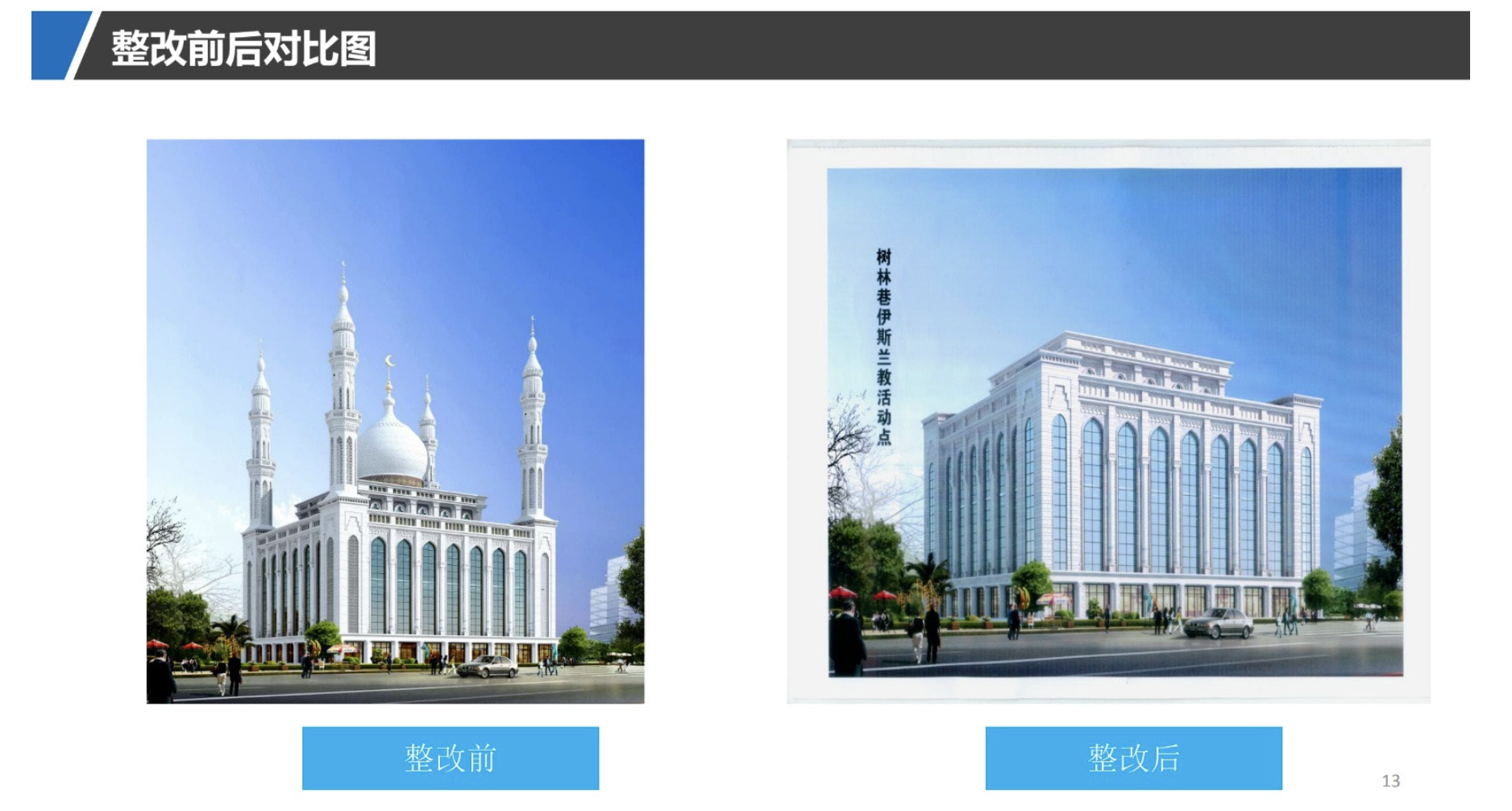
In mid-2018, as the large-scale removal of Arabic script began across the northwest, evidence of the removal of “Arab-style” or otherwise “foreign” architectural elements from mosques and other public buildings first emerged. In practice, renovations have targeted domes, tall minarets in a non-pagoda style, and Islamic symbols, such as the crescent moon and star commonly placed atop mosque roofs. Although most of the media coverage of architectural Sinicization focuses on mosques, renovations have also targeted non-religious buildings constructed with decorative Islamic elements, such as domes or arched windows. For example, in Jinan, Shandong Province, the famous halal restaurant, Bainian Yunting Hui Hotpot Restaurant, situated next to the city’s Great Southern Mosque, removed its prominent ornamental golden domes and the Arabic script on its sign by May 2016. By July 2022, images from Baidu Maps’ street view indicated that all mentions of halal had vanished from the storefront’s branding.
Before 2017, this was a common practice for buildings located near prominent mosques (as was the case with those buildings surrounding Yinchuan’s Nanguan Mosque), or areas with a strong Hui heritage.
Often, the adoption of these Islamic architectural motifs was a deliberate choice on the part of the local authorities to promote their regions as destinations for foreign businesses or tourism. Renovations to city districts to remove architecture intended to celebrate Islamic heritage have taken place in Hohhot, Jilin, and cities throughout Ningxia (most notably, Yinchuan). In Linxia, the local government reported the removal of Islamic decorative elements from the roofs of 14 multi-storey buildings, in addition to a widespread campaign that replaced almost 1,000 shop signs with Arabic elements in 2018.
As with other aspects of the campaign, different provinces have implemented different timetables for Sinicizing mosque architecture. Mosques in Ningxia were Sinicized first — roughly between 2018-2020 — in keeping with the broader identification of Ningxia as a priority destination for Sinicization work. The campaign was subsequently implemented across the country. Several major mosques in Yunnan were among the last targeted, only undergoing Sinicization in late 2023. Much of the architectural work to renovate mosques was completed during Covid-19 lockdowns, when mosques were formally closed to worshippers. Within this broader pattern, however, authorities have worked to carefully prepare plans for renovations to mosques of particular size or historic significance to Muslim communities across China.
As of 2024, analysis suggests that all major mosques across China have now been Sinicized. A Financial Times satellite survey from 2023 found that three-quarters of the 2,132 mosques identified as having ‘Arabic’ elements had been modified or destroyed. Whilst the differing implementation timetables, and indeed the cost, scale, and complexity of the work required, mean that it is possible that some smaller mosques remain unaffected to date, it can be anticipated that ultimately all mosques in China deemed to have unacceptable architectural features will be subject to renovation.
In the earliest stages of the campaign, renovations were often crude. Given the political weight placed on the Three Transformations campaign and the definition of mosque rectification work as part of combatting extremism, authorities moved fast to renovate mosques, with little concern for the quality of work done or the state in which mosques were left. Domes and other unacceptable elements were simply torn off, sometimes in a manner so blunt that extensive damage was done to the remaining fabric of the mosque. Numerous photographs from this time period show domes stripped off mosques and simply left lying in the courtyards below. In the case of a newly refurbished mosque in Zheqiao, Gansu, the 2019 operation to remove its dome, minarets, and decorative elements to its doors and windows effectively destroyed the mosque itself. Residents were warned not to circulate images or videos of the damaged mosques. Some who posted longer videos of the demolition and damage done to the mosque were later arrested for doing so.
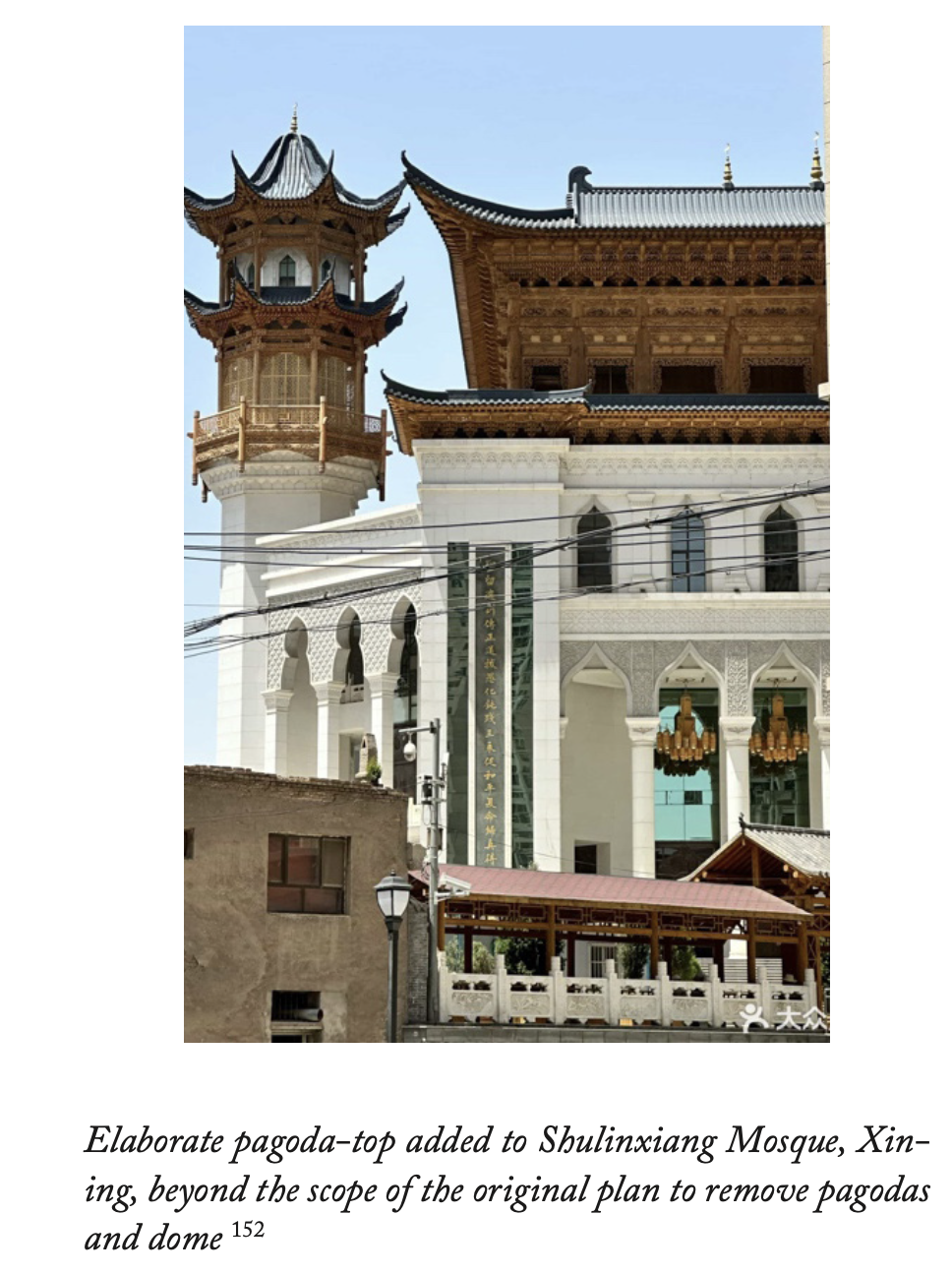
Early mosque Sinicization work also overlapped substantially with the moves to close or demolish mosques “lacking the correct permissions” (未批先建清真寺) and other unregistered religious venues (see 7.0 Mosque Closures). In August 2018, for instance, the local government moved to demolish Weizhou Grand Mosque in Ningxia on the grounds that it had constructed an extension that exceeded the scope of the building permits it had obtained for the work. Following fierce opposition and protests that attracted international attention, the government backed down from the plan to demolish the mosque. However, after defusing the protest, the mosque was later Sinicized, with pagoda roofs replacing its domes.
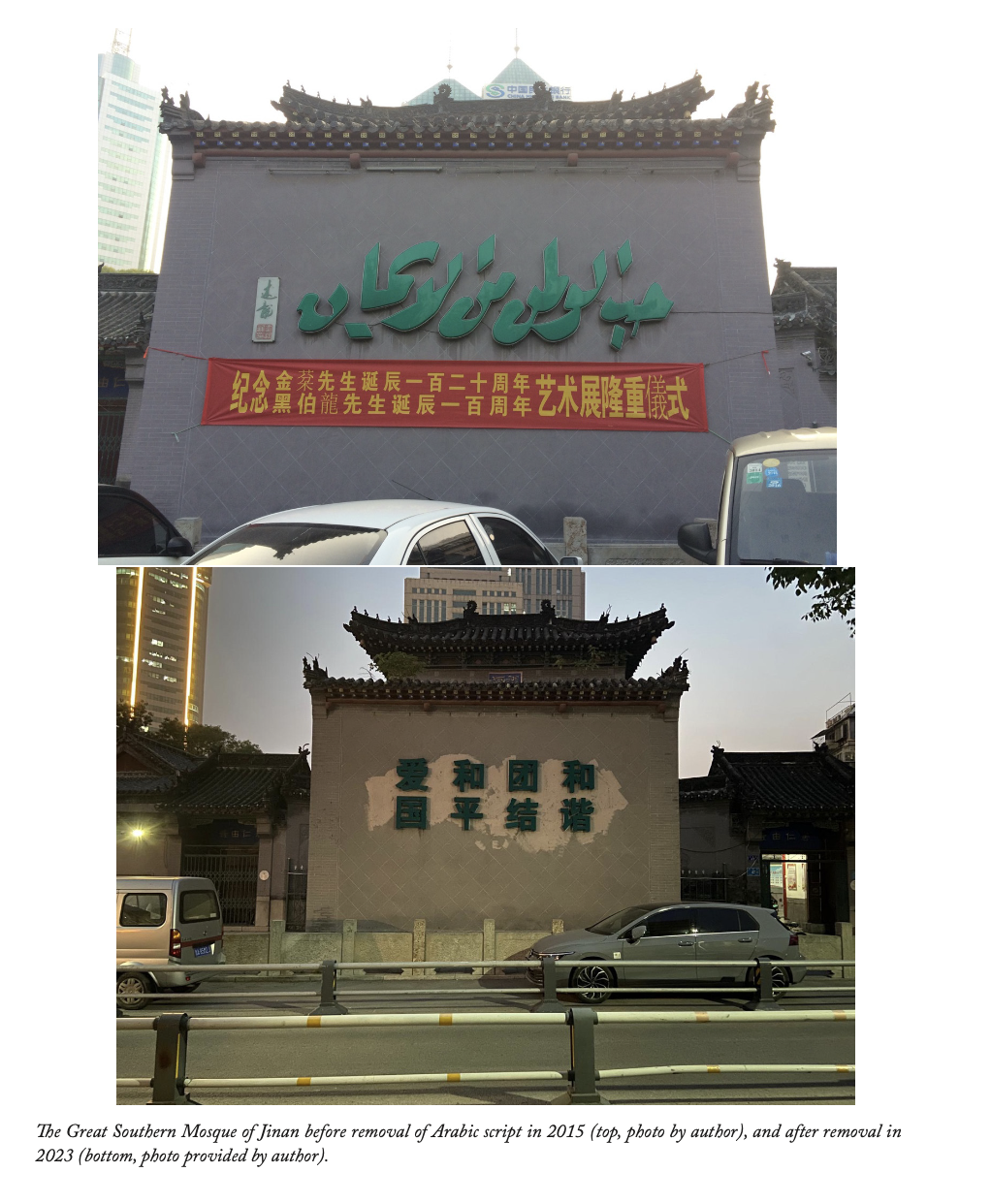
As the campaign has progressed, forced renovations have moved towards replacing ‘Arabic’ features with Chinese equivalents. As most mosques are not rebuilt wholesale — and indeed the wood-built traditional mosques held up as models to emulate are much more expensive to build — renovation often means simply replacing domes with tiled roofs and capping off shortened minarets. The resulting hybrid mosques, with their original walls unchanged, are stylistically awkward, with little harmony between original design and the new impositions. Standards for what aspects of architectural design are considered acceptable vary considerably. In a tender for renovations to a mosque in Ningxia in 2022, in addition to stating that the proposed buildings should be traditionally Chinese in style, the call also stated that the exterior colour of the mosque should be adjusted to remove any green elements. This stands in contrast to guidelines issued for mosque renovations in Hualong, Qinghai, which stated that renovations to the nine local ‘Arabic-style’ mosques should be “practical, economic, green [Islamic] and beautiful.” In one exceptional case in Jinan, even party-approved slogans in Arabic failed to meet standards of appropriateness. The outer wall of the Chinese-style Great Southern Mosque of Jinan bore the party slogan “Love Your Country, Love Your Faith” in calligraphic Arabic. However, after Sinicization, the script was hastily removed and replaced by the Twelve Core Socialist Values in Chinese (see photos on following page).